CN102368558A - Electrode catalyst composition, electrode and fuel cell and membrane-electrode assembly each comprising the electrode - Google Patents
Electrode catalyst composition, electrode and fuel cell and membrane-electrode assembly each comprising the electrode Download PDFInfo
- Publication number
- CN102368558A CN102368558A CN2011103582829A CN201110358282A CN102368558A CN 102368558 A CN102368558 A CN 102368558A CN 2011103582829 A CN2011103582829 A CN 2011103582829A CN 201110358282 A CN201110358282 A CN 201110358282A CN 102368558 A CN102368558 A CN 102368558A
- Authority
- CN
- China
- Prior art keywords
- electrode
- fuel cell
- solid electrolyte
- anode
- cathode
- Prior art date
- Legal status (The legal status is an assumption and is not a legal conclusion. Google has not performed a legal analysis and makes no representation as to the accuracy of the status listed.)
- Pending
Links
Images


Classifications
-
- H—ELECTRICITY
- H01—ELECTRIC ELEMENTS
- H01M—PROCESSES OR MEANS, e.g. BATTERIES, FOR THE DIRECT CONVERSION OF CHEMICAL ENERGY INTO ELECTRICAL ENERGY
- H01M4/00—Electrodes
- H01M4/86—Inert electrodes with catalytic activity, e.g. for fuel cells
- H01M4/90—Selection of catalytic material
- H01M4/9016—Oxides, hydroxides or oxygenated metallic salts
-
- B—PERFORMING OPERATIONS; TRANSPORTING
- B01—PHYSICAL OR CHEMICAL PROCESSES OR APPARATUS IN GENERAL
- B01J—CHEMICAL OR PHYSICAL PROCESSES, e.g. CATALYSIS OR COLLOID CHEMISTRY; THEIR RELEVANT APPARATUS
- B01J21/00—Catalysts comprising the elements, oxides, or hydroxides of magnesium, boron, aluminium, carbon, silicon, titanium, zirconium, or hafnium
- B01J21/18—Carbon
-
- B—PERFORMING OPERATIONS; TRANSPORTING
- B01—PHYSICAL OR CHEMICAL PROCESSES OR APPARATUS IN GENERAL
- B01J—CHEMICAL OR PHYSICAL PROCESSES, e.g. CATALYSIS OR COLLOID CHEMISTRY; THEIR RELEVANT APPARATUS
- B01J23/00—Catalysts comprising metals or metal oxides or hydroxides, not provided for in group B01J21/00
- B01J23/16—Catalysts comprising metals or metal oxides or hydroxides, not provided for in group B01J21/00 of arsenic, antimony, bismuth, vanadium, niobium, tantalum, polonium, chromium, molybdenum, tungsten, manganese, technetium or rhenium
- B01J23/32—Manganese, technetium or rhenium
- B01J23/34—Manganese
-
- H—ELECTRICITY
- H01—ELECTRIC ELEMENTS
- H01M—PROCESSES OR MEANS, e.g. BATTERIES, FOR THE DIRECT CONVERSION OF CHEMICAL ENERGY INTO ELECTRICAL ENERGY
- H01M4/00—Electrodes
- H01M4/86—Inert electrodes with catalytic activity, e.g. for fuel cells
- H01M4/8605—Porous electrodes
-
- H—ELECTRICITY
- H01—ELECTRIC ELEMENTS
- H01M—PROCESSES OR MEANS, e.g. BATTERIES, FOR THE DIRECT CONVERSION OF CHEMICAL ENERGY INTO ELECTRICAL ENERGY
- H01M4/00—Electrodes
- H01M4/86—Inert electrodes with catalytic activity, e.g. for fuel cells
- H01M4/90—Selection of catalytic material
- H01M4/92—Metals of platinum group
-
- H—ELECTRICITY
- H01—ELECTRIC ELEMENTS
- H01M—PROCESSES OR MEANS, e.g. BATTERIES, FOR THE DIRECT CONVERSION OF CHEMICAL ENERGY INTO ELECTRICAL ENERGY
- H01M4/00—Electrodes
- H01M4/86—Inert electrodes with catalytic activity, e.g. for fuel cells
- H01M4/90—Selection of catalytic material
- H01M4/92—Metals of platinum group
- H01M4/921—Alloys or mixtures with metallic elements
-
- H—ELECTRICITY
- H01—ELECTRIC ELEMENTS
- H01M—PROCESSES OR MEANS, e.g. BATTERIES, FOR THE DIRECT CONVERSION OF CHEMICAL ENERGY INTO ELECTRICAL ENERGY
- H01M8/00—Fuel cells; Manufacture thereof
- H01M8/10—Fuel cells with solid electrolytes
- H01M8/1007—Fuel cells with solid electrolytes with both reactants being gaseous or vaporised
-
- H—ELECTRICITY
- H01—ELECTRIC ELEMENTS
- H01M—PROCESSES OR MEANS, e.g. BATTERIES, FOR THE DIRECT CONVERSION OF CHEMICAL ENERGY INTO ELECTRICAL ENERGY
- H01M8/00—Fuel cells; Manufacture thereof
- H01M8/10—Fuel cells with solid electrolytes
- H01M2008/1095—Fuel cells with polymeric electrolytes
-
- H—ELECTRICITY
- H01—ELECTRIC ELEMENTS
- H01M—PROCESSES OR MEANS, e.g. BATTERIES, FOR THE DIRECT CONVERSION OF CHEMICAL ENERGY INTO ELECTRICAL ENERGY
- H01M4/00—Electrodes
- H01M4/86—Inert electrodes with catalytic activity, e.g. for fuel cells
- H01M4/8647—Inert electrodes with catalytic activity, e.g. for fuel cells consisting of more than one material, e.g. consisting of composites
- H01M4/8657—Inert electrodes with catalytic activity, e.g. for fuel cells consisting of more than one material, e.g. consisting of composites layered
-
- H—ELECTRICITY
- H01—ELECTRIC ELEMENTS
- H01M—PROCESSES OR MEANS, e.g. BATTERIES, FOR THE DIRECT CONVERSION OF CHEMICAL ENERGY INTO ELECTRICAL ENERGY
- H01M8/00—Fuel cells; Manufacture thereof
- H01M8/02—Details
- H01M8/0202—Collectors; Separators, e.g. bipolar separators; Interconnectors
- H01M8/023—Porous and characterised by the material
- H01M8/0234—Carbonaceous material
-
- H—ELECTRICITY
- H01—ELECTRIC ELEMENTS
- H01M—PROCESSES OR MEANS, e.g. BATTERIES, FOR THE DIRECT CONVERSION OF CHEMICAL ENERGY INTO ELECTRICAL ENERGY
- H01M8/00—Fuel cells; Manufacture thereof
- H01M8/02—Details
- H01M8/0202—Collectors; Separators, e.g. bipolar separators; Interconnectors
- H01M8/023—Porous and characterised by the material
- H01M8/0241—Composites
- H01M8/0245—Composites in the form of layered or coated products
-
- Y—GENERAL TAGGING OF NEW TECHNOLOGICAL DEVELOPMENTS; GENERAL TAGGING OF CROSS-SECTIONAL TECHNOLOGIES SPANNING OVER SEVERAL SECTIONS OF THE IPC; TECHNICAL SUBJECTS COVERED BY FORMER USPC CROSS-REFERENCE ART COLLECTIONS [XRACs] AND DIGESTS
- Y02—TECHNOLOGIES OR APPLICATIONS FOR MITIGATION OR ADAPTATION AGAINST CLIMATE CHANGE
- Y02E—REDUCTION OF GREENHOUSE GAS [GHG] EMISSIONS, RELATED TO ENERGY GENERATION, TRANSMISSION OR DISTRIBUTION
- Y02E60/00—Enabling technologies; Technologies with a potential or indirect contribution to GHG emissions mitigation
- Y02E60/30—Hydrogen technology
- Y02E60/50—Fuel cells
Landscapes
- Chemical & Material Sciences (AREA)
- Chemical Kinetics & Catalysis (AREA)
- Engineering & Computer Science (AREA)
- Materials Engineering (AREA)
- Electrochemistry (AREA)
- General Chemical & Material Sciences (AREA)
- Organic Chemistry (AREA)
- Sustainable Energy (AREA)
- Sustainable Development (AREA)
- Manufacturing & Machinery (AREA)
- Life Sciences & Earth Sciences (AREA)
- Inert Electrodes (AREA)
- Fuel Cell (AREA)
- Catalysts (AREA)
Abstract
本发明涉及电极催化剂组合物、电极以及具有其的燃料电池和膜-电极接合体。本发明提供用于提高燃料电池、特别是单室型固体电解质型燃料电池的发电效率的电极以及该电极。本发明的电极,下式(1)所示的ΔEh为-10mV~100mV,ΔEh=E0-E3(1)(其中,E0是使氢浓度为0%的气体(仅氧化性气体)在室温下与电极接触时的电极电位,E3是使氢浓度为3体积%的混合气体(氢气以及上述氧化性气体)在室温下与电极接触时的电极电位)。
The present invention relates to an electrode catalyst composition, an electrode, and a fuel cell and a membrane-electrode assembly having the same. The present invention provides an electrode for improving the power generation efficiency of a fuel cell, particularly a single-chamber solid electrolyte fuel cell, and the electrode. In the electrode of the present invention, ΔEh represented by the following formula (1) is -10mV to 100mV, and ΔEh=E 0 -E 3 (1) (wherein, E 0 is a gas (only oxidizing gas) with a hydrogen concentration of 0%. The electrode potential when the electrode is in contact with the electrode at room temperature, E3 is the electrode potential when the mixed gas (hydrogen gas and the above-mentioned oxidizing gas) with a hydrogen concentration of 3% by volume is in contact with the electrode at room temperature).
Description
本申请是申请日为2008年3月27日、申请号为200880010308.7、发明名称为“电极催化剂组合物、电极以及具有其的燃料电池和膜-电极接合体”的申请的分案申请。This application is a divisional application of an application with a filing date of March 27, 2008, an application number of 200880010308.7, and an invention title of "electrode catalyst composition, electrode, and fuel cell and membrane-electrode assembly having the same".
技术领域 technical field
本发明涉及电极催化剂组合物、电极以及具有其的燃料电池和膜-电极接合体。The present invention relates to an electrode catalyst composition, an electrode, and a fuel cell and a membrane-electrode assembly having the same.
背景技术 Background technique
电极催化剂组合物用于燃料电池用电极中。燃料电池近年作为能量转换效率高、废气也干净的能量转换装置受到关注。作为燃料电池,代表性的为固体电解质燃料电池,作为该燃料电池,可以举出双室型固体电解质燃料电池和单室型固体电解质燃料电池。The electrode catalyst composition is used in an electrode for a fuel cell. In recent years, fuel cells have attracted attention as energy conversion devices with high energy conversion efficiency and clean exhaust gas. A representative fuel cell is a solid electrolyte fuel cell, and examples of the fuel cell include a double-chamber solid electrolyte fuel cell and a single-chamber solid electrolyte fuel cell.
双室型固体电解质燃料电池的结构通常为:将固体电解质(膜状、板状)作为隔板,配置在一个面上的电极(阳极)与燃料气体(氢气、醇、烃等)接触,配置在另一面上的电极(阴极)与氧化性气体(氧气、空气等)接触(例如参照专利文献1),通过这种结构可以在两极间得到电位差。The structure of a double-chamber solid electrolyte fuel cell is usually: a solid electrolyte (membrane, plate) is used as a separator, an electrode (anode) arranged on one surface is in contact with a fuel gas (hydrogen, alcohol, hydrocarbon, etc.), and the The electrode (cathode) on the other surface is in contact with an oxidizing gas (oxygen, air, etc.) (for example, refer to Patent Document 1), and this structure can obtain a potential difference between the two electrodes.
单室型固体电解质燃料电池的结构为:两个电极配置在固体电解质(膜状、板状)上、不隔开燃料气体与氧化性气体,为燃料气体与氧化性气体的混合气体与两个电极接触的结构(例如参照专利文献2、非专利文献1、非专利文献2)。该结构由于与上述双室型固体电解质燃料电池的结构相比为简单的结构,在成本方面具有优势。在单室型固体电解质燃料电池中,对两个电极即阳极和阴极分别要求上述混合气体接触时的反应的选择性。即,阳极要求优先进行氧化反应,阴极要求优先进行还原反应,由此在两极间产生电位差。The structure of the single-chamber solid electrolyte fuel cell is as follows: two electrodes are arranged on the solid electrolyte (membrane, plate) without separating the fuel gas and the oxidizing gas, which is a mixture of fuel gas and oxidizing gas and two Structure of electrode contact (for example, refer to
专利文献1:日本特开平10-294117号公报Patent Document 1: Japanese Patent Application Laid-Open No. 10-294117
专利文献2:日本特开2002-280015号公报Patent Document 2: Japanese Patent Laid-Open No. 2002-280015
非专利文献1:プリエストナル、コゼ一バ、フイツシユ、ニルソン、ジヤ一ナル-オブ-パワ一ソ一ス第106卷(2002年)21~30页Non-Patent Document 1: Priestonal, Kozeba, Fitsushi, Nilson, Jaynar-ob-Powersors Vol. 106 (2002) pp. 21-30
非专利文献2:ダイア一、ネイチヤ一第343卷(1990年)547~548页Non-Patent Document 2: Daya, Neitiya, Vol. 343 (1990), pp. 547-548
发明内容Contents of the invention
但是上述单室型固体电解质燃料电池在发电效率方面有时不充分。However, the above-mentioned single-chamber solid electrolyte fuel cells may not be sufficient in terms of power generation efficiency.
因此,本发明的目的在于,提供用于提高燃料电池、特别是单室型固体电解质型燃料电池的发电效率的电极以及可以形成该电极的电极催化剂组合物。此外,本发明的目的在于,提供具有本发明的电极的燃料电池和膜-电极接合体。Accordingly, an object of the present invention is to provide an electrode for improving the power generation efficiency of a fuel cell, particularly a single-chamber solid electrolyte fuel cell, and an electrode catalyst composition capable of forming the electrode. Another object of the present invention is to provide a fuel cell and a membrane-electrode assembly having the electrode of the present invention.
本发明人进行了深入研究,结果完成了本发明。即,本发明提供下述发明。The present inventors conducted intensive studies and as a result, completed the present invention. That is, the present invention provides the following inventions.
(1)下式(1)所示的ΔEh为-10mV~100mV的电极,(1) An electrode whose ΔEh represented by the following formula (1) is -10mV to 100mV,
ΔEh=E0-E3 (1)ΔEh=E 0 -E 3 (1)
(其中,E0是使氢浓度为0%的气体(仅氧化性气体)在室温下与电极接触时的电极电位,E3是使氢浓度为3体积%的混合气体(氢气以及上述氧化性气体)在室温下与电极接触时的电极电位)。(where E0 is the electrode potential when a gas with a hydrogen concentration of 0% (only the oxidizing gas) contacts the electrode at room temperature, and E3 is a mixed gas with a hydrogen concentration of 3% by volume (hydrogen and the above-mentioned oxidizing gas) gas) the electrode potential when in contact with the electrode at room temperature).
(2)电极催化剂组合物,其具有含3价Mn的化合物。(2) An electrode catalyst composition having a compound containing trivalent Mn.
(3)(2)的电极催化剂组合物,其为将含3价Mn的化合物担载于导电材料而成的。(3) The electrode catalyst composition of (2), which is obtained by supporting a trivalent Mn-containing compound on a conductive material.
(4)(2)或(3)的电极催化剂组合物,其中,含3价Mn的化合物为Mn2O3。(4) The electrode catalyst composition of (2) or (3), wherein the compound containing trivalent Mn is Mn 2 O 3 .
(5)(2)~(4)中任意一项的电极催化剂组合物,其中,导电材料为碳材料。(5) The electrode catalyst composition according to any one of (2) to (4), wherein the conductive material is a carbon material.
(6)电极,其具有(2)~(5)中任意一项的电极催化剂组合物。(6) An electrode comprising the electrode catalyst composition according to any one of (2) to (5).
(7)燃料电池,其具有(1)或(6)的电极。(7) A fuel cell having the electrode of (1) or (6).
(8)固体电解质燃料电池,其具有(1)或(6)的电极。(8) A solid electrolyte fuel cell having the electrode of (1) or (6).
(9)单室型固体电解质燃料电池,其具有(1)或(6)的电极。(9) A single-chamber solid electrolyte fuel cell having the electrode of (1) or (6).
(10)单室型固体电解质燃料电池,其具有由(1)或(6)的电极形成的阴极和阳极。(10) A single-chamber solid electrolyte fuel cell having a cathode and an anode formed from the electrodes of (1) or (6).
(11)(10)的单室型固体电解质燃料电池,其中,阳极为含有金和铂的电极。(11) The single-chamber solid electrolyte fuel cell of (10), wherein the anode is an electrode containing gold and platinum.
(12)(11)的单室型固体电解质燃料电池,其中,在上述含有金和铂的电极中,铂的原子数为100时的金的原子数超过0且为3以下。(12) The single-cell solid electrolyte fuel cell of (11), wherein, in the electrode containing gold and platinum, the atomic number of gold is more than 0 and 3 or less when the atomic number of platinum is 100.
(13)(11)或(12)的单室型固体电解质燃料电池,其中,在上述含有金和铂的电极中,铂被金修饰。(13) The single-chamber solid electrolyte fuel cell of (11) or (12), wherein, in the above-mentioned electrode containing gold and platinum, platinum is modified with gold.
(14)膜-电极接合体,其具有固体电解质膜和与该固体电解质膜接合的(1)或(6)的电极。(14) A membrane-electrode assembly comprising a solid electrolyte membrane and the electrode of (1) or (6) bonded to the solid electrolyte membrane.
根据本发明,可以提供对于提高燃料电池、特别是单室型固体电解质型燃料电池的电动势来说合适的电极,本发明在工业上极其有用。此外,根据本发明,可以提供可以形成上述本发明的电极的电极催化剂组合物、具有本发明的电极的发电效率高的燃料电池和膜-电极接合体。According to the present invention, it is possible to provide an electrode suitable for increasing the electromotive force of a fuel cell, particularly a single-chamber solid electrolyte fuel cell, and the present invention is extremely useful industrially. In addition, according to the present invention, there can be provided an electrode catalyst composition capable of forming the above-mentioned electrode of the present invention, a fuel cell having an electrode of the present invention, and a membrane-electrode assembly having high power generation efficiency.
附图说明 Description of drawings
[图1]为表示双室型固体电解质燃料电池的截面结构的示意图。[ Fig. 1 ] is a schematic diagram showing a cross-sectional structure of a two-chamber solid electrolyte fuel cell.
[图2]为表示单室型固体电解质燃料电池的截面结构的示意图。[ Fig. 2 ] is a schematic diagram showing a cross-sectional structure of a single-chamber solid electrolyte fuel cell.
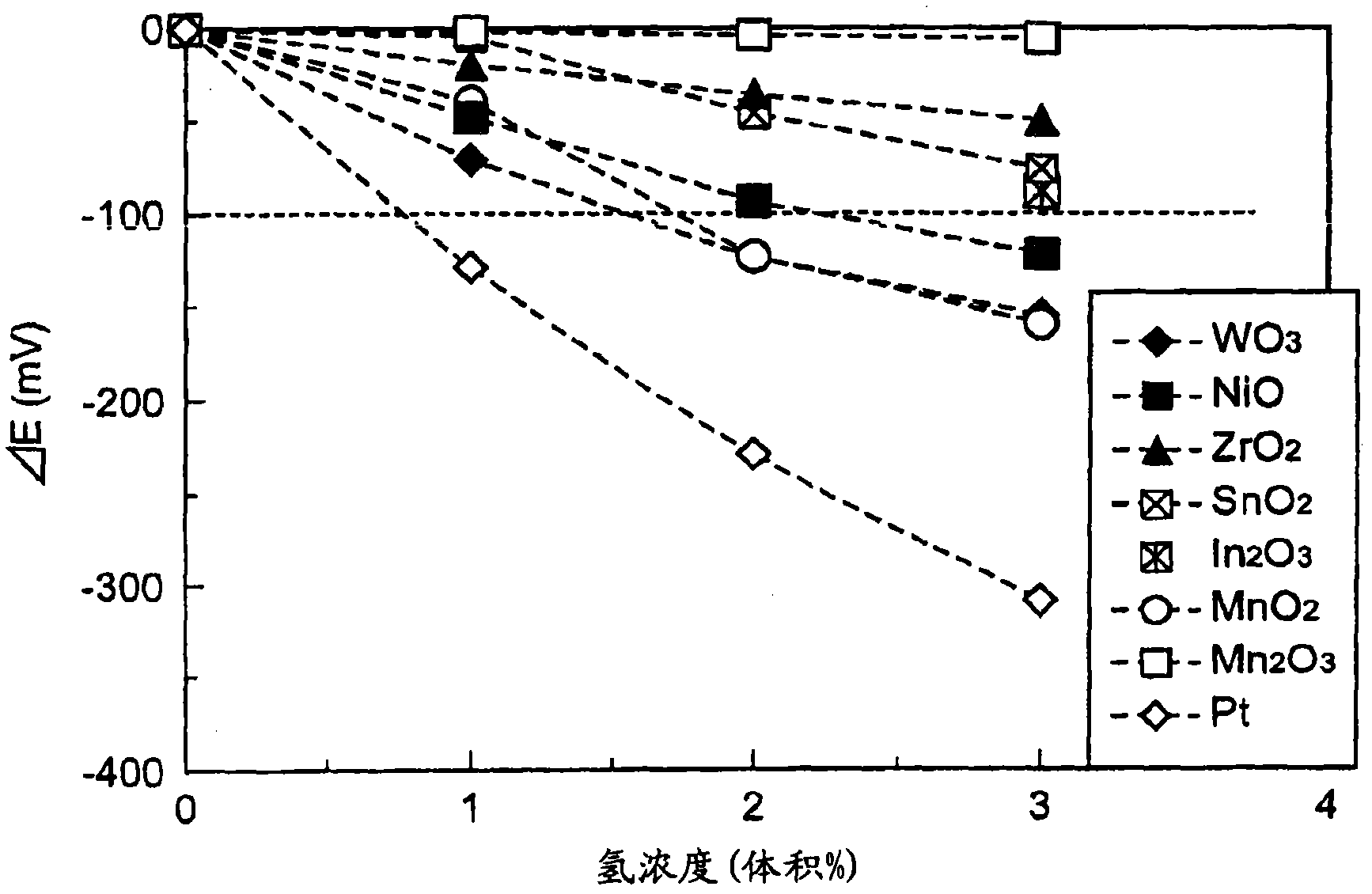
[图3]为表示使用各试验例的阴极时的氢浓度与ΔE的关系的图。[ Fig. 3] Fig. 3 is a graph showing the relationship between the hydrogen concentration and ΔE when using the cathode of each test example.
[图4]为表示各样品的阳极的每100个铂原子数的金原子数与由该样品得到的耗氧率(%)的关系的图。[ Fig. 4 ] is a graph showing the relationship between the number of gold atoms per 100 platinum atoms in the anode of each sample and the oxygen consumption rate (%) obtained from the sample.
[图5]为表示将膜-电极接合体4层叠3层时的燃料电池的结构的示意图。[ Fig. 5 ] is a schematic diagram showing the structure of a fuel cell in which three membrane-
[图6]为表示图5的膜-电极接合体4的层叠状态的图。[ Fig. 6] Fig. 6 is a view showing a stacked state of the membrane-
[图7]为表示层叠1~4层膜-电极接合体4时分别得到的发电特性(电流-电压特性)的图。[ Fig. 7] Fig. 7 is a graph showing power generation characteristics (current-voltage characteristics) obtained when one to four layers of the membrane-
符号说明Symbol Description
1阳极、2固体电解质、3阴极、4膜-电极接合体、5导线、6碳纸1 anode, 2 solid electrolyte, 3 cathode, 4 membrane-electrode assembly, 5 wire, 6 carbon paper
具体实施方式 Detailed ways
以下对本发明的优选实施方式进行具体的说明。Preferred embodiments of the present invention will be specifically described below.
首先,本发明的优选实施方式涉及的电极为下式(1)所示的ΔEh为-10mV~100mV的电极,First, the electrode according to a preferred embodiment of the present invention is an electrode in which ΔEh represented by the following formula (1) is -10 mV to 100 mV,
ΔEh=E0-E3 (1)ΔEh=E 0 -E 3 (1)
(其中,E0是使氢浓度为0%的气体(仅氧化性气体)在室温下与电极接触时的电极电位,E3是使氢浓度为3%的混合气体(氢气和氧化性气体(与测定E0时相同的氧化性气体))在室温下与电极接触时的电极电位)。(Wherein, E 0 is the electrode potential when a gas with a hydrogen concentration of 0% (only an oxidizing gas) contacts the electrode at room temperature, and E 3 is a mixed gas with a hydrogen concentration of 3% (hydrogen and an oxidizing gas ( The same oxidizing gas as in the determination of E0 )) the electrode potential when in contact with the electrode at room temperature).
其中,室温例如可以为23℃。电极电位可以从公知的方法适当选择来进行测定。可以举出例如,将标准电极作为对电极,使用阻抗充分高的电位计进行测定的方法。本实施方式中,氧化性气体为空气时,ΔEh易为0mV~100mV。此外,ΔEh优选为0mV~84mV,更优选为0mV~76mV,进一步优选为0mV~55mV,特别优选为0mV~8mV。Wherein, the room temperature may be, for example, 23°C. The electrode potential can be measured by appropriately selecting from known methods. For example, a method in which a standard electrode is used as a counter electrode and a potentiometer with sufficiently high impedance is used for measurement is mentioned. In the present embodiment, when the oxidizing gas is air, ΔEh is easily 0 mV to 100 mV. In addition, ΔEh is preferably 0 mV to 84 mV, more preferably 0 mV to 76 mV, still more preferably 0 mV to 55 mV, particularly preferably 0 mV to 8 mV.
作为满足上述ΔEh的电极,可以举出含有催化剂和导电材料的电极。作为催化剂,具体地可以举出Mn2O3、ZrO2、SnO2、In2O3。其中,优选为Mn2O3或ZrO2,特别优选为Mn2O3。另一方面,作为导电材料,可以从公知材料适当选择来使用。可以举出例如,碳材料(石墨、乙炔黑、碳纳米管、富勒烯等)或金属材料(铂等)。其中,从成本方面考虑优选为碳材料。Examples of electrodes satisfying the aforementioned ΔEh include electrodes containing a catalyst and a conductive material. Specific examples of the catalyst include Mn 2 O 3 , ZrO 2 , SnO 2 , and In 2 O 3 . Among them, Mn 2 O 3 or ZrO 2 is preferred, and Mn 2 O 3 is particularly preferred. On the other hand, as the conductive material, it can be appropriately selected from known materials and used. Examples thereof include carbon materials (graphite, acetylene black, carbon nanotubes, fullerenes, etc.) and metal materials (platinum, etc.). Among these, carbon materials are preferable from the viewpoint of cost.
催化剂与导电材料的混合可以通过公知的技术进行。可以举出例如,将这些催化剂的粉末与导电材料混合的方法,将催化剂的前体与导电材料混合、然后将前体转换为催化剂的方法等。其中,例如催化剂为Mn2O3时,将前体硝酸锰6水合物与导电材料混合,然后进行热处理,由此可以将硝酸锰6水合物转换为Mn2O3。要说明的是,对催化剂相对于(催化剂+导电材料)的量不特别限定,优选为5~90重量%,更优选为10~80重量%,进一步优选为20~70重量%。Mixing of the catalyst and the conductive material can be performed by known techniques. For example, a method of mixing the powder of these catalysts with a conductive material, a method of mixing a precursor of a catalyst with a conductive material, and then converting the precursor into a catalyst, etc. may be mentioned. Among these, for example, when the catalyst is Mn 2 O 3 , manganese nitrate hexahydrate can be converted into Mn 2 O 3 by mixing the precursor manganese nitrate hexahydrate with the conductive material and then performing heat treatment. The amount of the catalyst relative to (catalyst+conductive material) is not particularly limited, but is preferably 5 to 90% by weight, more preferably 10 to 80% by weight, and even more preferably 20 to 70% by weight.
此外,本发明的优选实施方式的电极催化剂组合物具有含3价Mn的化合物。本实施方式的电极催化剂组合物特别适于用作构成上述电极的材料。作为含3价Mn的化合物,可以举出Mn2O3。本实施方式中,含3价Mn的化合物优选担载在导电材料上。In addition, the electrode catalyst composition according to a preferred embodiment of the present invention has a compound containing trivalent Mn. The electrode catalyst composition of the present embodiment is particularly suitable as a material constituting the electrode described above. Mn 2 O 3 is mentioned as a compound containing trivalent Mn. In the present embodiment, the compound containing trivalent Mn is preferably carried on the conductive material.
作为导电材料,可以从公知材料适当选择来使用。可以举出例如,碳材料(石墨、乙炔黑、碳纳米管、富勒烯等)或金属材料(铂等)。其中,从成本方面考虑优选为碳材料。含有这种电极催化剂组合物的电极在燃料电池中是有用的。As the conductive material, it can be appropriately selected from known materials and used. Examples thereof include carbon materials (graphite, acetylene black, carbon nanotubes, fullerenes, etc.) and metal materials (platinum, etc.). Among these, carbon materials are preferable from the viewpoint of cost. Electrodes containing such electrode catalyst compositions are useful in fuel cells.
上述实施方式的电极以及含有上述实施方式的电极催化剂组合物的电极在燃料电池中是有用的,尤其在固体电解质燃料电池、特别是单室型固体电解质燃料电池中是有用的。使用这些电极作为单室型固体电解质燃料电池的电极时,特别优选用作阴极。The electrode of the above embodiment and the electrode containing the electrode catalyst composition of the above embodiment are useful in fuel cells, especially in solid electrolyte fuel cells, especially single-chamber solid electrolyte fuel cells. When these electrodes are used as electrodes of a single-chamber solid electrolyte fuel cell, they are particularly preferably used as cathodes.
图1为表示双室型固体电解质燃料电池的截面结构的示意图。图1所示的双室型固体电解质燃料电池在规定的室内具有固体电解质2作为隔板,在该固体电解质2的一个面上配置阳极1、在另一个面上配置阴极3,形成膜-电极接合体4。在该双室型固体电解质燃料电池中,向阳极1侧供给燃料气体,向阴极3侧供给氧化性气体。FIG. 1 is a schematic diagram showing a cross-sectional structure of a dual-chamber solid electrolyte fuel cell. The dual-chamber solid electrolyte fuel cell shown in FIG. 1 has a
另一方面,图2为表示单室型固体电解质燃料电池的截面结构的示意图。图2所示的单室型固体电解质燃料电池与上述双室型固体电解质燃料电池不同,以不隔开规定的室内的方式配置固体电解质2,在该固体电解质2的一个面上配置阳极1、在另一个面上配置阴极3,形成膜-电极接合体4。在该单室型固体电解质燃料电池中,将燃料气体与氧化性气体的混合气体导入到室内。On the other hand, FIG. 2 is a schematic diagram showing a cross-sectional structure of a single-chamber solid electrolyte fuel cell. The single-chamber solid electrolyte fuel cell shown in FIG. 2 is different from the above-mentioned double-chamber solid electrolyte fuel cell in that the
具有上述结构的燃料电池中,主要的构成要素为阳极1、阴极3、电解质2、燃料气体(氢、甲醇、甲烷等)和氧化性气体(氧、空气等)。燃料电池为单室型固体电解质燃料电池的情况下,使用燃料气体与氧化性气体的混合气体代替燃料气体和氧化性气体。而且,对燃料电池的结构不特别限定,可以通过公知的技术进行。此外,在燃料电池中,燃料气体、氧化性气体、混合气体可以分别加湿。In the fuel cell having the above-mentioned structure, main constituent elements are
作为燃料气体/氧化性气体的组合,可以举出氢/氧、氢/空气、甲醇/氧、甲醇/空气等。其中,从进一步提高电动势方面考虑,优选为氢/氧或氢/空气。Examples of combinations of fuel gas/oxidizing gas include hydrogen/oxygen, hydrogen/air, methanol/oxygen, methanol/air, and the like. Among them, hydrogen/oxygen or hydrogen/air is preferable from the viewpoint of further increasing the electromotive force.
作为电解质,固体电解质为代表性的电解质,其材料的选定通过公知的技术进行。作为固体电解质的材料,更具体地说,可以举出稳定化氧化锆、金属磷酸盐等无机材料,高分子(氟类、烃类)等有机材料,将磷酸固定于固体而成的材料(例如,磷酸+多孔质体、磷酸+高分子)等。从燃料电池的工作温度或长期稳定性方面考虑,优选为金属磷酸盐。此外,固体电解质多为膜状、板状。如上述燃料电池的结构所示,优选实施方式的膜-电极接合体为上述优选实施方式的电极与这些固体电解质膜接合而成的。As the electrolyte, a solid electrolyte is a representative electrolyte, and the material thereof is selected by a known technique. Examples of materials for the solid electrolyte include, more specifically, inorganic materials such as stabilized zirconia and metal phosphates, organic materials such as polymers (fluorine, hydrocarbons), and materials in which phosphoric acid is fixed to a solid (e.g. , phosphoric acid + porous body, phosphoric acid + polymer), etc. From the viewpoint of the operating temperature and long-term stability of the fuel cell, metal phosphates are preferred. In addition, solid electrolytes are often in the form of films or plates. As shown in the structure of the above-mentioned fuel cell, the membrane-electrode assembly of the preferred embodiment is formed by joining the electrodes of the above-mentioned preferred embodiment to these solid electrolyte membranes.
作为燃料电池中的阳极,可以使用铂等公知的阳极。例如,单室型固体电解质燃料电池中,优选阳极为含有金和铂的电极。该含有金和铂的电极中,更优选至少一部分中,铂被金修饰。通过使用这种阳极,单室型固体电解质燃料电池的发电效率更高。而且,这种阳极还可以用于单室型固体电解质燃料电池以外的燃料电池中。As the anode in the fuel cell, known anodes such as platinum can be used. For example, in a single-chamber solid electrolyte fuel cell, the anode is preferably an electrode containing gold and platinum. In the electrode containing gold and platinum, it is more preferable that at least a part of the platinum is modified with gold. By using such an anode, the power generation efficiency of the single-chamber solid electrolyte fuel cell is higher. Furthermore, this anode can also be used in fuel cells other than single-chamber solid electrolyte fuel cells.
优选作为阳极的含有金和铂的电极中,铂的原子数为100时的金的原子数优选超过0且为3以下,更优选超过0且为2以下,进一步优选超过0且为1以下,特别优选为0.15~0.25,进一步特别优选为0.20~0.25。而且,“超过0”指的是金的原子数不是至少为0、而是即使少也含有的情况,但是从更良好地得到本发明效果方面考虑,优选为0.001以上。Preferably, in an electrode containing gold and platinum as the anode, the number of atoms of gold when the number of atoms of platinum is 100 is preferably more than 0 and 3 or less, more preferably more than 0 and 2 or less, still more preferably more than 0 and 1 or less, Particularly preferably, it is 0.15 to 0.25, and even more preferably, it is 0.20 to 0.25. In addition, "exceeding 0" means that the atomic number of gold is not at least 0, but is contained even if it is small, but it is preferably 0.001 or more from the viewpoint of obtaining the effect of the present invention more favorably.
阳极可以进一步含有导电材料。作为导电材料,可以从公知材料适当选择来使用。可以举出例如,碳材料(石墨、乙炔黑、碳纳米管、富勒烯等)或金属材料(铂等)。构成阳极的材料的混合可以通过公知的技术进行。The anode may further contain a conductive material. As the conductive material, it can be appropriately selected from known materials and used. Examples thereof include carbon materials (graphite, acetylene black, carbon nanotubes, fullerenes, etc.) and metal materials (platinum, etc.). The mixing of materials constituting the anode can be performed by known techniques.
此外,阳极可以含有电解质。电解质从公知材料适当选择。可以举出例如,氟类高分子电解质、烃类高分子电解质、磷酸、磷酸单酯、磷酸二酯、硫酸、甲磺酸、三氟甲磺酸等。In addition, the anode may contain an electrolyte. The electrolyte is appropriately selected from known materials. Examples thereof include fluorine-based polymer electrolytes, hydrocarbon-based polymer electrolytes, phosphoric acid, phosphoric acid monoesters, phosphoric acid diesters, sulfuric acid, methanesulfonic acid, and trifluoromethanesulfonic acid.
进一步地,阳极还可以含有为非电解质的高分子。高分子从公知材料适当选择,优选使用特氟龙(テフロン)(注册商标)、聚偏二氟乙烯等氟树脂。Furthermore, the anode may also contain a non-electrolyte polymer. The polymer is appropriately selected from known materials, and fluororesins such as Teflon (registered trademark) and polyvinylidene fluoride are preferably used.
实施例Example
以下通过实施例对本发明进行更具体的说明,但是本发明不被这些实施例所限定。Hereinafter, the present invention will be described more specifically by way of examples, but the present invention is not limited by these examples.
[试验例1][Test example 1]
<阴极催化剂组合物、阴极(Mn2O3)的制造><Manufacture of cathode catalyst composition and cathode (Mn 2 O 3 )>
在将乙醇(50ml)与蒸馏水(50ml)混合得到的溶剂中混合微粒子碳(黑珍珠)粉末(0.4g)并进行搅拌,进一步混合硝酸锰6水合物(3.13g)。将其在230℃下蒸发干燥得到粉末,将得到的粉末粉碎,得到阴极催化剂组合物。向该粉碎的粉末中的60mg中添加数滴溶解于N-甲基吡咯烷酮中的5%聚偏二氟乙烯溶液,混合得到浆,将得到的浆涂布在碳纸(1cm×2cm)上,90℃下干燥1小时、然后130℃下干燥1小时,制造阴极。在碳纸上形成15~17mg/cm2的阴极,使厚度为150~200μm左右。In a solvent obtained by mixing ethanol (50 ml) and distilled water (50 ml), fine particle carbon (black pearl) powder (0.4 g) was mixed and stirred, and manganese nitrate hexahydrate (3.13 g) was further mixed. This was evaporated and dried at 230° C. to obtain a powder, and the obtained powder was pulverized to obtain a cathode catalyst composition. A few drops of 5% polyvinylidene fluoride solution dissolved in N-methylpyrrolidone were added to 60 mg of the pulverized powder, mixed to obtain a slurry, and the obtained slurry was coated on carbon paper (1 cm×2 cm), After drying at 90°C for 1 hour and then at 130°C for 1 hour, a cathode was produced. A cathode of 15-17 mg/cm 2 is formed on carbon paper to make a thickness of about 150-200 μm.
[试验例2][Test example 2]
<阴极催化剂组合物、阴极(ZrO2)的制造><Manufacture of cathode catalyst composition and cathode (ZrO 2 )>
将ZrO2粉末和微粒子碳(黑珍珠)粉末在乳钵中混合,得到混合物(阴极催化剂组合物),向得到的混合物30mg中进一步混合PTFE(30mg)和甘油(0.3ml),得到浆。将该浆涂布在碳纸(1cm×2cm)上,进行在150℃氩气氛围气中保持3~4小时、进而在350℃相同氛围气中保持1小时的热处理,制造阴极。在碳纸上形成20mg/cm2的阴极。ZrO 2 powder and fine particle carbon (black pearl) powder were mixed in a mortar to obtain a mixture (cathode catalyst composition), and PTFE (30 mg) and glycerin (0.3 ml) were further mixed into 30 mg of the obtained mixture to obtain a slurry. This slurry was coated on carbon paper (1 cm x 2 cm), and heat-treated by holding it in an argon atmosphere at 150° C. for 3 to 4 hours, and then holding it in the same atmosphere at 350° C. for 1 hour to produce a cathode. A 20 mg/ cm2 cathode was formed on carbon paper.
[试验例3][Test example 3]
<阴极催化剂组合物、阴极(SnO2)的制造><Manufacture of cathode catalyst composition and cathode (SnO 2 )>
使用SnO2粉末代替ZrO2粉末,除此之外与试验例2同样地制造阴极。A cathode was produced in the same manner as in Test Example 2 except that SnO 2 powder was used instead of ZrO 2 powder.
[试验例4][Test example 4]
<阴极催化剂组合物、阴极(1n2O3)的制造><Manufacture of cathode catalyst composition and cathode (1n 2 O 3 )>
使用In2O3粉末代替ZrO2粉末,除此之外与试验例2同样地制造阴极。A cathode was produced in the same manner as in Test Example 2 except that In 2 O 3 powder was used instead of ZrO 2 powder.
[试验例5][Test Example 5]
<阴极催化剂组合物、阴极(NiO)的制造><Manufacture of cathode catalyst composition and cathode (NiO)>
使用NiO粉末代替ZrO2粉末,除此之外与试验例2同样地制造阴极。A cathode was produced in the same manner as in Test Example 2 except that NiO powder was used instead of ZrO 2 powder.
[试验例6][Test example 6]
<阴极催化剂组合物、阴极(WO3)的制造><Manufacture of cathode catalyst composition and cathode (WO 3 )>
使用WO3粉末代替ZrO2粉末,除此之外与试验例2同样地制造阴极。A cathode was produced in the same manner as in Test Example 2 except that WO 3 powder was used instead of ZrO 2 powder.
[试验例7][Test Example 7]
<阴极催化剂组合物、阴极(MnO2)的制造><Manufacture of cathode catalyst composition and cathode (MnO 2 )>
使用MnO2粉末代替ZrO2粉末,除此之外与试验例2同样地制造阴极。A cathode was produced in the same manner as in Test Example 2 except that MnO 2 powder was used instead of ZrO 2 powder.
[试验例8][Test example 8]
<固体电解质(磷酸锡颗粒)的制备><Preparation of solid electrolyte (tin phosphate particles)>
作为固体电解质,使用Sn0.9In0.1P2O7的圆形颗粒(直径12mm、厚度1mm)。该颗粒使用与Electrochemical and Solid State Letters、第9卷、第3号、A105页~A109页(2006年)的记载同样的方法制备。As the solid electrolyte, circular particles (diameter 12 mm,
[试验例9][Test Example 9]
<阳极催化剂组合物、阳极(铂)的制造><Manufacture of anode catalyst composition and anode (platinum)>
向铂担载碳(田中贵金属制、铂量28.4重量%)60mg中添加数滴溶解在N-甲基吡咯烷酮中的5%聚偏二氟乙烯溶液,并进行混合得到浆,将得到的浆涂布在碳纸上,90℃下干燥1小时、然后130℃下干燥1小时,得到阳极。A few drops of a 5% polyvinylidene fluoride solution dissolved in N-methylpyrrolidone were added to 60 mg of platinum-carrying carbon (manufactured by Tanaka Precious Metals, with a platinum content of 28.4% by weight), and mixed to obtain a slurry, and the obtained slurry was coated with It was spread on carbon paper, dried at 90° C. for 1 hour, and then dried at 130° C. for 1 hour to obtain an anode.
[试验例10][Test Example 10]
<阳极催化剂组合物、阳极(铂+0.15摩尔%金)的制造><Manufacture of anode catalyst composition, anode (platinum + 0.15 mol% gold)>
使用铂担载碳(田中贵金属制、铂量28.4重量%)、HAuCl4四水合物、NaBH4和离子交换水。即,首先,向将铂担载碳150mg分散在水中得到的分散液中滴加0.0001摩尔/L的HAuCl4四水合物水溶液(3.3ml)和0.002摩尔/L的NaBH4水溶液(30ml),得到将金原子数相对于铂原子数100调整为0.15的混合物。过滤该混合物后,在10体积%氢/90体积%氩的气体中、在200℃下加热1小时,得到阳极催化剂组合物。Platinum-carrying carbon (manufactured by Tanaka Precious Metals, 28.4% by weight of platinum), HAuCl 4 tetrahydrate, NaBH 4 and ion-exchanged water were used. That is, first, 0.0001 mol/L HAuCl tetrahydrate aqueous solution (3.3 ml) and 0.002 mol/L NaBH aqueous solution (30 ml) were added dropwise to a dispersion obtained by dispersing 150 mg of platinum-supported carbon in water to obtain A mixture in which the number of gold atoms is adjusted to 0.15 relative to the number of platinum atoms of 100. After filtering this mixture, it heated at 200 degreeC for 1 hour in 10 volume% hydrogen/90 volume% argon gas, and obtained the anode catalyst composition.
向得到的阳极催化剂组合物(60mg)中添加数滴溶解在N-甲基吡咯烷酮中的5%聚偏二氟乙烯溶液,并进行混合得到浆,将得到的浆涂布在碳纸上,90℃下干燥1小时、然后130℃下干燥1小时,得到阳极。在碳纸上形成15~17mg/cm2的阳极,使厚度为150~200μm左右。Add several drops of 5% polyvinylidene fluoride solution dissolved in N-methylpyrrolidone to the obtained anode catalyst composition (60 mg), and mix to obtain a slurry, which is coated on carbon paper, 90 It was dried at 130° C. for 1 hour and then at 130° C. for 1 hour to obtain an anode. An anode of 15-17 mg/cm 2 is formed on carbon paper to make a thickness of about 150-200 μm.
[试验例11][Test Example 11]
<阳极催化剂组合物、阳极(铂+0.10摩尔%金)的制造><Manufacture of anode catalyst composition, anode (platinum + 0.10 mol% gold)>
使金原子数相对于铂原子数100为0.10,除此之外与试验例10同样地得到阳极。An anode was obtained in the same manner as in Test Example 10 except that the number of gold atoms was 0.10 with respect to the number of platinum atoms being 100.
[试验例12][Test example 12]
<阳极催化剂组合物、阳极(铂+0.20摩尔%金)的制造><Manufacture of anode catalyst composition, anode (platinum+0.20mol% gold)>
使金原子数相对于铂原子数100为0.20,除此之外与试验例10同样地得到阳极。An anode was obtained in the same manner as in Test Example 10 except that the number of gold atoms was 0.20 relative to the number of platinum atoms being 100.
[试验例13][Test Example 13]
<阳极催化剂组合物、阳极(铂+0.25摩尔%金)的制造><Manufacture of anode catalyst composition, anode (platinum+0.25mol% gold)>
使金原子数相对于铂原子数100为0.25,除此之外与试验例10同样地得到阳极。An anode was obtained in the same manner as in Test Example 10 except that the number of gold atoms was 0.25 relative to the number of platinum atoms being 100.
[试验例14][Test Example 14]
<阳极催化剂组合物、阳极(铂+0.50摩尔%金)的制造><Manufacture of anode catalyst composition, anode (platinum + 0.50 mol% gold)>
使金原子数相对于铂原子数100为0.50,除此之外与试验例10同样地得到阳极。An anode was obtained in the same manner as in Test Example 10 except that the number of gold atoms was 0.50 relative to the number of platinum atoms being 100.
[试验例15][Test Example 15]
<ΔEh的测定><Measurement of ΔEh>
在试验例8的固体电解质颗粒的一个面上压接试验例1~7中的任意一个附有阴极的碳纸的阴极面,此外,在该颗粒的另一个面上压接试验例9的附有阳极的碳纸的阳极面,制造分别具有试验例1~7的阴极的各种膜-电极接合体。On one surface of the solid electrolyte particles of Test Example 8, the cathode surface of any one of the carbon papers with a cathode in Test Examples 1 to 7 was crimped, and in addition, the attached carbon paper of Test Example 9 was crimped on the other surface of the particles. Various membrane-electrode assemblies having the cathodes of Test Examples 1 to 7 were produced on the anode side of the carbon paper having the anode.
然后,在室温(23℃)下,使氢与空气的混合气体(将氢改变为0、1、2和3体积%)与这些膜-电极接合体的阴极侧接触的同时,使空气与该膜-电极接合体的阳极侧接触。其中,与阴极侧接触的混合气体和与阳极侧接触的空气不混合。Then, at room temperature (23° C.), a mixed gas of hydrogen and air (changing hydrogen to 0, 1, 2, and 3 vol. %) was brought into contact with the cathode side of these membrane-electrode assemblies, and air was brought into contact with the membrane-electrode assembly. The anode side of the membrane-electrode assembly is in contact. However, the mixed gas in contact with the cathode side and the air in contact with the anode side do not mix.
如此,通过静电计(北斗电工株式会社制、型号“HE-104”)检出在阴极-阳极间产生的电位差,将该电位差作为阴极的电极电位(ΔE(mV))。要说明的是,氢为3体积%时得到的ΔE为E3,氢为0体积%时得到的ΔE为E0。Thus, the potential difference generated between the cathode and the anode was detected by an electrometer (manufactured by Hokuto Denko Co., Ltd., model "HE-104"), and this potential difference was regarded as the electrode potential (ΔE (mV)) of the cathode. The ΔE obtained when the hydrogen content is 3% by volume is E 3 , and the ΔE obtained when the hydrogen content is 0% by volume is E 0 .
得到的ΔE的结果如图3所示。图3为表示使用各试验例的阴极时的氢浓度与ΔE的关系的图。由图3可知,ΔEh(E3-E0),Mn2O3(试验例1的阴极)的情况下为8mV,ZrO2(试验例2的阴极)的情况下为55mV,SnO2(试验例3的阴极)的情况下为76mV,In2O3(试验例4的阴极)的情况下为84mV。由这些结果可知,试验例1~4的阴极的因氢浓度的变化所导致的电位变化小。The results of the obtained ΔE are shown in FIG. 3 . Fig. 3 is a graph showing the relationship between the hydrogen concentration and ΔE when using the cathodes of the test examples. It can be seen from FIG. 3 that ΔEh(E 3 -E 0 ) is 8mV in the case of Mn 2 O 3 (the cathode of Test Example 1), 55 mV in the case of ZrO 2 (the cathode of Test Example 2), and 55 mV in the case of SnO 2 (the cathode of Test Example 2). In the case of the cathode of Example 3), it was 76 mV, and in the case of In 2 O 3 (the cathode of Test Example 4), it was 84 mV. From these results, it can be seen that the cathodes of Test Examples 1 to 4 had a small potential change due to a change in the hydrogen concentration.
[试验例16][Test Example 16]
<阳极的副反应的测定><Measurement of side reactions at the anode>
制造在试验例8的固体电解质颗粒上压接试验例9~14的各附有阳极的碳纸的阳极面而得到的样品。将各样品设置在各管内,在100℃的条件下从管的一个口以流速每分钟30ml(换算为标准状态)供给混合气体(氢80体积%、氧4体积%、氮16体积%),从另一口排出。然后,用气相色谱分析排气,测定出口的氧浓度z(%),通过下式(2)求得耗氧率y(%)。Samples were produced in which the anode faces of the carbon papers with anodes of Test Examples 9 to 14 were pressure-bonded to the solid electrolyte particles of Test Example 8. Each sample was set in each tube, and a mixed gas (
y=((4-z)/4)×100 (2)y=((4-z)/4)×100 (2)
由上述得到的y的结果如图4所示。图4为表示各样品的阳极的每100个铂原子数的金原子数与由该样品得到的耗氧率(%)的关系的图。由图4可知,金原子数为0时y为24%,金原子数为0.10时y为4%,金原子数为0.15时y为0.5%,金原子数为0.20时为0%,金原子数为0.25时y为0%,金原子数为0.50时y为1.5%。特别是使用试验例12(金原子数约为0.2)、试验例13(金原子数约为0.25)的电极作为阳极时,与氧的反应性极低,特别适用于燃料电池的阳极。The result of y obtained above is shown in FIG. 4 . Fig. 4 is a graph showing the relationship between the number of gold atoms per 100 platinum atoms in the anode of each sample and the oxygen consumption rate (%) obtained from the sample. As can be seen from Figure 4, when the number of gold atoms is 0, y is 24%, when the number of gold atoms is 0.10, y is 4%, when the number of gold atoms is 0.15, y is 0.5%, and when the number of gold atoms is 0.20, it is 0%. When the number of gold atoms is 0.25, y is 0%, and when the number of gold atoms is 0.50, y is 1.5%. In particular, when the electrodes of Test Example 12 (the number of gold atoms is about 0.2) and Test Example 13 (the number of gold atoms is about 0.25) are used as anodes, the reactivity with oxygen is extremely low, and they are especially suitable for anodes of fuel cells.
[试验例17][Test Example 17]
<膜-电极接合体的电动势><Electromotive force of membrane-electrode assembly>
作为阴极,使用试验例9的电极(即,由Pt形成的电极),除此之外与试验例15同样地制造膜-电极接合体,测定ΔE(mV)。得到的结果与试验例15的结果一起示于图3。A membrane-electrode assembly was produced in the same manner as in Test Example 15 except that the electrode of Test Example 9 (that is, an electrode made of Pt) was used as the cathode, and ΔE (mV) was measured. The obtained results are shown in FIG. 3 together with the results of Test Example 15.
其中,在氢浓度80体积%以上的混合气体中,若使用试验例1的阴极作为阴极、使用试验例9的阳极作为阳极,则具有这种结构的膜-电极接合体的电动势(J)相当于本试验例中得到的ΔE与试验例15中使用试验例1的阴极得到的ΔE的差。而且,由上述结果判明上述膜-电极接合体的电动势(J)超过1V。Among them, if the cathode of Test Example 1 is used as the cathode and the anode of Test Example 9 is used as the anode in a mixed gas with a hydrogen concentration of 80% by volume or more, the electromotive force (J) of the membrane-electrode assembly having such a structure is equivalent to Difference between ΔE obtained in this test example and ΔE obtained in test example 15 using the cathode of test example 1. Furthermore, from the above results, it was found that the electromotive force (J) of the membrane-electrode assembly exceeded 1V.
[试验例18][Test Example 18]
<单室型固体电解质燃料电池><Single-chamber solid electrolyte fuel cell>
使用试验例1的附有阴极的碳纸、试验例8的固体电解质和试验例12的附有阳极的碳纸,制造膜-电极接合体4(参照图5和图6)。此时,进行压接以使固体电解质的一个面与附有阴极的碳纸的阴极面接触,使固体电解质的另一个面与附有阳极的碳纸的阳极面接触。准备该膜-电极接合体单独1层,或层叠2、3、4层(堆叠)并进行压接而成的叠层体,将它们设置在各管中,形成单室型固体电解质燃料电池。A membrane-
向各燃料电池中,在50℃的条件下,从一个口以流速每分钟5ml(换算为标准状态)供给混合气体(氢80%、氧4%、氮16%),从另一个口排出。作为一例,图5表示层叠3层膜-电极接合体4时的燃料电池的结构的示意图。图6表示图5的膜-电极接合体4的叠层状态。To each fuel cell, a mixed gas (80% hydrogen, 4% oxygen, 16% nitrogen) was supplied from one port at a flow rate of 5 ml per minute (converted to a standard state) at 50° C., and discharged from the other port. As an example, FIG. 5 shows a schematic diagram of the structure of a fuel cell when three layers of the membrane-
上述条件下使各单室型固体电解质燃料电池工作得到的结果如图7所示。图7为表示层叠1~4层膜-电极接合体4时分别得到的发电特性(电流-电压特性)的图。图7中,具有极大值的山型曲线归属于纵轴右侧的功率(Power),右斜的特性归属于纵轴左侧的电池电压(Cell Voltage)。The results obtained by operating each single-chamber solid electrolyte fuel cell under the above conditions are shown in FIG. 7 . FIG. 7 is a graph showing power generation characteristics (current-voltage characteristics) obtained when one to four layers of the membrane-
由图7判明,4层时可以得到超过100mV的输出功率。此外,由试验例16的结果可确认,使用试验例10、试验例11、试验例13、试验例14的阳极代替试验例12的阳极,也可以得到与上述同样的效果。As can be seen from Fig. 7, an output power exceeding 100mV can be obtained with 4 layers. In addition, from the results of Test Example 16, it was confirmed that the same effect as above can be obtained by using the anodes of Test Examples 10, 11, 13, and 14 instead of the anode of Test Example 12.
Claims (9)
Applications Claiming Priority (2)
| Application Number | Priority Date | Filing Date | Title |
|---|---|---|---|
| JP2007083909 | 2007-03-28 | ||
| JP2007-083909 | 2007-03-28 |
Related Parent Applications (1)
| Application Number | Title | Priority Date | Filing Date |
|---|---|---|---|
| CN200880010308A Division CN101647142A (en) | 2007-03-28 | 2008-03-27 | Electrode catalyst composition, electrode, and fuel cell and membrane-electrode assembly each comprising same |
Publications (1)
| Publication Number | Publication Date |
|---|---|
| CN102368558A true CN102368558A (en) | 2012-03-07 |
Family
ID=39830854
Family Applications (2)
| Application Number | Title | Priority Date | Filing Date |
|---|---|---|---|
| CN2011103582829A Pending CN102368558A (en) | 2007-03-28 | 2008-03-27 | Electrode catalyst composition, electrode and fuel cell and membrane-electrode assembly each comprising the electrode |
| CN200880010308A Pending CN101647142A (en) | 2007-03-28 | 2008-03-27 | Electrode catalyst composition, electrode, and fuel cell and membrane-electrode assembly each comprising same |
Family Applications After (1)
| Application Number | Title | Priority Date | Filing Date |
|---|---|---|---|
| CN200880010308A Pending CN101647142A (en) | 2007-03-28 | 2008-03-27 | Electrode catalyst composition, electrode, and fuel cell and membrane-electrode assembly each comprising same |
Country Status (6)
| Country | Link |
|---|---|
| US (1) | US20100216049A1 (en) |
| EP (1) | EP2133945A1 (en) |
| JP (1) | JP2008270181A (en) |
| CN (2) | CN102368558A (en) |
| TW (1) | TW200905957A (en) |
| WO (1) | WO2008123365A1 (en) |
Families Citing this family (6)
| Publication number | Priority date | Publication date | Assignee | Title |
|---|---|---|---|---|
| JP5738898B2 (en) * | 2010-01-29 | 2015-06-24 | エバレデイ バツテリ カンパニー インコーポレーテツド | Method for producing an electrochemical cell having a catalyst electrode comprising manganese dioxide |
| JP5624791B2 (en) * | 2010-04-07 | 2014-11-12 | 株式会社アツミテック | Power generator |
| EP2561927B1 (en) | 2010-04-20 | 2015-07-08 | Toyota Jidosha Kabushiki Kaisha | Method for producing catalyst |
| JP6098871B2 (en) * | 2013-02-28 | 2017-03-22 | 埼玉県 | Catalyst and cathode for fuel cell |
| KR101670929B1 (en) * | 2014-10-21 | 2016-11-07 | 서울대학교산학협력단 | Catalytic materials and electrodes for oxygen evolution, and systems for electrochemical reaction |
| US11332834B2 (en) | 2014-10-21 | 2022-05-17 | Seoul National University R&Db Foundation | Catalyst and manufacturing method thereof |
Family Cites Families (12)
| Publication number | Priority date | Publication date | Assignee | Title |
|---|---|---|---|---|
| DE19517598C1 (en) * | 1995-05-13 | 1997-01-02 | Degussa | Platinum-aluminum alloy catalyst and its use in fuel cells |
| JP3389393B2 (en) * | 1995-12-04 | 2003-03-24 | 田中貴金属工業株式会社 | Anode catalyst for polymer electrolyte fuel cell and method for producing the same |
| JPH10294117A (en) | 1997-04-18 | 1998-11-04 | Fuji Electric Co Ltd | Solid polymer electrolyte fuel cell |
| JP4900747B2 (en) | 2001-03-21 | 2012-03-21 | 独立行政法人産業技術総合研究所 | Single-chamber solid electrolyte fuel cell and method for manufacturing the same |
| CN1781203A (en) * | 2003-02-18 | 2006-05-31 | 日本电气株式会社 | Electrode for fuel cell, fuel cell and manufacturing method thereof |
| KR100552697B1 (en) * | 2003-11-13 | 2006-02-20 | 삼성에스디아이 주식회사 | Catalyst carrier composed of metal oxide-carbon composite and fuel cell using same |
| JP4490201B2 (en) * | 2004-08-04 | 2010-06-23 | Dowaホールディングス株式会社 | Fine alloy particle powder having irregular surface and method for producing the same |
| GB0419062D0 (en) * | 2004-08-27 | 2004-09-29 | Johnson Matthey Plc | Platinum alloy catalyst |
| JP2006302822A (en) * | 2005-04-25 | 2006-11-02 | Nippon Shokubai Co Ltd | Electrode catalyst for polymer electrolyte fuel cell |
| JP2007035298A (en) * | 2005-07-22 | 2007-02-08 | Matsushita Electric Ind Co Ltd | Electrochemical electrode and method for producing the same |
| CN101147286A (en) * | 2005-08-25 | 2008-03-19 | 松下电器产业株式会社 | Electrode for oxygen reduction |
| JP2007200802A (en) * | 2006-01-30 | 2007-08-09 | Toppan Printing Co Ltd | Gas diffusion material and fuel cell using the same |
-
2008
- 2008-03-18 JP JP2008069000A patent/JP2008270181A/en active Pending
- 2008-03-27 US US12/593,248 patent/US20100216049A1/en not_active Abandoned
- 2008-03-27 EP EP08739035A patent/EP2133945A1/en not_active Withdrawn
- 2008-03-27 WO PCT/JP2008/055906 patent/WO2008123365A1/en not_active Ceased
- 2008-03-27 CN CN2011103582829A patent/CN102368558A/en active Pending
- 2008-03-27 CN CN200880010308A patent/CN101647142A/en active Pending
- 2008-03-28 TW TW097111479A patent/TW200905957A/en unknown
Also Published As
| Publication number | Publication date |
|---|---|
| TW200905957A (en) | 2009-02-01 |
| US20100216049A1 (en) | 2010-08-26 |
| CN101647142A (en) | 2010-02-10 |
| JP2008270181A (en) | 2008-11-06 |
| WO2008123365A1 (en) | 2008-10-16 |
| EP2133945A1 (en) | 2009-12-16 |
Similar Documents
| Publication | Publication Date | Title |
|---|---|---|
| Li et al. | A nanostructured ceramic fuel electrode for efficient CO 2/H 2 O electrolysis without safe gas | |
| Liu et al. | Enhanced performance of LSCF cathode through surface modification | |
| Shao et al. | High power-density single-chamber fuel cells operated on methane | |
| EP2876712A1 (en) | Oxygen-vanadium redox flow battery with vanadium electrolyte having carbon particles dispersed therein | |
| Xing et al. | Preparation and characterization of La0. 75Sr0. 25Cr0. 5Mn0. 5O3− δ-yttria stabilized zirconia cathode supported solid oxide electrolysis cells for hydrogen generation | |
| US9825306B2 (en) | Mixed ionic and electronic conductor based on Sr2Fe2-xMoxO6 perovskite | |
| US20130295489A1 (en) | Anode support for solid oxide fuel cell, method of manufacturing the same, and solid oxide fuel cell including the same | |
| Li et al. | Probing novel triple phase conducting composite cathode for high performance protonic ceramic fuel cells | |
| CN102368558A (en) | Electrode catalyst composition, electrode and fuel cell and membrane-electrode assembly each comprising the electrode | |
| JP2013191558A (en) | Inorganic ion conductor, method of forming the same, and fuel cell including the same | |
| EP2031678A1 (en) | Method for evaluating performance of electrode catalyst for battery, method for exploring electrode catalyst for battery, electrode catalyst for battery, and fuel battery using the electrode catalyst | |
| WO2020059503A1 (en) | Anode catalyst layer for fuel cell and fuel cell using same | |
| Zhou et al. | SrFe0. 75Mo0. 25O3− δ impregnated 430L alloys for efficient fuel oxidation in metal supported solid oxide fuel cells | |
| US20100178584A1 (en) | Electrode catalyst composition, method for production thereof, electrode, and fuel cell and membrane-electrode assembly each comprising the electrode | |
| CN101978536B (en) | Membrane electrode assembly and fuel cell | |
| Sasaki et al. | Reactions on Ni-YSZ cermet anode of solid oxide fuel cells during internal steam reforming of n-octane | |
| EP4170682B1 (en) | Proton conducting cell structure, proton conductor, electrochemical device, and method for producing proton conductor | |
| Chen et al. | Coke-free direct formic acid solid oxide fuel cells operating at intermediate temperatures | |
| KR100311731B1 (en) | Method for manufacturing electrode for direct methanol feul cell | |
| Dewi et al. | Electrocatalysis for dioxygen reduction by a μ-oxo decavanadium complex in alkaline medium and its application to a cathode catalyst in air batteries | |
| JP5116221B2 (en) | Electrode material containing copper oxide particles and method for producing fuel electrode of solid oxide fuel cell using the same | |
| WO2020059502A1 (en) | Anode catalyst layer for fuel cell and fuel cell using same | |
| Tamm et al. | Investigation of microstructure of Sr-doped lanthanum vanadium oxide anode based on SDC electrolyte | |
| JP7359077B2 (en) | Laminate for fuel cells | |
| JP4706997B2 (en) | Fuel electrode material for solid oxide fuel cell and solid oxide fuel cell |
Legal Events
| Date | Code | Title | Description |
|---|---|---|---|
| C06 | Publication | ||
| PB01 | Publication | ||
| C10 | Entry into substantive examination | ||
| SE01 | Entry into force of request for substantive examination | ||
| C02 | Deemed withdrawal of patent application after publication (patent law 2001) | ||
| WD01 | Invention patent application deemed withdrawn after publication |
Application publication date: 20120307 |