CN102289714A - Method for controlling autonomous take-off and landing of small unmanned rotorcraft based on behavioral model - Google Patents
Method for controlling autonomous take-off and landing of small unmanned rotorcraft based on behavioral model Download PDFInfo
- Publication number
- CN102289714A CN102289714A CN201110147482XA CN201110147482A CN102289714A CN 102289714 A CN102289714 A CN 102289714A CN 201110147482X A CN201110147482X A CN 201110147482XA CN 201110147482 A CN201110147482 A CN 201110147482A CN 102289714 A CN102289714 A CN 102289714A
- Authority
- CN
- China
- Prior art keywords
- control
- input
- layer
- landing
- output
- Prior art date
- Legal status (The legal status is an assumption and is not a legal conclusion. Google has not performed a legal analysis and makes no representation as to the accuracy of the status listed.)
- Granted
Links
Images


Landscapes
- Feedback Control In General (AREA)
Abstract
一种基于行为模型的小型无人旋翼机自主起降控制方法,涉及飞控手行为数据学习、飞控手行为模型构建、自主起降规则设计。首先通过数据采集系统采集飞控手操控行为数据;其次针对小型无人旋翼机自主起降阶段的工作特性,通过模糊控制方法构建飞控手行为模型,并通过神经网络进行优化,提高飞控手行为模型性能;通过分析飞控手行为特性和小型无人旋翼机起降特性,构建自主起降行为规则。本发明具有抗干扰性强、稳定性高、便于设计等优点,可用于小型无人旋翼机复杂环境下的自主起降控制等。

A behavior model-based autonomous take-off and landing control method for a small unmanned rotorcraft involves learning flight controller hand behavior data, building a flight controller hand behavior model, and designing autonomous take-off and landing rules. Firstly, through the data acquisition system to collect the control behavior data of the flight control hand; secondly, according to the working characteristics of the small unmanned rotorcraft in the autonomous take-off and landing stage, the flight control hand behavior model is constructed through the fuzzy control method, and the neural network is optimized to improve the flight control hand. Behavior model performance; by analyzing the behavior characteristics of the flight control hand and the take-off and landing characteristics of the small unmanned rotorcraft, the autonomous take-off and landing behavior rules are constructed. The invention has the advantages of strong anti-interference, high stability, convenient design and the like, and can be used for autonomous take-off and landing control of small unmanned rotorcraft in complex environments and the like.
Description
技术领域 technical field
本发明涉及一种基于行为模型的小型无人旋翼机自主起降控制方法,适用于工作于空中无人机器人自主控制领域。The invention relates to a behavior model-based autonomous take-off and landing control method for a small unmanned rotorcraft, which is suitable for the autonomous control field of aerial unmanned robots.
背景技术 Background technique
小型无人旋翼机具有垂直起降、悬停等特性,可以在市区街道等狭窄空间执行任务,具有广泛的应用前景。随着应用领域的扩张,小型无人旋翼机的智能化程度需求也日益增加,全自主、高智能的小型无人旋翼机成为研究的热点。The small unmanned rotorcraft has the characteristics of vertical take-off and landing, hovering, etc., and can perform tasks in narrow spaces such as urban streets, and has a wide range of application prospects. With the expansion of the application field, the demand for the intelligence of small unmanned rotorcraft is also increasing, and the fully autonomous and highly intelligent small unmanned rotorcraft has become a research hotspot.
作为复杂的多输入多输出控制系统,小型无人旋翼机具有强耦合、非线性、控制难度高等特性。目前,小型无人旋翼机的起降主要通过人工遥控操作方式控制,在很大程度上依赖于飞控手自身的技能和熟练程度。但在实际应用中,大多数军口和民口的使用人员并不具备专业的操控技能,需要小型无人旋翼机研发部门对使用方进行长时间培训,从而限制了小型无人旋翼机的推广和应用。As a complex multiple-input and multiple-output control system, small unmanned rotorcraft has the characteristics of strong coupling, nonlinearity, and high control difficulty. At present, the take-off and landing of small unmanned rotorcraft are mainly controlled by manual remote control, which largely depends on the skills and proficiency of the flight controller. However, in practical applications, most of the military and civilian users do not have professional control skills, and the small unmanned rotorcraft R&D department needs to conduct long-term training for the users, thus limiting the promotion and application of small unmanned rotorcraft. application.
为提高性能,PID控制方法、鲁棒控制,智能控制方法等各类控制方法被用于小型无人旋翼机的自主起降控制。智能PID控制器控制无人旋翼机姿态,提高系统控制精度,但抗干扰能力差,而小型无人旋翼机起降阶段地效干扰、风扰大,智能PID控制方法很难实现稳定的自主起降功能。鲁棒控制消除无人飞行器飞行时部分模型参数发生的摄动,但具有实时性、动态参数响应慢的特性。神经网络的非线性自适应控制,克服无人直升机参数的不确定性、无模型性以及潜在的动态非线性,实现无人直升机的姿态控制,但需要大量的样本计算。In order to improve the performance, various control methods such as PID control method, robust control method and intelligent control method are used for the autonomous take-off and landing control of small unmanned rotorcraft. The intelligent PID controller controls the attitude of the unmanned rotorcraft to improve the control accuracy of the system, but the anti-interference ability is poor, and the ground effect interference and wind disturbance are large during the take-off and landing phase of the small unmanned rotorcraft, and the intelligent PID control method is difficult to achieve stable autonomous start. down function. Robust control eliminates the perturbation of some model parameters when the UAV is flying, but it has the characteristics of real-time and slow response of dynamic parameters. The nonlinear adaptive control of the neural network overcomes the uncertainty, modellessness and potential dynamic nonlinearity of the parameters of the unmanned helicopter, and realizes the attitude control of the unmanned helicopter, but requires a large number of sample calculations.
发明内容 Contents of the invention
本发明的技术解决问题是:针对小型无人旋翼机现有控制方法不足,提出一种基于行为模型的小型无人旋翼机自主起降控制方法,解决了小型无人旋翼机自主起降控制器设计问题。The technical solution problem of the present invention is: aiming at the deficiency of the existing control method of small unmanned rotorcraft, a kind of behavioral model-based autonomous take-off and landing control method of small unmanned rotorcraft is proposed, which solves the problem of the autonomous take-off and landing controller of small unmanned rotorcraft design problem.
本发明的技术解决方案为:本发明提出了一种基于自适应飞行手行为模型的自主起降控制方法,采集飞控手行为数据,分析小型无人旋翼机起降特性,确定行为规则,基于飞控手行为数据学习的方法,构建飞控手行为模型,并通过径向基神经网络进行飞控手行为模型优化,具体步骤如下:The technical solution of the present invention is: the present invention proposes an autonomous take-off and landing control method based on an adaptive pilot hand behavior model, collects flight controller hand behavior data, analyzes the take-off and landing characteristics of a small unmanned rotorcraft, and determines behavior rules based on The method of learning the flight control hand behavior data, constructing the flight control hand behavior model, and optimizing the flight control hand behavior model through the radial basis neural network, the specific steps are as follows:
(1)采集飞控手行为数据(1) Collect flight controller hand behavior data
飞控手操控小型无人旋翼机进行起降操作,通过数据采集系统采集小型无人旋翼机起降阶段的主浆总距和油门阀值的操控数据,和小型无人旋翼机相应的水平位置、高度、速度状态信息。The flight controller controls the small unmanned rotorcraft for take-off and landing operations, and collects the control data of the main propeller pitch and throttle threshold during the take-off and landing phase of the small unmanned rotorcraft through the data acquisition system, and the corresponding horizontal position of the small unmanned rotorcraft , altitude, speed status information.
(2)构建飞控手行为模型(2) Build the flight control hand behavior model
通过学习飞控手操控行为数据和小型无人旋翼机状态信息,利用自适应模糊控制方法构建飞控手行为模型;该模型由输入层、模糊层、规则层和去模糊层构成,表示IF-THEN(条件结论)控制过程;By learning the control behavior data of the flight control hand and the state information of the small unmanned rotorcraft, the self-adaptive fuzzy control method is used to construct the flight control hand behavior model; THEN (conditional conclusion) controls the process;
输入层输出节点
其中,Xi为输入层的输入,分别为高度误差Δheight以及高度误差变化量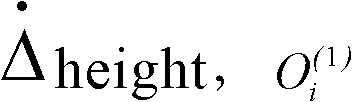
模糊层输入节点
输出节点
其中,aik表示i输入对应的k类高斯函数的中心值,
规则层基于MAX-MIN(最大最小)乘积合成方法生成相应的N2个模糊规则,其输入节点The rule layer generates corresponding N 2 fuzzy rules based on the MAX-MIN (maximum and minimum) product synthesis method, and its input node
l=N·(m-1)+n m=1,2…N,n=1,2…N (4)l=N (m-1)+n m=1, 2...N, n=1, 2...N (4)
输出节点
去模糊层输入节点
输出节点
其中,wj第j条规则对应权值,k3为径向基神经网络对i输入的调控参数,O(4)为总距舵量的控制量。Among them, the jth rule of w j corresponds to the weight value, k 3 is the control parameter of radial basis neural network input to i, and O (4) is the control amount of collective pitch and rudder.
选择150组不同扰动环境下的基于飞控手行为模型的小型无人旋翼机自主起降训练结果作为样本,构建径向基神经网络来实时优化飞控手行为模型模糊层的高斯函数均方差值和总距舵量的控制量;径向基神经网络为三层神经网络,包括输入层,隐含层和输出层构成的三层径向基神经网络构成;输入层输出节点为Select 150 sets of training results of autonomous take-off and landing of small unmanned rotorcraft based on the flight control hand behavior model under different disturbance environments as samples, and build a radial basis neural network to optimize the Gaussian mean square error of the fuzzy layer of the flight control hand behavior model in real time value and the control amount of the collective pitch rudder; the radial basis neural network is a three-layer neural network, including the input layer, the hidden layer and the output layer constituted by the three-layer radial basis neural network; the output node of the input layer is
其中,XXi为输入层的输入,分别为小型无人旋翼机离地阶段悬停状态时候的水平位置差值Δlateral和速度差值Δspeed,为输入层的输出;Among them, XX i is the input of the input layer, which are the horizontal position difference Δlateral and the speed difference Δspeed when the small unmanned rotorcraft is in the hovering state during the off-ground stage, is the output of the input layer;
隐含层输入节点:
输出节点:
其中,aac表示对应的c个高斯函数的中心值,
输出层输入节点
输出节点kp (3)=Ip (3) (12)output node k p (3) = I p (3) (12)
其中输出层的输出k1为用于调整高度误差对应的高斯函数的系数,k2用于调整高度误差对应的高斯函数的系数,k3用于调整输出总距舵量的系数。The output k 1 of the output layer is used to adjust the coefficient of the Gaussian function corresponding to the altitude error, k 2 is used to adjust the coefficient of the Gaussian function corresponding to the altitude error, and k 3 is used to adjust the coefficient of the output collective pitch rudder.
(3)设计自主起降行为规则(3) Design autonomous takeoff and landing behavior rules
起始阶段通过油门和总距阀值获得附着力,离地阶段通过自适应飞控手行为模型消除外界扰动获得的纵向位置高度控制,PID进行横向平面的位置、速度和姿态控制,在飞行阶段利用PID进行位置、速度和姿态控制;自主降落阶段分为飞行阶段、离地阶段、和降落阶段。飞行阶段通过PID实现姿态控制,离地阶段通过自适应飞控手行为模型实行纵向位置高度控制,PID实现水平位置、速度和姿态控制,着地阶段通过飞控手行为模型实现位置控制。At the initial stage, the adhesion is obtained through the throttle and the collective distance threshold. During the lift-off stage, the longitudinal position and altitude control obtained by eliminating external disturbances through the adaptive flight control hand behavior model, and the PID controls the position, speed and attitude of the transverse plane. Use PID to control position, speed and attitude; the autonomous landing phase is divided into flight phase, lift-off phase, and landing phase. Attitude control is achieved through PID during the flight phase, longitudinal position and altitude control is implemented through the adaptive flight controller hand behavior model during the takeoff phase, horizontal position, speed and attitude control is achieved through PID, and position control is realized through the flight controller hand behavior model during the landing phase.
本发明与现有技术相比的优点在于:The advantage of the present invention compared with prior art is:
(1)本发明通过自适应模糊控制方法学习飞控手操控行为数据,模拟熟练飞控手操控行为,对小型无人旋翼机模型的依赖性弱,并可根据实际飞行情况实时在线优化规则,抗干扰能力强;(1) The present invention learns the control behavior data of the flight control hand through the adaptive fuzzy control method, simulates the control behavior of the skilled flight control hand, has weak dependence on the model of the small unmanned rotorcraft, and can optimize the rules online in real time according to the actual flight situation, Strong anti-interference ability;
(2)本发明基于训练好的飞控手行为模型,结合传统的控制方法,可以实时根据飞行器的状态信息调整舵量,计算量小,实时性好、动态参数响应速度快;(2) The present invention is based on the well-trained flight control hand behavior model, combined with traditional control methods, can adjust the rudder amount according to the status information of the aircraft in real time, with small calculation amount, good real-time performance, and fast response speed of dynamic parameters;
(3)本发明提出的飞控手行为模型基于模糊控制方法,学习飞控手行为数据,并通过径向基网络进行性能实时优化,在合理的规则的基础上,只需要较少的样本就可以得出合理的规则。(3) The flight control hand behavior model proposed by the present invention is based on the fuzzy control method, learns the flight control hand behavior data, and performs real-time performance optimization through the radial basis network. On the basis of reasonable rules, only fewer samples are needed Reasonable rules can be derived.
附图说明 Description of drawings
图1为小型无人旋翼机自主控制流程;Figure 1 is the autonomous control process of a small unmanned rotorcraft;
图2为小型无人旋翼机自适应飞控手行为模型;Figure 2 is a small unmanned rotorcraft adaptive flight control hand behavior model;
图3为小型无人旋翼机自主起飞三维航迹图;Figure 3 is a three-dimensional track map of the autonomous take-off of a small unmanned rotorcraft;
图4为小型无人旋翼机自主降落三维航迹图。Figure 4 is a three-dimensional track map of the autonomous landing of a small unmanned rotorcraft.
具体实施方式Detailed ways
如图1、2所示,本发明的具体实现方法如下:As shown in Figures 1 and 2, the specific implementation method of the present invention is as follows:
(1)采集飞控手行为数据(1) Collect flight controller hand behavior data
飞控手操控小型无人旋翼机进行起降操作,通过数据采集系统按照时时钟以10Hz采样周期来采集飞控手在小型无人旋翼机起降阶段的主浆总距和油门控制器的操控输入数据,根据小型无人旋翼机飞行状态确定总距和油门的起飞阀值、悬停阶段的控制阈值、降落阶段的怠速阈值,和小型无人旋翼机在起降阶段的水平位置信息、高度状态信息,速度信息来构建飞控手行为模型训练样本。The flight controller controls the small unmanned rotorcraft for take-off and landing operations, and the data acquisition system collects the main propeller collective pitch and the control of the throttle controller during the take-off and landing phase of the small unmanned rotorcraft by the data acquisition system according to the clock and a sampling period of 10Hz Input data, according to the flight state of the small unmanned rotorcraft, determine the take-off threshold of collective pitch and throttle, the control threshold of the hovering phase, the idle speed threshold of the landing phase, and the horizontal position information and height of the small unmanned rotorcraft during the take-off and landing phase The state information and speed information are used to construct the training samples of the flight control hand behavior model.
(2)构建飞控手行为模型(2) Build the flight control hand behavior model
通过学习数据采集系统采集得到的小型无人旋翼机高度误差和高度误差变化量状态信息和相应的主浆总距输入量,利用自适应模糊控制方法构建飞控手行为模型;该模型由输入层、模糊层、规则层和去模糊层构成,表示IF-THEN控制过程;By studying the state information of the height error and height error variation of the small unmanned rotorcraft collected by the data acquisition system and the corresponding input of the main propulsion collective distance, the hand behavior model of the flight controller is constructed by using the adaptive fuzzy control method; the model consists of the input layer , fuzzy layer, rule layer and defuzzy layer, representing the IF-THEN control process;
输入层输出节点
其中,Xi为输入层的输入,分别为数据采集系统采集到的实际高度和期望高度间的高度误差Δheight以及高度误差变化量
模糊层输入节点
输出节点
其中,aik表示i输入对应的k类高斯函数的中心值,表示i输入对应的k类高斯函数的均方差值,ki为径向基神经网络对i输入的调控参数,N为输入对应的模糊变量数目;Among them, a ik represents the central value of the k-type Gaussian function corresponding to the i input, Indicates the mean square error value of the k-type Gaussian function corresponding to the i input, ki is the control parameter of the radial basis neural network for the i input, and N is the number of fuzzy variables corresponding to the input;
规则层基于MAX-MIN(最大最小)乘积合成方法生成相应的N2个模糊规则,其输入节点The rule layer generates corresponding N 2 fuzzy rules based on the MAX-MIN (maximum and minimum) product synthesis method, and its input node
l=N·(m-1)+n m=1,2…N,n=1,2…N (4)l=N (m-1)+n m=1, 2...N, n=1, 2...N (4)
输出节点
去模糊层输入节点
输出节点
其中,wj第j条规则对应权值,k3为径向基神经网络对i输入的调控参数,O(4)为总距舵量的控制量,aik,
选择150组不同扰动环境下的基于飞控手行为模型的小型无人旋翼机自主起降训练结果作为样本,构建径向基神经网络来实时优化飞控手行为模型模糊层的高斯函数均方差值和总距舵量的控制量;径向基神经网络为三层神经网络,包括输入层,隐含层和输出层构成的三层径向基神经网络构成;输入层输出节点为Select 150 sets of training results of autonomous take-off and landing of small unmanned rotorcraft based on the flight control hand behavior model under different disturbance environments as samples, and build a radial basis neural network to optimize the Gaussian mean square error of the fuzzy layer of the flight control hand behavior model in real time value and the control amount of the collective pitch rudder; the radial basis neural network is a three-layer neural network, including the input layer, the hidden layer and the output layer constituted by the three-layer radial basis neural network; the output node of the input layer is
其中,XXi为输入层的输入,分别为数据采集系统采集到的小型无人旋翼机离地阶段的水平位置与期望位置的水平位置差值Δlateral和速度差值Δspeed,
隐含层输入节点:
输出节点:
其中,aac表示对应的c个高斯函数的中心值,
输出层输入节点
输出节点kp (3)=Ip (3) (12)output node k p (3) = I p (3) (12)
其中输出层的输出k1为用于调整高度误差对应的高斯函数的系数,k2用于调整高度误差对应的高斯函数的系数,k3用于调整输出总距舵量的系数。The output k 1 of the output layer is used to adjust the coefficient of the Gaussian function corresponding to the altitude error, k 2 is used to adjust the coefficient of the Gaussian function corresponding to the altitude error, and k 3 is used to adjust the coefficient of the output collective pitch rudder.
(3)设计自主起降行为规则(3) Design autonomous takeoff and landing behavior rules
分析小型无人旋翼机起飞阶段飞行特性,将自主起飞阶段主要分为起始阶段、离地阶段、和飞行阶段。在起始阶段,小型无人旋翼机接收到自主起飞指令后,以当前点作为起飞点,通过对飞控手行为数据的学习,匀速增加油门和总距控制量至数据采集系统采集得到的起飞阈值,以期获得期望转速和升力,当达到油门和总距的时候,油门进行饱和控制,小型无人旋翼机进入到离地临界状态;离地阶段通过自适应飞控手行为模型获得纵向位置高度控制,PID方法进行横向平面的俯仰和滚转控制,基于磁罗盘解算的航向误差进行姿态锁定控制,当气压高度测量大于4m后,进入飞行阶段;在飞行阶段,以起飞点上空10m作为目标悬停点,通过俯仰、滚转、航向和高度回路的耦合控制,实现自主悬停控制。Analyzing the flight characteristics of the small unmanned rotorcraft during the take-off stage, the autonomous take-off stage is mainly divided into the initial stage, the take-off stage, and the flight stage. In the initial stage, after receiving the autonomous take-off command, the small unmanned rotorcraft takes the current point as the take-off point, and through the learning of the flight controller’s hand behavior data, increases the throttle and collective distance control at a constant speed to the take-off value collected by the data acquisition system. Threshold, in order to obtain the desired speed and lift, when the throttle and collective distance are reached, the throttle will be saturated, and the small unmanned rotorcraft will enter the critical state of lift-off; during the lift-off phase, the longitudinal position and height will be obtained through the adaptive flight control hand behavior model Control, the PID method is used to control the pitch and roll of the horizontal plane, and the attitude lock control is performed based on the heading error calculated by the magnetic compass. When the barometric altitude measurement is greater than 4m, it enters the flight stage; in the flight stage, the target is 10m above the take-off point Hover point, through the coupling control of pitch, roll, heading and altitude loops, realizes autonomous hovering control.
分析小型无人旋翼机降落阶段飞行特性,将自主降落阶段主要分为飞行阶段、离地阶段、和降落阶段。在飞行阶段,小型无人旋翼机接收到降落指令后,基于当前状态,以降落点上空10米为目标悬停点,通过俯仰、滚转、航向和高度回路的耦合控制,实现自主悬停控制;然后基于水平位置误差,通过速度和姿态实现稳定控制,基于磁罗盘解算的航向误差进行姿态锁定控制,基于气压信息获得实际高度与期望降高的误差信息,按照大比例小限幅的模式进行自主降高控制,当测量高度小于2米后,进入离地阶段;在离地阶段,小型无人旋翼机通过PID回路实现水平面的位置和姿态控制,通过自适应飞控手行为模型实现纵向平面的高度控制,当测量高度小于0.2米后,进入降落阶段;以水平姿态为期望姿态角,基于姿态回路实现俯仰、滚转、偏航通道控制,通过飞控手行为模型以数据采集系统采集得到的降落阶段阀值为期望值进入总距锁定,并控制油门在4秒内匀速降低至数据采集系统采集得到小型无人旋翼机降落阶段的怠速油门,降低升力,实现稳定降落,超过4秒后,系统直接通过总距和油门进行定值控制,获得较大附着力,提高系统可靠性。The flight characteristics of the landing stage of the small unmanned rotorcraft are analyzed, and the autonomous landing stage is mainly divided into the flight stage, the lift-off stage, and the landing stage. In the flight phase, after the small unmanned rotorcraft receives the landing command, based on the current state, it takes 10 meters above the landing point as the target hovering point, and realizes autonomous hovering control through the coupling control of the pitch, roll, heading and altitude loops ; Then based on the horizontal position error, the stability control is realized through the speed and attitude, the attitude lock control is performed based on the heading error calculated by the magnetic compass, and the error information between the actual altitude and the expected altitude is obtained based on the air pressure information, and the mode of large scale and small limit is used Carry out autonomous height control. When the measured height is less than 2 meters, it enters the stage of lift-off; in the stage of lift-off, the small unmanned rotorcraft realizes the position and attitude control of the horizontal plane through the PID loop, and realizes the longitudinal control through the adaptive flight control hand behavior model. The height control of the plane, when the measured height is less than 0.2 meters, enters the landing stage; the horizontal attitude is the expected attitude angle, and the pitch, roll, and yaw channel control is realized based on the attitude loop, which is collected by the data acquisition system through the flight control hand behavior model The threshold value obtained in the landing stage is the expected value and enters the collective pitch lock, and the throttle is controlled to decrease at a constant speed within 4 seconds to the idle throttle in the landing stage of the small unmanned rotorcraft collected by the data acquisition system, and the lift is reduced to achieve a stable landing. After more than 4 seconds , the system directly controls the fixed value through the collective pitch and the throttle to obtain greater adhesion and improve system reliability.
飞行实例flight example
基于雷虎90小型无人机进行飞行验证基于行为模型的小型无人旋翼机自主起降控制方法,小型无人旋翼机可以实现稳定的自主起降功能;自主飞行轨迹如图3所示,小型无人旋翼机接收到自主起飞指令后,以(-7,-3,0)点作为起飞点,10秒内完成飞行任务,最终悬停点位置误差小于2m,高度误差小于1m,悬停速度误差小于0.5m/s;小型无人旋翼飞行器自主降落过程如图4所示,小型无人旋翼机在任意点接收到降落指令后,直接自主飞向目标悬停点(0,0,10),15秒内完成自主起降过程,由于地效作用影响,小型无人旋翼机实际落点为(1,2,0)位置误差小于2m。Based on the Thunder Tiger 90 small unmanned aerial vehicle for flight verification, the behavior model-based autonomous take-off and landing control method for small unmanned rotorcraft, the small unmanned rotorcraft can achieve stable autonomous take-off and landing functions; the autonomous flight trajectory is shown in Figure 3, the small After receiving the autonomous take-off command, the unmanned rotorcraft takes (-7, -3, 0) as the take-off point, and completes the flight mission within 10 seconds. The position error of the final hovering point is less than 2m, the height error is less than 1m, and the hovering speed The error is less than 0.5m/s; the autonomous landing process of the small unmanned rotorcraft is shown in Figure 4. After receiving the landing command at any point, the small unmanned rotorcraft directly flies to the target hovering point (0, 0, 10) autonomously , The autonomous take-off and landing process is completed within 15 seconds. Due to the influence of ground effect, the actual landing point of the small unmanned rotorcraft is (1, 2, 0) and the position error is less than 2m.
本发明基于行为模型的小型无人旋翼机自主起降控制方法克服了现有控制方法的不足,可以实现小型无人旋翼机复杂环境下的全自主起降控制等。The behavior model-based autonomous take-off and landing control method of the small unmanned rotorcraft of the present invention overcomes the shortcomings of the existing control methods, and can realize fully autonomous take-off and landing control of the small unmanned rotorcraft in a complex environment.
本发明说明书中未作详细描述的内容属于本领域专业技术人员公知的现有技术。The contents not described in detail in the description of the present invention belong to the prior art known to those skilled in the art.
Claims (2)

Priority Applications (1)
| Application Number | Priority Date | Filing Date | Title |
|---|---|---|---|
| CN201110147482.XA CN102289714B (en) | 2011-06-02 | 2011-06-02 | A Behavioral Model-Based Autonomous Take-off and Landing Control Method for Small Unmanned Rotorcraft |
Applications Claiming Priority (1)
| Application Number | Priority Date | Filing Date | Title |
|---|---|---|---|
| CN201110147482.XA CN102289714B (en) | 2011-06-02 | 2011-06-02 | A Behavioral Model-Based Autonomous Take-off and Landing Control Method for Small Unmanned Rotorcraft |
Publications (2)
| Publication Number | Publication Date |
|---|---|
| CN102289714A true CN102289714A (en) | 2011-12-21 |
| CN102289714B CN102289714B (en) | 2014-02-26 |
Family
ID=45336118
Family Applications (1)
| Application Number | Title | Priority Date | Filing Date |
|---|---|---|---|
| CN201110147482.XA Expired - Fee Related CN102289714B (en) | 2011-06-02 | 2011-06-02 | A Behavioral Model-Based Autonomous Take-off and Landing Control Method for Small Unmanned Rotorcraft |
Country Status (1)
| Country | Link |
|---|---|
| CN (1) | CN102289714B (en) |
Cited By (11)
| Publication number | Priority date | Publication date | Assignee | Title |
|---|---|---|---|---|
| CN103412488A (en) * | 2013-08-12 | 2013-11-27 | 北京航空航天大学 | Small-sized unmanned rotary-wing aircraft high-precision control method based on adaptive neural network |
| CN104330071A (en) * | 2014-10-14 | 2015-02-04 | 南昌航空大学 | Pre-detection method for controlling stationary takeoff of small unmanned helicopter |
| CN104614992A (en) * | 2015-01-04 | 2015-05-13 | 哈尔滨工程大学 | System for simulating actual spot landing behavior of pilot |
| CN106682733A (en) * | 2016-11-07 | 2017-05-17 | 上海资誉电子科技有限公司 | Unmanned aerial vehicle motion state analysis method and apparatus |
| KR101764850B1 (en) | 2017-01-20 | 2017-08-07 | (주) 알앤유 | Kit for the drone training |
| CN105785974B (en) * | 2016-01-27 | 2018-08-24 | 中国船舶重工集团公司第七一〇研究所 | A kind of course fault-tolerant control system towards drive lacking Autonomous Underwater Vehicle |
| CN108663929A (en) * | 2017-10-12 | 2018-10-16 | 深圳禾苗通信科技有限公司 | A kind of unmanned plane brake improved method based on path planning |
| WO2019068236A1 (en) * | 2017-10-04 | 2019-04-11 | Huawei Technologies Co., Ltd. | Method of selection of an action for an object using a neural network |
| CN110673642A (en) * | 2019-10-28 | 2020-01-10 | 深圳市赛为智能股份有限公司 | Unmanned aerial vehicle landing control method and device, computer equipment and storage medium |
| WO2020121665A1 (en) * | 2018-12-14 | 2020-06-18 | 株式会社Nttドコモ | Information processing device |
| CN116000939A (en) * | 2023-02-07 | 2023-04-25 | 武汉溯野科技有限公司 | Robot self-adaptive robust control method based on positioning fluctuation estimation |
Citations (2)
| Publication number | Priority date | Publication date | Assignee | Title |
|---|---|---|---|---|
| CN101950317A (en) * | 2010-09-03 | 2011-01-19 | 清华大学 | Method for identifying fixed-order parameter model of aircraft based on modal segmentation and genetic algorithm |
| CN101976498A (en) * | 2010-09-30 | 2011-02-16 | 清华大学 | Double-receiver parallel dynamic parameter model identification system |
-
2011
- 2011-06-02 CN CN201110147482.XA patent/CN102289714B/en not_active Expired - Fee Related
Patent Citations (2)
| Publication number | Priority date | Publication date | Assignee | Title |
|---|---|---|---|---|
| CN101950317A (en) * | 2010-09-03 | 2011-01-19 | 清华大学 | Method for identifying fixed-order parameter model of aircraft based on modal segmentation and genetic algorithm |
| CN101976498A (en) * | 2010-09-30 | 2011-02-16 | 清华大学 | Double-receiver parallel dynamic parameter model identification system |
Non-Patent Citations (1)
| Title |
|---|
| 曾丽兰,王道波,郭才根,黄向华: "无人驾驶直升机飞行控制技术综述", 《控制与决策》, vol. 21, no. 4, 30 April 2006 (2006-04-30), pages 361 - 366 * |
Cited By (21)
| Publication number | Priority date | Publication date | Assignee | Title |
|---|---|---|---|---|
| CN103412488A (en) * | 2013-08-12 | 2013-11-27 | 北京航空航天大学 | Small-sized unmanned rotary-wing aircraft high-precision control method based on adaptive neural network |
| CN103412488B (en) * | 2013-08-12 | 2018-10-30 | 北京航空航天大学 | A kind of miniature self-service gyroplane high-accuracy control method based on adaptive neural network |
| CN104330071A (en) * | 2014-10-14 | 2015-02-04 | 南昌航空大学 | Pre-detection method for controlling stationary takeoff of small unmanned helicopter |
| CN104330071B (en) * | 2014-10-14 | 2016-09-14 | 南昌航空大学 | A pre-detection method for controlling a small unmanned helicopter to take off smoothly |
| CN104614992A (en) * | 2015-01-04 | 2015-05-13 | 哈尔滨工程大学 | System for simulating actual spot landing behavior of pilot |
| CN104614992B (en) * | 2015-01-04 | 2017-02-22 | 哈尔滨工程大学 | System for simulating actual spot landing behavior of pilot |
| CN105785974B (en) * | 2016-01-27 | 2018-08-24 | 中国船舶重工集团公司第七一〇研究所 | A kind of course fault-tolerant control system towards drive lacking Autonomous Underwater Vehicle |
| CN106682733A (en) * | 2016-11-07 | 2017-05-17 | 上海资誉电子科技有限公司 | Unmanned aerial vehicle motion state analysis method and apparatus |
| CN106682733B (en) * | 2016-11-07 | 2018-10-19 | 上海资誉电子科技有限公司 | Unmanned plane motion state analysis method and device |
| KR101764850B1 (en) | 2017-01-20 | 2017-08-07 | (주) 알앤유 | Kit for the drone training |
| US10935982B2 (en) | 2017-10-04 | 2021-03-02 | Huawei Technologies Co., Ltd. | Method of selection of an action for an object using a neural network |
| WO2019068236A1 (en) * | 2017-10-04 | 2019-04-11 | Huawei Technologies Co., Ltd. | Method of selection of an action for an object using a neural network |
| CN108663929A (en) * | 2017-10-12 | 2018-10-16 | 深圳禾苗通信科技有限公司 | A kind of unmanned plane brake improved method based on path planning |
| CN108663929B (en) * | 2017-10-12 | 2021-05-14 | 深圳禾苗通信科技有限公司 | Unmanned aerial vehicle brake improvement method based on path planning |
| WO2020121665A1 (en) * | 2018-12-14 | 2020-06-18 | 株式会社Nttドコモ | Information processing device |
| JPWO2020121665A1 (en) * | 2018-12-14 | 2021-09-30 | 株式会社Nttドコモ | Information processing device |
| JP7079345B2 (en) | 2018-12-14 | 2022-06-01 | 株式会社Nttドコモ | Information processing equipment |
| CN110673642A (en) * | 2019-10-28 | 2020-01-10 | 深圳市赛为智能股份有限公司 | Unmanned aerial vehicle landing control method and device, computer equipment and storage medium |
| CN110673642B (en) * | 2019-10-28 | 2022-10-28 | 深圳市赛为智能股份有限公司 | Unmanned aerial vehicle landing control method and device, computer equipment and storage medium |
| CN116000939A (en) * | 2023-02-07 | 2023-04-25 | 武汉溯野科技有限公司 | Robot self-adaptive robust control method based on positioning fluctuation estimation |
| CN116000939B (en) * | 2023-02-07 | 2024-01-26 | 武汉溯野科技有限公司 | Robot self-adaptive robust control method based on positioning fluctuation estimation |
Also Published As
| Publication number | Publication date |
|---|---|
| CN102289714B (en) | 2014-02-26 |
Similar Documents
| Publication | Publication Date | Title |
|---|---|---|
| CN102289714A (en) | Method for controlling autonomous take-off and landing of small unmanned rotorcraft based on behavioral model | |
| CN110502033B (en) | Fixed-wing unmanned aerial vehicle cluster control method based on reinforcement learning | |
| CN103412488B (en) | A kind of miniature self-service gyroplane high-accuracy control method based on adaptive neural network | |
| CN114355777B (en) | A dynamic gliding method and system based on distributed pressure sensors and segmented attitude control | |
| Mir et al. | Review of dynamic soaring: technical aspects, nonlinear modeling perspectives and future directions | |
| Clarke et al. | Deep reinforcement learning control for aerobatic maneuvering of agile fixed-wing aircraft | |
| CN108107911B (en) | A solar-powered aircraft autonomously seeks optimal trajectory planning method | |
| CN102298329A (en) | Small-size unmanned rotary wing aircraft dynamic model identification method based on adaptive genetic algorithm | |
| CN109814593A (en) | A low-altitude solar-powered UAV flight control method and system capable of autonomous heat seeking | |
| CN120199134B (en) | Low-altitude pilot AI model training application system | |
| CN114879490B (en) | Iterative optimization and control method for landing maneuver of unmanned aerial vehicle | |
| CN116414153B (en) | Unmanned aerial vehicle take-off and landing correction method based on artificial intelligence | |
| Changhao et al. | Artificial bee colony optimized controller for unmanned rotorcraft pendulum | |
| Wharington | Heuristic control of dynamic soaring | |
| CN117970952B (en) | Offline modeling method for UAV maneuvering strategy | |
| Bhattacharjee et al. | Altitude control of a quad-rotor electric vertical take-off and landing (eVTOL) UAV using PSO and GA optimized PID controller | |
| Montella | Learning how to soar: Steady state autonomous dynamic soaring through reinforcement learning | |
| Notter et al. | Integrated updraft localization and exploitation: end-to-end type reinforcement learning approach | |
| Gudmundsson | A biomimetic, energy-harvesting, obstacle-avoiding, path-planning algorithm for uavs | |
| Abozeid et al. | A comprehensive assessment to the potential of reinforcement learning in dynamic soaring | |
| Bird et al. | Optimal Speed Scheduling for Hybrid Solar Aircraft with Arrival Time Condition | |
| Brigido-Gonzalez et al. | Adaptive energy based control for the longitudinal dynamics of a fixed-wing aircraft | |
| Kim et al. | A Reinforcement Learning Approach to Control of a Quadrotor Biplane Tailsitter for Adaptive Landing Maneuvers | |
| Menezes et al. | An evaluation of stochastic model-dependent and model-independent glider flight management | |
| CN119645094B (en) | A predictive control method, system, device, and medium for unmanned aerial vehicles (UAVs) based on Actor-Critic and artificial potential fields. |
Legal Events
| Date | Code | Title | Description |
|---|---|---|---|
| C06 | Publication | ||
| PB01 | Publication | ||
| C10 | Entry into substantive examination | ||
| SE01 | Entry into force of request for substantive examination | ||
| C14 | Grant of patent or utility model | ||
| GR01 | Patent grant | ||
| CF01 | Termination of patent right due to non-payment of annual fee |
Granted publication date: 20140226 |
|
| CF01 | Termination of patent right due to non-payment of annual fee |