CN102272947A - Photovoltaic cell assembly and method of forming - Google Patents
Photovoltaic cell assembly and method of forming Download PDFInfo
- Publication number
- CN102272947A CN102272947A CN2009801534605A CN200980153460A CN102272947A CN 102272947 A CN102272947 A CN 102272947A CN 2009801534605 A CN2009801534605 A CN 2009801534605A CN 200980153460 A CN200980153460 A CN 200980153460A CN 102272947 A CN102272947 A CN 102272947A
- Authority
- CN
- China
- Prior art keywords
- layer
- barrier
- layer cell
- silicon compound
- outermost layer
- Prior art date
- Legal status (The legal status is an assumption and is not a legal conclusion. Google has not performed a legal analysis and makes no representation as to the accuracy of the status listed.)
- Pending
Links
Images


Classifications
-
- H—ELECTRICITY
- H10—SEMICONDUCTOR DEVICES; ELECTRIC SOLID-STATE DEVICES NOT OTHERWISE PROVIDED FOR
- H10F—INORGANIC SEMICONDUCTOR DEVICES SENSITIVE TO INFRARED RADIATION, LIGHT, ELECTROMAGNETIC RADIATION OF SHORTER WAVELENGTH OR CORPUSCULAR RADIATION
- H10F19/00—Integrated devices, or assemblies of multiple devices, comprising at least one photovoltaic cell covered by group H10F10/00, e.g. photovoltaic modules
- H10F19/80—Encapsulations or containers for integrated devices, or assemblies of multiple devices, having photovoltaic cells
-
- B—PERFORMING OPERATIONS; TRANSPORTING
- B32—LAYERED PRODUCTS
- B32B—LAYERED PRODUCTS, i.e. PRODUCTS BUILT-UP OF STRATA OF FLAT OR NON-FLAT, e.g. CELLULAR OR HONEYCOMB, FORM
- B32B17/00—Layered products essentially comprising sheet glass, or glass, slag, or like fibres
- B32B17/06—Layered products essentially comprising sheet glass, or glass, slag, or like fibres comprising glass as the main or only constituent of a layer, next to another layer of a specific material
- B32B17/10—Layered products essentially comprising sheet glass, or glass, slag, or like fibres comprising glass as the main or only constituent of a layer, next to another layer of a specific material of synthetic resin
- B32B17/10005—Layered products essentially comprising sheet glass, or glass, slag, or like fibres comprising glass as the main or only constituent of a layer, next to another layer of a specific material of synthetic resin laminated safety glass or glazing
- B32B17/10009—Layered products essentially comprising sheet glass, or glass, slag, or like fibres comprising glass as the main or only constituent of a layer, next to another layer of a specific material of synthetic resin laminated safety glass or glazing characterized by the number, the constitution or treatment of glass sheets
- B32B17/10018—Layered products essentially comprising sheet glass, or glass, slag, or like fibres comprising glass as the main or only constituent of a layer, next to another layer of a specific material of synthetic resin laminated safety glass or glazing characterized by the number, the constitution or treatment of glass sheets comprising only one glass sheet
-
- B—PERFORMING OPERATIONS; TRANSPORTING
- B32—LAYERED PRODUCTS
- B32B—LAYERED PRODUCTS, i.e. PRODUCTS BUILT-UP OF STRATA OF FLAT OR NON-FLAT, e.g. CELLULAR OR HONEYCOMB, FORM
- B32B17/00—Layered products essentially comprising sheet glass, or glass, slag, or like fibres
- B32B17/06—Layered products essentially comprising sheet glass, or glass, slag, or like fibres comprising glass as the main or only constituent of a layer, next to another layer of a specific material
- B32B17/10—Layered products essentially comprising sheet glass, or glass, slag, or like fibres comprising glass as the main or only constituent of a layer, next to another layer of a specific material of synthetic resin
- B32B17/10005—Layered products essentially comprising sheet glass, or glass, slag, or like fibres comprising glass as the main or only constituent of a layer, next to another layer of a specific material of synthetic resin laminated safety glass or glazing
- B32B17/1055—Layered products essentially comprising sheet glass, or glass, slag, or like fibres comprising glass as the main or only constituent of a layer, next to another layer of a specific material of synthetic resin laminated safety glass or glazing characterized by the resin layer, i.e. interlayer
- B32B17/10798—Layered products essentially comprising sheet glass, or glass, slag, or like fibres comprising glass as the main or only constituent of a layer, next to another layer of a specific material of synthetic resin laminated safety glass or glazing characterized by the resin layer, i.e. interlayer containing silicone
-
- H—ELECTRICITY
- H10—SEMICONDUCTOR DEVICES; ELECTRIC SOLID-STATE DEVICES NOT OTHERWISE PROVIDED FOR
- H10F—INORGANIC SEMICONDUCTOR DEVICES SENSITIVE TO INFRARED RADIATION, LIGHT, ELECTROMAGNETIC RADIATION OF SHORTER WAVELENGTH OR CORPUSCULAR RADIATION
- H10F19/00—Integrated devices, or assemblies of multiple devices, comprising at least one photovoltaic cell covered by group H10F10/00, e.g. photovoltaic modules
- H10F19/80—Encapsulations or containers for integrated devices, or assemblies of multiple devices, having photovoltaic cells
- H10F19/804—Materials of encapsulations
-
- H—ELECTRICITY
- H10—SEMICONDUCTOR DEVICES; ELECTRIC SOLID-STATE DEVICES NOT OTHERWISE PROVIDED FOR
- H10F—INORGANIC SEMICONDUCTOR DEVICES SENSITIVE TO INFRARED RADIATION, LIGHT, ELECTROMAGNETIC RADIATION OF SHORTER WAVELENGTH OR CORPUSCULAR RADIATION
- H10F19/00—Integrated devices, or assemblies of multiple devices, comprising at least one photovoltaic cell covered by group H10F10/00, e.g. photovoltaic modules
- H10F19/80—Encapsulations or containers for integrated devices, or assemblies of multiple devices, having photovoltaic cells
- H10F19/85—Protective back sheets
-
- H—ELECTRICITY
- H10—SEMICONDUCTOR DEVICES; ELECTRIC SOLID-STATE DEVICES NOT OTHERWISE PROVIDED FOR
- H10F—INORGANIC SEMICONDUCTOR DEVICES SENSITIVE TO INFRARED RADIATION, LIGHT, ELECTROMAGNETIC RADIATION OF SHORTER WAVELENGTH OR CORPUSCULAR RADIATION
- H10F71/00—Manufacture or treatment of devices covered by this subclass
-
- H—ELECTRICITY
- H10—SEMICONDUCTOR DEVICES; ELECTRIC SOLID-STATE DEVICES NOT OTHERWISE PROVIDED FOR
- H10F—INORGANIC SEMICONDUCTOR DEVICES SENSITIVE TO INFRARED RADIATION, LIGHT, ELECTROMAGNETIC RADIATION OF SHORTER WAVELENGTH OR CORPUSCULAR RADIATION
- H10F77/00—Constructional details of devices covered by this subclass
- H10F77/30—Coatings
- H10F77/306—Coatings for devices having potential barriers
- H10F77/311—Coatings for devices having potential barriers for photovoltaic cells
-
- B—PERFORMING OPERATIONS; TRANSPORTING
- B32—LAYERED PRODUCTS
- B32B—LAYERED PRODUCTS, i.e. PRODUCTS BUILT-UP OF STRATA OF FLAT OR NON-FLAT, e.g. CELLULAR OR HONEYCOMB, FORM
- B32B2327/00—Polyvinylhalogenides
- B32B2327/12—Polyvinylhalogenides containing fluorine
-
- Y—GENERAL TAGGING OF NEW TECHNOLOGICAL DEVELOPMENTS; GENERAL TAGGING OF CROSS-SECTIONAL TECHNOLOGIES SPANNING OVER SEVERAL SECTIONS OF THE IPC; TECHNICAL SUBJECTS COVERED BY FORMER USPC CROSS-REFERENCE ART COLLECTIONS [XRACs] AND DIGESTS
- Y02—TECHNOLOGIES OR APPLICATIONS FOR MITIGATION OR ADAPTATION AGAINST CLIMATE CHANGE
- Y02E—REDUCTION OF GREENHOUSE GAS [GHG] EMISSIONS, RELATED TO ENERGY GENERATION, TRANSMISSION OR DISTRIBUTION
- Y02E10/00—Energy generation through renewable energy sources
- Y02E10/50—Photovoltaic [PV] energy
-
- Y—GENERAL TAGGING OF NEW TECHNOLOGICAL DEVELOPMENTS; GENERAL TAGGING OF CROSS-SECTIONAL TECHNOLOGIES SPANNING OVER SEVERAL SECTIONS OF THE IPC; TECHNICAL SUBJECTS COVERED BY FORMER USPC CROSS-REFERENCE ART COLLECTIONS [XRACs] AND DIGESTS
- Y02—TECHNOLOGIES OR APPLICATIONS FOR MITIGATION OR ADAPTATION AGAINST CLIMATE CHANGE
- Y02E—REDUCTION OF GREENHOUSE GAS [GHG] EMISSIONS, RELATED TO ENERGY GENERATION, TRANSMISSION OR DISTRIBUTION
- Y02E10/00—Energy generation through renewable energy sources
- Y02E10/50—Photovoltaic [PV] energy
- Y02E10/542—Dye sensitized solar cells
-
- Y—GENERAL TAGGING OF NEW TECHNOLOGICAL DEVELOPMENTS; GENERAL TAGGING OF CROSS-SECTIONAL TECHNOLOGIES SPANNING OVER SEVERAL SECTIONS OF THE IPC; TECHNICAL SUBJECTS COVERED BY FORMER USPC CROSS-REFERENCE ART COLLECTIONS [XRACs] AND DIGESTS
- Y02—TECHNOLOGIES OR APPLICATIONS FOR MITIGATION OR ADAPTATION AGAINST CLIMATE CHANGE
- Y02E—REDUCTION OF GREENHOUSE GAS [GHG] EMISSIONS, RELATED TO ENERGY GENERATION, TRANSMISSION OR DISTRIBUTION
- Y02E10/00—Energy generation through renewable energy sources
- Y02E10/50—Photovoltaic [PV] energy
- Y02E10/549—Organic PV cells
-
- Y—GENERAL TAGGING OF NEW TECHNOLOGICAL DEVELOPMENTS; GENERAL TAGGING OF CROSS-SECTIONAL TECHNOLOGIES SPANNING OVER SEVERAL SECTIONS OF THE IPC; TECHNICAL SUBJECTS COVERED BY FORMER USPC CROSS-REFERENCE ART COLLECTIONS [XRACs] AND DIGESTS
- Y02—TECHNOLOGIES OR APPLICATIONS FOR MITIGATION OR ADAPTATION AGAINST CLIMATE CHANGE
- Y02P—CLIMATE CHANGE MITIGATION TECHNOLOGIES IN THE PRODUCTION OR PROCESSING OF GOODS
- Y02P70/00—Climate change mitigation technologies in the production process for final industrial or consumer products
- Y02P70/50—Manufacturing or production processes characterised by the final manufactured product
Landscapes
- Photovoltaic Devices (AREA)
- Laminated Bodies (AREA)
- Engineering & Computer Science (AREA)
- Manufacturing & Machinery (AREA)
Abstract
Description
技术领域 technical field
本发明主要涉及光生伏打电池组件和光生伏打电池阵列。更确切地讲,本发明涉及包括第一最外层、光生伏打电池和第二最外层的光生伏打电池组件,其具有特殊的特性并且位于光生伏打电池上把光生伏打电池夹在第二最外层和第一最外层之间。本发明还涉及形成光生伏打电池组件的方法。The present invention generally relates to photovoltaic cell modules and photovoltaic cell arrays. More precisely, the present invention relates to a photovoltaic cell assembly comprising a first outermost layer, a photovoltaic cell and a second outermost layer, which have specific characteristics and are placed on the photovoltaic cell to clamp the photovoltaic cell Between the second outermost layer and the first outermost layer. The invention also relates to methods of forming photovoltaic cell assemblies.
背景技术 Background technique
光生伏打电池(光电池)是用于将光转化为电的半导体装置。光生伏打电池有两种主要类型,硅晶片和薄膜的。硅晶片是半导体材料薄片,其通常通过由单晶或多晶锭机械切割硅晶片形成。或者,可通过铸造形成硅晶片。薄膜光生伏打电池通常包括使用溅射技术或化学气相沉积技术沉积在基体上的半导体材料连续层。A photovoltaic cell (photovoltaic cell) is a semiconductor device used to convert light into electricity. There are two main types of photovoltaic cells, silicon wafer and thin film. A silicon wafer is a thin sheet of semiconductor material that is typically formed by mechanically cutting a silicon wafer from a single crystal or polycrystalline ingot. Alternatively, silicon wafers can be formed by casting. Thin film photovoltaic cells generally comprise a continuous layer of semiconductor material deposited on a substrate using sputtering techniques or chemical vapor deposition techniques.
一般,光生伏打电池被包括在光生伏打电池组件中,其还包括粘结层、基体、上层和/或提供强度和稳定性的附加材料。某些组件包括使用薄粘结层结合于玻璃上层的玻璃基体。由于需要控制分散粘结层和将粘结层从基体和上层的泄露最小化从而减少浪费,这些类型的组件通常使用的制造方法是缓慢和效率低下的。使用从基体和上层之间挤出的并且被抛弃的大量的粘结层形成其它类型的组件。在两种类型的组件中,因为粘结层可以以不连续的形式穿过基体和上层流动,因此难于控制粘结层的厚度。此外,形成两种类型的组件的方法都导致费用升高、处理时间加长和处理复杂度提高。这些都导致最终购买者的花费增加。因此,仍有发展改进的光生伏打电池组件、组建的光生伏打电池阵列和组件的形成方法的机会。Typically, photovoltaic cells are included in photovoltaic cell assemblies that also include tie layers, substrates, upper layers, and/or additional materials that provide strength and stability. Certain assemblies include a glass substrate bonded to an upper layer of glass using a thin adhesive layer. These types of assemblies are typically manufactured using slow and inefficient manufacturing methods due to the need to control dispersion of the bonding layer and minimize leakage of the bonding layer from the substrate and upper layers to reduce waste. Other types of assemblies are formed using a large amount of adhesive layer that is extruded from between the substrate and the upper layer and discarded. In both types of assemblies, it is difficult to control the thickness of the bonding layer because the bonding layer can flow in a discontinuous fashion through the substrate and upper layer. Furthermore, the methods of forming both types of assemblies lead to increased expense, increased processing time, and increased processing complexity. These all lead to an increase in the cost of the final buyer. Accordingly, there remains an opportunity to develop improved photovoltaic cell assemblies, assembled photovoltaic cell arrays and methods of forming assemblies.
发明内容 Contents of the invention
本发明提供了光生伏打电池组件和组件的形成方法。光生伏打电池组件包括第一最外层,其具有使用ASTM E424-71的UV/Vis分光光度法确定的至少70%的透光率。光生伏打电池位于第一最外层上。该组件还包括与第一最外层相对的第二最外层。第二最外层包括硅树脂组合物。第二最外层位于光生伏打电池上,并且将光生伏打电池夹在第二最外层和第一最外层之间。The present invention provides photovoltaic cell modules and methods for forming the modules. The photovoltaic cell assembly includes a first outermost layer having a light transmittance of at least 70% as determined using the UV/Vis spectrophotometric method of ASTM E424-71. Photovoltaic cells are located on the first outermost layer. The assembly also includes a second outermost layer opposite the first outermost layer. The second outermost layer includes a silicone composition. The second outermost layer is over the photovoltaic cell and sandwiches the photovoltaic cell between the second outermost layer and the first outermost layer.
通过本发明的方法形成光生伏打电池组件。在一个实施方式中,该方法包括将光生伏打电池安排在第一最外层上,将硅树脂组合物置于光生伏打电池上、至少部分地以硅树脂组合物涂层多个纤维从而形成第二层和压缩第一最外层、光生伏打电池和第二层从而形成组件。与该实施方式相关,多个纤维从侧面延伸穿过第二层到组件两端的组件外围。这样,该多个纤维能够阻止硅树脂组合物在压缩步骤的过程中从组件泄露。A photovoltaic cell module is formed by the method of the present invention. In one embodiment, the method includes arranging a photovoltaic cell on a first outermost layer, placing a silicone composition on the photovoltaic cell, at least partially coating a plurality of fibers with the silicone composition to form The second layer and the first outermost layer, the photovoltaic cell and the second layer are compressed to form an assembly. In connection with this embodiment, a plurality of fibers extend laterally through the second layer to the periphery of the module at both ends of the module. In this way, the plurality of fibers is able to prevent the silicone composition from leaking from the assembly during the compression step.
第二(最外)层可以使光生伏打电池被固定在组件中,而同时将硅树脂组合物的必须使用的量最小化。如果使用的话,第二(最外)层的多个纤维控制硅树脂组合物的分散和组件的产生的厚度,还将组件外部的硅树脂组合物的损失或泄露最小化,如压缩步骤过程中的。多个纤维,协同硅树脂组合物还提供给组件结构强度,降低组件的易燃性并提高光生伏打电池和第一最外层之间的粘合强度。多个纤维和硅树脂组合物还可以使组件成为刚性的、半刚性的或柔软的,而同时保持电效率和结构完整性。而且此外,因为硅树脂组合物的被控分散、硅树脂组合物的使用量最低化、浪费最小化、厚度一致性和组件尺寸提高,多个纤维可以使组件具有成本效益和可重复生产。多个纤维和硅树脂组合物还可以形成不具有支持层的组件,从而降低成本、生产复杂度和形成组件所需要的时间。The second (outermost) layer allows the photovoltaic cells to be fixed in the module while minimizing the amount of silicone composition that must be used. If used, the plurality of fibers of the second (outermost) layer controls the dispersion of the silicone composition and the resulting thickness of the component, and also minimizes loss or leakage of the silicone composition outside the component, such as during the compression step of. The plurality of fibers, in conjunction with the silicone composition, also provides structural strength to the module, reduces the flammability of the module and increases the bond strength between the photovoltaic cell and the first outermost layer. Multiple fibers and silicone compositions can also make components rigid, semi-rigid, or flexible while maintaining electrical efficiency and structural integrity. And furthermore, the plurality of fibers enables cost-effective and reproducible production of components due to controlled dispersion of silicone composition, minimized use of silicone composition, minimized waste, consistent thickness, and improved component size. Multiple fiber and silicone compositions can also be formed into assemblies without a support layer, thereby reducing cost, manufacturing complexity, and the time required to form the assembly.
附图说明 Description of drawings
会容易理解本发明的其它优势,因为通过参考联通其中附图考虑的以下的详细介绍可更好地理解:Other advantages of the present invention will be readily appreciated as they will be better understood by reference to the following detailed description considered in conjunction with the accompanying drawings:
图1是包括第一最外层、第一最外层上的光生伏打电池和光生伏打电池上的第二最外层的第一光生伏打电池组件的侧横截面视图。1 is a side cross-sectional view of a first photovoltaic cell assembly including a first outermost layer, a photovoltaic cell on the first outermost layer, and a second outermost layer on the photovoltaic cell.
图2是通过本发明的方法形成的并且包括第一最外层、第一最外层上的光生伏打电池、光生伏打电池上的第二层和作为第二最外层的第二层上的支持层的第二光生伏打电池组件的侧横截面视图。Figure 2 is formed by the method of the present invention and includes a first outermost layer, a photovoltaic cell on the first outermost layer, a second layer on the photovoltaic cell and a second layer as the second outermost layer Side cross-sectional view of a second photovoltaic cell assembly on a support layer.
图3是包括第一最外层、第一最外层上的并且与第一最外层直接接触的粘结层、第一最外层上并且间隔开的光生伏打电池和光生伏打电池上的第二最外层的第三光生伏打电池组件的侧横截面视图;Fig. 3 is a photovoltaic cell comprising a first outermost layer, an adhesive layer on the first outermost layer and in direct contact with the first outermost layer, a photovoltaic cell on the first outermost layer and spaced apart, and a photovoltaic cell A side cross-sectional view of the third photovoltaic cell assembly on the second outermost layer;
图4是通过本发明的方法形成的包括第一最外层、第一最外层上的并且与第一最外层直接接触的粘结层、第一最外层上的并且间隔开的光生伏打电池、光生伏打电池上的第二层和作为第二最外层的第二层上的并且直接接触第二层的支持层的第四光生伏打电池组件的侧横截面视图;Fig. 4 is formed by the method of the present invention including the first outermost layer, the first outermost layer on and in direct contact with the first outermost layer, the first outermost layer on and spaced apart light-generating A side cross-sectional view of a voltaic cell, a second layer on the photovoltaic cell, and a fourth photovoltaic cell assembly as a second outermost layer on the second layer and directly in contact with the support layer of the second layer;
图5是包括至少部分涂覆了本发明的硅树脂组合物的多个纤维的第二(最外)层的侧横截面视图;Figure 5 is a side cross-sectional view of a second (outermost) layer comprising a plurality of fibers at least partially coated with the silicone composition of the present invention;
图6A是一系列图1的光生伏打电池组件的横截面侧视图,其被电连接并且被设计为光生伏打电池阵列;Figure 6A is a cross-sectional side view of a series of photovoltaic cell assemblies of Figure 1 electrically connected and designed as a photovoltaic cell array;
图6B是一系列被电连接的并且被设计为光生伏打电池阵列的图1的光生伏打电池组件的放大侧横截面视图;Figure 6B is an enlarged side cross-sectional view of a series of photovoltaic cell assemblies of Figure 1 electrically connected and designed as a photovoltaic cell array;
图7是图1的光生伏打电池组件的横截面底部视图,其中多个纤维侧面(L)延伸穿过第二层至组件两端的光生伏打电池组件的外围,从而阻止硅树脂组合物从光生伏打电池组件泄露;7 is a cross-sectional bottom view of the photovoltaic cell assembly of FIG. 1 with a plurality of fiber sides (L) extending through the second layer to the periphery of the photovoltaic cell assembly at both ends of the assembly, thereby preventing the silicone composition from Leakage of photovoltaic cell components;
图8是包括第一最外层、第一最外层上的光生伏打电池和光生伏打电池上的第二最外层的光生伏打电池组件的横截面侧视图,其中第二最外层没有多个纤维并且由氢化硅烷化-可固化硅树脂组合物形成;8 is a cross-sectional side view of a photovoltaic cell assembly including a first outermost layer, a photovoltaic cell on the first outermost layer, and a second outermost layer on the photovoltaic cell, wherein the second outermost layer the layer is free of a plurality of fibers and is formed from a hydrosilylation-curable silicone composition;
图9是通过本发明的方法形成的并且包括第一最外层、第一最外层上的光生伏打电池、光生伏打电池上的第二层和作为第二最外层的第二层上的支持层的光生伏打电池组件的横截面侧视图,其中第二层没有多个纤维并且由氢化硅烷化-可固化硅树脂组合物形成;Figure 9 is formed by the method of the present invention and includes a first outermost layer, a photovoltaic cell on the first outermost layer, a second layer on the photovoltaic cell, and a second layer as the second outermost layer A cross-sectional side view of the photovoltaic cell assembly of the support layer on, wherein the second layer is free of a plurality of fibers and is formed from a hydrosilylation-curable silicone resin composition;
图10是包括第一最外层、第一最外层上的并且与第一最外层直接接触的粘结层、第一最外层上的并且与第一最外层间隔开的光生伏打电池和光生伏打电池上的第二最外层的光生伏打电池组件的横截面侧视图,其中第二最外层没有多个纤维并且由氢化硅烷化-固化硅树脂组合物形成;Figure 10 is a photo-generating layer comprising a first outermost layer, an adhesive layer on and in direct contact with the first outermost layer, a light-generating layer on and spaced apart from the first outermost layer A cross-sectional side view of a photovoltaic cell assembly of a voltaic cell and a second outermost layer on the photovoltaic cell, wherein the second outermost layer is free of a plurality of fibers and is formed from a hydrosilylation-cure silicone composition;
图11是通过本发明的方法形成的并且包括第一最外层、第一最外层上的并且与第一最外层直接接触的粘结层、第一最外层上的并且与第一最外层间隔开的光生伏打电池、光生伏打电池上的第二最外层和作为第二最外层上的第二层上的并且与第二层直接接触的支持层的光生伏打电池组件的横截面侧视图,其中第二层没有多个纤维并且由氢化硅烷化-可固化硅树脂组合物形成;Figure 11 is formed by the method of the present invention and includes a first outermost layer, an adhesive layer on and in direct contact with the first outermost layer, an adhesive layer on and in direct contact with the first outermost layer, Photovoltaic cells with the outermost layers spaced apart, a second outermost layer on the photovoltaic cells, and a photovoltaic cell as a support layer on the second layer on the second outermost layer and in direct contact with the second layer A cross-sectional side view of a battery assembly in which the second layer is free of the plurality of fibers and is formed from a hydrosilylation-curable silicone composition;
具体实施方式 Detailed ways
本发明提供了图1-4、6A/B和7-11简要示意的光生伏打电池组件20(在后文中被称为“组件)和形成组件20的方法。如所属领域中已知的,组件20基于光伏效应将光能转化成电能。更确切地讲,组件20执行两个基本功能。第一个功能是电荷载体的光生成,如光吸收材料中的电子和空穴。第二个功能是将电荷载体导向于导电触头从而传输电力。The present invention provides a
本发明的组件20可用于任意工业,包括但是不限定于,汽车、小型电子、边远地区的电力系统、卫星、空间探测、无线电话、水泵、并网电力系统、电池、电池充电器、光电化学应用、聚合物光生伏打电池应用、纳米晶体光生伏打电池应用和染色敏化光生伏打电池应用。在一个实施方式中,一系列组件20被电连接并且形成光生伏打电池阵列32,如图6A所示。光生伏打电池阵列32通常被用于连接于后备电池的农村区域的房顶上,和DC泵、信号浮标中等。本发明的光生伏打电池阵列32可以是平面的或非平面的,并且通常起到单电流产生单元的作用,其中组件20以这样的方式互连从而产生电压。The
组件20包括第一最外层22,其具有通过使用ASTM E424-71的UV/Vis分光光度法确定的至少70%的透光率。在一个实施方式中,第一最外层22具有至少80%的透光率。在可选的实施方式中,第一最外层22具有至少90%的透光率。仍然在另一实施方式中,第一最外层22具有约100%的透光率。
一般来说,第一最外层22提供给组件20的前表面34保护,如图1-4、6A和8-11所示的。同样,第一最外层22可提供给组件20的后表面保护。第一最外层22可以是柔软和易弯曲的,或者可以是刚性和不易弯曲的。或者,第一最外层22可包括刚性和不易弯曲的部分,而同时包括柔软和易弯曲的部分。在一个实施方式中,第一最外层22包括玻璃。在另一实施方式中,第一最外层22包括有机聚合物。有机聚合物可选自由,但是不限定于,聚酰亚胺、乙烯-醋酸乙烯共聚物,和/或包括,但是不限定于,乙烯四氟乙烯(ETFE)、单独的或至少部分涂覆了硅氧基材料(SiOx)的聚对苯二甲酸乙二酯(PET),和其组合的组。或者第一最外层22可包括硅树脂,可基本由硅树脂构成并且不包括有机单体或聚合物,或者可以由硅树脂构成。当然,可理解第一最外层22不限定于前述的化合物,并且可包括所属领域中已知的任意化合物或组合物,只要第一最外层22具有使用ASTME424-71的至少70%的透光率。In general, the first
第一最外层22可以是承重的或非承重的,并且可被包括在组件20的任意部分中。第一最外层22可以是组件“顶层”,也被称为上层,或“底层”,也被称为基体。底层通常位于光生伏打电池24之后,并且起到机械支持的作用。与本发明的方法的相关,组件20可包括第一最外层22作为顶层和也具有如上层的使用ASTM E424-71的至少70%的透光率的作为组件的底层的附加层。附加层可以与第一最外层22相同或不同。一般,第一最外层22位于组件20的顶部并且面对着光源。第一最外层22和附加层都可用于保护组件20避免如下雨、光照(show)和热的环境条件。在一个实施方式中,第一最外层221具有各125mm的长度和宽度。在另一实施方式中,第一最外层22具有各156mm的长度和宽度。当然,可理解第一最外层和本发明不限定于这些尺寸。The first
除了第一最外层22,组件20还包括光生伏打电池24。光生伏打电池24位于第一最外层22上。在一个实施方式中,光生伏打电池24直接位于第一最外层22上,即直接接触第一最外层22,如图1、2、6A/B、8和9所示。在另一实施方式中,光生伏打电池24与第一最外层22间隔开,如图3和4和10和11所示。通过化学气相沉积和物理溅射,化学光生伏打电池24位于第一最外层之上并且直接接触(即直接施加于)第一最外层。或者,可与第一最外层22和/或组件分开形成光生伏打电池,并且随后被置于第一最外层22上。在一个实施方式中,光生伏打电池24被夹在第二(最外)层26和粘结层30之间,如下文中更详细描述的和如图3和图10所示的。应理解术语“第二(最外)”可适用于第二最外层和第二层。In addition to the first
光生伏打电池24通常具有50至250微米的厚度,更一般的是100至225微米,最一般的是175至225微米的厚度。在一个实施方式中,光生伏打电池24具有各125mm的长度和宽度。在另一实施方式中,光生伏打电池具有各156mm的长度和宽度。当然,应理解光生伏打电池24和本发明不限定于这些尺寸。
光生伏打电池24可包括大面积、单晶、单层pn结二极管。通常使用以硅晶片的扩散方法来制造这些光生伏打电池24。或者,光生伏打电池24可包括在晶格匹配的晶片上的薄的外延沉积的(硅)半导体。在该实施方式中,光生伏打电池24被分为空间的或地球的,通常具有7%至40%的AM0效率。此外,光生伏打电池24可包括量子阱装置,如量子点、量子绳(quantum rope)等,还包括碳纳米管。不希望被理论束缚,认为这些类型的光生伏打电池24可具有达到45%的AM0产生效率。仍然此外,光生伏打电池24可包括聚合物和纳米粒子的混合物,其形成单个多光谱层,其可堆叠起来从而产生效率更高和更便宜的多光谱光生伏打电池。
光生伏打电池24可包括非晶硅、单晶硅、多晶硅、微晶硅、纳米晶二氧化硅、碲化镉、铜铟/硒化镓/硫、砷化镓、硫聚苯亚乙烯、铜酞菁、碳富勒烯和其在锭、带、薄膜和/或晶片中的组合。光生伏打电池24还可包括光吸收染料,如钌有机金属染料。最通常的是光生伏打电池24包括单晶和多晶硅。
光生伏打电池24具有第一面和第二面。一般第一面与第二面相反。但是,第一和第二面彼此可以是临近的。第一电导线通常位于第一面上,而第二电导线通常位于第二面上。第一和第二电导线之一通常被用作阳极,而另外一个通常用作阴极。第一和第二电导线可以是相同的或不同的,可包括金属、导电聚合物和其组合。在一个实施方式中,第一和第二电导线包括锡银焊料涂层的铜。在另一实施方式中,第一和第二电导线包括锡铅焊料涂层的铜。
第一和第二电导线可以位于光生伏打电池24的第一面和第二面的任意部分上。第一和第二电导线可以是任意尺寸和形状的,通常是长方形的并且具有约0.005至0.080英寸的长度和/或宽度的尺寸。第一和第二电导线通常将组件20连接于光生伏打电池阵列中的其它组件20,如图6A所示。组件20可串联或并联。The first and second electrical leads may be located on any portion of the first and second sides of the
组件20还包括位于光生伏打电池24之上的第二(最外)层26。更确切地讲,如图1、3、6A/B和8-11中所示的组件22包括第二(最外)层26。包括第二(最外)层26的组件22不使用任何的支持层28而具有足够的强度和刚性,如下文更详细描述的。换句话说,组件22可包括第二(最外)层26作为最底层,而不包括除了光生伏打电池24和第一最外层22之外的任意附加层。
但是,与本发明的方法的相关,形成的组件22可包括第二层26作为最外层或内层。与本发明相关,第二(最外)层26可将第一最外层22结合于光生伏打电池24和/或至少部分地包裹光生伏打电池24。第二(最外)层26可直接位于光生伏打电池24之上,即直接接触光生伏打电池24,如图1-4、6A/B和8-11所示,或可与光生伏打电池24间隔开。在各个实施方式中,第二(最外)层26还限定为位于光生伏打电池24之上的被控制的珠子。在各个实施方式中,第二(最外)层26是被控制的液体硅树脂组合物珠子。被控制的珠子通常以长方形被施加。但是,可以以任意形状形成受控小球。一般,受控小球接触第一最外层24、光生伏打电池24的内部,或同时接触第一最外层22和光生伏打电池24的内部,从而沿着第一最外层22、光生伏打电池24的外周,或同时沿着第一最外层22和不包括第二(最外)层26的光生伏打电池的外周留下空间。在一个实施方式中,该空间的宽度大约是1/2英寸。第二(最外)层26通常具有1至50mil的厚度,更通常是4至40mil,甚至更通常是3至30mil,仍然更通常是4至15mil,最通常是4至10mil。第二(最外)层26可以是粘的或是不粘的,可以是凝胶、胶水、液体、膏体、树脂或固体。在一个实施方式中,第二(最外)层26基本没有带入的空气(气泡)。术语“基本没有”表示第二(最外)层26没有可见的空气气泡。在本发明的方法中,通过液体硅树脂组合物形成第二(最外)层26,在下文中进行了详细介绍,但是可被固化或部分固化从而是粘的或不粘的和/或是凝胶、胶水、液体、膏、树脂或固体。在一个实施方式中,当小于90%的合适的(即,预期的)反应部分反应,发生了部分固化。在另一实施方式中,当至少90%的合适的(即,预期的)反应部分反应,发生了固化。第二(最外)层26可包括或没有聚对苯二甲酸乙二醇酯、聚萘二甲酸乙二醇酯、聚氟乙烯和乙烯醋酸乙烯酯中的一种或几种。However, in connection with the method of the present invention, the formed
在一个实施方式中,第二(最外)层26包括多个纤维27,如图所示。在另一实施方式中,第二(最外)层26没有多个纤维,如下文更详细介绍的。在图6A/B中,为了清楚起见,仅省略了纤维27的细节。第二(最外)层26通常包括至少两个,并且可包括不限数量的单个纤维27。术语“纤维”包括连续的丝状物和/或离散长度的材料,其可以是天然的或合成的。天然纤维包括,但是不限定于,通过植物、动物和地质作用产生的,如蔬菜、木材和天然矿物纤维。合成纤维包括,但是不限定于,非天然的矿物纤维,如玻璃纤维、金属纤维、碳纤维、聚合物纤维,如聚酰胺纤维、PET或PBT聚酯纤维、酚醛(PF)纤维、聚乙烯醇纤维(PVOH)纤维、聚氯乙烯纤维(PVC)纤维、聚烯烃纤维、丙烯酸纤维、聚丙烯腈纤维、芳香族聚酰胺纤维、弹性体纤维、氨纶纤维、微纤维和其组合。In one embodiment, the second (outermost)
在一个实施方式中,多个纤维27具有高模数和高抗拉强度。在另一实施方式中,多个纤维27在25℃具有至少3GPa的弹性模数。例如,多个纤维27在25℃可具有3至1000GPa的弹性模数,或者3至200Gpa,或者10至100GPa。此外,多个纤维27在25℃可具有至少50MPa的抗拉强度。例如,多个纤维27在25℃可具有50至10000MPa的抗拉强度,或者50至1000MPa,或者50至500MPa。In one embodiment, plurality of
单个纤维27的形状通常是圆柱状的,并且可具有1至100μm的直径,或者1至20μm,或者1至10μm。多个纤维27在使用之前可被热处理从而去除有机污染物。例如,多个纤维可在空气中高温加热(例如575℃)适当长的时间(例如,2小时)。
在一个实施方式中,多个纤维27还限定为毡或纱束。在另一实施方式中,多个纤维27还限定为织物。织物可以是纺织的或无纺的,或可以包括纺织或无纺部分。在一个实施方式中,织物是纺织的,选自由玻璃纤维、聚酯、聚乙烯、聚丙烯、尼龙和其组合构成的组。在另一实施方式中,纺织品是无纺的,选自由玻璃纤维、聚酯、聚乙烯、聚丙烯、尼龙和其组合构成的组。在其它的实施方式中,纺织品是无纺玻璃纤维,是由Dalton,MA的Crane Nonwovens市售的。或者,纺织品可以是Crane Nonwovens市售的无纺聚酯。此外,织物可以是无纺的,包括聚丙烯或聚对苯二甲酸乙二酯。当然,应理解织物不限定于前述类型的纺织的或无纺织物,可包括所属领域中已知的任意纺织的或无纺织物。在一个实施方式中,第二(最外)层26包括不止一种织物,例如两种、三种或多种单独的织物。In one embodiment, the plurality of
如所属领域中已知的,纺织的织物通常通过编织形成的布,其在斜纹方向上伸展。还如所属领域中已知的,无纺织物既不是纺织的也不是编织的,通常通过将个体纤维一起放成薄片或网状物的形式,然后将其通过粘合剂机械结合在一起,或通过将粘合物在织物上融化来将其热结合在一起。无纺织物可包括短纤无纺织物和纺粘法无纺织物。通常通过纺以均一网分布的纤维,然后通过使用树脂或热进行结合制造短纤无纺织物。通常通过纺直接位于网络内部的纤维来以一个连续的工艺制造纺粘法无纺织物。纺粘法工艺可以与熔喷工艺结合从而形成SMS(纺-熔-纺)无纺织物。As known in the art, woven fabrics are generally cloth formed by weaving, which is stretched in a twill direction. Also as known in the art, nonwoven fabrics are neither woven nor knitted, typically by bringing individual fibers together in the form of a sheet or web, which are then mechanically bonded together by an adhesive, or Heat bond the adhesive together by melting it onto the fabric. Nonwoven fabrics may include staple fiber nonwoven fabrics and spunbond nonwoven fabrics. Staple fiber nonwovens are typically manufactured by spinning fibers in a uniform web distribution and then bonding by using resins or heat. Spunbond nonwovens are generally manufactured in one continuous process by spinning the fibers directly within the network. The spunbond process can be combined with the meltblown process to form SMS (spun-melt-spun) nonwoven fabrics.
无纺织物还可包括薄膜和原纤维,可通过使用形成锯齿状或真空来形成有图案的孔洞。玻璃纤维无纺织物通常是两种类型之一,包括具有直径为6至20微米的湿法短切的、旦尼尔纤维的湿法毡,或具有直径为0.1至6微米的不连续旦尼尔纤维的火焰吹拉毡。Nonwoven fabrics may also include films and fibrils, which may be patterned with holes through the use of serrations or vacuum. Fiberglass nonwovens are typically one of two types, including wet-laid mats with wet-laid chopped, denier fibers having a diameter of 6 to 20 microns, or discontinuous denier with a diameter of 0.1 to 6 microns Flame-blown felt for Al fibers.
如上文开始介绍的,多个纤维27至少部分涂覆了硅树脂组合物。在各个实施方式中,多个纤维27的总表面积的至少50%、75%或95%涂覆了硅树脂组合物。在另一实施方式中,多个纤维27的总表面积的约100%涂覆了硅树脂组合物。图5显示了多个纤维27的总表面积的至少50%涂覆了硅树脂组合物。As mentioned initially above, the plurality of
术语“涂层”表示至少覆盖了多个纤维27的部分表面。一般,硅树脂组合物经部分的多个纤维27(例如,纺织物)渗出,如孔洞。在一个实施方式中,如图5列出的,多个纤维27还限定为织物,并且确定了硅树脂组合物可经其渗出的空洞。硅树脂组合物可灌注部分或全部的多个纤维27。也就是,在该实施方式中,硅树脂组合物涂覆了多个纤维27的外部(表面),并且贯穿了多个纤维27界定的部分或全部空洞。也就是,在该实施方式中,硅树脂组合物可穿过部分空洞渗出而不穿过其它的。在其它的实施方式中,多个纤维27浸透了硅树脂组合物。在另一实施方式中,多个纤维27未浸透硅树脂组合物。还考虑到了硅树脂组合物可整个或部分包裹多个纤维27。硅树脂组合物可整个或部分包裹光生伏打电池24。可使用所属领域中已知的方法部分涂层多个纤维27的表面,可包括,但是不限定于,喷雾、浸渍、滚、刷和其组合。在一个实施方式中,多个纤维27被安置于硅树脂组合物中。硅树脂组合物通常至少涂层部分多个纤维27的总表面,厚度是1至50mil,更通常是3至30mil,最通常是4至15mil。当然,本发明不限定于这些厚度。The term "coating" means covering at least part of the surface of the plurality of
再回到前文,硅树脂组合物可以是所属领域中任意已知的,可包括,但是不限定于,硅烷、硅氧烷、硅氮烷、硅烯、甲硅烷基自由基或离子、结晶硅、硅宾、硅烷醇,其聚合物和其组合。此外,硅树脂组合物可通过所属领域中已知的任意机制被固化、部分固化或完全固化,包括,但是不限定于,游离基反应、氢化硅烷化反应、缩合反应或加成反应、热固化、紫外固化和其组合。一般,本发明的硅树脂组合物限定为可硅氢化固化的。因此,下文关注硅氢化固化硅树脂化学。但是,本发明不限定于如上文所介绍的氢化硅烷化固化硅树脂化学。Returning to the foregoing, the silicone resin composition may be any known in the art and may include, but is not limited to, silanes, siloxanes, silazanes, silicenes, silyl radicals or ions, crystalline silicon , siloxanes, silanols, polymers thereof, and combinations thereof. In addition, the silicone composition can be cured, partially cured, or fully cured by any mechanism known in the art, including, but not limited to, free radical reactions, hydrosilylation reactions, condensation or addition reactions, thermal curing , UV curing and combinations thereof. Generally, the silicone compositions of the present invention are defined as being hydrosilylation-curable. Accordingly, the following focus is on hydrosilylation-cure silicone chemistry. However, the present invention is not limited to the hydrosilylation cure silicone chemistry as introduced above.
在一个实施方式中,硅树脂组合物包括有机硅化合物、有机氢硅化合物和氢化硅烷化催化剂。有机硅化合物每个分子通常具有至少一个不饱和的部分并且可包括单一一种有机硅化合物、两种有机硅化合物或多种有机硅化合物。在各个实施方式中,有机硅化合物每个分子具有两个、三个或多个不饱和部分。在一个实施方式中,有机硅化合物包括烯基硅氧烷,其中烯基从硅氧烷基侧挂。烯基可以间隔硅氧烷任意距离和/或位于硅氧烷基的任意位置中。即,烯基可以是端基、侧基,或者如果有机硅化合物包括不止一个烯基,烯基可以同时是端基和侧基。在一个实施方式中,有机硅化合物以硅氧烷为端基,而其本身以烯基为端基。在另一实施方式中,烯基硅氧烷是以烯基为端基的硅氧烷,即烯基可以位于硅氧烷基的一个或多个末端。或者,烯基硅氧烷可以是以烯基为侧基的硅氧烷。以烯基为侧基的硅氧烷通常包括至少一个从沿着硅氧烷基而不是位于硅氧烷基的末端之一的位置侧挂的烯基。以烯基为端基或侧基的硅氧烷可以是直链的、分支的、环形的或其组合。烯基可包括直接从硅氧烷基的至少一个末端或从沿着硅氧烷基而不是末端的位置侧挂的碳链,可具有至少有一个C=C键的2至12个碳原子。优选,C=C键位于碳链的末端,如乙烯、5-己烯、7-辛烯等。此外,烯基不限定于一个C=C键,可包括不止一个C=C键。此外,以烯基为端基的硅氧烷可包括不止一个烯基。该不止一个的烯基可结合于硅氧烷中的同一个原子,或者可以结合于硅氧烷中的不同原子。还考虑到至少一个不饱和的部分可包括炔基,当化学法合理时其可取代烯基。In one embodiment, a silicone resin composition includes an organosilicon compound, an organohydrogensilicon compound, and a hydrosilylation catalyst. Organosilicon compounds generally have at least one moiety of unsaturation per molecule and may include a single organosilicon compound, two organosilicon compounds, or a plurality of organosilicon compounds. In various embodiments, the organosilicon compound has two, three or more unsaturated moieties per molecule. In one embodiment, the organosilicon compound comprises an alkenyl siloxane, wherein the alkenyl group is pendant from the siloxane group. The alkenyl group can be spaced at any distance from the siloxane and/or in any position on the siloxane group. That is, the alkenyl group can be a terminal group, a pendant group, or if the organosilicon compound includes more than one alkenyl group, the alkenyl group can be both a terminal group and a pendant group. In one embodiment, the organosilicon compound is terminated with a siloxane group and itself terminated with an alkenyl group. In another embodiment, the alkenyl siloxane is an alkenyl terminated siloxane, ie, the alkenyl group may be located at one or more termini of the siloxane group. Alternatively, the alkenyl siloxane may be a siloxane having pendant alkenyl groups. Alkenyl-pendent siloxanes generally include at least one alkenyl group pendant from a position along the siloxane group other than at one of the termini of the siloxane group. The alkenyl-terminated or pendant siloxanes may be linear, branched, cyclic, or combinations thereof. The alkenyl group can include a carbon chain pendant directly from at least one terminus of the siloxane group or from a position along the siloxane group other than the terminus, and can have from 2 to 12 carbon atoms with at least one C=C bond. Preferably, the C=C bond is located at the end of the carbon chain, such as ethylene, 5-hexene, 7-octene, etc. Furthermore, alkenyl groups are not limited to one C=C bond and may include more than one C=C bond. In addition, alkenyl-terminated siloxanes may include more than one alkenyl group. The more than one alkenyl group can be bound to the same atom in the siloxane, or can be bound to different atoms in the siloxane. It is also contemplated that at least one unsaturated moiety may include an alkynyl group, which may substitute for an alkenyl group when chemically reasonable.
在各个实施方式中,有机硅化合物具有硅键合的烯基,并且通常是包括R2SiO3/2单元的共聚物,即T单元,和/或SiO4/2单元,即Q单元与R1R2 2SiO1/2单元组合,即M单元,和或R2 2SiO2/2单元,即D单元,其中R1是C1至C10烃基或C1至C10卤代烃基,都没有脂肪族不饱和,R2是烯基。例如,有机硅化合物可进一步限定为DT树脂、MT树脂、MDT树脂、DTQ树脂、MTQ树脂、MDTQ树脂、DQ树脂、MQ树脂、DTQ树脂、MTQ树脂或MDQ树脂,只要其每一个分子具有至少一个不饱和部分。In various embodiments, the organosilicon compound has silicon-bonded alkenyl groups and is typically a copolymer comprising R 2 SiO 3/2 units, ie, T units, and/or SiO 4/2 units, ie, Q units combined with R 1 R 2 2 SiO 1/2 unit combination, namely M unit, and or R 2 2 SiO 2/2 unit, namely D unit, wherein R 1 is a C 1 to C 10 hydrocarbon group or a C 1 to C 10 halogenated hydrocarbon group, Neither has aliphatic unsaturation, and R2 is alkenyl. For example, the organosilicon compound can be further defined as DT resin, MT resin, MDT resin, DTQ resin, MTQ resin, MDTQ resin, DQ resin, MQ resin, DTQ resin, MTQ resin or MDQ resin, as long as each molecule thereof has at least one unsaturated part.
通过R1表示的C1至C10烃基或C1至C10卤代烃基更通常地是具有l至6个碳原子。含有至少3个碳原子的无环烃基和卤代烃基可具有分支或不分支的结构。通过R1表示的烃基的实施例包括,但是不限定于,烷基,如甲基、乙基、丙基、1-甲基乙基、丁基、1-甲基丙基、2-甲基丙基、1,1-二甲基甲基、戊基、1-甲基丁基、1-乙基丙基、2-甲基丁基、3-甲基丁基、1,2-二甲基丙基、2,2-二甲基丙基、己基、庚基、辛基、壬基和癸基,环烷基,如环戊基、环己基和甲基环己基,芳基,如苯基和萘基,烷芳基,如甲苯和二甲苯基,和芳烷基,如苄基和苯乙基。R1表示的卤代烃基的实施例包括,但是不限定于3,3,3-三氟丙基、3-氯丙基、氯丙基、2,2,2-三氟乙基、2,2,3,3-四氟丙基和2,2,3,3,4,4,5,5-八氟戊基。The C 1 to C 10 hydrocarbyl or C 1 to C 10 halohydrocarbyl represented by R more typically has 1 to 6 carbon atoms. Acyclic hydrocarbon groups and halogenated hydrocarbon groups containing at least 3 carbon atoms may have a branched or unbranched structure. Examples of hydrocarbyl groups represented by R include, but are not limited to, alkyl groups such as methyl, ethyl, propyl, 1-methylethyl, butyl, 1-methylpropyl, 2-methyl Propyl, 1,1-dimethylmethyl, pentyl, 1-methylbutyl, 1-ethylpropyl, 2-methylbutyl, 3-methylbutyl, 1,2-dimethyl propyl, 2,2-dimethylpropyl, hexyl, heptyl, octyl, nonyl and decyl, cycloalkyl such as cyclopentyl, cyclohexyl and methylcyclohexyl, aryl such as benzene yl and naphthyl, alkaryl such as toluene and xylyl, and aralkyl such as benzyl and phenethyl. Examples of halogenated hydrocarbon groups represented by R include, but are not limited to, 3,3,3-trifluoropropyl, 3-chloropropyl, chloropropyl, 2,2,2-trifluoroethyl, 2, 2,3,3-tetrafluoropropyl and 2,2,3,3,4,4,5,5-octafluoropentyl.
R2表示的烯基,其在有机硅化合物中可以是相同的或不同的,一般具有2至10个碳原子,或者2至6个碳原子,示例为,但是不限定与乙烯、丙烯、甲基丙烯、丁烯、己烯、辛烯基、癸烯、环己烯、苯乙烯等。The alkenyl group represented by R , which may be the same or different in the organosilicon compound, generally has 2 to 10 carbon atoms, or 2 to 6 carbon atoms, exemplified but not limited to ethylene, propylene, methyl Propylene, butene, hexene, octenyl, decene, cyclohexene, styrene, etc.
在一个实施方式中,有机硅化合物被进一步确定为具有公式:In one embodiment, the organosilicon compound is further defined as having the formula:
(R1R2 2SiO1/2)w(R2 2SiO2/2)x(R2SiO3/2)y(SiO4/2)z (I)(R 1 R 2 2 SiO 1/2 ) w (R 2 2 SiO 2/2 ) x (R 2 SiO 3/2 ) y (SiO 4/2 ) z (I)
其中R1和R2如上文所描述和示例的,x、y和z是摩尔分数。一般,通过公示(I)表示的有机硅化合物每分子平均具有至少两个硅键合的烯基。更确切的说,下标w一般具有0至0.9的值,或者0.02至0.75,或者0.05至0.3。下标x一般具有0至0.9的值,或者0至0.45,或者0至0.25。下标y一般具有0至0.99的值,或者0.25至0.8,或者0.5至0.8。下标z具有0至0.85的值,或者0至0.25,或者0至0.15。而且,y+z/(w+x+y+z)的比例一般是0.1至0.99,或者0.5至0.95,或者0.65至0.9。此外,w+x/(w+x+y+z)的比例一般是0.01至0.90,或者0.05至0.5,或者从0.1至0.35。wherein R and R are as described and exemplified above, and x, y and z are mole fractions. Generally, the organosilicon compound represented by the formula (I) has an average of at least two silicon-bonded alkenyl groups per molecule. More precisely, the subscript w generally has a value from 0 to 0.9, or from 0.02 to 0.75, or from 0.05 to 0.3. The subscript x generally has a value of 0 to 0.9, or 0 to 0.45, or 0 to 0.25. The subscript y generally has a value of 0 to 0.99, or 0.25 to 0.8, or 0.5 to 0.8. The subscript z has a value of 0 to 0.85, or 0 to 0.25, or 0 to 0.15. Also, the ratio of y+z/(w+x+y+z) is generally 0.1 to 0.99, or 0.5 to 0.95, or 0.65 to 0.9. In addition, the ratio of w+x/(w+x+y+z) is generally 0.01 to 0.90, or 0.05 to 0.5, or from 0.1 to 0.35.
通过以上列出的公示(I)代表的有机硅化合物的合适的其它非限定性实施例包括,但是不限定于,具有以下公式的树脂:Suitable other non-limiting examples of organosilicon compounds represented by the above-listed notation (I) include, but are not limited to, resins having the following formula:
(Vi2MeSiO1/2)0.25(PhSiO3/2)0.75,(ViMe2SiO1/2)0.25(PhSiO3/2)0.75,(Vi 2 MeSiO 1/2 ) 0.25 (PhSiO 3/2 ) 0.75 , (ViMe 2 SiO 1/2 ) 0.25 (PhSiO 3/2 ) 0.75 ,
(ViMe2SiO1/2)0.25(MeSiO3/2)0.25(PhSiO3/2)0.50,(ViMe 2 SiO 1/2 ) 0.25 (MeSiO 3/2 ) 0.25 (PhSiO 3/2 ) 0.50 ,
(ViMe2SiO1/2)0.15(PhSiO3/2)0.75(SiO4/2)0.1,和(ViMe 2 SiO 1/2 ) 0.15 (PhSiO 3/2 ) 0.75 (SiO 4/2 ) 0.1 , and
(Vi2MeSiO1/2)0.15(ViMe2SiO1/2)0.1(PhSiO3/2)0.75,(Vi 2 MeSiO 1/2 ) 0.15 (ViMe 2 SiO 1/2 ) 0.1 (PhSiO 3/2 ) 0.75 ,
其中Me是甲基,Vi是乙烯,Ph是苯基,圆括号外的数字下标表示对应于上文列出的公示(I)的如上所述的w、x、y或z的摩尔分数。前述公式中的单位顺序不应以任何方式被视为限定了本发明的范围。Where Me is methyl, Vi is ethylene, Ph is phenyl, and the numerical subscripts outside the parentheses indicate the mole fraction of w, x, y or z as described above corresponding to the formula (I) listed above. The order of units in the foregoing formulas should not be considered in any way to limit the scope of the invention.
通过公式(I)代表的有机硅化合物通常具有500至50000g/mol的数均分子量(Mn),或者500至10000g/mol,或者1000至3000g/mol,其中通过使用小角激光散射检测器或折射率检测器,和硅树脂(MQ)标准的凝胶渗透色谱法确定分子量。公式(I)代表的有机硅化合物于25℃具有0.01至100000Pa的粘度,或者0.1至10000Pa,或者1至100Pa。The organosilicon compound represented by the formula (I) generally has a number average molecular weight (Mn) of 500 to 50000 g/mol, or 500 to 10000 g/mol, or 1000 to 3000 g/mol, wherein by using a small angle laser light scattering detector or a refractive index detector, and silicone (MQ) standards to determine molecular weight by gel permeation chromatography. The organosilicon compound represented by formula (I) has a viscosity at 25° C. of 0.01 to 100000 Pa, or 0.1 to 10000 Pa, or 1 to 100 Pa.
公式(I)代表的有机硅化合物通常包括由29Si NMR确定的小于10%(w/w)的硅键合的羟基,或者小于5%(w/w),或者小于2%(w/w)。Organosilicon compounds represented by formula (I) typically comprise less than 10% (w/w) silicon-bonded hydroxyl groups, alternatively less than 5% (w/w), alternatively less than 2% (w/w) as determined by Si NMR ).
在一个实施方式中,有机硅化合物还限定为二烷基乙烯甲硅烷氧基末端的二烷基硅氧烷。在另一实施方式中,有机硅化合物还限定为二烷基烯基硅氧基末端的二烷基硅氧烷。有机硅化合物的非限定性实施例包括二甲基乙烯硅氧基末端的二甲基硅氧烷、二甲基乙烯硅氧基末端的二甲基硅氧烷、甲基乙烯硅氧烷和其组合。仍然在另一实施方式中,有机硅化合物还限定为甲基乙烯硅氧基为侧基的二甲基硅氧烷。或者,有机硅化合物还可限定为烯基二烷基甲硅烷基封端的聚二烷基硅氧烷。在一个实施方式中,有机硅化合物还限定为乙烯二甲基甲硅烷基封端的聚二甲基硅氧烷。In one embodiment, the organosilicon compound is also defined as a dialkylvinylsiloxy-terminated dialkylsiloxane. In another embodiment, the organosilicon compound is also defined as a dialkylalkenylsiloxy terminated dialkylsiloxane. Non-limiting examples of organosilicon compounds include dimethylvinylsiloxy-terminated dimethylsiloxane, dimethylvinylsiloxy-terminated dimethylsiloxane, methylvinylsiloxane, and others. combination. In still another embodiment, the organosilicon compound is further defined as dimethylsiloxane with methylvinylsiloxy side groups. Alternatively, the organosilicon compound may also be defined as an alkenyldialkylsilyl terminated polydialkylsiloxane. In one embodiment, the organosilicon compound is further defined as vinyldimethylsilyl terminated polydimethylsiloxane.
回到前文,硅树脂组合物一般还包括每个分子具有至少一个硅键合的氢原子的有机氢硅化合物。有机氢硅化合物可包括单一一种有机氢硅化合物、两种有机氢硅化合物或多种有机氢硅化合物。有机氢硅化合物通常平均每分子具有至少两个硅键合的氢原子,或者每分子具有至少三个硅键合的氢原子。有机氢硅化合物还限定为有机氢硅烷、有机氢硅氧烷或其组合。有机氢硅化合物的结构可以是直链的、分支的、环形的或含树脂的。在非环形聚硅烷或聚硅氧烷中,硅键合的氢原子可以位于末端、侧基或同时位于末端和侧基。环硅烷和环硅氧烷通常具有3至12个硅原子,或者3至10个硅原子,或3至4个硅原子。Returning to the foregoing, the silicone composition generally also includes an organohydrogensilicon compound having at least one silicon-bonded hydrogen atom per molecule. The organohydrogensilicon compound may include a single organohydrogensilicon compound, two organohydrogensilicon compounds, or a plurality of organohydrogensilicon compounds. Organohydrogensilicon compounds generally have an average of at least two silicon-bonded hydrogen atoms per molecule, or at least three silicon-bonded hydrogen atoms per molecule. Organohydrogensilicon compounds are also defined as organohydrogensilanes, organohydrogensiloxanes, or combinations thereof. The structure of organohydrogen silicon compounds can be linear, branched, cyclic or resinous. In acyclic polysilanes or polysiloxanes, the silicon-bonded hydrogen atoms can be located terminally, pendantly, or both terminally and pendantly. Cyclosilanes and cyclosiloxanes typically have 3 to 12 silicon atoms, alternatively 3 to 10 silicon atoms, or 3 to 4 silicon atoms.
有机氢硅烷可以是单硅烷、二硅烷、三硅烷或聚硅烷。一些合适的有机氢硅烷的非限定实施例包括二苯基硅烷、2-氯乙基硅烷、双(对二甲基硅基苯)醚、1,4-二甲基二硅基乙烷、1,3,5-三(二甲基硅烷基)苯、1,3,5-三甲基-1,3,5-三硅烷、聚(甲基亚甲硅基)亚苯基和聚(甲基亚甲硅基)亚甲基。The organohydrogensilane can be a monosilane, disilane, trisilane or polysilane. Some non-limiting examples of suitable organohydrogensilanes include diphenylsilane, 2-chloroethylsilane, bis(p-dimethylsilylphenyl)ether, 1,4-dimethyldisilylethane, 1 , 3,5-tris(dimethylsilyl)benzene, 1,3,5-trimethyl-1,3,5-trisilane, poly(methylsilylene)phenylene and poly(methylsilylene) silyl)methylene.
有机氢硅烷还可具有公式:Organohydrogensilanes can also have the formula:
HR1 2Si-R3-SiR1 2H (II)HR 1 2 Si-R 3 -SiR 1 2 H (II)
其中R1如上文所描述和示例的,R3是不具有脂肪不饱和的亚烃基,具有选自以下结构的公式:wherein R is as described and exemplified above, R is an alkylene free of aliphatic unsaturation, having a formula selected from the following structures:

其中g是1至6。wherein g is 1 to 6.
上述公式(II)的有机氢硅烷的特殊实施例(其中R1和R3如上文所描述和示例的)包括,但是不限定于具有选自以下结构的公式的有机氢硅烷:Particular embodiments of organohydrogensilanes of formula (II) above, wherein R and R are as described and exemplified above, include, but are not limited to, organohydrogensilanes having formulas selected from the following structures:

有机氢硅氧烷可以是二硅氧烷、三硅氧烷和聚硅氧烷。合适的有机氢硅氧烷的特殊非限定性实施例包括1,1,3,3-四甲基二硅氧烷、1,1,3,3-四苯基二硅氧烷、苯基三(二甲基硅氧基)硅烷、1,3,5-三甲基环状三硅氧烷、三甲基硅氧基末端的聚(甲基氢硅氧烷)、三甲基硅氧基末端地聚(二甲基硅氧烷/甲基氢硅氧烷)、二甲基氢硅氧基末端的聚(甲基氢硅氧烷)和包括HMe2SiO1/2单元、Me3SiO1/2单元和SiO4/2单元的树脂,其中Me是甲基。Organohydrogensiloxanes can be disiloxanes, trisiloxanes and polysiloxanes. Specific non-limiting examples of suitable organohydrogensiloxanes include 1,1,3,3-tetramethyldisiloxane, 1,1,3,3-tetraphenyldisiloxane, phenyltrisiloxane (Dimethylsiloxy)silane, 1,3,5-trimethylcyclotrisiloxane, trimethylsiloxy-terminated poly(methylhydrogensiloxane), trimethylsiloxy Terminated poly(dimethylsiloxane/methylhydrogensiloxane), dimethylhydrogensiloxy-terminated poly(methylhydrogensiloxane) and including HMe 2 SiO 1/2 units, Me 3 SiO 1/2 unit and SiO 4/2 unit resins where Me is methyl.
有机氢硅氧烷还限定为有机氢聚硅氧烷树脂,只要该树脂每分子包括至少一个的硅键合的氢原子。有机氢聚硅氧烷树脂可以是包括R4SiO3/2单元的共聚物,即T单元,和/或SiO4/2单元,即Q单元与R1R4SiO1/2单元组合,即M单元和/或R1R4SiO2/2单元,即D单元,其中R1如上文所描述和示例的。例如,有机氢聚硅氧烷树脂可以是DT树脂、MT树脂、MDT树脂、DTQ树脂、MTQ树脂、MDTQ树脂、DQ树脂、MQ树脂、DTQ树脂、MTQ树脂或MDQ树脂。Organohydrogensiloxanes are also defined as organohydrogenpolysiloxane resins so long as the resin includes at least one silicon-bonded hydrogen atom per molecule. The organohydrogenpolysiloxane resin may be a copolymer comprising R 4 SiO 3/2 units, i.e. T units, and/or SiO 4/2 units, i.e. Q units combined with R 1 R 4 SiO 1/2 units, i.e. M units and/or R 1 R 4 SiO 2/2 units, ie D units, where R 1 is as described and exemplified above. For example, the organohydrogenpolysiloxane resin may be DT resin, MT resin, MDT resin, DTQ resin, MTQ resin, MDTQ resin, DQ resin, MQ resin, DTQ resin, MTQ resin, or MDQ resin.
R4代表的基团一般是具有至少一个硅键合的氢原子的有机甲硅烷基烷基。R4代表的有机甲硅烷基烷基的实施例包括,但是不限定于,具有选自以下结构的公式的基团:The group represented by R4 is typically an organosilylalkyl group having at least one silicon-bonded hydrogen atom. Examples of organosilylalkyl represented by R include, but are not limited to, groups having formulas selected from the following structures:

-CH2CH2SiMe2H, -CH2CH2SiMe2H , _
-CH2CH2SiMe2CnH2nSiMe2H,-CH2CH2SiMe2CnH2nSiMePhH,-CH 2 CH 2 SiMe 2 C n H 2n SiMe 2 H, -CH 2 CH 2 SiMe 2 C n H 2n SiMePhH,
-CH2CH2SiMePhH,-CH2CH2SiPh2H,-CH2CH2SiMePhCnH2nSiPh2H, -CH2CH2SiMePhH , -CH2CH2SiPh2H , -CH2CH2SiMePhCnH2nSiPh2H , _ _ _ _
-CH2CH2SiMePhCnH2nSiMe2H,-CH2CH2SiMePhOSiMePhH,和 -CH2CH2SiMePhCnH2nSiMe2H , -CH2CH2SiMePhOSiMePhH , and _ _
-CH2CH2SiMePhOSiPh(OSiMePhH)2,-CH 2 CH 2 SiMePhOSiPh(OSiMePhH) 2 ,
其中Me是甲基,Ph是苯基,下标n具有2至10的值。where Me is methyl, Ph is phenyl, and the subscript n has a value from 2 to 10.
在各个实施方式中,有机氢聚硅氧烷树脂具有公式:In various embodiments, the organohydrogenpolysiloxane resin has the formula:
(R1R4 2SiO1/2)w(R4 2SiO2/2)x(R4SiO3/2)y(SiO4/2)z,(R 1 R 4 2 SiO 1/2 ) w (R 4 2 SiO 2/2 ) x (R 4 SiO 3/2 ) y (SiO 4/2 ) z ,
其中R1、R4、w、x、y和z分别如上文所描述和示例的。通过以上的公示代表的有机氢聚硅氧烷树脂的特殊实施例包括,但是不限定于具有以下公式的树脂:wherein R 1 , R 4 , w, x, y and z are respectively as described and exemplified above. Specific examples of organohydrogenpolysiloxane resins represented by the above disclosure include, but are not limited to, resins having the following formula:
((HMe2SiC6H4SiMe2CH2CH2)2MeSiO1/2)0.12(PhSiO3/2)0.88,((HMe2SiC6H4SiMe2CH2CH2)2MeSiO1/2)0.17(PhSiO3/2)0.83,((HMe 2 SiC 6 H 4 SiMe 2 CH 2 CH 2 ) 2 MeSiO 1/2 ) 0.12 (PhSiO 3/2 ) 0.88 , ((HMe 2 SiC 6 H 4 SiMe 2 CH 2 CH 2 ) 2 MeSiO 1/2 ) 0.17 (PhSiO 3/2 ) 0.83 ,
((HMe2SiC6H4SiMe2CH2CH2)2MeSiO1/2)0.17(MeSiO3/2)0.17(PhSiO3/2)0.66,((HMe 2 SiC 6 H 4 SiMe 2 CH 2 CH 2 ) 2 MeSiO 1/2 ) 0.17 (MeSiO 3/2 ) 0.17 (PhSiO 3/2 ) 0.66 ,
((HMe2SiC6H4SiMe2CH2CH2)2MeSiO1/2)0.15(PhSiO3/2)0.75(SiO4/2)0.10,和((HMe 2 SiC 6 H 4 SiMe 2 CH 2 CH 2 ) 2 MeSiO 1/2 ) 0.15 (PhSiO 3/2 ) 0.75 (SiO 4/2 ) 0.10 , and
((HMe2SiC6H4SiMe2CH2CH2)2MeSiO1/2)0.08((HMe2SiC6H4SiMe2CH2CH2)((HMe 2 SiC 6 H 4 SiMe 2 CH 2 CH 2 ) 2 MeSiO 1/2 ) 0.08 ((HMe 2 SiC 6 H 4 SiMe 2 CH 2 CH 2 )
Me2SiO1/2)0.06(PhSiO3/2)0.86,Me 2 SiO 1/2 ) 0.06 (PhSiO 3/2 ) 0.86 ,
其中Me是甲基,Ph是苯基,C6H4表示对苯基,圆括号外的数字下标表示摩尔分数。前述公式中的单元的顺序不应以任何方式被视为限定了本发明的范围。Wherein Me is a methyl group, Ph is a phenyl group, C 6 H 4 represents a p-phenyl group, and the numeral subscripts outside the parentheses represent mole fractions. The order of the elements in the foregoing formulae should not be construed in any way as limiting the scope of the invention.
有机氢硅化合物可具有小于1000g/mol的分子量,或者小于750g/mol,或者小于500g/mol。此外,有机氢硅化合物可以是单一一种有机氢硅化合物或包括两种或多种不同的有机氢硅化合物的混合物,每一种如上所述。例如,有机氢硅化合物可以是单一一种有机氢硅烷,两种不同的有机氢硅烷的混合物,单一一种有机氢硅氧烷,两种不同的有机氢硅氧烷的混合物,或有机氢硅烷和有机氢硅氧烷的混合物,只要有机氢硅化合物每分子具有至少一个的硅键合的氢原子。在一个实施方式中,有机氢硅化合物还限定为二甲基氢甲硅烷基末端的聚二甲基硅氧烷。有机氢硅化合物还可限定为三烷基甲硅烷基末端的聚二烷基硅氧烷-烷基氢硅氧烷共聚物。在一个实施方式中,有机氢硅化合物还限定为三甲基甲硅烷基末端的聚二甲基硅氧烷-甲基氢硅氧烷共聚物。在一个实施方式中,有机氢硅化合物还限定为二烷基氢甲硅烷基末端的聚二烷基硅氧烷和三烷基甲硅烷基末端的聚二烷基硅氧烷-烷基氢硅氧烷共聚物的混合物。该实施方式的二烷基氢甲硅烷基末端的聚二烷基硅氧烷还可限定为二甲基氢甲硅烷基末端的聚二甲基硅氧烷,该实施方式的三烷基甲硅烷基末端的聚二烷基硅氧烷-烷基氢硅氧烷共聚物还可限定为三甲基甲硅烷基末端的聚二甲基硅氧烷-甲基氢硅氧烷共聚物。The organohydrogensilicon compound may have a molecular weight of less than 1000 g/mol, or less than 750 g/mol, or less than 500 g/mol. In addition, the organohydrogensilicon compound may be a single organohydrogensilicon compound or a mixture comprising two or more different organohydrogensilicon compounds, each as described above. For example, the organohydrogensilane compound can be a single organohydrogensilane, a mixture of two different organohydrogensiloxanes, a single organohydrogensiloxane, a mixture of two different organohydrogensiloxanes, or an organic Mixtures of hydrosilanes and organohydrogensiloxanes, provided that the organohydrogensilane compound has at least one silicon-bonded hydrogen atom per molecule. In one embodiment, the organohydrogensilicon compound is also defined as a dimethylhydrogensilyl terminated polydimethylsiloxane. Organohydrogensilicon compounds can also be defined as trialkylsilyl-terminated polydialkylsiloxane-alkylhydrogensiloxane copolymers. In one embodiment, the organohydrogensilicon compound is also defined as a trimethylsilyl terminated polydimethylsiloxane-methylhydrogensiloxane copolymer. In one embodiment, organohydrogensilicon compounds are further defined as dialkylhydrosilyl-terminated polydialkylsiloxanes and trialkylsilyl-terminated polydialkylsiloxane-alkylhydrogensiloxanes A mixture of oxane copolymers. The dialkylhydrogensilyl-terminated polydialkylsiloxane of this embodiment can also be defined as dimethylhydrogensilyl-terminated polydimethylsiloxane, and the trialkylsilyl of this embodiment The base-terminated polydialkylsiloxane-alkylhydrogensiloxane copolymer may also be defined as a trimethylsilyl-terminated polydimethylsiloxane-methylhydrogensiloxane copolymer.
回到前文,硅树脂组合物一般还包括用于加速有机硅化合物和有机氢硅化合物之间的氢化硅烷化反应的氢硅化催化剂。氢化硅烷化催化剂可以是任意熟知的氢化硅烷化催化剂,包括铂系金属(即,铂、铑、钌、钯、锇和铱)或含有铂系金属的化合物。一般铂系金属是铂,基于其在氢化硅烷化反应中的高活性。Returning to the foregoing, the silicone resin composition generally also includes a hydrosilylation catalyst for accelerating the hydrosilylation reaction between the organosilicon compound and the organohydrogensilicon compound. The hydrosilylation catalyst can be any well-known hydrosilylation catalyst, including platinum group metals (ie, platinum, rhodium, ruthenium, palladium, osmium, and iridium) or compounds containing platinum group metals. The common platinum group metal is platinum, based on its high activity in hydrosilylation reactions.
适合使用的特殊氢化硅烷化催化剂包括Willing在美国专利第3,419,593号公开的氯铂酸和某些含有乙烯的有机硅氧烷的复合物,其强调氢化硅烷化催化剂的部分通过引用结合到本文中作为参考。这种类型的催化剂是氯铂酸和1,3-二乙烯-1,1,3,3-四甲基二硅氧烷的反应产物。Specific hydrosilylation catalysts suitable for use include complexes of chloroplatinic acid and certain ethylene-containing organosiloxanes disclosed by Willing in U.S. Patent No. 3,419,593, the portion of which emphasizing hydrosilylation catalysts is incorporated herein by reference as refer to. A catalyst of this type is the reaction product of chloroplatinic acid and 1,3-diethylene-1,1,3,3-tetramethyldisiloxane.
氢化硅烷化催化剂还可以是在其表面上包括具有铂系金属的固体载体的载体化的氢化硅烷化催化剂。可通过过滤,从硅树脂组合物方便地分离载体化的催化剂。载体化的催化剂的实施例包括,但是不限定于,铂碳、钯碳、钌碳、铑碳、铂硅、钯硅、铂氧化铝、钯氧化铝和钌氧化铝。The hydrosilylation catalyst may also be a supported hydrosilylation catalyst comprising a solid support having a platinum group metal on its surface. The supported catalyst can be conveniently separated from the silicone composition by filtration. Examples of supported catalysts include, but are not limited to, platinum on carbon, palladium on carbon, ruthenium on carbon, rhodium on carbon, platinum on silicon, palladium on silicon, platinum alumina, palladium alumina, and ruthenium alumina.
考虑到氢化硅烷化催化剂可以是包括包裹在热塑树脂中的铂系金属的微胶囊化的含铂系金属催化剂。包括微胶囊化的氢化硅烷化催化剂的硅树脂组合物在环境条件下保持稳定较长的时间,通常是几个月或更长,但是在高于热塑树脂的熔点或软化点的温度下固化地较快。微胶囊化的氢化硅烷化催化剂和其制备方法在所属领域中是熟知的,如美国专利第4,766,176号和其中应用的参考文献,和美国专利第5,017,654号中示例的。本发明的氢化硅烷化催化剂可以是单一一种催化剂或者包括两种或多种至少在一个性质上(如结构、形式、铂系金属、复合配体和热塑树脂)具有差异的不同催化剂的混合物。It is contemplated that the hydrosilylation catalyst may be a microencapsulated platinum group metal-containing catalyst comprising a platinum group metal encapsulated in a thermoplastic resin. Silicone resin compositions including microencapsulated hydrosilylation catalysts are stable at ambient conditions for extended periods of time, typically several months or longer, but cure at temperatures above the melting or softening point of the thermoplastic resin faster. Microencapsulated hydrosilylation catalysts and methods for their preparation are well known in the art, as exemplified in US Patent No. 4,766,176 and references used therein, and US Patent No. 5,017,654. The hydrosilylation catalyst of the present invention may be a single catalyst or may comprise two or more different catalysts differing in at least one property (such as structure, form, platinum group metal, complex ligand, and thermoplastic resin). mixture.
在一个实施方式中,氢化硅烷化催化剂包括至少一个光活化的氢化硅烷化催化剂。光活化的氢化硅烷化催化剂可以是能够通过接触150nm至800nm波长的辐射催化有机硅化合物和有机氢硅化合物的氢化硅烷化的任意氢化硅烷化催化剂。光活化的氢化硅烷化催化剂可以是任意熟知的包括铂系金属或含有铂系金属化合物的氢化硅烷化催化剂。一般,铂系金属是铂、铑、钌、钯、锇和铱。一般铂系金属是铂,基于其在氢化硅烷化反应中的高活性。In one embodiment, the hydrosilylation catalyst includes at least one photoactivated hydrosilylation catalyst. The photoactivated hydrosilylation catalyst may be any hydrosilylation catalyst capable of catalyzing the hydrosilylation of organosilicon compounds and organohydrogensilicon compounds by exposure to radiation of wavelengths from 150 nm to 800 nm. The photoactivated hydrosilylation catalyst can be any well-known hydrosilylation catalyst comprising a platinum group metal or a compound containing a platinum group metal. Typically, the platinum group metals are platinum, rhodium, ruthenium, palladium, osmium and iridium. The common platinum group metal is platinum, based on its high activity in hydrosilylation reactions.
适合用于本发明的目的的光活化的氢化硅烷化催化剂的特殊实施例包括,但是不限定于,铂(II)β-二酮复合物,如双(2,4-戊二酮)铂(II)、双(2,4-己二酮)铂(II)、双(2,4-庚二酮)铂(II)、双(1-苯基-1,3-丁二酮)铂(II)、双(1,3-二苯基-1,3-丙二酮)铂(II)、双(1,1,1,5,5,5-六氟-2,4-戊二酮)铂(II);(η-环戊二烯基)三烷基铂复合物,如(Cp)三甲基铂、(Cp)乙基二甲基铂、(Cp)三乙基铂、(氯-Cp)三甲基铂和(三甲基硅烷-Cp)三甲基铂,其中Cp带包环戊二烯基;三氮烯氧化物—过渡金属复合物,如Pt[C6H5NNNOCH3]4、Pt[p-CN-C6H4NNNOC6H11]4、Pt[P-H3COC6H4NNNOC6H11]4、Pt[p-CH3(CH2)X-C6H4NNNOCH3]4、1,5-环辛二烯Pt[P-CN-C6H4NNNOC6H11]2,1,5-环辛二烯.Pt[p-CH3O-C6H4NNNOCH3]2,[(C6H5)3P]3Rh[p-CN-C6H4NNNOC6H11],和Pd[p-CH3(CH2)X-C6H4NNNOCH3]2;其中x是1、3、5、11或17;(η-二烯)(σ-芳基)铂复合物,如(η4-1,5-环辛二烯)二苯基铂、(η4-1,3,5,7-环辛四烯)二苯基铂、(η4-2,5-降冰片二烯)二苯基铂、(η4-1,5-环辛二烯)双(4-二甲基氨基苯基)铂、(η4-1,5-环辛二烯)双-(4-乙酰苯基)铂和(η4-1,5-环辛二烯)双(4-四氟甲基苯基)铂。一般,光活化的氢化硅烷化催化剂是铂(II)β-二酮复合物,更通常,催化剂是双(2,4-戊二酮)铂(II)。氢化硅烷化催化剂可以是单一一种光活化的氢化硅烷化催化剂或者两种或多种不同的光活化的氢化硅烷化催化剂的混合物。Specific examples of photoactivated hydrosilylation catalysts suitable for the purposes of the present invention include, but are not limited to, platinum(II) β-diketone complexes such as bis(2,4-pentanedione)platinum ( II), bis(2,4-hexanedione) platinum (II), bis(2,4-heptanedione) platinum (II), bis(1-phenyl-1,3-butanedione) platinum ( II), bis(1,3-diphenyl-1,3-propanedione) platinum(II), bis(1,1,1,5,5,5-hexafluoro-2,4-pentanedione ) platinum (II); (η-cyclopentadienyl) trialkyl platinum complexes, such as (Cp) trimethyl platinum, (Cp) ethyl dimethyl platinum, (Cp) triethyl platinum, ( Chloro-Cp)trimethylplatinum and (trimethylsilane-Cp)trimethylplatinum, where Cp has a cyclopentadienyl group; triazene oxide-transition metal complexes, such as Pt[C 6 H 5 NNNOCH 3 ] 4 , Pt[p-CN-C 6 H 4 NNNOC 6 H 11 ] 4 , Pt[PH 3 COC 6 H 4 NNNOC 6 H 11 ] 4 , Pt[p-CH 3 (CH 2 ) X -C 6 H 4 NNNOCH 3 ] 4 , 1,5-Cyclooctadiene Pt[P-CN-C 6 H 4 NNNOC 6 H 11 ] 2 , 1,5-Cyclooctadiene.Pt[p-CH 3 OC 6 H 4 NNNOCH 3 ] 2 , [(C 6 H 5 ) 3 P] 3 Rh[p-CN-C 6 H 4 NNNOC 6 H 11 ], and Pd[p-CH 3 (CH2) X -C 6 H 4 NNNOCH 3 ] 2 ; where x is 1, 3, 5, 11 or 17; (η-diene)(σ-aryl)platinum complexes such as (η4-1,5-cyclooctadiene)diphenyl Platinum, (η4-1,3,5,7-cyclooctadiene)diphenylplatinum, (η4-2,5-norbornadiene)diphenylplatinum, (η4-1,5-cyclooctadiene) En)bis(4-dimethylaminophenyl)platinum, (η4-1,5-cyclooctadiene)bis-(4-acetylphenyl)platinum and (η4-1,5-cyclooctadiene) Bis(4-tetrafluoromethylphenyl)platinum. Typically, the photoactivated hydrosilylation catalyst is a platinum(II) beta-diketone complex, and more typically, the catalyst is bis(2,4-pentanedione)platinum(II). The hydrosilylation catalyst can be a single photoactivated hydrosilylation catalyst or a mixture of two or more different photoactivated hydrosilylation catalysts.
制备光活化的氢化硅烷化催化剂的方法在所属领域中是熟知的。例如,Guo等(Chemistry of Materials,1998,10,531-536)报道了制备铂(II)β-二酮的制备方法。在美国专利第4,510,094号公开了制备(η-环戊二烯)三烷基铂复合物的方法。在美国专利第5,496,961号中公开了三氮烯氧化物—过渡金属复合物的方法。在美国专利第4,530,879号中公开了(η-二烯)(σ-芳基)铂复合物的方法。Methods of preparing photoactivated hydrosilylation catalysts are well known in the art. For example, Guo et al. (Chemistry of Materials, 1998, 10, 531-536) reported the preparation of platinum(II) β-diketones. A method of preparing (n-cyclopentadiene)trialkylplatinum complexes is disclosed in US Patent No. 4,510,094. A method for triazene oxide-transition metal complexes is disclosed in US Patent No. 5,496,961. Methods for (η-diene)(σ-aryl)platinum complexes are disclosed in US Patent No. 4,530,879.
氢化硅烷化催化剂的浓度足以催化有机硅化合物和有机氢硅化合物的氢化硅烷化。一般,氢化硅烷化催化剂的浓度足以提供基于有机硅化合物和有机氢硅化合物的总和重量的0.1至1000ppm的铂系金属,或1至50ppm的铂系金属,或3至150ppm的铂系金属,或1至25ppm的铂系金属。一种尤其适合的催化剂包括1,3-二乙烯-1,1,3,3-四甲基二硅氧烷铂复合物。该催化剂的被包括的量可以如所属领域的一般技术人员确定的。在一个实施方式中,硅树脂组合物中包括按重量计的每100份的硅树脂组合物的按重量计的0.05至0.30份的催化剂。The concentration of the hydrosilylation catalyst is sufficient to catalyze the hydrosilylation of organosilicon compounds and organohydrogensilicon compounds. Generally, the concentration of the hydrosilylation catalyst is sufficient to provide 0.1 to 1000 ppm platinum group metal, or 1 to 50 ppm platinum group metal, or 3 to 150 ppm platinum group metal, based on the combined weight of organosilicon compound and organohydrogensilicon compound, or 1 to 25 ppm platinum group metals. One particularly suitable catalyst includes 1,3-diethylene-1,1,3,3-tetramethyldisiloxane platinum complex. The amount of the catalyst to be included can be determined as one of ordinary skill in the art. In one embodiment, the silicone resin composition includes 0.05 to 0.30 parts by weight of the catalyst per 100 parts by weight of the silicone resin composition.
硅树脂组合物一般还包括0.05至100的每分子有机氢硅化合物的硅键合的氢原子对每分子有机硅化合物的不饱和部分的比例。在其它实施方式中,比例是0.1至100,0.05至20,0.05至0.7,0.1至0.8,0.1至0.6,0.5至2,1.5至5,1.75至3,2至2.5和0.95至1.05。在各个实施方式中,硅键合的氢原子对不饱和的部分的理想配比过剩,这可提高第一最外层22和第二(最外)层26或粘结层30的结合,在下文中进行了更详细的描述。当然,应理解上述比例未限定本发明的范围,只要该比例是0.05至100。The silicone resin composition also generally includes a ratio of silicon-bonded hydrogen atoms per molecule of organohydrogensilicon compound to unsaturated moieties per molecule of organosilicon compound of 0.05 to 100. In other embodiments, the ratio is 0.1 to 100, 0.05 to 20, 0.05 to 0.7, 0.1 to 0.8, 0.1 to 0.6, 0.5 to 2, 1.5 to 5, 1.75 to 3, 2 to 2.5, and 0.95 to 1.05. In various embodiments, the stoichiometric excess of silicon-bonded hydrogen atoms to unsaturated moieties may enhance bonding of the first
如上文开始介绍的,第二(最外)层26可以没有多个纤维27或可包括多个纤维27。在一个实施方式中,用于形成第二(最外)层的硅树脂组合物还限定为氢化硅烷化-可固化的硅树脂组合物,其可如上所述涂层多个纤维27。一般,该氢化硅烷化可固化的硅树脂组合物是液体的,即在室温下流动。氢化硅烷化固化硅树脂组合物可包括填料或没有填料。相反,氢化硅烷化固化硅树脂组合物可同时包括多个纤维和填料。As introduced initially above, the second (outermost)
氢化硅烷化固化硅树脂组合物包括每分子具有两个末端不饱和部分的直链有机硅化合物,每分子具有两个末端不饱和部分和每分子至少一个的侧基不饱和部分的分支有机硅化合物,和每分子具有至少一个的硅键合的氢原子的有机氢硅化合物。在一个实施方式中,有机氢硅化合物每分子具有至少两个硅键合的氢原子。在另一实施方式中,有机氢硅化合物每分子具有至少三个硅键合的氢原子。The hydrosilylation cure silicone resin composition comprises a linear organosilicon compound having two terminal unsaturations per molecule, a branched organosilicon compound having two terminal unsaturations per molecule and at least one pendant unsaturation per molecule , and organohydrogensilicon compounds having at least one silicon-bonded hydrogen atom per molecule. In one embodiment, the organohydrogensilicon compound has at least two silicon-bonded hydrogen atoms per molecule. In another embodiment, the organohydrogensilicon compound has at least three silicon-bonded hydrogen atoms per molecule.
氢化硅烷化可固化硅树脂组合物一般还包括上文介绍的填料,和用于加速直链有机硅化合物、分支有机硅化合物和有机氢硅化合物之间的氢化硅烷化反应的氢化硅烷化催化剂。上文中描述了在该实施方式中可使用的各种氢化硅烷化催化剂。在该实施方式中,每100份的按重量计的直链有机硅化合物和分支有机硅化合物的总和,直链有机硅化合物的存在的量是按重量计的80至95份,分支有机硅化合物的存在量是按重量计的5至20份。在其它实施方式中,每100份的按重量计的直链有机硅化合物和分支有机硅化合物的总和,直链有机硅化合物的存在的量是按重量计的85至95份,86至94份,88至90份,90至95份,92至94份或约80、86、90或93份。仍然在其它的实施方式中,每100份的按重量计的直链有机硅化合物和分支有机硅化合物的总和,分支有机硅化合物的存在的量是按重量计的5至15份,7至10份,7至14份,10至20份或约7、10、14或20份。应理解直链和/或分支有机硅化合物可分别以上述范围内的任意范围的量独立使用。The hydrosilylation-curable silicone resin composition generally also includes the fillers described above, and a hydrosilylation catalyst for accelerating the hydrosilylation reaction between the linear organosilicon compound, the branched organosilicon compound, and the organohydrogensilicon compound. Various hydrosilylation catalysts that may be used in this embodiment are described above. In this embodiment, the linear organosilicon compound is present in an amount of 80 to 95 parts by weight per 100 parts by weight of the sum of the linear organosilicon compound and the branched organosilicon compound, the branched organosilicon compound is present in an amount of 5 to 20 parts by weight. In other embodiments, the linear organosilicon compound is present in an amount of 85 to 95 parts by weight, 86 to 94 parts by weight per 100 parts by weight of the sum of linear organosilicon compound and branched organosilicon compound , 88 to 90 parts, 90 to 95 parts, 92 to 94 parts or about 80, 86, 90 or 93 parts. In still other embodiments, the branched organosilicon compound is present in an amount of 5 to 15 parts by weight, 7 to 10 parts by weight, per 100 parts by weight of the sum of the linear organosilicon compound and the branched organosilicon compound. parts, 7 to 14 parts, 10 to 20 parts or about 7, 10, 14 or 20 parts. It should be understood that the linear and/or branched organosilicon compounds may be used independently in any range of amounts within the above ranges, respectively.
而且,氢化硅烷化固化硅树脂组合物中,机氢硅化合物的每分子的有硅键合的氢原子对直链有机硅化合物和分支有机硅化合物每分子的的不饱和部分的总和的比例一般是1.1至1.6或1.1至1.2。在各个实施方式中,该比例是1.5至1.55。Moreover, in the hydrosilylation-curable silicone resin composition, the proportion of silicon-bonded hydrogen atoms per molecule of organohydrogensilicon compound to the sum of unsaturated moieties per molecule of linear organosilicon compound and branched organosilicon compound is generally It is 1.1 to 1.6 or 1.1 to 1.2. In various embodiments, the ratio is 1.5 to 1.55.
当被使用时,氢化硅烷化可固化硅树脂组合物可包括第一部分和第二部分。直链有机硅化合物、分支有机硅化合物和有机氢硅化合物可存在于第一部分、第二部分或同时存在于第一部分和第二部分。在一个实施方式中,由于过早反应的可能,直链有机硅化合物、分支有机硅化合物和有机氢硅化合物不都存在于一个部分。在另一实施方式中,有机硅化合物、分支有机硅化合物和有机氢硅化合物都存在于一个部分,但是不存在氢化硅烷化催化剂。仍然在另一实施方式中,直链和分支有机硅化合物存在于第一部分,有机氢硅化合物和氢化硅烷化催化剂存在于第二部分。仍然在其它的实施方式中,直链有机硅化合物和/或分支有机硅化合物都存在于第一和第二部分,而氢化硅烷化催化剂存在于第一部分,有机氢硅化合物存在于第二部分。一般,任意的交联剂和增链剂存在于第二部分而没有催化剂。在各个实施方式中,第一和第二部分在25℃具有根据ASTM D4287确定的200至15000cps的粘度。在其它的实施方式中,第一和第二部分在25℃具有根据ASTM D4287确定的具大约的粘度如下:289、289、1449、2000、2064、3440、4950、5344、8194、11212、12680和14129cps。When used, the hydrosilylation curable silicone resin composition may comprise a first part and a second part. Linear organosilicon compounds, branched organosilicon compounds, and organohydrogensilicon compounds may be present in the first part, the second part, or both the first part and the second part. In one embodiment, the linear organosilicon compound, the branched organosilicon compound and the organohydrogensilicon compound are not all present in one moiety due to the possibility of premature reaction. In another embodiment, the organosilicon compound, the branched organosilicon compound, and the organohydrogensilicon compound are all present in one portion, but no hydrosilylation catalyst is present. In yet another embodiment, the linear and branched organosilicon compounds are present in the first portion, and the organohydrogensilicon compound and the hydrosilylation catalyst are present in the second portion. In still other embodiments, the linear organosilicon compound and/or the branched organosilicon compound are present in both the first and second parts, while the hydrosilylation catalyst is present in the first part and the organohydrogensilicon compound is present in the second part. Typically, any crosslinker and chain extender are present in the second part without catalyst. In various embodiments, the first and second parts have a viscosity at 25°C of 200 to 15000 cps determined according to ASTM D4287. In other embodiments, the first and second parts have a viscosity at 25° C. determined according to ASTM D4287 of approximately the following: 14129 cps.
直链有机硅化合物可以是上述的任意化合物,或者有区别,只要该直链有机硅化合物每分子具有两个末端不饱和部分。一般,直链有机硅化合物每分子确实具有两个末端不饱和部分。直链有机硅化合物不具有侧基不饱和部分。在各个实施方式中,直链有机硅化合物还限定为乙烯封端的聚二烷基硅氧烷,例如,具有两个末端乙烯基的乙烯封端的聚二甲基硅氧烷。在其它的实施方式中,直链有机硅化合物具有150至900的平均聚合度(DP),110,0至63000的重均分子量,根据ASTM D4287确定的25℃的400至60000cps的粘度,0.01至10的重量百分比的乙烯基。仍然在其它的实施方式中,直链有机硅化合物具有以下物理性能±1%、±3%、±5%、±10%、±15%、±20%或±25%。还考虑到直链有机硅化合物具有下文未列出的其它物理性能。The straight-chain organosilicon compound may be any of the compounds described above, or different, as long as the straight-chain organosilicon compound has two terminal unsaturated moieties per molecule. In general, linear organosilicon compounds do have two terminal unsaturations per molecule. Linear organosilicon compounds have no pendant unsaturation. In various embodiments, the linear organosilicon compound is also defined as a vinyl-terminated polydialkylsiloxane, for example, a vinyl-terminated polydimethylsiloxane having two terminal vinyl groups. In other embodiments, the linear organosilicon compound has an average degree of polymerization (DP) of 150 to 900, a weight average molecular weight of 110,0 to 63000, a viscosity of 400 to 60000 cps at 25°C according to ASTM D4287, 0.01 to 10 weight percent vinyl. In still other embodiments, the linear organosilicon compound has the following physical properties ±1%, ±3%, ±5%, ±10%, ±15%, ±20%, or ±25%. It is also contemplated that linear organosilicon compounds have other physical properties not listed below.
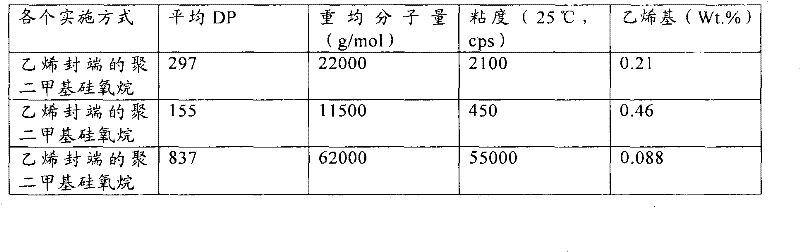
还考虑到氢化硅烷化可固化硅树脂组合物可包括不止一种如上所述的直链有机硅化合物。美国专利第5,574,073号描述了考虑用于本发明的其它直链有机硅化合物,其明确通过引用结合到本文中作为参考。It is also contemplated that the hydrosilylation-curable silicone resin composition may include more than one linear organosilicon compound as described above. Other linear organosilicon compounds contemplated for use in the present invention are described in US Patent No. 5,574,073, which is expressly incorporated herein by reference.
分支有机硅化合物也可以是上述的任意化合物,或者是不同的,只要分支有机硅化合物每分子具有至少两个末端不饱和部分和每分子至少一个的侧基不饱和部分。在各个实施方式中,分支硅化合物还限定为具有至少一个乙烯侧基的乙烯封端的聚二烷基硅氧烷,例如具有两个末端乙烯基和至少一个乙烯侧基的乙烯封端的聚二甲基硅氧烷。在其它实施方式中,分支有机硅化合物具有100至800的平均聚合度,8000至60000的重均分子量,根据ASTM D4287确定的200至30000cps的25℃的粘度,0.1至10的重量百分比的乙烯基。在一个实施方式中,分支有机硅化合物具有约620的平均聚合度(DP),约46000g/mol的重均分子量,根据ASTM D4287确定的约15000cps的25℃的粘度,约7.7的重量百分比的乙烯基。还考虑到氢化硅烷化可固化硅树脂组合物可包括不止一种如上所述的分支有机硅化合物。在美国专利第5,574,073号中描述了考虑用于本发明的其它分支有机硅化合物,其明确通过引用结合到本文中作为参考。The branched organosilicon compound can also be any of the compounds described above, or be different, as long as the branched organosilicon compound has at least two terminal unsaturations per molecule and at least one pendant unsaturation per molecule. In various embodiments, the branched silicon compound is also defined as a vinyl-terminated polydialkylsiloxane having at least one pendant vinyl group, such as a vinyl-terminated polydimethylsiloxane having two terminal vinyl groups and at least one pendant vinyl group. base siloxane. In other embodiments, the branched silicone compound has an average degree of polymerization of 100 to 800, a weight average molecular weight of 8,000 to 60,000, a viscosity at 25° C. of 200 to 30,000 cps determined according to ASTM D4287, and 0.1 to 10 weight percent vinyl . In one embodiment, the branched organosilicon compound has an average degree of polymerization (DP) of about 620, a weight average molecular weight of about 46,000 g/mol, a viscosity at 25°C of about 15,000 cps according to ASTM D4287, and a weight percent ethylene of about 7.7 base. It is also contemplated that the hydrosilylation curable silicone resin composition may include more than one branched organosilicon compound as described above. Other branched organosilicon compounds contemplated for use in the present invention are described in US Patent No. 5,574,073, which is expressly incorporated herein by reference.
应理解术语“硅树脂组合物”和“氢化硅烷化可固化硅树脂组合物”,当用于本文时,只要氢化硅烷化可固化硅树脂组合物保持如上所述,它们是可互换的。换句话说,只要氢化硅烷化可固化硅树脂组合物包括每分子具有两个末端不饱和部分的直链有机硅化合物,每分子具有两个末端不饱和部分和每分子至少一个的侧基不饱和部分的分支有机硅化合物,和每分子具有至少一个硅键合的氢原子的有机氢硅化合物,该术语是可互换的。It should be understood that the terms "silicone resin composition" and "hydrosilylation curable silicone resin composition", as used herein, are interchangeable so long as the hydrosilylation curable silicone resin composition remains as described above. In other words, so long as the hydrosilylation curable silicone resin composition includes a linear organosilicon compound having two terminal unsaturations per molecule, two terminal unsaturations per molecule and at least one pendant unsaturation per molecule Partially branched organosilicon compounds, and organohydrogensilicon compounds having at least one silicon-bonded hydrogen atom per molecule, are interchangeable terms.
硅树脂组合物还可包括具有选自(a)R1R22SiO(R22SiO)aSiR2 2R1和(b)R5R1 2SiO(R1R5SiO)bSiR1 2R5的组的公式的硅橡胶,其中R1和R2如上文描述和示例的,R5是R1或-H,下标a和b分别具有1至4的值,或者2至4,或者2至3,w、x、y和z也如上文描述和示例的。适合用作硅橡胶(a)的硅橡胶的特殊实施例包括,但是不限定于具有以下公式的硅橡胶:The silicone resin composition may further comprise a compound having a compound selected from (a) R 1 R 2 2SiO(R 2 2SiO) a SiR 2 2 R 1 and (b) R 5 R 1 2 SiO(R 1 R 5 SiO)bSiR 1 2 R Silicone rubbers of the formula of the group of 5 , wherein R1 and R2 are as described and exemplified above, R5 is R1 or -H, and the subscripts a and b respectively have a value from 1 to 4, or from 2 to 4, or 2 to 3, w, x, y and z are also as described and exemplified above. Specific examples of silicone rubbers suitable for use as silicone rubber (a) include, but are not limited to, silicone rubbers having the following formula:
ViMe2SiO(Me2SiO)aSiMe2Vi,ViMe 2 SiO(Me 2 SiO) a SiMe 2 Vi,
ViMe2SiO(Ph2SiO)aSiMe2Vi,和ViMe 2 SiO(Ph 2 SiO) a SiMe 2 Vi, and
ViMe2SiO(PhMeSiO)aSiMe2ViViMe 2 SiO(PhMeSiO) a SiMe 2 Vi
其中Me是甲基,Ph是苯基,Vi是乙烯,下标具有1至4的值。硅橡胶(a)可以是单一一种硅橡胶或包括两种或多种不同的硅橡胶的混合物,其分别符合(a)的公式。where Me is methyl, Ph is phenyl, Vi is ethylene, and the subscript has a value from 1 to 4. The silicone rubber (a) may be a single type of silicone rubber or a mixture including two or more different types of silicone rubber, which respectively satisfy the formula of (a).
适合用作硅树脂(b)的硅橡胶的特殊实施例包括,但是不限定于,具有以下公式的硅橡胶:Specific examples of silicone rubbers suitable for use as silicone resin (b) include, but are not limited to, silicone rubbers having the following formula:
HMe2SiO(Me2SiO)bSiMe2H, HMe2SiO ( Me2SiO ) bSiMe2H ,
HMe2SiO(Ph2SiO)bSiMe2H, HMe2SiO ( Ph2SiO ) bSiMe2H ,
HMe2SiO(PhMeSiCO)bSiMe2H,和HMe 2 SiO(PhMeSiCO) b SiMe 2 H, and
HMe2SiO(Ph2SiO)2(Me2SiO)2SiMe2H HMe2SiO ( Ph2SiO ) 2 ( Me2SiO ) 2SiMe2H
其中Me是甲基,Ph是苯基,下标b具有1至4的值。成份(b)可以是单一一种硅橡胶或包括两种或多种不同的硅橡胶的混合物,其分别符合(b)的公式。where Me is methyl, Ph is phenyl, and the subscript b has a value from 1 to 4. Component (b) may be a single type of silicone rubber or a mixture comprising two or more different types of silicone rubber, which respectively satisfy the formula of (b).
在本发明的其他实施方式中,硅树脂组合物包括通过将有机硅化合物和至少一种选自具有以下公式的橡胶进行反应制备的硅橡胶(b)橡胶改性的硅树脂:In other embodiments of the present invention, the silicone resin composition comprises silicone rubber (b) rubber-modified silicone resin prepared by reacting an organosilicon compound and at least one rubber selected from the group consisting of:
R5R1 2SiO(R1R5SiO)cSiR1 2R5,和R 5 R 1 2 SiO(R 1 R 5 SiO) c SiR 1 2 R 5 , and
R1R2 2SiO(R2 2SiO)dSiR2 2R1,R 1 R 2 2 SiO(R 2 2 SiO) d SiR 2 2 R 1 ,
其中R1和R5如上文描述和示例的,c和d分别具有4至1000的值,或者10至500,或者10至50,在氢化硅烷化催化剂和可选的有机溶剂的存在下,还规定有机硅化合物和硅橡胶(b)的反应产物每分子具有至少一个不饱和部分。wherein R and R are as described and exemplified above , c and d respectively have a value from 4 to 1000, or from 10 to 500, or from 10 to 50, in the presence of a hydrosilylation catalyst and optionally an organic solvent, also It is provided that the reaction product of the organosilicon compound and the silicone rubber (b) has at least one unsaturated moiety per molecule.
在一个实施方式中,硅树脂组合物包括按重量计的45至90份的二甲基乙烯硅氧基末端的二甲基硅氧烷,按重量计的0.5至2份的烷基硅烷,按重量计的0.5至2份的甲基丙烯酸氧基丙基三甲氧基硅烷,按重量计的0.01至0.2份的四甲基四乙烯环四聚二甲基硅氧烷,按重量计的2至10份的二甲基硅氧烷,按重量计的0.2至1份的二甲基甲基氢硅氧烷,按重量计的0.01份至0.1份的1,3-二乙烯基-1,1,3,3-四甲基二硅氧烷铂复合物。在另一实施方式中,硅树脂组合物包括按重量计的45至90份的二甲基乙烯硅氧基末端的二甲基硅氧烷,按重量计的0.5至2份的烷基硅烷,按重量计的0.5至2份的甲基丙烯酸氧基丙基三甲氧基硅烷,按重量计的0.01至0.2份的四甲基四乙烯环四聚二甲基硅氧烷,按重量计的2至10份的氢端的二甲基硅氧烷,按重量计的0.2至1份的二甲基甲基氢硅氧烷,按重量计的20至60份的石英和按重量计的0.01至0.1份的1,3-二乙烯基-1,1,3,3-四甲基二硅氧烷铂复合物。In one embodiment, the silicone resin composition comprises 45 to 90 parts by weight of dimethylvinylsiloxy-terminated dimethylsiloxane, 0.5 to 2 parts by weight of alkylsilane, and 0.5 to 2 parts by weight of methacryloxypropyltrimethoxysilane, 0.01 to 0.2 parts by weight of tetramethyltetraethylenecyclotetramethicone, 2 to 2 parts by weight 10 parts of dimethylsiloxane, 0.2 to 1 part by weight of dimethylmethylhydrogensiloxane, 0.01 to 0.1 parts by weight of 1,3-divinyl-1,1 , 3,3-Tetramethyldisiloxane platinum complex. In another embodiment, the silicone resin composition comprises 45 to 90 parts by weight of dimethylvinylsiloxy-terminated dimethylsiloxane, 0.5 to 2 parts by weight of alkylsilane, 0.5 to 2 parts by weight of methacrylate oxypropyltrimethoxysilane, 0.01 to 0.2 parts by weight of tetramethyltetraethylenecyclotetramethicone, 2 parts by weight to 10 parts of hydrogen-terminated dimethylsiloxane, 0.2 to 1 part by weight of dimethylmethylhydrogensiloxane, 20 to 60 parts by weight of quartz and 0.01 to 0.1 parts by weight of 1,3-divinyl-1,1,3,3-tetramethyldisiloxane platinum complex.
硅树脂组合物还可包括溶剂,例如有机溶剂。有机溶剂可以是非质子的或偶极非质子溶剂有机溶剂,其不与有机硅化合物和有机氢硅化合物反应并且不与其相溶。合适的有机溶剂的非限定性实施例包括不饱和的脂肪族烃,如正戊烷、己烷、正庚烷、异辛烷和十二烷,脂环烃,如环戊烷和环己烷,芳烃,如苯、甲苯、二甲苯和均三甲苯,环醚,如四氢呋喃(THF)和二氧杂环乙烷,酮,如甲基异丁基酮(MIBK),卤化烷烃,如三氯乙烷,卤化芳烃,如溴苯和氯苯,和其组合。有机溶剂可以是单一一种有机溶剂和包括两种或多种不同的有机溶剂的混合物,分别如上所述。硅树脂组合物中的有机溶剂的浓度是基于硅树脂组合物的总浓度的0至99%(w/w),或者30%至80%(w/w),或者45%至60%(w/w)。The silicone composition may also include a solvent, such as an organic solvent. The organic solvent may be an aprotic or a dipolar aprotic organic solvent, which is non-reactive and incompatible with the organosilicon compound and the organohydrogensilicon compound. Non-limiting examples of suitable organic solvents include unsaturated aliphatic hydrocarbons such as n-pentane, hexane, n-heptane, isooctane and dodecane, alicyclic hydrocarbons such as cyclopentane and cyclohexane , aromatics such as benzene, toluene, xylene and mesitylene, cyclic ethers such as tetrahydrofuran (THF) and dioxane, ketones such as methyl isobutyl ketone (MIBK), halogenated alkanes such as trichloro Ethane, aromatic halogenated hydrocarbons such as bromobenzene and chlorobenzene, and combinations thereof. The organic solvent may be a single organic solvent or a mixture including two or more different organic solvents, respectively as described above. The concentration of the organic solvent in the silicone resin composition is 0 to 99% (w/w), or 30% to 80% (w/w), or 45% to 60% (w/w), based on the total concentration of the silicone resin composition /w).
硅树脂组合物还可包括填料,如上文开始介绍的。填料可用于从组件20散热。填料可以是所属领域中任意已知的,可包括单一一种填料或填料的组合物。填料可以是导热或阻热的和/或导电的或绝缘的。填料还可限定为增强填料、增容填料、触变填料、颜料或其组合。填料可包括一种或多种粉碎的增强填料,如高表面积气相二氧化硅和沉淀二氧化硅、氧化锌、铝、铝粉、氢氧化铝、银、碳酸钙,和/或其它的增容填料,如石英、硅藻土、硫酸钡、氧化铁、二氧化钛和碳黑、滑石、钙硅石、矾石土、硫酸钙(无水)、石膏、硫酸钙、碳酸镁,黏土,如高岭土、氢氧化铝、氢氧化镁(氢氧镁石)、石墨,碳酸铜,如孔雀石,碳酸镍,如翠镍矿(zarachite),碳酸钡,如碳酸钡矿,碳酸锶,如菱锶矿,氧化铝,硅酸盐包括,但是不限定于橄榄石类、石榴石类、铝硅酸盐、环状硅酸盐、链硅酸盐和页硅酸盐,和其组合。橄榄石类可包括,但是不限定于镁橄榄石、Mg2SiO4和其组合。石榴石类的非限定性实施列可包括镁铝石、Mg3Al2Si3O12、钙铝榴石、Ca2Al2Si3O12和其组合。铝硅酸盐包括,但是不限定于硅线石、Al2SiO5、多铝红柱石、3Al2O3-2SiO2、蓝晶石、Al2SiO5和其组合。环状硅酸盐可包括,但是不限定于堇青石、Al3(MgFe)2[Si4AlO18]和其组合。链硅酸盐可包括,但是不限定于,硅酸钙岩矿、Ca[SiO3]和其组合。非限定性的页硅酸盐的合适的实施例可包括云母、K2Al14[Si6Al2O20](OH)4、叶腊石、Al4[SIgO20](OH)4、云母、Mg6[Si8O20](OH)4、蛇纹石、石棉、高岭石、Al4[Si4O10](OH)8、蛭石和其组合。还可包括低密度的填料从而降低单位体积的重量和成本。填料可包括小于1/4的光波长的粒子从而避免散射,但是这不是必需的。因此,如硅酸钙岩矿、二氧化硅、二氧化钛、玻璃纤维、中空玻璃微珠和黏土,例如尤其优选高岭土。The silicone resin composition may also comprise fillers, as described at the outset above. Fillers may be used to dissipate heat from the
在一个实施方式中,填料选自由氮化铝、氧化铝、氢氧化铝、钛酸钡、氧化铍、氮化硼、碳纤维、金刚钻、石墨、氢氧化镁、氧化镁、金属微粒、缟玛瑙、金刚砂、硅、碳化钨、氧化锌和其组合构成的组。填料还可限定为金属填料、无机填料、可融填料和其组合。金属填料包括金属微粒和在微粒表面具有多层的金属微粒。这些层可以是,例如,微粒表面上的金属氮化物层或金属氧化物层。通过选自铝、铜、金、镍、银和其组合的金属微粒示例了合适的金属填料,或者是铝。还通过在其表面上具有选自氮化铝、氧化铝、氧化铜、氧化镍、氧化银和其组合的层的金属微粒示例了合适的金属填料。例如,金属填料可包括在其表面上具有氧化铝层的铝微粒。In one embodiment, the filler is selected from aluminum nitride, aluminum oxide, aluminum hydroxide, barium titanate, beryllium oxide, boron nitride, carbon fiber, diamond, graphite, magnesium hydroxide, magnesium oxide, metal particles, onyx, Group consisting of corundum, silicon, tungsten carbide, zinc oxide, and combinations thereof. Fillers can also be defined as metallic fillers, inorganic fillers, fusible fillers, and combinations thereof. The metal filler includes metal fine particles and metal fine particles having multiple layers on the surface of the fine particles. These layers may be, for example, metal nitride layers or metal oxide layers on the particle surface. Suitable metal fillers are exemplified by metal particles selected from the group consisting of aluminum, copper, gold, nickel, silver, and combinations thereof, or aluminum. Suitable metal fillers are also exemplified by metal particles having on their surface a layer selected from the group consisting of aluminum nitride, aluminum oxide, copper oxide, nickel oxide, silver oxide, and combinations thereof. For example, the metal filler may include aluminum particles having an aluminum oxide layer on their surface.
合适的无机填料包括,但是不限定于,缟玛瑙、氢氧化铝、金属氧化物,如氧化铝、氧化铍、氧化镁和氧化锌,氮化物,如氮化铝和氮化硼,碳化物,如金刚砂和碳化钨。Suitable inorganic fillers include, but are not limited to, onyx, aluminum hydroxide, metal oxides such as aluminum oxide, beryllium oxide, magnesium oxide and zinc oxide, nitrides such as aluminum nitride and boron nitride, carbides, Such as emery and tungsten carbide.
合适的可熔填料包括,但是不限定于Bi、Ga、In、Sn、Ag、Au、Cd、Cu、Pb、Sb、Zn、其合金和其组合。合适的可熔填料的非限定性实施例包括Ga,In-Bi-Sn合金、Sn-In-Zn合金、Sn-In-Ag合金、Sn-Ag-Bi合金、Sn-Bi-Cu-Ag合金、Sn-Ag-Cu-Sb合金、Sn-Ag-Cu合金、Sn-Ag合金、Sn-Ag-Cu-Zn合金和其组合。可熔填料具有50℃至250℃或150℃至225℃.的熔点。可熔填料可以是共晶合金,非共晶合金和纯金属。合适的可熔填料是美国Utica,N.Y.的Indium Corporation、Providence,R.I.的Arconium和Cranston,R.I.的AIM Solder市售的,合适的铝填料是Naperville,LL.的Toyal America,Inc.和Stockton,CA的Valimet Inc.市售的。银填料是Attleboro,M.A.的Metalor Technologies U.S.A.Corp.市售的。Suitable fusible fillers include, but are not limited to, Bi, Ga, In, Sn, Ag, Au, Cd, Cu, Pb, Sb, Zn, alloys thereof, and combinations thereof. Non-limiting examples of suitable fusible fillers include Ga, In-Bi-Sn alloys, Sn-In-Zn alloys, Sn-In-Ag alloys, Sn-Ag-Bi alloys, Sn-Bi-Cu-Ag alloys , Sn-Ag-Cu-Sb alloys, Sn-Ag-Cu alloys, Sn-Ag alloys, Sn-Ag-Cu-Zn alloys, and combinations thereof. The fusible filler has a melting point of 50°C to 250°C or 150°C to 225°C. Fusible fillers can be eutectic alloys, non-eutectic alloys and pure metals. Suitable fusible fillers are commercially available from Indium Corporation of Utica, N.Y., Arconium of Providence, R.I., and AIM Solder of Cranston, R.I., USA, and suitable aluminum fillers are Toyal America, Inc. of Naperville, LL. and Stockton, CA. Commercially available from Valimet Inc. Silver fillers are commercially available from Metalor Technologies U.S.A. Corp. of Attleboro, M.A.
其它的合适的填料的实施例包括,但是不限定于,沉淀碳酸钙、重质碳酸钙、气相二氧化硅、沉淀二氧化硅、云母、二氧化钛、塑料粉末、玻璃或塑料(如SaranTM)微球,高纵横比的填料,如云母或片状剥落云母,和其组合。可选地以处理剂处理填料,如脂肪酸(例如,硬脂酸)。沉淀碳酸钙可从Solvay得到,商品名为WINNOFIL
填料还可限定为单一一种导热的填料或两种或多种导热的填料(其在至少一个性质上具有差异,如微粒形状、平均微粒尺寸、微粒尺寸分布和填料类型)的混合物。例如,理想的可以是使用无机填料的组合,如具有较大的平均微粒尺寸的第一氧化铝的具有较小的平均微粒尺寸的第二氧化铝。或者,理想的是,例如,使用具有较大平均微粒尺寸的氧化铝和具有较小的微粒尺寸的氧化锌的组合。或者,理想的是使用金属填料的组合,如具有较大平均微粒尺寸的第一铝和具有较小微粒尺寸的第二铝。例如,第一铝可具有8微米至100微米的平均微粒尺寸范围,或者8微米至10微米。第二铝可具有0.1微米至5微米的平均微粒尺寸范围,或者1微米至3微米。或者,理想的是使用金属填料和无机填料的组合,如金属和金属氧化物填料的组合,例如,铝和氧化铝填料的组合;铝和氧化锌填料的组合;或铝、氧化铝和氧化锌填料的组合。使用具有较大的平均微粒尺寸的第一填料和平均微粒尺寸小于第一填料的第二填料可提高组装效率,可降低黏性和提高热传导。考虑到如果理想的话,上述任意的填料可组合使用。A filler can also be defined as a single thermally conductive filler or a mixture of two or more thermally conductive fillers that differ in at least one property, such as particle shape, average particle size, particle size distribution, and filler type. For example, it may be desirable to use a combination of inorganic fillers, such as a first alumina having a larger average particle size with a second alumina having a smaller average particle size. Alternatively, it may be desirable, for example, to use a combination of aluminum oxide with a larger average particle size and zinc oxide with a smaller particle size. Alternatively, it may be desirable to use a combination of metal fillers, such as a first aluminum with a larger average particle size and a second aluminum with a smaller particle size. For example, the first aluminum may have an average particle size range of 8 microns to 100 microns, or 8 microns to 10 microns. The second aluminum may have an average particle size ranging from 0.1 microns to 5 microns, or from 1 micron to 3 microns. Alternatively, it is desirable to use a combination of metal fillers and inorganic fillers, such as a combination of metal and metal oxide fillers, for example, a combination of aluminum and alumina fillers; a combination of aluminum and zinc oxide fillers; or aluminum, alumina and zinc oxide fillers Combination of fillers. Using a first filler with a larger average particle size and a second filler with a smaller average particle size than the first filler can improve assembly efficiency, can reduce viscosity and improve heat transfer. It is contemplated that any of the aforementioned fillers may be used in combination if desired.
导热填料的平均微粒尺寸取决于多个因素,包括导热填料的类型和使用量。但是,在各个实施方式中,导热填料可具有0.1微米至100微米的平均微粒尺寸范围,或者0.1微米至80微米,或者0.1微米至50微米,或者0.1微米至10微米。The average particle size of a thermally conductive filler depends on several factors, including the type and amount of thermally conductive filler used. However, in various embodiments, the thermally conductive filler may have an average particle size range of 0.1 microns to 100 microns, or 0.1 microns to 80 microns, or 0.1 microns to 50 microns, or 0.1 microns to 10 microns.
在各个实施方式中,硅树脂组合物包括按重量计每100份的硅树脂组合物的按重量计的10至70,,20至60,40至60,或30至50份的填料。在一个实施方式中,硅树脂组合物包括按重量计每100份的硅树脂组合物的按重量计的45至55份的石英。在其它的实施方式中,硅树脂组合物包括按重量计每100份的硅树脂组合物的按重量计的1至150份的填料。在其它实施方式中,硅树脂组合物包括按重量计每100份的硅树脂组合物的按重量计的约50份的石英填料。仍然在另一实施方式中,硅树脂组合物包括选自石英、硅、氧化铝、氢氧化铝和其组合的填料,其存在量是按重量计每100份的硅树脂组合物的按重量计的10至80份。In various embodiments, the silicone composition includes 10 to 70, 20 to 60, 40 to 60, or 30 to 50 parts by weight of filler per 100 parts by weight of silicone composition. In one embodiment, the silicone composition includes 45 to 55 parts by weight of quartz per 100 parts by weight of silicone composition. In other embodiments, the silicone composition includes 1 to 150 parts by weight of filler per 100 parts by weight of silicone composition. In other embodiments, the silicone composition includes about 50 parts by weight of the quartz filler per 100 parts by weight of the silicone composition. In yet another embodiment, the silicone composition includes a filler selected from the group consisting of quartz, silicon, alumina, aluminum hydroxide, and combinations thereof, present in an amount by weight per 100 parts by weight of the silicone composition of 10 to 80 servings.
上述的填料可通过脂肪酸或脂肪酸酯进行表面处理,如硬脂酸盐、有机硅氧烷、有机硅氨烷,如六烷基二硅胺烷和/或短链硅氧烷二醇和其组合,从而使填料成为疏水性的。该表面处理可以使填料更易于操作并且得到与硅树脂组合物的其它成分的均一的混合物。表面处理还可以更易于把硬质硅酸盐矿产弄湿。不希望被限定,还认为表面改进的填料耐结块并且可与均一地整合到硅树脂组合物中。此外,认为表面处理的填料的导电性低于未处理的填料。如上所述,当第一最外层22也是导热的,可使用导热填料,从而可以是从光生伏打电池24去除过量的热,其提高了电池效率。The aforementioned fillers can be surface treated with fatty acids or fatty acid esters, such as stearates, organosiloxanes, organosilazanes such as hexaalkyldisilazanes and/or short chain siloxane diols and combinations thereof , so that the filler becomes hydrophobic. This surface treatment can make the filler easier to handle and result in a homogeneous mixture with the other ingredients of the silicone composition. The surface treatment also makes it easier to wet the hard silicate minerals. Without wishing to be limited, it is also believed that the surface-modified filler is resistant to caking and can be integrated uniformly into the silicone composition. In addition, the surface-treated fillers are believed to be less conductive than untreated fillers. As mentioned above, when the first
除了填料,硅树脂组合物还包括添加剂,如氢化硅烷化催化剂抑制剂,如3-甲基-3-戊烯-1-炔、3,5-二甲基-3-己烯-1-炔、3,5-二甲基-1-己烯-3-酮、1-乙炔-1-环己醇、2-苯基-3-丁烯-2-酮、乙烯换硅氧烷和三苯基膦。添加剂的其它非限定性实施例包括色素、助粘剂、阻蚀剂、染料、稀释剂、防污添加剂和其组合。可基于保存期限、固化动力学和粘结层的光学性能来加入这样的添加剂。In addition to fillers, silicone resin compositions also include additives such as hydrosilylation catalyst inhibitors such as 3-methyl-3-penten-1-yne, 3,5-dimethyl-3-hexen-1-yne , 3,5-dimethyl-1-hexen-3-one, 1-ethyn-1-cyclohexanol, 2-phenyl-3-buten-2-one, vinyl-for-siloxane and triphenyl base phosphine. Other non-limiting examples of additives include pigments, adhesion promoters, corrosion inhibitors, dyes, thinners, antifouling additives, and combinations thereof. Such additives can be added based on shelf life, cure kinetics, and optical properties of the tie layer.
合适的助粘剂的尤其优选的实施例包括,但是不限定于乙烯三乙氧基硅烷、丙烯酰丙基三甲氧基硅烷、烷基丙烯酰丙基三甲氧基硅烷,如甲基丙烯酰丙基三甲氧基硅烷、烷氧基硅烷、烯丙基三乙氧基硅烷、环氧丙醇丙基三甲氧基硅烷、烯丙基缩水甘油醚,羟基二烷基硅端的甲基乙烯硅氧烷-二甲基硅氧烷共聚物,羟基二烷基硅端的甲基乙烯硅氧烷-二甲基硅氧烷共聚物与环氧丙醇丙基三甲氧基硅烷的反应产物,二(三乙氧硅基)乙二醇、羟基二烷基硅端的甲基乙烯硅氧烷-二甲基硅氧烷共聚物,羟基二烷基硅端的甲基乙烯硅氧烷-二甲基硅氧烷共聚物与环氧丙醇丙基三甲氧基硅烷和二(三乙氧硅基)乙二醇的反应产物,0.5∶1至1∶2,更通常是1∶1的羟基二烷基硅端的甲基乙烯硅氧烷-二甲基硅氧烷共聚物和甲基丙烯酰丙基三甲氧基硅烷的混合物,和其组合。Particularly preferred examples of suitable adhesion promoters include, but are not limited to, ethylenetriethoxysilane, acryloylpropyltrimethoxysilane, alkylacryloylpropyltrimethoxysilane, such as methacryloylpropyltrimethoxysilane, Trimethoxysilane, Alkoxysilane, Allyltriethoxysilane, Glycidyltrimethoxysilane, Allyl Glycidyl Ether, Hydroxydialkylsilyl-terminated Methylvinylsiloxane -Dimethicone copolymer, reaction product of hydroxydialkylsiloxane-terminated methylvinylsiloxane-dimethylsiloxane copolymer with glycidyl propyltrimethoxysilane, bis(triethyl) Oxysilyl) Glycol, Hydroxydialkylsiloxane-Dimethicone Copolymer, Hydroxydialkylsiloxane-Dimethicone Copolymer reaction product of glycidyl propyltrimethoxysilane and bis(triethoxysilyl)glycol, 0.5:1 to 1:2, more usually 1:1, of hydroxydialkylsilyl-terminated methyl Mixtures of vinylvinylsiloxane-dimethylsiloxane copolymer and methacryloylpropyltrimethoxysilane, and combinations thereof.
如上所述,添加剂可包括防污添加剂从而当使用光生伏打电池24时,减轻/防止污染。特别优选的防污添加剂包括,但是不限定于在25℃粘度为10000mPa的含氟烯烃和氟硅氧烷,如氟化倍半硅氧烷,包括二甲基羟基硅氧基末端的三氟丙基倍半硅氧烷、羟基末端的三氟丙基甲基硅氧烷、羟基末端的三氟丙基甲基硅基甲基乙烯硅基硅氧烷,3,3,4,4,5,5,6,6,7,7,8,8,8-十三氟代辛烷基三乙氧基硅烷、羟基末端的甲基乙烯三氟丙基硅氧烷、二甲基羟基硅基末端的二甲基三氟丙基甲基硅氧烷,和其组合。防污添加剂的存在量一般是按重量计每100份的硅树脂组合物的按重量计的5份或更少份。As noted above, the additives may include anti-fouling additives to reduce/prevent fouling when
硅树脂组合物还可包括能吸收较低波长(200-500nm)的太阳能量并且以较高波长(600-900nm)再发射的荧光增白剂,流变调节剂、色素、热稳定剂、阻燃剂、UV稳定剂、增链剂、增塑剂、膨胀剂、杀真菌剂和/或生物杀灭剂等(其存在量可以是按重量计的0至0.3%)、去水剂、预固化的硅树脂和/或无机橡胶微粒从而提高延展性和保持低表面粘性,和其组合。The silicone resin composition may also include optical brighteners, rheology modifiers, pigments, thermal stabilizers, retardants, which absorb solar energy at lower wavelengths (200-500nm) and re-emit at higher wavelengths (600-900nm). Burning agents, UV stabilizers, chain extenders, plasticizers, bulking agents, fungicides and/or biocides etc. Cured silicone and/or inorganic rubber particles to improve ductility and maintain low surface tack, and combinations thereof.
阻燃剂的合适的实施例包括如WO 00/46817所述的氧化铝粉末或硅酸钙岩矿,其明确通过引用结合到本文中作为这些阻燃剂的相关参考。阻燃剂可单独使用或与其它的阻燃剂或色素组合,如二氧化钛。Suitable examples of flame retardants include alumina powder or wollastonite minerals as described in WO 00/46817, which is expressly incorporated herein by reference in relation to these flame retardants. Flame retardants can be used alone or in combination with other flame retardants or pigments, such as titanium dioxide.
可在任意合适的标准反应器中或在组件22上进行本发明的任意反应,如氢化硅烷化反应。合适的反应器包括玻璃和氟塑料衬里的玻璃反应器。一般,反应器装配了混合装置,如搅拌。该反应通常在惰性(如氮或氩)不潮湿的环境下进行。Any reaction of the present invention, such as a hydrosilylation reaction, can be carried out in any suitable standard reactor or on
本发明的硅树脂组合物可以是粘性的或非粘性的,可以是凝胶、胶水、液体、膏、树脂或固体。在本发明的方法中,硅树脂组合物是液体并且位于光生伏打电池24上。在一个实施方式中,硅树脂组合物是薄膜。在另一实施方式中,硅树脂组合物是凝胶。仍然在另一实施方式中,硅树脂组合物是液体,其被固化(例如,预固化或部分固化)从而形成凝胶。或者,硅树脂组合物可包括多个部分,每一部分包括不同的硅树脂和/或不同的形式(例如,凝胶和液体)。在一个实施方式中,硅树脂组合物主要有有机硅化合物、有机氢硅化合物和氢化硅烷化催化剂构成,不包括任意其它的硅树脂、填料、交联剂和/或添加剂。或者,硅树脂组合物可由有机硅化合物、有机氢硅化合物和氢化硅烷化催化剂构成。The silicone composition of the present invention may be adhesive or non-adhesive, and may be a gel, glue, liquid, paste, resin or solid. In the method of the present invention, the silicone composition is a liquid and is located on the
硅树脂组合物可以是未固化的、部分固化的,或通过上文介绍的氢化硅烷化机制或任意其它机制完全固化的。在一个实施方式中,硅树脂组合物于0℃至150℃的温度下被固化。或者,硅树脂组合物可于50℃至150℃的温度下或于室温(~23℃±2℃)至115℃的温度下被固化。但是,可使用所属领域的一般技术人员选择的其它的温度。如果通过热固化硅树脂组合物,可在任意合适的炉等中以批或连续模式产热。最优选连续模式。此外,可固化硅树脂组合物1至24小时。但是,可固化硅树脂组合物较短或较长的时间,如根据应用所属领域中的一般技术人员选择。在各个实施方式中,硅树脂组合物具有25℃的小于约100000,50至10000,100至7500,250至5000,250至10000,25至800,2500至5000,250至600,3000至4000或2000至8000的厘泊(cps)的粘度。在备选的实施方式中,硅树脂组合物具有25℃的约400至约3500cps的粘度。可使用ASTM D 1084或ASTM D4287计算硅树脂组合物的粘度。The silicone composition may be uncured, partially cured, or fully cured by the hydrosilylation mechanism described above or any other mechanism. In one embodiment, the silicone composition is cured at a temperature of 0°C to 150°C. Alternatively, the silicone resin composition may be cured at a temperature of 50°C to 150°C or at a temperature of room temperature (~23°C±2°C) to 115°C. However, other temperatures may be used as selected by one of ordinary skill in the art. If the silicone composition is cured by heat, the heat can be generated in batch or continuous mode in any suitable oven or the like. Continuous mode is most preferred. In addition, the silicone composition can be cured for 1 to 24 hours. However, the silicone composition may be cured for a shorter or longer time, as selected by one of ordinary skill in the art for the application. In various embodiments, the silicone composition has a 25° C. of less than about 100,000, 50 to 10,000, 100 to 7,500, 250 to 5,000, 250 to 10,000, 25 to 800, 2,500 to 5,000, 250 to 600, 3,000 to 4,000, or A viscosity of 2000 to 8000 centipoise (cps). In an alternative embodiment, the silicone composition has a viscosity of about 400 to about 3500 cps at 25°C. The viscosity of silicone compositions can be calculated using ASTM D 1084 or ASTM D4287.
回到前文,在一个实施方式中,如图7列出的,至少部分涂覆了硅树脂组合物的多个纤维27侧面(L)即以侧面延伸穿过第二(最外)层至组件两端的组件20的外围(36)。在一个实施方式中,至少部分涂覆了硅树脂组合物的多个纤维27侧面延伸(L)穿过第二(最外)层至组件各个末端上的组件20的外围(36)。本文所用的术语“末端”包括组件20的前、后和/或侧边缘。多个纤维27从组件20的一个末端完全延伸至另一个。在某些部分中,多个纤维27可以是被涂层的,并在其它中是未涂层的,或者是完全涂层的。在一个实施方式中,未涂层纤维27延伸穿过部分的第二(最外)层至外围26,而涂覆了的纤维延伸穿过第二(最外)层的另一部分。当位于光生伏打电池24上时,多个纤维27和/或第二(最外)层可以完全覆盖光生伏打电池24。或者,当位于其上时,多个纤维27和/或第二最外层26可不完全覆盖光生伏打电池26,并且留下间隙。Returning to the foregoing, in one embodiment, as outlined in FIG. 7, the plurality of
包括多个纤维27的第二(最外)层26通常与第一最外层22和光生伏打电池24具有相同的尺寸。但是,在一个实施方式中,第二(最外)层26小于光生伏打电池,并且只在部分的光生伏打电池24上延伸。在其它的实施方式中,第二(最外)层26各具有125mm的长度和宽度。仍然在另一实施方式中,第二(最外)层各具有156mm的长度和宽度。当然,应理解多个纤维27和第二(最外)层26和本发明不限定于这些尺寸。A second (outermost)
回到组件20,组件20还可包括支持层28。支持层28可以与第一最外层相同或不同。在一个实施方式中,当第二层26是内层时,支持层28是位于第二层26上的第二最外层。在该实施方式中,支持层28与第一最外层相对并且被用于支持组件20。在备选的实施方式中,支持层28包括玻璃。在另一实施方式中,支持层28包括聚酰亚胺、聚乙烯、乙烯-乙酸乙烯酯共聚物、有机含氟聚合物,包括,但是不限定于单独的乙烯四氟乙烯(ETFE)、聚氟乙烯(Tedlar


一般,支持层28的厚度是50至500微米,更一般的是100至225微米,最一般的是175至225微米。在一个实施方式中,支持层28各具有125mm的长度和宽度。在另一实施方式中,支持层28各具有156mm的长度和宽度。当然,应理解支持层28和本发明不限定于这些尺寸。Typically, the thickness of
除了第二(最外)层26和支持层28,组件20还可包括粘结层30。粘结层30可位于光生伏打电池24上,并且夹在光生伏打电池24和第一最外层22之间。或者,粘结层可以位于组件20的任意其它部分中。组件20可包括不止一个粘结层30,可包括第二、第三和/或其它的粘结层。第二、第三和/或其它粘结层可以与粘结层30相同或不同。粘结层30可包括与上文描述的硅树脂组合物相同或不同的第二硅树脂组合物。In addition to the second (outermost)
在一个实施方式中,如图3、4、10和11所示,组件20包括位于第一最外层22上并且夹在第一最外层22和光生伏打电池24之间的粘结层30。粘结层30对于UV和/或可见光可以是透明的,不透光或不透明的。In one embodiment, as shown in FIGS. 30. The
粘结层30可具有1.1至100mm的穿透深度。在各个实施方式中,粘结层30具有1.3至100mm的穿透深度,更一般的是2至55mm。通过首先计算硬度,然后计算穿透深度来确定穿透深度。因此,粘结层30一般具有5至500的克力的硬度,更一般的是5至400,最一般的是10至300。更确切地讲,使用Stable Micro Systems市售的使用0.5英寸(1.27cm)直径的钢探针的TA-XT2组织测定仪确定硬度。质量为12g的粘结层30试样被加热到100℃达10分钟,使用以下的测试参数分析硬度,如所属领域中已知的:2mm/秒的预测试和后测试速度;1mm/秒测试速度;4mm目标距离;60秒保持;和5g触发力值。在进入粘结层304mm距离处测量最大克力。The
粘结层30还可具有小于-0.6g.sec的粘性值。在各个实施方式中,粘结层30具有-0.7至-300g.sec的粘性值,更一般的是-1至-100g.sec。在一个实施方式中,粘结层30具有-27g.sec的粘性值。使用Stable Micro Systems市售的使用0.5英寸(1.27cm)直径的钢探针的TA-XT2组织测定仪确定粘性值。探针插入粘结层30至4mm的深度,然后以2mm/秒的速度撤回。在从粘结层30撤回探针的过程中作为总面积(力-时间)计算粘度值。粘度值表示为克.秒。The
粘结层30通常是具有粘性的,可以是凝胶、胶水、液体、膏体、树脂或固体。在一个实施方式中,粘结层30是薄膜。在另一实施方式中,粘结层30是凝胶。仍然在另一实施方式中,粘结层30是液体,其被固化(例如,预固化)从而形成凝胶。或者,粘结层30可包括多个部分,每一部分包括不同的组合物和/或不同的形式(例如,凝胶和液体),只要部分和整体的粘结层30具有合适的穿透深度和粘度值,如上文列出的。美国专利第5,145,933号、第4,340,709号和第6,020,409号描述了用作粘结层30的合适的凝胶的实施例,其分别明确得通过引用结合到本文中作为这些凝胶的相关参考。应理解粘结层30可具有任意形式。一般,粘结层具有根据ASTMD4287使用Brookfield DVIII锥板式粘度计于25℃测量的10至100000mPa的粘度。粘结层30还通常具有7x10²至6x10⁵达因/cm2的弹性模数(G′at cure)。The
在一个实施方式中,粘结层30基本没有带入的空气(气泡)。术语“基本没有”表示粘结层30没有可见的气泡。在另一实施方式中,粘结层30完全没有包括可见的和微气泡的带入的空气。In one embodiment, the
可以以所属领域中已知的任意合适的化合物形成粘结层30。可通过无机化合物、有机化合物或无机化合物和有机化合物的混合物形成粘结层30,和/或粘结层30包括无机化合物、有机化合物或无机化合物和有机化合物的混合物。这些化合物必须或不是必须固化。在一个实施方式中,通过包括硅原子的可固化组合物形成粘结层30。可完全由可固化硅树脂组合物形成粘结层30,如美国专利第6,020,409号6,169,155号中描述的,其明确通过引用结合到本文中作为这些可固化硅树脂组合物的参考。在另一实施方式中,粘结层30的可固化组合物包括乙烯-醋酸乙烯酯共聚物、聚亚安酯、乙烯四氟乙烯、聚氟乙烯、聚对苯二甲酸乙二醇酯和其组合中的至少一种。或者,粘结层30可以由包括成分(A)-(E)中的一种或多种的可固化组合物形成。成分(A)包括所属领域中已知的任意有机和/或无机化合物,并且同时包括碳原子和硅原子。一般,成分(A)包括二有机聚硅氧烷。二有机聚硅氧烷可以具有高数均分子量(Mn)和/或重均分子量(Mw),并且可以是每分子具有至少两个反应基团的硅橡胶,其旨在与成分(B)一起固化,在下文中进行了更详细的介绍。或者,二有机聚硅氧烷可以是树脂,或可包括树胶和树脂。二有机聚硅氧烷一般具有基本是直链的分子结构。但是,该结构可以是部分分支的。在一个实施方式中,二有机聚硅氧烷可以与上文确定的有机硅化合物相同。当然,应理解成分(A)可以独立地选自有机硅化合物。
成分(A)的合适的实施例包括,但是不限定于二甲基烯基硅氧基末端的二甲基聚硅氧烷、二甲基烯基硅氧基末端的甲基烯基硅氧烷和二甲基硅氧烷的共聚物、二甲基烯基硅氧基末端的甲基苯基硅氧烷和二甲基硅氧烷的共聚物、二甲基烯基硅氧基末端的甲基苯基硅氧烷、甲基烯基硅氧烷和二甲基硅氧烷的共聚物、二甲基烯基硅氧基末端的二苯基硅氧烷和二甲基硅氧烷的共聚物、二甲基烯基硅氧基末端的二苯基硅氧烷、甲基烯基硅氧烷和二甲基硅氧烷的共聚物,和其组合物。Suitable examples of ingredient (A) include, but are not limited to, dimethylalkenylsiloxy-terminated dimethylpolysiloxane, dimethylalkenylsiloxy-terminated methylalkenylsiloxane and dimethylsiloxane copolymers, dimethylalkenylsiloxy-terminated methylphenylsiloxane and dimethylsiloxane copolymers, dimethylalkenylsiloxy-terminated methyl phenyl siloxane, copolymer of methylalkenyl siloxane and dimethyl siloxane, copolymer of dimethyl alkenyl siloxy-terminated diphenyl siloxane and dimethyl siloxane compounds, dimethylalkenylsiloxy-terminated diphenylsiloxane, copolymers of methylalkenylsiloxane and dimethylsiloxane, and combinations thereof.
或者,成分(A)可包括具有羟基或水解基团X和X1,其可以是相同的或不同的。这些基团可以是或不是末端基团,并且通常不是空间阻碍的。例如,该化合物可以具有简式:Alternatively, ingredient (A) may include X and X 1 having hydroxyl or hydrolyzable groups, which may be the same or different. These groups may or may not be terminal groups and are generally not sterically hindering. For example, the compound can have the simplified formula:
X-A-X1 XAX 1
其中X和/或X1可包括和或以下列任意基团为末端:-Si(OH)3、-(Ra)Si(OH)2、-(Ra)2SiOH、-RaSi(ORb)2、-Si(ORb)3、-Ra 2SiORb或-Ra 2Si-Rc-SiRd p(ORb)3-p,其中每一个Ra可独立地包括单价烃基,如具有1至8个碳原子的烃基。一般,Ra是甲基。每一个Rb和Rd可独立地是具有达6个碳原子的烷基或烷氧基。Rc一般是二价烃基,其可包括一个或多个具有达6个硅原子的硅氧烷间隔。一般,p具有0、1或2的值。在一个实施方式中,X和/或X1包括潮湿环境下可水解的官能团。Wherein X and/or X 1 may include and or be terminated by any of the following groups: -Si(OH) 3 , -(R a )Si(OH) 2 , -(R a ) 2 SiOH, -R a Si( OR b ) 2 , -Si(OR b ) 3 , -R a 2 SiOR b , or -R a 2 Si-R c -SiR d p (OR b ) 3-p , wherein each R a may independently include monovalent A hydrocarbyl group, such as a hydrocarbyl group having 1 to 8 carbon atoms. Typically, Ra is methyl. Each of Rb and Rd may independently be an alkyl or alkoxy group having up to 6 carbon atoms. R c is generally a divalent hydrocarbon group which may include one or more siloxane spacers having up to 6 silicon atoms. Typically, p has a value of 0, 1 or 2. In one embodiment, X and/or X include functional groups that are hydrolyzable in a humid environment.
此外,在该公式中,(A)通常包括硅氧烷分子链。在一个实施方式中,(A)包括聚二有机硅氧烷链,其具有以下公式的硅氧烷单元Furthermore, in this formula, (A) generally includes a siloxane molecular chain. In one embodiment, (A) comprises a polydiorganosiloxane chain having siloxane units of the formula
-(R6 sSiO(4-s)/2)--(R 6 s SiO (4-s)/2 )-
其中R6独立地是有机基团,如具有1至10个碳原子、被一个或多个卤素(如氯或氟)选择性取代的烃基,s是0、1或2。更确切的讲,R6可包括甲基、乙基、丙基、乙烯基、环己基、苯基和/或甲苯基,被氯或卤取代的丙基,如3,3,3-三氟丙基、氯苯基、β-(全氟丁基)乙基或氯环己基,和其组合。一般,至少部分的R6基是甲基。最通常的是所有的R6基是甲基。在一个实施方式中,每分子至少有大约700个上述公式单元。Wherein R 6 is independently an organic group, such as a hydrocarbon group having 1 to 10 carbon atoms, optionally substituted by one or more halogens (such as chlorine or fluorine), and s is 0, 1 or 2. More precisely, R6 may include methyl, ethyl, propyl, vinyl, cyclohexyl, phenyl and/or tolyl, propyl substituted by chlorine or halo, such as 3,3,3-trifluoro Propyl, chlorophenyl, β-(perfluorobutyl)ethyl or chlorocyclohexyl, and combinations thereof. Typically, at least part of the R6 groups are methyl. Most typically all R6 groups are methyl. In one embodiment, there are at least about 700 units of the above formula per molecule.
一般,成分(A)具有大于50mPa的粘度。在一个实施方式中,成分(A)具有大于1000000mPa的粘度。在另一实施方式,成分(A)具有50至1000000mPa的粘度,更一般的是100至250000mPa,最一般的是100至100000mPa。前述的每一个粘度是于25℃根据ASTM D4287根据Brookfield DVIII锥板式粘度计测量的。成分(A)在粘结层30的可固化组合物中的存在量一般是按重量计100份的粘结层30的可固化组合物的按重量计的25至99.5份。Typically, ingredient (A) has a viscosity greater than 50 mPa. In one embodiment, ingredient (A) has a viscosity greater than 1000000 mPa. In another embodiment, ingredient (A) has a viscosity of 50 to 1,000,000 mPa, more typically 100 to 250,000 mPa, most typically 100 to 100,000 mPa. Each of the aforementioned viscosities were measured at 25°C with a Brookfield DVIII cone and plate viscometer according to ASTM D4287. Ingredient (A) is generally present in the curable composition of the
在一些实施方式中,成分(A)具有大于1500的聚合度(dp)和使用ASTM D926确定的95至125的威廉姆可塑度值。本文所用的可塑度值被定义为体积为2cm3,高度为大约10mm的圆柱形试样在试样于25℃进行了49牛顿的压力负载3分钟后的毫米厚度x 100。In some embodiments, ingredient (A) has a degree of polymerization (dp) greater than 1500 and a Williams plasticity value of 95 to 125 as determined using ASTM D926. The plasticity value used herein is defined as the mm thickness x 100 of a cylindrical sample with a volume of 2 cm 3 and a height of approximately 10 mm after the sample has been subjected to a pressure load of 49 Newtons at 25° C. for 3 minutes.
现在关于成分(B),该成分通常包括硅树脂((M、D、T和/或Q)或树脂组合物。树脂可包括或不包括可与成分(A)反应的官能团。成分(B)可通过或不通过溶剂与成分(A)组合。更确切的讲,成分(B)可包括有机硅氧烷树脂,如包括R6 3SiO1/2单元和SiO4/2单元的MQ树脂,包括R6SiO3/2单元和R6 2SiO2/2单元的TD树脂,包括R6 3SiO1/2单元和R6SiO3/2单元的MT树脂,包括R6 3SiO1/2单元、R6SiO3/2单元和R62SiO2/2单元的树脂,和其组合。在这些公式中,R6如上文所述。Now regarding ingredient (B), this ingredient typically includes a silicone resin ((M, D, T, and/or Q) or a resin composition. The resin may or may not include functional groups that can react with ingredient (A). Ingredient (B) can be combined with component (A) with or without a solvent. More precisely, component (B) can comprise organosiloxane resins, such as MQ resins comprising R 6 3 SiO 1/2 units and SiO 4/2 units, TD resins including R 6 SiO 3/2 units and R 6 2 SiO 2/2 units, MT resins including R 6 3 SiO 1/2 units and R 6 SiO 3/2 units, including R 6 3 SiO 1/2 units, R 6 SiO 3/2 units and R 62 SiO 2/2 units, and combinations thereof. In these formulas, R 6 is as described above.
上文所用的标志M、D、T和Q代表包括有机硅液体、橡胶(弹性体)和树脂的聚有机硅氧烷的结构单元的官能性。根据所属领域中已建立的理解使用这些标志。因此,M代表单官能单元R6 3SiO1/2。D代表双官能单元R6 2SiO2/2。T代表三官能单元R6SiO3/2。Q代表四官能SiO4/2。这些单元的一般结构式如下所示:The designations M, D, T and Q used above represent the functionality of the structural units of polyorganosiloxanes including silicone fluids, rubbers (elastomers) and resins. These designations are used according to established understanding in the art. Thus, M represents the monofunctional unit R 6 3 SiO 1/2 . D represents a difunctional unit R 6 2 SiO 2/2 . T represents a trifunctional unit R 6 SiO 3/2 . Q represents tetrafunctional SiO 4/2 . The general structural formulas of these units are shown below:
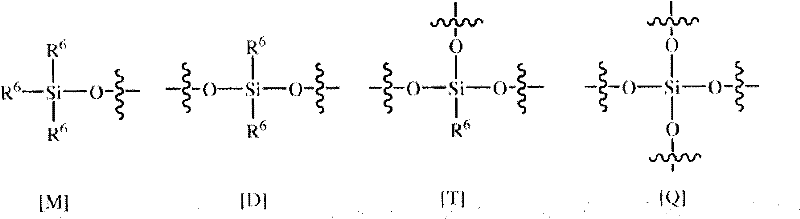
一般,成分(B)的重均分子量至少是5000g/mol,一般大于10000g/mol。成分(B)在粘结层30的可固化组合物中的存在量一般是按重量计的100份的粘结层30的可固化组合物的按重量计的0.5至75份。Generally, component (B) has a weight average molecular weight of at least 5000 g/mol, generally greater than 10000 g/mol. Ingredient (B) is generally present in the curable composition of the
不希望被特殊理论束缚,认为前述的成分(A)和(B)赋予粘结层30出色的抗UV性。使用这些硅树脂可减少或消除在组件20中加入UV添加剂或铈掺杂玻璃的需要。这些硅树脂还可表现出长期的UV和可见光穿透,从而将组件20的效率最大化。Without wishing to be bound by a particular theory, it is believed that the aforementioned ingredients (A) and (B) impart excellent UV resistance to the
现在谈到成分(C),该成分通常包括固话催化剂。催化剂可以所属领域中已知的任意类型,可选自缩合催化剂、氢化硅烷化催化剂、游离基催化剂、UV催化剂、热催化剂,和其组合。该催化剂的选择可降低生产和处理时间20%,并且可总体消除某些生产步骤,从而导致生产成本和最终使用者的消费成本降低。Turning now to ingredient (C), this ingredient typically includes a fixation catalyst. The catalyst can be of any type known in the art and can be selected from condensation catalysts, hydrosilylation catalysts, free radical catalysts, UV catalysts, thermal catalysts, and combinations thereof. This catalyst selection can reduce production and processing time by 20%, and can generally eliminate certain production steps, resulting in lower production costs and consumption costs for the end user.
在一个实施方式中,成分(C)与上文介绍的氢化硅烷化催化剂相同。在另一实施方式中,成分(C)包括过氧化物催化剂,其用于硅氧烷(包括,但是不限定于=Si-CH3基和其它的=Si-CH3基或=Si-CH3基和=Si-烯基基团(通常是乙烯),或=Si-烯基基团和=Si-烯基基团)之间的游离基反应。合适的过氧化物催化剂可包括,但是不限定于,2,4-二氯过氧化苯甲酰、过氧化苯甲酰、过氧化二异丙苯、过氧化苯甲酸叔丁酯、1,1-双(叔丁基过氧基)-3,3,5-三甲基环己烷(TMCH)、2,5-二甲基-2,5-双(叔丁过氧基)己烷催化剂、1,1-二叔丁基过氧化环己烷、3,3-二(叔戊基过氧)丁酸乙酯、1,1-二叔丁基过氧化环己烷,和其组合。可作为纯化合物或在惰性基质(液体或固体)中利用这些催化剂。In one embodiment, ingredient (C) is the same as the hydrosilylation catalyst described above. In another embodiment, ingredient (C) includes a peroxide catalyst for siloxanes (including, but not limited to, =Si- CH groups and other =Si- CH groups or =Si-CH A radical reaction between a 3 radical and a =Si-alkenyl group (usually vinyl), or a =Si-alkenyl group and a =Si-alkenyl group). Suitable peroxide catalysts may include, but are not limited to, 2,4-dichlorobenzoyl peroxide, benzoyl peroxide, dicumyl peroxide, tert-butyl peroxybenzoate, 1,1 - Bis(tert-butylperoxy)-3,3,5-trimethylcyclohexane (TMCH), 2,5-dimethyl-2,5-bis(tert-butylperoxy)hexane catalyst , 1,1-di-tert-butylperoxycyclohexane, ethyl 3,3-bis(tert-amylperoxy)butyrate, 1,1-di-tert-butylperoxycyclohexane, and combinations thereof. These catalysts can be utilized as pure compounds or in an inert matrix (liquid or solid).
一般,当使用一种或多种过氧化物催化剂时,一般根据催化剂的半寿期确定/控制固化起始温度。但是,通过用于形成粘结层30的化合物的不饱和水平控制可固化化合物和粘结层30的固化速率和最终的物理性能。此外,可通过混合直链非反应性封端的具有不同聚合度(dp)的聚合物和具有或不具有乙烯封端的二甲基甲基乙烯共聚物来调整反应动力学和物理性能。Generally, when one or more peroxide catalysts are used, the cure initiation temperature is generally determined/controlled based on the half-life of the catalyst. However, the cure rate and ultimate physical properties of the curable compound and
仍然在另一实施方式中,成分(C)包括缩合催化剂,还可包括缩合催化剂和一种或多种硅烷或硅氧烷基的交联剂(其包括硅键合的水解基团,如酰氧基(例如,乙酰氧基、辛酰氧基和苯甲酰氧基),酮肟基(例如二甲基酮肟和异丁基酮肟基),烷氧基(例如,甲氧基、乙氧基和丙氧基),烯氧基(例如,异丙烯氧基和1-乙基-2甲基乙烯氧基),和其组合)的组合。当粘结层30的可固化组合物包括树脂聚合物混合物时,该树脂混合物以其形成当接触潮湿环境时反应从而形成永久网络的板材的方式被制备,还考虑到缩合催化剂可用于成分(C)中。或者当粘结层30的可固化组合物包括能够于潮湿触发的聚合物共反应的烷氧基官能硅树脂聚合物时,缩合催化剂可用于成分(C)中。In yet another embodiment, ingredient (C) includes a condensation catalyst, and may also include a condensation catalyst and one or more silane or siloxane-based crosslinkers (which include silicon-bonded hydrolyzable groups such as acyl Oxygen (e.g., acetoxy, octanoyloxy, and benzoyloxy), ketoxime (e.g., dimethylketoxime and isobutylketoxime), alkoxyl (e.g., methoxy, ethoxy and propoxy), alkenyloxy (eg, isopropenyloxy and 1-ethyl-2methylvinyloxy), and combinations thereof). When the curable composition of the
成分(C)可包括所属领域中已知的任意合适的缩合催化剂。更确切的讲,缩合催化剂可包括,但是不限定于,锡、铅、锑、铁、镉、钡、锰、锌、铬、钴、镍、铝、镓、锗、锆和其组合。尤其合适的非限定性的缩合催化剂包括烷基锡酯,如二辛酸二丁基锡、二乙酸二丁基锡、二马来酸二丁基锡、二月桂酸二丁基锡、2-乙基己酸丁基锡、2-乙基己酸铁、2-乙基己酸钴、2-乙基己酸锰、2-乙基己酸铅和2-乙基己酸锌,和其组合。Ingredient (C) may include any suitable condensation catalyst known in the art. More specifically, condensation catalysts may include, but are not limited to, tin, lead, antimony, iron, cadmium, barium, manganese, zinc, chromium, cobalt, nickel, aluminum, gallium, germanium, zirconium, and combinations thereof. Particularly suitable non-limiting condensation catalysts include alkyltin esters such as dibutyltin dioctoate, dibutyltin diacetate, dibutyltin dimalate, dibutyltin dilaurate, butyltin 2-ethylhexanoate, 2-ethyl iron 2-ethylhexanoate, cobalt 2-ethylhexanoate, manganese 2-ethylhexanoate, lead 2-ethylhexanoate, and zinc 2-ethylhexanoate, and combinations thereof.
或者,缩合催化剂可包括分别具有简式的Ti[OR]4或Zr[OR]4的钛酸盐和/或锆酸盐,其中每一个R可以是相同的或不同的,代表了单价的初级、二级或三级的脂肪族烃基,其可以是线形的或分支的,并且具有1至10个碳原子。在一个实施方式中,缩合催化剂包括包括部分不饱和基的钛酸盐。在另一实施方式中,缩合催化剂包括其中R包括甲基、乙基、丙基、异丙基、丁基、叔丁基和/或分支二级烷基,如2,4-二甲基-3-戊基,和其组合的钛酸盐和/或锆酸盐。一般,当每一个R是相同的时候,R是异丙基、分支的二级烷基或叔烷基,尤其是叔丁基。或者,钛酸盐可以是螯合的。可通过任意合适的螯合剂实现螯合,如烷基乙酰丙酮化物,如甲基或乙基乙酰丙酮化物。在EP 1254192中描述了合适的钛酸盐和/或锆酸盐基催化剂的实施例,其明确通过引用结合到本文中作为相关于这些催化剂的参考。一般,如果使用缩合催化剂,其存在量是根据粘结层30的总可固化组合物重量的0.01%至3%。Alternatively, the condensation catalyst may comprise titanates and/or zirconates of the simplified formula Ti[OR] 4 or Zr[OR] 4 , respectively, where each R may be the same or different, representing a monovalent primary , a secondary or tertiary aliphatic hydrocarbon group which may be linear or branched and has 1 to 10 carbon atoms. In one embodiment, the condensation catalyst comprises a titanate comprising partial unsaturation. In another embodiment, the condensation catalyst comprises wherein R comprises methyl, ethyl, propyl, isopropyl, butyl, t-butyl and/or branched secondary alkyl groups such as 2,4-dimethyl- 3-Pentyl, and combinations thereof titanates and/or zirconates. Typically, when each R is the same, R is isopropyl, branched secondary alkyl or tertiary alkyl, especially tert-butyl. Alternatively, the titanate may be chelated. Chelation may be achieved by any suitable chelating agent, such as an alkyl acetylacetonate, such as methyl or ethyl acetylacetonate. Examples of suitable titanate and/or zirconate based catalysts are described in EP 1254192, which is expressly incorporated herein by reference in relation to these catalysts. Typically, if used, a condensation catalyst is present in an amount of 0.01% to 3% by weight of the total curable composition of
成分(C)或者可包括正离子引发剂,当粘结层30的可固化组合物包括环脂肪族环氧官能性时,可使用其。一般,正离子引发剂适合于热和/或UV固化,当粘结层30的可固化组合物包括碘或锍盐可使用其,碘或锍盐通过加热会产生固化网络。在一个实施方式中,正离子引发剂与自由基引发剂组合使用。当通过合适的UV-可见自由基引发剂(如上文所述的)敏化时,可通过UV-可见辐射固化该组合。Ingredient (C) may alternatively include a cationic initiator, which may be used when the curable composition of
现在谈到成分(D),该成分包括交联剂,其可具有直链、部分分支的直链、环状或网状结构。可独立包括交联剂,或者与上文所述的催化剂组合。交联剂可以是所属领域中已知的,并且通常包括上文所述的有机氢硅化合物。当然,应理解成分(D)可独立地选择的有机氢硅化合物。Turning now to ingredient (D), this ingredient includes a crosslinking agent, which may have a linear, partially branched linear, cyclic, or network structure. A crosslinking agent may be included independently, or in combination with the catalysts described above. Crosslinking agents may be known in the art and typically include the organohydrogensilicon compounds described above. Of course, it should be understood that ingredient (D) may be an independently selected organohydrogensilicon compound.
在各个实施方式中,交联剂可以每分子具有两个,通常具有三个或更多个硅键合的水解基团。如果交联剂是硅烷并且每分子具有三个硅键合的水解基团,交联剂还可包括不可水解的硅键合的有机基团。这些硅键合的有机基团通常是烃基,其被卤素选择性地取代,如氟和氯。合适的基团的实施例包括,但是不限定于,烷基,如甲基、乙基、丙基和丁基,环烷基,如环戊基和环己基,烯基,如乙烯和丙烯基,芳基,如苯基和甲苯基,芳烷基,如2-苯基乙基,和其卤化衍生物。最通常的是不可水解的硅键合的有机基团是甲基。In various embodiments, the crosslinker may have two, typically three or more, silicon-bonded hydrolyzable groups per molecule. If the crosslinker is a silane and has three silicon-bonded hydrolyzable groups per molecule, the crosslinker may also include non-hydrolyzable silicon-bonded organic groups. These silicon-bonded organic groups are typically hydrocarbyl groups optionally substituted with halogens, such as fluorine and chlorine. Examples of suitable groups include, but are not limited to, alkyl groups such as methyl, ethyl, propyl and butyl, cycloalkyl groups such as cyclopentyl and cyclohexyl, alkenyl groups such as ethylene and propenyl , aryl groups such as phenyl and tolyl, aralkyl groups such as 2-phenylethyl, and their halogenated derivatives. The most common non-hydrolyzable silicon-bonded organic group is methyl.
在另一实施方式中,交联剂包括一种或多种包括水解基团的硅烷,如酰氧基(例如,乙酰氧基、辛酰氧基和苯甲酰氧基),酮肟基(例如二甲基酮肟和异丁基酮肟基),烷氧基(例如,甲氧基、乙氧基和丙氧基),烯氧基(例如,异丙烯氧基和1-乙基-2甲基乙烯氧基),和其组合。这些硅烷可以是直链的、分支的或环状的。In another embodiment, the crosslinking agent comprises one or more silanes that include hydrolyzable groups, such as acyloxy groups (e.g., acetoxy, octanoyloxy, and benzoyloxy), ketoximoyl ( such as dimethylketoxime and isobutylketoxime), alkoxy groups (such as methoxy, ethoxy and propoxy), alkenyloxy groups (such as isopropenyloxy and 1-ethyl- 2 methylvinyloxy), and combinations thereof. These silanes may be linear, branched or cyclic.
如上所述,交联剂可以与前述的成分(C)的催化剂组合。在一个实施方式中,交联剂包括肟硅烷(oximosilane)和/或乙酰氧基硅烷,并且与锡催化剂,如二有机锡二羧酸盐、二月桂酸二丁基锡、二乙酸二丁基锡、新癸酸二甲基锡,和其组合。在另一实施方式中,交联剂包括烷氧基硅烷与钛酸盐和/或锆酸盐催化剂的组合,如钛酸四丁酯、钛酸四异丙酯,螯合的钛酸盐或锆酸盐,如二(乙酰丙酮基)钛酸二异丙酯、二(乙基乙酰丙酮基)钛酸二异丙酯、双(乙酰乙酸乙酯)钛酸二异丙酯,和其组合。或者,交联剂可包括一个或多个硅烷或硅氧烷,其可包括硅键合的水解基团,如酰氧基(例如,乙酰氧基、辛酰氧基和苯甲酰氧基),酮肟基(例如二甲基酮肟和异丁基酮肟基),烷氧基(例如,甲氧基、乙氧基和丙氧基),烯氧基(例如,异丙烯氧基和1-乙基-2甲基乙烯氧基)。在烷氧基的情况下,分子结构可以是直链的、分支的或环状的。As mentioned above, the crosslinking agent may be combined with the aforementioned catalyst of component (C). In one embodiment, the crosslinking agent comprises oximosilane and/or acetoxysilane and is combined with a tin catalyst such as diorganotin dicarboxylate, dibutyltin dilaurate, dibutyltin diacetate, neodecyl Dimethyltin acid, and combinations thereof. In another embodiment, the crosslinking agent comprises an alkoxysilane in combination with a titanate and/or zirconate catalyst, such as tetrabutyl titanate, tetraisopropyl titanate, chelated titanate or Zirconates such as diisopropyl bis(acetylacetonate)titanate, diisopropyl bis(ethylacetylacetonate)titanate, diisopropyl bis(ethylacetoacetate)titanate, and combinations thereof . Alternatively, the crosslinking agent can include one or more silanes or siloxanes, which can include silicon-bonded hydrolyzable groups such as acyloxy groups (e.g., acetoxy, octanoyloxy, and benzoyloxy) , ketoxime (such as dimethyl ketoxime and isobutyl ketoxime), alkoxy (such as methoxy, ethoxy and propoxy), alkenyloxy (such as isopropenyloxy and 1-ethyl-2methylethyleneoxy). In the case of alkoxy, the molecular structure may be linear, branched or cyclic.
粘结层30的可固化组合物还可包括成分(E)。该成分一般包括高功能修饰剂。合适的修饰剂包括,但是不限定于,甲基乙烯环状有机聚硅氧烷结构(EVi x)和分支结构,如(MViEx)4Q结构,其在EP 1070734中进行了描述,其明确通过引用结合到本文中作为这些结构的参考。如果加入的话,成分(E)的使用量可由所属领域中的一般技术人员确定。The curable composition of
除了成分(A-E),粘结层30的可固化组合物还可包括嵌段共聚物和/或嵌段共聚物和硅树脂的混合物。嵌段共聚物可单独使用,但是一般使用上文描述的催化剂中的一种被固化。嵌段共聚物可包括具有“硬”部分(即,具有大于等于组件20的操作温度的玻璃转化点Tg)和“软”部分(即具有小于等组件20的操作温度的玻璃转化点Tg)的热塑性弹性体。一般,软部分是有机聚硅氧烷部分。考虑到嵌段共聚物可以是AB、ABA或(AB)n嵌段共聚物。In addition to ingredients (AE), the curable composition of
更确切的讲,通过由有机单体或低聚物或有机单体和/或低聚物的组合(包括,但是不限定于,苯乙烯、异丁烯酸甲酯、丙烯酸丁酯、丙烯腈、烯基单体、异氰酸盐单体和其组合)制备的硬部分聚合物制备这些嵌段共聚物。一般,硬部分聚合物和由具有至少一个硅原子的化合物制备的软部分聚合物,如有机聚硅氧烷聚合物组合或与其反应。每一个前述的硬和软部分可以是直链的或分支聚合物网络或其组合。More specifically, by organic monomers or oligomers or combinations of organic monomers and/or oligomers (including, but not limited to, styrene, methyl methacrylate, butyl acrylate, acrylonitrile, alkene These block copolymers are prepared from hard segment polymers prepared from base monomers, isocyanate monomers, and combinations thereof. Typically, a hard segment polymer is combined or reacted with a soft segment polymer prepared from a compound having at least one silicon atom, such as an organopolysiloxane polymer. Each of the aforementioned hard and soft segments may be a linear or branched polymer network or a combination thereof.
优选的嵌段共聚物包括硅树脂-氨基甲酸乙酯和硅树脂-尿素共聚物。在美国专利第4,840,796号和第4,686,137号描述的硅树脂-氨基甲酸乙酯和硅树脂-尿素共聚物已知形成良好机械性能的材料,如在室温下具有弹性,其明确通过引用结合到本文中作为这些共聚物的参考。可通过改变聚二甲基硅氧烷(PDMS)、使用的增链剂类型和使用的异氰酸盐类型,可优化这些硅树脂-尿素/氨基甲酸乙酯共聚物的理想性能。如果加入的话,嵌段共聚物在粘结层30的可固化组合物中的存在量通常是按重量计的100份的粘结层30的可固化组合物的按重量计的1至100份。Preferred block copolymers include silicone-urethane and silicone-urea copolymers. Silicone-urethane and silicone-urea copolymers described in U.S. Patent Nos. 4,840,796 and 4,686,137 are known to form materials with good mechanical properties, such as elasticity at room temperature, which are expressly incorporated herein by reference as a reference to these copolymers. The desired properties of these silicone-urea/urethane copolymers can be optimized by varying the polydimethylsiloxane (PDMS), the type of chain extender used, and the type of isocyanate used. If added, the block copolymer is typically present in the curable composition of the
粘结层30的可固化组合物还可包括固化抑制剂从而提高操作条件和储存性能。固化抑制剂可以是所属领域中任意已知的,并且可包括,但是不限定于甲基-乙烯环,乙炔类型化合物,如2-甲基-3-丁炔-2-醇、2-苯基-3-丁炔-2-醇、3,5-二甲基-1-己基-3-醇、1-乙炔-1-环己醇、1,5-己二烯、1,6-庚二烯、3,5-二甲基1-己烯-1-炔、3-乙基-3-丁烯-1-炔和/或3-苯基-3-丁烯-1-炔,烯基硅氧烷低聚物,如1,3-二乙烯四甲基二硅氧烷、1,3,5,7-四乙烯四甲基环四硅氧烷或1,3-二乙烯-1,3-二苯基二甲基二硅氧烷,包括乙炔基的硅树脂化合物,如甲基三(3-甲基-1-丁炔-3-氧基)硅烷,氮化合物,如三丁胺、四甲基乙二胺、苯并三唑,磷化合物,如三苯基膦,硫化合物,过氧化氢化合物,其马来酸衍生物,和其组合。或者,固化催化剂可选自美国专利第6,020,409号和第6,169,155号公开的固化抑制剂,其明确通过引用结合到本文中作为固化抑制剂的参考。如果加入的话,固化抑制剂的量通常是按重量计的每100份的成分(A)的按重量计的小于3份,更一般的是按重量计的0.001至3份,最一般的是按重量计的0.01至1份。The curable composition of
成分(A-E)中的每一个可预反应(或结合)在一起,在所属领域中也被称为增稠。在一个实施方式中,硅烷醇官能聚合物可结合于硅烷醇官能树脂。该结合通常包括冷凝和重新组合,可使用碱或酸催化剂进行。可通过加入反应或非反应的有机硅烷种类来精制结合。Each of ingredients (A-E) may be pre-reacted (or combined) together, also known in the art as thickening. In one embodiment, a silanol-functional polymer can be combined with a silanol-functional resin. This combination typically involves condensation and recombination, and can be performed using base or acid catalysts. The bond can be refined by adding reactive or non-reactive organosilane species.
任然此外,粘结层30的可固化组合物可包括添加剂,如填料、增容填料、色素、促粘剂、抗腐蚀剂、燃料、稀释剂、防污添加剂,和其组合,其可以与上文详细描述的相同或不同。可通过所属领域中已知的任意机制固化粘结层30的可固化组合物,包括,但是不限定于上文详细描述的。In addition, however, the curable composition of
在一个实施方式中,粘结层30基本没有硅基树脂。在另一实施方式中,粘结层30基本没有热塑树脂。术语“基本没有”表示粘结层中的硅基树脂/热塑树脂的量小于按重量计每一百万份的粘结层30的可固化组合物的小于1000份,更一般是小于500份,最一般是小于100份。在其它的实施方式中,粘结层30不具有合适的物理性能以致其可被归类为热熔组合物,即在室温下固有高强度和抗流动(即,高粘性)的选择性可固化的热固产品。In one embodiment,
回到前文,第二(最外)层26一般具有400至800volt/mil的电介质强度。在一个实施方式中,第二(最外)层26具有400至500volt/mil的电介质强度。在另一实施方式中,第二(最外)层26具有500至600volt/mil的电介质强度。在其它的实施方式中,第二(最外)层26具有600至700volt/mil的电介质强度。仍然在另一实施方式中,第二(最外)层26具有700至800volt/mil的电介质强度。光生伏打电池24和第二(最外)层一般还具有根据ASTM D903的1至10磅/英寸的粘合强度。Returning to the foregoing, the second (outermost)
如上所述,组件20本身包括第一最外层22、第二(最外)层26和光生伏打电池24,在图1中列出了它的一个实施例。在一个实施方式中,组件20基本由第一最外层22、光生伏打电池24和第二(最外)层26构成。在另一实施方式中,组件20基本由第一最外层22、光生伏打电池24、第二(最外)层26和粘结层30构成。在上述每一个实施方式中,组件20不包括任意附加的粘结层、基体或光生伏打电池。在其它实施方式中,如图3和10所示,组件20包括第一最外层22,位于第一最外层22上并且与第一最外层22直接接触的粘结层30,位于第一最外层22上的并且与第一最外层22间隔的光生伏打电池24,和位于光生伏打电池24上并且直接接触光生伏打电池24的第二(最外)层26。As mentioned above, the
或者,组件20可由第一最外层22、光生伏打电池24、第二(最外)层26和电导线构成,或由第一最外层22、光生伏打电池24、第二(最外)层26、粘结层30和电导线构成。还考虑到组件20没有或包括聚对苯二甲酸乙二醇酯、聚萘二甲酸乙二醇酯、聚氟乙烯和/或乙烯乙醋酸乙烯。组件20可除了硅树脂聚合物完全没有所有的聚合物。或者,组件20可没有包括聚对苯二甲酸乙二醇酯、聚萘二甲酸乙二醇酯、聚氟乙烯和/或乙烯乙醋酸乙烯的任意层。在一个实施方式中,组件20没有Tedlar
与本发明的方法的香闺,第一最外层22、光生伏打电池24、第二(最外)层26、粘结层30和/或支持层的每一个以任意的次序存在于组件20中,只要光生伏打电池24位于第一最外层22上并且第二(最外)层26位于光生伏打电池24上。在一个实施方式中,如与本发明的方法特别相关的,并且如图2和9所示,组件20包括第一最外层22,位于第一最外层22上的光生伏打电池24,位于光生伏打电池24上的第二(最外)层26和位于粘结层26上的支持层28。在另一实施方式中,如与本发明的方法特别相关的,并且如图4和11所示,组件20包括第一最外层22,位于第一最外层22上并且与第一最外层22直接接触的粘结层30,位于光生伏打电池24上并且直接接触光生伏打电池24的第二(最外)层26,位于第二层26上的并且直接接触第二层26的支持层28。此外,组件20可包括沿着组件的每一边缘的保护密封(如图所示)从而遮盖边缘。组件20还可部分或完全的封闭在框架中,框架一般包括铝和/或塑料(也如图所示)。With the method of the present invention, each of the first
本发明还提供了光生伏打电池阵列32,如图6A所示。光生伏打电池32至少包括两个组件20。一般,组件20是电连接的,如上文所述,从而提供合适的电压。光生伏打电池阵列32可以是任意尺寸和形状,并且可用于任意工业。更确切的讲,在图6A中,光生伏打电池阵列32包括一系列电连接在一起的图1所示的组件20。The present invention also provides a photovoltaic cell array 32, as shown in FIG. 6A. Photovoltaic cell 32 includes at least two
本发明还提供了形成组件20的方法。相对于该方法,组件20不限定于将第二层26作为第二“最外”层。该方法的组件20可包括第一最外层22、光生伏打电池24和第二(最外)层26。但是,该方法的组件20可包括支持层28作为第二最外层,而第二层26是内层而不是最外层。此外,该方法中使用的硅树脂组合物是液体硅树脂组合物。The present invention also provides a method of forming
该方法包括将光生伏打电池24安置于第一最外层22之上,将液体硅树脂组合物安置于光生伏打电池24之上,和以液体硅树脂组合物至少部分涂层多个纤维27从而形成第二(最外)层26的步骤。该方法还包括压缩第一最外层22、光生伏打电池24和第二(最外)层26从而形成组件20的步骤。The method includes disposing
在一个实施方式中,在将液体硅树脂组合物安置于光生伏打电池24之上的步骤之前,至少部分涂覆了多个纤维27。在该实施方式中,可与组件20隔离开以液体硅树脂组合物至少部分涂层多个纤维27,即,第二(最外)层26可以是预先形成的薄片。在另一实施方式中,在将液体硅树脂组合物安置于光生伏打电池24上的步骤之后,至少部分地涂层多个纤维27。即,可将液体硅树脂组合物安置于光生伏打电池24之上,然后可将多个纤维27安置于(例如,放入)液体硅树脂组合物从而至少部分涂层纤维27。或者,多个纤维27可位于光生伏打电池24之上,然后可将液体硅树脂组合物施用于光生伏打电池24上的多个纤维27。此外,在将液体硅树脂组合物安置于光生伏打电池24上的步骤的同时,可至少部分涂层多个纤维27。换句话说,可以与将多个纤维27安置于光生伏打电池24上的同时间和同空间将多个纤维27安置于光生伏打电池24上。In one embodiment, prior to the step of disposing the liquid silicone composition over the
可以所属领域中任意合适的机制安置(例如,施用)光生伏打电池24,但是通常使用连续模式的施用器进行安置。在一个实施方式中,通过化学气相沉积或物理溅射将光生伏打电池24安置于第一最外层22之上。将光生伏打电池24安置于第一最外层22之上的其它合适的机制包括对光生伏打电池24施力从而更加完全地接触光生伏打电池24和第一最外层22。
谈到将液体硅树脂组合物安置于光生伏打电池24之上的步骤,该步骤还可包括所属领域中任意已知的合适的施用方法,包括,但是不限定于喷雾涂层、流涂、淋涂、浸渍涂布、刀片涂布、网涂、层压法、融化、倾倒、涂刷,和其组合。Referring to the step of disposing the liquid silicone composition over the
如上文开始介绍的,该方法还包括以液体硅树脂组合物至少部分涂层多个纤维27的步骤,可通过所属领域中任意已知的方法来完成至少部分涂层的步骤,包括,但是不限定于,喷雾涂层、流涂、淋涂、浸渍涂布、刀片涂布、网涂、层压法、融化、倾倒、涂刷,和其组合。在一个实施方式中,通过将多个纤维27放置于一定量的液体硅树脂组合物中来至少部分涂层多个纤维27。在其它的实施方式中,可作为组件20的部分,至少部分涂层多个纤维27。As described initially above, the method further includes the step of at least partially coating the plurality of
在另一实施方式中,提供给使用者的硅树脂组合物是多部分系统,包括第一和第二部分。可在至少部分涂层多个纤维27之前和/或在将液体硅树脂组合物安置于光生伏打电池24上之前,立即混合第一和第二部分。在其它的实施方式,该方法还包括部分固化,例如“预固化”,液体硅树脂组合物和/或可固化组合物从而分别形成第二(最外)层26和/或粘结层30的步骤。此外,该方法可包括固化液体硅树脂组合物和/或可固化组合物从而分别形成第二(最外)层26和/或粘结层30的步骤。此外,至少部分涂层多个纤维27的步骤还可被定义为完全包裹或部分包裹多个纤维27。在一个实施方式中,至少部分涂层多个纤维27的步骤还可被定义为至少部分包括光生伏打电池24。In another embodiment, the silicone composition provided to the user is a multi-part system comprising a first and a second part. The first and second parts may be mixed immediately prior to at least partially coating the plurality of
在其它的实施方式中,该方法包括通过美国专利第6,793,759号描述的等离子体处理第一最外层22、光生伏打电池24、粘结层26、支持层28和/或粘结层30的步骤,其通过引用结合到本文中作为参考。In other embodiments, the method includes treating the first
现在谈到压缩的步骤,应理解即使在压缩步骤之后,光生伏打电池24和第一最外层22不需要是直接接触的。压缩步骤还可限定为将真空施加于光生伏打电池24和第一最外层22。或者,机械重量、压力或滚轮(例如,夹送滚轮)可用于压缩。多个纤维27侧面延伸穿过第二(最外)层26至组件20的外缘36来组织液体硅树脂组合物在压缩步骤的过程中从组件20泄露。Turning now to the step of compression, it should be understood that even after the step of compression, the
此外,压缩步骤还可限定为层压法。仍然此外,该方法包括对组件20加热的步骤。热可以与任意其它步骤组合施用,或以单独步骤施用。Furthermore, the compression step can also be defined as a lamination method. Still further, the method includes the step of heating the
整个方法可以是连续的或分批的,或者可包括连续和分批步骤的组合。The overall process can be continuous or batch, or can include a combination of continuous and batch steps.
实例example
组件的形成component formation
根据本发明的方法形成了两种组件(组件A和B)。此外,还形成了不是根据本发明的方法的四个比较组件(比较组件A-D)。在组件A和B中,多个纤维侧面延伸穿过第二层至组件两端上的组件外缘。Two assemblies (assemblies A and B) were formed according to the method of the invention. In addition, four comparison assemblies (comparison assemblies A-D) not according to the method of the present invention were also formed. In modules A and B, a plurality of fibers extend laterally through the second layer to the outer edge of the module on both ends of the module.
更确切的讲,组件A包括:More precisely, component A includes:
A具有使用ASTM E424-71的UV/Vis分光光度法确定的至少70%的透光率的156mmx156mmx3.2mm的第一最外层(玻璃);A first outermost layer (glass) of 156mmx156mmx3.2mm having a light transmittance of at least 70% as determined using the UV/Vis spectrophotometric method of ASTM E424-71;
A位于第一最外层上的156mmx156mmx200μm的光生伏打电池;A 156mmx156mmx200μm photovoltaic cell on the first outermost layer;
A不均一分布于光生伏打电池上并且穿过光生伏打电池并且包括作为至少部分涂覆了第一液体硅树脂组合物的多个纤维的织物(无纺玻璃布)的5-mil第二层;和A is not uniformly distributed over and through the photovoltaic cell and includes a 5-mil second 5-mil second as a fabric (non-woven glass cloth) of a plurality of fibers at least partially coated with the first liquid silicone composition. layers; and
A位于第二层上的156mmx156mmx125μm支持层(Tedlar
组件B包括:Component B includes:
A具有使用ASTM E424-71的UV/Vis分光光度法确定的至少70%的透光率的156mmx156mmx3.2mm的第一最外层(玻璃);A first outermost layer (glass) of 156mmx156mmx3.2mm having a light transmittance of at least 70% as determined using the UV/Vis spectrophotometric method of ASTM E424-71;
A位于第一最外层上的156mmx156mmx200μm的接触光生伏打电池;和A 156mmx156mmx200μm contact photovoltaic cell on the first outermost layer; and
A均一分布于光生伏打电池上并且穿过光生伏打电池并且包括作为至少部分涂覆了第二液体硅树脂组合物的多个纤维的织物(无纺玻璃布)的5-mil第二层。组件B不包括支持层。A is uniformly distributed over and through the photovoltaic cell and includes a 5-mil second layer as a fabric (non-woven glass cloth) of a plurality of fibers at least partially coated with the second liquid silicone composition . Component B does not include support layers.
比较组件A包括:Comparison component A includes:
A具有使用ASTM E424-71的UV/Vis分光光度法确定的至少70%的透光率的156mmx156mmx3.2mm的第一最外层(玻璃);A first outermost layer (glass) of 156mmx156mmx3.2mm having a light transmittance of at least 70% as determined using the UV/Vis spectrophotometric method of ASTM E424-71;
A位于第一最外层上的156mmx156mmx200μm的光生伏打电池;A 156mmx156mmx200μm photovoltaic cell on the first outermost layer;
A不均一分布于光生伏打电池上并且穿过光生伏打电池的并且包括组件1的液体硅树脂组合物的15-mil第二层;和A 15-mil second layer of the liquid silicone composition comprising the photovoltaic cell distributed non-uniformly over and through the photovoltaic cell; and
A位于第二层上的156mmx156mmx125μm支持层(Tedlar
比较组件B包括:Comparison component B includes:
A具有使用ASTM E424-71的UV/Vis分光光度法确定的至少70%的透光率的156mmx156mmx3.2mm的第一最外层(玻璃);A first outermost layer (glass) of 156mmx156mmx3.2mm having a light transmittance of at least 70% as determined using the UV/Vis spectrophotometric method of ASTM E424-71;
A位于第一最外层上的156mmx156mmx200μm的光生伏打电池;和A 156mmx156mmx200μm photovoltaic cell on the first outermost layer; and
A不均一分布于光生伏打电池上并且穿过光生伏打电池的并且包括组件B的液体硅树脂组合物的15-mil第二层。比较组件B不包括多个纤维或支持层。A is not uniformly distributed over and across the photovoltaic cell and includes a 15-mil second layer of component B's liquid silicone composition. Comparative component B did not include multiple fibers or support layers.
比较组件C包括:Comparison component C includes:
A具有使用ASTM E424-71的UV/Vis分光光度法确定的至少70%的透光率的156mmx156mmx3.2mm的第一最外层(玻璃);A first outermost layer (glass) of 156mmx156mmx3.2mm having a light transmittance of at least 70% as determined using the UV/Vis spectrophotometric method of ASTM E424-71;
A位于第一最外层上的156mmx156mmx200μm的接触光生伏打电池;A 156mmx156mmx200μm contact photovoltaic cell on the first outermost layer;
A不均一分布于光生伏打电池上并且穿过光生伏打电池的并且包括作为至少部分涂覆了乙烯醋酸乙烯聚合物的多个纤维的织物(无纺玻璃布)的15-mil第二层;和A is not uniformly distributed over and through the photovoltaic cell and includes a 15-mil second layer that is a fabric (nonwoven glass cloth) of a plurality of fibers at least partially coated with ethylene vinyl acetate polymer ;and
A位于粘结层上的156mmx156mmx125μm支持层(Tedlar
比较组件D包括:Comparison component D includes:
A具有使用ASTM E424-71的UV/Vis分光光度法确定的至少70%的透光率的156mmx156mmx3.2mm的第一最外层(玻璃);A first outermost layer (glass) of 156mmx156mmx3.2mm having a light transmittance of at least 70% as determined using the UV/Vis spectrophotometric method of ASTM E424-71;
A位于第一最外层上的156mmx156mmx200μm的光生伏打电池;和A 156mmx156mmx200μm photovoltaic cell on the first outermost layer; and
A不均一分布于光生伏打电池上并且穿过光生伏打电池的并且包括作为至少部分涂覆了乙烯醋酸乙烯聚合物的多个纤维的织物(无纺玻璃布)的15-mil第二层。比较组件D不包括硅树脂或支持层。A is not uniformly distributed over and through the photovoltaic cell and includes a 15-mil second layer that is a fabric (nonwoven glass cloth) of a plurality of fibers at least partially coated with ethylene vinyl acetate polymer . Comparative assembly D did not include silicone or a support layer.
玻璃是AFG Industries,Inc.市售的,商品名为Solatex

表1Table 1

聚合物1是于25℃具有450mPa的粘度的乙烯二甲基甲硅烷基封端的聚二甲基硅氧烷,并且包括0.46的重量百分比的硅-乙烯键。Polymer 1 is a vinyldimethylsilyl terminated polydimethylsiloxane having a viscosity of 450 mPa at 25°C and comprising 0.46 weight percent silicon-vinyl linkages.
聚合物2是粘度是10mPa并且具有0.16重量百分比的Si-H键的二甲基羟基甲硅烷基末端的聚二甲基硅氧烷。Polymer 2 is a dimethylhydroxysilyl terminated polydimethylsiloxane with a viscosity of 10 mPa and 0.16 weight percent Si-H bonds.
聚合物3是粘度是5mPa并且具有0.76重量百分比的Si-H键的三甲基甲硅烷基末端的聚二甲基硅氧烷-甲基羟基硅氧烷共聚物。Polymer 3 is a trimethylsilyl terminated polydimethylsiloxane-methylhydroxysiloxane copolymer having a viscosity of 5 mPa and having 0.76 weight percent Si-H bonds.
助粘剂1是三甲基甲硅烷基处理的和二甲基乙烯甲硅烷基处理的二氧化硅和有机官能硅烷的反应产物,具有25mPa的粘度。Adhesion Promoter 1 is the reaction product of trimethylsilyl-treated and dimethylvinylsilyl-treated silica and organofunctional silanes with a viscosity of 25 mPa.
助粘剂2是三甲基甲硅烷基处理的和二甲基乙烯甲硅烷基处理的二氧化硅和环氧官能硅烷的反应产物,具有25mPa的粘度。Adhesion Promoter 2 is the reaction product of trimethylsilyl-treated and dimethylvinylsilyl-treated silica and an epoxy functional silane with a viscosity of 25 mPa.
催化剂是包括1,3-二乙烯-1,1,3,3-四甲基二硅氧烷的铂复合物的铂催化剂。The catalyst is a platinum catalyst comprising a platinum complex of 1,3-divinyl-1,1,3,3-tetramethyldisiloxane.
固化抑制剂是甲基乙烯环硅氧烷,其粘度是3mPa,平均聚合度是4,重均分子量是344g/mol,具有31.4重量百分比的硅-乙烯键。The curing inhibitor was methylvinylcyclosiloxane with a viscosity of 3 mPa, an average degree of polymerization of 4, a weight average molecular weight of 344 g/mol, and a silicon-vinyl bond of 31.4 weight percent.
填料是平均微粒尺寸是5μm的石英填料。The filler is a quartz filler with an average particle size of 5 μm.
如上表1所列出的,如组件A的粘结层中的硅树脂厚度的降低所证明的,可通过更少的材料形成本发明的组件A和B,即更少的硅树脂。这减少了生产时间、成本和复杂度。组件A和B还包括空袭空间。这提高了结构强度和组件的稳定性。如上所述,通过本发明的方法形成组件A和B,其中多个纤维侧面延伸穿过第二层至组件两端的组件外源,从而阻止液体硅树脂组合物在压缩步骤中从组件泄露。As listed in Table 1 above, components A and B of the present invention can be formed from less material, ie, less silicone, as evidenced by the reduction in silicone thickness in the bond layer of component A. This reduces production time, cost and complexity. Components A and B also include airstrike space. This increases the structural strength and stability of the assembly. As described above, assemblies A and B are formed by the method of the present invention wherein a plurality of fibers extend laterally through the second layer to the outside of the assembly at both ends of the assembly, thereby preventing leakage of the liquid silicone composition from the assembly during the compression step.
附加层的形成Formation of additional layers
还形成了附加层(层A-E),并且进行了评价从而电介质强度(volt/mil)和校正电介质强度(volt/mil)。形成了层A-E,并且与第一最外层和任意的光生伏打电池分开进行了评价。层A只包括乙烯醋酸乙烯,不包括多个纤维,并且不代表本发明的粘结层。层B只包括硅树脂组合物,不包括多个纤维,并且不代表本发明的第二(最外)层。层C代表一个可能的本发明的第二(最外)层,包括层B的硅树脂组合物,并且包括至少部分涂覆了硅树脂组合物的多个聚酯纤维。更确切的讲,层C包括无纺聚酯纤维层,其厚度是4mil。层D代表另外一个可能的本发明的第二(最外)层,包括层B的硅树脂组合物,并且包括部分涂覆了硅树脂组合物的多个纤维玻璃纤维。更确切的讲,层D包括无纺纤维玻璃纤维层,其厚度是4mil。层E仍然代表了另外一个可能的本发明的第二(最外)层,包括层B的硅树脂组合物,并且包括至少部分涂覆了硅树脂组合物的多个纤维玻璃纤维。更确切的讲,层E包括两层的无纺纤维玻璃纤维的,厚度分别是4mil和5mil。在下表2列出了层A-E和电介质强度和校正电介质强度的评价结果。Additional layers (Layers A-E) were also formed and evaluated for dielectric strength (volt/mil) and corrected for dielectric strength (volt/mil). Layers A-E were formed and evaluated separately from the first outermost layer and any photovoltaic cells. Layer A includes only ethylene vinyl acetate, does not include multiple fibers, and does not represent the tie layer of the present invention. Layer B includes only the silicone composition, does not include a plurality of fibers, and does not represent the second (outermost) layer of the present invention. Layer C represents a possible second (outermost) layer of the invention, comprising the silicone composition of layer B, and comprising a plurality of polyester fibers at least partially coated with the silicone composition. More specifically, layer C comprises a layer of nonwoven polyester fibers having a thickness of 4 mils. Layer D represents another possible second (outermost) layer of the invention comprising the silicone composition of layer B and comprising a plurality of fiberglass fibers partially coated with the silicone composition. More specifically, layer D comprised a nonwoven fiberglass layer having a thickness of 4 mils. Layer E represents yet another possible second (outermost) layer of the invention, comprising the silicone composition of layer B, and comprising a plurality of fiberglass fibers at least partially coated with the silicone composition. More specifically, layer E comprised two layers of nonwoven fiberglass, 4 mil and 5 mil thick, respectively. The evaluation results for layers A-E and dielectric strength and corrected dielectric strength are listed in Table 2 below.
表2Table 2
在表2中,聚合物1-3、催化剂和固化抑制剂与表1中列出的相同。上述列出的数据表示本发明的层工作性能与非本发明的比较层相同或更好。数据还表示本发明的多个纤维和硅树脂组合物可以使光生伏打电池具有成本效益和可重复生产,因为硅树脂组合物的受控分散,通过阻止硅树脂组合物在压缩步骤中从组件泄露从而将硅树脂组合物的使用量最小化,废弃物最小化,并且提高了组件的厚度和尺寸的一致性。多个纤维和硅树脂组合物还可以使形成不具有支持层的组件,从而降低成本、生产复杂度和形成组件需要的时间。In Table 2, Polymers 1-3, catalysts and cure inhibitors are the same as those listed in Table 1. The data listed above indicate that the layers of the invention perform as well or better than the non-inventive comparative layers. The data also indicate that the plurality of fibers and silicone compositions of the present invention can enable cost-effective and reproducible production of photovoltaic cells due to the controlled dispersion of the silicone composition, by preventing the silicone composition from dislodging from the assembly during the compression step Leakage thereby minimizes the amount of silicone composition used, minimizes waste, and improves thickness and dimensional consistency of the assembly. Multiple fibers and silicone compositions also allow the formation of components without support layers, thereby reducing cost, manufacturing complexity, and the time required to form components.
形成氢化硅烷化-可固化硅树脂组合物Forming a hydrosilylation-curable silicone resin composition
还根据本发明形成一系列的氢化硅烷化-可固化硅树脂组合物(组合物1-10),如下表3列出的。形成之后,将组合物1-10加热到约125℃达15至20分钟的一段时间从而固化并且形成三组对应的层(层1-10),其代表了本发明的第二(最外)层的各个实施方式。评价层1-10的各个物理性能,如下文进一步描述的。A series of hydrosilylation-curable silicone compositions (Compositions 1-10) were also formed according to the present invention, as listed in Table 3 below. After formation, Compositions 1-10 were heated to about 125° C. for a period of 15 to 20 minutes to cure and form three corresponding sets of layers (Layers 1-10), which represent the second (outermost) layer of the present invention. Various implementations of layers. Layers 1-10 were evaluated for individual physical properties, as described further below.
表3table 3
表3(续)Table 3 (continued)
表3(续)Table 3 (continued)
分支的有机硅化合物是聚二甲基硅氧烷,其每分子包括两个末端不饱和(即,乙烯)部分和每分子至少一个的侧基不饱和(即,乙烯)部分,平均聚合度是约620,重均分子量是约46,000g/mol,根据ASTM D4287确定的25℃的粘度是约15000cps和约7.7%重量百分比的乙烯基。Branched organosilicon compounds are polydimethylsiloxanes comprising two terminal unsaturated (i.e., vinyl) moieties per molecule and at least one pendant unsaturated (i.e., vinyl) moiety per molecule, with an average degree of polymerization of About 620, the weight average molecular weight is about 46,000 g/mol, the viscosity at 25°C determined according to ASTM D4287 is about 15000 cps and about 7.7% vinyl by weight.
直链有机硅化合物1是聚二甲基硅氧烷,其每分子包括两个末端不饱和(即,乙烯)部分,平均聚合度是约297,重均分子量是约22,000g/mol,根据ASTM D4287确定的25℃的粘度是约2100cps和约0.21%重量百分比的乙烯基。Linear Silicone Compound 1 is a polydimethylsiloxane that includes two terminal unsaturated (i.e., ethylene) moieties per molecule, has an average degree of polymerization of about 297, and has a weight average molecular weight of about 22,000 g/mol according to ASTM The D4287 determined viscosity at 25°C is about 2100 cps and about 0.21% by weight vinyl.
直链有机硅化合物2是聚二甲基硅氧烷,其每分子包括两个末端不饱和(即,乙烯)部分,平均聚合度是约155,重均分子量是约11500g/mol,根据ASTM D4287确定的25℃的粘度是约450cps和约0.46%重量百分比的乙烯基。Linear organosilicon compound 2 is a polydimethylsiloxane that includes two terminal unsaturated (i.e., ethylene) moieties per molecule, has an average degree of polymerization of about 155, and has a weight average molecular weight of about 11500 g/mol according to ASTM D4287 The determined viscosity at 25°C was about 450 cps and about 0.46% by weight vinyl.
直链有机硅化合物3是聚二甲基硅氧烷,其每分子包括两个末端不饱和(即,乙烯)部分,平均聚合度是约837,重均分子量是约62,000g/mol,根据ASTM D4287确定的25℃的粘度是约55000cps和约0.088%重量百分比的乙烯基。Linear organosilicon compound 3 is a polydimethylsiloxane that includes two terminal unsaturated (i.e., ethylene) moieties per molecule, has an average degree of polymerization of about 837, and has a weight average molecular weight of about 62,000 g/mol according to ASTM The viscosity determined by D4287 at 25°C is about 55,000 cps and about 0.088% by weight vinyl.
有机氢硅化合物1是二甲基氢端的二甲基硅氧烷增链剂,平均聚合度是约12,重均分子量是约894g/mol,根据ASTM D4287确定的25℃的粘度是约10厘沱和约0.16%重量百分比的Si-H基。Organohydrogensilicone compound 1 is a dimethylhydrogen-terminated dimethylsiloxane chain extender with an average degree of polymerization of about 12, a weight average molecular weight of about 894 g/mol, and a viscosity of about 10 centimeters at 25°C according to ASTM D4287. Tuo and about 0.16% by weight of Si-H groups.
有机氢硅化合物2是交联剂,其是三甲基硅氧基末端的二甲基甲基氢硅氧烷。该交联剂的平均聚合度是约10,重均分子量是约684g/mol,根据ASTM D4287确定的25℃的粘度是约5厘沱和约0.76%重量百分比的Si-H基。Organohydrogensilane 2 is a crosslinking agent which is trimethylsiloxy-terminated dimethylmethylhydrogensiloxane. The crosslinking agent has an average degree of polymerization of about 10, a weight average molecular weight of about 684 g/mol, a viscosity of about 5 centistokes at 25° C. according to ASTM D4287, and about 0.76% Si—H groups by weight.
抑制剂是甲基乙烯环硅氧烷,平均聚合度是约4,重均分子量是约344g/mol,根据ASTM D4287确定的25℃的粘度是约3cps和约31.4%重量百分比的乙烯基。The inhibitor was methylvinylcyclosiloxane with an average degree of polymerization of about 4, a weight average molecular weight of about 344 g/mol, a viscosity of about 3 cps at 25°C according to ASTM D4287 and about 31.4% by weight vinyl.
催化剂1是硅树脂液体中具有铂的1,3-二乙烯-1,1,3,3,-四甲基二硅氧烷复合物,其具有约1.97%重量百分比的乙烯基。Catalyst 1 is a 1,3-divinyl-1,1,3,3,-tetramethyldisiloxane complex with platinum in a silicone fluid having approximately 1.97% by weight vinyl groups.
催化剂1是硅树脂液体中具有铂的1,3-二乙烯-1,1,3,3,-四甲基二硅氧烷复合物,其具有约0.86%重量百分比的乙烯基。Catalyst 1 is a 1,3-divinyl-1,1,3,3,-tetramethyldisiloxane complex with platinum in a silicone fluid having approximately 0.86% by weight vinyl groups.
填料是平均微粒尺寸是5μm,微粒尺寸中值是1.8μm的石英填料,并且超过97%的填料具有5μm的平均微粒尺寸。The filler was a quartz filler with a mean particle size of 5 μm, a median particle size of 1.8 μm, and more than 97% of the filler had a mean particle size of 5 μm.
色素包括乙炔黑、ZnO和硅树脂液体。Pigments include acetylene black, ZnO, and silicone fluids.
促粘剂1是甲基丙烯酰氧丙基三甲氧基硅烷。Adhesion Promoter 1 is methacryloxypropyltrimethoxysilane.
促粘剂2是三甲基甲硅烷基和二甲基乙烯甲硅烷基处理的二氧化硅和环氧官能硅烷的反应产物,根据ASTM D4287确定的粘度是25mPa。Adhesion Promoter 2 is the reaction product of trimethylsilyl- and dimethylvinylsilyl-treated silica and an epoxy-functional silane with a viscosity of 25 mPa according to ASTM D4287.
通过氢化硅烷化-可固化组合物形成层Layer formation by hydrosilylation-curable composition
回到上文开始介绍层1-10,层1-10形成三组。在第一组中,形成层1-10而不具有任何的多个纤维。在第二组中,形成层1-10,并且至少部分涂层15mil厚的无纺纤维玻璃纤维薄片。在第三组中,形成层1-10,并且至少部分涂层15mil厚的无纺聚酯纤维薄片。形成之后,评价三组中每一组的层1-10的各个样本从而确定粘度、硬度、抗张强度、延伸率、切割强度、电介质强度、崩溃电压和体积电阻率。在下表4中列出了评价结果。Going back to the above and starting to introduce layers 1-10, layers 1-10 form three groups. In the first group, layers 1-10 were formed without any plurality of fibers. In the second set, layers 1-10 were formed and at least partially coated with a 15 mil thick nonwoven fiberglass sheet. In a third set, layers 1-10 were formed and at least partially coated with a 15 mil thick nonwoven polyester fiber sheet. After formation, individual samples of Layers 1-10 from each of the three groups were evaluated to determine viscosity, hardness, tensile strength, elongation, cut strength, dielectric strength, breakdown voltage, and volume resistivity. The evaluation results are listed in Table 4 below.
表4Table 4
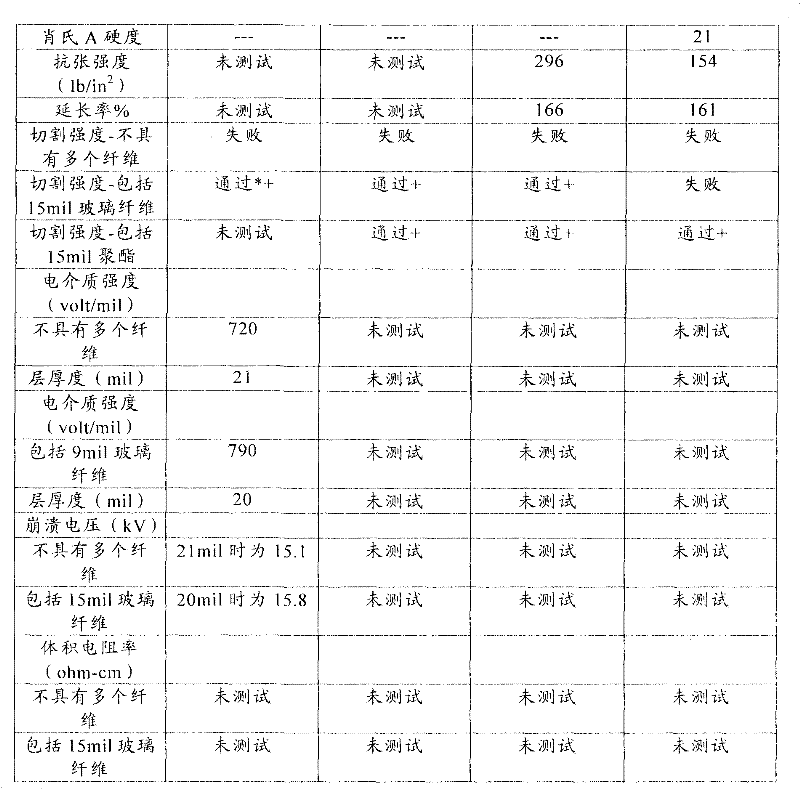
*表示当7milTedlar背板应用于层1时通过 * Denotes pass when 7milTedlar backsheet is applied to layer 1
表4(续)Table 4 (continued)

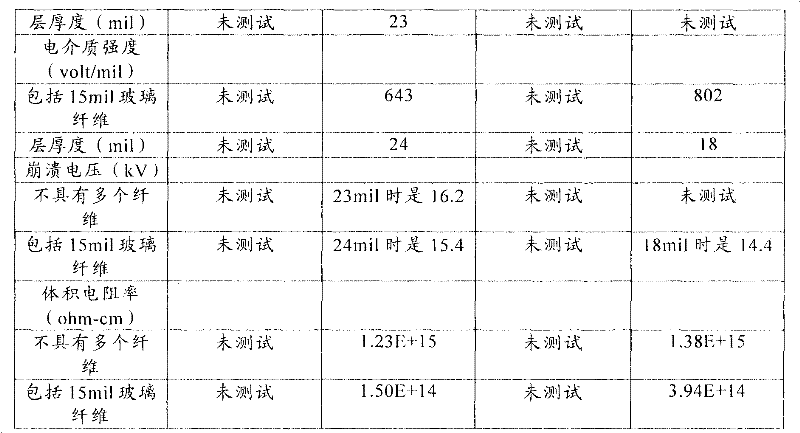
表4(续)Table 4 (continued)
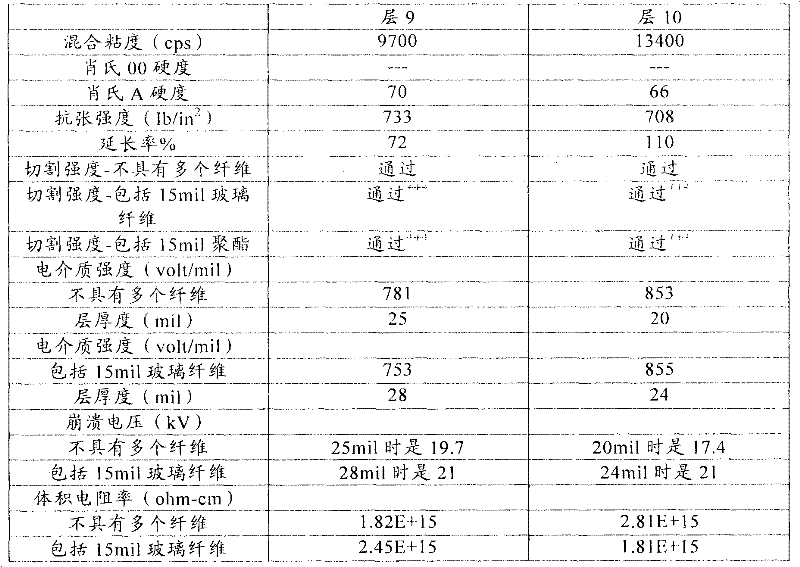
(+)代表在切割测试之后显示出不存在孔洞或穿孔的层的定性视觉评价。(+) represents a qualitative visual evaluation of the layer showing the absence of holes or perforations after the cut test.
(++)代表超过上述的(+)并且显示出在相对于接受切割测试面的层相反面上不存在可见的突出痕迹的层的定性视觉评价。(++) represents a qualitative visual evaluation of a layer that exceeds the above (+) and shows the absence of visible protruding marks on the side of the layer opposite to the side that received the cut test.
(+++)代表超过上述的(+)和(++)并且显示出在相对于接受切割测试面的层相反面上几乎没有任意痕迹的层的定性视觉评价。(+++) represents a qualitative visual evaluation of a layer that exceeds the above (+) and (++) and shows hardly any traces on the opposite side of the layer to the side that was subjected to the cutting test.
根据ASTM D4287确定25℃的混合粘度。The mixed viscosity at 25°C is determined according to ASTM D4287.
使用ASTM D2240确定肖氏00硬度。The Shore 00 hardness was determined using ASTM D2240.
使用ASTM D2240确定肖氏A硬度。The Shore A hardness is determined using ASTM D2240.
使用ASTM D-412确定抗张强度((lb/in2)。Tensile strength ((lb/in 2 ) was determined using ASTM D-412.
使用ASTM D-412确定延伸率%。% elongation was determined using ASTM D-412.
使用切割测试确定切割强度。使用UL-1703和IEC 61730-2进行切割测试。除了通过根据下文更详细描述的湿泄露测试,根据视觉评价层中没有空洞和穿孔确定“通过”。同样,根据视觉评价层中有一个或多个空洞或穿孔和/或湿泄露测试失败,确定“失败”。Use a cut test to determine cut strength. Cut tested using UL-1703 and IEC 61730-2. "Pass" was determined by visual evaluation of the absence of voids and perforations in the layer, except by passing according to the Wet Leak Test described in more detail below. Also, "Fail" is determined based on visual evaluation of one or more voids or punctures in the layer and/or failure of the wet leak test.
使用ASTM D 149确定电介质强度(volt/mil)。Dielectric strength (volt/mil) was determined using ASTM D 149.
崩溃电压(kV)(在所属领域中还被称为“击穿电压”)被计算为电介质强度(volt/mil)x样品厚度(mil)。The breakdown voltage (kV) (also referred to in the art as "breakdown voltage") was calculated as dielectric strength (volt/mil) x sample thickness (mil).
使用ASTM D 257确定体积电阻率(ohm-cm)。Volume resistivity (ohm-cm) was determined using ASTM D 257.
上文列出的数据表示本发明的氢化硅烷化-可固化硅树脂组合物一般可被用于形成没有Tedlar背板的组件,从而降低成本、生产复杂度和需要形成光生伏打电池组件的时间。该数据还表示使用平衡的直链有机硅化合物和分支有机硅化合物还加强组件并且可减少使用昂贵的填料和纤维的需要。此外,该数据表示使用直链和分支有机硅化合物和填料和/或纤维可提供给组件附加的强度从而用于特殊的应用。The data presented above indicate that the hydrosilylation-curable silicone resin compositions of the present invention can generally be used to form components without a Tedlar backsheet, thereby reducing cost, manufacturing complexity, and time required to form photovoltaic cell components . The data also indicate that using a balance of linear and branched silicone compounds also strengthens the assembly and may reduce the need to use expensive fillers and fibers. In addition, the data indicates that the use of linear and branched silicone compounds and fillers and/or fibers can provide additional strength to components for specific applications.
组件的形成:Formation of components:
组合物1、3、6、8和10也被用于形成一系列组件(组件1、3、6、8和10)。组件1、3、6、8和10分别形成如表5中如下列举的,从上至下:Compositions 1, 3, 6, 8 and 10 were also used to form a series of modules (modules 1, 3, 6, 8 and 10). Components 1, 3, 6, 8 and 10 were formed as listed below in Table 5, from top to bottom, respectively:
表5table 5
*硅树脂还限定为“前面”包裹材料,并且包括按重量计的52.77份的直链有机硅化合物2,按重量计的10.75份的直链有机硅化合物3,32.39克的根据ASTM D4287确定的25℃的粘度是约100厘沱的三甲基硅氧基末端的二甲基硅氧烷,按重量计的3.77份的有机氢硅化合物1,按重量计的0.24份的有机氢硅化合物2,按重量计的0.01份的抑制剂和按重量计的0.07份的催化剂2。前面包裹还具有ASTM D4287确定的25℃的约668cps的混合初始粘度。 * Silicone is also defined as the "front" wrap material and includes 52.77 parts by weight of linear silicone compound 2, 10.75 parts by weight of linear silicone compound 3, 32.39 grams of Trimethylsiloxy-terminated dimethylsiloxane having a viscosity of about 100 centistokes at 25°C, 3.77 parts by weight of organohydrogensilicon compound 1, 0.24 parts by weight of organohydrogensilicon compound 2 , 0.01 parts by weight of inhibitor and 0.07 parts by weight of catalyst 2. The front wrap also had an initial mix viscosity of about 668 cps at 25°C as determined by ASTM D4287.
还形成比较组件如表6中如下列举的,从上至下:The comparative components are also formed as listed below in Table 6, from top to bottom:
表6Table 6
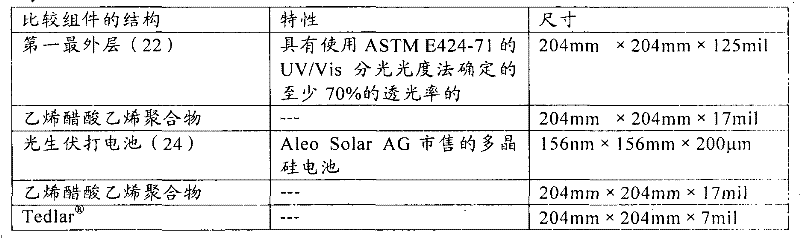
组件1、3、6、8和10和比较组件的玻璃是AFG Industries,Inc.市售的,商品名是Solatex

组件的耐湿热测试:Damp heat resistance test of components:
形成之后,根据IEC 61215章节10.13,1000Hr湿热测试评价组件1、3、6、8和10和比较组件的每个样品,从而确定接触约85℃和85%(85/85)的环境不同时间段之后的湿热耐性(MOhm)的效果。一旦完成,根据IEC61215章节10.13进行湿泄露测试。更确切的讲,如上所述,在进行切割测试之前和之后,组件1、3、6、8和10和比较组件的每个样品都接触85/85环境。随后,评价样品从而确定抗性。After formation, each sample of assemblies 1, 3, 6, 8 and 10 and comparison assemblies was evaluated according to the IEC 61215 section 10.13, 1000Hr Damp Heat test to determine exposure to an environment of approximately 85°C and 85% (85/85) for different periods of time The effect of moisture and heat resistance (MOhm) after that. Once completed, perform a wet leak test according to IEC61215 section 10.13. More specifically, as described above, each sample of assemblies 1, 3, 6, 8 and 10 and the comparative assembly were exposed to the 85/85 environment before and after the cut test was performed. Subsequently, samples were evaluated to determine resistance.
第一组的组件1、3、6、,8和10和比较组件均安置于85/85环境中大约1152小时,然后进行切割测试。切割测试之后,第一组的组件浸入22.8℃的水中2分钟,根据湿泄露测试确定抗性,如表7列出的。Modules 1, 3, 6, 8, and 10 of the first group and the comparison module were all placed in the 85/85 environment for about 1152 hours and then subjected to the cut test. After the cut test, the components of the first group were immersed in water at 22.8° C. for 2 minutes, and the resistance was determined according to the wet leak test, as listed in Table 7.
在浸入2分钟之后,同样的第一组组件再保持浸入2分钟(总共浸入4分钟)。总共4分钟的浸入之后,再次评价第一组的组件从而确定抗性,也在表7中列出的。After 2 minutes of immersion, the same first set of assemblies remained immersed for an additional 2 minutes (total immersion of 4 minutes). After a total of 4 minutes of immersion, the components of the first set were evaluated again to determine resistance, also listed in Table 7.
在以下的每一个测试中,在表7-10进行了总结,如果在被浸入不同的时间并且进行了切割测试之后平均抗性大于400MOhm,则认为组件1、3、6、8和10和比较组件“通过”。换句话说,如果2和4分钟的数据平均值大于400Mohm,组件“通过”。如果小于400Mohm,组件失败。In each of the following tests, summarized in Tables 7-10, components 1, 3, 6, 8 and 10 are considered if the average resistance after being immersed for various times and subjected to the cutting test is greater than 400 MOhm and compared Components "pass". In other words, the component "passes" if the 2 and 4 minute data average is greater than 400 Mohm. If less than 400Mohm, the component fails.
表7Table 7

此外,在上述的浸入2和4分钟之后,第一组的组件放回到85/85环境中再达约1635小时,从而第一组组件的接触总时间大约是2787小时。在接触了85/85环境之后,第一组组件浸入22.8℃的水中2分钟并且评价确定抗性,如表8中列出的。In addition, after the 2 and 4 minute immersions described above, the assemblies of the first set were placed back into the 85/85 environment for an additional approximately 1635 hours, so that the total contact time of the assemblies of the first set was approximately 2787 hours. After exposure to the 85/85 environment, the first set of assemblies was immersed in water at 22.8°C for 2 minutes and evaluated to determine resistance, as listed in Table 8.
2分钟的浸入之后,同样的第一组的组件(接触85/85环境总共约2787小时之后)再保持浸入2分钟(总共四分钟)。总共4分钟的浸入之后,再次评价第一组的组件从而确定抗性,也在表8中列出。After the 2 minutes of immersion, the same first set of assemblies (after a total of about 2787 hours of exposure to the 85/85 environment) remained immersed for an additional 2 minutes (total of four minutes). After a total of 4 minutes of immersion, the components of the first set were evaluated again to determine resistance, also listed in Table 8.
表8Table 8

*表示由于必须通过大于400MOhm的测量,以2376小时接触85/85环境的第一组的组件1失败。 * Indicates that component 1 of the first group exposed to the 85/85 environment for 2376 hours failed due to having to pass a measurement greater than 400 MOhm.
**表示以1968小时,样品以831Mohm的平均值通过 ** Indicates that in 1968 hours, the sample passed with an average value of 831Mohm
也制备了组件1、3、6、8和10和比较组件的每一个的第二组,然后进行切割测试。切割测试之后,第二组的组件被安置于85/85环境中大约1152小时。随后,第二组的组件浸入22.8℃水中2分钟,并且评价确定抗性,如表9列出的。A second set of each of assemblies 1, 3, 6, 8, and 10 and the comparative assembly was also prepared and then subjected to cut testing. After the cut test, the second set of components were placed in the 85/85 environment for approximately 1152 hours. Subsequently, the assemblies of the second group were immersed in water at 22.8° C. for 2 minutes, and evaluated to determine resistance, as listed in Table 9.
浸入2分钟之后,同样的第二组组件再保持浸入2分钟(共4分钟浸入)。共4分钟的浸入之后,再次评价第二组组件从而确定抗性,也在表9中列出。After 2 minutes of immersion, the same second set of assemblies remained immersed for an additional 2 minutes (total 4 minutes of immersion). After a total of 4 minutes of immersion, a second set of components was again evaluated to determine resistance, also listed in Table 9.
表9Table 9

此外,上述的浸入2分钟和4分钟之后,第二组组件被放回到85/85环境再达约1536小时,这样第一组组件的总接触时间大约是2688小时。接触85/85环境之后,第二组组件浸入22.8℃水中2分钟,并且评价确定抗性,如表10列出的。Additionally, after the 2 and 4 minute immersions described above, the second set of assemblies was placed back into the 85/85 environment for an additional approximately 1536 hours, such that the total contact time for the first set of assemblies was approximately 2688 hours. After exposure to the 85/85 environment, a second set of assemblies was immersed in 22.8°C water for 2 minutes and evaluated to determine resistance, as listed in Table 10.
2分钟的浸入之后,同样的第二组组件(接触85/85环境总共2688小时之后)再保持浸入2分钟(总共四分钟)。总共4分钟的浸入之后,再次评价第一组的组件从而确定抗性,也在表10中列出。Following the 2 minute immersion, the same second set of assemblies (after a total of 2688 hours of exposure to the 85/85 environment) remained immersed for an additional 2 minutes (total of four minutes). After a total of 4 minutes of immersion, the components of the first set were again evaluated to determine resistance, also listed in Table 10.
表10Table 10

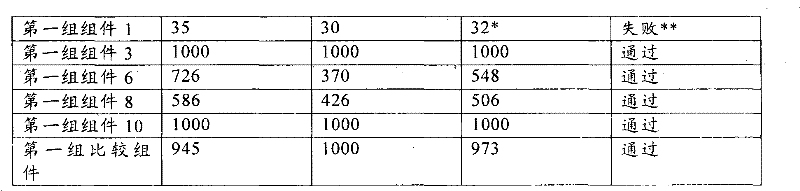
*表示由于必须通过大于400MOhm的测量,以2376小时接触85/85环境的第二组的组件1失败。 * Indicates that module 1 of the second group exposed to 85/85 environment for 2376 hours failed due to having to pass a measurement greater than 400 MOhm.
**表示以1968小时,样品以649Mohm的平均值通过 ** Indicates that in 1968 hours, the sample passed with an average value of 649Mohm
上述列出的数据表示本法的组件1、3、6、8和10一般工作性能与非本发明的比较组件相同。因此,因为可形成不具有Tedlar的组件3、6、8和10,本发明降低成本、生产复杂度和需要形成光生伏打电池组件的时间。The data listed above shows that modules 1, 3, 6, 8 and 10 of the present method generally perform the same as the comparative non-inventive assemblies. Thus, because modules 3, 6, 8, and 10 can be formed without Tedlar, the present invention reduces cost, production complexity, and time required to form photovoltaic cell modules.
已经以说明性的方式描述了本发明,应理解已使用的术语是以词汇的描述性质,而不是限定。根据以上的传授内容,本发明的多个改进和变化是可能的,本发明可以以特别描述的以外得被操作。Having described the invention in an illustrative manner, it is to be understood that the terminology which has been used is in the sense of words of description rather than limitation. Many modifications and variations of the present invention are possible in light of the above teaching, and the invention can be operated otherwise than as specifically described.
Claims (36)
Applications Claiming Priority (3)
| Application Number | Priority Date | Filing Date | Title |
|---|---|---|---|
| US11042908P | 2008-10-31 | 2008-10-31 | |
| US61/110,429 | 2008-10-31 | ||
| PCT/US2009/062513 WO2010051355A2 (en) | 2008-10-31 | 2009-10-29 | Photovoltaic cell module and method of forming |
Related Child Applications (2)
| Application Number | Title | Priority Date | Filing Date |
|---|---|---|---|
| CN2012103909267A Division CN102931259A (en) | 2008-10-31 | 2009-10-29 | Photovoltaic cell module and method of forming |
| CN2012103917329A Division CN102931260A (en) | 2008-10-31 | 2009-10-29 | Photovoltaic cell module and method of forming |
Publications (1)
| Publication Number | Publication Date |
|---|---|
| CN102272947A true CN102272947A (en) | 2011-12-07 |
Family
ID=42129547
Family Applications (3)
| Application Number | Title | Priority Date | Filing Date |
|---|---|---|---|
| CN2009801534605A Pending CN102272947A (en) | 2008-10-31 | 2009-10-29 | Photovoltaic cell assembly and method of forming |
| CN2012103917329A Pending CN102931260A (en) | 2008-10-31 | 2009-10-29 | Photovoltaic cell module and method of forming |
| CN2012103909267A Pending CN102931259A (en) | 2008-10-31 | 2009-10-29 | Photovoltaic cell module and method of forming |
Family Applications After (2)
| Application Number | Title | Priority Date | Filing Date |
|---|---|---|---|
| CN2012103917329A Pending CN102931260A (en) | 2008-10-31 | 2009-10-29 | Photovoltaic cell module and method of forming |
| CN2012103909267A Pending CN102931259A (en) | 2008-10-31 | 2009-10-29 | Photovoltaic cell module and method of forming |
Country Status (7)
| Country | Link |
|---|---|
| US (2) | US20110203664A1 (en) |
| EP (3) | EP2485276A3 (en) |
| JP (3) | JP2012507869A (en) |
| KR (3) | KR101625545B1 (en) |
| CN (3) | CN102272947A (en) |
| TW (3) | TWI513025B (en) |
| WO (1) | WO2010051355A2 (en) |
Cited By (10)
| Publication number | Priority date | Publication date | Assignee | Title |
|---|---|---|---|---|
| CN103296102A (en) * | 2013-05-14 | 2013-09-11 | 保定嘉盛光电科技有限公司 | Solar cell module and production method thereof |
| CN103358628A (en) * | 2012-04-01 | 2013-10-23 | 杨亚升 | Fluoride-free back film for packaging solar battery component and production method thereof |
| CN104576826A (en) * | 2014-12-17 | 2015-04-29 | 山东力诺太阳能电力股份有限公司 | Post-processing method of solar cell |
| CN104576794A (en) * | 2014-12-17 | 2015-04-29 | 山东力诺光伏高科技有限公司 | Production method of invisible-crack-resistant solar component |
| CN104769729A (en) * | 2012-11-12 | 2015-07-08 | 道康宁公司 | Photovoltaic cell module |
| CN104769043A (en) * | 2012-11-12 | 2015-07-08 | 道康宁公司 | Method of forming an electronic article |
| CN105377545A (en) * | 2013-08-21 | 2016-03-02 | 皇家飞利浦有限公司 | Textile optics -solution for robust flexible light treatment pads |
| CN110494473A (en) * | 2018-03-14 | 2019-11-22 | 工程吸气公司 | Dispensable chemical compositions with high amounts of filler material and low thixotropic index levels |
| CN113113509A (en) * | 2021-04-07 | 2021-07-13 | 安徽晶天新能源科技有限责任公司 | Glue coating quality point-division detection process for solar silicon wafer processing |
| CN115326902A (en) * | 2022-09-15 | 2022-11-11 | 南通大学 | A flexible electrode of nickel oxide/nickel hydroxide mesoporous microspheres |
Families Citing this family (55)
| Publication number | Priority date | Publication date | Assignee | Title |
|---|---|---|---|---|
| KR101157407B1 (en) | 2003-07-07 | 2012-06-21 | 다우 코닝 코포레이션 | Encapsulation of solar cells |
| US8420412B2 (en) * | 2008-03-14 | 2013-04-16 | Dow Corning Corporation | Method of forming a photovoltaic cell module |
| RU2431786C1 (en) * | 2010-03-11 | 2011-10-20 | Государственное научное учреждение Всероссийский научно-исследовательский институт электрификации сельского хозяйства Российская академия сельскохозяйственных наук (ГНУ ВИЭСХ Россельхозакадемии) | Solar photoelectric module and its manufacturing method |
| JP2011254009A (en) * | 2010-06-03 | 2011-12-15 | Shin Etsu Chem Co Ltd | Solar cell module silicone resin composition and solar cell module |
| JP5231499B2 (en) * | 2010-09-06 | 2013-07-10 | シャープ株式会社 | Solar cell module |
| US8921495B2 (en) | 2010-09-22 | 2014-12-30 | Dow Corning Corporation | High refractive index compositions containing resin-linear organosiloxane block copolymers |
| KR101807190B1 (en) | 2010-09-22 | 2017-12-08 | 다우 코닝 코포레이션 | Process for preparing resin-linear organosiloxane block copolymers |
| KR101829336B1 (en) | 2010-09-22 | 2018-02-19 | 다우 코닝 코포레이션 | Thermally stable compositions containing resin-linear organosiloxane block copolymers |
| US9045668B2 (en) | 2010-09-22 | 2015-06-02 | Dow Corning Corporation | Organosiloxane block copolymer |
| KR101614981B1 (en) * | 2011-01-24 | 2016-04-22 | 주식회사 엘지화학 | Photovoltaic cell module |
| CN103339171B (en) | 2011-02-04 | 2016-05-04 | 道康宁公司 | Curable Organosiloxane Block Copolymer Emulsions |
| US20120211079A1 (en) * | 2011-02-23 | 2012-08-23 | International Business Machines Corporation | Silicon photovoltaic element and fabrication method |
| US20140017845A1 (en) | 2011-03-31 | 2014-01-16 | Dow Corning Corporation | Method Of Forming A Photovoltaic Cell Module With A Cell Press |
| KR20120124571A (en) * | 2011-05-04 | 2012-11-14 | 엘지전자 주식회사 | Solar cell module and manufacturing method thereof |
| KR20120132980A (en) * | 2011-05-30 | 2012-12-10 | 엘지전자 주식회사 | Solar cell module |
| KR20140048889A (en) | 2011-06-02 | 2014-04-24 | 다우 코닝 코포레이션 | Photovoltaic module assembly and method of assembling the same |
| KR101997921B1 (en) * | 2011-09-05 | 2019-07-08 | 엘지전자 주식회사 | Solar cell module |
| CN102431255B (en) * | 2011-09-20 | 2014-12-24 | 奇瑞汽车股份有限公司 | Composite material having solar cell and production method thereof |
| CN103022190A (en) * | 2011-09-21 | 2013-04-03 | 杜邦公司 | Inflaming retarding backing plate for solar cell module |
| CN103009688A (en) * | 2011-09-21 | 2013-04-03 | 杜邦公司 | Laminating flame-retardant sheet |
| US20130083407A1 (en) * | 2011-09-28 | 2013-04-04 | Reflexite Corporation | Optical structures formed with thermal ramps |
| CN103107222A (en) * | 2011-11-15 | 2013-05-15 | 杜邦太阳能有限公司 | Back sheet suitable for solar module and preparation method thereof |
| ITMI20112174A1 (en) * | 2011-11-29 | 2013-05-30 | Scamar Compositi S R L | PHOTOVOLTAIC PANEL. |
| TW201347215A (en) | 2012-01-26 | 2013-11-16 | Dow Corning | Method for forming photovoltaic battery module |
| WO2013112845A1 (en) | 2012-01-26 | 2013-08-01 | Dow Corning Corporation | A photovoltaic cell module and method of forming the same |
| TW201342645A (en) | 2012-01-26 | 2013-10-16 | Dow Corning | Photovoltaic battery module and forming method thereof |
| EP2866266A4 (en) * | 2012-06-22 | 2015-10-21 | Panasonic Ip Man Co Ltd | SOLAR CELL MODULE |
| US20140000955A1 (en) * | 2012-06-28 | 2014-01-02 | International Business Machines Corporation | Conformal Coating Capable of Scavenging a Corrosive Agent |
| CA2879793C (en) * | 2012-08-03 | 2021-06-08 | Momentive Performance Materials Gmbh | Process for the manufacture of a multilayer silicone structure |
| WO2014047006A1 (en) * | 2012-09-18 | 2014-03-27 | Dow Corning Corporation | Methods of reducing and/or eliminating potential induced degradation of photovoltaic cell modules |
| WO2014047633A1 (en) | 2012-09-24 | 2014-03-27 | Dow Corning Corporation | Photovoltaic module assembly and method of assembling the same |
| WO2014059204A1 (en) * | 2012-10-12 | 2014-04-17 | E. I. Du Pont De Nemours And Company | Solar cell module with a nanofilled encapsulant layer |
| KR102168256B1 (en) | 2012-11-12 | 2020-10-22 | 다우 실리콘즈 코포레이션 | Flexible heat shield with silicone elastomer and a topcoat for inflatible safety devices |
| US20140191841A1 (en) * | 2013-01-04 | 2014-07-10 | International Business Machines Corporation | Conformal coating to scavenge elemental sulfur |
| CN104124300A (en) * | 2013-04-26 | 2014-10-29 | 比亚迪股份有限公司 | Solar cell backplane and solar cell module |
| JP2015012114A (en) * | 2013-06-28 | 2015-01-19 | 信越化学工業株式会社 | Solar battery module, and method for manufacturing the same |
| HUE029702T2 (en) * | 2013-10-17 | 2017-03-28 | Das Energy Gmbh | Photovoltaic panel and method for its production |
| US9478679B2 (en) * | 2013-12-11 | 2016-10-25 | Varian Semiconductor Equipment Associates, Inc. | Dielectric coating of the edge of a solar cell |
| CN105368064B (en) * | 2014-08-27 | 2018-01-23 | 广州慧谷化学有限公司 | Organopolysiloxane composition and preparation method thereof and semiconductor devices |
| CN104241419B (en) * | 2014-08-28 | 2017-02-15 | 上海空间电源研究所 | Thin film type semi-rigid solar cell array and manufacturing method thereof |
| US20190063067A1 (en) * | 2017-08-28 | 2019-02-28 | TopFiberRoof, LLC | Flexible Elastomer And Fiberglass Layered Building Element |
| FR3071357B1 (en) * | 2017-09-20 | 2019-11-22 | Total Sa | FLEXIBLE LAMINATE OF PHOTOVOLTAIC CELLS AND METHOD THEREOF |
| WO2019106234A1 (en) * | 2017-11-28 | 2019-06-06 | Aalto-Korkeakoulusäätiö Sr | Integration of solar cells to textiles |
| CN112041376B (en) * | 2018-04-16 | 2023-04-04 | 信越化学工业株式会社 | Transparent drying agent for organic EL and method of using the same |
| DE102018110240A1 (en) * | 2018-04-27 | 2019-10-31 | Infineon Technologies Ag | Semiconductor device and manufacturing |
| USD894115S1 (en) * | 2018-05-17 | 2020-08-25 | Csi Cells Co., Ltd. | Solar panel |
| WO2019232570A1 (en) * | 2018-06-05 | 2019-12-12 | Gale Pacific Limited | A fabric |
| KR102209403B1 (en) * | 2018-12-11 | 2021-02-01 | 주식회사 포스코 | Method for preparing porous polysiloxane film, porous polysiloxane film prepared by the same and solar cell module comprising the same |
| FR3090202B1 (en) * | 2018-12-13 | 2021-03-19 | Commissariat Energie Atomique | PROCESS FOR ASSEMBLING PHOTOVOLTAIC CELLS TO A SUBSTRATE IMPREGNATED WITH CROSS-LINKABLE POLYMERIC MATERIAL |
| CN110756006B (en) * | 2019-07-10 | 2021-09-28 | 内蒙古中泰汇金环保科技有限公司 | Quenching absorption tower for treating waste gas generated by recycling hazardous waste inorganic salt |
| FR3104817B1 (en) | 2019-12-16 | 2023-03-31 | Commissariat Energie Atomique | Process for manufacturing a photovoltaic module with partial crosslinking and lamination |
| USD1007410S1 (en) * | 2020-06-01 | 2023-12-12 | Silfab Solar Inc. | Solar module |
| TWI900657B (en) * | 2021-09-17 | 2025-10-11 | 通用矽酮股份有限公司 | Bendable photovoltaic device packaging structures and encapsulant material containing cured silicone |
| JP7637646B2 (en) | 2022-01-14 | 2025-02-28 | 信越化学工業株式会社 | Manufacturing method of solar cell module |
| FR3135086B1 (en) * | 2022-04-28 | 2025-07-04 | Elkem Silicones France Sas | Radiation-curable silicone composition comprising Pt(octane-2,4-dione)2 as catalyst |
Citations (8)
| Publication number | Priority date | Publication date | Assignee | Title |
|---|---|---|---|---|
| FR2426337A1 (en) * | 1978-05-19 | 1979-12-14 | Comp Generale Electricite | SOLAR CELL PANEL AND ITS MANUFACTURING PROCESS |
| US20020048680A1 (en) * | 2000-05-17 | 2002-04-25 | Yoshimichi Yamanaka | Primer composition and bonding method |
| EP1267419A2 (en) * | 2001-06-13 | 2002-12-18 | Sharp Kabushiki Kaisha | Solar cell and method of producing the same |
| US20050224108A1 (en) * | 2004-04-13 | 2005-10-13 | Cheung Osbert H | Enhanced photovoltaic module |
| US20060166023A1 (en) * | 2002-09-06 | 2006-07-27 | Dai Nippon Printing Co., Ltd. | Backside protective sheet for solar battery module and solar battery module using the same |
| CN1816916A (en) * | 2003-07-07 | 2006-08-09 | 陶氏康宁公司 | Encapsulation of solar cells |
| WO2007120197A2 (en) * | 2005-11-04 | 2007-10-25 | Dow Corning Corporation | Encapsulation of photovoltaic cells |
| US20080017241A1 (en) * | 2006-07-21 | 2008-01-24 | Anderson Jerrel C | Embossed high modulus encapsulant sheets for solar cells |
Family Cites Families (46)
| Publication number | Priority date | Publication date | Assignee | Title |
|---|---|---|---|---|
| NL131800C (en) | 1965-05-17 | |||
| US3971884A (en) * | 1975-09-12 | 1976-07-27 | National Distillers And Chemical Corporation | Ethylene-vinyl acetate silicone rubber adherent laminates and method of production |
| US4057439A (en) | 1976-08-25 | 1977-11-08 | Solarex Corporation | Solar panel |
| US4686137A (en) | 1980-02-29 | 1987-08-11 | Thoratec Laboratories Corp. | Moisture vapor permeable materials |
| US4340709A (en) | 1980-07-16 | 1982-07-20 | General Electric Company | Addition curing silicone compositions |
| US4530879A (en) | 1983-03-04 | 1985-07-23 | Minnesota Mining And Manufacturing Company | Radiation activated addition reaction |
| US4510094A (en) | 1983-12-06 | 1985-04-09 | Minnesota Mining And Manufacturing Company | Platinum complex |
| US4766176A (en) | 1987-07-20 | 1988-08-23 | Dow Corning Corporation | Storage stable heat curable organosiloxane compositions containing microencapsulated platinum-containing catalysts |
| US5145933A (en) | 1987-12-18 | 1992-09-08 | Dow Corning France S.A. | Organosiloxane gel-forming compositions and use thereof |
| US5876792A (en) * | 1988-03-14 | 1999-03-02 | Nextec Applications, Inc. | Methods and apparatus for controlled placement of a polymer composition into a web |
| US4840796A (en) * | 1988-04-22 | 1989-06-20 | Dow Corning Corporation | Block copolymer matrix for transdermal drug release |
| JPH0214244A (en) * | 1988-06-30 | 1990-01-18 | Toray Dow Corning Silicone Co Ltd | Thermosetting organopolysiloxane composition |
| US5474620A (en) | 1994-05-16 | 1995-12-12 | United Solar Systems Corporation | Cut resistant laminate for the light incident surface of a photovoltaic module |
| DE4423195A1 (en) | 1994-07-01 | 1996-01-04 | Wacker Chemie Gmbh | Triazenoxide-transition metal complexes as hydrosilylation catalysts |
| JP3687701B2 (en) * | 1995-05-08 | 2005-08-24 | 株式会社ブリヂストン | Solar cell module |
| JPH091680A (en) | 1995-06-19 | 1997-01-07 | Matsushita Electric Works Ltd | Manufacture of composite material |
| JP2915327B2 (en) * | 1995-07-19 | 1999-07-05 | キヤノン株式会社 | Solar cell module and method of manufacturing the same |
| JPH0964391A (en) | 1995-08-24 | 1997-03-07 | Canon Inc | Solar cell module |
| EP1458035A3 (en) | 1995-10-17 | 2005-07-27 | Canon Kabushiki Kaisha | Solar cell module having a surface side covering material with a specific nonwoven glass fiber member |
| US5574073A (en) | 1996-01-17 | 1996-11-12 | Dow Corning Corporation | Curable silicone compositions which are foams or elastomers |
| US5741370A (en) | 1996-06-27 | 1998-04-21 | Evergreen Solar, Inc. | Solar cell modules with improved backskin and methods for forming same |
| JP3913306B2 (en) * | 1997-01-21 | 2007-05-09 | キヤノン株式会社 | Solar cell module |
| JPH11135820A (en) * | 1997-08-27 | 1999-05-21 | Canon Inc | Solar cell module and reinforcing member for solar cell module |
| US6020409A (en) | 1997-09-19 | 2000-02-01 | Dow Corning Corporation | Routes to dielectric gel for protection of electronic modules |
| US6302019B1 (en) | 1998-07-23 | 2001-10-16 | Heidelberger Druckmaschinen Ag | Apparatus and method for adjusting skew in a printing press dampener |
| US6169155B1 (en) | 1999-01-14 | 2001-01-02 | Dow Corning Corporation | Silicone gel composition and silicone gel produced therefrom |
| US6239378B1 (en) | 1999-02-02 | 2001-05-29 | Dow Corning Corporation | Flame resistant silicone rubber wire and cable coating composition |
| GB9917372D0 (en) | 1999-07-23 | 1999-09-22 | Dow Corning | Silicone release coating compositions |
| ES2322224T3 (en) | 1999-09-01 | 2009-06-18 | Kaneka Corporation | SOLAR CELL MODULE OF FINE LAYER AND ITS MANUFACTURING PROCEDURE. |
| US6183593B1 (en) * | 1999-12-23 | 2001-02-06 | Closure Medical Corporation | 1,1-disubstituted ethylene adhesive compositions containing polydimethylsiloxane |
| WO2001049789A2 (en) | 2000-01-06 | 2001-07-12 | Dow Corning S.A. | Organosiloxane compositions |
| US6793759B2 (en) * | 2001-10-09 | 2004-09-21 | Dow Corning Corporation | Method for creating adhesion during fabrication of electronic devices |
| JP4207456B2 (en) * | 2002-02-27 | 2009-01-14 | 株式会社ブリヂストン | Solar cell module and temporary fixing tape therefor |
| JP4174355B2 (en) | 2003-03-10 | 2008-10-29 | 住友ベークライト株式会社 | Transparent composite composition |
| JP2004292194A (en) * | 2003-03-26 | 2004-10-21 | Mitsuboshi Belting Ltd | Manufacturing method of glass plate with low reflection film and glass plate with low reflection film |
| KR101157407B1 (en) | 2003-07-07 | 2012-06-21 | 다우 코닝 코포레이션 | Encapsulation of solar cells |
| AU2005261702B2 (en) * | 2004-07-15 | 2010-09-16 | Akzo Nobel N.V. | Phosphated alcanol, its use as a hydrotrope and cleaning composition containing the compound |
| GB2427170A (en) * | 2005-06-17 | 2006-12-20 | 3M Innovative Properties Co | Fluoropolymer film having glass microspheres |
| JP2007091964A (en) | 2005-09-30 | 2007-04-12 | Asahi Kasei Chemicals Corp | Glass cloth composite silicone curable resin sheet |
| JP2007091962A (en) | 2005-09-30 | 2007-04-12 | Asahi Kasei Chemicals Corp | Glass cloth composite silicone resin sheet |
| JP2007091963A (en) | 2005-09-30 | 2007-04-12 | Asahi Kasei Chemicals Corp | Glass cloth composite silicone-based curable resin sheet and manufacturing method thereof |
| JP2007168150A (en) | 2005-12-20 | 2007-07-05 | Sumitomo Bakelite Co Ltd | Transparent composite sheet |
| WO2008088570A1 (en) * | 2006-04-18 | 2008-07-24 | Itn Energy Systems, Inc. | Reinforcing structures for thin-film photovoltaic device substrates, and associated methods |
| US20070295385A1 (en) * | 2006-05-05 | 2007-12-27 | Nanosolar, Inc. | Individually encapsulated solar cells and solar cell strings having a substantially inorganic protective layer |
| JP2008047614A (en) * | 2006-08-11 | 2008-02-28 | Showa Shell Sekiyu Kk | Improved solar cell module using adsorbent |
| US20090255571A1 (en) | 2008-04-14 | 2009-10-15 | Bp Corporation North America Inc. | Thermal Conducting Materials for Solar Panel Components |
-
2009
- 2009-10-29 CN CN2009801534605A patent/CN102272947A/en active Pending
- 2009-10-29 KR KR1020127026755A patent/KR101625545B1/en active Active
- 2009-10-29 KR KR1020127026757A patent/KR20120130299A/en not_active Withdrawn
- 2009-10-29 CN CN2012103917329A patent/CN102931260A/en active Pending
- 2009-10-29 KR KR1020117012484A patent/KR20110090996A/en not_active Withdrawn
- 2009-10-29 CN CN2012103909267A patent/CN102931259A/en active Pending
- 2009-10-29 US US13/126,603 patent/US20110203664A1/en not_active Abandoned
- 2009-10-29 EP EP12166549A patent/EP2485276A3/en not_active Withdrawn
- 2009-10-29 WO PCT/US2009/062513 patent/WO2010051355A2/en not_active Ceased
- 2009-10-29 EP EP12166554A patent/EP2485277A3/en not_active Withdrawn
- 2009-10-29 EP EP09744574.6A patent/EP2351102B1/en active Active
- 2009-10-29 JP JP2011534750A patent/JP2012507869A/en active Pending
- 2009-10-30 TW TW101138811A patent/TWI513025B/en active
- 2009-10-30 TW TW098137024A patent/TWI508313B/en active
- 2009-10-30 TW TW101138810A patent/TWI508317B/en active
-
2012
- 2012-10-26 JP JP2012236740A patent/JP5509293B2/en active Active
- 2012-10-26 JP JP2012236744A patent/JP2013065859A/en active Pending
-
2015
- 2015-02-25 US US14/630,998 patent/US9842952B2/en active Active
Patent Citations (8)
| Publication number | Priority date | Publication date | Assignee | Title |
|---|---|---|---|---|
| FR2426337A1 (en) * | 1978-05-19 | 1979-12-14 | Comp Generale Electricite | SOLAR CELL PANEL AND ITS MANUFACTURING PROCESS |
| US20020048680A1 (en) * | 2000-05-17 | 2002-04-25 | Yoshimichi Yamanaka | Primer composition and bonding method |
| EP1267419A2 (en) * | 2001-06-13 | 2002-12-18 | Sharp Kabushiki Kaisha | Solar cell and method of producing the same |
| US20060166023A1 (en) * | 2002-09-06 | 2006-07-27 | Dai Nippon Printing Co., Ltd. | Backside protective sheet for solar battery module and solar battery module using the same |
| CN1816916A (en) * | 2003-07-07 | 2006-08-09 | 陶氏康宁公司 | Encapsulation of solar cells |
| US20050224108A1 (en) * | 2004-04-13 | 2005-10-13 | Cheung Osbert H | Enhanced photovoltaic module |
| WO2007120197A2 (en) * | 2005-11-04 | 2007-10-25 | Dow Corning Corporation | Encapsulation of photovoltaic cells |
| US20080017241A1 (en) * | 2006-07-21 | 2008-01-24 | Anderson Jerrel C | Embossed high modulus encapsulant sheets for solar cells |
Cited By (17)
| Publication number | Priority date | Publication date | Assignee | Title |
|---|---|---|---|---|
| CN103358628A (en) * | 2012-04-01 | 2013-10-23 | 杨亚升 | Fluoride-free back film for packaging solar battery component and production method thereof |
| CN104769729B (en) * | 2012-11-12 | 2017-08-29 | 道康宁公司 | Photovoltaic battery module |
| CN104769729A (en) * | 2012-11-12 | 2015-07-08 | 道康宁公司 | Photovoltaic cell module |
| CN104769043A (en) * | 2012-11-12 | 2015-07-08 | 道康宁公司 | Method of forming an electronic article |
| CN103296102B (en) * | 2013-05-14 | 2016-08-10 | 保定嘉盛光电科技股份有限公司 | A kind of solar module and manufacture method thereof |
| CN103296102A (en) * | 2013-05-14 | 2013-09-11 | 保定嘉盛光电科技有限公司 | Solar cell module and production method thereof |
| CN105377545B (en) * | 2013-08-21 | 2017-04-12 | 飞利浦灯具控股公司 | Textile Optics - A Solution for Robust Flexible Light Handling Pads |
| CN105377545A (en) * | 2013-08-21 | 2016-03-02 | 皇家飞利浦有限公司 | Textile optics -solution for robust flexible light treatment pads |
| US9989243B2 (en) | 2013-08-21 | 2018-06-05 | Philips Lighting Holding B.V. | Textile optics—solution for robust flexible light treatment pads |
| CN104576794A (en) * | 2014-12-17 | 2015-04-29 | 山东力诺光伏高科技有限公司 | Production method of invisible-crack-resistant solar component |
| CN104576826B (en) * | 2014-12-17 | 2017-04-26 | 山东力诺太阳能电力股份有限公司 | Post-processing method of solar cell |
| CN104576826A (en) * | 2014-12-17 | 2015-04-29 | 山东力诺太阳能电力股份有限公司 | Post-processing method of solar cell |
| CN110494473A (en) * | 2018-03-14 | 2019-11-22 | 工程吸气公司 | Dispensable chemical compositions with high amounts of filler material and low thixotropic index levels |
| CN110494473B (en) * | 2018-03-14 | 2023-01-17 | 工程吸气公司 | Dispensable chemical composition with high volume of filler materials and low thixotropic index levels |
| CN113113509A (en) * | 2021-04-07 | 2021-07-13 | 安徽晶天新能源科技有限责任公司 | Glue coating quality point-division detection process for solar silicon wafer processing |
| CN115326902A (en) * | 2022-09-15 | 2022-11-11 | 南通大学 | A flexible electrode of nickel oxide/nickel hydroxide mesoporous microspheres |
| CN115326902B (en) * | 2022-09-15 | 2024-07-30 | 南通大学 | A flexible electrode of nickel oxide/nickel hydroxide mesoporous microspheres |
Also Published As
| Publication number | Publication date |
|---|---|
| TWI513025B (en) | 2015-12-11 |
| EP2485276A2 (en) | 2012-08-08 |
| JP2013048275A (en) | 2013-03-07 |
| US9842952B2 (en) | 2017-12-12 |
| US20150171249A1 (en) | 2015-06-18 |
| EP2351102B1 (en) | 2014-08-20 |
| KR20120130018A (en) | 2012-11-28 |
| JP2012507869A (en) | 2012-03-29 |
| TW201308643A (en) | 2013-02-16 |
| TW201034214A (en) | 2010-09-16 |
| US20110203664A1 (en) | 2011-08-25 |
| TWI508317B (en) | 2015-11-11 |
| WO2010051355A3 (en) | 2011-01-06 |
| EP2351102A2 (en) | 2011-08-03 |
| TWI508313B (en) | 2015-11-11 |
| WO2010051355A2 (en) | 2010-05-06 |
| JP2013065859A (en) | 2013-04-11 |
| CN102931260A (en) | 2013-02-13 |
| CN102931259A (en) | 2013-02-13 |
| JP5509293B2 (en) | 2014-06-04 |
| EP2485276A3 (en) | 2012-09-26 |
| EP2485277A2 (en) | 2012-08-08 |
| KR101625545B1 (en) | 2016-05-30 |
| KR20110090996A (en) | 2011-08-10 |
| TW201308642A (en) | 2013-02-16 |
| EP2485277A3 (en) | 2012-09-26 |
| KR20120130299A (en) | 2012-11-30 |
Similar Documents
| Publication | Publication Date | Title |
|---|---|---|
| EP2351102B1 (en) | Photovoltaic cell module and method of forming | |
| JP5746227B2 (en) | Curable polyorganosiloxane composition for use as a sealant for solar cell modules | |
| CN101473448B (en) | Copper indium diselenide-based photovoltaic device and method of preparing the same | |
| KR20100124812A (en) | Photovoltaic cell module and method of forming same | |
| EP2333841A2 (en) | Cadmium telluride-based photovoltaic device and method of preparing the same | |
| EP2795682B1 (en) | Method of forming a photovoltaic cell module having improved impact resistance | |
| HK1181412B (en) | Curable polyorganosiloxane composition for use as an encapsulant for a solar cell module |
Legal Events
| Date | Code | Title | Description |
|---|---|---|---|
| C06 | Publication | ||
| PB01 | Publication | ||
| C10 | Entry into substantive examination | ||
| SE01 | Entry into force of request for substantive examination | ||
| C02 | Deemed withdrawal of patent application after publication (patent law 2001) | ||
| WD01 | Invention patent application deemed withdrawn after publication |
Application publication date: 20111207 |