CN102238967A - Telomerase inhibitors and methods of use thereof - Google Patents
Telomerase inhibitors and methods of use thereof Download PDFInfo
- Publication number
- CN102238967A CN102238967A CN2009801490151A CN200980149015A CN102238967A CN 102238967 A CN102238967 A CN 102238967A CN 2009801490151 A CN2009801490151 A CN 2009801490151A CN 200980149015 A CN200980149015 A CN 200980149015A CN 102238967 A CN102238967 A CN 102238967A
- Authority
- CN
- China
- Prior art keywords
- nucleic acid
- sequence
- analog
- telomerase
- seq
- Prior art date
- Legal status (The legal status is an assumption and is not a legal conclusion. Google has not performed a legal analysis and makes no representation as to the accuracy of the status listed.)
- Pending
Links
Images


Classifications
-
- A—HUMAN NECESSITIES
- A61—MEDICAL OR VETERINARY SCIENCE; HYGIENE
- A61K—PREPARATIONS FOR MEDICAL, DENTAL OR TOILETRY PURPOSES
- A61K48/00—Medicinal preparations containing genetic material which is inserted into cells of the living body to treat genetic diseases; Gene therapy
-
- A—HUMAN NECESSITIES
- A61—MEDICAL OR VETERINARY SCIENCE; HYGIENE
- A61K—PREPARATIONS FOR MEDICAL, DENTAL OR TOILETRY PURPOSES
- A61K31/00—Medicinal preparations containing organic active ingredients
- A61K31/70—Carbohydrates; Sugars; Derivatives thereof
- A61K31/7088—Compounds having three or more nucleosides or nucleotides
- A61K31/7105—Natural ribonucleic acids, i.e. containing only riboses attached to adenine, guanine, cytosine or uracil and having 3'-5' phosphodiester links
-
- A—HUMAN NECESSITIES
- A61—MEDICAL OR VETERINARY SCIENCE; HYGIENE
- A61P—SPECIFIC THERAPEUTIC ACTIVITY OF CHEMICAL COMPOUNDS OR MEDICINAL PREPARATIONS
- A61P35/00—Antineoplastic agents
-
- A—HUMAN NECESSITIES
- A61—MEDICAL OR VETERINARY SCIENCE; HYGIENE
- A61P—SPECIFIC THERAPEUTIC ACTIVITY OF CHEMICAL COMPOUNDS OR MEDICINAL PREPARATIONS
- A61P43/00—Drugs for specific purposes, not provided for in groups A61P1/00-A61P41/00
-
- C—CHEMISTRY; METALLURGY
- C12—BIOCHEMISTRY; BEER; SPIRITS; WINE; VINEGAR; MICROBIOLOGY; ENZYMOLOGY; MUTATION OR GENETIC ENGINEERING
- C12N—MICROORGANISMS OR ENZYMES; COMPOSITIONS THEREOF; PROPAGATING, PRESERVING, OR MAINTAINING MICROORGANISMS; MUTATION OR GENETIC ENGINEERING; CULTURE MEDIA
- C12N15/00—Mutation or genetic engineering; DNA or RNA concerning genetic engineering, vectors, e.g. plasmids, or their isolation, preparation or purification; Use of hosts therefor
- C12N15/09—Recombinant DNA-technology
- C12N15/11—DNA or RNA fragments; Modified forms thereof; Non-coding nucleic acids having a biological activity
- C12N15/113—Non-coding nucleic acids modulating the expression of genes, e.g. antisense oligonucleotides; Antisense DNA or RNA; Triplex- forming oligonucleotides; Catalytic nucleic acids, e.g. ribozymes; Nucleic acids used in co-suppression or gene silencing
- C12N15/1137—Non-coding nucleic acids modulating the expression of genes, e.g. antisense oligonucleotides; Antisense DNA or RNA; Triplex- forming oligonucleotides; Catalytic nucleic acids, e.g. ribozymes; Nucleic acids used in co-suppression or gene silencing against enzymes
-
- C—CHEMISTRY; METALLURGY
- C12—BIOCHEMISTRY; BEER; SPIRITS; WINE; VINEGAR; MICROBIOLOGY; ENZYMOLOGY; MUTATION OR GENETIC ENGINEERING
- C12Y—ENZYMES
- C12Y207/00—Transferases transferring phosphorus-containing groups (2.7)
- C12Y207/07—Nucleotidyltransferases (2.7.7)
- C12Y207/07049—RNA-directed DNA polymerase (2.7.7.49), i.e. telomerase or reverse-transcriptase
-
- C—CHEMISTRY; METALLURGY
- C12—BIOCHEMISTRY; BEER; SPIRITS; WINE; VINEGAR; MICROBIOLOGY; ENZYMOLOGY; MUTATION OR GENETIC ENGINEERING
- C12N—MICROORGANISMS OR ENZYMES; COMPOSITIONS THEREOF; PROPAGATING, PRESERVING, OR MAINTAINING MICROORGANISMS; MUTATION OR GENETIC ENGINEERING; CULTURE MEDIA
- C12N2310/00—Structure or type of the nucleic acid
- C12N2310/10—Type of nucleic acid
- C12N2310/11—Antisense
Landscapes
- Health & Medical Sciences (AREA)
- Life Sciences & Earth Sciences (AREA)
- Chemical & Material Sciences (AREA)
- Engineering & Computer Science (AREA)
- Genetics & Genomics (AREA)
- Organic Chemistry (AREA)
- Molecular Biology (AREA)
- General Health & Medical Sciences (AREA)
- Bioinformatics & Cheminformatics (AREA)
- Zoology (AREA)
- General Engineering & Computer Science (AREA)
- Biochemistry (AREA)
- Biomedical Technology (AREA)
- Wood Science & Technology (AREA)
- Biotechnology (AREA)
- Pharmacology & Pharmacy (AREA)
- Medicinal Chemistry (AREA)
- Veterinary Medicine (AREA)
- Public Health (AREA)
- Animal Behavior & Ethology (AREA)
- Epidemiology (AREA)
- Virology (AREA)
- Microbiology (AREA)
- Physics & Mathematics (AREA)
- Biophysics (AREA)
- Plant Pathology (AREA)
- General Chemical & Material Sciences (AREA)
- Nuclear Medicine, Radiotherapy & Molecular Imaging (AREA)
- Chemical Kinetics & Catalysis (AREA)
- Pharmaceuticals Containing Other Organic And Inorganic Compounds (AREA)
- Medicines That Contain Protein Lipid Enzymes And Other Medicines (AREA)
- Enzymes And Modification Thereof (AREA)
Abstract
Description
技术领域 technical field
本发明涉及用于治疗癌症及其它增生性病症的组合物和方法。更具体地,本发明涉及端粒酶抑制剂及其用途。The present invention relates to compositions and methods for the treatment of cancer and other proliferative disorders. More specifically, the present invention relates to telomerase inhibitors and uses thereof.
相关申请的交叉引用Cross References to Related Applications
本申请依据35U.S.C.§119(e),要求2008年10月7日提交的序列号为61/103,430的美国临时专利申请的优先权,通过引用将所述申请的内容全部并入本文。This application claims priority under 35 U.S.C. §119(e) to U.S. Provisional Patent Application Serial No. 61/103,430, filed October 7, 2008, the contents of which are hereby incorporated by reference in their entirety.
政府支持governmental support
本发明是在由国立卫生研究院(National Institutes of Health,NIH)的分子与细胞生物学部(Molecular and Cell Biology Department,MCB)颁发的No.5 T32 GM007598培训基金的政府支持下完成的。美国政府对本发明持有一定权利。This invention was made with government support under Training Grant No. 5 T32 GM007598 awarded by the Molecular and Cell Biology Department (MCB) of the National Institutes of Health (NIH). The US Government has certain rights in this invention.
背景技术 Background technique
在过去的几年里,癌症药物开发领域取得了显著成果,这些成果主要集中在了解寻找具有选择性和有效性的药物的关键要求和用于分子靶标选择的基本原理(S.L.Mooberry,Drug Discovery Handbook.Wiley-Interscience 1343-1368(2005))。能够嵌入明确定义的蛋白质的疏水袋的、基于小分子的配体仍然被认为是经典的候选药物,而在被称为“可成药的”基因组内,蛋白是最普遍的治疗靶标(A.L.Hopkins,Nat.Rev.Drug Discovery 1,727-730(2002))。然而,目前,相当多的注意力被投向了新型化合物、化学作用和方法的寻找上,所述新型化合物、化学作用和方法可以充分地靶向除蛋白以外的其它重要分子,其中一些分子在传统意义上被认为是难于处理、难以实现或简单地被认为是“不可成药的”。特别地,多年来,尽管RNA在多种细胞过程中发挥了许多作用(例如核酶、核糖开关、miRNA),它仍被低估为仅仅是遗传信息的携带者。治疗干预本身的可能性激发了对RNA结构和功能越来越多的兴趣,这些可能性包括但不局限于采用传统的(反义)方法和最近的(RNA干扰)方法控制基因表达的可能性。尽管具有挑战性,但旨在利用小分子靶向RNA的努力具有很大的前景,RNA结构所固有的柔韧性和复杂性可以从原则上用作旨在打破RNA功能的新策略的理性设计的基础(J.R.Thomas,Chem.Rev.108,1171-1224(2008))。预期这不仅仅在靶向信使RNA中特别有意义,同时在靶向其它在细胞环境中扮演重要角色的高度结构化的非编码RNA中也特别有意义。过去已有报道称短的寡核苷酸在RNA靶向领域具有相关性质。例如,已证实ODMiR(寡核苷酸导向的RNA错折叠(Oligonucleotide Directed Misfolding of RNA)),可用作抑制I类内含子和大肠杆菌的RNase P的有效方法(J.L.Childs,Proc.Natl.Acad.Sci.USA 99,11091-11096(2002);J.L.Childs,RNA 9,1437-1445(2003))。Over the past few years, the field of cancer drug development has achieved remarkable results, mainly focused on understanding the key requirements for finding selective and effective drugs and the rationale for molecular target selection (S.L. Mooberry, Drug Discovery Handbook . Wiley-Interscience 1343-1368 (2005)). Small-molecule-based ligands capable of embedding into well-defined hydrophobic pockets of proteins are still considered classical drug candidates, and within genomes termed "druggable", proteins are the most prevalent therapeutic targets (A.L. Hopkins, Nat. Rev. Drug Discovery 1, 727-730 (2002)). Currently, however, considerable attention is directed to the search for novel compounds, chemistries and methods that can adequately target other important molecules besides proteins, some of which have been traditionally in the sense that it is considered intractable, difficult to achieve or simply considered "undruggable". In particular, RNA has been underestimated for many years as a mere carrier of genetic information despite its many roles in diverse cellular processes (e.g., ribozymes, riboswitches, miRNAs). Increasing interest in RNA structure and function has been fueled by the possibility of therapeutic intervention itself, including but not limited to the possibility of controlling gene expression using traditional (antisense) and more recently (RNA interference) approaches . Although challenging, efforts aimed at targeting RNA with small molecules hold great promise, and the flexibility and complexity inherent in RNA structure could, in principle, be used as a basis for the rational design of new strategies aimed at disrupting RNA function. Fundamentals (J.R. Thomas, Chem. Rev. 108, 1171-1224 (2008)). This is expected to be of particular interest not only in targeting messenger RNA, but also in targeting other highly structured non-coding RNAs that play important roles in the cellular environment. Short oligonucleotides have been reported in the past to have relevant properties in the field of RNA targeting. For example, it has been demonstrated that ODMiR (Oligonucleotide Directed Misfolding of RNA) can be used as an effective method for inhibiting class I introns and RNase P of Escherichia coli (J.L.Childs, Proc.Natl. Acad. Sci. USA 99, 11091-11096 (2002); J.L. Childs, RNA 9, 1437-1445 (2003)).
端粒酶是一种专门的核糖核蛋白,它由两个主要组分反转录酶蛋白亚基(hTERT)和RNA组分(hTR)(J.Feng,Science 269,1236-1241(1995);T.M.Nakamura,Science 277,911-912(1997))及数种相关蛋白构成。端粒酶利用RNA组分中的一段短序列作为模板,指导染色体末端的端粒重复序列(5’-TTAGGG-3’)的合成。端粒酶被认为是人类癌症的几乎通用的标记物,它对端粒长度的影响在避免复制性衰老中发挥了重要作用。然而,事实上,大部分正常体细胞中端粒酶的活性是被抑制的,已经发现在大约90%的人类肿瘤中,端粒酶是被活化的(J.W.Shay,Eur.J.Cancer33,787-791(1991);N.W.Kim,Science 266,2011-2015(1994))。Telomerase is a specialized ribonucleoprotein, which consists of two main components, a reverse transcriptase protein subunit (hTERT) and an RNA component (hTR) (J.Feng, Science 269, 1236-1241 (1995) ; T.M.Nakamura, Science 277, 911-912 (1997)) and several related proteins. Telomerase uses a short sequence in the RNA component as a template to direct the synthesis of the telomeric repeat sequence (5'-TTAGGG-3') at the end of the chromosome. Telomerase is considered an almost universal marker of human cancer, and its effect on telomere length plays an important role in avoiding replicative senescence. However, in fact, the activity of telomerase in most normal somatic cells is inhibited, and it has been found that in about 90% of human tumors, telomerase is activated (J.W.Shay, Eur.J.Cancer33,787 -791(1991); N.W. Kim, Science 266, 2011-2015(1994)).
发明内容 Contents of the invention
本发明的一个目的在于通过提供与人端粒酶RNA组分的CR4-CR5域结合的抑制剂,来提供抑制人端粒酶的方法和组合物。It is an object of the present invention to provide methods and compositions for inhibiting human telomerase by providing inhibitors that bind to the CR4-CR5 domain of the RNA component of human telomerase.
因此,一方面,提供了端粒酶抑制剂,所述端粒酶抑制剂包含与人端粒酶RNA组分的CR4-CR5域结合的核酸或其类似物。在一种实施方式中,所述与人端粒酶RNA组分的CR4-CR5域结合的核酸是核糖核酸。在另一种实施方式中,所述抑制剂是核酸类似物。在另一种实施方式中,所述核酸类似物是核糖核酸类似物。在优选的实施方式中,所述端粒酶抑制剂与人端粒酶RNA组分的CR4-CR5域的J5/J6环结合。Accordingly, in one aspect there is provided a telomerase inhibitor comprising a nucleic acid or an analog thereof that binds to the CR4-CR5 domain of the RNA component of human telomerase. In one embodiment, the nucleic acid that binds to the CR4-CR5 domain of the RNA component of human telomerase is ribonucleic acid. In another embodiment, the inhibitor is a nucleic acid analog. In another embodiment, the nucleic acid analog is a ribonucleic acid analog. In a preferred embodiment, the telomerase inhibitor binds to the J5/J6 loop of the CR4-CR5 domain of the RNA component of human telomerase.
在一种实施方式中,与人端粒酶RNA组分的CR4-CR5域结合的核酸或其类似物包含长度为4-20个核苷酸的结合序列。在另一种实施方式中,所述核酸或其类似物包含长度为6-14个核苷酸的结合序列。在另一种实施方式中,所述核酸或其其类似物包含长度约为10个核苷酸的结合序列。在另一种实施方式中,所述核酸或其类似物包含长度为10个核苷酸的结合序列。在另一种实施方式中,所述核酸或其类似物包含长度为8个核苷酸的结合序列。In one embodiment, the nucleic acid or analog thereof that binds to the CR4-CR5 domain of the RNA component of human telomerase comprises a binding sequence that is 4-20 nucleotides in length. In another embodiment, the nucleic acid or analogue thereof comprises a binding sequence of 6-14 nucleotides in length. In another embodiment, the nucleic acid or analog thereof comprises a binding sequence of about 10 nucleotides in length. In another embodiment, the nucleic acid or analogue thereof comprises a binding sequence of 10 nucleotides in length. In another embodiment, the nucleic acid or analogue thereof comprises a binding sequence of 8 nucleotides in length.
在一种实施方式中,所述与人端粒酶RNA组分的CR4-CR5域结合的端粒酶抑制剂选自序列编号1至序列编号10组成的组。在另一种实施方式中,所述与人端粒酶RNA组分的CR4-CR5域结合的端粒酶抑制剂包含序列编号1或序列编号2。In one embodiment, the telomerase inhibitor that binds to the CR4-CR5 domain of the RNA component of human telomerase is selected from the group consisting of SEQ ID NO: 1 to SEQ ID NO: 10. In another embodiment, the telomerase inhibitor that binds to the CR4-CR5 domain of the RNA component of human telomerase comprises SEQ ID NO: 1 or SEQ ID NO: 2.
本发明的另一方面提供了抑制端粒酶活性的方法,所述方法包含将端粒酶与核酸或其类似物接触,所述核酸或其类似物与人端粒酶RNA组分的CR4-CR5域结合。在一种实施方式中,所述与人端粒酶RNA组分的CR4-CR5域结合的核酸是核糖核酸。在另一种实施方式中,所述抑制剂是核酸类似物。在另一种实施方式中,所述核酸类似物是核糖核酸类似物。在一个实施方式中,所述端粒酶抑制剂与人端粒酶RNA组分的CR4-CR5域的J5/J6环结合。Another aspect of the present invention provides a method of inhibiting telomerase activity, the method comprising contacting telomerase with a nucleic acid or an analog thereof that binds to the CR4- CR5 domain binding. In one embodiment, the nucleic acid that binds to the CR4-CR5 domain of the RNA component of human telomerase is ribonucleic acid. In another embodiment, the inhibitor is a nucleic acid analog. In another embodiment, the nucleic acid analog is a ribonucleic acid analog. In one embodiment, the telomerase inhibitor binds to the J5/J6 loop of the CR4-CR5 domain of the RNA component of human telomerase.
在一种实施方式中,所述与人端粒酶RNA组分的CR4-CR5域结合的核酸或其类似物包含长度为4-20个核苷酸的结合序列。在另一种实施方式中,所述核酸或其类似物包含长度为6-14个核苷酸的结合序列。在另一种实施方式中,所述核酸或其类似物包含长度约为10个核苷酸的结合序列。在另一种实施方式中,所述核酸或其类似物包含长度为10个核苷酸的结合序列。在另一种实施方式中,所述核酸或其类似物包含长度约为8个核苷酸的结合序列。In one embodiment, the nucleic acid or analog thereof that binds to the CR4-CR5 domain of the RNA component of human telomerase comprises a binding sequence of 4-20 nucleotides in length. In another embodiment, the nucleic acid or analogue thereof comprises a binding sequence of 6-14 nucleotides in length. In another embodiment, the nucleic acid or analog thereof comprises a binding sequence of about 10 nucleotides in length. In another embodiment, the nucleic acid or analogue thereof comprises a binding sequence of 10 nucleotides in length. In another embodiment, the nucleic acid or analog thereof comprises a binding sequence of about 8 nucleotides in length.
在一种实施方式中,所述与人端粒酶RNA组分的CR4-CR5域结合的端粒酶抑制剂选自序列编号1至序列编号10组成的组。在优选的实施方式中,所述与人端粒酶RNA组分的CR4-CR5域结合的端粒酶抑制剂包含序列编号1或序列编号2。In one embodiment, the telomerase inhibitor that binds to the CR4-CR5 domain of the RNA component of human telomerase is selected from the group consisting of SEQ ID NO: 1 to SEQ ID NO: 10. In a preferred embodiment, the telomerase inhibitor that binds to the CR4-CR5 domain of the RNA component of human telomerase comprises SEQ ID NO: 1 or SEQ ID NO: 2.
另一方面,提供了抑制细胞内端粒酶活性的方法,所述方法包含将细胞与核酸或其类似物接触,所述核酸或其类似物与人端粒酶RNA组分的CR4-CR5域结合。In another aspect, there is provided a method of inhibiting telomerase activity in a cell, the method comprising contacting the cell with a nucleic acid or analog thereof that binds to the CR4-CR5 domain of the RNA component of human telomerase combined.
在一种实施方式中,细胞在体外(in vitro)发生接触。在一种实施方式中,所述与人端粒酶RNA组分的CR4-CR5域结合的核酸是核糖核酸。在另一种实施方式中,所述抑制剂是核酸类似物。在另一种实施方式中,所述核酸类似物是核糖核酸类似物。在优选的实施方式中,所述端粒酶抑制剂与人端粒酶RNA组分的CR4-CR5域的J5/J6环结合。In one embodiment, the cells are contacted in vitro. In one embodiment, the nucleic acid that binds to the CR4-CR5 domain of the RNA component of human telomerase is ribonucleic acid. In another embodiment, the inhibitor is a nucleic acid analog. In another embodiment, the nucleic acid analog is a ribonucleic acid analog. In a preferred embodiment, the telomerase inhibitor binds to the J5/J6 loop of the CR4-CR5 domain of the RNA component of human telomerase.
在一种实施方式中,所述与人端粒酶RNA组分的CR4-CR5域结合的核酸或其类似物包含长度为4-20个核苷酸的结合序列。在另一种实施方式中,所述核酸或其类似物包含长度为6-14个核苷酸的结合序列。在另一种实施方式中,所述核酸或其类似物包含长度约10个核苷酸的结合序列。在另一种实施方式中,所述核酸或其类似物包含长度为10个核苷酸的结合序列。在另一种实施方式中,所述核酸或其类似物包含长度约为8个核苷酸的结合序列。In one embodiment, the nucleic acid or analog thereof that binds to the CR4-CR5 domain of the RNA component of human telomerase comprises a binding sequence of 4-20 nucleotides in length. In another embodiment, the nucleic acid or analogue thereof comprises a binding sequence of 6-14 nucleotides in length. In another embodiment, the nucleic acid or analog thereof comprises a binding sequence of about 10 nucleotides in length. In another embodiment, the nucleic acid or analogue thereof comprises a binding sequence of 10 nucleotides in length. In another embodiment, the nucleic acid or analog thereof comprises a binding sequence of about 8 nucleotides in length.
在一种实施方式中,所述与人端粒酶RNA组分的CR4-CR5域结合的端粒酶抑制剂选自序列编号1至序列编号10组成的组。在优选的实施方式中,所述与人端粒酶RNA组分的CR4-CR5域结合的端粒酶抑制剂包含序列编号1或序列编号2。In one embodiment, the telomerase inhibitor that binds to the CR4-CR5 domain of the RNA component of human telomerase is selected from the group consisting of SEQ ID NO: 1 to SEQ ID NO: 10. In a preferred embodiment, the telomerase inhibitor that binds to the CR4-CR5 domain of the RNA component of human telomerase comprises SEQ ID NO: 1 or SEQ ID NO: 2.
另一方面,提供了在对其有需求的受试者中治疗增生性病症的方法,所述方法包含给予受试者有效量的端粒酶抑制剂,所述端粒酶抑制剂包含与人端粒酶RNA组分的CR4-CR5域结合的核酸或其类似物。In another aspect, there is provided a method of treating a proliferative disorder in a subject in need thereof, the method comprising administering to the subject an effective amount of a telomerase inhibitor comprising a human A CR4-CR5 domain bound nucleic acid of the RNA component of telomerase or an analog thereof.
在一种实施方式中,所述与人端粒酶RNA组分的CR4-CR5域结合的核酸是核糖核酸。在另一种实施方式中,所述抑制剂是核酸类似物。在另一种实施方式中,所述核酸类似物是核糖核酸类似物。在优选的实施方式中,所述端粒酶抑制剂与人端粒酶RNA组分的CR4-CR5域的J5/J6环结合。In one embodiment, the nucleic acid that binds to the CR4-CR5 domain of the RNA component of human telomerase is ribonucleic acid. In another embodiment, the inhibitor is a nucleic acid analog. In another embodiment, the nucleic acid analog is a ribonucleic acid analog. In a preferred embodiment, the telomerase inhibitor binds to the J5/J6 loop of the CR4-CR5 domain of the RNA component of human telomerase.
在一种实施方式中,所述与人端粒酶RNA组分的CR4-CR5域结合的核酸或其核酸类似物包含长度为4-20个核苷酸的结合序列。在另一种实施方式中,所述核酸或其类似物包含长度为6-14个核苷酸的结合序列。在另一种实施方式中,所述核酸或其类似物包含长度约为10个核苷酸的结合序列。在另一种实施方式中,所述核酸或其类似物包含长度为10个核苷酸的结合序列。在另一种实施方式中,所述核酸或其类似物包含长度约为8个核苷酸的结合序列。In one embodiment, the nucleic acid or nucleic acid analog thereof that binds to the CR4-CR5 domain of the RNA component of human telomerase comprises a binding sequence with a length of 4-20 nucleotides. In another embodiment, the nucleic acid or analogue thereof comprises a binding sequence of 6-14 nucleotides in length. In another embodiment, the nucleic acid or analog thereof comprises a binding sequence of about 10 nucleotides in length. In another embodiment, the nucleic acid or analogue thereof comprises a binding sequence of 10 nucleotides in length. In another embodiment, the nucleic acid or analog thereof comprises a binding sequence of about 8 nucleotides in length.
在一种实施方式中,所述与人端粒酶RNA组分的CR4-CR5域结合的端粒酶抑制剂选自序列编号1至序列编号10组成的组。在优选的实施方式中,所述与人端粒酶RNA组分的CR4-CR5域结合的端粒酶抑制剂包含序列编号1或序列编号2。在一种实施方式中,受试者中,被治疗的所述增生性病症是癌症。In one embodiment, the telomerase inhibitor that binds to the CR4-CR5 domain of the RNA component of human telomerase is selected from the group consisting of SEQ ID NO: 1 to SEQ ID NO: 10. In a preferred embodiment, the telomerase inhibitor that binds to the CR4-CR5 domain of the RNA component of human telomerase comprises SEQ ID NO: 1 or SEQ ID NO: 2. In one embodiment, the proliferative disorder being treated is cancer in the subject.
另一方面,提供了治疗组合物,所述治疗组合物包含端粒酶抑制剂和药学上可接受的载体,其中,所述端粒酶抑制剂包含与人端粒酶RNA组分的CR4-CR5域结合的核酸或其类似物。In another aspect, there is provided a therapeutic composition comprising a telomerase inhibitor and a pharmaceutically acceptable carrier, wherein the telomerase inhibitor comprises a CR4- A CR5 domain-binding nucleic acid or an analog thereof.
在一种实施方式中,所述与人端粒酶RNA组分的CR4-CR5域结合的核酸是核糖核酸。在另一种实施方式中,所述抑制剂是核酸类似物。在另一种实施方式中,所述核酸类似物是核糖核酸类似物。在优选的实施方式中,所述端粒酶抑制剂与人端粒酶RNA组分的CR4-CR5域的J5/J6环结合。In one embodiment, the nucleic acid that binds to the CR4-CR5 domain of the RNA component of human telomerase is ribonucleic acid. In another embodiment, the inhibitor is a nucleic acid analog. In another embodiment, the nucleic acid analog is a ribonucleic acid analog. In a preferred embodiment, the telomerase inhibitor binds to the J5/J6 loop of the CR4-CR5 domain of the RNA component of human telomerase.
在一种实施方式中,所述与人端粒酶RNA组分的CR4-CR5域结合的核酸或其类似物包含长度为4-20个核苷酸的结合序列。在另一种实施方式中,所述核酸或其类似物包含长度为6-14个核苷酸的结合序列。在另一种实施方式中,所述核酸或其核酸类似物包含长度约为10个核苷酸的结合序列。在另一种实施方式中,所述核酸或其类似物包含长度为10个核苷酸的结合序列。在另一种实施方式中,所述核酸或其类似物包含长度约为8个核苷酸的结合序列。In one embodiment, the nucleic acid or analog thereof that binds to the CR4-CR5 domain of the RNA component of human telomerase comprises a binding sequence of 4-20 nucleotides in length. In another embodiment, the nucleic acid or analogue thereof comprises a binding sequence of 6-14 nucleotides in length. In another embodiment, the nucleic acid or nucleic acid analog thereof comprises a binding sequence of about 10 nucleotides in length. In another embodiment, the nucleic acid or analogue thereof comprises a binding sequence of 10 nucleotides in length. In another embodiment, the nucleic acid or analog thereof comprises a binding sequence of about 8 nucleotides in length.
在一种实施方式中,所述与人端粒酶RNA组分的CR4-CR5域结合的端粒酶抑制剂选自序列编号1至序列编号10组成的组。在另一种实施方式中,所述与人端粒酶RNA组分的CR4-CR5域结合的端粒酶抑制剂包含序列编号1或序列编号2。In one embodiment, the telomerase inhibitor that binds to the CR4-CR5 domain of the RNA component of human telomerase is selected from the group consisting of SEQ ID NO: 1 to SEQ ID NO: 10. In another embodiment, the telomerase inhibitor that binds to the CR4-CR5 domain of the RNA component of human telomerase comprises SEQ ID NO: 1 or SEQ ID NO: 2.
本发明的另一个目的在于通过提供与人端粒酶RNA组分的假结/模板域结合的抑制剂,来提供抑制人端粒酶的方法和组合物。Another object of the present invention is to provide methods and compositions for inhibiting human telomerase by providing inhibitors that bind to the pseudoknot/template domain of the RNA component of human telomerase.
因此,一方面提供了端粒酶抑制剂,所述端粒酶抑制剂包含与人端粒酶RNA组分的假结/模板域结合的核糖核酸分子或其类似物,其中,所述核糖核酸分子或其类似物包含结合序列,所述结合序列选自序列编号12至序列编号45组成的组。在一种实施方式中,所述端粒酶抑制剂选自序列编号19至序列编号24、序列编号39、序列编号44和序列编号45组成的组。在另一种实施方式中,所述端粒酶抑制剂结合序列包含序列编号20。Accordingly, on the one hand there is provided a telomerase inhibitor comprising a ribonucleic acid molecule or an analog thereof in combination with a pseudoknot/template domain of the RNA component of human telomerase, wherein the ribonucleic acid The molecule or an analog thereof comprises a binding sequence selected from the group consisting of SEQ ID NO: 12 to SEQ ID NO: 45. In one embodiment, the telomerase inhibitor is selected from the group consisting of SEQ ID NO: 19 to SEQ ID NO: 24, SEQ ID NO: 39, SEQ ID NO: 44 and SEQ ID NO: 45. In another embodiment, the telomerase inhibitor binding sequence comprises SEQ ID NO:20.
在一种实施方式中,提供了抑制细胞内端粒酶活性的方法,所述方法包含将细胞与核糖核酸分子或其类似物接触,所述核糖核酸分子或其类似物与人端粒酶RNA组分的假结/模板域结合,其中,所述核糖核酸分子或其核糖核酸类似物包含结合序列,所述结合序列选自序列编号12至序列编号45组成的组。在一种实施方式中,所述端粒酶抑制剂选自序列编号19至序列编号24、序列编号39、序列编号44和序列编号45组成的组。在另一种实施方式中,所述端粒酶抑制剂结合序列包含序列编号20。In one embodiment, there is provided a method of inhibiting telomerase activity in a cell, the method comprising contacting the cell with a ribonucleic acid molecule or an analog thereof that binds to human telomerase RNA The pseudoknot/template domain combination of components, wherein the ribonucleic acid molecule or its ribonucleic acid analogue comprises a binding sequence, and the binding sequence is selected from the group consisting of SEQ ID NO: 12 to SEQ ID NO: 45. In one embodiment, the telomerase inhibitor is selected from the group consisting of SEQ ID NO: 19 to SEQ ID NO: 24, SEQ ID NO: 39, SEQ ID NO: 44 and SEQ ID NO: 45. In another embodiment, the telomerase inhibitor binding sequence comprises SEQ ID NO:20.
另一方面提供了在对其有需求的受试者中治疗增生性病症的方法,所述方法包含给予受试者有效量的端粒酶抑制剂,所述端粒酶抑制剂包含与人端粒酶RNA组分的假结/模板域结合的核糖核酸分子或其类似物,其中,所述核糖核酸分子或其类似物包含结合序列,所述结合序列选自序列编号12至序列编号45组成的组。在一种实施方式中,所述端粒酶抑制剂选自序列编号19至序列编号24、序列编号39、序列编号44和序列编号45组成的组。在另一种实施方式中,所述端粒酶抑制剂结合序列包含序列编号20。在一种实施方式中,所述增生性病症是癌症。Another aspect provides a method of treating a proliferative disorder in a subject in need thereof, the method comprising administering to the subject an effective amount of a telomerase inhibitor comprising A ribonucleic acid molecule or an analog thereof combined with a pseudoknot/template domain of the granzyme RNA component, wherein the ribonucleic acid molecule or an analog thereof comprises a binding sequence, and the binding sequence is selected from the group consisting of SEQ ID NO: 12 to SEQ ID NO: 45 group. In one embodiment, the telomerase inhibitor is selected from the group consisting of SEQ ID NO: 19 to SEQ ID NO: 24, SEQ ID NO: 39, SEQ ID NO: 44 and SEQ ID NO: 45. In another embodiment, the telomerase inhibitor binding sequence comprises SEQ ID NO:20. In one embodiment, the proliferative disorder is cancer.
另一方面提供了治疗组合物,所述治疗组合物包含端粒酶抑制剂和药学上可接受的载体,其中,所述端粒酶抑制剂包含与人端粒酶RNA组分的假结/模板域结合的核酸或其类似物,其中,所述核糖核酸分子或其类似物包含结合序列,所述结合序列选自序列编号11至序列编号45组成的组。在一种实施方式中,所述端粒酶抑制剂选自序列编号19至序列编号24、序列编号39、序列编号44和序列编号45组成的组。在另一种实施方式中,所述端粒酶抑制剂结合序列包含序列编号20。Another aspect provides a therapeutic composition comprising a telomerase inhibitor and a pharmaceutically acceptable carrier, wherein the telomerase inhibitor comprises a pseudoknot/ Nucleic acid or analogs thereof bound by template domains, wherein the ribonucleic acid molecules or analogs thereof comprise a binding sequence selected from the group consisting of SEQ ID NO: 11 to SEQ ID NO: 45. In one embodiment, the telomerase inhibitor is selected from the group consisting of SEQ ID NO: 19 to SEQ ID NO: 24, SEQ ID NO: 39, SEQ ID NO: 44 and SEQ ID NO: 45. In another embodiment, the telomerase inhibitor binding sequence comprises SEQ ID NO:20.
无论是否必需,“包含”一项或多项列举要素的方法或组合物可以包括其它未被具体列出的要素。例如,包含核酸或其类似物的端粒酶抑制剂即包括所述核酸序列,又包括以该核酸序列为组分的、更大的核苷酸序列(如载体或质粒)。进一步举例,包含要素A和要素B的组合物还包括由A、B和C组成的组合物。术语“包含”指“大体上包含,但没必要唯一”。此外,单词“包含(comprising)”的变体,例如包含(comprise)和包含(comprises)具有对应的不同含义。A method or composition "comprising" one or more of the listed elements may include other elements not specifically listed, whether necessary or not. For example, a telomerase inhibitor comprising a nucleic acid or an analog thereof includes both the nucleic acid sequence and a larger nucleotide sequence (such as a vector or a plasmid) comprising the nucleic acid sequence. As a further example, a composition comprising element A and element B also includes a composition consisting of A, B, and C. The term "comprising" means "substantially, but not necessarily exclusively". Furthermore, variants of the word "comprising", such as comprise and comprises, have correspondingly different meanings.
本文中所使用的术语“基本上由……组成”指那些指定的实施方式中所需要的要素。该术语允许其它不会从实质上影响本发明的该实施方式的基本的和新颖的特征或功能的特征的附加要素存在,就其本身而论,该术语旨在表示“大体上包含,但没必要至少唯一”。As used herein, the term "consisting essentially of" refers to those elements required for a given embodiment. The term allows for the presence of additional elements that do not materially affect the basic and novel character or function of the embodiment of the invention, and as such, is intended to mean "substantially, but not must be at least unique".
本文中所使用的术语“由……组成”指本文中记载的组合物、方法及其各自的组分,所述组合物、方法及其各自的组分不包括实施方式的描述中未列举的任何要素。As used herein, the term "consisting of" refers to the compositions, methods and their respective components described herein, which do not include those not listed in the description of the embodiments. any element.
除非在上下文中有明确说明,本说明书及所附权利要求中所用的单数形式“a”、“an”及“the”包括复数形式。因此,例如,提及“该方法”时,包括一种或多种方法,和/或本文中所记载的类型的步骤,和/或本领域技术人员在阅读本申请之后显而易见的方法。除了在操作实施例或其他另外指出的地方,在一切情况下,本文中所使用的表示成分的量或反应条件的数字都应理解为用术语“约”修正。所述术语“约”与百分数连用时可表示±1%。可以理解,前述详细说明及以下实施例仅用于解释,不应当认为是对本发明范围的限制。对所公开的实施方式的各种变化和修改,对本领域技术人员来说都是显而易见的,所述变化和修改不会背离本发明的精神和范围。As used in the specification and the appended claims, the singular forms "a", "an" and "the" include plural referents unless the context clearly dictates otherwise. Thus, for example, reference to "the method" includes one or more methods, and/or steps of the type described herein, and/or methods that would be apparent to a person skilled in the art after reading this application. Except in the working examples or where otherwise indicated, numbers expressing amounts of ingredients or reaction conditions used herein are to be understood as modified by the term "about" in all cases. The term "about" when used in conjunction with a percentage may mean ± 1%. It should be understood that the foregoing detailed description and the following examples are for illustration only, and should not be considered as limiting the scope of the present invention. Various changes and modifications to the disclosed embodiments, which do not depart from the spirit and scope of the invention, will become apparent to those skilled in the art.
为了记载和公开的目的,所有注明出处的专利、专利申请和出版物(例如那些可用于与本发明相联系的出版物中记载的方法学)都明确地通过引用并入本文。这些出版物仅是为了揭示在本申请的申请日之前的出版物而提供的。在这点上,绝不应解释为承认本发明人等无权通过在先发明而先于这些公开,也不应被理解为任何其它理由。所有关于这些文件日期的声明或关于这些文件内容的表述,都是基于本申请人等可得的信息,并不构成对这些文件的日期或内容更正的认可。All cited patents, patent applications and publications (such as those applicable to the methodologies described in the publications in connection with the present invention) are expressly incorporated herein by reference for the purpose of describing and disclosing them. These publications are provided only to disclose publications prior to the filing date of the present application. In no way should it be construed in this regard as an admission that the inventors et al. have no right to antedate these disclosures by virtue of prior invention, nor should it be construed for any other reason. All statements about the date of these documents or representations about the contents of these documents are based on the information available to the applicant and others, and do not constitute an endorsement of the date or content correction of these documents.
附图说明 Description of drawings
图1A-1C提供了RIPtide微阵列技术的概要。图1A显示了RIPtide微阵列的示意图。图1B显示了2’-O-甲基RIPtide以及极性聚乙二醇接头的结构。图1C显示了RIPtide阵列的格局。在该例子中,每个芯片含有总数为87,296个的RIPtide序列。标出了每个N聚体家族的RIPtide数量(N=4,5,6,7,8)。Figures 1A-1C provide an overview of the RIPtide microarray technology. Figure 1A shows a schematic diagram of the RIPtide microarray. Figure 1B shows the structure of 2'-O-methyl RIPtide together with a polar polyethylene glycol linker. Figure 1C shows the layout of the RIPtide array. In this example, each chip contained a total of 87,296 RIPtide sequences. The number of RIPtides per N-mer family is indicated (N=4, 5, 6, 7, 8).
图2A-2I描述了寡(2’-O-甲基核糖核苷酸)RIPtide微阵列的制造,所述制造使用了含有光生酸剂(PAG)(参考文献13)的光可成像的聚合物膜。图2A显示了如何清洁熔融硅基底及如何用合适的硅烷处理熔融硅基底,从而引入含有共价结合的羟烷基基团的表层。图2B显示了如何使用标准的寡核苷酸合成方案,用PEG分子间隔物延伸表面的羟基位点,用DMT基团保护所述PEG分子间隔物的远端。图2C显示了PAG膜如何施用于基底上以及如何暴露于光刻掩膜中,从而在膜内产生光生酸的图案,所述图案的特征间距为17.5微米(图2D)。图2E显示了光生酸如何在显像区内从羟基位点移除DMT保护基团。图2F显示了PAG膜如何被移除,以及图2G显示了基底如何暴露于活化的5’-O-DMT-2’-O-Me-核糖核苷亚磷酰胺溶液中,并随后暴露于标准的加帽试剂(cappingreagents)和氧化试剂中。这使在步骤d中暴露的基底区域中偶联第一核苷酸(如2’-OMe-A)。图2H-图2I显示了如何重复图2C至图2G中所示步骤以完成阵列中的剩余序列(显示了用于C、G和U的三个附加循环)。所有序列完成后,通过最后的脱保护、切片和单个阵列的包装来加工基底。Figures 2A-2I depict the fabrication of oligo(2'-O-methylribonucleotide) RIPtide microarrays using photoimageable polymers containing photoacid generators (PAG) (ref. 13). membrane. Figure 2A shows how a fused silicon substrate is cleaned and treated with a suitable silane to introduce a surface layer containing covalently bound hydroxyalkyl groups. Figure 2B shows how to extend the hydroxyl sites on the surface with a PEG spacer and protect the distal end of the PEG spacer with a DMT group using a standard oligonucleotide synthesis protocol. Figure 2C shows how a PAG film was applied on a substrate and exposed to a photolithographic mask, resulting in a pattern of photogenerated acid within the film with a feature pitch of 17.5 microns (Figure 2D). Figure 2E shows how photogenerated acid removes the DMT protecting group from the hydroxyl site within the imaging zone. Figure 2F shows how the PAG membrane was removed, and Figure 2G shows how the substrate was exposed to a solution of activated 5'-O-DMT-2'-O-Me-ribonucleoside phosphoramidite and subsequently exposed to standard Capping reagents (cappingreagents) and oxidizing reagents. This enables coupling of the first nucleotide (eg 2'-OMe-A) in the region of the substrate exposed in step d. Figures 2H-2I show how the steps shown in Figures 2C-2G are repeated to complete the remaining sequences in the array (three additional cycles for C, G, and U are shown). After all sequences are complete, the substrates are processed through final deprotection, sectioning, and packaging of individual arrays.
图3A-3B显示了所使用的hTR构建体的序列及二级结构的示意图。图3A显示了工程化的hTR假结构建体(顶部:PKWT和PKWT-1;分别为序列编号67和序列编号68;按出现顺序排列)及hTR的模板/假结结构域的序列(底部,序列编号69)。大写字母表示脊椎动物中保守性≥80%的残基。图3B显示了由31改编的hTR的二级结构模型,所述模型包括用RIPtide平台筛选的不同RNA构建体的示意图。Figures 3A-3B show a schematic diagram of the sequence and secondary structure of the hTR constructs used. Figure 3A shows the engineered hTR pseudoknot constructs (top: PKWT and PKWT-1; SEQ ID NO: 67 and SEQ ID NO: 68, respectively; in order of appearance) and the sequence of the template/pseudoknot domain of hTR (bottom, Serial number 69). Capital letters indicate residues that are ≥80% conserved in vertebrates. Figure 3B shows the secondary structure model of hTR adapted from 31 including a schematic representation of different RNA constructs screened with the RIPtide platform.
图4A显示了相当于100nM的PKWT和PKWT-1孵育1h的聚类谱(cluster profile)。y轴表示匹配(hits)数(100之中);x轴表示所筛选的RNA构建体的核苷酸位置(相对于hTR的序列来表示)。图4B显示了强度在前10位的RIPtide匹配的排名及用未标记的PKWT-1测定的Kd值。图4B按照出现顺序,分别公开了序列编号28至序列编号30、序列编号11及序列编号31至序列编号36。图4C显示了采用标准(100nM,1h)孵育条件的PK123和PK159的聚类谱。与RIPtide比对的hTR序列的核苷酸表示在X轴上。图4D提供了对hTR的模板/假结域的2’-O-甲基筛选的结果总结。在第二栏中,标示出了所鉴定出的共有RIPtide序列,其中,X代表具有不同长度的区域。在第三栏中,显示了与RIPtide5’-3’中部(第4位)位置比对的hTR的核苷酸位置。n.d.=未测定。数据表示三个独立样本的平均值±标准差。图4D按照出现顺序,分别公开了序列编号46至序列编号51。Figure 4A shows the cluster profile corresponding to 100 nM of PKWT and PKWT-1 incubated for 1 h. The y-axis represents the number of hits (out of 100); the x-axis represents the nucleotide position of the screened RNA constructs (expressed relative to the sequence of hTR). Figure 4B shows the ranking of the top 10 strong RIPtide matches and the Kd values determined with unlabeled PKWT-1. Figure 4B discloses sequence number 28 to sequence
图5显示了RNA孵育时间对PKWT-1聚类谱的影响。为了避免荧光饱和,在较长的孵育时间时,采用了较低的RNA靶标浓度。PKWT-1的序列编号对应于在所合成的构建体中的核苷酸位置(nt),而不是对应于hTR序列中的核苷酸位置。随时间延长,相比聚类I中的匹配数,聚类II中的匹配数显示出了更高的积聚趋势。Figure 5 shows the effect of RNA incubation time on the clustering profile of PKWT-1. To avoid fluorescence saturation, lower RNA target concentrations were used at longer incubation times. The sequence numbering of PKWT-1 corresponds to the nucleotide position (nt) in the as-synthesized construct and not to the nucleotide position in the hTR sequence. Over time, the number of matches in cluster II showed a higher tendency to accumulate compared to the number of matches in cluster I.
图6A-6C显示了hTR的假结域的2’-O-甲基RIPtide定位(mapping)。图6A显示了所选择的RIPtide和未标记的全长hTR间的解离常数,所述解离常数以纳摩尔单位表示。根据灰度对聚类编号。图6A公开了聚类I-1、I-2、II-1、II-2、II-3、III-1、III-2、IV-1、IV-21、V-2及V-3,其序列编号分别为序列编号37至序列编号38、序列编号28、序列编号11、序列编号12、序列编号14、序列编号15、序列编号39、序列编号19、序列编号25及序列编号26。图6B显示了hTR的模板/假结域内可靶向的区域并将其标示在hTR核心的二级结构上。粗体表示的碱基代表针对荧光偏振研究的突变位点。大写字母表示脊椎动物中保守性≥80%的残基。数据表示三个独立样本的平均值±标准差,代表两次独立的实验。图6B公开了序列编号69。图6C显示了RIPtide-hTR Kd值的柱状图,根据RIPtide-hTR的相对的结合亲和力制作。Figures 6A-6C show the 2'-O-methyl RIPtide mapping of the pseudoknot domain of hTR. Figure 6A shows the dissociation constants between selected RIPtides and unlabeled full-length hTR expressed in nanomolar units. Number the clusters according to their grayscale. Figure 6A discloses clusters I-1, I-2, II-1, II-2, II-3, III-1, III-2, IV-1, IV-21, V-2 and V-3, The sequence numbers are sequence number 37 to sequence number 38, sequence number 28,
图7A-7D显示了表示hTR-RIPtide间相互作用的FP结合曲线的代偿性突变研究。用FAM标记RIPtide的3’末端。在突变的全长hTR、突变的RIPtide或两者都存在的情况下,用FP测定法确认RIPtide的结合位点。图7A显示了WT hTR和WT RIPtide的结合曲线;图7B显示了突变hTR和“野生型”RIPtide的结合曲线;图7C显示了WT-hTR和“突变”RIPtide的结合曲线;图7D显示了突变hTR和突变RIPtide的结合曲线。对于各组经鉴定的聚类,图6中显示了所选择的hTR突变位点。RIPtide在两个中心碱基处被突变。所有突变都包括将这两个连续的碱基替换为与它们互补的碱基。总而言之,该图显示了当其中一个结合伴侣中引入突变时,并未观察到偏振加强。然而,在某些情况下,通过在hTR的假定结合位点处引入代偿性突变,能够重建若干个突变RIPtide与hTR的结合。使图7B-7D中显示的偏振相对于WT-hTR进行再归一化,RIPtide状态如图a。点为平均值;棒为标准差。实验重复了三次。Figures 7A-7D show compensatory mutagenesis studies of FP binding curves representing the interaction between hTR-RIPtide. The 3' end of RIPtide was labeled with FAM. The binding site of RIPtide was confirmed by FP assay in the presence of mutated full-length hTR, mutated RIPtide, or both. Figure 7A shows the binding curves of WT hTR and WT RIPtide; Figure 7B shows the binding curves of mutant hTR and "wild-type" RIPtide; Figure 7C shows the binding curves of WT-hTR and "mutant" RIPtide; Figure 7D shows the binding curves of mutant hTR and "mutant" RIPtide; Binding curves of hTR and mutant RIPtide. For each set of identified clusters, the selected hTR mutation sites are shown in FIG. 6 . RIPtide is mutated at two central bases. All mutations consist of replacing these two consecutive bases with their complementary bases. Altogether, the figure shows that when a mutation is introduced in one of the binding partners, no polarization enhancement is observed. However, in some cases, the binding of several mutant RIPtides to hTR could be reconstituted by introducing compensatory mutations at hTR's putative binding sites. Renormalizing the polarizations shown in Figures 7B-7D with respect to WT-hTR, the RIPtide state is shown in a. Points are means; bars are standard deviations. Experiments were repeated three times.
图8A显示了所选RIPtide的抗端粒酶活性。PD=磷酸二酯骨架,PS=磷硫酰(phosphorothioate)骨架,2’-OMe=2’-O-甲基。小写字母表示磷硫酰键的存在。IC50和Kd值以nM表示。PCR反应后,加入60μM RIPtide以控制PCR抑制。由序列衍生而来,但是含有错配的2’-O-甲基RIPtide被用于评估序列特异性的影响。用斜体表示错配:GGUGCAAGGC(序列编号52),GGUGCCAGGC(序列编号53)及GCUGCAACGC(序列编号54)(PD)和GGUGCCAGGC(序列编号53)(完全用PS取代)。图8A公开了IV-3、IV-4和IV-5,序列编号为20。图8B显示了RIPtide IV-3对端粒酶的剂量-响应抑制。图8C显示了代表HeLa细胞提取物中RIPtideIV-3对端粒酶活性抑制的TRAP凝胶(单次实验)。1道:60μM;2道:6μM;3道:600nM;4道:60nM;5道:6nM;7道:600pM;8道:60pM;9道:6pM;10道:0.6pM。图8D显示了DU145细胞中,所选择的RIPtide IV-3和IV-5对端粒酶抑制的柱状图。用165nM RIPtide处理细胞24h,重复三次。用LipofectamineTM 2000作为转染试剂。处理后,裂解细胞,然后进行TRAP测定。将端粒酶活性相对于作为阴性对照的模拟转染(不加RIPtide)进行归一化。采用与模板区互补的2’-O-甲基寡核苷酸(13聚体)作为阳性对照(TC)。IV-3错配=GGUGCCAGGC(序列编号53);IV-5错配=GGUGCCAGGC(序列编号53)。n.d.=未测定。误差棒是三次重复的标准差。至少进行2次实验,具有类似的结果。Figure 8A shows the anti-telomerase activity of selected RIPtides. PD = phosphodiester backbone, PS = phosphorothioate backbone, 2'-OMe = 2'-O-methyl. Lower case letters indicate the presence of phosphorothioate linkages. IC50 and Kd values are expressed in nM. After the PCR reaction, 60 μM RIPtide was added to control PCR inhibition. 2'-O-methyl RIPtide, derived from the sequence but containing mismatches, was used to assess the effect of sequence specificity. Mismatches are indicated in italics: GGUGCAAGGC (SEQ ID NO: 52), GGUGCCAGGC (SEQ ID NO: 53) and GCUGCAACGC (SEQ ID NO: 54) (PD) and GGUGCCAGGC (SEQ ID NO: 53) (completely replaced by PS). Figure 8A discloses IV-3, IV-4 and IV-5 with
图9显示了人端粒酶的多个结构组分。图9A显示了人端粒酶的CR4-CR5和假结/模板域。图9A公开了序列编号70:‘CAAUCCCAAUC’。图9B显示了包含J5/6环的CR4-CR5域。图9C显示了用于结合CR4-CR5域的潜在靶位点(白色)。图9D显示了CR4-CR5域的J5/6环上的序列编号1结合靶位点的位置。图9D公开了序列编号1:‘GCCUCCAG’。Figure 9 shows various structural components of human telomerase. Figure 9A shows the CR4-CR5 and pseudoknot/template domains of human telomerase. Figure 9A discloses SEQ ID NO: 70: 'CAAUCCCAAUC'. Figure 9B shows the CR4-CR5 domain comprising the J5/6 loop. Figure 9C shows potential target sites (white) for binding to the CR4-CR5 domain. Figure 9D shows the position of the binding target site of SEQ ID NO: 1 on the J5/6 loop of the CR4-CR5 domain. Figure 9D discloses sequence number 1: 'GCCUCCAG'.
具体实施方式 Detailed ways
许多肿瘤类型都牵涉到端粒酶的不当表达。人端粒酶RNA组分(hTR)对于端粒酶全酶的活性是必需的。与人端粒酶RNA组分结合并干扰hTR在酶活性或调节中的作用的试剂可以成为端粒酶活性的抑制剂。Many tumor types have been implicated in inappropriate expression of telomerase. The human telomerase RNA component (hTR) is essential for the activity of the telomerase holoenzyme. Agents that bind to the RNA component of human telomerase and interfere with the role of hTR in enzyme activity or regulation can be inhibitors of telomerase activity.
本文所记载的是与hTR结合并抑制端粒酶活性的核酸试剂及其类似物。特别地,本文记载了核酸,优选为核糖核酸及其类似物,这些物质与hTR两个不同域中的一个结合,这两个域分别为CR4-CR5域和假结/模板域。本文提供了这些抑制剂核酸分子的具体序列,同时也提供了这些分子的多种核酸类似物,相对于天然存在的核酸分子,所述核酸类似物保留了与hTR结合及抑制端粒酶活性的能力,但它们进行了一种或多种修饰。Described herein are nucleic acid agents and analogs thereof that bind to hTR and inhibit telomerase activity. In particular, it is described herein that nucleic acids, preferably ribonucleic acids and analogues thereof, bind to one of two distinct domains of hTR, respectively the CR4-CR5 domain and the pseudoknot/template domain. Specific sequences of these inhibitor nucleic acid molecules are provided herein, as are various nucleic acid analogs of these molecules that retain the ability to bind hTR and inhibit telomerase activity relative to naturally occurring nucleic acid molecules. capabilities, but they undergo one or more modifications.
本文还记载了在对其有需求的受试者体内抑制端粒酶活性的方法。本文还记载了通过给予本文记载的端粒酶抑制剂来治疗癌症的方法。本文还记载了核酸试剂及其核酸类似物在药物制备中的用途,所述核酸试剂及其核酸类似物与hTR结合并抑制对其有需求的受试者体内端粒酶的活性。Also described herein are methods of inhibiting telomerase activity in a subject in need thereof. Also described herein are methods of treating cancer by administering a telomerase inhibitor described herein. Also described herein is the use of nucleic acid reagents and nucleic acid analogs thereof in the preparation of medicaments, said nucleic acid reagents and nucleic acid analogs thereof binding to hTR and inhibiting the activity of telomerase in a subject in need thereof.
以下说明书为本文记载的这些方面中的方法及组合物提供了指导。The following specification provides guidance for the methods and compositions of the aspects described herein.
端粒酶的RNA结构及其与功能的关系The RNA structure of telomerase and its relationship with its function
人端粒酶是一种专门的核糖核蛋白,它由两个主要组分反转录酶蛋白亚基(hTERT)和RNA组分(hTR)(序列编号71)(J.Feng,Science 269,1236-1241(1995);T.M.Nakamura,Science 277,911-912(1997))及数种相关蛋白构成。端粒酶利用RNA组分中的短序列作为模板,指导染色体末端的端粒重复序列(5’-TTAGGG-3’)的合成。端粒酶被认为是人类癌症的几乎通用的标记物,它对端粒长度的影响在避免复制性衰老中发挥了重要作用。本文所定义的“人端粒酶”指的是一种核糖核蛋白复合物,所述核糖核蛋白复合物在大多数真核生物中的各染色体3’端富含鸟嘌呤的DNA合成的过程中,反转录它的RNA亚基的一部分,从而补偿正常的DNA复制机器无法完全复制染色体末端的不足。人端粒酶全酶最少包含两个主要组分,反转录酶蛋白亚基(hTERT)和“人端粒酶RNA组分”(本文中被称为“hTR”)。不同物种的端粒酶RNA组分在大小上有很大的不同,序列同源性很小,但它们似乎拥有共同的二级结构以及重要的共同特征,所述共同特征包括模板、5’模板边界元件、包括模板和假定的假结的大环(本文中被称为“假结/模板区域”)以及闭环螺旋。可通过将hTR(序列编号71)的假结/模板(第33至192位核苷酸)和CR4/CR5域(第243至326位核苷酸)在体外加入到hTERT中来重建人端粒酶的活性,因而只有这些是催化活性需要的hTR结构域(V.M.Tesmer Mol CellBiol.19(9):6207-16(1999))。Human telomerase is a kind of specialized ribonucleoprotein, and it is composed of two main components reverse transcriptase protein subunit (hTERT) and RNA component (hTR) (sequence number 71) (J.Feng, Science 269, 1236-1241 (1995); T.M.Nakamura, Science 277, 911-912 (1997)) and several related proteins. Telomerase uses a short sequence in the RNA component as a template to direct the synthesis of the telomeric repeat sequence (5'-TTAGGG-3') at the end of the chromosome. Telomerase is considered an almost universal marker of human cancer, and its effect on telomere length plays an important role in avoiding replicative senescence. "Human telomerase" as defined herein refers to a ribonucleoprotein complex that is involved in the synthesis of guanine-rich DNA at the 3' end of each chromosome in most eukaryotes , reverse transcribing part of its RNA subunit, thereby compensating for the inability of the normal DNA replication machinery to fully replicate the chromosome ends. The human telomerase holoenzyme comprises a minimum of two major components, the reverse transcriptase protein subunit (hTERT) and the "human telomerase RNA component" (referred to herein as "hTR"). The telomerase RNA components of different species vary widely in size and have little sequence homology, but they appear to share a common secondary structure as well as important common features including template, 5' template Boundary elements, large loops including templates and putative pseudoknots (herein referred to as "pseudoknot/template regions"), and closed-loop helices. Human telomeres can be reconstituted by adding the pseudoknot/template (nucleotides 33 to 192) and CR4/CR5 domains (nucleotides 243 to 326) of hTR (SEQ ID NO: 71) to hTERT in vitro enzymatic activity, thus only these are the hTR domains required for catalytic activity (V.M. Tesmer Mol Cell Biol. 19(9):6207-16 (1999)).
CR4-CR5域:hTR(序列编号71)的CR4-CR5域(第243至326位核苷酸)是真正的功能域和结构域。将CR4-CR5域提供到来自于RNA剩余部分的单独的分子上时,能够以反式提供并激活该酶(V.M.TesmerMol Cell Biol.19(9):6207-16(1999);J.R.Mitchell,Mol Cell.6(2):361-71(2000))。活化的端粒酶能够与hTERT和hTR的两个失活域进行功能性组装,所述失活域包含假结/模板域和CR4-CR5域(V.M.Tesmer,Mol CellBiol.19(9):6207-16(1999))。本文所定义的“CR4-CR5域”是端粒酶的体外及体内酶促活性所必需的两个功能域之一,它由hTR(序列编号71)的243-326位核苷酸组成。截短研究已经确定CR4-CR5域内的功能性必要区域包括三向接头、L6.1环及上行至且包含J6内部环的区域。J6内部环的移除会导致活性的消失,进一步删除末端的茎-环对hTERT的结合或酶促活性没有影响,从而确立了CR4-CR5域的功能区边界(J.R.Mitchell,Mol Cell.6(2):361-71(2000))。CR4-CR5 domain: The CR4-CR5 domain (243rd to 326th nucleotides) of hTR (SEQ ID NO: 71) is the real functional and structural domain. The CR4-CR5 domain, when presented on a separate molecule from the remainder of the RNA, can be presented in trans and activates the enzyme (V.M. Tesmer Mol Cell Biol. 19(9):6207-16 (1999); J.R. Mitchell, Mol Cell. 6(2): 361-71 (2000)). Activated telomerase is capable of functional assembly with the two inactivating domains of hTERT and hTR, comprising the pseudoknot/template domain and the CR4-CR5 domain (V.M. Tesmer, Mol Cell Biol. 19(9):6207 -16(1999)). The "CR4-CR5 domain" defined herein is one of the two functional domains necessary for the enzymatic activity of telomerase in vitro and in vivo, and it consists of nucleotides 243-326 of hTR (SEQ ID NO: 71). Truncation studies have identified functionally essential regions within the CR4-CR5 domain to include the three-way linker, the L6.1 loop, and the region up to and including the J6 internal loop. Removal of the J6 internal loop resulted in loss of activity, and further deletion of the terminal stem-loop had no effect on hTERT binding or enzymatic activity, thereby establishing the functional domain boundaries of the CR4-CR5 domain (J.R. Mitchell, Mol Cell. 6( 2): 361-71 (2000)).
P6a/J6/P6b区的基本结构特征可以总结如下:环状区形成稳定的二级结构,两个配对区P6a和P6b形成标准的A-型茎,但P6a被胞嘧啶凸起中断。局部变形影响了整个区域的总体构象。两个配对区的螺旋轴并不同轴,所述凸起带来了很强的过度扭曲(over-twist),使RNA具有特殊的轮廓。The basic structural features of the P6a/J6/P6b region can be summarized as follows: the loop region forms a stable secondary structure, and the two paired regions, P6a and P6b, form a canonical A-shaped stem, but P6a is interrupted by a cytosine bulge. Local deformations affect the overall conformation of the entire region. The helical axes of the two paired regions are not coaxial, and the bulge introduces a strong over-twist that gives the RNA a specific profile.
J6环:J6内部环在所有哺乳动物端粒酶中十分常见(J.L.Chen,Cell100(5):503-14(2000))。本文所定义的“J6”环是在鸟类中不存在但在鱼类和半数爬行动物中都存在的基序。所述“J6”环是由hTR序列(序列编号71)的246-256和300-323位核苷酸形成。发现序列编号1靶向的序列在J环(序列编号71的248-255位核苷酸)内。在具有J6内部环的生物中,除了南美栗鼠和豚鼠,首位的C和末位的U都是保守的,而南美栗鼠和豚鼠中首位和末位均为G的取代。这两个核苷酸的保守性支持在结构整体中不常见的C/U配对。环的3’链的首位通常是嘌呤,3’链的中间部位是多变的,但绝不会是G。使所述环结束并起始双螺旋区段P6b的GC对是完全保守的。此外,完成可能的三联体的267位可以是C或U,但绝不会是嘌呤。J6凸起的小腔显示了它作为药物靶标的潜能。由于J6凸起区对于CR4-CR5域的RNA与hTERT相互作用是必需的,因此,停驻在所述小腔内的小分子可以阻断这种相互作用并消除端粒酶的活性(T.C.Leeper,RNA,11:394-403(2005))。J6内部环内的取代在体外对端粒酶活性具有不同却实质性的影响(J.R.Mitchell,Mol Cell.6(2):361-71(2000))。该环的缺失可以彻底消除CR4-CR5域与hTERT相互作用及激活端粒酶功能的能力。在3’链上,从ACU到UUA的取代仅能部分降低活性;C266和C267残基可用AA替换并仍保有活性。J6 loop: The J6 internal loop is very common in all mammalian telomerases (J.L. Chen, Cell 100(5):503-14 (2000)). The "J6" loop as defined herein is a motif absent in birds but present in fish and half of reptiles. The "J6" loop is formed by nucleotides 246-256 and 300-323 of the hTR sequence (SEQ ID NO. 71). The sequence targeted by SEQ ID NO: 1 was found within the J loop (nucleotides 248-255 of SEQ ID NO: 71). In organisms with the internal loop of J6, except chinchilla and guinea pig, both the first C and the last U are conserved, and both the first and last U are substituted by G in the chinchilla and guinea pig. The conservation of these two nucleotides supports an unusual C/U pairing in the structural ensemble. The first position of the 3' strand of the ring is usually a purine, and the middle position of the 3' strand is variable, but never a G. The GC pair that ends the loop and starts duplex segment P6b is fully conserved. Furthermore, position 267 completing the possible triplet can be C or U, but never a purine. The raised cavity of J6 shows its potential as a drug target. Since the J6 bulge is necessary for the RNA of the CR4-CR5 domain to interact with hTERT, a small molecule that resides within the cavity can block this interaction and abrogate the activity of telomerase (T.C. Leeper , RNA, 11:394-403 (2005)). Substitutions within the J6 internal loop have variable but substantial effects on telomerase activity in vitro (J.R. Mitchell, Mol Cell. 6(2):361-71 (2000)). Deletion of this loop completely abolishes the ability of the CR4-CR5 domain to interact with hTERT and activate telomerase function. On the 3' strand, substitution from ACU to UUA only partially reduced activity; residues C266 and C267 could be replaced with AA and still retain activity.
由于单个核苷酸可以在基本不破坏域的功能的情况下被替换,暗示该区域的关键功能特征在于由内部环带来的结构扭曲。与该明显的局部骨架扭曲相一致的是,该位点存在反转录酶的中断(M.Antal,NucleicAcids Res.30(4):912-20(2002))。有假设提出,由内部环带来的过度扭曲使CR4-CR5域能够折叠到自身上或背向hTERT的活性位点表面折叠,从而形成酶促活性激活所必需的整体结构。这种方向的改变可能是J6内部环的主要作用。还有人提出,J6内部环的主要作用是结构性的,该结构性作用在于建立hTR在该区域内与hTERT蛋白间的相互作用。Since single nucleotides can be substituted without substantially disrupting the function of the domain, it is suggested that the key functional feature of this region is the structural distortion introduced by the internal loop. Consistent with this apparent local backbone distortion, there is disruption of reverse transcriptase at this site (M. Antal, Nucleic Acids Res. 30(4):912-20 (2002)). It has been hypothesized that the excessive twist introduced by the internal loop enables the CR4-CR5 domain to fold onto itself or away from the active site surface of hTERT, thereby forming the overall structure necessary for the activation of enzymatic activity. This change in orientation may be the main effect of the inner ring of J6. It has also been suggested that the main role of the J6 internal loop is structural in establishing the interaction of hTR with the hTERT protein within this region.
所述假结/模板域是hTR的体外和体内的端粒酶酶促活性必需的两个功能域之一,另一个域为上述的CR4-CR5域。本文所定义的“假结/模板域”(序列编号71的33-192位核苷酸)是hTR的功能域和结构域。凭借在端粒酶功能中的预测作用以及人端粒酶在该区域的突变与多种疾病相关,脊椎动物端粒酶中高度保守的假结/模板域已得到了广泛的研究(J.L.Chen,Proc Natl Acad Sci U S A.101(41):14683-4(2004);C.A.Theimer,Curr Opin Struct Biol.,16(3):307-18(2006))。The pseudoknot/template domain is one of the two functional domains necessary for hTR's telomerase enzymatic activity in vitro and in vivo, and the other domain is the above-mentioned CR4-CR5 domain. The "pseudoknot/template domain" (nucleotides 33-192 of SEQ ID NO: 71) defined herein is the functional and structural domain of hTR. The highly conserved pseudoknot/template domain in vertebrate telomerase has been extensively studied with its predicted role in telomerase function and the association of mutations in this region of human telomerase with various diseases (J.L.Chen, Proc Natl Acad Sci U S A. 101(41):14683-4(2004); C.A. Theimer, Curr Opin Struct Biol., 16(3):307-18(2006)).
Feigon小组报道的人假结结构包含p2b螺旋和p3螺旋以及j2b/3环和j2a/3环,所述j2b/3环和j2a/3环包括93-121位核苷酸和166-174位核苷酸,其中U177由于稳定性原因被删除。这些代表了形成保守的H型假结需要的所有残基(C.A.Theimer,Mol Cell.17(5):671-82(2005))。所述假结形成高度有序的结构,所述结构具有位于p3螺旋大沟内的富含尿嘧啶的j2b/3环(U99-U106)以及位于p2b螺旋小沟内的富含腺嘌呤的j2a/3环(C166-A173)。j2b/3环的U99-U101核苷酸与p3螺旋的前三个碱基对形成三个U·A·U碱基三联体(base triplets),而j2a/3环的A171和A173位形成两个非规范的碱基三联体。所有这些三级相互作用都通过假结稳定性的突变和热力学研究进行了验证。重要的是,端粒酶活性与这些假结突变体的相对稳定性有关(C.A.Theimer,Mol Cell.17(5):671-82(2005))。p2b发卡结构中包含一串独特的多聚嘧啶碱基对,所述多聚嘧啶碱基对包括三个U·U碱基对和由结构化的五元环加帽的、水介导的U·C碱基对(C.A.Theimer,Proc Natl Acad Sci U S A.100(2):449-54(2003))。有趣的是,发现先天性角化不良相关的突变GC(107-8)AG稳定了p2b发卡并使得假结构象不稳定。从结构上看,稳定性提高的基础在于稳定化的类似YMNG的四元环结构(C.A.Theimer,RNA.9(12):1446-55(2003))。The human pseudoknot structure reported by Feigon group contains p2b helix and p3 helix and j2b/3 loop and j2a/3 loop, which include 93-121 nucleotides and 166-174 core nucleotides, where U177 was deleted for stability reasons. These represent all residues required for the formation of the conserved H-type pseudoknot (C.A. Theimer, Mol Cell. 17(5):671-82 (2005)). The pseudoknot forms a highly ordered structure with a uracil-rich j2b/3 loop (U99-U106) in the major groove of the p3 helix and an adenine-rich j2a in the minor groove of the p2b helix /3 ring (C166-A173). The U99-U101 nucleotides of the j2b/3 loop form three U·A·U base triplets with the first three base pairs of the p3 helix, while the A171 and A173 positions of the j2a/3 loop form two non-canonical base triplet. All these tertiary interactions were verified by mutational and thermodynamic studies of pseudoknot stability. Importantly, telomerase activity correlates with the relative stability of these pseudoknot mutants (C.A. Theimer, Mol Cell. 17(5):671-82 (2005)). The p2b hairpin contains a string of unique polypyrimidine base pairs consisting of three U·U base pairs and a water-mediated U that is capped by a structured five-membered ring. • C base pair (C.A. Theimer, Proc Natl Acad Sci U S A. 100(2):449-54 (2003)). Interestingly, the dyskeratosis-associated mutation GC(107-8)AG was found to stabilize the p2b hairpin and destabilize the pseudostructural conformation. Structurally, the improved stability is based on the stabilized YMNG-like four-membered ring structure (C.A. Theimer, RNA.9(12):1446-55 (2003)).
对本文记载的方法和组合物有用的核酸及类似物Nucleic acids and analogs useful for the methods and compositions described herein
本发明的一部分提供了用于抑制人端粒酶的核酸及其类似物,以及使用及筛选此类抑制剂的方法,所述核酸及其类似物与hTR(序列编号71)结合。A part of the present invention provides nucleic acid and analogs thereof for inhibiting human telomerase, and methods of using and screening such inhibitors, the nucleic acids and analogs thereof are combined with hTR (SEQ ID NO: 71).
本文所定义的术语“核酸”指共价连接在一起的核苷酸聚合物,例如,至少两个、至少三个、至少四个、至少五个、至少六个、至少七个、至少八个、至少九个、至少十个或者更多核苷酸。优选地,所述聚合物包含至少四个或至少六个核苷酸或其类似物。本领域技术人员可以理解,对单链的描述同时也确定了其互补链的序列。因此,核酸还提供了所描述单链的互补链。本领域技术人员还可以理解,对于给定的核酸,核酸的多种变体可用于相同的目的。因此,核酸还包括通过与端粒酶RNA组分(序列编号71)结合来抑制端粒酶活性的、本质上相同的核酸及其互补链。本领域技术人员还应当理解,单链提供了可在适当杂交条件下与靶序列杂交的探针,所述条件包括,例如严格的杂交条件。因此,核酸还包括可在适当的杂交条件下杂交的探针。The term "nucleic acid" as defined herein refers to a polymer of nucleotides covalently linked together, for example, at least two, at least three, at least four, at least five, at least six, at least seven, at least eight , at least nine, at least ten or more nucleotides. Preferably, the polymer comprises at least four or at least six nucleotides or analogs thereof. Those skilled in the art will understand that the description of a single strand also determines the sequence of its complementary strand. Thus, the nucleic acid also provides the complementary strand of the described single strand. It will also be appreciated by those skilled in the art that, for a given nucleic acid, multiple variants of the nucleic acid may serve the same purpose. Therefore, the nucleic acid also includes essentially the same nucleic acid and its complementary strand that inhibits telomerase activity by binding to the telomerase RNA component (SEQ ID NO: 71). It will also be appreciated by those skilled in the art that a single strand provides a probe that hybridizes to a target sequence under appropriate hybridization conditions, including, for example, stringent hybridization conditions. Thus, nucleic acids also include probes that hybridize under appropriate hybridization conditions.
核酸可以是单链、双链或可以同时包含双链部分和单链部分的序列。所述核酸可以是脱氧核糖核酸(DNA)(基因组DNA和cDNA)、核糖核酸(RNA)或同时包含脱氧核糖核苷酸和核糖核苷酸的杂合体、以及碱基的组合,所述碱基包括但不限于尿嘧啶、腺嘌呤、胸腺嘧啶、胞嘧啶、鸟嘌呤、次黄嘌呤核苷、黄嘌呤、次黄嘌呤、异胞嘧啶、异鸟嘌呤、假尿苷(pseudorindine)、二氢尿苷、鸟嘌呤核苷(gueosine)、丫核苷、硫尿核苷、二氨基嘌呤、异鸟嘌呤核苷以及二氨基嘧啶。可通过化学合成方法或重组方法获得核酸。A nucleic acid can be single-stranded, double-stranded, or a sequence that can contain both double-stranded and single-stranded portions. The nucleic acid may be deoxyribonucleic acid (DNA) (genomic DNA and cDNA), ribonucleic acid (RNA), or a hybrid comprising both deoxyribonucleotides and ribonucleotides, and a combination of bases, which Including but not limited to uracil, adenine, thymine, cytosine, guanine, inosine, xanthine, hypoxanthine, isocytosine, isoguanine, pseudorindine, dihydrourine Glycoside, guanosine (gueosine), gamma nucleoside, thiouridine, diaminopurine, isoguanosine, and diaminopyrimidine. Nucleic acids can be obtained by chemical synthesis methods or recombinant methods.
核酸通常包含磷酸二酯键,然而,为了本发明的目的,还可以包括本文所定义的“核酸类似物”,所述核酸类似物可以有至少一种不同的连接,例如2’-O-甲基全磷硫酰骨架、甘油核酸(glycol nucleic acid)、LNA(锁核酸)、2’-O-烷基取代、2’-O-甲基取代、磷酰胺、磷硫酰、二硫代磷酸酯或O-甲基亚磷酰胺键、磷酰二胺吗啉代寡核苷酸骨架以及肽核酸骨架和键。可由于多种原因对核酸进行修饰,从而产生“核酸类似物”。在某些实施方式中,核酸类似物被用于提高该类分子在生理环境中的稳定性和半衰期,或者在其它实施方式中用作生物芯片上的探针。其他核酸类似物包括具有正电骨架的核酸类似物、非离子骨架的核酸类似物和非核糖骨架的核酸类似物,包括美国专利5,235,033和5,034,506中所记载的核酸类似物,通过引用将其并入本文。Nucleic acids generally contain phosphodiester linkages, however, for the purposes of the present invention may also include "nucleic acid analogs" as defined herein, which may have at least one different linkage, for example 2'-O-formazan Phosphoryl sulfuryl backbone, glycerol nucleic acid (glycol nucleic acid), LNA (locked nucleic acid), 2'-O-alkyl substitution, 2'-O-methyl substitution, phosphoramide, phosphorothioate, phosphorodithioate ester or O-methylphosphoramidite linkages, phosphorodiamidomorpholino oligonucleotide backbones, and peptide nucleic acid backbones and linkages. Nucleic acids can be modified for a variety of reasons, resulting in "nucleic acid analogs." In certain embodiments, nucleic acid analogs are used to increase the stability and half-life of such molecules in physiological environments, or in other embodiments as probes on biochips. Other nucleic acid analogs include nucleic acid analogs with positively charged backbones, nonionic backbones, and non-ribose backbones, including those described in U.S. Patent Nos. 5,235,033 and 5,034,506, which are incorporated by reference This article.
本文所定义的“锁核酸”指核苷酸或可选地,指核酸或其类似物,所述锁核酸包含这样的核苷酸,即用额外的、连接2’碳和4’碳的桥修饰核糖部分的核苷酸。所述桥将核糖“锁”在3’-内型(endo)结构构象中,所述结构构象通常存在于A型DNA或RNA中。LNA核苷酸可在需要的情况下与本发明的核酸中的DNA或RNA碱基混合。该锁定的核糖构象增强了碱基堆叠和骨架预组装,于是极大的提高了热稳定性(熔解温度)。本文所使用的“甘油核酸(GNA)”指骨架由重复的丙三醇单元组成的核酸,所述丙三醇单元通过磷酸二酯键相连。GNA中的丙三醇分子仅有三个碳原子,仍显示出沃森-克里克碱基配对。本文所定义的“肽核酸”(PNA)指由重复的N-(2-氨乙基)-甘氨酸单元通过肽键连接组成骨架的核酸。不同的嘌呤和嘧啶碱基通过亚甲基羰基键与骨架相连。PNA的描述与肽相似,其N端为第一位(左侧),C端在右侧。本文所使用的“苏糖核酸”(TNA)指由重复的苏糖单元通过磷酸二酯键连接组成骨架的核酸。"Locked nucleic acid" as defined herein refers to nucleotides or alternatively, to nucleic acids or analogs thereof, said locked nucleic acid comprising such nucleotides, that is, with an additional bridge connecting the 2' carbon and the 4' carbon Nucleotides that modify the ribose moiety. The bridge "locks" the ribose sugar in the 3'-endo structural conformation normally found in A-form DNA or RNA. LNA nucleotides can be mixed with DNA or RNA bases in the nucleic acid of the present invention if desired. This locked ribose conformation enhances base stacking and backbone preassembly, thereby greatly increasing thermal stability (melting temperature). As used herein, "glycerol nucleic acid (GNA)" refers to a nucleic acid whose backbone consists of repeating glycerol units linked by phosphodiester bonds. The glycerol molecule in GNA has only three carbon atoms and still exhibits Watson-Crick base pairing. "Peptide nucleic acid" (PNA) as defined herein refers to a nucleic acid whose backbone consists of repeating N-(2-aminoethyl)-glycine units connected by peptide bonds. The various purine and pyrimidine bases are linked to the backbone by methylene carbonyl bonds. PNAs are depicted similarly to peptides with the N-terminus first (on the left) and the C-terminus on the right. As used herein, "threose nucleic acid" (TNA) refers to a nucleic acid whose backbone is composed of repeating threose units linked by phosphodiester bonds.
核酸类似物的定义中还包括包含一个或多个非天然存在的或经修饰的核苷酸的核酸分子。例如,经修饰的核苷酸类似物可位于所述核酸分子的5’末端和/或3’末端。核苷酸类似物具代表性的示例可选自糖修饰或骨架修饰的核糖核苷酸。然而,应当指出,核苷碱基得到修饰的核糖核苷酸,即,含有非天然存在的核苷碱基、而不是天然存在的核苷碱基的核糖核苷酸,同样适用于本发明的目的,同时也包括在核酸类似物的定义中。所述核苷碱基得到修饰的核糖核苷酸包括但不限于5位修饰的尿嘧啶核苷或胞嘧啶核苷,例如5-(2-氨基)丙基尿嘧啶核苷,5-溴尿嘧啶核苷;8位修饰的腺嘌呤核苷和鸟嘌呤核苷,例如8-溴鸟嘌呤核苷;脱氮核苷酸,例如7-脱氮-腺嘌呤核苷;O-烷基化和N-烷基化的核苷酸,例如N6-甲基腺嘌呤核苷。还包括对2’OH基团的修饰,例如可用选自如下组中的基团对2’OH基团进行替换的那些修饰:H、OR、R、卤素、SH、SR、NH2、NHR、NR2或CN,其中,R是C-C6烷基、烯基或炔基,卤素为F、Cl、Br或I。可以制备天然存在的核酸及类似物的混合物;可选地,也可制备不同核酸类似物的混合物以及天然存在的核酸及类似物的混合物。Also included within the definition of nucleic acid analogs are nucleic acid molecules comprising one or more non-naturally occurring or modified nucleotides. For example, modified nucleotide analogs may be located at the 5' end and/or the 3' end of the nucleic acid molecule. Representative examples of nucleotide analogs can be selected from sugar-modified or backbone-modified ribonucleotides. However, it should be noted that ribonucleotides whose nucleobases have been modified, i.e., ribonucleotides containing non-naturally occurring nucleobases instead of naturally occurring nucleobases, are equally suitable for use in the present invention. purpose, are also included in the definition of nucleic acid analogs. The ribonucleotides whose nucleoside bases have been modified include but are not limited to 5-modified uridine nucleosides or cytidine nucleosides, such as 5-(2-amino)propyl uridine nucleoside, 5-bromouridine Pyrimidine nucleosides; 8-modified adenosine and guanosine, such as 8-bromoguanosine; deaza nucleotides, such as 7-deaza-adenosine; O-alkylated and N-alkylated nucleotides, such as N6-methyladenosine. Also included are modifications to the 2'OH group, such as those wherein the 2'OH group may be replaced by a group selected from the group consisting of: H, OR, R, halogen, SH, SR, NH2 , NHR, NR 2 or CN, wherein, R is C-C6 alkyl, alkenyl or alkynyl, and halogen is F, Cl, Br or I. Mixtures of naturally occurring nucleic acids and analogs can be prepared; alternatively, mixtures of different nucleic acid analogs and mixtures of naturally occurring nucleic acids and analogs can also be prepared.
本文所使用的术语“衍生物”指经过化学修饰的核酸,例如,完成所述化学修饰的技术包括但不限于甲基化、乙酰化或添加其它分子的技术。本文所使用的“变体”指多核苷酸,例如,与参比多核苷酸相比(例如与野生型多核苷酸相比),核酸或核酸类似物在其一级、二级或三级结构上会有所不同。变体也可以是序列编号1的反义核酸链,与序列编号1互补的反义核酸链相比,所述反义核酸链在任意八个连续的核苷酸中含有至少一处、至少两处、至少三处、至少四处、至少五处、至少六处或至少七处差异。变体也可包括一个或多个尿嘧啶核苷(“U”)被胸腺嘧啶核苷(“T”)替换的任意核酸,或者如另一个非限制性实施例,一个或多个胸腺嘧啶核苷(“T”)被尿嘧啶核苷(“U”)替代。本文所提及的关于核酸或核酸类似物序列的术语“差异”或“不同于”指核酸取代、缺失、插入和改变,以及非核酸分子或本文所公开的合成核苷酸或相对于正义链的核酸类似物的插入。As used herein, the term "derivative" refers to a nucleic acid that has been chemically modified, for example, by techniques including, but not limited to, methylation, acetylation, or the addition of other molecules. As used herein, "variant" refers to a polynucleotide, e.g., a nucleic acid or nucleic acid analog at its primary, secondary, or tertiary Structurally it will be different. The variant can also be the antisense nucleic acid strand of SEQ ID NO: 1. Compared with the complementary antisense nucleic acid strand of SEQ ID NO: 1, the antisense nucleic acid strand contains at least one, at least two, in any eight consecutive nucleotides. at least three, at least four, at least five, at least six, or at least seven differences. Variants may also include any nucleic acid in which one or more uridines ("U") are replaced with thymidines ("T"), or, as another non-limiting example, one or more thymidines The glycoside ("T") was replaced by uridine ("U"). The term "difference" or "different" as referred to herein with respect to nucleic acid or nucleic acid analog sequences refers to nucleic acid substitutions, deletions, insertions and changes, as well as non-nucleic acid molecules or synthetic nucleotides disclosed herein or relative to the sense strand Insertion of nucleic acid analogs.
可通过现有技术中的多种已知方法将本发明的核酸或核酸类似物导入细胞,例如通过转染、脂质转染、电穿孔、基因枪、被动吸收、脂质-核酸复合物、病毒载体转导、注射、裸DNA等。在某些实施方式中,可通过载体或质粒导入本发明的核酸及核酸类似物。The nucleic acid or nucleic acid analogs of the present invention can be introduced into cells by various methods known in the art, for example, by transfection, lipofection, electroporation, gene gun, passive uptake, lipid-nucleic acid complexes, Viral vector transduction, injection, naked DNA, etc. In certain embodiments, the nucleic acids and nucleic acid analogs of the present invention can be introduced via vectors or plasmids.
本文所使用的术语“载体”与“质粒”可互换使用,表示核酸分子,该核酸分子能够传递与其连接的另外的核酸。本文将能够指导基因和/或核酸序列表达的载体称为“表达载体”,所述基因和/或核酸序列可操作地与载体相连。一般而言,用于重组DNA技术的表达载体通常都是“质粒”的形式,所述“质粒”是指环状双链DNA环,所述“质粒”的载体形式并未与染色体结合,典型地,所述“质粒”包括用于编码DNA的稳定表达或瞬时表达的实体。本文所公开的方法中,还可使用其它表达载体,举例来说,但不限于质粒、附加体、细菌人工染色体、酵母人工染色体、噬菌体或病毒载体,这些载体可以整合到宿主的基因组中,或在特定细胞中自主复制。载体可以是DNA或RNA载体。还可以使用本领域技术人员知晓的其它类型的可发挥等同功能的表达载体,例如自主复制的染色体外载体或整合到宿主基因组中的载体。优选的载体是能够自主复制和/或能够表达与其连接的核酸的载体。As used herein, the term "vector" is used interchangeably with "plasmid" and refers to a nucleic acid molecule capable of delivering another nucleic acid to which it has been linked. Herein, a vector capable of directing the expression of genes and/or nucleic acid sequences, which are operably linked to the vector, is referred to as an "expression vector". Generally speaking, the expression vectors used in recombinant DNA technology are usually in the form of "plasmids", which refer to circular double-stranded DNA loops, and the carrier forms of the "plasmids" are not combined with chromosomes, typically , said "plasmid" includes entities for stable or transient expression of encoding DNA. In the methods disclosed herein, other expression vectors can also be used, such as, but not limited to, plasmids, episomes, bacterial artificial chromosomes, yeast artificial chromosomes, phage or viral vectors that can integrate into the genome of the host, or Replicates autonomously in specific cells. Vectors can be DNA or RNA vectors. Other types of expression vectors known to those skilled in the art that serve equivalent functions may also be used, such as autonomously replicating extrachromosomal vectors or vectors that integrate into the host genome. Preferred vectors are those capable of autonomous replication and/or capable of expressing nucleic acids to which they are linked.
本文所使用的短语“与……结合”是指核酸或其类似物与人端粒酶RNA组分(序列编号71)的结合,用现有技术中已知的方法(如本文所记载的荧光偏振、或使用例如BIAcore、表面等离子共振系统和BIAcore动力学评定软件(例如,2.1版本)的表面等离子共振分析)测定得到的所述结合的解离常数(Kd)为1μM以下。在某些实施方式中,特定的结合相互作用的亲和力或Kd(解离常数)为900nM以下、800nM以下、600nM以下、500nM以下、400nM以下、300nM以下或200nM以下。更优选地,所述亲和力或Kd为100nM以下、90nM以下、80nM以下、70nM以下、60nM以下、50nM以下、45nM以下、40nM以下、35nM以下、30nM以下、25nM以下、20nM以下、15nM以下、12.5nM以下、10nM以下、9nM以下、8nM以下、7nM以下、6nM以下、5nM以下、4nM以下、3nM以下、2nM以下或1nM以下。本文所使用的术语“高亲和力结合”是指Kd小于或等于100nM的结合。As used herein, the phrase "combines with ..." refers to the combination of nucleic acid or its analogs with the RNA component of human telomerase (SEQ ID NO: 71), using methods known in the art (such as fluorescence as described herein) The dissociation constant ( Kd ) of the binding as measured by polarization, or surface plasmon resonance analysis using eg BIAcore, Surface Plasmon Resonance System and BIAcore Kinetic Evaluation Software (eg, version 2.1) is 1 μΜ or less. In certain embodiments, the affinity or Kd (dissociation constant) for a particular binding interaction is less than 900 nM, less than 800 nM, less than 600 nM, less than 500 nM, less than 400 nM, less than 300 nM, or less than 200 nM. More preferably, the affinity or Kd is less than 100nM, less than 90nM, less than 80nM, less than 70nM, less than 60nM, less than 50nM, less than 45nM, less than 40nM, less than 35nM, less than 30nM, less than 25nM, less than 20nM, less than 15nM, 12.5 nM or less, 10 nM or less, 9 nM or less, 8 nM or less, 7 nM or less, 6 nM or less, 5 nM or less, 4 nM or less, 3 nM or less, 2 nM or less, or 1 nM or less. As used herein, the term "high affinity binding" refers to binding with a Kd less than or equal to 100 nM.
本文还提供了用于本发明的方法和组合物的核酸分子或其类似物的筛选方法,并进一步在实施例中以非限制性的方式进行了说明。RNA-相互作用的多核苷酸(下文中称为“RIPtide”)是近年来有记载的基于核酸的药物,相比标准的未经修饰的DNA寡核苷酸,它具有改进的性质。RIPtide具有能与高度结构化的RNA靶标高结合亲和力并高特异性结合的能力,从而调节RNA靶标的功能。在某种程度上,本发明用于靶向结构化RNA的方法涉及通过微阵列方法发现短的寡核苷酸序列,正如其内在折叠类型所决定的,所述寡核苷酸序列能够停驻在预组织的RNA位点内。Screening methods for nucleic acid molecules or analogs thereof for use in the methods and compositions of the invention are also provided herein and further illustrated by way of non-limiting examples in the Examples. RNA-interacting polynucleotides (hereinafter "RIPtide") are recently described nucleic acid-based drugs that have improved properties over standard unmodified DNA oligonucleotides. RIPtide has the ability to bind highly structured RNA targets with high binding affinity and high specificity, thereby regulating the function of RNA targets. In part, the method of the present invention for targeting structured RNA involves the discovery by microarray methods of short oligonucleotide sequences that, as determined by their intrinsic folding type, are capable of docking within preorganized RNA loci.
对于RIPtide的发现方法,使用并制造2’-O-甲基-核糖核苷酸微阵列,所述微阵列是通过基于光致抗蚀剂的合成(A.Pawloski,J.Vac.Sci.Technol.B 25,2537-2546(2007))从Affymetrix公司定制的规格。如图1所示,该2’-O-甲基RIPtide微阵列的生成是为了引入所有可能的长度为4聚体到8聚体的序列,一共有87,296个探针。本工作中记载的微阵列构成了迄今为止报道的高密度2’-O-甲基寡核苷酸微阵列的首个用途,所述微阵列被用于筛选人端粒酶RNA组分(hTR)(序列编号71)的不同RNA构建体。For the discovery method of RIPtide, 2'-O-methyl-ribonucleotide microarrays were used and fabricated by photoresist-based synthesis (A. Pawloski, J. Vac. Sci. Technol .
端粒酶抑制剂及使用方法Telomerase inhibitors and methods of use
通过提供与人端粒酶RNA组分结合的抑制剂,本文记载了用于抑制人端粒酶的组合物和方法,所述组合物和方法包括与人端粒酶RNA组分的CR4-CR5域和假结/模板域结合的抑制剂。Described herein are compositions and methods for inhibiting human telomerase by providing inhibitors that bind to the RNA component of human telomerase comprising binding to CR4-CR5 of the RNA component of human telomerase Inhibitors of domain and pseudoknot/template domain binding.
因此,一方面,提供了端粒酶抑制剂,所述端粒酶抑制剂包含与人端粒酶RNA组分的CR4-CR5域结合的核酸或其类似物。在一种实施方式中,所述与人端粒酶RNA组分的CR4-CR5域结合的核酸是核糖核酸。在另一种实施方式中,所述与人端粒酶RNA组分的CR4-CR5域结合的抑制剂是核酸类似物。另一种实施方式中,所述核酸类似物是核糖核酸类似物。本文所记载的抑制剂是端粒酶抑制剂,所述端粒酶抑制剂与人端粒酶RNA组分的CR4-CR5域的J5/J6环结合。Accordingly, in one aspect there is provided a telomerase inhibitor comprising a nucleic acid or an analog thereof that binds to the CR4-CR5 domain of the RNA component of human telomerase. In one embodiment, the nucleic acid that binds to the CR4-CR5 domain of the RNA component of human telomerase is ribonucleic acid. In another embodiment, the inhibitor of binding to the CR4-CR5 domain of the RNA component of human telomerase is a nucleic acid analog. In another embodiment, the nucleic acid analog is a ribonucleic acid analog. The inhibitors described herein are telomerase inhibitors that bind to the J5/J6 loop of the CR4-CR5 domain of the RNA component of human telomerase.
在一种实施方式中,所述与人端粒酶RNA组分的CR4-CR5域结合的端粒酶抑制剂包含选自序列编号1至序列编号10组成的组中的序列,或可选地基本上由选自序列编号1至序列编号10组成的组中的序列组成,或进一步可选地由选自序列编号1至序列编号10组成的组中的序列组成。In one embodiment, the telomerase inhibitor that binds to the CR4-CR5 domain of the human telomerase RNA component comprises a sequence selected from the group consisting of SEQ ID NO: 1 to SEQ ID NO: 10, or alternatively It consists essentially of a sequence selected from the group consisting of SEQ ID NO: 1 to SEQ ID NO: 10, or further alternatively consists of a sequence selected from the group consisting of SEQ ID NO: 1 to SEQ ID NO: 10.
序列编号1:5’-GCCUCCAG-3’SEQ ID NO: 1: 5'-GCCUCCAG-3'
序列编号2:5’-GCCTCCAG-3’SEQ ID NO: 2: 5'-GCCTCCAG-3'
序列编号3:5’-GCCUCCAU-3’SEQ ID NO: 3: 5'-GCCUCCAU-3'
序列编号4:5’-GCCUCCUA-3’SEQ ID NO: 4: 5'-GCCUCCUA-3'
序列编号5:5’-GCCUCCCC-3’SEQ ID NO: 5: 5'-GCCUCCCC-3'
序列编号6:5’-GCCUCCA-3’SEQ ID NO: 6: 5'-GCCUCCA-3'
序列编号7:5’-GCCUCC-3’SEQ ID NO: 7: 5'-GCCUCC-3'
序列编号8:5’-GCCUCCAA-3’SEQ ID NO: 8: 5'-GCCUCCAA-3'
序列编号9:5’-GCCCAACU-3’SEQ ID NO: 9: 5'-GCCCAACU-3'
序列编号10:5’-GCCCAACT-3’SEQ ID NO: 10: 5'-GCCCAACT-3'
在另一种实施方式中,所述与人端粒酶RNA组分的CR4-CR5域结合的端粒酶抑制剂包含序列编号1或序列编号2。In another embodiment, the telomerase inhibitor that binds to the CR4-CR5 domain of the RNA component of human telomerase comprises SEQ ID NO: 1 or SEQ ID NO: 2.
本发明的另一方面提供了抑制端粒酶活性的方法。本文所记载的抑制端粒酶活性的方法包括使用核酸或其类似物,所述核酸或其类似物与人端粒酶RNA组分的CR4-CR5域结合。Another aspect of the invention provides methods of inhibiting telomerase activity. The methods described herein for inhibiting telomerase activity involve the use of nucleic acids or analogs thereof that bind to the CR4-CR5 domain of the RNA component of human telomerase.
在一种方法中,使端粒酶与核酸或其核酸类似物接触,所述核酸或其类似物与人端粒酶RNA组分的CR4-CR5域结合。在特定实施方式中,所述核酸是核糖核酸。在其它实施方式中,所述核酸是核酸类似物。在其它特定实施方式中,所述核酸是核糖核酸类似物。本文所记载的与端粒酶接触的抑制剂是端粒酶抑制剂,所述端粒酶抑制剂与人端粒酶RNA组分的CR4-CR5域的J5/J6环结合。In one method, telomerase is contacted with a nucleic acid or nucleic acid analog thereof that binds to the CR4-CR5 domain of the RNA component of human telomerase. In specific embodiments, the nucleic acid is ribonucleic acid. In other embodiments, the nucleic acid is a nucleic acid analog. In other specific embodiments, said nucleic acid is a ribonucleic acid analog. The inhibitors of contact with telomerase described herein are telomerase inhibitors that bind to the J5/J6 loop of the CR4-CR5 domain of the RNA component of human telomerase.
在一种实施方式中,所述与人端粒酶RNA组分的CR4-CR5域结合的端粒酶抑制剂包含选自序列编号1至序列编号10组成的组中的序列,或可选地基本上由选自序列编号1至序列编号10组成的组中的序列组成,或进一步可选地由选自序列编号1至序列编号10组成的组中的序列组成。在另一种实施方式中,所述与人端粒酶RNA组分的CR4-CR5域结合的端粒酶抑制剂包含序列编号1或序列编号2中的序列,或可选地基本上由序列编号1或序列编号2中的序列组成,或进一步可选地由序列编号1或序列编号2中的序列组成。In one embodiment, the telomerase inhibitor that binds to the CR4-CR5 domain of the human telomerase RNA component comprises a sequence selected from the group consisting of SEQ ID NO: 1 to SEQ ID NO: 10, or alternatively It consists essentially of a sequence selected from the group consisting of SEQ ID NO: 1 to SEQ ID NO: 10, or further alternatively consists of a sequence selected from the group consisting of SEQ ID NO: 1 to SEQ ID NO: 10. In another embodiment, the telomerase inhibitor combined with the CR4-CR5 domain of human telomerase RNA component comprises the sequence in SEQ ID NO: 1 or SEQ ID NO: 2, or alternatively consists essentially of the sequence The sequence in
与将端粒酶与核酸或其类似物接触(所述核酸或其类似物与人端粒酶RNA组分的CR4-CR5域结合)相关,“抑制端粒酶活性”或“端粒酶活性的抑制”表示与可比的对照端粒酶(其中不存在与人端粒酶RNA组分的CR4-CR5域结合的核酸或其核酸类似物)相比,在用核酸或其核酸类似物处理过的端粒酶中,端粒酶活性至少下降5%,所述核酸或其核酸类似物与人端粒酶RNA组分的CR4-CR5域结合。可用本领域技术人员已知的任何测定法或方法测定端粒酶活性,例如,所述测定法或方法包括但不限于本文所记载的TRAP活性测定法。与对照处理的端粒酶相比,在用与人端粒酶RNA组分的CR4-CR5域结合的核酸或其核酸类似物处理过的端粒酶中,优选端粒酶的活性至少下降10%、至少下降15%、至少下降20%、至少下降25%、至少下降30%、至少下降35%、至少下降40%、至少下降45%、至少下降50%、至少下降55%、至少下降60%、至少下降65%、至少下降70%、至少下降75%、至少下降80%、至少下降85%、至少下降90%、至少下降95%、至少下降98%、至少下降99%、包括下降100%(即没有可检测到的活性)。"Inhibition of telomerase activity" or "telomerase activity "Inhibition" means that compared with a comparable control telomerase (wherein there is no nucleic acid or nucleic acid analog thereof combined with the CR4-CR5 domain of the RNA component of human telomerase), when treated with a nucleic acid or a nucleic acid analog thereof In the telomerase, the telomerase activity is reduced by at least 5%, and the nucleic acid or its nucleic acid analogue binds to the CR4-CR5 domain of the RNA component of human telomerase. Telomerase activity can be measured by any assay or method known to those of skill in the art, for example, including, but not limited to, the TRAP activity assay described herein. Preferably, the activity of telomerase is reduced by at least 10% in telomerase treated with a nucleic acid or a nucleic acid analog thereof that binds to the CR4-CR5 domain of the RNA component of human telomerase compared to a control-treated telomerase. %, at least 15% down, at least 20% down, at least 25% down, at least 30% down, at least 35% down, at least 40% down, at least 45% down, at least 50% down, at least 55% down, at least 60% down %, at least 65% down, at least 70% down, at least 75% down, at least 80% down, at least 85% down, at least 90% down, at least 95% down, at least 98% down, at least 99% down, including 100% down % (ie no detectable activity).
在另一种方法中,使细胞与核酸或其类似物接触,所述核酸或其类似物与人端粒酶RNA组分的CR4-CR5域结合。在特定实施方式中,所述核酸是核糖核酸。在其它实施方式中,所述核酸是核酸类似物。在其它特定实施方式中,所述核酸是核糖核酸类似物。本文所记载的与细胞接触以抑制端粒酶活性的抑制剂是端粒酶抑制剂,所述端粒酶抑制剂与人端粒酶RNA组分的CR4-CR5域的J5/J6环结合。In another method, the cell is contacted with a nucleic acid or analog thereof that binds to the CR4-CR5 domain of the RNA component of human telomerase. In specific embodiments, the nucleic acid is ribonucleic acid. In other embodiments, the nucleic acid is a nucleic acid analog. In other specific embodiments, said nucleic acid is a ribonucleic acid analog. The inhibitors contacted with cells to inhibit telomerase activity described herein are telomerase inhibitors that bind to the J5/J6 loop of the CR4-CR5 domain of the RNA component of human telomerase.
在一种实施方式中,所述与细胞接触的端粒酶抑制剂包含选自序列编号1至序列编号10组成的组中的序列。在另一种实施方式中,所述与细胞接触并与人端粒酶RNA组分的CR4-CR5域结合的端粒酶抑制剂包括序列编号1或序列编号2的序列。In one embodiment, the telomerase inhibitor contacted with cells comprises a sequence selected from the group consisting of SEQ ID NO: 1 to SEQ ID NO: 10. In another embodiment, the telomerase inhibitor that is in contact with the cell and binds to the CR4-CR5 domain of the RNA component of human telomerase comprises the sequence of SEQ ID NO: 1 or SEQ ID NO: 2.
与将细胞与核酸或其类似物接触(所述核酸或其类似物与人端粒酶RNA组分的CR4-CR5域结合)相关,“抑制端粒酶活性”或“端粒酶活性的抑制”表示与可比的对照细胞(其中不存在与人端粒酶RNA组分的CR4-CR5域结合的核酸或其核酸类似物)相比,在用核酸或其类似物处理过的细胞中,端粒酶活性至少下降5%,所述核酸或其核酸类似物与人端粒酶RNA组分的CR4-CR5域结合。与对照处理的细胞相比,在用与人端粒酶RNA组分的CR4-CR5域结合的核酸或其核酸类似物处理过的细胞中,优选端粒酶的活性至少下降10%、至少下降15%、至少下降20%、至少下降25%、至少下降30%、至少下降35%、至少下降40%、至少下降45%、至少下降50%、至少下降55%、至少下降60%、至少下降65%、至少下降70%、至少下降75%、至少下降80%、至少下降85%、至少下降90%、至少下降95%、至少下降98%、至少下降99%、包括下降100%(即没有可检测到的活性)。"Inhibition of telomerase activity" or "inhibition of telomerase activity" in connection with contacting a cell with a nucleic acid or analog thereof that binds to the CR4-CR5 domain of the RNA component of human telomerase " indicates that compared with comparable control cells (wherein there is no nucleic acid or nucleic acid analog thereof combined with the CR4-CR5 domain of the RNA component of human telomerase), in cells treated with nucleic acid or analog thereof, the terminal At least 5% reduction in granzyme activity, said nucleic acid or nucleic acid analog thereof binds to the CR4-CR5 domain of the RNA component of human telomerase. Preferably, the activity of telomerase is reduced by at least 10%, at least 15%, at least 20%, at least 25%, at least 30%, at least 35%, at least 40%, at least 45%, at least 50%, at least 55%, at least 60%, at least 65%, at least 70%, at least 75%, at least 80%, at least 85%, at least 90%, at least 95%, at least 98%, at least 99%, including at least 100% (i.e. no detectable activity).
本文所使用的短语“对照处理的端粒酶”或“对照处理的细胞”是用于描述用相同的培养基、病毒引入、核酸序列、温度、融汇率、烧瓶尺寸、pH等处理的端粒酶或细胞,只是在“对照处理的端粒酶”或“对照处理的细胞”中,并不加入核酸或其类似物,所述核酸或其类似物与人端粒酶RNA组分的CR4-CR5域结合。As used herein, the phrase "control-treated telomerase" or "control-treated cells" is used to describe telomeres treated with the same culture medium, virus introduction, nucleic acid sequence, temperature, fusion rate, flask size, pH, etc. Enzymes or cells, only in "control-treated telomerase" or "control-treated cells" without the addition of nucleic acids or analogs thereof that interact with the CR4- CR5 domain binding.
本文还记载了通过提供与人端粒酶RNA组分的假结/模板域结合的抑制剂,来提供抑制人端粒酶的方法和组合物。Also described herein are methods and compositions for inhibiting human telomerase by providing inhibitors that bind to the pseudoknot/template domain of the RNA component of human telomerase.
因此,一方面,提供了端粒酶抑制剂,所述端粒酶抑制剂包含与人端粒酶RNA组分的假结/模板域结合的核糖核酸分子或其类似物,其中,所述核糖核酸分子或其类似物包含结合序列,或可选地基本上由结合序列组成,或进一步可选地由结合序列组成,所述结合序列选自序列编号11至序列编号45组成的组。在一种实施方式中,所述端粒酶抑制剂包含结合序列,或可选地基本上由结合序列组成,或进一步可选地由结合序列组成,所述结合序列选自序列编号19至序列编号24、序列编号39、序列编号44和序列编号45组成的组。在另一种实施方式中,所述端粒酶抑制剂结合序列包含序列编号20的序列,或可选地基本上由序列编号20的序列组成,或进一步可选地由序列编号20的序列组成。Therefore, in one aspect, there is provided a telomerase inhibitor comprising a ribonucleic acid molecule or an analog thereof combined with a pseudoknot/template domain of the RNA component of human telomerase, wherein the ribose A nucleic acid molecule or an analog thereof comprises, or alternatively consists essentially of, or further optionally consists of, a binding sequence selected from the group consisting of SEQ ID NO: 11 to SEQ ID NO: 45. In one embodiment, the telomerase inhibitor comprises a binding sequence, or alternatively consists essentially of a binding sequence, or further optionally consists of a binding sequence, and the binding sequence is selected from sequence number 19 to sequence number A group consisting of number 24, sequence number 39, sequence number 44 and
序列编号11:GUCAGCGA(II-2)Serial number 11: GUCAGCGA (II-2)
序列编号12:AGCGAGAA(II-3)Serial number 12: AGCGAGAA (II-3)
序列编号13:GUCAGCGAGAAA(II-5)Sequence number 13: GUCAGCGAGAAA (II-5)
序列编号14:GGAGCA(III-1)SEQ ID NO: 14: GGAGCA(III-1)
序列编号15:GGAGCAAA(III-2)SEQ ID NO: 15: GGAGCAAA(III-2)
序列编号16:GGAGCAAAAGCA(III-3)SEQ ID NO: 16: GGAGCAAAAGCA(III-3)
序列编号17:GGAGCAAAAG(III-4)SEQ ID NO: 17: GGAGCAAAAG (III-4)
序列编号18:GGGAGCAAAA(III-5)SEQ ID NO: 18: GGGAGCAAAA(III-5)
序列编号19:GAACGGUG(IV-2)Serial number 19: GAACGGUG (IV-2)
序列编号20:GGUGGAAGGC(IV-3)Serial number 20: GGUGGAAGGC (IV-3)
序列编号21:GAACGGUGGAAGGC(IV-4)SEQ ID NO: 21: GAACGGUGGAAGGC (IV-4)
序列编号22:ACGGUGGAAGGC(IV-6)SEQ ID NO: 22: ACGGUGGAAGGC (IV-6)
序列编号23:GGUGGAAG(IV-7)SEQ ID NO: 23: GGUGGAAG (IV-7)
序列编号24:GGUGGAAGG(IV-8)SEQ ID NO: 24: GGUGGAAGG (IV-8)
序列编号25:AGGGUUAG(V-2)Serial number 25: AGGGUUAG (V-2)
序列编号26:AGUUAGG(V-3)Serial number 26: AGUUAGG (V-3)
序列编号27:GUCAGCGAGAAAASerial number 27: GUCAGCGAGAAAA
序列编号28:CAGCGAGASerial number 28: CAGCGAGA
序列编号29:GACAGCGCSerial number 29: GACAGCGC
序列编号30:CAGCGAGGSerial number 30: CAGCGAGG
序列编号31:ACAGCGAGSerial number 31: ACAGCGAG
序列编号32:AACAGCGCSerial number 32: AACAGCGC
序列编号33:CAGCGAGSerial number 33: CAGCGAG
序列编号34:UCAGCGAGSerial number 34: UCAGCGAG
序列编号35:ACAGCGCASerial number 35: ACAGCGCA
序列编号36:AGUCAGCGSerial Number 36: AGUCAGCG
序列编号37:AACAGCGCSerial number 37: AACAGCGC
序列编号38:ACAGCGCSerial number 38: ACAGCGC
序列编号39:GAAGGCGSerial number 39: GAAGGCG
序列编号40:GGGAGCAAAASerial number 40: GGGAGCAAAA
序列编号41:GCGGGAGCAAAASerial number 41: GCGGGAGCAAAA
序列编号42:GAAGGCGSerial number 42: GAAGGCG
序列编号43:GGUGGAAGGCSerial Number 43: GGUGGAAGGC
序列编号44:CGGUGGAAGGSerial Number 44: CGGUGGAAGG
序列编号45:GAACGGUGGAASerial number 45: GAACGGUGGAA
本发明的另一方面提供了抑制端粒酶活性的方法,所述方法包含使用核酸或其类似物,所述核酸或其类似物与人端粒酶RNA组分的假结/模板域结合。在一种这样的方法中,使细胞与核糖核酸分子或其类似物接触,所述核糖核酸分子或其类似物与人端粒酶RNA组分的假结/模板域结合,其中,所述核糖核酸分子或其类似物包含结合序列,或可选地基本上由结合序列组成,或进一步可选地由结合序列组成,所述结合序列选自序列编号11至序列编号45组成的组。在一种实施方式中,所述核糖核酸分子或其类似物包含结合序列,或可选地基本上由结合序列组成,或进一步可选地由结合序列组成,所述结合序列选自序列编号19至序列编号24、序列编号39、序列编号44和序列编号45组成的组。在另一种实施方式中,所述端粒酶结合序列包含序列编号20的序列,或可选地基本上由序列编号20的序列组成,或进一步可选地由序列编号20的序列组成。Another aspect of the invention provides a method of inhibiting telomerase activity comprising the use of a nucleic acid or analog thereof that binds to the pseudoknot/template domain of the RNA component of human telomerase. In one such method, the cell is contacted with a ribonucleic acid molecule or analog thereof that binds to the pseudoknot/template domain of the RNA component of human telomerase, wherein the ribose A nucleic acid molecule or an analog thereof comprises, or alternatively consists essentially of, or further optionally consists of, a binding sequence selected from the group consisting of SEQ ID NO: 11 to SEQ ID NO: 45. In one embodiment, the ribonucleic acid molecule or its analog comprises a binding sequence, or alternatively consists essentially of a binding sequence, or further optionally consists of a binding sequence, and the binding sequence is selected from SEQ ID NO: 19 To the group consisting of Sequence Number 24, Sequence Number 39, Sequence Number 44 and
本文所使用的术语“细胞”是指任何真核细胞或原核细胞,包括植物、酵母、蠕虫、昆虫和哺乳动物的细胞。包括但不限于哺乳动物细胞;包括但不限于灵长类、人类及来自于任何感兴趣的动物的细胞;小鼠、仓鼠、兔子、狗、猫、转基因动物、家养动物,如马科动物、牛科动物、鼠科动物、羊科动物、犬科动物、猫科动物等。所述细胞可以是很宽泛的多种组织类型,例如但不限于造血组织、神经组织、间叶组织、皮肤组织、粘膜组织、基质组织、肌肉组织、脾组织、网状内皮组织、上皮组织、内皮组织、肝组织、肾组织、胃肠组织、肺组织、T细胞等。还包括干细胞、胚胎干(ES)细胞、ES-衍生细胞及干细胞的祖细胞,包括但不限于造血干细胞、基质干细胞、肌肉干细胞、心血管干细胞、肝干细胞、肺干细胞、肾干细胞、胃肠干细胞等。本发明还可使用酵母细胞作为细胞。由于特定的改变或环境的影响(例如分化),子代细胞事实上可能与亲代细胞并不相同,但仍包括在本发明的范围内,因此,细胞并不特指某受试细胞,而是指该细胞的子代细胞或潜在的子代细胞。本发明所使用的细胞还可以包括培养的细胞,例如体外或离体培养的细胞。例如在培养基中体外培养的细胞。可选地,对于离体培养的细胞,可从受试者处获取细胞,其中,所述受试者是健康的和/或患病的。作为非限制性的示例,可通过本领域技术人员已知的活组织切片或其它外科方法获取细胞。本发明所使用的细胞可以存在于受试者内,例如体内。对于本发明对体内细胞的应用,所述细胞优选存在于受试者内,并显示出疾病、病症或恶性肿瘤病理学的特征。As used herein, the term "cell" refers to any eukaryotic or prokaryotic cell, including plant, yeast, worm, insect and mammalian cells. Including but not limited to mammalian cells; including but not limited to primate, human and cells from any animal of interest; mice, hamsters, rabbits, dogs, cats, transgenic animals, domestic animals such as equines, Bovines, murines, ovines, canines, felines, etc. The cells may be of a wide variety of tissue types, such as, but not limited to, hematopoietic tissue, neural tissue, mesenchymal tissue, skin tissue, mucosal tissue, stromal tissue, muscle tissue, spleen tissue, reticuloendothelial tissue, epithelial tissue, Endothelial tissue, liver tissue, kidney tissue, gastrointestinal tissue, lung tissue, T cells, etc. Also included are stem cells, embryonic stem (ES) cells, ES-derived cells, and stem cell progenitors, including but not limited to hematopoietic stem cells, stromal stem cells, muscle stem cells, cardiovascular stem cells, liver stem cells, lung stem cells, kidney stem cells, gastrointestinal stem cells wait. The present invention can also use yeast cells as cells. Due to specific changes or environmental influences (such as differentiation), the progeny cells may in fact be different from the parent cells, but are still included within the scope of the present invention. Therefore, the cells are not specific to a test cell, but Refers to a progeny cell or potential progeny cell of the cell. Cells used in the present invention may also include cultured cells, such as in vitro or ex vivo cultured cells. For example cells grown in vitro in culture. Alternatively, for ex vivo cultured cells, the cells can be obtained from a subject, wherein the subject is healthy and/or diseased. By way of non-limiting example, cells may be harvested by biopsy or other surgical methods known to those skilled in the art. Cells used in the invention may be present in a subject, eg, in vivo. For the application of the invention to cells in vivo, the cells are preferably present in a subject and exhibit characteristics of the disease, disorder or malignancy pathology.
本文所使用的术语“样本”或“生物样本”是指任何样本,包括但不限于细胞、有机体、裂解的细胞、细胞提取物、核提取物、或细胞或有机体的组分、细胞外液及培养细胞所用的培养基。As used herein, the term "sample" or "biological sample" refers to any sample including, but not limited to, cells, organisms, lysed cells, cell extracts, nuclear extracts, or components of cells or organisms, extracellular fluid, and The medium used to grow cells.
端粒酶抑制剂的治疗应用Therapeutic use of telomerase inhibitors
在特定的方面,本发明提供了治疗多种病症的方法和组合物。所述方法包含给予对其有需求的受试者治疗上有效量的本文所记载的一种或多种端粒酶抑制剂。In particular aspects, the invention provides methods and compositions for treating various disorders. The method comprises administering to a subject in need thereof a therapeutically effective amount of one or more telomerase inhibitors described herein.
本文所记载的、用于在对其有需求的受试者中抑制端粒酶活性的治疗方法包含使用核酸或其类似物,所述核酸或其类似物与人端粒酶RNA组分的CR4-CR5域结合。The therapeutic methods described herein for inhibiting telomerase activity in a subject in need thereof comprise the use of a nucleic acid or analog thereof that binds to the CR4 of the RNA component of human telomerase - CR5 domain binding.
因此,一方面提供了在对其有需求的受试者中治疗增生性病症的方法,所述方法包含给予所述受试者有效量的端粒酶抑制剂,所述端粒酶抑制剂包含与人端粒酶RNA组分的CR4-CR5域结合的核酸或其类似物。Accordingly, in one aspect there is provided a method of treating a proliferative disorder in a subject in need thereof, the method comprising administering to the subject an effective amount of a telomerase inhibitor comprising A nucleic acid or an analog thereof that binds to the CR4-CR5 domain of the RNA component of human telomerase.
在一种实施方式中,所述与人端粒酶RNA组分CR4-CR5域结合的核酸是核糖核酸。在另一种实施方式中,所述抑制剂是核酸类似物。在另一种实施方式中,所述核酸类似物是核糖核酸类似物。本文所记载的用于在对其有需求的受试者中治疗增生性病症的抑制剂是端粒酶抑制剂,所述端粒酶抑制剂与人端粒酶RNA组分的CR4-CR5域的J5/J6环结合。In one embodiment, the nucleic acid that binds to the CR4-CR5 domain of the RNA component of human telomerase is ribonucleic acid. In another embodiment, the inhibitor is a nucleic acid analog. In another embodiment, the nucleic acid analog is a ribonucleic acid analog. An inhibitor described herein for use in the treatment of a proliferative disorder in a subject in need thereof is a telomerase inhibitor that binds to the CR4-CR5 domain of the RNA component of human telomerase The J5/J6 ring binds.
在一种实施方式中,所述与人端粒酶RNA组分的CR4-CR5域结合的端粒酶抑制剂包含选自序列编号1至序列编号10组成的组中的序列,或可选地基本上由选自序列编号1至序列编号10组成的组中的序列组成,或进一步可选地由选自序列编号1至序列编号10组成的组中的序列组成。在优选的实施方式中,所述与人端粒酶RNA组分的CR4-CR5域结合的端粒酶抑制剂包含序列编号1或序列编号2中的序列,或可选地基本上由序列编号1或序列编号2中的序列组成,或进一步可选地由序列编号1或序列编号2中的序列组成。在一种实施方式中,受试者中,被治疗的所述增生性病症是癌症。In one embodiment, the telomerase inhibitor that binds to the CR4-CR5 domain of the human telomerase RNA component comprises a sequence selected from the group consisting of SEQ ID NO: 1 to SEQ ID NO: 10, or alternatively It consists essentially of a sequence selected from the group consisting of SEQ ID NO: 1 to SEQ ID NO: 10, or further alternatively consists of a sequence selected from the group consisting of SEQ ID NO: 1 to SEQ ID NO: 10. In a preferred embodiment, the telomerase inhibitor that binds to the CR4-CR5 domain of the human telomerase RNA component comprises the sequence in SEQ ID NO: 1 or SEQ ID NO: 2, or alternatively is substantially numbered by SEQ ID NO: 1 or the sequence in
另一方面,提供了端粒酶抑制剂的用途,所述用途包含有效量的核酸或其类似物在制造治疗对其有需求的受试者中的增生性病症的药物中的用途,所述核酸或其类似物与人端粒酶RNA组分的CR4-CR5域结合。In another aspect, there is provided a use of a telomerase inhibitor comprising an effective amount of a nucleic acid or an analog thereof in the manufacture of a medicament for the treatment of a proliferative disorder in a subject in need thereof, said The nucleic acid or analog thereof binds to the CR4-CR5 domain of the RNA component of human telomerase.
在一种实施方式中,所述与人端粒酶RNA组分的CR4-CR5域结合的核酸是核糖核酸。在另一种实施方式中,所述抑制剂是核酸类似物。在另一种实施方式中,所述核酸类似物是核糖核酸类似物。本文所记载的用于在对其有需求的受试者中治疗增生性病症的抑制剂是端粒酶抑制剂,所述端粒酶抑制剂与人端粒酶RNA组分的CR4-CR5域的J5/J6环结合。In one embodiment, the nucleic acid that binds to the CR4-CR5 domain of the RNA component of human telomerase is ribonucleic acid. In another embodiment, the inhibitor is a nucleic acid analog. In another embodiment, the nucleic acid analog is a ribonucleic acid analog. An inhibitor described herein for use in the treatment of a proliferative disorder in a subject in need thereof is a telomerase inhibitor that binds to the CR4-CR5 domain of the RNA component of human telomerase The J5/J6 ring binds.
在一种实施方式中,所述与人端粒酶RNA组分的CR4-CR5域结合的端粒酶抑制剂包含选自序列编号1至序列编号10组成的组中的序列,或可选地基本上由选自序列编号1至序列编号10组成的组中的序列组成,或进一步可选地由选自序列编号1至序列编号10组成的组中的序列组成。在优选的实施方式中,所述与人端粒酶RNA组分的CR4-CR5域结合的端粒酶抑制剂包含序列编号1或序列编号2中的序列,或可选地基本上由序列编号1或序列编号2中的序列组成,或进一步可选地由序列编号1或序列编号2中的序列组成。在一种实施方式中,受试者中,被治疗的所述增生性病症是癌症。In one embodiment, the telomerase inhibitor that binds to the CR4-CR5 domain of the human telomerase RNA component comprises a sequence selected from the group consisting of SEQ ID NO: 1 to SEQ ID NO: 10, or alternatively It consists essentially of a sequence selected from the group consisting of SEQ ID NO: 1 to SEQ ID NO: 10, or further alternatively consists of a sequence selected from the group consisting of SEQ ID NO: 1 to SEQ ID NO: 10. In a preferred embodiment, the telomerase inhibitor that binds to the CR4-CR5 domain of the human telomerase RNA component comprises the sequence in SEQ ID NO: 1 or SEQ ID NO: 2, or alternatively is substantially numbered by SEQ ID NO: 1 or the sequence in
本文还记载了用于在对其有需求的受试者中抑制端粒酶活性的治疗方法,所述方法包含使用核酸或其类似物,所述核酸或其类似物与人端粒酶RNA组分的假结/模板域结合。Also described herein is a method of treatment for inhibiting telomerase activity in a subject in need thereof, said method comprising the use of a nucleic acid or analog thereof that is associated with human telomerase RNA Sub-knot/template domain binding.
因此,一方面提供了在对其有需求的受试者中治疗增生性病症的方法,所述方法包含给予受试者有效量的端粒酶抑制剂,所述端粒酶抑制剂包含与人端粒酶RNA组分的假结/模板域结合的核酸或其类似物,其中,所述核糖核酸分子或其类似物包含结合序列,或可选地基本上由结合序列组成,或进一步可选地由结合序列组成,所述结合序列选自序列编号11至序列编号45组成的组。在一种实施方式中,所述核糖核酸分子或其核糖核酸类似物包含结合序列,或可选地基本上由结合序列组成,或进一步可选地由结合序列组成,所述结合序列选自序列编号19至序列编号24、序列编号39、序列编号44和序列编号45组成的组。在另一种实施方式中,所述端粒酶结合序列包含序列编号20的序列,或可选地基本上由序列编号20的序列组成,或进一步可选地由序列编号20的序列组成。在一种实施方式中,所述增生性病症是癌症。Accordingly, in one aspect there is provided a method of treating a proliferative disorder in a subject in need thereof, the method comprising administering to the subject an effective amount of a telomerase inhibitor comprising a human Pseudoknot/template domain binding nucleic acid or analog thereof of telomerase RNA component, wherein said ribonucleic acid molecule or analog thereof comprises a binding sequence, or alternatively consists essentially of a binding sequence, or is further optional Ground consists of binding sequences selected from the group consisting of SEQ ID NO: 11 to SEQ ID NO: 45. In one embodiment, the ribonucleic acid molecule or its ribonucleic acid analog comprises a binding sequence, or alternatively consists essentially of a binding sequence, or further optionally consists of a binding sequence, and the binding sequence is selected from the sequence A group consisting of number 19 to sequence number 24, sequence number 39, sequence number 44 and
本发明的另一方面提供了有效量的端粒酶抑制剂的用途,所述用途包含核糖核酸分子或其类似物在制备治疗对其有需求的受试者中的增生性病症的药物中的用途,所述核糖核酸分子或其类似物与人端粒酶RNA组分的假结/模板域结合。在一种实施方式中,所述核糖核酸分子或其类似物包含结合序列,或可选地基本上由结合序列组成,或进一步可选地由结合序列组成,所述结合序列选自序列编号11至序列编号45组成的组。在一种实施方式中,所述核糖核酸分子或其类似物包含结合序列,或可选地基本上由结合序列组成,或进一步可选地由结合序列组成,所述结合序列选自序列编号19至序列编号24、序列编号39、序列编号44和序列编号45组成的组。在另一种实施方式中,所述端粒酶结合序列包含序列编号20的序列,或可选地基本上由序列编号20的序列组成,或进一步可选地由序列编号20的序列组成。在一种实施方式中,所述增生性病症是癌症。Another aspect of the present invention provides the use of an effective amount of a telomerase inhibitor comprising the use of a ribonucleic acid molecule or an analog thereof in the preparation of a medicament for the treatment of a proliferative disorder in a subject in need thereof Use, the ribonucleic acid molecule or its analogs are combined with the pseudoknot/template domain of the RNA component of human telomerase. In one embodiment, the ribonucleic acid molecule or its analog comprises a binding sequence, or alternatively consists essentially of a binding sequence, or further optionally consists of a binding sequence, and the binding sequence is selected from SEQ ID NO: 11 to the group consisting of
关于本文所公开的通过给予受试者有效量的端粒酶抑制剂来治疗对其有需求的受试者中的增生性病症的方法,所述端粒酶抑制剂包含核酸或其类似物,其中的术语“治疗(treat)”或“治疗(treatment)”或“治疗(treating)”是指有疗效的治疗及预防性或保护性的措施,其中,以临床上合适的方式进行给药,防止或减缓了病症的发展,例如减缓了肿瘤的发展或癌症的扩散,或减少了病状、疾病或病症的至少一种影响或症状,所述病状、疾病或病症与细胞群的不当增殖相关,例如癌症。With respect to the methods disclosed herein for treating a proliferative disorder in a subject in need thereof by administering to the subject an effective amount of a telomerase inhibitor comprising a nucleic acid or an analog thereof, The term "treat" or "treatment" or "treating" herein refers to curative treatment and prophylactic or protective measures, wherein administration is performed in a clinically appropriate manner, preventing or slowing the development of a condition, such as slowing the development of a tumor or the spread of a cancer, or reducing at least one effect or symptom of a condition, disease or disorder associated with inappropriate proliferation of a cell population, For example cancer.
如本文所定义的,如果减少了一种或多种症状或临床标记物,治疗通常是“有效的”。可选地,如果疾病进展减缓或停止,治疗是“有效的”。也就是说,“治疗”不仅包括症状或标记物的改善,还包括进展停止或至少是减缓,或不进行治疗时,预期症状会发生恶化的情况。无论是否可以检测到,有益的或所希望的临床结果包括但不限于一种或多种症状的减轻、病症程度的削弱、病症状态的稳定化(即不再恶化)、病症进展的延迟或减缓、病症状态的改善或缓和、以及症状减退(无论是部分还是整体)。与没有接受治疗的预期存活相比,“治疗”还意味着延长存活。需要治疗的受试者包括已经诊断出癌症的受试者以及那些由于转移(metastasis)很可能会发展为继发性肿瘤的受试者。Treatment is generally "effective," as defined herein, if one or more symptoms or clinical markers are reduced. Alternatively, treatment is "effective" if disease progression is slowed or stopped. That is, "treatment" includes not only the improvement of symptoms or markers, but also the halting or at least slowing of progression, or the expected worsening of symptoms without treatment. Beneficial or desired clinical outcomes, whether detectable or not, include, but are not limited to, alleviation of one or more symptoms, lessening of the severity of the disorder, stabilization of the disorder state (i.e., not getting worse), delay or slowing of the progression of the disorder , improvement or alleviation of the condition, and reduction of symptoms (whether partial or total). "Treatment" also means prolonging survival as compared to expected survival if not receiving treatment. Those in need of treatment include those already diagnosed with cancer as well as those who are at risk of developing secondary tumors due to metastasis.
本文所使用的术语“有效的”和“有效性”包括药理学的有效性和生理学的安全性。药理学的有效性是指在受试者中所述治疗产生所希望的生物学效应的能力。因此,关于给予受试者有效量的端粒酶抑制剂,“有效量”的端粒酶抑制剂表示以临床上合适的方式进行给药后,在至少是具有统计学显著性的部分患者中产生有益的影响,如症状的改善、治愈、疾病负荷的减轻、肿瘤块减小或细胞数下降、寿命延长、生活质量提高或其它通常被医生认为是阳性的影响,该医生精通受试者所需要治疗的特定类型的癌症。生理学的安全性是指由治疗给药导致的毒性水平或其它细胞水平、器官水平和/或有机体水平的有害生理学影响(通常被称为副作用)。“不太有效”意味着所述治疗引起了治疗上明显较低水平的药理学的有效性和/或治疗上较高水平的有害生理学影响。As used herein, the terms "effective" and "effectiveness" include pharmacological effectiveness and physiological safety. Pharmacological effectiveness refers to the ability of the treatment to produce the desired biological effect in a subject. Therefore, with regard to the administration of an effective amount of a telomerase inhibitor to a subject, an "effective amount" of a telomerase inhibitor means that after administration in a clinically appropriate manner, at least a statistically significant Beneficial effects such as improvement in symptoms, cure, reduction in disease burden, reduction in tumor mass or cell count, increase in lifespan, improvement in quality of life, or other effects generally considered positive by a physician who is proficient in the subject The specific type of cancer that needs treatment. Physiological safety refers to the level of toxicity or other adverse physiological effects at the cellular, organ and/or organismal level (commonly referred to as side effects) resulting from therapeutic administration. "Less effective" means that the treatment elicits a therapeutically significantly lower level of pharmacological effectiveness and/or a therapeutically higher level of adverse physiological effects.
术语“治疗上有效量”还表示在患有癌症的受试者中,足以安全地防止或延迟肿瘤发展及进一步增长或转移扩散的量。因此,所述量能够治愈癌症或使癌症减退、减缓癌症进展过程、减缓或抑制肿瘤生长、减缓或抑制肿瘤转移、减缓或抑制在转移位点处继发性肿瘤的生成、或抑制新的肿瘤转移的形成。治疗癌症的有效量取决于待治疗的肿瘤、肿瘤的严重性、肿瘤的药物耐受水平、接受治疗的物种、受试者的年龄和身体状况、给药模式等。因此,并不可能具体指定单一的、确切的“有效量”。然而,在任何给定的情况下,只需采用常规的实验手段,本领域的普通技术人员就可确定合适的“有效量”。The term "therapeutically effective amount" also means an amount sufficient to safely prevent or delay tumor development and further growth or metastatic spread in a subject with cancer. Thus, the amount is capable of curing or regressing the cancer, slowing the progression of the cancer, slowing or inhibiting tumor growth, slowing or inhibiting tumor metastasis, slowing or inhibiting the formation of secondary tumors at the site of metastasis, or inhibiting new tumors transfer formation. The effective amount for treating cancer depends on the tumor to be treated, the severity of the tumor, the drug resistance level of the tumor, the species being treated, the age and physical condition of the subject, the mode of administration, and the like. Accordingly, it is not possible to specify a single, exact "effective amount." However, one of ordinary skill in the art can determine an appropriate "effective amount" in any given case using only routine experimentation.
用于抑制端粒酶活性的治疗上有效量的试剂、因子或本文所记载的抑制剂、或其功能性衍生物可以根据以下因素而改变:如疾病状态、年龄、性别、受试者的体重以及治疗化合物在个体或受试者中引发所需响应的能力。治疗上有效量还是这样的量,即所述量的治疗试剂带来的治疗上的有益影响超过了其所带来的任何毒性或有害影响。本领域技术人员根据现有技术中已经建立的方法,不需要过多的实验手段,就可凭经验确定每个个体案例中的有效量。例如,可在癌症和肿瘤动物模型(即治疗患有癌症的啮齿类动物)中测定效力,可引起癌症的至少一种症状减轻(例如肿瘤尺寸的减小、或肿瘤生长速率的减缓或停止)的任何治疗或组合物或制剂的给药,都意味着有效的治疗。在将端粒酶活性抑制剂被用于癌症治疗的实施方式中,可以利用癌症实验动物模型(例如野生型小鼠或大鼠)或肿瘤细胞移植来判断效力。A therapeutically effective amount of an agent, factor or inhibitor described herein, or a functional derivative thereof, for inhibiting telomerase activity may vary depending on factors such as disease state, age, sex, body weight of the subject And the ability of a therapeutic compound to elicit a desired response in an individual or subject. A therapeutically effective amount is also one in which any toxic or detrimental effects of the therapeutic agent are outweighed by the therapeutically beneficial effects. Those skilled in the art can empirically determine the effective amount in each individual case according to the established methods in the prior art without excessive experimental means. For example, efficacy can be determined in animal models of cancer and tumors (i.e., treatment of rodents with cancer) can result in amelioration of at least one symptom of cancer (e.g., reduction in tumor size, or slowing or cessation of tumor growth rate) Any treatment or administration of a composition or formulation means effective treatment. In embodiments where telomerase activity inhibitors are used in cancer therapy, efficacy can be judged using an experimental animal model of cancer (eg, wild-type mice or rats) or tumor cell transplantation.
利用实验动物模型时,癌症症状的减轻(例如与未治疗的动物相比,在经过治疗的动物中,肿瘤尺寸的减小、或肿瘤生长速率的减缓或停止发生的较早)便可证实治疗的效力。“较早”是指例如,肿瘤尺寸减小发生的时间至少早于5%,但是优选更早,例如,早1天、早2天、早3天或更早。当涉及到癌症的治疗时,本文所使用的术语“治疗”通常是指癌症症状的减轻和/或癌症生物化学标记物的减少,例如,至少一种癌症症状减轻至少约10%、或至少一种癌症生物化学标记物减少至少约10%时,便被认为是有效的治疗。在某些实施方式中,当癌症症状减轻或癌症生物化学标记物减少至少约20%、至少约30%、至少约40%、至少约50%、至少约60%、至少约70%、至少约80%、至少约90%或至少约100%(即不再有任何症状或生物化学标记物完全消失)时,可被认为是有效的治疗。所述癌症生物化学标记物的示例包括CD44、端粒酶、TGF-α、TGF-β、erbB-2、erbB-3、MUC1、MUC2、CK20、PSA、CA125和FOBT。本文所公开的方法中,若癌细胞增殖速率下降至少约10%,也可被认为是有效的治疗。本文所公开的方法中,作为可选的例子,癌症症状减轻,例如,癌症增长速率减缓至少约10%、或肿瘤尺寸的增加停止或肿瘤尺寸减少至少约10%、或肿瘤扩散(即肿瘤转移)下降至少约10%时,也可被认为是有效的治疗。在某些实施方式中,优选但并不必须要求治疗试剂实际上杀死肿瘤。When using experimental animal models, a reduction in cancer symptoms (eg, a reduction in tumor size, or a slowing or cessation of tumor growth rate occurring earlier in treated animals compared to untreated animals) demonstrates treatment effectiveness. "Earlier" means, eg, that the reduction in tumor size occurs at least 5% earlier, but preferably earlier, eg, 1 day earlier, 2 days earlier, 3 days earlier or earlier. When referring to the treatment of cancer, the term "treatment" as used herein generally refers to the reduction of cancer symptoms and/or the reduction of cancer biochemical markers, for example, the reduction of at least one cancer symptom by at least about 10%, or at least one A treatment is considered effective when at least about a 10% reduction in one of the cancer biochemical markers is achieved. In certain embodiments, when cancer symptoms are reduced or cancer biochemical markers are reduced by at least about 20%, at least about 30%, at least about 40%, at least about 50%, at least about 60%, at least about 70%, at least about 80%, at least about 90%, or at least about 100% (ie no more symptoms or complete disappearance of biochemical markers) is considered effective treatment. Examples of such cancer biochemical markers include CD44, telomerase, TGF-α, TGF-β, erbB-2, erbB-3, MUC1, MUC2, CK20, PSA, CA125, and FOBT. A reduction in the rate of proliferation of cancer cells by at least about 10% in the methods disclosed herein may also be considered an effective treatment. In the methods disclosed herein, as an optional example, cancer symptoms are reduced, for example, the rate of cancer growth is slowed by at least about 10%, or the increase in tumor size is halted or the tumor size is reduced by at least about 10%, or tumor spread (i.e., tumor metastasis ) is reduced by at least about 10%, the treatment may also be considered effective. In certain embodiments, it is preferred, but not necessary, that the therapeutic agent actually kills the tumor.
“癌症”是指存在具有癌症诱发细胞的典型特征的细胞,这些特征例如失控增殖、永生、转移潜能、快速的生长和增殖速率以及特定的特征性的形态学特征。通常,癌细胞是以肿瘤的形式存在,但这类细胞也可在患者内单独存在,或可以是非肿瘤发生的癌细胞,如白血病细胞。在某些情况下,癌细胞会以肿瘤的形式存在;这类细胞可以局部存在,或作为独立的细胞在血流中循环,例如白血病细胞。癌症的示例包括但不限于乳腺癌、黑素瘤、肾上腺癌、胆道癌、膀胱癌、脑癌或中枢神经系统癌症、支气管癌、胚细胞瘤、恶性瘤、软骨肉瘤、口腔或喉咽癌、子宫颈癌、结肠癌、结肠直肠癌、食管癌、胃肠癌、恶性胶质瘤、肝细胞癌、恶性肝细胞瘤、肾癌、白血病、肝癌、肺癌、淋巴癌、非小细胞肺癌、骨肉瘤、卵巢癌、胰腺癌、外周神经系统癌、前列腺癌、肉瘤、唾液腺癌、小肠或盲肠癌、小细胞肺癌、鳞状细胞癌、胃癌、睾丸癌、甲状腺癌、泌尿膀胱癌、子宫或子宫内膜癌及外阴癌。"Cancer" refers to the presence of cells with typical features of cancer-inducing cells, such as uncontrolled proliferation, immortality, metastatic potential, rapid growth and proliferation rates, and certain characteristic morphological features. Typically, cancer cells are present in the form of tumors, but such cells may also exist alone in a patient, or they may be non-neoplastic cancer cells, such as leukemia cells. In some cases, cancer cells exist as tumors; such cells may be localized or circulate in the bloodstream as separate cells, such as leukemia cells. Examples of cancers include, but are not limited to, breast cancer, melanoma, adrenal gland cancer, biliary tract cancer, bladder cancer, brain or central nervous system cancer, bronchial cancer, blastoma, malignant tumor, chondrosarcoma, oral or hypopharyngeal cancer, Cervical cancer, colon cancer, colorectal cancer, esophageal cancer, gastrointestinal cancer, malignant glioma, hepatocellular carcinoma, malignant hepatoma, kidney cancer, leukemia, liver cancer, lung cancer, lymphoma, non-small cell lung cancer, bone and flesh tumor, ovarian cancer, pancreatic cancer, peripheral nervous system cancer, prostate cancer, sarcoma, salivary gland cancer, small bowel or cecum cancer, small cell lung cancer, squamous cell cancer, gastric cancer, testicular cancer, thyroid cancer, urinary bladder cancer, uterine or uterine Endometrial cancer and vulvar cancer.
本文中的术语“受试者”和“个体”可互换使用,指的是动物,例如本文所记载的可获取细胞的人类。对于针对特定动物(如受试人)的特定病状或病态的治疗,所述术语受试者指的是那个特定的动物。术语“哺乳动物”旨在包括单个“哺乳动物”及多个“哺乳动物”,包括但不限于人类;灵长类,如类人猿、猴子、猩猩和黑猩猩;犬科动物,如狗和狼;猫科动物,如猫、狮子和老虎;马科动物,如马、驴和斑马;食用动物,如牛、猪和羊;有蹄类动物,如鹿和长颈鹿;啮齿类动物,如小鼠、大鼠、仓鼠和豚鼠;及熊。在某些优选的实施方式中,哺乳动物是人类。本文中的“非人动物”和“非人哺乳动物”可互换使用,包括如大鼠、小鼠、兔子、羊、猫、狗、牛、猪和非人灵长类在内的哺乳动物。术语“受试者”同样包括任何脊椎动物,包括但不限于哺乳动物、爬行动物、两栖动物和鱼类。然而,有利地,所述受试者是哺乳动物(如人类),其它哺乳动物(如家养哺乳动物(例如狗、猫、马等)或生产哺乳动物(例如牛、羊、猪等))也包括在所述术语受试者中。The terms "subject" and "individual" are used interchangeably herein to refer to an animal, such as a human from which cells are obtained, as described herein. For treatment of a particular condition or condition in a particular animal (eg, a human subject), the term subject refers to that particular animal. The term "mammal" is intended to include single "mammal" as well as plural "mammals", including but not limited to humans; primates such as apes, monkeys, orangutans and chimpanzees; canids such as dogs and wolves; cats animals such as cats, lions and tigers; equines such as horses, donkeys and zebras; food animals such as cattle, pigs and sheep; ungulates such as deer and giraffes; rodents such as mice, giant rats, hamsters and guinea pigs; and bears. In certain preferred embodiments, the mammal is a human. "Non-human animal" and "non-human mammal" are used interchangeably herein and include mammals such as rats, mice, rabbits, sheep, cats, dogs, cows, pigs, and non-human primates . The term "subject" also includes any vertebrate including, but not limited to, mammals, reptiles, amphibians, and fish. Advantageously, however, the subject is a mammal such as a human, other mammals such as domesticated mammals (e.g. dogs, cats, horses, etc.) or productive mammals (e.g. cattle, sheep, pigs, etc.) also included in the term subject.
关于在对其有需求的受试者中给予有效量的端粒酶抑制剂,给药途径可以是静脉(I.V.)给药、肌肉内(I.M.)给药、皮下(S.C.)给药、皮内(I.D.)给药、腹腔内(I.P.)给药、鞘内(I.T.)给药、胸膜内给药、子宫内给药、直肠给药、阴道给药、外用给药、肿瘤内给药等。本发明的组合物和抑制剂可通过注射进行非肠道给药;或随时间逐渐灌注,通过蠕动的方式进行递送。可通过经粘膜或经皮方式给药。对于经粘膜或经皮给药,制剂中使用了针对待渗透的屏障合适的渗透剂。所述渗透剂是现有技术中所公知的,例如对于经粘膜给药,包括胆汁盐和夫西地酸衍生物。此外,可使用去污剂来促进渗透。例如,可以通过鼻腔喷雾或使用栓剂进行经粘膜给药。对于口服给药,本发明的化合物被制剂成常规的口服给药形式,如胶囊剂、片剂和补品(tonics)。对于外用给药,药物组合物(即端粒酶活性抑制剂)被制剂为现有技术中熟知的软膏、药膏、凝胶或乳膏。本发明的治疗组合物可以通过静脉,例如通过注射单位剂量的治疗组合物而给药。当涉及到本发明的治疗组合物时,术语“单位剂量”是指对于受试者而言适合作为单次剂量的、物理上分离的单位,每个单位含有预先确定量的活性物料及所需要的稀释剂(即载体或赋形剂),经过计算,所述预先确定量的活性物料能够产生所希望的疗效。所述组合物以治疗上有效的量,通过可与制剂相匹配的方式进行给药。待给药的量和时限取决于待治疗的受试者、受试者全身利用活性成分的能力及所希望的疗效程度。With regard to the administration of an effective amount of a telomerase inhibitor in a subject in need thereof, the route of administration may be intravenous (I.V.), intramuscular (I.M.), subcutaneous (S.C.), intradermal (I.D.) administration, intraperitoneal (I.P.) administration, intrathecal (I.T.) administration, intrapleural administration, intrauterine administration, rectal administration, vaginal administration, external administration, intratumoral administration, etc. Compositions and inhibitors of the present invention may be administered parenterally by injection; or delivered by peristaltic infusion over time. Administration can be by transmucosal or transdermal means. For transmucosal or transdermal administration, penetrants appropriate to the barrier to be permeated are used in the formulation. Such penetrants are known in the art, eg, for transmucosal administration, and include bile salts and fusidic acid derivatives. Additionally, detergents may be used to facilitate penetration. For example, transmucosal administration can be by nasal spray or using suppositories. For oral administration, the compounds of the present invention are formulated into conventional oral administration forms such as capsules, tablets and tonics. For topical administration, the pharmaceutical composition (ie telomerase activity inhibitor) is formulated as an ointment, salve, gel or cream as is well known in the art. The therapeutic compositions of the invention may be administered intravenously, eg, by injection of a unit dose of the therapeutic composition. The term "unit dosage" when referring to the therapeutic compositions of the invention refers to physically discrete units suitable as unitary dosages for a subject, each unit containing a predetermined quantity of active material in combination with the required dosage. The diluent (i.e. carrier or excipient), after calculation, the predetermined amount of active material can produce the desired curative effect. The composition is administered in a therapeutically effective amount in a manner compatible with the formulation. The amount and time period to be administered will depend on the subject to be treated, the subject's ability to utilize the active ingredient systemically and the degree of therapeutic effect desired.
一般而言,对于本发明的核酸或其类似物端粒酶抑制剂的使用,可以采用递送核酸分子的任何方法(例如,参见Akhtar S.和Julian RL.(1992)Trends Cell.Biol.2(5):139-144;WO94/02595,通过引用将其全部并入本文)。将端粒酶抑制剂递送至靶细胞(例如癌细胞或其它所希望的靶细胞)以使靶细胞吸收的方法可以包括注射含端粒酶抑制剂(例如特异性针对人端粒酶的CR4/CR5结构域或假结/模板域的核酸或核酸类似物)的组合物,或直接将细胞(例如淋巴细胞)与含端粒酶抑制剂(例如特异性针对人端粒酶的CR4/CR5结构域或假结/模板域的核酸或核酸类似物)的组合物接触。In general, any method of delivery of nucleic acid molecules can be employed for the use of the nucleic acids of the invention or their analog telomerase inhibitors (see, for example, Akhtar S. and Julian RL. (1992) Trends Cell. Biol. 2( 5): 139-144; WO94/02595, which is hereby incorporated by reference in its entirety). The method of delivering a telomerase inhibitor to a target cell (e.g., a cancer cell or other desired target cell) for uptake by the target cell may include injecting a telomerase inhibitor (e.g., CR4/ CR5 domain or pseudoknot/template domain nucleic acid or nucleic acid analog), or directly combine cells (e.g. lymphocytes) with telomerase inhibitors (e.g. specific for human telomerase CR4/CR5 constructs domain or pseudoknot/template domain nucleic acid or nucleic acid analog) composition contacts.
为了成功地在体内递送核酸或核酸类似物端粒酶抑制剂,需要考虑的重要因素包括,例如:(1)所述核酸或核酸类似物的生物学稳定性;(2)防止非特异性影响;及(3)所述核酸或核酸类似物分子在靶组织中的积聚。可通过局部给药(例如直接注射到肿瘤、细胞、靶组织中,或者外用给药)来使端粒酶抑制剂的非特异性影响最小化。将端粒酶抑制剂分子局部给药至治疗位点,限制了例如特异性针对人端粒酶的CR4/CR5结构域或假结/模板域的核酸或核酸类似物暴露于全身组织中,从而可以使用较低剂量的、待给药的核酸或核酸类似物分子(例如Tolentino,MJ.等(2004)Retina 24:132-138;Reich,SJ.,等(2003)Mol.Vis.9:210-216)。In order to successfully deliver a nucleic acid or nucleic acid analog telomerase inhibitor in vivo, important factors to consider include, for example: (1) the biological stability of the nucleic acid or nucleic acid analog; (2) prevention of non-specific effects; and (3) accumulation of the nucleic acid or nucleic acid analog molecule in the target tissue. Non-specific effects of telomerase inhibitors can be minimized by local administration (eg, direct injection into tumors, cells, target tissues, or topical administration). Local administration of the telomerase inhibitor molecule to the site of treatment limits, for example, exposure of nucleic acids or nucleic acid analogs specific for the CR4/CR5 domains or pseudoknot/template domains of human telomerase to tissues throughout the body, thereby Lower doses of nucleic acid or nucleic acid analog molecules to be administered can be used (e.g. Tolentino, MJ. et al. (2004) Retina 24: 132-138; Reich, SJ., et al. (2003) Mol. Vis. 9: 210 -216).
对于用于疾病治疗的核酸或其类似物端粒酶抑制剂的全身给药,可对核酸或核酸类似物进行修饰,或可选地,利用药物递送系统进行递送,由此将暴露于降解因子中的情况减到最小,从而起到防止核酸或其类似物端粒酶抑制剂被例如体内的核酸内切酶和核酸外切酶快速降解的作用。对所述核酸或其类似物端粒酶抑制剂或制药载体的修饰,也可以使其靶向到靶组织,避免不希望的脱靶效应。For systemic administration of nucleic acids or analogs of nucleic acids or telomerase inhibitors for disease treatment, the nucleic acids or nucleic acid analogs may be modified, or alternatively, delivered using drug delivery systems such that exposure to degradative factors The conditions in the telomerase inhibitor are minimized, thereby serving to prevent the rapid degradation of the nucleic acid or its analog telomerase inhibitor by, for example, endonucleases and exonucleases in the body. Modifications to the nucleic acid or its analog telomerase inhibitor or pharmaceutical carrier can also be targeted to target tissues, avoiding unwanted off-target effects.
可以通过与亲脂基团(如胆固醇)的化学缀合来修饰核酸或核酸类似物端粒酶抑制剂,从而增加细胞吸收并防止降解(Soutschek,J.等(2004)Nature 432:173-178),核酸或核酸类似物端粒酶抑制剂也可与适配体缀合,从而抑制肿瘤生长并介导肿瘤消退(McNamara,JO.等(2006)Nat.Biotechnol.24:1005-1015)。Nucleic acids or nucleic acid analogs telomerase inhibitors can be modified by chemical conjugation to lipophilic groups such as cholesterol, thereby increasing cellular uptake and preventing degradation (Soutschek, J. et al. (2004) Nature 432:173-178 ), nucleic acid or nucleic acid analog telomerase inhibitors can also be conjugated to aptamers, thereby inhibiting tumor growth and mediating tumor regression (McNamara, JO. et al. (2006) Nat. Biotechnol. 24: 1005-1015).
在其它实施方式中,可利用药物递送系统(如,例如纳米颗粒、树状高分子、聚合物、或脂质体或阳离子递送系统)进行核酸或其类似物端粒酶抑制剂的递送。正电性的阳离子递送系统促进了结合(核酸带负电)并增强了负电性的细胞膜处的相互作用,从而使得细胞可以有效吸收。阳离子脂质、树状高分子或聚合物可以与核酸或核酸类似物端粒酶抑制剂结合,也可以引入以形成囊泡或胶束(参见,例如Kim SH.等(2008)Journal of Controlled Release 129(2):107-116),所述囊泡或胶束包裹核酸或核酸类似物。囊泡或胶束的形成进一步防止全身给药时的降解。本领域技术人员掌握阳离子核酸或核酸类似物复合物的制造及给药方法(参见,例如Sorensen,DR.等(2003)J.Mol.Biol 327:761-766;Verma,UN.等(2003)Clin.Cancer Res.9:1291-1300;Arnold,AS等(2007)J.Hypertens.25:197-205)。In other embodiments, delivery of the nucleic acid or its analog telomerase inhibitor can be performed using a drug delivery system such as, for example, nanoparticles, dendrimers, polymers, or liposomes or cationic delivery systems. The positively charged cation delivery system promotes binding (nucleic acids are negatively charged) and enhances interactions at the negatively charged cell membrane, allowing efficient cellular uptake. Cationic lipids, dendrimers or polymers can be conjugated to nucleic acids or nucleic acid analogs telomerase inhibitors and can also be incorporated to form vesicles or micelles (see, e.g. Kim SH. et al. (2008) Journal of Controlled Release 129(2):107-116), the vesicles or micelles encapsulate nucleic acids or nucleic acid analogs. The formation of vesicles or micelles further prevents degradation upon systemic administration. Those skilled in the art are familiar with methods of making and administering cationic nucleic acid or nucleic acid analog complexes (see, for example, Sorensen, DR. et al. (2003) J. Mol. Biol 327:761-766; Verma, UN. et al. (2003) Clin. Cancer Res. 9: 1291-1300; Arnold, AS et al. (2007) J. Hypertens. 25: 197-205).
对于核酸或核酸类似物端粒酶抑制剂的全身给药,有用的药物递送系统的非限制性示例包括DOTAP(Sorensen,DR.等(2003),同上;Verma,UN.等,(2003),同上)、Oligofectamine、“固体核酸脂质颗粒”(Zimmermann,TS.等,(2006)Nature 441:111-114)、心磷脂(Chien,PY.等(2005)CancerGene Ther.12:321-328;Pal,A.等(2005)Int J.Oncol.26:1087-1091)、聚乙烯亚胺(Bonnet ME.等,(2008)Pharm.Res.,8月16日在印刷前的网上公布(Epub);Aigner,A.(2006)J.Biomed.Biotechnol.71659)、精氨酸-甘氨酸-天冬氨酸(RGD)肽(Liu,S.(2006)Mol.Pharm.3:472-487)及聚酰胺胺(polyamidoamine)(Tomalia,DA.等(2007)Biochem.Soc.Trans.35:61-67;Yoo,H.等(1999)Pharm.Res.16:1799-1804)。在某些实施方式中,核酸或核酸类似物端粒酶抑制剂与环糊精形成复合物以进行全身给药(美国专利No.7,427,605)。For systemic administration of nucleic acid or nucleic acid analog telomerase inhibitors, non-limiting examples of useful drug delivery systems include DOTAP (Sorensen, DR. et al. (2003), supra; Verma, UN. et al., (2003), Ibid), Oligofectamine, "solid nucleic acid lipid particles" (Zimmermann, TS. et al., (2006) Nature 441:111-114), cardiolipin (Chien, PY. et al. (2005) CancerGene Ther.12:321-328; Pal, A. et al. (2005) Int J. Oncol. 26:1087-1091), polyethyleneimine (Bonnet ME. et al., (2008) Pharm. Res., published online August 16 (Epub ); Aigner, A. (2006) J.Biomed.Biotechnol.71659), arginine-glycine-aspartic acid (RGD) peptide (Liu, S. (2006) Mol.Pharm.3:472-487) and polyamidoamines (Tomalia, DA. et al. (2007) Biochem. Soc. Trans. 35: 61-67; Yoo, H. et al. (1999) Pharm. Res. 16: 1799-1804). In certain embodiments, nucleic acid or nucleic acid analog telomerase inhibitors are complexed with cyclodextrins for systemic administration (US Patent No. 7,427,605).
在其它实施方式中,核酸或核酸类似物端粒酶抑制剂,例如特异性针对人端粒酶的CR4/CR5结构域或假结/模板域的核酸或类似物,可以通过例如流体注射或导管插入法直接注射到任何血管(如静脉、动脉、小静脉或小动脉)中。可以通过单次注射、或通过两次或多次注射给药。在药学上可接受的载体中递送所述核酸或核酸类似物端粒酶抑制剂。可以同时使用一种或多种核酸或核酸类似物端粒酶抑制剂。在一种实施方式中,靶向的是特定的细胞,限制了由所述核酸或核酸类似物端粒酶抑制剂的非特异性靶向引起的潜在的副作用。例如,该方法可以采用复合物或融合分子(例如抗体-鱼精蛋白融合蛋白),所述复合物或融合分子包含细胞靶向部分和核酸或核酸类似物结合部分,所述核酸或核酸类似物结合部分用于将核酸或核酸类似物有效地递送至细胞。也可采用质粒介导或病毒介导的递送机制来将核酸或核酸类似物递送至体外或体内的细胞中(Xia,H.等(2002)Nat Biotechnol 20(10):1006);Rubinson,D.A.等((2003)Nat.Genet.33:401-406;Stewart,S.A.等((2003)RNA 9:493-501)。In other embodiments, the nucleic acid or nucleic acid analog telomerase inhibitor, e.g., a nucleic acid or analog specific for the CR4/CR5 domain or the pseudoknot/template domain of human telomerase, can be administered, e.g., by fluid injection or catheter Insertion injects directly into any blood vessel such as a vein, artery, venule, or arteriole. Administration can be by a single injection, or by two or more injections. The nucleic acid or nucleic acid analog telomerase inhibitor is delivered in a pharmaceutically acceptable carrier. One or more nucleic acid or nucleic acid analog telomerase inhibitors may be used simultaneously. In one embodiment, specific cells are targeted, limiting potential side effects caused by non-specific targeting of the nucleic acid or nucleic acid analog telomerase inhibitor. For example, the method may employ a complex or fusion molecule (e.g., an antibody-protamine fusion protein) comprising a cell targeting moiety and a nucleic acid or nucleic acid analog binding moiety, the nucleic acid or nucleic acid analog Binding moieties are used to efficiently deliver nucleic acids or nucleic acid analogs to cells. Plasmid-mediated or virus-mediated delivery mechanisms can also be used to deliver nucleic acids or nucleic acid analogs to cells in vitro or in vivo (Xia, H. et al. (2002) Nat Biotechnol 20(10):1006); Rubinson, D.A. et al. ((2003) Nat. Genet. 33:401-406; Stewart, S.A. et al. ((2003) RNA 9:493-501).
包含端粒酶抑制剂的药物组合物Pharmaceutical compositions comprising telomerase inhibitors
本文还记载了药物组合物及其给药模式,所述药物组合物包含抑制端粒酶活性的核酸或其类似物。Also described herein are pharmaceutical compositions comprising nucleic acids or analogs thereof that inhibit telomerase activity, and modes of administration thereof.
因此,一方面,提供了治疗组合物,所述治疗组合物包含端粒酶抑制剂和药学上可接受的载体,其中,所述端粒酶抑制剂包含与人端粒酶RNA组分的CR4-CR5域结合的核酸或其类似物。Accordingly, in one aspect, there is provided a therapeutic composition comprising a telomerase inhibitor and a pharmaceutically acceptable carrier, wherein the telomerase inhibitor comprises CR4 with human telomerase RNA component - a CR5 domain binding nucleic acid or an analogue thereof.
在一种实施方式中,所述与人端粒酶RNA组分CR4-CR5域结合的核酸是核糖核酸。在另一种实施方式中,所述抑制剂是核酸类似物。在另一种实施方式中,所述核酸类似物是核糖核酸类似物。本文所记载的抑制剂是与人端粒酶RNA组分的CR4-CR5域的J5/J6环结合的抑制剂。在一种实施方式中,所述与人端粒酶RNA组分的CR4-CR5域结合的端粒酶抑制剂包含选自序列编号1至序列编号10组成的组中的序列,或可选地基本上由选自序列编号1至序列编号10组成的组中的序列组成,或进一步可选地由选自序列编号1至序列编号10组成的组中的序列组成。在优选的实施方式中,所述端粒酶抑制剂包含序列编号1或序列编号2中的序列,或可选地基本上由序列编号1或序列编号2中的序列组成,或进一步可选地由序列编号1或序列编号2中的序列组成。In one embodiment, the nucleic acid that binds to the CR4-CR5 domain of the RNA component of human telomerase is ribonucleic acid. In another embodiment, the inhibitor is a nucleic acid analog. In another embodiment, the nucleic acid analog is a ribonucleic acid analog. The inhibitors described herein are inhibitors that bind to the J5/J6 loop of the CR4-CR5 domain of the RNA component of human telomerase. In one embodiment, the telomerase inhibitor that binds to the CR4-CR5 domain of the human telomerase RNA component comprises a sequence selected from the group consisting of SEQ ID NO: 1 to SEQ ID NO: 10, or alternatively It consists essentially of a sequence selected from the group consisting of SEQ ID NO: 1 to SEQ ID NO: 10, or further alternatively consists of a sequence selected from the group consisting of SEQ ID NO: 1 to SEQ ID NO: 10. In a preferred embodiment, the telomerase inhibitor comprises the sequence in SEQ ID NO: 1 or SEQ ID NO: 2, or alternatively consists essentially of the sequence in SEQ ID NO: 1 or SEQ ID NO: 2, or further optionally Consists of sequences in
相应地,本发明另一方面提供了治疗组合物,所述治疗组合物包含端粒酶抑制剂和药学上可接受的载体,其中,所述端粒酶抑制剂包含与人端粒酶RNA组分的假结/模板域结合的核酸或其类似物。在一种实施方式中,所述核酸分子(例如核糖核酸分子)或其类似物包含结合序列,或可选地基本上由结合序列组成,或进一步可选地由结合序列组成,所述结合序列选自序列编号11至序列编号45组成的组。在另一种实施方式中,所述核糖核酸分子或其类似物的结合序列包含选自序列编号19至序列编号24、序列编号39、序列编号44和序列编号45组成的组,或可选地基本上由选自序列编号19至序列编号24、序列编号39、序列编号44和序列编号45组成的组中的序列组成,或进一步可选地由选自序列编号19至序列编号24、序列编号39、序列编号44和序列编号45组成的组中的序列组成。在另一种实施方式中,所述端粒酶结合序列包含序列编号20的序列,或可选地基本上由序列编号20的序列组成,或进一步可选地由序列编号20的序列组成。Accordingly, another aspect of the present invention provides a therapeutic composition comprising a telomerase inhibitor and a pharmaceutically acceptable carrier, wherein the telomerase inhibitor comprises a human telomerase RNA group The pseudoknot/template domain bound nucleic acid or analog thereof. In one embodiment, the nucleic acid molecule (such as a ribonucleic acid molecule) or an analog thereof comprises a binding sequence, or alternatively consists essentially of, or further optionally consists of, a binding sequence, the binding sequence Selected from the group consisting of SEQ ID NO: 11 to SEQ ID NO: 45. In another embodiment, the binding sequence of the ribonucleic acid molecule or its analog comprises a group selected from the group consisting of SEQ ID NO: 19 to SEQ ID NO: 24, SEQ ID NO: 39, SEQ ID NO: 44 and SEQ ID NO: 45, or alternatively Essentially consisting of a sequence selected from the group consisting of SEQ ID NO: 19 to SEQ ID NO: 24, SEQ ID NO: 39, SEQ ID NO: 44 and SEQ ID NO: 45, or further optionally consisting of a sequence selected from SEQ ID NO: 19 to SEQ ID NO: 24, SEQ ID NO: 39. The sequence composition in the group consisting of sequence number 44 and
可以使用本领域技术人员所熟知的适于预期用途的任何制剂或药物递送系统,所述制剂或药物递送系统含有抑制端粒酶活性所需要的活性成分。本文所使用的术语“药学上可接受的”、“生理学上可容忍的”及其语法上的变体,当涉及到组合物、载体、稀释剂及试剂时,是可以互换使用的,表示的是在合理的医疗判断范围内的那些化合物、物料、组合物和/或剂型,所述化合物、物料、组合物和/或剂型适于与人类和动物的组织接触的用途,不会产生过多的毒性、刺激、过敏反应或其它问题或并发症,与合理的收益/风险比相称。本文所使用的短语“药学上可接受的载体”表示药学上可接受的物料、组合物或赋形剂,如液体或固体充填剂、稀释剂、辅料、溶剂或包封物料,所述“药学上可接受的载体”与本文所记载的核酸或其类似物联合,用于所述核酸或其类似物的体内递送。Any formulation or drug delivery system containing the active ingredient required to inhibit telomerase activity known to those skilled in the art and suitable for the intended use may be used. As used herein, the terms "pharmaceutically acceptable", "physiologically tolerable" and their grammatical variants are used interchangeably when referring to compositions, carriers, diluents and reagents, meaning Those compounds, materials, compositions and/or dosage forms which, within the scope of sound medical judgment, are suitable for use in contact with human and animal tissues do not produce adverse Toxicity, irritation, allergic reaction, or other problems or complications, commensurate with a reasonable benefit/risk ratio. As used herein, the phrase "pharmaceutically acceptable carrier" means a pharmaceutically acceptable material, composition or excipient, such as a liquid or solid filler, diluent, excipient, solvent or encapsulating material, said "pharmaceutically "A carrier acceptable on the Internet" is used in combination with a nucleic acid or an analog thereof described herein for in vivo delivery of the nucleic acid or an analog thereof.
各载体除了如本文所定义的术语“药学上可接受的”以外,还必须是“可接受的”,即能够与制剂中的其它成分相容。药物制剂含有与药学上可接受的一种或多种成分联合的本发明的化合物。所述载体可以是固体稀释剂、半固体稀释剂或液体稀释剂的形式、乳剂形式或胶囊剂形式。这些药物制品也是本发明的目的。通常,活性化合物的含量占制品重量的0.1-95%;非肠道给药时,优选占制品重量的0.2-20%;口服给药时,优选占制品重量的1-50%。对于本发明的方法的临床用途,本发明的靶向递送组合物被制剂成用于非肠道给药(例如静脉给药;粘膜给药,例如鼻内给药;小肠内给药,例如口服;外用,例如经皮给药;眼部给药,例如通过角膜划痕法;或其它给药模式)的药物组合物或药物制剂。所述药物组合物含有与药学上可接受的一种或多种成分联合的本发明的化合物。Each carrier must be "acceptable", ie compatible with the other ingredients of the formulation, in addition to the term "pharmaceutically acceptable" as defined herein. Pharmaceutical formulations contain a compound of the invention in combination with one or more pharmaceutically acceptable ingredients. The carrier may be in the form of a solid, semi-solid or liquid diluent, an emulsion or a capsule. These pharmaceutical preparations are also objects of the present invention. Usually, the content of the active compound is 0.1-95% by weight of the product; for parenteral administration, it is preferably 0.2-20% by weight of the product; for oral administration, it is preferably 1-50% by weight of the product. For clinical use in the methods of the invention, the targeted delivery composition of the invention is formulated for parenteral administration (e.g. intravenous administration; mucosal administration, e.g. intranasal administration; small intestinal administration, e.g. oral administration) ; external use, such as transdermal administration; ocular administration, such as by corneal scarification; or other modes of administration) pharmaceutical compositions or pharmaceutical preparations. The pharmaceutical compositions contain a compound of the invention in combination with one or more pharmaceutically acceptable ingredients.
本文中的术语“组合物”或“药物组合物”可互换使用,表示的是通常包含赋形剂(如现有技术中常规的药学上可接受的载体,适于对哺乳动物给药,优选为人类或人类细胞)的组合物或制剂。所述组合物可以特别制剂,用于通过一种或多种途径给药,给药途径包括但不限于口服给药、眼部给药、非肠道给药、静脉给药、动脉给药、皮下给药、鼻内给药、舌下给药、脊柱内给药、脑室内给药等。此外,本文记载了现有技术中已知的,外用的(例如口腔黏膜、呼吸道粘膜)和/或口服给药的组合物可以形成溶液剂、悬浮剂、片剂、丸剂、胶囊剂、缓释制剂、漱口液或粉末。所述组合物还可以包含稳定剂和防腐剂。对于载体、稳定剂和佐剂的示例,参见,例如University of the Sciences in Philadelphia(2005)Remington:The Science and Practice of Pharmacy with Facts andComparisons,21st Ed。The terms "composition" or "pharmaceutical composition" are used interchangeably herein, meaning that they usually contain excipients (such as conventional pharmaceutically acceptable carriers in the prior art, suitable for administration to mammals, Preferably a composition or preparation of a human or human cells). The composition may be specially formulated for administration by one or more routes including, but not limited to, oral, ophthalmic, parenteral, intravenous, arterial, Subcutaneous administration, intranasal administration, sublingual administration, intraspinal administration, intraventricular administration, etc. In addition, it is described herein that compositions for external use (such as oral mucosa, respiratory mucosa) and/or oral administration can form solutions, suspensions, tablets, pills, capsules, sustained release preparation, mouthwash or powder. The composition may also contain stabilizers and preservatives. For examples of carriers, stabilizers and adjuvants see, e.g., University of the Sciences in Philadelphia (2005) Remington: The Science and Practice of Pharmacy with Facts and Comparisons, 21st Ed.
进一步用以下实施例详细解释本发明,但本发明的范围并不应当局限于此。应当了解,本发明并不限于本文所记载的特定的方法学、方案及试剂等,这些都可以进行改变。本文所使用的命名法仅是为了描述实施方式的目的,并未旨在限制本发明的范围,本发明的范围唯一地仅由权利要求限定。根据详细的说明书、附图和权利要求书,本发明的其它特征和优势是明显的。The present invention is further explained in detail by the following examples, but the scope of the present invention should not be limited thereto. It is to be understood that this invention is not limited to the particular methodology, protocols, reagents, etc. described herein, as these may vary. The nomenclature used herein is for the purpose of describing the embodiments only and is not intended to limit the scope of the present invention, which is defined solely by the claims. Other features and advantages of the invention will be apparent from the detailed description, drawings and claims.
实施例Example
在过去的几年里,癌症药物开发领域取得了显著成果,这些成果主要集中在了解寻找具有选择性和有效性的药物的关键要求和用于分子靶标选择的基本原理(S.L.Mooberry,Drug Discovery Handbook.1343-1368(2005))。能够嵌入明确定义的蛋白质的疏水袋的、基于小分子的配体仍然被认为是经典的候选药物,而在被称为“可成药的”基因组内,蛋白是最普遍的治疗靶标(A.L.Hopkins,Nat.Rev.Drug Discovery 1,727-730(2002))。Over the past few years, the field of cancer drug development has achieved remarkable results, mainly focused on understanding the key requirements for finding selective and effective drugs and the rationale for molecular target selection (S.L. Mooberry, Drug Discovery Handbook .1343-1368 (2005)). Small-molecule-based ligands capable of embedding into well-defined hydrophobic pockets of proteins are still considered classical drug candidates, and within genomes termed "druggable", proteins are the most prevalent therapeutic targets (A.L. Hopkins, Nat.
尽管迄今为止开发的所有治疗试剂靶向的几乎都是蛋白,大家已经广泛意识到,仅有少数的蛋白能够被作为靶标(A.L.Hopkins,Nat.Rev.Drug Discovery 1,727-730(2002))。对大部分药物都被认为是“不可成药的”这种认识,促进了对其它种可替代的大分子靶标的治疗潜能的开发,其中,RNA成为了研究最深入的对象(Lagoja,I.M.和Herdewijn,P.Expert Opin.Drug Discov.2,889-903(2007);Thomas,J.R.和Hergenrother,P.J.Chem.Rev.108,1171-1224(2008))。Although nearly all therapeutic agents developed to date target proteins, it is widely recognized that only a small number of proteins can be targeted (A.L. Hopkins, Nat.
特别地,多年来,尽管RNA在多种细胞过程中发挥了许多作用(例如核酶、核糖开关、miRNA),它仍被低估为仅仅是遗传信息的携带者。治疗干预本身的可能性激发了对RNA结构和功能越来越多的兴趣,这些可能性包括但不局限于采用传统的(反义)方法和最近的(RNA干扰)方法控制基因表达的可能性。尽管极具挑战性且难以捉摸,但旨在利用小分子靶向RNA的努力具有很大的前景,RNA结构所固有的柔韧性和复杂性可以从原则上用作旨在打破RNA功能的新策略的理性设计的基础(J.R.Thomas,Chem.Rev.108,1171-1224(2008))。这不仅仅在靶向信使RNA中特别有意义,同时在靶向其它在细胞环境中扮演重要角色的高度结构化的非编码RNA中也特别有意义。In particular, RNA has been underestimated for many years as a mere carrier of genetic information despite its many roles in diverse cellular processes (e.g., ribozymes, riboswitches, miRNAs). Increasing interest in RNA structure and function has been fueled by the possibility of therapeutic intervention itself, including but not limited to the possibility of controlling gene expression using traditional (antisense) and more recently (RNA interference) approaches . Although extremely challenging and elusive, efforts aimed at targeting RNA with small molecules hold great promise, and the flexibility and complexity inherent in RNA structure could, in principle, be used as new strategies aimed at disrupting RNA function. The basis of rational design of (J.R.Thomas, Chem.Rev.108, 1171-1224(2008)). This is of particular interest not only in targeting messenger RNA, but also in targeting other highly structured non-coding RNAs that play important roles in the cellular environment.
尽管已经有已知的小分子强有力地并特异性地靶向RNA的例子(Thomas,J.R.和Hergenrother,P.J.Chem.Rev.108,1171-1224(2008);Hermann T.,Cell.Mol.Life Sci.64,1841-1852(2007);Welch,E.M等Nature447,87-91(2007)),这样的情况依然是很少见的,因此,大部分靶向RNA的努力都利用了以下事实,即通过核苷碱基配对,天然存在的核酸可以非常高效地靶向彼此。通过序列互补的核苷碱基配对的相互作用,主要是沃森-克里克类型的核苷碱基配对的相互作用,反义寡核苷酸、小干扰RNA、核酶、DNA酶和靶向核酸的适配体都与靶RNA的接触片段(contiguous stretch)啮合(engage)(Lagoja,I.M.和Herdewijn,P.ExpertOpin.Drug Discov.2,889-903(2007)))。凭借其特有的性质,这种啮合模式需要靶序列在竞争碱基配对的相互作用中尽可能小地被束缚。由于大部分RNA序列都广泛参与自我配对,这种链内配对的结构性质和与其竞争的能量消耗都是无法精确预测的,这种限制呈现出RNA靶向实践中最大的挑战之一。Although there are known examples of small molecules targeting RNA strongly and specifically (Thomas, J.R. and Hergenrother, P.J. Chem. Rev. 108, 1171-1224 (2008); Hermann T., Cell. Mol. Life Sci.64, 1841-1852 (2007); Welch, E.M et al. Nature 447, 87-91 (2007)), such cases are still rare, therefore, most efforts to target RNA have utilized the following fact, That is, through nucleobase pairing, naturally occurring nucleic acids can target each other very efficiently. Antisense oligonucleotides, small interfering RNAs, ribozymes, DNases and target Aptamers to nucleic acids all engage the contiguous stretch of the target RNA (Lagoja, I.M. and Herdewijn, P. Expert Opin. Drug Discov. 2, 889-903 (2007))). By its very nature, this meshing mode requires the target sequence to be bound as little as possible in interactions that compete for base pairing. Since most RNA sequences are extensively involved in self-pairing, neither the structural properties of this intrastrand pairing nor the energy costs of competing with it can be precisely predicted, a limitation that presents one of the greatest challenges in RNA targeting practice.
本文所记载的新颖的工作提供了在复杂的RNA分子中对易靶向片段的无偏见鉴定(unbiased identification)。本研究还记载了通过设计能够发现非规范的结合物的筛选法。在折叠RNA分子的高分辨率结构的可用度中的巨大进展,揭示了RNA自身相互作用模式的高度多样性。Hoogsteen配对、碱基三联体和四联体、结构化的内部环和发卡环、假结结构、凸起(bulges)和接头(junctions)都增强了规范的配对(Leontis,N.B.等,Curr.Opin.Struct.Biol.16,279-287(2006);Hendrix,D.K.等,Q.Rev.Biophys.38,221-243(2005))。本文中,意识到由于RNA能够利用如此繁多的相互作用来稳定分子内的缔合(即折叠),理所当然地,在分子间靶向RNA的试剂也可以采用这样的非规范相互作用。尽管对于与RNA靶标中的接触片段进行规范配对的结合物存在着高度可预测的配对规则,但是,对于与RNA靶标中的接触片段进行不太规范的识别模式的结合物并不存在这样的规则,使得利用寡核苷酸文库筛选来发现后者中的规则成为必要。The novel work described herein provides unbiased identification of targetable fragments in complex RNA molecules. This study also documents screens designed to discover non-canonical binders. Tremendous progress in the availability of high-resolution structures of folded RNA molecules has revealed a high diversity of RNA self-interaction modes. Hoogsteen pairing, base triplets and quadruplets, structured internal and hairpin loops, pseudoknot structures, bulges and junctions all enhance canonical pairing (Leontis, N.B. et al., Curr. Opin . Struct. Biol. 16, 279-287 (2006); Hendrix, D.K. et al., Q. Rev. Biophys. 38, 221-243 (2005)). Here, it is recognized that since RNAs are able to utilize such a wide variety of interactions to stabilize intramolecular associations (ie, folding), it stands to reason that agents that target RNAs intermolecularly can also employ such non-canonical interactions. Although highly predictable pairing rules exist for binders with canonical pairings with contact fragments in RNA targets, no such rules exist for binders with less canonical recognition modes with contact fragments in RNA targets , necessitating the use of oligonucleotide library screening to discover rules in the latter.
RNA-相互作用的多核苷酸(命名为“RIPtides”)是基于核酸的候选药物,相比标准的未经修饰的DNA寡核苷酸,它具有改进的性质,RIPtide还具有能与高度结构化的RNA靶标具有高结合亲和力并高特异性结合的能力,从而调节RNA靶标的功能。过去已有报道称短的寡核苷酸在RNA靶向领域具有相关性质。例如,已证实ODMiR(寡核苷酸导向的RNA错折叠)可用作抑制I类内含子和大肠杆菌RNase P的有效方法(J.L.Childs,Proc.Natl.Acad.Sci.USA 99,11091-11096(2002);J.L.Childs,RNA 9,1437-1445(2003))。RNA-interacting polynucleotides (named "RIPtides") are nucleic acid-based drug candidates with improved properties compared to standard unmodified DNA oligonucleotides. RIPtide also has the ability to interact with highly structured The RNA target has high binding affinity and high specific binding ability, thereby regulating the function of the RNA target. Short oligonucleotides have been reported in the past to have relevant properties in the field of RNA targeting. For example, it has been demonstrated that ODMiR (Oligonucleotide-Directed RNA Misfolding) can be used as an effective method for inhibiting class I introns and E. coli RNase P (J.L.Childs, Proc.Natl.Acad.Sci.USA 99, 11091- 11096 (2002); J.L. Childs,
本文所记载的是一种针对发现RNA-相互作用的多核苷酸(RIPtide)的新型方法,所述RIPtide能够与折叠的RNA靶标结合。在配对模式方面,该方法完全没有偏见;但对可靶向的序列具有偏见。简单地说,N聚体的微阵列代表了长度N=4-8的所有可能的核酸序列,该N聚体的微阵列具有核苷碱基A、C、G和U,在合理的生理学条件下,该N聚体的微阵列可以有效地同时筛选针对RNA靶标的多种RIPtide结合物。这样的短序列要发挥作用,会受到存在于单个微阵列上的序列数的实际约束,但重要的是,相比更传统的较长的寡核苷酸,这样的多核苷酸序列能够显示出更强的细胞渗透性(Loke,S.L.等,Proc.Natl.Acad.Sci.USA 86,3474-3478(1989);Chen,Z.等,J.Med.Chem.45,5423-5425(2002)),另外,相对短的核酸序列能够紧密地、特异地与RNA靶标结合(Childs,J.L.等,Proc.Natl.Acad.Sci.USA 99,11091-11096(2002);Childs,J.L.等,RNA 9,1437-1445(2003))。为了增强所述多核苷酸的结合亲和力和稳定性,采用了2’-O-甲基化的单体构件(building blocks)(Freier,S.M.和Altmann,K.H.,Nucleic Acids Res.25,4429-4443(1997))。利用近来开发的一种工序,使得这些类似物在微阵列制造中的应用成为了可能,所述工序采用了光化学产酸,影响5’-羟基的脱保护,从而影响区段特异性(sector-specific)的多核苷酸链延伸(Pawloski,A.等,J.Vac.Sci.Technol.B 25,2537-2546(2007);McGall,G.等,Proc.Natl.Acad.Sci.USA 93,13555-13560(1996))。Described herein is a novel approach directed towards the discovery of RNA-interacting polynucleotides (RIPtides) capable of binding to folded RNA targets. The method is completely unbiased in terms of pairing patterns; however, it is biased towards targetable sequences. Simply put, the microarray of N-mers represents all possible nucleic acid sequences of length N=4-8, and the microarray of N-mers has nucleoside bases A, C, G, and U, which are Under this condition, the N-mer microarray can effectively screen multiple RIPtide binders against RNA targets simultaneously. Functionality of such short sequences is practically constrained by the number of sequences present on a single microarray, but importantly, such polynucleotide sequences exhibit Stronger cell permeability (Loke, S.L. et al., Proc. Natl.
本文所记载的靶向结构化RNA的方法涉及通过微阵列方法发现短的寡核苷酸序列,正如其内在折叠类型所决定的,所述寡核苷酸序列能够停驻在预组织的RNA位点内。对于首个RIPtide的发现过程,采用了2’-O-甲基-核糖核苷酸微阵列,所述微阵列是通过基于光致抗蚀剂的合成从Affymetrix公司以定制的规格制造的(A.Pawloski,J.Vac.Sci.Technol.B 25,2537-2546(2007))。如图1C所示,该2’-O-甲基RIPtide微阵列的生成是为了引入所有可能的长度为4聚体到8聚体的序列,一共有87,296个探针。据我们所知,本工作中记载的微阵列构成了迄今为止报道的首例高密度2’-O-甲基寡核苷酸微阵列。The approach described here for targeting structured RNA involves the discovery by microarray methods of short oligonucleotide sequences that, as determined by their intrinsic folding type, are capable of docking at preorganized RNA positions. point within. For the discovery process of the first RIPtide, 2'-O-methyl-ribonucleotide microarrays were employed, which were fabricated by photoresist-based synthesis from Affymetrix to custom specifications (A . Pawloski, J. Vac. Sci. Technol.
作为原理论证,利用2’-O-甲基RIPtide微阵列筛选了人端粒酶RNA组分(hTR)的不同RNA构建体。端粒酶是一种专门的核糖核蛋白,它由两个主要组分反转录酶蛋白亚基(hTERT)和RNA组分(hTR)(J.Feng,Science 269,1236-1241(1995);T.M.Nakamura,Science 277,911-912(1997))及数种相关蛋白构成。端粒酶利用RNA组分中的短序列作为模板,指导染色体末端的端粒重复序列(5’-TTAGGG-3’)的合成。如图9所示,人细胞中纯化得到的活性端粒酶复合物由三个组分构成:端粒酶反转录酶(hTERT)、角化不良蛋白以及端粒酶RNA组分(hTR),所述端粒酶RNA组分是一段451个核苷酸的RNA,它含有用于重复添加的模板序列(S.B.Cohen,Science,315,1850-1853(2007))。已有若干可用的抑制端粒酶的策略,包括通过核酸结合来靶向hTR的策略。某些核酸结合旨在沉默表达;其它核酸结合针对的是模板区域,发挥竞争性抑制剂的作用(C.B.Harley,Nat.Rev.Cancer,8:167-179(2008))。As a proof of principle, different RNA constructs of the human telomerase RNA fraction (hTR) were screened using 2'-O-methyl RIPtide microarrays. Telomerase is a specialized ribonucleoprotein, which consists of two main components, a reverse transcriptase protein subunit (hTERT) and an RNA component (hTR) (J.Feng, Science 269, 1236-1241 (1995) ; T.M.Nakamura, Science 277, 911-912 (1997)) and several related proteins. Telomerase uses a short sequence in the RNA component as a template to direct the synthesis of the telomeric repeat sequence (5'-TTAGGG-3') at the end of the chromosome. As shown in Figure 9, the active telomerase complex purified from human cells consists of three components: telomerase reverse transcriptase (hTERT), dyskeratin, and telomerase RNA fraction (hTR) , the telomerase RNA component is a 451-nucleotide RNA containing a template sequence for repeat addition (S.B. Cohen, Science, 315, 1850-1853 (2007)). Several strategies for inhibiting telomerase are available, including targeting hTR by nucleic acid binding. Certain nucleic acid bindings are aimed at silencing expression; others are directed against template regions, acting as competitive inhibitors (C.B. Harley, Nat. Rev. Cancer, 8:167-179 (2008)).
端粒酶被认为是人类癌症的几乎通用的标记物,它对端粒长度的影响在避免复制性衰老中发挥了重要作用。通过依赖于复制的端粒缩短来逃脱细胞周期停滞是一种适应,这种适应对于转化细胞的存活而言十分重要。然而,事实上,大部分正常体细胞中端粒酶的活性是被抑制的,已经发现在大约90%的人类肿瘤中,端粒酶是被活化的(J.W.Shay,Eur.J.Cancer 33,787-791(1991);N.W.Kim,Science 266,2011-2015(1994)),使得抑制或下调端粒酶成为癌症治疗的一种策略。Telomerase is considered an almost universal marker of human cancer, and its effect on telomere length plays an important role in avoiding replicative senescence. Escape from cell cycle arrest through replication-dependent telomere shortening is an adaptation that is important for the survival of transformed cells. However, in fact, the activity of telomerase in most normal somatic cells is inhibited, and it has been found that in about 90% of human tumors, telomerase is activated (J.W.Shay, Eur.J.Cancer 33, 787-791(1991); N.W.Kim, Science 266, 2011-2015(1994)), making inhibition or downregulation of telomerase a strategy for cancer therapy.
然而,现有策略还有很大的改进空间。siRNA分子的尺寸对它的递送提出了挑战,这可以通过选择较短的序列来改善。竞争性抑制剂专注于反转录的活性位点,留下了大复合物的剩余部分未经探索—事实上,已经发现了很多其它的含有hTR的核糖核蛋白复合物,而不是活性的全酶,这些相互作用也吸引了人们对端粒酶催化之外的兴趣(K.Collins,Mech.Ageing Dev.,129,91-98(2008))。为了填补这个缺口,本文所记载的研究中采用的策略是用于筛选短的核酸序列,所述核酸序列能够与hTR结合,从而对端粒酶活性产生一定影响。However, existing strategies leave much room for improvement. The size of the siRNA molecule presents challenges for its delivery, which can be improved by selecting shorter sequences. Competitive inhibitors focus on the active site of reverse transcription, leaving the remainder of the large complex unexplored—indeed, many other ribonucleoprotein complexes containing hTR, rather than the active full Enzymes, these interactions have also attracted interest beyond telomerase catalysis (K. Collins, Mech. Aging Dev., 129, 91-98 (2008)). To fill this gap, the strategy employed in the studies described here was to screen for short nucleic acid sequences capable of binding to hTR to exert some influence on telomerase activity.
本文所记载的是hTR中额外的可靶向位点的鉴定,这为模板序列提供了独特的、有意思的并且是意想不到的替代物。有一些位点特别引人注意,RIPtide与所述位点结合后,可能会影响端粒酶RNP的组装,这样的试剂预计会引起凋亡的快速启动(Li.S.等,Cancer Res.64,4833-4840(2004);.Folini,M.等,Cancer Res.63,3490-3494(2003)),而不是由成熟RNP的抑制所引起的衰老的缓慢启动22,27,28(Herbert,B.-S.等,Proc.Natl.Acad.Sci.USA 96,14276-14281(1999);Hahn,W.C.等,Nat.Med.5,1164-1170(1999);Zhang,X.等,Genes Dev.13,2388-2399(1999))。如本文所记载的,对hTR的结构化元件的RIPtide微阵列筛选鉴定得到了hTR中若干新的可靶向区域,所述hTR的结构化元件包含模板和假结,这两者对端粒酶的功能都十分重要(Mitchell,J.R.,Collins,K.,Mol.Cell 6,361-371(2000))。靶向这些新位点的RIPtide代表了下一代端粒酶抑制剂的具有前景的候选物。Documented herein is the identification of additional targetable sites in hTR that provide unique, interesting and unexpected alternatives to template sequences. Of particular interest are some sites to which RIPtide, upon binding, may affect the assembly of the telomerase RNP, and such reagents are expected to cause rapid initiation of apoptosis (Li.S. et al., Cancer Res.64 , 4833-4840(2004);.Folini, M. et al., Cancer Res.63, 3490-3494(2003)), rather than slow initiation of senescence caused by inhibition of mature RNP 22, 27, 28 (Herbert, B.-S. et al., Proc.Natl.
本文所记载的是利用若干hTR构建体进行RIPtide微阵列筛选的方法,所述hTR构建体位于hTR的假结/模板域和CR4/CR5结构域内,已表明这两个结构域对于端粒酶的体外活性及与hTERT结合很关键(J.R.Mitchell,Mol.Cell 6,361-371(2000))。本文所报道的是筛选平台的建立、匹配验证方案以及所选择的2’-O-甲基RIPtide的抗端粒酶活性,所述抗端粒酶活性是通过基于体外和细胞内的TRAP测定法得到的,所述2’-O-甲基RIPtide与人端粒酶RNA结合。Described herein is a method for RIPtide microarray screening using several hTR constructs located within the pseudoknot/template domain and CR4/CR5 domains of hTR, which have been shown to be critical for telomerase In vitro activity and binding to hTERT are critical (J.R. Mitchell, Mol.
微阵列设计原则Principles of Microarray Design
本文所记载的是新型微阵列平台的开发,所述微阵列平台为RIPtide提供了结构上无偏见的、基于微阵列的筛选法,所述RIPtide高亲和力地与折叠的RNA靶标结合(图1),还记载了所述RIPtide的用途,即调节细胞内端粒酶的活性。进行了新型微阵列平台的开发,所述微阵列平台使得可以筛选有效的、高亲和力的、基于寡核苷酸的RNA结合物。相比标准的、未经修饰的DNA寡核苷酸,用于该目的的寡核苷酸或RIPtide必须显示出在稳定性、核酸酶耐受性及结合亲和力方面的改进。人们普遍认为寡核苷酸的细胞渗透性随长度降低(Loke,S.L.等,Proc.Natl.Acad.Sci.USA 86,3474-3478(1989);Chen,Z.等,J.Med.Chem.45,5423-5425(2002)),因此,关注的是鉴定长度在8个核苷酸以下的RIPtide。首例方法采用2’-O-甲基寡核苷酸作为RIPtide探针,所述RIPtide探针连接于微阵列表面。相比未经修饰的RNA寡核苷酸,2’-O-烷基取代提高了核酸酶耐受性;糖的2’位的取代有利于C3’-内型(类似于A-RNA或North)构象,这会显著提高RNA的结合亲和力。此外,在本研究所使用的RNA靶标的背景下,已经证实靶向hTR模板区域的2’-O-甲基寡核苷酸是有效的端粒酶抑制剂(A.E.Pitts,Proc.Natl.Acad.Sci.USA 95,11549-111554(1998));B-S Herbert,Proc.Natl.Acad.Sci.USA 96,14276-14281(1999))。因此,微阵列上陈列的所有RIPtide中都引入了这种有益的修饰。Documented herein is the development of a novel microarray platform that provides a structurally unbiased, microarray-based screening method for RIPtides that bind folded RNA targets with high affinity (Figure 1) , also describes the use of said RIPtide, that is to regulate the activity of telomerase in cells. The development of a novel microarray platform that allows screening for potent, high affinity, oligonucleotide-based RNA binders was performed. Oligonucleotides or RIPtides used for this purpose must show improvements in stability, nuclease resistance and binding affinity compared to standard, unmodified DNA oligonucleotides. It is generally accepted that the cell permeability of oligonucleotides decreases with length (Loke, S.L. et al., Proc. Natl.
为了给最佳的寡核苷酸-RNA结合建立最低限度的长度要求,并确定这些短序列是否会影响许多RNA-RNA相互作用中的非规范的碱基配对特性,包括了从4聚体到8聚体的相对较短的序列。此外,短序列的使用使得可以在单个微阵列片上合成所有可能的序列组合或RIPtide的排列,提高了将该方法学延伸至RNA或任意给定序列的研究中的潜能。To establish minimum length requirements for optimal oligonucleotide-RNA binding and to determine whether these short sequences affect the non-canonical base-pairing properties of many RNA-RNA interactions, ranging from 4-mers to Relatively short sequence of 8mers. Furthermore, the use of short sequences allows the synthesis of all possible sequence combinations or permutations of RIPtide on a single microarray slice, raising the potential to extend this methodology to the study of RNA or any given sequence.
尽管2’-O-甲基化预期可以提供本质上的性能改善,但由于标准的高密度微阵列技术是针对2’-脱氧寡核苷酸建立的,它还是使微阵列的制造变复杂了。在已建立的用于光化学引导的微阵列合成的Affymetrix平台中,需要制备具有5’-光可移除的保护基团(photocaged)的核苷3’-亚磷酰胺(Chen,J.-L.等,Cell 100,503-514(2000)),如果应用于本目的中,就需要合成具有5’-光可移除的保护基团的2’-O-甲基亚磷酰胺。Affymetrix公司利用最近开发的光致抗蚀剂技术并基于I-线(365nm)投影蚀刻,完成了首例将高密度2’-O-甲基RIPtide微阵列用作药物发现工具的制造(A.Pawloski,J.Vac.Sci.Technol.B 25,2537-2546(2007))。这种近来开发的微阵列制造技术采用了光化学产酸,所述酸能够脱去标准的5’-二甲氧三苯甲基(DMT)基团的保护(图2)。由于这种方法学仅需要标准的、可商购的2’-O-甲基RNA亚磷酰胺,并从原理上可与任何5’-DMT-保护的核酸类似物一起使用,这种方法学特别适于本目的。这种光致抗蚀剂技术(Pawloski,A.等,J.Vac.Sci.Technol.B 25,2537-2546(2007))使得我们可以生成这样的微阵列:各芯片上都陈列着所有可能的8-、7-、6-、5-及4聚体的2’-O-甲基RIPtide,所述2’-O-甲基RIPtide具有标准的核苷碱基A、C、G和U,共有87,296个RIPtide(图1C)。各阵列中还引入了可预染的棋盘格校准特征(checkerboard alignment feature)。Although 2'-O-methylation is expected to provide substantial performance improvements, it complicates microarray fabrication as standard high-density microarray technology is established for 2'-deoxyoligonucleotides . In the established Affymetrix platform for photochemically guided microarray synthesis, it is necessary to prepare nucleoside 3'-phosphoramidites with 5'-photoremovable protecting groups (photocaged) (Chen, J.-L etc.,
靶RNAtarget RNA
人端粒酶RNA(hTR)的模板/假结域被用作RNA靶标,但预计本文所记载的方法能够用于针对任何RNA靶标。所述hTR的模板/假结域在脊椎动物间具有高度的结构保守性(J.L.Chen,Cell 100,503-514(2000)),它的核心结构对端粒酶的功能很重要(J.R.Mitchell,Mol.Cell 6,361-371(2001))。与此相符,该域内的突变会引起人的端粒酶缺陷疾病,包括先天性角化不良和一种再生障碍性贫血。与该结构域结合、即使是与模板区外结合的RIPtide,可以发挥功能性的影响。The template/pseudoknot domain of human telomerase RNA (hTR) was used as the RNA target, but it is expected that the methods described herein can be used against any RNA target. The template/pseudoknot domain of hTR is highly structurally conserved among vertebrates (J.L.Chen,
对形成稳定的、永久的假结的需求(L.R.Comolli,Proc.Natl.Acad.Sci.USA 99,16998-17003(2002);C.A.Theimer,Proc.Natl.Acad.Sci.USA100,449-454(2003);J.L.Chen,Proc.Natl.Acad.Sci.USA 102,8080-8085(2005))相对于瞬时形成的假结以及它与端粒酶活性的关联已是经过争辩的。已经报道了工程化的最小假结RNA的若干三维结构(Kim,N.-K.等,J.Mol.Biol.384,1249-1261,(2008);Theimer,C.A.等,Mol.Cell 17,671-682(2005);Theimer,C.A.等,Mol.Cell 27,869-881(2007);Theimer,C.A.,Feigon,J.Curr.Opin.Struct.Biol.16,307-318(2006)),但除了该模板/假结域的单个模件之外,整体的结构依然不清楚。近来,已部分揭示了该域的结构特征(C.A.Theimer,Mol.Cell 17,671-682(2005);C.A.Theimer,Mol.Cell 27,869-881(2007);C.A.Theimer,Curr.Opin.Struct.Biol.16,307-318(2006))。有意思地是,近来已有报道称,假结结构中的核苷酸A176(A176)的2’-OH基团对端粒酶的催化活性有影响,所述核苷酸A176处在远离模板区域一级序列的位置(F.Qiao,Nat.Struct.Mol.Biol.15,634-640(2008))。The need to form a stable, permanent pseudoknot (L.R. Comolli, Proc. 2003); J.L.Chen, Proc.Natl.Acad.Sci.USA 102, 8080-8085 (2005)) has been debated with respect to transiently formed pseudoknots and its association with telomerase activity. Several three-dimensional structures of engineered minimal pseudoknot RNAs have been reported (Kim, N.-K. et al., J. Mol. Biol. 384, 1249-1261, (2008); Theimer, C.A. et al., Mol. Cell 17, 671-682(2005); Theimer, C.A. et al., Mol. Cell 27, 869-881(2007); Theimer, C.A., Feigon, J.Curr.Opin.Struct.Biol.16, 307-318(2006)), But beyond a single module of this template/pseudoknot domain, the overall structure remains unclear. Recently, the structural features of this domain have been partially revealed (C.A. Theimer, Mol. Cell 17, 671-682 (2005); C.A. Theimer, Mol. Cell 27, 869-881 (2007); C.A. Theimer, Curr. Opin. Struct . Biol. 16, 307-318 (2006)). Interestingly, it has been recently reported that the 2'-OH group of nucleotide A176 (A176) in the pseudoknot structure, which is located in a region far from the template, has an effect on the catalytic activity of telomerase Location of primary sequence (F. Qiao, Nat. Struct. Mol. Biol. 15, 634-640 (2008)).
利用折叠的RNA构建体进行微阵列的筛选,所述RNA构建体中掺入了荧光标记,这样,扫描的微阵列的荧光强度读出阳性的RIPtide“匹配”。为了研究RNA靶标的大小对它接近微阵列上陈列的RIPtide的能力的影响程度,构建了一个截短系列(某些情况下,使用含有人端粒酶RNA全长序列(1-451nt)的质粒构建体),代表逐渐变短的模板/假结域,其中,最小的是过去由Feigon及其同事用于结构研究的48nt的工程化的最小假结(C.A.Theimer,Mol.Cell 17,671-682(2005);C.A.Theimer,Mol.Cell 27,869-881(2007);C.A.Theimer,Curr.Opin.Struct.Biol.16,307-318(2006),Y.G.Yingling,J Mol Graph Model.25,261-274(2006);Y.G.Yingling,J.Biomol.Struct.Dyn.24,303-20(2007);Y.G.Yingling,J MolGraph Biol.348,27-42(2005))。其中的大部分都是在少量5’-氨基烯丙基-UTP存在的情况下,利用PCR生成的模板,通过依赖于T7 RNA聚合酶的转录生成的,所述5’-氨基烯丙基-UTP用于转录后标记,所述转录后标记通过用Cy3的N-羟基琥珀酰亚胺(NHS)酯处理完成(参见方法);最短的2个是通过固相合成生产的,并在5’标记了Cy3。用变性PAGE纯化所有RNA转录本,用电泳确认它们的完整性和大小,所述RNA转录本按照以下说明进行再折叠。Microarray screening was performed using folded RNA constructs into which a fluorescent label was incorporated such that the fluorescence intensity of the scanned microarray reads positive RIPtide "matches". To investigate the extent to which the size of an RNA target affects its ability to access RIPtide displayed on a microarray, a truncation series was constructed (in some cases, using plasmids containing the full-length sequence (1-451nt) of human telomerase RNA constructs), representing progressively shorter template/pseudoknot domains, the smallest of which was the 48nt engineered minimal pseudoknot previously used for structural studies by Feigon and colleagues (C.A. Theimer, Mol. Cell 17, 671- 682(2005); C.A.Theimer, Mol.Cell 27, 869-881(2007); C.A.Theimer, Curr.Opin.Struct.Biol.16, 307-318(2006), Y.G.Yingling, J Mol Graph Model.25, 261-274 (2006); Y.G. Yingling, J. Biomol. Struct. Dyn. 24, 303-20 (2007); Y.G. Yingling, J MolGraph Biol. 348, 27-42 (2005)). Most of these were generated by T7 RNA polymerase-dependent transcription using PCR-generated templates in the presence of small amounts of 5'-aminoallyl-UTP UTP is used for post-transcriptional labeling, which is accomplished by treatment with the N-hydroxysuccinimide (NHS) ester of Cy3 (see Methods); the shortest 2 were produced by solid-phase synthesis and placed at the 5' Cy3 is labeled. All RNA transcripts were purified by denaturing PAGE and their integrity and size confirmed by electrophoresis, and the RNA transcripts were refolded as described below.
在最初的筛选中,全长hTR(1-451位核苷酸)和模板/假结域(PKK,1-211位核苷酸)的经荧光标记的版本并未显示出与微阵列可计量的结合;略短的175nt版本的模板/假结域(PK175,26-200位核苷酸)得到了无法重复的结果。另一方面,159nt的构建体(PK159,33-191位核苷酸)和所有较短的版本(图3B)得到了可重复的微阵列阳性结果。因此,从这些最初的结果可以推断,在这样的实验条件下,对于长度小于约160nt的RNA靶标,该2’-O-甲基微阵列提供了可靠的结果;对于长度大于160nt的RNA靶标,应当谨慎使用该2’-O-甲基微阵列。Fluorescently labeled versions of the full-length hTR (nucleotides 1-451) and the template/pseudoknot domain (PKK, nucleotides 1-211) did not appear to be quantifiable with microarrays in initial screens. binding; a slightly shorter 175nt version of the template/pseudoknot domain (PK175, nt 26-200) gave irreproducible results. On the other hand, the 159nt construct (PK159, nt 33-191) and all shorter versions (Fig. 3B) gave reproducible microarray positive results. Therefore, from these initial results it can be inferred that under such experimental conditions, the 2'-O-methyl microarray provides reliable results for RNA targets of length less than about 160 nt; for RNA targets of length greater than 160 nt, The 2'-O-methyl microarray should be used with caution.
因此,利用工程化的最小假结构建体和较大的RNA转录本PK123和PK159,进行了微阵列筛选方案的优化。PKWT和PKWT-1构建体包括hTR序列的93-121及166-184位核苷酸,所述PKWT和PKWT-1构建体在121及166位核苷酸间具有工程化的联接(图3A)。PKWT还含有突变,引入所述突变是为了稳定茎1(图3A)并提高用T7 RNA聚合酶合成时的效率。PKWT-1是PKWT的变体,它其中一个突变的碱基对被修复为野生型的序列。近期报道的PKWT的高分辨率的NMR结构(Kim,N.-K.等,J.Mol.Biol.384,1249-1261,(2008))揭示了一个具有广泛三级相互作用和大量非规范碱基配对相互作用的三维折叠。Therefore, an optimization of the microarray screening protocol was performed using engineered minimal pseudostructural constructs and larger RNA transcripts PK123 and PK159. The PKWT and PKWT-1 constructs included nucleotides 93-121 and 166-184 of the hTR sequence with an engineered linkage between
2’-O-甲基RIPtide微阵列筛选2’-O-Methyl RIPtide Microarray Screening
对于微阵列实验,第一步需要对棋盘格进行染色,以提供恰当的网格校准(grid alignment)基准。通过对Affymetrix基因芯片阵列中常用的标准杂交方案进行修改,便可实现该步骤。简单而言,利用仅含缓冲液和BSA的杂交混合剂,在45℃下,将浓度为250pM的寡核苷酸B2杂交16h。随后,实施采用链霉亲和素-藻红蛋白的染色方案并扫描芯片。尽管在某些情况下,仅需一轮杂交-染色便已足够,但典型地,需要进行两轮杂交-染色以获取最佳的荧光对比度。For microarray experiments, the first step requires staining the checkerboard to provide a proper basis for grid alignment. This step is accomplished by modifying the standard hybridization protocol commonly used in Affymetrix GeneChip arrays. Briefly, oligonucleotide B2 at a concentration of 250 pM was hybridized at 45° C. for 16 h using a hybridization mixture containing only buffer and BSA. Subsequently, a staining protocol with streptavidin-phycoerythrin was implemented and the chip was scanned. Although in some cases only one hybridization-staining round is sufficient, typically two hybridization-staining rounds are required for optimal fluorescence contrast.
为了确保折叠的二级结构的存在,在含镁(5mM)的磷酸盐缓冲液中加热并缓慢冷却至室温,使所有RNA再折叠。在不同的温度下(25℃和37℃),将浓度为1-100nM的、经标记的RNA与RIPtide微阵列孵育不同时间(1h、2h、6h、12h及18h)。利用长度大于160个核苷酸的RNA完成的实验得到了不一致的结果,从而提供了该研究中使用的微阵列中RNA杂交上限的宝贵信息。首先在室温下用含镁的缓冲液清洗芯片,随后进行严格清洗以提高信噪比。这对于大的RNA转录本(如PK123和PK159)而言尤其重要;对于较小的假结构建体PKWT和PKWT-1,室温下的温和清洗就已足够。利用不同大小的RNA靶标,能够产生可重复的结果的最优条件必须是在37℃下,将100nM的RNA靶标与微阵列孵育1h;此外,在37℃下,将较低浓度(≥10nM)的RNA孵育至少6h,也可得到类似的结果。利用该最优的工序,平行测定的微阵列产生了几乎相同排名的高强度RIPtide匹配。To ensure the presence of folded secondary structures, all RNA was refolded by heating in phosphate buffer containing magnesium (5 mM) and slowly cooling to room temperature. At different temperatures (25° C. and 37° C.), labeled RNAs were incubated with RIPtide microarrays at concentrations of 1-100 nM for different times (1 h, 2 h, 6 h, 12 h and 18 h). Experiments done with RNAs longer than 160 nucleotides gave inconsistent results, providing valuable information on the upper limit of RNA hybridization in the microarrays used in this study. The chip was first washed with a magnesium-containing buffer at room temperature, followed by a stringent wash to improve the signal-to-noise ratio. This is especially important for large RNA transcripts such as PK123 and PK159; for the smaller pseudostructural constructs PKWT and PKWT-1, gentle washing at room temperature is sufficient. Using RNA targets of different sizes, the optimal conditions to produce reproducible results must be 100nM RNA targets incubated with the microarray for 1h at 37°C; in addition, lower concentrations (≥10nM) Similar results can also be obtained by incubating the RNA for at least 6 hours. Using this optimal procedure, replicated microarrays yielded nearly identically ranked high-strength RIPtide matches.
与靶RNA构建体孵育之后,扫描所述RIPtide微阵列,根据至少两次(通常为3次)独立的微阵列实验中的平均原始荧光强度,将最强的RIPtide“匹配”排名。如果存在RIPtide与靶RNA的优选结合位点,则预计所述RIPtide匹配落入具有相关序列和靶标结合位点(与随机分布的结合位点相反)的聚类中。为此,设计了评估匹配聚类的若干不同的潜在模式的Perl脚本。Following incubation with target RNA constructs, the RIPtide microarrays are scanned and the strongest RIPtide "matches" are ranked based on the average raw fluorescence intensity in at least two (usually 3) independent microarray experiments. If there is a preferred binding site for a RIPtide to a target RNA, the RIPtide match is expected to fall into a cluster with related sequences and target binding sites (as opposed to randomly distributed binding sites). To this end, a Perl script was designed that evaluates several different latent patterns for matching clusters.
仅仅基于它们彼此间的序列互补性对RIPtide匹配进行聚类的尝试,无法得到明确有意义的聚类,这是由于利用如此短的序列,难以给移码的序列及具有若干非同一性位置的序列分配相应的分数。因此,利用它们与RNA靶标的部分序列互补性作为指导对所述匹配进行聚类。以这样的方式,发现具有与靶标部分互补的、非同一但却重叠的位点的RIPtide可以很容易地被聚类。特别地,将RIPtide匹配与靶序列比对后,绘制了靶标上部分互补的位点针对各位点的匹配数的图(图4)。只有与靶RNA序列同一性大于60%的寡核苷酸才会被聚类。该聚类提供了针对结合靶标的核酸序列之间可容忍的变化的指导。Attempts to cluster RIPtide matches based solely on their sequence complementarity to each other failed to yield unambiguously meaningful clusters due to the difficulty in assigning frameshifted sequences and sequences with several non-identity positions with such short sequences. Sequences are assigned corresponding scores. The matches are thus clustered using their partial sequence complementarity to the RNA target as a guide. In this way, RIPtides found to have non-identical but overlapping sites that are partially complementary to the target can be easily clustered. In particular, after aligning the RIPtide matches to the target sequence, the number of matches for the partially complementary sites on the target against each site was plotted ( FIG. 4 ). Only oligonucleotides with greater than 60% identity to the target RNA sequence were clustered. This clustering provides guidance for tolerable variation between nucleic acid sequences that bind targets.
在利用工程化的假结构建体PKWT和PKWT-1(图4)作为靶标的微阵列筛选中,大部分RIPtide匹配呈现出最高的平均荧光强度,所述匹配属于与RNA的两个区域互补的一对聚类,所述两个区域是假结的5’末端(P2b茎的一部分)(命名为聚类I)或J2b/3环及P3茎的相邻区段(命名为聚类II)(图4)。有趣的是,尽管PKWT与PKWT-1仅有3个核苷酸的差异(茎1的G:C碱基对相对于C:G碱基对及3’-核苷酸),在聚类I和聚类II的匹配的相对比例上,这两个RNA靶标却显示出了本质上的差异,暗示该微阵列能够对如此微妙的序列改变特别敏感。在双链DNA和RNA中,相比远离末端的位点,已知末端的热磨损(thermalfraying)更加严重,因此,在5’末端观察到明显的结合物的聚类并不让人惊讶。然而,让人意想不到的是,几乎完全不存在与3’末端互补的RIPtide,而该区段内的P3茎也含有双链末端。出于同样的原因,无法预测到J2b/3环与排列的RIPtide的结合如此有成效,而相同构建体中的另一个环,J2a/3,对RIPtide的结合却几乎是完全抗拒的。同时,还进行了一系列实验来研究孵育时间对微阵列匹配分布的影响,发现使用PKWT-1时,聚类I比聚类II更快形成,而聚类II可在更长的时间内继续积累(图5)。In a microarray screen using the engineered pseudostructural constructs PKWT and PKWT-1 (Figure 4) as targets, the majority of RIPtide hits exhibited the highest mean fluorescence intensities, which belonged to the two regions complementary to the RNA. A pair of clusters, the two regions being the 5' end of the pseudoknot (part of the P2b stem) (designated cluster I) or the J2b/3 loop and the adjacent segment of the P3 stem (designated cluster II) (Figure 4). Interestingly, although PKWT differs from PKWT-1 by only 3 nucleotides (G:C base pair vs. C:G base pair and 3'-nucleotide of stem 1), in cluster I The two RNA targets showed substantial differences in relative proportion to cluster II matches, suggesting that the microarray could be particularly sensitive to such subtle sequence changes. In double-stranded DNA and RNA, ends are known to experience more thermal fraying than sites farther from the ends, so it was not surprising to observe a pronounced clustering of binders at the 5' ends. Surprisingly, however, there is almost complete absence of RIPtide complementary to the 3' end, and the P3 stem within this segment also contains double-stranded ends. For the same reason, the J2b/3 loop could not have been predicted to bind so productively to permuted RIPtide, whereas another loop in the same construct, J2a/3, was almost completely resistant to RIPtide binding. Meanwhile, a series of experiments were also performed to investigate the effect of incubation time on the distribution of microarray matches, and it was found that when using PKWT-1, cluster I formed faster than cluster II, which could continue for a longer time accumulation (Figure 5).
利用较大的hTR构建体进行RIPtide筛选时(图4,利用PK123和PK159聚类,重叠的),鉴定了靶标上额外的明显能够结合的区域。对于PK123,聚类I匹配显著减少,而聚类II保持了良好的表现度,但现在观察到的最突出的匹配聚类是与内部的J2a/J2b环(82-89位核苷酸)互补的聚类,命名为聚类III。还在J2a/3单链区域的5’末端(约142-170位核苷酸,包括聚类IV,142-156位核苷酸)观察到了若干次要聚类。最后,在2’-O-甲基RIPtide阵列上筛选PK159构建体(代表了hTR完整的模板/假结域)时,产生了与PK123类似的聚类谱,仅有一个主要的例外:利用PK159观察到的最突出的聚类代表了与模板区域互补的RIPtide(聚类V,47-57位核苷酸),所述模板区域在其它所有的构建体中是没有的。模板区域作为端粒延伸的引导序列的极其重要的作用要求该区域可用于配对,事实上,大量文献记载了寡核苷酸对模板区域的可靶向性。微阵列的结果确证了这些发现,暗示在PK159假结/模板构建体的所有位点中,对于RIPtide的靶向而言,模板区域是最有成效的位点。When the RIPtide screen was performed with the larger hTR construct (Figure 4, clustering using PK123 and PK159, overlapping), additional regions of the target that were apparently capable of binding were identified. For PK123, cluster I matches were significantly reduced, while cluster II maintained good representation, but the most prominent cluster of matches observed now is complementary to the inner J2a/J2b loop (nt 82-89) The cluster of , named as cluster III. Several minor clusters were also observed at the 5' end of the J2a/3 single-stranded region (approximately 142-170 nt, including cluster IV, 142-156 nt). Finally, screening of the PK159 construct (representing the complete template/pseudoknot domain of hTR) on 2'-O-methyl RIPtide arrays yielded similar clustering profiles to PK123 with one major exception: the use of PK159 The most prominent cluster observed represented RIPtide (cluster V, nt 47-57) complementary to a template region that was absent in all other constructs. The extremely important role of the template region as a guide sequence for telomere extension requires that this region be available for pairing, and indeed, the targetability of the template region by oligonucleotides is extensively documented. The microarray results corroborated these findings, suggesting that of all the sites in the PK159 pseudoknot/template construct, the template region was the most efficient for targeting by RIPtide.
RIPtide微阵列匹配的体外验证In vitro validation of RIPtide microarray matching
为了评估和量化微阵列筛选中的RIPtide匹配在溶液中结合靶RNA的能力,选择了一组RIPtide,所述RIPtide代表了各聚类中最高匹配的共有序列中的变化。合成这些RIPtide,使3-羧基荧光素(FAM)标记连接于其3’-末端,微阵列的表面也连接了相同的FAM标记。随后,利用微阵列筛选中使用的相同的折叠靶RNA及缓冲液系统,采用荧光偏振(FP)来定量测定FAM标记的RIPtide的平衡解离常数(Kd)值。To assess and quantify the ability of RIPtide matches in microarray screens to bind target RNAs in solution, a panel of RIPtides representing changes in the highest matching consensus sequence in each cluster was selected. These RIPtides were synthesized with a 3-carboxyfluorescein (FAM) label attached to their 3'-ends, and the same FAM label was attached to the surface of the microarray. Fluorescence polarization (FP) was then used to quantify the equilibrium dissociation constant ( Kd ) values of FAM-tagged RIPtide using the same folded target RNA and buffer system used in the microarray screen.
首先选择PKWT-1筛选中的前10位的RIPtide匹配作为代表性样本,测定了溶液中相应的相互作用的亲和力。如图4B所示,这些前10位的RIPtide中,除了1个RIPtide以外,所有RIPtide与溶液中PKWT-1结合的Kd都在100nM以下,观察到了微阵列筛选中的排名顺序和与PKWT-1的亲和力间粗略的关联,即排名较低的RIPtide通常与PKWT-1的亲和力也较低(较大的Kd值)。正如初次微阵列筛选中所观察到的,还观察到了相比末端单个核苷酸截短所得到的7聚体,完全互补的8聚体与PKWT-1的结合通常更加紧密,而所述7聚体与PKWT-1的结合又比截短的6聚体更加紧密;同时,还观察到相比具有单个错配的寡核苷酸,完全互补的寡核苷酸的结合通常更加紧密。这些趋势与基于确定的配对热力学的期望完全一致,并证实了RIPtide微阵列在鉴定折叠RNA靶标的高亲和力结合物中的用途。First, the top 10 RIPtide matches in the PKWT-1 screen were selected as representative samples, and the affinities of the corresponding interactions in solution were determined. As shown in Figure 4B, among these top 10 RIPtides, all but one RIPtide bound to PKWT-1 in solution with a Kd below 100 nM, which observed the ranking order and association with PKWT-1 in the microarray screen. 1, that is, lower-ranked RIPtides generally also have lower affinity (larger Kd values) for PKWT-1. As observed in the initial microarray screen, it was also observed that fully complementary 8-mers generally bound more tightly to PKWT-1 than 7-mers resulting from terminal single nucleotide truncations, which In turn, the 6-mer binds more tightly to PKWT-1 than the truncated 6-mer; at the same time, it was also observed that fully complementary oligonucleotides generally bind more tightly than oligonucleotides with a single mismatch. These trends are well consistent with expectations based on established pairing thermodynamics and confirm the utility of RIPtide microarrays in identifying high-affinity binders of folded RNA targets.
在截短形式的hTR中存在或可用的RIPtide结合位点可能在全长hTR中不存在或不可用,这是很有可能的,但并不希望将其限定于理论中。因此,选择了5个RIPtide,并用FP测定了它们与全长hTR的结合亲和力,所述5个RIPtide与溶液中PKWT-1的结合已得到证实。如图6所示,所有聚类I的匹配都未显示出针对hTR的任何可测量的亲和力,而聚类II的匹配显示出了至少和针对PKWT-1相同的针对hTR的亲和力,1个RIPtide(II-2)甚至显示出了亲和力的提高。由此假设,但并不希望将其束缚或局限于理论中,即由于PKWT-1中聚类I的匹配结合的假结末端是高度工程化的,因此,聚类I的匹配失效,导致与hTR明显偏离;另一方面,全长hTR中仍保有聚类II的匹配结合的J2b/3环。当所述J2b/3环牵涉到hTR中的三级相互作用时,RIPtide结合可能丢失,由此推测,当存在于裸露的hTR中时,所述J2b/3环在这样的相互作用中保持相对地不被占用。It is quite possible, but not wishing to be bound by theory, that a RIPtide binding site present or available in the truncated form of hTR may not be present or available in the full length hTR. Therefore, five RIPtides whose binding to PKWT-1 in solution had been demonstrated were selected and their binding affinities to full-length hTR were determined by FP. As shown in Figure 6, none of the cluster I matches showed any measurable affinity for hTR, whereas cluster II matches showed at least the same affinity for hTR as for PKWT-1, 1 RIPtide (II-2) even showed an increase in affinity. It is thus hypothesized, but not wishing to be bound or limited to theory, that since the pseudoknot ends bound by the cluster I match in PKWT-1 are highly engineered, the cluster I match fails, resulting in a combination with The hTR deviates significantly; on the other hand, the matching bound J2b/3 loop of cluster II is still retained in the full-length hTR. RIPtide binding may be lost when the J2b/3 loop is involved in tertiary interactions in hTR, thus presumably, when present in naked hTR, the J2b/3 loop remains relative in such interactions The land is not occupied.
对溶液里的PK123和PK159的初次微阵列筛选中剩余的RIPtide匹配并未验证,而是分析了利用全长hTR进行的验证。选择了各聚类中具有代表性的示例(图4D),并量化了这些RIPtide对全长hTR的结合亲和力(图6A)。以这样的方式,鉴定了与全长hTR结合的聚类III、IV、V中的RIPtide。总体而言,hTR-验证的RIPtide集合映射出了一系列模板/假结上的位点,所述位点特别容易被2’-O-甲基多核糖核苷酸靶定;其中,各个位点相当于一个序列互补的RIPtide聚类(图6B,根据图6A中的序列加阴影)。特别地,这些高度可靶向的区域是J2b/3环和P3茎(聚类II)、穿过P2a茎一部分的J2a/2b凸起(聚类III)、J2a/3环(聚类IV)及模板区域(聚类V)。注意到根据hTR折叠图所示,所有区域中至少都含有若干单链区。那就是说,进一步注意到了所述折叠图所暗示的具有单链区的其它重要序列,如J2a/3环的整个3’末端和J2a.1/2a鼓泡,这些序列看起来似乎无法被RIPtide靶向。The remaining RIPtide matches in the primary microarray screen for PK123 and PK159 in solution were not validated, but validation using full-length hTR was analyzed. Representative samples from each cluster were selected (Fig. 4D), and the binding affinity of these RIPtides to full-length hTR was quantified (Fig. 6A). In this way, RIPtides in clusters III, IV, V that bind to full length hTR were identified. Overall, the hTR-validated RIPtide ensemble mapped a series of sites on the template/pseudoknot that are particularly easily targeted by 2'-O-methylpolyribonucleotides; where each position Points correspond to a sequence-complementary RIPtide cluster (Fig. 6B, shaded according to the sequence in Fig. 6A). In particular, these highly targetable regions are the J2b/3 loop and P3 stalk (cluster II), the J2a/2b bulge across part of the P2a stalk (cluster III), the J2a/3 loop (cluster IV) and the template region (cluster V). Note that all regions contain at least several single-stranded regions as shown by the hTR fold map. That said, it was further noted that other important sequences with single-stranded regions suggested by the fold map, such as the entire 3' end of the J2a/3 loop and the J2a.1/2a bleb, did not appear to be detected by RIPtide target.
并不希望将其局限或束缚于理论中,假定RIPtide和靶标间的沃森-克里克互补性,推断出了hTR上的RIPtide结合位点。为了用实验验证所述RIPtide确实能识别hTR上预测的区域,在RIPtide的中心部分引入串联点突变,并在hTR中引入代偿性的序列改变。用FP分析了“野生型”RIPtide和“突变”RIPtide与野生型hTR靶标和代偿性突变hTR靶标间的结合情况(图7)。生成了4个不同的hTR转录本,其中,各聚类中心位置2个连续的核苷酸,即期望中的靶位点(图6A,粗体表示的碱基)被突变成它们的沃森-克里克互补的碱基(G→C、C→G及U→A)。各种情况中,突变的hTR与“野生型”RIPtide的结合都被消除或严重下降了(将图7A与图7B相比)。类似地,当突变的RIPtide与野生型hTR孵育时,结合也被消除或下降了(图7C)。将代偿性突变引入RIPtide和hTR时(将图7A与图7D相比),大部分情况下,结合部分或完全恢复,证实了RIPtide靶向的这些位点。尽管在与重叠的靶位点结合的RIPtide中(V-3和II-2)观察到了恢复,但在7种情况里的2种情况中(V-1和II-1)并未观察到恢复。特定情况下没有恢复也许反映了单链元件的可利用度或折叠能的局部变化,所述局部变化是由突变引起的。综上所述,并不希望将其束缚于理论中,该突变特异性支持了这个概念,即RIPtide确实是在相应的序列互补位点靶向端粒酶。Without wishing to be bound or bound by theory, the RIPtide binding site on hTR was deduced assuming Watson-Crick complementarity between RIPtide and the target. In order to verify experimentally that the RIPtide can indeed recognize the predicted region on hTR, a tandem point mutation was introduced in the central part of RIPtide, and a compensatory sequence change was introduced in hTR. Binding of "wild-type" RIPtide and "mutated" RIPtide to wild-type and compensating mutant hTR targets was analyzed by FP (Fig. 7). Four different hTR transcripts were generated, in which two consecutive nucleotides at each cluster center position, the expected target site (Figure 6A, bases indicated in bold) were mutated to their W Bases of Sen-Crick complementarity (G→C, C→G and U→A). In each case, binding of mutated hTR to "wild type" RIPtide was abolished or severely reduced (compare Figure 7A with Figure 7B). Similarly, binding was also abolished or decreased when mutant RIPtide was incubated with wild-type hTR (Fig. 7C). When compensatory mutations were introduced into RIPtide and hTR (compare Figure 7A with Figure 7D), in most cases binding was partially or completely restored, confirming that these sites are targeted by RIPtide. Although recovery was observed in RIPtide bound to overlapping target sites (V-3 and II-2), recovery was not observed in 2 out of 7 conditions (V-1 and II-1) . The lack of recovery in certain cases may reflect local changes in the availability or folding energy of single-stranded elements caused by mutations. Taken together, without wishing to be bound by theory, this mutation specificity supports the notion that RIPtide is indeed targeting telomerase at the corresponding sequence complementary site.
在体外及培养的细胞中利用RIPtide对端粒酶抑制的评估Assessment of Telomerase Inhibition by RIPtide in Vitro and in Cultured Cells
发现了一组与裸露的端粒酶RNA组分上4个不同的区域结合的RIPtide后,下一步就确定了这些分子是否能够在体外环境中抑制端粒酶核糖核蛋白复合物的活性。因此,采用了端粒重复扩增方案(TRAP)测定法(Kim,N.W.等,Science 266,2011-2015(1994)。所述TRAP测定法是一种基于PCR的方案,在确定人细胞提取物中端粒酶的活性及评估端粒酶抑制剂的体外效力中具有广泛用途。通过采用荧光检测的TRAP测定法(Cy5-TRAP)(Herbert,B.-S.等,Nat.Protocols 1,1583-1590(2006)),利用来自两种人肿瘤细胞系(HeLa和DU145)及一种永生化胚胎细胞系(HEK293)的细胞提取物,确定了若干RIPtide的IC50值。起初,通过hTR上的FP实验,利用HeLa细胞提取物中的端粒酶活性,筛选并验证了一个RIPtide的小文库,所述小文库代表了微阵列筛选中鉴定的若干聚类。其中的大部分是8聚体,但也检测到了某些7聚体和6聚体;所有这些RIPtide都是与靶hTR序列完全互补的,对hTR的Kd值都在300nM以下。额外还测试了原始文库的若干磷硫酰变体,即在RIPtide的两个末端位置或所有位置引入磷硫酰键。Having discovered a set of RIPtides that bind to four distinct regions of the naked telomerase RNA component, the next step was to determine whether these molecules could inhibit the activity of the telomerase ribonucleoprotein complex in vitro. Therefore, the Telomere Repeat Amplification Protocol (TRAP) assay was employed (Kim, NW et al., Science 266, 2011-2015 (1994). The TRAP assay is a PCR-based In the activity of telomerase and the in vitro efficacy of assessing telomerase inhibitors, it has a wide range of uses.By adopting the TRAP assay method (Cy5-TRAP) (Herbert, B.-S. etc.,
在第一轮筛选实验中,对于磷酸二酯的化合物,在两个与模板(聚类V,序列编号26)互补的8聚体的RIPtide示例中发现了抑制活性。未观察属于聚类II、III、IV的化合物的明显抑制。对于磷硫酰衍生物,在1-10μM的浓度范围内,来自II、III、IV中的若干RIPtide显示出了端粒酶抑制;该系列中,靶向模板的RIPtide具有最低的IC50值(约1-2μM)。In the first round of screening experiments, for phosphodiester compounds, inhibitory activity was found in two 8-mer RIPtide examples complementary to the template (cluster V, SEQ ID NO: 26). No significant inhibition was observed for compounds belonging to clusters II, III, IV. For phosphorothioate derivatives, several RIPtides from II, III, and IV showed telomerase inhibition in the concentration range of 1-10 μM; in this series, the RIPtide targeting the template had the lowest IC50 value ( about 1-2 μM).
在TRAP测定法中,某些RIPtide显示出了少许抑制活性,在提高这些RIPtide效力的尝试中,通过在任一末端添加2-3个核苷酸增加了它们的长度,同时维持与hTR的沃森-克里克配对。该策略并未改善聚类II或聚类III RIPtide的活性,并不希望将其束缚或局限于理论中,这表明在组装的核糖核蛋白复合物中,这些RIPtide识别的hTR上的区域可以是动力学上难以接近的,或可选地,端粒酶的蛋白组分在热力学上与RIPtide竞争hTR上的那个位点。然而,靶向模板区域中的校准序列的不同长度的RIPtide(聚类V)是有效的端粒酶抑制剂。此外,在TRAP测定法中,利用细胞裂解物,还发现若干聚类IV的序列延伸版本的RIPtide显示出了纳摩尔级别的IC50值,所述RIPtide靶向J2a/3环的5’-末端。过去已有报道并证实了靶向相同区域的寡脱氧核苷酸在体外具有针对端粒酶的抑制活性;然而,并未记载选择该特定位点的标准(Pruzan,R.等,Nucleic Acids Res.30,559-568(2002))。本文报道的RIPtide定位实验确定了在裸露的hTR中,该特定位点对于靶向而言尤其有成效,但与依此法鉴定的若干其它位点不同,该特定位点在端粒酶完全组装的形式中也保持了可靶向性。更重要的是,靶向可接近的聚类IV位点,在体外产生了对端粒酶酶活性有效的抑制。Certain RIPtides showed little inhibitory activity in the TRAP assay, and in an attempt to increase the potency of these RIPtides, their length was increased by adding 2-3 nucleotides at either end, while maintaining Watson's association with hTR. - Crick pairing. This strategy did not improve the activity of cluster II or cluster III RIPtides, and without wishing to be bound or limited to theory, suggests that in assembled ribonucleoprotein complexes, the regions on hTR recognized by these RIPtides may be The kinetically inaccessible, or alternatively, protein component of telomerase thermodynamically competes with RIPtide for that site on hTR. However, RIPtides of different lengths (cluster V) targeting alignment sequences in the template region were potent telomerase inhibitors. Furthermore, several cluster IV sequence-extended versions of RIPtide, which target the 5'-end of the J2a/3 loop, were also found to display nanomolar IC50 values in the TRAP assay using cell lysates . Oligodeoxynucleotides targeting the same region have been reported and demonstrated in the past to have inhibitory activity against telomerase in vitro; however, criteria for selecting this specific site have not been documented (Pruzan, R. et al., Nucleic Acids Res. .30, 559-568 (2002)). The RIPtide localization experiments reported here identified this specific site in naked hTR as being particularly effective for targeting, but unlike several other sites identified in this way, this specific site is Targetability is also maintained in the form of . More importantly, targeting accessible cluster IV sites produced potent inhibition of telomerase enzymatic activity in vitro.
对靶向该位点的RIPtide的优化,是从覆盖了hTR序列143-156位核苷酸的14聚体开始的,随后便是在任一末端的一连串截短,直至鉴定得到包含10个核苷酸的最小序列(与hTR的143-152位核苷酸互补,条目32),继续移除所述最小序列中的碱基消除了体外的端粒酶抑制。包括该最小序列在内的所有RIPtide序列(长度为10个核苷酸以上)都抑制了端粒酶的活性,IC50值在10nM以下。因此,通过新型RIPtide微阵列筛选及TRAP测定法引导的系统延伸的组合,鉴定出了一个新颖而独特的最小序列,所述最小序列能够在很低的纳摩尔浓度下,在体外产生端粒酶抑制。该序列(序列编号20)5’-GGUGGAAGGC-3’(IV-3)抑制了存在于所有经测试的细胞系中的端粒酶活性,IC50值在很低的纳摩尔范围(图8)。Optimization of RIPtide targeting this site started with a 14-mer covering nucleotides 143-156 of the hTR sequence, followed by a series of truncations at either end until a 10-nucleotide-containing A minimal sequence of acids (complementary to nucleotides 143-152 of hTR, entry 32), continued removal of bases in the minimal sequence abolished telomerase inhibition in vitro. All RIPtide sequences (more than 10 nucleotides in length) including this minimal sequence inhibited the activity of telomerase with IC50 values below 10 nM. Thus, a combination of novel RIPtide microarray screening and TRAP assay-guided systematic extension identified a novel and unique minimal sequence capable of producing telomerase in vitro at very low nanomolar concentrations inhibition. This sequence (SEQ ID NO: 20) 5'-GGUGGAAGGC-3' (IV-3) inhibited telomerase activity present in all tested cell lines with IC50 values in the very low nanomolar range (Figure 8) .
此外,在同时进行的旨在获取针对基于细胞的活性测定法具有更好的药理学特性(如改善的针对核酸酶的稳定性和/或提高的RNA结合亲和力)的RIPtide的尝试中,改进了最有希望的抑制性序列的化学性质,并探究了骨架上含有不同修饰的RIPtide的端粒酶抑制潜能。由于上述的10聚体RIPtide可能没有足够的稳定性或细胞渗透性来抑制培养细胞中的端粒酶活性,在利用TRAP测定法监测体外的活性保持力时,在筛选中并入了化学修饰,所述化学修饰已知能提高稳定性、细胞渗透性和结合效力。特别地,测定了磷硫酰取代和用锁核酸(LNA)替换2’-O-甲基-核糖骨架对TRAP测定法中端粒酶抑制的影响。在最5’端和最3’端的磷酸二酯基团、或在各个磷酸键处均进行磷硫酰取代。两种情况下,磷硫酰取代的RIPtide维持了它们抑制端粒酶活性的能力,显示出很低的纳摩尔范围内的IC50值(图8A,RIPtide IV-3(序列编号20)、IV-4和IV-5)。此外,发现所述IC50值与通过荧光偏振实验测定的Kd值高度一致(图8A-8C)。对于磷酸二酯和磷硫酰2’-O-甲基RIPtide,都使用了含有错配的RIPtide作为阴性对照,以排除非序列特异性的影响(图8D)。在为基于核酸的药物建立序列特异性而言,这一点是十分关键的,但磷硫酰的情况尤其必要,这是由于过去已有报道称磷酸二酯以非特异性的方式与hTERT结合(Matthes,E.,Lehmann,C.,Nucleic Acids Res.27,1152-1558(1999))。发现含有错配的RIPtide对端粒酶的抑制被完全消除了,确立了所观察到的结果的序列特异性。此外,还测试了一个10聚体的RIPtide,所述RIPtide序列具有完全的LNA骨架,它的抑制效力为约1nM。Furthermore, in a concurrent attempt to obtain RIPtide with better pharmacological properties (such as improved stability against nucleases and/or increased RNA binding affinity) for cell-based activity assays, improved The chemical properties of the most promising inhibitory sequences and the telomerase inhibitory potential of RIPtide with different modifications in the backbone were explored. Since the 10-mer RIPtide described above may not have sufficient stability or cell permeability to inhibit telomerase activity in cultured cells, chemical modifications were incorporated in the screen when monitoring activity retention in vitro using the TRAP assay, Such chemical modifications are known to increase stability, cell permeability and binding potency. In particular, the effect of phosphorothioate substitution and replacement of the 2'-O-methyl-ribose backbone with locked nucleic acid (LNA) on telomerase inhibition in the TRAP assay was determined. Phosphorothioate substitutions are made at the 5'-most and 3'-most phosphodiester groups, or at each phosphate bond. In both cases, phosphorothioate-substituted RIPtides maintained their ability to inhibit telomerase activity, showing IC50 values in the low nanomolar range (Fig. 8A, RIPtide IV-3 (SEQ ID NO: 20), IV -4 and IV-5). Furthermore, the IC50 values were found to be in good agreement with the Kd values determined by fluorescence polarization experiments (Figures 8A-8C). For both phosphodiester and phosphorothioate 2'-O-methyl RIPtide, RIPtide containing mismatches was used as a negative control to exclude non-sequence-specific effects (Fig. 8D). This is critical in establishing sequence specificity for nucleic acid-based drugs, but is especially necessary in the case of phosphorothioate, since phosphodiesters have been reported to bind hTERT in a non-specific manner in the past (Matthes et al. , E., Lehmann, C., Nucleic Acids Res. 27, 1152-1558 (1999)). The inhibition of telomerase by RIPtide containing mismatches was found to be completely abolished, establishing the sequence specificity of the observed results. In addition, a 10-mer RIPtide with a complete LNA backbone was tested with an inhibitory potency of about 1 nM.
确定了修饰后的RIPtide也能保持在体外的活性后,在基于细胞的测定法中,对其中一些RIPtide进行了测试。用165nM RIPtide处理DU145前列腺癌细胞24h。随后裂解所述细胞,并通过TRAP测定法评估端粒酶活性(图8D)。作为阳性对照,使用了在先报道的靶向hTR模板区域的13聚体的2’-O-甲基寡核苷酸(Pitts,A.E.,Corey,D.R.,Proc.Natl.Acad.Sci.USA 95,11549-111554(1998))。使用脂质体(LipofectamineTM)来确保最佳递送,对于10聚体而言,是否需要阳离子脂质来进行递送仍需要确定。特别地,含有磷硫酰键且靶向端粒酶的相对较短的寡核苷酸显示出了最佳的细胞吸收特性(Chen,Z.等,J.Med.Chem.45,5423-5425(2002))。用含有磷酸二酯骨架及2’-O-甲基糖的序列编号20的RIPtide处理细胞时,并未显示出明显的端粒酶抑制;而用含有磷硫酰骨架及2’-O-甲基糖的序列编号20的RIPtide处理细胞时,却产生了对端粒酶的显著抑制,这可能反映出后者较高的细胞渗透性和稳定性。重要的是,在含有磷酸二酯骨架及2’-O-甲基糖的序列编号20的RIPtide中引入2个点突变(已知所述点突变能够消除基于提取物的实验中的端粒酶抑制)后,这2个点突变同样消除了这些基于细胞的实验中的抑制,支持了RIPtide的序列特异性的抑制机制。由于这是靶向该区域的寡核苷酸能够在培养的细胞中抑制端粒酶活性的首个示例,而所述抑制已得到证实,这一点特别重要。After confirming that the modified RIPtides also remained active in vitro, some of them were tested in cell-based assays. DU145 prostate cancer cells were treated with 165nM RIPtide for 24h. The cells were then lysed and telomerase activity assessed by TRAP assay (Fig. 8D). As a positive control, a previously reported 13-mer 2'-O-methyl oligonucleotide (Pitts, AE, Corey, DR, Proc. Natl. Acad. Sci. USA 95 , 11549-111554 (1998)). Lipofectamine( TM ) was used to ensure optimal delivery, for 10mers it remains to be determined whether a cationic lipid is required for delivery. In particular, relatively short oligonucleotides containing phosphorothioate bonds and targeting telomerase showed the best cellular uptake properties (Chen, Z. et al., J. Med. Chem. 45, 5423-5425 (2002)). When cells were treated with RIPtide of SEQ ID NO: 20 containing a phosphodiester backbone and 2'-O-methyl sugar, no significant inhibition of telomerase was shown; When RIPtide with base
体外抑制性序列的发现Discovery of inhibitory sequences in vitro
另一方面关注于针对hTR的CR4-CR5域的核苷酸序列,如图9所示,该域是体外活性所必需的两个域之一(F.Bachand,Mol.Cell Biol.,21,1888-1897(2001))。On the other hand, focus on the nucleotide sequence of the CR4-CR5 domain for hTR, as shown in Figure 9, this domain is one of the two domains necessary for in vitro activity (F.Bachand, Mol.Cell Biol., 21, 1888-1897(2001)).
在寻找端粒酶的体外抑制剂中,该过程遵循了典型的药物发现进程:无偏见的先导分子筛选、Kd测定及体外活性测定法中的IC50测定。在这种情况下,利用2’-O-甲基寡核苷酸微阵列来筛选先导寡核苷酸序列;通过荧光偏振(FP)来测定Kd;利用端粒重复扩增方案(TRAP)来评估对端粒酶活性的影响。In the search for in vitro inhibitors of telomerase, the process followed a typical drug discovery process: unbiased lead screening, Kd determination, and IC50 determination in an in vitro activity assay. In this case, lead oligonucleotide sequences were screened using 2'-O-methyl oligonucleotide microarrays; Kd was determined by fluorescence polarization (FP); To assess the effect on telomerase activity.
Affymetrix将从4聚体到8聚体的2’-O-甲基核苷酸序列的所有排列印记于微阵列芯片上。通过体外转录合成了具有84个核苷酸的构建体,所述构建体含有hTR的CR4-CR5域,并用Cy3标记。随后,该经过荧光标记的构建体便可在微阵列上杂交,扫描所述芯片以获取荧光匹配。根据序列共有性将这些匹配分类,并根据序列互补性预测结合位点。如图9C所示,发现微阵列上最亮的100个斑点能够被聚类为CR4-CR5域上的4个可能的结合位点。这些聚类代表了预计会含有环的区域(J.L.Chen,Cell,100,503-514(2000))。Affymetrix imprints all permutations of 2'-O-methyl nucleotide sequences from 4-mers to 8-mers on microarray chips. A construct of 84 nucleotides containing the CR4-CR5 domain of hTR was synthesized by in vitro transcription and labeled with Cy3. This fluorescently labeled construct is then hybridized on a microarray, which is scanned for fluorescent matches. These matches are sorted based on sequence consensus and binding sites are predicted based on sequence complementarity. As shown in Figure 9C, it was found that the brightest 100 spots on the microarray could be clustered into 4 possible binding sites on the CR4-CR5 domain. These clusters represent regions predicted to contain loops (J.L. Chen, Cell, 100, 503-514 (2000)).
为了确定溶液中的结合亲和力,通过体外转录合成了相同的具有84个核苷酸的构建体的未标记版本。同时还合成了荧光素标记的2’-O-甲基寡核苷酸序列,所述序列对应于微阵列筛选中强荧光的斑点。通过荧光偏振测量法确定Kd。筛选了各聚类中的代表,发现在微阵列分析中确定的4个可用的位点中,仅有2个也得到了FP的确认(表3)。To determine binding affinity in solution, an untagged version of the same 84 nucleotide construct was synthesized by in vitro transcription. Simultaneously, fluorescein-labeled 2'-O-methyl oligonucleotide sequences corresponding to strongly fluorescent spots in microarray screening were also synthesized. Kd was determined by fluorescence polarimetry. Representatives from each cluster were screened and it was found that of the 4 available loci identified in the microarray analysis, only 2 were also confirmed by FP (Table 3).
利用TRAP确定了体外的端粒酶活性抑制,所述TRAP是一种基于PCR的、针对细胞提取物中端粒酶活性的测定法(B.-S.Herbert,Nat.Protocols,1,1583-1590(2006))。将通过FP发现发生结合的未标记的寡核苷酸序列与细胞提取物预孵育(HeLa,DU 145和293),用TRAP测定活性。在测试的序列中,仅发现了1条(序列编号1)抑制了端粒酶活性,IC50值在微摩尔范围内(表2)。如图9D所示,预测序列编号1与J5/6环结合,这是一个对于端粒酶抑制而言相对未经考察的其它区域,它也许属于一类新型的端粒酶抑制剂。Inhibition of telomerase activity in vitro was determined using TRAP, a PCR-based assay for telomerase activity in cell extracts (B.-S. Herbert, Nat. Protocols, 1, 1583- 1590 (2006)). Unlabeled oligonucleotide sequences found to bind by FP were pre-incubated with cell extracts (HeLa,
确定体外作用机制Determining the mechanism of action in vitro
这个工作假设是这样的,序列编号1与CR4-CR5上的J5/6环结合,如TRAP所观察到的,该结合事件抑制了端粒酶活性。如果这是真的,序列编号1的发现提出了有关J5/6环的重要性的疑问,所述J5/6环是hTR上的一个区域,该区域之前并未与端粒酶活性的必需性相关(J.R.Mitchell,Mol.Cell,6,361-371(2000))。因此,如图9D所示,通过进行代偿性突变实验为这些设想收集支持性的证据十分重要。The working hypothesis is that
在先的FP实验是在野生型hTR的体外转录产物上完成的。如果hTR中预测的结合位点内部的2个核苷酸被交换,预期与序列编号1的结合会丧失。相反,如果加入代偿性突变的寡核苷酸,将会恢复具有类似Kd的结合。制备了hTR的突变质粒构建体,并通过体外转录制备了突变的hTR。接下来,便能合成带有代偿性突变的荧光素-标记的寡核苷酸,并用FP进行测试,用以证实记载了序列编号1和J5/6间特异性结合事件的最初的FP数据。Previous FP experiments were performed on in vitro transcripts of wild-type hTR. Binding to SEQ ID NO: 1 is expected to be lost if 2 nucleotides inside the predicted binding site in hTR are exchanged. Conversely, if a compensatingly mutated oligonucleotide is added, binding with a similar Kd will be restored. Mutant plasmid constructs of hTR were prepared and mutated hTRs were produced by in vitro transcription. Next, fluorescein-labeled oligonucleotides with compensatory mutations could be synthesized and tested with FP to confirm the initial FP data documenting the specific binding event between SEQ ID NO: 1 and J5/6 .
为了证实与J5/6环的结合事件是否与体外端粒酶活性的损失有关联,可以使用VA13细胞(既不表达hTR,也不表达hTERT),该细胞过去也曾用于进行hTR上的一些突变研究。与FP实验类似,可以通过TRAP测试具有代偿性突变的寡核苷酸抑制突变的端粒酶全酶活性的能力。为此,制备了hTR的质粒构建体,在预测的序列编号1中的结合位点上进行了定点突变。还可以尝试多种不同突变的组合,以防止仅由突变造成的端粒酶活性损失。To test whether binding events to the J5/6 loop are associated with loss of telomerase activity in vitro, VA13 cells (expressing neither hTR nor hTERT), which have also been used in the past to perform some experiments on hTR, were used. mutation research. Similar to the FP assay, the ability of oligonucleotides with compensating mutations to inhibit the holoenzyme activity of mutated telomerase can be tested by TRAP. To this end, a plasmid construct of hTR was prepared, and site-directed mutagenesis was performed at the predicted binding site in SEQ ID NO:1. Combinations of many different mutations can also be tried to prevent loss of telomerase activity due to mutations alone.
细胞中的测试test in cells
由这些分析的推论产生的主要疑问在于用所发现的寡核苷酸处理过的细胞是否显示出下降的端粒酶活性;延长处理是否导致端粒缩短及细胞周期停滞。这些疑问中所蕴含的问题是寡核苷酸治疗中共有的:核酸酶稳定性及跨细胞膜的递送(I.Lebedeva,Ann.Rev.Pharmacol.Toxicol.,4,403-419(2001))。若干不同的骨架修饰已显示出可以提高对核酸外切酶的稳定性,用于核酸合成的经修饰的单体是可商购的。The main questions arising from the inferences of these analyzes are whether cells treated with the found oligonucleotides show decreased telomerase activity; whether prolonged treatment leads to telomere shortening and cell cycle arrest. The problems underlying these questions are common to oligonucleotide therapeutics: nuclease stability and delivery across cell membranes (I. Lebedeva, Ann. Rev. Pharmacol. Toxicol., 4, 403-419 (2001)). Several different backbone modifications have been shown to increase stability to exonucleases, and modified monomers for nucleic acid synthesis are commercially available.
微阵列分析中发现的序列倾向于在特定共有序列周围聚集的6聚体到8聚体的序列,认为所述共有序列对应于结合位点。对各聚类中若干序列进行了结合测定,总结了所得Kd值的范围,较低的Kd值通常对应于具有最高互补性的最长序列。一开始,用仅代表CR4-CR5域的构建体测定了结合亲和力,在全长构建体上确认了序列编号1的结合亲和力。通过TRAP测定了来自聚类1和聚类4的序列,其中仅有1个序列(GCCUCCAG,或序列编号1)显示出了活性的抑制。聚类2和聚类3在FP实验中并未显示出结合,因此未用TRAP进行测定。合成了若干个寡核苷酸的样本,以提高序列编号1的核酸酶耐受性。星号表示骨架上存在相应的修饰。利用全长hTR构建体来确定Kd值。Sequences found in microarray analysis tended to be 6-mer to 8-mer sequences clustered around specific consensus sequences thought to correspond to binding sites. Binding assays were performed for several sequences in each cluster and the range of Kd values obtained was summarized, with lower Kd values generally corresponding to the longest sequences with the highest complementarity. Initially, binding affinity was determined with a construct representing only the CR4-CR5 domain, and binding affinity for SEQ ID NO: 1 was confirmed on the full-length construct. Sequences from
已知磷硫酰骨架可提高核酸酶耐受性(I.Lebedeva,Ann.Rev.Pharmacol.Toxicol.,4,403-419(2001)),还可使寡核苷酸的细胞渗透性更强(G.D.Gray,Biochem.Pharmacol.,53,1465-1476(1997))。磷硫酰修饰还可以降低螺旋的稳定性,如表2所示,制备了带有磷硫酰修饰的序列编号1的若干版本,而仅在任一末端具有单个突变的版本中保留了TRAP测定的抑制,IC50值大约为10μM。合成了一个具有锁核酸骨架的序列编号1的变体(命名为序列编号1L),该修饰能够提高核酸酶稳定性及双链熔解温度(H.Kaur,Chem.Rev.,107,4672-4697(2007))。通过TRAP,序列编号1L同样显示了端粒酶抑制,IC50与2’-O-甲基的、全部为磷酸二酯的序列编号1类似(表2)。The phosphorothioate backbone is known to increase nuclease resistance (I. Lebedeva, Ann. Rev. Pharmacol. Toxicol., 4, 403-419 (2001)) and also to make oligonucleotides more cell permeable (GD Gray, Biochem. Pharmacol., 53, 1465-1476 (1997)). The phosphorothioate modification can also reduce the stability of the helix, as shown in Table 2, several versions of SEQ ID NO: 1 were prepared with the phosphorothioate modification, while only the version with a single mutation at either end retained the TRAP assay. Inhibition, with an IC 50 value of approximately 10 μM. A variant of SEQ ID NO: 1 with a locked nucleic acid backbone (designated as SEQ ID NO: 1L) was synthesized. This modification can improve nuclease stability and double-strand melting temperature (H.Kaur, Chem. Rev., 107, 4672-4697 (2007)). SEQ ID NO: 1L also showed inhibition of telomerase by TRAP with an IC50 similar to the 2'-O-methyl, all phosphodiester SEQ ID NO: 1 (Table 2).
跨细胞膜递送的问题可通过使用寡核苷酸进行培养细胞的脂质转染来暂时规避。一旦确定了序列编号1变体能够在转染进培养细胞后抑制端粒酶,就可以开发尽可能保持效力的递送方法。为了确定任何序列编号1变体是否在培养细胞中显示出抑制作用,可以进行短期处理实验,其中,用寡核苷酸转染培养的肿瘤细胞,然后在较短的时间段后测定端粒酶活性(B.-S.Herbert,Proc.Natl.Acad.Sci.USA,96,14276-15291(1999))。The problem of delivery across cell membranes can be temporarily circumvented by lipofection of cultured cells using oligonucleotides. Once it is determined that the SEQ ID NO: 1 variant is capable of inhibiting telomerase after transfection into cultured cells, delivery methods can be developed that maintain potency as much as possible. To determine whether any of the
在转染后不久能够抑制端粒酶活性的寡核苷酸变体,可用于长期处理研究中,其中,连续处理数周,中间伴随细胞增殖的周期检查并测定随时间的平均端粒长度(M.R.Alam,Nucleic Acids Res.,36,2764-2776(2008))。同时还可以优化递送。确定了单独的寡核苷酸的渗透能力后,可以在有希望的寡核苷酸变体中加入脂质(C.B.Harley,Nat.Rev.Cancer,8,167-179(2008))、肽(M.R.Alam,Nucleic Acids Res.,36,2764-2776(2008))或小分子/药物成分(W.M.Flanagan,Nat.Biotechnol.,17,48-52(1999))。Oligonucleotide variants capable of inhibiting telomerase activity shortly after transfection can be used in long-term treatment studies, in which treatments are continued for several weeks, with intervening cycles of cell proliferation examined and the average telomere length measured over time ( M.R. Alam, Nucleic Acids Res., 36, 2764-2776 (2008)). Delivery can also be optimized at the same time. After determining the penetrability of individual oligonucleotides, lipids (C.B. Harley, Nat. Rev. Cancer, 8, 167-179 (2008)), peptides ( M.R. Alam, Nucleic Acids Res., 36, 2764-2776 (2008)) or Small molecules/drug ingredients (W.M. Flanagan, Nat. Biotechnol., 17, 48-52 (1999)).
靶RNA样本的制备Preparation of target RNA samples
从Dharmacon购买5’末端带有染料标记(Cy3或DY-547)的人端粒酶假结构建体PKWT和PKWT-1。在氨基烯丙基-UTP存在的情况下,利用合适的引物,利用从含有hTR48的pRc/CMV载体中通过PCR产生的dsDNA模板,通过失控体外转录获取所有长于50nt的RNA片段。利用纯化的带有His6标签的(序列编号55)T7-RNA聚合酶,在4mM NTPs、1U/mL酵母无机焦磷酸酶、RNase抑制剂及10×转录缓冲液(400mMTris,pH 8、100mM MgCl2、50mM DTT、10mM亚精胺及0.1%TritonX-100)存在的情况下,在37℃下过夜进行体外转录。在DNase I处理(15-30min,37℃)、乙醇沉淀及变性聚丙烯酰胺凝胶电泳(PAGE)纯化后,用Cy3-NHS酯(Amersham,0.1M Na2CO3,pH 8.5,50%DMSO/H2O,1h)标记靶RNA。用乙醇沉淀去除多余的染料,通过1×TBE(90mM Tris-硼酸盐,2mM EDTA)缓冲液中的变性PAGE及接下来的脱盐纯化标记的RNA。通过波长为260、280及550nm处的光密度(OD)测定及溴化乙锭染色的琼脂糖凝胶电泳确定RNA的纯度、产率及每RNA分子掺入的染料比。Human telomerase pseudoconstructs PKWT and PKWT-1 with a dye-labeled (Cy3 or DY-547) 5' end were purchased from Dharmacon. All RNA fragments longer than 50 nt were obtained by runaway in vitro transcription using appropriate primers using a dsDNA template generated by PCR from a pRc/CMV vector containing hTR48 in the presence of aminoallyl-UTP. Using purified T7-RNA polymerase with His6 tag (SEQ ID: 55), in 4mM NTPs, 1U/mL yeast inorganic pyrophosphatase, RNase inhibitor and 10× transcription buffer (400mM Tris,
微阵列杂交及数据分析Microarray hybridization and data analysis
为了便于分析,用特异的探针(寡核苷酸B2(oligo B2),Affymetrix)染色时,RIPtide芯片会呈现出可见的“棋盘格”作为网格校准指导,所述RIPtide芯片包括划分了2’-O-甲基阵列的4个区域。通过对Affymetrix基因芯片阵列中常用的标准杂交方案进行修改,便可实现该步骤。简单而言,利用缓冲液和BSA的杂交混合剂,在45℃下,将浓度为250pM的寡核苷酸B2与所述棋盘格杂交16h。随后,用链霉亲和素-藻红蛋白给探针染色并扫描芯片。尽管在某些情况下,仅需一轮杂交-染色便已足够,但典型地,需要进行两轮杂交-染色以获取最佳的荧光对比度。For ease of analysis, when stained with specific probes (oligonucleotide B2 (oligo B2), Affymetrix), the RIPtide chip will present a visible "checkerboard" as a grid calibration guide, and the RIPtide chip includes 2 4 regions of the '-O-methyl array. This step is accomplished by modifying the standard hybridization protocol commonly used in Affymetrix GeneChip arrays. Briefly, oligonucleotide B2 at a concentration of 250 pM was hybridized to the checkerboard using a hybridization mixture of buffer and BSA for 16 h at 45°C. Subsequently, the probes were stained with streptavidin-phycoerythrin and the chip was scanned. Although in some cases only one hybridization-staining round is sufficient, typically two hybridization-staining rounds are required for optimal fluorescence contrast.
在含镁的1×阵列缓冲液(终浓度50mM磷酸钾,150mM KCl及5mM Mg(OAc)2,pH 7.4)中,将折叠的Cy3-标记的RNA的溶液加热至95℃3min,再缓慢冷却至37℃。加入RNA之前,在37℃下将棋盘格染色的微阵列与1×阵列缓冲液预孵育30分钟。这些实验中使用的折叠的RNA的浓度在1-100nM之间变化,在37℃下孵育1-16h。对照在杂交条件下进行16h的实验。随后用1×阵列缓冲液清洗该阵列,并用Affymetrix Genechip 3000 7G扫描仪扫描。为了提高信噪比,使用了额外的、更严格的清洗。In magnesium-containing 1×array buffer (final concentration 50mM potassium phosphate, 150mM KCl and 5mM Mg(OAc) 2 , pH 7.4), heat the solution of folded Cy3-labeled RNA to 95°C for 3min, then cool slowly to 37°C. Checkerboard-stained microarrays were pre-incubated with 1× array buffer for 30 min at 37°C prior to the addition of RNA. Concentrations of folded RNA used in these experiments were varied between 1-100 nM and incubated at 37°C for 1-16 h. The control experiment was carried out for 16h under hybridization conditions. The arrays were then washed with 1X array buffer and scanned with an Affymetrix Genechip 3000 7G scanner. To improve the signal-to-noise ratio, an additional, more stringent wash was used.
用GCOS(Genechip操作软件,Affymetrix公司)分析了微阵列图像。在与靶RNA孵育之前,通过扫描阵列定性地评估了背景荧光。利用Spotfire(TIBCO)或Rosetta Resolver(Rosetta)软件观察结果。利用Microsoft Access进行了最初的基于荧光的RIPtide排名。比较了重复实验中的最大荧光值,该步骤中并不需要归一化。Microarray images were analyzed with GCOS (Genechip Operating Software, Affymetrix Corporation). Background fluorescence was qualitatively assessed by scanning the array prior to incubation with target RNA. Use Spotfire (TIBCO) or Rosetta Resolver (Rosetta) software to observe the results. Initial fluorescence-based RIPtide rankings were performed using Microsoft Access. The maximum fluorescence values in duplicate experiments were compared, no normalization was required in this step.
将原始荧光值进行平均后,利用内部开发的Perl脚本提取了前100位匹配的列表。将RIPtide序列与靶RNA序列进行比对,以鉴定可能的结合位点。After averaging the raw fluorescence values, a list of the top 100 matches was extracted using an in-house developed Perl script. The RIPtide sequence is aligned to the target RNA sequence to identify possible binding sites.
荧光偏振fluorescence polarization
利用MerMade 12(BioAutomation)DNA合成仪,在3’-(6-荧光素)CPG支持物(Glen Research)上合成FAM(6-羧基荧光素)-标记的寡核苷酸,用Poly Pak-II(Glen Research)柱纯化,并通过MALDI-TOF MS核实其组分。在前述用于RIPtide筛选的条件下,在T7 RNA聚合酶存在的情况下,通过体外转录制备未标记的全长hTR,但不加入氨基烯丙基-UTP。DNase I处理和乙醇沉淀后,用RNeasy Midi试剂盒(Qiagen)纯化hTR。从Dharmacon购买未标记的PKWT和PKWT-1,所述PKWT和PKWT-1都是PAGE-纯化的,并已脱盐。用浓度增加的折叠的RNA(具代表性地,300pM-3μM)滴定FAM-标记的RIPtides(5nM)。在37℃下孵育含有RIPtide和RNA的溶液2h,随后,利用SpectraMax M5(Molecular Devices)读板仪在室温下记录荧光偏振。在485nm处监测偏振(以millipolarization单位表示),在525nm处激发(截止波长(cutoff)为515nm)。该测定法中使用的阴性对照包括所有2’-O-甲基的8聚体A、C、G和U同聚物、未连接核酸的FAM接头及文中所述的含错配的RIPtide。利用Kaleidagraph 3.5(Synergy Software)测定解离常数。将三次重复实验的结果拟合进以下方程:(m1+(m2-m1)/(1+10^(log(m3)-x));m1=100;m2=0.1;m3=0.0000003。FAM (6-carboxyfluorescein)-labeled oligonucleotides were synthesized on a 3'-(6-fluorescein) CPG support (Glen Research) using a MerMade 12 (BioAutomation) DNA synthesizer with Poly Pak-II (Glen Research) column purification and its composition verified by MALDI-TOF MS. Untagged full-length hTR was prepared by in vitro transcription in the presence of T7 RNA polymerase under the conditions previously described for RIPtide screening, but without the addition of aminoallyl-UTP. After DNase I treatment and ethanol precipitation, hTR was purified using the RNeasy Midi kit (Qiagen). Untagged PKWT and PKWT-1, both PAGE-purified and desalted, were purchased from Dharmacon. FAM-labeled RIPtides (5 nM) were titrated with increasing concentrations of folded RNA (typically, 300 pM-3 μM). The solution containing RIPtide and RNA was incubated at 37 °C for 2 h, and then the fluorescence polarization was recorded at room temperature using a SpectraMax M5 (Molecular Devices) plate reader. Polarization (expressed in millipolarization units) was monitored at 485nm and excitation at 525nm (cutoff 515nm). Negative controls used in this assay included all 2'-O-methyl 8-mer A, C, G, and U homopolymers, the FAM linker without nucleic acid ligation, and the mismatch-containing RIPtide as described in the text. Dissociation constants were determined using Kaleidagraph 3.5 (Synergy Software). The results of triplicate experiments were fitted into the following equation: (m1+(m2-m1)/(1+10^(log(m3)-x)); m1=100; m2=0.1; m3=0.0000003.
对于hTR-RIPtide结合位点的定位,利用QuickChange-XL突变试剂盒(Stratagene)在pRc/CMV质粒上(Collins实验室,UC Berkeley)进行了定点突变,并通过测序确认。生成引入2个连续碱基突变(突变为它们的沃森-克里克互补的碱基)的全长hTR转录本,用于荧光偏振研究。For the positioning of the hTR-RIPtide binding site, site-directed mutagenesis was performed on the pRc/CMV plasmid (Collins Laboratory, UC Berkeley) using the QuickChange-XL Mutation Kit (Stratagene) and confirmed by sequencing. Full-length hTR transcripts introducing 2 consecutive base mutations to their Watson-Crick complements were generated for fluorescence polarization studies.
TRAP活性测定法TRAP activity assay
合成RIPtide,利用PolyPak-II C18反相柱纯化并用MALDI-TOF MS核实其组分。从ATCC(DU145和HEK293)购买或由Chemicon TRAP试剂盒(HeLa)提供端粒酶-阳性的细胞。使用1×CHAPS裂解缓冲液(Chemicon),通过去污剂裂解,从细胞颗粒中制备细胞提取物。TRAP测定法前,在37℃下,将RIPtide与细胞提取物孵育1h。依照如过去Herbert等人所记载的方案进行测定,所述方案利用荧光作为定量系统(Nat.Protocols 1,1583-1590(2006))。简单而言,在30℃下,通过端粒酶延伸荧光人造基质30分钟,接着进行30个循环的PCR扩增(34℃30s,59℃30s,72℃1min)。在10%非变性PAGE凝胶上分离端粒酶延伸产物,用荧光成像观察条带并用ImageQuantTM(GE Healthcare)定量。RIPtide的浓度在0.6nM到60μM之间,对于最初的筛选,利用HeLa细胞提取物进行两次重复实验。对于活性RIPtide,用DU145(前列腺癌)和HEK293细胞提取物重复实验。实验设计中包括若干对照:阳性对照(未经处理的细胞裂解物)、阴性对照(仅用缓冲液、热失活及RNase处理的细胞裂解物)及PCR扩增对照(端粒酶延伸后,PCR步骤前加入60μM RIPtide)。对于基于细胞的TRAP测定法,用0.2%LipofectamineTM2000(Invitrogen)及165nM RIPtide转染DU145细胞24h。收集细胞、计数、用1×CHAPS裂解缓冲液裂解,并将由Bradford测定法确定的总蛋白浓度归一化。如上文所述,测定都重复三次。RIPtide was synthesized, purified using PolyPak-II C18 reverse phase column and its components were verified by MALDI-TOF MS. Telomerase-positive cells were purchased from ATCC (DU145 and HEK293) or provided by Chemicon TRAP kit (HeLa). Cell extracts were prepared from cell pellets by detergent lysis using 1X CHAPS lysis buffer (Chemicon). RIPtide was incubated with cell extracts for 1 h at 37°C prior to TRAP assay. The assay was performed according to a protocol as previously described by Herbert et al., which utilizes fluorescence as a quantification system (Nat.
微阵列制造Microarray Fabrication
对于基于2’-O-甲基寡核苷酸的高密度微阵列的制造,使用了基于I-线(365nm)投影蚀刻的光致抗蚀剂技术13。该方法与Affymetrix基因芯片微阵列生产中所使用的有所不同,所述Affymetrix基因芯片微阵列生产中所使用的是具有光可脱保护的5’-保护基团的2’-脱氧核苷酸亚磷酰胺。将5’-DMT-2’-O-甲基亚磷酰胺用作单体,用于RIPtide微阵列的芯片上合成,在链延伸过程中,以光生酸移除5’-DMT基团。在初始的核酸偶联步骤之前,首先将用于阵列的硅基底硅烷化,然后与六甘醇衍生物(用作寡核苷酸与阵列表面的间隔物)反应。随后,将含有光产酸剂的膜涂覆在基底上、校准并在分档器(stepper)里暴露于第一层掩膜,产生光生酸,实现首次脱三苯甲基作用。随后将该膜移除,在细胞流中加工所述基底,所述细胞流中加入了首个DMT-保护的亚磷酰胺单体。接下来进行加帽、氧化及清洗步骤,用第二层掩膜及序列中的寡核苷酸重复该工序(图2)。合成完成后,用有机碱溶液处理基底,去除来自RIPtide的保护基团。冲洗晶片并在氮气下旋转干燥,再切为单独的芯片。这些微阵列上全长RIPtide的终密度约为30-50pmol/cm2,特征尺寸为17.5μm。所述芯片还包括用于网格校准的棋盘格,该棋盘格由13聚体的2’-O-甲基序列5’-ACGGTAGCATCTT-3’(序列编号56)构成,使得能够与商业化的Affymetrix寡核苷酸B2(5’-生物素-GTCAAGATGATGCTACCGTTCAG-3’;(序列编号57))杂交。For the fabrication of high-density microarrays based on 2'-O-methyl oligonucleotides, photoresist technology based on I-line (365 nm) projection etching was used 13 . This approach differs from that used in the production of Affymetrix GeneChip microarrays, which use 2'-deoxynucleotides with photodeprotectable 5'-protecting groups Phosphoramidites. 5'-DMT-2'-O-methylphosphoramidite was used as a monomer for on-chip synthesis of RIPtide microarrays, and the 5'-DMT group was removed with photogenerated acid during chain extension. Prior to the initial nucleic acid coupling step, the silicon substrate used for the array was first silanized and then reacted with a hexaethylene glycol derivative (used as a spacer between the oligonucleotides and the array surface). Subsequently, a film containing a photoacid generator is coated on a substrate, calibrated, and exposed to a first mask in a stepper to generate photoacid for the first detritylation. The membrane was then removed and the substrate was processed in a cell flow where the first DMT-protected phosphoramidite monomer was added. Capping, oxidation, and cleaning steps follow, and the process is repeated with a second mask and the oligonucleotides in the sequence (Figure 2). After the synthesis is complete, the substrate is treated with an organic base solution to remove the protecting group from RIPtide. Wafers were rinsed and spin dried under nitrogen before dicing into individual chips. The final density of full-length RIPtide on these microarrays was approximately 30-50 pmol/cm 2 with a feature size of 17.5 μm. The chip also includes a checkerboard for grid calibration, which is composed of a 13-mer 2'-O-methyl sequence 5'-ACGGTAGCATCTT-3' (SEQ ID NO. 56), enabling it to be compatible with commercial Affymetrix oligonucleotide B2 (5'-biotin-GTCAAGATGATGCTACCGTTCAG-3'; (SEQ ID NO: 57)) was hybridized.
RNA生产RNA production
RNA结构域转录的正向引物和反向引物:全长hTR,1-451nt(5’-GCCAAGCTTTAATACGACTCACTATAGGG-3’(序列编号58),5’-GCATGTGTGAGCCGAGTCCTGGGTGCACGT-3’(序列编号59));假结/模板,1-211nt(假结/模板的正向引物与全长hTR的正向引物相同,5’-GTCCCCGGGAGGGGCGAACGGGCCAGCAGC-3’(序列编号60));PK123,63-185nt(5’-TAATACGACTCACTATAGGGCGTAGGCGCCGTGCTT-TTGCTCCCCGCGCGC-3’(序列编号61),5’-CAGCTGACATTTTTTGTTTGCTCTAGAATGA-ACGGT-3’(序列编号62));PK159,33-191nt(5’-TAATACGACTCACTATAGGCCATTTTTT-GTCTAACCCTAACTGAGAAGGGC-3’(序列编号63),5’-GGCCAGCAGCTGACATTTTTTGT-TTGCTCTAGAATG-3’(序列编号64));PK175,26-100nt(5’-TAATACGACTCACTATAGG-GTGGTGGCCATTTTTTGTCTAACCCTAACTGA-3’(序列编号65),5’-GGGCGAACGGGCCAG-CAGCTGACATTTTTTGTTTGC-3’(序列编号66))。Forward and reverse primers for RNA domain transcription: full-length hTR, 1-451nt (5'-GCCAAGCTTTAATACGACTCACTATAGGG-3' (SEQ ID NO: 58), 5'-GCATGTGTGAGCCGAGTCCTGGGTGCACGT-3' (SEQ ID NO: 59)); pseudoknot /template, 1-211nt (the forward primer of pseudoknot/template is the same as the forward primer of full-length hTR, 5'-GTCCCCGGGAGGGGCGAACGGGCCAGCAGC-3' (SEQ ID NO: 60)); PK123, 63-185nt (5'-TAATACGACTCACTATAGGGCGTAGGCGCCGTGCTT- TTGCTCCCCGCGCGC-3' (SEQ ID NO: 61), 5'-CAGCTGACATTTTTTGTTTGCTCTAGAATGA-ACGGT-3' (SEQ ID NO: 62)); PK159, 33-191nt (5'-TAATACGACTCACTATAGGCCATTTTTT-GTCTAACCCTAACTGAGAAGGGC-3' (SEQ ID NO: 63), 5'- GGCCAGCAGCTGACATTTTTTGT-TTGCTCTAGAATG-3' (SEQ ID NO: 64)); PK175, 26-100 nt (5'-TAATACGACTCACTATAGG-GTGGTGGCCATTTTTTGTCTAACCCTAACTGA-3' (SEQ ID NO: 65), 5'-GGGCGAACGGGCCAG-CAGCTGACATTTTTTGTTTGC-3' (SEQ ID NO: 66)).
体外转录试剂:Cy3-标记的RNA:对于200μL的反应体积而言,转录反应包括20μL 10×转录缓冲液、40μL NTPs(20mM,Invitrogen)、10μL氨基烯丙基-UTP(50mM,Fermentas)、60μL PCR产物、20μL IPPase(Aldrich,溶为0.01U/μL)-RNase抑制剂(Roche)、5μL T7-RNA聚合酶及45μL无RNase的水。典型地,转录产率在0.1-0.25mg RNA每1μgDNA模板的范围内。未标记的RNA:对于FP实验,针对全长hTR通常使用的条件:对于200μL的反应而言,20μL 10×转录缓冲液、40μL NTPs(20mM,Invitrogen)、60μL PCR产物、20μL IPPase(Aldrich,溶为0.01U/μL)-RNase抑制剂(Roche)、5μL T7-RNA聚合酶及55μL无RNase的水,典型的产率为0.1-0.25mg RNA每1μg DNA。转录缓冲液(10×):400mM Tris,pH 8、100mM MgCl2、50mM DTT、10mM亚精胺及0.1%Triton X-100。In vitro transcription reagents: Cy3-labeled RNA: For a reaction volume of 200 μL, the transcription reaction included 20 μL 10× transcription buffer, 40 μL NTPs (20 mM, Invitrogen), 10 μL aminoallyl-UTP (50 mM, Fermentas), 60 μL PCR product, 20 μL IPPase (Aldrich, dissolved at 0.01 U/μL)-RNase inhibitor (Roche), 5 μL T7-RNA polymerase and 45 μL RNase-free water. Typically, transcription yields are in the range of 0.1-0.25 mg RNA per 1 μg DNA template. Unlabeled RNA: For FP experiments, commonly used conditions for full-length hTR: For a 200 μL reaction, 20 μL 10× transcription buffer, 40 μL NTPs (20 mM, Invitrogen), 60 μL PCR product, 20 μL IPPase (Aldrich, 0.01 U/μL)-RNase inhibitor (Roche), 5 μL T7-RNA polymerase, and 55 μL RNase-free water, the typical yield is 0.1-0.25 mg RNA per 1 μg DNA. Transcription buffer (10×): 400 mM Tris,
附加的微阵列方案Additional Microarray Protocols
缓冲液和试剂:2×杂交缓冲液(100mM MES、1M[Na+]、20mMEDTA、0.01%吐温20);2×染色缓冲液(100mM MES、1M[Na+]、0.05%吐温20);洗液A(6×SSPE、0.01%吐温20、0.005%止泡剂);洗液B(100mM MES、0.1M[Na+]、0.01%吐温20);20×SSPE(3M NaCl、0.2MNaH2PO4、0.02M EDTA);SSPE,生理盐水-磷酸钠盐-EDTA;MES,2-(N-玛琳代)乙磺酸;BSA,牛血清白蛋白;SAPE,链霉亲和素-藻红蛋白。Buffers and reagents: 2× hybridization buffer (100mM MES, 1M [Na + ], 20mM EDTA, 0.01% Tween 20); 2× staining buffer (100mM MES, 1M [Na + ], 0.05% Tween 20) ; Lotion A (6×SSPE, 0.01
以下工序是基因芯片杂交方案的改良,特别适用于使用折叠的RNA进行RIPtide结合物的筛选。棋盘格染色:(1)寡核苷酸B2(Affymetrix公司)的杂交。杂交混合剂:寡核苷酸B2(3nM,终浓度250pM)、BSA、2×杂交缓冲液及无RNase的水。条件:16h、45℃、60rpm、使用GeneChip(R)杂交炉640(Affymetrix)。(2)用Affymetrix方案FlexGEws2x4v_450及以下染色混合剂染色:2×染色缓冲液、BSA、SAPE及无RNase的水。The following procedure is an improvement of the gene chip hybridization protocol, which is especially suitable for the screening of RIPtide conjugates using folded RNA. Checkerboard staining: (1) Hybridization of oligonucleotide B2 (Affymetrix). Hybridization mixture: oligonucleotide B2 (3nM, final concentration 250pM), BSA, 2×hybridization buffer and RNase-free water. Conditions: 16h, 45°C, 60rpm, GeneChip (R) Hybridization Oven 640 (Affymetrix) was used. (2) Stain with Affymetrix protocol FlexGEws2x4v_450 and the following staining mixture: 2× staining buffer, BSA, SAPE and RNase-free water.
阵列条件:标准条件。将RNA靶标溶于方法部分中所记载的缓冲液里,并再折叠。在37℃下,以60rpm的转速,在GeneChip(R)杂交炉内,让100nM RNA与阵列孵育1h。随后用折叠缓冲液简单清洗(5min)所述阵列(应要求可得完整的清洗方案)。对于大于80nt的RNA,采用Affymetrix的“EukGEws1”方案(参见下文)。其它通常使用的条件将孵育限定在37℃下,将10nM靶RNA与阵列孵育6h。此外,对于大RNA转录本PK123和PK159,还测试了在37℃下,以10nM的浓度孵育18h。这些条件通常引起较高程度的沃森-克里克识别。微阵列清洗:(1)初次清洗(温和的):50mM磷酸钾缓冲液、5mM Mg(OAc)2、150mM KCl,pH=7.4。用1×阵列缓冲液,在25℃下,3次混合/循环,进行5个循环(约5min)。该清洗方案应用于所有RNA构建体。(2)二次清洗(由Affymetrix基因芯片方案修改,更加严格):适于大于80nt的构建体的额外清洗。在25℃下,用清洗缓冲液A,2次混合/循环,进行10个循环;在50℃下,用清洗缓冲液B,15次混合/循环,进行4个循环,30min洗液A;以及在25℃下,用清洗缓冲液A,4次混合/循环,进行10个循环。Array Conditions: Standard Conditions. The RNA target was dissolved in the buffer described in the Methods section and refolded. 100 nM RNA was incubated with the array for 1 h at 37° C. at 60 rpm in a GeneChip (R) hybridization oven. The arrays were then washed briefly (5 min) with folding buffer (full wash protocol available on request). For RNAs larger than 80 nt, the "EukGEws1" protocol of Affymetrix was used (see below). Other commonly used conditions limit the incubation to 10 nM target RNA incubated with the array for 6 h at 37°C. In addition, for the large RNA transcripts PK123 and PK159, incubation at a concentration of 10 nM for 18 h at 37 °C was also tested. These conditions generally give rise to a higher degree of Watson-Crick recognition. Microarray washing: (1) Initial washing (mild): 50 mM potassium phosphate buffer, 5 mM Mg(OAc) 2 , 150 mM KCl, pH=7.4. 5 cycles (approximately 5 min) were performed with 1×array buffer at 25° C., 3 times of mixing/cycle. This washing protocol should be applied to all RNA constructs. (2) Secondary cleaning (modified from the Affymetrix gene chip protocol, more stringent): additional cleaning suitable for constructs larger than 80 nt. 10 cycles at 25°C with Wash Buffer A, 2 mixes/cycle; 4 cycles at 50°C with Wash Buffer B, 15 mixes/cycle, 30 min with Wash A; and Perform 10 cycles at 25 °C with Wash Buffer A, 4 mixes/cycle.
RIPtide合成Synthesis of RIPtide
利用MerMade 12(BioAutomation)DNA合成仪制备2’-O-甲基RIPtide,所述制备的规模为0.2μmol或1μmol,偶联时间为6min,氧化步骤为50秒。以DMT-开启(DMT-on)的形式进行合成,以便于随后的Poly Pak-II(Glen Research)纯化。为了活性测定法中的使用,进一步对所选的RIPtide进行C18-反相HPLC纯化。对于磷硫酰及LNA合成,使用相同的参数,采用硫化剂II(DDTT)及LNA亚磷酰胺单体(同样来自于Glen Research)。2'-O-methyl RIPtide was prepared using a MerMade 12 (BioAutomation) DNA synthesizer at a scale of 0.2 μmol or 1 μmol with a coupling time of 6 min and an oxidation step of 50 seconds. Synthesis was performed as DMT-on for subsequent Poly Pak-II (Glen Research) purification. For use in activity assays, selected RIPtides were further subjected to C18-reversed phase HPLC purification. For phosphorothioate and LNA synthesis, the same parameters were used, using curative II (DDTT) and LNA phosphoramidite monomer (also from Glen Research).
TRAP测定法TRAP assay
一开始,在HeLa细胞提取物中,用两次重复实验,在600pM-60μM的浓度范围内测定RIPtide的抑制效力。在0.6pM-60μM的浓度范围内重复所选RIPtide的实验。除序列IV-3以外,本文报道的所有RIPtide都是2’-O-甲基衍生物(带有磷酸二酯或磷硫酰骨架),所述序列IV-3是作为全LNA序列合成及测定的。RIPtide长度在6-8个核苷酸之间(RIPtide微阵列筛选中的匹配),此外,为各感兴趣的聚类研究了一系列12聚体和14聚体,以确定RIPtide长度对其端粒酶抑制剂效力的影响。Initially, the inhibitory potency of RIPtide was determined over a concentration range of 600 pM-60 μM in HeLa cell extracts in duplicate experiments. Experiments with selected RIPtides were repeated over a concentration range of 0.6 pM-60 μM. All RIPtides reported herein are 2'-O-methyl derivatives (with a phosphodiester or phosphorothioate backbone) except for Sequence IV-3, which was synthesized and determined as a full LNA sequence of. RIPtide lengths are between 6-8 nucleotides (match in RIPtide microarray screens), in addition, a series of 12-mers and 14-mers were studied for each cluster of interest to determine the RIPtide length relative to the end Effect of Granzyme Inhibitor Potency.
细胞培养条件cell culture conditions
在37℃下,5%CO2中,在补充了10%胎牛血清的DMEM中培养转化的胚胎肾细胞系HEK293及前列腺癌细胞系DU145。根据厂商说明中的记载,通过用200μl 1×CHAPS裂解缓冲液(Chemicon)对106个细胞进行去污剂裂解,制备用于TRAP测定法的可溶性细胞提取物。Transformed embryonic kidney cell line HEK293 and prostate cancer cell line DU145 were cultured in DMEM supplemented with 10% fetal bovine serum at 37°C in 5% CO 2 . Soluble cell extracts for the TRAP assay were prepared by detergent lysis of 106 cells with 200
总结Summarize
本文记载的是一种新型的、结构上无偏见的、基于微阵列的方法,所述方法用于鉴定靶向折叠的RNA分子的短多核苷酸,本文将其称为RIPtide,即RNA-相互作用的多核苷酸。该平台的关键组件是N聚体的微阵列,所述微阵列中包含长度为4-8个核苷酸(N=4、5、6、7和8)的所有可能的2’-O-甲基化的RNA序列,含有4个规范RNA碱基(A、C、G和U)。该报道是使用任何核酸类似物的大型高密度微阵列的首例代表。Described herein is a novel, structurally unbiased, microarray-based method for the identification of short polynucleotides targeting folded RNA molecules, referred to herein as RIPtide, or RNA-interacting Functioning polynucleotides. A key component of this platform is a microarray of N-mers containing all possible 2'-O- A methylated RNA sequence containing the 4 canonical RNA bases (A, C, G, and U). This report is the first representation of a large, high-density microarray using any nucleic acid analogue.
典型地,发现相比相应的2’-脱氧寡核苷酸,2’-O-甲基RIPtide与靶标的结合要强50倍以上。还发现包含所有N=4-8的2’-寡脱氧核苷酸的N聚体RIPtide微阵列需要微摩尔浓度的RNA靶标并过夜孵育,以观察到匹配,这些实际上都是8聚体(W.L.S.,A.R.P.,R.K.,G.M.,和G.L.V.,未发表的结果)。相比之下,利用2’-O-甲基化的RIPtide微阵列,用纳摩尔浓度的RNA孵育1h,就产生了大量的匹配,其中包括8聚体、7聚体甚至6聚体的匹配,随后在溶液中证实了它们作为结合物的作用。本文使用的基于光致抗蚀剂的合成工序,与可商购的5’-二甲氧三苯甲基-保护的3’-亚磷酰胺完全可比,例如,应当能立即应用于RIPtide微阵列的制造中,所述RIPtide微阵列包括许多其它潜在有意思的或有用的核酸类似物变种。核酸类似物的可能性包括但不限于锁核酸(LNA)(Kaur,H.等,Chem.Rev.107,4672-4697(2007))、2’-甲氧乙基-(MOE)取代的RNA(Bennett,C.F.,Antisense Drug Technology(2nd Ed.),273-303(2008))及缩水甘油核酸(GNA)(Schlegel,M.K.等,ChemBioChem 8,927-932(2007))。Typically, 2'-O-methyl RIPtide was found to bind more than 50-fold stronger to the target than the corresponding 2'-deoxyoligonucleotide. It was also found that N-mer RIPtide microarrays containing all N=4-8 2'-oligodeoxynucleotides required micromolar concentrations of RNA targets and incubated overnight to observe matches, and these were actually 8-mers ( W.L.S., A.R.P., R.K., G.M., and G.L.V., unpublished results). In contrast, using 2'-O-methylated RIPtide microarrays, incubation with nanomolar RNA for 1 h produced a large number of matches, including 8-mer, 7-mer and even 6-mer matches , and their role as conjugates was subsequently confirmed in solution. The photoresist-based synthetic procedure used here is fully comparable to the commercially available 5'-dimethoxytrityl-protected 3'-phosphoramidite, for example, and should be readily applicable to RIPtide microarrays In manufacturing, the RIPtide microarrays include many other potentially interesting or useful nucleic acid analog variants. Possibilities for nucleic acid analogs include, but are not limited to, locked nucleic acid (LNA) (Kaur, H. et al., Chem. Rev. 107, 4672-4697 (2007)), 2'-methoxyethyl-(MOE) substituted RNA (Bennett, C.F., Antisense Drug Technology (2nd Ed.), 273-303 (2008)) and glycidyl nucleic acid (GNA) (Schlegel, M.K. et al.,
尽管设计该微阵列筛选是为了无偏见地针对规范的沃森-克里克结合及非规范的相互作用模式,在本筛选中,并未观察到非规范结合物的明显示例。如果用更大的匹配数进行更详尽的分析,完全有可能产生非规范结合物,但至少对于端粒酶的假结,前20-30位总是显示出与靶RNA上的序列近乎完全的沃森-克里克互补性,这些匹配与其它就靶标而言具有轻微移码或其它在序列上或长度上具有微小差别的匹配形成了一个聚类。分子内RNA/RNA相互作用(即RNA折叠)的一个重要特性在于2’-羟基,该2’-羟基被频繁应用于广泛且多样的氢键相互作用阵列中(Leontis,N.B,Westhof,E.,RNA 7,499-512(2001))。并不希望将其束缚于理论中,这些涉及了2’-OH的相互作用提供了一种稳定力,所述稳定力对于非规范结合结构的形成而言是必不可少的。例如,可通过制造具有2’-羟基或功能等价物的微阵列对此进行测试。在另一种实施方式中,RIPtide阵列中表示的核苷碱基种类(alphabet)可扩展到那些具有以Hoogsteen或其它模式配对的实质倾向的核苷碱基;这样的核苷碱基的示例包括但不限于鸟嘌呤及腺嘌呤的8-氧代衍生物和8-氨基衍生物。Although the microarray screen was designed to unbiasedly target canonical Watson-Crick binding and non-canonical interaction modes, no clear examples of non-canonical binders were observed in this screen. It is entirely possible to generate non-canonical binders if a more exhaustive analysis is performed with a larger number of matches, but at least for telomerase pseudoknots, the top 20-30 positions always show near complete alignment with the sequence on the target RNA Watson-Crick complementarity, these matches form a cluster with other matches that have a slight frameshift with respect to the target or other small differences in sequence or length. An important property of intramolecular RNA/RNA interactions (i.e., RNA folding) resides in the 2'-hydroxyl group, which is frequently used in a broad and diverse array of hydrogen-bonding interactions (Leontis, N.B, Westhof, E. ,
本文报道的RIPtide筛选实验鉴定了端粒酶假结/模板区域上的4个区域,所述区域可与2’-O-甲基化的短多核苷酸结合。在这些区域中,与最多RIPtide(聚类V)结合的区域是模板区域。所述模板区域啮合微阵列结合RIPtide,为该方法提供了验证,所述方法用于在折叠的RNA靶标中筛选特别有成效的结合位点。以下的发现,即RNA上只有极少的位点能被RIPtide靶向、已知本筛选中鉴定的所有位点都来自于结构性探测及序列相关变异、所述序列相关变异具有至少部分单链的特性,为所述RNA靶标采取了与折叠图中所描述的结构相关的折叠结构提供了进一步的证据。也就是说,仅根据二级结构预测的、假结/模板中特定的能够接近的区域,事实上对于RIPtide结合而言却是无效的。例如,在PK159中,J2a.1/2a鼓泡、模板的5’-末端和3’-末端及J2a/3环的整个3’-末端几乎都是无法靶向的(图4C),正如二维折叠图所表明的,暗示这些区域可能无法进行配对相互作用。折叠RNA分子的高分辨率结构揭示了这些区域事实上通常是以非规范相互作用配对的,而折叠图中表明这些区域是单链形式。注意到尽管聚类II、III、IV靶向的区域经预测是部分单链的,在各种情况中,靶向的区域延伸到相邻区段中,认为其形成了沃森-克里克双链,在某些情况下,在利用相同环的相邻区段的偏好下,所述聚类优选迁移至相邻的双链中。牵涉到链置换的RIPtide结合事件的特征在于它们的成功率(on-rate)小于那些可自由接近的位点。可以想象,成功率的确定能够产生有价值的领悟。并不希望将其束缚或局限于理论中,在溶液Kd值和微阵列匹配排名顺序间观察到的关联可能是由排列的RIPtide文库中成员间结合动力学的不均一性导致的。The RIPtide screening assay reported here identified four regions on the telomerase pseudoknot/template region that can bind short 2'-O-methylated polynucleotides. Among these regions, the region bound to the most RIPtide (cluster V) was the template region. The template region-engaging microarray in combination with RIPtide provides validation of this method for screening among folded RNA targets for particularly productive binding sites. The finding that very few sites on RNA can be targeted by RIPtide, all sites identified in this screen are known to result from structural probing and sequence-associated variants with at least partially single-stranded properties, providing further evidence that the RNA target adopts a fold structure related to that depicted in the fold diagram. That is, specific accessible regions of the pseudoknot/template predicted from secondary structure alone are in fact ineffective for RIPtide binding. For example, in PK159, the J2a.1/2a bleb, the 5'-end and 3'-end of the template, and the entire 3'-end of the J2a/3 loop are almost untargetable (Fig. 4C), just as the two Dimensional fold plots suggest that these regions may not be able to engage in pairwise interactions. High-resolution structures of folded RNA molecules reveal that these regions are in fact often paired with non-canonical interactions, whereas the fold map indicates that these regions are in single-stranded form. Note that although the regions targeted by clusters II, III, and IV are predicted to be partially single-stranded, in each case the targeted regions extend into adjacent segments thought to form Watson-Crick Duplexes, in some cases, the clustering preferentially migrates into adjacent duplexes under the preference of utilizing adjacent segments of the same loop. RIPtide binding events involving strand displacement are characterized by their on-rates being lower than those of freely accessible sites. As you can imagine, determining success rates can yield valuable insights. Without wishing to be bound or bound by theory, the observed correlation between solution Kd values and microarray match ranking order may result from heterogeneity of binding kinetics among members of the arrayed RIPtide library.
本文遵循的方法,即对从大核糖核蛋白颗粒中分离的RNA元件的RIPtide微阵列筛选,与现有技术中已有的方法相比具有明显的优势。最明显的优势在于RIPtide微阵列筛选中最佳范围的RNA(即小于约160nt的RNA)很容易获取,且经常折叠为稳定的结构。对于端粒酶,一个可能性在于单独靶向RNA,会通过阻止RNP组装而抑制端粒酶活性,例如,这可以通过靶向hTR的ScaRNA域来阻断辅助亚基角化不良蛋白的结合进行测试。如本文所记载的,采用这种策略及随后的效率优化,鉴定了在体外和体内抑制人端粒酶活性的新序列,所述新序列包括但不限于序列编号1和序列编号2。The method followed here, RIPtide microarray screening of RNA elements isolated from large ribonucleoprotein particles, offers distinct advantages over methods already available in the prior art. The most obvious advantage is that the optimal range of RNAs in RIPtide microarray screening (ie, RNAs smaller than about 160 nt) is readily available and often folds into a stable structure. For telomerase, one possibility is that targeting RNA alone would inhibit telomerase activity by preventing RNP assembly, for example, by targeting the ScaRNA domain of hTR to block the binding of the accessory subunit dyskeratin test. As described herein, using this strategy followed by efficiency optimization, new sequences including but not limited to SEQ ID NO: 1 and SEQ ID NO: 2 were identified that inhibit human telomerase activity in vitro and in vivo.
这种新方法并不需要对RNA靶标进行事先的结构鉴定,使得可以对高度结构化的RNA中短寡核苷酸优选结合位点的鉴定进行定位。相比更长的寡核苷酸,短寡核苷酸很可能显示出更好的类似药物的特性,如提高的细胞吸收、以降低的成本容易地进行制备和修饰等,同时还保持了对RNA的高亲和力。对于这些基于寡核苷酸的药物,假设净负电荷是寡核苷酸的细胞吸收而言的障碍,由此设想,相比其它RNA-相关的靶向方法中使用的传统的20聚体寡核苷酸而言,由于磷酸基团较少,相对较短的RIPtide所带负电荷减少,从而能显示出更好的细胞渗透特性。同时,短序列的需求显著简化了微阵列的制造过程,使得在定制的阵列中引入不同尺寸及化学修饰成为可能,更不必说合成时间和成本的全面降低了。This new approach does not require prior structural elucidation of the RNA target, enabling the identification of preferred binding sites for short oligonucleotides in highly structured RNAs. Compared to longer oligonucleotides, short oligonucleotides are likely to exhibit better drug-like properties, such as enhanced cellular uptake, ease of preparation and modification at reduced cost, etc., while maintaining High affinity for RNA. For these oligonucleotide-based drugs, it is hypothesized that the net negative charge is a barrier to cellular uptake of the oligonucleotide, and it is thus envisaged that, compared to traditional 20-mer oligos used in other RNA-associated targeting approaches For nucleotides, due to fewer phosphate groups, the relatively short RIPtide is less negatively charged and thus exhibits better cell penetration properties. At the same time, the requirement for short sequences significantly simplifies the fabrication process of microarrays, making it possible to introduce different sizes and chemical modifications in custom arrays, not to mention the overall reduction in synthesis time and cost.
最初的尝试中,使用了由2’-O-甲基RIPtide组成的微阵列,但是,相同的方法学也可应用于其它基于核苷酸的分子(如甘油核酸;同型DNA;碱基、糖、骨架经过修饰的RIPtide等)。此外,该方法并不限于单个微阵列平台。尽管该RIPtide方法最初是以类似于高密度基因芯片阵列的形式应用于Affymetrix制造的微阵列,但只要合成的RIPtide能够固定到固体表面上,这种观念还可以延伸到不同类型的阵列中,例如自制的微阵列。In initial attempts, microarrays composed of 2'-O-methyl RIPtide were used, however, the same methodology can be applied to other nucleotide-based molecules (e.g. glycerol nucleic acid; homotype DNA; base, sugar , RIPtide with a modified skeleton, etc.). Furthermore, the method is not limited to a single microarray platform. Although the RIPtide method was originally applied to microarrays made by Affymetrix in a format similar to high-density gene chip arrays, the concept can be extended to different types of arrays as long as the synthetic RIPtide can be immobilized on a solid surface, such as Homemade microarrays.
与RIPtide微阵列方法中所不同的,另一个感兴趣的方面在于以下事实,即原则上,考虑到在RNA折叠及RNA-蛋白识别事件过程中非规范相互作用的有关作用,在RIPtide存在的情况下进行折叠RNA的筛选,可以为RNA结合物的鉴定提供一种途径,所述途径并不惟一地局限于沃森-克里克识别事件。因此,设计了无偏见的或无规则的筛选,从而能够检测寡核苷酸-RNA相互作用中的所有方面,既包括规范(沃森-克里克碱基配对)相互作用,也包括可能的非规范(摇摆(Wobble)配对、Hoogsteen配对、剪式配对(sheared pair)等)相互作用。Another interesting aspect, unlike in the RIPtide microarray approach, is the fact that, in principle, in the presence of RIPtide, given the relevant role of non-canonical interactions during RNA folding and RNA-protein recognition events, Screening for folded RNAs in this context may provide an avenue for the identification of RNA binders that is not exclusively restricted to Watson-Crick recognition events. Therefore, unbiased or random screens were designed, enabling the detection of all aspects of oligonucleotide-RNA interactions, both canonical (Watson-Crick base-pairing) interactions and possible Non-canonical (Wobble pairing, Hoogsteen pairing, sheared pair, etc.) interactions.
本研究中,该RIPtide方法学被用于高度结构化的RNA域的研究中,所述高度结构化的RNA域属于一个非常复杂的生物学系统(人核糖核蛋白端粒酶),但是,也可以使用其它RNA作为靶标。在人端粒酶假结/模板域的情况下,尤其是在2’-O-甲基RIPtide的特定情况下,发现寡核苷酸更倾向于与假结/模板域的模板区域(已知该区域在细胞环境下很容易接近)、J2a/J2b环、J2b/3环(还暗示了在我们的体外实验条件下,所述假结可能无法永久形成)及J2a/3环的5’-末端。在没有其它蛋白组分存在的情况下,其中大部分区域包含环以及预测在RNA结构中相对比较开放的序列片段。In this study, the RIPtide methodology was used in the study of highly structured RNA domains belonging to a very complex biological system (human ribonucleoprotein telomerase), however, also Other RNAs can be used as targets. In the case of the pseudoknot/template domain of human telomerase, especially in the specific case of 2'-O-methyl RIPtide, it was found that oligonucleotides prefer to align with the template region of the pseudoknot/template domain (known This region is easily accessible in the cellular context), the J2a/J2b loop, the J2b/3 loop (also suggesting that the pseudoknot may not permanently form under our in vitro experimental conditions), and the 5'- end. In the absence of other protein components, most of these regions contain loops and stretches of sequence predicted to be relatively open in RNA structures.
在生物学环境下,由于预期hTR是作为全酶RNP复合物,与细胞中的转录酶及不同蛋白全面相关,可以想象得到,该RNA的一部分会处在与不同蛋白组分的紧密相互作用中,而这些蛋白并不包括在我们的筛选研究中,这会降低RIPtide与hTR最佳相互作用的可接近度。然而,所述RIPtide筛选已经促进了若干具有明显的抗端粒酶活性的序列的鉴定。通过对hTR内的其它功能域和结构域进行筛选,预计该技术可用作加快发现许多其它新型核酸序列的工具,所述新型核酸序列可通过干扰催化和/或组装而作为端粒酶功能的调节因子。In a biological context, since hTR is expected to function as a holoenzyme RNP complex, comprehensively associated with transcriptases and different proteins in the cell, it is conceivable that a portion of this RNA is in tight interaction with different protein components , and these proteins were not included in our screening studies, which would reduce the accessibility of RIPtide for optimal interaction with hTR. However, the RIPtide screen has facilitated the identification of several sequences with significant anti-telomerase activity. By screening for additional functional domains and domains within hTR, it is expected that this technique can be used as a tool to expedite the discovery of many other novel nucleic acid sequences that can serve as telomerase function by interfering with catalysis and/or assembly. adjustment factor.
本发明可被限定在以下任何被编号的段落中:The invention may be defined within any of the following numbered paragraphs:
1.端粒酶抑制剂,所述端粒酶抑制剂包含核酸或其类似物,所述核酸或其类似物与人端粒酶RNA组分的CR4-CR5域结合。
2.第1段的端粒酶抑制剂,其中,所述核酸是核糖核酸。2. The telomerase inhibitor of
3.第1段的端粒酶抑制剂,其中,所述核酸是核酸类似物。3. The telomerase inhibitor of
4.第3段的核酸类似物,其中,所述核酸类似物是核糖核酸类似物。4. The nucleic acid analog of
5.第1段的端粒酶抑制剂,其中,所述端粒酶抑制剂与所述CR4-CR5域的J5/J6环结合。5. The telomerase inhibitor of
6.第1段的端粒酶抑制剂,其中,所述核酸或其类似物包含长度为4-20个核苷酸的结合序列。6. The telomerase inhibitor of
7.第1段的端粒酶抑制剂,其中,所述端粒酶抑制剂包含选自序列编号1至序列编号10组成的组中的序列,或可选地基本上由选自序列编号1至序列编号10组成的组中的序列组成,或进一步可选地由选自序列编号1至序列编号10组成的组中的序列组成。7. The telomerase inhibitor of
8.第1段的端粒酶抑制剂,其中,所述端粒酶抑制剂包含选自序列编号1和序列编号2组成的组中的序列,或可选地基本上由选自序列编号1和序列编号2组成的组中的序列组成,或进一步可选地由选自序列编号1和序列编号2组成的组中的序列组成。8. The telomerase inhibitor of
9.抑制端粒酶活性的方法,所述方法包含将端粒酶与核酸或其类似物接触,所述核酸或其类似物与人端粒酶RNA组分的CR4-CR5域结合。9. A method of inhibiting telomerase activity, the method comprising contacting telomerase with a nucleic acid or an analog thereof that binds to the CR4-CR5 domain of the RNA component of human telomerase.
10.第9段的方法,其中,所述核酸是核糖核酸。10. The method of
11.第9段的方法,其中,所述核酸是核酸类似物。11. The method of
12.第11段的核酸类似物,其中,所述核酸类似物是核糖核酸类似物。12. The nucleic acid analog of
13.第9段的方法,其中,所述端粒酶抑制剂与所述CR4-CR5域的J5/J6环结合。13. The method of
14.第9段的方法,其中,所述核酸或其类似物包含长度为4-20个核苷酸的结合序列。14. The method of
15.第9段的方法,其中,所述核酸或其类似物包含选自序列编号1至序列编号10组成的组中的序列,或可选地基本上由选自序列编号1至序列编号10组成的组中的序列组成,或进一步可选地由选自序列编号1至序列编号10组成的组中的序列组成。15. The method of
16.第9段的方法,其中,所述核酸或其类似物包含选自序列编号1和序列编号2组成的组中的序列,或可选地基本上由选自序列编号1和序列编号2组成的组中的序列组成,或进一步可选地由选自序列编号1和序列编号2组成的组中的序列组成。16. The method of
17.抑制细胞内端粒酶活性的方法,所述方法包含将细胞与核酸或其类似物接触,所述核酸或其类似物与人端粒酶RNA组分的CR4-CR5域结合。17. A method of inhibiting telomerase activity in a cell, the method comprising contacting the cell with a nucleic acid or analog thereof that binds to the CR4-CR5 domain of the RNA component of human telomerase.
18.第17段的方法,其中,所述细胞是在体外进行接触。18. The method of paragraph 17, wherein the cells are contacted in vitro.
19.第17段的方法,其中,所述核酸是核糖核酸。19. The method of paragraph 17, wherein the nucleic acid is ribonucleic acid.
20.第17段的方法,其中,所述核酸是核酸类似物。20. The method of paragraph 17, wherein the nucleic acid is a nucleic acid analog.
21.第20段的核酸类似物,其中,所述核酸类似物是核糖核酸类似物。21. The nucleic acid analog of
22.第17段的方法,其中,所述端粒酶抑制剂与所述CR4-CR5域的J5/J6环结合。22. The method of paragraph 17, wherein said telomerase inhibitor binds to the J5/J6 loop of said CR4-CR5 domain.
23.第17段的方法,其中,所述核酸或其类似物包含长度为4-20个核苷酸的结合序列。23. The method of paragraph 17, wherein the nucleic acid or analog thereof comprises a binding sequence of 4-20 nucleotides in length.
24.第17段的方法,其中,所述核酸或其类似物包含选自序列编号1至序列编号10组成的组中的序列,或可选地基本上由选自序列编号1至序列编号10组成的组中的序列组成,或进一步可选地由选自序列编号1至序列编号10组成的组中的序列组成。24. The method of paragraph 17, wherein the nucleic acid or analog thereof comprises a sequence selected from the group consisting of SEQ ID NO: 1 to SEQ ID NO: 10, or alternatively consists essentially of a sequence selected from SEQ ID NO: 1 to SEQ ID NO: 10 Composed of sequences in the group consisting of, or further alternatively consisting of sequences selected from the group consisting of
25.第17段的方法,其中,所述核酸或其类似物包含选自序列编号1和序列编号2组成的组中的序列,或可选地基本上由选自序列编号1和序列编号2组成的组中的序列组成,或进一步可选地由选自序列编号1和序列编号2组成的组中的序列组成。25. The method of paragraph 17, wherein the nucleic acid or analog thereof comprises a sequence selected from the group consisting of SEQ ID NO: 1 and SEQ ID NO: 2, or alternatively consists essentially of a sequence selected from the group consisting of SEQ ID NO: 1 and SEQ ID NO: 2 Composed of sequences in the group consisting of, or further alternatively consisting of sequences selected from the group consisting of SEQ ID NO: 1 and SEQ ID NO: 2.
26.在对其有需求的受试者中治疗增生性病症的方法,所述方法包含对受试者给予有效量的端粒酶抑制剂,其中,所述端粒酶抑制剂包含核酸或其类似物,所述核酸或其类似物与人端粒酶RNA组分的CR4-CR5域结合。26. A method of treating a proliferative disorder in a subject in need thereof, said method comprising administering to the subject an effective amount of a telomerase inhibitor, wherein the telomerase inhibitor comprises a nucleic acid or An analogue, the nucleic acid or an analogue thereof binds to the CR4-CR5 domain of the RNA component of human telomerase.
27.第26段的方法,其中,所述核酸是核糖核酸。27. The method of
28.第26段的方法,其中,所述核酸是核酸类似物。28. The method of
29.第28段的核酸类似物,其中,所述核酸类似物是核糖核酸类似物。29. The nucleic acid analog of paragraph 28, wherein the nucleic acid analog is a ribonucleic acid analog.
30.第26段的方法,其中,所述端粒酶抑制剂与所述CR4-CR5域的J5/J6环结合。30. The method of
31.第26段的方法,其中,所述核酸或其类似物包含长度为4-20个核苷酸的结合序列。31. The method of
32.第26段的方法,其中,所述端粒酶抑制剂包含选自序列编号1至序列编号10组成的组中的序列,或可选地基本上由选自序列编号1至序列编号10组成的组中的序列组成,或进一步可选地由选自序列编号1至序列编号10组成的组中的序列组成。32. The method of
33.第26段的方法,其中,所述端粒酶抑制剂包含选自序列编号1和序列编号2组成的组中的序列,或可选地基本上由选自序列编号1和序列编号2组成的组中的序列组成,或进一步可选地由选自序列编号1和序列编号2组成的组中的序列组成。33. The method of
34.第26段的方法,其中,所述增生性病症是癌症。34. The method of
35.治疗组合物,所述治疗组合物包含端粒酶抑制剂及药学上可接受的载体,其中,所述端粒酶抑制剂包含核酸或其类似物,所述核酸或其类似物与人端粒酶RNA组分的CR4-CR5域结合。35. A therapeutic composition comprising a telomerase inhibitor and a pharmaceutically acceptable carrier, wherein the telomerase inhibitor comprises a nucleic acid or an analog thereof which is compatible with human CR4-CR5 domain binding of the RNA component of telomerase.
36.第35段的治疗组合物,其中,所述核酸是核糖核酸。36. The therapeutic composition of
37.第35段的治疗组合物,其中,所述核酸是核酸类似物。37. The therapeutic composition of
38.第37段的核酸类似物,其中,所述核酸类似物是核糖核酸类似物。38. The nucleic acid analog of paragraph 37, wherein the nucleic acid analog is a ribonucleic acid analog.
39.第35段的治疗组合物,其中,所述端粒酶抑制剂与所述CR4-CR5域的J5/J6环结合。39. The therapeutic composition of
40.第35段的治疗组合物,其中,所述核酸或其类似物包含长度为4-20个核苷酸的结合序列。40. The therapeutic composition of
41.第35段的治疗组合物,其中,所述端粒酶抑制剂包含选自序列编号1至序列编号10组成的组中的序列,或可选地基本上由选自序列编号1至序列编号10组成的组中的序列组成,或进一步可选地由选自序列编号1至序列编号10组成的组中的序列组成。41. The therapeutic composition of
42.第35段的治疗组合物,其中,所述端粒酶抑制剂包含选自序列编号1和序列编号2组成的组中的序列,或可选地基本上由选自序列编号1和序列编号2组成的组中的序列组成,或进一步可选地由选自序列编号1和序列编号2组成的组中的序列组成。42. The therapeutic composition of
43.端粒酶抑制剂,所述抑制剂包含核酸分子或其类似物,所述核酸分子或其类似物与人端粒酶RNA组分的假结/模板域结合,其中,所述核酸分子或其类似物包含选自序列编号11至序列编号45组成的组中的结合序列,或可选地基本上由选自序列编号11至序列编号45组成的组中的结合序列组成,或进一步可选地由选自序列编号11至序列编号45组成的组中的结合序列组成。43. A telomerase inhibitor comprising a nucleic acid molecule or an analog thereof that binds to a pseudoknot/template domain of the RNA component of human telomerase, wherein the nucleic acid molecule Or its analog comprises the binding sequence selected from the group consisting of SEQ ID NO: 11 to SEQ ID NO: 45, or alternatively essentially consists of the binding sequence selected from the group consisting of SEQ ID NO: 11 to SEQ ID NO: 45, or further can Optionally consists of a binding sequence selected from the group consisting of SEQ ID NO: 11 to SEQ ID NO: 45.
44.第43段的端粒酶抑制剂,其中,所述结合序列包含选自序列编号19至序列编号24、序列编号39、序列编号44及序列编号45组成的组中的序列,或可选地基本上由选自序列编号19至序列编号24、序列编号39、序列编号44及序列编号45组成的组中的序列组成,或进一步可选地由选自序列编号19至序列编号24、序列编号39、序列编号44及序列编号45组成的组中的序列组成。44. The telomerase inhibitor of paragraph 43, wherein the binding sequence comprises a sequence selected from the group consisting of SEQ ID NO: 19 to SEQ ID NO: 24, SEQ ID NO: 39, SEQ ID NO: 44 and SEQ ID NO: 45, or optionally Essentially consists of a sequence selected from the group consisting of SEQ ID NO: 19 to SEQ ID NO: 24, SEQ ID NO: 39, SEQ ID NO: 44 and SEQ ID NO: 45, or further optionally consists of a sequence selected from SEQ ID NO: 19 to SEQ ID NO: 24, the sequence Sequence composition in the group consisting of number 39, sequence number 44 and
45.第43段的端粒酶抑制剂,其中,所述结合序列包含序列编号20,或可选地基本上由序列编号20组成,或进一步可选地由序列编号20组成。45. The telomerase inhibitor of paragraph 43, wherein the binding sequence comprises, or alternatively consists essentially of, or further optionally consists of, SEQ ID NO:20.
46.抑制细胞内端粒酶活性的方法,所述方法包含将细胞与核糖核酸分子或其类似物接触,所述核糖核酸分子或其类似物与人端粒酶RNA组分的假结/模板域结合,其中,所述核糖核酸分子或其类似物包含选自序列编号11至序列编号45组成的组中的结合序列,或可选地基本上由选自序列编号11至序列编号45组成的组中的结合序列组成,或进一步可选地由选自序列编号11至序列编号45组成的组中的结合序列组成。46. Inhibit the method for intracellular telomerase activity, described method comprises cell and ribonucleic acid molecule or its analog contact, described ribonucleic acid molecule or its analog and the pseudoknot/template of human telomerase RNA component Domain binding, wherein the ribonucleic acid molecule or its analogue comprises a binding sequence selected from the group consisting of SEQ ID NO: 11 to SEQ ID NO: 45, or alternatively essentially consists of a sequence selected from the group consisting of SEQ ID NO: 11 to SEQ ID NO: 45 The binding sequence in the group consists of, or further alternatively consists of the binding sequence selected from the group consisting of SEQ ID NO: 11 to SEQ ID NO: 45.
47.第46段的方法,其中,所述结合序列包含选自序列编号19至序列编号24、序列编号39、序列编号44及序列编号45组成的组中的序列,或可选地基本上由选自序列编号19至序列编号24、序列编号39、序列编号44及序列编号45组成的组中的序列组成,或进一步可选地由选自序列编号19至序列编号24、序列编号39、序列编号44及序列编号45组成的组中的序列组成。47. The method of paragraph 46, wherein the binding sequence comprises a sequence selected from the group consisting of SEQ ID NO: 19 to SEQ ID NO: 24, SEQ ID NO: 39, SEQ ID NO: 44 and SEQ ID NO: 45, or alternatively consists essentially of The sequence selected from the group consisting of sequence number 19 to sequence number 24, sequence number 39, sequence number 44 and
48.第46段的方法,其中,所述结合序列包含序列编号20,或可选地基本上由序列编号20组成,或进一步可选地由序列编号20组成。48. The method of paragraph 46, wherein the binding sequence comprises, or alternatively consists essentially of, or further optionally consists of, SEQ ID NO:20.
49.在对其有需求的受试者中治疗增生性病症的方法,所述方法包含对受试者给予有效量的端粒酶抑制剂,其中,所述端粒酶抑制剂包含核糖核酸分子或其类似物,所述核糖核酸分子或其类似物与人端粒酶RNA组分的假结/模板域结合,其中,所述核糖核酸分子或其类似物包含选自序列编号11至序列编号45组成的组中的结合序列,或可选地基本上由选自序列编号11至序列编号45组成的组中的结合序列组成,或进一步可选地由选自序列编号11至序列编号45组成的组中的结合序列组成。49. A method of treating a proliferative disorder in a subject in need thereof, said method comprising administering to the subject an effective amount of a telomerase inhibitor, wherein the telomerase inhibitor comprises a ribonucleic acid molecule Or its analogue, described ribonucleic acid molecule or its analogue are combined with the pseudoknot/template domain of human telomerase RNA component, wherein, described ribonucleic acid molecule or its analogue comprise and are selected from sequence numbering 11 to sequence numbering The binding sequence in the group consisting of 45, or alternatively consists essentially of the binding sequence selected from the group consisting of SEQ ID NO: 11 to SEQ ID NO: 45, or further optionally consists of the binding sequence selected from the group consisting of SEQ ID NO: 11 to SEQ ID NO: 45 Composition of binding sequences in the group.
50.第49段的方法,其中,所述结合序列包含选自序列编号19至序列编号24、序列编号39、序列编号44及序列编号45组成的组中的序列,或可选地基本上由选自序列编号19至序列编号24、序列编号39、序列编号44及序列编号45组成的组中的序列组成,或进一步可选地由选自序列编号19至序列编号24、序列编号39、序列编号44及序列编号45组成的组中的序列组成。50. The method of
51.第49段的方法,其中,所述结合序列包含序列编号20,或可选地基本上由序列编号20组成,或进一步可选地由序列编号20组成。51. The method of
52.第49段的方法,其中,所述增生性病症是癌症。52. The method of
53.治疗组合物,所述治疗组合物包含端粒酶抑制剂及药学上可接受的载体,其中,所述端粒酶抑制剂包含核酸或其类似物,所述核酸或其类似物与人端粒酶RNA组分的假结/模板域结合,其中,所述核糖核酸分子或其类似物包含选自序列编号11至序列编号45组成的组中的结合序列,或可选地基本上由选自序列编号11至序列编号45组成的组中的结合序列组成,或进一步可选地由选自序列编号11至序列编号45组成的组中的结合序列组成。53. A therapeutic composition comprising a telomerase inhibitor and a pharmaceutically acceptable carrier, wherein the telomerase inhibitor comprises a nucleic acid or an analog thereof which is compatible with human The pseudoknot/template domain of telomerase RNA component is combined, and wherein, described ribonucleic acid molecule or its analog comprise the binding sequence that is selected from the group consisting of SEQ ID NO: 11 to SEQ ID NO: 45, or alternatively consist essentially of Combining sequences selected from the group consisting of SEQ ID NO: 11 to SEQ ID NO: 45, or further alternatively consisting of binding sequences selected from the group consisting of SEQ ID NO: 11 to SEQ ID NO: 45.
54.第49段的治疗组合物,其中,所述结合序列包含选自序列编号19至序列编号24、序列编号39、序列编号44及序列编号45组成的组中的序列,或可选地基本上由选自序列编号19至序列编号24、序列编号39、序列编号44及序列编号45组成的组中的序列组成,或进一步可选地由选自序列编号19至序列编号24、序列编号39、序列编号44及序列编号45组成的组中的序列组成。54. The therapeutic composition of
55.第49段的治疗组合物,其中,所述结合序列包含序列编号20,或可选地基本上由序列编号20组成,或进一步可选地由序列编号20组成。55. The therapeutic composition of
表surface
表1Table 1

表2Table 2


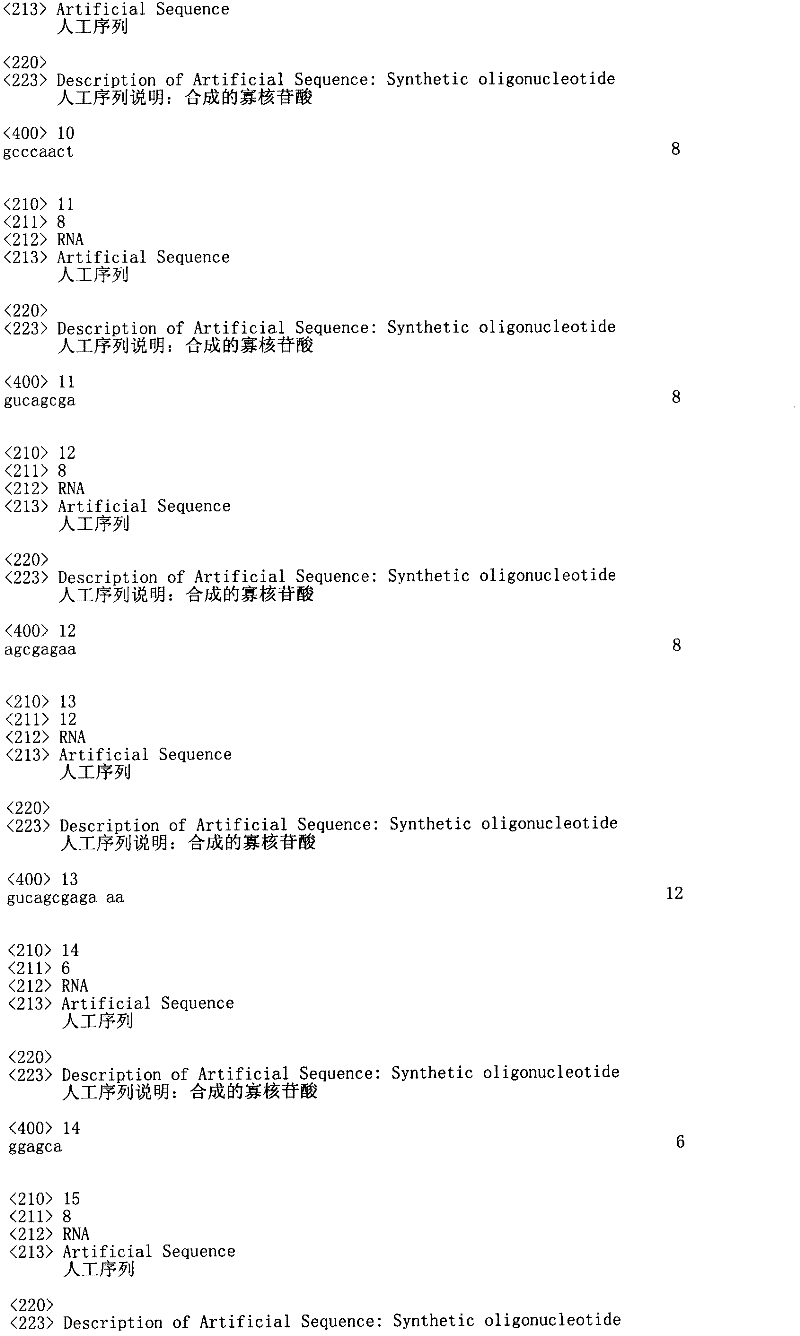


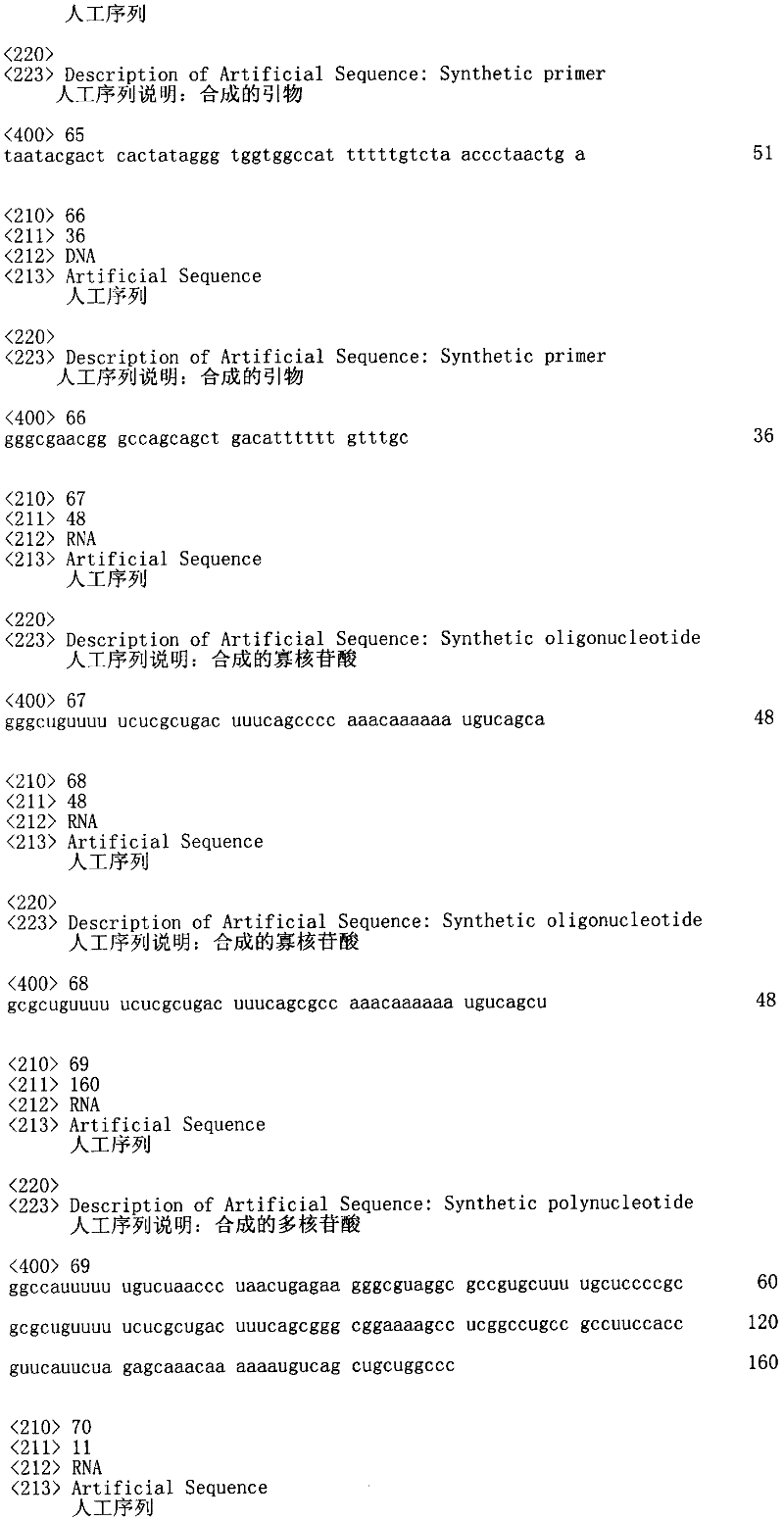

Claims (55)
Applications Claiming Priority (3)
| Application Number | Priority Date | Filing Date | Title |
|---|---|---|---|
| US10343008P | 2008-10-07 | 2008-10-07 | |
| US61/103,430 | 2008-10-07 | ||
| PCT/US2009/059867 WO2010042636A2 (en) | 2008-10-07 | 2009-10-07 | Telomerase inhibitors and methods of use thereof |
Publications (1)
| Publication Number | Publication Date |
|---|---|
| CN102238967A true CN102238967A (en) | 2011-11-09 |
Family
ID=42101187
Family Applications (1)
| Application Number | Title | Priority Date | Filing Date |
|---|---|---|---|
| CN2009801490151A Pending CN102238967A (en) | 2008-10-07 | 2009-10-07 | Telomerase inhibitors and methods of use thereof |
Country Status (8)
| Country | Link |
|---|---|
| US (1) | US20110257251A1 (en) |
| EP (1) | EP2344204A4 (en) |
| JP (2) | JP2012504962A (en) |
| KR (1) | KR20110086815A (en) |
| CN (1) | CN102238967A (en) |
| AU (1) | AU2009302385B2 (en) |
| CA (1) | CA2739788A1 (en) |
| WO (1) | WO2010042636A2 (en) |
Families Citing this family (13)
| Publication number | Priority date | Publication date | Assignee | Title |
|---|---|---|---|---|
| EP2370451B1 (en) | 2008-12-02 | 2016-11-16 | Wave Life Sciences Japan, Inc. | Method for the synthesis of phosphorus atom modified nucleic acids |
| KR101885383B1 (en) | 2009-07-06 | 2018-08-03 | 웨이브 라이프 사이언시스 리미티드 | Novel nucleic acid prodrugs and methods of use thereof |
| US10428019B2 (en) | 2010-09-24 | 2019-10-01 | Wave Life Sciences Ltd. | Chiral auxiliaries |
| EP2734208B1 (en) | 2011-07-19 | 2017-03-01 | Wave Life Sciences Ltd. | Methods for the synthesis of functionalized nucleic acids |
| CN104661664B (en) | 2012-07-13 | 2020-07-03 | 波涛生命科学有限公司 | Chiral control |
| PL2872485T3 (en) | 2012-07-13 | 2021-05-31 | Wave Life Sciences Ltd. | Asymmetric auxiliary group |
| CA2879066C (en) | 2012-07-13 | 2019-08-13 | Shin Nippon Biomedical Laboratories, Ltd. | Chiral nucleic acid adjuvant |
| BR112015031277A2 (en) | 2013-06-14 | 2017-09-19 | Harvard College | INSULIN RECEPTOR MODULATORS FROM STABILIZED POLYPEPTIDES, INSULIN ANALOGS, PHARMACEUTICAL COMPOSITIONS COMPRISING THE SAID POLYPEPTIDES AND METHODS OF PREPARATION AND USES THEREOF |
| WO2015108047A1 (en) | 2014-01-15 | 2015-07-23 | 株式会社新日本科学 | Chiral nucleic acid adjuvant having immunity induction activity, and immunity induction activator |
| JPWO2015108048A1 (en) | 2014-01-15 | 2017-03-23 | 株式会社新日本科学 | Chiral nucleic acid adjuvant and antitumor agent having antitumor activity |
| JPWO2015108046A1 (en) | 2014-01-15 | 2017-03-23 | 株式会社新日本科学 | Chiral nucleic acid adjuvant and antiallergic agent having antiallergic action |
| EP4137572A1 (en) | 2014-01-16 | 2023-02-22 | Wave Life Sciences Ltd. | Chiral design |
| CN106984165A (en) * | 2017-06-09 | 2017-07-28 | 史汉祥 | A kind of gas cleaning reactor and cone structure part |
Family Cites Families (6)
| Publication number | Priority date | Publication date | Assignee | Title |
|---|---|---|---|---|
| WO1999065928A2 (en) * | 1998-06-19 | 1999-12-23 | Genzyme Corporation | Polynucleotide population isolated from non-metastatic and metastatic breast tumor tissues |
| US6172216B1 (en) * | 1998-10-07 | 2001-01-09 | Isis Pharmaceuticals Inc. | Antisense modulation of BCL-X expression |
| US6342358B1 (en) * | 2000-08-24 | 2002-01-29 | The Regents Of The University Of California | Human telomerase RNA elements |
| EP1432725A4 (en) * | 2002-02-20 | 2005-03-30 | Sirna Therapeutics Inc | INHIBITION INDUCED BY INTERFERENCE OF RNA FROM TELOMERASE GENE EXPRESSION USING A BRIEF INTERFERENCE NUCLEIC ACID (SINA) |
| EP2305813A3 (en) * | 2002-11-14 | 2012-03-28 | Dharmacon, Inc. | Fuctional and hyperfunctional sirna |
| JP2006089471A (en) * | 2004-08-26 | 2006-04-06 | National Institute Of Advanced Industrial & Technology | Use of anti-mortalin 2 antibodies and functional nucleic acids in the treatment of cancer |
-
2009
- 2009-10-07 AU AU2009302385A patent/AU2009302385B2/en not_active Ceased
- 2009-10-07 CN CN2009801490151A patent/CN102238967A/en active Pending
- 2009-10-07 JP JP2011531148A patent/JP2012504962A/en not_active Ceased
- 2009-10-07 KR KR1020117010476A patent/KR20110086815A/en not_active Ceased
- 2009-10-07 EP EP09819829A patent/EP2344204A4/en not_active Withdrawn
- 2009-10-07 CA CA2739788A patent/CA2739788A1/en not_active Abandoned
- 2009-10-07 US US13/123,123 patent/US20110257251A1/en not_active Abandoned
- 2009-10-07 WO PCT/US2009/059867 patent/WO2010042636A2/en not_active Ceased
-
2015
- 2015-07-27 JP JP2015147794A patent/JP2016027800A/en active Pending
Non-Patent Citations (1)
| Title |
|---|
| BRIAN R. KEPPLER AND MICHAEL B. JARSTFER: "Inhibition of Telomerase Activity by Preventing Proper Assemblage", 《BIOCHEMISTRY》 * |
Also Published As
| Publication number | Publication date |
|---|---|
| WO2010042636A3 (en) | 2010-08-19 |
| EP2344204A2 (en) | 2011-07-20 |
| AU2009302385B2 (en) | 2015-12-03 |
| AU2009302385A1 (en) | 2010-04-15 |
| KR20110086815A (en) | 2011-08-01 |
| CA2739788A1 (en) | 2010-04-15 |
| EP2344204A4 (en) | 2012-07-04 |
| US20110257251A1 (en) | 2011-10-20 |
| JP2012504962A (en) | 2012-03-01 |
| WO2010042636A2 (en) | 2010-04-15 |
| JP2016027800A (en) | 2016-02-25 |
Similar Documents
| Publication | Publication Date | Title |
|---|---|---|
| AU2009302385B2 (en) | Telomerase inhibitors and methods of use thereof | |
| JP6959293B2 (en) | Compositions and Methods for Inhibiting Hepatitis B Virus Gene Expression | |
| US10323246B2 (en) | Interfering RNA molecules | |
| JP6295232B2 (en) | Compositions and methods for specific inhibition of gene expression by dsRNA with modifications | |
| JP2022078069A (en) | Methods and Compositions for Specific Inhibition of α-1 Antitrypsin by Double-stranded RNA | |
| CN103555722B (en) | Methods and compositions for specifically inhibiting KRAS using asymmetric double-stranded RNA | |
| ES2389024T3 (en) | Blunt-end interfering RNA molecules | |
| ES2873893T3 (en) | Methods and compositions for the specific inhibition of beta-catenin by double-stranded RNA | |
| JP2019518772A (en) | Single stranded RNA editing oligonucleotide | |
| CN102497870A (en) | Peptide-DICER substrate reagent and method for specifically inhibiting gene expression | |
| CN117120612A (en) | Compositions and methods for inhibiting ketohexokinase (KHK) | |
| US20230118138A1 (en) | Use of scamp3 inhibitors for treating hepatitis b virus infection | |
| CN114901821A (en) | Use of SEPT9 inhibitors for treating hepatitis B virus infection | |
| KR20150095763A (en) | Methods and compositions for the specific inhibition of ckap5 by double-stranded rna | |
| TW202020152A (en) | Oligonucleotides that regulate RTEL1 performance | |
| CN112055598A (en) | Compositions and methods for inhibiting GYS2 expression | |
| AU2015255324A1 (en) | Telomerase inhibitors and methods of use thereof | |
| WO2023176863A1 (en) | Chemically-modified oligonucleotide having rnai activity | |
| HK40061440A (en) | Compositions and methods for inhibiting gene expression of hepatitis b virus | |
| HK40071185A (en) | Use of sept9 inhibitors for treating hepatitis b virus infection |
Legal Events
| Date | Code | Title | Description |
|---|---|---|---|
| C06 | Publication | ||
| PB01 | Publication | ||
| C10 | Entry into substantive examination | ||
| SE01 | Entry into force of request for substantive examination | ||
| C12 | Rejection of a patent application after its publication | ||
| RJ01 | Rejection of invention patent application after publication |
Application publication date: 20111109 |