CN102231989A - Ophthalmic device having therapeutic agent delivery capability and method of forming same - Google Patents
Ophthalmic device having therapeutic agent delivery capability and method of forming same Download PDFInfo
- Publication number
- CN102231989A CN102231989A CN2009801281283A CN200980128128A CN102231989A CN 102231989 A CN102231989 A CN 102231989A CN 2009801281283 A CN2009801281283 A CN 2009801281283A CN 200980128128 A CN200980128128 A CN 200980128128A CN 102231989 A CN102231989 A CN 102231989A
- Authority
- CN
- China
- Prior art keywords
- therapeutic agent
- ophthalmic device
- ophthalmic
- drug
- iol
- Prior art date
- Legal status (The legal status is an assumption and is not a legal conclusion. Google has not performed a legal analysis and makes no representation as to the accuracy of the status listed.)
- Granted
Links
Images


Classifications
-
- A—HUMAN NECESSITIES
- A61—MEDICAL OR VETERINARY SCIENCE; HYGIENE
- A61F—FILTERS IMPLANTABLE INTO BLOOD VESSELS; PROSTHESES; DEVICES PROVIDING PATENCY TO, OR PREVENTING COLLAPSING OF, TUBULAR STRUCTURES OF THE BODY, e.g. STENTS; ORTHOPAEDIC, NURSING OR CONTRACEPTIVE DEVICES; FOMENTATION; TREATMENT OR PROTECTION OF EYES OR EARS; BANDAGES, DRESSINGS OR ABSORBENT PADS; FIRST-AID KITS
- A61F9/00—Methods or devices for treatment of the eyes; Devices for putting in contact-lenses; Devices to correct squinting; Apparatus to guide the blind; Protective devices for the eyes, carried on the body or in the hand
-
- A—HUMAN NECESSITIES
- A61—MEDICAL OR VETERINARY SCIENCE; HYGIENE
- A61K—PREPARATIONS FOR MEDICAL, DENTAL OR TOILETRY PURPOSES
- A61K9/00—Medicinal preparations characterised by special physical form
- A61K9/0012—Galenical forms characterised by the site of application
- A61K9/0048—Eye, e.g. artificial tears
- A61K9/0051—Ocular inserts, ocular implants
-
- A—HUMAN NECESSITIES
- A61—MEDICAL OR VETERINARY SCIENCE; HYGIENE
- A61K—PREPARATIONS FOR MEDICAL, DENTAL OR TOILETRY PURPOSES
- A61K31/00—Medicinal preparations containing organic active ingredients
- A61K31/16—Amides, e.g. hydroxamic acids
- A61K31/165—Amides, e.g. hydroxamic acids having aromatic rings, e.g. colchicine, atenolol, progabide
-
- A—HUMAN NECESSITIES
- A61—MEDICAL OR VETERINARY SCIENCE; HYGIENE
- A61K—PREPARATIONS FOR MEDICAL, DENTAL OR TOILETRY PURPOSES
- A61K31/00—Medicinal preparations containing organic active ingredients
- A61K31/185—Acids; Anhydrides, halides or salts thereof, e.g. sulfur acids, imidic, hydrazonic or hydroximic acids
- A61K31/19—Carboxylic acids, e.g. valproic acid
- A61K31/195—Carboxylic acids, e.g. valproic acid having an amino group
-
- A—HUMAN NECESSITIES
- A61—MEDICAL OR VETERINARY SCIENCE; HYGIENE
- A61K—PREPARATIONS FOR MEDICAL, DENTAL OR TOILETRY PURPOSES
- A61K31/00—Medicinal preparations containing organic active ingredients
- A61K31/185—Acids; Anhydrides, halides or salts thereof, e.g. sulfur acids, imidic, hydrazonic or hydroximic acids
- A61K31/19—Carboxylic acids, e.g. valproic acid
- A61K31/195—Carboxylic acids, e.g. valproic acid having an amino group
- A61K31/196—Carboxylic acids, e.g. valproic acid having an amino group the amino group being directly attached to a ring, e.g. anthranilic acid, mefenamic acid, diclofenac, chlorambucil
-
- A—HUMAN NECESSITIES
- A61—MEDICAL OR VETERINARY SCIENCE; HYGIENE
- A61K—PREPARATIONS FOR MEDICAL, DENTAL OR TOILETRY PURPOSES
- A61K31/00—Medicinal preparations containing organic active ingredients
- A61K31/33—Heterocyclic compounds
- A61K31/395—Heterocyclic compounds having nitrogen as a ring hetero atom, e.g. guanethidine or rifamycins
- A61K31/495—Heterocyclic compounds having nitrogen as a ring hetero atom, e.g. guanethidine or rifamycins having six-membered rings with two or more nitrogen atoms as the only ring heteroatoms, e.g. piperazine or tetrazines
- A61K31/4985—Pyrazines or piperazines ortho- or peri-condensed with heterocyclic ring systems
-
- A—HUMAN NECESSITIES
- A61—MEDICAL OR VETERINARY SCIENCE; HYGIENE
- A61K—PREPARATIONS FOR MEDICAL, DENTAL OR TOILETRY PURPOSES
- A61K47/00—Medicinal preparations characterised by the non-active ingredients used, e.g. carriers or inert additives; Targeting or modifying agents chemically bound to the active ingredient
- A61K47/30—Macromolecular organic or inorganic compounds, e.g. inorganic polyphosphates
- A61K47/32—Macromolecular compounds obtained by reactions only involving carbon-to-carbon unsaturated bonds, e.g. carbomers, poly(meth)acrylates, or polyvinyl pyrrolidone
-
- A—HUMAN NECESSITIES
- A61—MEDICAL OR VETERINARY SCIENCE; HYGIENE
- A61K—PREPARATIONS FOR MEDICAL, DENTAL OR TOILETRY PURPOSES
- A61K9/00—Medicinal preparations characterised by special physical form
- A61K9/0012—Galenical forms characterised by the site of application
- A61K9/0048—Eye, e.g. artificial tears
-
- A—HUMAN NECESSITIES
- A61—MEDICAL OR VETERINARY SCIENCE; HYGIENE
- A61P—SPECIFIC THERAPEUTIC ACTIVITY OF CHEMICAL COMPOUNDS OR MEDICINAL PREPARATIONS
- A61P27/00—Drugs for disorders of the senses
- A61P27/02—Ophthalmic agents
-
- A—HUMAN NECESSITIES
- A61—MEDICAL OR VETERINARY SCIENCE; HYGIENE
- A61P—SPECIFIC THERAPEUTIC ACTIVITY OF CHEMICAL COMPOUNDS OR MEDICINAL PREPARATIONS
- A61P29/00—Non-central analgesic, antipyretic or antiinflammatory agents, e.g. antirheumatic agents; Non-steroidal antiinflammatory drugs [NSAID]
Landscapes
- Health & Medical Sciences (AREA)
- Chemical & Material Sciences (AREA)
- Life Sciences & Earth Sciences (AREA)
- Animal Behavior & Ethology (AREA)
- General Health & Medical Sciences (AREA)
- Public Health (AREA)
- Veterinary Medicine (AREA)
- Medicinal Chemistry (AREA)
- Pharmacology & Pharmacy (AREA)
- Epidemiology (AREA)
- Ophthalmology & Optometry (AREA)
- General Chemical & Material Sciences (AREA)
- Chemical Kinetics & Catalysis (AREA)
- Engineering & Computer Science (AREA)
- Nuclear Medicine, Radiotherapy & Molecular Imaging (AREA)
- Organic Chemistry (AREA)
- Inorganic Chemistry (AREA)
- Vascular Medicine (AREA)
- Biomedical Technology (AREA)
- Heart & Thoracic Surgery (AREA)
- Bioinformatics & Cheminformatics (AREA)
- Pain & Pain Management (AREA)
- Rheumatology (AREA)
- Materials For Medical Uses (AREA)
- Medicinal Preparation (AREA)
- Pharmaceuticals Containing Other Organic And Inorganic Compounds (AREA)
- Acyclic And Carbocyclic Compounds In Medicinal Compositions (AREA)
- Prostheses (AREA)
Abstract
本发明涉及装载治疗剂的眼科用装置。它们包含:一团材料,所述材料包括丙烯酸材料,丙烯酸材料包括显著部分的疏水性丙烯酸酯;和与所述材料相结合的治疗剂,其中所述的治疗剂是疏水性的并且具有至少1.0的PC LogP;其中所述的材料被构造以插入到人的眼中。所述的装置提供治疗剂对于眼的延长的释放。所述的眼科用装置一般由眼科用材料制成,所述的眼科用材料特别适于装载治疗剂和/或所述的治疗剂一般特别适于装载于所述的眼科用材料中。

This invention relates to ophthalmic devices for loading therapeutic agents. They comprise: a mass of material comprising an acrylic material, the acrylic material comprising a significant portion of a hydrophobic acrylate; and a therapeutic agent bound to the material, wherein the therapeutic agent is hydrophobic and has a PC LogP of at least 1.0; wherein the material is configured for insertion into a human eye. The device provides a prolonged release of the therapeutic agent into the eye. The ophthalmic devices are generally made of ophthalmic materials particularly suitable for loading therapeutic agents and/or the therapeutic agents are generally particularly suitable for loading within the ophthalmic materials.
Description
相关申请的交叉参考Cross References to Related Applications
本申请要求在35U.S.C.§119下对2008年7月21日提交的美国临时专利申请61/082352的优先权,其全部内容加至本文作为参考。This application claims priority under 35 U.S.C. §119 to U.S. Provisional Patent Application 61/082,352, filed July 21, 2008, the entire contents of which are incorporated herein by reference.
技术领域 technical field
本发明涉及装载治疗剂的眼科用装置。更具体地,本申请涉及眼科用装置(例如,装载治疗剂(例如,抗炎剂、抗增殖剂、免疫抑制剂或其任意组合)的人工晶状体(IOL)),以使所述装置在被施用于眼部后较长的时间段里可提供治疗剂向眼部的递送。The present invention relates to ophthalmic devices loaded with therapeutic agents. More specifically, the present application relates to ophthalmic devices (e.g., intraocular lenses (IOLs) loaded with therapeutic agents (e.g., anti-inflammatory agents, anti-proliferative agents, immunosuppressants, or any combination thereof) such that the device Delivery of the therapeutic agent to the eye can be provided for an extended period of time after application to the eye.
发明背景Background of the invention
近些年来,许多眼科手术例如白内障手术已稳步增加,其中人工晶状体(IOL)被递送至个体眼内部。已开发了IOL并插至眼睛的不同位置,并且可通过提供眼睛天然结晶晶状体被用于视力的补充或矫正,或可替换眼睛天然结晶晶状体。补充或矫正视力而不替换天然结晶晶状体的晶状体一般是指有晶状体眼人工晶状体,同时替换天然结晶晶状体的晶状体一般是指无晶状体眼人工晶状体。有晶状体人工晶状体可位于眼前室(AC)(AC有晶状体眼人工晶状体)或眼后室(PC)(PC有晶状体眼人工晶状体)。In recent years, there has been a steady increase in the number of ophthalmic procedures, such as cataract surgery, in which an intraocular lens (IOL) is delivered inside an individual's eye. IOLs have been developed and inserted in various locations of the eye and can be used to supplement or correct vision by providing the natural crystalline lens of the eye, or to replace the natural crystalline lens of the eye. Lenses that supplement or correct vision without replacing the natural crystalline lens are generally referred to as phakic IOLs, while lenses that also replace the natural crystalline lens are generally referred to as aphakic IOLs. Phakic IOLs can be located in the anterior chamber (AC) (AC with phakic IOLs) or in the posterior compartment (PC) (PC with phakic IOLs).
IOL已提供了数百万个体改善的视力,IOL也可表现出缺点。具体地,IOL可能是眼部障碍,例如继发性白内障或后囊浑浊(PCO)的病因。While IOLs have provided improved vision for millions of individuals, IOLs can also exhibit drawbacks. In particular, IOLs may be the cause of ocular disorders such as secondary cataracts or posterior capsule opacities (PCO).
为了有助于避免PCO,可将治疗剂例如抗炎药或抗增殖剂在插入IOL后施用于眼。这些治疗剂一般通过局部递送方法例如油膏剂或滴眼剂被递送。但是,这些方法有至少两个显著的缺点。首先,对于这些局部递送的治疗剂可能难于至眼内靶部位,因为眼的各部分可能作为阻制治疗剂透入眼睛后部的显著的生理屏障。第二,这些局部递送方法的效果一般取决于个体对所开具的将油膏或滴剂施于眼睛的给药方案的依从性。To help avoid PCO, therapeutic agents such as anti-inflammatory or anti-proliferative agents can be administered to the eye after insertion of the IOL. These therapeutic agents are typically delivered by topical delivery methods such as ointments or eye drops. However, these methods have at least two significant disadvantages. First, it may be difficult for these locally delivered therapeutic agents to reach the intraocular target site, as various parts of the eye may act as significant physiological barriers to penetration of the therapeutic agent to the back of the eye. Second, the effectiveness of these methods of topical delivery generally depends on the individual's compliance with the prescribed dosing regimen for applying the ointment or drops to the eye.
从这些缺点看,十分需要提供插入眼内的眼科用装置,并且其在白内障手术后的一段时间里递送所需量的治疗剂。这样的装置能用于递送有助于避免PCO的治疗剂。再者,在术后或其他时间插入这样的装置在眼内,可另外或可替换地用于递送抑制其他眼科疾病或疾患例如青光眼、黄斑水肿、视网膜病变、黄斑变性、慢性炎症、感染等的治疗剂。In view of these shortcomings, it would be highly desirable to provide an ophthalmic device that is inserted into the eye and that delivers a desired amount of therapeutic agent for a period of time following cataract surgery. Such devices can be used to deliver therapeutic agents that help avoid PCO. Furthermore, insertion of such devices into the eye postoperatively or at other times may additionally or alternatively be used to deliver drugs that inhibit other ophthalmic diseases or conditions such as glaucoma, macular edema, retinopathy, macular degeneration, chronic inflammation, infection, etc. therapeutic agent.
为了有效地开发这样的装置,需要一种机制,通过这一机制持续地或周期性地在所需时间段从装置中释放治疗剂。但是,对于较长的释放时间段,对治疗剂释放的控制可能相当困难。有利地,已经发现特定的眼用材料和治疗剂从这些材料中的释放之间的关系,并且可探索这一关系以提供所需的释放时间段。In order to effectively develop such devices, a mechanism is needed by which to release the therapeutic agent from the device continuously or periodically for a desired period of time. However, for longer release periods, control of the release of the therapeutic agent can be quite difficult. Advantageously, a relationship has been discovered between particular ophthalmic materials and the release of therapeutic agents from those materials, and this relationship can be explored to provide a desired release time period.
发明概述Summary of the invention
本发明涉及至少部分由眼用材料构成的眼科用装置。所述眼用材料一般是丙烯酸的、疏水性的或兼有的。所述眼科用装置一般装有治疗剂。在本发明优选的实施方案中,所述治疗剂和眼用材料是疏水性的,有助于材料装载治疗剂,并有助于延迟所述治疗剂从所述眼用材料的释放。The present invention relates to ophthalmic devices constructed at least in part of ophthalmic materials. The ophthalmic materials are typically acrylic, hydrophobic, or a combination. The ophthalmic device is typically filled with a therapeutic agent. In preferred embodiments of the invention, the therapeutic agent and ophthalmic material are hydrophobic to facilitate loading of the material with the therapeutic agent and to facilitate delayed release of the therapeutic agent from the ophthalmic material.
所述眼科用装置可能适于定位于眼内或眼外表面上。在优选的实施方案中,所述将部分或全部由眼用材料构成的眼科用装置,是IOL或适于与IOL一起定位于眼内的装置。The ophthalmic device may be adapted for positioning within the eye or on an extraocular surface. In a preferred embodiment, the ophthalmic device, which will be constructed partially or entirely of ophthalmic material, is an IOL or a device adapted to be positioned within the eye with an IOL.
附图简述Brief description of the drawings
本发明的特色及创造性方面在阅读以下详细的说明书、权利要求书和附图后将更为显见,其中以下是图示的简单说明:The specific and inventive aspects of the present invention will become more apparent upon reading the following detailed specification, claims and drawings, of which the following is a simplified description of the drawings:
图1是根据本发明一方面的眼科用装置随时间的药物释放演示图。Figure 1 is a graph demonstrating drug release over time from an ophthalmic device in accordance with one aspect of the present invention.
图2是根据本发明一方面的眼科用装置随时间的药物释放的另一张演示图。Figure 2 is another graph demonstrating drug release over time from an ophthalmic device in accordance with an aspect of the present invention.
图3是根据本发明一方面的眼科用装置随时间的药物释放的另一张演示图。Figure 3 is another graph demonstrating drug release over time from an ophthalmic device in accordance with an aspect of the present invention.
图4是根据本发明一方面的多个眼科用装置随时间的药物释放的演示图。4 is a graphical representation of drug release over time from a plurality of ophthalmic devices according to an aspect of the present invention.
图5是根据本发明一方面的多个眼科用装置随时间的药物释放的另一张演示图。5 is another illustration of drug release over time from a plurality of ophthalmic devices in accordance with an aspect of the present invention.
图6是根据本发明的一方面作为药物释放指示的荧光强度随时间变化的一张图。Figure 6 is a graph of fluorescence intensity as a function of time as an indicator of drug release according to an aspect of the present invention.
图7是根据本发明的一方面不同药物的药物释放对比图。Figure 7 is a comparative graph of drug release for different drugs according to an aspect of the present invention.
图8是根据本发明的一方面的眼科用装置的示意图。Figure 8 is a schematic illustration of an ophthalmic device according to an aspect of the present invention.
图9是根据本发明的一方面的眼科用装置的另一张示意图。9 is another schematic illustration of an ophthalmic device according to an aspect of the present invention.
图10是根据本发明的一方面的眼科用装置的另一张示意图。10 is another schematic illustration of an ophthalmic device according to an aspect of the present invention.
图11和12是根据本发明的一方面的包衣眼科用装置药物随时间释放的演示图。11 and 12 are graphs demonstrating drug release over time from a coated ophthalmic device according to an aspect of the present invention.
发明详述Detailed description of the invention
本发明预言,至少部分由眼用材料构成的眼科用装置,适合定位于眼,但更优选定位于个体眼内。该装置亦可定位于身体,或定位于身体内,或定位于身体的不同位置。但是,所述装置特别适合于眼部应用。The present invention contemplates ophthalmic devices constructed at least in part of ophthalmic materials, suitably positioned within the eye, but more preferably within the eye of an individual. The device may also be positioned on the body, or within the body, or at a different location on the body. However, the device is particularly suitable for ophthalmic applications.
所述装置的眼用材料适于装载将被递送至眼睛的治疗剂。眼用材料亦适于用作人工晶状体(IOL),尽管如下文进一步讨论的,所述材料可提供作为IOL或另一种构造。所述材料或所述材料的一种或多种成分一般相对疏水,并且优选地所述治疗剂也呈现出一定程度的疏水性。在一个优选的实施方案中,所述材料被提供作为无晶状体IOL并且所述治疗剂包括大量的抗炎药用于减少在白内障手术后可能出现的炎症。The ophthalmic material of the device is adapted to be loaded with a therapeutic agent to be delivered to the eye. The ophthalmic material is also suitable for use as an intraocular lens (IOL), although as discussed further below, the material may be provided as an IOL or in another configuration. The material, or one or more components of the material, is generally relatively hydrophobic, and preferably the therapeutic agent also exhibits some degree of hydrophobicity. In a preferred embodiment, the material is provided as an aphakic IOL and the therapeutic agent includes a number of anti-inflammatory drugs for reducing inflammation that may occur after cataract surgery.
眼用材料优选是包括疏水性成分、亲水性成分或两者兼有的聚合物材料。所述眼用材料还一般是丙烯酸的,在本文使用的是指所述材料包含至少一种丙烯酸酯。所述眼用材料也可包含如下文进一步解释的其他成分。The ophthalmic material is preferably a polymeric material comprising a hydrophobic component, a hydrophilic component, or both. The ophthalmic material is also typically acrylic, which as used herein means that the material comprises at least one acrylate. The ophthalmic material may also contain other ingredients as explained further below.
疏水性成分可包含一种单体或多种不同的单体,并且这些单体可形成聚合物,其可以是均聚物或共聚物。包括在疏水性成分中的每种单体将是疏水的,或将为一旦形成的眼用材料提供疏水性。优选地,大部分(例如,至少60、80或95%重量或全部)的疏水性成分由丙烯酸酯构成。疏水性成分适宜的单体包括但不限于:2-乙基苯氧基甲基丙烯酸酯;2-乙基苯氧基丙烯酸酯;2-乙基硫代苯基甲基丙烯酸酯;2-乙基硫代苯基丙烯酸酯;2-乙基氨基苯基甲基丙烯酸酯;2-乙基氨基苯基丙烯酸酯;苯基甲基丙烯酸酯;苯基丙烯酸酯;苄基甲基丙烯酸酯;苄基丙烯酸酯;2-苯基乙基甲基丙烯酸酯;2-苯基乙基丙烯酸酯;3-苯基丙基甲基丙烯酸酯;3-苯基丙基丙烯酸酯;4-苯基丁基甲基丙烯酸酯;4-苯基丁基丙烯酸酯;4-甲基苯基甲基丙烯酸酯;4-甲基苯基丙烯酸酯;4-甲基苄基甲基丙烯酸酯;4-甲基苄基丙烯酸酯;2-2-甲基苯基乙基甲基丙烯酸酯;2-2-甲基苯基乙基丙烯酸酯;2-3-甲基苯基乙基甲基丙烯酸酯;2-3-甲基苯基乙基丙烯酸酯;24-甲基苯基乙基甲基丙烯酸酯;2-4-甲基苯基乙基丙烯酸酯;2-(4-丙基苯基)乙基甲基丙烯酸酯;2-(4-丙基苯基)乙基丙烯酸酯;2-(4-(1-甲基乙基)苯基)乙基甲基丙烯酸酯;2-(4-(1-甲基乙基)苯基)乙基丙烯酸酯;2-(4-甲氧基苯基)乙基甲基丙烯酸酯;2-(4-甲氧基苯基)乙基丙烯酸酯;2-(4-环己基苯基)乙基甲基丙烯酸酯;2-(4-环己基苯基)乙基丙烯酸酯;2-(2-氯苯基)乙基甲基丙烯酸酯;2-(2-氯苯基)乙基丙烯酸酯;2-(3-氯苯基)乙基甲基丙烯酸酯;2-(3-氯苯基)乙基丙烯酸酯;2-(4-氯苯基)乙基甲基丙烯酸酯;2-(4-氯苯基)乙基丙烯酸酯;2-(4-溴苯基)乙基甲基丙烯酸酯;2-(4-溴苯基)乙基丙烯酸酯;2-(3-苯基苯基)乙基甲基丙烯酸酯;2-(3-苯基苯基)乙基丙烯酸酯;2-(4-苯基苯基)乙基甲基丙烯酸酯;2-(4-苯基苯基)乙基丙烯酸酯;2-(4-苄基苯基)乙基甲基丙烯酸酯;2-(4-苄基苯基)乙基丙烯酸酯;或其组合等。在优选的实施方案中,疏水性成分包括或基本上整体上(即,至少90%的重量)由苯基丙烯酸酯类或甲基丙烯酸酯类、特别是选自2-苯基乙基丙烯酸酯(PEA)、2-苯基乙基甲基丙烯酸酯(PEMA)的一种或多种单体构成。The hydrophobic component may comprise one monomer or a plurality of different monomers, and these monomers may form polymers, which may be homopolymers or copolymers. Each monomer included in the hydrophobic composition will be hydrophobic, or will impart hydrophobicity to the ophthalmic material once formed. Preferably, a majority (eg, at least 60, 80 or 95% by weight or all) of the hydrophobic component consists of acrylates. Suitable monomers for the hydrophobic component include, but are not limited to: 2-ethylphenoxymethacrylate; 2-ethylphenoxyacrylate; 2-ethylthiophenylmethacrylate; 2-ethylphenoxymethacrylate; thiophenyl acrylate; 2-ethylaminophenyl methacrylate; 2-ethylaminophenyl acrylate; phenyl methacrylate; phenyl acrylate; benzyl methacrylate; benzyl 2-phenylethyl methacrylate; 2-phenylethyl acrylate; 3-phenylpropyl methacrylate; 3-phenylpropyl acrylate; 4-phenylbutyl methyl Acrylates; 4-Phenylbutyl Acrylate; 4-Methylphenyl Methacrylate; 4-Methylphenyl Acrylate; 4-Methylbenzyl Methacrylate; 4-Methylbenzyl Acrylate ester; 2-2-methylphenylethyl methacrylate; 2-2-methylphenylethyl acrylate; 2-3-methylphenylethyl methacrylate; 2-3-methyl 2-methylphenylethyl acrylate; 24-methylphenylethyl methacrylate; 2-4-methylphenylethyl acrylate; 2-(4-propylphenyl) ethyl methacrylate ; 2-(4-propylphenyl)ethyl acrylate; 2-(4-(1-methylethyl)phenyl)ethyl methacrylate; 2-(4-(1-methylethyl) base) phenyl) ethyl acrylate; 2-(4-methoxyphenyl) ethyl methacrylate; 2-(4-methoxyphenyl) ethyl acrylate; 2-(4-cyclo Hexylphenyl) ethyl methacrylate; 2-(4-cyclohexylphenyl) ethyl methacrylate; 2-(2-chlorophenyl) ethyl methacrylate; 2-(2-chlorophenyl ) ethyl acrylate; 2-(3-chlorophenyl) ethyl methacrylate; 2-(3-chlorophenyl) ethyl acrylate; 2-(4-chlorophenyl) ethyl methacrylate ester; 2-(4-chlorophenyl) ethyl acrylate; 2-(4-bromophenyl) ethyl methacrylate; 2-(4-bromophenyl) ethyl acrylate; 2-(3 -Phenylphenyl) ethyl methacrylate; 2-(3-phenylphenyl) ethyl methacrylate; 2-(4-phenylphenyl) ethyl methacrylate; 2-(4- phenylphenyl) ethyl acrylate; 2-(4-benzylphenyl) ethyl methacrylate; 2-(4-benzyl phenyl) ethyl acrylate; or combinations thereof, etc. In a preferred embodiment, the hydrophobic component comprises or consists essentially entirely (i.e. at least 90% by weight) of phenylacrylates or methacrylates, in particular selected from 2-phenylethylacrylate One or more monomers of (PEA), 2-phenylethyl methacrylate (PEMA).
疏水性成分的疏水性一般可按照座滴法测定。为了测定疏水性,疏水性部分的成分,并且仅有疏水性部分,可按照眼科用装置的处理方案处理以形成固体平的基底。当然,为了这样的处理,处理剂的用量,如果需要,可以被调整。具体地,疏水性成分一般表示在眼科用装置中整体可处理材料的百分数,并且处理剂的用量可被调整为构成眼科用装置的整体处理剂的相同百分数。然后,按照座滴法,将一滴水置于(或使其从某个距离落下)基底表面。当液体已静止时,用测角计测定其接触角。为了本发明的目的,有助于使接触角大于50°的成分、尤其是单体被视为部分疏水性成分,并且优选以此方式测定的接触角大于50°,更典型地大于55°,甚至可能大于60°。The hydrophobicity of a hydrophobic component can generally be determined according to the sessile drop method. For determination of hydrophobicity, the components of the hydrophobic portion, and only the hydrophobic portion, can be treated according to the treatment protocol for the ophthalmic device to form a solid flat substrate. Of course, for such treatment, the amount of treatment agent used may be adjusted, if necessary. Specifically, the hydrophobic component generally represents a percentage of the overall treatable material in the ophthalmic device, and the amount of treatment agent can be adjusted to be the same percentage of the overall treatment agent making up the ophthalmic device. Then, according to the sessile drop method, a drop of water is placed (or allowed to fall from a certain distance) on the surface of the substrate. When the liquid has come to rest, its contact angle is measured with a goniometer. For the purposes of the present invention, constituents, especially monomers, which contribute to a contact angle greater than 50° are considered to be partially hydrophobic constituents, and preferably the contact angle determined in this way is greater than 50°, more typically greater than 55°, It may even be greater than 60°.
亲水性成分,当包含时,可包含一种单体或多种不同的单体,并且这些单体可形成聚合物,其可以是均聚物或共聚物。亲水性成分的每种单体必须是亲水的,或一旦形成为眼用材料提供亲水性。像所述疏水性成分一样,优选大部分(例如,至少60、80或95%重量或全部)的亲水性成分由丙烯酸酯构成。亲水性成分的适宜单体包括,但不限于:2-羟基乙基甲基丙烯酸酯;2-羟基乙基丙烯酸酯;N-乙烯基吡咯烷酮、甲基丙烯酸甘油酯、丙烯酸甘油酯、聚氧乙烯单-和二甲基丙烯酸酯、聚氧乙烯单-和二丙烯酸酯。在优选的实施方案中,亲水性成分包括或其基本上全部(至少90%重量)由一种或多种单体组成,所述单体为:羟基烷基丙烯酸酯或甲基丙烯酸酯例如羟基乙基甲基丙烯酸酯(HEMA)。The hydrophilic component, when included, may comprise a single monomer or a plurality of different monomers, and these monomers may form polymers, which may be homopolymers or copolymers. Each monomer of the hydrophilic component must be hydrophilic, or provide hydrophilicity to the ophthalmic material once formed. Like the hydrophobic component, preferably a majority (eg, at least 60, 80 or 95% by weight or all) of the hydrophilic component consists of acrylates. Suitable monomers for the hydrophilic component include, but are not limited to: 2-Hydroxyethyl methacrylate; 2-Hydroxyethyl acrylate; N-vinylpyrrolidone, glyceryl methacrylate, glyceryl acrylate, polyoxyl Ethylene mono- and dimethacrylates, polyoxyethylene mono- and diacrylates. In a preferred embodiment, the hydrophilic component comprises or consists essentially entirely (at least 90% by weight) of one or more monomers such as: hydroxyalkyl acrylates or methacrylates such as Hydroxyethyl methacrylate (HEMA).
亲水性成分的亲水性可以用与疏水性成分所描述的相同方式测定。为了本发明的目的,有助于使接触角低于40°的成分、特别是单体被视为疏水性成分的一部分,并且优选以此方式测定的接触角低于40°,更优选低于35°,甚至可能低于30°。The hydrophilicity of hydrophilic components can be determined in the same manner as described for hydrophobic components. For the purposes of the present invention, components, especially monomers, which contribute to a contact angle below 40° are considered part of the hydrophobic component, and preferably the contact angle determined in this way is below 40°, more preferably below 35°, maybe even lower than 30°.
本发明的眼科用装置可另外包含多种其他成分,其可以是或不是如下进一步描述的疏水性或亲水性成分。这些成分可以包括,但不限于,柔韧剂、UV吸收剂、聚合剂、处理剂和/或交联剂,或其组合等。The ophthalmic devices of the present invention may additionally comprise a variety of other components, which may or may not be hydrophobic or hydrophilic components as further described below. These ingredients may include, but are not limited to, flexibilizers, UV absorbers, polymerizing agents, treating agents and/or crosslinking agents, combinations thereof, and the like.
设想可按需要使用多种不同化合物作为聚合、处理和/或交联剂用于聚合和交联所述眼科用装置,以形成聚合物骨架。例如,可使用过氧化物例如二苯甲酮过氧化物或过氧碳酸盐(例如,双-(4-叔丁基环己基)过氧二碳酸盐)或偶氮腈例如偶氮双异丁腈等启动聚合和/或交联疏水性成分、亲水性成分或两种成分。适宜的交联剂也可包括,例如:二甲基丙烯酸乙二酯、二甲基丙烯酸二乙二酯、甲基丙烯酸烯丙酯、二甲基丙烯酸1,3-丙二酯、甲基丙烯酸烯丙酯、二甲基丙烯酸1,6-己二酯、二甲基丙烯酸1,4-丁二酯等。优选的交联剂是二甲基丙烯酸乙二酯(EGDMA)和二丙烯酸1,4-丁二酯(BDDA)。一般地,使用的任何聚合启动剂、交联剂或两者用量将为本发明眼用材料的约10%或10%以下(w/w)。It is contemplated that a variety of different compounds may be used as polymerization, processing and/or crosslinking agents for polymerizing and crosslinking the ophthalmic device as desired to form the polymer backbone. For example, peroxides such as benzophenone peroxide or peroxycarbonates (for example, bis-(4-tert-butylcyclohexyl)peroxydicarbonate) or azonitriles such as azobisisobutyl Nitriles, etc. initiate polymerization and/or crosslink the hydrophobic component, the hydrophilic component, or both components. Suitable crosslinking agents may also include, for example: ethylene glycol dimethacrylate, diethylene glycol dimethacrylate, allyl methacrylate, 1,3-propylene glycol dimethacrylate, methacrylic acid Allyl ester, 1,6-hexanediol dimethacrylate, 1,4-butylene dimethacrylate, etc. Preferred crosslinkers are ethylene glycol dimethacrylate (EGDMA) and 1,4-butylene diacrylate (BDDA). Generally, the amount of any polymerization initiator, crosslinker, or both used will be about 10% or less (w/w) of the ophthalmic material of the present invention.
包含在眼用材料中的任何紫外吸收材料一般是吸收紫外光(即,波长短于约400nm的光)的化合物,但基本不吸收可见光。当单体混合物被聚合时,可将紫外吸收化合物加至单体混合物中并包埋至聚合物骨架中。适宜的紫外吸收化合物包括取代的二苯甲酮类,例如2-羟基二苯甲酮和2-(2-羟基苯基)苯并三唑和锡化合物例如O-甲基苯三唑甲酚。UV吸收剂可通过物理包埋被包埋在聚合物骨架中或也可反应成为骨架。Any ultraviolet absorbing material included in the ophthalmic material is generally a compound that absorbs ultraviolet light (ie, light having a wavelength shorter than about 400 nm), but substantially does not absorb visible light. When the monomer mixture is polymerized, the UV absorbing compound can be added to the monomer mixture and embedded in the polymer backbone. Suitable UV absorbing compounds include substituted benzophenones such as 2-hydroxybenzophenone and 2-(2-hydroxyphenyl)benzotriazole and tin compounds such as O-methylbenzotriazole cresol. UV absorbers can be embedded in the polymer backbone by physical entrapment or can also be reacted into the backbone.
除了紫外吸收材料以外,由本发明的眼用材料制备的眼科用装置可包括有色染料,例如公开在美国专利No.5,470,932中的黄色染料,将其加至本文用于全部目的。In addition to the UV absorbing material, ophthalmic devices prepared from the ophthalmic materials of the present invention may include colored dyes, such as the yellow dyes disclosed in US Patent No. 5,470,932, which is incorporated herein for all purposes.
所述眼科用装置一般通过聚合和/或交联制备。特别地,眼用材料的成分是组合的并且聚合物组成成分,特别是疏水性成分、亲水性成分或二者被聚合,并优选被交联形成聚合物骨架。优选地,尽管不是必需的,在聚合和/或交联过程期间,可使用加热。同时,一般设想,本发明的眼用材料可以是热塑性的,一般优选是热固性的材料。The ophthalmic devices are typically prepared by polymerization and/or crosslinking. In particular, the components of the ophthalmic material are assembled and the polymeric constituents, particularly hydrophobic components, hydrophilic components or both, are polymerized and preferably cross-linked to form a polymer backbone. Preferably, although not required, heating is used during the polymerization and/or crosslinking process. While it is generally envisioned that the ophthalmic materials of the present invention may be thermoplastic, thermoset materials are generally preferred.
另外的成分可以是或不是眼用材料疏水性或亲水性成分的部分。为了澄明度,这些成分,特别是紫外吸收剂以及聚合和/或交联剂仅被视为疏水性或亲水性成分的部分,如果它们与这些成分反应成为聚合物骨架,并且它们在一旦形成眼科用装置时呈现出必需的疏水或亲水特性。因此,例如,二丙烯酸1,4-丁二酯交联剂被视为疏水性成分的部分,因为它一般被反应成为聚合物骨架,并且其呈现出必需的疏水特性。相反地,仅通过聚合物骨架物理包埋(未反应)的锡紫外吸收剂不被视为部分疏水性或亲水性成分,或疏水性或亲水性成分。The additional components may or may not be part of the hydrophobic or hydrophilic components of the ophthalmic material. For clarity, these ingredients, especially UV absorbers and polymeric and/or crosslinking agents are only considered part of the hydrophobic or hydrophilic ingredients if they react with these ingredients to form the polymer backbone and they are formed once Exhibits the necessary hydrophobic or hydrophilic properties for ophthalmic devices. Thus, for example, 1,4-butylene diacrylate crosslinker is considered part of the hydrophobic component because it is generally reacted into the polymer backbone and it exhibits the requisite hydrophobic character. Conversely, tin UV absorbers that are only physically entrapped (unreacted) by the polymer backbone are not considered partially hydrophobic or hydrophilic components, or hydrophobic or hydrophilic components.
在聚合和交联前的某一点或聚合和交联期间,眼用材料一般位于将材料造型成为眼科用装置的模具内。一般地,设想眼用材料可能被造型为适于眼睛的局部位置或玻璃体位置或玻璃体内贮库注射至眼内所需要的任何造型。眼科用装置和/或眼用材料可部分位于眼内(例如,作为塞子)或基本上完整地在眼内(例如,作为人工晶状体或晶状体相关的组分)。在最优选的实施方案中,眼用材料被造形成IOL,其一个或多个凸表面和屈光指数适于辅助或提供人眼视力。IOL可以是AC晶状体、PC晶状体或无晶状体的。同时设想所述装置可被成形为IOL的袢。为了解释的目的,图8显示了人工晶状体装置10,其具有人工晶状体12和袢14,二者之一或两者可以是由本发明的眼用材料制成的眼科用装置。设想本发明的眼科用装置可以是IOL的一部分或者是袢或可以是从IOL分出的一块(例如,一盘)物质,其可在IOL存在或不存在的情况下被插至眼中。还是为了解释的目的,图9显示了18中的圆盘为环,其可与IOL一起位于眼中。At some point prior to or during polymerization and crosslinking, the ophthalmic material is generally within a mold that shapes the material into an ophthalmic device. In general, it is contemplated that the ophthalmic material may be shaped to suit the localized or vitreous location of the eye or whatever shape is required for injection into the eye from the intravitreal depot. The ophthalmic device and/or ophthalmic material may be located partially within the eye (eg, as a plug) or substantially entirely within the eye (eg, as an intraocular lens or lens-related component). In the most preferred embodiment, the ophthalmic material is configured as an IOL with one or more convex surfaces and refractive index adapted to aid or provide vision in the human eye. The IOL can be AC phakic, PC phakic or aphakic. It is also contemplated that the device could be shaped as a haptic to an IOL. For purposes of explanation, FIG. 8 shows an
在一项优选的实施方案中,其图示于图10中,眼用材料可为囊袋张力环24的形状。在这样的实施方案中,为了保持囊袋26之上和/或之内的空间的张力,所述张力环24位于眼的囊袋26内。这样的环24可基本上环绕位于囊袋26内的IOL 28,并且有利地,通过IOL 28基本上避开了视力阻碍。In a preferred embodiment, shown schematically in FIG. In such embodiments, the
应当理解对于本发明的眼用材料在眼内可生物降解或非生物降解是可能的。但是,一般优选眼用材料是在眼内具有长寿命的结构的一部分,因此,一般在眼内是非生物降解的。It should be understood that it is possible for the ophthalmic materials of the present invention to be biodegradable or non-biodegradable in the eye. However, it is generally preferred that the ophthalmic material is part of a structure that has a long life within the eye and, therefore, is generally non-biodegradable within the eye.
一旦眼内装置形成,治疗剂与眼内装置相关联,以便所述装置一旦应用于眼,其可在持续时间段内提供治疗剂的释放。有利地,已发现本发明的疏水性成分,特别是当该成分是丙烯酸的,提供了与疏水性治疗剂的亲和性,其中所述治疗剂倾向于在水性环境内从疏水性成分以一定的基本上慢于所述治疗剂从其他材料中解离的速率解离。因此,疏水性成分可被用于在持续的时间段递送治疗剂至眼中或其他水性环境中。Once the intraocular device is formed, the therapeutic agent is associated with the intraocular device such that the device provides release of the therapeutic agent over a sustained period of time once applied to the eye. Advantageously, it has been found that the hydrophobic composition of the present invention, particularly when the composition is acrylic, provides an affinity for hydrophobic therapeutic agents which tend to degrade from the hydrophobic composition to a certain extent in an aqueous environment. dissociates at a rate substantially slower than the rate at which the therapeutic agent dissociates from other materials. Thus, hydrophobic compositions can be used to deliver therapeutic agents into the eye or other aqueous environment over a sustained period of time.
疏水性治疗剂在本文中被定义为在水性介质中略溶(例如,以其在水性组合物中被施用的浓度下在介质中不完全溶解)的任何成分,特别是当被浸入到这样的水性介质中时,不借助成分增溶所述治疗剂。通常设想所述治疗剂可包括一种或多种成分。治疗剂的优选类别包括眼用药物,特别是疏水性和/或低溶解度的眼用药物。非限制性实例包括抗青光眼药;抗血管新生药;抗感染药;抗炎药;抗增殖药;生长因子和生长因子抑制剂;免疫抑制剂和抗过敏药。抗青光眼药包括β-阻滞剂,例如噻吗咯尔、倍他洛尔、左旋倍他洛尔、和卡替洛尔;缩瞳剂,例如毛果芸香碱;碳酸酐酶抑制剂,例如布林佐胺和多佐胺;前列腺素,例如曲伏前列素、比马前列素和拉坦前列素;5-羟色胺能药物;毒蕈碱药物;多巴胺能激动剂;和肾上腺素能激动剂,例如阿拉可乐定和溴莫尼定。抗血管新生药物包括醋酸阿奈可他(RETAANE.TM.,Alcon.TM.Laboratories,Inc.Fort Worth,Tex.)和受体酪氨酸激酶抑制剂。抗感染药包括喹诺酮类,例如环丙沙星、莫西沙星和加替沙星,和氨基糖甙类,例如妥布霉素和庆大霉素。抗炎药包括非甾体和甾体抗炎药,例如舒洛芬、双氯芬酸、溴芬酸、酮咯酸、奈帕芬胺、双甲丙酰龙、和四氢皮质醇。抗增殖药包括,但不限于:秋水仙碱、丝裂霉素C、甲氨蝶呤、道诺霉素、柔红霉素和5-氟尿嘧啶。生长因素包括,但不限于,表皮生长因子(EGF)、成纤维细胞生长因子(FGF)、肝细胞生长因子(HGF)、神经生长因子(NGF)、血小板源生长因子(PDGF)和β转化生长因子(TGF-β)。免疫抑制剂包括但不限于:神经钙蛋白抑制剂(例如,环孢素)和哺乳类雷帕霉素靶蛋白(MTOR)抑制剂(例如,西罗莫司、zatarolimus、依维莫司、西罗莫司脂化物(temsirolimus);抗过敏药包括奥洛他定和依匹斯汀。眼用药物可以药学上可接受的盐形式存在,例如马来酸噻吗洛尔、酒石酸溴莫尼定或双氯芬酸钠。本领域技术人员应当理解,非甾体抗炎药(NSAID)例如奈帕芬胺在辅助继发性白内障的预防方面是特别需要的。A hydrophobic therapeutic agent is defined herein as any ingredient that is sparingly soluble in an aqueous medium (e.g., not completely soluble in the medium at the concentration at which it is administered in the aqueous composition), especially when immersed in such aqueous media. When in the medium, the therapeutic agent is not solubilized by ingredients. It is generally contemplated that the therapeutic agent may comprise one or more ingredients. A preferred class of therapeutic agents includes ophthalmic drugs, especially hydrophobic and/or low solubility ophthalmic drugs. Non-limiting examples include anti-glaucoma drugs; anti-angiogenic drugs; anti-infective drugs; anti-inflammatory drugs; anti-proliferative drugs; growth factors and growth factor inhibitors; Antiglaucoma drugs include beta-blockers such as timolol, betaxolol, levobetaxolol, and carteolol; miotics such as pilocarpine; carbonic anhydrase inhibitors such as brinzol amines and dorzolamide; prostaglandins such as travoprost, bimatoprost, and latanoprost; serotonergic drugs; muscarinic drugs; dopaminergic agonists; Clonidine and brimonidine. Anti-angiogenic drugs include anecorta acetate (RETAANE.TM., Alcon.TM. Laboratories, Inc. Fort Worth, Tex.) and receptor tyrosine kinase inhibitors. Anti-infectives include quinolones, such as ciprofloxacin, moxifloxacin, and gatifloxacin, and aminoglycosides, such as tobramycin and gentamicin. Anti-inflammatory drugs include non-steroidal and steroidal anti-inflammatory drugs such as suprofen, diclofenac, bromfenac, ketorolac, nepafenac, dimethionyl, and tetrahydrocortisol. Antiproliferative drugs include, but are not limited to: colchicine, mitomycin C, methotrexate, daunomycin, daunorubicin, and 5-fluorouracil. Growth factors include, but are not limited to, epidermal growth factor (EGF), fibroblast growth factor (FGF), hepatocyte growth factor (HGF), nerve growth factor (NGF), platelet-derived growth factor (PDGF), and beta transformed growth factor factor (TGF-beta). Immunosuppressants include, but are not limited to: calcineurin inhibitors (e.g., cyclosporine) and mammalian target of rapamycin (MTOR) inhibitors (e.g., sirolimus, zatarolimus, everolimus, temsirolimus; antiallergic drugs include olopatadine and epinastine. Ophthalmic drugs can exist in the form of pharmaceutically acceptable salts, such as timolol maleate, brimonidine tartrate Or diclofenac sodium. Those skilled in the art will appreciate that non-steroidal anti-inflammatory drugs (NSAIDs) such as nepafenac are particularly desirable in assisting the prevention of secondary cataracts.
所述治疗剂可以颗粒或其他形式用于眼用材料和/或装置。如果治疗剂或其一部分是颗粒形式,在一个实施方案中,可需要研磨或另外用机器使颗粒成为更小的粒度。甚至可能需要机器使颗粒成为微米以下或甚至纳米的粒子。The therapeutic agent may be used in the ophthalmic material and/or device in particulate or other form. If the therapeutic agent, or portion thereof, is in particulate form, in one embodiment it may be desirable to grind or otherwise machine the particles to a smaller particle size. Machines may even be required to make the particles sub-micron or even nano-sized.
一般优选治疗剂呈现一定程度的疏水性,以使治疗剂具有相对高的分配系数log P(PC Log P)(按照Sangster,James(1997)测定的正辛醇-水分配系数,Fundamentals and Physical Chemistry,Wiley溶液化学(Solution Chemistry)系列,第2卷,Chichester,John Wiley & Son Ltd.[ISBN 978-0471973973])。通常,治疗剂将具有至少1.0的PC Log P,更典型地至少1.6,甚至更典型地至少2.0,并且甚至可能至少2.5。对于包含两种或多种疏水药物的治疗剂,优选两种药物均具有大于这些数值的PClog P。It is generally preferred that the therapeutic agent exhibit a degree of hydrophobicity such that the therapeutic agent has a relatively high partition coefficient log P (PC Log P) (n-octanol-water partition coefficient determined according to Sangster, James (1997), Fundamentals and Physical Chemistry , Wiley Solution Chemistry Series,
为了将治疗剂用于眼科用装置,可使用多种不同方案。一般设想可使治疗剂反应,以便与眼科用装置的眼用材料形成价键。或者或另外,治疗剂可通过倾向于保持治疗剂与眼用材料接触或直接相邻的其他力与眼用材料结合。不受理论限制,据信这些力是疏水性相互作用、范德华力、物理包埋、氢键力、电荷力或其任意组合。To incorporate therapeutic agents into ophthalmic devices, a number of different approaches can be used. It is generally envisioned that the therapeutic agent can be reacted to form a valent bond with the ophthalmic material of the ophthalmic device. Alternatively or additionally, the therapeutic agent may be bound to the ophthalmic material by other forces that tend to keep the therapeutic agent in contact with or immediately adjacent to the ophthalmic material. Without being bound by theory, it is believed that these forces are hydrophobic interactions, van der Waals forces, physical entrapment, hydrogen bonding forces, charge forces, or any combination thereof.
在一个优选的实施方案中,治疗剂被溶解于溶剂中,例如丙酮、甲醇、苯、醇、其组合等,以形成治疗剂溶液。眼用材料、眼科用装置或两者被浸入或浸泡在所述溶液中一段时间。之后,将眼用材料、眼科用装置或两者从溶液中移出,并干燥,例如,在热和/或真空条件下,以使一定量的治疗剂被用眼用材料处理。所述治疗剂,一旦被用于所述装置,一般将被配置在构成眼用材料的外表面,尽管所述药物也可能被配置在内表面。In a preferred embodiment, the therapeutic agent is dissolved in a solvent, such as acetone, methanol, benzene, alcohol, combinations thereof, etc., to form a therapeutic agent solution. The ophthalmic material, the ophthalmic device, or both are dipped or soaked in the solution for a period of time. Thereafter, the ophthalmic material, the ophthalmic device, or both are removed from the solution and dried, eg, under heat and/or vacuum, so that an amount of the therapeutic agent is treated with the ophthalmic material. The therapeutic agent, once applied to the device, will generally be disposed on the outer surface of the constituting ophthalmic material, although the drug may also be disposed on the inner surface.
配置在眼用材料的治疗剂的用量可因治疗剂本身及治疗剂的所需剂量变化较大。一般地,配置在眼用材料的治疗剂的总重至少为约0.01微克,并且一般少于约1mg。在其中治疗剂全部或基本上全部为NSAID例如奈帕芬胺的非常优选的实施方案中,所述眼科用装置是IOL(例如,无晶状体的IOL)或环,其被置于囊袋(例如,囊袋张力环),治疗剂的用量一般至少约为5纳克,并且更典型的至少约为10微克,并且一般低于约10毫克,并且更典型地低于约500微克。The amount of therapeutic agent disposed on the ophthalmic material can vary widely depending on the therapeutic agent itself and the desired dosage of the therapeutic agent. Generally, the total weight of therapeutic agent disposed on the ophthalmic material is at least about 0.01 micrograms, and generally less than about 1 mg. In highly preferred embodiments wherein all or substantially all of the therapeutic agent is an NSAID such as nepafenac, the ophthalmic device is an IOL (e.g., an aphakic IOL) or a ring, which is placed in a capsular bag (e.g., , capsular tension ring), the amount of therapeutic agent is generally at least about 5 nanograms, and more typically at least about 10 micrograms, and generally less than about 10 milligrams, and more typically less than about 500 micrograms.
同时,所述眼用材料的疏水性成分倾向于吸引疏水性治疗剂,当包括亲水性成分时,不提供相同的吸引作用。因此,已发现亲水性成分的纳入倾向于加速治疗剂通过眼用材料和/或装置的释放。因此,在优选的实施方案中,眼科用装置或材料可包括平衡的疏水性和亲水性丙烯酸酯,以实现治疗剂所需要的输出或释放特性。通过包含较大量的亲水性成分,治疗剂的释放可被加速。Whilst the hydrophobic components of the ophthalmic materials tend to attract hydrophobic therapeutic agents, hydrophilic components do not provide the same attraction when included. Accordingly, it has been found that the incorporation of a hydrophilic component tends to accelerate the release of the therapeutic agent through the ophthalmic material and/or device. Thus, in preferred embodiments, ophthalmic devices or materials may include a balance of hydrophobic and hydrophilic acrylates to achieve the desired output or release characteristics of the therapeutic agent. Release of the therapeutic agent can be accelerated by including a larger amount of the hydrophilic component.
治疗剂的释放速率可依所使用的治疗剂和眼用材料的性质变化较大。再者,治疗剂的释放速率可至少某种程度地因使用眼科用装置的个体而变化。但是,可通过将眼科用装置浸入平衡盐溶液(BSS)建立释放速率的一致的指标,并在不同的时间间隔测定释放。测定的具体细节将在实施例和下文的比较数据中进行讨论。对于本发明,BSS是氯化钠(NaCl)、氯化钾(KCl)、氯化钙(CaCl2·H2O)、氯化镁(MgCl2·6H2O)、醋酸钠(C2H3NaO2·3H2O)和枸橼酸钠二水合物(C6H5Na3O7·2H2O)的无菌生理学平衡盐溶液。BSS是与眼组织等渗的。每毫升包含:氯化钠0.64%、氯化钾0.075%、氯化钙0.048%、氯化镁0.03%、醋酸钠0.39%、枸橼酸钠0.17%、氢氧化钠和/或盐酸(用于调节pH),剩下的是水。The rate of release of the therapeutic agent can vary widely depending on the nature of the therapeutic agent and ophthalmic material employed. Furthermore, the rate of release of the therapeutic agent may vary, at least to some extent, by the individual using the ophthalmic device. However, a consistent indicator of the rate of release can be established by immersing the ophthalmic device in balanced salt solution (BSS) and measuring the release at various time intervals. Specific details of the assay are discussed in the Examples and Comparative Data below. For the purposes of this invention, BSS is sodium chloride (NaCl), potassium chloride (KCl), calcium chloride (CaCl 2 ·H 2 O), magnesium chloride (MgCl 2 ·6H 2 O), sodium acetate (C 2 H 3 NaO 2.3H 2 O) and sodium citrate dihydrate (C 6 H 5 Na 3 O 7 .2H 2 O) in sterile physiologically balanced salt solution. BSS is isotonic with ocular tissue. Contains per ml: Sodium Chloride 0.64%, Potassium Chloride 0.075%, Calcium Chloride 0.048%, Magnesium Chloride 0.03%, Sodium Acetate 0.39%, Sodium Citrate 0.17%, Sodium Hydroxide and/or Hydrochloric Acid (for pH adjustment) ), and the rest is water.
通常,对于本发明,需要80%以下或甚至50%以下重量的治疗剂在至少三天的时间段、更典型地至少一周、更典型地至少两周、可能至少30天、并且甚至可能至少90或180天从眼科用装置被释放至BSS中,并且要求50%以上或甚至80%以上重量的治疗剂在不到730天、更典型地不到365天、更典型地不到180天、甚至可能不到90天的时间里被释放至BSS中。在优选的实施方案中,其中治疗剂是全部或基本上全部(即,至少90%重量)为非甾体抗炎药例如奈帕芬胺,要求80%以下或甚至50%以下重量的治疗剂在至少2天、更典型地至少一周且更典型地至少10天的时间段里被释放至BSS,要求50%以上或甚至80%以上重量的治疗剂在不到180天、更典型不到45天、甚至更典型地不到25天并且可能不到15天的时间段里被释放至BSS中。Typically, for the present invention, less than 80% or even less than 50% by weight of therapeutic agent is required over a period of at least three days, more typically at least one week, more typically at least two weeks, possibly at least 30 days, and possibly even at least 90 or 180 days from the ophthalmic device to be released into the BSS, and require more than 50% or even more than 80% of the therapeutic agent by weight in less than 730 days, more typically less than 365 days, more typically less than 180 days, even May be released into the BSS in less than 90 days. In preferred embodiments, wherein the therapeutic agent is all or substantially all (i.e., at least 90% by weight) a non-steroidal anti-inflammatory drug such as nepafenac, less than 80% or even less than 50% by weight of the therapeutic agent is required Released to the BSS over a period of at least 2 days, more typically at least one week, and more typically at least 10 days, requires more than 50% or even more than 80% by weight of the therapeutic agent to be released in less than 180 days, more typically less than 45 days. days, even more typically less than 25 days and possibly less than 15 days.
此外,或者作为使用眼用材料与治疗剂之间吸引的替换,可使用衣层以帮助将治疗剂装载至眼科用装置。这样的衣层可增加或降低治疗剂装载至具体眼用材料,和/或增加或降低治疗剂从眼用材料中的释放速率。同样可使用这样的衣层以便将治疗剂用于眼科用装置中,在眼科用装置中构成装置的眼用材料与治疗剂之间很少或无吸引作用。Additionally, or as an alternative to using an attraction between the ophthalmic material and the therapeutic agent, a coating may be used to aid in the loading of the therapeutic agent to the ophthalmic device. Such coatings can increase or decrease the loading of the therapeutic agent to a particular ophthalmic material, and/or increase or decrease the rate of release of the therapeutic agent from the ophthalmic material. Such coatings can also be used to allow the therapeutic agent to be used in an ophthalmic device in which there is little or no attraction between the ophthalmic material comprising the device and the therapeutic agent.
在一个实施方案中,所述治疗剂被混合在衣层中,然后将衣层用于(例如,浸渍-提拉法)眼用材料和/或装置。在可替换的实施方案中,所述衣层被用于(例如,浸渍-提拉法)眼用材料和/或装置,然后所述治疗剂可使用上文所述的溶剂/治疗剂技术或其他技术被直接用于所述衣层。In one embodiment, the therapeutic agent is mixed in a coating, which is then applied (eg, dip-pull) to the ophthalmic material and/or device. In an alternative embodiment, the coating is applied (e.g., dip-pull) to the ophthalmic material and/or device, and the therapeutic agent can then be applied using the solvent/therapeutic agent technique described above or Other techniques are applied directly to the coating.
所述衣层可由各种材料构成,但优选包括一种或多种聚合物。在一个实施方案中,所述衣层是基于水性的衣层,其包括一种或多种一般为生物相容的聚合物。优选地,所述一种或多种聚合物可构成包埋治疗剂的骨架,仅为了在一定时间段中释放药物至使用眼科用装置的眼中。可通过加热衣层和/或已使用所述衣层的眼科用装置形成这样的骨架。潜在适宜的衣层实例被公开在美国专利6,238,799和6,866,936中,两篇专利被加至本文作为参考用于全部目的。一种适宜的衣层以商品名LubrilAST被销售,并且可从AST(Advanced Surface Technology)Products,Inc.,9Linnell Circle,Billerica,MA,01821商购得到。在一个实施方案中,聚合物骨架衣层的使用可提供从疏水性眼内植入物(例如,丙烯酸IOL或环)递送亲水性药物(例如,双氯芬酸钠:logP=1.1,秋水仙碱:logP=1.3和丝裂霉素C:logP=0.44)的方法。The coating can be formed from a variety of materials, but preferably includes one or more polymers. In one embodiment, the coating is an aqueous based coating comprising one or more generally biocompatible polymers. Preferably, the one or more polymers may constitute a matrix for entrapping the therapeutic agent only for the purpose of releasing the drug into the eye using the ophthalmic device for a certain period of time. Such a matrix may be formed by heating the coating and/or the ophthalmic device to which the coating has been applied. Examples of potentially suitable coatings are disclosed in US Patent Nos. 6,238,799 and 6,866,936, both of which are incorporated herein by reference for all purposes. One suitable coating is sold under the tradename LubrilAST and is commercially available from AST (Advanced Surface Technology) Products, Inc., 9 Linnell Circle, Billerica, MA, 01821. In one embodiment, the use of a polymeric matrix coating can provide delivery of hydrophilic drugs (e.g., diclofenac sodium: logP = 1.1, colchicine: logP=1.3 and mitomycin C: logP=0.44) method.
同样设想治疗剂从眼科用装置的延迟释放可通过装载药物的纳米球、微球或脂质体的直接载药实现,其中载药是由丙烯酸酯或其他疏水性聚合物制备的。另外或者可替换地,治疗剂可被预处理以形成基本上均匀粒度/形状的纳米-或微米粒度的粒子,然后将其装载至眼科用装置中以提供可控的长期的治疗剂释放。It is also contemplated that delayed release of therapeutic agents from ophthalmic devices can be achieved by direct loading of drug-loaded nanospheres, microspheres or liposomes, where the drug loading is prepared from acrylates or other hydrophobic polymers. Additionally or alternatively, the therapeutic agent may be pretreated to form nano- or micron-sized particles of substantially uniform size/shape, which are then loaded into the ophthalmic device to provide controlled, long-term release of the therapeutic agent.
甚至进一步设想激光或其他能量可被聚焦在眼用材料上,以便加热材料以改变释放动力学和/或开另外的孔隙用于眼科用装置中治疗剂的释放。更进一步地,设想在制备眼科用装置的过程中,可使用适当的工艺条件以形成装置内材料的微米袋或纳米袋或空泡。所述袋或空泡然后可具有作为增加药物装载量的另外的贮库的功能。可控制微米袋或纳米袋/空泡的大小或密度,以便它们不会影响植入物的光学性能。It is even further contemplated that laser or other energy could be focused on the ophthalmic material in order to heat the material to alter the release kinetics and/or open additional pores for release of the therapeutic agent in the ophthalmic device. Still further, it is contemplated that during the preparation of the ophthalmic device, appropriate process conditions may be used to form micropockets or nanopockets or voids of material within the device. The pockets or vacuoles can then function as additional depots for increased drug loading. The size or density of micropockets or nanopockets/vacuoles can be controlled so that they do not affect the optical properties of the implant.
有利地,不论使用衣层或不使用衣层,本发明的眼科用装置可提供治疗剂在一定时间段被释放的非常需要的释放特性。再者,特别是当眼科用装置被定位在眼内(例如,作为IOL或囊袋张力环)时,本发明的眼科用装置可非常有效地提供治疗剂至眼睛的眼内区域。另外,已被发现本发明的装载治疗剂的眼科用装置呈现出非常少的(如果有的话)光学和/或机械性能的损失。Advantageously, with or without coatings, the ophthalmic devices of the present invention can provide a highly desirable release profile in which the therapeutic agent is released over a period of time. Furthermore, the ophthalmic devices of the present invention can be very effective in delivering therapeutic agents to the intraocular region of the eye, particularly when the ophthalmic device is positioned within the eye (eg, as an IOL or capsular tension ring). Additionally, it has been found that the therapeutic agent-loaded ophthalmic devices of the present invention exhibit very little, if any, loss of optical and/or mechanical properties.
实施例和对比数据Examples and comparative data
单片疏水性软丙烯酸IOL是由65%的2-苯基乙基丙烯酸酯(PEA)、30%的2-苯基乙基甲基丙烯酸酯(PEMA)、3.2%的二丙烯酸1,4-丁二醇酯(BDDA)和1.8%O-甲基苯三唑甲酚(OMTP,UV吸收剂)组成的,被称为A1IOL。单片疏水性软丙烯酸IOL是由80%的PEA、15%的羟基乙基甲基丙烯酸酯(HEMA)、3.2%的BDDA和1.8%的OMTP构成的,并被称为A2IOL。A1和A2IOL在37℃下测定等价的水含量分别为0.25%和1.4%。6mm直径和1mm厚度的圆盘同样是按照以上配方制备的,并且它们被相似地称为A1和A2盘。盘的表面积为75.36mm2。还制作了一个A1材料构成的9mm大小的眼内环植入物,并且被称为A1眼内植入物。环植入物的表面积为121.62mm2。The monolithic hydrophobic soft acrylic IOL is made of 65% 2-phenylethyl acrylate (PEA), 30% 2-phenylethyl methacrylate (PEMA), 3.2% 1,4-diacrylate Butanediol ester (BDDA) and 1.8% O-methylbenzotriazole cresol (OMTP, UV absorber), called A1IOL. A monolithic hydrophobic soft acrylic IOL is composed of 80% PEA, 15% hydroxyethyl methacrylate (HEMA), 3.2% BDDA and 1.8% OMTP and is called A2IOL. The A1 and A2 IOLs have an equivalent water content of 0.25% and 1.4%, respectively, measured at 37°C. Discs of 6 mm diameter and 1 mm thickness were also prepared according to the above recipe, and they were similarly referred to as A1 and A2 discs. The surface area of the disc is 75.36 mm 2 . A 9 mm sized intraocular ring implant of A1 material was also fabricated and referred to as the A1 intraocular implant. The ring implant has a surface area of 121.62 mm 2 .
实施例1:制备10mg/mL的奈帕芬胺在5∶1丙酮/甲醇溶液中的药物溶液。将A1IOL在室温下(RT~23℃)浸入药物溶液中48小时用于药物摄入。然后将载药的IOL从药物溶液中移出,用空白甲醇溶剂清洗以清除表面的药物,接着在50℃下真空干燥4小时以去除残留溶剂。为了药物释放研究,将每个载药IOL单独置于0.5mL的BSS中,并在37℃下孵育。在1、12、30和75天的药物释放总量通过高效液相色谱(HPLC)测定,并将结果图示于图1中。Example 1: Preparation of a drug solution of 10 mg/mL nepafenac in a 5:1 acetone/methanol solution. A1 IOL was immersed in the drug solution for 48 hours at room temperature (RT ~ 23°C) for drug ingestion. The drug-loaded IOL was then removed from the drug solution, rinsed with a blank methanol solvent to remove the drug on the surface, and then vacuum-dried at 50 °C for 4 h to remove residual solvent. For drug release studies, each drug-loaded IOL was individually placed in 0.5 mL of BSS and incubated at 37 °C. The total amount of drug released at 1, 12, 30 and 75 days was determined by high performance liquid chromatography (HPLC), and the results are shown graphically in FIG. 1 .
实施例2:制备10.23mg/mL的奈帕芬胺在5∶1丙酮/甲醇溶液中的溶液。将A1眼内植入物RT下浸入所述溶液中48小时用于药物摄入。然后将载药的盘从溶液中移出,用5∶1丙酮/甲醇溶液(无药物)清洗干净以清除表面的药物,接着在50℃下真空干燥4小时以除去残留溶剂。为了药物释放研究,将每个载药盘单独置于0.5mL的BSS中,并在37℃下孵育。每天替换BSS共26天。每天药物释放用HPLC测定,并将结果图示于图2中。Example 2: Preparation of a 10.23 mg/mL solution of nepafenac in a 5:1 acetone/methanol solution. The Al ocular implant was immersed in the solution for 48 hours at RT for drug ingestion. The drug-loaded disc was then removed from the solution, rinsed with a 5:1 acetone/methanol solution (drug-free) to remove drug from the surface, and then vacuum-dried at 50° C. for 4 hours to remove residual solvent. For drug release studies, each drug-loaded disc was individually placed in 0.5 mL of BSS and incubated at 37 °C. Replace BSS every day for 26 days. Daily drug release was determined by HPLC and the results are shown graphically in FIG. 2 .
实施例3:制备10.23mg/mL的奈帕芬胺在5∶1丙酮/甲醇溶液中的溶液。将A1盘和A2盘RT下浸入所述溶液中48小时用于药物摄入。然后将载药的盘从溶液中移出,用5∶1丙酮/甲醇溶液(无药物)清洗干净以清除表面的药物,接着在50℃下真空干燥4小时以除去残留溶剂。为了药物释放研究,将每个载药盘单独置于0.5mL的BSS中,并在37℃下孵育。每天替换BSS共一周。药物从A1和A2盘每天的释放用HPLC测定,并将结果图示于图3中。Example 3: Preparation of a 10.23 mg/mL solution of nepafenac in a 5:1 acetone/methanol solution. Discs A1 and A2 were immersed in the solution for 48 hours at RT for drug intake. The drug-loaded disc was then removed from the solution, rinsed with a 5:1 acetone/methanol solution (drug-free) to remove drug from the surface, and then vacuum-dried at 50° C. for 4 hours to remove residual solvent. For drug release studies, each drug-loaded disc was individually placed in 0.5 mL of BSS and incubated at 37 °C. Replace BSS every day for a week. The release of drug from the A1 and A2 disks was measured daily by HPLC and the results are shown graphically in FIG. 3 .
实施例4:为了评价其他丙烯酸IOL的治疗剂摄入与释放,改变A2配方中的PEA和HEMA比例,以获得从软的更疏水到更刚性的亲水IOL材料的广谱的材料性质的丙烯酸共聚物盘,其细节示于下面的表A中。摄入研究通过在RT下浸泡盘样本至2.5mg/mL的奈帕芬胺在5∶1丙酮/甲醇溶液中48小时,接着用1∶1丙酮/甲醇混合物(无药物)清洗以去除表面的药物。药物释放研究通过在0.5mL的BSS中在37℃孵育单个样本进行。每天替换BSS共10天。药物每天的释放用HPLC测定,并将结果图示于图4中。Example 4: To Evaluate Therapeutic Agent Uptake and Release of Other Acrylic IOLs, Acrylics Varying the PEA and HEMA Ratio in A2 Formulation to Obtain a Broad Spectrum of Material Properties From Soft More Hydrophobic to Rigid Hydrophilic IOL Materials Copolymer discs, the details of which are shown in Table A below. Uptake studies were performed by soaking disc samples to 2.5 mg/mL nepafenac in a 5:1 acetone/methanol solution for 48 hours at RT, followed by washing with a 1:1 acetone/methanol mixture (drug-free) to remove surface contamination. drug. Drug release studies were performed by incubating individual samples in 0.5 mL of BSS at 37°C. Replace BSS every day for 10 days. Drug release was measured daily by HPLC and the results are shown graphically in FIG. 4 .
表ATable A
正如可以看到的,更疏水的丙烯酸酯材料比更亲水的丙烯酸酯材料导致更高的药物摄入,并导致材料更缓慢的药物释放。As can be seen, more hydrophobic acrylate materials lead to higher drug uptake than more hydrophilic acrylate materials and lead to slower drug release from the material.
实施例5:为了比较从不同的IOL和接触镜中药物的装载与释放,使用可商购得到的含丙烯酸IOL、硅酮IOL和亲水性接触镜的晶状体进行研究。将溶液成分固定以使每个晶状体材料的载药容量最大化。不论什么晶状体材料,药物溶液浓度与载药时间是相同的。载药条件示于下表B。药物释放研究进行到2周,将结果示于图5中。Example 5: To compare drug loading and release from different IOLs and contact lenses, studies were performed using commercially available lenses containing acrylic IOLs, silicone IOLs and hydrophilic contact lenses. The solution composition was fixed to maximize the drug loading capacity of each lens material. Regardless of the lens material, the drug solution concentration and drug loading time are the same. Drug loading conditions are shown in Table B below. Drug release studies were carried out up to 2 weeks and the results are shown in FIG. 5 .
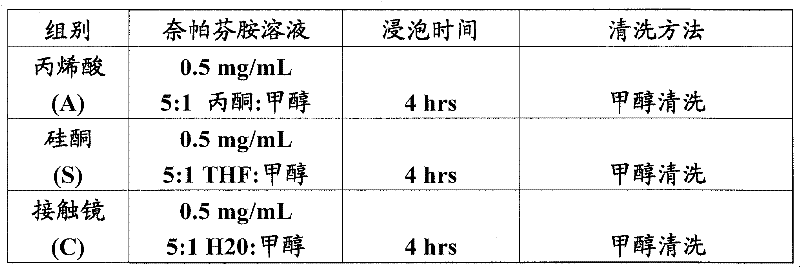
表A2Table A2
正如所见的,在硅酮IOL中和水凝胶接触镜中的载药容量显著低于丙烯酸IOL。另外,在头几天内,装载的药物从硅酮和水凝胶接触镜中迅速释放。相反,丙烯酸接触镜能够容纳更多的药物并在较长的时间段逐渐释放。As can be seen, the drug loading capacity in silicone IOLs and in hydrogel contact lenses is significantly lower than in acrylic IOLs. Additionally, the loaded drug was released rapidly from the silicone and hydrogel contact lenses within the first few days. In contrast, acrylic contact lenses are able to hold more drug and release it gradually over a longer period of time.
实施例6:A1IOL通过在5mg/mL的姜黄素药物在丙酮中的溶液中浸泡12小时装载药物。在用丙酮和BSS进行表面清洗后,将IOL作为无晶状体IOL植入新西兰白兔两只眼睛中的一只中。在植入前,白兔的天然晶状体通过标准超声乳化白内障吸除术摘除。无任何植入物的第2只眼睛作为对照。在不同的时间段处死家兔并摘除眼睛。在每个样本眼睛中姜黄素药物分子的荧光发射通过共聚焦激光扫描显微镜(CLSM)成像以获得高分辨药物分布图像。将结果图示于图6中,并具体显示眼睛的A区和C区(侧面的巩膜区)、眼睛的B区(角膜和前室区)和D区(色素区和黄斑区)。Example 6: A1 IOLs were drug loaded by soaking in a 5 mg/mL solution of curcumin drug in acetone for 12 hours. After surface cleaning with acetone and BSS, the IOL was implanted as an aphakic IOL in one of the two eyes of New Zealand white rabbits. Before implantation, the natural lens of the white rabbits was removed by standard phacoemulsification. A second eye without any implant served as a control. Rabbits were sacrificed and eyes enucleated at different time periods. The fluorescence emission of curcumin drug molecules in each sample eye was imaged by confocal laser scanning microscopy (CLSM) to obtain high-resolution drug distribution images. The results are shown graphically in Figure 6 and specifically show areas A and C of the eye (lateral scleral area), areas B (cornea and anterior chamber area) and D (pigmented area and macular area) of the eye.
实施例7:制备两份2.5mg/mL的奈帕芬胺(PC log P=2.1)和2.5mg/mL双氯芬酸钠(PC log P=1.1)溶液。将A1和A2盘浸泡在每份溶液中4小时用于药物摄入。进行在BSS中的每天药物释放研究共2周。载药量和释放量图示于图7中。正如所见,更疏水的A1材料比不太疏水的A2材料装载更多的药物奈帕芬胺和双氯芬酸钠。两种材料装载了更大量的疏水药物奈帕芬胺,但仅装载了有限量的不太疏水的双氯芬酸钠。Example 7: Two 2.5 mg/mL solutions of nepafenac (PC log P=2.1) and 2.5 mg/mL diclofenac sodium (PC log P=1.1) were prepared. Soak A1 and A2 discs in each solution for 4 hours for drug ingestion. Daily drug release studies in BSS were performed for 2 weeks. A graph of drug loading and release is shown in FIG. 7 . As can be seen, the more hydrophobic A1 material was loaded with more drugs nepafenac and diclofenac sodium than the less hydrophobic A2 material. Both materials were loaded with a larger amount of the hydrophobic drug nepafenac, but only a limited amount of the less hydrophobic diclofenac sodium.
通过用在溶液中的不同的药物浓度和在这些溶液中不同的浸泡时间的试验,发现可能改变装载至眼科用装置的治疗剂的量。但是,眼用材料的疏水性和/或治疗剂的疏水性一般是决定装载药物至所述装置的量的能力的支配因素。Through experimentation with different drug concentrations in the solutions and different soak times in these solutions, it was found that it is possible to vary the amount of therapeutic agent loaded into the ophthalmic device. However, the hydrophobicity of the ophthalmic material and/or the hydrophobicity of the therapeutic agent is generally the dominant factor in determining the ability to load the amount of drug into the device.
实施例8:将IOL用LubrilAST衣层/药物溶液包衣。将双氯芬酸与包衣溶液直接混合,将IOL在衣层/药物溶液中进行浸渍-提拉包衣。调整包衣制剂,以使PVP在衣层/药物溶液中的浓度为20%、14%、5%和2%的重量。双氯芬酸浓度保持恒定在31mg/mL。将晶状体用单层衣层浸渍-提拉包衣,并在65℃烘箱干燥4小时。晶状体在BSS中以前面所述的相同方式试验并使用分光光度计测定。Example 8: Coating of IOLs with LubrilAST coating/drug solution. Diclofenac was mixed directly with the coating solution and the IOL was dip-pull coated in the coating/drug solution. The coating formulation was adjusted so that the concentration of PVP in the coating/drug solution was 20%, 14%, 5% and 2% by weight. The diclofenac concentration was kept constant at 31 mg/mL. The lenses were dip-pull coated with a single coat and oven dried at 65°C for 4 hours. Lenses were tested in the BSS in the same manner as previously described and measured using a spectrophotometer.
发现药物释放速率随着PVP含量降低而降低,如图11中所见。20%的PVP含量,5天后平均(n=3)释放98.2%的药物。但是,2%PVP时,5天后平均(n=3)释放总药物的71.9%(图C2)。再者,以每天基础释放的双氯芬酸量显著地受PVP含量影响。如图12所见,有2%PVP的衣层以稳定速率释放双氯芬酸4天,而其他浓度在1天释放后显著降低。因此,降低PVP含量在5天中显著延长了药物释放的持续时间。The drug release rate was found to decrease with decreasing PVP content, as seen in FIG. 11 . With a PVP content of 20%, an average (n=3) of 98.2% of the drug was released after 5 days. However, at 2% PVP, an average (n=3) of 71.9% of the total drug was released after 5 days (Figure C2). Furthermore, the amount of diclofenac released on a daily basis was significantly influenced by the PVP content. As seen in Figure 12, the coating with 2% PVP released diclofenac at a steady rate for 4 days, while the other concentrations decreased significantly after 1 day of release. Therefore, reducing the PVP content significantly extended the duration of drug release over 5 days.
实施例9:改变双氯芬酸包衣溶液,以便测定加至衣层中不同的药物浓度的释放速率。浓度范围包括5.2、14.9、42.8、和80.1mg/mL的双氯芬酸至包衣溶液。每个浓度计算的总的载药分别为0.5453、1.636、4.699和8.795mg。双氯芬酸在水中溶解最多为50mg/mL。选择超出该范围的一个浓度以便测定衣层浓度稳定性的影响和对释放速率的影响。其余易于溶入包衣溶液中,没有通过在包衣溶液中存在未溶解的结晶而表明高浓度。对所有衣层,交联剂含量均为1.5%,每种衣层,晶状体均被包衣7层。衣层厚度无显著不同,正如包衣的晶状体的干重测定值所示。Example 9: Variation of the coating solution of diclofenac in order to determine the release rate of different drug concentrations added to the coating. Concentration ranges included 5.2, 14.9, 42.8, and 80.1 mg/mL of diclofenac to the coating solution. The total drug loading calculated for each concentration was 0.5453, 1.636, 4.699 and 8.795 mg, respectively. Diclofenac dissolves up to 50 mg/mL in water. A concentration outside this range was chosen in order to determine the effect of coating concentration stability and the effect on release rate. The remainder readily dissolved into the coating solution, with no indication of high concentration by the presence of undissolved crystals in the coating solution. The crosslinker content was 1.5% for all coating layers, and the lens was coated with 7 layers for each coating layer. Coating thicknesses were not significantly different, as indicated by dry weight measurements of the coated lenses.
晶状体在BSS中以与前文所述的相同方式试验,并使用分光光度计测定。对每种衣层头3天的释放速率显著不同。从第4天至第10天,药物释放速率稳定,并在整个时间段几乎保持不变。对于其他浓度,接近10天结束时的药物水平同样落在提出的试验方法的检测限以下。Lenses were tested in the BSS in the same manner as previously described and measured using a spectrophotometer. The release rates for the first 3 days were significantly different for each coating layer. From
实施例10:对包括2.6、10.5、30.3和61.2mg/mL的一定浓度范围的衣层,获取秋水仙碱的释放速率。对每个晶状体的包含在衣层内的药物量基于包衣和干燥后衣层的已知收缩和重量变化后晶状体的重量增量进行计算。晶状体用包含约0.0316mg的秋水仙碱的2.6mg/mL药物-衣层溶液包衣。晶状体用包含约0.116mg的秋水仙碱的10.5mg/mL药物-包衣溶液包衣。晶状体用包含约0.336mg的秋水仙碱的30.3mg/mL药物-包衣溶液包衣。晶状体用包含约0.694mg的秋水仙碱的61.2mg/mL的药物-包衣溶液包衣。基于体外研究,根据显示在低至0.0005mg/mL浓度LEC迁移和增殖作用被抑制,秋水仙碱的靶浓度为0.0005mg/mL。使用这一分析技术秋水仙碱的检测限为0.0083mg/mL。每个样本获取8天的药物浓度。但是,8天后,所有浓度均落在检测限以下。此时,替换试验溶液,使晶状体再浸泡18天(总计28天),以便获得可测量的药物浓度。在体外药物释放中,数据表明用2.6mg/mL包衣溶液包衣的晶状体释放这些量8天,然后降至检测限以下。用10.5mg/mL以及更高浓度的包衣溶液包衣的晶状体,在至少8天释放量在0.0083mg/mL以上。对装载不同药物浓度水平的衣层,检测在28天后在BSS中在37℃(n=3)秋水仙碱的释放。Example 10: Obtaining the release rate of colchicine for a certain concentration range of coating layers including 2.6, 10.5, 30.3 and 61.2 mg/mL. The amount of drug contained in the coating was calculated for each lens based on the weight gain of the lens after coating and drying after known shrinkage and weight change of the coating. The lenses were coated with a 2.6 mg/mL drug-coating solution containing about 0.0316 mg of colchicine. The lenses were coated with a 10.5 mg/mL drug-coating solution containing approximately 0.116 mg of colchicine. The lenses were coated with a 30.3 mg/mL drug-coating solution containing approximately 0.336 mg of colchicine. The lenses were coated with a 61.2 mg/mL drug-coating solution containing approximately 0.694 mg of colchicine. The target concentration of colchicine is 0.0005 mg/mL based on in vitro studies showing that LEC migration and proliferation are inhibited at concentrations as low as 0.0005 mg/mL. The limit of detection for colchicine using this analytical technique was 0.0083 mg/mL. Eight days of drug concentrations were obtained for each sample. However, after 8 days, all concentrations fell below the detection limit. At this point, the test solution was replaced and the lens was allowed to soak for an additional 18 days (28 days total) in order to obtain measurable drug concentrations. In in vitro drug release, the data indicated that lenses coated with 2.6 mg/mL coating solution released these amounts for 8 days and then fell below the limit of detection. The lens coated with the coating solution of 10.5 mg/mL and higher concentration released more than 0.0083 mg/mL for at least 8 days. The release of colchicine in BSS at 37° C. (n=3) was examined after 28 days for the coatings loaded with different drug concentration levels.
实施例11:对每个晶状体在衣层内包含的药量按照前面描述的方法计算。用2mg/mL药物衣层溶液包衣的晶状体包含约0.138mg的丝裂霉素-C(MMC)。基于体外研究,根据在低至0.0005mg/mL浓度显示LEC迁移和增殖作用被抑制,MMC的靶浓度为0.0005mg/mL。使用这一分析技术MMC的检测限为0.010mg/mL。11天后,从衣层释放的MMC持续在检测限以上的水平。在初始2天的药物释放后,药物释放速率无显著变化。在37℃浸泡在BSS中11天后,仍保持装载至晶状体内MMC总量的20%。在37℃在BSS中水合后,MMC从衣层中释放达11天(n=3)。用此方法,对于MMC,11天后的水平在检测限以下。Example 11: For each lens, the amount of drug contained in the coating layer was calculated according to the method described above. Lenses coated with the 2 mg/mL drug coating solution contained approximately 0.138 mg of mitomycin-C (MMC). Based on in vitro studies, the target concentration of MMC is 0.0005 mg/mL based on the inhibition of LEC migration and proliferation shown at concentrations as low as 0.0005 mg/mL. The detection limit of MMC using this analytical technique is 0.010 mg/mL. After 11 days, the release of MMC from the coating continued at levels above the detection limit. After the initial 2 days of drug release, there was no significant change in drug release rate. After soaking in BSS at 37°C for 11 days, 20% of the total amount of MMC loaded into the lens remained. After hydration in BSS at 37°C, MMC was released from the coating for 11 days (n=3). Using this method, the levels after 11 days were below the detection limit for MMC.
实施例12:丙烯酸酯晶状体(
晶状体使用丙酮和浓度为3mg/ml的治疗剂制备的治疗剂溶液进行装载。晶状体浸泡在该溶液中90分钟。将该溶液倾至格栅网孔中以重新得到晶状体,晶状体在密闭室中风干过夜。第2天,将晶状体浸泡在丙酮∶甲醇(1∶1)溶液中5分钟并轻轻涡旋。然后取出晶状体,并使其风干约2小时。然后将晶状体在50℃下真空干燥过夜。装载治疗剂的晶状体(每种药物1个晶状体)被置于Eppendorf管中,向其中加入0.5ml HPLC级的水。盘在37℃下、5%CO2孵育,在7天的时间里每24小时替换释放介质。使用HPLC分析释放介质中的药量。Lenses were loaded with a solution of therapeutic agent prepared in acetone and therapeutic agent at a concentration of 3 mg/ml. The lenses were soaked in this solution for 90 minutes. The solution was poured into the grid mesh to retrieve the lens, which was air dried overnight in a closed chamber. On
试验各种条件,对每种治疗剂优化HPLC方法。Various conditions were tested to optimize the HPLC method for each therapeutic agent.
奈帕芬胺按照基本上如上文描述的HPLC方法试验。Nepafenac was tested according to the HPLC method essentially as described above.
对于抗坏血酸,流动相包括蒸馏水和2mM的1-辛烷磺酸钠盐、甲醇和冰醋酸[55∶44.5∶0.5(v/v)]。标准品用流动相制备。进样体积为25μl,流速0.5ml/min。检测波长固定在263nm。For ascorbic acid, the mobile phase consisted of distilled water and 2 mM 1-octanesulfonic acid sodium salt, methanol and glacial acetic acid [55:44.5:0.5 (v/v)]. Standards were prepared in mobile phase. The injection volume was 25 μl, and the flow rate was 0.5 ml/min. The detection wavelength is fixed at 263nm.
对于阿司匹林,流动相包括甲醇、冰醋酸、蒸馏水[30∶2∶68(v/v)]。标准品用水制备,进样体积为25μl。样品流速保持为1ml/min。检测在254nm进行。For aspirin, the mobile phase consisted of methanol, glacial acetic acid, distilled water [30:2:68 (v/v)]. Standards were prepared in water, and the injection volume was 25 μl. The sample flow rate was maintained at 1 ml/min. Detection was performed at 254nm.
对于秋水仙碱,流动相包括乙腈和3%醋酸[60∶40(v/v)],标准品用流动相制备。HPLC流速保持在1ml/min,进样体积为25μl。检测在245nm进行。For colchicine, the mobile phase consisted of acetonitrile and 3% acetic acid [60:40 (v/v)], and the standards were prepared with the mobile phase. The HPLC flow rate was maintained at 1 ml/min, and the injection volume was 25 μl. Detection was performed at 245nm.
对于酮咯酸,流动相包括乙腈和0.2%v/v的冰醋酸[40∶60(v/v)]。标准品用甲醇制备,进样体积为20μl。流速保持在1ml/min,检测波长固定在313nm。For ketorolac, the mobile phase consisted of acetonitrile and 0.2% v/v glacial acetic acid [40:60 (v/v)]. Standards were prepared with methanol, and the injection volume was 20 μl. The flow rate was kept at 1ml/min, and the detection wavelength was fixed at 313nm.
对于利多卡因,流动相包括350ml甲醇、150ml蒸馏水、10ml冰醋酸和1.6g十二烷基硫酸钠的混合物。流动相用0.22μm滤器过滤。利多卡因标准品用流动相制备。进样体积设为25μl,流速为1ml/min。检测在250nm下进行。For lidocaine, the mobile phase consisted of a mixture of 350 ml methanol, 150 ml distilled water, 10 ml glacial acetic acid and 1.6 g sodium lauryl sulfate. The mobile phase was filtered with a 0.22 μm filter. Lidocaine standards were prepared in mobile phase. The injection volume was set at 25 μl, and the flow rate was 1 ml/min. Detection was performed at 250nm.
在7天后治疗剂从晶状体总的释放总结在下表1中。The total release of therapeutic agent from the lens after 7 days is summarized in Table 1 below.

表ITable I
如上表中所示,较高的治疗剂log P值(即,表明较大的亲脂性或疏水性),显示出所需要的从晶状体的治疗剂释放。As shown in the table above, higher therapeutic agent log P values (ie, indicating greater lipophilicity or hydrophobicity), indicate a desired release of therapeutic agent from the lens.
申请人在本说明书中具体加入所有引用的参考文献的全部内容。另外,当用量、浓度或其他数值或参数以范围、优选范围、或一列较高的优选数值和较低优选数值给出时,应理解为具体地公开从任意的较高范围限度或优选值和任意的较低范围限度或优选数值的任意一对构成的全部范围,不论范围是否被单独公开。当本文引用数值的范围的情况下,除非另外指出,该范围是指包括其端点,和在此范围内的所有整数和分数。当定义范围时,不是指本发明的范围被限制为所引用的具体数值。Applicants specifically incorporate in this specification the entire contents of all cited references. Additionally, when amounts, concentrations, or other values or parameters are given as ranges, preferred ranges, or a list of higher preferred values and lower preferred values, it is to be understood that there is specifically disclosed a range from any upper range limit or preferred value and Any pair of lower range limits or preferred values constitutes the entire range, whether or not the range is individually disclosed. Where a numerical range is recited herein, unless otherwise indicated, the range is meant to include its endpoints, and all integers and fractions within the range. It is not intended that the scope of the invention be limited to the specific values recited when defining a range.
本发明的其他实施方案从本说明书和本文公开的本发明的实践考虑,对本领域技术人员将是显而易见的。本说明书和实施例仅被视为是说明性的,通过以下权利要求书及其等价物说明本发明的真正范围和精神。Other embodiments of the invention will be apparent to those skilled in the art from consideration of the specification and practice of the invention disclosed herein. The specification and examples are to be considered as illustrative only, with the true scope and spirit of the invention being indicated by the following claims and their equivalents.
Claims (16)
Applications Claiming Priority (3)
| Application Number | Priority Date | Filing Date | Title |
|---|---|---|---|
| US8235208P | 2008-07-21 | 2008-07-21 | |
| US61/082,352 | 2008-07-21 | ||
| PCT/US2009/051103 WO2010011585A2 (en) | 2008-07-21 | 2009-07-20 | Ophthalmic device having therapeutic agent delivery capability and method of forming same |
Publications (2)
| Publication Number | Publication Date |
|---|---|
| CN102231989A true CN102231989A (en) | 2011-11-02 |
| CN102231989B CN102231989B (en) | 2013-08-21 |
Family
ID=41445879
Family Applications (1)
| Application Number | Title | Priority Date | Filing Date |
|---|---|---|---|
| CN2009801281283A Active CN102231989B (en) | 2008-07-21 | 2009-07-20 | Ophthalmic device having therapeutic agent delivery capability and method of forming same |
Country Status (16)
| Country | Link |
|---|---|
| US (3) | US9233069B2 (en) |
| EP (1) | EP2303331B1 (en) |
| JP (3) | JP5954888B2 (en) |
| KR (1) | KR101663111B1 (en) |
| CN (1) | CN102231989B (en) |
| AR (1) | AR073460A1 (en) |
| AU (2) | AU2009274209B2 (en) |
| BR (1) | BRPI0917390A2 (en) |
| CA (1) | CA2730264C (en) |
| ES (1) | ES2909726T3 (en) |
| IL (1) | IL210385A (en) |
| MX (1) | MX340636B (en) |
| NZ (1) | NZ590472A (en) |
| RU (1) | RU2519704C2 (en) |
| TW (1) | TWI531362B (en) |
| WO (1) | WO2010011585A2 (en) |
Cited By (4)
| Publication number | Priority date | Publication date | Assignee | Title |
|---|---|---|---|---|
| CN106901872A (en) * | 2015-12-22 | 2017-06-30 | 美桦兴业股份有限公司 | Intraocular lens and method of making same |
| CN108578768A (en) * | 2018-03-23 | 2018-09-28 | 四川大学 | A kind of artificial crystalline lens material and its preparation method and application of high intensity injectable |
| CN109121390A (en) * | 2014-06-06 | 2019-01-01 | 轨道生物医学有限公司 | Therapeutic agent delivery device with convergence lumen |
| CN115364280A (en) * | 2021-12-15 | 2022-11-22 | 郑州大学第一附属医院 | Medicine slow-release type artificial lens and preparation method thereof |
Families Citing this family (18)
| Publication number | Priority date | Publication date | Assignee | Title |
|---|---|---|---|---|
| EP2162283B1 (en) | 2007-06-14 | 2015-08-12 | Massachusetts Institute of Technology | Self assembled films for protein and drug delivery applications |
| US9198875B2 (en) * | 2008-08-17 | 2015-12-01 | Massachusetts Institute Of Technology | Controlled delivery of bioactive agents from decomposable films |
| US20130273137A1 (en) * | 2010-05-03 | 2013-10-17 | Massachusetts Eye & Ear Infirmary | Drug delivery coating and devices |
| US8235053B2 (en) | 2010-09-08 | 2012-08-07 | Alcon Research, Ltd. | Implantable punctal plug |
| US8864703B2 (en) | 2010-10-05 | 2014-10-21 | Alcon Research, Ltd. | Drug introduction and placement system |
| EP2841056A4 (en) | 2012-04-23 | 2015-09-16 | Massachusetts Inst Technology | COATED PARTICLES LAYER BY LAYER STABLE |
| WO2014038004A1 (en) * | 2012-09-05 | 2014-03-13 | 株式会社メニコン | Slow-drug-release ophthalmic lens and manufacturing method therefor |
| WO2014134029A1 (en) | 2013-02-26 | 2014-09-04 | Massachusetts Institute Of Technology | Nucleic acid particles, methods and use thereof |
| US9463244B2 (en) | 2013-03-15 | 2016-10-11 | Massachusetts Institute Of Technology | Compositions and methods for nucleic acid delivery |
| CN105247136B (en) * | 2013-06-03 | 2019-06-14 | 王子控股株式会社 | Method for producing microfiber-containing sheet |
| FR3028410A1 (en) | 2014-11-18 | 2016-05-20 | Pierre Coulon | MULTIFUNCTIONAL CAPSULAR IMPLANT |
| RU2612121C1 (en) * | 2016-01-27 | 2017-03-02 | Федеральное государственное бюджетное научное учреждение "Научно-исследовательский институт глазных болезней" | Silicone hydrogel therapeutic soft contact lens |
| EP3210572A1 (en) | 2016-02-29 | 2017-08-30 | Elodie Jane Siney | Intraocular lens comprising drug-containing microspheres |
| WO2019089567A1 (en) | 2017-10-30 | 2019-05-09 | Massachusetts Institute Of Technology | Layer-by-layer nanoparticles for cytokine therapy in cancer treatment |
| US20210228770A1 (en) * | 2018-06-05 | 2021-07-29 | Corneat Vision Ltd. | A synthetic ophthalmic graft patch |
| WO2020046299A1 (en) * | 2018-08-30 | 2020-03-05 | Qura, Inc. | Implantable intraocular drug delivery devices |
| WO2021002984A1 (en) | 2019-05-30 | 2021-01-07 | Massachusetts Institute Of Technology | Peptide nucleic acid functionalized hydrogel microneedles for sampling and detection of interstitial fluid nucleic acids |
| EP3990042A4 (en) * | 2019-06-27 | 2023-07-19 | Layerbio, Inc. | Ocular device delivery methods and systems |
Family Cites Families (23)
| Publication number | Priority date | Publication date | Assignee | Title |
|---|---|---|---|---|
| US4240163A (en) | 1979-01-31 | 1980-12-23 | Galin Miles A | Medicament coated intraocular lens |
| US5098443A (en) | 1989-03-23 | 1992-03-24 | University Of Miami | Method of implanting intraocular and intraorbital implantable devices for the controlled release of pharmacological agents |
| US6197059B1 (en) | 1990-04-27 | 2001-03-06 | Medevec Licensing, B.V. | Accomodating intraocular lens |
| US5290892A (en) | 1990-11-07 | 1994-03-01 | Nestle S.A. | Flexible intraocular lenses made from high refractive index polymers |
| US5470932A (en) | 1993-10-18 | 1995-11-28 | Alcon Laboratories, Inc. | Polymerizable yellow dyes and their use in opthalmic lenses |
| PT774983E (en) | 1995-06-07 | 2003-03-31 | Alcon Lab Inc | IMPROVED MATERIALS FOR OPHTHALMIC LENSES WITH HIGH REFRACTION INDEX |
| US5554187A (en) | 1995-08-18 | 1996-09-10 | Rizzo, Iii; Joseph | Medication dispensing intra-ocular lens system |
| JP2000507997A (en) | 1996-02-09 | 2000-06-27 | サーフェス ソルーションズ ラボラトリーズ インコーポレイテッド | Aqueous hydrophilic coating composition and articles made therefrom |
| DK0935512T3 (en) * | 1996-11-01 | 2002-07-29 | Alcon Lab Inc | Cryogenic polishing progress seed for soft acrylic articles |
| FR2757064B1 (en) | 1996-12-13 | 2000-02-04 | Ioltechnologie Production | INTRAOCULAR LENS CONTAINING RELARGABLE MEDICINE |
| US5843186A (en) | 1996-12-20 | 1998-12-01 | Implemed, Inc. | Intraocular lens with antimicrobial activity |
| US6353069B1 (en) | 1998-04-15 | 2002-03-05 | Alcon Manufacturing, Ltd. | High refractive index ophthalmic device materials |
| US6106554A (en) | 1999-02-25 | 2000-08-22 | Bausch & Lomb Surgical, Inc. | Intraocular lens implants for the prevention of secondary cataracts |
| CA2426765C (en) | 2000-10-24 | 2012-06-05 | Shunichi Shiozawa | Genomes participating in rheumatoid arthritis, method of the diagnosis thereof, method of evaluating the onset possibility thereof, diagnostic kit for detecting them and therapeutic method and remedies for rheumatoid arthritis |
| CA2473355C (en) | 2002-01-18 | 2012-01-03 | Michael E. Snyder | Sustained release ophthalmological device and method of making and using the same |
| US7153573B2 (en) * | 2002-08-08 | 2006-12-26 | Kao Corporation | Polymer composite particle comprising metal oxide and silicone and/or fluorine and method of producing the same |
| GB0219024D0 (en) | 2002-08-15 | 2002-09-25 | Pfizer Ltd | Synergistic combinations |
| US7273896B2 (en) | 2003-04-10 | 2007-09-25 | Angiotech Pharmaceuticals (Us), Inc. | Compositions and methods of using a transient colorant |
| RU2251394C2 (en) * | 2003-06-23 | 2005-05-10 | Войсковая Часть 41598 | Composition and method for manufacturing curative soft contact lens |
| TWI358290B (en) * | 2004-12-02 | 2012-02-21 | Alcon Inc | Topical nepafenac formulations |
| AU2006250914B2 (en) * | 2005-05-25 | 2012-03-01 | Chemisches Institut Schaefer Ag | Biocompatible polymers and co-polymers comprising amino acids in the side chain |
| US20070218104A1 (en) * | 2006-03-15 | 2007-09-20 | Bausch & Lomb Incorporation | Rate controlled release of a pharmaceutical agent in a biodegradable device |
| KR101454041B1 (en) | 2006-11-06 | 2014-10-27 | 노파르티스 아게 | Eye devices and methods of making and using the same |
-
2009
- 2009-06-29 TW TW098121873A patent/TWI531362B/en not_active IP Right Cessation
- 2009-07-20 BR BRPI0917390A patent/BRPI0917390A2/en not_active Application Discontinuation
- 2009-07-20 KR KR1020117003870A patent/KR101663111B1/en not_active Expired - Fee Related
- 2009-07-20 US US12/505,558 patent/US9233069B2/en active Active
- 2009-07-20 AU AU2009274209A patent/AU2009274209B2/en active Active
- 2009-07-20 ES ES09790618T patent/ES2909726T3/en active Active
- 2009-07-20 CN CN2009801281283A patent/CN102231989B/en active Active
- 2009-07-20 JP JP2011520117A patent/JP5954888B2/en active Active
- 2009-07-20 MX MX2011000774A patent/MX340636B/en active IP Right Grant
- 2009-07-20 CA CA2730264A patent/CA2730264C/en active Active
- 2009-07-20 NZ NZ590472A patent/NZ590472A/en not_active IP Right Cessation
- 2009-07-20 AR ARP090102754A patent/AR073460A1/en unknown
- 2009-07-20 WO PCT/US2009/051103 patent/WO2010011585A2/en not_active Ceased
- 2009-07-20 RU RU2011106329/15A patent/RU2519704C2/en not_active IP Right Cessation
- 2009-07-20 EP EP09790618.4A patent/EP2303331B1/en active Active
-
2010
- 2010-12-30 IL IL210385A patent/IL210385A/en not_active IP Right Cessation
-
2014
- 2014-07-17 JP JP2014146505A patent/JP2014196357A/en active Pending
-
2015
- 2015-08-13 AU AU2015213358A patent/AU2015213358A1/en not_active Abandoned
- 2015-12-03 US US14/958,097 patent/US9750685B2/en active Active
-
2016
- 2016-04-19 JP JP2016083345A patent/JP2016130267A/en not_active Withdrawn
-
2017
- 2017-07-24 US US15/658,063 patent/US9962334B2/en active Active
Cited By (7)
| Publication number | Priority date | Publication date | Assignee | Title |
|---|---|---|---|---|
| CN109121390A (en) * | 2014-06-06 | 2019-01-01 | 轨道生物医学有限公司 | Therapeutic agent delivery device with convergence lumen |
| CN106901872A (en) * | 2015-12-22 | 2017-06-30 | 美桦兴业股份有限公司 | Intraocular lens and method of making same |
| CN106901872B (en) * | 2015-12-22 | 2018-11-20 | 美桦兴业股份有限公司 | Intraocular lens and method of making same |
| CN108578768A (en) * | 2018-03-23 | 2018-09-28 | 四川大学 | A kind of artificial crystalline lens material and its preparation method and application of high intensity injectable |
| CN108578768B (en) * | 2018-03-23 | 2020-05-01 | 四川大学 | High-strength injectable intraocular lens material and preparation method and application thereof |
| CN115364280A (en) * | 2021-12-15 | 2022-11-22 | 郑州大学第一附属医院 | Medicine slow-release type artificial lens and preparation method thereof |
| CN115364280B (en) * | 2021-12-15 | 2023-08-18 | 郑州大学第一附属医院 | Drug sustained-release intraocular lens and preparation method thereof |
Also Published As
Similar Documents
| Publication | Publication Date | Title |
|---|---|---|
| CN102231989B (en) | Ophthalmic device having therapeutic agent delivery capability and method of forming same | |
| Chatterjee et al. | Advances in chemistry and composition of soft materials for drug releasing contact lenses | |
| CN103025312B (en) | Contact lens drug delivery device | |
| US11173130B2 (en) | Drug delivery system and methods of use | |
| Chauhan | Ocular drug delivery role of contact lenses | |
| Torres Luna | Therapeutic contact lenses for extended drug delivery | |
| Luna | Therapeutic Contact Lenses for Extended Drug Delivery | |
| AU2014215997B2 (en) | Contact lens drug delivery device | |
| Barbu | Ophthalmic drug delivery: hybrid polymeric hydrogels | |
| Kamali et al. | Advances in chemistry and composition of soft materials for drug releasing contact lenses |
Legal Events
| Date | Code | Title | Description |
|---|---|---|---|
| C06 | Publication | ||
| PB01 | Publication | ||
| C10 | Entry into substantive examination | ||
| SE01 | Entry into force of request for substantive examination | ||
| C14 | Grant of patent or utility model | ||
| GR01 | Patent grant | ||
| TR01 | Transfer of patent right | ||
| TR01 | Transfer of patent right |
Effective date of registration: 20191129 Address after: Fribourg Patentee after: ALCON, Inc. Address before: Basel, Switzerland Patentee before: NOVARTIS AG Effective date of registration: 20191129 Address after: Basel, Switzerland Patentee after: NOVARTIS AG Address before: Hananberg, Switzerland Patentee before: ALCON, Inc. |