CN102216373B - Adhesive composition and its preparation method - Google Patents
Adhesive composition and its preparation method Download PDFInfo
- Publication number
- CN102216373B CN102216373B CN200980145818XA CN200980145818A CN102216373B CN 102216373 B CN102216373 B CN 102216373B CN 200980145818X A CN200980145818X A CN 200980145818XA CN 200980145818 A CN200980145818 A CN 200980145818A CN 102216373 B CN102216373 B CN 102216373B
- Authority
- CN
- China
- Prior art keywords
- particle
- composition
- preparation
- fluid
- viscous composition
- Prior art date
- Legal status (The legal status is an assumption and is not a legal conclusion. Google has not performed a legal analysis and makes no representation as to the accuracy of the status listed.)
- Active
Links
Images


Classifications
-
- C—CHEMISTRY; METALLURGY
- C08—ORGANIC MACROMOLECULAR COMPOUNDS; THEIR PREPARATION OR CHEMICAL WORKING-UP; COMPOSITIONS BASED THEREON
- C08J—WORKING-UP; GENERAL PROCESSES OF COMPOUNDING; AFTER-TREATMENT NOT COVERED BY SUBCLASSES C08B, C08C, C08F, C08G or C08H
- C08J3/00—Processes of treating or compounding macromolecular substances
- C08J3/12—Powdering or granulating
- C08J3/124—Treatment for improving the free-flowing characteristics
-
- C—CHEMISTRY; METALLURGY
- C08—ORGANIC MACROMOLECULAR COMPOUNDS; THEIR PREPARATION OR CHEMICAL WORKING-UP; COMPOSITIONS BASED THEREON
- C08J—WORKING-UP; GENERAL PROCESSES OF COMPOUNDING; AFTER-TREATMENT NOT COVERED BY SUBCLASSES C08B, C08C, C08F, C08G or C08H
- C08J2323/00—Characterised by the use of homopolymers or copolymers of unsaturated aliphatic hydrocarbons having only one carbon-to-carbon double bond; Derivatives of such polymers
- C08J2323/02—Characterised by the use of homopolymers or copolymers of unsaturated aliphatic hydrocarbons having only one carbon-to-carbon double bond; Derivatives of such polymers not modified by chemical after treatment
- C08J2323/10—Homopolymers or copolymers of propene
Landscapes
- Chemical & Material Sciences (AREA)
- Health & Medical Sciences (AREA)
- Chemical Kinetics & Catalysis (AREA)
- Medicinal Chemistry (AREA)
- Polymers & Plastics (AREA)
- Organic Chemistry (AREA)
- Processes Of Treating Macromolecular Substances (AREA)
- Compositions Of Macromolecular Compounds (AREA)
- Addition Polymer Or Copolymer, Post-Treatments, Or Chemical Modifications (AREA)
- Adhesives Or Adhesive Processes (AREA)
Abstract
Description
优先权要求 priority claim
本申请要求于2008年11月19日提交的USSN61/116,059的优先权和权益。 This application claims priority and benefit to USSN 61/116,059, filed November 19, 2008. the
技术领域 technical field
本发明涉及粘合剂组合物、制备其的方法,并且更特别地涉及由通常粘性的塑料材料例如聚烯烃组成的抗附聚颗粒,和基于其的粘合剂。 The present invention relates to adhesive compositions, methods of making the same, and more particularly to agglomeration-resistant particles composed of normally sticky plastic materials such as polyolefins, and adhesives based thereon. the
背景技术 Background technique
固有地“软并且粘性”的常规聚合物例如某些聚烯烃和基于其的粘合剂难以通过常规造粒方法加工成粒料。常规材料通常具有低结晶度并且缓慢固化。在加工设备例如造粒机的旋转刀上,这些材料将粘贴或涂污。在特别于升高的温度下短时间储存后,软并且粘性的材料还堵塞传送管线和/或附聚。这些材料然后必须以一些其他较不希望的形式,例如大固体块料、粉末涂覆的板条或者大体积鼓状物制造和销售。因此,如果可以开发出用于制备这些软并且粘性材料的自由流动颗粒的方法将是希望的。 Conventional polymers such as certain polyolefins and binders based thereon that are inherently "soft and sticky" are difficult to process into pellets by conventional pelletizing methods. Conventional materials generally have low crystallinity and solidify slowly. On processing equipment such as the rotary knives of a granulator, these materials will stick or smear. The soft and viscous material also clogs transfer lines and/or agglomerates after short storage, especially at elevated temperatures. These materials must then be manufactured and sold in some other less desirable form, such as large solid blocks, powder coated slats, or bulky drums. Therefore, it would be desirable if a method could be developed for making free-flowing particles of these soft and viscous materials. the
经造粒的粘合剂组合物不仅粘住或粘附于手和机械处理装置上,而且粘附于粉尘和其他污染物上。结果,在运输和/或储存期间容纳是商业粘合剂或者任何类型的粘性塑料材料的关键方面。 The pelletized adhesive composition sticks or adheres not only to hands and mechanical handling devices, but also to dust and other contaminants. As a result, containment during shipping and/or storage is a critical aspect of commercial adhesives, or any type of sticky plastic material. the
在一些情形中,粘合剂组合物不能作为大体积粒料运输。例如,由于附聚成不容易流出料斗车的巨大的块的料斗车风险,因此粒料在加料斗轨道车中运输是不可能的。普遍实践是使用经冷却的绝缘轨道车以促进软和/或粘性粒料从车中卸载,因为粒料在较冷的温度下较不 软和粘性。例如,乙烯-乙酸乙烯酯(EVA)共聚物用作热熔粘合剂应用中的粘合剂。通常,当乙酸乙烯酯含量增加时,EVA粒料变得更软、更粘并且在它们的自重下更倾向于附聚。这抑制了聚合物粒料的处理。因此,使用前必须强制地重新分散粒料以使得粒料能够流动。粒料的这种附聚破坏了最终应用操作。 In some cases, the binder composition cannot be shipped as bulky pellets. For example, transportation of pellets in hopper rail cars is not possible due to the risk of hopper cars agglomerating into huge chunks that do not easily flow out of the hopper car. It is common practice to use cooled, insulated rail cars to facilitate unloading of soft and/or sticky pellets from the cars, since pellets are less soft and sticky at cooler temperatures. For example, ethylene-vinyl acetate (EVA) copolymers are used as adhesives in hot melt adhesive applications. In general, EVA pellets become softer, stickier and more prone to agglomeration under their own weight as the vinyl acetate content increases. This inhibits the handling of polymer pellets. Therefore, it is necessary to forcibly redisperse the pellets before use to allow the pellets to flow. This agglomeration of the pellets disrupts end-use operations. the
已经提出各种常规技术以防止软和/或粘性组合物免于附聚,包括将组合物造粒和用各种材料向粒料喷粉。由于运输和储存期间粉尘损失,因此添加剂引入一些粘性组合物成为减少附聚的优选方法。不幸的是,改性粘性组合物的组成不总是喷粉技术的可行或者希望的替代方案。 Various conventional techniques have been proposed to prevent soft and/or viscous compositions from agglomerating, including granulating the composition and dusting the granules with various materials. The introduction of additives into some viscous compositions is a preferred method of reducing agglomeration due to dust loss during transport and storage. Unfortunately, modifying the composition of viscous compositions is not always a viable or desirable alternative to dusting techniques. the
因此,需要制备在环境或升高的温度下抗附聚的粘性组合物颗粒并且因此提供经济的运输和储存方式的方法。 Therefore, there is a need for a method of preparing particles of cohesive compositions that resist agglomeration at ambient or elevated temperatures and thus provide an economical means of transport and storage. the
发明内容 Contents of the invention
概述 overview
本发明提供了制备由粘性聚合物组合物组成的抗附聚颗粒的方法。所述方法包括以下步骤:提供在或高于聚合物组合物的玻璃化转变温度的聚合物组合物的颗粒,通过使聚合物组合物颗粒与第一流体在升高的温度下接触而增加聚合物组合物颗粒的粘性,在使聚合物组合物颗粒与第一流体接触的同时,使聚合物组合物颗粒与防粘连组合物接触,并且将聚合物组合物颗粒与第一流体分离。这些方法采用防粘连组合物至少部分包覆聚合物组合物颗粒。 The present invention provides a method of preparing agglomeration resistant particles consisting of a cohesive polymer composition. The method comprises the steps of providing particles of a polymer composition at or above the glass transition temperature of the polymer composition, increasing polymerization by contacting the particles of the polymer composition with a first fluid at an elevated temperature The viscosity of the particles of the polymer composition is contacted with the particles of the polymer composition while contacting the particles of the polymer composition with the first fluid, the particles of the polymer composition are contacted with the anti-blocking composition, and the particles of the polymer composition are separated from the first fluid. These methods at least partially coat particles of the polymeric composition with an antiblocking composition. the
与用抗粘连组合物涂覆经冷却的颗粒的常规技术相反,本发明方法反直觉地在使粘性颗粒与防粘连组合物接触前增加粘性颗粒的温度。本发明方法得到即使在升高的储存和运输温度,例如50℃和以上温度下也抗附聚的颗粒。因此,即使在否则可能促进结块或附聚的温度、储存时间和压缩下,颗粒也保持基本上自由流动。 Contrary to the conventional technique of coating cooled particles with an anti-blocking composition, the present method counter-intuitively increases the temperature of the tacky particles prior to contacting the tacky particles with the anti-blocking composition. The process of the invention results in particles which are resistant to agglomeration even at elevated storage and transport temperatures, eg 50°C and above. Thus, the particles remain substantially free-flowing even under temperatures, storage times and compressions that might otherwise promote caking or agglomeration. the
附图说明 Description of drawings
图1是用于制备抗附聚颗粒的装置的示例性示意图。 Figure 1 is an exemplary schematic diagram of an apparatus for preparing agglomeration resistant particles. the
图2是通过根据本发明方法制备的组合物的等温DSC测试得到的结晶半衰期对温度的曲线图。 Figure 2 is a graph of crystallization half-life versus temperature obtained by isothermal DSC testing of compositions prepared according to the method of the present invention. the
图3是对于浸入水中和根据本发明方法制备的粒料的硬度对时间的X-Y曲线图。 Figure 3 is an X-Y graph of hardness versus time for immersion in water and pellets prepared according to the process of the present invention. the
图4是对于在空气中老化和根据本发明方法制备的粒料的硬度对时间的X-Y曲线图。 Figure 4 is an X-Y graph of hardness versus time for pellets aged in air and prepared according to the process of the present invention. the
图5是对于根据本发明方法制备的聚合物的附聚程度对温度的曲线图。 Figure 5 is a graph of the degree of agglomeration versus temperature for polymers prepared according to the process of the present invention. the
图6是用于制备抗附聚颗粒的装置的示例性示意图。 Figure 6 is an exemplary schematic illustration of an apparatus for preparing agglomeration resistant particles. the
说明性实施方案的详述 Detailed Description of Illustrative Implementations
本发明提供了制备抗附聚颗粒的方法、由该方法制备的颗粒,和用于进行该方法的装置。提供了可用于制备由粘性组合物,例如粘合剂或聚合物组成的抗附聚颗粒的方法。所述方法包括以下步骤:使粘性组合物颗粒与第一流体在升高的温度下接触,和在使粘性组合物与第一流体接触的同时,使粘性组合物与防粘连组合物接触。这些方法将粘性组合物采用防粘连组合物基本上包覆。 The present invention provides a method of making agglomeration resistant particles, particles made by the method, and apparatus for carrying out the method. A method is provided that can be used to prepare agglomeration resistant particles composed of a viscous composition, such as a binder or a polymer. The method comprises the steps of contacting particles of the tacky composition with a first fluid at an elevated temperature, and contacting the tacky composition with an anti-blocking composition while contacting the tacky composition with the first fluid. These methods substantially coat the tacky composition with the antiblock composition. the
与用防粘连组合物包覆经冷却的颗粒的常规技术相对照,本发明方法反直觉地在使它们与防粘连组合物接触前增加粘性颗粒的温度。本发明方法得到即使在升高的储存和运输温度,例如50℃和以上,也抗附聚的颗粒。因此,即使在可能否则促进结块或附聚的温度、储存时间和压缩下,颗粒也保持基本上自由流动。因此,本发明方法可用于将粘性组合物规格化(unitizing)。 In contrast to the conventional technique of coating cooled particles with an anti-blocking composition, the present method counter-intuitively increases the temperature of the sticky particles prior to contacting them with the anti-blocking composition. The process of the invention results in particles which are resistant to agglomeration even at elevated storage and transport temperatures, eg 50°C and above. Thus, the particles remain substantially free-flowing even under temperatures, storage times and compressions that might otherwise promote caking or agglomeration. Thus, the method of the invention can be used for unitizing viscous compositions. the
尽管常规造粒方法教导了改进的结果和在低粘性组合物温度,例如低于环球软化点下造粒的容易性,但这类方法存在缺点,例如:(a)不会制得可倾倒的颗粒,(b)需要多于一个的包覆步骤,(c)需要喷粉步骤,由此产生潜在的空气传播的危险,(d)需要粘性组合物方面的改性,即将组合物折衷处理,以获得抗附聚的颗粒,(e)由于在 挤出/造粒期间在结晶或环球软化温度下或其附近操作导致增加的相分离或模头冻结的风险,(f)不正常的粒料形成,即通过切割装置而挤出的材料包裹在模头表面周围,伸长的粒料,和形成差的几何形状粒料,和/或(g)需要另外的设备,例如泵,或机械能以保持流动速率。 Although conventional granulation methods teach improved results and ease of granulation at low viscous composition temperatures, e.g., below the Ring and Ball softening point, such methods have disadvantages such as: Granules that (b) require more than one coating step, (c) require a dusting step, thereby creating a potential airborne hazard, (d) require modification in the viscous composition, i.e. a composition compromise, To obtain pellets that resist agglomeration, (e) increased risk of phase separation or die freezing due to operation at or near crystallization or ring and ball softening temperatures during extrusion/pelletization, (f) abnormal pellets forming, that is, material extruded through the cutting device wraps around the die surface, elongates pellets, and forms pellets of poor geometry, and/or (g) requires additional equipment, such as pumps, or mechanical energy to Maintain flow rate. the
这些常规方法和组合物描述于美国专利号7,328,547、7,232,535、7,137,235、7,122,584、7,101,926、6,716,527、6616968、6,533,564、6,458,300、6,426,026、6,335,095、6,228,902、6,120,899、6,177,516、5,942,304、5,895,617、5,733,645、5,695,881、5,650,370、5,629,050、5,609,892、5,594,074、5,403,528、5,143,673、5,041,251和4,897,452中,这些的每一个在此完全引入作为参考。 这些常规方法和组合物描述于美国专利号7,328,547、7,232,535、7,137,235、7,122,584、7,101,926、6,716,527、6616968、6,533,564、6,458,300、6,426,026、6,335,095、6,228,902、6,120,899、6,177,516、5,942,304、5,895,617、5,733,645、5,695,881、5,650,370、5,629,050 , 5,609,892, 5,594,074, 5,403,528, 5,143,673, 5,041,251, and 4,897,452, each of which is hereby incorporated by reference in its entirety. the
常规的方法和组合物也描述于美国专利公开号2007/0270538、2006/0093764、2004/0209082和2002/0033131中,这些的每一个在此完全引入作为参考。 Conventional methods and compositions are also described in US Patent Publication Nos. 2007/0270538, 2006/0093764, 2004/0209082, and 2002/0033131, each of which is incorporated herein by reference in its entirety. the
粘性组合物 viscous composition
粘性组合物是由于倾向于附聚或结块而因此难以规格化的组合物。粘性组合物包括蜡、粘合剂、聚合物,例如高熔体流动聚烯烃、弹性体、烃树脂,和非聚合物型的有机和/或无机化合物。例如,粘性组合物包括具有在或高于25℃通过ASTM D6773测量的至少约15lbs/ft2的无约束屈服强度的聚合物组合物。 Sticky compositions are compositions that are difficult to standardize due to their tendency to agglomerate or clump. Adhesive compositions include waxes, adhesives, polymers such as high melt flow polyolefins, elastomers, hydrocarbon resins, and non-polymeric organic and/or inorganic compounds. For example, viscous compositions include polymer compositions having an unconstrained yield strength of at least about 15 lbs/ ft2 as measured by ASTM D6773 at or above 25°C.
典型的粘性组合物包括: Typical viscous compositions include:
·聚烯烃,例如聚α烯烃、马来酸化聚烯烃、氧化聚烯烃, Polyolefins such as polyalphaolefins, maleated polyolefins, oxidized polyolefins,
-聚乙烯,例如乙烯-丙烯酸共聚物、乙烯-环戊二烯共聚物、乙烯-甲基丙烯酸酯共聚物、乙烯-丙烯单体或EPM、乙烯-丙烯-二烯单体或EPDM、乙烯-乙酸乙烯酯共聚物、乙烯-乙烯醇共聚物、高密度聚乙烯、低密度聚乙烯、极低密度聚乙烯、线型低密度聚乙烯,或乙烯-高级α烯烃共聚物; - Polyethylenes such as ethylene-acrylic acid copolymers, ethylene-cyclopentadiene copolymers, ethylene-methacrylate copolymers, ethylene-propylene monomers or EPM, ethylene-propylene-diene monomers or EPDM, ethylene- Vinyl acetate copolymer, ethylene-vinyl alcohol copolymer, high-density polyethylene, low-density polyethylene, very low-density polyethylene, linear low-density polyethylene, or ethylene-higher alpha olefin copolymer;
-聚丙烯,包括软聚丙烯(均聚物、共聚物或三元共聚物)、无规共聚物、抗冲共聚物(ICP),或多相聚丙烯和热塑性硫化或TPV-基聚丙烯; - polypropylene, including soft polypropylene (homopolymer, copolymer or terpolymer), random copolymer, impact copolymer (ICP), or heterophasic polypropylene and thermoplastic vulcanized or TPV-based polypropylene;
-聚丁烯,包括聚1-丁烯均聚物和共聚物或者聚异丁烯; - polybutenes, including poly-1-butene homopolymers and copolymers or polyisobutenes;
·苯乙烯类组合物,例如聚苯乙烯、苯乙烯丁二烯苯乙烯或SBS、苯乙烯乙烯丁烯嵌段共聚物(SEBS)、苯乙烯乙烯丙烯嵌段共聚物(SEPS)、苯乙烯异戊二烯苯乙烯或SIS、丙烯腈丁二烯苯乙烯弹性体和高抗冲聚苯乙烯(HIPS); Styrenic compositions such as polystyrene, styrene butadiene styrene or SBS, styrene ethylene butene block copolymer (SEBS), styrene ethylene propylene block copolymer (SEPS), styrene iso Pentadiene styrene or SIS, acrylonitrile butadiene styrene elastomers and high impact polystyrene (HIPS);
·橡胶,例如丁二烯橡胶、碎裂胶、卤代丁基橡胶、异丁烯橡胶、异丁烯-异戊二烯共聚物橡胶、天然橡胶、腈或氢化腈橡胶、苯乙烯丁二烯橡胶或SBR、苯乙烯-异戊二烯橡胶或SIR、苯乙烯-异戊二烯-丁二烯橡胶或SIBR、乙烯丙烯酸酯共聚物和三元共聚物橡胶、氯丁二烯橡胶、氯化聚乙烯、氯磺化聚乙烯、丙烯酸橡胶、表氯醇橡胶、环氧丙烷橡胶、氟化弹性体、聚硅氧烷或有机硅橡胶、聚氨酯橡胶, Rubber such as butadiene rubber, chip rubber, halobutyl rubber, isobutylene rubber, isobutylene-isoprene copolymer rubber, natural rubber, nitrile or hydrogenated nitrile rubber, styrene butadiene rubber or SBR, Styrene-isoprene rubber or SIR, styrene-isoprene-butadiene rubber or SIBR, ethylene acrylate copolymer and terpolymer rubber, chloroprene rubber, chlorinated polyethylene, chlorine Sulfonated polyethylene, acrylic rubber, epichlorohydrin rubber, propylene oxide rubber, fluorinated elastomers, polysiloxane or silicone rubber, polyurethane rubber,
·热塑性烯烃弹性体-未硫化(TPO)、热塑性烯烃弹性体-硫化(TPE)、聚丙烯交联的EPDM橡胶共混物、热塑性腈弹性体、热塑性氯代烯烃弹性体、热塑性聚氨酯弹性体、热塑性共聚酯、热塑性共聚酰胺、热塑性共聚醚; Thermoplastic Olefin Elastomer - Unvulcanized (TPO), Thermoplastic Olefin Elastomer - Vulcanized (TPE), Polypropylene Crosslinked EPDM Rubber Blend, Thermoplastic Nitrile Elastomer, Thermoplastic Chlorinated Olefin Elastomer, Thermoplastic Polyurethane Elastomer, Thermoplastic copolyester, thermoplastic copolyamide, thermoplastic copolyether;
·巧克力, ·chocolate,
·胶乳,例如天然或液体胶乳, Latex, such as natural or liquid latex,
·聚酰胺,例如聚丙烯酰胺, Polyamides such as polyacrylamide,
·聚丙烯酸酯、聚丙烯腈, · Polyacrylate, polyacrylonitrile,
·聚碳酸酯, · Polycarbonate,
·聚酯,包括PET和PBT, Polyesters, including PET and PBT,
·和其他,包括聚异戊二烯、聚降冰片烯、聚硅酸盐、聚氨酯、聚乙酸乙烯酯或PVA或PVAc、聚乙烯醇、乙酸乙烯酯均聚物、乙酸乙烯酯-月桂酸乙烯酯共聚物, and others, including polyisoprene, polynorbornene, polysilicate, polyurethane, polyvinyl acetate or PVA or PVAc, polyvinyl alcohol, vinyl acetate homopolymer, vinyl acetate-vinyl laurate ester copolymer,
·或它们的共混物。 • or a blend thereof. the
导致难以加工和/或规格化的典型组合物特性包括以下的一个或 多个:非常窄的熔程、低温熔程、熔融或半固体材料的低粘度、缓慢的导热性和因此缓慢的迅速足够冷却用于加工的能力、当冷却时经历相分离的倾向、表面粘性、共混过程期间液体差的溶混性,和从混合/共混阶段到整理/规格化阶段的极端温度变化。这些材料通过常规方法造粒可能粘贴或涂污在挤出装置的旋转刀和模头或块的表面上。 Typical composition properties that make processing and/or scaling difficult include one or more of the following: very narrow melting range, low temperature melting range, low viscosity of molten or semi-solid materials, slow thermal conductivity and thus slow rapid enough Ability to cool for processing, tendency to undergo phase separation when cooled, surface stickiness, poor miscibility of liquids during the blending process, and extreme temperature changes from the mixing/blending stage to the finishing/standardizing stage. Pelletization of these materials by conventional means may stick or smear on the surfaces of the rotating knives and dies or blocks of the extrusion apparatus. the
聚丙烯或丙烯聚合物是由丙烯单体组成的聚合物。这里使用的“聚丙烯”、“聚丙烯聚合物”或“丙烯聚合物”是指由丙烯衍生的单元制成的均聚物、共聚物、三元共聚物、更多元共聚物,或互聚物,或它们的组合。 Polypropylene or propylene polymers are polymers composed of propylene monomers. "Polypropylene", "polypropylene polymer" or "propylene polymer" as used herein refers to homopolymers, copolymers, terpolymers, higher copolymers, or interpolymers made from propylene-derived units. polymers, or combinations thereof. the
这里使用的“均聚物”是指由单一单体聚合得到的聚合物,即聚合物基本由单一类型的重复单元组成。 As used herein, "homopolymer" refers to a polymer obtained by the polymerization of a single monomer, ie, the polymer consists essentially of a single type of repeating unit. the
这里使用的术语“共聚物”是指通过至少两种不同单体的聚合形成的聚合物。例如,术语“共聚物”包括丙烯和α-烯烃,例如1-己烯的共聚反应产物。 As used herein, the term "copolymer" refers to a polymer formed by the polymerization of at least two different monomers. For example, the term "copolymer" includes the copolymerization reaction product of propylene and an alpha-olefin, such as 1-hexene. the
“聚丙烯”包括有规立构聚丙烯、被无定形聚丙烯隔开的有规立构聚丙烯链段、无定形聚丙烯、聚丙烯共聚物、聚丙烯三元共聚物,和更多元聚丙烯共聚物。这里使用的“有规立构聚丙烯”是指足够长以在本领域技术人员已知的条件下结晶的有规立构丙烯序列。 "Polypropylene" includes stereoregular polypropylene, stereoregular polypropylene segments separated by amorphous polypropylene, amorphous polypropylene, polypropylene copolymers, polypropylene terpolymers, and more Polypropylene copolymer. As used herein, "stereoregular polypropylene" refers to stereoregular propylene sequences long enough to crystallize under conditions known to those skilled in the art. the
聚丙烯还包括多相聚丙烯,其是聚丙烯和弹性体的共混物。这些或者在涉及使用串联反应器的单一聚合工艺中制备,其中聚丙烯组分在第一反应中制备并且一种或两种其他乙烯共聚物在第二和可能的第三反应器中制备,或者在其中聚丙烯组分和橡胶组分在聚合后工艺中共混的工艺中制备。在聚合工艺中制备的那些通常被称为ICP(抗冲共聚物),并且在共混工艺中制备的那些被称为TPO(热塑性烯烃)。在某些情形中,分散的橡胶相可以硫化并且这些共混物被称为TPV(热塑性硫化橡胶)或DVA(动态硫化合金)。 Polypropylene also includes heterophasic polypropylene, which is a blend of polypropylene and an elastomer. These are either produced in a single polymerization process involving the use of reactors in series, where the polypropylene component is produced in a first reaction and one or two other ethylene copolymers are produced in a second and possibly a third reactor, or Prepared in a process where the polypropylene component and the rubber component are blended in a post-polymerization process. Those produced in the polymerization process are generally called ICP (impact copolymers) and those produced in the blending process are called TPOs (thermoplastic olefins). In some cases, the dispersed rubber phase can be vulcanized and these blends are referred to as TPVs (thermoplastic vulcanizates) or DVAs (dynamically vulcanized alloys). the
优选地,聚丙烯聚合物是丙烯基共聚物,即丙烯共聚物,其也可被称为丙烯-α-烯烃共聚物。丙烯共聚物包括一个或多个单元,即衍生自丙烯的单体单元,一个或多个衍生自乙烯或包括4-约20个碳原 子的α-烯烃的共聚单体单元。任选地,一个或多个共聚单体单元衍生自二烯烃。 Preferably the polypropylene polymer is a propylene based copolymer, ie a propylene copolymer, which may also be referred to as a propylene-alpha-olefin copolymer. The propylene copolymer comprises one or more units, i.e., a monomer unit derived from propylene, and one or more comonomer units derived from ethylene or an alpha-olefin comprising 4 to about 20 carbon atoms. Optionally, one or more comonomer units are derived from a diene. the
在一个或多个实施方案中,α-烯烃共聚单体单元衍生自乙烯、1-丁烯、1-己烯(hexane)、4-甲基-1-戊烯和/或1-辛烯。例举的α-烯烃选自乙烯、1-丁烯、1-戊烯、2-甲基-1-戊烯、3-甲基-1-丁烯、1-己烯、3-甲基-1-戊烯、4-甲基-1-戊烯、3,3-二甲基-1-丁烯、1-庚烯、1-己烯、甲基-1-己烯、二甲基-1-戊烯、三甲基-1-丁烯、乙基-1-戊烯、1-辛烯、甲基-1-戊烯、二甲基-1-己烯、三甲基-1-戊烯、乙基-1-己烯、甲基乙基-1-戊烯、二乙基-1-丁烯、丙基-1-戊烯(pentane)、1-癸烯、甲基-1-壬烯、1-壬烯、二甲基-1-辛烯、三甲基-1-庚烯、乙基-1-辛烯、甲基乙基-1-丁烯、二乙基-1-己烯、1-十二碳烯和1-十六碳烯。 In one or more embodiments, the alpha-olefin comonomer units are derived from ethylene, 1-butene, 1-hexane, 4-methyl-1-pentene, and/or 1-octene. Exemplary alpha-olefins are selected from ethylene, 1-butene, 1-pentene, 2-methyl-1-pentene, 3-methyl-1-butene, 1-hexene, 3-methyl- 1-pentene, 4-methyl-1-pentene, 3,3-dimethyl-1-butene, 1-heptene, 1-hexene, methyl-1-hexene, dimethyl- 1-pentene, trimethyl-1-butene, ethyl-1-pentene, 1-octene, methyl-1-pentene, dimethyl-1-hexene, trimethyl-1- Pentene, ethyl-1-hexene, methylethyl-1-pentene, diethyl-1-butene, propyl-1-pentene (pentane), 1-decene, methyl-1 -nonene, 1-nonene, dimethyl-1-octene, trimethyl-1-heptene, ethyl-1-octene, methylethyl-1-butene, diethyl-1 -hexene, 1-dodecene and 1-hexadecene. the
例举的二烯烃共聚单体单元包括5-亚乙基-2-降冰片烯、5-乙烯基-2-降冰片烯、二乙烯基苯、1,4-己二烯、5-亚甲基-2-降冰片烯、1,6-辛二烯、5-甲基-1,4-己二烯、3,7-二甲基-1,6-辛二烯、1,3-环戊二烯、1,4-环己二烯,和二环戊二烯。 Exemplary diene comonomer units include 5-ethylidene-2-norbornene, 5-vinyl-2-norbornene, divinylbenzene, 1,4-hexadiene, 5-methylene Dimethyl-2-norbornene, 1,6-octadiene, 5-methyl-1,4-hexadiene, 3,7-dimethyl-1,6-octadiene, 1,3-cyclo Pentadiene, 1,4-cyclohexadiene, and dicyclopentadiene. the
基于丙烯共聚物的重量,丙烯聚合物可以包括约1重量百分比(wt%)-约50wt%的α-烯烃共聚单体。优选地,丙烯共聚物包括约1wt%-约35wt%、1wt%-约30wt%、约1wt%-约25wt%,或者约1wt%-约20wt%的α-烯烃共聚单体。更优选地,丙烯共聚物包括约1wt%-约18wt%、约1wt%-约16wt%的α-烯烃共聚单体。仍然更优选地,丙烯共聚物包括约1wt%-约12wt%、不超过约8wt%的α-烯烃共聚单体。在一个或多个实施方案中,丙烯共聚物包括约3.0wt%-约7.0wt%的α-烯烃共聚单体。在其它实施方案中,丙烯共聚物包括约4-约6wt%的α-烯烃共聚单体。在另外其它实施方案中,丙烯共聚物包括约1-约5wt%或者约3-约5wt%的α-烯烃共聚单体。 The propylene polymer can include from about 1 weight percent (wt%) to about 50 wt% of the alpha-olefin comonomer, based on the weight of the propylene copolymer. Preferably, the propylene copolymer comprises about 1 wt% to about 35 wt%, 1 wt% to about 30 wt%, about 1 wt% to about 25 wt%, or about 1 wt% to about 20 wt% alpha-olefin comonomer. More preferably, the propylene copolymer comprises about 1 wt% to about 18 wt%, about 1 wt% to about 16 wt% alpha-olefin comonomer. Still more preferably, the propylene copolymer comprises from about 1 wt% to about 12 wt%, not more than about 8 wt% alpha-olefin comonomer. In one or more embodiments, the propylene copolymer comprises from about 3.0 wt% to about 7.0 wt% alpha-olefin comonomer. In other embodiments, the propylene copolymer comprises from about 4 to about 6 wt% alpha-olefin comonomer. In yet other embodiments, the propylene copolymer comprises from about 1 to about 5 wt%, or from about 3 to about 5 wt% alpha-olefin comonomer. the
在一些实施方案中,根据ASTM D-1238在2.16kg和190℃下,聚丙烯具有以dg/min计的不超过约10,或不超过约6.5,或不超过约6,或不超过约5.5,并且在其它实施方案中不超过约5的熔融指数 (“MI”)。 In some embodiments, the polypropylene has a dg/min of no more than about 10, or no more than about 6.5, or no more than about 6, or no more than about 5.5 according to ASTM D-1238 at 2.16 kg and 190°C. , and in other embodiments does not exceed a melt index ("MI") of about 5. the
在一些实施方案中,根据ASTM D-1238在2.16kg重量和230℃下测量的聚丙烯的熔体流动速率(“MFR”)为至少约0.2dg/min,或至少约0.2dg/min,或至少约0.5dg/min,并且在其它实施方案中为至少约1.0dg/min。聚丙烯具有不超过约3500dg/min,或不超过约3000dg/min,或不超过约2500dg/min,或不超过约2000dg/min,或不超过约1000dg/min,或不超过约350dg/min,或不超过约100dg/min的熔体流动速率。在一个或多个实施方案中,聚丙烯具有约0.5dg/min-约2000dg/min,或约1dg/min-约350dg/min,或约1dg/min-约30dg/min,或约10dg/min-约30dg/min,并且在其它实施方案中为约1dg/min-约10dg/min的MFR。在优选实施方案中,聚丙烯具有约8dg/min-约2000dg/min的MFR。 In some embodiments, the polypropylene has a melt flow rate ("MFR") measured according to ASTM D-1238 at 2.16 kg weight and 230°C of at least about 0.2 dg/min, or at least about 0.2 dg/min, or At least about 0.5 dg/min, and in other embodiments at least about 1.0 dg/min. polypropylene having not more than about 3500 dg/min, or not more than about 3000 dg/min, or not more than about 2500 dg/min, or not more than about 2000 dg/min, or not more than about 1000 dg/min, or not more than about 350 dg/min, Or a melt flow rate of not more than about 100 dg/min. In one or more embodiments, the polypropylene has about 0.5 dg/min to about 2000 dg/min, or about 1 dg/min to about 350 dg/min, or about 1 dg/min to about 30 dg/min, or about 10 dg/min - a MFR of about 30 dg/min, and in other embodiments of about 1 dg/min to about 10 dg/min. In a preferred embodiment, the polypropylene has a MFR of from about 8 dg/min to about 2000 dg/min. the
在一些实施方案中,聚丙烯具有根据ASTM D1646测定的小于约100,或小于约75,或小于约60,并且在其它实施方案中小于约30的门尼粘度[ML(1+4),在125℃下]。 In some embodiments, the polypropylene has a Mooney viscosity [ML(1+4), at at 125°C]. the
聚丙烯具有约300,000或更小,优选约100,000或更小,优选约80,000或更小,优选约70,000或更小,更优选约60,000或更小,更优选约50,000或更小,更优选约40,000或更小,更优选约30,000或更小,更优选约20,000或更小,更优选约10,000或更小的重均分子量(Mw)。在一些实施方案中,Mw也是至少约10,000,更优选至少约15,000。 Polypropylene has about 300,000 or less, preferably about 100,000 or less, preferably about 80,000 or less, preferably about 70,000 or less, more preferably about 60,000 or less, more preferably about 50,000 or less, more preferably about 40,000 or less, more preferably about 30,000 or less, more preferably about 20,000 or less, more preferably about 10,000 or less weight average molecular weight (Mw). In some embodiments, Mw is also at least about 10,000, more preferably at least about 15,000. the
在一个实施方案中,聚丙烯具有小于约50,000g/mol,小于40,000g/mol,小于30,000g/mol,或小于20,000g/mol的数均分子量(Mn)。在另一个实施方案中,聚丙烯具有约2,500-约50,000g/mol,或约5,000-约50,000g/mol,或约10,000-约50,000g/mol的Mn,并且在其它实施方案中约25,000-约50,000g/mol的Mn。 In one embodiment, the polypropylene has a number average molecular weight (Mn) of less than about 50,000 g/mol, less than 40,000 g/mol, less than 30,000 g/mol, or less than 20,000 g/mol. In another embodiment, the polypropylene has an Mn of from about 2,500 to about 50,000 g/mol, or from about 5,000 to about 50,000 g/mol, or from about 10,000 to about 50,000 g/mol, and in other embodiments from about 25,000 to About 50,000 g/mol of Mn. the
聚丙烯的分子量分布指数(MWD=(Mw/Mn))为约1-约40,或约1-约5,或约1.8-约5,并且在其它实施方案中约1.8-约3。用于测定分子量(Mn和Mw)和分子量分布(MWD)的技术可以在U.S.专利 No.4,540,753、Verstrate等人,21 Macromolecules,3360(1988),和T.Sun,P.Brant,R.R.Chance,和W.W.Graessley,Macromolecules,第34卷,第19期,6812-6820,(2001)中找到,这些中的每一个以其全文在此引入作为参考。 The polypropylene has a molecular weight distribution index (MWD=(Mw/Mn)) of about 1 to about 40, or about 1 to about 5, or about 1.8 to about 5, and in other embodiments about 1.8 to about 3. Techniques for determining molecular weight (Mn and Mw) and molecular weight distribution (MWD) can be found in U.S. Patent No. 4,540,753, Verstrate et al., 21 Macromolecules, 3360 (1988), and T. Sun, P. Brant, R.R. Chance, and W.W. Graessley, Macromolecules, Vol. 34, No. 19, 6812-6820, (2001), each of which is hereby incorporated by reference in its entirety. the
丙烯支化指数,g’,使用尺寸排除色谱(SEC)用在线粘度计(SEC-VIS)测量,并且在SEC迹线中在每一分子量下报导。支化指数g’被定义为: Propylene branching index, g', is measured using size exclusion chromatography (SEC) with an online viscometer (SEC-VIS) and is reported at each molecular weight in the SEC trace. The branching index g' is defined as:
其中ηb是支化聚合物的特性粘数,η1是与支化聚合物相同粘均分子量(Mv)的线性聚合物的特性粘数,η1=KMv α,并且K和α是线性聚合物的测量值,并且应在与用于支化指数测量相同的SEC-DRI-LS-VIS仪器上获得。 Where η b is the intrinsic viscosity of the branched polymer, η 1 is the intrinsic viscosity of a linear polymer with the same viscosity-average molecular weight (Mv) as the branched polymer, η 1 =KM v α , and K and α are linear The measurement of the polymer and should be obtained on the same SEC-DRI-LS-VIS instrument as used for the branching index measurement.
对于这里提供的聚丙烯样品,使用K=0.0002288和α=0.705。SEC-DRI-LS-VIS方法排除了校正多分散性的需要,因为特性粘数和分子量在包含窄分散聚合物的单个洗脱体积中测量。选择作为用于比较的标准物的线性聚合物应该具有相同的粘均分子量和共聚单体含量。包含C2-C10单体的聚合物的线性特征通过碳-13NMR-Randall方法(Rev.Macromol.Chem.Phys.,C29(2&3),第285-297页)确认。 For the polypropylene samples presented here, K = 0.0002288 and a = 0.705 were used. The SEC-DRI-LS-VIS method obviates the need to correct for polydispersity, since intrinsic viscosity and molecular weight are measured in a single elution volume containing narrowly dispersed polymer. Linear polymers chosen as standards for comparison should have the same viscosity average molecular weight and comonomer content. The linear character of polymers comprising C2-C10 monomers was confirmed by the carbon-13 NMR-Randall method (Rev. Macromol. Chem. Phys., C29 (2 & 3), pp. 285-297). the
对于这里提供的聚丙烯样品,使用K=0.0002288和α=0.705。SEC-DRI-LS-VIS方法排除了校正多分散性的需要,因为特性粘数和分子量在包含窄分散聚合物的单个洗脱体积中测量。选择作为用于比较的标准物的线性聚合物应该具有基本相同的粘均分子量和共聚单体含量。包含C2-C10单体的聚合物的线性特征通过碳-13NMR-Randall方法(Rev.Macromol.Chem.Phys.,C29(2&3),第285-297页)确认。 For the polypropylene samples presented here, K = 0.0002288 and a = 0.705 were used. The SEC-DRI-LS-VIS method obviates the need to correct for polydispersity, since intrinsic viscosity and molecular weight are measured in a single elution volume containing narrowly dispersed polymer. Linear polymers chosen as standards for comparison should have substantially the same viscosity average molecular weight and comonomer content. The linear character of polymers comprising C2-C10 monomers was confirmed by the carbon-13 NMR-Randall method (Rev. Macromol. Chem. Phys., C29 (2 & 3), pp. 285-297). the
尺寸排除色谱用三个Polymer Laboratories PLgel 10mm混合-B柱、0.5cm3/min的额定流动速率操作,并且对于两个检测器配置而言额定注射体积300微升是共同的。各个转移管线、柱和差示折射计(DRI 检测器,主要用于测定洗脱溶液浓度)容纳在保持于135℃下的烘箱中。
Size exclusion chromatography was operated with three
典型的LALLS检测器是型号2040双角度光散射光度计(PrecisionDetector Inc.)。其位于SEC烘箱中的流动池使用690nm二极管激光源并且收集在两个角度15°和90°下散射的光。仅将15°输出用于随后的实验。将其信号送入在16/秒速率下累加读数的数据采集板(National Instruments)。将最低的4个读数平均,并且然后将成比例的信号送入SEC-LALLS-VIS计算机。LALLS检测器放在SEC柱后面,但在粘度计前面。 A typical LALLS detector is a Model 2040 Dual Angle Light Scattering Photometer (PrecisionDetector Inc.). Its flow cell located in the SEC oven uses a 690 nm diode laser source and collects light scattered at two angles of 15° and 90°. Only the 15° output was used for subsequent experiments. Its signal was fed to a data acquisition board (National Instruments) which accumulated readings at a rate of 16/sec. The lowest 4 readings were averaged and the proportional signal was then sent to the SEC-LALLS-VIS computer. The LALLS detector is placed after the SEC column, but before the viscometer. the
典型的粘度计是高温型号150R(Viscotek Corporation)。其由布置在具有两个压力换能器的Wheatstone桥配置中的四个毛细管组成。一个换能器测量穿过检测器的总压降,并且位于桥两侧之间的另一个测量压差。由它们的输出量计算流过粘度计的溶液的比粘度。粘度计在SEC烘箱内,位于LALLS检测器后面但在DRI检测器前面。 A typical viscometer is the high temperature model 150R (Viscotek Corporation). It consists of four capillaries arranged in a Wheatstone bridge configuration with two pressure transducers. One transducer measures the total pressure drop across the detector, and the other located between the two sides of the bridge measures the differential pressure. The specific viscosity of the solution flowing through the viscometer was calculated from their outputs. The viscometer was in the SEC oven, after the LALLS detector but before the DRI detector. the
通过将6克丁基化羟基甲苯(BHT)作为抗氧化剂加入1,2,4-三氯苯(TCB)(Aldrich试剂等级)的4升瓶中并且等待BHT溶解而制备用于SEC实验的溶剂。然后将TCB混合物通过0.7微米玻璃预滤器,并且随后通过0.1微米Teflon过滤器过滤。在高压泵与SEC柱之间另外有在线0.7微米玻璃预滤器/0.22微米Teflon过滤器组件。然后在进入SEC之前用在线脱气器(Phenomenex,型号DG-4000)将TCB脱气。 Solvents for SEC experiments were prepared by adding 6 g of butylated hydroxytoluene (BHT) as an antioxidant to a 4 liter bottle of 1,2,4-trichlorobenzene (TCB) (Aldrich reagent grade) and waiting for the BHT to dissolve . The TCB mixture was then filtered through a 0.7 micron glass pre-filter and subsequently through a 0.1 micron Teflon filter. There was an additional in-line 0.7 micron glass prefilter/0.22 micron Teflon filter assembly between the high pressure pump and the SEC column. The TCB was then degassed with an in-line degasser (Phenomenex, model DG-4000) before entering the SEC. the
通过将干燥聚合物放入玻璃容器,加入希望量的TCB,然后在160℃伴随着连续搅拌加热混合物约2小时而制备聚合物溶液。所有量按重量分析测量。以质量/体积单位计的用于表示聚合物浓度的TCB密度在室温下为1.463g/ml,和在135℃下为1.324g/ml。注射浓度为1.0-2.0mg/ml,其中较低的浓度用于较高分子量样品。 Polymer solutions were prepared by placing dry polymer in a glass container, adding the desired amount of TCB, and then heating the mixture at 160°C with continuous stirring for about 2 hours. All quantities are measured gravimetrically. The TCB density in mass/volume units, used to express the polymer concentration, is 1.463 g/ml at room temperature and 1.324 g/ml at 135°C. The injection concentration was 1.0-2.0 mg/ml, with lower concentrations being used for higher molecular weight samples. the
在每一样品运行前,将DRI检测器和注射器清洗。然后将装置中的流动速率增至0.5毫升/分钟,并且在注射第一种样品前使DRI稳定8-9小时。在运行样品之前通过使氩离子激光器以空转模式运转20 -30分钟并且然后切换成光调节模式的全功率,将氩离子激光器开启1-1.5小时。 Before each sample run, the DRI detector and syringe were rinsed. The flow rate in the device was then increased to 0.5 ml/min and the DRI was allowed to stabilize for 8-9 hours before injecting the first sample. The argon-ion laser was turned on for 1-1.5 hours prior to running the samples by running the argon-ion laser in idle mode for 20-30 minutes and then switching to full power in light modulation mode. the
在聚合物的Mz下测量的聚丙烯支化指数小于约1.0。优选地,如在聚合物的Mz下测量,支化指数为约0.95或更小,约0.9或更小,约0.85或更小,约0.8或更小,约0.7或更小,约0.6或更小,0.5或更小。 The polypropylene branching index, measured at the Mz of the polymer, is less than about 1.0. Preferably, the branching index, as measured at the Mz of the polymer, is about 0.95 or less, about 0.9 or less, about 0.85 or less, about 0.8 or less, about 0.7 or less, about 0.6 or less Small, 0.5 or less. the
在一些实施方案中,丙烯聚合物具有40-250℃,或60-190℃,或约60-150℃,或者80-130℃的峰值熔点(Tm)。在一些实施方案中,峰值熔点为60-160℃。在其它实施方案中,峰值熔点为124-140℃。在其它实施方案中,峰值熔融温度为40-130℃。 In some embodiments, the propylene polymer has a peak melting point (Tm) of 40-250°C, or 60-190°C, or about 60-150°C, or 80-130°C. In some embodiments, the peak melting point is 60-160°C. In other embodiments, the peak melting point is 124-140°C. In other embodiments, the peak melting temperature is 40-130°C. the
在一些实施方案中,丙烯聚合物具有在190℃(通过ASTM D3236在190℃下测量)为90,000mPa·s ec或更小;或80,000或更小,或70,000或更小,或60,000或更小,或50,000或更小,或40,000或更小,或30,000或更小,或20,000或更小,或10,000或更小,或8,000或更小,或5000或更小,或4000或更小,或3000或更小,或1500或更小,或者250-6000mPa·sec,或500-5500mPa·sec,或500-3000mPa·sec,或500-1500mPa·sec的粘度(也称为Brookfield(布氏)粘度或熔体粘度),和/或在160℃(通过ASTM D3236在160℃下测量)为8000mPa·sec或更小;或7000或更小,或6000或更小,或5000或更小,或4000或更小,或3000或更小,或1500或更小,或者250-6000mPa·sec,或500-5500mPa·sec,或500-3000mPa·sec,或500-1500mPa·sec的粘度。在另一些实施方案中,取决于应用,在190℃下粘度为200,000mPa·sec或更小。在其它实施方案中,取决于应用,粘度为50,000mPa·sec或更小。 In some embodiments, the propylene polymer has a pressure at 190°C (measured at 190°C by ASTM D3236) of 90,000 mPa·sec or less; or 80,000 or less, or 70,000 or less, or 60,000 or less , or 50,000 or less, or 40,000 or less, or 30,000 or less, or 20,000 or less, or 10,000 or less, or 8,000 or less, or 5,000 or less, or 4,000 or less, or 3000 or less, or 1500 or less, or 250-6000mPa·sec, or 500-5500mPa·sec, or 500-3000mPa·sec, or 500-1500mPa·sec viscosity (also known as Brookfield (Brookfield) viscosity or melt viscosity), and/or 8000 mPa sec or less at 160°C (measured at 160°C by ASTM D3236); or 7000 or less, or 6000 or less, or 5000 or less, or 4000 or less, or 3000 or less, or 1500 or less, or a viscosity of 250-6000mPa·sec, or 500-5500mPa·sec, or 500-3000mPa·sec, or 500-1500mPa·sec. In other embodiments, depending on the application, the viscosity is 200,000 mPa·sec or less at 190°C. In other embodiments, depending on the application, the viscosity is 50,000 mPa·sec or less. the
在一些实施方案中,丙烯聚合物具有约100J/g或更小,70J/g或更小,或约60J/g或更小,或约50J/g或更小;或约40J/g或更小,或约30J/g或更小,或约20J/g或更小并且大于0,或约大于1J/g,或大于约10J/g,或者约20-约50J/g的熔化热。 In some embodiments, the propylene polymer has about 100 J/g or less, 70 J/g or less, or about 60 J/g or less, or about 50 J/g or less; or about 40 J/g or less Small, or about 30 J/g or less, or about 20 J/g or less and greater than 0, or about greater than 1 J/g, or greater than about 10 J/g, or about 20 to about 50 J/g heat of fusion. the
在一些实施方案中,如通过ASTM 2240测量,丙烯聚合物具有约 95或更小,约70或更小,或约60或更小,或约50或更小,或约40或更小,或约30或更小,或约20或更小的肖氏A硬度。在其它实施方案中,丙烯聚合物具有约5或更大,约10或更大,或约15或更大的肖氏A硬度。在某些应用例如包装中,肖氏A硬度优选约60-约70。 In some embodiments, the propylene polymer has about 95 or less, about 70 or less, or about 60 or less, or about 50 or less, or about 40 or less, as measured by ASTM 2240, or A Shore A hardness of about 30 or less, or about 20 or less. In other embodiments, the propylene polymer has a Shore A hardness of about 5 or greater, about 10 or greater, or about 15 or greater. In certain applications such as packaging, a Shore A hardness of about 60 to about 70 is preferred. the
在一些实施方案中,如通过ASTM 4498测量,丙烯聚合物具有约200℃或更小,或约40-约150℃,或约60-约130℃,或约65-约110℃,或约70-约80℃的剪切粘合破坏温度(SAFT)。在其它实施方案中,聚丙烯具有约130-约140℃的SAFT。 In some embodiments, the propylene polymer has a temperature of about 200°C or less, or about 40 to about 150°C, or about 60 to about 130°C, or about 65 to about 110°C, or about 70°C, as measured by ASTM 4498. - A Shear Adhesion Failure Temperature (SAFT) of about 80°C. In other embodiments, the polypropylene has a SAFT of from about 130 to about 140°C. the
在一些实施方案中,丙烯聚合物具有约1牛顿-约10,000牛顿,或约3-约4000牛顿,或约5-约3000牛顿,或约10-约2000牛顿,或约15-约1000牛顿的点T形剥离力。 In some embodiments, the propylene polymer has a resistance of about 1 Newton to about 10,000 Newton, or about 3 to about 4000 Newton, or about 5 to about 3000 Newton, or about 10 to about 2000 Newton, or about 15 to about 1000 Newton. Point T-peel force. the
点T形剥离力根据ASTM D 1876测定,除了通过将两个1英寸x3英寸(2.54cm x 7.62cm)牛皮纸基材裁切块用具有当在500克重量下压缩时占据约1平方英寸面积(1英寸=2.54cm)的体积的粘合剂点合并而制备样品。一旦制得,在并行测试(在2英寸/分钟速率下)通过机器将所有样品拉开,所述机器记录施加的损害的破坏力。记录每一测试样品获得的最大力并且将其平均,由此得到平均最大力,其被报导为点T形剥离力。 Spot T-peel force is determined according to ASTM D 1876, except that two 1 inch x 3 inch (2.54 cm x 7.62 cm) kraft paper substrate A volume of 1 inch = 2.54 cm) of adhesive dots was combined to prepare the sample. Once prepared, all samples were pulled apart in parallel testing (at a rate of 2 in/min) by a machine that recorded the destructive force of the damage applied. The maximum force achieved for each test sample is recorded and averaged to obtain the average maximum force, which is reported as the Spot T-Peel Force. the
在一些实施方案中,丙烯聚合物具有20-110℃的结晶点(Tc)。在一些实施方案中,Tc为70-100℃。在另一些实施方案中,Tc为30-80℃。在其它实施方案中,Tc为20-50℃。 In some embodiments, the propylene polymer has a crystallization point (Tc) of 20-110°C. In some embodiments, Tc is 70-100°C. In other embodiments, Tc is 30-80°C. In other embodiments, Tc is 20-50°C. the
在一些实施方案中,丙烯聚合物具有20或更小,优选10或更小,优选6.5或更小,优选6.0或更小,优选5.5或更小,优选5.0或更小,优选4.5或更小,优选1-6.0的熔融指数比(I10/I2)。(I10和I2根据ASTM 1238 D,2.16kg,190℃测量)。 In some embodiments, the propylene polymers have an , preferably a melt index ratio (I10/I2) of 1-6.0. (I10 and I2 measured according to ASTM 1238 D, 2.16kg, 190°C). the
在另一个实施方案中,丙烯聚合物具有25dg/min或更大,优选50dg/min或更大,优选100dg/min或更大,更优选200dg/min或更大,更优选500dg/min或更大,更优选2000dg/min或更大的熔融指数(通过ASTM 1238 D,2.16kg,190℃测定)。 In another embodiment, the propylene polymer has a mass of 25 dg/min or greater, preferably 50 dg/min or greater, preferably 100 dg/min or greater, more preferably 200 dg/min or greater, more preferably 500 dg/min or greater Large, more preferably a melt index of 2000dg/min or greater (measured by ASTM 1238 D, 2.16kg, 190°C). the
优选地,聚烯烃组合物包括至少约50wt%丙烯,优选至少约60%丙烯,作为选择地至少约70%丙烯,作为选择地至少约80%丙烯,或至少约90wt%丙烯。 Preferably, the polyolefin composition comprises at least about 50% by weight propylene, preferably at least about 60% propylene, alternatively at least about 70% propylene, alternatively at least about 80% propylene, or at least about 90% by weight propylene. the
在一些实施方案中,聚烯烃组合物具有至少约40wt%的无定形含量。优选地,聚烯烃组合物具有至少约50wt%,作为选择至少约60wt%,作为选择地至少约70wt%的无定形含量。在一些实施方案中,聚烯烃组合物具有约50wt%-约99wt%的无定形含量。无定形含量百分比根据ASTM E 794-85采用差示扫描量热法测量确定。 In some embodiments, the polyolefin composition has an amorphous content of at least about 40 wt%. Preferably, the polyolefin composition has an amorphous content of at least about 50 wt%, alternatively at least about 60 wt%, alternatively at least about 70 wt%. In some embodiments, the polyolefin composition has an amorphous content of from about 50 wt% to about 99 wt%. Percent amorphous content is determined by differential scanning calorimetry measurement according to ASTM E 794-85. the
在一些实施方案中,聚烯烃组合物具有约40wt%或更小的结晶度。优选地,聚烯烃组合物具有约30wt%或更小,作为选择地约20wt%或更小的结晶度。在一些实施方案中,聚烯烃组合物具有约5wt%-约40wt%,或约10wt%-约30wt%的结晶度。结晶度含量百分比根据ASTME 794-85采用差示扫描量热法测量确定。 In some embodiments, the polyolefin composition has a crystallinity of about 40 wt% or less. Preferably, the polyolefin composition has a crystallinity of about 30 wt% or less, alternatively about 20 wt% or less. In some embodiments, the polyolefin composition has a crystallinity of from about 5 wt% to about 40 wt%, or from about 10 wt% to about 30 wt%. The percent crystallinity content is determined by differential scanning calorimetry measurement according to ASTM E 794-85. the
在一些实施方案中,聚烯烃组合物具有至少1.5,优选至少2,优选至少5,优选至少10,甚至作为选择地至少20的分子量分布(Mw/Mn)。在其它实施方案中,Mw/Mn为20或更小,10或更小,甚至5或更小。 In some embodiments, the polyolefin composition has a molecular weight distribution (Mw/Mn) of at least 1.5, preferably at least 2, preferably at least 5, preferably at least 10, even alternatively at least 20. In other embodiments, Mw/Mn is 20 or less, 10 or less, even 5 or less. the
在一些实施方案中,聚烯烃组合物具有以大于约2wt%,优选大于约20wt%存在的至少两个分子量级分,每一个基于通过凝胶渗透色谱(GPC)测量的聚合物重量。可以在GPC迹线上通过观察两个不同的分子量群体识别所述级分。例如,通过显示在20,000Mw下的峰和在50,000Mw下的另一个峰的GPC迹线以百分比形式确认重量分数,其中第一峰下的面积占聚合物的多于2wt%并且第二峰下的面积占聚合物的多于2wt%。凝胶渗透色谱领域的技术人员将认识到分子量级分的许多可能的组合。 In some embodiments, the polyolefin composition has at least two molecular weight fractions present at greater than about 2 wt%, preferably greater than about 20 wt%, each based on polymer weight as measured by gel permeation chromatography (GPC). The fractions can be identified by observing two distinct molecular weight populations on the GPC trace. For example, the weight fraction is confirmed as a percentage by a GPC trace showing a peak at 20,000 Mw and another peak at 50,000 Mw, where the area under the first peak accounts for more than 2 wt% of the polymer and the area under the second peak The area of is more than 2% by weight of the polymer. Those skilled in the art of gel permeation chromatography will recognize the many possible combinations of molecular weight fractions. the
在一些实施方案中,基于聚烯烃组合物的重量,聚烯烃组合物具有约20wt%或更多的己烷室温可溶级分,和约70wt%或更少,优选约50wt%或更少的索氏萃取沸腾庚烷不溶物。 In some embodiments, the polyolefin composition has a hexane room temperature soluble fraction of about 20 wt% or more, and about 70 wt% or less, preferably about 50 wt% or less, based on the weight of the polyolefin composition. Extraction of boiling heptane insolubles. the
索氏萃取庚烷不溶物是指当使用连续溶剂萃取技术分馏样品时得到的级分之一。分馏以两步进行:一步涉及室温溶剂萃取,另一步涉 及索氏萃取。在室温溶剂萃取中,将约1克聚合物溶于50ml溶剂(例如己烷)以分离无定形或极低分子量聚合物物质。在室温下搅拌混合物约12小时。在真空下使用过滤将可溶级分从不可溶材料分离。然后将不可溶材料进行索氏萃取操作步骤。这包括基于聚合物级分在具有从刚好高于室温到110℃的沸点的各种溶剂中的溶解度而分离聚合物级分。将得自室温溶剂萃取的不可溶材料首先用溶剂例如己烷和庚烷萃取过夜(索氏萃取);通过蒸发溶剂而回收经萃取的材料并且将残余物称重。然后将不可溶样品用具有更高沸腾温度的溶剂例如庚烷萃取,并且在溶剂蒸发后将其称重。将得自最后阶段的不溶物和套筒在通风橱中晾干以蒸发大多数溶剂,然后在氮气吹洗的真空炉中干燥。然后计算留在套筒中的不溶物量,条件是套筒的皮重已知。 Soxhlet heptane insolubles refers to one of the fractions obtained when a sample is fractionated using continuous solvent extraction techniques. Fractional distillation is performed in two steps: one involving room temperature solvent extraction and the other involving Soxhlet extraction. In room temperature solvent extraction, about 1 gram of polymer is dissolved in 50 ml of solvent (eg, hexane) to isolate amorphous or very low molecular weight polymer species. The mixture was stirred at room temperature for about 12 hours. The soluble fraction was separated from the insoluble material using filtration under vacuum. The insoluble material was then subjected to a Soxhlet extraction procedure. This involves separating polymer fractions based on their solubility in various solvents with boiling points ranging from just above room temperature to 110°C. Insoluble material from room temperature solvent extraction was first extracted overnight with a solvent such as hexane and heptane (Soxhlet extraction); the extracted material was recovered by evaporation of the solvent and the residue was weighed. The insoluble sample is then extracted with a solvent with a higher boiling temperature, such as heptane, and weighed after the solvent has evaporated. Insolubles and sleeves from the final stage were air dried in a fume hood to evaporate most of the solvent, then dried in a nitrogen purged vacuum oven. The amount of insoluble matter remaining in the sleeve is then calculated, provided the tare weight of the sleeve is known. the
在一些实施方案中,基于起始聚合物的重量,聚烯烃组合物具有约70wt%或更少的庚烷不溶级分,并且如在聚合物的Mz下测量,庚烷不溶级分具有0.9(优选0.7)或更小的支化指数g’。在优选实施方案中,基于起始聚合物的重量,组合物也具有至少约20wt%己烷可溶级分。在另一个实施方案中,基于起始聚合物的重量,聚烯烃组合物具有约70wt%或更少的庚烷不溶级分,和庚烷不溶部分的20,000-5000,000的Mz。在优选实施方案中,基于起始聚合物的重量,组合物还具有至少20wt%己烷可溶级分。在另一个实施方案中,基于起始聚合物的重量,制备的聚合物具有至少约20wt%的己烷可溶部分。 In some embodiments, the polyolefin composition has a heptane insoluble fraction of about 70 wt% or less based on the weight of the starting polymer, and the heptane insoluble fraction has a heptane insoluble fraction of 0.9 ( A branching index g' of 0.7) or less is preferred. In a preferred embodiment, the composition also has at least about 20 wt% hexane soluble fraction, based on the weight of the starting polymer. In another embodiment, the polyolefin composition has a heptane insoluble fraction of about 70 wt% or less, based on the weight of the starting polymer, and a Mz of the heptane insoluble fraction of 20,000 to 5,000,000. In a preferred embodiment, the composition also has at least 20 wt% hexane soluble fraction, based on the weight of the starting polymer. In another embodiment, the polymer produced has a hexane soluble fraction of at least about 20 wt%, based on the weight of the starting polymer. the
在一些实施方案中,聚烯烃组合物包括丙烯和0-50mol%乙烯,优选0-30mol%乙烯,更优选0-15mol%乙烯,更优选0-10mol%乙烯,更优选0-5mol%乙烯。 In some embodiments, the polyolefin composition comprises propylene and 0-50 mol% ethylene, preferably 0-30 mol% ethylene, more preferably 0-15 mol% ethylene, more preferably 0-10 mol% ethylene, more preferably 0-5 mol% ethylene. the
在优选实施方案中,聚烯烃组合物包括丙烯和0-50mol%丁烯,优选0-30mol%丁烯,更优选0-15mol%丁烯,更优选0-10mol%丁烯,更优选0-5mol%丁烯。 In a preferred embodiment, the polyolefin composition comprises propylene and 0-50 mol% butene, preferably 0-30 mol% butene, more preferably 0-15 mol% butene, more preferably 0-10 mol% butene, more preferably 0- 5 mol% butene. the
在优选实施方案中,聚烯烃组合物包括丙烯和0-50mol%己烯,优选0-30mol%己烯,更优选0-15mol%己烯,更优选0-10mol%己烯,更优选0-5mol%己烯。 In a preferred embodiment, the polyolefin composition comprises propylene and 0-50 mol% hexene, preferably 0-30 mol% hexene, more preferably 0-15 mol% hexene, more preferably 0-10 mol% hexene, more preferably 0- 5 mol% hexene. the
在优选实施方案中,聚烯烃组合物包括具有丙烯和0-70mol%丁烯和乙烯的三元共聚物。在该三元共聚物中,丁烯可以为5-65mol%并且乙烯为5-65mol%。 In a preferred embodiment, the polyolefin composition comprises a terpolymer having propylene and 0-70 mol% butene and ethylene. In the terpolymer, butene may be 5-65 mol% and ethylene may be 5-65 mol%. the
例举的聚烯烃组合物由丙烯均聚物和共聚物以及任选的另外添加剂组成: Exemplary polyolefin compositions consist of propylene homopolymers and copolymers and optionally further additives:
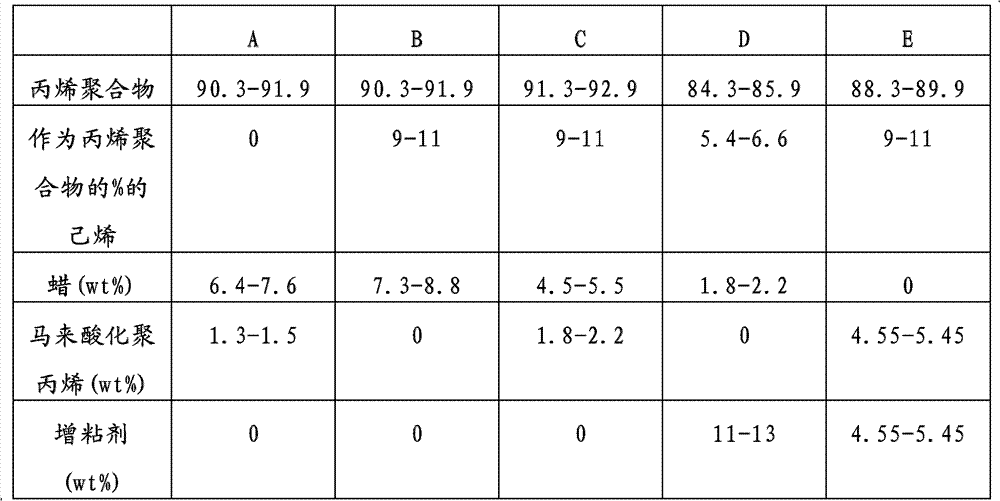
例举的组合物A-E的丙烯聚合物组分优选表现出如上所述的支化指数和以下性能: The propylene polymer components of the exemplified compositions A-E preferably exhibit branching index as described above and the following properties:
例举的组合物A-E优选具有以下性能: Exemplary compositions A-E preferably have the following properties:
聚烯烃组合物通过任何常规合成方法制备。优选地,使用一种或多种茂金属催化剂制备聚烯烃组合物。可以利用一个或多个反应器制备聚合物组合物。多个反应器可以串联或并联操作。反应组分、催化剂体系和/或任选的改性剂分批或者连续地作为溶液或淤浆形式加入。催化剂体系组分单独加入反应器,刚好在反应器之前在线活化,或者预活化并且作为活化的溶液或淤浆形式泵送入反应器。优选的方法是双溶液在线活化。 Polyolefin compositions are prepared by any conventional synthetic method. Preferably, the polyolefin composition is prepared using one or more metallocene catalysts. The polymer composition can be prepared using one or more reactors. Multiple reactors can be operated in series or in parallel. The reaction components, catalyst system and/or optional modifiers are added batchwise or continuously as a solution or slurry. The catalyst system components are added separately to the reactor, activated in-line just prior to the reactor, or preactivated and pumped into the reactor as an activated solution or slurry. The preferred method is two-solution on-line activation. the
在单一催化剂体系中,可以在单一反应器中制备包含无定形和半结晶组分的聚烯烃组合物以得到所希望的性能平衡。特别地,可以在连续溶液反应器中现场制备aPP-g-scPP支化结构。 In a single catalyst system, polyolefin compositions comprising amorphous and semicrystalline components can be prepared in a single reactor to obtain the desired balance of properties. In particular, aPP-g-scPP branched structures can be prepared in situ in a continuous solution reactor. the
在多个催化剂体系中,至少一种催化剂被选择为能够制备基本上无规立构的聚合物,例如无规立构聚丙烯,并且至少一种其它催化剂被选择为能够在采用的聚合条件下制备全同立构聚合物-全同立构聚丙烯。 In multiple catalyst systems, at least one catalyst is selected to be capable of producing substantially atactic polymers, such as atactic polypropylene, and at least one other catalyst is selected to be capable of producing substantially atactic polymers under the polymerization conditions employed. Preparation of isotactic polymer - isotactic polypropylene. the
对于丙烯基体系,优选地,聚合条件导致在反应器内共混物内aPP和iPP聚合物链的引入,使得一定量的存在于POA聚合物中的无定形 聚丙烯接枝到全同立构聚丙烯上,这里表示为(aPP-g-iPP)和/或使得一定量的全同立构聚丙烯接枝到无定形聚丙烯上,这里表示为(iPP-g-aPP)。优选地,聚合物以溶液相、淤浆或本体相聚合工艺制备。 For propylene-based systems, preferably, the polymerization conditions result in the incorporation of aPP and iPP polymer chains within the in-reactor blend such that a certain amount of amorphous polypropylene present in the POA polymer is grafted to isotactic on polypropylene, here denoted (aPP-g-iPP) and/or such that a certain amount of isotactic polypropylene is grafted onto amorphous polypropylene, here denoted (iPP-g-aPP). Preferably, the polymer is produced in a solution phase, slurry or bulk phase polymerization process. the
在一个实施方案中,使用多催化剂体系将丙烯聚合物作为反应器共混物制备。第一种催化剂是用于制备半结晶聚丙烯大分子单体的立体刚性过渡金属化合物,其选自:(a)外消旋桥连双(茚基)锆茂或铪茂,(b)外消旋二甲基甲硅烷基桥连双(茚基)锆茂或铪茂,(c)外消旋二甲基甲硅烷基双(2-甲基-4-苯基茚基)二氯化或二甲基锆或铪,(d)外消旋二甲基甲硅烷基桥连双(茚基)铪茂,例如外消旋二甲基甲硅烷基双(茚基)二甲基铪或二氯化铪。至少一种额外的用于制备无定形聚丙烯大分子单体的催化剂选自:(a)1,1’-双(4-三乙基甲硅烷基苯基)亚甲基(环戊二烯基)(2,7-二叔丁基-9-芴基)二甲基铪,(b)二(对-三乙基甲硅烷基苯基)亚甲基(环戊二烯基)(3,8-二叔丁基芴基)二氯化锆,(c)二(对-三乙基甲硅烷基苯基)亚甲基(环戊二烯基)(3,8-二叔丁基芴基)二氯化铪,(d)二(对-三乙基甲硅烷基苯基)亚甲基(环戊二烯基)(3,8-二叔丁基芴基)二甲基锆,或(e)二(对-三乙基甲硅烷基苯基)亚甲基(环戊二烯基)(3,8-二叔丁基芴基)二甲基铪。 In one embodiment, the propylene polymer is produced as a reactor blend using a multiple catalyst system. The first catalyst is a stereorigid transition metal compound selected from the group consisting of: (a) racemic bridged bis(indenyl)zirconocenes or hafnocenes, (b) exogenous Racemic dimethylsilyl-bridged bis(indenyl)zirconocene or hafnocene, (c) racemic dimethylsilylbis(2-methyl-4-phenylindenyl)dichloride or dimethylzirconium or hafnium, (d) racemic dimethylsilyl-bridged bis(indenyl)hafnocene, such as racemic dimethylsilylbis(indenyl)hafnocene or Hafnium dichloride. At least one additional catalyst for the preparation of amorphous polypropylene macromers is selected from: (a) 1,1'-bis(4-triethylsilylphenyl)methylene (cyclopentadiene base) (2,7-di-tert-butyl-9-fluorenyl) hafnium dimethyl, (b) bis (p-triethylsilylphenyl) methylene (cyclopentadienyl) (3 , 8-di-tert-butylfluorenyl) zirconium dichloride, (c) two (p-triethylsilylphenyl) methylene (cyclopentadienyl) (3,8-di-tert-butyl Fluorenyl) hafnium dichloride, (d) bis(p-triethylsilylphenyl)methylene(cyclopentadienyl)(3,8-di-tert-butylfluorenyl)zirconium dimethyl , or (e) bis(p-triethylsilylphenyl)methylene(cyclopentadienyl)(3,8-di-tert-butylfluorenyl)hafnium dimethyl. the
粘合剂包括常规配制的粘合剂和/或本领域技术人员已知的聚合物基粘合剂。粘合剂组合物可以包括本领域已知的那些常规添加剂,例如蜡、增粘剂、填料、抗氧化剂、助剂、粘合促进剂、增塑剂、天然蜡、合成蜡、油、低分子量聚合物、粘连剂、防粘连剂、颜料、加工助剂、UV稳定剂、中和剂、润滑剂、表面活性剂、成核剂、氧化聚烯烃、酸改性的聚烯烃,和/或酸酐改性的聚烯烃。粘合剂组合物可以包括本文所述的粘性聚合物组合物。添加剂与作为单个组分形式,在母料中,或其组合形式的其他粘合剂组分合并。 Adhesives include conventionally formulated adhesives and/or polymer based adhesives known to those skilled in the art. The adhesive composition may include those conventional additives known in the art, such as waxes, tackifiers, fillers, antioxidants, adjuvants, adhesion promoters, plasticizers, natural waxes, synthetic waxes, oils, low molecular weight Polymers, blocking agents, antiblocking agents, pigments, processing aids, UV stabilizers, neutralizers, lubricants, surfactants, nucleating agents, oxidized polyolefins, acid-modified polyolefins, and/or anhydrides Modified polyolefins. The adhesive composition can include the adhesive polymer composition described herein. Additives are combined with other adhesive components as individual components, in masterbatches, or combinations thereof. the
例举的粘合剂描述于2002年10月15日提交的美国申请号60/418,482,2003年4月4日提交的60/460,714,2003年10月15日提交的10/687,508,2003年10月15日提交的10/686,951,作为 美国专利号7,223,822颁布的10/825,380,2004年4月15日提交的10/825,635,2004年4月15日提交的10/825,349和2004年4月15日提交的10/825,348,2008年6月27日提交的61/076,467中,这些的每一个以其全文在此引入作为参考。 Exemplary adhesives are described in U.S. Application Nos. 60/418,482 filed October 15, 2002, 60/460,714 filed April 4, 2003, 10/687,508 filed October 15, 2003, 10/2003 10/686,951 filed April 15, 10/825,380 issued as U.S. Patent No. 7,223,822, 10/825,635 filed April 15, 2004, 10/825,349 filed April 15, 2004, and 10/825,349 filed April 15, 2004 10/825,348 filed, 61/076,467 filed June 27, 2008, each of which is hereby incorporated by reference in its entirety. the
例举的粘合剂组合物可从ExxonMobil Chemical Co.作为LINXARTM粘合剂系列产品商购获得。 Exemplary adhesive compositions are commercially available from ExxonMobil Chemical Co. as the LINXAR ™ adhesive line of products.
在一个或多个实施方案中,粘性组合物通常是具有低粘度和/或低结晶度和/或缓慢固化的粘合剂和/或粘合剂聚合物。这些粘性组合物通常具有根据ASTM E28的约80℃-160℃的环球软化点,和根据ASTMD3236在190℃下约200-60,000厘泊(cP)的Brookfield热固性粘度。这些粘性组合物优选具有约85℃-140℃的环球软化点、在190℃下约500-20,000cp的粘度,和根据ASTM D3418低于0℃的玻璃化转变温度(Tg)。 In one or more embodiments, the adhesive composition is typically an adhesive and/or adhesive polymer having low viscosity and/or low crystallinity and/or slow curing. These viscous compositions typically have a Ring and Ball softening point according to ASTM E28 of about 80°C to 160°C, and a Brookfield thermoset viscosity of about 200 to 60,000 centipoise (cP) at 190°C according to ASTM D3236. These viscous compositions preferably have a Ring and Ball softening point of about 85°C to 140°C, a viscosity of about 500 to 20,000 cp at 190°C, and a glass transition temperature (Tg) below 0°C according to ASTM D3418. the
烃树脂,即增粘剂,包括本领域技术人员已知的常规烃树脂。例举的增粘剂包括,但不限于,脂族烃树脂、芳族改性的脂族烃树脂、氢化聚环戊二烯树脂、聚环戊二烯树脂、松香、松香酯、木松香、木松香酯、妥尔油松香、妥尔油松香酯、聚萜烯、芳族改性的聚萜烯、萜烯酚醛、芳族改性的氢化聚环戊二烯树脂、氢化脂族树脂、氢化脂族芳族树脂、氢化萜烯和改性萜烯,和氢化松香酯。在一些实施方案中,增粘剂是氢化的。在其它实施方案中,增粘剂是非极性的。非极性是指增粘剂基本上不含具有极性基团的单体。 Hydrocarbon resins, ie, tackifiers, include conventional hydrocarbon resins known to those skilled in the art. Exemplary tackifiers include, but are not limited to, aliphatic hydrocarbon resins, aromatically modified aliphatic hydrocarbon resins, hydrogenated polycyclopentadiene resins, polycyclopentadiene resins, rosin, rosin esters, wood rosin, Wood Rosin Esters, Tall Oil Rosin, Tall Oil Rosin Ester, Polyterpenes, Aromatically Modified Polyterpenes, Terpene Phenolics, Aromatically Modified Hydrogenated Polycyclopentadiene Resins, Hydrogenated Aliphatic Resins, Hydrogenated aliphatic aromatic resins, hydrogenated and modified terpenes, and hydrogenated rosin esters. In some embodiments, the tackifier is hydrogenated. In other embodiments, the tackifier is non-polar. Non-polar means that the tackifier is substantially free of monomers with polar groups. the
蜡包括天然或合成蜡,例如蜂蜡,费托蜡,包括氧化形式,极性或非极性蜡,聚丙烯蜡,聚乙烯蜡,蜡改性剂,石蜡或石油蜡,聚烯烃蜡,聚乙烯蜡,马来酸化聚乙烯蜡,和高密度低分子量聚乙烯或HDLMWPE。 Waxes include natural or synthetic waxes such as beeswax, Fischer-Tropsch waxes including oxidized forms, polar or non-polar waxes, polypropylene waxes, polyethylene waxes, wax modifiers, paraffin or petroleum waxes, polyolefin waxes, polyethylene waxes Waxes, Maleated Polyethylene Waxes, and High Density Low Molecular Weight Polyethylene or HDLMWPE. the
在一个实施方案中,粘性组合物包括聚烯烃组合物,所述聚烯烃组合物包含具有以下的丙烯聚合物:(a)在牛皮纸上1牛顿或更大的点T形剥离力,(b)10,000-100,000的Mw,和(c)以下的支化指数(g’):(i)当聚烯烃具有10,000-60,000的Mw时在聚烯烃的Mz 下测量为0.4-0.98,或者(ii)当聚烯烃具有10,000-100,000的Mw时在聚烯烃的Mz下测量为0.4-0.95。 In one embodiment, the adhesive composition comprises a polyolefin composition comprising a propylene polymer having (a) a spot T-peel force of 1 Newton or greater on kraft paper, (b) a Mw of 10,000-100,000, and (c) a branching index (g') of (i) 0.4-0.98 as measured at the Mz of the polyolefin when the polyolefin has a Mw of 10,000-60,000, or (ii) when The polyolefin has a Mw of 10,000-100,000 measured at Mz of the polyolefin of 0.4-0.95. the
在一个实施方案中,粘性组合物包括聚烯烃组合物,所述聚烯烃组合物包含具有以下的丙烯-己烯共聚物:(a)在牛皮纸上1牛顿或更大的点T形剥离力,(b)10,000-100,000的Mw,(c)以下的支化指数(g’):(i)当聚烯烃具有10,000-60,000的Mw时在聚烯烃的Mz下测量为0.4-0.98,或者(ii)当聚烯烃具有10,000-100,000的Mw时在聚烯烃的Mz下测量为0.4-0.95,和(d)小于25wt%的己烯共聚单体含量。 In one embodiment, the adhesive composition comprises a polyolefin composition comprising a propylene-hexene copolymer having (a) a spot T-peel force of 1 Newton or greater on kraft paper, (b) a Mw of 10,000-100,000, (c) a branching index (g') of (i) 0.4-0.98 as measured at the Mz of the polyolefin when the polyolefin has a Mw of 10,000-60,000, or (ii ) 0.4-0.95 measured at the Mz of the polyolefin when the polyolefin has a Mw of 10,000-100,000, and (d) a hexene comonomer content of less than 25 wt%. the
在一个实施方案中,粘性组合物包括聚烯烃组合物,所述聚烯烃组合物包含具有以下的丙烯-辛烯共聚物:(a)在牛皮纸上1牛顿或更大的点T形剥离力,(b)10,000-100,000的Mw,和(c)以下的支化指数(g’):(i)当聚烯烃具有10,000-60,000的Mw时在聚烯烃的Mz下测量为0.4-0.98,或者(ii)当聚烯烃具有10,000-100,000的Mw时在聚烯烃的Mz下测量为0.4-0.95。 In one embodiment, the adhesive composition comprises a polyolefin composition comprising a propylene-octene copolymer having (a) a spot T-peel force on kraft paper of 1 Newton or greater, (b) a Mw of 10,000-100,000, and (c) a branching index (g') of (i) 0.4-0.98 as measured at the Mz of the polyolefin when the polyolefin has a Mw of 10,000-60,000, or ( ii) 0.4-0.95 measured at the Mz of the polyolefin when the polyolefin has a Mw of 10,000-100,000. the
防粘连组合物 Anti-adhesion composition
当以足够量至少部分包覆在颗粒表面上时,防粘连组合物抑制颗粒粘连,即结块、附聚、聚集和/或粘贴。防粘连组合物包括粉末、有机硅、表面活性剂、蜡、聚合物,和它们的组合。 When coated at least partially on particle surfaces in sufficient amounts, the anti-blocking composition inhibits particle blocking, ie clumping, agglomeration, aggregation and/or sticking. Antiblock compositions include powders, silicones, surfactants, waxes, polymers, and combinations thereof. the
防粘连组合物包括有机或无机化合物,例如选自以下的那些:滑石、云母、碳酸钙、细分或煅制二氧化硅、有机酸、金属有机酯、纤维素衍生物、三水合氧化铝、大理石粉尘、水泥粉尘、粘土、长石、氧化铝、氧化镁、氢氧化镁、氧化锑、氧化锌、硫酸钡、硅酸铝、硅酸钙、二氧化钛、钛酸酯、白垩、粉化聚合物,或它们的组合。一些防粘连组合物表现出大于75℃的TMA,例如粉化聚乙烯、聚苯乙烯和聚丙烯。上述防粘连组合物可以纯化的形式或者以混合物形式使用。防粘连组合物可以任何形式使用;然而,通常优选粉末。 Antiblocking compositions include organic or inorganic compounds, such as those selected from the group consisting of talc, mica, calcium carbonate, finely divided or fumed silica, organic acids, metal organic esters, cellulose derivatives, alumina trihydrate, Marble dust, cement dust, clay, feldspar, aluminum oxide, magnesium oxide, magnesium hydroxide, antimony oxide, zinc oxide, barium sulfate, aluminum silicate, calcium silicate, titanium dioxide, titanate, chalk, powdered polymer , or a combination of them. Some antiblock compositions exhibit a TMA greater than 75°C, such as pulverized polyethylene, polystyrene and polypropylene. The above-mentioned anti-blocking composition can be used in a purified form or in a mixture. The antiblock composition may be used in any form; however, powders are generally preferred. the
优选地,防粘连组合物是聚合物粉末,有机酸盐例如硬脂酸钙, 或其组合。例举的防粘连组合物由Ligafluid组成,Ligafluid是一种可从Peter Greven Fett-Chemie商购获得的硬脂酸钙分散液。另一种例举的防粘连组合物是聚乙烯粉末例如低密度聚乙烯,其可作为HA2454从E.I.Du Pont De Nemours and Company商购获得。在选择性实施方案中,使用Ligafluid和HA2454的组合。 Preferably, the anti-blocking composition is a polymer powder, an organic acid salt such as calcium stearate, or a combination thereof. An exemplary anti-blocking composition consists of Ligafluid, a dispersion of calcium stearate commercially available from Peter Greven Fett-Chemie. Another exemplary antiblock composition is polyethylene powder such as low density polyethylene, commercially available as HA2454 from E.I. Du Pont De Nemours and Company. In an alternative embodiment, a combination of Ligafluid and HA2454 is used. the
粘性组合物与有效量的防粘连组合物接触。有效量的数量取决于防粘连剂、粘性组合物聚合物,和当接触时每一组合物的温度。每一颗粒或粒料不需要完全被防粘连剂覆盖。另外,不需要每一颗粒被任何防粘连剂覆盖。通常,充分包覆颗粒使得表面覆层的平均量高于约50%。一般而言,防粘连剂的有效量是将粘性组合物的无约束屈服强度减小至少约20%,优选减小至少约30%或者至少约50%的量。在一些实施方案中,粘性组合物的无约束屈服强度减小约100%或更多,或者甚至减小约1000%或更多。 The adhesive composition is contacted with an effective amount of an anti-adhesion composition. Amounts that are effective amounts depend on the antiblocking agent, the tacky composition polymers, and the temperature of each composition when contacted. Each particle or pellet need not be completely covered with antiblocking agent. In addition, it is not necessary for every particle to be covered by any anti-blocking agent. Typically, the particles are sufficiently coated such that the average amount of surface coating is greater than about 50%. Generally, an effective amount of antiblocking agent is an amount that reduces the unconstrained yield strength of the adhesive composition by at least about 20%, preferably by at least about 30% or at least about 50%. In some embodiments, the unconstrained yield strength of the viscous composition is reduced by about 100% or more, or even by about 1000% or more. the
在一些实施方案中,基于粘性组合物颗粒的总重量,粘性组合物采用至少约0.05wt%基本上被包覆。优选地,基于粘性组合物颗粒的总重量,粘性组合物采用至少约0.1wt%,或至少约0.3wt%,或至少约0.5wt%,或至少约0.7wt%,或至少约0.8wt%,或至少约1.0wt%,或至少约1.5wt%基本上被包覆。 In some embodiments, the sticky composition is substantially coated with at least about 0.05 wt%, based on the total weight of the sticky composition particles. Preferably, the adhesive composition employs at least about 0.1 wt%, or at least about 0.3 wt%, or at least about 0.5 wt%, or at least about 0.7 wt%, or at least about 0.8 wt%, based on the total weight of the adhesive composition particles, Or at least about 1.0 wt%, or at least about 1.5 wt% is substantially coated. the
方法 method
制备抗附聚颗粒的方法包括以下步骤:提供粘性组合物颗粒,增加粘性组合物颗粒的粘性,例如增加环境温度,和使粘性组合物颗粒与防粘连组合物接触,使得粘性组合物颗粒至少部分被防粘连组合物包覆。 The method of preparing anti-agglomeration particles comprises the steps of providing particles of a tacky composition, increasing the stickiness of the particles of the tacky composition, e.g. increasing the ambient temperature, and contacting the particles of the tacky composition with an anti-blocking composition such that the particles of the tacky composition are at least partially Coated with anti-blocking composition. the
粘性材料可以几种不同的方式包覆,包括简单混合、搅动、翻滚、空气传送、线料造粒、水下造粒,和它们的组合。例举的共混装置/工艺包括移动粒料的任何机械方式,例如简单翻滚,或者在锥形旋转容器中共混、带式共混机、转鼓翻滚机、桨式共混机、附聚盘、在空气或惰性气体下的流化床气动传送机、搅拌、摇动、螺杆传送机,或 者通过在容器(例如料仓)中再循环而混合粒料。线料造粒工艺将粘性材料挤出成线料,然后将其喷粉并且切成粒料。 The viscous material can be coated in several different ways, including simple mixing, agitation, tumbling, air conveying, strand pelletizing, underwater pelletizing, and combinations thereof. Exemplary blending devices/processes include any mechanical means of moving the pellets such as simple tumbling, or blending in conical rotating vessels, ribbon blenders, drum tumbling machines, paddle blenders, agglomeration pans , fluidized bed pneumatic conveyors under air or inert gas, agitation, shaking, screw conveyors, or mixing of pellets by recirculation in containers such as silos. The strand pelletizing process extrudes viscous material into strands, which are then dusted and cut into pellets. the
粘性组合物和防粘连剂在不会造成防粘连剂蒸发,或变得太粘稠,或者显著与粘性组合物反应的任何温度下接触。这些温度经常取决于组合物的组分而变化,但一般为约-10至约200℃,或约0-约150℃,或者约30-约100℃。在一些实施方案中,防粘连组合物和粘性组合物在高于约25℃或高于约30℃,或高于约35℃,或高于约50℃,或高于约60℃,或高于约70℃的温度下接触。在其它实施方案中,防粘连组合物和粘性组合物在约25℃-约75℃,或约25℃-约50℃,或者约25℃-约40℃的温度下接触。在粘性组合物可结晶的实施方案中,粘性组合物和防粘连剂优选在粘性组合物中引起结晶的温度下接触。 The adhesive composition and the antiblocking agent are contacted at any temperature that does not cause the antiblocking agent to evaporate, or become too viscous, or react significantly with the adhesive composition. These temperatures often vary depending on the components of the composition, but generally range from about -10 to about 200°C, or from about 0 to about 150°C, or from about 30 to about 100°C. In some embodiments, the anti-blocking composition and the adhesive composition are heated above about 25°C, or above about 30°C, or above about 35°C, or above about 50°C, or above about 60°C, or above Contact at a temperature of about 70°C. In other embodiments, the antiblocking composition and the adhesive composition are contacted at a temperature of from about 25°C to about 75°C, or from about 25°C to about 50°C, or from about 25°C to about 40°C. In embodiments where the tacky composition is crystallizable, the tacky composition and the antiblocking agent are preferably contacted at a temperature that causes crystallization in the tacky composition. the
在一个实施方案中,制备抗附聚颗粒的方法使粘性组合物和防粘连组合物在粘性组合物的玻璃化转变温度(Tg)附近或以上的温度下接触。因此,粘性组合物和防粘连组合物在粘性组合物的Tg,或Tg以上5℃或更多,或Tg以上10℃或更多,或Tg以上15℃或更多,或Tg以上20℃或更多下接触。 In one embodiment, the method of making the agglomeration resistant particles contacts the tacky composition and the antiblock composition at a temperature near or above the glass transition temperature (Tg) of the tacky composition. Thus, the adhesive composition and the antiblocking composition are at a temperature of the Tg of the adhesive composition, or 5°C or more above Tg, or 10°C or more above Tg, or 15°C or more above Tg, or 20°C or more above Tg, or More next contact. the
在一个实施方案中,制备抗附聚颗粒的方法使粘性组合物和防粘连组合物在粘性组合物的环球软化温度附近或以上的温度下接触。因此,粘性组合物和防粘连组合物在粘性组合物的环球软化温度,或粘性组合物的环球软化温度以上5℃或更多,或以上10℃或更多,或以上15℃或更多,或20℃或更多下接触。 In one embodiment, the method of making the agglomeration resistant particles contacts the tacky composition and the antiblock composition at a temperature near or above the ring and ball softening temperature of the tacky composition. Thus, the adhesive composition and the anti-blocking composition are at a ring and ball softening temperature of the adhesive composition, or 5°C or more above, or 10°C or more above, or 15°C or more above, the ring and ball softening temperature of the adhesive composition, Or contact at 20°C or more. the
在一个或多个实施方案中,本发明方法制备粘性材料颗粒,所述颗粒是防粘连的基本可倾倒的自由流动颗粒。“可倾倒”是指经包覆的颗粒将流过漏斗并且在初始和在升高的温度储存后都获得可倾倒性值(根据ASTM D1895方法B)。优选地,自由流动颗粒具有少于约2秒,或少于约1.8秒,或少于约1.6秒,或少于约1.5秒,或少于约1.4秒的初始可倾倒性值。 In one or more embodiments, the methods of the present invention produce particles of sticky material that are substantially pourable, free-flowing particles that are non-adhesive. "Pourable" means that the coated particles will flow through the funnel and obtain a pourability value (according to ASTM D1895 Method B) both initially and after storage at elevated temperature. Preferably, the free-flowing granules have an initial pourability value of less than about 2 seconds, or less than about 1.8 seconds, or less than about 1.6 seconds, or less than about 1.5 seconds, or less than about 1.4 seconds. the
优选地,粘性组合物和防粘连组合物在浸渍入第一流体,例如水 下造粒装置中的同时接触。例如,将粘性组合物或其组分装入容器或挤出机中以熔融、剪切和/或混合。容器可以在大气压、加压或在真空下,并且可以未清洗或者用空气或惰性气体例如氮气、氩气等清洗。如果有的话,压力、真空和清洗可以任何组合和顺序依次或连续施加。必需的能量将配方转化成熔融或半固体混合物或液体,其当在间歇加工或者连续流动加工中释放时通过重力或在压力下适宜地流动。施加的能量可以是配方要求所必需的低、中或高剪切形式的热和/或机械能量,其直接并且显著地影响了熔融、半固体或液体粘性组合物的温度。 Preferably, the viscous composition and the anti-blocking composition are contacted while being immersed in a first fluid, such as an underwater granulation device. For example, the viscous composition or components thereof are loaded into a container or extruder for melting, shearing and/or mixing. The container can be at atmospheric pressure, pressurized, or under vacuum, and can be left unpurged or purged with air or an inert gas such as nitrogen, argon, or the like. Pressure, vacuum and purge, if any, may be applied sequentially or continuously in any combination and order. The energy necessary converts the formulation into a molten or semi-solid mixture or liquid which flows suitably by gravity or under pressure when released in batch processing or continuous flow processing. The energy applied can be in the form of heat and/or mechanical energy in the form of low, medium or high shear as necessary to the formulation requirements, which directly and significantly affects the temperature of the molten, semi-solid or liquid viscous composition. the
第一流体的温度可以取决于组合物的组分而变化,但通常约-10至约200℃,或约0-约150℃,或约30-约100℃。在一些实施方案中,第一流体的温度高于约25℃或高于约30℃,或高于约35℃,或高于约50℃,或高于约60℃,或高于约70℃。在其它实施方案中,第一流体在约25℃-约75℃,或约25℃-约50℃,或者约25℃-约40℃的温度下接触。在粘性组合物可结晶的实施方案中,第一流体的温度为在粘性组合物中引起结晶的温度。 The temperature of the first fluid may vary depending on the components of the composition, but is generally from about -10 to about 200°C, or from about 0 to about 150°C, or from about 30 to about 100°C. In some embodiments, the temperature of the first fluid is greater than about 25°C, or greater than about 30°C, or greater than about 35°C, or greater than about 50°C, or greater than about 60°C, or greater than about 70°C . In other embodiments, the first fluid is contacted at a temperature of from about 25°C to about 75°C, or from about 25°C to about 50°C, or from about 25°C to about 40°C. In embodiments where the viscous composition is crystallizable, the temperature of the first fluid is a temperature that induces crystallization in the viscous composition. the
在一个实施方案中,第一流体的温度在粘性组合物的玻璃化转变温度(Tg)附近或以上。因此,第一流体的温度为粘性组合物的Tg,或Tg以上5℃或更多,或Tg以上10℃或更多,或Tg以上15℃或更多,或Tg以上20℃或更多。 In one embodiment, the temperature of the first fluid is near or above the glass transition temperature (Tg) of the viscous composition. Thus, the temperature of the first fluid is the Tg of the viscous composition, or 5°C or more above Tg, or 10°C or more above Tg, or 15°C or more above Tg, or 20°C or more above Tg. the
在一个实施方案中,第一流体的温度在粘性组合物的环球软化温度附近或以上。因此,粘性组合物和防粘连组合物在粘性组合物的环球软化温度,或粘性组合物的环球软化温度以上5℃或更多,或以上10℃或更多,或以上15℃或更多,或20℃或更多下接触。 In one embodiment, the temperature of the first fluid is around or above the ring and ball softening temperature of the viscous composition. Thus, the adhesive composition and the anti-blocking composition are at a ring and ball softening temperature of the adhesive composition, or 5°C or more above, or 10°C or more above, or 15°C or more above, the ring and ball softening temperature of the adhesive composition, Or contact at 20°C or more. the
例如,将粘性组合物挤出到水下造粒机中,在那里其接触包括防粘连组合物的第一流体。水下造粒包括以下步骤:通过浸入包含防粘连组合物的第一流体中的模板孔挤出粘性材料,当与第一流体接触的同时将其挤出时切割所述塑料材料以形成被防粘连组合物包覆的颗粒,和将颗粒与第一流体分离。例举的水下造粒机由美国专利号4,569,810和4,663,099教导,这些文献的公开内容以它们的全文在 此引入作为参考。 For example, the viscous composition is extruded into an underwater pelletizer where it contacts a first fluid comprising the antiblocking composition. Underwater pelletizing comprises the steps of extruding a viscous material through die orifices immersed in a first fluid comprising an anti-blocking composition, cutting said plastics material to form an anti-blocking composition while extruding it while in contact with the first fluid. The composition-coated particles are bound, and the particles are separated from the first fluid. Exemplary underwater pelletizers are taught by U.S. Patent Nos. 4,569,810 and 4,663,099, the disclosures of which are hereby incorporated by reference in their entireties. the
在水下造粒机中,加压的粘性组合物熔体通过热调节的模头朝着包含第一流体的容器前进。粘性组合物通过模头并且通过造粒单元中的旋转刀片切割。热控制的第一流体将粒料从切割机刀片上取下并且将它们输送通过附聚物捕集器用于除去粗和/或尺寸过大的粒料。通过例如离心干燥机或流化床使粒料脱水,以从粒料上除去表面水分。 In an underwater pelletizer, a pressurized viscous composition melt is advanced through a thermally regulated die towards a vessel containing a first fluid. The viscous composition passes through the die and is cut by rotating blades in the pelletizing unit. The thermally controlled first fluid removes the pellets from the cutter blades and conveys them through the agglomerate trap for removal of coarse and/or oversized pellets. The pellets are dewatered by, for example, a centrifugal dryer or a fluidized bed to remove surface moisture from the pellets. the
正如挤出领域的技术人员认识到的,水温、挤出机切割机刀片的旋转速度,和熔体通过挤出模头的流动速率影响了粒料几何形状。内部和外部即壳的粒料温度也影响粒料形成和干燥。 As those skilled in the art of extrusion recognize, the temperature of the water, the rotational speed of the extruder cutter blades, and the flow rate of the melt through the extrusion die affect the pellet geometry. The pellet temperature inside and outside, ie, the shell, also affects pellet formation and drying. the
在干燥前或后可以采用另外的常规工艺,例如涂覆、增强的结晶、冷却操作,或者适合于被造粒的材料的其他加工。 Additional conventional processes such as coating, enhanced crystallization, cooling operations, or other processing appropriate to the material being pelletized may be employed before or after drying. the
存在于第一流体中的防粘连组合物的量足以当粘性组合物颗粒接触第一流体时基本上包覆粘性组合物颗粒,但仍然不足以干扰加工。当水是第一流体时,防粘连组合物的量通常少于水的约5重量%。优选地,基于水的重量,防粘连组合物以少于约2wt%,或少于约1.5wt%,或少于约1.0wt%,或少于约0.9wt%,或少于约0.75wt%存在。 The amount of anti-blocking composition present in the first fluid is sufficient to substantially coat the particles of the viscous composition when they contact the first fluid, but still not sufficient to interfere with processing. When water is the first fluid, the amount of antiblock composition is generally less than about 5% by weight of water. Preferably, the antiblocking composition contains less than about 2 wt%, or less than about 1.5 wt%, or less than about 1.0 wt%, or less than about 0.9 wt%, or less than about 0.75 wt%, based on the weight of water exist. the
任选地,一旦从第一流体中分离,粘性组合物颗粒可以接触附加的防粘连组合物。用于第一流体中的防粘连组合物可与所述附加的防粘连组合物相同或不同。 Optionally, the particles of the tacky composition may be contacted with additional anti-blocking composition once separated from the first fluid. The anti-blocking composition used in the first fluid may be the same or different than the additional anti-blocking composition. the
图1是用于制备抗附聚颗粒的例举装置的示意图。装置1示出了造粒机液体回路2,即水回路2,与另外的热液体回路3,即热水回路3一起操作以在粒料与防粘连组合物接触的同时升高粒料温度。水回路2保持在低于热水回路3的温度的温度下。用于水回路2的例举温度为约5-约10℃。
Figure 1 is a schematic diagram of an exemplary apparatus for making agglomeration resistant particles. Apparatus 1 shows a
参考图1,制备粘性组合物并且输送其到挤出机4,所述挤出机保持有利的操作温度。挤出机4与水下造粒装置5连接,所述水下造粒装置5将粘性组合物造粒并且使粘性组合物与第一流体例如水接触。粒料从水下造粒装置5行进到干燥装置6,例如旋转干燥机,其除去过量的水。从粒料中除去的过量水任选地通过造粒机水回路2和防粘 连储器7回送到水下造粒装置5。
Referring to Figure 1, a viscous composition is prepared and conveyed to an extruder 4, which is maintained at a favorable operating temperature. The extruder 4 is connected to an
粒料从旋转干燥机6输送到一个或多个搅拌罐8和9,其包含另外的添加剂,包括任选相同和/或不同的防粘连组合物。尽管图6中示出了两个搅拌罐,但一个搅拌罐可以作为备选物使用。如果使用多个搅拌罐,则装置可以半间歇状态操作。粒料在搅拌罐8中加工,由此除去添加剂组合物以包覆粒料,同时将第二搅拌罐9填充水和添加剂组合物。然后粒料流交替到新填充的第二搅拌罐9,由此允许第一搅拌罐8用水和添加剂组合物重新填充。
From the
当在搅拌罐8和9中与来自热水回路3的热水接触时,粒料同时加热、硬化并且变得被添加剂例如防粘连组合物包覆。在升高温度下的同时喷粉/包覆的粒料当冷却和储存时较不易于损失粉尘。由于安全性和/或整理原因,通常优选较少的游离粉尘生成,例如粉尘可能影响加工区域的电危害分类。作为另外的安全预防和作为图1的装置的替代形式,可以将添加剂例如防粘连组合物在单独的罐中在安全/无粉尘位置加入水中,并且然后循环到储存罐11中。
When in contact with the hot water from the
粒料从搅拌罐8和9输送到第二干燥装置10,例如旋转干燥机,其除去过量的水。从粒料中除去的过量水任选地通过热水回路3回送到储存罐11,这保持了在水进料以及搅拌罐8和9中合适的添加剂浓度。水回路3保持在高于约10℃,或高于约30℃,或在或高于约50℃,或高于约75℃。
From the mixing
粒料从第二干燥装置10行进到冷却装置12,在那里它们被冷却至例如环境温度或接近环境温度,并且准备用于包装。
From the
某些低粘度粘性材料,例如无定形聚烯烃,较不可能堵塞工艺设备,例如热交换器或挤出模头。因此,刚好在挤出前,可以任选地将这些材料冷却至它们的环球软化点以下的温度以有助于形成固体颗粒。例如,可以将这些材料冷却至它们的环球软化点以下约10℃或20℃或30℃,而在加工设备中不会产生显著压降。 Certain low-viscosity viscous materials, such as amorphous polyolefins, are less likely to plug process equipment such as heat exchangers or extrusion dies. Thus, just prior to extrusion, these materials may optionally be cooled to a temperature below their Ring and Ball softening point to aid in the formation of solid particles. For example, these materials can be cooled to about 10°C, or 20°C, or 30°C below their ring and ball softening points without significant pressure drop in the processing equipment. the
图6是用于制备抗附聚颗粒的另一种例举装置的示意图。该装置可以代替如美国专利申请No.60/986,515中所述的冷却挤出机配置, 该申请以其全文在此引入作为参考。 Figure 6 is a schematic diagram of another exemplary apparatus for preparing agglomeration resistant particles. This device can be substituted for the cooled extruder configuration as described in U.S. Patent Application No. 60/986,515, which is hereby incorporated by reference in its entirety. the
参考图6,线料切割装置13包括熔体冷却器14、用于容纳冷却液和任选添加剂的容器15,和线料切割机16。首先,熔融聚合物料流行进到熔体冷却器13,其形成固体或半固体线料。聚合物线料任选地通过辊到达模头14。优选地,聚合物线料以约0-约90度角度离开模头14,与容器15平行测量。
Referring to FIG. 6 , the wire cutting apparatus 13 includes a
从模头,聚合物线料通过容器15,其具有一个或多个用于使聚合物线料与冷却液例如水,和任选的添加剂例如防粘连组合物接触的区。如图6中所示,容器15包括两个区,其中只有第二个区包含防粘连组合物。然而,防粘连组合物可以存在于多区容器的一个或多个中。容器15或其的一部分可以任选地用防尘罩18覆盖。任选地,气刀除去过量的流体和/或防粘连组合物。优选地,任何过量的防粘连组合物通过再循环回路19再循环到容器15。聚合物线料从容器15行进到线料切割机16,在那里聚合物被切割成粒料。
From the die, the polymer strands pass through
优选地,容器15包括多于一个其中增加或降低液体温度以引起聚合物结晶、喷粉和干燥的区,即阶段。例如,在一个实施方案中将第一区保持在约20-约30℃,或者约25℃。将用于喷粉的第二个区保持在约40-约50℃或者约45℃,和将用于冷却的第三个区保持在约20-约35℃或者约30℃。
Preferably, the
在其他实施方案中,还提供: In other embodiments, also provide:
A.一种制备抗附聚颗粒的方法,包括以下步骤: A. A method for preparing anti-agglomeration particles, comprising the following steps:
a.提供具有在或高于25℃通过ASTM D6773测量的至少约151bs/ft2的无约束屈服强度的粘性组合物颗粒, a. providing cohesive composition particles having an unconstrained yield strength of at least about 15 lbs/ ft as measured by ASTM D6773 at or above 25°C,
b.通过使粘性组合物颗粒与第一流体在至少约25℃的温度下接触而增加粘性组合物颗粒的粘性,和 b. increasing the viscosity of the viscous composition particles by contacting the viscous composition particles with a first fluid at a temperature of at least about 25°C, and
c.在使粘性组合物颗粒与第一流体在至少25℃的温度下接触的同时使粘性组合物颗粒与防粘连组合物接触, c. contacting the particles of the tacky composition with the anti-blocking composition while contacting the particles of the tacky composition with the first fluid at a temperature of at least 25° C.,
其中粘性组合物颗粒至少部分被防粘连组合物包覆。 Wherein the particles of the adhesive composition are at least partially coated with the anti-adhesion composition. the
B.实施方案A的制备抗附聚颗粒的方法,其中粘性组合物包括聚 烯烃组合物,基于聚合物组合物的重量,所述聚烯烃组合物包含至少75重量%的丙烯。 B. The method of making agglomeration resistant particles of embodiment A, wherein the tacky composition comprises a polyolefin composition comprising at least 75% by weight propylene, based on the weight of the polymer composition. the
C.实施方案B的制备抗附聚颗粒的方法,其中聚烯烃组合物具有在聚合物的Mz下测量的0.95或更小的支化指数(g′),并且粘性组合物颗粒与第一流体在高于粘性组合物的玻璃化转变温度至少约25℃的温度下接触。 C. The method of making agglomeration resistant particles of embodiment B, wherein the polyolefin composition has a branching index (g') measured at the Mz of the polymer of 0.95 or less, and the viscous composition particles are associated with the first fluid Contacting is at a temperature at least about 25°C above the glass transition temperature of the viscous composition. the
D.实施方案B或C的制备抗附聚颗粒的方法,其中聚合物组合物包含丙烯和选自丁烯、己烯、辛烯或其组合的共聚单体。 D. The method of making agglomeration resistant particles of embodiment B or C, wherein the polymer composition comprises propylene and a comonomer selected from butene, hexene, octene, or combinations thereof. the
E.实施方案B-D任一项的制备抗附聚颗粒的方法,其中聚烯烃组合物具有: E. The method for preparing agglomeration resistant particles of any one of embodiments B-D, wherein the polyolefin composition has:
a)1-30的全同立构延伸长度, a) an isotactic extension length of 1-30,
b)大于20%的r二单元组百分比,和 b) a percentage of r-dyads greater than 20%, and
c)1-70J/g的熔化热。 c) a heat of fusion of 1-70 J/g. the
F.实施方案A-E任一项的制备抗附聚颗粒的方法,其中第一流体是水基流体。 F. The method of making agglomeration resistant particles of any of embodiments A-E, wherein the first fluid is a water-based fluid. the
G.实施方案A-F任一项的制备抗附聚颗粒的方法,其中第一流体是温度约25℃-约75℃的水基流体。 G. The method of making agglomeration resistant particles of any one of embodiments A-F, wherein the first fluid is a water-based fluid having a temperature of from about 25°C to about 75°C. the
H.实施方案A-G任一项的制备抗附聚颗粒的方法,其中粘性组合物颗粒是粒料。 H. The method of making agglomeration resistant particles of any one of embodiments A-G, wherein the particles of the tacky composition are pellets. the
I.实施方案A-H任一项的制备抗附聚颗粒的方法,其中第一流体基本不含表面活性剂。 I. The method of making agglomeration resistant particles of any of embodiments A-H, wherein the first fluid is substantially free of surfactant. the
J.实施方案A-I任一项的制备抗附聚颗粒的方法,其中粘性组合物颗粒在水下造粒机中接触第一流体。 J. The method of making agglomeration-resistant granules of any one of embodiments A-I, wherein the sticky composition granules are contacted with the first fluid in an underwater granulator. the
K.实施方案A-J任一项的制备抗附聚颗粒的方法,其中粘性组合物颗粒在流化床中接触第一流体。 K. The method of making agglomeration resistant particles of any one of embodiments A-J, wherein the particles of the cohesive composition are contacted with the first fluid in a fluidized bed. the
L.实施方案A-K任一项的制备抗附聚颗粒的方法,其中抗附聚组合物是聚合物,有机酸的盐,或它们的组合。 L. The method of making agglomeration resistant particles of any one of embodiments A-K, wherein the agglomeration resistant composition is a polymer, a salt of an organic acid, or a combination thereof. the
M.实施方案A-L任一项的制备抗附聚颗粒的方法,其中防粘连组合物是聚合物粉末。 M. The method of making agglomeration resistant particles of any of embodiments A-L, wherein the antiblocking composition is a polymer powder. the
N.实施方案A-M任一项的制备抗附聚颗粒的方法,其中在如ASTMD1895方法B所述在采用3500克施加压力的三英寸容器中在45℃储存3天后,粘合剂组合物颗粒在没有施加力的条件下在少于90秒,或少于60秒,或少于45秒,或少于30秒,或少于15秒,或少于10秒后基本自由流动。 N. The method of making agglomeration-resistant particles of any one of embodiments A-M, wherein after storage for 3 days at 45° C. in a three-inch container using 3500 grams of applied pressure as described in ASTM D1895 Method B, the binder composition particles are substantially free-flowing after less than 90 seconds, or less than 60 seconds, or less than 45 seconds, or less than 30 seconds, or less than 15 seconds, or less than 10 seconds without applied force. the
O.实施方案A-N任一项的制备抗附聚颗粒的方法,其中粘合剂组合物颗粒在15℃下具有小于6分钟的结晶半衰期。 O. The method of making agglomeration resistant particles of any one of embodiments A-N, wherein the binder composition particles have a crystallization half-life at 15°C of less than 6 minutes. the
P.实施方案A-O任一项的制备抗附聚颗粒的方法,其中粘合剂组合物颗粒在30℃下具有小于2分钟的结晶半衰期。 P. The method of making agglomeration resistant particles of any of embodiments A-O, wherein the binder composition particles have a crystallization half-life at 30°C of less than 2 minutes. the
Q.实施方案A-P任一项的制备抗附聚颗粒的方法,其中在接触第一流体后,基于抗附聚颗粒的重量,聚合物组合物颗粒被约0.01-约3.0重量%防粘连组合物包覆。 Q. The method of making agglomeration resistant particles of any one of embodiments A-P, wherein after contacting the first fluid, the particles of the polymer composition are coated with about 0.01 to about 3.0% by weight of the antiblocking composition, based on the weight of the agglomeration resistant particles clad. the
R.实施方案A-Q任一项的制备抗附聚颗粒的方法,其中以连续工艺制备抗附聚颗粒,使得在与第一流体接触前,使聚合物组合物聚合并且保持在高于约25℃的温度,而不冷却至低于约25℃。 R. The method of making agglomeration-resistant particles of any one of embodiments A-Q, wherein the agglomeration-resistant particles are made in a continuous process such that the polymer composition is polymerized and maintained above about 25° C. prior to contact with the first fluid temperature without cooling below about 25°C. the
S.实施方案A-R任一项的制备抗附聚颗粒的方法,其中粘性组合物是如段落65-67所述的任一种例举的聚烯烃组合物A-E。 S. The method of making agglomeration resistant particles of any of embodiments A-R, wherein the tacky composition is any of the exemplified polyolefin compositions A-E as described in paragraphs 65-67. the
T.一种输送抗附聚颗粒的方法,所述抗附聚颗粒包括具有在或高于25℃通过ASTM D6773测量的至少约15lbs/ft2的无约束屈服强度的聚烯烃组合物,所述方法包括以下步骤: T. A method of delivering agglomeration resistant particles comprising a polyolefin composition having an unconstrained yield strength of at least about 15 lbs/ ft as measured by ASTM D6773 at or above 25°C, said The method includes the following steps:
a.提供在或高于聚合物组合物的玻璃化转变温度的聚合物组合物颗粒, a. providing polymer composition particles at or above the glass transition temperature of the polymer composition,
b.通过使聚合物组合物颗粒与第一流体在至少约25℃的温度下接触而增加聚合物组合物颗粒的粘性,和 b. increasing the viscosity of the polymer composition particles by contacting the polymer composition particles with a first fluid at a temperature of at least about 25°C, and
c.在使粘合剂组合物颗粒与第一流体在聚合物组合物的玻璃化转变温度以上至少25℃的温度下接触的同时使聚合物组合物颗粒与防粘连组合物接触, c. contacting the particles of the polymer composition with the antiblocking composition while contacting the particles of the adhesive composition with the first fluid at a temperature of at least 25° C. above the glass transition temperature of the polymer composition,
其中聚合物组合物颗粒至少部分被防粘连组合物包覆。 Wherein the particles of the polymer composition are at least partially coated with the anti-blocking composition. the
U.实施方案A-L任一项的制备抗附聚颗粒的方法,其中防粘连组 U. The method for preparing anti-agglomeration particles of any one of embodiments A-L, wherein the anti-blocking group
合物是低密度聚乙烯。 The compound is low density polyethylene. the
V.实施方案A-L任一项的制备抗附聚颗粒的方法,其中防粘连组合物是聚合物。 V. The method of making agglomeration resistant particles of any of embodiments A-L, wherein the antiblocking composition is a polymer. the
本发明的某些特征按照一组数值上限和一组数值下限描述。应该意识到的是从任何下限到任何上限的范围处于本发明范围内,除非另外说明。 Certain features of the invention are described in terms of a set of numerical upper limits and a set of numerical lower limits. It should be appreciated that ranges from any lower limit to any upper limit are within the scope of the invention unless otherwise stated. the
以上描述意在举例说明,并且不应该看作是限制性的。本领域技术人员将认识到可以作出各种改进,只要不偏离本发明的精神和范围。因此,本描述将被认为包括落入所附的权利要求中的所有这些改进和它们的等价物。 The above description is intended to be illustrative and should not be viewed as limiting. Those skilled in the art will recognize that various modifications can be made without departing from the spirit and scope of the invention. Accordingly, this description is to be considered as including all such modifications and their equivalents as come within the scope of the appended claims. the
具体实施方式 Detailed ways
实施例 Example
不意于是限制性的以下实施例示出了本发明组合物和方法的某些实施方案和优点。除非另外说明,所有百分比基于重量。 The following examples, which are not intended to be limiting, illustrate certain embodiments and advantages of the compositions and methods of the present invention. All percentages are by weight unless otherwise indicated. the
实施例1 Example 1
在简单罐中制备粘性组合物-组合物A并且将其造粒。在室温和升高的温度下观察粒料抗附聚性。 A viscous composition, Composition A, was prepared in a simple tank and pelletized. The pellets were observed for agglomeration resistance at room temperature and at elevated temperature. the
组合物A由约88.3-89.9wt%丙烯-己烯共聚物、约4.55-5.45wt%马来酸化聚丙烯、约4.55-5.45wt%增粘剂,和抗氧化剂组成。丙烯-己烯共聚物具有约9-11wt%的己烯含量。所述丙烯共聚物表现出约9720cps的190℃下的熔体粘度,通过DSC测量的26KJ/Kg的ΔHf。将组合物A的粒料用高密度聚乙烯喷粉。 Composition A consisted of about 88.3-89.9 wt% propylene-hexene copolymer, about 4.55-5.45 wt% maleated polypropylene, about 4.55-5.45 wt% tackifier, and antioxidant. The propylene-hexene copolymer has a hexene content of about 9-11 wt%. The propylene copolymer exhibits a melt viscosity at 190°C of about 9720 cps, a ΔHf of 26 KJ/Kg measured by DSC. Pellets of composition A were dusted with high density polyethylene. the
制备组合物A,将其挤出、造粒、旋转干燥并且然后送入简单罐中用于喷粉。将罐填充水并且由热水回路供应。除了通过热水移动外,不搅动罐。罐翻转速率约为每分钟一次。用于各个试验的水温和防粘连含量在表1中报导: Composition A was prepared, extruded, granulated, spin dried and then fed into simple tanks for dusting. The tank was filled with water and supplied by the hot water circuit. Do not stir the pot except to move through the hot water. The tank turnover rate was approximately once per minute. The water temperature and anti-block content used for each test are reported in Table 1:
表1 Table 1
所得粒料基本被喷粉。使用ASTM D1895方法B测试被喷粉的粒料的抗附聚性。因此,在采用3500克施加压力的三英寸容器中将粒料在45℃下储存3天。三天后打开管,根据粒料多快产生并且是否需要压力粉碎任何观察到的附聚来评级。在100°F(38℃)下造粒的粒料得到等级1,即解开的同时崩解。在110°F(43℃)下造粒的粒料得到等级1.5,即在少于10秒后它们自崩解。在120°F(49℃)下造粒的粒料得到等级3,即附聚,但通过用手指轻拍而崩解。 The resulting pellets were substantially dusted. The agglomeration resistance of the dusted pellets was tested using ASTM D1895 Method B. Therefore, the pellets were stored at 45°C for 3 days in a three inch container using 3500 grams of applied pressure. The tubes were opened after three days and rated according to how quickly pellets were produced and whether any observed agglomerations required pressure crushing. Pellets granulated at 100°F (38°C) gave a rating of 1, disintegrating while disintegrating. Pellets pelletized at 110°F (43°C) received a rating of 1.5, ie they self-disintegrated after less than 10 seconds. Pellets granulated at 120°F (49°C) gave a rating of 3, agglomerated but disintegrated by tapping with a finger. the
如图5中所示,在较高水温下造粒的粒料较不易附聚。在较高温度下造粒的粒料变得更快自由流动,即不需要强制/撕碎。在较低温度下造粒的粒料附聚并且之后没有实现自由流动状态。 As shown in Figure 5, pellets granulated at higher water temperatures were less prone to agglomeration. Pellets granulated at higher temperatures become faster free flowing, i.e. no forcing/shredding is required. Pellets granulated at lower temperatures agglomerated and did not achieve a free-flowing state thereafter. the
实施例2 Example 2
制备粘性组合物-组合物B,在造粒机水中在水下采用防粘连组合物造粒,并且然后用第二防粘连组合物喷粉。在室温和升高的温度下观察粒料抗附聚性。 A viscous composition, Composition B, was prepared, granulated with the antiblock composition under water in the granulator water, and then dusted with the second antiblock composition. The pellets were observed for agglomeration resistance at room temperature and at elevated temperature. the
组合物B由约88.3-89.9wt%丙烯-己烯共聚物、约4.55-5.45wt%马来酸化聚丙烯、约4.55-5.45wt%增粘剂,和抗氧化剂组成。丙烯-己烯共聚物具有约9-11wt%的己烯含量。所述丙烯共聚物表现出约9800cps的熔体粘度190℃,通过DSC测量的约21KJ/Kg的ΔHf。 Composition B consisted of about 88.3-89.9 wt% propylene-hexene copolymer, about 4.55-5.45 wt% maleated polypropylene, about 4.55-5.45 wt% tackifier, and antioxidant. The propylene-hexene copolymer has a hexene content of about 9-11 wt%. The propylene copolymer exhibits a melt viscosity 190°C of about 9800 cps, a ΔHf of about 21 KJ/Kg measured by DSC. the
水下造粒机中的防粘连组合物是可作为Ligafluid从PeterGreven Fett-Chemie商购获得的硬脂酸钙分散体。随后将粒料用低密 度聚乙烯喷粉,所述聚乙烯可作为HA2454从E.I.Du Pont De Nemoursand Company商购获得。 The anti-blocking composition in the underwater granulator was a calcium stearate dispersion commercially available as Ligafluid from Peter Greven Fett-Chemie. The pellets were then dusted with low density polyethylene commercially available as HA2454 from E.I. Du Pont De Nemours and Company. the
使用图1中所示的装置配置,将造粒组合物B粒料造粒。Ligafluid将0.1wt%硬脂酸钙涂料赋予在粒料表面的显著部分。在三次试验期间,分别将喷粉水回路保持在100°F(38℃)、110°F(43℃)和120°F(49℃)。对于三次试验,将喷粉的水回路填充6.3磅粉尘。对于试验2-3,没有加入附加的粉尘。 Using the apparatus configuration shown in Figure 1, pellets of Granulation Composition B were pelletized. Ligafluid imparted a 0.1 wt% calcium stearate coating on a significant portion of the pellet surface. During the three tests, the dusting water circuit was maintained at 100°F (38°C), 110°F (43°C) and 120°F (49°C), respectively. For three trials, the water circuit for the dusting was filled with 6.3 lbs of dust. For trials 2-3, no additional dust was added. the
所得粒料基本被喷粉。使用ASTM D1895方法B测试喷粉的粒料的抗附聚性。因此,在采用3500克施加压力的三英寸容器中将粒料在45℃下储存3天。参考图5,收集粒料样品并且在45℃和3500克压力下放入三英寸管中。三天后打开管,如实施例1中所述根据在压力下多快得到粒料而评级。 The resulting pellets were substantially dusted. The agglomeration resistance of the dusted pellets was tested using ASTM D1895 Method B. Therefore, the pellets were stored at 45°C for 3 days in a three inch container using 3500 grams of applied pressure. Referring to Figure 5, pellet samples were collected and placed into three inch tubes at 45°C and 3500 grams of pressure. The tubes were opened after three days and rated as described in Example 1 according to how quickly pellets were obtained under pressure. the
不受理论的限制,通过造粒机回路水中不充足保持的粉尘含量,即在每一试验开始没有装入粉尘含量、差的混合、蜡软化或其组合造成在120°F(49℃)下制备的粒料看起来反常。 Without being bound by theory, insufficient retention of dust content through the pelletizer loop water, i.e. no dust content charged at the beginning of each test, poor mixing, wax softening, or a combination thereof caused The pellets produced looked abnormal. the
理论化的是,通过在喷粉罐水中提供较高浓度的粉尘,搅拌喷粉罐和/或使用较高熔点聚合物,可以实现使用相同装置在120°F(49℃)和更高温度下造粒。 It is theorized that by providing a higher concentration of dust in the dust tank water, by agitating the dust tank and/or by using a higher melting point polymer, it is possible to achieve higher temperatures using the same device at 120°F (49°C) Granulate. the
实施例3 Example 3
通过使用不同的防粘连组合物改进实施例2的测试操作步骤。在室温和升高的温度下观察粒料抗附聚性。 The test procedure of Example 2 was modified by using a different antiblocking composition. The pellets were observed for agglomeration resistance at room temperature and at elevated temperature. the
使用图1中所示的装置配置,制备组合物B粒料并且如实施例2中所述用硬脂酸钙包覆,并且然后与约50℃的热水回路接触。热水回路包含另外的防粘连组合物。在第一试验中,热水包含亚乙基双硬脂酰胺蜡,其可作为Acrawax C从Lonza Group商购获得。在第二试验中,热水包含低密度聚乙烯,其可作为HA2454从E.I.Du Pont De Nemours and Company商购获得。 Using the apparatus configuration shown in Figure 1, pellets of Composition B were prepared and coated with calcium stearate as described in Example 2, and then contacted with a hot water circuit at about 50°C. The hot water circuit contains an additional anti-blocking composition. In a first test, the hot water contained ethylene bisstearamide wax, commercially available as Acrawax C from the Lonza Group. In a second test, the hot water contained low density polyethylene, commercially available as HA2454 from E.I. Du Pont De Nemours and Company. the
将粒料在环境温度下干燥过夜并且在50℃在负荷下进行烘箱老 化3天。烘箱老化后,将粒料冷却至环境温度并且从描述于ASTM测试操作步骤中的加热容器中取出。如果有的话,观察附聚程度。结果提供在表2中: The pellets were dried overnight at ambient temperature and oven aged under load at 50°C for 3 days. After oven aging, the pellets were cooled to ambient temperature and removed from the heated vessel as described in the ASTM test procedure. Observe the degree of agglomeration, if any. The results are provided in Table 2:
表2 Table 2

如表2中所示,用硬脂酸钙和低密度聚乙烯粉末将组合物B喷粉都得到有利的结果,即粒料快速分离,不用施加力以使它们破碎开。观察到与室温下干喷粉技术或湿喷粉技术相比,用LDPE粉末制备的粒料使得粒料更均匀包覆。不受理论限制,据认为升高的温度的水导致小部分聚合物结晶相在粒料表面或附近熔融并且变得粘性,由此改进喷粉。 As shown in Table 2, dusting of Composition B with calcium stearate and low density polyethylene powder both gave favorable results in that the pellets separated rapidly without the application of force to break them apart. It was observed that the pellets prepared with LDPE powder resulted in a more uniform coating of the pellets compared to either the dry powdering technique or the wet powdering technique at room temperature. Without being bound by theory, it is believed that the elevated temperature water causes a small portion of the polymer crystalline phase to melt and become viscous at or near the pellet surface, thereby improving dusting. the
观察到改变造粒机水回路温度可导致难以形成粒料,即聚合物应以足以干净地切割的粘度排出模头。不受理论限制,据认为造粒机水对粒料切割具有有限的影响,因为在粒料排出挤出机模孔所花费的几分之一秒内可以转移非常少的热量。相反,在切割后的随后几秒内,造粒水温将对粒料有较大影响,因为粒料离开切割区域并且移动到造粒机水回路中。在粒料没有快速被包覆的情形中,它们表现出较大的易附聚性。 It was observed that changing the pelletizer water loop temperature can lead to difficulty forming pellets, ie the polymer should exit the die at a viscosity sufficient to cut cleanly. Without being bound by theory, it is believed that the pelletizer water has a limited effect on pellet cutting because very little heat can be transferred in the fraction of a second it takes for the pellets to exit the extruder die orifice. Conversely, the pelletizing water temperature will have a greater effect on the pellets in the next few seconds after cutting as the pellets leave the cutting area and move into the pelletizer water circuit. In cases where the pellets are not rapidly coated, they show a greater tendency to agglomerate. the
除了具有更均匀的包覆层外,与其他干或湿喷粉技术相比,粒料 表现出更快的结晶和硬化。更快硬化的粒料可以在造粒后不久暴露于负荷下,由此促进包装。此外,包装热的粒料防止大气水分免于冷凝在粒料上,由此限制与包装湿粒料相关的问题。 In addition to having a more uniform coating, pellets exhibit faster crystallization and hardening than other dry or wet powdering techniques. Faster hardening pellets can be exposed to load shortly after pelletization, thereby facilitating packaging. Furthermore, packaging hot pellets prevents atmospheric moisture from condensing on the pellets, thereby limiting problems associated with packaging wet pellets. the
如图2中所示并且参考表3,组合物B的等温DSC测试表明当造粒水温增加时结晶半衰期降低。 As shown in Figure 2 and referring to Table 3, isothermal DSC testing of Composition B showed that the crystallization half-life decreased as the temperature of the granulation water was increased. the
表3 table 3
如图3和4中所示,表现出有利的硬化性能。 As shown in Figures 3 and 4, favorable hardening properties are exhibited. the
实施例4 Example 4
使用线料切割装置制备和造粒两种粘性组合物-组合物C和组合物D。 Two sticky compositions - Composition C and Composition D were prepared and pelletized using a wire cutting device. the
组合物C由约90.3-91.9丙烯均聚物、约6.4-7.6蜡、约1.3-1.5马来酸化聚丙烯组成。丙烯均聚物表现出约1048cps的熔体粘度190℃。 Composition C consisted of about 90.3-91.9 propylene homopolymer, about 6.4-7.6 wax, about 1.3-1.5 maleated polypropylene. The propylene homopolymer exhibits a melt viscosity 190°C of about 1048 cps. the
组合物D由约88.3-89.9wt%丙烯-己烯共聚物、约4.55-5.45wt%马来酸化聚丙烯、约4.55-5.45wt%增粘剂,和抗氧化剂组成。丙烯-己烯共聚物具有约9-11wt%的己烯含量。所述丙烯共聚物表现出约10,667cps的190℃下的熔体粘度。 Composition D consisted of about 88.3-89.9 wt% propylene-hexene copolymer, about 4.55-5.45 wt% maleated polypropylene, about 4.55-5.45 wt% tackifier, and antioxidant. The propylene-hexene copolymer has a hexene content of about 9-11 wt%. The propylene copolymer exhibits a melt viscosity at 190°C of about 10,667 cps. the
参照图6,使用湿切割水滑动造粒机制备组合物C的粒料。造粒装置由双螺杆挤出机与粒料进料系统、模头、水滑动系统、造粒机和旋转干燥机组成。水滑动为10英尺长并且沿着水滑动的长度有5个喷射站。喷射提供额外的冷却并且将聚合物线料向下推入水流,使得聚合物不漂浮。通常观察到如果聚合物线料被浸没,则传热可能更好。 Referring to Figure 6, pellets of Composition C were prepared using a wet-cut water slide pelletizer. The pelletizing unit consists of twin-screw extruder with pellet feed system, die head, water slide system, pelletizer and rotary dryer. The water slide is 10 feet long and has 5 spray stations along the length of the water slide. The jets provide additional cooling and push the polymer strands down into the water stream so that the polymer does not float. It is generally observed that heat transfer may be better if the polymer strands are submerged. the
在使用组合物C的第一系列试验中,将挤出机保持在236°F。该 试验制得稍微变平的均匀圆柱形粒料。不受理论限制,据认为变平的形状归因于通过造粒机进料辊施加在聚合物线料上的压力。未切割的线料为均匀地圆形。将粒料旋转干燥。粒料尺寸为2.5g/50个粒料。 In the first series of tests using Composition C, the extruder was maintained at 236°F. This test produced slightly flattened uniform cylindrical pellets. Without being bound by theory, it is believed that the flattened shape is due to the pressure exerted on the polymer strands by the feed rolls of the pelletizer. Uncut strands were uniformly round. The pellets were spin dried. The pellet size was 2.5 g/50 pellets. the
在较高温度下,模头压力降低,这减少了回混。在该温度下观察到少量未熔融的粒料。通过使用不同尺寸模头增加模头压力。 At higher temperatures, die pressure decreases, which reduces back mixing. A small amount of unmelted pellets was observed at this temperature. Increase die pressure by using different size dies. the
在另选配置中,加入10英尺水浴延长以增加冷却。在延长的水浴上不使用喷射站。制备以下熔体温度、模具尺寸和粒料尺寸的组合: In an alternative configuration, a 10 foot water bath extension is added for added cooling. Do not use a spray station on an extended water bath. Prepare the following combinations of melt temperature, mold size and pellet size:
表5 table 5
在使用组合物D的第二系列试验中,挤出机熔体温度为270F。制备一致的均匀线料,但线料太软而不能造粒。将两个10英尺区段加到水浴以达到29英尺总长度。延长区段不使用喷射站。采用更长的水浴,组合物D被造粒。在另选的配置中,造粒机进料辊被加速以使线料拉伸和变细,以进一步促进线料冷却。 In a second series of experiments using Composition D, the extruder melt temperature was 270F. Consistent uniform strands were produced, but the strands were too soft to be pelletized. Two 10 foot sections were added to the water bath for a total length of 29 feet. The extension section does not use spray stations. Composition D was granulated using a longer water bath. In an alternative configuration, the pelletizer feed rolls are accelerated to stretch and attenuate the strands to further facilitate strand cooling. the
如由实施例4的实验所示,可使用线料切割设备将粘性组合物造粒。 As shown by the experiments of Example 4, the viscous composition can be pelletized using a strand cutting device. the
实施例5 Example 5
制备粘性组合物-组合物E,将其在水下造粒并且然后在组合物E与造粒水接触的同时用防粘连组合物喷粉。在升高的温度下观察粒料的抗附聚性。 A sticky composition, Composition E, was prepared, which was granulated under water and then dusted with the antiblocking composition while Composition E was in contact with the granulation water. The agglomeration resistance of the pellets was observed at elevated temperature. the
组合物E由约99.5wt%丙烯-己烯共聚物和抗氧化剂组成。丙烯-己烯共聚物具有约9-11wt%的己烯含量。 Composition E consisted of about 99.5 wt% propylene-hexene copolymer and antioxidant. The propylene-hexene copolymer has a hexene content of about 9-11 wt%. the
用于该实验的粉尘是DuPont Coathylene HA2454(低密度聚乙 烯)。初始加料为粒料水总量的1wt%,其中在1小时内加入粉尘。用于造粒起始的目标温度为100°F(38℃)。连续加入粉尘以匹配挤出机输出量的约1wt%。在造粒期间,将粒料水温度在85-105°F(29-41℃)范围内调节以观察温度的影响。 The dust used for this experiment was DuPont Coathylene HA2454 (low density polyethylene). The initial charge was 1 wt% of the total pellet water, with the dust added over 1 hour. The target temperature for granulation initiation was 100°F (38°C). Dust was added continuously to match about 1 wt% of the extruder output. During pelleting, the pellet water temperature was adjusted in the range of 85-105°F (29-41°C) to observe the effect of temperature. the
参考图1,将HA2454加入防粘连储器7并且在实验期间将液体回路2保持在约85-105°F(29-41℃)。防粘连储器7配备有单独的IKA泵,所述泵中加入HA2454。另外,防粘连储器7配备有搅拌机涡轮以将HA2454保持充分悬浮于溶液中。没有将其他防粘连剂加入体系。来自旋转干燥机6的水在防粘连储器的顶部返回防粘连储器。相反,进入造粒机5的流体从防粘连储器的底部取出,以保持可以漂浮在储器顶部的任何HA2454免于堵塞管线。此外,粒料排出旋转干燥机6并且绕过图1中所示的装置的余下部分。然后将粒料送到包装。换句话说,在该例子中,以一步进行湿喷粉过程,其中将HA2454加入造粒水,这使得与水下造粒装置5直接接触,并且在HA2454粒料接触前或后不使用其他防粘连剂。
Referring to Figure 1, HA2454 was added to anti-block reservoir 7 and
表6 Table 6
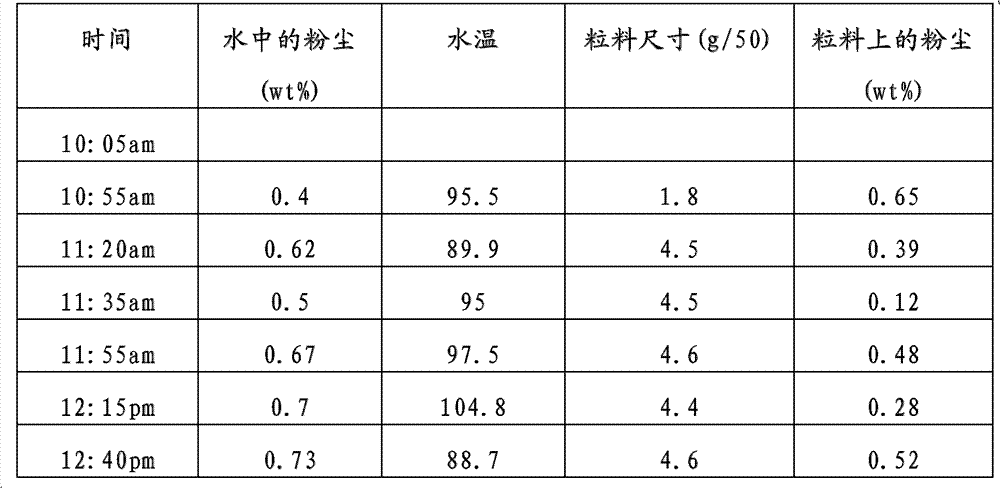
表6表示粒料上的粉尘浓度为0.12-0.65wt%。 Table 6 shows that the dust concentration on the pellets was 0.12-0.65 wt%. the
以两种方式测试组合物E的附聚:(i)新制粒料在环境条件下短期测试,和(i i)经老化的粒料在热下长期测试。对于短期测试,将两个新制粒料样品收集在旋转干燥机的出口并且立即放入PVC管,其具有 的压缩重量相当于两个堆叠的500kg超大袋的负荷。使这些管在负荷下静置1天,并且然后打开底部。当这样做时,粒料自由流出,这表明当它们完成它们的结晶并且在它们的包装中硬化时,不会有湿喷粉的粒料附聚的问题。 Composition E was tested for agglomeration in two ways: (i) short-term test on fresh pellets under ambient conditions, and (ii) long-term test on aged pellets under heat. For short-term testing, two samples of fresh pellets were collected at the outlet of the rotary dryer and immediately placed into a PVC pipe with a compressed weight equivalent to the load of two stacked 500kg jumbo bags. The tubes were allowed to stand under load for 1 day, and then the bottoms were opened. When this was done, the pellets flowed freely, suggesting that there would be no problem with agglomeration of the wet powdered pellets as they completed their crystallization and hardened in their packaging. the
长期测试以与短期测试类似的方式进行,其中将样品倒入PVC管并且在负荷下放置。还设置使用Ligafluid-硬脂酸钙分散体的组合物E样品作为对照。将负载的管放入55℃烘箱两周,取出并且使其冷却。然后,在压缩负荷仍然就位的情况下,将PVC管从粒料样品周围取出。这留下支撑压缩重量的自立的附聚颗粒的柱。然后测量在负荷下粒料柱崩解所需的时间量,其示于表7中。还示出了比较样品,其中仅使用硬脂酸钙作为防粘连剂,不加入HA2454。 Long-term tests were performed in a similar manner to short-term tests, where samples were poured into PVC pipes and placed under load. A sample of Composition E using Ligafluid-calcium stearate dispersion was also set up as a control. Place the loaded tube in a 55°C oven for two weeks, remove and allow to cool. Then, with the compressive load still in place, remove the PVC tubing from around the pellet sample. This leaves a column of free-standing agglomerated particles supporting the compressed weight. The amount of time required for the pellet column to disintegrate under load was then measured, which is shown in Table 7. Also shown is a comparative sample where only calcium stearate was used as the anti-blocking agent and no HA2454 was added. the
表7 Table 7

Claims (24)
Applications Claiming Priority (3)
| Application Number | Priority Date | Filing Date | Title |
|---|---|---|---|
| US11605908P | 2008-11-19 | 2008-11-19 | |
| US61/116,059 | 2008-11-19 | ||
| PCT/US2009/061865 WO2010059332A1 (en) | 2008-11-19 | 2009-10-23 | Adhesive compositions and methods of making the same |
Publications (2)
| Publication Number | Publication Date |
|---|---|
| CN102216373A CN102216373A (en) | 2011-10-12 |
| CN102216373B true CN102216373B (en) | 2013-10-30 |
Family
ID=41402606
Family Applications (1)
| Application Number | Title | Priority Date | Filing Date |
|---|---|---|---|
| CN200980145818XA Active CN102216373B (en) | 2008-11-19 | 2009-10-23 | Adhesive composition and its preparation method |
Country Status (6)
| Country | Link |
|---|---|
| US (1) | US20100124607A1 (en) |
| EP (1) | EP2350170B1 (en) |
| JP (1) | JP5481489B2 (en) |
| CN (1) | CN102216373B (en) |
| ES (1) | ES2655738T3 (en) |
| WO (1) | WO2010059332A1 (en) |
Families Citing this family (14)
| Publication number | Priority date | Publication date | Assignee | Title |
|---|---|---|---|---|
| KR20190141798A (en) * | 2010-06-18 | 2019-12-24 | 다우 글로벌 테크놀로지스 엘엘씨 | Coated polymeric particulates, and a process for coating polymeric particulates |
| PL2583992T3 (en) * | 2011-10-17 | 2014-11-28 | Fuller H B Co | Hollow glass micro particles used as anti-blocking system in hot melts |
| TW201343352A (en) * | 2012-03-28 | 2013-11-01 | Sumitomo Chemical Co | Method for preventing mutual adhesion of pellets for solar cell sealing materials |
| US9272795B2 (en) | 2012-05-17 | 2016-03-01 | Henkel IP & Holding GmbH | Integral hot melt adhesive packaging films and use thereof |
| US9364985B2 (en) * | 2012-05-24 | 2016-06-14 | Henkel IP & Holding GmbH | Process for preparing flowable amorphous poly-alpha olefin adhesive pellets |
| JP6527133B2 (en) * | 2013-03-15 | 2019-06-05 | ダウ グローバル テクノロジーズ エルエルシー | EPDM packaging system and process |
| ES2635519T3 (en) | 2014-11-21 | 2017-10-04 | Borealis Ag | Procedure for producing soft copolymer granules |
| JPWO2016157644A1 (en) | 2015-03-31 | 2018-01-25 | ニチバン株式会社 | Adhesive resin pellet and method for producing the same |
| EP3243622B1 (en) * | 2016-05-13 | 2020-09-09 | Borealis AG | Process for hydraulic conveying of polyolefin pellets |
| WO2018071507A1 (en) | 2016-10-12 | 2018-04-19 | Dow Global Technologies Llc | Method to produce functionalized ethylene-based polymers |
| CN107368117B (en) * | 2017-09-08 | 2019-11-12 | 青岛鼎康颐食品有限公司 | A kind of control system of chocolate bar dissolution filter |
| WO2020006396A1 (en) * | 2018-06-29 | 2020-01-02 | Dow Global Technologies Llc | Coated olefin-based polymers with reduced blocking |
| EP3814404B1 (en) * | 2018-06-29 | 2024-07-17 | Dow Global Technologies LLC | Process for making friable bales |
| KR102176356B1 (en) * | 2018-12-20 | 2020-11-09 | 주식회사 오아시스 | Sealing tape composition and product comprisign the same |
Citations (2)
| Publication number | Priority date | Publication date | Assignee | Title |
|---|---|---|---|---|
| US5041251A (en) * | 1989-07-27 | 1991-08-20 | Eastman Kodak Company | Pourable particles of normally tacky plastic materials and process for their preparation |
| CN1372577A (en) * | 1999-08-17 | 2002-10-02 | 陶氏化学公司 | Free-flowing polymer composition |
Family Cites Families (50)
| Publication number | Priority date | Publication date | Assignee | Title |
|---|---|---|---|---|
| GB928120A (en) * | 1960-09-14 | 1963-06-06 | Exxon Research Engineering Co | Coated polymer pellets |
| US3528841A (en) * | 1967-11-15 | 1970-09-15 | Nat Distillers Chem Corp | Method for reducing tackiness of polymer pellets |
| BE787885A (en) * | 1971-08-30 | 1973-02-23 | Du Pont | ETHYLENE INTERPOLYMERS IN TABLETS WITH REDUCED TENDENCY TO BLOCKING |
| US3954697A (en) * | 1975-03-31 | 1976-05-04 | Eastman Kodak Company | Poly(higher-1-olefin-co-propylene) copolymers as hot-melt, pressure-sensitive adhesives |
| US4027067A (en) * | 1976-02-26 | 1977-05-31 | Phillips Petroleum Company | Anti-blocking treatment for tacky particle-form polymers using aqueous composition of polyhydrocarbylsiloxane and alkali metal salt of higher carboxylic acid |
| US4151135A (en) * | 1977-08-15 | 1979-04-24 | National Distillers And Chemical Corporation | Processes for producing dry powders from tacky polymers via dispersion of same in water with dispersants convertible to parting agents |
| CA1243569A (en) * | 1983-01-28 | 1988-10-25 | Martin D. Thaler | Non-blocking hot melt adhesives |
| DE3410957A1 (en) * | 1984-03-24 | 1985-09-26 | Henkel KGaA, 4000 Düsseldorf | AQUEOUS RELEASE AGENTS |
| US5165909A (en) | 1984-12-06 | 1992-11-24 | Hyperion Catalysis Int'l., Inc. | Carbon fibrils and method for producing same |
| FR2613722B1 (en) | 1987-04-07 | 1990-11-23 | Bp Chimie Sa | PROCESS FOR THE MANUFACTURE OF PROPYLENE HOMOPOLYMER OR COPOLYMER GRANULES |
| US5403528A (en) | 1988-04-26 | 1995-04-04 | Rexene Corporation | Method for use in packaging and/or storing atactic polypropylene or other amorphous poly alpha olefins |
| DE3941418A1 (en) | 1989-12-15 | 1991-06-20 | Werner & Pfleiderer | METHOD FOR STARTING UP AN UNDERWATER PELLETIZING DEVICE AND DEVICE FOR UNDERWATER PELLETIZING |
| US5234963A (en) | 1992-05-13 | 1993-08-10 | Gaia Research | Production of encapsulated chemical foaming concentrates |
| US5322731A (en) * | 1993-03-09 | 1994-06-21 | Minnesota Mining And Manufacturing Company | Adhesive beads |
| US6228902B1 (en) * | 1994-03-02 | 2001-05-08 | Exxon Chemical Patents, Inc. | Tacky polymer particle anti-stick additive |
| US5594074A (en) | 1995-02-21 | 1997-01-14 | Shell Oil Company | Process for improving processability of ultra low melt viscosity polymer |
| EP0824564B1 (en) | 1995-05-08 | 1999-11-17 | Eastman Chemical Company | Process for coextruding a tacky amorphous propylene copolymer composition with a low viscosity polyolefin and article prepared thereby |
| US5629050A (en) | 1995-08-30 | 1997-05-13 | The Dow Chemical Company | Process for preparing coated articles |
| CA2161911C (en) | 1995-11-01 | 2004-03-23 | Alexander Henderson | Coated soft copolymers suitable for bulk shipment and storage |
| WO1997043337A1 (en) | 1996-05-15 | 1997-11-20 | Sumitomo Chemical Company, Limited | Powdery thermoplastic elastomer composition and articles obtained by molding same |
| US5895617A (en) | 1996-07-31 | 1999-04-20 | The Japan Steel Works, Ltd. | Method and apparatus for transporting underwater cut pellets |
| WO1999018147A1 (en) | 1997-10-08 | 1999-04-15 | H.B. Fuller Licensing & Financing, Inc. | Hot melt adhesive pellet comprising continuous coating of pelletizing aid |
| US6458300B1 (en) | 1998-05-27 | 2002-10-01 | Kraton Polymers U.S. Llc | Conversion of sticky elastomeric polymer crumb into pellets without polymer degradation |
| US6533564B1 (en) | 1999-02-10 | 2003-03-18 | Jowat Corporation | Apparatus for forming adhesive cartridges |
| US6328798B1 (en) | 1999-02-19 | 2001-12-11 | Equistar Chemicals, Lp | Coated polymeric particles having improved anti-block characteristics, method of making such particles, and apparatus therefor |
| DE10030909A1 (en) | 1999-07-09 | 2001-03-01 | Henkel Kgaa | Hot-melt adhesive in granulate form use for adhesive bonding of substrates where the granulate is melted and then applied to the substrate, has compact outer shell |
| US6177516B1 (en) | 1999-09-28 | 2001-01-23 | Equistar Chemincals, Lp | Adhesives and composite structures formed therewith |
| DE10048923A1 (en) * | 1999-10-11 | 2001-04-12 | Henkel Kgaa | Free-flowing hot-melt adhesive granules consist of hot-melt adhesive coated with non-adhesive material containing polyolefin wax, sugar alcohol as film-former and surfactant or foam suppressant |
| US6627723B2 (en) * | 1999-12-22 | 2003-09-30 | Exxonmobil Chemical Patents Inc. | Adhesive alpha-olefin inter-polymers |
| US6426026B1 (en) | 1999-12-28 | 2002-07-30 | Union Carbide Chemicals & Plastics Technology Corporation | Process for pelletizing ultra-high melt flow polymers |
| TWI282305B (en) | 2001-04-19 | 2007-06-11 | Mitsui Chemicals Inc | Soft resin pellet and manufacture method thereof |
| JP2003089774A (en) * | 2001-09-18 | 2003-03-28 | Hiyoshi Chemical Industrial Co Ltd | Adhesive type hot melt adhesive, method for producing the same and production apparatus |
| US8653169B2 (en) * | 2002-10-15 | 2014-02-18 | Exxonmobil Chemical Patents Inc. | Propylene copolymers for adhesive applications |
| US7541402B2 (en) * | 2002-10-15 | 2009-06-02 | Exxonmobil Chemical Patents Inc. | Blend functionalized polyolefin adhesive |
| US7550528B2 (en) * | 2002-10-15 | 2009-06-23 | Exxonmobil Chemical Patents Inc. | Functionalized olefin polymers |
| US7223822B2 (en) * | 2002-10-15 | 2007-05-29 | Exxonmobil Chemical Patents Inc. | Multiple catalyst and reactor system for olefin polymerization and polymers produced therefrom |
| KR101113341B1 (en) * | 2002-10-15 | 2012-09-27 | 엑손모빌 케미칼 패턴츠 인코포레이티드 | Multiple catalyst system for olefin polymerization and polymers produced therefrom |
| US7700707B2 (en) * | 2002-10-15 | 2010-04-20 | Exxonmobil Chemical Patents Inc. | Polyolefin adhesive compositions and articles made therefrom |
| US20040209082A1 (en) | 2003-04-17 | 2004-10-21 | Lee Willy W. | Process of Coating Tacky and Soft Polymer Pellets |
| JP4530657B2 (en) * | 2003-12-22 | 2010-08-25 | 出光興産株式会社 | Granulation method and granulated product of soft polyolefin resin |
| US7137235B2 (en) | 2004-10-12 | 2006-11-21 | Bostik Sa | Device and method for packaging in block form a sheathed hot-melt adhesive product |
| US7328547B2 (en) | 2004-10-29 | 2008-02-12 | Bostik, Inc. | Process for packaging plastic materials like hot melt adhesives |
| CN101111558B (en) * | 2005-01-31 | 2012-06-06 | 埃克森美孚化学专利公司 | Polymer blends and pellets and methods of producing same |
| US20100115874A1 (en) * | 2005-07-22 | 2010-05-13 | Pergo (Europe) Ab | Flooring system including a dry glue |
| US20070128389A1 (en) * | 2005-12-06 | 2007-06-07 | Dak Americas Llc | Process for manufacturing co-polyester barrier resins without solid-state polymerization, co-polyester resins made by the process, and clear mono-layer containers made of the co-polyester resins |
| US7371464B2 (en) * | 2005-12-23 | 2008-05-13 | 3M Innovative Properties Company | Adhesive compositions |
| US20070270538A1 (en) | 2006-05-19 | 2007-11-22 | Marc Stacey Somers | Elastomeric compositions comprising butyl rubber and propylene polymers |
| US8431642B2 (en) * | 2008-06-09 | 2013-04-30 | Exxonmobil Chemical Patents Inc. | Polyolefin adhesive compositions and articles made therefrom |
| WO2010138253A2 (en) * | 2009-05-29 | 2010-12-02 | Exxonmobil Chemical Patents Inc. | Polyolefin adhesive compositions and method of making thereof |
| US20110054117A1 (en) * | 2009-08-27 | 2011-03-03 | Hall Gregory K | Polyolefin Adhesive Compositions and Method of Making Thereof |
-
2009
- 2009-10-23 CN CN200980145818XA patent/CN102216373B/en active Active
- 2009-10-23 WO PCT/US2009/061865 patent/WO2010059332A1/en not_active Ceased
- 2009-10-23 EP EP09744282.6A patent/EP2350170B1/en not_active Not-in-force
- 2009-10-23 JP JP2011537480A patent/JP5481489B2/en active Active
- 2009-10-23 ES ES09744282.6T patent/ES2655738T3/en active Active
- 2009-10-23 US US12/604,874 patent/US20100124607A1/en not_active Abandoned
Patent Citations (2)
| Publication number | Priority date | Publication date | Assignee | Title |
|---|---|---|---|---|
| US5041251A (en) * | 1989-07-27 | 1991-08-20 | Eastman Kodak Company | Pourable particles of normally tacky plastic materials and process for their preparation |
| CN1372577A (en) * | 1999-08-17 | 2002-10-02 | 陶氏化学公司 | Free-flowing polymer composition |
Also Published As
| Publication number | Publication date |
|---|---|
| ES2655738T3 (en) | 2018-02-21 |
| WO2010059332A1 (en) | 2010-05-27 |
| EP2350170B1 (en) | 2017-10-18 |
| CN102216373A (en) | 2011-10-12 |
| US20100124607A1 (en) | 2010-05-20 |
| JP5481489B2 (en) | 2014-04-23 |
| JP2012509387A (en) | 2012-04-19 |
| EP2350170A1 (en) | 2011-08-03 |
Similar Documents
| Publication | Publication Date | Title |
|---|---|---|
| CN102216373B (en) | Adhesive composition and its preparation method | |
| US5041251A (en) | Pourable particles of normally tacky plastic materials and process for their preparation | |
| CN101111558B (en) | Polymer blends and pellets and methods of producing same | |
| CN102449091B (en) | Polyolefin adhesive compositions and method of making thereof | |
| EP2055458B1 (en) | Pellets comprising polymer | |
| JP5674536B2 (en) | Plant-based resin pellet, method for producing the same, and injection molding apparatus using plant-based resin material | |
| US20200392319A1 (en) | Hot-Melt Formulations Utilizing Depolymerized Polymeric Material | |
| WO2011025587A1 (en) | Polyolefin adhesive compositions and method of making thereof | |
| CN1313884A (en) | Adhesive propylene polymer compositions suitable for coating substrates | |
| JP2011236410A5 (en) | ||
| JP5200475B2 (en) | Method for producing aqueous resin dispersion composition | |
| JP6271526B2 (en) | Process for preparing flowable amorphous poly-alpha olefin adhesive pellets | |
| CN102481700A (en) | Process for preparing thermoplastic polymer pellets | |
| JP4806914B2 (en) | Anti-blocking agent masterbatch, composition for polypropylene film and method for producing the same | |
| US20170058153A1 (en) | Continuous Extrusion Process to Prepare Hot Melt Adhesive Compositions | |
| JPH03137113A (en) | Copolymer concentrate | |
| US7456241B2 (en) | Microfine adhesive powders and process | |
| JP5078300B2 (en) | Method for producing polymer pellet and method for producing polymer pellet package | |
| HK1199051A1 (en) | Hollow glass micro particles used as anti-blocking system in hot melts |
Legal Events
| Date | Code | Title | Description |
|---|---|---|---|
| C06 | Publication | ||
| PB01 | Publication | ||
| C10 | Entry into substantive examination | ||
| SE01 | Entry into force of request for substantive examination | ||
| C14 | Grant of patent or utility model | ||
| GR01 | Patent grant |