CN102210158B - An iptv receiver and method for controlling an application in the iptv receiver - Google Patents
An iptv receiver and method for controlling an application in the iptv receiver Download PDFInfo
- Publication number
- CN102210158B CN102210158B CN200980144767.9A CN200980144767A CN102210158B CN 102210158 B CN102210158 B CN 102210158B CN 200980144767 A CN200980144767 A CN 200980144767A CN 102210158 B CN102210158 B CN 102210158B
- Authority
- CN
- China
- Prior art keywords
- video
- widget
- information
- user
- widget application
- Prior art date
- Legal status (The legal status is an assumption and is not a legal conclusion. Google has not performed a legal analysis and makes no representation as to the accuracy of the status listed.)
- Expired - Fee Related
Links
Images


Classifications
-
- H—ELECTRICITY
- H04—ELECTRIC COMMUNICATION TECHNIQUE
- H04N—PICTORIAL COMMUNICATION, e.g. TELEVISION
- H04N21/00—Selective content distribution, e.g. interactive television or video on demand [VOD]
- H04N21/80—Generation or processing of content or additional data by content creator independently of the distribution process; Content per se
- H04N21/83—Generation or processing of protective or descriptive data associated with content; Content structuring
- H04N21/84—Generation or processing of descriptive data, e.g. content descriptors
-
- H—ELECTRICITY
- H04—ELECTRIC COMMUNICATION TECHNIQUE
- H04N—PICTORIAL COMMUNICATION, e.g. TELEVISION
- H04N21/00—Selective content distribution, e.g. interactive television or video on demand [VOD]
- H04N21/20—Servers specifically adapted for the distribution of content, e.g. VOD servers; Operations thereof
- H04N21/23—Processing of content or additional data; Elementary server operations; Server middleware
- H04N21/234—Processing of video elementary streams, e.g. splicing of video streams or manipulating encoded video stream scene graphs
- H04N21/2343—Processing of video elementary streams, e.g. splicing of video streams or manipulating encoded video stream scene graphs involving reformatting operations of video signals for distribution or compliance with end-user requests or end-user device requirements
- H04N21/234318—Processing of video elementary streams, e.g. splicing of video streams or manipulating encoded video stream scene graphs involving reformatting operations of video signals for distribution or compliance with end-user requests or end-user device requirements by decomposing into objects, e.g. MPEG-4 objects
-
- H—ELECTRICITY
- H04—ELECTRIC COMMUNICATION TECHNIQUE
- H04N—PICTORIAL COMMUNICATION, e.g. TELEVISION
- H04N21/00—Selective content distribution, e.g. interactive television or video on demand [VOD]
- H04N21/40—Client devices specifically adapted for the reception of or interaction with content, e.g. set-top-box [STB]; Operations thereof
- H04N21/45—Management operations performed by the client for facilitating the reception of or the interaction with the content or administrating data related to the end-user or to the client device itself, e.g. learning user preferences for recommending movies, resolving scheduling conflicts
- H04N21/454—Content or additional data filtering, e.g. blocking advertisements
- H04N21/4545—Input to filtering algorithms, e.g. filtering a region of the image
- H04N21/45452—Input to filtering algorithms, e.g. filtering a region of the image applied to an object-based stream, e.g. MPEG-4 streams
-
- H—ELECTRICITY
- H04—ELECTRIC COMMUNICATION TECHNIQUE
- H04N—PICTORIAL COMMUNICATION, e.g. TELEVISION
- H04N21/00—Selective content distribution, e.g. interactive television or video on demand [VOD]
- H04N21/40—Client devices specifically adapted for the reception of or interaction with content, e.g. set-top-box [STB]; Operations thereof
- H04N21/45—Management operations performed by the client for facilitating the reception of or the interaction with the content or administrating data related to the end-user or to the client device itself, e.g. learning user preferences for recommending movies, resolving scheduling conflicts
- H04N21/454—Content or additional data filtering, e.g. blocking advertisements
- H04N21/4545—Input to filtering algorithms, e.g. filtering a region of the image
- H04N21/45455—Input to filtering algorithms, e.g. filtering a region of the image applied to a region of the image
-
- H—ELECTRICITY
- H04—ELECTRIC COMMUNICATION TECHNIQUE
- H04N—PICTORIAL COMMUNICATION, e.g. TELEVISION
- H04N21/00—Selective content distribution, e.g. interactive television or video on demand [VOD]
- H04N21/40—Client devices specifically adapted for the reception of or interaction with content, e.g. set-top-box [STB]; Operations thereof
- H04N21/47—End-user applications
- H04N21/472—End-user interface for requesting content, additional data or services; End-user interface for interacting with content, e.g. for content reservation or setting reminders, for requesting event notification, for manipulating displayed content
- H04N21/47205—End-user interface for requesting content, additional data or services; End-user interface for interacting with content, e.g. for content reservation or setting reminders, for requesting event notification, for manipulating displayed content for manipulating displayed content, e.g. interacting with MPEG-4 objects, editing locally
-
- H—ELECTRICITY
- H04—ELECTRIC COMMUNICATION TECHNIQUE
- H04N—PICTORIAL COMMUNICATION, e.g. TELEVISION
- H04N21/00—Selective content distribution, e.g. interactive television or video on demand [VOD]
- H04N21/40—Client devices specifically adapted for the reception of or interaction with content, e.g. set-top-box [STB]; Operations thereof
- H04N21/47—End-user applications
- H04N21/485—End-user interface for client configuration
- H04N21/4854—End-user interface for client configuration for modifying image parameters, e.g. image brightness, contrast
-
- H—ELECTRICITY
- H04—ELECTRIC COMMUNICATION TECHNIQUE
- H04N—PICTORIAL COMMUNICATION, e.g. TELEVISION
- H04N21/00—Selective content distribution, e.g. interactive television or video on demand [VOD]
- H04N21/60—Network structure or processes for video distribution between server and client or between remote clients; Control signalling between clients, server and network components; Transmission of management data between server and client, e.g. sending from server to client commands for recording incoming content stream; Communication details between server and client
- H04N21/61—Network physical structure; Signal processing
- H04N21/6106—Network physical structure; Signal processing specially adapted to the downstream path of the transmission network
- H04N21/6125—Network physical structure; Signal processing specially adapted to the downstream path of the transmission network involving transmission via Internet
-
- H—ELECTRICITY
- H04—ELECTRIC COMMUNICATION TECHNIQUE
- H04N—PICTORIAL COMMUNICATION, e.g. TELEVISION
- H04N21/00—Selective content distribution, e.g. interactive television or video on demand [VOD]
- H04N21/40—Client devices specifically adapted for the reception of or interaction with content, e.g. set-top-box [STB]; Operations thereof
- H04N21/47—End-user applications
-
- H—ELECTRICITY
- H04—ELECTRIC COMMUNICATION TECHNIQUE
- H04N—PICTORIAL COMMUNICATION, e.g. TELEVISION
- H04N5/00—Details of television systems
- H04N5/44—Receiver circuitry for the reception of television signals according to analogue transmission standards
- H04N5/445—Receiver circuitry for the reception of television signals according to analogue transmission standards for displaying additional information
- H04N5/45—Picture in picture, e.g. displaying simultaneously another television channel in a region of the screen
Landscapes
- Engineering & Computer Science (AREA)
- Multimedia (AREA)
- Signal Processing (AREA)
- Databases & Information Systems (AREA)
- Human Computer Interaction (AREA)
- Two-Way Televisions, Distribution Of Moving Picture Or The Like (AREA)
Abstract
Description
技术领域 technical field
本发明涉及互联网协议电视(IPTV)接收器,更具体地说,涉及用于控制将视频滤镜应用于正在显示的视频内容的应用程序的IPTV接收器和方法。The present invention relates to Internet Protocol Television (IPTV) receivers, and more particularly, to IPTV receivers and methods for controlling applications that apply video filters to video content being displayed.
背景技术 Background technique
相关技术的广播接收器从诸如陆地、卫星和有线之类的广播媒体接收广播信号,由此向用户提供广播信号。然而,近来,正积极提供能够通过互联网协议(IP)以IP包接收和发送广播信号的IPTV服务。与其它广播媒体不同,这种IPTV服务不受任何地理条件限制。更具体地说,一旦用户连接到互联网协议(IP),就可以向该用户提供所请求的IPTV服务。A related art broadcast receiver receives broadcast signals from broadcast media such as terrestrial, satellite, and cable, thereby providing broadcast signals to users. However, recently, IPTV services capable of receiving and transmitting broadcast signals in IP packets through Internet Protocol (IP) are being actively provided. Unlike other broadcast media, this IPTV service is not restricted by any geographical conditions. More specifically, once a user is connected to Internet Protocol (IP), the requested IPTV service can be provided to the user.
发明内容 Contents of the invention
技术问题technical problem
然而,在相关技术的广播接收器中,已提供的视频滤镜的设置被统一(或同等地)应用于所有视频内容,这最终导致不能完全反映各视频内容的个性的问题,由此给用户带来不便。However, in the broadcast receiver of the related art, the settings of the provided video filters are uniformly (or equally) applied to all video contents, which eventually leads to a problem that the individuality of each video contents cannot be fully reflected, thus causing a problem to the user. bring inconvenience.
问题的解决方案problem solution
因此,本发明涉及一种IPTV接收器和用于控制该IPTV接收器中的应用程序的方法,该IPTV接收器基本上消除了由于相关技术的限制和缺点导致的一个或更多个问题。Accordingly, the present invention is directed to an IPTV receiver and method for controlling applications in the IPTV receiver that substantially obviate one or more problems due to limitations and disadvantages of the related art.
本发明的一个目的是要提供一种IPTV接收器和用于控制该IPTV接收器中的应用程序的方法,该IPTV接收器能够通过使用户能够选定IPTV接收器的视频滤镜并且将所选定的视频滤镜应用于对应IPTV接收器来向用户提供所要求的图片质量或画面效果。例如,当观看动作电影时,用户可能想要较高的清晰度。在这种情况下,本发明的优点在于,为了用户观看方便,可以应用针对所接收到的视频内容充分配置的视频滤镜。对于不同类型的视频内容应用相同的滤镜设置已知是用户的最大抱怨之An object of the present invention is to provide an IPTV receiver and a method for controlling applications in the IPTV receiver, which is capable of enabling the user to select a video filter of the IPTV receiver and set the selected A certain video filter is applied to the corresponding IPTV receiver to provide the user with the required picture quality or picture effect. For example, a user may want higher definition when watching an action movie. In this case, the present invention is advantageous in that video filters fully configured for the received video content can be applied for user viewing convenience. Applying the same filter settings to different types of video content is known to be one of the biggest complaints from users
本发明的其它优点、目的和特征将部分在随后的描述中阐述,并且部分对于本领域的普通技术人员来说在研究了以下内容后将是显而易见的,或者可以从本发明的实践中获知。可以通过本书面说明书和其权利要求以及所附附图中具体指出的结构来实现并获得本发明的目的和其它优点。Other advantages, objects and features of the present invention will be partly set forth in the ensuing description, and partly will be obvious to those of ordinary skill in the art after studying the following contents, or can be learned from the practice of the present invention. The objectives and other advantages of the invention may be realized and attained by the structure particularly pointed out in the written description and claims hereof as well as the appended drawings.
为了实现这些目的和其它优点并且根据本发明的用途,如这里实施并广泛描述的,一种用于提供视频窗件应用程序的方法包括以下步骤:回放IP包内的视频内容;执行视频窗件应用程序,并且选定正在回放的所述视频内容的特定区域;以及输出对象指南,该对象指南包括所选定的特定区域内包括的对象列表。To achieve these objects and other advantages and in accordance with the use of the present invention, as embodied and broadly described herein, a method for providing a video widget application includes the steps of: playing back video content within an IP packet; executing the video widget an application, and select a particular region of the video content being played back; and output an object guide including a list of objects contained within the selected particular region.
这里,所述方法还包括以下步骤:从所述对象指南中选定至少一个对象;从所述视频窗件应用程序中选定要应用于所选定的至少一个对象的视频滤镜;以及将所选定的视频滤镜应用于所选定的至少一个对象。Here, the method further includes the steps of: selecting at least one object from the object guide; selecting a video filter to be applied to the selected at least one object from the video widget application; and The selected video filter is applied to at least one selected object.
在本发明的另一个方面,一种IPTV接收器包括接收单元、解复用器、解码器、用户输入接收器、控制器和显示单元。更具体地说,接收单元接收IP包。这里,所述IP包可以包括视频内容和所述视频内容的信令信息。解复用器对所接收到的所述IP包进行解复用。解码器对所述视频内容进行解码。用户输入接收器接收所述视频内容内的特定区域以及要应用到所述特定区域的视频滤镜。控制器执行所述视频窗件应用程序并且控制所述IPTV,使得所述视频滤镜可以通过所述视频窗件应用程序应用于所述视频内容内的特定区域。并且,所述显示单元输出被应用了所述视频滤镜的视频内容。In another aspect of the present invention, an IPTV receiver includes a receiving unit, a demultiplexer, a decoder, a user input receiver, a controller, and a display unit. More specifically, the receiving unit receives IP packets. Here, the IP packet may include video content and signaling information of the video content. The demultiplexer demultiplexes the received IP packets. A decoder decodes the video content. A user input receiver receives a specific area within the video content and a video filter to apply to the specific area. A controller executes the video widget application and controls the IPTV such that the video filter can be applied to a specific area within the video content through the video widget application. And, the display unit outputs video content to which the video filter is applied.
应该理解的是,以上一般描述和以下详细描述都是示例性和说明性的,并且旨在提供对所要求保护的本发明的进一步解释。It is to be understood that both the foregoing general description and the following detailed description are exemplary and explanatory and are intended to provide further explanation of the invention as claimed.
本发明的有益效果Beneficial effects of the present invention
因此,本发明提供了以下效果和/或优点。Therefore, the present invention provides the following effects and/or advantages.
首先,用户可以通过IP下载可应用于视频内容的视频滤镜并且将所下载的视频滤镜直接应用于对应的视频内容,由此能够根据所选择的特性或效果来观看(或使用)视频内容。First, users can download video filters applicable to video content through IP and directly apply the downloaded video filters to corresponding video content, thereby being able to watch (or use) video content according to selected characteristics or effects .
第二,从内容提供商角度看,可以容易地将视频滤镜发送给IPTV接收器,由此使得特殊效果能够应用于对应的视频内容。Second, from a content provider perspective, video filters can be easily sent to IPTV receivers, thereby enabling special effects to be applied to corresponding video content.
第三,为了方便搜索和选择上述视频滤镜,本发明可以提供窗件应用程序。Third, in order to facilitate the search and selection of the above-mentioned video filters, the present invention can provide a widget application program.
第四,可以管理可应用于视频内容的视频滤镜的列表或者接收器简档(profile)。并且,详细信息可以发送给服务提供商或内容提供商,以便用于搜索视频滤镜。Fourth, a list of video filters or receiver profiles applicable to video content can be managed. And, the detailed information can be sent to a service provider or a content provider to be used for searching video filters.
最后,当创建最佳的用户指定视频滤镜时,窗件应用程序使用宽带内容指南(BCG,Broadband Content Guide)信息或点播内容(CoD,Content on Demand)可扩展标记语言(XML)模式的分类信息,从而能自动配置。然后,针对各用户存储关于窗件应用程序的配置信息(即,用户简档),以便由IPTV服务提供商进行管理,由此使用户在任何设有IP连接的位置都能够使用他(或她)自己的唯一窗件应用程序。Finally, widget applications use Broadband Content Guide (BCG) information or Content on Demand (CoD) Extensible Markup Language (XML) schema classifications when creating optimal user-specified video filters information for automatic configuration. Then, configuration information (i.e., user profile) on the widget application is stored for each user so as to be managed by the IPTV service provider, thereby enabling the user to use his (or her) ) its own unique widget application.
附图说明 Description of drawings
附图被包括进来以提供对本发明的进一步理解并且被并入且构成本申请的一部分,这些附图例示了本发明的实施方式,并且与说明书一起用于解释本发明的原理。在附图中:The accompanying drawings, which are included to provide a further understanding of the invention and are incorporated in and constitute a part of this application, illustrate embodiments of the invention and together with the description serve to explain the principle of the invention. In the attached picture:
图1例示了描述根据本发明的能够提供窗件服务的IPTV环境的总图;Fig. 1 illustrates and describes the general diagram of the IPTV environment that can provide widget service according to the present invention;
图2例示了具体说明根据本发明的IPTV环境中窗件应用程序的配置过程的示例图;Fig. 2 has illustrated the example figure that specifically illustrates the configuration process of the widget application program in the IPTV environment according to the present invention;
图3例示了具体说明根据本发明的IPTV服务提供商提供窗件服务的过程的示例图;Fig. 3 has illustrated the exemplary diagram of the process that the IPTV service provider according to the present invention provides window services;
图4例示了根据本发明的第一实施方式配置的接收器简档的示意图;Figure 4 illustrates a schematic diagram of a receiver profile configured according to a first embodiment of the present invention;
图5例示了根据本发明的第二实施方式配置的接收器简档的示意图;Figure 5 illustrates a schematic diagram of a receiver profile configured according to a second embodiment of the present invention;
图6例示了示出图5中的XML模式的图;Figure 6 illustrates a diagram showing the XML schema in Figure 5;
图7例示了根据本发明的第三实施方式配置的接收器简档的示意图;Figure 7 illustrates a schematic diagram of a receiver profile configured according to a third embodiment of the present invention;
图8例示了根据本发明的第四实施方式配置的接收器简档的示意图;Figure 8 illustrates a schematic diagram of a receiver profile configured according to a fourth embodiment of the present invention;
图9和图10例示了示出图8的XML模式的图;Figures 9 and 10 illustrate diagrams showing the XML schema of Figure 8;
图11例示了根据本发明的第五实施方式配置的接收器简档的示意图;Figure 11 illustrates a schematic diagram of a receiver profile configured according to a fifth embodiment of the present invention;
图12例示了示出图11的XML模式的图;Figure 12 illustrates a diagram showing the XML schema of Figure 11;
图13例示了根据本发明的一个实施方式配置的用户简档的示意图;Figure 13 illustrates a schematic diagram of a user profile configured according to one embodiment of the present invention;
图14例示了示出图13的XML模式的图;Figure 14 illustrates a diagram showing the XML schema of Figure 13;
图15例示了示出根据本发明的在IPTV终端功能(ITF,IPTV Terminal Function)中安装视频窗件应用程序的示例性过程步骤的流程图;Fig. 15 illustrates a flowchart showing the exemplary process steps of installing a video widget application program in an IPTV terminal function (ITF, IPTV Terminal Function) according to the present invention;
图16例示了示出根据本发明的在观看视频内容时安装视频窗件应用程序的示例性过程步骤的流程图;16 illustrates a flowchart showing exemplary process steps for installing a video widget application while viewing video content in accordance with the present invention;
图17例示了示出根据本发明的在用户登录时升级视频窗件应用程序和视频参数的示例性过程步骤的流程图;17 illustrates a flow chart showing exemplary process steps for upgrading a video widget application and video parameters upon user login in accordance with the present invention;
图18例示了示出根据本发明的升级视频窗件应用程序和视频参数的示例性过程步骤的流程图;18 illustrates a flowchart showing exemplary process steps for upgrading a video widget application and video parameters in accordance with the present invention;
图19例示了示出根据本发明的使用户删除视频窗件应用程序的示例性过程步骤的流程图;19 illustrates a flowchart showing exemplary process steps for a user to delete a video widget application in accordance with the present invention;
图20和图21分别例示了根据本发明的基于对象的选择和基于块的选择;20 and 21 respectively illustrate object-based selection and block-based selection according to the present invention;
图22和图23例示了根据本发明的用于映射视频区域和用来应用自定义滤镜的视频显示参数的示例性数据结构;22 and 23 illustrate exemplary data structures for mapping video regions and video display parameters for applying custom filters according to the present invention;
图24至图27例示了示出根据本发明的示例性视频输出数据层的图;24 to 27 illustrate diagrams showing exemplary video output data layers according to the present invention;
图28至图31例示了根据本发明的一个实施方式的用于在视频帧内选定特定区域并用于执行视频自定义滤镜的示例性菜单执行;28 to 31 illustrate an exemplary menu implementation for selecting a specific area within a video frame and for executing a video custom filter according to an embodiment of the present invention;
图32至图35例示了示出根据本发明的视频自定义滤镜的性能及其对各视频层的影响的概念图;32 to 35 illustrate conceptual diagrams illustrating the performance of a video custom filter according to the present invention and its impact on each video layer;
图36例示了示出根据本发明的将视频滤镜应用于视频帧内的选定区域的方法的过程步骤的流程图;FIG. 36 illustrates a flowchart showing process steps of a method of applying a video filter to a selected region within a video frame in accordance with the present invention;
图37至图41分别例示了根据本发明通过在ITF中使用视频窗件应用程序来应用视频滤镜的示例;和37 to 41 respectively illustrate an example of applying a video filter by using a video widget application in the ITF according to the present invention; and
图42是根据本发明的ITF的示例性框图。FIG. 42 is an exemplary block diagram of an ITF according to the present invention.
具体实施方式 Detailed ways
现在,将详细参照本发明的优选实施方式,在附图中例示了这些实施方式的示例。只要有可能,将在全部附图中使用相同的附图标记来表示相同或类似的部件。另外,尽管本发明中使用的术语是选自公知和通用的术语,但是申请人按照其判断力选择了本发明的说明书中提及的一些术语,在本说明书的相关部分中描述了这些术语的具体含义。此外,不仅需要通过所使用的实际术语而且需要通过其中各术语的含义来理解本发明。Reference will now be made in detail to the preferred embodiments of the present invention, examples of which are illustrated in the accompanying drawings. Wherever possible, the same reference numbers will be used throughout the drawings to refer to the same or like parts. In addition, although the terms used in the present invention are selected from well-known and commonly used terms, the applicant has selected some terms mentioned in the specification of the present invention according to his judgment, and the description of these terms is described in the relevant part of the specification. Concrete meaning. Furthermore, the present invention needs to be understood not only by the actual terms used but also by the meaning of each term therein.
下文中,将参照附图详细描述根据本发明的IPTV接收器和用于控制IPTV接收器中的应用程序的方法的优选实施方式。下文中,在本发明的说明中,术语“视频窗件应用程序”将表示一种应用程序,其对应于IPTV环境中使用的一个应用程序,更具体地说,对应于将视频滤镜应用于视频内容的窗件应用程序。这里,视频内容可以包括所有类型的图像,包括运动图片以及静止图片,例如相片或照片。Hereinafter, preferred embodiments of an IPTV receiver and a method for controlling applications in the IPTV receiver according to the present invention will be described in detail with reference to the accompanying drawings. Hereinafter, in the description of the present invention, the term "video widget application" will denote an application corresponding to an application used in an IPTV environment, more specifically, corresponding to applying a video filter to Widget application for video content. Here, video content may include all types of images, including moving pictures as well as still pictures, such as photographs or photographs.
另外,在本发明的说明中,下文将详细描述在IPTV环境下通过视频窗件应用程序控制视频内容的方法。这里,控制视频内容指的是利用视频窗件应用程序将视频滤镜应用于视频内容,从而针对一系列视频内容应用视频滤镜的不同功能,例如修改对应视频内容的特性或增加其它效果。另外,本发明的说明提供了使得在所有IPTV接收器中(即,在IPTV终端功能(ITF)中)能够执行窗件应用程序(例如,本发明的视频窗件应用程序)的标准结构。这是因为,在IPTV环境中,ITF具有不同的硬件和操作系统(OS)环境(或条件)。In addition, in the description of the present invention, a method for controlling video content through a video widget application in an IPTV environment will be described in detail below. Here, controlling video content refers to using a video widget application to apply a video filter to the video content, so as to apply different functions of the video filter to a series of video content, such as modifying the characteristics of the corresponding video content or adding other effects. In addition, the description of the present invention provides a standard structure that enables execution of widget applications (eg, the video widget application of the present invention) in all IPTV receivers (ie, in the IPTV Terminal Function (ITF)). This is because, in the IPTV environment, the ITF has different hardware and operating system (OS) environments (or conditions).
因此,根据本发明,用户可以通过IP下载可应用于内容的视频滤镜,并且直接将所下载的视频滤镜应用于对应的视频内容,由此能够根据所选择的特性或效果来观看(或使用)视频内容。另外,从内容提供商的角度来看,可以容易地将视频滤镜发送给IPTV接收器,由此能够使特殊效果应用于对应的视频内容。此外,为了方便搜索和选定上述的视频滤镜,本发明可以提供窗件应用程序。另外,在本发明中,可应用于视频内容的视频滤镜的列表或接收器简档得以管理。并且,详细信息可以发送给服务提供商或内容提供商,以便用于搜索视频滤镜。此外,根据本发明,当创建了最佳用户指定视频滤镜时,窗件应用程序使用宽带内容指南(BCG)信息或点播内容(CoD)可扩展标记语言(XML)模式的分类信息来进行自动配置。然后,针对各用户存储关于窗件应用程序的配置信息(即,用户简档),以便由IPTV服务提供商进行管理,由此使用户在设有IP连接的任何位置都能够使用他(或她)自己的唯一窗件应用程序。Therefore, according to the present invention, the user can download the video filter applicable to the content through IP, and directly apply the downloaded video filter to the corresponding video content, thereby being able to watch (or watch) according to the selected characteristic or effect use) video content. In addition, from the content provider's point of view, video filters can be easily transmitted to the IPTV receiver, thereby enabling special effects to be applied to corresponding video content. In addition, in order to facilitate the search and selection of the above-mentioned video filters, the present invention can provide a widget application program. Also, in the present invention, a list of video filters or receiver profiles applicable to video content is managed. And, the detailed information can be sent to a service provider or a content provider to be used for searching video filters. In addition, according to the present invention, the widget application uses Broadband Content Guide (BCG) information or Classification information of Content on Demand (CoD) Extensible Markup Language (XML) schema to perform automatic configuration. Then, configuration information (i.e., user profile) on the widget application is stored for each user to be managed by the IPTV service provider, thereby enabling the user to use his (or her) at any location where an IP connection is provided. ) its own unique widget application.
图1例示了描述根据本发明的可以提供窗件服务的IPTV环境的总图。FIG. 1 illustrates a general diagram describing an IPTV environment in which widget services can be provided according to the present invention.
参照图1,在IPTV环境中,通过网络120从服务器向接收器提供窗件服务。服务器可以包括内容提供商130、接收器制造商(或用电设备(consumer)制造商)服务器135和服务提供商(例如,窗件服务提供商140和145)。这里,内容提供商130制造IPTV服务中包括的内容。接收器可以包括IPTV接收器100、显示装置105和分发网络网关(DNG)110。显示装置105输出通过IPTV接收器100接收到的IPTV服务。分发网络网关(DNG)110帮助IPTV接收器100接入互联网。这里,网络120可以对应于开放互联网(或不受控网络)或受控网络。Referring to FIG. 1 , in an IPTV environment, a widget service is provided from a server to a receiver through a
参照图1,作为一个示例,将窗件服务描述为要提供给对应于一类服务提供商的窗件服务提供商140和145。因此,还可以通过内容提供商130或接收器制造商(或用电设备制造商)服务器135提供窗件服务。下文中,根据本发明,将视频窗件应用程序作为该窗件服务的一个示例。然而,这只是示例性的,因此,这里还可以包括执行其它功能的窗件应用程序。Referring to FIG. 1 , as an example, a widget service is described as being provided to
图2例示了用于具体说明根据本发明在IPTV环境中的窗件应用程序的配置过程的示例图。FIG. 2 illustrates an example diagram for specifically explaining the configuration process of the widget application program in the IPTV environment according to the present invention.
参照图2,通过网关210从服务器向可接入的ITF 200发送窗件服务。该服务器可以包括CoD服务器220、窗件服务器230和制造商服务器240。CoD服务器220对应于提供CoD服务的服务器。这里,CoD服务器220包括存储了视频内容和相关视频参数的数据库。制造商服务器240例如对应于用于制造商制造ITF的服务器,并且制造商服务器240包括具有制造商足以用来制造ITF的视频参数的数据库。窗件服务器230对应于提供视频窗件应用程序的服务提供商。这里,窗件服务器230可以直接制造和提供视频窗件应用程序,或者可以接收制造出的视频窗件应用程序,由此服务于对应的视频窗件应用程序。此外,窗件服务器230可以通过应用程序配对与其它服务器中的数据库250和270共享信息,以便制造窗件应用程序和服务于窗件应用程序。With reference to Fig. 2, send widget service from server to
ITF 200可以包括用于执行窗件应用程序的一个或更多个模块、用于存储窗件应用程序的窗件存储单元205、以及用户简档存储单元206。在图2中,作为用于执行窗件应用程序的模块,ITF 200可以包括窗件管理器201、窗件启动器202和窗件运行时间框架203。ITF 200还包括用于存储窗件应用程序的窗件存储单元205和用户简档存储单元206,这两者都隶属于硬件抽象层204。然而,图2中所示的ITF结构只是示出与窗件应用程序操作相关的最小结构的一个示例。因此,本发明将不只限于图2中所示的示例。The
窗件管理器201可以安装和管理通过网关210接收到的窗件应用程序。窗件启动器202可以根据用户简档206启动所安装的窗件应用程序。The
在以上说明中,制造商服务器240可以创建能够针对ITF控制硬件的具体操作的设备特定信息,例如窗件应用程序或视频参数,并且可以分发所创建的设备特定信息,以便与第三方窗件应用程序链接。In the above description, the
窗件应用程序可以容易地从ITF 200下载并安装。另外,窗件应用程序可以使用IPTV的硬件简档(即,接收器简档)和用户简档,以便根据各ITF识别能够安装的窗件应用程序。Widget applications can be easily downloaded and installed from
图3例示了用于具体说明根据本发明的在IPTV服务提供商中提供窗件应用程序的过程的示例图。FIG. 3 illustrates an exemplary diagram for specifically explaining a process of providing a widget application in an IPTV service provider according to the present invention.
这里,在IPTV环境中,在窗件服务过程(或提供窗件服务的过程)中可能涉及到窗件服务提供商310、IPTV服务提供商320、网关330和ITF 340。然而,本发明将不只限于图3中所示的示例。因此,可以在IPTV环境中进一步包括与窗件服务的提供相关的独立结构,或者,相反地,可以省略该结构的一部分或者可以用不同的结构替换特定的结构。例如,在图3中,窗件服务提供商310和IPTV服务提供商320可以对应于同一实体。Here, in the IPTV environment, the
如果用户接通ITF 340的电源(步骤1),则ITF 340向IPTV服务提供商320发送对网络浏览器初始页面的请求(步骤2)。此后,ITF 340从IPTV服务提供商320接收所请求的服务提供商页面(步骤3)。If the user turns on the power supply of ITF 340 (step 1), then
ITF 340通过显示画面向用户提供从IPTV服务提供商320接收的所请求的服务提供商页面(步骤4)。另外,IPTV服务提供商320可以对应于与IPTV服务简档功能实体(FE,Functional Entity)相同的实体。此外,IPTV服务提供商320可以对应于由ITF 340通过默认设置确定的IPTV服务提供商。The
当用户从通过显示画面提供的初始页面选定(或点击)IPTV窗件服务或提供商(步骤5)时,ITF 340接入窗件服务提供商310并且请求IPTV服务提供商初始页面(步骤6)。根据该请求,窗件服务提供商310向ITF 340发送IPTV服务提供商初始页面,并且ITF 340通过显示画面向用户提供所接收到的IPTV服务提供商初始页面(步骤7)。这里,窗件服务提供商310可以对应于与IPTV应用程序FE相同的实体。另外,如上所述,当用户选择(或点击)IPTV窗件服务或提供商时,并且当请求对应的初始页面时,ITF 340可以根据相关协议向窗件服务提供商310与该请求一起发送ITF 340的简档(即,接收器简档)。When the user selects (or clicks) the IPTV widget service or provider (step 5) from the initial page provided by the display screen, the
当用户选择特定窗件服务(步骤8)时,ITF 340向提供选定的窗件服务的窗件服务提供商310发送用于下载对应的窗件应用程序的请求(步骤9)。基于从ITF 340接收到的下载请求,窗件服务提供商310以包文件形式发送选定的IPTV窗件应用程序(步骤10)。在这个过程中,用户可以从ITF 340的显示画面上显示的IPTV窗件服务页面搜索窗件应用程序。更具体地说,用户可以搜索适于用户设备(UE)级别能力的窗件应用程序。When the user selects a specific widget service (step 8), the
关于从窗件服务提供商310接收到的包内的IPTV窗件应用程序,TIF 340可以验证用户是否希望通过在屏显示(OSD,on-screen display)继续进行安装(步骤11)。基于验证结果,如果用户希望安装该应用程序,则ITF 340授权安装所接收到的包内的IPTV窗件应用程序(步骤12)。Regarding the IPTV widget application program in the package received from the
如果用户发送了授权,则ITF 340安装所接收到的包内包括的IPTV窗件应用程序(步骤13)。随后,ITF 340将所安装的IPTV窗件应用程序初始化(步骤14)并且向用户提供已安装并经过初始化的IPTV窗件应用程序。此后,ITF 340从用户接收IPTV窗件应用程序设置(步骤15)。If the user has sent authorization, the
ITF 340存储用户简档,该用户简档包括与所安装的IPTV窗件应用程序相关的由用户配置的窗件配置信息(步骤16)。然后,ITF 340请求所存储的用户简档通过网关330并存储在IPTV服务提供商320中(步骤17)。因此,IPTV服务提供商320存储所接收到的用户简档(步骤19)。在这个过程期间,ITF 340可以操作已应用了用户设置的窗件应用程序(步骤18)。在图3给出的示例中,用户简档存储在IPTV服务提供商320中。然而,这只是示例性的。因此,在另一个示例中,作为替代,用户简档还可以存储在窗件服务提供商310中。用户简档可以由服务器310和/或320根据各用户来区分,由此被存储在各自数据库中。因此,用户可以随时随地接入服务器,并且调用他(或她)自己的用户简档信息,由此能够使用来自与他(或她)自己的ITF不同的ITF中的他(或她)自身的唯一窗件应用程序。The
下文中,将参照图4、图5和图6更详细地描述图3中的接收器简档和用户简档。Hereinafter, the receiver profile and user profile in FIG. 3 will be described in more detail with reference to FIGS. 4 , 5 and 6 .
图4例示了根据本发明的第一实施方式配置的接收器简档的示意图。图5例示了根据本发明的第二实施方式配置的接收器简档的示意图。而图6例示了显示图5的XML模式的图。Fig. 4 illustrates a schematic diagram of a receiver profile configured according to a first embodiment of the present invention. Fig. 5 illustrates a schematic diagram of a receiver profile configured according to a second embodiment of the present invention. And FIG. 6 illustrates a diagram showing the XML schema of FIG. 5 .
通过搜索/浏览窗件应用程序并且通过向服务器发送与窗件应用程序的执行条件(或环境)相关的信息(例如,ITF功能、可用资源量(或大小)等),以便下载搜索到的窗件应用程序,ITF可能能够可选地下载合适的窗件应用程序。By searching/browsing widget applications and by sending information related to execution conditions (or environments) of widget applications (for example, ITF function, available resource amount (or size), etc.) widget application, the ITF may be able to optionally download a suitable widget application.
下文中,将如下具体描述从ITF发送的上述接收器简档。Hereinafter, the above-mentioned receiver profile transmitted from the ITF will be specifically described as follows.
参照图4,用户简档包括UserEquipmentID(用户设备ID)元素、UserEquipmentClass(用户设备分类)元素、Resolution(分辨率)元素、SupportedEncodings(受支持编码)元素、IPEncapsulations(IP封装)元素和Extension(扩展)元素。Referring to Fig. 4, the user profile includes UserEquipmentID (user equipment ID) element, UserEquipmentClass (user equipment classification) element, Resolution (resolution) element, SupportedEncodings (supported encoding) element, IPEncapsulations (IP encapsulation) element and Extension (extension) element.
UserEquipmentID元素包括对应ITF的型号唯一标识(UID,Unique Identifier)。Resolution元素包括对应ITF的视频分辨率信息。而SupportedEncodings元素包括关于对应ITF的视频频率的信息。The UserEquipmentID element includes a model unique identifier (UID, Unique Identifier) corresponding to the ITF. The Resolution element includes video resolution information corresponding to the ITF. And the SupportedEncodings element includes information on the video frequency corresponding to the ITF.
除了图4所示的接收器简档外,图5中的接收器简档还包括Graphic Resolution(图形分辨率)元素、Graphic Colors(图形颜色)元素、Available Resources(可用资源)元素和Supported Filters(受支持滤镜)元素。In addition to the receiver profile shown in Figure 4, the receiver profile in Figure 5 also includes Graphic Resolution elements, Graphic Colors elements, Available Resources elements, and Supported Filters ( Supported filters) element.
参照图5和图6,Graphic Colors元素被定义为tGraphicColor类型并且包括指示ITF对图形颜色的处理能力的信息。这里,图形颜色指的是当使图形数据被提供给OSD时各像素的位深(bit-depth)。tGraphicColor类型可以基于色深属性来定义。32bpp、24bpp、16bpp和8pp中的任一个值可以作为色深属性的列举值给出。Referring to FIGS. 5 and 6 , the Graphic Colors element is defined as a tGraphicColor type and includes information indicating the processing capability of the ITF for graphic colors. Here, the graphic color refers to the bit-depth of each pixel when the graphic data is provided to the OSD. The tGraphicColor type can be defined based on the color depth property. Any one of 32bpp, 24bpp, 16bpp, and 8pp may be given as an enumerated value of the color depth attribute.
Graphic Resolution元素被定义为tGraphicResolution类型并且包括指示ITF对图形分辨率的处理能力的信息。这里,图形分辨率指的是窗件应用程序能够使用的OSD图形的分辨率。tGraphicResolution类型可以基于水平大小属性、竖直大小属性和旋转属性来定义。The Graphic Resolution element is defined as tGraphicResolution type and includes information indicating the processing capability of the ITF for graphics resolution. Here, the graphics resolution refers to the resolution of the OSD graphics that the widget application can use. The tGraphicResolution type can be defined based on a horizontal size attribute, a vertical size attribute, and a rotation attribute.
Available Resources元素被定义为tAvailableResources类型并且包括指示窗件应用程序的可用资源量的信息。这里,资源量指的是非易失性存储器和易失性存储器。The Available Resources element is defined as type tAvailableResources and includes information indicating the amount of resources available to the widget application. Here, the resource amount refers to nonvolatile memory and volatile memory.
Supported Filters元素被定义为tSupportedFilters类型并且包括指示多个视频滤镜功能当中能够由用户设备执行的功能的信息。因此,在本发明中所描述的视频滤镜功能当中,用户设备可以向服务器发送可执行的滤镜,由此能够下载并仅使用用户设备能够使用的视频窗件应用程序。这里,滤镜功能可以包括清晰度、模糊度、对比度、平滑度、亮度、伽玛(gamma)、温度等。The Supported Filters element is defined as a tSupportedFilters type and includes information indicating functions capable of being performed by the user equipment among a plurality of video filter functions. Therefore, among the video filter functions described in the present invention, the user equipment can send an executable filter to the server, thereby being able to download and use only the video widget applications that the user equipment can use. Here, the filter function may include sharpness, blur, contrast, smoothness, brightness, gamma, temperature, and the like.
图7例示了根据本发明的第三实施方式配置的接收器简档的示意图。Fig. 7 illustrates a schematic diagram of a receiver profile configured according to a third embodiment of the present invention.
根据本发明的第三实施方式的接收器简档包括与接收器能力相关的信息。与接收器能力(或性能)相关的这种信息被大体划分为被定义为DeviceInfo(装置信息)类型的DeviceInfo元素和被定义为STBService(STB服务)类型的STBService元素。A receiver profile according to a third embodiment of the present invention includes information related to receiver capabilities. Such information related to receiver capability (or performance) is roughly divided into a DeviceInfo element defined as a DeviceInfo (device information) type and an STBService element defined as an STBService (STB service) type.
DeviceInfo元素可以包括Manufacturer(制造商)元素、ManufacturerOUI元素、Model Name(型号名称)元素、Description(描述)元素、ProductClass(产品分类)元素、Serial Number(序列号)元素、Hardware Version(硬件版本)元素、SoftwareVersion(软件版本)元素、Enabled Options(启用选项)元素、Additional Hardware Version(附加硬件版本)元素、Additional Software Version(附加软件版本)元素、Provisioning(供应)元素、Device Status(装置状态)元素、Uptime(正常运行时间)元素、FirstUse Data(首次使用数据)元素和Device Log(装置日志)元素。DeviceInfo element can include Manufacturer (manufacturer) element, ManufacturerOUI element, Model Name (model name) element, Description (description) element, ProductClass (product classification) element, Serial Number (serial number) element, Hardware Version (hardware version) element , SoftwareVersion (software version) element, Enabled Options (enable option) element, Additional Hardware Version (additional hardware version) element, Additional Software Version (additional software version) element, Provisioning (supply) element, Device Status (device status) element, Uptime (uptime) element, FirstUse Data (first use data) element and Device Log (device log) element.
STBService元素可以包括FrontEnd(前端)元素、Personal Video Recorder(PVR,个人视频记录器)元素、AudioDecoder(音频解码器)元素、VideoDecoder(视频解码器)元素、AudioOutput(音频输出)元素、VideoOutput(视频输出)元素、ConditionalAccess(CA,条件接入)元素、Digital Rights Management(DRM,数字版权管理)元素、ServiceMonitoring(服务监视)元素和AudienceStatus(听/观众状态)元素。另外,STBService元素的属性可以是MaxActiveAVStreams(最大有效AV流)属性和MaxActiveAVPlayers(最大有效AV播放器)属性。STBService elements can include FrontEnd (front end) elements, Personal Video Recorder (PVR, personal video recorder) elements, AudioDecoder (audio decoder) elements, VideoDecoder (video decoder) elements, AudioOutput (audio output) elements, VideoOutput (video output ) element, ConditionalAccess (CA, conditional access) element, Digital Rights Management (DRM, digital rights management) element, ServiceMonitoring (service monitoring) element and AudienceStatus (listening/viewer status) element. In addition, the attributes of the STBService element may be MaxActiveAVStreams (maximum active AV streams) attribute and MaxActiveAVPlayers (maximum active AV players) attribute.
图8例示了根据本发明的第四实施方式配置的接收器简档的示意图。而图9和图10例示了示出图8的XML模式的图。Fig. 8 illustrates a schematic diagram of a receiver profile configured according to a fourth embodiment of the present invention. 9 and 10 illustrate diagrams showing the XML schema of FIG. 8 .
在图8中,图7中的DeviceInfo元素还包括关于用于执行窗件应用程序的可用资源信息的AvailableResources(可用资源)元素。AvailableResources元素可以包括nonVolatileMemory(非易失性存储器)元素和VolatileMemory(易失性存储器)元素。In FIG. 8, the DeviceInfo element in FIG. 7 further includes an AvailableResources (available resources) element regarding available resource information for executing the widget application. The AvailableResources element may include a nonVolatileMemory (nonvolatile memory) element and a VolatileMemory (volatile memory) element.
参照图9和图10,DeviceInfo元素的子元素具体说明如下。Referring to FIG. 9 and FIG. 10 , the sub-elements of the DeviceInfo element are specifically described as follows.
DeviceInfo元素被定义为对象类型,其中,该对象包含总体装置信息。Manufacturer元素被定义为串(String)类型(64)并描述了CPE的制造商(人类可读串)。ManufacturerOUI元素被定义为串类型(6)并描述了装置制造商的结构上唯一的标识。Model Name元素被定义为串类型(64)并描述了CPE的型号名称(人类可读串)。Description元素被定义为串类型(256)并描述了对CPE装置的完整说明(人类可读串)。ProductClass元素被定义为串类型(64)并描述了应用了序列号的产品分类的标识。换言之,对于给定的制造商,使用该参数来标识产品或产品分类,对于该产品而言,SerialNumber参数是唯一的。SerialNumber参数被定义为串类型(64)并描述了CPE的序列号。The DeviceInfo element is defined as an object type, where the object contains overall device information. The Manufacturer element is defined as String (String) type (64) and describes the manufacturer of the CPE (human readable string). The ManufacturerOUI element is defined as a string type (6) and describes a structurally unique identification of a device manufacturer. The Model Name element is defined as type String (64) and describes the model name (human-readable string) of the CPE. The Description element is defined as a string type (256) and describes a complete description (human readable string) of the CPE device. The ProductClass element is defined as a string type (64) and describes the identification of the product class to which the serial number is applied. In other words, for a given manufacturer, use this parameter to identify the product or product category for which the SerialNumber parameter is unique. The SerialNumber parameter is defined as a string type (64) and describes the serial number of the CPE.
Hardware Version元素被定义为串类型(64)并描述了标识特定CPE型号和版本的串。Software Version元素被定义为串类型(64)并描述了标识CPE中当前安装的软件版本的串。Enabled Options元素被定义为串类型(1024)并描述了多个串的由逗号分隔的列表(最大长度1024)。由逗号分隔的列表对应于CPE中当前启用的各Option(选项)的OptionName(选项名称)的列表。各Option的OptionName与OptionStruct(选项结构)的OptionName元素相同。仅列出了这些选项,其中,各个State(状态)表示对应选项被启用。Additional Hardware Version元素被定义为串类型(64)并描述了多个串的由逗号分隔的列表(最大长度64)。任何附加版本的由逗号分隔的列表表示卖方可能希望提供的任何附加硬件版本信息。Additional Software Version元素被定义为串类型(64)并描述了多个串的由逗号分隔的列表(最大长度64)。任何附加版本的由逗号分隔的列表表示卖方可能希望提供的任何附加软件版本信息。The Hardware Version element is defined as string type (64) and describes a string identifying a specific CPE model and version. The Software Version element is defined as string type (64) and describes a string identifying the software version currently installed in the CPE. The Enabled Options element is defined as a string type (1024) and describes a comma-separated list of multiple strings (maximum length 1024). The comma-separated list corresponds to the list of OptionName (option name) of each Option (option) currently enabled in the CPE. OptionName of each Option is the same as OptionName element of OptionStruct (option structure). Only these options are listed, where each State indicates that the corresponding option is enabled. The Additional Hardware Version element is defined as a string type (64) and describes a comma-separated list of multiple strings (maximum length 64). A comma-separated list of any additional versions indicates any additional hardware version information that the seller may wish to provide. The Additional Software Version element is defined as a string type (64) and describes a comma-separated list of multiple strings (maximum length 64). A comma-separated list of any additional versions indicates any additional software version information that the Seller may wish to provide.
Provisioning元素被定义为串类型(64)并描述了主服务器提供商的标识和其它供应信息,以确定服务提供商特有的自定义和供应参数。Device Status元素被定义为串类型(64)并描述了装置的当前运行状态。当前运行状态对应于“正常运行(up)”、“正在初始化”、“错误”和“禁用(disabled)”中的任何一个。Uptime元素被定义为unsignedInt(无符号整数)类型并描述了从CPE最后重启时开始的以秒计的时间。FirstUse Data元素被定义为dateTime(日期时间)类型并描述了CPE首次成功建立IP层网络连接并使用NTP或该网络连接上的等效物获取绝对时间基准的世界协调时间(UTC,Universal Time Coordinated)的日期和时间。在出厂重置后,CPE可以重置该日期。如果NTP或等效物不可用,则该参数(如果存在的话)应该被设置成UnknownTime(未知时间)值。Device Log元素被定义为串类型(32768)并描述了卖方特定日志。The Provisioning element is defined as a string type (64) and describes the host server provider's identity and other provisioning information to determine service provider-specific customization and provisioning parameters. The Device Status element is defined as a string type (64) and describes the current operating status of the device. The current operation status corresponds to any one of "up", "initializing", "error", and "disabled". The Uptime element is defined to be of type unsignedInt and describes the time in seconds since the last restart of the CPE. The FirstUse Data element is defined as a dateTime (datetime) type and describes the first time that the CPE successfully establishes an IP layer network connection and uses NTP or its equivalent on the network connection to obtain an absolute time reference (UTC, Universal Time Coordinated) date and time. After a factory reset, the CPE can reset this date. If NTP or equivalent is not available, then this parameter (if present) should be set to the UnknownTime value. The Device Log element is defined as a string type (32768) and describes a vendor specific log.
nonVolatileMemory元素被定义为unsignedInt类型并描述了可用的非易失性存储器的量(或大小)。VolatileMemory元素被定义为unsignedInt类型并描述了可用的易失性存储器的量(或大小)。The nonVolatileMemory element is defined as unsignedInt type and describes the amount (or size) of non-volatile memory available. The VolatileMemory element is defined as type unsignedInt and describes the amount (or size) of volatile memory available.
图11例示了根据本发明的第五实施方式配置的接收器简档的示意图。图12例示了示出图11的XML模式的图。Fig. 11 illustrates a schematic diagram of a receiver profile configured according to a fifth embodiment of the present invention. FIG. 12 illustrates a diagram showing the XML schema of FIG. 11 .
在图11中,图7的STBService元素还包括用于描述(或具体说明)机顶盒的OSD图形功能的Graphic元素和用于具体说明可支持的视频滤镜功能的SupportedFilters元素。Graphic元素可以包括GraphicResolution元素和GraphicColor元素。In FIG. 11 , the STBService element in FIG. 7 also includes a Graphic element for describing (or specifying) the OSD graphics function of the set-top box and a SupportedFilters element for specifying the supported video filter functions. Graphic elements may include GraphicResolution elements and GraphicColor elements.
参照图12,STBService元素的子元素具体说明如下。Referring to FIG. 12, the sub-elements of the STBService element are specifically described as follows.
FrontEnd元素描述了前端的功能,该前端用作网络和STB的内部功能块之间的接口。PVR元素描述了PVR的功能,该PVR存储来自任何Front End(前端)的节目并且将所存储的节目发送给音频和/或视频解码器或发送给(输出)IP前端。AudioDecoder元素描述了音频解码器的功能,该音频解码器接收基本音频流,对该音频进行解码,并且将未压缩的本机音频流输出给音频输出对象。VideoDecoder元素描述了视频解码器的功能,该视频解码器接收基本视频流,对该视频进行解码,并且将未压缩的本机视频流输出给视频输出对象。AudioOutput元素描述了音频输出的功能,该音频输出接收来自一个或更多个音频解码器的未压缩音频流并且执行格式适配(adaptation)。VideoOutput元素描述了视频输出的功能,该视频输出接收来自一个或更多个视频解码器的未压缩视频流并且执行格式适配。CA元素描述了CA组件的功能,该CA组件包含可以由STB支持的一种CA机制的细节。DRM元素描述了DRM组件的功能,该DRM组件包含可以由STB支持的一种DRM机制的细节。ServiceMonitoring元素描述了服务监视统计,该服务监视统计是基于服务类型来收集的。定义服务类型的主要原因在于,服务类型对应于不同的协议栈和配置,对于多个服务类型收集的统计将是毫无意义的。最后,AudienceStatus元素描述了按频道组织的包含观众观看统计的统计。The FrontEnd element describes the functionality of the front end, which serves as the interface between the network and the internal functional blocks of the STB. The PVR element describes the functionality of a PVR that stores programs from any Front End and sends the stored programs to audio and/or video decoders or to (output) IP Front Ends. The AudioDecoder element describes the functionality of an audio decoder that receives an elementary audio stream, decodes the audio, and outputs an uncompressed native audio stream to an audio output object. The VideoDecoder element describes the functionality of a video decoder that receives an elementary video stream, decodes the video, and outputs an uncompressed native video stream to a video output object. The AudioOutput element describes the functionality of an audio output that receives an uncompressed audio stream from one or more audio decoders and performs format adaptation. The VideoOutput element describes the functionality of a video output that receives an uncompressed video stream from one or more video decoders and performs format adaptation. The CA element describes the functionality of a CA component that contains details of a CA mechanism that may be supported by the STB. The DRM element describes the functionality of a DRM component that contains details of a DRM mechanism that can be supported by the STB. The ServiceMonitoring element describes service monitoring statistics that are collected based on the service type. The main reason for defining service types is that service types correspond to different protocol stacks and configurations, and statistics collected for multiple service types will be meaningless. Finally, the AudienceStatus element describes statistics containing audience viewing statistics organized by channel.
另外,由于在图11和图12中进一步包括的Graphic元素和Supported Filters元素与图5中所示的相同,因此为了简单起见将省略其详细描述。In addition, since the Graphic element and the Supported Filters element further included in FIGS. 11 and 12 are the same as those shown in FIG. 5, a detailed description thereof will be omitted for simplicity.
以上说明包含了ITF的接收器简档的细节。The above description contains details of the receiver profile of the ITF.
下文中,将详细描述用户简档。在以下说明中,当用户针对各个视频内容使用根据本发明的视频窗件应用程序来应用视频滤镜时,用户简档可以包括根据该过程期间作出的用户设置(例如,改变特定功能的值的设置)修改的所有内容。Hereinafter, the user profile will be described in detail. In the following description, when a user applies a video filter to individual video content using the video widget application according to the present invention, the user profile may include a Settings) modified everything.
图13例示了根据本发明实施方式配置的用户简档的示意图。并且,图14例示了显示图13中的XML模式的图。Figure 13 illustrates a schematic diagram of a user profile configured according to an embodiment of the present invention. And, FIG. 14 illustrates a diagram showing the XML schema in FIG. 13 .
图13和图14例示了UE简档。UE简档管理作为用户简档的已经针对各ITF安装的窗件应用程序的信息和相应的环境设置。因此,UE简档使得即使在用户通过不同于他(或她)自己的用户设备的任何终端(或用户设备)接入相关服务时用户也能够无需进行任何修改就使用他(或她)自己的设置。13 and 14 illustrate UE profiles. The UE profile manages information of widget applications that have been installed for each ITF and corresponding environment settings as a user profile. Therefore, the UE profile enables the user to use his (or her) own set up.
下文中,在用户简档中包括的元素当中,为了简单起见,将省略对与接收器简档中包括的元素相同的元素的详细说明。因此,将仅详细描述新引入的元素。参照图13和图14,与接收器简档不同,用户简档包括ApplicationSettings(应用程序设置)元素。ApplicationSettings元素可以包括ApplicationID(应用程序ID)元素、RevisionNumber(修订号)元素和Settings(设置)元素。ApplicationID元素对应于与能够唯一标识各窗件应用程序的标识符对应的元素。RevisionNumber元素对应于指示各窗件应用程序的版本的元素。因此,各窗件应用程序的ApplicationID和版本信息被存储在用户简档中,由此能够调用特定窗口应用程序。另外,Settings元素对应于存储各窗件应用程序的用户特定配置信息的元素。这里,Settings元素包括Position(位置)元素、Extension(扩展)元素和其它元素。更具体地说,Position元素表示在窗件应用程序的整个列表内各窗件应用程序的位置信息。并且,Extension元素和其它元素表示关于各窗件应用程序的环境设置的信息。因此,通过将安装在各ITF中的窗件应用程序和关于各窗口应用的环境设置的信息通过用户简档信息存储在服务器中,用户即使在通过任何随机ITF使用相关服务时也能够容易地使用同一环境。Hereinafter, among elements included in the user profile, a detailed description of the same elements as those included in the receiver profile will be omitted for simplicity. Therefore, only newly introduced elements will be described in detail. Referring to FIGS. 13 and 14 , unlike a receiver profile, a user profile includes an ApplicationSettings (application setting) element. The ApplicationSettings element may include an ApplicationID (application ID) element, a RevisionNumber (revision number) element, and a Settings (settings) element. The ApplicationID element corresponds to an element corresponding to an identifier capable of uniquely identifying each widget application. The RevisionNumber element corresponds to an element indicating the version of each widget application. Therefore, the ApplicationID and version information of each widget application are stored in the user profile, whereby a specific window application can be invoked. In addition, the Settings element corresponds to an element storing user-specific configuration information for each widget application. Here, the Settings element includes a Position (position) element, an Extension (extension) element, and other elements. More specifically, the Position element represents position information of each widget application within the entire list of widget applications. And, the Extension element and other elements represent information on environment settings of each widget application. Therefore, by storing the widget application installed in each ITF and the information on the environment setting of each window application in the server through the user profile information, the user can easily use the same environment.
下文中,将参照图3至图14详细描述在ITF中下载和安装、升级和删除视频窗件应用程序的过程。Hereinafter, the process of downloading and installing, upgrading and deleting a video widget application in the ITF will be described in detail with reference to FIGS. 3 to 14 .
图15例示了示出根据本发明的用于在ITF中安装视频窗件应用程序的示例性过程步骤的流程图。FIG. 15 illustrates a flowchart showing exemplary process steps for installing a video widget application in an ITF according to the present invention.
当用户接通ITF的电源并登录(S1401)时,ITF随后在显示画面上输出并显示窗件服务页面(S1402)。When the user turns on the power of the ITF and logs in (S1401), the ITF then outputs and displays a widget service page on the display screen (S1402).
当用户选定窗件服务提供商(S1403)时,ITF向所选定的窗件服务提供商发送接收器简档(S1404)。When the user selects a widget service provider (S1403), the ITF transmits a receiver profile to the selected widget service provider (S1404).
基于从窗件服务提供商发送的接收器简档,ITF在显示画面上输出并显示可用于安装的窗件应用程序的列表(或窗件应用程序列表)(S1405)。Based on the receiver profile transmitted from the widget service provider, the ITF outputs and displays a list of widget applications available for installation (or widget application list) on the display screen (S1405).
此后,当用户从所显示的窗件应用程序列表中选定特定窗件应用程序时,下载所选定的窗件应用程序(S1406)。Thereafter, when the user selects a specific widget application from the displayed list of widget applications, the selected widget application is downloaded (S1406).
ITF存储所下载的窗件应用程序并且执行所下载的窗件应用程序(S1407)。The ITF stores the downloaded widget application and executes the downloaded widget application (S1407).
此后,ITF向用户简档添加所执行的窗件应用程序(S1408)。Thereafter, the ITF adds the executed widget application to the user profile (S1408).
在步骤1404中,ITF向所选定的窗件服务提供商发送接收器简档。In step 1404, the ITF sends the receiver profile to the selected widget service provider.
更具体地说,为了搜索/浏览窗件应用程序并将所搜索到/浏览到的窗件应用程序下载到IPTV接收器,向窗件服务提供商(即,窗件服务器)发送与用于执行窗件应用程序的环境相关的信息,例如ITF功能或可用的资源量。因此,基于接收器简档,ITF可以可选地(或选择性地)从窗件服务器下载可用于安装的足够的窗件应用程序。More specifically, in order to search/browse the widget application program and download the searched/browsed widget application program to the IPTV receiver, send to the widget service provider (ie, the widget server) the Information about the widget application's environment, such as ITF capabilities or the amount of resources available. Therefore, based on the receiver profile, the ITF may optionally (or selectively) download enough widget applications from the widget server that are available for installation.
因此,优选地是,ITF将与窗件应用程序安装和执行相关的必要功能包括在接收器简档中,并且向窗件服务器发送该接收器简档。如图15所示,当安装窗件应用程序时,用户可以交互式地通过显示画面向视频区域应用独立的滤镜和处理方法。Therefore, it is preferable that the ITF includes necessary functions related to widget application installation and execution in a receiver profile, and transmits the receiver profile to the widget server. As shown in Figure 15, when the widget application is installed, the user can interactively apply independent filters and processing methods to the video area through the display screen.
图16例示了示出根据本发明用于当观看视频内容时安装视频窗件的示例性过程步骤的流程图。16 illustrates a flowchart showing exemplary process steps for installing a video widget while viewing video content in accordance with the present invention.
更具体地说,图16例示了当观看(或观察)视频内容时要如何安装视频窗件应用程序。这里,该示例性的过程可以被划分成如下两种情况:当观看视频内容时下载视频窗件应用程序和视频参数的情况;以及当观看视频内容时用户直接从服务器下载视频窗件应用程序并且使用所下载的视频窗件应用程序的情况。More specifically, FIG. 16 illustrates how a video widget application is to be installed when viewing (or viewing) video content. Here, the exemplary process can be divided into the following two cases: the case of downloading the video widget application program and video parameters when watching video content; and the user directly downloading the video widget application program from the server and When using the downloaded video widget application.
当用户接通ITF的电源时,即用户登录(S1501)时,观看(或观察)视频内容(S1502)。When the user turns on the power of the ITF, that is, when the user logs in (S1501), the video content is viewed (or observed) (S1502).
ITF首先确定在ITF中是否已存储视频窗件应用程序或视频参数的适当版本(S1503)。The ITF first determines whether an appropriate version of the video widget application or video parameters has been stored in the ITF (S1503).
然后,根据步骤1503的结果,针对对应的视频内容或视频帧,ITF自动地向用户提供可用的视频窗件应用程序(S1504)。Then, according to the result of step 1503, for the corresponding video content or video frame, the ITF automatically provides the user with available video widget applications (S1504).
此后,当用户选定对应的视频窗件应用程序(S1505)时,ITF接入提供视频窗件应用程序的窗件服务器(S1506)。Thereafter, when the user selects the corresponding video widget application (S1505), the ITF accesses the widget server providing the video widget application (S1506).
ITF从所接入的窗件服务器下载视频窗件应用程序(S1507),然后执行所下载的视频窗件应用程序(S1508)。The ITF downloads the video widget application program from the accessed widget server (S1507), and then executes the downloaded video widget application program (S1508).
随后,ITF下载视频参数(S1509)并且使用用户选定的视频参数来调节正观看或要观看的视频内容的视频(或图片)质量(S1510)。Then, the ITF downloads the video parameters (S1509) and uses the user-selected video parameters to adjust the video (or picture) quality of the video content being watched or to be watched (S1510).
此后,ITF存储关于当前配置或偏好的信息或用户简档(S1511)。Thereafter, the ITF stores information about current configuration or preference or user profile (S1511).
在以上说明中,ITF内的窗件管理器可以下载窗件应用程序和与观看到的视频内容相关的视频参数。下载方法可以包括通过与服务器单播连接(或接入服务器)进行下载的方法和使用与服务器多播连接(或接入服务器)通过多播信道直接进行下载的方法。这里,多播方法最常用于广播节目。当视频内容通过多播信道发送时,诸如窗件应用程序之类的补充服务可以被发送到另一个多播信道。可以将这种信息与BCG信息或服务发现和选择(SD&S,Service Discovery and Selection)信息(即,窗件应用程序统一资源标识(URI,Uniform Resource Identifier)或视频参数URI)一起通知给接收器。另外,在多播方法中,如果随着保留的观看或保留的记录来调度接收器,则可以提供也能够与保留的程序一起下载并且执行窗件应用程序或视频参数的环境。In the above description, the widget manager in the ITF can download the widget application program and video parameters related to the watched video content. The downloading method may include a method of downloading through a unicast connection with the server (or accessing the server) and a method of directly performing downloading through a multicast channel using a multicast connection with the server (or accessing the server). Here, the multicast method is most commonly used for broadcasting programs. When video content is sent over a multicast channel, supplementary services such as widget applications can be sent to another multicast channel. This information can be notified to the receiver together with BCG information or service discovery and selection (SD&S, Service Discovery and Selection) information (that is, widget application Uniform Resource Identifier (URI, Uniform Resource Identifier) or video parameter URI). In addition, in the multicast method, if receivers are scheduled along with reserved viewing or reserved recording, an environment that can also download and execute widget applications or video parameters together with reserved programs can be provided.
图17例示了示出根据本发明用于当用户登录时升级视频窗件和视频参数的示例性过程步骤的流程图。FIG. 17 illustrates a flowchart showing exemplary process steps for updating video widgets and video parameters when a user logs in according to the present invention.
图17例示了由窗件管理器执行的方法,该方法用于在用户登录时读取视频窗件应用程序和视频参数的版本信息,并且用于将视频窗件应用程序和视频参数升级到最新版本。这里,窗件管理器不仅升级视频窗件应用程序,而且还可以升级其它窗件应用程序。Fig. 17 illustrates a method performed by the widget manager for reading the version information of the video widget application and video parameters when the user logs in, and for upgrading the video widget application and video parameters to the latest Version. Here, the widget manager not only upgrades the video widget application, but can also upgrade other widget applications.
更具体地说,当用户接通ITF的电源并且登录(S1601)时,ITF读取预先已存储的关于用户偏好的信息(S1602)。More specifically, when a user turns on the power of the ITF and logs in (S1601), the ITF reads information on user preferences that has been stored in advance (S1602).
然后,ITF检验是否已升级关于视频窗件应用程序或视频参数的信息(S1603)。Then, the ITF checks whether the information on the video widget application or video parameters has been updated (S1603).
根据步骤1603的结果,如果已经更新了对应的信息,则ITF从窗件服务器下载更新后的视频窗件应用程序或视频参数(S1604)。According to the result of
ITF要么执行新下载的视频窗件应用程序要么将新下载的视频参数应用到现有的视频窗件应用程序,并且执行经处理的视频窗件应用程序(S1605)。The ITF either executes the newly downloaded video widget application or applies the newly downloaded video parameters to the existing video widget application, and executes the processed video widget application (S1605).
图18例示了示出根据本发明的用于升级视频窗件应用程序和视频参数的示例性过程步骤的流程图。FIG. 18 illustrates a flowchart showing exemplary process steps for upgrading a video widget application and video parameters in accordance with the present invention.
在这种情况下,当回放(或再现)视频内容时,在这里可以根据对应视频内容的类型应用其它的视频窗件应用程序或视频参数。例如,当显示画面突然从当前显示具有黑暗模糊的背景的电影变为显示体育频道节目时,由于这两个节目(或内容)的属性相互不同,因此为了应用新节目的适当视频参数或者根据视频内容提供商做出的决定,ITF可以改变视频窗件应用程序或视频参数。In this case, when playing back (or reproducing) the video content, other video widget applications or video parameters may be applied here according to the type of the corresponding video content. For example, when the display suddenly changes from currently displaying a movie with a dark and blurry background to displaying a sports channel program, since the attributes of the two programs (or content) are different from The ITF may change the video widget application or video parameters at the discretion of the content provider.
当用户正在观看(或观察)视频内容(S1701)时,ITF周期性地向服务器请求关于所安装的视频窗件应用程序和视频参数的信息(S1702),以便比较现有的视频窗件应用程序和视频参数的版本(S1703)。When the user is watching (or observing) video content (S1701), the ITF periodically requests information from the server about installed video widget applications and video parameters (S1702) in order to compare existing video widget applications and video parameter versions (S1703).
当服务器通知可用的视频窗件应用程序和视频参数的最新版本时,ITF通过显示画面向用户提供最新版本(S1704)。When the server notifies the latest version of the available video widget application and video parameters, the ITF provides the latest version to the user through the display screen (S1704).
当用户允许该通知时,即,当用户选定对应的视频窗件应用程序和视频参数(S1705)时,ITF下载所选定的视频窗件应用程序和视频参数并且升级现有的视频窗件应用程序和视频参数(S1706)。When the user allows the notification, that is, when the user selects the corresponding video widget application and video parameters (S1705), the ITF downloads the selected video widget application and video parameters and upgrades the existing video widget Application and video parameters (S1706).
一旦完成升级过程,ITF就中断当前正执行的视频窗件应用程序并将当前执行的视频窗件应用程序存储到存储器单元(S1707)。随后,ITF执行新升级的视频窗件应用程序(S1708)。Once the upgrade process is completed, the ITF interrupts the currently executing video widget application and stores the currently executing video widget application to the memory unit (S1707). Then, the ITF executes the newly upgraded video widget application (S1708).
图19例示了示出根据本发明的用于使用户删除视频窗件应用程序的示例性过程步骤的流程图。19 illustrates a flowchart showing exemplary process steps for enabling a user to delete a video widget application in accordance with the present invention.
更具体地说,图19例示了示出通过窗件管理器在ITF内删除视频窗件应用程序的方法的流程图。视频窗件应用程序可以存储在ITF中以被执行或者可以保持在非激活状态。当被执行时,请求从正在执行的窗件应用程序列表中删除对应视频窗件应用程序的请求可以被发送到ITF内的窗件启动器。因此,窗件管理器删除与用户简档和用户偏好相关的信息。另外,也删除现有的窗件应用程序,因此也删除在已删除的窗件应用中使用的数据。More specifically, FIG. 19 illustrates a flowchart showing a method of deleting a video widget application within the ITF through the widget manager. Video widget applications can be stored in the ITF to be executed or can remain inactive. When executed, a request to delete the corresponding video widget application from the list of executing widget applications may be sent to the widget launcher within the ITF. Accordingly, the widget manager deletes information related to the user profile and user preferences. In addition, the existing widget application is also deleted, so the data used in the deleted widget application is also deleted.
更具体地说,当用户接通ITF的电源并登录(S1801)时,ITF首先进入用户简档菜单(S1802),以使选定已安装的视频窗件应用程序的列表(S1803)。More specifically, when a user powers on the ITF and logs in (S1801), the ITF first enters a user profile menu (S1802) to select a list of installed video widget applications (S1803).
然后,选择用户希望从已安装的视频窗件应用程序中删除的窗件应用程序。此后,针对对应的视频频道或所下载的内容,ITF可以输出确认框以便验证并确认用户的选定(或决定)(S1804)。Then, select the widget that the user wants to remove from the installed video widgets. Thereafter, for the corresponding video channel or downloaded content, the ITF may output a confirmation box in order to verify and confirm the user's selection (or decision) (S1804).
如果用户选择“确认(OK)”输入(S1805),则ITF存储当前的用户偏好,然后,ITF上传从系统或存储器选定的窗件应用程序或禁用从系统或存储器选定的窗件应用程序(S1806)。If the user selects the "confirmation (OK)" input (S1805), the ITF stores the current user preference, and then, the ITF uploads or disables the selected widget application from the system or storage (S1806).
接着,ITF显示窗件应用程序的删除过程(S1807)。Next, the ITF displays the deletion process of the widget application (S1807).
以上说明对应于下载、安装、升级和删除ITF中的视频窗件应用程序的细节。The above instructions correspond to the details of downloading, installing, upgrading and deleting the video widget application in the ITF.
可以通过IP包提供各种类型的视频内容。这里,多个类型的视频内容包括运动图片(或视频)、静止图像、相片等。然而,在相关技术的广播接收器中,通过统一地对所有回放的视频内容应用具有相同设置的视频滤镜,相关技术的广播接收器不能反映出各视频内容的特性(或属性)。另外,随着用户变得越来越对编辑视频内容感兴趣,期望当前的广播接收器满足这类需求。Various types of video content can be provided through IP packets. Here, multiple types of video content include moving pictures (or videos), still images, photos, and the like. However, in the related art broadcast receiver, by uniformly applying video filters with the same settings to all played back video contents, the related art broadcast receiver cannot reflect the characteristics (or attributes) of each video content. In addition, as users become more and more interested in editing video content, current broadcast receivers are expected to meet such demands.
下文中,将详细描述针对ITF中正回放的视频内容使用视频窗件应用程序来应用视频滤镜的方法。因此,根据本发明,可以向用户提供针对各个视频内容的所请求的视频(或图片)质量或画面效果。Hereinafter, a method of applying a video filter using a video widget application for video content being played back in the ITF will be described in detail. Therefore, according to the present invention, the requested video (or picture) quality or picture effect for each video content can be provided to the user.
通常,视频滤镜可以统一地应用于ITF中正在回放的所有视频内容,或者可以应用于当前正在回放的视频内容,即当前正在播放的视频内容内的所有帧,或者可以仅应用于特定帧。Generally, a video filter can be uniformly applied to all video content being played back in the ITF, or can be applied to the video content currently being played back, that is, all frames within the currently playing video content, or can be applied only to a specific frame.
下文中,为了简化对本发明的说明,将给出将视频滤镜应用于视频内容的一个特定帧的示例。然而,本发明并不仅限于这里给出的示例。此外,给出的示例将被进一步划分为如下两种情况:视频滤镜总体应用于对应帧的情况;和视频滤镜仅应用于对应帧内受关注的选定区域的情况。Hereinafter, in order to simplify the description of the present invention, an example of applying a video filter to a specific frame of video content will be given. However, the invention is not limited to the examples given here. In addition, the given example will be further divided into the following two cases: the case where the video filter is applied to the corresponding frame as a whole; and the case where the video filter is only applied to a selected region of interest within the corresponding frame.
下文中,将参照附图详细描述将视频滤镜应用于选定区域的方法。对要应用视频滤镜的区域的选定可以广义地划分为基于对象的选定和基于块的选定。这里,选定是基于视频内容的编码方法进行的。Hereinafter, a method of applying a video filter to a selected area will be described in detail with reference to the accompanying drawings. Selection of an area to apply a video filter can be broadly divided into object-based selection and block-based selection. Here, the selection is based on the encoding method of the video content.
图20和图21分别例示了根据本发明的基于对象的选定和基于块的选定。参照图20和图21,每个格子代表一个块。20 and 21 respectively illustrate object-based selection and block-based selection according to the present invention. 20 and 21, each grid represents a block.
图20对应于用基于对象的编码处理视频内容的情况。参照图20,在一个画面中存在三个对象(1910、1920和1930)。基于用户的选择(或选定),可以以对象为单元进行基于对象的选定1915。Fig. 20 corresponds to the case of processing video content with object-based coding. Referring to FIG. 20, there are three objects (1910, 1920, and 1930) in one screen. Based on the user's selection (or selection), object-based selection 1915 may be performed in units of objects.
图21对应于用基于块的编码处理视频内容的情况。参照图21,在一个画面中存在三个对象(2010、2020和2030)。然而,与图20所示的情况相反,在图21中,没有选定对象2010本身,即使当选定对象2010时,实际上也可以只以块或宏块(MB)为单元进行选定。例如,在图21中所示的情况下,即使当指示装置仅指示对应的对象2010,根据基于块的编码结果,IPTV接收器也可以仅获得关于所指示的对象2010中包括的块2015的信息,或者与关于块2015的信息一起获得关于该块中包括的对象的信息。Fig. 21 corresponds to the case of processing video content with block-based encoding. Referring to FIG. 21, there are three objects (2010, 2020, and 2030) in one screen. However, contrary to the case shown in FIG. 20, in FIG. 21, the
图22和图23例示了根据本发明的用于映射视频区域和用于应用自定义滤镜的视频显示参数的示例性数据结构。22 and 23 illustrate exemplary data structures for mapping video regions and video display parameters for applying custom filters according to the present invention.
在接收器中应该存在一种重新计算应用了视频对象显示参数组的MB/块编号的机制。Parameter Set ID(参数组ID)(PSID)将用于提供实际参数与视频对象/块数之间的联系。在动态分配视频对象ID或基于块的视频编码的情况下,PSID将用于保持实际视频显示参数与视频对象之间的联系。这导致了PSID映射图像或对象/PSID映射表。There shall be a mechanism in the receiver to recalculate the MB/block number to which the video object display parameter set is applied. The Parameter Set ID (PSID) will be used to provide a link between the actual parameters and the number of video objects/blocks. In the case of dynamically assigned video object IDs or block-based video coding, the PSID will be used to keep the link between the actual video display parameters and the video object. This results in a PSID mapping image or object/PSID mapping table.
不同的参数值应用于多个区域并且根据所使用的工具可以存在各种参数组合。因此,为了追踪这种工具如何应用到了各区域,本发明应该能够存储已经如何针对各工具应用了各区域和配置或参数值。在基于对象的编码过程下,object_id(对象_id)本身可以共同指定(或表示)各区域。因此,更容易用将object_id与参数进行映射。Different parameter values apply to multiple regions and there can be various parameter combinations depending on the tool used. Therefore, in order to track how such tools have been applied to regions, the invention should be able to store how regions and configuration or parameter values have been applied for each tool. Under the object-based coding process, object_id (object_id) itself can collectively specify (or represent) each area. Therefore, it is easier to map object_id with parameters.
相反地,在基于块的编码过程下,需要用于表述宏块的组(或集合)的方法。并且,如单个对象的概念一样,这种方法可以用于应用了相同参数值的宏块。因此,除了用于共同标识(或区分)参数值的方法中之外,参数组ID的概念还可以用作能够将多个宏块聚集成为单个组的对象ID。更具体地说,基于块的编码过程中的对象的概念指的是用户总共选定的并且统一应用了参数的宏块的组(或集合)。换言之,在基于块的编码过程中,对象可以定义为都具有相同参数的宏块的组。In contrast, under a block-based encoding process, a method for representing groups (or collections) of macroblocks is needed. And, like the concept of a single object, this method can be used for macroblocks to which the same parameter values are applied. Therefore, in addition to being used in a method of collectively identifying (or distinguishing) parameter values, the concept of a parameter group ID can also be used as an object ID capable of aggregating multiple macroblocks into a single group. More specifically, the concept of an object in the block-based encoding process refers to a group (or collection) of macroblocks selected by the user in total and to which parameters are applied uniformly. In other words, in a block-based encoding process, an object can be defined as a group of macroblocks that all have the same parameters.
下面描述了用于在ITF中运行视频窗件应用程序的数据结构。在以下所示的表1中定义了视频窗件信息的示例。The data structures used to run video widget applications in the ITF are described below. An example of video widget information is defined in Table 1 shown below.
表1Table 1
[表1][Table 1]
[表][surface]


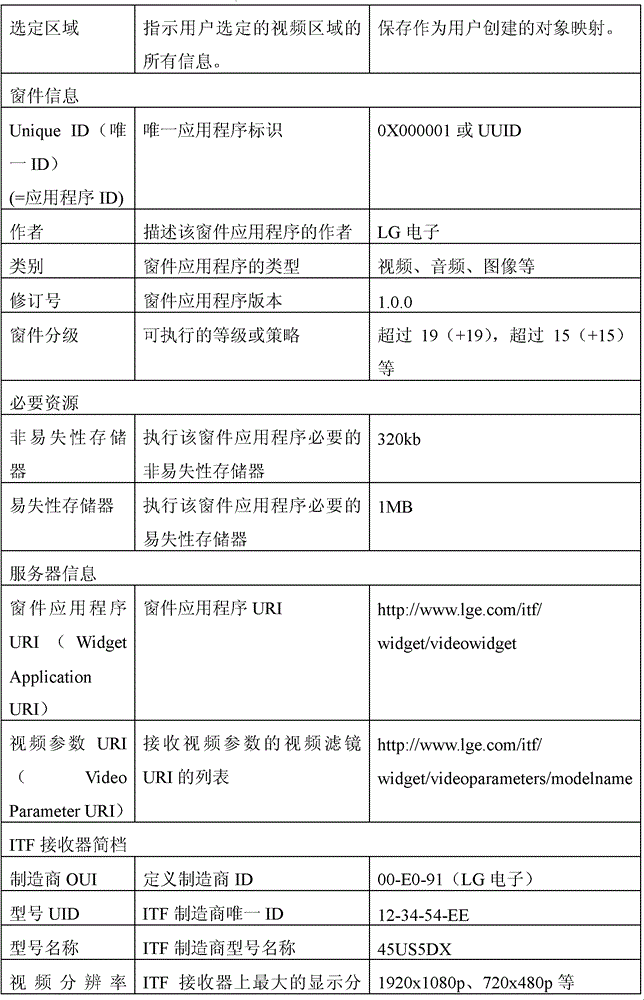

表1中定义的信息对应于在ITF中运行视频窗件应用程序所需的信息。这里,除了视频内容之外,表1可应用于具有图片或图像(或插图)、文本等格式的所有内容。另外,在表1中给出的示例性信息当中,可以在下载视频窗件应用程序的同时从诸如窗件服务器之类的服务器提供商接收一些信息,或者可以单独下载一些信息。在这种情况下,可以通过同一频道或者通过不同信道下载对应的信息。此外,可以由用户配置一些信息。并且,当用户配置信息时,对应的信息包括在用户简档信息中,由此被提供给包括窗件服务器的服务器提供商。The information defined in Table 1 corresponds to the information required to run the video widget application in the ITF. Here, Table 1 is applicable to all content having a format of a picture or image (or illustration), text, etc., in addition to video content. In addition, among the exemplary information given in Table 1, some information may be received from a server provider such as a widget server while downloading the video widget application, or may be downloaded separately. In this case, the corresponding information can be downloaded through the same channel or through different channels. Also, some information can be configured by the user. And, when the user configures the information, the corresponding information is included in the user profile information, thereby being provided to the server provider including the widget server.
参照表1,视频窗件信息可以包括基于对象的处理信息、基于块的处理信息、受支持滤镜的信息、用户选定信息、窗件信息、必要资源信息、服务器信息和接收器简档信息。Referring to Table 1, video widget information may include object-based processing information, block-based processing information, supported filter information, user-selected information, widget information, necessary resource information, server information, and receiver profile information .
基于对象的处理指的是将视频帧内所关注的部分或具有共同特性的部分分组成为单个区域并处理对应区域的处理。这里,对象映射可以用于对包括对应像素的对象区域进行定位。基于对象的处理信息可以包括视频对象标识符(ID)、参数组ID、功能类型和参数值。视频对象ID定义了对象映射内各像素的对象ID。视频对象ID唯一地标识帧内用户选定的区域的各对象。参数组ID对应于用于表示正应用于应用了视频滤镜的一组参数的值的标识符。例如,在频繁使用的参数值的情况下,取代每次进行发送的做法,对应的参数值可以通过直接存储然后在随后的过程中使用时通过参数组ID进行加载来使用。功能类型定义了在视频窗件应用程序中被应用于各视频对象的滤镜功能的类型。例如,功能类型可以包括对比度增强和反锐化掩模。参数值定义了根据功能类型在各滤镜功能中使用的值。例如,反锐化掩模类型的值可以包括阈值、半径和强度。Object-based processing refers to a process of grouping parts of interest or parts having a common characteristic within a video frame into a single region and processing the corresponding region. Here, the object map can be used to locate object regions comprising corresponding pixels. Object-based processing information may include video object identifiers (IDs), parameter set IDs, function types, and parameter values. The video object ID defines the object ID for each pixel within the object map. The video object ID uniquely identifies each object within the user-selected area within the frame. The parameter group ID corresponds to an identifier representing a value being applied to a group of parameters to which the video filter is applied. For example, in the case of frequently used parameter values, instead of sending each time, the corresponding parameter value can be used by directly storing and then loading by parameter group ID when used in a subsequent process. The function type defines the type of filter function applied to each video object in the video widget application. For example, feature types may include contrast enhancement and unsharp masks. The parameter value defines the value used in each filter function according to the function type. For example, values for an unsharp mask type can include Threshold, Radius, and Intensity.
基于块的处理指的是将视频帧内所关注的部分或具有共同特性的部分分组成为单个区域并处理对应区域的处理。这里,对象映射可以用于对包括对应像素的块区域进行定位。基于块的处理信息可以包括宏块/块编号、参数组ID、功能类型和参数值。宏块/块编号表示用于标识各宏块和块的一系列编号。这里,例如,宏块指的是由16乘16(16x16)像素以方形构成的视频编码的基本单元。并且,块指的是将宏块划分成4乘4(4x4)、8乘8(8x8)、16乘8(16x8)、8乘4(8x4)结构的单元。参数组ID指的是应用于宏块/块单元中的参数的标识符。参数组ID的定义与基于对象的处理信息中描述的相同。功能类型也与基于对象的处理信息中描述的相同。然而,差别仅在于,应用的区域对应于块单元。参数值也与基于对象的处理信息中描述的相同。然而,差别仅在于,参数可以根据宏块/块单元来变化。The block-based processing refers to a process of grouping parts of interest or parts having a common characteristic within a video frame into a single region and processing the corresponding region. Here, the object map can be used to locate the block region comprising the corresponding pixel. Block-based processing information may include macroblock/block number, parameter group ID, function type, and parameter value. Macroblock/block number means a series of numbers used to identify individual macroblocks and blocks. Here, for example, a macroblock refers to a basic unit of video encoding constituted by 16 by 16 (16x16) pixels in a square shape. And, a block refers to a unit that divides a macroblock into 4 by 4 (4x4), 8 by 8 (8x8), 16 by 8 (16x8), and 8 by 4 (8x4) structures. The parameter group ID refers to an identifier applied to a parameter in a macroblock/block unit. The definition of the parameter group ID is the same as described in Object-Based Processing Information. Function types are also the same as described in Object-based processing information. However, the only difference is that the applied area corresponds to a block unit. The parameter values are also the same as described in Object-based processing information. However, the only difference is that the parameters can vary according to the macroblock/block unit.
受支持滤镜的信息提供了关于视频自定义滤镜中可应用的文档参数的信息。例如,受支持滤镜信息可以包括清晰度、模糊度、对比度、平滑度、亮度、伽玛和温度。清晰度可以增强视频帧或静止图像的清晰度。模糊度可以处理视频帧或静止图像的散焦像差和眼镜处方。在暗视频或静止图片的情况下,对比度可以调节对比度值来模糊视频帧或静止图像。平滑度使视频帧或静止图像平滑。亮度可以反射给定量的光。伽玛可以对视频帧或静止图像中的亮度(luminance)或三色值进行解码。温度可以表示色温。受支持滤镜的信息可以与上述基于对象的处理和基于块的处理的参数组相关联。另外,可以由包括窗件服务器的服务提供商提供受支持滤镜的信息,或者用户可以改变所提供的受支持滤镜信息的设置。例如,当用户改变受支持滤镜信息时,改变后的信息可以包括在用户简档信息中,以便被发送给服务器。Information about supported filters provides information about the document parameters that can be applied in video custom filters. For example, supported filter information can include sharpness, blur, contrast, smoothness, brightness, gamma, and temperature. Clarity can enhance the clarity of video frames or still images. Blur can handle defocus aberrations and eyeglass prescriptions for video frames or still images. In the case of dark video or still pictures, Contrast can adjust the contrast value to blur video frames or still images. Smoothness smoothes video frames or still images. Brightness reflects a given amount of light. Gamma can decode luminance or tristimulus values in video frames or still images. The temperature may represent a color temperature. Information about supported filters may be associated with the object-based processing and block-based processing parameter sets described above. In addition, the information of supported filters may be provided by a service provider including a widget server, or the user may change the setting of the provided supported filter information. For example, when the user changes the supported filter information, the changed information may be included in the user profile information to be sent to the server.
用户选定信息可以包括区域索引和选定区域。区域索引可以对应于用户选定区域的索引。用户可以选定视频区域中的多个区域,以应用自定义的视频滤镜。为此,IPTV接收器可以使用对象映射来获知(或被告知)选定区域的区域索引。更具体地说,当选定了特定索引时,各个像素所属的对应于该对象ID的区域变成区域索引。选定区域(Selected Area)可以对应于指示用户选定视频帧区域的信息。选定区域可以被存储为用户创建的对象映射。User selected information may include a region index and a selected region. The region index may correspond to the index of the user selected region. Users can select multiple areas in the video area to apply custom video filters. To this end, the IPTV receiver can use the object map to know (or be told) the region index of the selected region. More specifically, when a specific index is selected, the area corresponding to the object ID to which each pixel belongs becomes the area index. The selected area (Selected Area) may correspond to information indicating a video frame area selected by the user. Selected regions can be stored as user-created object maps.
窗件信息提供关于正在执行的视频窗件应用程序的信息。这里,窗件信息可以包括唯一ID(或应用程序ID)信息、作者信息、类别信息、修订号信息和窗件分级信息。唯一ID信息可以被定义为唯一应用程序标识符。这里,唯一ID信息可以被赋予值“0x000001”或“UUID”。作者信息可以描述视频窗件应用程序的作者(例如,LG电子)。类别信息可以定义视频窗件应用程序的类型(例如,视频、音频、图像等)。修订号信息可以提供视频窗件应用程序的版本(例如,版本1.0.0)。窗件分级信息可以定义可执行的等级或策略(例如,分级超过19(或分级+19),分级超过15(或分级+15)等)。Widget Information provides information about the video widget application being executed. Here, the widget information may include unique ID (or application program ID) information, author information, category information, revision number information, and widget classification information. Unique ID information may be defined as a unique application identifier. Here, the unique ID information may be given a value of "0x000001" or "UUID". Author information may describe the author of the video widget application (eg, LG Electronics). The category information may define the type of video widget application (eg, video, audio, image, etc.). The revision number information may provide the version of the video widget application (eg, version 1.0.0). Widget rating information may define executable ratings or policies (eg, rating over 19 (or rating+19), rating over 15 (or rating+15), etc.).
必要资源信息可以包括非易失性存储器信息和易失性存储器信息。非易失性存储器信息可以定义执行对应的视频窗件应用程序的必要的非易失性存储器。易失性存储器信息可以定义执行视频应用程序的必要的易失性存储器。The necessary resource information may include nonvolatile memory information and volatile memory information. The non-volatile memory information may define the necessary non-volatile memory to execute the corresponding video widget application. The volatile memory information may define the volatile memory necessary to execute the video application.
服务器信息可以包括窗件应用程序URI信息和视频参数URI信息。窗件应用程序URI信息可以定义一个或更多个用来下载窗件应用程序的URI(例如,http://www.lge.com/itf/widget/videowidget)。视频参数URI信息可以定义接收视频参数的视频滤镜URI的列表(例如,http://www.lge.com/itf/widget/videoparameters/modelname)。The server information may include widget application program URI information and video parameter URI information. The widget application URI information may define one or more URIs (for example, http://www.lge.com/itf/widget/videowidget) for downloading widget applications. The video parameter URI information may define a list of video filter URIs that receive video parameters (eg, http://www.lge.com/itf/widget/videoparameters/modelname).
ITF接收器简档信息可以包括制造商OUI信息、型号UID信息、型号名称信息、视频分辨率信息、图形分辨率信息、图形颜色信息和视频频率信息。制造商OUI信息可以定义制造商ID(例如,OO-E0-91(LG电子))。型号UID信息可以定义ITF制造商唯一ID(例如,12-34-54-EE)。型号名称信息可以定义ITF制造商型号名称(例如,45US5DX)。视频分辨率信息可以定义ITF接收器上的最大显示分辨率(例如,1920x1080p、720x480p等)。图形分辨率信息可以定义ITF接收器的图形分辨率,以设置窗件应用程序的正确位置和大小(例如,1920x1080、960x540等)。图形颜色信息可以定义当将图形数据提供给OSD时各像素的位深(例如,32bpp、24bpp、16bpp和8bpp)。视频频率信息可以定义视频帧的速度(例如,60z、70Hz、75Hz、120Hz等)。The ITF receiver profile information may include manufacturer OUI information, model UID information, model name information, video resolution information, graphic resolution information, graphic color information, and video frequency information. Manufacturer OUI information may define a manufacturer ID (eg, OO-E0-91 (LG Electronics)). The model UID information may define an ITF manufacturer unique ID (eg, 12-34-54-EE). The model name information may define an ITF manufacturer model name (eg, 45US5DX). The video resolution information may define the maximum display resolution on the ITF receiver (eg, 1920x1080p, 720x480p, etc.). The graphics resolution information may define the graphics resolution of the ITF receiver to set the correct position and size of the widget application (eg, 1920x1080, 960x540, etc.). The graphics color information may define the bit depth (eg, 32bpp, 24bpp, 16bpp, and 8bpp) of each pixel when providing graphics data to the OSD. Video frequency information may define the speed of video frames (eg, 60z, 70Hz, 75Hz, 120Hz, etc.).
图24至图27例示了示出根据本发明的示例性视频输出数据层的图。24 to 27 illustrate diagrams showing exemplary video output data layers according to the present invention.
图24至图27例示了描述在ITF中处理并且最终向用户显示的各视频帧的处理的图。24 to 27 illustrate diagrams describing the processing of each video frame processed in the ITF and finally displayed to the user.
图24例示了视频编码平面。这里,视频编码平面表示正在被编码并且从发送系统发送的视频帧。视频编码平面示出了在被ITF处理之前的对象。Fig. 24 illustrates a video coding plane. Here, the video coding plane means a video frame that is being coded and transmitted from a transmission system. The video coding plane shows the object before being processed by the ITF.
图25例示了图形平面。这里,图形平面表示根据用户请求通过OSD在ITF中实现的特定功能的OSD画面或OSD数据的图形平面。Fig. 25 illustrates a graphics plane. Here, the graphic plane means a graphic plane of an OSD screen or OSD data of a specific function implemented in the ITF through the OSD according to a user's request.
图26例示了视频显示平面。更具体地说,图26例示了被ITF处理的图24所示的视频帧中包括的各对象的输出格式。Fig. 26 illustrates a video display plane. More specifically, FIG. 26 illustrates an output format of each object included in the video frame shown in FIG. 24 processed by the ITF.
图27例示了提供给用户的最终显示画面。换言之,图25和图26被组合(或合并)以便最终显示。Fig. 27 illustrates the final display screen provided to the user. In other words, FIG. 25 and FIG. 26 are combined (or merged) for final display.
如上所述,当用户选定视频帧中的特定区域或视频对象时,针对选定的特定区域或视频对象,ITF从图26的视频显示平面中提取对应的区域或对应的视频对象。换言之,这表示ITF使用图26所示的视频显示平面的像素值和坐标。As mentioned above, when the user selects a specific area or video object in a video frame, for the selected specific area or video object, the ITF extracts the corresponding area or corresponding video object from the video display plane in FIG. 26 . In other words, this means that the ITF uses the pixel values and coordinates of the video display plane shown in FIG. 26 .
这里,ITF可以将选定区域或视频对象本身或者与选定区域或视频对象相关的信息存储在存储器中。在这种情况下,ITF可以采用静止图像的形式处理选定区域或视频对象或相关信息。Here, the ITF may store the selected area or video object itself or information related to the selected area or video object in the memory. In this case, the ITF can process selected areas or video objects or related information in the form of still images.
另外,ITF可以将用户配置的视频自定义滤镜应用于存储器中存储的静止图像。ITF还可以将应用结果重写在同一区域内。或者,ITF还可以将应用结果存储在其它区域内,以便单独地保存在应用用户配置的视频自定义滤镜之前的静止图像,作为紧急情况下的预防形式。Additionally, the ITF can apply user-configured video custom filters to still images stored in memory. ITF can also rewrite application results in the same area. Alternatively, the ITF may also store the application results in other areas to separately save still images prior to application of user-configured video custom filters, as a form of precaution in case of emergency.
图28至图31例示了根据本发明实施方式的用于在视频帧内选择特定区域并用于执行视频自定义滤镜的示例性菜单执行。28 to 31 illustrate exemplary menu executions for selecting a specific region within a video frame and for executing a video custom filter according to an embodiment of the present invention.
例如,图28至图31描述了将根据本发明的视频自定义滤镜应用于提供给用户(如图27所示)的显示画面的过程。For example, FIGS. 28 to 31 describe the process of applying the video custom filter according to the present invention to the display screen provided to the user (as shown in FIG. 27 ).
图28例示了暂停视频以便在图27中使用户能够对该视频应用视频滤镜的一个示例性情况。在这种情况下,在画面上显示静止图像。FIG. 28 illustrates an example scenario of pausing a video to enable a user to apply a video filter to the video in FIG. 27 . In this case, a still image is displayed on the screen.
图29例示了由用户配置所关注的区域的情况,如图28所示。图30和图31例示了用户应用视频自定义滤镜的示例性情况。更具体地说,图30示出了在图29中用户选择特定区域或特定视频对象作为所关注区域的示例。在该示例中,图30示出了由ITF提供的弹出式菜单。另外,当相对于图30中提供的弹出式菜单(一级菜单)选定了特定功能时,图31示出了相对于所选定的特定功能针对更详细的设置提供的示例性弹出式菜单(二级菜单)。图30和图31中提供的弹出式菜单可以包括视频自定义滤镜能够提供的示例性功能。这里,这些功能可以装配在IPTV接收器中或者可以对应于能够从诸如窗件服务器之类的服务提供商下载的TOOL(工具)。这里,这些TOOL可以允许用户改变参数值,以便应用对应的TOOL(工具)。更具体地说,当下载TOOL时,通过改变参数,用户可以将对应的TOOL应用到任意区域或对象。FIG. 29 exemplifies a case where an area of interest is configured by a user, as shown in FIG. 28 . FIG. 30 and FIG. 31 illustrate exemplary situations in which a user applies a video custom filter. More specifically, FIG. 30 shows an example in which a user selects a specific area or a specific video object as an area of interest in FIG. 29 . In this example, Figure 30 shows a pop-up menu provided by the ITF. In addition, when a specific function is selected with respect to the pop-up menu (primary menu) provided in FIG. 30, FIG. 31 shows an exemplary pop-up menu provided for more detailed settings with respect to the selected specific function. (Secondary menu). The pop-up menus provided in FIGS. 30 and 31 may include exemplary functions that video custom filters can provide. Here, these functions may be equipped in the IPTV receiver or may correspond to TOOL (Tool) which can be downloaded from a service provider such as a widget server. Here, these TOOLs may allow users to change parameter values in order to apply corresponding TOOLs (tools). More specifically, when a TOOL is downloaded, by changing parameters, the user can apply the corresponding TOOL to any area or object.
为了应用视频滤镜,视频滤镜可以包括下表2中示出的TOOL。In order to apply a video filter, the video filter may include TOOL shown in Table 2 below.
表2Table 2
[表2][Table 2]
[表][surface]

表2示出了针对自定义滤镜的TOOL的示例性列表。然而,这只是示例性的,因此,本发明不仅限于表2中所示的TOOL。其它TOOL也可以下载和应用到用户选定的受关注区域。Table 2 shows an exemplary list of TOOLs for custom filters. However, this is only exemplary, and thus, the present invention is not limited to the TOOLs shown in Table 2. Other TOOLs can also be downloaded and applied to user-selected areas of interest.
参照表2、图30和图31,功能分类可以指一级菜单,图像工具类型可以指二级菜单(或子菜单)。此外,各图像工具类型可以通过上述参数来配置。Referring to Table 2, Fig. 30 and Fig. 31, the function classification may refer to the first-level menu, and the image tool type may refer to the second-level menu (or sub-menu). In addition, each image tool type can be configured through the above parameters.
参照表2,功能分类可以包括选择分类、区域/对象覆盖层分类、锐化分类、模糊分类、图像弯曲分类、颜色平衡分类和平滑分类。各分类可以包括图像工具的类型。另外,各分类还可以包括参数。Referring to Table 2, functional classification may include selection classification, area/object coverage classification, sharpening classification, blurring classification, image warping classification, color balance classification, and smoothing classification. Each category may include a type of image tool. In addition, each category may also include parameters.
选择分类可以包括选择区域图像工具、取消选择区域图像工具、反选图像工具和全选图像工具。The selection category may include a select area image tool, a deselect area image tool, an inverse selection image tool, and a select all image tool.
区域/对象覆盖层分类可以包括设置透明度图像工具和相应的参数(例如,量(%))。Area/object overlay classification may include setting transparency image tools and corresponding parameters (eg, amount (%)).
锐化分类可以包括非锐化掩模图像工具和相应的参数(例如,半径、阈值和量)。The sharpening category may include an unsharp mask image tool and corresponding parameters (eg, radius, threshold, and amount).
模糊分类可以包括高斯模糊图像工具和相应的参数(例如,半径)。Blur categories can include a Gaussian blur image tool and corresponding parameters (eg, radius).
图像弯曲分类可以包括对比度图像工具、层次图像工具和相应的参数(例如,量)。Image warping categories may include contrast image tools, hierarchical image tools, and corresponding parameters (eg, volume).
颜色平衡分类可以包括红色图像工具、绿色图像工具、蓝色图像工具和相应的参数(例如,量(%))。The color balance category may include red image tools, green image tools, blue image tools and corresponding parameters (eg, amount (%)).
平滑分类可以包括边界图像工具、平滑图像工具和相应的参数(例如,半径和阈值)。The smoothing category may include a boundary image tool, a smooth image tool, and corresponding parameters (eg, radius and threshold).
表3table 3
[表3][table 3]
[表][surface]


这里,OUID指的是当通过使用诸如CVector的函数选择特定区域时返回的对象唯一标识符。当包括该OUID时,可以选定或取消所选择区域。CRect可以用于指定矩形区域(即,正方形或矩形),并且CVector可以用于指定其它多边形区域。CPalette可以存储颜色值,例如YUV和RGB,以用于这里描述的函数。Here, OUID refers to an object unique identifier returned when a specific area is selected by using a function such as CVector. When the OUID is included, the selected area can be selected or deselected. CRect can be used to specify a rectangular area (ie, a square or a rectangle), and CVector can be used to specify other polygonal areas. CPalette can store color values, such as YUV and RGB, for use in the functions described here.
参照表3,函数可以包括selectAll函数、selectArea函数、inverseSelect函数、deselectArea函数、setTransparency函数、setEdge函数、setGaussianBlur函数、setColorBalance函数、setImageCurveContrast函数、setImageCurveLevel函数和setSharpen函数。这里,表3可以包括与各函数相关的方法和说明。Referring to Table 3, the functions may include a selectAll function, a selectArea function, an inverseSelect function, a deselectArea function, a setTransparency function, a setEdge function, a setGaussianBlur function, a setColorBalance function, a setImageCurveContrast function, a setImageCurveLevel function, and a setSharpen function. Here, Table 3 may include methods and descriptions related to each function.
selectAll是选择画面的整体(或整个)区域的函数。selectAll用于OUIDselctAll(void)方法。另外,selectAll函数可以根据OUIDselctAll(void)方法返回对象唯一ID。该值可以用于在随后过程中选择或修改区域。selectAll is a function to select the entire (or entire) area of the screen. selectAll is used in the OUID selectAll(void) method. In addition, the selectAll function can return the unique ID of the object according to the OUIDselectAll(void) method. This value can be used to select or modify regions in subsequent procedures.
selectArea是能够选择多边形或流线形形状(包括圆形)的区域的函数。然后,当向该函数输入所选择区域的信息时,该区域被选定,由此返回OUID值。selectArea使用OUID SelectArea(CVector vt)函数。通过使用CVector函数,当在selectArea(CVector vt)函数中包括所选择区域的信息时,对应区域被选定,由此返回OUID值。selectArea is a function capable of selecting an area of a polygonal or streamlined shape (including a circle). Then, when the information of the selected area is input to the function, the area is selected, thereby returning the OUID value. selectArea uses the OUID SelectArea(CVector vt) function. By using the CVector function, when the information of the selected area is included in the selectArea(CVector vt) function, the corresponding area is selected, thereby returning the OUID value.
inverseSelect函数使用OUID inverseSelect(OUID)函数和/或OUIDinverseSelect(CVector vt)函数。当通过OUID inverseSelect(OUID)函数和/或OUIDinverseSelect(CVector vt)函数输入所选择区域的OUID值时,所选择区域的反区域被选定,由此返回新的OUID值。此时,现有的OUID值仍然可以是有效的。另外,通过使用CVector函数,可以直接对所选择区域进行反选,以便不使用selectArea函数即获得OUID值。The inverseSelect function uses the OUID inverseSelect(OUID) function and/or the OUIDinverseSelect(CVector vt) function. When the OUID value of the selected region is entered through the OUID inverseSelect(OUID) function and/or OUIDinverseSelect(CVector vt) function, the inverse region of the selected region is selected, thereby returning the new OUID value. At this point, existing OUID values may still be valid. In addition, by using the CVector function, the selected area can be directly deselected, so that the OUID value can be obtained without using the selectArea function.
deselectArea函数使用Boolean deselectArea(OUID ouid)函数和/或BooleandeselectArea(OUID ouid,CVector vt)函数。该函数包括与inverseSelect函数相同的参数并且取消选择指定区域。更具体地说,通过在以上提及的函数中输入OUID和CVector信息,deselectArea函数可以仅取消选择画面的指定部分。The deselectArea function uses the Boolean deselectArea(OUID ouid) function and/or the BooleandeselectArea(OUID ouid, CVector vt) function. This function includes the same parameters as the inverseSelect function and deselects the specified area. More specifically, the deselectArea function can deselect only a specified part of the screen by inputting OUID and CVector information in the above-mentioned function.
setTransparency函数使用Boolean setTransparency(OUID ouid,Integer amount)函数来提供透明效果。在Boolean setTransparency(OUID ouid,Integer amount)函数中,“amount”表示值。这里,随着该值变粗,透明效果变强。The setTransparency function uses the Boolean setTransparency(OUID ouid, Integer amount) function to provide transparency. In the Boolean setTransparency(OUID ouid, Integer amount) function, "amount" represents the value. Here, as the value becomes thicker, the transparency effect becomes stronger.
setEdge函数使用Boolean setEdge(OUID ouid,Integer horizontal,Integer vertical,Integer threshold)函数,以对所选择区域提供边缘。在Boolean setEdge(OUID ouid,Integer horizontal,Integer vertical,Integer threshold)函数中,一旦指定了区域,就可以向包括物体和人的所有元素应用边缘。这里,当各个像素的颜色值低于或等于阈值时不应用边缘效果,而仅当像素的颜色值大于阈值时应用边缘效果。当应用边缘效果时,可以指定半径值。The setEdge function uses the Boolean setEdge(OUID ouid, Integer horizontal, Integer vertical, Integer threshold) function to provide edges for the selected area. In the Boolean setEdge(OUID ouid, Integer horizontal, Integer vertical, Integer threshold) function, once an area is specified, edges can be applied to all elements including objects and people. Here, the edge effect is not applied when the color value of each pixel is lower than or equal to the threshold, and the edge effect is applied only when the color value of the pixel is greater than the threshold. When applying an edge effect, a radius value can be specified.
setGaussianBlur函数使用Boolean setGaussianBlur(OUID ouid,Integer horizontal,Integer vertical)函数,以提供模糊效果。通过使用Boolean setEdge(OUID ouid,Integerhorizontal,Integer vertical,Integer threshold)函数,可以输入方向值(水平(horizontal)和竖直(vertical)),使得用户能够决定模糊效果应该变强的方向。例如,如果水平值是“0”,则在竖直方向上出现模糊效果。The setGaussianBlur function uses the Boolean setGaussianBlur(OUID ouid, Integer horizontal, Integer vertical) function to provide a blur effect. By using the Boolean setEdge(OUID ouid, Integer horizontal, Integer vertical, Integer threshold) function, direction values (horizontal and vertical) can be entered, allowing the user to decide the direction in which the blur should be stronger. For example, if the horizontal value is "0", a blur effect appears in the vertical direction.
setColorBalance函数使用Boolean setColorBalance(OUID ouid,CPalette pal)函数和/或Boolean setColorBalance(OUID ouid,Integer red,Integer green,Integer blue)函数,可以在整体(或整个)区域或指定区域中配置颜色平衡(Color Balance)值。例如,当没有红色值的调色板被配置并应用到指定区域时,将向用户显示没有红色调的画面。The setColorBalance function uses the Boolean setColorBalance(OUID ouid, CPalette pal) function and/or the Boolean setColorBalance(OUID ouid, Integer red, Integer green, Integer blue) function to configure the color balance (Color Balance) value. For example, when a color palette with no red values is configured and applied to a specified area, the user will be presented with a picture without red tones.
setImageCurveContrast函数使用Boolean setImageCurveContrast (OUID ouid,Integer amount)函数来确定量值,由此确定对比度(Contrast)值。The setImageCurveContrast function uses the Boolean setImageCurveContrast (OUID ouid, Integer amount) function to determine the value, thereby determining the contrast (Contrast) value.
setImageCurveLevel函数使用Boolean setImageCurveLevel(OUID ouid,Integeramount)函数,以调节整个图像或图像的指定部分内特定颜色的层次。例如,当选择特定区域时,提取选定区域的颜色以生成曲线图。这里,可以配置量值,使得能够改变曲线图内特定部分的层次。The setImageCurveLevel function uses the Boolean setImageCurveLevel(OUID ouid, Integeramount) function to adjust the level of a specific color within the entire image or a specified part of the image. For example, when a specific area is selected, the color of the selected area is extracted to generate a graph. Here, the magnitude can be configured so that the hierarchy of certain parts within the graph can be changed.
setSharpen函数使用Boolean setSharpen(OUID ouid,Integer horizontal,Integervertical,Integer threshold,Integer amount)函数,以调节整体(或整个)图像或图像的指定部分的清晰度。The setSharpen function uses the Boolean setSharpen(OUID ouid, Integer horizontal, Integer vertical, Integer threshold, Integer amount) function to adjust the sharpness of the overall (or entire) image or a specified part of the image.
然而,这只是示例性的,因此,本发明将不仅限于表3给出的函数形式。例如,函数形式还可以被定义为其它形式,例如JavaScript API。However, this is only exemplary, and therefore, the present invention will not be limited to the functional forms given in Table 3. For example, the functional form can also be defined in other forms, such as JavaScript API.
图32至图35例示了示出根据本发明的视频自定义滤镜的性能和其对各视频层的影响的概念图。32 to 35 illustrate conceptual diagrams showing the performance of a video custom filter and its impact on each video layer according to the present invention.
图32至图35例示了用于描述图30至图31中应用的视频自定义滤镜的效果(或影响)的图。32 to 35 illustrate diagrams for describing the effect (or influence) of the video custom filter applied in FIGS. 30 to 31 .
图32和图33中的具体说明与以上说明相同。图34例示了取决于图30至图31中的视频自定义滤镜的应用结果的选定对象的增强图像。并且,图35例示了与OSD数据一起输出包括最终增强图像的显示画面。The specific descriptions in FIGS. 32 and 33 are the same as the above descriptions. FIG. 34 illustrates an enhanced image of a selected object depending on the application result of the video custom filter in FIGS. 30-31 . And, FIG. 35 illustrates that a display screen including a final enhanced image is output together with OSD data.
然而,在以上说明中,当用户从用户设备(或终端)向视频的特定区域应用视频自定义滤镜时,所应用的视频自定义滤镜仅影响正在提供给用户的显示画面而不会影响实际的位流。此外,当正在输出视频帧时,可以暂时应用由用户应用到所有或部分对象的各参数(即,各自定义滤镜配置值),然后对其进行初始化。However, in the above description, when the user applies a video custom filter to a specific area of the video from the user device (or terminal), the applied video custom filter only affects the display screen being provided to the user and does not affect the actual bit stream. In addition, each parameter (ie, each custom filter configuration value) applied by the user to all or part of the objects may be temporarily applied and then initialized while the video frame is being output.
图36例示了示出根据本发明的将视频滤镜应用于视频帧内的选定区域的方法的过程步骤的流程图。FIG. 36 illustrates a flowchart showing process steps of a method of applying a video filter to a selected region within a video frame in accordance with the present invention.
基本上,图36例示了如下情况:使得应用了预定视频参数的视频内容在观看视频内容期间暂停(或暂时停止),和从暂停的画面选择所关注的区域,由此针对选定区域应用包括用户选定视频参数的视频滤镜。在观看(或观察)视频内容的过程中,当改变视频滤镜设置时,使对应视频内容的回放(或再现)暂停(或暂止停止)。为了执行这种操作,在视频内容对应于录制的节目、嵌入PVR功能的节目或实时节目的情况下,ITF应该包括时移功能。Basically, FIG. 36 exemplifies the case of causing video content to which predetermined video parameters are applied to be paused (or temporarily stopped) during viewing of the video content, and selecting an area of interest from the paused screen, whereby the application including A video filter with user-selected video parameters. During viewing (or observation) of video content, when a video filter setting is changed, playback (or reproduction) of the corresponding video content is paused (or temporarily stopped). To perform this operation, the ITF should include a time-shifting function in cases where the video content corresponds to a recorded program, a program embedded with PVR functionality, or a live program.
ITF对视频帧进行解码(S3501)并且显示经解码的视频帧(S3502)。这里,在所显示的视频帧中存在一个或更多个视频对象。另外,向视频对象应用预定的显示参数。此时,例如,视频帧可以对应于I帧、B帧和P帧中的任何一种。The ITF decodes video frames (S3501) and displays the decoded video frames (S3502). Here, one or more video objects exist in the displayed video frame. In addition, predetermined display parameters are applied to the video object. At this time, for example, a video frame may correspond to any one of an I frame, a B frame, and a P frame.
ITF确定是否出现用户发起的中断(S3503)。这里,用户发起的中断示例可以对应于通过输入装置作出的视频窗件应用程序请求,该请求用于将视频滤镜应用于对应视频帧或者对应视频帧内的一个或更多个对象。The ITF determines whether a user-initiated interruption occurs (S3503). Here, an example user-initiated interruption may correspond to a video widget application request made through an input device to apply a video filter to a corresponding video frame or to one or more objects within a corresponding video frame.
作为步骤3503的结果,当出现由用户发起的中断时,停止对应视频内容的回放(S3504)。在这种情况下,ITF将在帧上显示静止图片(S3505)。As a result of step 3503, when an interruption initiated by the user occurs, the playback of the corresponding video content is stopped (S3504). In this case, the ITF will display the still picture on the frame (S3505).
随后,ITF从用户接收选定区域并且还接收要应用于选定区域的视频参数选择(S3505)。Subsequently, the ITF receives the selected area from the user and also receives video parameter selection to be applied to the selected area (S3505).
ITF将视频参数选择应用于选定区域(S3506)。The ITF applies the video parameter selection to the selected area (S3506).
此后,ITF确定是否已作出停止观看对应视频帧的请求(S3507)。Thereafter, the ITF determines whether a request to stop viewing the corresponding video frame has been made (S3507).
根据步骤3507的结果,如果还未做出停止观看对应帧的请求,则ITF继续到下一视频帧(S3508)。下文中,对下一视频帧重复上述过程。According to the result of
上述方法可以仅应用于视频帧本身或者仅应用于对应帧的选定区域。下文中,为了有助于理解本发明并简化对本发明的理解,在下面的说明中将给出以下示例:在构成单个视频内容的多个帧之中的特定帧内,对选定区域应用使用视频窗件应用程序的视频滤镜。然而,本发明将不限于这里表现的示例。如上所述,明显的是,视频滤镜可以应用于其它情况。The method described above can be applied only to the video frame itself or only to selected regions of the corresponding frame. Hereinafter, in order to facilitate the understanding of the present invention and simplify the understanding of the present invention, the following example will be given in the following description: In a specific frame among the frames constituting a single video content, a selected area using Video filters for video widget applications. However, the present invention will not be limited to the examples presented here. As mentioned above, it is obvious that video filters can be applied in other situations.
图37至图41分别例示了根据本发明通过在ITF中使用视频窗件应用程序来应用视频滤镜的示例。37 to 41 respectively illustrate examples of applying a video filter by using a video widget application in the ITF according to the present invention.
ITF对各视频帧进行解码并且通过显示画面向用户提供经解码的视频帧。在这个过程中,ITF验证(或确定)是否出现了客户发起的中断。基于验证结果,如果确定了用户已经发起中断,则ITF停止回放视频内容。The ITF decodes each video frame and provides the decoded video frame to the user through a display screen. During this process, the ITF verifies (or determines) whether a customer-initiated outage has occurred. Based on the verification result, if it is determined that the user has initiated an interruption, the ITF stops playback of the video content.
当用户选择特定区域时,ITF提取对应的特定区域的信息。这里,特定区域的信息示例包括特定区域的位置信息、与该特定区域匹配的块(或宏块)的信息以及该特定区域中包括的各对象的信息。在通过视频帧解码来处理对应信息后,ITF单独将处理后的信息存储到存储器中。然后,根据用户的选择,ITF提取与对应的视频帧相关的信息。例如,各对象的信息可以包括对应对象的ID、对应对象的名称、品牌名称、产品名称和联系信息,例如提供视频帧相关信息的URI。When the user selects a specific area, the ITF extracts the information of the corresponding specific area. Here, examples of the information of the specific area include location information of the specific area, information of blocks (or macroblocks) matching the specific area, and information of objects included in the specific area. After processing the corresponding information through video frame decoding, the ITF separately stores the processed information into the memory. Then, according to the user's selection, the ITF extracts information related to the corresponding video frame. For example, the information for each object may include the ID of the corresponding object, the name of the corresponding object, brand name, product name, and contact information, such as a URI providing information about the video frame.
随后,ITF通过视频窗件应用程序针对对应的特定区域从用户接收用于视频滤镜功能的设置。Then, the ITF receives settings for the video filter function from the user for the corresponding specific area through the video widget application.
然后,ITF向该特定区域应用接收到的视频滤镜功能,由此显示应用了视频滤镜的特定区域。Then, the ITF applies the received video filter function to the specific area, thereby displaying the specific area to which the video filter is applied.
参照图37,在显示画面3600上显示一个视频帧。并且,在该显示画面下部正在执行视频窗件应用程序3610。另外,在正显示的视频帧中部存在由用户选择的特定区域(①)。这里,可以通过使用诸如光标、指示器和鼠标之类的指示或输入工具(下文中称作“指示工具”)来选择特定区域(①)。另外,当正在执行视频窗件应用程序3610时,指示工具可以出现在画面上。相反地,当由指示工具选择特定区域时,可以执行用于将视频滤镜应用于选定区域的视频窗件应用程序3610。Referring to FIG. 37 , one video frame is displayed on a
如图37所示,特定区域(①)中可以存在4个对象。并且,在这4个对象之中,用户选择了两个对象3620和3630。这里,以虚线标柱了所选择的对象。此时,当指示工具位于对象上时,可以以虚线标记对应的对象,以使用户进行选择。As shown in FIG. 37, 4 objects can exist in a specific area (①). And, among these 4 objects, the user has selected two
参照图38,当用户选择特定区域时,通过OSD提供对应的特定区域中包括的对象的列表。对于对应的视频帧,ITF从存储器中提取各对象的信息,以构成并提供UI(②),如图38所示。这里,当用户从提供的对象列表UI(②)中选择特定对象时,ITF可以通过连接到UI(②)来执行控制操作,使得能够在显示画面上以虚线标记对应的对象。Referring to FIG. 38 , when a user selects a specific area, a list of objects included in the corresponding specific area is provided through the OSD. For the corresponding video frame, the ITF extracts the information of each object from the memory to construct and provide the UI (②), as shown in Figure 38. Here, when the user selects a specific object from the provided object list UI (②), the ITF can perform a control operation by connecting to the UI (②), so that the corresponding object can be marked with a dotted line on the display screen.
图39例示了通过从第一区域(①)转移到第二区域(②)在对应视频帧内应用视频滤镜的情况。更具体地说,在对第一区域(①)执行图37至图38所示的过程步骤后,当在对应视频帧内选择另一区域(即,第二区域(②))时,ITF再次从存储器中提取与选定的第二区域(②)相关的对象的信息。此后,ITF使用所提取的信息来执行图37至图38中所示的过程。FIG. 39 illustrates a case where a video filter is applied within a corresponding video frame by shifting from a first area (①) to a second area (②). More specifically, after performing the process steps shown in FIGS. The information of the object related to the selected second area (②) is fetched from the memory. Thereafter, the ITF uses the extracted information to perform the processes shown in FIGS. 37 to 38 .
参照图40,在ITF提供PIP功能或POP功能的情况下,ITF还可以操作视频窗件应用程序,以在对应的PIP视频帧或POP视频帧内应用视频滤镜。这里,可以向ITF单独提供PIP特定视频窗件应用程序或POP特定视频窗件应用程序,或者ITF可以直接使用现有的视频窗件应用程序而不用进行任何修改。此外,对于PIP特定或POP特定视频窗件应用程序的视频滤镜功能而言,ITF可以提供与主画面特定视频窗件应用程序相同的功能,或者可以提供不同的功能。Referring to FIG. 40 , in case the ITF provides a PIP function or a POP function, the ITF may also operate a video widget application to apply a video filter within a corresponding PIP video frame or POP video frame. Here, a PIP-specific video widget application or a POP-specific video widget application may be separately provided to the ITF, or the ITF may directly use an existing video widget application without any modification. Also, for the video filter function of the PIP-specific or POP-specific video widget application, the ITF may provide the same function as that of the main picture-specific video widget application, or may provide a different function.
图37至图40中所示的视频窗件应用程序提供的视频滤镜的功能可以包括清晰度、平滑度、亮度、对比度和长宽比。然而,这只是示例性的。如图41所示,可以存在一种提供具有基于类型(或类别)决定的功能的视频滤镜的视频窗件应用程序。The functions of the video filter provided by the video widget application shown in FIGS. 37 to 40 may include sharpness, smoothness, brightness, contrast, and aspect ratio. However, this is only exemplary. As shown in FIG. 41, there may be a video widget application providing a video filter having a function determined based on a type (or category).
在图41的情况下,在基于类型通过视频窗件应用程序提供的视频滤镜的功能当中,提供了特定的自定义功能。这里,尽管要应用视频滤镜的特定区域没有在图41中示出,但是当用户如上所述选择特定区域时,ITF可以根据对应区域的种类提供自定义功能。然而,基于图41所示的类型的自定义功能可以在应用于对应视频帧或应用于对应视频内容本身时更有效。In the case of FIG. 41, among the functions of video filters provided through the video widget application based on type, a specific custom function is provided. Here, although a specific area to which a video filter is to be applied is not shown in FIG. 41, when a user selects a specific area as described above, the ITF may provide a custom function according to the kind of the corresponding area. However, a custom function based on the type shown in FIG. 41 may be more effective when applied to the corresponding video frame or to the corresponding video content itself.
根据本发明,ITF可以下载和存储包括根据用户的单独请求而提供特定功能的视频滤镜的视频窗件应用程序,或者ITF可以仅下载和存储与视频滤镜的功能相关的视频参数。更具体地说,在ITF中可以存在由视频窗件应用程序提供的多个视频窗件应用程序或多个视频滤镜。因此,当从用户接收到针对视频窗件应用程序的请求时,ITF从存储器中提取与视频窗件应用程序相关的信息,并且还可以提供相关的UI(例如,可以包括视频窗件应用列表,或者可以提供可从各视频窗件应用程序获得的列表视频滤镜类型)。因此,根据这种用户选择,ITF可以提供对应的视频窗件应用程序。如果用户没有选择,则ITF可以根据用户请求提供默认预定的视频窗件应用程序。According to the present invention, the ITF may download and store a video widget application including a video filter providing a specific function according to a user's individual request, or the ITF may download and store only video parameters related to the function of the video filter. More specifically, multiple video widget applications or multiple video filters provided by the video widget application may exist in the ITF. Therefore, when a request for a video widget application is received from the user, the ITF extracts information related to the video widget application from the memory, and may also provide a related UI (for example, may include a list of video widget applications, Alternatively a list of video filter types available from each video widget application may be provided). Therefore, according to this user selection, the ITF can provide a corresponding video widget application program. If the user does not select, the ITF may provide a default predetermined video widget application upon user request.
另外,在上述示例中,当用户选择特定区域时,ITF从存储器中提取对应区域的信息。此时,如果所提取的信息包括补充信息,则ITF在作出用户请求或用户选择的同时提供对应补充信息的UI。补充信息可以通过OSD直接提供或者可以提供针对地址的链接信息,包括更详细的信息。这种补充信息可以包括对象的产品名称、品牌名称、价格、购买地点和相关新闻。In addition, in the above example, when the user selects a specific area, the ITF extracts the information of the corresponding area from the memory. At this time, if the extracted information includes supplementary information, the ITF provides a UI corresponding to the supplementary information while making a user request or user selection. Supplementary information may be provided directly through the OSD or may provide linked information to the address, including more detailed information. Such supplemental information may include the subject's product name, brand name, price, location of purchase, and related news.
可以设置ITF,以通过上述视频窗件应用程序仅向对应视频帧应用视频滤镜,或者可以设置ITF,使得能够应用对应内容或全部视频内容的视频滤镜设置。此外,如图39至图40所示,可以选择不同功能,并且将这些功能应用于显示画面内的各部分。The ITF may be set to apply a video filter only to a corresponding video frame by the above-mentioned video widget application, or may be set so that a video filter setting of a corresponding content or all video content can be applied. Furthermore, as shown in FIGS. 39 to 40 , different functions can be selected and applied to various parts within the display screen.
下文中,将详细描述操作视频窗件应用程序的示例性ITF。Hereinafter, an exemplary ITF operating a video widget application will be described in detail.
图42是根据本发明的ITF的示例性框图。FIG. 42 is an exemplary block diagram of an ITF according to the present invention.
参照图42,ITF 4100包括网络接口4110、TCP/IP管理器4120、服务传送管理器4130、解复用器(DEMUX)4140、信令信息解码器4150、A/V处理器4160、显示单元4170、服务控制管理器4180、服务发现管理器4190、元数据管理器4200、SI&元数据DB 4210、应用程序管理器4220、窗件处理器4230和用户简档&偏好存储器4240。Referring to Fig. 42, the
网络接口4110接收并发送IPTV包。网络接口4110通过物理层和数据链路层连接网络。The
TCP/IP管理器(或互联网协议管理器)4120负责端对端(源对目标)包传送。TCP/IP管理器4120将各包归类到合适的协议管理器中。TCP/IP Manager (or Internet Protocol Manager) 4120 is responsible for end-to-end (source-to-destination) packet delivery. TCP/
服务传送管理器4130负责处理实时流数据和下载内容。另外,服务传送管理器4130负责针对随后的消耗(或使用)从内容DB中取回内容。在这种情况下,可以以MPEG-2TS使用实时传输协议/RTP控制协议(RTP(Real-Time Transport Protocol)/RTCP(RTP Control Protocol))。以RTP封装MPEG-2包。服务传送管理器4130对RTP包进行解析并且将解析后的传输包发送到DEMUX 4140。服务传送管理器4130使用RTCP发送对网络接收质量的反馈。可以直接以UDP而不以RTP携带MPEG-2传输包。为了内容下载,可以使用HTTP或FLUTE协议作为传送协议。The
DEMUX 4140对来自输入的传输包的音频、视频以及节目特定信息/节目和系统信息协议(PSI(Program Specific Information)/PSIP(Program and System InformationProtocol))表进行解复用。在这种情况下,由信令信息解码器4150针对PSI/PSIP表控制DEMUX 4140的解复用。此时,DEMUX 4140生成PSI/PSIP表的部分并将其发送到信令信息解码器4150。另外,由A/V处理器4160针对A/V传输包控制DEMUX4140的解复用。
信令信息解码器4150对EDMUX 4140设置信令信息(即,PSI/PSIP和数字视频广播系统信息(DVB-SI,Digital Video Broadcasting-System Information)表)的包标识符(PID,Packet Identifier)。信令信息解码器4150对DEMUX 4140发送的PSI/PSIP和/或DVB-SI的秘密部分进行解码。解码结果用于对输入的传输包进行解复用(例如,对DEMUX 4140设置音频和视频PID)。The signaling
A/V处理器4160可以包括A/V解码器4161、视频滤镜处理器4162、视频显示处理器4163和图形处理器4164。A/V解码器4161对音频和视频(A/V)基本流包进行解码。视频滤镜处理器4162将处理所有用户选定区域或整体(或整个)视频画面中的视频滤镜。视频滤镜处理器4162可以访问视频帧缓冲存储器(未示出),以操纵或调节视频或静止图片。视频显示处理器4163控制显示画面上的画中画(PIP,picture-in-picture)视频和/或画上画(POP,picture-on-picture)视频。视频显示处理器4163还包括MPEG-2解码器系统端部的视频缩放。图形处理器4164控制画面上的OSD平面,以显示UI菜单和通知对话消息。The A/
显示单元4170从A/V解码器4161接收音频和视频数据。显示单元4170控制视频和音频数据并且在屏上并通过扬声器呈现数据。显示单元4170还控制在屏显示(OSD)图形数据。The
应用程序管理器4220可以支持TV屏上的图形用户界面(GUI)。应用程序管理器4220可以通过远程控制器或前面板接收用户密钥。并且,应用程序管理器4220可以管理整个TV系统的状态。The
服务管理器4222可以控制与服务相关的全部其它管理器,例如,服务控制管理器4180、服务传送管理器4130、IG-OITF客户端(未示出)、服务发现管理器4190和元数据管理器4200。服务管理器4222可以负责服务于IPTV服务。The
SI&元数据DB 4210是用于服务发现信息和与服务相关的元数据的数据库。SI &
服务发现(SD,Service Discovery)管理器4200能够在双向IP网络上发现IPTV服务并且可以提供用于选择对应服务的所有信息。A Service Discovery (SD, Service Discovery)
服务控制管理器4180可以负责选择和控制服务和管理会话。服务控制管理器4180可以使用互联网组管理协议(IGMP,Internet Group Management Protocol)或实时流传输协议(RTSP,Real Time Streaming Protocol)协议来选择现场广播服务。此外,服务控制管理器4180可以使用RTSP协议来选择VOD内容。当使用国际计量系统(IMS,International Measurement System)时,会话发起协议(SIP,Session InitialProtocol)协议可以用于通过IMS网关发起并管理会话。RTSP协议可以用于控制广播TV和音频的传送以及用于点播传送。RTSP协议可以使用持久的TCP连接并且允许对实时媒体流进行技巧模式(trick mode)控制。
用户简档&偏好存储器4240可以保持用户信息、与窗件(安装的窗件和激活/未激活窗件)、偏好和ITF接收器的硬件兼容性相关的所有信息以及标准简档。当用户登录系统或删除下载的窗件应用程序时,可以从窗件启动器4232、窗件管理器4233和网页浏览器4231中读取用户简档数据。User Profile &
窗件处理器4230可以包括网页浏览器4231、窗件启动器4232、窗件管理器4233和窗件运行时4234。窗件启动器4232可以在用户登录时执行安装的窗件应用程序。并且,窗件启动器4232可以在用户改变所下载的窗件应用程序时执行激活的窗件应用程序。窗件管理器4233可以显示能够在ITF中安装和执行的所有窗件应用程序。并且,窗件管理器4233可以请求从服务器中下载用户选择的窗件应用程序。另外,窗件管理器4233可以激活/不激活下载的窗件。窗件管理器4233可以删除所下载的或正在运行的窗件应用程序(或正在显示的窗件应用程序)。窗件管理器4233可以控制正在运行的窗件应用程序并且改变窗件应用程序在显示画面内的位置。窗件运行时间4234可以用于调用预定义模块或控制ITF中的接口的窗件应用程序。网页浏览器(声明性应用程序环境)4231可以在屏上渲染HTML页面并且根据W3C规范来解析文档。The
对于本领域的技术人员将显而易见的是,在不脱离本发明的精神或范围的情况下,可以在本发明中进行各种修改和变化。因此,本发明旨在覆盖本发明的这些修改和变化形式,只要它们落入所附权利要求及其等同物的范围内。It will be apparent to those skilled in the art that various modifications and variations can be made in the present invention without departing from the spirit or scope of the inventions. Thus, it is intended that the present invention cover the modifications and variations of this invention provided they come within the scope of the appended claims and their equivalents.
本发明的模式Mode of the invention
同时,与“最佳模式”说明一起描述了本发明实施方式的模式。Meanwhile, modes for carrying out the present invention have been described together with descriptions of "best mode".
工业可应用性Industrial applicability
根据本发明的IPTV接收器和用于控制IPTV接收器中的应用程序的方法的实施方式可以用于(IPTV)广播和通信的领域中。Embodiments of the IPTV receiver and the method for controlling applications in the IPTV receiver according to the present invention can be used in the field of (IPTV) broadcasting and communication.
Claims (13)
Applications Claiming Priority (5)
| Application Number | Priority Date | Filing Date | Title |
|---|---|---|---|
| US14062408P | 2008-12-24 | 2008-12-24 | |
| US61/140,624 | 2008-12-24 | ||
| US14261609P | 2009-01-05 | 2009-01-05 | |
| US61/142,616 | 2009-01-05 | ||
| PCT/KR2009/007788 WO2010074535A2 (en) | 2008-12-24 | 2009-12-24 | An iptv receiver and method for controlling an application in the iptv receiver |
Publications (2)
| Publication Number | Publication Date |
|---|---|
| CN102210158A CN102210158A (en) | 2011-10-05 |
| CN102210158B true CN102210158B (en) | 2014-04-16 |
Family
ID=42288325
Family Applications (1)
| Application Number | Title | Priority Date | Filing Date |
|---|---|---|---|
| CN200980144767.9A Expired - Fee Related CN102210158B (en) | 2008-12-24 | 2009-12-24 | An iptv receiver and method for controlling an application in the iptv receiver |
Country Status (4)
| Country | Link |
|---|---|
| US (1) | US9232286B2 (en) |
| EP (1) | EP2368362A4 (en) |
| CN (1) | CN102210158B (en) |
| WO (1) | WO2010074535A2 (en) |
Families Citing this family (10)
| Publication number | Priority date | Publication date | Assignee | Title |
|---|---|---|---|---|
| KR101775026B1 (en) * | 2009-11-16 | 2017-09-05 | 삼성전자주식회사 | Method and apparatus for providing pair play service |
| KR20110115102A (en) * | 2010-04-14 | 2011-10-20 | 삼성전자주식회사 | Method for providing widget streaming service to broadcast network and apparatus therefor |
| WO2012012933A1 (en) | 2010-07-27 | 2012-02-02 | 青岛海信信芯科技有限公司 | Processing devices and methods for transmitting and receiving data |
| CN102547413A (en) * | 2011-12-20 | 2012-07-04 | Tcl集团股份有限公司 | Widget application display system and method and pushing method and device |
| KR102277258B1 (en) * | 2014-02-27 | 2021-07-14 | 엘지전자 주식회사 | Digital device and method of processing application thereof |
| US9471954B2 (en) * | 2015-03-16 | 2016-10-18 | International Business Machines Corporation | Video sequence assembly |
| CN111385654B (en) * | 2020-03-04 | 2021-06-22 | 四川长虹电器股份有限公司 | Intelligent television analog quantity parameter control method based on middleware |
| US12101532B2 (en) * | 2020-10-27 | 2024-09-24 | Circle Computer Resources, Inc. | Low-latency content delivery over a public network |
| CN112738114B (en) * | 2020-12-31 | 2023-04-07 | 四川新网银行股份有限公司 | Configuration method of network security policy |
| CN119110122B (en) * | 2024-04-25 | 2025-10-28 | 海信视像科技股份有限公司 | Display equipment and filter effect display method |
Family Cites Families (32)
| Publication number | Priority date | Publication date | Assignee | Title |
|---|---|---|---|---|
| JP2000069442A (en) * | 1998-08-24 | 2000-03-03 | Sharp Corp | Video system |
| US6608633B1 (en) * | 1998-10-30 | 2003-08-19 | Sony Corporation | Visual display of categorical information through visual factors such as scale and location |
| KR100351817B1 (en) * | 2000-01-13 | 2002-09-11 | 엘지전자 주식회사 | open-cable receive system and method for diagnosing of open-cable receive system |
| US6832388B1 (en) * | 2000-05-30 | 2004-12-14 | Jordan Du Val | Personal computer used in conjunction with television to display information related to television programming |
| US7975021B2 (en) * | 2000-10-23 | 2011-07-05 | Clearplay, Inc. | Method and user interface for downloading audio and video content filters to a media player |
| US7747853B2 (en) * | 2001-06-06 | 2010-06-29 | Sony Corporation | IP delivery of secure digital content |
| WO2003012744A1 (en) * | 2001-08-02 | 2003-02-13 | Intellocity Usa, Inc. | Post production visual alterations |
| US20030037340A1 (en) * | 2001-08-17 | 2003-02-20 | Koninklijke Philips Electronics N.V. | Method and apparatus for managing TV broadcast content that has synchronized web applications |
| KR20030095020A (en) | 2002-06-11 | 2003-12-18 | 삼성전자주식회사 | Apparatus and method for controlling automatically adaptive watching condition in the television unit |
| US20040002943A1 (en) * | 2002-06-28 | 2004-01-01 | Merrill John Wickens Lamb | Systems and methods for application delivery and configuration management of mobile devices |
| US7805746B2 (en) * | 2003-03-14 | 2010-09-28 | Tvworks, Llc | Optimized application on-the-wire format for construction, delivery and display of enhanced television content |
| US7574691B2 (en) * | 2003-03-17 | 2009-08-11 | Macrovision Corporation | Methods and apparatus for rendering user interfaces and display information on remote client devices |
| US7836409B2 (en) * | 2003-09-26 | 2010-11-16 | Fuji Xerox Co., Ltd. | Systems and methods for using interaction information to deform representations of digital content |
| US20050086690A1 (en) * | 2003-10-16 | 2005-04-21 | International Business Machines Corporation | Interactive, non-intrusive television advertising |
| EP1645944B1 (en) | 2004-10-05 | 2012-08-15 | Sony France S.A. | A content-management interface |
| US20060200842A1 (en) * | 2005-03-01 | 2006-09-07 | Microsoft Corporation | Picture-in-picture (PIP) alerts |
| JP2007019769A (en) * | 2005-07-06 | 2007-01-25 | Sony Corp | Tag information display control device, information processing device, display device, tag information display control method, and program |
| JP4815962B2 (en) * | 2005-09-12 | 2011-11-16 | ソニー株式会社 | REPRODUCTION DEVICE AND REPRODUCTION METHOD, PROGRAM, AND PROGRAM STORAGE MEDIUM |
| KR101137341B1 (en) | 2005-11-02 | 2012-04-19 | 엘지전자 주식회사 | apparatus for receiving broadcast, method for displaying a diagnostic information |
| US20070124766A1 (en) | 2005-11-30 | 2007-05-31 | Broadcom Corporation | Video synthesizer |
| KR20070079257A (en) * | 2006-02-01 | 2007-08-06 | 엘지전자 주식회사 | Restriction method of data broadcasting related application, class and interface structure and broadcast receiver for same |
| WO2007130693A2 (en) * | 2006-05-07 | 2007-11-15 | Sony Computer Entertainment Inc. | Methods and systems for processing an interchange of real time effects during video communication |
| US20080046953A1 (en) * | 2006-08-03 | 2008-02-21 | Pekka Juhani Kossila | iWiTTY TV Concept, TV-program- and radio-TV program production method / system |
| US8788954B2 (en) * | 2007-01-07 | 2014-07-22 | Apple Inc. | Web-clip widgets on a portable multifunction device |
| US10083184B2 (en) * | 2007-01-07 | 2018-09-25 | Apple Inc. | Widget synchronization in accordance with synchronization preferences |
| KR100801650B1 (en) * | 2007-02-13 | 2008-02-05 | 삼성전자주식회사 | How to execute a function on the standby screen of the mobile terminal |
| US20080232763A1 (en) * | 2007-03-15 | 2008-09-25 | Colin Brady | System and method for adjustment of video playback resolution |
| WO2009020332A2 (en) * | 2007-08-06 | 2009-02-12 | Samsung Electronics Co, . Ltd. | Method and apparatus for providing/receiving web-based service of plurality of service providers |
| US8843959B2 (en) * | 2007-09-19 | 2014-09-23 | Orlando McMaster | Generating synchronized interactive link maps linking tracked video objects to other multimedia content in real-time |
| US8776117B2 (en) * | 2007-12-28 | 2014-07-08 | Verizon Patent And Licensing Inc. | Method and apparatus for providing expanded displayable applications |
| US9113214B2 (en) * | 2008-05-03 | 2015-08-18 | Cinsay, Inc. | Method and system for generation and playback of supplemented videos |
| US8239896B2 (en) * | 2008-05-28 | 2012-08-07 | Sony Computer Entertainment America Inc. | Integration of control data into digital broadcast content for access to ancillary information |
-
2009
- 2009-12-24 CN CN200980144767.9A patent/CN102210158B/en not_active Expired - Fee Related
- 2009-12-24 WO PCT/KR2009/007788 patent/WO2010074535A2/en not_active Ceased
- 2009-12-24 EP EP09835301A patent/EP2368362A4/en not_active Ceased
- 2009-12-24 US US12/654,622 patent/US9232286B2/en not_active Expired - Fee Related
Also Published As
| Publication number | Publication date |
|---|---|
| EP2368362A2 (en) | 2011-09-28 |
| CN102210158A (en) | 2011-10-05 |
| US9232286B2 (en) | 2016-01-05 |
| US20100175099A1 (en) | 2010-07-08 |
| EP2368362A4 (en) | 2012-12-26 |
| WO2010074535A3 (en) | 2010-08-19 |
| WO2010074535A2 (en) | 2010-07-01 |
Similar Documents
| Publication | Publication Date | Title |
|---|---|---|
| CN102210158B (en) | An iptv receiver and method for controlling an application in the iptv receiver | |
| CN101159830B (en) | Apparatus for receiving adaptive broadcast signal and method thereof | |
| CN102365870B (en) | IPTV receiver and perform the method for personal video recorder function in IPTV receiver | |
| US8239906B2 (en) | IPTV receiver and a method of managing video functionality and video quality on a screen in the IPTV receiver | |
| US8745662B2 (en) | Method of transmitting preview content and method and apparatus for receiving preview content | |
| US8745668B2 (en) | Service system and method of providing service in digital receiver thereof | |
| US20120233651A1 (en) | Iptv receiver and method for providing content | |
| US9848219B2 (en) | Method of processing EPG metadata in network device and the network device for controlling the same | |
| US20080168486A1 (en) | IPTV receiver and method for controlling contents viewing in the IPTV receiver | |
| US20100088721A1 (en) | IPTV receiver and method for changing channel of IPTV receiver | |
| KR20090056848A (en) | Broadcast receiver and customized broadcast signal reception method | |
| US20090328117A1 (en) | Network Based Management of Visual Art | |
| KR101265635B1 (en) | A receiving method and a receiving apparatus for broadcast signak | |
| US20130291003A1 (en) | Method for managing contents and image display device therefor | |
| JP5836942B2 (en) | How to provide multimedia services | |
| US20110258666A1 (en) | Method of processing epg metadata in network device and the network device for controlling the same | |
| JP2012531863A5 (en) | ||
| KR101715945B1 (en) | A method for automatic control of sound of an audio device | |
| KR101356491B1 (en) | Method and apparatus for processing rating information and IPTV system | |
| KR101923687B1 (en) | Method for managing memory and display device therefor | |
| KR20120125939A (en) | Service system and method of providing a service in a digital receiver thereof | |
| US20100153173A1 (en) | Providing report of content most scheduled for recording | |
| KR20100084284A (en) | Method for recoding adaptive broadcast data and broadcast receiver | |
| KR101735830B1 (en) | Method for providing network service and display apparatus thereof | |
| KR101760943B1 (en) | Method for providing network service and display apparatus thereof |
Legal Events
| Date | Code | Title | Description |
|---|---|---|---|
| C06 | Publication | ||
| PB01 | Publication | ||
| C10 | Entry into substantive examination | ||
| SE01 | Entry into force of request for substantive examination | ||
| C14 | Grant of patent or utility model | ||
| GR01 | Patent grant | ||
| CF01 | Termination of patent right due to non-payment of annual fee |
Granted publication date: 20140416 Termination date: 20211224 |
|
| CF01 | Termination of patent right due to non-payment of annual fee |