CN102193914A - Computer aided translation method and system - Google Patents
Computer aided translation method and system Download PDFInfo
- Publication number
- CN102193914A CN102193914A CN 201110139182 CN201110139182A CN102193914A CN 102193914 A CN102193914 A CN 102193914A CN 201110139182 CN201110139182 CN 201110139182 CN 201110139182 A CN201110139182 A CN 201110139182A CN 102193914 A CN102193914 A CN 102193914A
- Authority
- CN
- China
- Prior art keywords
- translation
- phrase
- candidate
- user
- phrases
- Prior art date
- Legal status (The legal status is an assumption and is not a legal conclusion. Google has not performed a legal analysis and makes no representation as to the accuracy of the status listed.)
- Pending
Links
Images


Landscapes
- Machine Translation (AREA)
Abstract
本发明提供一种计算机辅助翻译的方法及系统,在自动翻译结果的基础上,利用机器翻译解码器的中间结果、记忆库、词典等其他方面的信息来修改和完善机器自动翻译的结果,并为用户编辑和修改翻译结果提供了更灵活的交互方式。这样使得机器翻译和人工翻译得到了结合,提升用户体验,并最终提高了翻译的质量和效率。
The present invention provides a method and system for computer-aided translation. On the basis of the automatic translation results, the intermediate results of machine translation decoders, memory banks, dictionaries and other information are used to modify and improve the results of automatic machine translation, and Provides a more flexible interactive way for users to edit and modify translation results. In this way, machine translation and human translation have been combined to improve user experience and ultimately improve the quality and efficiency of translation.
Description
技术领域technical field
本发明属于计算机辅助翻译领域,尤其涉及一种给机器翻译结果提供辅助翻译修改功能的方法。The invention belongs to the field of computer-assisted translation, and in particular relates to a method for providing an auxiliary translation modification function for machine translation results.
背景技术Background technique
随着科学技术和互联网的快速发展,计算机和网络技术已经深入我们工作、生活的方方面面。在翻译领域,最令人激动的莫过于计算机辅助翻译技术CAT(Computer Aided Translation)。在计算机辅助翻译系统的设计中存在着两种不同思路:一种是机器翻译(Machine Translation),另一种是翻译记忆(Translation Memory)。With the rapid development of science and technology and the Internet, computer and network technology has penetrated into every aspect of our work and life. In the field of translation, nothing is more exciting than CAT (Computer Aided Translation). There are two different ideas in the design of computer-aided translation system: one is machine translation (Machine Translation), and the other is translation memory (Translation Memory).
近些年机器翻译技术取得了巨大的进步,但是由于自然语言的复杂性,机器翻译的译文难以做到完满的程度。同时传统机器翻译的结果只提供给用户一个最佳译文,并没有提供帮助用户修改翻译结果的辅助信息,这使得对于外语水平较低的用户很难对译文做出修改,阻碍了机器翻译的普及应用。In recent years, machine translation technology has made great progress, but due to the complexity of natural language, the translation of machine translation is difficult to achieve a perfect level. At the same time, the result of traditional machine translation only provides users with an optimal translation, and does not provide auxiliary information to help users modify the translation results, which makes it difficult for users with low foreign language skills to modify the translation, hindering the popularization of machine translation application.
而采用翻译记忆所设计的计算机辅助翻译系统在辅助信息推荐方面功能强大,但是其所面临的困境主要是该软件主要靠用户翻译历史的积累自动构建翻译记忆库,从而给出相似短语的提示信息。在没有大量翻译记忆的前提下,该软件就很难给用户提供有用的帮助信息,特别的是该软件对用户的英语水平要求过高,使得只有专业的翻译人员才适合使用。The computer-aided translation system designed with translation memory is powerful in recommending auxiliary information, but the main difficulty it faces is that the software mainly relies on the accumulation of the user's translation history to automatically build a translation memory, thus giving prompt information for similar phrases . Without a large amount of translation memory, it is difficult for the software to provide useful help information to users. In particular, the software requires too high a user's English proficiency, so only professional translators are suitable for use.
利用机器翻译过程中的中间信息和其他辅助信息来对自动翻译的结果进行高效的修改和完善,提高翻译的质量和效率,已成为相关研究者的关注焦点。已有的方法基本上可以分为两类:一类是在给出机器自动翻译结果的基础之上,再给出若干短语的候选翻译,供用户选择;另一类是给出机器自动翻译结果仅供参考,同时给出源语言句子的相关候选短语,由用户点击构成目标语言句子。Using intermediate information and other auxiliary information in the process of machine translation to efficiently modify and improve the results of automatic translation and improve the quality and efficiency of translation has become the focus of relevant researchers. Existing methods can basically be divided into two categories: one is to provide candidate translations of several phrases for users to choose on the basis of automatic machine translation results; the other is to give automatic machine translation results For reference only, relevant candidate phrases of the source language sentence are given at the same time, and the user clicks to form the target language sentence.
例如,参考文献1(Philipp Koehn,Interactive assistance to human translators using statistical machine translation methods,Machine Translation Summit XII,2009)提出的Caitra系统,其采用机器自动翻译和人工翻译结合的方法,翻译系统使用的是摩西解码器(Moses),采用web的方式由用户来对翻译结果进行修改,并且用户每一次对翻译结果做出修改后,该系统都会重新给出候选短语。For example, the Caitra system proposed in reference 1 (Philipp Koehn, Interactive assistance to human translators using statistical machine translation methods, Machine Translation Summit XII, 2009) uses a combination of automatic machine translation and human translation, and the translation system uses Moses The decoder (Moses) uses the web to modify the translation result by the user, and every time the user modifies the translation result, the system will give the candidate phrase again.
但是,Caitra系统所提供给用户的候选短语表仅来源于统计机器翻译中的短语表,并没有引入更加丰富的候选短语来源,而且其所给出的用户可编辑的区域仅仅是一个文本框,用户对候选短语表的选取操作只是在文本框的末尾追加上新选取的单词。However, the candidate phrase table provided to users by the Caitra system only comes from the phrase table in statistical machine translation, and does not introduce a richer source of candidate phrases, and the user-editable area it gives is only a text box. The user's selection operation on the candidate phrase list is only to add the newly selected word at the end of the text box.
另外,Google在线翻译在2010年开始也提供了辅助翻译功能,当用户提交翻译源文后,该系统在给出最佳翻译结果的基础上,对翻译结果的呈现也选择了短语的形式,并且提供了目标短语的若干个候选,用户可以用鼠标点击选择修改翻译结果,这些候选翻译的信息方便了用户对翻译结果进行简单地修改,但是对于短语语序的调整还不太方便,并且如果用户对当前的短语划分不满意的话,系统也没有给出其他划分方法的提示。In addition, Google Online Translate has also provided an auxiliary translation function since 2010. When the user submits the source text for translation, the system gives the best translation result, and also chooses the form of phrase for the presentation of the translation result, and Several candidates of the target phrase are provided, and the user can select and modify the translation result by clicking with the mouse. The information of these candidate translations facilitates the user to modify the translation result simply, but it is not very convenient to adjust the word order of the phrase, and if the user If the current phrase division is unsatisfactory, the system will not give a prompt for other division methods.
发明内容Contents of the invention
因此,本发明的目的在于克服上述现有技术的缺陷,提供一种计算机辅助翻译的方法及系统,利用更丰富的辅助翻译信息(例如,机器翻译解码过程的中间结果、记忆库、词典等)来修改和完善机器自动翻译的结果,并为用户编辑和修改翻译结果提供更灵活的交互方式。Therefore, the purpose of the present invention is to overcome the defects of the above-mentioned prior art, provide a method and system for computer-aided translation, and utilize richer auxiliary translation information (for example, the intermediate results of the decoding process of machine translation, memory banks, dictionaries, etc.) To modify and improve the results of automatic machine translation, and provide a more flexible interactive way for users to edit and modify translation results.
本发明的目的是通过以下技术方案实现的:The purpose of the present invention is achieved through the following technical solutions:
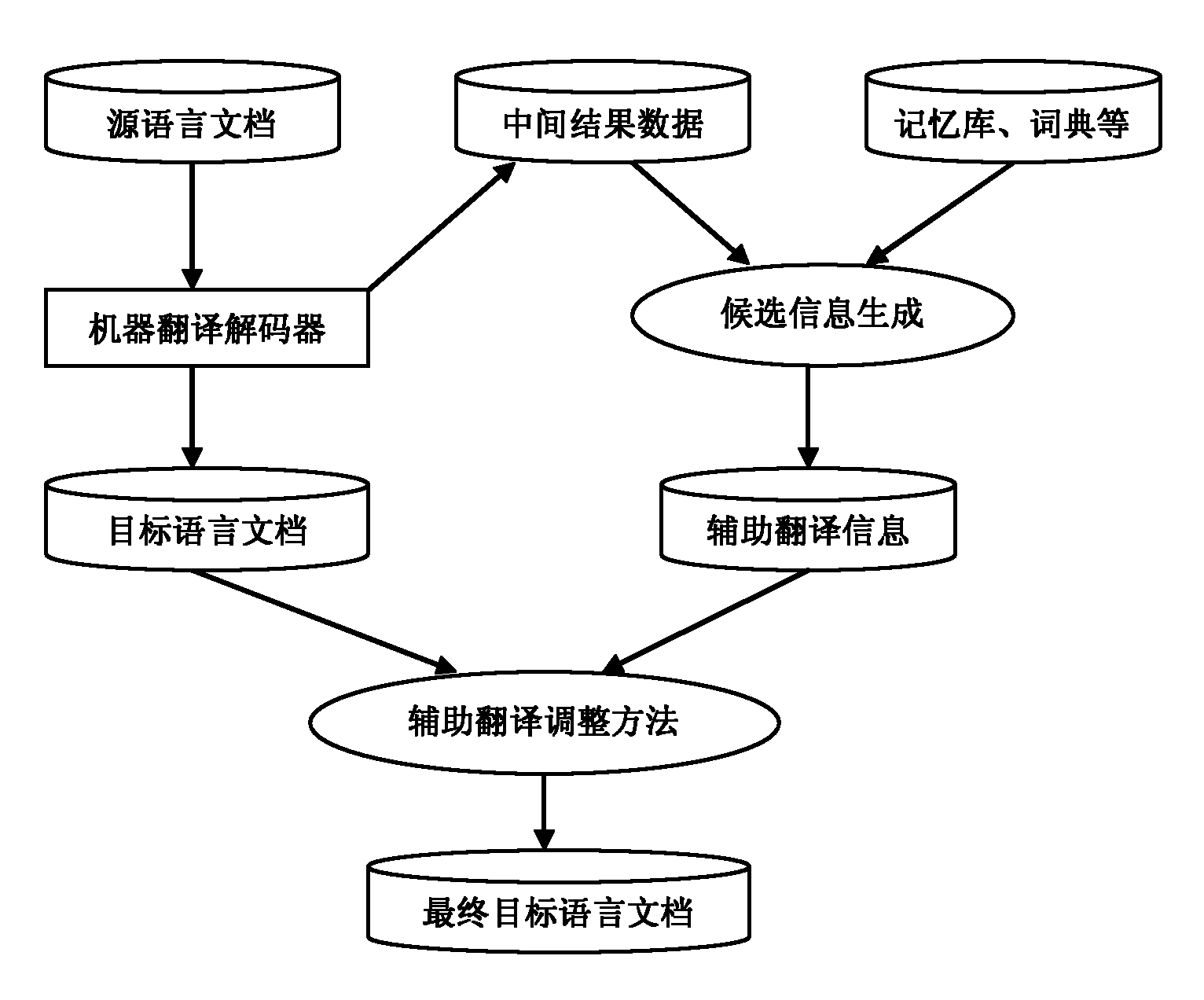
一方面,本发明提供了一种计算机辅助翻译的方法,包括:On the one hand, the present invention provides a kind of computer aided translation method, comprising:
步骤1,通过机器翻译对源语言文档,进行自动翻译并生成中间结果数据;
步骤2,利用机器翻译解码过程的中间结果,以及记忆库、词典等信息生成辅助翻译信息;
步骤3,用户借助辅助翻译信息,通过辅助翻译调整方法对自动翻译的结果进行修改,生成最终目标语言文档。In
根据本发明实施例的计算机辅助翻译的方法,所述步骤1中包括以下步骤:According to the computer-aided translation method of the embodiment of the present invention, the
生成一个最佳候选译文,用于翻译结果的呈现;Generate a best candidate translation for presentation of translation results;
生成多个候选短语并为每个候选短语生成多个候选译文;所述候选短语的候选译文具有概率并按照从大到小排序。Multiple candidate phrases are generated and multiple candidate translations are generated for each candidate phrase; the candidate translations of the candidate phrases have probabilities and are sorted from large to small.
根据本发明实施例的计算机辅助翻译的方法,所述步骤2中包括以下步骤:According to the computer-aided translation method of the embodiment of the present invention, the
针对不同用户推荐和用户最为相关的候选信息;Recommend the most relevant candidate information for different users;
根据用户的历史行为,动态调整候选信息的推荐内容。According to the user's historical behavior, dynamically adjust the recommended content of candidate information.
根据本发明实施例的计算机辅助翻译的方法,所述步骤3中包括以下步骤:According to the computer-aided translation method of the embodiment of the present invention, the
自动翻译的结果以短语为单位分块显示;The results of automatic translation are displayed in blocks of phrases;
所述辅助翻译调整方法包括以下操作:The auxiliary translation adjustment method includes the following operations:
对短语进行拖动改变其位置,所述拖动的操作包括拖动单一短语和拖动多个短语;Dragging the phrase to change its position, the dragging operation includes dragging a single phrase and dragging multiple phrases;
对短语块的内容进行编辑修改;Make editorial changes to the content of the phrase block;
在任意的短语块后面添加新的短语;Add new phrases after any phrase block;
删除不需要的短语;Remove unnecessary phrases;
通过选择源语言句子任意片段的候选短语,来改变翻译结果的短语组合方式;Change the phrase combination of the translation results by selecting candidate phrases for any segment of the source language sentence;
对翻译结果修改结果提供预存和保存功能,其中预存和保存过的句子采用不同的颜色来标识不同编辑状态的句子。Pre-save and save functions are provided for the modification results of the translation results. The pre-stored and saved sentences use different colors to identify sentences in different editing states.
根据本发明实施例的计算机辅助翻译的方法,其特征在于包括:The method for computer-aided translation according to an embodiment of the present invention is characterized in that it includes:
基于AC自动机来查询候选信息;Query candidate information based on AC automata;
基于卡尔曼滤波来对候选信息进行排序。Candidate information is sorted based on Kalman filtering.
又一个方面,本发明提供了一种计算机辅助翻译的系统,包括:In yet another aspect, the present invention provides a system for computer-aided translation, comprising:
自动翻译模块,采用机器翻译对源语言文档进行自动翻译;The automatic translation module uses machine translation to automatically translate source language documents;
辅助翻译模块,用于查看和调整自动翻译的结果,所述调整包括对候选短语对齐关系的高亮显示、候选短语提示帮助、对短语的拖动、增加、删除和修改操作、对译文的查看、句子的选择、对翻译结果修改结果提供预存和保存操作;Auxiliary translation module, used to view and adjust the results of automatic translation, the adjustment includes highlighting the alignment relationship of candidate phrases, prompting help for candidate phrases, dragging, adding, deleting and modifying operations on phrases, and viewing the translation , Sentence selection, providing pre-storage and saving operations for the modification results of translation results;
候选短语生成模块,通过对候选短语的查询和排序为辅助翻译模块提供辅助翻译信息;The candidate phrase generation module provides auxiliary translation information for the auxiliary translation module by querying and sorting the candidate phrases;
用户模型更新模块,其通过分析用户的历史行为记录来动态的改变用户模型的参数。The user model update module dynamically changes the parameters of the user model by analyzing the user's historical behavior records.
与现有技术相比,本发明的优点在于:在自动翻译结果的基础上,利用机器翻译解码器的中间结果、记忆库、词典等一些其他方面的信息并结合灵活的人机交互方式,来对自动翻译的结果进行提示下的修改和完善,这样使得机器翻译和人工翻译得到了结合,提升用户体验,并最终提高了翻译的质量和效率。Compared with the prior art, the present invention has the advantages of: on the basis of the automatic translation results, using the intermediate results of the machine translation decoder, the memory bank, the dictionary and other information in combination with flexible human-computer interaction methods to The results of automatic translation are modified and perfected under prompts, so that machine translation and human translation are combined, user experience is improved, and the quality and efficiency of translation are finally improved.
附图说明Description of drawings
以下参照附图对本发明实施例作进一步说明,其中:Embodiments of the present invention will be further described below with reference to the accompanying drawings, wherein:
图1为根据本发明一个实施例的计算机辅助翻译系统的结构示意图;FIG. 1 is a schematic structural diagram of a computer-aided translation system according to an embodiment of the present invention;
图2为根据本发明一个实施例的机器翻译流程图;Fig. 2 is a flow chart of machine translation according to one embodiment of the present invention;
图3为根据本发明一个实施例的候选短语示意图;Fig. 3 is a schematic diagram of candidate phrases according to an embodiment of the present invention;
图4为根据本发明一个实施例的字典树Trie示意图Fig. 4 is a schematic diagram of a dictionary tree Trie according to an embodiment of the present invention
图5为根据本发明一个实施例的字典树Trie的失败指针转移图;Fig. 5 is the failure pointer transition figure of dictionary tree Trie according to an embodiment of the present invention;
图6为根据本发明一个实施例的候选短语与源文对齐高亮显示的效果示意图;Fig. 6 is a schematic diagram showing the effect of aligning and highlighting candidate phrases and source texts according to an embodiment of the present invention;
图7为根据本发明一个实施例的候选短语自动提示效果的示意图;Fig. 7 is a schematic diagram of the automatic prompting effect of candidate phrases according to an embodiment of the present invention;
图8为根据本发明一个实施例的候选短语自动拆分效果的示意图;Fig. 8 is a schematic diagram of the automatic splitting effect of candidate phrases according to an embodiment of the present invention;
图9和图10为为根据本发明一个实施例的候选短语拖动前后的效果示意图。FIG. 9 and FIG. 10 are schematic diagrams showing the effects of candidate phrases before and after dragging according to an embodiment of the present invention.
具体实施方式Detailed ways
为了使本发明的目的,技术方案及优点更加清楚明白,以下结合附图通过具体实施例对本发明进一步详细说明。应当理解,此处所描述的具体实施例仅仅用以解释本发明,并不用于限定本发明。In order to make the object, technical solution and advantages of the present invention clearer, the present invention will be further described in detail below through specific embodiments in conjunction with the accompanying drawings. It should be understood that the specific embodiments described here are only used to explain the present invention, not to limit the present invention.
计算辅助翻译的效率和质量关键取决于辅助翻译信息的质量和人机交互方式。这是由于准确高质量的辅助翻译信息能够提高翻译的质量,同时也能减少翻译过程的编辑次数,而简单方便的人机交互方式能够大量减少翻译过程中的操作次数,从而加快翻译的速度,提高翻译效率。这两个方面相互结合可以最终提高整个辅助翻译系统的性能和质量。因此本发明提供了一种计算机辅助翻译系统,其将记忆库,机器翻译的中间结果、词典等信息融合在一起来对机器自动翻译结果进行修改和完善,同时给用户提供了更灵活的界面,更丰富的手段来调整翻译结果。The efficiency and quality of computer-aided translation depend critically on the quality of assisted translation information and the way of human-computer interaction. This is because accurate and high-quality auxiliary translation information can improve the quality of translation and reduce the number of edits in the translation process, and the simple and convenient human-computer interaction method can greatly reduce the number of operations in the translation process, thereby speeding up the translation. Improve translation efficiency. Combining these two aspects can ultimately improve the performance and quality of the entire assisted translation system. Therefore the present invention provides a kind of computer-aided translation system, and it fuses information such as the memory storehouse, the intermediate result of machine translation, dictionary etc. to revise and perfect the machine automatic translation result, simultaneously provides more flexible interface to the user, Richer means to adjust translation results.
图1描述了根据本发明的一个实施例的计算机辅助翻译系统的结构示意图。该系统首先对源文件进行自动翻译,在自动翻译解码过程中,生成最佳译文以及解码的中间信息,给辅助翻译提供数据支持。然后,对自动翻译结果进行的辅助翻译。在自动翻译结果的基础上,用户通过解码过程中的中间信息,以及来自记忆库、词典等其他辅助翻译信息,在web界面上对翻译结果进行修改。在这一过程中,自动翻译的译文以短语形式呈现,用户可以在短语级别的译文基础上,对译文短语进行修改、增删和移动等操作,提高译文修改的效率。下面将对上述步骤进行更详细的介绍。FIG. 1 depicts a schematic structural diagram of a computer-aided translation system according to an embodiment of the present invention. The system first automatically translates the source files, and during the process of automatic translation and decoding, generates the best translation and decoded intermediate information to provide data support for auxiliary translation. Then, assisted translation performed on the automatic translation results. On the basis of the automatic translation results, the user modifies the translation results on the web interface through the intermediate information in the decoding process and other auxiliary translation information from the memory bank and dictionary. During this process, the automatically translated translation is presented in the form of phrases, and users can modify, add, delete, and move the translated phrases on the basis of the phrase-level translation to improve the efficiency of translation modification. The above steps are described in more detail below.
首先,将用户所提交的源语言文档由机器翻译进行自动翻译并将自动翻译的译文以短语的形式展现给用户。在本发明的实施例中的自动翻译方法,并不限定于某一特定的统计机器翻译方法,而是可以采用本领域普通技术人员所熟知的任何现有的机器翻译方法。在一个实施例中,所使用的机器翻译引擎是基于最大熵括号转录语法翻译系统(Maximum Entropy Based Bracketing Transduction Grammars,以下简称为MEBTG)。此模型在已取得巨大成功的基于短语的翻译模型之上引入形式句法信息,并加入调序模型,使最终的译文更为流畅,从而构造了一种兼具短语模型优点和支持远距离调序的性能更好的模型。其翻译流程如图2所示,从图2中可以看出,解码器需要的输入数据,除了源语言句子之外,还包括:First, the source language document submitted by the user is automatically translated by machine translation and the automatically translated translation is presented to the user in the form of phrases. The automatic translation method in the embodiment of the present invention is not limited to a specific statistical machine translation method, but any existing machine translation method known to those of ordinary skill in the art may be used. In one embodiment, the machine translation engine used is a maximum entropy based bracketing transduction grammar translation system (Maximum Entropy Based Bracketing Transduction Grammars, hereinafter referred to as MEBTG). This model introduces formal syntactic information on top of the phrase-based translation model that has achieved great success, and adds a sequence model to make the final translation more fluent, thus constructing a translation model that has both the advantages of the phrase model and supports long-distance sequence better performing models. The translation process is shown in Figure 2. It can be seen from Figure 2 that the input data required by the decoder, in addition to the source language sentences, also includes:
(1)短语表:机器翻译解码器中用到的短语表也被称为通用候选短语,其是在大规模双语平行语料库中统计得到的,代表了公共的翻译行为。相对于通用候选短语,用户候选短语则是和用户个人的翻译习惯相关的,可以包含用户的翻译历史,用户个人词典等等。二者统称为候选短语。(1) Phrase table: The phrase table used in the machine translation decoder is also called general candidate phrases, which are statistically obtained from a large-scale bilingual parallel corpus and represent common translation behaviors. Compared with general candidate phrases, user candidate phrases are related to the user's personal translation habits, and may include the user's translation history, user's personal dictionary, and so on. Both are collectively referred to as candidate phrases.
(2)语言模型:统计语言模型是描述语言内在规律的数学模型。(2) Language model: Statistical language model is a mathematical model that describes the inherent laws of language.
(3)最大熵重排序模型:重排序模型主要是解决机器翻译解码过程中,相邻两个连续片段在译文里的顺序问题。(3) Maximum entropy reordering model: The reordering model mainly solves the problem of the order of two adjacent consecutive segments in the translation during the decoding process of machine translation.
接着生成候选信息,利用如机器翻译解码过程的中间结果,记忆库、词典等信息,针对不同用户推荐与用户最为相关的候选信息,以及自动学习用户的历史行为,动态调整候选信息的推荐内容,从而使用户可以通过选择合适的候选信息来修改机器自动翻译生产的译文。Then generate candidate information, use information such as the intermediate results of the machine translation decoding process, memory library, dictionary and other information to recommend the most relevant candidate information for different users, and automatically learn the user's historical behavior to dynamically adjust the recommended content of candidate information. So that users can modify the translation produced by machine automatic translation by selecting appropriate candidate information.
在本发明的实施例中,所述的候选信息包括候选短语,候选短语不局限于某一特定的来源,而是可以有丰富的组合形式。图3为根据本发明实施例的候选短语的组成示意图。如图3所示,将候选短语分为如上文所述的通用候选短语和用户候选短语。用户候选短语的来源主要包含以下几个方面:用户TMX(Translation Memory eXchange)记忆库,其是一种厂商中立的、开放式XML标准,用于交换计算机辅助翻译(CAT)和本地化工具创建的翻译存储(TM)数据;用户个人词典,其包括普通词典和领域词典这两类,普通词典注重于通用词语的用户翻译习惯,领域词典则注重于专业领域词汇的正规翻译规则,用户可以在用户个人词典任意添加词条,这些词条将会出现在辅助翻译信息的候选短语列表当中;以及用户翻译历史。通常,候选短语的数量越多,质量越高,对用户的帮助就越大。但是随着系统语料的日益增长和用户历史行为的累计,候选短语的数量会快速的增长。In an embodiment of the present invention, the candidate information includes candidate phrases, and the candidate phrases are not limited to a specific source, but can have rich combinations. Fig. 3 is a schematic diagram of composition of candidate phrases according to an embodiment of the present invention. As shown in FIG. 3 , the candidate phrases are divided into general candidate phrases and user candidate phrases as described above. The sources of user candidate phrases mainly include the following aspects: user TMX (Translation Memory eXchange) memory bank, which is a vendor-neutral, open XML standard for exchanging computer-aided translation (CAT) and localization tools created Translation storage (TM) data; user personal dictionaries, which include general dictionaries and domain dictionaries. Common dictionaries focus on user translation habits of common words, while domain dictionaries focus on regular translation rules for specialized domain vocabulary. Add entries to the personal dictionary arbitrarily, and these entries will appear in the candidate phrase list of the auxiliary translation information; and the user's translation history. Generally, the greater the number and quality of candidate phrases, the more helpful they are to users. However, with the increasing system corpus and the accumulation of user history, the number of candidate phrases will increase rapidly.
如何快速的查询和用户输入的源语言句子相关的所有候选短语,并将之推荐给用户是问题的关键。如果将所有的候选短语都看作是模式串,用户输入的源语言句子看作是待匹配的串,这样问题就抽象成为在待匹配串中查找所有出现的模式串,即字符串多模式匹配问题。目前通常的做法是枚举源语言句子中所有的子片段,对每一个子片段进行查询,判断是否存在于短语集合中,这样算法的时间复杂度比较高。在本发明的一个实施例中提出了基于AC自动机(Aho-Corasick automation)的候选短语查询模型,把字符串匹配的问题转化为状态的转移,在线性复杂度之内解决了候选短语的查询问题,大大提高了系统的效率。How to quickly query all candidate phrases related to the source language sentence entered by the user and recommend them to the user is the key to the problem. If all candidate phrases are regarded as pattern strings, and the source language sentences entered by the user are regarded as strings to be matched, then the problem is abstracted into finding all pattern strings that appear in the string to be matched, that is, string multi-pattern matching question. The current common practice is to enumerate all the sub-segments in the source language sentence, query each sub-segment, and determine whether it exists in the phrase set, so the time complexity of the algorithm is relatively high. In one embodiment of the present invention, a candidate phrase query model based on AC automata (Aho-Corasick automation) is proposed, the problem of string matching is converted into a state transfer, and the query of candidate phrases is solved within linear complexity problem, greatly improving the efficiency of the system.
在这个实施例中,基于AC自动机的候选短语查询主要分为三个步骤:字典树Trie的构造、状态转移的构造(构造失败指针)和模式匹配的过程。下面分别对这三个步骤进行阐释。In this embodiment, the candidate phrase query based on the AC automaton is mainly divided into three steps: the construction of the dictionary tree Trie, the construction of the state transition (construction failure pointer) and the process of pattern matching. These three steps are explained separately below.
步骤1)字典树Trie的构造Step 1) Construction of dictionary tree Trie
Trie,又称单词查找树或键树,是一种树形结构,是一种哈希树的变种。典型应用是用于统计和排序大量的字符串(但不仅限于字符串),所以经常被搜索引擎系统用于文本词频统计。它的优点是:最大限度地减少无谓的字符串比较,查询效率比哈希表高。Trie, also known as word search tree or key tree, is a tree structure, which is a variant of hash tree. A typical application is to count and sort a large number of character strings (but not limited to character strings), so it is often used by search engine systems for text word frequency statistics. Its advantages are: it minimizes unnecessary string comparisons, and its query efficiency is higher than that of hash tables.
假如用户个人词典中有she,shr,he,say,her这五个单词,其所构成的Trie树如图4所示,则上述单词的匹配路径如表1所示:If there are five words she, shr, he, say, and her in the user's personal dictionary, the Trie tree formed by them is shown in Figure 4, and the matching paths of the above words are shown in Table 1:
表1Table 1
步骤2)状态转移的构造Step 2) Construction of state transition
AC自动机把字符串的匹配过程当作是状态转移的过程,其中最为关键的部分就是失败指针的构造。失败指针的作用在于当前节点的所有子节点当中都无法与源语言句子的当前字符匹配的话,当前节点就要跳转到失败指针指向的节点继续匹配,这就避免了源语言句子的回溯匹配,大大提高了匹配的效率。同时,失败指针在输出匹配结果中也有非常重要的作用,如果当前节点与源语言句子的当前字符匹配,并且当前节点也是单词结束的标志,那么就要沿着当前节点的失败指针输出所有的有单词结束标志的后缀链。失败指针的构造算法如下:The AC automaton regards the matching process of strings as a state transition process, the most critical part of which is the construction of the failure pointer. The function of the failure pointer is that if none of the child nodes of the current node can match the current character of the source language sentence, the current node will jump to the node pointed to by the failure pointer to continue matching, which avoids backtracking matching of the source language sentence. The matching efficiency is greatly improved. At the same time, the failure pointer also plays a very important role in the output of the matching result. If the current node matches the current character of the source language sentence, and the current node is also a sign of the end of the word, then it is necessary to output all valid information along the failure pointer of the current node. A suffix chain of end-of-word markers. The construction algorithm of the failure pointer is as follows:


上述失败指针构造算法首先设置根节点和第一层子节点的失败指针都指向根节点,然后对整棵树进行广度优先遍历,对于任意一个当前节点,如果通过某一条件使得当前节点和其某一子节点,以及当前节点的失败指针所指向的节点和其子节点都有相同的状态转移,那么当前节点的子节点的失败指针就指向当前节点的失败指针所指向的节点的子节点。最后把当前节点的所有子节点依次放入队列中。算法的整体复杂度和树的大小成线性关系。失败指针构造完成之后,每一个节点的失败节点对应关系如图5所示,其中1号节点的父节点是s,2号节点的父节点是root,并且s的失败指针指向root,并且s和root都有通过条件h分别向1号和2号节点的状态转移,所以1号节点的失败指针指向2号节点。同理,3号节点的失败指针指向4号节点。其他所有节点的失败指针都指向root节点。The above failure pointer construction algorithm first sets the failure pointers of the root node and the first layer of child nodes to point to the root node, and then performs breadth-first traversal on the entire tree. For any current node, if a certain condition is passed to make the current node and its A child node, and the node pointed to by the failure pointer of the current node and its child nodes have the same state transition, then the failure pointer of the child node of the current node points to the child node of the node pointed to by the failure pointer of the current node. Finally, all child nodes of the current node are put into the queue in turn. The overall complexity of the algorithm scales linearly with the size of the tree. After the failure pointer construction is completed, the corresponding relationship between the failure nodes of each node is shown in Figure 5, where the parent node of
步骤3)模式匹配的过程Step 3) Process of pattern matching
在得到了带有失败指针的Trie树,就意味着AC自动机状态转移预处理完成,这时就可以对任意源语言句子进行多模式匹配,对于任意用户输入的源语言句子,都可以在线性时间内匹配出所有与源语言句子相关的候选短语,匹配的时间复杂度只和用户输入的源语言句子的长度成线性关系。基于AC自动机的候选短语匹配算法如下:After obtaining the Trie tree with failure pointers, it means that the preprocessing of the AC automaton state transition is completed. At this time, multi-pattern matching can be performed on any source language sentence. For any source language sentence input by a user, it can be linearly All candidate phrases related to the source language sentence are matched in time, and the time complexity of matching is only linearly related to the length of the source language sentence input by the user. The candidate phrase matching algorithm based on AC automata is as follows:

在上述候选短语匹配算法当中,依次从头到尾遍历用户输入的源语言句子中的每一个字符,从AC自动机的根节点开始匹配,如果当前节点匹配不成功,当前节点转向其失败指针所指向的节点继续匹配;如果当前节点匹配成功,就直接转向下一节点继续匹配。匹配的过程不断重复以上两个步骤,直到源语言句子结束为止。在匹配的过程中,如果遇到有单词结束标志的节点,该节点所对应的短语即为所要匹配的候选短语,此时不仅要输出该短语,还要输出以该短语结尾的所有后缀中出现的候选短语。候选短语的输出算法如下:In the above candidate phrase matching algorithm, each character in the source language sentence input by the user is traversed from the beginning to the end in turn, and the matching starts from the root node of the AC automaton. If the current node is not matched successfully, the current node turns to its failure pointer. The node continues to match; if the current node is successfully matched, it goes directly to the next node to continue matching. The matching process repeats the above two steps until the source language sentence ends. During the matching process, if a node with a word end mark is encountered, the phrase corresponding to the node is the candidate phrase to be matched. At this time, not only the phrase is output, but also all suffixes that end with the phrase appear candidate phrases. The output algorithm of the candidate phrase is as follows:


在上述候选短语输出算法中,首先判断当前节点是否为根节点,如果是根节点则输出候选短语集合;如果当前节点不为根节点,判断当前节点是否有候选短语结束标志,如果有则把当前节点到根节点路径上的候选短语加入到候选短语结果集合,否则当前节点跳转到其失败指针所指向的节点。重复以上两个步骤直到当前节点为根节点。In the above candidate phrase output algorithm, first judge whether the current node is the root node, if it is the root node, output the candidate phrase set; if the current node is not the root node, judge whether the current node has the candidate phrase end flag, if so, put The candidate phrases on the path from the node to the root node are added to the candidate phrase result set, otherwise the current node jumps to the node pointed to by its failure pointer. Repeat the above two steps until the current node is the root node.
尽管通过上述方法查询到与用户相关的所有候选短语,当用户查看某一源语言短语的候选翻译的时候,这些候选短语呈现的顺序对用户的使用习惯有非常重要的联系。在通常情况下,人们往往会更加关注排列在顶部的短语,随着短语排列次序的下降,人们的关注度会逐渐的降低。例如各大主流搜索引擎的搜索推荐功能,以及搜索结果页面的顺序呈现,都是按照不同的排序策略使得把用户最想得到的结果放在最顶部。所以候选短语的顺序也应该按照用户的期望值由高到低依次排列。但是在本发明的上述实施例中采用的候选短语不是来自于唯一的来源,而是由通用候选短语和用户候选短语组合而成,并且在这两大集合里面又分为若干的子集合。集合之内的短语概率可以由统计得到,所以集合之内的短语概率有可比性,但是集合之间的短语概率没有直接的可比性,所以对与源语言句子相关的所有候选短语进行排序,就要解决不同集合的短语之间的排序问题。Although all candidate phrases related to the user are queried through the above method, when the user views the candidate translations of a certain source language phrase, the order in which these candidate phrases are presented has a very important relationship with the user's usage habits. Under normal circumstances, people tend to pay more attention to the phrases arranged at the top, and as the order of phrases descends, people's attention will gradually decrease. For example, the search recommendation function of major major search engines and the order presentation of search result pages all follow different sorting strategies so that the results that users most want to get are placed at the top. Therefore, the order of candidate phrases should also be arranged in order from high to low according to the user's expectations. However, the candidate phrases used in the above embodiments of the present invention do not come from the only source, but are composed of general candidate phrases and user candidate phrases, and are divided into several sub-sets in these two sets. The phrase probabilities within a set can be obtained by statistics, so the phrase probabilities within a set are comparable, but the phrase probabilities between sets are not directly comparable, so sorting all candidate phrases related to the source language sentence is To solve the ordering problem between phrases of different collections.
在本发明的又一个实施例中提出一种基于卡尔曼滤波的候选短语排序方法,该方法通过用户翻译历史记录的分析,不断优化各候选短语集合的权重,从而提高候选短语推荐的精准度。如上所述,由于不同用户的翻译习惯各有差别,但是在长时间段内用户的翻译习惯又基本保持不变,因此为了区分不同短语集合对不同用户的重要性,使得不同短语集合之间的短语概率具有可比性,对用户候选短语集合赋予不同的权重值,在候选短语概率进行比较的时候,其短语概率乘以所属集合的权重,这样得到的短语概率便具有不同集合之间的可比性。不同的用户翻译习惯各有差别,体现在不同用户的短语集合权重值不同;相同用户的翻译习惯保持,体现在相同用户的短语集合权重值保持不变。因此对候选短语排序的问题可以用以下方式描述。In yet another embodiment of the present invention, a candidate phrase sorting method based on Kalman filtering is proposed. The method continuously optimizes the weight of each candidate phrase set through the analysis of user translation history records, thereby improving the accuracy of candidate phrase recommendation. As mentioned above, because the translation habits of different users are different, but the user’s translation habits remain basically unchanged over a long period of time, so in order to distinguish the importance of different phrase sets to different users, the difference between different phrase sets Phrase probabilities are comparable, and different weight values are assigned to user candidate phrase sets. When comparing candidate phrase probabilities, the phrase probabilities are multiplied by the weight of the set to which they belong, so that the resulting phrase probabilities are comparable between different sets. . Different users have different translation habits, which is reflected in the different user's phrase set weight values; the same user's translation habits are maintained, which is reflected in the same user's phrase set weight values remain unchanged. So the problem of ranking candidate phrases can be described in the following way.
假设候选短语的来源有n个集合,它们分别包含m1,m2,...,mn个候选短语,pij为候选短语集合i中第j个短语的概率,w1,w2,...,wn分别为n个集合的权重,因此对和源语言句子相关的所有候选短语的排序可以抽象为对以下短语集合的排序:Assuming that there are n sets of candidate phrase sources, they respectively contain m 1 , m 2 , ..., m n candidate phrases, p ij is the probability of the jth phrase in the candidate phrase set i, w 1 , w 2 , ..., w n are the weights of n sets respectively, so the sorting of all candidate phrases related to the source language sentence can be abstracted as the sorting of the following phrase sets:
{pij*wi|l<=i<=n,l<=j<=m}{p ij *w i | l<=i<=n, l<=j<=m}
上述集合中pij可以通过在候选短语集合i中统计短语j的频次得到,未知的是w1,w2,...,wn这n个集合的权重值,因此对候选短语排序的问题关键就在于对这n个集合权重值的预测,有了这些预测的权重值,在短语排序的时候就使得本不可比的短语集合之间的概率变得具有可比性,最终能够对候选短语进行排序,为系统前端提供候选信息的数据支持。In the above set, p ij can be obtained by counting the frequency of phrase j in the candidate phrase set i. The unknown is the weight value of n sets w 1 , w 2 ,...,w n , so the problem of ranking candidate phrases The key lies in the prediction of the weight values of these n sets. With these predicted weight values, the probabilities between the incomparable phrase sets become comparable when the phrases are sorted, and finally the candidate phrases can be Sorting, providing data support for candidate information for the front end of the system.
卡尔曼滤波的实质是由量测值重构系统的状态向量。它以“预测-实测-修正”的顺序递推,根据系统的量测值来消除随机干扰,再现系统的状态,其根据上一状态的估计值和当前状态的观测值推出当前状态的估计值的滤波方法,其预测方式可用如下方式表达。The essence of Kalman filtering is to reconstruct the state vector of the system from the measured value. It recurses in the order of "prediction-measurement-correction", eliminates random interference based on the measured value of the system, reproduces the state of the system, and derives the estimated value of the current state based on the estimated value of the previous state and the observed value of the current state The filtering method of , its prediction method can be expressed in the following way.
S(t)=f(S(t-1),O(t)) (公式1)S(t)=f(S(t-1), O(t)) (Formula 1)
在上式中S(t)表示当前状态的估计值,S(t-l)表示上一状态的估计值,O(t)表示当前状态的观测值,因此在本文面临的预测问题中,候选短语集合权重W向量即为所要预测的系统状态向量,如何定义某一时间段的观测值O(t),使得观测值能和系统状态W向量联系起来,是解决本预测问题的关键。In the above formula, S(t) represents the estimated value of the current state, S(t-l) represents the estimated value of the previous state, and O(t) represents the observed value of the current state. Therefore, in the prediction problem faced by this paper, the candidate phrase set The weight W vector is the system state vector to be predicted. How to define the observed value O(t) in a certain period of time so that the observed value can be associated with the system state W vector is the key to solving this prediction problem.
在连续时间段T内,通过统计用户编辑翻译结果时选择候选短语的来源可以得到用户的翻译习惯更倾向于选择哪一集合的候选短语,因此归一化统计的结果,就可以当作该时间段T内系统的观测值。这也符合用户的直观感觉,如果把用户选择最多的短语集合权重增加,那么在下一时间段T内,该集合短语在候选短语排序过程中的概率就会增加,那么在web辅助翻译系统UI界面中这些短语就会出现在比较靠上的位置,这就会相应降低下一时间段T内系统的平均惩罚分值。In the continuous time period T, by counting the source of the candidate phrases selected by the user when editing the translation results, it can be obtained which set of candidate phrases the user's translation habit is more inclined to choose, so the result of normalized statistics can be regarded as the time Observations of the system in segment T. This is also in line with the user's intuitive feeling. If the weight of the phrase set most selected by the user is increased, then within the next time period T, the probability of the phrase set in the candidate phrase sorting process will increase. These phrases will appear in a relatively high position, which will correspondingly reduce the average penalty score of the system in the next time period T.
解决本预测问题的另一个关键点在于判断当前状态的估计值S(t)更倾向于上一状态的估计值S(t-1)还是当前状态的观测值O(t)[36]。对于这种情况,我们可以设置两个归一化的权重值,用以区分两个状态的重要性,因此公式1可以转化为以下形式。Another key point to solve this prediction problem is to judge whether the estimated value S(t) of the current state is more inclined to the estimated value S(t-1) of the previous state or the observed value O(t) of the current state [36] . For this case, we can set two normalized weight values to distinguish the importance of the two states, so
S(t)=ks*S(t-1)+ko*O(t) (2)S(t)=k s *S(t-1)+k o *O(t) (2)
在上式中ks代表上一状态估计值的权重,ko代表当前状态观测值的权重。基于卡尔曼滤波的候选短语排序的具体算法如下.In the above formula, k s represents the weight of the estimated value of the previous state, and k o represents the weight of the observed value of the current state. The specific algorithm of candidate phrase ranking based on Kalman filter is as follows.

在上述算法中,c1,c2,…,cn分别为时间段T内n个候选短语集合被选中的次数。算法的执行过程是首先初始化w1,w2,…,wn,并对其归一化。权重的初始值并不重要,因为基于卡尔曼滤波的算法是个回归拟合的过程,系统的执行并不依赖于初始值,因此我们可以设置w1,w2,…,wn为相等的值。然后初始化ks,ko,根据经验值,在系统运行的初期,当前状态的观测值会比较重要,随着系统的长期运行,其历史估计值会比较重要,因此在系统运行的初期,可以稍微增大当前观测值的权重。In the above algorithm, c 1 , c 2 , . The execution process of the algorithm is to first initialize w 1 , w 2 ,..., w n and normalize them. The initial value of the weight is not important, because the algorithm based on Kalman filter is a regression fitting process, the execution of the system does not depend on the initial value, so we can set w 1 , w 2 ,...,w n to equal values . Then initialize k s , k o , according to empirical values, in the initial stage of system operation, the observed value of the current state will be more important, and with the long-term operation of the system, its historical estimated value will be more important, so in the initial stage of system operation, you can Slightly increases the weight of the current observation.
在提出了候选短语的排序算法之后,还要考虑这样一个问题。在系统运行的初期,由于用户添加的个人词典比较少,同时用户本身的翻译历史也比较少,系统提供的辅助翻译候选信息更多的来自于通用候选短语。这样在系统运行的初期,由于用户只能选择通用候选短语而导致通用候选短语集合的权重不断的增长,使得用户候选短语集合的权重被过度降低。在前端辅助翻译的界面中我们对于某一源短语只能提供有限数量的候选短语,以至于概率过低的候选短语只能被舍弃。综合前面两个原因就会导致通用候选短语集合的权重逐渐增大,用户候选短语集合的权重逐渐减小。After proposing a sorting algorithm for candidate phrases, we need to consider such a problem. In the initial stage of system operation, since the user added few personal dictionaries and the user's own translation history was relatively small, the auxiliary translation candidate information provided by the system mostly came from common candidate phrases. In this way, at the initial stage of system operation, because the user can only select common candidate phrases, the weight of the general candidate phrase set is continuously increased, so that the weight of the user candidate phrase set is excessively reduced. In the front-end assisted translation interface, we can only provide a limited number of candidate phrases for a certain source phrase, so that candidate phrases with too low probability can only be discarded. Combining the above two reasons will lead to the gradual increase of the weight of the general candidate phrase set, and the gradual decrease of the weight of the user candidate phrase set.
为了解决上述特殊情况,在本发明的一个实施例中,在传递给前端界面的候选短语列表最后,每次都加入权重最小集合的一个候选短语。这样在系统运行的初期,就能解决某一候选短语集合由于之前未出现过而导致集合权重过低,使得该短语集合的短语不能出现在前端界面中的问题。In order to solve the above special situation, in one embodiment of the present invention, at the end of the list of candidate phrases delivered to the front-end interface, a candidate phrase with the smallest set of weights is added each time. In this way, at the initial stage of system operation, the problem that the weight of a certain candidate phrase set is too low because it has not appeared before can be solved, so that the phrases of the phrase set cannot appear in the front-end interface.
下面通过一个简单的例子来进一步说明本发明实施例中所提出的基于卡尔曼滤波的候选短语排序方法。假设某用户的候选短语来源只有两个集合set1和set2,初始化w1=0.6,w2=0.4,ks=0.3,ko=0.7,在三个时间段T内其排序过程中集合权重的变化过程如表2所示。A simple example is used below to further illustrate the method for ranking candidate phrases based on Kalman filter proposed in the embodiment of the present invention. Suppose a user has only two sets of candidate phrase sources, set 1 and set 2 , initialize w 1 =0.6, w 2 =0.4, k s =0.3, k o =0.7, and set during the sorting process within three time periods T The weight change process is shown in Table 2.
表2Table 2
从表2中可以看出,由于观测值的权重设置的比较大,因此在三个时间段内候选短语集合权重随着每一轮观测值趋势的改变而改变。这个例子能比较好的说明本发明实施例中所提出的候选短语排序算法的预期效果。It can be seen from Table 2 that since the weight of the observation value is set relatively large, the weight of the candidate phrase set changes with the change of the observation value trend in each round within the three time periods. This example can better illustrate the expected effect of the candidate phrase sorting algorithm proposed in the embodiment of the present invention.
最后,用户借助系统所推荐的辅助翻译信息对自动翻译的译文进行修改,从而生成最终目标语言文档。其中可以通过下列操作来对译文进行修改:Finally, the user modifies the automatically translated translation with the aid of the auxiliary translation information recommended by the system to generate the final target language document. The translation can be modified by the following operations:
1)自动翻译的译文以短语为单位分块显示,用户可以对短语进行拖动改变位置,达到调整语序的目的,拖动的操作包括拖动单一短语和拖动多个短语。1) The automatically translated translation is displayed in phrases as units. Users can drag phrases to change their position to adjust the word order. The dragging operation includes dragging a single phrase and dragging multiple phrases.
2)用户可以对短语块的内容进行编辑修改。2) The user can edit and modify the content of the phrase block.
3)用户可以在任意的短语块后面添加新的短语。3) The user can add a new phrase after any phrase block.
4)用户可以删除不需要的短语。4) User can delete unwanted phrases.
5)用户可以通过选择源语言句子任意片段的候选短语,来改变翻译结果的短语组合方式,生成更加合理的译文。为了提高用户体验,只有被选中的源语言句子片段的候选短语才会呈现。5) The user can change the phrase combination method of the translation result by selecting a candidate phrase of any segment of the source language sentence to generate a more reasonable translation. To improve user experience, only candidate phrases of selected source language sentence fragments are presented.
6)对翻译结果修改结果提供预存和保存功能,其中预存和保存过的句子采用不同的颜色来标识,方便用户下次编辑时区分不同编辑状态的句子。6) Pre-save and save functions are provided for the modified results of translation results. The pre-stored and saved sentences are marked with different colors, which is convenient for users to distinguish sentences in different editing states when editing next time.
其中,当用户编辑某一译文短语时,需要快速定位到与之对应的源文短语。在本发明的一个实施例中,为了实现快速寻找短语之间对应关系的功能,预先保持所有短语对应关系在后台数据中,当用户对某一译文的短语进行修改操作时,系统通过查询后台数据中的短语对应关系,使得源语言句子中相应的短语自动高亮显示,这样用户就能快速定位到与之对应的源语言短语上,从而根据用户的翻译经验,更改更为合适的译文短语,从而达到快捷修改机器自动翻译译文的目的。短语对应关系的高亮显示效果如图6所示,其中当用户编辑译文中“seriously damaged”短语时,源语言句子中与之对应的“严重损坏”这一短语就会自动的高亮显示,这就使得用户能够快速定位到该译文短语是由哪个源语言短语翻译而来的,从而选择合适的译文进行修改。Among them, when a user edits a certain translation phrase, it is necessary to quickly locate the corresponding source phrase. In one embodiment of the present invention, in order to realize the function of quickly finding the corresponding relationship between phrases, the corresponding relationship of all phrases is kept in the background data in advance. The corresponding phrases in the source language sentences are automatically highlighted, so that users can quickly locate the corresponding source language phrases, and then change more appropriate translation phrases based on the user's translation experience. So as to achieve the purpose of quickly modifying the machine automatic translation translation. The highlighting effect of the phrase correspondence is shown in Figure 6. When the user edits the phrase "seriously damaged" in the translation, the corresponding phrase "seriously damaged" in the source language sentence will be automatically highlighted. This enables the user to quickly locate which source language phrase the target phrase is translated from, so as to select an appropriate translation for modification.
另外,候选短语提示功能是辅助翻译系统中很重要的功能,该功能为对源语言的短语片段提供丰富的候选译文,供用户选择最终译文。目前谷歌在线翻译系统仅提供了译文短语的若干候选,这是在用户认可该短语划分的情况下的候选信息,如果用户对当前的短语划分不满意,该系统并没有提供更加丰富的源语言的候选翻译提示。In addition, the candidate phrase prompt function is a very important function in the assisted translation system, which provides rich candidate translations for phrase fragments in the source language for users to choose the final translation. At present, the Google online translation system only provides several candidates for translation phrases. This is the candidate information when the user approves the phrase division. If the user is not satisfied with the current phrase division, the system does not provide more abundant source language information. Candidate translation hints.
图7为本发明一个实施例中所采用的候选短语提示功能,其中用户可以方便的对译文短语进行重新划分,而且不仅仅针对自动翻译生成的译文短语提供候选,而是对源语言相关的任何连续短语片段进行候选翻译提示,其效果如图7所示。其中用户点击源语言短语“严重”的时候,web辅助翻译系统会给出与“严重”相关的所有源语言短语片段“被严重”,“严重”和“严重毁坏”。此时用户选择“严重”进行查看,辅助翻译系统将会给出候选翻译“serious”,“seriously”,“grave”,“a serious”和“the serious”。用户可以通过点击其中一个来替换机器自动翻译给出的译文结果。Fig. 7 is a candidate phrase prompt function adopted in an embodiment of the present invention, in which the user can easily reclassify the translation phrases, and not only provide candidates for the translation phrases generated by automatic translation, but also provide candidates for any source language related phrases. Continuous phrase fragments are used to prompt candidate translations, and the effect is shown in Figure 7. When the user clicks on the source language phrase "serious", the web-assisted translation system will give all the source language phrase fragments "severely", "seriously" and "seriously damaged" related to "seriously". At this time, the user selects "serious" to view, and the auxiliary translation system will give candidate translations "serious", "seriously", "grave", "a serious" and "the serious". Users can replace the translation results given by automatic machine translation by clicking one of them.
通过候选短语提示功能,用户还可以选择不同的源语言短语片段来改变自动翻译生产译文的短语划分方式,从而生成新的翻译结果。例如源语言句子中的短语“严重损坏”被机器自动翻译为一个短语“serious damage”,如图7当用户选择“严重”的某一候选译文“seriously”之后,译文“serious damage”将会被自动拆分为“seriously”和“destroy”两个短语,其中“destroy”是“损坏”的第一个候选译文,拆分后的效果如图8所示。候选短语提示帮助功能通常和短语对齐高亮显示功能联合使用,当用户修改某一译文短语的时候,用户可以用鼠标选中该译文短语,与之相对应的源语言短语就会同步高亮显示,这时用户可以选择查看该源语言短语的相关候选译文,选择合适的译文来替换机器自动翻译的译文,从而达到快捷修改译文的作用。Through the candidate phrase prompt function, users can also select different source language phrase fragments to change the phrase division method of the automatic translation production translation, thereby generating new translation results. For example, the phrase "serious damage" in the source language sentence is automatically translated into a phrase "serious damage" by the machine, as shown in Figure 7. When the user selects a candidate translation "seriously" of "serious", the translation "serious damage" will be It is automatically split into two phrases "seriously" and "destroy", where "destroy" is the first candidate translation of "damage". The split effect is shown in Figure 8. The candidate phrase prompt help function is usually used in conjunction with the phrase alignment highlighting function. When the user modifies a translation phrase, the user can select the translation phrase with the mouse, and the corresponding source language phrase will be highlighted synchronously. At this time, the user can choose to view the relevant candidate translations of the source language phrase, and select an appropriate translation to replace the translation automatically translated by the machine, so as to quickly modify the translation.
在本发明的一个实施例中,在短语级别的译文基础上,提供短语的任意拖动功能,包括单一短语的拖动和连续短语的拖动,方便用户调整译文的顺序。特别的,在用户拖动调整短语顺序的同时,译文短语和源语言短语的对应关系不会改变,用户在编辑拖动改变位置后的该短语,与之相对应的源语言短语仍然会高亮显示,其拖动前后的效果如图9和10所示。其中,译文短语“was seriously damaged”在拖动之后和源短语“被严重毁坏”的对应关系没有改变,当鼠标放在该译文短语上的时候,与之对应的源短语仍然高亮显示。短语拖动的操作也非常简单,当用户把鼠标移到到某一译文短语上,该短语上方就会出现一个工具栏,最左边的图标是“拖动标志”,左右边的是“多选标志”。用户可以通过拖动“拖动标志”来改变当前短语的位置。同时用户还可以通过选择多个短语的“多选标志”来一次拖动多个短语进行位置的改变。在又一个实施例中,除了给出的短语对应关系高亮显示、候选短语提示帮助和短语拖动调整语序三大功能之外,用户还可以修改任意译文短语,也可以在译文的任意短语之间增加新的短语,也可以删除任意译文短语。In one embodiment of the present invention, on the basis of the translation at the phrase level, an arbitrary dragging function of phrases is provided, including dragging of a single phrase and dragging of consecutive phrases, so that users can adjust the order of translations conveniently. In particular, when the user drags and adjusts the order of phrases, the corresponding relationship between the target phrase and the source language phrase will not change. After the user edits and drags to change the position of the phrase, the corresponding source language phrase will still be highlighted display, the effects before and after dragging are shown in Figures 9 and 10. Among them, the corresponding relationship between the translated phrase "was seriously damaged" and the source phrase "was seriously damaged" has not changed after being dragged, and when the mouse is placed on the translated phrase, the corresponding source phrase is still highlighted. The operation of phrase dragging is also very simple. When the user moves the mouse over a certain translated phrase, a toolbar will appear above the phrase. sign". The user can change the position of the current phrase by dragging the "drag mark". At the same time, the user can also drag multiple phrases at a time to change their positions by selecting the "multiple selection signs" of multiple phrases. In yet another embodiment, in addition to the three major functions of highlighting the correspondence between phrases, prompting help for candidate phrases, and adjusting word order by dragging phrases, the user can also modify any phrase in the translated text, and can also modify any phrase in the translated text. You can add new phrases in between, and you can also delete any translated phrases.
在本发明的又一个实施例中,提供了一种计算机辅助翻译的系统,包括:自动翻译模块,采用机器翻译对源语言文档进行自动翻译。辅助翻译模块,用于查看和调整自动翻译的结果,所述调整包括对候选短语对齐关系的高亮显示、候选短语提示帮助、对短语的拖动、增加、删除和修改操作、对译文的查看、句子的选择、对翻译结果修改结果提供预存和保存操作。候选短语生成模块,通过对候选短语的查询和排序为辅助翻译模块提供辅助翻译信息。用户模型更新模块,其通过分析用户的历史行为记录来动态的改变用户模型的参数。In yet another embodiment of the present invention, a computer-aided translation system is provided, including: an automatic translation module, which uses machine translation to automatically translate source language documents. Auxiliary translation module, used to view and adjust the results of automatic translation, the adjustment includes highlighting the alignment relationship of candidate phrases, prompting help for candidate phrases, dragging, adding, deleting and modifying operations on phrases, and viewing the translation , Sentence selection, pre-storage and saving operations for translation results modification results. The candidate phrase generation module provides auxiliary translation information for the auxiliary translation module by querying and sorting the candidate phrases. The user model update module dynamically changes the parameters of the user model by analyzing the user's historical behavior records.
为了说明本发明的效果,发明人还进行了如下的实验:In order to illustrate the effect of the present invention, the inventor has also carried out the following experiments:
(1)基于AC自动机的候选短语查询模型方法的实验。(1) Experiments on the candidate phrase query model method based on AC automata.
通过现有的候选短语表查询算法和基于AC自动机的候选短语查询方法的对比,来说明该方法的有效性,然后通过不同长度的源语言句子和不同规模的候选短语集合来测试该方法的效率,并且给出实验的结果分析。Through the comparison between the existing candidate phrase table query algorithm and the candidate phrase query method based on AC automata, the effectiveness of the method is illustrated, and then the method is tested by different lengths of source language sentences and different size candidate phrase sets Efficiency, and give an analysis of the results of the experiment.
为了考察本发明实施例中所提出的基于AC自动机的候选短语查询方法的性能,这里随机生成10,000个英文短语作为候选短语集合,其短语长度分别为3-13个字符,分别在不同的源语言句子长度下,将该方法和候选短语表查询算法作为对比,以验证该方法的有效性,源语言句子内容也随机生成。实验结果如表3所示。In order to examine the performance of the candidate phrase query method based on AC automata proposed in the embodiment of the present invention, 10,000 English phrases are randomly generated here as candidate phrase sets, and the phrase lengths are 3-13 characters respectively, respectively in different sources Under the language sentence length, this method is compared with the candidate phrase table query algorithm to verify the effectiveness of the method, and the source language sentence content is also randomly generated. The experimental results are shown in Table 3.
表3table 3

从以上实验结果可以看出,传统候选短语表查询算法随着源语言句子长度的增加,查询的时间快速增长,源语言句子长度在400个字符的时候查询时间就达到了4秒左右,这样的速度显然是机器翻译系统不能承受的。而本发明实施利所提出的基于AC自动机的候选短语查询算法就体现出了良好特性,源语言句子长度为800字符以内的查询时间均在2ms左右,充分体现了该查询算法的高效性。From the above experimental results, it can be seen that the query time of the traditional candidate phrase table query algorithm increases rapidly with the increase of the source language sentence length, and the query time reaches about 4 seconds when the source language sentence length is 400 characters. The speed is obviously unbearable for the machine translation system. And the candidate phrase query algorithm based on the AC automata proposed by the implementation of the present invention has just reflected good characteristics, and the query time within the source language sentence length within 800 characters is all about 2ms, which fully reflects the high efficiency of the query algorithm.
上述实验将基于AC自动机的候选短语查询算法和候选短语表查询算法进行了对比。该方法需要面临的问题是随着系统使用时间的累计,用户将逐步添加越来越多的个人词典和翻译记忆库等,并且用户的翻译历史也会逐渐累计,因此还需要对该方法在不同数量的候选短语集合上进行实验分析,以验证该方法的有效性。该实验分别在1,000词、10,000词和100,000词的短语集合的基础上,对不同长度的源语言句子通过该方法进行了测试,实验结果如表4所示。The above experiment compares the candidate phrase query algorithm based on AC automata and the candidate phrase table query algorithm. The problem that this method needs to face is that with the accumulation of system usage time, users will gradually add more and more personal dictionaries and translation memories, and the user’s translation history will gradually accumulate, so it is necessary to use this method in different ways. Experimental analysis is carried out on a large number of candidate phrase sets to verify the effectiveness of the method. In this experiment, based on phrase collections of 1,000 words, 10,000 words, and 100,000 words, the method was tested on source language sentences of different lengths, and the experimental results are shown in Table 4.
表4Table 4

从以上实验结果可以看出,源语言句子长度在800字符以内的情况下,查询时间均在3ms以下,这说明本发明实施例中所提出的基于AC自动机的候选短语查询算法在句子长度一定的前提下,其性能不随候选短语集合的增加而明显降低。在电脑内存空间足够大的情况下,该候选短语查询算法体现了查询的高效性。另外,以后随着系统运行时间的增加,候选短语的集合会逐渐扩大,解决构建模型时候内存不足的情况可以由双数组Trie来解决。As can be seen from the above experimental results, when the source language sentence length is within 800 characters, the query time is all below 3ms, which shows that the candidate phrase query algorithm based on the AC automaton proposed in the embodiment of the present invention has a certain sentence length. Under the premise of , its performance does not decrease significantly with the increase of the candidate phrase set. In the case that the computer memory space is large enough, the candidate phrase query algorithm reflects the high efficiency of the query. In addition, as the running time of the system increases in the future, the set of candidate phrases will gradually expand, and the problem of insufficient memory when building the model can be solved by the double array Trie.
(2)候选短语排序方法效果实验(2) Effect experiment of candidate phrase sorting method
该实验主要考察在各候选短语集合权重初始值不合理的情况下,能否通过用户的翻译行为自动调整集合权重值到合理的范围,并且翻译过程中的平均惩罚分值逐步降低,以此来评价本发明实施例所提出的候选短语排序方法的效果。This experiment mainly investigates whether the initial value of the set weight of each candidate phrase is unreasonable, whether the set weight value can be automatically adjusted to a reasonable range through the user's translation behavior, and the average penalty score in the translation process is gradually reduced, so as to Evaluate the effect of the method for ranking candidate phrases proposed in the embodiment of the present invention.
该实验假定辅助翻译的候选短语集合仅有两个,一个为通用候选短语,另外一个是一部可信度非常高的词典,该词典作为用户候选短语。实验假设通用候选短语的集合权重w1为0.9,用户候选短语的集合权重w2为0.1,这一权重设置是明显不合理的,我们利用本章提出的候选短语排序算法试图自动调整短语集合的权重到达合理值。另外每一个源语言短语我们提供5个候选短语,并且在实验的过程中统计观测值时,我们仅统计同时出现两个集合候选短语的点击次数,这样能够更快速的调整集合权重。实验数据如表5所示。This experiment assumes that there are only two sets of candidate phrases for assisted translation, one is a general candidate phrase, and the other is a very reliable dictionary, which is used as a user candidate phrase. The experiment assumes that the set weight w1 of general candidate phrases is 0.9, and the set weight w2 of user candidate phrases is 0.1. This weight setting is obviously unreasonable. We use the candidate phrase sorting algorithm proposed in this chapter to try to automatically adjust the weight of the phrase set to a reasonable value. In addition, we provide 5 candidate phrases for each source language phrase, and when counting observations during the experiment, we only count the number of clicks that appear in two sets of candidate phrases at the same time, so that the set weight can be adjusted more quickly. The experimental data are shown in Table 5.
表5table 5

从表5可以看出,由于候选短语集合权重初始值设置不合理,本来可信度高的词典集合权重却只有0.1,因此在辅助翻译操作界面中该集合短语出现的位置比较靠下,而当该集合的短语出现的时候用户选择的概率很大,所以在时间段T1平均惩罚分值高达4.5。随着集合权重的更新,在时间段T2开始恢复合理,可信度高的词典集合权重w2高过通用候选短语集合权重w1,并且平均惩罚分值也开始降低到2.4。在时间段T3,词典集合权重继续增加,平均惩罚分值继续降低。由此可以看出,通过本发明实施例中所提出的候选短语排序方法,通过用户的行为分析,有效的权衡了多短语集合之间的候选短语排序的问题,从而逐步减低了用户翻译过程中的平均惩罚分值,提高了辅助翻译候选信息推荐的准确度。It can be seen from Table 5 that due to the unreasonable setting of the initial value of the weight of the candidate phrase set, the weight of the dictionary set with high reliability is only 0.1. When the phrases in this set appear, the user has a high probability of choosing them, so the average penalty score in the time period T1 is as high as 4.5. With the updating of the set weights, it becomes reasonable in the time period T2, the weight w2 of the dictionary set with high reliability is higher than the weight w1 of the general candidate phrase set, and the average penalty score also begins to decrease to 2.4. In time period T3, the weight of the dictionary set continues to increase, and the average penalty score continues to decrease. It can be seen that, through the candidate phrase sorting method proposed in the embodiment of the present invention, through the user's behavior analysis, the problem of the candidate phrase sorting between multiple phrase sets is effectively weighed, thereby gradually reducing the user's translation process. The average penalty score of , which improves the accuracy of auxiliary translation candidate information recommendation.
在上述本发明的具体实施例中,提出了一种融合机器自动翻译和辅助翻译的新翻译模式,在机器自动翻译结果的基础上,配合辅助翻译的信息,给用户提供了短语对应关系高亮显示、候选短语提示帮助、短语拖动调整语序和短语的增加、删除、修改功能,使得用户可以方便快捷的修改自动翻译的译文。在候选短语查询和构建方面,采用基于AC自动机的候选短语查询模型,把字符串匹配的问题转化为状态的转移,在线性复杂度之内解决了候选短语的查询问题,大大提高了系统的效率;采用基于卡尔曼滤波的候选短语排序方法解决了不同集合的短语之间的排序问题,通过用户翻译历史记录的分析,不断优化各候选短语集合的权重,从而提高候选短语推荐的精准度。In the above-mentioned specific embodiments of the present invention, a new translation mode that combines automatic machine translation and auxiliary translation is proposed. On the basis of automatic machine translation results, combined with auxiliary translation information, a phrase corresponding relationship is highlighted for the user. The functions of displaying, prompting and helping candidate phrases, dragging phrases to adjust the word order, and adding, deleting, and modifying phrases allow users to modify the automatically translated translation conveniently and quickly. In terms of candidate phrase query and construction, the AC automata-based candidate phrase query model is used to transform the problem of string matching into state transfer, which solves the query problem of candidate phrases within linear complexity and greatly improves the system performance. Efficiency: The candidate phrase sorting method based on Kalman filtering is used to solve the sorting problem between different sets of phrases. Through the analysis of user translation history records, the weight of each candidate phrase set is continuously optimized, thereby improving the accuracy of candidate phrase recommendation.
虽然本发明已经通过优选实施例进行了描述,然而本发明并非局限于这里所描述的实施例,在不脱离本发明范围的情况下还包括所作出的各种改变以及变化。Although the present invention has been described in terms of preferred embodiments, the present invention is not limited to the embodiments described herein, and various changes and changes are included without departing from the scope of the present invention.
Claims (6)
Priority Applications (2)
| Application Number | Priority Date | Filing Date | Title |
|---|---|---|---|
| CN 201110139182 CN102193914A (en) | 2011-05-26 | 2011-05-26 | Computer aided translation method and system |
| CN201210166934.3A CN102693309B (en) | 2011-05-26 | 2012-05-25 | Candidate phrase querying method and aided translation system for computer aided translation |
Applications Claiming Priority (1)
| Application Number | Priority Date | Filing Date | Title |
|---|---|---|---|
| CN 201110139182 CN102193914A (en) | 2011-05-26 | 2011-05-26 | Computer aided translation method and system |
Publications (1)
| Publication Number | Publication Date |
|---|---|
| CN102193914A true CN102193914A (en) | 2011-09-21 |
Family
ID=44601997
Family Applications (2)
| Application Number | Title | Priority Date | Filing Date |
|---|---|---|---|
| CN 201110139182 Pending CN102193914A (en) | 2011-05-26 | 2011-05-26 | Computer aided translation method and system |
| CN201210166934.3A Expired - Fee Related CN102693309B (en) | 2011-05-26 | 2012-05-25 | Candidate phrase querying method and aided translation system for computer aided translation |
Family Applications After (1)
| Application Number | Title | Priority Date | Filing Date |
|---|---|---|---|
| CN201210166934.3A Expired - Fee Related CN102693309B (en) | 2011-05-26 | 2012-05-25 | Candidate phrase querying method and aided translation system for computer aided translation |
Country Status (1)
| Country | Link |
|---|---|
| CN (2) | CN102193914A (en) |
Cited By (59)
| Publication number | Priority date | Publication date | Assignee | Title |
|---|---|---|---|---|
| CN102968411A (en) * | 2012-10-24 | 2013-03-13 | 橙译中科信息技术(北京)有限公司 | Multi-language machine intelligent auxiliary processing method and system |
| CN103235775A (en) * | 2013-04-25 | 2013-08-07 | 中国科学院自动化研究所 | Statistics machine translation method integrating translation memory and phrase translation model |
| CN103885939A (en) * | 2012-12-19 | 2014-06-25 | 新疆信息产业有限责任公司 | Uyghur-Chinese bi-directional translation memory system construction method |
| CN104125548A (en) * | 2013-04-27 | 2014-10-29 | 中国移动通信集团公司 | Method of translating conversation language, device and system |
| CN104714943A (en) * | 2015-03-26 | 2015-06-17 | 百度在线网络技术(北京)有限公司 | Translation method and system |
| CN104899193A (en) * | 2015-06-15 | 2015-09-09 | 南京大学 | Interactive translation method of restricted translation fragments in computer |
| CN105335357A (en) * | 2015-11-18 | 2016-02-17 | 成都优译信息技术有限公司 | Linguistic data recommending method in translation system |
| CN106021197A (en) * | 2016-05-27 | 2016-10-12 | 成都优译信息技术有限公司 | Translation system of DWG-format files and translation method |
| CN106055529A (en) * | 2016-05-27 | 2016-10-26 | 成都优译信息技术有限公司 | Analytic system of text data to be translated in DWG-format files and analytic method thereof |
| CN106372065A (en) * | 2016-10-27 | 2017-02-01 | 新疆大学 | Method and system for developing multi-language website |
| CN106383820A (en) * | 2016-02-01 | 2017-02-08 | 陈勇 | Foreign text reader |
| CN106528630A (en) * | 2016-10-10 | 2017-03-22 | 语联网(武汉)信息技术有限公司 | Method for performing term matching on local data |
| CN106649286A (en) * | 2016-10-15 | 2017-05-10 | 语联网(武汉)信息技术有限公司 | Method for conducting term matching on basis of double-array lexicographic tree |
| CN106775339A (en) * | 2016-12-26 | 2017-05-31 | 语联网(武汉)信息技术有限公司 | A kind of method and system that adjustment language material position is clicked on by pulling |
| CN106775338A (en) * | 2016-12-23 | 2017-05-31 | 语联网(武汉)信息技术有限公司 | A kind of method and system by pulling alignment language material |
| CN106775340A (en) * | 2016-12-27 | 2017-05-31 | 语联网(武汉)信息技术有限公司 | A kind of method and system that language material alignment is carried out in mobile terminal |
| CN106802753A (en) * | 2016-12-21 | 2017-06-06 | 语联网(武汉)信息技术有限公司 | A kind of language material alignment schemes and system |
| CN106814950A (en) * | 2016-12-25 | 2017-06-09 | 语联网(武汉)信息技术有限公司 | A kind of method and system that original text and translation are adjusted alignment |
| CN106940646A (en) * | 2017-03-17 | 2017-07-11 | 微梦创科网络科技(中国)有限公司 | A kind of International Software processing method, apparatus and system |
| CN107122337A (en) * | 2016-02-24 | 2017-09-01 | 阿里巴巴集团控股有限公司 | One kind translation official documents and correspondence generation method and device |
| CN107273106A (en) * | 2016-04-08 | 2017-10-20 | 北京三星通信技术研究有限公司 | Object information translation, and derived information acquisition method and device |
| US9916306B2 (en) | 2012-10-19 | 2018-03-13 | Sdl Inc. | Statistical linguistic analysis of source content |
| CN107885737A (en) * | 2017-12-27 | 2018-04-06 | 传神语联网网络科技股份有限公司 | A kind of human-computer interaction interpretation method and system |
| CN107885734A (en) * | 2017-11-13 | 2018-04-06 | 深圳市沃特沃德股份有限公司 | Interaction language translating method and device |
| US9954794B2 (en) | 2001-01-18 | 2018-04-24 | Sdl Inc. | Globalization management system and method therefor |
| CN108021569A (en) * | 2016-11-01 | 2018-05-11 | 中国移动通信有限公司研究院 | The structure of AC automatic machines and Chinese multi-model matching method and relevant apparatus |
| US9984054B2 (en) | 2011-08-24 | 2018-05-29 | Sdl Inc. | Web interface including the review and manipulation of a web document and utilizing permission based control |
| CN108256458A (en) * | 2018-01-04 | 2018-07-06 | 东北大学 | A kind of two-way real-time translation system and method for deaf person's nature sign language |
| US10061749B2 (en) | 2011-01-29 | 2018-08-28 | Sdl Netherlands B.V. | Systems and methods for contextual vocabularies and customer segmentation |
| CN108491400A (en) * | 2018-04-09 | 2018-09-04 | 江苏省舜禹信息技术有限公司 | A kind of supplementary translation intelligence system and method |
| CN108519979A (en) * | 2018-02-28 | 2018-09-11 | 成都优译信息技术股份有限公司 | The method and system that translation memory library and MT are combined in a kind of CAT systems |
| US10140320B2 (en) | 2011-02-28 | 2018-11-27 | Sdl Inc. | Systems, methods, and media for generating analytical data |
| US10198438B2 (en) | 1999-09-17 | 2019-02-05 | Sdl Inc. | E-services translation utilizing machine translation and translation memory |
| CN109524068A (en) * | 2018-10-16 | 2019-03-26 | 东华大学 | A kind of disease symptoms extracting method based on AC automatic machine |
| US10248650B2 (en) | 2004-03-05 | 2019-04-02 | Sdl Inc. | In-context exact (ICE) matching |
| US10261994B2 (en) | 2012-05-25 | 2019-04-16 | Sdl Inc. | Method and system for automatic management of reputation of translators |
| CN109710951A (en) * | 2018-12-27 | 2019-05-03 | 北京百度网讯科技有限公司 | Auxiliary translation method, device, device and storage medium based on translation history |
| US10319252B2 (en) | 2005-11-09 | 2019-06-11 | Sdl Inc. | Language capability assessment and training apparatus and techniques |
| US10417646B2 (en) | 2010-03-09 | 2019-09-17 | Sdl Inc. | Predicting the cost associated with translating textual content |
| US10452740B2 (en) | 2012-09-14 | 2019-10-22 | Sdl Netherlands B.V. | External content libraries |
| CN110502746A (en) * | 2019-07-18 | 2019-11-26 | 北京捷通华声科技股份有限公司 | A kind of online area update coding/decoding method, device, electronic equipment and storage medium |
| US10572928B2 (en) | 2012-05-11 | 2020-02-25 | Fredhopper B.V. | Method and system for recommending products based on a ranking cocktail |
| US10580015B2 (en) | 2011-02-25 | 2020-03-03 | Sdl Netherlands B.V. | Systems, methods, and media for executing and optimizing online marketing initiatives |
| US10614167B2 (en) | 2015-10-30 | 2020-04-07 | Sdl Plc | Translation review workflow systems and methods |
| US10635863B2 (en) | 2017-10-30 | 2020-04-28 | Sdl Inc. | Fragment recall and adaptive automated translation |
| US10657540B2 (en) | 2011-01-29 | 2020-05-19 | Sdl Netherlands B.V. | Systems, methods, and media for web content management |
| CN111368035A (en) * | 2020-03-03 | 2020-07-03 | 新疆大学 | Neural network-based Chinese dimension-dimension Chinese organization name dictionary mining system |
| CN111414766A (en) * | 2018-12-18 | 2020-07-14 | 北京搜狗科技发展有限公司 | Translation method and device |
| CN111507113A (en) * | 2020-03-18 | 2020-08-07 | 北京捷通华声科技股份有限公司 | Method and device for machine-assisted manual translation |
| US10817676B2 (en) | 2017-12-27 | 2020-10-27 | Sdl Inc. | Intelligent routing services and systems |
| CN111860000A (en) * | 2020-07-20 | 2020-10-30 | 北京字节跳动网络技术有限公司 | Text translation editing method, device, electronic device and storage medium |
| CN113687883A (en) * | 2020-05-18 | 2021-11-23 | 阿里巴巴集团控股有限公司 | Data display method and device, electronic equipment and computer readable storage medium |
| US11256867B2 (en) | 2018-10-09 | 2022-02-22 | Sdl Inc. | Systems and methods of machine learning for digital assets and message creation |
| CN114091483A (en) * | 2021-10-27 | 2022-02-25 | 北京百度网讯科技有限公司 | Translation processing method, device, electronic device, and storage medium |
| CN114266260A (en) * | 2021-12-24 | 2022-04-01 | 金锐软件技术(杭州)有限公司 | Embedded type timely translation system applied to software research and development |
| CN114330311A (en) * | 2021-12-30 | 2022-04-12 | 安徽听见科技有限公司 | Translation method, translation device, electronic equipment and computer readable storage medium |
| US11308528B2 (en) | 2012-09-14 | 2022-04-19 | Sdl Netherlands B.V. | Blueprinting of multimedia assets |
| US11386186B2 (en) | 2012-09-14 | 2022-07-12 | Sdl Netherlands B.V. | External content library connector systems and methods |
| US12437023B2 (en) | 2011-01-29 | 2025-10-07 | Sdl Netherlands B.V. | Systems and methods for multi-system networking and content delivery using taxonomy schemes |
Families Citing this family (10)
| Publication number | Priority date | Publication date | Assignee | Title |
|---|---|---|---|---|
| CN105279147B (en) * | 2015-09-29 | 2018-02-23 | 语联网(武汉)信息技术有限公司 | A kind of interpreter's contribution fast matching method |
| CN106066866A (en) * | 2016-05-26 | 2016-11-02 | 同方知网(北京)技术有限公司 | A kind of automatic abstracting method of english literature key phrase and system |
| CN108984540A (en) * | 2018-07-23 | 2018-12-11 | 传神语联网网络科技股份有限公司 | A kind of method and auxiliary translation system of supplementary translation |
| CN108959276A (en) * | 2018-07-23 | 2018-12-07 | 传神语联网网络科技股份有限公司 | A kind of term discovery method and its system for translation |
| CN109062909A (en) * | 2018-07-23 | 2018-12-21 | 传神语联网网络科技股份有限公司 | A kind of pluggable component |
| CN109885180B (en) * | 2019-02-21 | 2022-12-06 | 北京百度网讯科技有限公司 | Error correction method and apparatus, computer readable medium |
| CN112035623B (en) * | 2020-09-11 | 2023-08-04 | 杭州海康威视数字技术股份有限公司 | Intelligent question answering method, device, electronic equipment and storage medium |
| CN112988834B (en) * | 2021-02-07 | 2023-03-10 | 潍坊北大青鸟华光照排有限公司 | Dictionary phrase query method |
| CN118940772B (en) * | 2024-08-19 | 2025-06-17 | 山东顺势教育科技集团有限公司 | A kind of English word intelligent learning translation system and method |
| CN118798217B (en) * | 2024-09-11 | 2025-01-28 | 深圳市云希谷科技有限公司 | Translation error correction method, electronic device and storage medium based on AC automaton algorithm |
Citations (1)
| Publication number | Priority date | Publication date | Assignee | Title |
|---|---|---|---|---|
| CN101271451A (en) * | 2007-03-20 | 2008-09-24 | 株式会社东芝 | Method and device for computer-aided translation |
Family Cites Families (4)
| Publication number | Priority date | Publication date | Assignee | Title |
|---|---|---|---|---|
| JP3896341B2 (en) * | 2003-04-07 | 2007-03-22 | インターナショナル・ビジネス・マシーンズ・コーポレーション | Translation system, translation method, and program and recording medium for realizing the same |
| CN101398815B (en) * | 2008-06-13 | 2011-02-16 | 中国科学院计算技术研究所 | Machine translation method |
| CN101425084A (en) * | 2008-11-20 | 2009-05-06 | 上海交通大学 | Mode matching method based on ordering binary tree |
| CN101707588B (en) * | 2009-09-25 | 2012-10-10 | 曙光信息产业(北京)有限公司 | Method and device for processing messages on basis of rule set |
-
2011
- 2011-05-26 CN CN 201110139182 patent/CN102193914A/en active Pending
-
2012
- 2012-05-25 CN CN201210166934.3A patent/CN102693309B/en not_active Expired - Fee Related
Patent Citations (1)
| Publication number | Priority date | Publication date | Assignee | Title |
|---|---|---|---|---|
| CN101271451A (en) * | 2007-03-20 | 2008-09-24 | 株式会社东芝 | Method and device for computer-aided translation |
Non-Patent Citations (4)
| Title |
|---|
| 《中国科技翻译》 20020531 许汉成,何淑琴 计算机辅助翻译软件WordFisher评介 第32页 1-6 第15卷, 第2期 * |
| 《外语电化教学》 20041231 梁三云 机器翻译与计算机辅助翻译比较分析 第42-45页 1-6 , 第100期 * |
| 《湖南医科大学学报(社会科学版)》 20100331 傅彦夫 翻译记忆理论及几款计算机辅助翻译软件评介 第107-108页 1-6 第12卷, 第2期 * |
| 《福建电脑》 20060331 肖明 机器翻译系统中间件模型 第123页以及附图1 1-6 , 第3期 * |
Cited By (90)
| Publication number | Priority date | Publication date | Assignee | Title |
|---|---|---|---|---|
| US10216731B2 (en) | 1999-09-17 | 2019-02-26 | Sdl Inc. | E-services translation utilizing machine translation and translation memory |
| US10198438B2 (en) | 1999-09-17 | 2019-02-05 | Sdl Inc. | E-services translation utilizing machine translation and translation memory |
| US9954794B2 (en) | 2001-01-18 | 2018-04-24 | Sdl Inc. | Globalization management system and method therefor |
| US10248650B2 (en) | 2004-03-05 | 2019-04-02 | Sdl Inc. | In-context exact (ICE) matching |
| US10319252B2 (en) | 2005-11-09 | 2019-06-11 | Sdl Inc. | Language capability assessment and training apparatus and techniques |
| US10417646B2 (en) | 2010-03-09 | 2019-09-17 | Sdl Inc. | Predicting the cost associated with translating textual content |
| US10984429B2 (en) | 2010-03-09 | 2021-04-20 | Sdl Inc. | Systems and methods for translating textual content |
| US11694215B2 (en) | 2011-01-29 | 2023-07-04 | Sdl Netherlands B.V. | Systems and methods for managing web content |
| US10061749B2 (en) | 2011-01-29 | 2018-08-28 | Sdl Netherlands B.V. | Systems and methods for contextual vocabularies and customer segmentation |
| US12437023B2 (en) | 2011-01-29 | 2025-10-07 | Sdl Netherlands B.V. | Systems and methods for multi-system networking and content delivery using taxonomy schemes |
| US10990644B2 (en) | 2011-01-29 | 2021-04-27 | Sdl Netherlands B.V. | Systems and methods for contextual vocabularies and customer segmentation |
| US10521492B2 (en) | 2011-01-29 | 2019-12-31 | Sdl Netherlands B.V. | Systems and methods that utilize contextual vocabularies and customer segmentation to deliver web content |
| US11044949B2 (en) | 2011-01-29 | 2021-06-29 | Sdl Netherlands B.V. | Systems and methods for dynamic delivery of web content |
| US11301874B2 (en) | 2011-01-29 | 2022-04-12 | Sdl Netherlands B.V. | Systems and methods for managing web content and facilitating data exchange |
| US10657540B2 (en) | 2011-01-29 | 2020-05-19 | Sdl Netherlands B.V. | Systems, methods, and media for web content management |
| US10580015B2 (en) | 2011-02-25 | 2020-03-03 | Sdl Netherlands B.V. | Systems, methods, and media for executing and optimizing online marketing initiatives |
| US11366792B2 (en) | 2011-02-28 | 2022-06-21 | Sdl Inc. | Systems, methods, and media for generating analytical data |
| US10140320B2 (en) | 2011-02-28 | 2018-11-27 | Sdl Inc. | Systems, methods, and media for generating analytical data |
| US11263390B2 (en) | 2011-08-24 | 2022-03-01 | Sdl Inc. | Systems and methods for informational document review, display and validation |
| US9984054B2 (en) | 2011-08-24 | 2018-05-29 | Sdl Inc. | Web interface including the review and manipulation of a web document and utilizing permission based control |
| US10572928B2 (en) | 2012-05-11 | 2020-02-25 | Fredhopper B.V. | Method and system for recommending products based on a ranking cocktail |
| US10402498B2 (en) | 2012-05-25 | 2019-09-03 | Sdl Inc. | Method and system for automatic management of reputation of translators |
| US10261994B2 (en) | 2012-05-25 | 2019-04-16 | Sdl Inc. | Method and system for automatic management of reputation of translators |
| US11308528B2 (en) | 2012-09-14 | 2022-04-19 | Sdl Netherlands B.V. | Blueprinting of multimedia assets |
| US10452740B2 (en) | 2012-09-14 | 2019-10-22 | Sdl Netherlands B.V. | External content libraries |
| US11386186B2 (en) | 2012-09-14 | 2022-07-12 | Sdl Netherlands B.V. | External content library connector systems and methods |
| US9916306B2 (en) | 2012-10-19 | 2018-03-13 | Sdl Inc. | Statistical linguistic analysis of source content |
| CN102968411A (en) * | 2012-10-24 | 2013-03-13 | 橙译中科信息技术(北京)有限公司 | Multi-language machine intelligent auxiliary processing method and system |
| CN102968411B (en) * | 2012-10-24 | 2015-12-16 | 橙译中科信息技术(北京)有限公司 | Multi-lingual mechanical translation intelligence auxiliary process method and system |
| CN103885939A (en) * | 2012-12-19 | 2014-06-25 | 新疆信息产业有限责任公司 | Uyghur-Chinese bi-directional translation memory system construction method |
| CN103235775B (en) * | 2013-04-25 | 2016-06-29 | 中国科学院自动化研究所 | A kind of statistical machine translation method merging translation memory and phrase translation model |
| CN103235775A (en) * | 2013-04-25 | 2013-08-07 | 中国科学院自动化研究所 | Statistics machine translation method integrating translation memory and phrase translation model |
| CN104125548B (en) * | 2013-04-27 | 2017-12-22 | 中国移动通信集团公司 | A kind of method, apparatus and system translated to call language |
| CN104125548A (en) * | 2013-04-27 | 2014-10-29 | 中国移动通信集团公司 | Method of translating conversation language, device and system |
| CN104714943A (en) * | 2015-03-26 | 2015-06-17 | 百度在线网络技术(北京)有限公司 | Translation method and system |
| CN104899193A (en) * | 2015-06-15 | 2015-09-09 | 南京大学 | Interactive translation method of restricted translation fragments in computer |
| CN104899193B (en) * | 2015-06-15 | 2017-10-17 | 南京大学 | The interactive interpretation method of translation fragment is limited in a kind of computer |
| US10614167B2 (en) | 2015-10-30 | 2020-04-07 | Sdl Plc | Translation review workflow systems and methods |
| US11080493B2 (en) | 2015-10-30 | 2021-08-03 | Sdl Limited | Translation review workflow systems and methods |
| CN105335357B (en) * | 2015-11-18 | 2018-07-06 | 成都优译信息技术有限公司 | Language material recommends method in translation system |
| CN105335357A (en) * | 2015-11-18 | 2016-02-17 | 成都优译信息技术有限公司 | Linguistic data recommending method in translation system |
| CN106383820A (en) * | 2016-02-01 | 2017-02-08 | 陈勇 | Foreign text reader |
| CN107122337A (en) * | 2016-02-24 | 2017-09-01 | 阿里巴巴集团控股有限公司 | One kind translation official documents and correspondence generation method and device |
| CN107273106A (en) * | 2016-04-08 | 2017-10-20 | 北京三星通信技术研究有限公司 | Object information translation, and derived information acquisition method and device |
| CN107273106B (en) * | 2016-04-08 | 2021-07-06 | 北京三星通信技术研究有限公司 | Object information translation, and method and device for obtaining derived information |
| CN106021197A (en) * | 2016-05-27 | 2016-10-12 | 成都优译信息技术有限公司 | Translation system of DWG-format files and translation method |
| CN106055529B (en) * | 2016-05-27 | 2019-04-23 | 成都优译信息技术有限公司 | The resolution system and its analytic method of text data to be translated in DWG formatted file |
| CN106055529A (en) * | 2016-05-27 | 2016-10-26 | 成都优译信息技术有限公司 | Analytic system of text data to be translated in DWG-format files and analytic method thereof |
| CN106021197B (en) * | 2016-05-27 | 2019-04-23 | 成都优译信息技术有限公司 | The translation system and interpretation method of DWG formatted file |
| CN106528630B (en) * | 2016-10-10 | 2019-09-10 | 语联网(武汉)信息技术有限公司 | A kind of pair of local data carries out the matched method of term |
| CN106528630A (en) * | 2016-10-10 | 2017-03-22 | 语联网(武汉)信息技术有限公司 | Method for performing term matching on local data |
| CN106649286B (en) * | 2016-10-15 | 2019-07-02 | 语联网(武汉)信息技术有限公司 | A Method for Term Matching Based on Double Array Dictionary Tree |
| CN106649286A (en) * | 2016-10-15 | 2017-05-10 | 语联网(武汉)信息技术有限公司 | Method for conducting term matching on basis of double-array lexicographic tree |
| CN106372065A (en) * | 2016-10-27 | 2017-02-01 | 新疆大学 | Method and system for developing multi-language website |
| CN106372065B (en) * | 2016-10-27 | 2020-07-21 | 新疆大学 | A method and system for developing a multilingual website |
| CN108021569A (en) * | 2016-11-01 | 2018-05-11 | 中国移动通信有限公司研究院 | The structure of AC automatic machines and Chinese multi-model matching method and relevant apparatus |
| CN106802753A (en) * | 2016-12-21 | 2017-06-06 | 语联网(武汉)信息技术有限公司 | A kind of language material alignment schemes and system |
| CN106775338A (en) * | 2016-12-23 | 2017-05-31 | 语联网(武汉)信息技术有限公司 | A kind of method and system by pulling alignment language material |
| CN106814950A (en) * | 2016-12-25 | 2017-06-09 | 语联网(武汉)信息技术有限公司 | A kind of method and system that original text and translation are adjusted alignment |
| CN106775339A (en) * | 2016-12-26 | 2017-05-31 | 语联网(武汉)信息技术有限公司 | A kind of method and system that adjustment language material position is clicked on by pulling |
| CN106775340A (en) * | 2016-12-27 | 2017-05-31 | 语联网(武汉)信息技术有限公司 | A kind of method and system that language material alignment is carried out in mobile terminal |
| CN106940646A (en) * | 2017-03-17 | 2017-07-11 | 微梦创科网络科技(中国)有限公司 | A kind of International Software processing method, apparatus and system |
| US10635863B2 (en) | 2017-10-30 | 2020-04-28 | Sdl Inc. | Fragment recall and adaptive automated translation |
| US11321540B2 (en) | 2017-10-30 | 2022-05-03 | Sdl Inc. | Systems and methods of adaptive automated translation utilizing fine-grained alignment |
| CN107885734A (en) * | 2017-11-13 | 2018-04-06 | 深圳市沃特沃德股份有限公司 | Interaction language translating method and device |
| CN107885734B (en) * | 2017-11-13 | 2021-07-20 | 深圳市沃特沃德股份有限公司 | Language translation method and device |
| CN107885737A (en) * | 2017-12-27 | 2018-04-06 | 传神语联网网络科技股份有限公司 | A kind of human-computer interaction interpretation method and system |
| CN107885737B (en) * | 2017-12-27 | 2021-04-27 | 传神语联网网络科技股份有限公司 | Man-machine interactive translation method and system |
| US10817676B2 (en) | 2017-12-27 | 2020-10-27 | Sdl Inc. | Intelligent routing services and systems |
| US11475227B2 (en) | 2017-12-27 | 2022-10-18 | Sdl Inc. | Intelligent routing services and systems |
| CN108256458B (en) * | 2018-01-04 | 2020-08-04 | 东北大学 | Bidirectional real-time translation system and method for deaf natural sign language |
| CN108256458A (en) * | 2018-01-04 | 2018-07-06 | 东北大学 | A kind of two-way real-time translation system and method for deaf person's nature sign language |
| CN108519979A (en) * | 2018-02-28 | 2018-09-11 | 成都优译信息技术股份有限公司 | The method and system that translation memory library and MT are combined in a kind of CAT systems |
| CN108491400A (en) * | 2018-04-09 | 2018-09-04 | 江苏省舜禹信息技术有限公司 | A kind of supplementary translation intelligence system and method |
| US11256867B2 (en) | 2018-10-09 | 2022-02-22 | Sdl Inc. | Systems and methods of machine learning for digital assets and message creation |
| CN109524068A (en) * | 2018-10-16 | 2019-03-26 | 东华大学 | A kind of disease symptoms extracting method based on AC automatic machine |
| CN111414766A (en) * | 2018-12-18 | 2020-07-14 | 北京搜狗科技发展有限公司 | Translation method and device |
| CN111414766B (en) * | 2018-12-18 | 2024-01-30 | 北京搜狗科技发展有限公司 | Translation method and device |
| CN109710951B (en) * | 2018-12-27 | 2023-10-17 | 北京百度网讯科技有限公司 | Assisted translation methods, devices, equipment and storage media based on translation history |
| CN109710951A (en) * | 2018-12-27 | 2019-05-03 | 北京百度网讯科技有限公司 | Auxiliary translation method, device, device and storage medium based on translation history |
| CN110502746A (en) * | 2019-07-18 | 2019-11-26 | 北京捷通华声科技股份有限公司 | A kind of online area update coding/decoding method, device, electronic equipment and storage medium |
| CN111368035A (en) * | 2020-03-03 | 2020-07-03 | 新疆大学 | Neural network-based Chinese dimension-dimension Chinese organization name dictionary mining system |
| CN111507113A (en) * | 2020-03-18 | 2020-08-07 | 北京捷通华声科技股份有限公司 | Method and device for machine-assisted manual translation |
| CN113687883A (en) * | 2020-05-18 | 2021-11-23 | 阿里巴巴集团控股有限公司 | Data display method and device, electronic equipment and computer readable storage medium |
| CN111860000A (en) * | 2020-07-20 | 2020-10-30 | 北京字节跳动网络技术有限公司 | Text translation editing method, device, electronic device and storage medium |
| CN114091483B (en) * | 2021-10-27 | 2023-02-28 | 北京百度网讯科技有限公司 | Translation processing method and device, electronic equipment and storage medium |
| CN114091483A (en) * | 2021-10-27 | 2022-02-25 | 北京百度网讯科技有限公司 | Translation processing method, device, electronic device, and storage medium |
| CN114266260B (en) * | 2021-12-24 | 2023-06-20 | 金锐软件技术(杭州)有限公司 | Embedded timely translation system applied to software research and development |
| CN114266260A (en) * | 2021-12-24 | 2022-04-01 | 金锐软件技术(杭州)有限公司 | Embedded type timely translation system applied to software research and development |
| CN114330311A (en) * | 2021-12-30 | 2022-04-12 | 安徽听见科技有限公司 | Translation method, translation device, electronic equipment and computer readable storage medium |
Also Published As
| Publication number | Publication date |
|---|---|
| CN102693309A (en) | 2012-09-26 |
| CN102693309B (en) | 2014-08-06 |
Similar Documents
| Publication | Publication Date | Title |
|---|---|---|
| CN102193914A (en) | Computer aided translation method and system | |
| Khan et al. | A novel natural language processing (NLP)–based machine translation model for English to Pakistan sign language translation | |
| Mairesse et al. | Phrase-based statistical language generation using graphical models and active learning | |
| KR20210116379A (en) | Method, apparatus for text generation, device and storage medium | |
| CN111324728A (en) | Text event abstract generation method and device, electronic equipment and storage medium | |
| US20120296635A1 (en) | User-modifiable word lattice display for editing documents and search queries | |
| WO2024011813A1 (en) | Text expansion method and apparatus, device, and medium | |
| WO2018000272A1 (en) | Corpus generation device and method | |
| CN110378409A (en) | It is a kind of based on element association attention mechanism the Chinese get over news documents abstraction generating method | |
| Oepen et al. | Towards hybrid quality-oriented machine translation–on linguistics and probabilities in MT | |
| CN108959256A (en) | Generation method, device, storage medium and the terminal device of short text | |
| WO2018153215A1 (en) | Method for automatically generating sentence sample with similar semantics | |
| CN115392259A (en) | Microblog text sentiment analysis method and system based on confrontation training fusion BERT | |
| CN110442880B (en) | Translation method, device and storage medium for machine translation | |
| CN105740310B (en) | A method and system for automatic answer summarization in a question answering system | |
| CN111353314A (en) | A story text semantic analysis method for animation generation | |
| CN102955853A (en) | Method and device for generating cross-language abstract | |
| Rane et al. | Recent trends in deep learning based abstractive text summarization | |
| CN101901213A (en) | A Coreference Resolution Method Based on Instance Dynamic Generalization | |
| Zhou et al. | Summarizing source code with hierarchical code representation | |
| CN118246426B (en) | Writing methods, systems, devices, and media based on generative text models | |
| Yang et al. | Cascaded deep neural ranking models in linkedin people search | |
| CN113434767A (en) | UGC text content mining method, system, device and storage medium | |
| CN112100335B (en) | Question generation method, model training method, device, equipment and storage medium | |
| Li et al. | Effective representation for easy-first dependency parsing |
Legal Events
| Date | Code | Title | Description |
|---|---|---|---|
| C06 | Publication | ||
| PB01 | Publication | ||
| C10 | Entry into substantive examination | ||
| SE01 | Entry into force of request for substantive examination | ||
| C02 | Deemed withdrawal of patent application after publication (patent law 2001) | ||
| WD01 | Invention patent application deemed withdrawn after publication |
Open date: 20110921 |