CN102171569A - Autoantibodies in the detection and treatment of cancer - Google Patents
Autoantibodies in the detection and treatment of cancer Download PDFInfo
- Publication number
- CN102171569A CN102171569A CN2009801263641A CN200980126364A CN102171569A CN 102171569 A CN102171569 A CN 102171569A CN 2009801263641 A CN2009801263641 A CN 2009801263641A CN 200980126364 A CN200980126364 A CN 200980126364A CN 102171569 A CN102171569 A CN 102171569A
- Authority
- CN
- China
- Prior art keywords
- cancer
- antibody
- autoantibodies
- autoantibody
- antigen
- Prior art date
- Legal status (The legal status is an assumption and is not a legal conclusion. Google has not performed a legal analysis and makes no representation as to the accuracy of the status listed.)
- Pending
Links
Images


Classifications
-
- C—CHEMISTRY; METALLURGY
- C07—ORGANIC CHEMISTRY
- C07K—PEPTIDES
- C07K16/00—Immunoglobulins [IGs], e.g. monoclonal or polyclonal antibodies
- C07K16/18—Immunoglobulins [IGs], e.g. monoclonal or polyclonal antibodies against material from animals or humans
-
- A—HUMAN NECESSITIES
- A61—MEDICAL OR VETERINARY SCIENCE; HYGIENE
- A61P—SPECIFIC THERAPEUTIC ACTIVITY OF CHEMICAL COMPOUNDS OR MEDICINAL PREPARATIONS
- A61P35/00—Antineoplastic agents
-
- C—CHEMISTRY; METALLURGY
- C07—ORGANIC CHEMISTRY
- C07K—PEPTIDES
- C07K16/00—Immunoglobulins [IGs], e.g. monoclonal or polyclonal antibodies
- C07K16/18—Immunoglobulins [IGs], e.g. monoclonal or polyclonal antibodies against material from animals or humans
- C07K16/28—Immunoglobulins [IGs], e.g. monoclonal or polyclonal antibodies against material from animals or humans against receptors, cell surface antigens or cell surface determinants
- C07K16/30—Immunoglobulins [IGs], e.g. monoclonal or polyclonal antibodies against material from animals or humans against receptors, cell surface antigens or cell surface determinants from tumour cells
-
- C—CHEMISTRY; METALLURGY
- C07—ORGANIC CHEMISTRY
- C07K—PEPTIDES
- C07K16/00—Immunoglobulins [IGs], e.g. monoclonal or polyclonal antibodies
- C07K16/40—Immunoglobulins [IGs], e.g. monoclonal or polyclonal antibodies against enzymes
-
- G01N33/575—
-
- A—HUMAN NECESSITIES
- A61—MEDICAL OR VETERINARY SCIENCE; HYGIENE
- A61K—PREPARATIONS FOR MEDICAL, DENTAL OR TOILETRY PURPOSES
- A61K39/00—Medicinal preparations containing antigens or antibodies
- A61K2039/505—Medicinal preparations containing antigens or antibodies comprising antibodies
-
- C—CHEMISTRY; METALLURGY
- C07—ORGANIC CHEMISTRY
- C07K—PEPTIDES
- C07K2317/00—Immunoglobulins specific features
- C07K2317/10—Immunoglobulins specific features characterized by their source of isolation or production
-
- C—CHEMISTRY; METALLURGY
- C07—ORGANIC CHEMISTRY
- C07K—PEPTIDES
- C07K2317/00—Immunoglobulins specific features
- C07K2317/20—Immunoglobulins specific features characterized by taxonomic origin
- C07K2317/21—Immunoglobulins specific features characterized by taxonomic origin from primates, e.g. man
-
- C—CHEMISTRY; METALLURGY
- C07—ORGANIC CHEMISTRY
- C07K—PEPTIDES
- C07K2317/00—Immunoglobulins specific features
- C07K2317/70—Immunoglobulins specific features characterized by effect upon binding to a cell or to an antigen
- C07K2317/73—Inducing cell death, e.g. apoptosis, necrosis or inhibition of cell proliferation
- C07K2317/734—Complement-dependent cytotoxicity [CDC]
-
- C—CHEMISTRY; METALLURGY
- C07—ORGANIC CHEMISTRY
- C07K—PEPTIDES
- C07K2317/00—Immunoglobulins specific features
- C07K2317/70—Immunoglobulins specific features characterized by effect upon binding to a cell or to an antigen
- C07K2317/76—Antagonist effect on antigen, e.g. neutralization or inhibition of binding
Landscapes
- Chemical & Material Sciences (AREA)
- Health & Medical Sciences (AREA)
- Organic Chemistry (AREA)
- Life Sciences & Earth Sciences (AREA)
- Immunology (AREA)
- Medicinal Chemistry (AREA)
- General Health & Medical Sciences (AREA)
- Biochemistry (AREA)
- Proteomics, Peptides & Aminoacids (AREA)
- Molecular Biology (AREA)
- Genetics & Genomics (AREA)
- Biophysics (AREA)
- Cell Biology (AREA)
- Public Health (AREA)
- General Chemical & Material Sciences (AREA)
- Chemical Kinetics & Catalysis (AREA)
- Veterinary Medicine (AREA)
- Pharmacology & Pharmacy (AREA)
- Nuclear Medicine, Radiotherapy & Molecular Imaging (AREA)
- Animal Behavior & Ethology (AREA)
- Peptides Or Proteins (AREA)
- Medicines Containing Antibodies Or Antigens For Use As Internal Diagnostic Agents (AREA)
Abstract
Description
相关申请related application
当前公开的主题要求享有2008年5月9日提交的美国临时专利申请系列号61/127,138、2008年5月23日提交的美国临时专利申请系列号61/128,717和2008年8月7日提交的美国临时专利申请系列号61/188,209的权益,这些申请的内容以其全文援引加入本文。The presently disclosed subject matter claims U.S. Provisional Patent Application Serial No. 61/127,138 filed May 9, 2008, U.S. Provisional Patent Application Serial No. 61/128,717 filed May 23, 2008, and U.S. Provisional Patent Application Serial No. 61/128,717 filed May 23, 2008 and The benefit of US Provisional Patent Application Serial No. 61/188,209, the contents of which are incorporated herein by reference in their entirety.
资助声明funding statement
本研究部分得到来自美国国立卫生研究院,国立癌症学会(U.S.National Institutes of Health,National Cancer Institute)的NCI资助5RO1-CA109384-03的支持。因此,美国政府对当前公开的主题享有一定权利。This research was supported in part by NCI grant 5RO1-CA109384-03 from the U.S. National Institutes of Health, National Cancer Institute. Accordingly, the United States Government has certain rights in the subject matter currently disclosed.
技术领域technical field
当前公开的主题涉及自身抗体在检测和治疗癌症中的用途。The presently disclosed subject matter relates to the use of autoantibodies in the detection and treatment of cancer.
背景background
癌症一直是重要的世界范围的公众健康议题。一直在探索更有效的检测和治疗癌症的方法。Cancer remains an important worldwide public health issue. More effective ways to detect and treat cancer are always being sought.
以肺癌为例,尽管非侵袭性成像的进展提高了检测肺癌的能力,>75%的肺癌患者发病时已是晚期疾病,此时治疗选择有限。Mountain,C.F.Revisions in the International System for Staging Lung Cancer.Chest,111:1710-1717,1997。即使处于临床I期肺癌的那些患者最多也只有60%的5年生存率,表明所有I期患者中的大多数在发病时已患有检测不到的转移性疾病。Mountain,C.F.Revisions in the International System for Staging Lung Cancer.Chest,111:1710-1717,1997。这些统计数据强调了改进早期检测策略的必要性。In the case of lung cancer, although advances in noninvasive imaging have improved the ability to detect lung cancer, >75% of lung cancer patients present with advanced disease when treatment options are limited. Mountain, C.F. Revisions in the International System for Staging Lung Cancer. Chest, 111:1710-1717, 1997. Even those patients with clinical stage I lung cancer have at best a 60% 5-year survival rate, indicating that the majority of all stage I patients already have undetectable metastatic disease at presentation. Mountain, C.F. Revisions in the International System for Staging Lung Cancer. Chest, 111:1710-1717, 1997. These statistics underscore the need for improved early detection strategies.
此外,肺癌意味着比任意其他恶性肿瘤更多的癌症死亡。尽管诊断能力和治疗在发展,但在过去数十年间肺癌死亡率没有显著改变。大部分患者患有不宜动手术的疾病,此时治疗选择包括化疗和放疗很少能够治愈。Furthermore, lung cancer accounts for more cancer deaths than any other malignancy. Despite advances in diagnostic capabilities and treatment, lung cancer mortality has not changed significantly over the past few decades. Most patients have inoperable disease, at which point treatment options including chemotherapy and radiation are rarely curative.
因此,对于可用于检测和治疗癌症包括但不限于肺癌的方法的需要仍未得到满足。Accordingly, there remains an unmet need for methods that can be used to detect and treat cancer, including but not limited to lung cancer.
概述overview
当前公开的主题至少部分涉及检测对象中癌症的方法。在一些实施方案中,所述方法包括检测对象样品中与癌症相关的自身抗体的存在和/或量。The presently disclosed subject matter relates at least in part to methods of detecting cancer in a subject. In some embodiments, the methods comprise detecting the presence and/or amount of autoantibodies associated with cancer in a sample from the subject.
还公开了一种管理对具有潜在癌症的对象的治疗的方法。在一些实施方案中,所述方法包括检测对象样品中与癌症相关的自身抗体的存在和/或量;和基于与癌症相关的自身抗体的存在或量管理对具有潜在癌症的对象的治疗。Also disclosed is a method of administering treatment of a subject with underlying cancer. In some embodiments, the methods comprise detecting the presence and/or amount of autoantibodies associated with cancer in a sample from the subject; and administering treatment to the subject with underlying cancer based on the presence or amount of autoantibodies associated with cancer.
还公开了一种将肿瘤或可疑肿瘤分子分期的方法。在一些实施方案中,所述方法包括检测对象样品中与癌症相关自身抗体的存在和/或量;和基于与癌症相关自身抗体的存在或量确定肿瘤或可疑肿瘤的分子分期。Also disclosed is a method of molecularly staging a tumor or suspicious tumor. In some embodiments, the method comprises detecting the presence and/or amount of cancer-associated autoantibodies in a sample from the subject; and determining the molecular stage of the tumor or suspected tumor based on the presence or amount of cancer-associated autoantibodies.
还公开一种将对象分类到癌症高风险组的方法。在一些实施方案中,所述方法包括检测对象样品中与癌症相关的自身抗体的存在和/或量;和基于与癌症相关的自身抗体的存在或量将对象分类到具有癌症高风险的组。Also disclosed is a method of classifying a subject into a high risk group for cancer. In some embodiments, the method comprises detecting the presence and/or amount of autoantibodies associated with cancer in a sample from the subject; and classifying the subject into a group having a high risk of cancer based on the presence or amount of autoantibodies associated with cancer.
在当前公开的方法中,所述样品可以是血清样品或血液样品。在当前公开的方法中,所述对象可以是人类对象。In the presently disclosed methods, the sample may be a serum sample or a blood sample. In the presently disclosed methods, the subject may be a human subject.
在一些实施方案中,所述癌症是肺癌。在一些实施方案中,所述方法包括检测抗补体因子H(CFH)的自身抗体,抗α-葡糖苷酶(GANAB)的自身抗体,抗STIP1(应激诱导磷蛋白1(Stress-induced-phosphoprotein 1))的自身抗体,抗α-烯醇化酶的自身抗体,抗14-3-3(14-3-3蛋白ε)的自身抗体和/或抗HSP 60(60kDa热休克蛋白)的自身抗体。在一些实施方案中,所述方法包括检测抗表4所列一或多种实体的自身抗体或其任意组合。In some embodiments, the cancer is lung cancer. In some embodiments, the method includes detecting autoantibodies against complement factor H (CFH), autoantibodies against alpha-glucosidase (GANAB), anti-STIP1 (stress-induced-phosphoprotein 1) 1)), autoantibodies against α-enolase, autoantibodies against 14-3-3 (14-3-3 protein ε) and/or autoantibodies against HSP 60 (60kDa heat shock protein) . In some embodiments, the method comprises detecting autoantibodies against one or more entities listed in Table 4, or any combination thereof.
在一些实施方案中,当前公开的主题还提供一种用于检测对象样品中与癌症相关自身抗体的存在和/或量的试剂盒。在一些实施方案中,所述试剂盒包括与癌症相关自身抗体的特异性结合配偶体;和检测对象样品中与癌症相关自身抗体的存在和/或测定其量的说明。在一些实施方案中,所述结合配偶体可以是抗补体因子H(CFH)的自身抗体的特异性结合配偶体,抗α-葡糖苷酶(GANAB)的自身抗体的特异性结合配偶体,抗STIP1(应激诱导磷蛋白1)的自身抗体的特异性结合配偶体,抗α-烯醇化酶的自身抗体的特异性结合配偶体,抗14-3-3(14-3-3蛋白ε)的自身抗体的特异性结合配偶体或抗HSP 60(60kDa热休克蛋白)的自身抗体的特异性结合配偶体。在一些实施方案中,所述结合配偶体可以是抗表4所列的一或多种实体的自身抗体的特异性结合配偶体。在一些实施方案中,提供上述结合配偶体的任意组合。In some embodiments, the presently disclosed subject matter also provides a kit for detecting the presence and/or amount of autoantibodies associated with cancer in a sample from a subject. In some embodiments, the kit includes a specific binding partner for a cancer-associated autoantibody; and instructions for detecting the presence and/or determining the amount of a cancer-associated autoantibody in a sample from a subject. In some embodiments, the binding partner may be a specific binding partner of an autoantibody against complement factor H (CFH), a specific binding partner of an autoantibody against alpha-glucosidase (GANAB), an anti- Specific binding partner of autoantibodies to STIP1 (stress-induced phosphoprotein 1), specific binding partners of autoantibodies against α-enolase, anti-14-3-3 (14-3-3 protein ε) The specific binding partner of autoantibodies against HSP 60 (60kDa heat shock protein). In some embodiments, the binding partner may be a specific binding partner of an autoantibody raised against one or more of the entities listed in Table 4. In some embodiments, any combination of the aforementioned binding partners is provided.
在一些实施方案中,所述结合配偶体缀合到固相支持物上,所述试剂盒包括自身抗体的第二种特异性结合配偶体。在一些实施方案中,所述第二种特异性结合配偶体可以是抗体。在一些实施方案中,所述第二种特异性结合配偶体可以缀合可检测基团。所述可检测基团可以选自包括但不限于放射性标记,荧光标记,酶标记和荧光标记的组。所述试剂盒可包括一或多种缓冲剂,蛋白质稳定剂,酶底物,背景降低剂,对照试剂,用于进行检测的装置,以及用于分析和呈现结果的任何必需软件。In some embodiments, the binding partner is conjugated to a solid support and the kit includes a second specific binding partner for the autoantibody. In some embodiments, the second specific binding partner may be an antibody. In some embodiments, the second specific binding partner may be conjugated to a detectable group. The detectable group may be selected from the group including but not limited to radioactive labels, fluorescent labels, enzymatic labels and fluorescent labels. The kit may include one or more buffers, protein stabilizers, enzyme substrates, background reducing agents, control reagents, devices for performing the assay, and any necessary software for analysis and presentation of the results.
在一些实施方案中,当前公开的主题还提供一种治疗对象中癌症的方法。在一些实施方案中,所述方法包括给患有癌症的对象施用有效量的具有与癌症相关的自身抗体的免疫反应特性的抗体(其任选地是双特异性抗体),与癌症相关的自身抗体的抗原,或具有与癌症相关的自身抗体的免疫反应特性的抗体和与癌症相关的自身抗体的抗原二者。In some embodiments, the presently disclosed subject matter also provides a method of treating cancer in a subject. In some embodiments, the method comprises administering to a subject having cancer an effective amount of an antibody (which is optionally a bispecific antibody) having the immunoreactive properties of a cancer-associated autoantibody, a cancer-associated autoantibody An antigen of an antibody, or both an antibody having the immunoreactive properties of a cancer-associated autoantibody and an antigen of a cancer-associated autoantibody.
在一些实施方案中,所述癌症是肺癌。在一些实施方案中,所述施用包括施用抗补体因子H(CFH)的抗体,抗α-葡糖苷酶(GANAB)的抗体,抗STIP1(应激诱导磷蛋白1)的抗体,抗α-烯醇化酶的抗体,抗14-3-3(14-3-3蛋白ε)的抗体或抗HSP 60(60kDa热休克蛋白)的抗体。在一些实施方案中,所述方法包括施用抗表4所列一或多种实体的抗体。在一些实施方案中,可以施用上述抗体的任意组合。在一些实施方案中,所述施用包括施用补体因子H(CFH)抗原,α-葡糖苷酶(GANAB)抗原,STIP1(应激诱导磷蛋白1)抗原,α-烯醇化酶抗原,14-3-3(14-3-3蛋白ε)抗原或HSP 60(60kDa热休克蛋白)抗原。在一些实施方案中,所述方法包括施用从表4所列一或多种实体制备的抗原。在一些实施方案中可以施用上述抗原的任意组合。在一些实施方案中,给对象施用佐剂。In some embodiments, the cancer is lung cancer. In some embodiments, the administering comprises administering an antibody against complement factor H (CFH), an antibody against alpha-glucosidase (GANAB), an antibody against STIP1 (stress-induced phosphoprotein 1), an antibody against alpha-ene Alcoholase antibody, anti-14-3-3 (14-3-3 protein ε) antibody or anti-HSP 60 (60kDa heat shock protein) antibody. In some embodiments, the method comprises administering an antibody raised against one or more of the entities listed in Table 4. In some embodiments, any combination of the above antibodies may be administered. In some embodiments, the administering comprises administering complement factor H (CFH) antigen, alpha-glucosidase (GANAB) antigen, STIP1 (stress-induced phosphoprotein 1) antigen, alpha-enolase antigen, 14-3 -3 (14-3-3 protein ε) antigen or HSP 60 (60kDa heat shock protein) antigen. In some embodiments, the method comprises administering an antigen prepared from one or more entities listed in Table 4. Any combination of the above antigens may be administered in some embodiments. In some embodiments, the subject is administered an adjuvant.
当前公开的主题还提供了用于治疗对象中癌症的组合物,所述组合物包括有效量的具有与癌症相关的自身抗体的免疫反应特性的抗体(其任选地是双特异性抗体),与癌症相关的自身抗体的抗原或具有与癌症相关的自身抗体的免疫反应特性的抗体和与癌症相关的自身抗体的抗原二者;以及药学上可接受的载体。任选地,所述癌症是肺癌。The presently disclosed subject matter also provides a composition for treating cancer in a subject, the composition comprising an effective amount of an antibody (which is optionally a bispecific antibody) having the immunoreactive properties of a cancer-associated autoantibody, An antigen of a cancer-associated autoantibody or both an antibody having immunoreactive properties of a cancer-associated autoantibody and an antigen of a cancer-associated autoantibody; and a pharmaceutically acceptable carrier. Optionally, the cancer is lung cancer.
在一些实施方案中,所述组合物可包括抗补体因子H(CFH)的抗体,抗α-葡糖苷酶(GANAB)的抗体,抗STIP1(应激诱导磷蛋白1)的抗体,抗α-烯醇化酶的抗体,抗14-3-3(14-3-3蛋白ε)的抗体或抗HSP 60(60kDa热休克蛋白)的抗体。在一些实施方案中,所述组合物包括抗表4所列一或多种实体的抗体。在一些实施方案中,所述组合物包括上述抗体的任意组合。在一些实施方案中,所述组合物可包括补体因子H(CFH)抗原,α-葡糖苷酶(GANAB)抗原,STIP1(应激诱导磷蛋白1)抗原,α-烯醇化酶抗原,14-3-3(14-3-3蛋白ε)抗原或HSP 60(60kDa热休克蛋白)抗原。在一些实施方案中,所述组合物可包括从表4所列一或多种实体制备的抗原。在一些实施方案中,所述组合物可包括上述抗原的任意组合。在一些实施方案中,所述组合物可包括佐剂。In some embodiments, the composition may include antibodies against complement factor H (CFH), antibodies against alpha-glucosidase (GANAB), antibodies against STIP1 (stress-induced phosphoprotein 1), antibodies against alpha- Antibodies against enolase, anti-14-3-3 (14-3-3 protein ε) or anti-HSP 60 (60kDa heat shock protein). In some embodiments, the composition includes antibodies against one or more of the entities listed in Table 4. In some embodiments, the composition includes any combination of the above antibodies. In some embodiments, the composition may include complement factor H (CFH) antigen, alpha-glucosidase (GANAB) antigen, STIP1 (stress-induced phosphoprotein 1) antigen, alpha-enolase antigen, 14- 3-3 (14-3-3 protein ε) antigen or HSP 60 (60kDa heat shock protein) antigen. In some embodiments, the composition may include an antigen prepared from one or more of the entities listed in Table 4. In some embodiments, the composition can include any combination of the aforementioned antigens. In some embodiments, the composition may include an adjuvant.
在一些实施方案中,当前公开的主题还提供分离和纯化的抗体,其具有下列自身抗体的免疫反应特性:抗补体因子H(CFH)的自身抗体,抗α-葡糖苷酶(GANAB)的自身抗体,抗STIP1(应激诱导磷蛋白1)的自身抗体,抗α-烯醇化酶的自身抗体,抗14-3-3(14-3-3蛋白ε)的自身抗体或抗HSP 60(60kDa热休克蛋白)的自身抗体。在一些实施方案中,当前公开的主题还提供分离和纯化的抗体,其具有抗表4所列一或多种实体的自身抗体的免疫反应特性。In some embodiments, the presently disclosed subject matter also provides isolated and purified antibodies having the immunoreactive properties of the following autoantibodies: autoantibodies against complement factor H (CFH), autoantibodies against alpha-glucosidase (GANAB) Antibodies, autoantibodies against STIP1 (stress-induced phosphoprotein 1), autoantibodies against α-enolase, autoantibodies against 14-3-3 (14-3-3 protein ε), or anti-HSP 60 (60kDa autoantibodies to heat shock proteins). In some embodiments, the presently disclosed subject matter also provides isolated and purified antibodies having the immunoreactive properties of autoantibodies raised against one or more of the entities listed in Table 4.
因此,当前公开的主题的目的是提供用于检测和治疗癌症的新的方法和组合物。完全或部分通过当前公开的主题实现这种目的以及其他目的。Accordingly, it is an object of the presently disclosed subject matter to provide new methods and compositions for the detection and treatment of cancer. This and other objects are accomplished in whole or in part by the presently disclosed subject matter.
当前公开的主题的目的已在上文陈述,在浏览了下面的说明、附图和实施例后其他目的和优点将是明显的。The objects of the presently disclosed subject matter having been stated above, other objects and advantages will be apparent upon review of the following specification, drawings and examples.
附图简述Brief description of the drawings
图1A和1B是用NSCLC患者血清探查的两个免疫印迹。Figures 1A and 1B are two immunoblots probed with NSCLC patient sera.
图1A是混合血清印迹:使用10份I期NSCLC患者的个体血清样品探查含来自5例晚期NSCLC患者的混合血清的印迹。Figure 1A is a pooled serum blot: 10 individual serum samples from stage I NSCLC patients were used to probe a blot containing pooled sera from 5 patients with advanced NSCLC.
图1B是CFH印迹:使用个体的I期、III/IV期和正常血清样品探查含纯化CFH的印迹。Figure IB is a CFH blot: blots probed for purified CFH using individual stage I, III/IV and normal serum samples.
图2A、2B和2C显示A549相对H661细胞中CFH的表达、分泌和结合。Figures 2A, 2B and 2C show the expression, secretion and binding of CFH in A549 versus H661 cells.
图2A是显示CFH RNA的RT-PCR图片。从A549或H661细胞分离的RNA合成cDNA,然后利用CFH特异性引物通过RT-PCR扩增。产物在琼脂糖凝胶上进行电泳。Figure 2A is a RT-PCR picture showing CFH RNA. cDNA was synthesized from RNA isolated from A549 or H661 cells and then amplified by RT-PCR using CFH-specific primers. The products were electrophoresed on an agarose gel.
图2B是分泌的CFH的免疫印迹。A549和H661细胞在75cm2烧瓶中生长到80%铺满。将浓缩的条件培养基或100ng纯化CFH进行SDS-PAGE,印迹,并用山羊抗人CFH一抗探查。Figure 2B is an immunoblot of secreted CFH. A549 and H661 cells were grown to 80% confluency in 75 cm 2 flasks. Concentrated conditioned media or 100 ng of purified CFH were subjected to SDS-PAGE, blotted, and probed with goat anti-human CFH primary antibody.
图2C是显示来自CFH结合测定的数据的条形图。在4℃利用125I标记的CFH将细胞一式三份温育30分钟。洗涤细胞,利用γ计数器检测结合cpm。对于竞争性接合,在添加125I标记的CFH之前30分钟向温育中添加10μg未标记的CFH。CFH*=放射性标记的CFH。n.s.=不显著。亮条:CFH*;暗条:CFH*+CFH。Figure 2C is a bar graph showing data from CFH binding assays. Cells were incubated in triplicate with 125 I-labeled CFH for 30 minutes at 4°C. Cells were washed and bound cpm was measured using a gamma counter. For competitive ligation, 10 μg of unlabeled CFH was added to the incubation 30 minutes before the addition of125I- labeled CFH. CFH * = radiolabeled CFH. ns = not significant. Bright bar: CFH * ; dark bar: CFH * +CFH.
图3是显示CFH自身抗体存在(+;暗条)或不存在(-;亮条)条件下肺癌细胞的C3沉积的条形图;数值是3位患者IgG样品各个的三次测量值的平均数。Figure 3 is a bar graph showing C3 deposition in lung cancer cells in the presence (+; dark bars) or absence (-; light bars) of CFH autoantibodies; values are the average of three measurements from each of IgG samples from 3 patients .
图4显示中等分化的肺腺癌显示对CFH的弥散性3+肿瘤细胞免疫染色(放大倍数200×)的图。Figure 4 shows a graph of a moderately differentiated lung adenocarcinoma showing diffuse 3+ tumor cell immunostaining for CFH (200X magnification).
图5是用于检测自身抗体的Surf-Blot分析。Figure 5 is a Surf-Blot analysis for detecting autoantibodies.
图6显示对通过2D-PAGE分离的混合腺癌细胞系裂解物的考马斯染色。切除环状样点用于测序。Figure 6 shows Coomassie staining of lysates of mixed adenocarcinoma cell lines separated by 2D-PAGE. The circular spots were excised for sequencing.
图7是裂解物针对肺腺癌患者的稀释血清的Western印迹。将信号对应图6的相应样点。Figure 7 is a Western blot of lysates against diluted sera from lung adenocarcinoma patients. Correspond the signal to the corresponding samples in Figure 6.
图8和9是利用NSCLC患者血清(图8,左)和匹配对照(图9,右)探查的纯化CFH的Surf-Blots。Figures 8 and 9 are Surf-Blots of purified CFH probed with NSCLC patient sera (Figure 8, left) and matched controls (Figure 9, right).
详细说明Detailed description
根据当前公开的主题,为检测(较佳的是早期检测)对象中的癌症提供方法和组合物。还为治疗对象中的癌症提供方法和组合物。In accordance with the presently disclosed subject matter, methods and compositions are provided for the detection, preferably early detection, of cancer in a subject. Methods and compositions are also provided for treating cancer in a subject.
除非另外定义,所有此处使用的技术和科学术语与当前描述的主题所属领域的普通技术人员通常所理解的具有相同的含义。所有此处提及的出版物、专利申请、专利和其他参考文献均以其全文援引加入本文。Unless defined otherwise, all technical and scientific terms used herein have the same meaning as commonly understood by one of ordinary skill in the art to which the presently described subject matter belongs. All publications, patent applications, patents, and other references mentioned herein are incorporated by reference in their entirety.
I.定义I. Definition
尽管下列术语被认为是本领域普通技术人员公知的,仍阐明下列定义以有利于解释当前公开的主题。While the following terms are considered to be well known to those of ordinary skill in the art, the following definitions are set forth to facilitate interpretation of the presently disclosed subject matter.
按照长期存在的专利法惯例,当应用于本申请包括权利要求时,术语“一个”和“一种”表示“一或多个/种”。Following long-standing patent law convention, the terms "a" and "an" mean "one or more" when applied to this application, including the claims.
除非另外指出,在说明书和权利要求中使用的所有表示成分的数量、反应条件等等的数字应被理解为在所有情况下用术语“约”修饰。因此,除非相反的提示,本说明书和所附权利要求中阐述的参数的数值区域是近似值,其可以根据当前公开的主题设法获得的所需特性而变化。Unless otherwise indicated, all numbers expressing quantities of ingredients, reaction conditions, etc. used in the specification and claims are to be understood as modified in all instances by the term "about". Accordingly, unless indicated to the contrary, the numerical ranges for the parameters set forth in this specification and appended claims are approximations that may vary depending upon the desired properties sought to be obtained by the presently disclosed subject matter.
“氨基酸序列”和术语如“肽”,“多肽”和“蛋白”此处可互换使用,不是旨在将氨基酸序列限定到与所述蛋白分子有关的完整的、天然氨基酸序列(即只包含天然存在的蛋白中发现的那些氨基酸的序列)。当前公开的主题的蛋白和蛋白片段可以通过重组方法产生或从天然存在的来源分离。蛋白片段可以是任意大小,例如其大小范围可以是4个氨基酸残基到完整的氨基酸序列减去一个氨基酸。"Amino acid sequence" and terms such as "peptide", "polypeptide" and "protein" are used interchangeably herein and are not intended to limit the amino acid sequence to the complete, native amino acid sequence associated with said protein molecule (i.e. comprising only the sequence of those amino acids found in naturally occurring proteins). The proteins and protein fragments of the presently disclosed subject matter can be produced by recombinant methods or isolated from naturally occurring sources. Protein fragments can be of any size, eg they can range in size from 4 amino acid residues to the complete amino acid sequence minus one amino acid.
术语“抗体”包括完整抗体以及与感兴趣的一或多个蛋白以足够的特异性结合的任意抗体片段或双特异性抗体。The term "antibody" includes whole antibodies as well as any antibody fragment or bispecific antibody that binds with sufficient specificity to one or more proteins of interest.
如本文使用的,术语“样品”使用其最广的含义。在某种意义上,其旨在包括来自生物学来源的样本。生物样品可以获自动物(包括人),包括液体,固体,组织和气体。生物样品包括血液制品,如血浆,血清等等。As used herein, the term "sample" is used in its broadest sense. In a sense, it is intended to include samples from biological sources. Biological samples can be obtained from animals (including humans), and include liquids, solids, tissues and gases. Biological samples include blood products such as plasma, serum, and the like.
如本文使用的,术语“对象”是指任意动物(例如哺乳动物),包括但不限于人,非人灵长类动物,啮齿动物等等,它们是特定疗法的接受者。术语“对象”和“患者”此处可以互换使用,如但不限于涉及人类对象。As used herein, the term "subject" refers to any animal (eg, mammal), including, but not limited to, a human, non-human primate, rodent, etc., that is the recipient of a particular therapy. The terms "subject" and "patient" are used interchangeably herein, such as, but not limited to, in reference to human subjects.
如本文使用的,术语“具有潜在癌症的对象”是指表现一或多种指示癌症的症状或针对癌症进行筛查(例如在常规身体筛查期间)的对象。具有潜在癌症的对象还可以具有一或多种危险因素。怀疑患有癌症的对象通常还未接受癌症检测。但是,“怀疑患有癌症的对象”还可以包括已接受初步诊断(例如显示不确定的肺部结节的CT扫描)但其所处癌症阶段还未知的个体。该术语进一步包括曾经患有癌症的人(例如处于症状缓解期的个体)。As used herein, the term "subject with potential cancer" refers to a subject who exhibits one or more symptoms indicative of cancer or is screened for cancer (eg, during routine physical screening). A subject with underlying cancer may also have one or more risk factors. A subject suspected of having cancer has generally not been tested for cancer. However, "subjects suspected of having cancer" may also include individuals who have received a preliminary diagnosis (eg, a CT scan showing indeterminate lung nodules) but whose cancer stage is unknown. The term further includes persons who have had cancer (eg, individuals in remission).
如本文使用的,术语“具有癌症风险的对象”是指具有一或多种患上癌症的危险因素的对象。As used herein, the term "subject at risk of cancer" refers to a subject who has one or more risk factors for developing cancer.
II.典型的实施方案II. Typical implementation
II.A.检测方法II.A. Detection method
在一些实施方案中,当前公开的主题提供从样品(包括但不限于血液样品)检测对象癌症的方法。在一些实施方案中,当前公开的主题可以通过寻找对象血清中特定抗体的存在来进行。当确信这些抗体存在时,癌症是有可能的。未患癌症的个体在他们的血清中没有这些抗体。In some embodiments, the presently disclosed subject matter provides methods of detecting cancer in a subject from a sample, including but not limited to a blood sample. In some embodiments, the presently disclosed subject matter can be performed by looking for the presence of specific antibodies in the serum of a subject. When it is believed that these antibodies are present, cancer is possible. Individuals without cancer do not have these antibodies in their serum.
因此,此处提供的用于检测癌症包括但不限于肺癌的方法使用对象自身的抗体(被称为“与癌症相关的自身抗体”)作为一种新的血清试验的基础。目前没有用于肺癌以及其他癌症类型的血清试验。其他典型的癌症类型包括黑色素瘤,腺癌,恶性神经胶质瘤,前列腺癌,肾癌,膀胱癌,胰腺癌,甲状腺癌,结肠癌,直肠癌,脑癌,肝癌,乳腺癌,卵巢癌,实体瘤,实体瘤转移瘤,血管纤维瘤,晶体后纤维增生症,血管瘤和Karposi′s肉瘤。在浏览了当前公开的内容后,其他示例性的癌症对本领域的普通技术人员来说是显而易见的。Accordingly, the methods provided herein for the detection of cancer, including but not limited to lung cancer, use a subject's own antibodies (referred to as "cancer-associated autoantibodies") as the basis of a novel serum test. There are currently no serum tests for lung cancer as well as other cancer types. Other typical cancer types include melanoma, adenocarcinoma, malignant glioma, prostate, kidney, bladder, pancreas, thyroid, colon, rectum, brain, liver, breast, ovary, Solid tumors, solid tumor metastases, angiofibromas, post-lens fibroplasia, hemangiomas, and Karposi's sarcoma. Other exemplary cancers will be apparent to those of ordinary skill in the art upon review of the present disclosure.
在一些实施方案中,当前公开的主题直接解决了肺癌检测的问题。因为大于3/4的对象表现晚期肺癌(此时治疗选择有限),早期检测可能潜在地每年拯救数以万计的生命。因此,当前公开的主题可用于下列典型的非限制性临床方案:(1)确定具有癌症高风险的个体;(2)将在成像研究中具有非特异性病变的患有癌症的对象与未患有癌症的对象区分;(3)追踪癌症对象以预测预后。In some embodiments, the presently disclosed subject matter directly addresses the problem of lung cancer detection. Since more than 3/4 of subjects present with advanced lung cancer (at which time treatment options are limited), early detection could potentially save tens of thousands of lives each year. Thus, the presently disclosed subject matter can be used in the following typical, non-limiting clinical scenarios: (1) identifying individuals at high risk for cancer; (2) comparing subjects with cancer who have nonspecific lesions on imaging studies with those without Object discrimination of cancer; (3) tracking cancer objects to predict prognosis.
单独或组合起来,当前公开的与癌症相关的自身抗体标记物为癌症(包括但不限于肺癌)的早期检测和肿瘤的分子分期提供重要的临床应用。典型的自身抗体标记物包括但不限于抗以下物质的自身抗体:补体因子H(CFH),α-葡糖苷酶(GANAB),STIP1(应激诱导磷蛋白1),α-烯醇化酶,14-3-3(14-3-3蛋白ε)和HSP 60(60kDa热休克蛋白)。其他典型的自身抗体标记物包括但不限于分别抗下文表2-4所列实体的自身抗体。Alone or in combination, the presently disclosed cancer-associated autoantibody markers provide important clinical applications for early detection of cancer, including but not limited to lung cancer, and molecular staging of tumors. Typical autoantibody markers include, but are not limited to, autoantibodies against: complement factor H (CFH), alpha-glucosidase (GANAB), STIP1 (stress-induced phosphoprotein 1), alpha-enolase,14 -3-3 (14-3-3 protein ε) and HSP 60 (60kDa heat shock protein). Other exemplary autoantibody markers include, but are not limited to, autoantibodies against the entities listed in Tables 2-4 below, respectively.
还提供将对象分类到癌症(包括但不限于肺癌)的高风险组的方法。所述方法可以包括检测对象样品中与癌症相关的自身抗体的存在和/或量并基于对象样品中与癌症相关的自身抗体的存在和/或量确定对象是否应被分类到具有肺癌高风险的组。Also provided are methods of classifying a subject into a high risk group for cancer, including but not limited to lung cancer. The method may comprise detecting the presence and/or amount of autoantibodies associated with cancer in a sample from the subject and determining whether the subject should be classified as having a high risk of lung cancer based on the presence and/or amount of autoantibodies associated with cancer in the sample from the subject. Group.
在一些实施方案中,提供一种管理患有癌症或具有潜在癌症的对象的治疗的方法。所述方法可以包括检测对象样品中与癌症相关的自身抗体的存在和/和/或量;和基于对象样品中与癌症相关的自身抗体的存在和/或量管理患有癌症或具有潜在癌症的对象的治疗。In some embodiments, a method of administering treatment of a subject having cancer or potential cancer is provided. The method may comprise detecting the presence and/or amount of autoantibodies associated with cancer in a sample from the subject; and managing a patient with or potential for cancer based on the presence and/or amount of autoantibodies associated with cancer in the sample from the subject. Subject's treatment.
确定当前公开的自身抗体在各种动物组织中的存在或水平。在一些实施方案中,在动物组织或体液中检测自身抗体。在一些实施方案中,在体液包括血浆,血清,全血,粘液和/或尿液中检测自身抗体。在一个具体实施方案中,在血清中检测自身抗体。The presence or levels of the presently disclosed autoantibodies are determined in various animal tissues. In some embodiments, autoantibodies are detected in animal tissues or body fluids. In some embodiments, autoantibodies are detected in bodily fluids, including plasma, serum, whole blood, mucus and/or urine. In a specific embodiment, autoantibodies are detected in serum.
可以在当前公开的方法中确定对象样品中与癌症相关的自身抗体的存在和/或水平。典型的自身抗体标记物包括但不限于抗以下物质的自身抗体:补体因子H(CFH),α-葡糖苷酶(GANAB),STIP1(应激诱导磷蛋白1),α-烯醇化酶,14-3-3(14-3-3蛋白ε)和HSP 60(60kDa热休克蛋白)。其他典型的抗体标记物包括但不限于分别抗下文表2-4所列实体的自身抗体。但是,当前公开的主题不限于这些自身抗体。与癌症或癌症进展有关的任意自身抗体也包括在此处提供的组中,并且属于当前公开主题的范围以内。可以使用任意合适的方法来鉴定适用于当前公开的方法的其他癌症自身抗体,包括但不限于下文说明性实施例和下文II.C.部分描述的方法。The presence and/or level of cancer-associated autoantibodies in a subject sample can be determined in the presently disclosed methods. Typical autoantibody markers include, but are not limited to, autoantibodies against: complement factor H (CFH), alpha-glucosidase (GANAB), STIP1 (stress-induced phosphoprotein 1), alpha-enolase,14 -3-3 (14-3-3 protein ε) and HSP 60 (60kDa heat shock protein). Other exemplary antibody markers include, but are not limited to, autoantibodies against the entities listed in Tables 2-4 below, respectively. However, the presently disclosed subject matter is not limited to these autoantibodies. Any autoantibodies associated with cancer or cancer progression are also included in the panels provided herein and are within the scope of the presently disclosed subject matter. Additional cancer autoantibodies suitable for use in the presently disclosed methods can be identified using any suitable method, including but not limited to the methods described in the illustrative examples below and in Section II.C. below.
从上述实施方案可以看出,当前公开的方法和组合物可用于筛查癌症对象,癌症的早期检测和管理具有潜在癌症或患有已知癌症的对象的治疗。例如,当前公开的方法和组合物可用于在成像或其他已知的检测肿瘤的方法之前筛选对象,以及用于将对象确定为具有癌症的高风险或更高风险。例如可以将具有高风险临床特点并且自身抗体筛选的试验结果提示肺癌高概率或更高概率的那些对象进行CT扫描。对于试验结果提示癌症低概率的对象可以在他们常规随访期间使用自身抗体筛选进行再评估。As can be seen from the above embodiments, the presently disclosed methods and compositions are useful for screening cancer subjects, early detection of cancer and management of treatment of subjects with potential cancer or with known cancer. For example, the presently disclosed methods and compositions can be used to screen subjects prior to imaging or other known methods of detecting tumors, and to identify subjects as having a high risk or higher risk of cancer. For example, CT scans can be performed on those subjects who have high risk clinical features and whose autoantibody screening test results suggest a high or higher probability of lung cancer. Subjects whose test results suggest a low probability of cancer can be reassessed during their routine follow-up using autoantibody screening.
当在成像研究中检测到不确定的肺部结节的情况下(无论是在筛查试验中检测到或针对其他症状进行的),可以使用当前公开的方法和此处提供的组合物。那些自身抗体筛查的试验结果提示癌症低风险的对象可以定期接受成像检查。具有高风险临床特点以及与恶性肿瘤高风险有关的自身抗体筛查结果的对象可以被确定需要立即的干预(intervention)。Where indeterminate pulmonary nodules are detected on imaging studies (whether detected in screening tests or performed for other symptoms), the presently disclosed methods and compositions provided herein can be used. Those subjects whose autoantibody screening test results suggest a low risk of cancer may undergo periodic imaging. Subjects with high-risk clinical features and autoantibody screening results associated with a high risk of malignancy can be identified as requiring immediate intervention.
在浏览了当前公开的内容后对本领域技术人员显而易见,任何适合确定与癌症相关的自身抗体的存在和/或水平的方法都可以使用。例如,用于检测自身抗体的方法可以包括利用纯化蛋白的免疫印迹,ELISA和/或蛋白测定法。It will be apparent to those of skill in the art upon review of the present disclosure that any method suitable for determining the presence and/or level of autoantibodies associated with cancer may be used. For example, methods for detecting autoantibodies can include immunoblotting using purified protein, ELISA and/or protein assays.
在一些实施方案中,利用本领域技术人员公知的技术检测自身抗体,如凝胶电泳和使用结合配偶体。例如,补体因子H(CFH),α-葡糖苷酶(GANAB),STIP1(应激诱导磷蛋白1),α-烯醇化酶,14-3-3(14-3-3蛋白ε)和/或HSP 60(60kDa热休克蛋白)多肽或其片段可以用做结合配偶体。其他典型的结合配偶体包括但不限于下文表2-4所列的实体。In some embodiments, autoantibodies are detected using techniques known to those skilled in the art, such as gel electrophoresis and use of binding partners. For example, complement factor H (CFH), alpha-glucosidase (GANAB), STIP1 (stress-induced phosphoprotein 1), alpha-enolase, 14-3-3 (14-3-3 protein ε) and/or Or HSP 60 (60kDa heat shock protein) polypeptide or fragment thereof can be used as binding partner. Other exemplary binding partners include, but are not limited to, the entities listed in Tables 2-4 below.
此外,抗体可以用作结合配偶体。当前公开主题的抗体可以是任何单克隆或多克隆抗体,只要它正确的识别所需靶分子。在一些实施方案中,根据任何常规抗体或抗血清制备方法产生针对免疫原的抗体。此外,此处用做免疫原的蛋白不限于任何特定类型的免疫原。例如,当前公开主题的自身抗体的片段可以用做免疫原。所述片段可以通过任何方法获得,包括但不限于表达编码蛋白的基因片段,蛋白的酶处理,化学合成等等。In addition, antibodies can be used as binding partners. The antibody of the presently disclosed subject matter can be any monoclonal or polyclonal antibody so long as it correctly recognizes the desired target molecule. In some embodiments, antibodies to the immunogen are raised according to any conventional antibody or antiserum preparation method. Furthermore, proteins useful as immunogens herein are not limited to any particular type of immunogen. For example, fragments of autoantibodies of the presently disclosed subject matter can be used as immunogens. The fragments can be obtained by any method, including but not limited to expressing gene fragments encoding proteins, enzymatic treatment of proteins, chemical synthesis and so on.
抗体结合通过本领域已知技术检测(例如放射免疫测定,ELISA(酶联免疫吸附测定),“夹心”免疫测定,免疫放射测定,凝胶扩散沉淀反应,免疫扩散测定,原位免疫测定(例如使用胶体金,酶或放射性同位素标记例如),Western印迹,沉淀反应,凝集测定(例如凝胶凝集测定,血凝测定等等),补体结合测定,免疫荧光测定,蛋白A测定和免疫电泳测定等等。典型的免疫测定描述于美国专利5,599,677和5,672,480,在此分别援引加入本文。在浏览了当前公开的内容包括实施例后,本领域技术人员将熟悉众多具体的免疫测定形式及其变化,它们将用于实现当前公开主题的方法。Antibody binding is detected by techniques known in the art (e.g. radioimmunoassay, ELISA (enzyme-linked immunosorbent assay), "sandwich" immunoassay, immunoradiometric assay, gel diffusion precipitation reaction, immunodiffusion assay, in situ immunoassay (e.g. Using colloidal gold, enzyme or radioisotope labeling (eg), Western blotting, precipitation reactions, agglutination assays (eg gel agglutination assays, hemagglutination assays, etc.), complement fixation assays, immunofluorescence assays, protein A assays, and immunoelectrophoresis assays, etc. etc. Typical immunoassays are described in U.S. Patent Nos. 5,599,677 and 5,672,480, which are incorporated herein by reference respectively. After reviewing the current disclosure including the Examples, those skilled in the art will be familiar with numerous specific immunoassay formats and variations thereof, which Methods that would be used to implement the presently disclosed subject matter.
在一些实施方案中,通过检测一抗上的标记检测结合自身抗体的抗体。在一些实施方案中,通过检测二抗或其他试剂与一抗的结合来检测一抗。在另一些实施方案中,所述二抗是标记的。根据已知的技术,用于产生可检测信号的方法包括使用放射性标记(例如35S,125I,131I),荧光标记,酶标记(例如辣根过氧化物酶,碱性磷酸酶),荧光标记(例如荧光素)等等,在浏览当前公开的内容后这些对于本领域技术人员来说是显而易见的。在本领域许多方法已知可用于在免疫测定中检测结合,它们在当前公开主题的范围内。In some embodiments, the antibody that binds the autoantibody is detected by detecting a label on the primary antibody. In some embodiments, the primary antibody is detected by detecting the binding of the secondary antibody or other reagent to the primary antibody. In other embodiments, the secondary antibody is labeled. Methods for generating a detectable signal include the use of radioactive labels (eg 35 S, 125 I, 131 I), fluorescent labels, enzyme labels (eg horseradish peroxidase, alkaline phosphatase), according to known techniques, Fluorescent labels (eg, fluorescein), among others, will be apparent to those of skill in the art upon review of the present disclosure. A number of methods are known in the art for detecting binding in immunoassays and are within the scope of the presently disclosed subject matter.
在一些实施方案中,免疫测定包括自身抗体的特异性抗体和用于产生可检测信号的方法。可以根据已知技术将抗体固定到支持物(如珠,平板或载片)上并与液相的试验样品接触。然后将支持物与液相分离并检测支持物相或液相中与自身抗体存在有关的可检测信号。In some embodiments, immunoassays include antibodies specific for autoantibodies and methods for generating a detectable signal. Antibodies can be immobilized to supports (such as beads, plates or slides) and contacted with test samples in liquid phase according to known techniques. The support is then separated from the liquid phase and a detectable signal associated with the presence of the autoantibody in the support phase or in the liquid phase is detected.
当前公开的主题包括用于检测自身抗体的试剂盒。在一些实施方案中,试剂盒包括与癌症相关的自身抗体的特异性抗体,产生如上所述的可检测信号必需的试剂和缓冲液。在一些实施方案中,试剂盒包含进行检测测定必需的所有成分,包括所有对照,进行测定的说明以及用于分析和呈递结果的任何必需软件。The presently disclosed subject matter includes kits for detecting autoantibodies. In some embodiments, the kit includes antibodies specific for autoantibodies associated with cancer, reagents and buffers necessary to generate a detectable signal as described above. In some embodiments, the kits contain all components necessary to perform a detection assay, including all controls, instructions for performing the assay, and any necessary software for analysis and presentation of the results.
可以采用多种方式产生用于实现当前公开主题的方法的检测试剂盒。在一些实施方案中,检测试剂盒包括抗体或抗体片段(与缀合到固相支持物的与癌症相关的自身抗体特异性结合)以及与可检测基团缀合的第二种这类抗体或抗体片段。在一些实施方案中,试剂盒还包括辅助试剂如缓冲剂和蛋白稳定剂,并且可以包括(必要时)可检测基团是其一部分(例如酶底物)的可检测信号生成系统的其他成员;用于降低试验背景干扰的物质;对照试剂;用于进行测试的装置等等,在浏览了当前公开的内容后这些对本领域技术人员来说是显而易见的。Assay kits for carrying out the methods of the presently disclosed subject matter can be produced in a number of ways. In some embodiments, the detection kit comprises an antibody or antibody fragment that specifically binds to a cancer-associated autoantibody conjugated to a solid support and a second such antibody or antibody conjugated to a detectable group. Antibody fragments. In some embodiments, the kit also includes auxiliary reagents such as buffers and protein stabilizers, and may include, where necessary, other members of the detectable signal generating system of which the detectable group is a part (eg, an enzyme substrate); Materials for reducing background interference in the assay; control reagents; devices for performing the test, etc. will be apparent to those skilled in the art after reviewing the present disclosure.
在一些实施方案中,试剂盒包括一或多种与癌症相关的自身抗体的特异性抗体或抗体片段,以及各种抗体(与可检测基团缀合)的特异性结合配偶体。可以同样包括如上所述的辅助剂。检测试剂盒可以采用任何合适的方式包装,通常将所有组分以及用于进行测试的图表或打印说明书包装在单一容器中。In some embodiments, the kit includes one or more antibodies or antibody fragments specific for autoantibodies associated with cancer, and specific binding partners for each antibody (conjugated to a detectable group). Adjuvants as described above may likewise be included. Assay kits may be packaged in any suitable manner, typically in a single container with all components and charts or printed instructions for performing the test.
在一些实施方案中,自身抗体的检测测定是自动化的。用于免疫测定自动化的方法包括美国专利5,885,530,4,981,785,6,159,750和5,358,691描述的那些方法,其援引加入本文。在一些实施方案中,结果的分析和呈递也是自动化的。采用这样的方式,临床医生可以采用任何合适的方法或装置得到测试结果。因此,在一些实施方案中,临床医生不需要理解原始数据,因为数据将会以其最有用的形式直接呈现给临床医生。然后临床医生能立刻利用所述信息优化对象的护理。当前公开的主题提供能够在进行测定的实验室,信息提供者,医务人员和对象之间接收、处理和传递信息的任何方法。In some embodiments, the detection assay for autoantibodies is automated. Methods for automating immunoassays include those described in US Pat. Nos. 5,885,530, 4,981,785, 6,159,750 and 5,358,691, which are incorporated herein by reference. In some embodiments, analysis and presentation of results is also automated. In this manner, the clinician may obtain test results using any suitable method or device. Thus, in some embodiments, the clinician does not need to understand the raw data, as the data will be presented directly to the clinician in its most useful form. Clinicians can then immediately use this information to optimize the subject's care. The presently disclosed subject matter provides any method capable of receiving, processing and transferring information between laboratories performing assays, information providers, medical personnel and subjects.
II.B.治疗方法II.B. Methods of treatment
当前公开的主题还提供用于治疗对象癌症的组合物和方法。在一些实施方案中,当前公开的主题包括给癌症对象施用有效量的具有与癌症相关的自身抗体的免疫反应特性的抗体(一些情况下其可以是双特异性抗体),与癌症相关的自身抗体的抗原或具有与癌症相关的自身抗体的免疫反应特性的抗体和与癌症相关的自身抗体的抗原二者。The presently disclosed subject matter also provides compositions and methods for treating cancer in a subject. In some embodiments, the presently disclosed subject matter comprises administering to a cancer subject an effective amount of an antibody (which in some cases may be a bispecific antibody) having the immunoreactive properties of a cancer-associated autoantibody, a cancer-associated autoantibody Antigens or antibodies with immunoreactive properties of cancer-associated autoantibodies and both antigens of cancer-associated autoantibodies.
在一些实施方案中,施用抗补体因子H(CFH)的抗体,抗α-葡糖苷酶(GANAB)的抗体,抗STIP1(应激诱导磷蛋白1)的抗体,抗α-烯醇化酶的抗体,抗14-3-3(14-3-3蛋白ε)的抗体或抗HSP 60(60kDa热休克蛋白)的抗体或上述抗体的任意组合。在一些实施方案中,所述施用包括施用补体因子H(CFH)抗原,α-葡糖苷酶(GANAB)抗原,STIP1(应激诱导磷蛋白1)抗原,α-烯醇化酶抗原,14-3-3(14-3-3蛋白ε)抗原或HSP 60(60kDa热休克蛋白)抗原。In some embodiments, an antibody against complement factor H (CFH), an antibody against alpha-glucosidase (GANAB), an antibody against STIP1 (stress-induced phosphoprotein 1), an antibody against alpha-enolase is administered , anti-14-3-3 (14-3-3 protein ε) antibody or anti-HSP 60 (60kDa heat shock protein) antibody or any combination of the above antibodies. In some embodiments, the administering comprises administering complement factor H (CFH) antigen, alpha-glucosidase (GANAB) antigen, STIP1 (stress-induced phosphoprotein 1) antigen, alpha-enolase antigen, 14-3 -3 (14-3-3 protein ε) antigen or HSP 60 (60kDa heat shock protein) antigen.
可以施用的其他典型抗体包括但不限于分别抗下文表2-4所列实体的抗体。可以施用这些抗体的任何组合,以及这些抗体与上文刚刚所列的那些的任何组合。可以施用的其他典型抗原包括但不限于从下文表2-4所列实体制备的抗原。可以施用这些抗原的任何组合,以及这些抗原与上文刚刚所列的那些的任何组合。因此,在一些实施方案中,可以施用上述抗原的任意组合。Other exemplary antibodies that may be administered include, but are not limited to, antibodies against the entities listed in Tables 2-4 below, respectively. Any combination of these antibodies can be administered, and any combination of these antibodies with those listed immediately above. Other exemplary antigens that can be administered include, but are not limited to, antigens prepared from the entities listed in Tables 2-4 below. Any combination of these antigens may be administered, as well as any combination of these antigens with those listed immediately above. Thus, in some embodiments, any combination of the above antigens may be administered.
在一些实施方案中,给对象施用双特异性抗体——如但不限于包含补体抑制性抗体的部分(CFH,CD46,CD55,CD35和CD59)与另一种肿瘤蛋白(例如EGFR)和/或佐剂组合。因此在一些实施方案中本文提供的是使用补体抑制性蛋白(可与抗肿瘤蛋白的另一种抗体组合)的双特异性抗体疗法。In some embodiments, a subject is administered a bispecific antibody, such as but not limited to, a portion comprising a complement-inhibiting antibody (CFH, CD46, CD55, CD35, and CD59) in combination with another tumor protein (e.g., EGFR) and/or Adjuvant combination. Thus provided herein in some embodiments are bispecific antibody therapies using a complement inhibitory protein that may be combined with another antibody against a tumor protein.
在一些实施方案中,待治疗的组织是患有实体瘤,转移瘤或其他类型的癌症的对象的癌组织。一种示例性的癌症类型是肺癌。其他示例性癌症包括黑色素瘤,腺癌,恶性神经胶质瘤,前列腺癌,肾癌,膀胱癌,胰腺癌,甲状腺癌,结肠癌,直肠癌,脑癌,肝癌,乳腺癌,卵巢癌,实体瘤,实体瘤转移瘤,血管纤维瘤,晶体后纤维增生症,血管瘤和Karposi′s肉瘤。在浏览了当前公开的内容后,其他示例性的癌症对本领域的普通技术人员来说是显而易见的。In some embodiments, the tissue to be treated is cancerous tissue in a subject with solid tumors, metastases, or other types of cancer. An exemplary type of cancer is lung cancer. Other exemplary cancers include melanoma, adenocarcinoma, malignant glioma, prostate cancer, kidney cancer, bladder cancer, pancreatic cancer, thyroid cancer, colon cancer, rectal cancer, brain cancer, liver cancer, breast cancer, ovarian cancer, solid tumors, metastases from solid tumors, angiofibromas, post-lens fibroplasia, hemangiomas, and Karposi's sarcoma. Other exemplary cancers will be apparent to those of ordinary skill in the art upon review of the present disclosure.
在一些实施方案中,当前公开的主题涉及所述方法联合其他疗法(例如抗实体瘤和控制转移瘤建立的传统化疗或手术)的实施。可以在化疗或手术之前、期间或之后进行当前公开主题的治疗组合物的施用。例如,可以实施当前公开的主题用于长期维持。作为其他的实例,可以在化疗之后(此时肿瘤组织将对毒性攻击产生应答)实施当前公开的主题。作为进一步的实例,可以在手术后(此时实体瘤已经被除去)实施当前公开的主题作为抗转移瘤的预防措施。In some embodiments, the presently disclosed subject matter relates to the practice of the methods in combination with other therapies such as traditional chemotherapy or surgery against solid tumors and to control the establishment of metastases. Administration of the therapeutic composition of the presently disclosed subject matter can be performed before, during or after chemotherapy or surgery. For example, the presently disclosed subject matter can be implemented for long-term maintenance. As an additional example, the presently disclosed subject matter can be administered following chemotherapy (at which point tumor tissue will respond to a toxic challenge). As a further example, the presently disclosed subject matter can be administered as an anti-metastatic prophylaxis after surgery (when the solid tumor has been removed).
治疗剂施用的剂量范围取决于药剂的形式及其功效(将在本文进一步描述),其是足以产生预期效果(其中疾病症状被改善)的量。剂量不应大到引起不良副作用,如高粘稠度综合征,肺水肿,充血性心衰等等。通常,剂量将随对象的年龄,健康状况,性别和疾病程度而变化,可以由本领域技术人员确定。在任何并发症的情况下,剂量还可以由私人医生调整。Dosage ranges for the administration of therapeutic agents depend on the form of the agent and its efficacy (as further described herein), which is an amount sufficient to produce the desired effect in which disease symptoms are ameliorated. The dose should not be so large as to cause adverse side effects, such as hyperviscosity syndrome, pulmonary edema, congestive heart failure and so on. In general, the dose will vary with the subject's age, health, sex and degree of disease and can be determined by those skilled in the art. In case of any complications, the dose can also be adjusted by a personal physician.
有效量是足以在被治疗组织中产生可检测效果的抗体(具有与癌症相关的自身抗体的免疫反应特性)和/或与癌症相关的自身抗体的抗原的量。在一些实施方案中,预期效果是转移瘤的预防。如此,治疗不是必须在具体组织中,而可以是全身性治疗。因此,在一些实施方案中,有效量是整体来看足以在个体中产生所需状态的维持(如但不限于转移瘤缺失)的抗体(具有与癌症相关的自身抗体的免疫反应特性)和/或与癌症相关的自身抗体的抗原的量。可以按照下文实施例的描述或通过本领域技术人员已知的其他方法进行测量。An effective amount is an amount sufficient to produce a detectable effect of antibodies (having the immunoreactive properties of cancer-associated autoantibodies) and/or antigens of cancer-associated autoantibodies in the treated tissue. In some embodiments, the desired effect is the prevention of metastases. As such, treatment does not have to be in a specific tissue, but can be systemic. Thus, in some embodiments, an effective amount is an antibody (having the immunoreactive properties of a cancer-associated autoantibody) and/or sufficient in its entirety to produce maintenance of a desired state (such as, but not limited to, absence of metastases) in an individual. Or the amount of antigens that are autoantibodies associated with cancer. Measurements can be made as described in the examples below or by other methods known to those skilled in the art.
当前公开的治疗组合物可以通过注射或随时间逐步输注进行肠胃外施用。尽管待治疗的组织通常可以通过全身性施用在体内达到,因此最常见的是通过治疗组合物的静脉内施用进行治疗,其他组织和输送方法也存在可能性(被靶向的组织含靶分子)。因此,治疗组合物可以被吸入或另外提供给肺,和/或可以静脉内,腹腔内,肌内,皮下,腔内,经皮肤施用,并且可以通过蠕动法输送。The presently disclosed therapeutic compositions can be administered parenterally by injection or infusion over time. Although the tissue to be treated can usually be reached in vivo by systemic administration, and thus most commonly treated by intravenous administration of the therapeutic composition, other tissues and methods of delivery are also possible (targeted tissue contains the target molecule) . Thus, therapeutic compositions may be inhaled or otherwise delivered to the lungs, and/or may be administered intravenously, intraperitoneally, intramuscularly, subcutaneously, intracavity, transdermally, and may be delivered by peristaltic methods.
例如,通过单位剂量的注射,常规静脉内施用当前公开主题的治疗组合物。当用于当前公开主题的治疗组合物时,术语“单位剂量”是指适用于对象的单一剂量的物理分离单位,每个单位包含预定量的活性材料(经计算预计产生所需治疗效果)以及所需稀释剂;即载体或运载体(vehicle)。For example, therapeutic compositions of the presently disclosed subject matter are routinely administered intravenously by injection of a unit dose. The term "unit dosage" as it applies to the therapeutic compositions of the presently disclosed subject matter refers to physically discrete units suitable as unitary dosages for a subject, each unit containing a predetermined quantity of active material calculated to produce the desired therapeutic effect, and The desired diluent; ie, the carrier or vehicle.
按照与制剂相容的方式和有效量施用组合物。待施用的数量取决于待治疗的对象,对象系统利用活性成分的能力以及所需治疗效果的程度。所需施用活性成分的准确量取决于医师的判断,对每个个体都是特定的。施用的合适方式也是可以变化的,但典型的是初次施用继之以一或多个小时间隔的重复剂量(通过后续注射或其他施用)。The compositions are administered in a manner and in an effective amount compatible with the formulation. The amount to be administered will depend upon the subject to be treated, the subject's systemic ability to utilize the active ingredient and the degree of therapeutic effect desired. The exact amount of active ingredient to be administered depends on the judgment of the physician and is specific to each individual. The suitable mode of administration may also vary, but typically an initial administration followed by repeated doses at one or more hourly intervals (by subsequent injections or other administrations).
如本文使用的,当涉及组合物、载体、稀释剂和试剂时,术语“药学可接受”、“生理可耐受”及其语法变化可以互换使用,表示材料能够给哺乳动物施用并且不产生不良的生理作用如恶心,眩晕,胃紊乱(gastric upset)等等。在一些实施方案中,药学可接受的载体是对于人来说药学可接受的。As used herein, the terms "pharmaceutically acceptable", "physiologically tolerable" and their grammatical variations are used interchangeably when referring to compositions, carriers, diluents and agents to indicate that the material is capable of being administered to a mammal and does not produce Adverse physiological effects such as nausea, dizziness, gastric upset and the like. In some embodiments, the pharmaceutically acceptable carrier is pharmaceutically acceptable to humans.
药理学组合物(包含溶解或分散在其中的活性成分)的制备是本领域熟知的,无需基于制剂进行限制。通常这类组合物被制备成注射用液体溶液或悬液;但是还可以制备成使用前适于作为溶液或于液体中的悬液的固体形式。所述制剂也可以被乳化。The preparation of pharmacological compositions (comprising active ingredients dissolved or dispersed therein) is well known in the art without limitation based on formulation. Typically such compositions are prepared as injectable liquid solutions or suspensions; however, solid forms suitable for solution in, or suspension in, liquid prior to use can also be prepared. The formulations may also be emulsified.
活性成分可以与赋形剂(其是药学上可接受的并且与活性成分相容)混合并且其量适用于此处描述的治疗方法。合适的赋形剂是例如水,盐水,葡萄糖,甘油,乙醇等等及其组合。此外,如果需要,组合物可以包含少量辅助物质如湿润剂或乳化剂,pH缓冲剂等,其增强活性成分的效力。The active ingredient can be mixed with excipients which are pharmaceutically acceptable and compatible with the active ingredient and in amounts suitable for the methods of treatment described herein. Suitable excipients are eg water, saline, dextrose, glycerol, ethanol and the like and combinations thereof. Furthermore, the composition, if desired, can contain minor amounts of auxiliary substances such as wetting or emulsifying agents, pH buffering agents and the like, which enhance the potency of the active ingredients.
治疗组合物可以包括其中成分的药学上可接受的盐。药学上可接受的盐包括与无机酸如例如盐酸或磷酸或有机酸如醋酸、酒石酸、扁桃酸等等形成的酸加成盐(与多肽的自由氨基形成)。与自由羧基形成的盐还可以来源于无机碱如例如氢氧化钠,氢氧化钾,氢氧化铵,氢氧化钙或氢氧化铁和有机碱如异丙胺,三甲胺,2-乙基氨基乙醇,组氨酸,普鲁卡因等等。Therapeutic compositions may include pharmaceutically acceptable salts of the ingredients therein. Pharmaceutically acceptable salts include acid addition salts (formed with free amino groups of the polypeptide) with inorganic acids such as, for example, hydrochloric or phosphoric acid, or organic acids such as acetic, tartaric, mandelic, and the like. Salts with free carboxyl groups can also be derived from inorganic bases such as, for example, sodium, potassium, ammonium, calcium or ferric hydroxides and organic bases such as isopropylamine, trimethylamine, 2-ethylaminoethanol, Histidine, procaine and more.
生理可耐受载体是本领域公知的。示例性的液态载体是无菌水溶液,其不包含除了活性成分和水之外的材料,或包含缓冲液如生理pH值的磷酸钠,生理盐水或这两者,如磷酸盐缓冲盐水。更进一步,水性载体可以包含一种以上缓冲盐,以及盐如氯化钠和氯化钾,葡萄糖,聚乙二醇和其他溶质。Physiologically tolerable carriers are well known in the art. Exemplary liquid carriers are sterile aqueous solutions, which contain no materials other than the active ingredient and water, or buffers such as sodium phosphate at physiological pH, physiological saline or both, such as phosphate buffered saline. Still further, aqueous carriers can contain more than one buffer salt, as well as salts such as sodium and potassium chlorides, dextrose, polyethylene glycol and other solutes.
液体组合物还可以包含除了水以外的液相和排除水外的液相。这类其他额外液相的实例是甘油,植物油如棉花子油,和水油乳浊液。Liquid compositions may also comprise liquid phases other than water and liquid phases excluding water. Examples of such other additional liquid phases are glycerol, vegetable oils such as cottonseed oil, and water-oil emulsions.
II.B.1.抗原性多肽II.B.1. Antigenic polypeptides
在一些实施方案中,当前公开的主题提供治疗组合物,其包括与癌症相关的自身抗体的抗原性多肽。典型的抗原性多肽包括补体因子H(CFH),α-葡糖苷酶(GANAB),STIP1(应激诱导磷蛋白1),α-烯醇化酶,14-3-3(14-3-3蛋白ε),HSP 60(60kDa热休克蛋白)或其片段或类似物。其他典型的抗原性多肽包括但不限于下文表2-4所列的实体。In some embodiments, the presently disclosed subject matter provides therapeutic compositions that include antigenic polypeptides of autoantibodies associated with cancer. Typical antigenic polypeptides include complement factor H (CFH), α-glucosidase (GANAB), STIP1 (stress-induced phosphoprotein 1), α-enolase, 14-3-3 (14-3-3 protein ε), HSP 60 (60kDa heat shock protein) or a fragment or analogue thereof. Other exemplary antigenic polypeptides include, but are not limited to, the entities listed in Tables 2-4 below.
在一个实施方案中,当前公开主题的多肽包括不超过约100个氨基酸残基,优选不超过约60个残基,更优选不超过约30个残基。肽可以是线性或环状的。因此,应理解主题多肽无需与抗原性多肽的天然氨基酸残基序列相同,只要它包括产生免疫应答所需要的序列。In one embodiment, a polypeptide of the presently disclosed subject matter includes no more than about 100 amino acid residues, preferably no more than about 60 residues, more preferably no more than about 30 residues. Peptides can be linear or cyclic. Thus, it is understood that a subject polypeptide need not be identical to the native sequence of amino acid residues of an antigenic polypeptide, so long as it includes the sequence required to generate an immune response.
主题多肽包括与癌症相关的自身抗体的抗原性多肽的任何类似物、片段或化学衍生物。这类多肽可以进行各种改变、取代、插入和缺失,其中这类改变为其使用提供一些优点。在这点上,与癌症相关的自身抗体的抗原性多肽对应于天然抗原的序列而不是与其相同,其中进行一或多个改变并且在此处指定的一或多种测定中其保留行使作为与癌症相关的自身抗体的抗原性多肽的功能的能力。因此,多肽可以是肽衍生物各种形式中的任意一种,包括酰胺,与蛋白的缀合物,环化肽,聚合肽,类似物,片段,化学修饰肽和类似衍生物。A subject polypeptide includes any analog, fragment or chemical derivative of an antigenic polypeptide of an autoantibody associated with cancer. Such polypeptides can undergo various changes, substitutions, insertions and deletions, where such changes confer advantages to their use. In this regard, the antigenic polypeptides of cancer-associated autoantibodies correspond to rather than are identical to the sequence of the native antigen, wherein one or more alterations are made and are retained to function as in the assay(s) specified herein. The functional capacity of cancer-associated autoantibodies to antigenic polypeptides. Thus, a polypeptide may be any of various forms of peptide derivatives, including amides, conjugates to proteins, cyclized peptides, polymeric peptides, analogs, fragments, chemically modified peptides and similar derivatives.
术语“类似物”包括具有与癌症相关的自身抗体的抗原性多肽的序列基本上相同的氨基酸残基序列的任何多肽,其中一或多个残基已经被功能类似残基保守取代并且其显示此处描述的抗原性活性。保守取代的实例包括一种非极性(疏水)残基如异亮氨酸,缬氨酸,亮氨酸或甲硫氨酸取代另一种;一种极性(亲水)残基取代另一这种残基,如精氨酸和赖氨酸之间取代,谷氨酰胺和天门冬酰胺之间取代,甘氨酸和丝氨酸之间取代;一种碱性残基如赖氨酸,精氨酸或组氨酸取代另一种;或一种酸性残基如天冬氨酸或谷氨酸取代另一种。The term "analog" includes any polypeptide having a sequence of amino acid residues substantially identical to the sequence of an antigenic polypeptide of a cancer-associated autoantibody, wherein one or more residues have been conservatively substituted by functionally similar residues and which demonstrate this Antigenic activity as described here. Examples of conservative substitutions include one nonpolar (hydrophobic) residue such as isoleucine, valine, leucine, or methionine for another; one polar (hydrophilic) residue for another; One such residue, such as substitution between arginine and lysine, substitution between glutamine and asparagine, substitution between glycine and serine; a basic residue such as lysine, arginine or histidine for another; or one acidic residue such as aspartic acid or glutamic acid for another.
短语“保守取代”还包括使用化学衍生的残基代替非衍生残基,只要这种多肽显示需要的抑制活性。The phrase "conservative substitution" also includes the use of chemically derivatized residues in place of non-derivatized residues so long as such polypeptides exhibit the desired inhibitory activity.
“化学衍生物”是指具有一或多个通过功能性侧基反应化学衍生的残基的主题多肽。这类衍生分子包括例如以下那些分子,其中游离氨基被衍生形成盐酸胺,p-甲苯磺酰基,苄氧羰基,t-丁氧羰基,氯乙酰基或甲酰基。游离羧基可以被衍生形成盐,甲酯和乙酯或其他类型的酯或酰肼。游离羟基可以被衍生形成O-酰基或O-烷基衍生物。组氨酸的咪唑氮可以被衍生形成N-im-苄基组氨酸。化学衍生物还包括那些含一或多个20个标准氨基酸的天然氨基酸衍生物的肽。例如:4-羟脯氨酸可以取代脯氨酸;5-羟基赖氨酸可以取代赖氨酸;3-甲基组氨酸可以取代组氨酸;高丝氨酸可以取代丝氨酸;和鸟氨酸可以取代赖氨酸。当前公开主题的多肽还包括相对于多肽序列(其序列在本文显示)具有一或多个残基添加和/或缺失的任何多肽,只要所需的活性被维持。术语“片段”是指具有比本文公开的多肽序列更短的氨基酸残基序列的任何主题多肽。"Chemical derivative" refers to a subject polypeptide having one or more residues chemically derivatized by reaction with functional side groups. Such derivatized molecules include, for example, those wherein a free amino group is derivatized to form an amine hydrochloride, p-tosyl, benzyloxycarbonyl, t-butoxycarbonyl, chloroacetyl or formyl group. Free carboxyl groups can be derivatized to form salts, methyl and ethyl esters or other types of esters or hydrazides. Free hydroxyl groups can be derivatized to form O-acyl or O-alkyl derivatives. The imidazole nitrogen of histidine can be derivatized to form N-im-benzylhistidine. Chemical derivatives also include those peptides that contain one or more natural amino acid derivatives of the 20 standard amino acids. For example: 4-hydroxyproline can be substituted for proline; 5-hydroxylysine can be substituted for lysine; 3-methylhistidine can be substituted for histidine; homoserine can be substituted for serine; and ornithine can be substituted for replace lysine. Polypeptides of the presently disclosed subject matter also include any polypeptide having one or more residue additions and/or deletions relative to the polypeptide sequence (the sequence of which is shown herein), so long as the desired activity is maintained. The term "fragment" refers to any subject polypeptide having a shorter sequence of amino acid residues than the polypeptide sequence disclosed herein.
当目前公开主题的多肽具有与癌症相关的自身抗体的抗原性多肽序列不同的序列时,它通常是因为已经进行了一或多个保守或非保守取代,通常不超过约30%、优选不超过10%的氨基酸残基被取代。还可以在多肽的任意末端添加额外的残基,用于提供“接头”,如此当前公开主题的多肽还可以方便地附着到标记或固体基质或载体上。When a polypeptide of the presently disclosed subject matter has a sequence that differs from the antigenic polypeptide sequence of a cancer-associated autoantibody, it is usually because one or more conservative or non-conservative substitutions have been made, usually not more than about 30%, preferably not more than 10% of the amino acid residues were substituted. Additional residues may also be added at either end of the polypeptides to provide "linkers" such that the polypeptides of the presently disclosed subject matter may also be conveniently attached to labels or solid substrates or supports.
氨基酸残基接头通常是至少一个残基,可以是40或者更多个残基,更常见的是1到10个残基,但不形成抗原性表位。用于连接的典型氨基酸残基是酪氨酸、半胱氨酸、赖氨酸、谷氨酸和天冬氨酸等等。此外,除非另作说明,主题多肽可以和与癌症相关的自身抗体的抗原性多肽不同,这通过末端NH2酰化例如乙酰化或巯基乙酸酰胺化、通过末端羧基酰胺化例如用氨、甲胺以及类似末端修饰所修饰的序列导致。众所周知,末端修饰可用于降低蛋白酶消化的敏感性,因此用于延长多肽在溶液(尤其是存在蛋白酶的生物体液)中的半衰期。在这点上,多肽环化也是有用的末端修饰,因为环化形成的稳定结构也是有益的。The amino acid residue linker is usually at least one residue, can be 40 or more residues, more usually 1 to 10 residues, but does not form an antigenic epitope. Typical amino acid residues for linking are tyrosine, cysteine, lysine, glutamic acid, and aspartic acid, among others. Furthermore, unless otherwise stated, a subject polypeptide may differ from an antigenic polypeptide of a cancer-associated autoantibody by terminal NH2 acylation, such as acetylation or thioglycolic acid amidation, by terminal carboxyl amidation, such as with ammonia, methylamine, and Sequences modified by similar terminal modifications result in. It is well known that terminal modifications can be used to reduce the susceptibility to protease digestion and thus to prolong the half-life of polypeptides in solution, especially biological fluids where proteases are present. In this regard, polypeptide cyclization is also a useful terminal modification, as the stable structure formed by cyclization is also beneficial.
当前公开主题的任何肽可以使用药学上可接受盐的形式。能够与当前公开主题的肽反应的合适酸包括无机酸如三氟乙酸(TFA),盐酸(HCl),氢溴酸,高氯酸,硝酸,硫氰酸,硫酸,磷酸醋酸,丙酸,羟基乙酸,乳酸,丙酮酸,草酸,丙二酸,琥珀酸,马来酸,富马酸,邻氨基苯甲酸,肉桂酸,萘磺酸,对氨基苯磺酸等等。Any of the peptides of the presently disclosed subject matter may be employed in the form of pharmaceutically acceptable salts. Suitable acids capable of reacting with peptides of the presently disclosed subject matter include mineral acids such as trifluoroacetic acid (TFA), hydrochloric acid (HCl), hydrobromic acid, perchloric acid, nitric acid, thiocyanic acid, sulfuric acid, phosphoacetic acid, propionic acid, hydroxyl Acetic acid, lactic acid, pyruvic acid, oxalic acid, malonic acid, succinic acid, maleic acid, fumaric acid, anthranilic acid, cinnamic acid, naphthalenesulfonic acid, p-aminobenzenesulfonic acid, etc.
能够与当前公开主题的肽形成盐的合适碱包括无机碱如氢氧化钠,氨水,氢氧化钾等等;和有机碱如单、双和三烷基和芳基胺类(例如三乙胺,二异丙胺,甲胺,二甲胺等等),和任选地取代的乙醇胺(例如乙醇胺,二乙醇胺等等)。Suitable bases capable of forming salts with peptides of the presently disclosed subject matter include inorganic bases such as sodium hydroxide, ammonia, potassium hydroxide, and the like; and organic bases such as mono-, di-, and tri-alkyl and aryl amines (e.g., triethylamine, diisopropylamine, methylamine, dimethylamine, etc.), and optionally substituted ethanolamines (eg, ethanolamine, diethanolamine, etc.).
可以通过多肽领域技术人员已知的任意技术(包括重组DNA技术)合成当前公开主题的肽(此处也称为主题多肽)。合成化学技术如固相Merrifield型合成可用于以下目的:纯度,抗原特异性,去除非所需副产品,简化生产等等。可以参见许多可用技术的概述,关于固相肽合成可以参见Steward et al.,″Solid Phase Peptide Synthesis″,W.H.Freeman Co.,San Francisco,1969;Bodanszky,et al.,″Peptide Synthesis″,John Wiley & Sons,Second Edition,1976;J.Meienhofer,″Hormonal Proteins and Peptides″,Vol.2,p.46,Academic Press(New York),1983;Merrifield,Adv Enzymol,32:221-96,1969;Fields et al.,Int.J.Peptide Protein Res.,35:161-214,1990;和美国专利4,244,946,经典溶液合成可以参见Schroder et al.,″The Peptides″,Vol.1,Academic Press(New York),1965,以上每篇均援引加入本文。可用于这类合成的合适保护基在上文以及J.F.W.McOmie,″Protective Groups in Organic Chemistry″,Plenum Press,New York,1973中描述,其援引加入本文。Peptides of the presently disclosed subject matter (also referred to herein as subject polypeptides) can be synthesized by any technique known to those skilled in the polypeptide art, including recombinant DNA techniques. Synthetic chemistry techniques such as solid-phase Merrifield-type synthesis can be used for the following purposes: purity, antigen specificity, removal of undesired by-products, simplification of production, etc. See, for an overview of many available techniques, Steward et al ., "Solid Phase Peptide Synthesis", WH Freeman Co., San Francisco, 1969 for solid phase peptide synthesis; Bodanszky, et al. , "Peptide Synthesis", John Wiley & Sons, Second Edition, 1976; J. Meienhofer, "Hormonal Proteins and Peptides", Vol.2, p.46, Academic Press (New York), 1983; Merrifield, Adv Enzymol, 32:221-96, 1969; Fields et al . al. , Int. J. Peptide Protein Res., 35:161-214, 1990; and US Patent 4,244,946, see Schroder et al. , "The Peptides", Vol.1, Academic Press (New York) for classical solution synthesis , 1965, each of which is incorporated herein by reference. Suitable protecting groups useful in such syntheses are described above and in JFW McOmie, "Protective Groups in Organic Chemistry", Plenum Press, New York, 1973, which is incorporated herein by reference.
通常,固相合成法可包括向生长肽链上顺序添加一或多个氨基酸残基或适当保护的氨基酸残基。通常,利用合适的、选择性可移除的保护基来保护第一氨基酸残基的氨基或者羧基。不同的、选择性可移除的保护基用于含反应性侧基的氨基酸如赖氨酸。Generally, solid phase synthesis may involve the sequential addition of one or more amino acid residues or appropriately protected amino acid residues to the growing peptide chain. Typically, the amino or carboxyl group of the first amino acid residue is protected with a suitable, selectively removable protecting group. Different, selectively removable protecting groups are used for amino acids with reactive side groups such as lysine.
利用固相合成为例,保护或衍生的氨基酸通过其未保护的羧基或氨基附着到惰性固体支持物。然后选择性去除氨基或羧基的保护基,序列中具有互补(氨基或羧基)基团的下一个氨基酸在适于形成酰胺键的条件下与已经附着到固体支持物上的残基混合并反应。然后从新添加的氨基酸残基上去除氨基或羧基的保护基,然后添加下一个氨基酸(适当保护的),诸如此类。在所有期望的氨基酸按照正确顺序连接后,顺序或同时去除任何残留的末端和侧基保护基(和固体支持物)以提供最终的线性多肽。Using solid phase synthesis as an example, a protected or derivatized amino acid is attached to an inert solid support via its unprotected carboxyl or amino group. The amino or carboxyl protecting group is then selectively removed and the next amino acid in the sequence with a complementary (amino or carboxyl) group is mixed and reacted with the residue already attached to the solid support under conditions suitable for amide bond formation. The amino or carboxyl protecting group is then removed from the newly added amino acid residue, the next amino acid (appropriately protected) is added, and so on. After all desired amino acids are linked in the correct order, any remaining terminal and side group protecting groups (and solid support) are removed sequentially or simultaneously to provide the final linear polypeptide.
例如上述制备获得的线性多肽可以反应形成它们相应的环肽。用于环化肽的示例性方法描述于Zimmer et al.,Peptides 1992,pp.393-394,ESCOM Science Publishers,B.V.,1993。通常,将叔丁氧羰基保护的肽甲酯溶于甲醇并添加氢氧化钠溶液,混合物在20℃反应以水解去除甲酯保护基。在蒸发溶剂后,利用醋酸乙酯从酸化的水溶剂中提取叔丁氧羰基保护的肽。然后在温和酸性条件于二噁烷共溶剂中去除叔丁氧羰基保护基。在1-羟基苯并三唑和N-甲基吗啉存在的条件下通过将线性肽的稀释溶液与二环己基碳二亚胺在二氯甲烷和二甲基甲酰胺的混合物中反应将如此获得的具有游离氨基和羧基端的未保护线性肽转变为其对应的环肽。然后通过层析纯化获得的环肽。For example, the linear polypeptides prepared above can be reacted to form their corresponding cyclic peptides. Exemplary methods for cyclizing peptides are described in Zimmer et al. , Peptides 1992, pp. 393-394, ESCOM Science Publishers, BV, 1993. Usually, the tert-butoxycarbonyl-protected peptide methyl ester is dissolved in methanol and sodium hydroxide solution is added, and the mixture is reacted at 20°C to hydrolyze and remove the methyl ester protecting group. After evaporation of the solvent, the tert-butoxycarbonyl-protected peptide was extracted from the acidified aqueous solvent using ethyl acetate. The tert-butoxycarbonyl protecting group is then removed under mildly acidic conditions in dioxane co-solvent. By reacting a dilute solution of the linear peptide with dicyclohexylcarbodiimide in a mixture of dichloromethane and dimethylformamide in the presence of 1-hydroxybenzotriazole and N-methylmorpholine The resulting unprotected linear peptide with free amino and carboxyl termini is converted to its corresponding cyclic peptide. The cyclic peptide obtained is then purified by chromatography.
II.B.2.抗体II.B.2. Antibodies
在一些实施方案中,当前公开的主题还提供与癌症相关的自身抗体以及用于分离自身抗体和/或用于产生具有与自身抗体相同的免疫反应特性(例如抗原识别特性)的抗体的方法。具有这类特性的抗体可被称作“自身抗体模拟物”。In some embodiments, the presently disclosed subject matter also provides cancer-associated autoantibodies and methods for isolating autoantibodies and/or for generating antibodies having the same immunoreactive properties (eg, antigen recognition properties) as autoantibodies. Antibodies with such properties can be referred to as "autoantibody mimics".
因此,短语“具有与癌症相关的自身抗体的免疫反应特性的抗体”包括但不限于此处公开的与癌症相关的自身抗体本身或自身抗体模拟物。此外,具有与癌症相关的自身抗体的免疫反应特性的抗体可以是上文描述的双特异性抗体。Thus, the phrase "an antibody having the immunoreactive properties of a cancer-associated autoantibody" includes, but is not limited to, the cancer-associated autoantibody itself or an autoantibody mimic disclosed herein. Furthermore, antibodies having the immunoreactive properties of autoantibodies associated with cancer may be bispecific antibodies as described above.
本文提供用于产生自身抗体模拟物和分离自身抗体的典型方法,包括在实施例中。典型的抗体包括但不限于分别抗以下物质的抗体:补体因子H(CFH),α-葡糖苷酶(GANAB),STIP1(应激诱导磷蛋白1),α-烯醇化酶,14-3-3(14-3-3蛋白ε)和HSP 60(60kDa热休克蛋白)。其他典型的抗体包括但不限于分别抗下文表2-4所列实体的抗体。Exemplary methods for generating autoantibody mimics and isolating autoantibodies are provided herein, including in the Examples. Typical antibodies include, but are not limited to, antibodies against: complement factor H (CFH), alpha-glucosidase (GANAB), STIP1 (stress-induced phosphoprotein 1), alpha-enolase, 14-3- 3 (14-3-3 protein ε) and HSP 60 (60kDa heat shock protein). Other exemplary antibodies include, but are not limited to, antibodies against the entities listed in Tables 2-4 below, respectively.
此处使用采用各种语法形式的术语“抗体或抗体分子”作为集合名词,其表示免疫球蛋白分子和/或免疫球蛋白分子的免疫活性部分的群,即包含抗体结合位点或互补位的分子。“抗体结合位点”是由重链和轻链可变区和高变区组成的抗体分子的结构部分,其特异性结合抗原。还包括获自骆驼(例如美洲驼)的仅重链抗体和抗体片段。用于产生这类抗体和抗体片段的一般技术提供于Frenken,Leon G.J.,et al.,Journal of Biotechnology 78(2000)11-21,其以全文援引加入本文。The term "antibody or antibody molecule" in its various grammatical forms is used herein as a collective noun denoting a group of immunoglobulin molecules and/or immunologically active portions of immunoglobulin molecules, i.e., those comprising an antibody combining site or paratope. molecular. An "antibody combining site" is the structural portion of an antibody molecule consisting of the variable and hypervariable regions of the heavy and light chains that specifically binds antigen. Also included are heavy chain-only antibodies and antibody fragments obtained from camels (eg, llamas). General techniques for generating such antibodies and antibody fragments are provided in Frenken, Leon GJ, et al. , Journal of Biotechnology 78 (2000) 11-21, which is incorporated herein by reference in its entirety.
用于当前公开主题的示例性抗体是完整的免疫球蛋白分子,基本上完整的免疫球蛋白分子,单链免疫球蛋白或抗体,包含互补位的免疫球蛋白分子的那些部分,包括本领域已知为Fab,Fab′,F(ab′)2和F(v)的那些部分,它们还被称为抗体片段。Exemplary antibodies for use in the presently disclosed subject matter are intact immunoglobulin molecules, substantially intact immunoglobulin molecules, single-chain immunoglobulins or antibodies, those portions of immunoglobulin molecules that contain the paratope, including those portions of the immunoglobulin molecule known in the art. Those portions known as Fab, Fab', F(ab') 2 and F(v), are also known as antibody fragments.
采用各种语法形式的短语“单克隆抗体”是指只包含一种能够与特定表位免疫反应的抗体结合位点的抗体分子群。因此单克隆抗体通常对与其免疫反应的任意表位显示单一结合亲和力。因此单克隆抗体包含具有多个抗体结合位点(每种对不同的表位是免疫特异性的)的抗体分子,例如双特异性单克隆抗体。The phrase "monoclonal antibody" in its various grammatical forms refers to a population of antibody molecules that contain only one antibody binding site that is immunoreactive with a particular epitope. Thus monoclonal antibodies generally display a single binding affinity for any epitope with which they are immunoreactive. A monoclonal antibody thus comprises an antibody molecule having multiple antibody combining sites, each immunospecific for a different epitope, eg a bispecific monoclonal antibody.
单克隆抗体通常由称为杂交瘤的单细胞的克隆(只分泌(产生)一种类型的抗体分子)产生的抗体组成。通过将抗体生成细胞与骨髓瘤或其他自保持细胞系融合形成杂交瘤细胞。这类抗体的制备首先描述于Kohler and Milstein,Nature 256:495-497(1975),其描述援引加入本文。其他方法描述于Zola,Monoclonal Antibodies:A Manual of Techniques,CRC Press,Inc.(1987)。针对这样制备的杂交瘤上清液筛选抗体分子(即自身抗体模拟物)的存在,所述抗体分子与癌症相关的自身抗体的抗原发生免疫反应。Monoclonal antibodies generally consist of antibodies produced by clones of single cells called hybridomas that secrete (produce) only one type of antibody molecule. Hybridoma cells are formed by fusing antibody-producing cells with myeloma or other self-sustaining cell lines. The preparation of such antibodies was first described in Kohler and Milstein, Nature 256:495-497 (1975), the description of which is incorporated herein by reference. Additional methods are described in Zola, Monoclonal Antibodies: A Manual of Techniques , CRC Press, Inc. (1987). The hybridoma supernatants thus prepared are screened for the presence of antibody molecules (ie, autoantibody mimics) immunoreactive with the antigen of the cancer-associated autoantibody.
简单来说,为了形成产生单克隆抗体组合物的杂交瘤,将骨髓瘤或其他自保持细胞系与获自哺乳动物(用抗原来源进行超免)脾的淋巴细胞融合,如Cheresh et al.,J.Biol Chem,262:17703-17711(1987)所述。Briefly, to form hybridomas producing monoclonal antibody compositions, myeloma or other self-maintaining cell lines are fused with lymphocytes obtained from the spleen of a mammal (hyperimmunized with an antigen source), as described by Cheresh et al. , J. Biol Chem, 262: 17703-17711 (1987).
建议用于制备杂交瘤的骨髓瘤细胞系来自淋巴细胞的相同种。通常,129 GlX+品系的小鼠是典型的哺乳动物。用于当前公开主题的典型小鼠骨髓瘤包括次黄嘌呤-氨基蝶呤-胸苷-敏感(HAT)细胞系P3X63-Ag8.653和Sp2/0-Ag14,其获自ATCC,Manassas,Virginia,名称分别为CRL 1580和CRL 1581。The myeloma cell line suggested for making hybridomas is from the same species as the lymphocytes. In general, mice of the 129 GlX+ strain are typical of mammals. Typical mouse myelomas for the presently disclosed subject matter include the hypoxanthine-aminopterin-thymidine-sensitive (HAT) cell lines P3X63-Ag8.653 and Sp2/0-Ag14 obtained from ATCC, Manassas, Virginia, The names are CRL 1580 and CRL 1581 respectively.
通常使用聚乙二醇(PEG)1500将脾细胞与骨髓瘤细胞融合。通过它们对HAT的敏感性选择融合的杂交体。利用实施例中描述的酶联免疫吸附测定(ELISA)鉴定产生当前公开主题的单克隆抗体的杂交瘤。Splenocytes are typically fused with myeloma cells using polyethylene glycol (PEG) 1500. Fused hybrids were selected by their sensitivity to HAT. Hybridomas producing monoclonal antibodies of the presently disclosed subject matter were identified using the enzyme-linked immunosorbent assay (ELISA) described in the Examples.
还可以通过引发单克隆杂交瘤培养物(包括包含杂交瘤(分泌具有适当特异性的抗体分子)的营养培养基)产生当前公开主题的单克隆抗体。在足够杂交瘤将抗体分子分泌入培养基的条件下和时间段内维持培养物。然后收集包含抗体的培养基。然后通过公知的技术进一步分离抗体分子。用于制备这些组合物的培养基是本领域公知和商品化供应的,包括合成培养基,近交小鼠等等。示例性的合成培养基是Dulbecco′s最低必需培养基(DMEM-Dulbecco et al.,Virol 8:396(1959)),添加有4.5gm/l葡萄糖,20mM谷氨酰胺和20%胎牛血清。示例性的近交小鼠品系是Balb/C。Monoclonal antibodies of the presently disclosed subject matter can also be produced by priming monoclonal hybridoma cultures comprising nutrient media comprising hybridomas secreting antibody molecules of appropriate specificity. The culture is maintained under conditions and for a period of time sufficient for the hybridomas to secrete the antibody molecule into the medium. The antibody-containing medium is then collected. The antibody molecule is then further isolated by well-known techniques. Media used in the preparation of these compositions are well known in the art and are commercially available, including synthetic media, inbred mice, and the like. An exemplary synthetic medium is Dulbecco's minimal essential medium (DMEM-Dulbecco et al. , Virol 8:396 (1959)) supplemented with 4.5 gm/l glucose, 20 mM glutamine and 20% fetal calf serum. An exemplary inbred mouse strain is Balb/C.
产生单克隆抗体、杂交瘤细胞或杂交瘤细胞培养物的其他方法也是公知的。参见例如如Sastry,et al.,Proc Natl Acad Sci USA 86:5728-5732(1989);和Huse et al.,Science 246:1275-1281(1989)描述的从免疫学所有组成成分分离单克隆抗体的方法。Other methods of producing monoclonal antibodies, hybridoma cells, or hybridoma cell cultures are also known. See, e.g., Isolation of monoclonal antibodies from the immunological repertoire as described by Sastry, et al. , Proc Natl Acad Sci USA 86:5728-5732 (1989); and Huse et al. , Science 246:1275-1281 (1989) Methods.
当前公开的主题还提供杂交瘤细胞,和包含杂交瘤细胞(产生当前公开主题的单克隆抗体)的培养物。因此在一些实施方案中,当前公开的主题提供具有如实施例所述的与癌症相关的自身抗体的免疫反应特性的单克隆抗体(自身抗体模拟物)。The presently disclosed subject matter also provides hybridoma cells, and cultures comprising hybridoma cells producing monoclonal antibodies of the presently disclosed subject matter. Thus, in some embodiments, the presently disclosed subject matter provides monoclonal antibodies (autoantibody mimetics) having the immunoreactive properties of autoantibodies associated with cancer as described in the Examples.
无需过多实验就可以确定单克隆抗体是否具有与当前公开主题的单克隆抗体相同(即等同)的特异性(免疫反应特性),通过查清前者是否阻止后者结合预选的靶分子进行。如果被检测的单克隆抗体与当前公开主题的单克隆抗体竞争(在标准竞争测定中,当前公开主题的单克隆抗体与存在于固相上的靶分子的结合减弱所显示),则有可能两种单克隆抗体结合相同或密切相关的表位。Whether a monoclonal antibody has the same (ie equivalent) specificity (immunoreactive properties) as a monoclonal antibody of the presently disclosed subject matter can be determined without undue experimentation by ascertaining whether the former prevents the latter from binding to a preselected target molecule. If the monoclonal antibody being tested competes with the monoclonal antibody of the presently disclosed subject matter (as indicated by diminished binding of the monoclonal antibody of the presently disclosed subject matter to target molecules present on a solid phase in standard competition assays), then it is possible that both Two monoclonal antibodies bind to the same or closely related epitopes.
另一种确定单克隆抗体是否具有当前公开主题的单克隆抗体的特异性的方法是将当前公开主题的单克隆抗体与靶分子(所述单克隆抗体与其通常是反应性的)预温育,然后添加待测单克隆抗体以确定待测单克隆抗体结合靶分子的能力是否被抑制。如果待测的单克隆抗体被抑制,则其很可能与当前公开主题的单克隆抗体具有相同或功能等同的表位特异性。Another method of determining whether a monoclonal antibody has the specificity of a monoclonal antibody of the presently disclosed subject matter is to pre-incubate the monoclonal antibody of the presently disclosed subject matter with a target molecule with which the monoclonal antibody is generally reactive, The test monoclonal antibody is then added to determine whether the ability of the test monoclonal antibody to bind the target molecule is inhibited. If the monoclonal antibody being tested is inhibited, it is likely to have the same or functionally equivalent epitope specificity as the monoclonal antibody of the presently disclosed subject matter.
确定单克隆抗体是否具有当前公开主题的单克隆抗体的特异性的其他方法是测定所研究抗体CDR区的氨基酸残基序列。在其CDR区具有相同或功能等同的氨基酸残基序列的抗体分子具有相同的结合特异性。用于测序多肽的方法是本领域已知的。Another method of determining whether a monoclonal antibody has the specificity of a monoclonal antibody of the presently disclosed subject matter is to determine the sequence of amino acid residues in the CDR regions of the antibody of interest. Antibody molecules having the same or functionally equivalent amino acid residue sequences in their CDR regions have the same binding specificity. Methods for sequencing polypeptides are known in the art.
抗体的免疫特异性,其靶分子结合能力以及抗体显示对表位的伴随亲和力(attendant affinity)由与抗体发生免疫反应的表位决定。表位特异性至少部分地由包含抗体的免疫球蛋白重链可变区的氨基酸残基序列以及部分地由轻链可变区氨基酸残基序列决定。术语“具有...的结合特异性”或“具有...的结合偏好”的使用表示等同的单克隆抗体显示相同或类似的免疫反应(其可包括结合)特性并且竞争结合预选的靶分子。The immunospecificity of an antibody, its ability to bind a target molecule, and the attendant affinity an antibody exhibits for an epitope is determined by the epitope with which the antibody immunoreacts. Epitope specificity is determined, at least in part, by the sequence of amino acid residues in the variable domain of the heavy chain of the immunoglobulin comprising the antibody and in part by the sequence of amino acid residues in the variable domain of the light chain. The use of the term "having a binding specificity for" or "having a binding preference for" means that the equivalent monoclonal antibody exhibits the same or similar characteristics of an immune response (which may include binding) and competes for binding to a preselected target molecule .
人源化单克隆抗体提供比鼠单克隆抗体特定的优势,尤其当它们用于人类治疗时。具体地,人抗体不会作为“外源”抗原被快速从循环清除,并且不会以与外源抗原和外源抗体相同的方式激活免疫系统。制备“人源化”抗体的方法通常是本领域公知的,可以轻易地用于当前公开主题的抗体。因此,在一些实施方案中,当前公开的主题提供当前公开主题的单克隆抗体通过移植引入人免疫系统的成分被人源化而且基本上不干扰抗体结合抗原的能力。人源化抗体还可以利用被工程化以产生人源化抗体的动物产生,如获自以下来源的动物:Medarex of Annandale,New Jersey,United States of America(小鼠)和Abgenix,Inc.,of Fremont,California,United States of America(小鼠)。Humanized monoclonal antibodies offer certain advantages over murine monoclonal antibodies, especially when they are used for human therapy. In particular, human antibodies are not rapidly cleared from circulation as "foreign" antigens and do not activate the immune system in the same way as foreign antigens and foreign antibodies. Methods of making "humanized" antibodies are generally known in the art and can be readily applied to antibodies of the presently disclosed subject matter. Accordingly, in some embodiments, the presently disclosed subject matter provides that the monoclonal antibodies of the presently disclosed subject matter are humanized by grafting into components of the human immune system without substantially interfering with the antibody's ability to bind antigen. Humanized antibodies can also be produced using animals engineered to produce humanized antibodies, such as those obtained from: Medarex of Annandale, New Jersey, United States of America (mouse) and Abgenix, Inc., of Fremont, California, United States of America (mice).
本文还提供产生抗体(尤其是单克隆抗体,和更加尤其是单链单克隆抗体)的分子克隆法的用途。单链抗体产生已经在本领域被描述,参见美国专利5,260,203,其内容援引加入本文。为此,从免疫动物的脾分离的RNA制备组合免疫球蛋白噬菌粒或噬菌体展示文库,然后通过在内皮组织上淘选来挑选表达合适抗体的噬菌粒。这种方法还可以用于制备人源化抗体。这种方法相对于常规杂交瘤技术的优势在于可以产生并在一轮内筛选大约104倍抗体,并且通过在单链上的H和L链组合产生新的特异性,这进一步增加了发现合适抗体的机会。因此,当前公开主题的抗体或当前公开主题的抗体的“衍生物”涉及单多肽链结合分子,其具有的结合特异性和亲和力基本上类似于本文所述抗体轻链和重链集合物可变区的结合特异性和亲和力。Also provided herein is the use of molecular cloning methods to generate antibodies, especially monoclonal antibodies, and more especially single chain monoclonal antibodies. Single chain antibody production has been described in the art, see US Patent 5,260,203, the contents of which are incorporated herein by reference. To this end, combinatorial immunoglobulin phagemids or phage display libraries are prepared from RNA isolated from the spleens of immunized animals, and phagemids expressing appropriate antibodies are then selected by panning on endothelial tissue. This method can also be used to prepare humanized antibodies. The advantage of this approach over conventional hybridoma technology is that approximately 104 -fold antibodies can be generated and screened in one round, and new specificities are created through the combination of H and L chains on a single chain, which further increases the ability to find suitable Antibody opportunity. Thus, an antibody of the presently disclosed subject matter or a "derivative" of an antibody of the presently disclosed subject matter relates to a single polypeptide chain binding molecule having a binding specificity and affinity substantially similar to the variable light and heavy chain assembly of the antibodies described herein. Binding specificity and affinity of the region.
“Fv”是包含完整抗原识别和结合位点的最小抗体片段。在双链Fv类型中,该区域由通过紧密非共价结合的一个重链可变区和一个轻链可变区的二聚体组成。在单链Fv类型(scFv)中,一个重链可变区和一个轻链可变区可以通过柔性肽接头共价连接,由此轻链和重链可以类似于双链Fv类型的“二聚体”结构缔合。它位于以下构型中,即每个可变区的3个CDR相互作用以在VH-VL二聚体的表面限定出抗原结合位点。总的来说,6个CDR给抗体赋予抗原结合特异性。但是,甚至单个可变区(或者只包括对抗原特异的3个CDR的Fv的一半)也具有识别和结合抗原的能力,尽管其亲和力低于完整的结合位点。scFV的综述可以参见Pluckthun,in The Pharmacology of Monoclonal Antibodies,vol.113,Rosenburg and Moore eds.,Springer-Verlag,New York,pp.269-315(1994)。"Fv" is the smallest antibody fragment that contains the complete antigen recognition and binding site. In the two-chain Fv type, this region consists of a dimer of one heavy and one light chain variable domain in tight non-covalent association. In single-chain Fv types (scFv), one heavy-chain variable domain and one light-chain variable domain can be covalently linked by a flexible peptide linker, whereby the light and heavy chains can "dimerize" analogously to two-chain Fv types. Body" structure association. It is in a configuration in which the 3 CDRs of each variable domain interact to define an antigen-binding site on the surface of the VH-VL dimer. Collectively, the 6 CDRs confer antigen-binding specificity to the antibody. However, even a single variable domain (or half of an Fv comprising only the 3 CDRs specific for an antigen) has the ability to recognize and bind antigen, albeit with a lower affinity than the full binding site. A review of scFV can be found in Pluckthun, in The Pharmacology of Monoclonal Antibodies , vol. 113, Rosenburg and Moore eds., Springer-Verlag, New York, pp. 269-315 (1994).
在一些实施方案中,本文提供制备抗体噬菌体展示文库作为发现新的自身抗体抗原的工具。使用患有各个阶段和各种组织学的肿瘤的肺癌患者集合的外周血淋巴细胞或淋巴结的mRNA制备抗体噬菌体展示文库,然后针对肿瘤(例如肺肿瘤蛋白)进行筛选以鉴定结合肿瘤蛋白的噬菌体抗体。然后利用亲和力捕获或免疫印迹策略使用噬菌体表达的抗体鉴定抗原蛋白。这些癌症抗体噬菌体文库的制备和使用提供可补充的资源。In some embodiments, provided herein is the preparation of antibody phage display libraries as a tool for the discovery of novel autoantibody antigens. Antibody phage display libraries were prepared using mRNA from peripheral blood lymphocytes or lymph nodes pooled from lung cancer patients with tumors of various stages and various histologies, and then screened against tumors (e.g., lung tumor proteins) to identify phage antibodies that bind tumor proteins . Antigenic proteins are then identified using phage-expressed antibodies using affinity capture or immunoblotting strategies. The preparation and use of these cancer antibody phage libraries provides a complementary resource.
然后通过在癌症患者群和非癌症对照群的血清中测定自身抗体抗这些抗原的发生率来验证鉴定的抗原多肽。这个验证步骤将确保用于后续血清自身抗体检验的所有抗原实际上都是癌症(如但不限于肺癌)自身抗体,而不是文库中的噬菌体抗体偶然结合的蛋白。所述方法可以如下进行:在包含一组经验证的肿瘤自身抗原的抗原微阵列上温育患者血清,然后利用各种检测结合的人免疫球蛋白的方法之一确定免疫反应性模式。免疫反应性模式可以用做自身抗体特征(signature),其可以提示癌症(如但不限于肺癌)的存在。The identified antigenic polypeptides were then validated by measuring the incidence of autoantibodies against these antigens in the sera of cancer patient populations and non-cancer control populations. This verification step will ensure that all antigens used for subsequent serum autoantibody testing are in fact cancer (eg, but not limited to, lung cancer) autoantibodies, and not proteins to which phage antibodies in the library accidentally bind. The method can be performed by incubating patient sera on an antigen microarray containing a panel of validated tumor autoantigens and then determining the pattern of immunoreactivity using one of a variety of methods for detecting bound human immunoglobulin. The pattern of immunoreactivity can be used as an autoantibody signature, which can indicate the presence of cancer such as but not limited to lung cancer.
III.实施例III. Example
现在参考下文所附实施例(其中显示代表性的实施方案)将更全面描述当前公开的主题。但是当前公开的主题可以采用不同形式实施,并且不应被解释为局限于本文阐述的实施方案。此外,提供这些实施方案以便当前公开的内容是彻底和完整的并且将实施方案的范围全面地传达给本领域技术人员。The presently disclosed subject matter will now be described more fully with reference to the accompanying Examples below, in which representative embodiments are shown. The presently disclosed subject matter may, however, be embodied in different forms and should not be construed as limited to the embodiments set forth herein. Moreover, these embodiments are provided so that this present disclosure will be thorough and complete, and will fully convey the scope of the embodiments to those skilled in the art.
实施例概述Example overview
下列实施例涉及在早期肺癌患者中发现功能性自身抗体。The following examples relate to the discovery of functional autoantibodies in early stage lung cancer patients.
肺癌是最常见的癌症,对于显示晚期疾病的大多数患者来说只有15%能达到总共5年存活期。作为早期检测策略的一部分,这些实施例涉及分子标记物(可以检测早期阶段疾病)的发现和新治疗靶的追踪(pursuit)。可以寻找存在于肺癌I期患者(不存在于患有晚期疾病的患者中)的自身抗体。在实施例1-4中显示28位I期非复发性NSCLC患者中的14位对针对补体因子H(CFH)的自身抗体是阳性的(50%),而28位晚期NSCLC患者中只有3位具有所述自身抗体(p=0.003)。CFH是灭活因子C3b的补体保护性蛋白,而因子C3b的沉积导致溶胞攻击复合物(cytolytic attack complex)的形成。与来自缺乏抗CFH抗体的患者的IgG相比,向A549肺腺癌细胞中添加来自抗CFH抗体阳性的患者的IgG导致细胞表面上补体激活增加(p=0.01)。这些发现第一次表明CFH自身抗体是早期肺癌的分子标记物并且可以在通过增加肿瘤细胞上的补体激活来抑制肿瘤生长中起作用。Lung cancer is the most common cancer, with only 15% achieving a total 5-year survival for most patients showing advanced disease. These examples relate to the discovery of molecular markers that can detect early stage disease and the pursuit of new therapeutic targets as part of an early detection strategy. One can look for autoantibodies present in stage I lung cancer patients but not in patients with advanced disease. In Examples 1-4 it was shown that 14 of 28 stage I non-relapsed NSCLC patients were positive (50%) for autoantibodies against complement factor H (CFH), whereas only 3 of 28 advanced NSCLC patients With said autoantibodies (p=0.003). CFH is a complement protective protein that inactivates factor C3b, and deposition of factor C3b leads to the formation of a cytolytic attack complex. Addition of IgG from patients positive for anti-CFH antibodies to A549 lung adenocarcinoma cells resulted in increased complement activation on the cell surface compared to IgG from patients lacking anti-CFH antibodies (p=0.01). These findings indicate for the first time that CFH autoantibodies are molecular markers of early lung cancer and may play a role in inhibiting tumor growth by increasing complement activation on tumor cells.
实施例5涉及癌症患者中α-葡糖苷酶(GANAB)自身抗体的发现并提供癌症分子标记物的另一实例。Example 5 relates to the discovery of alpha-glucosidase (GANAB) autoantibodies in cancer patients and provides another example of a molecular marker for cancer.
实施例6和7涉及其他自身抗体的发现并提供癌症分子标记物的其他实例。Examples 6 and 7 relate to the discovery of other autoantibodies and provide additional examples of molecular markers for cancer.
实施例1Example 1
尽管单克隆抗体在许多恶性肿瘤中被用作治疗剂,但认为针对肿瘤的宿主免疫应答主要受细胞免疫调节。O.J.Finn,J Immunol 178,2615(Mar 1,2007)。NSCLC和大多数肿瘤中的体液免疫未被充分表征,自身抗体通常不与独特临床表型相关。假设早期肺癌患者可能具有针对肿瘤细胞蛋白的自身抗体(而晚期患者可能没有),并且这些自身抗体可能对限制转移有功能作用。作为解决这一问题的第一步,制备包含5位晚期NSCLC患者的混合血清的免疫印迹。利用来自一组10位早期NSCLC患者(其至少2年没有复发)的个体血清样品探查所述印迹。利用抗人IgG辣根过氧化物酶(HRP)偶联物二抗探查免疫印迹以检测抗体-抗原复合物。尽管检测到数条不同的免疫反应条带,但在10位早期疾病患者的4位中观察到150kDa条带(图1A)。Although monoclonal antibodies are used as therapeutic agents in many malignancies, the host immune response against tumors is thought to be primarily regulated by cellular immunity. O. J. Finn, J Immunol 178, 2615 (
通过以下方法鉴定印迹上的免疫反应性150kDa条带:将展示免疫印迹的条带与已经用考马斯蓝染色的相邻凝胶泳道比对,然后切割所述条带,将蛋白进行凝胶内胰蛋白酶消化,MALDI-TOF肽指纹分析和MS/MS测序。序列分析鉴定所述条带是血浆铜蓝蛋白和补体因子3、4A和H的混合物。使用抗纯化的血浆铜蓝蛋白以及补体因子3和H的免疫印迹分析将CFH鉴定为免疫反应蛋白。CFH是人血浆蛋白,其抑制补体级联中C3转变酶的形成和活性。S.Rodriguez de Cordoba,J.Esparza-Gordillo,E.Goicoechea de Jorge,M.Lopez-Trascasa,P.Sanchez-Corral,Mol Immunol 41,355(Jun,2004)。现有研究显示CFH分泌并结合一些NSCLC细胞系的膜,起保护性蛋白的作用,保护肿瘤细胞抗补体介导的胞毒性。D.Ajona et al.,Cancer Res 64,6310(Sep 1,2004);D.Ajona,Y.F.Hsu,L.Corrales,L.M.Montuenga,R.Pio,J Immunol 178,5991(May 1,2007)。这是第一次报告早期NSCLC中针对CFH的自身抗体。The immunoreactive 150 kDa band on the blot was identified by aligning the band displaying the immunoblot with an adjacent gel lane that had been stained with Coomassie blue, cutting the band, and gelling the protein Intra-trypsinization, MALDI-TOF peptide fingerprinting and MS/MS sequencing. Sequence analysis identified the band as a mixture of ceruloplasmin and
实施例2Example 2
为了确定CFH自身抗体是否可用于区分早期和晚期患者,将纯化的CFH在凝胶上电泳,印迹到膜上,然后用28位I期患者、28位III/IV期患者的血清以及12位没有患癌的对照患者的血清探查所述膜。结果的典型样本被显示(图1B)。总的说来,28位非复发I期患者中的14位(50%)对CFH自身抗体显示阳性,包括17位腺癌(ADC)患者中的10位和11位鳞状细胞癌(SCC)患者中的4位,而28位晚期NSCLC患者中的3位(10.7%)具有自身抗体,包括16位ADC中的2位和12位SCC中的1位。早期相对于晚期NSCLC中CFH自身抗体发生率的差异是统计学显著的(p=0.003)。12位未患癌症的个体中没人具有CFH自身抗体。To determine whether CFH autoantibodies can be used to distinguish early from advanced patients, purified CFH was electrophoresed on a gel, blotted onto a membrane, and then sera from 28 stage I patients, 28 stage III/IV patients, and 12 patients without The membrane was probed with serum from a control patient with cancer. A representative sample of results is shown (Fig. 1B). Overall, 14 of 28 non-relapsed stage I patients (50%) were positive for CFH autoantibodies, including 10 of 17 adenocarcinoma (ADC) and 11 of 17 squamous cell carcinoma (SCC) Four of the patients, and 3 of the 28 advanced NSCLC patients (10.7%) had autoantibodies, including 2 of 16 ADCs and 1 of 12 SCCs. The difference in the incidence of CFH autoantibodies in early versus advanced NSCLC was statistically significant (p=0.003). None of the 12 cancer-free individuals had CFH autoantibodies.
实施例3Example 3
CFH是由肝脏,单核细胞和巨噬细胞产生并分泌的补体抑制蛋白。发现它还与癌细胞有关,包括肺、结肠、卵巢、膀胱和神经胶质的癌细胞。D.Ajona et al.,Cancer Res 64,6310(Sep 1,2004);D.Ajona,Y.F.Hsu,L.Corrales,L.M.Montuenga,R.Pio,J Immunol 178,5991(May 1,2007);E.Wilczek et al.,Int J Cancer 122,2030(May 1,2008);S.Junnikkala et al.,Br J Cancer 87,1119(Nov 4,2002);Z.Z.Cheng et al.,Clin Chem 51,856(May,2005);P.Gasque,A.Thomas,M.Fontaine,B.P.Morgan,J Neuroimmunol 66,29(May,1996);S.Junnikkala et al.,J Immunol 164,6075(Jun 1,2000)。有证据表明CFH和其他补体调节蛋白,包括CD35(CR1),CD46(MCP),CD55(DAF)和CD59(保护素)保护肿瘤细胞免受补体系统的攻击。K.Jurianz et al.,Mol Immunol 36,929(Sep-Oct,1999)。CFH通过在液相和膜上结合关键的补体成分C3b来抑制补体旁路。S.Rodriguez de Cordoba,J.Esparza-Gordillo,E.Goicoechea de Jorge,M.Lopez-Trascasa,P.Sanchez-Corral,Mol Immunol 41,355(Jun,2004)。它作为因子I介导的蛋白水解和C3b失活的辅因子,并加速C3bBb转变酶(在膜上产生C3b)的衰变。S.Rodriguez de Cordoba,J.Esparza-Gordillo,E.Goicoechea de Jorge,M.Lopez-Trascasa,P.Sanchez-Corral,Mol Immunol 41,355(Jun,2004)。C3b的沉积起始细胞溶解膜攻击复合物的形成。K.M.Murphy,P.Travers,M.Walport,Janeway′s Immunobiology(Garland Science,London,England,ed.7th,2007)。CFH is a complement inhibitory protein produced and secreted by the liver, monocytes and macrophages. It was also found to be associated with cancer cells, including those of the lung, colon, ovary, bladder and glia. D.Ajona et al., Cancer Res 64, 6310(
为了检查NSCLC患者中发现的CFH自身抗体是否能够增加C3b在细胞膜上的沉积,利用两种肺癌细胞系进行C3沉积测定。D.Ajona et al.,Cancer Res 64,6310(Sep 1,2004)。这种测定使用识别C3、C3b和iC3b(C3b的切割产物)的放射性标记的单克隆抗体。作为这个实验的前提,之前的观察证实(D.Ajona et al.,Cancer Res 64,6310(Sep 1,2004))A549细胞系表达(图2A),分泌(图2B)和结合(图2C)CFH,而H661细胞系则不是,因此可用作阴性对照。To examine whether CFH autoantibodies found in NSCLC patients could increase the deposition of C3b on the cell membrane, a C3 deposition assay was performed using two lung cancer cell lines. D. Ajona et al., Cancer Res 64, 6310 (
然后挑选三(3)位患有早期疾病的患者(他们具有CFH自身抗体(2位患者患有ADC,1位患者患有SCC))和3位患有晚期疾病并且无自身抗体的患者(2位患者患有ADC,1位患者患有SCC)。从他们血清中的每一份提取IgG级分,将其独立地加入正常对照血清(用作补体的来源)的稀释液中;然后将每份样品的一半添加到A549细胞,一半添加到H661细胞。与来自没有CFH自身抗体的患者的IgG相比,来自具有CFH自身抗体的患者的IgG显示在A549细胞表面C3沉积显著增加(p=0.01)。在H661阴性对照细胞系中,C3沉积在CFH自身抗体存在的条件下与其缺失条件下是不能区别的(p=0.19)(图3)。Then three (3) patients with early disease who had CFH autoantibodies (2 patients with ADC and 1 patient with SCC) and 3 patients with advanced disease and no autoantibodies (2 1 patient had ADC and 1 patient had SCC). IgG fractions were extracted from each of their sera and added independently to dilutions of normal control serum (used as a source of complement); half of each sample was then added to A549 cells and half to H661 cells . IgG from patients with CFH autoantibodies showed significantly increased C3 deposition on the surface of A549 cells compared to IgG from patients without CFH autoantibodies (p=0.01). In the H661 negative control cell line, C3 deposition was indistinguishable in the presence of CFH autoantibody from its absence (p=0.19) (Figure 3).
实施例4Example 4
CFH的主要功能是通过加速C3b的去除和C3转变酶C3bBb的失活抑制补体介导的裂解。S.Rodriguez de Cordoba,J.Esparza-Gordillo,E.Goicoechea de Jorge,M.Lopez-Trascasa,P.Sanchez-Corral,Mol Immunol 41,355(Jun,2004)。已经示出针对补体抑制蛋白的中和抗体增加C3b沉积,以及与抗其他补体保护蛋白的抗体组合,在表达和结合所述蛋白的细胞系中增加胞毒性。K.Jurianz et al.,Mol Immunol 36,929(Sep-Oct,1999)。一些患者发展出抗CFH抗体而一些没有的原因仍是未解决的问题。先前的研究已经描述了溶血性尿毒症综合征(HUS)患者中的CFH自身抗体。M.A.Dragon-Durey et al.,JAm Soc Nephrol 16,555(Feb,2005)。该研究中没有患者患有任何肾病,表明肺癌患者中的CFH自身抗体识别与HUS中识别的表位不同的表位。8份肿瘤(一半来自具有CFH自身抗体的患者,一半来自没有CFH自身抗体的患者)的免疫组织化学在所有样品中显示弥散性肿瘤细胞染色。针对CFH免疫染色的肺腺癌的典型切片示于图4。所有被检查的肿瘤表达CFH但不是所有患者发展出抗体的事实说明仅仅CFH表达不足以在患者中产生抗体应答,并且提示抗原如何呈递给免疫系统是重要的。The main function of CFH is to inhibit complement-mediated cleavage by accelerating the removal of C3b and inactivating the C3 convertase C3bBb. S. Rodriguez de Cordoba, J. Esparza-Gordillo, E. Goicoechea de Jorge, M. Lopez-Trascasa, P. Sanchez-Corral, Mol Immunol 41, 355 (Jun, 2004). Neutralizing antibodies against complement inhibitory proteins have been shown to increase C3b deposition and, in combination with antibodies against other complement protection proteins, increase cytotoxicity in cell lines that express and bind the proteins. K. Jurianz et al.,
实施例1-4的讨论Discussion of Examples 1-4
癌症如肺癌的早期检测仍是一个难题。新的分子标记物(不仅可以检测和表型疾病,而且可以辅助确定合适的靶向疗法)将具有巨大的临床效益。我们选择检测NSCLC患者的自身抗体有两个原因。首先,使用单克隆抗体治疗肿瘤,我们假设一些患者可以使用他们自己的抗体来调节肿瘤特性。其次,自身抗体理论上可以鉴定特定的异常靶,因此可以在诊断上使用。这是发现指向肿瘤抑制的可能机制的自身抗体的首次研究。Early detection of cancers such as lung cancer remains a challenge. New molecular markers that not only detect and phenotype disease but also aid in the identification of appropriate targeted therapies will have enormous clinical benefit. We chose to test for autoantibodies in NSCLC patients for two reasons. First, using monoclonal antibodies to treat tumors, we hypothesized that some patients could use their own antibodies to modulate tumor properties. Second, autoantibodies could theoretically identify specific abnormal targets and thus be used diagnostically. This is the first study to discover autoantibodies pointing to a possible mechanism of tumor suppression.
在实施例1-4中,一半的早期肺癌患者具有CFH自身抗体,这一发现表明CFH自身抗体可用作早期疾病的标记物。数据还显示CFH自身抗体造成肿瘤细胞上C3相关蛋白沉积的增加,但先前的报道显示单一补体抑制蛋白的失活不足以引起胞毒性。D.Ajona,Y.F.Hsu,L.Corrales,L.M.Montuenga,R.Pio,J Immunol 178,5991(May 1,2007);S.Junnikkala et al.,J Immunol 164,6075(Jun 1,2000);S.Varsano,L.Rashkovsky,H.Shapiro,D.Ophir,T.Mark-Bentankur,Clin Exp Immunol 113,173(Aug,1998)。因此认为CFH自身抗体在引起肿瘤生长限制和转移抑制的宿主防御机制中起作用。In Examples 1-4, the finding that half of the early lung cancer patients had CFH autoantibodies suggests that CFH autoantibodies can be used as markers for early stage disease. Data also show that CFH autoantibodies cause increased deposition of C3-associated proteins on tumor cells, but previous reports have shown that inactivation of a single complement inhibitory protein is not sufficient to cause cytotoxicity. D.Ajona, Y.F.Hsu, L.Corrales, L.M.Montuenga, R.Pio, J Immunol 178, 5991 (May 1, 2007); S.Junnikkala et al., J Immunol 164, 6075 (
实施例1-4使用的材料和方法Materials and methods used in Examples 1-4
患者。对于初次自身抗体筛选,将5位III期或IV期NSCLC患者的血清样品混合并且如下所述对所述混合物进行免疫印迹。来自另外10位早期NSCLC患者(包括4位男性和6位女性,平均年龄为66.6岁(范围是57-72岁))的血清分别用于探查印迹。对于肺癌患者的CFH免疫印迹测量,使用患有I期NSCLC的28位患者(14位男性和14位女性,平均年龄为65.5岁(范围是51-78岁))和患有III期或IV期NSCLC的28位患者(16位男性和12位女性,平均年龄为64岁(范围是41-83岁))的个体血清样品。另外也招募了未患癌症的12位对照患者。被挑选参与该研究的所有癌症患者满足下列标准:1)组织学上确认的NSCLC;2)之前没有针对肺癌进行化疗或放射;和3)对于早期患者,在诊断后至少2年内没有复发迹象。所有血清在治疗前从Duke University Medical Center,Durham,North Carolina,United States of America获得。在收集用于医学研究的生物样本前,Institutional Review Board获得了患者的知情同意书。血清在液氮中冷冻并保存在-80℃。patient. For the primary autoantibody screen, serum samples from 5 stage III or IV NSCLC patients were pooled and the pool was immunoblotted as described below. Sera from another 10 early-stage NSCLC patients (including 4 males and 6 females with a mean age of 66.6 years (range 57-72 years)) were used to probe the blots, respectively. For CFH immunoblot measurements in lung cancer patients, 28 patients (14 males and 14 females, mean age 65.5 years (range, 51-78 years)) with stage I NSCLC and patients with stage III or IV NSCLC were used. Individual serum samples from 28 patients (16 males and 12 females, mean age 64 years (range 41-83 years)) with NSCLC. Twelve control patients without cancer were also recruited. All cancer patients selected to participate in the study met the following criteria: 1) histologically confirmed NSCLC; 2) no prior chemotherapy or radiation for lung cancer; and 3) for early-stage patients, no evidence of recurrence for at least 2 years after diagnosis. All sera were obtained from Duke University Medical Center, Durham, North Carolina, United States of America before treatment. The Institutional Review Board obtained informed consent from patients before collecting biological samples for medical research. Serum was frozen in liquid nitrogen and stored at -80°C.
免疫印迹分析。为了分析晚期NSCLC患者的人血清,首先按照制造商的说明书利用Albumin and IgG Depletion试剂盒(GE Healthcare,Piscataway,New Jersey,United States of America)处理15μl等份血清混合物。在还原条件下在包含单个制备孔的10%聚丙烯酰胺凝胶中通过SDS-PAGE分离耗竭血清中的蛋白(400μg),然后将转移到聚偏氟乙烯(PVDF)膜上。将PVDF膜置于Surf-Blot装置(Idea Scientific Company,Minneapolis,Minnesota,United States of America)中,其在印迹上为多个样品产生通道。为了分析纯化的蛋白,在凝胶的多个孔中进行0.5μg等份纯化的人CFH(Complement Technology Inc.,Tyler,Texas,United States of America)的电泳并将其转移到PVDF上。将患者血清按照1∶1000的稀释度用50mM Tris-HCl,137mM NaCl,pH 7.6和5%(w/v)脱脂奶粉(MTBS)进行稀释以用于探查印迹。使用山羊抗人IgGγ链-HRP(Santa Cruz Biotechnology,Inc.,Santa Cruz,California,United States of America)作为二抗并用MTBS进行1∶40,000稀释。利用SuperSignal West Femto化学发光检测系统(Pierce,Rockford,Illinois,United States of America)检测结合的抗体。Western blot analysis. For the analysis of human sera from patients with advanced NSCLC, a 15 μl aliquot of the serum mixture was first processed using the Albumin and IgG Depletion Kit (GE Healthcare, Piscataway, New Jersey, United States of America) according to the manufacturer's instructions. Proteins (400 μg) in depleted serum were separated by SDS-PAGE under reducing conditions in a 10% polyacrylamide gel containing individual prepared wells and then transferred to a polyvinylidene fluoride (PVDF) membrane. The PVDF membrane was placed in a Surf-Blot apparatus (Idea Scientific Company, Minneapolis, Minnesota, United States of America), which creates lanes for multiple samples on the blot. For analysis of purified protein, 0.5 μg aliquots of purified human CFH (Complement Technology Inc., Tyler, Texas, United States of America) were electrophoresed in multiple wells of the gel and transferred onto PVDF. Patient sera were diluted 1:1000 with 50 mM Tris-HCl, 137 mM NaCl, pH 7.6, and 5% (w/v) nonfat dry milk (MTBS) for probing blots. Goat anti-human IgGγ chain-HRP (Santa Cruz Biotechnology, Inc., Santa Cruz, California, United States of America) was used as the secondary antibody and diluted 1:40,000 with MTBS. Bound antibodies were detected using the SuperSignal West Femto Chemiluminescent Detection System (Pierce, Rockford, Illinois, United States of America).
免疫反应蛋白的鉴定。在非还原条件下将两等份混合晚期血清(耗竭白蛋白和IgG)在SDS-PAGE凝胶的相邻泳道上电泳。非还原条件是必需的,因为在还原条件下丰富的血清蛋白α-2巨球蛋白电泳时具有与感兴趣的条带相同的分子量,但在非还原条件下是~320kDa。R.Sayegh,J.T.Awwad,C.Maxwell,B.Lessey,K.Isaacson,J Clin Endocrinol Metab 80,1021(Mar,1995)。将一条泳道中的蛋白转移到PVDF进行免疫印迹分析,并将其他泳道中的蛋白用考马斯蓝染色。利用1∶1000稀释的图1A中血清#5和1∶40,000稀释的山羊抗人γ-链IgG-HRP进行免疫印迹分析。利用Luminol Western Blot HRP Substrate(Boston Bioproducts,Worcester,Massachusetts,United States of America)检测免疫复合物。使用免疫印迹鉴定考马斯染色凝胶上电泳显示相同分子量的条带。然后将所述条带中的蛋白进行凝胶内胰蛋白酶消化并通过MALDI-TOF肽指纹分析和MS/MS测序进行鉴定。从切除的条带鉴定出血浆铜蓝蛋白和补体因子3,4A和H。使用血清#5探查包含纯化的血浆铜蓝蛋白以及补体因子3和H的免疫印迹,CFH被鉴定为免疫反应蛋白。Identification of immunoreactive proteins. Two aliquots of pooled late stage serum (depleted albumin and IgG) were run on adjacent lanes of an SDS-PAGE gel under non-reducing conditions. Non-reducing conditions are necessary because the abundant serum protein alpha-2 macroglobulin has the same molecular weight as the band of interest when electrophoresed under reducing conditions, but is ~320 kDa under non-reducing conditions. R. Sayegh, J.T. Awwad, C. Maxwell, B. Lessey, K. Isaacson, J Clin Endocrinol Metab 80, 1021 (Mar, 1995). Proteins in one lane were transferred to PVDF for western blot analysis, and proteins in the other lane were stained with Coomassie blue. Immunoblot analysis was performed using
癌细胞系。从美国典型培养物保藏中心获得A549(肺腺癌)和H661(肺大细胞癌)细胞系。在添加10%FBS的F-12K培养基中维持A549,在含有添加10%FBS的Glutamax培养基(Invitrogen,Carlsbad,California,United States of America)的RPMI 1640中维持H661。在37℃,5%CO2/95%空气中维持这两种细胞系。cancer cell line. The A549 (lung adenocarcinoma) and H661 (lung large cell carcinoma) cell lines were obtained from the American Type Culture Collection. A549 was maintained in F-12K medium supplemented with 10% FBS and H661 was maintained in RPMI 1640 with Glutamax medium (Invitrogen, Carlsbad, California, United States of America) supplemented with 10% FBS. Both cell lines were maintained at 37°C in 5% CO2 /95% air.
细胞系的CFH mRNA表达。利用High Pure RNA Isolation Kit(Roche Applied Science,Indianapolis,Indiana,United States of America)从A549和H661细胞分离总RNA并利用Transcriptor逆转录酶(Roche Applied Science)从1μg的RNA合成cDNA。在总体积50μl中用0.5μl cDNA(来自20μl cDNA反应体积)或0.5μl水,CFH特异性引物和Apex Taq MasterMix(Genesee Scientific,San Diego,California,United States of America)进行PCR。正向引物的序列是5’-GGAACCACCTCAATGCAAAG-3’(SEQ ID NO:1),反向引物的序列是5’-AAGCTTCTGTTTGGCTGTCC-3’(SEQ ID NO:2)。循环条件如下:94℃起始变性2分钟(min),然后是30个循环:94℃15秒(s),52℃30s和72℃45s。将等份反应物在1.7%(w/v)TAE-琼脂糖凝胶上电泳并用GelStar(Lonza,Rockland,Maine,United States ofAmerica)显影。预期的扩增子大小是277bp,通过序列分析证实产物为CFH DNA。CFH mRNA expression of cell lines. Total RNA was isolated from A549 and H661 cells using High Pure RNA Isolation Kit (Roche Applied Science, Indianapolis, Indiana, United States of America) and cDNA was synthesized from 1 μg of RNA using Transcriptor reverse transcriptase (Roche Applied Science). PCR was performed in a total volume of 50 μl with 0.5 μl cDNA (from a 20 μl cDNA reaction volume) or 0.5 μl water, CFH-specific primers and Apex Taq MasterMix (Genesee Scientific, San Diego, California, United States of America). The sequence of the forward primer is 5'-GGAACCACCTCAATGCAAAG-3' (SEQ ID NO: 1), and the sequence of the reverse primer is 5'-AAGCTTCTGTTTGGCTGTCC-3' (SEQ ID NO: 2). Cycling conditions were as follows: initial denaturation at 94°C for 2 minutes (min), followed by 30 cycles of: 94°C for 15 seconds (s), 52°C for 30s and 72°C for 45s. Aliquots of the reaction were run on a 1.7% (w/v) TAE-agarose gel and visualized with GelStar (Lonza, Rockland, Maine, United States of America). The expected amplicon size was 277bp, and the product was confirmed to be CFH DNA by sequence analysis.
条件培养基中的CFH。A549和H661细胞生长到80%铺满,吸出培养基,用PBS清洗细胞3次,无血清培养基清洗细胞2次。向每个75cm2烧瓶中添加无血清培养基(10ml),在37℃/5%CO2温育细胞26.5h。收集培养基,通过离心去除剩余细胞,使用10,000MWCO离心浓缩机将培养基浓缩10倍,然后使用30,000MWCO离心浓缩机(Sartorius,Goettingen,Germany)进一步浓缩5倍。测定总的蛋白浓度,然后通过SDS-PAGE沿着100ng纯化的人CFH分离来自各个细胞系的12μg蛋白。将蛋白印迹到PVDF上,然后利用溶于MTBS的0.2μg/ml的山羊抗人CFH(Santa Cruz Biotechnology,Inc.,Santa Cruz,California,United States of America)进行探查。二抗是1∶20,000稀释的驴抗山羊IgG-HRP(Santa Cruz)。利用SuperSignal West Femto底物(Pierce)进行检测。CFH in conditioned medium. A549 and H661 cells were grown to 80% confluence, the medium was aspirated, the cells were washed 3 times with PBS, and the cells were washed 2 times with serum-free medium. Serum-free medium (10 ml) was added to each 75 cm 2 flask and the cells were incubated at 37°C/5% CO 2 for 26.5 h. The medium was collected, residual cells were removed by centrifugation, the medium was concentrated 10-fold using a 10,000 MWCO centrifugal concentrator, and then further concentrated 5-fold using a 30,000 MWCO centrifugal concentrator (Sartorius, Goettingen, Germany). The total protein concentration was determined and then 12 μg of protein from each cell line were separated by SDS-PAGE along 100 ng of purified human CFH. Proteins were blotted onto PVDF and probed with goat anti-human CFH (Santa Cruz Biotechnology, Inc., Santa Cruz, California, United States of America) at 0.2 μg/ml in MTBS. The secondary antibody was donkey anti-goat IgG-HRP (Santa Cruz) diluted 1:20,000. Detection was performed using SuperSignal West Femto substrate (Pierce).
CFH细胞结合测定。A549和H661细胞在75cm2烧瓶中生长到80%铺满,用0.25%胰蛋白酶-EDTA(Sigma-Aldrich,St.Louis,Missouri,United States of America)使细胞脱离。收集细胞,并以2×10⁶/ml的浓度在50μl结合缓冲液(溶于PBS的1%BSA,0.1%叠氮化钠)中重悬。按照制造商说明书使用Iodobeads (Pierce,Rockford,Illinois,United States of America)利用125I标记纯化的CFH(Complement Technology,Inc.)。使用Micro Bio-Spin 6层析柱(Bio-Rad,Hercules,California,United States of America)去除未缀合的碘。向125I标记的CFH(1μg蛋白于50μl)中添加细胞(50μl),将混合物在22℃温育30分钟。对于竞争性结合,首先将细胞与10μg未标记的CFH温育30分钟,然后添加125I标记的CFH。细胞用PBS清洗3次,在γ计数器(Packard)中检测结合的cpm。每次检测重复3次。CFH Cell Binding Assay. A549 and H661 cells were grown to 80% confluence in 75 cm2 flasks and detached with 0.25% trypsin-EDTA (Sigma-Aldrich, St. Louis, Missouri, United States of America). Cells were collected and resuspended in 50 μl of binding buffer (1% BSA in PBS, 0.1% sodium azide) at a concentration of 2×10 6 /ml. Purified CFH (Complement Technology, Inc.) was labeled with125I using Iodobeads (Pierce, Rockford, Illinois, United States of America) following the manufacturer's instructions. Unconjugated iodine was removed using a
血清IgG的制备。向3位患者血清的每份混合样品(500μl)中添加等体积0.9%NaCl。在4℃恒定混合条件下向该溶液滴加饱和硫酸铵(1000μl)。在4℃利用持续混合在2小时时段内允许沉淀形成。通过在4℃ 12,000×g离心15分钟收集沉淀。将沉淀溶于冷的PBS缓冲液。在4℃用4升PBS将IgG溶液透析过夜。通过Bradford蛋白测定(Bio-Rad)计算沉淀IgG的浓度。将最终的IgG浓度调整为6mg/ml。Preparation of serum IgG. An equal volume of 0.9% NaCl was added to each pooled sample (500 μl) of 3 patient sera. To this solution was added dropwise saturated ammonium sulfate (1000 μl) under constant mixing conditions at 4°C. A precipitate was allowed to form over a period of 2 hours at 4°C with constant mixing. The pellet was collected by centrifugation at 12,000 xg for 15 minutes at 4°C. The pellet was dissolved in cold PBS buffer. The IgG solution was dialyzed overnight at 4°C against 4 liters of PBS. The concentration of precipitated IgG was calculated by Bradford protein assay (Bio-Rad). The final IgG concentration was adjusted to 6 mg/ml.
C3相关片段的沉积。我们制备了添加0.1%(w/v)明胶和1mM MgCl2的Veronal-缓冲盐水(VBS),pH 7.4(GVBS),如前述(E.Wagner,H.Jiang,M.M.Frank,in Clinical Diagnosis and Management by Laboratory Methods J.B.Henry,Ed.(W.B.Saunders Company,Philadelphia,PA,2001)pp.892-913),但没有加CaCl2以避免激活经典途径。A549和H661细胞在75-cm2烧瓶中生长到80%铺满,然后用胰蛋白酶-EDTA脱离。收集细胞并以2×10⁶/ml的浓度在GVBS中重悬。向GVBS中添加患者IgG(1.5mg/ml终浓度)和正常人血清(1∶8终稀释度),总体积为100μl。平行反应只包含溶于GVBS的正常人血清用于数据标准化。将这些混合物在4℃温育30分钟,添加到细胞(100μl)中并在37℃温育30分钟。为了终止反应,添加1ml冰冷GVBS,将混合物离心,吸出上清。作为背景对照,首先将正常人血清在56℃温育30分钟以灭活补体成分。使用如上所述的Iodobeads利用125标记山羊抗人C3抗体(Complement Technology,Inc.)。细胞用PBS清洗并在22℃与125I标记的抗C3抗体温育30分钟。细胞用PBS清洗3次,在γ计数器中检测结合的cpm。每次检测重复3次。收集数据,减去背景(加热的正常血清的cpm),然后利用来自未加热的正常血清的cpm将获得的值标准化。Deposition of C3-related fragments. We prepared Veronal-buffered saline (VBS), pH 7.4 (GVBS), supplemented with 0.1% (w/v) gelatin and 1 mM MgCl2 , as previously described (E. Wagner, H. Jiang, MMFrank, in Clinical Diagnosis and Management by Laboratory Methods JBHenry, Ed. (WBSaunders Company, Philadelphia, PA, 2001) pp.892-913), but CaCl 2 was not added to avoid activation of the classical pathway. A549 and H661 cells were grown to 80% confluency in 75- cm2 flasks and then detached with trypsin-EDTA. Cells were collected and resuspended in GVBS at a concentration of 2×10 6 /ml. Patient IgG (1.5 mg/ml final concentration) and normal human serum (1:8 final dilution) were added to GVBS in a total volume of 100 μl. Parallel reactions contained only normal human serum in GVBS for data normalization. These mixtures were incubated at 4°C for 30 minutes, added to cells (100 μl) and incubated at 37°C for 30 minutes. To stop the reaction, 1 ml of ice-cold GVBS was added, the mixture was centrifuged, and the supernatant was aspirated. As a background control, normal human serum was first incubated at 56°C for 30 minutes to inactivate complement components. 125- labeled goat anti-human C3 antibody (Complement Technology, Inc.) was used using Iodobeads as described above. Cells were washed with PBS and incubated with125I -labeled anti-C3 antibody for 30 minutes at 22°C. Cells were washed 3 times with PBS and bound cpm was measured in a gamma counter. Each detection was repeated 3 times. Data were collected, background subtracted (cpm of heated normal serum), and the obtained values normalized to cpm from unheated normal serum.
免疫组织化学。在标准的去石蜡化后,利用山羊抗人CFH抗血清(Quidel,San Diego,California,United States of America)在各个切片(5-7μm厚)上进行免疫组织化学。在室温下利用未稀释的驴血清封闭内源过氧化物酶活性和非特异性蛋白结合位点10分钟后,使用1∶1000稀释的一抗,将载片在室温下温育1h。按照制造商说明书使用山羊-HRP多聚体试剂盒(BioCare Medical,Concord,California,United States of America)检测免疫复合物。利用色原体3,3’-二氨基联苯胺检测结合的抗体并用Harris苏木精进行复染。在盖片前将载片进行脱水和清理。immunochemistry. After standard deparaffinization, immunohistochemistry was performed on individual sections (5-7 μm thick) using goat anti-human CFH antiserum (Quidel, San Diego, California, United States of America). After blocking endogenous peroxidase activity and non-specific protein binding sites with undiluted donkey serum for 10 min at room temperature, slides were incubated for 1 h at room temperature using primary antibodies diluted 1:1000. Immune complexes were detected using the Goat-HRP Multimer Kit (BioCare Medical, Concord, California, United States of America) according to the manufacturer's instructions. Bound antibodies were detected using the
统计分析。使用Fisher′s精确检验计算统计学显著性。Statistical Analysis. Statistical significance was calculated using Fisher's exact test.
实施例5Example 5
在一些患者中还发现抗α-葡糖苷酶(GANAB)的自身抗体。根据本文实施例1-4描述的方法鉴定这些自身抗体。这些自身抗体也可以用做本文公开方法的治疗剂和/或诊断剂。Autoantibodies against alpha-glucosidase (GANAB) are also found in some patients. These autoantibodies were identified according to the methods described in Examples 1-4 herein. These autoantibodies can also be used as therapeutic and/or diagnostic agents in the methods disclosed herein.
实施例6Example 6
材料和方法。从诊断患有非小细胞肺癌的患者收集血清样品。利用来自3种肺腺癌细胞系的裂解物混合物进行Western印迹(图5)。然后利用来自这些患者的血清探查印迹。利用2D-PAGE和Western印迹(图6和7)进一步分析包含许多分离条带(对应于蛋白和自身抗体的复合物)的样品。然后将利用患者血清探查裂解物蛋白时产生的信号与染色凝胶对应。从凝胶上切除对应样点,送到Duke Proteomics Core Facility(Duke University,Durham,North Carolina,United States of America)进行蛋白的消化和通过纳米级液相层析-串联质谱法分析得到的肽。鉴定后,购买纯化的蛋白。随后,通过Western印迹利用20位NSCLC患者和20位匹配对照的血清确定针对这些蛋白以及补体因子H(CFH)和α-葡糖苷酶的自身抗体的存在(图8和9)。Materials and methods. Serum samples were collected from patients diagnosed with non-small cell lung cancer. Western blotting was performed using a pool of lysates from 3 lung adenocarcinoma cell lines (Figure 5). Blots were then probed with sera from these patients. Samples containing many separate bands (corresponding to complexes of protein and autoantibodies) were further analyzed by 2D-PAGE and Western blot (Figures 6 and 7). The signal generated when the lysate was probed for protein with patient serum was then mapped to the stained gel. The corresponding samples were excised from the gel and sent to Duke Proteomics Core Facility (Duke University, Durham, North Carolina, United States of America) for protein digestion and peptide analysis by nanoscale liquid chromatography-tandem mass spectrometry. After identification, the purified protein is purchased. Subsequently, the presence of autoantibodies against these proteins as well as complement factor H (CFH) and alpha-glucosidase was determined by Western blot using sera from 20 NSCLC patients and 20 matched controls ( FIGS. 8 and 9 ).
表1:NSCLC患者群组和匹配对照的特征。Table 1: Characteristics of the NSCLC patient cohort and matched controls.
表2:样点#1的蛋白质组结果。Table 2: Proteomic results for

表3:具有对每种靶蛋白的自身抗体的患者数Table 3: Number of patients with autoantibodies to each target protein
讨论。从2D-PAGE和Western印迹切除的样点鉴定的蛋白包括应激诱导磷蛋白1(STI1),α-烯醇化酶,HSP-60和14-3-3ε。具有针对这些蛋白的自身抗体的NSCLC患者数目看起来与对照没有显著差别。关于这一发现存在许多可能解释。首先,该样品的规模太小以至于不能将这一结论推广到整个NSCLC患者群。此外,确定将用于所述测定法的蛋白浓度是困难的。尽管增加浓度能够检测以低效价存在于血清中的自身抗体,它还可能导致其他自身抗体非特异性结合的可能性。此外,一些患者可能具有针对被突变或选择性剪接的蛋白区域的自身抗体。这类样品将不识别纯化的蛋白,从而在这种测定法中会被认定为假阴性。但是,这种方法确定了用于鉴定NSCLC患者中自身抗体的靶的成功方案并且已经鉴定了4种这类蛋白。这些蛋白可以存在于微阵列上以检测更多NSCLC患者的自身抗体状况。discuss. Proteins identified from 2D-PAGE and Western blot excised spots included stress-induced phosphoprotein 1 (STI1), α-enolase, HSP-60 and 14-3-3ε. The number of NSCLC patients with autoantibodies against these proteins does not appear to be significantly different from controls. There are many possible explanations for this finding. First, the sample size was too small to generalize this conclusion to the entire NSCLC patient population. Furthermore, determining the protein concentration to be used in the assay is difficult. Although increasing concentrations can detect autoantibodies present in serum at low titers, it may also lead to the possibility of nonspecific binding of other autoantibodies. In addition, some patients may have autoantibodies against regions of the protein that are mutated or alternatively spliced. Such samples would not recognize the purified protein and would be considered false negatives in this assay. However, this approach established a successful protocol for identifying targets of autoantibodies in NSCLC patients and four such proteins have been identified. These proteins can be present on microarrays to detect autoantibody status in more NSCLC patients.
实施例7Example 7
在一些患者中也发现了抗表2-4所列实体的自身抗体。根据本文实施例1-6描述的方法鉴定这些自身抗体。这些自身抗体也可以用做本文公开方法的治疗剂和/或诊断剂。Autoantibodies against the entities listed in Tables 2-4 were also found in some patients. These autoantibodies were identified according to the methods described in Examples 1-6 herein. These autoantibodies can also be used as therapeutic and/or diagnostic agents in the methods disclosed herein.
表4Table 4

参考文献references
此处所列的所有参考文献,包括专利,专利申请,数据库引用(包括但不限于Swiss Prot登录号)和科学文献均以其为此处使用的方法学、技术和/或组合物进行补充、解释或提供背景或教导此处使用的方法学、技术和/或组合物的程度援引加入本文。All references listed here, including patents, patent applications, database citations (including but not limited to Swiss Prot accession numbers) and scientific literature are cited as supplementary to the methodology, techniques and/or compositions used herein, To the extent that it explains or provides a background or teaches the methodology, techniques and/or compositions used herein, it is incorporated herein by reference.
1.O.J.Finn,J Immunol 178,2615(Mar 1,2007).1. O.J.Finn, J Immunol 178, 2615 (
2.S.Rodriguez de Cordoba,J.Esparza-Gordillo,E.Goicoechea de Jorge,M.Lopez-Trascasa,P.Sanchez-Corral,Mol Immunol 41,355(Jun,2004).2. S. Rodriguez de Cordoba, J. Esparza-Gordillo, E. Goicoechea de Jorge, M. Lopez-Trascasa, P. Sanchez-Corral, Mol Immunol 41, 355 (Jun, 2004).
3.D.Ajona et al.,Cancer Res 64,6310(Sep 1,2004).3. D. Ajona et al., Cancer Res 64, 6310 (
4.D.Ajona,Y.F.Hsu,L.Corrales,L.M.Montuenga,R.Pio,J Immunol 178,5991(May 1,2007).4. D. Ajona, Y. F. Hsu, L. Corrales, L. M. Montuenga, R. Pio, J Immunol 178, 5991 (May 1, 2007).
5.E.Wilczek et al.,Int J Cancer 122,2030(May 1,2008).5. E. Wilczek et al., Int J Cancer 122, 2030 (May 1, 2008).
6.S.Junnikkala et al.,Br J Cancer 87,1119(Nov 4,2002).6. S. Junnikkala et al., Br J Cancer 87, 1119 (
7.Z.Z.Cheng et al.,Clin Chem 51,856(May,2005).7.Z.Z.Cheng et al., Clin Chem 51, 856 (May, 2005).
8.P.Gasque,A.Thomas,M.Fontaine,B.P.Morgan,J Neuroimmunol 66,29(May,1996).8. P. Gasque, A. Thomas, M. Fontaine, B. P. Morgan, J Neuroimmunol 66, 29 (May, 1996).
9.S.Junnikkala et al.,J Immunol 164,6075(Jun 1,2000).9. S. Junnikkala et al., J Immunol 164, 6075 (
10.K.Jurianz et al.,Mol Immunol 36,929(Sep-Oct,1999).10. K. Jurianz et al.,
11.K.M.Murphy,P.Travers,M.Walport,Janeway′s Immunobiology(Garland Science,London,England,ed.7th,2007),pp.11. K.M. Murphy, P. Travers, M. Walport, Janeway's Immunobiology (Garland Science, London, England, ed.7th, 2007), pp.
12.M.A.Dragon-Durey et al.,J Am Soc Nephrol 16,555(Feb,2005).12. M.A. Dragon-Durey et al., J Am Soc Nephrol 16, 555 (Feb, 2005).
13.E.Gumus et al.,Int J Urol 11,1070(Dec,2004).13. E. Gumus et al., Int J Urol 11, 1070 (Dec, 2004).
14.P.J.Mintz et al.,Nat Biotechnol 21,57(Jan,2003).14. P.J. Mintz et al., Nat Biotechnol 21, 57 (Jan, 2003).
15.S.Varsano,L.Rashkovsky,H.Shapiro,D.Ophir,T.Mark-Bentankur,Clin Exp Immunol 113,173(Aug,1998).15. S. Varsano, L. Rashkovsky, H. Shapiro, D. Ophir, T. Mark-Bentankur, Clin Exp Immunol 113, 173 (Aug, 1998).
16.R.Sayegh,J.T.Awwad,C.Maxwell,B.Lessey,K.Isaacson,J Clin Endocrinol Metab 80,1021(Mar,1995).16. R. Sayegh, J.T. Awwad, C. Maxwell, B. Lessey, K. Isaacson, J Clin Endocrinol Metab 80, 1021 (Mar, 1995).
17.E.Wagner.H.Jiang,M.M.Frank,in Clinical Diagnosis and Management by Laboratory Methods J.B.Henry,Ed.(W.B.Saunders Company,Philadelphia,PA,2001)pp.892-913.17. E.Wagner.H.Jiang, M.M.Frank, in Clinical Diagnosis and Management by Laboratory Methods J.B.Henry, Ed. (W.B.Saunders Company, Philadelphia, PA, 2001)pp.892-913.
应理解当前公开的主题的各种细节可以在不偏离当前公开的主题的范围的情况下被改变。此外,上述说明只是为了解释目的,而不是为了限制目的。It will be understood that various details of the presently disclosed subject matter may be changed without departing from the scope of the presently disclosed subject matter. Furthermore, the foregoing descriptions are for purposes of explanation only and not for purposes of limitation.
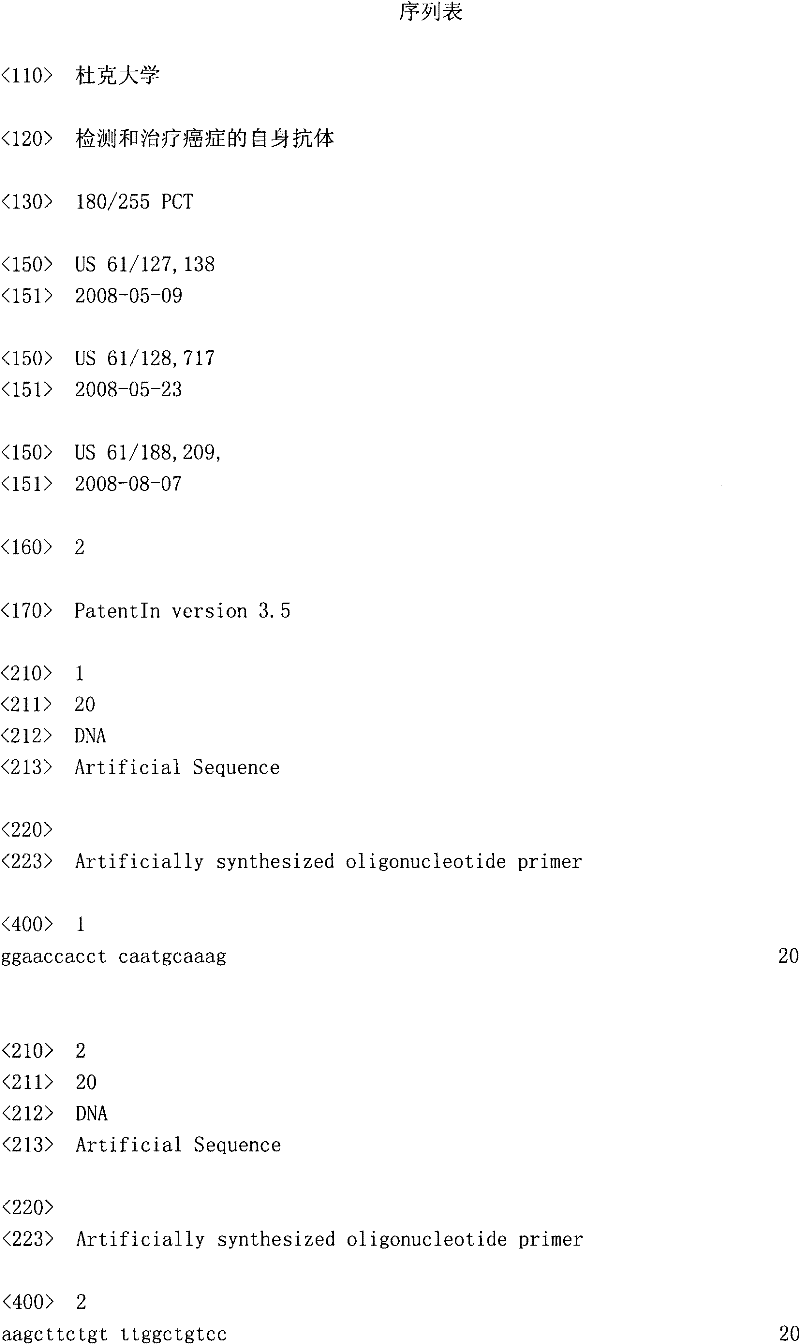
Claims (38)
Applications Claiming Priority (7)
| Application Number | Priority Date | Filing Date | Title |
|---|---|---|---|
| US12713808P | 2008-05-09 | 2008-05-09 | |
| US61/127,138 | 2008-05-09 | ||
| US12871708P | 2008-05-23 | 2008-05-23 | |
| US61/128,717 | 2008-05-23 | ||
| US18820908P | 2008-08-07 | 2008-08-07 | |
| US61/188,209 | 2008-08-07 | ||
| PCT/US2009/043460 WO2009137832A2 (en) | 2008-05-09 | 2009-05-11 | Autoantibodies in the detection and treatment of cancer |
Publications (1)
| Publication Number | Publication Date |
|---|---|
| CN102171569A true CN102171569A (en) | 2011-08-31 |
Family
ID=41265468
Family Applications (1)
| Application Number | Title | Priority Date | Filing Date |
|---|---|---|---|
| CN2009801263641A Pending CN102171569A (en) | 2008-05-09 | 2009-05-11 | Autoantibodies in the detection and treatment of cancer |
Country Status (6)
| Country | Link |
|---|---|
| US (1) | US20120003225A1 (en) |
| EP (1) | EP2277049A4 (en) |
| JP (1) | JP2012500964A (en) |
| CN (1) | CN102171569A (en) |
| CA (1) | CA2725548A1 (en) |
| WO (1) | WO2009137832A2 (en) |
Cited By (7)
| Publication number | Priority date | Publication date | Assignee | Title |
|---|---|---|---|---|
| CN102707068A (en) * | 2012-05-31 | 2012-10-03 | 北京大学 | Application of complement factor H (CFH) to genetic expression products of methamphetamine (METH) addiction patient |
| CN104777305A (en) * | 2014-08-27 | 2015-07-15 | 北京蛋白质组研究中心 | Use of stress-induced-phosphoprotein1 (STIP1) in preparation of product for hepatocellular carcinoma screening |
| CN106557536A (en) * | 2015-09-30 | 2017-04-05 | 松下知识产权经营株式会社 | Control method |
| CN107991493A (en) * | 2017-11-22 | 2018-05-04 | 中国医科大学附属第医院 | Application of the anti-ENO1 autoantibodies in AIT pregnant woman's examination and prediction risk of miscarriage |
| CN109844537A (en) * | 2016-09-27 | 2019-06-04 | 高地和群岛大学 | antigen biomarkers |
| CN111108388A (en) * | 2017-06-23 | 2020-05-05 | 昂西免疫德国有限公司 | Immunooncology for treating cancer |
| CN114910649A (en) * | 2022-05-07 | 2022-08-16 | 浙江大学 | Application of reagent for detecting anti-alpha-enolase-IgG antibody in preparation of kit for detecting vascular endothelial injury |
Families Citing this family (38)
| Publication number | Priority date | Publication date | Assignee | Title |
|---|---|---|---|---|
| EP2224955A4 (en) | 2007-11-27 | 2011-02-16 | Univ British Columbia | COMPOSITIONS AND METHODS FOR THE PREVENTION AND TREATMENT OF ARTHRITIS |
| FR2936060B1 (en) * | 2008-09-17 | 2010-11-19 | Assist Publ Hopitaux De Paris | METHOD FOR DIAGNOSING SYSTEMIC SCLERODERMY OR PULMONARY ARTERIAL HYPERTENSION |
| US8691510B2 (en) | 2008-11-07 | 2014-04-08 | Sequenta, Inc. | Sequence analysis of complex amplicons |
| US9506119B2 (en) | 2008-11-07 | 2016-11-29 | Adaptive Biotechnologies Corp. | Method of sequence determination using sequence tags |
| US8628927B2 (en) | 2008-11-07 | 2014-01-14 | Sequenta, Inc. | Monitoring health and disease status using clonotype profiles |
| US8748103B2 (en) | 2008-11-07 | 2014-06-10 | Sequenta, Inc. | Monitoring health and disease status using clonotype profiles |
| EP4335932A3 (en) | 2008-11-07 | 2024-06-26 | Adaptive Biotechnologies Corporation | Methods of monitoring conditions by sequence analysis |
| US9528160B2 (en) | 2008-11-07 | 2016-12-27 | Adaptive Biotechnolgies Corp. | Rare clonotypes and uses thereof |
| US9365901B2 (en) | 2008-11-07 | 2016-06-14 | Adaptive Biotechnologies Corp. | Monitoring immunoglobulin heavy chain evolution in B-cell acute lymphoblastic leukemia |
| PL2387627T3 (en) | 2009-01-15 | 2016-10-31 | Adaptive immunity profiling and methods for generation of monoclonal antibodies | |
| JP5792637B2 (en) * | 2009-03-11 | 2015-10-14 | オ−グレックス ライフ サイエンシズ コーポレイション | Compositions and methods for characterizing arthritic conditions |
| JP2012531202A (en) | 2009-06-25 | 2012-12-10 | フレッド ハチンソン キャンサー リサーチ センター | How to measure adaptive immunity |
| US9043160B1 (en) | 2009-11-09 | 2015-05-26 | Sequenta, Inc. | Method of determining clonotypes and clonotype profiles |
| US10385475B2 (en) | 2011-09-12 | 2019-08-20 | Adaptive Biotechnologies Corp. | Random array sequencing of low-complexity libraries |
| WO2013056377A1 (en) | 2011-10-21 | 2013-04-25 | Augurex Life Sciences Corporation | Antigens derived from citrullinated 14-3-3 and uses thereof in the diagnosis of rheumatoid arthritis |
| US9279159B2 (en) | 2011-10-21 | 2016-03-08 | Adaptive Biotechnologies Corporation | Quantification of adaptive immune cell genomes in a complex mixture of cells |
| EP2788509B1 (en) | 2011-12-09 | 2018-07-11 | Adaptive Biotechnologies Corporation | Diagnosis of lymphoid malignancies and minimal residual disease detection |
| US9499865B2 (en) | 2011-12-13 | 2016-11-22 | Adaptive Biotechnologies Corp. | Detection and measurement of tissue-infiltrating lymphocytes |
| US20130183242A1 (en) * | 2012-01-18 | 2013-07-18 | University Of Connecticut | Methods for identifying tumor-specific polypeptides |
| ES2662128T3 (en) | 2012-03-05 | 2018-04-05 | Adaptive Biotechnologies Corporation | Determination of paired immune receptor chains from the frequency of matching subunits |
| MX354329B (en) | 2012-05-08 | 2018-02-27 | Adaptive Biotechnologies Corp | Compositions and method for measuring and calibrating amplification bias in multiplexed pcr reactions. |
| US20160002731A1 (en) | 2012-10-01 | 2016-01-07 | Adaptive Biotechnologies Corporation | Immunocompetence assessment by adaptive immune receptor diversity and clonality characterization |
| WO2015160439A2 (en) | 2014-04-17 | 2015-10-22 | Adaptive Biotechnologies Corporation | Quantification of adaptive immune cell genomes in a complex mixture of cells |
| WO2014197885A2 (en) | 2013-06-07 | 2014-12-11 | Duke University | Inhibitors of complement factor h |
| US9708657B2 (en) | 2013-07-01 | 2017-07-18 | Adaptive Biotechnologies Corp. | Method for generating clonotype profiles using sequence tags |
| AU2014324080B2 (en) * | 2013-09-18 | 2020-07-23 | Adelaide Research & Innovation Pty Ltd | Autoantibody biomarkers of ovarian cancer |
| CA2941612A1 (en) | 2014-03-05 | 2015-09-11 | Adaptive Biotechnologies Corporation | Methods using randomer-containing synthetic molecules |
| US10066265B2 (en) | 2014-04-01 | 2018-09-04 | Adaptive Biotechnologies Corp. | Determining antigen-specific t-cells |
| ES2784343T3 (en) | 2014-10-29 | 2020-09-24 | Adaptive Biotechnologies Corp | Simultaneous, highly multiplexed detection of nucleic acids encoding paired adaptive immune receptor heterodimers from many samples |
| US10246701B2 (en) | 2014-11-14 | 2019-04-02 | Adaptive Biotechnologies Corp. | Multiplexed digital quantitation of rearranged lymphoid receptors in a complex mixture |
| EP3498866A1 (en) | 2014-11-25 | 2019-06-19 | Adaptive Biotechnologies Corp. | Characterization of adaptive immune response to vaccination or infection using immune repertoire sequencing |
| AU2016222788B2 (en) | 2015-02-24 | 2022-03-31 | Adaptive Biotechnologies Corp. | Methods for diagnosing infectious disease and determining HLA status using immune repertoire sequencing |
| EP3277294B1 (en) | 2015-04-01 | 2024-05-15 | Adaptive Biotechnologies Corp. | Method of identifying human compatible t cell receptors specific for an antigenic target |
| WO2016183183A1 (en) | 2015-05-11 | 2016-11-17 | The Johns Hopkins University | Autoimmune antibodies for use in inhibiting cancer cell growth |
| US10428325B1 (en) | 2016-09-21 | 2019-10-01 | Adaptive Biotechnologies Corporation | Identification of antigen-specific B cell receptors |
| US10865238B1 (en) | 2017-05-05 | 2020-12-15 | Duke University | Complement factor H antibodies |
| US11254980B1 (en) | 2017-11-29 | 2022-02-22 | Adaptive Biotechnologies Corporation | Methods of profiling targeted polynucleotides while mitigating sequencing depth requirements |
| CN118425516B (en) * | 2024-06-29 | 2024-08-30 | 南昌大学第一附属医院 | Application of autoantibody detection reagent in preparation of glioma diagnosis product |
Citations (2)
| Publication number | Priority date | Publication date | Assignee | Title |
|---|---|---|---|---|
| CN1584028A (en) * | 2004-06-10 | 2005-02-23 | 上海富纯中南生物技术有限公司 | Cloning for sifting tumor hecrosis target antibody, preparing method and use thereof |
| CN101042402A (en) * | 2005-03-24 | 2007-09-26 | 生物哲麦克斯公司 | Autoantibody detection for cancer diagnostics |
Family Cites Families (12)
| Publication number | Priority date | Publication date | Assignee | Title |
|---|---|---|---|---|
| JPH07505719A (en) * | 1992-04-14 | 1995-06-22 | デューク・ユニバーシティー | Method for detecting tumors containing p53 and HSP70 complex |
| JP2002515460A (en) * | 1998-05-20 | 2002-05-28 | イムノメディクス, インコーポレイテッド | Treatment Using Bispecific Anti-HLA Class II Invariant Chain X Anti-Pathogen Antibodies |
| GB9827228D0 (en) * | 1998-12-10 | 1999-02-03 | Univ Nottingham | Cancer detection method and reagents |
| US6645465B2 (en) * | 1999-08-06 | 2003-11-11 | Michigan, University Of The Regents | Annexin proteins and autoantibodies as serum markers for cancer |
| US20040096916A1 (en) * | 2001-04-03 | 2004-05-20 | Roland Kellner | Renal cell carcinoma tumor markers |
| NZ543309A (en) * | 2003-03-31 | 2008-12-24 | Womens & Childrens Hospital | Multiplex screening for lysosomal storage disorders (LSDs) |
| JP4399593B2 (en) * | 2004-04-01 | 2010-01-20 | 国立大学法人 千葉大学 | Influenza encephalopathy test method, marker consisting of protein expressed in human cerebrospinal fluid, diagnostic agent, diagnostic kit |
| GB2428240A (en) * | 2005-07-14 | 2007-01-24 | Univ Gen Ve | Diagnostic method for brain damage-related disorders |
| EP1775590A1 (en) * | 2005-10-11 | 2007-04-18 | Laboratorios S.A.L.V.A.T., S.A. | Non-invasive in vitro method to detect transitional cell carcinoma of the bladder |
| JP4283812B2 (en) * | 2006-01-06 | 2009-06-24 | 財団法人工業技術研究院 | Diagnostic method of myasthenia gravis and its kit |
| KR20090094227A (en) * | 2006-09-29 | 2009-09-04 | 리보박스 바이오테크놀로지즈 에스아 | Novel antigens and antibodies associated to pancreatic ductal adenocarcinoma |
| WO2008061104A2 (en) * | 2006-11-13 | 2008-05-22 | Invitrogen Corporation | Methods and kits for detecting prostate cancer biomarkers |
-
2009
- 2009-05-11 CN CN2009801263641A patent/CN102171569A/en active Pending
- 2009-05-11 WO PCT/US2009/043460 patent/WO2009137832A2/en not_active Ceased
- 2009-05-11 EP EP09743818A patent/EP2277049A4/en not_active Withdrawn
- 2009-05-11 JP JP2011508722A patent/JP2012500964A/en active Pending
- 2009-05-11 US US12/991,666 patent/US20120003225A1/en not_active Abandoned
- 2009-05-11 CA CA2725548A patent/CA2725548A1/en not_active Abandoned
Patent Citations (2)
| Publication number | Priority date | Publication date | Assignee | Title |
|---|---|---|---|---|
| CN1584028A (en) * | 2004-06-10 | 2005-02-23 | 上海富纯中南生物技术有限公司 | Cloning for sifting tumor hecrosis target antibody, preparing method and use thereof |
| CN101042402A (en) * | 2005-03-24 | 2007-09-26 | 生物哲麦克斯公司 | Autoantibody detection for cancer diagnostics |
Non-Patent Citations (3)
| Title |
|---|
| DANIEL AJONA等: "Down-Regulation of Human Complement Factor H Sensitizes Non-Small Cell Lung Cancer Cells to Complement Attack and Reduces In Vivo Tumor Growth", 《THE JOURNAL OF IMMUNOLOGY》 * |
| DANIEL AJONA等: "Expression of Complement Factor H by Lung Cancer Cells: Effects on the Activation of the Alternative Pathway of Complement", 《CANCER RESEARCH》 * |
| PEDIATRIC NEPHROLOGY等: "Successful pre-transplant management of a patient with anti-factor H autoantibodies-associated haemolytic uraemic syndrome", 《NEPHROL DIAL TRANSPLANT》 * |
Cited By (9)
| Publication number | Priority date | Publication date | Assignee | Title |
|---|---|---|---|---|
| CN102707068A (en) * | 2012-05-31 | 2012-10-03 | 北京大学 | Application of complement factor H (CFH) to genetic expression products of methamphetamine (METH) addiction patient |
| CN104777305A (en) * | 2014-08-27 | 2015-07-15 | 北京蛋白质组研究中心 | Use of stress-induced-phosphoprotein1 (STIP1) in preparation of product for hepatocellular carcinoma screening |
| CN106557536A (en) * | 2015-09-30 | 2017-04-05 | 松下知识产权经营株式会社 | Control method |
| CN106557536B (en) * | 2015-09-30 | 2021-12-21 | 松下知识产权经营株式会社 | Control method |
| CN109844537A (en) * | 2016-09-27 | 2019-06-04 | 高地和群岛大学 | antigen biomarkers |
| CN111108388A (en) * | 2017-06-23 | 2020-05-05 | 昂西免疫德国有限公司 | Immunooncology for treating cancer |
| CN107991493A (en) * | 2017-11-22 | 2018-05-04 | 中国医科大学附属第医院 | Application of the anti-ENO1 autoantibodies in AIT pregnant woman's examination and prediction risk of miscarriage |
| CN107991493B (en) * | 2017-11-22 | 2020-03-31 | 中国医科大学附属第一医院 | Application of anti-ENO 1 autoantibody in screening and predicting abortion risk of AIT pregnant woman |
| CN114910649A (en) * | 2022-05-07 | 2022-08-16 | 浙江大学 | Application of reagent for detecting anti-alpha-enolase-IgG antibody in preparation of kit for detecting vascular endothelial injury |
Also Published As
| Publication number | Publication date |
|---|---|
| WO2009137832A2 (en) | 2009-11-12 |
| US20120003225A1 (en) | 2012-01-05 |
| EP2277049A4 (en) | 2012-05-30 |
| EP2277049A2 (en) | 2011-01-26 |
| CA2725548A1 (en) | 2009-11-12 |
| WO2009137832A3 (en) | 2010-04-01 |
| JP2012500964A (en) | 2012-01-12 |
Similar Documents
| Publication | Publication Date | Title |
|---|---|---|
| CN102171569A (en) | Autoantibodies in the detection and treatment of cancer | |
| US20070207510A1 (en) | Methods and compounds for lymphoma cell detection and isolation | |
| CN107098970B (en) | Antibodies that bind to intracellular PRL-1 or PRL-3 polypeptides | |
| EP2971047A1 (en) | Monoclonal antibodies to transferrin and transferrin receptor antigens, and uses thereof | |
| BR112016007037B1 (en) | Method to detect pancreatic cancer | |
| JP5773979B2 (en) | Gastric cancer detection marker and gastric cancer detection method | |
| US20140363832A1 (en) | Molecular marker for the early detection of malignant pleural mesothelioma and the methods of its expression analysis using blood and pleural effusion samples | |
| JP5670422B2 (en) | Gastric cancer detection marker and gastric cancer detection method | |
| US20140363825A1 (en) | Marker for detecting colorectal cancer or esophageal cancer and method for examining such cancer | |
| CN109642905B (en) | Methods of diagnosing and treating cancer using antibodies that bind to inactivated factor C1, antibodies that bind to C reactive protein, and/or antibodies that bind to complement component C4 | |
| JPWO2009044561A1 (en) | Anti-proNT / NMN monoclonal antibody | |
| WO2024206667A1 (en) | Detection of autoantibodies against nr1 | |
| US11733250B2 (en) | Method and kit for the detection of pancreatic dysfunction | |
| JP6729917B2 (en) | EphA2 N-terminal fragment antibody | |
| US20150316548A1 (en) | Progranulin as marker for autoimmune disorders | |
| JP6407990B2 (en) | Augrin immunoassay | |
| CN103261221B (en) | The immunological assay method of Cofilin1 protein | |
| CA3009768C (en) | Compositions and methods for assessing the risk of cancer occurrence | |
| US9193785B2 (en) | Hybridoma clones and monoclonal antibodies to ING4 | |
| CN103842504A (en) | Epithelial Ovarian Cancer Marker Detection Antibody and Epithelial Ovarian Cancer Judgment Method | |
| JP2014167419A (en) | Combination of molecular markers for early detection of pleural mesothelioma patient and method for analyzing expression of molecular markers |
Legal Events
| Date | Code | Title | Description |
|---|---|---|---|
| C06 | Publication | ||
| PB01 | Publication | ||
| C10 | Entry into substantive examination | ||
| SE01 | Entry into force of request for substantive examination | ||
| C02 | Deemed withdrawal of patent application after publication (patent law 2001) | ||
| WD01 | Invention patent application deemed withdrawn after publication |
Application publication date: 20110831 |