CN102137936A - Particles for detecting intracellular targets - Google Patents
Particles for detecting intracellular targets Download PDFInfo
- Publication number
- CN102137936A CN102137936A CN200880011218XA CN200880011218A CN102137936A CN 102137936 A CN102137936 A CN 102137936A CN 200880011218X A CN200880011218X A CN 200880011218XA CN 200880011218 A CN200880011218 A CN 200880011218A CN 102137936 A CN102137936 A CN 102137936A
- Authority
- CN
- China
- Prior art keywords
- polynucleotide
- nanoparticles
- oligonucleotides
- target molecule
- bound fraction
- Prior art date
- Legal status (The legal status is an assumption and is not a legal conclusion. Google has not performed a legal analysis and makes no representation as to the accuracy of the status listed.)
- Granted
Links
Images


Classifications
-
- C—CHEMISTRY; METALLURGY
- C12—BIOCHEMISTRY; BEER; SPIRITS; WINE; VINEGAR; MICROBIOLOGY; ENZYMOLOGY; MUTATION OR GENETIC ENGINEERING
- C12Q—MEASURING OR TESTING PROCESSES INVOLVING ENZYMES, NUCLEIC ACIDS OR MICROORGANISMS; COMPOSITIONS OR TEST PAPERS THEREFOR; PROCESSES OF PREPARING SUCH COMPOSITIONS; CONDITION-RESPONSIVE CONTROL IN MICROBIOLOGICAL OR ENZYMOLOGICAL PROCESSES
- C12Q1/00—Measuring or testing processes involving enzymes, nucleic acids or microorganisms; Compositions therefor; Processes of preparing such compositions
- C12Q1/68—Measuring or testing processes involving enzymes, nucleic acids or microorganisms; Compositions therefor; Processes of preparing such compositions involving nucleic acids
- C12Q1/6876—Nucleic acid products used in the analysis of nucleic acids, e.g. primers or probes
-
- B—PERFORMING OPERATIONS; TRANSPORTING
- B82—NANOTECHNOLOGY
- B82Y—SPECIFIC USES OR APPLICATIONS OF NANOSTRUCTURES; MEASUREMENT OR ANALYSIS OF NANOSTRUCTURES; MANUFACTURE OR TREATMENT OF NANOSTRUCTURES
- B82Y5/00—Nanobiotechnology or nanomedicine, e.g. protein engineering or drug delivery
-
- C—CHEMISTRY; METALLURGY
- C12—BIOCHEMISTRY; BEER; SPIRITS; WINE; VINEGAR; MICROBIOLOGY; ENZYMOLOGY; MUTATION OR GENETIC ENGINEERING
- C12Q—MEASURING OR TESTING PROCESSES INVOLVING ENZYMES, NUCLEIC ACIDS OR MICROORGANISMS; COMPOSITIONS OR TEST PAPERS THEREFOR; PROCESSES OF PREPARING SUCH COMPOSITIONS; CONDITION-RESPONSIVE CONTROL IN MICROBIOLOGICAL OR ENZYMOLOGICAL PROCESSES
- C12Q1/00—Measuring or testing processes involving enzymes, nucleic acids or microorganisms; Compositions therefor; Processes of preparing such compositions
- C12Q1/68—Measuring or testing processes involving enzymes, nucleic acids or microorganisms; Compositions therefor; Processes of preparing such compositions involving nucleic acids
- C12Q1/6813—Hybridisation assays
- C12Q1/6816—Hybridisation assays characterised by the detection means
-
- C—CHEMISTRY; METALLURGY
- C12—BIOCHEMISTRY; BEER; SPIRITS; WINE; VINEGAR; MICROBIOLOGY; ENZYMOLOGY; MUTATION OR GENETIC ENGINEERING
- C12Q—MEASURING OR TESTING PROCESSES INVOLVING ENZYMES, NUCLEIC ACIDS OR MICROORGANISMS; COMPOSITIONS OR TEST PAPERS THEREFOR; PROCESSES OF PREPARING SUCH COMPOSITIONS; CONDITION-RESPONSIVE CONTROL IN MICROBIOLOGICAL OR ENZYMOLOGICAL PROCESSES
- C12Q2563/00—Nucleic acid detection characterized by the use of physical, structural and functional properties
- C12Q2563/155—Particles of a defined size, e.g. nanoparticles
Landscapes
- Chemical & Material Sciences (AREA)
- Life Sciences & Earth Sciences (AREA)
- Organic Chemistry (AREA)
- Engineering & Computer Science (AREA)
- Proteomics, Peptides & Aminoacids (AREA)
- Health & Medical Sciences (AREA)
- Zoology (AREA)
- Wood Science & Technology (AREA)
- Analytical Chemistry (AREA)
- Bioinformatics & Cheminformatics (AREA)
- General Health & Medical Sciences (AREA)
- Molecular Biology (AREA)
- General Engineering & Computer Science (AREA)
- Biotechnology (AREA)
- Biophysics (AREA)
- Biochemistry (AREA)
- Physics & Mathematics (AREA)
- Immunology (AREA)
- Microbiology (AREA)
- Genetics & Genomics (AREA)
- Nanotechnology (AREA)
- Medical Informatics (AREA)
- Medicinal Chemistry (AREA)
- Pharmacology & Pharmacy (AREA)
- Crystallography & Structural Chemistry (AREA)
- Measuring Or Testing Involving Enzymes Or Micro-Organisms (AREA)
Abstract
Description
资助公开funding disclosure
本发明由政府支持,资助来自Cancer Center for NanotechnologyExcellence(NCI/CCNE)奖励的资金IU54-CA 119341、NIH Director′s PioneerAward奖励的资金5DPIOD000285,和NSEC奖励的资金EEC-0647560。政府对本发明具有一定权利。This invention was made with government support under grant IU54-CA 119341 from the Cancer Center for Nanotechnology Excellence (NCI/CCNE), award 5DPIOD000285 from the NIH Director's Pioneer Award, and grant EEC-0647560 from the NSEC award. The government has certain rights in this invention.
技术领域technical field
本发明涉及使用纳米颗粒检测细胞内标靶分子浓度的方法,其中所述纳米颗粒包括可以特异性连接标靶分子的结合部分,且其中所述连接导致在连接标靶分子后可检测标靶中可测定的变化。The present invention relates to a method for detecting the concentration of a target molecule in a cell using nanoparticles, wherein the nanoparticle includes a binding moiety that can specifically bind the target molecule, and wherein the linkage results in a detectable concentration of the target molecule after binding the target molecule. measurable change.
背景技术Background technique
标记的寡核苷酸广泛地用作检测特异性大分子标靶如核酸和蛋白质的探针。它们与标靶高特异性结合的能力使得它们可以用在体外分析如聚合酶链式反应(PCR)方法中。然而,将这些类型的标靶特异性探针递送进入活细胞存在很大挑战,因为细胞对核酸摄入具有天生的抗性,且包含除去这些外源遗传物质的多种途经。因此,人们对将这些物质以保持其特异性结合性质和荧光信号转导能力的方式递送进入细胞的方法很感兴趣。Labeled oligonucleotides are widely used as probes for the detection of specific macromolecular targets such as nucleic acids and proteins. Their ability to bind targets with high specificity allows their use in in vitro assays such as polymerase chain reaction (PCR) methods. However, delivering these types of target-specific probes into living cells presents significant challenges because cells are inherently resistant to nucleic acid uptake and contain multiple pathways to remove such exogenous genetic material. Therefore, methods to deliver these substances into cells in a manner that preserves their specific binding properties and fluorescent signal transduction capacity are of great interest.
寡核苷酸-纳米颗粒缀合物的发现和随后的发展为分子诊断学(Elghanian等,1997,Science 111:1078-1081;Nam等,2003,Science 308:1884-1886)和材料设计(Mirkin等,1996,Nature 382:607-609;Alivisatos等,1996,Nature 382:609-611;Demers等,2003,Angew.Chem.Int.Ed.40:3071-3073)提供了多种新的机会。最近,已经表明寡核苷酸功能化的纳米颗粒进入细胞并起到控制基因表达的反义试剂的作用(Rosi等,2006,Science312:1027-1030)。这些“反义颗粒”不是简单的递送载体(Sandhu等,2002,Bioconjugate Chem.13:3-6;Tkachenko等,2003,J.Am.Chem.Soc.125:4700-4701),而是单个实体调节和转染试剂,所述试剂经历细胞内在化,抵抗酶促降低并以比游离寡核苷酸大两个数量级的亲和常数结合细胞内标靶(Lytton-Jean和Mirkin,2005,J.Am.Chem.Soc.127:12754-12755)。此外,它们可以很容易地被强力的(即高度稳定的)标记材料如锁核酸修饰(Seferos等,2007,ChemBioChem 8:1230-1232)且在基因调节所需的条件下没有毒性。实际上,已经显示出,与溶液中缺少寡核苷酸不同,寡核苷酸修饰的金纳米颗粒容易大量被细胞吸收。此性质导致发现可将寡核苷酸修饰的金纳米颗粒用作细胞内基因控制的试剂,在此处它们提供DNA的快速细胞内递送,且还增加细胞中基于协同性质的寡核苷酸的功效。这些寡核苷酸功能化的纳米颗粒已经显示出进入各种细胞类型,且可以用来引入寡核苷酸的高局部浓度。The discovery and subsequent development of oligonucleotide-nanoparticle conjugates contributed to molecular diagnostics (Elghanian et al., 1997, Science 111:1078-1081; Nam et al., 2003, Science 308:1884-1886) and materials design (Mirkin et al. et al., 1996, Nature 382:607-609; Alivisatos et al., 1996, Nature 382:609-611; Demers et al., 2003, Angew.Chem.Int.Ed.40:3071-3073) provide multiple new opportunities. Recently, oligonucleotide-functionalized nanoparticles have been shown to enter cells and act as antisense agents to control gene expression (Rosi et al., 2006, Science 312: 1027-1030). These "antisense particles" are not simple delivery vehicles (Sandhu et al., 2002, Bioconjugate Chem. 13:3-6; Tkachenko et al., 2003, J.Am.Chem.Soc.125:4700-4701), but individual entities Regulatory and transfection reagents that undergo cellular internalization, resist enzymatic degradation and bind intracellular targets with affinity constants two orders of magnitude greater than free oligonucleotides (Lytton-Jean and Mirkin, 2005, J. Am. Chem. Soc. 127:12754-12755). Furthermore, they can be easily modified with robust (ie highly stable) labeling materials such as locked nucleic acids (Seferos et al., 2007, ChemBioChem 8:1230-1232) and are not toxic under conditions required for gene regulation. Indeed, it has been shown that oligonucleotide-modified gold nanoparticles are readily taken up by cells in large quantities, unlike the absence of oligonucleotides in solution. This property led to the discovery that oligonucleotide-modified gold nanoparticles can be used as agents for intracellular genetic control, where they provide rapid intracellular delivery of DNA and also increase the activity of oligonucleotides in cells based on their synergistic properties. effect. These oligonucleotide-functionalized nanoparticles have been shown to enter various cell types and can be used to introduce high local concentrations of oligonucleotides.
以前也显出与DNA致密功能化的金纳米颗粒以高度协同方式结合互补DNA,导致结合强度比未与金纳米颗粒连接的类似DNA链的所测结合强度高两个数量级。除上述那些用途之外,此性质使得纳米颗粒对DNA和蛋白质诊断分析特别有用。Gold nanoparticles functionalized densely with DNA were also previously shown to bind complementary DNA in a highly cooperative manner, resulting in binding strengths two orders of magnitude higher than those measured for similar DNA strands not linked to gold nanoparticles. This property makes nanoparticles particularly useful for DNA and protein diagnostic assays, in addition to those uses described above.
一类感兴趣的寡核苷酸是可以检测具有识别序列的特异性标靶的那些寡核苷酸。医学诊断、药物开发和发育和分子生物学应用对这些结构类型(如果将其引入活细胞)特别感兴趣。然而,目前的递送/转染策略缺少其用途所需的特征,如1)低毒性,2)高细胞摄入,和3)提供对引起假阳性信号的酶的抗性。One class of oligonucleotides of interest are those that can detect a specific target with a recognition sequence. These structural types, if introduced into living cells, are of particular interest for medical diagnostics, drug development, and developmental and molecular biology applications. However, current delivery/transfection strategies lack the characteristics required for their use, such as 1) low toxicity, 2) high cellular uptake, and 3) providing resistance to enzymes that cause false positive signals.
显像并检测细胞内RNA的探针包括原位染色中所用的那些(Femino等,Science 280:585-590,1998;Kloosterman等,Nat.Methods 3:27-29,2006)、分子信标(Tyagi等,1996,Nat.Biotechnol.14:303-308;Sokol等,1998,Proc.Natl.Acad.Sci.USA 95:11538-11543;Peng等,2005,Cancer Res.65:1909-1917;Perlette等,2001,Anal.Chem.73:5544-5550;Nitin等,2004,Nucleic Acids Res.32:e58)、和FRET对(Santangelo等,2004,Nucleic AcidsRes.32:e57;Rratu等,2003,Proc.Natl Acad.Sci.USA 100:13308-13313),每个都是测定和定量活体系应答外部刺激活性的重要生物学工具(Santangelo等,2006,Annals of Biomedical Engineering 34:39-50)。然而,已经证明将基于寡核苷酸的报道物递送进入细胞基质和细胞是对细胞内检测的巨大挑战。基于寡核苷酸的探针的细胞内在化通常需要转染试剂如脂类(Zabner等,1995,J.Bio.Chem.270:18997-19007)或树枝状化合物(Kukowska-Latallo等,1996,Proc.Natl.Acad.Sci.USA 93:4897-4902),其可以是有毒的或改变细胞过程。此外,寡核苷酸易于在细胞内降解(Opalinska和Gewirtz,2002,Nat.Rev.Drug Disc.1:503-514),且在荧光团标记的探针的情况中,这可以引起无法区别于真正识别事件的高背景信号(Li等,2004,Nucleic Acids Res.28:e52;Rizzo等,2002,Molecular and Cellular Probes 16:277-283)。Probes for imaging and detecting intracellular RNA include those used in in situ staining (Femino et al., Science 280:585-590, 1998; Kloosterman et al., Nat. Methods 3:27-29, 2006), molecular beacons ( Tyagi et al., 1996, Nat.Biotechnol.14:303-308; Sokol et al., 1998, Proc.Natl.Acad.Sci.USA 95:11538-11543; Peng et al., 2005, Cancer Res.65:1909-1917; Perlette etc., 2001, Anal.Chem.73:5544-5550; Nitin et al., 2004, Nucleic Acids Res.32:e58), and FRET pair (Santangelo et al., 2004, Nucleic Acids Res.32:e57; Rratu et al., 2003, Proc USA 100: 13308-13313), each of which is an important biological tool for measuring and quantifying the activity of living systems in response to external stimuli (Santangelo et al., 2006, Annals of Biomedical Engineering 34: 39-50). However, the delivery of oligonucleotide-based reporters into the cell matrix and cells has proven to be a formidable challenge for intracellular detection. Cellular internalization of oligonucleotide-based probes usually requires transfection reagents such as lipids (Zabner et al., 1995, J. Bio. Chem. 270:18997-19007) or dendrimers (Kukowska-Latallo et al., 1996, USA 93:4897-4902), which can be toxic or alter cellular processes. Furthermore, oligonucleotides are prone to intracellular degradation (Opalinska and Gewirtz, 2002, Nat. Rev. Drug Disc. 1:503-514), and in the case of fluorophore-labeled probes, this can lead to indistinguishable High background signal for true recognition events (Li et al., 2004, Nucleic Acids Res. 28:e52; Rizzo et al., 2002, Molecular and Cellular Probes 16:277-283).
因此,虽然已经设计出可以以高特异性识别标靶的纳米颗粒,但是很难检测源自特异相互作用的阳性作用,特别是以高灵敏度在单细胞水平上检测此相互作用。Therefore, although nanoparticles that can recognize targets with high specificity have been designed, it is difficult to detect positive effects derived from specific interactions, especially at the single-cell level with high sensitivity.
因此本领域需要开发能够进入细胞去连接特异标靶的材料和检测并定量得到细胞内相互作用的方法。Therefore, there is a need in the art to develop materials that can enter cells to connect to specific targets and methods for detecting and quantifying intracellular interactions.
发明内容Contents of the invention
本发明提供了测定细胞内标靶分子浓度的方法,包括在允许标靶分子与纳米颗粒连接的条件下使标靶分子接触纳米颗粒的步骤,所述纳米颗粒包含特异于所述标靶分子的结合部分,所述结合部分标记有标记物,其中标靶分子和纳米颗粒的连接导致标记物中可检测的变化,且其中可检测标记物中的变化与细胞内所述标靶分子的浓度成比例。The present invention provides a method of determining the concentration of a target molecule in a cell comprising the step of contacting the target molecule with a nanoparticle comprising a protein specific for the target molecule under conditions that allow the target molecule to attach to the nanoparticle. a binding moiety, the binding moiety is labeled with a label, wherein attachment of the target molecule to the nanoparticle results in a detectable change in the label, and wherein the change in the detectable label is proportional to the concentration of the target molecule in the cell Proportion.
在此方法的一个实施方案中,结合部分是多核苷酸,且在另一方面,结合部分是多肽。在结合部分是多核苷酸的实施方案中,其它方面包括其中结合部分是DNA分子或RNA分子的那些方面。在此方法的其它实施方案中,标靶分子是多核苷酸或多肽。在标靶分子是多核苷酸的实施方案中,其它方面包括其中结合部分是DNA分子或RNA分子的那些方面。In one embodiment of this method, the binding moiety is a polynucleotide, and in another aspect, the binding moiety is a polypeptide. In embodiments where the binding moiety is a polynucleotide, other aspects include those wherein the binding moiety is a DNA molecule or an RNA molecule. In other embodiments of this method, the target molecule is a polynucleotide or polypeptide. In embodiments where the target molecule is a polynucleotide, other aspects include those wherein the binding moiety is a DNA molecule or an RNA molecule.
在一个实施方案中,本发明提供了方法,其中结合部分是与纳米颗粒共价连接的多核苷酸,且标记物是连接与结合部分多核苷酸杂交的多核苷酸的标记,其中结合部分多核苷酸和标靶分子的连接释放出杂交的多核苷酸,且释放后标记物是可检测的。一方面,标记物连接杂交的多核苷酸,且当具有标记物的杂交的多核苷酸与结合部分杂交时,标记物淬灭。In one embodiment, the invention provides a method wherein the binding moiety is a polynucleotide covalently linked to the nanoparticle and the label is a label linked to a polynucleotide that hybridizes to the binding moiety polynucleotide, wherein the binding moiety is polynuclear Ligation of the nucleotide and target molecule releases the hybridized polynucleotide, and the label is detectable after release. In one aspect, a label is attached to the hybridized polynucleotide, and when the hybridized polynucleotide bearing the label hybridizes to the binding moiety, the label is quenched.
在另一个实施方案中,本发明提供了方法,其中结合部分是与纳米颗粒共价连接的多肽,且标记物是连接与结合部分多肽相连的试剂的标记,其中结合部分多肽和标靶分子的连接替代相连的试剂,且释放后标记物是可检测的。一方面,标记物连接试剂,且当试剂与结合部分多肽连接时,标记物淬灭。In another embodiment, the invention provides methods wherein the binding moiety is a polypeptide covalently linked to the nanoparticle and the label is a label linked to a reagent linked to the binding moiety polypeptide, wherein the binding moiety polypeptide and the target molecule The ligation displaces the attached reagent, and the label is detectable after release. In one aspect, a label is attached to the reagent, and when the reagent is attached to the binding moiety polypeptide, the label is quenched.
在另一个实施方案中,本发明提供了方法,其中结合部分标记有标记物,且只有当结合部分连接标靶分子时标记物才可被检测。在结合部分是多核苷酸的实施方案中,其它方面包括其中结合部分是DNA分子或RNA分子的那些方面。在此方法的其它实施方案中,标靶分子是多核苷酸或多肽。在标靶分子是多核苷酸的实施方案中,其它方面包括其中结合部分是DNA分子或RNA分子的那些方面。In another embodiment, the invention provides methods wherein the binding moiety is labeled with a label, and the label is only detectable when the binding moiety is attached to a target molecule. In embodiments where the binding moiety is a polynucleotide, other aspects include those wherein the binding moiety is a DNA molecule or an RNA molecule. In other embodiments of this method, the target molecule is a polynucleotide or polypeptide. In embodiments where the target molecule is a polynucleotide, other aspects include those wherein the binding moiety is a DNA molecule or an RNA molecule.
在一个方面,结合部分是多核苷酸且标记物与多核苷酸结合部分连接,使得当多核苷酸结合部分不与标靶分子连接时,标记物淬灭。因此,只有当多核苷酸结合部分连接标靶分子时与多核苷酸结合部分相连的标记物才可被检测。In one aspect, the binding moiety is a polynucleotide and the label is attached to the polynucleotide binding moiety such that when the polynucleotide binding moiety is not attached to the target molecule, the label is quenched. Thus, the label attached to the polynucleotide binding moiety can only be detected when the polynucleotide binding moiety is attached to the target molecule.
在另一个方面,结合部分是多肽且标记物与多肽结合部分连接,使得当多肽结合部分不与标靶分子连接时,标记物淬灭。因此,只有当多肽结合部分连接标靶分子时多肽结合部分才可被检测。In another aspect, the binding moiety is a polypeptide and the label is attached to the polypeptide binding moiety such that when the polypeptide binding moiety is not attached to the target molecule, the label is quenched. Thus, the polypeptide-binding moiety can only be detected when it is linked to a target molecule.
本发明还提供了方法,其中所述纳米颗粒包含多个结合部分。在一个方面,本发明提供了方法,其中多个结合部分特异地连接一个标靶分子。在另一个方面,其中多个结合部分特异地连接多于一个标靶分子。The invention also provides methods wherein the nanoparticles comprise a plurality of binding moieties. In one aspect, the invention provides methods wherein multiple binding moieties are specifically linked to one target molecule. In another aspect, wherein multiple binding moieties specifically bind to more than one target molecule.
本发明的其它方面将从以下具体描述中清楚得出。然而,应该理解以下详细描述和实施例,尽管说明本发明的优选实施方案,仅以列举的方式给出,因为本发明精神和范围内的各种变化和修改对此详细描述的领域的技术人员是显而易见的。Other aspects of the invention will be apparent from the following detailed description. It should be understood, however, that the following detailed description and examples, while indicating preferred embodiments of the invention, are given by way of illustration only, since various changes and modifications within the spirit and scope of the invention will be apparent to those skilled in the art described in detail. It is obvious.
附图说明Description of drawings
图1提供了能够检测细胞内标靶的修饰有包含荧光团的寡核苷酸的金纳米颗粒的图。Figure 1 provides a diagram of gold nanoparticles modified with fluorophore-containing oligonucleotides capable of detecting intracellular targets.
图2显示了用于mRNA检测和定量的纳米-flares。Figure 2 shows nano-flares for mRNA detection and quantification.
图3描述了使用纳米-flares对生存素敲除的定量。(a)在siRNA处理的SKBR3细胞上收集的流式细胞数据,(b)作为siRNA浓度的函数的平均荧光(黑圈)和生存素表达(灰柱图)的图。Figure 3 depicts the quantification of survivin knockdown using nano-flares. (a) Flow cytometric data collected on siRNA-treated SKBR3 cells, (b) plot of mean fluorescence (black circles) and survivin expression (grey histogram) as a function of siRNA concentration.
具体实施方式Detailed ways
本文提供的方法利用了修饰有包含一个或多个结合部分的纳米颗粒的物理性质和用途,所述结合部分特异地识别并连接一个或多个特异标靶部分。本文显出可以使用包含特异于标靶分子的结合部分的纳米颗粒来测定细胞内标靶分子的浓度。在本发明中,结合部分标记有标记物,其中标靶分子和纳米颗粒的连接导致标记物中可检测的变化,且其中可检测标记物中的变化与细胞内所述标靶分子的浓度成比例。要意识到细胞内标靶包括标靶细胞中那些天然存在的标靶,已经被引入细胞中的那些天然存在标靶(但在此细胞类型中通常无法发现)或本身不存在但已被引入标靶细胞中的合成标靶。The methods provided herein take advantage of the physical properties and use of nanoparticles modified to include one or more binding moieties that specifically recognize and link to one or more specific target moieties. It is shown herein that the concentration of a target molecule within a cell can be determined using nanoparticles comprising a binding moiety specific for the target molecule. In the present invention, the binding moiety is labeled with a label, wherein attachment of the target molecule to the nanoparticle results in a detectable change in the label, and wherein the change in the detectable label is proportional to the concentration of the target molecule in the cell. Proportion. It is to be appreciated that intracellular targets include those naturally occurring in the target cell, those naturally occurring targets that have been introduced into the cell (but not normally found in this cell type) or those that are not present but have been introduced into the cell Synthetic targets in target cells.
在本发明的另一方面,也可以使用本文概括的方法来测定细胞内所期望标靶的定位。In another aspect of the invention, the methods outlined herein can also be used to determine the localization of a desired target within a cell.
如本文所用,应理解术语“结合部分”涵盖多核苷酸和多肽,或可以与目的标靶连接的前述分子的任何其它片段或部分。此术语包括但不限于目的小分子。如本领域所理解,术语“小分子”包括有机和无机化合物,它们或是天然存在化合物、天然存在化合物的修饰物、或合成的化合物。As used herein, it is understood that the term "binding moiety" encompasses polynucleotides and polypeptides, or any other fragment or portion of the foregoing molecules that can be linked to a target of interest. This term includes, but is not limited to, small molecules of interest. As understood in the art, the term "small molecule" includes organic and inorganic compounds, which are either naturally occurring compounds, modifications of naturally occurring compounds, or synthetic compounds.
所提供的方法特别适于使用识别并连接细胞内标靶分子的结合部分,其中结合部分是多核苷酸和/或多肽,且标靶分子是多核苷酸和/或多肽。在简单的方面,多核苷酸结合部分特异地连接多核苷酸标靶分子,或多肽结合部分特异地连接多肽标靶分子。然而,也可以预期这样的方法,其中多核苷酸结合部分特异地连接多肽标靶分子,或多肽结合部分特异地连接多核苷酸标靶分子。The provided methods are particularly suitable for use with binding moieties that recognize and link intracellular target molecules, wherein the binding moieties are polynucleotides and/or polypeptides and the target molecules are polynucleotides and/or polypeptides. In simple aspects, a polynucleotide binding moiety is specifically linked to a polynucleotide target molecule, or a polypeptide binding moiety is specifically linked to a polypeptide target molecule. However, methods are also contemplated wherein the polynucleotide binding moiety is specifically linked to the polypeptide target molecule, or the polypeptide binding moiety is specifically linked to the polynucleotide target molecule.
如本文所用,术语“特异地识别”或“特异地连接”是指与全部其它标靶分子相比,结合部分可以以更高的亲和力和/或活动性鉴别和/或与一种标靶分子相互作用。As used herein, the term "specifically recognizes" or "specifically binds" means that a binding moiety can recognize and/or bind to one target molecule with a higher affinity and/or activity than all other target molecules interaction.
本方法提供功能,基于的原理是用标记物直接或间接地标记结合部分,且结合部分与标靶分子的连接导致标记物变得可以检测或更易检测。因此,当结合部分不与标靶分子连接时,标记物相对不可检测或淬灭。虽然本领域中理解术语“淬灭”通常与荧光标记物有关,但是本文中预期当其相对不可检测时,任何标记物的信号是淬灭的。因此,应理解所提供的本说明书中列举的应用荧光标记物的方法仅作为预期方法的一种实施方案,且任何可以淬灭的标记物可以替代示例型荧光标记物。The method provides functionality based on the principle that the binding moiety is directly or indirectly labeled with a label and that attachment of the binding moiety to the target molecule results in the label becoming detectable or more detectable. Thus, when the binding moiety is not attached to the target molecule, the label is relatively undetectable or quenched. While the term "quenching" is understood in the art in general in relation to fluorescent labels, it is contemplated herein that the signal of any label is quenched when it is relatively undetectable. Therefore, it should be understood that the methods listed in this specification for applying fluorescent markers are provided only as one embodiment of the contemplated methods, and that any quenchable markers may be substituted for the exemplary fluorescent markers.
一方面,标记物是直接连接结合部分的标记,且另一方面,标记物是连接与结合部分相连的试剂的标记,此试剂对于结合部分具有较低的结合亲和力或结合活动性,使得标靶分子与结合部分的连接引起试剂从与其连接的结合部分上被替代。In one aspect, the label is a label directly attached to the binding moiety, and in another aspect, the label is attached to a reagent attached to the binding moiety that has a low binding affinity or activity for the binding moiety such that the target Attachment of a molecule to a binding moiety causes the reagent to be displaced from the binding moiety to which it is attached.
当标记物直接连接结合部分时,可以这样定位标记物,使得其在结合部分未连接标靶分子时是相对不可检测或淬灭的。例如,对于未连接标靶分子的多核苷酸结合部分,通过在多核苷酸结合部分内部形成的二级结构可以将标记物定位于靠近纳米颗粒本身,或标记物可以在水环境中自由地摆动,使得在任何给定时间标记物可以靠近纳米颗粒且其信号淬灭,或标记物可以远离纳米颗粒的在水环境中自由地摆动(虽然仍连接纳米颗粒),使得信号不淬灭。在没有二级结构将标记物保持在靠近纳米颗粒的淬灭位置的实施方案中,当多核苷酸结合部分未连接标靶分子时,必需检测背景信号的水平,且多核苷酸结合部分与标靶分子的连接将使信号超过背景,原因是更多的标记物从足够接近给予淬灭作用的纳米颗粒处被替代。When a label is directly attached to a binding moiety, the label can be positioned such that it is relatively undetectable or quenched when the binding moiety is not attached to a target molecule. For example, for the polynucleotide-binding moiety not attached to the target molecule, the secondary structure formed inside the polynucleotide-binding moiety can localize the label close to the nanoparticle itself, or the label can freely swing in the aqueous environment , so that at any given time the marker can be close to the nanoparticle and its signal quenched, or the marker can swing freely in the aqueous environment away from the nanoparticle (while still attached to the nanoparticle), so that the signal is not quenched. In embodiments where there is no secondary structure to hold the label close to the quenching position of the nanoparticle, it is necessary to detect the level of background signal when the polynucleotide binding moiety is not attached to the target molecule, and the polynucleotide binding moiety is associated with the target molecule. Attachment of the target molecule will cause the signal to rise above background as more label is displaced from the nanoparticle close enough to impart quenching.
类似地,当结合部分是多肽时,可以这样定位结合部分上的标记物,使得在多肽结合部分连接标靶分子时发生构象变化,导致标记物充分远离纳米颗粒,以使其信号相对不淬灭。Similarly, when the binding moiety is a polypeptide, the label on the binding moiety can be positioned such that a conformational change occurs upon attachment of the polypeptide binding moiety to the target molecule, causing the label to be far enough away from the nanoparticle that its signal is relatively unquenched .
在标记物未直接连接结合部分的方法方面,结合部分和标靶分子的连接引起标靶的物理释放,使得纳米颗粒不能发挥对标记物的淬灭作用。例如,对于多核苷酸结合部分,可以将标记物标记在与多核苷酸结合部分杂交的第二多核苷酸上,所在位置使得标记物充分接近纳米颗粒,以使纳米颗粒发挥其淬灭作用。当多核苷酸结合分子识别并连接标靶分子时,杂交和标记的多核苷酸被替代,且纳米颗粒的淬灭作用终止。In terms of methods where the label is not directly attached to the binding moiety, the attachment of the binding moiety to the target molecule results in physical release of the target such that the nanoparticles cannot exert a quenching effect on the label. For example, for a polynucleotide binding moiety, a label can be labeled on a second polynucleotide to which the polynucleotide binding moiety hybridizes, in a position such that the label is in sufficient proximity to the nanoparticle for the nanoparticle to exert its quenching effect . When the polynucleotide-binding molecule recognizes and ligates the target molecule, the hybridized and labeled polynucleotide is displaced and quenching of the nanoparticles ceases.
因此,一方面,例如,本发明提供了方法,其中可以将修饰为包含多核苷酸结合部分的金纳米颗粒用作转染剂和活细胞内成像和定量RNA的细胞“纳米-flares”,所述多核苷酸结合部分反过来杂交标记有荧光团标记物的互补的多核苷酸。纳米-flares的优点是金的高效荧光淬灭性质(Dubertret等,2001,Nat.Biotechnol.19:365-370),细胞摄取寡核苷酸纳米颗粒缀合物而不使用转染剂,和此缀合物的酶稳定性(Rosi等,2006,Science 312:1027-1030),因此克服了许多挑战来产生敏感和有效的细胞内探针。特别地,纳米-flares显示出高信号传导,具有低背景荧光,且对细胞内RNA转录物数量变化敏感。因此,本文所述的纳米-flares是设计为提供与特定细胞内RNA相对量直接或间接相关的细胞内荧光信号的寡核苷酸功能化的纳米颗粒缀合物。所公开方法中期望检测的RNA包括但不限于mRNA和hnRNA。Thus, in one aspect, for example, the present invention provides methods wherein gold nanoparticles modified to contain polynucleotide binding moieties can be used as transfection agents and cellular "nano-flares" for imaging and quantifying RNA in live cells, so The polynucleotide binding moiety in turn hybridizes to a complementary polynucleotide labeled with a fluorophore label. The advantages of nano-flares are the highly efficient fluorescence quenching properties of gold (Dubertret et al., 2001, Nat. Biotechnol. 19:365-370), the cellular uptake of oligonucleotide nanoparticle conjugates without the use of transfection agents, and the The enzymatic stability of the conjugate (Rosi et al., 2006, Science 312: 1027-1030), therefore overcomes many challenges to generate sensitive and efficient intracellular probes. In particular, nano-flares display high signaling, have low background fluorescence, and are sensitive to changes in the number of intracellular RNA transcripts. Thus, the nano-flares described herein are oligonucleotide-functionalized nanoparticle conjugates designed to provide intracellular fluorescent signals that correlate directly or indirectly with the relative amount of specific intracellular RNA. RNAs that it is desirable to detect in the disclosed methods include, but are not limited to, mRNA and hnRNA.
类似的机制适用于多肽结合部分,其中标记有标记物和试剂的试剂能够如此连接多肽结合部分,以致其连接引起试剂盒标记物充分地接近纳米颗粒,以使标记物相对淬灭。当多肽结合部分连接特定标靶分子,如同上述纳米-flare试剂被释放或替代,且纳米颗粒的淬灭作用终止。A similar mechanism applies to polypeptide-binding moieties, where the reagent labeled with a label and reagent can be linked to the polypeptide-binding moiety such that its attachment brings the kit label into sufficient proximity to the nanoparticle for relative quenching of the label. When the polypeptide binding moiety is attached to a specific target molecule, the nano-flare agent as described above is released or displaced, and the quenching effect of the nanoparticle is terminated.
不管结合部分的特定性质,通过使用荧光团标记的寡核苷酸或多肽致密功能化的纳米颗粒,可以降低通常与细胞内分子检测有关的一些困难。这些结合部分不需要显微注射或辅助转染剂来进入细胞,对酶促降解具有很高的抗性,且在研究的条件下无毒。Regardless of the specific nature of the binding moiety, some of the difficulties normally associated with intracellular molecular detection can be alleviated by using fluorophore-labeled oligonucleotides or polypeptides to densely functionalize nanoparticles. These binding moieties do not require microinjection or co-transfection agents to enter cells, are highly resistant to enzymatic degradation, and are nontoxic under the conditions studied.
多核苷酸polynucleotide
如本文所使用,术语“多核苷酸”,或在纳米颗粒上功能化或作为标靶分子,可以与术语寡核苷酸互换使用。As used herein, the term "polynucleotide", either functionalized on a nanoparticle or as a targeting molecule, may be used interchangeably with the term oligonucleotide.
本文所用的术语“核苷酸”可以与本文所述的和本领域已知的修饰形式互换使用。在某些实例中,本领域使用术语“核碱基”,其涵盖天然存在的核苷酸以及可以聚合的核苷酸的修饰物。As used herein, the term "nucleotide" is used interchangeably with modified forms described herein and known in the art. In certain instances, the term "nucleobase" is used in the art to encompass naturally occurring nucleotides as well as modifications of nucleotides that can be polymerized.
本领域熟知制备预定序列多核苷酸的方法。参见,如Sambrook等,Molecular Cloning:A Laboratory Manual(2nd ed.1989)和F.Eckstein(ed.)寡核苷酸and Analogues,1st Ed.(Oxford University Press,New York,1991)。固相合成方法优选用于寡核糖核苷酸和寡脱氧核糖核苷酸(熟知的合成DNA的方法也可用于合成RNA)。寡核糖核苷酸和寡脱氧核糖核苷酸也可以用酶法制备。优选用固相合成法进行寡核糖核苷酸和寡脱氧核糖核苷酸的合成(合成DNA的公知方法也用于合成RNA)。寡核糖核苷酸和寡脱氧核糖核苷酸也可用酶法制备。Methods for preparing polynucleotides of predetermined sequence are well known in the art. See, eg, Sambrook et al., Molecular Cloning: A Laboratory Manual (2nd ed. 1989) and F. Eckstein (ed.) Oligonucleotides and Analogues, 1st Ed. (Oxford University Press, New York, 1991). Solid phase synthesis methods are preferred for oligoribonucleotides and oligodeoxyribonucleotides (well known methods for the synthesis of DNA can also be used for the synthesis of RNA). Oligoribonucleotides and oligodeoxyribonucleotides can also be prepared enzymatically. The synthesis of oligoribonucleotides and oligodeoxyribonucleotides is preferably carried out by solid phase synthesis (well known methods for the synthesis of DNA are also used for the synthesis of RNA). Oligoribonucleotides and oligodeoxyribonucleotides can also be prepared enzymatically.
在各个发明,本发明提供的方法包括多核苷酸的用途,该多核苷酸为DNA寡核苷酸、RNA寡核苷酸或这两种类型的组合。也可考虑使用寡核苷酸的修饰形式,包括那些具有至少一个修饰的核苷酸间键合。修饰的多核苷酸或寡核苷酸在下文中详细描述。In various inventions, the methods provided herein include the use of polynucleotides that are DNA oligonucleotides, RNA oligonucleotides, or a combination of these two types. Modified forms of oligonucleotides are also contemplated for use, including those having at least one modified internucleotide linkage. Modified polynucleotides or oligonucleotides are described in detail below.
修饰的寡核苷酸modified oligonucleotides
寡核苷酸的具体实例包括那些含有修饰的骨架或非天然的核苷酸间键合。具有修饰的骨架的寡核苷酸包括那些在骨架中保留磷原子和那些在骨架中没有磷原子的寡核苷酸。在核苷酸间骨架中没有磷原子的修饰的寡核苷酸涵盖在″寡核苷酸″的含义之内。Specific examples of oligonucleotides include those containing modified backbones or non-natural internucleotide linkages. Oligonucleotides with modified backbones include those that retain a phosphorus atom in the backbone and those that do not have a phosphorus atom in the backbone. Modified oligonucleotides having no phosphorus atoms in the internucleotide backbone are encompassed within the meaning of "oligonucleotide".
包含磷原子的修饰的寡核苷酸骨架包括例如:具有正常3′-5′连接的磷硫酰、手性磷硫酰、二硫代磷酸酯、磷酸三酯、氨基烷基磷酸三酯、包括3′-烷撑膦酸酯、5′-烷撑膦酸酯和手性膦酸酯的甲基和其他烷基膦酸酯、phosphinates、包括3′-氨基氨基磷酸酯和氨基烷基氨基膦酸酯的氨基磷酸酯、硫羰氨基磷酸酯、硫羰烷基膦酸酯、硫羰烷基磷酸三酯、硒代磷酸酯和boranophosphates;其2′-5′连接类似物;和具有反转极性的其中一个或多个核苷酸间键合是3′到3′、5′到5′或2′到2′连接的骨架。还涉及具有反转极性的寡核苷酸,其在3′-most核苷酸间连接处包括单纯的3′到3′连接,即,单独的反转核苷酸残基,其可以是abasic(该核苷酸丢失或在其位置具有一个羟基)。也可以是盐、混合盐和游离酸形式。教导上述含磷连接的制备的美国专利包括,美国专利3,687,808;4,469,863;4,476,301;5,023,243;5,177,196;5,188,897;5,264,423;5,276,019;5,278,302;5,286,717;5,321,131;5,399,676;5,405,939;5,453,496;5,455,233;5,466,677;5,476,925;5,519,126;5,536,821;5,541,306;5,550,111;5,563,253;5,571,799;5,587,361;5,194,599;5,565,555;5,527,899;5,721,218;5,672,697和5,625,050,其公开通过引用合并于此。Modified oligonucleotide backbones containing phosphorus atoms include, for example, phosphorothioate with normal 3'-5' linkage, chiral phosphorothioate, phosphorodithioate, phosphotriester, aminoalkylphosphotriester, Methyl and other alkyl phosphonates, phosphinates including 3'-alkylene phosphonates, 5'-alkylene phosphonates and chiral phosphonates, including 3'-aminophosphoramidates and aminoalkylamino Phosphonate phosphoramidates, thionophosphoramidates, thionoalkyl phosphonates, thionoalkyl phosphotriesters, phosphoroselenophosphates and boranophosphates; 2'-5' linked analogs thereof; and A backbone in which one or more of the internucleotide linkages is a 3' to 3', 5' to 5' or 2' to 2' linkage is reversed in polarity. Also contemplated are oligonucleotides with inverted polarity that include a pure 3' to 3' linkage at the 3'-most internucleotide linkage, i.e., a single inverted nucleotide residue, which may be abasic (the nucleotide is missing or has a hydroxyl group in its place). Salt, mixed salt and free acid forms are also possible.教导上述含磷连接的制备的美国专利包括,美国专利3,687,808;4,469,863;4,476,301;5,023,243;5,177,196;5,188,897;5,264,423;5,276,019;5,278,302;5,286,717;5,321,131;5,399,676;5,405,939;5,453,496;5,455,233;5,466,677;5,476,925;5,519,126; 5,536,821; 5,541,306; 5,550,111; 5,563,253; 5,571,799; 5,587,361; 5,194,599; 5,565,555; 5,527,899;
不包括磷原子的修饰的寡核苷酸骨架具有通过短链烷基或环烷基核苷酸间键合、混合杂原子和烷基或环烷基核苷酸间键合、或一个或多个短链杂原子或杂环核苷酸间键合形成的骨架。这些骨架包括那些具有吗啉代连接;硅氧烷骨架;硫化物、亚砜和砜骨架;formacetyl和thioformacetyl骨架;亚甲基formacetyl和thioformacetyl骨架;riboacetyl骨架;含烯烃骨架;氨基磺酸盐骨架;亚甲基亚胺基和亚甲基肼基骨架;磺酸盐和氨苯磺胺骨架;酰胺骨架;和其他具有混合的N、O、S和CH2组成部分的骨架。参见,例如,美国专利5,034,506;5,166,315;5,185,444;5,214,134;5,216,141;5,235,033;5,264,562;5,264,564;5,405,938;5,434,257;5,466,677;5,470,967;5,489,677;5,541,307;5,561,225;5,596,086;5,602,240;5,610,289;5,602,240;5,608,046;5,610,289;5,618,704;5,623,070;5,663,312;5,633,360;5,677,437;5,792,608;5,646,269和5,677,439,其公开通过引用整体合并于此。Modified oligonucleotide backbones that do not include phosphorus atoms have internucleotide linkages through short chain alkyl or cycloalkyl, mixed heteroatom and alkyl or cycloalkyl internucleotide linkages, or one or more A backbone formed by bonds between short-chain heteroatoms or heterocyclic nucleotides. These backbones include those with morpholino linkages; siloxane backbones; sulfide, sulfoxide and sulfone backbones; formacetyl and thioformacetyl backbones; methylene formacetyl and thioformacetyl backbones; riboacetyl backbones; olefin-containing backbones; sulfamate backbones; Methyleneimino and methylenehydrazino backbones; sulfonate and sulfonamide backbones; amide backbones; and other backbones with mixed N, O, S, and CH2 moieties.参见,例如,美国专利5,034,506;5,166,315;5,185,444;5,214,134;5,216,141;5,235,033;5,264,562;5,264,564;5,405,938;5,434,257;5,466,677;5,470,967;5,489,677;5,541,307;5,561,225;5,596,086;5,602,240;5,610,289;5,602,240;5,608,046;5,610,289;5,618,704; 5,623,070; 5,663,312; 5,633,360; 5,677,437; 5,792,608; 5,646,269 and 5,677,439, the disclosures of which are hereby incorporated by reference in their entirety.
在又一个实施方式中,还包括其中核苷酸单元中一个或多个糖和/或一个或多个核苷酸间键合被“非天然产生”的基团取代的寡核苷酸模拟物。在一个方面,该实施方式涉及肽核酸(PNA)。在PNA化合物中,寡核苷酸的糖骨架被含酰胺的骨架所取代。参见,例如美国专利5,539,082;5,714,331;和5,719,262,和Nielsen et al,1991,Science,,254:1497-1500,其公开通过引用合并于此。In yet another embodiment, oligonucleotide mimetics wherein one or more sugars and/or one or more internucleotide linkages in the nucleotide unit are replaced by "non-naturally occurring" groups . In one aspect, this embodiment relates to peptide nucleic acids (PNAs). In PNA compounds, the sugar backbone of the oligonucleotide is replaced by an amide-containing backbone. See, eg, US Patents 5,539,082; 5,714,331; and 5,719,262, and Nielsen et al, 1991, Science, 254:1497-1500, the disclosures of which are incorporated herein by reference.
在又一个实施方式中,提供具有磷硫酰骨架的寡核苷酸和具有杂原子骨架和包括-CH2-NH-O-CH2-、-CH2-N(CH3)-O-CH2-、-CH2-O-N(CH3)-CH2-、-CH2-N(CH3)-N(CH3)-CH2-和-O-N(CH3)-CH2-CH2-的寡核苷酸(如美国专利5,489,677和5,602,240所述)。还提供了具有吗啉代骨架结构的寡核苷酸,如美国专利5,034,506所述。In yet another embodiment, there is provided an oligonucleotide having a phosphorothioate backbone and having a heteroatom backbone and comprising -CH 2 -NH-O-CH 2 -, -CH 2 -N(CH 3 )-O-CH 2 -, -CH 2 -ON(CH 3 )-CH 2 -, -CH 2 -N(CH3)-N(CH 3 )-CH 2 - and -ON(CH 3 )-CH 2 -CH 2 - Oligonucleotides (as described in US Patent Nos. 5,489,677 and 5,602,240). Oligonucleotides having a morpholino backbone structure are also provided, as described in US Patent No. 5,034,506.
在各种形式中,该寡聚体中两个连续单体间的连接由2-4个,优选3个基团/原子组成,这些基团/原子选自-CH2-、-O-、-S-、-NRH-、>C=O、>C=NRH、>C=S、-Si(R″)2-、-SO-、-S(O)2-、-P(O)2-、-PO(BH3)-、-P(O,S)-、-P(S)2-、-PO(R″)-、-PO(OCH3)-和-PO(NHRH)-,其中,RH选自氢和C1-4烷基;R″选自C1-6烷基和苯基。这些连接的示例性实例为-CH2-CH2-CH2-、-CH2-CO-CH2-、-CH2-CHOH-CH2-、-O-CH2-O-、-O-CH2-CH2-、-O-CH2-CH=(当用作与后续单体的连接时包括R5)、-CH2-CH2-O-、-NRH-CH2-CH2-、-CH2-CH2-NRH-、-CH2-NRH-CH2-、-O-CH2-CH2-NRH-,-NRH-CO-O-,-NRH-CO-NRH-、-NRH-CS-NRH-、-NRH-C(=NRH)-NRH-、-NRH-CO-CH2-NRH-O-CO-O-、-O-CO-CH2-O-、-O-CH2-CO-O-、-CH2-CO-NRH-、-O-CO-NRH-、-NRH-CO-CH2-、-O-CH2-CO-NRH-、-O-CH2-CH2-NRH-、-CH=N-O-、-CH2-NRH-O-、-CH2-O-N=(当用作与后续单体的连接时包括R5)、-CH2-O-NRH-、-CO-NRH-CH2-、-CH2-NRH-O-、-CH2-NRH-CO-,-O-NRH-CH2-,-O-NRH、-O-CH2-S-、-S-CH2-O-、-CH2-CH2-S-、-O-CH2-CH2-S-、-S-CH2-CH=(当用作与后续单体的连接时包括R5),-S-CH2-CH2-,-S-CH2-CH2-O-,-S-CH2-CH2-S-,-CH2-S-CH2-,-CH2-SO-CH2-,-CH2-SO2- CH2-,-O-SO -O-,-O-S(O)2-O-,-O-S(O)2- CH2-,-O-S(O)2-NRH-、-NRH-S(O)2-CH2-;-O-S(O)2-CH2-,-O-P(O)2-O-,-O-P(O,S)-O-,-O-P(S)2-O-,-S-P(O)2-O-,-S-P(O,S)-O-,-S-P(S)2-O-,-O-P(O)2-S-,-O-P(O5S)-S-、-O-P(S)2-S-,-S-P(O)2-S-,-S-P(O,S)-S-,-S-P(S)2-S-,-O-PO(R″)-O-,-O-PO(OCH3)-O-,-0-PO(O CH2CH3)-O-,-O-PO(O CH2CH2S-R)-O-,-O-PO(BH3)-O-,-O-PO(NHRN)-O-,-O-P(O)2-NRH H-,-NRH-P(O)2-O-,-O-P(O,NRH)-O-,-CH2-P(O)2-O-,-0-P(O)2-CH2-,和-O-Si(R″)2-O-;其中,考虑-CH2-CO-NRH-、-CH2-NRH-O-、-S-CH2-O-、-O-P(O)2-O-O-P(-O,S)-O-、-O-P(S)2-O-、-NRH P(O)2-O-、-O-P(O,NRH)-O-、-O-PO(R″)-O-、-O-PO(CH3)-O-和-O-PO(NHRN)-O-,其中RH选自氢和C1-4烷基,且R″选自C1-6烷基和苯基。进一步的示例性实例列于Mesmaeker et.al,1995,Current Opinion in Structural Biology,5:343-355和Susan M.Freier and Karl-Heinz Altmann,1997,Nucleic Acids Research,vol 25:pp 4429-4443中。In various forms, the link between two consecutive monomers in the oligomer consists of 2-4, preferably 3 groups/atoms selected from -CH 2 -, -O-, -S-, -NR H -, >C=O, >C=NR H , >C=S, -Si(R″) 2 -, -SO-, -S(O) 2 -, -P(O ) 2 -, -PO(BH 3 )-, -P(O, S)-, -P(S) 2 -, -PO(R″)-, -PO(OCH 3 )- and -PO(NHR H )-, wherein R H is selected from hydrogen and C 1-4 alkyl; R″ is selected from C 1-6 alkyl and phenyl. Illustrative examples of these linkages are -CH 2 -CH 2 -CH 2 -, -CH 2 -CO-CH 2 -, -CH 2 -CHOH-CH 2 -, -O-CH 2 -O-, -O-CH 2 -CH 2 -, -O-CH 2 -CH=(when used Including R 5 ), -CH 2 -CH 2 -O-, -NR H -CH 2 -CH 2 -, -CH 2 -CH 2 -NR H - , -CH 2 -NR when used as a link to a subsequent monomer H -CH 2 -, -O-CH 2 -CH 2 -NR H -, -NR H -CO-O-, -NR H -CO-NR H -, -NR H -CS-NR H -, -NR H -C(=NR H )-NR H -, -NR H -CO-CH 2 -NR H -O-CO-O-, -O-CO-CH 2 -O-, -O-CH 2 -CO -O-, -CH 2 -CO-NR H -, -O-CO-NR H -, -NR H -CO-CH 2 -, -O-CH 2 -CO-NR H -, -O-CH 2 -CH 2 -NR H -, -CH=NO-, -CH 2 -NR H -O-, -CH 2 -ON= (including R 5 when used as a link to a subsequent monomer), -CH 2 - O-NR H -, -CO-NR H -CH 2 -, -CH 2 -NR H -O-, -CH 2 -NR H -CO-, -O-NR H -CH 2 -, -O-NR H , -O-CH 2 -S-, -S-CH 2 -O-, -CH 2 -CH 2 -S-, -O-CH 2 -CH 2 -S-, -S-CH 2 -CH= (including R5 when used as a link to a subsequent monomer), -S- CH2 - CH2- , -S-CH2 -CH2 -O-, -S-CH2-CH2-S-, -CH2- S- CH2- , -CH2- SO- CH2- , -CH2-SO2-CH 2 -, -O-SO -O-, -OS(O)2-O-, -OS(O) 2 - CH 2 -, -OS(O) 2 -NR H -, -NR H -S(O ) 2 -CH 2 -; -OS(O) 2 -CH2-, -OP(O) 2 -O-, -OP(O, S)-O-, -OP(S) 2 -O-, -SP (O) 2 -O-, -SP(O, S)-O-, -SP(S) 2 -O-, -OP(O) 2 -S-, -OP(O 5 S)-S-, -OP(S) 2 -S-, -SP(O) 2 -S-, -SP(O, S)-S-, -SP(S) 2 -S-, -O-PO(R″)- O-, -O-PO(OCH 3 )-O-, -0-PO(O CH 2 CH 3 )-O-, -O-PO(O CH 2 CH 2 SR)-O-, -O-PO (BH 3 )-O-, -O-PO(NHR N )-O-, -OP(O)2-NR H H-, -NR H -P(O) 2 -O-, -OP(O, NR H )-O-, -CH 2 -P(O) 2 -O-, -O-P(O) 2 -CH2-, and -O-Si(R″) 2 -O-; where, considering- CH 2 -CO-NR H -, -CH2-NR H -O-, -S-CH2-O-, -OP(O)2-OOP(-O, S)-O-, -OP(S) 2 -O-, -NR H P(O) 2 -O-, -OP(O, NR H )-O-, -O-PO(R″)-O-, -O-PO(CH 3 )-O - and -O-PO( NHRN )-O-, wherein R H is selected from hydrogen and C 1-4 alkyl, and R″ is selected from C 1-6 alkyl and phenyl. Further illustrative examples are listed in Mesmaeker et. al, 1995, Current Opinion in Structural Biology, 5: 343-355 and Susan M. Freier and Karl-Heinz Altmann, 1997, Nucleic Acids Research, vol 25: pp 4429-4443 .
寡核苷酸的另外的修饰形式详细描述于美国专利申请号20040219565中,其公开通过引用整体合并于此。Additional modified forms of oligonucleotides are described in detail in US Patent Application No. 20040219565, the disclosure of which is hereby incorporated by reference in its entirety.
修饰的寡核苷酸也可含有一个或多个取代的糖部分。在某些方面,寡核苷酸在2′位置包含下列基团中的一个:OH;F;O-,S-,或N-烷基;O-,S-,或N-烯基;O-,S-或N-炔基;或O-烷基-O-烷基,其中所述烷基、烯基和炔基可是取代或未取代的C1至C10烷基或C2至C10烯基和炔基。其他实施方式包括O[(CH2)nO]mCH3,O(CH2)nOCH3,O(CH2)nNH2,O(CH2)nCH3,O(CH2)nONH2和O(CH2)nON[(CH2)nCH3]2,其中n和m在1至大约10。其他寡核苷酸在2′位置包含下列基团中的一个:C1至C10低级烷基、取代的低级烷基、烯基、炔基、烷芳基、芳烷基、O-烷芳基或O-芳烷基、SH、SCH3、OCN、Cl、Br、CN、CF3、OCF3、SOCH3、SO2CH3、ONO2、NO2、N3、NH2、杂环烷基、杂环烷芳基、氨基烷基氨基、多聚氨基氨基、取代的甲硅烷基、RNA裂解基团、报告基团、嵌入剂、改善寡核苷酸的药物代谢动力学性质的基团、或改善寡核苷酸药效的基团、和其他具有相似性质的取代基。在一个方面,修饰包括2′-甲氧基乙氧基(2′-O-CH2CH2OCH3,也称为2′-O-(2-甲氧基乙氧基)或2′-MOE)(Martin et al,1995,HeIv.CMm.Acta,78:486-504)即,烷氧基烷氧基基团。其他修饰包括2`-二甲基氨基氧基乙氧基,即,O(CH2)2ON(CH3)2基团,也称为2′-DMAOE,如下列实施例中所述,和2′-二甲基氨基乙氧基乙氧基(本领域也称为2′-O-二甲基-氨基-乙氧基-以及或2′-DMAEOE),即,2′-O-CH2-O-CH2-N(CH3)2,也描述于下列实施例中。Modified oligonucleotides may also contain one or more substituted sugar moieties. In certain aspects, the oligonucleotide comprises one of the following groups at the 2' position: OH; F; O-, S-, or N-alkyl; O-, S-, or N-alkenyl; O -, S- or N-alkynyl; or O-alkyl-O-alkyl, wherein the alkyl, alkenyl and alkynyl may be substituted or unsubstituted C1 to C10 alkyl or C2 to C10 alkenyl and Alkynyl. Other embodiments include O[(CH 2 ) n O] m CH 3 , O(CH 2 ) n OCH 3 , O(CH 2 ) n NH 2 , O(CH 2 ) n CH 3 , O(CH 2 ) n ONH 2 and O(CH2)nON[( CH2 ) nCH3 ] 2 , where n and m range from 1 to about 10. Other oligonucleotides contain one of the following groups at the 2' position: C1 to C10 lower alkyl, substituted lower alkyl, alkenyl, alkynyl, alkaryl, aralkyl, O-alkaryl or O-aralkyl, SH, SCH3, OCN, Cl, Br, CN, CF3, OCF3, SOCH3, SO2CH3, ONO2, NO2, N3, NH2, heterocycloalkyl, heterocycloalkaryl, aminoalkylamino, Polyamino amino groups, substituted silyl groups, RNA cleavage groups, reporter groups, intercalators, groups that improve the pharmacokinetic properties of oligonucleotides, or groups that improve the efficacy of oligonucleotides, and other substituents with similar properties. In one aspect, the modification includes 2'-methoxyethoxy (2'-O-CH2CH2OCH3, also known as 2'-O-(2-methoxyethoxy) or 2'-MOE) (Martin et al. al, 1995, HeIv.CMm.Acta, 78:486-504) ie, alkoxyalkoxy groups. Other modifications include 2'-dimethylaminooxyethoxy, ie, the O(CH2)2ON(CH3)2 group, also known as 2'-DMAOE, as described in the following examples, and 2'- Dimethylaminoethoxyethoxy (also known in the art as 2'-O-dimethyl-amino-ethoxy- and or 2'-DMAEOE), ie, 2'-O-CH2-O- CH2-N(CH3)2, is also described in the following examples.
其他修饰包括2′-甲氧基(2′-O-CH3),2′-氨基丙氧基(2′-OCH2CH2CH2NH2),2′-烯丙基(2′-CH2-CH=CH2),2′-O-烯丙基(2′-O-CH2-CH=CH2)和2′-氟代(2′-F)。该2′修饰可以在阿拉伯糖(arabino)(上)位置或核糖(ribo)(下)位置,在一方面,2′-阿拉伯糖修饰是2′-F。也可在寡核苷酸上进行相似修饰,例如在3′末端核苷酸或在2′-5′连接的寡核苷酸中的糖的3′位置,和5′末端核苷酸的5′位置。寡核苷酸也可具有糖类似物,例如环丁基部分取代戊呋喃(pentofuranosyl)糖。参见,例如美国专利4,981,957;5,118,800;5,319,080;5,359,044;5,393,878;5,446,137;5,466,786;5,514,785;5,519,134;5,567,811;5,576,427;5,591,722;5,597,909;5,610,300;5,627,053;5,639,873;5,646,265;5,658,873;5,670,633;5,792,747;和5,700,920,其公开通过引用整体合并于此。Other modifications include 2'-methoxy (2'-O-CH3), 2'-aminopropoxy (2'-OCH2CH2CH2NH2), 2'-allyl (2'-CH2-CH=CH2), 2 '-O-allyl (2'-O-CH2-CH=CH2) and 2'-fluoro (2'-F). The 2' modification can be at the arabino (upper) position or the ribo (lower) position, in one aspect the 2'-arabino modification is 2'-F. Similar modifications can also be made on the oligonucleotide, for example at the 3' position of the sugar in the 3' terminal nucleotide or in a 2'-5' linked oligonucleotide, and at the 5' position of the 5' terminal nucleotide. 'Location. Oligonucleotides may also have sugar analogs, for example cyclobutyl moieties substituted for pentofuranosyl sugars.参见,例如美国专利4,981,957;5,118,800;5,319,080;5,359,044;5,393,878;5,446,137;5,466,786;5,514,785;5,519,134;5,567,811;5,576,427;5,591,722;5,597,909;5,610,300;5,627,053;5,639,873;5,646,265;5,658,873;5,670,633;5,792,747;和5,700,920,其公开Incorporated herein by reference in its entirety.
在一方面,糖的修饰包括锁定的核酸(Locked Nucleic Acids,LNAs),其中2′-羟基被连接到糖环的3′或4′碳原子上,从而形成双环糖部分。该连接在某些方面是亚甲基(-CH2-)n基团,桥接2′氧原子和4′碳原子,其中n是1或2。LNAs及其制备记载于WO 98/39352和WO 99/14226中。In one aspect, sugar modifications include Locked Nucleic Acids (LNAs), in which the 2'-hydroxyl group is attached to the 3' or 4' carbon atom of the sugar ring, thereby forming a bicyclic sugar moiety. The linkage is in some aspects a methylene (-CH2-)n group, bridging the 2' oxygen atom and the 4' carbon atom, where n is 1 or 2. LNAs and their preparation are described in WO 98/39352 and WO 99/14226.
寡核苷酸也可包括碱基修饰或取代,此处使用的“未修饰”或“天然的”碱基包括嘌呤碱基腺嘌呤(A)和鸟嘌呤(G),和嘧啶碱基胸腺嘧啶(T)、胞嘧啶(C)和尿嘧啶(U)。修饰的碱基包括其他合成和天然的碱基,例如5-甲基胞嘧啶(5-me-C),5-羟甲基胞嘧啶,黄嘌呤,次黄嘌呤,2-氨基腺嘌呤,6-甲基和其他烷基取代的腺嘌呤和鸟嘌呤,2-丙基和其他烷基取代的腺嘌呤和鸟嘌呤,2-硫代尿嘧啶,2-硫代胸腺嘧啶和2-硫代胞嘧啶,5-卤代尿嘧啶和胞嘧啶,5-丙炔尿嘧啶和胞嘧啶和嘧啶碱基的其他炔基衍生物,6-偶氮尿嘧啶、胞嘧啶和胸腺嘧啶,5-尿嘧啶(假尿嘧啶),4-硫脲嘧啶,8-卤代、8-氨基、8-硫醇、8-硫代烷基、8-羟基和其他8-取代的腺嘌呤和鸟嘌呤,5-卤代、特别是5-溴代、5-三氟代甲基和其他5-取代的尿嘧啶和胞嘧啶,7-甲基鸟嘌呤和7-甲基鸟嘌呤,2-F-腺嘌呤,2-氨基-腺嘌呤,8-氮鸟嘌呤和8-氮腺嘌呤,7-脱氮鸟嘌呤和7-脱氮腺嘌呤和3-脱氮鸟嘌呤(deazaguanine)和3-脱氮腺嘌呤(deazaadenine)。进一步修饰的碱基包括三环嘧啶,例如吩噁嗪胞苷(1H-嘧啶并[5,4-b][1,4]苯并噁嗪-2(3H)-酮),吩塞秦胞苷(1H-嘧啶并[5,4-b][1,4]苯并塞嗪-2(3H)-酮),G-clamps例如取代的吩噁嗪胞苷(例如9-(2-氨基乙氧基)-H-嘧啶并[5,4-b][1,4]苯并噁嗪-2(3H)-酮),咔唑胞苷(2H-嘧啶并[4,5-b]吲哚-2-酮),嘧啶吲哚胞苷(H-嘧啶并[3′,2′:4,5]吡咯并[2,3-d]pyrimidin-2-酮)。修饰的碱基还可包括那些其中嘌呤或嘧啶碱基被其他杂环取代的碱基,例如7-脱氮-腺嘌呤、7-脱氮鸟嘌呤,2-氨基吡啶和2-吡啶酮。另外的碱基包括公开于美国专利3,687,808中的碱基,公开于The Concise Encyclopedia OfPolymer Science And Engineering,pages 858-859,Kroschwitz,J.L,ed.JohnWiley & Sons,1990中的碱基,公开于Englisch et al,1991,AngewandteChemie,International Edition,30:613和Sanghvi,Y.S.,Chapter 15,AntisenseResearch and Applications,pages 289-302,Crooke,S.T.and Lebleu,B.,ed.,CRC Press,1993中的碱基。这些碱基中的某些用于提高亲和性,包括5-取代的嘧啶,6-氮嘧啶和N-2,N-6和O-6取代的嘌呤,包括2-氨基丙基腺嘌呤、5-丙炔尿嘧啶和5-丙炔胞嘧啶。5-甲基胞嘧啶取代已经证明提高核酸双链的稳定性0.6-1.2℃,而且在某些方面,与2′-O-甲氧基乙基糖修饰结合。参见,例如美国专利3,687,808,美国专利4,845,205;5,130,302;5,134,066;5,175,273;5,367,066;5,432,272;5,457,187;5,459,255;5,484,908;5,502,177;5,525,711;5,552,540;5,587,469;5,594,121,5,596,091;5,614,617;5,645,985;5,830,653;5,763,588;6,005,096;5,750,692和5,681,941,其公开通过引用合并于此。Oligonucleotides may also include base modifications or substitutions, "unmodified" or "natural" bases as used herein include the purine bases adenine (A) and guanine (G), and the pyrimidine base thymine (T), cytosine (C) and uracil (U). Modified bases include other synthetic and natural bases such as 5-methylcytosine (5-me-C), 5-hydroxymethylcytosine, xanthine, hypoxanthine, 2-aminoadenine, 6 - Methyl and other alkyl substituted adenine and guanine, 2-propyl and other alkyl substituted adenine and guanine, 2-thiouracil, 2-thiothymine and 2-thiocytidine Pyrimidine, 5-halouracil and cytosine, 5-propyneuracil and other alkynyl derivatives of cytosine and pyrimidine bases, 6-azouracil, cytosine and thymine, 5-uracil ( pseudouracil), 4-thiouracil, 8-halo, 8-amino, 8-thiol, 8-thioalkyl, 8-hydroxy and other 8-substituted adenine and guanine, 5-halo Generation, especially 5-bromo, 5-trifluoromethyl and other 5-substituted uracil and cytosine, 7-methylguanine and 7-methylguanine, 2-F-adenine, 2 -Amino-adenine, 8-azaguanine and 8-azaadenine, 7-deazaguanine and 7-deazaadenine and 3-deazaguanine (deazaguanine) and 3-deazaadenine (deazaadenine ). Further modified bases include tricyclic pyrimidines, such as phenoxazincytidine (1H-pyrimido[5,4-b][1,4]benzoxazin-2(3H)-one), phenoxazincytidine Glycosides (1H-pyrimido[5,4-b][1,4]benzothiazin-2(3H)-one), G-clamps such as substituted phenoxazine cytidines (e.g. 9-(2-amino Ethoxy)-H-pyrimido[5,4-b][1,4]benzoxazin-2(3H)-one), carbazolidine (2H-pyrimido[4,5-b] indol-2-one), pyrimidine indolecytidine (H-pyrimido[3',2':4,5]pyrrolo[2,3-d]pyrimidin-2-one). Modified bases may also include those in which purine or pyrimidine bases are replaced by other heterocycles, such as 7-deaza-adenine, 7-deazaguanine, 2-aminopyridine and 2-pyridone. Additional bases include those disclosed in U.S. Patent No. 3,687,808, disclosed in The Concise Encyclopedia Of Polymer Science And Engineering, pages 858-859, Kroschwitz, J.L, ed. John Wiley & Sons, 1990, disclosed in Englisch et al. al, 1991, Angewandte Chemie, International Edition, 30:613 and bases in Sanghvi, Y.S., Chapter 15, Antisense Research and Applications, pages 289-302, Crooke, S.T. and Lebleu, B., ed., CRC Press, 1993. Some of these bases are used to increase affinity, including 5-substituted pyrimidines, 6-azopyrimidines and N-2, N-6 and O-6 substituted purines, including 2-aminopropyladenine, 5-propyne uracil and 5-propyne cytosine. 5-methylcytosine substitutions have been shown to increase the stability of nucleic acid duplexes by 0.6-1.2°C and, in some aspects, in combination with 2'-O-methoxyethyl sugar modifications.参见,例如美国专利3,687,808,美国专利4,845,205;5,130,302;5,134,066;5,175,273;5,367,066;5,432,272;5,457,187;5,459,255;5,484,908;5,502,177;5,525,711;5,552,540;5,587,469;5,594,121,5,596,091;5,614,617;5,645,985;5,830,653;5,763,588;6,005,096;5,750,692 and 5,681,941, the disclosures of which are incorporated herein by reference.
“修饰的碱基”或其他先死属于指能够与天然碱基(例如,腺嘌呤、鸟嘌呤、胞嘧啶、尿嘧啶和/或胸腺嘧啶)配对的组合物,和/或能够与非天然产生的碱基配对的组合物。在某些方面,该修饰的碱基提供15,12,10,8,6,4,或2℃的Tm差异。示例性修饰碱基记载于EP 1 072 679和WO 97/12896中。"Modified bases" or other antecedents refer to compositions capable of pairing with natural bases (e.g., adenine, guanine, cytosine, uracil, and/or thymine), and/or capable of pairing with non-naturally occurring base pairing composition. In certain aspects, the modified base provides a Tm difference of 15, 12, 10, 8, 6, 4, or 2°C. Exemplary modified bases are described in EP 1 072 679 and WO 97/12896.
“核酸碱基”指的是天然产生的核酸碱基腺嘌呤(A)、鸟嘌呤(G)、胞嘧啶(C)、胸腺嘧啶(T)和尿嘧啶(U)以及非天然产生的核酸碱基,例如黄嘌呤、二氨基嘌呤、8-氧-N6-甲基腺嘌呤、7-脘氮杂黄嘌呤、7-脘氮杂鸟嘌呤、N4,N4-乙氧基胞嘧啶、N’,N’-乙氧基-2,6-二氨基嘌呤、5-甲基胞嘧啶(mC)、5-(C3-C6)-炔基-胞嘧啶、5-氟尿嘧啶、5-溴尿嘧啶、假异胞嘧啶、2-羟基-5-甲基-4-三唑并嘧啶、异胞嘧啶、异鸟嘌呤、肌苷和在Benneret al,U.S.Pat.No.5,432,272和Susan M.Freier and Karl-Heinz Altmann,1997,Nucleic Acids Research,vol.25:pp 4429-4443中公开的“非天然产生”核酸碱基。因此,术语“核酸碱基”不仅包括已知的嘌呤和嘧啶杂环,还包括它们的杂环类似物及互变异构体。进一步地,天然和非天然产生的核酸碱基包括在U.S.Pat.No.3,687,808(Merigan,et al),in Chapter 15 by Sanghvi,inAntisense Research and Application,Ed.S.T.Crooke and B.Lebleu,CRC Press,1993,in Englisch et al,1991,Angewandte Chemie,International Edition,30:613-722(具体参见622和623页,和Concise Encyclopedia of Polymer Scienceand Engineering,J.I.Kroschwitz Ed.,John Wiley & Sons,1990,pages 858-859,Cook,Anti-Cancer Drug Design 1991,6,585-607,其各自通过引用合并于此)中公开的核酸碱基。术语“核苷酸碱基”和“碱基单元”进一步包括化合物,例如可以作为核苷酸使用的杂环化合物,包括确定的“通用碱基”,传统上其不是核苷酸碱基但是发挥核苷酸碱基的作用。特别提及的通用的碱基为3-硝基吡咯,可以被吲哚类(例如,5-硝基吲哚)取代,还可以被次黄嘌呤取代。另外需要的通用碱基包括,吡咯、二唑或三唑衍生物,包括在本领域中已知的通用碱基。"Nucleic acid base" means the naturally occurring nucleic acid bases adenine (A), guanine (G), cytosine (C), thymine (T) and uracil (U) as well as non-naturally occurring nucleic acid bases groups, such as xanthine, diaminopurine, 8-oxo-N 6 -methyladenine, 7-azaxanthine, 7-azazaguanine, N 4 , N 4 -ethoxycytosine, N',N'-ethoxy-2,6-diaminopurine, 5-methylcytosine (mC), 5-(C3-C6)-alkynyl-cytosine, 5-fluorouracil, 5-bromourea Pyrimidine, pseudoisocytosine, 2-hydroxy-5-methyl-4-triazolopyrimidine, isocytosine, isoguanine, inosine and in Benner et al, USPat.No.5,432,272 and Susan M.Freier and Karl - "Non-naturally occurring" nucleic acid bases disclosed in Heinz Altmann, 1997, Nucleic Acids Research, vol. 25: pp 4429-4443. Therefore, the term "nucleic acid base" includes not only the known purine and pyrimidine heterocycles, but also their heterocycle analogs and tautomers. Further, naturally and non-naturally occurring nucleic acid bases are included in USPat.No.3,687,808 (Merigan, et al), in Chapter 15 by Sanghvi, in Antisense Research and Application, Ed.STCrooke and B.Lebleu, CRC Press, 1993, in Englisch et al, 1991, Angewandte Chemie, International Edition, 30:613-722 (see pages 622 and 623 for details, and Concise Encyclopedia of Polymer Science and Engineering, JI Kroschwitz Ed., John Wiley & Sons, 1990, pages 858-859, Nucleic acid bases disclosed in Cook, Anti-Cancer Drug Design 1991, 6, 585-607, each of which is incorporated herein by reference). The terms "nucleotide base" and "base unit" further include compounds such as heterocyclic compounds which can be used as nucleotides, including certain "universal bases" which are not traditionally nucleotide bases but which function as The role of nucleotide bases. A general base specifically mentioned is 3-nitropyrrole, which may be substituted by indoles (eg, 5-nitroindole), and may also be substituted by hypoxanthine. Additional desirable universal bases include pyrrole, oxadiazole or triazole derivatives, including universal bases known in the art.
多肽polypeptide
此处所以的属于“多肽”是指天然产生的、合成制备的或重组制备的肽、蛋白质、氨基酸聚合物、激素、病毒和抗体。多肽还包括脂蛋白和翻译后修饰的蛋白质,例如,糖基化蛋白,以及在其D-或L-构型和/或拟肽单元中作为其结构的部分具有D-氨基酸、修饰、衍生或非天然产生的氨基酸的蛋白质或蛋白质物质。As used herein, "polypeptide" refers to naturally occurring, synthetically produced or recombinantly produced peptides, proteins, amino acid polymers, hormones, viruses and antibodies. Polypeptides also include lipoproteins and post-translationally modified proteins, e.g., glycosylated proteins, as well as having D-amino acids in their D- or L-configuration and/or peptidomimetic units as part of their structure, modified, derivatized or A protein or proteinaceous substance that is not a naturally occurring amino acid.
用于本发明的方法的肽包括来自可商购来源的肽。肽库包括:(i)结构性肽库,包含小的、二硫键约束的环肽化合物,大小为六至十二个氨基酸,其中各个库中不同肽结构的数量超过十亿;(ii)线性肽库,其中在20-mer肽中各个位点的19个氨基酸(无半胱氨酸)允许形成100亿个肽的库;(iii)底物噬菌体肽库,其中在13-mer肽中各个位点的所有的19个氨基酸允许形成大约1000亿个肽的库。Peptides for use in the methods of the invention include peptides from commercially available sources. Peptide libraries include: (i) structured peptide libraries comprising small, disulfide bond-constrained cyclic peptide compounds ranging in size from six to twelve amino acids, where the number of distinct peptide structures in each library exceeds one billion; (ii) A linear peptide library in which 19 amino acids (without cysteine) at each position in a 20-mer peptide allows the formation of a library of 10 billion peptides; (iii) a substrate phage peptide library in which in a 13-mer peptide All 19 amino acids at each position allow the formation of a library of approximately 100 billion peptides.
可商购的肽库包括来自Peptide libraries Eurogentec s.a.(Belgium),DyaxCorp.(Cambridge,MA)和Cambridge Peptide(Cambridge,UK)的肽库。Commercially available peptide libraries include those from Peptide libraries Eurogentec s.a. (Belgium), Dyax Corp. (Cambridge, MA) and Cambridge Peptide (Cambridge, UK).
本领域公知用于本发明的方法实施的肽库的制备,如Jung(ed)Combinatorial Peptide and Nonpeptide Libraries:A Handbook and in Devlin etal,1990,Science,VoI 249,Issue 4967:404-406所述,还可以通过利用可商购的合成试剂盒制备,该试剂盒例如可以购自Sigma-Genosys。The preparation of peptide libraries for the implementation of the methods of the present invention is well known in the art, as described in Jung (ed) Combinatorial Peptide and Nonpeptide Libraries: A Handbook and in Devlin et al, 1990, Science, VoI 249, Issue 4967: 404-406, It can also be prepared by utilizing commercially available synthesis kits, such as those available from Sigma-Genosys.
用于本发明的方法的蛋白质包括衍生自合成的蛋白质库(记载于Matsuura,et al,2002,Protein Science 11:2631-2643,Ohuchi et al.,1998,Nucleic Acids Res.October 1;26(19):4339-4346,WO/1999/011655,WO/1998/047343,US专利号6844161和US专利号6403312)的蛋白质。用来生产蛋白质库的可商购的试剂盒也为本领域已知,并且可以购自,例如BioCat GmbH(Heidelberg)。Proteins useful in the methods of the present invention include those derived from synthetic protein libraries (recorded in Matsuura, et al, 2002, Protein Science 11: 2631-2643, Ohuchi et al., 1998, Nucleic Acids Res. October 1; 26(19 ): 4339-4346, WO/1999/011655, WO/1998/047343, US Patent No. 6844161 and US Patent No. 6403312). Commercially available kits for producing protein libraries are also known in the art and can be purchased, for example, from BioCat GmbH (Heidelberg).
用于本发明的方法的实施的蛋白质库也可以商购,例如购自Dyax公司(马萨诸塞州剑桥)。Protein libraries useful in the practice of the methods of the invention are also commercially available, for example from Dyax Corporation (Cambridge, MA).
可检测标记物/标记Detectable markers/markers
不管相互作用的所鉴定的化合物的类型是什么,此处所用的术语“标记物”可以和“标记”互换,本发明提供方法,其中多核苷酸或多肽复合物形成通过可视的改变而被检测到。在一个方面,复合物形成提供颜色改变,可以用裸眼或分光镜观察。当使用金纳米颗粒时,随着纳米颗粒的聚集,发生红色至蓝色的改变,经常用裸眼观察到。本发明中,认为所述聚集的发生是分离的纳米颗粒结合到同样的标靶分子的结果,各个分离的纳米颗粒含有结合到特异性但是位于标靶分子的不同部分的结合部分。The term "label" is used herein interchangeably with "label" regardless of the type of identified compound interacting, and the present invention provides methods wherein polynucleotide or polypeptide complex formation is visually altered. Detected. In one aspect, complex formation provides a color change that can be observed with the naked eye or spectroscopically. When using gold nanoparticles, a red to blue change occurs as the nanoparticles aggregate, often observed with the naked eye. In the present invention, said aggregation is considered to occur as a result of the binding of separate nanoparticles to the same target molecule, each separate nanoparticle containing a binding moiety bound to a specific but located different part of the target molecule.
在另一方面,多核苷酸或多肽复合物形成引起聚集的发生,其可以用电子显微镜或比浊法观察到。一般情况下,纳米颗粒的聚集导致等离子体激元共振的减低。在又一方面,复合物形成导致聚集的纳米颗粒的沉淀,其可以用裸眼或显微镜观察。In another aspect, polynucleotide or polypeptide complex formation causes aggregation to occur, which can be visualized by electron microscopy or nephelometry. In general, aggregation of nanoparticles leads to a decrease in plasmon resonance. In yet another aspect, complex formation results in the precipitation of aggregated nanoparticles, which can be observed with the naked eye or a microscope.
在一个方面,用裸眼进行的颜色改变的观察在对比色的背景下进行。例如,当使用金纳米颗粒时,通过将杂交溶液样本点到固体白色表面上来促进颜色改变的观察(例如但不限于,二氧化硅或氧化铝TLC板、滤纸、硝酸纤维素膜、尼龙膜或C-18二氧化硅TLC板),然后干燥该点样。最初,该点样保留杂交溶液的颜色,没有杂交时其颜色大致为粉红/红色,如果发生了杂交,则为略带紫色-红色/紫色。当在室温或80℃干燥时(温度并不是关键),如果纳米颗粒-寡核苷酸缀合物在点样之前已经通过杂交连接,则形成蓝色点。没有杂交时,点是粉红色的。蓝色和粉红色的点是稳定的,不会在后面的冷却或加热中改变,也不会随着时间改变,提供了该检测的方便的永久记录。其他步骤(例如将杂交和未杂交的纳米颗粒-寡核苷酸缀合物分离的步骤)对于观察该颜色改变不是必须的。In one aspect, observation of the color change with the naked eye is performed against a background of a contrasting color. For example, when gold nanoparticles are used, observation of color changes is facilitated by spotting a sample of the hybridization solution onto a solid white surface (such as, but not limited to, silica or alumina TLC plates, filter paper, nitrocellulose membranes, nylon membranes, or C-18 silica TLC plate), and then dry the spot. Initially, the spot retains the color of the hybridization solution, which is roughly pink/red when not hybridized, and purplish-red/purple when hybridized. When dried at room temperature or 80°C (temperature is not critical), blue dots are formed if the nanoparticle-oligonucleotide conjugates have been linked by hybridization prior to spotting. When not hybridized, the dots are pink. The blue and pink dots are stable and do not change on subsequent cooling or heating, nor over time, providing a convenient permanent record of the assay. Additional steps, such as steps to separate hybridized and unhybridized nanoparticle-oligonucleotide conjugates, are not necessary to observe this color change.
用于使本发明的实施的结果可视化的备选方法是将纳米颗粒探针的样本点样到薄膜纤维滤器上(例如,硼硅酸盐微纤维滤器,0.7微米孔径,FG75级别,用于13nm大小的金纳米颗粒),同时通过该滤器抽去液体。然后通过该滤器漂洗掉过量的未杂交的探针,剩下可观察到的点,该点中包含由于纳米颗粒探针的杂交产生的聚集物(因为这些聚集物大于该滤器的孔)。由于可以使用过量的纳米颗粒,这个技术允许了更大的敏感度。An alternative method for visualizing the results of the practice of the invention is to spot samples of nanoparticle probes onto membrane fiber filters (e.g., borosilicate microfiber filters, 0.7 micron pore size, FG75 grade, for 13 nm sized gold nanoparticles) while pumping liquid through the filter. Excess unhybridized probe is then rinsed through the filter, leaving observable spots containing aggregates due to hybridization of the nanoparticle probes (since these aggregates are larger than the pores of the filter). This technique allows for greater sensitivity since an excess of nanoparticles can be used.
应理解所述标记物包括此处所述的任何荧光团以及本领域已知的其他可检测标记物。例如,标记物也可包括但不限于,氧化-还原活性探针(redoxactive probes)其他纳米颗粒,和量子点,以及任何能够用分光镜手段检测的标记物,即可以使用显微镜和血细胞计数法检测的标记物。It is understood that the labels include any of the fluorophores described herein as well as other detectable labels known in the art. For example, labels can also include, but are not limited to, redoxactive probes, other nanoparticles, and quantum dots, as well as any label that can be detected spectroscopically, i.e., using microscopy and blood cell counting. of markers.
标记寡核苷酸的方法Methods for labeling oligonucleotides
用荧光分子标记寡核苷酸和测量荧光的方法为本领域所公知。适宜的荧光分子也为本领域所公知,包括但不限于:1,8-ANS(1-苯胺基萘-8-磺酸)、1-苯胺基萘-8-磺酸(1,8-ANS)、5-(和-6)-羧基-2′,7′-二氯荧光素pH 9.0、5-FAMpH 9.0、5-ROX(5-羧基-X-罗丹明,三乙基铵盐)、5-ROX pH 7.0、5-TAMRA、5-TAMRA pH 7.0、5-TAMRA-MeOH、6 JOE、6,8-二氟-7-羟基-4-甲基香豆素pH 9.0、6-羧基罗丹明6G pH 7.0、6-羧基罗丹明6G、盐酸化物、6-HEX、SE pH 9.0、6-TET、SE pH 9.0、7-氨基-4-甲基香豆素pH 7.0、7-羟基-4-甲基香豆素、7-羟基-4-甲基香豆素pH 9.0、Alexa 350、Alexa 405、Alexa 430、Alexa 488、Alexa 532、Alexa 546、Alexa 555、Alexa 568、Alexa 594、Alexa647、Alexa 660、Alexa 680、Alexa 700、Alexa Fluor 430抗体缀合物pH 7.2、Alexa Fluor 488抗体缀合物pH 8.0、Alexa Fluor 488 hydrazide-water、AlexaFluor 532抗体缀合物pH 7.2、Alexa Fluor 555抗体缀合物pH 7.2、Alexa Fluor568抗体缀合物pH 7.2、Alexa Fluor 610R-藻红蛋白链霉素pH 7.2、AlexaFluor 647抗体缀合物pH 7.2、Alexa Fluor 647 R-藻红蛋白链霉素pH 7.2、Alexa Fluor 660抗体缀合物pH 7.2、Alexa Fluor 680抗体缀合物pH 7.2、AlexaFluor 700抗体缀合物pH 7.2、AIlophycocyanin pH 7.5、AMCA缀合物、氨基香豆素、APC(别藻蓝蛋白),Atto 647、BCECF pH 5.5、BCECF pH 9.0、BFP(蓝色荧光蛋白)、BO-PRO-I-DNA、BO-PRO-3-DNA、BOBO-I-DNA、BOBO-3-DNA、BODIPY 650/665-X、MeOH、BODIPY FL缀合物、BODIPYFL、MeOH、Bodipy R6G SE、BODIPY R6G、MeOH、BODIPY TMR-X抗体缀合物pH 7.2、Bodipy TMR-X缀合物、BODIPY TMR-X、MeOH、BODIPYTMR-X、SE、BODIPY TR-X类鬼笔环肽pH 7.0、BODIPY TR-X、MeOH、BODIPY TR-X、SE、BOPRO-I、BOPRO-3、钙黄绿素、钙黄绿素pH 9.0、钙深红、钙深红Ca2+、钙绿、钙绿-1 Ca2+、钙橙、钙橙Ca2+、羧基萘并荧光素pH 10.0、Cascade蓝、Cascade蓝BSA pH 7.0、Cascade黄、Cascade黄抗体缀合物pH 8.0、CFDA、CFP(氰荧光蛋白)、CI-NERF pH 2.5、CI-NERFpH 6.0、柠檬黄、香豆素、Cy2、Cy3、Cy3.5、Cy5、Cy5.5、CyQUANTGR-DNA、丹磺酰尸胺、丹磺酰尸胺、MeOH、DAPI、DAPI-DNA、Dapoxyl(2-氨乙基)氨苯磺胺、DDAO pH 9.0、二-8 ANEPPS、二-8-ANEPPS-脂、DiI、DiO、DM-NERF pH 4.0、DM-NERF pH 7.0、DsRed、DTAF、dTomato、eCFP(增强的氰荧光蛋白)、eGFP(增强的绿色荧光蛋白)、Eosin、Eosin抗体缀合物pH 8.0、赤藓红-5-异硫氰酸酯pH 9.0、溴化乙锭、胡米胺同二聚体、胡米胺同二聚体-1-DNA、eYFP(增强的黄色荧光蛋白)、FDA、FITC、FITC抗体缀合物pH 8.0、FlAsH、Fluo-3、Fluo-3Ca2+、Fluo-4、Fluor-Ruby、荧光素、荧光素0.1M NaOH、荧光素抗体缀合物pH 8.0、荧光素葡聚糖pH 8.0、荧光素pH 9.0、Fluoro-Emerald、FM 1-43、FM 1-43脂、FM 4-64、FM 4-64、2%CHAPS、Fura红Ca2+、Fura红,高Ca、Fura红,低Ca、Fura-2 Ca2+、Fura-2,高Ca、Fura-2,无Ca、GFP(S65T)、HcRed、Hoechst 33258、Hoechst33258-DNA、Hoechst 33342、Indo-1 Ca2+、Indo-1,无Ca、Indo-1,Ca饱和、JC-I、JC-I pH 8.2、Lissarnine罗丹明、LOLO-I-DNA、荧光黄、CH、LysoSensor蓝、LysoSensor蓝pH 5.0、LysoSensor绿、LysoSensor绿pH 5.0、LysoSensor黄pH 3.0、LysoSensor黄pH 9.0、LysoTracker蓝、LysoTracker绿、LysoTracker红、镁绿、镁绿Mg2+、镁橙、Marina蓝、mBanana、mCherry、mHoneydew、MitoTracker绿、MitoTracker绿FM、MeOH、Mito Tracker橙、MitoTracker橙、MeOH、MitoTracker红、MitoTracker红、MeOH、mOrange、mPlum、mRFP、mStrawberry、mTangerine、NBD-X、NBD-X、MeOH、NeuroTrace500/525、绿色荧光Nissl染色的RNA、Nile蓝、EtOH、Nile红、Nile红-脂、Nissl、Oregon绿488、Oregon绿488抗体缀合物pH 8.0、Oregon绿514、Oregon绿514抗体缀合物pH 8.0、Pacific蓝、Pacific蓝抗体缀合物pH 8.0、Phycoerythrin、PicoGreen dsDNA定量试剂、PO-PRO-I、PO-PRO-I-DNA、PO-PRO-3、PO-PRO-3-DNA、POPO-I、POPO-I-DNA、POPO-3、普罗匹定碘化物、普罗匹定碘化物-DNA、R-Phycoerythrin pH 7.5、ReAsH、Resorufm、Resorufin pH 9.0、Rhod-2、Rhod-2Ca2+、罗丹明、罗丹明110、罗丹明110pH 7.0、罗丹明123、MeOH、罗丹明绿、罗丹明鬼笔环肽pH 7.0、罗丹明Red-X抗体缀合物pH 8.0、罗丹明绿pH 7.0、Rhodol绿抗体缀合物pH 8.0、Sapphire、SBFI-Na+、钠绿Na+、硫代罗丹明101、EtOH、SYBR绿I、SYPRORuby、SYTO 13-DNA、SYTO 45-DNA、SYTOX蓝-DNA、四甲基罗丹明抗体缀合物pH 8.0、四甲基罗丹明葡聚糖pH 7.0、Texas红-X抗体缀合物pH7.2、TO-PRO-I-DNA、TO-PRO-3-DNA、TOTO-I-DNA、TOTO-3-DNA、TRITC、X-Rhod-1Ca2+、YO-PRO-I-DNA、YO-PRO-3-DNA、YOYO-I-DNA和YOYO-3-DNA。Methods of labeling oligonucleotides with fluorescent molecules and measuring fluorescence are known in the art. Suitable fluorescent molecules are also known in the art and include, but are not limited to: 1,8-ANS (1-anilinonaphthalene-8-sulfonic acid), 1-anilinonaphthalene-8-sulfonic acid (1,8-ANS ), 5-(and-6)-carboxy-2′,7′-dichlorofluorescein pH 9.0, 5-FAMP pH 9.0, 5-ROX (5-carboxy-X-rhodamine, triethylammonium salt), 5-ROX pH 7.0, 5-TAMRA, 5-TAMRA pH 7.0, 5-TAMRA-MeOH, 6 JOE, 6,8-Difluoro-7-hydroxy-4-methylcoumarin pH 9.0, 6-Carboxyrhodan Ming 6G pH 7.0, 6-Carboxyrhodamine 6G, Hydrochloride, 6-HEX, SE pH 9.0, 6-TET, SE pH 9.0, 7-Amino-4-methylcoumarin pH 7.0, 7-Hydroxy-4 -Methylcoumarin, 7-Hydroxy-4-methylcoumarin pH 9.0, Alexa 350, Alexa 405, Alexa 430, Alexa 488, Alexa 532, Alexa 546, Alexa 555, Alexa 568, Alexa 594, Alexa647, Alexa 660, Alexa 680, Alexa 700, Alexa Fluor 430 Antibody Conjugate pH 7.2, Alexa Fluor 488 Antibody Conjugate pH 8.0, Alexa Fluor 488 hydrazide-water, Alexa Fluor 532 Antibody Conjugate pH 7.2, Alexa Fluor 555 Antibody Conjugate Conjugate pH 7.2, Alexa Fluor568 Antibody Conjugate pH 7.2, Alexa Fluor 610R-Phycoerythrin Streptomycin pH 7.2, AlexaFluor 647 Antibody Conjugate pH 7.2, Alexa Fluor 647 R-Phycoerythrin Streptomycin pH 7.2, Alexa Fluor 660 Antibody Conjugate pH 7.2, Alexa Fluor 680 Antibody Conjugate pH 7.2, AlexaFluor 700 Antibody Conjugate pH 7.2, AIlophycocyanin pH 7.5, AMCA Conjugate, Aminocoumarin, APC (Allophycocyanin) , Atto 647, BCECF pH 5.5, BCECF pH 9.0, BFP (Blue Fluorescent Protein), BO-PRO-I-DNA, BO-PRO-3-DNA, BOBO-I-DNA, BOBO-3-DNA, BODIPY 650 /665-X, MeOH, BODIPY FL Conjugate, BODIPYFL, MeOH, Bodipy R6G SE, BODIP Y R6G, MeOH, BODIPY TMR-X Antibody Conjugate pH 7.2, Bodipy TMR-X Conjugate, BODIPY TMR-X, MeOH, BODIPYTMR-X, SE, BODIPY TR-X-like Phalloidin pH 7.0, BODIPY TR-X, MeOH, BODIPY TR-X, SE, BOPRO-I, BOPRO-3, Calcein, Calcein pH 9.0, Calcium Crimson, Calcium Crimson Ca 2+ , Calcium Green, Calcium Green-1 Ca 2+ , Calcium Orange, Calcium Orange Ca 2+ , Carboxynaphthofluorescein pH 10.0, Cascade Blue, Cascade Blue BSA pH 7.0, Cascade Yellow, Cascade Yellow Antibody Conjugate pH 8.0, CFDA, CFP (cyanofluorescent protein), CI- NERF pH 2.5, CI-NERF pH 6.0, Tartrazine, Coumarin, Cy2, Cy3, Cy3.5, Cy5, Cy5.5, CyQUANTGR-DNA, Dansylcadaverine, Dansylcadaverine, MeOH, DAPI, DAPI-DNA, Dapoxyl(2-aminoethyl)sulfonamide, DDAO pH 9.0, Di-8 ANEPPS, Di-8-ANEPPS-Lipid, DiI, DiO, DM-NERF pH 4.0, DM-NERF pH 7.0, DsRed , DTAF, dTomato, eCFP (enhanced cyanofluorescent protein), eGFP (enhanced green fluorescent protein), Eosin, Eosin antibody conjugate pH 8.0, erythrosine-5-isothiocyanate pH 9.0, ethyl bromide Met, Humidimer Homodimer, Hoomiamine Homodimer-1-DNA, eYFP (Enhanced Yellow Fluorescent Protein), FDA, FITC, FITC Antibody Conjugate pH 8.0, FlAsH, Fluo-3, Fluo -3Ca2+, Fluo-4, Fluor-Ruby, Fluorescein, Fluorescein 0.1M NaOH, Fluorescein Antibody Conjugate pH 8.0, Fluorescein Dextran pH 8.0, Fluorescein pH 9.0, Fluoro-Emerald, FM 1-43 , FM 1-43 fat, FM 4-64, FM 4-64, 2% CHAPS, Fura red Ca 2+ , Fura red, high Ca, Fura red, low Ca, Fura-2 Ca 2+ , Fura-2, High Ca, Fura-2, Ca-free, GFP(S65T), HcRed, Hoechst 33258, Hoechst33258-DNA, Hoechst 33342, Indo-1 Ca 2+ , Indo-1, Ca-free, Indo-1, Ca saturated, JC- I, JC-I pH 8.2, Lissar nine rhodamine, LOLO-I-DNA, fluorescent yellow, CH, LysoSensor blue, LysoSensor blue pH 5.0, LysoSensor green, LysoSensor green pH 5.0, LysoSensor yellow pH 3.0, LysoSensor yellow pH 9.0, LysoTracker blue, LysoTracker green, LysoTracker red, Magnesium Green, Magnesium Green Mg 2+ , Magnesium Orange, Marina Blue, mBanana, mCherry, mHoneydew, MitoTracker Green, MitoTracker Green FM, MeOH, Mito Tracker Orange, MitoTracker Orange, MeOH, MitoTracker Red, MitoTracker Red, MeOH, mOrange, mPlum , mRFP, mStrawberry, mTangerine, NBD-X, NBD-X, MeOH, NeuroTrace500/525, green fluorescent Nissl stained RNA, Nile blue, EtOH, Nile red, Nile red-lipid, Nissl, Oregon green 488, Oregon green 488 Antibody Conjugate pH 8.0, Oregon Green 514, Oregon Green 514 Antibody Conjugate pH 8.0, Pacific Blue, Pacific Blue Antibody Conjugate pH 8.0, Phycoerythrin, PicoGreen dsDNA Quantification Reagent, PO-PRO-I, PO-PRO- I-DNA, PO-PRO-3, PO-PRO-3-DNA, POPO-I, POPO-I-DNA, POPO-3, propidine iodide, propidine iodide-DNA, R-Phycoerythrin pH 7.5, ReAsH, Resorufm, Resorufin pH 9.0, Rhod-2, Rhod-2Ca2+, Rhodamine, Rhodamine 110, Rhodamine 110pH 7.0, Rhodamine 123, MeOH, Rhodamine Green, Rhodamine Phalloidin pH 7.0, Rhodamine Bright Red-X Antibody Conjugate pH 8.0, Rhodamine Green pH 7.0, Rhodol Green Antibody Conjugate pH 8.0, Sapphire, SBFI-Na + , Sodium Green Na+, Thiorhodamine 101, EtOH, SYBR Green I, SYPRORuby , SYTO 13-DNA, SYTO 45-DNA, SYTOX Blue-DNA, Tetramethylrhodamine Antibody Conjugate pH 8.0, Tetramethylrhodamine Dextran pH 7.0, Texas Red-X Antibody Conjugate pH 7.2 , TO-PRO-I-DNA, TO-PRO-3-DNA, TOT O-I-DNA, TOTO-3-DNA, TRITC, X-Rhod-1Ca2 + , YO-PRO-I-DNA, YO-PRO-3-DNA, YOYO-I-DNA and YOYO-3-DNA.
在又一个实施方式中,可以使用连接到两种不同的颗粒上的两种类型的荧光标记的寡核苷酸,只要该纳米颗粒具有淬灭所使用的可检测标记物的能力。适宜的颗粒包括聚合物颗粒(例如但不限于聚苯乙烯颗粒、聚乙烯颗粒、丙烯酸酯和甲基丙烯酸酯颗粒)、玻璃颗粒、胶乳颗粒、琼脂糖颗粒和其他本领域公知的类似颗粒。将寡核苷酸连接到这些颗粒上的方法为本领域公知,在本领域中常规使用。参见:Chrisey et al,1996,Nucleic Acids Research,24:3031-3039(玻璃)和Charreyre et al,1997 Langmuir,13:3103-3110,Fahy etal,1993,Nucleic Acids Research,21:1819-1826,Elaissari et al,1998,J.ColloidInterface ScI,202:251-260,Kolarova et al,1996,Biotechniques,20:196-198和Wolf et al,1987,Nucleic Acids Research,15:2911-2926(聚合物/胶乳).In yet another embodiment, two types of fluorescently labeled oligonucleotides attached to two different particles can be used as long as the nanoparticles have the ability to quench the detectable label used. Suitable particles include polymeric particles (such as, but not limited to, polystyrene particles, polyethylene particles, acrylate and methacrylate particles), glass particles, latex particles, agarose particles, and other similar particles known in the art. Methods for attaching oligonucleotides to these particles are well known and routinely used in the art. See: Chrisey et al, 1996, Nucleic Acids Research, 24:3031-3039 (glass) and Charreyre et al, 1997 Langmuir, 13:3103-3110, Fahy et al, 1993, Nucleic Acids Research, 21:1819-1826, Elaissari et al, 1998, J.ColloidInterface ScI, 202: 251-260, Kolarova et al, 1996, Biotechniques, 20: 196-198 and Wolf et al, 1987, Nucleic Acids Research, 15: 2911-2926 (polymer/latex ).
可以使用除了荧光分子之外的其他标记,例如化学发光分子(chemiluminescent molecules),其在杂交时会给予可检测信号或可检测信号的改变。Labels other than fluorescent molecules may be used, such as chemiluminescent molecules, which upon hybridization impart a detectable signal or a change in a detectable signal.
纳米颗粒nanoparticles
此处使用的″纳米颗粒″涉及在任何方向小于10微米的小结构,优选小于5微米。总的来说,所述纳米颗粒包括对本文中所述寡核苷酸具有高负载容量的具有任何化合物或物质。用于本发明实施的纳米颗粒包括金属(例如金、银、铜和铂)、半导体(例如CdSe、CdS和CdS或包被有的ZnS的CdSe)和磁性(例如铁磁体)胶体材料,只要这些纳米颗粒具有淬灭另外的可检测标记物的能力。用于本发明实施的其他纳米颗粒包括ZnS、ZnO、TiO2、AgI、AgBr、HgI2、PbS、PbSe、ZnTe、CdTe、In2S3、In2Se3、Cd3P2、Cd3As2、InAs和GaAs。纳米颗粒的大小优选为大约5nm至大约150nm(平均直径),更优选大约5至大约50nm,最优选大约10至大约30nm。也可以考虑纳米颗粒的大小为大约5至大约10nm、或者大约5至大约20nm、或者大约5至大约30nm、或者大约5至大约40nm、或者大约5至大约60nm、或者大约5至大约70ran、或者大约5至大约80nm、或者大约5至大约90nm、或者大约5至大约100nm、或者大约5至大约110nm、或者大约5至大约120nm、或者大约5至大约130nm、或者大约5至大约140nm、或者大约10至大约20nm、或者大约10至大约40nm、或者大约10至大约50nm、或者大约10至大约60nm、或者大约10至大约70nm、或者大约10至大约80nm、或者大约10至大约90nm、或者大约10至大约100nm、或者大约10至大约110nm、或者大约10至大约120nm、或者大约10至大约130nm、或者大约10至大约140nm、或者大约10至大约150nm。纳米颗粒也可以是杆、棱柱或四面体。As used herein, "nanoparticles" relate to small structures smaller than 10 microns in any direction, preferably smaller than 5 microns. In general, the nanoparticles include any compound or substance having a high loading capacity for the oligonucleotides described herein. Nanoparticles useful in the practice of the present invention include metallic (e.g., gold, silver, copper, and platinum), semiconductor (e.g., CdSe, CdS, and CdS or CdSe coated with ZnS) and magnetic (e.g., ferromagnetic) colloidal materials so long as these Nanoparticles have the ability to quench an otherwise detectable label. Other nanoparticles useful in the practice of this invention include ZnS, ZnO , TiO2 , AgI , AgBr, HgI2, PbS, PbSe, ZnTe, CdTe, In2S3 , In2Se3 , Cd3P2 , Cd3As2 , InAs and GaAs. The size of the nanoparticles is preferably from about 5 nm to about 150 nm (mean diameter), more preferably from about 5 to about 50 nm, most preferably from about 10 to about 30 nm. It is also contemplated that the size of the nanoparticles is from about 5 to about 10 nm, or from about 5 to about 20 nm, or from about 5 to about 30 nm, or from about 5 to about 40 nm, or from about 5 to about 60 nm, or from about 5 to about 70 nm, or About 5 to about 80nm, or about 5 to about 90nm, or about 5 to about 100nm, or about 5 to about 110nm, or about 5 to about 120nm, or about 5 to about 130nm, or about 5 to about 140nm, or about 10 to about 20 nm, or about 10 to about 40 nm, or about 10 to about 50 nm, or about 10 to about 60 nm, or about 10 to about 70 nm, or about 10 to about 80 nm, or about 10 to about 90 nm, or about 10 to about 100 nm, or about 10 to about 110 nm, or about 10 to about 120 nm, or about 10 to about 130 nm, or about 10 to about 140 nm, or about 10 to about 150 nm. Nanoparticles can also be rods, prisms or tetrahedrons.
因此,纳米颗粒考虑在本方法中使用的,其包括利用各种无机材料,包括但不仅限于,金属,半导体材料,或在US patent application No 20030147966中描述的陶瓷。例如,金属纳米颗粒包括那些本文所描述的。陶瓷纳米颗粒材料,包括但不限于,磷酸氢钙,磷酸三钙,氧化铝,二氧化硅和氧化锆。制造纳米颗粒的有机材料包括碳素材料。纳米颗粒聚合物包括聚苯乙烯,硅橡胶,聚碳酸酯,聚氨酯,聚丙烯,聚甲基丙烯酸甲酯,聚氯乙烯,聚酯,聚醚,和聚乙烯。可生物降解,生物聚合物(如:多肽如BSA,多糖等),其他生物材料(如糖)和/或聚合化合物也考虑为生产纳米颗粒使用。Accordingly, nanoparticles are contemplated for use in the present methods, which include the use of various inorganic materials including, but not limited to, metals, semiconductor materials, or ceramics as described in US patent application No 20030147966. For example, metal nanoparticles include those described herein. Ceramic nanoparticle materials include, but are not limited to, dibasic calcium phosphate, tricalcium phosphate, alumina, silica, and zirconia. Organic materials from which nanoparticles are made include carbonaceous materials. Nanoparticle polymers include polystyrene, silicone rubber, polycarbonate, polyurethane, polypropylene, polymethylmethacrylate, polyvinyl chloride, polyester, polyether, and polyethylene. Biodegradable, biopolymers (eg peptides such as BSA, polysaccharides, etc.), other biomaterials (eg sugars) and/or polymeric compounds are also considered for use in the production of nanoparticles.
在实践中,本发明的方法是提供使用任何合适的纳米颗粒及其所具有附分子一般在本领域已知的范围内检测化验使用合适的,不符合多核苷酸复合物形成,即杂交干扰,形成双重链或三链复杂。颗粒的大小,形状和化学成分有助于产生寡核苷酸功能化纳米颗粒的属性。这些属性包括,例如,光学性能,光电性能,电化学性能,电子性能,稳定的各种解决方案,磁性和孔径大小的变化和渠道。对具有不同尺寸,形状和/或化学成分,以及具有统一的尺寸,形状和化学成分利用纳米颗粒,颗粒混合物考虑使用。适当颗粒的例子包括但不限于纳米颗粒聚合颗粒,各向同性(如球形颗粒)和各向异性微粒(如非球面杆,四面体,棱镜)和核壳,如2002年12月28日提出的US patent application Ser.No.10/034,451和2002年12月28日提出的International application no.PCT/USO 1/50825中描述的那些颗粒,其公开以整体引入本文作为参考文献。In practice, the method of the present invention provides the use of any suitable nanoparticle and its adhering molecules within the scope of detection assays generally known in the art using suitable, incompatible polynucleotide complex formation, i.e. hybridization interference, Form double-stranded or triple-stranded complexes. Particle size, shape, and chemical composition contribute to the properties of oligonucleotide-functionalized nanoparticles. These properties include, for example, optical properties, optoelectronic properties, electrochemical properties, electronic properties, stability of various solutions, magnetism and pore size changes and channels. For the use of nanoparticles having different sizes, shapes and/or chemical compositions, as well as for utilizing nanoparticles having uniform size, shape and chemical composition, mixtures of particles are contemplated for use. Examples of suitable particles include, but are not limited to, nanoparticle aggregates, isotropic (e.g., spherical particles) and anisotropic microparticles (e.g., aspheric rods, tetrahedrons, prisms) and core-shells, as proposed on December 28, 2002 US patent application Ser. No. 10/034,451 and those particles described in International application no. PCT/USO 1/50825 filed December 28, 2002, the disclosures of which are incorporated herein by reference in their entirety.
制作金属,半导体和磁性纳米颗粒的方法是本领域众所周知的。见,例如,Schmid,G.(ed.)Clusters and Colloids(VCH,Weinheim,1994);Hayat,MA(ed.)Colloidal Gold:Principles,Methods,and Applications(Academic Press,San Diego,1991);Massart,R.,IEEE Transactions OnMagnetics,17,1247(1981);Ahmadi,TS et al,Science,272,1924(1996);Henglein,A.et al,J.Phys.Chem.,99,14129(1995);Curtis,AC et al.,Angew.Chem.Int.Ed.Engl,27,1530(1988).制备氰基丙烯酸酯纳米颗粒的制备在Fattal,et al.,J.Controlled Release(1998)53:137-143和US Patent No.4,489,055中描述。Liu等人,在J.Am.Chem.Soc.(2004)126:7422-7423中描述用于制造包括聚(D-glucaramidoamine)的纳米颗粒的方法。Tondelli等人在Nucl.(1998)26:5425-5431中描述了包括聚合的甲基丙烯酸甲酯(MMA)的纳米颗粒的制备,和例如Kukowska-Latallo等人在Proc.Natl.Acad.ScL USA(1996)93:4897-4902(Starburst polyamidoaminedendrimers)(星爆树枝状聚酰胺)中描述的树枝状纳米颗粒的制备。Methods of making metallic, semiconducting and magnetic nanoparticles are well known in the art. See, eg, Schmid, G. (ed.) Clusters and Colloids (VCH, Weinheim, 1994); Hayat, MA (ed.) Colloidal Gold: Principles, Methods, and Applications (Academic Press, San Diego, 1991); Massart , R., IEEE Transactions OnMagnetics, 17, 1247 (1981); Ahmadi, TS et al, Science, 272, 1924 (1996); Henglein, A. et al, J. Phys. Chem., 99, 14129 (1995) ; Curtis, AC et al., Angew. Chem. Int. Ed. Engl, 27, 1530 (1988). Preparation of cyanoacrylate nanoparticles in Fattal, et al., J. Controlled Release (1998) 53: 137-143 and US Patent No. 4,489,055. Liu et al., in J. Am. Chem. Soc. (2004) 126:7422-7423 describe a method for making nanoparticles comprising poly(D-glucaramidoamine). Tondelli et al. describe the preparation of nanoparticles comprising polymeric methyl methacrylate (MMA) in Nucl. (1998) 26:5425-5431, and for example Kukowska-Latallo et al. in Proc. Natl. Acad. ScL USA Preparation of dendritic nanoparticles as described in (1996) 93: 4897-4902 (Starburst polyamidoaminedendrimers).
适用于纳米颗粒也可以商业获得,例如,Ted Pella,Inc.(金),AmershamCorporation(金)和Nanoprobes,Inc.(金).。Suitable nanoparticles are also commercially available from, for example, Ted Pella, Inc. (gold), Amersham Corporation (gold), and Nanoprobes, Inc. (gold).
另外,US patent application No20030147966中也描述,含有本文所述材料的纳米颗粒,均可以商业获得,或可以从溶液中渐进成核获得(如胶体反应),或通过各种物理和化学气相沉积过程获得,如溅射沉积。见,例如,HaVashi,(1987)Vac.Sci.Technol.July/August 1987,A5(4):1375-84;Hayashi,(1987)Physics Today,December 1987,pp.44-60;MRS Bulletin,January 1990,pgs.16-47。In addition, as also described in US patent application No20030147966, nanoparticles containing the materials described herein are commercially available, or can be obtained from progressive nucleation in solution (such as colloidal reactions), or obtained by various physical and chemical vapor deposition processes , such as sputter deposition. See, eg, HaVashi, (1987) Vac. Sci. Technol. July/August 1987, A5(4):1375-84; Hayashi, (1987) Physics Today, December 1987, pp.44-60; MRS Bulletin, January 1990, pgs. 16-47.
为进一步在US patent application No 20030147966所述,考虑的纳米颗粒是利用HAuCl4和柠檬酸-还原剂,使用本领域已知的方法生产。见,例如Marinakos et al,(1999)Adv.Mater.11:34-37;Marinakos et al,(1998)Chem.Mater.10:1214-19;Enustun & Turkevich,(1963)J.Am.Chem.Soc.85:3317。具有分散聚集颗粒的氧化锡纳米颗粒,其粒径大小大约140nm,可从Vacuum Metallurgical Co.,Ltd.of Chiba,Japan商业获得。其他可商业获得的各种成分和颗粒大小不等的纳米颗粒可以从,例如,Vector Laboratories,Inc.of Burlingame,Calif获得As further described in US patent application No 20030147966, contemplated nanoparticles are produced using HAuCl4 and citric acid-reducing agent, using methods known in the art. See, eg, Marinakos et al, (1999) Adv. Mater. 11:34-37; Marinakos et al, (1998) Chem. Mater. 10:1214-19; Enustun & Turkevich, (1963) J. Am. Chem. Soc.85:3317. Tin oxide nanoparticles with dispersed aggregated particles having a particle size of approximately 140 nm are commercially available from Vacuum Metallurgical Co., Ltd. of Chiba, Japan. Other commercially available nanoparticles of various compositions and particle sizes can be obtained from, for example, Vector Laboratories, Inc. of Burlingame, Calif.
具有结构转换功能的纳米颗粒Nanoparticles with Structural Transformation Function
识别序列recognition sequence
在其他的实施方案,其可检测的变化是寡核苷酸与分子(例如,没有限制,荧光分子和染料)标记,其中纳米颗粒上产生寡核苷酸杂交可检测的变化。在一个方面,例如,在纳米颗粒上功能化的寡核苷酸或多肽,在纳米颗粒连接末端的远末端连有标记物,并在与标靶不连接的情况下,该带有标记物的远端定位于足以淬灭该标记物的荧光的位置靠近纳米颗粒。在一个方面,金属和半导体纳米颗粒被称为荧光猝灭剂,随着淬火影响的程度取决于纳米颗粒间的荧光分子的距离。因此,在单链状态,寡核苷酸连接到纳米颗粒的相互作用,通过纳米颗粒,例如,一个发夹结构的形成,通过二级结构的折叠,这使荧光分子在邻近的纳米寡核苷酸,使重要的淬火观察。同样,在未绑定状态,多肽连接到纳米颗粒将承担构,将使其与纳米颗粒标记和标记的临近,将熄灭。经核苷酸多肽复合物形成,或因目标分子通过识别序列具有约束力,荧光分子将成为间隔距离纳米颗粒,减少了荧光猝灭(图1)。有用的寡核苷酸长度可以确定经验。因此,各方面的介绍,金属和半导体纳米颗粒具有荧光标记的寡核苷酸多肽所附或在对任何格式的检测用于此处。In other embodiments, the detectable change is that the oligonucleotide is labeled with a molecule (eg, without limitation, a fluorescent molecule and a dye) wherein the hybridization of the oligonucleotide to the nanoparticle produces a detectable change. In one aspect, for example, an oligonucleotide or polypeptide functionalized on a nanoparticle has a label attached distal to the linking end of the nanoparticle, and in the absence of a target, the labeled The distal end is positioned close to the nanoparticle at a location sufficient to quench the fluorescence of the marker. In one aspect, metal and semiconductor nanoparticles are referred to as fluorescence quenchers, with the degree of quenching effect depending on the distance between the nanoparticles and the fluorescent molecules. Thus, in the single-stranded state, oligonucleotides attached to nanoparticles interact through the nanoparticles, for example, the formation of a hairpin structure, through the folding of the secondary structure, which allows the fluorescent molecules to be in proximity to the nanooligonucleotides. Acids make important quenching observations. Likewise, in the unbound state, the peptide attached to the nanoparticle will assume conformation, will label it with the nanoparticle, and will extinguish the label in proximity. Through the formation of nucleotide-peptide complexes, or due to the binding of target molecules through recognition sequences, fluorescent molecules will become nanoparticles with a distance that reduces fluorescence quenching (Figure 1). Useful oligonucleotide lengths can be determined empirically. Thus, various aspects of metallic and semiconducting nanoparticles have fluorescently labeled oligonucleotides attached to polypeptides or are used herein for detection in any format.
将寡核苷酸连接到纳米颗粒Linking oligonucleotides to nanoparticles
所提供的方法中使用的纳米颗粒,与寡核苷酸,或其修饰形式功能化,其为大约5到大约100个核苷酸长度。方法也考虑其寡核苷酸是从大约5至大约90个核苷酸长度,大约5至大约80个核苷酸长度,大约5至大约70个核苷酸长度,大约5到大约60个核苷酸长度,大约5到大约50个核苷酸长度,长约5至约45个核苷酸长度,大约5至大约40个核苷酸长度,大约5至大约35个核苷酸长度,大约5至大约30个核苷酸长度,大约5到大约25个核苷酸长度,大约5至大约20个核苷酸长度,大约5至15个核苷酸长度,大约5到大约10个核苷酸长度,和所有的寡核苷酸介于其间的大小长度,具体公开到寡核苷酸能达到预期的效果的程度。因此,5,6,7,8,9,10,11,12,13,14,15,16,17,18,19,20,21,22,23,24,25,26,27,28,29,30,31,32,33,34,35,36,37,38,39,40,41,42,43,44,45,46,47,48,49,50,51,52,53,54,55,56,57,58,59,60,61,62,63,64,65,66,67,68,69,70,71,72,73,74,75,76,77,78,79,80,81,82,83,84,85,86,87,88,89,90,91,92,93,94,95,96,97,98,99,和100个核苷酸的寡核苷酸是考虑的。The nanoparticles used in the provided methods are functionalized with oligonucleotides, or modified forms thereof, that are about 5 to about 100 nucleotides in length. Methods also contemplate oligonucleotides whose oligonucleotides are from about 5 to about 90 nucleotides in length, about 5 to about 80 nucleotides in length, about 5 to about 70 nucleotides in length, about 5 to about 60 nucleotides in length Nucleotide length, about 5 to about 50 nucleotides in length, about 5 to about 45 nucleotides in length, about 5 to about 40 nucleotides in length, about 5 to about 35 nucleotides in length, about 5 to about 30 nucleotides in length, about 5 to about 25 nucleotides in length, about 5 to about 20 nucleotides in length, about 5 to 15 nucleotides in length, about 5 to about 10 nucleotides in length The acid length, and all oligonucleotides in between, are specified to the extent that the oligonucleotide achieves the desired effect. Thus, 5, 6, 7, 8, 9, 10, 11, 12, 13, 14, 15, 16, 17, 18, 19, 20, 21, 22, 23, 24, 25, 26, 27, 28, 29, 30, 31, 32, 33, 34, 35, 36, 37, 38, 39, 40, 41, 42, 43, 44, 45, 46, 47, 48, 49, 50, 51, 52, 53, 54, 55, 56, 57, 58, 59, 60, 61, 62, 63, 64, 65, 66, 67, 68, 69, 70, 71, 72, 73, 74, 75, 76, 77, 78, 79, 80, 81, 82, 83, 84, 85, 86, 87, 88, 89, 90, 91, 92, 93, 94, 95, 96, 97, 98, 99, and 100 nucleotide oligos Nucleotides are considered.
在另一些方面,寡核苷酸包括来自大约8至大约80个核苷酸(即从大约8至大约80个连接的核苷)。本领域技术人员将了解到的方法利用8,9,10,11,12,13,14,15,16,17化合物,18,19,20,21,22,23,24,25,26,27,28,29,30,31,32,33,34,35,36,37,38,39,40,41,42,43,44,45,46,47,48,49,50,51,52,53,54,55,56,57,58,59,60,61,62,63,64,65,66,67,68,69,70,71,72,73,74,75,76,77,78,79,或80个核苷酸长度。In other aspects, an oligonucleotide comprises from about 8 to about 80 nucleotides (ie, from about 8 to about 80 linked nucleosides). A person skilled in the art will appreciate the
纳米颗粒,寡核苷酸或两者都功能化以将寡核苷酸连接到纳米颗粒。这种方法是本领域已知的。例如,寡核苷酸以硫醇在其3′末端或5′末端功能化,易于连接到金纳米颗粒。见Whitesides,1995,Proceedings of the Robert A.Welch Foundation 39th Conference On Chemical Research NanophaseChemistry,Houston,Tex.,pages 109-121。另见,Mucic et al,1996,Chem.Commun.555-557(描述了连接3′巯基DNA至平坦金表面的方法,这方法可用于寡核苷酸连接到纳米颗粒)。该硫醇方法也可用于将寡核苷酸连接到其他金属,半导体和磁性胶体与上面所列的其他颗粒。寡核苷酸连接到固体表面的其他功能基团,包括磷酸基团(见,例如,US Pat.No.5,472,881的寡核苷酸磷酸酯结合到金表面),取代alkylsiloxanes(参见Burwell,1974,Chemical Technology,4:370-377 Matteucci和Caruthers,1981,J.Am.Chem.Soc,103:3185-3191的寡核苷酸结合到二氧化硅和玻璃表面,和Grabar等人,Anal.Chem.,67:735-743的aminoalkylsiloxanes的结合和类似mercaptoaklylsiloxanes的结合)。寡核苷酸以5′thionucleoside或3′thionucleoside终止也可用于连接寡核苷酸到固体表面。以下参考描述的其他方法,其可用于连接寡核苷酸到纳米颗粒上:Nuzzo等人,1987,J.Am.Chem.Soc,109:2358(金载二硫化物);Allara and Nuzzo,1985,Langmuir,1:45(铝载羧酸);Allara and Tompkins,1974,J.Colloid Interface Sci.,49:410-421(铜载羧酸);Her,The Chemistry Of Silica,Chapter 6,(Wiley 1979)(二氧化硅载羧酸);Timmons and Zisman,1965,J.Phys.Chem.,69:984-990(铂载羧酸);Soriaga and Hubbard,1982,J.Am.Chem.Soc.,104:3937(铂载芳香环化合物);Hubbard,1980,Ace.Chem.Res.,13:177(sulfolanes,亚砜和铂等官能溶剂);Hickman et al.,1989,J.Am.Chem.Soc,111:7271(铂isonitriles);Maoz and Sagiv,1987,Langmuir,3:1045(二氧化硅载硅烷);Maozand Sagiv,1987,Langmuir,3:1034(二氧化硅载硅烷);Wasserman et al.,1989,Langmuir,5:1074(二氧化硅载硅烷);Eltekova and Eltekov,1987,Langmuir,3:951(二氧化钛和二氧化硅载芳香族羧酸,醛,醇及甲氧基基团);Lee et al.,1988,J.Phys.Chem.,92:2597(金属载刚性的磷酸盐)。此外,任何连接寡核苷酸到纳米颗粒表面上适当的方法可以使用。连接寡核苷酸到一个表面上首选的一个方法是基于1999年6月25日提出的US application Ser.No.09/344,667;2000年6月26日提出的Ser.No.09/603,830;2001年1月12日提出的Ser.No.09/760,500;2001年3月28日提出的Ser.No.09/820,279;2001年8月10日提出的Ser.No.09/927,777;和1997年7月21日提出的International application nos.PCT/US97/12783;2000年6月26日提出的PCT/USOO/17507;2001年1月12日提出的PCT/USO1/01190;2001年3月28日提出的PCT/USO1/10071中所描述,其公开以整体引入本文作为参考。陈化进程提供意想不到的增强的稳定性和选择性的纳米颗粒与寡核苷酸的缀合物。该方法包括提供寡核苷酸共价键结合,最好有一部分及其功能基团,可以绑定到纳米颗粒。该部份和功能团是那些允许绑定(即化学吸附或共价键,对寡核苷酸)的纳米颗粒。例如,有一烷基寡核苷酸,一烷基二硫键或循环二硫键共价键结合到了自己的5′或3′端可以用来绑定到一个核苷酸不同的纳米颗粒,包括金纳米颗粒。Nanoparticles, oligonucleotides or both are functionalized to link oligonucleotides to nanoparticles. Such methods are known in the art. For example, oligonucleotides functionalized with thiols at their 3' or 5' ends are readily attached to gold nanoparticles. See Whitesides, 1995, Proceedings of the Robert A. Welch Foundation 39th Conference On Chemical Research Nanophase Chemistry, Houston, Tex., pages 109-121. See also, Mucic et al, 1996, Chem.Commun.555-557 (describing a method for attaching 3' thiol DNA to a flat gold surface, which can be used for attaching oligonucleotides to nanoparticles). This thiol approach can also be used to attach oligonucleotides to other metals, semiconductors and magnetic colloids with other particles listed above. Other functional groups for oligonucleotide attachment to solid surfaces, including phosphate groups (see, e.g., US Pat. No. 5,472,881 for oligonucleotide phosphate binding to gold surfaces), replacing alkylsiloxanes (see Burwell, 1974, Chemical Technology, 4:370-377 Matteucci and Caruthers, 1981, J.Am.Chem.Soc, 103:3185-3191 Oligonucleotide binding to silica and glass surfaces, and Grabar et al., Anal.Chem. , 67:735-743 binding of aminoalkylsiloxanes and similar binding of mercaptoaklylsiloxanes). Oligonucleotides terminated with 5'thionucleoside or 3'thionucleoside can also be used to attach oligonucleotides to solid surfaces. The following references describe other methods that can be used to attach oligonucleotides to nanoparticles: Nuzzo et al., 1987, J.Am.Chem.Soc, 109:2358 (gold-loaded disulfide); Allara and Nuzzo, 1985 , Langmuir, 1:45 (aluminum-supported carboxylic acid); Allara and Tompkins, 1974, J.Colloid Interface Sci., 49:410-421 (copper-supported carboxylic acid); Her, The Chemistry Of Silica, Chapter 6, (Wiley 1979) (carboxylic acid on silica); Timmons and Zisman, 1965, J.Phys.Chem., 69:984-990 (carboxylic acid on platinum); Soriaga and Hubbard, 1982, J.Am.Chem.Soc. , 104:3937 (platinum-supported aromatic ring compounds); Hubbard, 1980, Ace.Chem.Res., 13:177 (functional solvents such as sulfolanes, sulfoxides and platinum); Hickman et al., 1989, J.Am.Chem .Soc, 111:7271 (platinum isonitriles); Maoz and Sagiv, 1987, Langmuir, 3:1045 (silica carrying silane); Maozand Sagiv, 1987, Langmuir, 3:1034 (silica carrying silane); Wasserman et al al., 1989, Langmuir, 5:1074 (silane on silica); Eltekova and Eltekov, 1987, Langmuir, 3:951 (aromatic carboxylic acid, aldehyde, alcohol and methoxy groups on titanium dioxide and silica ); Lee et al., 1988, J.Phys.Chem., 92: 2597 (metal loaded rigid phosphate). In addition, any suitable method for attaching oligonucleotides to the nanoparticle surface can be used. A preferred method of attaching oligonucleotides to a surface is based on US application Ser.No.09/344,667, filed June 25, 1999; Ser.No.09/603,830, filed June 26, 2000; 2001 Ser. No. 09/760,500 filed January 12, 1997; Ser. No. 09/820,279 filed March 28, 2001; Ser. No. 09/927,777 filed August 10, 2001; and 1997 International application nos. PCT/US97/12783, filed July 21; PCT/USOO/17507, filed June 26, 2000; PCT/USO1/01190, filed January 12, 2001; March 28, 2001 described in proposed PCT/USO1/10071, the disclosure of which is incorporated herein by reference in its entirety. The aging process provides unexpectedly enhanced stability and selectivity of nanoparticle-oligonucleotide conjugates. The method involves providing an oligonucleotide covalently bonded, preferably with a moiety and a functional group thereof, that can bind to the nanoparticle. The moieties and functional groups are those that allow binding (ie chemisorption or covalent bonding, to oligonucleotides) to the nanoparticles. For example, an oligonucleotide with an alkyl disulfide bond or a cyclic disulfide bond covalently bonded to its 5′ or 3′ end can be used to bind to a different nanoparticle of nucleotides, including gold nanoparticles.
该寡核苷酸与足够的时间在水中颗粒接触,以便至少一些寡核苷酸通过官能团结合到纳米颗粒。这种时候可以根据经验确定。例如,已经发现,大约12-24小时的时间给了良好效果。为寡核苷酸结合其他适当的条件下也可根据经验确定。例如,大约10-20nM浓度的纳米颗粒和在室温下孵化提供了良好的效果。The oligonucleotides are contacted with the particles in water for sufficient time so that at least some of the oligonucleotides are bound to the nanoparticles through the functional groups. This time can be determined empirically. For example, it has been found that a period of about 12-24 hours gives good results. Other appropriate conditions for oligonucleotide binding can also be determined empirically. For example, nanoparticles at a concentration of about 10-20 nM and incubation at room temperature provide good results.
接着,将至少一种盐加入水中形成盐溶液。所述盐可为任何适于水溶的盐。例如,所述盐可为氯化钠、氯化镁、氯化钾、氯化铵、乙酸钠、乙酸铵以及两种或更多种这些盐的组合,或者这些盐中的一种溶于盐酸缓冲液中。优选,以浓溶液形式加入所述盐,但是也可以以固体形式加入。可以同时将盐全部加入水中,或者在一定时间内逐步加入。“在一定时间内逐步加入”是指在一定时间段内将所述盐分为至少两部分间隔加入。适宜的时间间隔可根据经验确定。Next, at least one salt is added to the water to form a salt solution. The salt can be any suitable water-soluble salt. For example, the salt can be sodium chloride, magnesium chloride, potassium chloride, ammonium chloride, sodium acetate, ammonium acetate, and combinations of two or more of these salts, or one of these salts dissolved in a hydrochloric acid buffer middle. Preferably, the salt is added as a concentrated solution, but may also be added as a solid. The salt can be added to the water all at once, or gradually over time. "Gradually adding within a certain period of time" means that the salt is divided into at least two parts and added at intervals within a certain period of time. Suitable time intervals can be determined empirically.
盐溶液的离子强度必须足以克服至少部分寡核苷酸之间的静电排斥,以及带负电的寡核苷酸与带正电的纳米颗粒之间的静电吸引或带负电的寡核苷酸与带负电的纳米颗粒之间的静电吸引。已发现,在一定时间内逐步加入盐以逐渐降低静电吸引或排斥可得到纳米颗粒上最大的寡核苷酸的表面密度。每种盐或不同盐的组合的适宜离子强度可根据经验确定。在磷酸缓冲溶液中氯化钠的最终浓度为约0.1M到约1.0M,发现优选在一定时间内逐步增加氯化钠的浓度以获得好的结果。The ionic strength of the salt solution must be sufficient to overcome electrostatic repulsion between at least some of the oligonucleotides, and electrostatic attraction between negatively charged oligonucleotides and positively charged nanoparticles or between negatively charged oligonucleotides and charged nanoparticles. Electrostatic attraction between negatively charged nanoparticles. It has been found that gradually reducing the electrostatic attraction or repulsion by gradually adding salt over a period of time maximizes the surface density of oligonucleotides on the nanoparticles. The appropriate ionic strength for each salt or combination of different salts can be determined empirically. The final concentration of sodium chloride in the phosphate buffered solution is from about 0.1 M to about 1.0 M, and it has been found that it is preferable to gradually increase the concentration of sodium chloride over a period of time to obtain good results.
加入盐后,在盐溶液中使寡核苷酸和纳米颗粒孵育额外的一段时间以使足够的附加的寡核苷酸(sufficient additional oligonucleotides)与纳米颗粒结合形成稳定的纳米颗粒-寡核苷酸缀合物。如下面详细描述的,已发现,纳米颗粒上增加的寡核苷酸表面密度使所述缀合物稳定。孵育时间可根据经验确定。已发现,总孵育时间为约24-48小时,优选40小时可得到好的结果(这是总的孵育时间;如以上所注明,盐浓度可在这个总的时间中逐步增加)。在盐溶液中孵育的第二时间段在此称为“陈化”步骤。这个“陈化”步骤的其他条件也可由经验确定。例如,在室温和pH7.0的条件下可获得好的结果。After adding the salt, incubate the oligonucleotides and nanoparticles in the salt solution for an additional period of time to allow sufficient additional oligonucleotides to bind to the nanoparticles to form stable nanoparticles-oligonucleotides conjugate. As described in detail below, it has been found that the increased surface density of oligonucleotides on the nanoparticles stabilizes the conjugates. The incubation time can be determined empirically. A total incubation time of about 24-48 hours, preferably 40 hours, has been found to give good results (this is the total incubation time; as noted above, the salt concentration can be increased stepwise over this total time). The second period of incubation in the saline solution is referred to herein as the "aging" step. Other conditions for this "aging" step can also be determined empirically. For example, good results are obtained at room temperature and pH 7.0.
已发现,采用“陈化”步骤制备的缀合物比不经该步骤制备的那些缀合物要稳定得多。如以上所注明,这种增加的稳定性是由于通过“陈化”步骤获得的纳米颗粒表面增加的寡核苷酸密度导致的。另一种“快速盐陈化”方法可制备具有相当的DNA密度和稳定性的颗粒。在表面活性剂,如大约0.01%的十二烷基硫酸钠(SDS)、吐温(Tween)或聚乙烯醇(PEG)存在下加入盐时,盐的陈化步骤可在约1小时内完成。It has been found that conjugates prepared using the "aging" step are much more stable than those prepared without this step. As noted above, this increased stability is due to the increased oligonucleotide density on the surface of the nanoparticles obtained by the "aging" step. Another "rapid salt aging" method produced particles with comparable DNA density and stability. The salt aging step can be completed in about 1 hour when the salt is added in the presence of a surfactant, such as about 0.01% sodium dodecyl sulfate (SDS), Tween, or polyvinyl alcohol (PEG) .
由“陈化”步骤获得的表面密度取决于纳米颗粒的大小和类型以及寡核苷酸的长度、序列和浓度。可由经验确定使纳米颗粒稳定的表面密度以及为纳米颗粒和寡核苷酸理想的结合而获得所述表面密度的必要条件。通常,至少10皮摩尔/cm2的表面密度足以提供稳定的纳米颗粒-寡核苷酸缀合物。优选,所述表面密度为至少15皮摩尔/cm2。如果表面密度过高,缀合物的寡核苷酸与核酸和寡核苷酸标靶杂交稻能力会下降,因而表面密度游戏不大于约35-40皮摩尔/cm2。还提供寡核苷酸以至少10皮摩尔/cm2、至少15皮摩尔/cm2、至少20皮摩尔/cm2、至少25皮摩尔/cm2、至少30皮摩尔/cm2、至少35皮摩尔/cm2、至少40皮摩尔/cm2、至少45皮摩尔/cm2、至少50皮摩尔/cm2、或至少50皮摩尔/cm2或更高的表面密度与纳米颗粒结合的方法。The surface density obtained by the "aging" step depends on the size and type of nanoparticles and the length, sequence and concentration of oligonucleotides. The surface density that stabilizes the nanoparticles and the conditions necessary to achieve that surface density for ideal association of nanoparticles and oligonucleotides can be determined empirically. Typically, a surface density of at least 10 picomoles/ cm is sufficient to provide stable nanoparticle-oligonucleotide conjugates. Preferably, said surface density is at least 15 picomoles/cm 2 . If the surface density is too high, the ability of the conjugate to hybridize the oligonucleotide to the nucleic acid and oligonucleotide target will decrease, so the surface density should not be greater than about 35-40 picomoles/cm 2 . Also provided are oligonucleotides at least 10 picomoles/cm 2 , at least 15 picomoles/cm 2 , at least 20 picomoles/cm 2 , at least 25 picomoles/cm 2 , at least 30 picomoles/cm 2 , at least 35 picomoles/cm 2 A method of binding a surface density of moles/cm 2 , at least 40 picomoles/cm 2 , at least 45 picomoles/cm 2 , at least 50 picomoles/cm 2 , or at least 50 picomoles/cm 2 or higher to the nanoparticles.
在此,“杂交”(也间或由术语“复合构成”代替)表示根据现有技术中已知的Watson-Crick DNA互补规则、Hoogstein结合规则或其它序列特异性结合的规则通过氢键的两个或三个核酸链间的相互作用。或者表示根据现有技术中已知的序列特异性结合性能在本文所定义的多肽间的相互作用。可在现有技术中已知的不同的严谨条件下进行杂交。在适当的严谨条件下,在反应中两条互补链或两个多肽间的杂交可达到约60%、约70%或更高、约80%或更高、约90%或更高、约95%或更高、约96%或更高、约97%或更高、约98%或更高、或约99%或更高。Here, "hybridization" (also occasionally replaced by the term "composite formation") means that two DNAs are hydrogen-bonded according to the Watson-Crick DNA complementarity rules, Hoogstein binding rules, or other sequence-specific binding rules known in the art. Or the interaction between three nucleic acid strands. Alternatively, it refers to the interaction between the polypeptides defined herein according to the sequence-specific binding properties known in the prior art. Hybridization can be performed under different stringent conditions known in the art. Under suitable stringent conditions, the hybridization between two complementary strands or two polypeptides in the reaction can reach about 60%, about 70% or higher, about 80% or higher, about 90% or higher, about 95% % or higher, about 96% or higher, about 97% or higher, about 98% or higher, or about 99% or higher.
在各个方面,本发明的方法包括采用两个或三个相互100%互补,即完全匹配的寡核苷酸或多肽;而在其他方面,各个寡核苷酸对于各寡核苷酸的部分长度或全长至少(意思是大于或等于)约95%、至少约90%、至少约85%、至少约80%、至少约75%、至少约70%、至少约65%、至少约60%、至少约55%、至少约50%、至少约45%、至少约40%、至少约35%、至少约30%、至少约25%、至少约20%相互互补。In various aspects, the method of the invention comprises the use of two or three oligonucleotides or polypeptides that are 100% complementary to each other, i.e. perfectly matched; or at least (meaning greater than or equal to) about 95%, at least about 90%, at least about 85%, at least about 80%, at least about 75%, at least about 70%, at least about 65%, at least about 60% of the full length, At least about 55%, at least about 50%, at least about 45%, at least about 40%, at least about 35%, at least about 30%, at least about 25%, at least about 20% are complementary to each other.
本领域人员应理解,本方法所用的寡核苷酸序列不需100%相互互补以便可特异性杂交。此外寡核苷酸可在一个或多个片段相互杂交这样插入的或相邻的片段不参与杂交(例如,环状结构或发夹结构)。在任何给定的寡核苷酸间的互补百分数可用现有技术中已知的BLAST程序(Basic LocalAlignment Search Tools)和PowerBLAST程序常规确定(Altschul et al,1990,J.MoI.Biol,215:403-410;Zhang and Madden,1997,Genome Res.,7:649-656)。It will be appreciated by those skilled in the art that the oligonucleotide sequences used in the present methods need not be 100% complementary to each other in order to hybridize specifically. Additionally oligonucleotides may hybridize to each other at one or more segments such that intervening or adjacent segments do not participate in hybridization (eg, loop structures or hairpin structures). The percent complementarity between any given oligonucleotides can be routinely determined with the BLAST program (Basic Local Alignment Search Tools) and the PowerBLAST program known in the art (Altschul et al, 1990, J.MoI.Biol, 215:403 -410; Zhang and Madden, 1997, Genome Res., 7:649-656).
一方面,提供这样的方法,其中在纳米颗粒表面的寡核苷酸的包裹密度足以导致纳米颗粒间和在单个纳米颗粒上的多肽间的协作行为。另一方面,纳米颗粒间的所述协作行为增加了寡核苷酸的耐降解性能。In one aspect, methods are provided wherein the packing density of oligonucleotides on the surface of nanoparticles is sufficient to result in cooperative behavior between nanoparticles and between polypeptides on individual nanoparticles. On the other hand, said cooperative behavior between nanoparticles increases the degradation resistance of oligonucleotides.
如在此所用,“稳定”表示在缀合物被制备后的至少6个月的时间内,大部分寡核苷酸仍保持与纳米颗粒的连接,并且所述寡核苷酸能够在检测核酸的方法和纳米制备的方法中遇到的标准条件下与核酸和寡核苷酸标靶杂交。As used herein, "stable" means that the majority of the oligonucleotide remains attached to the nanoparticle for a period of at least 6 months after the conjugate is prepared and that the oligonucleotide is capable of detecting nucleic acid Hybridization to nucleic acid and oligonucleotide targets under standard conditions encountered in the method and method of nanofabrication.
在本方法中提供的每个所用的纳米颗粒具有多个与其相连的寡核苷酸。结果,每个纳米颗粒-寡核苷酸缀合物具有与第二寡核苷酸杂交的能力,所述第二寡核苷酸与荧光团缀合,所述荧光团可检测地不同于在第一纳米颗粒-寡核苷酸缀合物上存在的荧光团和在第二纳米颗粒上功能化的荧光团,并且当存在时,所述第二寡核苷酸是游离的寡核苷酸,具有足够互补的序列。一方面,提供这样的方法,其中每个纳米颗粒被同样的寡核苷酸功能化,即,连接到纳米颗粒的寡核苷酸具有相同的长度和相同的序列。另外的方面,每个纳米颗粒被两种或更多种不同的寡核苷酸功能化,即,在不同的长度和/或不同的序列方面,至少一个连接的寡核苷酸不同于至少另一个连接的寡核苷酸。Each nanoparticle used is provided in the method having a plurality of oligonucleotides attached thereto. As a result, each nanoparticle-oligonucleotide conjugate has the ability to hybridize to a second oligonucleotide that is conjugated to a fluorophore that is detectably different from the A fluorophore present on the first nanoparticle-oligonucleotide conjugate and a fluorophore functionalized on the second nanoparticle, and when present, the second oligonucleotide is a free oligonucleotide , with sufficiently complementary sequences. In one aspect, a method is provided wherein each nanoparticle is functionalized with the same oligonucleotide, ie, the oligonucleotides attached to the nanoparticles are of the same length and the same sequence. In another aspect, each nanoparticle is functionalized with two or more different oligonucleotides, i.e., at least one linked oligonucleotide differs from at least one other in terms of different length and/or different sequence. A linked oligonucleotide.
术语“寡核苷酸”或“多核苷酸”包括单个序列被连接到纳米颗粒上或该单个序列的多个拷贝被连接。例如,在各个方面,寡核苷酸以多拷贝前后连接的方式存在,如两个、三个、四个、五个、六个、七个、八个、九个、十个或更多前后连接的重复序列。The term "oligonucleotide" or "polynucleotide" includes a single sequence attached to a nanoparticle or multiple copies of the single sequence attached. For example, in various aspects, the oligonucleotides are present in multiple copies tandem, such as two, three, four, five, six, seven, eight, nine, ten or more tandem Linked repeats.
或者,纳米颗粒被功能化以包括至少两个具有不同序列的寡核苷酸,前提是每个寡核苷酸用可检测的不同标记物标记。如上,不同的寡核苷酸序列在各个方面以前后连接和/或以多拷贝的方式排列。或者,具有不同序列的寡核苷酸直接与纳米颗粒连接。在具有不同序列的寡核苷酸连接到纳米颗粒的方法中,所述方法的各方面包括其中不同的寡核苷酸序列在同一个多核苷酸上的不同区域杂交。Alternatively, the nanoparticles are functionalized to include at least two oligonucleotides with different sequences, provided that each oligonucleotide is labeled with a detectably different label. As above, the different oligonucleotide sequences are in various aspects concatenated and/or arranged in multiple copies. Alternatively, oligonucleotides with different sequences are directly attached to the nanoparticles. In methods wherein oligonucleotides having different sequences are attached to nanoparticles, aspects of the methods include wherein the different oligonucleotide sequences hybridize to different regions on the same polynucleotide.
纳米颗粒上的寡核苷酸可全部具有相同的序列,或可具有与另一个纳米颗粒连接的多核苷酸的不同部分杂交的不同序列。当采用具有不同序列的寡核苷酸时,每个纳米颗粒可具有与其相连的所有不同的寡核苷酸,或者不同的寡核苷酸连接到不同的纳米颗粒上。或者,在美国纳米颗粒上的寡核苷酸可具有多个不同的序列,至少一个序列必须与第二纳米颗粒上的多核苷酸的一部分杂交。The oligonucleotides on a nanoparticle may all have the same sequence, or may have different sequences that hybridize to different portions of another nanoparticle-linked polynucleotide. When using oligonucleotides with different sequences, each nanoparticle can have all of the different oligonucleotides attached to it, or different oligonucleotides attached to different nanoparticles. Alternatively, the oligonucleotides on the US nanoparticle may have multiple different sequences, at least one of which must hybridize to a portion of the polynucleotide on the second nanoparticle.
纳米-FLARE技术Nano-FLARE Technology
在本发明的一方面中,寡核苷酸或多肽在结合部分包含识别序列,所述结合部分如在此所描述的与纳米颗粒连接。“识别序列”如在此所使用的被理解为部分或全部与感兴趣的标靶分子互补的意思。In one aspect of the invention, the oligonucleotide or polypeptide comprises a recognition sequence in a binding moiety that is linked to a nanoparticle as described herein. "Recognition sequence" as used herein is understood to mean partially or fully complementary to a target molecule of interest.
具有相连的包含识别序列的寡核苷酸结合部分的纳米颗粒首先与报告序列相连接。如在此所使用的,“报告序列”被理解为部分或全部互补并因而可与所述结合部分和其识别序列杂交的序列。如以上所讨论,报告序列被标记,也称为纳米-Flare。进一步地,报告序列在各方面由比识别序列更少、相同或更多的碱基构成,使得结合部分中的识别序列与其标靶分子的结合引起杂交的报告序列的释放,从而导致与报告序列相连的标记中可检测和可测定的改变(图2)。A nanoparticle having an attached oligonucleotide binding moiety comprising a recognition sequence is first attached to a reporter sequence. As used herein, "reporter sequence" is understood as a sequence which is partially or fully complementary and thus hybridizable to the binding moiety and its recognition sequence. As discussed above, the reporter sequence is flagged, also known as Nano-Flare. Further, the reporter sequence consists of fewer, the same, or more bases than the recognition sequence in various aspects, such that binding of the recognition sequence in the binding moiety to its target molecule causes release of the hybridized reporter sequence, resulting in ligation of the reporter sequence Detectable and measurable changes in the markers of α (Figure 2).
在一个特定方面中,被用于特定标靶mRNA的识别序列功能化的纳米颗粒与具有报告序列且被短互补Cy5标记的报告多核苷酸杂交,其中当与纳米颗粒上的识别序列杂交时Cy5部分的荧光猝灭。这个报告序列也能被标靶mRNA置换。随着置换,Cy5部分不再猝灭并发出荧光,使荧光信号可检测并定量,所述荧光信号与标靶序列的量相关联,所述标靶序列和具有报告序列的置换伴随物的识别序列杂交。In a specific aspect, nanoparticles functionalized with a recognition sequence for a specific target mRNA hybridize to a reporter polynucleotide having a reporter sequence labeled with a short complementary Cy5, wherein Cy5 when hybridized to the recognition sequence on the nanoparticle Partial fluorescence quenching. This reporter sequence can also be replaced by the target mRNA. Following the displacement, the Cy5 moiety is no longer quenched and fluoresces, allowing the detection and quantification of a fluorescent signal that correlates with the amount of the target sequence, identification of the target sequence and the displacement companion with the reporter sequence sequence hybridization.
纳米-Flare利用金纳米颗粒(Au NPs)独特的光学性质。与分子猝灭剂相比,Au NPs以更高效率(Dubertret et al,2001,Nat.Biotechnol.19:365-370)和更大距离(Dulkeith et al,2005,Nano Lett.5:585-589)猝灭荧光。同样地,在此描述的所有类型的纳米颗粒均可使用,只要它们能猝灭连接的结合部分的可检测的标记物。Nano-Flare exploits the unique optical properties of gold nanoparticles (Au NPs). Compared with molecular quenchers, Au NPs have higher efficiency (Dubertret et al, 2001, Nat.Biotechnol.19: 365-370) and larger distances (Dulkeith et al, 2005, Nano Lett. ) quenches the fluorescence. Likewise, all types of nanoparticles described herein can be used as long as they are capable of quenching the detectable label of the attached binding moiety.
本领域技术人员在体外研究的情况下不需过度实验能够确定相关的熔融温度和/或杂交条件,所述熔融温度和/或杂交条件将在标靶分子不存在时促进报告剂与识别序列结合而在所述标靶分子存在时导致所述报告序列的置换。In the case of in vitro studies, those skilled in the art will be able to determine, without undue experimentation, the relevant melting temperature and/or hybridization conditions that will facilitate binding of the reporter to the recognition sequence in the absence of the target molecule Instead, the presence of the target molecule results in displacement of the reporter sequence.
本发明通过以下实施例进行说明,这些实施例不是要以任何方式进行限制。The invention is illustrated by the following examples, which are not intended to be limiting in any way.
实施例Example
实施例1Example 1
本实施例的目的在于说明荧光标记寡核苷酸修饰的金纳米颗粒制剂可以用于检测细胞内分子标靶。作为概念性实验表明,使用荧光标记寡核苷酸修饰的金纳米颗粒对双细胞型中mRNA标靶的细胞内检测是非常有效的。这些制剂容易进入细胞中、产生荧光信号,使用荧光显微镜和流式细胞计数法都可以容易地读取。The purpose of this example is to demonstrate that gold nanoparticle preparations modified with fluorescently labeled oligonucleotides can be used to detect intracellular molecular targets. As a proof-of-concept experiment, the use of fluorescently labeled oligonucleotide-modified gold nanoparticles is highly effective for the intracellular detection of mRNA targets in a dual cell type. These preparations readily enter cells, produce fluorescent signals, and are easily read using both fluorescence microscopy and flow cytometry.
具体地说,13nm金纳米颗粒被几个不同的序列修饰,在一末端以硫醇部分终止、在另一末端以荧光染料终止,并包括转换识别序列的结构。缺乏标靶时,染料分子紧密地靠近金纳米颗粒表面,导致淬灭及无荧光信号。存在标靶时,染料分子远离金纳米颗粒表面,观察到荧光信号(图1)。Specifically, 13nm gold nanoparticles were modified with several different sequences, terminated with a thiol moiety at one end and a fluorescent dye at the other end, and included a structure that switches the recognition sequence. In the absence of a target, the dye molecules are in close proximity to the gold nanoparticle surface, resulting in quenching and no fluorescent signal. In the presence of the target, the dye molecules move away from the gold nanoparticle surface and a fluorescent signal is observed (Figure 1).
Au NPs通过金-硫醇键形式使用含有对特异性RNA转录物的18个碱基识别单元(图1)的硫醇化寡核苷酸发挥功能(Love et al,2005,Chem.Rev.105:1103-1169)。然后,寡核苷酸功能化Au NPs,与在被长标靶或标靶区替代时发挥作为“flares”功能的终止报告序列的短酞菁(Cy5)染料杂交(图1)。该结合状态下,由于接近Au NP表面,报告染色单体的Cy5荧光淬灭。存在标靶时,闪光染色单体通过在标靶与寡核苷酸修饰Au NP中形成长的更多稳定的双螺旋,被替代而从Au NP释放。Au NPs function via gold-thiol linkages using thiolated oligonucleotides containing an 18-base recognition unit for specific RNA transcripts (Figure 1) (Love et al, 2005, Chem. Rev. 105: 1103-1169). Oligonucleotide-functionalized Au NPs are then hybridized with short phthalocyanine (Cy5) dyes that function as termination reporters for “flares” when replaced by long targets or target regions (Figure 1). In this bound state, the Cy5 fluorescence of the reporter chromatid is quenched due to the proximity to the Au NP surface. In the presence of the target, the flash chromatids are displaced from the Au NPs by forming long more stable duplexes in the target and oligonucleotide-modified Au NPs.
实施例2Example 2
为了进一步举例说明金纳米颗粒进入细胞和检测细胞内标靶分子能力的应用,进行了体外细胞培养试验。In order to further exemplify the application of the ability of gold nanoparticles to enter cells and detect intracellular target molecules, in vitro cell culture experiments were performed.
稳定表达增强了的绿色荧光蛋白的C166哺乳动物细胞被维持在含有10%血清的达尔伯克改良伊格尔培养基(37℃下、5%CO2)中并给予荧光标记寡核苷酸修饰的金纳米颗粒制剂,标靶增强了的绿色荧光(EGFP)蛋白mRNA。SKBR3人乳腺癌(参见下文)和C166小鼠内皮细胞从美国组织培养库(ATCC)得到,分别在含有10%热灭火活胎牛血清的McCoy′s 5A培养基和达尔伯克改良伊格尔培养基(DMEM)中生长,维持在37℃下(5%CO2)。将细胞接种到6或24孔板中,处理之前培养1~2天。处理时,细胞约50%铺满。该培养基用含有功能化Au NPs的新鲜培养基替换。C166 mammalian cells stably expressing enhanced green fluorescent protein were maintained in Dulbecco's Modified Eagle's Medium (37°C, 5% CO 2 ) containing 10% serum and modified with fluorescently labeled oligonucleotides A gold nanoparticle formulation targeting enhanced green fluorescent (EGFP) protein mRNA. SKBR3 human breast carcinoma (see below) and C166 mouse endothelial cells were obtained from the American Tissue Culture Collection (ATCC) in McCoy's 5A medium containing 10% heat-inactivated live fetal bovine serum and Dulbecco's modified Eagle's, respectively. Growth medium (DMEM) was maintained at 37°C (5% CO 2 ). Cells were seeded into 6- or 24-well plates and cultured for 1-2 days before treatment. Cells were approximately 50% confluent at the time of treatment. The medium was replaced with fresh medium containing functionalized Au NPs.
对照实验用含有不存在于哺乳动物细胞中的炭疽RNA用标靶区的颗粒进行。转染16小时后,这些EGFP表达细胞用显示出明亮的荧光信号的EGFP标靶探针处理,与对照颗粒中观察到的信号相比非常强。作为进一步的对照实验,颗粒在不表达EGFP从而不含有EGFP mRNA标靶的C166细胞中进行实验。在这些实验中,任何一个探针在细胞中都未发现信号,因此表面荧光标记寡核苷酸修饰的金纳米颗粒制剂可以用于检测特殊的细胞间分子标靶。Control experiments were performed with particles containing regions targeted for anthrax RNA that are not present in mammalian cells. Sixteen hours after transfection, these EGFP-expressing cells were treated with the EGFP-targeting probe which displayed a bright fluorescent signal, very strong compared to that observed in control particles. As a further control experiment, particles were tested in C166 cells that do not express EGFP and thus do not contain the EGFP mRNA target. In these experiments, no signal was found in cells for any of the probes, so surface fluorescently labeled oligonucleotide-modified AuNP preparations can be used to detect specific intercellular molecular targets.
探针进入到细胞中通过使用感应耦合等离子体质谱法得到确认,用于对摄取进行定量并除去依赖于摄取效果的任意序列。由这些数据确认,在典型的实验之后,含有约100,000个金纳米颗粒的细胞以及吸收相同数目金纳米颗粒的C166细胞与包含在寡核苷酸类中的识别序列无关。Probe entry into cells was confirmed using inductively coupled plasma mass spectrometry to quantify uptake and remove any sequences dependent on uptake effects. From these data it was confirmed that after a typical experiment, cells containing approximately 100,000 gold nanoparticles and C166 cells which had taken up the same number of gold nanoparticles were independent of the recognition sequences contained in the oligonucleotides.
实施例3Example 3
对荧光标记寡核苷酸修饰的金纳米颗粒制剂进行进一步的试验,以检测它们的寡核苷酸负荷及发荧光信号能力。这些实验的结果表明,各金纳米颗粒通过含有识别序列的约60荧光寡核苷酸类发挥作用。进一步地,当各寡核苷酸修饰的金纳米颗粒制剂的1nM溶液被吸收在KCN溶液中时,都显示出近似相同的荧光。与该特征数据一起,表明缺乏标靶时,荧光标记寡核苷酸修饰金纳米颗粒制剂显示出相同的荧光信号,此外表明观察到的细胞内发信号由特殊的细胞内结合情况引起。Further experiments were performed on fluorescently labeled oligonucleotide-modified gold nanoparticle preparations to examine their oligonucleotide loading and ability to emit fluorescent signals. The results of these experiments indicated that each gold nanoparticle functions through approximately 60 fluorescent oligonucleotides containing recognition sequences. Further, when 1 nM solutions of each oligonucleotide-modified gold nanoparticle preparation were absorbed in KCN solution, they all showed approximately the same fluorescence. Together with this characterization data, it was shown that fluorescently labeled oligonucleotide-modified gold nanoparticle formulations exhibited the same fluorescent signal in the absence of the target, further suggesting that the observed intracellular signaling was caused by specific intracellular binding conditions.
内源基因的检测对于药物开发和遗传学研究是非常重要的。因此,金纳米颗粒的制备可以用于检测癌基因存活素的存在。这些颗粒与对照序列进行比较时,再次显示出来自A549肺癌细胞表达内部存活素的明亮的荧光信号。这些结果表明,上述荧光标记寡核苷酸修饰的金纳米颗粒制剂可以被用于正确地读取天然mRNA标靶的存在。The detection of endogenous genes is very important for drug development and genetic research. Therefore, the preparation of gold nanoparticles can be used to detect the presence of the oncogene survivin. These particles again showed a bright fluorescent signal from A549 lung cancer cells expressing internal survivin when compared to the control sequence. These results indicate that the above-described fluorescently labeled oligonucleotide-modified gold nanoparticle formulations can be used to correctly read the presence of native mRNA targets.
观察到的荧光信号能够可选择地在使用单一的台式流式细胞测定器的大量的处理细胞中被检测。这些实验再次突出了对于这些荧光标记寡核苷酸修饰的金纳米颗粒制剂观察到的高效的摄取效率,而且在几乎全部提供的样品中都表现出强的指示细胞内mRNA标靶存在的信号。在此,使用GuavaEasy Cyte流式细胞测定器和仪器软件标绘出作为它们的荧光强度函数的1000细胞计数。在这些实验中,发现与用对照炭疽标靶制剂处理相比,用存活素标靶荧光标记寡核苷酸修饰的金纳米颗粒制剂处理时,观察到引人注意地移入到大量A549细胞表达存活素的荧光中。该结果表明,当联用流式细胞计数法时,荧光标记寡核苷酸修饰的金纳米颗粒制剂适用于对大量的细胞进行排序。The observed fluorescent signal can optionally be detected in a large number of processed cells using a single benchtop flow cytometer. These experiments again highlighted the high uptake efficiency observed for these fluorescently labeled oligonucleotide-modified gold nanoparticle formulations, which also showed strong signals indicative of the presence of intracellular mRNA targets in almost all samples presented. Here, 1000 cell counts were plotted as a function of their fluorescence intensity using the GuavaEasy Cyte flow cytometer and instrument software. In these experiments, it was found that a striking engraftment into a large number of A549 cells expressing survival in the fluorescence of the pigment. This result demonstrates that fluorescently labeled oligonucleotide-modified gold nanoparticle preparations are suitable for sorting large numbers of cells when coupled to flow cytometry.
颗粒与用脂质体2000转染试剂成分转染到细胞中的常规的淬灭剂-荧光基团寡核苷酸序列的比较也是有效的。在相似的条件下,本发明的颗粒表现出引人注目的发信号的能力,用脂质体2000转染试剂成分表现出可以忽略不计的发信号能力。即使将它们浓缩10倍,也表现出小的信号或无信号,因此表明,在这些条件下,该纳米颗粒优于常规的淬灭剂-荧光基团寡核苷酸探针。Comparison of particles with conventional quencher-fluorophore oligonucleotide sequences transfected into cells using the Lipofectamine 2000 transfection reagent component was also available. Under similar conditions, the particles of the invention showed a remarkable signaling ability, with the Lipofectamine 2000 transfection reagent component showing negligible signaling ability. Even when they were concentrated 10-fold, they showed little or no signal, thus suggesting that the nanoparticles are superior to conventional quencher-fluorophore oligonucleotide probes under these conditions.
总而言之,上述实施例表明:In summary, the above examples show that:
1)金纳米颗粒有助于含有能够探测标靶的寡核苷酸的荧光基团的细胞内表达。1) Gold nanoparticles facilitate intracellular expression of fluorophores containing oligonucleotides capable of detecting targets.
2)这些荧光标记寡核苷酸修饰的金纳米颗粒制剂可以用于检测内源性和外源性细胞内标靶两者。2) These fluorescently labeled oligonucleotide-modified gold nanoparticle formulations can be used to detect both endogenous and exogenous intracellular targets.
3)荧光信号表明,特殊mRNA标靶的存在可以通过荧光显微镜或流式细胞计数法的任意一种读取。3) A fluorescent signal indicating the presence of a particular mRNA target can be read by either fluorescence microscopy or flow cytometry.
4)这些制剂的高摄取性和它们的高发信号能力使它们适于对大量的细胞进行排序。4) The high uptake of these preparations and their high signaling capacity make them suitable for sequencing large numbers of cells.
5)在该研究条件下,这些制剂的高摄取性和它们的高发信号能力优于常规的淬灭剂-荧光基团寡核苷酸探针。5) Under the conditions of this study, the high uptake of these agents and their high signaling ability outperformed conventional quencher-fluorophore oligonucleotide probes.
6)该原理可以被扩展到其它结构中,转换识别序列,例如核酸适配子和肽类。6) This principle can be extended to other structures, switching recognition sequences, such as nucleic acid aptamers and peptides.
根据本发明,还对另外的含有标靶三磷腺苷(ATP)分子的荧光标记适配子进行了研究。According to the present invention, additional fluorescently labeled aptamers containing the target adenosine triphosphate (ATP) molecule were also investigated.
本发明还对同时检测多种细胞内标靶的能力以及实时定量它们的细胞内浓聚物进行了研究。本原理可以用于高等生物体的细胞功能实时监控。The present invention also investigates the ability to simultaneously detect multiple intracellular targets and quantify their intracellular concentrations in real time. This principle can be used for real-time monitoring of cell functions in higher organisms.
实施例4Example 4
纳米-闪光(nano-flare)已使用13nmAu NP制备,因为这种尺寸的粒子为有效的淬光剂,能够用寡核苷酸致密功能化(Mirkin et ai,1996,Nature 382:607-609),而且不会有效地散射可见光,这对于以最低干扰设计光探测很重要。Nano-flares have been prepared using 13nm Au NPs because particles of this size are effective quenchers and can be densely functionalized with oligonucleotides (Mirkin et ai, 1996, Nature 382:607-609) , and does not scatter visible light efficiently, which is important for designing light detection with minimal interference.
Au NP用包含识别特定RNA转录物的元素的硫醇化寡核苷酸(图2)通过金硫醇键形成进行功能化(Love et ah,2005,Chem.Rev.105:1103-1169)。寡核苷酸用标准固相亚磷酰胺方法通过Expedite 8909Nucleotide Synthesis System(ABI)合成。主要成分和试剂从Glen Research公司购得。寡核苷酸用反相高性能液体色谱法(HPLC)提纯。为了制备纳米闪光探测,柠檬酸盐稳定的金纳米粒子(13±1nm)用公开的方法(Frens,G.,1973,Nature-Physical Science 241:20-22)制备。以每毫升10nM胶体中含有3nmol寡核苷酸的浓度将硫醇改性的寡核苷酸加入到13±1nm金胶体中并搅拌整夜。12个小时后,将十二烷基硫酸钠(SDS)溶液(10%)加入到混合物中以得到0.1%的SDS浓度。将磷酸盐缓冲液(0.1M;pH 7.4)加入到混合物中以得到0.01M磷酸盐浓度,然后将六等份的氯化钠溶液(2.0M)加入到混合物中超过8个小时以得到0.15M的最终氯化钠浓度。搅拌混合物整夜以完成功能化工艺。离心分离(13,000rpm,20min)并在磷酸盐缓冲液(PBS;137mM NaCl,10mM磷酸盐,2.7niM KCl,pH 7.4,Hyclone)中悬浮包含功能化粒子的溶液三次以生产用于随后全部实验的提纯的Au NP。粒子的浓度通过在524nm(ε=2.7x10L mol*cm″)处测定它们的消光来确定。在包含互补的Cy5示踪报告序列的PBS(PBS;137mM NaCl,10niMPhosphate,2.7mM KCl,pH 7.4,Hyclone)中将提纯的寡核苷酸功能化的AuNP悬浮至10nM的浓度。将混合物加热至70℃,缓慢冷却至室温,并在暗处至少保存12个小时以杂交。粒子用0.2μm醋酸盐冲洗过滤器(GEHealthcare)进行无菌过滤。使用的寡核苷酸序列如下:Au NPs are functionalized by gold thiol bond formation with thiolated oligonucleotides (Figure 2) containing elements that recognize specific RNA transcripts (Love et ah, 2005, Chem. Rev. 105: 1103-1169). Oligonucleotides were synthesized by the Expedite 8909 Nucleotide Synthesis System (ABI) using standard solid-phase phosphoramidite methods. The main components and reagents were purchased from Glen Research Company. Oligonucleotides were purified by reverse phase high performance liquid chromatography (HPLC). For the preparation of nanosparkle probes, citrate-stabilized gold nanoparticles (13 ± 1 nm) were prepared by published methods (Frens, G., 1973, Nature-Physical Science 241: 20-22). Thiol-modified oligonucleotides were added to 13±1 nm gold colloids at a concentration of 3 nmol oligonucleotides per ml of 10 nM colloid and stirred overnight. After 12 hours, a sodium dodecyl sulfate (SDS) solution (10%) was added to the mixture to obtain an SDS concentration of 0.1%. Phosphate buffer (0.1M; pH 7.4) was added to the mixture to obtain a phosphate concentration of 0.01M, then six aliquots of sodium chloride solution (2.0M) were added to the mixture over 8 hours to obtain a 0.15M final sodium chloride concentration. The mixture was stirred overnight to complete the functionalization process. Centrifuge (13,000 rpm, 20 min) and suspend the solution containing the functionalized particles three times in phosphate buffered saline (PBS; 137 mM NaCl, 10 mM phosphate, 2.7 niM KCl, pH 7.4, Hyclone) to produce a solution for all subsequent experiments. Purified Au NPs. The concentration of particles was determined by measuring their extinction at 524nm (ε=2.7x10L mol*cm"). In PBS (PBS; 137mM NaCl, 10niMPhosphate, 2.7mM KCl, pH 7.4, Suspend the purified oligonucleotide-functionalized AuNPs in Hyclone to a concentration of 10 nM. The mixture was heated to 70 °C, slowly cooled to room temperature, and kept in the dark for at least 12 hours for hybridization. The particles were washed with 0.2 μm acetic acid Saline rinse filters (GE Healthcare) were used for sterile filtration. The oligonucleotide sequences used were as follows:
识别序列:5′-CTT GAG AAA GGG CTG CCA AAA AA-SH-3′(SEQ IDNO.1)Recognition sequence: 5′-CTT GAG AAA GGG CTG CCA AAA AA-SH-3′(SEQ ID NO.1)
报告序列:3′-CCC GAC GGT T-Cy5-5′(SEQ IDNO.2)Reporter sequence: 3′-CCC GAC GGT T-Cy5-5′(SEQ ID NO.2)
标靶区域:3′-GAA CTC TTT CCC GAC GGT-5′(SEQ ID NO.3)Target region: 3′-GAA CTC TTT CCC GAC GGT-5′(SEQ ID NO.3)
在包含0.1%Tween 20(西格马)的PBS中将纳米闪光探测或分子信标稀释到1nM的浓度,并用互补的标靶(标靶浓度,1μM)处理。荧光光谱记录在633nm处激发以及从650nm到750nm以1nm的增量发射测定的JobinYvon Fluorolog FL3-22上。然后使寡核苷酸功能化的Au NP与能够在被更长的标靶或标靶区域取代时冲当“闪光”的短花青(Cy5)染料封端的报告序列杂交。在结合状态中,报告束的Cy5荧光因接近Au NP表面而淬灭。在标靶存在下,闪光束被取代并通过在标靶和寡核苷酸改性的Au NP之间形成更长、更稳定的双链体而从Au NP中释放。Nanoflare probes or molecular beacons were diluted to a concentration of 1 nM in PBS containing 0.1% Tween 20 (Sigma) and treated with complementary targets (target concentration, 1 μΜ). Fluorescence spectra were recorded on a JobinYvon Fluorolog FL3-22 with excitation at 633 nm and emission measured from 650 nm to 750 nm in 1 nm increments. The oligonucleotide-functionalized Au NPs are then hybridized to a short cyanine (Cy5) dye-capped reporter sequence capable of "flashing" when displaced by a longer target or region of target. In the bound state, the Cy5 fluorescence of the reporter beam is quenched due to its proximity to the Au NP surface. In the presence of the target, the flash beam is displaced and released from the Au NPs by forming longer and more stable duplexes between the target and the oligonucleotide-modified Au NPs.
使用合成的互补标靶测试纳米闪光设计表明,探测基于标靶识别和键合对荧光信号增加的3.8折作出响应。相比之下,信号在非互补标靶存在下不发生变化,并具有相对背景荧光的可比较量。这些结果表明,纳米闪光在特定标靶存在下发信号有效。Testing of the nanoflash design using synthetic complementary targets showed that detection responds to a 3.8-fold increase in fluorescent signal based on target recognition and bonding. In contrast, the signal does not change in the presence of non-complementary target and has a comparable amount relative to background fluorescence. These results demonstrate that nanoflashes are effective in signaling in the presence of specific targets.
实施例5Example 5
研究具有确定的发信号能力的纳米闪光探测以及合成标靶能够进入、显示并检测活细胞内的RNA标靶的能力。将纳米闪光用于合并生存素转录物标靶的互补区域,由于其可用于癌治疗和诊断(Altieri et al,2003,Oncogene22:8581-8589)上而引起广泛关注。表示大量生存素转录物(Peng et al,2005,Cancer Res.65:1909-1917)的SKBR3细胞株(人类乳腺癌)被用作检测生存素-标靶纳米闪光的模型。生存素识别和报告序列如上所示(SEQ ID NO.1和SEQ ID NO.2)。作为对照,制备包含非互补序列的第二探测。设计并确定非互补探测具有与生存素探测相似的背景荧光、熔融性能和发信号能力。生存素对照探测寡核苷酸序列为:Investigate nanoflash detection with defined signaling capabilities and the ability of synthetic targets to enter, display and detect RNA targets in living cells. The use of nanoflares to incorporate complementary regions of the survivin transcript target has attracted considerable attention for its utility in cancer therapy and diagnosis (Altieri et al, 2003, Oncogene 22:8581-8589). The SKBR3 cell line (human breast cancer) expressing a large amount of survivin transcripts (Peng et al, 2005, Cancer Res. 65: 1909-1917) was used as a model for detection of survivin-targeted nanoflares. Survivin recognition and reporter sequences are shown above (SEQ ID NO.1 and SEQ ID NO.2). As a control, a second probe was prepared comprising non-complementary sequences. The noncomplementary probe was designed and determined to have similar background fluorescence, melting properties, and signaling capabilities as the survivin probe. The survivin control probe oligonucleotide sequence is:
对照粒子识别序列:5′-CTA TCG CGT ACA ATC TGC AAA AA-SH-3′(SEQ ID NO.4)Control particle recognition sequence: 5′-CTA TCG CGT ACA ATC TGC AAA AA-SH-3′(SEQ ID NO.4)
对照粒子报告序列:3′-GCA TGT TAG ACG T-Cy5-5′(SEQ ID NO.5)Control particle reporter sequence: 3′-GCA TGT TAG ACG T-Cy5-5′(SEQ ID NO.5)
生存素分子信标:5′-Cy 5-CGA CGG AGA AAG GGC TGC CAC GTCG dabcy 1-3′(SEQ ID NO.6)Survivin molecular beacon: 5′-Cy 5-CGA CGG AGA AAG GGC TGC CAC GTCG dabcy 1-3′ (SEQ ID NO.6)
对照分子信标:5′-Cy 5-CGA CGT CGC GTA CAA TCT GCC GTC G-dabcyl-3′(SEQ ID NO.7)。Control molecular beacon: 5′-Cy 5-CGA CGT CGC GTA CAA TCT GCC GTC G-dabcyl-3′ (SEQ ID NO.7).
在玻璃显微镜盖片上培养细胞,用纳米闪光孵化,并用扫描型共焦显微镜显像。具体地,细胞在6孔组织培养板的底部放置的玻璃盖片上成长。1天后,该媒体用包含纳米闪光的媒体代替(粒子浓度,125pM)。处理6小时后,重新放置媒体,并额外培养细胞12小时。除去盖片,用PBS洗涤,并固定在装有安放在载玻片上的PBS的腔室内。所有的图像使用633nm的HeNe激光激发源通过Zeiss 510 LSM在63X的放大倍率下得到。Cells were cultured on glass microscope coverslips, incubated with nanoflares, and visualized with a scanning confocal microscope. Specifically, cells were grown on glass coverslips placed at the bottom of 6-well tissue culture plates. After 1 day, the media was replaced with media containing nanoflashes (particle concentration, 125 pM). After 6 hours of treatment, the media was replaced and the cells were cultured for an additional 12 hours. Coverslips were removed, washed with PBS, and mounted in chambers containing PBS mounted on glass slides. All images were acquired with a Zeiss 510 LSM at a magnification of 63X using a 633 nm HeNe laser excitation source.
与用非互补对照处理的细胞相比,用生存素纳米闪光处理的SKBR3细胞具有高度荧光性。为了进一步确定此信令与生存素存在一致,将C166细胞株(鼠内皮)用作对照,因为它不含人类生存素转录物。用生存素和对照探测处理C166细胞。在这种情况下,在处理后没有观察到在细胞荧光上可辨别的差异。这些成像结果与逆转录酶PCR(RT-PCR)测定一致(见下文)。SKBR3 cells treated with survivin nanoflares were highly fluorescent compared to cells treated with non-complementation controls. To further confirm that this signaling is consistent with the presence of survivin, the C166 cell line (murine endothelial) was used as a control since it does not contain human survivin transcripts. C166 cells were treated with survivin and control probes. In this case, no discernible difference in cell fluorescence was observed after treatment. These imaging results were consistent with reverse transcriptase PCR (RT-PCR) assays (see below).
为了用数量表示纳米闪光的细胞内信令,使用解析的流式细胞仪检查用探测处理的细胞。此外,流式细胞仪提供一个以收集大群体细胞的荧光数据。这排除了使用诸如仅仅允许检验小细胞样本的荧光成像的技术而能够观察到的变异和实验假象。细胞用上述的纳米闪光(粒子浓度,10nM)处理。用Lipofectamine 2000(Invitrogen)将分子信标探测(SEQ ID NO.6 and SEQ IDNO.7)传达给细胞。处理后,用胰蛋白酶使细胞分离培养瓶。用在635nm处激发的DakoCytomation CyAn执行流式细胞术。To quantify the intracellular signaling of nanoflares, cells treated with probes were examined using resolved flow cytometry. Additionally, flow cytometry provides a means to collect fluorescence data from large populations of cells. This excludes the variability and experimental artefacts that can be observed using techniques such as fluorescence imaging that only allow the examination of small cell samples. Cells were treated with nanoflare (particle concentration, 10 nM) as described above. Molecular beacon probes (SEQ ID NO.6 and SEQ ID NO.7) were delivered to cells with Lipofectamine 2000 (Invitrogen). After treatment, the cells were detached from the culture flasks with trypsin. Flow cytometry was performed with DakoCytomation CyAn excited at 635nm.
用纳米闪光转染的细胞株显示出均匀的单一的荧光细胞种群,与在转染反义颗粒(Rosi et al.,Science 312:1027-1030)时我们观察到的大于99%的细胞侵入一致。流式细胞术显示,用生存素纳米闪光处理的SKBR3细胞具有高度荧光性,并为用非互补对照处理的种群荧光的2.5倍。为了比较,在C166细胞模型中,两种探测均产生相似的低荧光信号。这些流式细胞术实验与共焦成像具有极好的一致性,表明了均匀的细胞内在化和纳米闪光的细胞内信令。Cell lines transfected with nanoflares showed a homogeneous single population of fluorescent cells, consistent with the greater than 99% cell invasion we observed when transfected with antisense particles (Rosi et al., Science 312:1027-1030) . Flow cytometry revealed that SKBR3 cells treated with survivin nanoflash were highly fluorescent and 2.5 times more fluorescent than the population treated with a non-complementation control. For comparison, in the C166 cell model, both probes yielded similar low fluorescent signals. These flow cytometry experiments were in excellent agreement with confocal imaging, demonstrating uniform cellular internalization and intracellular signaling by nanoflashes.
然后,进行实验以在细胞内检测实验的范围内理解这些探测独特的性能。首先,将纳米闪光的细胞内性能与使用购得的转染剂(Peng et al.,2005,Cancer Res.65:1909-1917;Nitin et al.,2004,Nucleic Acids Res.32:e58)Lipofectamine传递的分子信标报告相比较。将分子信标和纳米闪光导入SKBR3细胞(转染浓度,10pM)中并用流式细胞仪研究它们的信号能力。用生存素纳米闪光处理的细胞产生为用相同浓度下转染的生存素分子信标探测处理的细胞55倍的荧光信号。在细胞培养外面的荧光测定表明,各纳米闪光探测包含约10个荧光团,由此在相同的探测浓度下应该具有为分子信标10倍的信号。大于预测的细胞内荧光暗示了纳米闪光相比分子信标探测,其内在化更迅速或者为更大的程度。Then, experiments were performed to understand the unique properties of these probes within the context of intracellular detection experiments. First, the intracellular properties of the nanoflares were compared with those using a commercially available transfection agent (Peng et al., 2005, Cancer Res.65:1909-1917; Nitin et al., 2004, Nucleic Acids Res.32:e58) Lipofectamine Delivered molecular beacon reports compared. Molecular beacons and nanoflares were introduced into SKBR3 cells (transfection concentration, 10 pM) and their signaling abilities were investigated by flow cytometry. Cells treated with survivin nanoflash produced a 55-fold higher fluorescent signal than cells probed with survivin molecular beacons transfected at the same concentration. Fluorescence measurements outside of cell cultures showed that each nanoflare probe contains approximately 10 fluorophores and thus should have a
接着,在高浓度(0.5nM)转染分子信标以得到用纳米闪光可观察到的细胞内荧光信号。比较用非互补探测形成的背景荧光(分子信标和纳米闪光)。非互补分子信标探测的荧光明显大于非互补纳米闪光的荧光。因为背景和信号之间的差异对精确的标靶检测很关键,所以较低的纳米闪光背景在检测细胞内标靶时提供了重要的有利条件。Next, the molecular beacons were transfected at high concentrations (0.5 nM) to obtain intracellular fluorescent signals observable with nanoflashes. Comparison of background fluorescence (molecular beacons and nanoflashes) formed with non-complementary detection. Fluorescence detected by non-complementary molecular beacons is significantly greater than that of non-complementary nanoflashes. Because the difference between background and signal is critical for accurate target detection, lower nanoflare background provides an important advantage when detecting intracellular targets.
为了检测生化酶如何降解产生非特定信号,用内切核酸酶DNAse I(0.38mg/L,浓度明显大于在细胞环境内发现的浓度)孵化纳米闪光,并通过监测荧光信号随时间变化的增加来测定降解比。在PBS(pH 7.0)、0.25mM MgCl2和50mg/L Bovine Serum Albumin(Fischer Scientific)中将纳米闪光探测稀释到2.5nM的浓度。在读数(浓度,0.38mg/L)之前立即加入Bovine PancreaticDNase I(United States Biochemical)。用在620nm处激发和在665nm处发射的Photal Otsuka Electronics FluoDia T70执行所有实验。在25nM浓度下以相似的方式检测分子信标。在降解曲线的线性区域范围(Rizzo et al.,2002Molecular and Cellular Probes 16:277-283)确定在这些实验条件下降解的大致比率。To examine how biochemical enzyme degradation produces non-specific signals, nanoflashes were incubated with the endonuclease DNAse I (0.38 mg/L, a concentration significantly greater than that found in the cellular environment) and detected by monitoring the increase in fluorescent signal over time. Determine the degradation ratio. Nanoflash probes were diluted to a concentration of 2.5 nM in PBS (pH 7.0), 0.25 mM MgCl2, and 50 mg/L Bovine Serum Albumin (Fischer Scientific). Bovine Pancreatic DNase I (United States Biochemical) was added immediately before reading (concentration, 0.38 mg/L). All experiments were performed with a Photal Otsuka Electronics FluoDia T70 with excitation at 620 nm and emission at 665 nm. Molecular beacons were detected in a similar manner at a concentration of 25 nM. The approximate rate of degradation under these experimental conditions was determined in the range of the linear region of the degradation curve (Rizzo et al., 2002 Molecular and Cellular Probes 16:277-283).
检验的结果显示,纳米闪光在这些条件下以0.275nmol mm″1的标准化速率降解。相比之下,分子信标以1.25nmol mm″1的标准化速率降解,比纳米闪光快约4.5倍。因为核酸酶活性在常规探测中产生增加的背景荧光,所以纳米闪光减少的核酸酶活性产生背景信号较低的系统。The results of the test showed that the nanoflares degrade at a normalized rate of 0.275 nmol mm″1 under these conditions. In contrast, the molecular beacons degrade at a normalized rate of 1.25 nmol mm″1, about 4.5 times faster than the nanoflares. Because nuclease activity produces increased background fluorescence in conventional detection, the reduced nuclease activity of NanoFlash produces a system with lower background signal.
实施例6Example 6
为了说明细胞进入的应用,转录为改变RNA的细胞内量的高灵敏度的毫微-flare的提高的发信号和低的背景,siRNA组合实验降低了SKBR3细胞模型中的存活素RNA转录物的水平。当细胞约50%铺满时,siRNA抗人存活素(Santa Curz)使用脂质体2000转染试剂被表达到细胞中(siRNA浓度,20、40和80nM)。24小时后,培养基被替换为含有毫微-flare探针(颗粒浓度50pM)。6小时后,对细胞进行洗涤,加入新鲜的培养基。进一步培养细胞12小时,用流式细胞计数法进行分析。To illustrate the application of cell entry, enhanced signaling and low background of transcribed nano-flares with high sensitivity to alter the intracellular amount of RNA, siRNA combination experiments reduced the levels of survivin RNA transcripts in the SKBR3 cell model . When cells were about 50% confluent, siRNA anti-human survivin (Santa Curz) was expressed into cells using Lipofectamine 2000 transfection reagent (siRNA concentrations, 20, 40 and 80 nM). After 24 hours, the medium was replaced with nano-flare probes (particle concentration 50 pM). After 6 hours, the cells were washed and fresh medium was added. Cells were further cultured for 12 hours and analyzed by flow cytometry.
首先,用siRNA抗存活素处理细胞,使用毫微-flares和流式细胞计数法对细胞内RNA水平进行定量。移入细胞数量的荧光中的siRNA浓度依赖性以加入到细胞培养基中的siRNA浓度的作用被观察到(图3a)。siRNA浓度以曲线图中直方图的左边被表达。在未进行处理的样品中,一半量表现出与平均值色度灰相比相等或更高的荧光。进行处理的样品中,细胞的较少量表现出平均值荧光(渐少的灰、渐增的黑)。为了证明该转移与存活素转录物的数量的减少相当,对用相同浓度的siRNA处理的样品实施RT-PCR测量方法。用Guava Easy Cyte Mini(Guava Technologies)进行计数。按照下述制造条约使用RNeasy Plus Kit(Qiagen)从细胞中分离总RNA。在细胞溶解步骤中,5×107提高了的绿色荧光蛋白(EGFP)RNA拷贝在分离和纯化的过程中被加入到用于说明RNA缺失的各样品中。为了得到qRT-PCR的RNA标准曲线,用于定量的RNA碎片从适当的RNA细胞产生。使用PCR和含有T7启动子位点的引发剂,将碎片修饰成可以适合转录的序列(DNA→RNA)。使用以下的生产商协议的MEGAclear成套工具(Ambion)提纯转录物。用Ribogreen RNA量化成套工具(Invitrogen)测定RNA浓度,并使用原种RNA的稀释序组制成标准曲线。引物为:First, cells were treated with siRNA anti-survivin, and intracellular RNA levels were quantified using nano-flares and flow cytometry. The siRNA concentration dependence in the fluorescence of the number of cells transferred was observed as an effect of the siRNA concentration added to the cell culture medium (Fig. 3a). siRNA concentration is expressed to the left of the histogram in the graph. Of the untreated samples, half the amount exhibited equal or higher fluorescence than the mean shade of gray. In treated samples, a smaller number of cells exhibited mean fluorescence (decreasing gray, increasing black). To demonstrate that this transfer was comparable to a reduction in the number of survivin transcripts, RT-PCR measurements were performed on samples treated with the same concentration of siRNA. Counting was performed with a Guava Easy Cyte Mini (Guava Technologies). Total RNA was isolated from cells using the RNeasy Plus Kit (Qiagen) following the manufacturing protocol described below. During the lysis step, 5 x 10⁷ increased copies of green fluorescent protein (EGFP) RNA were added to each sample to account for RNA depletion during isolation and purification. To generate an RNA standard curve for qRT-PCR, the RNA fragments used for quantification are generated from appropriate RNA cells. Using PCR and a primer containing a T7 promoter site, the fragment is modified to a suitable sequence for transcription (DNA→RNA). Transcripts were purified using the MEGAclear kit (Ambion) following the manufacturer's protocol. RNA concentrations were determined with the Ribogreen RNA quantification kit (Invitrogen), and a standard curve was prepared using a dilution series of stock RNA. Primers are:
EGFP Forward 5′-TCT TCT TCA AGG ACG ACG GCA ACT-3′(SEQIDNO.8)EGFP Forward 5′-TCT TCT TCA AGG ACG ACG GCA ACT-3′ (SEQ ID NO.8)
EGFP Reverse 5′-TGT GGC GGA TCT TGA AGT TCA CCT-3′(SEQIDNO.9)EGFP Reverse 5′-TGT GGC GGA TCT TGA AGT TCA CCT-3′ (SEQ ID NO.9)
T7EGFP Forward 5′-TGC ATA ATA CGA CTC ACT ATA GGG AGATCT TCT TCA AGG ACG ACG GGC AAC T-3′(SEQ ID NO.10)T7EGFP Forward 5′-TGC ATA ATA CGA CTC ACT ATA GGG AGATCT TCT TCA AGG ACG ACG GGC AAC T-3′ (SEQ ID NO.10)
生存素Forward 5′-ATG GGT GCC CCG ACG TTG-3′(SEQ ID NO.11)Survivin Forward 5′-ATG GGT GCC CCG ACG TTG-3′(SEQ ID NO.11)
生存素Reverse 5′-AGA GGC CTC AAT CCA TGG-3′(SEQ ID NO.12)Survivin Reverse 5′-AGA GGC CTC AAT CCA TGG-3′(SEQ ID NO.12)
T7生存素Forward 5′-TGC ATA ATA CGA CTC ACT ATA GGGAGA TGG GTG CCC CGA CGT TG-3`(SEQ ID NO.13)T7 Survivin Forward 5′-TGC ATA ATA CGA CTC ACT ATA GGGAGA TGG GTG CCC CGA CGT TG-3`(SEQ ID NO.13)
根据厂商建议用LightCycler RNA master SYBR绿色试剂盒(RocheApplied Sciences)进行定量PCR和分析。反转录在61℃进行20分钟,然后进行45个扩增循环(95℃,5sec;54℃,15sec;72℃,20sec),标靶基因RNA被归一化以产生标准曲线。所有反应进行三次。Quantitative PCR and analysis were performed with the LightCycler RNA master SYBR Green Kit (Roche Applied Sciences) according to the manufacturer's recommendations. Reverse transcription was performed at 61°C for 20 minutes, followed by 45 cycles of amplification (95°C, 5 sec; 54°C, 15 sec; 72°C, 20 sec), and target gene RNA was normalized to generate a standard curve. All reactions were performed three times.
细胞种群内荧光信号中的线性下降与通过RT-PCR检测法检测的存在的RNA拷贝数的下降相一致(图3b)。综合起来,这些结果表明纳米-Flare对胞内转录的数量改变是灵敏的。RT-PCR进行三次,上部显示的误差柱是这些检测的标准偏差。The linear decrease in fluorescence signal within the cell population was consistent with the decrease in RNA copy number present detected by RT-PCR assay (Fig. 3b). Taken together, these results suggest that Nano-Flare is sensitive to changes in the number of intracellular transcripts. RT-PCR was performed in triplicate and the error bars shown in the upper part are the standard deviation of these assays.
开发了一种称为“纳米-flare”的胞内探针新系统。纳米-flare是新颖的并且潜在地非常有用,因为它们是结合细胞转染、梅保护、RNA检测和定量、以及mRNA可视化的唯一探针。除了上下文中siRNA敲除实验中显示的用途外,纳米-flare还预期可用于其他领域,如细胞分选、基因谱图和实时药物测试。最后,给出这些材料还可用作基因调节剂对能力(Rosi et al.,2006,Science 312:1027-1030;Seferos et al.,2007,ChemBioChem 8:1230-1232),这些探针预期容易地适于同时转染、实时控制和可视化基因表达。developed a new system of intracellular probes called "nano-flare". Nano-flares are novel and potentially very useful because they are the only probes that combine cell transfection, plum protection, RNA detection and quantification, and mRNA visualization. In addition to the uses shown in contextual siRNA knockdown experiments, nano-flares are also expected to be useful in other areas such as cell sorting, gene profiling, and real-time drug testing. Finally, given that these materials are also useful as gene regulators for their ability (Rosi et al., 2006, Science 312:1027-1030; Seferos et al., 2007, ChemBioChem 8:1230-1232), these probes are expected to be easily Ideal for simultaneous transfection, real-time control and visualization of gene expression.
总的来说,这些结果表明:Overall, these results show that:
1)金纳米颗粒帮助含荧光团的作为可检测的标靶的寡核苷酸的胞内输送。1) Gold nanoparticles facilitate the intracellular delivery of fluorophore-containing oligonucleotides as detectable targets.
2)这些荧光标记的修饰的寡核苷酸纳米颗粒试剂可用于检测、显现和定量胞内标靶。2) These fluorescently labeled modified oligonucleotide nanoparticle reagents can be used to detect, visualize and quantify intracellular targets.
3)指示特定mRNA标靶的存在和量的荧光信函可被转换为可读测量值。3) Fluorescent letters indicating the presence and amount of specific mRNA targets can be converted into readable measurements.
4)这些试剂的有效摄取,它们的高的发信号的能力以及低毒性使它们非常适于区分细胞种群。4) The efficient uptake of these reagents, their high signaling capacity and low toxicity make them well suited for differentiating cell populations.
5)在研究过的条件下,这些试剂的有效摄取和它们的高的发信号的能力超过常规的猝灭-荧光寡核苷酸探针。5) Under the conditions studied, the efficient uptake of these reagents and their high signaling capacity exceed conventional quencher-fluorescent oligonucleotide probes.
6)所述原理课延伸到其他结构-开关识别序列例如核酸aptamers和肽。6) The rationale extends to other structure-switch recognition sequences such as nucleic acid aptamers and peptides.
本发明预期所述探针将导致同时检测多个胞内标靶,和实时定量它们的胞内浓度的能力。所述原理还预期应用于在较高级有机体中实时监测细胞功能以及在同时检测效果时并行进行治疗。The present invention contemplates that the probes will result in the ability to simultaneously detect multiple intracellular targets, and quantify their intracellular concentrations in real time. The principles are also envisioned for application in real-time monitoring of cellular function in higher organisms and concurrent treatment while simultaneously detecting effects.
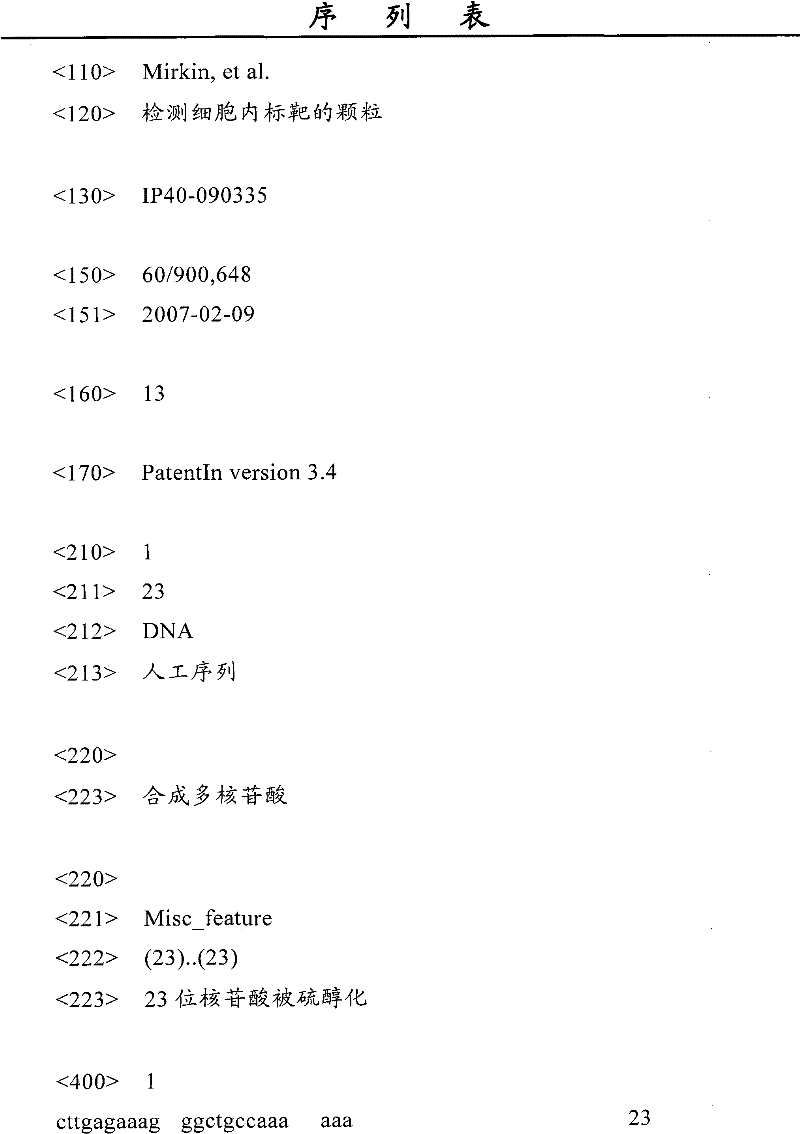


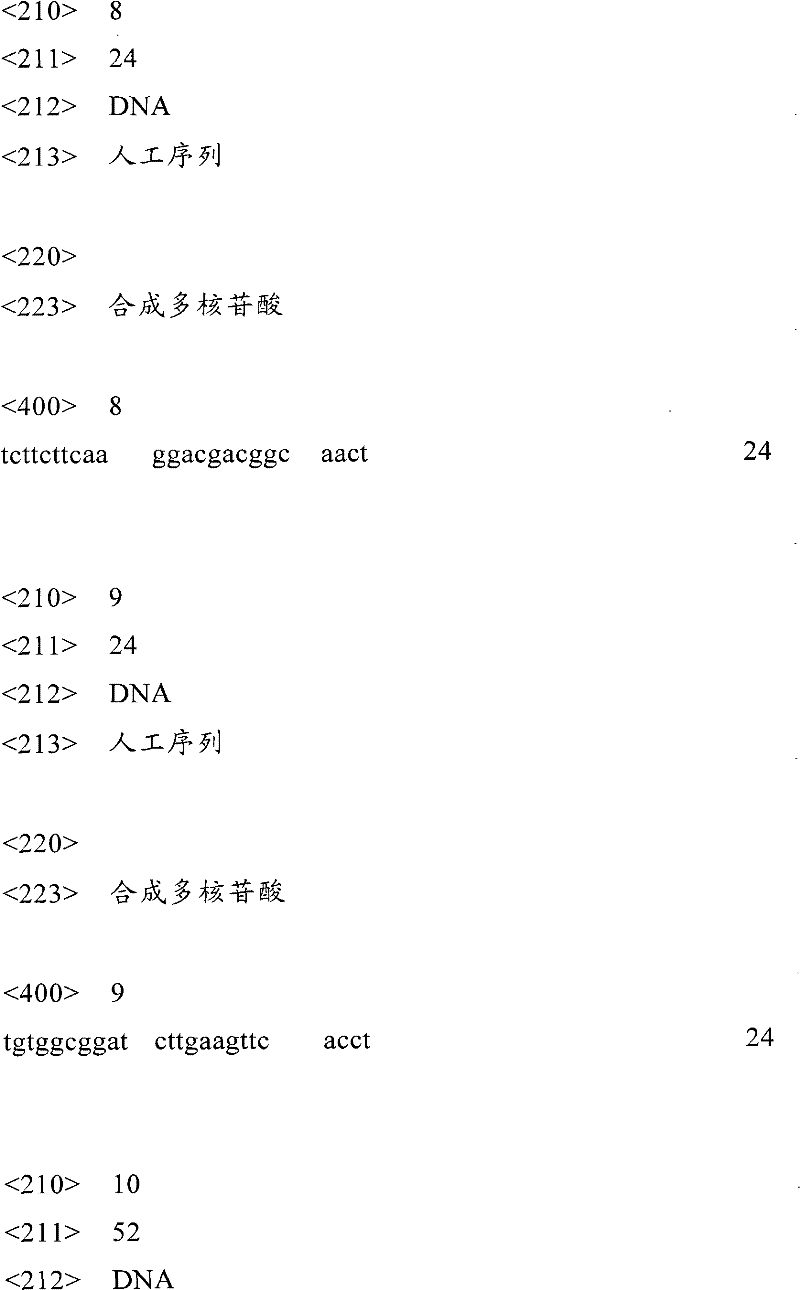
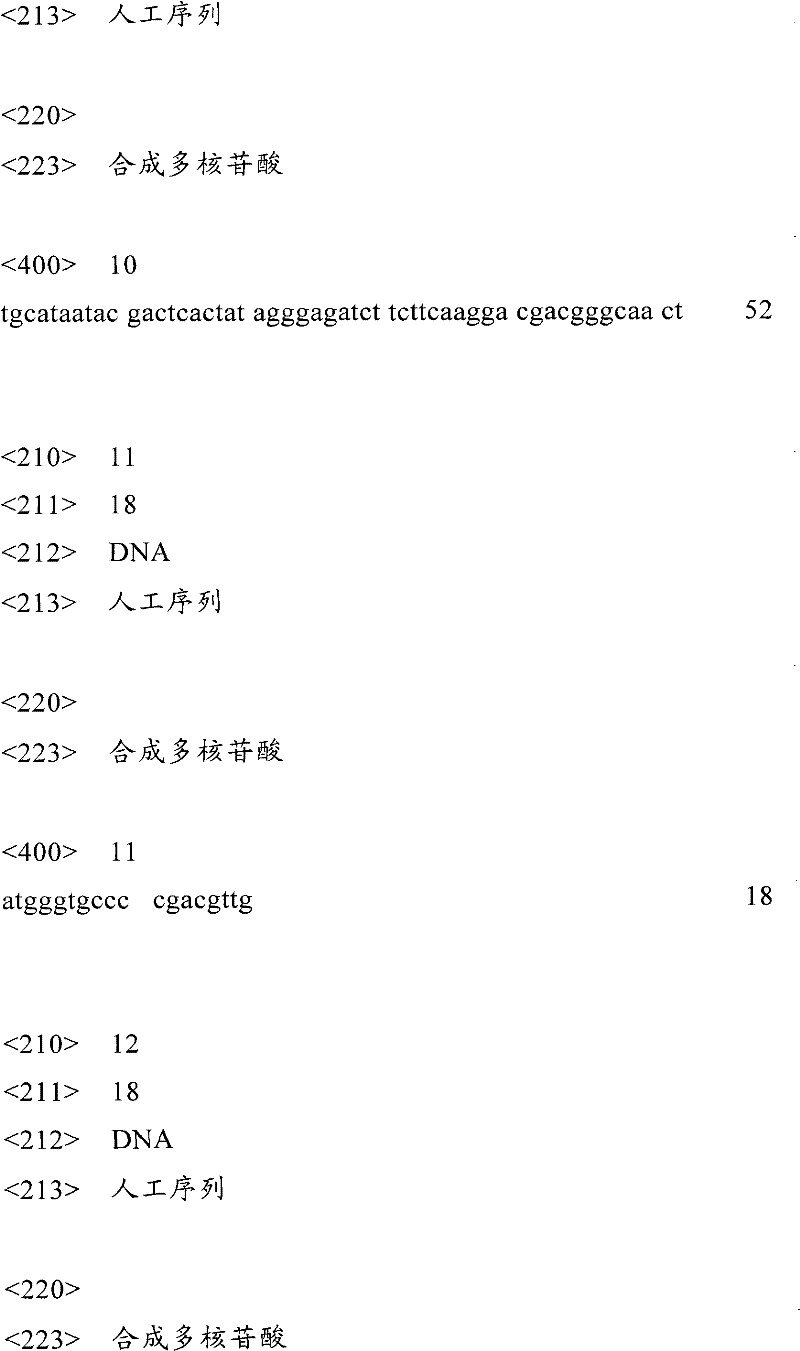
Claims (14)
Applications Claiming Priority (5)
| Application Number | Priority Date | Filing Date | Title |
|---|---|---|---|
| US90064807P | 2007-02-09 | 2007-02-09 | |
| US60/900,648 | 2007-02-09 | ||
| US95620507P | 2007-08-16 | 2007-08-16 | |
| US60/956,205 | 2007-08-16 | ||
| PCT/US2008/053603 WO2008098248A2 (en) | 2007-02-09 | 2008-02-11 | Particles for detecting intracellular targets |
Related Child Applications (1)
| Application Number | Title | Priority Date | Filing Date |
|---|---|---|---|
| CN201410230949.0A Division CN103966345A (en) | 2007-02-09 | 2008-02-11 | Particles for detecting intracellular targets |
Publications (2)
| Publication Number | Publication Date |
|---|---|
| CN102137936A true CN102137936A (en) | 2011-07-27 |
| CN102137936B CN102137936B (en) | 2016-11-30 |
Family
ID=
Cited By (2)
| Publication number | Priority date | Publication date | Assignee | Title |
|---|---|---|---|---|
| CN109765164A (en) * | 2018-03-06 | 2019-05-17 | 中国科学院高能物理研究所 | A method for absolute quantitative detection of gold nanorods in single cells |
| CN114354591A (en) * | 2022-01-10 | 2022-04-15 | 军事科学院军事医学研究院环境医学与作业医学研究所 | Colorimetric/fluorescent dual-mode biosensing detection method for rapidly detecting aflatoxin B1 |
Citations (1)
| Publication number | Priority date | Publication date | Assignee | Title |
|---|---|---|---|---|
| CN1672052A (en) * | 2002-06-27 | 2005-09-21 | 佐治亚技术研究公司 | Nano-sized optical fluorescence labels and uses thereof |
Patent Citations (1)
| Publication number | Priority date | Publication date | Assignee | Title |
|---|---|---|---|---|
| CN1672052A (en) * | 2002-06-27 | 2005-09-21 | 佐治亚技术研究公司 | Nano-sized optical fluorescence labels and uses thereof |
Non-Patent Citations (2)
| Title |
|---|
| DWIGHT S. SEFEROS ET AL.: "Nano-Flares: Probes for Transfection and mRNA Detection in Living Cells", 《J. AM. CHEM. SOC.》 * |
| RAJ A ET AL.: "Stochastic mRNA synthesis in mammalian cells", 《PLOS BIOL.》 * |
Cited By (3)
| Publication number | Priority date | Publication date | Assignee | Title |
|---|---|---|---|---|
| CN109765164A (en) * | 2018-03-06 | 2019-05-17 | 中国科学院高能物理研究所 | A method for absolute quantitative detection of gold nanorods in single cells |
| CN114354591A (en) * | 2022-01-10 | 2022-04-15 | 军事科学院军事医学研究院环境医学与作业医学研究所 | Colorimetric/fluorescent dual-mode biosensing detection method for rapidly detecting aflatoxin B1 |
| CN114354591B (en) * | 2022-01-10 | 2023-06-02 | 军事科学院军事医学研究院环境医学与作业医学研究所 | Colorimetric/fluorescent double-mode biosensing detection method for rapidly detecting aflatoxin B1 |
Also Published As
| Publication number | Publication date |
|---|---|
| EP2121987B1 (en) | 2012-06-13 |
| JP2010520990A (en) | 2010-06-17 |
| CA2691066C (en) | 2018-07-31 |
| CA2691066A1 (en) | 2008-08-14 |
| US20100129808A1 (en) | 2010-05-27 |
| AU2008212820A1 (en) | 2008-08-14 |
| KR101488800B1 (en) | 2015-02-04 |
| KR20090125088A (en) | 2009-12-03 |
| WO2008098248A3 (en) | 2008-11-06 |
| US8507200B2 (en) | 2013-08-13 |
| US9890427B2 (en) | 2018-02-13 |
| JP5512285B2 (en) | 2014-06-04 |
| EP2121987A2 (en) | 2009-11-25 |
| CN103966345A (en) | 2014-08-06 |
| AU2008212820B2 (en) | 2014-01-30 |
| MX2009008470A (en) | 2009-11-26 |
| WO2008098248A2 (en) | 2008-08-14 |
| US20130288253A1 (en) | 2013-10-31 |
Similar Documents
| Publication | Publication Date | Title |
|---|---|---|
| US9890427B2 (en) | Particles for detecting intracellular targets | |
| US10370661B2 (en) | Nucleic acid functionalized nanoparticles for therapeutic applications | |
| KR101692880B1 (en) | Polyvalent rna-nanoparticle compositions | |
| US20100021894A1 (en) | Nanoparticle-Based Colorimetric Detection Of Cysteine | |
| US20090104614A1 (en) | Quantitative molecular probes | |
| US20110111974A1 (en) | Short Duplex Probes for Enhanced Target Hybridization | |
| US20120244230A1 (en) | Polyvalent polynucleotide nanoparticle conjugates as delivery vehicles for a chemotherapeutic agent | |
| US20090221095A1 (en) | Colorimetric Screening of DNA Binding/Intercalating Agents with Gold Nanoparticle Probes | |
| US20130101512A1 (en) | Crosslinked polynucleotide structure | |
| WO2015012912A2 (en) | Alkyne phosphoramidites and preparation of spherical nucleic acid constructs | |
| Wu et al. | Sticky-flares for in situ monitoring of human telomerase RNA in living cells | |
| US7807372B2 (en) | Screening sequence selectivity of oligonucleotide-binding molecules using nanoparticle based colorimetric assay | |
| US20160281086A1 (en) | Quantification and spatio-temporal tracking of a target using a spherical nucleic acid (sna) | |
| Huang et al. | Highly sensitive fluorescence quantification of intracellular telomerase activity by repeat G-rich DNA enhanced silver nanoclusters | |
| US20090239762A1 (en) | Aptamers that bind abnormal cells | |
| CN102137936B (en) | Particles that detect intracellular targets | |
| WO2011017691A2 (en) | Enhanced molecular detection of targeted intracellular mrna transcription using polynucleotide functionalized nanoparticles | |
| Du et al. | Fluorescent Platforms for RNA Chemical Biology Research. Genes 2022, 13, 1348 | |
| CN120775951A (en) | Layered microenvironment response type self-analysis DNAzyme nano antenna and preparation method and application thereof |
Legal Events
| Date | Code | Title | Description |
|---|---|---|---|
| C06 | Publication | ||
| PB01 | Publication | ||
| C10 | Entry into substantive examination | ||
| SE01 | Entry into force of request for substantive examination | ||
| C14 | Grant of patent or utility model | ||
| GR01 | Patent grant | ||
| CF01 | Termination of patent right due to non-payment of annual fee | ||
| CF01 | Termination of patent right due to non-payment of annual fee |
Granted publication date: 20161130 Termination date: 20200211 |