CN102137875B - Preparation of exoolefin-terminated polyolefins by quenching with alkoxysilanes or ethers - Google Patents
Preparation of exoolefin-terminated polyolefins by quenching with alkoxysilanes or ethers Download PDFInfo
- Publication number
- CN102137875B CN102137875B CN2009801267604A CN200980126760A CN102137875B CN 102137875 B CN102137875 B CN 102137875B CN 2009801267604 A CN2009801267604 A CN 2009801267604A CN 200980126760 A CN200980126760 A CN 200980126760A CN 102137875 B CN102137875 B CN 102137875B
- Authority
- CN
- China
- Prior art keywords
- polyolefine
- concentration
- quencher
- ether
- lewis acid
- Prior art date
- Legal status (The legal status is an assumption and is not a legal conclusion. Google has not performed a legal analysis and makes no representation as to the accuracy of the status listed.)
- Expired - Fee Related
Links
Classifications
-
- C—CHEMISTRY; METALLURGY
- C08—ORGANIC MACROMOLECULAR COMPOUNDS; THEIR PREPARATION OR CHEMICAL WORKING-UP; COMPOSITIONS BASED THEREON
- C08F—MACROMOLECULAR COMPOUNDS OBTAINED BY REACTIONS ONLY INVOLVING CARBON-TO-CARBON UNSATURATED BONDS
- C08F8/00—Chemical modification by after-treatment
-
- C—CHEMISTRY; METALLURGY
- C08—ORGANIC MACROMOLECULAR COMPOUNDS; THEIR PREPARATION OR CHEMICAL WORKING-UP; COMPOSITIONS BASED THEREON
- C08F—MACROMOLECULAR COMPOUNDS OBTAINED BY REACTIONS ONLY INVOLVING CARBON-TO-CARBON UNSATURATED BONDS
- C08F110/00—Homopolymers of unsaturated aliphatic hydrocarbons having only one carbon-to-carbon double bond
- C08F110/04—Monomers containing three or four carbon atoms
- C08F110/08—Butenes
- C08F110/10—Isobutene
-
- C—CHEMISTRY; METALLURGY
- C08—ORGANIC MACROMOLECULAR COMPOUNDS; THEIR PREPARATION OR CHEMICAL WORKING-UP; COMPOSITIONS BASED THEREON
- C08F—MACROMOLECULAR COMPOUNDS OBTAINED BY REACTIONS ONLY INVOLVING CARBON-TO-CARBON UNSATURATED BONDS
- C08F8/00—Chemical modification by after-treatment
- C08F8/26—Removing halogen atoms or halogen-containing groups from the molecule
-
- C—CHEMISTRY; METALLURGY
- C08—ORGANIC MACROMOLECULAR COMPOUNDS; THEIR PREPARATION OR CHEMICAL WORKING-UP; COMPOSITIONS BASED THEREON
- C08F—MACROMOLECULAR COMPOUNDS OBTAINED BY REACTIONS ONLY INVOLVING CARBON-TO-CARBON UNSATURATED BONDS
- C08F2810/00—Chemical modification of a polymer
- C08F2810/30—Chemical modification of a polymer leading to the formation or introduction of aliphatic or alicyclic unsaturated groups
-
- C—CHEMISTRY; METALLURGY
- C08—ORGANIC MACROMOLECULAR COMPOUNDS; THEIR PREPARATION OR CHEMICAL WORKING-UP; COMPOSITIONS BASED THEREON
- C08F—MACROMOLECULAR COMPOUNDS OBTAINED BY REACTIONS ONLY INVOLVING CARBON-TO-CARBON UNSATURATED BONDS
- C08F2810/00—Chemical modification of a polymer
- C08F2810/40—Chemical modification of a polymer taking place solely at one end or both ends of the polymer backbone, i.e. not in the side or lateral chains
Landscapes
- Chemical & Material Sciences (AREA)
- Health & Medical Sciences (AREA)
- Chemical Kinetics & Catalysis (AREA)
- Medicinal Chemistry (AREA)
- Polymers & Plastics (AREA)
- Organic Chemistry (AREA)
- General Chemical & Material Sciences (AREA)
- Compositions Of Macromolecular Compounds (AREA)
- Addition Polymer Or Copolymer, Post-Treatments, Or Chemical Modifications (AREA)
- Transition And Organic Metals Composition Catalysts For Addition Polymerization (AREA)
- Silicon Polymers (AREA)
Abstract
Provided herein are methods for preparing a polyolefin containing one or more exo-olefinic end groups located on a polyolefin chain, the method comprising quenching an ionized polyolefin with an alkoxysilane or an ether. In some embodiments, the method is represented by scheme I below. In some embodiments, the alkoxysilane or ether compound has the following formula II, wherein Y is carbon or silicon; r1Is a hydrocarbyl group; r2-R4Each independently hydrogen or a hydrocarbyl group.
Description
1. field
This paper provides the polyolefinic method for the preparation of outer olefin terminated.
2. background technology
The polyolefine of outer olefin terminated such as polyisobutene (PIB) are the useful precursors that preparation contains the polymkeric substance of specific functionality end group.Particularly, outer alkene (exo-olefin) end group can be transformed into other special functional end group.The polymkeric substance that contains special end group has several useful purposes.For example, PIB base succinimide dispersants is as engine lubricant.Therefore, the polyolefinic method that needs selectivity or monopoly ground to produce outer olefin terminated.
3. general introduction
In one embodiment, this paper provides the polyolefinic method that is positioned at the one or more outer alkene end group on the polyolefin chain for the preparation of containing, and the method comprises with organoalkoxysilane or ether quencher ionization polyolefine.In some embodiments, the method is by following graphic representation:

Wherein R is hydrogen or alkyl.In some embodiments, R is alkyl.
In some embodiments, organoalkoxysilane or ether compound have following formula:

Wherein Y is carbon or silicon;
R
1Be alkyl, R
2-R
4Be H or alkyl independently of one another.
In some embodiments, the polyolefine that contains one or more outer alkene end groups of formation is at least 98 % by mole of whole products.
4. describe in detail
4.1 definition
Unless otherwise defined, all technology used herein have the implication identical with the common implication of understanding of those skilled in the art with scientific terminology.Have for term used herein in the situation of various definitions, except as otherwise noted, otherwise be as the criterion with the definition that is provided in this part.
As used herein, " alcohol " refers to have the compound of following formula:
R-OH
Wherein R is aliphatic hydrocarbyl, and-OH can be connected to primary, on the second month in a season or the tertiary carbon.
As used herein, " alkyl " refers to contain carbochain or the group of 1~20 carbon or 1~16 carbon.This chain or group can be straight or branched.Exemplary alkyl herein includes but not limited to methyl, ethyl, propyl group, sec.-propyl, isobutyl-, normal-butyl, sec-butyl, the tertiary butyl, isopentyl, neo-pentyl, tert-pentyl or isohexyl.As used herein, " low alkyl group " refers to have 1 carbon atom~approximately carbochain or the group of 6 carbon atoms.
As used herein, " thiazolinyl " refers to contain carbochain or the group of 2~20 carbon or 2~16 carbon, and wherein said chain contains one or more pairs of keys.Example includes but not limited to allyl group.Two keys of thiazolinyl carbochain or group can with another unsaturated group conjugation.Can be with one or more heteroatoms substituted alkenyl carbochains or group.Thiazolinyl carbochain or group can contain one or more triple bonds.
As used herein, " alkynyl " refers to contain carbochain or the group of 2~20 carbon or 2~16 carbon, and wherein said chain contains one or more triple bonds.Example includes but not limited to propargyl.The triple bond of alkynyl carbochain or group can with another unsaturated group conjugation.Can be with one or more heteroatoms substituted alkynyl carbochains or group.Alkynyl carbochain or group can contain one or more pairs of keys.
As used herein, " aryl " refers to contain monocycle or the polycyclic aromatic group of 6~approximately 30 carbon atoms.Aryl includes but not limited to the fluorenyl that does not for example replace or replace, the phenyl that does not replace or replace, or the naphthyl that does not replace or replace.
As used herein, " alkaryl " refers to the aryl with at least one alkyl, alkenyl or alkynyl replacement.
As used herein, " aralkyl " refers to alkyl, the alkenyl or alkynyl with at least one aryl replacement.
As used herein, " organoalkoxysilane " refers to contain the compound of the Siliciumatom of at least one and at least one alkoxyl group bonding.
As used herein, " amine " refers to have the compound of following formula:
R
3-NR
1R
2
R wherein
1, R
2And R
3Be hydrogen or alkyl independently of one another.
As used herein, " carbocation " and " carbonium ion " refers to positively charged carbon atom.
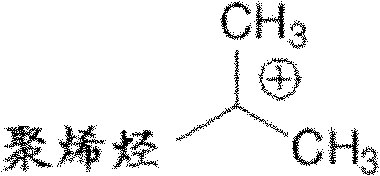
As used herein, " polyolefine of carbocation end-blocking " refers to contain the polyolefine of at least one carbocation end group.Example includes but not limited to have the compound of following formula:
As used herein, " end of the chain concentration " refers to the summation of the volumetric molar concentration of carbocation and nonactive end group.When using the simple function initiator, end of the chain concentration approximates initiator concentration.For Multifunctional initiator, when the functionality of initiator equals x, then end of the chain concentration approximate initiator concentration x doubly.
As used herein, " be coupled polyolefine " and refer to the polyolefine of carbocation end-blocking and the product of another kind of polyolefine addition.
As used herein, " thinner " refers to liquid diluent or compound.Thinner can be the mixture of individualized compound or two or more compounds.Thinner can dissolve or be partly dissolved reactive component fully.Example includes but not limited to hexane or methyl chloride or their mixture.
As used herein, " electron donor " refers to provide to another molecule the molecule of electron pair.Example include but not limited to can with the molecule of Lewis acid complexing.Other example includes but not limited to alkali and/or nucleophile.Other example includes but not limited to can extract or remove the molecule of deprotonation.Other example includes but not limited to pyridine derivate.
As used herein, " ether " refers to have the compound of following formula:
R
1-O-R
2
R wherein
1And R
2Be alkyl independently of one another.
" outer alkene end group " or " end group of outer alkene " refer to the terminal olefin part as used herein.
As used herein, " polyolefine of outer olefin terminated " refers to contain the polyolefine of at least one outer alkene end group.Example includes but not limited to have the compound of following formula:
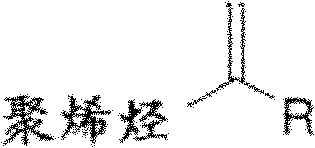
Wherein R is hydrogen or alkyl.In some embodiments, R is alkyl.
As used herein, " halogenide ", " halo " or " halogen " refer to F, Cl, Br or I.
As used herein, " alkyl " refers to only contain monovalence, linearity, side chain or the cyclic group of carbon and hydrogen atom.
As used herein, " initiator " refers to provide the compound of carbocation.Example includes but not limited to have the compound of one or more carbocation precursor group.Initiator can be simple function or polyfunctional.As used herein, " simple function initiator " to refer to provide with respect to initiator be the about initiator of the carbocation of a stoichiometry equivalent.As used herein, " Multifunctional initiator " refers to provide with respect to initiator is the about initiator of the carbocation of x stoichiometry equivalent, and wherein x represents the functionality of initiator.When using the simple function initiator, end of the chain concentration approximates the concentration of initiator.For Multifunctional initiator, when the functionality of initiator equals x, then end of the chain concentration equal initiator concentration x doubly.
As used herein, " ionization polyolefine " refers to contain the polyolefine of at least one carbonium ion.Example includes but not limited to be ionized into the polyolefine of the polyolefinic uncle's halogenide of positively charged ion end-blocking.Other example includes but not limited to accurate activated carbon positively charged ion polyolefine.Other example includes but not limited to be ionized into the polyolefine of ionization polyolefine or the polyolefinic outer olefin terminated of accurate activated carbon positively charged ion.Other example includes but not limited to be ionized into accurate activated carbon positively charged ion polyolefine or the polyolefinic polyolefine that contains alkene of positively charged ion.
As used herein, " Lewis acid " refers to accept the chemical entity of electron pair.Example includes but not limited to titanium tetrachloride.
As used herein, " monomer " refers to be combined with carbocation the alkene that forms another kind of carbocation.Example includes but not limited to iso-butylene.
As used herein, the ratio of the molecular fractions of products " all " mole numbers of referring to the concrete product that reacts and the mole number of whole products of reaction multiply by 100 and the value that obtains.
As used herein, " polyolefine " refers to comprise the polymkeric substance of at least two olefinic monomers.Example includes but not limited to polyisobutene.
As used herein, " pyridine derivate " refers to have the compound of following formula:
R wherein
1, R
2, R
3, R
4And R
5Be hydrogen or alkyl independently of one another; Or R
1And R
2, or R
2And R
3, or R
3And R
4, or R
4And R
5Form independently about 4-approximately 7 carbon atoms condense aliphatic series ring or the about about fused aromatic ring of 7 carbon atoms of 5-.Example includes but not limited to 2,6-lutidine.
As used herein, " accurate Living Cationic Vinyl Polymerization condition " refers to so that form the polyolefinic polymerizing condition of accurate activated carbon positively charged ion.
As used herein, " accurate activated carbon positively charged ion polyolefine " refers to form under accurate living polymerization condition and is to increase active carbocation polyolefine in the presence of olefinic type monomers.
As used herein, " accurate living polymerization " refers to that wherein the speed of irreversible chain-breaking reaction is zero or low-down carbon cation polymerization with respect to the speed that increases.Carry out accurate living polymerization by initiation and also then increase, wherein increase (activity) polymer chain and non-growth (nonactive) polymer chain Fast-Balance.
As used herein, " accurate living polymerization condition " refers to so that carry out the reaction conditions of accurate living polymerization.
As used herein, " quencher " refer to the reaction of carbonium ion and quencher.
As used herein, " quencher " refer to can be separately or with the mode of another kind of compound combination and the compound of carbonium ion reaction.
As used herein, " terminator " refers to stop by lewis acidic inactivation the compound of polymerization.
As used herein, " polyolefine of uncle's halogenide end-blocking " refers to contain the polyolefine of at least one uncle's halogenide end group.Example includes but not limited to have the compound of following formula:
Wherein X is halogen.
4.2 method
This paper provides the polyolefinic method that is positioned at the one or more outer alkene end group on the polyolefin chain for the preparation of containing, and the method comprises with organoalkoxysilane or ether quencher ionization polyolefine.In some embodiments, the polyolefine that the method that provides by this paper prepares contains an outer alkene end group that is positioned on the polyolefin chain.The polyolefine of the method preparation that provides by this paper in some embodiments, contain be positioned on the polyolefin chain more than one outer alkene end group.In some embodiments, described method is by following graphic representation:
In some embodiments, described method is carried out in thinner.In some embodiments, use multiple organoalkoxysilane.In some embodiments, use multiple ether.
In some embodiments of methods described herein, quencher is organoalkoxysilane or ether.Be not intended to be bound by any theory, in some embodiments, quencher is the complex compound that two kinds of compounds or atom form.
Be not intended to be bound by any theory, in some embodiments, quencher is organoalkoxysilane and lewis acidic complex compound.Be not intended to be bound by any theory, in some embodiments, quencher is the complex compound of organoalkoxysilane and titanium tetrahalide.Be not intended to be bound by any theory, in some embodiments, quencher is the complex compound of organoalkoxysilane and titanium tetrachloride.Be not intended to be bound by any theory, in some embodiments, quencher is allyloxy three silicomethanes, ethoxytrimethylsilane or methoxytrimethylsilane and lewis acidic complex compound.Be not intended to be bound by any theory, in some embodiments, quencher is the complex compound of allyloxy three silicomethanes, ethoxytrimethylsilane or methoxytrimethylsilane and titanium tetrahalide.Be not intended to be bound by any theory, in some embodiments, quencher is the complex compound of allyloxy three silicomethanes, ethoxytrimethylsilane or methoxytrimethylsilane and titanium tetrachloride.Be not intended to be bound by any theory, in some embodiments, quencher is the complex compound of ethoxytrimethylsilane and titanium tetrachloride.Be not intended to be bound by any theory, in some embodiments, quencher is organoalkoxysilane and lewis acidic 1: 1 stoichiometry complex compound.Be not intended to be bound by any theory, in some embodiments, quencher is 1: 1 stoichiometry complex compound of organoalkoxysilane and titanium tetrahalide.Be not intended to be bound by any theory, in some embodiments, quencher is 1: 1 stoichiometry complex compound of alkoxyl group trimethyl silane and titanium tetrachloride.Be not intended to be bound by any theory, in some embodiments, quencher is 1: 1 stoichiometry complex compound of ethoxytrimethylsilane and titanium tetrachloride.Be not intended to be bound by any theory, in some embodiments, quencher is the compound with following formula:

R wherein
1-R
4Be alkyl.
Be not intended to be bound by any theory, in some embodiments, quencher is the compound with following formula:
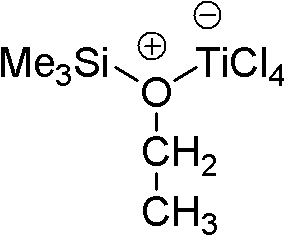
Be not intended to be bound by any theory, in some embodiments, quencher is organoalkoxysilane.Be not intended to be bound by any theory, in some embodiments, quencher is allyloxy three silicomethanes, ethoxytrimethylsilane or methoxytrimethylsilane.
Be not intended to be bound by any theory, in some embodiments, quencher is ether and lewis acidic complex compound.Be not intended to be bound by any theory, in some embodiments, quencher is the complex compound of ether and titanium tetrahalide.Be not intended to be bound by any theory, in some embodiments, quencher is the complex compound of ether and titanium tetrachloride.Be not intended to be bound by any theory, in some embodiments, quencher is the complex compound of tertiary butyl ethyl ether or t-butyl methyl ether and titanium tetrahalide.Be not intended to be bound by any theory, in some embodiments, quencher is the complex compound of tertiary butyl ethyl ether or t-butyl methyl ether and titanium tetrachloride.
Be not intended to be bound by any theory, in some embodiments, play the quencher carbonium ion more than a kind of quencher.For example, in the situation of organoalkoxysilane, can use the mixture quencher carbonium ion of free (free) organoalkoxysilane and compound (complexed) organoalkoxysilane.
Be not intended to be bound by any theory, in some embodiments, electron donor is quencher.Be not intended to be bound by any theory, in some embodiments, pyridine derivate is quencher.Be not intended to be bound by any theory, in some embodiments, 2,6-lutidine is quencher.
In some embodiments, be approximately 1 minute-Yue 90 minutes quench time.In some embodiments, quench time was greater than 60 minutes.In some embodiments, be approximately 5 minutes quench time.In some embodiments, be approximately 10 minutes quench time.In some embodiments, be approximately 15 minutes quench time.In some embodiments, be approximately 20 minutes quench time.In some embodiments, be approximately 25 minutes quench time.In some embodiments, be approximately 30 minutes quench time.In some embodiments, be approximately 35 minutes quench time.In some embodiments, be approximately 40 minutes quench time.In some embodiments, be approximately 45 minutes quench time.In some embodiments, be approximately 50 minutes quench time.In some embodiments, be approximately 55 minutes quench time.In some embodiments, be approximately 60 minutes quench time.
In some embodiments, in approximately-150 ℃ quencher reaction to the temperature approximately-30 ℃.In some embodiments, in approximately-150 ℃ quencher reaction to the temperature approximately-40 ℃.In some embodiments, in approximately-100 ℃ quencher reaction to the temperature approximately-30 ℃.In some embodiments, in approximately-100 ℃ quencher reaction to the temperature approximately-40 ℃.In some embodiments, in approximately-90 ℃ quencher reaction to the temperature approximately-60 ℃.In some embodiments, quencher reaction under temperature approximately-100 ℃.In some embodiments, quencher reaction under temperature approximately-90 ℃.In some embodiments, quencher reaction under temperature approximately-80 ℃.In some embodiments, quencher reaction under temperature approximately-70 ℃.In some embodiments, quencher reaction under temperature approximately-60 ℃.In some embodiments, quencher reaction under temperature approximately-55 ℃.In some embodiments, quencher reaction under temperature approximately-50 ℃.In some embodiments, quencher reaction under temperature approximately-45 ℃.In some embodiments, quencher reaction under temperature approximately-40 ℃.In some embodiments, quencher reaction under temperature approximately-35 ℃.In some embodiments, quencher reaction under temperature approximately-30 ℃.
In some embodiments, reaction mixture does not have coloured precipitation to a great extent with the polyolefin product of separating.
4.2.1 quencher
The various embodiments of quencher used herein have been described herein.Being combined in the scope of the present disclosure of all these embodiments.
(a) organoalkoxysilane
In some embodiments, organoalkoxysilane has following formula:
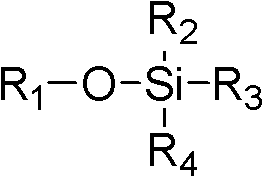
R wherein
1Be alkyl; R
2-R
4Be hydrogen or alkyl independently of one another.
In some embodiments, organoalkoxysilane has following formula:
Wherein:
R
1Alkyl, thiazolinyl, alkynyl, aryl, alkaryl or aralkyl; With
R
2, R
3And R
4Be hydrogen, alkyl, thiazolinyl, alkynyl, aryl, alkaryl or aralkyl independently of one another, or R
2And R
3, or R
2And R
4, or R
3And R
4Form independently have about 3-approximately 7 carbon atoms condense the aliphatic series ring.
In some embodiments, R
1Alkyl, thiazolinyl, alkynyl, aryl, alkaryl or aralkyl.In some embodiments, R
1Alkyl, thiazolinyl, alkynyl, or aralkyl.In some embodiments, R
1Alkyl, alkenyl or alkynyl.In some embodiments, R
1It is alkyl.In some embodiments, R
1It is low alkyl group.
In some embodiments, R
1Methyl, ethyl or allyl group.In some embodiments, R
1It is methyl.In some embodiments, R
1It is ethyl.In some embodiments, R
1It is allyl group.
In some embodiments, R
2, R
3And R
4Be hydrogen, alkyl, thiazolinyl, alkynyl, aryl, alkaryl or aralkyl independently of one another, or R
2And R
3, or R
2And R
4, or R
3And R
4Form independently have about 3-approximately 7 carbon atoms condense the aliphatic series ring.In some embodiments, R
2, R
3And R
4Be hydrogen, alkyl, thiazolinyl, alkynyl or aralkyl independently of one another, or R
2And R
3, or R
2And R
4, or R
3And R
4Form independently have about 3-approximately 7 carbon atoms condense the aliphatic series ring.In some embodiments, R
2, R
3And R
4Be hydrogen, alkyl, alkenyl or alkynyl independently of one another.In some embodiments, R
2, R
3And R
4Be hydrogen or alkyl independently of one another.In some embodiments, R
2, R
3And R
4Be alkyl independently of one another.In some embodiments, R
2, R
3And R
4Be low alkyl group independently of one another.In some embodiments, R
2, R
3And R
4The methyl of respectively doing for oneself.In some embodiments, R
2, R
3And R
4The hydrogen of respectively doing for oneself.In some embodiments, R
2-R
4In one be hydrogen, and other two are methyl.
In some embodiments, organoalkoxysilane is monoalkoxy silane, dialkoxy silicane, trialkoxy silane or tetraalkoxysilane.In some embodiments, organoalkoxysilane is monoalkoxy trialkyl silane, dialkoxy dialkyl silane, tri-alkoxy monoalkyl silane or tetraalkoxysilane.In some embodiments, organoalkoxysilane is monoalkoxy trialkyl silane or dialkoxy dialkyl silane.In some embodiments, organoalkoxysilane is monoalkoxy trialkyl silane.In some embodiments, organoalkoxysilane is monoalkoxy trimethyl silane, monoalkoxy tripropyl silane or monoalkoxy tributyl silane.In some embodiments, organoalkoxysilane is the monoalkoxy trimethyl silane.
In some embodiments, organoalkoxysilane is allyloxy three silicomethanes, ethoxytrimethylsilane or methoxytrimethylsilane.In some embodiments, organoalkoxysilane is allyloxy three silicomethanes.In some embodiments, organoalkoxysilane is ethoxytrimethylsilane.In some embodiments, organoalkoxysilane is methoxytrimethylsilane.
(b) ether
In some embodiments, ether has following formula:
R
1-O-R
2
R wherein
1And R
2Be alkyl independently of one another.
In some embodiments, ether has following formula:
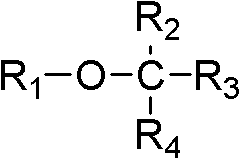
R wherein
1Be alkyl, R
2-R
4Be hydrogen or alkyl independently of one another.
In some embodiments, ether has following formula:
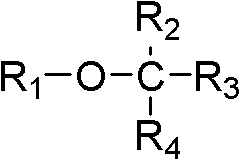
Wherein:
R
1Alkyl, thiazolinyl, alkynyl, aryl, alkaryl or aralkyl; With
R
2, R
3And R
4Be hydrogen, alkyl, thiazolinyl, alkynyl, aryl, alkaryl or aralkyl independently of one another, or R
2And R
3, or R
2And R
4, or R
3And R
4Form independently have about 3-approximately 7 carbon atoms condense the aliphatic series ring.
In some embodiments, R
1Alkyl, thiazolinyl, alkynyl, aryl, alkaryl or aralkyl.In some embodiments, R
1Alkyl, thiazolinyl, alkynyl or aralkyl.In some embodiments, R
1Alkyl, alkenyl or alkynyl.In some embodiments, R
1It is alkyl.In some embodiments, R
1It is low alkyl group.In some embodiments, R
1Methyl, ethyl or allyl group.In some embodiments, R
1It is methyl.In some embodiments, R
1It is ethyl.In some embodiments, R
1It is allyl group.
In some embodiments, R
2, R
3And R
4Be hydrogen, alkyl, thiazolinyl, alkynyl, aryl, alkaryl or aralkyl independently of one another, or R
2And R
3, or R
2And R
4, or R
3And R
4Form independently have about 3-approximately 7 carbon atoms condense the aliphatic series ring.In some embodiments, R
2, R
3And R
4Be hydrogen, alkyl, thiazolinyl, alkynyl or aralkyl independently of one another, or R
2And R
3, or R
2And R
4, or R
3And R
4Form independently have about 3-approximately 7 carbon atoms condense the aliphatic series ring.In some embodiments, R
2, R
3And R
4Be hydrogen, alkyl, alkenyl or alkynyl independently of one another.In some embodiments, R
2, R
3And R
4Be hydrogen or alkyl independently of one another.In some embodiments, R
2, R
3And R
4Be alkyl independently of one another.In some embodiments, R
2, R
3And R
4Be low alkyl group independently of one another.In some embodiments, R
2, R
3And R
4The methyl of respectively doing for oneself.In some embodiments, R
2, R
3And R
4The hydrogen of respectively doing for oneself.
In some embodiments, ether is sec.-propyl alkyl oxide, sec-butyl alkyl oxide, isobutyl-alkyl oxide or tertiary butyl alkyl oxide.In some embodiments, ether is dialkyl ether.In some embodiments, ether is Anaesthetie Ether or dipropyl ether.In some embodiments, ether is tertiary butyl alkyl oxide.
In some embodiments, ether is tert pentyl methyl ether, isopropyl methyl ether, sec.-propyl ethyl ether, sec-butyl methyl ether, sec-butyl ethyl ether, isobutyl-methyl ether, isobutyl-ethyl ether, t-butyl methyl ether or tertiary butyl ethyl ether.In some embodiments, ether is tertiary butyl ethyl ether or t-butyl methyl ether.In some embodiments, ether is tertiary butyl ethyl ether.In some embodiments, ether is t-butyl methyl ether.
4.2.2 ionization polyolefine
Can prepare the ionization polyolefine by the known any means of those skilled in the art.Example includes but not limited to, with Lewis acid uncle's halogenide is carried out ionization; With Lewis acid prefabricated polyolefine is carried out ionization; Or under accurate Living Cationic Vinyl Polymerization condition, olefinic monomer is carried out polymerization.
In some embodiments, the ionization polyolefine is the polyolefine of carbocation end-blocking.In some embodiments, the ionization polyolefine contains one or more carbocation end groups.In some embodiments, the ionization polyolefine contains a carbocation end group.In some embodiments, the ionization polyolefine contains two carbocation end groups.In some embodiments, the ionization polyolefine contains three carbocation end groups.In some embodiments, the ionization polyolefine is the polyisobutene with positively charged ion end group.In some embodiments, the ionization polyolefine is the compound with following formula:

(a) be derived from the halid ionization polyolefine of uncle
In some embodiments, the ionization polyolefine derives from the polyolefine of uncle's halogenide end-blocking.In some embodiments, the ionization polyolefine derives from the polyolefine of uncle's muriate end-blocking, the polyolefine of uncle's bromide end-blocking or the polyolefine of uncle's iodide end-blocking.In some embodiments, the ionization polyolefine derives from the polyolefine of uncle's muriate end-blocking or the polyolefine of uncle's bromide end-blocking.In some embodiments, the ionization polyolefine derives from uncle's muriate polyolefine.
In some embodiments, contact with Lewis acid by the polyolefine with uncle's halogenide end-blocking and produce the ionization polyolefine.In some embodiments, the polyolefine of the polyolefine of the polyolefine by uncle's muriate end-blocking, uncle's bromide end-blocking or uncle's iodide end-blocking contacts with Lewis acid and produces the ionization polyolefine.In some embodiments, the polyolefine by uncle's muriate end-blocking contacts with Lewis acid and produces the ionization polyolefine.
In some embodiments, this Lewis acid is aprotic acid.In some embodiments, this Lewis acid is metal halide or non-metallic halide.In some embodiments, this Lewis acid is metal halide.In some embodiments, this Lewis acid is the halogenide of titanium (IV), the halogenide of zinc (II), the halogenide of tin (IV) or the halogenide of aluminium (III).In some embodiments, this Lewis acid is the halogenide of titanium (IV).In some embodiments, this Lewis acid is the halogenide of tin (IV).In some embodiments, this Lewis acid is the halogenide of aluminium (III).In some embodiments, this Lewis acid is titanium tetrabromide or titanium tetrachloride.In some embodiments, this Lewis acid is titanium tetrachloride.In some embodiments, this Lewis acid is zinc chloride.In some embodiments, this Lewis acid is ethyl aluminum dichloride.In some embodiments, this Lewis acid is non-metallic halide.In some embodiments, Lewis acid is the halogenide of antimony (VI), the halogenide of gallium (III) or the halogenide of boron (III).In some embodiments, Lewis acid is boron trichloride.In some embodiments, Lewis acid is titanium tetrahalide, boron trihalides, aluminum chloride, tin tetrachloride, zinc chloride or ethyl aluminum dichloride.In some embodiments, Lewis acid is titanium tetrachloride, titanium tetrabromide or boron trichloride.
(b) be derived from prefabricated polyolefinic ionization polyolefine
In some embodiments, the ionization polyolefine derives from prefabricated polyolefine.In some embodiments, this prefabricated polyolefine contains one or more pairs of keys.In some embodiments, this prefabricated polyolefine contains a two key.In some embodiments, this prefabricated polyolefine is derivatives of poly (iso) butene.In some embodiments, this prefabricated polyolefine contains one or more interior (endo) alkene.
In some embodiments, produce the ionization polyolefine by Lewis acid with prefabricated polyolefinic the contact.In some embodiments, produce the ionization polyolefine by the prefabricated polyolefine that contains one or more pairs of keys with lewis acidic the contact.In some embodiments, produce the ionization polyolefine by the prefabricated polyolefine that contains two keys with lewis acidic the contact.In some embodiments, produce the ionization polyolefine by derivatives of poly (iso) butene with lewis acidic the contact.In some embodiments, produce the ionization polyolefine by the prefabricated polyolefine that contains one or more internal olefins with lewis acidic the contact.
(c) the ionization polyolefine that under accurate Living Cationic Vinyl Polymerization condition, is obtained by olefinic type monomers
In some embodiments, under accurate activated carbon positively charged ion condition, obtain the ionization polyolefine by olefinic type monomers.Under this condition, produce accurate activated carbon positively charged ion polyolefine.This condition can obtain by the known any means of those skilled in the art.In some embodiments, use monomer, initiator and Lewis acid.In some embodiments, the ionization polyolefine activated carbon positively charged ion polyisobutene that is as the criterion.In some embodiments, this accurate activated carbon positively charged ion polyolefine is the compound with following formula:
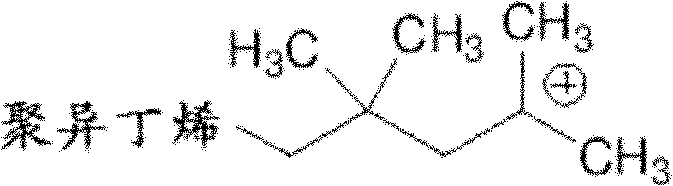
(i) initiator
In some embodiments, initiator is compound or the polyolefine with one or more uncle's end groups.In some embodiments, initiator has uncle's end group.In some embodiments, initiator has the uncle's end group more than.
In some embodiments, initiator for have formula (X '-CR
aR
b)
nR
cCompound, R wherein
a, R
bAnd R
cComprise independently at least a in alkyl, aryl, the kiki fang alkyl group and it can be identical or different, X ' is acetate moiety, alkoxyl group (etherate), hydroxyl or halogen.In some embodiments, R
cValency with n, and n is the integer of 1-4.In some embodiments, R
a, R
bAnd R
cFor containing the alkyl of 20 carbon atoms of 1 carbon atom-Yue.In some embodiments, R
a, R
bAnd R
cFor containing the alkyl of 8 carbon atoms of 1 carbon atom-Yue.In some embodiments, X ' is halogen.In some embodiments, X ' is chlorine.In some embodiments, R
a, R
bAnd R
cStructure similar with growth species or monomer.In some embodiments, this structure is 1-styroyl derivative for polystyrene, perhaps be 2,4,4-tri-methyl-amyl derivative for polyisobutene.In some embodiments, initiator is cumyl, diisopropylbenzyl or tri-isopropyl benzene base halogenide.In some embodiments, use muriate.In some embodiments, initiator is 2-chloro-2-phenyl-propane, i.e. cumyl muriate; Isosorbide-5-Nitrae-two (2-chloro-2-propyl group) benzene, i.e. two (cumyl muriates); 1,3,5-three (2-chloro-2-propyl group) benzene, i.e. three (cumyl muriates); 2,4,4-trimethylammonium-2-chloropentane; 2-ethanoyl-2-phenyl-propane, i.e. acetic acid isopropyl phenyl ester; 2-propionyl-2-phenyl-propane, i.e. propionic acid isopropyl phenyl ester; 2-methoxyl group-2-phenyl-propane, i.e. cumyl methyl ether; Isosorbide-5-Nitrae-two (2-methoxyl group-2-propyl group) benzene, i.e. two (cumyl methyl ethers); Or 1,3,5-three (2-methoxyl group-2-propyl group) benzene, i.e. three (cumyl methyl ethers).In some embodiments, initiator is 2-chloro-2,4,4-trimethylpentane (TMPCl), 1,3-two (2-chloro-2-propyl group) benzene, 1,3,5-three (2-chloro-2-propyl group) benzene or 1,3 ,-two (2-chloro-2-propyl group)-5-tert.-butylbenzenes (bDCC).
In some embodiments, initiator is simple function, difunctionality or polyfunctional.In some embodiments, initiator is simple function.In some embodiments, initiator is 2-chloro-2-phenyl-propane, 2-ethanoyl-2-phenyl-propane, 2-propionyl-2-phenyl-propane, 2-methoxyl group-2-phenyl-propane, 2-oxyethyl group-2-phenyl-propane, 2-chloro-2,4; 4-trimethylpentane, 2-ethanoyl-2; 4,4 ,-trimethylpentane, 2-propionyl-2; 4; 4-trimethylpentane, 2-methoxyl group-2,4,4-trimethylpentane or 2-oxyethyl group-2; 4,4-trimethylpentane.In some embodiments, initiator is 2-chloro-2,4, the 4-trimethylpentane.
In some embodiments, initiator is dual functional.In some embodiments, initiator is 1,3-two (2-chloro-2-propyl group) benzene, 1,3-two (2-methoxyl group-2-propyl group) benzene, 1,4-two (2-chloro-2-propyl group) benzene, 1,4-two (2-methoxyl group-2-propyl group) benzene or the 5-tertiary butyl-1,3 ,-two (2-chloro-2-propyl group) benzene.In some embodiments, initiator is the 5-tertiary butyl-1,3 ,-two (2-chloro-2-propyl group) benzene.
In some embodiments, initiator is polyfunctional.In some embodiments, initiator is 1,3,5-three (2-chloro-2-propyl group) benzene or 1,3,5-three (2-methoxyl group-2-propyl group) benzene.
(ii) monomer
In some embodiments, monomer is the hydro carbons monomer, namely only contains the compound of hydrogen and carbon atom, and described monomer includes but not limited to alkene and diolefine and has approximately approximately those compounds of 20 carbon atoms of 2-.In some embodiments, this compound has approximately approximately 8 carbon atoms of 4-.
In some embodiments, can use herein described method that this class monomer is carried out polymerization has different molecular weight with preparation polymkeric substance.In some embodiments, can use described method herein this class monomer to be carried out that polymerization has difference with preparation but the uniform polymkeric substance of molecular weight.In some embodiments, this molecular weight is that approximately 300-surpasses 1000000g/mol.In some embodiments, this polymkeric substance be have the low-molecular-weight liquid of about 200-10000g/mol or sticky polymers or for solid wax with about 100000-1000000g/mol or above molecular weight to plastics or elastomer material.
In some embodiments, described monomer is the substitution compound of the material of iso-butylene, vinylbenzene, beta-pinene, isoprene, divinyl or aforesaid kind.In some embodiments, monomer is iso-butylene, 2-methyl-1-butene alkene, 3-methyl-1-butene, 4-methyl-1-pentene or beta-pinene.In some embodiments, monomer is iso-butylene, 2-methyl-1-butene alkene, 3-methyl-1-butene or 4-methyl-1-pentene.In some embodiments, monomer is iso-butylene.
In some embodiments, can use the mixture of monomer namely to use more than a kind of monomer.
4.2.3 Lewis acid
In some embodiments, Lewis acid is aprotic acid.In some embodiments, Lewis acid is metal halide or non-metallic halide.In some embodiments, Lewis acid is metal halide.In some embodiments, Lewis acid is the halogenide of titanium (IV), the halogenide of zinc (II), the halogenide of tin (IV) or the halogenide of aluminium (III).In some embodiments, Lewis acid is the halogenide of titanium (IV).In some embodiments, the halogenide of tin (IV).In some embodiments, Lewis acid is the halogenide of aluminium (III).In some embodiments, Lewis acid is titanium tetrabromide or titanium tetrachloride.In some embodiments, Lewis acid is titanium tetrachloride.In some embodiments, Lewis acid is zinc chloride.In some embodiments, Lewis acid is ethyl aluminum dichloride.In some embodiments, Lewis acid is non-metallic halide.In some embodiments, Lewis acid is the halogenide of antimony (VI), the halogenide of gallium (III) or the halogenide of boron (III).In some embodiments, Lewis acid is boron trichloride.In some embodiments, Lewis acid is titanium tetrahalide, boron trihalides, aluminum chloride, tin tetrachloride, zinc chloride or ethyl aluminum dichloride.In some embodiments, Lewis acid is titanium tetrachloride, titanium tetrabromide or boron trichloride.
4.2.4 electron donor
As understood by one of ordinary skill in the art, some electron donors can be transformed into traditional polymerization system accurate active polymerization system.In some embodiments, in the presence of electron donor, implement described method herein.
In some embodiments, electron donor can with the Lewis acid complexing.In some embodiments, electron donor is alkali and/or nucleophile.In some embodiments, electron donor can extract or remove deprotonation.In some embodiments, electron donor is organic bases.In some embodiments, electron donor is acid amides.In some embodiments, electron donor is DMF, N,N-dimethylacetamide or N, the N-diethyl acetamide.In some embodiments, electron donor is sulfoxide.In some embodiments, electron donor is dimethyl sulfoxide (DMSO).In some embodiments, electron donor is ester.In some embodiments, electron donor is methyl acetate or ethyl acetate.In some embodiments, electron donor is phosphate compound.In some embodiments, electron donor is trimethyl phosphite 99, tributyl phosphate or hexamethyl phosphoric triamide (triamide hexamethylphosphate).In some embodiments, electron donor is oxygen containing metallic compound.In some embodiments, electron donor is titanium isopropylate.
In some embodiments, electron donor is pyridine or pyridine derivate.In some embodiments, electron donor is the compound with following formula:
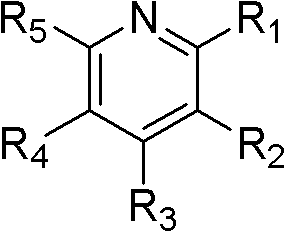
R wherein
1, R
2, R
3, R
4And R
5Be hydrogen or alkyl independently of one another; Or R
1And R
2, or R
2And R
3, or R
3And R
4, or R
4And R
5Form independently and have approximately the condensing the aliphatic series ring or have approximately the approximately fused aromatic ring of 7 carbon atoms of 5-of 7 carbon atoms of about 3-.In some embodiments, R
1And R
5Be alkyl independently of one another, and R
2-R
4Be hydrogen.
In some embodiments, electron donor is 2,6-, two-tert .-butylpyridine, 2,6-lutidine, 2,4-lutidine, 2,4,6-trimethylpyridine, 2-picoline or pyridine.In some embodiments, electron donor is DMA or N, N-dimethyl methyl aniline.In some embodiments, electron donor is 2,6-lutidine.
In some embodiments, use more than a kind of electron donor.
4.2.5 thinner
In some embodiments of methods described herein, in thinner, implement described method.In some embodiments, thinner is the mixture of individualized compound or two or more compounds.In some embodiments, the complete solubilizing reaction component of thinner or be partly dissolved reactive component.In some embodiments, thinner solubilizing reaction component fully or almost completely.In some embodiments, the complete solubilizing reaction component of thinner.In some embodiments, thinner solubilizing reaction component almost completely.
In some embodiments, thinner has low boiling point and/or low zero pour.In some embodiments, thinner is alkane, alkyl list halogenide or alkyl polyhalogenide.In some embodiments, thinner is normal alkane.In some embodiments, thinner is propane, normal butane, Skellysolve A, normal hexane, normal heptane, octane, positive nonane or n-decane.In some embodiments, thinner is branched alkane.In some embodiments, described alkane is Trimethylmethane, iso-pentane, neopentane, isohexane, 3-methylpentane, 2,2-dimethylbutane or 2,3-dimethylbutane.In some embodiments, thinner is haloalkane.In some embodiments, thinner is chloroform, monochloroethane, n-butyl chloride, methylene dichloride, methyl chloride, 1,2-ethylene dichloride, 1,1,2,2-tetrachloroethane, tetracol phenixin, 1,1-ethylene dichloride, normal propyl chloride, isopropyl chloride, 1,2-propylene dichloride or 1,3-propylene dichloride.In some embodiments, thinner is alkane or haloalkane.In some embodiments, thinner is vinylchlorid, 1,1-ethylene dichloride or 1,2-ethylene dichloride.In some embodiments, thinner is dithiocarbonic anhydride, sulfurous gas, acetic anhydride, acetonitrile, benzene, toluene, methylcyclohexane, chlorobenzene or nitro-paraffin.In some embodiments, thinner is the mixture of the compound in this section.
In some embodiments, thinner is the mixture of hexane and methyl chloride.In some embodiments, this mixture is the about about hexane/methyl chloride of 70/30 volume of 30/70-.In some embodiments, this mixture is the about about hexane/methyl chloride of 100/0 volume of 50/50-.In some embodiments, this mixture is the about hexane/methyl chloride of 60/40 volume.
4.2.6 temperature
In some embodiments, approximately-150 ℃ to temperature approximately-30 ℃, implementing described method herein.In some embodiments, temperature is for approximately-150 ℃ to approximately-40 ℃.In some embodiments, temperature is for approximately-100 ℃ to approximately-30 ℃.In some embodiments, temperature is for approximately-100 ℃ to approximately-40 ℃.In some embodiments, temperature is for approximately-90 ℃ to approximately-60 ℃.In some embodiments, temperature is for approximately-100 ℃.In some embodiments, temperature is for approximately-90 ℃.In some embodiments, temperature is for approximately-80 ℃.In some embodiments, temperature is for approximately-70 ℃.In some embodiments, temperature is for approximately-60 ℃.In some embodiments, temperature is for approximately-55 ℃.In some embodiments, temperature is for approximately-50 ℃.In some embodiments, temperature is for approximately-45 ℃.In some embodiments, temperature is for approximately-40 ℃.In some embodiments, temperature is for approximately-35 ℃.In some embodiments, temperature is for approximately-30 ℃.
Be not intended to be bound by any theory, in some embodiments, find that the interpolation of electron donor has improved the polyolefinic yield of outer olefin terminated.Be not intended to be bound by any theory, in some embodiments, when quencher occurs, find that the interpolation of electron donor has improved the polyolefinic yield of outer end-blocking under comparatively high temps (for example greater than-50 ℃).Be not intended to be bound by any theory, in some embodiments, when the lower generation of quencher comparatively high temps (for example greater than-50 ℃), find that the interpolation of 2,6-lutidine has improved the polyolefinic yield of outer end-blocking.In some embodiments, temperature of reaction is for approximately-50 ℃ to approximately-30 ℃, 2,6-lutidine concentration is about 0.05M, titanium tetrachloride concentration is about 0.2M, end of the chain concentration is about 0.035M, and ethoxytrimethylsilane concentration is about 0.1M, and the polyolefine of the outer olefin terminated that forms is at least 90 % by mole of whole products.
In some embodiments, exist down at 2,6 lutidine, approximately-70 ℃ to temperature approximately-30 ℃, implementing described method herein, and the polyolefine that contains one or more outer alkene end groups that forms is at least 90 % by mole of whole products.
In some embodiments, exist down at 2,6 lutidine, approximately-70 ℃ to temperature approximately-30 ℃, implementing described method herein, and the polyolefine that contains one or more outer alkene end groups that forms is at least 80 % by mole of whole products.
In some embodiments, exist down at 2,6 lutidine, approximately-70 ℃ to temperature approximately-30 ℃, implementing described method herein, and the polyolefine that contains one or more outer alkene end groups that forms is at least 70 % by mole of whole products.
4.2.7 concentration
In some embodiments, organoalkoxysilane or ether are pressed with respect to the excessive existence of end of the chain stoichiometry.In some embodiments, organoalkoxysilane or ether exist with the concentration that is lower than end of the chain concentration.
In some embodiments, organoalkoxysilane approximately exists under the concentration of 10 times of end of the chain concentration at about 1.1-.In some embodiments, organoalkoxysilane exists under the concentration of about 0.7 times of-7.5 times of end of the chain concentration.In some embodiments, organoalkoxysilane exists under the concentration of about 0.85-6 times of end of the chain concentration.In some embodiments, organoalkoxysilane approximately 1.5 times-Yue exist under the concentration of 7.5 times of end of the chain concentration.In some embodiments, organoalkoxysilane approximately 2 times-Yue exist under the concentration of 6 times of end of the chain concentration.In some embodiments, organoalkoxysilane approximately 2 times-Yue exist under the concentration of 4 times of end of the chain concentration.In some embodiments, organoalkoxysilane approximately 2 times-Yue exist under the concentration of 3 times of end of the chain concentration.In some embodiments, organoalkoxysilane exists under the concentration of about 1.5 times of end of the chain concentration.In some embodiments, organoalkoxysilane exists under the concentration of about 2 times of end of the chain concentration.In some embodiments, organoalkoxysilane exists under the concentration of about 3 times of end of the chain concentration.In some embodiments, organoalkoxysilane exists under the concentration of about 4 times of end of the chain concentration.In some embodiments, organoalkoxysilane exists under the concentration of about 5 times of end of the chain concentration.In some embodiments, organoalkoxysilane exists under the concentration of about 6 times of end of the chain concentration.In some embodiments, organoalkoxysilane exists under the concentration of about 7 times of end of the chain concentration.In some embodiments, organoalkoxysilane exists under the concentration of about 0.7 times of end of the chain concentration.In some embodiments, organoalkoxysilane exists under the concentration of about 0.8 times of end of the chain concentration.In some embodiments, organoalkoxysilane exists under the concentration of about 0.85 times of end of the chain concentration.In some embodiments, organoalkoxysilane exists under the concentration of about 0.9 times of end of the chain concentration.In some embodiments, organoalkoxysilane exists under the concentration of about 0.95 times of end of the chain concentration.In some embodiments, organoalkoxysilane exists under the concentration that approximates end of the chain concentration.
In some embodiments, ether approximately exists under the concentration of 10 times of end of the chain concentration at about 1.1-.In some embodiments, ether exists under the concentration of about 0.7 times of-7.5 times of end of the chain concentration.In some embodiments, ether exists under the concentration of about 0.85-6 times of end of the chain concentration.In some embodiments, ether approximately 1.5 times-Yue exist under the concentration of 7.5 times of end of the chain concentration.In some embodiments, ether approximately 2 times-Yue exist under the concentration of 6 times of end of the chain concentration.In some embodiments, ether approximately exists under the concentration of 4 times of end of the chain concentration at about 2-.In some embodiments, ether approximately exists under the concentration of 3 times of end of the chain concentration at about 2-.In some embodiments, ether exists under the concentration of about 1.5 times of end of the chain concentration.In some embodiments, ether exists under the concentration of about 2 times of end of the chain concentration.In some embodiments, ether exists under the concentration of about 3 times of end of the chain concentration.In some embodiments, ether exists under the concentration of about 4 times of end of the chain concentration.In some embodiments, ether exists under the concentration of about 5 times of end of the chain concentration.In some embodiments, ether exists under the concentration of about 6 times of end of the chain concentration.In some embodiments, ether exists under the concentration of about 7 times of end of the chain concentration.In some embodiments, ether exists under the concentration of about 0.7 times of end of the chain concentration.In some embodiments, ether exists under the concentration of about 0.8 times of end of the chain concentration.In some embodiments, ether exists under the concentration of about 0.85 times of end of the chain concentration.In some embodiments, ether exists under the concentration of about 0.9 times of end of the chain concentration.In some embodiments, ether exists under the concentration of about 0.95 times of end of the chain concentration.In some embodiments, ether concentration approximates end of the chain concentration.
In some embodiments, organoalkoxysilane approximately exists under the concentration of 4 times of Lewis acid concentration at about 0.15-.In some embodiments, organoalkoxysilane approximately exists under the concentration of 3 times of Lewis acid concentration at about 0.5-.In some embodiments, organoalkoxysilane approximately exists under the concentration of 2 times of Lewis acid concentration at about 0.75-.In some embodiments, the concentration of organoalkoxysilane is about 0.5 times of Lewis acid concentration.In some embodiments, the concentration of organoalkoxysilane is about 0.75 times of Lewis acid concentration.In some embodiments, the concentration of organoalkoxysilane approximates Lewis acid concentration.In some embodiments, the concentration of organoalkoxysilane is about 0.2 times of Lewis acid concentration.In some embodiments, the concentration of organoalkoxysilane is about 0.3 times of Lewis acid concentration.In some embodiments, the concentration of organoalkoxysilane is about 0.4 times of Lewis acid concentration.In some embodiments, the concentration of organoalkoxysilane is about 0.5 times of Lewis acid concentration.In some embodiments, the concentration of organoalkoxysilane is about 0.6 times of Lewis acid concentration.In some embodiments, the concentration of organoalkoxysilane is about 0.7 times of Lewis acid concentration.In some embodiments, the concentration of organoalkoxysilane is about 0.8 times of Lewis acid concentration.In some embodiments, the concentration of organoalkoxysilane is about 0.9 times of Lewis acid concentration.In some embodiments, the concentration of organoalkoxysilane is about 1.0 times of Lewis acid concentration.In some embodiments, the concentration of organoalkoxysilane is about 1.5 times of Lewis acid concentration.In some embodiments, the concentration of organoalkoxysilane is about 2 times of Lewis acid concentration.In some embodiments, the concentration of organoalkoxysilane is about 2.5 times of Lewis acid concentration.In some embodiments, the concentration of organoalkoxysilane is about 3 times of Lewis acid concentration.
In some embodiments, ether approximately exists under the concentration of 4 times of Lewis acid concentration at about 0.15-.In some embodiments, ether approximately exists under the concentration of 3 times of Lewis acid concentration at about 0.5-.In some embodiments, ether approximately exists under the concentration of 2 times of Lewis acid concentration at about 0.75-.In some embodiments, ether concentration is about 0.5 times of Lewis acid concentration.In some embodiments, ether concentration is about 0.75 times of Lewis acid concentration.In some embodiments, ether concentration approximates Lewis acid concentration.In some embodiments, ether concentration is about 0.2 times of Lewis acid concentration.In some embodiments, ether concentration is about 0.3 times of Lewis acid concentration.In some embodiments, ether concentration is about 0.4 times of Lewis acid concentration.In some embodiments, ether concentration is about 0.5 times of Lewis acid concentration.In some embodiments, ether concentration is about 0.6 times of Lewis acid concentration.In some embodiments, ether concentration is about 0.7 times of Lewis acid concentration.In some embodiments, ether concentration is about 0.8 times of Lewis acid concentration.In some embodiments, ether concentration is about 0.9 times of Lewis acid concentration.In some embodiments, ether concentration is about 1.0 times of Lewis acid concentration.In some embodiments, ether concentration is about 1.5 times of Lewis acid concentration.In some embodiments, ether concentration is about 2 times of Lewis acid concentration.In some embodiments, ether concentration is about 2.5 times of Lewis acid concentration.In some embodiments, ether concentration is about 3 times of Lewis acid concentration.
In some embodiments, approximately implement described method herein under the end of the chain concentration of 0.2M at about 0.005M-.In some embodiments, approximately implement described method herein under the end of the chain concentration of 0.14M at about 0.010M-.In some embodiments, approximately implement described method herein under the end of the chain concentration of 0.10M at about 0.014M-.In some embodiments, approximately implement described method herein under the end of the chain concentration of 0.040M at about 0.014M-.
In some embodiments, end of the chain concentration is the about about 0.15M of 0.10M-, and the polyolefine of the outer olefin terminated that forms is at least 70 % by mole of whole products.In some embodiments, end of the chain concentration is the about about 0.15M of 0.10M-, and the polyolefine of the outer olefin terminated that forms is at least 80 % by mole of whole products.In some embodiments, end of the chain concentration is the about about 0.15M of 0.10M-, and the polyolefine of the outer olefin terminated that forms is at least 90 % by mole of whole products.
In some embodiments, add Lewis acid in two or more aliquot modes.In some embodiments, add Lewis acid with two aliquots.In some embodiments, during polyreaction, add lewis acidic the first aliquot, and between the quencher reaction period, add lewis acidic the second aliquot.In some embodiments, during polyreaction, add the first aliquot of titanium tetrachloride, and between the quencher reaction period, add the second aliquot.Be not intended to be bound by any theory, if implement the organoalkoxysilane quencher by direct polymerization (than the re-initiation of uncle's muriate polyisobutene) original position, for (prior) polyreaction in early stage, best TiCl
4Concentration may be too high; This frequent generation for the reaction with relatively high end of the chain concentration.When this happens, polymerization shows too fastly and/or excessive heat release.In such circumstances, in some embodiments, lewis acidic low concentration the first aliquot can be used for polymerization, after adding organoalkoxysilane or ether, can add lewis acidic the second aliquot so that total Lewis acid concentration is brought up to total Lewis acid concentration best for quencher.
In some embodiments, after adding, Lewis acid adds organoalkoxysilane.In some embodiments, after adding, Lewis acid adds ether.In some embodiments, before adding, Lewis acid adds organoalkoxysilane.In some embodiments, before adding, Lewis acid adds ether.
4.2.8 outer olefine selective
In some embodiments, described method optionally provides the polyolefine of outer olefin terminated herein.In some embodiments, the polyolefine of outer olefin terminated, the polyolefine that contains internal olefin, uncle's halogenide polyolefine and coupling polyolefine are reaction product.In some embodiments, the polyolefine of outer olefin terminated is primary product, and the polyolefine, uncle's halogenide polyolefine and the coupling polyolefine that contain internal olefin are secondary products.
In some embodiments, the polyolefine of the outer olefin terminated of formation is at least 40 % by mole of whole products.In some embodiments, the polyolefine of the outer olefin terminated of formation is at least 50 % by mole of whole products.In some embodiments, the polyolefine of the outer olefin terminated of formation is at least 60 % by mole of whole products.In some embodiments, the polyolefine of the outer olefin terminated of formation is at least 75 % by mole of whole products.In some embodiments, the polyolefine of the outer olefin terminated of formation is at least 85 % by mole of whole products.In some embodiments, the polyolefine of the outer olefin terminated of formation is at least 90 % by mole of whole products.In some embodiments, the polyolefine of the outer olefin terminated of formation is at least 95 % by mole of whole products.In some embodiments, the polyolefine of the outer olefin terminated of formation is at least 97 % by mole of whole products.In some embodiments, the whole products of polyolefine of the outer olefin terminated of formation is at least 98 % by mole.
4.2.9 terminator
In some embodiments, terminator is the compound that can make the Lewis acid inactivation.In some embodiments, terminator is alkali and/or nucleophile.In some embodiments, terminator is alkali.In some embodiments, terminator is electron donor.In some embodiments, terminator is organic bases.In some embodiments, terminator is alcohol or amine.In some embodiments, terminator is alcohol.In some embodiments, terminator is pyridine derivate.
In some embodiments, terminator is methyl alcohol, ethanol or Virahol.In some embodiments, terminator is methyl alcohol.In some embodiments, terminator is water.In some embodiments, terminator is diethylamine, triethylamine, pyridine, 2,6-lutidine, n-Butyl Amine 99 or uncle's amylamine.
In some embodiments, after the quencher step, add terminator.
5. embodiment
5.1 abbreviation definition
As used herein, " allyloxy TMS " and " AOTMS " refer to allyloxy three silicomethanes.
As used herein, " be coupled (coupled) " and refer to be coupled polyolefine.
As used herein, " CE " refers to the end of the chain.
As used herein, " DI " refers to deionized.
As used herein, " interior (endo) " refers to contain the polyolefine of internal olefin.
As used herein, " oxyethyl group TMS " and " EtOTMS " refer to ethoxytrimethylsilane.
As used herein, " outer (exo) " refers to the polyolefine of outer olefin terminated.
As used herein, " GPC " refers to gel permeation chromatography.
As used herein, " GPC-MALLS " refers to gel permeation chromatography-multi-angle laser light scattering.
As used herein, " oneself (hex) " refers to hexane.
As used herein, " IB " refers to iso-butylene.
As used herein, " 26Lut " refers to 2,6-lutidine.
As used herein, " MeCl " refers to methyl chloride.
As used herein, " MeOH " refers to methylol.
As used herein, " methoxyl group TMS " and " MeOTMS " refer to methoxytrimethylsilane.
As used herein, " M
n" refer to number-average molecular weight.
As used herein, " M
w" refer to weight-average molecular weight.
As used herein, " NMR " refers to nucleus magnetic resonance.
As used herein, " PDI " refers to heterogeneity index.
As used herein, " PIB " refers to polyisobutene.
As used herein, " RT " refers to room temperature.
As used herein, " uncle's halogenide " refers to uncle's halogenide polyolefine.
As used herein, " uncle Cl " refers to the polyolefine of uncle's muriate end-blocking.
As used herein, " TMPCl " refers to 2-chloro-2,4, the 4-trimethylpentane.
" x CE " refers to x times of end of the chain concentration as used herein.For example, " 2x CE " refers to 2 times of end of the chain concentration.
5.2 embodiment 1
This embodiment relates in single reactor makes the IB direct polymerization with the original position quencher by TMPCl.Quencher is allyloxy three silicomethanes.Used condition is as follows:
[TMPCl]=0.014M
[IB]=0.5M
[TiCl
4]=0.083M
[allyloxy TMS]=0.019M
-60℃
60/40(v/v)Hex/MeCl
For this polymerization and all polymerizations subsequently described herein, use real-time attenuated total reflectance attenuated total refraction (ATR) Fourier transform infrared (FTIR) spectrography to monitor conversion of monomer.Use is furnished with (the ASI Applied Systems of ReactIR 4000 response analysis systems (photoconduction cast) of DiComp (diamond composite) insertion probe and universal PR-11 platinum-resistance thermometer, Millersville, MD) the real-time collecting spectrogram.By the monitoring with IB=CH
2Wave the relevant 887cm that concentrates on
-1Absorption area (2 baselines top) assaying reaction transformation efficiency.
Converging operationJu Hecaozuo is as follows: make the DiComp probe tips of the 250mL glass reactor of being furnished with overhead type mechanical stirrer and platinum-resistance thermometer and ReactIR 4000 adaptive, and this assembly is immersed in-60 ℃ of constant temperature heptane body lotions in glove box.In this reactor, add 114.0mL hexane, 76.0mL MeCl, 0.48mL (2.8mmol, 0.014M) TMPCl and 0.23mL (2.0mmol, 0.01M) 26Lut.Stir this mixture to realize thermal equilibrium, obtain the solvent background spectrum and with it from all spectrum strippings subsequently.At this moment, before adding, obtains continuously monomer the FTIR data to establish solvent with reference to absorption area A
rThen, in reactor, add IB 8.18mL (0.5M), set up thermal equilibrium, before causing, again obtain data, to establish and the concentration dependent initial absorption area A of initial monomer
oThen adding coinitiator in the reactor is 1.82mL (0.017 mole, 0.083M, 6xCE) TiCl
4(approach or be in room temperature).Obtain continuously the FTIR data, press and calculate in real time monomer conversion shown in the equation 1.
A wherein
tAt 887cm
-1Instantaneous absorption area.Carry out polyreaction until the front aliquot of quencher is taken out in fully IB conversion.Then add 0.66mL (3.9mmol, 0.019M, 1.4xCE) AOTMS (room temperature) and regularly take out aliquot, after 60 minute quench time, add the MeOH of precooling with termination reaction.When taking out from loft drier, allow the reaction mixture that stops be warmed to room temperature.Hexane (1-2mL) is joined before the described quencher in (prequench) aliquot sample and other aliquot sample and final polymer samples, then make polymer precipitation in MeOH.Stir PIB that (eddy current) reclaim to remove any residual pollutent with fresh MeOH, then decant goes out MeOH.Before NMR analyzes, sample is carried out drying with gaseous nitrogen atmosphere.
The NMR of sample analyzes and obtains following mole end group composition (%) before the quencher:
Outer (Exo) 2
Uncle Cl 98
Be coupled 0
The NMR of sample analyzes and obtains following mole end group composition (%) after the final quencher:
Outer 96
Uncle Cl 2
Be coupled 2
5.3 embodiment 2
This embodiment relates in single reactor makes the IB direct polymerization with the original position quencher by TMPCl.Quencher is methoxyl group three silicomethanes.Used condition is as follows:
[TMPCl]=0.014M
[IB]=0.5M
[TiCl
4]=0.084M
[methoxyl group TMS]=0.028M
-60℃
60/40(v/v)Hex/MeCl
Operate as follows: in glove box, make the 250mL glass reactor of stirring reach balance at-60.8 ℃.In this reactor, add 90.9mL hexane, 60.6mL MeCl, 0.38mL (2.2mmol, 0.014M) (0.013 mole of TMPCl, 6.54mL (0.5M) IB, 0.06mL (0.003M) 26Lut and 1.47mL, 0.084M, 6xCE) TiCl
4Carry out polyreaction 20 minutes, and took out the front aliquot of quencher, then add 0.62mL (4.5mmol, 0.028M, 2xCE) MeOTMS (room temperature).The temperature of reaction mixture rises to-59.8 ℃ peak value and then descends gradually.Regularly take out aliquot, after 60 minute quench time, add the MeOH of precooling with termination reaction.When taking out from loft drier, allow the reaction mixture that stops be warmed to room temperature.Hexane (1-2mL) is joined in the front aliquot sample of described quencher and other aliquot sample and the final polymer samples, then make polymer precipitation in MeOH.Stir PIB that (eddy current) reclaim to remove any residual pollutent with fresh MeOH, then decant goes out MeOH.Before NMR analyzes, sample is carried out drying with gaseous nitrogen atmosphere.
The NMR of sample analyzes and obtains following mole end group composition (%) before the quencher:
Outer 1
Uncle Cl 99
Be coupled 0
The NMR of sample analyzes and obtains following mole end group composition (%) after the final quencher:
Outer 98
Uncle Cl 1
Be coupled 1
5.4 embodiment 3
This embodiment relates to through separating and the again ionization with the PIB sample of uncle's muriate end group of purifying.Quencher is ethoxytrimethylsilane.
The PIB for preparing uncle's muriate end-blocking according to following operation: in-75 ℃ of constant temperature heptane/hexane body lotions in the 1000mL glass reactor immersion glove box that stirs.Add in this flask 654.5mL MeCl, 6.12mL (0.036 mole, 0.045M) TMPCl, 0.58mL (4.9mmol, 0.0062M) 26Lut, 97.2mL (1.2 moles, 1.5M) IB and 41.6mL (0.53 mole, 0.68M) BCl
3(pure).Approximately in 5 hours polyreaction reach high IB transformation efficiency (~99%), add excessive precooling MeOH termination reaction by careful this moment.The reaction mixture that stops is transferred in the 1000mL beaker, and allowed solvent evaporation spend the night.Also use MeOH and weak acid water washing several times with hexane diluted polymer and residual non-volatile matter.At MgSO
4The above stirs polymers soln to remove any residual water, carries out drying by the filtering separation polymkeric substance and with it in vacuum chamber under room temperature.The theoretical M of masterbatch polymkeric substance
nBe 2,049g/mol, using dn/dc is that 0.110 product GPC-MALLS analyzes and obtains M
n=1,890g/mol and M
w/ M
n=1.01.By the 9.54g polymer dissolution is produced the material solution of masterbatch polymkeric substance in the 60mL hexane.Theoretical M based on polymkeric substance
n, the volumetric molar concentration of this solution is 0.067mol/l.
The NMR analysis that end group forms (%) obtains as follows:
Outer 9.1
Interior (Endo) 0
Uncle Cl 90.8
Be coupled 0.1
The used condition of quencher is as follows:
[CE]=0.037M
[oxyethyl group TMS]=0.28M
[TiCl
4]=0.23M
-70℃
60/40(v/v)Hex/MeCl
Be performed as follows quencher: in glove box, make the 50mL glass test tube reach balance at-70 ℃.Add PIB masterbatch solution, 4.0mL MeCl and 0.47mL (3.0mmol, 0.28M, the 7.5x[CE]) EtOTMS of 6.0mL 0.067M in this test tube, and allow these contents reach balance.Then add 0.27mL (2.5mmol, 0.23M, 6.1x[CE]) TiCl
4, and shake this test tube by manual timing.After 60 minute quench time, add the MeOH of precooling with termination reaction.When taking out from loft drier, allow the reaction mixture that stops be warmed to room temperature.Hexane (1-2mL) is joined in the polymkeric substance, then make polymer precipitation in MeOH.Stir PIB that (eddy current) reclaim to remove any residual pollutent with fresh MeOH, then decant goes out MeOH.Before NMR analyzes, sample is carried out drying with gaseous nitrogen atmosphere.
The NMR of sample analyzes and obtains following mole end group composition (%) after the final quencher:
Outer 97.1
Interior 1.9
Uncle Cl 0
Be coupled 1.0
5.5 embodiment 4
This embodiment relates to through separating and the again ionization with the PIB sample of uncle's muriate end group of purifying.Quencher is ethoxytrimethylsilane.
The PIB for preparing uncle's muriate end-blocking according to following operation: in glove box, make the 1000mL glass reactor of stirring reach balance at-60 ℃.In this reactor, add (0.034 mole of 361.3mL hexane, 240.9mL MeCl, 5.72mL, 0.045M) (0.17 mole of TMPCl, 122.7mL (2.0M) IB, 0.87mL (0.01M) 26Lut and 18.5mL, 0.22M, 5xCE) TiCl
4Carry out polyreaction 15 minutes, and reached-37.4 ℃ top temperature.After IB transforms fully, add the MeOH of precooling with termination reaction.When taking out from loft drier, allow the reaction mixture that stops be warmed to room temperature.Hexane is joined in the polymkeric substance, then use respectively MeOH, acid DI water and these solution several times of DI water washing.Before NMR and gpc analysis, final sample is at room temperature carried out drying to remove any residual solvent in vacuum.The theoretical M of masterbatch polymkeric substance
nBe 2,650g/mol, using dn/dc is that 0.111 product GPC-MALLS analyzes and obtains M
n=2,850g/mol and PDI=1.03.By the 11.553g polymer dissolution is produced the material solution of masterbatch polymkeric substance in the 60mL hexane.Theoretical M based on polymkeric substance
n, the volumetric molar concentration of this solution is 0.061mol/l.
The NMR analysis that end group forms (%) obtains as follows:
Outer 17.1
Interior 8.0
Uncle Cl 73.6
Be coupled 0.7
The used condition of quencher is as follows:
[CE]=0.035M
[oxyethyl group TMS]=0.096M
[TiCl
4]=0.19M
-60℃
60/40(v/v)Hex/MeCl
Be performed as follows quencher: in glove box, make the 50mL glass test tube reach balance at-70 ℃.Add PIB masterbatch solution, 4.0mL MeCl and 0.156mL (1.0mmol, 0.096M, the 2.7x[CE]) EtOTMS of 6.0mL 0.061M in this test tube, and allow these contents reach balance.Then add 0.22mL (2.0mmol, 0.19M, 5.5x[CE]) TiCl
4, and shake this test tube by manual timing.After 30 minute quench time, add the MeOH of precooling with termination reaction.When taking out from loft drier, allow the reaction mixture that stops be warmed to room temperature.Hexane (1-2mL) is joined in the polymkeric substance, then make polymer precipitation in MeOH.Stir PIB that (eddy current) reclaim to remove any residual pollutent with fresh MeOH, then decant goes out MeOH.Before NMR analyzes, sample is carried out drying with gaseous nitrogen atmosphere.
The NMR of sample analyzes and obtains following mole end group composition (%) after the final quencher:
Outer 90.1
Interior 9.9
Uncle Cl 0.0
Be coupled 0.0
5.6 embodiment 5
This embodiment relates in single reactor makes the IB direct polymerization with the original position quencher.Quencher is tertiary butyl ethyl ether.Used condition is as follows:
[TMPCl]=0.014M
[IB]=0.5M
[TiCl
4]=0.084M
[tertiary butyl ethyl ether]=0.028M
-60℃
60/40(v/v)Hex/MeCl
Be performed as follows quencher:
In glove box, make the 250mL glass reactor of stirring reach balance at-60 ℃.In this reactor, add 90.9mL hexane, 60.6mL MeCl, 0.38mL (2.2mmol, 0.014M) (0.013 mole of TMPCl, 6.54mL (0.5M) IB, 0.06mL (0.003M) 26Lut and 1.47mL, 0.084M, 6xCE) TiCl
4Carry out polyreaction 20 minutes, and then added 0.62mL (4.5mmol, 0.028M, 2xCE) tertiary butyl ethyl ether (room temperature).Regularly take out aliquot, after 60 minute quench time, add the MeOH of precooling with termination reaction.When taking out from loft drier, allow the reaction mixture that stops be warmed to room temperature.Hexane (1-2mL) is joined in described aliquot sample and the final polymer samples, then make polymer precipitation in MeOH.Stir PIB that (eddy current) reclaim to remove any residual pollutent with fresh MeOH, then decant goes out MeOH.Before NMR analyzes, sample is carried out drying with gaseous nitrogen atmosphere.
The NMR of sample analyzes and obtains following mole end group composition (%) after the final quencher:
Outer 83
Uncle Cl 14
Be coupled 3
5.7 embodiment 6
This embodiment relates in single reactor makes the IB direct polymerization with the original position quencher.Quencher is oxyethyl group three silicomethanes.Used condition is as follows:
Polymerization:
[TMPCl]=0.13M
[IB]=5.2M
[TiCl
4]=0.032M
Quencher:
[CE]=0.10M
[TiCl
4]=0.83M
[oxyethyl group TMS]=0.63M
In glove box, make the 1000mL glass reactor of stirring reach balance at-77.3 ℃.In this reactor, add (0.096 mole of 253.9mL hexane, 169.3mL MeCl, 16.4mL, 0.13M) (0.024 mole of TMPCl, 306.7mL (5.2M) IB, 1.05mL (0.012M) 26Lut and 2.6mL, 0.032M, 0.25xCE) TiCl
4Carry out polyreaction 100 minutes, and reached-61.2 ℃ maximum temperature.When the temperature of reactor content falls back to-70.4 ℃, take out aliquot before the quencher, then add 90.0mL (0.58 mole, 6xCE) EtOTMS (slightly cold), then add immediately 81.7mL (0.75 mole, 7.72xCE) TiCl
4(pure, RT).The temperature of reaction mixture rises to-52.1 ℃ peak value and then descends gradually.Regularly take out aliquot, after 30 minute quench time, add the MeOH of precooling with termination reaction.As if reacting phase is worked as viscous, but stop fully after MeOH adds.When taking out from loft drier, allow the reaction mixture that stops be warmed to room temperature.Hexane (1-2mL) is joined in the front aliquot sample of described quencher and other aliquot sample and the final polymer samples, then make polymer precipitation in MeOH.Stir PIB that (eddy current) reclaim to remove any residual pollutent with fresh MeOH, then decant goes out MeOH.Before NMR analyzes, sample is carried out drying with gaseous nitrogen atmosphere, then under room temperature, removing in a vacuum any residual solvent before the gpc analysis.
The NMR of sample analyzes and obtains following mole end group composition (%) before the final quencher:
Outer 9.5
Interior 2.1
Uncle Cl 85.8
Be coupled 2.7
The NMR of sample analyzes and obtains following mole end group composition (%) after the final quencher:
Outer 94.6
Interior 1.9
Uncle Cl 0.0
Be coupled 3.5
Identical with aliquot GPC trace (RI detector) after the quencher before the quencher.GPC-MALLS obtains M
n=3,300g/mol and M
w/ M
n=1.1.
5.8 embodiment 7
This embodiment relates in single reactor makes the IB direct polymerization with the original position quencher by TMPCl.Quencher is allyloxy three silicomethanes.Used condition is as follows:
[TMPCl]=0.014M
[IB]=0.5M
[TiCl
4]=0.083M
[26Lut]=0.01M
[allyloxy TMS]=0.012M
-60℃
60/40(v/v)Hex/MeCl
Operate as follows: in glove box, make the 250mL glass reactor of stirring reach balance at-60.0 ℃.In this reactor, add 114.0mL hexane, 76.0mL MeCl, 0.48mL (2.8mmol, 0.014M) TMPCl, 8.18mL (0.5M) IB, 0.23mL (2.0mmol, 0.01M) 26Lut and 1.82mL (0.017 mole, 0.083M, 6xCE) TiCl
4Carry out polyreaction until fully IB conversion.Then add 0.41mL (2.4mmol, 0.012M, 0.86xCE) AOTMS (room temperature) and regularly take out aliquot, after 62 minute quench time, add the MeOH of precooling with termination reaction.When taking out from loft drier, allow the reaction mixture that stops be warmed to room temperature.Hexane (1-2mL) is joined in described aliquot sample and the final polymer samples, then make polymer precipitation in MeOH.Stir PIB that (eddy current) reclaim to remove any residual pollutent with fresh MeOH, then decant goes out MeOH.Before NMR analyzes, sample is carried out drying with gaseous nitrogen atmosphere.
The NMR of sample analyzes and obtains following mole end group composition (%) after the final quencher:
Outer 79
Uncle Cl 13
Be coupled 8
5.9 embodiment 8
This embodiment relates in single reactor makes the IB direct polymerization with the original position quencher by TMPCl.Quencher is allyloxy three silicomethanes.Used condition is as follows:
[TMPCl]=0.14M
[IB]=5.0M
[TiCl
4]=0.28M
[allyloxy TMS]=0.28M
[26Lut]=0.10M
-60℃
60/40(v/v)Hex/MeCl
Operate as follows: in glove box, make the 250mL glass reactor of stirring reach balance at-60.0 ℃.In this reactor, add (0.014 mole of 31.5mL hexane, 21.0mL MeCl, 2.38mL, 0.14M) (0.01 mole of TMPCl, 40.9mL (5.0M) IB, 1.16mL, 0.1M) 26Lut and 3.07mL (0.028 mole, 0.28M, 2xCE) TiCl
4Carry out polyreaction until fully IB conversion.Then add 4.6mL (0.27 mole, 0.026M, 1.9xCE) AOTMS (room temperature) and regularly take out aliquot, after 105 minute quench time, add the MeOH of precooling with termination reaction.When taking out from loft drier, allow the reaction mixture that stops be warmed to room temperature.Hexane (1-2mL) is joined in described aliquot sample and the final polymer samples, then make polymer precipitation in MeOH.Stir PIB that (eddy current) reclaim to remove any residual pollutent with fresh MeOH, then decant goes out MeOH.Before NMR analyzes, sample is carried out drying with gaseous nitrogen atmosphere.
The NMR of sample analyzes and obtains following mole end group composition (%) after the final quencher:
Outer 85
Uncle Cl 15
Be coupled 1
5.10 embodiment 9
This embodiment relates to through separating and the again ionization with the PIB sample of uncle's muriate end group of purifying.Quencher is ethoxytrimethylsilane.The PIB masterbatch that is used for this embodiment is described in above-described embodiment 4.
The used condition of quencher is as follows:
[CE]=0.036M
[oxyethyl group TMS]=0.097M
[TiCl
4]=0.097M
[26Lut]=0.024M
-60℃
60/40(v/v)Hex/MeCl
Be performed as follows quencher: in glove box, make the 50mL glass test tube reach balance at-60 ℃.The PIB masterbatch solution, 4.0mL MeCl, the 0.029mL (0.25mmol that add 6.0mL 0.061M in this pipe, 0.024M, 0.68x[CE]) 26Lut and 0.156mL (1.0mmol, 0.097M, 2.7x[CE]) EtOTMS, and allow these contents reach balance.Then add 0.11mL TiCl
4(1.0mmol, 0.097M, 2.7x[CE]), and shake this pipe by manual timing.After 30 minute quench time, add the MeOH of precooling with termination reaction.When taking out from loft drier, allow the reaction mixture that stops be warmed to room temperature.Hexane (1-2mL) is joined in the polymkeric substance, then make polymer precipitation in MeOH.Stir PIB that (eddy current) reclaim to remove any residual pollutent with fresh MeOH, then decant goes out MeOH.Before NMR analyzes, sample is carried out drying with gaseous nitrogen atmosphere.
The NMR of sample analyzes and obtains following mole end group composition (%) after the final quencher:
Outer 89.3
Interior 8.9
Uncle Cl 0.0
Be coupled 1.8
5.11 embodiment 10
This embodiment relates to through separating and the again ionization with the PIB sample of uncle's muriate end group of purifying.Quencher is ethoxytrimethylsilane.The PIB masterbatch that is used for this embodiment is described in above-described embodiment 4.
The used condition of quencher is as follows:
[CE]=0.035M
[oxyethyl group TMS]=0.096M
[TiCl
4]=0.19M
[26Lut]=0.048M
-60℃
60/40(v/v)Hex/MeCl
Be performed as follows quencher: in glove box, make the 50mL glass test tube reach balance at-60 ℃.The PIB masterbatch solution, 4.0mL MeCl, the 0.058mL (0.50mmol that add 6.0mL 0.061M in this pipe, 0.048M, 1.4x[CE]) 26Lut and 0.156mL (1.0mmol, 0.096M, 2.7x[CE]) EtOTMS, and allow these contents reach balance.Then add 0.22mL (2.0mmol, 0.19M, 5.5x[CE]) TiCl
4, and shake this pipe by manual timing.After 30 minute quench time, add the MeOH of precooling with termination reaction.When taking out from loft drier, allow the reaction mixture that stops be warmed to room temperature.Hexane (1-2mL) is joined in the polymkeric substance, then make polymer precipitation in MeOH.Stir PIB that (eddy current) reclaim to remove any residual pollutent with fresh MeOH, then decant goes out MeOH.Before NMR analyzes, sample is carried out drying with gaseous nitrogen atmosphere.
The NMR of sample analyzes and obtains following mole end group composition (%) after the final quencher:
Outer 87.7
Interior 8.8
Uncle Cl 0.0
Be coupled 3.5
5.12 embodiment 11
This embodiment relates to through separating and the again ionization with the PIB sample of uncle's muriate end group of purifying.Quencher is ethoxytrimethylsilane.The PIB masterbatch that is used for this embodiment is described in above-described embodiment 4.
The used condition of quencher is as follows:
[CE]=0.035M
[oxyethyl group TMS]=0.096M
[TiCl
4]=0.19M
[26Lut]=0.05M
-60℃
60/40(v/v)Hex/MeCl
Be performed as follows quencher: in glove box, make the 50mL glass test tube reach balance at-60 ℃.Add PIB masterbatch solution, 4.0mL MeCl and 0.06mL (0.52mmol, 0.05M, the 1.4x[CE]) 26Lut of 6.0mL 0.061M in this pipe, and allow these contents reach balance.Then add 0.22mL (2.0mmol, 0.19M, 5.5x[CE]) TiCl
4, and by manually shaking this pipe.Then add 0.156mL (1.0mmol, 0.096M, 2.7x[CE]) EtOTMS, and shake this pipe by manual timing.After 30 minute quench time, add the MeOH of precooling with termination reaction.When taking out from loft drier, allow the reaction mixture that stops be warmed to room temperature.Hexane (1-2mL) is joined in the polymkeric substance, then make polymer precipitation in MeOH.Stir PIB that (eddy current) reclaim to remove any residual pollutent with fresh MeOH, then decant goes out MeOH.Before NMR analyzes, sample is carried out drying with gaseous nitrogen atmosphere.
The NMR of sample analyzes and obtains following mole end group composition (%) after the final quencher:
Outer 85.5
Interior 11.1
Uncle Cl 0.0
Be coupled 3.4
5.13 embodiment 12
This embodiment relates to through separating and the again ionization with the PIB sample of uncle's muriate end group of purifying.Quencher is ethoxytrimethylsilane.The PIB masterbatch that is used for this embodiment is described in above-described embodiment 4.
The used condition of quencher is as follows:
[CE]=0.035M
[oxyethyl group TMS]=0.096M
[TiCl
4]=0.19M
[26Lut]=0.006M
-30℃
60/40(v/v)Hex/MeCl
Be performed as follows quencher: in glove box, make the 50mL glass test tube reach balance at-30 ℃.The PIB masterbatch solution, 4.0mL MeCl, the 0.007mL (0.06mmol that add 6.0mL 0.061M in this pipe, 0.006M, 0.16x[CE]) 26Lut and 0.156mL (1.0mmol, 0.096M, 2.7x[CE]) EtOTMS, and allow these contents reach balance.Then add 0.22mL (2.0mmol, 0.19M, 5.5x[CE]) TiCl
4, and shake this pipe by manual timing.After 30 minute quench time, add the MeOH of precooling with termination reaction.When taking out from loft drier, allow the reaction mixture that stops be warmed to room temperature.Hexane (1-2mL) is joined in the polymkeric substance, then make polymer precipitation in MeOH.Stir PIB that (eddy current) reclaim to remove any residual pollutent with fresh MeOH, then decant goes out MeOH.Before NMR analyzes, sample is carried out drying with gaseous nitrogen atmosphere.
The NMR of sample analyzes and obtains following mole end group composition (%) after the final quencher:
Outer 40.2
Interior 18.1
Cl 36.0
Be coupled 5.6
5.14 embodiment 13
This embodiment relates to through separating and the again ionization with the PIB sample of uncle's muriate end group of purifying.Quencher is ethoxytrimethylsilane.The PIB masterbatch that is used for this embodiment is described in above-described embodiment 4.
The used condition of quencher is as follows:
[CE]=0.035M
[oxyethyl group TMS]=0.096M
[TiCl
4]=0.19M
[26Lut]=0.05M
-30℃
60/40(v/v)Hex/MeCl
Be performed as follows quencher: in glove box, make the 50mL glass test tube reach balance at-30 ℃.The PIB masterbatch solution, 4.0mL MeCl, the 0.06mL (0.52mmol that add 6.0mL 0.061M in this pipe, 0.05M, 1.4x[CE]) 26Lut and 0.156mL (1.0mmol, 0.096M, 2.7x[CE]) EtOTMS, and allow these contents reach balance.Then add 0.22mL TiCl
4(2.0mmol, 0.19M, 5.5x[CE]), and shake this pipe by manual timing.After 30 minute quench time, add the MeOH of precooling with termination reaction.When taking out from loft drier, allow the reaction mixture that stops be warmed to room temperature.Hexane (1-2mL) is joined in the polymkeric substance, then make polymer precipitation in MeOH.Stir PIB that (eddy current) reclaim to remove any residual pollutent with fresh MeOH, then decant goes out MeOH.Before NMR analyzes, sample is carried out drying with gaseous nitrogen atmosphere.
The NMR of sample analyzes and obtains following mole end group composition (%) after the final quencher:
Outer 90.1
Interior 9.0
Uncle Cl 0.0
Be coupled 0.9
5.15 embodiment 14
This embodiment relates to through separating and the again ionization with the PIB sample of uncle's muriate end group of purifying.Quencher is ethoxytrimethylsilane.The PIB masterbatch that is used for this embodiment is described in above-described embodiment 3.
The used condition of quencher is as follows:
[CE]=0.038M
[oxyethyl group TMS]=0.28M
[TiCl
4]=0.095M
-70℃
60/40(v/v)Hex/MeCl
Be performed as follows quencher: in glove box, make the 50mL glass test tube reach balance at-70 ℃.Add PIB masterbatch solution, 4.0mL MeCl and 0.47mL (3.0mmol, 0.28M, the 7.5x[CE]) EtOTMS of 6.0mL 0.067M in this pipe, and allow these contents reach balance.Then add 0.11mL TiCl
4(1.0mmol, 0.095M, 2.5x[CE]), and shake this pipe by manual timing.After 60 minute quench time, add the MeOH of precooling with termination reaction.When taking out from loft drier, allow the reaction mixture that stops be warmed to room temperature.Hexane (1-2mL) is joined in the polymkeric substance, then make polymer precipitation in MeOH.Stir PIB that (eddy current) reclaim to remove any residual pollutent with fresh MeOH, then decant goes out MeOH.Before NMR analyzes, sample is carried out drying with gaseous nitrogen atmosphere.
The NMR of sample analyzes and obtains following mole end group composition (%) after the final quencher:
Outer 66.7
Interior 1.3
Uncle Cl 31.3
Be coupled 0.7
Because various modifications are apparent to those skilled in the art, the disclosure only is intended to be limited by the scope of claims.
Claims (15)
1. one kind for the preparation of containing the polyolefinic method that is positioned at the one or more outer alkene end group on the polyolefin chain, the method comprises that wherein said ionization polyolefine refers to contain the polyolefine of at least one carbonium ion with one or more organoalkoxysilanes or ether compound quencher ionization polyolefine.
2. the process of claim 1 wherein that described organoalkoxysilane or ether compound have following formula:
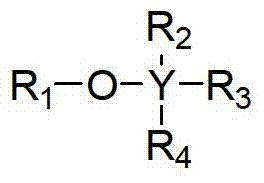
Wherein Y is carbon or silicon, R
1Be alkyl, R
2-R
4Be hydrogen or alkyl independently of one another.
3. the method for claim 2, wherein:
R
1Alkyl, thiazolinyl, alkynyl, aryl, alkaryl or aralkyl, and
R
2, R
3And R
4Be hydrogen, alkyl, thiazolinyl, alkynyl, aryl, alkaryl or aralkyl independently of one another, or R
2And R
3, or R
2And R
4, or R
3And R
4Forming independently the aliphatic series that condenses with 3-7 carbon atom encircles.
4. the method for claim 2, wherein R
1Be methyl, ethyl or allyl group.
5. the method for claim 2, wherein R
2, R
3And R
4The methyl of respectively doing for oneself.
6. the method for claim 2, wherein said organoalkoxysilane or ether compound are allyloxy trimethyl silane, ethoxytrimethylsilane, methoxytrimethylsilane, tertiary butyl ethyl ether or t-butyl methyl ether.
7. claim 1 or 2 method, the wherein said ionization polyolefine activated carbon positively charged ion polyolefine that is as the criterion, and the method is implemented under accurate living polymerization condition.
8. the method for claim 7, wherein said accurate activated carbon positively charged ion polyolefine makes by Lewis acid and one or more monomers are joined in the initiator.
9. the method for claim 8, wherein said initiator is 2-chloro-2,4, the 4-trimethylpentane.
10. claim 8 or 9 method, wherein said monomer is iso-butylene.
11. the method for claim 1 or 2, wherein said ionization polyolefine is by forming in the polyolefine that Lewis acid is joined uncle's halogenide end-blocking.
12. the method for claim 8, wherein said Lewis acid are titanium tetrachloride.
13. the method for claim 1 or 2, wherein the method is at-150 ℃ to-30 ℃ ,-90 ℃ to-60 ℃, or implement under-60 ℃ the temperature.
14. the method for claim 1 or 2, wherein the method is implemented in the presence of one or more electron donors.
15. the method for claim 1 or 2, the polyolefine that contains one or more outer alkene end groups that wherein forms is at least 40%, at least 60%, at least 80%, at least 85%, at least 90%, at least 95%, at least 97% of whole products, or at least 98 % by mole.
Applications Claiming Priority (3)
| Application Number | Priority Date | Filing Date | Title |
|---|---|---|---|
| US12/145,460 | 2008-06-24 | ||
| US12/145,460 US8063154B2 (en) | 2008-06-24 | 2008-06-24 | Preparation of exo-olefin terminated polyolefins via quenching with alkoxysilanes or ethers |
| PCT/US2009/048471 WO2010008890A2 (en) | 2008-06-24 | 2009-06-24 | Preparation of exo-olefin terminated polyolefins via quenching with alkoxysilanes or ethers |
Publications (2)
| Publication Number | Publication Date |
|---|---|
| CN102137875A CN102137875A (en) | 2011-07-27 |
| CN102137875B true CN102137875B (en) | 2013-10-23 |
Family
ID=41431896
Family Applications (1)
| Application Number | Title | Priority Date | Filing Date |
|---|---|---|---|
| CN2009801267604A Expired - Fee Related CN102137875B (en) | 2008-06-24 | 2009-06-24 | Preparation of exoolefin-terminated polyolefins by quenching with alkoxysilanes or ethers |
Country Status (6)
| Country | Link |
|---|---|
| US (1) | US8063154B2 (en) |
| EP (1) | EP2291418B1 (en) |
| JP (1) | JP5518859B2 (en) |
| CN (1) | CN102137875B (en) |
| CA (1) | CA2727679A1 (en) |
| WO (1) | WO2010008890A2 (en) |
Families Citing this family (17)
| Publication number | Priority date | Publication date | Assignee | Title |
|---|---|---|---|---|
| US8394897B2 (en) | 2008-03-25 | 2013-03-12 | Chevron Oronite Company Llc | Production of vinylidene-terminated polyolefins via quenching with monosulfides |
| US8063154B2 (en) | 2008-06-24 | 2011-11-22 | The University Of Southern Mississippi | Preparation of exo-olefin terminated polyolefins via quenching with alkoxysilanes or ethers |
| US8344073B2 (en) | 2009-01-16 | 2013-01-01 | The University Of Southern Mississippi | Functionalization of polyolefins with phenoxy derivatives |
| US8492491B2 (en) | 2010-06-10 | 2013-07-23 | Chevron Oronite Company Llc | Methods for producing telechelic polyolefins from terpene initiators |
| US8592527B2 (en) | 2010-06-14 | 2013-11-26 | University Of Southern Mississippi | Vinyl ether end-functionalized polyolefins |
| US8969484B2 (en) | 2011-07-08 | 2015-03-03 | Chevron Oronite Company Llc | Methods of producing mono- and multi-functional polymers from terpene-based initiators |
| US9034998B2 (en) | 2011-12-16 | 2015-05-19 | University Of Massachusetts | Polymerization initiating system and method to produce highly reactive olefin functional polymers |
| US9243203B2 (en) | 2012-11-30 | 2016-01-26 | Chevron Oronite Company Llc | Copolymers of polyaminopolyolefins and polyanhydrides and methods of their preparation |
| US9156924B2 (en) | 2013-03-12 | 2015-10-13 | University Of Massachusetts | Polymerization initiating system and method to produce highly reactive olefin functional polymers |
| US9631038B2 (en) | 2013-10-11 | 2017-04-25 | University Of Massachusetts | Polymerization initiating system and method to produce highly reactive olefin functional polymers |
| JP6142841B2 (en) * | 2014-05-07 | 2017-06-07 | 信越化学工業株式会社 | Alkoxysilane composition |
| US9771442B2 (en) | 2015-05-13 | 2017-09-26 | University Of Massachusetts | Polymerization initiating system and method to produce highly reactive olefin functional polymers |
| WO2017059201A1 (en) | 2015-10-01 | 2017-04-06 | The University Of Southern Mississippi | Methods of preparing functionalized polyolefins |
| US10167352B1 (en) | 2017-06-28 | 2019-01-01 | University Of Massachusetts | Polymerization initiating system and method to produce highly reactive olefin functional polymers |
| US10047174B1 (en) | 2017-06-28 | 2018-08-14 | Infineum International Limited | Polymerization initiating system and method to produce highly reactive olefin functional polymers |
| US10174138B1 (en) | 2018-01-25 | 2019-01-08 | University Of Massachusetts | Method for forming highly reactive olefin functional polymers |
| US10829573B1 (en) | 2019-05-21 | 2020-11-10 | Infineum International Limited | Method for forming highly reactive olefin functional polymers |
Citations (3)
| Publication number | Priority date | Publication date | Assignee | Title |
|---|---|---|---|---|
| WO2006023988A2 (en) * | 2004-08-20 | 2006-03-02 | Chevron Oronite Company Llc | Method for preparation of polyolefins containing exo-olefin chain ends |
| WO2006023742A2 (en) * | 2004-08-20 | 2006-03-02 | Chevron Oronite Company Llc | Method for preparation of polyolefins containing exo-olefin chain ends |
| US20070155910A1 (en) * | 2005-12-30 | 2007-07-05 | Chevron Oronite Company Llc | Method for preparing polyolefins containing vinylidine end groups using polymeric nitrogen compounds |
Family Cites Families (98)
| Publication number | Priority date | Publication date | Assignee | Title |
|---|---|---|---|---|
| US3155686A (en) | 1960-01-04 | 1964-11-03 | Monsanto Co | Poly (ester lactones) and method for preparing the same |
| US4034038A (en) | 1963-11-13 | 1977-07-05 | The Lubrizol Corporation | Boron-containing esters |
| GB1159368A (en) | 1965-09-02 | 1969-07-23 | Standard Oil Co | Substituted Phenols |
| US3632600A (en) | 1968-05-31 | 1972-01-04 | Exxon Research Engineering Co | Derivatives of aliphatic-hydrocarbyl substituted heterocyclic nitrogen compounds |
| DE2702604C2 (en) | 1977-01-22 | 1984-08-30 | Basf Ag, 6700 Ludwigshafen | Polyisobutenes |
| US4238628A (en) | 1978-09-28 | 1980-12-09 | Standard Oil Company (Indiana) | Polyalkylaromatics undegraded during alkylation |
| US4255538A (en) | 1978-12-11 | 1981-03-10 | The B. F. Goodrich Company | Liquid vinylidene-terminated polymers cured with amines and thiols |
| US4255518A (en) * | 1979-08-27 | 1981-03-10 | National Distillers And Chemical Corp. | Process for the recovery of starch from cereal grains as an aqueous slurry |
| US4342849A (en) | 1979-09-10 | 1982-08-03 | The University Of Akron | Novel telechelic polymers and processes for the preparation thereof |
| US4276394A (en) | 1979-09-10 | 1981-06-30 | The University Of Akron | Novel telechelic polymers, block copolymers and processes for the preparation thereof |
| DD240308A3 (en) | 1979-10-30 | 1986-10-29 | Froehlich Hans Otto | PROCESS FOR PREPARATION OF TECHNICAL CARBON MIXTURES |
| DD237072A3 (en) | 1980-01-24 | 1986-07-02 | Peter Adler | PROCESS FOR REACTIVELY SEPARATING THE MAIN COMPONENTS OF BUTA-1,3 SERVICE-FREE C 4-HYDROCARBON MIXTURES |
| US4393199A (en) | 1981-05-12 | 1983-07-12 | S R I International | Cationic polymerization |
| DE3226278A1 (en) | 1982-07-14 | 1984-01-19 | Basf Ag, 6700 Ludwigshafen | METHOD FOR PRODUCING FILM-SHAPED POLYMERS OF PYRROL |
| ZA8420B (en) | 1983-01-24 | 1985-02-27 | Lubrizol Enterprises Inc | Electronically conducting polypyrrole and co-polymers of pyrrole,compositions containing them,methods for making them,and electro-chemical cells using them |
| US4486572A (en) | 1983-07-06 | 1984-12-04 | University Of Akron | Synthesis of amphiphilic block copolymers and networks |
| US4814405A (en) | 1984-08-06 | 1989-03-21 | University Of Akron | Telechelic polymers made from sterically hindered binifers |
| US4568732A (en) | 1985-01-09 | 1986-02-04 | The University Of Akron | Continuous telechelic polymer process |
| US4910321A (en) | 1985-06-20 | 1990-03-20 | University Of Akron | Living catalysts, complexes and polymers therefrom |
| DE3650231T2 (en) | 1985-06-20 | 1995-08-24 | Univ Akron | Living catalysts, complexes and polymers made from them. |
| US5122572A (en) | 1985-06-20 | 1992-06-16 | Kennedy Joseph P | Living catalysts, complexes and polymers therefrom |
| US5066730A (en) | 1986-08-25 | 1991-11-19 | The University Of Akron | Living polymerization of olefins to end-functionalized polymers |
| US4929683A (en) | 1986-08-25 | 1990-05-29 | University Of Akron | Living polymerization of olefin to end-functionalized polymers |
| US4758631A (en) | 1986-10-16 | 1988-07-19 | Dow Corning Corporation | Method of preparing allyl-terminated polyisobutylene |
| DD253827A1 (en) | 1986-11-20 | 1988-02-03 | Univ Schiller Jena | METHOD FOR THE CONTINUOUS PRODUCTION OF REACTIVE HYDROCARBON RESINS |
| DD262028A1 (en) | 1987-07-13 | 1988-11-16 | Univ Schiller Jena | METHOD FOR PRODUCING OXIDATED STABILIZED HYDROCARBON RESINS BASED ON CYCLOPENTADIA |
| US5169914A (en) | 1988-05-03 | 1992-12-08 | Edison Polymer Innovation Corporation | Uniform molecular weight polymers |
| US5032653A (en) | 1988-06-28 | 1991-07-16 | Exxon Chemical Patents, Inc. | Direct synthesis by cationic polymerization of nitrogen-containing polymers |
| US4943616A (en) | 1988-07-26 | 1990-07-24 | Polysar Limited | Living cationic polymerization process |
| US4948936A (en) | 1988-09-28 | 1990-08-14 | Gulf Engineering Company, Inc. | Flux cored arc welding process |
| US5112507A (en) | 1988-09-29 | 1992-05-12 | Chevron Research And Technology Company | Polymeric dispersants having alternating polyalkylene and succinic groups |
| US4946899A (en) | 1988-12-16 | 1990-08-07 | The University Of Akron | Thermoplastic elastomers of isobutylene and process of preparation |
| US5175225A (en) | 1989-09-29 | 1992-12-29 | Chevron Research And Technology Company | Process for preparing polymeric dispersants having alternating polyalkylene and succinic groups |
| US5286823A (en) | 1991-06-22 | 1994-02-15 | Basf Aktiengesellschaft | Preparation of highly reactive polyisobutenes |
| ES2113431T3 (en) | 1991-07-15 | 1998-05-01 | Exxon Chemical Patents Inc | LIVING CARBOCATIONIC POLYMERIZATION PROCEDURE. |
| DE69127473T2 (en) * | 1991-11-18 | 1998-02-19 | Amoco Corp | BF3-TERTIARY ETHERATE COMPLEXES FOR ISOBUTHYLENE POLYMERIZATION |
| US5464549A (en) | 1991-12-12 | 1995-11-07 | Ethyl Corporation | Oil soluble dispersants suitable for use in fuels and lubricants |
| US5225492A (en) | 1992-02-13 | 1993-07-06 | The University Of Akron | Living carbocationic polymerization of poly(isobutylene-β-methyl vinyl ether) |
| US5219948A (en) | 1992-02-21 | 1993-06-15 | University Of Southern Mississippi | Process for cationic polymerizations |
| US5366745A (en) | 1992-10-20 | 1994-11-22 | Daden William G | Low pressure beverage carbonator using a chemical source of carbon |
| US5340881A (en) | 1992-11-16 | 1994-08-23 | The University Of Akron | Aldehyde-telechelic polyisobutylenes, catalytic method for preparing the same with high conversion and selectivity, and block copolymers made thereform |
| US5444135A (en) | 1992-12-17 | 1995-08-22 | Exxon Chemical Patents Inc. | Direct synthesis by living cationic polymerization of nitrogen-containing polymers |
| US5300701A (en) | 1992-12-28 | 1994-04-05 | Chevron Research And Technology Company | Process for the preparation of polyisobutyl hydroxyaromatics |
| US5506316A (en) | 1993-02-19 | 1996-04-09 | Exxon Chemical Patents Inc. | Carbocationic catalysts and process for using said catalysts |
| US5350819A (en) | 1993-02-19 | 1994-09-27 | Exxon Chemical Patents Inc. | Carbocationic catalysts and process for using said catalysts |
| US5334321A (en) | 1993-03-09 | 1994-08-02 | Chevron Research And Technology Company, A Division Of Chevron U.S.A. Inc. | Modified high molecular weight succinimides |
| WO1994028036A1 (en) | 1993-05-20 | 1994-12-08 | Exxon Chemical Patents Inc. | Heterogeneous lewis acid-type catalysts |
| US5488000A (en) | 1993-06-22 | 1996-01-30 | Semiconductor Energy Laboratory Co., Ltd. | Method of fabricating a thin film transistor using a nickel silicide layer to promote crystallization of the amorphous silicon layer |
| US5428111A (en) | 1993-10-15 | 1995-06-27 | University Of Massachusetts | Living polymerization of olefins to produce copolymer |
| WO1995010544A1 (en) | 1993-10-15 | 1995-04-20 | University Of Massachusetts At Lowell | Capping of living polymers |
| JP3001385B2 (en) | 1993-12-13 | 2000-01-24 | シェブロン ケミカル カンパニー | Polymer dispersant |
| US5395885A (en) | 1993-12-17 | 1995-03-07 | The University Of Akron | Multi-arm cationic star-polymers |
| US5448000A (en) | 1994-02-17 | 1995-09-05 | New Mexico Tech Research Foundation | End-quenching the living polymerization of isobutylene with acetyl sulfate |
| JP3388865B2 (en) * | 1994-02-21 | 2003-03-24 | 鐘淵化学工業株式会社 | Method for producing isobutylene polymer having olefin group |
| US5580935A (en) | 1995-01-13 | 1996-12-03 | Exxon Chemical Patents Inc. | Functionalized polymer and method to obtain functionalized polymer |
| US5690861A (en) | 1995-03-02 | 1997-11-25 | University Of Massachusetts Lowell | Coupling of polymers made by cationic polymerization |
| US6121379A (en) * | 1995-11-27 | 2000-09-19 | Kaneka Corporation | Processes for producing polymers having functional groups |
| US5663457A (en) | 1996-02-16 | 1997-09-02 | The Lubrizol Corporation | Methods for preparing alkylated hydroxyaromatics |
| US5811379A (en) | 1996-06-17 | 1998-09-22 | Exxon Chemical Patents Inc. | Polymers derived from olefins useful as lubricant and fuel oil additives, processes for preparation of such polymers and additives and use thereof (PT-1267) |
| US5789487A (en) | 1996-07-10 | 1998-08-04 | Carnegie-Mellon University | Preparation of novel homo- and copolymers using atom transfer radical polymerization |
| SG96175A1 (en) | 1996-07-16 | 2003-05-23 | Nippon Catalytic Chem Ind | Method for production of sulfide group-containing thiol compound |
| TR200000992T2 (en) | 1997-10-17 | 2000-11-21 | The Dow Chemical Company | Compositions containing alpha-olefin monomers and interpolymers consisting of one or more vinyl or vinylidene aromatic monomers. |
| DK1054906T3 (en) | 1997-12-18 | 2007-03-26 | Du Pont | Living characteristics polymerization process and polymers made thereby |
| US6515083B2 (en) | 1998-04-07 | 2003-02-04 | Kaneka Corporation | Process for producing isobutylene block copolymer |
| US6407066B1 (en) | 1999-01-26 | 2002-06-18 | Elan Pharmaceuticals, Inc. | Pyroglutamic acid derivatives and related compounds which inhibit leukocyte adhesion mediated by VLA-4 |
| US6194597B1 (en) | 1999-04-15 | 2001-02-27 | Dow Corning Corporation | Living cationic polymers prepared from silyl-functional aromatic initiators |
| US6033446A (en) | 1999-06-02 | 2000-03-07 | Chevron Chemical Company Llc | Polyalkylpyrrolidines and fuel compositions containing the same |
| US6417301B1 (en) | 1999-06-07 | 2002-07-09 | Eastman Chemical Company | Process for producing ethylene/olefin interpolymers |
| DE60041644D1 (en) | 1999-06-08 | 2009-04-09 | Kaneka Corp | PROCESS FOR CONTINUOUS CATALYTIVE LIVING POLYMERIZATION |
| US6380328B1 (en) | 1999-12-10 | 2002-04-30 | Univation Technologies, Llc | Catalyst systems and their use in a polymerization process |
| US6451920B1 (en) | 1999-11-09 | 2002-09-17 | Chevron Chemical Company Llc | Process for making polyalkylene/maleic anhydride copolymer |
| JP3476726B2 (en) | 1999-12-15 | 2003-12-10 | 横浜ゴム株式会社 | Primer composition |
| DE10035298A1 (en) | 2000-07-18 | 2002-01-31 | Basf Ag | Highly reactive polyisobutene production involves polymerization of isobutene with boron trifluoride catalyst, using solid amine-type deactivator which is insoluble in reaction mixture |
| DE10061727A1 (en) | 2000-12-12 | 2002-06-13 | Basf Ag | Process for the preparation of polyisobutenes |
| JP3808758B2 (en) * | 2001-03-22 | 2006-08-16 | 株式会社カネカ | Method for producing isobutylene polymer |
| KR100438827B1 (en) * | 2001-10-31 | 2004-07-05 | 삼성전기주식회사 | Method for improving gradation of image, and image display apparatus for performing the method |
| US6906011B2 (en) | 2001-11-09 | 2005-06-14 | Chevron Oronite Company Llc | Polymeric dispersants prepared from copolymers of low molecular weight polyisobutene and unsaturated acidic reagent |
| US6822023B2 (en) | 2001-12-03 | 2004-11-23 | Kaneka Corporation | Flame retardant polyolefin resin pre-expanded particles and in-mold foamed articles prepared therefrom |
| DE10162567A1 (en) | 2001-12-19 | 2003-07-03 | Basf Ag | Polyisobutenes and polyisobutene derivatives for lubricant compositions |
| US6750267B2 (en) | 2001-12-24 | 2004-06-15 | University Of Massachusetts Lowell | Radiation-curable polymeric composition |
| WO2003106390A1 (en) | 2002-06-13 | 2003-12-24 | A H Marks & Company Limited | Polymerisation inhibitor |
| US7124110B1 (en) | 2002-07-15 | 2006-10-17 | Trading Technologies International Inc. | Method and apparatus for message flow and transaction queue management |
| US6849509B2 (en) * | 2002-12-09 | 2005-02-01 | Intel Corporation | Methods of forming a multilayer stack alloy for work function engineering |
| US6747104B1 (en) | 2003-03-21 | 2004-06-08 | 3M Innovative Properties Company | Azlactone photoiniferters for radical polymerization |
| US6753391B1 (en) | 2003-05-05 | 2004-06-22 | 3M Innovative Properties Company | Ring-opened azlactone chain transfer agents for radical polymerization |
| US6969744B2 (en) * | 2003-06-19 | 2005-11-29 | University Of Southern Mississippi | Living and quasiliving cationic telechelic polymers quenched by N-substituted pyrrole and methods for their preparation |
| DE10328854A1 (en) | 2003-06-26 | 2005-01-13 | Basf Ag | Process for the preparation of polyisobutenes |
| EP1598380A1 (en) * | 2004-05-19 | 2005-11-23 | Basf Aktiengesellschaft | Isobutene polymerisation in the presence of complexes of donor and fluor containing acid |
| US7705090B2 (en) | 2004-08-20 | 2010-04-27 | Chevron Oronite Company Llc | Method for preparing polyolefins containing a high percentage of exo-olefin chain ends |
| WO2006110647A1 (en) | 2005-04-08 | 2006-10-19 | University Of Massachusetts Lowell Research Foundation | Capping reactions in cationic polymerization; kinetic and synthetic utility |
| US8013073B2 (en) | 2005-12-30 | 2011-09-06 | Chevron Oronite Company Llc | Method for preparing polyolefins containing vinylidine end groups using nonaromatic heterocyclic compounds |
| US7501476B2 (en) | 2005-12-30 | 2009-03-10 | Chevron Oronite Company, Llc | Method for preparing polyolefins containing vinylidene end groups using azole compounds |
| US8394897B2 (en) | 2008-03-25 | 2013-03-12 | Chevron Oronite Company Llc | Production of vinylidene-terminated polyolefins via quenching with monosulfides |
| US20090258803A1 (en) | 2008-04-14 | 2009-10-15 | Harrison James J | Copolymers made with quasi-living polyolefins and unsaturated acidic reagents, dispersants using same, and methods of making same |
| US8063154B2 (en) | 2008-06-24 | 2011-11-22 | The University Of Southern Mississippi | Preparation of exo-olefin terminated polyolefins via quenching with alkoxysilanes or ethers |
| US8133954B2 (en) | 2008-10-22 | 2012-03-13 | Chevron Oronite Company Llc | Production of vinylidene-terminated and sulfide-terminated telechelic polyolefins via quenching with disulfides |
| US8552122B2 (en) | 2009-03-31 | 2013-10-08 | The University Of Southern Mississippi | Amine-terminated telechelic polymers and precursors thereto and methods for their preparation |
| US8394898B2 (en) | 2009-07-31 | 2013-03-12 | The University Of Southern Mississippi | In situ formation of hydroxy chain end functional polyolefins |
-
2008
- 2008-06-24 US US12/145,460 patent/US8063154B2/en active Active
-
2009
- 2009-06-24 CN CN2009801267604A patent/CN102137875B/en not_active Expired - Fee Related
- 2009-06-24 JP JP2011516608A patent/JP5518859B2/en active Active
- 2009-06-24 WO PCT/US2009/048471 patent/WO2010008890A2/en not_active Ceased
- 2009-06-24 EP EP09798523.8A patent/EP2291418B1/en active Active
- 2009-06-24 CA CA2727679A patent/CA2727679A1/en not_active Abandoned
Patent Citations (3)
| Publication number | Priority date | Publication date | Assignee | Title |
|---|---|---|---|---|
| WO2006023988A2 (en) * | 2004-08-20 | 2006-03-02 | Chevron Oronite Company Llc | Method for preparation of polyolefins containing exo-olefin chain ends |
| WO2006023742A2 (en) * | 2004-08-20 | 2006-03-02 | Chevron Oronite Company Llc | Method for preparation of polyolefins containing exo-olefin chain ends |
| US20070155910A1 (en) * | 2005-12-30 | 2007-07-05 | Chevron Oronite Company Llc | Method for preparing polyolefins containing vinylidine end groups using polymeric nitrogen compounds |
Non-Patent Citations (1)
| Title |
|---|
| Synthesis and characterization of novel polyisobutylene-based materials:Gradient block copolymers, exo-olefins via in situ quenching, and carboxylic acid-functional telechelics;Lisa Kay Kemp;《DISSERTATION》;20071231;1,73-119 * |
Also Published As
| Publication number | Publication date |
|---|---|
| WO2010008890A3 (en) | 2010-04-15 |
| JP5518859B2 (en) | 2014-06-11 |
| US20090318624A1 (en) | 2009-12-24 |
| CN102137875A (en) | 2011-07-27 |
| EP2291418B1 (en) | 2020-06-17 |
| WO2010008890A2 (en) | 2010-01-21 |
| EP2291418A4 (en) | 2012-04-18 |
| US8063154B2 (en) | 2011-11-22 |
| CA2727679A1 (en) | 2010-01-21 |
| EP2291418A2 (en) | 2011-03-09 |
| JP2011525566A (en) | 2011-09-22 |
Similar Documents
| Publication | Publication Date | Title |
|---|---|---|
| CN102137875B (en) | Preparation of exoolefin-terminated polyolefins by quenching with alkoxysilanes or ethers | |
| CA2718756C (en) | Production of vinylidene-terminated polyolefins via quenching with monosulfides | |
| EP1781715B1 (en) | Method for preparation of polyolefins containing exo-olefin chain ends | |
| CA2577893C (en) | Method for preparing polyolefins containing a high percentage of exo-olefin chain ends | |
| CA2577728C (en) | Method for preparation of polyolefins containing exo-olefin chain ends | |
| CN102884089A (en) | Methods for producing telechelic polyolefins from terpene initiators | |
| Chai et al. | Formation of chelated counteranions using Lewis acidic diboranes: relevance to isobutene polymerization | |
| CA2738495C (en) | Production of vinylidene-terminated and sulfide-terminated telechelic polyolefins via quenching with disulfides | |
| Webster et al. | Synthesis of reactive-ended acrylic polymers by group transfer polymerization: initiation with silyl ketene acetals | |
| Vijayaraghavan et al. | Anionic polymerization of styrene in ionic liquids | |
| JP3388865B2 (en) | Method for producing isobutylene polymer having olefin group | |
| Kennedy et al. | Intramolecular hydride shift polymerization by cationic mechanism. IV. Cationic isomerization polymerization of vinylcyclohexane | |
| Baruah et al. | Copolymers of bulky fumarate: synthesis and their properties | |
| JP6329898B2 (en) | Process for producing monofunctional and polyfunctional polymers from terpene-based initiators | |
| Willis et al. | Synthesis and characterization of polymers and copolymers of vinylruthenocene | |
| Long et al. | Controlled synthesis of various poly (alkyl methacrylates) by anionic techniques | |
| Mallwitz et al. | Deuterated and partially deuterated polyisobutenes, synthesized via living carbocationic polymerization | |
| Coronado et al. | Ziegler-natta polymerization of 3-methoxy-4-phenylbut-1-ene with the heterogeneous catalyst AlEt3-VCl3: influence of pyridine as donor ligand | |
| JPH06157644A (en) | End-modified polyolefin | |
| JPH0426323B2 (en) | ||
| Chiklis et al. | Polymerization of 2, 2, 2‐trifluoroethyl vinyl ether |
Legal Events
| Date | Code | Title | Description |
|---|---|---|---|
| C06 | Publication | ||
| PB01 | Publication | ||
| C10 | Entry into substantive examination | ||
| SE01 | Entry into force of request for substantive examination | ||
| C14 | Grant of patent or utility model | ||
| GR01 | Patent grant | ||
| CF01 | Termination of patent right due to non-payment of annual fee |
Granted publication date: 20131023 Termination date: 20210624 |
|
| CF01 | Termination of patent right due to non-payment of annual fee |