CN102123506A - Resource allocation method and device for multiple users - Google Patents
Resource allocation method and device for multiple users Download PDFInfo
- Publication number
- CN102123506A CN102123506A CN2011100603912A CN201110060391A CN102123506A CN 102123506 A CN102123506 A CN 102123506A CN 2011100603912 A CN2011100603912 A CN 2011100603912A CN 201110060391 A CN201110060391 A CN 201110060391A CN 102123506 A CN102123506 A CN 102123506A
- Authority
- CN
- China
- Prior art keywords
- user
- cqi value
- resource allocation
- cqi
- tbs
- Prior art date
- Legal status (The legal status is an assumption and is not a legal conclusion. Google has not performed a legal analysis and makes no representation as to the accuracy of the status listed.)
- Pending
Links
Images


Landscapes
- Mobile Radio Communication Systems (AREA)
Abstract
本发明实施例公开了一种多用户资源分配的方法和装置,所述多用户资源分配的方法包括:确定进行资源分配的多个用户的码字分配方案,并确定每种码字分配方案下每个用户的信道质量指示CQI值;根据所述CQI值,获取与所述确定的每个用户的CQI值和码字对应的每个用户的传输块大小TBS;获取每种码字分配方案下进行资源分配的所有用户的总的TBS,并选择所述总的TBS中最大的TBS对应的CQI值和码字分配方案的组合作为进行资源分配的方案。本发明实施例实现了在对多个用户进行资源分配时,为每个用户分配资源的同时考虑其他用户的信道条件,使发送的总数据量最大。
The embodiment of the present invention discloses a multi-user resource allocation method and device. The multi-user resource allocation method includes: determining the code word allocation scheme of multiple users for resource allocation, and determining the code word allocation scheme under each code word allocation scheme. The channel quality indicator CQI value of each user; according to the CQI value, obtain the transmission block size TBS of each user corresponding to the determined CQI value and codeword of each user; obtain each codeword allocation scheme The total TBS of all users for resource allocation, and the combination of the CQI value corresponding to the largest TBS in the total TBS and the codeword allocation scheme is selected as the scheme for resource allocation. The embodiment of the present invention realizes that when resources are allocated to multiple users, channel conditions of other users are considered while allocating resources for each user, so that the total amount of data sent is maximized.
Description
本申请是对申请日为2008年7月14日,申请号为200810132877.0的发明创造名称为数据传输方法和装置的发明专利申请的分案申请。This application is a divisional application for the invention patent application whose application date is July 14, 2008 and whose application number is 200810132877.0, and its title is data transmission method and device.
技术领域technical field
本发明实施例涉及通信技术领域,特别涉及一种多用户资源分配的方法和装置。Embodiments of the present invention relate to the field of communication technologies, and in particular, to a method and device for multi-user resource allocation.
背景技术Background technique
3GPP(Third Generation Partnership Project,第三代合作伙伴计划)从Release 5协议开始引入HSDPA(High Speed Data Packet Access,高速数据包接入)。在HSDPA中,采用包交换技术,以较短的子帧为TTI(Transmission TimeInterval,传输时间间隔)传输数据。3GPP (Third Generation Partnership Project, Third Generation Partnership Project) introduced HSDPA (High Speed Data Packet Access) from the Release 5 protocol. In HSDPA, packet switching technology is used to transmit data with a shorter subframe as TTI (Transmission Time Interval, transmission time interval).
在HSDPA中网络侧可以根据UE(User Equipment,用户设备)的信道条件动态为该UE分配传输数据的传输功率和传输速率。UE侧通过HS-DPCCH(High Speed Dedicate Physical Control Channel,上行高速专用物理控制信道)信道周期性地上报CQI(Channel Quality Indicator,信道质量指示)值,该CQI值指示了UE当前所处的信道条件。Release 5协议定义了30个CQI值。每个CQI值指示一个TBS(Transmit Block Size,传输块大小)、信道数和调制方式的组合。由于TBS的正确接收概率和接收的SNR(Signal Noise Ratio,信噪比)相关,所以CQI可以映射为TBS、信道数和调制方式的组合,同时还对应于一定的SNR值。In HSDPA, the network side can dynamically allocate the transmission power and transmission rate of the UE (User Equipment, user equipment) to the UE according to the channel condition of the UE. The UE side periodically reports the CQI (Channel Quality Indicator, Channel Quality Indicator) value through the HS-DPCCH (High Speed Dedicate Physical Control Channel, uplink high-speed dedicated physical control channel), which indicates the current channel condition of the UE . The Release 5 protocol defines 30 CQI values. Each CQI value indicates a combination of TBS (Transmit Block Size, transmission block size), channel number and modulation mode. Since the correct reception probability of TBS is related to the received SNR (Signal Noise Ratio, signal-to-noise ratio), CQI can be mapped to a combination of TBS, channel number and modulation mode, and also corresponds to a certain SNR value.
在支持HSDPA的网络中,每个小区为HSDPA的数据传输分配一定的空口传输资源,这些空口传输资源主要包括空口传输功率,空口传输HS-PDSCH(High Speed Physical Data Sharing Channel,高速物理数据共享信道)码字等,小区中所有用户竞争共享这些资源。网络侧在每个TTI需要决定在当前TTI可以为哪些用户传输数据,以什么样的速率及分配多少资源。用户选择的过程是由调度算法决定的,调度算法为每个用户计算优先级,然后按照优先级高低轮流为每个用户分配空口传输资源,在满足高优先级用户传输要求的基础上如果有剩余资源再分配给低优先级用户使用。In a network that supports HSDPA, each cell allocates certain air interface transmission resources for HSDPA data transmission, these air interface transmission resources mainly include air interface transmission power, air interface transmission HS-PDSCH (High Speed Physical Data Sharing Channel, high speed physical data sharing channel ) codewords, etc., all users in the cell compete to share these resources. In each TTI, the network side needs to decide which users can transmit data in the current TTI, at what rate and how many resources to allocate. The process of user selection is determined by the scheduling algorithm. The scheduling algorithm calculates the priority for each user, and then allocates air interface transmission resources to each user in turn according to the priority. Resources are redistributed to low-priority users.
在实现本发明的过程中,发明人发现现有技术至少存在以下问题:现有的资源分配是在优先级排序的基础上,把资源优先分配给高优先级用户为其传输数据,把剩余资源再分配给低优先级用户为其传输数据。资源分配过程是串行进行的,按照用户调度优先级由高到低轮流分配,直到资源耗尽。In the process of realizing the present invention, the inventor found that the prior art has at least the following problems: the existing resource allocation is based on prioritization, and resources are allocated to high-priority users to transmit data for them, and the remaining resources are It is reassigned to low-priority users to transmit data for them. The resource allocation process is carried out in series, according to the user scheduling priority from high to low in turn, until the resources are exhausted.
但是由于各个用户的信道条件不同,采用高优先级用户占用所有资源的策略没有考虑到用户间信道条件的差异,所以不能最大化小区的吞吐率。However, due to the different channel conditions of each user, the strategy of using high-priority users to occupy all resources does not take into account the differences in channel conditions among users, so the throughput of the cell cannot be maximized.
发明内容Contents of the invention
本发明实施例提供一种多用户资源分配的方法和装置,以实现综合考虑所有用户的信道条件进行资源分配,使发送的总数据量最大。Embodiments of the present invention provide a method and device for multi-user resource allocation, so as to implement resource allocation by comprehensively considering channel conditions of all users, so as to maximize the total amount of data sent.
为达到上述目的,本发明实施例一方面提供一种多用户资源分配的方法,包括:In order to achieve the above purpose, an embodiment of the present invention provides a method for multi-user resource allocation on the one hand, including:
确定进行资源分配的多个用户的码字分配方案,并确定每种码字分配方案下每个用户的信道质量指示CQI值;Determine the codeword allocation scheme of multiple users for resource allocation, and determine the channel quality indicator CQI value of each user under each codeword allocation scheme;
根据所述CQI值,获取与所述确定的每个用户的CQI值和码字分配方案对应的每个用户的TBS;According to the CQI value, acquire the TBS of each user corresponding to the determined CQI value and codeword allocation scheme of each user;
获取每种码字分配方案下进行资源分配的所有用户的总的TBS,并选择所述总的TBS中最大的TBS对应的CQI值和码字分配方案的组合作为进行资源分配的方案。The total TBS of all users for resource allocation under each codeword allocation scheme is obtained, and the combination of the CQI value corresponding to the largest TBS in the total TBS and the codeword allocation scheme is selected as the resource allocation scheme.
另一方面,本发明实施例还提供一种多用户资源分配的装置,包括:On the other hand, an embodiment of the present invention also provides an apparatus for multi-user resource allocation, including:
码字确定模块,用于确定进行资源分配的多个用户的码字分配方案,确定为进行资源分配的每个用户分配的码字数;A codeword determination module, configured to determine a codeword allocation scheme for multiple users for resource allocation, and determine the number of codewords allocated for each user for resource allocation;
信道质量指示CQI值确定模块,用于确定所述码字确定模块确定的每种码字分配方案下每个用户的信道质量指示CQI值;A channel quality indicator CQI value determination module, configured to determine the channel quality indicator CQI value of each user under each codeword allocation scheme determined by the codeword determination module;
传输块大小TBS获取模块,用于获取与所述CQI值确定模块确定的每个用户的CQI值对应的每个用户的TBS;A transmission block size TBS acquisition module, configured to acquire the TBS of each user corresponding to the CQI value of each user determined by the CQI value determination module;
资源分配方案确定模块,用于根据所述TBS获取模块获取的每个用户的TBS获取每种码字分配方案下进行资源分配的所有用户的总的TBS,并选择所述总的TBS中最大的TBS对应的CQI值和码字分配方案的组合作为进行资源分配的方案。A resource allocation scheme determination module, configured to acquire the total TBS of all users for resource allocation under each codeword allocation scheme according to the TBS of each user acquired by the TBS acquisition module, and select the largest of the total TBS The combination of the CQI value corresponding to the TBS and the codeword allocation scheme is used as the scheme for resource allocation.
与现有技术相比,本发明实施例具有以下优点:本发明实施例确定进行资源分配的多个用户的码字分配方案,进而确定每种码字分配方案下每个用户的CQI值,然后根据该CQI值,获取与所述CQI值对应的每个用户的TBS,进而获取每种码字分配方案下所有用户的总的TBS,选择总的TBS中最大的TBS对应的CQI值和码字分配方案的组合作为进行资源分配的方案。本发明实施例实现了在对多个用户进行资源分配时,为每个用户分配资源的同时考虑其他用户的信道条件,使发送的总数据量最大。Compared with the prior art, the embodiment of the present invention has the following advantages: the embodiment of the present invention determines the codeword allocation schemes of multiple users for resource allocation, and then determines the CQI value of each user under each codeword allocation scheme, and then According to the CQI value, obtain the TBS of each user corresponding to the CQI value, and then obtain the total TBS of all users under each codeword allocation scheme, and select the CQI value and codeword corresponding to the largest TBS in the total TBS A combination of allocation schemes is used as a scheme for resource allocation. The embodiment of the present invention realizes that when resources are allocated to multiple users, channel conditions of other users are considered while allocating resources for each user, so that the total amount of data sent is maximized.
附图说明Description of drawings
图1为本发明实施例多用户资源分配的方法的流程图;FIG. 1 is a flowchart of a method for multi-user resource allocation according to an embodiment of the present invention;
图2为本发明实施例一种多用户资源分配的方法的流程图;FIG. 2 is a flowchart of a method for multi-user resource allocation according to an embodiment of the present invention;
图3为本发明实施例另一种多用户资源分配的方法的流程图;FIG. 3 is a flowchart of another method for multi-user resource allocation according to an embodiment of the present invention;
图4为本发明实施例一种多用户资源分配的装置的结构图;FIG. 4 is a structural diagram of an apparatus for multi-user resource allocation according to an embodiment of the present invention;
图5为本发明实施例另一种多用户资源分配的装置的结构图。FIG. 5 is a structural diagram of another apparatus for multi-user resource allocation according to an embodiment of the present invention.
具体实施方式Detailed ways
本发明实施例提供一种多用户资源分配的方法,同时为多个用户分配HSDPA空口传输资源,在资源分配中考虑多用户不同的信道条件使得多用户总的数据传输量最大。与现有的资源分配方法不同,本发明实施例提出的多用户资源分配的方法在为每一个用户分配资源时,还同时考虑了其他用户对资源的需求情况。The embodiment of the present invention provides a method for multi-user resource allocation, which allocates HSDPA air interface transmission resources for multiple users at the same time, and considers different channel conditions of multiple users in resource allocation to maximize the total data transmission amount of multiple users. Different from the existing resource allocation method, the multi-user resource allocation method proposed by the embodiment of the present invention also considers resource requirements of other users when allocating resources for each user.
如图1所示,为本发明实施例多用户资源分配的方法的流程图,可以包括:As shown in Figure 1, it is a flowchart of a method for multi-user resource allocation according to an embodiment of the present invention, which may include:
步骤S101,确定进行资源分配的多个用户的码字分配方案,并确定每种码字分配方案下每个用户的CQI值。Step S101, determine the codeword allocation schemes of multiple users for resource allocation, and determine the CQI value of each user under each codeword allocation scheme.
其中,确定进行资源分配的多个用户的码字分配方案具体可以为:确定为进行资源分配的每个用户分配的码字数。例如:当小区有10个可用码字,当前对2个用户进行资源分配时,则可能的码字分配方案如表1所示;Wherein, determining the codeword allocation scheme of multiple users for resource allocation may specifically be: determining the number of codewords allocated for each user for resource allocation. For example: when there are 10 available codewords in the cell, and resource allocation is currently performed on 2 users, the possible codeword allocation schemes are shown in Table 1;
表1Table 1
其中ki为第i个用户可用的HS-PDSCH码字数。Among them, ki is the number of HS-PDSCH codewords available to the i-th user.
需要说明的是,对于更多用户的码字分配方案可以依此类推,此处不再一一枚举。It should be noted that codeword allocation schemes for more users can be deduced in the same way, and will not be enumerated here one by one.
其中,确定每种码字分配方案下每个用户的CQI值的方式可以为:Wherein, the manner of determining the CQI value of each user under each codeword allocation scheme may be:
根据小区总的HS-PDSCH空口传输功率、进行资源分配的每个用户的信道增益和为每个用户分配的码字数计算每个用户分配的HS-PDSCH传输功率;Calculate the HS-PDSCH transmission power allocated to each user according to the total HS-PDSCH air interface transmission power of the cell, the channel gain of each user for resource allocation, and the number of code words allocated to each user;
例如:当小区总的HS-PDSCH空口传输功率为Ptotal,第i个用户的信道增益为λi,为第i个用户分配的码字数为ki时,第i个用户分配的HS-PDSCH传输功率Pi为:For example: when the total HS-PDSCH air interface transmission power of the cell is P total , the channel gain of the i-th user is λ i , and the number of codewords allocated to the i-th user is ki , the HS-PDSCH allocated to the i-th user The transmitted power P i is:
其中,N为进行资源分配的用户数。Wherein, N is the number of users for resource allocation.
然后,根据每个用户分配的HS-PDSCH传输功率计算分配的HS-PDSCH传输功率对应的每个用户的CQI值。例如:Then, calculate the CQI value of each user corresponding to the allocated HS-PDSCH transmission power according to the allocated HS-PDSCH transmission power of each user. For example:
当第i个用户分配的HS-PDSCH传输功率Pi的分贝值为Pi,dB,第i个用户上报的CQI值为CQIi,report时,则第i个用户分配的HS-PDSCH传输功率对应的第i个用户的CQI值CQIi为When the decibel value of the HS-PDSCH transmission power P i allocated by the i-th user is P i,dB , and the CQI value reported by the i-th user is CQI i,report , then the HS-PDSCH transmission power allocated by the i-th user The corresponding CQI value CQI i of the i-th user is
CQIi=CQIi,report+Pi,dB-PCPICH-MPO,其中PCPICH为小区公共导频信道CPICH的功率,MPO为测量功率偏置,MPO可以是高层配置的值。CQI i =CQI i, report +P i,dB -P CPICH -MPO, where P CPICH is the power of the cell common pilot channel CPICH, and MPO is the measurement power offset, and MPO may be a value configured by a high layer.
另外,还可采用另一种方法确定每种码字分配方案下每个用户的CQI值,具体可以为:In addition, another method can also be used to determine the CQI value of each user under each codeword allocation scheme, which can be specifically:
预设每种码字分配方案下每个用户的CQI值的遍历范围,计算上报的CQI值最大的用户可用的最大CQI值,然后根据上报的CQI值最大的用户可用的最大CQI值和该CQI值的遍历范围确定上报的CQI值最大的用户的CQI值。具体可以为:根据进行资源分配的多个用户中除上报的CQI值最大的用户之外的其他用户选择的CQI值、其他用户上报的CQI值、上报的CQI值最大的用户、小区总的HS-PDSCH空口传输功率和小区CPICH(Common PilotChannel,公共导频信道)的功率计算所述上报的CQI值最大的用户可用的CQI值。例如:假设对2个用户进行资源分配,并且假设CQI的遍历范围为5,上报的CQI值最大的一个用户为m,则在已知用户m以外其他用户例如:用户i的CQI值时,计算用户m可用的CQI值的公式如下Preset the traversal range of the CQI value of each user under each codeword allocation scheme, calculate the maximum CQI value available to the user with the largest reported CQI value, and then according to the maximum CQI value available to the user with the largest reported CQI value and the CQI The traversal range of the value determines the CQI value of the user whose reported CQI value is the largest. Specifically, it can be: according to the CQI value selected by other users except the user with the largest reported CQI value among the multiple users performing resource allocation, the CQI value reported by other users, the user with the largest reported CQI value, and the total HS of the cell - PDSCH air interface transmission power and cell CPICH (Common PilotChannel, common pilot channel) power to calculate the CQI value available to the user whose CQI value reported is the largest. For example: assuming that resource allocation is performed on 2 users, and assuming that the traversal range of CQI is 5, and the user with the largest reported CQI value is m, then when the CQI value of other users other than user m is known, for example: user i, calculate The formula for the CQI value available to user m is as follows
其中lin2db表示把线性值转换为dB值,db2lin表示把dB值转换为线性值,CQIi,Select为用户i选择的CQI值,CQIi,report为用户i上报的CQI值。在除用户m以外的所有用户选择的CQIi,Select为最小值时,计算出来的CQIm,Select为用户m可用的最大CQI值CQIm,max-Select,则确定的上报的CQI值最大的用户的CQI值可以为CQIm,max-Select,CQIm,max-Select-1,...,CQIm,max-Select-5。Among them, lin2db means converting a linear value into a dB value, db2lin means converting a dB value into a linear value, CQI i, Select is the CQI value selected by user i, and CQI i, report is the CQI value reported by user i. When the CQI i selected by all users except user m, Select is the minimum value, the calculated CQI m, Select is the maximum CQI value CQI m, max-Select available for user m, then the determined reported CQI value is the largest The CQI value of the user may be CQI m, max-Select , CQI m, max-Select -1, ..., CQI m, max-Select -5.
然后,根据上报的CQI值最大的用户的CQI值确定进行资源分配的多个用户中除所述上报的CQI值最大的用户之外的其他用户的CQI值。具体可以为:将总功率减去上报的CQI值最大的用户耗用的功率后得到的剩余功率,折算为CQI值,获取除所述上报的CQI值最大的用户之外的其他用户的CQI值。例如:当对2个用户进行资源分配,并且CQI值的遍历范围为5时,则用户m之外的另一用户可能选择的CQI值可以通过将Ptotal减去用户m耗用的功率后获取的剩余功率,折算为CQI值获得,最多有6种选择,可以表示为{CQIi,Select,CQI’i,Select,CQI’”i,Select,...}。Then, according to the reported CQI value of the user with the largest CQI value, determine the CQI values of other users among the multiple users performing resource allocation except the user with the reported largest CQI value. Specifically, it may be: the remaining power obtained after subtracting the power consumed by the user with the largest reported CQI value from the total power is converted into a CQI value, and the CQI values of other users except the user with the largest reported CQI value are obtained. . For example: when two users are allocated resources, and the traversal range of the CQI value is 5, the CQI value that may be selected by another user other than user m can be obtained by subtracting the power consumed by user m from P total The remaining power of is obtained by converting it into a CQI value. There are at most 6 options, which can be expressed as {CQI i, Select , CQI' i, Select , CQI'” i, Select ,...}.
步骤S102,获取与确定的每个用户的CQI值对应的每个用户的TBS。Step S102, acquiring the TBS of each user corresponding to the determined CQI value of each user.
此处,在确定了每个用户的CQI值之后,可以通过查找CQI-TBS扩展表获取与每个用户的CQI值对应的TBS。该CQI-TBS扩展表可以如表2所示,Here, after the CQI value of each user is determined, the TBS corresponding to the CQI value of each user can be obtained by searching the CQI-TBS extension table. The CQI-TBS extension table can be shown in Table 2,
表2Table 2
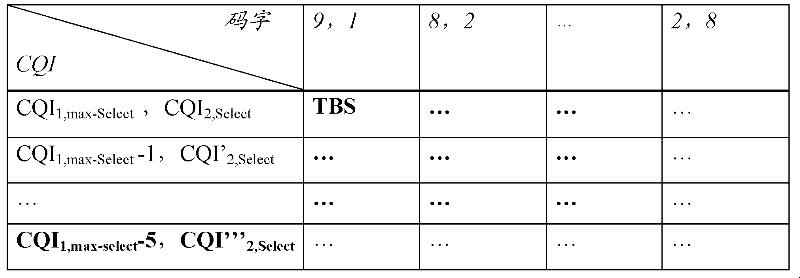
步骤S103,获取每种码字分配方案下进行资源分配的所有用户的总的TBS,并选择所述总的TBS中最大的TBS对应的CQI值和码字分配方案的组合作为进行资源分配的方案。Step S103, obtain the total TBS of all users for resource allocation under each codeword allocation scheme, and select the combination of the CQI value and codeword allocation scheme corresponding to the largest TBS in the total TBS as the scheme for resource allocation .
进而可以采用最大的TBS对应的码字分配方案为用户分配码字资源,根据该最大的TBS对应的CQI值为用户分配HS-PDSCH传输功率。Furthermore, the codeword allocation scheme corresponding to the largest TBS can be used to allocate codeword resources for users, and the HS-PDSCH transmission power can be allocated to users according to the CQI value corresponding to the largest TBS.
本发明实施例确定进行资源分配的多个用户的码字分配方案,进而确定每种码字分配方案下每个用户的CQI值,然后获取与所述CQI值对应的每个用户的TBS,将获取的每个用户的TBS相加,获取每种码字分配方案下所有用户的总的TBS,从而选择总的TBS中最大的TBS对应的CQI值和码字分配方案的组合作为进行资源分配的方案。由于TBS表示用户发送的数据量的大小,当总的TBS最大时,多个用户发送的总数据量最大,因此本发明实施例实现了在对多个用户进行资源分配时,为每个用户分配资源的同时考虑其他用户的信道条件,使发送的总数据量最大。In the embodiment of the present invention, the codeword allocation schemes of multiple users for resource allocation are determined, and then the CQI value of each user under each codeword allocation scheme is determined, and then the TBS of each user corresponding to the CQI value is obtained, and the Add the obtained TBS of each user to obtain the total TBS of all users under each codeword allocation scheme, so as to select the combination of the CQI value and the codeword allocation scheme corresponding to the largest TBS in the total TBS as the resource allocation plan. Since TBS represents the amount of data sent by a user, when the total TBS is the largest, the total amount of data sent by multiple users is the largest, so the embodiment of the present invention realizes that when resource allocation is performed on multiple users, each user is allocated resources while considering the channel conditions of other users to maximize the total amount of data sent.
如图2所示,为本发明实施例一种多用户资源分配的方法的流程图,可以包括:As shown in FIG. 2, it is a flowchart of a method for multi-user resource allocation according to an embodiment of the present invention, which may include:
步骤S201,确定进行资源分配的多个用户的码字分配方案。Step S201, determining codeword allocation schemes of multiple users for resource allocation.
例如:当小区有10个可用码字,当前对2个用户进行资源分配时,则可能的码字分配方案如表1所示。For example: when there are 10 available codewords in the cell, and resource allocation is currently performed on 2 users, the possible codeword allocation schemes are shown in Table 1.
步骤S202,获取在每种码字分配方案下每个用户的传输功率和CQI值。Step S202, acquiring the transmission power and CQI value of each user under each codeword allocation scheme.
具体可以为:Specifically, it can be:
a)按照公式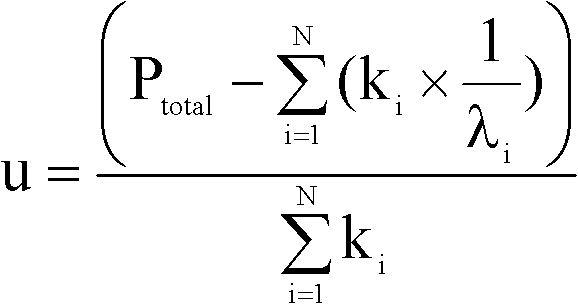
根据用户上报的CQI值,获取与该CQI值对应的SNR值。对于Release 5协议,HSDPA用户的CQI和SNR之间的关系式如下:According to the CQI value reported by the user, the SNR value corresponding to the CQI value is obtained. For the Release 5 protocol, the relationship between the HSDPA user's CQI and SNR is as follows:
SNR=-4.5+CQISNR=-4.5+CQI
其中,SNR与CQI以dB为单位。用户上报的CQI所对应的SNR是用户假定HS-PDSCH发射功率为PCPICH+MPO(Measure Power Offset,测量功率偏置)时,根据当前信道条件估算出来的接收到的HS-PDSCH的SNR值,其中PCPICH为小区公共导频信道的功率,MPO为测量功率偏置,可以是一个高层配置的功率偏置值,以dB为单位,因此由计算得到的SNR减去小区公共导频信道的功率Pcpich,再减去MPO可以得到该用户上报CQI时刻的信道增益,计算得到的信道增益以dB为单位,然后再把该信道增益转换为线性值λ。Wherein, SNR and CQI are in dB. The SNR corresponding to the CQI reported by the user is the SNR value of the received HS-PDSCH estimated according to the current channel conditions when the user assumes that the HS-PDSCH transmission power is P CPICH + MPO (Measure Power Offset, measurement power offset), Among them, P CPICH is the power of the common pilot channel of the cell, and MPO is the measurement power offset, which can be a power offset value configured by a high-level, in dB, so subtract the power of the common pilot channel of the cell from the calculated SNR P cpich , then subtract MPO to get the channel gain when the user reports the CQI, the calculated channel gain is in dB, and then convert the channel gain into a linear value λ.
b)按照公式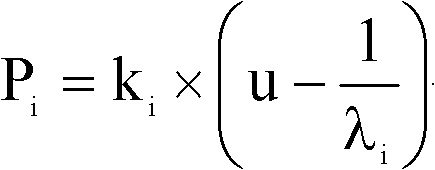
c)根据为用户分配的HS-PDSCH传输功率可以计算得到该功率下可以选择的CQI值。具体为:CQIi,Select=CQIi,report+Pi,dB-Pcpich-MPO,其中Pi,dB是为第i个用户分配的HS-PDSCH传输功率Pi的dB值,CQIi,report为第i个用户上报的CQI值。c) According to the HS-PDSCH transmission power allocated to the user, the selectable CQI value under the power can be calculated. Specifically: CQI i, Select = CQI i, report +P i,dB -P cpich -MPO, where P i,dB is the dB value of the HS-PDSCH transmission power P i allocated for the i-th user, CQI i, report is the CQI value reported by the i-th user.
步骤S203,获取与确定的每个用户的CQI值对应的每个用户的TBS,并获取每种码字分配方案下进行资源分配的所有用户的总的TBS。Step S203, obtaining the TBS of each user corresponding to the determined CQI value of each user, and obtaining the total TBS of all users for resource allocation under each codeword allocation scheme.
可以由选择的CQI值和码字通过查找CQI-TBS扩展表可以得到该选择的CQI值所对应的TBS,其中该CQI-TBS扩展表可以如表2所示。具体为:TBSi,Select=CQI-TBS扩展表(CQIi,Select,ki)。The TBS corresponding to the selected CQI value can be obtained by looking up the CQI-TBS extension table from the selected CQI value and codeword, where the CQI-TBS extension table can be shown in Table 2. Specifically: TBS i, Select = CQI-TBS extended table (CQI i, Select , ki ).
在获取每个用户的TBS后,将进行资源分配的多个用户的TBS相加,可以得到当前码字分配方案下小区总的TBS,总的TBS为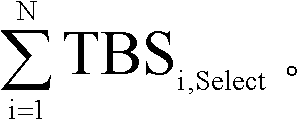
步骤S204,选择小区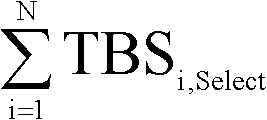
上述多用户资源分配的方法,可以根据多个用户各自的信道条件为这些用户分配传输资源,从而实现了小区资源的最优配置,提高了小区总的数据传输量。本发明实施例提出的多用户资源分配的方法可以应用于但不限于HSDPA Release 5,Release 7 64QAM及Release 7 MIMO(Multiple Input MultipleOutput,多输入多输出)的单流场景。The above multi-user resource allocation method can allocate transmission resources for multiple users according to their respective channel conditions, thereby realizing optimal allocation of cell resources and increasing the total data transmission capacity of the cell. The multi-user resource allocation method proposed by the embodiment of the present invention can be applied to, but not limited to, single-stream scenarios of HSDPA Release 5, Release 7 64QAM and Release 7 MIMO (Multiple Input Multiple Output).
如图3所示,为本发明实施例另一种多用户资源分配的方法的流程图,本发明实施例以为2个用户分配HSDPA空口传输资源为例进行说明,并假设CQI的遍历范围为5,码字的遍历范围为7。但本发明实施例并不局限于此,在实际应用中不仅限于为2个用户分配HSDPA空口传输资源。具体包括:As shown in Figure 3, it is a flow chart of another method for multi-user resource allocation in the embodiment of the present invention. In the embodiment of the present invention, the allocation of HSDPA air interface transmission resources for 2 users is described as an example, and it is assumed that the traversal range of the CQI is 5 , the traversal range of the codeword is 7. However, the embodiment of the present invention is not limited thereto, and in actual application, it is not limited to assigning HSDPA air interface transmission resources to two users. Specifically include:
步骤S301,确定进行资源分配的多个用户的码字分配方案。具体可以为:Step S301, determining codeword allocation schemes of multiple users for resource allocation. Specifically, it can be:
a)把进行资源分配的多用户上报的CQI值按照CQI值的大小进行排列。例如:将多个用户上报的CQI值按照由大到小的顺序进行排列,其中进行资源分配的总用户数为N,假设N个用户中上报的CQI值最大的一个用户为m。a) Arranging the CQI values reported by multiple users for resource allocation according to the size of the CQI values. For example: the CQI values reported by multiple users are arranged in descending order, where the total number of users for resource allocation is N, and it is assumed that the user with the largest reported CQI value among the N users is m.
b)当用户m以外的所有用户都只分配最小的码字数,例如用户m以外的所有用户都只分配1个码字时,用户m最大可用的码字Km,max-Select=总码字数-(N-1);b) When all users other than user m only allocate the minimum number of codewords, for example, when all users other than user m allocate only one codeword, the maximum available codeword K m for user m, max-Select = total number of codewords -(N-1);
根据码字的遍历范围,可以得到用户m在选择码字为Km,max-Select,Km,max-Select-1,...,Km,max-Select-7时,用户m之外的其他用户可能选择的码字组合。例如,当总码字数为10,且对用户m和用户i这2个用户进行资源分配时,可能的码字分配方案如表3所示,According to the traversal range of codewords, it can be obtained that when user m selects a codeword of K m, max-Select , K m, max-Select -1, ..., K m, max-Select -7, user m codeword combinations that other users may choose. For example, when the total number of codewords is 10, and resource allocation is performed on two users, user m and user i, the possible codeword allocation schemes are shown in Table 3,
表3table 3
步骤S302,确定每种码字分配方案下每个用户的CQI值。Step S302, determining the CQI value of each user under each codeword allocation scheme.
具体地,可以通过下述方法确定每种码字分配方案下每个用户的CQI值:Specifically, the CQI value of each user under each codeword allocation scheme can be determined by the following method:
a)确定上报的CQI值最大的用户可用的最大CQI值,然后根据上报的CQI值最大的用户可用的最大CQI值和该CQI值的遍历范围确定上报的CQI值最大的用户的CQI值。a) Determine the maximum CQI value available to the user with the largest reported CQI value, and then determine the CQI value of the user with the largest reported CQI value according to the maximum CQI value available to the user with the largest reported CQI value and the traversal range of the CQI value.
假设对2个用户进行资源分配,上报的CQI值最大的一个用户为m,则在已知用户m以外其他用户如用户i的CQI值时,可以通过下面的方法获取用户m可用的CQI值:Assuming that two users are allocated resources, and the user with the largest reported CQI value is m, then when the CQI values of users other than user m, such as user i, are known, the available CQI value of user m can be obtained by the following method:
其中lin2db表示把线性值转换为dB值,db2lin表示把dB值转换为线性值,CQIi,Select为用户i选择的CQI值,CQIi,report为用户i上报的CQI值。在除用户m以外的所有用户选择的CQIi,Select为最小值时,计算出来的CQIm,Select为用户m可用的最大CQI值CQIm,max-Select,则确定的上报的CQI值最大的用户的CQI值可以为CQIm,max-Select,CQIm,max-Select-1,...,CQIm,max-Select-5,其中用户m选择的CQI在CQI最大值的基础上降低的级数是由CQI的遍历范围限定的。Among them, lin2db means converting a linear value into a dB value, db2lin means converting a dB value into a linear value, CQI i, Select is the CQI value selected by user i, and CQI i, report is the CQI value reported by user i. When the CQI i selected by all users except user m, Select is the minimum value, the calculated CQI m, Select is the maximum CQI value CQI m, max-Select available for user m, then the determined reported CQI value is the largest The CQI value of the user can be CQI m, max-Select , CQI m, max-Select -1, ..., CQI m, max-Select -5, where the CQI selected by user m is reduced on the basis of the maximum value of CQI The number of stages is limited by the traversal range of the CQI.
b)根据上报的CQI值最大的用户的CQI值确定进行资源分配的多个用户中除所述上报的CQI值最大的用户之外的其他用户的CQI值。例如:当对2个用户进行资源分配,并且CQI值的遍历范围为5时,用户m之外的另一用户可能选择的CQI值最多有6种,可以表示为{CQIi,Select,CQI’i,Select,CQI’”i,Select,...},如表3所示;b) According to the CQI value of the reported user with the largest CQI value, determine the CQI values of other users among the multiple users performing resource allocation except the user with the reported largest CQI value. For example: when 2 users are allocated resources, and the traversal range of CQI values is 5, there are at most 6 CQI values that may be selected by another user other than user m, which can be expressed as {CQI i, Select , CQI' i, Select , CQI'" i, Select , ...}, as shown in Table 3;
当在N个用户之间进行资源分配时,如果用户m选择的CQI值为CQIm,max-Select,CQIm,max-Select-1,...,CQIm,max-Select-5,则用户m之外的其他用户可能选择的CQI值有种。When resource allocation is performed among N users, if the CQI value selected by user m is CQI m, max-Select , CQI m, max-Select -1, ..., CQI m, max-Select -5, then The CQI values that may be selected by users other than user m are kind.
步骤S303,获取在当前选择的CQI值和码字分配方案下所有用户总的TBS。Step S303, obtaining the total TBS of all users under the currently selected CQI value and codeword allocation scheme.
当两个用户进行资源分配时,假设可用的码字数为10,CQI值的遍历范围为5,码字的遍历范围为7,则对应的CQI-TBS扩展表可以如表2所示,由当前选择的CQI值和码字通过查找CQI-TBS扩展表可以得到当前选择的CQI值所对应的TBS,具体为:TBSi,Select=CQI-TBS扩展表(CQIi,Select,Ki,Select),其中CQIi,Select为用户i选择的CQI值,Ki,Select为用户i选择的码字个数。When two users perform resource allocation, assuming that the number of available codewords is 10, the traversal range of CQI values is 5, and the traversal range of codewords is 7, then the corresponding CQI-TBS extension table can be shown in Table 2. The selected CQI value and codeword can obtain the TBS corresponding to the currently selected CQI value by searching the CQI-TBS extended table, specifically: TBS i, Select = CQI-TBS extended table (CQI i, Select , K i, Select ) , where CQI i, Select is the CQI value selected by user i, and K i, Select is the number of codewords selected by user i.
将进行资源分配的两个用户的数据传输量相加,即可得到这两个用户的总的TBS。于是当前选择的CQI值和码字分配方案下所有用户总的TBS为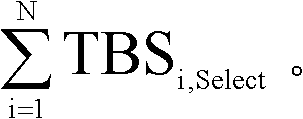
在所有可能的CQI值和码字分配方案下,重复进行上述步骤,从而得出所有可能的CQI值和码字分配方案下,进行资源分配的两个用户在对应方案下的总的TBS。Under all possible CQI values and codeword allocation schemes, the above steps are repeated, so as to obtain the total TBS of the two users who perform resource allocation under the corresponding schemes under all possible CQI values and codeword allocation schemes.
步骤S304,选择所有可能的CQI值和码字分配方案中,进行资源分配的用户的总的TBS最大的一种CQI值和码字分配方案作为最终选择的资源分配的方案。In step S304, among all possible CQI values and codeword allocation schemes, a CQI value and codeword allocation scheme with the largest total TBS of the user performing resource allocation is selected as the finally selected resource allocation scheme.
进而可以采用最大的TBS对应的码字分配方案为用户分配码字资源,根据该最大的TBS对应的CQI值为用户分配HS-PDSCH传输功率。Furthermore, the codeword allocation scheme corresponding to the largest TBS can be used to allocate codeword resources for users, and the HS-PDSCH transmission power can be allocated to users according to the CQI value corresponding to the largest TBS.
本发明实施例在一定范围内枚举多用户可能的资源分配组合,并选择这些资源分配组合中总的TBS最大的一种资源分配组合作为多用户资源分配的方案,由于TBS表示用户发送的数据量的大小,当总的TBS最大时,多个用户发送的总数据量最大,因此本发明实施例实现了在进行资源分配时,综合考虑多个用户的信道条件,使多个用户发送的总数据量最大。The embodiment of the present invention enumerates the possible resource allocation combinations of multiple users within a certain range, and selects the resource allocation combination with the largest total TBS among these resource allocation combinations as the multi-user resource allocation scheme. Since TBS represents the data sent by the user The size of the amount, when the total TBS is the largest, the total amount of data sent by multiple users is the largest, so the embodiment of the present invention realizes that when performing resource allocation, the channel conditions of multiple users are comprehensively considered, so that the total amount of data sent by multiple users The largest amount of data.
如图4所示,为本发明实施例一种多用户资源分配的装置的结构图,包括:As shown in FIG. 4, it is a structural diagram of a device for multi-user resource allocation according to an embodiment of the present invention, including:
码字确定模块41,用于确定进行资源分配的多个用户的码字分配方案,确定为进行资源分配的每个用户分配的码字数;A code
CQI值确定模块42,用于确定码字确定模块41确定的每种码字分配方案下每个用户的CQI值;The CQI
TBS获取模块43,用于获取与CQI值确定模块42确定的每个用户的CQI值对应的每个用户的TBS;The
资源分配方案确定模块44,用于将TBS获取模块43获取的每个用户的TBS相加,获取每种码字分配方案下进行资源分配的所有用户的总的TBS,并选择总的TBS中最大的TBS对应的CQI值和码字分配方案的组合作为进行资源分配的方案。进而可以采用最大的TBS对应的码字分配方案为用户分配码字资源,根据该最大的TBS对应的CQI值为用户分配HS-PDSCH传输功率。The resource allocation
其中,CQI值确定模块42可以包括:Wherein, the CQI
功率计算子模块421,用于根据小区总的HS-PDSCH空口传输功率、每个用户的信道增益和码字确定模块41为所述每个用户分配的码字数计算每个用户分配的HS-PDSCH传输功率;The
第一确定子模块422,用于根据功率计算子模块421计算的每个用户分配的HS-PDSCH传输功率计算分配的HS-PDSCH传输功率对应的每个用户的CQI值。The first determining
在本发明多用户资源分配的装置的另一实施例中,如图5所示,CQI值确定模块42可以包括:In another embodiment of the apparatus for multi-user resource allocation of the present invention, as shown in FIG. 5 , the CQI
遍历范围确定子模块423,用于确定码字确定模块41确定的每种码字分配方案下每个用户的CQI值的遍历范围;The traversal
最大CQI值计算子模块424,用于计算上报的CQI值最大的用户可用的最大CQI值;The maximum CQI
第二确定子模块425,用于根据最大CQI值计算子模块424计算的上报的CQI值最大的用户可用的最大CQI值和遍历范围确定子模块423确定的CQI值的遍历范围确定上报的CQI值最大的用户的CQI值,并根据上报的CQI值最大的用户的CQI值确定进行资源分配的多个用户中除上报的CQI值最大的用户之外的其他用户的CQI值。The
上述模块可以分布于一个装置,也可以分布于多个装置。上述模块可以合并为一个模块,也可以进一步拆分成多个子模块。The above-mentioned modules may be distributed in one device, or may be distributed in multiple devices. The above modules can be combined into one module, or can be further split into multiple sub-modules.
本发明实施例提供的多用户资源分配的装置,码字确定模块41确定进行资源分配的多个用户的码字分配方案,进而CQI值确定模块42确定每种码字分配方案下每个用户的CQI值,然后TBS获取模块43通过查找CQI-TBS扩展表,获取与所述CQI值对应的每个用户的TBS,资源分配方案确定模块44将获取的每个用户的TBS相加,获取每种码字分配方案下所有用户的总的TBS,从而选择总的TBS中最大的TBS对应的CQI值和码字分配方案的组合作为进行资源分配的方案。本发明实施例实现了在对多个用户进行资源分配时,为每个用户分配资源的同时考虑其他用户的信道条件,使发送的总数据量最大。In the multi-user resource allocation device provided by the embodiment of the present invention, the
通过以上的实施方式的描述,本领域的技术人员可以清楚地了解到本发明可以通过硬件实现,也可以可借助软件加必要的通用硬件平台的方式来实现基于这样的理解,本发明的技术方案可以以软件产品的形式体现出来,该软件产品可以存储在一个非易失性存储介质(可以是CD-ROM,U盘,移动硬盘等)中,包括若干指令用以使得一台计算机设备(可以是个人计算机,服务器,或者网络设备等)执行本发明各个实施例所述的方法。Through the description of the above embodiments, those skilled in the art can clearly understand that the present invention can be realized by hardware, or by means of software plus a necessary general-purpose hardware platform. Based on this understanding, the technical solution of the present invention It can be embodied in the form of software products, which can be stored in a non-volatile storage medium (which can be CD-ROM, U disk, mobile hard disk, etc.), and include several instructions to make a computer device (which can be It is a personal computer, a server, or a network device, etc.) to execute the methods described in various embodiments of the present invention.
本领域技术人员可以理解附图只是一个优选实施例的示意图,附图中的模块或流程并不一定是实施本发明所必须的。Those skilled in the art can understand that the drawing is only a schematic diagram of a preferred embodiment, and the modules or processes in the drawing are not necessarily necessary for implementing the present invention.
本领域技术人员可以理解实施例中的装置中的模块可以按照实施例描述进行分布于实施例的装置中,也可以进行相应变化位于不同于本实施例的一个或多个装置中。上述实施例的模块可以合并为一个模块,也可以进一步拆分成多个子模块。Those skilled in the art can understand that the modules in the device in the embodiment can be distributed in the device in the embodiment according to the description in the embodiment, or can be located in one or more devices different from the embodiment according to corresponding changes. The modules in the above embodiments can be combined into one module, and can also be further split into multiple sub-modules.
以上公开的仅为本发明的几个具体实施例,但是,本发明并非局限于此,任何本领域的技术人员能思之的变化都应落入本发明的保护范围。The above disclosures are only a few specific embodiments of the present invention, however, the present invention is not limited thereto, and any changes conceivable by those skilled in the art shall fall within the protection scope of the present invention.
Claims (12)
Priority Applications (1)
| Application Number | Priority Date | Filing Date | Title |
|---|---|---|---|
| CN2011100603912A CN102123506A (en) | 2008-07-14 | 2008-07-14 | Resource allocation method and device for multiple users |
Applications Claiming Priority (1)
| Application Number | Priority Date | Filing Date | Title |
|---|---|---|---|
| CN2011100603912A CN102123506A (en) | 2008-07-14 | 2008-07-14 | Resource allocation method and device for multiple users |
Related Parent Applications (1)
| Application Number | Title | Priority Date | Filing Date |
|---|---|---|---|
| CN2008101328770A Division CN101309460B (en) | 2008-07-14 | 2008-07-14 | Method and device for multi-user resource allocation |
Publications (1)
| Publication Number | Publication Date |
|---|---|
| CN102123506A true CN102123506A (en) | 2011-07-13 |
Family
ID=44251912
Family Applications (1)
| Application Number | Title | Priority Date | Filing Date |
|---|---|---|---|
| CN2011100603912A Pending CN102123506A (en) | 2008-07-14 | 2008-07-14 | Resource allocation method and device for multiple users |
Country Status (1)
| Country | Link |
|---|---|
| CN (1) | CN102123506A (en) |
Cited By (4)
| Publication number | Priority date | Publication date | Assignee | Title |
|---|---|---|---|---|
| CN102647798A (en) * | 2012-05-09 | 2012-08-22 | 华为技术有限公司 | Scheduled grant (SG) information issuing, determining, updating method, system and equipment |
| CN103096485A (en) * | 2011-11-08 | 2013-05-08 | 普天信息技术研究院有限公司 | Method of multi-user multi-input multi-output frequency selection scheduling of local thermodynamic equilibrium (LTE) system |
| CN103974441A (en) * | 2013-01-31 | 2014-08-06 | 华为技术有限公司 | Dispatching method and device |
| WO2019052343A1 (en) * | 2017-09-15 | 2019-03-21 | 华为技术有限公司 | Data transmission method and apparatus |
Citations (4)
| Publication number | Priority date | Publication date | Assignee | Title |
|---|---|---|---|---|
| CN1625089A (en) * | 2003-12-03 | 2005-06-08 | 上海贝尔阿尔卡特股份有限公司 | Method of realizing dynamic quickly regulating for HSDPA system |
| CN101155392A (en) * | 2006-09-28 | 2008-04-02 | 大唐移动通信设备有限公司 | Method, base station and subscriber terminal for obtaining scheduling control information in high speed grouping access |
| WO2008042514A1 (en) * | 2006-10-04 | 2008-04-10 | Motorola, Inc. | Radio resource assignment in control channel in wireless communication systems |
| CN101309460B (en) * | 2008-07-14 | 2011-04-20 | 华为技术有限公司 | Method and device for multi-user resource allocation |
-
2008
- 2008-07-14 CN CN2011100603912A patent/CN102123506A/en active Pending
Patent Citations (4)
| Publication number | Priority date | Publication date | Assignee | Title |
|---|---|---|---|---|
| CN1625089A (en) * | 2003-12-03 | 2005-06-08 | 上海贝尔阿尔卡特股份有限公司 | Method of realizing dynamic quickly regulating for HSDPA system |
| CN101155392A (en) * | 2006-09-28 | 2008-04-02 | 大唐移动通信设备有限公司 | Method, base station and subscriber terminal for obtaining scheduling control information in high speed grouping access |
| WO2008042514A1 (en) * | 2006-10-04 | 2008-04-10 | Motorola, Inc. | Radio resource assignment in control channel in wireless communication systems |
| CN101309460B (en) * | 2008-07-14 | 2011-04-20 | 华为技术有限公司 | Method and device for multi-user resource allocation |
Cited By (7)
| Publication number | Priority date | Publication date | Assignee | Title |
|---|---|---|---|---|
| CN103096485A (en) * | 2011-11-08 | 2013-05-08 | 普天信息技术研究院有限公司 | Method of multi-user multi-input multi-output frequency selection scheduling of local thermodynamic equilibrium (LTE) system |
| CN103096485B (en) * | 2011-11-08 | 2015-09-02 | 普天信息技术研究院有限公司 | A kind of method of multi-user's multiple-input, multiple-output frequency selection scheduling in LTE system |
| CN102647798A (en) * | 2012-05-09 | 2012-08-22 | 华为技术有限公司 | Scheduled grant (SG) information issuing, determining, updating method, system and equipment |
| CN102647798B (en) * | 2012-05-09 | 2016-07-27 | 华为技术有限公司 | Scheduling grant information issues, determines, update method, system and equipment |
| CN103974441A (en) * | 2013-01-31 | 2014-08-06 | 华为技术有限公司 | Dispatching method and device |
| CN103974441B (en) * | 2013-01-31 | 2018-01-16 | 华为技术有限公司 | A kind of dispatching method and device |
| WO2019052343A1 (en) * | 2017-09-15 | 2019-03-21 | 华为技术有限公司 | Data transmission method and apparatus |
Similar Documents
| Publication | Publication Date | Title |
|---|---|---|
| CN101309460B (en) | Method and device for multi-user resource allocation | |
| CN101091324B (en) | Method and apparatus for determining, transmitting and using information usable for interference control | |
| US8797983B2 (en) | Apparatuses and methods for allocating spectrum resources in a wireless communication network | |
| US20110267967A1 (en) | Method and apparatus for scheduling a controlchannel in an orthogonal frequency division multiplexing communication system | |
| US9474082B2 (en) | Method and apparatus for co-scheduling transmissions in a wireless network | |
| US20120052894A1 (en) | Methods and apparatus for parallel scheduling of frequency resources for communication nodes | |
| CN102036378B (en) | Method and device for allocating channels as well as method for allocating available resources of base station | |
| CN102123506A (en) | Resource allocation method and device for multiple users | |
| JP5319389B2 (en) | Communication control method | |
| CN107734697A (en) | Low-complexity multi-user group technology based on NOMA systems | |
| CN101674226A (en) | Method, device and system for selecting transmission mode | |
| US9240870B2 (en) | Queue splitting for parallel carrier aggregation scheduling | |
| CN102131300A (en) | Queue scheduling method and queue scheduling device | |
| CN103002583A (en) | Wireless communication device and wireless communication system | |
| CN103209420A (en) | Communication processing method and first base station | |
| CN112956269B (en) | Data transmission method, device, network equipment and storage medium | |
| CN101600252B (en) | Queue scheduling method and queue scheduling device | |
| CN106254053A (en) | A kind of LTE A carrier aggregation composition carrier allocation method based on CQI | |
| JP5133223B2 (en) | Wireless communication apparatus and wireless communication method | |
| CN101478759B (en) | Frequency resource allocation method, device and base station | |
| Ko et al. | Mode selection-based channel feedback reduction schemes for opportunistic scheduling in OFDMA systems | |
| CN101523778A (en) | Methods and apparatus for determining, communicating and using information which can be used for interference control purposes | |
| CN104954108B (en) | It is a kind of towards real time business into sub-carrier configuration switching method | |
| JP5360943B2 (en) | Frequency selection scheduling method and apparatus | |
| JP5268821B2 (en) | Power control method for parallel channels |
Legal Events
| Date | Code | Title | Description |
|---|---|---|---|
| C06 | Publication | ||
| PB01 | Publication | ||
| C10 | Entry into substantive examination | ||
| SE01 | Entry into force of request for substantive examination | ||
| C02 | Deemed withdrawal of patent application after publication (patent law 2001) | ||
| WD01 | Invention patent application deemed withdrawn after publication |
Application publication date: 20110713 |