CN102119205A - Novel transition metal complexes and use thereof in organic light-emitting diodes -IV - Google Patents
Novel transition metal complexes and use thereof in organic light-emitting diodes -IV Download PDFInfo
- Publication number
- CN102119205A CN102119205A CN2009801305517A CN200980130551A CN102119205A CN 102119205 A CN102119205 A CN 102119205A CN 2009801305517 A CN2009801305517 A CN 2009801305517A CN 200980130551 A CN200980130551 A CN 200980130551A CN 102119205 A CN102119205 A CN 102119205A
- Authority
- CN
- China
- Prior art keywords
- replace
- group
- independently
- metal complexes
- iii
- Prior art date
- Legal status (The legal status is an assumption and is not a legal conclusion. Google has not performed a legal analysis and makes no representation as to the accuracy of the status listed.)
- Pending
Links
- 0 C1CC*CC1 Chemical compound C1CC*CC1 0.000 description 4
Classifications
-
- C—CHEMISTRY; METALLURGY
- C09—DYES; PAINTS; POLISHES; NATURAL RESINS; ADHESIVES; COMPOSITIONS NOT OTHERWISE PROVIDED FOR; APPLICATIONS OF MATERIALS NOT OTHERWISE PROVIDED FOR
- C09K—MATERIALS FOR MISCELLANEOUS APPLICATIONS, NOT PROVIDED FOR ELSEWHERE
- C09K11/00—Luminescent, e.g. electroluminescent, chemiluminescent materials
- C09K11/06—Luminescent, e.g. electroluminescent, chemiluminescent materials containing organic luminescent materials
-
- C—CHEMISTRY; METALLURGY
- C07—ORGANIC CHEMISTRY
- C07F—ACYCLIC, CARBOCYCLIC OR HETEROCYCLIC COMPOUNDS CONTAINING ELEMENTS OTHER THAN CARBON, HYDROGEN, HALOGEN, OXYGEN, NITROGEN, SULFUR, SELENIUM OR TELLURIUM
- C07F15/00—Compounds containing elements of Groups 8, 9, 10 or 18 of the Periodic Table
- C07F15/0006—Compounds containing elements of Groups 8, 9, 10 or 18 of the Periodic Table compounds of the platinum group
- C07F15/0033—Iridium compounds
-
- H—ELECTRICITY
- H10—SEMICONDUCTOR DEVICES; ELECTRIC SOLID-STATE DEVICES NOT OTHERWISE PROVIDED FOR
- H10K—ORGANIC ELECTRIC SOLID-STATE DEVICES
- H10K85/00—Organic materials used in the body or electrodes of devices covered by this subclass
- H10K85/30—Coordination compounds
- H10K85/341—Transition metal complexes, e.g. Ru(II)polypyridine complexes
- H10K85/342—Transition metal complexes, e.g. Ru(II)polypyridine complexes comprising iridium
-
- C—CHEMISTRY; METALLURGY
- C09—DYES; PAINTS; POLISHES; NATURAL RESINS; ADHESIVES; COMPOSITIONS NOT OTHERWISE PROVIDED FOR; APPLICATIONS OF MATERIALS NOT OTHERWISE PROVIDED FOR
- C09K—MATERIALS FOR MISCELLANEOUS APPLICATIONS, NOT PROVIDED FOR ELSEWHERE
- C09K2211/00—Chemical nature of organic luminescent or tenebrescent compounds
- C09K2211/10—Non-macromolecular compounds
- C09K2211/1018—Heterocyclic compounds
- C09K2211/1025—Heterocyclic compounds characterised by ligands
- C09K2211/1029—Heterocyclic compounds characterised by ligands containing one nitrogen atom as the heteroatom
- C09K2211/1033—Heterocyclic compounds characterised by ligands containing one nitrogen atom as the heteroatom with oxygen
-
- C—CHEMISTRY; METALLURGY
- C09—DYES; PAINTS; POLISHES; NATURAL RESINS; ADHESIVES; COMPOSITIONS NOT OTHERWISE PROVIDED FOR; APPLICATIONS OF MATERIALS NOT OTHERWISE PROVIDED FOR
- C09K—MATERIALS FOR MISCELLANEOUS APPLICATIONS, NOT PROVIDED FOR ELSEWHERE
- C09K2211/00—Chemical nature of organic luminescent or tenebrescent compounds
- C09K2211/10—Non-macromolecular compounds
- C09K2211/1018—Heterocyclic compounds
- C09K2211/1025—Heterocyclic compounds characterised by ligands
- C09K2211/1029—Heterocyclic compounds characterised by ligands containing one nitrogen atom as the heteroatom
- C09K2211/1037—Heterocyclic compounds characterised by ligands containing one nitrogen atom as the heteroatom with sulfur
-
- C—CHEMISTRY; METALLURGY
- C09—DYES; PAINTS; POLISHES; NATURAL RESINS; ADHESIVES; COMPOSITIONS NOT OTHERWISE PROVIDED FOR; APPLICATIONS OF MATERIALS NOT OTHERWISE PROVIDED FOR
- C09K—MATERIALS FOR MISCELLANEOUS APPLICATIONS, NOT PROVIDED FOR ELSEWHERE
- C09K2211/00—Chemical nature of organic luminescent or tenebrescent compounds
- C09K2211/10—Non-macromolecular compounds
- C09K2211/1018—Heterocyclic compounds
- C09K2211/1025—Heterocyclic compounds characterised by ligands
- C09K2211/1044—Heterocyclic compounds characterised by ligands containing two nitrogen atoms as heteroatoms
- C09K2211/1048—Heterocyclic compounds characterised by ligands containing two nitrogen atoms as heteroatoms with oxygen
-
- C—CHEMISTRY; METALLURGY
- C09—DYES; PAINTS; POLISHES; NATURAL RESINS; ADHESIVES; COMPOSITIONS NOT OTHERWISE PROVIDED FOR; APPLICATIONS OF MATERIALS NOT OTHERWISE PROVIDED FOR
- C09K—MATERIALS FOR MISCELLANEOUS APPLICATIONS, NOT PROVIDED FOR ELSEWHERE
- C09K2211/00—Chemical nature of organic luminescent or tenebrescent compounds
- C09K2211/10—Non-macromolecular compounds
- C09K2211/1018—Heterocyclic compounds
- C09K2211/1025—Heterocyclic compounds characterised by ligands
- C09K2211/1044—Heterocyclic compounds characterised by ligands containing two nitrogen atoms as heteroatoms
- C09K2211/1051—Heterocyclic compounds characterised by ligands containing two nitrogen atoms as heteroatoms with sulfur
-
- C—CHEMISTRY; METALLURGY
- C09—DYES; PAINTS; POLISHES; NATURAL RESINS; ADHESIVES; COMPOSITIONS NOT OTHERWISE PROVIDED FOR; APPLICATIONS OF MATERIALS NOT OTHERWISE PROVIDED FOR
- C09K—MATERIALS FOR MISCELLANEOUS APPLICATIONS, NOT PROVIDED FOR ELSEWHERE
- C09K2211/00—Chemical nature of organic luminescent or tenebrescent compounds
- C09K2211/10—Non-macromolecular compounds
- C09K2211/1018—Heterocyclic compounds
- C09K2211/1025—Heterocyclic compounds characterised by ligands
- C09K2211/1059—Heterocyclic compounds characterised by ligands containing three nitrogen atoms as heteroatoms
- C09K2211/1062—Heterocyclic compounds characterised by ligands containing three nitrogen atoms as heteroatoms with oxygen
-
- C—CHEMISTRY; METALLURGY
- C09—DYES; PAINTS; POLISHES; NATURAL RESINS; ADHESIVES; COMPOSITIONS NOT OTHERWISE PROVIDED FOR; APPLICATIONS OF MATERIALS NOT OTHERWISE PROVIDED FOR
- C09K—MATERIALS FOR MISCELLANEOUS APPLICATIONS, NOT PROVIDED FOR ELSEWHERE
- C09K2211/00—Chemical nature of organic luminescent or tenebrescent compounds
- C09K2211/10—Non-macromolecular compounds
- C09K2211/1018—Heterocyclic compounds
- C09K2211/1025—Heterocyclic compounds characterised by ligands
- C09K2211/1059—Heterocyclic compounds characterised by ligands containing three nitrogen atoms as heteroatoms
- C09K2211/1066—Heterocyclic compounds characterised by ligands containing three nitrogen atoms as heteroatoms with sulfur
Landscapes
- Chemical & Material Sciences (AREA)
- Organic Chemistry (AREA)
- Engineering & Computer Science (AREA)
- Materials Engineering (AREA)
- Crystallography & Structural Chemistry (AREA)
- Inorganic Chemistry (AREA)
- Electroluminescent Light Sources (AREA)
Abstract
Description
本发明涉及包含至少一种经由一个氮原子和一个碳原子与中心金属键合并且包含至少一个选自O和S的杂原子的多环芳族配体的金属配合物,一种包含至少一种本发明金属配合物的有机发光二极管,一种包含至少一种本发明金属配合物的发光层,一种包含至少一种本发明发光层的有机发光二极管,所述至少一种本发明金属配合物在有机发光二极管中的用途,和一种选自固定视频显示单元如计算机、电视的视频显示单元,打印机、厨房电器中的视频显示单元和广告板,照明装置,信息板以及移动视频显示单元如移动电话、便携式电脑、数码相机、交通工具中的视频显示单元及客车和火车上的目的地显示器的装置,其包含至少一种本发明有机发光二极管。The present invention relates to a metal complex comprising at least one polycyclic aromatic ligand bonded to a central metal via a nitrogen atom and a carbon atom and comprising at least one heteroatom selected from O and S, one comprising at least one An organic light-emitting diode of a metal complex according to the invention, an emitting layer comprising at least one metal complex according to the invention, an organic light-emitting diode comprising at least one emitting layer according to the invention, the at least one metal complex according to the invention Use in organic light emitting diodes, and a video display unit selected from stationary video display units such as computers, televisions, video display units and advertising boards in printers, kitchen appliances, lighting devices, information boards and mobile video display units such as Devices for mobile phones, laptop computers, digital cameras, video display units in vehicles and destination displays on passenger cars and trains, which comprise at least one organic light-emitting diode according to the invention.
有机发光二极管(OLED)利用材料在受到电流激发时的发光性能。作为阴极射线管和液晶显示器的替代品以生产平面视频显示单元,OLED尤其受到关注。包含OLED的器件由于非常紧密的构造和固有的低能耗,它们特别适于移动设备,例如用于移动电话、便携式电脑等。Organic light-emitting diodes (OLEDs) take advantage of the light-emitting properties of materials when excited by an electric current. OLEDs are of particular interest as an alternative to cathode ray tubes and liquid crystal displays for the production of flat video display units. Devices comprising OLEDs are particularly suitable for mobile devices, eg for mobile phones, laptops, etc., due to their very compact construction and inherently low energy consumption.
OLED工作方式的基本原理和合适的OLED结构(层)例如描述于WO2005/113704和其中所引用的文献中。The basic principles of how OLEDs work and suitable OLED structures (layers) are described, for example, in WO 2005/113704 and the literature cited therein.
除了荧光材料(荧光发射体)外,所用发光材料(发射体)可以为磷光材料(磷光发射体)。与呈现单一发射的荧光发射体相反,磷光发射体通常为呈现三线态发射的有机金属配合物(M.A.Baldo等人,Appl.Phys.Lett.1999,75,4-6)。当使用磷光发射体时,由于量子力学的原因,可以达到量子效率、能量效率和电源效率的四倍。实际上为了实施使用有机金属磷光发射体的优点,有必要提供具有操作寿命长、效率好、对热应力稳定性高和使用操作电压低的磷光发射体。In addition to fluorescent materials (fluorescent emitters), the luminescent materials (emitters) used may be phosphorescent materials (phosphorescent emitters). In contrast to fluorescent emitters which exhibit a single emission, phosphorescent emitters are generally organometallic complexes which exhibit triplet emission (M.A. Baldo et al., Appl. Phys. Lett. 1999, 75, 4-6). When phosphorescent emitters are used, four times the quantum efficiency, energy efficiency, and power efficiency can be achieved due to quantum mechanics. Indeed, in order to realize the advantages of using organometallic phosphorescent emitters, it is necessary to provide phosphorescent emitters with a long operating life, good efficiency, high stability against thermal stress and the use of low operating voltages.
为了满足上述要求,现有技术中已经提出多种磷光发射体。In order to meet the above requirements, various phosphorescent emitters have been proposed in the prior art.
例如,WO 2007/095118涉及环金属化咪唑并[1,2-f]菲啶和二咪唑并[1,2-A:1’,2’-C]喹唑啉配体,及其等电子和苯并稠合衍生物。根据WO2007/095118的公开内容,WO 2007/095118中金属配合物的独特之处在于上述配体基本上仅包含氮原子作为杂原子。金属配合物发磷光且用于OLED中。根据WO 2007/095118,OLED呈现寿命长并有效的蓝色、绿色和红色发光。For example, WO 2007/095118 relates to cyclometalated imidazo[1,2-f]phenanthridine and diimidazo[1,2-A:1',2'-C]quinazoline ligands, and their isoelectronic and benzofused derivatives. According to the disclosure of WO 2007/095118, the metal complexes in WO 2007/095118 are unique in that the aforementioned ligands contain essentially only nitrogen atoms as heteroatoms. Metal complexes phosphoresce and are used in OLEDs. According to WO 2007/095118, OLEDs exhibit long-lived and efficient blue, green and red emission.
对上述现有技术而言,本发明目的是提供其它适用于OLED磷光的金属配合物,其呈现平衡波谱的性能,例如良好的效率、改善的寿命和器件中更高的稳定性,以及良好的电荷输送性能和热稳定性,并且当作为电致发光发射体材料用于OLED时,其优选在电磁波谱的蓝色至浅蓝色区域中呈现电致发光性。With regard to the prior art described above, it was an object of the present invention to provide further metal complexes suitable for OLED phosphorescence which exhibit balanced spectral properties such as good efficiency, improved lifetime and higher stability in the device, as well as good Charge transport properties and thermal stability, and when used in OLEDs as electroluminescent emitter materials, preferably exhibit electroluminescence in the blue to bluish region of the electromagnetic spectrum.
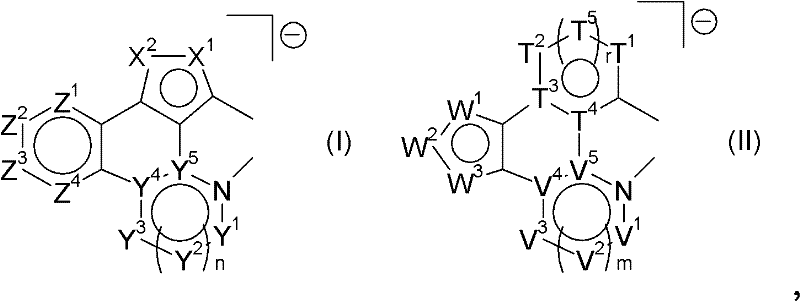
该目的由一种包含至少一种通式(I)或(II)的配体的金属配合物实现:This object is achieved by a metal complex comprising at least one ligand of the general formula (I) or (II):

其中符号各自定义如下:The symbols are defined as follows:
X1、X2各自独立地为CR1、CH、N、S或O,条件是准确地讲X1和X2基团中的一个为S或O;X 1 , X 2 are each independently CR 1 , CH, N, S or O, provided that precisely one of the groups X 1 and X 2 is S or O;
Z1、Z2、Z3、Z4、Y1、Y2、Y3各自独立地为CR1、CH或N;其中在n=0的情况下,Y1或Y3可以为NR2、S或O;Z 1 , Z 2 , Z 3 , Z 4 , Y 1 , Y 2 , Y 3 are each independently CR 1 , CH or N; wherein when n=0, Y 1 or Y 3 can be NR 2 , S or O;
Y4、Y5各自独立地为C或N;Y 4 and Y 5 are each independently C or N;
W1、W2、W3各自独立地为CR1、CH、N、S或O,条件是在r=0的情况下,准确地讲W1、W2和W3基团中的一个为S或O,且在r=1的情况下,准确地讲W1、W2和W3基团中的一个为O;W 1 , W 2 , W 3 are each independently CR 1 , CH, N, S or O, provided that in the case of r=0, precisely one of the W 1 , W 2 and W 3 groups is S or O, and in the case of r=1, precisely one of the W 1 , W 2 and W 3 groups is O;
T1、T2、T5各自独立地为CR1、CH或N,其中在r=0的情况下,T1或T2可以额外为NR2、S或O;T 1 , T 2 , T 5 are each independently CR 1 , CH or N, wherein in the case of r=0, T 1 or T 2 may additionally be NR 2 , S or O;
T3、T4、V4、V5各自独立地为C或N;T 3 , T 4 , V 4 , V 5 are each independently C or N;
V1、V2、V3各自独立地为CR1、CH或N;其中在m=0的情况下,V1或V3可以额外为NR2、S或O;V 1 , V 2 , V 3 are each independently CR 1 , CH or N; where in the case of m=0, V 1 or V 3 may additionally be NR 2 , S or O;
R1独立地为未取代或取代的烷基、未取代或取代的环烷基、未取代或取代的杂环烷基、未取代或取代的芳基、未取代或取代的杂芳基、未取代或取代的链烯基、未取代或取代的环烯基、未取代或取代的炔基、SiR3 3、卤素、具有给体或受体作用的取代基;此外,两个R1基团一起可以形成亚烷基或亚芳基桥; R is independently unsubstituted or substituted alkyl, unsubstituted or substituted cycloalkyl, unsubstituted or substituted heterocycloalkyl, unsubstituted or substituted aryl, unsubstituted or substituted heteroaryl, unsubstituted Substituted or substituted alkenyl, unsubstituted or substituted cycloalkenyl, unsubstituted or substituted alkynyl, SiR 3 3 , halogen, substituent with donor or acceptor function; in addition, two R 1 groups together can form an alkylene or arylene bridge;
R2独立地为未取代或取代的烷基、未取代或取代的芳基或未取代或取代的杂芳基;此外,两个R2基团或一个R2基团和一个R1基团一起可以形成亚烷基或亚芳基桥; R2 is independently unsubstituted or substituted alkyl, unsubstituted or substituted aryl, or unsubstituted or substituted heteroaryl; in addition, two R2 groups or one R2 group and one R1 group together can form an alkylene or arylene bridge;
R3独立地为未取代或取代的烷基、未取代或取代的芳基或未取代或取代的杂芳基; R is independently unsubstituted or substituted alkyl, unsubstituted or substituted aryl, or unsubstituted or substituted heteroaryl;
n为0或1,其中当n=0时Y2基团不存在,优选n=0;n is 0 or 1, wherein when n=0 the Y 2 group does not exist, preferably n=0;
m为0或1,其中当m=0时V2基团不存在,优选m=0;m is 0 or 1, wherein when m=0 the V group does not exist, preferably m=0;
r为0或1,其中当r=0时T5基团不存在,优选r=1。r is 0 or 1, wherein the T 5 group is absent when r=0, preferably r=1.
已经发现可以提供适用于OLED的金属配合物,与现有技术中已知的OLED相比,OLED具有显著的平衡波谱性能,例如良好的效率、较长的寿命和器件中非常好的稳定性,以及良好的电荷输送性能和热稳定性。更具体而言,当使用本发明金属配合物时,可以提供在电磁波谱的蓝色至浅蓝色区域中发光的OLED。It has been found that it is possible to provide metal complexes suitable for use in OLEDs which, compared to OLEDs known from the prior art, have significantly balanced spectral properties, such as good efficiency, long lifetime and very good stability in the device, As well as good charge transport performance and thermal stability. More specifically, when using the metal complexes according to the invention, it is possible to provide OLEDs which emit in the blue to bluish region of the electromagnetic spectrum.
本发明金属配合物可以用于OLED的任何层,基本骨架或中心金属可以变化以适应金属配合物的所需性能。取决于本发明金属配合物的取代形式和OLED中存在的其它层的电子性能,例如可以在OLED的发光层、电子阻挡层、激子阻挡层、空穴阻挡层、空穴输送层和/或电子输送层中使用本发明金属配合物。优选在发光层中使用本发明金属配合物。在此层中,本发明金属配合物可以用作发射体材料和/或基体材料。优选本发明金属配合物在OLED中用作发射体材料。The metal complexes of the present invention can be used in any layer of an OLED, and the basic framework or central metal can be varied to suit the desired properties of the metal complexes. Depending on the substitution pattern of the metal complexes according to the invention and the electronic properties of the other layers present in the OLED, for example in the emitting layer, electron blocking layer, exciton blocking layer, hole blocking layer, hole transport layer and/or The metal complex of the present invention is used in the electron transport layer. Preference is given to using the metal complexes according to the invention in the emitting layer. In this layer, the metal complexes according to the invention can be used as emitter material and/or matrix material. Preferably the metal complexes according to the invention are used as emitter materials in OLEDs.
在本发明上下文中,术语未取代或取代的芳基、未取代或取代的杂芳基、未取代或取代的烷基、未取代或取代的环烷基、未取代或取代的杂环烷基、未取代或取代的链烯基、未取代或取代的炔基、芳基和具有给体和/或受体作用的基团各自定义如下:In the context of the present invention, the terms unsubstituted or substituted aryl, unsubstituted or substituted heteroaryl, unsubstituted or substituted alkyl, unsubstituted or substituted cycloalkyl, unsubstituted or substituted heterocycloalkyl , unsubstituted or substituted alkenyl, unsubstituted or substituted alkynyl, aryl and groups with donor and/or acceptor functions are each defined as follows:
芳基应理解为指具有6-30个碳原子、优选6-18个碳原子的基本骨架并且由芳环或多个稠合芳环形成的基团。合适的基本骨架例如为苯基、萘基、蒽基或菲基。基本骨架可以是未取代(即所有可取代的碳原子带有氢原子)或可以在基本骨架的一个、超过一个或所有可取代的位置上被取代。合适的取代基例如为烷基,优选具有1-8个碳原子的烷基,更优选甲基、乙基或异丙基;芳基,优选C6芳基,其又可以为未取代或取代的;杂芳基,优选包含至少一个氮原子的杂芳基,更优选吡啶基;链烯基,优选带有一个双键的链烯基,更优选具有一个双键和1-8个碳原子的链烯基,或具有给体或受体作用的基团。合适的具有给体或受体作用的基团描述如下。最优选取代芳基带有选自甲基、异丙基、F、CN、芳氧基和烷氧基、硫代芳基、硫代烷基、杂芳基的取代基。芳基优选为C6-C18芳基,更优选C6芳基,其任选被至少一个或超过一个上述取代基取代。更优选C6-C18芳基,优选C6芳基没有或具有一个、两个、三个或四个上述取代基。Aryl is understood to mean a radical having a basic skeleton of 6 to 30 carbon atoms, preferably 6 to 18 carbon atoms, and consisting of an aromatic ring or a plurality of fused aromatic rings. Suitable basic skeletons are, for example, phenyl, naphthyl, anthracenyl or phenanthrenyl. The base backbone may be unsubstituted (ie all substitutable carbon atoms bear hydrogen atoms) or may be substituted at one, more than one or all substitutable positions of the base backbone. Suitable substituents are, for example, alkyl, preferably alkyl having 1 to 8 carbon atoms, more preferably methyl, ethyl or isopropyl; aryl, preferably C aryl , which in turn can be unsubstituted or substituted of; heteroaryl, preferably heteroaryl containing at least one nitrogen atom, more preferably pyridyl; alkenyl, preferably alkenyl with one double bond, more preferably with one double bond and 1 to 8 carbon atoms Alkenyl groups, or groups that function as donors or acceptors. Suitable groups with donor or acceptor function are described below. Most preferably the substituted aryl carries a substituent selected from methyl, isopropyl, F, CN, aryloxy and alkoxy, thioaryl, thioalkyl, heteroaryl. The aryl group is preferably a C 6 -C 18 aryl group, more preferably a C 6 aryl group, which is optionally substituted by at least one or more than one of the above substituents. More preferably C 6 -C 18 aryl, preferably C 6 aryl has no or one, two, three or four of the above substituents.
杂芳基应理解为指与上述芳基所不同的是在芳基的基本骨架中,至少一个碳原子被杂原子取代的基团。优选杂原子为N、O和S。最优选芳基基本骨架的一个或两个碳原子被杂原子取代。特别优选基本骨架选自如下体系:吡啶和五员杂芳族化合物如吡咯、呋喃、吡唑、咪唑、噻吩、
烷基应理解为指具有1-20个碳原子,优选1-10个碳原子,更优选1-8个,最优选1-4个碳原子的基团。烷基可以是支化或未支化的并且可以任选被一个或多个杂原子,优选Si、N、O或S,更优选N、O和S间隔。此外,烷基可以被一个或多个对芳基提及的取代基取代。烷基同样可以带有一个或多个(杂)芳基。例如在本申请上下文中,苄基因此为取代的烷基。所有上面所列的(杂)芳基是合适的。烷基更优选选自甲基、乙基、异丙基、正丙基、正丁基、异丁基和叔丁基;非常特别优选为甲基、异丙基。Alkyl is understood to mean a group having 1-20 carbon atoms, preferably 1-10 carbon atoms, more preferably 1-8, most preferably 1-4 carbon atoms. Alkyl groups may be branched or unbranched and may optionally be interrupted by one or more heteroatoms, preferably Si, N, O or S, more preferably N, O and S. Furthermore, alkyl groups may be substituted by one or more of the substituents mentioned for aryl groups. Alkyl groups can likewise carry one or more (hetero)aryl groups. For example in the context of the present application benzyl is thus substituted alkyl. All (hetero)aryl groups listed above are suitable. Alkyl is more preferably selected from methyl, ethyl, isopropyl, n-propyl, n-butyl, isobutyl and tert-butyl; very particularly preferably methyl, isopropyl.
环烷基应理解为指具有3-20个碳原子,优选3-10个碳原子,更优选3-8个碳原子的基团。基本骨架可以是未取代(即所有可取代的碳原子带有氢原子)或可以在基本骨架的一个、超过一个或所有可取代的位置上被取代。合适的取代基为上面已经对芳基提及的基团。合适的环烷基的实例为环丙基、环戊基和环己基。Cycloalkyl is understood to mean a group having 3-20 carbon atoms, preferably 3-10 carbon atoms, more preferably 3-8 carbon atoms. The base backbone may be unsubstituted (ie all substitutable carbon atoms bear hydrogen atoms) or may be substituted at one, more than one or all substitutable positions of the base backbone. Suitable substituents are the radicals already mentioned above for aryl. Examples of suitable cycloalkyl groups are cyclopropyl, cyclopentyl and cyclohexyl.
杂环烷基应理解为指与上述环烷基所不同的是在环烷基的基本骨架中,至少一个碳原子被杂原子取代的基团。优选杂原子为N、O和S。最优选环烷基基本骨架的一个或两个碳原子被杂原子取代。合适的杂环烷基的实例为衍生于吡咯烷、哌啶、哌嗪、四氢呋喃、二
链烯基应理解为指对应于上述具有至少两个碳原子的烷基的基团,不同的是烷基的至少一个C-C单键被C-C双键取代。链烯基优选具有一个或两个双键。Alkenyl is understood to mean a group which corresponds to the aforementioned alkyl group having at least two carbon atoms, except that at least one C-C single bond of the alkyl group is replaced by a C-C double bond. Alkenyl preferably has one or two double bonds.
炔基应理解为指对应于上述具有至少两个碳原子烷基的基团,不同的是烷基的至少一个C-C单键被C-C三键取代。炔基优选具有一个或两个三键。Alkynyl is understood to mean a group corresponding to the aforementioned alkyl group having at least two carbon atoms, except that at least one C-C single bond of the alkyl group is replaced by a C-C triple bond. Alkynyl preferably has one or two triple bonds.
在本申请上下文中,术语亚烷基和亚芳基各自如对烷基和芳基所定义,不同的是亚烷基和亚芳基具有两个连接位点。In the context of this application, the terms alkylene and arylene are as defined for alkyl and aryl, respectively, except that alkylene and arylene have two points of attachment.
优选亚烷基为(CR4 2)n,其中R4为H或烷基,优选H、甲基或乙基,更优选H,且n为1-3,优选1或2,更优选1。亚烷基最优选为CH2。Preferably the alkylene group is (CR 4 2 ) n , wherein R 4 is H or alkyl, preferably H, methyl or ethyl, more preferably H, and n is 1-3, preferably 1 or 2, more preferably 1. Alkylene is most preferably CH2 .
优选的亚芳基为未取代的或可以带有对芳基提及取代基的1,2-、1,3-或1,4-亚苯基。Preferred arylene groups are 1,2-, 1,3- or 1,4-phenylene groups which are unsubstituted or which may bear the substituents mentioned for aryl.
在本申请上下文中,基团或具有给体或受体作用的取代基应理解为指如下基团:In the context of the present application, radicals or substituents having a donor or acceptor effect are understood to mean the following radicals:
具有给体作用的基团应理解为指具有+I和/或+M作用的基团,具有受体作用的基团应理解为指具有-I和/或-M作用的基团。合适的具有给体或受体作用的基团为卤素基团(优选F、Cl、Br,更优选F)、烷氧基或芳氧基、OR3、羰基、酯基、氧基羰基和羰氧基、氨基、NR3 2、酰胺基、CH2F、CHF2、CF3、CN、硫基、磺酸基、磺酸酯基、硼酸基、硼酸酯基、膦酸基、膦酸酯基、膦基、亚砜基、磺酰基、硫化物基团、SR3、硝基、OCN、甲硼烷基、甲硅烷基、SiR3 3、锡酸盐基团、亚胺基、肼基、腙基、肟基、亚硝基、重氮基、氧化膦基团、羟基或SCN基团。非常特别优选为F、Cl、CN、芳氧基、烷氧基、氨基、CF3、磺酰基、甲硅烷基、硫化物和杂芳基。非常特别优选为杂芳基、甲硅烷基(SiR3 3)、F、烷氧基或芳氧基(OR3)、硫化物基团(SR3)、氨基(NR3 2)和CN。R3基团如下文所定义。A group with a donor function is understood to mean a group with a +I and/or +M role, and a group with an acceptor role is understood to mean a group with a -I and/or -M role. Suitable groups with donor or acceptor functions are halogen groups (preferably F, Cl, Br, more preferably F), alkoxy or aryloxy groups, OR 3 , carbonyl, ester, oxycarbonyl and carbonyl Oxygen, amino, NR 3 2 , amido, CH 2 F, CHF 2 , CF 3 , CN, thio, sulfonic acid, sulfonate, boronic acid, boronate, phosphonic acid, phosphonic acid Ester group, phosphino group, sulfoxide group, sulfonyl group, sulfide group, SR 3 , nitro group, OCN, boryl group, silyl group, SiR 3 3 , stannate group, imine group, hydrazine group, hydrazone group, oxime group, nitroso group, diazo group, phosphine oxide group, hydroxyl group or SCN group. Very particular preference is given to F, Cl, CN, aryloxy, alkoxy, amino, CF3 , sulfonyl, silyl, sulfide and heteroaryl. Very particular preference is given to heteroaryl, silyl (SiR 3 3 ), F, alkoxy or aryloxy (OR 3 ), sulfide groups (SR 3 ), amino (NR 3 2 ) and CN. The R3 group is as defined below.
具有给体或受体作用的上述基团不排除本申请中描述的和未列入上述具有给体或受体作用的基团列表中的其它基团和取代基具有给体或受体作用。The above groups having a donor or acceptor function do not exclude other groups and substituents described in the present application and not listed in the above list of groups having a donor or acceptor function having a donor or acceptor function.
芳基、杂芳基、烷基、环烷基、杂环烷基、链烯基、炔基和具有给体和/或受体作用的基团,以及亚烷基和亚芳基(如上所述)可以为取代或未取代的。在本申请上下文中,未取代的基团应理解为指其中基团的可取代原子带有氢原子的基团。在本申请上下文中,取代的基团应理解为指其中一种或多种可取代的原子至少在一个位置上带有取代基代替氢原子的基团。合适的取代基为上面对芳基提及的取代基。Aryl, heteroaryl, alkyl, cycloalkyl, heterocycloalkyl, alkenyl, alkynyl and groups having donor and/or acceptor functions, as well as alkylene and arylene (as above above) may be substituted or unsubstituted. In the context of the present application, an unsubstituted radical is understood to mean a radical in which a substitutable atom of the radical bears a hydrogen atom. In the context of the present application, a substituted group is understood to mean a group in which one or more substitutable atoms bear a substituent instead of a hydrogen atom in at least one position. Suitable substituents are the substituents mentioned above for aryl groups.
当具有相同编号的基团在本申请化合物中出现超过一次时,这些基团可以各自独立地如上述所定义。When a group with the same number appears more than once in a compound of the present application, these groups can each independently be as defined above.
在本发明的优选实施方案中,式(I)配体中n=0且式(II)配体中m=0。在这些各种情况下,式(I)配体中Y2基团和式(II)配体中V2基团不存在。r在式(II)配体中优选为1。已经发现包含其中m=0和n=0且r优选为1的式(I)或(II)配体的金属配合物在电磁波谱的浅蓝色区域中,优选在450-500nm的波长下具有显著的磷光。In a preferred embodiment of the invention n=0 in the ligands of formula (I) and m=0 in the ligands of formula (II). In each of these cases, the Y2 group in the ligand of formula (I) and the V2 group in the ligand of formula (II) are absent. r is preferably 1 in ligands of formula (II). It has been found that metal complexes comprising ligands of formula (I) or (II) wherein m=0 and n=0 and r is preferably 1 have Significant phosphorescence.
在式(I)中的符号和指数X1、X2、Z1、Z2、Z3、Z4、Y1、Y2、Y3、Y4、Y5和n各自独立地定义如下:The symbols and indices X 1 , X 2 , Z 1 , Z 2 , Z 3 , Z 4 , Y 1 , Y 2 , Y 3 , Y 4 , Y 5 and n in formula (I) are each independently defined as follows:
X1、X2各自独立地为CR1、CH、N、S或O,条件是准确地讲X1和X2基团中的一个为S或O;另一个X1或X2基团优选为CH或CR1;X 1 , X 2 are each independently CR 1 , CH, N, S or O, provided that precisely one of the X 1 and X 2 groups is S or O; the other X 1 or X 2 group is preferably is CH or CR 1 ;
Z1、Z2、Z3、Z4、Y1、Y2、Y3各自独立地为CR1、CH或N;其中在n=0的情况下,Y1或Y3可以为NR2、S或O;优选CH或CR1;Z 1 , Z 2 , Z 3 , Z 4 , Y 1 , Y 2 , Y 3 are each independently CR 1 , CH or N; wherein when n=0, Y 1 or Y 3 can be NR 2 , S or O; preferably CH or CR 1 ;
Y4、Y5各自独立地为C或N;优选Y5为C且Y4为N;和 Y4 , Y5 are each independently C or N; preferably Y5 is C and Y4 is N; and
n为0或1;优选0。n is 0 or 1; preferably 0.
在优选实施方案中,式(I)中n、Y1、Y3、Y4和Y5各自定义如下:In a preferred embodiment, n, Y 1 , Y 3 , Y 4 and Y 5 in formula (I) are each defined as follows:
n为0,和n is 0, and
Y4为N,和/或Y 4 is N, and/or
Y1为CH,和/或Y 1 is CH, and/or
Y3为CR1,和/或Y 3 is CR 1 , and/or
Y5为C。Y 5 is C.
在另一优选实施方案中,式(I)中Z1、Z2、Z3和Z4各自定义如下:In another preferred embodiment, Z 1 , Z 2 , Z 3 and Z 4 in formula (I) are each defined as follows:
Z1、Z2、Z3和Z4各自独立地为CH或CR1。Z 1 , Z 2 , Z 3 and Z 4 are each independently CH or CR 1 .
在另一优选实施方案中,式(I)中X1和X2各自定义如下:In another preferred embodiment, X and X in formula (I) are each defined as follows:
X2为O; X2 is O;
X1为CH或CR1。X 1 is CH or CR 1 .
在式(II)中的符号和指数T1、T2、T3、T4、T5、W1、W2、W3、V1、V2、V3、V4、V5和m及r各自独立地定义如下:Symbols and indices T 1 , T 2 , T 3 , T 4 , T 5 , W 1 , W 2 , W 3 , V 1 , V 2 , V 3 , V 4 , V 5 and m in formula (II) and r are independently defined as follows:
W1、W2、W3各自独立地为CR1、CH、N、S或O,条件是在r=0的情况下,准确地讲W1、W2和W3基团中的一个为S或O,且在r=1的情况下,准确地讲W1、W2和W3基团中的一个为O;其中其它两个W1、W2或W3基团优选为CH或CR1或N;W 1 , W 2 , W 3 are each independently CR 1 , CH, N, S or O, provided that in the case of r=0, precisely one of the W 1 , W 2 and W 3 groups is S or O, and in the case of r=1, precisely one of the W 1 , W 2 and W 3 groups is O; wherein the other two W 1 , W 2 or W 3 groups are preferably CH or CR 1 or N;
T1、T2、T5各自独立地为CR1、CH或N,其中在r=0的情况下,T1或T2可以额外为NR2、S或O;优选CH或CR1;T 1 , T 2 , T 5 are each independently CR 1 , CH or N, wherein in the case of r=0, T 1 or T 2 may additionally be NR 2 , S or O; preferably CH or CR 1 ;
T3、T4、V4、V5各自独立地为C或N;其中T3、T4、V4、V5基团中优选没有、一个或两个,更优选没有或一个为N;最优选V4或V5为N;T 3 , T 4 , V 4 , V 5 are each independently C or N; wherein T 3 , T 4 , V 4 , V 5 groups are preferably none, one or two, more preferably none or one is N; Most preferably V 4 or V 5 is N;
V1、V2、V3各自独立地为CR1、CH或N;其中在m=0的情况下,V1或V3可以额外为NR2、S或O;优选CH或CR1;V 1 , V 2 , V 3 are each independently CR 1 , CH or N; where in the case of m=0, V 1 or V 3 may additionally be NR 2 , S or O; preferably CH or CR 1 ;
m为0或1,优选0,和;m is 0 or 1, preferably 0, and;
r为0或1,优选1。r is 0 or 1, preferably 1.
在特别优选的实施方案中,r、W1、W2和W3定义如下:In a particularly preferred embodiment, r, W 1 , W 2 and W 3 are defined as follows:
W1、W2各自独立地为CH或CR1;W 1 and W 2 are each independently CH or CR 1 ;
W3为O;和W 3 is O; and
r为1。r is 1.
在其它特别优选的实施方案中,r、W1、W2和W3定义如下:In other particularly preferred embodiments, r, W 1 , W 2 and W 3 are defined as follows:
W1为N;W 1 is N;
W2为CH或CR1;W 2 is CH or CR 1 ;
W3为O或S;和 W3 is O or S; and
r为1。r is 1.
在优选实施方案中,式(I)和(II)配体的基本骨架包含总共2-6个,优选2-5个,更优选3或4个杂原子。根据本发明,基本骨架的至少一个杂原子为N,并且根据本发明,基本骨架的至少一个其它杂原子为O或S。此时,式(I)或(II)的配体除了氮原子外更优选具有零个、一个或两个,优选一个或两个其它氮原子以及选自O和S的零个或一个原子。式(I)或(II)配体的基本骨架应理解为指基本骨架不包括式(I)或(II)基本骨架上的配体(R1基团)。In a preferred embodiment, the basic backbone of the ligands of formulas (I) and (II) comprises a total of 2-6, preferably 2-5, more preferably 3 or 4 heteroatoms. According to the invention, at least one heteroatom of the basic framework is N, and according to the invention at least one other heteroatom of the basic framework is O or S. In this case, the ligands of the formula (I) or (II) more preferably have zero, one or two, preferably one or two other nitrogen atoms and zero or one atom selected from O and S besides the nitrogen atom. The basic skeleton of the ligand of formula (I) or (II) is understood to mean that the basic skeleton does not include the ligand (R 1 group) on the basic skeleton of formula (I) or (II).
在通式(I)或(II)的配体中,R1独立地为未取代或取代的烷基、未取代或取代的环烷基、未取代或取代的杂环烷基、未取代或取代的芳基、未取代或取代的杂芳基、未取代或取代的链烯基、未取代或取代的环烯基、未取代或取代的炔基、SiR3 3、卤素、具有给体或受体作用的取代基;或两个R1基团一起可以形成任选取代的亚烷基或亚芳基桥。两个R1基团可以属于通式(I)或(II)配体的一个单环或属于通式(I)或(II)配体的两个不同环。例如,在当Y2和Y3各自为CR1的情况下,两个R1基团一起可以形成亚烷基或亚芳基桥。合适和优选的烷基、环烷基、杂环烷基、芳基、杂芳基、链烯基、环烯基、炔基和具有给体或受体作用的取代基以及亚烷基和亚芳基为上述基团。R1优选独立地为未取代或取代的烷基、未取代或取代的芳基、未取代或取代的杂芳基、SiR3 3、卤素,优选F、OR3、SR3、NR3 2、CF3或CN。R1最优选独立地为未取代或取代的烷基、未取代或取代的芳基、未取代或取代的杂芳基或SiR3 3。R1额外最优选为甲基、异丙基和叔丁基;未取代或取代的C6芳基,其中合适的取代基尤其为甲基或异丙基,特别优选为邻二取代的C6芳基或C5-或C6杂芳基,例如:In the ligand of general formula (I) or (II), R is independently unsubstituted or substituted alkyl, unsubstituted or substituted cycloalkyl, unsubstituted or substituted heterocycloalkyl, unsubstituted or Substituted aryl, unsubstituted or substituted heteroaryl, unsubstituted or substituted alkenyl, unsubstituted or substituted cycloalkenyl, unsubstituted or substituted alkynyl, SiR 3 3 , halogen, with donor or A substituent for acceptor function; or two R groups together may form an optionally substituted alkylene or arylene bridge. The two R groups may belong to one single ring of the ligand of general formula (I) or (II) or to two different rings of the ligand of general formula (I) or (II). For example, where Y2 and Y3 are each CR1 , two R1 groups together can form an alkylene or arylene bridge. Suitable and preferred alkyl, cycloalkyl, heterocycloalkyl, aryl, heteroaryl, alkenyl, cycloalkenyl, alkynyl and substituents with donor or acceptor function as well as alkylene and alkylene The aryl group is the above group. R 1 is preferably independently unsubstituted or substituted alkyl, unsubstituted or substituted aryl, unsubstituted or substituted heteroaryl, SiR 3 3 , halogen, preferably F, OR 3 , SR 3 , NR 3 2 , CF 3 or CN. R 1 is most preferably independently unsubstituted or substituted alkyl, unsubstituted or substituted aryl, unsubstituted or substituted heteroaryl or SiR 3 3 . R is additionally most preferably methyl, isopropyl and tert-butyl; unsubstituted or substituted C aryl, where suitable substituents are especially methyl or isopropyl, particularly preferably ortho-disubstituted C 6 Aryl or C 5 - or C 6 heteroaryl, for example:
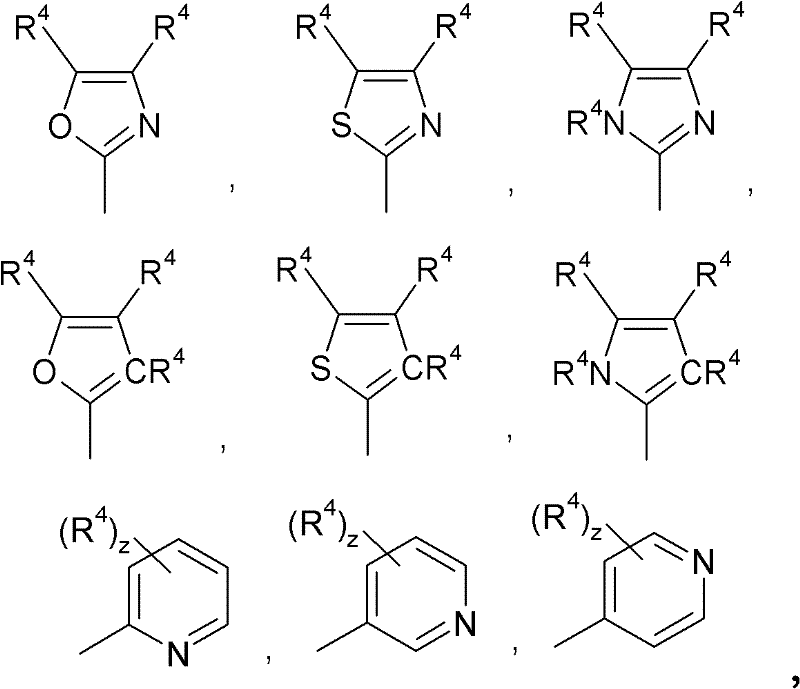
其中R4独立地为未取代或取代的烷基、未取代或取代的芳基、未取代或取代的杂芳基或SiR3 3,优选氢、氘、甲基、乙基、正丙基、异丙基、正丁基、仲丁基、异丁基或叔丁基;未取代或取代的C6芳基或C5-或C6杂芳基,更优选氢;和wherein R 4 is independently unsubstituted or substituted alkyl, unsubstituted or substituted aryl, unsubstituted or substituted heteroaryl or SiR 3 3 , preferably hydrogen, deuterium, methyl, ethyl, n-propyl, Isopropyl, n-butyl, sec-butyl, isobutyl or tert-butyl; unsubstituted or substituted C aryl or C - or C heteroaryl , more preferably hydrogen ; and
z为0、1、2、3或4,优选0、1或2。z is 0, 1, 2, 3 or 4, preferably 0, 1 or 2.
R2独立地为未取代或取代的烷基、未取代或取代的芳基或未取代或取代的杂芳基,或两个R2基团或一个R2基团和一个R1基团可以一起形成任选取代的亚烷基或亚芳基桥。两个R2基团或R1和R2可以属于通式(I)或(II)配体的一个单环或属于通式(I)或(II)配体的两个不同环,其中合适和优选的烷基、芳基和杂芳基,合适的亚烷基或亚芳基桥以及合适的取代基如上所述。R2优选为甲基、乙基、异丙基、正丙基、正丁基、异丁基、仲丁基或叔丁基或可以为未取代或取代的C6芳基,优选苯基或邻二烷基取代的苯基。 R2 is independently unsubstituted or substituted alkyl, unsubstituted or substituted aryl, or unsubstituted or substituted heteroaryl, or two R2 groups or one R2 group and one R1 group can be together form an optionally substituted alkylene or arylene bridge. The two R groups or R and R may belong to one single ring of the ligand of general formula (I) or (II) or to two different rings of the ligand of general formula (I) or (II), where appropriate and preferred alkyl, aryl and heteroaryl groups, suitable alkylene or arylene bridges and suitable substituents are as described above. R is preferably methyl, ethyl, isopropyl, n-propyl, n-butyl, isobutyl, sec-butyl or tert-butyl or can be unsubstituted or substituted C aryl , preferably phenyl or Ortho-dialkyl substituted phenyl.
R3独立地为未取代或取代的烷基、未取代或取代的芳基或未取代或取代的杂芳基,其中合适和优选的烷基、芳基和杂芳基以及合适的取代基为上述基团。R3优选为甲基、乙基、异丙基、正丙基、正丁基、异丁基、仲丁基或叔丁基或可以为未取代或取代的C6芳基,优选苯基或甲苯基。 R is independently unsubstituted or substituted alkyl, unsubstituted or substituted aryl or unsubstituted or substituted heteroaryl, wherein suitable and preferred alkyl, aryl and heteroaryl and suitable substituents are the aforementioned groups. R is preferably methyl, ethyl, isopropyl, n-propyl, n-butyl, isobutyl, sec-butyl or tert-butyl or can be unsubstituted or substituted C aryl , preferably phenyl or Tolyl.
本发明金属配合物优选包含选自元素周期表(CAS版)第IB、IIB、IIIB、IVB、VB、VIB、VIIB、VIII族过渡金属的金属原子,处于具体金属原子可能的任意氧化态。本发明金属配合物优选包含选自Ir、Co、Rh、Ni、Pd、Pt、Fe、Ru、Os、Cr、Mo、W、Mn、Tc、Re、Ag、Au和Cu,更优选Ir、Os、Ru、Rh、Pd、Co、Ni和Pt,最优选Ir、Pt、Rh、Ru和Os的金属原子M,处于具体金属原子可能的任意氧化态。特别优选使用Pt(II)、Pt(IV)、Ir(I)、Ir(III)、Os(II)和Ru(II),甚至更特别优选Pt(II)、Ir(III)和Os(II),最优选Ir(III)。The metal complexes according to the invention preferably comprise metal atoms selected from transition metals of groups IB, IIB, IIIB, IVB, VB, VIB, VIIB, VIII of the Periodic Table of the Elements (CAS version), in any possible oxidation state of the particular metal atom. The metal complex of the present invention preferably comprises a compound selected from Ir, Co, Rh, Ni, Pd, Pt, Fe, Ru, Os, Cr, Mo, W, Mn, Tc, Re, Ag, Au and Cu, more preferably Ir, Os , Ru, Rh, Pd, Co, Ni and Pt, most preferably the metal atoms M of Ir, Pt, Rh, Ru and Os, in any oxidation state possible for the particular metal atom. Particular preference is given to using Pt(II), Pt(IV), Ir(I), Ir(III), Os(II) and Ru(II), even more particularly preferably Pt(II), Ir(III) and Os(II) ), most preferably Ir(III).
除了所述至少一种通式(I)或(II)的配体外,本发明金属配合物可以包含通式(I)或(II)的配体以外的其它配体。例如,除了至少一种通式(I)或(II)的配体外,可以存在一种或多种不带电的单-或双齿配体K和合适的话一种或多种可以为单-或双齿的单-或双阴离子配体。此外,不同的式(I)或(II)配体可以存在于本发明金属配合物中。双齿配体应理解为指与金属原子M在两个位点配位的配体。In addition to the at least one ligand of the general formula (I) or (II), the metal complexes according to the invention may comprise further ligands than the ligands of the general formula (I) or (II). For example, in addition to at least one ligand of general formula (I) or (II), one or more uncharged mono- or bidentate ligands K may be present and if appropriate one or more may be mono- or bidentate mono- or dianionic ligands. Furthermore, different ligands of the formula (I) or (II) may be present in the metal complexes according to the invention. A bidentate ligand is understood to mean a ligand that is coordinated to the metal atom M at two sites.
单齿配体应理解为指与金属原子M在配体上一个位点配位的配体。Monodentate ligands are understood to mean ligands which are coordinated to the metal atom M at one site on the ligand.
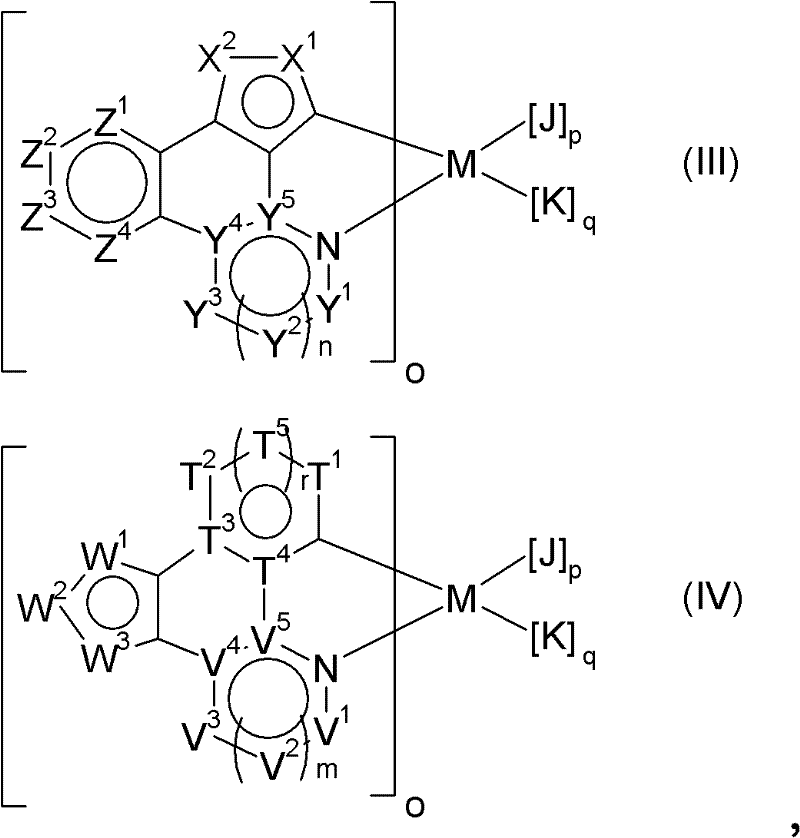
在优选实施方案中,本发明因此涉及通式(III)或(IV)的金属配合物:In a preferred embodiment, the invention therefore relates to metal complexes of the general formula (III) or (IV):

其中在式(III)和(IV)中的符号M、J、K、o、p和q各自独立地定义如下:Wherein the symbols M, J, K, o, p and q in formulas (III) and (IV) are each independently defined as follows:
M为选自元素周期表(CAS版)第IB、IIB、IIIB、IVB、VB、VIB、VIIB、VIII族过渡金属的金属原子,处于具体金属原子可能的任意氧化态;优选Ir(III)、Pt(II)或Os(II),更优选Ir(III);M is a metal atom selected from transition metals of groups IB, IIB, IIIB, IVB, VB, VIB, VIIB, VIII of the Periodic Table of the Elements (CAS version), in any possible oxidation state of the specific metal atom; preferably Ir(III), Pt(II) or Os(II), more preferably Ir(III);
J为可以为单-或双齿的单-或双阴离子配体,优选双齿单阴离子配体;J is a mono- or dianionic ligand which may be mono- or bidentate, preferably a bidentate monoanionic ligand;
K为通常非光活性的不带电的单-或双齿配体:优选配体K为膦类,尤其是三烷基膦如PEt3、PnBu3,三芳基膦如PPh3,膦酸酯及其衍生物,砷酸酯及其衍生物,亚磷酸酯,CO,腈类,胺类,可以与M形成π-配合物的二烯如2,4-己二烯、η4-环辛二烯和η2-环辛二烯(在每种情况下为1,3和1,5),烯丙基,甲代烯丙基,环辛烯,降冰片二烯和不带电的双卡宾如在WO 2008/000726中公开的不带电的双卡宾;K is a generally non-photoactive uncharged mono- or bidentate ligand: preferred ligands K are phosphines, especially trialkylphosphines such as PEt 3 , PnBu 3 , triarylphosphines such as PPh 3 , phosphonates and Its derivatives, arsenate and its derivatives, phosphite, CO, nitriles, amines, dienes that can form π-complexes with M such as 2,4-hexadiene, η 4 -cyclooctadiene ene and η 2 -cyclooctadiene (1,3 and 1,5 in each case), allyl, methallyl, cyclooctene, norbornadiene and uncharged dicarbene Uncharged bicarbenes as disclosed in WO 2008/000726;
o为1、2、3或4;其中当M=Ir(III)时o优选为1、2或3,更优选2或3,并且当M=Pt(II)或Os(II)时o为1或2;o is 1, 2, 3 or 4; wherein when M=Ir(III) o is preferably 1, 2 or 3, more preferably 2 or 3, and when M=Pt(II) or Os(II) o is 1 or 2;
p为0、1、2、3或4;其中当M=Ir(III)时p优选为0、1、2、3或4,更优选0或2,并且当M=Pt(II)和Os(II)时p为0、1或2,当M=Pt(II)时更优选0或2,当M=Os(II)时更优选0,其中p为与金属M的连接位点数,即当p=2时,配体可以为两个单齿配体或一个双齿配体;p is 0, 1, 2, 3 or 4; wherein p is preferably 0, 1, 2, 3 or 4 when M=Ir(III), more preferably 0 or 2, and when M=Pt(II) and Os When (II), p is 0, 1 or 2, more preferably 0 or 2 when M=Pt(II), more preferably 0 when M=Os(II), wherein p is the number of connection sites with metal M, that is When p=2, the ligands can be two monodentate ligands or one bidentate ligand;
q为0、1、2、3或4;其中当M=Ir(III)时q优选为0、1或2,更优选0;当M=Pt(II)时q为0或1,更优选0,并且当M=Os(II)时q为2或3,更优选2,其中q为与金属M的连接位点数,即当q=2时,配体可以为两个单齿配体或一个双齿配体;q is 0, 1, 2, 3 or 4; wherein when M=Ir(III) q is preferably 0, 1 or 2, more preferably 0; when M=Pt(II) q is 0 or 1, more preferably 0, and when M=Os(II), q is 2 or 3, more preferably 2, where q is the number of connection sites with metal M, that is, when q=2, the ligand can be two monodentate ligands or a bidentate ligand;
其中o、p和q取决于所用金属原子的氧化态和配位数以及配体的电荷。where o, p and q depend on the oxidation state and coordination number of the metal atom used and the charge of the ligand.
在数o、p或q为>1的情况下,式(I)或(II)的配体,所用K或J可以各自相同或不同。In the case where the number o, p or q is >1, the ligands of formula (I) or (II), K or J used may each be the same or different.
当M=Ir(III)时,式(III)和(IV)的本发明金属配合物中的o、p和q之和通常为3或4或5,即在当存在3个式(I)和(II)配体的情况下,o为3,并且当存在两个式(I)和(II)的配体和例如一个双齿单阴离子配体J时,o为2且p为2,并且例如在当存在两个式(I)和(II)的配体、一个双齿单阴离子配体J和一个不带电的单阴离子配体K的情况下,o为2,p为2且q为1。当M=Pt(II)时,式(III)和(IV)的本发明金属配合物中的o+p之和通常为2或3,即在当存在两个式(I)和(II)配体的情况下,o为2,并且当存在一个式(I)和(II)的配体和例如一个双齿单阴离子配体J时,o为1且p为2,其中o在每种情况下至少为1。对于Os(II),式(III)和(IV)的本发明金属配合物中的o、p和q之和通常为4或5,即当存在两个式(I)和(II)配体和例如一个不带电的双齿配体K时,o为2且q为2,并且例如在当存在一个式(I)和(II)的配体、一个双齿单阴离子配体J和一个不带电的双齿配体K的情况下,o为1,p为2且q为2。When M=Ir(III), the sum of o, p and q in the metal complexes of the present invention of formulas (III) and (IV) is usually 3 or 4 or 5, that is, when there are 3 formulas (I) In the case of and (II) ligands, o is 3, and when there are two ligands of formula (I) and (II) and for example one bidentate monoanionic ligand J, o is 2 and p is 2, And for example when there are two ligands of formula (I) and (II), one bidentate monoanionic ligand J and one uncharged monoanionic ligand K, o is 2, p is 2 and q is 1. When M=Pt(II), the sum of o+p in the metal complexes of the present invention of formulas (III) and (IV) is usually 2 or 3, that is, when there are two formulas (I) and (II) In the case of a ligand, o is 2, and when there is one ligand of formula (I) and (II) and for example a bidentate monoanionic ligand J, o is 1 and p is 2, wherein o is in each case at least 1. For Os(II), the sum of o, p and q in the inventive metal complexes of formulas (III) and (IV) is usually 4 or 5, i.e. when there are two ligands of formulas (I) and (II) and for example an uncharged bidentate ligand K, o is 2 and q is 2, and for example when there is a ligand of formula (I) and (II), a bidentate monoanionic ligand J and a not In the case of charged bidentate ligand K, o is 1, p is 2 and q is 2.
在式(III)和(IV)的金属配合物中的其它符号和指数各自如上述所定义。The other symbols and indices in the metal complexes of formulas (III) and (IV) are each as defined above.
若存在本发明金属配合物的不同异构体,则本发明包含在每种情况下金属配合物的各异构体和不同异构体以任何所需混合比例的混合物。金属配合物的不同异构体通常可以通过本领域技术人员已知的方法分离,例如通过色谱法、升华或结晶。If different isomers of the metal complexes according to the invention are present, the invention encompasses in each case the individual isomers and mixtures of the different isomers of the metal complexes in any desired mixing ratios. The different isomers of the metal complexes can generally be separated by methods known to those skilled in the art, for example by chromatography, sublimation or crystallization.
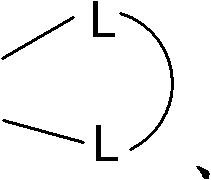
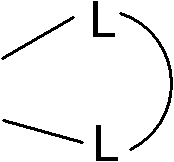
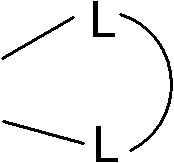
所用双齿单阴离子配体J通常为非光活性的或光活性的(例如与卡宾、苯基吡啶和苯基咪唑的氮杂环配合物)配体。合适的配体J例如为通式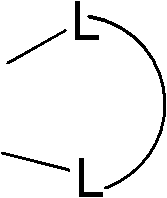
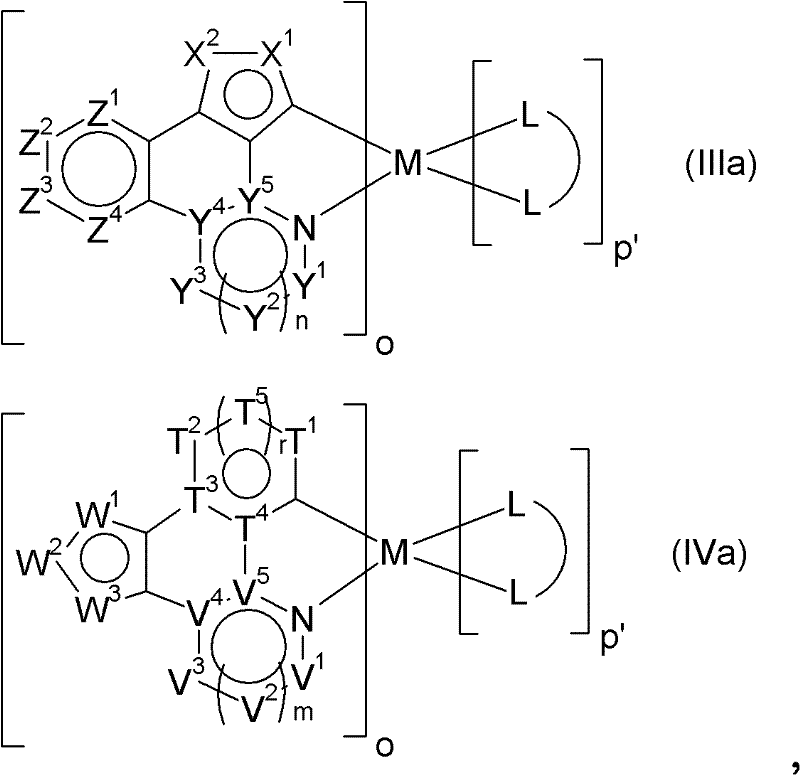
在特别优选的实施方案中,本发明金属配合物具有通式(IIIa)或(IVa):In a particularly preferred embodiment, the metal complexes according to the invention have the general formula (IIIa) or (IVa):

其中在式(IIIa)和(IVa)中的符号M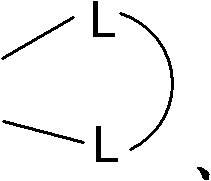

o为1、2、3或4;其中当M=Ir(III)时o优选为1、2或3,更优选2或3,并且当M=Pt(II)时o为1或2;o is 1, 2, 3 or 4; wherein when M=Ir(III), o is preferably 1, 2 or 3, more preferably 2 or 3, and when M=Pt(II) o is 1 or 2;
p’为0、1或2;其中当M=Ir(III)时p’优选为0、1或2,更优选0或1,并且当M=Pt(II)时p为0或1;其中p’为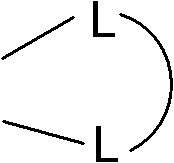
其中o和p’取决于所用金属原子的氧化态和配位数。where o and p' depend on the oxidation state and coordination number of the metal atoms used.
当M=Ir(III)时,式(IIa)的本发明金属配合物中的o+p’之和更优选为3,并且当M=Pt(II)时,o+p’之和更优选为2,其中o在每种情况下至少为1。When M=Ir(III), the sum of o+p' in the inventive metal complex of formula (IIa) is more preferably 3, and when M=Pt(II), the sum of o+p' is more preferably is 2, where o is at least 1 in each case.
在式(III)和(IV)的金属配合物中的其它符合和指数各自如上所定义。此外,双齿单阴离子配体的M的其它实例以及o和p’的实例为上面对M、双齿单阴离子配体以及o和p’(或p,其中p’=1对应于p=2)提及的实例。The other symbols and indices in the metal complexes of formulas (III) and (IV) are each as defined above. Furthermore, other examples of M and o and p' for bidentate monoanionic ligands are the above pair M, bidentate monoanionic ligands and o and p' (or p, where p'=1 corresponds to p= 2) Examples mentioned.
在特别优选的实施方案中,本发明涉及式(IIIaa)或(IIIab)的金属配合物:In a particularly preferred embodiment, the invention relates to metal complexes of the formula (IIIaa) or (IIIab):
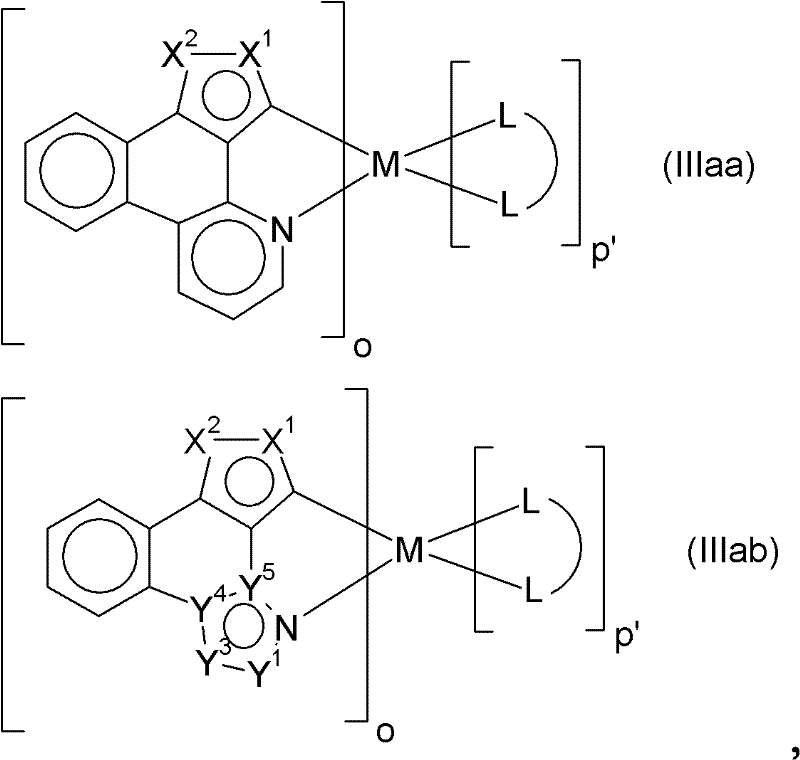
其中式(IIIaa)和(IIIab)中M、o和p’以及X1、X2、Y1、Y3、Y4和Y5各自独立地如上所定义。Wherein M, o and p' and X 1 , X 2 , Y 1 , Y 3 , Y 4 and Y 5 in formulas (IIIaa) and (IIIab) are each independently as defined above.
在其它特别优选的实施方案中,本发明涉及式(IVaa)或(IVab)的金属配合物:In another particularly preferred embodiment, the invention relates to metal complexes of the formula (IVaa) or (IVab):
其中式(IVaa)和(IVab)中M、o和p’以及W1、W2、W3、V1、V3、V4和V5各自独立地如上所定义。Wherein M, o and p' and W 1 , W 2 , W 3 , V 1 , V 3 , V 4 and V 5 in formulas (IVaa) and (IVab) are each independently as defined above.
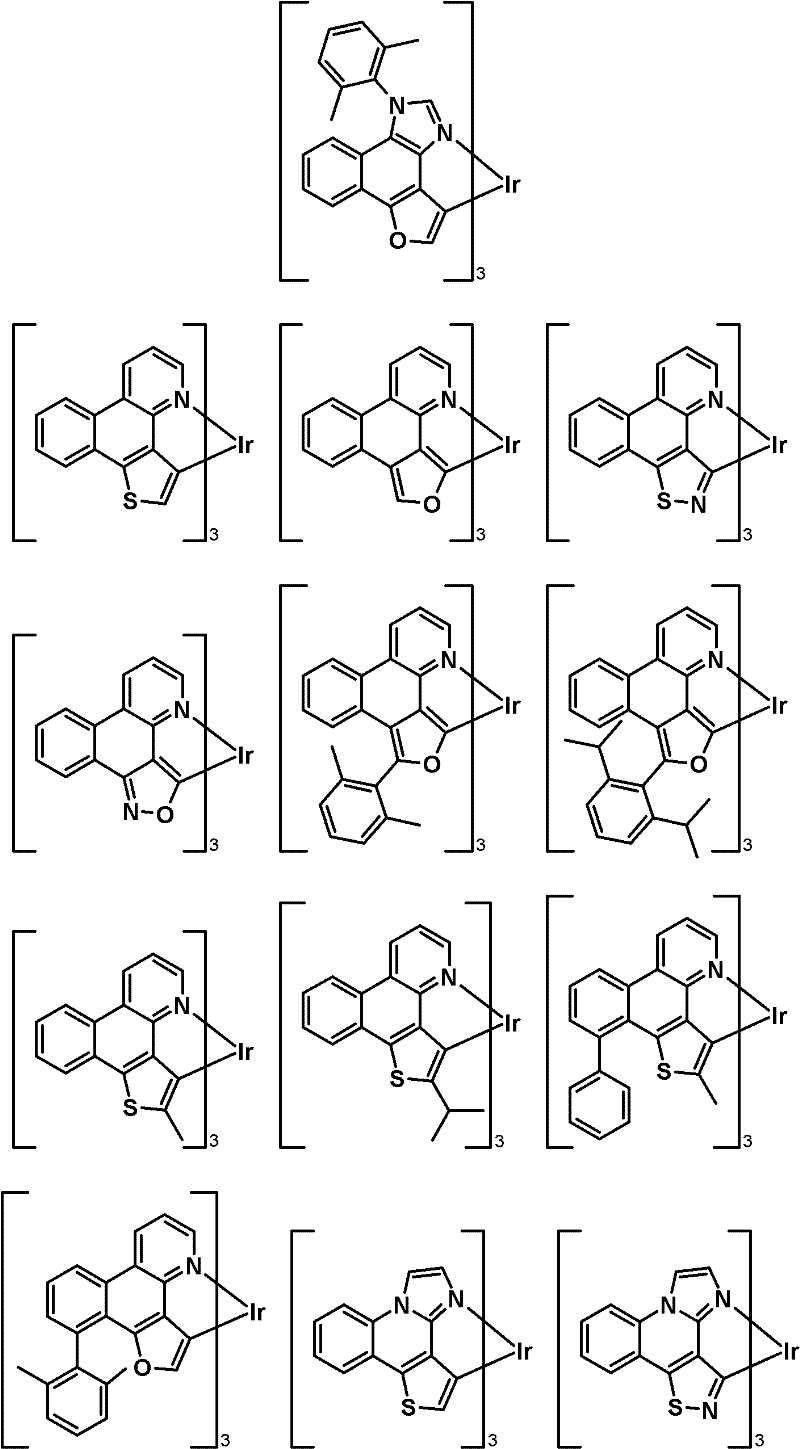
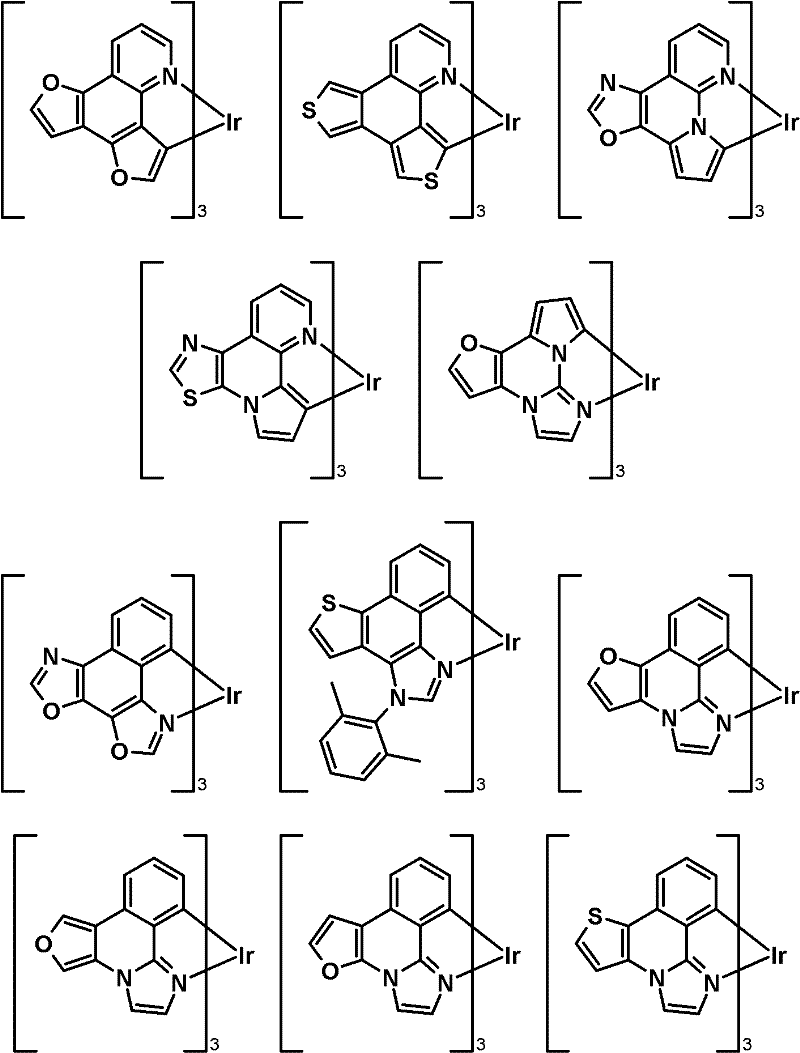
下文通过举例列出本发明优选的式(IIIa)和(IVa)配合物。Preferred complexes of the formulas (IIIa) and (IVa) according to the invention are listed below by way of example.
优选式(IIIa)化合物的实例有:Examples of preferred compounds of formula (IIIa) are:


优选式(IVa)化合物的实例有:Examples of preferred compounds of formula (IVa) are:

本发明金属配合物可以通过本领域技术人员已知的方法或类似于本领域技术人员已知的方法制备。合适的制备方法例如类似于WO 2007/095118的实施例中描述的方法。The metal complexes of the invention can be prepared by methods known to those skilled in the art or analogously to methods known to those skilled in the art. Suitable preparation methods are for example analogous to the methods described in the examples of WO 2007/095118.
本发明金属配合物通常由对应于通式(I)或(II)配体的配体前体开始制备。本发明金属配合物通过使至少一种基于通式(I)或(II)配体的配体前体与包含至少一种金属M的金属配合物反应而制备,其中M如上所定义。The metal complexes according to the invention are generally prepared starting from ligand precursors corresponding to the ligands of the general formula (I) or (II). The metal complexes according to the invention are prepared by reacting at least one ligand precursor based on a ligand of the general formula (I) or (II) with a metal complex comprising at least one metal M, where M is as defined above.
基于(I)或(II)配体的配体前体和包含至少一种金属M的金属配合物的摩尔比取决于所需本发明金属配合物的结构和式(I)或(II)的配体数。在本发明金属配合物中o为>1的情况下,可以通过使包含至少一种金属M的金属配合物与相同的配体前体反应或通过使它与不同的配体前体反应而得到金属配合物。制备不同本发明金属配合物的合适方法和反应顺序为本领域技术人员已知。The molar ratio of the ligand precursor based on the (I) or (II) ligand and the metal complex comprising at least one metal M depends on the desired structure of the metal complex according to the invention and on the formula (I) or (II) number of ligands. In the case of o > 1 in the metal complexes according to the invention, it can be obtained by reacting a metal complex comprising at least one metal M with the same ligand precursor or by reacting it with a different ligand precursor metal complexes. Suitable methods and reaction sequences for the preparation of the various metal complexes of the invention are known to those skilled in the art.
包含至少一种金属M并且要与配体前体反应的金属配合物为包含至少一种选自元素周期表(CAS版)第1B、IIB、IIIB、IVB、VB、VIB、VIIB、VIII族过渡金属的金属原子的金属配合物,所述金属原子优选选自Ir、Co、Rh、Ni、Pd、Pt、Fe、Ru、Os、Cr、Mo、W、Mn、Tc、Re和Cu,更优选Ir、Os、Ru、Rh、Pd、Co和Pt,最优选Ir、Pt、Rh、Ru和Os,处于具体金属原子可能的任意氧化态。A metal complex comprising at least one metal M and to be reacted with a ligand precursor is a metal complex comprising at least one transition metal selected from groups 1B, IIB, IIIB, IVB, VB, VIB, VIIB, VIII of the Periodic Table of the Elements (CAS version). Metal complexes of metal atoms of metals, preferably selected from the group consisting of Ir, Co, Rh, Ni, Pd, Pt, Fe, Ru, Os, Cr, Mo, W, Mn, Tc, Re and Cu, more preferably Ir, Os, Ru, Rh, Pd, Co and Pt, most preferably Ir, Pt, Rh, Ru and Os, are in any oxidation state possible for a particular metal atom.
合适的要与配体前体反应的金属配合物为本领域技术人员已知。合适的金属配合物的实例为:Pd(OAc)2、Pt(cod)Cl2、Pt(cod)Me2、Pt(acac)2、Pt(PPh3)2Cl2、PtCl2、[Rh(cod)Cl]2、Rh(acac)CO(PPh3)、Rh(acac)(CO)2、Rh(cod)2BF4、RhCl(PPh3)3、RhCl3·nH2O、Rh(acac)3、[Os(CO)3I2]2、[Os3(CO)12]、OsH4(PPh3)3Cp2Os、Cp* 2Os、H2OsCl6·6H2O、OsCl3·H2O、Ru(acac)3、RuCl2(cod)、Ru(2-甲基烯丙基)2(cod)、[(μ-Cl)Ir(η4-1,5-cod)]2、[(μ-Cl)Ir(η2-coe)2]2、Ir(acac)3、IrCl3·nH2O、(tht)3IrCl3、Ir(η3-烯丙基)3、Ir(η3-甲代烯丙基)3,其中cod为环辛二烯,coe为环辛烯,acac为乙酰丙酮且tht为四氢噻吩。金属配合物可以通过本领域技术人员已知的方法制备或可以市购。Suitable metal complexes to be reacted with the ligand precursors are known to those skilled in the art. Examples of suitable metal complexes are: Pd(OAc) 2 , Pt(cod)Cl 2 , Pt(cod)Me 2 , Pt(acac) 2 , Pt(PPh 3 ) 2 Cl 2 , PtCl 2 , [Rh( cod)Cl] 2 , Rh(acac)CO(PPh 3 ), Rh(acac)(CO) 2 , Rh(cod) 2 BF 4 , RhCl(PPh 3 ) 3 , RhCl 3 nH 2 O, Rh(acac ) 3 , [Os(CO) 3 I 2 ] 2 , [Os 3 (CO) 12 ], OsH 4 (PPh 3 ) 3 Cp 2 Os, Cp * 2 Os, H 2 OsCl 6 6H 2 O, OsCl 3 H 2 O, Ru(acac) 3 , RuCl 2 (cod), Ru(2-methallyl) 2 (cod), [(μ-Cl)Ir(η 4 -1,5-cod)] 2 , [(μ-Cl)Ir(η 2 -coe) 2 ] 2 , Ir(acac) 3 , IrCl 3 ·nH 2 O, (tht) 3 IrCl 3 , Ir(η 3 -allyl) 3 , Ir(η 3 -methallyl) 3 , where cod is cyclooctadiene, coe is cyclooctene, acac is acetylacetone and tht is tetrahydrothiophene. Metal complexes can be prepared by methods known to those skilled in the art or are commercially available.
在要与配体前体反应的金属配合物与一种或多种配体前体的上述反应之后,所得本发明金属配合物通常通过本领域技术人员已知的方法后处理和合适的话纯化。后处理和纯化通常通过本领域技术人员已知的方法通过萃取、柱层析和/或再结晶而进行。After the abovementioned reaction of the metal complexes to be reacted with the ligand precursors with one or more ligand precursors, the resulting metal complexes according to the invention are generally worked up and, if appropriate, purified by methods known to the person skilled in the art. Workup and purification are generally carried out by methods known to those skilled in the art by extraction, column chromatography and/or recrystallization.
本发明金属配合物用于有机发光二极管(OLED)中。它们适合作为发射体物质,因为他们在电磁波谱的可见区域中发光(电致发光)。借助本发明金属配合物作为发射体物质,可以提供特别是在电磁波谱的蓝色至浅蓝色区域中,优选在450-500nm的波长下处呈现电致发光,优选电致磷光的化合物。同时量子产率高且特别是装置中本发明金属配合物的寿命和稳定性高。The inventive metal complexes are used in organic light-emitting diodes (OLEDs). They are suitable as emitter substances because they emit light in the visible region of the electromagnetic spectrum (electroluminescence). By means of the metal complexes according to the invention as emitter substances it is possible to provide compounds which exhibit electroluminescence, preferably electrophosphorescence, especially in the blue to bluish region of the electromagnetic spectrum, preferably at a wavelength of 450-500 nm. At the same time the quantum yield is high and in particular the lifetime and stability of the metal complexes according to the invention in the device are high.
此外,取决于所用配体和所用中心金属,本发明金属配合物适合在OLED中作为电子、激子或空穴阻挡层,或空穴导体、电子导体、空穴注入层或基体材料。Furthermore, depending on the ligands used and the central metal used, the metal complexes according to the invention are suitable in OLEDs as electron, exciton or hole blocking layers, or as hole conductors, electron conductors, hole injection layers or matrix materials.
有机发光二极管(OLED)原则上由如下几层构成:An organic light-emitting diode (OLED) consists in principle of the following layers:
1.阳极(1)1. Anode(1)
2.空穴输送层(2)2. Hole transport layer (2)
3.发光层(3)3. Luminous layer(3)
4.电子输送层(4)4. Electron transport layer (4)
5.阴极(5)5. Cathode(5)
然而,OLED也可不具有所有所述层;例如具有层(1)(阳极)、(3)(发光层)和(5)(阴极)的OLED同样是合适的,其中层(2)(空穴输送层)和(4)(电子输送层)的功能通过邻接层来承担。具有层(1)、(2)、(3)和(5)或具有层(1)、(3)、(4)和(5)的OLED同样也是合适的。However, it is also possible for the OLED not to have all the layers mentioned; for example OLEDs with layers (1) (anode), (3) (luminescent layer) and (5) (cathode) are likewise suitable, wherein layer (2) (hole transport layer) and (4) (electron transport layer) are assumed by the adjacent layer. OLEDs with layers (1), (2), (3) and (5) or with layers (1), (3), (4) and (5) are likewise suitable.
本发明金属配合物可以用于OLED的各层中。因此本发明进一步提供一种包含至少一种本发明金属配合物的OLED和所述至少一种本发明金属配合物在OLED中的用途。本发明金属配合物优选用于发光层中,更优选作为发光分子。因此本发明进一步提供一种包含至少一种本发明金属配合物作为基体材料或发光分子,优选作为发光分子的发光层。优选的本发明金属配合物如上所述。The metal complexes according to the invention can be used in individual layers of OLEDs. The invention therefore further provides an OLED comprising at least one metal complex according to the invention and the use of said at least one metal complex according to the invention in an OLED. The metal complexes of the invention are preferably used in the emitting layer, more preferably as emitting molecules. The invention therefore further provides an emitting layer comprising at least one metal complex according to the invention as matrix material or emitting molecule, preferably as emitting molecule. Preferred metal complexes of the invention are as described above.
本发明金属配合物可以本体(无其它添加剂)存在于发光层或OLED的另一层中,优选存在于发光层中。然而,同样可以优选除了本发明金属配合物外,其它化合物存在于层中,优选存在于发光层中。例如荧光染料可以存在于发光层中以改变作为发射体分子使用的本发明金属配合物的发光颜色。此外,在优选实施方案中,可以使用至少一种基体材料。合适的基体材料为本领域技术人员已知。通常选择基体材料以使得基体材料的带隙大于用作发射体的本发明金属配合物的带隙。在本申请上下文中,带隙应理解为指三线态能量。尤其是在本发明金属配合物用作在电磁波谱的蓝色区域中发光的发射体材料的情况下,合适的优选使用的基体材料例如为卡宾配合物,尤其是描述于WO 2005/019373、WO 2005/0113704、WO2006/018292、WO 2006/056418、WO 2007/115981、WO 2008/000726和WO 2008/000727中的卡宾配合物;二甲硅烷基咔唑类,例如9-(4-叔丁基苯基)-3,6-二(三苯基甲硅烷基咔唑)、9-(苯基)-3,6-二(三苯基甲硅烷基)咔唑和描述于在本申请的优先权日仍未公布的PCT申请PCT/EP 2007/059648中的二甲硅烷基咔唑,和详细描述于WO 2004/095889、EP 1617710、EP1617711、WO 2006/112265、WO 2006/130598中的化合物。The metal complexes according to the invention can be present in bulk (without further additives) in the emitting layer or in another layer of the OLED, preferably in the emitting layer. However, it may likewise be preferred that, in addition to the metal complexes according to the invention, further compounds are present in the layer, preferably in the emitting layer. For example fluorescent dyes may be present in the emitting layer in order to change the emission color of the metal complexes of the invention used as emitter molecules. Furthermore, in a preferred embodiment at least one matrix material can be used. Suitable matrix materials are known to those skilled in the art. The matrix material is generally chosen such that the bandgap of the matrix material is greater than the bandgap of the metal complexes of the invention used as emitters. In the context of the present application, bandgap is understood to mean the triplet energy. Especially in the case of the metal complexes according to the invention as emitter materials which emit light in the blue region of the electromagnetic spectrum, suitable, preferably used matrix materials are, for example, carbene complexes, described in particular in WO 2005/019373, WO Carbene carbene complexes in 2005/0113704, WO 2006/018292, WO 2006/056418, WO 2007/115981, WO 2008/000726 and WO 2008/000727; disilylazoles such as 9-(4-tert-butyl Phenyl)-3,6-bis(triphenylsilylcarbazole), 9-(phenyl)-3,6-bis(triphenylsilyl)carbazole and those described in priority Disilylcarbazoles in the still unpublished PCT application PCT/EP 2007/059648, and compounds described in detail in WO 2004/095889, EP 1617710, EP1617711, WO 2006/112265, WO 2006/130598.
OLED的上述各层又可以由两层或更多层构成。例如空穴输送层可以由空穴从电极注入的一层和将空穴从空穴注入层输送到发光层中的一层构成。电子输送层同样可以由多层组成,例如由通过电极注入电子的一层和从电子注入层接收电子并将它们输送到发光层中的一层构成。根据因素如能量等级、耐热性和电荷载子迁移率以及有机层或金属电极中提及的层的能量差,分别选择这些所述层。本领域技术人员能够以使得OLED的结构最佳适应优选用作发射体物质的本发明金属配合物的方式选择OLED的结构。The above-mentioned layers of the OLED may in turn consist of two or more layers. For example, the hole transport layer may be composed of a layer for injecting holes from the electrode and a layer for transporting holes from the hole injection layer to the light-emitting layer. The electron transport layer can also be composed of multiple layers, for example, a layer that injects electrons through the electrodes and a layer that receives electrons from the electron injection layer and transports them into the light emitting layer. These said layers are respectively selected according to factors such as energy class, heat resistance and charge carrier mobility and the energy difference of the mentioned layers among organic layers or metal electrodes. A person skilled in the art is able to select the structure of the OLED in such a way that the structure of the OLED is optimally adapted to the metal complexes according to the invention which are preferably used as emitter substances.
为了得到非常有效的OLED,空穴输送层的HOMO(最高占据分子轨道)应定向于阳极的工作性能,电子输送层的LUMO(最低空分子轨道)定向于阴极的工作性能。In order to obtain a very efficient OLED, the HOMO (highest occupied molecular orbital) of the hole transport layer should be oriented to the performance of the anode, and the LUMO (lowest unoccupied molecular orbital) of the electron transport layer should be oriented to the performance of the cathode.
本申请进一步提供一种包含至少一种本发明发光层的OLED。OLED中的其它层可以由通常用于该层的任意材料构成并为本领域技术人员已知。The present application further provides an OLED comprising at least one emitting layer according to the invention. The other layers in the OLED can consist of any material commonly used for this layer and known to those skilled in the art.
合适的上述层材料(阳极、阴极、空穴和电子注入材料、空穴和电子输送材料以及空穴和电子阻挡材料、基体材料、荧光和磷光发射体)为本领域技术人员已知并且例如描述于H.Meng,N.Herron,Organic SmallMolecule Materials for Organic Light-Emitting Devices in OrganicLight-Emitting Materials and Devices,编辑:Z.Li,H.Meng,Taylor &Francis,2007,第3章,第295-411页中。Suitable materials for the aforementioned layers (anode, cathode, hole and electron injection materials, hole and electron transport materials and hole and electron blocking materials, matrix materials, fluorescent and phosphorescent emitters) are known to the person skilled in the art and are described, for example In H. Meng, N. Herron, Organic Small Molecule Materials for Organic Light-Emitting Devices in Organic Light-Emitting Materials and Devices, editors: Z. Li, H. Meng, Taylor & Francis, 2007, Chapter 3, pp. 295-411 middle.
阳极(1)为提供正电荷载子的电极。它可以例如由包含金属、不同金属的混合物、金属合金、金属氧化物或不同金属氧化物的混合物的材料组成。或者阳极可以为导电的聚合物。合适的金属包括元素周期表的第11、4、5和6族金属,以及第8-10族过渡金属。当阳极为透明时,通常使用元素周期表的第12、13和14族的混合金属氧化物,例如氧化铟锡(ITO)。阳极(1)同样可以包含有机材料如聚苯胺,这例如描述于Nature,第357卷,第477-479页(1992年6月11日)中。至少阳极或阴极应至少部分地为透明的以能够发射所形成的光。The anode (1) is the electrode that provides positive charge carriers. It may for example consist of a material comprising a metal, a mixture of different metals, a metal alloy, a metal oxide or a mixture of different metal oxides. Alternatively the anode can be a conductive polymer. Suitable metals include metals of Groups 11, 4, 5 and 6 of the Periodic Table of the Elements, and transition metals of Groups 8-10. When the anode is transparent, mixed metal oxides of groups 12, 13 and 14 of the periodic table are typically used, such as indium tin oxide (ITO). The anode ( 1 ) can likewise comprise organic materials such as polyaniline, as described, for example, in Nature, Vol. 357, pp. 477-479 (June 11, 1992). At least the anode or cathode should be at least partially transparent to be able to emit the formed light.
用于本发明OLED层(2)的合适空穴输送材料例如描述于Kirk-Othmer Encyclopedia of Chemical Technology,第4版,第18卷,第837-860页,1996中。空穴输送分子或聚合物可以用作空穴输送材料。常用的空穴输送分子选自4,4’-二[N-(1-萘基)-N-苯基氨基]联苯(α-NPD)、N,N’-二苯基-N,N’-二(3-甲基苯基)-[1,1’-联苯]-4,4’-二胺(TPD)、1,1-二[(二-4-甲苯基氨基)苯基]环己烷(TAPC)、N,N’-二(4-甲基苯基)-N,N’-二(4-乙基苯基)-[1,1’-(3,3’-二甲基)联苯]-4,4’-二胺(ETPD)、四(3-甲基苯基)-N,N,N’,N’-2,5-苯二胺(PDA)、α-苯基-4-N,N-二苯基氨基苯乙烯(TPS)、对(二乙基氨基)苯甲醛二苯基腙(DEH)、三苯基胺(TPA)、二[4-(N,N-二乙基氨基)-2-甲基苯基)(4-甲基苯基)甲烷(MPMP)、1-苯基-3-[对(二乙基氨基)苯乙烯基]-5-[对(二乙基氨基)苯基]吡唑啉(PPR或DEASP)、1,2-反式-二(9H-咔唑-9-基)环丁烷(DCZB)、N,N,N’,N’-四(4-甲基苯基)-(1,1’-联苯)-4,4’-二胺(TTB)、4,4’,4”-三(N,N-二苯基氨基)三苯基胺(TDTA)和卟啉化合物,以及酞菁如酞菁铜。常用的空穴输送聚合物选自聚乙烯基咔唑、(苯基甲基)聚硅烷、PEDOT(聚(3,4-亚乙基二氧基噻吩)),优选PSS(聚苯乙烯磺酸盐)掺杂的PEDOT和聚苯胺。同样可以通过将空穴输送分子掺杂到聚合物如聚苯乙烯和聚碳酸酯中得到空穴输送聚合物。合适的空穴输送分子为上面已经提到的分子。Suitable hole-transport materials for the inventive OLED layer (2) are described, for example, in the Kirk-Othmer Encyclopedia of Chemical Technology, 4th Edition, Volume 18, pp. 837-860, 1996. Hole-transporting molecules or polymers can be used as hole-transporting materials. Commonly used hole-transporting molecules are selected from 4,4'-bis[N-(1-naphthyl)-N-phenylamino]biphenyl (α-NPD), N,N'-diphenyl-N,N '-bis(3-methylphenyl)-[1,1'-biphenyl]-4,4'-diamine (TPD), 1,1-bis[(two-4-methylphenylamino)phenyl ]cyclohexane (TAPC), N,N'-bis(4-methylphenyl)-N,N'-bis(4-ethylphenyl)-[1,1'-(3,3'- Dimethyl)biphenyl]-4,4'-diamine (ETPD), tetrakis(3-methylphenyl)-N,N,N',N'-2,5-phenylenediamine (PDA), α-phenyl-4-N, N-diphenylaminostyrene (TPS), p-(diethylamino)benzaldehyde diphenylhydrazone (DEH), triphenylamine (TPA), bis[4- (N,N-diethylamino)-2-methylphenyl)(4-methylphenyl)methane (MPMP), 1-phenyl-3-[p-(diethylamino)styryl] -5-[p-(diethylamino)phenyl]pyrazoline (PPR or DEASP), 1,2-trans-bis(9H-carbazol-9-yl)cyclobutane (DCZB), N, N, N', N'-tetrakis(4-methylphenyl)-(1,1'-biphenyl)-4,4'-diamine (TTB), 4,4',4"-tri(N , N-diphenylamino) triphenylamine (TDTA) and porphyrin compounds, and phthalocyanines such as copper phthalocyanine. Commonly used hole-transporting polymers are selected from polyvinylcarbazole, (phenylmethyl) poly Silane, PEDOT (poly(3,4-ethylenedioxythiophene)), preferably PSS (polystyrene sulfonate) doped PEDOT and polyaniline. It is also possible to Hole-transporting polymers are obtained from substances such as polystyrene and polycarbonate. Suitable hole-transporting molecules are those already mentioned above.
用于本发明OLED层(4)的合适电子输送材料包括金属螯合羟吲哚化合物如三(8-羟基喹啉)铝(Alq3)、基于邻菲咯啉的化合物如2,9-二甲基-4,7-二苯基-1,10-邻菲咯啉(DDPA=BCP)或4,7-二苯基-1,10-邻菲咯啉(DPA)和唑类化合物如2-(4-联苯基)-5-(4-叔丁基苯基)-1,3,4-
如上所述作为空穴输送材料和电子输送材料的材料中,部分材料可以实现多种功能。例如,部分电子传导材料在当它们具有低卧式HOMO时同时为空穴阻挡材料。Among the materials as the hole-transporting material and the electron-transporting material as described above, some materials can fulfill various functions. For example, some electron conducting materials are simultaneously hole blocking materials when they have a low horizontal HOMO.
还可以电子掺杂电荷输送层以改进所用材料的输送性能,首先以使层厚更大(避免针孔/短路)并其次以将装置的操作电压最小化。例如,空穴输送材料可以掺杂有电子受体;例如,酞菁或芳基胺如TPD或TDTA可以掺杂有四氟四氰基醌二甲烷(F4-TCNQ)。电子输送材料例如可以掺杂有碱金属,例如Alq3掺杂有锂。电子掺杂为本领域技术人员已知并例如公开于W.Gao,A.Kahn,J.Appl.Phys.,第94卷,No.1,2003年7月1日(P型掺杂的有机层);A.G.Werner,F.Li,K.Harada,M.Pfeiffer,T.Fritz,K.Leo,Appl.Phys.Lett.,第82卷,No.25,2003年6月23日和Pfeiffer等人,Organic Electronics 2003,4,89-103。The charge transport layer can also be doped with electrons to improve the transport properties of the materials used, firstly to make the layer thicker (avoid pinholes/short circuits) and secondly to minimize the operating voltage of the device. For example, hole transport materials can be doped with electron acceptors; for example, phthalocyanines or arylamines such as TPD or TDTA can be doped with tetrafluorotetracyanoquinodimethane (F4-TCNQ). The electron-transporting material can, for example, be doped with an alkali metal, for example Alq 3 with lithium. Electron doping is known to those skilled in the art and disclosed, for example, in W.Gao, A.Kahn, J.Appl.Phys., Volume 94, No.1, July 1, 2003 (P-type doped organic layer); AG Werner, F. Li, K. Harada, M. Pfeiffer, T. Fritz, K. Leo, Appl. Phys. Lett., Vol. 82, No. 25, June 23, 2003 and Pfeiffer et al. , Organic Electronics 2003, 4, 89-103.
阴极(5)为用于引入电子或负电荷载子的电极。阴极可以为任何具有功函比阳极低的金属或非金属。适合阴极的材料选自元素周期表的第1族碱金属,例如Li、Cs、第2族碱土金属、第12族金属,其包含稀土金属和镧系元素和锕系元素。此外,可以使用金属如铝、铟、钙、钡、钐和镁及其组合。此外,含锂有机金属化合物或LiF可以在有机层和阴极之间施用以降低操作电压。The cathode (5) is an electrode for introducing electrons or negative charge carriers. The cathode can be any metal or nonmetal that has a lower work function than the anode. Suitable materials for the cathode are selected from the group 1 alkali metals of the periodic table, eg Li, Cs, group 2 alkaline earth metals, group 12 metals including rare earth metals and the lanthanides and actinides. In addition, metals such as aluminum, indium, calcium, barium, samarium and magnesium and combinations thereof may be used. In addition, lithium-containing organometallic compounds or LiF can be applied between the organic layer and the cathode to lower the operating voltage.
本发明OLED可以额外包含本领域技术人员已知的其它层。例如容易输送正电荷和/或相互匹配层带隙的层可以在层(2)和发光层(3)之间应用。或者其它层可以用作保护层。以类似的方式,可以在发光层(3)和层(4)之间存在额外的层以容易输送负电荷和/或相互匹配层之间的带隙。或者此层可以用作保护层。The OLEDs according to the invention may additionally comprise further layers known to the person skilled in the art. For example layers which readily transport positive charges and/or which mutually match the band gap of the layers can be applied between layer ( 2 ) and light-emitting layer ( 3 ). Or other layers can be used as protective layers. In a similar way, there may be additional layers between the light-emitting layer (3) and layer (4) to facilitate the transport of negative charges and/or to mutually match the bandgap between the layers. Or this layer can be used as a protective layer.
在优选实施方案中,除了层(1)-(5)外,本发明OLED包含至少一种如下所述的其它层:In a preferred embodiment, besides the layers (1)-(5), the OLED according to the invention comprises at least one further layer as described below:
-在阳极(1)和空穴输送层(2)之间的空穴注入层;- a hole injection layer between the anode (1) and the hole transport layer (2);
-在空穴输送层(2)和发光层(3)之间的电子和/或激子阻挡层;- an electron and/or exciton blocking layer between the hole transport layer (2) and the light emitting layer (3);
-在发光层(3)和电子输送层(4)之间的空穴和/或激子阻挡层;- a hole and/or exciton blocking layer between the light-emitting layer (3) and the electron-transporting layer (4);
-在电子输送层(4)和阴极(5)之间的电子注入层。- An electron injection layer between the electron transport layer (4) and the cathode (5).
然而,已经如上所述,OLED也可不具有所有所述层(1)-(5);例如具有层(1)(阳极)、(3)(发光层)和(5)(阴极)的OLED同样是合适的,其中层(2)(空穴输送层)和(4)(电子输送层)的功能通过邻接层来承担。具有层(1)、(2)、(3)和(5)或具有层(1)、(3)、(4)和(5)的OLED同样也是合适的。However, as already mentioned, an OLED may also not have all said layers (1)-(5); for example an OLED with layers (1) (anode), (3) (luminescent layer) and (5) (cathode) would likewise is suitable in which the functions of layers (2) (hole transport layer) and (4) (electron transport layer) are assumed by adjacent layers. OLEDs with layers (1), (2), (3) and (5) or with layers (1), (3), (4) and (5) are likewise suitable.
本领域技术人员已知合适的材料必须如何选择(例如基于电化学的研究)。适合各层的材料和合适的OLED结构为本领域技术人员已知且例如描述于WO2005/113704中。The person skilled in the art knows how suitable materials have to be selected (eg based on electrochemical studies). Suitable materials for the individual layers and suitable OLED structures are known to the person skilled in the art and are described, for example, in WO 2005/113704.
此外,本发明OLED的各所述层可以由两层或更多层构成。此外,可以表面处理部分或全部的层(1)、(2)、(3)、(4)和(5)以增加电荷载子输送的效率。各所述层材料的选择优选通过得到具有高效率的OLED而确定。Furthermore, each of said layers of the OLED of the invention may consist of two or more layers. Furthermore, some or all of the layers (1), (2), (3), (4) and (5) may be surface treated to increase the efficiency of charge carrier transport. The choice of material for each of said layers is preferably determined by obtaining an OLED with high efficiency.
本发明OLED可以通过本领域技术人员已知的方法生产。OLED通常通过将各层依次气相沉积到合适的衬底上而生产。合适的衬底例如为玻璃或聚合物薄膜。对于气相沉积,可以使用常规技术如热蒸发、化学气相沉积和其它技术。在另一方法中,有机层可以由溶液或在合适溶剂中的分散体涂敷,其中使用本领域技术人员已知的涂敷技术。除了所述至少一种本发明金属配合物外,具有一种OLED层中的聚合物材料,优选发光层中的聚合物材料的组合物通常借助溶液介导的方法以层的方式施用。The inventive OLEDs can be produced by methods known to those skilled in the art. OLEDs are usually produced by sequential vapor deposition of the individual layers onto a suitable substrate. Suitable substrates are, for example, glass or polymer films. For vapor deposition, conventional techniques such as thermal evaporation, chemical vapor deposition and others can be used. In another method, the organic layer can be coated from solution or dispersion in a suitable solvent, using coating techniques known to those skilled in the art. In addition to the at least one metal complex according to the invention, the composition with a polymer material in the OLED layer, preferably in the emitting layer, is usually applied in layers by means of a solution-mediated method.
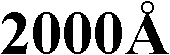
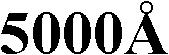
不同的层通常具有如下厚度:500-

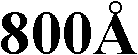
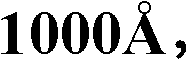

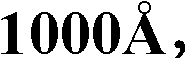

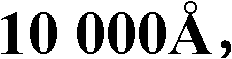
本发明金属配合物在本发明OLED至少一层中的使用,优选在本发明OLED的发光层中用作发光分子,允许得到高效的OLED。本发明OLED的效率可以额外通过优化其它层而改进。例如可以使用高效阴极如Ca、Ba或LiF。使操作电压降低或量子效率增加的成型衬底和新空穴输送材料同样可以用于本发明OLED中。此外,OLED中可以存在额外的层以调节不同层的能量等级并促进电致发光。The use of the metal complexes of the invention in at least one layer of the OLEDs of the invention, preferably as emitting molecules in the emitting layer of the OLEDs of the invention, allows highly efficient OLEDs to be obtained. The efficiency of the inventive OLEDs can additionally be improved by optimizing further layers. For example high efficiency cathodes such as Ca, Ba or LiF can be used. Shaped substrates and novel hole-transporting materials which lead to a reduction in the operating voltage or an increase in the quantum efficiency can likewise be used in the OLEDs according to the invention. Furthermore, additional layers can be present in OLEDs to tune the energy levels of the different layers and facilitate electroluminescence.
本发明OLED可以用于所有需用电致发光的装置中。合适的装置优选选自固定和移动视频显示单元。固定视频显示单元例如为计算机、电视的视频显示单元,打印机、厨房电器中的视频显示单元和广告板,照明装置,信息板。移动视频显示单元例如为移动电话、便携式电脑、相机尤其是数码相机、交通工具中的视频显示单元及客车和火车上的目的地显示器。The inventive OLED can be used in all devices requiring electroluminescence. Suitable means are preferably selected from stationary and mobile video display units. Fixed video display units are, for example, video display units of computers and televisions, video display units and advertising boards in printers and kitchen appliances, lighting devices, and information boards. Mobile video display units are, for example, mobile phones, laptop computers, cameras, especially digital cameras, video display units in vehicles and destination displays in passenger cars and trains.
此外,本发明金属配合物可以用于具有反转结构的OLED中。本发明金属配合物优选在这些反转OLED中又用于发光层中。反转OLED的结构和其中常用的材料为本领域技术人员已知。Furthermore, the metal complexes of the invention can be used in OLEDs with an inverted structure. The metal complexes according to the invention are preferably used in turn in the emitting layer in these inverse OLEDs. The structure of inverted OLEDs and the materials commonly used therein are known to those skilled in the art.
Claims (15)
Applications Claiming Priority (3)
| Application Number | Priority Date | Filing Date | Title |
|---|---|---|---|
| EP08157909.6 | 2008-06-10 | ||
| EP08157909 | 2008-06-10 | ||
| PCT/EP2009/057064 WO2009150140A1 (en) | 2008-06-10 | 2009-06-09 | Novel transition metal complexes and use thereof in organic light-emitting diodes - iv |
Publications (1)
| Publication Number | Publication Date |
|---|---|
| CN102119205A true CN102119205A (en) | 2011-07-06 |
Family
ID=40984758
Family Applications (1)
| Application Number | Title | Priority Date | Filing Date |
|---|---|---|---|
| CN2009801305517A Pending CN102119205A (en) | 2008-06-10 | 2009-06-09 | Novel transition metal complexes and use thereof in organic light-emitting diodes -IV |
Country Status (6)
| Country | Link |
|---|---|
| US (1) | US20110114933A1 (en) |
| EP (1) | EP2288670A1 (en) |
| JP (1) | JP2011523955A (en) |
| KR (1) | KR20110015453A (en) |
| CN (1) | CN102119205A (en) |
| WO (1) | WO2009150140A1 (en) |
Families Citing this family (3)
| Publication number | Priority date | Publication date | Assignee | Title |
|---|---|---|---|---|
| WO2011073149A1 (en) | 2009-12-14 | 2011-06-23 | Basf Se | Metal complexes comprising diazabenzimidazol carbene-ligands and the use thereof in oleds |
| US10964904B2 (en) * | 2017-01-20 | 2021-03-30 | Universal Display Corporation | Organic electroluminescent materials and devices |
| US11910699B2 (en) | 2017-08-10 | 2024-02-20 | Universal Display Corporation | Organic electroluminescent materials and devices |
Family Cites Families (4)
| Publication number | Priority date | Publication date | Assignee | Title |
|---|---|---|---|---|
| WO2007028417A1 (en) * | 2005-09-07 | 2007-03-15 | Technische Universität Braunschweig | Triplett emitter having condensed five-membered rings |
| WO2007055187A1 (en) * | 2005-11-14 | 2007-05-18 | Idemitsu Kosan Co., Ltd. | Metal complex compounds and organic electroluminescent devices made by using the same |
| KR101600624B1 (en) * | 2006-02-10 | 2016-03-21 | 유니버셜 디스플레이 코포레이션 | METAL COMPLEXES OF CYCLOMETALLATED IMIDAZO[1,2-f]PHENANTHRIDINE AND DIIMIDAZO[1,2-A:1',2'-C]QUINAZOLINE LIGANDS AND ISOELECTRONIC AND BENZANNULATED ANALOGS THEREOF |
| WO2007097149A1 (en) * | 2006-02-20 | 2007-08-30 | Konica Minolta Holdings, Inc. | Organic electroluminescence element, white light emitting element, display device and illuminating device |
-
2009
- 2009-06-09 CN CN2009801305517A patent/CN102119205A/en active Pending
- 2009-06-09 JP JP2011512959A patent/JP2011523955A/en not_active Withdrawn
- 2009-06-09 WO PCT/EP2009/057064 patent/WO2009150140A1/en not_active Ceased
- 2009-06-09 US US12/997,380 patent/US20110114933A1/en not_active Abandoned
- 2009-06-09 EP EP09761703A patent/EP2288670A1/en not_active Withdrawn
- 2009-06-09 KR KR1020107029791A patent/KR20110015453A/en not_active Withdrawn
Also Published As
| Publication number | Publication date |
|---|---|
| WO2009150140A1 (en) | 2009-12-17 |
| KR20110015453A (en) | 2011-02-15 |
| EP2288670A1 (en) | 2011-03-02 |
| US20110114933A1 (en) | 2011-05-19 |
| JP2011523955A (en) | 2011-08-25 |
Similar Documents
| Publication | Publication Date | Title |
|---|---|---|
| US8377332B2 (en) | Transition metal complexes and use thereof in organic light emitting diodes—III | |
| US8410270B2 (en) | Transition metal complexes and use thereof in organic light-emitting diodes V | |
| US8241764B2 (en) | OLED display with extended lifetime | |
| US8940904B2 (en) | Use of transition metal-carbene complexes which do not comprise any cyclometallation via non-carbenes in OLEDs | |
| US8258297B2 (en) | Transition metal complexes with bridged carbene ligands and use thereof in OLEDs | |
| US8383828B2 (en) | Transition metal complexes comprising one noncarbene ligand and one or two carbene ligands and their use in OLEDs | |
| CN103732603B (en) | Metal complexes comprising azabenzimidazole carbene ligands and their use in OLEDs | |
| JP5553758B2 (en) | Use of acridine derivatives as matrix materials and / or electron blockers in OLEDs | |
| KR102637435B1 (en) | Organic electroluminescent materials and devices | |
| US10424746B2 (en) | Pt- or Pd-carbene complexes for use in organic light emitting diodes | |
| US20070111025A1 (en) | Use of platinum ll complexes as luminescent materials in organic light-emitting diodes (oleds) | |
| US20180127448A1 (en) | Metal Complexes, Comprising Carbene Ligands Having an O-Substituted Non-Cyclometalated Aryl Group and Their Use in Organic Light Emitting Diodes | |
| CN102119205A (en) | Novel transition metal complexes and use thereof in organic light-emitting diodes -IV |
Legal Events
| Date | Code | Title | Description |
|---|---|---|---|
| C06 | Publication | ||
| PB01 | Publication | ||
| C10 | Entry into substantive examination | ||
| SE01 | Entry into force of request for substantive examination | ||
| WD01 | Invention patent application deemed withdrawn after publication | ||
| WD01 | Invention patent application deemed withdrawn after publication |
Application publication date: 20110706 |