CN102113396A - Communication system, mobile station device, and communication method - Google Patents
Communication system, mobile station device, and communication method Download PDFInfo
- Publication number
- CN102113396A CN102113396A CN2009801301997A CN200980130199A CN102113396A CN 102113396 A CN102113396 A CN 102113396A CN 2009801301997 A CN2009801301997 A CN 2009801301997A CN 200980130199 A CN200980130199 A CN 200980130199A CN 102113396 A CN102113396 A CN 102113396A
- Authority
- CN
- China
- Prior art keywords
- frequency band
- unit
- station apparatus
- channel
- mobile station
- Prior art date
- Legal status (The legal status is an assumption and is not a legal conclusion. Google has not performed a legal analysis and makes no representation as to the accuracy of the status listed.)
- Granted
Links
Images




Classifications
-
- H—ELECTRICITY
- H04—ELECTRIC COMMUNICATION TECHNIQUE
- H04L—TRANSMISSION OF DIGITAL INFORMATION, e.g. TELEGRAPHIC COMMUNICATION
- H04L5/00—Arrangements affording multiple use of the transmission path
- H04L5/003—Arrangements for allocating sub-channels of the transmission path
- H04L5/0044—Allocation of payload; Allocation of data channels, e.g. PDSCH or PUSCH
-
- H—ELECTRICITY
- H04—ELECTRIC COMMUNICATION TECHNIQUE
- H04W—WIRELESS COMMUNICATION NETWORKS
- H04W72/00—Local resource management
- H04W72/04—Wireless resource allocation
-
- H—ELECTRICITY
- H04—ELECTRIC COMMUNICATION TECHNIQUE
- H04L—TRANSMISSION OF DIGITAL INFORMATION, e.g. TELEGRAPHIC COMMUNICATION
- H04L5/00—Arrangements affording multiple use of the transmission path
- H04L5/0091—Signalling for the administration of the divided path, e.g. signalling of configuration information
- H04L5/0094—Indication of how sub-channels of the path are allocated
-
- H—ELECTRICITY
- H04—ELECTRIC COMMUNICATION TECHNIQUE
- H04L—TRANSMISSION OF DIGITAL INFORMATION, e.g. TELEGRAPHIC COMMUNICATION
- H04L5/00—Arrangements affording multiple use of the transmission path
- H04L5/0091—Signalling for the administration of the divided path, e.g. signalling of configuration information
- H04L5/0096—Indication of changes in allocation
- H04L5/0098—Signalling of the activation or deactivation of component carriers, subcarriers or frequency bands
-
- H—ELECTRICITY
- H04—ELECTRIC COMMUNICATION TECHNIQUE
- H04W—WIRELESS COMMUNICATION NETWORKS
- H04W72/00—Local resource management
- H04W72/04—Wireless resource allocation
- H04W72/044—Wireless resource allocation based on the type of the allocated resource
- H04W72/0453—Resources in frequency domain, e.g. a carrier in FDMA
-
- H—ELECTRICITY
- H04—ELECTRIC COMMUNICATION TECHNIQUE
- H04W—WIRELESS COMMUNICATION NETWORKS
- H04W72/00—Local resource management
- H04W72/20—Control channels or signalling for resource management
- H04W72/23—Control channels or signalling for resource management in the downlink direction of a wireless link, i.e. towards a terminal
-
- H—ELECTRICITY
- H04—ELECTRIC COMMUNICATION TECHNIQUE
- H04L—TRANSMISSION OF DIGITAL INFORMATION, e.g. TELEGRAPHIC COMMUNICATION
- H04L1/00—Arrangements for detecting or preventing errors in the information received
- H04L1/12—Arrangements for detecting or preventing errors in the information received by using return channel
- H04L1/16—Arrangements for detecting or preventing errors in the information received by using return channel in which the return channel carries supervisory signals, e.g. repetition request signals
- H04L1/18—Automatic repetition systems, e.g. Van Duuren systems
- H04L1/1812—Hybrid protocols; Hybrid automatic repeat request [HARQ]
- H04L1/1819—Hybrid protocols; Hybrid automatic repeat request [HARQ] with retransmission of additional or different redundancy
-
- H—ELECTRICITY
- H04—ELECTRIC COMMUNICATION TECHNIQUE
- H04L—TRANSMISSION OF DIGITAL INFORMATION, e.g. TELEGRAPHIC COMMUNICATION
- H04L27/00—Modulated-carrier systems
- H04L27/26—Systems using multi-frequency codes
- H04L27/2601—Multicarrier modulation systems
-
- H—ELECTRICITY
- H04—ELECTRIC COMMUNICATION TECHNIQUE
- H04L—TRANSMISSION OF DIGITAL INFORMATION, e.g. TELEGRAPHIC COMMUNICATION
- H04L5/00—Arrangements affording multiple use of the transmission path
- H04L5/0001—Arrangements for dividing the transmission path
- H04L5/0003—Two-dimensional division
- H04L5/0005—Time-frequency
- H04L5/0007—Time-frequency the frequencies being orthogonal, e.g. OFDM(A) or DMT
- H04L5/001—Time-frequency the frequencies being orthogonal, e.g. OFDM(A) or DMT the frequencies being arranged in component carriers
Landscapes
- Engineering & Computer Science (AREA)
- Signal Processing (AREA)
- Computer Networks & Wireless Communication (AREA)
- Mobile Radio Communication Systems (AREA)
Abstract
一种与基站装置通信的移动站装置,具备:信息取得部,取得利用经由第一频带内的物理下行链路共享信道的RRC信令发送的指定与第一频带不同的至少一个第二频带的信息;频带指定部,根据信息取得部取得的信息,指定第二频带;和通信部,利用第一频带或者第二频带与基站装置进行通信。
A mobile station device for communicating with a base station device includes: an information acquisition unit that acquires information sent via RRC signaling of a physical downlink shared channel within a first frequency band, specifying at least one second frequency band different from the first frequency band; a frequency band designation unit that designates the second frequency band based on the information acquired by the information acquisition unit; and a communication unit that communicates with the base station device using the first frequency band or the second frequency band.
Description
技术领域technical field
本发明涉及通信系统、移动站装置以及通信方法。The present invention relates to a communication system, a mobile station device, and a communication method.
本申请基于2008年8月6日在日本申请的特愿2008-203361号主张优先权,并在此援引其内容。this application claims priority based on Japanese Patent Application No. 2008-203361 for which it applied to Japan on August 6, 2008, and uses the content here.
背景技术Background technique
3GPP(3rd Generation Partnership Project:第三代合作伙伴计划)是进行研究并作成移动电话系统的规格的计划。3GPP以使W-CDMA(Wideband-Code Division Multiple Access:宽带-码分多址接入)和GSM(Global System for Mobile Communications:全球移动通信系统)发展了的网络为基础。3GPP (3rd Generation Partnership Project: 3rd Generation Partnership Project) is a project for conducting research and creating specifications for mobile phone systems. 3GPP is based on the network developed by W-CDMA (Wideband-Code Division Multiple Access) and GSM (Global System for Mobile Communications: Global System for Mobile Communications).
在3GPP中,W-CDMA方式作为第三代蜂窝移动通信方式被标准化,并逐渐开始服务。此外,进一步提高了通信速度的HSDPA(High-Speed Downlink Packet Access:高速下行链路包接入)也被标准化,并开始了服务。In 3GPP, the W-CDMA method is standardized as a third-generation cellular mobile communication method, and services are gradually starting. In addition, HSDPA (High-Speed Downlink Packet Access), which further improves the communication speed, was also standardized and started service.
在3GPP中,正在研究作为第三代无线接入技术的演进的EUTRA(Evolved Universal Terrestrial Radio Access)。In 3GPP, EUTRA (Evolved Universal Terrestrial Radio Access), which is an evolution of the third-generation radio access technology, is being studied.
作为EUTRA中的下行链路通信方式,提出了OFDMA(Orthogonal Frequency Division Multiple Access:正交频分多址接入)方式。OFDMA是采用相互正交的副载波进行用户复用的方式。As a downlink communication method in EUTRA, OFDMA (Orthogonal Frequency Division Multiple Access: Orthogonal Frequency Division Multiple Access) method has been proposed. OFDMA is a way of multiplexing users by using mutually orthogonal subcarriers.
此外,在OFDMA方式中,应用了基于信道编码等自适应无线链路控制(Link Adaptation)的称作自适应调制解调纠错方式(AMCS:Adaptive Modulation and Coding Scheme)的技术。Also, in the OFDMA method, a technology called Adaptive Modulation and Coding Scheme (AMCS: Adaptive Modulation and Coding Scheme) based on adaptive radio link control (Link Adaptation) such as channel coding is applied.
所谓AMCS,是为了高效地进行高速分组数据传输而根据各移动站装置的信道质量来切换纠错方式、纠错的编码率、数据调制多值数等无线传输参数(也称作AMC模式)的方式。The so-called AMCS is to switch wireless transmission parameters such as error correction method, error correction coding rate, and data modulation multivalued number according to the channel quality of each mobile station device in order to efficiently perform high-speed packet data transmission (also called AMC mode). Way.
使用CQI(Channel Quality Indicator:信道质量指标)向基站装置反馈各移动站装置的信道质量。The channel quality of each mobile station device is fed back to the base station device using CQI (Channel Quality Indicator: Channel Quality Indicator).
图19是说明现有无线通信系统所使用的信道结构的图。该信道结构在EUTRA等无线通信系统中使用(参照非专利文献1)。图19所示的无线通信系统包括基站装置1000、移动站装置2000a、2000b、2000c。R01示出基站装置1000的可通信范围。基站装置1000与处于该范围R01内的移动站装置进行通信。FIG. 19 is a diagram illustrating a channel structure used in a conventional wireless communication system. This channel configuration is used in wireless communication systems such as EUTRA (see Non-Patent Document 1). The wireless communication system shown in FIG. 19 includes a
在EUTRA中,对于从基站装置1000向移动站装置2000a~2000c发发送号的下行链路,使用物理广播信道(PBCH:Physical Broadcast Channel)、物理下行链路控制信道(PDCCH:Physical Downlink Control Channel)、物理下行链路共享信道(PDSCH:Physical Downlink Shared Channel)、物理多播信道(PMCH:Physical Multicast Channel)、物理控制格式指示信道(PCFICH:Physical Control Format Indicator Channel)、物理混合自动重传请求指示信道(PHICH:Physical Hybrid ARQ Indicator Channel)。In EUTRA, a physical broadcast channel (PBCH: Physical Broadcast Channel) and a physical downlink control channel (PDCCH: Physical Downlink Control Channel) are used for downlink transmission of transmission numbers from the
此外,在EUTRA中,对于从移动站装置2000a~2000c向基站装置1000发发送号的上行链路,使用物理上行链路共享信道(PUSCH:Physical Uplink Shared Channel)、物理上行链路控制信道(PUCCH:Physical Uplink Control Channel)、物理随机接入信道(PRACH:Physical Random Access Channel)。In addition, in EUTRA, a Physical Uplink Shared Channel (PUSCH: Physical Uplink Shared Channel), a Physical Uplink Control Channel (PUCCH : Physical Uplink Control Channel), Physical Random Access Channel (PRACH: Physical Random Access Channel).
图20是表示现有无线通信系统所使用的频带的一例的图。在图20中,横轴表示频率,纵轴表示载频。在图20中,载频是f11。基站装置和移动站装置使用频率方向上连续的一个频带W11进行通信。这样的频带使用方法使用在EUTRA等一般无线通信系统中。FIG. 20 is a diagram showing an example of a frequency band used by a conventional wireless communication system. In FIG. 20, the horizontal axis represents frequency, and the vertical axis represents carrier frequency. In Fig. 20, the carrier frequency is f11. The base station apparatus and the mobile station apparatus communicate using one continuous frequency band W11 in the frequency direction. Such a frequency band usage method is used in general wireless communication systems such as EUTRA.
图21是表示现有无线通信系统中使用的频带的其他一例的图。在图21中,横轴表示频率。在图21中,基站装置和移动站装置使用在频率方向不连续的多个频带W21、W22进行通信。如图21所示,将复合地使用频率方向上不连续的多个频带的情况称为聚合(aggregation)。FIG. 21 is a diagram showing another example of frequency bands used in a conventional wireless communication system. In FIG. 21, the horizontal axis represents frequency. In FIG. 21 , the base station apparatus and the mobile station apparatus communicate using a plurality of frequency bands W21 and W22 that are discontinuous in the frequency direction. As shown in FIG. 21 , the case where multiple frequency bands that are discontinuous in the frequency direction are used in combination is called aggregation (aggregation).
但是,在现有已知的无线通信系统中,在基站装置和移动站装置利用图21所述的不连续的多个频带进行通信时,移动站装置与基站装置进行通信需要指定多个频带。因此,具有如下问题:在通信开始时从基站装置向移动站装置发送的信息变多,不能迅速地开始通信。However, in a conventionally known wireless communication system, when the base station apparatus and the mobile station apparatus communicate using a plurality of discontinuous frequency bands as shown in FIG. 21 , the mobile station apparatus and the base station apparatus need to designate a plurality of frequency bands for communication. Therefore, there is a problem in that the information to be transmitted from the base station apparatus to the mobile station apparatus increases when communication starts, and communication cannot be started quickly.
【非专利文献1】3GPP TS(Technical Specification)36.300、V8.4.0(2008-03)、Technical Specification Group Radio Access Network、Evolved Universal Terrestrial Radio Access(E-UTRA)and Evolved Universal Terrestrial Radio Access Network(E-UTRAN);Overall description;Stage 2(Release 8)[Non-Patent Document 1] 3GPP TS (Technical Specification) 36.300, V8.4.0 (2008-03), Technical Specification Group Radio Access Network, Evolved Universal Terrestrial Radio Access (E-UTRA) and Evolved Universal Terrestrial Radio Access Network (E- UTRAN); Overall description; Stage 2(Release 8)
发明内容Contents of the invention
本发明是鉴于上述情况而作的,其目的在于提供一种通信系统、移动站装置以及通信方法,能够减少在通信开始时从基站装置向移动站装置发送的信息,能够迅速地开始通信。The present invention has been made in view of the above circumstances, and an object of the present invention is to provide a communication system, a mobile station apparatus, and a communication method capable of reducing information transmitted from a base station apparatus to a mobile station apparatus at the start of communication and enabling rapid start of communication.
(1)本发明是为了解决上述课题而作的,所以本发明一个方式的通信系统是具备基站装置和移动站装置的通信系统,所述基站装置具备信号发送部,该信号发送部将包含用于指定与第一频带不同的至少一个第二频带的信息的信号,利用经由所述第一频带内的物理下行链路共享信道的RRC信令发送给所述移动站装置,所述移动站装置具备:信息取得部,其取得利用经由所述第一频带内的物理下行链路共享信道的RRC信令发送的指定与所述第一频带不同的至少一个第二频带的信息;频带指定部,其根据所述信息取得部取得的信息,指定所述第二频带;和通信部,其利用所述第一频带或者所述第二频带与所述基站装置进行通信。(1) The present invention is made to solve the above-mentioned problems. Therefore, a communication system according to an aspect of the present invention is a communication system including a base station device and a mobile station device. A signal specifying information of at least one second frequency band different from the first frequency band is transmitted to the mobile station apparatus by RRC signaling via a physical downlink shared channel within the first frequency band, and the mobile station apparatus comprising: an information acquiring unit that acquires information specifying at least one second frequency band different from the first frequency band transmitted by RRC signaling via a physical downlink shared channel in the first frequency band; a frequency band specifying unit, The second frequency band is specified based on the information acquired by the information acquisition unit; and the communication unit communicates with the base station device using the first frequency band or the second frequency band.
(2)此外,本发明一个方式的移动站装置是与基站装置通信的移动站装置,具备:信息取得部,其取得利用经由所述第一频带内的物理下行链路共享信道的RRC信令发送的指定与所述第一频带不同的至少一个第二频带的信息;频带指定部,其根据所述信息取得部取得的信息,指定所述第二频带;和通信部,其利用所述第一频带或者所述第二频带与所述基站装置进行通信。(2) In addition, a mobile station apparatus according to an aspect of the present invention is a mobile station apparatus that communicates with a base station apparatus, and includes: an information acquisition unit that acquires RRC signaling using a physical downlink shared channel in the first frequency band; transmitting information specifying at least one second frequency band different from the first frequency band; a frequency band specifying unit that specifies the second frequency band based on the information acquired by the information acquiring unit; and a communication unit that uses the first frequency band A frequency band or the second frequency band communicates with the base station device.
(3)此外,本发明一个方式的移动站装置中,所述频带指定部可以根据所述信息取得部取得的信息,指定第二频带内是否包含某特定物理信道。(3) In addition, in the mobile station apparatus according to one aspect of the present invention, the frequency band designation unit may designate whether or not a specific physical channel is included in the second frequency band based on the information acquired by the information acquisition unit.
(4)此外,本发明一个方式的移动站装置中,可以使用公共控制信道作为承载所述RRC信令的逻辑信道。(4) Furthermore, in the mobile station apparatus according to one aspect of the present invention, a common control channel may be used as a logical channel carrying the RRC signaling.
(5)此外,本发明一个方式的移动站装置中,可以使用专用控制信道作为承载所述RRC信令的逻辑信道。(5) Furthermore, in the mobile station apparatus according to one aspect of the present invention, a dedicated control channel may be used as a logical channel carrying the RRC signaling.
(6)此外,本发明一个方式的通信方法是利用了基站装置和移动站装置的通信方法,其中,所述基站装置具有信号发送过程,在该信号发送过程中,将包含用于指定与第一频带不同的至少一个第二频带的信息的信号,利用经由所述第一频带内的物理下行链路共享信道的RRC信令发送给所述移动站装置,所述移动站装置具有:信息取得过程,取得利用经由所述第一频带内的物理下行链路共享信道的RRC信令发送的指定与所述第一频带不同的至少一个第二频带的信息;频带指定过程,根据由所述信息取得过程取得的信息,指定所述第二频带;和通信过程,利用所述第一频带或者所述第二频带与所述基站装置进行通信。(6) In addition, a communication method according to an aspect of the present invention is a communication method using a base station device and a mobile station device, wherein the base station device has a signal transmission process, and in this signal transmission process, the An information signal of at least one second frequency band different from a frequency band is transmitted to the mobile station device by RRC signaling via a physical downlink shared channel in the first frequency band, and the mobile station device has: information acquisition A process of obtaining information specifying at least one second frequency band different from the first frequency band sent by RRC signaling via a physical downlink shared channel in the first frequency band; a frequency band designation process, based on the information The information acquired by the acquisition process specifies the second frequency band; and the communication process performs communication with the base station device using the first frequency band or the second frequency band.
(发明效果)(invention effect)
本发明的通信系统、移动站装置以及通信方法能够减少在通信开始时从基站装置向移动站装置发送的信息,能够迅速地开始通信。The communication system, mobile station device, and communication method of the present invention can reduce the information to be transmitted from the base station device to the mobile station device at the start of communication, and can quickly start communication.
附图说明Description of drawings
图1是表示本发明第一实施方式的物理资源块的配置方法的图。FIG. 1 is a diagram showing a method of arranging physical resource blocks according to the first embodiment of the present invention.
图2是表示本发明第一实施方式的通信系统所采用的下行链路的信道结构的图。FIG. 2 is a diagram showing a downlink channel configuration employed in the communication system according to the first embodiment of the present invention.
图3是表示本发明第一实施方式的通信系统所采用的上行链路的信道结构的图。FIG. 3 is a diagram showing an uplink channel configuration employed in the communication system according to the first embodiment of the present invention.
图4是表示本发明第一实施方式的无线通信系统的下行链路中使用的帧结构的图。4 is a diagram showing a frame structure used in a downlink of the wireless communication system according to the first embodiment of the present invention.
图5是表示本发明第一实施方式的无线通信系统的上行链路中使用的帧结构的图。5 is a diagram showing a frame structure used in uplink of the wireless communication system according to the first embodiment of the present invention.
图6是表示本发明第一实施方式的基站装置100的结构的概略框图。FIG. 6 is a schematic block diagram showing the configuration of the
图7是表示本发明第一实施方式的移动站装置200的结构的概略框图。FIG. 7 is a schematic block diagram showing the configuration of the
图8是表示本发明第一实施方式的基站装置100(图6)的数据控制部101a、OFDM调制部102a、无线部103a的结构的概略框图。FIG. 8 is a schematic block diagram showing configurations of
图9是表示从本发明第一实施方式的基站装置100向移动站装置200发送的信号的一例的图。FIG. 9 is a diagram showing an example of a signal transmitted from the
图10是表示本发明第一实施方式的移动站装置200(图7)的无线部203a、信道估计部205a、OFDM解调部206a、数据提取部207a的结构的概略框图。10 is a schematic block diagram showing configurations of
图11是表示本发明第一实施方式的无线通信系统所利用的频带的一例的图。11 is a diagram showing an example of frequency bands used by the wireless communication system according to the first embodiment of the present invention.
图12是表示本发明第一实施方式的变形例的基站装置的数据控制部101b、OFDM调制部102b、无线部103b的结构的概略框图。12 is a schematic block diagram showing configurations of a
图13是表示本发明第一实施方式的变形例的移动站装置的无线部203b、信道估计部205b、OFDM解调部206b、数据提取部207b的结构的概略框图。13 is a schematic block diagram showing configurations of a
图14是表示本发明第一实施方式的无线通信系统的处理的时序图等。FIG. 14 is a sequence diagram and the like showing processing in the wireless communication system according to the first embodiment of the present invention.
图15是表示本发明第一实施方式中使用的系统频带的结构的一例的图。FIG. 15 is a diagram showing an example of the configuration of a system frequency band used in the first embodiment of the present invention.
图16是表示本发明第一实施方式中使用的系统频带的结构的其他一例的图。FIG. 16 is a diagram showing another example of the configuration of the system frequency band used in the first embodiment of the present invention.
图17是表示本发明第二实施方式的无线通信系统的处理的时序图等。Fig. 17 is a sequence diagram and the like showing processing in the wireless communication system according to the second embodiment of the present invention.
图18是表示本发明第三实施方式的无线通信系统的处理的时序图等。Fig. 18 is a sequence diagram and the like showing processing in the wireless communication system according to the third embodiment of the present invention.
图19是说明现有的无线通信系统中使用的信道结构的图。Fig. 19 is a diagram illustrating a channel structure used in a conventional radio communication system.
图20是表示现有的无线通信系统中使用的频带的一例的图。FIG. 20 is a diagram showing an example of frequency bands used in a conventional wireless communication system.
图21是表示现有的无线通信系统中使用的频带的其他一例的图。FIG. 21 is a diagram showing another example of frequency bands used in a conventional radio communication system.
符号说明:Symbol Description:
100…基站装置、101a、101b…数据控制部、102a、102b…OFDM调制部、103a、103b…无线部、104…调度部、105…信道估计部、106…DFT-S-OFDM解调部、107…数据提取部、108…上位层、200…移动站装置、201…数据控制部、202…DFT-S-OFDM调制部、203a、203b…无线部、204…调度部、205a、205b…信道估计部、206a、206b…OFDM解调部、207a、207b…数据提取部、208…上位层、301…物理映射部、302…参照信号生成部、303…同步信号生成部、304…调制部、305…IFFT部、306…CP插入部、307…D/A变换部、308…无线发送部、401…无线接收部、402…A/D变换部、403…CP去除部、404…FFT部、405…解调部、501…物理映射部、502…参照信号生成部、503…同步信号生成部、504-1、504-2…调制部、505-1、505-2…IFFT部、506-1、506-2…CP插入部、507-1、507-2…D/A变换部、508-1、508-2…无线发送部、601-1、601-2…无线接收部、602-1、602-2…A/D变换部、603-1、603-2…每个频带的信道估计部、604-1、604-2…CP去除部、605-1、605-2…FFT部、606-1、606-2…解调部、A1、A2…天线部。100...base station device, 101a, 101b...data control unit, 102a, 102b...OFDM modulation unit, 103a, 103b...radio unit, 104...scheduling unit, 105...channel estimation unit, 106...DFT-S-OFDM demodulation unit, 107...data extraction unit, 108...higher layer, 200...mobile station device, 201...data control unit, 202...DFT-S-OFDM modulation unit, 203a, 203b...radio unit, 204...scheduling unit, 205a, 205b...channel Estimation section, 206a, 206b...OFDM demodulation section, 207a, 207b...Data extraction section, 208...Higher layer, 301...Physical mapping section, 302...Reference signal generation section, 303...Synchronization signal generation section, 304...Modulation section, 305...IFFT section, 306...CP insertion section, 307...D/A conversion section, 308...wireless transmission section, 401...wireless reception section, 402...A/D conversion section, 403...CP removal section, 404...FFT section, 405...demodulation section, 501...physical mapping section, 502...reference signal generation section, 503...synchronization signal generation section, 504-1, 504-2...modulation section, 505-1, 505-2...IFFT section, 506- 1. 506-2...CP insertion part, 507-1, 507-2...D/A conversion part, 508-1, 508-2...wireless sending part, 601-1, 601-2...wireless receiving part, 602- 1. 602-2...A/D conversion part, 603-1, 603-2...Channel estimation part for each frequency band, 604-1, 604-2...CP removal part, 605-1, 605-2...FFT part , 606-1, 606-2...demodulation section, A1, A2...antenna section.
具体实施方式Detailed ways
(第一实施方式)(first embodiment)
首先,对本发明的第一实施方式进行说明。本发明第一实施方式的无线通信系统具备一个以上的基站装置和一个以上的移动站装置,在其间进行无线通信。一个基站装置构成一个以上的小区。一个小区中能够容纳一个以上的移动站装置。First, a first embodiment of the present invention will be described. The wireless communication system according to the first embodiment of the present invention includes one or more base station devices and one or more mobile station devices, and performs wireless communication therebetween. One base station apparatus constitutes one or more cells. One or more mobile station apparatuses can be accommodated in one cell.
图1(a)以及图1(b)是表示本发明第一实施方式的下行链路的物理资源块的配置方法的图。这里,对采用不连续的多个系统频带(占有频带)的宽带系统进行说明。此外,对作为用户的分配单位的物理资源块(PRB:Physical Resource Block)的配置方法的一例进行说明。在图1(a)中,纵轴表示频率。此外,在图1(b)中,横轴表示时间,纵轴表示频率。FIG. 1( a ) and FIG. 1( b ) are diagrams showing a method of arranging downlink physical resource blocks according to the first embodiment of the present invention. Here, a broadband system using a plurality of discontinuous system bands (occupied bands) will be described. In addition, an example of a method of arranging a Physical Resource Block (PRB: Physical Resource Block), which is a user allocation unit, will be described. In FIG. 1( a ), the vertical axis represents frequency. In addition, in FIG. 1( b ), the horizontal axis represents time and the vertical axis represents frequency.
如图1(a)所示,在本发明的第一实施方式中,基站装置和移动站装置进行通信时利用多个系统频带(这里是系统频带W1和系统频带W2)。在系统频带W1和系统频带W2中分别含有多个副载波。As shown in FIG. 1( a ), in the first embodiment of the present invention, a base station apparatus and a mobile station apparatus use a plurality of system frequency bands (here, system frequency band W1 and system frequency band W2 ) for communication. A plurality of subcarriers are included in each of the system frequency band W1 and the system frequency band W2.
图1(b)示出作为多载波通信方式的一种的OFDM(Orthogonal Frequency Division Multiple:正交频分复用)中的发送单位即子帧(子帧编号是第0号子帧#F0)的结构的一例。Figure 1(b) shows a subframe (the subframe number is the 0th subframe #F0) in OFDM (Orthogonal Frequency Division Multiple: Orthogonal Frequency Division Multiplexing), which is a kind of multi-carrier communication method. An example of the structure.
一个子帧至少包含一个时隙。这里,作为一例,子帧#F0包含两个时隙#S0和时隙#S1。A subframe includes at least one slot. Here, as an example, subframe #F0 includes two slots #S0 and #S1.
此外,时隙至少包含一个OFDM码元。这里,一个时隙#S0、#S1分别包含7个OFDM码元。Furthermore, a slot contains at least one OFDM symbol. Here, one slot #S0 and #S1 each include 7 OFDM symbols.
此外,一个时隙在频率方向被分割为多个块。将规定数量的副载波作为频率方向的单位,构成一个物理资源块(PRB)。Also, one slot is divided into a plurality of blocks in the frequency direction. A predetermined number of subcarriers are used as a unit in the frequency direction to form one physical resource block (PRB).
将由一个副载波和一个OFDM码元构成的单位称为资源单元(resource element)。利用在物理层的资源映射处理,对各资源单元映射调制码元等。A unit composed of one subcarrier and one OFDM symbol is called a resource element (resource element). Modulation symbols and the like are mapped to each resource unit by resource mapping processing in the physical layer.
如上所述,物理资源块(PRB)是在频率和时间的二维上将作为发送单位的子帧分割为格子状的区域。以下,对各个物理资源块(PRB)在频率方向具有一样的带宽WPRB的情况进行说明。如图1(b)所示,在物理资源块(PRB)中配置下行链路参照信号A01、物理下行信道A02。As described above, a physical resource block (PRB) is an area in which a subframe serving as a transmission unit is divided into a lattice in two dimensions of frequency and time. Hereinafter, a case where each physical resource block (PRB) has the same bandwidth W PRB in the frequency direction will be described. As shown in FIG. 1( b ), a downlink reference signal A01 and a physical downlink channel A02 are allocated in a physical resource block (PRB).
在复合地使用图1(a)所示那样的不连续的多个频带W1、W2来运用一个宽带的系统时,在本发明的第一实施方式中,对多个频带的每一个在频率轴上配置自然数个物理资源块(PRB)。在图1(a)以及图1(b)中示出系统采用系统频带W1和系统频带W2这两个下行链路频带的情况。在系统频带W1中配置N1个(N1是自然数)物理资源块(PRB),在系统频带W2中配置N2个(N2是自然数)物理资源块(PRB)。In the case of operating a single wideband system using a plurality of discontinuous frequency bands W1, W2 as shown in FIG. A natural number of physical resource blocks (PRBs) are configured on the network. FIG. 1( a ) and FIG. 1( b ) show a case where the system uses two downlink frequency bands, system frequency band W1 and system frequency band W2 . N 1 (N 1 is a natural number) PRBs are allocated in the system band W1, and N 2 (N 2 is a natural number) PRBs are allocated in the system band W2.
例如,在对于系统被许可的两个系统频带的一个带宽是W1、另一个系统频带的带宽是W2、物理资源块的带宽WPRB被设定为固定值这样的系统的情况下,将N1设定为成为(W1/WPRB)以下的自然数,将N2设定为成为(W2/WPRB)以下的自然数。据此,按照在W1频带中的N1WRPB频带配置N1个物理资源块(PRB),在W2频带中的N2WRPB频带配置N2个物理资源块(PRB)的方式使用系统频带。For example, in the case of a system in which one of the two system bands licensed to the system is W1, the other system band is W2, and the physical resource block bandwidth W PRB is set to a fixed value, N1 is set to It is set to be a natural number equal to or less than (W 1 /W PRB ), and N2 is set to be a natural number equal to or less than (W 2 /W PRB ). Accordingly, the system frequency band is used in such a way that N 1 PRBs are allocated to the N 1 W RPB frequency band in the W1 frequency band, and N 2 PRBs are allocated to the N 2 W RPB frequency band in the W2 frequency band. .
或者,在物理资源块的带宽WPRB是按照每个作为发送机的基站装置(或每个地区)能够设定的参数的系统中,利用规定的自然数N1将WPRB设定为W1/N1,或者利用规定的自然数N2将WPRB设定为W2/N2。另外,这里,W1和W2是考虑了保护频带的使用带宽。Alternatively, in a system in which the bandwidth W PRB of the physical resource block is a parameter that can be set for each base station device (or each area) serving as a transmitter, W PRB is set to W1/N using a predetermined natural number N 1 1 , or use a prescribed natural number N 2 to set W PRB as W2/N 2 . In addition, here, W1 and W2 are used bandwidths in consideration of guard bands.
图2是表示本发明第一实施方式的通信系统中使用的下行链路的信道结构的图。此外,图3是表示本发明第一实施方式的通信系统中使用的上行链路的信道结构的图。图2所示的下行链路的信道和图3所示的上行链路的信道分别由逻辑信道、传输信道、物理信道构成。FIG. 2 is a diagram showing a downlink channel configuration used in the communication system according to the first embodiment of the present invention. In addition, FIG. 3 is a diagram showing an uplink channel configuration used in the communication system according to the first embodiment of the present invention. The downlink channel shown in FIG. 2 and the uplink channel shown in FIG. 3 are composed of logical channels, transport channels, and physical channels, respectively.
逻辑信道定义在介质接入控制(MAC:Medium Access Control)层收发的数据发送服务的种类。传输信道定义由无线接口所发送的数据具有怎样的特性、该数据怎样被发送。物理信道是搬运传输信道的物理上的信道。The logical channel defines the type of data transmission service sent and received at the medium access control (MAC: Medium Access Control) layer. A transport channel defines what characteristics the data sent by the radio interface has and how it is sent. The physical channel is a physical channel that carries the transport channel.
在下行链路的逻辑信道中包括广播控制信道(BCCH:Broadcast Control Channel)、寻呼控制信道(PCCH:Paging Control Channel)、公共控制信道(CCCH:Common Control Channel)、专用控制信道(DCCH:Dedicated Control Channel)、专用业务信道(DTCH:Dedicated Traffic Channel)、多播控制信道(MCCH:Multicast Control Channel)、多播业务信道(MTCH:Multicast Traffic Channel)。The logical channels in the downlink include Broadcast Control Channel (BCCH: Broadcast Control Channel), Paging Control Channel (PCCH: Paging Control Channel), Common Control Channel (CCCH: Common Control Channel), Dedicated Control Channel (DCCH: Dedicated Control Channel), Dedicated Traffic Channel (DTCH: Dedicated Traffic Channel), Multicast Control Channel (MCCH: Multicast Control Channel), Multicast Traffic Channel (MTCH: Multicast Traffic Channel).
在上行链路的逻辑信道中包括公共控制信道(CCCH)、专用控制信道(DCCH)、专用业务信道(DTCH)。The uplink logical channels include a common control channel (CCCH), a dedicated control channel (DCCH), and a dedicated traffic channel (DTCH).
在下行链路的传输信道中包括广播信道(BCH:Broadcast Channel)、寻呼信道(PCH:Paging Channel)、下行链路共享信道(DL-SCH:Downlink Shared Channel)、多播信道(MCH:Multicast Channel)。The downlink transmission channels include broadcast channel (BCH: Broadcast Channel), paging channel (PCH: Paging Channel), downlink shared channel (DL-SCH: Downlink Shared Channel), multicast channel (MCH: Multicast Channel).
在上行链路的传输信道中包括上行链路共享信道(UL-SCH:Uplink Shared Channel)、随机接入信道(RACH:Random Access Channel)。The uplink transport channels include an uplink shared channel (UL-SCH: Uplink Shared Channel) and a random access channel (RACH: Random Access Channel).
在下行链路的物理信道中包括物理广播信道(PBCH:Physical Broadcast Channel)、物理下行链路控制信道(PDCCH:Physical Downlink Control Channel)、物理下行链路共享信道(PDSCH:Physical Downlink Shared Channel)、物理多播信道(PMCH:Physical Multicast Channel)、物理控制格式指示信道(PCFICH:Physical Control Format Indicator Channel)、物理混合自动重传请求指示信道(PHICH:Physical Hybrid ARQ Indicator Channel)。The physical channels of the downlink include Physical Broadcast Channel (PBCH: Physical Broadcast Channel), Physical Downlink Control Channel (PDCCH: Physical Downlink Control Channel), Physical Downlink Shared Channel (PDSCH: Physical Downlink Shared Channel), Physical Multicast Channel (PMCH: Physical Multicast Channel), Physical Control Format Indicator Channel (PCFICH: Physical Control Format Indicator Channel), Physical Hybrid Automatic Repeat Request Indicator Channel (PHICH: Physical Hybrid ARQ Indicator Channel).
在上行链路的物理信道中包括物理上行链路共享信道(PUSCH:Physical Uplink Shared Channel)、物理随机接入信道(PRACH:Physical Random Access Channel)、物理上行链路控制信道(PUCCH:Physical Uplink Control Channel)。The uplink physical channels include Physical Uplink Shared Channel (PUSCH: Physical Uplink Shared Channel), Physical Random Access Channel (PRACH: Physical Random Access Channel), Physical Uplink Control Channel (PUCCH: Physical Uplink Control Channel).
在现有技术中如说明的图19那样在基站装置和移动站装置之间收发这些信道。Conventionally, these channels are transmitted and received between the base station apparatus and the mobile station apparatus as shown in FIG. 19 described above.
下面,对逻辑信道进行说明。广播控制信道(BCCH)是为了广播系统控制信息而使用的下行链路信道。寻呼控制信道(PCCH)是为了发送寻呼信息而使用的下行链路信道,使用于网络不知道移动站装置的小区位置时。Next, logical channels will be described. Broadcast Control Channel (BCCH) is a downlink channel used for broadcasting system control information. The paging control channel (PCCH) is a downlink channel used to transmit paging information, and is used when the network does not know the cell location of the mobile station apparatus.
公共控制信道(CCCH)是为了发送移动站装置和网络间的控制信息而使用的信道,由与网络没有无线资源控制(RRC:Radio Resource Control)连接的移动站装置使用。The Common Control Channel (CCCH) is a channel used to transmit control information between a mobile station device and a network, and is used by a mobile station device that has no Radio Resource Control (RRC: Radio Resource Control) connection with the network.
专用控制信道(DCCH)是一对一(point-to-point)的双向信道,是为了在移动站装置和网络间发送专用的控制信息而利用的信道。专用控制信道(DCCH)由具有RRC连接的移动站装置使用。A dedicated control channel (DCCH) is a one-to-one (point-to-point) bidirectional channel, and is used to transmit dedicated control information between a mobile station apparatus and a network. A dedicated control channel (DCCH) is used by mobile station apparatuses having an RRC connection.
专用业务信道(DTCH)是一对一的双向信道,是一个移动站装置专用的信道,用于转送用户信息(单播数据)。The Dedicated Traffic Channel (DTCH) is a one-to-one bidirectional channel dedicated to a mobile station device, and is used to transfer user information (unicast data).
多播控制信道(MCCH)是为了从网络向移动站装置一对多(point-to-multipoint)发送MBMS(Multimedia Broadcast Multicast Service:多媒体广播多播服务)控制信息而使用的下行链路信道。其使用于以一对多提供服务的MBMS服务。The Multicast Control Channel (MCCH) is a downlink channel used for point-to-multipoint transmission of MBMS (Multimedia Broadcast Multicast Service) control information from the network to mobile station devices. It is used for MBMS services that provide services in one-to-many.
作为MBMS服务的发送方法,有单小区一对多(SCPTM:Single-Cell Point-to-Multipoint)发送、和多媒体广播多播服务单一频率网(MBSFN:Multimedia Broadcast multicast service Single Frequency Network)发送。There are Single-Cell Point-to-Multipoint (SCPTM: Single-Cell Point-to-Multipoint) transmission and Multimedia Broadcast Multicast Service Single Frequency Network (MBSFN: Multimedia Broadcast multicast service Single Frequency Network) transmission as MBMS service transmission methods.
所谓MBSFN发送(MBSFN Transmission),是从多个小区同时发送可识别的波形(信号)的同时发送技术。另一方面,所谓SCPTM发送,是由一个基站装置发送MBMS服务的方法。The so-called MBSFN transmission (MBSFN Transmission) is a simultaneous transmission technique for simultaneously transmitting identifiable waveforms (signals) from multiple cells. On the other hand, SCPTM transmission is a method in which one base station apparatus transmits MBMS services.
多播控制信道(MCCH)被一个或多个多播业务信道(MTCH)利用。多播业务信道(MTCH)是为了从网络向移动站装置一对多(point-to-multipoint)发送业务数据(MBMS发送数据)而使用的下行链路信道。A Multicast Control Channel (MCCH) is utilized by one or more Multicast Traffic Channels (MTCH). The multicast traffic channel (MTCH) is a downlink channel used for point-to-multipoint transmission of traffic data (MBMS transmission data) from the network to mobile station devices.
另外,仅接收MBMS的移动站装置利用多播控制信道(MCCH)以及多播业务信道(MTCH)。Also, a mobile station apparatus that only receives MBMS uses a multicast control channel (MCCH) and a multicast traffic channel (MTCH).
下面,说明传输信道。广播信道(BCH)通过固定且事前定义的发送形式向小区整体广播。对于下行链路共享信道(DL-SCH),支援HARQ(Hybrid Automatic Repeat Request:混合自动重传请求)、动态自适应无线链路控制、非连续接收(DRX:Discontinuous Reception)、MBMS发送,需要向小区整体进行广播。Next, the transmission channel will be described. The Broadcast Channel (BCH) broadcasts to the entire cell in a fixed and pre-defined transmission format. For the downlink shared channel (DL-SCH), it supports HARQ (Hybrid Automatic Repeat Request: hybrid automatic repeat request), dynamic adaptive radio link control, discontinuous reception (DRX: Discontinuous Reception), MBMS transmission, need to send to The cell as a whole broadcasts.
此外,对于下行链路共享信道(DL-SCH),能够利用波束形成(beam forming),支援动态资源分配以及准静态资源分配。对于寻呼信道(PCH),支援DRX,需要向小区整体进行广播。In addition, for the downlink shared channel (DL-SCH), beam forming can be used to support dynamic resource allocation and quasi-static resource allocation. For the paging channel (PCH), support for DRX needs to be broadcast to the entire cell.
此外,寻呼信道(PCH)被映射到对业务信道或其他控制信道动态使用的物理资源、即物理下行链路共享信道(PDSCH)。Furthermore, the Paging Channel (PCH) is mapped to a physical resource, the Physical Downlink Shared Channel (PDSCH), which is dynamically used for traffic channels or other control channels.
多播信道(MCH)需要向小区整体进行广播。此外,对于多播信道(MCH),支援来自多个小区的MBMS发送的MBSFN(MBMS Single Frequency Network)合并(Combining)、使用扩展循环前缀(CP:Cyclic Prefix)的时间帧等、准静态资源分配。A multicast channel (MCH) needs to be broadcast to the entire cell. In addition, for the multicast channel (MCH), it supports MBSFN (MBMS Single Frequency Network) combining (Combining) of MBMS transmission from multiple cells, time frames using extended cyclic prefix (CP: Cyclic Prefix), quasi-static resource allocation, etc. .
对于上行链路共享信道(UL-SCH),支援HARQ、动态自适应无线链路控制。此外,对于上行链路共享信道(UL-SCH),能够利用波束形成。支援动态资源分配以及准静态资源分配。随机接入信道(RACH)发送受限制的控制信息,具有冲突风险。For uplink shared channel (UL-SCH), HARQ, dynamic adaptive radio link control is supported. Also, for the uplink shared channel (UL-SCH), beamforming can be utilized. Supports dynamic resource allocation and quasi-static resource allocation. The Random Access Channel (RACH) transmits restricted control information with a risk of collision.
下面,说明物理信道。物理广播信道(PBCH)以40毫秒间隔映射广播信道(BCH)。40毫秒的定时(timing)被盲检测(blind detection)。即,为了定时提示,可以不进行明示的信令(signaling)。此外,包含物理广播信道(PBCH)的子帧能够仅由该子帧解码。也就是说,能够自己解码(self-decodable)。Next, physical channels will be described. The Physical Broadcast Channel (PBCH) maps the Broadcast Channel (BCH) at 40 millisecond intervals. The timing of 40 milliseconds is blind detected. That is, explicit signaling (signaling) may not be performed for timing prompting. Also, a subframe containing a physical broadcast channel (PBCH) can be decoded only by the subframe. In other words, it can be decoded by itself (self-decodable).
物理下行链路控制信道(PDCCH)是为了向移动站装置通知作为下行链路共享信道(PDSCH)的资源分配、对下行链路数据的混合自动重传请求(HARQ)信息、以及物理上行链路共享信道(PUSCH)的资源分配的上行链路发送许可(uplink Grant)而使用的信道。The Physical Downlink Control Channel (PDCCH) is for notifying the mobile station apparatus of resource allocation as a Downlink Shared Channel (PDSCH), Hybrid Automatic Repeat Request (HARQ) information for downlink data, and Physical Uplink A channel used for an uplink transmission grant (uplink grant) for resource allocation of a shared channel (PUSCH).
物理下行链路共享信道(PDSCH)是为了发送下行链路数据或寻呼信息而使用的信道。物理多播信道(PMCH)是为了发送多播信道(MCH)而利用的信道,另外配置下行链路参照信号、上行链路参照信号、物理下行链路同步信号。A Physical Downlink Shared Channel (PDSCH) is a channel used to transmit downlink data or paging information. The physical multicast channel (PMCH) is a channel used for transmitting the multicast channel (MCH), and a downlink reference signal, an uplink reference signal, and a physical downlink synchronization signal are separately arranged.
物理上行链路共享信道(PUSCH)是主要为了发送上行链路数据(UL-SCH)而使用的信道。基站装置100在调度移动站装置200时,还使用物理上行链路共享信道(PUSCH)发送信道反馈报告(下行链路的信道质量标识符CQI(Channel Quality Indicator)、预编码矩阵标识符PMI(Precoding Matrix Indicator)、等级标识符RI(Rank Indicator))、对下行链路发送的HARQ肯定应答(ACK:Acknowledgement)/否定应答(NACK:Negative Acknowledgement)。The physical uplink shared channel (PUSCH) is a channel mainly used for transmitting uplink data (UL-SCH). When scheduling the
物理随机接入信道(PRACH)是为了发送随机接入前同步码(preamble)而使用的信道,具有保护时间(guard time)。物理上行链路控制信道(PUCCH)是为了发送信道反馈报告(CQI、PMI、RI)、调度请求(SR:Scheduling Request)、对下行链路发送的HARQ、肯定应答/否定应答等而使用的信道。The physical random access channel (PRACH) is a channel used to transmit a random access preamble (preamble), and has a guard time (guard time). The Physical Uplink Control Channel (PUCCH) is a channel used to transmit channel feedback reports (CQI, PMI, RI), scheduling requests (SR: Scheduling Request), HARQ for downlink transmission, acknowledgment/negative acknowledgment, etc. .
物理控制格式指示信道(PCFICH)是为了向移动站装置通知用于物理下行链路控制信道(PDCCH)的OFDM码元数而利用的信道,以各子帧进行发送。The Physical Control Format Indicator Channel (PCFICH) is a channel used to notify the mobile station apparatus of the number of OFDM symbols used for the Physical Downlink Control Channel (PDCCH), and is transmitted in each subframe.
物理混合自动重传请求指示信道(PHICH)是为了发送对上行链路发送的HARQ ACK/NACK而利用的信道。The Physical Hybrid Automatic Repeat Request Indicator Channel (PHICH) is a channel used to transmit HARQ ACK/NACK for uplink transmission.
下面,对本发明第一实施方式的通信系统的信道映射进行说明。Next, channel mapping in the communication system according to the first embodiment of the present invention will be described.
如图2所示,对于下行链路,如下那样进行传输信道和物理信道的映射。广播信道(BCH)映射到物理广播信道(PBCH)。As shown in FIG. 2 , for the downlink, the mapping between transport channels and physical channels is performed as follows. A Broadcast Channel (BCH) is mapped to a Physical Broadcast Channel (PBCH).
多播信道(MCH)映射到物理多播信道(PMCH)。寻呼信道(PCH)以及下行链路共享信道(DL-SCH)映射到物理下行链路共享信道(PDSCH)。A multicast channel (MCH) is mapped to a physical multicast channel (PMCH). The Paging Channel (PCH) and the Downlink Shared Channel (DL-SCH) are mapped to the Physical Downlink Shared Channel (PDSCH).
物理下行链路控制信道(PDCCH)、物理混合自动重传请求指示信道(PHICH)、物理控制格式指示信道(PCFICH)由物理信道单独使用。Physical Downlink Control Channel (PDCCH), Physical Hybrid Automatic Repeat Request Indicator Channel (PHICH), and Physical Control Format Indicator Channel (PCFICH) are used solely by physical channels.
另一方面,对于上行链路,如下那样进行传输信道和物理信道的映射。上行链路共享信道(UL-SCH)映射到物理上行链路共享信道(PUSCH)。On the other hand, for the uplink, the mapping between transport channels and physical channels is performed as follows. The Uplink Shared Channel (UL-SCH) is mapped to the Physical Uplink Shared Channel (PUSCH).
随机接入信道(RACH)映射到物理随机接入信道(PRACH)。物理上行链路控制信道(PUCCH)由物理信道单独使用。A Random Access Channel (RACH) is mapped to a Physical Random Access Channel (PRACH). A physical uplink control channel (PUCCH) is used solely by physical channels.
此外,在下行链路中,如下那样进行逻辑信道和传输信道的映射。寻呼控制信道(PCCH)映射到下行链路共享信道(DL-SCH)。In addition, in the downlink, mapping between logical channels and transport channels is performed as follows. A Paging Control Channel (PCCH) is mapped to a Downlink Shared Channel (DL-SCH).
广播控制信道(BCCH)映射到广播信道(BCH)和下行链路共享信道(DL-SCH)。公共控制信道(CCCH)、专用控制信道(DCCH)、专用业务信道(DTCH)映射到下行链路共享信道(DL-SCH)。A broadcast control channel (BCCH) is mapped to a broadcast channel (BCH) and a downlink shared channel (DL-SCH). Common Control Channel (CCCH), Dedicated Control Channel (DCCH), and Dedicated Traffic Channel (DTCH) are mapped to Downlink Shared Channel (DL-SCH).
多播控制信道(MCCH)映射到下行链路共享信道(DL-SCH)和多播信道(MCH)。多播业务信道(MTCH)映射到下行链路共享信道(DL-SCH)和多播信道(MCH)。A Multicast Control Channel (MCCH) is mapped to a Downlink Shared Channel (DL-SCH) and a Multicast Channel (MCH). A Multicast Traffic Channel (MTCH) is mapped to a Downlink Shared Channel (DL-SCH) and a Multicast Channel (MCH).
另外,从多播控制信道(MCCH)以及多播业务信道(MTCH)向多播信道(MCH)的映射在MBSFN发送时进行。另一方面,在SCPTM发送时,该映射映射到下行链路共享信道(DL-SCH)。In addition, the mapping from the multicast control channel (MCCH) and the multicast traffic channel (MTCH) to the multicast channel (MCH) is performed at the time of MBSFN transmission. On the other hand, at the time of SCPTM transmission, this mapping is mapped to the downlink shared channel (DL-SCH).
另一方面,在上行链路中,如下那样进行逻辑信道和传输信道的映射。公共控制信道(CCCH)、专用控制信道(DCCH)、专用业务信道(DTCH)映射到上行链路共享信道(UL-SCH)。随机接入信道(RACH)不向逻辑信道进行映射。On the other hand, in the uplink, logical channels and transport channels are mapped as follows. Common Control Channel (CCCH), Dedicated Control Channel (DCCH), and Dedicated Traffic Channel (DTCH) are mapped to Uplink Shared Channel (UL-SCH). A random access channel (RACH) is not mapped to a logical channel.
下面,对本发明第一实施方式的无线通信系统中使用的帧的结构进行说明。Next, the frame structure used in the wireless communication system according to the first embodiment of the present invention will be described.
图4是表示本发明第一实施方式的无线通信系统的下行链路中使用的帧结构的图。此外,图5是表示本发明第一实施方式的无线通信系统的上行链路中使用的帧结构的图。在图4以及图5中,横轴表示时间,纵轴表示频率。4 is a diagram showing a frame structure used in a downlink of the wireless communication system according to the first embodiment of the present invention. In addition, FIG. 5 is a diagram showing a frame structure used in the uplink of the wireless communication system according to the first embodiment of the present invention. In FIGS. 4 and 5 , the horizontal axis represents time, and the vertical axis represents frequency.
由系统帧编号(SFN:System Frame Number)识别的无线帧由10毫秒(10ms)构成。此外,1子帧由1毫秒(1ms)构成。在无线帧中包括10个子帧#F0~#F9。A wireless frame identified by a System Frame Number (SFN: System Frame Number) consists of 10 milliseconds (10ms). In addition, 1 subframe is constituted by 1 millisecond (1 ms). A radio frame includes 10 subframes #F0 to #F9.
如图4所示,在由下行链路使用的无线帧中,配置物理控制格式指示信道(PCFICH)A11、物理混合自动重传请求指示信道(PHICH)A12、物理下行链路控制信道(PDCCH)A13、物理下行链路同步信号A14、物理广播信道(PBCH)A15、物理下行链路共享信道(PDSCH)/物理多播信道(PMCH)A16、下行链路参照信号A17。As shown in Figure 4, in the radio frame used by the downlink, the Physical Control Format Indicator Channel (PCFICH) A11, the Physical Hybrid Automatic Repeat Request Indicator Channel (PHICH) A12, the Physical Downlink Control Channel (PDCCH) A13, physical downlink synchronization signal A14, physical broadcast channel (PBCH) A15, physical downlink shared channel (PDSCH)/physical multicast channel (PMCH) A16, downlink reference signal A17.
如图5所示,在由上行链路使用的无线帧中,配置物理随机接入信道(PRACH)A21、物理上行链路控制信道(PUCCH)A22、物理上行链路共享信道(PUSCH)A23、上行链路解调用参照信号A24、上行链路测量用参照信号A25。As shown in FIG. 5, in the radio frame used by the uplink, a physical random access channel (PRACH) A21, a physical uplink control channel (PUCCH) A22, a physical uplink shared channel (PUSCH) A23, Reference signal A24 for uplink demodulation and reference signal A25 for uplink measurement.
一个子帧(例如,子帧#F0)被分离为两个时隙#S0、#S1。在使用通常的循环前缀(normal CP)时,下行链路的时隙由7个OFDM码元构成(参照图4),上行链路的时隙由7个SC-FDMA(Single Carrier-Frequency Division Multiple Access)码元构成(参照图5)。One subframe (for example, subframe #F0) is divided into two slots #S0, #S1. When using the usual cyclic prefix (normal CP), the downlink time slot consists of 7 OFDM symbols (see Figure 4), and the uplink time slot consists of 7 SC-FDMA (Single Carrier-Frequency Division Multiple Access) symbol configuration (refer to FIG. 5 ).
另外,在使用扩展CP(也称为long CP、或者extended CP)时,下行链路的时隙由6个OFDM码元构成,上行链路的时隙由6个SC-FDMA码元构成。In addition, when an extended CP (also called long CP, or extended CP) is used, a downlink time slot consists of 6 OFDM symbols, and an uplink time slot consists of 6 SC-FDMA symbols.
此外,一个时隙在频率方向被分割为多个块。将12个15kHz的副载波作为频率方向的单位,构成1个物理资源块(PRB)。物理资源块(PRB)数,根据系统带宽,支持6个~110个。在图4、图5中示出物理资源块(PRB)数为25个的情况。另外,还可以在上行链路和下行链路使用不同的系统带宽。此外,通过聚合,还可以使整个系统带宽为110个以上。Also, one slot is divided into a plurality of blocks in the frequency direction. Twelve subcarriers of 15 kHz are used as a unit in the frequency direction to constitute one physical resource block (PRB). The number of physical resource blocks (PRBs) supports 6 to 110 according to the system bandwidth. FIG. 4 and FIG. 5 show a case where the number of physical resource blocks (PRBs) is 25. FIG. In addition, different system bandwidths may be used for uplink and downlink. In addition, through aggregation, the bandwidth of the entire system can be more than 110.
下行链路、上行链路的资源分配在时间方向以子帧单位且在频率方向以物理资源块(PRB)单位进行。即,由一个资源分配信号分配子帧内的两个时隙。Resource allocation for downlink and uplink is performed in units of subframes in the time direction and in units of physical resource blocks (PRBs) in the frequency direction. That is, two slots in a subframe are allocated by one resource allocation signal.
将由副载波和OFDM码元或者由副载波和SC-FDMA码元构成的单位称为资源单元。通过在物理层的资源映射处理,对各资源单元映射调制码元等。A unit composed of subcarriers and OFDM symbols or subcarriers and SC-FDMA symbols is called a resource element. Modulation symbols and the like are mapped to each resource unit by resource mapping processing in the physical layer.
对于下行链路传输信道的在物理层的处理,进行对物理下行链路共享信道(PDSCH)的24比特的循环冗余码校验(CRC:Cyclic Redundancy Check)的赋予、信道编码(传输路径编码)、物理层HARQ处理、信道交织、加扰(scrambling)、调制(QPSK(Quadrature Phase Shift Keying:4相移相键控)、16QAM(Quadrature Amplitude Modulation:正交振幅调制)、64QAM)、层映射、预编码、资源映射、天线映射等。For processing in the physical layer of the downlink transport channel, granting of a 24-bit cyclic redundancy check (CRC: Cyclic Redundancy Check) and channel coding (transmission path coding) to the physical downlink shared channel (PDSCH) are performed. ), physical layer HARQ processing, channel interleaving, scrambling (scrambling), modulation (QPSK (Quadrature Phase Shift Keying: 4 phase phase shift keying), 16QAM (Quadrature Amplitude Modulation: quadrature amplitude modulation), 64QAM), layer mapping , precoding, resource mapping, antenna mapping, etc.
另一方面,对于上行链路传输信道的在物理层的处理,进行对物理上行链路共享信道(PUSCH)的24比特的循环冗余码校验(CRC)的赋予、信道编码(传输路径编码)、物理层HARQ处理、加扰、调制(QPSK、16QAM、64QAM)、资源映射、天线映射等。On the other hand, for the processing in the physical layer of the uplink transport channel, the assignment of 24-bit cyclic redundancy check (CRC) to the physical uplink shared channel (PUSCH), channel coding (transmission path coding) are performed. ), physical layer HARQ processing, scrambling, modulation (QPSK, 16QAM, 64QAM), resource mapping, antenna mapping, etc.
物理下行链路控制信道(PDCCH)、物理混合自动重传请求指示信道(PHICH)以及物理控制格式指示信道(PCFICH)配置在最初的3OFDM码元以下。The physical downlink control channel (PDCCH), the physical hybrid automatic repeat request indicator channel (PHICH) and the physical control format indicator channel (PCFICH) are configured below the first 3 OFDM symbols.
在物理下行链路控制信道(PDCCH)中,发送对下行链路共享信道(DL-SCH)以及寻呼信道(PCH)的传输格式、资源分配、HARQ信息。传输格式规定调制方式、编码方式、传输块大小等。The physical downlink control channel (PDCCH) transmits transport format, resource allocation, and HARQ information for the downlink shared channel (DL-SCH) and paging channel (PCH). The transmission format specifies a modulation method, a coding method, a transmission block size, and the like.
此外,在物理下行链路控制信道(PDCCH)中发送对上行链路共享信道(UL-SCH)的传输格式、资源分配、HARQ信息。In addition, the transport format, resource allocation, and HARQ information for the uplink shared channel (UL-SCH) are transmitted on the physical downlink control channel (PDCCH).
此外,支持多个物理下行链路控制信道(PDCCH),移动站装置监视物理下行链路控制信道(PDCCH)的组。Also, a plurality of physical downlink control channels (PDCCHs) are supported, and the mobile station apparatus monitors a group of physical downlink control channels (PDCCHs).
由物理下行链路控制信道(PDCCH)分配的物理下行链路共享信道(PDSCH)被映射到与物理下行链路控制信道(PDCCH)相同的子帧。A physical downlink shared channel (PDSCH) allocated by a physical downlink control channel (PDCCH) is mapped to the same subframe as the physical downlink control channel (PDCCH).
由物理下行链路控制信道(PDCCH)分配的物理上行链路共享信道(PUSCH)被映射到预先决定的位置的子帧。例如,在物理下行链路控制信道(PDCCH)的下行链路子帧编号为N时,映射到第N+4号的上行链路子帧。A physical uplink shared channel (PUSCH) allocated by a physical downlink control channel (PDCCH) is mapped to a subframe at a predetermined position. For example, when the downlink subframe number of the physical downlink control channel (PDCCH) is N, it is mapped to the N+4th uplink subframe.
此外,在基于物理下行链路控制信道(PDCCH)的上行/下行链路的资源分配中,利用16比特的MAC层识别信息(MAC ID)来指定移动站装置。即,在物理下行链路控制信道(PDCCH)中包含该16比特的MAC层识别信息(MAC ID)。In addition, in uplink/downlink resource allocation based on the physical downlink control channel (PDCCH), the mobile station apparatus is specified by 16-bit MAC layer identification information (MAC ID). That is, the 16-bit MAC layer identification information (MAC ID) is included in the physical downlink control channel (PDCCH).
此外,用于下行链路状态的测量以及下行链路数据的解调的下行链路参照信号(下行链路导频信道)配置在各时隙的第1、第2、倒数第3个OFDM码元中。In addition, a downlink reference signal (downlink pilot channel) used for downlink state measurement and downlink data demodulation is allocated to the first, second, and third-to-last OFDM codes of each slot Yuanzhong.
另一方面,用于物理上行链路共享信道(PUSCH)的解调的上行链路解调用参照信号(解调用导频(DRS:Demodulation Reference Signal))由各时隙的第4个SC-FDMA码元发送。On the other hand, an uplink demodulation reference signal (DRS: Demodulation Reference Signal) used for demodulation of the physical uplink shared channel (PUSCH) is assigned by the fourth SC of each slot. - FDMA symbol transmission.
此外,用于上行链路状态的测量的上行链路测量用参照信号(调度用导频(SRS:Sounding Reference Signal))由子帧最后的SC-FDMA码元发送。Also, an uplink measurement reference signal (scheduling pilot (SRS: Sounding Reference Signal)) used for uplink state measurement is transmitted in the last SC-FDMA symbol of the subframe.
物理上行链路控制信道(PUCCH)的解调用参照信号按每个物理上行链路控制信道的格式来定义,由各时隙的第3、4以及5个、或者各时隙的第2个以及第6个SC-FDMA码元发送。The reference signal for demodulation of the physical uplink control channel (PUCCH) is defined according to the format of each physical uplink control channel. And the sixth SC-FDMA symbol is sent.
此外,物理广播信道(PBCH)、下行链路同步信号配置在系统频带的中心6个物理资源块分的频带。物理下行链路同步信号由第1个(子帧#F0)以及第5个(子帧#F4)子帧的各时隙的第6个、第7个OFDM码元发送。In addition, a physical broadcast channel (PBCH) and a downlink synchronization signal are arranged in a frequency band divided into six physical resource blocks at the center of the system frequency band. The physical downlink synchronization signal is transmitted in the sixth and seventh OFDM symbols of each slot in the first (subframe #F0) and fifth (subframe #F4) subframes.
物理广播信道(PBCH)由第1个(子帧#F0)子帧的第1个时隙(时隙#S0)的第4个、第5个OFDM码元和第2个时隙(时隙#S1)的第1个、第2个OFDM码元发送。The physical broadcast channel (PBCH) consists of the 4th and 5th OFDM symbols and the 2nd slot (slot #S0) of the first slot (slot #S0) of the first (subframe #F0) The first and second OFDM symbols of #S1) are transmitted.
此外,物理随机接入信道(PRACH)由频率方向上6个物理资源块分的带宽、时间方向上一个子帧构成。为了从移动站装置向基站装置以各种理由进行请求(上行链路资源的请求、上行链路同步的请求、下行链路数据发送恢复请求、越区切换(hand over)请求、连接设定请求、重新连接请求、MBMS服务请求等)而发送。In addition, the physical random access channel (PRACH) is composed of a bandwidth divided by 6 physical resource blocks in the frequency direction and a subframe in the time direction. To request from the mobile station apparatus to the base station apparatus for various reasons (uplink resource request, uplink synchronization request, downlink data transmission resume request, handover (handover) request, connection setup request , reconnection request, MBMS service request, etc.)
物理上行链路控制信道(PUCCH)配置在系统频带的两端,以物理资源块单位构成。按照在时隙间交互使用系统频带的两端的方式进行跳频。The Physical Uplink Control Channel (PUCCH) is arranged at both ends of the system frequency band and is configured in units of physical resource blocks. Frequency hopping is performed so as to alternately use both ends of the system frequency band between slots.
图6是表示本发明第一实施方式的基站装置100的结构的概略框图。基站装置100包括数据控制部101a、OFDM调制部102a、无线部103a、调度部104、信道估计部105、DFT-S-OFDM(DFT-Spread-OFDM)解调部106、数据提取部107、上位层108、天线部A1。FIG. 6 is a schematic block diagram showing the configuration of the
无线部103a、调度部104、信道估计部105、DFT-S-OFDM解调部106、数据提取部107、上位层108以及天线部A1构成接收部。此外,数据控制部101a、OFDM调制部102a、无线部103a、调度部104、上位层108以及天线部A1构成发送部。The
天线部A1、无线部103a、信道估计部105、DFT-S-OFDM解调部106以及数据提取部107进行上行链路的物理层的处理。天线部A2、数据控制部101a、OFDM调制部102a以及无线部103a进行下行链路的物理层的处理。The antenna unit A1, the
数据控制部101a从调度部104取得传输信道。数据控制部101a根据从调度部104输入的调度信息,将传输信道、和基于从调度部104输入的调度信息在物理层生成的信号以及信道映射到物理信道。如上那样映射后的各数据输出给OFDM调制部102a。The data control
OFDM调制部102a根据从调度部104输入的调度信息(包括下行链路物理资源块(PRB)分配信息(例如,频率、时间等物理资源块位置信息)、与各下行链路物理资源块(PRB)对应的调制方式以及编码方式(例如,16QAM调制、2/3编码率)等),对从数据控制部101a输入的数据进行编码、数据调制、输入信号的串行/并行变换、IFFT(Inverse Fast Fourier Transform:快速傅立叶反变换)处理、循环前缀(CP)的插入、以及过滤等OFDM信号处理,生成OFDM信号,并输出给无线部103a。The
无线部103a将从OFDM调制部102a输入的调制数据上变频为射频从而生成无线信号,并通过天线部A1发送给移动站装置200(参照后述的图7)。此外,无线部103a通过天线部A1接收来自移动站装置200的上行链路无线信号,下变频为基带信号,之后将接收数据输出给信道估计部105和DFT-S-OFDM解调部106。The
调度部104进行介质接入控制(MAC:Medium Access Control)层的处理。调度部104进行逻辑信道和传输信道的映射、下行链路以及上行链路的调度(HARQ处理、传输格式的选择等)等。调度部104为了集中控制各物理层的处理部,具有调度部104与天线部A1、无线部103a、信道估计部105、DFT-S-OFDM解调部106、数据控制部101a、OFDM调制部102a以及数据提取部107之间的接口。但是,在图6中省略了图示。The
对于下行链路的调度,调度部104根据从移动站装置200接收的反馈信息(下行链路的信道反馈报告(信道质量(CQI)、流数量(RI)、预编码信息(PMI)等))、对下行链路数据的ACK/NACK反馈信息等)、各移动站装置能够使用的下行链路物理资源块(PRB)的信息、缓冲器状况、从上位层108输入的调度信息等,生成用于调制各数据的下行链路的传输格式(发送形态)(物理资源块(PRB)的分配以及调制方式以及编码方式等)的选定处理、HARQ中的重传控制以及下行链路的调度中使用的调度信息。这些下行链路的调度中使用的调度信息输出给数据控制部101a以及数据提取部107。For downlink scheduling, the
此外,对于上行链路的调度,调度部104根据信道估计部105输出的上行链路的信道状态(无线传播路径状态)的估计结果、来自移动站装置200的资源分配请求、各移动站装置200能够使用的下行链路物理资源块(PRB)的信息、从上位层108输入的调度信息等,生成用于调制各数据的上行链路的传输格式(发送形态)(物理资源块(PRB)的分配以及调制方式以及编码方式等)的选定处理以及上行链路的调度中使用的调度信息。In addition, for uplink scheduling, the
这些上行链路的调度中使用的调度信息输出给数据控制部101a以及数据提取部107。The scheduling information used for these uplink scheduling is output to the
此外,调度部104将从上位层108输入的下行链路的逻辑信道映射到传输信道,并输出给数据控制部101a。此外,调度部104根据需要对从数据提取部107输入的在上行链路取得的控制数据和传输信道进行处理后,映射到上行链路的逻辑信道,并输出给上位层108。Also, the
为了上行链路数据的解调,信道估计部105根据上行链路解调用参照信号(DRS:Demodulation Reference Signal)估计上行链路的信道状态,并将该估计结果输出给DFT-S-OFDM解调部106。此外,为了进行上行链路的调度,根据上行链路测量用参照信号(SRS:Sounding Reference Signal)估计上行链路的信道状态,并将该估计结果输出给调度部104。For the demodulation of uplink data, the
另外,上行链路的通信方式假设是DFT-S-OFDM等那样的单载波方式,但也可以采用OFDM方式那样的多载波方式。In addition, the uplink communication method assumes a single-carrier method such as DFT-S-OFDM, but a multi-carrier method such as the OFDM method may also be used.
DFT-S-OFDM解调部106根据从信道估计部105输入的上行链路的信道状态估计结果,对从无线部103a输入的调制数据,进行DFT(Discrete Fourier Transform:离散傅立叶变换)变换、副载波映射、IFFT变换、过滤等DFT-S-OFDM信号处理,进行解调处理,并输出给数据提取部107。The DFT-S-
数据提取部107根据来自调度部104的调度信息,对从DFT-S-OFDM解调部106输入的数据,确认正误,并将确认结果(肯定信号ACK/否定信号NACK)输出给调度部104。The
此外,数据提取部107根据从调度部104输入的调度信息,将从DFT-S-OFDM解调部106输入的数据分离为传输信道和物理层的控制数据,之后输出给调度部104。Furthermore, the
在被分离了的控制数据中,包含从移动站装置200通知的反馈信息(下行链路的信道反馈报告(CQI、PMI、RI)、对下行链路数据的ACK/NACK反馈信息)等。The separated control data includes feedback information notified from the mobile station apparatus 200 (downlink channel feedback reports (CQI, PMI, RI), ACK/NACK feedback information for downlink data) and the like.
上位层108进行分组数据汇聚协议(PDCP:Packet Data Convergence Protocol)层、无线链路控制(RLC:Radio Link Control)层、无线资源控制(RRC:Radio Resource Control)层的处理。上位层108为了集中控制下位层的处理部,具有上位层108与调度部104、天线部A1、无线部103a、信道估计部105、DFT-S-OFDM解调部106、数据控制部101a、OFDM调制部102a以及数据提取部107之间的接口。但是,在图6中省略了图示。The
上位层108具有无线资源控制部109。此外,无线资源控制部109进行各种设定信息的管理、系统信息的管理、寻呼控制、各移动站装置的通信状态的管理、越区切换等的移动管理、每个移动站装置的缓冲器状况的管理、单播以及多播承载的连接设定的管理、移动站标识符(UEID)的管理等。上位层108进行向其他基站装置的信息以及向上位节点(node)的信息的收发。The
图7是表示本发明第一实施方式的移动站装置200的结构的概略框图。移动站装置200包括数据控制部201、DFT-S-OFDM调制部202、无线部203a、调度部204、信道估计部205a、OFDM解调部206a、数据提取部207a、上位层208、天线部A2。FIG. 7 is a schematic block diagram showing the configuration of the
数据控制部201、DFT-S-OFDM调制部202、无线部203a、调度部204、上位层208以及天线部A2构成发送部。此外,无线部203a、调度部204、信道估计部205a、OFDM解调部206a、数据提取部207a、上位层208以及天线部A2构成接收部。此外,调度部204构成选择部。The data control
天线部A2、数据控制部201、DFT-S-OFDM调制部202以及无线部203a进行上行链路的物理层的处理。天线部A2、无线部203a、信道估计部205a、OFDM解调部206a以及数据提取部207a进行下行链路的物理层的处理。The antenna unit A2, the
数据控制部201从调度部204取得传输信道。数据控制部201根据从调度部204输入的调度信息,将传输信道、和基于从调度部204输入的调度信息在物理层生成的信号以及信道映射到物理信道。如此映射后的各数据输出给DFT-S-OFDM调制部202。The data control
DFT-S-OFDM调制部202对从数据控制部201输入的数据,进行数据调制、DFT处理、副载波映射、快速傅立叶反变换(IFFT)处理、循环前缀(CP)插入、过滤等DFT-S-OFDM信号处理,生成DFT-S-OFDM信号,并输出给无线部203a。The DFT-S-
另外,上行链路的通信方式假设为DFT-S-OFDM等那样的单载波方式,但也可以采用OFDM方式那样的多载波方式。In addition, the uplink communication method assumes a single-carrier method such as DFT-S-OFDM, but a multi-carrier method such as the OFDM method may also be used.
无线部203a将从DFT-S-OFDM调制部202输入的调制数据上变频为射频从而生成无线信号,并通过天线部A2发送给基站装置100(图6)。The
此外,无线部203a经由天线部A2接收由来自基站装置100的下行链路数据调制后的无线信号,并下变频为基带信号,之后将接收数据输出给信道估计部205a以及OFDM解调部206a。In addition, the
调度部204进行介质接入控制层的处理。调度部204进行逻辑信道和传输信道的映射、下行链路以及上行链路的调度(HARQ处理、传输格式的选择等)等。调度部104为了集中控制各物理层的处理部,具有调度部104与天线部A2、数据控制部201、DFT-S-OFDM调制部202、信道估计部205a、OFDM解调部206a、数据提取部207a以及无线部203a之间的接口。但是,在图7中省略了图示。The
对于下行链路的调度,调度部204根据来自基站装置100、上位层208的调度信息(传输格式、HARQ重传信息)等,生成传输信道以及物理信号以及物理信道的接收控制、HARQ重传控制以及下行链路的调度中使用的调度信息。这些下行链路的调度中使用的调度信息输出给数据控制部201以及数据提取部207a。For downlink scheduling, the
对于上行链路的调度,调度部204根据从上位层208输入的上行链路的缓冲器状况、从数据提取部207a输入的来自基站装置100的上行链路的调度信息、以及从上位层208输入的调度信息等,生成用于将从上位层208输入的上行链路的逻辑信道映射到传输信道的调度处理以及上行链路的调度中使用的调度信息。调度信息是传输格式、HARQ重传信息等。For uplink scheduling, the
另外,对于上行链路的传输格式,利用从基站装置100通知的信息。这些调度信息输出给数据控制部201以及数据提取部207a。Also, information notified from the
此外,调度部204将从上位层208输入的上行链路的逻辑信道映射到传输信道,并输出给数据控制部201。此外,调度部204也将从信道估计部205a输入的下行链路的信道反馈报告(CQI、PMI、RI)、从数据提取部207a输入的CRC确认结果输出给数据控制部201。Furthermore, the
此外,调度部204根据需要对从数据提取部207a输入的在下行链路取得的控制数据和传输信道进行处理后,映射到下行链路的逻辑信道,并输出给上位层208。Also, the
为了下行链路数据的解调,信道估计部205a根据下行链路参照信号(RS)估计下行链路的信道状态,并将该估计结果输出给OFDM解调部206a。For demodulation of downlink data, the
此外,为了向基站装置100通知下行链路的信道状态(无线传播路径状态)的估计结果,信道估计部205a根据下行链路参照信号(RS)估计下行链路的信道状态,并将该估计结果变换为下行链路的信道反馈报告(信道质量信息等)之后输出给调度部204。In addition, in order to notify the
OFDM解调部206a根据从信道估计部205a输入的下行链路的信道状态估计结果,对从无线部203a输入的调制数据,进行OFDM解调处理,并输出给数据提取部207a。The
数据提取部207a对从OFDM解调部206a输入的数据,进行循环冗余码校验(CRC),确认是否正确,并将确认结果(ACK/NACK反馈信息)输出给调度部204。The
此外,数据提取部207a根据来自调度部204的调度信息,将从OFDM解调部206a输入的数据分离为传输信道和物理层的控制数据,之后输出给调度部204。被分离了的控制数据中包含下行链路或者上行链路的资源分配、上行链路的HARQ控制信息等的调度信息。此时,对物理下行链路控制信号(PDCCH)的检索空间(也称为检索区域)进行解码处理,提起发送给本站的下行链路或者上行链路的资源分配等。Furthermore, the
上位层208进行分组数据汇聚协议(PDCP:Packet Data Convergence Protocol)层、无线链路控制(RLC:Radio Link Control)层、无线资源控制(RRC:Radio Resource Control)层的处理。上位层208具有无线资源控制部209。上位层208为了集中控制下位层的处理部,具有上位层208与调度部204、天线部A2、数据控制部201、DFT-S-OFDM调制部202、信道估计部205a、OFDM解调部206a、数据提取部207a以及无线部203a之间的接口。但是,在图7中省略了图示。The
无线资源控制部209进行各种设定信息的管理、系统信息的管理、寻呼控制、本站的通信状态的管理、越区切换等的移动管理、缓冲器状况的管理、单播以及多播承载的连接设定的管理、移动站标识符(UEID)的管理。The radio
图8是表示与本发明第一实施方式的基站装置100(图6)的发送部相关的数据控制部101a、OFDM调制部102a、无线部103a的结构的概略框图。这里,对在基站装置100(图6)中在下行链路应用频率聚合的情况进行说明。8 is a schematic block diagram showing configurations of
数据控制部101a包括物理映射部301、参照信号生成部302、同步信号生成部303。参照信号生成部302生成下行链路参照信号,并输出给物理映射部301。同步信号生成部303生成同步信号,并输出给物理映射部301。The data control
物理映射部301根据调度信息,将传输信道映射到各物理资源块(PRB),并且在物理帧复用在参照信号生成部302中所生成的参照信号、和在同步信号生成部303中所生成的同步信号。The
此时,在调度信息中包含与系统带宽相关的信息。物理映射部301传输信道映射到系统频带W1内的N1WPRB频带中配置的物理资源块(PRB)以及系统频带W2内的N2WPRB频带中配置的物理资源块(PRB),在系统频带W1以及系统频带W2以外的频带以及保护频带中的副载波中插入空(null)信号。此外,物理映射部301映射包含与系统带宽关联的信息的物理广播信道。At this time, information related to the system bandwidth is included in the scheduling information. The
OFDM调制部102a具备调制部304、IFFT部305、CP插入部306。The
调制部304基于QPSK调制/16QAM调制/64QAM调制等调制方式,对映射到物理帧的各资源单元中的信息进行调制从而生成调制码元,并输出给IFFT部305。The
IFFT部305对在调制部304中所生成的调制码元(排列在频率方向和时间方向的平面上的调制码元)进行快速傅立叶反变换(IFFT),将频域信号变换为时域信号,并输出给CP插入部306。The
CP插入部306在时域信号中插入循环前缀(CP),生成OFDM码元,并输出给无线部103a的D/A变换部307。The
无线部103a具备D/A变换部307、无线发送部308。The
D/A变换部307将作为数字信号的CP插入部306输出的OFDM码元序列变换为模拟信号,并输出给无线发送部308。The D/
无线发送部308采用图9所示的载频f将模拟信号上变频为射频,并经由天线部A1将生成的信号发送给移动站装置200(图7)。另外,在图9中,横轴表示频率。此外,在图9中示出从基站装置100向移动站装置200利用系统频带W1和系统频带W2从基站装置100向移动站装置200发送信号的情况。The
图10是表示与本发明第一实施方式的移动站装置200(图7)的接收部相关的无线部203a、信道估计部205a、OFDM解调部206a、数据提取部207a的结构的概略框图。这里,对在移动站装置200中对下行链路应用频率聚合的情况进行说明。10 is a schematic block diagram showing configurations of a
无线部203a具备无线接收部401、A/D变换部402。The
无线接收部401经由天线部A2从基站装置100(图6)接收信号,并利用图9所示的载频f将接收的信号下变频为基带。此外,无线接收部401通过小区选择、小区再选择处理,参照预先插入在信号中的同步信号,取得同步,利用从调度部104或者上位层通知的与系统频带相关的信息,设定系统频带W1和系统频带W2中的连接,并建立连接。另外,无线接收部401在采用数字信号取得同步时,利用A/D变换部402的输出。The
A/D变换部402将无线接收部401输出的模拟信号变换为数字信号,并输出给信道估计部205a和OFDM解调部206a的CP去除部403。The A/
OFDM解调部206a具备CP去除部403、FFT部404、解调部405。CP去除部403去除从A/D变换部402输出的数字信号中的循环前缀(CP)部分。The
在CP去除部403中去除了循环前缀(CP)的时域信号,在FFT部404中变换为各资源单元中的调制码元(排列在频率方向和时间方向的平面上的调制码元)。The time-domain signal from which the cyclic prefix (CP) has been removed in the
解调部405参照在传播路径估计部205a中估计出的传播路径估计值,对变换后的调制码元进行与在调制部304采用的调制方式对应的解调处理,取得比特序列(或者比特中的似然信息等)。The
通过小区选择、小区再选择处理,利用物理广播信道内的信息进行数据提取的准备以及设定时,数据提取部207a从包含物理广播信道的频带的物理资源块(PRB)提取广播信息,进行系统频带W1和系统频带W2中的数据提取的准备以及设定。When preparing and setting data extraction using information in the physical broadcast channel through cell selection and cell reselection processing, the
或者,暂时将广播信息通知给调度部104,或者经由调度部104通知给上位层,并根据它们的指示,进行系统频带W1和系统频带W2中的数据提取的设定。此时,调度部104或者上位层向无线接收部401通知与系统频带相关的信息。Alternatively, broadcast information is temporarily notified to the
在已经进行系统频带W1和系统频带W2中的数据提取的设定并接收数据(进行通常的通信)时,数据提取部207a将各物理资源块(PRB)映射到传输信道。此时,数据提取部207a去除系统频带W1以及系统频带W2以外的频带以及保护频带中的副载波中的信号,向传输信道映射系统频带W1内的N1WPRB频带中配置的物理资源块(PRB)以及系统频带W2内的N2WPRB频带中配置的物理资源块(PRB)。When data extraction is already set in system band W1 and system band W2 and data is received (ordinary communication is performed), the
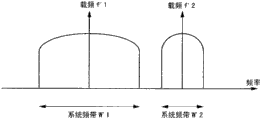
另外,作为第一实施方式的变形例,可以采用图12所示那样的基站装置的结构、图13所示那样的移动站装置的结构。但是,在采用这些结构时,利用图11所示那样的载频f’1、f’2。In addition, as a modified example of the first embodiment, the configuration of the base station apparatus as shown in FIG. 12 and the configuration of the mobile station apparatus as shown in FIG. 13 can be employed. However, when adopting these configurations, carrier frequencies f'1 and f'2 as shown in Fig. 11 are used.
图11是表示本发明第一实施方式的无线通信系统中使用的频带的一例的图。在图11中,横轴表示频率。在本变形例中,利用系统频带W’1和系统频带W’2的频率,从基站装置向移动站装置发送信号。系统频带W’1的载频为f’1,系统频带W’2的载频为f’2。FIG. 11 is a diagram showing an example of frequency bands used in the wireless communication system according to the first embodiment of the present invention. In FIG. 11, the horizontal axis represents frequency. In this modified example, signals are transmitted from the base station apparatus to the mobile station apparatus using the frequencies of the system frequency band W'1 and the system frequency band W'2. The carrier frequency of the system frequency band W'1 is f'1, and the carrier frequency of the system frequency band W'2 is f'2.
另外,基站装置还可以仅利用一个系统频带向移动站装置发送信号。在该情况下,可以采用与第一实施方式的基站装置100(图6)相同的结构。本变形例的子帧结构能够利用与图4所示的结构相同的结构。In addition, the base station apparatus may transmit signals to the mobile station apparatus using only one system frequency band. In this case, the same configuration as that of the base station apparatus 100 ( FIG. 6 ) of the first embodiment can be employed. The subframe configuration of this modified example can use the same configuration as that shown in FIG. 4 .
在系统频带的任一个(这里是系统频带W’1)中插入作为同步用的信号的同步信号、和作为包含物理广播信息的信道的物理广播信道。A synchronization signal as a signal for synchronization and a physical broadcast channel as a channel including physical broadcast information are inserted into any of the system frequency bands (here, system frequency band W'1).
在移动站装置中,首先搜索同步信号取得帧同步,并且取得物理广播信道内的信息。在物理广播信道内的信息中,含有表示系统频带的信息(与包含系统频带W’2的聚合资源的区域相关的信息),利用该信息,接收系统频带W’1和系统频带W’2。In the mobile station apparatus, the synchronization signal is first searched to obtain frame synchronization, and information in the physical broadcast channel is obtained. The information in the physical broadcast channel includes information indicating the system band (information about the area including aggregated resources of the system band W'2), and the system band W'1 and the system band W'2 are received using this information.
此时,在系统频带W’1中配置N1个物理资源块(PRB),在系统频带W’2中配置N2个物理资源块(PRB)。据此,在所有物理资源块(PRB)中,在物理资源块(PRB)内部传播路径特性都连续。因此,能够防止传播路径估计、接收质量测量的精度劣化。At this time, N 1 physical resource blocks (PRBs) are arranged in the system band W'1, and N 2 physical resource blocks (PRBs) are arranged in the system band W'2. Accordingly, in all the physical resource blocks (PRBs), the propagation path characteristics are continuous inside the physical resource blocks (PRBs). Therefore, it is possible to prevent the accuracy of channel estimation and reception quality measurement from deteriorating.
图12是表示本发明的第一实施方式的变形例的基站装置的数据控制部101b、OFDM调制部102b、无线部103b的结构的概略框图。这里,对在基站装置中对下行链路应用频率聚合的情况进行说明。12 is a schematic block diagram showing configurations of a
第一实施方式的变形例的基站装置具备数据控制部101b、OFDM调制部102b、无线部103b,代替第一实施方式的基站装置100的数据控制部101a、OFDM调制部102a、无线部103a(图8)。A base station apparatus according to a modified example of the first embodiment includes a
数据控制部101b具备物理映射部501、参照信号生成部502、同步信号生成部503。The data control
参照信号生成部502生成下行链路参照信号,并输出给物理映射部5011。同步信号生成部503生成同步信号,并输出给物理映射部501。物理映射部501根据调度信息,将传输信道映射到各物理资源块(PRB),并且在物理帧复用在参照信号生成部502中所生成的参照信号、和在同步信号生成部503中所生成的同步信号。The reference
此时,在调度信息中包含与系统带宽W’1、W’2相关联的信息。物理映射部501将传输信道映射到系统频带W’1内的N1WPRB频带中配置的物理资源块(PRB)以及系统频带W’2内的N2WPRB频带中配置的物理资源块(PRB)。In this case, the scheduling information includes information related to the system bandwidths W'1 and W'2. The
OFDM调制部102b具备调制部504-1、504-2、IFFT部505-1、505-2、CP插入部506-1、506-2。The
调制部504-1、IFFT部505-1、CP插入部506-1进行对配置在系统频带W’1中的N1WPRR频带的物理资源块(PRB)的处理。The modulation unit 504-1, the IFFT unit 505-1, and the CP insertion unit 506-1 process physical resource blocks (PRBs) arranged in the N 1 W PRR frequency band in the system frequency band W'1.
调制部504-1基于QPSK调制、16QAM调制、64QAM调制等调制方式,对映射在物理帧的各资源单元的信息进行调制从而生成调制码元,并输出给IFFT部505-1。The modulation unit 504-1 modulates information on each resource element mapped in the physical frame based on a modulation method such as QPSK modulation, 16QAM modulation, or 64QAM modulation to generate a modulation symbol, and outputs it to the IFFT unit 505-1.
IFFT部505-1对在调制部504-1中生成的调制码元(排列在频率方向和时间方向的平面上的调制码元)进行快速傅立叶反变换(IFFT)从而将频域信号变换为时域信号,并输出给CP插入部506-1。The IFFT section 505-1 performs an inverse fast Fourier transform (IFFT) on the modulation symbols generated in the modulation section 504-1 (modulation symbols arranged on a plane in the frequency direction and the time direction) to transform the frequency domain signal into a time domain signal Domain signal, and output to CP inserting unit 506-1.
CP插入部506-1在时域信号中插入循环前缀(CP),生成OFDM码元,并输出给无线部103b的D/A变换部507-1。The CP insertion unit 506-1 inserts a cyclic prefix (CP) into the time-domain signal to generate an OFDM symbol, and outputs it to the D/A conversion unit 507-1 of the
调制部504-2、IFFT部505-2、CP插入部506-2进行对配置在系统频带W’2中的N2WPRB频带的物理资源块(PRB)的处理。The modulation unit 504-2, the IFFT unit 505-2, and the CP insertion unit 506-2 process physical resource blocks (PRBs) arranged in the N 2 W PRB frequency band in the system frequency band W'2.
调制部504-2基于QPSK调制、16QAM调制、64QAM调制等调制方式,对映射在物理帧的各资源单元的信息进行调制从而生成调制码元,之后输出给IFFT部505-2。The modulation unit 504-2 modulates the information mapped on each resource element of the physical frame based on a modulation method such as QPSK modulation, 16QAM modulation, or 64QAM modulation to generate a modulation symbol, and outputs it to the IFFT unit 505-2.
IFFT部505-2对在调制部504-2中生成的调制码元(排列在频率方向和时间方向的平面上的调制码元)进行快速傅立叶反变换(IFFT),从而将频域信号变换为时域信号,并输出给CP插入部506-2。The IFFT section 505-2 performs an inverse fast Fourier transform (IFFT) on the modulation symbols (modulation symbols arranged on a plane in the frequency direction and time direction) generated in the modulation section 504-2, thereby transforming the frequency domain signal into time-domain signal, and output to the CP insertion unit 506-2.
CP插入部506-2在时域信号中插入循环前缀(CP),生成OFDM码元,之后输出给无线部103b的D/A变换部507-2。The CP insertion unit 506-2 inserts a cyclic prefix (CP) into the time-domain signal to generate an OFDM symbol, and outputs it to the D/A conversion unit 507-2 of the
无线部103b具备D/A变换部507-1、507-2、无线发送部508-1、508-2。The
D/A变换部507-1、无线发送部508-1进行对系统频带W’1中的N1WPRB频带中所配置的物理资源块(PRB)的处理。The D/A conversion unit 507-1 and the radio transmission unit 508-1 process physical resource blocks (PRBs) arranged in the N 1 W PRB frequency band in the system frequency band W'1.
D/A变换部507-1将作为数字信号的CP插入部506-1输出的OFDM码元序列变换为模拟信号,并输出给无线发送部508-1。D/A conversion unit 507-1 converts the OFDM symbol sequence output from CP insertion unit 506-1, which is a digital signal, into an analog signal, and outputs it to radio transmission unit 508-1.
无线发送部508-1利用图11所示的载频W’1将模拟信号上变频为射频,并经由天线部A1将生成的信号发送给移动站装置。The radio transmission unit 508-1 up-converts the analog signal to a radio frequency using the carrier frequency W'1 shown in FIG. 11, and transmits the generated signal to the mobile station device via the antenna unit A1.
D/A变换部507-2、无线发送部508-2进行对配置在系统频带W’2中的N2WPRB频带的物理资源块(PRB)的处理。The D/A conversion unit 507-2 and the radio transmission unit 508-2 process physical resource blocks (PRBs) arranged in the N 2 W PRB frequency band in the system frequency band W'2.
D/A变换部507-2将作为数字信号的CP插入部506-2输出的OFDM码元序列变换为模拟信号,并输出给无线发送部508-2。D/A conversion unit 507-2 converts the OFDM symbol sequence output from CP insertion unit 506-2, which is a digital signal, into an analog signal, and outputs it to radio transmission unit 508-2.
无线发送部508-2利用图11所示的载频W’2将模拟信号上变频为射频,并经由天线部A1将生成的信号发送给移动站装置。The radio transmission unit 508-2 up-converts the analog signal to a radio frequency using the carrier frequency W'2 shown in FIG. 11, and transmits the generated signal to the mobile station device via the antenna unit A1.
另外,这里,区分对不同信号进行相同处理的块进行了记载,但也可以共享一个电路。In addition, here, blocks that perform the same processing on different signals are described separately, but one circuit may be shared.
图13是表示本发明的第一实施方式的变形例的移动站装置的无线部203b、信道估计部205b、OFDM解调部206b、数据提取部207b的结构的概略框图。这里,对在移动站装置中在下行链路应用频率聚合的情况进行说明。13 is a schematic block diagram showing configurations of a
在图13中,每个频带的信道估计部603-1输出的信号输入解调部606-1。此外,每个频带的信道估计部603-2输出的信号输入解调部606-2。In FIG.13, the signal output by the channel estimation unit 603-1 for each frequency band is input to the demodulation unit 606-1. Also, the signal output from the channel estimation section 603-2 for each frequency band is input to the demodulation section 606-2.
此外,第一实施方式的变形例的移动站装置具备无线部203b、信道估计部205b、OFDM解调部206b、数据提取部207b,代替第一实施方式的移动站装置200的无线部203a、信道估计部205a、OFDM解调部206a、数据提取部207a(图10)。In addition, the mobile station apparatus according to the modified example of the first embodiment includes a
无线部203b具备无线接收部601-1、601-2、A/D变换部602-1、602-2。The
无线接收部601-1经由天线部A2从基站装置接收信号,并利用图11所示的载频f’1将接收的信号下变频为基带。此外,无线接收部601-1通过小区选择、小区再选择处理,参照预先插入在信号中的同步信号取得同步,利用从调度部204或者上位层通知的与系统频带相关的信息,设定系统频带W’1中的连接,并建立连接。另外,无线接收部601-1在采用数字信号取得同步时,利用下记A/D变换部602-1的输出。The radio receiving unit 601-1 receives a signal from the base station device via the antenna unit A2, and down-converts the received signal to baseband using the carrier frequency f'1 shown in FIG. 11 . In addition, the radio receiving unit 601-1 acquires synchronization by referring to a synchronization signal inserted in advance through cell selection and cell reselection processing, and sets the system frequency band by using information related to the system frequency band notified from the
A/D变换部602-1将无线接收部601-1输出的模拟信号变换为数字信号,并输出给信道估计部205b的每个频带的信道估计部603-1、和OFDM解调部206b的CP去除部604-1。The A/D conversion unit 602-1 converts the analog signal output from the wireless receiving unit 601-1 into a digital signal, and outputs the signal to the channel estimation unit 603-1 for each frequency band of the
无线接收部601-2利用从调度部204或者上位层通知的与系统频带相关的信息,设定系统频带W’2中的连接,并建立连接,经由天线部A2从基站装置接收信号,基于在无线接收部601-1中取得的帧同步的定时,利用图11所示的载频f’2将接收的信号下变频为基带,并输出给A/D变换部602-2。The wireless receiving unit 601-2 uses the information related to the system frequency band notified from the
A/D变换部602-2将无线接收部601-2输出的模拟信号变换为数字信号,并输出给信道估计部205b的每个频带的信道估计部603-2、和OFDM解调部206b的CP去除部604-2。The A/D conversion unit 602-2 converts the analog signal output from the radio reception unit 601-2 into a digital signal, and outputs the signal to the channel estimation unit 603-2 for each frequency band of the
信道估计部205b具备每个频带的信道估计部603-1、603-2。The
每个频带的信道估计部603-1参照系统频带W’1中的N1WPRB频带中配置的物理资源块(PRB)中的参照信号,进行N1WPRB频带中配置的物理资源块(PRB)中的信道估计,并将该估计结果输出给OFDM解调部206b的解调部606-1。The channel estimation unit 603-1 for each frequency band refers to the reference signal in the physical resource block (PRB) arranged in the N 1 W PRB frequency band in the system frequency band W'1, and performs the physical resource block (PRB) arranged in the N 1 W PRB frequency band ( PRB) and output the estimation result to the demodulation section 606-1 of the
每个频带的信道估计部603-2参照系统频带W’2中的N2WPRB频带中配置的物理资源块(PRB)中的参照信号,进行N2WPRB频带中配置的物理资源块(PRB)中的信道估计,并将该估计结果输出给OFDM解调部206b的解调部606-2。The channel estimation unit 603-2 for each frequency band refers to the reference signal in the physical resource block (PRB) arranged in the N 2 W PRB frequency band in the system frequency band W'2, and performs the physical resource block (PRB) arranged in the N 2 W PRB frequency band ( PRB) and output the estimation result to the demodulation section 606-2 of the
OFDM解调部206b具备CP去除部604-1、604-2、FFT部605-1、605-2、解调部606-1、606-2。The
CP去除部604-1、FFT部605-1、解调部606-1进行对配置在系统频带W’1中的N1WPRB频带的物理资源块(PRB)的处理。The CP removal unit 604-1, the FFT unit 605-1, and the demodulation unit 606-1 process physical resource blocks (PRBs) arranged in the N 1 W PRB band in the system band W'1.
CP去除部604-1去除从A/D变换部602-1输出的数字信号中的循环前缀(CP)部分。The CP removal unit 604-1 removes the cyclic prefix (CP) portion of the digital signal output from the A/D conversion unit 602-1.
在CP去除部604-1中去除了循环前缀(CP)的时域信号,在FFT部605-1中变换为各资源单元中的调制码元(排列在频率方向(N1WPRB的频带)和时间方向的平面上的调制码元),并输出给FFT部605-1。The time-domain signal from which the cyclic prefix (CP) has been removed in the CP removal unit 604-1 is transformed into modulation symbols in each resource unit (arranged in the frequency direction (N 1 W PRB frequency band) in the FFT unit 605-1 and modulation symbols on the plane in the time direction), and output to the FFT section 605-1.
解调部606-1参照在传播路径估计部603-1中估计出的传播路径估计值,对变换后的调制码元进行与在调制部504-1使用的调制方式对应的解调处理,取得比特序列(或者比特中的似然信息等)。The demodulation unit 606-1 refers to the channel estimation value estimated by the channel estimation unit 603-1, performs demodulation processing corresponding to the modulation scheme used by the modulation unit 504-1 on the converted modulation symbol, and obtains A sequence of bits (or likelihood information in bits, etc.).
CP去除部604-2、FFT部605-2、解调部606-2进行对系统频带W’2中的N2WPRB频带中配置的物理资源块(PRB)的处理。The CP removal unit 604-2, the FFT unit 605-2, and the demodulation unit 606-2 process the physical resource blocks (PRBs) arranged in the N 2 W PRB frequency band in the system frequency band W'2.
CP去除部604-2去除从A/D变换部602-2输出的数字信号中的循环前缀(CP)部分,并输出给FFT部605-2。The CP removal unit 604-2 removes the cyclic prefix (CP) portion of the digital signal output from the A/D conversion unit 602-2, and outputs the result to the FFT unit 605-2.
在CP去除部604-2中去除了循环前缀(CP)的时域信号,在FFT部605-2中变换为各资源单元中的调制码元(排列在频率方向(N2WPRB的频带)和时间方向的平面上的调制码元),并输出给解调部606-2。The time-domain signal from which the cyclic prefix (CP) has been removed in the CP removal unit 604-2 is transformed into modulation symbols in each resource unit (arranged in the frequency direction (N 2 W PRB frequency band) in the FFT unit 605-2 and modulation symbols on the plane in the time direction), and output to the demodulation unit 606-2.
解调部606-2参照在传播路径估计部603-2中估计出的传播路径估计值,对变换后的调制码元进行与在调制部504-2采用的调制方式对应的解调处理,取得比特序列(或者比特中的似然信息等)。The demodulation unit 606-2 refers to the channel estimation value estimated by the channel estimation unit 603-2, performs demodulation processing corresponding to the modulation scheme adopted by the modulation unit 504-2 on the converted modulation symbol, and obtains A sequence of bits (or likelihood information in bits, etc.).
通过小区选择、小区再选择处理,利用物理广播信道内的信息,进行数据提取的准备以及设定时,数据提取部207从包含物理广播信道的频带的物理资源块(PRB)提取广播信息,进行系统频带W’1和系统频带W’2中的数据提取的准备以及设定。When performing preparation and setting for data extraction by using information in the physical broadcast channel through cell selection and cell reselection processing, the
或者,暂时将广播信息通知给调度部204,或者经由调度部204通知给上位层,并基于它们指示,进行系统频带W’1和系统频带W’2中的数据提取的准备以及设定。此时,调度部204或者上位层向无线接收部601-1、601-2通知与系统频带相关的信息。Alternatively, broadcast information is temporarily notified to the
在已经进行系统频带W’1和系统频带W’2中的数据提取的设定并接收数据时(进行通常的通信),数据提取部207b根据调度信息,将各物理资源块(PRB)映射到传输信道。此时,数据提取部207b向传输信道映射解调部606-1的输出即系统频带W’1内的N1WPRB频带中配置的物理资源块(PRB)、以及解调部606-2的输出即系统频带W’2内的N2WPRB频带中配置的物理资源块(PRB)。When data extraction has been set for system band W'1 and system band W'2 and data is received (normal communication is performed), the
另外,这里,区分对不同信号进行相同处理的块进行了记载,但也可以共享一个电路。In addition, here, blocks that perform the same processing on different signals are described separately, but one circuit may be shared.
返回第一实施方式的说明,对基站装置100和移动站装置200的处理进行说明。Returning to the description of the first embodiment, the processing of the
所谓主(master)区域,是指移动站装置200最初接入的下行链路频率层(系统频带),移动站装置200取得该区域的信号后,能够接入其他区域(从(slave)区域)。至少配置能够取得下行链路同步的下行链路同步信号(SCH)。The master (master) area refers to the downlink frequency layer (system frequency band) that the
所谓从区域,是指移动站装置200取得在主区域的信息后接入的下行链路频率层(系统频带)。The "slave area" refers to a downlink frequency layer (system frequency band) that the
对于各个移动站装置200的主区域以及从区域也可以不同。即,可以构成为某移动站装置200来说的主区域是对其他移动站装置200来说的从区域。在该情况下,有在某移动站装置200的从区域中配置下行链路同步信号(SCH)的情况。对于在从区域的特定信道(下行链路同步信号(SCH)和/或物理下行链路广播信道(PBCH)和/或广播控制信道(BCCH)和/或寻呼控制信道(PCCH)和/或公共控制信道(CCCH)等)的有无,在主区域从基站装置100向移动站装置200广播。The master area and slave area may be different for each
主区域和从区域既可以配置在相邻的载频,也可以配置在分离的载频。The master area and the slave area can be configured on adjacent carrier frequencies, or on separate carrier frequencies.
物理下行链路控制信道(PDCCH)进行上行链路以及下行链路的PRB资源的分配。准备分配主区域的PRB资源的格式、分配从区域的PRB资源的格式、分配主区域以及从区域双方的PRB资源的格式。移动站装置200根据检测出了能够向主区域和/或从区域的接入,改变监视的物理下行链路控制信道(PDCCH)的格式。The physical downlink control channel (PDCCH) allocates uplink and downlink PRB resources. A format for allocating PRB resources in the master area, a format for allocating PRB resources for the slave area, and a format for allocating PRB resources for both the master area and the slave area are prepared. The
或者,物理下行链路控制信道(PDCCH)准备对仅接入主区域或者从区域的移动站装置200的格式、和对接入主区域以及从区域双方的移动站装置200的格式。移动站装置200根据检测出了能够向主区域和/或从区域的接入,改变监视的物理下行链路控制信道(PDCCH)的格式。Alternatively, the Physical Downlink Control Channel (PDCCH) has a format for the
图14(b)是表示本发明第一实施方式的无线通信系统的处理的时序图。Fig. 14(b) is a sequence diagram showing processing in the wireless communication system according to the first embodiment of the present invention.
首先,移动站装置200通过小区选择、小区再选择处理,取得从基站装置100发送的下行链路同步信号(SCH:Synchronization Channel),进行下行链路的同步处理(步骤S101)。此时,下行链路同步信号(SCH)配置在主区域Z01(参照图14(a))。First, the
移动站装置200按照在主区域Z01进行处理的方式(在主区域Z01进行操作的方式)取得物理广播信道(PBCH)(步骤S102)。此时,从物理广播信道(PBCH)取得与包含从区域Z02(参照图14(a))的聚合资源的区域相关的信息(表示主区域Z01的系统带宽(资源块数)和/或从区域Z02的载频、系统带宽(资源块数)等的信息、和/或移动站装置200的版本信息等)。The
在与聚合资源相关的信息中,包含用于知道主区域Z01与从区域Z02之间、或者整体系统中包含的多个系统频带间的保护频带的宽度的信息。这里所谓系统频带间的保护频带的宽度,定义为去除了系统频带内包含的保护频带的有效频带间的宽度。即,相邻的系统内的有效资源块间的带宽。The information on the aggregated resource includes information for knowing the width of the guard band between the master zone Z01 and the slave zone Z02 or between a plurality of system bands included in the overall system. Here, the width of the guard band between system bands is defined as the width between effective bands except the guard band included in the system band. That is, the bandwidth between valid resource blocks in adjacent systems.
例如,在由系统频带SW1、系统频带SW2、系统频带SW3、系统频带SW4构成的情况下,设各个包含保护频带的带宽为W1、W2、W3、W4,设系统频带间的带宽为WD1-2、WD2-3、WD3-4时,根据各个不包含保护频带的有效带宽N1WPRB、N2WPRB、N3WPRB、N4WPRB自动地计算。此时,包含保护频带的各个系统带宽(主区域Z01的信息可以省略)和系统频带间的带宽、各个有效带宽(主区域Z01的信息可以省略)包含在与聚合资源的区域相关的信息中。For example, in the case where the system band SW1, the system band SW2, the system band SW3, and the system band SW4 are constituted, each bandwidth including a guard band is set to W 1 , W 2 , W 3 , and W 4 , and the bandwidth between the system bands is set to In the case of W D1-2 , W D2-3 , and W D3-4 , it is automatically calculated from each effective bandwidth N 1 W PRB , N 2 W PRB , N 3 W PRB , and N 4 W PRB excluding guard bands. In this case, each system bandwidth including the guard band (information of the main zone Z01 can be omitted), bandwidth between system bands, and each effective bandwidth (information of the main zone Z01 can be omitted) are included in the information on the area of aggregated resources.
图15是表示本发明第一实施方式中使用的系统频带的结构的一例的图。在图15中,横轴表示频率。此外,在图15中,附加了斜线的区域(例如,区域R11)中配置保护频带。例如,如图15所示,在由系统频带SW1、系统频带SW2、系统频带SW3、系统频带SW4构成时,成为各个包含保护频带的带宽W1、W2、W3、W4、系统频带间的带宽WD1-2、WD2-3、WD3-4、各个不包含保护频带的有效带宽N1WPRB、N2WPRB、N3WPRB、N4WPRB。在该情况下,各个系统频带中包含的保护频带根据Wi-NiWPRB自动地计算。此时,包含保护频带的各个系统带宽(主区域Z01的信息可以省略)和系统频带间的带宽、各个有效带宽(主区域的信息可以省略)包含在与聚合资源的区域相关的信息中。FIG. 15 is a diagram showing an example of the configuration of a system frequency band used in the first embodiment of the present invention. In FIG. 15, the horizontal axis represents frequency. In addition, in FIG. 15 , a guard band is arranged in a hatched area (eg, area R11 ). For example, as shown in FIG. 15, when the system band SW1, the system band SW2, the system band SW3, and the system band SW4 are constituted, each of the bandwidths W 1 , W 2 , W 3 , W 4 including the guard band, and the system bands Bandwidths W D1-2 , W D2-3 , and W D3-4 , and effective bandwidths N 1 W PRB , N 2 W PRB , N 3 W PRB , and N 4 W PRB that do not include guard bands. In this case, the guard band included in each system band is automatically calculated from W i -N i W PRB . In this case, each system bandwidth including the guard band (information of the main zone Z01 can be omitted), bandwidth between system bands, and each effective bandwidth (information of the main zone can be omitted) are included in the information on the area of aggregated resources.
图16是表示本发明第一实施方式中使用的系统频带的结构的其他一例的图。在图16中,横轴表示频率。此外,在图16中,在附加了斜线的区域(例如,区域R12)配置保护频带。例如,如图16所示,由系统频带SW1、系统频带SW2、系统频带SW3、系统频带SW4构成时,广播各个有效带宽N1WPRB、N2WPRB、N3WPRB、N4WPRB、和系统频带SW1与系统频带SW2之间的保护频带NG1-2WPRB、系统频带SW2与系统频带SW3之间的保护频带NG2-3WPRB、系统频带SW3与系统频带SW4之间的保护频带NG3-4WPRB。另外,各个带宽可以利用资源块的数量Ni的信号表现。此外,在物理资源块(PRB)的个数即N1、N2、N3、N4为相同的值时,可以仅广播一个值Ni。通过以WPRB的整数倍构成该保护频带,从而作为接收机的移动站装置200的处理变得容易。此外,在保护频带NG1-2、NG2-3、NG3-4为相同的值时,可以仅广播一个值NG。此外,在没有保护频带的情况下移动站装置200能够接收的状况下,可以使该保护频带为0。在该情况下,作为NG=0进行广播。FIG. 16 is a diagram showing another example of the configuration of the system frequency band used in the first embodiment of the present invention. In FIG. 16, the horizontal axis represents frequency. In addition, in FIG. 16 , a guard band is arranged in a hatched area (eg, area R12 ). For example, as shown in FIG. 16, when composed of system frequency band SW1, system frequency band SW2, system frequency band SW3, and system frequency band SW4, each effective bandwidth N 1 W PRB , N 2 W PRB , N 3 W PRB , N 4 W PRB , and the guard band N G1-2 W PRB between the system band SW1 and the system band SW2, the guard band N G2-3 W PRB between the system band SW2 and the system band SW3, and the guard band N G2-3 W PRB between the system band SW3 and the system band SW4 Guard band N G3-4 W PRB . In addition, each bandwidth can be represented by the signal of the number N i of resource blocks. Also, when N 1 , N 2 , N 3 , and N 4 that are the number of physical resource blocks (PRBs) have the same value, only one value N i may be broadcast. By constituting the guard band with an integer multiple of W PRB , the processing of the
另外,可以定义能够指定这些W1、W2、W3、W4、N1WPR、N2WPR、N3WPRB、N4WPRB、NG1-2WPRB、NG2-3WPRB、NG3-4WPRB等全部或者每一个的索引(index)。并且,可以仅广播索引,移动站装置200根据该索引来指定上述值。In addition, it can be defined that these W 1 , W 2 , W 3 , W 4 , N 1 W PR , N 2 W PR , N 3 W PRB , N 4 W PRB , N G1-2 W PRB , N G2-3 An index (index) of all or each of W PRB , N G3-4 W PRB , and the like. Also, only the index from which the
在没有与聚合资源相关的信息时,按照原样在主区域Z01进行操作的方式继续进行处理。与包含该从区域Z02的聚合资源的区域相关的信息,也可以配置在与物理广播信道(PBCH)分离的区域中。When there is no information about aggregated resources, the processing continues so as to operate in the main zone Z01 as it is. The information on the area including the aggregate resource of the slave zone Z02 may be placed in a separate area from the physical broadcast channel (PBCH).
例如,可以构成为:利用第1个子帧(子帧#0)的第2个时隙(时隙#1)的第1、第2、第3、第4个OFDM码元发送物理广播信道(PBCH),而利用第2个时隙(时隙#1)的第5~第7个OFDM码元发送新的物理广播信道(New PBCH)。For example, it may be configured as follows: the physical broadcast channel ( PBCH), and use the 5th to 7th OFDM symbols of the second time slot (time slot #1) to send a new physical broadcast channel (New PBCH).
基站装置100将与包含从区域Z02的聚合资源的区域相关的信息包含在该新的物理广播信道(New PBCH)中发送给移动站装置200(图14(b)的步骤S103)。The
具有聚合能力的移动站装置200取得利用第2个时隙(时隙#1)的第1、第2、第3、第4个OFDM码元发送的物理广播信道(PBCH)、和利用第2个时隙(时隙#1)的第5~第7个OFDM码元发送的新的物理广播信道(New PBCH)的双方。The
据此,能够高效地分离对具有聚合能力的移动站装置200(能够接入主区域Z01以及从区域Z02的移动站装置200)的信息、和对没有聚合能力的移动站装置200(仅能接入主区域Z01的移动站装置Z02)的信息。Accordingly, it is possible to efficiently separate information for
取得了与聚合资源的区域相关的信息时(新的物理广播信道(New PBCH)的解码成功时),移动站装置200根据需要调整无线部,以能够在从区域Z02进行接收(图14(b)的步骤S104)。When the information on the area where resources are aggregated is obtained (when the decoding of the new physical broadcast channel (New PBCH) is successful), the
在不需要调整无线部203a(图7)时(主区域Z01和从区域Z02相邻时等),通过调整信道的取得部分来应对。按照在聚合资源的区域进行操作的方式继续进行处理。即,移动站装置200在进行了聚合的前提下进行物理下行链路控制信道(PDCCH)的解码(聚合后的资源分配信息格式的物理下行链路控制信道(PDCCH)的解码),之后取得广播信息(BCCH),进行连接建立的处理(图14(b)的步骤S105)。When it is not necessary to adjust the
基站装置100对于仅容纳具有聚合能力的移动站装置200的频带,不管移动站装置200的能力如何,总是使用上述聚合后的资源分配信息格式的物理下行链路控制信道(PDCCH)。即,基站装置100不需要知道移动站装置200接入的主区域Z01。The
图14(a)示出移动站装置200在各个步骤能够接收的频域。在步骤S101~步骤S104中,移动站装置200能够接收用于取得配置在主区域Z01的一部分中的物理广播信道所需的区域的资源。此外,在步骤S104以后,移动站装置200能够接收主区域Z01以及从区域Z02的区域的资源。FIG. 14( a ) shows frequency domains that the
在本发明的第一实施方式中,基站装置100(图6)的无线部103a(也称为信号发送部)利用主区域Z01向移动站装置200发送包含用于指定与主区域Z01(也称为第一频带)不同的至少一个从区域Z02(也称为第二频带)的信息的信号。In the first embodiment of the present invention, the
此外,移动站装置200(图7)的数据提取部207a(也称为信息取得部)利用主区域Z01,取得从基站装置100发送的信号中包含的用于指定从区域Z02的信息。Furthermore, the
此外,调度部204(也称为频带指定部)根据数据提取部207a取得的信息,指定从区域Z02。Furthermore, the scheduling unit 204 (also referred to as a frequency band specifying unit) specifies the slave zone Z02 based on the information acquired by the
具体而言,调度部204根据利用主区域Z01内的规定频率带宽发送的物理广播信道中包含的信息,指定从区域Z02。另外,调度部204可以根据数据提取部207a取得的信息,确定从区域Z02内是否包含某特定信道(物理广播信道等)。Specifically, the
此外,无线部203a(也称为通信部)利用主区域Z01或者从区域Z02与基站装置100进行通信。In addition, the
在本发明第一实施方式的无线通信系统中,移动站装置200最初接入主区域Z01,能够取得该主区域Z01中包含的信息,即指定从区域Z02的信息。因此,不需要另外从基站装置100接收指定从区域Z02的信息。因此,能够减少通信开始时从基站装置100向移动站装置200发送的信息,能够在基站装置100与移动站装置200之间,迅速地开始通信。In the radio communication system according to the first embodiment of the present invention, the
(第二实施方式)(second embodiment)
下面,对本发明第二实施方式的无线通信系统进行说明。第二实施方式的无线通信系统具备基站装置100’和移动站装置200’。第二实施方式的基站装置100’和移动站装置200’的结构与第一实施方式的基站装置100(图6)和移动站装置200(图7)的结构相同,所以省略它们的说明。下面,仅对第二实施方式与第一实施方式不同的部分进行说明。Next, a wireless communication system according to a second embodiment of the present invention will be described. The radio communication system according to the second embodiment includes a base station device 100' and a mobile station device 200'. The configurations of the base station apparatus 100' and the mobile station apparatus 200' of the second embodiment are the same as those of the base station apparatus 100 ( FIG. 6 ) and the mobile station apparatus 200 ( FIG. 7 ) of the first embodiment, and their descriptions are omitted. Hereinafter, only the differences between the second embodiment and the first embodiment will be described.
图17(b)是表示本发明第二实施方式的无线通信系统的处理的时序图。Fig. 17(b) is a sequence diagram showing processing in the radio communication system according to the second embodiment of the present invention.
首先,移动站装置200’通过小区选择、小区再选择处理,取得基站装置100’的下行链路同步信号(SCH),进行下行链路的同步处理(步骤S201)。此时,下行链路同步信号(SCH)配置在主区域Z01中(参照图17(a))。First, the mobile station apparatus 200' acquires the downlink synchronization signal (SCH) of the base station apparatus 100' through cell selection and cell reselection processing, and performs downlink synchronization processing (step S201). At this time, the downlink synchronization signal (SCH) is arranged in the main zone Z01 (see FIG. 17( a )).
移动站装置200’按照在主区域Z01进行操作的方式取得物理广播信道(PBCH)(步骤S202)。The mobile station device 200' acquires a physical broadcast channel (PBCH) so as to operate in the main zone Z01 (step S202).
此时,从物理广播信道(PBCH)取得与主区域Z01相关的信息(主区域Z01的系统带宽(资源块数)等)(步骤S203)。At this time, information related to the main zone Z01 (the system bandwidth (the number of resource blocks) of the main zone Z01, etc.) is acquired from the physical broadcast channel (PBCH) (step S203).
而且,按照在主区域Z01进行操作的方式继续进行处理(步骤S204)。Then, the processing is continued in such a manner that the operation is performed in the main area Z01 (step S204).
移动站装置200’在主区域Z01接收映射在下行链路共享信道(DL-SCH)的广播控制信道(BCCH)(步骤S205)。The mobile station apparatus 200' receives the broadcast control channel (BCCH) mapped on the downlink shared channel (DL-SCH) in the main zone Z01 (step S205).
该下行链路共享信道(DL-SCH)利用由物理下行链路控制信道(PDCCH)指定的物理下行链路共享信道的动态资源发送,所以能够动态地改变资源。在由该广播信息信道(BCCH)取得关于聚合资源的区域的信息(表示主区域Z01的系统带宽(资源块数)和/或从区域Z02(参照图17(a))的载频、系统带宽(资源块数)等的信息、和/或移动站装置200’的版本信息等)时,移动站装置200’调整无线部,以能够在从区域Z02进行接收(步骤S206)。Since the downlink shared channel (DL-SCH) is transmitted using dynamic resources of the physical downlink shared channel specified by the physical downlink control channel (PDCCH), the resources can be changed dynamically. The information about the area of aggregated resources (representing the system bandwidth (number of resource blocks) of the master area Z01 and/or the carrier frequency and system bandwidth of the slave area Z02 (refer to FIG. (number of resource blocks) and/or version information of the mobile station device 200', etc.), the mobile station device 200' adjusts the radio unit so that reception can be performed in the slave zone Z02 (step S206).
与第一实施方式同样地,在关于聚合资源的信息中,包含用于获知主区域Z01与从区域Z02之间、或者整体系统中包含的多个系统频带之间的保护频带的宽度的信息。Similar to the first embodiment, the information on aggregated resources includes information for knowing the width of a guard band between the master zone Z01 and the slave zone Z02 or between a plurality of system bands included in the overall system.
以后,按照在聚合资源的区域或者聚合资源的区域以及主区域Z01进行操作的方式继续进行处理。即,移动站装置200’在进行了聚合的前提下进行物理下行链路控制信道(PDCCH)的解码(聚合后的资源分配信息格式的物理下行链路控制信道(PDCCH)的解码),之后取得广播信息(BCCH)之后,进行连接建立的处理,进行通常的通信(步骤S207)。Afterwards, the processing continues in the manner of operating in the area of aggregated resources or the area of aggregated resources and the main area Z01. That is, the mobile station apparatus 200' performs decoding of the physical downlink control channel (PDCCH) (decoding of the physical downlink control channel (PDCCH) in the resource allocation information format after aggregation) on the premise of aggregation, and then acquires After the broadcast information (BCCH), the process of connection establishment is performed, and normal communication is performed (step S207).
在容纳频带具有多个主区域Z01时,基站装置100’需要检测移动站装置200’的主区域Z01。在该移动站装置200’的主区域Z01的检测中,使用物理随机接入信道(PRACH)或者随机接入信道(RACH)。When the accommodation frequency band has a plurality of main zones Z01, the base station apparatus 100' needs to detect the main zone Z01 of the mobile station apparatus 200'. The physical random access channel (PRACH) or the random access channel (RACH) is used for detection of the main zone Z01 of the mobile station apparatus 200'.
例如,基站装置100’向各移动站装置200’广播与聚合资源的区域相关的信息、以及表示主区域Z01的物理随机接入资源的信息。移动站装置200’使用由接入的区域表示的物理随机接入资源,进行随机接入。因此,基站装置100’能够根据由移动站装置200’使用的物理随机接入资源,判断进行了随机接入的移动站装置200’使用哪个区域作为主区域Z01,在随机接入处理以及之后的处理中,使用在指定了主区域Z01的前提下的物理下行链路控制信道(PDCCH)。另外,也可以利用公共控制信道(CCCH),在随机接入过程中从移动站装置200’向基站装置100’通知移动站装置200’的主区域Z01。For example, the base station apparatus 100' broadcasts, to each of the mobile station apparatuses 200', information on areas where resources are aggregated and information indicating physical random access resources in the main area Z01. The mobile station apparatus 200' performs random access using the physical random access resource indicated by the access area. Therefore, the base station apparatus 100' can determine which area is used as the main area Z01 by the mobile station apparatus 200' which has performed random access based on the physical random access resources used by the mobile station apparatus 200'. In the processing, the physical downlink control channel (PDCCH) under the premise that the main zone Z01 is specified is used. In addition, the main zone Z01 of the mobile station apparatus 200' may be notified from the mobile station apparatus 200' to the base station apparatus 100' in the random access procedure by using a common control channel (CCCH).
在容纳频带中容纳具有聚合能力的移动站装置200’和没有聚合能力的移动站装置200’时,基站装置100’需要检测移动站装置200’的聚合能力。在该移动站装置200’的聚合能力的检测中,使用物理随机接入信道(PRACH)或者随机接入信道(RACH)。When accommodating a mobile station apparatus 200' having an aggregation capability and a mobile station apparatus 200' not having an aggregation capability in an accommodation frequency band, the base station apparatus 100' needs to detect the aggregation capability of the mobile station apparatus 200'. The physical random access channel (PRACH) or the random access channel (RACH) is used to detect the aggregation capability of the mobile station apparatus 200'.
例如,基站装置100’向各移动站装置200’广播与聚合资源的区域相关的信息、以及表示使用聚合的移动站装置200’用的物理随机接入资源的信息。移动站装置200’使用聚合时,利用使用聚合的移动站装置200’用的物理随机接入资源,进行随机接入。因此,基站装置100’能够根据所使用的物理随机接入资源判断进行了随机接入的移动站装置200’是否具有聚合的能力,在随机接入处理以及之后的处理中,能够在进行了聚合的前提下,使用物理下行链路控制信道(PDCCH)。另外,也可以利用公共控制信道(CCCH),在随机接入过程中从移动站装置200’向基站装置100’通知移动站装置200’的聚合能力。该随机接入过程中使用的下行链路的频带是主区域Z01。For example, the base station apparatus 100' broadcasts, to each mobile station apparatus 200', information on the area of the aggregated resource and information indicating the physical random access resource for the aggregated mobile station apparatus 200' used. When the mobile station apparatus 200' uses aggregation, random access is performed using the physical random access resource for the mobile station apparatus 200' using aggregation. Therefore, the base station apparatus 100' can determine whether the mobile station apparatus 200' that has performed random access has aggregation capabilities based on the physical random access resources used, and can perform aggregation in random access processing and subsequent processing. On the premise of using the physical downlink control channel (PDCCH). In addition, the aggregation capability of the mobile station apparatus 200' may be notified from the mobile station apparatus 200' to the base station apparatus 100' in the random access procedure by using a common control channel (CCCH). The downlink frequency band used in this random access procedure is the main zone Z01.
进而移动站装置200’可以按照在主区域Z01也进行操作的方式并行地进行处理。此外,不能使用聚合的移动站装置、不能解读与聚合资源的区域相关的信息的移动站装置按照在主区域Z01进行操作的方式进行处理。Furthermore, the mobile station apparatus 200' can perform processing in parallel so as to operate also in the main zone Z01. In addition, mobile station devices that cannot use aggregation and mobile station devices that cannot read information on the area of aggregation resources are handled as operating in the main area Z01.
此外,利用主区域Z01向各移动站装置200’广播从区域Z02内的特定信道(下行链路同步信号(SCH)、物理广播信道(PBCH)、广播控制信道(BCCH)等)的有无。在存在多个从区域Z02时,基站装置100’向移动站装置200’广播各个区域的特定信道的有无。移动站装置200’根据广播信息确定各个区域的特定信道的有无。此时,通过按照仅在主区域Z01进行映射在下行链路共享信道(DL-SCH)的广播控制信道(BCCH)的发送的方式构成系统,能够不用将广播控制信道(BCCH)配置在从区域Z02,能够使系统高效地动作。In addition, the presence or absence of specific channels (downlink synchronization signal (SCH), physical broadcast channel (PBCH), broadcast control channel (BCCH), etc.) in the slave zone Z02 is broadcast to each mobile station apparatus 200' using the master zone Z01. When there are a plurality of slave zones Z02, the base station apparatus 100' broadcasts the presence or absence of a specific channel in each zone to the mobile station apparatus 200'. The mobile station apparatus 200' determines the presence or absence of a specific channel in each area based on the broadcast information. In this case, by configuring the system so that the broadcast control channel (BCCH) mapped on the downlink shared channel (DL-SCH) is transmitted only in the master zone Z01, it is not necessary to place the broadcast control channel (BCCH) in the slave zone. Z02 enables the system to operate efficiently.
图17(a)示出移动站装置200’在各个步骤能够接收的频域。在步骤S201~步骤S203中,移动站装置200’能够接收取得配置在主区域Z01的一部分中的物理广播信道所需的区域的资源。此外,在步骤S203~步骤S206中,移动站装置200’能够接收主区域Z01的区域的资源。此外,在步骤S206以后,移动站装置200’能够接收主区域Z01以及从区域Z02的区域的资源。Fig. 17(a) shows frequency domains that the mobile station apparatus 200' can receive in each step. In Step S201 to Step S203, the mobile station apparatus 200' can receive resources of an area necessary for acquiring a physical broadcast channel arranged in a part of the main area Z01. In addition, in steps S203 to S206, the mobile station apparatus 200' can receive resources in the zone of the main zone Z01. In addition, after step S206, the mobile station apparatus 200' can receive the resources of the master zone Z01 and the slave zone Z02.
在本发明的第二实施方式中,基站装置100’(图6)的无线部103a(也称为信号发送部)利用主区域Z01向移动站装置200’发送包含用于指定与主区域Z01(也称为第一频带)不同的至少一个从区域Z02(也称为第二频带)的信息的信号。In the second embodiment of the present invention, the
此外,移动站装置200’(图7)的数据提取部207a(也称为信息取得部)利用主区域Z01,取得从基站装置100’发送的信号中包含的指定从区域Z02的信息。Furthermore, the
此外,调度部204(也称为频带指定部)根据数据提取部207a取得的信息,指定从区域Z02。Furthermore, the scheduling unit 204 (also referred to as a frequency band specifying unit) specifies the slave zone Z02 based on the information acquired by the
具体而言,调度部204根据利用主区域Z01内的规定频率带宽发送的物理下行链路共享信道中包含的广播信息,指定从区域Z02。Specifically, the
另外,调度部204还可以根据利用主区域Z01内的物理下行链路共享信道发送的向特定移动站装置200’的控制信息,指定从区域Z02。In addition, the
此外,无线部203a(也称为通信部)利用主区域Z01或者从区域Z02,与基站装置100’进行通信。Furthermore, the
另外,在本实施方式中,移动站装置200’还可以利用指定主区域Z01内的资源的下行链路控制信号,指定广播信息的资源的同时,在指定主区域Z01后,从基站装置100’取得指定主区域Z01以及从区域Z02内的资源的下行链路控制信息。In addition, in this embodiment, the mobile station apparatus 200' may use a downlink control signal specifying resources in the main zone Z01 to designate resources for broadcast information, and after designating the main zone Z01, the slave base station device 100' may Downlink control information specifying resources in the master zone Z01 and the slave zone Z02 is acquired.
在本发明第二实施方式的无线通信系统中,移动站装置200’最初接入主区域Z01,能够取得该主区域Z01中包含的信息,即指定从区域Z02的信息。因此,与第一实施方式同样地,不需要另外从基站装置100’接收用于指定从区域Z02的信息。因此,能够减少通信开始时从基站装置100’向移动站装置200’发送的信息,能够在基站装置100’与移动站装置200’之间迅速地开始通信。In the radio communication system according to the second embodiment of the present invention, the mobile station apparatus 200' first accesses the master zone Z01, and can acquire information included in the master zone Z01, that is, information specifying the slave zone Z02. Therefore, similar to the first embodiment, there is no need to separately receive information for specifying the slave zone Z02 from the base station apparatus 100'. Therefore, it is possible to reduce the information to be transmitted from the base station apparatus 100' to the mobile station apparatus 200' at the start of communication, and it is possible to quickly start communication between the base station apparatus 100' and the mobile station apparatus 200'.
尤其因为进行映射在下行链路共享信道(DL-SCH)的广播控制信道(BCCH)的接收从而取得与聚合资源的区域相关的信息,所以具有能够动态地改变资源这样的效果。In particular, there is an effect that resources can be changed dynamically because the broadcast control channel (BCCH) mapped on the downlink shared channel (DL-SCH) is received to obtain information on the region where resources are aggregated.
(第三实施方式)(third embodiment)
下面,对本发明第三实施方式的无线通信系统进行说明。第三实施方式的无线通信系统具备基站装置100”和移动站装置200”。第二实施方式的基站装置100”和移动站装置200”的结构与第一实施方式的基站装置100”(图6)和移动站装置200”(图7)的结构相同,所以省略它们的说明。下面,仅对第三实施方式与第一实施方式不同的部分进行说明。Next, a wireless communication system according to a third embodiment of the present invention will be described. The wireless communication system according to the third embodiment includes a
图18(b)是表示本发明第三实施方式的无线通信系统的处理的时序图。Fig. 18(b) is a sequence diagram showing processing in the wireless communication system according to the third embodiment of the present invention.
首先,移动站装置200”通过小区选择或小区再选择处理,取得基站装置100”的下行链路同步信号(SCH),进行下行链路的同步处理(步骤S301)。此时,下行链路同步信号(SCH)配置在主区域Z01(参照图18(a))中。First, the
移动站装置200”按照在主区域Z01进行操作的方式取得物理广播信道(PBCH)(步骤S302)。此时,从物理广播信道(PBCH)取得与主区域Z01相关的信息(主区域Z01的系统带宽(资源块数)等)(步骤S303)。而且,按照在主区域Z01进行操作的方式继续进行处理(步骤S304)。The
移动站装置200”利用主区域Z01进行RRC连接建立处理,建立通信状态(RRC连接状态)。利用该RRC连接建立处理中的RRC连接建立(公共控制信道(CCCH)(RRC信令))、通信中向移动站装置200”的专用控制信道(DCCH)(RRC信令),从基站装置100”向移动站装置200”通知与聚合资源的区域相关的信息(表示主区域的系统带宽(资源块数)和/或从区域Z02(参照图18(a))的载频、系统带宽(资源块数)等的信息、和/或移动站装置200”的版本信息等)(步骤S305)。The
该公共控制信道(CCCH)、专用控制信道(DCCH)在主区域Z01映射到下行链路共享信道(DL-SCH)。利用由物理下行链路控制信道(PDCCH)指定的物理下行链路共享信道的动态资源发送该下行链路共享信道(DL-SCH),所以能够动态地改变资源。The common control channel (CCCH) and the dedicated control channel (DCCH) are mapped to the downlink shared channel (DL-SCH) in the main zone Z01. Since the downlink shared channel (DL-SCH) is transmitted using dynamic resources of the physical downlink shared channel specified by the physical downlink control channel (PDCCH), the resources can be changed dynamically.
取得了与聚合资源的区域相关的信息的移动站装置200”调整无线部203a(图7),以能够在从区域Z02进行接收(步骤S306)。以后,按照在聚合资源的区域、或者聚合资源的区域以及主区域Z01进行操作的方式继续进行处理。The
即,移动站装置200”在确认公共控制信道(CCCH)或者专用控制信道(DCCH)(RRC信令)后,在进行了聚合的前提下进行物理下行链路控制信道(PDCCH)的解码(聚合后的资源分配信息格式的物理下行链路控制信道(PDCCH)的解码)(步骤S307)。That is, the
在容纳频带具有多个主区域Z01时,基站装置100”需要检测移动站装置200”的主区域Z01。与第二实施方式同样地,使用物理随机接入信道(PRACH)或者随机接入信道(RACH)检测移动站装置200”的主区域Z01,或者利用公共控制信道(CCCH)在随机接入过程中从移动站装置200”向基站装置100”通知移动站装置200”的主区域Z01。When the accommodation frequency band has a plurality of main zones Z01, the
此外,还可以利用专用控制信道(DCCH)(RRC信令)由基站装置100”指定、改变移动站装置200”的主区域Z01。In addition, the main zone Z01 of the
在容纳频带中容纳具有聚合能力的移动站装置200”和没有聚合能力的移动站装置200”时,基站装置100”需要检测移动站装置200”的聚合能力。When accommodating a
在该移动站装置200”的聚合能力的检测中,基站装置100”利用来自上位层的信息。基站装置100”判断进行了随机接入的移动站装置200”是否具有聚合的能力。而且,基站装置100”对移动站装置200”指示使用聚合资源时,利用专用控制信道(DCCH)(RRC信令)指定聚合资源。In detecting the aggregation capability of the
另外,还可以利用公共控制信道(CCCH),在随机接入过程中从移动站装置200”向基站装置100”通知移动站装置200”的聚合能力。In addition, the aggregation capability of the
此外,移动站装置200”还可以按照在主区域Z01也进行操作的方式并行地进行处理。此外,没有取得与聚合资源的区域相关的信息的移动站装置200”,可以按照在主区域Z01进行操作的方式进行处理。In addition, the
此外,利用主区域Z01广播从区域Z02内的特定信道(下行链路同步信号(SCH)、物理广播信道(PBCH)、广播控制信道(BCCH)等)的有无。此外,还通过专用控制信息从基站装置100”向移动站装置200”通知从区域Z02内的特定信道的有无。移动站装置200”根据广播信息或者专用控制信息确定各个区域的特定信道的有无。In addition, the presence or absence of specific channels (downlink synchronization signal (SCH), physical broadcast channel (PBCH), broadcast control channel (BCCH), etc.) in the slave zone Z02 is broadcasted in the master zone Z01. In addition, the
在存在多个从区域Z02时,基站装置100”向移动站装置200”通知各个区域的特定信道的有无。此时,通过按照仅在主区域Z01进行映射在下行链路共享信道(DL-SCH)的广播控制信道(BCCH)的发送的方式构成系统,能够不用将广播控制信道(BCCH)配置在从区域Z02中,能够使系统高效地动作。When there are a plurality of slave zones Z02, the
图18(a)示出移动站装置200”在各个步骤能够接收的频域。在步骤S301~步骤S303中,移动站装置200”能够接收取得配置在主区域Z01的一部分的物理广播信道的取得所需的区域的资源。此外,在步骤S303~步骤S306中,移动站装置200”能够接收主区域Z01的区域的资源。此外,在步骤S306以后,移动站装置200”能够接收主区域Z01以及从区域Z02的区域的资源。Fig. 18(a) shows the frequency domain that the
在本发明第三实施方式的无线通信系统中,移动站装置200”最初接入主区域Z01,能够取得该主区域Z01中包含的信息,即指定从区域Z02的信息。因此,与第一实施方式同样地,不需要另外从基站装置100”接收指定从区域Z02的信息。因此,能够减少通信开始时从基站装置100”向移动站装置200”发送的信息,能够迅速地开始通信。In the radio communication system according to the third embodiment of the present invention, the
尤其因为进行映射在下行链路共享信道(DL-SCH)的专用控制信道(DCCH)的接收从而取得与聚合资源的区域相关的信息,所以具有能够对特定移动站装置的每一个适当地改变聚合资源这样的效果。In particular, by receiving the dedicated control channel (DCCH) mapped on the downlink shared channel (DL-SCH) to obtain information on the region of aggregated resources, it is possible to appropriately change the aggregation for each specific mobile station device. resource such an effect.
在上述各个实施方式中,为了便于说明,采用了聚合能力、与聚合资源的区域相关的信息这样的表现,分别也可以是移动站装置(移动站装置200、200’、200”)的版本(释放版本(release version)、动作版本等)、新版本的移动站装置用的区域相关的信息这样的意思。即,在移动站装置的释放版本旧的情况下,存在没有聚合能力的移动站装置,在移动站装置的释放版本新的情况下,具有聚合能力。In each of the above-mentioned embodiments, for convenience of description, expressions such as aggregation capabilities and information on areas of aggregation resources are used, and versions of mobile station devices (
在上述各个实施方式中,按照聚合多个系统频带构成系统的方式进行了说明,但是一个系统也可以由多个子系统频带构成。此外,各个系统频带(或者子系统频带)也称为载波成分(component)。这表示通过特定接收侧或者特定发送侧使载频与各个载波成分的中心相匹配从而系统动作的区域。In each of the above-mentioned embodiments, a system is constructed by aggregating a plurality of system frequency bands. However, one system may also be composed of a plurality of subsystem frequency bands. In addition, each system band (or subsystem band) is also referred to as a carrier component (component). This indicates an area where the system operates by matching the carrier frequency with the center of each carrier component on the specific receiving side or the specific transmitting side.
在上述各个实施方式中,为了便于说明,以基站装置(基站装置100、100’、100”)和移动站装置(移动站装置200、200’、200”)一对一的情况为例进行了说明,但是基站装置以及移动站装置也可以是多个。此外,移动站装置不限于移动的终端,也可以通过使基站装置、固定终端安装移动站装置的功能等来实现。In each of the above-mentioned embodiments, for convenience of description, a case where a base station device (
此外,在以上说明的各个实施方式中,还可以将用于实现基站装置内的各功能、移动站装置内的各功能的程序存储在计算机可读取的存储介质中。而且,还可以使计算机系统读入该存储介质中所存储的程序,并执行,由此进行基站装置、移动站装置的控制。另外,这里所说的「计算机系统」,包括OS、外围设备等硬件。In addition, in each of the embodiments described above, programs for realizing each function in the base station device and each function in the mobile station device may be stored in a computer-readable storage medium. Furthermore, it is also possible to control the base station apparatus and the mobile station apparatus by causing the computer system to read and execute the program stored in the storage medium. In addition, the "computer system" mentioned here includes hardware such as an OS and peripheral devices.
此外,所谓“计算机可读取的存储介质”,是指软盘、光磁盘、ROM、CD-ROM等可移动介质、计算机系统中所内置的硬盘等存储装置。进而,所谓“计算机可读取的存储介质”,还包括经由因特网等网络、电话回线等通信回线发送程序时的通信线那样的、短时间、动态地保持程序的介质;以及如成为此时的服务器、客户端的计算机系统内部的易失性存储器那样的、一定时间保持程序的介质。此外,上述程序可以是用于实现前面所述功能的一部分的程序。进而,还可以是利用与计算机系统中已经存储的程序的组合能够实现前面所述功能的程序。In addition, the "computer-readable storage medium" refers to removable media such as floppy disks, magneto-optical disks, ROMs, and CD-ROMs, and storage devices such as hard disks built into computer systems. Furthermore, the so-called "computer-readable storage medium" also includes a medium that stores the program dynamically for a short period of time, such as a communication line when the program is transmitted via a network such as the Internet, or a communication line such as a telephone line; A medium that holds a program for a certain period of time, such as a volatile memory inside the computer system of the server or client at the time. In addition, the above-mentioned program may be a program for realizing a part of the functions described above. Furthermore, it may be a program capable of realizing the above-mentioned functions by combination with a program already stored in the computer system.
以上,参照附图对本发明的实施方式进行了详细说明,但具体的结构不受该实施方式限制,不脱离本发明主旨的范围的设计等也包含在专利请求的范围中。As mentioned above, the embodiment of the present invention has been described in detail with reference to the drawings, but the specific structure is not limited to the embodiment, and designs within the range not departing from the gist of the present invention are also included in the scope of claims.
【产业上的可利用性】【Industrial availability】
本发明能够应用于通信系统、移动站装置以及通信方法等,能够减少通信开始时从基站装置向移动站装置发送的信息,能够迅速地开始通信。The present invention can be applied to a communication system, a mobile station device, a communication method, etc., and can reduce information to be transmitted from a base station device to a mobile station device at the start of communication, and can quickly start communication.
Claims (6)
Applications Claiming Priority (3)
| Application Number | Priority Date | Filing Date | Title |
|---|---|---|---|
| JP2008-203361 | 2008-08-06 | ||
| JP2008203361 | 2008-08-06 | ||
| PCT/JP2009/003757 WO2010016255A1 (en) | 2008-08-06 | 2009-08-05 | Communication system, mobile station device, and communication method |
Publications (2)
| Publication Number | Publication Date |
|---|---|
| CN102113396A true CN102113396A (en) | 2011-06-29 |
| CN102113396B CN102113396B (en) | 2013-10-16 |
Family
ID=41663483
Family Applications (1)
| Application Number | Title | Priority Date | Filing Date |
|---|---|---|---|
| CN2009801301997A Expired - Fee Related CN102113396B (en) | 2008-08-06 | 2009-08-05 | Communication system, mobile station device, and communication method |
Country Status (8)
| Country | Link |
|---|---|
| US (5) | US8848606B2 (en) |
| EP (1) | EP2312896B1 (en) |
| JP (2) | JP4988043B2 (en) |
| CN (1) | CN102113396B (en) |
| AU (1) | AU2009278620B9 (en) |
| BR (1) | BRPI0917590A2 (en) |
| EA (1) | EA022237B1 (en) |
| WO (1) | WO2010016255A1 (en) |
Families Citing this family (17)
| Publication number | Priority date | Publication date | Assignee | Title |
|---|---|---|---|---|
| US8412222B2 (en) * | 2008-06-27 | 2013-04-02 | Qualcomm Incorporated | Broadcast-multicast transmission with rate adaption |
| US8848606B2 (en) * | 2008-08-06 | 2014-09-30 | Sharp Kabushiki Kaisha | Communication system, mobile station device, and communication method |
| JP2010041687A (en) * | 2008-08-08 | 2010-02-18 | Fujitsu Ltd | Wireless communication apparatus, and wireless communication controlling method |
| US20130022026A1 (en) * | 2010-02-15 | 2013-01-24 | Ntt Docomo, Inc. | Radio base station and communication control method |
| JP5556885B2 (en) * | 2010-03-31 | 2014-07-23 | 富士通株式会社 | Wireless communication method, wireless communication system, and wireless communication apparatus |
| JP5433493B2 (en) * | 2010-04-28 | 2014-03-05 | 株式会社Nttドコモ | Mobile communication method and radio base station |
| JP5690201B2 (en) * | 2011-04-27 | 2015-03-25 | シャープ株式会社 | COMMUNICATION SYSTEM, MOBILE STATION DEVICE, BASE STATION DEVICE, COMMUNICATION METHOD, AND INTEGRATED CIRCUIT |
| EP2557870B1 (en) * | 2011-08-10 | 2020-07-08 | Alcatel Lucent | Configuring transmissions |
| US20130051277A1 (en) * | 2011-08-30 | 2013-02-28 | Renesas Mobile Corporation | Method and apparatus for allocating resources for device-to-device discovery |
| CN103096379B (en) * | 2011-11-07 | 2015-07-08 | 华为技术有限公司 | Control information transmission method |
| WO2013191420A1 (en) * | 2012-06-17 | 2013-12-27 | Lg Electronics Inc. | An apparatus for transceiving signals using a tdd (time division duplex) frame structure in a wireless communication system and method thereof |
| CN105144605B (en) * | 2013-03-14 | 2019-07-16 | Lg 电子株式会社 | The method and apparatus of data transmission is executed in a wireless communication system |
| JP6217745B2 (en) | 2013-03-22 | 2017-10-25 | 富士通株式会社 | Wireless communication system, wireless communication method, receiving apparatus, and transmitting apparatus |
| JP6380071B2 (en) | 2014-12-11 | 2018-08-29 | ソニー株式会社 | Communication control device, wireless communication device, communication control method, and wireless communication method |
| TWI763633B (en) | 2015-08-25 | 2022-05-11 | 美商Idac控股公司 | Wireless transmit/receive unit and method implemented therein |
| DE102015116071B4 (en) * | 2015-09-23 | 2022-05-19 | Apple Inc. | Receiver with tunable reception chain |
| KR102288629B1 (en) | 2017-05-04 | 2021-08-11 | 삼성전자 주식회사 | Method and apparatus for transmitting of uplink control channel in a wireless communication system |
Citations (5)
| Publication number | Priority date | Publication date | Assignee | Title |
|---|---|---|---|---|
| WO2003094540A1 (en) * | 2002-04-29 | 2003-11-13 | Nokia Corporation | Method and apparatus for soft handover area detection for uplink interference avoidance |
| US20070049308A1 (en) * | 2005-08-30 | 2007-03-01 | Bengt Lindoff | Selection of channel for radio resource control signaling in HSDPA |
| WO2006118414A3 (en) * | 2005-05-04 | 2007-07-12 | Lg Electronics Inc | Method and appratus for reconfiguring a common channel |
| US20070264994A1 (en) * | 2002-06-27 | 2007-11-15 | Uwe Schwarz | Indication of user equipment capabilities before radio resource control connection |
| US20080165724A1 (en) * | 2005-06-27 | 2008-07-10 | Song Wu | Receiving multi-frequency data in high speed downlink packet access service |
Family Cites Families (43)
| Publication number | Priority date | Publication date | Assignee | Title |
|---|---|---|---|---|
| GB9613873D0 (en) * | 1996-07-02 | 1996-09-04 | Flexi Coil Ltd | Bi-fold implement frame and slim cultivator |
| US20020132978A1 (en) | 2000-03-21 | 2002-09-19 | Hans-Peter Gerber | VEGF-modulated genes and methods employing them |
| GB2368234A (en) * | 2000-10-10 | 2002-04-24 | Ericsson Telefon Ab L M | Channel switching in a UMTS network |
| KR100896484B1 (en) | 2002-04-08 | 2009-05-08 | 엘지전자 주식회사 | Data transmission wireless communication method and wireless communication device in mobile communication system |
| US20040203623A1 (en) * | 2002-05-03 | 2004-10-14 | Wu Frank Chih-Hsiang | Scheme to retransmit radio resource control messages during a radio link control reset in a wireless communication system |
| US20060013182A1 (en) * | 2004-07-19 | 2006-01-19 | Telefonaktiebolaget Lm Ericsson | Selective multicarrier CDMA network |
| CN100421365C (en) | 2004-08-14 | 2008-09-24 | 华为技术有限公司 | Method for implementing radio resource control of user equipment |
| US20060072503A1 (en) * | 2004-09-30 | 2006-04-06 | Samsung Electronics Co., Ltd. | Method and apparatus for transmitting uplink non-scheduled data in a mobile communication system |
| KR101008736B1 (en) | 2004-10-29 | 2011-01-14 | 후지쯔 가부시끼가이샤 | Communication device, communication system, and communication method by multicarrier transmission method |
| US20060153312A1 (en) * | 2005-01-07 | 2006-07-13 | Samsung Electronics Co., Ltd. | Apparatus and method for space-time frequency block coding in a wireless communication system |
| US20060166677A1 (en) | 2005-01-27 | 2006-07-27 | Lucent Technologies, Inc. | Balancing load of cells in inter-frequency handover of wireless communications |
| CN101213801B (en) * | 2005-05-27 | 2012-12-12 | 诺基亚公司 | Expanded signalling capability for network element, user equipment and system |
| CN1913508B (en) * | 2005-08-08 | 2010-05-05 | 华为技术有限公司 | Signal Modulation Method and Modulation Device Based on Orthogonal Frequency Division Multiplexing |
| KR101256155B1 (en) | 2005-08-19 | 2013-04-19 | 지티이 코포레이션 | Method for implement hsdpa for td-scdma |
| US20090303941A1 (en) * | 2005-08-26 | 2009-12-10 | Matsushita Electric Industrial Co., Ltd. | Scalable bandwidth system, radio base station apparatus and radio terminal apparatus |
| US8942706B2 (en) * | 2005-08-30 | 2015-01-27 | Telefonaktiebolaget Lm Ericsson (Publ) | Robust radio resource control signaling for HSDPA |
| GB0600814D0 (en) * | 2006-01-17 | 2006-02-22 | Siemens Ag | A Method Of Resource Allocation In A Communication System |
| EP3445120B1 (en) * | 2006-02-03 | 2020-04-15 | Guangdong Oppo Mobile Telecommunications Corp., Ltd. | Uplink resource allocation in a mobile communication system |
| EP1819118A3 (en) * | 2006-02-11 | 2008-11-19 | Samsung Electronics Co., Ltd. | Method and apparatus for allocating transmission resources and signaling the allocated transmission resources for frequency diversity |
| KR101285014B1 (en) * | 2006-03-14 | 2013-07-10 | 삼성전자주식회사 | Apparatus and method for allocating resource and communicating in wireless communication system thereof |
| EP1855424B1 (en) * | 2006-05-12 | 2013-07-10 | Panasonic Corporation | Reservation of radio resources for users in a mobile communications system |
| US9143288B2 (en) * | 2006-07-24 | 2015-09-22 | Qualcomm Incorporated | Variable control channel for a wireless communication system |
| US20080031191A1 (en) * | 2006-08-01 | 2008-02-07 | Nokia Corporation | Shared control channel structure for multi-user MIMO resource allocation |
| CN101127747B (en) | 2006-08-14 | 2010-09-08 | 大唐移动通信设备有限公司 | A method and system for frequency domain scheduling in time division duplex multiplexing system |
| KR20090042253A (en) | 2006-08-22 | 2009-04-29 | 가부시키가이샤 엔티티 도코모 | How to set up base station, mobile station and destination cell |
| ATE543271T1 (en) * | 2006-10-16 | 2012-02-15 | Nokia Corp | METHOD AND DEVICE FOR PROTOCOL DATA UNIT TRANSMISSION IN A RADIO ACCESS NETWORK |
| WO2008053302A2 (en) | 2006-10-30 | 2008-05-08 | Nokia Corporation | Apparatus, method and computer program product providing extended measurement control signal for handoff measurement under interference coordination |
| KR101296865B1 (en) | 2006-12-26 | 2013-09-16 | 삼성전자주식회사 | Apparatus and method for allocating resource in wireless communication system |
| WO2008085009A1 (en) | 2007-01-13 | 2008-07-17 | Samsung Electronics Co., Ltd. | Method and system for transmitting and receiving signal using multiple frequency bands in a wireless communication system |
| CN101136894B (en) * | 2007-03-23 | 2012-11-28 | 中兴通讯股份有限公司 | Extendable OFDM and ofdma bandwidth distributing method and system |
| US8072918B2 (en) * | 2007-04-03 | 2011-12-06 | Texas Instruments Incorporated | Network-based inter-cell power control for multi-channel wireless networks |
| US9137821B2 (en) * | 2007-05-02 | 2015-09-15 | Qualcomm Incorporated | Flexible signaling of resources on a control channel |
| US8204010B2 (en) * | 2007-06-18 | 2012-06-19 | Research In Motion Limited | Method and system for dynamic ACK/NACK repetition for robust downlink MAC PDU transmission in LTE |
| JP4757237B2 (en) | 2007-06-22 | 2011-08-24 | 日本電信電話株式会社 | Time monitoring apparatus, method, and program |
| US7940723B2 (en) * | 2007-10-29 | 2011-05-10 | Intel Corporation | Dynamic/static transport channel to physical channel mapping in broadband wireless access systems |
| KR101632080B1 (en) * | 2007-11-09 | 2016-06-20 | 지티이 (유에스에이) 인크. | Flexible ofdm/ofdma frame structure for communication systems |
| HUE038125T2 (en) * | 2008-03-25 | 2018-09-28 | Ericsson Telefon Ab L M | Timing of component carriers in multi-carrier wireless networks |
| WO2009119834A1 (en) | 2008-03-28 | 2009-10-01 | 株式会社 エヌ・ティ・ティ・ドコモ | Mobile station, base station, fundamental frequency block specifying method, and method for controlling bandwidth |
| US8817818B2 (en) * | 2008-04-23 | 2014-08-26 | Texas Instruments Incorporated | Backward compatible bandwidth extension |
| EP2908444A1 (en) * | 2008-06-24 | 2015-08-19 | Telefonaktiebolaget L M Ericsson (PUBL) | Methods and arrangements for frequency selective repetition |
| JP5106275B2 (en) | 2008-06-30 | 2012-12-26 | 株式会社東芝 | Wireless communication apparatus and wireless communication method |
| CN102100116B (en) * | 2008-08-06 | 2015-05-27 | 夏普株式会社 | Communication system, mobile station device, base station device, and communication method |
| US8848606B2 (en) * | 2008-08-06 | 2014-09-30 | Sharp Kabushiki Kaisha | Communication system, mobile station device, and communication method |
-
2009
- 2009-08-05 US US13/057,263 patent/US8848606B2/en active Active
- 2009-08-05 JP JP2010523763A patent/JP4988043B2/en active Active
- 2009-08-05 BR BRPI0917590-3A patent/BRPI0917590A2/en not_active Application Discontinuation
- 2009-08-05 AU AU2009278620A patent/AU2009278620B9/en active Active
- 2009-08-05 EA EA201170148A patent/EA022237B1/en not_active IP Right Cessation
- 2009-08-05 CN CN2009801301997A patent/CN102113396B/en not_active Expired - Fee Related
- 2009-08-05 EP EP09804742.6A patent/EP2312896B1/en active Active
- 2009-08-05 WO PCT/JP2009/003757 patent/WO2010016255A1/en not_active Ceased
-
2012
- 2012-04-20 JP JP2012096725A patent/JP2012138968A/en active Pending
-
2014
- 2014-04-28 US US14/263,871 patent/US9844041B2/en not_active Expired - Fee Related
-
2017
- 2017-12-04 US US15/830,967 patent/US10492175B2/en not_active Expired - Fee Related
-
2019
- 2019-11-22 US US16/692,494 patent/US10945239B2/en active Active
-
2020
- 2020-10-30 US US17/085,955 patent/US11950211B2/en active Active
Patent Citations (5)
| Publication number | Priority date | Publication date | Assignee | Title |
|---|---|---|---|---|
| WO2003094540A1 (en) * | 2002-04-29 | 2003-11-13 | Nokia Corporation | Method and apparatus for soft handover area detection for uplink interference avoidance |
| US20070264994A1 (en) * | 2002-06-27 | 2007-11-15 | Uwe Schwarz | Indication of user equipment capabilities before radio resource control connection |
| WO2006118414A3 (en) * | 2005-05-04 | 2007-07-12 | Lg Electronics Inc | Method and appratus for reconfiguring a common channel |
| US20080165724A1 (en) * | 2005-06-27 | 2008-07-10 | Song Wu | Receiving multi-frequency data in high speed downlink packet access service |
| US20070049308A1 (en) * | 2005-08-30 | 2007-03-01 | Bengt Lindoff | Selection of channel for radio resource control signaling in HSDPA |
Also Published As
| Publication number | Publication date |
|---|---|
| US8848606B2 (en) | 2014-09-30 |
| US20200092854A1 (en) | 2020-03-19 |
| AU2009278620A1 (en) | 2010-02-11 |
| JPWO2010016255A1 (en) | 2012-01-19 |
| US9844041B2 (en) | 2017-12-12 |
| EA201170148A1 (en) | 2011-08-30 |
| US20140233504A1 (en) | 2014-08-21 |
| AU2009278620B9 (en) | 2015-03-26 |
| JP4988043B2 (en) | 2012-08-01 |
| US10945239B2 (en) | 2021-03-09 |
| EA022237B1 (en) | 2015-11-30 |
| EP2312896A4 (en) | 2015-03-04 |
| US11950211B2 (en) | 2024-04-02 |
| EP2312896B1 (en) | 2018-01-10 |
| US20110141996A1 (en) | 2011-06-16 |
| CN102113396B (en) | 2013-10-16 |
| US20180092076A1 (en) | 2018-03-29 |
| JP2012138968A (en) | 2012-07-19 |
| US10492175B2 (en) | 2019-11-26 |
| EP2312896A1 (en) | 2011-04-20 |
| WO2010016255A1 (en) | 2010-02-11 |
| AU2009278620B2 (en) | 2014-11-27 |
| BRPI0917590A2 (en) | 2020-08-11 |
| US20210051633A1 (en) | 2021-02-18 |
Similar Documents
| Publication | Publication Date | Title |
|---|---|---|
| CN102113396B (en) | Communication system, mobile station device, and communication method | |
| CN102100116B (en) | Communication system, mobile station device, base station device, and communication method | |
| US10320536B2 (en) | Communication system and mobile station apparatus | |
| CA2739880C (en) | Mobile communication system, mobile station apparatus, base station apparatus, method for managing mobile station apparatus, method for managing base station apparatus and processing section | |
| CN105556873A (en) | Method for managing uplink transmission resource in wireless communication system, and apparatus therefor | |
| CN121100507A (en) | Apparatus and method for transmitting and receiving downlink control channel for narrowband wireless communication in wireless communication system |
Legal Events
| Date | Code | Title | Description |
|---|---|---|---|
| C06 | Publication | ||
| PB01 | Publication | ||
| C10 | Entry into substantive examination | ||
| SE01 | Entry into force of request for substantive examination | ||
| C14 | Grant of patent or utility model | ||
| GR01 | Patent grant | ||
| CF01 | Termination of patent right due to non-payment of annual fee | ||
| CF01 | Termination of patent right due to non-payment of annual fee |
Granted publication date: 20131016 |