CN102112437A - Amide derivative, pest control agent containing the amide derivative, and pest control method - Google Patents
Amide derivative, pest control agent containing the amide derivative, and pest control method Download PDFInfo
- Publication number
- CN102112437A CN102112437A CN200980130637XA CN200980130637A CN102112437A CN 102112437 A CN102112437 A CN 102112437A CN 200980130637X A CN200980130637X A CN 200980130637XA CN 200980130637 A CN200980130637 A CN 200980130637A CN 102112437 A CN102112437 A CN 102112437A
- Authority
- CN
- China
- Prior art keywords
- group
- general formula
- optionally substituted
- atom
- haloalkyl
- Prior art date
- Legal status (The legal status is an assumption and is not a legal conclusion. Google has not performed a legal analysis and makes no representation as to the accuracy of the status listed.)
- Pending
Links
- 0 CCCC(C)C1=CC(C(N(*)c2c(C3CC3)c(*)c(*)c(*)*2*)=*)=C*(CC)C=C1 Chemical compound CCCC(C)C1=CC(C(N(*)c2c(C3CC3)c(*)c(*)c(*)*2*)=*)=C*(CC)C=C1 0.000 description 13
- ABBGOTXXEFHZIR-UHFFFAOYSA-N CNc(cccc1C(Nc(c(C(F)(F)F)cc(C(C(F)(F)F)(C(F)(F)F)F)c2)c2I)=O)c1F Chemical compound CNc(cccc1C(Nc(c(C(F)(F)F)cc(C(C(F)(F)F)(C(F)(F)F)F)c2)c2I)=O)c1F ABBGOTXXEFHZIR-UHFFFAOYSA-N 0.000 description 2
- LYBMCTHFLVOZER-UHFFFAOYSA-N CC(C(C(F)(F)F)(c(cc1C)cc(C)c1NC(c1cccc(NC(c2ccccc2)=O)c1F)=O)F)(F)F Chemical compound CC(C(C(F)(F)F)(c(cc1C)cc(C)c1NC(c1cccc(NC(c2ccccc2)=O)c1F)=O)F)(F)F LYBMCTHFLVOZER-UHFFFAOYSA-N 0.000 description 1
- GJPUCDSNVGFVAG-UHFFFAOYSA-N CCc(cc(C(C(C(F)(F)F)(F)F)(C(F)(F)F)F)cc1C(F)(F)F)c1NC(c1cccc([N+]([O-])=O)c1Cl)=O Chemical compound CCc(cc(C(C(C(F)(F)F)(F)F)(C(F)(F)F)F)cc1C(F)(F)F)c1NC(c1cccc([N+]([O-])=O)c1Cl)=O GJPUCDSNVGFVAG-UHFFFAOYSA-N 0.000 description 1
- UWIJJASZMNRAGH-UHFFFAOYSA-N CCc(cc(C(C(C(F)(F)F)(F)F)(C(F)(F)F)F)cc1C(F)(F)F)c1NC(c1cccc([N+]([O-])=O)c1F)=O Chemical compound CCc(cc(C(C(C(F)(F)F)(F)F)(C(F)(F)F)F)cc1C(F)(F)F)c1NC(c1cccc([N+]([O-])=O)c1F)=O UWIJJASZMNRAGH-UHFFFAOYSA-N 0.000 description 1
- LZXWMIOPJAEDEA-UHFFFAOYSA-N CNC(CCN(C(c1ccccc1)=O)c1cc(C(Nc(c(C(F)(F)F)cc(C(C(F)(F)F)(C(F)(F)F)F)c2)c2I)=O)ccc1)=O Chemical compound CNC(CCN(C(c1ccccc1)=O)c1cc(C(Nc(c(C(F)(F)F)cc(C(C(F)(F)F)(C(F)(F)F)F)c2)c2I)=O)ccc1)=O LZXWMIOPJAEDEA-UHFFFAOYSA-N 0.000 description 1
- XROMMKJMIIUXII-UHFFFAOYSA-N Cc1cc(C(C(F)(F)F)(C(F)(F)F)F)cc(C)c1N(C)C(c1cccc(N(CCCC(OC)=O)C(c2ccccc2)=O)c1)=O Chemical compound Cc1cc(C(C(F)(F)F)(C(F)(F)F)F)cc(C)c1N(C)C(c1cccc(N(CCCC(OC)=O)C(c2ccccc2)=O)c1)=O XROMMKJMIIUXII-UHFFFAOYSA-N 0.000 description 1
- JFQIPRPDOMCSEC-UHFFFAOYSA-N Cc1cc(C(C(F)(F)F)(C(F)(F)F)F)cc(C)c1NC(c1cccc(N(CCCC(N)=O)C(C2=CCCC=C2)=O)c1)=O Chemical compound Cc1cc(C(C(F)(F)F)(C(F)(F)F)F)cc(C)c1NC(c1cccc(N(CCCC(N)=O)C(C2=CCCC=C2)=O)c1)=O JFQIPRPDOMCSEC-UHFFFAOYSA-N 0.000 description 1
- CDIKDCPFMKZPQM-UHFFFAOYSA-N Cc1cc(C(C(F)(F)F)(C(F)(F)F)F)cc(C)c1NC(c1cccc(NCCC(OC)=O)c1)=O Chemical compound Cc1cc(C(C(F)(F)F)(C(F)(F)F)F)cc(C)c1NC(c1cccc(NCCC(OC)=O)c1)=O CDIKDCPFMKZPQM-UHFFFAOYSA-N 0.000 description 1
- SJQONCWXZZVJPL-UHFFFAOYSA-N Cc1cc(C(C(F)(F)F)(C(F)(F)F)F)cc(C)c1NC(c1cccc(NCCCC(N)=O)c1)=O Chemical compound Cc1cc(C(C(F)(F)F)(C(F)(F)F)F)cc(C)c1NC(c1cccc(NCCCC(N)=O)c1)=O SJQONCWXZZVJPL-UHFFFAOYSA-N 0.000 description 1
- TZXWWZUNVITSRF-UHFFFAOYSA-N NS(CCN(C(c(cc1)ccc1C#N)=O)c(cccc1C(Nc(c(BI)cc(C(C(F)F)(C(F)(F)F)F)c2)c2Br)=O)c1F)(O)=O Chemical compound NS(CCN(C(c(cc1)ccc1C#N)=O)c(cccc1C(Nc(c(BI)cc(C(C(F)F)(C(F)(F)F)F)c2)c2Br)=O)c1F)(O)=O TZXWWZUNVITSRF-UHFFFAOYSA-N 0.000 description 1
- GBUOBJCWEPGJQT-UHFFFAOYSA-N Nc1cc(C(Nc(c(C(F)(F)F)cc(C(C(F)(F)F)(C(F)(F)I)F)c2)c2Br)=O)ccc1C#N Chemical compound Nc1cc(C(Nc(c(C(F)(F)F)cc(C(C(F)(F)F)(C(F)(F)I)F)c2)c2Br)=O)ccc1C#N GBUOBJCWEPGJQT-UHFFFAOYSA-N 0.000 description 1
Classifications
-
- A—HUMAN NECESSITIES
- A01—AGRICULTURE; FORESTRY; ANIMAL HUSBANDRY; HUNTING; TRAPPING; FISHING
- A01N—PRESERVATION OF BODIES OF HUMANS OR ANIMALS OR PLANTS OR PARTS THEREOF; BIOCIDES, e.g. AS DISINFECTANTS, AS PESTICIDES OR AS HERBICIDES; PEST REPELLANTS OR ATTRACTANTS; PLANT GROWTH REGULATORS
- A01N37/00—Biocides, pest repellants or attractants, or plant growth regulators containing organic compounds containing a carbon atom having three bonds to hetero atoms with at the most two bonds to halogen, e.g. carboxylic acids
- A01N37/34—Nitriles
-
- A—HUMAN NECESSITIES
- A01—AGRICULTURE; FORESTRY; ANIMAL HUSBANDRY; HUNTING; TRAPPING; FISHING
- A01N—PRESERVATION OF BODIES OF HUMANS OR ANIMALS OR PLANTS OR PARTS THEREOF; BIOCIDES, e.g. AS DISINFECTANTS, AS PESTICIDES OR AS HERBICIDES; PEST REPELLANTS OR ATTRACTANTS; PLANT GROWTH REGULATORS
- A01N37/00—Biocides, pest repellants or attractants, or plant growth regulators containing organic compounds containing a carbon atom having three bonds to hetero atoms with at the most two bonds to halogen, e.g. carboxylic acids
- A01N37/18—Biocides, pest repellants or attractants, or plant growth regulators containing organic compounds containing a carbon atom having three bonds to hetero atoms with at the most two bonds to halogen, e.g. carboxylic acids containing the group —CO—N<, e.g. carboxylic acid amides or imides; Thio analogues thereof
- A01N37/22—Biocides, pest repellants or attractants, or plant growth regulators containing organic compounds containing a carbon atom having three bonds to hetero atoms with at the most two bonds to halogen, e.g. carboxylic acids containing the group —CO—N<, e.g. carboxylic acid amides or imides; Thio analogues thereof the nitrogen atom being directly attached to an aromatic ring system, e.g. anilides
-
- A—HUMAN NECESSITIES
- A01—AGRICULTURE; FORESTRY; ANIMAL HUSBANDRY; HUNTING; TRAPPING; FISHING
- A01N—PRESERVATION OF BODIES OF HUMANS OR ANIMALS OR PLANTS OR PARTS THEREOF; BIOCIDES, e.g. AS DISINFECTANTS, AS PESTICIDES OR AS HERBICIDES; PEST REPELLANTS OR ATTRACTANTS; PLANT GROWTH REGULATORS
- A01N37/00—Biocides, pest repellants or attractants, or plant growth regulators containing organic compounds containing a carbon atom having three bonds to hetero atoms with at the most two bonds to halogen, e.g. carboxylic acids
- A01N37/18—Biocides, pest repellants or attractants, or plant growth regulators containing organic compounds containing a carbon atom having three bonds to hetero atoms with at the most two bonds to halogen, e.g. carboxylic acids containing the group —CO—N<, e.g. carboxylic acid amides or imides; Thio analogues thereof
- A01N37/22—Biocides, pest repellants or attractants, or plant growth regulators containing organic compounds containing a carbon atom having three bonds to hetero atoms with at the most two bonds to halogen, e.g. carboxylic acids containing the group —CO—N<, e.g. carboxylic acid amides or imides; Thio analogues thereof the nitrogen atom being directly attached to an aromatic ring system, e.g. anilides
- A01N37/24—Biocides, pest repellants or attractants, or plant growth regulators containing organic compounds containing a carbon atom having three bonds to hetero atoms with at the most two bonds to halogen, e.g. carboxylic acids containing the group —CO—N<, e.g. carboxylic acid amides or imides; Thio analogues thereof the nitrogen atom being directly attached to an aromatic ring system, e.g. anilides containing at least one oxygen or sulfur atom being directly attached to the same aromatic ring system
-
- A—HUMAN NECESSITIES
- A01—AGRICULTURE; FORESTRY; ANIMAL HUSBANDRY; HUNTING; TRAPPING; FISHING
- A01N—PRESERVATION OF BODIES OF HUMANS OR ANIMALS OR PLANTS OR PARTS THEREOF; BIOCIDES, e.g. AS DISINFECTANTS, AS PESTICIDES OR AS HERBICIDES; PEST REPELLANTS OR ATTRACTANTS; PLANT GROWTH REGULATORS
- A01N37/00—Biocides, pest repellants or attractants, or plant growth regulators containing organic compounds containing a carbon atom having three bonds to hetero atoms with at the most two bonds to halogen, e.g. carboxylic acids
- A01N37/18—Biocides, pest repellants or attractants, or plant growth regulators containing organic compounds containing a carbon atom having three bonds to hetero atoms with at the most two bonds to halogen, e.g. carboxylic acids containing the group —CO—N<, e.g. carboxylic acid amides or imides; Thio analogues thereof
- A01N37/30—Biocides, pest repellants or attractants, or plant growth regulators containing organic compounds containing a carbon atom having three bonds to hetero atoms with at the most two bonds to halogen, e.g. carboxylic acids containing the group —CO—N<, e.g. carboxylic acid amides or imides; Thio analogues thereof containing the groups —CO—N< and, both being directly attached by their carbon atoms to the same carbon skeleton, e.g. H2N—NH—CO—C6H4—COOCH3; Thio-analogues thereof
-
- A—HUMAN NECESSITIES
- A01—AGRICULTURE; FORESTRY; ANIMAL HUSBANDRY; HUNTING; TRAPPING; FISHING
- A01N—PRESERVATION OF BODIES OF HUMANS OR ANIMALS OR PLANTS OR PARTS THEREOF; BIOCIDES, e.g. AS DISINFECTANTS, AS PESTICIDES OR AS HERBICIDES; PEST REPELLANTS OR ATTRACTANTS; PLANT GROWTH REGULATORS
- A01N37/00—Biocides, pest repellants or attractants, or plant growth regulators containing organic compounds containing a carbon atom having three bonds to hetero atoms with at the most two bonds to halogen, e.g. carboxylic acids
- A01N37/44—Biocides, pest repellants or attractants, or plant growth regulators containing organic compounds containing a carbon atom having three bonds to hetero atoms with at the most two bonds to halogen, e.g. carboxylic acids containing at least one carboxylic group or a thio analogue, or a derivative thereof, and a nitrogen atom attached to the same carbon skeleton by a single or double bond, this nitrogen atom not being a member of a derivative or of a thio analogue of a carboxylic group, e.g. amino-carboxylic acids
-
- A—HUMAN NECESSITIES
- A01—AGRICULTURE; FORESTRY; ANIMAL HUSBANDRY; HUNTING; TRAPPING; FISHING
- A01N—PRESERVATION OF BODIES OF HUMANS OR ANIMALS OR PLANTS OR PARTS THEREOF; BIOCIDES, e.g. AS DISINFECTANTS, AS PESTICIDES OR AS HERBICIDES; PEST REPELLANTS OR ATTRACTANTS; PLANT GROWTH REGULATORS
- A01N37/00—Biocides, pest repellants or attractants, or plant growth regulators containing organic compounds containing a carbon atom having three bonds to hetero atoms with at the most two bonds to halogen, e.g. carboxylic acids
- A01N37/44—Biocides, pest repellants or attractants, or plant growth regulators containing organic compounds containing a carbon atom having three bonds to hetero atoms with at the most two bonds to halogen, e.g. carboxylic acids containing at least one carboxylic group or a thio analogue, or a derivative thereof, and a nitrogen atom attached to the same carbon skeleton by a single or double bond, this nitrogen atom not being a member of a derivative or of a thio analogue of a carboxylic group, e.g. amino-carboxylic acids
- A01N37/46—N-acyl derivatives
-
- A—HUMAN NECESSITIES
- A01—AGRICULTURE; FORESTRY; ANIMAL HUSBANDRY; HUNTING; TRAPPING; FISHING
- A01N—PRESERVATION OF BODIES OF HUMANS OR ANIMALS OR PLANTS OR PARTS THEREOF; BIOCIDES, e.g. AS DISINFECTANTS, AS PESTICIDES OR AS HERBICIDES; PEST REPELLANTS OR ATTRACTANTS; PLANT GROWTH REGULATORS
- A01N37/00—Biocides, pest repellants or attractants, or plant growth regulators containing organic compounds containing a carbon atom having three bonds to hetero atoms with at the most two bonds to halogen, e.g. carboxylic acids
- A01N37/44—Biocides, pest repellants or attractants, or plant growth regulators containing organic compounds containing a carbon atom having three bonds to hetero atoms with at the most two bonds to halogen, e.g. carboxylic acids containing at least one carboxylic group or a thio analogue, or a derivative thereof, and a nitrogen atom attached to the same carbon skeleton by a single or double bond, this nitrogen atom not being a member of a derivative or of a thio analogue of a carboxylic group, e.g. amino-carboxylic acids
- A01N37/48—Nitro-carboxylic acids; Derivatives thereof
-
- A—HUMAN NECESSITIES
- A01—AGRICULTURE; FORESTRY; ANIMAL HUSBANDRY; HUNTING; TRAPPING; FISHING
- A01N—PRESERVATION OF BODIES OF HUMANS OR ANIMALS OR PLANTS OR PARTS THEREOF; BIOCIDES, e.g. AS DISINFECTANTS, AS PESTICIDES OR AS HERBICIDES; PEST REPELLANTS OR ATTRACTANTS; PLANT GROWTH REGULATORS
- A01N41/00—Biocides, pest repellants or attractants, or plant growth regulators containing organic compounds containing a sulfur atom bound to a hetero atom
- A01N41/02—Biocides, pest repellants or attractants, or plant growth regulators containing organic compounds containing a sulfur atom bound to a hetero atom containing a sulfur-to-oxygen double bond
- A01N41/04—Sulfonic acids; Derivatives thereof
- A01N41/06—Sulfonic acid amides
-
- A—HUMAN NECESSITIES
- A01—AGRICULTURE; FORESTRY; ANIMAL HUSBANDRY; HUNTING; TRAPPING; FISHING
- A01N—PRESERVATION OF BODIES OF HUMANS OR ANIMALS OR PLANTS OR PARTS THEREOF; BIOCIDES, e.g. AS DISINFECTANTS, AS PESTICIDES OR AS HERBICIDES; PEST REPELLANTS OR ATTRACTANTS; PLANT GROWTH REGULATORS
- A01N41/00—Biocides, pest repellants or attractants, or plant growth regulators containing organic compounds containing a sulfur atom bound to a hetero atom
- A01N41/02—Biocides, pest repellants or attractants, or plant growth regulators containing organic compounds containing a sulfur atom bound to a hetero atom containing a sulfur-to-oxygen double bond
- A01N41/10—Sulfones; Sulfoxides
-
- A—HUMAN NECESSITIES
- A01—AGRICULTURE; FORESTRY; ANIMAL HUSBANDRY; HUNTING; TRAPPING; FISHING
- A01N—PRESERVATION OF BODIES OF HUMANS OR ANIMALS OR PLANTS OR PARTS THEREOF; BIOCIDES, e.g. AS DISINFECTANTS, AS PESTICIDES OR AS HERBICIDES; PEST REPELLANTS OR ATTRACTANTS; PLANT GROWTH REGULATORS
- A01N41/00—Biocides, pest repellants or attractants, or plant growth regulators containing organic compounds containing a sulfur atom bound to a hetero atom
- A01N41/12—Biocides, pest repellants or attractants, or plant growth regulators containing organic compounds containing a sulfur atom bound to a hetero atom not containing sulfur-to-oxygen bonds, e.g. polysulfides
-
- A—HUMAN NECESSITIES
- A01—AGRICULTURE; FORESTRY; ANIMAL HUSBANDRY; HUNTING; TRAPPING; FISHING
- A01N—PRESERVATION OF BODIES OF HUMANS OR ANIMALS OR PLANTS OR PARTS THEREOF; BIOCIDES, e.g. AS DISINFECTANTS, AS PESTICIDES OR AS HERBICIDES; PEST REPELLANTS OR ATTRACTANTS; PLANT GROWTH REGULATORS
- A01N43/00—Biocides, pest repellants or attractants, or plant growth regulators containing heterocyclic compounds
- A01N43/34—Biocides, pest repellants or attractants, or plant growth regulators containing heterocyclic compounds having rings with one nitrogen atom as the only ring hetero atom
- A01N43/40—Biocides, pest repellants or attractants, or plant growth regulators containing heterocyclic compounds having rings with one nitrogen atom as the only ring hetero atom six-membered rings
-
- A—HUMAN NECESSITIES
- A01—AGRICULTURE; FORESTRY; ANIMAL HUSBANDRY; HUNTING; TRAPPING; FISHING
- A01N—PRESERVATION OF BODIES OF HUMANS OR ANIMALS OR PLANTS OR PARTS THEREOF; BIOCIDES, e.g. AS DISINFECTANTS, AS PESTICIDES OR AS HERBICIDES; PEST REPELLANTS OR ATTRACTANTS; PLANT GROWTH REGULATORS
- A01N43/00—Biocides, pest repellants or attractants, or plant growth regulators containing heterocyclic compounds
- A01N43/72—Biocides, pest repellants or attractants, or plant growth regulators containing heterocyclic compounds having rings with nitrogen atoms and oxygen or sulfur atoms as ring hetero atoms
- A01N43/74—Biocides, pest repellants or attractants, or plant growth regulators containing heterocyclic compounds having rings with nitrogen atoms and oxygen or sulfur atoms as ring hetero atoms five-membered rings with one nitrogen atom and either one oxygen atom or one sulfur atom in positions 1,3
- A01N43/78—1,3-Thiazoles; Hydrogenated 1,3-thiazoles
-
- A—HUMAN NECESSITIES
- A01—AGRICULTURE; FORESTRY; ANIMAL HUSBANDRY; HUNTING; TRAPPING; FISHING
- A01N—PRESERVATION OF BODIES OF HUMANS OR ANIMALS OR PLANTS OR PARTS THEREOF; BIOCIDES, e.g. AS DISINFECTANTS, AS PESTICIDES OR AS HERBICIDES; PEST REPELLANTS OR ATTRACTANTS; PLANT GROWTH REGULATORS
- A01N47/00—Biocides, pest repellants or attractants, or plant growth regulators containing organic compounds containing a carbon atom not being member of a ring and having no bond to a carbon or hydrogen atom, e.g. derivatives of carbonic acid
- A01N47/08—Biocides, pest repellants or attractants, or plant growth regulators containing organic compounds containing a carbon atom not being member of a ring and having no bond to a carbon or hydrogen atom, e.g. derivatives of carbonic acid the carbon atom having one or more single bonds to nitrogen atoms
- A01N47/10—Carbamic acid derivatives, i.e. containing the group —O—CO—N<; Thio analogues thereof
- A01N47/12—Carbamic acid derivatives, i.e. containing the group —O—CO—N<; Thio analogues thereof containing a —O—CO—N< group, or a thio analogue thereof, neither directly attached to a ring nor the nitrogen atom being a member of a heterocyclic ring
-
- A—HUMAN NECESSITIES
- A01—AGRICULTURE; FORESTRY; ANIMAL HUSBANDRY; HUNTING; TRAPPING; FISHING
- A01N—PRESERVATION OF BODIES OF HUMANS OR ANIMALS OR PLANTS OR PARTS THEREOF; BIOCIDES, e.g. AS DISINFECTANTS, AS PESTICIDES OR AS HERBICIDES; PEST REPELLANTS OR ATTRACTANTS; PLANT GROWTH REGULATORS
- A01N47/00—Biocides, pest repellants or attractants, or plant growth regulators containing organic compounds containing a carbon atom not being member of a ring and having no bond to a carbon or hydrogen atom, e.g. derivatives of carbonic acid
- A01N47/08—Biocides, pest repellants or attractants, or plant growth regulators containing organic compounds containing a carbon atom not being member of a ring and having no bond to a carbon or hydrogen atom, e.g. derivatives of carbonic acid the carbon atom having one or more single bonds to nitrogen atoms
- A01N47/28—Ureas or thioureas containing the groups >N—CO—N< or >N—CS—N<
- A01N47/30—Derivatives containing the group >N—CO—N aryl or >N—CS—N—aryl
-
- C—CHEMISTRY; METALLURGY
- C07—ORGANIC CHEMISTRY
- C07C—ACYCLIC OR CARBOCYCLIC COMPOUNDS
- C07C237/00—Carboxylic acid amides, the carbon skeleton of the acid part being further substituted by amino groups
- C07C237/28—Carboxylic acid amides, the carbon skeleton of the acid part being further substituted by amino groups having the carbon atom of at least one of the carboxamide groups bound to a carbon atom of a non-condensed six-membered aromatic ring of the carbon skeleton
- C07C237/40—Carboxylic acid amides, the carbon skeleton of the acid part being further substituted by amino groups having the carbon atom of at least one of the carboxamide groups bound to a carbon atom of a non-condensed six-membered aromatic ring of the carbon skeleton having the nitrogen atom of the carboxamide group bound to a carbon atom of a six-membered aromatic ring
-
- C—CHEMISTRY; METALLURGY
- C07—ORGANIC CHEMISTRY
- C07C—ACYCLIC OR CARBOCYCLIC COMPOUNDS
- C07C237/00—Carboxylic acid amides, the carbon skeleton of the acid part being further substituted by amino groups
- C07C237/28—Carboxylic acid amides, the carbon skeleton of the acid part being further substituted by amino groups having the carbon atom of at least one of the carboxamide groups bound to a carbon atom of a non-condensed six-membered aromatic ring of the carbon skeleton
- C07C237/42—Carboxylic acid amides, the carbon skeleton of the acid part being further substituted by amino groups having the carbon atom of at least one of the carboxamide groups bound to a carbon atom of a non-condensed six-membered aromatic ring of the carbon skeleton having nitrogen atoms of amino groups bound to the carbon skeleton of the acid part, further acylated
-
- C—CHEMISTRY; METALLURGY
- C07—ORGANIC CHEMISTRY
- C07C—ACYCLIC OR CARBOCYCLIC COMPOUNDS
- C07C251/00—Compounds containing nitrogen atoms doubly-bound to a carbon skeleton
- C07C251/32—Oximes
- C07C251/34—Oximes with oxygen atoms of oxyimino groups bound to hydrogen atoms or to carbon atoms of unsubstituted hydrocarbon radicals
- C07C251/36—Oximes with oxygen atoms of oxyimino groups bound to hydrogen atoms or to carbon atoms of unsubstituted hydrocarbon radicals with the carbon atoms of the oxyimino groups bound to hydrogen atoms or to acyclic carbon atoms
- C07C251/38—Oximes with oxygen atoms of oxyimino groups bound to hydrogen atoms or to carbon atoms of unsubstituted hydrocarbon radicals with the carbon atoms of the oxyimino groups bound to hydrogen atoms or to acyclic carbon atoms to carbon atoms of a saturated carbon skeleton
-
- C—CHEMISTRY; METALLURGY
- C07—ORGANIC CHEMISTRY
- C07C—ACYCLIC OR CARBOCYCLIC COMPOUNDS
- C07C255/00—Carboxylic acid nitriles
- C07C255/01—Carboxylic acid nitriles having cyano groups bound to acyclic carbon atoms
- C07C255/24—Carboxylic acid nitriles having cyano groups bound to acyclic carbon atoms containing cyano groups and singly-bound nitrogen atoms, not being further bound to other hetero atoms, bound to the same saturated acyclic carbon skeleton
- C07C255/29—Carboxylic acid nitriles having cyano groups bound to acyclic carbon atoms containing cyano groups and singly-bound nitrogen atoms, not being further bound to other hetero atoms, bound to the same saturated acyclic carbon skeleton containing cyano groups and acylated amino groups bound to the carbon skeleton
-
- C—CHEMISTRY; METALLURGY
- C07—ORGANIC CHEMISTRY
- C07C—ACYCLIC OR CARBOCYCLIC COMPOUNDS
- C07C255/00—Carboxylic acid nitriles
- C07C255/49—Carboxylic acid nitriles having cyano groups bound to carbon atoms of six-membered aromatic rings of a carbon skeleton
- C07C255/57—Carboxylic acid nitriles having cyano groups bound to carbon atoms of six-membered aromatic rings of a carbon skeleton containing cyano groups and carboxyl groups, other than cyano groups, bound to the carbon skeleton
-
- C—CHEMISTRY; METALLURGY
- C07—ORGANIC CHEMISTRY
- C07C—ACYCLIC OR CARBOCYCLIC COMPOUNDS
- C07C255/00—Carboxylic acid nitriles
- C07C255/49—Carboxylic acid nitriles having cyano groups bound to carbon atoms of six-membered aromatic rings of a carbon skeleton
- C07C255/58—Carboxylic acid nitriles having cyano groups bound to carbon atoms of six-membered aromatic rings of a carbon skeleton containing cyano groups and singly-bound nitrogen atoms, not being further bound to other hetero atoms, bound to the carbon skeleton
-
- C—CHEMISTRY; METALLURGY
- C07—ORGANIC CHEMISTRY
- C07C—ACYCLIC OR CARBOCYCLIC COMPOUNDS
- C07C259/00—Compounds containing carboxyl groups, an oxygen atom of a carboxyl group being replaced by a nitrogen atom, this nitrogen atom being further bound to an oxygen atom and not being part of nitro or nitroso groups
- C07C259/04—Compounds containing carboxyl groups, an oxygen atom of a carboxyl group being replaced by a nitrogen atom, this nitrogen atom being further bound to an oxygen atom and not being part of nitro or nitroso groups without replacement of the other oxygen atom of the carboxyl group, e.g. hydroxamic acids
- C07C259/06—Compounds containing carboxyl groups, an oxygen atom of a carboxyl group being replaced by a nitrogen atom, this nitrogen atom being further bound to an oxygen atom and not being part of nitro or nitroso groups without replacement of the other oxygen atom of the carboxyl group, e.g. hydroxamic acids having carbon atoms of hydroxamic groups bound to hydrogen atoms or to acyclic carbon atoms
-
- C—CHEMISTRY; METALLURGY
- C07—ORGANIC CHEMISTRY
- C07C—ACYCLIC OR CARBOCYCLIC COMPOUNDS
- C07C271/00—Derivatives of carbamic acids, i.e. compounds containing any of the groups, the nitrogen atom not being part of nitro or nitroso groups
- C07C271/06—Esters of carbamic acids
- C07C271/08—Esters of carbamic acids having oxygen atoms of carbamate groups bound to acyclic carbon atoms
- C07C271/10—Esters of carbamic acids having oxygen atoms of carbamate groups bound to acyclic carbon atoms with the nitrogen atoms of the carbamate groups bound to hydrogen atoms or to acyclic carbon atoms
- C07C271/12—Esters of carbamic acids having oxygen atoms of carbamate groups bound to acyclic carbon atoms with the nitrogen atoms of the carbamate groups bound to hydrogen atoms or to acyclic carbon atoms to hydrogen atoms or to carbon atoms of unsubstituted hydrocarbon radicals
-
- C—CHEMISTRY; METALLURGY
- C07—ORGANIC CHEMISTRY
- C07C—ACYCLIC OR CARBOCYCLIC COMPOUNDS
- C07C271/00—Derivatives of carbamic acids, i.e. compounds containing any of the groups, the nitrogen atom not being part of nitro or nitroso groups
- C07C271/06—Esters of carbamic acids
- C07C271/08—Esters of carbamic acids having oxygen atoms of carbamate groups bound to acyclic carbon atoms
- C07C271/10—Esters of carbamic acids having oxygen atoms of carbamate groups bound to acyclic carbon atoms with the nitrogen atoms of the carbamate groups bound to hydrogen atoms or to acyclic carbon atoms
- C07C271/22—Esters of carbamic acids having oxygen atoms of carbamate groups bound to acyclic carbon atoms with the nitrogen atoms of the carbamate groups bound to hydrogen atoms or to acyclic carbon atoms to carbon atoms of hydrocarbon radicals substituted by carboxyl groups
-
- C—CHEMISTRY; METALLURGY
- C07—ORGANIC CHEMISTRY
- C07C—ACYCLIC OR CARBOCYCLIC COMPOUNDS
- C07C275/00—Derivatives of urea, i.e. compounds containing any of the groups, the nitrogen atoms not being part of nitro or nitroso groups
- C07C275/04—Derivatives of urea, i.e. compounds containing any of the groups, the nitrogen atoms not being part of nitro or nitroso groups having nitrogen atoms of urea groups bound to acyclic carbon atoms
- C07C275/06—Derivatives of urea, i.e. compounds containing any of the groups, the nitrogen atoms not being part of nitro or nitroso groups having nitrogen atoms of urea groups bound to acyclic carbon atoms of an acyclic and saturated carbon skeleton
- C07C275/14—Derivatives of urea, i.e. compounds containing any of the groups, the nitrogen atoms not being part of nitro or nitroso groups having nitrogen atoms of urea groups bound to acyclic carbon atoms of an acyclic and saturated carbon skeleton being further substituted by nitrogen atoms not being part of nitro or nitroso groups
-
- C—CHEMISTRY; METALLURGY
- C07—ORGANIC CHEMISTRY
- C07C—ACYCLIC OR CARBOCYCLIC COMPOUNDS
- C07C279/00—Derivatives of guanidine, i.e. compounds containing the group, the singly-bound nitrogen atoms not being part of nitro or nitroso groups
- C07C279/30—Derivatives of guanidine, i.e. compounds containing the group, the singly-bound nitrogen atoms not being part of nitro or nitroso groups having nitrogen atoms of guanidine groups bound to nitro or nitroso groups
- C07C279/32—N-nitroguanidines
- C07C279/36—Substituted N-nitroguanidines
-
- C—CHEMISTRY; METALLURGY
- C07—ORGANIC CHEMISTRY
- C07C—ACYCLIC OR CARBOCYCLIC COMPOUNDS
- C07C311/00—Amides of sulfonic acids, i.e. compounds having singly-bound oxygen atoms of sulfo groups replaced by nitrogen atoms, not being part of nitro or nitroso groups
- C07C311/30—Sulfonamides, the carbon skeleton of the acid part being further substituted by singly-bound nitrogen atoms, not being part of nitro or nitroso groups
- C07C311/31—Sulfonamides, the carbon skeleton of the acid part being further substituted by singly-bound nitrogen atoms, not being part of nitro or nitroso groups having the sulfur atoms of the sulfonamide groups bound to acyclic carbon atoms
- C07C311/32—Sulfonamides, the carbon skeleton of the acid part being further substituted by singly-bound nitrogen atoms, not being part of nitro or nitroso groups having the sulfur atoms of the sulfonamide groups bound to acyclic carbon atoms of an acyclic saturated carbon skeleton
-
- C—CHEMISTRY; METALLURGY
- C07—ORGANIC CHEMISTRY
- C07C—ACYCLIC OR CARBOCYCLIC COMPOUNDS
- C07C311/00—Amides of sulfonic acids, i.e. compounds having singly-bound oxygen atoms of sulfo groups replaced by nitrogen atoms, not being part of nitro or nitroso groups
- C07C311/30—Sulfonamides, the carbon skeleton of the acid part being further substituted by singly-bound nitrogen atoms, not being part of nitro or nitroso groups
- C07C311/45—Sulfonamides, the carbon skeleton of the acid part being further substituted by singly-bound nitrogen atoms, not being part of nitro or nitroso groups at least one of the singly-bound nitrogen atoms being part of any of the groups, X being a hetero atom, Y being any atom, e.g. N-acylaminosulfonamides
- C07C311/46—Y being a hydrogen or a carbon atom
-
- C—CHEMISTRY; METALLURGY
- C07—ORGANIC CHEMISTRY
- C07C—ACYCLIC OR CARBOCYCLIC COMPOUNDS
- C07C317/00—Sulfones; Sulfoxides
- C07C317/26—Sulfones; Sulfoxides having sulfone or sulfoxide groups and nitrogen atoms, not being part of nitro or nitroso groups, bound to the same carbon skeleton
- C07C317/28—Sulfones; Sulfoxides having sulfone or sulfoxide groups and nitrogen atoms, not being part of nitro or nitroso groups, bound to the same carbon skeleton with sulfone or sulfoxide groups bound to acyclic carbon atoms of the carbon skeleton
-
- C—CHEMISTRY; METALLURGY
- C07—ORGANIC CHEMISTRY
- C07C—ACYCLIC OR CARBOCYCLIC COMPOUNDS
- C07C323/00—Thiols, sulfides, hydropolysulfides or polysulfides substituted by halogen, oxygen or nitrogen atoms, or by sulfur atoms not being part of thio groups
- C07C323/23—Thiols, sulfides, hydropolysulfides or polysulfides substituted by halogen, oxygen or nitrogen atoms, or by sulfur atoms not being part of thio groups containing thio groups and nitrogen atoms, not being part of nitro or nitroso groups, bound to the same carbon skeleton
- C07C323/39—Thiols, sulfides, hydropolysulfides or polysulfides substituted by halogen, oxygen or nitrogen atoms, or by sulfur atoms not being part of thio groups containing thio groups and nitrogen atoms, not being part of nitro or nitroso groups, bound to the same carbon skeleton at least one of the nitrogen atoms being part of any of the groups, X being a hetero atom, Y being any atom
- C07C323/40—Y being a hydrogen or a carbon atom
- C07C323/42—Y being a carbon atom of a six-membered aromatic ring
-
- C—CHEMISTRY; METALLURGY
- C07—ORGANIC CHEMISTRY
- C07D—HETEROCYCLIC COMPOUNDS
- C07D213/00—Heterocyclic compounds containing six-membered rings, not condensed with other rings, with one nitrogen atom as the only ring hetero atom and three or more double bonds between ring members or between ring members and non-ring members
- C07D213/02—Heterocyclic compounds containing six-membered rings, not condensed with other rings, with one nitrogen atom as the only ring hetero atom and three or more double bonds between ring members or between ring members and non-ring members having three double bonds between ring members or between ring members and non-ring members
- C07D213/04—Heterocyclic compounds containing six-membered rings, not condensed with other rings, with one nitrogen atom as the only ring hetero atom and three or more double bonds between ring members or between ring members and non-ring members having three double bonds between ring members or between ring members and non-ring members having no bond between the ring nitrogen atom and a non-ring member or having only hydrogen or carbon atoms directly attached to the ring nitrogen atom
- C07D213/60—Heterocyclic compounds containing six-membered rings, not condensed with other rings, with one nitrogen atom as the only ring hetero atom and three or more double bonds between ring members or between ring members and non-ring members having three double bonds between ring members or between ring members and non-ring members having no bond between the ring nitrogen atom and a non-ring member or having only hydrogen or carbon atoms directly attached to the ring nitrogen atom with hetero atoms or with carbon atoms having three bonds to hetero atoms with at the most one bond to halogen, e.g. ester or nitrile radicals, directly attached to ring carbon atoms
- C07D213/78—Carbon atoms having three bonds to hetero atoms, with at the most one bond to halogen, e.g. ester or nitrile radicals
- C07D213/81—Amides; Imides
-
- C—CHEMISTRY; METALLURGY
- C07—ORGANIC CHEMISTRY
- C07D—HETEROCYCLIC COMPOUNDS
- C07D277/00—Heterocyclic compounds containing 1,3-thiazole or hydrogenated 1,3-thiazole rings
- C07D277/02—Heterocyclic compounds containing 1,3-thiazole or hydrogenated 1,3-thiazole rings not condensed with other rings
- C07D277/20—Heterocyclic compounds containing 1,3-thiazole or hydrogenated 1,3-thiazole rings not condensed with other rings having two or three double bonds between ring members or between ring members and non-ring members
-
- C—CHEMISTRY; METALLURGY
- C07—ORGANIC CHEMISTRY
- C07D—HETEROCYCLIC COMPOUNDS
- C07D277/00—Heterocyclic compounds containing 1,3-thiazole or hydrogenated 1,3-thiazole rings
- C07D277/02—Heterocyclic compounds containing 1,3-thiazole or hydrogenated 1,3-thiazole rings not condensed with other rings
- C07D277/20—Heterocyclic compounds containing 1,3-thiazole or hydrogenated 1,3-thiazole rings not condensed with other rings having two or three double bonds between ring members or between ring members and non-ring members
- C07D277/32—Heterocyclic compounds containing 1,3-thiazole or hydrogenated 1,3-thiazole rings not condensed with other rings having two or three double bonds between ring members or between ring members and non-ring members with hetero atoms or with carbon atoms having three bonds to hetero atoms with at the most one bond to halogen, e.g. ester or nitrile radicals, directly attached to ring carbon atoms
- C07D277/56—Carbon atoms having three bonds to hetero atoms with at the most one bond to halogen
Landscapes
- Chemical & Material Sciences (AREA)
- Organic Chemistry (AREA)
- Life Sciences & Earth Sciences (AREA)
- Wood Science & Technology (AREA)
- Environmental Sciences (AREA)
- Plant Pathology (AREA)
- Health & Medical Sciences (AREA)
- Engineering & Computer Science (AREA)
- Dentistry (AREA)
- General Health & Medical Sciences (AREA)
- Agronomy & Crop Science (AREA)
- Zoology (AREA)
- Pest Control & Pesticides (AREA)
- Agricultural Chemicals And Associated Chemicals (AREA)
- Pyridine Compounds (AREA)
- Organic Low-Molecular-Weight Compounds And Preparation Thereof (AREA)
- Plural Heterocyclic Compounds (AREA)
- Thiazole And Isothizaole Compounds (AREA)
- Hydrogenated Pyridines (AREA)
- Heterocyclic Carbon Compounds Containing A Hetero Ring Having Nitrogen And Oxygen As The Only Ring Hetero Atoms (AREA)
- Nitrogen- Or Sulfur-Containing Heterocyclic Ring Compounds With Rings Of Six Or More Members (AREA)
- Pharmaceuticals Containing Other Organic And Inorganic Compounds (AREA)
Abstract
Description
技术领域technical field
本发明涉及酰胺衍生物、含有该酰胺衍生物的有害生物防除剂及有害生物的防除方法。The present invention relates to an amide derivative, a pest control agent containing the amide derivative, and a pest control method.
背景技术Background technique
国际公开第2005/21488号说明书、国际公开第2005/73165号说明书、国际公报第2006/137376号说明书、国际公报第2006/137395号说明书记载了多种酰胺衍生物。International Publication No. 2005/21488, International Publication No. 2005/73165, International Publication No. 2006/137376, and International Publication No. 2006/137395 describe various amide derivatives.
发明内容Contents of the invention
在农业及园艺等的作物生产中,由于害虫等引起的侵害依然显著、产生对现有药物具有抗性的害虫等主要原因,人们期望开发出新型的农园艺用杀虫剂。另外,由于务农者老年化等,所以要求各种省力的施用方法,同时还要求创制出具有适于上述施用方法的特性的农园艺用杀虫剂。In the production of agricultural and horticultural crops, the development of new agricultural and horticultural insecticides has been expected due to the fact that the damage caused by pests and the like is still significant and the occurrence of pests resistant to existing drugs is the main factor. In addition, due to the aging of farmers, etc., various labor-saving application methods are required, and at the same time, the creation of agricultural and horticultural insecticides having properties suitable for the above-mentioned application methods has been demanded.
本发明的课题在于提供酰胺衍生物、含有该酰胺衍生物的有害生物防除剂、及有害生物的防除方法,所述酰胺衍生物对多种农业害虫显示防除效果,具有保护有用作物的效果,同时因低药量化,所以对降低环境负荷具有显著贡献。The object of the present invention is to provide an amide derivative, a pest control agent containing the amide derivative, and a pest control method. The amide derivative shows a control effect on various agricultural pests and has an effect of protecting useful crops, and at the same time It contributes significantly to the reduction of environmental load due to the low dosage of chemicals.
为了开发新型农园艺用杀虫剂,本发明人等经过潜心研究,结果发现本发明的通式(1)表示的酰胺衍生物是文献未记载的新型化合物,是一种杀虫剂,由于具有从植物的根高度吸收迁移的作用,所以具有优异的杀虫效果,并且即使通过向茎叶等进行散布处理也可显示优异的杀虫效果,从而完成了本发明。In order to develop novel agricultural and horticultural insecticides, the present inventors have studied intensively, and found that the amide derivatives represented by the general formula (1) of the present invention are novel compounds that have not been recorded in the literature, and are a kind of insecticides. Absorbing the effect of migration from the height of the root of the plant has an excellent insecticidal effect, and also exhibits an excellent insecticidal effect even by spraying on stems and leaves, etc., thereby completing the present invention.
另外,发现了用于本发明的酰胺衍生物的新型制备方法和有用的中间体,从而完成了本发明。In addition, novel production methods and useful intermediates of the amide derivatives used in the present invention were found, thereby completing the present invention.
即,本发明如下所述。That is, the present invention is as follows.
<1>一种酰胺衍生物,所述酰胺衍生物如下述通式(1)所示。<1> An amide derivative represented by the following general formula (1).

{式中、A表示碳原子、氧原子、氮原子、被氧化的氮原子、或硫原子。{wherein, A represents a carbon atom, an oxygen atom, a nitrogen atom, an oxidized nitrogen atom, or a sulfur atom.
K表示在与A以及A键合的2个碳原子一同形成下述环状连接基团时所必需的非金属原子组,所述环状连接基团来自苯、吡啶、N-氧化吡啶、嘧啶、吡嗪、哒嗪、三嗪、吡咯、吡唑、咪唑、噁唑、异噁唑、噻唑、异噻唑、呋喃、噻吩、噁二唑、噻二唑或三唑的环状连接基团必需的非金属原子组。K represents the non-metallic atom group necessary to form the following cyclic linking group with A and the 2 carbon atoms bonded to A. The cyclic linking group comes from benzene, pyridine, N-pyridine oxide, pyrimidine , pyrazine, pyridazine, triazine, pyrrole, pyrazole, imidazole, oxazole, isoxazole, thiazole, isothiazole, furan, thiophene, oxadiazole, thiadiazole or triazole cyclic linking group required group of nonmetal atoms.
X表示氢原子、卤原子、可选择地具有取代基的C1-C6烷基、可选择地具有取代基的C1-C6卤代烷基、可选择地具有取代基的C3-C9环烷基、可选择地具有取代基的C3-C9卤代环烷基、可选择地具有取代基的C2-C6链烯基、可选择地具有取代基的C2-C6卤代链烯基,可选择地具有取代基的C2-C6炔基、可选择地具有取代基的C2-C6卤代炔基、可选择地具有取代基的C1-C6烷氧基、可选择地具有取代基的C1-C6卤代烷氧基、可选择地具有取代基的C1-C6烷基硫基、可选择地具有取代基的C1-C6卤代烷基硫基、可选择地具有取代基的C1-C6烷基亚磺酰基、可选择地具有取代基的C1-C6卤代烷基亚磺酰基、可选择地具有取代基的C1-C6烷基磺酰基、可选择地具有取代基的C1-C6卤代烷基磺酰基、可选择地具有取代基的C1-C6烷基磺酰基氧基、可选择地具有取代基的C1-C6卤代烷基磺酰基氧基、可选择地具有取代基的C2-C7烷基羰基、可选择地具有取代基的C2-C7卤代烷基羰基、可选择地具有取代基的C2-C7烷基羰基氧基、可选择地具有取代基的C2-C7卤代烷基羰基氧基、可选择地具有取代基的芳基羰基氧基、可选择地具有取代基的C2-C7烷氧基羰基、可选择地具有取代基的C2-C7卤代烷氧基羰基、可选择地具有取代基的C2-C7烷基羰基氨基、可选择地具有取代基的C2-C7卤代烷基羰基氨基、可选择地具有取代基的C2-C7烷氧基羰基氨基、可选择地具有取代基的C2-C7卤代烷氧基羰基氨基、可选择地具有取代基的C2-C7烷氧基羰基氧基、可选择地具有取代基的C2-C7卤代烷氧基羰基氧基、可选择地具有取代基的芳基羰基氨基、氨基、可选择地具有取代基的氨基甲酰基、氰基、硝基、羟基、五氟硫烷基(Pentafluorosulfanyl)、可选择地具有取代基的C1-C6烷基氨基、可选择地具有取代基的C1-C6卤代烷基氨基、可选择地具有取代基的C2-C6链烯基氨基、可选择地具有取代基的C2-C6卤代链烯基氨基、可选择地具有取代基的C2-C6炔基氨基、可选择地具有取代基的C2-C6卤代炔基氨基、可选择地具有取代基的C3-C9环烷基氨基、可选择地具有取代基的C3-C9卤代环烷基氨基、可选择地具有取代基的C2-C7烷基氨基羰基、可选择地具有取代基的C2-C7卤代烷基氨基羰基、可选择地具有取代基的C3-C7链烯基氨基羰基、可选择地具有取代基的C3-C7卤代链烯基氨基羰基、可选择地具有取代基的C3-C7炔基氨基羰基、可选择地具有取代基的C3-C7卤代炔基氨基羰基、可选择地具有取代基的C4-C10环烷基氨基羰基、可选择地具有取代基的C4-C10卤代环烷基氨基羰基、可选择地具有取代基的苯基、或可选择地具有取代基的杂环基,有多个X时,各X可以彼此相同或也可以不同。X represents a hydrogen atom, a halogen atom, an optionally substituted C1-C6 alkyl, an optionally substituted C1-C6 haloalkyl, an optionally substituted C3-C9 cycloalkyl, optionally C3-C9 halocycloalkyl optionally having substituents, C2-C6 alkenyl optionally having substituents, C2-C6 haloalkenyl optionally having substituents, optionally having substituents C2-C6 alkynyl, optionally substituted C2-C6 haloalkynyl, optionally substituted C1-C6 alkoxy, optionally substituted C1-C6 haloalkoxy, Optionally substituted C1-C6 alkylthio, optionally substituted C1-C6 haloalkylthio, optionally substituted C1-C6 alkylsulfinyl, optionally Substituent C1-C6 haloalkylsulfinyl, optionally substituted C1-C6 alkylsulfonyl, optionally substituted C1-C6 haloalkylsulfinyl, optionally substituted C1 -C6 alkylsulfonyloxy, optionally substituted C1-C6 haloalkylsulfonyloxy, optionally substituted C2-C7 alkylcarbonyl, optionally substituted C2-C7 Haloalkylcarbonyl, optionally substituted C2-C7 alkylcarbonyloxy, optionally substituted C2-C7 haloalkylcarbonyloxy, optionally substituted arylcarbonyloxy, Optionally substituted C2-C7 alkoxycarbonyl, optionally substituted C2-C7 haloalkoxycarbonyl, optionally substituted C2-C7 alkylcarbonylamino, optionally substituted C2-C7 haloalkoxycarbonylamino, optionally substituted C2-C7 alkoxycarbonylamino, optionally substituted C2-C7 haloalkoxycarbonylamino, optionally substituted C2- C7 alkoxycarbonyloxy, optionally substituted C2-C7 haloalkoxycarbonyloxy, optionally substituted arylcarbonylamino, amino, optionally substituted carbamoyl, Cyano, nitro, hydroxyl, Pentafluorosulfanyl (Pentafluorosulfanyl), optionally substituted C1-C6 alkylamino, optionally substituted C1-C6 haloalkylamino, optionally substituted C2-C6 alkenylamino group, optionally substituted C2-C6 haloalkenylamino group, optionally substituted C2-C6 alkynylamino group, optionally substituted C2- C6 haloalkynylamino, optionally substituted C3-C9 cycloalkylamino, optionally substituted C3-C9 halocycloalkylamino, optionally substituted C2-C7 alkane Aminocarbonyl, optionally substituted C2-C7 haloalkylaminocarbonyl, optionally substituted C3-C7 alkenylaminocarbonyl, optionally substituted C3-C7 haloalkenylaminocarbonyl, optionally substituted C3-C7 alkynylaminocarbonyl, optionally substituted C3-C7 haloalkynylaminocarbonyl, optionally substituted C4-C10 cycloalkylaminocarbonyl, optionally substituted C4-C10 halocycloalkylaminocarbonyl, optionally substituted phenyl, or optionally substituted heterocyclic group, When there are a plurality of Xs, each X may be the same as or different from each other.
X中的杂环基表示吡啶基、N-氧化吡啶基、嘧啶基、吡嗪基、哒嗪基、呋喃基、噻吩基、噁唑基、异噁唑基、噁二唑基、噻唑基、异噻唑基、噻二唑基、吡咯基、咪唑基、三唑基、吡唑基、或四唑基。The heterocyclic group in X represents pyridyl, N-oxidized pyridyl, pyrimidyl, pyrazinyl, pyridazinyl, furyl, thienyl, oxazolyl, isoxazolyl, oxadiazolyl, thiazolyl, Isothiazolyl, thiadiazolyl, pyrrolyl, imidazolyl, triazolyl, pyrazolyl, or tetrazolyl.
n表示0~4的整数。n represents an integer of 0-4.
T表示-C(=G1)-Q1、或-C(=G1)-G2Q3。T represents -C(=G 1 )-Q 1 , or -C(=G 1 )-G 2 Q 3 .
(式中,G1及G2分别独立地表示氧原子或硫原子,Q1及Q3表示氢原子、可选择地具有取代基的C1-C6烷基、可选择地具有取代基的C1-C6卤代烷基、可选择地具有取代基的C2-C6链烯基、可选择地具有取代基的C2-C6卤代链烯基、可选择地具有取代基的C2-C6炔基、可选择地具有取代基的C2-C6卤代炔基、可选择地具有取代基的C3-C9环烷基、可选择地具有取代基的C3-C9卤代环烷基、可选择地具有取代基的苄基、可选择地具有取代基的苯基、可选择地具有取代基的萘基、或可选择地具有取代基的杂环基。)(wherein, G 1 and G 2 independently represent an oxygen atom or a sulfur atom, Q 1 and Q 3 represent a hydrogen atom, an optionally substituted C1-C6 alkyl, an optionally substituted C1- C6 haloalkyl, optionally substituted C2-C6 alkenyl, optionally substituted C2-C6 haloalkenyl, optionally substituted C2-C6 alkynyl, optionally C2-C6 haloalkynyl with substituents, C3-C9 cycloalkyl with substituents, C3-C9 halocycloalkyl with substituents, benzyl with substituents group, an optionally substituted phenyl group, an optionally substituted naphthyl group, or an optionally substituted heterocyclic group.)
Q2表示可选择地具有取代基的苯基、可选择地具有取代基的萘基、可选择地具有取代基的杂环基、或可选择地具有取代基的四氢化萘基。Q 2 represents an optionally substituted phenyl group, an optionally substituted naphthyl group, an optionally substituted heterocyclic group, or an optionally substituted tetrahydronaphthyl group.
需要说明的是,Q1、Q3及Q2中,可选择地具有取代基的苄基、可选择地具有取代基的苯基、可选择地具有取代基的萘基及可选择地具有取代基的杂环基的取代基以及可选择地具有取代基的四氢化萘基中的取代基表示选自由下述基团构成的组中的1个以上的取代基:卤原子、C1-C6烷基、C1-C6卤代烷基、C3-C9环烷基、C3-C9卤代环烷基、C1-C6烷氧基、C1-C6卤代烷氧基、C1-C6烷基硫基、C1-C6卤代烷基硫基、C1-C6烷基亚磺酰基、C1-C6卤代烷基亚磺酰基、C1-C6烷基磺酰基、C1-C6卤代烷基磺酰基、C2-C7烷基羰基、C2-C7卤代烷基羰基、C2-C7烷基羰基氧基、C2-C7卤代烷基羰基氧基、C1-C6烷基磺酰基氧基、C1-C6卤代烷基磺酰基氧基、C2-C7烷氧基羰基、C2-C7卤代烷氧基羰基、C2-C7烷基羰基氨基、C2-C7卤代烷基羰基氨基、C2-C7烷氧基羰基氨基、C2-C7卤代烷氧基羰基氨基、C1-C6烷基氨基、C1-C6卤代烷基氨基、氨基、氨基甲酰基、氨磺酰基、氰基、硝基、羟基、羧基、五氟硫烷基、可选择地具有取代基的苄氧基、可选择地具有取代基的苄氧基羰基、可选择地具有取代基的苯基、及可选择地具有取代基的杂环基、可选择地具有取代基的苯甲酰基、可选择地具有取代基的苯基氨基甲酰基、可选择地具有取代基的苯基氨基,有2个以上取代基时,各取代基可以相同也可以不同。It should be noted that among Q 1 , Q 3 and Q 2 , optionally substituted benzyl, optionally substituted phenyl, optionally substituted naphthyl, and optionally substituted The substituent of the heterocyclic group of the group and the substituent of the tetrahydronaphthyl group optionally having a substituent represent one or more substituents selected from the group consisting of the following groups: a halogen atom, a C1-C6 alkane Base, C1-C6 haloalkyl, C3-C9 cycloalkyl, C3-C9 halocycloalkyl, C1-C6 alkoxy, C1-C6 haloalkoxy, C1-C6 alkylthio, C1-C6 haloalkane Sulfuryl, C1-C6 alkylsulfinyl, C1-C6 haloalkylsulfinyl, C1-C6 alkylsulfonyl, C1-C6 haloalkylsulfinyl, C2-C7 alkylcarbonyl, C2-C7 haloalkyl Carbonyl, C2-C7 alkylcarbonyloxy, C2-C7 haloalkylcarbonyloxy, C1-C6 alkylsulfonyloxy, C1-C6 haloalkylsulfonyloxy, C2-C7 alkoxycarbonyl, C2- C7 haloalkoxycarbonyl, C2-C7 alkylcarbonylamino, C2-C7 haloalkylcarbonylamino, C2-C7 alkoxycarbonylamino, C2-C7 haloalkoxycarbonylamino, C1-C6 alkylamino, C1-C6 Haloalkylamino, amino, carbamoyl, sulfamoyl, cyano, nitro, hydroxyl, carboxyl, pentafluorosulfanyl, optionally substituted benzyloxy, optionally substituted benzyloxy Carbonyl, optionally substituted phenyl, and optionally substituted heterocyclic, optionally substituted benzoyl, optionally substituted phenylcarbamoyl, optionally When the phenylamino group optionally having a substituent has two or more substituents, each substituent may be the same or different.
进而,Q1、Q3、Q2中的杂环基表示与X中的杂环基相同的含义。Furthermore, the heterocyclic group in Q 1 , Q 3 , and Q 2 has the same meaning as the heterocyclic group in X.
G3表示氧原子或硫原子。G 3 represents an oxygen atom or a sulfur atom.
R1及R2分别独立地表示氢原子、可选择地具有取代基的C1-C6烷基、可选择地具有取代基的C1-C6卤代烷基、可选择地具有取代基的C2-C6链烯基、可选择地具有取代基的C2-C6卤代链烯基、可选择地具有取代基的C2-C6炔基、可选择地具有取代基的C2-C6卤代炔基、可选择地具有取代基的C3-C9环烷基、可选择地具有取代基的C3-C9卤代环烷基、可选择地具有取代基的C1-C6烷氧基、可选择地具有取代基的C1-C6卤代烷氧基、可选择地具有取代基的C2-C6链烯基氧基、可选择地具有取代基的C2-C6卤代链烯基氧基、可选择地具有取代基的C2-C6炔基氧基、可选择地具有取代基的C2-C6卤代炔基氧基、可选择地具有取代基的C3-C9环烷氧基、可选择地具有取代基的C3-C9卤代环烷氧基、可选择地具有取代基的C2-C7烷基羰基、可选择地具有取代基的C2-C7卤代烷基羰基、可选择地具有取代基的C3-C7链烯基羰基、可选择地具有取代基的C3-C7卤代链烯基羰基、可选择地具有取代基的C3-C7炔基羰基、可选择地具有取代基的C3-C7卤代炔基羰基、可选择地具有取代基的C4-C10环烷基羰基、可选择地具有取代基的C4-C10卤代环烷基羰基、可选择地具有取代基的C2-C7烷氧基羰基、可选择地具有取代基的C2-C7卤代烷氧基羰基、可选择地具有取代基的C3-C7链烯基氧基羰基、可选择地具有取代基的C3-C7卤代链烯基氧基羰基、可选择地具有取代基的C3-C7炔基氧基羰基、可选择地具有取代基的C3-C7卤代炔基氧基羰基、可选择地具有取代基的C4-C10环烷基氧基羰基、可选择地具有取代基的C4-C10卤代环烷基氧基羰基、或-L-D表示的基团(其中,R1及R2的至少一方表示-L-D表示的基团。)。R 1 and R 2 independently represent a hydrogen atom, optionally substituted C1-C6 alkyl, optionally substituted C1-C6 haloalkyl, optionally substituted C2-C6 alkenes C2-C6 haloalkenyl optionally having substituents, C2-C6 alkynyl optionally having substituents, C2-C6 haloalkynyl optionally having substituents, optionally having Substituent C3-C9 cycloalkyl, optionally substituted C3-C9 halocycloalkyl, optionally substituted C1-C6 alkoxy, optionally substituted C1-C6 Haloalkoxy, optionally substituted C2-C6 alkenyloxy, optionally substituted C2-C6 haloalkenyloxy, optionally substituted C2-C6 alkynyl Oxygen, optionally substituted C2-C6 haloalkynyloxy, optionally substituted C3-C9 cycloalkoxy, optionally substituted C3-C9 halocycloalkoxy Group, optionally substituted C2-C7 alkylcarbonyl, optionally substituted C2-C7 haloalkylcarbonyl, optionally substituted C3-C7 alkenylcarbonyl, optionally substituted C3-C7 haloalkenylcarbonyl, optionally substituted C3-C7 alkynylcarbonyl, optionally substituted C3-C7 haloalkynylcarbonyl, optionally substituted C4 -C10 cycloalkylcarbonyl, optionally substituted C4-C10 halocycloalkylcarbonyl, optionally substituted C2-C7 alkoxycarbonyl, optionally substituted C2-C7 haloalkane Oxycarbonyl, optionally substituted C3-C7 alkenyloxycarbonyl, optionally substituted C3-C7 haloalkenyloxycarbonyl, optionally substituted C3-C7 Alkynyloxycarbonyl, optionally substituted C3-C7 haloalkynyloxycarbonyl, optionally substituted C4-C10 cycloalkyloxycarbonyl, optionally substituted C4- C10 halocycloalkyloxycarbonyl, or a group represented by -LD (wherein, at least one of R 1 and R 2 represents a group represented by -LD.).
L表示-C(M1)(M2)-、L means -C(M 1 )(M 2 )-,
-C(M1)(M2)-C(M3)(M4)-、-C(M 1 )(M 2 )-C(M 3 )(M 4 )-,
-C(M1)=C(M3)-、-C≡C-、-C(M 1 )=C(M 3 )-, -C≡C-,
-C(M1)(M2)-C(M3)(M4)-C(M5)(M6)-、-C(M 1 )(M 2 )-C(M 3 )(M 4 )-C(M 5 )(M 6 )-,
-C(M1)=C(M3)-C(M5)(M6)-、-C(M 1 )=C(M 3 )-C(M 5 )(M 6 )-,
-C(M1)(M2)-C(M3)=C(M5)-、-C(M 1 )(M 2 )-C(M 3 )=C(M 5 )-,
-C≡C-C(M5)(M6)-、-C(M1)(M2)-C≡C-、-C≡CC(M 5 )(M 6 )-, -C(M 1 )(M 2 )-C≡C-,
-C(M1)(M2)-C(M3)(M4)-C(M5)(M6)-C(M7)(M8)-、-C(M 1 )(M 2 )-C(M 3 )(M 4 )-C(M 5 )(M 6 )-C(M 7 )(M 8 )-,
-C(M1)=C(M3)-C(M5)(M6)-C(M7)(M8)-、-C(M 1 )=C(M 3 )-C(M 5 )(M 6 )-C(M 7 )(M 8 )-,
-C(M1)(M2)-C(M3)=C(M5)-C(M7)(M8)-、-C(M 1 )(M 2 )-C(M 3 )=C(M 5 )-C(M 7 )(M 8 )-,
-C(M1)(M2)-C(M3)(M4)-C(M5)=C(M7)-、-C(M 1 )(M 2 )-C(M 3 )(M 4 )-C(M 5 )=C(M 7 )-,
-C(M1)=C(M3)-C(M5)=C(M7)-、-C(M 1 )=C(M 3 )-C(M 5 )=C(M 7 )-,
-C(M1)=C(M3)-C≡C-、-C(M 1 )=C(M 3 )-C≡C-,
-C≡C-C(M5)(M6)-C(M7)(M8)-、-C≡CC(M 5 )(M 6 )-C(M 7 )(M 8 )-,
-C(M1)(M2)-C≡C-C(M7)(M8)-、-C(M 1 )(M 2 )-C≡CC(M 7 )(M 8 )-,
-C(M1)(M2)-C(M3)(M4)-C≡C-、-C(M 1 )(M 2 )-C(M 3 )(M 4 )-C≡C-,
-C≡C-C(M5)=C(M7)-或-C≡C-C≡C-。-C≡CC(M 5 )=C(M 7 )- or -C≡CC≡C-.
M1~M8分别独立地表示氢原子、卤原子、氰基、硝基、氨基、羧基、羟基、氨基甲酰基、可选择地具有取代基的C1-C6烷基、可选择地具有取代基的C1-C6卤代烷基、可选择地具有取代基的C2-C6链烯基、可选择地具有取代基的C2-C6卤代链烯基、可选择地具有取代基的C2-C6炔基、可选择地具有取代基的C2-C6卤代炔基、可选择地具有取代基的C3-C9环烷基、可选择地具有取代基的C3-C9卤代环烷基、可选择地具有取代基的C1-C6烷氧基、可选择地具有取代基的C1-C6卤代烷氧基、可选择地具有取代基的C2-C6链烯基氧基、可选择地具有取代基的C2-C6卤代链烯基氧基、可选择地具有取代基的C2-C6炔基氧基、可选择地具有取代基的C2-C6卤代炔基氧基、可选择地具有取代基的C3-C9环烷氧基、可选择地具有取代基的C3-C9卤代环烷氧基、可选择地具有取代基的C1-C6烷基硫基、可选择地具有取代基的C1-C6卤代烷基硫基、可选择地具有取代基的C2-C6链烯基硫基、可选择地具有取代基的C2-C6卤代链烯基硫基、可选择地具有取代基的C2-C6炔基硫基、可选择地具有取代基的C2-C6卤代炔基硫基、可选择地具有取代基的C1-C6烷基亚磺酰基、可选择地具有取代基的C1-C6卤代烷基亚磺酰基、可选择地具有取代基的C2-C6链烯基亚磺酰基、可选择地具有取代基的C2-C6卤代链烯基亚磺酰基、可选择地具有取代基的C2-C6炔基亚磺酰基、可选择地具有取代基的C2-C6卤代炔基亚磺酰基、可选择地具有取代基的C3-C9环烷基亚磺酰基、可选择地具有取代基的C3-C9卤代环烷基亚磺酰基、可选择地具有取代基的C1-C6烷基磺酰基、可选择地具有取代基的C1-C6卤代烷基磺酰基、可选择地具有取代基的C2-C6链烯基磺酰基、可选择地具有取代基的C2-C6卤代链烯基磺酰基、可选择地具有取代基的C2-C6炔基磺酰基、可选择地具有取代基的C2-C6卤代炔基磺酰基、可选择地具有取代基的C3-C9环烷基磺酰基、可选择地具有取代基的C3-C9卤代环烷基磺酰基、可选择地具有取代基的C2-C7烷基羰基、可选择地具有取代基的C2-C7卤代烷基羰基、可选择地具有取代基的C3-C7链烯基羰基、可选择地具有取代基的C3-C7卤代链烯基羰基、可选择地具有取代基的C3-C7炔基羰基、可选择地具有取代基的C3-C7卤代炔基羰基、可选择地具有取代基的C4-C10环烷基羰基、可选择地具有取代基的C4-C10卤代环烷基羰基、可选择地具有取代基的C2-C7烷氧基羰基、可选择地具有取代基的C2-C7卤代烷氧基羰基、可选择地具有取代基的C3-C7链烯基氧基羰基、可选择地具有取代基的C3-C7卤代链烯基氧基羰基、可选择地具有取代基的C3-C7炔基氧基羰基、可选择地具有取代基的C3-C7卤代炔基氧基羰基、可选择地具有取代基的C4-C10环烷基氧基羰基、可选择地具有取代基的C4-C10卤代环烷基氧基羰基、可选择地具有取代基的C1-C6烷基氨基、可选择地具有取代基的C1-C6卤代烷基氨基、可选择地具有取代基的C2-C6链烯基氨基、可选择地具有取代基的C2-C6卤代链烯基氨基、可选择地具有取代基的C2-C6炔基氨基、可选择地具有取代基的C2-C6卤代炔基氨基、可选择地具有取代基的C3-C9环烷基氨基、可选择地具有取代基的C3-C9卤代环烷基氨基、可选择地具有取代基的C2-C7烷基氨基羰基、可选择地具有取代基的C2-C7卤代烷基氨基羰基、可选择地具有取代基的C3-C7链烯基氨基羰基、可选择地具有取代基的C3-C7卤代链烯基氨基羰基、可选择地具有取代基的C3-C7炔基氨基羰基、可选择地具有取代基的C3-C7卤代炔基氨基羰基、可选择地具有取代基的C4-C10环烷基氨基羰基、可选择地具有取代基的C4-C10卤代环烷基氨基羰基、可选择地具有取代基的苯基、可选择地具有取代基的萘基、或可选择地具有取代基的杂环基。M 1 to M 8 each independently represent a hydrogen atom, a halogen atom, a cyano group, a nitro group, an amino group, a carboxyl group, a hydroxyl group, a carbamoyl group, an optionally substituted C1-C6 alkyl group, an optionally substituted C1-C6 haloalkyl, optionally substituted C2-C6 alkenyl, optionally substituted C2-C6 haloalkenyl, optionally substituted C2-C6 alkynyl, Optionally substituted C2-C6 haloalkynyl, optionally substituted C3-C9 cycloalkyl, optionally substituted C3-C9 halocycloalkyl, optionally substituted C1-C6 alkoxy radical, optionally substituted C1-C6 haloalkoxy, optionally substituted C2-C6 alkenyloxy, optionally substituted C2-C6 halo Alkenyloxy, optionally substituted C2-C6 alkynyloxy, optionally substituted C2-C6 haloalkynyloxy, optionally substituted C3-C9 ring Alkoxy, optionally substituted C3-C9 halocycloalkoxy, optionally substituted C1-C6 alkylthio, optionally substituted C1-C6 haloalkylthio , an optionally substituted C2-C6 alkenylthio group, an optionally substituted C2-C6 haloalkenylthio group, an optionally substituted C2-C6 alkynylthio group, Optionally substituted C2-C6 haloalkynylthio, optionally substituted C1-C6 alkylsulfinyl, optionally substituted C1-C6 haloalkylsulfinyl, Optionally substituted C2-C6 alkenylsulfinyl, optionally substituted C2-C6 haloalkenylsulfinyl, optionally substituted C2-C6 alkynylsulfinyl , optionally substituted C2-C6 haloalkynylsulfinyl, optionally substituted C3-C9 cycloalkylsulfinyl, optionally substituted C3-C9 halocycloalkane Sulfinyl, optionally substituted C1-C6 alkylsulfonyl, optionally substituted C1-C6 haloalkylsulfonyl, optionally substituted C2-C6 alkenylsulfonyl , optionally substituted C2-C6 haloalkenylsulfonyl, optionally substituted C2-C6 alkynylsulfonyl, optionally substituted C2-C6 haloalkynylsulfonyl , optionally substituted C3-C9 cycloalkylsulfonyl, optionally substituted C3-C9 halocycloalkylsulfonyl, optionally substituted C2-C7 alkylcarbonyl, may Optionally substituted C2-C7 haloalkylcarbonyl, optionally substituted C3-C7 alkenylcarbonyl, optionally substituted C3-C7 haloalkenylcarbonyl, optionally substituted C3-C7 alkynylcarbonyl group, optionally substituted C3-C7 haloalkynylcarbonyl group, optionally substituted C4-C10 cycloalkylcarbonyl group, optionally substituted C4-C10 halocycloalkylcarbonyl group, optionally substituted C2-C7 alkoxycarbonyl group, optionally substituted C2 -C7 haloalkenyloxycarbonyl, optionally substituted C3-C7 alkenyloxycarbonyl, optionally substituted C3-C7 haloalkenyloxycarbonyl, optionally substituted C3-C7 alkynyloxycarbonyl, optionally substituted C3-C7 haloalkynyloxycarbonyl, optionally substituted C4-C10 cycloalkyloxycarbonyl, optionally substituted C4-C10 halocycloalkyloxycarbonyl, optionally substituted C1-C6 alkylamino, optionally substituted C1-C6 haloalkylamino, optionally substituted C2- C6 alkenylamino, optionally substituted C2-C6 haloalkenylamino, optionally substituted C2-C6 alkynylamino, optionally substituted C2-C6 haloalkyne Baseamino, optionally substituted C3-C9 cycloalkylamino, optionally substituted C3-C9 halocycloalkylamino, optionally substituted C2-C7 alkylaminocarbonyl, Optionally substituted C2-C7 haloalkylaminocarbonyl, optionally substituted C3-C7 alkenylaminocarbonyl, optionally substituted C3-C7 haloalkenylaminocarbonyl, optionally Optionally substituted C3-C7 alkynylaminocarbonyl, optionally substituted C3-C7 haloalkynylaminocarbonyl, optionally substituted C4-C10 cycloalkylaminocarbonyl, optionally C4-C10 halocycloalkylaminocarbonyl having a substituent, phenyl optionally having substituent, naphthyl optionally having substituent, or heterocyclic group optionally having substituent.
需要说明的是,M1~M8中的可选择地具有取代基的苯基及可选择地具有取代基的杂环基的取代基表示与Q1、Q3及Q2中的可选择地具有取代基的苯基、可选择地具有取代基的萘基及可选择地具有取代基的杂环基的取代基相同的含义。It should be noted that the substituents of the optionally substituted phenyl group and the optionally substituted heterocyclic group in M 1 to M 8 represent the same as the optionally substituted group in Q 1 , Q 3 and Q 2 The substituents of the phenyl group which has a substituent, the naphthyl group which may have a substituent, and the heterocyclic group which may have a substituent have the same meaning.
另外,M1~M8中的杂环基表示与Q1、Q3及Q2中的杂环基相同的含义。In addition, the heterocyclic group in M 1 to M 8 has the same meaning as the heterocyclic group in Q 1 , Q 3 and Q 2 .
D表示-C(=O)OU1、-C(=O)U2、-C(=O)NU3U4、-NU5C(=O)U6、-S-U7、-S(=O)U8、-S(=O)(=O)U9、-S(=O)(=O)NU10U11、-OU12、-NU13U14、-C(=NU15)U16、-NU17-C(=NU18)U19、或-C≡N。D represents -C(=O)OU 1 , -C(=O)U 2 , -C(=O)NU 3 U 4 , -NU 5 C(=O)U 6 , -SU 7 , -S(= O)U 8 , -S(=O)(=O)U 9 , -S(=O)(=O)NU 10 U 11 , -OU 12 , -NU 13 U 14 , -C(=NU 15 ) U 16 , -NU 17 -C(=NU 18 )U 19 , or -C≡N.
U1~U19分别独立地表示氢原子、羟基、氨基、氰基、硝基、可选择地具有取代基的C1-C6烷基、可选择地具有取代基的C1-C6卤代烷基、可选择地具有取代基的C2-C6链烯基、可选择地具有取代基的C2-C6卤代链烯基、可选择地具有取代基的C2-C6炔基、可选择地具有取代基的C2-C6卤代炔基、可选择地具有取代基的C3-C9环烷基、可选择地具有取代基的C3-C9卤代环烷基、可选择地具有取代基的C2-C7烷氧基羰基、可选择地具有取代基的C2-C7卤代烷氧基羰基、可选择地具有取代基的C2-C7烷基羰基、可选择地具有取代基的C2-C7卤代烷基羰基、可选择地具有取代基的C1-C3烷基氨基、可选择地具有取代基的C1-C3卤代烷基氨基、可选择地具有取代基的苯基、可选择地具有取代基的萘基、或可选择地具有取代基的杂环基。U3与U4、U5与U6、U10与U11、U12与L、U13与U14、U15与U16、及U17~U19可以分别互相连接形成饱和杂环基。U 1 to U 19 independently represent a hydrogen atom, a hydroxyl group, an amino group, a cyano group, a nitro group, an optionally substituted C1-C6 alkyl group, an optionally substituted C1-C6 haloalkyl group, an optional Optionally substituted C2-C6 alkenyl, optionally substituted C2-C6 haloalkenyl, optionally substituted C2-C6 alkynyl, optionally substituted C2- C6 haloalkynyl, optionally substituted C3-C9 cycloalkyl, optionally substituted C3-C9 halocycloalkyl, optionally substituted C2-C7 alkoxycarbonyl , optionally substituted C2-C7 haloalkoxycarbonyl, optionally substituted C2-C7 alkylcarbonyl, optionally substituted C2-C7 haloalkoxycarbonyl, optionally substituted C1-C3 alkylamino, optionally substituted C1-C3 haloalkylamino, optionally substituted phenyl, optionally substituted naphthyl, or optionally substituted heterocyclyl. U 3 and U 4 , U 5 and U 6 , U 10 and U 11 , U 12 and L, U 13 and U 14 , U 15 and U 16 , and U 17 to U 19 can be connected with each other to form a saturated heterocyclic group .
其中,D为-OU12、L为亚甲基时,U12分别独立地表示氢原子、羟基、氨基、氰基、硝基、可选择地具有取代基的C2-C6烷基、可选择地具有取代基的C1-C6卤代烷基、可选择地具有取代基的C2-C6链烯基、可选择地具有取代基的C2-C6卤代链烯基、可选择地具有取代基的C2-C6炔基、可选择地具有取代基的C2-C6卤代炔基、可选择地具有取代基的C3-C9环烷基、可选择地具有取代基的C3-C9卤代环烷基、可选择地具有取代基的C2-C7烷氧基羰基、可选择地具有取代基的C2-C7卤代烷氧基羰基、可选择地具有取代基的C2-C7烷基羰基、可选择地具有取代基的C2-C7卤代烷基羰基、可选择地具有取代基的C1-C3烷基氨基、可选择地具有取代基的C1-C3卤代烷基氨基、可选择地具有取代基的苯基、可选择地具有取代基的萘基、或可选择地具有取代基的杂环基。Wherein, when D is -OU 12 and L is methylene, U 12 independently represents a hydrogen atom, a hydroxyl group, an amino group, a cyano group, a nitro group, an optionally substituted C2-C6 alkyl group, and optionally C1-C6 haloalkyl with substituent, C2-C6 alkenyl optionally with substituent, C2-C6 haloalkenyl optionally with substituent, C2-C6 optionally with substituent Alkynyl, optionally substituted C2-C6 haloalkynyl, optionally substituted C3-C9 cycloalkyl, optionally substituted C3-C9 halocycloalkyl, optionally C2-C7 alkoxycarbonyl optionally substituted, C2-C7 haloalkoxycarbonyl optionally substituted, C2-C7 alkylcarbonyl optionally substituted, C2 optionally substituted -C7 haloalkylcarbonyl, optionally substituted C1-C3 alkylamino, optionally substituted C1-C3 haloalkylamino, optionally substituted phenyl, optionally substituted naphthyl, or an optionally substituted heterocyclic group.
需要说明的是,U1~U19中的可选择地具有取代基的苯基、及可选择地具有取代基的杂环基的取代基,表示与Q1、Q3及Q2中的可选择地具有取代基的苯基、可选择地具有取代基的萘基、及可选择地具有取代基的杂环基的取代基相同的含义。It should be noted that the substituents of the optionally substituted phenyl group and the optionally substituted heterocyclic group in U 1 to U 19 represent the same as the optional substituents in Q 1 , Q 3 and Q 2 . The substituents of the optionally substituted phenyl group, the optionally substituted naphthyl group, and the optionally substituted heterocyclic group have the same meaning.
另外,U1~U19中的杂环基表示与Q1、Q3及Q2中的杂环基相同的含义。}In addition, the heterocyclic group in U 1 to U 19 has the same meaning as the heterocyclic group in Q 1 , Q 3 and Q 2 . }
<2>如上述<1>所述的酰胺衍生物,其中,<2> The amide derivative according to the above <1>, wherein
上述通式(1)中,A表示碳原子、氮原子、被氧化的氮原子或硫原子,K表示在与A以及A键合的2个碳原子一同形成下述环状连接基团时所必需的非金属原子组,所述环状连接基团来自苯、吡啶、N-氧化吡啶、吡咯、呋喃、噻吩或噻唑,X表示氢原子、卤原子、硝基、或氰基,n表示1~4的整数,T表示-C(=G1)-Q1(式中,G1表示氧原子,Q1表示可选择地具有取代基的苯基、可选择地具有取代基的萘基、或可选择地具有取代基的杂环基。),Q2如下述通式(2)或下述通式(3)所示。In the above general formula (1), A represents a carbon atom, a nitrogen atom, an oxidized nitrogen atom, or a sulfur atom, and K represents the following cyclic linking group formed when the two carbon atoms bonded to A and A together form the following cyclic linking group: The essential non-metal atom group, the cyclic linking group is from benzene, pyridine, N-pyridine oxide, pyrrole, furan, thiophene or thiazole, X represents a hydrogen atom, a halogen atom, a nitro group, or a cyano group, and n represents 1 An integer of ~4, T represents -C(=G 1 )-Q 1 (wherein G 1 represents an oxygen atom, Q 1 represents an optionally substituted phenyl group, an optionally substituted naphthyl group, Or a heterocyclic group optionally having a substituent.), Q 2 is represented by the following general formula (2) or the following general formula (3).
通式(2) Formula (2)
(式中,Y1及Y5分别独立地表示卤原子、C1-C4烷基、C1-C4卤代烷基、C1-C4烷氧基、C1-C4卤代烷氧基、C1-C4烷基硫基、C1-C4卤代烷基硫基、C1-C4烷基亚磺酰基、C1-C4卤代烷基亚磺酰基、C1-C4烷基磺酰基、C1-C4卤代烷基磺酰基或氰基,Y3表示C1-C6卤代烷基、C1-C6卤代烷氧基、C1-C6卤代烷基硫基、C1-C6卤代烷基亚磺酰基或C1-C6卤代烷基磺酰基,Y2及Y4分别独立地表示氢原子、卤原子或C1-C4烷基。)(wherein, Y 1 and Y 5 independently represent a halogen atom, C1-C4 alkyl, C1-C4 haloalkyl, C1-C4 alkoxy, C1-C4 haloalkoxy, C1-C4 alkylthio, C1-C4 haloalkylthio, C1-C4 alkylsulfinyl, C1-C4 haloalkylsulfinyl, C1-C4 alkylsulfonyl, C1-C4 haloalkylsulfonyl or cyano, Y 3 represents C1- C6 haloalkyl, C1-C6 haloalkoxy, C1-C6 haloalkylthio, C1-C6 haloalkylsulfinyl or C1-C6 haloalkylsulfonyl, Y2 and Y4 independently represent a hydrogen atom, a halogen atom or C1-C4 alkyl.)
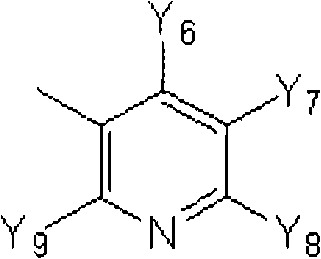
(式中,Y6及Y9分别独立地表示卤原子、C1-C4烷基、C1-C4卤代烷基、C1-C4烷氧基、C1-C4卤代烷氧基、C1-C4烷基硫基、C1-C4卤代烷基硫基、C1-C4烷基亚磺酰基、C1-C4卤代烷基亚磺酰基、C1-C4烷基磺酰基、C1-C4卤代烷基磺酰基、或氰基,Y8表示C1-C6卤代烷基、C1-C6卤代烷氧基、C1-C6卤代烷基硫基、C1-C6卤代烷基亚磺酰基、或C1-C6卤代烷基磺酰基,Y7表示氢原子、卤原子、或C1-C4烷基。)(wherein, Y 6 and Y 9 independently represent a halogen atom, C1-C4 alkyl, C1-C4 haloalkyl, C1-C4 alkoxy, C1-C4 haloalkoxy, C1-C4 alkylthio, C1-C4 haloalkylthio, C1-C4 alkylsulfinyl, C1-C4 haloalkylsulfinyl, C1-C4 alkylsulfonyl, C1-C4 haloalkylsulfonyl, or cyano, Y8 represents C1- C6 haloalkyl, C1-C6 haloalkoxy, C1-C6 haloalkylthio, C1-C6 haloalkylsulfinyl, or C1-C6 haloalkylsulfonyl, Y 7 represents hydrogen atom, halogen atom, or C1-C4 alkyl.)
<3>如上述<2>所述的酰胺衍生物,其中,上述通式(1)中,A表示碳原子、氮原子、被氧化的氮原子或硫原子,K表示在与A以及A键合的2个碳原子一同形成下述环状连接基团时所必需的非金属原子组,所述环状连接基团来自苯、吡啶、N-氧化吡啶、或噻唑。<3> The amide derivative as described in the above <2>, wherein, in the above general formula (1), A represents a carbon atom, a nitrogen atom, an oxidized nitrogen atom, or a sulfur atom, and K represents a bond between A and A. The group of non-metal atoms necessary for the combined two carbon atoms to form a cyclic linking group derived from benzene, pyridine, pyridine N-oxide, or thiazole.
<4>如上述<3>所述的酰胺衍生物,其中,上述通式(1)中,R1、R2分别独立地表示氢原子、可选择地具有取代基的C1-C4烷基、或-L-D表示的基团(其中,R1、R2中的任一个表示-L-D表示的基团。),L表示-C(M1)(M2)-、-C(M1)(M2)-C(M3)(M4)-、或-C(M1)(M2)-C(M3)(M4)-C(M5)(M6)-,M1~M6表示氢原子、卤原子、氰基、羧基、羟基、氨基甲酰基、可选择地具有取代基的C1-C4烷基、可选择地具有取代基的C1-C4卤代烷基、可选择地具有取代基的C2-C4链烯基、可选择地具有取代基的C2-C4卤代链烯基、可选择地具有取代基的C2-C4炔基、可选择地具有取代基的C2-C4卤代炔基、可选择地具有取代基的C3-C9环烷基、可选择地具有取代基的C3-C9卤代环烷基,D表示-C(=O)NU3U4、-S-U7、-S(=O)U8、-S(=O)(=O)U9、-S(=O)(=O)NU10U11或-C≡N。<4> The amide derivative as described in the above <3>, wherein, in the above general formula (1), R 1 and R 2 each independently represent a hydrogen atom, an optionally substituted C1-C4 alkyl group, or a group represented by -LD (wherein, any one of R 1 and R 2 represents a group represented by -LD.), L represents -C(M 1 )(M 2 )-, -C(M 1 )( M 2 )-C(M 3 )(M 4 )-, or -C(M 1 )(M 2 )-C(M 3 )(M 4 )-C(M 5 )(M 6 )-, M 1 ~ M6 represents a hydrogen atom, a halogen atom, a cyano group, a carboxyl group, a hydroxyl group, a carbamoyl group, an optionally substituted C1-C4 alkyl group, an optionally substituted C1-C4 haloalkyl group, optionally C2-C4 alkenyl with substituents, C2-C4 haloalkenyl with substituents, C2-C4 alkynyl with substituents, C2-C4 with substituents Haloalkynyl, optionally substituted C3-C9 cycloalkyl, optionally substituted C3-C9 halocycloalkyl, D represents -C(=O)NU 3 U 4 , -SU 7. -S(=O)U 8 , -S(=O)(=O)U 9 , -S(=O)(=O)NU 10 U 11 or -C≡N.
<5>如<4>表示的酰胺衍生物,其中,上述通式(1)中,R1表示-L-D表示的基团,R2表示氢原子、或可选择地具有取代基的C1-C4烷基。<5> The amide derivative represented by <4>, wherein, in the above-mentioned general formula (1), R 1 represents a group represented by -LD, R 2 represents a hydrogen atom, or C1-C4 optionally having a substituent alkyl.
D表示-C(=O)NU3U4、-S(=O)U8、-S(=O)(=O)U9、或-S(=O)(=O)NU10U11,U3、U4、U8、U9、U10、U11分别独立地表示氢原子、羟基、可选择地具有取代基的C1-C4烷基、可选择地具有取代基的C1-C4卤代烷基、可选择地具有取代基的C2-C4链烯基、可选择地具有取代基的C2-C4卤代链烯基、可选择地具有取代基的C2-C4炔基、可选择地具有取代基的C2-C4卤代炔基、可选择地具有取代基的C3-C9环烷基、可选择地具有取代基的C3-C9卤代环烷基、可选择地具有取代基的C2-C7烷氧基羰基或可选择地具有取代基的C2-C7卤代烷氧基羰基。D represents -C(=O)NU 3 U 4 , -S(=O)U 8 , -S(=O)(=O)U 9 , or -S(=O)(=O)NU 10 U 11 , U 3 , U 4 , U 8 , U 9 , U 10 , and U 11 independently represent a hydrogen atom, a hydroxyl group, an optionally substituted C1-C4 alkyl, and an optionally substituted C1-C4 Haloalkyl, C2-C4 alkenyl optionally having substituent, C2-C4 haloalkenyl optionally having substituent, C2-C4 alkynyl optionally having substituent, optionally having Substituent C2-C4 haloalkynyl, optionally substituted C3-C9 cycloalkyl, optionally substituted C3-C9 halocycloalkyl, optionally substituted C2- C7 alkoxycarbonyl or optionally substituted C2-C7 haloalkoxycarbonyl.
<6>如上述<5>所述的酰胺衍生物,其中,上述通式(1)表示的化合物如下述通式(4a)所示。<6> The amide derivative according to the above <5>, wherein the compound represented by the above general formula (1) is represented by the following general formula (4a).

(通式(4a)中,Q1表示可选择地具有取代基的苯基、或可选择地具有取代基的杂环基,Y1及Y5分别独立地表示卤原子、或C1-C3卤代烷基,Y2及Y4表示氢原子,Y3表示C3-C4全氟烷基。R1及R2分别表示与上述通式(1)中的R1及R2相同的含义。)(In general formula (4a), Q 1 represents a phenyl group optionally having a substituent, or a heterocyclic group optionally having a substituent, Y 1 and Y 5 independently represent a halogen atom, or a C1-C3 haloalkane group, Y 2 and Y 4 represent a hydrogen atom, Y 3 represent a C3-C4 perfluoroalkyl group. R 1 and R 2 represent the same meaning as R 1 and R 2 in the above general formula (1) respectively.)
<7>如上述<5>所述的酰胺衍生物,其中,上述D为-C(=O)NU3U4、或-S(=O)(=O)NU10U11。<7> The amide derivative according to the above <5>, wherein the above-mentioned D is -C(=O)NU 3 U 4 or -S(=O)(=O)NU 10 U 11 .
<8>如上述<7>所述的酰胺衍生物,其中,上述通式(1)表示的化合物如下述通式(4b)所示。<8> The amide derivative according to the above <7>, wherein the compound represented by the above general formula (1) is represented by the following general formula (4b).

(通式(4b)中,Q1表示可选择地具有取代基的苯基、或可选择地具有取代基的杂环基,Y1及Y5分别独立地表示卤原子、或C1-C3卤代烷基,Y2及Y4表示氢原子,Y3表示C3-C4全氟烷基。R1及R2分别表示与上述通式(1)中的R1及R2相同的含义。)(In the general formula (4b), Q 1 represents a phenyl group optionally having a substituent, or a heterocyclic group optionally having a substituent, Y 1 and Y 5 independently represent a halogen atom, or a C1-C3 haloalkane group, Y 2 and Y 4 represent a hydrogen atom, Y 3 represent a C3-C4 perfluoroalkyl group. R 1 and R 2 represent the same meaning as R 1 and R 2 in the above general formula (1) respectively.)
<9>一种苯胺衍生物,所述苯胺衍生物如下述通式(6d)所示。<9> An aniline derivative represented by the following general formula (6d).
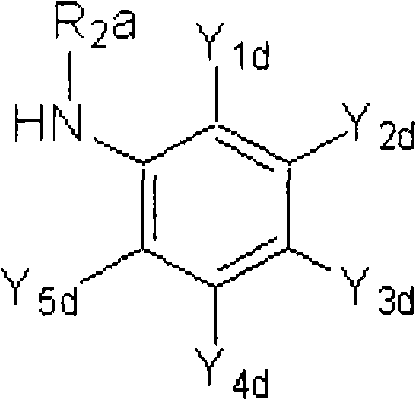
(式中,Y5d表示C1-C3卤代烷基。Y1d表示氢原子、卤原子、C1-C4烷基、C1-C4卤代烷基、C1-C4烷氧基、C1-C4卤代烷氧基、C1-C4烷基硫基、C1-C4卤代烷基硫基、C1-C4烷基亚磺酰基、C1-C4卤代烷基亚磺酰基、C1-C4烷基磺酰基、C1-C4卤代烷基磺酰基、或氰基。(In the formula, Y 5d represents a C1-C3 haloalkyl group. Y 1d represents a hydrogen atom, a halogen atom, a C1-C4 alkyl group, a C1-C4 haloalkyl group, a C1-C4 alkoxy group, a C1-C4 haloalkoxy group, a C1- C4 alkylthio, C1-C4 haloalkylthio, C1-C4 alkylsulfinyl, C1-C4 haloalkylsulfinyl, C1-C4 alkylsulfonyl, C1-C4 haloalkylsulfonyl, or cyano base.
Y3d表示C1-C6卤代烷基、C1-C6卤代烷氧基、C1-C6卤代烷基硫基、C1-C6卤代烷基亚磺酰基、或C1-C6卤代烷基磺酰基。Y 3d represents C1-C6 haloalkyl, C1-C6 haloalkoxy, C1-C6 haloalkylthio, C1-C6 haloalkylsulfinyl, or C1-C6 haloalkylsulfonyl.
Y2d及Y4d分别独立地表示氢原子、卤原子、或C1-C4烷基。Y 2d and Y 4d each independently represent a hydrogen atom, a halogen atom, or a C1-C4 alkyl group.
R2a表示氢原子、氧原子、卤原子、羟基、硝基、亚硝基、三甲基甲硅烷基、叔丁基二甲基甲硅烷基、氰基、氨基、C1-C6烷基、C1-C6卤代烷基、C2-C6链烯基、C2-C6卤代链烯基、C2-C6炔基、C2-C6卤代炔基、C3-C9环烷基、C3-C9卤代环烷基、C1-C6烷氧基、C1-C6卤代烷氧基、C2-C6链烯基氧基、C2-C6卤代链烯基氧基、C2-C6炔基氧基、C2-C6卤代炔基氧基、C3-C9环烷氧基、C3-C9卤代环烷氧基、C1-C6烷基硫基、C1-C6卤代烷基硫基、C1-C6烷基亚磺酰基、C1-C6卤代烷基亚磺酰基、C1-C6烷基磺酰基、C1-C6卤代烷基磺酰基、苯磺酰基、苄基磺酰基、C2-C7烷基羰基、C2-C7卤代烷基羰基、C3-C7链烯基羰基、C3-C7卤代链烯基羰基、C3-C7炔基羰基、C3-C7卤代炔基羰基、C4-C10环烷基羰基、C4-C10卤代环烷基羰基、C2-C7烷氧基羰基、C2-C7卤代烷氧基羰基、C3-C7链烯基氧基羰基、C3-C7卤代链烯基氧基羰基、C3-C7炔基氧基羰基、C3-C7卤代炔基氧基羰基、苯氧基羰基、C2-C7烷基氨基羰基、C2-C7卤代烷基氨基羰基、C2-C7烷基羰基氧基、C2-C7卤代烷基羰基氧基、C4-C10环烷基氧基羰基、C4-C10卤代环烷基氧基羰基、苯甲酰基、苄基、-C(=O)C(=O)R7(式中,R7表示C1-C6烷基、C1-C6卤代烷基、C1-C6烷氧基、或C1-C6卤代烷氧基。)、或-L-D表示的基团(L及D分别表示与R2中的L及D相同的含义。)。)R 2a represents hydrogen atom, oxygen atom, halogen atom, hydroxyl, nitro, nitroso, trimethylsilyl, tert-butyldimethylsilyl, cyano, amino, C1-C6 alkyl, C1 -C6 haloalkyl, C2-C6 alkenyl, C2-C6 haloalkenyl, C2-C6 alkynyl, C2-C6 haloalkynyl, C3-C9 cycloalkyl, C3-C9 halocycloalkyl , C1-C6 alkoxy, C1-C6 haloalkoxy, C2-C6 alkenyloxy, C2-C6 haloalkenyloxy, C2-C6 alkynyloxy, C2-C6 haloalkynyl Oxygen, C3-C9 cycloalkoxy, C3-C9 halocycloalkoxy, C1-C6 alkylthio, C1-C6 haloalkylthio, C1-C6 alkylsulfinyl, C1-C6 haloalkane Sulfinyl, C1-C6 alkylsulfonyl, C1-C6 haloalkylsulfonyl, benzenesulfonyl, benzylsulfonyl, C2-C7 alkylcarbonyl, C2-C7 haloalkylcarbonyl, C3-C7 alkenyl Carbonyl, C3-C7 haloalkenylcarbonyl, C3-C7 alkynylcarbonyl, C3-C7 haloalkynylcarbonyl, C4-C10 cycloalkylcarbonyl, C4-C10 halocycloalkylcarbonyl, C2-C7 alkane Oxycarbonyl, C2-C7 Haloalkoxycarbonyl, C3-C7 Alkenyloxycarbonyl, C3-C7 Haloalkenyloxycarbonyl, C3-C7 Alkynyloxycarbonyl, C3-C7 Haloalkynyl Oxycarbonyl, phenoxycarbonyl, C2-C7 alkylaminocarbonyl, C2-C7 haloalkylaminocarbonyl, C2-C7 alkylcarbonyloxy, C2-C7 haloalkylcarbonyloxy, C4-C10 cycloalkyloxy Cylcarbonyl, C4-C10 halocycloalkyloxycarbonyl, benzoyl, benzyl, -C(=O)C(=O)R 7 (in the formula, R 7 represents C1-C6 alkyl, C1- C6 haloalkyl, C1-C6 alkoxy, or C1-C6 haloalkoxy.), or a group represented by -LD (L and D respectively represent the same meanings as L and D in R 2. ). )
<10>如上述<9>所述的苯胺衍生物,其中,上述<9>所述的通式(6d)中,Y1d为卤原子。<10> The aniline derivative as described in the above <9>, wherein in the general formula (6d) described in the above <9>, Y 1d is a halogen atom.
<11>一种上述<10>所述的苯胺衍生物的制备方法,其特征在于,使上述<9>所述的通式(6d)中Y1d表示氢原子的化合物与卤化剂反应。<11> A method for producing the aniline derivative described in <10> above, which comprises reacting a compound in which Y 1d represents a hydrogen atom in the general formula (6d) described in <9> above with a halogenating agent.
<12>一种酰胺衍生物,所述酰胺衍生物如下述通式(6a)所示。<12> An amide derivative represented by the following general formula (6a).

(式中,A、K、X、n及G3分别表示与上述通式(1)中的A、K、X、n及G3相同的含义。(In the formula, A, K, X, n, and G3 respectively represent the same meanings as A, K, X, n, and G3 in the above-mentioned general formula (1).
R2a表示与上述通式(6d)中的R2a相同的含义。R 2a represents the same meaning as R 2a in the above general formula (6d).
Wa表示硝基、氨基、或-NH-R1a。W a represents nitro, amino, or -NH-R 1a .
R1a表示氧原子、卤原子、羟基、硝基、亚硝基、三甲基甲硅烷基、叔丁基二甲基甲硅烷基、氰基、氨基、C1-C6烷基、C1-C6卤代烷基、C2-C6链烯基、C2-C6卤代链烯基、C2-C6炔基、C2-C6卤代炔基、C3-C9环烷基、C3-C9卤代环烷基、C1-C6烷氧基、C1-C6卤代烷氧基、C2-C6链烯基氧基、C2-C6卤代链烯基氧基、C2-C6炔基氧基、C2-C6卤代炔基氧基、C3-C9环烷氧基、C3-C9卤代环烷氧基、C1-C6烷基硫基、C1-C6卤代烷基硫基、C1-C6烷基亚磺酰基、C1-C6卤代烷基亚磺酰基、C1-C6烷基磺酰基、C1-C6卤代烷基磺酰基、苯磺酰基、苄基磺酰基、C2-C7烷基氨基羰基、C2-C7卤代烷基氨基羰基、C2-C7烷基羰基氧基、C2-C7卤代烷基羰基氧基、苄基、-C(=O)C(=O)R7(式中,R7表示C1-C6烷基、C1-C6卤代烷基、C1-C6烷氧基、或C1-C6卤代烷氧基。)、或-L-D表示的基团(L及D分别表示与R2中的L及D相同的含义。)。R 1a represents oxygen atom, halogen atom, hydroxyl, nitro, nitroso, trimethylsilyl, tert-butyldimethylsilyl, cyano, amino, C1-C6 alkyl, C1-C6 haloalkane Base, C2-C6 alkenyl, C2-C6 haloalkenyl, C2-C6 alkynyl, C2-C6 haloalkynyl, C3-C9 cycloalkyl, C3-C9 halocycloalkyl, C1- C6 alkoxy, C1-C6 haloalkoxy, C2-C6 alkenyloxy, C2-C6 haloalkenyloxy, C2-C6 alkynyloxy, C2-C6 haloalkynyloxy, C3-C9 cycloalkoxy, C3-C9 halocycloalkoxy, C1-C6 alkylthio, C1-C6 haloalkylthio, C1-C6 alkylsulfinyl, C1-C6 haloalkylsulfinyl Acyl, C1-C6 alkylsulfonyl, C1-C6 haloalkylsulfonyl, benzenesulfonyl, benzylsulfonyl, C2-C7 alkylaminocarbonyl, C2-C7 haloalkylaminocarbonyl, C2-C7 alkylcarbonyloxy Base, C2-C7 haloalkylcarbonyloxy, benzyl, -C(=O)C(=O)R 7 (wherein, R 7 represents C1-C6 alkyl, C1-C6 haloalkyl, C1-C6 alkane Oxygen, or C1-C6 haloalkoxy.), or a group represented by -LD (L and D respectively represent the same meaning as L and D in R 2. ).
Y1a及Y5a分别独立地表示卤原子、C1-C6卤代烷氧基、或C1-C3卤代烷基。Y 1a and Y 5a each independently represent a halogen atom, a C1-C6 haloalkoxy group, or a C1-C3 haloalkyl group.
其中,K与A以及A键合的2个碳原子一同形成苯环、X均为氢原子、R2a为氢原子、Y3a为C3全氟烷基时,Y5a为C1-C3卤代烷基。另外,K与A以及A键合的2个碳原子一同形成苯环、X为氰基时,Y5a为C1-C6卤代烷氧基、或C1-C3卤代烷基。Where K forms a benzene ring with A and the two carbon atoms bonded to A, X is a hydrogen atom, R 2a is a hydrogen atom, and Y 3a is a C3 perfluoroalkyl group, Y 5a is a C1-C3 haloalkyl group. In addition, when K forms a benzene ring together with A and the two carbon atoms bonded to A, and X is a cyano group, Y 5a is a C1-C6 haloalkoxy group or a C1-C3 haloalkyl group.
Y2a及Y4a分别独立地表示氢原子、卤原子、或C1-C4烷基,Y3a表示C2-C5卤代烷基。}Y 2a and Y 4a each independently represent a hydrogen atom, a halogen atom, or a C1-C4 alkyl group, and Y 3a represents a C2-C5 haloalkyl group. }
<13>如上述<12>所述的酰胺衍生物,其中,上述通式(6a)表示的化合物如下述通式(41)所示。<13> The amide derivative according to the above <12>, wherein the compound represented by the above general formula (6a) is represented by the following general formula (41).

(式中,A、K、X、n、G3、R2a、Y1a、Y2a、Y3a、Y4a及Y5a分别表示与上述通式(6a)中的A、K、X、n、G3、R2a、Y1a、Y2a、Y3a、Y4a及Y5a相同的含义。)(In the formula, A, K, X, n, G 3 , R 2a , Y 1a , Y 2a , Y 3a , Y 4a and Y 5a respectively represent the same as A, K, X, n in the above general formula (6a). , G 3 , R 2a , Y 1a , Y 2a , Y 3a , Y 4a and Y 5a have the same meaning.)
<14>一种上述<13>所述的酰胺衍生物的制备方法,其特征在于,使下述通式(40)表示的化合物与下述通式(6f)表示的化合物反应。<14> A method for producing the amide derivative according to the above <13>, comprising reacting a compound represented by the following general formula (40) with a compound represented by the following general formula (6f).

(式中,LG表示卤原子、羟基等具有离去能力的官能团,A、K、X、n及G3分别表示与上述通式(1)中的A、K、X、n及G3相同的含义。)(In the formula, LG represents a functional group with leaving ability such as a halogen atom and a hydroxyl group, and A, K, X, n and G3 respectively represent the same as A, K, X, n and G3 in the above-mentioned general formula (1) meaning.)
通式(6f) Formula (6f)
(式中,R2a、Y1a、Y2a、Y3a、Y4a及Y5a表示与上述通式(6a)中的R2a、Y1a、Y2a、Y3a、Y4a及Y5a相同的含义。)(In the formula, R 2a , Y 1a , Y 2a , Y 3a , Y 4a and Y 5a represent the same as R 2a , Y 1a , Y 2a , Y 3a , Y 4a and Y 5a in the above general formula (6a). meaning.)
<15>如上述<12>所述的酰胺衍生物,其中,上述通式(6a)表示的化合物如下述通式(42)所示。<15> The amide derivative according to the above <12>, wherein the compound represented by the above general formula (6a) is represented by the following general formula (42).

(式中,A、K、X、n、G3、R2a、Y1a、Y2a、Y3a、Y4a及Y5a分别表示与上述通式(6a)中的A、K、X、n、G3、R2a、Y1a、Y2a、Y3a、Y4a及Y5a相同的含义。)(In the formula, A, K, X, n, G 3 , R 2a , Y 1a , Y 2a , Y 3a , Y 4a and Y 5a respectively represent the same as A, K, X, n in the above general formula (6a). , G 3 , R 2a , Y 1a , Y 2a , Y 3a , Y 4a and Y 5a have the same meaning.)
<16>一种上述<15>所述的通式(42)表示的酰胺衍生物的制备方法,其特征在于,在还原剂的存在下,使上述<13>所述的通式(41)表示的化合物反应。<16> A method for preparing an amide derivative represented by the general formula (42) described in the above <15>, characterized in that, in the presence of a reducing agent, the general formula (41) described in the above <13> is made Indicates the compound reaction.
<17>一种下述通式(41c)表示的酰胺衍生物的制备方法,<17> A method for producing an amide derivative represented by the following general formula (41c),
其特征在于,使下述通式(43)表示的化合物与下述通式(49a)表示的化合物反应。It is characterized in that the compound represented by the following general formula (43) is reacted with the compound represented by the following general formula (49a).

(式中,A、K、X、n、G3、Y1a、Y2a、Y3a、Y4a及Y5a分别表示与上述通式(6a)中的A、K、X、n、G3、Y1a、Y2a、Y3a、Y4a及Y5a相同的含义。)(In the formula, A, K, X, n, G 3 , Y 1a , Y 2a , Y 3a , Y 4a and Y 5a respectively represent the same as A, K, X, n, G 3 in the above general formula (6a) , Y 1a , Y 2a , Y 3a , Y 4a and Y 5a have the same meaning.)
R2a-LGR 2 a-LG
通式(49a)Formula (49a)
(式中,LG表示卤原子、羟基等具有离去能力的官能团,R2a表示三甲基甲硅烷基、叔丁基二甲基甲硅烷基、氰基、C1-C6烷基、C1-C6卤代烷基、C2-C6链烯基、C2-C6卤代链烯基、C2-C6炔基、C2-C6卤代炔基、C3-C9环烷基、C3-C9卤代环烷基、C1-C6烷基亚磺酰基、C1-C6卤代烷基亚磺酰基、C1-C6烷基磺酰基、C1-C6卤代烷基磺酰基、苯磺酰基、苄基磺酰基、C2-C7烷基羰基、C2-C7卤代烷基羰基、C3-C7链烯基羰基、C3-C7卤代链烯基羰基、C3-C7炔基羰基、C3-C7卤代炔基羰基、C4-C10环烷基羰基、C4-C10卤代环烷基羰基、C2-C7烷氧基羰基、C2-C7卤代烷氧基羰基、C3-C7链烯基氧基羰基、C3-C7卤代链烯基氧基羰基、C3-C7炔基氧基羰基、C3-C7卤代炔基氧基羰基、苯氧基羰基、C2-C7烷基氨基羰基、C2-C7卤代烷基氨基羰基、C4-C10环烷基氧基羰基、C4-C10卤代环烷基氧基羰基、苯甲酰基、苄基、-C(=O)C(=O)R7(式中,R7表示C1-C6烷基、C1-C6卤代烷基、C1-C6烷氧基、或C1-C6卤代烷氧基。)、或-L-D表示的基团(L及D分别表示与R2中的L及D相同的含义。)。)(In the formula, LG represents a functional group with leaving ability such as a halogen atom and a hydroxyl group, and R 2a represents a trimethylsilyl group, a tert-butyldimethylsilyl group, a cyano group, a C1-C6 alkyl group, a C1-C6 Haloalkyl, C2-C6 alkenyl, C2-C6 haloalkenyl, C2-C6 alkynyl, C2-C6 haloalkynyl, C3-C9 cycloalkyl, C3-C9 halocycloalkyl, C1 -C6 alkylsulfinyl, C1-C6 haloalkylsulfinyl, C1-C6 alkylsulfonyl, C1-C6 haloalkylsulfinyl, benzenesulfonyl, benzylsulfonyl, C2-C7 alkylcarbonyl, C2 -C7 haloalkylcarbonyl, C3-C7 alkenylcarbonyl, C3-C7 haloalkenylcarbonyl, C3-C7 alkynylcarbonyl, C3-C7 haloalkynylcarbonyl, C4-C10cycloalkylcarbonyl, C4- C10 halocycloalkylcarbonyl, C2-C7 alkoxycarbonyl, C2-C7 haloalkoxycarbonyl, C3-C7 alkenyloxycarbonyl, C3-C7 haloalkenyloxycarbonyl, C3-C7 alkyne Cyloxycarbonyl, C3-C7 haloalkynyloxycarbonyl, phenoxycarbonyl, C2-C7 alkylaminocarbonyl, C2-C7 haloalkylaminocarbonyl, C4-C10 cycloalkyloxycarbonyl, C4-C10 Halocycloalkyloxycarbonyl, benzoyl, benzyl, -C(=O)C(=O)R 7 (wherein, R 7 represents C1-C6 alkyl, C1-C6 haloalkyl, C1- C6 alkoxy, or C1-C6 haloalkoxy.), or a group represented by -LD (L and D represent the same meanings as L and D in R2 respectively.))

(式中,R2a表示与上述通式(49a)中的R2a相同的含义,A、K、X、n、G3、Y1a、Y2a、Y3a、Y4a及Y5a分别表示与上述通式(6a)中的A、K、X、n、G3、Y1a、Y2a、Y3a、Y4a及Y5a相同的含义。)(In the formula, R 2a represents the same meaning as R 2a in the above general formula (49a), A, K, X, n, G 3 , Y 1a , Y 2a , Y 3a , Y 4a and Y 5a respectively represent A, K, X, n, G3, Y 1a , Y 2a , Y 3a , Y 4a and Y 5a in the above general formula (6a) have the same meaning.)
<18>如上述<12>所述的酰胺衍生物,其中,上述通式(6a)表示的化合物如下述通式(44)所示。<18> The amide derivative according to the above <12>, wherein the compound represented by the above general formula (6a) is represented by the following general formula (44).

(式中,A、K、X、n、G3、Y1a、Y2a、Y3a、Y4a、Y5a、R1a及R2a分别表示与上述通式(6a)中的A、K、X、n、G3、Y1a、Y2a、Y3a、Y4a、Y5a、R1a及R2a相同的含义。)(In the formula, A, K, X, n, G 3 , Y 1a , Y 2a , Y 3a , Y 4a , Y 5a , R 1a and R 2a respectively represent the same as A, K, and R in the above general formula (6a). X, n, G 3 , Y 1a , Y 2a , Y 3a , Y 4a , Y 5a , R 1a and R 2a have the same meaning.)
<19>一种下述通式(44a)表示的酰胺衍生物的制备方法,<19> A method for producing an amide derivative represented by the following general formula (44a),
其特征在于,使下述通式(42a)表示的化合物与下述通式(47a)表示的化合物反应。It is characterized in that the compound represented by the following general formula (42a) is reacted with the compound represented by the following general formula (47a).

(式中,R2a表示氧原子、卤原子、羟基、硝基、亚硝基、三甲基甲硅烷基、叔丁基二甲基甲硅烷基、氰基、氨基、C1-C6烷基、C1-C6卤代烷基、C2-C6链烯基、C2-C6卤代链烯基、C2-C6炔基、C2-C6卤代炔基、C3-C9环烷基、C3-C9卤代环烷基、C1-C6烷氧基、C1-C6卤代烷氧基、C2-C6链烯基氧基、C2-C6卤代链烯基氧基、C2-C6炔基氧基、C2-C6卤代炔基氧基、C3-C9环烷氧基、C3-C9卤代环烷氧基、C1-C6烷基硫基、C1-C6卤代烷基硫基、C1-C6烷基亚磺酰基、C1-C6卤代烷基亚磺酰基、C1-C6烷基磺酰基、C1-C6卤代烷基磺酰基、苯磺酰基、苄基磺酰基、C2-C7烷基羰基、C2-C7卤代烷基羰基、C3-C7链烯基羰基、C3-C7卤代链烯基羰基、C3-C7炔基羰基、C3-C7卤代炔基羰基、C4-C10环烷基羰基、C4-C10卤代环烷基羰基、C2-C7烷氧基羰基、C2-C7卤代烷氧基羰基、C3-C7链烯基氧基羰基、C3-C7卤代链烯基氧基羰基、C3-C7炔基氧基羰基、C3-C7卤代炔基氧基羰基、苯氧基羰基、C2-C7烷基氨基羰基、C2-C7卤代烷基氨基羰基、C2-C7烷基羰基氧基、C2-C7卤代烷基羰基氧基、C4-C10环烷基氧基羰基、C4-C10卤代环烷基氧基羰基、苯甲酰基、苄基、-C(=O)C(=O)R7(式中,R7表示可选择地具有取代基的C1-C6烷基、C1-C6卤代烷基、或可选择地具有取代基的C1-C6烷氧基或C1-C6卤代烷氧基。)、或-L-D表示的基团(L及D分别表示与R2中的L及D相同的含义。),A、K、X、n、G3、Y1a、Y2a、Y3a、Y4a及Y5a分别表示与上述通式(6a)中的A、K、X、n、G3、Y1a、Y2a、Y3a、Y4a及Y5a相同的含义。)(wherein, R 2a represents an oxygen atom, a halogen atom, a hydroxyl group, a nitro group, a nitroso group, a trimethylsilyl group, a tert-butyldimethylsilyl group, a cyano group, an amino group, a C1-C6 alkyl group, C1-C6 haloalkyl, C2-C6 alkenyl, C2-C6 haloalkenyl, C2-C6 alkynyl, C2-C6 haloalkynyl, C3-C9 cycloalkyl, C3-C9 halocycloalkane Base, C1-C6 alkoxy, C1-C6 haloalkoxy, C2-C6 alkenyloxy, C2-C6 haloalkenyloxy, C2-C6 alkynyloxy, C2-C6 haloalkyne Oxygen, C3-C9 cycloalkoxy, C3-C9 halocycloalkoxy, C1-C6 alkylthio, C1-C6 haloalkylthio, C1-C6 alkylsulfinyl, C1-C6 Haloalkylsulfinyl, C1-C6 alkylsulfinyl, C1-C6 haloalkylsulfonyl, benzenesulfonyl, benzylsulfonyl, C2-C7 alkylcarbonyl, C2-C7 haloalkylcarbonyl, C3-C7 alkenyl C3-C7 haloalkenylcarbonyl, C3-C7 alkynylcarbonyl, C3-C7 haloalkynylcarbonyl, C4-C10 cycloalkylcarbonyl, C4-C10 halocycloalkylcarbonyl, C2-C7 Alkoxycarbonyl, C2-C7 haloalkoxycarbonyl, C3-C7 alkenyloxycarbonyl, C3-C7 haloalkenyloxycarbonyl, C3-C7 alkynyloxycarbonyl, C3-C7 haloalkyne Cyloxycarbonyl, phenoxycarbonyl, C2-C7 alkylaminocarbonyl, C2-C7 haloalkylaminocarbonyl, C2-C7 alkylcarbonyloxy, C2-C7 haloalkylcarbonyloxy, C4-C10 cycloalkyl Oxycarbonyl, C4-C10 halocycloalkyloxycarbonyl, benzoyl, benzyl, -C(=O)C(=O)R 7 (in the formula, R 7 represents optionally substituted C1-C6 alkyl, C1-C6 haloalkyl, or optionally substituent C1-C6 alkoxy or C1-C6 haloalkoxy.), or a group represented by -LD (L and D represent and L and D in R 2 have the same meaning.), A, K, X, n, G 3 , Y 1a , Y 2a , Y 3a , Y 4a and Y 5a respectively represent the same as A in the above general formula (6a). , K, X, n, G 3 , Y 1a , Y 2a , Y 3a , Y 4a and Y 5a have the same meaning.)
R1a-LGR 1 a-LG
通式(47a)Formula (47a)
(式中,LG表示卤原子、羟基等具有离去能力的官能团,R1a表示三甲基甲硅烷基、叔丁基二甲基甲硅烷基、氰基、C1-C6烷基、C1-C6卤代烷基、C2-C6链烯基、C2-C6卤代链烯基、C2-C6炔基、C2-C6卤代炔基、C3-C9环烷基、C3-C9卤代环烷基、C1-C6烷基亚磺酰基、C1-C6卤代烷基亚磺酰基、C1-C6烷基磺酰基、C1-C6卤代烷基磺酰基、苯磺酰基、苄基磺酰基、C2-C7烷基氨基羰基、C2-C7卤代烷基氨基羰基、苄基、-C(=O)C(=O)R7(式中,R7表示C1-C6烷基、C1-C6卤代烷基、C1-C6烷氧基、或C1-C6卤代烷氧基。)或-L-D表示的基团(L及D分别表示与R2中的L及D相同的含义。)。)(In the formula, LG represents a functional group with leaving ability such as a halogen atom and a hydroxyl group, and R 1a represents a trimethylsilyl group, a tert-butyldimethylsilyl group, a cyano group, a C1-C6 alkyl group, a C1-C6 Haloalkyl, C2-C6 alkenyl, C2-C6 haloalkenyl, C2-C6 alkynyl, C2-C6 haloalkynyl, C3-C9 cycloalkyl, C3-C9 halocycloalkyl, C1 -C6 alkylsulfinyl, C1-C6 haloalkylsulfinyl, C1-C6 alkylsulfonyl, C1-C6 haloalkylsulfinyl, benzenesulfonyl, benzylsulfonyl, C2-C7 alkylaminocarbonyl, C2-C7 haloalkylaminocarbonyl, benzyl, -C(=O)C(=O)R 7 (wherein, R 7 represents C1-C6 alkyl, C1-C6 haloalkyl, C1-C6 alkoxy, Or C1-C6 haloalkoxy.) or a group represented by -LD (L and D respectively represent the same meanings as L and D in R2 .))

(式中,R1a表示与上述通式(47a)中的R1a相同的含义,R2a表示与上述通式(42a)中的R2a相同的含义,A、K、X、n、G3、Y1a、Y2a、Y3a、Y4a及Y5a分别表示与上述通式(6a)中的A、K、X、n、G3、Y1a、Y2a、Y3a、Y4a及Y5a相同的含义。)(In the formula, R 1a represents the same meaning as R 1a in the above general formula (47a), R 2a represents the same meaning as R 2a in the above general formula (42a), A, K, X, n, G 3 , Y 1a , Y 2a , Y 3a , Y 4a and Y 5a respectively represent A, K, X, n, G 3 , Y 1a , Y 2a , Y 3a , Y 4a and Y in the above general formula (6a). 5a has the same meaning.)
<20>一种下述通式(44c)表示的酰胺衍生物的制备方法,其特征在于,使上述<15>所述的通式(42)表示的化合物与醛类反应。<20> A method for producing an amide derivative represented by the following general formula (44c), comprising reacting the compound represented by the general formula (42) described in the above <15> with an aldehyde.

(式中,R1a表示C1-C6烷基、C1-C6卤代烷基、或苄基,A、K、X、n、G3、R2a、Y1a、Y2a、Y3a、Y4a、及Y5a分别表示与上述通式(6a)中的A、K、X、n、G3、R2a、Y1a、Y2a、Y3a、Y4a、及Y5a相同的含义。)(wherein, R 1a represents C1-C6 alkyl, C1-C6 haloalkyl, or benzyl, A, K, X, n, G 3 , R 2a , Y 1a , Y 2a , Y 3a , Y 4a , and Y 5a respectively represent the same meanings as A, K, X, n, G 3 , R 2a , Y 1a , Y 2a , Y 3a , Y 4a , and Y 5a in the above general formula (6a).)
<21>如上述<12>所述的酰胺衍生物,其中,上述通式(6a)表示的化合物如下述通式(6b)所示。<21> The amide derivative according to the above <12>, wherein the compound represented by the above general formula (6a) is represented by the following general formula (6b).
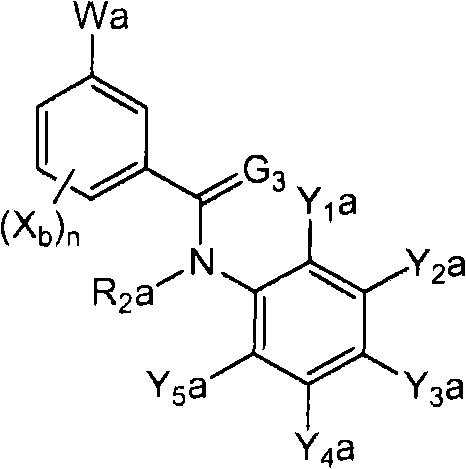
(式中,Xb表示氢原子、卤原子、氰基或硝基,n为4,Wa、G3、R2a、Y1a、Y2a、Y3a、Y4a、及Y5a分别表示与上述通式(6a)中的Wa、G3、R2a、Y1a、Y2a、Y3a、Y4a、及Y5a相同的含义。)(In the formula, Xb represents a hydrogen atom, a halogen atom, a cyano group or a nitro group, n is 4, Wa, G 3 , R 2a , Y 1a , Y 2a , Y 3a , Y 4a , and Y 5a respectively represent Wa, G 3 , R 2a , Y 1a , Y 2a , Y 3a , Y 4a , and Y 5a in formula (6a) have the same meaning.)
<22>如上述<21>所述的化合物,其中,上述通式(6b)表示的化合物如下述通式(41b)所示。<22> The compound according to the above <21>, wherein the compound represented by the above general formula (6b) is represented by the following general formula (41b).

(式中,Xb、n、G3、R2a、Y1a、Y2a、Y3a、Y4a、及Y5a分别表示与上述通式(6b)中的Xb、n、G3、R2a、Y1a、Y2a、Y3a、Y4a、及Y5a相同的含义。)。(wherein, Xb, n, G 3 , R 2a , Y 1a , Y 2a , Y 3a , Y 4a , and Y 5a respectively represent the same as Xb, n, G 3 , R 2a , Y 1a , Y 2a , Y 3a , Y 4a , and Y 5a have the same meaning.).
<23>一种上述<22>所述的通式(41b)表示的酰胺衍生物的制备方法,其特征在于,使下述通式(40b)表示的化合物与上述<14>所述的下述通式(6f)表示的化合物反应。<23> A method for producing an amide derivative represented by the general formula (41b) described in the above <22>, characterized in that the compound represented by the following general formula (40b) is combined with the following compound described in the above <14> The compound represented by the general formula (6f) is reacted.
通式(40b) Formula (40b)
(式中,LG表示卤原子、羟基等具有离去能力的官能团,G3表示与上述通式(1)中的G3相同的含义。n及Xb分别表示与上述通式(6b)中的n及Xb相同的含义。)(In the formula, LG represents a functional group with leaving ability such as a halogen atom and a hydroxyl group, and G represents the same meaning as G in the above-mentioned general formula (1). n and Xb represent the same as in the above-mentioned general formula (6b) n and Xb have the same meaning.)

(式中,R2a、Y1a、Y2a、Y3a、Y4a、及Y5a表示与上述通式(6a)中的R2a、Y1a、Y2a、Y3a、Y4a、及Y5a相同的含义)(In the formula, R 2a , Y 1a , Y 2a , Y 3a , Y 4a , and Y 5a represent the same as R 2a , Y 1a , Y 2a , Y 3a , Y 4a , and Y 5a in the above general formula (6a). same meaning)
<24>如上述<21>所述的酰胺衍生物,其中,通式(6b)表示的化合物如下述通式(42b)所示。<24> The amide derivative according to the above <21>, wherein the compound represented by the general formula (6b) is represented by the following general formula (42b).

(式中,Xb、n、G3、R2a、Y1a、Y2a、Y3a、Y4a、及Y5a分别表示与上述通式(6b)中的Xb、n、G3、R2a、Y1a、Y2a、Y3a、Y4a、及Y5a相同的含义。)(wherein, Xb, n, G 3 , R 2a , Y 1a , Y 2a , Y 3a , Y 4a , and Y 5a respectively represent the same as Xb, n, G 3 , R 2a , Y 1a , Y 2a , Y 3a , Y 4a , and Y 5a have the same meaning.)
<25>一种上述<24>所述的酰胺衍生物的制备方法,其特征在于,在还原剂的存在下使上述<22>所述的通式(41b)表示的化合物反应。<25> A method for producing the amide derivative according to the above <24>, which comprises reacting the compound represented by the general formula (41b) described in the above <22> in the presence of a reducing agent.
<26>一种下述通式(41d)的制备方法,<26> a preparation method of the following general formula (41d),
其特征在于,使下述通式(43b)与上述<17>所述的下述通式(49a)表示的化合物反应。It is characterized by reacting the following general formula (43b) with the compound represented by the following general formula (49a) described in the above <17>.

(式中,Xb、n、G3、Y1a、Y2a、Y3a、Y4a、及Y5a分别表示与上述通式(6b)中的Xb、n、G3、Y1a、Y2a、Y3a、Y4a、及Y5a相同的含义。)(wherein, Xb, n, G 3 , Y 1a , Y 2a , Y 3a , Y 4a , and Y 5a respectively represent the same as Xb, n, G 3 , Y 1a , Y 2a , Y 3a , Y 4a , and Y 5a have the same meaning.)
R2a-LGR 2 a-LG
通式(49a)Formula (49a)
(式中,LG表示卤原子、羟基等具有离去能力的官能团,R2a表示三甲基甲硅烷基、叔丁基二甲基甲硅烷基、氰基、C1-C6烷基、C1-C6卤代烷基、C2-C6链烯基、C2-C6卤代链烯基、C2-C6炔基、C2-C6卤代炔基、C3-C9环烷基、C3-C9卤代环烷基、C1-C6烷基亚磺酰基、C1-C6卤代烷基亚磺酰基、C1-C6烷基磺酰基、C1-C6卤代烷基磺酰基、苯磺酰基、苄基磺酰基、C2-C7烷基羰基、C2-C7卤代烷基羰基、C3-C7链烯基羰基、C3-C7卤代链烯基羰基、C3-C7炔基羰基、C3-C7卤代炔基羰基、C4-C10环烷基羰基、C4-C10卤代环烷基羰基、C2-C7烷氧基羰基、C2-C7卤代烷氧基羰基、C3-C7链烯基氧基羰基、C3-C7卤代链烯基氧基羰基、C3-C7炔基氧基羰基、C3-C7卤代炔基氧基羰基、苯氧基羰基、C2-C7烷基氨基羰基、C2-C7卤代烷基氨基羰基、C4-C10环烷基氧基羰基、C4-C10卤代环烷基氧基羰基、苯甲酰基、苄基、-C(=O)C(=O)R7(式中,R7表示C1-C6烷基、C1-C6卤代烷基、C1-C6烷氧基、或C1-C6卤代烷氧基。)、或-L-D表示的基团(L及D分别表示与R2中的L及D相同的含义。)。)(In the formula, LG represents a functional group with leaving ability such as a halogen atom and a hydroxyl group, and R 2a represents a trimethylsilyl group, a tert-butyldimethylsilyl group, a cyano group, a C1-C6 alkyl group, a C1-C6 Haloalkyl, C2-C6 alkenyl, C2-C6 haloalkenyl, C2-C6 alkynyl, C2-C6 haloalkynyl, C3-C9 cycloalkyl, C3-C9 halocycloalkyl, C1 -C6 alkylsulfinyl, C1-C6 haloalkylsulfinyl, C1-C6 alkylsulfonyl, C1-C6 haloalkylsulfinyl, benzenesulfonyl, benzylsulfonyl, C2-C7 alkylcarbonyl, C2 -C7 haloalkylcarbonyl, C3-C7 alkenylcarbonyl, C3-C7 haloalkenylcarbonyl, C3-C7 alkynylcarbonyl, C3-C7 haloalkynylcarbonyl, C4-C10cycloalkylcarbonyl, C4- C10 halocycloalkylcarbonyl, C2-C7 alkoxycarbonyl, C2-C7 haloalkoxycarbonyl, C3-C7 alkenyloxycarbonyl, C3-C7 haloalkenyloxycarbonyl, C3-C7 alkyne Cyloxycarbonyl, C3-C7 haloalkynyloxycarbonyl, phenoxycarbonyl, C2-C7 alkylaminocarbonyl, C2-C7 haloalkylaminocarbonyl, C4-C10 cycloalkyloxycarbonyl, C4-C10 Halocycloalkyloxycarbonyl, benzoyl, benzyl, -C(=O)C(=O)R 7 (wherein, R 7 represents C1-C6 alkyl, C1-C6 haloalkyl, C1- C6 alkoxy, or C1-C6 haloalkoxy.), or a group represented by -LD (L and D represent the same meanings as L and D in R2 respectively.))

(式中,R2a表示与上述通式(49a)中的R2a相同的含义,Xb、n、G3、Y1a、Y2a、Y3a、Y4a及Y5a分别表示与上述通式(6b)中的Xb、n、G3、Y1a、Y2a、Y3a、Y4a、及Y5a相同的含义。)(In the formula, R 2a represents the same meaning as R 2a in the above general formula (49a), Xb, n, G 3 , Y 1a , Y 2a , Y 3a , Y 4a and Y 5a represent the same meaning as the above general formula ( Xb, n, G 3 , Y 1a , Y 2a , Y 3a , Y 4a , and Y 5a in 6b) have the same meaning.)
<27>如上述<21>所述的酰胺衍生物,其中,通式(6b)表示的化合物如下述通式(44b)所示。<27> The amide derivative according to the above <21>, wherein the compound represented by the general formula (6b) is represented by the following general formula (44b).
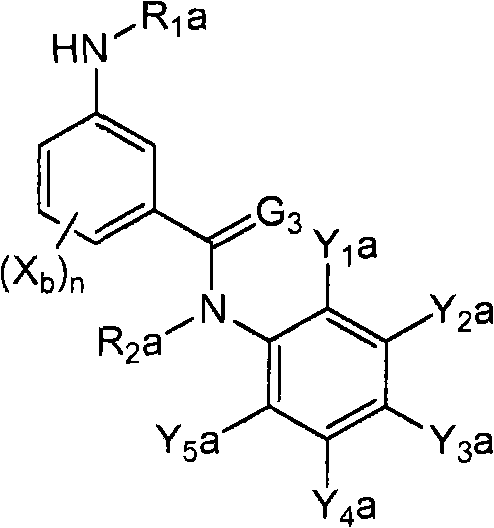
(式中,Xb、n、G3、Y1a、Y2a、Y3a、Y4a、Y5a、R1a及R2a分别表示与上述通式(6b)中的Xb、n、G3、Y1a、Y2a、Y3a、Y4a、Y5a、R1a及R2a相同的含义。)(In the formula, Xb, n, G 3 , Y 1a , Y 2a , Y 3a , Y 4a , Y 5a , R 1a and R 2a respectively represent Xb, n, G 3 , Y 1a , Y 2a , Y 3a , Y 4a , Y 5a , R 1a and R 2a have the same meaning.)
<28>一种上述<27>所述的下述通式(44d)表示的酰胺衍生物的制备方法,<28> A method for producing an amide derivative represented by the following general formula (44d) described in <27> above,
其特征在于,使下述通式(42c)与上述<19>所述的下述通式(47a)表示的化合物反应。It is characterized by reacting the following general formula (42c) with the compound represented by the following general formula (47a) described in <19> above.
通式(42c) General formula (42c)
(式中,R2a表示与上述通式(42a)相同的含义,Xb、n、G3、Y1a、Y2a、Y3a、Y4a及Y5a分别表示与上述通式(6b)中的Xb、n、G3、Y1a、Y2a、Y3a、Y4a及Y5a相同的含义。)(In the formula, R 2a represents the same meaning as the above-mentioned general formula (42a), Xb, n, G 3 , Y 1a , Y 2a , Y 3a , Y 4a and Y 5a respectively represent the same meaning as the above-mentioned general formula (6b). Xb, n, G 3 , Y 1a , Y 2a , Y 3a , Y 4a and Y 5a have the same meaning.)
R1a-LGR 1 a-LG
通式(47a)Formula (47a)
(式中,LG表示卤原子、羟基等具有离去能力的官能团,R1a表示三甲基甲硅烷基、叔丁基二甲基甲硅烷基、氰基、C1-C6烷基、C1-C6卤代烷基、C2-C6链烯基、C2-C6卤代链烯基、C2-C6炔基、C2-C6卤代炔基、C3-C9环烷基、C3-C9卤代环烷基、C1-C6烷基亚磺酰基、C1-C6卤代烷基亚磺酰基、C1-C6烷基磺酰基、C1-C6卤代烷基磺酰基、苯磺酰基、苄基磺酰基、C2-C7烷基氨基羰基、C2-C7卤代烷基氨基羰基、苄基、-C(=O)C(=O)R7(式中,R7表示C1-C6烷基、C1-C6卤代烷基、C1-C6烷氧基、或C1-C6卤代烷氧基。)、或-L-D表示的基团(L及D分别表示与R2中的L及D相同的含义。)。)(In the formula, LG represents a functional group with leaving ability such as a halogen atom and a hydroxyl group, and R 1a represents a trimethylsilyl group, a tert-butyldimethylsilyl group, a cyano group, a C1-C6 alkyl group, a C1-C6 Haloalkyl, C2-C6 alkenyl, C2-C6 haloalkenyl, C2-C6 alkynyl, C2-C6 haloalkynyl, C3-C9 cycloalkyl, C3-C9 halocycloalkyl, C1 -C6 alkylsulfinyl, C1-C6 haloalkylsulfinyl, C1-C6 alkylsulfonyl, C1-C6 haloalkylsulfinyl, benzenesulfonyl, benzylsulfonyl, C2-C7 alkylaminocarbonyl, C2-C7 haloalkylaminocarbonyl, benzyl, -C(=O)C(=O)R 7 (wherein, R 7 represents C1-C6 alkyl, C1-C6 haloalkyl, C1-C6 alkoxy, Or C1-C6 haloalkoxy.), or a group represented by -LD (L and D respectively represent the same meanings as L and D in R 2. ))
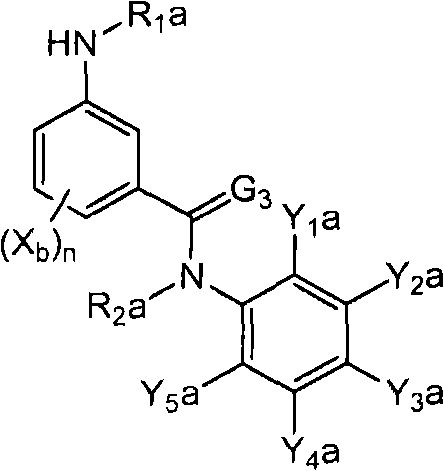
(式中,R1a表示与上述通式(47a)中的R1a相同的含义,R2a表示与上述通式(42a)中的R2a相同的含义,Xb、n、G3、Y1a、Y2a、Y3a、Y4a、及Y5a分别表示与上述通式(6b)中的Xb、n、G3、Y1a、Y2a、Y3a、Y4a、及Y5a相同的含义。)(In the formula, R 1a represents the same meaning as R 1a in the above general formula (47a), R 2a represents the same meaning as R 2a in the above general formula (42a), Xb, n, G 3 , Y 1a , Y 2a , Y 3a , Y 4a , and Y 5a represent the same meanings as Xb, n, G 3 , Y 1a , Y 2a , Y 3a , Y 4a , and Y 5a in the above general formula (6b), respectively.)
<29>一种下述通式(44e)表示的酰胺衍生物的制备方法,其特征在于,使上述<24>所述的通式(42b)表示的化合物与醛类反应。<29> A method for producing an amide derivative represented by the following general formula (44e), comprising reacting the compound represented by the general formula (42b) described in the above <24> with an aldehyde.
通式(44e) Formula (44e)
(式中,R1a表示与上述通式(44c)中的R1a相同的含义,R2a、Xb、n、G3、Y1a、Y2a、Y3a、Y4a、及Y5a分别表示与上述通式(6b)中的R2a、Xb、n、G3、Y1a、Y2a、Y3a、Y4a、及Y5a相同的含义。)(In the formula, R 1a represents the same meaning as R 1a in the above-mentioned general formula (44c), R 2a , Xb, n, G 3 , Y 1a , Y 2a , Y 3a , Y 4a , and Y 5a respectively represent R 2a , Xb, n, G 3 , Y 1a , Y 2a , Y 3a , Y 4a , and Y 5a in the above general formula (6b) have the same meaning.)
<30>一种酰胺衍生物,所述酰胺衍生物如下述通式(6g)所示。<30> An amide derivative represented by the following general formula (6g).

(式中,A、K、X、n、G3及Q2分别表示与上述通式(1)中的A、K、X、n、G3及Q2相同的含义。Wg表示硝基、氨基或-NH-T。T表示与上述通式(1)中的T相同的含义。R2g表示-L-D(L及D分别表示与上述通式(1)中的R2中的L及D相同的含义。)表示的基团。)(In the formula, A, K, X, n, G 3 and Q 2 respectively represent the same meaning as A, K, X, n, G 3 and Q 2 in the above general formula (1). W g represents nitro , amino or -NH-T. T represents the same meaning as T in the above-mentioned general formula (1). R 2g represents -LD (L and D respectively represent L and in R 2 in the above-mentioned general formula (1) The same meaning as D.) The group represented.)
<31>如上述<30>所述的酰胺衍生物,其中,通式(6g)表示的化合物如下述通式(41g)所示。<31> The amide derivative according to the above <30>, wherein the compound represented by the general formula (6g) is represented by the following general formula (41g).

(式中,A、K、X、n、G3、R2g及Q2分别表示与上述通式(6g)中的A、K、X、n、G3、R2g及Q2相同的含义。)(In the formula, A, K, X, n, G 3 , R 2g and Q 2 respectively represent the same meanings as A, K, X, n, G 3 , R 2g and Q 2 in the above general formula (6g) .)
<32>一种下述通式(48g)表示的苯胺衍生物的制备方法,<32> A method for preparing an aniline derivative represented by the following general formula (48g),
其特征在于,使下述通式(48)表示的化合物与下述通式(49g)表示的化合物反应。It is characterized in that the compound represented by the following general formula (48) is reacted with the compound represented by the following general formula (49g).
H2N-Q2 H 2 NQ 2
通式(48)Formula (48)
(式中,Q2表示与上述通式(1)中的Q2相同的含义。)(In the formula, Q 2 represents the same meaning as Q 2 in the above general formula (1).)
R2g-LGR 2 g-LG
通式(49g)General formula (49g)
(式中,LG表示卤原子、羟基等具有离去能力的官能团,R2g表示与上述通式(6g)中的R2g相同的含义。)(In the formula, LG represents a functional group with leaving ability such as a halogen atom or a hydroxyl group, and R 2g represents the same meaning as R 2g in the above-mentioned general formula (6g).)

通式(48g)General formula (48g)
(式中,Q2表示与上述通式(1)中的Q2相同的含义。R2g表示与上述通式(6g)中的R2g相同的含义。)(In the formula, Q2 represents the same meaning as Q2 in the above general formula (1). R2g represents the same meaning as R2g in the above general formula (6g).)
<33>一种下述通式(48h)表示的苯胺衍生物的制备方法,其特征在于,使上述<32>所述的通式(48)表示的化合物与醛类反应。<33> A method for producing an aniline derivative represented by the following general formula (48h), comprising reacting the compound represented by the general formula (48) described in the above <32> with an aldehyde.

通式(48)Formula (48)
(式中,Q2表示与上述通式(1)中的Q2相同的含义。R2g表示-L-D(L表示-C(M1)(M2)-、-C(M1)(M2)-C(M3)(M4)-、-C(M1)(M2)-C(M3)(M4)-C(M5)(M6)-、-C(M1)(M2)-C(M3)=C(M5)-、-C(M1)(M2)-C≡C-、-C(M1)(M2)-C(M3)(M4)-C(M5)(M6)-C(M7)(M8)-、-C(M1)(M2)-C(M3)=C(M5)-C(M7)(M8)-、-C(M1)(M2)-C(M3)(M4)-C(M5)=C(M7)-、-C(M1)(M2)-C≡C-C(M7)(M8)-、-C(M1)(M2)-C(M3)(M4)-C≡C-,M1~M8分别表示与上述通式(1)中的M1~M8相同的含义,D表示与上述通式(1)中的R2中的L及D相同的含义。)。)(In the formula, Q 2 represents the same meaning as Q 2 in the above general formula (1). R 2g represents -LD (L represents -C(M 1 )(M 2 )-, -C(M 1 )(M 2 )-C(M 3 )(M 4 )-, -C(M 1 )(M 2 )-C(M 3 )(M 4 )-C(M 5 )(M 6 )-, -C(M 1 )(M 2 )-C(M 3 )=C(M 5 )-, -C(M 1 )(M 2 )-C≡C-, -C(M 1 )(M 2 )-C(M 3 )(M 4 )-C(M 5 )(M 6 )-C(M 7 )(M 8 )-,-C(M 1 )(M 2 )-C(M 3 )=C(M 5 ) -C(M 7 )(M 8 )-, -C(M 1 )(M 2 )-C(M 3 )(M 4 )-C(M 5 )=C(M 7 )-, -C(M 1 )(M 2 )-C≡CC(M 7 )(M 8 )-, -C(M 1 )(M 2 )-C(M 3 )(M 4 )-C≡C-, M 1 ~M 8 respectively represent the same meanings as M 1 to M 8 in the above general formula (1), and D represents the same meanings as L and D in R 2 in the above general formula (1).).
<34>一种上述<31>所述的上述通式(41g)表示的酰胺衍生物的制备方法,其特征在于,使上述<14>表示的下述通式(40)表示的化合物与下述通式(48g)表示的化合物反应。<34> A method for producing an amide derivative represented by the above-mentioned general formula (41g) described in the above-mentioned <31>, characterized in that the compound represented by the following general formula (40) represented by the above-mentioned <14> is combined with the following The compound represented by the general formula (48g) was reacted.

(式中,LG表示卤原子、羟基等具有离去能力的官能团,A、K、X、n及G3分别表示与上述通式(1)中的A、K、X、n及G3相同的含义。)(In the formula, LG represents a functional group with leaving ability such as a halogen atom and a hydroxyl group, and A, K, X, n and G3 respectively represent the same as A, K, X, n and G3 in the above-mentioned general formula (1) meaning.)

通式(48g)General formula (48g)
(式中,Q2表示与上述通式(1)中的Q2相同的含义。R2g表示与上述通式(6g)中的R2g相同的含义。)(In the formula, Q2 represents the same meaning as Q2 in the above general formula (1). R2g represents the same meaning as R2g in the above general formula (6g).)
<35>如上述<30>所述的酰胺衍生物,其中,上述通式(6g)表示的化合物如下述通式(42g)所示。<35> The amide derivative according to the above <30>, wherein the compound represented by the above general formula (6g) is represented by the following general formula (42g).

(式中,A、K、X、n、G3、R2g及Q2分别表示与上述通式(6g)中的A、K、X、n、G3、R2g及Q2相同的含义。)(In the formula, A, K, X, n, G 3 , R 2g and Q 2 respectively represent the same meanings as A, K, X, n, G 3 , R 2g and Q 2 in the above general formula (6g) .)
<36>一种上述<35>所述的通式(42g)表示的酰胺衍生物的制备方法,其特征在于,在还原剂的存在下,使上述<31>所述的通式(41g)表示的化合物反应。<36> A method for producing an amide derivative represented by the general formula (42g) described in the above <35>, characterized in that, in the presence of a reducing agent, the general formula (41g) described in the above <31> Indicates the compound reaction.
<37>一种上述<31>所述的通式(41g)表示的酰胺衍生物的制备方法,其特征在于,使下述通式(43g)表示的化合物与上述<32>所述的下述通式(49g)表示的化合物反应。<37> A method for producing an amide derivative represented by the general formula (41g) described in the above <31>, characterized in that a compound represented by the following general formula (43g) is combined with the following compound described in the above <32> The compound represented by the general formula (49g) was reacted.

(式中,A、K、X、n、G3及Q2分别表示与上述通式(1)中的A、K、X、n、G3及Q2相同的含义。)(In the formula, A, K, X, n, G 3 and Q 2 represent the same meanings as A, K, X, n, G 3 and Q 2 in the above general formula (1), respectively.)
R2g-LGR 2 g-LG
通式(49g)General formula (49g)
(式中,LG表示卤原子、羟基等具有离去能力的官能团,R2g表示与上述通式(6g)中的R2g相同的含义。)(In the formula, LG represents a functional group with leaving ability such as a halogen atom or a hydroxyl group, and R 2g represents the same meaning as R 2g in the above-mentioned general formula (6g).)
<38>如上述<30>所述的酰胺衍生物,其中,通式(6g)表示的化合物如下述通式(46g)所示。<38> The amide derivative as described in the above <30>, wherein the compound represented by the general formula (6g) is represented by the following general formula (46g).

(式中,T,A、K、X、n、G3、R2g及Q2分别表示与上述通式(6g)中的T,A、K、X、n、G3、R2g及Q2相同的含义。)(In the formula, T, A, K, X, n, G 3 , R 2g and Q 2 respectively represent T in the above general formula (6g), A, K, X, n, G 3 , R 2g and Q 2 have the same meaning.)
<39>一种上述<38>所述的通式(46g)表示的酰胺衍生物的制备方法,其特征在于,使上述<35>所述的下述通式(42g)表示的化合物与下述通式(45)表示的化合物反应。<39> A method for producing an amide derivative represented by the general formula (46 g) described in the above <38>, characterized in that the compound represented by the following general formula (42 g) described in the above <35> is combined with the following The compound represented by the general formula (45) is reacted.
通式(42g) General formula (42g)
(式中,A、K、X、n、G3、R2g及Q2分别表示与上述通式(6g)中的A、K、X、n、G3、R2g及Q2相同的含义。)(In the formula, A, K, X, n, G 3 , R 2g and Q 2 respectively represent the same meanings as A, K, X, n, G 3 , R 2g and Q 2 in the above general formula (6g) .)
T-LGT-LG
通式(45)Formula (45)
(式中,LG表示卤原子、羟基等具有离去能力的官能团,T表示与上述通式(1)中的T相同的含义。)(In the formula, LG represents a functional group having a leaving ability such as a halogen atom or a hydroxyl group, and T represents the same meaning as T in the above general formula (1).)
<40>一种下述通式(1g)表示的酰胺衍生物的制备方法,<40> A method for producing an amide derivative represented by the following general formula (1g),
其特征在于,使下述通式(50)表示的化合物与下述通式(47g)表示的化合物反应。It is characterized in that the compound represented by the following general formula (50) is reacted with the compound represented by the following general formula (47g).
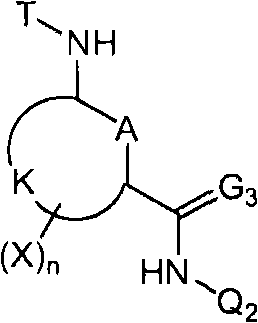
(式中,T、A、K、X、n、G3及Q2分别表示与上述通式(1)中的T、A、K、X、n、G3及Q2相同的含义。)(In the formula, T, A, K, X, n, G 3 and Q 2 respectively represent the same meanings as T, A, K, X, n, G 3 and Q 2 in the above-mentioned general formula (1).)
R1g-LGR 1 g-LG
通式(47g)General formula (47g)
(式中,LG表示卤原子、羟基等具有离去能力的官能团,R1g表示-L-D(L及D分别表示与上述通式(1)中的R1中的L及D相同的含义。)。)(In the formula, LG represents a functional group having a leaving ability such as a halogen atom or a hydroxyl group, and R represents -LD (L and D respectively represent the same meanings as L and D in R in the above general formula ( 1 ).) .)

(式中,R1g表示与上述通式(47g)中的R1g相同的含义,T、A、K、X、n、G3、及Q2分别表示与上述通式(1)中的T、A、K、X、n、G3、及Q2相同的含义。)(In the formula, R 1g represents the same meaning as R 1g in the above general formula (47g), and T, A, K, X, n, G 3 , and Q 2 represent the same meaning as T in the above general formula (1) , A, K, X, n, G 3 , and Q 2 have the same meaning.)
<41>一种上述<1>所述的通式(1)表示的酰胺衍生物的制备方法,其特征在于,使下述通式(52)表示的化合物与下述通式(47)表示的化合物反应。<41> A method for producing an amide derivative represented by the general formula (1) described in the above <1>, characterized in that a compound represented by the following general formula (52) is combined with a compound represented by the following general formula (47) compound reaction.

(式中,T、R2、A、K、X、n、G3及Q2分别表示与上述通式(1)中的T、R2、A、K、X、n、G3及Q2相同的含义。)(In the formula, T, R 2 , A, K, X, n, G 3 and Q 2 respectively represent T, R 2 , A, K, X, n, G 3 and Q in the above general formula (1) 2 have the same meaning.)
R1-LGR 1 -LG
通式(47)Formula (47)
(式中,LG表示卤原子、羟基等具有离去能力的官能团,R1表示与上述通式(1)中的R1相同的含义。)(In the formula, LG represents a functional group with leaving ability such as a halogen atom or a hydroxyl group, and R represents the same meaning as R in the above general formula (1).)
<42>一种酰胺衍生物,所述酰胺衍生物如下述通式(55a)所示。<42> An amide derivative represented by the following general formula (55a).

(式中,Xa表示卤原子。A、K、X、n及G3分别表示与上述通式(1)中的A、K、X、n及G3相同的含义。R2a、Y1a、Y2a、Y3a、Y4a、及Y5a分别表示上述通式(6a)中的R2a、Y1a、Y2a、Y3a、Y4a、及Y5a相同的含义。)(In the formula, X a represents a halogen atom. A, K, X, n and G 3 respectively represent the same meanings as A, K, X, n and G 3 in the above general formula (1). R 2a , Y 1a , Y 2a , Y 3a , Y 4a , and Y 5a represent the same meanings as R 2a , Y 1a , Y 2a , Y 3a , Y 4a , and Y 5a in the above general formula (6a), respectively.)
<43>一种上述<42>所述的通式(55a)表示的酰胺衍生物的制备方法,特征在于,使下述通式(54)表示的化合物与上述<14>所述的下述通式(6f)表示的化合物反应。<43> A method for producing an amide derivative represented by the general formula (55a) described in the above <42>, characterized in that a compound represented by the following general formula (54) is combined with the following compound described in the above <14> The compound represented by the general formula (6f) is reacted.
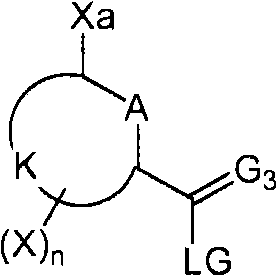
(式中,Xa表示卤原子,LG表示卤原子、羟基等具有离去能力的官能团,A、K、X、n及G3分别表示与上述通式(1)中的A、K、X、n及G3相同的含义。)(In the formula, X a represents a halogen atom, LG represents a functional group with leaving ability such as a halogen atom and a hydroxyl group, and A, K, X, n and G represent the same as A, K, X in the above general formula (1) respectively , n and G 3 have the same meaning.)

(式中,R2a、Y1a、Y2a、Y3a、Y4a、及Y5a分别表示与上述通式(6a)中的R2a、Y1a、Y2a、Y3a、Y4a、及Y5a相同的含义。)(In the formula, R 2a , Y 1a , Y 2a , Y 3a , Y 4a , and Y 5a represent the same as R 2a , Y 1a , Y 2a , Y 3a , Y 4a , and Y 5a in the above general formula (6a), respectively. 5a has the same meaning.)
<44>一种下述通式(55b)表示的酰胺衍生物的制备方法,<44> A method for producing an amide derivative represented by the following general formula (55b),
其特征在于,使下述通式(56a)表示的化合物与上述<17>所述的下述通式(49a)反应。It is characterized in that the compound represented by the following general formula (56a) is reacted with the following general formula (49a) described in the above <17>.

(式中,Xa表示卤原子。A、K、X、n及G3分别表示与上述通式(1)中的A、K、X、n及G3相同的含义。Y1a、Y2a、Y3a、Y4a、及Y5a分别表示与上述通式(6a)中的Y1a、Y2a、Y3a、Y4a、及Y5a相同的含义。)(In the formula, X a represents a halogen atom. A, K, X, n and G 3 respectively represent the same meanings as A, K, X, n and G 3 in the above general formula (1). Y 1a , Y 2a , Y 3a , Y 4a , and Y 5a represent the same meanings as Y 1a , Y 2a , Y 3a , Y 4a , and Y 5a in the above general formula (6a), respectively.)
R2a-LGR 2 a-LG
通式(49a)Formula (49a)
(式中,LG表示卤原子、羟基等具有离去能力的官能团,R2a表示三甲基甲硅烷基、叔丁基二甲基甲硅烷基、氰基、C1-C6烷基、C1-C6卤代烷基、C2-C6链烯基、C2-C6卤代链烯基、C2-C6炔基、C2-C6卤代炔基、C3-C9环烷基、C3-C9卤代环烷基、C1-C6烷基亚磺酰基、C1-C6卤代烷基亚磺酰基、C1-C6烷基磺酰基、C1-C6卤代烷基磺酰基、苯磺酰基、苄基磺酰基、C2-C7烷基羰基、C2-C7卤代烷基羰基、C3-C7链烯基羰基、C3-C7卤代链烯基羰基、C3-C7炔基羰基、C3-C7卤代炔基羰基、C4-C10环烷基羰基、C4-C10卤代环烷基羰基、C2-C7烷氧基羰基、C2-C7卤代烷氧基羰基、C3-C7链烯基氧基羰基、C3-C7卤代链烯基氧基羰基、C3-C7炔基氧基羰基、C3-C7卤代炔基氧基羰基、苯氧基羰基、C2-C7烷基氨基羰基、C2-C7卤代烷基氨基羰基、C4-C10环烷基氧基羰基、C4-C10卤代环烷基氧基羰基、苯甲酰基、苄基、-C(=O)C(=O)R7(式中,R7表示C1-C6烷基、C1-C6卤代烷基、C1-C6烷氧基、或C1-C6卤代烷氧基。)、或-L-D表示的基团(L及D分别表示与R2中的L及D相同的含义。)。)(In the formula, LG represents a functional group with leaving ability such as a halogen atom and a hydroxyl group, and R 2a represents a trimethylsilyl group, a tert-butyldimethylsilyl group, a cyano group, a C1-C6 alkyl group, a C1-C6 Haloalkyl, C2-C6 alkenyl, C2-C6 haloalkenyl, C2-C6 alkynyl, C2-C6 haloalkynyl, C3-C9 cycloalkyl, C3-C9 halocycloalkyl, C1 -C6 alkylsulfinyl, C1-C6 haloalkylsulfinyl, C1-C6 alkylsulfonyl, C1-C6 haloalkylsulfinyl, benzenesulfonyl, benzylsulfonyl, C2-C7 alkylcarbonyl, C2 -C7 haloalkylcarbonyl, C3-C7 alkenylcarbonyl, C3-C7 haloalkenylcarbonyl, C3-C7 alkynylcarbonyl, C3-C7 haloalkynylcarbonyl, C4-C10cycloalkylcarbonyl, C4- C10 halocycloalkylcarbonyl, C2-C7 alkoxycarbonyl, C2-C7 haloalkoxycarbonyl, C3-C7 alkenyloxycarbonyl, C3-C7 haloalkenyloxycarbonyl, C3-C7 alkyne Cyloxycarbonyl, C3-C7 haloalkynyloxycarbonyl, phenoxycarbonyl, C2-C7 alkylaminocarbonyl, C2-C7 haloalkylaminocarbonyl, C4-C10 cycloalkyloxycarbonyl, C4-C10 Halocycloalkyloxycarbonyl, benzoyl, benzyl, -C(=O)C(=O)R 7 (wherein, R 7 represents C1-C6 alkyl, C1-C6 haloalkyl, C1- C6 alkoxy, or C1-C6 haloalkoxy.), or a group represented by -LD (L and D represent the same meanings as L and D in R2 respectively.))

(式中,R2a表示与上述通式(49a)中的R2a相同的含义。Xa表示卤原子。A、K、X、n及G3分别表示与上述通式(1)中的A、K、X、n及G3相同的含义。Y1a、Y2a、Y3a、Y4a、及Y5a分别表示与上述通式(6a)中的Y1a、Y2a、Y3a、Y4a、及Y5a相同的含义。)(In the formula, R 2a represents the same meaning as R 2a in the above-mentioned general formula (49a). X a represents a halogen atom. A, K, X, n and G 3 represent the A in the above-mentioned general formula (1) respectively , K, X, n and G 3 have the same meaning. Y 1a , Y 2a , Y 3a , Y 4a , and Y 5a respectively represent Y 1a , Y 2a , Y 3a , Y 4a in the above general formula (6a). , and Y 5a have the same meaning.)
<45>一种下述通式(53a)表示的酰胺衍生物的制备方法,其特征在于,使上述<42>所述的通式(55a)表示的化合物与氨基化剂反应。<45> A method for producing an amide derivative represented by the following general formula (53a), comprising reacting the compound represented by the general formula (55a) described in the above <42> with an aminating agent.
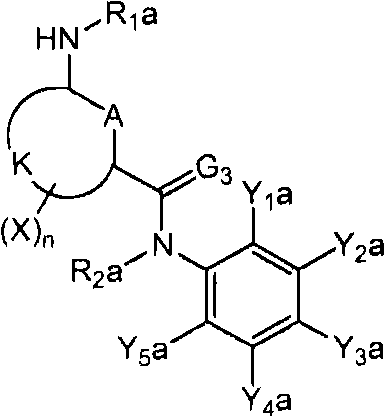
(式中,R1a表示氢原子、氧原子、卤原子、羟基、硝基、亚硝基、三甲基甲硅烷基、叔丁基二甲基甲硅烷基、氰基、氨基、C1-C6烷基、C1-C6卤代烷基、C2-C6链烯基、C2-C6卤代链烯基、C2-C6炔基、C2-C6卤代炔基、C3-C9环烷基、C3-C9卤代环烷基、C1-C6烷氧基、C1-C6卤代烷氧基、C2-C6链烯基氧基、C2-C6卤代链烯基氧基、C2-C6炔基氧基、C2-C6卤代炔基氧基、C3-C9环烷氧基、C3-C9卤代环烷氧基、C1-C6烷基硫基、C1-C6卤代烷基硫基、C1-C6烷基亚磺酰基、C1-C6卤代烷基亚磺酰基、C1-C6烷基磺酰基、C1-C6卤代烷基磺酰基、苯磺酰基、苄基磺酰基、C2-C7烷基氨基羰基、C2-C7卤代烷基氨基羰基、C2-C7烷基羰基氧基、C2-C7卤代烷基羰基氧基、苄基、-C(=O)C(=O)R7(式中,R7表示C1-C6烷基、C1-C6卤代烷基、C1-C6烷氧基、或C1-C6卤代烷氧基。)、或-L-D表示的基团(L及D分别表示与R2中的L及D相同的含义。)。A、K、X、n及G3分别表示与上述通式(1)中的A、K、X、n及G3相同的含义。R2a、Y1a、Y2a、Y3a、Y4a、及Y5a分别表示与上述通式(6a)中的R2a、Y1a、Y2a、Y3a、Y4a、及Y5a相同的含义。)(wherein, R 1a represents a hydrogen atom, an oxygen atom, a halogen atom, a hydroxyl group, a nitro group, a nitroso group, a trimethylsilyl group, a tert-butyldimethylsilyl group, a cyano group, an amino group, a C1-C6 Alkyl, C1-C6 haloalkyl, C2-C6 alkenyl, C2-C6 haloalkenyl, C2-C6 alkynyl, C2-C6 haloalkynyl, C3-C9 cycloalkyl, C3-C9 halogen Cycloalkyl, C1-C6 alkoxy, C1-C6 haloalkoxy, C2-C6 alkenyloxy, C2-C6 haloalkenyloxy, C2-C6 alkynyloxy, C2-C6 Haloalkynyloxy, C3-C9 cycloalkoxy, C3-C9 halocycloalkoxy, C1-C6 alkylthio, C1-C6 haloalkylthio, C1-C6 alkylsulfinyl, C1-C6 haloalkylsulfinyl, C1-C6 alkylsulfinyl, C1-C6 haloalkylsulfonyl, benzenesulfonyl, benzylsulfonyl, C2-C7 alkylaminocarbonyl, C2-C7 haloalkylaminocarbonyl, C2-C7 alkylcarbonyloxy, C2-C7 haloalkylcarbonyloxy, benzyl, -C(=O)C(=O)R 7 (in the formula, R 7 represents C1-C6 alkyl, C1-C6 Haloalkyl, C1-C6 alkoxy, or C1-C6 haloalkoxy.), or a group represented by -LD (L and D represent the same meanings as L and D in R2 respectively.). A, K , X, n and G 3 respectively represent the same meanings as A, K, X, n and G 3 in the above general formula (1). R 2a , Y 1a , Y 2a , Y 3a , Y 4a , and Y 5a represent the same meanings as R 2a , Y 1a , Y 2a , Y 3a , Y 4a , and Y 5a in the above general formula (6a), respectively.)
<46>一种酰胺衍生物,所述酰胺衍生物如下述通式(55g)所示。<46> An amide derivative represented by the following general formula (55 g).

(式中,Xa表示卤原子。A、K、X、n、G3及Q2分别表示与上述通式(1)中的A、K、X、n、G3及Q2相同的含义。R2g表示-L-D(L及D分别表示与R2中的L及D相同的含义。)表示的基团。)(In the formula, X a represents a halogen atom. A, K, X, n, G 3 and Q 2 represent the same meanings as A, K, X, n, G 3 and Q 2 in the above general formula (1) respectively R 2g represents the group represented by -LD (L and D respectively represent the same meaning as L and D in R 2. )
<47>一种上述<46>所述的通式(55g)表示的酰胺衍生物的制备方法,其特征在于,使上述<43>所述的下述通式(54)表示的化合物与上述<32>所述的下述通式(48g)表示的化合物反应。<47> A method for producing an amide derivative represented by the general formula (55 g) described in the above <46>, characterized in that the compound represented by the following general formula (54) described in the above <43> is combined with the above-mentioned The compound represented by the following general formula (48g) described in <32> was reacted.

通式(54)Formula (54)
(式中,Xa表示卤原子,LG表示卤原子、羟基等具有离去能力的官能团,A、K、X、n及G3分别表示与上述通式(1)中的A、K、X、n及G3相同的含义。)(In the formula, X a represents a halogen atom, LG represents a functional group with leaving ability such as a halogen atom and a hydroxyl group, and A, K, X, n and G represent the same as A, K, X in the above general formula (1) respectively , n and G 3 have the same meaning.)

通式(48g)General formula (48g)
(式中,Q2表示与上述通式(1)中的Q2相同的含义。R2g表示与上述通式(6g)中的R2g相同的含义。)(In the formula, Q2 represents the same meaning as Q2 in the above general formula (1). R2g represents the same meaning as R2g in the above general formula (6g).)
<48>一种下述通式(53g)表示的酰胺衍生物的制备方法,其特征在于,使上述<46>所述的化合物与氨基化剂反应。<48> A process for producing an amide derivative represented by the following general formula (53g), comprising reacting the compound described in the above <46> with an aminating agent.
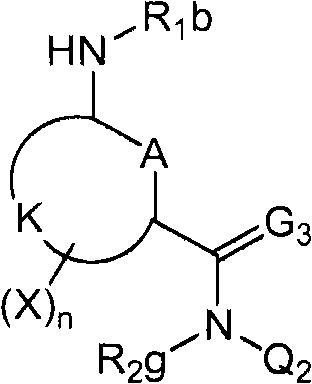
(式中,A、K、X、n、G3及Q2分别表示与上述通式(1)中的A、K、X、n、G3及Q2相同的含义。R2g表示与上述通式(6g)中的R2g相同的含义。R1b表示氢原子、氧原子、卤原子、羟基、硝基、亚硝基、三甲基甲硅烷基、叔丁基二甲基甲硅烷基、氰基、氨基、C1-C6烷基、C1-C6卤代烷基、C2-C6链烯基、C2-C6卤代链烯基、C2-C6炔基、C2-C6卤代炔基、C3-C9环烷基、C3-C9卤代环烷基、C1-C6烷氧基、C1-C6卤代烷氧基、C2-C6链烯基氧基、C2-C6卤代链烯基氧基、C2-C6炔基氧基、C2-C6卤代炔基氧基、C3-C9环烷氧基、C3-C9卤代环烷氧基、C1-C6烷基硫基、C1-C6卤代烷基硫基、C1-C6烷基亚磺酰基、C1-C6卤代烷基亚磺酰基、C1-C6烷基磺酰基、C1-C6卤代烷基磺酰基、苯磺酰基、苄基磺酰基、C2-C7烷基羰基、C2-C7卤代烷基羰基、C3-C7链烯基羰基、C3-C7卤代链烯基羰基、C3-C7炔基羰基、C3-C7卤代炔基羰基、C4-C10环烷基羰基、C4-C10卤代环烷基羰基、C2-C7烷氧基羰基、C2-C7卤代烷氧基羰基、C3-C7链烯基氧基羰基、C3-C7卤代链烯基氧基羰基、C3-C7炔基氧基羰基、C3-C7卤代炔基氧基羰基、苯氧基羰基、C2-C7烷基氨基羰基、C2-C7卤代烷基氨基羰基、C2-C7烷基羰基氧基、C2-C7卤代烷基羰基氧基、C4-C10环烷基氧基羰基、C4-C10卤代环烷基氧基羰基、苯甲酰基、苄基、-C(=O)C(=O)R7(式中,R7表示C1-C6烷基、C1-C6卤代烷基、C1-C6烷氧基或C1-C6卤代烷氧基。)、或-L-D表示的基团(L及D分别表示与R1中的L及D相同的含义。)。)(In the formula, A, K, X, n, G 3 and Q 2 respectively represent the same meanings as A, K, X, n, G 3 and Q 2 in the above general formula (1). R 2g represents the same meaning as the above-mentioned R 2g in the general formula (6g) has the same meaning. R 1b represents a hydrogen atom, an oxygen atom, a halogen atom, a hydroxyl group, a nitro group, a nitroso group, a trimethylsilyl group, and a tert-butyldimethylsilyl group , cyano, amino, C1-C6 alkyl, C1-C6 haloalkyl, C2-C6 alkenyl, C2-C6 haloalkenyl, C2-C6 alkynyl, C2-C6 haloalkynyl, C3- C9 cycloalkyl, C3-C9 halocycloalkyl, C1-C6 alkoxy, C1-C6 haloalkoxy, C2-C6 alkenyloxy, C2-C6 haloalkenyloxy, C2- C6 alkynyloxy, C2-C6 haloalkynyloxy, C3-C9 cycloalkoxy, C3-C9 halocycloalkoxy, C1-C6 alkylthio, C1-C6 haloalkylthio, C1-C6 alkylsulfinyl, C1-C6 haloalkylsulfinyl, C1-C6 alkylsulfonyl, C1-C6 haloalkylsulfinyl, benzenesulfonyl, benzylsulfonyl, C2-C7 alkylcarbonyl, C2-C7 haloalkylcarbonyl, C3-C7 alkenylcarbonyl, C3-C7 haloalkenylcarbonyl, C3-C7 alkynylcarbonyl, C3-C7 haloalkynylcarbonyl, C4-C10cycloalkylcarbonyl, C4 -C10 halocycloalkylcarbonyl, C2-C7 alkoxycarbonyl, C2-C7 haloalkoxycarbonyl, C3-C7 alkenyloxycarbonyl, C3-C7 haloalkenyloxycarbonyl, C3-C7 Alkynyloxycarbonyl, C3-C7 haloalkynyloxycarbonyl, phenoxycarbonyl, C2-C7 alkylaminocarbonyl, C2-C7 haloalkylaminocarbonyl, C2-C7 alkylcarbonyloxy, C2-C7 Haloalkylcarbonyloxy, C4-C10 cycloalkyloxycarbonyl, C4-C10 halocycloalkyloxycarbonyl, benzoyl, benzyl, -C(=O)C(=O)R 7 (formula Among them, R 7 represents C1-C6 alkyl, C1-C6 haloalkyl, C1-C6 alkoxy or C1-C6 haloalkoxy.), or the group represented by -LD (L and D respectively represent the same as in R 1 L and D have the same meaning.).)
<49>如上述<13>所述的酰胺衍生物,其中,上述通式(41)表示的化合物如下述通式(58a)所示。<49> The amide derivative according to the above <13>, wherein the compound represented by the above general formula (41) is represented by the following general formula (58a).

(式中,n表示1~4的整数。A、K、G3、R2a、Y1a、Y2a、Y3a、Y4a、及Y5a分别表示与上述通式(6a)中的A、K、G3、R2a、Y1a、Y2a、Y3a、Y4a、及Y5a相同的含义。)(In the formula, n represents an integer of 1 to 4. A, K, G 3 , R 2a , Y 1a , Y 2a , Y 3a , Y 4a , and Y 5a represent the same as A, K, G 3 , R 2a , Y 1a , Y 2a , Y 3a , Y 4a , and Y 5a have the same meaning.)
<50>一种上述<49>所述的通式(58a)表示的酰胺衍生物的制备方法,其特征在于,使上述<13>所述的通式(41)中X表示氯原子、溴原子或碘原子的化合物与氟化剂反应。<50> A method for producing an amide derivative represented by the general formula (58a) described in the above <49>, wherein X in the general formula (41) described in the above <13> represents a chlorine atom or bromine Atoms or compounds of iodine atoms react with fluorinating agents.
<51>如上述<31>所述的酰胺衍生物,其中,上述通式(41g)表示的化合物如下述通式(58g)所示。<51> The amide derivative according to the above <31>, wherein the compound represented by the above general formula (41g) is represented by the following general formula (58g).

(式中,n表示1~4的整数。A、K、G3及Q2分别表示与上述通式(1)中的A、K、G3及Q2相同的含义。R2g表示与上述通式(6g)中的R2g相同的含义。)(In the formula, n represents an integer of 1 to 4. A, K, G 3 and Q 2 respectively represent the same meanings as A, K, G 3 and Q 2 in the above general formula (1). R 2g represents the same meaning as the above-mentioned R 2g in the general formula (6g) have the same meaning.)
<52>一种上述<51>所述的酰胺衍生物的制备方法,其特征在于,使上述<31>所述的通式(41g)中X表示氯原子、溴原子或碘原子的化合物与氟化剂反应。<52> A method for producing the amide derivative described in the above <51>, characterized in that the compound in which X represents a chlorine atom, bromine atom or iodine atom in the general formula (41g) described in the above <31> is combined with Fluorinating agent reaction.
<53>如上述<13>所述的酰胺衍生物,其中,上述通式(41)表示的化合物如下述通式(60a)所示。<53> The amide derivative according to the above <13>, wherein the compound represented by the above general formula (41) is represented by the following general formula (60a).
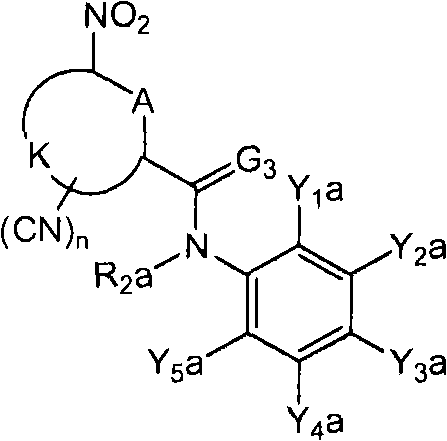
(式中,n表示1~4的整数。A、K、G3、R2a、Y1a、Y2a、Y3a、Y4a、及Y5a分别表示与上述通式(6a)中的A、K、G3、R2a、Y1a、Y2a、Y3a、Y4a、及Y5a相同的含义。)(In the formula, n represents an integer of 1 to 4. A, K, G 3 , R 2a , Y 1a , Y 2a , Y 3a , Y 4a , and Y 5a represent the same as A, K, G 3 , R 2a , Y 1a , Y 2a , Y 3a , Y 4a , and Y 5a have the same meaning.)
<54>一种上述<53>所述的通式(60a)表示的酰胺衍生物的制备方法,其特征在于,使上述<13>所述的通式(41)中X表示卤原子的化合物与氰化剂反应。<54> A method for producing an amide derivative represented by the general formula (60a) described in the above <53>, characterized in that the compound wherein X in the general formula (41) described in the above <13> represents a halogen atom is used Reacts with cyanating agents.
<55>如上述<31>所述的酰胺衍生物,其中,上述通式(41g)表示的化合物如下述通式(60g)所示。<55> The amide derivative according to the above <31>, wherein the compound represented by the above general formula (41g) is represented by the following general formula (60g).
通式(60g) General formula (60g)
(式中,n表示1~4的整数。A、K、G3及Q2分别表示与上述通式(1)中的A、K、G3及Q2相同的含义。R2g表示与上述通式(6g)中的R2g相同的含义。)(In the formula, n represents an integer of 1 to 4. A, K, G 3 and Q 2 respectively represent the same meanings as A, K, G 3 and Q 2 in the above general formula (1). R 2g represents the same meaning as the above-mentioned R 2g in the general formula (6g) have the same meaning.)
<56>一种上述<55>所述的通式(60g)表示的酰胺衍生物的制备方法,其特征在于,使上述<31>所述的通式(41g)中X表示卤原子的化合物与氰化剂反应。<56> A method for producing an amide derivative represented by the general formula (60 g) described in <55> above, which comprises making a compound wherein X represents a halogen atom in the general formula (41 g) described in <31> above Reacts with cyanating agents.
<57>一种酰胺衍生物,所述酰胺衍生物如下述通式(6h)所示。<57> An amide derivative represented by the following general formula (6h).

(式中,A、K、X、n、G3、R2及Q2分别表示与上述通式(1)中的A、K、X、n、G3、R2及Q2相同的含义。(In the formula, A, K, X, n, G 3 , R 2 and Q 2 respectively represent the same meanings as A, K, X, n, G 3 , R 2 and Q 2 in the above general formula (1) .
Wh表示-NH-R1或-N(T)-R1。R1及T分别表示与上述通式(1)中的R1及T相同的含义。(其中,R1及R2中的至少一方表示-L-D表示的基团。))W h represents -NH-R 1 or -N(T)-R 1 . R 1 and T represent the same meanings as R 1 and T in the above general formula (1), respectively. (Wherein, at least one of R 1 and R 2 represents a group represented by -LD.))
<58>如上述<57>所述的酰胺衍生物,其中,上述通式(6h)表示的化合物如下述通式(6c)所示。<58> The amide derivative according to the above <57>, wherein the compound represented by the above general formula (6h) is represented by the following general formula (6c).
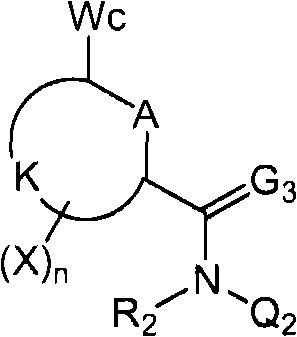
(式中,Wc表示-NH-C(M1)(M2)-C(M3)-D、-N(T)-C(M1)(M2)-C(M3)-D、-N(T)-L-C(=O)-LG、或-N(T)-L-C(=O)-NU3U4。M1、M2、M3、D、L、U3、及U4分别表示与R2中的M1、M2、M3、D、L、U3、及U4相同的含义。LG表示卤原子、羟基等具有离去能力的官能团。T、A、K、X、n、G3、R2及Q2分别表示与上述通式(1)中的T、A、K、X、n、G3、R2及Q2相同的含义。)(where, W c represents -NH-C(M 1 )(M 2 )-C(M 3 )-D, -N(T)-C(M 1 )(M 2 )-C(M 3 )- D, -N(T)-LC(=O)-LG, or -N(T)-LC(=O)-NU 3 U 4 . M 1 , M 2 , M 3 , D, L, U 3 , and U 4 represent the same meanings as M 1 , M 2 , M 3 , D, L, U 3 , and U 4 in R 2 respectively. LG represents a functional group with leaving ability such as a halogen atom or a hydroxyl group. T, A , K, X, n, G 3 , R 2 and Q 2 represent the same meanings as T, A, K, X, n, G 3 , R 2 and Q 2 in the above general formula (1), respectively.)
<59>如上述<58>所述的酰胺衍生物,所述酰胺衍生物如下述通式(61)所示。<59> The amide derivative as described in the above <58>, which is represented by the following general formula (61).

(式中,M1、M2、M3、D、A、K、X、n、G3、R2及Q2分别表示与上述通式(6c)中的M1、M2、M3、D、A、K、X、n、G3、R2及Q2相同的含义。)(In the formula, M 1 , M 2 , M 3 , D, A, K, X, n, G 3 , R 2 and Q 2 respectively represent M 1 , M 2 , M 3 in the above general formula (6c). , D, A, K, X, n, G 3 , R 2 and Q 2 have the same meaning.)
<60>一种上述<59>所述的通式(61)表示的酰胺衍生物的制备方法,其特征在于,使下述通式(51)表示的化合物与下述通式(62)表示的化合物反应。<60> A method for producing an amide derivative represented by the general formula (61) described in the above <59>, characterized in that a compound represented by the following general formula (51) is combined with a compound represented by the following general formula (62) compound reaction.
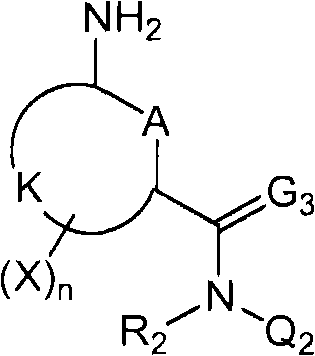
(式中,R2、A、K、X、n、G3及Q2分别表示与上述通式(1)中的R2、A、K、X、n、G3及Q2相同的含义。)(In the formula, R 2 , A, K, X, n, G 3 and Q 2 respectively represent the same meanings as R 2 , A, K, X, n, G 3 and Q 2 in the above general formula (1) .)
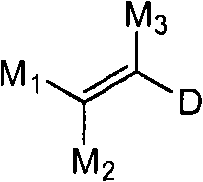
(式中,M1、M2、M3、及D分别表示与上述通式(1)中的M1、M2、M3、及D相同的含义。)(In the formula, M 1 , M 2 , M 3 , and D represent the same meanings as M 1 , M 2 , M 3 , and D in the above general formula (1), respectively.)
<61>如上述<58>所述的酰胺衍生物,其中,上述通式(6c)表示的化合物如下述通式(63)所示。<61> The amide derivative according to the above <58>, wherein the compound represented by the above general formula (6c) is represented by the following general formula (63).

(式中,T、M1、M2、M3、D、A、K、X、n、G3、R2及Q2分别表示与上述通式(6c)中的T、M1、M2、M3、D、A、K、X、n、G3、R2及Q2相同的含义。)(In the formula, T, M 1 , M 2 , M 3 , D, A, K, X, n, G 3 , R 2 and Q 2 respectively represent T, M 1 , M 2 , M 3 , D, A, K, X, n, G 3 , R 2 and Q 2 have the same meaning.)
<62>一种上述<61>所述的通式(63)表示的酰胺衍生物的制备方法,其特征在于,使上述<59>所述的下述通式(61)表示的化合物与上述<39>所述的下述通式(45)表示的化合物反应。<62> A method for producing an amide derivative represented by the general formula (63) described in the above <61>, characterized in that the compound represented by the following general formula (61) described in the above <59> is combined with the above-mentioned The compound represented by the following general formula (45) described in <39> is reacted.

(式中,A、K、Q2、R2、G3、X、n、M1、M2、M3及D分别表示与上述通式(6c)中的A、K、Q2、R2、G3、X、n、M1、M2、M3及D相同的含义。)(In the formula, A, K, Q 2 , R 2 , G 3 , X, n, M 1 , M 2 , M 3 and D respectively represent the same as A, K, Q 2 , R in the above general formula (6c). 2 , G 3 , X, n, M 1 , M 2 , M 3 and D have the same meaning.)
T-LGT-LG
通式(45)Formula (45)
(式中,LG表示卤原子、羟基等具有离去能力的官能团,T表示与上述通式(1)中的T相同的含义。)(In the formula, LG represents a functional group having a leaving ability such as a halogen atom or a hydroxyl group, and T represents the same meaning as T in the above general formula (1).)
<63>如上述<58>所述的酰胺衍生物,其中,上述通式(6c)表示的化合物如下述通式(64)所示。<63> The amide derivative according to the above <58>, wherein the compound represented by the above general formula (6c) is represented by the following general formula (64).

(式中,LG表示卤原子、羟基等具有离去能力的官能团,T、A、K、Q2、R2、G3、X、n及L分别表示与上述通式(6c)中的T、A、K、Q2、R2、G3、X、n及L相同的含义。)(In the formula, LG represents a functional group with leaving ability such as a halogen atom and a hydroxyl group, and T, A, K, Q 2 , R 2 , G 3 , X, n and L represent the T in the above general formula (6c) respectively. , A, K, Q 2 , R 2 , G 3 , X, n and L have the same meaning.)
<64>如上述<58>所述的酰胺衍生物,其中,上述通式(6c)表示的化合物如下述通式(65)所示。<64> The amide derivative according to the above <58>, wherein the compound represented by the above general formula (6c) is represented by the following general formula (65).

(式中,T、L、U3、U4、A、K、X、n、G3、R2及Q2分别表示与上述通式(6c)中的T、L、U3、U4、A、K、X、n、G3、R2及Q2相同的含义。)(In the formula, T, L, U 3 , U 4 , A, K, X, n, G 3 , R 2 and Q 2 respectively represent T, L, U 3 , U 4 in the above general formula (6c) , A, K, X, n, G 3 , R 2 and Q 2 have the same meaning.)
<65>一种上述<64>所述的通式(65)表示的酰胺衍生物的制备方法,其特征在于,使上述<63>所述的下述通式(64)表示的化合物与下述通式(66)表示的化合物反应。<65> A method for producing an amide derivative represented by the general formula (65) described in the above <64>, characterized in that the compound represented by the following general formula (64) described in the above <63> is combined with the following The compound represented by the general formula (66) is reacted.

(式中,LG表示卤原子、羟基等具有离去能力的官能团,T、A、K、Q2、R2、G3、X、n及L分别表示与上述通式(6c)中的T、A、K、Q2、R2、G3、X、n及L相同的含义。)(In the formula, LG represents a functional group with leaving ability such as a halogen atom and a hydroxyl group, and T, A, K, Q 2 , R 2 , G 3 , X, n and L represent the T in the above general formula (6c) respectively. , A, K, Q 2 , R 2 , G 3 , X, n and L have the same meaning.)

通式(66)Formula (66)
(式中,U3及U4分别表示与上述通式(1)中的U3及U4相同的含义。)(In the formula, U 3 and U 4 represent the same meanings as U 3 and U 4 in the above general formula (1), respectively.)
<66>如上述<64>所述的酰胺衍生物,其中,在上述通式(65)中,U4为可选择地具有取代基的C2-C7烷氧基羰基、可选择地具有取代基的C2-C7卤代烷氧基羰基、可选择地具有取代基的C2-C7烷基羰基、可选择地具有取代基的C2-C7卤代烷基羰基。<66> The amide derivative as described in the above <64>, wherein, in the above general formula (65), U 4 is an optionally substituted C2-C7 alkoxycarbonyl, optionally substituted C2-C7 haloalkoxycarbonyl, optionally substituted C2-C7 alkylcarbonyl, optionally substituted C2-C7 haloalkylcarbonyl.
<67>一种上述<66>所述的通式(65)表示的酰胺衍生物的制备方法,其特征在于,使上述<64>所述的化合物与下述通式(67)表示的化合物反应,上述<64>所述的化合物中上述通式(65)表示的化合物如下述通式(68)所示,<67> A method for producing an amide derivative represented by the general formula (65) described in the above <66>, which comprises mixing the compound described in the above <64> with a compound represented by the following general formula (67) Reaction, the compound represented by the above-mentioned general formula (65) in the compound described in the above-mentioned <64> is as shown in the following general formula (68),

(式中,T、L、U3、A、K、X、n、G3、R2及Q2分别表示与上述通式(6c)中的T、L、U3、A、K、X、n、G3、R2及Q2相同的含义。)(In the formula, T, L, U 3 , A, K, X, n, G 3 , R 2 and Q 2 respectively represent T, L, U 3 , A, K, X in the above general formula (6c) , n, G 3 , R 2 and Q 2 have the same meaning.)
U4-LGU 4 -LG
通式(67)Formula (67)
(式中,U4表示与上述<66>中的U4相同的含义。)(In the formula, U 4 represents the same meaning as U 4 in the above-mentioned <66>.)
<68>一种下述通式(6e)表示的苯胺衍生物的制备方法,<68> A method for producing an aniline derivative represented by the following general formula (6e),
其特征在于,使上述通式(6d)中R2a为氢原子的化合物与上述<17>所述的下述通式(49a)表示的化合物反应。It is characterized in that the compound represented by the following general formula (49a) described in the above <17> is reacted with the compound in which R 2a is a hydrogen atom in the above general formula (6d).
R2a-LGR 2 a-LG
通式(49a)Formula (49a)
(式中,LG表示卤原子、羟基等具有离去能力的官能团,R2a表示三甲基甲硅烷基、叔丁基二甲基甲硅烷基、氰基、C1-C6烷基、C1-C6卤代烷基、C2-C6链烯基、C2-C6卤代链烯基、C2-C6炔基、C2-C6卤代炔基、C3-C9环烷基、C3-C9卤代环烷基、C1-C6烷基亚磺酰基、C1-C6卤代烷基亚磺酰基、C1-C6烷基磺酰基、C1-C6卤代烷基磺酰基、苯磺酰基、苄基磺酰基、C2-C7烷基羰基、C2-C7卤代烷基羰基、C3-C7链烯基羰基、C3-C7卤代链烯基羰基、C3-C7炔基羰基、C3-C7卤代炔基羰基、C4-C10环烷基羰基、C4-C10卤代环烷基羰基、C2-C7烷氧基羰基、C2-C7卤代烷氧基羰基、C3-C7链烯基氧基羰基、C3-C7卤代链烯基氧基羰基、C3-C7炔基氧基羰基、C3-C7卤代炔基氧基羰基、苯氧基羰基、C2-C7烷基氨基羰基、C2-C7卤代烷基氨基羰基、C4-C10环烷基氧基羰基、C4-C10卤代环烷基氧基羰基、苯甲酰基、苄基、-C(=O)C(=O)R7(式中,R7表示C1-C6烷基、C1-C6卤代烷基、C1-C6烷氧基、或C1-C6卤代烷氧基。)、或-L-D表示的基团(L及D分别表示与R2中的L及D相同的含义。)。)(In the formula, LG represents a functional group with leaving ability such as a halogen atom and a hydroxyl group, and R 2a represents a trimethylsilyl group, a tert-butyldimethylsilyl group, a cyano group, a C1-C6 alkyl group, a C1-C6 Haloalkyl, C2-C6 alkenyl, C2-C6 haloalkenyl, C2-C6 alkynyl, C2-C6 haloalkynyl, C3-C9 cycloalkyl, C3-C9 halocycloalkyl, C1 -C6 alkylsulfinyl, C1-C6 haloalkylsulfinyl, C1-C6 alkylsulfonyl, C1-C6 haloalkylsulfinyl, benzenesulfonyl, benzylsulfonyl, C2-C7 alkylcarbonyl, C2 -C7 haloalkylcarbonyl, C3-C7 alkenylcarbonyl, C3-C7 haloalkenylcarbonyl, C3-C7 alkynylcarbonyl, C3-C7 haloalkynylcarbonyl, C4-C10cycloalkylcarbonyl, C4- C10 halocycloalkylcarbonyl, C2-C7 alkoxycarbonyl, C2-C7 haloalkoxycarbonyl, C3-C7 alkenyloxycarbonyl, C3-C7 haloalkenyloxycarbonyl, C3-C7 alkyne Cyloxycarbonyl, C3-C7 haloalkynyloxycarbonyl, phenoxycarbonyl, C2-C7 alkylaminocarbonyl, C2-C7 haloalkylaminocarbonyl, C4-C10 cycloalkyloxycarbonyl, C4-C10 Halocycloalkyloxycarbonyl, benzoyl, benzyl, -C(=O)C(=O)R 7 (wherein, R 7 represents C1-C6 alkyl, C1-C6 haloalkyl, C1- C6 alkoxy, or C1-C6 haloalkoxy.), or a group represented by -LD (L and D represent the same meanings as L and D in R2 respectively.))

(式中,R2a表示与上述通式(49a)中的R2a相同的含义,Y1d、Y2d、Y3d、Y4d、及Y5d分别表示与上述通式(6a)中的Y1d、Y2d、Y3d、Y4d、及Y5d相同的含义。)(In the formula, R 2a represents the same meaning as R 2a in the above-mentioned general formula (49a), and Y 1d , Y 2d , Y 3d , Y 4d , and Y 5d represent Y 1d in the above-mentioned general formula (6a), respectively. , Y 2d , Y 3d , Y 4d , and Y 5d have the same meaning.)
<69>一种下述通式(6i)表示的苯胺衍生物的制备方法,<69> A method for producing an aniline derivative represented by the following general formula (6i),
其特征在于,使上述通式(6d)中R2a为氢原子的化合物与醛类反应。It is characterized in that the compound in which R 2a is a hydrogen atom in the above general formula (6d) is reacted with aldehydes.

(式中,R2a表示C1-C6烷基、C1-C6卤代烷基、或苄基,Y1d、Y2d、Y3d、Y4d及Y5d分别表示与上述通式(6a)中的Y1d、Y2d、Y3d、Y4d、及Y5d相同的含义。)(wherein, R 2a represents C1-C6 alkyl, C1-C6 haloalkyl, or benzyl, and Y 1d , Y 2d , Y 3d , Y 4d and Y 5d represent Y 1d in the above general formula (6a) respectively , Y 2d , Y 3d , Y 4d , and Y 5d have the same meaning.)
<70>一种有害生物防除剂,其特征在于,含有上述<1>~<8>中任一项所述的酰胺衍生物作为有效成分。<70> A pest control agent comprising the amide derivative according to any one of <1> to <8> as an active ingredient.
<71>一种有害生物的防除方法,其特征在于,使用上述<70>所述的有害生物防除剂。<71> A method for controlling pests, comprising using the pest control agent described in <70> above.
根据本发明,可以提供酰胺衍生物、含有该酰胺衍生物的有害生物防除剂、及有害生物的防除方法,所述酰胺衍生物对多种农业害虫显示防除效果,具有保护有用作物的效果,同时因低药量化,所以对降低环境负荷具有显著的贡献。According to the present invention, it is possible to provide an amide derivative, a pest control agent containing the amide derivative, and a pest control method. The amide derivative exhibits a control effect on various agricultural pests, has an effect of protecting useful crops, and at the same time It contributes significantly to the reduction of environmental load due to the low chemical weight.
具体实施方式Detailed ways
本发明的酰胺衍生物为下述通式(1)表示的化合物。由于具有上述特定结构,所以显示出优异的有害生物防除效果。The amide derivative of the present invention is a compound represented by the following general formula (1). Due to having the above-mentioned specific structure, an excellent pest control effect is exhibited.
通式(1) Formula (1)
式中,A表示碳原子、氧原子、氮原子、被氧化的氮原子、或硫原子。In the formula, A represents a carbon atom, an oxygen atom, a nitrogen atom, an oxidized nitrogen atom, or a sulfur atom.
K表示在与A以及A键合的2个碳原子一同形成下述环状连接基团时所必需的非金属原子组,所述环状连接基团来自苯、吡啶、N-氧化吡啶、嘧啶、吡嗪、哒嗪、三嗪、吡咯、吡唑、咪唑、噁唑、异噁唑、噻唑、异噻唑、呋喃、噻吩、噁二唑、噻二唑或三唑。K represents the non-metallic atom group necessary to form the following cyclic linking group with A and the 2 carbon atoms bonded to A. The cyclic linking group comes from benzene, pyridine, N-pyridine oxide, pyrimidine , pyrazine, pyridazine, triazine, pyrrole, pyrazole, imidazole, oxazole, isoxazole, thiazole, isothiazole, furan, thiophene, oxadiazole, thiadiazole or triazole.
X表示氢原子、卤原子、C1-C6烷基、C1-C6卤代烷基、C3-C9环烷基、C3-C9卤代环烷基、C2-C6链烯基、C2-C6卤代链烯基、C2-C6炔基、C2-C6卤代炔基、C1-C6烷氧基、C1-C6卤代烷氧基、C1-C6烷基硫基、C1-C6卤代烷基硫基、C1-C6烷基亚磺酰基、C1-C6卤代烷基亚磺酰基、C1-C6烷基磺酰基、C1-C6卤代烷基磺酰基、C1-C6烷基磺酰基氧基、C1-C6卤代烷基磺酰基氧基、C2-C7烷基羰基、C2-C7卤代烷基羰基、C2-C7烷基羰基氧基、C2-C7卤代烷基羰基氧基、芳基羰基氧基、C2-C7烷氧基羰基、C2-C7卤代烷氧基羰基、C2-C7烷基羰基氨基、C2-C7卤代烷基羰基氨基、C2-C7烷氧基羰基氨基、C2-C7卤代烷氧基羰基氨基、C2-C7烷氧基羰基氧基、C2-C7卤代烷氧基羰基氧基、芳基羰基氨基、氨基、氨基甲酰基、氰基、硝基、羟基、五氟硫烷基、C1-C6烷基氨基、C1-C6卤代烷基氨基、C2-C6链烯基氨基、C2-C6卤代链烯基氨基、C2-C6炔基氨基、C2-C6卤代炔基氨基、C3-C9环烷基氨基、C3-C9卤代环烷基氨基、C2-C7烷基氨基羰基、C2-C7卤代烷基氨基羰基、C3-C7链烯基氨基羰基、C3-C7卤代链烯基氨基羰基、C3-C7炔基氨基羰基、C3-C7卤代炔基氨基羰基、C4-C10环烷基氨基羰基、C4-C10卤代环烷基氨基羰基、苯基、或者杂环基,有多个X时,各X可以彼此相同也可以不同。X represents hydrogen atom, halogen atom, C1-C6 alkyl, C1-C6 haloalkyl, C3-C9 cycloalkyl, C3-C9 halocycloalkyl, C2-C6 alkenyl, C2-C6 haloalkene Base, C2-C6 alkynyl, C2-C6 haloalkynyl, C1-C6 alkoxy, C1-C6 haloalkoxy, C1-C6 alkylthio, C1-C6 haloalkylthio, C1-C6 alkane Sulfinyl group, C1-C6 haloalkylsulfinyl group, C1-C6 alkylsulfonyl group, C1-C6 haloalkylsulfonyl group, C1-C6 alkylsulfonyloxy group, C1-C6 haloalkylsulfonyloxy group, C2-C7 alkylcarbonyl, C2-C7 haloalkylcarbonyl, C2-C7 alkylcarbonyloxy, C2-C7 haloalkylcarbonyloxy, arylcarbonyloxy, C2-C7 alkoxycarbonyl, C2-C7 haloalkane Oxycarbonyl, C2-C7 alkylcarbonylamino, C2-C7 haloalkylcarbonylamino, C2-C7 alkoxycarbonylamino, C2-C7 haloalkoxycarbonylamino, C2-C7 alkoxycarbonyloxy, C2- C7 haloalkoxycarbonyloxy, arylcarbonylamino, amino, carbamoyl, cyano, nitro, hydroxyl, pentafluorosulfanyl, C1-C6 alkylamino, C1-C6 haloalkylamino, C2-C6 Alkenylamino, C2-C6 Haloalkenylamino, C2-C6 Alkynylamino, C2-C6 Haloalkynylamino, C3-C9 Cycloalkylamino, C3-C9 Halocycloalkylamino, C2 -C7 Alkylaminocarbonyl, C2-C7 Haloalkylaminocarbonyl, C3-C7 Alkenylaminocarbonyl, C3-C7 Haloalkenylaminocarbonyl, C3-C7 Alkynylaminocarbonyl, C3-C7 Haloalkynyl Aminocarbonyl, C4-C10 cycloalkylaminocarbonyl, C4-C10 halocycloalkylaminocarbonyl, phenyl, or heterocyclic group, when there are multiple Xs, each X may be the same or different from each other.
X中的杂环基表示吡啶基、N-氧化吡啶基、嘧啶基、吡嗪基、哒嗪基、呋喃基、噻吩基、噁唑基、异噁唑基、噁二唑基、噻唑基、异噻唑基、噻二唑基、吡咯基、咪唑基、三唑基、吡唑基、或四唑基。The heterocyclic group in X represents pyridyl, N-oxidized pyridyl, pyrimidyl, pyrazinyl, pyridazinyl, furyl, thienyl, oxazolyl, isoxazolyl, oxadiazolyl, thiazolyl, Isothiazolyl, thiadiazolyl, pyrrolyl, imidazolyl, triazolyl, pyrazolyl, or tetrazolyl.
n表示0~4的整数。需要说明的是,n表示X为氢原子以外的取代基时的X的取代数。n represents an integer of 0-4. In addition, n represents the substitution number of X when X is a substituent other than a hydrogen atom.
T表示-C(=G1)-Q1、或-C(=G1)-G2Q3。T represents -C(=G 1 )-Q 1 , or -C(=G 1 )-G 2 Q 3 .
式中,G1及G2分别独立地表示氧原子或硫原子。In the formula, G 1 and G 2 each independently represent an oxygen atom or a sulfur atom.
Q1及Q3分别独立地表示氢原子、C1-C6烷基、C1-C6卤代烷基、C2-C6链烯基、C2-C6卤代链烯基、C2-C6炔基、C2-C6卤代炔基、C3-C9环烷基、C3-C9卤代环烷基、苄基、可选择地具有取代基的苯基、可选择地具有取代基的萘基、或可选择地具有取代基的杂环基。Q 1 and Q 3 independently represent a hydrogen atom, C1-C6 alkyl, C1-C6 haloalkyl, C2-C6 alkenyl, C2-C6 haloalkenyl, C2-C6 alkynyl, C2-C6 halogen Alkynyl, C3-C9 cycloalkyl, C3-C9 halocycloalkyl, benzyl, optionally substituted phenyl, optionally substituted naphthyl, or optionally substituted The heterocyclic group.
Q2表示可选择地具有取代基的苯基、可选择地具有取代基的萘基、可选择地具有取代基的杂环基、或可选择地具有取代基的四氢化萘基。Q 2 represents an optionally substituted phenyl group, an optionally substituted naphthyl group, an optionally substituted heterocyclic group, or an optionally substituted tetrahydronaphthyl group.
需要说明的是,Q1、Q3及Q2中,可选择地具有取代基的苯基、可选择地具有取代基的萘基及可选择地具有取代基的杂环基的取代基以及可选择地具有取代基的四氢化萘基中的取代基,表示选自下述基团中的1个以上的取代基,所述基团为:卤原子、C1-C6烷基、C1-C6卤代烷基、C3-C9环烷基、C3-C9卤代环烷基、C1-C6烷氧基、C1-C6卤代烷氧基、C1-C6烷基硫基、C1-C6卤代烷基硫基、C1-C6烷基亚磺酰基、C1-C6卤代烷基亚磺酰基、C1-C6烷基磺酰基、C1-C6卤代烷基磺酰基、C2-C7烷基羰基、C2-C7卤代烷基羰基、C2-C7烷基羰基氧基、C2-C7卤代烷基羰基氧基、C1-C6烷基磺酰基氧基、C1-C6卤代烷基磺酰基氧基、C2-C7烷氧基羰基、C2-C7卤代烷氧基羰基、C2-C7烷基羰基氨基、C2-C7卤代烷基羰基氨基、C2-C7烷氧基羰基氨基、C2-C7卤代烷氧基羰基氨基、C1-C6烷基氨基、C1-C6卤代烷基氨基、氨基、氨基甲酰基、氨磺酰基、氰基、硝基、羟基、羧基、五氟硫烷基、苄基氧基、苄基氧基羰基、苯基、及杂环基、苯甲酰基、苯基氨基甲酰基、苯基氨基,有2个以上取代基时,各取代基可以相同也可以不同。It should be noted that among Q 1 , Q 3 and Q 2 , the substituents of the optionally substituted phenyl group, the optionally substituted naphthyl group, and the optionally substituted heterocyclic group and the optional The substituent in tetrahydronaphthyl optionally having a substituent means one or more substituents selected from the following groups: a halogen atom, a C1-C6 alkyl group, a C1-C6 haloalkane Base, C3-C9 cycloalkyl, C3-C9 halocycloalkyl, C1-C6 alkoxy, C1-C6 haloalkoxy, C1-C6 alkylthio, C1-C6 haloalkylthio, C1- C6 alkylsulfinyl, C1-C6 haloalkylsulfinyl, C1-C6 alkylsulfonyl, C1-C6 haloalkylsulfonyl, C2-C7 alkylcarbonyl, C2-C7 haloalkylcarbonyl, C2-C7 alkane Cylcarbonyloxy, C2-C7 haloalkylcarbonyloxy, C1-C6 alkylsulfonyloxy, C1-C6 haloalkylsulfonyloxy, C2-C7 alkoxycarbonyl, C2-C7 haloalkoxycarbonyl, C2-C7 alkylcarbonylamino, C2-C7 haloalkylcarbonylamino, C2-C7 alkoxycarbonylamino, C2-C7 haloalkoxycarbonylamino, C1-C6 alkylamino, C1-C6 haloalkylamino, amino, Carbamoyl, sulfamoyl, cyano, nitro, hydroxyl, carboxyl, pentafluorosulfanyl, benzyloxy, benzyloxycarbonyl, phenyl, and heterocyclic, benzoyl, phenylamino When the formyl group and the phenylamino group have two or more substituents, the substituents may be the same or different.
进而,Q1、Q3及Q2中的杂环基表示与X中的杂环基相同的含义。Furthermore, the heterocyclic group in Q 1 , Q 3 and Q 2 has the same meaning as the heterocyclic group in X.
G3表示氧原子或硫原子。G 3 represents an oxygen atom or a sulfur atom.
R1及R2分别独立地表示氢原子、C1-C6烷基、C1-C6卤代烷基、C2-C6链烯基、C2-C6卤代链烯基、C2-C6炔基、C2-C6卤代炔基、C3-C9环烷基、C3-C9卤代环烷基、C1-C6烷氧基、C1-C6卤代烷氧基、C2-C6链烯基氧基、C2-C6卤代链烯基氧基、C2-C6炔基氧基、C2-C6卤代炔基氧基、C3-C9环烷氧基、C3-C9卤代环烷氧基、C2-C7烷基羰基、C2-C7卤代烷基羰基、C3-C7链烯基羰基、C3-C7卤代链烯基羰基、C3-C7炔基羰基、C3-C7卤代炔基羰基、C4-C10环烷基羰基、C4-C10卤代环烷基羰基、C2-C7烷氧基羰基、C2-C7卤代烷氧基羰基、C3-C7链烯基氧基羰基、C3-C7卤代链烯基氧基羰基、C3-C7炔基氧基羰基、C3-C7卤代炔基氧基羰基、C4-C10环烷基氧基羰基、C4-C10卤代环烷基氧基羰基、或-L-D表示的基团(其中,R1及R2中的至少任一方表示-L-D表示的基团)。R 1 and R 2 independently represent a hydrogen atom, C1-C6 alkyl, C1-C6 haloalkyl, C2-C6 alkenyl, C2-C6 haloalkenyl, C2-C6 alkynyl, C2-C6 halogen Alkynyl, C3-C9 cycloalkyl, C3-C9 halocycloalkyl, C1-C6 alkoxy, C1-C6 haloalkoxy, C2-C6 alkenyloxy, C2-C6 haloalkene C2-C6 alkynyloxy, C2-C6 haloalkynyloxy, C3-C9 cycloalkoxy, C3-C9 halocycloalkoxy, C2-C7 alkylcarbonyl, C2-C7 Haloalkylcarbonyl, C3-C7 alkenylcarbonyl, C3-C7 haloalkenylcarbonyl, C3-C7 alkynylcarbonyl, C3-C7 haloalkynylcarbonyl, C4-C10 cycloalkylcarbonyl, C4-C10 halogen Cycloalkylcarbonyl, C2-C7 alkoxycarbonyl, C2-C7 haloalkoxycarbonyl, C3-C7 alkenyloxycarbonyl, C3-C7 haloalkenyloxycarbonyl, C3-C7 alkynyloxy C3-C7 haloalkynyloxycarbonyl, C4-C10 cycloalkyloxycarbonyl, C4-C10 halocycloalkyloxycarbonyl, or a group represented by -LD (wherein, R 1 and R At least one of 2 represents a group represented by -LD).
此处,L表示-C(M1)(M2)-、-C(M1)(M2)-C(M3)(M4)-、Here, L represents -C(M 1 )(M 2 )-, -C(M 1 )(M 2 )-C(M 3 )(M 4 )-,
-C(M1)=C(M3)-、-C≡C-、-C(M 1 )=C(M 3 )-, -C≡C-,
-C(M1)(M2)-C(M3)(M4)-C(M5)(M6)-、-C(M 1 )(M 2 )-C(M 3 )(M 4 )-C(M 5 )(M 6 )-,
-C(M1)=C(M3)-C(M5)(M6)-、-C(M 1 )=C(M 3 )-C(M 5 )(M 6 )-,
-C(M1)(M2)-C(M3)=C(M5)-、-C(M 1 )(M 2 )-C(M 3 )=C(M 5 )-,
-C≡C-C(M5)(M6)-、-C(M1)(M2)-C≡C-、-C≡CC(M 5 )(M 6 )-, -C(M 1 )(M 2 )-C≡C-,
-C(M1)(M2)-C(M3)(M4)-C(M5)(M6)-C(M7)(M8)-、-C(M 1 )(M 2 )-C(M 3 )(M 4 )-C(M 5 )(M 6 )-C(M 7 )(M 8 )-,
-C(M1)=C(M3)-C(M5)(M6)-C(M7)(M8)-、-C(M 1 )=C(M 3 )-C(M 5 )(M 6 )-C(M 7 )(M 8 )-,
-C(M1)(M2)-C(M3)=C(M5)-C(M7)(M8)-、-C(M 1 )(M 2 )-C(M 3 )=C(M 5 )-C(M 7 )(M 8 )-,
-C(M1)(M2)-C(M3)(M4)-C(M5)=C(M7)-、-C(M 1 )(M 2 )-C(M 3 )(M 4 )-C(M 5 )=C(M 7 )-,
-C(M1)=C(M3)-C(M5)=C(M7)-、-C(M 1 )=C(M 3 )-C(M 5 )=C(M 7 )-,
-C(M1)=C(M3)-C≡C-、-C(M 1 )=C(M 3 )-C≡C-,
-C≡C-C(M5)(M6)-C(M7)(M8)-、-C≡CC(M 5 )(M 6 )-C(M 7 )(M 8 )-,
-C(M1)(M2)-C≡C-C(M7)(M8)-、-C(M 1 )(M 2 )-C≡CC(M 7 )(M 8 )-,
-C(M1)(M2)-C(M3)(M4)-C≡C-、-C(M 1 )(M 2 )-C(M 3 )(M 4 )-C≡C-,
-C≡C-C(M5)=C(M7)-、或-C≡C-C≡C-。-C≡CC(M 5 )=C(M 7 )-, or -C≡CC≡C-.
M1~M8分别独立地表示氢原子、卤原子、氰基、硝基、氨基、羧基、羟基、氨基甲酰基、C1-C6烷基、C1-C6卤代烷基、C2-C6链烯基、C2-C6卤代链烯基、C2-C6炔基、C2-C6卤代炔基、C3-C9环烷基、C3-C9卤代环烷基、C1-C6烷氧基、C1-C6卤代烷氧基、C2-C6链烯基氧基、C2-C6卤代链烯基氧基、C2-C6炔基氧基、C2-C6卤代炔基氧基、C3-C9环烷氧基、C3-C9卤代环烷氧基、C1-C6烷基硫基、C1-C6卤代烷基硫基、C2-C6链烯基硫基、C2-C6卤代链烯基硫基、C2-C6炔基硫基、C2-C6卤代炔基硫基、C1-C6烷基亚磺酰基、C1-C6卤代烷基亚磺酰基、C2-C6链烯基亚磺酰基、C2-C6卤代链烯基亚磺酰基、C2-C6炔基亚磺酰基、C2-C6卤代炔基亚磺酰基、C3-C9环烷基亚磺酰基、C3-C9卤代环烷基亚磺酰基、C1-C6烷基磺酰基、C1-C6卤代烷基磺酰基、C2-C6链烯基磺酰基、C2-C6卤代链烯基磺酰基、C2-C6炔基磺酰基、C2-C6卤代炔基磺酰基、C3-C9环烷基磺酰基、C3-C9卤代环烷基磺酰基、C2-C7烷基羰基、C2-C7卤代烷基羰基、C3-C7链烯基羰基、C3-C7卤代链烯基羰基、C3-C7炔基羰基、C3-C7卤代炔基羰基、C4-C10环烷基羰基、C4-C10卤代环烷基羰基、C2-C7烷氧基羰基、C2-C7卤代烷氧基羰基、C3-C7链烯基氧基羰基、C3-C7卤代链烯基氧基羰基、C3-C7炔基氧基羰基、C3-C7卤代炔基氧基羰基、C4-C10环烷基氧基羰基、C4-C10卤代环烷基氧基羰基、C1-C6烷基氨基、C1-C6卤代烷基氨基、C2-C6链烯基氨基、C2-C6卤代链烯基氨基、C2-C6炔基氨基、C2-C6卤代炔基氨基、C3-C9环烷基氨基、C3-C9卤代环烷基氨基、C2-C7烷基氨基羰基、C2-C7卤代烷基氨基羰基、C3-C7链烯基氨基羰基、C3-C7卤代链烯基氨基羰基、C3-C7炔基氨基羰基、C3-C7卤代炔基氨基羰基、C4-C10环烷基氨基羰基、C4-C10卤代环烷基氨基羰基、苯基、萘基或杂环基。M 1 to M 8 independently represent a hydrogen atom, a halogen atom, a cyano group, a nitro group, an amino group, a carboxyl group, a hydroxyl group, a carbamoyl group, a C1-C6 alkyl group, a C1-C6 haloalkyl group, a C2-C6 alkenyl group, C2-C6 haloalkenyl, C2-C6 alkynyl, C2-C6 haloalkynyl, C3-C9 cycloalkyl, C3-C9 halocycloalkyl, C1-C6 alkoxy, C1-C6 haloalkane Oxygen, C2-C6 alkenyloxy, C2-C6 haloalkenyloxy, C2-C6 alkynyloxy, C2-C6 haloalkynyloxy, C3-C9 cycloalkoxy, C3 -C9 halocycloalkoxy, C1-C6 alkylthio, C1-C6 haloalkylthio, C2-C6 alkenylthio, C2-C6 haloalkenylthio, C2-C6 alkynyl Thio, C2-C6 haloalkynylthio, C1-C6 alkylsulfinyl, C1-C6 haloalkylsulfinyl, C2-C6 alkenylsulfinyl, C2-C6 haloalkenylsulfinyl Sulfonyl, C2-C6 alkynylsulfinyl, C2-C6 haloalkynylsulfinyl, C3-C9 cycloalkylsulfinyl, C3-C9 halocycloalkylsulfinyl, C1-C6 alkyl Sulfonyl, C1-C6 haloalkylsulfonyl, C2-C6 alkenylsulfonyl, C2-C6 haloalkenylsulfonyl, C2-C6 alkynylsulfonyl, C2-C6 haloalkynylsulfonyl, C3 -C9 cycloalkylsulfonyl, C3-C9 halocycloalkylsulfonyl, C2-C7 alkylcarbonyl, C2-C7 haloalkylcarbonyl, C3-C7 alkenylcarbonyl, C3-C7 haloalkenylcarbonyl , C3-C7 alkynylcarbonyl, C3-C7 haloalkynylcarbonyl, C4-C10 cycloalkylcarbonyl, C4-C10 halocycloalkylcarbonyl, C2-C7 alkoxycarbonyl, C2-C7 haloalkoxycarbonyl , C3-C7 alkenyloxycarbonyl, C3-C7 haloalkenyloxycarbonyl, C3-C7 alkynyloxycarbonyl, C3-C7 haloalkynyloxycarbonyl, C4-C10 cycloalkyloxy Cylcarbonyl, C4-C10 halocycloalkyloxycarbonyl, C1-C6 alkylamino, C1-C6 haloalkylamino, C2-C6 alkenylamino, C2-C6 haloalkenylamino, C2-C6 Alkynylamino, C2-C6 Haloalkynylamino, C3-C9 Cycloalkylamino, C3-C9 Halocycloalkylamino, C2-C7 Alkylaminocarbonyl, C2-C7 Haloalkylaminocarbonyl, C3-C7 Alkenylaminocarbonyl, C3-C7 haloalkenylaminocarbonyl, C3-C7 alkynylaminocarbonyl, C3-C7 haloalkynylaminocarbonyl, C4-C10 cycloalkylaminocarbonyl, C4-C10 halogenated ring Alkylaminocarbonyl, phenyl, naphthyl or heterocyclyl.
D表示-C(=O)OU1、-C(=O)U2、-C(=O)NU3U4、-NU5C(=O)U6、-S-U7、-S(=O)U8、-S(=O)(=O)U9、-S(=O)(=O)NU10U11、-OU12、-NU13U14、-C(=NU15)U16、-NU17-C(=NU18)U19或-C≡N。D represents -C(=O)OU 1 , -C(=O)U 2 , -C(=O)NU 3 U 4 , -NU 5 C(=O)U 6 , -SU 7 , -S(= O)U 8 , -S(=O)(=O)U 9 , -S(=O)(=O)NU 10 U 11 , -OU 12 , -NU 13 U 14 , -C(=NU 15 ) U 16 , -NU 17 -C(=NU 18 )U 19 or -C≡N.
U1~U19分别独立地表示氢原子、羟基、氨基、氰基、硝基、可选择地具有取代基的C1-C6烷基、C1-C6卤代烷基、C2-C6链烯基、C2-C6卤代链烯基、C2-C6炔基、C2-C6卤代炔基、C3-C9环烷基、C3-C9卤代环烷基、C2-C7烷氧基羰基、C2-C7卤代烷氧基羰基、C2-C7烷基羰基、C2-C7卤代烷基羰基、C1-C3烷基氨基、C1-C3卤代烷基氨基、苯基、萘基、或杂环基。U 1 to U 19 independently represent a hydrogen atom, a hydroxyl group, an amino group, a cyano group, a nitro group, an optionally substituted C1-C6 alkyl group, a C1-C6 haloalkyl group, a C2-C6 alkenyl group, a C2- C6 haloalkenyl, C2-C6 alkynyl, C2-C6 haloalkynyl, C3-C9 cycloalkyl, C3-C9 halocycloalkyl, C2-C7 alkoxycarbonyl, C2-C7 haloalkoxy C1-C3 alkylcarbonyl, C2-C7 alkylcarbonyl, C2-C7 haloalkylcarbonyl, C1-C3 alkylamino, C1-C3 haloalkylamino, phenyl, naphthyl, or heterocyclic group.
U3与U4、U5与U6、U10与U11、U12与L、U13与U14、U15与U16、及U17~U19可以分别相互键合形成饱和杂环基。U 3 and U 4 , U 5 and U 6 , U 10 and U 11 , U 12 and L, U 13 and U 14 , U 15 and U 16 , and U 17 to U 19 can be bonded to each other to form a saturated heterocycle base.
其中,D为-OU12、L为亚甲基时,U12表示氢原子、羟基、氨基、氰基、硝基、可选择地具有取代基的C2-C6烷基、C1-C6卤代烷基、C2-C6链烯基、C2-C6卤代链烯基、C2-C6炔基、C2-C6卤代炔基、C3-C9环烷基、C3-C9卤代环烷基、C2-C7烷氧基羰基、C2-C7卤代烷氧基羰基、C2-C7烷基羰基、C2-C7卤代烷基羰基、C1-C3烷基氨基、C1-C3卤代烷基氨基、苯基、萘基或杂环基。Wherein, when D is -OU 12 and L is methylene, U 12 represents a hydrogen atom, a hydroxyl group, an amino group, a cyano group, a nitro group, an optionally substituted C2-C6 alkyl group, a C1-C6 haloalkyl group, C2-C6 alkenyl, C2-C6 haloalkenyl, C2-C6 alkynyl, C2-C6 haloalkynyl, C3-C9 cycloalkyl, C3-C9 halocycloalkyl, C2-C7 alkane Oxycarbonyl, C2-C7 haloalkoxycarbonyl, C2-C7 alkylcarbonyl, C2-C7 haloalkylcarbonyl, C1-C3 alkylamino, C1-C3 haloalkylamino, phenyl, naphthyl or heterocyclic group.
本发明的通式(1)等通式中使用的用语在其定义中分别具有以下说明的含义。The terms used in general formulas such as the general formula (1) of the present invention have the meanings described below in their definitions, respectively.
“卤原子”,表示氟原子、氯原子、溴原子或碘原子。"Halogen atom" means a fluorine atom, chlorine atom, bromine atom or iodine atom.
“Ca-Cb(a、b表示1以上的整数。)”的标记,例如“C1-C3”表示碳原子数为1~3个,“C2-C6”表示碳原子数为2~6个,“C1-C4”表示碳原子数为1~4个。The mark "Ca-Cb (a, b represent an integer of 1 or more.)", for example, "C1-C3" indicates that the number of carbon atoms is 1 to 3, and "C2-C6" indicates that the number of carbon atoms is 2 to 6, "C1-C4" means that the number of carbon atoms is 1-4.
“n-”表示正,“i-”表示异,“s-”表示仲,“t-”表示叔。"n-" means positive, "i-" means different, "s-" means secondary, and "t-" means tertiary.
本发明中的“C1-C6烷基”表示例如甲基、乙基、n-丙基、i-丙基、n-丁基、s-丁基、t-丁基、n-戊基、2-戊基、新戊基、4-甲基-2-戊基、n-己基、3-甲基-n-戊基等直链状或支链状碳原子数为1~6个的烷基。"C1-C6 alkyl" in the present invention represents, for example, methyl, ethyl, n-propyl, i-propyl, n-butyl, s-butyl, t-butyl, n-pentyl, 2 -Pentyl, neopentyl, 4-methyl-2-pentyl, n-hexyl, 3-methyl-n-pentyl and other linear or branched alkyl groups with 1 to 6 carbon atoms .
另外,仅构成同一种类的取代基的碳原子数不同时,以下列举的取代基的具体例中,仅碳原子数匹配的具体例成为与其对应的具体例。In addition, when only the number of carbon atoms constituting the same type of substituent is different, among the specific examples of substituents listed below, only the specific examples with matching carbon number become the corresponding specific examples.
“C1-C6卤代烷基”表示例如三氟甲基、五氟乙基、七氟-n-丙基、七氟-i-丙基、2,2-二氟乙基、2,2-二氯乙基、2,2,2-三氟乙基、2-氟乙基、2-氯乙基、2-溴乙基、2-碘乙基、2,2,2-三氯乙基、2,2,2-三溴乙基、1,3-二氟-2-丙基、1,3-二氯-2-丙基、1-氯-3-氟-2-丙基、1,1,1-三氟-2-丙基、2,3,3,3-三氟-n-丙基、4,4,4-三氟-n-丙基、1,1,1,3,3,3-六氟-2-丙基、1,1,1,3,3,3-六氟-2-氯-2-丙基、1,1,1,3,3,3-六氟-2-溴-2-丙基、1,1,2,3,3,3-六氟-2-氯-n-丙基、1,1,2,3,3,3-六氟-2-溴-n-丙基、1,1,2,3,3,3-六氟-1-溴-2-丙基、2,2,3,3,3-五氟-n-丙基、3-氟-n-丙基、3-氯-n-丙基、3-溴-n-丙基、3,3,4,4,4-五氟-2-丁基、九氟-n-丙基、九氟-2-丁基、5,5,5-三氟-n-戊基、4,4,5,5,5-五氟-2-戊基、3-氯-n-戊基、4-溴-2-戊基等被1个以上可以相同或不同的卤原子取代的直链状或支链状碳原子数为1~6个的烷基。"C1-C6 haloalkyl" means, for example, trifluoromethyl, pentafluoroethyl, heptafluoro-n-propyl, heptafluoro-i-propyl, 2,2-difluoroethyl, 2,2-dichloro Ethyl, 2,2,2-trifluoroethyl, 2-fluoroethyl, 2-chloroethyl, 2-bromoethyl, 2-iodoethyl, 2,2,2-trichloroethyl, 2 , 2,2-tribromoethyl, 1,3-difluoro-2-propyl, 1,3-dichloro-2-propyl, 1-chloro-3-fluoro-2-propyl, 1,1 , 1-trifluoro-2-propyl, 2,3,3,3-trifluoro-n-propyl, 4,4,4-trifluoro-n-propyl, 1,1,1,3,3 , 3-hexafluoro-2-propyl, 1,1,1,3,3,3-hexafluoro-2-chloro-2-propyl, 1,1,1,3,3,3-hexafluoro- 2-bromo-2-propyl, 1,1,2,3,3,3-hexafluoro-2-chloro-n-propyl, 1,1,2,3,3,3-hexafluoro-2- Bromo-n-propyl, 1,1,2,3,3,3-hexafluoro-1-bromo-2-propyl, 2,2,3,3,3-pentafluoro-n-propyl, 3 -Fluoro-n-propyl, 3-chloro-n-propyl, 3-bromo-n-propyl, 3,3,4,4,4-pentafluoro-2-butyl, nonafluoro-n-propyl Base, nonafluoro-2-butyl, 5,5,5-trifluoro-n-pentyl, 4,4,5,5,5-pentafluoro-2-pentyl, 3-chloro-n-pentyl , 4-bromo-2-pentyl, etc., a linear or branched alkyl group having 1 to 6 carbon atoms which may be substituted by one or more halogen atoms which may be the same or different.
“C3-C9环烷基”表示例如环丙基、环丁基、环戊基、2-甲基环戊基、3-甲基环戊基、环己基、2-甲基环己基、3-甲基环己基、4-甲基环己基等具有环状结构的碳原子数为3~9个的环烷基。"C3-C9 cycloalkyl" means, for example, cyclopropyl, cyclobutyl, cyclopentyl, 2-methylcyclopentyl, 3-methylcyclopentyl, cyclohexyl, 2-methylcyclohexyl, 3- A cycloalkyl group having 3 to 9 carbon atoms having a ring structure such as methylcyclohexyl and 4-methylcyclohexyl.
“C3-C9卤代环烷基”表示例如2,2,3,3-四氟环丁基、2-氯环己基、4-氯环己基等被1个以上可以相同或不同的卤原子取代的具有环状结构的碳原子数为3~9个的环烷基。"C3-C9 halocycloalkyl" means, for example, 2,2,3,3-tetrafluorocyclobutyl, 2-chlorocyclohexyl, 4-chlorocyclohexyl, etc. are substituted by one or more halogen atoms which may be the same or different A cycloalkyl group having 3 to 9 carbon atoms having a ring structure.
“C2-C6链烯基”表示例如乙烯基、烯丙基、2-丁烯基、3-丁烯基等碳链中具有双键的碳原子数为2~6个的链烯基。"C2-C6 alkenyl" means, for example, an alkenyl group having 2 to 6 carbon atoms having a double bond in its carbon chain, such as vinyl, allyl, 2-butenyl, and 3-butenyl.
“C2-C6卤代链烯基”表示例如3,3-二氟-2-丙烯基、3,3-二氯-2-丙烯基、3,3-二溴-2-丙烯基、2,3-二溴-2-丙烯基、4,4-二氟-3-丁烯基、3,4,4-三溴-3-丁烯基等被1个以上可以相同或不同的卤原子取代的碳链中具有双键的直链状或支链状碳原子数为2~6个的链烯基。"C2-C6 haloalkenyl" means, for example, 3,3-difluoro-2-propenyl, 3,3-dichloro-2-propenyl, 3,3-dibromo-2-propenyl, 2, 3-dibromo-2-propenyl, 4,4-difluoro-3-butenyl, 3,4,4-tribromo-3-butenyl, etc. are substituted by one or more halogen atoms which may be the same or different A linear or branched alkenyl group having 2 to 6 carbon atoms having a double bond in its carbon chain.
“C2-C6炔基”表示例如炔丙基、1-丁炔-3-基、1-丁炔-3-甲基-3-基等碳链中具有三键的碳原子数为2~6个的炔基。"C2-C6 alkynyl" means, for example, propargyl, 1-butyn-3-yl, 1-butyn-3-methyl-3-yl, etc., the number of carbon atoms with a triple bond in the carbon chain is 2 to 6 an alkynyl group.
“C2-C6卤代炔基”表示例如氟乙炔基、氯乙炔基、溴乙炔基、3,3、3-三氟-1-丙炔基、3、3、3-三氯-1-丙炔基、3,3、3-三溴-1-丙炔基、4,4、4-三氟-1-丁炔基、4、4,4-三氯-1-丁炔基、4,4,4-三溴-1-丁炔基等被1个以上可以相同或不同的卤原子取代的碳链中具有三键的直链状或支链状碳原子数为2~6个的炔基。"C2-C6 haloalkynyl" means, for example, fluoroethynyl, chloroethynyl, bromoethynyl, 3,3,3-trifluoro-1-propynyl, 3,3,3-trichloro-1-prop Alkynyl, 3,3,3-tribromo-1-propynyl, 4,4,4-trifluoro-1-butynyl, 4,4,4-trichloro-1-butynyl, 4, 4,4-tribromo-1-butynyl, etc., substituted by one or more halogen atoms which may be the same or different, straight-chain or branched-chain alkynes with 2 to 6 carbon atoms having a triple bond in the carbon chain base.
“C1-C6烷氧基”表示例如甲氧基、乙氧基、n-丙氧基、i-丙氧基、环丙氧基、n-丁氧基、s-丁氧基、i-丁氧基、t-丁氧基、n-戊氧基、i-戊氧基、n-己氧基、环己氧基等直链状或支链状或环状的碳原子数为1~6个的烷氧基。"C1-C6 alkoxy" means, for example, methoxy, ethoxy, n-propoxy, i-propoxy, cyclopropoxy, n-butoxy, s-butoxy, i-butane Oxygen, t-butoxy, n-pentyloxy, i-pentyloxy, n-hexyloxy, cyclohexyloxy, etc., have a linear or branched or cyclic carbon number of 1 to 6 an alkoxy group.
“C1-C6卤代烷氧基”表示例如三氟甲氧基、五氟乙氧基、2-氯乙氧基、2,2,2-三氟乙氧基、七氟-n-丙氧基、七氟-i-丙氧基、1,1,1,3,3,3-六氟-2-丙氧基、3-氟-n-丙氧基、1-氯环丙氧基、2-溴环丙氧基、3,3,4,4,4-五氟-2-丁氧基、九氟-n-丁氧基、九氟-2-丁氧基、5,5,5-三氟-n-戊氧基、4,4,5,5,5-五氟-2-戊氧基、3-氯-n-戊氧基、4-溴-2-戊氧基、4-氯丁基氧基、2-碘-n-丙氧基等被1个以上可以相同或不同的卤原子取代的直链状或支链状或环状的碳原子数为1~6个的烷氧基。"C1-C6 haloalkoxy" represents, for example, trifluoromethoxy, pentafluoroethoxy, 2-chloroethoxy, 2,2,2-trifluoroethoxy, heptafluoro-n-propoxy, Heptafluoro-i-propoxy, 1,1,1,3,3,3-hexafluoro-2-propoxy, 3-fluoro-n-propoxy, 1-chlorocyclopropoxy, 2- Bromocyclopropoxy, 3,3,4,4,4-pentafluoro-2-butoxy, nonafluoro-n-butoxy, nonafluoro-2-butoxy, 5,5,5-tri Fluoro-n-pentyloxy, 4,4,5,5,5-pentafluoro-2-pentyloxy, 3-chloro-n-pentyloxy, 4-bromo-2-pentyloxy, 4-chloro Linear, branched or cyclic alkoxy groups with 1 to 6 carbon atoms, such as butyloxy and 2-iodo-n-propoxy, which may be substituted by one or more halogen atoms which may be the same or different base.
“C1-C6烷基硫基”表示例如甲硫基、乙硫基、n-丙硫基、i-丙硫基、环丙硫基、n-丙硫基、s-丁硫基、i-丁硫基、t-丁硫基、n-戊硫基、i-戊硫基、n-己硫基、环己硫基等直链状或支链状或环状的碳原子数为1~6个的烷基硫基。"C1-C6 alkylthio" represents such as methylthio, ethylthio, n-propylthio, i-propylthio, cyclopropylthio, n-propylthio, s-butylthio, i- Butylthio, t-butylthio, n-pentylthio, i-pentylthio, n-hexylthio, cyclohexylthio and other straight-chain or branched-chain or cyclic carbon atoms are from 1 to 6 alkylthio groups.
“C1-C6卤代烷基硫基”表示例如三氟甲硫基、五氟乙硫基、2-氯乙硫基、2,2,2-三氟乙硫基、七氟-n-丙硫基、七氟-i-丙硫基、1,1,1,3,3,3-六氟-2-丙硫基、3-氟-n-丙硫基、1-氯环丙硫基、2-溴环丙硫基、3,3,4,4,4-五氟-2-丁硫基、九氟-n-丁硫基、九氟-2-丁硫基、5,5,5-三氟-n-戊硫基、4,4,5,5,5-五氟-2-戊硫基、3-氯-n-戊硫基、4-溴-2-戊硫基、4-氯丁硫基、2-碘-n-丙硫基等可以被1个以上可以相同或不同的卤原子取代的直链状或支链状或环状的碳原子数为1~6个的烷基硫基。"C1-C6 haloalkylthio" means, for example, trifluoromethylthio, pentafluoroethylthio, 2-chloroethylthio, 2,2,2-trifluoroethylthio, heptafluoro-n-propylthio , Heptafluoro-i-propylthio, 1,1,1,3,3,3-hexafluoro-2-propylthio, 3-fluoro-n-propylthio, 1-chlorocyclopropylthio, 2 -Bromocyclopropylthio, 3,3,4,4,4-pentafluoro-2-butylthio, nonafluoro-n-butylthio, nonafluoro-2-butylthio, 5,5,5- Trifluoro-n-pentylthio, 4,4,5,5,5-pentafluoro-2-pentylthio, 3-chloro-n-pentylthio, 4-bromo-2-pentylthio, 4- Straight-chain, branched-chain or cyclic alkanes with 1 to 6 carbon atoms, such as chlorobutylthio, 2-iodo-n-propylthio, etc., which may be substituted by one or more halogen atoms which may be the same or different Sulfuryl.
“C1-C6烷基亚磺酰基”表示例如甲基亚磺酰基、乙基亚磺酰基、n-丙基亚磺酰基、i-丙基亚磺酰基、环丙基亚磺酰基、n-丁基亚磺酰基、s-丁基亚磺酰基、i-丁基亚磺酰基、t-丁基亚磺酰基、n-戊基亚磺酰基、i-戊基亚磺酰基、n-己基亚磺酰基、环己基亚磺酰基等直链状或支链状或环状的碳原子数为1~6个的烷基亚磺酰基。"C1-C6 alkylsulfinyl" means, for example, methylsulfinyl, ethylsulfinyl, n-propylsulfinyl, i-propylsulfinyl, cyclopropylsulfinyl, n-butyl Alkylsulfinyl, s-butylsulfinyl, i-butylsulfinyl, t-butylsulfinyl, n-pentylsulfinyl, i-pentylsulfinyl, n-hexylsulfinyl Linear, branched or cyclic alkylsulfinyl groups having 1 to 6 carbon atoms such as acyl group and cyclohexylsulfinyl group.
“C1-C6卤代烷基亚磺酰基”表示例如三氟甲基亚磺酰基、五氟乙基亚磺酰基、2-氯乙基亚磺酰基、2,2,2-三氟乙基亚磺酰基、七氟-n-丙基亚磺酰基、七氟-i-丙基亚磺酰基、1,1,1,3,3,3-六氟-2-丙基亚磺酰基、3-氟-n-丙基亚磺酰基、1-氯环丙基亚磺酰基、2-溴环丙基亚磺酰基、3,3,4,4,4-五氟-2-丁基亚磺酰基、九氟-n-丁基亚磺酰基、九氟-2-丁基亚磺酰基、5,5,5-三氟-n-戊基亚磺酰基、4,4,5,5,5-五氟-2-戊基亚磺酰基、3-氯-n-戊基亚磺酰基、4-溴-2-戊基亚磺酰基、4-氯丁基亚磺酰基、2-碘-n-丙基亚磺酰基等被1个以上可以相同或不同的卤原子取代的直链状或支链状或环状的碳原子数为1~6个的烷基亚磺酰基。"C1-C6 haloalkylsulfinyl" means, for example, trifluoromethylsulfinyl, pentafluoroethylsulfinyl, 2-chloroethylsulfinyl, 2,2,2-trifluoroethylsulfinyl , Heptafluoro-n-propylsulfinyl, Heptafluoro-i-propylsulfinyl, 1,1,1,3,3,3-hexafluoro-2-propylsulfinyl, 3-fluoro- n-propylsulfinyl, 1-chlorocyclopropylsulfinyl, 2-bromocyclopropylsulfinyl, 3,3,4,4,4-pentafluoro-2-butylsulfinyl, nine Fluoro-n-butylsulfinyl, nonafluoro-2-butylsulfinyl, 5,5,5-trifluoro-n-pentylsulfinyl, 4,4,5,5,5-pentafluoro -2-pentylsulfinyl, 3-chloro-n-pentylsulfinyl, 4-bromo-2-pentylsulfinyl, 4-chlorobutylsulfinyl, 2-iodo-n-propyl A linear, branched or cyclic alkylsulfinyl group having 1 to 6 carbon atoms, such as a sulfinyl group, which may be substituted by one or more halogen atoms which may be the same or different.
“C1-C6烷基磺酰基”表示例如甲基磺酰基、乙基磺酰基、n-丙基磺酰基、i-丙基磺酰基、环丙基磺酰基、n-丁基磺酰基、s-丁基磺酰基、i-丁基磺酰基、t-丁基磺酰基、n-戊基磺酰基、i-戊基磺酰基、n-己基磺酰基、环己基磺酰基等直链状或支链状或环状的碳原子数为1~6个的烷基磺酰基。"C1-C6 alkylsulfonyl" means, for example, methylsulfonyl, ethylsulfonyl, n-propylsulfonyl, i-propylsulfonyl, cyclopropylsulfonyl, n-butylsulfonyl, s- Butylsulfonyl, i-butylsulfonyl, t-butylsulfonyl, n-pentylsulfonyl, i-pentylsulfonyl, n-hexylsulfonyl, cyclohexylsulfonyl, etc. linear or branched Shaped or cyclic alkylsulfonyl group having 1 to 6 carbon atoms.
“C1-C6卤代烷基磺酰基”表示例如三氟甲基磺酰基、五氟乙基磺酰基、2-氯乙基磺酰基、2,2,2-三氟乙基磺酰基、七氟-n-丙基磺酰基、七氟-i-丙基磺酰基、1,1,1,3,3,3-六氟-2-丙基磺酰基、3-氟-n-丙基磺酰基、1-氯环丙基磺酰基、2-溴环丙基磺酰基、3,3,4,4,4-五氟-2-丁基磺酰基、九氟-n-丁基磺酰基、九氟-2-丁基磺酰基、5,5,5-三氟-n-戊基磺酰基、4,4,5,5,5-五氟-2-戊基磺酰基、3-氯-n-戊基磺酰基、4-溴-2-戊基磺酰基、4-氯丁基磺酰基、2-碘-n-丙基磺酰基等被1个以上可以相同或不同的卤原子取代的直链状或支链状或环状的碳原子数为1~6个的烷基磺酰基。"C1-C6 haloalkylsulfonyl" means, for example, trifluoromethylsulfonyl, pentafluoroethylsulfonyl, 2-chloroethylsulfonyl, 2,2,2-trifluoroethylsulfonyl, heptafluoro-n -Propylsulfonyl, heptafluoro-i-propylsulfonyl, 1,1,1,3,3,3-hexafluoro-2-propylsulfonyl, 3-fluoro-n-propylsulfonyl, 1 -Chlorocyclopropylsulfonyl, 2-bromocyclopropylsulfonyl, 3,3,4,4,4-pentafluoro-2-butylsulfonyl, nonafluoro-n-butylsulfonyl, nonafluoro- 2-Butylsulfonyl, 5,5,5-trifluoro-n-pentylsulfonyl, 4,4,5,5,5-pentafluoro-2-pentylsulfonyl, 3-chloro-n-pentylsulfonyl straight-chain sulfonyl, 4-bromo-2-pentylsulfonyl, 4-chlorobutylsulfonyl, 2-iodo-n-propylsulfonyl, etc., substituted by one or more halogen atoms which may be the same or different or a branched or cyclic alkylsulfonyl group having 1 to 6 carbon atoms.
“C1-C6烷基磺酰基氧基”表示例如甲磺酰基氧基、乙磺酰基氧基、n-丙磺酰基氧基、i-丙磺酰基氧基、环丙磺酰基氧基、n-丁磺酰基氧基、s-丁磺酰基氧基、i-丁磺酰基氧基、t-丁磺酰基氧基、n-戊磺酰基氧基、i-戊磺酰基氧基、n-己磺酰基氧基、环己磺酰基氧基等直链状或支链状或环状的碳原子数为1~6个的烷基磺酰基氧基。"C1-C6 alkylsulfonyloxy" means, for example, methanesulfonyloxy, ethylsulfonyloxy, n-propanesulfonyloxy, i-propanesulfonyloxy, cyclopropylsulfonyloxy, n- Butanesulfonyloxy, s-butanesulfonyloxy, i-butanesulfonyloxy, t-butanesulfonyloxy, n-pentanesulfonyloxy, i-pentanesulfonyloxy, n-hexanesulfonyloxy Linear, branched or cyclic alkylsulfonyloxy groups having 1 to 6 carbon atoms, such as acyloxy and cyclohexanesulfonyloxy.
“C1-C6卤代烷基磺酰基氧基”表示例如三氟甲磺酰基氧基、五氟丙磺酰基氧基、2-氯丙磺酰基氧基、2,2,2-三氟丙磺酰基氧基、七氟-n-丙磺酰基氧基、七氟-i-丙磺酰基氧基、1,1,1,3,3,3-六氟-2-丙磺酰基氧基、3-氟-n-丙磺酰基氧基、1-氯环丙磺酰基氧基、2-溴环丙磺酰基氧基、3,3,4,4,4-五氟-2-丁磺酰基氧基、九氟-n-丁磺酰基氧基、九氟-2-丁磺酰基氧基、5,5,5-三氟-n-戊磺酰基氧基、4,4,5,5,5-五氟-2-戊磺酰基氧基、3-氯-n-戊磺酰基氧基、4-溴-2-戊磺酰基氧基、4-氯丁磺酰基氧基、2-碘-n-丙磺酰基氧基等被1个以上可以相同或不同的卤原子取代的直链状或支链状或环状的碳原子数为1~6个的烷基磺酰基氧基。"C1-C6 haloalkylsulfonyloxy" means, for example, trifluoromethanesulfonyloxy, pentafluoropropanesulfonyloxy, 2-chloropropanesulfonyloxy, 2,2,2-trifluoropropanesulfonyloxy Base, heptafluoro-n-propanesulfonyloxy, heptafluoro-i-propanesulfonyloxy, 1,1,1,3,3,3-hexafluoro-2-propanesulfonyloxy, 3-fluoro -n-propanesulfonyloxy, 1-chlorocyclopropanesulfonyloxy, 2-bromocyclopropanesulfonyloxy, 3,3,4,4,4-pentafluoro-2-butanesulfonyloxy, Nonafluoro-n-butanesulfonyloxy, nonafluoro-2-butanesulfonyloxy, 5,5,5-trifluoro-n-pentanesulfonyloxy, 4,4,5,5,5-penta Fluoro-2-pentanesulfonyloxy, 3-chloro-n-pentanesulfonyloxy, 4-bromo-2-pentanesulfonyloxy, 4-chlorobutanesulfonyloxy, 2-iodo-n-propane A linear, branched or cyclic alkylsulfonyloxy group having 1 to 6 carbon atoms, such as a sulfonyloxy group, which may be substituted by one or more identical or different halogen atoms.
“C2-C7烷基羰基”表示例如乙酰基、丙酰基、i-丙基羰基、环丙基羰基、n-丁基羰基、s-丁基羰基、t-丁基羰基、n-戊基羰基、2-戊基羰基、新戊基羰基、环戊基羰基等直链状或支链状或环状的碳原子数为2~7个的烷基羰基。"C2-C7 alkylcarbonyl" means, for example, acetyl, propionyl, i-propylcarbonyl, cyclopropylcarbonyl, n-butylcarbonyl, s-butylcarbonyl, t-butylcarbonyl, n-pentylcarbonyl , 2-pentylcarbonyl, neopentylcarbonyl, cyclopentylcarbonyl, and other linear, branched, or cyclic alkylcarbonyl groups having 2 to 7 carbon atoms.
“C2-C7卤代烷基羰基”表示例如三氟乙酰基、五氟丙酰基、2-氯丙酰基、2,2,2-三氟丙酰基、七氟-n-丙基羰基、七氟-i-丙基羰基、1,1,1,3,3,3-六氟-2-丙基羰基、3-氟-n-丙基羰基、1-氯环丙基羰基、2-溴环丙基羰基、3,3,4,4,4-五氟-2-丁基羰基、九氟-n-丁基羰基、九氟-2-丁基羰基、5,5,5-三氟-n-戊基羰基、4,4,5,5,5-五氟-2-戊基羰基、3-氯-n-戊基羰基、4-溴-2-戊基羰基、4-氯丁基羰基、2-碘-n-丙基羰基等被1个以上可以相同或不同的卤原子取代的直链状或支链状或环状的碳原子数为2~7个的烷基羰基。"C2-C7 haloalkylcarbonyl" means, for example, trifluoroacetyl, pentafluoropropionyl, 2-chloropropionyl, 2,2,2-trifluoropropionyl, heptafluoro-n-propylcarbonyl, heptafluoro-i -Propylcarbonyl, 1,1,1,3,3,3-hexafluoro-2-propylcarbonyl, 3-fluoro-n-propylcarbonyl, 1-chlorocyclopropylcarbonyl, 2-bromocyclopropyl Carbonyl, 3,3,4,4,4-pentafluoro-2-butylcarbonyl, nonafluoro-n-butylcarbonyl, nonafluoro-2-butylcarbonyl, 5,5,5-trifluoro-n- Pentylcarbonyl, 4,4,5,5,5-pentafluoro-2-pentylcarbonyl, 3-chloro-n-pentylcarbonyl, 4-bromo-2-pentylcarbonyl, 4-chlorobutylcarbonyl, A linear, branched or cyclic alkylcarbonyl group having 2 to 7 carbon atoms, such as 2-iodo-n-propylcarbonyl, which may be substituted by one or more halogen atoms which may be the same or different.
“C2-C7烷基羰基氧基”表示例如乙酰基氧基、丙酰基氧基、i-丙基羰基氧基、环丙基羰基氧基、n-丁基羰基氧基、s-丁基羰基氧基、t-丁基羰基氧基、n-戊基羰基氧基、2-戊基羰基氧基、新戊基羰基氧基、环戊基羰基氧基等直链状或支链状或环状的碳原子数为2~7个的烷基羰基氧基。"C2-C7 alkylcarbonyloxy" represents, for example, acetyloxy, propionyloxy, i-propylcarbonyloxy, cyclopropylcarbonyloxy, n-butylcarbonyloxy, s-butylcarbonyl Oxygen, t-butylcarbonyloxy, n-pentylcarbonyloxy, 2-pentylcarbonyloxy, neopentylcarbonyloxy, cyclopentylcarbonyloxy and other linear or branched or ring An alkylcarbonyloxy group having 2 to 7 carbon atoms.
“C2-C7卤代烷基羰基氧基”表示例如三氟乙酰基氧基、五氟丙酰基氧基、2-氯丙酰基氧基、2,2,2-三氟丙酰基氧基、七氟-n-丙基羰基氧基、七氟-i-丙基羰基氧基、1,1,1,3,3,3-六氟-2-丙基羰基氧基、3-氟-n-丙基羰基氧基、1-氯环丙基羰基氧基、2-溴环丙基羰基氧基、3,3,4,4,4-五氟-2-丁基羰基氧基、九氟-n-丁基羰基氧基、九氟-2-丁基羰基氧基、5,5,5-三氟-n-戊基羰基氧基、4,4,5,5,5-五氟-2-戊基羰基氧基、3-氯-n-戊基羰基氧基、4-溴-2-戊基羰基氧基、4-氯丁基羰基氧基、2-碘-n-丙基羰基氧基等被1个以上可以相同或不同的卤原子取代的直链状或支链状或环状的碳原子数为2~7个的烷基羰基氧基。"C2-C7 haloalkylcarbonyloxy" means, for example, trifluoroacetyloxy, pentafluoropropionyloxy, 2-chloropropionyloxy, 2,2,2-trifluoropropionyloxy, heptafluoro- n-propylcarbonyloxy, heptafluoro-i-propylcarbonyloxy, 1,1,1,3,3,3-hexafluoro-2-propylcarbonyloxy, 3-fluoro-n-propyl Carbonyloxy, 1-chlorocyclopropylcarbonyloxy, 2-bromocyclopropylcarbonyloxy, 3,3,4,4,4-pentafluoro-2-butylcarbonyloxy, nonafluoro-n- Butylcarbonyloxy, nonafluoro-2-butylcarbonyloxy, 5,5,5-trifluoro-n-pentylcarbonyloxy, 4,4,5,5,5-pentafluoro-2-pentyloxy ylcarbonyloxy, 3-chloro-n-pentylcarbonyloxy, 4-bromo-2-pentylcarbonyloxy, 4-chlorobutylcarbonyloxy, 2-iodo-n-propylcarbonyloxy, etc. A linear, branched or cyclic alkylcarbonyloxy group having 2 to 7 carbon atoms substituted by one or more halogen atoms which may be the same or different.
“C2-C7烷氧基羰基”表示例如甲氧基羰基、乙氧基羰基、i-丙氧基羰基、环丙氧基羰基、n-丁氧基羰基、s-丁氧基羰基、t-丁氧基羰基、n-戊氧基羰基、2-戊氧基羰基、新戊氧基羰基、环戊氧基羰基等直链状或支链状或环状的碳原子数为2~7个的烷氧基羰基。"C2-C7 alkoxycarbonyl" means, for example, methoxycarbonyl, ethoxycarbonyl, i-propoxycarbonyl, cyclopropoxycarbonyl, n-butoxycarbonyl, s-butoxycarbonyl, t- Butoxycarbonyl, n-pentyloxycarbonyl, 2-pentyloxycarbonyl, neopentyloxycarbonyl, cyclopentyloxycarbonyl, etc. have 2 to 7 carbon atoms in straight chain, branched chain or ring alkoxycarbonyl.
“C2-C7卤代烷氧基羰基”表示例如三氟甲氧基羰基、五氟乙氧基羰基、2-氯乙氧基羰基、2,2,2-三氟乙氧基羰基、七氟-n-丙氧基羰基、七氟-i-丙氧基羰基、1,1,1,3,3,3-六氟-2-丙氧基羰基、3-氟-n-丙氧基羰基、1-氯环丙氧基羰基、2-溴环丙氧基羰基、3,3,4,4,4-五氟-2-丁氧基羰基、九氟-n-丁氧基羰基、九氟-2-丁氧基羰基、5,5,5-三氟-n-戊氧基羰基、4,4,5,5,5-五氟-2-戊氧基羰基、3-氯-n-戊氧基羰基、4-溴-2-戊氧基羰基、4-氯丁基氧基羰基、2-碘-n-丙氧基羰基等被1个以上可以相同或不同的卤原子取代的直链状或支链状或环状的碳原子数为2~7个的烷氧基羰基。"C2-C7 haloalkoxycarbonyl" means, for example, trifluoromethoxycarbonyl, pentafluoroethoxycarbonyl, 2-chloroethoxycarbonyl, 2,2,2-trifluoroethoxycarbonyl, heptafluoro-n -propoxycarbonyl, heptafluoro-i-propoxycarbonyl, 1,1,1,3,3,3-hexafluoro-2-propoxycarbonyl, 3-fluoro-n-propoxycarbonyl, 1 -Chlorocyclopropoxycarbonyl, 2-bromocyclopropoxycarbonyl, 3,3,4,4,4-pentafluoro-2-butoxycarbonyl, nonafluoro-n-butoxycarbonyl, nonafluoro- 2-butoxycarbonyl, 5,5,5-trifluoro-n-pentyloxycarbonyl, 4,4,5,5,5-pentafluoro-2-pentyloxycarbonyl, 3-chloro-n-pentyl Oxycarbonyl, 4-bromo-2-pentyloxycarbonyl, 4-chlorobutyloxycarbonyl, 2-iodo-n-propoxycarbonyl, etc. are straight chains substituted by one or more halogen atoms which may be the same or different A straight, branched or cyclic alkoxycarbonyl group having 2 to 7 carbon atoms.
“芳基羰基氧基”、“芳基羰基氨基”中的芳基表示苯基、萘基等。The aryl in "arylcarbonyloxy" and "arylcarbonylamino" means phenyl, naphthyl and the like.
“C2-C7烷基羰基氨基”表示例如乙酰基氨基、丙酰基氨基、n-丙基羰基氨基、i-丙基羰基氨基、环丙基羰基氨基、n-丁基羰基氨基、s-丁基羰基氨基、i-丁基羰基氨基、t-丁基羰基氨基、n-戊基羰基氨基、i-戊基羰基氨基、n-己基羰基氨基、环己基羰基氨基等直链状或支链状或环状的碳原子数为2~7个的烷基羰基氨基。"C2-C7 alkylcarbonylamino" means, for example, acetylamino, propionylamino, n-propylcarbonylamino, i-propylcarbonylamino, cyclopropylcarbonylamino, n-butylcarbonylamino, s-butyl Carbonylamino, i-butylcarbonylamino, t-butylcarbonylamino, n-pentylcarbonylamino, i-pentylcarbonylamino, n-hexylcarbonylamino, cyclohexylcarbonylamino, etc. linear or branched or A cyclic alkylcarbonylamino group having 2 to 7 carbon atoms.
“C2-C7卤代烷基羰基氨基”表示例如三氟乙酰基氨基、五氟丙酰基氨基、2-氯丙酰基氨基、2,2,2-三氟丙酰基氨基、七氟-n-丙基羰基氨基、七氟-i-丙基羰基氨基、1,1,1,3,3,3-六氟-2-丙基羰基氨基、3-氟-n-丙基羰基氨基、1-氯环丙基羰基氨基、2-溴环丙基羰基氨基、3,3,4,4,4-五氟-2-丁基羰基氨基、九氟-n-丁基羰基氨基、九氟-2-丁基羰基氨基、5,5,5-三氟-n-戊基羰基氨基、4,4,5,5,5-五氟-2-戊基羰基氨基、3-氯-n-戊基羰基氨基、4-溴-2-戊基羰基氨基、4-氯丁基羰基氨基、2-碘-n-丙基羰基氨基等被1个以上可以相同或不同的卤原子取代的直链状或支链状或环状的碳原子数为2~7个的烷基羰基氨基。"C2-C7 haloalkylcarbonylamino" means, for example, trifluoroacetylamino, pentafluoropropionylamino, 2-chloropropionylamino, 2,2,2-trifluoropropionylamino, heptafluoro-n-propylcarbonyl Amino, heptafluoro-i-propylcarbonylamino, 1,1,1,3,3,3-hexafluoro-2-propylcarbonylamino, 3-fluoro-n-propylcarbonylamino, 1-chlorocyclopropane ylcarbonylamino, 2-bromocyclopropylcarbonylamino, 3,3,4,4,4-pentafluoro-2-butylcarbonylamino, nonafluoro-n-butylcarbonylamino, nonafluoro-2-butyl Carbonylamino, 5,5,5-trifluoro-n-pentylcarbonylamino, 4,4,5,5,5-pentafluoro-2-pentylcarbonylamino, 3-chloro-n-pentylcarbonylamino, 4-Bromo-2-pentylcarbonylamino, 4-chlorobutylcarbonylamino, 2-iodo-n-propylcarbonylamino, etc., which are substituted by one or more halogen atoms which may be the same or different, straight or branched Or a cyclic alkylcarbonylamino group having 2 to 7 carbon atoms.
“C2-C7烷氧基羰基氨基”表示例如甲氧基羰基氨基、乙氧基羰基氨基、n-丙氧基羰基氨基、i-丙氧基羰基氨基、环丙氧基羰基氨基、n-丁氧基羰基氨基、s-丁氧基羰基氨基、i-丁氧基羰基氨基、t-丁氧基羰基氨基、n-戊氧基羰基氨基、i-戊氧基羰基氨基、n-己氧基羰基氨基、环己氧基羰基氨基等直链状或支链状或环状的碳原子数为2~7个的烷氧基羰基氨基。"C2-C7 alkoxycarbonylamino" means, for example, methoxycarbonylamino, ethoxycarbonylamino, n-propoxycarbonylamino, i-propoxycarbonylamino, cyclopropoxycarbonylamino, n-butyl Oxycarbonylamino, s-butoxycarbonylamino, i-butoxycarbonylamino, t-butoxycarbonylamino, n-pentyloxycarbonylamino, i-pentyloxycarbonylamino, n-hexyloxy Linear, branched or cyclic alkoxycarbonylamino groups having 2 to 7 carbon atoms, such as carbonylamino and cyclohexyloxycarbonylamino.
“C2-C7卤代烷氧基羰基氨基”表示例如三氟甲氧基羰基氨基、五氟乙氧基羰基氨基、2-氯乙氧基羰基氨基、2,2,2-三氟乙氧基羰基氨基、七氟-n-丙氧基羰基氨基、七氟-i-丙氧基羰基氨基、1,1,1,3,3,3-六氟-2-丙氧基羰基氨基、3-氟-n-丙氧基羰基氨基、1-氯环丙氧基羰基氨基、2-溴环丙氧基羰基氨基、3,3,4,4,4-五氟-2-丁氧基羰基氨基、九氟-n-丁氧基羰基氨基、九氟-2-丁氧基羰基氨基、5,5,5-三氟-n-戊氧基羰基氨基、4,4,5,5,5-五氟-2-戊氧基羰基氨基、3-氯-n-戊氧基羰基氨基、4-溴-2-戊氧基羰基氨基、4-氯丁基氧基羰基氨基、2-碘-n-丙氧基羰基氨基等被1个以上可以相同或不同的卤原子取代的直链状或支链状或环状的碳原子数为2~7个的烷氧基羰基氨基。"C2-C7 haloalkoxycarbonylamino" means, for example, trifluoromethoxycarbonylamino, pentafluoroethoxycarbonylamino, 2-chloroethoxycarbonylamino, 2,2,2-trifluoroethoxycarbonylamino , Heptafluoro-n-propoxycarbonylamino, Heptafluoro-i-propoxycarbonylamino, 1,1,1,3,3,3-hexafluoro-2-propoxycarbonylamino, 3-fluoro- n-propoxycarbonylamino, 1-chlorocyclopropoxycarbonylamino, 2-bromocyclopropoxycarbonylamino, 3,3,4,4,4-pentafluoro-2-butoxycarbonylamino, nine Fluoro-n-butoxycarbonylamino, nonafluoro-2-butoxycarbonylamino, 5,5,5-trifluoro-n-pentoxycarbonylamino, 4,4,5,5,5-pentafluoro -2-pentyloxycarbonylamino, 3-chloro-n-pentyloxycarbonylamino, 4-bromo-2-pentyloxycarbonylamino, 4-chlorobutyloxycarbonylamino, 2-iodo-n-propane Linear, branched or cyclic alkoxycarbonylamino groups having 2 to 7 carbon atoms, such as oxycarbonylamino, which may be substituted with one or more halogen atoms which may be the same or different.
“C2-C7烷氧基羰基氧基”表示例如甲氧基羰基氧基、乙氧基羰基氧基、n-丙氧基羰基氧基、i-丙氧基羰基氧基、环丙氧基羰基氧基、n-丁氧基羰基氧基、s-丁氧基羰基氧基、i-丁氧基羰基氧基、t-丁氧基羰基氧基、n-戊氧基羰基氧基、i-戊氧基羰基氧基、n-己氧基羰基氧基、环己氧基羰基氧基等直链状或支链状或环状的碳原子数为2~7个的烷氧基羰基氧基。"C2-C7 alkoxycarbonyloxy" means, for example, methoxycarbonyloxy, ethoxycarbonyloxy, n-propoxycarbonyloxy, i-propoxycarbonyloxy, cyclopropoxycarbonyl Oxygen, n-butoxycarbonyloxy, s-butoxycarbonyloxy, i-butoxycarbonyloxy, t-butoxycarbonyloxy, n-pentyloxycarbonyloxy, i- Linear, branched or cyclic alkoxycarbonyloxy groups with 2 to 7 carbon atoms, such as pentyloxycarbonyloxy, n-hexyloxycarbonyloxy, cyclohexyloxycarbonyloxy, etc. .
“C2-C7卤代烷氧基羰基氧基”表示例如三氟甲氧基羰基氧基、五氟乙氧基羰基氧基、2-氯乙氧基羰基氧基、2,2,2-三氟乙氧基羰基氧基、七氟-n-丙氧基羰基氧基、七氟-i-丙氧基羰基氧基、1,1,1,3,3,3-六氟-2-丙氧基羰基氧基、3-氟-n-丙氧基羰基氧基、1-氯环丙氧基羰基氧基、2-溴环丙氧基羰基氧基、3,3,4,4,4-五氟-2-丁氧基羰基氧基、九氟-n-丁氧基羰基氧基、九氟-2-丁氧基羰基氧基、5,5,5-三氟-n-戊氧基羰基氧基、4,4,5,5,5-五氟-2-戊氧基羰基氧基、3-氯-n-戊氧基羰基氧基、4-溴-2-戊氧基羰基氧基、4-氯丁氧基羰基氧基、2-碘-n-丙氧基羰基氧基等被1个以上可以相同或不同的卤原子取代的直链状或支链状或环状的碳原子数为2~7个的烷氧基羰基氧基。"C2-C7 haloalkoxycarbonyloxy" means, for example, trifluoromethoxycarbonyloxy, pentafluoroethoxycarbonyloxy, 2-chloroethoxycarbonyloxy, 2,2,2-trifluoroethyl Oxycarbonyloxy, Heptafluoro-n-propoxycarbonyloxy, Heptafluoro-i-propoxycarbonyloxy, 1,1,1,3,3,3-hexafluoro-2-propoxy Carbonyloxy, 3-fluoro-n-propoxycarbonyloxy, 1-chlorocyclopropoxycarbonyloxy, 2-bromocyclopropoxycarbonyloxy, 3,3,4,4,4-penta Fluoro-2-butoxycarbonyloxy, nonafluoro-n-butoxycarbonyloxy, nonafluoro-2-butoxycarbonyloxy, 5,5,5-trifluoro-n-pentyloxycarbonyl Oxygen, 4,4,5,5,5-pentafluoro-2-pentyloxycarbonyloxy, 3-chloro-n-pentyloxycarbonyloxy, 4-bromo-2-pentyloxycarbonyloxy , 4-chlorobutoxycarbonyloxy, 2-iodo-n-propoxycarbonyloxy, and other straight-chain, branched-chain, or cyclic carbon atoms substituted by one or more halogen atoms that may be the same or different An alkoxycarbonyloxy group whose number is 2 to 7.
“C1-C6烷基氨基”表示例如甲基氨基、二甲基氨基、乙基氨基、二乙基氨基、n-丙基氨基、i-丙基氨基、环丙基氨基、n-丁基氨基、s-丁基氨基、i-丁基氨基、t-丁基氨基、n-戊基氨基、i-戊基氨基、n-己基氨基、环己基氨基等直链状或支链状或环状的碳原子数为1~6个的烷基氨基。"C1-C6 alkylamino" represents, for example, methylamino, dimethylamino, ethylamino, diethylamino, n-propylamino, i-propylamino, cyclopropylamino, n-butylamino , s-butylamino, i-butylamino, t-butylamino, n-pentylamino, i-pentylamino, n-hexylamino, cyclohexylamino and other linear or branched or cyclic Alkylamino groups with 1 to 6 carbon atoms.
“C1-C6卤代烷基氨基”表示例如三氟甲基氨基、二(三氟甲基)氨基、五氟乙基氨基、二(五氟乙基)氨基、2-氯乙基氨基、2,2,2-三氟乙基氨基、七氟-n-丙基氨基、七氟-i-丙基氨基、1,1,1,3,3,3-六氟-2-丙基氨基、3-氟-n-丙基氨基、1-氯环丙基氨基、2-溴环丙基氨基、3,3,4,4,4-五氟-2-丁基氨基、九氟-n-丁基氨基、九氟-2-丁基氨基、5,5,5-三氟-n-戊基氨基、4,4,5,5,5-五氟-2-戊基氨基、3-氯-n-戊基氨基、4-溴-2-戊基氨基、4-氯丁基氨基、2-碘-n-丙基氨基等被1个以上可以相同或不同的卤原子取代的直链状或支链状或环状的碳原子数为1~6个的烷基氨基。"C1-C6 haloalkylamino" means, for example, trifluoromethylamino, bis(trifluoromethyl)amino, pentafluoroethylamino, bis(pentafluoroethyl)amino, 2-chloroethylamino, 2,2 , 2-trifluoroethylamino, heptafluoro-n-propylamino, heptafluoro-i-propylamino, 1,1,1,3,3,3-hexafluoro-2-propylamino, 3- Fluoro-n-propylamino, 1-chlorocyclopropylamino, 2-bromocyclopropylamino, 3,3,4,4,4-pentafluoro-2-butylamino, nonafluoro-n-butyl Amino, nonafluoro-2-butylamino, 5,5,5-trifluoro-n-pentylamino, 4,4,5,5,5-pentafluoro-2-pentylamino, 3-chloro-n -Pentylamino, 4-bromo-2-pentylamino, 4-chlorobutylamino, 2-iodo-n-propylamino, etc. are substituted by one or more halogen atoms that may be the same or different, straight-chain or branched A chain or cyclic alkylamino group having 1 to 6 carbon atoms.
“C2-C6链烯基氧基”表示例如乙烯基氧基、烯丙基氧基、2-丁烯基氧基、3-丁烯基氧基等碳链中具有双键的碳原子数为2~6个的链烯基氧基。"C2-C6 alkenyloxy" means that the number of carbon atoms with double bonds in carbon chains such as vinyloxy, allyloxy, 2-butenyloxy, 3-butenyloxy is 2 to 6 alkenyloxy groups.
“C2-C6卤代链烯基氧基”表示例如3,3-二氟-2-丙烯基氧基、3,3-二氯-2-丙烯基氧基、3,3-二溴-2-丙烯基氧基、2,3-二溴-2-丙烯基氧基、4,4-二氟-3-丁烯基氧基、3,4,4-三溴-3-丁烯基氧基等被1个以上可以相同或不同的卤原子取代的碳链中具有双键的直链状或支链状的碳原子数为2~6个的链烯基氧基。"C2-C6 haloalkenyloxy" means, for example, 3,3-difluoro-2-propenyloxy, 3,3-dichloro-2-propenyloxy, 3,3-dibromo-2 -propenyloxy, 2,3-dibromo-2-propenyloxy, 4,4-difluoro-3-butenyloxy, 3,4,4-tribromo-3-butenyloxy A linear or branched alkenyloxy group having 2 to 6 carbon atoms having a double bond in the carbon chain, such as a group, which may be substituted by one or more halogen atoms which may be the same or different.
“C2-C6炔基氧基”表示例如炔丙基氧基、1-丁炔-3-基氧基、1-丁炔-3-甲基-3-基氧基等碳链中具有三键的碳原子数为2~6个的炔基氧基。"C2-C6 alkynyloxy" means, for example, propargyloxy, 1-butyn-3-yloxy, 1-butyn-3-methyl-3-yloxy, etc. have triple bonds in the carbon chain an alkynyloxy group having 2 to 6 carbon atoms.
“C2-C6卤代炔基氧基”表示例如氟乙炔基氧基、氯乙炔基氧基、溴乙炔基氧基、3,3、3-三氟-1-丙炔基氧基、3、3、3-三氯-1-丙炔基氧基、3,3、3-三溴-1-丙炔基氧基、4,4、4-三氟-1-丁炔基氧基、4、4,4-三氯-1-丁炔基氧基、4,4,4-三溴-1-丁炔基氧基等被1个以上可以相同或不同的卤原子取代的碳链中具有三键的直链状或支链状的碳原子数为2~6个的炔基氧基。"C2-C6 haloalkynyloxy" represents, for example, fluoroethynyloxy, chloroethynyloxy, bromoethynyloxy, 3,3,3-trifluoro-1-propynyloxy, 3, 3, 3-trichloro-1-propynyloxy, 3,3,3-tribromo-1-propynyloxy, 4,4,4-trifluoro-1-butynyloxy, 4 , 4,4-trichloro-1-butynyloxy, 4,4,4-tribromo-1-butynyloxy, etc. are substituted by one or more halogen atoms which may be the same or different in their carbon chains. straight-chain or branched-chain alkynyloxy group having 2 to 6 carbon atoms with a triple bond.
“C3-C9环烷氧基”表示例如环丙氧基、环丁氧基、环戊氧基、2-甲基环戊氧基、3-甲基环戊氧基、环己氧基、2-甲基环己氧基、3-甲基环己氧基、4-甲基环己氧基等具有环状结构的碳原子数为3~9个的环烷氧基。"C3-C9 cycloalkoxy" means, for example, cyclopropoxy, cyclobutoxy, cyclopentyloxy, 2-methylcyclopentyloxy, 3-methylcyclopentyloxy, cyclohexyloxy, 2 - A cycloalkoxy group having 3 to 9 carbon atoms having a ring structure, such as methylcyclohexyloxy, 3-methylcyclohexyloxy, and 4-methylcyclohexyloxy.
“C3-C9卤代环烷氧基”表示例如2,2,3,3-四氟环丁氧基、2-氯环己氧基、4-氯环己氧基等被1个以上可以相同或不同的卤原子取代的具有环状结构的碳原子数为3~9个的环烷基氧基。"C3-C9 halocycloalkoxy" means, for example, 2,2,3,3-tetrafluorocyclobutoxy, 2-chlorocyclohexyloxy, 4-chlorocyclohexyloxy, etc. may be the same Or a cycloalkyloxy group having a ring structure and having 3 to 9 carbon atoms substituted by different halogen atoms.
“C2-C6链烯基硫基”表示例如乙烯基硫基、烯丙基硫基、2-丁烯基硫基、3-丁烯基硫基等碳链中具有双键的碳原子数为2~6个的链烯基硫基。"C2-C6 alkenylthio" means that the number of carbon atoms with double bonds in carbon chains such as vinylthio, allylthio, 2-butenylthio, and 3-butenylthio is 2 to 6 alkenylthio groups.
“C2-C6卤代链烯基硫基”表示例如3,3-二氟-2-丙烯基硫基、3,3-二氯-2-丙烯基硫基、3,3-二溴-2-丙烯基硫基、2,3-二溴-2-丙烯基硫基、4,4-二氟-3-丁烯基硫基、3,4,4-三溴-3-丁烯基硫基等被1个以上可以相同或不同的卤原子取代的碳链中具有双键的直链状或支链状的碳原子数为2~6个的链烯基硫基。"C2-C6 haloalkenylthio" means, for example, 3,3-difluoro-2-propenylthio, 3,3-dichloro-2-propenylthio, 3,3-dibromo-2 -propenylthio, 2,3-dibromo-2-propenylthio, 4,4-difluoro-3-butenylthio, 3,4,4-tribromo-3-butenylthio A linear or branched alkenylthio group having 2 to 6 carbon atoms having a double bond in the carbon chain, such as a group which may be substituted by one or more halogen atoms which may be the same or different.
“C2-C6炔基硫基”表示例如炔丙基硫基、1-丁炔-3-基硫基、1-丁炔-3-甲基-3-基硫基等碳链中具有三键的碳原子数为2~6个的炔基硫基。"C2-C6 alkynylthio" means, for example, propargylthio, 1-butyn-3-ylthio, 1-butyn-3-methyl-3-ylthio, etc. have a triple bond in the carbon chain An alkynylthio group with 2 to 6 carbon atoms.
“C2-C6卤代炔基硫基”表示例如被1个以上可以相同或不同的卤原子取代的碳链中具有三键的直链状或支链状的碳原子数为2~6个的炔基硫基。"C2-C6 haloalkynylthio" means, for example, a linear or branched chain having 2 to 6 carbon atoms that is substituted by one or more halogen atoms that may be the same or different. Alkynylthio.
“C2-C6链烯基亚磺酰基”表示例如乙烯基亚磺酰基、烯丙基亚磺酰基、2-丁烯基亚磺酰基、3-丁烯基亚磺酰基等碳链中具有双键的碳原子数为2~6个的链烯基亚磺酰基。"C2-C6 alkenylsulfinyl" means, for example, vinylsulfinyl, allylsulfinyl, 2-butenylsulfinyl, 3-butenylsulfinyl, etc. have double bonds in the carbon chain An alkenylsulfinyl group having 2 to 6 carbon atoms.
“C2-C6卤代链烯基亚磺酰基”表示例如3,3-二氟-2-丙烯基亚磺酰基、3,3-二氯-2-丙烯基亚磺酰基、3,3-二溴-2-丙烯基亚磺酰基、2,3-二溴-2-丙烯基亚磺酰基、4,4-二氟-3-丁烯基亚磺酰基、3,4,4-三溴-3-丁烯基亚磺酰基等被1个以上可以相同或不同的卤原子取代的碳链中具有双键的直链状或支链状的碳原子数为2~6个的链烯基亚磺酰基。"C2-C6 haloalkenylsulfinyl" means, for example, 3,3-difluoro-2-propenylsulfinyl, 3,3-dichloro-2-propenylsulfinyl, 3,3-di Bromo-2-propenylsulfinyl, 2,3-dibromo-2-propenylsulfinyl, 4,4-difluoro-3-butenylsulfinyl, 3,4,4-tribromo- 3-butenylsulfinyl and other linear or branched alkenyl substituents with 2 to 6 carbon atoms, which are substituted by one or more halogen atoms which may be the same or different, and have a double bond in the carbon chain Sulfonyl.
“C2-C6炔基亚磺酰基”表示例如炔丙基亚磺酰基、1-丁炔-3-基亚磺酰基、1-丁炔-3-甲基-3-基亚磺酰基等碳链中具有三键的碳原子数为2~6个的炔基亚磺酰基。"C2-C6 alkynylsulfinyl" means carbon chains such as propargylsulfinyl, 1-butyn-3-ylsulfinyl, 1-butyn-3-methyl-3-ylsulfinyl, etc. An alkynylsulfinyl group having 2 to 6 carbon atoms having a triple bond.
“C2-C6卤代炔基亚磺酰基”表示例如被1个以上可以相同或不同的卤原子取代的碳链中具有三键的直链状或支链状的碳原子数为2~6个的炔基亚磺酰基。"C2-C6 haloalkynylsulfinyl" means, for example, a linear or branched chain having 2 to 6 carbon atoms that is substituted by one or more halogen atoms that may be the same or different. Alkynylsulfinyl.
“C3-C9环烷基亚磺酰基”表示例如环丙基亚磺酰基、环丁基亚磺酰基、环戊基亚磺酰基、2-甲基环戊基亚磺酰基、3-甲基环戊基亚磺酰基、环己基亚磺酰基、2-甲基环己基亚磺酰基、3-甲基环己基亚磺酰基、4-甲基环己基亚磺酰基等具有环状结构的碳原子数为3~9个的环烷基亚磺酰基。"C3-C9 cycloalkylsulfinyl" means, for example, cyclopropylsulfinyl, cyclobutylsulfinyl, cyclopentylsulfinyl, 2-methylcyclopentylsulfinyl, 3-methylcyclosulfinyl Pentylsulfinyl, cyclohexylsulfinyl, 2-methylcyclohexylsulfinyl, 3-methylcyclohexylsulfinyl, 4-methylcyclohexylsulfinyl, etc. have a number of carbon atoms in a ring structure 3 to 9 cycloalkylsulfinyl groups.
“C3-C9卤代环烷基亚磺酰基”表示例如2,2,3,3-四氟环丁基亚磺酰基、2-氯环己基亚磺酰基、4-氯环己基亚磺酰基等被1个以上可以相同或不同的卤原子取代的具有环状结构的碳原子数为3~9个的环烷基亚磺酰基。"C3-C9 Halocycloalkylsulfinyl" means, for example, 2,2,3,3-tetrafluorocyclobutylsulfinyl, 2-chlorocyclohexylsulfinyl, 4-chlorocyclohexylsulfinyl, etc. A cycloalkylsulfinyl group having a ring structure and having 3 to 9 carbon atoms substituted by one or more halogen atoms which may be the same or different.
“C2-C6链烯基磺酰基”表示例如乙烯基磺酰基、烯丙基磺酰基、2-丁烯基磺酰基、3-丁烯基磺酰基等碳链中具有双键的碳原子数为2~6个的链烯基磺酰基。"C2-C6 alkenylsulfonyl" means, for example, vinylsulfonyl, allylsulfonyl, 2-butenylsulfonyl, 3-butenylsulfonyl, etc., have carbon atoms with double bonds in carbon chains of 2 to 6 alkenylsulfonyl groups.
“C2-C6卤代链烯基磺酰基”表示例如3,3-二氟-2-丙烯基磺酰基、3,3-二氯-2-丙烯基磺酰基、3,3-二溴-2-丙烯基磺酰基、2,3-二溴-2-丙烯基磺酰基、4,4-二氟-3-丁烯基磺酰基、3,4,4-三溴-3-丁烯基磺酰基等被1个以上可以相同或不同的卤原子取代的碳链中具有双键的直链状或支链状的碳原子数为2~6个的链烯基磺酰基。"C2-C6 haloalkenylsulfonyl" means, for example, 3,3-difluoro-2-propenylsulfonyl, 3,3-dichloro-2-propenylsulfonyl, 3,3-dibromo-2 -propenylsulfonyl, 2,3-dibromo-2-propenylsulfonyl, 4,4-difluoro-3-butenylsulfonyl, 3,4,4-tribromo-3-butenylsulfonyl A linear or branched alkenylsulfonyl group having 2 to 6 carbon atoms having a double bond in the carbon chain, such as an acyl group, which may be substituted by one or more halogen atoms which may be the same or different.
“C2-C6炔基磺酰基”表示例如炔丙基磺酰基、1-丁炔-3-基磺酰基、1-丁炔-3-甲基-3-基磺酰基等碳链中具有三键的碳原子数为2~6个的炔基磺酰基。"C2-C6 alkynylsulfonyl" means, for example, propargylsulfonyl, 1-butyn-3-ylsulfonyl, 1-butyn-3-methyl-3-ylsulfonyl, etc. have triple bonds in the carbon chain an alkynylsulfonyl group having 2 to 6 carbon atoms.
“C2-C6卤代炔基磺酰基”表示例如被1个以上可以相同或不同的卤原子取代的碳链中具有三键的直链状或支链状的碳原子数为2~6个的炔基磺酰基。"C2-C6 haloalkynylsulfonyl" means, for example, a linear or branched chain having 2 to 6 carbon atoms that is substituted by one or more halogen atoms that may be the same or different. Alkynylsulfonyl.
“C3-C9环烷基磺酰基”表示例如环丙基磺酰基、环丁基磺酰基、环戊基磺酰基、2-甲基环戊基磺酰基、3-甲基环戊基磺酰基、环己基磺酰基、2-甲基环己基磺酰基、3-甲基环己基磺酰基、4-甲基环己基磺酰基等具有环状结构的碳原子数为3~9个的环烷基磺酰基。"C3-C9 cycloalkylsulfonyl" means, for example, cyclopropylsulfonyl, cyclobutylsulfonyl, cyclopentylsulfonyl, 2-methylcyclopentylsulfonyl, 3-methylcyclopentylsulfonyl, Cycloalkylsulfonyl sulfonyl having a ring structure with 3 to 9 carbon atoms, such as cyclohexylsulfonyl, 2-methylcyclohexylsulfonyl, 3-methylcyclohexylsulfonyl, 4-methylcyclohexylsulfonyl, etc. Acyl.
“C3-C9卤代环烷基磺酰基”表示例如2,2,3,3-四氟环丁基磺酰基、2-氯环己基磺酰基、4-氯环己基磺酰基等被1个以上可以相同或不同的卤原子取代的具有环状结构的碳原子数为3~9个的环烷基磺酰基。"C3-C9 halocycloalkylsulfonyl" means, for example, 2,2,3,3-tetrafluorocyclobutylsulfonyl, 2-chlorocyclohexylsulfonyl, 4-chlorocyclohexylsulfonyl, etc., replaced by one or more A cycloalkylsulfonyl group having a ring structure and having 3 to 9 carbon atoms which may be substituted with the same or different halogen atoms.
“C3-C7链烯基羰基”表示例如乙烯基羰基、烯丙基羰基、2-丁烯基羰基、3-丁烯基羰基等碳链中具有双键的碳原子数为3~7个的链烯基羰基。"C3-C7 alkenylcarbonyl" means, for example, vinylcarbonyl, allylcarbonyl, 2-butenylcarbonyl, 3-butenylcarbonyl, etc., with 3 to 7 carbon atoms having double bonds in the carbon chain Alkenylcarbonyl.
“C3-C7卤代链烯基羰基”表示3,3-二氟-2-丙烯基羰基、3,3-二氯-2-丙烯基羰基、3,3-二溴-2-丙烯基羰基、2,3-二溴-2-丙烯基羰基、4,4-二氟-3-丁烯基羰基、3,4,4-三溴-3-丁烯基羰基等被1个以上可以相同或不同的卤原子取代的碳链中具有双键的碳原子数为3~7个的链烯基羰基。"C3-C7 haloalkenylcarbonyl" means 3,3-difluoro-2-propenylcarbonyl, 3,3-dichloro-2-propenylcarbonyl, 3,3-dibromo-2-propenylcarbonyl , 2,3-dibromo-2-propenylcarbonyl, 4,4-difluoro-3-butenylcarbonyl, 3,4,4-tribromo-3-butenylcarbonyl, etc. can be the same by one or more Or an alkenylcarbonyl group having 3 to 7 carbon atoms having a double bond in the carbon chain substituted by different halogen atoms.
“C3-C7炔基羰基”表示炔丙基羰基、1-丁炔-3-基羰基、1-丁炔-3-甲基-3-基羰基等碳链中具有三键的碳原子数为3~7个的炔基羰基。"C3-C7 alkynylcarbonyl" means propargylcarbonyl, 1-butyn-3-ylcarbonyl, 1-butyn-3-methyl-3-ylcarbonyl and other carbon chains with triple bond carbon atoms 3 to 7 alkynylcarbonyl groups.
“C3-C7卤代炔基羰基”表示例如氟乙炔基羰基、氯乙炔基羰基、溴乙炔基羰基、3,3、3-三氟-1-丙炔基羰基、3、3、3-三氯-1-丙炔基羰基、3,3、3-三溴-1-丙炔基羰基、4,4、4-三氟-1-丁炔基羰基、4、4,4-三氯-1-丁炔基羰基、4,4,4-三溴-1-丁炔基羰基等被1个以上可以相同或不同的卤原子取代的碳链中具有三键的直链状或支链状的碳原子数为3~7个的炔基羰基。"C3-C7 Haloalkynylcarbonyl" means, for example, fluoroethynylcarbonyl, chloroethynylcarbonyl, bromoethynylcarbonyl, 3,3,3-trifluoro-1-propynylcarbonyl, 3,3,3-tri Chloro-1-propynylcarbonyl, 3,3,3-tribromo-1-propynylcarbonyl, 4,4,4-trifluoro-1-butynylcarbonyl, 4,4,4-trichloro- 1-butynylcarbonyl, 4,4,4-tribromo-1-butynylcarbonyl, etc., which are substituted by one or more halogen atoms which may be the same or different, straight or branched chains having a triple bond in the carbon chain an alkynylcarbonyl group having 3 to 7 carbon atoms.
“C4-C10环烷基羰基”表示例如环丙基羰基、环丁基羰基、环戊基羰基、2-甲基环戊基羰基、3-甲基环戊基羰基、环己基羰基、2-甲基环己基羰基、3-甲基环己基羰基、4-甲基环己基羰基等具有环状结构的碳原子数为4~10个的环烷基羰基。"C4-C10 cycloalkylcarbonyl" means, for example, cyclopropylcarbonyl, cyclobutylcarbonyl, cyclopentylcarbonyl, 2-methylcyclopentylcarbonyl, 3-methylcyclopentylcarbonyl, cyclohexylcarbonyl, 2- A cycloalkylcarbonyl group having 4 to 10 carbon atoms having a ring structure such as methylcyclohexylcarbonyl, 3-methylcyclohexylcarbonyl, and 4-methylcyclohexylcarbonyl.
“C4-C10卤代环烷基羰基”表示例如2,2,3,3-四氟环丁基羰基、2-氯环己基羰基、4-氯环己基羰基等被1个以上可以相同或不同的卤原子取代的具有环状结构的碳原子数为4~10个的环烷基羰基。"C4-C10 halocycloalkylcarbonyl" means, for example, 2,2,3,3-tetrafluorocyclobutylcarbonyl, 2-chlorocyclohexylcarbonyl, 4-chlorocyclohexylcarbonyl, etc., which may be the same or different A cycloalkylcarbonyl group with 4 to 10 carbon atoms having a ring structure substituted by a halogen atom.
“C3-C7链烯基氧基羰基”表示乙烯基氧基羰基、烯丙基氧基羰基、2-丁烯基氧基羰基、3-丁烯基氧基羰基等碳链中具有双键的碳原子数为3~7个的链烯基氧基羰基。"C3-C7 alkenyloxycarbonyl" means vinyloxycarbonyl, allyloxycarbonyl, 2-butenyloxycarbonyl, 3-butenyloxycarbonyl and other carbon chains with double bonds Alkenyloxycarbonyl having 3 to 7 carbon atoms.
“C3-C7卤代链烯基氧基羰基”表示例如3,3-二氟-2-丙烯基氧基羰基、3,3-二氯-2-丙烯基氧基羰基、3,3-二溴-2-丙烯基氧基羰基、2,3-二溴-2-丙烯基氧基羰基、4,4-二氟-3-丁烯基氧基羰基、3,4,4-三溴-3-丁烯基氧基羰基等被1个以上可以相同或不同的卤原子取代的碳链中具有双键的直链状或支链状的碳原子数为3~7个的链烯基氧基羰基。"C3-C7 haloalkenyloxycarbonyl" means, for example, 3,3-difluoro-2-propenyloxycarbonyl, 3,3-dichloro-2-propenyloxycarbonyl, 3,3-di Bromo-2-propenyloxycarbonyl, 2,3-dibromo-2-propenyloxycarbonyl, 4,4-difluoro-3-butenyloxycarbonyl, 3,4,4-tribromo- 3-butenyloxycarbonyl, which is substituted by one or more halogen atoms which may be the same or different, straight-chain or branched-chain alkenyloxygen having 3 to 7 carbon atoms and having a double bond in the carbon chain base carbonyl.
“C3-C7炔基氧基羰基”表示例如炔丙基氧基羰基、1-丁炔-3-基氧基羰基、1-丁炔-3-甲基-3-基氧基羰基等碳链中具有三键的碳原子数为3~7个的炔基氧基羰基。"C3-C7 alkynyloxycarbonyl" means carbon chains such as propargyloxycarbonyl, 1-butyn-3-yloxycarbonyl, 1-butyn-3-methyl-3-yloxycarbonyl, etc. an alkynyloxycarbonyl group having 3 to 7 carbon atoms having a triple bond.
“C3-C7卤代炔基氧基羰基”表示例如氟乙炔基氧基羰基、氯乙炔基氧基羰基、溴乙炔基氧基羰基、3,3、3-三氟-1-丙炔基氧基羰基、3、3、3-三氯-1-丙炔基氧基羰基、3,3、3-三溴-1-丙炔基氧基羰基、4,4、4-三氟-1-丁炔基氧基羰基、4、4,4-三氯-1-丁炔基氧基羰基、4,4,4-三溴-1-丁炔基氧基羰基等被1个以上可以相同或不同的卤原子取代的碳链中具有三键的直链状或支链状的碳原子数为3~7个的炔基氧基羰基。"C3-C7 haloalkynyloxycarbonyl" means, for example, fluoroethynyloxycarbonyl, chloroethynyloxycarbonyl, bromoethynyloxycarbonyl, 3,3,3-trifluoro-1-propynyloxy Cylcarbonyl, 3,3,3-trichloro-1-propynyloxycarbonyl, 3,3,3-tribromo-1-propynyloxycarbonyl, 4,4,4-trifluoro-1- Butynyloxycarbonyl, 4,4,4-trichloro-1-butynyloxycarbonyl, 4,4,4-tribromo-1-butynyloxycarbonyl, etc. may be replaced by one or more of the same or A linear or branched alkynyloxycarbonyl group having 3 to 7 carbon atoms having a triple bond in the carbon chain substituted by different halogen atoms.
“C4-C10环烷基氧基羰基”表示例如环丙基氧基羰基、环丁基氧基羰基、环戊基氧基羰基、2-甲基环戊基氧基羰基、3-甲基环戊基氧基羰基、环己基氧基羰基、2-甲基环己基氧基羰基、3-甲基环己基氧基羰基、4-甲基环己基氧基羰基等具有环状结构的碳原子数为4~10个的环烷基氧基羰基。"C4-C10 cycloalkyloxycarbonyl" means, for example, cyclopropyloxycarbonyl, cyclobutyloxycarbonyl, cyclopentyloxycarbonyl, 2-methylcyclopentyloxycarbonyl, 3-methylcyclo Number of carbon atoms having a ring structure such as pentyloxycarbonyl, cyclohexyloxycarbonyl, 2-methylcyclohexyloxycarbonyl, 3-methylcyclohexyloxycarbonyl, 4-methylcyclohexyloxycarbonyl, etc. 4 to 10 cycloalkyloxycarbonyl groups.
“C4-C10卤代环烷基氧基羰基”表示例如2,2,3,3-四氟环丁基氧基羰基、2-氯环己基氧基羰基、4-氯环己基氧基羰基等被1个以上可以相同或不同的卤原子取代的具有环状结构的碳原子数为4~10个的环烷基氧基羰基。"C4-C10 halocycloalkyloxycarbonyl" means, for example, 2,2,3,3-tetrafluorocyclobutyloxycarbonyl, 2-chlorocyclohexyloxycarbonyl, 4-chlorocyclohexyloxycarbonyl, etc. A cycloalkyloxycarbonyl group having 4 to 10 carbon atoms having a ring structure substituted by one or more halogen atoms which may be the same or different.
“C2-C6链烯基氨基”表示例如乙烯基氨基、烯丙基氨基、2-丁烯基氨基、3-丁烯基氨基等碳链中具有双键的碳原子数为2~6个的链烯基氨基。"C2-C6 alkenylamino" means, for example, vinylamino, allylamino, 2-butenylamino, 3-butenylamino, etc., which have 2 to 6 carbon atoms with double bonds in the carbon chain. Alkenylamino.
“C2-C6卤代链烯基氨基”表示3,3-二氟-2-丙烯基氨基、3,3-二氯-2-丙烯基氨基、3,3-二溴-2-丙烯基氨基、2,3-二溴-2-丙烯基氨基、4,4-二氟-3-丁烯基氨基、3,4,4-三溴-3-丁烯基氨基等被1个以上可以相同或不同的卤原子取代的碳链中具有双键的直链状或支链状的碳原子数为2~6个的链烯基氨基。"C2-C6 haloalkenylamino" means 3,3-difluoro-2-propenylamino, 3,3-dichloro-2-propenylamino, 3,3-dibromo-2-propenylamino , 2,3-dibromo-2-propenylamino, 4,4-difluoro-3-butenylamino, 3,4,4-tribromo-3-butenylamino, etc. may be the same Or a linear or branched alkenylamino group having 2 to 6 carbon atoms having a double bond in the carbon chain substituted by different halogen atoms.
“C2-C6炔基氨基”表示例如炔丙基氨基、1-丁炔-3-基氨基、1-丁炔-3-甲基-3-基氨基等碳链中具有三键的碳原子数为2~6个的炔基氨基。"C2-C6 alkynylamino" means the number of carbon atoms with triple bonds in carbon chains such as propargylamino, 1-butyn-3-ylamino, 1-butyn-3-methyl-3-ylamino, etc. 2 to 6 alkynylamino groups.
“C2-C6卤代炔基氨基”表示例如氟乙炔基氨基、氯乙炔基氨基、溴乙炔基氨基、3,3、3-三氟-1-丙炔基氨基、3、3、3-三氯-1-丙炔基氨基、3,3、3-三溴-1-丙炔基氨基、4,4、4-三氟-1-丁炔基氨基、4、4,4-三氯-1-丁炔基氨基、4,4,4-三溴-1-丁炔基氨基等被1个以上可以相同或不同的卤原子取代的碳链中具有三键的直链状或支链状的碳原子数为2~6个的炔基氨基。"C2-C6 haloalkynylamino" means, for example, fluoroethynylamino, chloroethynylamino, bromoethynylamino, 3,3,3-trifluoro-1-propynylamino, 3,3,3-tri Chloro-1-propynylamino, 3,3,3-tribromo-1-propynylamino, 4,4,4-trifluoro-1-butynylamino, 4,4,4-trichloro- 1-butynylamino, 4,4,4-tribromo-1-butynylamino, etc. are substituted by one or more halogen atoms which may be the same or different, straight or branched chains having a triple bond in the carbon chain alkynylamino group having 2 to 6 carbon atoms.
“C3-C9环烷基氨基”表示例如环丙基氨基、环丁基氨基、环戊基氨基、2-甲基环戊基氨基、3-甲基环戊基氨基、环己基氨基、2-甲基环己基氨基、3-甲基环己基氨基、4-甲基环己基氨基等具有环状结构的碳原子数为3~9个的环烷基氨基。"C3-C9 Cycloalkylamino" means, for example, cyclopropylamino, cyclobutylamino, cyclopentylamino, 2-methylcyclopentylamino, 3-methylcyclopentylamino, cyclohexylamino, 2- A cycloalkylamino group having 3 to 9 carbon atoms having a ring structure, such as methylcyclohexylamino, 3-methylcyclohexylamino, and 4-methylcyclohexylamino.
“C3-C9卤代环烷基氨基”表示例如2,2,3,3-四氟环丁基氨基、2-氯环己基氨基、4-氯环己基氨基等被1个以上可以相同或不同的卤原子取代的具有环状结构的碳原子数为3~9个的环烷基氨基。"C3-C9 halocycloalkylamino" means, for example, 2,2,3,3-tetrafluorocyclobutylamino, 2-chlorocyclohexylamino, 4-chlorocyclohexylamino, etc. may be the same or different A cycloalkylamino group having a ring structure with 3 to 9 carbon atoms substituted by a halogen atom.
“C2-C7烷基氨基羰基”表示例如甲基氨基羰基、乙基氨基羰基、n-丙基氨基羰基、i-丙基氨基羰基、n-丁基氨基羰基、s-丁基氨基羰基、t-丁基氨基羰基、n-戊基氨基羰基、2-戊基氨基羰基、新戊基氨基羰基、4-甲基-2-戊基氨基羰基、n-己基氨基羰基、3-甲基-n-戊基氨基羰基等直链状或支链状的碳原子数为2~7个的烷基氨基羰基。"C2-C7 Alkylaminocarbonyl" represents, for example, methylaminocarbonyl, ethylaminocarbonyl, n-propylaminocarbonyl, i-propylaminocarbonyl, n-butylaminocarbonyl, s-butylaminocarbonyl, t -Butylaminocarbonyl, n-pentylaminocarbonyl, 2-pentylaminocarbonyl, neopentylaminocarbonyl, 4-methyl-2-pentylaminocarbonyl, n-hexylaminocarbonyl, 3-methyl-n - a linear or branched alkylaminocarbonyl group having 2 to 7 carbon atoms, such as a pentylaminocarbonyl group.
“C2-C7卤代烷基氨基羰基”表示例如三氟甲基氨基羰基、五氟乙基氨基羰基、七氟-n-丙基氨基羰基、七氟-i-丙基氨基羰基、2,2-二氟乙基氨基羰基、2,2-二氯乙基氨基羰基、2,2,2-三氟乙基氨基羰基、2-氟乙基氨基羰基、2-氯乙基氨基羰基、2-溴乙基氨基羰基、2-碘乙基氨基羰基、2,2,2-三氯乙基氨基羰基、2,2,2-三溴乙基氨基羰基、1,3-二氟-2-丙基氨基羰基、1,3-二氯-2-丙基氨基羰基、1-氯-3-氟-2-丙基氨基羰基、1,1,1-三氟-2-丙基氨基羰基、2,3,3,3-三氟-n-丙基氨基羰基、4,4,4-三氟-n-丁基氨基羰基、1,1,1,3,3,3-六氟-2-丙基氨基羰基、1,1,1,3,3,3-六氟-2-氯-2-丙基氨基羰基、1,1,1,3,3,3-六氟-2-溴-2-丙基氨基羰基、1,1,2,3,3,3-六氟-2-氯-n-丙基氨基羰基、1,1,2,3,3,3-六氟-2-溴-n-丙基氨基羰基、1,1,2,3,3,3-六氟-1-溴-2-丙基氨基羰基、2,2,3,3,3-五氟-n-丙基氨基羰基、3-氟-n-丙基氨基羰基、3-氯-n-丙基氨基羰基、3-溴-n-丙基氨基羰基、3,3,4,4,4-五氟-2-丁基氨基羰基、九氟-n-丁基氨基羰基、九氟-2-丁基氨基羰基、5,5,5-三氟-n-戊基氨基羰基、4,4,5,5,5-五氟-2-戊基氨基羰基、3-氯-n-戊基氨基羰基、4-溴-2-戊基氨基羰基等被1个以上可以相同或不同的卤原子取代的直链状或支链状的碳原子数为2~7个的烷基氨基羰基。"C2-C7 haloalkylaminocarbonyl" means, for example, trifluoromethylaminocarbonyl, pentafluoroethylaminocarbonyl, heptafluoro-n-propylaminocarbonyl, heptafluoro-i-propylaminocarbonyl, 2,2-di Fluoroethylaminocarbonyl, 2,2-dichloroethylaminocarbonyl, 2,2,2-trifluoroethylaminocarbonyl, 2-fluoroethylaminocarbonyl, 2-chloroethylaminocarbonyl, 2-bromoethyl Aminocarbonyl, 2-iodoethylaminocarbonyl, 2,2,2-trichloroethylaminocarbonyl, 2,2,2-tribromoethylaminocarbonyl, 1,3-difluoro-2-propylamino Carbonyl, 1,3-dichloro-2-propylaminocarbonyl, 1-chloro-3-fluoro-2-propylaminocarbonyl, 1,1,1-trifluoro-2-propylaminocarbonyl, 2,3 , 3,3-trifluoro-n-propylaminocarbonyl, 4,4,4-trifluoro-n-butylaminocarbonyl, 1,1,1,3,3,3-hexafluoro-2-propyl Aminocarbonyl, 1,1,1,3,3,3-hexafluoro-2-chloro-2-propylaminocarbonyl, 1,1,1,3,3,3-hexafluoro-2-bromo-2- Propylaminocarbonyl, 1,1,2,3,3,3-hexafluoro-2-chloro-n-propylaminocarbonyl, 1,1,2,3,3,3-hexafluoro-2-bromo- n-propylaminocarbonyl, 1,1,2,3,3,3-hexafluoro-1-bromo-2-propylaminocarbonyl, 2,2,3,3,3-pentafluoro-n-propyl Aminocarbonyl, 3-fluoro-n-propylaminocarbonyl, 3-chloro-n-propylaminocarbonyl, 3-bromo-n-propylaminocarbonyl, 3,3,4,4,4-pentafluoro-2 -Butylaminocarbonyl, nonafluoro-n-butylaminocarbonyl, nonafluoro-2-butylaminocarbonyl, 5,5,5-trifluoro-n-pentylaminocarbonyl, 4,4,5,5, 5-pentafluoro-2-pentylaminocarbonyl, 3-chloro-n-pentylaminocarbonyl, 4-bromo-2-pentylaminocarbonyl, etc. are substituted by one or more halogen atoms which may be the same or different. Or a branched alkylaminocarbonyl group having 2 to 7 carbon atoms.
“C3-C7链烯基氨基羰基”表示例如乙烯基氨基羰基、烯丙基氨基羰基、2-丁烯基氨基羰基、3-丁烯基氨基羰基等碳链中具有双键的碳原子数为3~7个的链烯基氨基羰基。"C3-C7 alkenylaminocarbonyl" means, for example, vinylaminocarbonyl, allylaminocarbonyl, 2-butenylaminocarbonyl, 3-butenylaminocarbonyl and the like in carbon chains with double bonds. 3 to 7 alkenylaminocarbonyl groups.
“C3-C7卤代链烯基氨基羰基”表示例如3,3-二氟-2-丙烯基氨基羰基、3,3-二氯-2-丙烯基氨基羰基、3,3-二溴-2-丙烯基氨基羰基、2,3-二溴-2-丙烯基氨基羰基、4,4-二氟-3-丁烯基氨基羰基、3,4,4-三溴-3-丁烯基氨基羰基等被1个以上可以相同或不同的卤原子取代的碳链中具有双键的直链状或支链状的碳原子数为3~7个的链烯基氨基羰基。"C3-C7 haloalkenylaminocarbonyl" means, for example, 3,3-difluoro-2-propenylaminocarbonyl, 3,3-dichloro-2-propenylaminocarbonyl, 3,3-dibromo-2 -propenylaminocarbonyl, 2,3-dibromo-2-propenylaminocarbonyl, 4,4-difluoro-3-butenylaminocarbonyl, 3,4,4-tribromo-3-butenylamino A linear or branched alkenylaminocarbonyl group having 3 to 7 carbon atoms having a double bond in the carbon chain, such as a carbonyl group, substituted by one or more halogen atoms which may be the same or different.
“C3-C7炔基氨基羰基”表示例如炔丙基氨基羰基、1-丁炔-3-基氨基羰基、1-丁炔-3-甲基-3-基氨基羰基等碳链中具有三键的碳原子数为3~7个的炔基氨基羰基。"C3-C7 alkynylaminocarbonyl" means, for example, propargylaminocarbonyl, 1-butyn-3-ylaminocarbonyl, 1-butyn-3-methyl-3-ylaminocarbonyl, etc. have triple bonds in the carbon chain an alkynylaminocarbonyl group having 3 to 7 carbon atoms.
“C3-C7卤代炔基氨基羰基”表示例如氟乙炔基氨基羰基、氯乙炔基氨基羰基、溴乙炔基氨基羰基、3,3,3-三氟-1-丙炔基氨基羰基、3,3,3-三氯-1-丙炔基氨基羰基、3,3,3-三溴-1-丙炔基氨基羰基、4,4,4-三氟-1-丁炔基氨基羰基、4,4,4-三氯-1-丁炔基氨基羰基、4,4,4-三溴-1-丁炔基氨基羰基等被1个以上可以相同或不同的卤原子取代的碳链中具有三键的直链状或支链状的碳原子数为3~7个的炔基氨基羰基。"C3-C7 haloalkynylaminocarbonyl" means, for example, fluoroethynylaminocarbonyl, chloroethynylaminocarbonyl, bromoethynylaminocarbonyl, 3,3,3-trifluoro-1-propynylaminocarbonyl, 3, 3,3-trichloro-1-propynylaminocarbonyl, 3,3,3-tribromo-1-propynylaminocarbonyl, 4,4,4-trifluoro-1-butynylaminocarbonyl, 4 , 4,4-trichloro-1-butynylaminocarbonyl, 4,4,4-tribromo-1-butynylaminocarbonyl, etc. are substituted by one or more halogen atoms that may be the same or different in their carbon chains. a straight-chain or branched-chain alkynylaminocarbonyl group having 3 to 7 carbon atoms with a triple bond.
“C4-C10环烷基氨基羰基”表示例如环丙基氨基羰基、环丁基氨基羰基、环戊基氨基羰基、2-甲基环戊基氨基羰基、3-甲基环戊基氨基羰基、环己基氨基羰基、2-甲基环己基氨基羰基、3-甲基环己基氨基羰基、4-甲基环己基氨基羰基等具有环状结构的碳原子数为4~10个的环烷基氨基羰基。"C4-C10 cycloalkylaminocarbonyl" means, for example, cyclopropylaminocarbonyl, cyclobutylaminocarbonyl, cyclopentylaminocarbonyl, 2-methylcyclopentylaminocarbonyl, 3-methylcyclopentylaminocarbonyl, Cycloalkylamino with 4 to 10 carbon atoms such as cyclohexylaminocarbonyl, 2-methylcyclohexylaminocarbonyl, 3-methylcyclohexylaminocarbonyl, 4-methylcyclohexylaminocarbonyl, etc. carbonyl.
“C4-C10卤代环烷基氨基羰基”表示例如2,3,3-四氟环丁基氨基羰基、2-氯环己基氨基羰基、4-氯环己基氨基羰基等被1个以上可以相同或不同的卤原子取代的具有环状结构的碳原子数为4~10个的环烷基氨基羰基。"C4-C10 halocycloalkylaminocarbonyl" means, for example, 2,3,3-tetrafluorocyclobutylaminocarbonyl, 2-chlorocyclohexylaminocarbonyl, 4-chlorocyclohexylaminocarbonyl, etc., may be the same Or a cycloalkylaminocarbonyl group having a ring structure and having 4 to 10 carbon atoms substituted by different halogen atoms.
“可选择地具有取代基的C1-C6烷基”、“可选择地具有取代基的C1-C6卤代烷基”、“可选择地具有取代基的C3-C9环烷基”、“可选择地具有取代基的C3-C9卤代环烷基”、“可选择地具有取代基的C2-C6链烯基”、“可选择地具有取代基的C2-C6卤代链烯基”、“可选择地具有取代基的C2-C6炔基”、“可选择地具有取代基的C2-C6卤代炔基”、“可选择地具有取代基的C1-C6烷氧基”、“可选择地具有取代基的C1-C6卤代烷氧基”、“可选择地具有取代基的C1-C6烷基硫基”、“可选择地具有取代基的C1-C6卤代烷基硫基”、“可选择地具有取代基的C2-C6链烯基硫基”、“可选择地具有取代基的C2-C6卤代链烯基硫基”、“可选择地具有取代基的C2-C6炔基硫基”、“可选择地具有取代基的C2-C6卤代炔基硫基”、“可选择地具有取代基的C1-C6烷基亚磺酰基”、“可选择地具有取代基的C1-C6卤代烷基亚磺酰基”、“可选择地具有取代基的C2-C6链烯基亚磺酰基”、“可选择地具有取代基的C2-C6卤代链烯基亚磺酰基”、“可选择地具有取代基的C2-C6炔基亚磺酰基”、“可选择地具有取代基的C2-C6卤代炔基亚磺酰基”、“可选择地具有取代基的C3-C9环烷基亚磺酰基”、“可选择地具有取代基的C3-C9卤代环烷基亚磺酰基”、“可选择地具有取代基的C1-C6烷基磺酰基”、“可选择地具有取代基的C1-C6卤代烷基磺酰基”、“可选择地具有取代基的C2-C6链烯基磺酰基”、“可选择地具有取代基的C2-C6卤代链烯基磺酰基”、“可选择地具有取代基的C2-C6炔基磺酰基”、“可选择地具有取代基的C2-C6卤代炔基磺酰基”、“可选择地具有取代基的C3-C9环烷基磺酰基”、“可选择地具有取代基的C3-C9卤代环烷基磺酰基”、“可选择地具有取代基的C1-C6烷基磺酰基氧基”、“可选择地具有取代基的C1-C6卤代烷基磺酰基氧基”、“可选择地具有取代基的C2-C7烷基羰基”、“可选择地具有取代基的C2-C7卤代烷基羰基”、“可选择地具有取代基的C2-C7烷氧基羰基”、“可选择地具有取代基的C2-C7卤代烷氧基羰基”、“可选择地具有取代基的C2-C7烷基羰基氨基”、“可选择地具有取代基的C2-C7卤代烷基羰基氨基”、“可选择地具有取代基的C2-C7烷氧基羰基氨基”、“可选择地具有取代基的C2-C7卤代烷氧基羰基氨基”、“可选择地具有取代基的C2-C6链烯基氧基”、“可选择地具有取代基的C2-C6卤代链烯基氧基”、“可选择地具有取代基的C2-C6炔基氧基”、“可选择地具有取代基的C2-C6卤代炔基氧基”、“可选择地具有取代基的C3-C9环烷氧基”、“可选择地具有取代基的C3-C9卤代环烷氧基”、“可选择地具有取代基的C3-C7链烯基羰基”、“可选择地具有取代基的C3-C7卤代链烯基羰基”、“可选择地具有取代基的C3-C7炔基羰基”、“可选择地具有取代基的C3-C7卤代炔基羰基”、“可选择地具有取代基的C4-C10环烷基羰基”、“可选择地具有取代基的C4-C10卤代环烷基羰基”、“可选择地具有取代基的C3-C7链烯基氧基羰基”、“可选择地具有取代基的C3-C7卤代链烯基氧基羰基”、“可选择地具有取代基的C3-C7炔基氧基羰基”、“可选择地具有取代基的C3-C7卤代炔基氧基羰基”、“可选择地具有取代基的C4-C10环烷基氧基羰基”、“可选择地具有取代基的C4-C10卤代环烷基氧基羰基”、“可选择地具有取代基的C1-C6烷基氨基”、“可选择地具有取代基的C1-C6卤代烷基氨基”、“可选择地具有取代基的C2-C6链烯基氨基”、“可选择地具有取代基的C2-C6卤代链烯基氨基”、“可选择地具有取代基的C2-C6炔基氨基”、“可选择地具有取代基的C2-C6卤代炔基氨基”、“可选择地具有取代基的C3-C9环烷基氨基”、“可选择地具有取代基的C3-C9卤代环烷基氨基”、“可选择地具有取代基的C2-C7烷基氨基羰基”、“可选择地具有取代基的C2-C7卤代烷基氨基羰基”、“可选择地具有取代基的C3-C7链烯基氨基羰基”、“可选择地具有取代基的C3-C7卤代链烯基氨基羰基”、“可选择地具有取代基的C3-C7炔基氨基羰基”、“可选择地具有取代基的C3-C7卤代炔基氨基羰基”、“可选择地具有取代基的C4-C10环烷基氨基羰基”、“可选择地具有取代基的C4-C10卤代环烷基氨基羰基”的取代基分别表示选自下述基团中的1个以上的取代基,所述基团为:"Optionally substituted C1-C6 alkyl", "optionally substituted C1-C6 haloalkyl", "optionally substituted C3-C9 cycloalkyl", "optionally C3-C9 halocycloalkyl with substituents", "C2-C6 alkenyl optionally with substituents", "C2-C6 haloalkenyl optionally with substituents", "optionally Optionally substituted C2-C6 alkynyl", "optionally substituted C2-C6 haloalkynyl", "optionally substituted C1-C6 alkoxy", "optionally C1-C6 haloalkoxy with substituents", "C1-C6 alkylthio optionally with substituents", "C1-C6 haloalkylthio optionally with substituents", "optionally Substituent C2-C6 alkenylthio", "optionally substituted C2-C6 haloalkenylthio", "optionally substituted C2-C6 alkynylthio" , "optionally substituted C2-C6 haloalkynylthio", "optionally substituted C1-C6 alkylsulfinyl", "optionally substituted C1-C6 haloalkane Sulfinyl", "C2-C6 alkenylsulfinyl optionally having substituents", "C2-C6 haloalkenylsulfinyl optionally having substituents", "optionally C2-C6 alkynylsulfinyl having substituents", "C2-C6 haloalkynylsulfinyl optionally having substituents", "C3-C9 cycloalkylsulfinyl optionally having substituents Acyl", "C3-C9 halocycloalkylsulfinyl optionally having substituent", "C1-C6 alkylsulfonyl optionally having substituent", "C1 optionally substituent -C6 haloalkylsulfonyl", "C2-C6 alkenylsulfonyl optionally having substituents", "C2-C6 haloalkenylsulfonyl optionally having substituents", "optionally C2-C6 alkynylsulfonyl having substituents", "C2-C6 haloalkynylsulfonyl optionally having substituents", "C3-C9 cycloalkylsulfonyl optionally having substituents", "Optionally substituted C3-C9 halocycloalkylsulfonyl", "optionally substituted C1-C6 alkylsulfonyloxy", "optionally substituted C1-C6 Haloalkylsulfonyloxy", "optionally substituted C2-C7 alkylcarbonyl", "optionally substituted C2-C7 haloalkylcarbonyl", "optionally substituted C2- C7 alkoxycarbonyl", "optionally substituted C2-C7 haloalkoxycarbonyl", "optionally substituted C2-C7 alkylcarbonylamino", "optionally substituted C2 -C7 haloalkylcarbonylamino", "optionally substituted C2-C7 alkoxycarbonylamino", "optionally substituted C2-C7 haloalkoxycarbonyl Amino", "optionally substituted C2-C6 alkenyloxy", "optionally substituted C2-C6 haloalkenyloxy", "optionally substituted C2 -C6 alkynyloxy", "optionally substituted C2-C6 haloalkynyloxy", "optionally substituted C3-C9 cycloalkoxy", "optionally substituted C3-C9 halocycloalkoxy group", "C3-C7 alkenylcarbonyl optionally having substituents", "C3-C7 haloalkenylcarbonyl optionally having substituents", " Optionally substituted C3-C7 alkynylcarbonyl", "optionally substituted C3-C7 haloalkynylcarbonyl", "optionally substituted C4-C10 cycloalkylcarbonyl", "Optionally substituted C4-C10 halocycloalkylcarbonyl", "optionally substituted C3-C7 alkenyloxycarbonyl", "optionally substituted C3-C7 halo Alkenyloxycarbonyl", "C3-C7 alkynyloxycarbonyl optionally having substituents", "C3-C7 haloalkynyloxycarbonyl optionally having substituents", "optionally Optionally substituted C4-C10 cycloalkyloxycarbonyl", "optionally substituted C4-C10 halocycloalkyloxycarbonyl", "optionally substituted C1-C6 alkyl Amino", "optionally substituted C1-C6 haloalkylamino", "optionally substituted C2-C6 alkenylamino", "optionally substituted C2-C6 halogenated chain alkenylamino", "optionally substituted C2-C6 alkynylamino", "optionally substituted C2-C6 haloalkynylamino", "optionally substituted C3-C9 Cycloalkylamino", "optionally substituted C3-C9 halocycloalkylamino", "optionally substituted C2-C7 alkylaminocarbonyl", "optionally substituted C2-C7 haloalkylaminocarbonyl", "C3-C7 alkenylaminocarbonyl optionally having substituents", "C3-C7 haloalkenylaminocarbonyl optionally having substituents", "optionally Optionally substituted C3-C7 alkynylaminocarbonyl", "optionally substituted C3-C7 haloalkynylaminocarbonyl", "optionally substituted C4-C10 cycloalkylaminocarbonyl" The substituents of "C4-C10 halocycloalkylaminocarbonyl optionally having substituents" represent one or more substituents selected from the following groups, the groups being:
卤原子、C1-C6烷基、C1-C6卤代烷基、C3-C9环烷基、C3-C9卤代环烷基、C1-C6烷氧基、C1-C6卤代烷氧基、C1-C6烷基硫基、C1-C6卤代烷基硫基、C1-C6烷基亚磺酰基、C1-C6卤代烷基亚磺酰基、C1-C6烷基磺酰基、C1-C6卤代烷基磺酰基、C2-C7烷基羰基、C2-C7卤代烷基羰基、C2-C7烷基羰基氧基、C2-C7卤代烷基羰基氧基、C1-C6烷基磺酰基氧基、C1-C6卤代烷基磺酰基氧基、C2-C7烷氧基羰基、C2-C7卤代烷氧基羰基、C2-C7烷基羰基氨基、C2-C7卤代烷基羰基氨基、C2-C7烷基氨基羰基、C2-C7卤代烷基氨基羰基、C2-C7烷氧基羰基氨基、C2-C7卤代烷氧基羰基氨基、C1-C6烷基氨基、C1-C6卤代烷基氨基、氨基、氨基甲酰基、氨磺酰基、氰基、硝基、羟基、羧基、五氟硫烷基、可选择地具有取代基的苄基氧基、可选择地具有取代基的苄基氧基羰基、可选择地具有取代基的苯基、可选择地具有取代基的杂环基、可选择地具有取代基的苄基、可选择地具有取代基的苯基羰基、及可选择地具有取代基的苯基氨基,有2个以上取代基时,各取代基可以相同也可以不同。Halogen atom, C1-C6 alkyl, C1-C6 haloalkyl, C3-C9 cycloalkyl, C3-C9 halocycloalkyl, C1-C6 alkoxy, C1-C6 haloalkoxy, C1-C6 alkyl Thio, C1-C6 haloalkylthio, C1-C6 alkylsulfinyl, C1-C6 haloalkylsulfinyl, C1-C6 alkylsulfonyl, C1-C6 haloalkylsulfonyl, C2-C7 alkyl Carbonyl, C2-C7 haloalkylcarbonyl, C2-C7 alkylcarbonyloxy, C2-C7 haloalkylcarbonyloxy, C1-C6 alkylsulfonyloxy, C1-C6 haloalkylsulfonyloxy, C2-C7 Alkoxycarbonyl, C2-C7 haloalkoxycarbonyl, C2-C7 alkylcarbonylamino, C2-C7 haloalkylcarbonylamino, C2-C7 alkylaminocarbonyl, C2-C7 haloalkylaminocarbonyl, C2-C7 alkoxy Cylcarbonylamino, C2-C7 haloalkoxycarbonylamino, C1-C6 alkylamino, C1-C6 haloalkylamino, amino, carbamoyl, sulfamoyl, cyano, nitro, hydroxyl, carboxyl, sulfur pentafluoride Alkyl, optionally substituted benzyloxy, optionally substituted benzyloxycarbonyl, optionally substituted phenyl, optionally substituted heterocyclic group, optionally When the optionally substituted benzyl group, the optionally substituted phenylcarbonyl group, and the optionally substituted phenylamino group have two or more substituents, each substituent may be the same or different.
另外,本发明中的取代基在可能的情况下还可以进-步具有取代基,作为该取代基的例子,可以举出与上述相同的取代基。In addition, the substituent in the present invention may further have a substituent if possible, and examples of the substituent include the same substituents as described above.
本发明的通式(1)表示的化合物有时在其结构式中含有1个或多个手性碳原子或手性中心,有时还存在2种以上的光学异构体,各种光学异构体及以任意比例含有该光学异构体的混合物全部包括在本发明中。另外,本发明的通式(1)表示的化合物还有时在其结构式中存在来自碳-碳双键的2种以上的几何异构体,几何异构体及以任意比例含有该几何异构体的混合物全部包括在本发明中。The compound represented by general formula (1) of the present invention sometimes contains one or more chiral carbon atoms or chiral centers in its structural formula, and sometimes there are more than two kinds of optical isomers, various optical isomers and All mixtures containing the optical isomers in any ratio are included in the present invention. In addition, the compound represented by the general formula (1) of the present invention sometimes has two or more geometric isomers derived from carbon-carbon double bonds in its structural formula, and the geometric isomers and the geometric isomers contained in any ratio All mixtures are included in the present invention.
本发明的通式(1)等表示的化合物中的优选取代基等如下所述。Preferred substituents and the like in the compounds represented by the general formula (1) and the like of the present invention are as follows.
作为T,优选为-C(=G1)-Q1;作为G1,优选为氧原子;作为Q1,优选为可选择地具有取代基的苯基、或可选择地具有取代基的吡啶基;作为Q1,更优选为具有1个以上选自卤原子、C1卤代烷基、硝基、氰基中的取代基,有2个以上取代基时,各取代基为可以相同也可以不同的苯基或吡啶基。T is preferably -C(=G 1 )-Q 1 ; G 1 is preferably an oxygen atom; Q 1 is preferably phenyl optionally substituted, or pyridine optionally substituted. group; as Q 1 , it is more preferable to have one or more substituents selected from halogen atoms, C1 haloalkyl groups, nitro groups, and cyano groups. When there are two or more substituents, each substituent may be the same or different Phenyl or pyridyl.
作为A,优选为碳原子;作为K,优选K为与A以及A键合的2个碳原子一同形成苯的非金属原子组。A is preferably a carbon atom; K is preferably a non-metallic atom group that forms benzene together with A and two carbon atoms bonded to A.
作为X,优选为氢原子、卤原子、硝基、氰基,更优选为氢原子、氟原子。X is preferably a hydrogen atom, a halogen atom, a nitro group, or a cyano group, more preferably a hydrogen atom or a fluorine atom.
作为n,优选为4。As n, 4 is preferable.
作为Q2,优选为可以具有通式(2)表示的取代基的苯基。Q 2 is preferably a phenyl group which may have a substituent represented by the general formula (2).
作为G3,优选为氧原子。G 3 is preferably an oxygen atom.
以下给出本发明的化合物的代表性的制备方法,根据该制备方法,可以制备本发明的化合物,但制备方法途径不限定于以下表示的制备方法。A representative production method of the compound of the present invention is shown below, and the compound of the present invention can be produced according to the production method, but the production method route is not limited to the production method shown below.
在以下的制备方法给出的通式中,A、K、X、n、R2、Q2、T及R1分别与上述通式(1)中的A、K、X、n、R2、Q2、T及R1相同。In the general formula given by the following preparation method, A, K, X, n, R 2 , Q 2 , T and R 1 are respectively the same as A, K, X, n, R 2 in the above general formula (1). , Q 2 , T and R 1 are the same.
另外,LG表示卤原子、羟基等具有离去能力的官能团。In addition, LG represents a functional group having a leaving ability such as a halogen atom or a hydroxyl group.
进而,R3、R4、R5、R6、R7及R8分别表示氢原子、可选择地具有取代基的C1-C6烷基、可选择地具有取代基的C1-C6卤代烷基、可选择地具有取代基的C2-C6链烯基、可选择地具有取代基的C2-C6卤代链烯基、可选择地具有取代基的C2-C6炔基、可选择地具有取代基的C2-C6卤代炔基、可选择地具有取代基的C3-C9环烷基、可选择地具有取代基的C3-C9卤代环烷基、可选择地具有取代基的苯基、可选择地具有取代基的萘基、可选择地具有取代基的杂环基。Further, R 3 , R 4 , R 5 , R 6 , R 7 and R 8 respectively represent a hydrogen atom, an optionally substituted C1-C6 alkyl group, an optionally substituted C1-C6 haloalkyl group, Optionally substituted C2-C6 alkenyl, optionally substituted C2-C6 haloalkenyl, optionally substituted C2-C6 alkynyl, optionally substituted C2-C6 haloalkynyl, optionally substituted C3-C9 cycloalkyl, optionally substituted C3-C9 halocycloalkyl, optionally substituted phenyl, optionally A naphthyl group optionally having a substituent, a heterocyclic group optionally having a substituent.
<制备方法1><Preparation method 1>
步骤1-(i):通式(5)+通式(6)→通式(7)Step 1-(i): general formula (5) + general formula (6) → general formula (7)
通式(5)+通式(6)→通式(7a)General formula (5) + general formula (6) → general formula (7a)
通过使通式(5)表示的硝基芳香族羧酸衍生物与通式(6)表示的芳香族胺衍生物在适当溶剂中反应,可以制备通式(7)或通式(7a)表示的硝基芳香族羧酸酰胺衍生物。本步骤中也可以使用适当的碱。作为溶剂,只要是不显著阻碍本反应进行的溶剂即可,例如可以举出苯、甲苯、二甲苯等芳香族烃类;二氯甲烷、氯仿、四氯化碳等卤代烃类;乙醚、二氧杂环己烷、四氢呋喃、1,2-二甲氧基乙烷等链状或环状醚类;乙酸乙酯、乙酸丁酯等酯类;丙酮、甲基异丁基酮、环己酮等酮类;二甲基甲酰胺、二甲基乙酰胺等酰胺类;乙腈等腈类;1,3-二甲基-2-咪唑啉酮等惰性溶剂,上述溶剂可以单独使用或也可以混合2种以上进行使用。By reacting the nitroaromatic carboxylic acid derivative represented by the general formula (5) with the aromatic amine derivative represented by the general formula (6) in a suitable solvent, the compound represented by the general formula (7) or (7a) can be prepared nitroaromatic carboxylic acid amide derivatives. An appropriate base can also be used in this step. As the solvent, as long as it is a solvent that does not significantly hinder the progress of this reaction, for example, aromatic hydrocarbons such as benzene, toluene, and xylene; halogenated hydrocarbons such as dichloromethane, chloroform, and carbon tetrachloride; diethyl ether, Chain or cyclic ethers such as dioxane, tetrahydrofuran, 1,2-dimethoxyethane; esters such as ethyl acetate and butyl acetate; acetone, methyl isobutyl ketone, cyclohexane Ketones such as ketones; amides such as dimethylformamide and dimethylacetamide; nitriles such as acetonitrile; inert solvents such as 1,3-dimethyl-2-imidazolidinone, the above solvents can be used alone or Mix and use 2 or more types.
作为碱,可以举出三乙胺、三-n-丁基胺、吡啶、4-二甲基氨基吡啶等有机碱类;氢氧化钠、氢氧化钾等氢氧化碱金属类;碳酸氢钠、碳酸钾等碳酸盐类;磷酸氢二钾、磷酸三钠等磷酸盐类;氢化钠等氢化碱金属盐类;甲醇钠、乙醇钠等碱金属醇化物类;二异丙基酰胺锂等酰胺锂类等。上述碱在相对于通式(6)表示的化合物为0.01~5倍摩尔当量的范围内适当地选择使用即可。反应温度在-20℃~所用溶剂的回流温度的范围内、反应时间在数分钟至96小时的范围内分别适当选择即可。Examples of the base include organic bases such as triethylamine, tri-n-butylamine, pyridine, and 4-dimethylaminopyridine; alkali metal hydroxides such as sodium hydroxide and potassium hydroxide; sodium bicarbonate, Carbonates such as potassium carbonate; Phosphates such as dipotassium hydrogen phosphate and trisodium phosphate; Alkali metal hydride salts such as sodium hydride; Alkali metal alcoholates such as sodium methoxide and sodium ethoxide; Lithium amides such as lithium diisopropylamide class etc. The said base may be suitably selected and used in the range of 0.01-5 times molar equivalent with respect to the compound represented by General formula (6). The reaction temperature may be appropriately selected within the range of -20°C to the reflux temperature of the solvent used, and the reaction time within the range of several minutes to 96 hours.
通式(5)中,硝基芳香族羧酸酰氯化物衍生物能够采用使用卤化剂的常规方法由硝基芳香族羧酸衍生物容易地制备。作为卤化剂,例如可以举出亚硫酰氯、亚硫酰溴、氯氧化磷、草酰氯、三氯化磷等卤化剂。In the general formula (5), the nitroaromatic carboxylic acid chloride derivative can be easily produced from the nitroaromatic carboxylic acid derivative by a conventional method using a halogenating agent. Examples of the halogenating agent include thionyl chloride, thionyl bromide, phosphorus oxychloride, oxalyl chloride, and phosphorus trichloride.
或者,可以不使用卤化剂而是由硝基芳香族羧酸衍生物与通式(6)表示的化合物制备通式(7)或通式(7a)表示的化合物,作为该方法,例如可以举出下述方法:根据Chem.Ber.788页(1970年)中记载的方法,适当使用1-羟基苯并三唑等添加剂,并使用N,N’-二环己基碳二亚胺缩合剂的方法。Alternatively, a compound represented by general formula (7) or general formula (7a) can be prepared from a nitroaromatic carboxylic acid derivative and a compound represented by general formula (6) without using a halogenating agent. As this method, for example, According to the method described on page 788 of Chem.Ber. (1970), additives such as 1-hydroxybenzotriazole are appropriately used, and N,N'-dicyclohexylcarbodiimide condensing agent is used. method.
作为其他缩合剂,可以举出1-乙基-3-(3-二甲基氨基丙基)碳二亚胺、1,1’-羰基双-1H-咪唑等。Examples of other condensing agents include 1-ethyl-3-(3-dimethylaminopropyl)carbodiimide, 1,1'-carbonylbis-1H-imidazole, and the like.
另外,也可以举出使用氯甲酸酯类的混合酸酐法,可以根据J.Am.Chem.Soc.5012页(1967)所记载的方法,制备通式(7)或通式(7a)表示的化合物。作为氯甲酸酯类,可以举出氯甲酸异丁酯、氯甲酸异丙酯等,除氯甲酸酯类之外,还可以举出二乙基乙酰氯、三甲基乙酰氯等。使用缩合剂的方法与混合酸酐法都不限定于上述文献记载的溶剂、反应温度、反应时间,适当使用不显著抑制反应进行的惰性溶剂即可,反应温度、反应时间也只要根据反应的进行适当选择即可。In addition, the mixed acid anhydride method using chloroformic acid esters can also be mentioned, and the compound represented by general formula (7) or general formula (7a) can be prepared according to the method described in J.Am.Chem.Soc.5012 page (1967). compound. Chloroformic acid esters include isobutyl chloroformate, isopropyl chloroformate, and the like, and in addition to chloroformic acid esters, diethylacetyl chloride, trimethylacetyl chloride, and the like are also exemplified. Neither the method using a condensing agent nor the mixed anhydride method is limited to the solvent, reaction temperature, and reaction time described in the above-mentioned documents, and an inert solvent that does not significantly inhibit the progress of the reaction can be used appropriately, and the reaction temperature and reaction time are also appropriate according to the progress of the reaction. Just select.
步骤1-(ii):通式(7)→通式(8)Step 1-(ii): general formula (7) → general formula (8)
通式(7a)→通式(8a)General formula (7a)→General formula (8a)
通式(7)或通式(7a)表示的具有硝基的芳香族羧酸酰胺衍生物可以通过还原反应,分别衍生成通式(8)或通式(8a)表示的具有氨基的芳香族羧酸酰胺衍生物。作为还原反应,可以举出使用加氢反应的方法与使用氯化亚锡(无水物)的方法,前者的方法可以在适当的溶剂中、催化剂存在下,常压下或加压下,在氢气氛下进行反应。作为催化剂,可以举出钯-碳等钯催化剂、阮内镍等镍催化剂、钴催化剂、钌催化剂、铑催化剂、铂催化剂等,作为溶剂,可以举出水、甲醇、乙醇等醇类,苯、甲苯等芳香族烃类,醚、二氧杂环己烷、四氢呋喃等链状或环状醚类、乙酸乙酯等酯类。反应温度在-20℃~所用溶剂的回流温度的范围内、反应时间在数分钟至96小时的范围内分别适当地选择即可,可以制备通式(8)或通式(8a)的化合物。The aromatic carboxylic acid amide derivatives with nitro group represented by general formula (7) or general formula (7a) can be derivatized into aromatic carboxamide derivatives with amino groups represented by general formula (8) or general formula (8a) respectively by reduction reaction Carboxamide derivatives. As the reduction reaction, the method of using hydrogenation reaction and the method of using stannous chloride (anhydrous substance) can be mentioned. The former method can be carried out in a suitable solvent under normal pressure or under increased pressure in the presence of a catalyst. The reaction was carried out under a hydrogen atmosphere. The catalyst includes palladium catalysts such as palladium-carbon, nickel catalysts such as Raney nickel, cobalt catalysts, ruthenium catalysts, rhodium catalysts, platinum catalysts, etc., and the solvent includes alcohols such as water, methanol, ethanol, benzene, Aromatic hydrocarbons such as toluene, chain or cyclic ethers such as ether, dioxane and tetrahydrofuran, and esters such as ethyl acetate. The reaction temperature is in the range of -20°C to the reflux temperature of the solvent used, and the reaction time is in the range of several minutes to 96 hours. The compound of general formula (8) or general formula (8a) can be produced.
对于后者的方法,不限定其条件,例如可以举出通过采用“Organic Syntheses”Coll.Vol.III.453页中记载的条件,可以制备通式(8)或通式(8a)的化合物。For the latter method, the conditions are not limited. For example, the compound of general formula (8) or general formula (8a) can be produced by using the conditions described in "Organic Syntheses" Coll. Vol. III. page 453.
步骤1-(iii):通式(8)+通式(11)→通式(9)Step 1-(iii): general formula (8)+general formula (11)→general formula (9)
通过使通式(8)表示的芳香族胺衍生物与通式(11)表示的羧酸衍生物或具有离去基团的碳酸酯衍生物在适当溶剂中反应,可以制备通式(9)表示的芳香族羧酸酰胺或氨基甲酸酯衍生物。本步骤中可以使用适当的碱或溶剂,作为上述碱或溶剂,可以使用1-(i)中列举的碱或溶剂。对于反应温度、反应时间等,也可以依照1-(i)列举的条件。General formula (9) can be prepared by reacting aromatic amine derivatives represented by general formula (8) with carboxylic acid derivatives represented by general formula (11) or carbonate derivatives having a leaving group in a suitable solvent. Represents aromatic carboxylic acid amides or carbamate derivatives. An appropriate base or solvent can be used in this step, and the base or solvent listed in 1-(i) can be used as the above-mentioned base or solvent. Regarding the reaction temperature, reaction time, etc., the conditions listed in 1-(i) can also be followed.
通式(11)中,羧酸酰氯衍生物可以根据使用卤化剂的常规方法由羧酸衍生物容易地制备。作为卤化剂,可以依照1-(i)列举的卤化剂。In the general formula (11), a carboxylic acid chloride derivative can be easily prepared from a carboxylic acid derivative according to a conventional method using a halogenating agent. As the halogenating agent, those listed in 1-(i) can be used.
还有不使用卤化剂而是由羧酸衍生物(11)和通式(8)表示的化合物制备通式(9)表示的化合物的方法,可以按照1-(i)列举的方法来制备。There is also a method of producing the compound represented by the general formula (9) from the carboxylic acid derivative (11) and the compound represented by the general formula (8) without using a halogenating agent, and it can be produced by the method exemplified in 1-(i).
步骤1-(iv):通式(9)+通式(12)→通式(1)Step 1-(iv): general formula (9) + general formula (12) → general formula (1)
通过使通式(9)表示的酰胺化合物与通式(12)表示的具有卤素等离去基团的化合物在溶剂中或无溶剂下反应,可以制备通式(1)表示的本发明化合物。本步骤中可以使用适当的碱或溶剂,作为上述碱或溶剂,可以使用1-(i)中列举的碱或溶剂。对于反应温度、反应时间等,也可以依照1-(i)列举的条件。The compound of the present invention represented by the general formula (1) can be produced by reacting an amide compound represented by the general formula (9) with a compound having a leaving group such as a halogen represented by the general formula (12) in a solvent or without a solvent. An appropriate base or solvent can be used in this step, and the base or solvent listed in 1-(i) can be used as the above-mentioned base or solvent. Regarding the reaction temperature, reaction time, etc., the conditions listed in 1-(i) can also be followed.
步骤1-(v):通式(7a)+通式(13)→通式(7)Step 1-(v): general formula (7a) + general formula (13) → general formula (7)
通过使通式(7a)表示的酰胺化合物与通式(13)表示的具有卤素等离去基团的化合物在溶剂中或无溶剂下反应,可以制备通式(7)表示的化合物。本步骤中可以使用适当的碱或溶剂,作为上述碱或溶剂,可以使用1-(i)中列举的碱或溶剂。对于反应温度、反应时间等,也可以依照1-(i)列举的条件。The compound represented by the general formula (7) can be produced by reacting the amide compound represented by the general formula (7a) with a compound having a leaving group such as a halogen represented by the general formula (13) in a solvent or without a solvent. An appropriate base or solvent can be used in this step, and the base or solvent listed in 1-(i) can be used as the above-mentioned base or solvent. Regarding the reaction temperature, reaction time, etc., the conditions listed in 1-(i) can also be followed.
步骤1-(vi):通式(8a)→通式(10)Step 1-(vi): general formula (8a) → general formula (10)
(方法A)(Method A)
使通式(8a)表示的化合物与醛类或酮类在溶剂中反应,添加催化剂,在氢气氛下使其反应,由此可以制备通式(10)表示的化合物。The compound represented by the general formula (10) can be produced by reacting the compound represented by the general formula (8a) with aldehydes or ketones in a solvent, adding a catalyst, and reacting in a hydrogen atmosphere.
作为溶剂,只要是不显著抑制本反应进行的溶剂即可,例如可以举出己烷、环己烷、甲基环己烷等脂肪族烃类;苯、二甲苯、甲苯等芳香族烃类;二氯甲烷、氯仿、四氯化碳、1,2-二氯乙烷等卤代烃类;乙醚、二氧杂环己烷、四氢呋喃、1,2-二甲氧基乙烷等醚类;二甲基甲酰胺、二甲基乙酰胺等酰胺类;乙腈、丙腈等腈类;乙酸乙酯、乙酸丁酯等酯类;1,3-二甲基-2-咪唑啉酮;甲醇、乙醇等醇类;水等溶剂,上述溶剂可以单独使用或也可以混合2种以上进行使用。As the solvent, as long as it is a solvent that does not significantly inhibit the progress of this reaction, for example, aliphatic hydrocarbons such as hexane, cyclohexane, and methylcyclohexane; aromatic hydrocarbons such as benzene, xylene, and toluene; Dichloromethane, chloroform, carbon tetrachloride, 1,2-dichloroethane and other halogenated hydrocarbons; ethers, dioxane, tetrahydrofuran, 1,2-dimethoxyethane and other ethers; Amides such as dimethylformamide and dimethylacetamide; nitriles such as acetonitrile and propionitrile; esters such as ethyl acetate and butyl acetate; 1,3-dimethyl-2-imidazolinone; methanol, Alcohols, such as ethanol; Solvents, such as water, These solvents may be used individually or in mixture of 2 or more types.
作为催化剂,可以举出钯-碳、氢氧化钯-碳等钯催化剂类、阮内镍等镍催化剂类、钴催化剂类、铂催化剂类、钌催化剂类、铑催化剂类等。Examples of the catalyst include palladium catalysts such as palladium-carbon and palladium hydroxide-carbon, nickel catalysts such as Raney nickel, cobalt catalysts, platinum catalysts, ruthenium catalysts, and rhodium catalysts.
作为醛类,例如可以举出甲醛、乙醛、丙醛、三氟乙醛、二氟乙醛、氟乙醛、氯乙醛、二氯乙醛、三氯乙醛、溴乙醛等醛类。Examples of aldehydes include aldehydes such as formaldehyde, acetaldehyde, propionaldehyde, trifluoroacetaldehyde, difluoroacetaldehyde, fluoroacetaldehyde, chloroacetaldehyde, dichloroacetaldehyde, trichloroacetaldehyde, and bromoacetaldehyde. .
作为酮类,例如可以举出丙酮、全氟丙酮、甲基乙基酮等酮类。Examples of ketones include ketones such as acetone, perfluoroacetone, and methyl ethyl ketone.
反应压力在1个大气压至100个大气压的范围内分别适当选择即可。反应温度在-20℃至所用溶剂的回流温度的范围内、反应时间在数分钟至96小时的范围内分别适当选择即可。The reaction pressure may be appropriately selected within the range of 1 atmosphere to 100 atmospheres. The reaction temperature may be appropriately selected within the range of -20°C to the reflux temperature of the solvent used, and the reaction time within the range of several minutes to 96 hours.
(方法B)(Method B)
使通式(8a)表示的化合物与醛类或酮类在溶剂中反应,处理还原剂,由此可以制备通式(10)表示的化合物。The compound represented by the general formula (10) can be produced by reacting the compound represented by the general formula (8a) with aldehydes or ketones in a solvent and treating a reducing agent.
作为溶剂,只要是不显著抑制本反应进行的溶剂即可,例如可以举出己烷、环己烷、甲基环己烷等脂肪族烃类;苯、二甲苯、甲苯等芳香族烃类;二氯甲烷、氯仿、四氯化碳、1,2-二氯乙烷等卤代烃类;乙醚、二氧杂环己烷、四氢呋喃、1,2-二甲氧基乙烷等醚类;二甲基甲酰胺、二甲基乙酰胺等酰胺类;乙腈、丙腈等腈类;1,3-二甲基-2-咪唑啉酮;甲醇、乙醇等醇类;水等溶剂,上述溶剂可以单独使用或也可以混合2种以上进行使用。As the solvent, as long as it is a solvent that does not significantly inhibit the progress of this reaction, for example, aliphatic hydrocarbons such as hexane, cyclohexane, and methylcyclohexane; aromatic hydrocarbons such as benzene, xylene, and toluene; Dichloromethane, chloroform, carbon tetrachloride, 1,2-dichloroethane and other halogenated hydrocarbons; ethers, dioxane, tetrahydrofuran, 1,2-dimethoxyethane and other ethers; Amides such as dimethylformamide and dimethylacetamide; nitriles such as acetonitrile and propionitrile; 1,3-dimethyl-2-imidazolinone; alcohols such as methanol and ethanol; solvents such as water, and the above solvents These may be used alone or in combination of two or more.
作为还原剂,例如可以举出硼氢化钠、氰基硼氢化钠、三乙酰氧基硼氢化钠(sodium triacetateborohydride)等硼氢化物类等。Examples of the reducing agent include borohydrides such as sodium borohydride, sodium cyanoborohydride, and sodium triacetate borohydride.
作为醛类,例如可以举出甲醛、乙醛、丙醛、三氟乙醛、二氟乙醛、氟乙醛、氯乙醛、二氯乙醛、三氯乙醛、溴乙醛等醛类。Examples of aldehydes include aldehydes such as formaldehyde, acetaldehyde, propionaldehyde, trifluoroacetaldehyde, difluoroacetaldehyde, fluoroacetaldehyde, chloroacetaldehyde, dichloroacetaldehyde, trichloroacetaldehyde, and bromoacetaldehyde. .
作为酮类,例如可以举出丙酮、全氟丙酮、甲基乙基酮等酮类。Examples of ketones include ketones such as acetone, perfluoroacetone, and methyl ethyl ketone.
反应温度在-20℃至所用溶剂的回流温度的范围内、反应时间在数分钟至96小时的范围内分别适当选择即可。The reaction temperature may be appropriately selected within the range of -20°C to the reflux temperature of the solvent used, and the reaction time within the range of several minutes to 96 hours.
(方法C)(Method C)
使通式(8a)表示的化合物在溶剂中、或无溶剂下与醛类反应,由此可以制备通式(10)的化合物。The compound represented by the general formula (8a) can be produced by reacting the compound represented by the general formula (8a) with an aldehyde in a solvent or without a solvent.
作为溶剂,只要是不显著抑制本反应进行的溶剂即可,例如可以举出己烷、环己烷、甲基环己烷等脂肪族烃类;苯、二甲苯、甲苯等芳香族烃类;二氯甲烷、氯仿、四氯化碳、1,2-二氯乙烷等卤代烃类;乙醚、二氧杂环己烷、四氢呋喃、1,2-二甲氧基乙烷等醚类;二甲基甲酰胺、二甲基乙酰胺等酰胺类;乙腈、丙腈等腈类;丙酮、甲基异丁基酮、环己酮、甲基乙基酮等酮类;乙酸乙酯、乙酸丁酯等酯类;1,3-二甲基-2-咪唑啉酮;环丁砜、二甲基亚砜;甲醇、乙醇等醇类;硫酸、盐酸等无机酸类;甲酸、乙酸等有机酸类;水等溶剂,上述溶剂可以单独使用或混合2种以上进行使用。As the solvent, as long as it is a solvent that does not significantly inhibit the progress of this reaction, for example, aliphatic hydrocarbons such as hexane, cyclohexane, and methylcyclohexane; aromatic hydrocarbons such as benzene, xylene, and toluene; Dichloromethane, chloroform, carbon tetrachloride, 1,2-dichloroethane and other halogenated hydrocarbons; ethers, dioxane, tetrahydrofuran, 1,2-dimethoxyethane and other ethers; Amides such as dimethylformamide and dimethylacetamide; nitriles such as acetonitrile and propionitrile; ketones such as acetone, methyl isobutyl ketone, cyclohexanone, and methyl ethyl ketone; ethyl acetate, acetic acid Esters such as butyl ester; 1,3-dimethyl-2-imidazolinone; sulfolane, dimethyl sulfoxide; alcohols such as methanol and ethanol; inorganic acids such as sulfuric acid and hydrochloric acid; organic acids such as formic acid and acetic acid ; Solvents such as water, the above-mentioned solvents may be used alone or in combination of two or more.
作为醛类,例如可以举出甲醛、乙醛、丙醛等。As aldehydes, formaldehyde, acetaldehyde, propionaldehyde etc. are mentioned, for example.
反应温度在-20℃至所用溶剂的回流温度的范围内、反应时间在数分钟至96小时的范围内分别适当选择即可。The reaction temperature may be appropriately selected within the range of -20°C to the reflux temperature of the solvent used, and the reaction time within the range of several minutes to 96 hours.
步骤1-(vii):通式(10)+通式(11)→通式(9a)Step 1-(vii): general formula (10) + general formula (11) → general formula (9a)
通过使通式(10)表示的芳香族胺衍生物与通式(11)表示的羧酸衍生物或具有离去基团的碳酸酯衍生物在适当溶剂中反应,可以制备通式(9a)表示的芳香族羧酸酰胺或氨基甲酸酯衍生物。本步骤中可以使用适当的碱或溶剂,作为上述碱或溶剂,可以使用1-(i)中列举的碱或溶剂。对于反应温度、反应时间等,也可以依照1-(i)列举的条件。The general formula (9a) can be prepared by reacting an aromatic amine derivative represented by the general formula (10) with a carboxylic acid derivative represented by the general formula (11) or a carbonate derivative having a leaving group in a suitable solvent. Represents aromatic carboxylic acid amides or carbamate derivatives. An appropriate base or solvent can be used in this step, and the base or solvent listed in 1-(i) can be used as the above-mentioned base or solvent. Regarding the reaction temperature, reaction time, etc., the conditions listed in 1-(i) can also be followed.
通式(11)中,羧酸酰氯衍生物可以根据使用卤化剂的常规方法由羧酸衍生物容易地制备。作为卤化剂,可以依照1-(i)列举的卤化剂。In the general formula (11), a carboxylic acid chloride derivative can be easily prepared from a carboxylic acid derivative according to a conventional method using a halogenating agent. As the halogenating agent, those listed in 1-(i) can be used.
还有不使用卤化剂而是由羧酸衍生物(11)和通式(10)表示的化合物制备通式(9a)表示的化合物的方法,可以按照1-(i)列举的方法来制备。There is also a method of preparing the compound represented by the general formula (9a) from the carboxylic acid derivative (11) and the compound represented by the general formula (10) without using a halogenating agent, and it can be prepared by the method exemplified in 1-(i).
步骤1-(viii):通式(9a)+通式(13)→通式(1)Step 1-(viii): general formula (9a)+general formula (13)→general formula (1)
通过使通式(9a)表示的酰胺化合物与通式(13)表示的具有卤素等离去基团的化合物在溶剂中或无溶剂下反应,可以制备通式(1)表示的本发明化合物。本步骤中可以使用适当的碱或溶剂,作为上述碱或溶剂,可以使用1-(i)中列举的碱或溶剂。对于反应温度、反应时间等,可以依照1-(i)列举的条件。The compound of the present invention represented by the general formula (1) can be produced by reacting an amide compound represented by the general formula (9a) with a compound having a leaving group such as a halogen represented by the general formula (13) in a solvent or without a solvent. An appropriate base or solvent can be used in this step, and the base or solvent listed in 1-(i) can be used as the above-mentioned base or solvent. Regarding the reaction temperature, reaction time, etc., the conditions listed in 1-(i) can be followed.
<制备方法2><Preparation method 2>

步骤2-(i):通式(8a)+通式(11)→通式(14)Step 2-(i): general formula (8a) + general formula (11) → general formula (14)
通过使通式(8a)表示的芳香族胺衍生物与通式(11)表示的羧酸衍生物或具有离去基团的碳酸酯衍生物在适当的溶剂中反应,可以制备通式(14)表示的芳香族羧酸酰胺或氨基甲酸酯衍生物。本步骤中可以使用适当的碱或溶剂,作为上述碱或溶剂,可以使用1-(i)中列举的碱或溶剂。对于反应温度、反应时间等,也可以依照1-(i)列举的条件。By making the aromatic amine derivative represented by the general formula (8a) react with the carboxylic acid derivative represented by the general formula (11) or the carbonate derivative with a leaving group in an appropriate solvent, the general formula (14 ) represents an aromatic carboxylic acid amide or carbamate derivative. An appropriate base or solvent can be used in this step, and the base or solvent listed in 1-(i) can be used as the above-mentioned base or solvent. Regarding the reaction temperature, reaction time, etc., the conditions listed in 1-(i) can also be followed.
通式(11)中,可以根据使用卤化剂的常规方法由羧酸衍生物容易地制备羧酸酰氯衍生物。作为卤化剂,可以依照1-(i)列举的卤化剂。In the general formula (11), a carboxylic acid chloride derivative can be easily prepared from a carboxylic acid derivative according to a conventional method using a halogenating agent. As the halogenating agent, those listed in 1-(i) can be used.
还有不使用卤化剂而是由羧酸衍生物(11)和通式(8a)表示的化合物制备通式(14)表示的化合物的方法,可以按照1-(i)列举的方法来制备。There is also a method of producing the compound represented by the general formula (14) from the carboxylic acid derivative (11) and the compound represented by the general formula (8a) without using a halogenating agent, and it can be produced by the method exemplified in 1-(i).
步骤2-(ii):通式(14)+通式(12)→通式(15)Step 2-(ii): general formula (14) + general formula (12) → general formula (15)
通过使通式(14)表示的酰胺化合物与通式(12)表示的具有卤素等离去基团的化合物在溶剂中或无溶剂下反应,可以制备通式(15)表示的本发明化合物。本步骤中可以使用适当的碱或溶剂,作为上述碱或溶剂,可以使用1-(i)中列举的碱或溶剂。对于反应温度、反应时间等可以依照1-(i)列举的条件。The compound of the present invention represented by the general formula (15) can be produced by reacting an amide compound represented by the general formula (14) with a compound having a leaving group such as a halogen represented by the general formula (12) in a solvent or without a solvent. An appropriate base or solvent can be used in this step, and the base or solvent listed in 1-(i) can be used as the above-mentioned base or solvent. The conditions listed in 1-(i) can be followed for the reaction temperature, reaction time, and the like.
<制备方法3><Preparation method 3>

步骤3-(i):通式(8)+通式(16)→通式(17)Step 3-(i): general formula (8) + general formula (16) → general formula (17)
本反应通过使通式(8)表示的芳香族胺衍生物与通式(16)表示的烯烃衍生物在溶剂中或无溶剂下反应,可以制备通式(17)表示的化合物。In this reaction, a compound represented by general formula (17) can be produced by reacting an aromatic amine derivative represented by general formula (8) with an olefin derivative represented by general formula (16) in a solvent or without a solvent.
作为本反应中使用的溶剂,只要是不显著抑制本反应进行的溶剂即可,例如可以举出苯、甲苯、二甲苯等芳香族烃类;二氯甲烷、氯仿、四氯化碳等卤代烃类;乙醚、二氧杂环己烷、四氢呋喃、1,2-二甲氧基乙烷等链状或环状醚类;乙酸乙酯、乙酸丁酯等酯类;丙酮、甲基异丁基酮、环己酮等酮类;二甲基甲酰胺、二甲基乙酰胺等酰胺类;乙腈等腈类;1,3-二甲基-2-咪唑啉酮等惰性溶剂;甲酸、乙酸、丙酸、丁酸等有机酸类;盐酸、磷酸、硫酸等无机酸类,上述溶剂可以单独使用或混合2种以上进行使用。As the solvent used in this reaction, as long as it is a solvent that does not significantly inhibit the progress of this reaction, for example, aromatic hydrocarbons such as benzene, toluene, and xylene; halogenated hydrocarbons such as methylene chloride, chloroform, and carbon tetrachloride; Hydrocarbons; ether, dioxane, tetrahydrofuran, 1,2-dimethoxyethane and other chain or cyclic ethers; ethyl acetate, butyl acetate and other esters; acetone, methyl isobutyl ketones such as ketone and cyclohexanone; amides such as dimethylformamide and dimethylacetamide; nitriles such as acetonitrile; inert solvents such as 1,3-dimethyl-2-imidazolinone; formic acid and acetic acid , propionic acid, butyric acid and other organic acids; hydrochloric acid, phosphoric acid, sulfuric acid and other inorganic acids, the above-mentioned solvents can be used alone or in combination of two or more.
本反应也可以添加催化剂,作为使用的催化剂,可以举出三乙胺、三-n-丙基胺、吡啶、4-二甲基氨基吡啶、N-苄基三甲基氢氧化铵(TritonB)等有机碱类;氢氧化钠、氢氧化钾等氢氧化碱金属类;碳酸氢钠、碳酸钾等碳酸盐类;磷酸氢二钾、磷酸三钠等磷酸盐类;乙酸、丙酸、丁酸等有机酸类;盐酸、磷酸、硫酸等无机酸类;三氯化铝、三氟化硼、三氯化硼、三溴化硼、四氯化锡、四氯化钛等路易斯酸类;有机过氧化物或偶氮化合物等自由基引发剂;四-n-丁基氟化铵等含有氟化物离子的化合物;钯催化剂、钌催化剂等贵金属催化剂。A catalyst may also be added to this reaction, and examples of the catalyst used include triethylamine, tri-n-propylamine, pyridine, 4-dimethylaminopyridine, and N-benzyltrimethylammonium hydroxide (TritonB). Organic bases such as sodium hydroxide and potassium hydroxide; alkali metal hydroxides such as sodium hydroxide and potassium hydroxide; carbonates such as sodium bicarbonate and potassium carbonate; phosphates such as dipotassium hydrogen phosphate and trisodium phosphate; acetic acid, propionic acid, butyric acid organic acids such as hydrochloric acid, phosphoric acid, sulfuric acid and other inorganic acids; aluminum trichloride, boron trifluoride, boron trichloride, boron tribromide, tin tetrachloride, titanium tetrachloride and other Lewis acids; organic Free radical initiators such as peroxides and azo compounds; compounds containing fluoride ions such as tetra-n-butylammonium fluoride; noble metal catalysts such as palladium catalysts and ruthenium catalysts.
上述催化剂相对于通式(8)表示的化合物在0.001~5倍摩尔当量的范围内适当选择使用即可。反应温度在-70℃~200℃、反应时间在数分钟~96小时的范围内分别适当选择即可。The above-mentioned catalyst may be appropriately selected and used within a range of 0.001 to 5 times molar equivalents relative to the compound represented by the general formula (8). The reaction temperature may be appropriately selected within the range of -70°C to 200°C, and the reaction time within the range of several minutes to 96 hours.
通式(16)表示的化合物相对于通式(8)表示的化合物在0.2~10.0摩尔当量的范围内适当选择使用即可。The compound represented by the general formula (16) may be appropriately selected and used within the range of 0.2 to 10.0 molar equivalents relative to the compound represented by the general formula (8).
步骤3-(ii):通式(17)+通式(11)→通式(18)Step 3-(ii): general formula (17) + general formula (11) → general formula (18)
通过使通式(17)表示的芳香族胺衍生物与通式(11)表示的羧酸衍生物或具有离去基团的碳酸酯衍生物在适当的溶剂中反应,可以制备通式(18)表示的芳香族羧酸酰胺或氨基甲酸酯衍生物。本步骤中可以使用适当的碱或溶剂,作为上述碱或溶剂,可以使用1-(i)中列举的碱或溶剂。对于反应温度、反应时间等,也可以依照1-(i)列举的条件。By making aromatic amine derivatives represented by general formula (17) react with carboxylic acid derivatives represented by general formula (11) or carbonate derivatives with leaving groups in an appropriate solvent, the general formula (18) can be prepared ) represents an aromatic carboxylic acid amide or carbamate derivative. An appropriate base or solvent can be used in this step, and the base or solvent listed in 1-(i) can be used as the above-mentioned base or solvent. Regarding the reaction temperature, reaction time, etc., the conditions listed in 1-(i) can also be followed.
通式(11)中,羧酸酰氯衍生物可以根据使用卤化剂的常规方法由羧酸衍生物容易地制备。作为卤化剂,可以依照1-(i)列举的卤化剂。In the general formula (11), a carboxylic acid chloride derivative can be easily prepared from a carboxylic acid derivative according to a conventional method using a halogenating agent. As the halogenating agent, those listed in 1-(i) can be used.
还有不使用卤化剂而是由羧酸衍生物(11)和通式(17)表示的化合物制备通式(18)表示的化合物的方法,可以按照1-(i)列举的方法来制备。There is also a method of producing the compound represented by the general formula (18) from the carboxylic acid derivative (11) and the compound represented by the general formula (17) without using a halogenating agent, and it can be produced by the method exemplified in 1-(i).
<制备方法4><Preparation method 4>

步骤4-(i):通式(19)→通式(20)Step 4-(i): general formula (19) → general formula (20)
通过水解通式(19)表示的酯衍生物,可以制备通式(20)表示的羧酸。作为水解的方法,例如可以举出下述方法:“新实验化学讲座”(丸善)、14-II卷、931-935页中记载的利用酸的方法;同卷935-938页中记载的利用碱的方法;或同卷938-941记载的中性条件下的方法等。The carboxylic acid represented by the general formula (20) can be produced by hydrolyzing the ester derivative represented by the general formula (19). As the method of hydrolysis, for example, the following methods can be mentioned: the method of using an acid described in "New Experimental Chemistry Lecture" (Maruzen), Volume 14-II, pages 931-935; Alkaline method; or the method under neutral conditions as described in Volume 938-941 of the same volume, etc.
步骤4-(ii):通式(20)→通式(21)Step 4-(ii): general formula (20) → general formula (21)
可以根据使用卤化剂的常规方法,由通式(20)表示的羧酸衍生物容易地制备通式(21)表示的酰卤衍生物。作为卤化剂,可以依照1-(i)列举的卤化剂。The acid halide derivative represented by the general formula (21) can be easily prepared from the carboxylic acid derivative represented by the general formula (20) according to a conventional method using a halogenating agent. As the halogenating agent, those listed in 1-(i) can be used.
步骤4-(iii):通式(21)+通式(25)→通式(22)Step 4-(iii): general formula (21) + general formula (25) → general formula (22)
通过使通式(21)表示的酰卤衍生物与通式(25)表示的胺衍生物反应,可以制备通式(22)的酰胺衍生物。本制备步骤可以按照1-i中列举的方法来制备。The amide derivative of the general formula (22) can be produced by reacting the acid halide derivative represented by the general formula (21) with the amine derivative represented by the general formula (25). This preparation step can be prepared according to the method enumerated in 1-i.
步骤4-(iv):通式(20)+通式(25)→通式(22)Step 4-(iv): general formula (20) + general formula (25) → general formula (22)
通过使通式(20)表示的羧酸与通式(25)表示的胺反应,可以制备通式(22)的酰胺衍生物。本制备步骤可以按照1-i中列举的方法来制备。An amide derivative of the general formula (22) can be prepared by reacting a carboxylic acid represented by the general formula (20) with an amine represented by the general formula (25). This preparation step can be prepared according to the method enumerated in 1-i.
步骤4-(v):通式(21)+通式(26)→通式(23)Step 4-(v): general formula (21) + general formula (26) → general formula (23)
通过使通式(21)表示的酰卤衍生物与通式(26)表示的醇衍生物在适当的溶剂中反应,可以制备通式(23)的酯衍生物。本步骤中也可以使用适当的碱。作为溶剂,只要是不显著抑制本反应进行的溶剂即可,例如可以举出苯、甲苯、二甲苯等芳香族烃类;二氯甲烷、氯仿、四氯化碳等卤代烃类;乙醚、二氧杂环己烷、四氢呋喃、1,2-二甲氧基乙烷等链状或环状醚类;乙酸乙酯、乙酸丁酯等酯类;丙酮、甲基异丁基酮、环己酮等酮类;二甲基甲酰胺、二甲基乙酰胺等酰胺类;乙腈等腈类;1,3-二甲基-2-咪唑啉酮等惰性溶剂,上述溶剂可以单独使用或混合2种以上进行使用。The ester derivative of the general formula (23) can be produced by reacting the acid halide derivative represented by the general formula (21) with the alcohol derivative represented by the general formula (26) in a suitable solvent. An appropriate base can also be used in this step. As the solvent, as long as it is a solvent that does not significantly inhibit the progress of this reaction, for example, aromatic hydrocarbons such as benzene, toluene, and xylene; halogenated hydrocarbons such as dichloromethane, chloroform, and carbon tetrachloride; diethyl ether, Chain or cyclic ethers such as dioxane, tetrahydrofuran, 1,2-dimethoxyethane; esters such as ethyl acetate and butyl acetate; acetone, methyl isobutyl ketone, cyclohexane Ketones such as ketones; amides such as dimethylformamide and dimethylacetamide; nitriles such as acetonitrile; inert solvents such as 1,3-dimethyl-2-imidazolidinone, etc. The above solvents can be used alone or mixed for 2 Use more than one species.
另外,作为碱,可以举出三乙胺、三-n-丁基胺、吡啶、4-二甲基氨基吡啶等有机碱类;氢氧化钠、氢氧化钾等氢氧化碱金属类;碳酸氢钠、碳酸钾等碳酸盐类;磷酸氢二钾、磷酸三钠等磷酸盐类;氢化钠等氢化碱金属盐类;甲醇钠、乙醇钠等碱金属醇化物类;二异丙基酰胺锂等酰胺锂类等。上述碱在相对于通式(26)表示的化合物为0.01~5倍摩尔当量的范围内适当选择使用即可。反应温度在-20℃~所用溶剂的回流温度的范围内、反应时间在数分钟至96小时的范围内分别适当选择即可。In addition, examples of the base include organic bases such as triethylamine, tri-n-butylamine, pyridine, and 4-dimethylaminopyridine; alkali metal hydroxides such as sodium hydroxide and potassium hydroxide; Carbonates such as sodium and potassium carbonate; Phosphates such as dipotassium hydrogen phosphate and trisodium phosphate; Alkali metal hydride salts such as sodium hydride; Alkali metal alcoholates such as sodium methoxide and sodium ethoxide; Lithium diisopropylamide, etc. lithium amides, etc. The above-mentioned base may be appropriately selected and used within the range of 0.01 to 5 times molar equivalents relative to the compound represented by the general formula (26). The reaction temperature may be appropriately selected within the range of -20°C to the reflux temperature of the solvent used, and the reaction time within the range of several minutes to 96 hours.
步骤4-(vi):通式(20)+通式(26)→通式(23)Step 4-(vi): general formula (20)+general formula (26)→general formula (23)
通过使通式(20)表示的羧酸衍生物与通式(26)表示的醇衍生物反应,可以制备通式(23)的酯衍生物。作为本反应的制备法,例如可以举出“新实验化学讲座”(丸善)、14-II卷、1002-1004页中记载的利用酸催化剂的合成方法等。The ester derivative of the general formula (23) can be produced by reacting the carboxylic acid derivative represented by the general formula (20) with the alcohol derivative represented by the general formula (26). As a preparation method of this reaction, for example, the synthesis method using an acid catalyst described in "Shin Experimental Chemistry Gakuen" (Maruzen), vol. 14-II, pages 1002-1004, etc. are mentioned.
<制备方法5><Preparation method 5>

步骤5:通式(27)+通式(28)→通式(29)Step 5: general formula (27) + general formula (28) → general formula (29)
通过使通式(27)表示的酰胺化合物与通式(28)表示的甲酸酯衍生物在溶剂中或无溶剂下反应,可以制备通式(29)表示的本发明化合物。本步骤中可以使用适当的碱或溶剂,作为上述碱或溶剂,可以使用1-(i)中列举的碱或溶剂。对于反应温度、反应时间等,也可以依照1-(i)列举的条件。The compound of the present invention represented by general formula (29) can be produced by reacting an amide compound represented by general formula (27) with a formate derivative represented by general formula (28) in a solvent or without a solvent. An appropriate base or solvent can be used in this step, and the base or solvent listed in 1-(i) can be used as the above-mentioned base or solvent. Regarding the reaction temperature, reaction time, etc., the conditions listed in 1-(i) can also be followed.
通式(28)中,甲酰氯衍生物可以根据使用卤化剂的常规方法由甲酸衍生物容易地制备。作为卤化剂,可以依照1-(i)列举的卤化剂。In the general formula (28), formyl chloride derivatives can be easily prepared from formic acid derivatives according to a conventional method using a halogenating agent. As the halogenating agent, those listed in 1-(i) can be used.
还有不使用卤化剂而是由甲酸酯衍生物(28)和通式(27)表示的化合物制备通式(29)表示的化合物的方法,可以按照1-(i)列举的方法来制备。There is also a method of preparing a compound represented by the general formula (29) from a formate derivative (28) and a compound represented by the general formula (27) without using a halogenating agent, which can be prepared according to the method listed in 1-(i) .
<制备方法6><Preparation method 6>
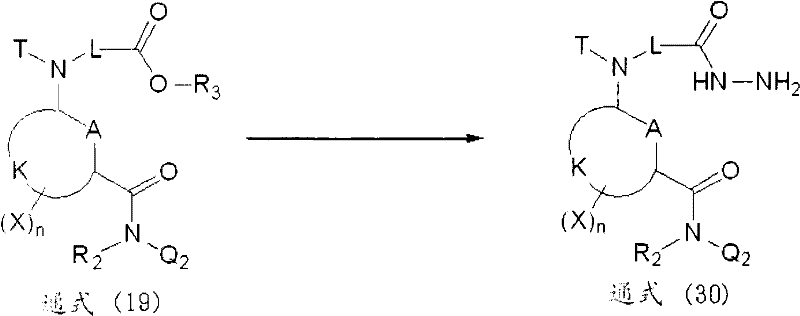
步骤6:通式(19)→通式(30)Step 6: general formula (19) → general formula (30)
通过使通式(19)表示的酯化合物与肼在溶剂中或无溶剂下反应,可以制备通式(30)表示的本发明化合物。The compound of the present invention represented by general formula (30) can be produced by reacting an ester compound represented by general formula (19) with hydrazine in a solvent or without a solvent.
本步骤中,可以使用适当的溶剂,作为上述溶剂,只要是不显著抑制本反应进行的溶剂即可,例如可以举出己烷、环己烷、甲基环己烷等脂肪族烃类;苯、二甲苯、甲苯等芳香族烃类;二氯甲烷、氯仿、四氯化碳、1,2-二氯乙烷等卤代烃类;乙醚、二氧杂环己烷、四氢呋喃、1,2-二甲氧基乙烷等醚类;二甲基甲酰胺、二甲基乙酰胺等酰胺类;乙腈、丙腈等腈类;甲醇、乙醇等醇类;1,3-二甲基-2-咪唑啉酮、环丁砜、二甲基亚砜、水等溶剂,上述溶剂可以单独使用或混合2种以上进行使用。In this step, an appropriate solvent can be used. As the above-mentioned solvent, as long as it is a solvent that does not significantly inhibit the progress of this reaction, for example, aliphatic hydrocarbons such as hexane, cyclohexane, and methylcyclohexane; , xylene, toluene and other aromatic hydrocarbons; dichloromethane, chloroform, carbon tetrachloride, 1,2-dichloroethane and other halogenated hydrocarbons; ether, dioxane, tetrahydrofuran, 1,2 -Ethers such as dimethoxyethane; amides such as dimethylformamide and dimethylacetamide; nitriles such as acetonitrile and propionitrile; alcohols such as methanol and ethanol; 1,3-dimethyl-2 - Solvents such as imidazolinone, sulfolane, dimethyl sulfoxide, and water. These solvents may be used alone or in combination of two or more.
反应温度在-20℃~所用溶剂的回流温度的范围内、反应时间在数分钟至96小时的范围内分别适当选择即可。The reaction temperature may be appropriately selected within the range of -20°C to the reflux temperature of the solvent used, and the reaction time within the range of several minutes to 96 hours.
<制备方法7><Preparation method 7>
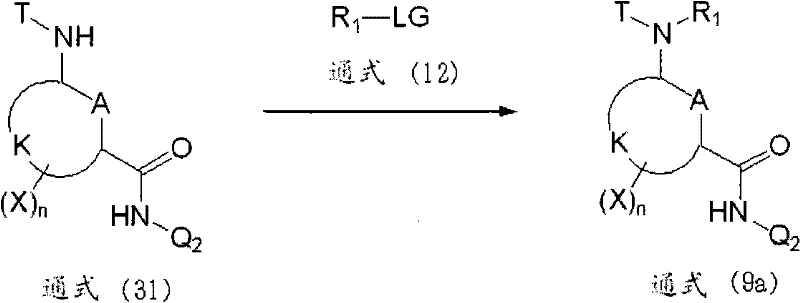
步骤7:通式(31)+通式(12)→通式(9a)Step 7: general formula (31) + general formula (12) → general formula (9a)
通过使通式(31)表示的酰胺化合物与通式(12)表示的具有卤素等离去基团的化合物在溶剂中或无溶剂下反应,可以制备通式(9a)表示的本发明化合物。本步骤中可以使用适当的碱或溶剂,作为上述碱或溶剂,可以使用1-(i)中列举的碱或溶剂。对于反应温度、反应时间等,也可以依照1-(i)列举的条件。The compound of the present invention represented by the general formula (9a) can be produced by reacting an amide compound represented by the general formula (31) with a compound having a leaving group such as a halogen represented by the general formula (12) in a solvent or without a solvent. An appropriate base or solvent can be used in this step, and the base or solvent listed in 1-(i) can be used as the above-mentioned base or solvent. Regarding the reaction temperature, reaction time, etc., the conditions listed in 1-(i) can also be followed.
<制备方法8><Preparation method 8>

8-(i):通式(32)+通式(6)→式(33)8-(i): general formula (32) + general formula (6) → formula (33)
通过使通式(32)表示的化合物与通式(6)表示的化合物按照1-(i)所述的条件反应,可以制备通式(33)表示的化合物。The compound represented by the general formula (33) can be produced by reacting the compound represented by the general formula (32) with the compound represented by the general formula (6) under the conditions described in 1-(i).
8-(ii):通式(33)→通式(10a)8-(ii): general formula (33) → general formula (10a)
例如可以按照J.Org.Chem.280页(1958年)中记载的条件,使用氨水来进行氨基化反应,制备通式(10a)表示的化合物,反应溶剂等条件不限定于文献记载的条件,只要适当使用不显著阻碍反应进行的惰性溶剂即可,对于反应温度、反应时间,根据反应进行适当选择即可。另外,作为氨基化剂,除氨水之外,还可以举出甲基胺、乙基胺等。For example, according to the conditions recorded in J.Org.Chem.280 pages (1958), ammonia water is used to carry out amination reaction to prepare the compound represented by general formula (10a), and the conditions such as reaction solvent are not limited to the conditions recorded in the literature. What is necessary is just to use appropriately the inert solvent which does not significantly hinder progress of a reaction, and what is necessary is just to select suitably about reaction temperature and reaction time according to reaction. Moreover, as an amination agent, methylamine, ethylamine, etc. are mentioned other than ammonia water.
8-(iii):通式(10a)+通式(11)→通式(1)8-(iii): general formula (10a) + general formula (11) → general formula (1)
通过使通式(10a)表示的化合物与通式(11)表示的化合物按照1-(i)所述的条件反应,可以制备通式(1)表示的化合物。The compound represented by the general formula (1) can be produced by reacting the compound represented by the general formula (10a) with the compound represented by the general formula (11) under the conditions described in 1-(i).
<制备方法9><Preparation method 9>

9-(i):通式(8)→通式(10a)9-(i): general formula (8) → general formula (10a)
以通式(8)表示的化合物为起始原料,根据1-(vi)所述的(方法A)、(方法B)或(方法C)的条件使其反应,由此可以制备通式(10a)表示的化合物。Using the compound represented by the general formula (8) as a starting material, it is reacted according to the conditions of (method A), (method B) or (method C) described in 1-(vi), whereby the general formula ( Compound represented by 10a).
9-(i’):通式(8)+通式(12)→通式(10a)9-(i'): general formula (8) + general formula (12) → general formula (10a)
通过使通式(8)表示的芳香族胺衍生物与通式(12)表示的羧酸衍生物或具有离去基团的碳酸酯衍生物在适当的溶剂中反应,可以制备通式(10a)表示的芳香族羧酸酰胺。本步骤中可以使用适当的碱或溶剂,作为上述碱或溶剂,可以使用1-(i)中列举的碱或溶剂。对于反应温度、反应时间等,也可以依照1-(i)列举的条件。By making aromatic amine derivatives represented by general formula (8) react with carboxylic acid derivatives represented by general formula (12) or carbonate derivatives with leaving groups in an appropriate solvent, the general formula (10a ) represents an aromatic carboxylic acid amide. An appropriate base or solvent can be used in this step, and the base or solvent listed in 1-(i) can be used as the above-mentioned base or solvent. Regarding the reaction temperature, reaction time, etc., the conditions listed in 1-(i) can also be followed.
通式(12)中,羧酸酰氯衍生物可以根据使用卤化剂的常规方法由羧酸衍生物容易地制备。作为卤化剂,可以依照1-(i)列举的条件。In the general formula (12), a carboxylic acid chloride derivative can be easily prepared from a carboxylic acid derivative according to a conventional method using a halogenating agent. As the halogenating agent, the conditions listed in 1-(i) can be followed.
还有不使用卤化剂而是由羧酸衍生物(12)和通式(8)表示的化合物制备通式(10a)表示的化合物的方法,可以按照1-(i)列举的方法来制备。There is also a method of preparing the compound represented by the general formula (10a) from the carboxylic acid derivative (12) and the compound represented by the general formula (8) without using a halogenating agent, and it can be prepared by the method exemplified in 1-(i).
9-(ii):通式(10a)+通式(11)→通式(1)9-(ii): general formula (10a) + general formula (11) → general formula (1)
以通式(10a)表示的化合物和通式(11)表示的化合物为起始原料,根据1-(i)所述的条件使其反应,由此可以制备通式(1)表示的化合物。The compound represented by the general formula (1) can be produced by reacting the compound represented by the general formula (10a) and the compound represented by the general formula (11) as starting materials under the conditions described in 1-(i).
<制备方法10><Preparation method 10>

10-(i):通式(5a)+通式(6)→通式(7b)10-(i): general formula (5a) + general formula (6) → general formula (7b)
通过使通式(5a)表示的化合物与通式(6)表示的化合物按照1-(i)所述的条件反应,可以制备通式(7b)表示的化合物。The compound represented by the general formula (7b) can be produced by reacting the compound represented by the general formula (5a) with the compound represented by the general formula (6) under the conditions described in 1-(i).
10-(ii):通式(7b)→通式(7c)10-(ii): general formula (7b) → general formula (7c)
通过使通式(7b)表示的硝基芳香族羧酸酰胺衍生物在适当的溶剂中、或无溶剂下与适当的氟化剂反应,可以制备通式(7c)表示的化合物。The compound represented by the general formula (7c) can be produced by reacting the nitroaromatic carboxylic acid amide derivative represented by the general formula (7b) with a suitable fluorinating agent in a suitable solvent or without a solvent.
作为溶剂,只要是不显著抑制本反应进行的溶剂即可,例如可以举出己烷、环己烷、甲基环己烷等脂肪族烃类;苯、甲苯、二甲苯等芳香族烃类;二氯甲烷、氯仿、四氯化碳、1,2-二氯乙烷等卤代烃类;乙醚、二氧杂环己烷、四氢呋喃、1,2-二甲氧基乙烷等链状或环状醚类;乙酸乙酯、乙酸丁酯等酯类;丙酮、甲基异丁基酮、环己酮、甲基乙基酮等酮类;乙腈、丙腈等腈类;1,3-二甲基-2-咪唑啉酮、环丁砜、二甲基亚砜、N,N-二甲基甲酰胺、N-甲基吡咯烷酮、N,N-二甲基乙酰胺等非质子性极性溶剂,上述溶剂可以单独使用或混合2种以上进行使用。As the solvent, as long as it is a solvent that does not significantly inhibit the progress of this reaction, for example, aliphatic hydrocarbons such as hexane, cyclohexane, and methylcyclohexane; aromatic hydrocarbons such as benzene, toluene, and xylene; Dichloromethane, chloroform, carbon tetrachloride, 1,2-dichloroethane and other halogenated hydrocarbons; ether, dioxane, tetrahydrofuran, 1,2-dimethoxyethane and other chain or Cyclic ethers; Ethyl acetate, butyl acetate and other esters; Acetone, methyl isobutyl ketone, cyclohexanone, methyl ethyl ketone and other ketones; Acetonitrile, propionitrile and other nitriles; 1,3- Dimethyl-2-imidazolinone, sulfolane, dimethyl sulfoxide, N,N-dimethylformamide, N-methylpyrrolidone, N,N-dimethylacetamide and other aprotic polar solvents , The above-mentioned solvents may be used alone or in combination of two or more.
作为氟化剂,可以举出1,1,2,2-四氟乙基二乙基胺、2-氯-1,1,2-三氟乙基二乙基胺、三氟二苯基正膦、二氟三苯基正膦、氟甲酸酯类、四氟化硫、氟化钾、氟氢化钾、氟化铯、氟化铷、氟化钠、氟化锂、氟化锑(III)、氟化锑(V)、氟化锌、氟化钴、氟化铅、氟化铜、氟化汞(II)、氟化银、氟硼酸银、氟化铊(I)、氟化钼(Vl)、氟化砷(III)、氟化溴、四氟化硒、三(二甲基氨基)锍二氟三甲基硅酸盐、六氟硅酸钠、氟化季铵盐类、(2-氯乙基)二乙基胺、三氟化二乙基氨基硫、三氟化吗啉代硫、四氟化硅、氟化氢、氢氟酸、氟化氢吡啶配位化合物、氟化氢三乙基胺配位化合物、氟化氢盐类、双(2-甲氧基乙基)氨基三氟化硫、2,2-二氟-1,3-二甲基-2-咪唑啉酮、五氟化碘、三(二乙基氨基)鏻-2,2,3,3,4,4-六氟-环丁烷内鎓盐(tris(diethylamino)phosphonium 2,2,3,3,4,4-hexafluorocyclobutanilide)、三乙基铵六氟环丁烷内鎓盐、六氟丙烯等。上述氟化剂可以单独使用或混合2种以上进行使用。Examples of the fluorinating agent include 1,1,2,2-tetrafluoroethyldiethylamine, 2-chloro-1,1,2-trifluoroethyldiethylamine, trifluorodiphenyl Phosphine, difluorotriphenylphosphorane, fluoroformate, sulfur tetrafluoride, potassium fluoride, potassium bifluoride, cesium fluoride, rubidium fluoride, sodium fluoride, lithium fluoride, antimony(III) fluoride , antimony (V) fluoride, zinc fluoride, cobalt fluoride, lead fluoride, copper fluoride, mercury (II) fluoride, silver fluoride, silver fluoroborate, thallium (I) fluoride, molybdenum fluoride ( Vl), arsenic(III) fluoride, bromine fluoride, selenium tetrafluoride, tris(dimethylamino)sulfonium difluorotrimethylsilicate, sodium hexafluorosilicate, quaternary ammonium fluoride, ( 2-chloroethyl)diethylamine, diethylaminosulfur trifluoride, morpholinosulfur trifluoride, silicon tetrafluoride, hydrogen fluoride, hydrofluoric acid, hydrogen fluoride pyridine complex, hydrogen fluoride triethylamine Coordination compounds, hydrogen fluoride salts, bis(2-methoxyethyl)aminosulfur trifluoride, 2,2-difluoro-1,3-dimethyl-2-imidazolinone, iodine pentafluoride, Tris(diethylamino)phosphonium 2,2,3,3,4,4-hexafluorocyclobutanilide , triethylammonium hexafluorocyclobutane ylide, hexafluoropropylene, etc. These fluorinating agents can be used alone or in combination of two or more.
上述氟化剂,相对于通式(7b)表示的硝基芳香族羧酸酰胺衍生物在1至10倍摩尔当量的范围内使用、或作为溶剂适当地选择使用。The above-mentioned fluorinating agent is used in the range of 1 to 10 times the molar equivalent to the nitroaromatic carboxylic acid amide derivative represented by the general formula (7b), or is used as a solvent selected appropriately.
也可以使用添加剂,作为添加剂,例如可以举出18-冠醚-6等冠醚类、四苯基鏻盐等相转移催化剂类、氟化钙、氯化钙等无机盐类、氧化汞等金属氧化物类、离子交换树脂等,上述添加剂不仅可以添加到反应体系中,而且可以作为氟化剂的前处理剂使用。Additives may also be used, and examples of additives include crown ethers such as 18-crown-6, phase transfer catalysts such as tetraphenylphosphonium salts, inorganic salts such as calcium fluoride and calcium chloride, and metals such as mercuric oxide. Oxides, ion exchange resins, etc., the above additives can not only be added to the reaction system, but also can be used as a pretreatment agent for the fluorinating agent.
反应温度在-80℃至所用溶剂的回流温度的范围内、反应时间在数分钟至96小时的范围内分别可以适当地选择。The reaction temperature ranges from -80°C to the reflux temperature of the solvent used, and the reaction time ranges from several minutes to 96 hours, respectively, can be appropriately selected.
<制备方法11><Preparation method 11>

11-(i):通式(5b)+通式(6)→通式(7d)11-(i): general formula (5b) + general formula (6) → general formula (7d)
通过使通式(5b)表示的化合物与通式(6)表示的化合物按照1-(i)所述的条件反应,可以制备通式(7d)表示的化合物。The compound represented by the general formula (7d) can be produced by reacting the compound represented by the general formula (5b) with the compound represented by the general formula (6) under the conditions described in 1-(i).
11-(ii):通式(7d)→通式(7e)11-(ii): general formula (7d) → general formula (7e)
通过使通式(7d)表示的卤代芳香族羧酸酰胺衍生物在适当的溶剂中、或无溶剂下与适当的氰化剂反应,可以制备通式(7e)表示的化合物。The compound represented by the general formula (7e) can be produced by reacting a halogenated aromatic carboxylic acid amide derivative represented by the general formula (7d) with a suitable cyanating agent in a suitable solvent or without a solvent.
作为溶剂,只要是不显著抑制本反应进行的溶剂即可,例如可以举出己烷、环己烷、甲基环己烷等脂肪族烃类;苯、甲苯、二甲苯等芳香族烃类;二氯甲烷、氯仿、四氯化碳、1,2-二氯乙烷等卤代烃类;乙醚、二氧杂环己烷、四氢呋喃、1,2-二甲氧基乙烷等链状或环状醚类;乙酸乙酯、乙酸丁酯等酯类;丙酮、甲基异丁基酮、环己酮、甲基乙基酮等酮类;乙腈、丙腈等腈类;1,3-二甲基-2-咪唑啉酮、环丁砜、二甲基亚砜、N,N-二甲基甲酰胺、N-甲基吡咯烷酮、N,N-二甲基乙酰胺等非质子性极性溶剂,上述溶剂可以单独使用或混合2种以上进行使用。As the solvent, as long as it is a solvent that does not significantly inhibit the progress of this reaction, for example, aliphatic hydrocarbons such as hexane, cyclohexane, and methylcyclohexane; aromatic hydrocarbons such as benzene, toluene, and xylene; Dichloromethane, chloroform, carbon tetrachloride, 1,2-dichloroethane and other halogenated hydrocarbons; ether, dioxane, tetrahydrofuran, 1,2-dimethoxyethane and other chain or Cyclic ethers; Ethyl acetate, butyl acetate and other esters; Acetone, methyl isobutyl ketone, cyclohexanone, methyl ethyl ketone and other ketones; Acetonitrile, propionitrile and other nitriles; 1,3- Dimethyl-2-imidazolinone, sulfolane, dimethyl sulfoxide, N,N-dimethylformamide, N-methylpyrrolidone, N,N-dimethylacetamide and other aprotic polar solvents , The above-mentioned solvents may be used alone or in combination of two or more.
作为氰化剂,可以举出氰化钠、氰化钾、氰基硼氢化钠等氰化盐类;氰化铜、氰化银、氰化锂等金属氰化物类;氰化氢、四乙基铵氰化物等。As the cyanating agent, cyanide salts such as sodium cyanide, potassium cyanide, and sodium cyanoborohydride; metal cyanides such as copper cyanide, silver cyanide, and lithium cyanide; hydrogen cyanide, tetraethyl cyanide, and the like; Ammonium cyanide, etc.
上述氰化剂,相对于通式(7d)表示的卤代芳香族羧酸酰胺衍生物在1至10倍摩尔当量的范围内适当选择使用。The above-mentioned cyanating agent is appropriately selected and used in the range of 1 to 10 times molar equivalent to the halogenated aromatic carboxylic acid amide derivative represented by the general formula (7d).
也可以使用添加剂,作为添加剂,例如可以举出18-冠醚-6等冠醚类、四苯基鏻盐等相转移催化剂类、碘化钠等无机盐类。Additives may also be used, and examples of additives include crown ethers such as 18-crown-6, phase transfer catalysts such as tetraphenylphosphonium salts, and inorganic salts such as sodium iodide.
反应温度在-20℃~所用溶剂的回流温度的范围内、反应时间在数分钟至96小时的范围内分别适当选择即可。The reaction temperature may be appropriately selected within the range of -20°C to the reflux temperature of the solvent used, and the reaction time within the range of several minutes to 96 hours.
<制备方法12><Preparation method 12>

12-(i):通式(10b)→通式(10c)12-(i): general formula (10b) → general formula (10c)
根据Synthesis 463页(1993年)及Synthesis 829页(1984年)等所述的公知条件,使通式(10b)表示的化合物与劳森试剂反应,可以制备通式(10c)表示的化合物。溶剂、反应温度等条件不限定于文献记载的条件。The compound represented by the general formula (10c) can be prepared by reacting the compound represented by the general formula (10b) with Lawson's reagent according to the known conditions described in Synthesis 463 (1993) and Synthesis 829 (1984). Conditions such as solvent and reaction temperature are not limited to those described in literature.
12-(ii):通式(10c)+通式(11)→通式(1c)12-(ii): general formula (10c) + general formula (11) → general formula (1c)
通过使通式(10c)表示的化合物与通式(11)表示的化合物按照1-(i)所述的条件反应,可以制备通式(1c)表示的化合物。The compound represented by the general formula (1c) can be produced by reacting the compound represented by the general formula (10c) with the compound represented by the general formula (11) under the conditions described in 1-(i).
<制备方法13><Preparation method 13>

13:通式(1d)→通式(1e)+通式(1f)13: General formula (1d) → General formula (1e) + General formula (1f)
按照12-(i)所述的条件,由通式(1d)表示的化合物可以制备通式(1e)及通式(1f)表示的化合物。溶剂、反应温度等条件不限定于文献记载的条件。上述2种化合物可以通过硅胶柱色谱法等公知的分离精制技术容易地分离精制。The compounds represented by the general formula (1e) and the general formula (1f) can be produced from the compound represented by the general formula (1d) under the conditions described in 12-(i). Conditions such as solvent and reaction temperature are not limited to those described in literature. The above two compounds can be easily separated and purified by known separation and purification techniques such as silica gel column chromatography.
上述所示的全部制备方法中,在反应结束后,根据常规方法从反应体系中分离目标产物即可,根据需要可以进行重结晶、柱色谱法、蒸馏等操作精制。另外,也可以不将目标产物从反应体系中分离而是将其用于下一反应步骤。In all the preparation methods shown above, after the reaction is completed, the target product can be separated from the reaction system according to the conventional method, and can be refined by operations such as recrystallization, column chromatography, and distillation as required. In addition, the target product may also be used in the next reaction step without isolating it from the reaction system.
以下,第1表~第8表给出了本发明杀虫剂的有效成分的通式(1)表示的化合物的代表性化合物,但本发明并不限定于此。In the following, Tables 1 to 8 show representative compounds of the compounds represented by the general formula (1) which are active ingredients of the insecticide of the present invention, but the present invention is not limited thereto.
另外,第11表~第21表给出了本发明化合物的中间体的通式(6a)、通式(6b)、通式(6c)及通式(6d)表示的化合物的代表性化合物,但本发明并不限定于此。In addition, Table 11 to Table 21 show representative compounds of compounds represented by general formula (6a), general formula (6b), general formula (6c) and general formula (6d) which are intermediates of the compounds of the present invention, However, the present invention is not limited thereto.
需要说明的是,表中,“n-”表示正,“Me”表示甲基,“Et”表示乙基,“nPr”表示正丙基,“nPr”表示正丙基,“iPr”表示异丙基,“nBu”表示正丁基,“iBu”表示异丁基、“sBu”表示仲丁基,“tBu”表示叔丁基,“Ph”表示苯基,“H”表示氢原子,“O”表示氧原子,“S”表示硫原子,“C”表示碳原子,“N”表示氮原子,“F”表示氟原子,“Cl”表示氯原子,“Br”表示溴原子,“I”表示碘原子,“CF3”表示三氟甲基,“C2F5”表示五氟乙基,“OCF3”表示三氟甲氧基,“MeS”表示甲硫基,“MeSO”表示甲基亚磺酰基,“MeSO2”表示甲基磺酰基,“MeO”表示甲氧基,“NH2”表示氨基,“MeNH”表示甲基氨基,“Me2N”表示二甲基氨基,“OH”表示羟基,“CN”表示氰基,“NO2”表示硝基,“Ac”表示乙酰基。It should be noted that in the table, "n-" means normal, "Me" means methyl, "Et" means ethyl, "nPr" means n-propyl, "nPr" means n-propyl, "iPr" means iso Propyl group, "nBu" means n-butyl group, "iBu" means isobutyl group, "sBu" means sec-butyl group, "tBu" means tert-butyl group, "Ph" means phenyl group, "H" means hydrogen atom, " O" stands for oxygen atom, "S" stands for sulfur atom, "C" stands for carbon atom, "N" stands for nitrogen atom, "F" stands for fluorine atom, "Cl" stands for chlorine atom, "Br" stands for bromine atom, "I "Represents an iodine atom, "CF3" represents a trifluoromethyl group, "C2F5" represents a pentafluoroethyl group, "OCF3" represents a trifluoromethoxy group, "MeS" represents a methylthio group, and "MeSO" represents a methylsulfinyl group , "MeSO2" means methylsulfonyl, "MeO" means methoxy, "NH2" means amino, "MeNH" means methylamino, "Me2N" means dimethylamino, "OH" means hydroxyl, "CN" Represents cyano, "NO2" represents nitro, "Ac" represents acetyl.
需要说明的是,表中的n表示X为氢原子之外时的取代数。另外,X栏中,“2-F”的记载,表示2位被氟原子取代,其他记载也相同。It should be noted that n in the table represents the number of substitutions when X is other than a hydrogen atom. In addition, in the X column, the description of "2-F" means that the 2-position is substituted with a fluorine atom, and the same applies to other descriptions.
[表1][Table 1]

第1表(1)Form 1 (1)


[表2][Table 2]
第1表(2)Form 1 (2)

[表3][table 3]
第1表(3)Form 1 (3)

[表4][Table 4]
第1表(4)Form 1 (4)

[表5][table 5]
第1表(5)Form 1 (5)

[表6][Table 6]
第1表(6)Form 1 (6)
[表7][Table 7]
第1表(7)Form 1 (7)

[表8][Table 8]
第1表(8)Form 1 (8)
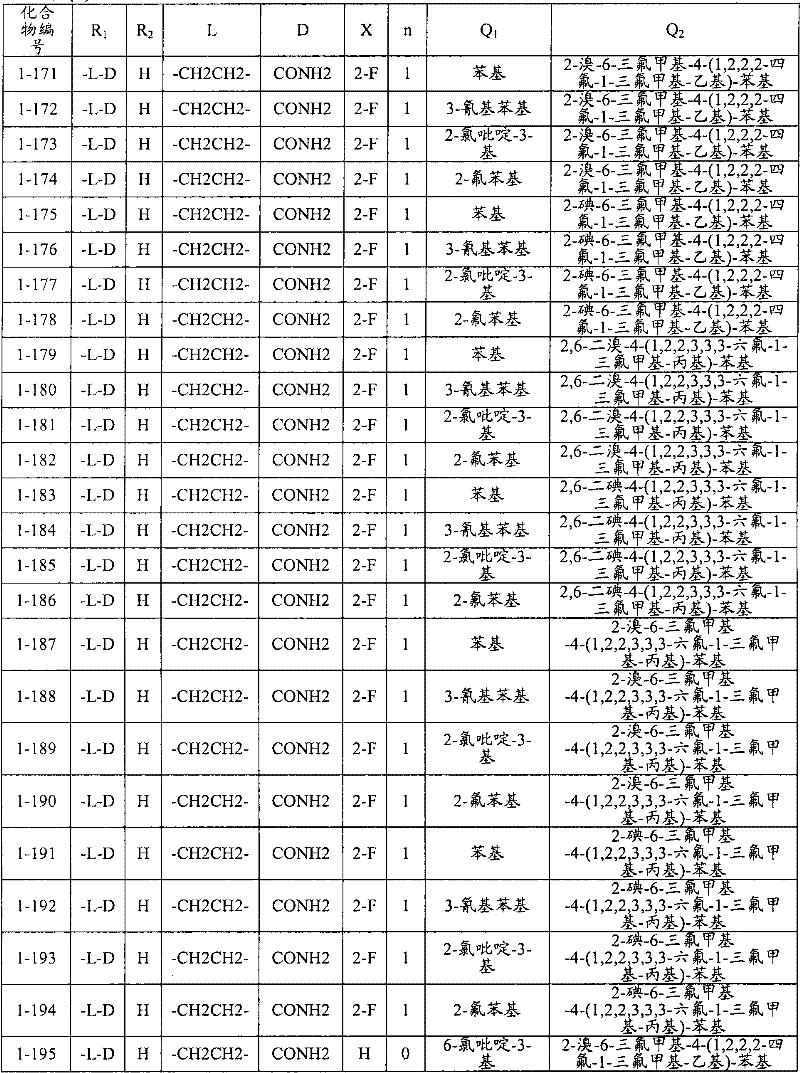
[表9][Table 9]
第1表(9)Form 1 (9)

[表10][Table 10]
第1表(10)Form 1 (10)
[表11][Table 11]
第1表(11)Form 1 (11)

[表12][Table 12]
第2表(1)Form 2 (1)
[表13][Table 13]
第2表(2)Form 2 (2)
[表14][Table 14]
第2表(3)Form 2 (3)
[表15][Table 15]
第2表(4)Form 2 (4)
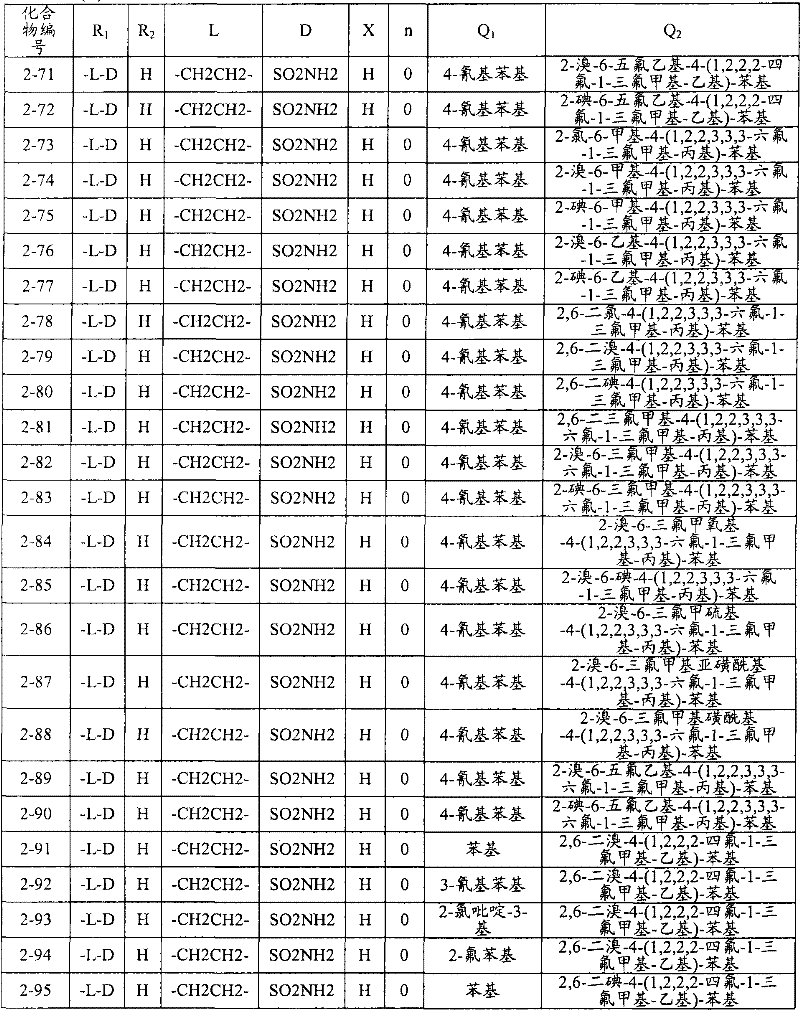
[表16][Table 16]
第2表(5)Form 2 (5)

[表17][Table 17]
第2表(6)Form 2 (6)

[表18][Table 18]
第2表(7)Form 2 (7)

[表19][Table 19]
第2表(8)Form 2 (8)

[表20][Table 20]
第2表(9)Form 2 (9)
[表21][Table 21]
第2表(10)Form 2 (10)
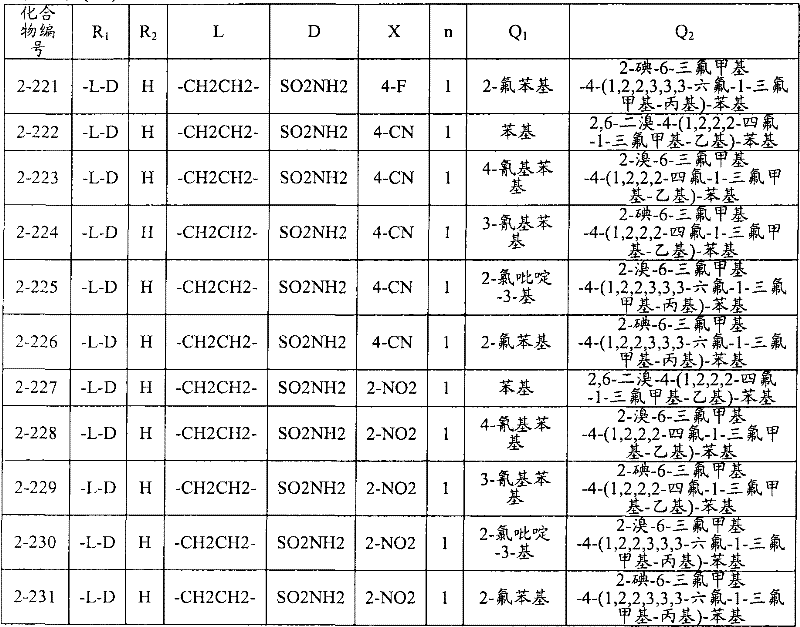
[表22][Table 22]
第3表(1)Form 3 (1)

[表23][Table 23]
第3表(2)Form 3 (2)

[表24][Table 24]
第3表(3)Form 3 (3)
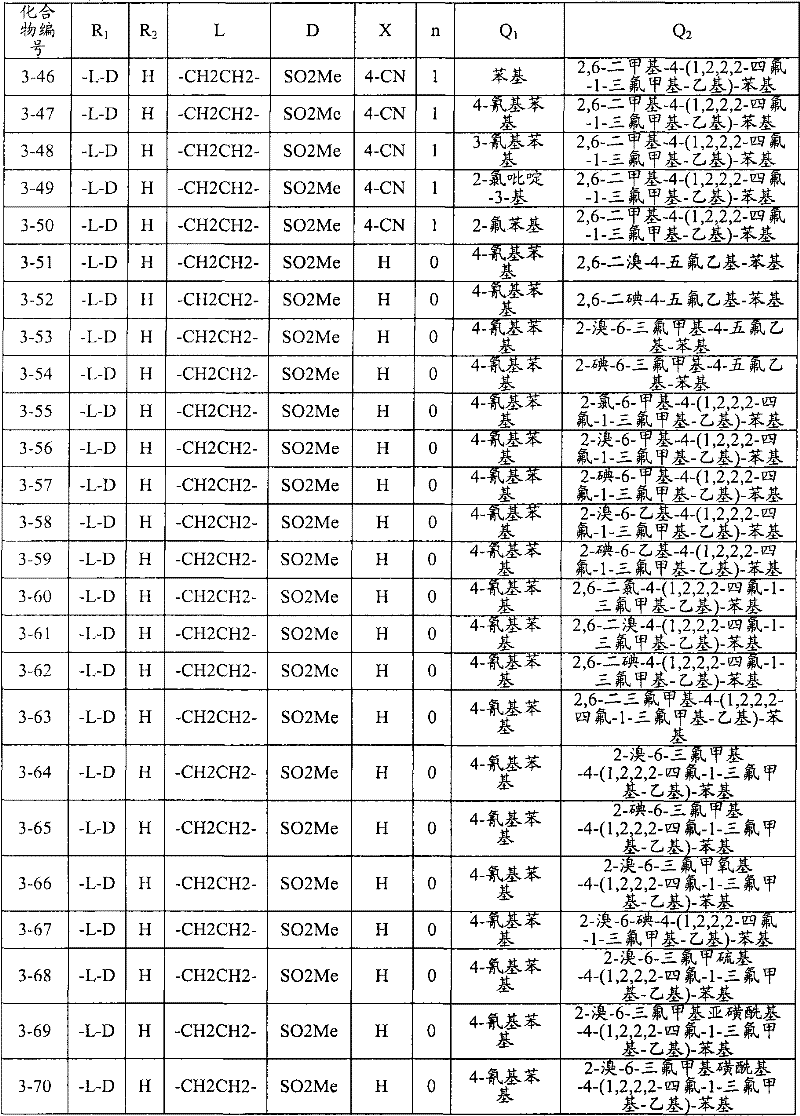
[表25][Table 25]
第3表(4)Form 3 (4)

[表26][Table 26]
第3表(5)Form 3 (5)

[表27][Table 27]
第3表(6)Form 3 (6)

[表28][Table 28]
第3表(7)Form 3 (7)

[表29][Table 29]
第3表(8)Form 3 (8)

[表30][Table 30]
第3表(9)Form 3 (9)

[表31][Table 31]
第3表(10)Form 3 (10)
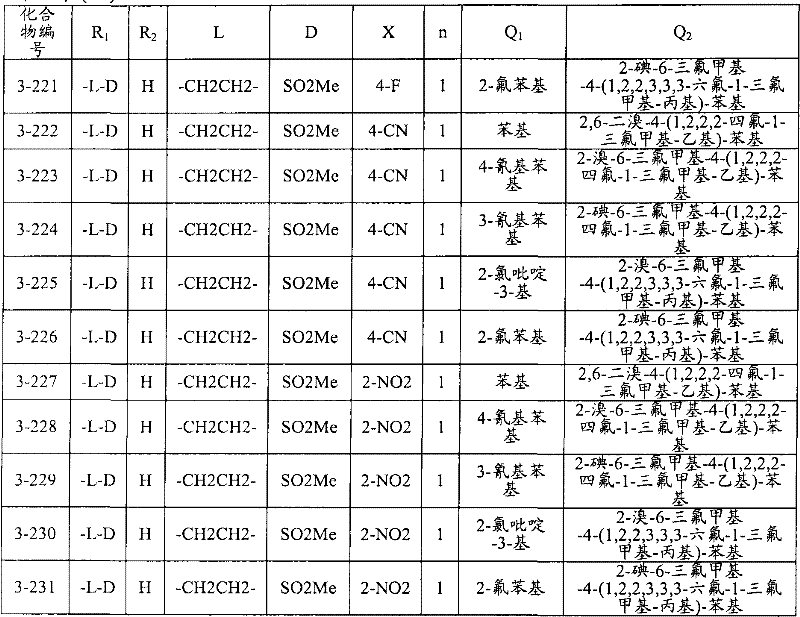
[表32][Table 32]

第4表(1)Form 4 (1)

[表33][Table 33]
第4表(2)Form 4 (2)
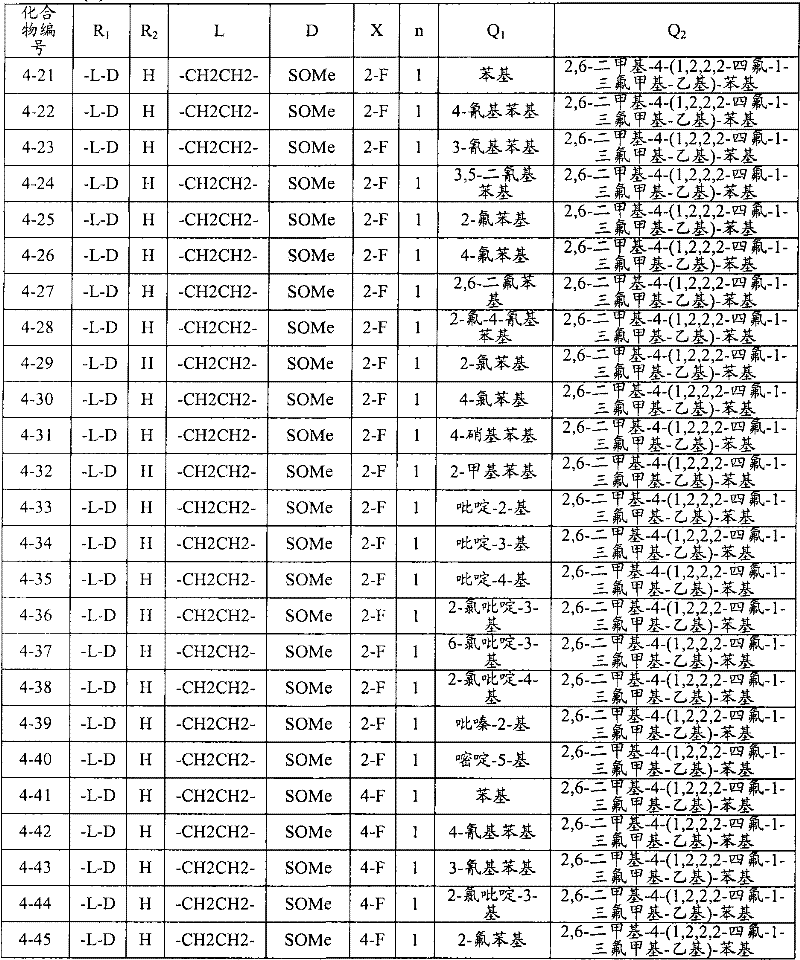
[表34][Table 34]
第4表(3)Form 4 (3)
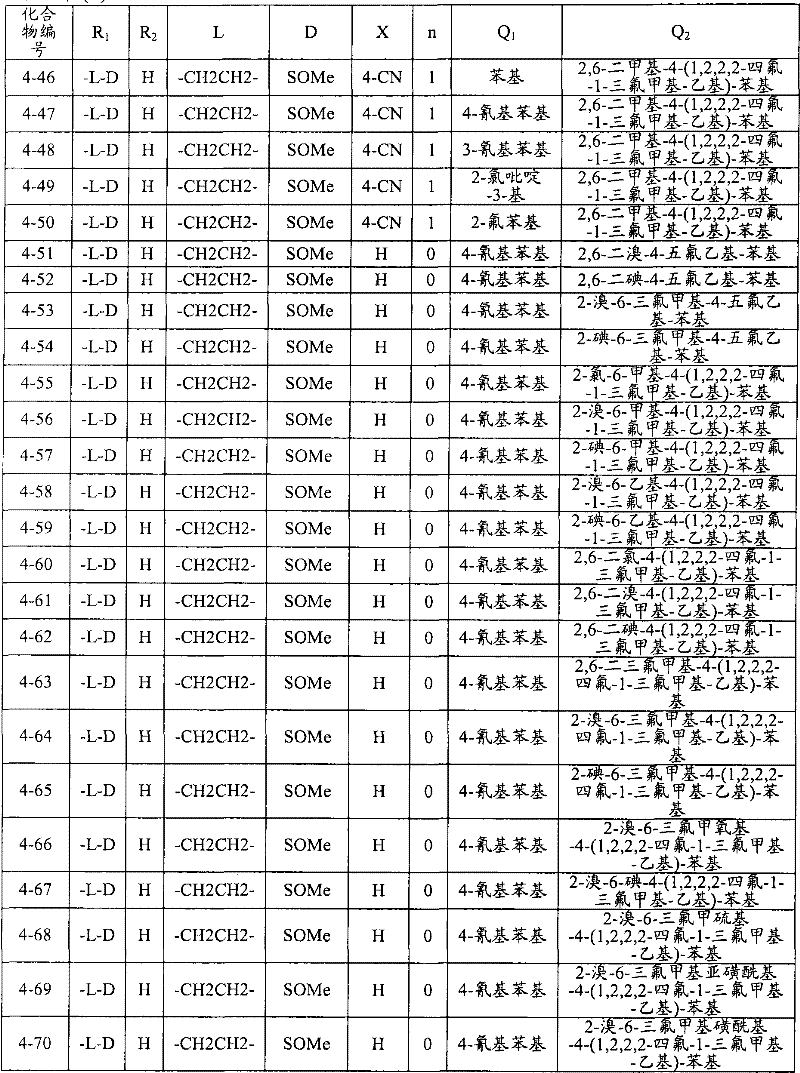
[表35][Table 35]
第4表(4)Form 4 (4)

[表36][Table 36]
第4表(5)Form 4 (5)

[表37][Table 37]
第4表(6)Form 4 (6)

[表38][Table 38]
第4表(7)Form 4 (7)

[表39][Table 39]
第4表(8)Form 4 (8)

[表40][Table 40]
第4表(9)Form 4 (9)

[表41][Table 41]
第4表(10)Form 4 (10)
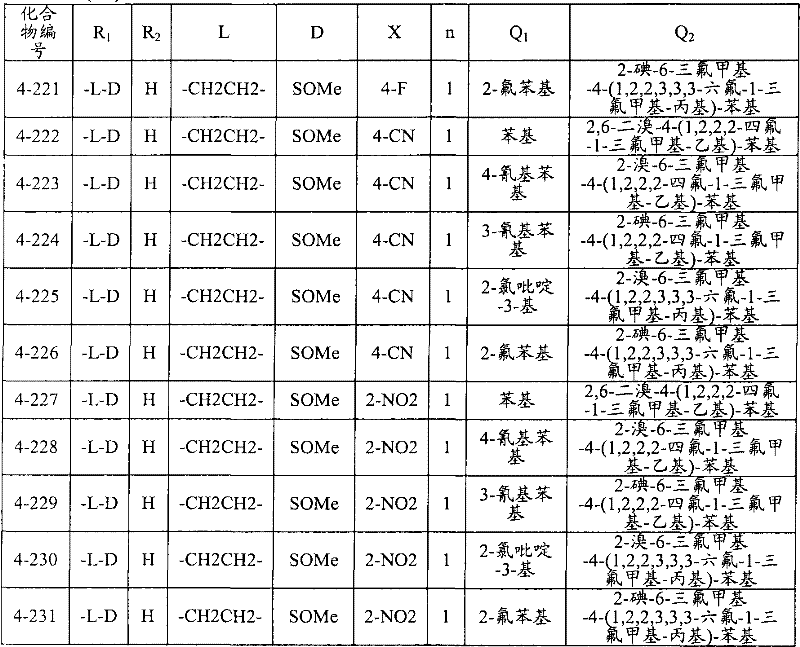
[表42][Table 42]
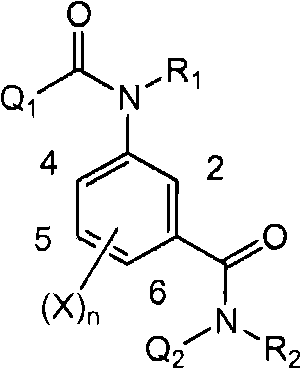
第5表(1)Form 5 (1)

[表43][Table 43]
第5表(2)Form 5 (2)

[表44][Table 44]
第5表(3)Form 5 (3)

[表45][Table 45]
第5表(4)Form 5 (4)

[表46][Table 46]
第5表(5)Form 5 (5)

[表47][Table 47]
第5表(6)Form 5 (6)

[表48][Table 48]

第6表(1)Form 6(1)
[表49][Table 49]
第6表(2)Form 6 (2)

[表50][Table 50]
第6表(3)Form 6(3)

[表51][Table 51]
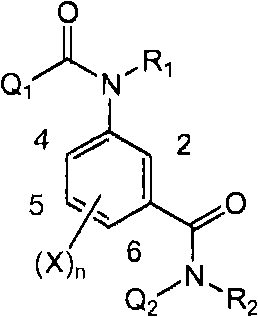
第7表(1)Form 7(1)
[表52][Table 52]
第7表(2)Form 7 (2)

[表53][Table 53]
第7表(3)Form 7 (3)

[表54][Table 54]
第7表(4)Form 7 (4)

[表55][Table 55]
第7表(5)Form 7 (5)

[表56][Table 56]
第7表(6)Form 7 (6)

[表57][Table 57]
第7表(7)Form 7 (7)

[表58][Table 58]
第7表(8)Form 7 (8)
[表59][Table 59]
第7表(9)Form 7 (9)
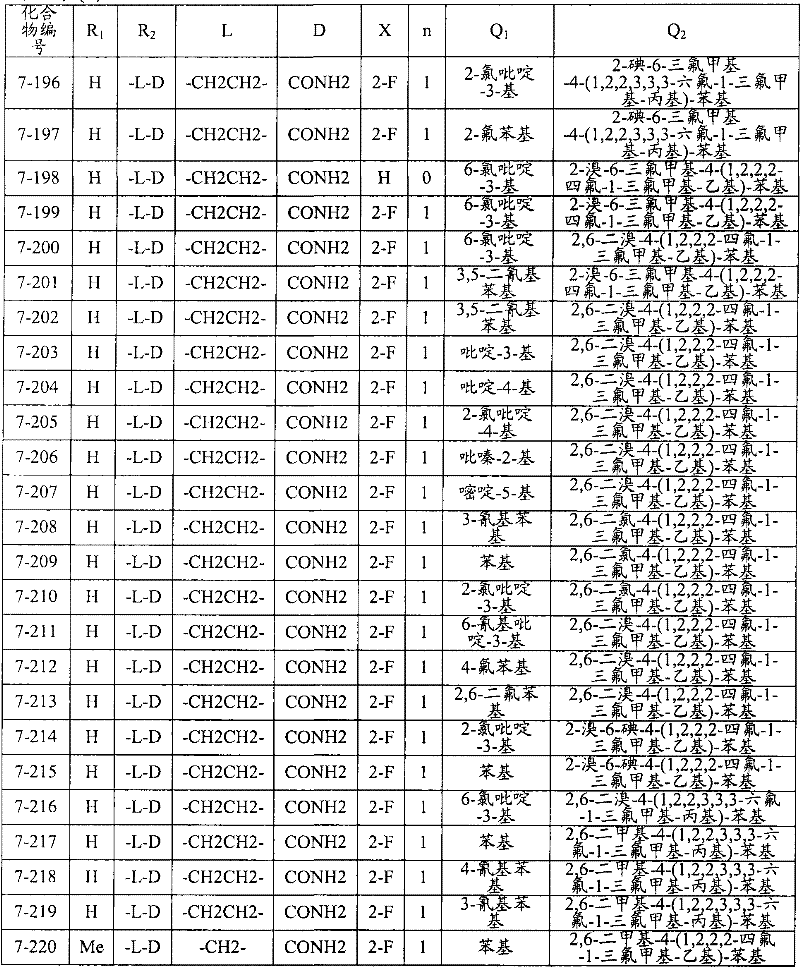
[表60][Table 60]
第7表(10)Form 7 (10)

[表61][Table 61]

第8表(1)Form 8(1)
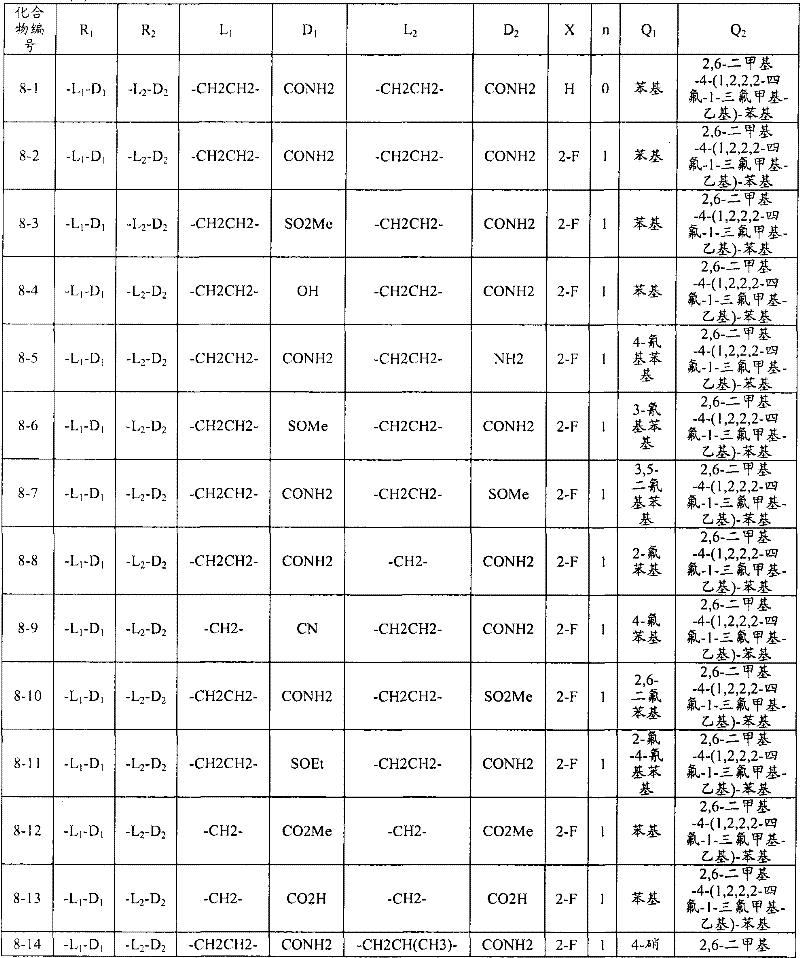

[表62][Table 62]
第8表(2)Form 8 (2)


[表63][Table 63]
第8表(3)Form 8 (3)


[表64][Table 64]
第8表(4)Form 8 (4)


[表65][Table 65]
第8表(5)Form 8 (5)


[表66][Table 66]
第8表(6)Form 8 (6)

[表67][Table 67]
第8表(7)Form 8 (7)

[表68][Table 68]
第8表(8)Form 8 (8)

[表69][Table 69]
第8表(9)Form 8 (9)

[表70][Table 70]

第9表(1)Form 9 (1)

[表71][Table 71]
第9表(2)Form 9 (2)

[表72][Table 72]
第9表(3)Form 9 (3)

[表73][Table 73]
第9表(4)Form 9 (4)

[表74][Table 74]
第9表(5)Form 9 (5)

[表75][Table 75]
第9表(6)Form 9 (6)
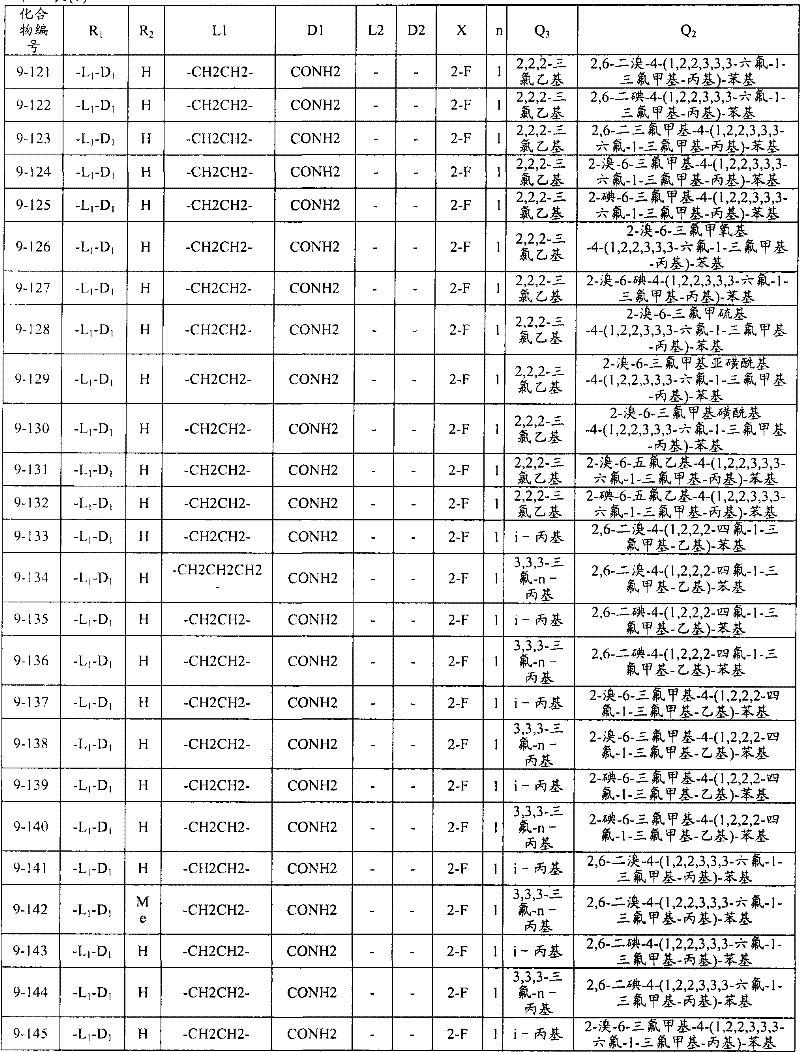
[表76][Table 76]
第9表(7)Form 9 (7)

[表77][Table 77]
第9表(8)Form 9 (8)

[表78][Table 78]
第9表(9)Form 9 (9)
[表79][Table 79]
第9表(10)Form 9 (10)

[表80][Table 80]
第9表(11)Form 9 (11)

[表81][Table 81]
第9表(12)Form 9 (12)

[表82][Table 82]
第9表(13)Form 9 (13)

[表83][Table 83]
第9表(14)Form 9 (14)


[表84][Table 84]
第9表(15)Form 9 (15)

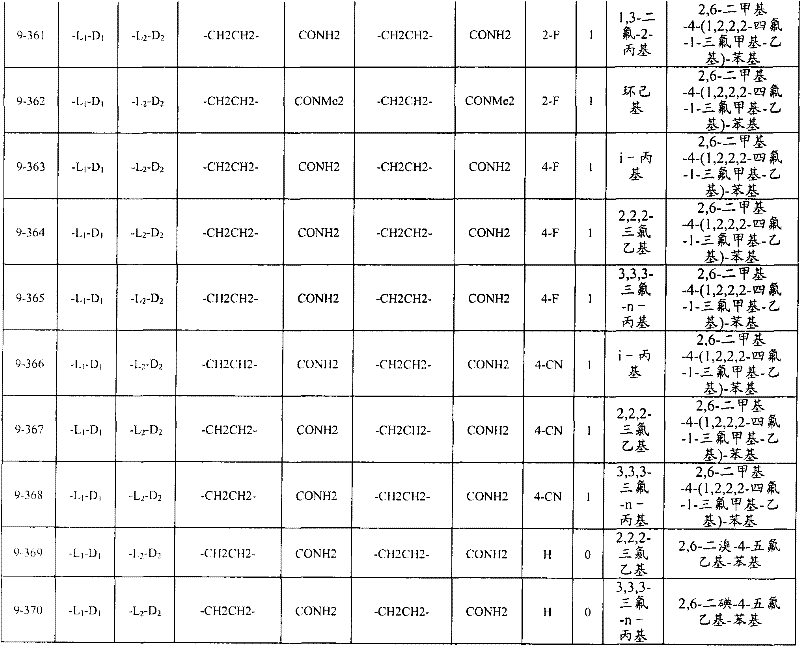
[表85][Table 85]
第9表(16)Form 9 (16)


[表86][Table 86]
第9表(17)Form 9 (17)


[表87][Table 87]
第9表(18)Form 9 (18)


[表88][Table 88]
第9表(19)Form 9 (19)


[表89][Table 89]
第9表(20)Form 9 (20)


[表90][Table 90]

第11表(1)Form 11 (1)

[表91][Table 91]
第11表(2)Form 11 (2)

[表92][Table 92]
第11表(3)Form 11 (3)

[表93][Table 93]
第11表(4)Form 11 (4)
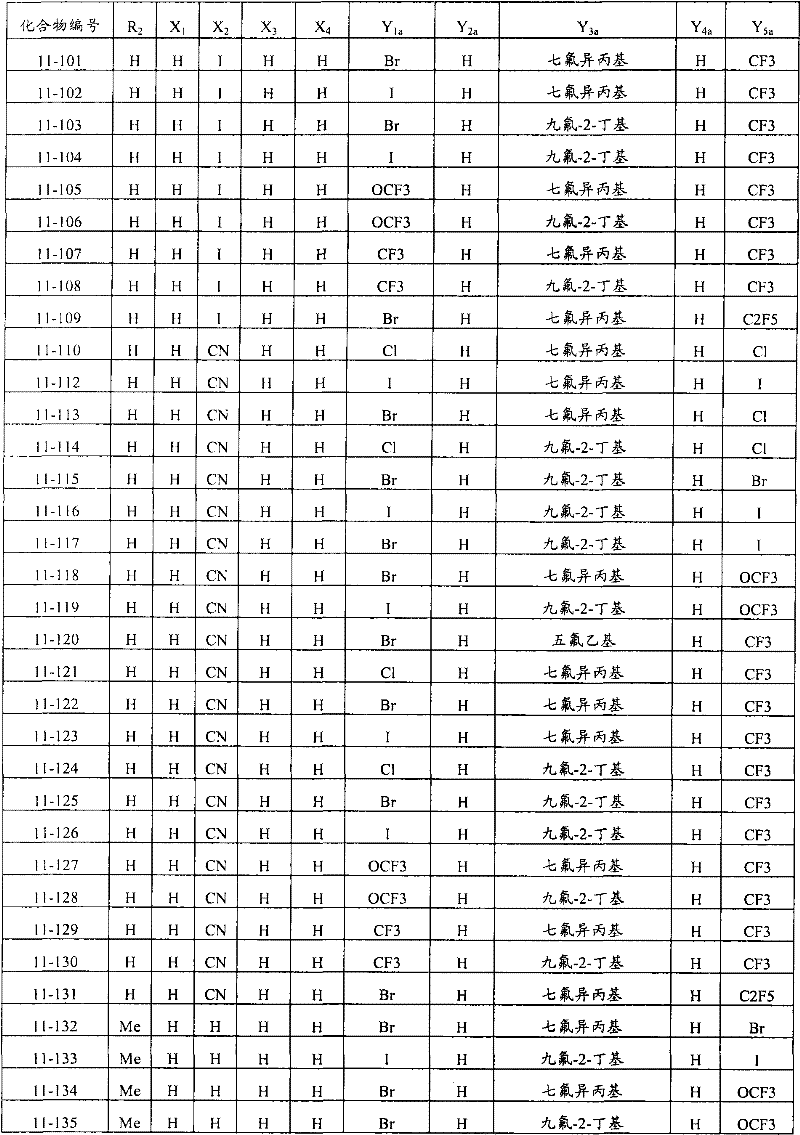
[表94][Table 94]
第11表(5)Form 11 (5)
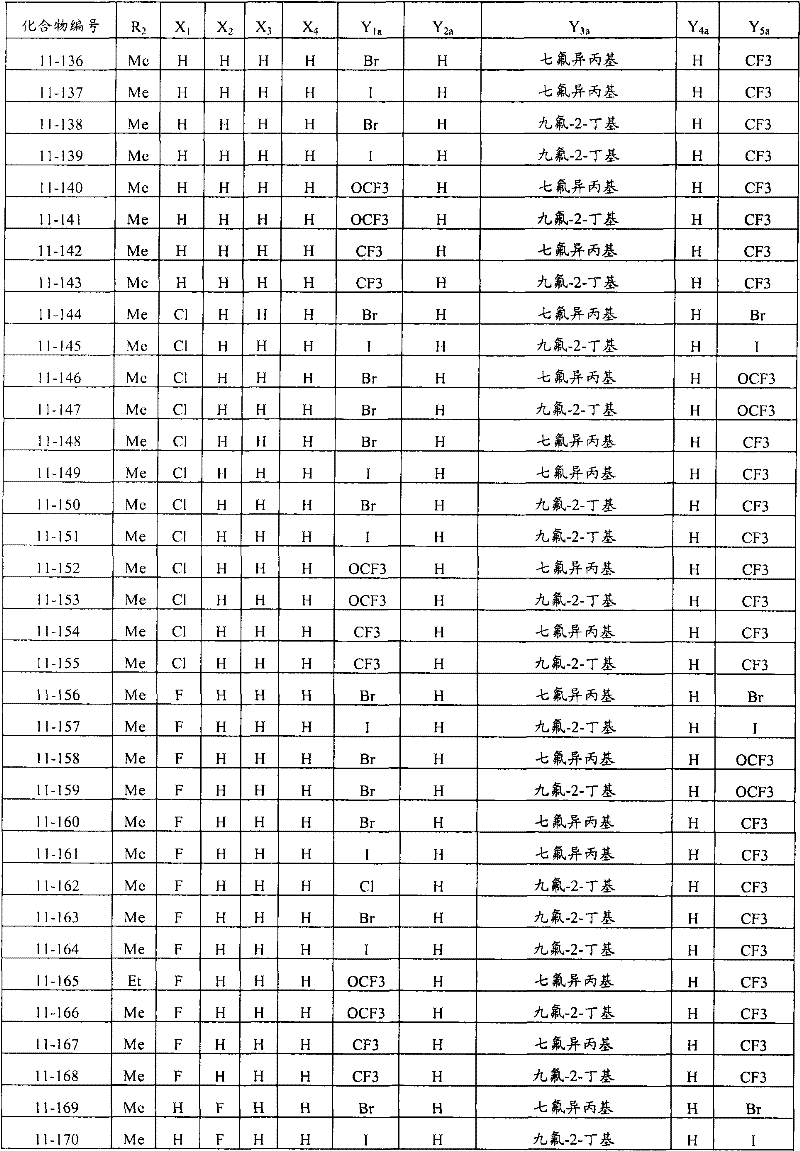
[表95][Table 95]
第11表(6)Form 11 (6)


[表96][Table 96]
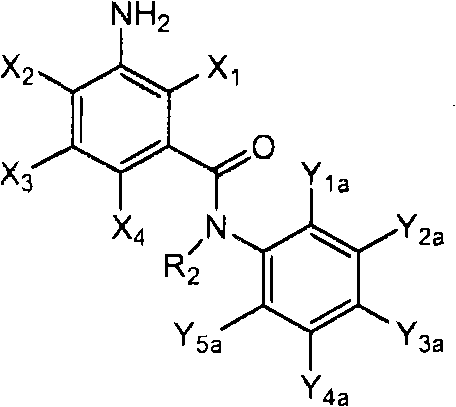
第12表(1)Form 12 (1)
[表97][Table 97]
第12表(2)Form 12 (2)
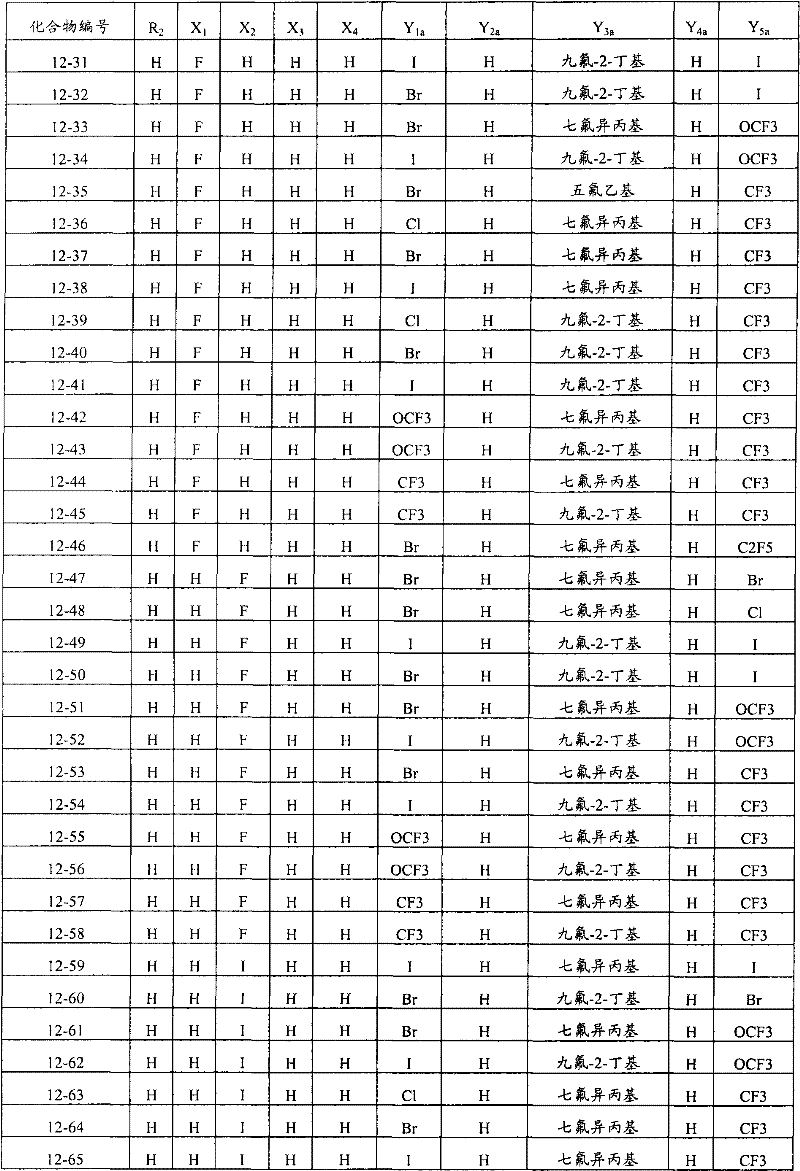
[表98][Table 98]
第12表(3)Form 12 (3)
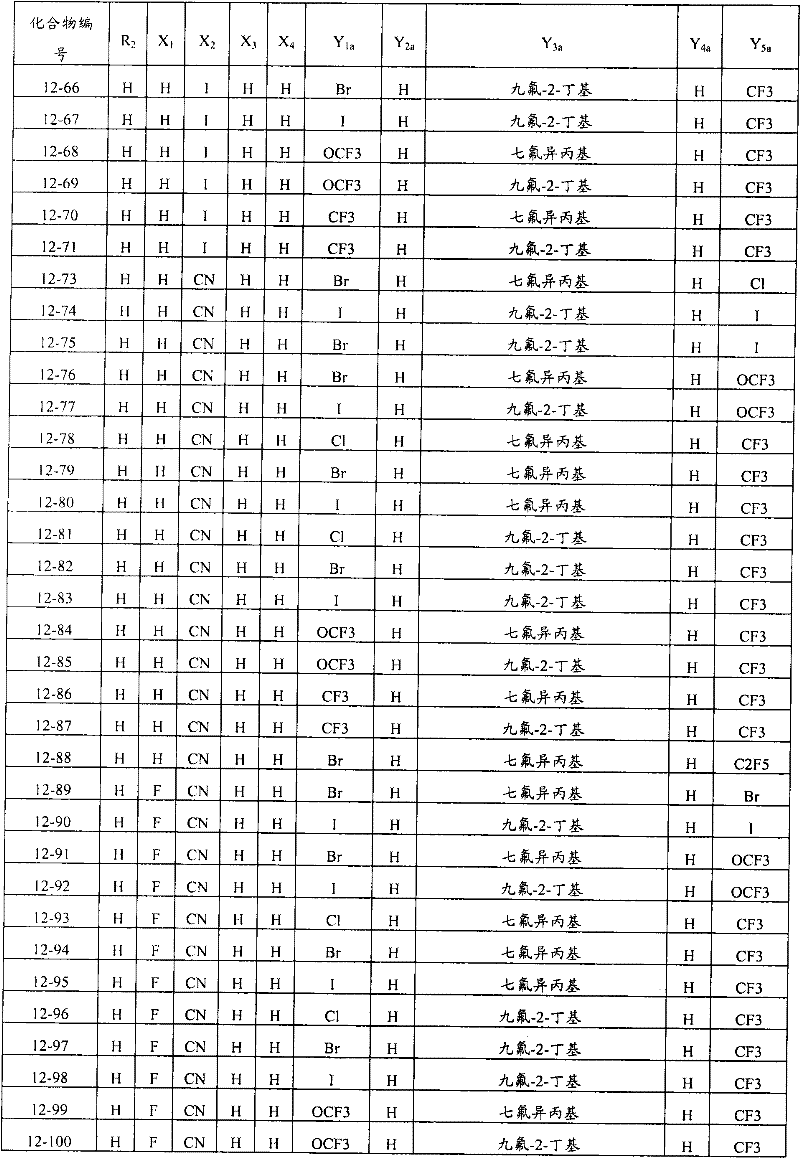
[表99][Table 99]
第12表(4)Form 12 (4)
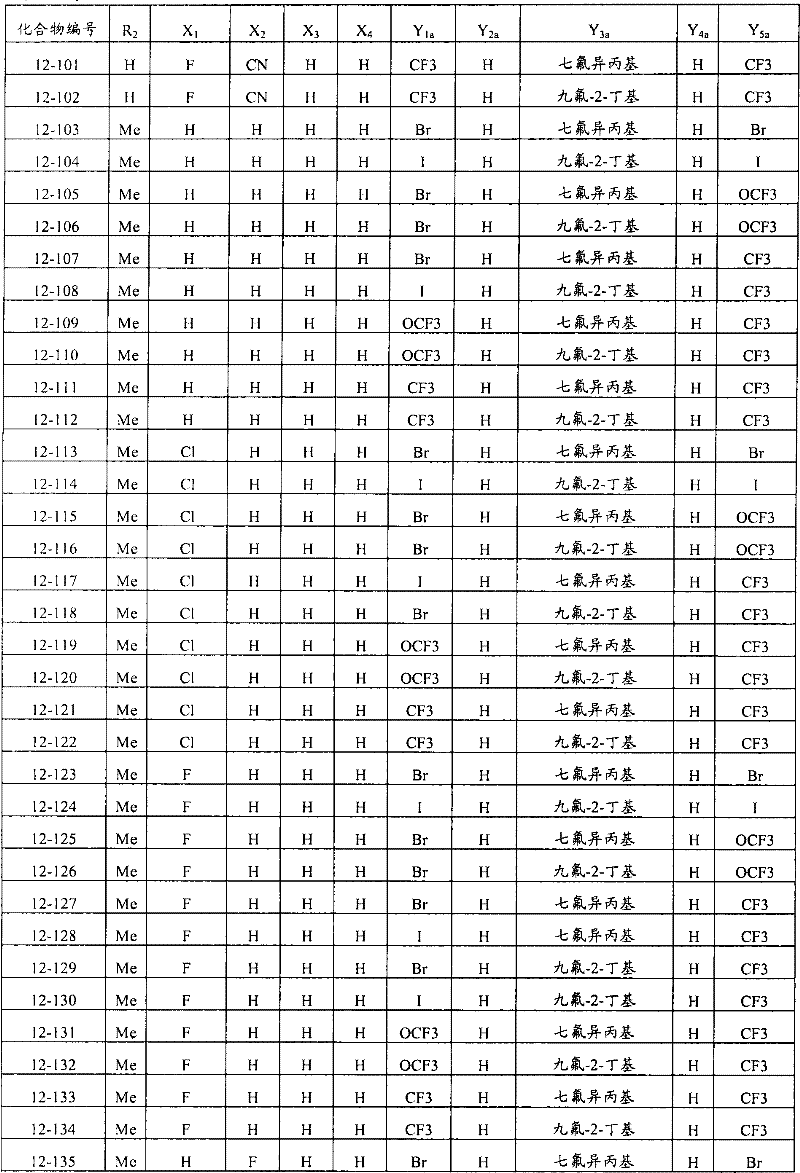
[表100][Table 100]
第12表(5)Form 12 (5)

[表101][Form 101]
第12表(6)Form 12 (6)
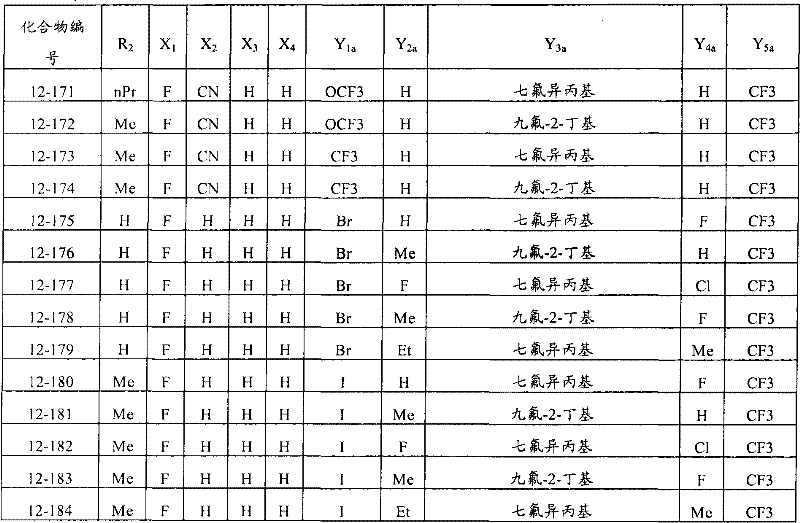
[表102][Table 102]

第13表(1)Form 13 (1)

[表103][Table 103]
第13表(2)Form 13 (2)
[表104][Table 104]
第13表(3)Form 13 (3)

[表105][Table 105]
第13表(4)Form 13 (4)

[表106][Table 106]
第13表(5)Form 13 (5)

[表107][Table 107]
第13表(6)Form 13 (6)

[表108][Table 108]
第14表(1)Form 14 (1)

[表109][Table 109]
第14表(2)Form 14 (2)
[表110][Form 110]

第15表(1)Form 15 (1)
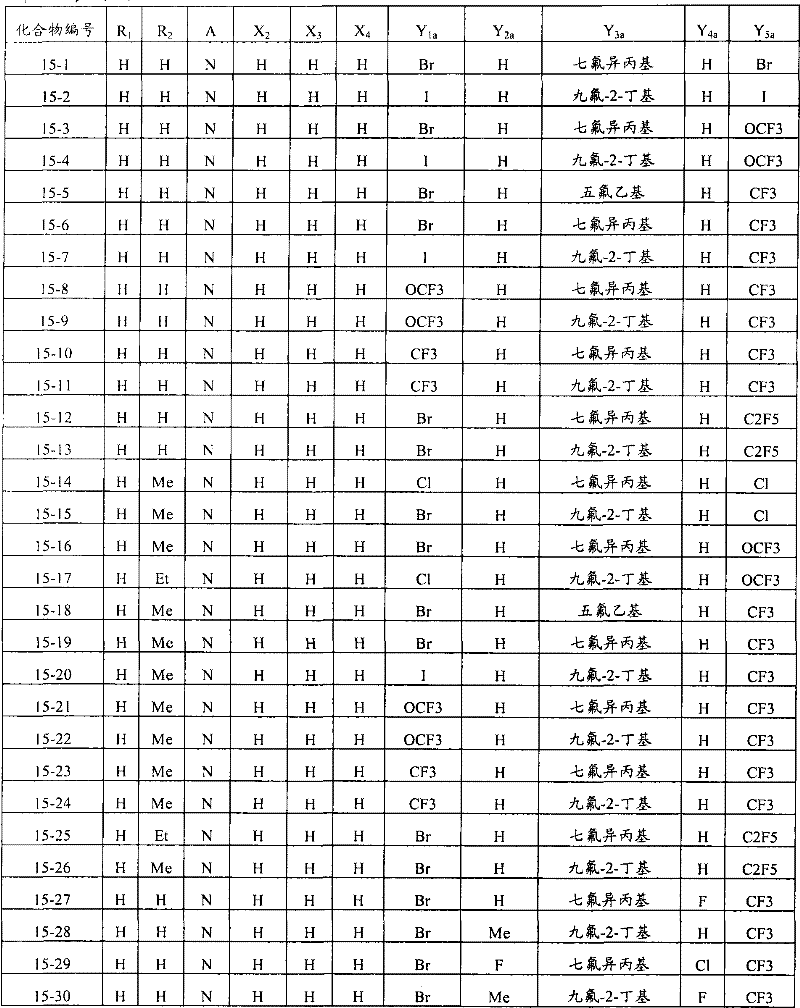
[表111][Table 111]
第15表(2)Form 15 (2)

[表112][Table 112]
第15表(3)Form 15 (3)

[表113][Form 113]
第15表(4)Form 15 (4)

[表114][Table 114]

第16表(1)Form 16(1)


[表115][Table 115]

第17表(1)Form 17(1)


[表116][Form 116]
第17表(2)Form 17 (2)


[表117][Table 117]
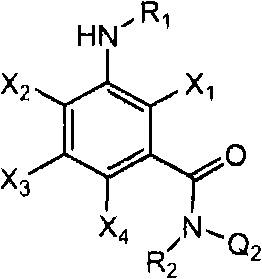
第18表(1)Form 18(1)

[表118][Table 118]
第18表(2)Form 18 (2)
[表119][Table 119]
第18表(3)Form 18 (3)

[表120][Table 120]
第18表(4)Form 18 (4)

[表121][Table 121]
第18表(5)Form 18 (5)

[表122][Table 122]
第19表(1)Form 19 (1)
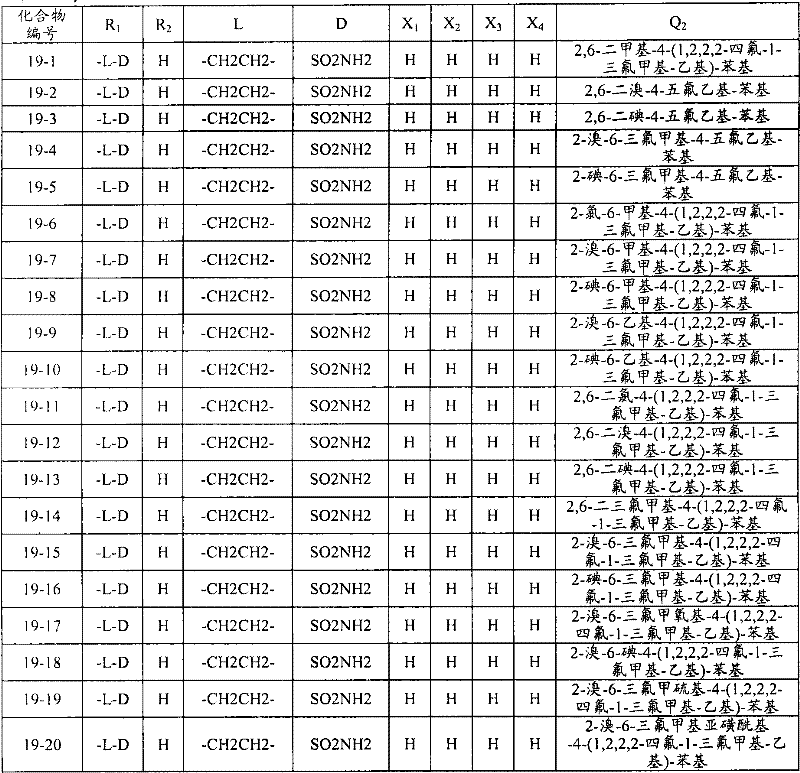
[表123][Table 123]
第19表(2)Form 19 (2)

[表124][Table 124]
第19表(3)Form 19 (3)

[表125][Table 125]
第19表(4)Form 19 (4)
[表126][Table 126]

第20表(1)Form 20 (1)

[表127][Table 127]
第20表(2)Form 20 (2)

[表128][Table 128]
第20表(3)Form 20 (3)

[表129][Table 129]
第20表(4)Form 20 (4)

[表130][Table 130]
第20表(5)Form 20 (5)
[表131][Table 131]
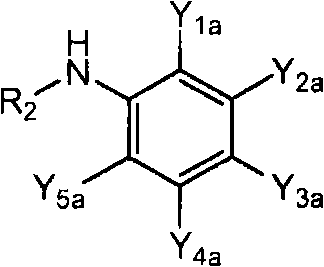
第21表(1)Form 21(1)
[表132][Table 132]
第21表(2)Form 21 (2)
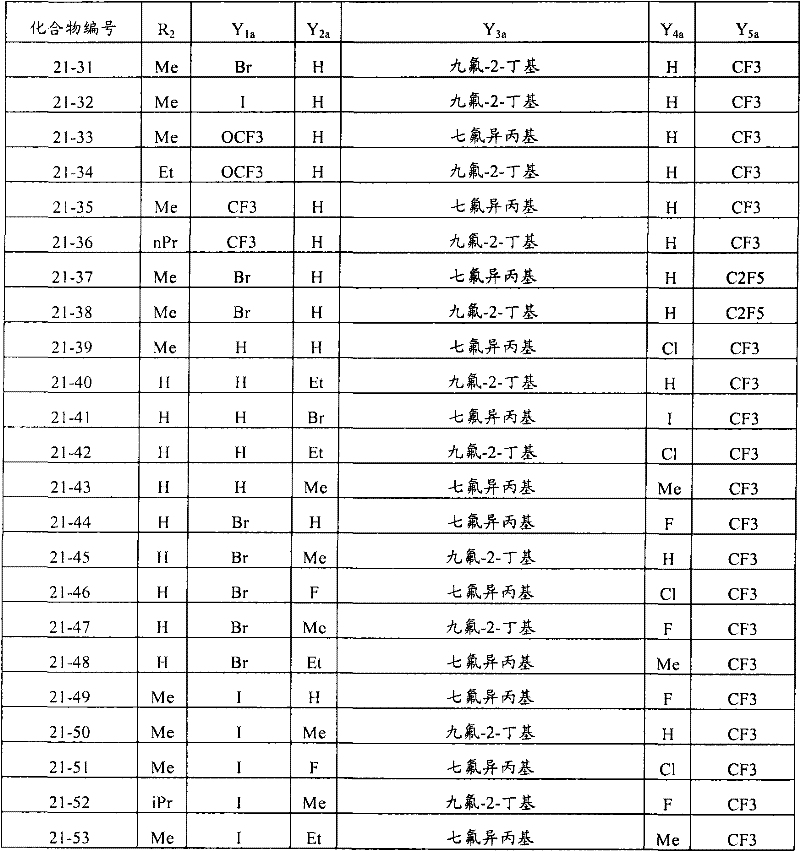
以下,第10表给出了本发明的通式(1)表示的化合物表示的化合物的物性值。另外,第22表给出了作为本发明化合物中间体的通式(6a)、通式(6b)、通式(6c)及通式(6d)表示的化合物的物性值。此处给出的1H-NMR的位移值在没有特别记载的情况下,使用四甲基硅烷作为内标物。Table 10 below shows the physical property values of the compounds represented by the compounds represented by the general formula (1) of the present invention. In addition, Table 22 shows physical property values of compounds represented by general formula (6a), general formula (6b), general formula (6c) and general formula (6d), which are intermediates of the compounds of the present invention. The 1 H-NMR shift values given here used tetramethylsilane as an internal standard unless otherwise specified.
[表133][Table 133]
第10表(1)Form 10 (1)

[表134][Table 134]
第10表(2)Form 10 (2)
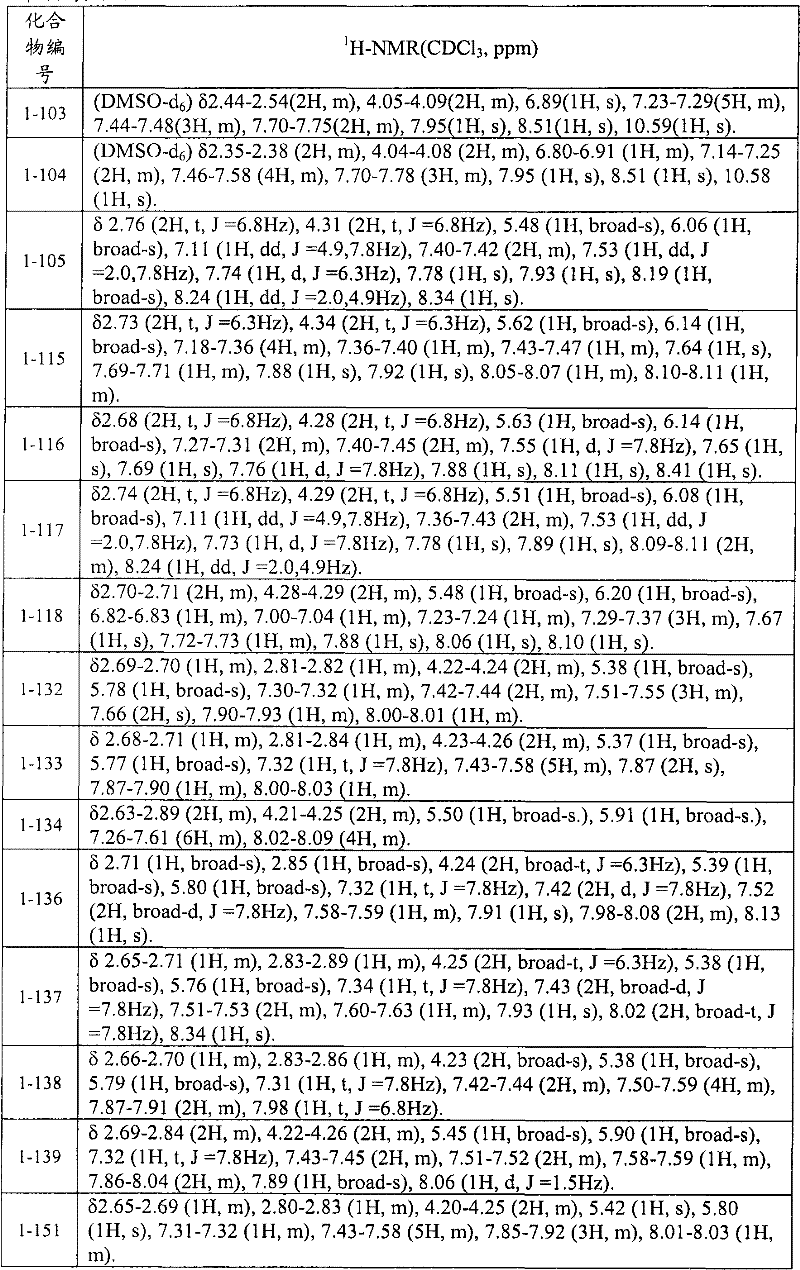
[表135][Table 135]
第10表(3)Form 10 (3)

[表136][Table 136]
第10表(4)Form 10 (4)

[表137][Table 137]
第10表(5)Form 10 (5)

[表138][Table 138]
第10表(6)Form 10 (6)
[表139][Table 139]
第10表(7)Form 10 (7)

[表140][Form 140]
第10表(8)Form 10 (8)

[表141][Table 141]
第10表(9)Form 10 (9)
[表142][Table 142]
第10表(10)Form 10 (10)

[表143][Table 143]
第10表(11)Form 10 (11)
[表144][Table 144]
第10表(12)Form 10 (12)

[表145][Table 145]
第10表(13)Form 10 (13)
[表146][Table 146]
第10表(14)Form 10 (14)

[表147][Table 147]
第10表(15)Form 10 (15)

[表148][Table 148]
第10表(16)Form 10 (16)

[表149][Table 149]
第22表(1)Form 22(1)
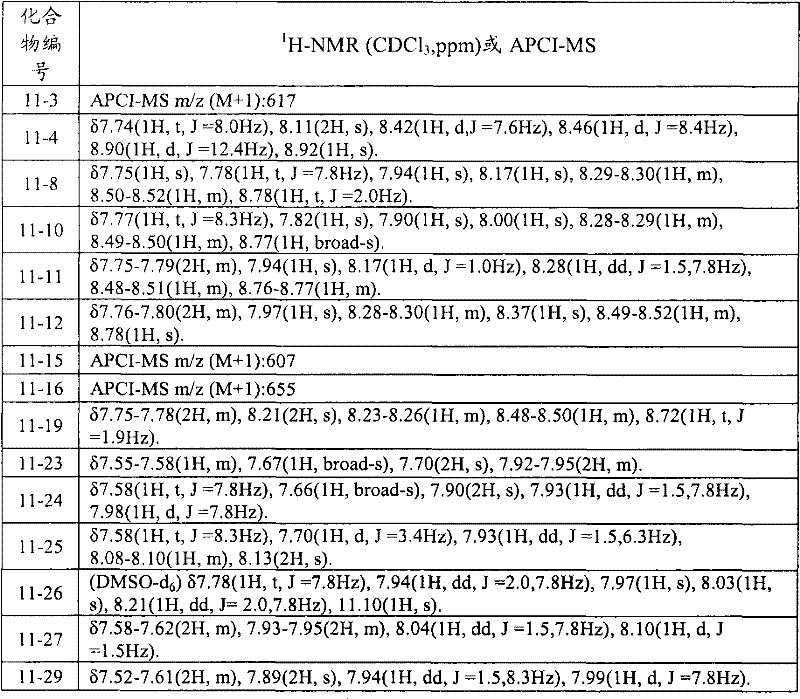
[表150][Table 150]
第22表(2)Form 22 (2)

[表151][Table 151]
第22表(3)Form 22 (3)

[表152][Table 152]
第22表(4)Form 22 (4)

[表153][Table 153]
第22表(5)Form 22 (5)
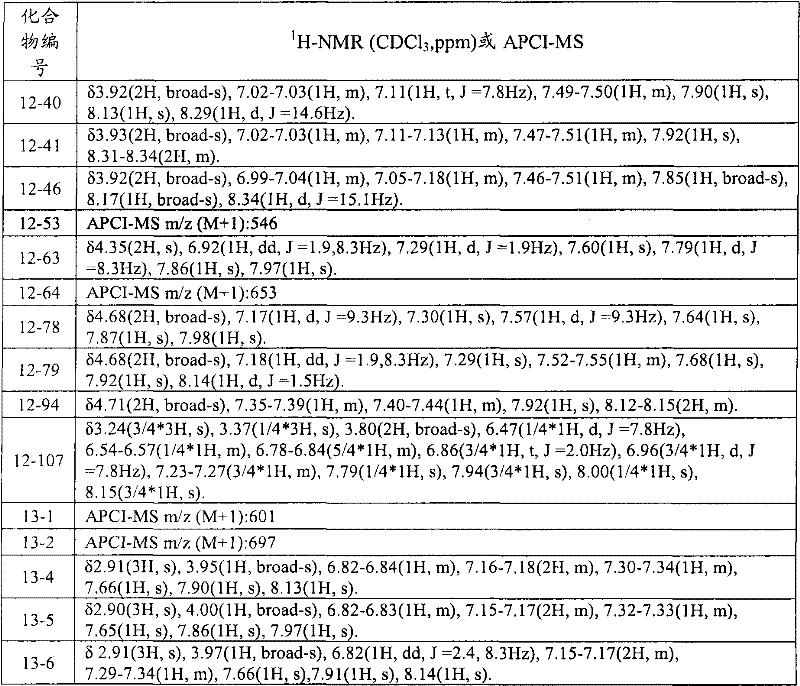
[表154][Table 154]
第22表(6)Form 22 (6)
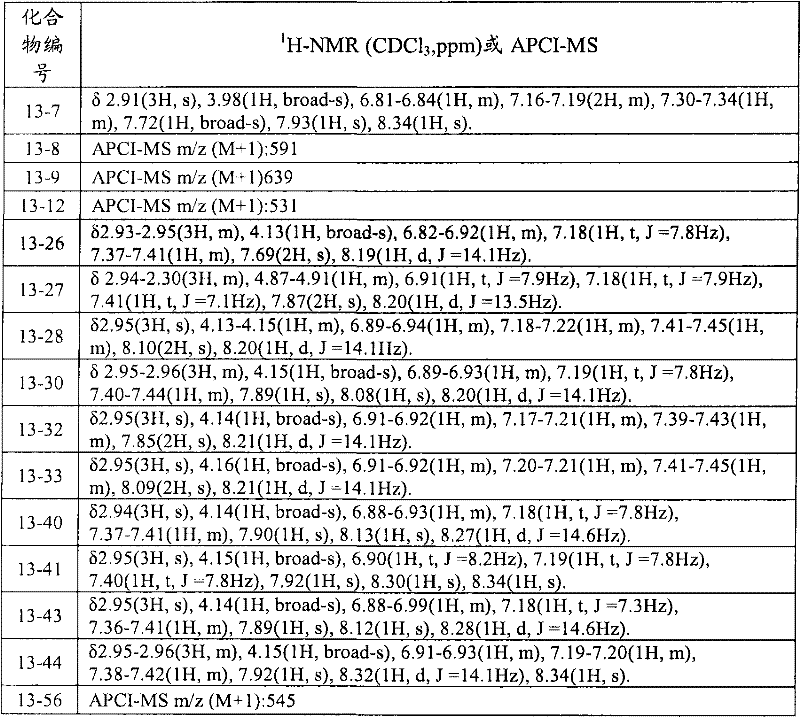
[表155][Table 155]
第22表(7)Form 22 (7)

[表156][Table 156]
第22表(8)Form 22 (8)

[表157][Table 157]
第22表(9)Form 22 (9)

本发明化合物能够以低浓度有效地防除下述害虫:危害农园艺作物及树木等的所谓农业害虫、寄生于家畜·家禽类的所谓家畜害虫、对房屋等人们的生活环境带来各种不良影响的所谓卫生害虫、危害建筑物等的木材的所谓木材食害虫、作为危害仓库中储存的谷物等的所谓储粮害虫的昆虫类、及在同样情况下发生、并进行危害的螨类、甲壳类、软体动物、线虫类中的任意的有害生物。The compound of the present invention can effectively control the following pests at a low concentration: so-called agricultural pests that harm agricultural and horticultural crops and trees, so-called livestock pests that parasitize livestock and poultry, and various adverse effects on people's living environments such as houses The so-called sanitation pests, the so-called wood-eating pests that harm the wood of buildings, etc., the so-called stored-grain pests that harm the grains stored in warehouses, etc., and the mites and crustaceans that occur and cause damage under the same circumstances , mollusks, nematodes any harmful organisms.
能够使用本发明化合物进行防除的昆虫类、螨类、甲壳类、软体动物及线虫类,具体而言可以列举如下:The insects, mites, crustaceans, molluscs and nematodes that can be controlled by the compound of the present invention can be specifically listed as follows:
茶姬卷叶蛾(Adoxophyes honmai)、茶小卷叶蛾(Adoxophyes oranafaciata)、梨黄卷蛾(Archips breviplicanus)、乱纹苹果卷叶蛾(Archipsfuscocupreanus)、梨小食心虫(Grapholita molesta)、茶长卷叶蛾(Homonamagnanima)、大豆食心虫(Leguminivora glycinivorella)、豆小卷蛾(Matsumuraeses phaseoli)、苹果褐卷叶蛾(Pandemis heparana)、梨梭果蛾(Bucculatrix pyrivorella)、桃潜蛾(Lyonetia clerkella)、银纹潜蛾(Lyonetiaprunifoliella malinella)、茶细蛾(Caloptilia theivora)、金纹小潜细蛾(Phyllonorycter ringoniella)、柑橘叶潜蛾(Phyllocnistis citrella)、葱菜蛾(Acrolepiopsis sapporensis)、山芋伪菜蛾(Acrolepiopsis suzukiella)、小菜蛾(Plutella xylostella)、柿举肢蛾(Stathmopoda masinissa)、甘薯阳麦蛾(Helcystogramma triannulella)、红铃麦蛾(Pectinophora gossypiella)、桃蛀果蛾(Carposina sasakii)、苹果小卷蛾(Cydla pomonella)、二化螟(Chilosuppressalis)、稻纵卷叶螟(Cnaphalocrocis medinalis)、桃蛀螟(Conogethespunctiferalis)、瓜绢野螟(Diaphania indica)、豆荚斑螟(Etiella zinckenella)、桑绢野螟(Glyphodes pyloalis)、菜螟(Hellula undalis)、亚洲玉米螟(Ostriniafurnacalis)、豆秆野螟(Ostrinia scapulalis)、玉米螟(Ostrinia nubilalis)、草螟(Parapediasia teterrella)、稻弄蝶(Parnara guttata)、大菜粉蝶(Pierisbrassicae)、纹白蝶(Pieris rapae crucivora)、大造桥虫(Ascotis selenaria)、大豆夜蛾(Pseudoplusia includens)、茶黄毒蛾(Euproctis pseudoconspersa)、舞毒蛾(Lymantria dispar)、旋古毒蛾(Orgyia thyellina)、秋幕蛾(Hyphantriacunea)、奇特望灯蛾(Lemyra imparilis)、枯叶夜蛾(Adris tyrannus)、白斑烦夜蛾(Aedia leucomelas)、球菜夜蛾(Agrotis ipsilon)、芜菁夜蛾(Agrotissegetum)、黑点银纹夜蛾(Autographa nigrisigna)、银纹夜蛾(Ctenoplusiaagnata)、棉铃虫(Helicoverpa armigera)、烟夜蛾(Helicoverpa assulta)、谷实夜蛾(Helicoverpa zea)、烟芽夜蛾(Heliothis virescens)、甘蓝夜蛾(Mamestra brassicae)、粘虫(Mythimna separata)、稻螟蛉(Narangaaenescens)、南方灰翅夜蛾(Spodoptera eridania)、甜菜夜蛾(Spodopteraexigua)、草地贪夜蛾(Spodoptera frugiperda)、海灰翅夜蛾(Spodopteralittoralis)、斜纹夜蛾(Spodoptera litura)、淡剑纹灰翅夜蛾(Spodopteradepravata)、粉纹夜蛾(Trichoplusia ni)、葡萄莓果飞蛾(Endopiza viteana)、番茄天蛾(Manduca quinquemaculata)、烟草天蛾(Manduca sexta)等鳞翅目昆虫;Adoxophyes honmai, Adoxophyes oranafaciata, Archips breviplicanus, Archips fuscocupreanus, Grapholita molesta, Homonamagnanima, Soy bean (Leguminivora glycinivorella), bean tortrix (Matsumuraeses phaseoli), apple brown leaf tortrix (Pandemis heparana), pear shuttle moth (Bucculatrix pyrivorella), peach miner (Lyonetia clerkella), silver miner moth (Lyonetiaprunifoliella maleella), tea fine Caloptilia theivora, Phyllonorycter ringoniella, Phyllocnistis citrella, Acrolepiopsis sapporensis, Acrolepiopsis suzukiella, Plutella xylostella, Stathmopoda masinissa, Helcystogramma triannulella, Pectinophora gossypiella, Carposina sasakii, Cydla pomonella, Chilosuppressalis ), Cnaphalocrocis medinalis, Conogethes punctiferalis, Diaphania indica, Etiella zinckenella, Glyphodes pyloalis, Hellula undalis , Asian Corn Borer (Ostrinia furnacalis), Bean Stalk Borer (Ostrinia scapulalis), Corn Borer (Ostrinia nubilalis), Grass Borer (Parapediasia teterrella), Rice Butterfly (Parnara guttata), Cabbage White Butterfly (Pieris brassicae), White Butterfly (Pieris rapae crucivora), Ascotis selenaria, Pseudoplusia includens, Euproctis pseudoconspersa, Lymantria dispar, Orgyia thyellina, Hyphantriacunea, Lemyra imparilis, Adris tyrannus, Aedia leucomelas, Agrotis ipsilon, Agrotis segetum, Agrotis tyrannus (Autographa nigrisigna), Silver moth (Ctenoplusia agnata), Cotton bollworm (Helicoverpa armigera), Smoke armyworm (Helicoverpa assulta), Cereal armyworm (Helicoverpa zea), Tobacco budworm (Heliothis virescens), Cabbage armyworm ( Mamestra brassicae), Armyworm (Mythimna separata), Rice Bollworm (Narangaaenescens), Southern Spodoptera eridania, Beet Spodoptera (Spodoptera exigua), Spodoptera frugiperda, Spodoptera littoralis ), Spodoptera litura, Spodoptera depravata, Trichoplusia ni, Endopiza viteana, Manduca quinquemaculata, Tobacco manduca Moth (Manduca sexta) and other Lepidoptera insects;
花蓟马(Frankliniella intonsa)、西方花蓟马(Frankliniella occidentalis)、温室蓟马(Heliothrips haemorrhoidalis)、茶黄蓟马(Scirtothrips dorsalis)、南黄蓟马(Thrips palmi)、葱蓟马(Thrips tabaci)、Ponticulothrips diospyrosi等总翅目昆虫;Flower thrips (Frankliniella intonsa), western flower thrips (Frankliniella occidentalis), greenhouse thrips (Heliothrips haemorrhoidalis), tea yellow thrips (Scirtothrips dorsalis), southern yellow thrips (Thrips palmi), onion thrips (Thrips tabaci) , Ponticulothrips diospyrosi and other totaloptera insects;
斑须蝽(Dolycoris baccarum)、皱纹菜蝽(Eurydema rugosum)、北二星蝽(Eysarcoris aeneus)、日本二星蝽(Eysarcoris lewisi)、黑腹蝽(Eysarcorisventralis)、青蝽(Glaucias subpunctatus)、茶翅蝽(Halyomorpha halys)、黑须绿稻蝽(Nezara antennata)、稻绿蝽(Nezara viridula)、璧蝽(Piezodorushybneri)、珀蝽(Plautia crossota)、稻黑蝽(Scotinophora lurida)、稻棘缘蝽(Cletus punctiger)、中华稻缘蝽(Leptocorisa chinensis)、棒峰缘蝽(Riptortusclavatus)、胡萝卜缘蝽(Rhopalus msculatus)、甘蔗长蝽(Caveleriussaccharivorus)、葫芦长蝽(Togo hemipterus)、绵红蝽(Dysdercuscingulatus)、杜鹃冠网蝽(Stephanitis pyrioides)、Halticus insularis、美洲牧草盲蝽(Lygus lineolaris)、西伯利亚狭盲蝽(Stenodema sibiricum)、赤条纤盲蝽(Stenotus rubrovittatus)、稻叶害虫(Trigonotylus caelestialium)、葡萄阿小叶蝉(Arboridia apicalis)、黑胸二室叶蝉(Balclutha saltuella)、二点大叶蝉(Epiacanthus stramineus)、蚕豆微叶蝉(Empoasca fabae)、Empoascanipponica、大贯小绿叶蝉(Empoasca onukii)、板井小绿叶蝉(Empoascasakaii)、Macrosteles striifrons、黑尾叶蝉(Nephotettix cinctinceps)、Psuedatomoscelis seriatus、灰飞虱(Laodelphax striatella)、褐飞虱(Nilaparvata lugens)、白背飞虱(Sogatella furcifera)、柑橘木虱(Diaphorinacitri)、梨木虱(Psylla pyrisuga)、桔刺粉虱(Aleurocanthus spiniferus)、银叶粉虱(Bemisia argentifolii)、烟草粉虱(Bemisia tabaci)、柑橘粉虱(Dialeurodes citri)、温室白粉虱(Trialeurodes vaporariorum)、葡萄根瘤蚜(Viteus vitifolii)、棉蚜(Aphis gossypii)、绣线菊蚜(Aphis spiraecola)、桃蚜(Myzus persicae)、桔二叉蚜(Toxoptera aurantii)、草履蚧(Drosichacorpulenta)、吹绵蚧(Icerya purchasi)、石蒜绵粉蚧(Phenacoccus solani)、桔臀纹粉蚧(Planococcus citri)、藤臀纹粉蚧(Planococcus kuraunhiae)、康氏粉介壳虫(Pseudococcus comstocki)、角蜡蚧(Ceroplastes ceriferus)、红蜡蚧(Ceroplastes rubens)、红圆蚧(Aonidiella aurantii)、梨圆介壳虫(Comstockaspis perniciosa)、茶园盾介壳虫(Fiorinia theae)、牡丹网盾蚧(Pseudaonidia paeoniae)、桑白盾蚧(Pseudaulacaspis pentagona)、梅白蚧(Pseudaulacaspis prunicola)、卫矛蜕盾蚧(Unaspis euonymi)、箭头介壳虫(Unaspis yanonensis)、温带臭虫(Cimex lectularius)等半翅目昆虫;古铜异丽金龟(Anomala cuprea)、姬金龟(Anomala rufocuprea)、小青花金龟(Gametis jucunda)、沥青七腮金龟(Heptophylla picea)、豆金龟(Popilliajaponica)、马铃薯叶甲(Lepinotarsa decemlineata)、红薯梳爪叩甲(Melanotus fortnumi)、庶梳爪叩头虫(Melanotus tamsuyensis)、烟甲虫(Lasioderma serricorne)、Epuraea domina、竹蛀屑(Lyctus brunneus)、谷蠹(Rhizopertha dominica)、墨西哥豆瓢虫(Epilachna varivestis)、二十八星瓢虫(Epilachna vigintioctopunctata)、黄粉虫(Tenebrio molitor)、赤拟谷盗(Tribolium castaneum)、星天牛(Anoplophora malasiaca)、松墨天牛(Monochamus alternatus)、黄星天牛(Psacothea hilaris)、葡萄虎天牛(Xylotrechus pyrrhoderus)、绿豆象(Callosobruchus chinensis)、黄守瓜(Aulacophora femoralis)、菾菜跳甲(Chaetocnema concinna)、黄瓜点叶甲(Diabrotica undecimpunctata)、玉米根叶甲(Diabrotica virgifera)、北方玉米根虫(Diabrotica barberi)、稻负泥虫(Oulema oryzae)、黄条叶蚤(Phyllotreta striolata)、茄窄胸跳甲(Psylliodes angusticollis)、桃实象(Rhynchites heros)、甘薯小象甲(Cylas formicarius)、墨西哥棉铃象(Anthonomus grandis)、稻象(Echinocnemus squameus)、西印度甘薯象(Euscepes postfasciatus)、紫苜蓿叶象(Hypera postica)、稻水象甲(Lissohoptrus oryzophilus)、葡萄黑耳喙象(Otiorhynchus sulcatus)、谷象(Sitophilus granarius)、玉米象(Sitophilus zeamais)、Sphenophorus venatusvestitus、青翅隐翅虫(Paederus fuscipes)等鞘翅目昆虫;Dolycoris baccarum, Eurydema rugosum, Eysarcoris aeneus, Eysarcoris lewisi, Eysarcoris ventralis, Glaucias subpunctatus, tea winged bug ( Halyomorpha halys), Nezara antennata, Nezara viridula, Piezodorushybneri, Plautia crossota, Scotinophora lurida, Cletus punctiger ), Leptocorisa chinensis, Riptortus clavatus, Rhopalus msculatus, Cavelerius saccharivorus, Togo hemipterus, Dysdercuscingulatus, Rhododendron Stephanitis pyrioides, Halticus insularis, Lygus lineolaris, Stenodema sibiricum, Stenotus rubrovittatus, Trigonotylus caelestialium, Grape leaf bug Cicada (Arboridia apicalis), black-breasted two-chambered leafhopper (Balclutha saltuella), two-spotted leafhopper (Epiacanthus stramineus), faba bean micro-leafhopper (Empoasca fabae), Empoascanipponica, large green leafhopper (Empoasca onukii), itai small leafhopper Green leafhopper (Empoascasakaii), Macrosteles striifrons, black-tailed leafhopper (Nephotettix cinctinceps), Psuedatomoscelis seriatus, gray planthopper (Laodelphax striatella), brown planthopper (Nilaparvata lugens), white-backed planthopper (Sogatella furcifera), citrus psyllid (Diaphorinacitri) , pear psyllid (Psylla pyrisuga), orange thorn Whitefly (Aleurocanthus spiniferus), silverleaf whitefly (Bemisia argentifolii), tobacco whitefly (Bemisia tabaci), citrus whitefly (Dialeurodes citri), greenhouse whitefly (Trialeurodes vaporariorum), grape phylloxera (Viteus vitifolii), cotton aphid (Aphis gossypii), Aphis spiraecola, Myzus persicae, Toxoptera aurantii, Drosichacorpulenta, Icerya purchasi, Amaryllis lycoides ( Phenacoccus solani), Planococcus citri, Planococcus kuraunhiae, Pseudococcus comstocki, Ceroplastes ceriferus, Ceroplastes rubens, Aonidiella aurantii, Comstockaspis perniciosa, Fiorinia theae, Pseudaonidia paeoniae, Pseudalacaspis pentagona, Pseudaulacaspis prunicola ), Unaspis euonymi, Unaspis yanonensis, Cimex lectularius and other Hemiptera insects; Anomala cuprea, Anomala rufocuprea, small Blue-and-white beetle (Gametis jucunda), pitch beetle (Heptophylla picea), bean beetle (Popillia japonica), potato leaf beetle (Lepinotarsa decemlineata), sweet potato comb-clawed beetle (Melanotus fortnumi), common-clawed beetle (Melanotus tamsuyensis), Smoke beetle (Lasioderma serricorne), Epuraea domina, bamboo borer (Lyctus brunneus), grain beetle (Rhizopertha dominica), Mexican Epilachna varivestis, Epilachna vigintioctopunctata, Tenebrio molitor, Tribolium castaneum, Anoplophora malasiaca, Monochamus alternatus), Psacothea hilaris, Xylotrechus pyrrhoderus, Callosobruchus chinensis, Aulacophora femoralis, Chaetocnema concinna, Diabrotica undecimpunctata, Corn rootworm (Diabrotica virgifera), northern corn rootworm (Diabrotica barberi), rice mudworm (Oulema oryzae), yellow striped leafworm (Phyllotreta striolata), eggplant narrow-breasted flea beetle (Psylliodes angusticollis), peach fruit worm ( Rhynchites heroos), sweet potato weevil (Cylas formicarius), Mexican cotton boll weevil (Anthonomus grandis), rice weevil (Echinocnemus squameus), West Indian sweet potato weevil (Euscepes postfasciatus), alfalfa leaf weevil (Hypera postica), rice water weevil (Lissohoptrus oryzophilus), grape black-eared beak elephant (Otiorhynchus sulcatus), grain elephant (Sitophilus granarius), corn elephant (Sitophilus zeamais), Sphenophorus venatusvestitus, blue-winged paederus (Paederus fuscipes) and other Coleoptera insects;
Asphondylia yushimai、麦红吸浆虫(Sitodiplosis mosellana)、瓜蝇(Bactrocera cucurbitae)、桔小实蝇(Bactrocera dorsalis)、地中海实蝇(Ceratitis capitata)、大麦水蝇(Hydrellia griseola)、樱桃果蝇(Drosophilasuzukii)、稻秆潜蝇(Agromyza oryzae)、豌豆彩潜蝇(Chromatomyiahorticola)、番茄斑潜蝇(Liriomyza bryoniae)、葱斑潜蝇(Liriomyzachinensis)、蔬菜斑潜蝇(Liriomyza sativae)、非洲菊斑潜蝇(Liriomyzatrifolii)、灰地种蝇(Delia platura)、肖藜泉蝇(Pegomya cunicularia)、苹果实蝇(Rhagoletis pomonella)、麦瘿蚊(Mayetiola destructor)、家蝇(Muscadomestica)、厩螫蝇(Stomoxys calcitrans)、绵羊虱蝇(Melophagus ovinus)、牛皮蝇(Hypoderma bovis)、纹皮蝇(Hypoderma lineatum)、羊狂蝇(Oestrusovis)、刺舌蝇(Glossina palpalis,Glossina morsitans)、Prosimuliumyezoensis、虻(Tabanus trigonus)、白斑蛾蚋(Telmatoscopus albipunctatus)、日本细蠓(Leptoconops nipponensis)、淡色库蚊(Culex pipiens pallens)、埃及斑蚊(Aedes aegypti)、亚洲虎蚊(Aedes albopicutus)、Anopheleshyracanus sinesis等双翅目昆虫;Asphondylia yushimai, Sitodiplosis mosellana, Bactrocera cucurbitae, Bactrocera dorsalis, Ceratitis capitata, Hydrellia griseola, Drosophilasuzukii, Agromyza oryzae, Chromatomyia horticola, Liriomyza bryoniae, Liriomyzachinensis, Liriomyza sativae, Liriomyzatrifolii ), Delia platura, Pegomya cunicularia, Rhagoletis pomonella, Mayetiola destructor, Muscadomestica, Stomoxys calcitrans, Sheep lice Melophagus ovinus, Hypoderma bovis, Hypoderma lineatum, Oestrusovis, Glossina palpalis, Glossina morsitans, Prosimulium yezoensis, Tabanus trigonus, white gnat (Telmatoscopus albipunctatus), Japanese midge (Leptoconops nipponensis), Culex pipiens pallens, Aedes aegypti, Asian tiger mosquito (Aedes albopicutus), Anopheles hyracanus sinesis and other dipteran insects;
Apethymus kuri、新疆菜叶蜂(Athalia rosae)、玫瑰三节叶蜂(Argepagana)、松柏锯角叶蜂(Neodiprion sertifer)、板栗瘿蜂(Dryocosmuskuriphilus)、行军蚁(Eciton burchelli,Eciton schmitti)、本弓背蚁(Camponotus japonicus)、大胡蜂(Vespa mandarina)、公牛蚁(Myrmeciaspp.)、红火蚁类(Solenopsis spp.)、法老蚁(Monomorium pharaonis)等膜翅目昆虫;Apethymus kuri, Athalia rosae, Argepagana, Neodiprion sertifer, Dryocosmuskuriphilus, Eciton burchelli, Eciton schmitti, Eciton schmitti Ants (Camponotus japonicus), hornets (Vespa mandarina), bull ants (Myrmecias pp.), red fire ants (Solenopsis spp.), Pharaoh ants (Monomorium pharaonis) and other Hymenoptera insects;
黄脸油葫芦(Teleogryllus emma)、东方蝼蛄(Gryllotalpa orientalis)、飞蝗(Locusta migratoria)、小翅稻蝗(Oxya yezoensis)、沙漠蝗(Schistocercagregaria)等直翅目昆虫;Yellow-faced oil gourd (Teleogryllus emma), oriental mole cricket (Gryllotalpa orientalis), migratory locust (Locusta migratoria), small-winged rice locust (Oxya yezoensis), desert locust (Schistocercagregaria) and other Orthoptera insects;
菜白棘跳虫(Onychiurus folsomi)、北极棘跳虫(Onychiurus sibiricus)、黄星圆跳虫(Bourletiella hortensis)等粘管目昆虫;Onychiurus folsomi, Onychiurus sibiricus, Bourletiella hortensis, and other insects of the order Myotubes;
黑胸大蠊(Periplaneta fuliginosa)、日本大蠊(Periplaneta japonica)、德国小蠊(Blattella germanica)等网翅目昆虫;Black-breasted cockroach (Periplaneta fuliginosa), Japanese cockroach (Periplaneta japonica), German cockroach (Blattella germanica) and other Dictoptera insects;
台湾乳白蚁(Coptotermes formosanus)、栖北散白蚁(Reticulitermessperatus)、黑翅土白蚁(Odontotermes formosanus)等等翅目昆虫;Insects of the order Coptotermes formosanus, Reticulitermessperatus, Odontotermes formosanus, etc.;
猫蚤(Ctenocephalidae felis)、狗蚤(Ctenocephalides canis)、鸡蚤(Echidnophaga gallinacea)、人蚤(Pulex irritans)、印鼠客蚤(Xenopsyllacheopis)等翅目昆虫;Cat fleas (Ctenocephalidae felis), dog fleas (Ctenocephalides canis), chicken fleas (Echidnophaga gallinacea), human fleas (Pulex irritans), Indian mouse fleas (Xenopsyllacheopis) and other insects;
黄体羽虱(Menacanthus stramineus)、牛鸟虱(Bovicola bovis)等食毛目昆虫;Trichophagous insects such as Menacanthus stramineus and Bovicola bovis;
牛虱(Haematopinus eurysternus)、猪血虱(Haematopinus suis)、牛颚虱(Linognathus vituli)、水牛盲虱(Solenopotes capillatus)等虱目昆虫;Cow lice (Haematopinus eurysternus), pig blood lice (Haematopinus suis), cow jaw lice (Linognathus vituli), buffalo blind lice (Solenopotes capillatus) and other lice;
樱草植食螨(Phytonemus pallidus)、侧多食跗线螨(Polyphagotarsonemus latus)、双叶跗线螨(Tarsonemus bilobatus)等埃螨类;Phytonemus pallidus, Polyphagotarsonemus latus, Tarsonemus bilobatus, etc.;
Penthaleus erythrocephalus、麦叶爪螨(Penthaleus major)等走螨类;Penthaleus erythrocephalus, wheat leaf claw mite (Penthaleus major) and other mites;
真梶小爪螨(Oligonychus shinkajii)、柑橘全爪螨(Panonychus citri)、桑全爪螨(Panonychus mori)、苹果全爪螨(Panonychus ulmi)、神泽叶螨(Tetranychus kanzawai)、二点叶螨(Tetranychus urticae)等叶螨类;Oligonychus shinkajii, Panonychus citri, Panonychus mori, Panonychus ulmi, Tetranychus kanzawai, Two-spotted spider mite (Tetranychus urticae) and other spider mites;
茶尖叶节蜱(Acaphylla theavagrans)、郁金香瘿螨(Aceria tulipae)、番茄刺皮瘿螨(Aculops lycopersici)、桔刺皮瘿螨(Aculops pelekassi)、斯氏刺瘿螨(Aculus schlechtendali)、Eriophyes chibaensis、桔皱叶刺瘿螨(Phyllocoptruta oleivora)等瘿螨类;Acaphylla theavagrans, Aceria tulipae, Aculops lycopersici, Aculops pelekassi, Aculus schlechtendali, Eriophyes chibaensis , Phyllocoptruta oleivora and other gall mites;
罗宾根螨(Rhizoglyphus robini)、腐蚀酪螨(Tyrophagus putrescentiae)、似食酪螨(Tyrophagus similis)等粉螨类;Robin root mite (Rhizoglyphus robini), corrosion tyromite (Tyrophagus putrescentiae), tyrophagus similis and other acaroid mites;
雅氏瓦螨(Varroa jacobsoni)等瓦螨类;Varroa mites such as Varroa jacobsoni;
微小牛蜱(Boophilus microplus)、血红扇头蜱(Rhipicephalussanguineus)、长角血蜱(Haemaphysalis longicornis)、褐黄血蜱(Haemophysalis flava)、铃头血蜱(Haemophysalis campanulata)、卵形硬蜱(Ixodes ovatus)、全沟硬蜱(Ixodes persulcatus)、花蜱(Amblyomma spp.)、革蜱(Dermacentor spp.)等蜱类;Boophilus microplus, Rhipicephalus sanguineus, Haemaphysalis longicornis, Haemophysalis flava, Haemophysalis campanulata, Ixodes ovatus ), Ixodes persulcatus, Amblyomma spp., Dermacentor spp. and other ticks;
犬姬螯螨(Cheyletiella yasguri)、猫姬螯螨(Cheyletiella blakei)等肉食螨类;Carnivorous mites such as Cheyletiella yasguri and Cheyletiella blakei;
犬蠕形螨(Demodex canis)、猫蠕形螨(Demodex cati)等蠕形螨类;Demodex canis (Demodex canis), cat Demodex cati (Demodex cati) and other Demodex mites;
绵羊痒螨(Psoroptes ovis)等痒螨类;Psoroptes ovis and other itchy mites;
疥螨(Sarcoptes scabiei)、猫背肛螨(Notoedres cati)、膝螨(Knemidocoptes spp.)等疥螨类;Sarcoptes scabiei, Notoedres cati, Knemidocoptes spp. and other scabies;
平甲虫(Armadillidium vulgare)等甲壳类;Crustaceans such as the flat beetle (Armadillidium vulgare);
福寿螺(Pomacea canaliculata)、褐云玛瑙螺(Achatina fulica)、双线蛞蝓(Meghimatium bilineatum)、Limax Valentiana、蜗牛(Acusta despectasieboldiana)、日本土地蜗牛(Euhadra peliomphala)等腹足类;Gastropods such as Pomacea canaliculata, Achatina fulica, Meghimatium bilineatum, Limax Valentiana, Acusta despectasieboldiana, and Euhadra peliomphala;
咖啡短体线虫(Prathylenchus coffeae)、穿刺短体线虫(Prathylenchuspenetrans)、伤残短体线虫(Prathylenchus vulnus)、马铃薯金线虫(Globodera rostochiensis)、大豆胞囊线虫(Heterodera glycines)、北方根结线虫(Meloidogyne hapla)、南方根结线虫(Meloidogyne incognita)、水稻干尖线虫(Aphelenchoides besseyi)、松材线虫(Bursaphelenchus xylophilus)等线虫类等,但本发明不仅限定于此。Prathylenchus coffeee, Prathylenchus penetrans, Prathylenchus vulnus, Globodera rostochiensis, Heterodera glycines, Meloidogyne hapla), Meloidogyne incognita, Aphelenchoides besseyi, Bursaphelenchus xylophilus and the like, but the present invention is not limited thereto.
另外,本发明化合物对于对有机磷类化合物、氨基甲酸酯类化合物或拟除虫菊酯类化合物等现有杀虫剂的抗药性发达的有害生物也有效。In addition, the compounds of the present invention are also effective against harmful organisms that have developed resistance to conventional insecticides such as organophosphorus compounds, carbamate compounds, or pyrethroid compounds.
进而,本发明化合物,即使与其他农园艺用杀虫剂、杀螨剂、杀线虫剂、杀菌剂、除草剂、植物生长调节剂、生物农药等混合使用,也可以获得优异的防除效果。Furthermore, even if the compound of the present invention is mixed with other agricultural and horticultural insecticides, acaricides, nematocides, fungicides, herbicides, plant growth regulators, biopesticides, etc., excellent control effects can be obtained.
以本发明化合物作为有效成分的有害生物防除剂对侵害水田作物、旱田作物、果树、蔬菜、其他作物及花卉等的上述有害作物具有显著的防除效果,因此在预测发生有害生物的时期、以及有害生物发生前或确认到发生有害生物的时刻,对水田、旱田、果树、蔬菜、其他作物、花卉等的水田水、茎叶或土壤进行处理,由此能够得到作为本发明的有害生物防除剂的效果。The pest control agent containing the compound of the present invention as an active ingredient has a significant control effect on the above-mentioned harmful crops that infringe on paddy field crops, upland crops, fruit trees, vegetables, other crops, and flowers. Before the occurrence of organisms or when the occurrence of harmful organisms is confirmed, the water, stems and leaves or soil of paddy fields, dry fields, fruit trees, vegetables, other crops, flowers, etc. can be treated to obtain the pest control agent of the present invention. Effect.
以本发明化合物作为有效成分的有害生物防除剂,对收获物在保存中发生的储粮害虫等具有显著的防除效果。即,将以本发明化合物作为有效成分的有害生物防除剂对收割产物、或收割产物的保存场所进行喷涂、涂抹、涂布、浸渍、粉衣、熏蒸·熏烟或加压注入等收获后(postharvest)处理即可。The harmful organism control agent containing the compound of the present invention as an active ingredient has a remarkable control effect on stored grain pests and the like that occur during preservation of harvested products. That is, after harvesting such as spraying, smearing, coating, dipping, powder coating, fumigation, fumigation or pressurized injection of the pest control agent containing the compound of the present invention as an active ingredient on the harvested product or the storage place of the harvested product ( postharvest) can be processed.
将以本发明化合物作为有效成分的有害生物防除剂用于植物种子,由此能够预防由播种后的植物中发生的害虫所引起的侵害。即,以本发明化合物作为有效成分的有害生物防除剂,以防除害虫有效的量、以直接或用水等适当稀释或使其悬浊的方式,对植物种子进行喷涂、涂抹、浸渍或粉衣等处理,由此使本发明化合物与植物种子接触即可。The pest control agent containing the compound of the present invention as an active ingredient is applied to plant seeds, whereby damage by pests occurring in the sown plants can be prevented. That is, the pest control agent containing the compound of the present invention as an active ingredient is sprayed, smeared, dipped or powder-coated on plant seeds in an amount effective for controlling pests, directly or in a manner of appropriately diluting or suspending them with water or the like. Treatment whereby the compound of the invention is brought into contact with the plant seeds is sufficient.
所谓植物种子,是指储存用于植物幼苗发芽的营养成分、在农业上用于繁殖的物质。例如,可以举出玉米、大豆、小豆、棉花、水稻、制糖甜菜、小麦、大麦、向日葵、西红柿、黄瓜、茄子、菠菜、菜豆、南瓜、甘蔗、烟叶、甘椒及加拿大油菜等的种子或芋头、马铃薯、甘薯、
以本发明化合物作为有效成分的有害生物防除剂对双翅目害虫(淡色库蚊、摇蚊、家蝇、蝶蝇、虻等)、网翅目害虫(德国小蠊、黑胸大蠊、美洲非蠊等)等卫生害虫具有显著的防除效果。The pest control agent with the compound of the present invention as an active ingredient is effective against Diptera pests (Culex palustris, chironomid, housefly, butterfly fly, horsefly, etc.), Dictoptera pests (German cockroach, black-breasted cockroach, American cockroach, etc.) Hygiene pests such as non-cockroaches, etc.) have significant control effects.
以本发明化合物作为有效成分的有害生物防除剂对白蚁、褐粉蠹、谷蠹、窃蠹(Anobiidae)、天牛(Cerambycidae)等木材食害虫具有显著的防除效果,通过对土壤或建筑物等的木材进行处理,能够防除上述木材食害虫。The pest control agent with the compound of the present invention as an active ingredient has a significant control effect on wood-eating pests such as termites, brown powder beetles, grain beetles, Anobiidae, and Cerambycidae. The wood can be treated to control the above-mentioned wood-eating pests.
本发明的杀虫剂,通常按照农园艺药剂中制剂上的常用方法,制剂成便于使用的良好形状进行使用。即,可以将通式(1)表示的化合物与适当的惰性载体、或必要时与助剂一同以适当的比例配合,进行溶解、分离、悬浊、混合、含浸、吸附或附着,制成适当的剂形,例如,悬浊剂、乳剂、液体制剂、可湿性粉剂、颗粒剂、粉剂、片剂、油剂、气雾剂、熏烟剂、液化二氧化碳制剂、饵剂、树脂剂、涂布剂等,进行使用。The insecticide of the present invention is usually formulated into a good shape for use according to the common method of formulation in agricultural and horticultural chemicals. That is, the compound represented by the general formula (1) can be mixed with an appropriate inert carrier or, if necessary, with an auxiliary agent in an appropriate ratio, dissolved, separated, suspended, mixed, impregnated, adsorbed or attached to form a suitable formulations, such as suspensions, emulsions, liquid formulations, wettable powders, granules, powders, tablets, oils, aerosols, fumigants, liquefied carbon dioxide formulations, baits, resins, coatings agents, etc., for use.
作为本发明中可以使用的惰性载体,可以为固体或液体的任一种,作为可成为固体惰性载体的材料,例如可以举出大豆粉、谷物粉、木粉、树皮粉、锯粉、烟叶茎粉、核桃壳粉、糠、纤维素粉末、植物提取物萃取后的残渣、粉碎合成树脂等合成聚合物、粘土类(例如高岭土、膨润土、酸性白土等)、滑石类(例如滑石、叶蜡石等)、二氧化硅类(例如硅藻土、硅砂、云母、白炭墨〔为也称作含水微粉硅、含水硅酸的合成高分散硅酸,根据制品,包括含有以硅酸钙为主成分的物质。〕)、活性炭、硫粉、浮石、烧结硅藻土、砖粉碎物、飞灰、砂、碳酸钙、磷酸钙等无机矿物性粉末、硫铵、磷铵、硝铵、尿素、氯铵等化学肥料、堆肥等,上述材料可以单独使用或以两种以上的混合物形式使用。The inert carrier that can be used in the present invention can be either solid or liquid. Examples of materials that can be used as a solid inert carrier include soybean powder, grain powder, wood powder, bark powder, saw powder, and tobacco leaves. Stem powder, walnut shell powder, bran, cellulose powder, residue after extraction of plant extracts, synthetic polymers such as pulverized synthetic resins, clays (such as kaolin, bentonite, acid clay, etc.), talcs (such as talc, leaf wax Stone, etc.), silicon dioxide (such as diatomaceous earth, silica sand, mica, white carbon ink [also known as hydrous micropowder silicon, hydrous silicic acid, synthetic highly dispersed silicic acid, according to the product, including calcium silicate-based Ingredient substances.]), activated carbon, sulfur powder, pumice, sintered diatomaceous earth, crushed bricks, fly ash, sand, calcium carbonate, calcium phosphate and other inorganic mineral powders, ammonium sulfate, ammonium phosphate, ammonium nitrate, urea, Chemical fertilizers such as ammonium chloride, compost, etc., the above-mentioned materials can be used alone or in admixture of two or more.
作为可以成为液体惰性载体的材料,除本身具有溶剂性能的材料之外,还可以从无溶剂性能、但通过助剂的作用可使有效成分化合物分散的材料中选择,例如作为代表例可以举出以下给出的载体,下述载体可以单独使用或以2种以上混合物的形态使用,例如可以举出水、醇类(例如甲醇、乙醇、异丙醇、丁醇、乙二醇等)、酮类(例如丙酮、甲基乙基酮、甲基异丁基酮、二异丁基酮、环己酮等)、醚类(例如二乙基醚、二氧杂环己烷、溶纤剂、二异丙基醚、四氢呋喃等)、脂肪族烃类(例如煤油、矿物油等)、芳香族烃类(例如苯、甲苯、二甲苯、溶剂石脑油、烷基萘等)、卤代烃类(例如二氯甲烷、氯仿、四氯化碳、氯苯等)、酯类(例如乙酸乙酯、乙酸丁酯、丙酸乙酯、邻苯二甲酸二异丁酯、邻苯二甲酸二丁酯、邻苯二甲酸二辛酯等)、酰胺类(例如二甲基甲酰胺、二乙基甲酰胺、二甲基乙酰胺等)、腈类(例如乙腈等)。As a material that can be used as a liquid inert carrier, in addition to a material that itself has solvent properties, it can also be selected from materials that are solvent-free but can disperse the active ingredient compound through the action of an auxiliary agent. For example, as a representative example, The following carriers can be used alone or in the form of a mixture of two or more. Examples include water, alcohols (such as methanol, ethanol, isopropanol, butanol, ethylene glycol, etc.), ketones Classes (such as acetone, methyl ethyl ketone, methyl isobutyl ketone, diisobutyl ketone, cyclohexanone, etc.), ethers (such as diethyl ether, dioxane, cellosolve, Diisopropyl ether, tetrahydrofuran, etc.), aliphatic hydrocarbons (such as kerosene, mineral oil, etc.), aromatic hydrocarbons (such as benzene, toluene, xylene, solvent naphtha, alkyl naphthalene, etc.), halogenated hydrocarbons (such as dichloromethane, chloroform, carbon tetrachloride, chlorobenzene, etc.), esters (such as ethyl acetate, butyl acetate, ethyl propionate, diisobutyl phthalate, di butyl ester, dioctyl phthalate, etc.), amides (such as dimethylformamide, diethylformamide, dimethylacetamide, etc.), nitriles (such as acetonitrile, etc.).
作为助剂,可以举出以下举出的代表性助剂,根据目的上述助剂可以单独使用,有时可以2种以上助剂合并使用,有时也可以完全不使用助剂。Examples of auxiliary agents include the following typical auxiliary agents. Depending on the purpose, the above-mentioned auxiliary agents may be used alone, or two or more auxiliary agents may be used in combination, or no auxiliary agent may be used at all.
为了使有效成分化合物乳化、分散、可溶化及/或润湿,可以使用表面活性剂,例如可以举出聚氧乙烯烷基醚、聚氧乙烯烷基芳基醚、聚氧乙烯高级脂肪酸酯、聚氧乙烯树脂酸酯、聚氧乙烯失水山梨醇单月桂酸酯、聚氧乙烯失水山梨醇单油酯、烷基芳基磺酸盐、萘磺酸盐、木素磺酸盐、高级醇硫酸酯等表面活性剂。In order to emulsify, disperse, solubilize and/or wet the active ingredient compound, a surfactant can be used, for example, polyoxyethylene alkyl ether, polyoxyethylene alkyl aryl ether, polyoxyethylene higher fatty acid ester , polyoxyethylene resinate, polyoxyethylene sorbitan monolaurate, polyoxyethylene sorbitan monooleate, alkylaryl sulfonate, naphthalene sulfonate, lignin sulfonate, Surfactants such as higher alcohol sulfates.
另外,为了使有效成分化合物分散稳定化、粘结及/或键合,可以使用以下给出的助剂,例如可以使用酪蛋白、明胶、淀粉、甲基纤维素、羧甲基纤维素、阿拉伯胶、聚乙烯醇、松节油、糠油、膨润土、黄原胶(xanthan gum)、木素磺酸盐等助剂。In addition, in order to disperse, stabilize, bind and/or bond the active ingredient compound, the following auxiliary agents can be used, for example, casein, gelatin, starch, methylcellulose, carboxymethylcellulose, arabic Glue, polyvinyl alcohol, turpentine, bran oil, bentonite, xanthan gum, lignosulfonate and other additives.
为了改良固体制品的流动性,也可以使用以下举出的助剂,例如可以使用蜡、硬脂酸盐、磷酸烷基酯等助剂。作为悬浊性制品的抗絮凝剂,例如也可以使用萘磺酸缩合物、缩合磷酸盐等助剂。作为消泡剂,例如可以使用硅油等助剂。In order to improve the fluidity of solid products, additives listed below can also be used, for example, additives such as wax, stearate, and alkyl phosphate can be used. As a deflocculating agent for suspension products, auxiliary agents such as naphthalenesulfonic acid condensates and condensed phosphates can also be used, for example. As an antifoaming agent, auxiliary agents, such as silicone oil, can be used, for example.
需要说明的是,本发明的通式(1)表示的化合物对光、热、氧化等稳定,但也可以根据需要加入适量的抗氧化剂或紫外线吸收剂作为稳定剂,例如BHT(2,6-二-t-丁基-4-甲基苯酚)、BHA(丁基羟基苯甲醚)之类的苯酚衍生物、双酚衍生物、或苯基-α-萘胺、苯基-β-萘胺、氨基苯乙醚和丙酮的缩合物等芳胺类或二苯甲酮类化合物类,由此可以得到效果更稳定的组合物。It should be noted that the compound represented by the general formula (1) of the present invention is stable to light, heat, oxidation, etc., but can also add an appropriate amount of antioxidant or ultraviolet absorber as a stabilizer as required, such as BHT (2,6- Phenol derivatives such as di-t-butyl-4-methylphenol), BHA (butyl hydroxyanisole), bisphenol derivatives, or phenyl-α-naphthylamine, phenyl-β-naphthalene Aromatic amines such as amines, condensation products of aminophenetole and acetone, or benzophenone-based compounds can obtain compositions with more stable effects.
本发明的通式(1)表示的化合物的有效成分量,通常情况下,粉剂时为0.5~20重量%、乳剂时为5~50重量%、可湿性粉剂时为10~90重量%、颗粒剂时为0.1~20重量%及悬浮剂时为10~90重量%。另一方面,各剂型中载体的量,通常情况下,粉剂时为60~99重量%、乳剂时为40~95重量%、可湿性粉剂时为10~90重量%、颗粒剂时为80~99重量%、及悬浮剂时为10~90重量%。另外,助剂的量,通常情况下,粉剂时为0.1~20重量%、乳剂时为1~20重量%、可湿性粉剂时为0.1~20重量%、颗粒剂时为0.1~20重量%及悬浮剂时为0.1~20重量%。The active ingredient amount of the compound represented by the general formula (1) of the present invention is usually 0.5 to 20% by weight for powders, 5 to 50% by weight for emulsions, and 10 to 90% by weight for wettable powders. It is 0.1-20% by weight in the case of formulation and 10-90% by weight in the case of suspension concentrate. On the other hand, the amount of carrier in each dosage form is usually 60 to 99% by weight for powders, 40 to 95% by weight for emulsions, 10 to 90% by weight for wettable powders, and 80 to 90% by weight for granules. 99% by weight, and 10 to 90% by weight in the case of a suspending agent. In addition, the amount of additives is usually 0.1-20% by weight for powders, 1-20% by weight for emulsions, 0.1-20% by weight for wettable powders, and 0.1-20% by weight for granules. 0.1 to 20% by weight in the case of a suspending agent.
为了防除各种害虫,以直接、或用水等适当稀释、或使其悬浊的方式,以对病害防除有效的剂量施用在预测发生该害虫的作物或不期望发生的处所即可。其使用量,根据各种因素的变化而变化,例如目的、对象害虫、作物的生长状况、害虫的发生倾向、气候、环境条件、剂型、施用方法、施用场所、施用时间等,一般情况下,优选以有效成分为0.0001~5000ppm、优选0.01~1000ppm的浓度使用。另外,一般情况下每10a的施用量以有效成分计为1~300g。In order to control various pests, it is sufficient to apply directly, or by appropriately diluting with water, or suspending them, to crops where the pests are expected to occur or places where the pests are not expected to occur, at an effective dose for disease control. Its dosage varies according to various factors, such as purpose, target pests, growth status of crops, occurrence tendency of pests, climate, environmental conditions, dosage forms, application methods, application sites, application time, etc. Generally, Preferably, the active ingredient is used at a concentration of 0.0001 to 5000 ppm, preferably 0.01 to 1000 ppm. In addition, generally, the application amount per 10a is 1 to 300 g in terms of active ingredients.
将日本申请2008-200114号公开的全部内容引入本说明书。The entire disclosure of Japanese Application No. 2008-200114 is incorporated into this specification.
本说明书记载的全部文献、专利申请、及技术规格,与作为参考将各文献、专利申请、及技术规格具体且分别引入的的情况的程度相同地作为参考引入本说明书中。All documents, patent applications, and technical specifications described in this specification are incorporated by reference into this specification to the same extent as if each document, patent application, and technical specification were specifically and individually incorporated by reference.
实施例Example
根据下述实施例说明本发明的代表性实施例,但本发明不限定于此。本实施例中,DMF表示N,N-二甲基甲酰胺,THF表示四氢呋喃,IPE表示异丙基醚,DMSO表示二甲基亚砜,DMI表示1,3-二甲基-2-咪唑啉酮,CDI表示羰基二咪唑,PDC表示重铬酸吡啶盐(Pyridinium Dichromate)。另外,只要没有特别标记,则“%”为质量基准。Representative examples of the present invention are illustrated based on the following examples, but the present invention is not limited thereto. In this example, DMF stands for N,N-dimethylformamide, THF stands for tetrahydrofuran, IPE stands for isopropyl ether, DMSO stands for dimethyl sulfoxide, and DMI stands for 1,3-dimethyl-2-imidazoline Ketone, CDI means carbonyl diimidazole, PDC means pyridinium dichromate (Pyridinium Dichromate). In addition, unless otherwise indicated, "%" is a mass standard.
<实施例1><Example 1>
2-(N(2,6-二甲基-4-(全氟丙烷-2-基)苯基)-2-氟-3-(N-甲基苯甲酰氨基)苯甲酰氨基)乙酸甲酯的制备(化合物编号7-221)2-(N(2,6-Dimethyl-4-(perfluoropropan-2-yl)phenyl)-2-fluoro-3-(N-methylbenzamido)benzamido)acetic acid Preparation of Methyl Esters (Compound No. 7-221)
<1-1><1-1>
2-氯-N-(2,6-二甲基-4-(全氟丙烷-2-基)苯基)-3-硝基苯甲酰胺的制备Preparation of 2-chloro-N-(2,6-dimethyl-4-(perfluoropropan-2-yl)phenyl)-3-nitrobenzamide
向30ml甲苯中加入2.50g 2-氯-3-硝基苯甲酸、5滴DMF,向所得溶液中装入1.62g(13.7mmol)亚硫酰氯,在80℃下加热搅拌2小时。接下来,通过在减压下蒸馏除去溶剂,将所得粗羧酸酰氯溶解于10ml THF中。在室温下将此溶液滴入在20ml THF中加入3.24g(11.2mmol)2,6-二甲基-4-(全氟丙烷-2-基)苯胺和1.77g(22.4mmol)吡啶所得的溶液中,搅拌5小时。向反应溶液中加入乙酸乙酯和水,进行分液操作,然后分离得到有机层,用无水硫酸镁干燥。将上述溶液过滤,在减压下蒸馏除去该滤液,将所得残渣用硅胶柱色谱法(展开溶剂;己烷∶乙酸乙酯=4∶1)精制,由此制备3.38g目标化合物(收率64%)。Add 2.50 g of 2-chloro-3-nitrobenzoic acid and 5 drops of DMF to 30 ml of toluene, charge 1.62 g (13.7 mmol) of thionyl chloride into the resulting solution, and heat and stir at 80° C. for 2 hours. Next, the solvent was removed by distillation under reduced pressure, and the resulting crude carboxylic acid chloride was dissolved in 10 ml of THF. At room temperature, this solution was added dropwise in 20ml THF to the solution obtained by adding 3.24g (11.2mmol) 2,6-dimethyl-4-(perfluoropropane-2-yl)aniline and 1.77g (22.4mmol) pyridine , stirred for 5 hours. Ethyl acetate and water were added to the reaction solution for liquid separation, and the organic layer was separated and dried over anhydrous magnesium sulfate. The above solution was filtered, and the filtrate was distilled off under reduced pressure, and the resulting residue was purified by silica gel column chromatography (developing solvent; hexane:ethyl acetate=4:1), thereby preparing 3.38 g of the title compound (yield 64 %).
1H-NMR(CDCl3,ppm)δ2.42(6H,s),7.34(1H,s),7.37(1H,s),7.55(1H,t,J=7.8Hz),7.80(1H,dd,J=1.5Hz,7.8Hz),7.86(1H,dd,J=1.5Hz,7.8Hz),9.58(1H,s) 1 H-NMR (CDCl 3 , ppm) δ2.42 (6H, s), 7.34 (1H, s), 7.37 (1H, s), 7.55 (1H, t, J=7.8Hz), 7.80 (1H, dd , J=1.5Hz, 7.8Hz), 7.86(1H, dd, J=1.5Hz, 7.8Hz), 9.58(1H, s)
<1-2><1-2>
N-(2,6-二甲基-4-(全氟丙烷-2-基)苯基)-2-氟-3-硝基苯甲酰胺的制备Preparation of N-(2,6-dimethyl-4-(perfluoropropan-2-yl)phenyl)-2-fluoro-3-nitrobenzamide

向用分子筛干燥后的DMF 25ml中加入2.35g(4.97mmol)2-氯-N-(2,6-二甲基-4-(全氟丙烷-2-基)苯基)-3-硝基苯甲酰胺、0.870g(15.0mmol)氟化钾(喷雾干燥物),在150℃下加热搅拌3小时。恢复至室温后,向反应溶液中加入乙酸乙酯和水,进行分液操作,然后分离得到有机层,用水洗涤2次,之后用无水硫酸镁干燥。过滤上述溶液,收集此滤液,在减压下蒸馏除去溶剂,将所得残渣用硅胶柱色谱法(展开溶剂;己烷∶乙酸乙酯=4∶1)精制,由此制备1.02g目标化合物(收率45%)。Add 2.35g (4.97mmol) 2-chloro-N-(2,6-dimethyl-4-(perfluoropropane-2-yl)phenyl)-3-nitro in DMF 25ml after drying with molecular sieves Benzamide and 0.870 g (15.0 mmol) of potassium fluoride (spray-dried product) were heated and stirred at 150° C. for 3 hours. After returning to room temperature, ethyl acetate and water were added to the reaction solution for liquid separation, and then the organic layer was separated, washed twice with water, and dried over anhydrous magnesium sulfate. The above solution was filtered, the filtrate was collected, the solvent was distilled off under reduced pressure, and the resulting residue was purified by silica gel column chromatography (developing solvent; hexane:ethyl acetate=4:1), thereby preparing 1.02 g of the title compound (yield: rate 45%).
1H-NMR(CDCl3,ppm)δ2.37(6H,s),7.39(2H,s),7.48-7.53(1H,m),7.87(1H,d,J=11.5Hz),8.23-8.28(1H,m),8.42-8.46(1H,m). 1 H-NMR (CDCl 3 , ppm) δ2.37 (6H, s), 7.39 (2H, s), 7.48-7.53 (1H, m), 7.87 (1H, d, J=11.5Hz), 8.23-8.28 (1H, m), 8.42-8.46 (1H, m).
<1-3><1-3>
3-氨基-N-(2,6-二甲基-4-(全氟丙烷-2-基)苯基)-2-氟苯甲酰胺的制备Preparation of 3-amino-N-(2,6-dimethyl-4-(perfluoropropan-2-yl)phenyl)-2-fluorobenzamide

向56ml乙醇中装入11.3g(5.15mmol)N-(2,6-二甲基-4-(全氟丙烷-2-基)苯基)-2-氟-3-硝基苯甲酰胺、14.5g(76.5mmol)氯化锡(II),滴入12.5ml浓盐酸。在60℃下搅拌1.5小时后,冷却至室温。排出到280ml水中,装入乙酸200ml,用氢氧化钠中和。将析出的沉淀进行硅藻土过滤后,用乙酸乙酯洗涤,将滤液分液。用无水硫酸镁干燥有机层,在减压下蒸馏除去溶剂。将所得残渣用硅胶柱色谱法(展开溶剂;己烷∶乙酸乙酯=5∶1)精制,由此制备5.80g目标化合物(收率:55%)。11.3g (5.15mmol) N-(2,6-dimethyl-4-(perfluoropropane-2-yl)phenyl)-2-fluoro-3-nitrobenzamide was charged into 56ml ethanol, 14.5g (76.5mmol) of tin (II) chloride was added dropwise to 12.5ml of concentrated hydrochloric acid. After stirring at 60°C for 1.5 hours, it was cooled to room temperature. Drain into 280ml of water, fill with 200ml of acetic acid, and neutralize with sodium hydroxide. The precipitated precipitate was filtered through celite, washed with ethyl acetate, and the filtrate was separated. The organic layer was dried over anhydrous magnesium sulfate, and the solvent was distilled off under reduced pressure. The resulting residue was purified by silica gel column chromatography (developing solvent; hexane:ethyl acetate=5:1) to prepare 5.80 g of the target compound (yield: 55%).
1H-NMR(CDCl3,ppm)δ2.37(6H,s),3.90(2H,broad-s),6.96-7.01(1H,m),7.10(1H,t,J=7.8Hz),7.36(2H,s),7.43-7.47(1H,m),7.86(1H,d,J=13.2Hz) 1 H-NMR (CDCl 3 , ppm) δ2.37 (6H, s), 3.90 (2H, broad-s), 6.96-7.01 (1H, m), 7.10 (1H, t, J=7.8Hz), 7.36 (2H, s), 7.43-7.47 (1H, m), 7.86 (1H, d, J=13.2Hz)
<1-4><1-4>
N-(2,6-二甲基-4-(全氟丙烷-2-基)苯基)-2-氟-3-(甲基氨基)苯甲酰胺的制备Preparation of N-(2,6-dimethyl-4-(perfluoropropan-2-yl)phenyl)-2-fluoro-3-(methylamino)benzamide
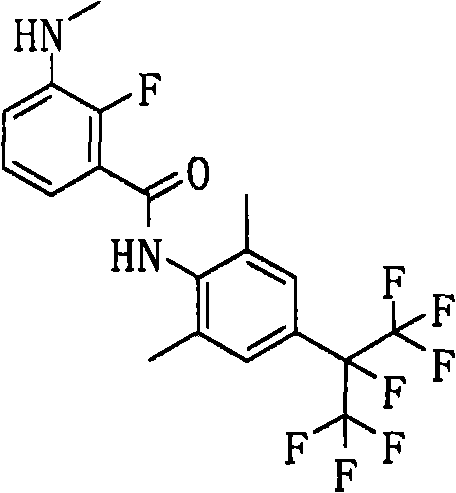
向34.8ml浓硫酸中装入5.80g(13.6mmol)3-氨基-N-(2,6-二甲基-4-(全氟丙烷-2-基)苯基)-2-氟苯甲酰胺并溶解。一边保持内部温度为30~40℃一边经1小时滴入17.4ml 37%甲醛水溶液。在40℃下搅拌3小时后,排出到200ml冰水中,用100ml乙酸乙酯进行萃取3次,将有机层用100ml 1N氢氧化钠水溶液洗涤3次。用无水硫酸镁干燥,在减压下蒸馏除去溶剂。将所得残渣用IPE洗涤,由此制备4.49g目标化合物(收率:75%)。5.80g (13.6mmol) of 3-amino-N-(2,6-dimethyl-4-(perfluoropropane-2-yl)phenyl)-2-fluorobenzamide was charged in 34.8ml of concentrated sulfuric acid and dissolve. While maintaining the internal temperature at 30-40°C, 17.4 ml of 37% formaldehyde aqueous solution was added dropwise over 1 hour. After stirring at 40° C. for 3 hours, it was discharged into 200 ml of ice water, extracted 3 times with 100 ml of ethyl acetate, and the organic layer was washed 3 times with 100 ml of 1N aqueous sodium hydroxide solution. After drying over anhydrous magnesium sulfate, the solvent was distilled off under reduced pressure. The resulting residue was washed with IPE, whereby 4.49 g of the target compound was prepared (yield: 75%).
1H-NMR(DMSO-d6,ppm)δ2.32(6H,s),2.76(3H,d,J=4.9Hz),5.84(1H,broad-s),6.77-6.81(2H,m),7.10(1H,t,J=7.8Hz),7.43(2H,s),9.90(1H,s). 1 H-NMR (DMSO-d 6 , ppm) δ2.32 (6H, s), 2.76 (3H, d, J=4.9Hz), 5.84 (1H, broad-s), 6.77-6.81 (2H, m) , 7.10(1H, t, J=7.8Hz), 7.43(2H, s), 9.90(1H, s).
<1-5><1-5>
N-(2,6-二甲基-4-(全氟丙烷-2-基)苯基)-2-氟-3-(N-甲基苯甲酰氨基)苯甲酰胺的制备Preparation of N-(2,6-dimethyl-4-(perfluoropropan-2-yl)phenyl)-2-fluoro-3-(N-methylbenzamido)benzamide

向22ml THF中装入4.49g(10.2mmol)N-(2,6-二甲基-4-(全氟丙烷-2-基)苯基)-2-氟-3-(甲基氨基)苯甲酰胺、0.920g(11.6mmol)吡啶,添加1.54g(10.9mmol)苯甲酰氯,在室温下搅拌3小时。添加饱和碳酸氢钠水溶液,用乙酸乙酯萃取后,用5%盐酸洗涤。用无水硫酸镁干燥后,在减压下蒸馏除去溶剂,将所得残渣用IPE洗涤,由此制备5.00g目标化合物(收率:90%)。Charge 4.49g (10.2mmol) N-(2,6-dimethyl-4-(perfluoropropan-2-yl)phenyl)-2-fluoro-3-(methylamino)benzene into 22ml THF Formamide, 0.920 g (11.6 mmol) of pyridine, and 1.54 g (10.9 mmol) of benzoyl chloride were added, followed by stirring at room temperature for 3 hours. Saturated aqueous sodium bicarbonate solution was added, extracted with ethyl acetate, and washed with 5% hydrochloric acid. After drying over anhydrous magnesium sulfate, the solvent was distilled off under reduced pressure, and the resulting residue was washed with IPE to prepare 5.00 g of the target compound (yield: 90%).
1H-NMR(DMSO-d6,ppm)δ2.28(6H,s),3.36(3H,s),7.27-7.32(6H,m),7.43(2H,s),7.55-7.57(2H,broad-s),9.96(1H,s). 1 H-NMR (DMSO-d 6 , ppm) δ2.28 (6H, s), 3.36 (3H, s), 7.27-7.32 (6H, m), 7.43 (2H, s), 7.55-7.57 (2H, broad-s), 9.96 (1H, s).
<1-6><1-6>
2-(N(2,6-二甲基-4-(全氟丙烷-2-基)苯基)-2-氟-3-(N-甲基苯甲酰氨基)苯甲酰氨基)乙酸甲酯的制备(化合物编号7-221)2-(N(2,6-Dimethyl-4-(perfluoropropan-2-yl)phenyl)-2-fluoro-3-(N-methylbenzamido)benzamido)acetic acid Preparation of Methyl Esters (Compound No. 7-221)

向10ml DMF中装入0.240g(6.06mmol)60%氢化钠,在室温下滴入溶解于8ml DMF中的3.00g(5.51mmol)N-(2,6-二甲基-4-(全氟丙烷-2-基)苯基)-2-氟-3-(N-甲基苯甲酰氨基)苯甲酰胺。在室温下搅拌2小时后,加入1.86g(12.1mmol)溴乙酸甲酯,在60℃下搅拌3小时。冷却至室温后,添加水,用乙酸乙酯萃取。用无水硫酸镁干燥后,在减压下蒸馏除去溶剂,将所得残渣用柱色谱法(展开溶剂;己烷∶乙酸乙酯=10∶1→7∶3→1∶1)精制,由此制备3.05g目标化合物(收率90%)。In 10ml DMF, load 0.240g (6.06mmol) 60% sodium hydride, drop into the 3.00g (5.51mmol) N-(2,6-dimethyl-4-(perfluoro propan-2-yl)phenyl)-2-fluoro-3-(N-methylbenzamido)benzamide. After stirring at room temperature for 2 hours, 1.86 g (12.1 mmol) of methyl bromoacetate was added, and the mixture was stirred at 60° C. for 3 hours. After cooling to room temperature, water was added and extracted with ethyl acetate. After drying over anhydrous magnesium sulfate, the solvent was distilled off under reduced pressure, and the resulting residue was purified by column chromatography (developing solvent; hexane:ethyl acetate=10:1→7:3→1:1), whereby 3.05 g of the target compound were prepared (yield 90%).
1H-NMR(CDCl3,ppm)δ2.37(6H,broad-s),3.05(3H,s),3.81(3H,s),4.25(1H,broad-s),4.40(1H,broad-s),6.80-6.89(2H,m),7.15-7.37(8H,m). 1 H-NMR (CDCl 3 , ppm) δ2.37 (6H, broad-s), 3.05 (3H, s), 3.81 (3H, s), 4.25 (1H, broad-s), 4.40 (1H, broad-s) s), 6.80-6.89(2H, m), 7.15-7.37(8H, m).
<实施例2><Example 2>
2-(N-(2,6-二甲基-4-(全氟丙烷-2-基)苯基)-2-氟-3-(N-甲基苯甲酰氨基)苯甲酰氨基)乙酸的制备(化合物编号7-222)2-(N-(2,6-Dimethyl-4-(perfluoropropan-2-yl)phenyl)-2-fluoro-3-(N-methylbenzamido)benzamido) Preparation of acetic acid (compound number 7-222)

向10ml甲醇中装入实施例1的1-6中得到的2.00g(3.25mmol)2-(N(2,6-二甲基-4-(全氟丙烷-2-基)苯基)-2-氟-3-(N-甲基苯甲酰氨基)苯甲酰氨基)乙酸甲酯,添加0.520g(13.0mmol)氢氧化钠、5ml水,搅拌2小时。排出到水中,用乙酸乙酯洗涤后,用浓盐酸调节水层的pH为1。用乙酸乙酯萃取后,用饱和食盐水洗涤,用无水硫酸镁干燥。在减压下蒸馏除去溶剂,由此制备1.00g目标化合物(收率:51%)。2.00 g (3.25 mmol) 2-(N(2,6-dimethyl-4-(perfluoropropane-2-yl) phenyl)- To methyl 2-fluoro-3-(N-methylbenzamido)benzamido)acetate, add 0.520 g (13.0 mmol) of sodium hydroxide and 5 ml of water, and stir for 2 hours. It was discharged into water, washed with ethyl acetate, and the pH of the aqueous layer was adjusted to 1 with concentrated hydrochloric acid. After extraction with ethyl acetate, it was washed with saturated brine, and dried over anhydrous magnesium sulfate. The solvent was distilled off under reduced pressure, whereby 1.00 g of the target compound was prepared (yield: 51%).
1H-NMR(CDCl3,ppm)δ2.47(6H,broad-s),3.06(3H,s),4.38(2H,broad-s),6.81-6.89(2H,m),7.14-7.52(8H,m). 1 H-NMR (CDCl 3 , ppm) δ2.47 (6H, broad-s), 3.06 (3H, s), 4.38 (2H, broad-s), 6.81-6.89 (2H, m), 7.14-7.52 ( 8H, m).
未检测到推定为羧酸的质子No proton detected for putative carboxylic acid
<实施例3><Example 3>
N-(2,6-二甲基-4-(全氟丙烷-2-基)苯基)-2-氟-N-(2-羟乙基)-3-(N-甲基苯甲酰氨基)苯甲酰胺的制备(化合物编号7-23)N-(2,6-Dimethyl-4-(perfluoropropan-2-yl)phenyl)-2-fluoro-N-(2-hydroxyethyl)-3-(N-methylbenzoyl Preparation of amino) benzamide (compound number 7-23)
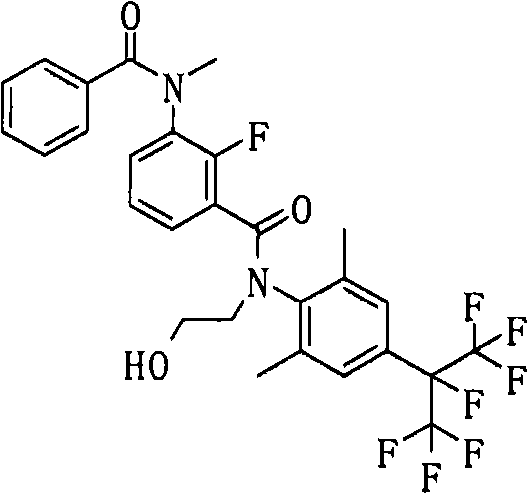
向4ml乙醇中装入实施例1的1-6中得到的1.40g(2.27mmol)2-(N(2,6-二甲基-4-(全氟丙烷-2-基)苯基)-2-氟-3-(N-甲基苯甲酰氨基)苯甲酰氨基)乙酸甲酯,在室温下添加0.100g(2.73mmol)硼氢化钠。在室温下搅拌1小时后,追加0.100g(2.73mmol)硼氢化钠,搅拌2小时。再追加0.100g(2.73mmol)硼氢化钠,在室温下搅拌1小时后,加入水。添加食盐后,用乙酸乙酯萃取,用无水硫酸镁干燥。在减压下蒸馏除去溶剂,将所得残渣用硅胶柱色谱法(展开溶剂;己烷∶乙酸乙酯=7∶3→1∶1→1∶2→0∶1)精制,由此制备0.900g目标化合物(收率:67%)。1.40 g (2.27 mmol) 2-(N(2,6-dimethyl-4-(perfluoropropane-2-yl) phenyl)- To methyl 2-fluoro-3-(N-methylbenzamido)benzamido)acetate, add 0.100 g (2.73 mmol) sodium borohydride at room temperature. After stirring at room temperature for 1 hour, 0.100 g (2.73 mmol) of sodium borohydride was added, followed by stirring for 2 hours. Further, 0.100 g (2.73 mmol) of sodium borohydride was added, and after stirring at room temperature for 1 hour, water was added. After adding common salt, it was extracted with ethyl acetate and dried over anhydrous magnesium sulfate. The solvent was distilled off under reduced pressure, and the resulting residue was purified by silica gel column chromatography (developing solvent; hexane:ethyl acetate=7:3→1:1→1:2→0:1) to prepare 0.900 g of Target compound (yield: 67%).
1H-NMR(CDCl3,ppm)δ2.34(6H,broad-s),3.08(3H,s),3.20-3.22(1H,m),3.47(1H,broad-s),3.89(2H,broad-s),6.79-6.83(1H,m),6.88-6.89(1H,m),7.06-7.35(9H,m). 1 H-NMR (CDCl 3 , ppm) δ2.34 (6H, broad-s), 3.08 (3H, s), 3.20-3.22 (1H, m), 3.47 (1H, broad-s), 3.89 (2H, broad-s), 6.79-6.83 (1H, m), 6.88-6.89 (1H, m), 7.06-7.35 (9H, m).
<实施例4><Example 4>
N-(2-氨基-2-氧代乙基)-N-(2,6-二甲基-4-(全氟丙烷-2-基)苯基)-2-氟-3-(N-甲基苯甲酰氨基)苯甲酰胺的制备(化合物编号7-220)N-(2-amino-2-oxoethyl)-N-(2,6-dimethyl-4-(perfluoropropan-2-yl)phenyl)-2-fluoro-3-(N- Preparation of methyl benzamido) benzamide (compound number 7-220)

根据实施例1的1-6的方法,由实施例1的1-5中得到的N-(2,6-二甲基-4-(全氟丙烷-2-基)苯基)-2-氟-3-(N-甲基苯甲酰氨基)苯甲酰胺和2-氯乙酸酰胺制备目标化合物。According to the method of 1-6 of embodiment 1, N-(2,6-dimethyl-4-(perfluoropropan-2-yl) phenyl)-2- obtained in 1-5 of embodiment 1 Fluoro-3-(N-methylbenzamido)benzamide and 2-chloroacetic acid amide to prepare the target compound.
1H-NMR(CDCl3,ppm)δ2.44(6H,broad-s),3.13(3H,s),4.45(1H,broad-s),5.77(1H,broad-s),6.79-7.04(6H,m),7.15-7.34(6H,m). 1 H-NMR (CDCl 3 , ppm) δ2.44 (6H, broad-s), 3.13 (3H, s), 4.45 (1H, broad-s), 5.77 (1H, broad-s), 6.79-7.04 ( 6H, m), 7.15-7.34 (6H, m).
<实施例5><Example 5>
2-(N-(3((2,6-二甲基-4-(全氟丙烷-2-基)苯基)(甲基)氨基甲酰基)苯基)苯甲酰氨基)乙酸甲酯的制备(化合物编号6-1)Methyl 2-(N-(3((2,6-dimethyl-4-(perfluoropropan-2-yl)phenyl)(methyl)carbamoyl)phenyl)benzamido)acetate Preparation of (compound number 6-1)

<5-1><5-1>
N-(2,6-二甲基-4-(全氟丙烷-2-基)苯基)-3-硝基苯甲酰胺的制备Preparation of N-(2,6-dimethyl-4-(perfluoropropan-2-yl)phenyl)-3-nitrobenzamide

将20.0g(69.2mmol)2,6-二甲基-4-(全氟丙烷-2-基)苯胺、11.0g(139mmol)吡啶溶解在100ml THF中后,缓慢滴入溶解于20ml THF中的13.0g 3-硝基苯甲酰氯。在室温下搅拌10小时后,向反应溶液中加入乙酸乙酯和水。进行分液操作,然后分离得到有机层,用无水硫酸镁干燥。将上述溶液过滤,在减压下蒸馏除去上述滤液,将所得残渣用己烷-IPE混合溶剂洗涤,由此制备26.0g目标化合物(收率85%)。After dissolving 20.0g (69.2mmol) 2,6-dimethyl-4-(perfluoropropane-2-yl) aniline and 11.0g (139mmol) pyridine in 100ml THF, slowly drop into the solution dissolved in 20ml THF 13.0 g 3-nitrobenzoyl chloride. After stirring at room temperature for 10 hours, ethyl acetate and water were added to the reaction solution. After a liquid separation operation, the organic layer was separated and dried over anhydrous magnesium sulfate. The above solution was filtered, the above filtrate was distilled off under reduced pressure, and the resulting residue was washed with a hexane-IPE mixed solvent to prepare 26.0 g of the target compound (yield 85%).
1H-NMR(CDCl3,ppm)δ2.33(6H,s),7.37(2H,s),7.68(1H,s),7.72(1H,t,J=8.1Hz),8.28(1H,d,J=8.1Hz),8.44(1H,dd,J=1.2Hz,8.1Hz),8.75(1H,t,J=1.2Hz) 1 H-NMR (CDCl 3 , ppm) δ2.33 (6H, s), 7.37 (2H, s), 7.68 (1H, s), 7.72 (1H, t, J=8.1Hz), 8.28 (1H, d , J=8.1Hz), 8.44 (1H, dd, J=1.2Hz, 8.1Hz), 8.75 (1H, t, J=1.2Hz)
<5-2><5-2>
N-(2,6-二甲基-4-(全氟丙烷-2-基)苯基)-N-甲基-3-硝基苯甲酰胺的制备Preparation of N-(2,6-dimethyl-4-(perfluoropropan-2-yl)phenyl)-N-methyl-3-nitrobenzamide
在室温下,向在15ml THF中混悬有0.180g 60%氢化钠的溶液中,滴入溶解于5ml THF中的2.00g(4.56mmol)N-(2,6-二甲基-4-(全氟丙烷-2-基)苯基)-3-硝基苯甲酰胺。在室温下搅拌30分钟后,滴入溶解于5ml THF中的0.650g碘甲烷。接下来,升温至50℃,搅拌4小时后,恢复至室温,向反应溶液中加入乙酸乙酯和水。分离得到有机层,用水洗涤1次后,用无水硫酸镁干燥,在减压下蒸馏除去溶剂。将所得残渣用硅胶柱色谱法(展开溶剂;己烷∶乙酸乙酯=6∶1)精制,由此制备1.73g目标化合物(收率84%)。At room temperature, 2.00 g (4.56 mmol) N-(2,6-dimethyl-4-( Perfluoropropan-2-yl)phenyl)-3-nitrobenzamide. After stirring at room temperature for 30 minutes, 0.650 g of methyl iodide dissolved in 5 ml of THF was added dropwise. Next, the temperature was raised to 50°C, and after stirring for 4 hours, the temperature was returned to room temperature, and ethyl acetate and water were added to the reaction solution. The organic layer was separated, washed once with water, dried over anhydrous magnesium sulfate, and the solvent was distilled off under reduced pressure. The resulting residue was purified by silica gel column chromatography (developing solvent; hexane:ethyl acetate=6:1) to prepare 1.73 g of the target compound (yield 84%).
1H-NMR(CDCl3,ppm)δ2.31(6H,s),3.38(3H,s),7.27(2H,s),7.37(1H,t,J=7.8Hz),7.62-7.65(1H,m),8.05(1H,t,J=2.0Hz),8.11-8.14(1H,m). 1 H-NMR (CDCl 3 , ppm) δ2.31 (6H, s), 3.38 (3H, s), 7.27 (2H, s), 7.37 (1H, t, J=7.8Hz), 7.62-7.65 (1H , m), 8.05(1H, t, J=2.0Hz), 8.11-8.14(1H, m).
<5-3><5-3>
3-氨基-N-(2,6-二甲基-4-(全氟丙烷-2-基)苯基)-N-甲基苯甲酰胺的制备Preparation of 3-amino-N-(2,6-dimethyl-4-(perfluoropropan-2-yl)phenyl)-N-methylbenzamide

向20ml甲醇中加入1.50g(3.31mmol)N-(2,6-二甲基-4-(全氟丙烷-2-基)苯基)-N-甲基-3-硝基苯甲酰胺、0.150g10%钯-碳,将所得溶液在常压下、氢气氛下搅拌2小时。滤去催化剂后,在减压下蒸馏除去溶剂。接下来,用己烷洗涤析出的固体,由此制备1.24g目标化合物(收率88%)。Add 1.50g (3.31mmol) N-(2,6-dimethyl-4-(perfluoropropane-2-yl)phenyl)-N-methyl-3-nitrobenzamide to 20ml methanol, 0.150 g of 10% palladium-carbon, and the resulting solution was stirred for 2 hours under normal pressure and hydrogen atmosphere. After the catalyst was filtered off, the solvent was distilled off under reduced pressure. Next, the precipitated solid was washed with hexane to prepare 1.24 g of the target compound (yield 88%).
1H-NMR(CDCl3,ppm)δ2.27(6H,s),3.31(3H,s),3.80(2H,broad-s),6.40-6.43(1H,m),6.54-6.58(1H,m),6.71(1H,t,J=2.0Hz),6.76-6.86(1H,m),7.22(2H,s). 1 H-NMR (CDCl 3 , ppm) δ2.27 (6H, s), 3.31 (3H, s), 3.80 (2H, broad-s), 6.40-6.43 (1H, m), 6.54-6.58 (1H, m), 6.71(1H, t, J=2.0Hz), 6.76-6.86(1H, m), 7.22(2H, s).
<5-4><5-4>
3-苯甲酰氨基-N-(2,6-二甲基-4-(全氟丙烷-2-基)苯基)-N-甲基苯甲酰胺的制备Preparation of 3-benzamido-N-(2,6-dimethyl-4-(perfluoropropan-2-yl)phenyl)-N-methylbenzamide

按照实施例1的1-5的方法,由3-氨基-N-(2,6-二甲基-4-(全氟丙烷-2-基)苯基)-N-甲基苯甲酰胺和苯甲酰氯制备目标化合物。According to the method of 1-5 of embodiment 1, by 3-amino-N-(2,6-dimethyl-4-(perfluoropropan-2-yl) phenyl)-N-methylbenzamide and Benzoyl chloride to prepare the target compound.
1H-NMR(DMSO-d6,ppm)δ2.29(6H,s),3.24(3H,s),6.84(1H,d,J=7.8Hz),7.12(1H,t,J=7.8Hz),7.33(2H,s),7.50-7.64(4H,m),7.85-7.88(2H,m),7.98-8.03(1H,m),10.22(1H,s). 1 H-NMR (DMSO-d 6 , ppm) δ 2.29 (6H, s), 3.24 (3H, s), 6.84 (1H, d, J=7.8Hz), 7.12 (1H, t, J=7.8Hz ), 7.33(2H, s), 7.50-7.64(4H, m), 7.85-7.88(2H, m), 7.98-8.03(1H, m), 10.22(1H, s).
<5-5><5-5>
2-(N-(3((2,6-二甲基-4-(全氟丙烷-2-基)苯基)(甲基)氨基甲酰基)苯基)苯甲酰氨基)乙酸甲酯的制备(化合物编号6-1)Methyl 2-(N-(3((2,6-dimethyl-4-(perfluoropropan-2-yl)phenyl)(methyl)carbamoyl)phenyl)benzamido)acetate Preparation of (compound number 6-1)

按照实施例1的1-6的方法,由3-苯甲酰氨基-N-(2,6-二甲基-4-(全氟丙烷-2-基)苯基)-N-甲基苯甲酰胺制备目标化合物。According to the method of 1-6 of Example 1, by 3-benzamido-N-(2,6-dimethyl-4-(perfluoropropane-2-yl)phenyl)-N-methylbenzene formamide to prepare the target compound.
1H-NMR(CDCl3,ppm)δ2.18(6H,s),3.29(3H,s),3.79(3H,s),4.27(2H,s),6.92-6.94(2H,m),7.02-7.05(1H,m),7.10-7.14(2H,m),7.18-7.41(6H,m). 1 H-NMR (CDCl 3 , ppm) δ2.18 (6H, s), 3.29 (3H, s), 3.79 (3H, s), 4.27 (2H, s), 6.92-6.94 (2H, m), 7.02 -7.05(1H, m), 7.10-7.14(2H, m), 7.18-7.41(6H, m).
<实施例6><Example 6>
2-(N-(3-((2,6-二甲基-4-(全氟丙烷-2-基)苯基)(甲基)氨基甲酰基)苯基)苯甲酰氨基)乙酸的制备(化合物编号6-3)2-(N-(3-((2,6-Dimethyl-4-(perfluoropropan-2-yl)phenyl)(methyl)carbamoyl)phenyl)benzamido)acetic acid Preparation (Compound No. 6-3)
按照实施例2的方法,由2-(N-(3((2,6-二甲基-4-(全氟丙烷-2-基)苯基)(甲基)氨基甲酰基)苯基)苯甲酰氨基)乙酸甲酯制备目标化合物。According to the method of Example 2, by 2-(N-(3((2,6-dimethyl-4-(perfluoropropan-2-yl)phenyl)(methyl)carbamoyl)phenyl) The title compound was prepared from methyl benzamido)acetate.
1H-NMR(CDCl3,ppm)δ2.15(6H,s),3.29(3H,s),4.34(2H,s),4.70(1H,broad-s),6.92-6.94(2H,m),6.99-7.03(1H,m),7.10-7.28(8H,m). 1 H-NMR (CDCl 3 , ppm) δ2.15 (6H, s), 3.29 (3H, s), 4.34 (2H, s), 4.70 (1H, broad-s), 6.92-6.94 (2H, m) , 6.99-7.03 (1H, m), 7.10-7.28 (8H, m).
<实施例7><Example 7>
N-(2,6-二甲基-4-(全氟丙烷-2-基)苯基)-N-甲基-3-(N-(甲硫基甲基)苯甲酰氨基)苯甲酰胺的制备(化合物编号6-6)N-(2,6-Dimethyl-4-(perfluoropropan-2-yl)phenyl)-N-methyl-3-(N-(methylthiomethyl)benzamido)benzyl Preparation of Amides (Compound No. 6-6)

按照实施例1的1-6的方法,由实施例5的5-4中得到的3-苯甲酰氨基-N-(2,6-二甲基-4-(全氟丙烷-2-基)苯基)-N-甲基苯甲酰胺和氯甲基甲基硫醚制备目标化合物。According to the method of 1-6 of Example 1, the 3-benzamido-N-(2,6-dimethyl-4-(perfluoropropane-2-yl) obtained in 5-4 of Example 5 ) phenyl)-N-methylbenzamide and chloromethyl methyl sulfide to prepare the target compound.
1H-NMR(CDCl3,ppm)δ2.12(3H,s),2.18(6H,s),3.29(3H,s),4.82(2H,s),6.93-6.97(2H,m),7.03-7.05(1H,m),7.10-7.15(4H,m),7.22-7.26(4H,m). 1 H-NMR (CDCl 3 , ppm) δ2.12 (3H, s), 2.18 (6H, s), 3.29 (3H, s), 4.82 (2H, s), 6.93-6.97 (2H, m), 7.03 -7.05(1H, m), 7.10-7.15(4H, m), 7.22-7.26(4H, m).
<实施例8><Embodiment 8>
N-(2,6-二甲基-4-(全氟丙烷-2-基)苯基)-N-甲基-3-(N-(甲基亚磺酰基甲基)苯甲酰氨基)苯甲酰胺的制备(化合物编号6-7)N-(2,6-Dimethyl-4-(perfluoropropan-2-yl)phenyl)-N-methyl-3-(N-(methylsulfinylmethyl)benzamido) Preparation of benzamide (compound number 6-7)

向实施例7中得到的0.120g(0.200mmol)N-(2,6-二甲基-4-(全氟丙烷-2-基)苯基)-N-甲基-3-(N-(甲硫基甲基)苯甲酰氨基)苯甲酰胺的10ml二氯甲烷溶液中加入0.0440g(0.360mmol)70%间氯过氧苯甲酸,在室温下搅拌1小时。将反应液用饱和碳酸氢钠水溶液、饱和食盐水洗涤,用无水硫酸镁干燥。在减压下蒸馏除去溶剂,将所得残渣用硅胶柱色谱法(展开溶剂;己烷∶乙酸乙酯=1∶1→0∶1→乙酸乙酯∶甲醇=10∶1)精制,由此制备0.930g目标化合物(收率77%)。To 0.120g (0.200mmol) N-(2,6-dimethyl-4-(perfluoropropan-2-yl)phenyl)-N-methyl-3-(N-( Add 0.0440 g (0.360 mmol) of 70% m-chloroperoxybenzoic acid to a solution of 10 ml of dichloromethane (methylthiomethyl) benzamido) benzamide, and stir at room temperature for 1 hour. The reaction solution was washed with saturated aqueous sodium bicarbonate solution and saturated brine, and dried over anhydrous magnesium sulfate. The solvent was distilled off under reduced pressure, and the resulting residue was purified by silica gel column chromatography (developing solvent; hexane:ethyl acetate=1:1→0:1→ethyl acetate:methanol=10:1), thereby preparing 0.930 g of the target compound (77% yield).
1H-NMR(CDCl3,ppm)δ2.18(6H,s),2.65(3H,s),3.26(3H,s),4.43(1H,d,J=13.1Hz),5.09(1H,d,J=13.1Hz),6.99-7.01(2H,m),7.16-7.32(9H,m). 1 H-NMR (CDCl 3 , ppm) δ2.18 (6H, s), 2.65 (3H, s), 3.26 (3H, s), 4.43 (1H, d, J=13.1Hz), 5.09 (1H, d , J=13.1Hz), 6.99-7.01(2H, m), 7.16-7.32(9H, m).
<实施例9><Example 9>
N-(2,6-二甲基-4-(全氟丙烷-2-基)苯基)-N-甲基-3-(N-(甲基磺酰基甲基)苯甲酰氨基)苯甲酰胺的制备(化合物编号6-8)N-(2,6-Dimethyl-4-(perfluoropropan-2-yl)phenyl)-N-methyl-3-(N-(methylsulfonylmethyl)benzamido)benzene Preparation of formamide (compound number 6-8)

按照实施例8的方法,通过使用相对于原料即N-(2,6-二甲基-4-(全氟丙烷-2-基)苯基)-N-甲基-3-(N-(甲硫基甲基)苯甲酰氨基)苯甲酰胺为3倍摩尔量的70%间氯过氧苯甲酸,制备目标化合物。According to the method of Example 8, by using relative to the starting material, i.e. N-(2,6-dimethyl-4-(perfluoropropane-2-yl)phenyl)-N-methyl-3-(N-( Methylthiomethyl) benzamido) benzamide is 3 times the molar amount of 70% m-chloroperoxybenzoic acid to prepare the target compound.
1H-NMR(CDCl3,ppm)δ2.18(6H,s),3.05(3H,s),3.28(3H,s),4.92(2H,s),6.99-7.01(1H,m),7.08-7.11(2H,m),7.16-7.24(3H,m),7.29-7.41(5H,m). 1 H-NMR (CDCl 3 , ppm) δ2.18 (6H, s), 3.05 (3H, s), 3.28 (3H, s), 4.92 (2H, s), 6.99-7.01 (1H, m), 7.08 -7.11(2H, m), 7.16-7.24(3H, m), 7.29-7.41(5H, m).
<实施例10><Example 10>
N-(2,6-二甲基-4-(全氟丙烷-2-基)苯基)-N-甲基-3-(N-(2-(甲硫基)乙基)苯甲酰氨基)苯甲酰胺的制备(化合物编号5-71)N-(2,6-Dimethyl-4-(perfluoropropan-2-yl)phenyl)-N-methyl-3-(N-(2-(methylthio)ethyl)benzoyl Preparation of amino) benzamide (compound number 5-71)
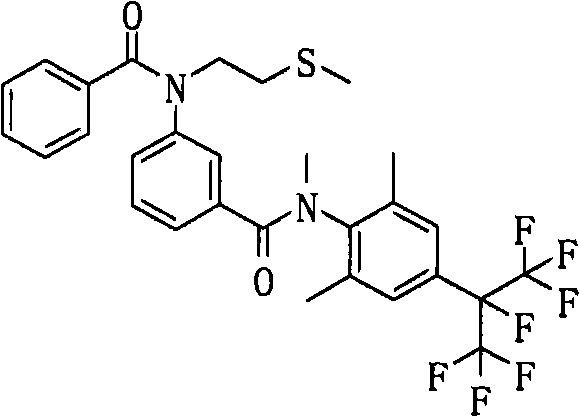
按照实施例1的1-6的方法,由实施例5的5-4中得到的3-苯甲酰氨基-N-(2,6-二甲基-4-(全氟丙烷-2-基)苯基)-N-甲基苯甲酰胺和2-氯乙基甲基硫醚制备目标化合物。According to the method of 1-6 of Example 1, the 3-benzamido-N-(2,6-dimethyl-4-(perfluoropropane-2-yl) obtained in 5-4 of Example 5 ) phenyl)-N-methylbenzamide and 2-chloroethyl methyl sulfide to prepare the target compound.
1H-NMR(CDCl3,ppm)δ2.13(6H,s),2.18(3H,s),2.66(2H,t,J=7.3Hz),3.27(3H,s),3.92(2H,t,J=7.3Hz),6.90-6.96(3H,m),7.11-7.16(4H,m),7.21-7.26(3H,m),7.33-7.34(1H,m). 1 H-NMR (CDCl 3 , ppm) δ 2.13 (6H, s), 2.18 (3H, s), 2.66 (2H, t, J=7.3Hz), 3.27 (3H, s), 3.92 (2H, t , J=7.3Hz), 6.90-6.96(3H, m), 7.11-7.16(4H, m), 7.21-7.26(3H, m), 7.33-7.34(1H, m).
<实施例11><Example 11>
N-(2,6-二甲基-4-(全氟丙烷-2-基)苯基)-N-甲基-3-(N-(2-(甲基亚磺酰基)乙基)苯甲酰氨基)苯甲酰胺的制备(化合物编号5-72)N-(2,6-Dimethyl-4-(perfluoropropan-2-yl)phenyl)-N-methyl-3-(N-(2-(methylsulfinyl)ethyl)benzene Preparation of formylamino) benzamide (compound number 5-72)

按照实施例8的方法,由实施例10中得到的N-(2,6-二甲基-4-(全氟丙烷-2-基)苯基)-N-甲基-3-(N-(2-(甲硫基)乙基)苯甲酰氨基)苯甲酰胺制备目标化合物。According to the method of Example 8, N-(2,6-dimethyl-4-(perfluoropropan-2-yl)phenyl)-N-methyl-3-(N- (2-(Methylthio)ethyl)benzamido)benzamide to prepare the target compound.
1H-NMR(CDCl3,ppm)δ2.17(6H,s),2.66(3H,s),2.90-2.94(1H,m),3.17-3.19(1H,m),3.26(3H,s),4.00-4.02(1H,m),4.11-4.13(1H,m),6.85-6.87(1H,m),6.97(1H,t,J=7.8Hz),7.08-7.29(9H,m). 1 H-NMR (CDCl 3 , ppm) δ2.17 (6H, s), 2.66 (3H, s), 2.90-2.94 (1H, m), 3.17-3.19 (1H, m), 3.26 (3H, s) , 4.00-4.02(1H, m), 4.11-4.13(1H, m), 6.85-6.87(1H, m), 6.97(1H, t, J=7.8Hz), 7.08-7.29(9H, m).
<实施例12><Example 12>
N-(2,6-二甲基-4-(全氟丙烷-2-基)苯基)-N-甲基-3-(N-(2-(甲基磺酰基)乙基)苯甲酰氨基)苯甲酰胺的制备(化合物编号5-73)N-(2,6-Dimethyl-4-(perfluoropropan-2-yl)phenyl)-N-methyl-3-(N-(2-(methylsulfonyl)ethyl)benzyl Preparation of amido)benzamide (compound number 5-73)
按照实施例9的方法,由实施例10中得到的N-(2,6-二甲基-4-(全氟丙烷-2-基)苯基)-N-甲基-3-(N-(2-(甲硫基)乙基)苯甲酰氨基)苯甲酰胺制备目标化合物。According to the method of Example 9, N-(2,6-dimethyl-4-(perfluoropropane-2-yl)phenyl)-N-methyl-3-(N- (2-(Methylthio)ethyl)benzamido)benzamide to prepare the target compound.
1H-NMR(CDCl3,ppm)δ2.09(6H,s),3.03(3H,s),3.26(3H,s),3.35(2H,t,J=7.3Hz),4.19(2H,t,J=7.3Hz),6.85-6.87(1H,m),6.96(1H,t,J=7.8Hz),7.06-7.07(1H,m),7.14-7.29(8H,m) 1 H-NMR (CDCl 3 , ppm) δ 2.09 (6H, s), 3.03 (3H, s), 3.26 (3H, s), 3.35 (2H, t, J=7.3Hz), 4.19 (2H, t , J=7.3Hz), 6.85-6.87(1H, m), 6.96(1H, t, J=7.8Hz), 7.06-7.07(1H, m), 7.14-7.29(8H, m)
<实施例13><Example 13>
3-(N-(氰基甲基)苯甲酰氨基)-N-(2,6-二甲基-4-(全氟丙烷-2-基)苯基)-N-甲基苯甲酰胺的制备(化合物编号6-18)3-(N-(cyanomethyl)benzamido)-N-(2,6-dimethyl-4-(perfluoropropan-2-yl)phenyl)-N-methylbenzamide Preparation of (compound number 6-18)

按照实施例1的1-6的方法,由实施例5的5-4中得到的3-苯甲酰氨基-N-(2,6-二甲基-4-(全氟丙烷-2-基)苯基)-N-甲基苯甲酰胺和氯乙腈制备目标化合物。According to the method of 1-6 of Example 1, the 3-benzamido-N-(2,6-dimethyl-4-(perfluoropropane-2-yl) obtained in 5-4 of Example 5 ) phenyl)-N-methylbenzamide and chloroacetonitrile to prepare the target compound.
1H-NMR(CDCl3,ppm)δ2.20(6H,s),3.31(3H,s),4.45(2H,s),6.92-6.94(1H,m),7.04-7.05(1H,m),7.13-7.34(9H,m). 1 H-NMR (CDCl 3 , ppm) δ2.20 (6H, s), 3.31 (3H, s), 4.45 (2H, s), 6.92-6.94 (1H, m), 7.04-7.05 (1H, m) , 7.13-7.34 (9H, m).
<实施例14><Example 14>
3-(N-(2-氨基-2-氧代乙基)苯甲酰氨基)-N-(2,6-二甲基-4-(全氟丙烷-2-基)苯基)-N-甲基苯甲酰胺的制备(化合物编号6-12)3-(N-(2-amino-2-oxoethyl)benzamido)-N-(2,6-dimethyl-4-(perfluoropropan-2-yl)phenyl)-N -Preparation of methyl benzamide (compound number 6-12)

按照实施例1的1-6的方法,由实施例5的5-4中得到的3-苯甲酰氨基-N-(2,6-二甲基-4-(全氟丙烷-2-基)苯基)-N-甲基苯甲酰胺和氯乙酸酰胺制备目标化合物。According to the method of 1-6 of Example 1, the 3-benzamido-N-(2,6-dimethyl-4-(perfluoropropane-2-yl) obtained in 5-4 of Example 5 ) phenyl)-N-methylbenzamide and chloroacetic acid amide to prepare the target compound.
1H-NMR(CDCl3,ppm)δ2.16(6H,s),3.28(3H,s),4.20(2H,s),5.50(1H,broad-s),6.10(1H,broad-s),6.94-6.95(2H,m),7.04-7.06(1H,m),7.12-7.33(8H,m). 1 H-NMR (CDCl 3 , ppm) δ2.16 (6H, s), 3.28 (3H, s), 4.20 (2H, s), 5.50 (1H, broad-s), 6.10 (1H, broad-s) , 6.94-6.95 (2H, m), 7.04-7.06 (1H, m), 7.12-7.33 (8H, m).
<实施例15><Example 15>
4-(N-(3-((2,6-二甲基-4-(全氟丙烷-2-基)苯基)(甲基)氨基甲酰基)苯基)苯甲酰氨基)丁酸甲酯的制备(化合物编号6-13)4-(N-(3-((2,6-Dimethyl-4-(perfluoropropan-2-yl)phenyl)(methyl)carbamoyl)phenyl)benzamido)butanoic acid Preparation of Methyl Ester (Compound No. 6-13)
按照实施例1的1-6的方法,由实施例5的5-4中得到的3-苯甲酰氨基-N-(2,6-二甲基-4-(全氟丙烷-2-基)苯基)-N-甲基苯甲酰胺和4-碘丁酸甲酯制备目标化合物。According to the method of 1-6 of Example 1, the 3-benzamido-N-(2,6-dimethyl-4-(perfluoropropane-2-yl) obtained in 5-4 of Example 5 ) phenyl)-N-methylbenzamide and methyl 4-iodobutyrate to prepare the target compound.
1H-NMR(CDCl3,ppm)δ1.86-1.89(2H,m),2.15(6H,s),2.35(2H,t,J=7.3Hz),3.28(3H,s),3.66(3H,s),3.78(2H,t,J=7.3Hz),6.89-6.94(3H,m),7.11-7.12(4H,m),7.21-7.25(3H,m),7.34(1H,broad-s). 1 H-NMR (CDCl 3 , ppm) δ1.86-1.89 (2H, m), 2.15 (6H, s), 2.35 (2H, t, J=7.3Hz), 3.28 (3H, s), 3.66 (3H , s), 3.78 (2H, t, J=7.3Hz), 6.89-6.94 (3H, m), 7.11-7.12 (4H, m), 7.21-7.25 (3H, m), 7.34 (1H, broad-s ).
<实施例16><Example 16>
4-(N-(3-((2,6-二甲基-4-(全氟丙烷-2-基)苯基)(甲基)氨基甲酰基)苯基)苯甲酰氨基)丁酸的制备(化合物编号6-14)4-(N-(3-((2,6-Dimethyl-4-(perfluoropropan-2-yl)phenyl)(methyl)carbamoyl)phenyl)benzamido)butanoic acid Preparation of (compound number 6-14)

按照实施例2的方法,由实施例15中得到的4-(N-(3-((2,6-二甲基-4-(全氟丙烷-2-基)苯基)(甲基)氨基甲酰基)苯基)苯甲酰氨基)丁酸甲酯制备目标化合物。According to the method of embodiment 2, by the 4-(N-(3-((2,6-dimethyl-4-(perfluoropropan-2-yl) phenyl) (methyl) obtained in embodiment 15 Carbamoyl) phenyl) benzamido) butyric acid methyl ester to prepare the target compound.
1H-NMR(CDCl3,ppm)δ1.85-1.87(2H,m),2.26(6H,s),2.42-2.43(2H,m),3.28(3H,s),3.83(2H,t,J=7.3Hz),6.88-6.94(3H,m),7.09-7.14(4H,m),7.19-7.26(3H,m),7.35(1H,broad-s). 1 H-NMR (CDCl 3 , ppm) δ1.85-1.87 (2H, m), 2.26 (6H, s), 2.42-2.43 (2H, m), 3.28 (3H, s), 3.83 (2H, t, J=7.3Hz), 6.88-6.94(3H, m), 7.09-7.14(4H, m), 7.19-7.26(3H, m), 7.35(1H, broad-s).
未检测到推定为羧酸的质子。Protons putative for carboxylic acids were not detected.
<实施例17><Example 17>
3-(N-(4-氨基-4-氧代丁基)苯甲酰氨基)-N-(2,6-二甲基-4-(全氟丙烷-2-基)苯基)-N-甲基苯甲酰胺的制备(化合物编号6-15)3-(N-(4-amino-4-oxobutyl)benzamido)-N-(2,6-dimethyl-4-(perfluoropropan-2-yl)phenyl)-N -Preparation of methyl benzamide (compound number 6-15)
向5ml苯中装入实施例16中得到的0.100g(0.163mmol)4-(N-(3-((2,6-二甲基-4-(全氟丙烷-2-基)苯基)(甲基)氨基甲酰基)苯基)苯甲酰氨基)丁酸、1滴DMF,添加0.0500g草酰氯,在60℃下搅拌2小时。冷却至室温后,在减压下蒸馏除去溶剂,得到粗酰氯。0.100g (0.163mmol) 4-(N-(3-((2,6-dimethyl-4-(perfluoropropan-2-yl) phenyl) obtained in 5ml of benzene is charged in Example 16 (Methyl)carbamoyl)phenyl)benzamido)butyric acid and 1 drop of DMF were added, and 0.0500 g of oxalyl chloride was added, followed by stirring at 60° C. for 2 hours. After cooling to room temperature, the solvent was distilled off under reduced pressure to obtain a crude acid chloride.
向5ml THF中装入2ml 28%氨水,在室温下添加上述所得的酰氯。在室温下搅拌1小时后,装入乙酸乙酯,用5%盐酸水溶液、饱和碳酸氢钠水溶液依次洗涤。用无水硫酸镁干燥后,在减压下蒸馏除去溶剂,将所得残渣用硅胶柱色谱法(展开溶剂;己烷∶乙酸乙酯=1∶1→0∶1→乙酸乙酯∶甲醇=10∶1)精制,由此制备0.0660g标题化合物(收率:66%)。Charge 2ml of 28% ammonia water into 5ml of THF, and add the acid chloride obtained above at room temperature. After stirring at room temperature for 1 hour, ethyl acetate was charged and washed successively with 5% aqueous hydrochloric acid and saturated aqueous sodium bicarbonate. After drying over anhydrous magnesium sulfate, the solvent was distilled off under reduced pressure, and the resulting residue was subjected to silica gel column chromatography (developing solvent; hexane:ethyl acetate=1:1→0:1→ethyl acetate:methanol=10 : 1) Purification, whereby 0.0660 g of the title compound was prepared (yield: 66%).
1H-NMR(CDCl3,ppm)δ1.86(2H,t,J=6.8Hz),2.13(6H,s),2.25-2.30(2H,m),3.27(3H,s),3.84(2H,t,J=6.8Hz),5.35(1H,broad-s),6.50(1H,broad-s),6.90-6.95(3H,m),7.11-7.13(4H,m),7.25-7.30(3H,m),7.34(1H,broad-s). 1 H-NMR (CDCl 3 , ppm) δ1.86 (2H, t, J=6.8Hz), 2.13 (6H, s), 2.25-2.30 (2H, m), 3.27 (3H, s), 3.84 (2H , t, J=6.8Hz), 5.35(1H, broad-s), 6.50(1H, broad-s), 6.90-6.95(3H, m), 7.11-7.13(4H, m), 7.25-7.30(3H , m), 7.34 (1H, broad-s).
<实施例18><Example 18>
2-(N-(3((2,6-二甲基-4-(全氟丙烷-2-基)苯基)(2-甲氧基-2-氧代乙基)氨基甲酰基)-2-氟苯基)苯甲酰氨基)乙酸甲酯的制备(化合物编号8-12)2-(N-(3((2,6-Dimethyl-4-(perfluoropropan-2-yl)phenyl)(2-methoxy-2-oxoethyl)carbamoyl)- Preparation of 2-fluorophenyl) benzamido) methyl acetate (compound number 8-12)
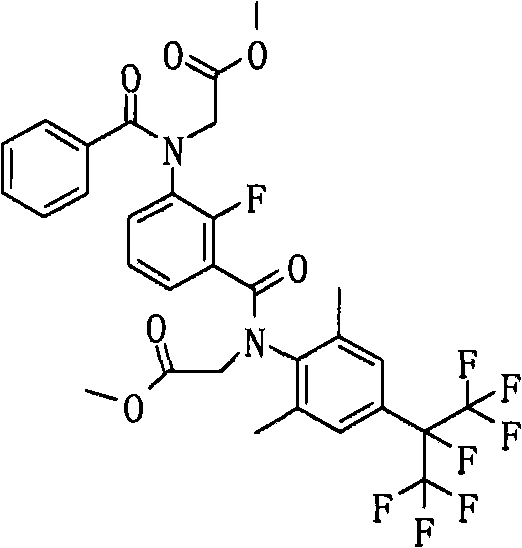
<18-1><18-1>
3-苯甲酰氨基-N-(2,6-二甲基-4-(全氟丙烷-2-基)苯基)-2-氟苯甲酰胺的制备Preparation of 3-benzamido-N-(2,6-dimethyl-4-(perfluoropropan-2-yl)phenyl)-2-fluorobenzamide

按照实施例1的1-5的方法,由实施例1的1-3中得到的3-氨基-N-(2,6-二甲基-4-(全氟丙烷-2-基)苯基)-2-氟苯甲酰胺制备目标化合物。According to the method of 1-5 of Example 1, the 3-amino-N-(2,6-dimethyl-4-(perfluoropropane-2-yl) phenyl obtained in 1-3 of Example 1 )-2-fluorobenzamide to prepare the target compound.
1H-NMR(DMSO-d6,ppm)δ2.34(6H,s),7.37(1H,t,J=7.8Hz),7.45(2H,s),7.53-7.65(4H,m),7.77-7.82(1H,m),8.00-8.02(2H,m),10.10(1H,s),10.29(1H,s). 1 H-NMR (DMSO-d 6 , ppm) δ2.34 (6H, s), 7.37 (1H, t, J=7.8Hz), 7.45 (2H, s), 7.53-7.65 (4H, m), 7.77 -7.82(1H, m), 8.00-8.02(2H, m), 10.10(1H, s), 10.29(1H, s).
<18-2><18-2>
2-(N-(3((2,6-二甲基-4-(全氟丙烷-2-基)苯基)(2-甲氧基-2-氧代乙基)氨基甲酰基)-2-氟苯基)苯甲酰氨基)乙酸甲酯的制备(化合物编号8-12)2-(N-(3((2,6-Dimethyl-4-(perfluoropropan-2-yl)phenyl)(2-methoxy-2-oxoethyl)carbamoyl)- Preparation of 2-fluorophenyl) benzamido) methyl acetate (compound number 8-12)

按照实施例1的1-6的方法,通过使用相对于3-苯甲酰氨基-N-(2,6-二甲基-4-(全氟丙烷-2-基)苯基)-2-氟苯甲酰胺为2.2倍摩尔量的60%氢化钠、为4.4倍摩尔量的溴乙酸乙酯,制备目标化合物。According to the method of 1-6 of Example 1, by using relative to 3-benzamido-N-(2,6-dimethyl-4-(perfluoropropane-2-yl)phenyl)-2- Fluorobenzamide was 2.2 times the molar amount of 60% sodium hydride and 4.4 times the molar amount of ethyl bromoacetate to prepare the target compound.
1H-NMR(CDCl3,ppm)δ2.50(6H,broad-s),3.51(1H,s),3.73(3H,s),3.81(3H,s),4.30(1H,broad-s),4.35(1H,broad-s),4.75(1H,broad-s),6.79(1H,t,J=7.8Hz),7.08-7.24(6H,m),7.28-7.34(3H,m). 1 H-NMR (CDCl 3 , ppm) δ2.50 (6H, broad-s), 3.51 (1H, s), 3.73 (3H, s), 3.81 (3H, s), 4.30 (1H, broad-s) , 4.35(1H, broad-s), 4.75(1H, broad-s), 6.79(1H, t, J=7.8Hz), 7.08-7.24(6H, m), 7.28-7.34(3H, m).
<实施例19><Example 19>
2-(N-(3((羧基甲基)(2,6-二甲基-4-(全氟丙烷-2-基)苯基)氨基甲酰基)-2-氟苯基)苯甲酰氨基)乙酸的制备(化合物编号8-13)2-(N-(3((carboxymethyl)(2,6-dimethyl-4-(perfluoropropan-2-yl)phenyl)carbamoyl)-2-fluorophenyl)benzoyl Preparation of amino)acetic acid (compound number 8-13)
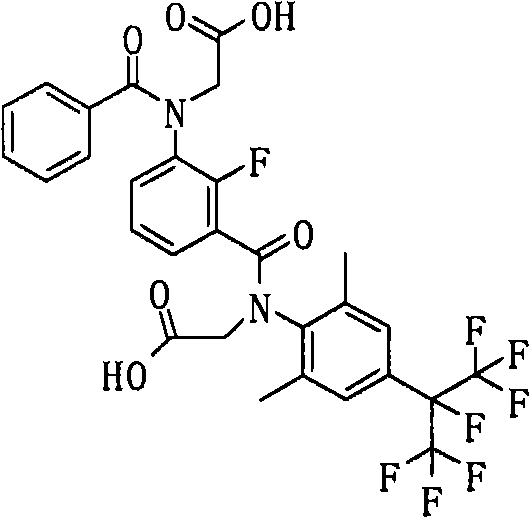
按照实施例2的方法,由实施例18中得到的2-(N-(3((2,6-二甲基-4-(全氟丙烷-2-基)苯基)(2-甲氧基-2-氧代乙基)氨基甲酰基)-2-氟苯基)苯甲酰氨基)乙酸甲酯制备目标化合物。According to the method of Example 2, 2-(N-(3((2,6-dimethyl-4-(perfluoropropan-2-yl)phenyl)(2-methoxy) obtained in Example 18 The title compound was prepared from methyl-2-oxoethyl)carbamoyl)-2-fluorophenyl)benzamido)acetate.
1H-NMR(CDCl3,ppm)δ2.18-2.38(6H,broad-s),4.10(1H,broad-s),4.32(2H,s),4.52(1H,broad-s),6.02(2H,broad-s),6.77(1H,t,J=7.8Hz),7.03-7.41(9H,m). 1 H-NMR (CDCl 3 , ppm) δ2.18-2.38 (6H, broad-s), 4.10 (1H, broad-s), 4.32 (2H, s), 4.52 (1H, broad-s), 6.02 ( 2H, broad-s), 6.77 (1H, t, J=7.8Hz), 7.03-7.41 (9H, m).
<实施例20><Example 20>
N-(3-氨基-3-氧代丙基)-N-(3-(2,6-二甲基-4-(全氟丙烷-2-基)苯基氨基甲酰基)苯基)苯甲酰胺的制备(化合物编号1-1)N-(3-amino-3-oxopropyl)-N-(3-(2,6-dimethyl-4-(perfluoropropan-2-yl)phenylcarbamoyl)phenyl)benzene Preparation of formamide (compound number 1-1)

<20-1><20-1>
3-氨基-N-(2,6-二甲基-4-(全氟丙烷-2-基)苯基)苯甲酰胺的制备Preparation of 3-amino-N-(2,6-dimethyl-4-(perfluoropropan-2-yl)phenyl)benzamide

按照实施例1的1-3的方法,由实施例5的5-1中得到的N-(2,6-二甲基-4-(全氟丙烷-2-基)苯基)-3-硝基苯甲酰胺制备目标化合物。According to the method of 1-3 of Example 1, N-(2,6-dimethyl-4-(perfluoropropan-2-yl) phenyl)-3- obtained in 5-1 of Example 5 Nitrobenzamide to prepare the target compound.
1H-NMR(CDCl3,ppm)δ2.34(6H,s),3.87(2H,broad-s),6.86-6.89(1H,m),7.20-7.35(6H,m) 1 H-NMR (CDCl 3 , ppm) δ2.34 (6H, s), 3.87 (2H, broad-s), 6.86-6.89 (1H, m), 7.20-7.35 (6H, m)
<20-2><20-2>
3-(3-氨基-3-氧代丙基氨基)-N-(2,6-二甲基-4-(全氟丙烷-2-基)苯基)苯甲酰胺的制备(化合物编号18-1)Preparation of 3-(3-amino-3-oxopropylamino)-N-(2,6-dimethyl-4-(perfluoropropane-2-yl)phenyl)benzamide (compound number 18 -1)

向3ml乙酸中装入1.00g(2.28mmol)3-氨基-N-(2,6-二甲基-4-(全氟丙烷-2-基)苯基)苯甲酰胺,添加2.51g(2.51mmol)丙烯酰胺后,在70℃下搅拌5小时。冷却至室温后,排出到水中,用碳酸钾中和。用乙酸乙酯萃取后,用无水硫酸镁干燥,在减压下蒸馏除去溶剂。将所得残渣用硅胶柱色谱法(展开溶剂;己烷∶乙酸乙酯=3∶1→1∶3→0∶1)精制,由此制备0.650g目标化合物(收率56%)。In 3ml acetic acid, load 1.00g (2.28mmol) 3-amino-N-(2,6-dimethyl-4-(perfluoropropane-2-yl)phenyl)benzamide, add 2.51g (2.51 mmol) of acrylamide, stirred at 70°C for 5 hours. After cooling to room temperature, discharge into water and neutralize with potassium carbonate. After extraction with ethyl acetate, it was dried over anhydrous magnesium sulfate, and the solvent was distilled off under reduced pressure. The resulting residue was purified by silica gel column chromatography (developing solvent; hexane:ethyl acetate=3:1→1:3→0:1) to prepare 0.650 g of the target compound (yield 56%).
1H-NMR(CDCl3,ppm)δ2.33(6H,s),2.52(2H,t,J=5.8Hz),3.51(2H,t,J=5.8Hz),4.45(1H,broad-s),5.54(1H,broad-s),5.73(1H,broad-s),6.81(1H,d,J=8.3Hz),7.17-7.21(2H,m),7.28-7.30(1H,m),7.34(2H,s),7.54-7.59(1H,m). 1 H-NMR (CDCl 3 , ppm) δ2.33 (6H, s), 2.52 (2H, t, J=5.8Hz), 3.51 (2H, t, J=5.8Hz), 4.45 (1H, broad-s ), 5.54 (1H, broad-s), 5.73 (1H, broad-s), 6.81 (1H, d, J=8.3Hz), 7.17-7.21 (2H, m), 7.28-7.30 (1H, m), 7.34(2H, s), 7.54-7.59(1H, m).
<20-3><20-3>
N-(3-氨基-3-氧代丙基)-N-(3-(2,6-二甲基-4-(全氟丙烷-2-基)苯基氨基甲酰基)苯基)苯甲酰胺的制备(化合物编号1-1)N-(3-amino-3-oxopropyl)-N-(3-(2,6-dimethyl-4-(perfluoropropan-2-yl)phenylcarbamoyl)phenyl)benzene Preparation of formamide (compound number 1-1)
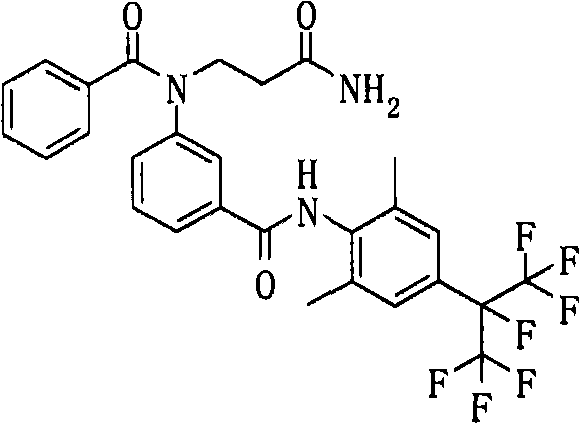
按照实施例1的1-5的方法,由3-(3-氨基-3-氧代丙基氨基)-N-(2,6-二甲基-4-(全氟丙烷-2-基)苯基)苯甲酰胺制备目标化合物。According to the method of 1-5 of Example 1, by 3-(3-amino-3-oxopropylamino)-N-(2,6-dimethyl-4-(perfluoropropan-2-yl) Phenyl)benzamide to prepare the target compound.
1H-NMR(CDCl3,ppm)δ2.28(6H,s),2.71(2H,t,J=6.8Hz),4.30(2H,t,J=6.8Hz),5.43(1H,broad-s),6.17(1H,broad-s),7.17-7.37(9H,m),7.66(1H,broad-s),7.70-7.73(2H,m). 1 H-NMR (CDCl 3 , ppm) δ2.28 (6H, s), 2.71 (2H, t, J=6.8Hz), 4.30 (2H, t, J=6.8Hz), 5.43 (1H, broad-s ), 6.17 (1H, broad-s), 7.17-7.37 (9H, m), 7.66 (1H, broad-s), 7.70-7.73 (2H, m).
<实施例21><Example 21>
3-(N-(3-氨基-3-氧代丙基)苯甲酰氨基)-N-(2,6-二甲基-4-(全氟丙烷-2-基)苯基)-2-氟苯甲酰胺的制备(化合物编号1-21)3-(N-(3-amino-3-oxopropyl)benzamido)-N-(2,6-dimethyl-4-(perfluoropropan-2-yl)phenyl)-2 - Preparation of fluorobenzamide (compound number 1-21)

<21-1>3-(3-氨基-3-氧代丙基氨基)-N-(2,6-二甲基-4-(全氟丙烷-2-基)苯基)-2-氟苯甲酰胺的制备(化合物编号18-42)<21-1>3-(3-amino-3-oxopropylamino)-N-(2,6-dimethyl-4-(perfluoropropan-2-yl)phenyl)-2-fluoro Preparation of benzamide (compound number 18-42)
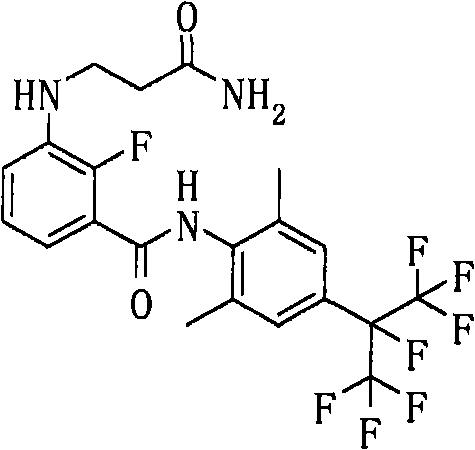
按照实施例20的20-3的方法,由实施例1的1-3中得到的3-氨基-N-(2,6-二甲基-4-(全氟丙烷-2-基)苯基)-2-氟苯甲酰胺制备目标化合物。According to the method of 20-3 of Example 20, the 3-amino-N-(2,6-dimethyl-4-(perfluoropropane-2-yl) phenyl obtained in 1-3 of Example 1 )-2-fluorobenzamide to prepare the target compound.
1H-NMR(CDCl3,ppm)δ2.36(6H,s),2.57-2.60(2H,m),3.54-3.57(2H,m),4.64(1H,broad-s),5.48(1H,broad-s),5.61(1H,broad-s),6.89-6.94(1H,m),7.15(1H,t,J=7.8Hz),7.35-7.39(3H,m),7.84(1H,broad-d,J=12.7Hz). 1 H-NMR (CDCl 3 , ppm) δ2.36 (6H, s), 2.57-2.60 (2H, m), 3.54-3.57 (2H, m), 4.64 (1H, broad-s), 5.48 (1H, broad-s), 5.61 (1H, broad-s), 6.89-6.94 (1H, m), 7.15 (1H, t, J=7.8Hz), 7.35-7.39 (3H, m), 7.84 (1H, broad- d, J=12.7Hz).
<21-2><21-2>
3-(N-(3-氨基-3-氧代丙基)苯甲酰氨基)-N-(2,6-二甲基-4-(全氟丙烷-2-基)苯基)-2-氟苯甲酰胺的制备(化合物编号1-21)3-(N-(3-amino-3-oxopropyl)benzamido)-N-(2,6-dimethyl-4-(perfluoropropan-2-yl)phenyl)-2 - Preparation of fluorobenzamide (compound number 1-21)

按照实施例1的1-5的方法,由3-(3-氨基-3-氧代丙基氨基)-N-(2,6-二甲基-4-(全氟丙烷-2-基)苯基)-2-氟苯甲酰胺制备目标化合物。According to the method of 1-5 of Example 1, by 3-(3-amino-3-oxopropylamino)-N-(2,6-dimethyl-4-(perfluoropropan-2-yl) Phenyl)-2-fluorobenzamide to prepare the target compound.
1H-NMR(CDCl3,ppm)δ2.26(6H,s),2.60(1H,broad-s),2.75(1H,broad-s),4.22-4.23(2H,m),5.45(1H,broad-s),6.03(1H,broad-s),7.19-7.34(8H,m),7.49-7.52(2H,m),7.90-7.96(1H,m). 1 H-NMR (CDCl 3 , ppm) δ2.26 (6H, s), 2.60 (1H, broad-s), 2.75 (1H, broad-s), 4.22-4.23 (2H, m), 5.45 (1H, broad-s), 6.03 (1H, broad-s), 7.19-7.34 (8H, m), 7.49-7.52 (2H, m), 7.90-7.96 (1H, m).
<实施例22><Example 22>
3-(N-(3-氨基-3-氧代丙基)苯甲酰氨基)-N-(2-溴-4-(全氟丙烷-2-基)-6-(三氟甲基)苯基)-2-氟苯甲酰胺的制备(化合物编号1-171)3-(N-(3-amino-3-oxopropyl)benzamido)-N-(2-bromo-4-(perfluoropropan-2-yl)-6-(trifluoromethyl) Preparation of phenyl)-2-fluorobenzamide (compound number 1-171)
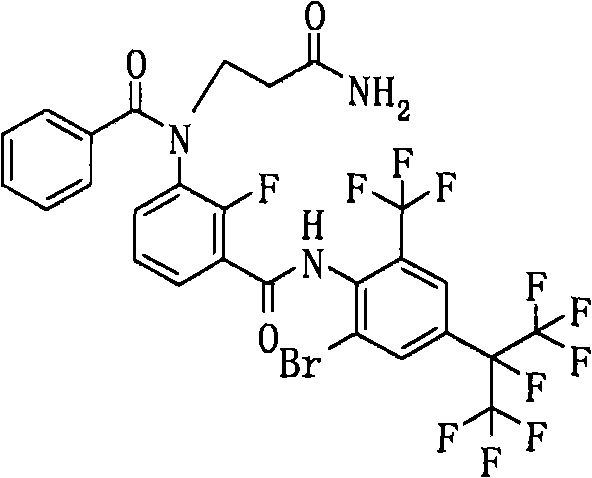
<22-1><22-1>
4-(全氟丙烷-2-基)-2-(三氟甲基)苯胺的制备(化合物编号21-2)Preparation of 4-(perfluoropropan-2-yl)-2-(trifluoromethyl)aniline (compound number 21-2)
向1500ml乙酸乙酯、1500ml水的混合溶液中装入100g(0.608mol)2-(三氟甲基)苯胺、131g(0.639mol)85%连二亚硫酸钠、20.9g(0.0608mol)四丁基硫酸氢铵,添加53.9g(0.639mol)碳酸氢钠。在室温下滴入198g(0.669mol)七氟异丙基碘,在室温下搅拌6小时。分液后,在减压下蒸馏除去有机层的溶剂,装入500ml乙酸乙酯。滴入160g(0.608mol)4N氯化氢/乙酸乙酯溶液,在室温下搅拌30分钟后,在5℃下搅拌1小时。滤去析出的固体后,用水、饱和碳酸氢钠水溶液依次洗涤滤液后,用无水硫酸镁干燥,在减压下蒸馏除去溶剂。将所得残渣用硅胶柱色谱法(展开溶剂;己烷∶乙酸乙酯=10∶1)精制,由此制备60.0g目标化合物(收率30%)。100g (0.608mol) 2-(trifluoromethyl) aniline, 131g (0.639mol) 85% sodium dithionite, 20.9g (0.0608mol) tetrabutylsulfuric acid are charged in the mixed solution of 1500ml ethyl acetate and 1500ml water Ammonium bicarbonate, 53.9 g (0.639 mol) sodium bicarbonate was added. 198 g (0.669 mol) of heptafluoroisopropyl iodide was added dropwise at room temperature, followed by stirring at room temperature for 6 hours. After liquid separation, the solvent of the organic layer was distilled off under reduced pressure, and 500 ml of ethyl acetate was charged. 160 g (0.608 mol) of 4N hydrogen chloride/ethyl acetate solution was added dropwise, stirred at room temperature for 30 minutes, and then stirred at 5° C. for 1 hour. After the precipitated solid was filtered off, the filtrate was washed successively with water and saturated aqueous sodium bicarbonate solution, dried over anhydrous magnesium sulfate, and the solvent was distilled off under reduced pressure. The resulting residue was purified by silica gel column chromatography (developing solvent; hexane:ethyl acetate=10:1) to prepare 60.0 g of the target compound (yield 30%).
1H-NMR(CDCl3,ppm)δ4.49(2H,broad-s),6.81(1H,d,J=8.3Hz),7.48(1H,d,J=8.3Hz),7.64(1H,s). 1 H-NMR (CDCl 3 , ppm) δ4.49 (2H, broad-s), 6.81 (1H, d, J=8.3Hz), 7.48 (1H, d, J=8.3Hz), 7.64 (1H, s ).
<22-2><22-2>
2-溴-4-(全氟丙烷-2-基)-6-(三氟甲基)苯胺的制备(化合物编号21-9)Preparation of 2-bromo-4-(perfluoropropan-2-yl)-6-(trifluoromethyl)aniline (compound number 21-9)

向500ml DMF中装入100g(0.273mol)4-(全氟丙烷-2-基)-2-(三氟甲基)苯胺,经30分钟分批装入52.1g(0.287mol)N-溴代琥珀酰亚胺。在60℃下搅拌2小时后,冷却至室温,排出到2000ml水中。用乙酸乙酯萃取后,用饱和食盐水洗涤,用无水硫酸镁干燥。在减压下蒸馏除去溶剂,将所得残渣用硅胶柱色谱法(展开溶剂;己烷∶乙酸乙酯=20∶1)精制,由此制备89.0g目标化合物(收率80%)。In 500ml DMF, load 100g (0.273mol) 4-(perfluoropropane-2-yl)-2-(trifluoromethyl)aniline, charge 52.1g (0.287mol) N-bromo succinimide. After stirring at 60°C for 2 hours, it was cooled to room temperature and drained into 2000 ml of water. After extraction with ethyl acetate, it was washed with saturated brine, and dried over anhydrous magnesium sulfate. The solvent was distilled off under reduced pressure, and the resulting residue was purified by silica gel column chromatography (developing solvent; hexane:ethyl acetate=20:1) to prepare 89.0 g of the target compound (yield 80%).
1H-NMR(CDCl3,ppm)δ5.03(2H,broad-s),7.61(1H,s),7.79(1H,s). 1 H-NMR (CDCl 3 , ppm) δ5.03 (2H, broad-s), 7.61 (1H, s), 7.79 (1H, s).
<22-3><22-3>
N-(2-溴-4-(全氟丙烷-2-基)-6-(三氟甲基)苯基)-2-氯-3-硝基苯甲酰胺的制备(化合物编号11-38)Preparation of N-(2-bromo-4-(perfluoropropane-2-yl)-6-(trifluoromethyl)phenyl)-2-chloro-3-nitrobenzamide (compound number 11-38 )

向20ml脱水THF中装入3.60g(8.82mmol)2-溴-4-(全氟丙烷-2-基)-6-(三氟甲基)苯胺,在氮气氛下冷却至-70℃。滴入4.85ml(9.70mmol)2.0M二异丙基酰胺锂的己烷溶液,接下来,滴入由2-氯-3-硝基苯甲酸和亚硫酰氯制备的2.34g(10.7mmol)酰氯,所述酰氯溶解于5ml脱水THF中,在-70℃下搅拌30分钟后,在室温下搅拌30分钟。排出到氯化铵水溶液中后,用乙酸乙酯萃取,用无水硫酸镁干燥。在减压下蒸馏除去溶剂,将所得残渣用硅胶柱色谱法(展开溶剂;己烷∶乙酸乙酯=10∶1→8∶2→3∶1)精制,由此制备1.76g目标化合物(收率:34%)。Charge 3.60 g (8.82 mmol) of 2-bromo-4-(perfluoropropan-2-yl)-6-(trifluoromethyl)aniline into 20 ml of dehydrated THF, and cool to -70°C under a nitrogen atmosphere. Add dropwise 4.85ml (9.70mmol) of a 2.0M hexane solution of lithium diisopropylamide, followed by dropwise addition of 2.34g (10.7mmol) of acid chloride prepared from 2-chloro-3-nitrobenzoic acid and thionyl chloride , the acid chloride was dissolved in 5 ml of dehydrated THF, stirred at -70°C for 30 minutes, and then stirred at room temperature for 30 minutes. After discharging into an aqueous ammonium chloride solution, it was extracted with ethyl acetate and dried over anhydrous magnesium sulfate. The solvent was distilled off under reduced pressure, and the resulting residue was purified by silica gel column chromatography (developing solvent; hexane:ethyl acetate=10:1→8:2→3:1) to prepare 1.76 g of the title compound (yield rate: 34%).
1H-NMR(CDCl3,ppm)δ7.61(1H,t,J=7.8Hz),7.67(1H,broad-s),7.93-7.97(3H,m),8.18(1H,broad-s). 1 H-NMR (CDCl 3 , ppm) δ7.61 (1H, t, J=7.8Hz), 7.67 (1H, broad-s), 7.93-7.97 (3H, m), 8.18 (1H, broad-s) .
<22-4><22-4>
N-(2-溴-4-(全氟丙烷-2-基)-6-(三氟甲基)苯基)-2-氟-3-硝基苯甲酰胺的制备(化合物编号11-65)Preparation of N-(2-bromo-4-(perfluoropropan-2-yl)-6-(trifluoromethyl)phenyl)-2-fluoro-3-nitrobenzamide (compound number 11-65 )
按照实施例1的1-2的方法,由N-(2-溴-4-(全氟丙烷-2-基)-6-(三氟甲基)苯基)-2-氯-3-硝基苯甲酰胺制备目标化合物。According to the method of 1-2 of Example 1, by N-(2-bromo-4-(perfluoropropan-2-yl)-6-(trifluoromethyl)phenyl)-2-chloro-3-nitrate benzamide to prepare the target compound.
1H-NMR(CDCl3,ppm)δ7.53(1H,t,J=7.3Hz),7.93(1H,broad-s),8.17-8.18(2H,m),8.28-8.32(1H,m),8.44-8.48(1H,m). 1 H-NMR (CDCl 3 , ppm) δ7.53 (1H, t, J=7.3Hz), 7.93 (1H, broad-s), 8.17-8.18 (2H, m), 8.28-8.32 (1H, m) , 8.44-8.48(1H, m).
<22-5><22-5>
3-氨基-N-(2-溴-4-(全氟丙烷-2-基)-6-(三氟甲基)苯基)-2-氟苯甲酰胺的制备(化合物编号12-37)Preparation of 3-amino-N-(2-bromo-4-(perfluoropropan-2-yl)-6-(trifluoromethyl)phenyl)-2-fluorobenzamide (compound number 12-37)

按照实施例1的1-3的方法,由N-(2-溴-4-(全氟丙烷-2-基)-6-(三氟甲基)苯基)-2-氟-3-硝基苯甲酰胺制备目标化合物。According to the method of 1-3 of Example 1, by N-(2-bromo-4-(perfluoropropan-2-yl)-6-(trifluoromethyl)phenyl)-2-fluoro-3-nitrate benzamide to prepare the target compound.
1H-NMR(CDCl3,ppm)δ3.93(2H,broad-s),6.99-7.04(1H,m),7.11(1H,t,J=7.8Hz),7.47-7.49(1H,m),7.91(1H,s),8.14(1H,s),8.28(1H,d,J=14.6Hz). 1 H-NMR (CDCl 3 , ppm) δ3.93 (2H, broad-s), 6.99-7.04 (1H, m), 7.11 (1H, t, J=7.8Hz), 7.47-7.49 (1H, m) , 7.91(1H, s), 8.14(1H, s), 8.28(1H, d, J=14.6Hz).
<22-6><22-6>
3-(3-氨基-3-氧代丙基氨基)-N-(2-溴-4-(全氟丙烷-2-基)-6-(三氟甲基)苯基)-2-氟苯甲酰胺的制备(化合物编号18-48)3-(3-amino-3-oxopropylamino)-N-(2-bromo-4-(perfluoropropan-2-yl)-6-(trifluoromethyl)phenyl)-2-fluoro Preparation of benzamide (compound number 18-48)

按照实施例20的20-3的方法,由3-氨基-N-(2-溴-4-(全氟丙烷-2-基)-6-(三氟甲基)苯基)-2-氟苯甲酰胺制备目标化合物。According to the method of 20-3 of Example 20, from 3-amino-N-(2-bromo-4-(perfluoropropan-2-yl)-6-(trifluoromethyl)phenyl)-2-fluoro benzamide to prepare the target compound.
1H-NMR(CDCl3,ppm)δ2.58-2.61(2H,m),3.55-3.59(2H,m),4.60(1H,broad-s),5.40(1H,broad-s),5.60(1H,broad-s),6.96-6.98(1H,m),7.15-7.19(1H,m),7.39-7.43(1H,m),7.91(1H,s),8.13(1H,s),8.26(1H,d,J=14.6Hz). 1 H-NMR (CDCl 3 , ppm) δ2.58-2.61 (2H, m), 3.55-3.59 (2H, m), 4.60 (1H, broad-s), 5.40 (1H, broad-s), 5.60 ( 1H, broad-s), 6.96-6.98(1H, m), 7.15-7.19(1H, m), 7.39-7.43(1H, m), 7.91(1H, s), 8.13(1H, s), 8.26( 1H, d, J=14.6Hz).
<22-7><22-7>
3-(N-(3-氨基-3-氧代丙基)苯甲酰氨基)-N-(2-溴-4-(全氟丙烷-2-基)-6-(三氟甲基)苯基)-2-氟苯甲酰胺的制备(化合物编号1-171)3-(N-(3-amino-3-oxopropyl)benzamido)-N-(2-bromo-4-(perfluoropropan-2-yl)-6-(trifluoromethyl) Preparation of phenyl)-2-fluorobenzamide (compound number 1-171)
按照实施例1的1-5所述的方法,由3-(3-氨基-3-氧代丙基氨基)-N-(2-溴-4-(全氟丙烷-2-基)-6-(三氟甲基)苯基)-2-氟苯甲酰胺制备目标化合物。According to the method described in 1-5 of Example 1, from 3-(3-amino-3-oxopropylamino)-N-(2-bromo-4-(perfluoropropan-2-yl)-6 -(trifluoromethyl)phenyl)-2-fluorobenzamide to prepare the title compound.
1H-NMR(CDCl3,ppm)δ2.55-2.80(2H,m),4.22-4.26(2H,m),5.45(1H,broad-s),6.00(1H,broad-s),7.21-7.30(6H,m),7.52-7.57(1H,m),7.89-8.12(4H,m), 1 H-NMR (CDCl 3 , ppm) δ2.55-2.80 (2H, m), 4.22-4.26 (2H, m), 5.45 (1H, broad-s), 6.00 (1H, broad-s), 7.21- 7.30(6H, m), 7.52-7.57(1H, m), 7.89-8.12(4H, m),
<实施例23><Example 23>
3-(N-(3-氨基-3-氧代丙基)苯甲酰氨基)-N-(2,6-二溴-4-(全氟丙烷-2-基)苯基)-2-氟苯甲酰胺的制备(化合物编号1-163)3-(N-(3-amino-3-oxopropyl)benzamido)-N-(2,6-dibromo-4-(perfluoropropan-2-yl)phenyl)-2- Preparation of Fluorobenzamide (Compound No. 1-163)

<23-1><23-1>
2,6-二溴-4-(全氟丙烷-2-基)苯胺的制备Preparation of 2,6-dibromo-4-(perfluoropropan-2-yl)aniline

向863ml DMF中装入216g(0.802mol)4-(全氟丙烷-2-基)苯胺,冷却至5℃。经1小时分批装入285g(1.60mol)N-溴代琥珀酰亚胺。在室温下搅拌1小时后,在37℃下搅拌2小时。排出到2000ml水中后,用2000ml乙酸乙酯萃取,用1000ml饱和食盐水洗涤。用无水硫酸镁干燥后,在减压下蒸馏除去溶剂。将所得残渣用硅胶柱色谱法(展开溶剂;己烷∶乙酸乙酯=20∶1)精制,由此制备304g目标化合物(收率90%)。Charge 216g (0.802mol) 4-(perfluoropropane-2-yl)aniline in 863ml DMF, cool to 5 ℃. 285 g (1.60 mol) of N-bromosuccinimide are charged in portions over 1 hour. After stirring at room temperature for 1 hour, it was stirred at 37°C for 2 hours. After being discharged into 2000ml of water, it was extracted with 2000ml of ethyl acetate and washed with 1000ml of saturated brine. After drying over anhydrous magnesium sulfate, the solvent was distilled off under reduced pressure. The resulting residue was purified by silica gel column chromatography (developing solvent; hexane:ethyl acetate=20:1) to prepare 304 g of the target compound (yield 90%).
1H-NMR(CDCl3,ppm)δ4.88(2H,broad-s),7.59(2H,s). 1 H-NMR (CDCl 3 , ppm) δ 4.88 (2H, broad-s), 7.59 (2H, s).
<23-2><23-2>
2-氯-N-(2,6-二溴-4-(全氟丙烷-2-基)苯基)-3-硝基苯甲酰胺的制备(化合物编号11-24)Preparation of 2-chloro-N-(2,6-dibromo-4-(perfluoropropan-2-yl)phenyl)-3-nitrobenzamide (compound number 11-24)

按照实施例22的22-3的方法,由2,6-二溴-4-(全氟丙烷-2-基)苯胺制备目标化合物。According to the method of 22-3 of Example 22, the target compound was prepared from 2,6-dibromo-4-(perfluoropropan-2-yl)aniline.
1H-NMR(CDCl3,ppm)δ7.58(1H,t,J=7.8Hz),7.66(1H,broad-s),7.90(2H,s),7.93(1H,dd,J=1.5,7.8Hz),7.98(1H,d,J=7.8Hz). 1 H-NMR (CDCl 3 , ppm) δ7.58 (1H, t, J=7.8Hz), 7.66 (1H, broad-s), 7.90 (2H, s), 7.93 (1H, dd, J=1.5, 7.8Hz), 7.98(1H, d, J=7.8Hz).
<23-3><23-3>
N-(2,6-二溴-4-(全氟丙烷-2-基)苯基)-2-氟-3-硝基苯甲酰胺的制备(化合物编号11-51)Preparation of N-(2,6-dibromo-4-(perfluoropropan-2-yl)phenyl)-2-fluoro-3-nitrobenzamide (compound number 11-51)

按照实施例1的1-2的方法,由2-氯-N-(2,6-二溴-4-(全氟丙烷-2-基)苯基)-3-硝基苯甲酰胺制备目标化合物。According to the method of 1-2 of Example 1, the target is prepared from 2-chloro-N-(2,6-dibromo-4-(perfluoropropan-2-yl)phenyl)-3-nitrobenzamide compound.
1H-NMR(CDCl3,ppm)δ7.51-7.55(1H,m),7.90(2H,s),8.16(1H,d,J=11.7Hz),8.27-8.31(1H,m),8.48(1H,t,J=6.3Hz). 1 H-NMR (CDCl 3 , ppm) δ7.51-7.55 (1H, m), 7.90 (2H, s), 8.16 (1H, d, J=11.7Hz), 8.27-8.31 (1H, m), 8.48 (1H,t,J=6.3Hz).
<23-4><23-4>
3-氨基-N-(2,6-二溴-4-(全氟丙烷-2-基)苯基)-2-氟苯甲酰胺的制备(化合物编号12-26)Preparation of 3-amino-N-(2,6-dibromo-4-(perfluoropropan-2-yl)phenyl)-2-fluorobenzamide (compound number 12-26)

按照实施例1的1-3的方法,由N-(2,6-二溴-4-(全氟丙烷-2-基)苯基)-2-氟-3-硝基苯甲酰胺制备目标化合物。According to the method of 1-3 of Example 1, the target is prepared from N-(2,6-dibromo-4-(perfluoropropan-2-yl)phenyl)-2-fluoro-3-nitrobenzamide compound.
1H-NMR(CDCl3,ppm)δ3.93(2H,broad-s),6.99-7.04(1H,m),7.11(1H,t,J=7.8Hz),7.47-7.49(1H,m),7.91(1H,s),8.14(1H,s),8.28(1H,d,J=14.6Hz). 1 H-NMR (CDCl 3 , ppm) δ3.93 (2H, broad-s), 6.99-7.04 (1H, m), 7.11 (1H, t, J=7.8Hz), 7.47-7.49 (1H, m) , 7.91(1H, s), 8.14(1H, s), 8.28(1H, d, J=14.6Hz).
<23-5><23-5>
3-(3-氨基-3-氧代丙基氨基)-N-(2,6-二溴-4-(全氟丙烷-2-基)苯基)-2-氟苯甲酰胺的制备(化合物编号18-44)Preparation of 3-(3-amino-3-oxopropylamino)-N-(2,6-dibromo-4-(perfluoropropane-2-yl)phenyl)-2-fluorobenzamide ( Compound No. 18-44)

按照实施例20的20-3的方法,由3-氨基-N-(2,6-二溴-4-(全氟丙烷-2-基)苯基)-2-氟苯甲酰胺制备目标化合物。According to the method of 20-3 of Example 20, the target compound was prepared from 3-amino-N-(2,6-dibromo-4-(perfluoropropan-2-yl)phenyl)-2-fluorobenzamide .
1H-NMR(CDCl3,ppm)δ2.55-2.61(2H,m),3.54-3.57(2H,m),4.60(1H,broad-s),5.69-5.74(2H,m),6.90-6.98(1H,m),7.16(1H,t,J=7.8Hz),7.35-7.45(1H,m),7.87(2H,s),8.24(1H,d,J=14.1Hz). 1 H-NMR (CDCl 3 , ppm) δ2.55-2.61 (2H, m), 3.54-3.57 (2H, m), 4.60 (1H, broad-s), 5.69-5.74 (2H, m), 6.90- 6.98(1H, m), 7.16(1H, t, J=7.8Hz), 7.35-7.45(1H, m), 7.87(2H, s), 8.24(1H, d, J=14.1Hz).
<23-6><23-6>
3-(N-(3-氨基-3-氧代丙基)苯甲酰氨基)-N-(2,6-二溴-4-(全氟丙烷-2-基)苯基)-2-氟苯甲酰胺的制备(化合物编号1-163)3-(N-(3-amino-3-oxopropyl)benzamido)-N-(2,6-dibromo-4-(perfluoropropan-2-yl)phenyl)-2- Preparation of Fluorobenzamide (Compound No. 1-163)

按照实施例1的1-5的方法,由3-(3-氨基-3-氧代丙基氨基)-N-(2,6-二溴-4-(全氟丙烷-2-基)苯基)-2-氟苯甲酰胺制备目标化合物。According to the method of 1-5 of Example 1, from 3-(3-amino-3-oxopropylamino)-N-(2,6-dibromo-4-(perfluoropropane-2-yl)benzene base)-2-fluorobenzamide to prepare the target compound.
1H-NMR(CDCl3,ppm)δ2.68(1H,broad-s),2.83(1H,broad-s),4.24(2H,t,J=6.8Hz),5.42(1H,broad-s),6.02(1H,broad-s),7.18-7.22(2H,m),7.26-7.34(4H,m),7.55-7.56(1H,m),7.85(2H,s),7.94-8.00(2H,m). 1 H-NMR (CDCl 3 , ppm) δ2.68 (1H, broad-s), 2.83 (1H, broad-s), 4.24 (2H, t, J=6.8Hz), 5.42 (1H, broad-s) , 6.02 (1H, broad-s), 7.18-7.22 (2H, m), 7.26-7.34 (4H, m), 7.55-7.56 (1H, m), 7.85 (2H, s), 7.94-8.00 (2H, m).
<实施例24><Example 24>
N-(2-氰基乙基)-N-(3-(2,6-二甲基-4-(全氟丙烷-2-基)苯基氨基甲酰基)苯基)苯甲酰胺的制备(化合物编号5-8)Preparation of N-(2-cyanoethyl)-N-(3-(2,6-dimethyl-4-(perfluoropropan-2-yl)phenylcarbamoyl)phenyl)benzamide (Compound No. 5-8)
向5ml DMF中加入实施例20的20-3中得到的0.300g(2.36mmol)N-(3-氨基-3-氧代丙基)-N-(3-(2,6-二甲基-4-(全氟丙烷-2-基)苯基氨基甲酰基)苯基)苯甲酰胺,一边搅拌一边加入草酰氯1.01g(1.73mmol),在室温下搅拌1小时。将反应溶液注入冷水中,骤冷后,用乙酸乙酯萃取后,用饱和碳酸氢钠水溶液、饱和食盐水洗涤,用无水硫酸镁干燥后,减压蒸馏除去溶剂。将所得残渣用硅胶柱色谱法(展开溶剂;己烷∶乙酸乙酯=2∶1→1∶1)精制,由此制备0.950g标题化合物(收率97%)。In 5ml DMF, add 0.300g (2.36mmol) N-(3-amino-3-oxopropyl)-N-(3-(2,6-dimethyl- To 4-(perfluoropropan-2-yl)phenylcarbamoyl)phenyl)benzamide, 1.01 g (1.73 mmol) of oxalyl chloride was added with stirring, and the mixture was stirred at room temperature for 1 hour. The reaction solution was poured into cold water, quenched, extracted with ethyl acetate, washed with saturated aqueous sodium bicarbonate solution and saturated brine, dried over anhydrous magnesium sulfate, and the solvent was distilled off under reduced pressure. The resulting residue was purified by silica gel column chromatography (developing solvent; hexane:ethyl acetate=2:1→1:1) to prepare 0.950 g of the title compound (yield 97%).
1H-NMR(CDCl3,ppm)δ2.26(6H,s),2.93(2H,t,J=6.3Hz),4.23(2H,t,J=6.3Hz),7.20-7.37(9H,m),7.44-7.45(1H,m),7.68(1H,s),7.42(1H,d,J=7.8Hz). 1 H-NMR (CDCl 3 , ppm) δ2.26 (6H, s), 2.93 (2H, t, J=6.3Hz), 4.23 (2H, t, J=6.3Hz), 7.20-7.37 (9H, m ), 7.44-7.45(1H, m), 7.68(1H, s), 7.42(1H, d, J=7.8Hz).
<实施例25><Example 25>
N-(3-氨基丙基)-N-(3-(2,6-二甲基-4-(全氟丙烷-2-基)苯基氨基甲酰基)苯基)苯甲酰胺的制备(化合物编号6-20)The preparation of N-(3-aminopropyl)-N-(3-(2,6-dimethyl-4-(perfluoropropane-2-yl) phenylcarbamoyl) phenyl) benzamide ( Compound No. 6-20)

向20mL异丙醇中加入实施例24中得到的0.750g(1.33mmol)N-(2-氰基乙基)-N-(3-(2,6-二甲基-4-(全氟丙烷-2-基)苯基氨基甲酰基)苯基)苯甲酰胺、0.500g(7.93mmol)甲酸铵、1.60g(26.6mmol)乙酸、0.200g 10%Pd/C,在室温下搅拌10小时。过滤催化剂,加入碳酸氢钠水溶液使溶液为中性。用乙酸乙酯萃取后,用饱和食盐水洗涤,用无水硫酸镁干燥后,减压蒸馏除去溶剂。将所得残渣用硅胶柱色谱法(展开溶剂;乙酸乙酯)精制,由此制备0.520g目标化合物(收率69%)。Add 0.750 g (1.33 mmol) of N-(2-cyanoethyl)-N-(3-(2,6-dimethyl-4-(perfluoropropane) obtained in Example 24 to 20 mL of isopropanol -2-yl)phenylcarbamoyl)phenyl)benzamide, 0.500g (7.93mmol) ammonium formate, 1.60g (26.6mmol) acetic acid, 0.200g 10%Pd/C, stirred at room temperature for 10 hours. The catalyst was filtered, and aqueous sodium bicarbonate solution was added to make the solution neutral. After extraction with ethyl acetate, washing with saturated brine and drying over anhydrous magnesium sulfate, the solvent was distilled off under reduced pressure. The resulting residue was purified by silica gel column chromatography (developing solvent; ethyl acetate) to prepare 0.520 g of the target compound (yield 69%).
1H-NMR(CDCl3,ppm)δ1.83(6H,s),1.89(2H,broad-s),3.31(2H,t,J=7.3Hz),4.09(2H,t,J=7.3Hz),7.18-7.36(9H,m),7.69-7.71(2H,m),7.89(1H,s).未检测到推定为NH2的质子。 1 H-NMR (CDCl 3 , ppm) δ1.83 (6H, s), 1.89 (2H, broad-s), 3.31 (2H, t, J=7.3Hz), 4.09 (2H, t, J=7.3Hz ), 7.18-7.36 (9H, m), 7.69-7.71 (2H, m), 7.89 (1H, s). Protons putative for NH2 were not detected.
<实施例26><Example 26>
3-(N-(3-(2,6-二甲基-4-(全氟丙烷-2-基)苯基氨基甲酰基)苯基)苯甲酰氨基)丙酸甲酯的制备(化合物编号5-1)Preparation of methyl 3-(N-(3-(2,6-dimethyl-4-(perfluoropropan-2-yl)phenylcarbamoyl)phenyl)benzamido)propionate (compound No. 5-1)
<26-1><26-1>
3-(3-(2,6-二甲基-4-(全氟丙烷-2-基)苯基氨基甲酰基)苯基氨基)丙酸甲酯的制备Preparation of methyl 3-(3-(2,6-dimethyl-4-(perfluoropropan-2-yl)phenylcarbamoyl)phenylamino)propionate

向实施例20的20-1中得到的3.00g(7.35mmol)3-氨基-N-(2,6-二甲基-4-(全氟丙烷-2-基)苯基)苯甲酰胺的30ml脱水THF溶液中加入0.760g(8.82mmol)丙烯酸甲酯、3.69ml(29.4mmol)三氟化硼乙醚络合物,在60℃下搅拌8小时。中途追加0.700g(8.13mmol)丙烯酸甲酯3次。向反应液中加入水,减压蒸馏除去溶剂后,将残渣用乙酸乙酯溶解。将有机层用饱和碳酸氢钠水溶液、饱和食盐水洗涤后,用无水硫酸镁干燥。在减压下蒸馏除去溶剂,将所得残渣用硅胶柱色谱法(展开溶剂;己烷∶乙酸乙酯=8∶1)精制,由此制备0.100g目标化合物(收率3%)。To the 3.00g (7.35mmol) 3-amino-N-(2,6-dimethyl-4-(perfluoropropane-2-yl)phenyl)benzamide obtained in 20-1 of Example 20 0.760 g (8.82 mmol) of methyl acrylate and 3.69 ml (29.4 mmol) of boron trifluoride etherate were added to 30 ml of dehydrated THF solution, and stirred at 60° C. for 8 hours. On the way, 0.700 g (8.13 mmol) of methyl acrylate was added 3 times. Water was added to the reaction liquid, and the solvent was distilled off under reduced pressure, and the residue was dissolved in ethyl acetate. The organic layer was washed with saturated aqueous sodium bicarbonate and saturated brine, and dried over anhydrous magnesium sulfate. The solvent was distilled off under reduced pressure, and the resulting residue was purified by silica gel column chromatography (developing solvent; hexane:ethyl acetate=8:1) to prepare 0.100 g of the target compound (yield 3%).
1H-NMR(CDCl3,ppm)δ2.34(6H,s),2.63-2.67(2H,m),3.52(2H,t,J=6.3Hz),3.71(3H,s),4.30(1H,broad-s),6.80-6.82(1H,m),7.15-7.19(2H,m),7.27-7.31(1H,m),7.34(2H,s),7.38(1H,s). 1 H-NMR (CDCl 3 , ppm) δ2.34 (6H, s), 2.63-2.67 (2H, m), 3.52 (2H, t, J=6.3Hz), 3.71 (3H, s), 4.30 (1H , broad-s), 6.80-6.82 (1H, m), 7.15-7.19 (2H, m), 7.27-7.31 (1H, m), 7.34 (2H, s), 7.38 (1H, s).
<26-2><26-2>
3-(N-(3-(2,6-二甲基-4-(全氟丙烷-2-基)苯基氨基甲酰基)苯基)苯甲酰氨基)丙酸甲酯的制备(化合物编号5-1)Preparation of methyl 3-(N-(3-(2,6-dimethyl-4-(perfluoropropan-2-yl)phenylcarbamoyl)phenyl)benzamido)propionate (compound No. 5-1)

按照实施例1的1-5的方法,由3-(3-(2,6-二甲基-4-(全氟丙烷-2-基)苯基氨基甲酰基)苯基氨基)丙酸甲酯制备目标化合物。According to the method of 1-5 of Example 1, by 3-(3-(2,6-dimethyl-4-(perfluoropropane-2-yl) phenylcarbamoyl) phenylamino) propionic acid methyl Esters to prepare target compounds.
1H-NMR(CDCl3,ppm)δ2.27(6H,s),2.77(2H,t,J=6.8Hz),3.61(3H,s),4.30(2H,t,J=6.8Hz),7.18-7.34(9H,m),7.39-7.40(1H,m),7.58(1H,s),7.70(1H,d,J=7.3Hz). 1 H-NMR (CDCl 3 , ppm) δ 2.27 (6H, s), 2.77 (2H, t, J=6.8Hz), 3.61 (3H, s), 4.30 (2H, t, J=6.8Hz), 7.18-7.34(9H, m), 7.39-7.40(1H, m), 7.58(1H, s), 7.70(1H, d, J=7.3Hz).
<实施例27><Example 27>
3-(N-(3-(2,6-二甲基-4-(全氟丙烷-2-基)苯基氨基甲酰基)苯基)苯甲酰氨基)丙酸的制备(化合物编号5-4)Preparation of 3-(N-(3-(2,6-dimethyl-4-(perfluoropropan-2-yl)phenylcarbamoyl)phenyl)benzamido)propionic acid (compound number 5 -4)

按照实施例2的方法,由实施例26的26-2中得到的3-(N-(3-(2,6-二甲基-4-(全氟丙烷-2-基)苯基氨基甲酰基)苯基)苯甲酰氨基)丙酸甲酯制备目标化合物。According to the method of Example 2, 3-(N-(3-(2,6-dimethyl-4-(perfluoropropane-2-yl)) phenylaminomethyl obtained in 26-2 of Example 26 Acyl)phenyl)benzamido)propionate methyl ester to prepare the target compound.
1H-NMR(DMSO-d6,ppm)δ2.19(6H,s),2.57(2H,t,J=7.3Hz),4.08(2H,t,J=7.3Hz),7.21-7.26(5H,m),7.41-7.42(4H,m),7.73(2H,s),9.89(1H,s). 1 H-NMR (DMSO-d 6 , ppm) δ2.19 (6H, s), 2.57 (2H, t, J=7.3Hz), 4.08 (2H, t, J=7.3Hz), 7.21-7.26 (5H , m), 7.41-7.42 (4H, m), 7.73 (2H, s), 9.89 (1H, s).
未检测出推定为羧酸的质子。Protons putative for carboxylic acids were not detected.
<实施例28><Example 28>
2-(3-(2,6-二甲基-4-(全氟丙烷-2-基)苯基氨基甲酰基)苯基)-14,14-二甲基-1,5,12-三氧代-1-苯基-13-氧杂-2,6,11-三氮杂十五烷-10-甲酸叔丁酯的制备(化合物编号5-15)2-(3-(2,6-Dimethyl-4-(perfluoropropan-2-yl)phenylcarbamoyl)phenyl)-14,14-dimethyl-1,5,12-tri Preparation of oxo-1-phenyl-13-oxa-2,6,11-triazapentadecane-10-carboxylic acid tert-butyl ester (compound number 5-15)

向10ml二氯甲烷中加入实施例27中得到的0.300g(0.510mmol)3-(N-(3-(2,6-二甲基-4-(全氟丙烷-2-基)苯基氨基甲酰基)苯基)苯甲酰氨基)丙酸、0.1ml DMF,接下来,加入0.0500ml(0.620mmol)草酰氯,在40℃下搅拌2小时。在减压下蒸馏除去溶剂,将所得残渣加入0.170g(0.510mmol)5-氨基-2-(叔丁氧基羰基氨基)戊酸叔丁酯盐酸盐、0.150g(1.53mmol)三乙胺的10mlTHF溶液中,在室温下搅拌2小时。向反应液中加入乙酸乙酯,将有机层用饱和碳酸氢钠水溶液、饱和食盐水洗涤后,用无水硫酸镁干燥。在减压下蒸馏除去溶剂,将所得残渣用硅胶柱色谱法(展开溶剂;己烷∶乙酸乙酯=1∶2)精制,制备0.450g目标化合物(收率:定量的)。Add 0.300 g (0.510 mmol) of 3-(N-(3-(2,6-dimethyl-4-(perfluoropropane-2-yl)) phenylamino obtained in Example 27 to 10 ml of dichloromethane Formyl) phenyl) benzamido) propionic acid, 0.1ml DMF, next, add 0.0500ml (0.620mmol) oxalyl chloride, and stir at 40°C for 2 hours. The solvent was distilled off under reduced pressure, and the resulting residue was added with 0.170 g (0.510 mmol) of 5-amino-2-(tert-butoxycarbonylamino) tert-butyl pentanoate hydrochloride, 0.150 g (1.53 mmol) of triethylamine 10 ml THF solution, stirred at room temperature for 2 hours. Ethyl acetate was added to the reaction solution, and the organic layer was washed with saturated aqueous sodium bicarbonate and saturated brine, and dried over anhydrous magnesium sulfate. The solvent was distilled off under reduced pressure, and the resulting residue was purified by silica gel column chromatography (developing solvent; hexane:ethyl acetate=1:2) to prepare 0.450 g of the target compound (yield: quantitative).
1H-NMR(CDCl3,ppm)δ1.41-1.45(18H,m),1.56-1.59(2H,m),1.68-1.69(1H,m),2.04(6H,s),2.66-2.69(2H,m),3.35-3.36(2H,m),4.20-4.24(1H,m),4.25-4.29(2H,m),5.10-5.11(1H,m),6.40-6.41(1H,m),7.19-7.21(3H,m),7.24-7.29(5H,m),7.38-7.39(2H,m),7.77(1H,s),7.94-7.95(1H,m). 1 H-NMR (CDCl 3 , ppm) δ1.41-1.45 (18H, m), 1.56-1.59 (2H, m), 1.68-1.69 (1H, m), 2.04 (6H, s), 2.66-2.69 ( 2H, m), 3.35-3.36 (2H, m), 4.20-4.24 (1H, m), 4.25-4.29 (2H, m), 5.10-5.11 (1H, m), 6.40-6.41 (1H, m), 7.19-7.21 (3H, m), 7.24-7.29 (5H, m), 7.38-7.39 (2H, m), 7.77 (1H, s), 7.94-7.95 (1H, m).
未检测到推定为NH的1个质子。1 proton presumed to be NH was not detected.
<实施例29><Example 29>
2-氨基-5-(3-(N-(3-(2,6-二甲基-4-(全氟丙烷-2-基)苯基氨基甲酰基)苯基)苯甲酰氨基)丙酰基氨基)戊酸盐酸盐的制备(化合物编号5-24)2-amino-5-(3-(N-(3-(2,6-dimethyl-4-(perfluoropropan-2-yl)phenylcarbamoyl)phenyl)benzamido)propane Preparation of acylamino) valeric acid hydrochloride (compound number 5-24)
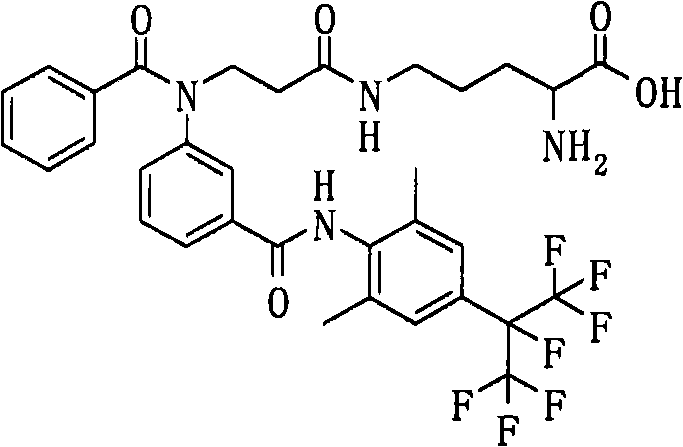
向实施例28中制备的0.350g(0.410mmol)2-(3-(2,6-二甲基-4-(全氟丙烷-2-基)苯基氨基甲酰基)苯基)-14,14-二甲基-1,5,12-三氧代-1-苯基-13-氧杂-2,6,11-三氮杂十五烷-10-甲酸叔丁酯中加入2.00ml(8.20mmol)4N氯化氢/乙酸乙酯溶液,在室温下搅拌4小时,放置一夜。在减压下蒸馏除去溶剂,将所得残渣用IPE洗涤,由此制备0.240g目标化合物(收率80%)。To 0.350 g (0.410 mmol) of 2-(3-(2,6-dimethyl-4-(perfluoropropan-2-yl)phenylcarbamoyl)phenyl)-14 prepared in Example 28, Add 2.00ml ( 8.20 mmol) 4N hydrogen chloride/ethyl acetate solution, stirred at room temperature for 4 hours, and left overnight. The solvent was distilled off under reduced pressure, and the resulting residue was washed with IPE to prepare 0.240 g of the target compound (yield 80%).
1H-NMR(DMSO-d6,ppm)δ1.45-1.50(2H,m),1.50-1.52(2H,m),2.20(6H,s),2.46-2.47(2H,m),2.99(2H,t,J=6.3Hz),4.10(2H,t,J=7.3Hz),7.23-7.28(5H,m),7.41-7.42(4H,m),7.78(2H,s),8.15-8.16(1H,m),8.33-8.34(3H,m),10.05(1H,s).未检测到推定为羧酸的质子。 1 H-NMR (DMSO-d 6 , ppm) δ1.45-1.50 (2H, m), 1.50-1.52 (2H, m), 2.20 (6H, s), 2.46-2.47 (2H, m), 2.99 ( 2H, t, J = 6.3Hz), 4.10 (2H, t, J = 7.3Hz), 7.23-7.28 (5H, m), 7.41-7.42 (4H, m), 7.78 (2H, s), 8.15-8.16 (1H, m), 8.33-8.34 (3H, m), 10.05 (1H, s). Protons putative for carboxylic acids were not detected.
<实施例30><Example 30>
2-(叔丁氧基羰基氨基)-3-(3-(N-(3-(2,6-二甲基-4-(全氟丙烷-2-基)苯基氨基甲酰基)苯基)苯甲酰氨基)丙酰基氧基)丙酸叔丁酯的制备(化合物编号5-22)2-(tert-butoxycarbonylamino)-3-(3-(N-(3-(2,6-dimethyl-4-(perfluoropropan-2-yl)phenylcarbamoyl)phenyl ) benzamido) propionyl oxygen) preparation of tert-butyl propionate (compound number 5-22)

按照实施例28的方法,由实施例27中得到的3-(N-(3-(2,6-二甲基-4-(全氟丙烷-2-基)苯基氨基甲酰基)苯基)苯甲酰氨基)丙酸和2-(叔丁氧基羰基氨基)-3-羟基丙酸叔丁酯制备目标化合物。According to the method of Example 28, from the 3-(N-(3-(2,6-dimethyl-4-(perfluoropropan-2-yl) phenylcarbamoyl) phenyl group obtained in Example 27 ) benzamido) propionic acid and tert-butyl 2-(tert-butoxycarbonylamino)-3-hydroxypropionate to prepare the target compound.
1H-NMR(CDCl3,ppm)δ1.38(9H,s),1.42(9H,s),2.26(6H,s),2.77-2.78(2H,m),4.23-4.33(5H,m),5.40(1H,m),7.25-7.33(8H,m),7.39(1H,m),7.59(1H,s),7.73-7.75(2H,m,J=3.9Hz). 1 H-NMR (CDCl 3 , ppm) δ1.38 (9H, s), 1.42 (9H, s), 2.26 (6H, s), 2.77-2.78 (2H, m), 4.23-4.33 (5H, m) , 5.40(1H, m), 7.25-7.33(8H, m), 7.39(1H, m), 7.59(1H, s), 7.73-7.75(2H, m, J=3.9Hz).
<实施例31><Example 31>
2-氨基-3-(3-(N-(3-(2,6-二甲基-4-(全氟丙烷-2-基)苯基氨基甲酰基)苯基)苯甲酰氨基)丙酰基氧基)丙酸盐酸盐的制备(化合物编号5-25)2-amino-3-(3-(N-(3-(2,6-dimethyl-4-(perfluoropropan-2-yl)phenylcarbamoyl)phenyl)benzamido)propane Preparation of acyloxy) propionate hydrochloride (compound number 5-25)

按照实施例29的方法,由实施例30中得到的2-(叔丁氧基羰基氨基)-3-(3-(N-(3-(2,6-二甲基-4-(全氟丙烷-2-基)苯基氨基甲酰基)苯基)苯甲酰氨基)丙酰基氧基)丙酸叔丁酯制备目标化合物。According to the method of Example 29, 2-(tert-butoxycarbonylamino)-3-(3-(N-(3-(2,6-dimethyl-4-(perfluoro) obtained in Example 30 Propan-2-yl)phenylcarbamoyl)phenyl)benzamido)propionyloxy)propanoic acid tert-butyl ester to prepare the title compound.
1H-NMR(DMSO-d6,ppm)δ2.22(6H,s),2.71-2.76(2H,m),4.13-4.19(2H,m),4.27-4.33(2H,m),4.48-4.51(1H,m),7.21-7.29(5H,m),7.40-7.43(4H,m),7.78-7.80(2H,m),8.50(3H,broad-s),10.07(1H,s). 1 H-NMR (DMSO-d 6 , ppm) δ2.22 (6H, s), 2.71-2.76 (2H, m), 4.13-4.19 (2H, m), 4.27-4.33 (2H, m), 4.48- 4.51(1H, m), 7.21-7.29(5H, m), 7.40-7.43(4H, m), 7.78-7.80(2H, m), 8.50(3H, broad-s), 10.07(1H, s).
<实施例32><Example 32>
3-(N-(3-(2-氨基-2-氧代乙基氨基)-3-氧代丙基)-4-氰基苯甲酰氨基)-N-(2,6-二溴-4-(全氟丙烷-2-基)苯基)-2-氟苯甲酰胺的制备(化合物编号5-31)3-(N-(3-(2-amino-2-oxoethylamino)-3-oxopropyl)-4-cyanobenzamido)-N-(2,6-dibromo- Preparation of 4-(perfluoropropan-2-yl)phenyl)-2-fluorobenzamide (compound number 5-31)

<32-1><32-1>
3-(3-(2,6-二溴-4-(全氟丙烷-2-基)苯基氨基甲酰基)-2-氟苯基氨基)丙酸的制备Preparation of 3-(3-(2,6-dibromo-4-(perfluoropropan-2-yl)phenylcarbamoyl)-2-fluorophenylamino)propionic acid
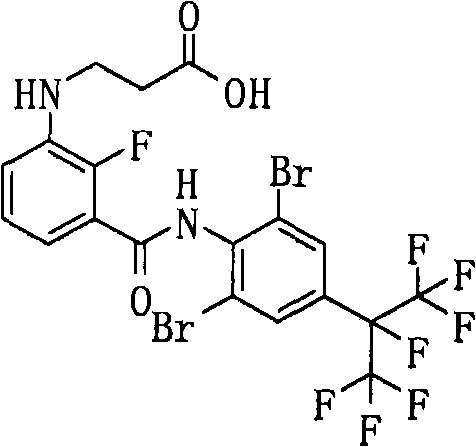
向实施例23的23-4中得到的4.90g(8.80mmol)3-氨基-N-(2,6-二溴-4-(全氟丙烷-2-基)苯基)-2-氟苯甲酰胺中加入6.50g(90.2mmol)丙烯酸,在60℃下搅拌1小时,在80℃下搅拌2小时。向反应溶液中加入水和乙酸乙酯,萃取有机相,用饱和食盐水洗涤,用无水硫酸镁干燥后,减压蒸馏除去溶剂。为了除去丙烯酸,向残渣中加入甲苯,蒸馏除去溶剂,将此操作重复3次。将所得残渣用硅胶柱色谱法(展开溶剂;己烷∶乙酸乙酯=3∶1→2∶1→1∶1)精制,由此制备5.51g目标化合物(收率:定量)。4.90 g (8.80 mmol) of 3-amino-N-(2,6-dibromo-4-(perfluoropropane-2-yl)phenyl)-2-fluorobenzene obtained in 23-4 of Example 23 6.50 g (90.2 mmol) of acrylic acid was added to formamide, and the mixture was stirred at 60° C. for 1 hour and then at 80° C. for 2 hours. Water and ethyl acetate were added to the reaction solution, and the organic phase was extracted, washed with saturated brine, dried over anhydrous magnesium sulfate, and the solvent was distilled off under reduced pressure. In order to remove acrylic acid, toluene was added to the residue, and the solvent was distilled off. This operation was repeated three times. The resulting residue was purified by silica gel column chromatography (developing solvent; hexane:ethyl acetate=3:1→2:1→1:1) to prepare 5.51 g of the target compound (yield: quantitative).
1H-NMR(CDCl3,ppm)δ2.75(2H,t,J=6.3Hz),3.57(2H,t,J=6.3Hz),6.92-6.97(1H,m),7.18-7.20(1H,m),7.42-7.45(1H,m),7.87(2H,s),8.19(1H,d,J=13.7Hz).未检测到NH和COOH的质子。 1 H-NMR (CDCl 3 , ppm) δ2.75 (2H, t, J=6.3Hz), 3.57 (2H, t, J=6.3Hz), 6.92-6.97 (1H, m), 7.18-7.20 (1H , m), 7.42-7.45 (1H, m), 7.87 (2H, s), 8.19 (1H, d, J = 13.7 Hz). Protons of NH and COOH were not detected.
<32-2><32-2>
3-(4-氰基-N-(3-(2,6-二溴-4-(全氟丙烷-2-基)苯基氨基甲酰基)-2-氟苯基)苯甲酰氨基)丙酸的制备3-(4-cyano-N-(3-(2,6-dibromo-4-(perfluoropropan-2-yl)phenylcarbamoyl)-2-fluorophenyl)benzamido) Preparation of propionic acid

将0.180g(4.50mmol)氢氧化钠溶解于20mL水中,加入1.00g(1.59mmol)3-(3-(2,6-二溴-4-(全氟丙烷-2-基)苯基氨基甲酰基)-2-氟苯基氨基)丙酸、0.530g(3.20mmol)4-氰基苯甲酰氯,在室温下搅拌1日。向反应溶液中加入4M盐酸和乙酸乙酯,萃取有机相,用饱和食盐水洗涤后,用无水硫酸镁干燥,减压蒸馏除去溶剂。将所得残渣用硅胶柱色谱法(展开溶剂;己烷∶乙酸乙酯=2∶1→0∶1)精制,由此制备0.430g目标化合物(收率:36%)。Dissolve 0.180g (4.50mmol) of sodium hydroxide in 20mL of water, add 1.00g (1.59mmol) of 3-(3-(2,6-dibromo-4-(perfluoropropan-2-yl)phenylaminomethyl Acyl)-2-fluorophenylamino)propionic acid and 0.530 g (3.20 mmol) of 4-cyanobenzoyl chloride were stirred at room temperature for 1 day. 4M hydrochloric acid and ethyl acetate were added to the reaction solution, and the organic phase was extracted, washed with saturated brine, dried over anhydrous magnesium sulfate, and the solvent was distilled off under reduced pressure. The resulting residue was purified by silica gel column chromatography (developing solvent; hexane:ethyl acetate=2:1→0:1) to prepare 0.430 g of the target compound (yield: 36%).
1H-NMR(CDCl3+DMSO-d6,ppm)δ2.74-2.78(2H,m),4.20-4.22(2H,m),7.24(1H,broad-d,J=4.4Hz),7.44-7.55(4H,m),7.69(1H,broad-s),7.87-7.90(3H,m),8.95(1H,broad-d,J=4.4Hz). 1 H-NMR (CDCl 3 +DMSO-d 6 , ppm) δ2.74-2.78 (2H, m), 4.20-4.22 (2H, m), 7.24 (1H, broad-d, J=4.4Hz), 7.44 -7.55(4H, m), 7.69(1H, broad-s), 7.87-7.90(3H, m), 8.95(1H, broad-d, J=4.4Hz).
未检测到推定为羧酸的质子。Protons putative for carboxylic acids were not detected.
<32-3><32-3>
3-(N-(3-(2-氨基-2-氧代乙基氨基)-3-氧代丙基)-4-氰基苯甲酰氨基)-N-(2,6-二溴-4-(全氟丙烷-2-基)苯基)-2-氟苯甲酰胺的制备(化合物编号5-31)3-(N-(3-(2-amino-2-oxoethylamino)-3-oxopropyl)-4-cyanobenzamido)-N-(2,6-dibromo- Preparation of 4-(perfluoropropan-2-yl)phenyl)-2-fluorobenzamide (compound number 5-31)

向1mL DMF中加入0.120g(0.160mmol)3-(4-氰基-N-(3-(2,6-二溴-4-(全氟丙烷-2-基)苯基氨基甲酰基)-2-氟苯基)苯甲酰氨基)丙酸、0.0260g(0.190mmol)1-(3-二甲基氨基丙基)-3-乙基碳二亚胺盐酸盐、0.0250g(0.190mmol)1-羟基苯并三唑,一边搅拌一边缓慢滴入下述溶液,即在DMF1mL中溶解有0.0300g(0.270mmol)甘氨酸酰胺盐酸盐、0.0300g(0.380mmol)三乙胺的溶液,在室温下搅拌1日。向反应溶液中加入4M盐酸和乙酸乙酯,萃取有机相,用碳酸氢钠水溶液、饱和食盐水洗涤后,用无水硫酸镁干燥。减压蒸馏除去溶剂后,将所得残渣用IPE洗涤,由此制备0.0450g目标化合物(收率:35%)。Add 0.120 g (0.160 mmol) 3-(4-cyano-N-(3-(2,6-dibromo-4-(perfluoropropan-2-yl)phenylcarbamoyl)- 2-fluorophenyl) benzamido) propionic acid, 0.0260g (0.190mmol) 1-(3-dimethylaminopropyl)-3-ethylcarbodiimide hydrochloride, 0.0250g (0.190mmol ) 1-hydroxybenzotriazole, slowly drop into the following solution while stirring, that is, a solution of 0.0300g (0.270mmol) glycine amide hydrochloride and 0.0300g (0.380mmol) triethylamine dissolved in DMF1mL, in Stir at room temperature for 1 day. 4M hydrochloric acid and ethyl acetate were added to the reaction solution, and the organic phase was extracted, washed with aqueous sodium bicarbonate solution and saturated brine, and dried over anhydrous magnesium sulfate. After the solvent was distilled off under reduced pressure, the resulting residue was washed with IPE, whereby 0.0450 g of the target compound was prepared (yield: 35%).
1H-NMR(DMSO-d6,ppm)δ2.40-2.70(2H,m),3.56-3.58(2H,m),3.97(1H,broad-s),4.10(1H,broad-s),7.02(1H,s),7.31(2H,broad-s),7.45-7.47(2H,m),7.61(1H,broad-s),7.73-7.75(3H,m),7.95(1H,s),8.03(2H,s),8.25(1H,broad-s). 1 H-NMR (DMSO-d 6 , ppm) δ2.40-2.70 (2H, m), 3.56-3.58 (2H, m), 3.97 (1H, broad-s), 4.10 (1H, broad-s), 7.02(1H, s), 7.31(2H, broad-s), 7.45-7.47(2H, m), 7.61(1H, broad-s), 7.73-7.75(3H, m), 7.95(1H, s), 8.03(2H, s), 8.25(1H, broad-s).
<实施例33><Example 33>
3-(3-氰基-N-(3-(羟基氨基)-3-氧代丙基)苯甲酰氨基)-N-(2,6-二溴-4-(全氟丙烷-2-基)苯基)-2-氟苯甲酰胺的制备(化合物编号5-33)3-(3-cyano-N-(3-(hydroxyamino)-3-oxopropyl)benzamido)-N-(2,6-dibromo-4-(perfluoropropane-2- base) phenyl)-2-fluorobenzamide preparation (compound number 5-33)

<33-1><33-1>
3-(3-(叔丁氧基氨基)-3-氧代丙基氨基)-N-(2,6-二溴-4-(全氟丙烷-2-基)苯基)-2-氟苯甲酰胺的制备3-(3-(tert-butoxyamino)-3-oxopropylamino)-N-(2,6-dibromo-4-(perfluoropropan-2-yl)phenyl)-2-fluoro Preparation of benzamide

于0℃,向0.520g(2.73mmol)(1-(3-二甲基氨基丙基)-3-乙基碳二亚胺盐酸盐、0.340g(2.51mmol)1-羟基苯并三唑的3g THF溶液中加入实施例32的32-1中得到的1.43g(2.28mmol)3-(3-(2,6-二溴-4-(全氟丙烷-2-基)苯基氨基甲酰基)-2-氟苯基氨基)丙酸,在相同温度下搅拌1小时。在0℃下,向反应液中加入0.430g(3.42mmol)叔丁氧基胺盐酸盐、0.370g(3.65mmol)三乙胺的3g THF溶液,在室温下搅拌6小时,放置一夜。向反应液中加入水、乙酸乙酯,将有机层用水、饱和食盐水洗涤后,用无水硫酸镁干燥。在减压下蒸馏除去溶剂,将所得残渣用硅胶柱色谱法(展开溶剂;二氯甲烷∶甲醇=200∶1→50∶1)精制,由此制备0.950g目标化合物(收率60%)。At 0°C, add 0.520g (2.73mmol) (1-(3-dimethylaminopropyl)-3-ethylcarbodiimide hydrochloride, 0.340g (2.51mmol) 1-hydroxybenzotriazole 1.43g (2.28mmol) 3-(3-(2,6-dibromo-4-(perfluoropropane-2-yl) phenylaminomethyl) obtained in 32-1 of Example 32 was added in 3g THF solution of Acyl)-2-fluorophenylamino)propionic acid, stirred at the same temperature for 1 hour.At 0°C, 0.430g (3.42mmol) tert-butoxyamine hydrochloride, 0.370g (3.65 The 3g THF solution of mmol) triethylamine was stirred at room temperature for 6 hours and left overnight.Water, ethyl acetate were added to the reaction solution, and after the organic layer was washed with water and saturated saline, it was dried with anhydrous magnesium sulfate. The solvent was distilled off under reduced pressure, and the resulting residue was purified by silica gel column chromatography (developing solvent; dichloromethane:methanol=200:1→50:1) to prepare 0.950 g of the target compound (yield 60%).
1H-NMR(CDCl3,ppm)δ1.26(9H,s),2.48-2.49(1H,m),2.79-2.80(1H,m),3.58-3.59(2H,m),4.65(1H,broad-s),6.94-6.95(1H,m),7.16(1H,t,J=7.8Hz),7.42-7.43(1H,m),7.69-7.70(1H,m),7.86(2H,s),8.20(1H,d,J=14.1Hz). 1 H-NMR (CDCl 3 , ppm) δ1.26 (9H, s), 2.48-2.49 (1H, m), 2.79-2.80 (1H, m), 3.58-3.59 (2H, m), 4.65 (1H, broad-s), 6.94-6.95(1H, m), 7.16(1H, t, J=7.8Hz), 7.42-7.43(1H, m), 7.69-7.70(1H, m), 7.86(2H, s) , 8.20(1H, d, J=14.1Hz).
<33-2><33-2>
3-(N-(3-(叔丁氧基氨基)-3-氧代丙基)-3-氰基苯甲酰氨基)-N-(2,6-二溴-4-(全氟丙烷-2-基)苯基)-2-氟苯甲酰胺的制备3-(N-(3-(tert-butoxyamino)-3-oxopropyl)-3-cyanobenzamido)-N-(2,6-dibromo-4-(perfluoropropane Preparation of -2-yl)phenyl)-2-fluorobenzamide

按照实施例1的1-5所述的方法,由3-(3-(叔丁氧基氨基)-3-氧代丙基氨基)-N-(2,6-二溴-4-(全氟丙烷-2-基)苯基)-2-氟苯甲酰胺和3-氰基苯甲酰氯制备目标化合物。According to the method described in 1-5 of Example 1, from 3-(3-(tert-butoxyamino)-3-oxopropylamino)-N-(2,6-dibromo-4-(all Fluoropropan-2-yl)phenyl)-2-fluorobenzamide and 3-cyanobenzoyl chloride to prepare the title compound.
1H-NMR(CDCl3,ppm)δ1.20(9H,s),2.68-2.69(1H,m),2.74-2.75(1H,m),4.23-4.24(2H,m),7.29-7.33(2H,m),7.47-7.48(1H,m),7.57-7.62(2H,m),7.72(1H,s),7.85(2H,s),7.97-8.04(3H,m). 1 H-NMR (CDCl 3 , ppm) δ1.20 (9H, s), 2.68-2.69 (1H, m), 2.74-2.75 (1H, m), 4.23-4.24 (2H, m), 7.29-7.33 ( 2H, m), 7.47-7.48 (1H, m), 7.57-7.62 (2H, m), 7.72 (1H, s), 7.85 (2H, s), 7.97-8.04 (3H, m).
<33-3><33-3>
3-(3-氰基-N-(3-(羟基氨基)-3-氧代丙基)苯甲酰氨基)-N-(2,6-二溴-4-(全氟丙烷-2-基)苯基)-2-氟苯甲酰胺的制备(化合物编号5-33)3-(3-cyano-N-(3-(hydroxyamino)-3-oxopropyl)benzamido)-N-(2,6-dibromo-4-(perfluoropropane-2- base) phenyl)-2-fluorobenzamide preparation (compound number 5-33)

向3-(N-(3-(叔丁氧基氨基)-3-氧代丙基)-3-氰基苯甲酰氨基)-N-(2,6-二溴-4-(全氟丙烷-2-基)苯基)-2-氟苯甲酰胺0.250g(0.310mmol)的二氯甲烷溶液5ml加入三氟乙酸3.3ml,在室温下搅拌7小时后,在40℃下搅拌5小时,放置一夜。将反应液进一步在40℃下搅拌12小时放置一夜。向反应液中加入10%氢氧化钠水溶液使其pH为7后,将有机层用水、饱和食盐水洗涤后,用无水硫酸镁干燥。在减压下蒸馏除去溶剂,将所得残渣用硅胶柱色谱法(展开溶剂;乙酸乙酯→乙酸乙酯∶甲醇=10∶1)精制,由此制备0.130g目标化合物(收率55%)。To 3-(N-(3-(tert-butoxyamino)-3-oxopropyl)-3-cyanobenzamido)-N-(2,6-dibromo-4-(perfluoro Propan-2-yl)phenyl)-2-fluorobenzamide 0.250g (0.310mmol) of dichloromethane solution 5ml was added trifluoroacetic acid 3.3ml, stirred at room temperature for 7 hours, then stirred at 40°C for 5 hours , placed overnight. The reaction solution was further stirred at 40° C. for 12 hours and left overnight. After adding 10% aqueous sodium hydroxide solution to the reaction solution to adjust the pH to 7, the organic layer was washed with water and saturated brine, and dried over anhydrous magnesium sulfate. The solvent was distilled off under reduced pressure, and the obtained residue was purified by silica gel column chromatography (developing solvent; ethyl acetate→ethyl acetate:methanol=10:1) to prepare 0.130 g of the target compound (yield 55%).
1H-NMR(CDCl3,ppm)δ2.63-2.64(2H,m),4.20-4.21(2H,m),7.12-7.24(2H,m),7.39-7.40(1H,m),7.51-7.52(3H,m),7.69-7.70(1H,m),7.81(2H,s),7.85-7.86(1H,m),7.91-7.92(1H,m),8.31-8.32(1H,m). 1 H-NMR (CDCl 3 , ppm) δ2.63-2.64 (2H, m), 4.20-4.21 (2H, m), 7.12-7.24 (2H, m), 7.39-7.40 (1H, m), 7.51- 7.52(3H, m), 7.69-7.70(1H, m), 7.81(2H, s), 7.85-7.86(1H, m), 7.91-7.92(1H, m), 8.31-8.32(1H, m).
<实施例34><Example 34>
N-(2,6-二甲基-4-(全氟丙烷-2-基)苯基)-3-(N-(2-羟乙基)苯甲酰氨基)-N-甲基苯甲酰胺的制备(化合物编号5-35)N-(2,6-Dimethyl-4-(perfluoropropan-2-yl)phenyl)-3-(N-(2-hydroxyethyl)benzamido)-N-methylbenzyl Preparation of Amides (Compound No. 5-35)

<34-1><34-1>
N-(2,6-二甲基-4-(全氟丙烷-2-基)苯基)-3-(2-羟乙基氨基)-N-甲基苯甲酰胺的制备Preparation of N-(2,6-dimethyl-4-(perfluoropropan-2-yl)phenyl)-3-(2-hydroxyethylamino)-N-methylbenzamide
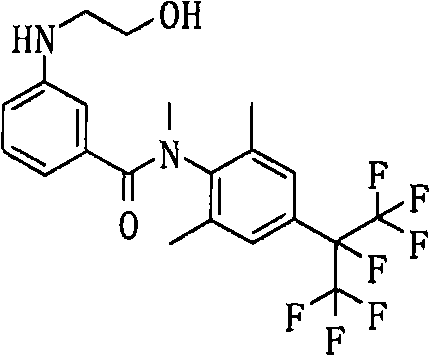
将实施例5的5-5中得到的0.133g(0.221mmol)2-(N-(3((2,6-二甲基-4-(全氟丙烷-2-基)苯基)(甲基)氨基甲酰基)苯基)苯甲酰氨基)乙酸甲酯的5ml THF溶液冷却至0℃后,加入0.0213g(0.561mmol)氢化铝锂,在0℃下搅拌10分钟。向反应液中加入水、乙酸乙酯,分离得到有机相,将有机相用盐酸、饱和碳酸氢钠水溶液、饱和食盐水洗涤,用无水硫酸钠干燥后,在减压下除去溶剂。将所得残渣用硅胶柱色谱法(展开溶剂;乙酸乙酯)精制,由此制备0.0720g目标化合物(收率:57%)。0.133g (0.221mmol) 2-(N-(3((2,6-dimethyl-4-(perfluoropropan-2-yl)phenyl)(methyl) obtained in 5-5 of Example 5 Base) carbamoyl) phenyl) benzamido) methyl acetate 5ml THF solution was cooled to 0 ° C, added 0.0213 g (0.561 mmol) lithium aluminum hydride, stirred at 0 ° C for 10 minutes. Water and ethyl acetate were added to the reaction solution, and the organic phase was separated. The organic phase was washed with hydrochloric acid, saturated aqueous sodium bicarbonate solution, and saturated brine, dried over anhydrous sodium sulfate, and the solvent was removed under reduced pressure. The resulting residue was purified by silica gel column chromatography (developing solvent; ethyl acetate) to prepare 0.0720 g of the target compound (yield: 57%).
1H-NMR(CDCl3,ppm)δ2.28(6H,s),2.37(1H,s),3.08(2H,t,J=5.4Hz),3.31(3H,s),3.73(2H,t,J=5.4Hz),3.91(1H,broad-s),6.53-6.57(3H,m),6.90(1H,t,J=7.3Hz),7.23(2H,s), 1 H-NMR (CDCl 3 , ppm) δ2.28 (6H, s), 2.37 (1H, s), 3.08 (2H, t, J=5.4Hz), 3.31 (3H, s), 3.73 (2H, t , J=5.4Hz), 3.91(1H, broad-s), 6.53-6.57(3H, m), 6.90(1H, t, J=7.3Hz), 7.23(2H, s),
<34-2><34-2>
N-(2,6-二甲基-4-(全氟丙烷-2-基)苯基)-3-(N-(2-羟乙基)苯甲酰氨基)-N-甲基苯甲酰胺的制备(化合物编号5-35)N-(2,6-Dimethyl-4-(perfluoropropan-2-yl)phenyl)-3-(N-(2-hydroxyethyl)benzamido)-N-methylbenzyl Preparation of Amides (Compound No. 5-35)

按照实施例1的1-5的方法,由N-(2,6-二甲基-4-(全氟丙烷-2-基)苯基)-3-(2-羟乙基氨基)-N-甲基苯甲酰胺制备目标化合物。According to the method of 1-5 of Example 1, by N-(2,6-dimethyl-4-(perfluoropropane-2-yl)phenyl)-3-(2-hydroxyethylamino)-N -Toluamide to prepare the target compound.
1H-NMR(CDCl3,ppm)δ2.17(6H,s),2.90(1H,broad-s),3.28(3H,s),3.70-3.72(2H,m),3.85-3.92(2H,m),6.91-7.07(3H,m),7.11-7.39(8H,m)· 1 H-NMR (CDCl 3 , ppm) δ2.17 (6H, s), 2.90 (1H, broad-s), 3.28 (3H, s), 3.70-3.72 (2H, m), 3.85-3.92 (2H, m), 6.91-7.07(3H, m), 7.11-7.39(8H, m) ·
<实施例35><Example 35>
N-(3-氨基-3-氧代丙基)-3-苯甲酰氨基-N-(2,6-二甲基-4-(全氟丙烷-2-基)苯基)苯甲酰胺(化合物编号7-1)N-(3-amino-3-oxopropyl)-3-benzamido-N-(2,6-dimethyl-4-(perfluoropropan-2-yl)phenyl)benzamide (Compound No. 7-1)
<35-1><35-1>
3-(2,6-二甲基苯基氨基)丙酰胺的制备Preparation of 3-(2,6-Dimethylphenylamino)propionamide

向10ml乙酸中装入3.00g(25.0mmol)2,6-二甲基苯胺、1.88g(74.0mmol)丙烯酰胺,在100℃下搅拌4小时。进一步追加1.88g(74.0mmol)丙烯酰胺,搅拌1小时。冷却至室温后,排出到水中,用碳酸钾中和,用乙酸乙酯萃取。用水洗涤2次后,用无水硫酸镁干燥,在减压下蒸馏除去溶剂。将所得残渣用硅胶柱色谱法(展开溶剂;己烷∶乙酸乙酯=3∶1→0∶1)精制,由此制备2.64g目标化合物(收率:55%)。3.00 g (25.0 mmol) of 2,6-dimethylaniline and 1.88 g (74.0 mmol) of acrylamide were charged to 10 ml of acetic acid, and stirred at 100° C. for 4 hours. Furthermore, 1.88 g (74.0 mmol) of acrylamide was added, and it stirred for 1 hour. After cooling to room temperature, it was discharged into water, neutralized with potassium carbonate, and extracted with ethyl acetate. After washing with water twice, it was dried over anhydrous magnesium sulfate, and the solvent was distilled off under reduced pressure. The resulting residue was purified by silica gel column chromatography (developing solvent; hexane:ethyl acetate=3:1→0:1) to prepare 2.64 g of the target compound (yield: 55%).
1H-NMR(CDCl3,ppm)δ2.30(6H,s),2.46-2.50(2H,m),3.25-3.26(2H,m),3.57(1H,broad-s),5.57(1H,broad-s),6.14(1H,broad-s),6.83-6.87(1H,m),6.99-7.10(2H,m). 1 H-NMR (CDCl 3 , ppm) δ2.30 (6H, s), 2.46-2.50 (2H, m), 3.25-3.26 (2H, m), 3.57 (1H, broad-s), 5.57 (1H, broad-s), 6.14 (1H, broad-s), 6.83-6.87 (1H, m), 6.99-7.10 (2H, m).
<35-2><35-2>
3-(2,6-二甲基-4-(全氟丙烷-2-基)苯基氨基)丙酰胺的制备Preparation of 3-(2,6-dimethyl-4-(perfluoropropan-2-yl)phenylamino)propanamide

向20ml叔丁基甲基醚、20ml水的混合溶液中装入2.30g(11.9mmol)3-(2,6-二甲基苯基氨基)丙酰胺,添加2.50g(14.3mmol)85%连二亚硫酸钠、0.400g(1.20mmol)四丁基硫酸氢铵后,添加1.20g(14.3mmol)碳酸氢钠。接下来,滴入4.20g(14.3mmol)七氟异丙基碘后,在室温下搅拌3小时,分液。用5%盐酸水溶液、饱和碳酸氢钠水溶液依次洗涤后,用无水硫酸镁干燥。减压蒸馏除去溶剂后,将所得残渣用硅胶柱色谱法(展开溶剂;己烷∶乙酸乙酯=1∶1→0∶1)精制,由此制备1.25g目标化合物(收率29%)。2.30g (11.9mmol) 3-(2,6-dimethylphenylamino) propionamide is loaded into the mixed solution of 20ml tert-butyl methyl ether, 20ml water, add 2.50g (14.3mmol) 85% sodium dithionite , 0.400 g (1.20 mmol) of tetrabutylammonium bisulfate, and then 1.20 g (14.3 mmol) of sodium bicarbonate was added. Next, after dropping 4.20 g (14.3 mmol) of heptafluoroisopropyl iodide, it stirred at room temperature for 3 hours, and liquid-separated. After washing successively with 5% aqueous hydrochloric acid solution and saturated aqueous sodium bicarbonate solution, it was dried over anhydrous magnesium sulfate. After the solvent was distilled off under reduced pressure, the resulting residue was purified by silica gel column chromatography (developing solvent; hexane:ethyl acetate=1:1→0:1) to prepare 1.25 g of the target compound (yield 29%).
1H-NMR(CDCl3,ppm)δ2.32(6H,s),2.47(2H,t,J=5.9Hz),3.35(2H,t,J=5.9Hz),5.55(1H,broad-s),5.69(1H,broad-s),7.17(2H,s). 1 H-NMR (CDCl 3 , ppm) δ2.32 (6H, s), 2.47 (2H, t, J=5.9Hz), 3.35 (2H, t, J=5.9Hz), 5.55 (1H, broad-s ), 5.69 (1H, broad-s), 7.17 (2H, s).
未检测到推定为NH的质子。Protons putative for NH were not detected.
<35-3><35-3>
N-(3-氨基-3-氧代丙基)-N-(2,6-二甲基-4-(全氟丙烷-2-基)苯基)-3-硝基苯甲酰胺的制备Preparation of N-(3-amino-3-oxopropyl)-N-(2,6-dimethyl-4-(perfluoropropan-2-yl)phenyl)-3-nitrobenzamide

按照实施例1的1-1的方法,由3-(2,6-二甲基-4-(全氟丙烷-2-基)苯基氨基)丙酰胺和3-硝基苯甲酰氯制备目标化合物。According to the method of 1-1 of Example 1, the target is prepared by 3-(2,6-dimethyl-4-(perfluoropropan-2-yl)phenylamino)propanamide and 3-nitrobenzoyl chloride compound.
1H-NMR(CDCl3,ppm)δ2.30(6H,s),2.78(2H,t,J=7.8Hz),4.09(2H,t,J=7.8Hz),5.50(1H,broad-s),6.03(1H,broad-s),7.27(2H,s),7.34-7.35(1H,m),7.55(1H,dd,J=1.5,7.8Hz),8.04-8.06(1H,m),8.13-8.16(1H,m). 1 H-NMR (CDCl 3 , ppm) δ2.30 (6H, s), 2.78 (2H, t, J=7.8Hz), 4.09 (2H, t, J=7.8Hz), 5.50 (1H, broad-s ), 6.03(1H, broad-s), 7.27(2H, s), 7.34-7.35(1H, m), 7.55(1H, dd, J=1.5, 7.8Hz), 8.04-8.06(1H, m), 8.13-8.16 (1H, m).
<35-4><35-4>
3-氨基-N-(3-氨基-3-氧代丙基)-N-(2,6-二甲基-4-(全氟丙烷-2-基)苯基)苯甲酰胺(化合物编号18-72)和3-(3-氨基-N-(2,6-二甲基-4-(全氟丙烷-2-基)苯基)苯甲酰氨基)丙酸甲酯的制备3-amino-N-(3-amino-3-oxopropyl)-N-(2,6-dimethyl-4-(perfluoropropan-2-yl)phenyl)benzamide (Compound No. 18-72) and preparation of methyl 3-(3-amino-N-(2,6-dimethyl-4-(perfluoropropan-2-yl)phenyl)benzamido)propionate

酰胺体 酯体Amides Esters
向5ml甲醇中装入0.300g(0.590mmol)N-(3-氨基-3-氧代丙基)-N-(2,6-二甲基-4-(全氟丙烷-2-基)苯基)-3-硝基苯甲酰胺、0.550g(2.95mmol)氯化锡(II),添加3ml浓盐酸后,在60℃下搅拌30分钟。冷却至室温后,加入乙酸乙酯、水后,用碳酸钾中和。将固态物进行硅藻土过滤后,分液,用无水硫酸镁干燥。在减压下蒸馏除去溶剂,将所得残渣用硅胶柱色谱法(展开溶剂;己烷∶乙酸乙酯=1∶2→乙酸乙酯∶甲醇=10∶1)精制,由此制备0.100g 3-氨基-N-(3-氨基-3-氧代丙基)-N-(2,6-二甲基-4-(全氟丙烷-2-基)苯基)苯甲酰胺(酰胺体:收率:35%),制备0.160g 3-(3-氨基-N-(2,6-二甲基-4-(全氟丙烷-2-基)苯基)苯甲酰氨基)丙酸甲酯(酯体:收率:56%)。Charge 0.300 g (0.590 mmol) N-(3-amino-3-oxopropyl)-N-(2,6-dimethyl-4-(perfluoropropane-2-yl) benzene in 5 ml methanol Base)-3-nitrobenzamide, 0.550g (2.95mmol) of tin(II) chloride, after adding 3ml of concentrated hydrochloric acid, stirred at 60°C for 30 minutes. After cooling to room temperature, ethyl acetate and water were added, followed by neutralization with potassium carbonate. After the solid matter was filtered through celite, the liquid was separated and dried over anhydrous magnesium sulfate. The solvent was distilled off under reduced pressure, and the resulting residue was purified by silica gel column chromatography (developing solvent; hexane:ethyl acetate=1:2→ethyl acetate:methanol=10:1), thereby preparing 0.100 g of 3- Amino-N-(3-amino-3-oxopropyl)-N-(2,6-dimethyl-4-(perfluoropropan-2-yl)phenyl)benzamide (amide form: Yield: 35%), prepared 0.160g 3-(3-amino-N-(2,6-dimethyl-4-(perfluoropropan-2-yl)phenyl)benzamido)propionic acid methyl ester (Ester body: yield: 56%).
酰胺体Amides
1H-NMR(CDCl3,ppm)δ2.27(6H,s),2.72(2H,t,J=7.8Hz),3.57(2H,broad-s),4.03(2H,t,J=7.8Hz),5.40(1H,broad-s),6.37(1H,broad-s),6.38-6.41(1H,m),6.56-6.59(1H,m),6.64-6.65(1H,m),6.83(1H,t,J=7.8Hz),7.37(2H,s). 1 H-NMR (CDCl 3 , ppm) δ 2.27 (6H, s), 2.72 (2H, t, J=7.8Hz), 3.57 (2H, broad-s), 4.03 (2H, t, J=7.8Hz ), 5.40(1H, broad-s), 6.37(1H, broad-s), 6.38-6.41(1H, m), 6.56-6.59(1H, m), 6.64-6.65(1H, m), 6.83(1H , t, J=7.8Hz), 7.37(2H, s).
酯体Ester body
1H-NMR(CDCl3,ppm)δ2.27(6H,s),2.82(2H,t,J=7.3Hz),3.56(2H,broad-s),3.62(3H,s),4.03(2H,t,J=7.3Hz),6.36-6.38(1H,m),6.55-6.57(1H,m),6.66-6.67(1H,m),6.81(1H,t,J=7.8Hz),7.23(2H,s). 1 H-NMR (CDCl 3 , ppm) δ 2.27 (6H, s), 2.82 (2H, t, J=7.3Hz), 3.56 (2H, broad-s), 3.62 (3H, s), 4.03 (2H , t, J=7.3Hz), 6.36-6.38(1H, m), 6.55-6.57(1H, m), 6.66-6.67(1H, m), 6.81(1H, t, J=7.8Hz), 7.23( 2H, s).
<35-5><35-5>
N-(3-氨基-3-氧代丙基)-3-苯甲酰氨基-N-(2,6-二甲基-4-(全氟丙烷-2-基)苯基)苯甲酰胺(化合物编号7-1)N-(3-amino-3-oxopropyl)-3-benzamido-N-(2,6-dimethyl-4-(perfluoropropan-2-yl)phenyl)benzamide (Compound No. 7-1)
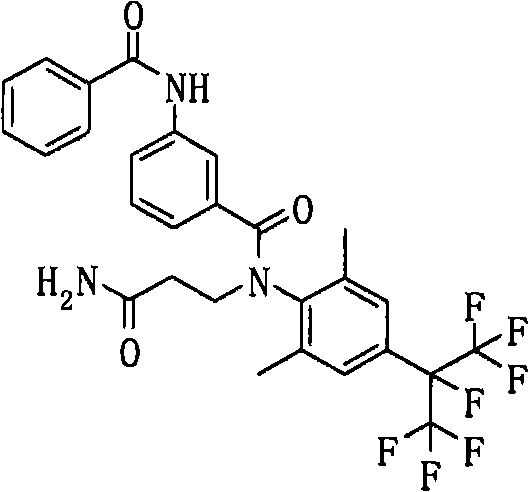
按照实施例1的1-5的方法,由3-氨基-N-(3-氨基-3-氧代丙基)-N-(2,6-二甲基-4-(全氟丙烷-2-基)苯基)苯甲酰胺制备目标化合物。According to the method of 1-5 of Example 1, by 3-amino-N-(3-amino-3-oxopropyl)-N-(2,6-dimethyl-4-(perfluoropropane-2 - Base) phenyl) benzamide to prepare the target compound.
1H-NMR(CDCl3,ppm)δ2.33(6H,s),2.72-2.74(2H,m),4.02(2H,m),6.10(1H,broad-s),6.78-6.80(1H,m),7.04(1H,t,J=7.8Hz),7.21(3H,broad-s),7.35-7.61(5H,m),7.87-7.89(2H,m),9.80(1H,broad-s). 1 H-NMR (CDCl 3 , ppm) δ2.33 (6H, s), 2.72-2.74 (2H, m), 4.02 (2H, m), 6.10 (1H, broad-s), 6.78-6.80 (1H, m), 7.04(1H, t, J=7.8Hz), 7.21(3H, broad-s), 7.35-7.61(5H, m), 7.87-7.89(2H, m), 9.80(1H, broad-s) .
<实施例36><Example 36>
3-(3-苯甲酰氨基-N-(2,6-二甲基-4-(全氟丙烷-2-基)苯基)苯甲酰氨基)丙酸甲酯的制备(化合物编号7-6)Preparation of 3-(3-benzamido-N-(2,6-dimethyl-4-(perfluoropropane-2-yl)phenyl)benzamido)propionic acid methyl ester (compound number 7 -6)

按照实施例1的1-5的方法,由3-(3-氨基-N-(2,6-二甲基-4-(全氟丙烷-2-基)苯基)苯甲酰氨基)丙酸甲酯制备目标化合物。According to the method of 1-5 of Example 1, from 3-(3-amino-N-(2,6-dimethyl-4-(perfluoropropan-2-yl)phenyl)benzamido)propane acid methyl ester to prepare the target compound.
1H-NMR(CDCl3,ppm)δ2.31(6H,s),2.84(2H,t,J=7.8Hz),3.63(3H,s),4.07(2H,t,J=7.8Hz),6.87-6.89(1H,m),7.10(1H,t,J=7.8Hz),7.24-7.26(2H,m),7.46-7.58(4H,m),7.65-7.69(2H,m),7.77-7.79(2H,m). 1 H-NMR (CDCl 3 , ppm) δ 2.31 (6H, s), 2.84 (2H, t, J=7.8Hz), 3.63 (3H, s), 4.07 (2H, t, J=7.8Hz), 6.87-6.89 (1H, m), 7.10 (1H, t, J=7.8Hz), 7.24-7.26 (2H, m), 7.46-7.58 (4H, m), 7.65-7.69 (2H, m), 7.77- 7.79(2H, m).
<实施例37><Example 37>
N-(3-氨基-3-氧代丙基)-3-(N-(3-氨基-3-氧代丙基)苯甲酰氨基)-N-(2,6-二甲基-4-(全氟丙烷-2-基)苯基)苯甲酰胺的制备(化合物编号8-1)N-(3-amino-3-oxopropyl)-3-(N-(3-amino-3-oxopropyl)benzamido)-N-(2,6-dimethyl-4 Preparation of -(perfluoropropan-2-yl)phenyl)benzamide (compound number 8-1)

<37-1><37-1>
N-(3-氨基-3-氧代丙基)-3-(3-氨基-3-氧代丙基氨基)-N-(2,6-二甲基-4-(全氟丙烷-2-基)苯基)苯甲酰胺的制备(化合物编号18-87)N-(3-amino-3-oxopropyl)-3-(3-amino-3-oxopropylamino)-N-(2,6-dimethyl-4-(perfluoropropane-2 Preparation of -yl)phenyl)benzamide (compound number 18-87)
按照实施例20的20-2的方法,由实施例35的35-4中得到的3-氨基-N-(3-氨基-3-氧代丙基)-N-(2,6-二甲基-4-(全氟丙烷-2-基)苯基)苯甲酰胺制备目标化合物。According to the method of 20-2 of Example 20, 3-amino-N-(3-amino-3-oxopropyl)-N-(2,6-dimethyl) obtained in 35-4 of Example 35 Base-4-(perfluoropropan-2-yl)phenyl)benzamide to prepare the target compound.
1H-NMR(CDCl3,ppm)δ2.39-2.42(2H,m),2.62(6H,s),2.72-2.74(2H,m),3.19-3.20(2H,m),3.99-4.02(2H,m),4.41(1H,broad-s),5.80(1H,broad-s),5.84(1H,broad-s),6.41(1H,d,J=7.8Hz),6.51-6.54(2H,m),6.84-6.88(3H,m),7.40(2H,s). 1 H-NMR (CDCl 3 , ppm) δ2.39-2.42 (2H, m), 2.62 (6H, s), 2.72-2.74 (2H, m), 3.19-3.20 (2H, m), 3.99-4.02 ( 2H, m), 4.41(1H, broad-s), 5.80(1H, broad-s), 5.84(1H, broad-s), 6.41(1H, d, J=7.8Hz), 6.51-6.54(2H, m), 6.84-6.88 (3H, m), 7.40 (2H, s).
<37-2><37-2>
N-(3-氨基-3-氧代丙基)-3-(N-(3-氨基-3-氧代丙基)苯甲酰氨基)-N-(2,6-二甲基-4-(全氟丙烷-2-基)苯基)苯甲酰胺的制备(化合物编号8-1)N-(3-amino-3-oxopropyl)-3-(N-(3-amino-3-oxopropyl)benzamido)-N-(2,6-dimethyl-4 Preparation of -(perfluoropropan-2-yl)phenyl)benzamide (compound number 8-1)

按照实施例1的1-5的方法,由N-(3-氨基-3-氧代丙基)-3-(3-氨基-3-氧代丙基氨基)-N-(2,6-二甲基-4-(全氟丙烷-2-基)苯基)苯甲酰胺制备目标化合物。According to the method of 1-5 of Example 1, by N-(3-amino-3-oxopropyl)-3-(3-amino-3-oxopropylamino)-N-(2,6- Dimethyl-4-(perfluoropropan-2-yl)phenyl)benzamide to prepare the target compound.
1H-NMR(CDCl3,ppm)δ2.11(6H,s),2.58(2H,t,J=6.8Hz),2.70(2H,t,J=6.8Hz),3.96-4.05(4H,m),5.45(1H,broad-s),5.55(1H,broad-s),6.20(1H,broad-s),6.25(1H,broad-s),6.80-6.82(1H,m),6.91-6.99(2H,m),7.11-7.17(5H,m),7.22(2H,s),7.30-7.40(1H,m) 1 H-NMR (CDCl 3 , ppm) δ2.11 (6H, s), 2.58 (2H, t, J=6.8Hz), 2.70 (2H, t, J=6.8Hz), 3.96-4.05 (4H, m ), 5.45(1H, broad-s), 5.55(1H, broad-s), 6.20(1H, broad-s), 6.25(1H, broad-s), 6.80-6.82(1H, m), 6.91-6.99 (2H, m), 7.11-7.17 (5H, m), 7.22 (2H, s), 7.30-7.40 (1H, m)
<实施例38><Example 38>
3-苯甲酰氨基-N-(2,6-二溴-4-(全氟丙烷-2-基)苯基)-2-氟-N-(2-(甲基磺酰基)乙基)苯甲酰胺的制备(化合物编号7-169)3-Benzamido-N-(2,6-dibromo-4-(perfluoropropan-2-yl)phenyl)-2-fluoro-N-(2-(methylsulfonyl)ethyl) Preparation of benzamide (compound number 7-169)

<38-1><38-1>
3-氨基-N-(2,6-二溴-4-(全氟丙烷-2-基)苯基)-2-氟-N-(2-(甲基磺酰基)乙基)苯甲酰胺的制备(化合物编号20-36)3-amino-N-(2,6-dibromo-4-(perfluoropropan-2-yl)phenyl)-2-fluoro-N-(2-(methylsulfonyl)ethyl)benzamide Preparation of (compound number 20-36)

向实施例23的23-4中得到的0.670g(1.20mmol)3-氨基-N-(2,6-二溴-4-(全氟丙烷-2-基)苯基)-2-氟苯甲酰胺中加入在2ml水中溶解有0.550g(5.18mmol)乙烯基磺酸甲酯、0.100g(2.50mmol)氢氧化钠的水溶液,在60℃下搅拌3小时。向反应溶液中加入乙酸乙酯和水,萃取有机相后,用饱和食盐水洗涤,用无水硫酸镁干燥后,减压蒸馏除去溶剂。将所得残渣用硅胶柱色谱法(展开溶剂;己烷∶乙酸乙酯=4∶1→3∶1→2∶1)精制,由此制备0.410g目标化合物(收率52%)。0.670 g (1.20 mmol) of 3-amino-N-(2,6-dibromo-4-(perfluoropropane-2-yl)phenyl)-2-fluorobenzene obtained in 23-4 of Example 23 An aqueous solution in which 0.550 g (5.18 mmol) of methyl vinylsulfonate and 0.100 g (2.50 mmol) of sodium hydroxide were dissolved in 2 ml of water was added to formamide, and stirred at 60° C. for 3 hours. Ethyl acetate and water were added to the reaction solution, and the organic phase was extracted, washed with saturated brine, dried over anhydrous magnesium sulfate, and the solvent was distilled off under reduced pressure. The resulting residue was purified by silica gel column chromatography (developing solvent; hexane:ethyl acetate=4:1→3:1→2:1) to prepare 0.410 g of the target compound (yield 52%).
1H-NMR(CDCl3,ppm)δ3.10(3H,s),3.74-3.78(4H,m),4.18-4.22(2H,m),6.44-6.48(1H,m),6.62-6.73(2H,m),7.74(2H,s). 1 H-NMR (CDCl 3 , ppm) δ3.10 (3H, s), 3.74-3.78 (4H, m), 4.18-4.22 (2H, m), 6.44-6.48 (1H, m), 6.62-6.73 ( 2H, m), 7.74(2H, s).
<38-2><38-2>
3-苯甲酰氨基-N-(2,6-二溴-4-(全氟丙烷-2-基)苯基)-2-氟-N-(2-(甲基磺酰基)乙基)苯甲酰胺的制备(化合物编号7-169)3-Benzamido-N-(2,6-dibromo-4-(perfluoropropan-2-yl)phenyl)-2-fluoro-N-(2-(methylsulfonyl)ethyl) Preparation of benzamide (compound number 7-169)

按照实施例1的1-5的方法,由3-氨基-N-(2,6-二溴-4-(全氟丙烷-2-基)苯基)-2-氟-N-(2-(甲基磺酰基)乙基)苯甲酰胺制备目标化合物。According to the method of 1-5 of Example 1, from 3-amino-N-(2,6-dibromo-4-(perfluoropropan-2-yl)phenyl)-2-fluoro-N-(2- (Methylsulfonyl)ethyl)benzamide to prepare the target compound.
1H-NMR(CDCl3,ppm)δ3.10(3H,s),3.74-3.78(2H,m),4.20-4.24(2H,m),6.85-7.26(2H,m),7.51-7.60(3H,m),7.78(2H,s),7.85-7.87(2H,m),8.06(1H,d,J=3.9Hz),8.48-8.50(1H,m). 1 H-NMR (CDCl 3 , ppm) δ3.10 (3H, s), 3.74-3.78 (2H, m), 4.20-4.24 (2H, m), 6.85-7.26 (2H, m), 7.51-7.60 ( 3H, m), 7.78(2H, s), 7.85-7.87(2H, m), 8.06(1H, d, J=3.9Hz), 8.48-8.50(1H, m).
<实施例39><Example 39>
3-(4-氰基-N-(2-氨磺酰基乙基)苯甲酰氨基)-N-(2,6-二溴-4-(全氟丙烷-2-基)苯基)-2-氟苯甲酰胺的制备(化合物编号2-133)3-(4-cyano-N-(2-sulfamoylethyl)benzamido)-N-(2,6-dibromo-4-(perfluoropropan-2-yl)phenyl)- Preparation of 2-fluorobenzamide (compound number 2-133)
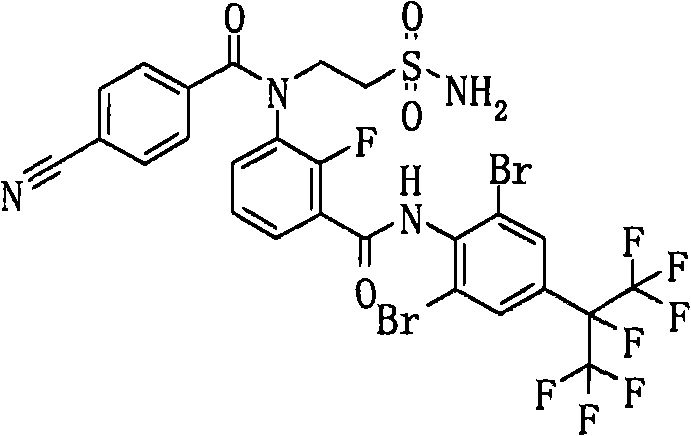
<39-1><39-1>
N-三苯甲基乙烯磺酰胺的制备Preparation of N-tritylethylenesulfonamide
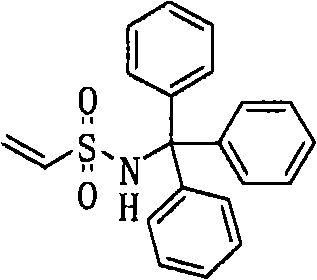
于-60℃,向18.1g(111mmol)2-氯乙烷磺酰氯的90g二氯甲烷溶液中滴入12.4g(122mmol)三乙胺,在同一温度下搅拌30分钟后,在室温下搅拌1.5小时。将反应液冷却至-60℃,滴入28.8g(111mmol)三苯甲基胺和11.2g(111mmol)三乙胺的60g二氯甲烷溶液,在同一温度下搅拌1.5小时后,在室温下搅拌4小时,放置一夜。向反应液中加入水,将有机层用水洗涤后,用无水硫酸镁干燥。在减压下蒸馏除去溶剂,将所得残渣用乙酸乙酯洗涤,由此制备25.2g目标化合物(收率65%)。At -60°C, drop 12.4 g (122 mmol) of triethylamine into a solution of 18.1 g (111 mmol) of 2-chloroethanesulfonyl chloride in 90 g of dichloromethane, stir at the same temperature for 30 minutes, then stir at room temperature for 1.5 Hour. The reaction solution was cooled to -60°C, a solution of 28.8g (111mmol) tritylamine and 11.2g (111mmol) triethylamine in 60g methylene chloride was added dropwise, stirred at the same temperature for 1.5 hours, and then stirred at room temperature 4 hours, leave overnight. Water was added to the reaction liquid, and the organic layer was washed with water and dried over anhydrous magnesium sulfate. The solvent was distilled off under reduced pressure, and the resulting residue was washed with ethyl acetate to prepare 25.2 g of the target compound (yield 65%).
1H-NMR(CDCl3,ppm)δ5.21-5.23(1H,m),5.46-5.62(3H,m),7.22-7.33(9H,m),7.43-7.55(6H,m). 1 H-NMR (CDCl 3 , ppm) δ5.21-5.23 (1H, m), 5.46-5.62 (3H, m), 7.22-7.33 (9H, m), 7.43-7.55 (6H, m).
<39-2><39-2>
N-(2,6-二溴-4-(全氟丙烷-2-基)苯基)-2-氟-3-(2-氨磺酰基乙基氨基)苯甲酰胺的制备(化合物编号19-44)Preparation of N-(2,6-dibromo-4-(perfluoropropane-2-yl)phenyl)-2-fluoro-3-(2-sulfamoylethylamino)benzamide (compound number 19 -44)

向实施例23的23-4中得到的1.16g(2.08mmol)3-氨基-N-(2,6-二溴-4-(全氟丙烷-2-基)苯基)-2-氟苯甲酰胺的5ml 85%磷酸水溶液中加入0.800g(2.29mmol)N-三苯甲基乙烯磺酰胺,在140℃下搅拌20小时。向反应液中加入水、乙酸乙酯,使用10%氢氧化钠水溶液使其pH为7后,将有机层用水、饱和食盐水洗涤后,用无水硫酸镁干燥。在减压下蒸馏除去溶剂,将所得残渣用硅胶柱色谱法(展开溶剂;己烷∶乙酸乙酯=4∶1)精制,由此制备0.0300g目标化合物(收率2%)。To 1.16 g (2.08 mmol) of 3-amino-N-(2,6-dibromo-4-(perfluoropropan-2-yl)phenyl)-2-fluorobenzene obtained in 23-4 of Example 23 Add 0.800g (2.29mmol) N-tritylethylenesulfonamide to 5ml of 85% aqueous phosphoric acid solution of formamide, and stir at 140°C for 20 hours. Water and ethyl acetate were added to the reaction solution, and the pH was adjusted to 7 using a 10% aqueous sodium hydroxide solution. The organic layer was washed with water and saturated brine, and dried over anhydrous magnesium sulfate. The solvent was distilled off under reduced pressure, and the obtained residue was purified by silica gel column chromatography (developing solvent; hexane:ethyl acetate=4:1) to prepare 0.0300 g of the target compound (yield 2%).
1H-NMR(CDCl3,ppm)δ3.46(2H,t,J=6.3Hz),3.77-3.81(2H,m),4.74(1H,broad-s),4.80-4.82(2H,m),6.92-6.96(1H,m),7.19(1H,t,J=7.8Hz),7.44-7.49(1H,m),7.86(2H,s),8.17(1H,d,J=13.6Hz). 1 H-NMR (CDCl 3 , ppm) δ3.46 (2H, t, J=6.3Hz), 3.77-3.81 (2H, m), 4.74 (1H, broad-s), 4.80-4.82 (2H, m) , 6.92-6.96(1H, m), 7.19(1H, t, J=7.8Hz), 7.44-7.49(1H, m), 7.86(2H, s), 8.17(1H, d, J=13.6Hz).
<39-3><39-3>
3-(4-氰基-N-(2-氨磺酰基乙基)苯甲酰氨基)-N-(2,6-二溴-4-(全氟丙烷-2-基)苯基)-2-氟苯甲酰胺的制备(化合物编号2-133)3-(4-cyano-N-(2-sulfamoylethyl)benzamido)-N-(2,6-dibromo-4-(perfluoropropan-2-yl)phenyl)- Preparation of 2-fluorobenzamide (compound number 2-133)

按照实施例1的1-5的方法,由N-(2,6-二溴-4-(全氟丙烷-2-基)苯基)-2-氟-3-(2-氨磺酰基乙基氨基)苯甲酰胺和4-氰基苯甲酰氯制备目标化合物。According to the method of 1-5 of Example 1, from N-(2,6-dibromo-4-(perfluoropropan-2-yl)phenyl)-2-fluoro-3-(2-sulfamoyl ethyl (amino) benzamide and 4-cyanobenzoyl chloride to prepare the target compound.
1H-NMR(CDCl3,ppm)δ3.33-3.41(2H,m),3.97-3.99(1H,m),5.10-5.15(1H,m),5.32(2H,broad-s),7.22-7.24(1H,m),7.43(2H,d,J=7.8Hz),7.53(2H,d,J=7.8Hz),7.59(1H,t,J=7.8Hz),7.89(2H,s),7.97(1H,d,J=12.2Hz),8.06-8.08(1H,m). 1 H-NMR (CDCl 3 , ppm) δ3.33-3.41 (2H, m), 3.97-3.99 (1H, m), 5.10-5.15 (1H, m), 5.32 (2H, broad-s), 7.22- 7.24(1H, m), 7.43(2H, d, J=7.8Hz), 7.53(2H, d, J=7.8Hz), 7.59(1H, t, J=7.8Hz), 7.89(2H, s), 7.97(1H, d, J=12.2Hz), 8.06-8.08(1H, m).
<实施例40><Example 40>
2-((3-氰基-N-(3-(2,6-二溴-4-(全氟丙烷-2-基)苯基氨基甲酰基)-2-氟苯基)苯甲酰氨基)甲基)丙二酸二叔丁酯的制备(化合物编号6-44)2-((3-cyano-N-(3-(2,6-dibromo-4-(perfluoropropan-2-yl)phenylcarbamoyl)-2-fluorophenyl)benzamido ) Preparation of methyl) di-tert-butyl malonate (compound number 6-44)

<40-1><40-1>
2-((3-(2,6-二溴-4-(全氟丙烷-2-基)苯基氨基甲酰基)-2-氟苯基氨基)甲基)丙二酸二叔丁酯的制备Di-tert-butyl 2-((3-(2,6-dibromo-4-(perfluoropropan-2-yl)phenylcarbamoyl)-2-fluorophenylamino)methyl)malonate preparation

向0.220g(1.00mmol)丙二酸二叔丁酯的5ml乙酸溶液中加入0.0600g(2.10mmol)多聚甲醛、0.0100g(0.100mmol)乙酸钾、0.0100g(0.0500mmol)一水合乙酸铜,在100℃下搅拌2.5小时。向反应液中加入实施例23的23-4中得到的0.500g(0.900mmol)3-氨基-N-(2,6-二溴-4-(全氟丙烷-2-基)苯基)-2-氟苯甲酰胺,搅拌2.5小时。将反应液在室温下放置一夜后,加入饱和碳酸氢钠水溶液、乙酸乙酯,进行萃取。将有机层用无水硫酸镁干燥,在减压下蒸馏除去溶剂,将所得残渣用硅胶柱色谱法(展开溶剂;己烷∶乙酸乙酯=8∶1→4∶1)精制,由此制备0.230g目标化合物(收率32%)。Add 0.0600g (2.10mmol) paraformaldehyde, 0.0100g (0.100mmol) potassium acetate, 0.0100g (0.0500mmol) copper acetate monohydrate to 0.220g (1.00mmol) di-tert-butyl malonate in 5ml acetic acid solution, Stir at 100°C for 2.5 hours. Add 0.500 g (0.900 mmol) of 3-amino-N-(2,6-dibromo-4-(perfluoropropan-2-yl)phenyl)- 2-Fluorobenzamide, stirred for 2.5 hours. After allowing the reaction solution to stand at room temperature overnight, saturated aqueous sodium bicarbonate solution and ethyl acetate were added for extraction. The organic layer was dried over anhydrous magnesium sulfate, the solvent was distilled off under reduced pressure, and the resulting residue was purified by silica gel column chromatography (developing solvent; hexane:ethyl acetate=8:1→4:1), thereby preparing 0.230 g of the target compound (32% yield).
1H-NMR(CDCl3,ppm)δ1.46-1.48(18H,m),3.53-3.55(1H,m),3.70(2H,t,J=6.3Hz),4.55(1H,broad-s),6.98-6.99(1H,m),7.17-7.18(1H,m),7.42-7.43(1H,m),7.86(2H,s),8.20-8.22(1H,m). 1 H-NMR (CDCl 3 , ppm) δ1.46-1.48 (18H, m), 3.53-3.55 (1H, m), 3.70 (2H, t, J=6.3Hz), 4.55 (1H, broad-s) , 6.98-6.99 (1H, m), 7.17-7.18 (1H, m), 7.42-7.43 (1H, m), 7.86 (2H, s), 8.20-8.22 (1H, m).
<40-2><40-2>
2-((3-氰基-N-(3-(2,6-二溴-4-(全氟丙烷-2-基)苯基氨基甲酰基)-2-氟苯基)苯甲酰氨基)甲基)丙二酸二叔丁酯的制备(化合物编号6-44)2-((3-cyano-N-(3-(2,6-dibromo-4-(perfluoropropan-2-yl)phenylcarbamoyl)-2-fluorophenyl)benzamido ) Preparation of methyl) di-tert-butyl malonate (compound number 6-44)

按照实施例1的1-5的方法,由2-((3-(2,6-二溴-4-(全氟丙烷-2-基)苯基氨基甲酰基)-2-氟苯基氨基)甲基)丙二酸二叔丁酯和3-氰基苯甲酰氯制备目标化合物。According to the method of 1-5 of Example 1, by 2-((3-(2,6-dibromo-4-(perfluoropropane-2-yl)phenylcarbamoyl)-2-fluorophenylamino ) methyl) di-tert-butyl malonate and 3-cyanobenzoyl chloride to prepare the target compound.
1H-NMR(CDCl3,ppm)δ1.40-1.46(18H,m),3.78-3.79(1H,m),4.14-4.15(1H,m),4.24-4.25(1H,m),7.29-7.33(2H,m),7.44-7.45(1H,m),7.55-7.66(3H,m),7.86(2H,s),7.94-8.03(2H,m). 1 H-NMR (CDCl 3 , ppm) δ1.40-1.46 (18H, m), 3.78-3.79 (1H, m), 4.14-4.15 (1H, m), 4.24-4.25 (1H, m), 7.29- 7.33(2H, m), 7.44-7.45(1H, m), 7.55-7.66(3H, m), 7.86(2H, s), 7.94-8.03(2H, m).
<实施例41><Example 41>
N-(3-(2,6-二甲基-4-(全氟丙烷-2-基)苯基氨基甲酰基)苯基)-N-(3-(3-甲基脲基)丙基)苯甲酰胺的制备(化合物编号6-49)N-(3-(2,6-Dimethyl-4-(perfluoropropan-2-yl)phenylcarbamoyl)phenyl)-N-(3-(3-methylureido)propyl ) Preparation of benzamide (compound number 6-49)

向实施例25中得到的0.0200g(0.0400mmol)N-(3-氨基丙基)-N-(3-(2,6-二甲基-4-(全氟丙烷-2-基)苯基氨基甲酰基)苯基)苯甲酰胺的5ml二氯甲烷溶液中加入0.0100g(0.0500mmol)1,1’-羰基双-1H-咪唑,在室温下搅拌5.5小时后,加入0.00300g(0.0500mmol)吡啶、0.00300g(0.0400mmol)甲基胺(40%甲醇溶液),在室温下搅拌3小时。将反应液放置一夜后,加入水,用乙酸乙酯萃取。将有机层用饱和食盐水洗涤后,用无水硫酸镁干燥。在减压下蒸馏除去溶剂,将所得残渣用硅胶柱色谱法(展开溶剂;己烷∶乙酸乙酯=1∶1→0∶1)精制,由此制备0.0110g目标化合物(收率44%)。To 0.0200g (0.0400mmol) N-(3-aminopropyl)-N-(3-(2,6-dimethyl-4-(perfluoropropan-2-yl)phenyl) obtained in Example 25 Add 0.0100g (0.0500mmol) 1,1'-carbonylbis-1H-imidazole to 5ml of dichloromethane solution of carbamoyl)phenyl)benzamide, stir at room temperature for 5.5 hours, add 0.00300g (0.0500mmol ) pyridine, 0.00300 g (0.0400 mmol) methylamine (40% methanol solution), and stirred at room temperature for 3 hours. After allowing the reaction solution to stand overnight, water was added and extracted with ethyl acetate. The organic layer was washed with saturated brine, and dried over anhydrous magnesium sulfate. The solvent was distilled off under reduced pressure, and the resulting residue was purified by silica gel column chromatography (developing solvent; hexane:ethyl acetate=1:1→0:1) to prepare 0.0110 g of the title compound (yield 44%) .
1H-NMR(CDCl3,ppm)δ1.78-1.79(2H,m),2.28(6H,s),2.44(3H,d,J=4.9Hz),3.36-3.42(2H,m),4.09-4.10(2H,m),4.20(1H,broad-s),4.93(1H,broad-s),7.14-7.18(2H,m),7.21-7.23(2H,m),7.27-7.31(3H,m),7.39-7.43(2H,m),7.81-7.83(1H,m),7.87(1H,s),8.95(1H,s). 1 H-NMR (CDCl 3 , ppm) δ1.78-1.79 (2H, m), 2.28 (6H, s), 2.44 (3H, d, J=4.9Hz), 3.36-3.42 (2H, m), 4.09 -4.10(2H, m), 4.20(1H, broad-s), 4.93(1H, broad-s), 7.14-7.18(2H, m), 7.21-7.23(2H, m), 7.27-7.31(3H, m), 7.39-7.43 (2H, m), 7.81-7.83 (1H, m), 7.87 (1H, s), 8.95 (1H, s).
<实施例42><Example 42>
3-(N-(3-(2-溴-4-(全氟丙烷-2-基)-6-(三氟甲基)苯基氨基甲酰基)-2-氟苯基)-4-氰基苯甲酰氨基)丙酰基氨基甲酸乙酯的制备(化合物编号5-76)3-(N-(3-(2-bromo-4-(perfluoropropan-2-yl)-6-(trifluoromethyl)phenylcarbamoyl)-2-fluorophenyl)-4-cyano Preparation of ethyl benzamido) propionyl carbamate (compound number 5-76)

<42-1><42-1>
3-(N-(3-氨基-3-氧代丙基)-4-氰基苯甲酰氨基)-N-(2-溴-4-(全氟丙烷-2-基)-6-(三氟甲基)苯基)-2-氟苯甲酰胺的制备(化合物编号1-136)3-(N-(3-amino-3-oxopropyl)-4-cyanobenzamido)-N-(2-bromo-4-(perfluoropropan-2-yl)-6-( Preparation of trifluoromethyl)phenyl)-2-fluorobenzamide (compound number 1-136)
按照实施例1的1-5的方法,由实施例22的22-6中得到的3-(3-氨基-3-氧代丙基氨基)-N-(2-溴-4-(全氟丙烷-2-基)-6-(三氟甲基)苯基)-2-氟苯甲酰胺和4-氰基苯甲酰氯制备目标化合物。According to the method of 1-5 of Example 1, 3-(3-amino-3-oxopropylamino)-N-(2-bromo-4-(perfluoro) obtained in 22-6 of Example 22 Propan-2-yl)-6-(trifluoromethyl)phenyl)-2-fluorobenzamide and 4-cyanobenzoyl chloride to prepare the title compound.
1H-NMR(CDCl3,ppm)δ2.71(1H,broad-s),2.85(1H,broad-s),4.24(2H,broad-t,J=6.3Hz),5.39(1H,broad-s),5.80(1H,broad-s),7.32(1H,t,J=7.8Hz),7.42(2H,d,J=7.8Hz),7.52(2H,broad-d,J=7.8Hz),7.58-7.59(1H,m),7.91(1H,s),7.98-8.08(2H,m),8.13(1H,s) 1 H-NMR (CDCl 3 , ppm) δ2.71 (1H, broad-s), 2.85 (1H, broad-s), 4.24 (2H, broad-t, J=6.3Hz), 5.39 (1H, broad- s), 5.80 (1H, broad-s), 7.32 (1H, t, J=7.8Hz), 7.42 (2H, d, J=7.8Hz), 7.52 (2H, broad-d, J=7.8Hz), 7.58-7.59(1H, m), 7.91(1H, s), 7.98-8.08(2H, m), 8.13(1H, s)
<42-2><42-2>
3-(N-(3-(2-溴-4-(全氟丙烷-2-基)-6-(三氟甲基)苯基氨基甲酰基)-2-氟苯基)-4-氰基苯甲酰氨基)丙酰基氨基甲酸乙酯的制备(化合物编号5-76)3-(N-(3-(2-bromo-4-(perfluoropropan-2-yl)-6-(trifluoromethyl)phenylcarbamoyl)-2-fluorophenyl)-4-cyano Preparation of ethyl benzamido) propionyl carbamate (compound number 5-76)
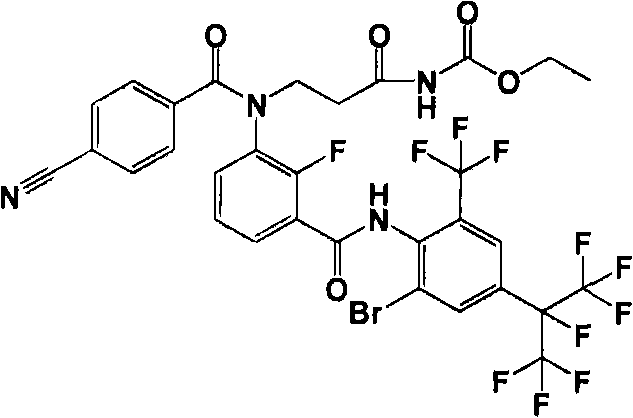
向0.0700g(0.0900mmol)3-(N-(3-氨基-3-氧代丙基)-4-氰基苯甲酰氨基)-N-(2-溴-4-(全氟丙烷-2-基)-6-(三氟甲基)苯基)-2-氟苯甲酰胺的5ml THF溶液中加入0.00560g(0.140mmol)氢化钠,在室温下搅拌1小时后,向反应液中加入0.0150g(0.140mmol)氯甲酸乙酯,在室温下搅拌1小时。向反应液中加入水,用乙酸乙酯萃取。将有机层用饱和食盐水洗涤后,用无水硫酸镁干燥。在减压下蒸馏除去溶剂,将所得残渣用硅胶柱色谱法(展开溶剂;己烷∶乙酸乙酯=3∶1)精制,由此制备0.0750g目标化合物(收率95%)。To 0.0700g (0.0900mmol) 3-(N-(3-amino-3-oxopropyl)-4-cyanobenzamido)-N-(2-bromo-4-(perfluoropropane-2 -base)-6-(trifluoromethyl)phenyl)-2-fluorobenzamide in 5ml THF solution, add 0.00560g (0.140mmol) sodium hydride, after stirring at room temperature for 1 hour, add 0.0150 g (0.140 mmol) of ethyl chloroformate was stirred at room temperature for 1 hour. Water was added to the reaction liquid, followed by extraction with ethyl acetate. The organic layer was washed with saturated brine, and dried over anhydrous magnesium sulfate. The solvent was distilled off under reduced pressure, and the resulting residue was purified by silica gel column chromatography (developing solvent; hexane:ethyl acetate=3:1) to prepare 0.0750 g of the target compound (yield 95%).
1H-NMR(CDCl3,ppm)δ1.24-1.30(3H,m),3.25(2H,m),3.37(2H,m),4.20(1H,m),4.35(2H,m),7.29(3H,m),7.41(2H,m),7.52(2H,m),7.91(1H,m),8.05(1H,m),8.14(1H,m). 1 H-NMR (CDCl 3 , ppm) δ1.24-1.30 (3H, m), 3.25 (2H, m), 3.37 (2H, m), 4.20 (1H, m), 4.35 (2H, m), 7.29 (3H, m), 7.41 (2H, m), 7.52 (2H, m), 7.91 (1H, m), 8.05 (1H, m), 8.14 (1H, m).
<实施例43><Example 43>
3-(4-氰基-N-(3-肼基-3-氧代丙基)苯甲酰氨基)-N-(2,6-二甲基-4-(全氟丙烷-2-基)苯基)-2-氟苯甲酰胺的制备(化合物编号5-83)3-(4-cyano-N-(3-hydrazino-3-oxopropyl)benzamido)-N-(2,6-dimethyl-4-(perfluoropropan-2-yl ) phenyl)-2-fluorobenzamide preparation (compound number 5-83)

<43-1><43-1>
3-(3-(2,6-二甲基-4-(全氟丙基-2-基)苯基氨基甲酰基)-2-氟苯基氨基)丙酸的制备Preparation of 3-(3-(2,6-dimethyl-4-(perfluoropropyl-2-yl)phenylcarbamoyl)-2-fluorophenylamino)propionic acid

按照实施例32的32-1的方法,由实施例1的1-3中得到的3-氨基-N-(2,6-二甲基-4-(全氟丙烷-2-基)苯基)-2-氟苯甲酰胺制备目标化合物。According to the method of 32-1 of Example 32, the 3-amino-N-(2,6-dimethyl-4-(perfluoropropane-2-yl) phenyl obtained in 1-3 of Example 1 )-2-fluorobenzamide to prepare the target compound.
1H-NMR(CDCl3,ppm)δ2.35(6H,s),2.68-2.76(2H,m),3.55(2H,t,J=6.3Hz),4.43(1H,t,J=6.3Hz),6.91(1H,t,J=8.3Hz),7.16(1H,t,J=7.8Hz),7.35-7.39(3H,m),7.85(1H,d,J=12.7Hz). 1 H-NMR (CDCl 3 , ppm) δ2.35 (6H, s), 2.68-2.76 (2H, m), 3.55 (2H, t, J=6.3Hz), 4.43 (1H, t, J=6.3Hz ), 6.91(1H, t, J=8.3Hz), 7.16(1H, t, J=7.8Hz), 7.35-7.39(3H, m), 7.85(1H, d, J=12.7Hz).
未检测到推定为羧酸的质子。Protons putative for carboxylic acids were not detected.
<43-2><43-2>
3-(3-(2,6-二甲基-4-(全氟丙烷-2-基)苯基氨基甲酰基)-2-氟苯基氨基)丙酸乙酯的制备Preparation of ethyl 3-(3-(2,6-dimethyl-4-(perfluoropropan-2-yl)phenylcarbamoyl)-2-fluorophenylamino)propanoate

向4.50g(9.00mmol)3-(3-(2,6-二甲基-4-(全氟丙基-2-基)苯基氨基甲酰基)-2-氟苯基氨基)丙酸的5ml THF溶液中加入1.80g(11.0mmol)1,1’-羰基双-1H-咪唑,在室温下搅拌20分钟。向反应液中加入1.30g(27.0mmol)乙醇,在室温下搅拌4小时后,在同一温度下放置一夜。向反应液中加入乙酸乙酯、水,用水、饱和食盐水洗涤,用无水硫酸镁干燥。在减压下蒸馏除去溶剂,将所得残渣用硅胶柱色谱法(展开溶剂;己烷∶乙酸乙酯=10∶1→8∶1)精制,制备3.30g目标化合物(收率68%)。To 4.50g (9.00mmol) 3-(3-(2,6-dimethyl-4-(perfluoropropyl-2-yl)phenylcarbamoyl)-2-fluorophenylamino)propionic acid Add 1.80g (11.0mmol) 1,1'-carbonylbis-1H-imidazole to 5ml THF solution, and stir at room temperature for 20 minutes. 1.30 g (27.0 mmol) of ethanol was added to the reaction liquid, and after stirring at room temperature for 4 hours, it was left to stand at the same temperature overnight. Ethyl acetate and water were added to the reaction solution, washed with water and saturated brine, and dried over anhydrous magnesium sulfate. The solvent was distilled off under reduced pressure, and the resulting residue was purified by silica gel column chromatography (developing solvent; hexane:ethyl acetate=10:1→8:1) to prepare 3.30 g of the target compound (yield 68%).
1H-NMR(CDCl3,ppm)δ1.28(3H,t,J=7.3Hz),2.36(6H,s),2.67(2H,t,J=6.3Hz),3.51-3.56(2H,m),4.20(2H,q,J=7.3Hz),4.49(1H,broad-s),6.89-6.93(1H,m),7.16(1H,t,J=7.8Hz),7.35-7.39(3H,m),7.81(1H,d,J=13.1Hz). 1 H-NMR (CDCl 3 , ppm) δ1.28 (3H, t, J=7.3Hz), 2.36 (6H, s), 2.67 (2H, t, J=6.3Hz), 3.51-3.56 (2H, m ), 4.20 (2H, q, J=7.3Hz), 4.49 (1H, broad-s), 6.89-6.93 (1H, m), 7.16 (1H, t, J=7.8Hz), 7.35-7.39 (3H, m), 7.81 (1H, d, J=13.1Hz).
<43-3><43-3>
3-(4-氰基-N-(3-(2,6-二甲基-4-(全氟丙烷-2-基)苯基氨基甲酰基)-2-氟苯基)苯甲酰氨基)丙酸乙酯的制备3-(4-cyano-N-(3-(2,6-dimethyl-4-(perfluoropropan-2-yl)phenylcarbamoyl)-2-fluorophenyl)benzamido ) Preparation of ethyl propionate

按照实施例1的1-5的方法,由3-(3-(2,6-二甲基-4-(全氟丙烷-2-基)苯基氨基甲酰基)-2-氟苯基氨基)丙酸乙酯和4-氰基苯甲酰氯制备目标化合物。According to the method of 1-5 of Example 1, by 3-(3-(2,6-dimethyl-4-(perfluoropropane-2-yl)phenylcarbamoyl)-2-fluorophenylamino ) ethyl propionate and 4-cyanobenzoyl chloride to prepare the target compound.
1H-NMR(CDCl3,ppm)δ1.20(3H,t,J=6.8Hz),2.28(6H,s),2.75-2.76(1H,m),2.80-2.81(1H,m),4.02-4.08(2H,m),4.24-4.25(2H,m),7.28-7.30(1H,m),7.36(2H,s),7.44-7.47(3H,m),7.51(2H,d,J=5.8Hz),7.58-7.61(1H,m),7.99(1H,t,J=6.8Hz). 1 H-NMR (CDCl 3 , ppm) δ1.20 (3H, t, J=6.8Hz), 2.28 (6H, s), 2.75-2.76 (1H, m), 2.80-2.81 (1H, m), 4.02 -4.08(2H, m), 4.24-4.25(2H, m), 7.28-7.30(1H, m), 7.36(2H, s), 7.44-7.47(3H, m), 7.51(2H, d, J= 5.8Hz), 7.58-7.61(1H, m), 7.99(1H, t, J=6.8Hz).
<43-4><43-4>
3-(4-氰基-N-(3-肼基-3-氧代丙基)苯甲酰氨基)-N-(2,6-二甲基-4-(全氟丙烷-2-基)苯基)-2-氟苯甲酰胺的制备(化合物编号5-83)3-(4-cyano-N-(3-hydrazino-3-oxopropyl)benzamido)-N-(2,6-dimethyl-4-(perfluoropropan-2-yl ) phenyl)-2-fluorobenzamide preparation (compound number 5-83)
向0.100g(0.150mmol)3-(4-氰基-N-(3-(2,6-二甲基-4-(全氟丙烷-2-基)苯基氨基甲酰基)-2-氟苯基)苯甲酰氨基)丙酸乙酯的10ml THF溶液中加入0.120g(3.00mmol)肼(80%水溶液),在60℃下搅拌8小时。将反应液浓缩后,向残渣中加入乙酸乙酯,用水、饱和食盐水洗涤,用无水硫酸镁干燥。在减压下蒸馏除去溶剂,将所得残渣用硅胶柱色谱法(展开溶剂;己烷∶乙酸乙酯=1∶1)精制,由此制备0.0270g目标化合物(收率28%)。To 0.100g (0.150mmol) 3-(4-cyano-N-(3-(2,6-dimethyl-4-(perfluoropropan-2-yl)phenylcarbamoyl)-2-fluoro Add 0.120 g (3.00 mmol) of hydrazine (80% aqueous solution) to 10 ml of THF solution of ethyl (phenyl) benzamido) propionate, and stir at 60° C. for 8 hours. After concentrating the reaction solution, ethyl acetate was added to the residue, washed with water and saturated brine, and dried over anhydrous magnesium sulfate. The solvent was distilled off under reduced pressure, and the resulting residue was purified by silica gel column chromatography (developing solvent; hexane:ethyl acetate=1:1) to prepare 0.0270 g of the target compound (yield 28%).
1H-NMR(CDCl3,ppm)δ2.24(6H,s),2.65(2H,m),3.65(2H,m),4.23(2H,m),5.35(1H,m),7.26-7.53(6H,m),7.86-7.93(4H,m). 1 H-NMR (CDCl 3 , ppm) δ2.24 (6H, s), 2.65 (2H, m), 3.65 (2H, m), 4.23 (2H, m), 5.35 (1H, m), 7.26-7.53 (6H, m), 7.86-7.93 (4H, m).
<实施例44><Example 44>
N-(3-(2,6-二甲基-4-(全氟丙烷-2-基)苯基氨基甲酰基)苯基)-N-(2-羟乙基)苯甲酰胺的制备(化合物编号5-5)The preparation of N-(3-(2,6-dimethyl-4-(perfluoropropan-2-yl) phenylcarbamoyl) phenyl)-N-(2-hydroxyethyl) benzamide ( Compound No. 5-5)
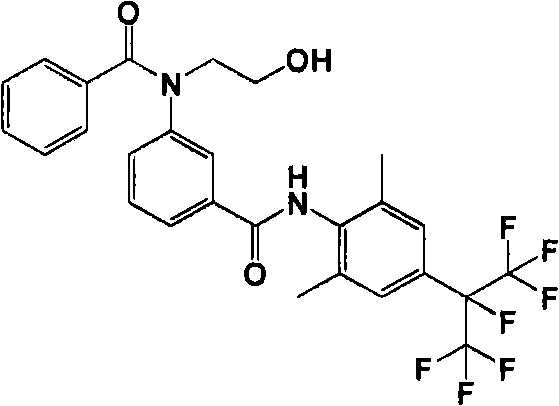
<44-1><44-1>
((2-碘乙氧基)甲基)苯的制备Preparation of ((2-iodoethoxy)methyl)benzene
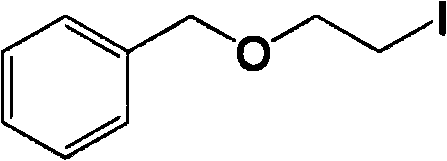
向3.00g(20.0mmol)2-苄氧基乙醇和2.30g(22.0mmol)三乙胺的30ml二氯甲烷溶液中加入2.50g(22.0mmol)甲磺酰氯,在0℃下搅拌3小时。滤去析出的固体后,将滤液减压浓缩。向所得残渣中加入30ml丙酮,滤去析出的固体。向滤液中加入4.50g(30.0mmol)碘化钠,在室温下搅拌50小时后,滤去固体,将滤液减压浓缩。将所得残渣用硅胶柱色谱法(展开溶剂;己烷∶乙酸乙酯=7∶1)精制,由此制备2.70g目标化合物(收率52%)。To a solution of 3.00 g (20.0 mmol) of 2-benzyloxyethanol and 2.30 g (22.0 mmol) of triethylamine in 30 ml of dichloromethane was added 2.50 g (22.0 mmol) of methanesulfonyl chloride, and stirred at 0° C. for 3 hours. After the precipitated solid was filtered off, the filtrate was concentrated under reduced pressure. To the resulting residue was added 30 ml of acetone, and the precipitated solid was filtered off. 4.50 g (30.0 mmol) of sodium iodide was added to the filtrate, and after stirring at room temperature for 50 hours, the solid was filtered off, and the filtrate was concentrated under reduced pressure. The resulting residue was purified by silica gel column chromatography (developing solvent; hexane:ethyl acetate=7:1) to prepare 2.70 g of the target compound (yield 52%).
1H-NMR(CDCl3,ppm)δ3.29(2H,t,J=6.8Hz),3.74(2H,t,J=6.8Hz),4.58(2H,s),7.29-7.37(5H,m). 1 H-NMR (CDCl 3 , ppm) δ3.29 (2H, t, J=6.8Hz), 3.74 (2H, t, J=6.8Hz), 4.58 (2H, s), 7.29-7.37 (5H, m ).
<44-2><44-2>
3-苯甲酰氨基-N-(2,6-二甲基-4-(全氟丙烷-2-基)苯基)苯甲酰胺的制备Preparation of 3-benzamido-N-(2,6-dimethyl-4-(perfluoropropan-2-yl)phenyl)benzamide
按照实施例1的1-5的方法,由实施例20的20-1中得到的3-氨基-N-(2,6-二甲基-4-(全氟丙烷-2-基)苯基)苯甲酰胺制备目标化合物。According to the method of 1-5 of Example 1, the 3-amino-N-(2,6-dimethyl-4-(perfluoropropan-2-yl) phenyl obtained in 20-1 of Example 20 ) benzamide to prepare the target compound.
1H-NMR(DMSO-d6,ppm)δ2.37(6H,s),7.34(2H,s),7.46-7.57(4H,m),7.75(1H,d,J=7.8Hz),7.98-8.01(2H,m),8.12(1H,d,J=7.3Hz),8.34(1H,s),8.87(1H,s),9.66(1H,s). 1 H-NMR (DMSO-d 6 , ppm) δ2.37 (6H, s), 7.34 (2H, s), 7.46-7.57 (4H, m), 7.75 (1H, d, J=7.8Hz), 7.98 -8.01(2H, m), 8.12(1H, d, J=7.3Hz), 8.34(1H, s), 8.87(1H, s), 9.66(1H, s).
<44-3><44-3>
N-(2-(苄氧基)乙基)-N-(3-(2,6-二甲基-4-(全氟丙烷-2-基)苯基氨基甲酰基)苯基)苯甲酰胺的制备(化合物编号5-74)N-(2-(benzyloxy)ethyl)-N-(3-(2,6-dimethyl-4-(perfluoropropan-2-yl)phenylcarbamoyl)phenyl)benzyl Preparation of Amides (Compound No. 5-74)

于100℃,将0.800g(1.50mmol)3-苯甲酰氨基-N-(2,6-二甲基-4-(全氟丙烷-2-基)苯基)苯甲酰胺、0.600g(2.30mmol)((2-碘乙氧基)甲基)苯和0.400g(6.80mmol)氢氧化钾的10ml DMSO溶液搅拌4小时。滤去固体后,将滤液减压浓缩,将所得残渣用硅胶柱色谱法(展开溶剂;己烷∶乙酸乙酯=7∶1→5∶1→3∶1)精制,由此制备0.550g目标化合物(收率56%)。At 100°C, 0.800g (1.50mmol) of 3-benzamido-N-(2,6-dimethyl-4-(perfluoropropan-2-yl)phenyl)benzamide, 0.600g ( A solution of 2.30 mmol) ((2-iodoethoxy)methyl)benzene and 0.400 g (6.80 mmol) potassium hydroxide in 10 ml DMSO was stirred for 4 hours. After filtering off the solid, the filtrate was concentrated under reduced pressure, and the obtained residue was purified by silica gel column chromatography (developing solvent; hexane:ethyl acetate=7:1→5:1→3:1), thereby preparing 0.550 g of the target product. Compound (56% yield).
1H-NMR(CDCl3,ppm)δ2.29(6H,s),3.84(2H,t,J=5.4Hz),4.03(2H,t,J=5.4Hz),4.46(2H,s),6.80-7.79(17H,m). 1 H-NMR (CDCl 3 , ppm) δ 2.29 (6H, s), 3.84 (2H, t, J = 5.4Hz), 4.03 (2H, t, J = 5.4Hz), 4.46 (2H, s), 6.80-7.79(17H, m).
<44-4><44-4>
N-(3-(2,6-二甲基-4-(全氟丙烷-2-基)苯基氨基甲酰基)苯基)-N-(2-羟乙基)苯甲酰胺的制备(化合物编号5-5)The preparation of N-(3-(2,6-dimethyl-4-(perfluoropropan-2-yl) phenylcarbamoyl) phenyl)-N-(2-hydroxyethyl) benzamide ( Compound No. 5-5)

在氢气中、于室温,将0.570g(0.880mmol)N-(2-(苄氧基)乙基)-N-(3-(2,6-二甲基-4-(全氟丙烷-2-基)苯基氨基甲酰基)苯基)苯甲酰胺和10%Pd/C的15ml乙醇溶液搅拌3小时。滤去催化剂后,将滤液减压浓缩,将所得残渣用硅胶柱色谱法(展开溶剂;己烷∶乙酸乙酯=3∶1→2∶1)精制,由此制备0.250g目标化合物(收率51%)。In hydrogen, at room temperature, 0.570g (0.880mmol) N-(2-(benzyloxy)ethyl)-N-(3-(2,6-dimethyl-4-(perfluoropropane-2 A solution of -yl)phenylcarbamoyl)phenyl)benzamide and 10% Pd/C in 15 ml ethanol was stirred for 3 hours. After filtering off the catalyst, the filtrate was concentrated under reduced pressure, and the resulting residue was purified by silica gel column chromatography (developing solvent; hexane:ethyl acetate=3:1→2:1), thereby preparing 0.250 g of the target compound (yield 51%).
1H-NMR(CDCl3,ppm)δ2.37(6H,s),3.88-4.01(5H,m),6.95(1H,d,J=7.8Hz),7.13(1H,t,J=7.8Hz),7.26(2H,s),7.49(2H,t,J=7.8Hz),7.52-7.58(2H,m),7.68(1H,broad-s),7.72(1H,t,J=1.9Hz),7.77-7.79(2H,m). 1 H-NMR (CDCl 3 , ppm) δ2.37 (6H, s), 3.88-4.01 (5H, m), 6.95 (1H, d, J=7.8Hz), 7.13 (1H, t, J=7.8Hz ), 7.26(2H, s), 7.49(2H, t, J=7.8Hz), 7.52-7.58(2H, m), 7.68(1H, broad-s), 7.72(1H, t, J=1.9Hz) , 7.77-7.79 (2H, m).
<实施例45><Example 45>
N-(3-(2-碘-4-(全氟丙烷-2-基)-6-(三氟甲基)苯基氨基甲酰基)苯基)-N-(3-(甲基氨基)-3-氧代丙基)苯甲酰胺的制备(化合物编号5-86)N-(3-(2-iodo-4-(perfluoropropan-2-yl)-6-(trifluoromethyl)phenylcarbamoyl)phenyl)-N-(3-(methylamino) Preparation of -3-oxopropyl)benzamide (compound number 5-86)

<45-1><45-1>
2-碘-4-(全氟丙烷-2-基)-6-(三氟甲基)苯胺的制备(化合物编号21-10)Preparation of 2-iodo-4-(perfluoropropan-2-yl)-6-(trifluoromethyl)aniline (compound number 21-10)

按照实施例22的22-2的方法,由实施例22的22-1中得到的4-(全氟丙烷-2-基)-2-(三氟甲基)苯胺和N-碘代琥珀酰亚胺制备目标化合物。According to the method of 22-2 of Example 22, 4-(perfluoropropane-2-yl)-2-(trifluoromethyl)aniline and N-iodosuccinyl obtained in 22-1 of Example 22 imines to prepare target compounds.
1H-NMR(CDCl3,ppm)δ5.04(2H,broad-s),7.64(1H,s),7.99(1H,s). 1 H-NMR (CDCl 3 , ppm) δ5.04 (2H, broad-s), 7.64 (1H, s), 7.99 (1H, s).
<45-2><45-2>
N-(2-碘-4-(全氟丙烷-2-基)-6-(三氟甲基)苯基)-3-硝基苯甲酰胺的制备(化合物编号11-12)Preparation of N-(2-iodo-4-(perfluoropropan-2-yl)-6-(trifluoromethyl)phenyl)-3-nitrobenzamide (compound number 11-12)

将50.0g(110mmol)2-碘-4-(全氟丙烷-2-基)-6-(三氟甲基)苯胺、24.5g(0.13mol)3-硝基苯甲酰氯溶解于75g DMI中,在内部温度100~105℃下反应8小时。冷却至室温后,向反应液中加入乙酸乙酯、饱和碳酸氢钠水溶液,分液。将有机层用饱和食盐水洗涤后,用无水硫酸钠干燥。在减压下浓缩溶液,将浓缩残渣用硅胶柱色谱法(展开溶剂;己烷∶乙酸乙酯=3∶1)精制,由此制备52.0g目标化合物(收率78%)。50.0g (110mmol) 2-iodo-4-(perfluoropropane-2-yl)-6-(trifluoromethyl)aniline, 24.5g (0.13mol) 3-nitrobenzoyl chloride were dissolved in 75g DMI , reacted at an internal temperature of 100-105°C for 8 hours. After cooling to room temperature, ethyl acetate and saturated aqueous sodium bicarbonate solution were added to the reaction solution for liquid separation. The organic layer was washed with saturated brine, and dried over anhydrous sodium sulfate. The solution was concentrated under reduced pressure, and the concentrated residue was purified by silica gel column chromatography (developing solvent; hexane:ethyl acetate=3:1) to prepare 52.0 g of the target compound (yield 78%).
1H-NMR(CDCl3,ppm)δ7.76-7.80(2H,m),7.97(1H,s),8.28-8.30(1H,m),8.37(1H,s),8.49-8.52(1H,m),8.78(1H,s). 1 H-NMR (CDCl 3 , ppm) δ7.76-7.80 (2H, m), 7.97 (1H, s), 8.28-8.30 (1H, m), 8.37 (1H, s), 8.49-8.52 (1H, m), 8.78(1H, s).
<45-3><45-3>
3-氨基-N-(2-碘-4-(全氟丙烷-2-基)-6-(三氟甲基)苯基)苯甲酰胺的制备(化合物编号12-8)Preparation of 3-amino-N-(2-iodo-4-(perfluoropropan-2-yl)-6-(trifluoromethyl)phenyl)benzamide (compound number 12-8)

按照实施例1的1-3的方法,由N-(2-碘-4-(全氟丙烷-2-基)-6-(三氟甲基)苯基)-3-硝基苯甲酰胺制备目标化合物。According to the method of 1-3 of Example 1, by N-(2-iodo-4-(perfluoropropane-2-yl)-6-(trifluoromethyl)phenyl)-3-nitrobenzamide Prepare the target compound.
1H-NMR(CDCl3,ppm)δ3.89(2H,broad-s),6.89-6.92(1H,m),7.23-7.32(3H,m)7.68(1H,s),7.93(1H,s),8.34-8.36(1H,m). 1 H-NMR (CDCl 3 , ppm) δ3.89 (2H, broad-s), 6.89-6.92 (1H, m), 7.23-7.32 (3H, m), 7.68 (1H, s), 7.93 (1H, s ), 8.34-8.36(1H, m).
<45-4><45-4>
3-(3-(2-碘-4-(全氟丙烷-2-基)-6-(三氟甲基)苯基氨基甲酰基)苯基氨基)丙酸的制备Preparation of 3-(3-(2-iodo-4-(perfluoropropan-2-yl)-6-(trifluoromethyl)phenylcarbamoyl)phenylamino)propionic acid

按照实施例32的32-1的方法,由3-氨基-N-(2-碘-4-(全氟丙烷-2-基)-6-(三氟甲基)苯基)苯甲酰胺制备目标化合物。According to the method of 32-1 of Example 32, prepared from 3-amino-N-(2-iodo-4-(perfluoropropane-2-yl)-6-(trifluoromethyl)phenyl)benzamide target compound.
1H-NMR(DMSO-d6,ppm)δ2.50-2.55(2H,m),3.30-3.33(2H,m),5.96(1H,broad-s),6.80-6.83(1H,m),7.13-7.17(2H,m),7.23-7.27(1H,m),7.95(1H,s),8.49(1H,s),10.42(1H,s),12.28(1H,broad-s). 1 H-NMR (DMSO-d 6 , ppm) δ2.50-2.55 (2H, m), 3.30-3.33 (2H, m), 5.96 (1H, broad-s), 6.80-6.83 (1H, m), 7.13-7.17(2H, m), 7.23-7.27(1H, m), 7.95(1H, s), 8.49(1H, s), 10.42(1H, s), 12.28(1H, broad-s).
<45-5><45-5>
3-(3-(2-碘-4-(全氟丙烷-2-基)-6-(三氟甲基)苯基氨基甲酰基)苯基氨基)丙酸甲酯的制备Preparation of 3-(3-(2-iodo-4-(perfluoropropan-2-yl)-6-(trifluoromethyl)phenylcarbamoyl)phenylamino)propanoic acid methyl ester

将10ml甲醇冷却至0℃,滴入0.510g(4.30mmol)亚硫酰氯。持续搅拌10分钟后,加入0.690g(1.10mmol)3-(3-(2-碘-4-(全氟丙烷-2-基)-6-(三氟甲基)苯基氨基甲酰基)苯基氨基)丙酸,在室温下放置一夜。减压蒸馏除去溶剂,由此制备0.710g目标化合物(收率97%)。10ml of methanol was cooled to 0°C, and 0.510g (4.30mmol) of thionyl chloride was added dropwise. After continuing stirring for 10 minutes, 0.690 g (1.10 mmol) of 3-(3-(2-iodo-4-(perfluoropropane-2-yl)-6-(trifluoromethyl)phenylcarbamoyl)benzene was added Amino)propionic acid was left overnight at room temperature. The solvent was distilled off under reduced pressure to prepare 0.710 g of the target compound (yield 97%).
APCI-MS m/z(M+1):661APCI-MS m/z (M+1): 661
<45-6><45-6>
3-(N-(3-(2-碘-4-(全氟丙烷-2-基)-6-(三氟甲基)苯基氨基甲酰基)苯基)苯甲酰氨基)丙酸甲酯的制备(化合物编号5-80)3-(N-(3-(2-iodo-4-(perfluoropropan-2-yl)-6-(trifluoromethyl)phenylcarbamoyl)phenyl)benzamido)propionic acid Preparation of Esters (Compound No. 5-80)

按照实施例1的1-5的方法,由3-(3-(2-碘-4-(全氟丙烷-2-基)-6-(三氟甲基)苯基氨基甲酰基)苯基氨基)丙酸甲酯制备目标化合物。According to the method of 1-5 of Example 1, from 3-(3-(2-iodo-4-(perfluoropropan-2-yl)-6-(trifluoromethyl)phenylcarbamoyl)phenyl amino)propionate to prepare the target compound.
1H-NMR(DMSO-d6,ppm)δ2.66-2.70(2H,m),3.54(3H,s),4.12-4.15(2H,m),7.21-7.29(5H,m),7.45-7.47(2H,m),7.72(1H,s),7.76(1H,d,J=7.3Hz),7.95(1H,s),8.51(1H,s),10.59(1H,s) 1 H-NMR (DMSO-d 6 , ppm) δ2.66-2.70 (2H, m), 3.54 (3H, s), 4.12-4.15 (2H, m), 7.21-7.29 (5H, m), 7.45- 7.47(2H, m), 7.72(1H, s), 7.76(1H, d, J=7.3Hz), 7.95(1H, s), 8.51(1H, s), 10.59(1H, s)
<45-7><45-7>
3-(N-(3-(2-碘-4-(全氟丙烷-2-基)-6-(三氟甲基)苯基氨基甲酰基)苯基)苯甲酰氨基)丙酸(化合物编号5-88)3-(N-(3-(2-iodo-4-(perfluoropropan-2-yl)-6-(trifluoromethyl)phenylcarbamoyl)phenyl)benzamido)propionic acid ( Compound No. 5-88)

按照实施例2的方法,由3-(N-(3-(2-碘-4-(全氟丙烷-2-基)-6-(三氟甲基)苯基氨基甲酰基)苯基)苯甲酰氨基)丙酸甲酯制备目标化合物。According to the method of Example 2, from 3-(N-(3-(2-iodo-4-(perfluoropropane-2-yl)-6-(trifluoromethyl)phenylcarbamoyl)phenyl) Benzamido)propionate methyl ester to prepare the target compound.
1H-NMR(DMSO-d6,ppm)δ2.58-2.62(2H,m),4.02-4.11(2H,m),7.21-7.30(5H,m),7.46-7.49(2H,m),7.74-7.76(2H,m),7.95(1H,s),8.51(1H,s),10.6(1H,broad-s),12.5(1H,broad-s) 1 H-NMR (DMSO-d 6 , ppm) δ2.58-2.62 (2H, m), 4.02-4.11 (2H, m), 7.21-7.30 (5H, m), 7.46-7.49 (2H, m), 7.74-7.76(2H, m), 7.95(1H, s), 8.51(1H, s), 10.6(1H, broad-s), 12.5(1H, broad-s)
<45-8><45-8>
N-(3-(2-碘-4-(全氟丙烷-2-基)-6-(三氟甲基)苯基氨基甲酰基)苯基)-N-(3-(甲基氨基)-3-氧代丙基)苯甲酰胺的制备(化合物编号5-86)N-(3-(2-iodo-4-(perfluoropropan-2-yl)-6-(trifluoromethyl)phenylcarbamoyl)phenyl)-N-(3-(methylamino) Preparation of -3-oxopropyl)benzamide (compound number 5-86)

按照实施例28的方法,由3-(N-(3-(2-碘-4-(全氟丙烷-2-基)-6-(三氟甲基)苯基氨基甲酰基)苯基)苯甲酰氨基)丙酸和甲基胺(40%水溶液)制备目标化合物。According to the method of Example 28, from 3-(N-(3-(2-iodo-4-(perfluoropropane-2-yl)-6-(trifluoromethyl)phenylcarbamoyl)phenyl) Benzamido) propionic acid and methylamine (40% in water) to prepare the title compound.
1H-NMR(DMSO-d6,ppm)δ2.44-2.46(2H,m),3.33(3H,s),4.02-4.09(2H,m),7.23-7.28(5H,m),7.46-7.47(2H,m),7.68(1H,broad-s),7.74-7.76(1H,m),7.91-7.92(1H,m),7.95(1H,s),8.50(1H,s),10.57(1H,s) 1 H-NMR (DMSO-d 6 , ppm) δ2.44-2.46 (2H, m), 3.33 (3H, s), 4.02-4.09 (2H, m), 7.23-7.28 (5H, m), 7.46- 7.47(2H, m), 7.68(1H, broad-s), 7.74-7.76(1H, m), 7.91-7.92(1H, m), 7.95(1H, s), 8.50(1H, s), 10.57( 1H, s)
<实施例46><Example 46>
N-(3-氨基-3-(羟基亚氨基)丙基)-N-(3-(2,6-二甲基-4-(全氟丙烷-2-基)苯基氨基甲酰基)苯基)苯甲酰胺的制备(化合物编号5-91)N-(3-amino-3-(hydroxyimino)propyl)-N-(3-(2,6-dimethyl-4-(perfluoropropan-2-yl)phenylcarbamoyl)benzene base) preparation of benzamide (compound number 5-91)

于80℃,将实施例24中得到的0.200g(0.350mmol)N-(2-氰基乙基)-N-(3-(2,6-二甲基-4-(全氟丙烷-2-基)苯基氨基甲酰基)苯基)苯甲酰胺、0.0800g(0.800mmol)碳酸钠和羟基胺一水合物0.0500g(0.700mmol)的乙醇2ml/水2ml溶液搅拌5小时。向反应液中加入水,用乙酸乙酯萃取。将有机层用无水硫酸钠干燥。减压蒸馏除去溶液,将所得残渣用硅胶柱色谱法(展开溶剂;己烷∶乙酸乙酯=1∶1→0∶1)精制,由此制备0.0200g目标化合物(收率10%)。At 80° C., 0.200 g (0.350 mmol) of N-(2-cyanoethyl)-N-(3-(2,6-dimethyl-4-(perfluoropropane-2) obtained in Example 24 A solution of -yl)phenylcarbamoyl)phenyl)benzamide, 0.0800g (0.800mmol) sodium carbonate and hydroxylamine monohydrate 0.0500g (0.700mmol) in 2ml of ethanol/2ml of water was stirred for 5 hours. Water was added to the reaction liquid, followed by extraction with ethyl acetate. The organic layer was dried over anhydrous sodium sulfate. The solution was distilled off under reduced pressure, and the obtained residue was purified by silica gel column chromatography (developing solvent; hexane:ethyl acetate=1:1→0:1) to prepare 0.0200 g of the target compound (yield 10%).
1H-NMR(CDCl3,ppm)δ2.19(1/2*6H,s),2.24(1/2*6H,s),2.42(1/2*2H,t,J=6.8Hz),2.67(1/2*2H,t,J=6.8Hz),4.11(1/2*2H,t,J=6.8Hz),4.26(1/2*2H,t,J=6.8Hz),4.75(1H,s),5.69(1/2*1H,broad-s),6.30(1/2*1H,broad-s),7.12-7.95(13H,m). 1 H-NMR (CDCl 3 , ppm) δ 2.19 (1/2*6H, s), 2.24 (1/2*6H, s), 2.42 (1/2*2H, t, J=6.8Hz), 2.67(1/2*2H, t, J=6.8Hz), 4.11(1/2*2H, t, J=6.8Hz), 4.26(1/2*2H, t, J=6.8Hz), 4.75( 1H, s), 5.69 (1/2*1H, broad-s), 6.30 (1/2*1H, broad-s), 7.12-7.95 (13H, m).
<实施例47><Example 47>
N-(4-氨基-4-氧代丁基)-N-(3-(2,6-二甲基-4-(全氟丙烷-2-基)苯基氨基甲酰基)苯基)苯甲酰胺的制备(化合物编号6-16)N-(4-amino-4-oxobutyl)-N-(3-(2,6-dimethyl-4-(perfluoropropan-2-yl)phenylcarbamoyl)phenyl)benzene Preparation of formamide (compound number 6-16)

<47-1><47-1>
3-(4-氨基-4-氧代丁基氨基)-N-(2,6-二甲基-4-(全氟丙烷-2-基)苯基)苯甲酰胺的制备Preparation of 3-(4-amino-4-oxobutylamino)-N-(2,6-dimethyl-4-(perfluoropropan-2-yl)phenyl)benzamide
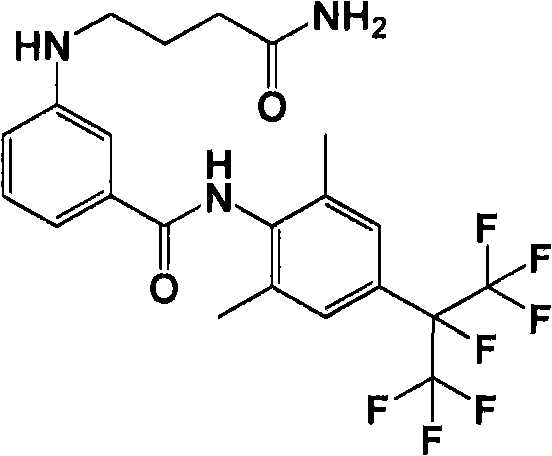
于100℃,将0.270g(0.470mmol)3-(3-氰基丙基氨基)-N-(2,6-二甲基-4-(全氟丙烷-2-基)苯基)苯甲酰胺的5g硫酸溶液搅拌30分钟。向反应液中加入碳酸氢钠水溶液后,用乙酸乙酯萃取。将有机层用无水硫酸钠干燥。减压蒸馏除去溶液,将所得残渣用硅胶柱色谱法(展开溶剂;己烷∶乙酸乙酯=1∶1→0∶1)精制,由此制备0.18g目标化合物(收率78%)。At 100°C, 0.270g (0.470mmol) of 3-(3-cyanopropylamino)-N-(2,6-dimethyl-4-(perfluoropropan-2-yl)phenyl)benzene A solution of the amide in 5 g of sulfuric acid was stirred for 30 minutes. After adding an aqueous sodium bicarbonate solution to the reaction liquid, it was extracted with ethyl acetate. The organic layer was dried over anhydrous sodium sulfate. The solution was distilled off under reduced pressure, and the obtained residue was purified by silica gel column chromatography (developing solvent; hexane:ethyl acetate=1:1→0:1) to prepare 0.18 g of the target compound (yield 78%).
1H-NMR(CDCl3,ppm)δ2.00(2H,quintet,J=6.8Hz),2.35(6H,s),2.36(2H,t,J=6.8Hz),3.26(2H,t,J=6.8Hz),4.14(1H,broad-s),5.30(1H,broad-s),5.48(1H,broad-s),6.80(1H,dd,J=1.5,7.8Hz),7.21(1H,d,J=7.8Hz),7.26-7.28(2H,m),7.34(2H,s),7.71(1H,s). 1 H-NMR (CDCl 3 , ppm) δ 2.00 (2H, quintet, J = 6.8Hz), 2.35 (6H, s), 2.36 (2H, t, J = 6.8Hz), 3.26 (2H, t, J =6.8Hz), 4.14(1H, broad-s), 5.30(1H, broad-s), 5.48(1H, broad-s), 6.80(1H, dd, J=1.5, 7.8Hz), 7.21(1H, d, J=7.8Hz), 7.26-7.28(2H, m), 7.34(2H, s), 7.71(1H, s).
<47-2><47-2>
N-(4-氨基-4-氧代丁基)-N-(3-(2,6-二甲基-4-(全氟丙烷-2-基)苯基氨基甲酰基)苯基)苯甲酰胺的制备(化合物编号6-16)N-(4-amino-4-oxobutyl)-N-(3-(2,6-dimethyl-4-(perfluoropropan-2-yl)phenylcarbamoyl)phenyl)benzene Preparation of formamide (compound number 6-16)

按照实施例1的1-5的方法,由3-(4-氨基-4-氧代丁基氨基)-N-(2,6-二甲基-4-(全氟丙烷-2-基)苯基)苯甲酰胺制备目标化合物。According to the method of 1-5 of Example 1, by 3-(4-amino-4-oxobutylamino)-N-(2,6-dimethyl-4-(perfluoropropan-2-yl) Phenyl)benzamide to prepare the target compound.
1H-NMR(CDCl3,ppm)δ2.08(2H,q u intet,J=6.8Hz),2.31(6H,s),2.40(2H,t,J=6.8Hz),4.08(2H,t,J=6.8Hz),5.32(1H,broad-s),6.02(1H,broad-s),7.14-7.34(9H,m),7.74(1H,d,J=7.8Hz),7.80(1H,s),8.10(1H,s). 1 H-NMR (CDCl 3 , ppm) δ 2.08 (2H, qu intet, J = 6.8Hz), 2.31 (6H, s), 2.40 (2H, t, J = 6.8Hz), 4.08 (2H, t, J=6.8Hz), 5.32(1H, broad-s), 6.02(1H, broad-s), 7.14-7.34(9H, m), 7.74(1H, d, J=7.8Hz), 7.80(1H, s ), 8.10(1H, s).
<实施例48><Example 48>
N-(3-(2,6-二甲基-4-(全氟丙烷-2-基)苯基氨基甲酰基)苯基)-N-(2-氧代乙基)苯甲酰胺的制备(化合物编号6-59)Preparation of N-(3-(2,6-Dimethyl-4-(perfluoropropan-2-yl)phenylcarbamoyl)phenyl)-N-(2-oxoethyl)benzamide (Compound No. 6-59)

在室温下,将实施例44的44-4中得到的0.100g(0.280mmol)N-(3-(2,6-二甲基-4-(全氟丙烷-2-基)苯基氨基甲酰基)苯基)-N-(2-羟乙基)苯甲酰胺和0.350g(0.900mmol)98%PDC的10ml二氯甲烷溶液搅拌10小时。经过硅藻土过滤后,将滤液减压浓缩后,将所得残渣用硅胶柱色谱法(展开溶剂;己烷∶乙酸乙酯=1∶1→0∶1)精制,由此制备0.0700g目标化合物(收率44%)。At room temperature, 0.100 g (0.280 mmol) of N-(3-(2,6-dimethyl-4-(perfluoropropan-2-yl) phenylaminomethyl) obtained in 44-4 of Example 44 A solution of acyl)phenyl)-N-(2-hydroxyethyl)benzamide and 0.350 g (0.900 mmol) of 98% PDC in 10 ml of dichloromethane was stirred for 10 hours. After filtering through celite, the filtrate was concentrated under reduced pressure, and the resulting residue was purified by silica gel column chromatography (developing solvent; hexane:ethyl acetate=1:1→0:1), thereby preparing 0.0700 g of the title compound (Yield 44%).
1H-NMR(CDCl3,ppm)δ2.36(6H,s),4.27(2H,s),6.97(1H,d,J=7.8Hz),7.14(1H,t,J=7.8Hz),7.28(2H,s),7.47(2H,t,J=7.8Hz),7.55(1H,t,J=7.8Hz),7.61(1H,dd,J=1.5,7.8Hz),7.73-7.82(4H,m),9.85(1H,s). 1 H-NMR (CDCl 3 , ppm) δ 2.36 (6H, s), 4.27 (2H, s), 6.97 (1H, d, J=7.8Hz), 7.14 (1H, t, J=7.8Hz), 7.28(2H, s), 7.47(2H, t, J=7.8Hz), 7.55(1H, t, J=7.8Hz), 7.61(1H, dd, J=1.5, 7.8Hz), 7.73-7.82(4H , m), 9.85(1H, s).
<实施例49><Example 49>
N-(3-(2,6-二甲基-4-(全氟丙烷-2-基)苯基氨基甲酰基)苯基)-N-(3-(2-硝基胍基)丙基)苯甲酰胺的制备(化合物编号6-61)N-(3-(2,6-Dimethyl-4-(perfluoropropan-2-yl)phenylcarbamoyl)phenyl)-N-(3-(2-nitroguanidino)propyl ) preparation of benzamide (compound number 6-61)

于60℃,将实施例25中得到的0.100g(0.180mmol)N-(3-氨基丙基)-N-(3-(2,6-二甲基-4-(全氟丙烷-2-基)苯基氨基甲酰基)苯基)苯甲酰胺和0.0500g(0.370mmol)S-甲基硝基硫脲的30ml乙醇溶液搅拌5小时。减压蒸馏除去溶剂,由此制备0.0800g目标化合物(收率67%)。At 60° C., 0.100 g (0.180 mmol) of N-(3-aminopropyl)-N-(3-(2,6-dimethyl-4-(perfluoropropane-2- Base) phenylcarbamoyl) phenyl) benzamide and 0.0500 g (0.370 mmol) of S-methylnitrothiourea in 30 ml of ethanol were stirred for 5 hours. The solvent was distilled off under reduced pressure to prepare 0.0800 g of the target compound (yield 67%).
1H-NMR(CDCl3,ppm)δ1.90(2H,broad-s),2.02-2.07(2H,m),2.26(6H,s),3.41(2H,q,J=6.4Hz),4.13(2H,t,J=6.4Hz),7.16-7.82(12H,m),8.56(1H,s). 1 H-NMR (CDCl 3 , ppm) δ1.90 (2H, broad-s), 2.02-2.07 (2H, m), 2.26 (6H, s), 3.41 (2H, q, J=6.4Hz), 4.13 (2H, t, J=6.4Hz), 7.16-7.82(12H, m), 8.56(1H, s).
<实施例50><Example 50>
N-(3-(2,6-二甲基-4-(全氟丙烷-2-基)苯基氨基甲酰基)苯基)-N-(3-(羟基亚氨基)丁基)苯甲酰胺的制备(化合物编号5-105)N-(3-(2,6-Dimethyl-4-(perfluoropropan-2-yl)phenylcarbamoyl)phenyl)-N-(3-(hydroxyimino)butyl)benzyl Preparation of Amides (Compound No. 5-105)

<50-1><50-1>
N-(2,6-二甲基-4-(全氟丙烷-2-基)苯基)-3-(3-氧代丁基氨基)苯甲酰胺的制备Preparation of N-(2,6-Dimethyl-4-(perfluoropropan-2-yl)phenyl)-3-(3-oxobutylamino)benzamide

按照实施例20的20-2的方法,由实施例20的20-1中得到的3-氨基-N-(2,6-二甲基-4-(全氟丙烷-2-基)苯基)苯甲酰胺和1-丁烯-3-酮制备目标化合物。According to the method of 20-2 of Example 20, the 3-amino-N-(2,6-dimethyl-4-(perfluoropropane-2-yl) phenyl obtained in 20-1 of Example 20 ) benzamide and 1-buten-3-one to prepare the target compound.
1H-NMR(CDCl3,ppm)δ2.19(3H,s),2.35(6H,s),2.78(2H,t,J=5.9Hz),3.48(2H,broad-s),4.27(1H,broad-s),6.78(1H,dd,J=2.4,7.8Hz),7.15-7.35(6H,m). 1 H-NMR (CDCl 3 , ppm) δ 2.19 (3H, s), 2.35 (6H, s), 2.78 (2H, t, J=5.9Hz), 3.48 (2H, broad-s), 4.27 (1H , broad-s), 6.78 (1H, dd, J=2.4, 7.8Hz), 7.15-7.35 (6H, m).
<50-2><50-2>
N-(3-(2,6-二甲基-4-(全氟丙烷-2-基)苯基氨基甲酰基)苯基)-N-(3-氧代丁基)苯甲酰胺的制备(化合物编号5-100)Preparation of N-(3-(2,6-Dimethyl-4-(perfluoropropan-2-yl)phenylcarbamoyl)phenyl)-N-(3-oxobutyl)benzamide (Compound No. 5-100)
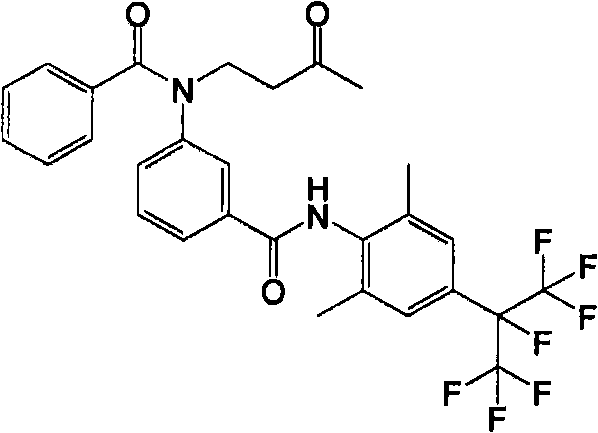
按照实施例1的1-5的方法,由N-(2,6-二甲基-4-(全氟丙烷-2-基)苯基)-3-(3-氧代丁基氨基)苯甲酰胺制备目标化合物。According to the method of 1-5 of Example 1, from N-(2,6-dimethyl-4-(perfluoropropan-2-yl)phenyl)-3-(3-oxobutylamino)benzene formamide to prepare the target compound.
1H-NMR(CDCl3,ppm)δ2.17(3H,s),2.28(6H,s),2.92(2H,t,J=6.8Hz),4.25(2H,t,J=6.8Hz),7.18-7.39(10H,m),7.58(1H,s),7.69(1H,d,J=7.8Hz). 1 H-NMR (CDCl 3 , ppm) δ 2.17 (3H, s), 2.28 (6H, s), 2.92 (2H, t, J=6.8Hz), 4.25 (2H, t, J=6.8Hz), 7.18-7.39(10H, m), 7.58(1H, s), 7.69(1H, d, J=7.8Hz).
<50-3><50-3>
N-(3-(2,6-二甲基-4-(全氟丙烷-2-基)苯基氨基甲酰基)苯基)-N-(3-(羟基亚氨基)丁基)苯甲酰胺的制备(化合物编号5-105)N-(3-(2,6-Dimethyl-4-(perfluoropropan-2-yl)phenylcarbamoyl)phenyl)-N-(3-(hydroxyimino)butyl)benzyl Preparation of Amides (Compound No. 5-105)

按照实施例46的方法,由N-(3-(2,6-二甲基-4-(全氟丙烷-2-基)苯基氨基甲酰基)苯基)-N-(3-氧代丁基)苯甲酰胺制备目标化合物。According to the method of Example 46, from N-(3-(2,6-dimethyl-4-(perfluoropropan-2-yl)phenylcarbamoyl)phenyl)-N-(3-oxo Butyl) benzamide to prepare the target compound.
1H-NMR(CDCl3,ppm)δ1.82(3/4*3H,s),1.92(1/4*3H,s),2.24(3/4*6H,s),2.26(1/4*6H,s),2.58(3/4*2H,t,J=6.8Hz),2.78(1/4*2H,t,J=6.8Hz),4.21(2H,t,J=6.8Hz),7.18-7.71(13H,m). 1 H-NMR (CDCl 3 , ppm) δ1.82(3/4*3H, s), 1.92(1/4*3H, s), 2.24(3/4*6H, s), 2.26(1/4 *6H, s), 2.58(3/4*2H, t, J=6.8Hz), 2.78(1/4*2H, t, J=6.8Hz), 4.21(2H, t, J=6.8Hz), 7.18-7.71 (13H, m).
<实施例51><Example 51>
N-(2-溴-4-(全氟丙烷-2-基)-6-(三氟甲基)苯基)-2-氟-3-(甲基氨基)苯甲酰胺的制备(化合物编号13-40)Preparation of N-(2-bromo-4-(perfluoropropan-2-yl)-6-(trifluoromethyl)phenyl)-2-fluoro-3-(methylamino)benzamide (Compound No. 13-40)
向5ml浓硫酸中加入实施例22的22-5中得到的0.930g(1.71mmol)3-氨基-N-(2-溴-4-(全氟丙烷-2-基)-6-(三氟甲基)苯基)-2-氟苯甲酰胺,在40℃下滴入10ml 37%甲醛水溶液。将反应液注入冰水中,使用氢氧化钠水溶液调节pH为10后,加入乙酸乙酯进行萃取。使用20%氢氧化钠水溶液、饱和食盐水洗涤有机层后,用无水硫酸镁干燥。在减压下蒸馏除去溶剂,将所得残渣用硅胶柱色谱法(展开溶剂;己烷∶乙酸乙酯=8∶1)精制,由此制备0.690g目标化合物(收率72%)。Add 0.930 g (1.71 mmol) of 3-amino-N-(2-bromo-4-(perfluoropropane-2-yl)-6-(trifluoropropane-2-yl)-6-(trifluoro Methyl)phenyl)-2-fluorobenzamide, drop 10ml of 37% formaldehyde aqueous solution at 40°C. The reaction solution was poured into ice water, adjusted to pH 10 with aqueous sodium hydroxide solution, and then extracted with ethyl acetate. The organic layer was washed with 20% aqueous sodium hydroxide solution and saturated brine, and dried over anhydrous magnesium sulfate. The solvent was distilled off under reduced pressure, and the resulting residue was purified by silica gel column chromatography (developing solvent; hexane:ethyl acetate=8:1) to prepare 0.690 g of the target compound (yield 72%).
1H-NMR(CDCl3,ppm)δ2.94(3H,s),4.14(1H,broad-s),6.88-6.93(1H,m),7.18(1H,t,J=7.8Hz),7.37-7.41(1H,m),7.90(1H,s),8.13(1H,s),8.27(1H,d,J=14.6Hz). 1 H-NMR (CDCl 3 , ppm) δ2.94 (3H, s), 4.14 (1H, broad-s), 6.88-6.93 (1H, m), 7.18 (1H, t, J=7.8Hz), 7.37 -7.41(1H, m), 7.90(1H, s), 8.13(1H, s), 8.27(1H, d, J=14.6Hz).
<实施例52><Example 52>
3-氨基-N-(2,6-二碘-4-(全氟丙烷-2-基)苯基)-2-氟苯甲酰胺的制备(化合物编号12-27)Preparation of 3-amino-N-(2,6-diiodo-4-(perfluoropropan-2-yl)phenyl)-2-fluorobenzamide (compound number 12-27)
<52-1><52-1>
4-(全氟丙烷-2-基)苯胺的制备Preparation of 4-(perfluoropropan-2-yl)aniline

向1500ml叔丁基甲基醚、1500ml水的混合溶液中装入100g(1.02mol)苯胺、230g(1.12mol)85%连二亚硫酸钠、35.1g(0.100mol)四丁基硫酸氢铵,添加94.7g(1.12mol)碳酸氢钠。在室温下滴入350g(1.12mol)七氟异丙基碘,在室温下搅拌6小时。分液后,将有机层用1N盐酸、水、饱和碳酸氢钠水溶液洗涤后,用无水硫酸钠干燥。在减压下蒸馏除去溶剂,装入500ml乙酸乙酯。滴入255g(1.02mol)4M氯化氢/乙酸乙酯溶液,在室温下搅拌30分钟,在5℃下搅拌1小时。过滤除去析出的固体,向1000ml乙酸乙酯中加入固体,在20℃以下加入1000ml饱和碳酸氢钠水溶液,调节至pH8~9,分液。将有机层用无水硫酸钠干燥后,在减压下蒸馏除去溶剂,由此制备188g目标化合物(收率71%)。100g (1.02mol) aniline, 230g (1.12mol) 85% sodium dithionite, 35.1g (0.100mol) tetrabutyl ammonium bisulfate are added in the mixed solution of 1500ml tert-butyl methyl ether, 1500ml water, add 94.7g ( 1.12mol) sodium bicarbonate. 350 g (1.12 mol) of heptafluoroisopropyl iodide was added dropwise at room temperature, followed by stirring at room temperature for 6 hours. After liquid separation, the organic layer was washed with 1N hydrochloric acid, water and saturated aqueous sodium bicarbonate solution, and dried over anhydrous sodium sulfate. The solvent was distilled off under reduced pressure, and 500 ml of ethyl acetate was charged. 255 g (1.02 mol) of 4M hydrogen chloride/ethyl acetate solution was added dropwise, stirred at room temperature for 30 minutes, and stirred at 5° C. for 1 hour. Remove the precipitated solid by filtration, add the solid to 1000ml of ethyl acetate, add 1000ml of saturated aqueous sodium bicarbonate solution below 20°C, adjust to pH 8-9, and separate the liquids. After the organic layer was dried over anhydrous sodium sulfate, the solvent was distilled off under reduced pressure to prepare 188 g of the target compound (yield 71%).
1H-NMR(CDCl3,ppm)δ3.92(2H,broad-s),6.69-6.74(2H,m),7.35(2H,d,J=9.3Hz). 1 H-NMR (CDCl 3 , ppm) δ3.92 (2H, broad-s), 6.69-6.74 (2H, m), 7.35 (2H, d, J=9.3Hz).
<52-2><52-2>
2,6-二碘-4-(全氟丙烷-2-基)苯胺的制备Preparation of 2,6-diiodo-4-(perfluoropropan-2-yl)aniline

于5℃,向5.74g(22.0mmol)4-(全氟丙烷-2-基)苯胺的50ml乙醇溶液中加入2.16g(22.0mmol)浓硫酸。将反应液升温至室温,加入10.0g(44.0mmol)N-碘代琥珀酰亚胺,搅拌3小时。将反应液注入饱和碳酸氢钠水溶液中,进行中和。过滤析出的结晶,水洗涤后,进行干燥,由此制备9.00g目标化合物(收率80%)。At 5°C, 2.16 g (22.0 mmol) of concentrated sulfuric acid was added to a solution of 5.74 g (22.0 mmol) of 4-(perfluoropropan-2-yl)aniline in 50 ml of ethanol. The reaction liquid was warmed up to room temperature, 10.0 g (44.0 mmol) of N-iodosuccinimide was added, and stirred for 3 hours. The reaction solution was poured into saturated aqueous sodium bicarbonate solution for neutralization. The precipitated crystals were filtered, washed with water, and dried to prepare 9.00 g of the target compound (yield 80%).
1H-NMR(CDCl3,ppm)δ4.95(2H,broad-s),7.79(2H,s). 1 H-NMR (CDCl 3 , ppm) δ 4.95 (2H, broad-s), 7.79 (2H, s).
<52-3><52-3>
2-氯-N-(2,6-二碘-4-(全氟丙烷-2-基)苯基)-3-硝基苯甲酰胺的制备(化合物编号11-25)Preparation of 2-chloro-N-(2,6-diiodo-4-(perfluoropropan-2-yl)phenyl)-3-nitrobenzamide (compound number 11-25)

向40.0g(78.0mmol)2,6-二碘-4-(全氟丙烷-2-基)苯胺的100ml DMI溶液中加入20.6g(94.0mmol)2-氯-3-硝基苯甲酰氯,在135℃下搅拌3小时。冷却至室温,向1000ml水中注入反应液。加入1000ml乙酸乙酯,萃取,将有机层用水洗涤后,用无水硫酸镁干燥。减压蒸馏除去溶剂,将所得残渣用己烷洗涤,由此制备56.2g目标化合物(收率99%)。To the 100ml DMI solution of 40.0g (78.0mmol) 2,6-diiodo-4-(perfluoropropane-2-yl) aniline, add 20.6g (94.0mmol) 2-chloro-3-nitrobenzoyl chloride, Stir at 135°C for 3 hours. After cooling to room temperature, the reaction liquid was poured into 1000 ml of water. 1000 ml of ethyl acetate was added for extraction, and the organic layer was washed with water and dried over anhydrous magnesium sulfate. The solvent was distilled off under reduced pressure, and the obtained residue was washed with hexane to prepare 56.2 g of the target compound (99% yield).
1H-NMR(CDCl3,ppm)δ7.58(1H,t,J=8.3Hz),7.70(1H,d,J=3.4Hz),7.93(1H,dd,J=1.5,6.3Hz),8.08-8.10(1H,m),8.13(2H,s). 1 H-NMR (CDCl 3 , ppm) δ7.58 (1H, t, J=8.3Hz), 7.70 (1H, d, J=3.4Hz), 7.93 (1H, dd, J=1.5, 6.3Hz), 8.08-8.10 (1H, m), 8.13 (2H, s).
<52-4><52-4>
N-(2,6-二碘-4-(全氟丙烷-2-基)苯基)-2-氟-3-硝基苯甲酰胺的制备(化合物编号11-52)Preparation of N-(2,6-diiodo-4-(perfluoropropan-2-yl)phenyl)-2-fluoro-3-nitrobenzamide (compound number 11-52)
按照实施例1的1-2的方法,由2-氯-N-(2,6-二碘-4-(全氟丙烷-2-基)苯基)-3-硝基苯甲酰胺制备目标化合物。According to the method of 1-2 of Example 1, the target is prepared from 2-chloro-N-(2,6-diiodo-4-(perfluoropropan-2-yl)phenyl)-3-nitrobenzamide compound.
1H-NMR(CDCl3,ppm)δ7.52-7.55(1H,m),8.12-8.18(3H,m),8.29-8.32(1H,m),8.48-8.51(1H,m). 1 H-NMR (CDCl 3 , ppm) δ7.52-7.55 (1H, m), 8.12-8.18 (3H, m), 8.29-8.32 (1H, m), 8.48-8.51 (1H, m).
<52-5><52-5>
3-氨基-N-(2,6-二碘-4-(全氟丙烷-2-基)苯基)-2-氟苯甲酰胺的制备(化合物编号12-27)Preparation of 3-amino-N-(2,6-diiodo-4-(perfluoropropan-2-yl)phenyl)-2-fluorobenzamide (compound number 12-27)

按照实施例1的1-3的方法,由N-(2,6-二碘-4-(全氟丙烷-2-基)苯基)-2-氟-3-硝基苯甲酰胺制备目标化合物。According to the method of 1-3 of Example 1, the target is prepared from N-(2,6-diiodo-4-(perfluoropropane-2-yl)phenyl)-2-fluoro-3-nitrobenzamide compound.
1H-NMR(CDCl3,ppm)δ3.93(2H,broad-s),6.99-7.04(1H,m),7.08(1H,t,J=7.8Hz),7.39-7.43(1H,m),8.10(2H,s),8.72(1H,d,J=11.2Hz). 1 H-NMR (CDCl 3 , ppm) δ3.93 (2H, broad-s), 6.99-7.04 (1H, m), 7.08 (1H, t, J=7.8Hz), 7.39-7.43 (1H, m) , 8.10(2H, s), 8.72(1H, d, J=11.2Hz).
<实施例53><Example 53>
N-(2,6-二溴-4-(全氟丁烷-2-基)苯基)-2-氟-3-(甲基氨基)苯甲酰胺的制备(化合物编号13-32)Preparation of N-(2,6-dibromo-4-(perfluorobutan-2-yl)phenyl)-2-fluoro-3-(methylamino)benzamide (compound number 13-32)

<53-1><53-1>
4-(全氟丁烷-2-基)苯胺的制备Preparation of 4-(perfluorobutan-2-yl)aniline

使用避光的反应容器,向150ml叔丁基甲醚、150ml水的混合溶液中装入4.90g(52.6mmol)苯胺、10.1g(58.0mmol)85%连二亚硫酸钠、1.90g(5.77mmol)四丁基硫酸氢铵,添加4.84g(57.6mmol)碳酸氢钠。在室温下滴入20.0g(57.8mmol)九氟-s-丁基碘,在室温下搅拌5小时。分取有机相,用2mol/L的盐酸水溶液洗涤2次后,用饱和食盐水、碳酸氢钠水溶液、饱和食盐水洗涤。将有机层用无水硫酸镁干燥后,减压蒸馏除去溶剂,由此制备8.32g目标化合物(收率51%)。Using a reaction vessel protected from light, 4.90 g (52.6 mmol) of aniline, 10.1 g (58.0 mmol) of 85% sodium dithionite, 1.90 g (5.77 mmol) of tetrabutyl Ammonium bisulfate, 4.84 g (57.6 mmol) sodium bicarbonate was added. 20.0 g (57.8 mmol) of nonafluoro-s-butyl iodide was added dropwise at room temperature, followed by stirring at room temperature for 5 hours. The organic phase was separated, washed twice with 2 mol/L hydrochloric acid aqueous solution, and then washed with saturated brine, sodium bicarbonate aqueous solution, and saturated brine. After the organic layer was dried over anhydrous magnesium sulfate, the solvent was distilled off under reduced pressure to prepare 8.32 g of the target compound (yield 51%).
1H-NMR(CDCl3,ppm)δ3.92(2H,broad-s),6.72(2H,d,J=8.8Hz),7.34(2H,d,J=8.8Hz). 1 H-NMR (CDCl 3 , ppm) δ3.92 (2H, broad-s), 6.72 (2H, d, J=8.8Hz), 7.34 (2H, d, J=8.8Hz).
<53-2><53-2>
2,6-二溴-4-(全氟丁烷-2-基)苯胺的制备Preparation of 2,6-dibromo-4-(perfluorobutan-2-yl)aniline

按照实施例23的23-1的方法,由4-(全氟丁烷-2-基)苯胺制备目标化合物。According to the method of 23-1 of Example 23, the target compound was prepared from 4-(perfluorobutan-2-yl)aniline.
1H-NMR(CDCl3,ppm)δ4.89(2H,broad-s),7.57(2H,s). 1 H-NMR (CDCl 3 , ppm) δ 4.89 (2H, broad-s), 7.57 (2H, s).
<53-3><53-3>
2-氯-N-(2,6-二溴-4-(全氟丁烷-2-基)苯基)-3-硝基苯甲酰胺的制备(化合物编号11-29)Preparation of 2-chloro-N-(2,6-dibromo-4-(perfluorobutan-2-yl)phenyl)-3-nitrobenzamide (compound number 11-29)
向27ml DMI中加入9.90g(21.1mmol)2,6-二溴-4-(全氟丁烷-2-基)苯胺、4.60g(20.9mmol)2-氯-3-硝基苯甲酰氯,在140℃下搅拌4小时。向反应溶液中加入水和乙酸乙酯,萃取有机相,用1mol/L氢氧化钠水溶液、饱和食盐水洗涤,用无水硫酸镁干燥后,减压蒸馏除去溶剂。将所得残渣用硅胶柱色谱法(展开溶剂;己烷∶乙酸乙酯=20∶1→10∶1→5∶1→3∶1)精制,制备5.44g目标化合物(收率40%)。In 27ml DMI, add 9.90g (21.1mmol) 2,6-dibromo-4-(perfluorobutan-2-yl) aniline, 4.60g (20.9mmol) 2-chloro-3-nitrobenzoyl chloride, Stir at 140°C for 4 hours. Water and ethyl acetate were added to the reaction solution, the organic phase was extracted, washed with 1 mol/L aqueous sodium hydroxide solution and saturated brine, dried over anhydrous magnesium sulfate, and the solvent was distilled off under reduced pressure. The resulting residue was purified by silica gel column chromatography (developing solvent; hexane:ethyl acetate=20:1→10:1→5:1→3:1) to prepare 5.44 g of the target compound (yield 40%).
1H-NMR(CDCl3,ppm)δ7.52-7.61(2H,m),7.89(2H,s),7.94(1H,dd,J=1.5,8.3Hz),7.99(1H,d,J=7.8Hz). 1 H-NMR (CDCl 3 , ppm) δ7.52-7.61 (2H, m), 7.89 (2H, s), 7.94 (1H, dd, J=1.5, 8.3Hz), 7.99 (1H, d, J= 7.8Hz).
<53-4><53-4>
N-(2,6-二溴-4-(全氟丁烷-2-基)苯基)-2-氟-3-硝基苯甲酰胺的制备(化合物编号11-56)Preparation of N-(2,6-dibromo-4-(perfluorobutan-2-yl)phenyl)-2-fluoro-3-nitrobenzamide (compound number 11-56)
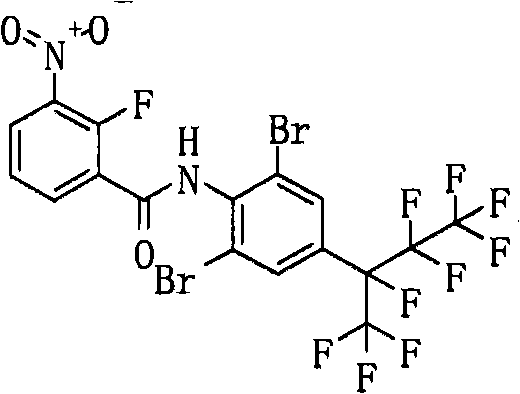
向108ml DMSO中加入5.44g(8.34mmol)2-氯-N-(2,6-二溴-4-(全氟丁烷-2-基)苯基)-3-硝基苯甲酰胺、4.90g(84.3mmol)氟化钾(喷雾干燥物),在145℃下搅拌2小时。向冰水中注入反应溶液,使结晶析出,将所得结晶过滤,用己烷洗涤。将所得结晶用硅胶柱色谱法(展开溶剂;己烷∶乙酸乙酯=5∶1)精制,由此制备2.42g目标化合物(收率46%)。In 108ml DMSO, add 5.44g (8.34mmol) 2-chloro-N-(2,6-dibromo-4-(perfluorobutan-2-yl) phenyl)-3-nitrobenzamide, 4.90 g (84.3 mmol) of potassium fluoride (spray-dried product), stirred at 145°C for 2 hours. The reaction solution was poured into ice water to precipitate crystals, and the resulting crystals were filtered and washed with hexane. The obtained crystals were purified by silica gel column chromatography (developing solvent; hexane:ethyl acetate=5:1) to prepare 2.42 g of the target compound (yield 46%).
1H-NMR(CDCl3,ppm)δ7.53-7.54(1H,m),7.89(2H,s),8.17(1H,d,J=12.2Hz),8.29-8.30(1H,m),8.48-8.49(1H,m). 1 H-NMR (CDCl 3 , ppm) δ7.53-7.54 (1H, m), 7.89 (2H, s), 8.17 (1H, d, J=12.2Hz), 8.29-8.30 (1H, m), 8.48 -8.49(1H, m).
<53-5><53-5>
3-氨基-N-(2,6-二溴-4-(全氟丁烷-2-基)苯基)-2-氟苯甲酰胺的制备(化合物编号12-30)Preparation of 3-amino-N-(2,6-dibromo-4-(perfluorobutan-2-yl)phenyl)-2-fluorobenzamide (compound number 12-30)
按照实施例1的1-3的方法,由N-(2,6-二溴-4-(全氟丁烷-2-基)苯基)-2-氟-3-硝基苯甲酰胺制备目标化合物。According to the method of 1-3 of Example 1, prepared from N-(2,6-dibromo-4-(perfluorobutan-2-yl)phenyl)-2-fluoro-3-nitrobenzamide target compound.
1H-NMR(CDCl3,ppm)δ3.92(2H,broad-s),6.99-7.04(1H,m),7.11-7.12(1H,m),7.48-7.52(1H,m),7.86(2H,s),8.22(1H,d,J=14.1Hz). 1 H-NMR (CDCl 3 , ppm) δ3.92 (2H, broad-s), 6.99-7.04 (1H, m), 7.11-7.12 (1H, m), 7.48-7.52 (1H, m), 7.86 ( 2H, s), 8.22 (1H, d, J=14.1Hz).
<53-6><53-6>
N-(2,6-二溴-4-(全氟丁烷-2-基)苯基)-2-氟-3-(甲基氨基)苯甲酰胺的制备(化合物编号13-32)Preparation of N-(2,6-dibromo-4-(perfluorobutan-2-yl)phenyl)-2-fluoro-3-(methylamino)benzamide (compound number 13-32)

按照实施例51的方法,由3-氨基-N-(2,6-二溴-4-(全氟丁烷-2-基)苯基)-2-氟苯甲酰胺制备目标化合物。According to the method of Example 51, the title compound was prepared from 3-amino-N-(2,6-dibromo-4-(perfluorobutan-2-yl)phenyl)-2-fluorobenzamide.
1H-NMR(CDCl3,ppm)δ2.95(3H,s),4.14(1H,broad-s),6.91-6.92(1H,m),7.17-7.21(1H,m),7.39-7.43(1H,m),7.85(2H,s),8.21(1H,d,J=14.1Hz). 1 H-NMR (CDCl 3 , ppm) δ2.95 (3H, s), 4.14 (1H, broad-s), 6.91-6.92 (1H, m), 7.17-7.21 (1H, m), 7.39-7.43 ( 1H, m), 7.85(2H, s), 8.21(1H, d, J=14.1Hz).
<实施例54><Example 54>
3-氨基-N-(2-溴-6-(全氟乙基)-4-(全氟丙烷-2-基)苯基)-2-氟苯甲酰胺的制备(化合物编号12-46)Preparation of 3-amino-N-(2-bromo-6-(perfluoroethyl)-4-(perfluoropropan-2-yl)phenyl)-2-fluorobenzamide (compound number 12-46)

<54-1><54-1>
2-(全氟乙基)-4-(全氟丙烷-2-基)苯胺的制备(化合物编号21-4)Preparation of 2-(perfluoroethyl)-4-(perfluoropropan-2-yl)aniline (compound number 21-4)

按照实施例22的22-1的方法,由实施例52-1中得到的4-(全氟丙烷-2-基)苯胺和1,1,2,2,2-五氟碘乙烷制备目标化合物。According to the method of 22-1 of Example 22, the target was prepared from 4-(perfluoropropane-2-yl)aniline and 1,1,2,2,2-pentafluoroiodoethane obtained in Example 52-1 compound.
1H-NMR(CDCl3,ppm)δ4.56(2H,broad-s),6.79(1H,d,J=8.8Hz),7.47(1H,d,J=8.8Hz),7.53(1H,s). 1 H-NMR (CDCl 3 , ppm) δ4.56 (2H, broad-s), 6.79 (1H, d, J=8.8Hz), 7.47 (1H, d, J=8.8Hz), 7.53 (1H, s ).
<54-2><54-2>
2-溴-6-(全氟乙基)-4-(全氟丙烷-2-基)苯胺的制备(化合物编号21-19)Preparation of 2-bromo-6-(perfluoroethyl)-4-(perfluoropropan-2-yl)aniline (compound number 21-19)
按照实施例22的22-2的方法,由2-(全氟乙基)-4-(全氟丙烷-2-基)苯胺制备目标化合物。According to the method of 22-2 of Example 22, the target compound was prepared from 2-(perfluoroethyl)-4-(perfluoropropan-2-yl)aniline.
1H-NMR(CDCl3,ppm)δ5.14(2H,broad-s),7.58(1H,s),7.81(1H,s). 1 H-NMR (CDCl 3 , ppm) δ5.14 (2H, broad-s), 7.58 (1H, s), 7.81 (1H, s).
<54-3><54-3>
N-(2-溴-6-(全氟乙基)-4-(全氟丙烷-2-基)苯基)-2-氯-3-硝基苯甲酰胺的制备(化合物编号11-48)Preparation of N-(2-bromo-6-(perfluoroethyl)-4-(perfluoropropane-2-yl)phenyl)-2-chloro-3-nitrobenzamide (compound number 11-48 )

按照实施例53的53-3的方法,由2-溴-6-(全氟乙基)-4-(全氟丙烷-2-基)苯胺制备目标化合物。According to the method of 53-3 of Example 53, the title compound was prepared from 2-bromo-6-(perfluoroethyl)-4-(perfluoropropan-2-yl)aniline.
1H-NMR(CDCl3,ppm)δ7.56-7.61(1H,m),7.73(1H,s),7.88(1H,d,J=1.5Hz),7.92-7.98(2H,m),8.21(1H,s). 1 H-NMR (CDCl 3 , ppm) δ7.56-7.61 (1H, m), 7.73 (1H, s), 7.88 (1H, d, J=1.5Hz), 7.92-7.98 (2H, m), 8.21 (1H, s).
<54-4><54-4>
N-(2-溴-6-(全氟乙基)-4-(全氟丙烷-2-基)苯基)-2-氟-3-硝基苯甲酰胺的制备(化合物编号11-75)Preparation of N-(2-bromo-6-(perfluoroethyl)-4-(perfluoropropane-2-yl)phenyl)-2-fluoro-3-nitrobenzamide (compound number 11-75 )

按照实施例1的1-2的方法,由N-(2-溴-6-(全氟乙基)-4-(全氟丙烷-2-基)苯基)-2-氯-3-硝基苯甲酰胺制备目标化合物。According to the method of 1-2 of Example 1, by N-(2-bromo-6-(perfluoroethyl)-4-(perfluoropropan-2-yl)phenyl)-2-chloro-3-nitro benzamide to prepare the target compound.
APCI-MS m/z(M+1):626APCI-MS m/z (M+1): 626
<54-5><54-5>
3-氨基-N-(2-溴-6-(全氟乙基)-4-(全氟丙烷-2-基)苯基)-2-氟苯甲酰胺的制备(化合物编号12-46)Preparation of 3-amino-N-(2-bromo-6-(perfluoroethyl)-4-(perfluoropropan-2-yl)phenyl)-2-fluorobenzamide (compound number 12-46)

按照实施例1的1-3的方法,由N-(2-溴-6-(全氟乙基)-4-(全氟丙烷-2-基)苯基)-2-氟-3-硝基苯甲酰胺制备目标化合物。According to the method of 1-3 of Example 1, by N-(2-bromo-6-(perfluoroethyl)-4-(perfluoropropane-2-yl)phenyl)-2-fluoro-3-nitro benzamide to prepare the target compound.
1H-NMR(CDCl3,ppm)δ3.92(2H,broad-s),6.99-7.04(1H,m),7.05-7.18(1H,m),7.46-7.51(1H,m),7.85(1H,broad-s),8.17(1H,broad-s),8.34(1H,d,J=15.1Hz). 1 H-NMR (CDCl 3 , ppm) δ3.92 (2H, broad-s), 6.99-7.04 (1H, m), 7.05-7.18 (1H, m), 7.46-7.51 (1H, m), 7.85 ( 1H, broad-s), 8.17 (1H, broad-s), 8.34 (1H, d, J=15.1Hz).
<实施例55><Example 55>
N-(2-溴-4-(全氟丙烷-2-基)-6-(三氟甲基)苯基)-6-(甲基氨基)甲基吡啶酰胺的制备(化合物编号15-68)Preparation of N-(2-bromo-4-(perfluoropropane-2-yl)-6-(trifluoromethyl)phenyl)-6-(methylamino)picolinamide (compound number 15-68 )

<55-1><55-1>
N-(2-溴-4-(全氟丙烷-2-基)-6-(三氟甲基)苯基)-6-氯甲基吡啶酰胺的制备(化合物编号14-6)Preparation of N-(2-bromo-4-(perfluoropropan-2-yl)-6-(trifluoromethyl)phenyl)-6-chloromethylpyridinamide (compound number 14-6)

按照实施例22的22-3的方法,由2-氯吡啶-6-甲酸和亚硫酰氯制备2-氯吡啶-6-甲酰氯,由所得的2-氯吡啶-6-甲酰氯和实施例22的22-2中得到的2-溴-4-(全氟丙烷-2-基)-6-(三氟甲基)苯胺制备目标化合物。According to the method of 22-3 of Example 22, 2-chloropyridine-6-formyl chloride is prepared from 2-chloropyridine-6-formic acid and thionyl chloride, and by the obtained 2-chloropyridine-6-formyl chloride and Example The title compound was prepared from 2-bromo-4-(perfluoropropan-2-yl)-6-(trifluoromethyl)aniline obtained in 22-2 of 22.
1H-NMR(CDCl3,ppm)δ7.59(1H,d,J=7.3Hz),7.90-7.93(2H,m),8.14(1H,s),8.20-8.24(1H,m),9.60(1H,s). 1 H-NMR (CDCl 3 , ppm) δ7.59 (1H, d, J=7.3Hz), 7.90-7.93 (2H, m), 8.14 (1H, s), 8.20-8.24 (1H, m), 9.60 (1H, s).
<55-2><55-2>
N-(2-溴-4-(全氟丙烷-2-基)-6-(三氟甲基)苯基)-6-(甲基氨基)甲基吡啶酰胺的制备(化合物编号15-68)Preparation of N-(2-bromo-4-(perfluoropropane-2-yl)-6-(trifluoromethyl)phenyl)-6-(methylamino)picolinamide (compound number 15-68 )
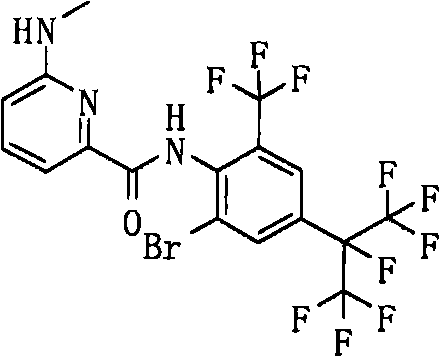
向0.100g(0.180mmol)N-(2-溴-4-(全氟丙烷-2-基)-6-(三氟甲基)苯基)-6-氯甲基吡啶酰胺的5ml 1,4-二氧杂环己烷溶液中加入0.00600g(0.0360mmol)硫酸铜、0.140g(1.80mmol)40%甲基胺水溶液,在封闭条件下、油浴温度80℃下搅拌3小时。将反应液恢复至室温使其开放,加入水、乙酸乙酯,将有机层用水、饱和食盐水洗涤,用无水硫酸镁干燥。减压蒸馏除去溶剂,将所得残渣用硅胶柱色谱法(展开溶剂;己烷∶乙酸乙酯=2∶1)精制,由此制备0.0700g目标化合物(收率69%)。To 5ml of 0.100g (0.180mmol) N-(2-bromo-4-(perfluoropropan-2-yl)-6-(trifluoromethyl)phenyl)-6-chloromethylpicolinamide 1,4 - Add 0.00600 g (0.0360 mmol) of copper sulfate and 0.140 g (1.80 mmol) of 40% methylamine aqueous solution to the dioxane solution, and stir for 3 hours at an oil bath temperature of 80° C. under closed conditions. The reaction solution was returned to room temperature and opened, water and ethyl acetate were added, the organic layer was washed with water and saturated brine, and dried over anhydrous magnesium sulfate. The solvent was distilled off under reduced pressure, and the resulting residue was purified by silica gel column chromatography (developing solvent; hexane:ethyl acetate=2:1) to prepare 0.0700 g of the target compound (yield 69%).
1H-NMR(CDCl3,ppm)δ2.64(3H,s),3.79(1H,broad-s),7.56-7.60(1H,m),7.87-7.93(2H,m),8.14-8.15(1H,m),8.20-8.23(1H,m),9.60(1H,s). 1 H-NMR (CDCl 3 , ppm) δ2.64 (3H, s), 3.79 (1H, broad-s), 7.56-7.60 (1H, m), 7.87-7.93 (2H, m), 8.14-8.15 ( 1H, m), 8.20-8.23 (1H, m), 9.60 (1H, s).
<实施例56><Example 56>
N-(2-溴-4-(全氟丙烷-2-基)-6-(三氟甲基)苯基)-2-(甲基氨基)噻唑-4-甲酰胺的制备(化合物编号17-42)Preparation of N-(2-bromo-4-(perfluoropropane-2-yl)-6-(trifluoromethyl)phenyl)-2-(methylamino)thiazole-4-carboxamide (compound number 17 -42)

<56-1><56-1>
2-氨基噻唑-4-甲酸的制备Preparation of 2-aminothiazole-4-carboxylic acid

向4.00g(23.2mmol)2-氨基噻唑-4-甲酸乙酯的40ml水溶液中加入1.86g(46.5mmol)氢氧化钠,在室温下搅拌5小时。向反应液中加入浓盐酸使其pH为1,过滤得到析出的结晶,由此制备2.84g目标化合物(收率85%)。To 40 ml of an aqueous solution of 4.00 g (23.2 mmol) of ethyl 2-aminothiazole-4-carboxylate was added 1.86 g (46.5 mmol) of sodium hydroxide, and stirred at room temperature for 5 hours. Concentrated hydrochloric acid was added to the reaction solution to adjust the pH to 1, and the precipitated crystals were filtered to obtain 2.84 g of the target compound (yield 85%).
1H-NMR(CDCl3,ppm)δ7.18(2H,broad-s),7.38(1H,s). 1 H-NMR (CDCl 3 , ppm) δ7.18 (2H, broad-s), 7.38 (1H, s).
未检测到羧酸的质子。The proton of the carboxylic acid was not detected.
<56-2><56-2>
2-氯噻唑-4-甲酸的制备Preparation of 2-chlorothiazole-4-carboxylic acid
向2.84g(19.7mmol)2-氨基噻唑-4-甲酸的30ml 1,4-二氧杂环己烷溶液中加入50ml浓盐酸,冷却至0℃,在0~5℃下滴入2.04g(29.6mmol)亚硝酸钠的10ml水溶液。在0℃下,将反应液搅拌2小时后,分批加入2.93g(29.6mmol)氯化铜,将反应液恢复至室温,搅拌8小时。向反应液中加入水、乙酸乙酯,用乙酸乙酯萃取4次。将有机层用饱和食盐水洗涤后,用无水硫酸镁干燥。减压蒸馏除去溶剂,由此制备1.77g目标化合物(收率55%)。Add 50ml of concentrated hydrochloric acid to 2.84g (19.7mmol) of 2-aminothiazole-4-carboxylic acid in 30ml of 1,4-dioxane solution, cool to 0°C, drop 2.04g ( 29.6mmol) of sodium nitrite in 10ml of aqueous solution. After stirring the reaction solution for 2 hours at 0° C., 2.93 g (29.6 mmol) of copper chloride was added in batches, the reaction solution was returned to room temperature, and stirred for 8 hours. Water and ethyl acetate were added to the reaction liquid, followed by extraction with ethyl acetate four times. The organic layer was washed with saturated brine, and dried over anhydrous magnesium sulfate. The solvent was distilled off under reduced pressure to prepare 1.77 g of the target compound (yield 55%).
1H-NMR(DMSO-d6,ppm)δ8.41(1H,s). 1 H-NMR (DMSO-d 6 , ppm) δ8.41 (1H, s).
未检测到羧酸的质子。The proton of the carboxylic acid was not detected.
<56-3><56-3>
N-(2-溴-4-(全氟丙烷-2-基)-6-(三氟甲基)苯基)-2-氯噻唑-4-甲酰胺的制备(化合物编号16-6)Preparation of N-(2-bromo-4-(perfluoropropan-2-yl)-6-(trifluoromethyl)phenyl)-2-chlorothiazole-4-carboxamide (compound number 16-6)
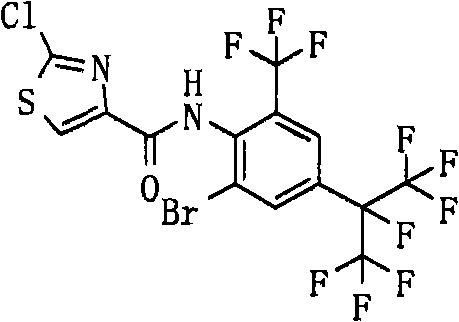
按照实施例53的53-3的方法,由2-氯噻唑-4-甲酸和亚硫酰氯制备得到2-氯噻唑-4-甲酰氯,由所得的2-氯噻唑-4-甲酰氯和实施例22的22-2中得到的2-溴-4-(全氟丙烷-2-基)-6-(三氟甲基)苯胺制备目标化合物。According to the method of 53-3 of Example 53, 2-chlorothiazole-4-formyl chloride is prepared from 2-chlorothiazole-4-formic acid and thionyl chloride, and the obtained 2-chlorothiazole-4-formyl chloride and implementation The title compound was prepared from 2-bromo-4-(perfluoropropan-2-yl)-6-(trifluoromethyl)aniline obtained in 22-2 of Example 22.
1H-NMR(CDCl3,ppm)δ7.91(1H,s),8.13(1H,s),8.19(1H,s),8.82(1H,s). 1 H-NMR (CDCl 3 , ppm) δ7.91(1H, s), 8.13(1H, s), 8.19(1H, s), 8.82(1H, s).
<56-4><56-4>
N-(2-溴-4-(全氟丙烷-2-基)-6-(三氟甲基)苯基)-2-(甲基氨基)噻唑-4-甲酰胺的制备(化合物编号17-42)Preparation of N-(2-bromo-4-(perfluoropropane-2-yl)-6-(trifluoromethyl)phenyl)-2-(methylamino)thiazole-4-carboxamide (compound number 17 -42)

按照实施例55的55-2的方法,由N-(2-溴-4-(全氟丙烷-2-基)-6-(三氟甲基)苯基)-2-氯噻唑-4-甲酰胺制备目标化合物。According to the method of 55-2 of Example 55, from N-(2-bromo-4-(perfluoropropane-2-yl)-6-(trifluoromethyl)phenyl)-2-chlorothiazole-4- formamide to prepare the target compound.
1H-NMR(CDCl3,ppm)δ3.03(3H,s),5.11-5.12(1H,m),7.50(1H,s),7.88(1H,s),8.11(1H,s),8.99(1H,s). 1 H-NMR (CDCl3, ppm) δ3.03 (3H, s), 5.11-5.12 (1H, m), 7.50 (1H, s), 7.88 (1H, s), 8.11 (1H, s), 8.99 ( 1H, s).
<实施例57><Example 57>
2-氟-N-(2-碘-4-(全氟丁烷-2-基)-6-(三氟甲基)苯基)-3-(甲基氨基)苯甲酰胺的制备(化合物编号13-44)Preparation of 2-fluoro-N-(2-iodo-4-(perfluorobutan-2-yl)-6-(trifluoromethyl)phenyl)-3-(methylamino)benzamide (compound No. 13-44)

<57-1><57-1>
4-(全氟丁烷-2-基)-2-(三氟甲基)苯胺的制备(化合物编号21-3)Preparation of 4-(perfluorobutan-2-yl)-2-(trifluoromethyl)aniline (compound number 21-3)

按照实施例22的22-1的方法,在避光反应条件下,由2-(三氟甲基)苯胺和九氟-s-丁基碘制备目标化合物。According to the method of 22-1 of Example 22, the target compound was prepared from 2-(trifluoromethyl)aniline and nonafluoro-s-butyl iodide under the reaction conditions protected from light.
1H-NMR(CDCl3,ppm)δ4.49(2H,broad-s),6.81(1H,d,J=8.8Hz),7.47(1H,d,J=8.8Hz),7.61(1H,s). 1 H-NMR (CDCl 3 , ppm) δ4.49 (2H, broad-s), 6.81 (1H, d, J=8.8Hz), 7.47 (1H, d, J=8.8Hz), 7.61 (1H, s ).
<57-2><57-2>
2-碘-4-(全氟丁烷-2-基)-6-(三氟甲基)苯胺的制备(化合物编号21-14)Preparation of 2-iodo-4-(perfluorobutan-2-yl)-6-(trifluoromethyl)aniline (compound number 21-14)

向100mL乙醇中加入17.0g(44.8mmol)4-(全氟丁烷-2-基)-2-(三氟甲基)苯胺,在冰冷却下,加入5.28g(53.8mmol)浓硫酸、12.6g(55.8mmol)N-碘代琥珀酰亚胺,在室温下搅拌1小时30分钟,在40℃下搅拌4小时。向反应溶液中加入4N氢氧化钠水溶液,将反应溶液中和后,加入乙酸乙酯,萃取有机相。将有机相用饱和食盐水洗涤,用无水硫酸镁干燥后,减压蒸馏除去溶剂。将所得残渣用硅胶柱色谱法(展开溶剂;己烷∶乙酸乙酯=10∶1)精制,由此制备14.6g目标化合物(收率65%)。Add 17.0g (44.8mmol) 4-(perfluorobutan-2-yl)-2-(trifluoromethyl)aniline to 100mL ethanol, under ice cooling, add 5.28g (53.8mmol) concentrated sulfuric acid, 12.6g (55.8 mmol) N-iodosuccinimide, stirred at room temperature for 1 hour and 30 minutes, and stirred at 40° C. for 4 hours. A 4N aqueous sodium hydroxide solution was added to the reaction solution to neutralize the reaction solution, and then ethyl acetate was added to extract the organic phase. The organic phase was washed with saturated brine, dried over anhydrous magnesium sulfate, and the solvent was distilled off under reduced pressure. The resulting residue was purified by silica gel column chromatography (developing solvent; hexane:ethyl acetate=10:1) to prepare 14.6 g of the target compound (yield 65%).
1H-NMR(CDCl3,ppm)δ5.04(2H,broad-s),7.62(1H,s),7.97(1H,s). 1 H-NMR (CDCl 3 , ppm) δ5.04 (2H, broad-s), 7.62 (1H, s), 7.97 (1H, s).
<57-3><57-3>
2-氯-N-(2-碘-4-(全氟丁烷-2-基)-6-(三氟甲基)苯基)-3-硝基苯甲酰胺的制备(化合物编号11-43)Preparation of 2-chloro-N-(2-iodo-4-(perfluorobutan-2-yl)-6-(trifluoromethyl)phenyl)-3-nitrobenzamide (compound number 11- 43)

按照实施例53的53-3的方法,由2-碘-4-(全氟丁烷-2-基)-6-(三氟甲基)苯胺制备目标化合物。According to the method of 53-3 of Example 53, the title compound was prepared from 2-iodo-4-(perfluorobutan-2-yl)-6-(trifluoromethyl)aniline.
1H-NMR(CDCl3,ppm)δ7.60-7.61(1H,m),7.77(1H,s),7.89-7.96(2H,m),8.03-8.04(1H,m),8.38(1H,s). 1 H-NMR (CDCl 3 , ppm) δ7.60-7.61 (1H, m), 7.77 (1H, s), 7.89-7.96 (2H, m), 8.03-8.04 (1H, m), 8.38 (1H, s).
<57-4><57-4>
2-氟-N-(2-碘-4-(全氟丁烷-2-基)-6-(三氟甲基)苯基)-3-硝基苯甲酰胺的制备(化合物编号11-70)Preparation of 2-fluoro-N-(2-iodo-4-(perfluorobutan-2-yl)-6-(trifluoromethyl)phenyl)-3-nitrobenzamide (compound number 11- 70)

按照实施例1的1-2的方法,由2-氯-N-(2-碘-4-(全氟丁烷-2-基)-6-(三氟甲基)苯基)-3-硝基苯甲酰胺制备目标化合物。According to the method of 1-2 of Example 1, from 2-chloro-N-(2-iodo-4-(perfluorobutan-2-yl)-6-(trifluoromethyl)phenyl)-3- Nitrobenzamide to prepare the target compound.
1H-NMR(CDCl3,ppm)δ7.53-7.54(1H,m),7.95(1H,s),8.24-8.32(2H,m),8.36(1H,s),8.44-8.48(1H,m). 1 H-NMR (CDCl 3 , ppm) δ7.53-7.54 (1H, m), 7.95 (1H, s), 8.24-8.32 (2H, m), 8.36 (1H, s), 8.44-8.48 (1H, m).
<57-5><57-5>
3-氨基-2-氟-N-(2-碘-4-(全氟丁烷-2-基)-6-(三氟甲基)苯基)苯甲酰胺的制备(化合物编号12-41)Preparation of 3-amino-2-fluoro-N-(2-iodo-4-(perfluorobutan-2-yl)-6-(trifluoromethyl)phenyl)benzamide (compound number 12-41 )
按照实施例1的1-3的方法,由2-氟-N-(2-碘-4-(全氟丁烷-2-基)-6-(三氟甲基)苯基)-3-硝基苯甲酰胺制备目标化合物。According to the method of 1-3 of Example 1, from 2-fluoro-N-(2-iodo-4-(perfluorobutan-2-yl)-6-(trifluoromethyl)phenyl)-3- Nitrobenzamide to prepare the target compound.
1H-NMR(CDCl3,ppm)δ3.93(2H,broad-s),7.02-7.03(1H,m),7.11-7.13(1H,m),7.47-7.51(1H,m),7.92(1H,s),8.31-8.34(2H,m). 1 H-NMR (CDCl 3 , ppm) δ3.93 (2H, broad-s), 7.02-7.03 (1H, m), 7.11-7.13 (1H, m), 7.47-7.51 (1H, m), 7.92 ( 1H, s), 8.31-8.34 (2H, m).
<57-6><57-6>
2-氟-N-(2-碘-4-(全氟丁烷-2-基)-6-(三氟甲基)苯基)-3-(甲基氨基)苯甲酰胺的制备(化合物编号13-44)Preparation of 2-fluoro-N-(2-iodo-4-(perfluorobutan-2-yl)-6-(trifluoromethyl)phenyl)-3-(methylamino)benzamide (compound No. 13-44)
按照实施例51的方法,由3-氨基-2-氟-N-(2-碘-4-(全氟丁烷-2-基)-6-(三氟甲基)苯基)苯甲酰胺制备目标化合物。According to the method of Example 51, from 3-amino-2-fluoro-N-(2-iodo-4-(perfluorobutan-2-yl)-6-(trifluoromethyl)phenyl)benzamide Prepare the target compound.
1H-NMR(CDCl3,ppm)δ2.95-2.96(3H,m),4.15(1H,broad-s),6.91-6.93(1H,m),7.19-7.20(1H,m),7.38-7.42(1H,m),7.92(1H,s),8.32(1H,d,J=14.1Hz),8.34(1H,s). 1 H-NMR (CDCl 3 , ppm) δ2.95-2.96 (3H, m), 4.15 (1H, broad-s), 6.91-6.93 (1H, m), 7.19-7.20 (1H, m), 7.38- 7.42(1H, m), 7.92(1H, s), 8.32(1H, d, J=14.1Hz), 8.34(1H, s).
<实施例58><Example 58>
N-(2-氯-4-(全氟丙烷-2-基)-6-(三氟甲基)苯基)-4-氰基-3-(甲基氨基)苯甲酰胺的制备(化合物编号13-85)Preparation of N-(2-chloro-4-(perfluoropropan-2-yl)-6-(trifluoromethyl)phenyl)-4-cyano-3-(methylamino)benzamide (compound No. 13-85)

<58-1><58-1>
2-氯-4-(全氟丙烷-2-基)-6-(三氟甲基)苯胺的制备(化合物编号21-8)Preparation of 2-chloro-4-(perfluoropropan-2-yl)-6-(trifluoromethyl)aniline (compound number 21-8)

按照实施例22的22-2的方法,由实施例22的22-1中得到的4-(全氟丙烷-2-基)-2-(三氟甲基)苯胺和N-氯代琥珀酰亚胺制备目标化合物。According to the method of 22-2 of Example 22, 4-(perfluoropropane-2-yl)-2-(trifluoromethyl)aniline and N-chlorosuccinyl obtained in 22-1 of Example 22 imines to prepare target compounds.
1H-NMR(CDCl3,ppm)δ4.97(2H,broad-s),7.57(1H,s),7.64(1H,s). 1 H-NMR (CDCl 3 , ppm) δ4.97 (2H, broad-s), 7.57 (1H, s), 7.64 (1H, s).
<58-2><58-2>
N-(2-氯-4-(全氟丙烷-2-基)-6-(三氟甲基)苯基)-4-碘-3-硝基苯甲酰胺的制备(化合物编号11-100)Preparation of N-(2-chloro-4-(perfluoropropane-2-yl)-6-(trifluoromethyl)phenyl)-4-iodo-3-nitrobenzamide (compound number 11-100 )
按照实施例22的22-3的方法,由4-碘-3-硝基苯甲酸和亚硫酰氯制备4-碘-3-硝基苯甲酰氯,由所得4-碘-3-硝基苯甲酰氯和2-氯-4-(全氟丙烷-2-基)-6-(三氟甲基)苯胺制备目标化合物。According to the method of 22-3 of Example 22, 4-iodo-3-nitrobenzoyl chloride is prepared from 4-iodo-3-nitrobenzoic acid and thionyl chloride, and by the obtained 4-iodo-3-nitrobenzene Formyl chloride and 2-chloro-4-(perfluoropropan-2-yl)-6-(trifluoromethyl)aniline to prepare the title compound.
1H-NMR(CDCl3,ppm)δ7.52-7.81(2H,m),7.89(1H,s),8.00(1H,s),8.25(1H,d,J=8.3Hz),8.38(1H,d,J=1.9Hz) 1 H-NMR (CDCl 3 , ppm) δ7.52-7.81 (2H, m), 7.89 (1H, s), 8.00 (1H, s), 8.25 (1H, d, J=8.3Hz), 8.38 (1H , d, J=1.9Hz)
<58-3><58-3>
3-氨基-N-(2-氯-4-(全氟丙烷-2-基)-6-(三氟甲基)苯基)-4-碘苯甲酰胺的制备(化合物编号12-63)Preparation of 3-amino-N-(2-chloro-4-(perfluoropropan-2-yl)-6-(trifluoromethyl)phenyl)-4-iodobenzamide (compound number 12-63)
按照实施例1的1-3的方法,由N-(2-氯-4-(全氟丙烷-2-基)-6-(三氟甲基)苯基)-4-碘-3-硝基苯甲酰胺制备目标化合物。According to the method of 1-3 of Example 1, by N-(2-chloro-4-(perfluoropropane-2-yl)-6-(trifluoromethyl)phenyl)-4-iodo-3-nitrate benzamide to prepare the target compound.
1H-NMR(CDCl3,ppm)δ4.35(2H,s),6.92(1H,dd,J=1.9,8.3Hz),7.29(1H,d,J=1.9Hz),7.60(1H,s),7.79(1H,d,J=8.3Hz),7.86(1H,s),7.97(1H,s). 1 H-NMR (CDCl 3 , ppm) δ4.35 (2H, s), 6.92 (1H, dd, J=1.9, 8.3Hz), 7.29 (1H, d, J=1.9Hz), 7.60 (1H, s ), 7.79(1H, d, J=8.3Hz), 7.86(1H, s), 7.97(1H, s).
<58-4><58-4>
N-(2-氯-4-(全氟丙烷-2-基)-6-(三氟甲基)苯基)-4-碘-3-(甲基氨基)苯甲酰胺的制备(化合物编号13-68)Preparation of N-(2-chloro-4-(perfluoropropan-2-yl)-6-(trifluoromethyl)phenyl)-4-iodo-3-(methylamino)benzamide (Compound No. 13-68)

按照实施例51的方法,由3-氨基-N-(2-氯-4-(全氟丙烷-2-基)-6-(三氟甲基)苯基)-4-碘苯甲酰胺制备目标化合物。According to the method of Example 51, prepared from 3-amino-N-(2-chloro-4-(perfluoropropan-2-yl)-6-(trifluoromethyl)phenyl)-4-iodobenzamide target compound.
1H-NMR(CDCl3,ppm)δ2.97(3H,s),4.46(1H,broad-s),6.89(1H,dd,J=1.9,8.3Hz),7.07(1H,d,J=1.9Hz),7.65(1H,s),7.80(1H,d,J=8.3Hz),7.86(1H,s),7.97(1H,s). 1 H-NMR (CDCl 3 , ppm) δ2.97 (3H, s), 4.46 (1H, broad-s), 6.89 (1H, dd, J=1.9, 8.3Hz), 7.07 (1H, d, J= 1.9Hz), 7.65(1H, s), 7.80(1H, d, J=8.3Hz), 7.86(1H, s), 7.97(1H, s).
<58-5><58-5>
N-(2-氯-4-(全氟丙烷-2-基)-6-(三氟甲基)苯基)-4-氰基-3-(甲基氨基)苯甲酰胺的制备(化合物编号13-85)Preparation of N-(2-chloro-4-(perfluoropropan-2-yl)-6-(trifluoromethyl)phenyl)-4-cyano-3-(methylamino)benzamide (compound No. 13-85)

向10mL DMF中加入0.350g(0.560mmol)N-(2-氯-4-(全氟丙烷-2-基)-6-(三氟甲基)苯基)-4-碘-3-(甲基氨基)苯甲酰胺、0.200g(2.25mmol)氰化铜(I),在140℃下搅拌1小时30分钟。向反应溶液中注入饱和硫代硫酸钠水溶液,结束反应后,用乙酸乙酯分离得到有机层,用饱和食盐水洗涤。将有机层用无水硫酸镁干燥后,减压蒸馏除去溶剂。将所得残渣用硅胶柱色谱法(展开溶剂;己烷∶乙酸乙酯=5∶1→3∶1)精制,由此制备0.250g目标化合物(收率86%)。Add 0.350g (0.560mmol) N-(2-chloro-4-(perfluoropropan-2-yl)-6-(trifluoromethyl)phenyl)-4-iodo-3-(methanol) to 10mL DMF Amino) benzamide, 0.200 g (2.25 mmol) copper (I) cyanide, stirred at 140° C. for 1 hour and 30 minutes. A saturated aqueous solution of sodium thiosulfate was poured into the reaction solution, and after the reaction was completed, the organic layer was separated with ethyl acetate and washed with saturated brine. After the organic layer was dried over anhydrous magnesium sulfate, the solvent was distilled off under reduced pressure. The resulting residue was purified by silica gel column chromatography (developing solvent; hexane:ethyl acetate=5:1→3:1) to prepare 0.250 g of the target compound (yield 86%).
1H-NMR(CDCl3,ppm)δ3.01(1/2*3H,s),3.03(1/2*3H,s),4.89(1/2*1H,s),4.90(1/2*1H,s),7.80(1H,dd,J=1.5,8.3Hz),7.21-7.22(1H,m),7.54(1H,d,J=8.3Hz),7.67(1H,s),7.88(1H,s),7.99(1H,s). 1 H-NMR (CDCl 3 , ppm) δ3.01(1/2*3H, s), 3.03(1/2*3H, s), 4.89(1/2*1H, s), 4.90(1/2 *1H, s), 7.80 (1H, dd, J = 1.5, 8.3Hz), 7.21-7.22 (1H, m), 7.54 (1H, d, J = 8.3Hz), 7.67 (1H, s), 7.88 ( 1H, s), 7.99 (1H, s).
<实施例59><Example 59>
3-氨基-N-(2-溴-4-(全氟丙烷-2-基)-6-(三氟甲基)苯基)-4-氰基-2-氟苯甲酰胺的制备(化合物编号12-94)Preparation of 3-amino-N-(2-bromo-4-(perfluoropropan-2-yl)-6-(trifluoromethyl)phenyl)-4-cyano-2-fluorobenzamide (compound No. 12-94)

<59-1><59-1>
N-(2-溴-4-(全氟丙烷-2-基)-6-(三氟甲基)苯基)-4-氰基-2,3-二氟苯甲酰胺的制备Preparation of N-(2-bromo-4-(perfluoropropan-2-yl)-6-(trifluoromethyl)phenyl)-4-cyano-2,3-difluorobenzamide
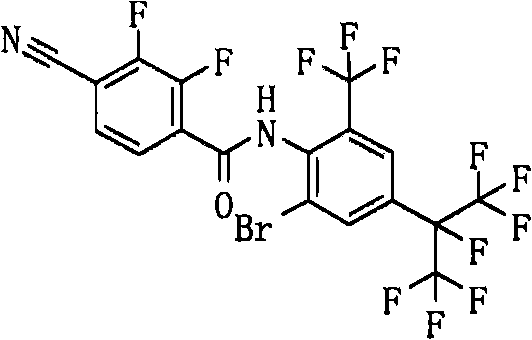
向4-氰基-2,3-二氟苯甲酸0.840g(4.59mmol)的二氯甲烷溶液10ml中加入1滴DMF、0.470ml(5.51mmol)草酰氯,在室温下搅拌1小时。减压蒸馏除去溶剂,得到4-氰基-2,3-二氟苯甲酰氯,将所得的4-氰基-2,3-二氟苯甲酰氯加入到实施例22的22-2中得到的1.56g(3.83mmol)2-溴-4-(全氟丙烷-2-基)-6-(三氟甲基)苯胺的5ml DMI溶液中,在130℃下搅拌5小时。向反应液中加入水、乙酸乙酯,将有机层用饱和碳酸氢钠水溶液、饱和食盐水洗涤后,用无水硫酸镁干燥。减压蒸馏除去溶剂,将所得残渣用硅胶柱色谱法(展开溶剂;己烷∶乙酸乙酯=1∶0→10∶1)精制,由此制备目标化合物0.58g(收率27%)。To a solution of 0.840 g (4.59 mmol) of 4-cyano-2,3-difluorobenzoic acid in 10 ml of dichloromethane was added 1 drop of DMF and 0.470 ml (5.51 mmol) of oxalyl chloride, and stirred at room temperature for 1 hour. The solvent was distilled off under reduced pressure to obtain 4-cyano-2,3-difluorobenzoyl chloride, and the obtained 4-cyano-2,3-difluorobenzoyl chloride was added to 22-2 of Example 22 to obtain 1.56g (3.83mmol) of 2-bromo-4-(perfluoropropan-2-yl)-6-(trifluoromethyl)aniline in 5ml DMI solution, stirred at 130°C for 5 hours. Water and ethyl acetate were added to the reaction solution, and the organic layer was washed with saturated aqueous sodium bicarbonate solution and saturated brine, and dried over anhydrous magnesium sulfate. The solvent was distilled off under reduced pressure, and the obtained residue was purified by silica gel column chromatography (developing solvent; hexane:ethyl acetate=1:0→10:1) to prepare 0.58 g of the target compound (yield 27%).
1H-NMR(CDCl3,ppm)δ7.52-7.62(1H,m),7.92-7.94(1H,m),8.02-8.06(1H,m),8.13-8.16(2H,m). 1 H-NMR (CDCl 3 , ppm) δ7.52-7.62 (1H, m), 7.92-7.94 (1H, m), 8.02-8.06 (1H, m), 8.13-8.16 (2H, m).
<59-2><59-2>
3-氨基-N-(2-溴-4-(全氟丙烷-2-基)-6-(三氟甲基)苯基)-4-氰基-2-氟苯甲酰胺的制备(化合物编号12-94)Preparation of 3-amino-N-(2-bromo-4-(perfluoropropan-2-yl)-6-(trifluoromethyl)phenyl)-4-cyano-2-fluorobenzamide (compound No. 12-94)

向N-(2-溴-4-(全氟丙烷-2-基)-6-(三氟甲基)苯基)-4-氰基-2,3-二氟苯甲酰胺的5ml DMSO溶液中加入49.0mg碳酸铵,在100℃下搅拌5小时。向反应液中加入水、乙酸乙酯,将有机层用水洗涤后,用无水硫酸镁干燥。减压蒸馏除去溶剂,将所得残渣用硅胶柱色谱法(展开溶剂;己烷∶乙酸乙酯=8∶1→4∶1)精制,由此制备0.30g目标化合物(收率51%)。To the 5ml DMSO solution of N-(2-bromo-4-(perfluoropropan-2-yl)-6-(trifluoromethyl)phenyl)-4-cyano-2,3-difluorobenzamide 49.0 mg of ammonium carbonate was added to the mixture, and stirred at 100° C. for 5 hours. Water and ethyl acetate were added to the reaction liquid, and the organic layer was washed with water and dried over anhydrous magnesium sulfate. The solvent was distilled off under reduced pressure, and the resulting residue was purified by silica gel column chromatography (developing solvent; hexane:ethyl acetate=8:1→4:1) to prepare 0.30 g of the target compound (yield 51%).
1H-NMR(CDCl3,ppm)δ4.71(2H,broad-s),7.35-7.39(1H,m),7.40-7.44(1H,m),7.92(1H,s),8.12-8.15(2H,m). 1 H-NMR (CDCl 3 , ppm) δ4.71 (2H, broad-s), 7.35-7.39 (1H, m), 7.40-7.44 (1H, m), 7.92 (1H, s), 8.12-8.15 ( 2H, m).
<实施例60><Example 60>
3-氨基-N-(2,6-二碘-4-(全氟丁烷-2-基)苯基)苯甲酰胺的制备(化合物编号12-3)Preparation of 3-amino-N-(2,6-diiodo-4-(perfluorobutan-2-yl)phenyl)benzamide (compound number 12-3)

<60-1><60-1>
2,6-二碘-4-(全氟丁烷-2-基)苯胺的制备Preparation of 2,6-diiodo-4-(perfluorobutan-2-yl)aniline

按照实施例52的52-2的方法,由实施例53的53-1中得到的4-(全氟丁烷-2-基)苯胺制备目标化合物。According to the method of 52-2 of Example 52, the title compound was prepared from 4-(perfluorobutan-2-yl)aniline obtained in 53-1 of Example 53.
1H-NMR(CDCl3,ppm)δ4.95(2H,broad-s),7.78(2H,s). 1 H-NMR (CDCl 3 , ppm) δ 4.95 (2H, broad-s), 7.78 (2H, s).
<60-2><60-2>
N-(2,6-二碘-4-(全氟丁烷-2-基)苯基)-3-硝基苯甲酰胺的制备(化合物编号11-4)Preparation of N-(2,6-diiodo-4-(perfluorobutan-2-yl)phenyl)-3-nitrobenzamide (compound number 11-4)

按照实施例53的53-3的方法,由2,6-二碘-4-(全氟丁烷-2-基)苯胺和3-硝基苯甲酰氯制备目标化合物。According to the method of 53-3 of Example 53, the target compound was prepared from 2,6-diiodo-4-(perfluorobutan-2-yl)aniline and 3-nitrobenzoyl chloride.
1H-NMR(CDCl3,ppm)δ7.74(1H,t,J=8.0Hz),8.11(2H,s),8.42(1H,d,J=7.6Hz),8.46(1H,d,J=8.4Hz),8.90(1H,d,J=12.4Hz),8.92(1H,s). 1 H-NMR (CDCl 3 , ppm) δ7.74 (1H, t, J=8.0Hz), 8.11 (2H, s), 8.42 (1H, d, J=7.6Hz), 8.46 (1H, d, J =8.4Hz), 8.90(1H, d, J=12.4Hz), 8.92(1H, s).
<60-3><60-3>
3-氨基-N-(2,6-二碘-4-(全氟丁烷-2-基)苯基)苯甲酰胺的制备(化合物编号12-3)Preparation of 3-amino-N-(2,6-diiodo-4-(perfluorobutan-2-yl)phenyl)benzamide (compound number 12-3)

按照实施例1的1-3的方法,由N-(2,6-二碘-4-(全氟丁烷-2-基)苯基)-3-硝基苯甲酰胺制备目标化合物。According to the method of 1-3 of Example 1, the target compound was prepared from N-(2,6-diiodo-4-(perfluorobutan-2-yl)phenyl)-3-nitrobenzamide.
1H-NMR(CDCl3,ppm)δ5.39(2H,broad-s),6.89-6.93(1H,m),7.29-7.31(3H,m),7.68(1H,s),8.08(2H,s). 1 H-NMR (CDCl 3 , ppm) δ5.39 (2H, broad-s), 6.89-6.93 (1H, m), 7.29-7.31 (3H, m), 7.68 (1H, s), 8.08 (2H, s).
<实施例61><Example 61>
3-氨基-N-(2-溴-4-(全氟丙烷-2-基)-6-(三氟甲氧基)苯基)-2-氟苯甲酰胺的制备(化合物编号12-33)Preparation of 3-amino-N-(2-bromo-4-(perfluoropropan-2-yl)-6-(trifluoromethoxy)phenyl)-2-fluorobenzamide (compound number 12-33 )

<61-1><61-1>
4-(全氟丙烷-2-基)-2-(三氟甲氧基)苯胺的制备Preparation of 4-(perfluoropropan-2-yl)-2-(trifluoromethoxy)aniline

按照实施例22的22-1的方法,由2-三氟甲氧基苯胺制备目标化合物。According to the method of 22-1 of Example 22, the title compound was prepared from 2-trifluoromethoxyaniline.
1H-NMR(CDCl3,ppm)δ4.19(2H,broad-s),6.86(1H,d,J=8.8Hz),7.30(1H,d,J=8.8Hz),7.36(1H,s). 1 H-NMR (CDCl 3 , ppm) δ4.19 (2H, broad-s), 6.86 (1H, d, J=8.8Hz), 7.30 (1H, d, J=8.8Hz), 7.36 (1H, s ).
<61-2><61-2>
2-溴-4-(全氟丙烷-2-基)-6-(三氟甲氧基)苯胺的制备Preparation of 2-bromo-4-(perfluoropropan-2-yl)-6-(trifluoromethoxy)aniline
按照实施例22的22-2的方法,由4-(全氟丙烷-2-基)-2-(三氟甲氧基)苯胺制备目标化合物。According to the method of 22-2 of Example 22, the title compound was prepared from 4-(perfluoropropan-2-yl)-2-(trifluoromethoxy)aniline.
1H-NMR(CDCl3,ppm)δ4.65(2H,broad-s),7.33(1H,s),7.71(1H,s). 1 H-NMR (CDCl 3 , ppm) δ4.65 (2H, broad-s), 7.33 (1H, s), 7.71 (1H, s).
<61-3><61-3>
N-(2-溴-4-(全氟丙烷-2-基)-6-(三氟甲氧基)苯基)-2-氯-3-硝基苯甲酰胺的制备(化合物编号11-33)Preparation of N-(2-bromo-4-(perfluoropropan-2-yl)-6-(trifluoromethoxy)phenyl)-2-chloro-3-nitrobenzamide (compound number 11- 33)

按照实施例22的22-3的方法,由2-溴-4-(全氟丙烷-2-基)-6-(三氟甲氧基)苯胺制备标题化合物。According to the method of 22-3 of Example 22, the title compound was prepared from 2-bromo-4-(perfluoropropan-2-yl)-6-(trifluoromethoxy)aniline.
1H-NMR(CDCl3,ppm)δ7.49-7.61(3H,m),7.80-7.96(3H,m). 1 H-NMR (CDCl 3 , ppm) δ7.49-7.61 (3H, m), 7.80-7.96 (3H, m).
<61-4><61-4>
N-(2-溴-4-(全氟丙烷-2-基)-6-(三氟甲氧基)苯基)-2-氟-3-硝基苯甲酰胺的制备(化合物编号11-60)Preparation of N-(2-bromo-4-(perfluoropropan-2-yl)-6-(trifluoromethoxy)phenyl)-2-fluoro-3-nitrobenzamide (compound number 11- 60)

按照实施例1的1-2的方法,由N-(2-溴-4-(全氟丙烷-2-基)-6-(三氟甲氧基)苯基)-2-氯-3-硝基苯甲酰胺制备标题化合物。According to the method of 1-2 of Example 1, by N-(2-bromo-4-(perfluoropropan-2-yl)-6-(trifluoromethoxy)phenyl)-2-chloro-3- Nitrobenzamide to prepare the title compound.
1H-NMR(CDCl3,ppm)δ7.53(1H,t,J=7.8Hz),7.60(1H,broad-s),7.89(1H,d,J=1.5Hz),8.07(1H,broad-d,J=12.7Hz),8.29-8.30(1H,m),8.43-8.47(1H,m). 1 H-NMR (CDCl 3 , ppm) δ7.53 (1H, t, J=7.8Hz), 7.60 (1H, broad-s), 7.89 (1H, d, J=1.5Hz), 8.07 (1H, broad -d, J=12.7Hz), 8.29-8.30(1H, m), 8.43-8.47(1H, m).
<61-5><61-5>
3-氨基-N-(2-溴-4-(全氟丙烷-2-基)-6-(三氟甲氧基)苯基)-2-氟苯甲酰胺的制备(化合物编号12-33)Preparation of 3-amino-N-(2-bromo-4-(perfluoropropan-2-yl)-6-(trifluoromethoxy)phenyl)-2-fluorobenzamide (compound number 12-33 )
按照实施例1的1-3的方法,由N-(2-溴-4-(全氟丙烷-2-基)-6-(三氟甲氧基)苯基)-2-氟-3-硝基苯甲酰胺制备标题化合物。According to the method of 1-3 of Example 1, from N-(2-bromo-4-(perfluoropropane-2-yl)-6-(trifluoromethoxy)phenyl)-2-fluoro-3- Nitrobenzamide to prepare the title compound.
1H-NMR(CDCl3,ppm)δ3.92(2H,broad-s),6.99-7.04(1H,m),7.11(1H,t,J=7.8Hz),7.45-7.49(1H,m),7.57(1H,broad-s),7.87(1H,d,J=2.0Hz),8.14(1H,d,J=14.2Hz). 1 H-NMR (CDCl 3 , ppm) δ3.92 (2H, broad-s), 6.99-7.04 (1H, m), 7.11 (1H, t, J=7.8Hz), 7.45-7.49 (1H, m) , 7.57 (1H, broad-s), 7.87 (1H, d, J=2.0Hz), 8.14 (1H, d, J=14.2Hz).
<实施例62><Example 62>
3-氨基-N-(2-溴-4-(全氟丙烷-2-基)-6-(三氟甲基)苯基)-4-氟苯甲酰胺的制备(化合物编号12-53)Preparation of 3-amino-N-(2-bromo-4-(perfluoropropan-2-yl)-6-(trifluoromethyl)phenyl)-4-fluorobenzamide (compound number 12-53)

<62-1><62-1>
N-(2-溴-4-(全氟丙烷-2-基)-6-(三氟甲基)苯基)-4-氟-3-硝基苯甲酰胺的制备(化合物编号11-84)Preparation of N-(2-bromo-4-(perfluoropropan-2-yl)-6-(trifluoromethyl)phenyl)-4-fluoro-3-nitrobenzamide (compound number 11-84 )

按照实施例22的22-3的方法,由4-氟-3-硝基苯甲酸和亚硫酰氯制备4-氟-3-硝基苯甲酰氯,由所得的4-氟-3-硝基苯甲酰氯和实施例22的22-2中得到的2-溴-4-(全氟丙烷-2-基)-6-(三氟甲基)苯胺制备标题化合物。According to the method of 22-3 of Example 22, 4-fluoro-3-nitrobenzoyl chloride is prepared from 4-fluoro-3-nitrobenzoic acid and thionyl chloride, and the obtained 4-fluoro-3-nitro The title compound was prepared from benzoyl chloride and 2-bromo-4-(perfluoropropan-2-yl)-6-(trifluoromethyl)aniline obtained in 22-2 of Example 22.
1H-NMR(CDCl3,ppm)δ7.47-7.50(1H,m),7.92(2H,d,J=5.9Hz),8.16(1H,s),8.23-8.28(1H,m),8.65-8.67(1H,m). 1 H-NMR (CDCl 3 , ppm) δ7.47-7.50 (1H, m), 7.92 (2H, d, J=5.9Hz), 8.16 (1H, s), 8.23-8.28 (1H, m), 8.65 -8.67(1H, m).
<62-2><62-2>
3-氨基-N-(2-溴-4-(全氟丙烷-2-基)-6-(三氟甲基)苯基)-4-氟苯甲酰胺的制备(化合物编号12-53)Preparation of 3-amino-N-(2-bromo-4-(perfluoropropan-2-yl)-6-(trifluoromethyl)phenyl)-4-fluorobenzamide (compound number 12-53)

按照实施例1的1-3的方法,由N-(2-溴-4-(全氟丙烷-2-基)-6-(三氟甲基)苯基)-4-氟-3-硝基苯甲酰胺制备标题化合物。According to the method of 1-3 of Example 1, by N-(2-bromo-4-(perfluoropropane-2-yl)-6-(trifluoromethyl)phenyl)-4-fluoro-3-nitrate phenylbenzamide to prepare the title compound.
APCI-MS m/z(M+1):546APCI-MS m/z (M+1): 546
<实施例63><Example 63>
2-氟-N-(2-碘-4-(全氟丙烷-2-基)-6-(三氟甲基)苯基)-3-(甲基氨基)苯甲酰胺的制备(化合物编号13-41)Preparation of 2-fluoro-N-(2-iodo-4-(perfluoropropan-2-yl)-6-(trifluoromethyl)phenyl)-3-(methylamino)benzamide (Compound No. 13-41)

<63-1><63-1>
2-氯-N-(2-碘-4-(全氟丙烷-2-基)-6-(三氟甲基)苯基)-3-硝基苯甲酰胺的制备(化合物编号11-39)Preparation of 2-chloro-N-(2-iodo-4-(perfluoropropan-2-yl)-6-(trifluoromethyl)phenyl)-3-nitrobenzamide (compound number 11-39 )

按照实施例53的53-3的方法,由实施例45的45-1中得到的2-碘-4-(全氟丙烷-2-基)-6-(三氟甲基)苯胺和2-氯-3-硝基苯甲酰氯制备标题化合物。According to the method of 53-3 of Example 53, 2-iodo-4-(perfluoropropane-2-yl)-6-(trifluoromethyl)aniline obtained in 45-1 of Example 45 and 2- Chloro-3-nitrobenzoyl chloride to prepare the title compound.
1H-NMR(CDCl3,ppm)δ7.60(1H,t,J=7.8Hz),7.76(1H,s),7.94(1H,dd,J=1.5,7.8Hz),7.97(1H,s),8.03(1H,dd,J=1.5,7.8Hz),8.39(1H,s). 1 H-NMR (CDCl 3 , ppm) δ7.60 (1H, t, J=7.8Hz), 7.76 (1H, s), 7.94 (1H, dd, J=1.5, 7.8Hz), 7.97 (1H, s ), 8.03(1H, dd, J=1.5, 7.8Hz), 8.39(1H, s).
<63-2><63-2>
2-氟-N-(2-碘-4-(全氟丙烷-2-基)-6-(三氟甲基)苯基)-3-硝基苯甲酰胺的制备(化合物编号11-66)Preparation of 2-fluoro-N-(2-iodo-4-(perfluoropropan-2-yl)-6-(trifluoromethyl)phenyl)-3-nitrobenzamide (compound number 11-66 )
按照实施例1的1-2的方法,由2-氯-N-(2-碘-4-(全氟丙烷-2-基)-6-(三氟甲基)苯基)-3-硝基苯甲酰胺制备标题化合物。According to the method of 1-2 of Example 1, by 2-chloro-N-(2-iodo-4-(perfluoropropan-2-yl)-6-(trifluoromethyl)phenyl)-3-nitrate phenylbenzamide to prepare the title compound.
1H-NMR(CDCl3,ppm)δ7.51-7.55(1H,m),7.97(1H,s),8.23(1H,d,J=12.2Hz),8.28-8.32(1H,m),8.37(1H,s),8.44-8.48(1H,m). 1 H-NMR (CDCl 3 , ppm) δ7.51-7.55 (1H, m), 7.97 (1H, s), 8.23 (1H, d, J=12.2Hz), 8.28-8.32 (1H, m), 8.37 (1H, s), 8.44-8.48 (1H, m).
<63-3><63-3>
3-氨基-2-氟-N-(2-碘-4-(全氟丙烷-2-基)-6-(三氟甲基)苯基)苯甲酰胺的制备(化合物编号12-38)Preparation of 3-amino-2-fluoro-N-(2-iodo-4-(perfluoropropan-2-yl)-6-(trifluoromethyl)phenyl)benzamide (compound number 12-38)
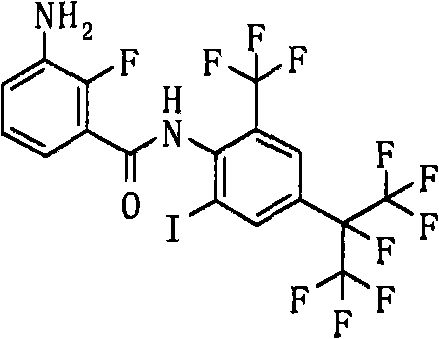
按照实施例1的1-3的方法,由2-氟-N-(2-碘-4-(全氟丙烷-2-基)-6-(三氟甲基)苯基)-3-硝基苯甲酰胺制备标题化合物。According to the method of 1-3 of Example 1, from 2-fluoro-N-(2-iodo-4-(perfluoropropane-2-yl)-6-(trifluoromethyl)phenyl)-3-nitrate phenylbenzamide to prepare the title compound.
1H-NMR(CDCl3,ppm)δ3.92(2H,broad-s),7.02-7.04(1H,m),7.11(1H,t,J=7.8Hz),7.47-7.52(1H,m),7.94(1H,s),8.30-8.35(2H,m) 1 H-NMR (CDCl 3 , ppm) δ3.92 (2H, broad-s), 7.02-7.04 (1H, m), 7.11 (1H, t, J=7.8Hz), 7.47-7.52 (1H, m) , 7.94(1H, s), 8.30-8.35(2H, m)
<63-4><63-4>
2-氟-N-(2-碘-4-(全氟丙烷-2-基)-6-(三氟甲基)苯基)-3-(甲基氨基)苯甲酰胺的制备(化合物编号13-41)Preparation of 2-fluoro-N-(2-iodo-4-(perfluoropropan-2-yl)-6-(trifluoromethyl)phenyl)-3-(methylamino)benzamide (Compound No. 13-41)

按照实施例51的方法,由3-氨基-2-氟-N-(2-碘-4-(全氟丙烷-2-基)-6-(三氟甲基)苯基)苯甲酰胺制备标题化合物。Prepared from 3-amino-2-fluoro-N-(2-iodo-4-(perfluoropropan-2-yl)-6-(trifluoromethyl)phenyl)benzamide according to the method of Example 51 title compound.
1H-NMR(CDCl3,ppm)δ2.95(3H,s),4.15(1H,broad-s),6.90(1H,t,J=8.2Hz),7.19(1H,t,J=7.8Hz),7.40(1H,t,J=7.8Hz),7.92(1H,s),8.30(1H,s),8.34(1H,s) 1 H-NMR (CDCl 3 , ppm) δ2.95 (3H, s), 4.15 (1H, broad-s), 6.90 (1H, t, J=8.2Hz), 7.19 (1H, t, J=7.8Hz ), 7.40(1H, t, J=7.8Hz), 7.92(1H, s), 8.30(1H, s), 8.34(1H, s)
<实施例64><Example 64>
3-氨基-N-(2-溴-4-(全氟丙烷-2-基)-6-(三氟甲基)苯基)-N-甲基苯甲酰胺的制备(化合物编号12-107)Preparation of 3-amino-N-(2-bromo-4-(perfluoropropan-2-yl)-6-(trifluoromethyl)phenyl)-N-methylbenzamide (compound number 12-107 )
<64-1><64-1>
N-(2-溴-4-(全氟丙烷-2-基)-6-(三氟甲基)苯基)-3-硝基苯甲酰胺的制备(化合物编号11-11)Preparation of N-(2-bromo-4-(perfluoropropan-2-yl)-6-(trifluoromethyl)phenyl)-3-nitrobenzamide (compound number 11-11)

按照实施例53的53-3的方法,由实施例22的22-2中得到的2-溴-4-(全氟丙烷-2-基)-6-(三氟甲基)苯胺和3-硝基苯甲酰氯制备标题化合物。According to the method of 53-3 of Example 53, 2-bromo-4-(perfluoropropan-2-yl)-6-(trifluoromethyl)aniline obtained in 22-2 of Example 22 and 3- Nitrobenzoyl chloride to prepare the title compound.
1H-NMR(CDCl3,ppm)δ7.75-7.79(2H,m),7.94(1H,s),8.17(1H,d,J=1.0Hz),8.28(1H,dd,J=1.5,7.8Hz),8.48-8.51(1H,m),8.76-8.77(1H,m). 1 H-NMR (CDCl 3 , ppm) δ7.75-7.79 (2H, m), 7.94 (1H, s), 8.17 (1H, d, J=1.0Hz), 8.28 (1H, dd, J=1.5, 7.8Hz), 8.48-8.51(1H, m), 8.76-8.77(1H, m).
<64-2><64-2>
N-(2-溴-4-(全氟丙烷-2-基)-6-(三氟甲基)苯基)-N-甲基-3-硝基苯甲酰胺的制备(化合物编号11-136)Preparation of N-(2-bromo-4-(perfluoropropane-2-yl)-6-(trifluoromethyl)phenyl)-N-methyl-3-nitrobenzamide (compound number 11- 136)

向1.50g(2.69mmol)N-(2-溴-4-(全氟丙烷-2-基)-6-(三氟甲基)苯基)-3-硝基苯甲酰胺的20ml DMF溶液中加入0.160g(4.04mmol)氢化钠(60% in oil),在室温下搅拌10分钟后,加入0.840ml(13.5mmol)碘甲烷,在同一温度下搅拌2小时。向反应液中加入水、乙酸乙酯,将有机层用水、饱和食盐水洗涤后,用无水硫酸镁干燥。减压蒸馏除去溶剂,将所得残渣用NH硅胶柱色谱法(展开溶剂;己烷∶乙酸乙酯=20∶1)精制,由此制备1.42g目标化合物(收率93%)。In the 20ml DMF solution of 1.50g (2.69mmol) N-(2-bromo-4-(perfluoropropan-2-yl)-6-(trifluoromethyl)phenyl)-3-nitrobenzamide Add 0.160g (4.04mmol) of sodium hydride (60% in oil), after stirring at room temperature for 10 minutes, add 0.840ml (13.5mmol) of methyl iodide, and stir at the same temperature for 2 hours. Water and ethyl acetate were added to the reaction liquid, and the organic layer was washed with water and saturated brine, and dried over anhydrous magnesium sulfate. The solvent was distilled off under reduced pressure, and the resulting residue was purified by NH silica gel column chromatography (developing solvent; hexane:ethyl acetate=20:1) to prepare 1.42 g of the target compound (yield 93%).
1H-NMR(CDCl3,ppm)δ3.28(1/2*3H,s),3.44(1/2*3H,s),7.41(1/2*1H,t,J=7.8Hz),7.71-7.76(2/2*1H,m),7.84(1/2*1H,s),7.93-7.95(1/2*1H,m),7.98(1/2*1H,s),8.07-8.09(2/2*1H,m),8.14-8.16(1/2*1H,m),8.19(1/2*1H,s),8.39-8.41(1/2*1H,m),8.45-8.46(1/2*1H,m). 1 H-NMR (CDCl 3 , ppm) δ 3.28 (1/2*3H, s), 3.44 (1/2*3H, s), 7.41 (1/2*1H, t, J=7.8Hz), 7.71-7.76(2/2*1H, m), 7.84(1/2*1H, s), 7.93-7.95(1/2*1H, m), 7.98(1/2*1H, s), 8.07- 8.09(2/2*1H, m), 8.14-8.16(1/2*1H, m), 8.19(1/2*1H, s), 8.39-8.41(1/2*1H, m), 8.45- 8.46(1/2*1H,m).
<64-3><64-3>
3-氨基-N-(2-溴-4-(全氟丙烷-2-基)-6-(三氟甲基)苯基)-N-甲基苯甲酰胺的制备(化合物编号12-107)Preparation of 3-amino-N-(2-bromo-4-(perfluoropropan-2-yl)-6-(trifluoromethyl)phenyl)-N-methylbenzamide (compound number 12-107 )

按照实施例1的1-3的方法,由N-(2-溴-4-(全氟丙烷-2-基)-6-(三氟甲基)苯基)-N-甲基-3-硝基苯甲酰胺制备标题化合物。According to the method of 1-3 of Example 1, by N-(2-bromo-4-(perfluoropropan-2-yl)-6-(trifluoromethyl)phenyl)-N-methyl-3- Nitrobenzamide to prepare the title compound.
1H-NMR(CDCl3,ppm)δ3.24(3/4*3H,s),3.37(1/4*3H,s),3.80(2H,broad-s),6.47(1/4*1H,d,J=7.8Hz),6.54-6.57(1/4*1H,m),6.78-6.84(5/4*1H,m),6.86(3/4*1H,t,J=2.0Hz),6.96(3/4*1H,d,J=7.8Hz),7.23-7.27(3/4*1H,m),7.79(1/4*1H,s),7.94(3/4*1H,s),8.00(1/4*1H,s),8.15(3/4*1H,s). 1 H-NMR (CDCl 3 , ppm) δ3.24 (3/4*3H, s), 3.37 (1/4*3H, s), 3.80 (2H, broad-s), 6.47 (1/4*1H , d, J=7.8Hz), 6.54-6.57(1/4*1H, m), 6.78-6.84(5/4*1H, m), 6.86(3/4*1H, t, J=2.0Hz) , 6.96(3/4*1H, d, J=7.8Hz), 7.23-7.27(3/4*1H, m), 7.79(1/4*1H, s), 7.94(3/4*1H, s ), 8.00(1/4*1H, s), 8.15(3/4*1H, s).
<实施例65><Example 65>
3-氨基-N-(2-溴-4-(全氟乙基)-6-(三氟甲基)苯基)苯甲酰胺的制备(化合物编号12-5)Preparation of 3-amino-N-(2-bromo-4-(perfluoroethyl)-6-(trifluoromethyl)phenyl)benzamide (compound number 12-5)

<65-1><65-1>
4-(全氟乙基)-2-(三氟甲基)苯胺的制备(化合物编号21-1)Preparation of 4-(perfluoroethyl)-2-(trifluoromethyl)aniline (compound number 21-1)

向85%连二亚硫酸钠7.04g(40.4mmol),碳酸氢钠3.40g(40.4mmol)的水溶液40ml中加入2-(三氟甲基)苯胺13.6g(33.7mmol)和DMF40ml。向上述反应液中加入11.2g(45.5mmol)1,1,2,2,2-五氟碘乙烷的50ml DMF溶液(将DMF冷却至-30℃,使1,1,2,2,2-五氟碘乙烷溶解),装入高压釜中,在110℃下搅拌9小时。在室温下放置一夜后,向反应液中加入水、乙酸乙酯,用乙酸乙酯萃取。将有机层用水、饱和碳酸氢钠水溶液、饱和食盐水洗涤。将有机层用无水硫酸钠干燥后,减压蒸馏除去溶剂,将所得残渣用硅胶柱色谱法(展开溶剂;己烷∶乙酸乙酯=10∶1→5∶1)精制,由此制备1.95g目标化合物(收率21%)。To 7.04 g (40.4 mmol) of 85% sodium dithionite and 40 ml of an aqueous solution of 3.40 g (40.4 mmol) of sodium bicarbonate were added 13.6 g (33.7 mmol) of 2-(trifluoromethyl)aniline and 40 ml of DMF. Add 11.2g (45.5mmol) of 1,1,2,2,2-pentafluoroiodoethane in 50ml of DMF to the above reaction solution (cool DMF to -30°C to make 1,1,2,2,2 - Pentafluoroiodoethane dissolved), put into an autoclave, and stirred at 110°C for 9 hours. After standing overnight at room temperature, water and ethyl acetate were added to the reaction liquid, followed by extraction with ethyl acetate. The organic layer was washed with water, saturated aqueous sodium bicarbonate solution and saturated brine. After the organic layer was dried over anhydrous sodium sulfate, the solvent was distilled off under reduced pressure, and the resulting residue was purified by silica gel column chromatography (developing solvent; hexane:ethyl acetate=10:1→5:1) to prepare 1.95 g target compound (yield 21%).
1H-NMR(CDCl3,ppm)δ4.53(2H,broad-s),6.81(1H,d,J=8.3Hz),7.48(1H,d,J=8.3Hz),7.63(1H,broad-s). 1 H-NMR (CDCl 3 , ppm) δ4.53 (2H, broad-s), 6.81 (1H, d, J=8.3Hz), 7.48 (1H, d, J=8.3Hz), 7.63 (1H, broad -s).
<65-2><65-2>
2-溴-4-(全氟乙基)-6-(三氟甲基)苯胺的制备(化合物编号21-6)Preparation of 2-bromo-4-(perfluoroethyl)-6-(trifluoromethyl)aniline (compound number 21-6)

按照实施例22的22-2的方法,由4-(全氟乙基)-2-(三氟甲基)苯胺制备目标化合物。According to the method of 22-2 of Example 22, the title compound was prepared from 4-(perfluoroethyl)-2-(trifluoromethyl)aniline.
1H-NMR(CDCl3,ppm)δ5.08(2H,broad-s),7.62(1H,s),7.80(1H,s). 1 H-NMR (CDCl 3 , ppm) δ5.08 (2H, broad-s), 7.62 (1H, s), 7.80 (1H, s).
<65-3><65-3>
N-(2-溴-4-(全氟乙基)-6-(三氟甲基)苯基)-3-硝基苯甲酰胺的制备(化合物编号11-8)Preparation of N-(2-bromo-4-(perfluoroethyl)-6-(trifluoromethyl)phenyl)-3-nitrobenzamide (compound number 11-8)

向2.50g(6.99mmol)2-溴-4-(全氟乙基)-6-(三氟甲基)苯胺的20ml吡啶溶液中加入2.72g(14.7mmol)3-硝基苯甲酰氯,在100℃下搅拌12小时。向反应液中加入水、乙酸乙酯,用乙酸乙酯萃取。将有机层用1N盐酸、饱和碳酸氢钠水溶液、饱和食盐水洗涤。将有机层用无水硫酸钠干燥后,在减压下蒸馏除去溶剂,向所得残渣中加THF、氢氧化钠水溶液,在室温下搅拌8小时。与上述同样地将反应液萃取·干燥,减压蒸馏除去溶剂,将所得残渣用硅胶柱色谱法(展开溶剂;己烷∶乙酸乙酯=7∶1→5∶1)精制,由此制备0.202g目标化合物(收率6%)。Add 2.72g (14.7mmol) 3-nitrobenzoyl chloride to 2.50g (6.99mmol) 2-bromo-4-(perfluoroethyl)-6-(trifluoromethyl)aniline in 20ml pyridine solution, in Stir at 100°C for 12 hours. Water and ethyl acetate were added to the reaction liquid, followed by extraction with ethyl acetate. The organic layer was washed with 1N hydrochloric acid, saturated aqueous sodium bicarbonate solution and saturated brine. After the organic layer was dried over anhydrous sodium sulfate, the solvent was distilled off under reduced pressure, THF and sodium hydroxide aqueous solution were added to the obtained residue, and the mixture was stirred at room temperature for 8 hours. The reaction solution was extracted and dried in the same manner as above, the solvent was distilled off under reduced pressure, and the resulting residue was purified by silica gel column chromatography (developing solvent; hexane:ethyl acetate=7:1→5:1) to prepare 0.202 g target compound (yield 6%).
1H-NMR(CDCl3,ppm)δ7.75(1H,s),7.78(1H,t,J=7.8Hz),7.94(1H,s),8.17(1H,s),8.29-8.30(1H,m),8.50-8.52(1H,m),8.78(1H,t,J=2.0Hz). 1 H-NMR (CDCl 3 , ppm) δ7.75 (1H, s), 7.78 (1H, t, J=7.8Hz), 7.94 (1H, s), 8.17 (1H, s), 8.29-8.30 (1H , m), 8.50-8.52 (1H, m), 8.78 (1H, t, J=2.0Hz).
<65-4><65-4>
3-氨基-N-(2-溴-4-(全氟乙基)-6-(三氟甲基)苯基)苯甲酰胺的制备(化合物编号12-5)Preparation of 3-amino-N-(2-bromo-4-(perfluoroethyl)-6-(trifluoromethyl)phenyl)benzamide (compound number 12-5)

按照实施例1的1-3的方法,由N-(2-溴-4-(全氟乙基)-6-(三氟甲基)苯基)-3-硝基苯甲酰胺制备目标化合物。According to the method of 1-3 of Example 1, the target compound is prepared from N-(2-bromo-4-(perfluoroethyl)-6-(trifluoromethyl)phenyl)-3-nitrobenzamide .
1H-NMR(CDCl3,ppm)δ3.89(2H,broad-s),6.90-6.92(1H,m),7.23-7.32(3H,m),7.64(1H,s),7.90(1H,s),8.13(1H,s) 1 H-NMR (CDCl 3 , ppm) δ3.89 (2H, broad-s), 6.90-6.92 (1H, m), 7.23-7.32 (3H, m), 7.64 (1H, s), 7.90 (1H, s), 8.13(1H, s)
<实施例66><Example 66>
3-氨基-N-(2-溴-4-(全氟丙烷-2-基)-6-(三氟甲基)苯基)-4-氰基苯甲酰胺的制备(化合物编号12-79)Preparation of 3-amino-N-(2-bromo-4-(perfluoropropan-2-yl)-6-(trifluoromethyl)phenyl)-4-cyanobenzamide (compound number 12-79 )
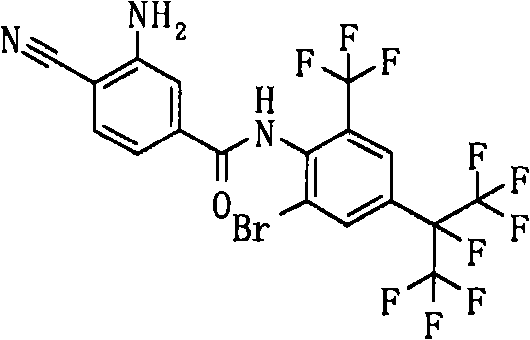
<66-1><66-1>
N-(2-溴-4-(全氟丙烷-2-基)-6-(三氟甲基)苯基)-4-氰基-3-硝基苯甲酰胺的制备(化合物编号11-122)Preparation of N-(2-bromo-4-(perfluoropropane-2-yl)-6-(trifluoromethyl)phenyl)-4-cyano-3-nitrobenzamide (compound number 11- 122)
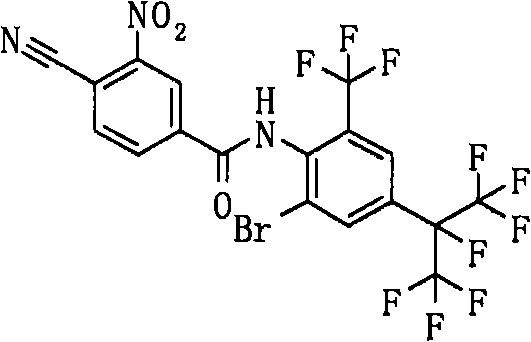
向实施例62的62-1中得到的0.500g(0.870mmol)N-(2-溴-4-(全氟丙烷-2-基)-6-(三氟甲基)苯基)-4-氟-3-硝基苯甲酰胺的5ml DMF溶液中加入0.0639g(1.31mmol)氰化钠,在室温下搅拌10小时。向反应液中加入水、乙酸乙酯,用乙酸乙酯萃取。将有机层用10%氢氧化钠水溶液、饱和食盐水洗涤。将有机层用无水硫酸钠干燥后,减压蒸馏除去溶剂,将所得残渣用硅胶柱色谱法精制,由此制备0.0500g目标化合物(收率10%)。To 0.500 g (0.870 mmol) of N-(2-bromo-4-(perfluoropropan-2-yl)-6-(trifluoromethyl)phenyl)-4- obtained in 62-1 of Example 62 Add 0.0639g (1.31mmol) sodium cyanide to a 5ml DMF solution of fluoro-3-nitrobenzamide, and stir at room temperature for 10 hours. Water and ethyl acetate were added to the reaction liquid, followed by extraction with ethyl acetate. The organic layer was washed with 10% aqueous sodium hydroxide solution and saturated brine. After the organic layer was dried over anhydrous sodium sulfate, the solvent was distilled off under reduced pressure, and the resulting residue was purified by silica gel column chromatography to prepare 0.0500 g of the target compound (yield 10%).
1H-NMR(CDCl3,ppm)δ7.80(1H,s),7.96(1H,s),8.12-8.14(1H,m),8.18(1H,s),8.36(1H,dd,J=2.0,8.3Hz),8.84(1H,d,J=1.5Hz). 1 H-NMR (CDCl 3 , ppm) δ7.80 (1H, s), 7.96 (1H, s), 8.12-8.14 (1H, m), 8.18 (1H, s), 8.36 (1H, dd, J= 2.0, 8.3Hz), 8.84 (1H, d, J=1.5Hz).
<66-2><66-2>
3-氨基-N-(2-溴-4-(全氟丙烷-2-基)-6-(三氟甲基)苯基)-4-氰基苯甲酰胺的制备(化合物编号12-79)Preparation of 3-amino-N-(2-bromo-4-(perfluoropropan-2-yl)-6-(trifluoromethyl)phenyl)-4-cyanobenzamide (compound number 12-79 )
按照实施例1的1-3的方法,由N-(2-溴-4-(全氟丙烷-2-基)-6-(三氟甲基)苯基)-4-氰基-3-硝基苯甲酰胺制备目标化合物。According to the method of 1-3 of Example 1, by N-(2-bromo-4-(perfluoropropan-2-yl)-6-(trifluoromethyl)phenyl)-4-cyano-3- Nitrobenzamide to prepare the target compound.
1H-NMR(CDCl3,ppm)δ4.68(2H,broad-s),7.18(1H,dd,J=1.9,8.3Hz),7.29(1H,s),7.52-7.55(1H,m),7.68(1H,s),7.92(1H,s),8.14(1H,d,J=1.5Hz). 1 H-NMR (CDCl 3 , ppm) δ4.68 (2H, broad-s), 7.18 (1H, dd, J=1.9, 8.3Hz), 7.29 (1H, s), 7.52-7.55 (1H, m) , 7.68(1H, s), 7.92(1H, s), 8.14(1H, d, J=1.5Hz).
接下来,给出含有本发明化合物作为有效成分的制剂例,但本发明并不限定于此。需要说明的是,制剂例中,份表示重量份。Next, examples of formulations containing the compound of the present invention as an active ingredient are given, but the present invention is not limited thereto. In addition, in the formulation example, a part represents a weight part.
<制剂例1><Preparation Example 1>
均匀地混合20份通式(1)表示的本发明化合物、10份聚氧乙烯苯乙烯基苯基醚、70份二甲苯,得到乳剂。20 parts of the present compound represented by the general formula (1), 10 parts of polyoxyethylene styryl phenyl ether, and 70 parts of xylene were uniformly mixed to obtain an emulsion.
<制剂例2><Preparation example 2>
均匀地搅拌混合10份通式(1)表示的本发明化合物、2份十二烷基硫酸钠、2份二烷基磺基琥珀酸盐、1份β-萘磺酸甲醛缩合物钠盐、85份硅藻土,得到可湿性粉剂。Stir and mix 10 parts of the compound of the present invention represented by the general formula (1), 2 parts of sodium lauryl sulfate, 2 parts of dialkyl sulfosuccinate, 1 part of β-naphthalenesulfonic acid formaldehyde condensate sodium salt, 85 parts of diatomaceous earth to obtain a wettable powder.
<制剂例3><Preparation Example 3>
均匀地混合0.3份通式(1)表示的本发明化合物、0.3份白炭墨,加入99.2份粘土、0.2份Driless A(三共Agro制),均匀地粉碎混合,得到粉剂。0.3 part of the present compound represented by the general formula (1) and 0.3 part of white carbon were uniformly mixed, 99.2 parts of clay and 0.2 part of Driless A (manufactured by Sankyo Agro) were added, and uniformly pulverized and mixed to obtain a powder.
<制剂例4><Preparation Example 4>
将3份通式(1)表示的本发明化合物、1.5份聚氧乙烯·聚氧丙烯缩合物、3份羧基甲基纤维素、64.8份粘土、27.7份滑石均匀地粉碎混合后,加入水,进行混炼,造粒干燥,得到粒剂。After 3 parts of compounds of the present invention represented by general formula (1), 1.5 parts of polyoxyethylene polyoxypropylene condensates, 3 parts of carboxymethylcellulose, 64.8 parts of clay, and 27.7 parts of talc are uniformly pulverized and mixed, add water, Perform kneading, granulation and drying to obtain granules.
<制剂例5><Preparation Example 5>
将10份通式(1)表示的本发明化合物、3份β-萘磺酸甲醛缩合物钠盐、1份三苯乙烯基苯酚、5份丙二醇、0.5份有机硅类消泡剂、33.5份水充分地搅拌混合后,与混合有0.3份黄原酸胶、46.7份水的混合物再次搅拌混合,得到悬浮剂。10 parts of the compound of the present invention represented by the general formula (1), 3 parts of β-naphthalenesulfonic acid formaldehyde condensate sodium salt, 1 part of tristyrylphenol, 5 parts of propylene glycol, 0.5 parts of silicone defoamer, 33.5 parts After the water was fully stirred and mixed, it was again stirred and mixed with a mixture of 0.3 parts of xanthan gum and 46.7 parts of water to obtain a suspension.
<制剂例6><Preparation Example 6>
均匀地粉碎混合20份通式(1)表示的本发明化合物、6份萘磺酸甲醛缩合物金属盐、1份二烷基磺基琥珀酸金属盐、73份碳酸钙后,加入水,进行混炼,造粒干燥,得到水分散颗粒剂。After pulverizing and mixing 20 parts of the compound of the present invention represented by the general formula (1), 6 parts of naphthalenesulfonic acid formaldehyde condensate metal salts, 1 part of dialkyl sulfosuccinic acid metal salts, and 73 parts of calcium carbonate, add water, carry out Mixing, granulation and drying to obtain water-dispersible granules.
进而,为了明确本发明的通式(1)表示的化合物具有优异的杀虫活性,以下给出试验例,但本发明并不限定于此。Furthermore, in order to clarify that the compound represented by the general formula (1) of the present invention has excellent insecticidal activity, test examples are given below, but the present invention is not limited thereto.
<试验例1>对斜纹夜蛾(Spodoptera litura)的杀虫试验<Test example 1> to the insecticidal test of Spodoptera litura (Spodoptera litura)
在将试验化合物稀释至规定浓度的药液中浸渍卷心菜叶片30秒,风干后,放入铺设有滤纸的7cm的聚乙烯杯中,放入斜纹夜蛾2龄幼虫。放置在25℃恒温室中,6天后调查生死虫数。以1区5只2连制的方式进行。Cabbage leaves were dipped in a chemical solution diluted with a test compound to a predetermined concentration for 30 seconds, air-dried, placed in a 7 cm polyethylene cup covered with filter paper, and 2nd instar larvae of Spodoptera litura were placed. Place them in a constant temperature room at 25°C, and investigate the number of living and dead insects after 6 days. It is carried out in a system of 5 in 1 zone and 2 consecutive systems.
结果在100ppm时以下化合物编号的化合物显示70%以上的死虫率。As a result, the compounds with the following compound numbers showed a death rate of 70% or more at 100 ppm.
1-1、1-16、1-21、1-36、1-62、1-63、1-64、1-65、1-82、1-95、1-96、1-99、1-100、1-101、1-103、1-104、1-105、1-115、1-116、1-117、1-118、1-132、1-133、1-134、1-136、1-137、1-138、1-139、1-151、1-152、1-154、1-163、1-164、1-167、1-168、1-169、1-171、1-172、1-173、1-175、1-176、1-177、1-179、1-180、1-183、1-184、1-185、1-187、1-188、1-195、1-196、1-197、1-198、1-199、1-200、1-201、1-202、1-203、1-204、1-205、1-206、1-207、1-208、1-209、1-210、1-211、1-212、1-213、1-214、1-215、1-216、1-217、1-220、1-221、1-222、1-223、1-224、1-225、1-226、1-227、1-231、1-232、1-233、1-234、1-235、1-236、1-237、1-239、1-241、1-242、2-133、3-133、3-163、3-164、3-197、5-1、5-8、5-10、5-11、5-12、5-14、5-15、5-16、5-17、5-18、5-19、5-20、5-21、5-22、5-25、5-27、5-29、5-31、5-32、5-33、5-34、5-35、5-36、5-37、5-71、5-72、5-73、5-76、5-77、5-78、5-79、5-80、5-81、5-82、5-83、5-84、5-86、5-87、5-88、5-89、5-91、5-92、5-93、5-94、5-95、5-96、5-98、5-99、5-100、5-101、5-102、5-103、5-104、5-105、5-107、5-108、5-109、5-111、5-112、5-128、6-1、6-5、6-6、6-7、6-8、6-9、6-10、6-12、6-15、6-16、6-18、6-20、6-43、6-44、6-45、6-49、6-53、6-55、6-59、6-61、6-62、6-64、6-68、6-69、7-1、7-220、7-221、7-222、7-226、8-12、9-121-1, 1-16, 1-21, 1-36, 1-62, 1-63, 1-64, 1-65, 1-82, 1-95, 1-96, 1-99, 1- 100, 1-101, 1-103, 1-104, 1-105, 1-115, 1-116, 1-117, 1-118, 1-132, 1-133, 1-134, 1-136, 1-137, 1-138, 1-139, 1-151, 1-152, 1-154, 1-163, 1-164, 1-167, 1-168, 1-169, 1-171, 1- 172, 1-173, 1-175, 1-176, 1-177, 1-179, 1-180, 1-183, 1-184, 1-185, 1-187, 1-188, 1-195, 1-196, 1-197, 1-198, 1-199, 1-200, 1-201, 1-202, 1-203, 1-204, 1-205, 1-206, 1-207, 1- 208, 1-209, 1-210, 1-211, 1-212, 1-213, 1-214, 1-215, 1-216, 1-217, 1-220, 1-221, 1-222, 1-223, 1-224, 1-225, 1-226, 1-227, 1-231, 1-232, 1-233, 1-234, 1-235, 1-236, 1-237, 1- 239, 1-241, 1-242, 2-133, 3-133, 3-163, 3-164, 3-197, 5-1, 5-8, 5-10, 5-11, 5-12, 5-14, 5-15, 5-16, 5-17, 5-18, 5-19, 5-20, 5-21, 5-22, 5-25, 5-27, 5-29, 5- 31, 5-32, 5-33, 5-34, 5-35, 5-36, 5-37, 5-71, 5-72, 5-73, 5-76, 5-77, 5-78, 5-79, 5-80, 5-81, 5-82, 5-83, 5-84, 5-86, 5-87, 5-88, 5-89, 5-91, 5-92, 5- 93, 5-94, 5-95, 5-96, 5-98, 5-99, 5-100, 5-101, 5-102, 5-103, 5-104, 5-105, 5-107, 5-108, 5-109, 5-111, 5-112, 5-128, 6-1, 6-5, 6-6, 6-7, 6-8, 6-9, 6-10, 6- 12, 6-15, 6-16, 6-18, 6-20, 6-43, 6-44, 6-45, 6-49, 6-53, 6-55, 6-59, 6-61, 6-62, 6-64, 6-68, 6-69, 7-1, 7-220, 7-221, 7-2 22, 7-226, 8-12, 9-12
<试验例2>对小菜蛾(Plutella xylostella)的杀虫试验<Test example 2> to the insecticidal test of diamondback moth (Plutella xylostella)
在将试验化合物稀释至规定浓度的药液中,将卷心菜叶浸渍30秒,风干后,放入铺设有滤纸的7cm的聚乙烯杯中,放入小菜蛾的3龄幼虫。放置于25℃的恒温室内,6天后调查存亡虫数。以1区5只2连制进行。Cabbage leaves were dipped in a chemical solution in which the test compound was diluted to a predetermined concentration for 30 seconds, air-dried, placed in a 7 cm polyethylene cup covered with filter paper, and 3rd instar larvae of Plutella xylostella were placed. Place them in a constant temperature room at 25°C, and investigate the number of living and dead insects after 6 days. Carried out in a 2-connection system of 5 in 1 zone.
结果在100ppm时以下化合物编号的化合物显示70%以上的死虫率。As a result, the compounds with the following compound numbers showed a death rate of 70% or more at 100 ppm.
1-1、1-16、1-21、1-36、1-62、1-63、1-64、1-65、1-82、1-95、1-96、1-99、1-100、1-101、1-103、1-104、1-105、1-115、1-116、1-117、1-118、1-132、1-133、1-134、1-136、1-137、1-138、1-139、1-151、1-152、1-154、1-163、1-164、1-167、1-168、1-169、1-171、1-172、1-173、1-175、1-176、1-177、1-179、1-180、1-183、1-184、1-185、1-187、1-188、1-195、1-196、1-197、1-198、1-199、1-200、1-201、1-202、1-203、1-204、1-205、1-206、1-207、1-208、1-209、1-210、1-211、1-212、1-213、1-214、1-215、1-216、1-217、1-218、1-220、1-221、1-222、1-223、1-224、1-225、1-226、1-227、1-231、1-232、1-233、1-234、1-235、1-236、1-237、1-238、1-239、1-240、1-241、1-242、2-133、3-133、3-163、3-164、3-197、5-1、5-4、5-8、5-10、5-11、5-12、5-14、5-15、5-16、5-17、5-18、5-19、5-20、5-21、5-22、5-25、5-27、5-29、5-30、5-31、5-32、5-33、5-34、5-35、5-36、5-37、5-71、5-72、5-73、5-76、5-77、5-78、5-79、5-80、5-81、5-82、5-83、5-84、5-85、5-86、5-87、5-88、5-89、5-90、5-91、5-92、5-93、5-94、5-95、5-96、5-97、5-98、5-99、5-100、5-101、5-102、5-103、5-104、5-105、5-107、5-108、5-109、5-111、5-112、5-128、6-1、6-5、6-6、6-7、6-8、6-9、6-10、6-12、6-13、6-15、6-16、6-18、6-20、6-43、6-44、6-45、6-46、6-47、6-49、6-50、6-52、6-53、6-55、6-56、6-57、6-58、6-59、6-60、6-64、6-68、6-69、7-1、7-6、7-22、7-23、7-169、7-220、7-221、7-222、7-226、8-12、8-13、9-121-1, 1-16, 1-21, 1-36, 1-62, 1-63, 1-64, 1-65, 1-82, 1-95, 1-96, 1-99, 1- 100, 1-101, 1-103, 1-104, 1-105, 1-115, 1-116, 1-117, 1-118, 1-132, 1-133, 1-134, 1-136, 1-137, 1-138, 1-139, 1-151, 1-152, 1-154, 1-163, 1-164, 1-167, 1-168, 1-169, 1-171, 1- 172, 1-173, 1-175, 1-176, 1-177, 1-179, 1-180, 1-183, 1-184, 1-185, 1-187, 1-188, 1-195, 1-196, 1-197, 1-198, 1-199, 1-200, 1-201, 1-202, 1-203, 1-204, 1-205, 1-206, 1-207, 1- 208, 1-209, 1-210, 1-211, 1-212, 1-213, 1-214, 1-215, 1-216, 1-217, 1-218, 1-220, 1-221, 1-222, 1-223, 1-224, 1-225, 1-226, 1-227, 1-231, 1-232, 1-233, 1-234, 1-235, 1-236, 1- 237, 1-238, 1-239, 1-240, 1-241, 1-242, 2-133, 3-133, 3-163, 3-164, 3-197, 5-1, 5-4, 5-8, 5-10, 5-11, 5-12, 5-14, 5-15, 5-16, 5-17, 5-18, 5-19, 5-20, 5-21, 5- 22, 5-25, 5-27, 5-29, 5-30, 5-31, 5-32, 5-33, 5-34, 5-35, 5-36, 5-37, 5-71, 5-72, 5-73, 5-76, 5-77, 5-78, 5-79, 5-80, 5-81, 5-82, 5-83, 5-84, 5-85, 5- 86, 5-87, 5-88, 5-89, 5-90, 5-91, 5-92, 5-93, 5-94, 5-95, 5-96, 5-97, 5-98, 5-99, 5-100, 5-101, 5-102, 5-103, 5-104, 5-105, 5-107, 5-108, 5-109, 5-111, 5-112, 5- 128, 6-1, 6-5, 6-6, 6-7, 6-8, 6-9, 6-10, 6-12, 6-13, 6-15, 6-16, 6-18, 6-20, 6-43, 6-44, 6-45, 6-46, 6-47, 6-49, 6- 50, 6-52, 6-53, 6-55, 6-56, 6-57, 6-58, 6-59, 6-60, 6-64, 6-68, 6-69, 7-1, 7-6, 7-22, 7-23, 7-169, 7-220, 7-221, 7-222, 7-226, 8-12, 8-13, 9-12
<试验例3>对斜纹夜蛾(Spodoptera litura)的渗透迁移性杀虫试验<Test example 3> to the osmotic migration insecticidal test of litura litura (Spodoptera litura)
在将试验化合物稀释至规定浓度的药液中,将萝卜苗的根部浸渍2天后,切取叶片,放入铺设有滤纸的7cm的聚乙烯杯中,放入斜纹夜蛾2龄幼虫。放置于25℃恒温室内,3天后调查生死虫数。以1区5只2连制进行。After diluting the test compound to a predetermined concentration, the roots of the radish seedlings were dipped for 2 days, and then the leaves were cut out, placed in a 7 cm polyethylene cup covered with filter paper, and the 2nd instar larvae of Spodoptera litura were placed. Place them in a constant temperature room at 25°C, and investigate the number of living and dead insects after 3 days. Carried out in a 2-connection system of 5 in 1 zone.
结果在1ppm时以下化合物编号的化合物显示70%以上的死虫率。As a result, the compounds with the following compound numbers showed a death rate of 70% or more at 1 ppm.
1-16、1-21、1-36、1-62、1-63、1-64、1-65、1-82、1-95、1-96、1-97、1-99、1-100、1-101、1-103、1-104、1-105、1-115、1-116、1-117、1-118、1-132、1-133、1-134、1-136、1-137、1-138、1-139、1-151、1-152、1-154、1-163、1-164、1-167、1-168、1-169、1-171、1-172、1-173、1-175、1-176、1-177、1-179、1-180、1-184、1-185、1-187、1-188、1-195、1-196、1-197、1-198、1-199、1-202、1-204、1-205、1-206、1-207、1-208、1-209、1-210、1-211、1-212、1-213、1-214、1-215、1-216、1-217、1-218、1-219、1-220、1-221、1-222、1-223、1-225、1-226、1-227、1-231、1-232、1-233、1-234、1-235、1-236、1-241、1-242、2-133、3-133、3-163、3-164、3-197、5-33、5-34、5-76、5-77、5-78、5-79、5-82、5-86、5-92、5-96、5-99、5-101、5-103、5-1041-16, 1-21, 1-36, 1-62, 1-63, 1-64, 1-65, 1-82, 1-95, 1-96, 1-97, 1-99, 1- 100, 1-101, 1-103, 1-104, 1-105, 1-115, 1-116, 1-117, 1-118, 1-132, 1-133, 1-134, 1-136, 1-137, 1-138, 1-139, 1-151, 1-152, 1-154, 1-163, 1-164, 1-167, 1-168, 1-169, 1-171, 1- 172, 1-173, 1-175, 1-176, 1-177, 1-179, 1-180, 1-184, 1-185, 1-187, 1-188, 1-195, 1-196, 1-197, 1-198, 1-199, 1-202, 1-204, 1-205, 1-206, 1-207, 1-208, 1-209, 1-210, 1-211, 1- 212, 1-213, 1-214, 1-215, 1-216, 1-217, 1-218, 1-219, 1-220, 1-221, 1-222, 1-223, 1-225, 1-226, 1-227, 1-231, 1-232, 1-233, 1-234, 1-235, 1-236, 1-241, 1-242, 2-133, 3-133, 3- 163, 3-164, 3-197, 5-33, 5-34, 5-76, 5-77, 5-78, 5-79, 5-82, 5-86, 5-92, 5-96, 5-99, 5-101, 5-103, 5-104
<试验例4><Test Example 4>
对家蝇(Musca domestica)的杀虫试验Insecticidal Test on Housefly (Musca domestica)
将稀释试验化合物至规定浓度的1ml丙酮溶液滴入直径9cm的陪替氏培养皿(petri dish)中,风干后,放入家蝇雌性成虫盖上盖子。放置于25℃恒温室内,1天后调查生死虫数。以1区5只2连制进行。1 ml of acetone solution diluted to the specified concentration of the test compound was dropped into a petri dish (petri dish) with a diameter of 9 cm. After air-drying, the female adult housefly was put in and covered. Place them in a constant temperature room at 25°C, and investigate the number of living and dead insects after 1 day. Carried out in a 2-connection system of 5 in 1 zone.
结果在1000ppm时以下化合物编号的化合物显示70%以上的死虫率。As a result, the compounds with the following compound numbers showed a death rate of 70% or more at 1000 ppm.
1-65、1-82、1-104、1-116、1-117、1-118、1-136、1-151、1-152、1-175、1-176、1-177、1-183、1-184、1-187、1-195、1-220、1-221、1-222、1-234、1-235、1-239、1-241、1-242、5-8、5-76、5-77、5-78、5-79、5-80、5-81、5-82、5-86、5-87、5-89、5-92、5-93、5-95、5-96、5-99、5-100、5-101、5-104、5-105、5-112、6-16、6-43、6-44、6-45、6-54、6-551-65, 1-82, 1-104, 1-116, 1-117, 1-118, 1-136, 1-151, 1-152, 1-175, 1-176, 1-177, 1- 183, 1-184, 1-187, 1-195, 1-220, 1-221, 1-222, 1-234, 1-235, 1-239, 1-241, 1-242, 5-8, 5-76, 5-77, 5-78, 5-79, 5-80, 5-81, 5-82, 5-86, 5-87, 5-89, 5-92, 5-93, 5- 95, 5-96, 5-99, 5-100, 5-101, 5-104, 5-105, 5-112, 6-16, 6-43, 6-44, 6-45, 6-54, 6-55
<试验例5>对德国小蠊(Blattella germanica)的杀虫试验<Test example 5> to the insecticidal test of German cockroach (Blattella germanica)
将稀释试验化合物至规定浓度的1ml丙酮溶液滴入直径9cm的陪替氏培养皿中,风干后,放入德国小蠊雄成虫,盖上盖子。放置于25℃恒温室内,1天后调查生死虫数。以1区5只2连制进行。1 ml of acetone solution diluted to a specified concentration of the test compound was dropped into a petri dish with a diameter of 9 cm, and after air-drying, the male adults of the German cockroach were put in and covered with a lid. Place them in a constant temperature room at 25°C, and investigate the number of living and dead insects after 1 day. Carried out in a 2-connection system of 5 in 1 zone.
结果在1000ppm时以下化合物编号的化合物显示70%以上的死虫率。As a result, the compounds with the following compound numbers showed a death rate of 70% or more at 1000 ppm.
1-118、1-133、1-136、1-152、1-168、1-171、1-183、1-196、1-221、1-223、1-225、1-232、6-531-118, 1-133, 1-136, 1-152, 1-168, 1-171, 1-183, 1-196, 1-221, 1-223, 1-225, 1-232, 6- 53
<试验例6>对地下家蚊(Culex pipiens molestus)的杀虫试验<Test example 6> insecticidal test to underground house mosquito (Culex pipiens molestus)
将稀释试验化合物至规定浓度的1ml丙酮溶液滴入直径9cm的陪替氏培养皿中,风干后,放入地下家蚊成虫,盖上盖子。放置于25℃恒温室内,处理1天后调查生死虫数。以1区5只2连制进行。1 ml of acetone solution diluted to a specified concentration of the test compound was dropped into a petri dish with a diameter of 9 cm. After air-drying, it was put into underground house mosquito adults and covered with a lid. Place them in a constant temperature room at 25°C, and investigate the number of living and dead insects after 1 day of treatment. Carried out in a 2-connection system of 5 in 1 zone.
结果在1000ppm时以下化合物编号的化合物显示70%以上的死虫率。As a result, the compounds with the following compound numbers showed a death rate of 70% or more at 1000 ppm.
1-1361-136
<试验例7>对台湾乳白蚁(Coptotermes formosanus)的杀虫试验<Test Example 7> Insecticidal test to Taiwanese milk termites (Coptotermes formosanus)
将配制试验化合物至规定浓度的丙酮溶液20μl滴入装入到聚丙烯管中的直径2.6mm的滤纸中,风干后,加入20μl的水,放入台湾乳白蚁,盖上盖子。放置于28℃恒温室内,处理5天后,调查生死虫数。以1区10只2连制进行。20 μl of the acetone solution prepared with the test compound to a specified concentration was dropped into a filter paper with a diameter of 2.6 mm in a polypropylene tube. After air-drying, 20 μl of water was added, put into Coptotermes formosanus, and covered with a lid. Place them in a constant temperature room at 28°C, and investigate the number of living and dead insects after 5 days of treatment. It is carried out in a 1 zone 10 2 consecutive system.
结果在30ppm时以下化合物编号的化合物显示70%以上的死虫率。As a result, the compounds with the following compound numbers showed a death rate of 70% or more at 30 ppm.
1-1361-136
产业上的可利用性Industrial availability
根据本发明,可以提供新型的酰胺衍生物。该酰胺衍生物在有害生物防除活性方面显示优异的效果,产业上的利用价值高。According to the present invention, novel amide derivatives can be provided. The amide derivative exhibits an excellent effect in terms of pest control activity, and has high industrial utility value.
Claims (14)


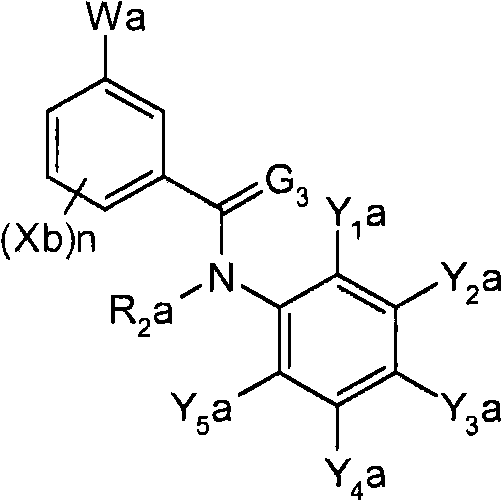

Priority Applications (2)
| Application Number | Priority Date | Filing Date | Title |
|---|---|---|---|
| CN201610098787.9A CN105732414B (en) | 2008-08-01 | 2009-06-29 | Amide derivatives, pest control agents containing the amide derivatives, and methods for controlling pests |
| CN201510479141.0A CN105061251B (en) | 2008-08-01 | 2009-06-29 | Aniline derivatives |
Applications Claiming Priority (3)
| Application Number | Priority Date | Filing Date | Title |
|---|---|---|---|
| JP2008200114 | 2008-08-01 | ||
| JP2008-200114 | 2008-08-01 | ||
| PCT/JP2009/061864 WO2010013567A1 (en) | 2008-08-01 | 2009-06-29 | Amide derivative, pest control agent containing the amide derivative and pest controlling method |
Related Child Applications (2)
| Application Number | Title | Priority Date | Filing Date |
|---|---|---|---|
| CN201510479141.0A Division CN105061251B (en) | 2008-08-01 | 2009-06-29 | Aniline derivatives |
| CN201610098787.9A Division CN105732414B (en) | 2008-08-01 | 2009-06-29 | Amide derivatives, pest control agents containing the amide derivatives, and methods for controlling pests |
Publications (1)
| Publication Number | Publication Date |
|---|---|
| CN102112437A true CN102112437A (en) | 2011-06-29 |
Family
ID=41610270
Family Applications (3)
| Application Number | Title | Priority Date | Filing Date |
|---|---|---|---|
| CN200980130637XA Pending CN102112437A (en) | 2008-08-01 | 2009-06-29 | Amide derivative, pest control agent containing the amide derivative, and pest control method |
| CN201610098787.9A Active CN105732414B (en) | 2008-08-01 | 2009-06-29 | Amide derivatives, pest control agents containing the amide derivatives, and methods for controlling pests |
| CN201510479141.0A Active CN105061251B (en) | 2008-08-01 | 2009-06-29 | Aniline derivatives |
Family Applications After (2)
| Application Number | Title | Priority Date | Filing Date |
|---|---|---|---|
| CN201610098787.9A Active CN105732414B (en) | 2008-08-01 | 2009-06-29 | Amide derivatives, pest control agents containing the amide derivatives, and methods for controlling pests |
| CN201510479141.0A Active CN105061251B (en) | 2008-08-01 | 2009-06-29 | Aniline derivatives |
Country Status (13)
| Country | Link |
|---|---|
| US (2) | US8633228B2 (en) |
| EP (2) | EP3205642B1 (en) |
| JP (2) | JP5647893B2 (en) |
| KR (2) | KR101455555B1 (en) |
| CN (3) | CN102112437A (en) |
| AU (1) | AU2009277708B2 (en) |
| BR (1) | BRPI0917556B1 (en) |
| CA (2) | CA2794350C (en) |
| ES (1) | ES2912458T3 (en) |
| IL (2) | IL211003A (en) |
| MX (1) | MX341158B (en) |
| VN (1) | VN27109A1 (en) |
| WO (1) | WO2010013567A1 (en) |
Cited By (11)
| Publication number | Priority date | Publication date | Assignee | Title |
|---|---|---|---|---|
| CN110194726A (en) * | 2018-05-11 | 2019-09-03 | 沈阳化工大学 | A kind of benzamide compound and its application |
| WO2020200290A1 (en) * | 2019-04-02 | 2020-10-08 | 沈阳化工大学 | Meta-diamide compound and application thereof |
| CN112430211A (en) * | 2019-08-26 | 2021-03-02 | 沈阳化工大学 | Isophthalamide compound and application thereof |
| CN112920079A (en) * | 2021-01-29 | 2021-06-08 | 广西田园生化股份有限公司 | Preparation method of amide compound |
| WO2021139370A1 (en) * | 2020-01-07 | 2021-07-15 | 沈阳化工大学 | Amide compound and application thereof |
| CN114478264A (en) * | 2022-03-23 | 2022-05-13 | 衢州学院 | Synthesis method of intermediate of bisamide insecticide |
| CN115304510A (en) * | 2022-09-13 | 2022-11-08 | 海利尔药业集团股份有限公司 | Aryl-substituted m-diamide compound or salt thereof acceptable as pesticide, composition and application thereof |
| CN115925576A (en) * | 2021-12-22 | 2023-04-07 | 浙江宇龙药业有限公司 | Heptafluoroisopropyl-containing bisamide compound and preparation method and application thereof |
| CN118125938A (en) * | 2024-05-08 | 2024-06-04 | 启农生物科技(北京)有限公司 | A kind of amide compound and its application |
| WO2025077779A1 (en) * | 2023-10-11 | 2025-04-17 | 迈克斯(如东)化工有限公司 | Meta-diamide compound, preparation method therefor and use thereof |
| WO2025124404A1 (en) * | 2023-12-12 | 2025-06-19 | 青岛清原化合物有限公司 | Bisamide compound and use thereof |
Families Citing this family (16)
| Publication number | Priority date | Publication date | Assignee | Title |
|---|---|---|---|---|
| CN102112437A (en) | 2008-08-01 | 2011-06-29 | 三井化学Agro株式会社 | Amide derivative, pest control agent containing the amide derivative, and pest control method |
| US8686044B2 (en) | 2008-08-13 | 2014-04-01 | Mitsui Chemicals Agro, Inc. | Amide derivative, pest control agent containing the amide derivative, and use of the amide derivative |
| SI3081552T1 (en) * | 2008-08-13 | 2021-07-30 | Mitsui Chemicals Agro, Inc. | Pest control agent containing an amide derivative and use of the pest control agent |
| MX368040B (en) * | 2013-01-30 | 2019-09-17 | Sumitomo Chemical Co | Method for controlling arthropod pest. |
| MX387107B (en) | 2013-12-23 | 2025-03-18 | Syngenta Participations Ag | INSECTICIDAL COMPOUNDS. |
| WO2016017467A1 (en) * | 2014-07-28 | 2016-02-04 | 住友化学株式会社 | Amide compound and use of same for noxious arthropod control |
| TWI664905B (en) * | 2014-07-29 | 2019-07-11 | 日商住友化學股份有限公司 | Noxious arthropod controlling agent containing amide compound |
| KR20190091323A (en) | 2016-12-08 | 2019-08-05 | 바이엘 크롭사이언스 악티엔게젤샤프트 | Process for producing 5- (1-phenyl-1H-pyrazol-4-yl) -nicotinamide derivatives and similar compounds without isolating or purifying phenylhydrazine intermediates |
| NZ763636A (en) | 2017-09-20 | 2025-12-19 | Mitsui Chemicals Crop & Life Solutions Inc | Prolonged ectoparasite-controlling agent for animal |
| CN108148049B (en) * | 2018-01-17 | 2020-03-10 | 河北大学 | Preparation method and application of 5-pyrazole amide compound with triazinone structure |
| KR20200138184A (en) * | 2018-04-03 | 2020-12-09 | 다우 아그로사이언시즈 엘엘씨 | Molecules having insecticidal utility, compositions related thereto, and methods of controlling pest |
| JP2021524461A (en) | 2018-05-24 | 2021-09-13 | バイエル・アクチエンゲゼルシヤフト | Method for Producing Substituted N-arylpyrazole |
| US20220048847A1 (en) | 2018-12-20 | 2022-02-17 | Bayer Aktiengesellschaft | Process for preparing substituted anilines |
| CN115073300B (en) * | 2021-03-10 | 2024-04-05 | 江西天宇化工有限公司 | 4- (perfluoropropane-2-yl) -2-trifluoromethyl aniline and preparation method and application thereof |
| EP3943483A1 (en) | 2021-05-26 | 2022-01-26 | Bayer AG | Method for the preparation of substituted anilines |
| CN119219519A (en) * | 2021-07-12 | 2024-12-31 | 沈阳化工大学 | A kind of amide compound and its use |
Citations (1)
| Publication number | Priority date | Publication date | Assignee | Title |
|---|---|---|---|---|
| JP2007099761A (en) * | 2005-09-08 | 2007-04-19 | Mitsui Chemicals Inc | Amide derivative and application method thereof as insecticide |
Family Cites Families (34)
| Publication number | Priority date | Publication date | Assignee | Title |
|---|---|---|---|---|
| CH311413A (en) | 1953-01-20 | 1955-11-30 | Ag Sandoz | Process for the preparation of a previously unknown acid amide-like piperidine derivative. |
| DE2624759A1 (en) * | 1976-06-02 | 1977-12-15 | Bayer Ag | (4,5)-Dichloro-imidazole (2)-carboxylic acid derivs. - useful as herbicides, fungicides, bactericides, insecticides etc. |
| FR2617159B1 (en) | 1987-06-23 | 1989-10-27 | Rhone Poulenc Chimie | PROCESS FOR PERHALOGENOALKYLATION OF AROMATIC DERIVATIVES |
| US5945425A (en) * | 1994-04-29 | 1999-08-31 | G.D. Searle & Co. | Method of using (H+ /K+)ATPase inhibitors as antiviral agents |
| US5631280A (en) | 1995-03-29 | 1997-05-20 | Merck & Co., Inc. | Inhibitors of farnesyl-protein transferase |
| US6362369B2 (en) * | 1997-11-25 | 2002-03-26 | Nihon Nohyaku Co., Ltd. | Phthalic acid diamide derivatives fluorine-containing aniline compounds as starting material, agricultural and horticultural insecticides, and a method for application of the insecticides |
| DE69916512T2 (en) * | 1998-02-17 | 2004-08-19 | Nihon Nohyaku Co., Ltd. | Fluorine-containing aniline compounds |
| MY138097A (en) * | 2000-03-22 | 2009-04-30 | Du Pont | Insecticidal anthranilamides |
| KR100713137B1 (en) | 2001-06-28 | 2007-05-02 | 동화약품공업주식회사 | Novel 2,4-difluorobenzamide derivatives |
| DE10211770A1 (en) * | 2002-03-14 | 2003-10-02 | Boehringer Ingelheim Pharma | Novel substituted piperidines, pharmaceutical compositions containing them and processes for their preparation |
| US7595312B2 (en) * | 2002-10-25 | 2009-09-29 | Boehringer Ingelheim Pharma Gmbh & Co. Kg | Selected CGRP antagonists, processes for preparing them and their use as pharmaceutical compositions |
| DE10250080A1 (en) | 2002-10-25 | 2004-05-13 | Boehringer Ingelheim Pharma Gmbh & Co. Kg | Selected CGRP antagonists, process for their preparation and their use as pharmaceuticals |
| US8158814B2 (en) | 2003-08-29 | 2012-04-17 | Mitsui Chemicals, Inc. | Insecticide for agricultural or horticultural use and method of use thereof |
| BR122015015718B1 (en) * | 2004-01-28 | 2016-05-10 | Mitsui Chemicals Inc | amide derivatives |
| JP2006306771A (en) | 2005-04-28 | 2006-11-09 | Mitsui Chemicals Inc | Agricultural/horticultural insecticide |
| EP1911751A4 (en) * | 2005-06-21 | 2010-10-20 | Mitsui Chemicals Agro Inc | AMIDE DERIVATIVE AND PESTICIDE CONTAINING SUCH A COMPOUND |
| WO2006137395A1 (en) * | 2005-06-23 | 2006-12-28 | Mitsui Chemicals, Inc. | Amide derivative, pesticide containing such compound and use thereof |
| JP4580836B2 (en) * | 2005-07-25 | 2010-11-17 | 三井化学アグロ株式会社 | Insecticidal composition |
| CN101208009B (en) * | 2005-07-27 | 2011-05-25 | 三井化学株式会社 | Composition for preventing and removing pest |
| JP2007031395A (en) * | 2005-07-29 | 2007-02-08 | Bayer Cropscience Ag | Insecticidal 3-acylaminobenzanilide |
| WO2007083394A1 (en) * | 2006-01-19 | 2007-07-26 | Mitsui Chemicals, Inc. | Pest control composition containing diamine derivative |
| BRPI0710751A2 (en) * | 2006-04-28 | 2011-06-14 | Syngenta Participations Ag | compound, method of controlling and controlling insects, mites, nematodes or molluscs; and insecticidal, acaricidal or nematicidal composition |
| JP4884072B2 (en) * | 2006-05-12 | 2012-02-22 | 三井化学アグロ株式会社 | Heterocyclic derivatives and their use as insecticides |
| GB0612713D0 (en) * | 2006-06-27 | 2006-08-09 | Syngenta Participations Ag | Insecticidal compounds |
| GB0614691D0 (en) * | 2006-07-24 | 2006-08-30 | Syngenta Participations Ag | Insecticidal compounds |
| JP5106048B2 (en) * | 2006-11-06 | 2012-12-26 | 東ソー株式会社 | Process for producing benzenes having a perfluoroalkyl group |
| JP2010047478A (en) * | 2006-12-19 | 2010-03-04 | Mitsui Chemicals Inc | Pest control composition |
| JP2010047479A (en) * | 2006-12-19 | 2010-03-04 | Mitsui Chemicals Inc | Pest control composition |
| JP2010047481A (en) * | 2006-12-19 | 2010-03-04 | Mitsui Chemicals Inc | Method for preventing insect damage |
| JP5513125B2 (en) | 2006-12-21 | 2014-06-04 | シンジェンタ パーティシペーションズ アクチェンゲゼルシャフト | Insecticidal compound |
| JP2008200114A (en) | 2007-02-16 | 2008-09-04 | Konica Minolta Medical & Graphic Inc | Bone trabecula evaluation system |
| GB0720320D0 (en) * | 2007-10-17 | 2007-11-28 | Syngenta Participations Ag | Insecticidal compounds |
| EP2072501A1 (en) | 2007-12-21 | 2009-06-24 | Bayer CropScience AG | Aminobenzamide derivatives as useful agents for controlling animal parasites |
| CN102112437A (en) * | 2008-08-01 | 2011-06-29 | 三井化学Agro株式会社 | Amide derivative, pest control agent containing the amide derivative, and pest control method |
-
2009
- 2009-06-29 CN CN200980130637XA patent/CN102112437A/en active Pending
- 2009-06-29 MX MX2011001276A patent/MX341158B/en active IP Right Grant
- 2009-06-29 US US13/056,895 patent/US8633228B2/en active Active
- 2009-06-29 AU AU2009277708A patent/AU2009277708B2/en active Active
- 2009-06-29 KR KR1020137015275A patent/KR101455555B1/en active Active
- 2009-06-29 JP JP2010522662A patent/JP5647893B2/en active Active
- 2009-06-29 EP EP17158184.6A patent/EP3205642B1/en active Active
- 2009-06-29 EP EP09802812.9A patent/EP2325165B1/en active Active
- 2009-06-29 ES ES17158184T patent/ES2912458T3/en active Active
- 2009-06-29 CA CA2794350A patent/CA2794350C/en active Active
- 2009-06-29 WO PCT/JP2009/061864 patent/WO2010013567A1/en not_active Ceased
- 2009-06-29 KR KR1020117004707A patent/KR101409076B1/en active Active
- 2009-06-29 CN CN201610098787.9A patent/CN105732414B/en active Active
- 2009-06-29 CN CN201510479141.0A patent/CN105061251B/en active Active
- 2009-06-29 VN VN201404405A patent/VN27109A1/en unknown
- 2009-06-29 BR BRPI0917556-3A patent/BRPI0917556B1/en active IP Right Grant
- 2009-06-29 CA CA2737348A patent/CA2737348C/en active Active
-
2011
- 2011-02-01 IL IL211003A patent/IL211003A/en active IP Right Grant
-
2013
- 2013-04-30 JP JP2013096071A patent/JP5648083B2/en active Active
- 2013-12-11 US US14/102,930 patent/US9084420B2/en active Active
-
2014
- 2014-05-20 IL IL232706A patent/IL232706A/en active IP Right Grant
Patent Citations (1)
| Publication number | Priority date | Publication date | Assignee | Title |
|---|---|---|---|---|
| JP2007099761A (en) * | 2005-09-08 | 2007-04-19 | Mitsui Chemicals Inc | Amide derivative and application method thereof as insecticide |
Cited By (36)
| Publication number | Priority date | Publication date | Assignee | Title |
|---|---|---|---|---|
| AU2019264704B2 (en) * | 2018-05-11 | 2021-12-09 | Metisa Biotechnology Co., Ltd | Benzamide compound and application thereof |
| WO2019214588A1 (en) | 2018-05-11 | 2019-11-14 | 沈阳化工大学 | Benzamide compound and application thereof |
| CN112105599A (en) * | 2018-05-11 | 2020-12-18 | 沈阳化工大学 | Benzamide compound and application thereof |
| CN110194726A (en) * | 2018-05-11 | 2019-09-03 | 沈阳化工大学 | A kind of benzamide compound and its application |
| CN112105599B (en) * | 2018-05-11 | 2023-05-12 | 广西思钺生物科技有限责任公司 | Benzamide compound and application thereof |
| US11407711B2 (en) | 2018-05-11 | 2022-08-09 | Metisa Biotechnology Co., Ltd. | Benzamide compound and use thereof |
| WO2020200290A1 (en) * | 2019-04-02 | 2020-10-08 | 沈阳化工大学 | Meta-diamide compound and application thereof |
| CN111793008A (en) * | 2019-04-02 | 2020-10-20 | 沈阳化工大学 | A kind of metadiamide compound and its application |
| CN111793008B (en) * | 2019-04-02 | 2023-08-01 | 沈阳化工大学 | Meta-diamide compound and application thereof |
| CN115038691B (en) * | 2019-08-26 | 2023-10-27 | 广西思钺生物科技有限责任公司 | Bisamide compound and application thereof |
| WO2021036966A1 (en) * | 2019-08-26 | 2021-03-04 | 沈阳化工大学 | Bisamide compound and application thereof |
| US12454510B2 (en) | 2019-08-26 | 2025-10-28 | Metisa Biotechnology Co., Ltd | Isophthalamide compound and use thereof |
| US12509422B2 (en) | 2019-08-26 | 2025-12-30 | Metisa Biotechnology Co., Ltd | Bisamide compound and application thereof |
| CN114555559A (en) * | 2019-08-26 | 2022-05-27 | 广西思钺生物科技有限责任公司 | Isophthalamide compound and application thereof |
| CN112430211A (en) * | 2019-08-26 | 2021-03-02 | 沈阳化工大学 | Isophthalamide compound and application thereof |
| CN115038691A (en) * | 2019-08-26 | 2022-09-09 | 广西思钺生物科技有限责任公司 | Bisamide compound and application thereof |
| WO2021036965A1 (en) * | 2019-08-26 | 2021-03-04 | 沈阳化工大学 | Isophthalamide compound and use thereof |
| CN112430211B (en) * | 2019-08-26 | 2023-06-02 | 沈阳化工大学 | Isophthalamide compound and application thereof |
| AU2020338765B2 (en) * | 2019-08-26 | 2023-04-13 | Metisa Biotechnology Co., Ltd | Isophthalamide compound and use thereof |
| CN114555559B (en) * | 2019-08-26 | 2023-04-18 | 广西思钺生物科技有限责任公司 | Isophthalamide compound and application thereof |
| CN113149900A (en) * | 2020-01-07 | 2021-07-23 | 沈阳化工大学 | Amide compound and application thereof |
| CN113149900B (en) * | 2020-01-07 | 2023-09-15 | 沈阳化工大学 | Amide compound and application thereof |
| WO2021139370A1 (en) * | 2020-01-07 | 2021-07-15 | 沈阳化工大学 | Amide compound and application thereof |
| CN112920079A (en) * | 2021-01-29 | 2021-06-08 | 广西田园生化股份有限公司 | Preparation method of amide compound |
| CN116947679B (en) * | 2021-12-22 | 2025-04-29 | 浙江宇龙药业有限公司 | Bisamide compound containing sevoflurane isopropyl, and preparation method and application thereof |
| CN115925576A (en) * | 2021-12-22 | 2023-04-07 | 浙江宇龙药业有限公司 | Heptafluoroisopropyl-containing bisamide compound and preparation method and application thereof |
| CN115925576B (en) * | 2021-12-22 | 2023-08-08 | 浙江宇龙药业有限公司 | Bisamide compound containing sevoflurane isopropyl, and preparation method and application thereof |
| CN116947679A (en) * | 2021-12-22 | 2023-10-27 | 浙江宇龙药业有限公司 | Bisamide compound containing sevoflurane isopropyl, and preparation method and application thereof |
| CN114478264B (en) * | 2022-03-23 | 2023-10-03 | 衢州学院 | Synthesis method of intermediate of bisamide pesticide |
| CN114478264A (en) * | 2022-03-23 | 2022-05-13 | 衢州学院 | Synthesis method of intermediate of bisamide insecticide |
| CN115304510A (en) * | 2022-09-13 | 2022-11-08 | 海利尔药业集团股份有限公司 | Aryl-substituted m-diamide compound or salt thereof acceptable as pesticide, composition and application thereof |
| CN115304510B (en) * | 2022-09-13 | 2024-01-02 | 海利尔药业集团股份有限公司 | Aryl substituted meta-diamide compound or salt and composition thereof acceptable as pesticides and application thereof |
| WO2025077779A1 (en) * | 2023-10-11 | 2025-04-17 | 迈克斯(如东)化工有限公司 | Meta-diamide compound, preparation method therefor and use thereof |
| WO2025124404A1 (en) * | 2023-12-12 | 2025-06-19 | 青岛清原化合物有限公司 | Bisamide compound and use thereof |
| CN118125938B (en) * | 2024-05-08 | 2024-08-30 | 启农生物科技(北京)有限公司 | Amide compound and application thereof |
| CN118125938A (en) * | 2024-05-08 | 2024-06-04 | 启农生物科技(北京)有限公司 | A kind of amide compound and its application |
Also Published As
Similar Documents
| Publication | Publication Date | Title |
|---|---|---|
| JP5648083B2 (en) | Aniline derivative | |
| EP2319830B1 (en) | Amide derivative, pest control agent containing the amide derivative, and use of the pest control agent | |
| US9890110B2 (en) | Method for producing amide derivative | |
| US20110201687A1 (en) | Amide derivative, pest control agent containing the amide derivative, and use of the amide derivative | |
| JP2011157295A (en) | Insect damage-controlling composition for plant seed, and method for preventing insect damage | |
| JP2011157296A (en) | Pest-controlling composition | |
| JP2011063549A (en) | Amide derivative and harmful organism-controlling agent containing the amide derivative |
Legal Events
| Date | Code | Title | Description |
|---|---|---|---|
| C06 | Publication | ||
| PB01 | Publication | ||
| C10 | Entry into substantive examination | ||
| SE01 | Entry into force of request for substantive examination | ||
| C12 | Rejection of a patent application after its publication | ||
| RJ01 | Rejection of invention patent application after publication |
Application publication date: 20110629 |