CN102066442A - Polymacromonomer and process for production thereof - Google Patents
Polymacromonomer and process for production thereof Download PDFInfo
- Publication number
- CN102066442A CN102066442A CN2009801233665A CN200980123366A CN102066442A CN 102066442 A CN102066442 A CN 102066442A CN 2009801233665 A CN2009801233665 A CN 2009801233665A CN 200980123366 A CN200980123366 A CN 200980123366A CN 102066442 A CN102066442 A CN 102066442A
- Authority
- CN
- China
- Prior art keywords
- macromonomer
- group
- mol
- hydrogen
- propylene
- Prior art date
- Legal status (The legal status is an assumption and is not a legal conclusion. Google has not performed a legal analysis and makes no representation as to the accuracy of the status listed.)
- Granted
Links
Images


Classifications
-
- C—CHEMISTRY; METALLURGY
- C08—ORGANIC MACROMOLECULAR COMPOUNDS; THEIR PREPARATION OR CHEMICAL WORKING-UP; COMPOSITIONS BASED THEREON
- C08F—MACROMOLECULAR COMPOUNDS OBTAINED BY REACTIONS ONLY INVOLVING CARBON-TO-CARBON UNSATURATED BONDS
- C08F210/00—Copolymers of unsaturated aliphatic hydrocarbons having only one carbon-to-carbon double bond
- C08F210/04—Monomers containing three or four carbon atoms
- C08F210/06—Propene
-
- C—CHEMISTRY; METALLURGY
- C07—ORGANIC CHEMISTRY
- C07C—ACYCLIC OR CARBOCYCLIC COMPOUNDS
- C07C2/00—Preparation of hydrocarbons from hydrocarbons containing a smaller number of carbon atoms
- C07C2/02—Preparation of hydrocarbons from hydrocarbons containing a smaller number of carbon atoms by addition between unsaturated hydrocarbons
- C07C2/04—Preparation of hydrocarbons from hydrocarbons containing a smaller number of carbon atoms by addition between unsaturated hydrocarbons by oligomerisation of well-defined unsaturated hydrocarbons without ring formation
- C07C2/06—Preparation of hydrocarbons from hydrocarbons containing a smaller number of carbon atoms by addition between unsaturated hydrocarbons by oligomerisation of well-defined unsaturated hydrocarbons without ring formation of alkenes, i.e. acyclic hydrocarbons having only one carbon-to-carbon double bond
- C07C2/08—Catalytic processes
- C07C2/26—Catalytic processes with hydrides or organic compounds
- C07C2/32—Catalytic processes with hydrides or organic compounds as complexes, e.g. acetyl-acetonates
- C07C2/34—Metal-hydrocarbon complexes
-
- C—CHEMISTRY; METALLURGY
- C07—ORGANIC CHEMISTRY
- C07C—ACYCLIC OR CARBOCYCLIC COMPOUNDS
- C07C51/00—Preparation of carboxylic acids or their salts, halides or anhydrides
- C07C51/347—Preparation of carboxylic acids or their salts, halides or anhydrides by reactions not involving formation of carboxyl groups
- C07C51/353—Preparation of carboxylic acids or their salts, halides or anhydrides by reactions not involving formation of carboxyl groups by isomerisation; by change of size of the carbon skeleton
-
- C—CHEMISTRY; METALLURGY
- C08—ORGANIC MACROMOLECULAR COMPOUNDS; THEIR PREPARATION OR CHEMICAL WORKING-UP; COMPOSITIONS BASED THEREON
- C08F—MACROMOLECULAR COMPOUNDS OBTAINED BY REACTIONS ONLY INVOLVING CARBON-TO-CARBON UNSATURATED BONDS
- C08F210/00—Copolymers of unsaturated aliphatic hydrocarbons having only one carbon-to-carbon double bond
- C08F210/16—Copolymers of ethene with alpha-alkenes, e.g. EP rubbers
-
- C—CHEMISTRY; METALLURGY
- C08—ORGANIC MACROMOLECULAR COMPOUNDS; THEIR PREPARATION OR CHEMICAL WORKING-UP; COMPOSITIONS BASED THEREON
- C08F—MACROMOLECULAR COMPOUNDS OBTAINED BY REACTIONS ONLY INVOLVING CARBON-TO-CARBON UNSATURATED BONDS
- C08F4/00—Polymerisation catalysts
- C08F4/42—Metals; Metal hydrides; Metallo-organic compounds; Use thereof as catalyst precursors
- C08F4/44—Metals; Metal hydrides; Metallo-organic compounds; Use thereof as catalyst precursors selected from light metals, zinc, cadmium, mercury, copper, silver, gold, boron, gallium, indium, thallium, rare earths or actinides
- C08F4/60—Metals; Metal hydrides; Metallo-organic compounds; Use thereof as catalyst precursors selected from light metals, zinc, cadmium, mercury, copper, silver, gold, boron, gallium, indium, thallium, rare earths or actinides together with refractory metals, iron group metals, platinum group metals, manganese, rhenium technetium or compounds thereof
- C08F4/62—Refractory metals or compounds thereof
- C08F4/64—Titanium, zirconium, hafnium or compounds thereof
- C08F4/659—Component covered by group C08F4/64 containing a transition metal-carbon bond
- C08F4/65908—Component covered by group C08F4/64 containing a transition metal-carbon bond in combination with an ionising compound other than alumoxane, e.g. (C6F5)4B-X+
-
- C—CHEMISTRY; METALLURGY
- C08—ORGANIC MACROMOLECULAR COMPOUNDS; THEIR PREPARATION OR CHEMICAL WORKING-UP; COMPOSITIONS BASED THEREON
- C08F—MACROMOLECULAR COMPOUNDS OBTAINED BY REACTIONS ONLY INVOLVING CARBON-TO-CARBON UNSATURATED BONDS
- C08F4/00—Polymerisation catalysts
- C08F4/42—Metals; Metal hydrides; Metallo-organic compounds; Use thereof as catalyst precursors
- C08F4/44—Metals; Metal hydrides; Metallo-organic compounds; Use thereof as catalyst precursors selected from light metals, zinc, cadmium, mercury, copper, silver, gold, boron, gallium, indium, thallium, rare earths or actinides
- C08F4/60—Metals; Metal hydrides; Metallo-organic compounds; Use thereof as catalyst precursors selected from light metals, zinc, cadmium, mercury, copper, silver, gold, boron, gallium, indium, thallium, rare earths or actinides together with refractory metals, iron group metals, platinum group metals, manganese, rhenium technetium or compounds thereof
- C08F4/62—Refractory metals or compounds thereof
- C08F4/64—Titanium, zirconium, hafnium or compounds thereof
- C08F4/659—Component covered by group C08F4/64 containing a transition metal-carbon bond
- C08F4/65912—Component covered by group C08F4/64 containing a transition metal-carbon bond in combination with an organoaluminium compound
-
- C—CHEMISTRY; METALLURGY
- C08—ORGANIC MACROMOLECULAR COMPOUNDS; THEIR PREPARATION OR CHEMICAL WORKING-UP; COMPOSITIONS BASED THEREON
- C08F—MACROMOLECULAR COMPOUNDS OBTAINED BY REACTIONS ONLY INVOLVING CARBON-TO-CARBON UNSATURATED BONDS
- C08F4/00—Polymerisation catalysts
- C08F4/42—Metals; Metal hydrides; Metallo-organic compounds; Use thereof as catalyst precursors
- C08F4/44—Metals; Metal hydrides; Metallo-organic compounds; Use thereof as catalyst precursors selected from light metals, zinc, cadmium, mercury, copper, silver, gold, boron, gallium, indium, thallium, rare earths or actinides
- C08F4/60—Metals; Metal hydrides; Metallo-organic compounds; Use thereof as catalyst precursors selected from light metals, zinc, cadmium, mercury, copper, silver, gold, boron, gallium, indium, thallium, rare earths or actinides together with refractory metals, iron group metals, platinum group metals, manganese, rhenium technetium or compounds thereof
- C08F4/62—Refractory metals or compounds thereof
- C08F4/64—Titanium, zirconium, hafnium or compounds thereof
- C08F4/659—Component covered by group C08F4/64 containing a transition metal-carbon bond
- C08F4/65916—Component covered by group C08F4/64 containing a transition metal-carbon bond supported on a carrier, e.g. silica, MgCl2, polymer
-
- C—CHEMISTRY; METALLURGY
- C08—ORGANIC MACROMOLECULAR COMPOUNDS; THEIR PREPARATION OR CHEMICAL WORKING-UP; COMPOSITIONS BASED THEREON
- C08F—MACROMOLECULAR COMPOUNDS OBTAINED BY REACTIONS ONLY INVOLVING CARBON-TO-CARBON UNSATURATED BONDS
- C08F4/00—Polymerisation catalysts
- C08F4/42—Metals; Metal hydrides; Metallo-organic compounds; Use thereof as catalyst precursors
- C08F4/44—Metals; Metal hydrides; Metallo-organic compounds; Use thereof as catalyst precursors selected from light metals, zinc, cadmium, mercury, copper, silver, gold, boron, gallium, indium, thallium, rare earths or actinides
- C08F4/60—Metals; Metal hydrides; Metallo-organic compounds; Use thereof as catalyst precursors selected from light metals, zinc, cadmium, mercury, copper, silver, gold, boron, gallium, indium, thallium, rare earths or actinides together with refractory metals, iron group metals, platinum group metals, manganese, rhenium technetium or compounds thereof
- C08F4/62—Refractory metals or compounds thereof
- C08F4/64—Titanium, zirconium, hafnium or compounds thereof
- C08F4/659—Component covered by group C08F4/64 containing a transition metal-carbon bond
- C08F4/6592—Component covered by group C08F4/64 containing a transition metal-carbon bond containing at least one cyclopentadienyl ring, condensed or not, e.g. an indenyl or a fluorenyl ring
- C08F4/65922—Component covered by group C08F4/64 containing a transition metal-carbon bond containing at least one cyclopentadienyl ring, condensed or not, e.g. an indenyl or a fluorenyl ring containing at least two cyclopentadienyl rings, fused or not
- C08F4/65925—Component covered by group C08F4/64 containing a transition metal-carbon bond containing at least one cyclopentadienyl ring, condensed or not, e.g. an indenyl or a fluorenyl ring containing at least two cyclopentadienyl rings, fused or not two cyclopentadienyl rings being mutually non-bridged
-
- C—CHEMISTRY; METALLURGY
- C08—ORGANIC MACROMOLECULAR COMPOUNDS; THEIR PREPARATION OR CHEMICAL WORKING-UP; COMPOSITIONS BASED THEREON
- C08F—MACROMOLECULAR COMPOUNDS OBTAINED BY REACTIONS ONLY INVOLVING CARBON-TO-CARBON UNSATURATED BONDS
- C08F4/00—Polymerisation catalysts
- C08F4/42—Metals; Metal hydrides; Metallo-organic compounds; Use thereof as catalyst precursors
- C08F4/44—Metals; Metal hydrides; Metallo-organic compounds; Use thereof as catalyst precursors selected from light metals, zinc, cadmium, mercury, copper, silver, gold, boron, gallium, indium, thallium, rare earths or actinides
- C08F4/60—Metals; Metal hydrides; Metallo-organic compounds; Use thereof as catalyst precursors selected from light metals, zinc, cadmium, mercury, copper, silver, gold, boron, gallium, indium, thallium, rare earths or actinides together with refractory metals, iron group metals, platinum group metals, manganese, rhenium technetium or compounds thereof
- C08F4/62—Refractory metals or compounds thereof
- C08F4/64—Titanium, zirconium, hafnium or compounds thereof
- C08F4/659—Component covered by group C08F4/64 containing a transition metal-carbon bond
- C08F4/6592—Component covered by group C08F4/64 containing a transition metal-carbon bond containing at least one cyclopentadienyl ring, condensed or not, e.g. an indenyl or a fluorenyl ring
- C08F4/65922—Component covered by group C08F4/64 containing a transition metal-carbon bond containing at least one cyclopentadienyl ring, condensed or not, e.g. an indenyl or a fluorenyl ring containing at least two cyclopentadienyl rings, fused or not
- C08F4/65927—Component covered by group C08F4/64 containing a transition metal-carbon bond containing at least one cyclopentadienyl ring, condensed or not, e.g. an indenyl or a fluorenyl ring containing at least two cyclopentadienyl rings, fused or not two cyclopentadienyl rings being mutually bridged
Landscapes
- Chemical & Material Sciences (AREA)
- Organic Chemistry (AREA)
- Chemical Kinetics & Catalysis (AREA)
- Health & Medical Sciences (AREA)
- Medicinal Chemistry (AREA)
- Polymers & Plastics (AREA)
- Engineering & Computer Science (AREA)
- Oil, Petroleum & Natural Gas (AREA)
- Addition Polymer Or Copolymer, Post-Treatments, Or Chemical Modifications (AREA)
- Organic Low-Molecular-Weight Compounds And Preparation Thereof (AREA)
- Transition And Organic Metals Composition Catalysts For Addition Polymerization (AREA)
- Macromonomer-Based Addition Polymer (AREA)
- Graft Or Block Polymers (AREA)
Abstract
Description
优先权声明priority statement
本申请是2008年6月20日提交的USSN 12/143,663的部分继续申请,所述在先申请通过引用结合在本文中。This application is a continuation-in-part of USSN 12/143,663 filed June 20, 2008, which is incorporated herein by reference.
发明领域field of invention
本发明涉及具有较低量的C2到C18烯烃单体的聚大分子单体(polymac romonomers)以及生产这样的聚大分子单体的方法。The present invention relates to polymac romonomers having relatively low amounts of C2 to C18 olefinic monomers and methods of producing such polymacromonomers.
发明背景Background of the invention
聚烯烃在工业中有着重大的意义,因为它们在许多不同的领域具有许多用途。例如,聚烯烃如聚乙烯和聚丙烯经常用于从蜡和增塑剂到薄膜和结构组件的各种对象。最近,许多人对改变这样的聚烯烃的结构以期获得新的和更好的性质组合产生了兴趣。控制聚烯烃结构的一种方法是选择赋予特定特性的单体或裁剪所使用的单体。例如,有人已经试图生产被称为“大分子单体(macromonomers)”或“大单体(macromers)”的、具有一定量乙烯基、乙烯叉基(vinylidene)或亚乙烯基(vinylene)末端的大的“单体”,该单体可以与较小的烯烃如乙烯或丙烯聚合以赋予聚烯烃长链支化、结构性能等。典型地,乙烯基大分子单体被发现比亚乙烯基或乙烯叉基大分子单体更有用或更容易使用。用于生产各种乙烯基封端的大分子单体的方法的实例公开在US 6,117,962;US 6,555,635;Smal1,Brookhart,Bennett,J AmChem Soc,120,1998,4049;Britovsek等人,Chem.Comm.1998,849;和Su等人,Organome t.,25,2006,666中。还参见B.L.Small和M.Brookhart,“Polymerization of Propylene by a New Generation ofIron Catalysts:Mechanisms of Chain Initiation,Propagation,and Termination”,Macromol.,32,1999,2322;“Metallocene-BasedBranch-Block The rmoplastic Elastomers”,E.J.Markel,W.Weng,A.J.Peacock和A.H.Dekmezian,Macromol.,33,2000,8541-8548;和A.E.Cherian,E.B.Lobkovski和G.W.Coates,Macromol.,38,2005,6259-6268。Polyolefins are of great importance in industry because of their many uses in many different fields. For example, polyolefins such as polyethylene and polypropylene are frequently used in everything from waxes and plasticizers to films and structural components. Recently, there has been much interest in modifying the structure of such polyolefins in order to obtain new and better combinations of properties. One way to control the structure of polyolefins is to choose monomers that impart specific properties or tailor the monomers used. For example, attempts have been made to produce so-called "macromonomers" or "macromers" that have a certain amount of vinyl, vinylidene, or vinylidene ends. Large "monomers" that can be polymerized with smaller olefins such as ethylene or propylene to impart long chain branching, structural properties, etc. to the polyolefin. Typically, vinyl macromers are found to be more useful or easier to use than vinyl or vinylidene macromers. Examples of methods for producing various vinyl-terminated macromers are disclosed in US 6,117,962; US 6,555,635; Smal, Brookhart, Bennett, J AmChem Soc, 120, 1998, 4049; Britovsek et al., Chem.Comm.1998 , 849; and Su et al., Organome t., 25, 2006, 666. See also B.L. Small and M. Brookhart, "Polymerization of Propylene by a New Generation of Iron Catalysts: Mechanisms of Chain Initiation, Propagation, and Termination", Macromol., 32, 1999, 2322; "Metallocene-Based Branch-Block The rmoplastic Elastomers" , E.J. Markel, W. Weng, A.J. Peacock and A.H. Dekmezian, Macromol., 33, 2000, 8541-8548; and A.E. Cherian, E.B. Lobkovski and G.W. Coates, Macromol., 38, 2005, 6259-6268.
另外有人尝试了生产大分子单体,然后将其与另一种较小的烯烃如乙烯或丙烯聚合的方法。实例包括US 6,573,350,US 2004-0138392A1,US 2004-0127614A1,US 7,223,822,和Lutz等人,Polymer,47,2006,1063-1072。大分子再插入(re-insertion)类型聚合的类似实例包括US 6,225,432和T.Shiono等人,Macromolecules,32,1999,3723。典型地,这些聚合导致相对低量的大分子单体被插入增长的聚合物链。例如,Shiono等人报导了在具有大约213,000的Mn的等规聚丙烯中结合最多达3.8mol%的无规聚丙烯大分子单体(Mn630)。Others have tried producing macromonomers that are then polymerized with another smaller olefin such as ethylene or propylene. Examples include US 6,573,350, US 2004-0138392A1, US 2004-0127614A1, US 7,223,822, and Lutz et al., Polymer, 47, 2006, 1063-1072. Similar examples of macromolecular re-insertion type polymerizations include US 6,225,432 and T. Shiono et al., Macromolecules, 32, 1999, 3723. Typically, these polymerizations result in relatively low amounts of macromonomers being inserted into growing polymer chains. For example, Shiono et al. reported the incorporation of up to 3.8 mol % of atactic polypropylene macromonomer (Mn630) in isotactic polypropylene having a Mn of approximately 213,000.
另外有人提出了原位方法,其中大分子单体在发生聚合的相同反应器中生产,使得大分子单体边被生产边被消耗。实例包括US7,294,681,US 2004-0127614和US 7,223,822,以及串联聚合催化剂,如由Bazan和合作者讨论的串联聚合催化剂(Chemical Rev 2005,105,1001-1020及其中的参考文献)。在很多情况下,长链支化的聚烯烃可以在有利于大分子单体产生和大分子单体在随后生长链的过程中消耗的条件下原位生产(参见Chemical Rev 2005,105,1001-1020及其中的参考文献)。In situ methods have also been proposed, in which the macromonomer is produced in the same reactor where the polymerization takes place, so that the macromonomer is consumed as it is produced. Examples include US 7,294,681, US 2004-0127614 and US 7,223,822, and tandem polymerization catalysts such as those discussed by Bazan and co-workers (Chemical Rev 2005, 105, 1001-1020 and references therein). In many cases, long-chain branched polyolefins can be produced in situ under conditions that favor the production of macromonomers and their consumption during subsequent chain growth (see Chemical Rev 2005, 105, 1001- 1020 and references therein).
在其它领域,已经制备了较大单体(典型地称为聚α烯烃)如辛烯、癸烯和十二碳烯的低分子量聚合物和低聚物,用于润滑剂和添加剂。例如请参见WO 2007/011459A 1和US 6,706,828。其它人已经采用一般已知不生产任何特定立构规整度的聚合物或低聚物的各种金属茂催化剂制得各种聚α烯烃,如聚癸烯。实例包括WO 96/23751,EP 0613873,US 5,688,887,US 6,043,401,US 2003/0055184,US 6,548,724,US 5,087,788,U56,414,090、U56,414,091、US 4,704,491、U56,133,209和U56,713,438。这些聚α烯烃分子中的许多具有末端不饱和度,所述末端不饱和度一般被氢化或官能化,然后用作润滑剂或燃料添加剂。In other areas, low molecular weight polymers and oligomers of larger monomers (typically called polyalphaolefins) such as octene, decene, and dodecene have been prepared for use in lubricants and additives. See eg WO 2007/011459A1 and US 6,706,828. Others have made various polyalphaolefins, such as polydecene, using various metallocene catalysts which are generally known not to produce polymers or oligomers of any particular tacticity. Examples include WO 96/23751, EP 0613873, US 5,688,887, US 6,043,401, US 2003/0055184, US 6,548,724, US 5,087,788, U56,414,090, U56,414,091, US 4,704,913, and U53,091, U56, Many of these polyalphaolefin molecules have terminal unsaturation, which are typically hydrogenated or functionalized, and then used as lubricants or fuel additives.
其它人(VanderHart等人,Macromol.Chem.Phys.,2004,205,1877-1885)已经使用用三乙基铝活化的负载在二氯化镁上的四氯化钛制备了聚(1-十八碳烯)。具体地,VanderHart等人使C18H36(Mw=252.3;MWD 1.0)均聚以获得具有宽组成分布的产物。Others (VanderHart et al., Macromol. Chem. Phys., 2004, 205, 1877-1885) have prepared poly(1-octadecyl chloride) using titanium tetrachloride supported on magnesium dichloride activated with triethylaluminum. alkene). Specifically, VanderHart et al. homopolymerized C 18 H 36 (Mw=252.3; MWD 1.0) to obtain products with broad composition distribution.
其它人已经致力于通过阴离子聚合制备梳形聚合物。所述梳形聚合物可以通过氢化制成模型梳形聚烯烃。参见Hadjichristidis,Lohse等人(参见Anionic homo-and copolymerization of styrenictriple-tailed polybutadienemacromonomersNikopoulou A,IatrouH,Lohse DJ,Hadjichristidis N,Journal of Polymer Science PartA-Polymer Chemistry,45(16):3513-3523,2007年8月15日;以及“Linear Rheology of Comb Polymers with Star-like Backbones:Meltsand Solutions”,Rheologica Acta,2006,46卷第2期,273-286页。)Others have worked on the preparation of comb polymers by anionic polymerization. The comb polymers can be hydrogenated to produce model comb polyolefins. See Hadjichristidis, Lohse et al. (see Anionic homo-and copolymerization of styrenic triple-tailed polybutadiene macromonomers Nikopoulou A, Iatrou H, Lohse DJ, Hadjichristidis N, Journal of Polymer Science Part A-Polymer Chemistry, 45(16) 5751 15; and "Linear Rheology of Comb Polymers with Star-like Backbones: Melts and Solutions", Rheologica Acta, 2006, Vol. 46, No. 2, pp. 273-286.)
同样,J.F.Lahitte等人,Homopolymerization of Allyl orUndecenyl Polys tyrene Macromonomers via CoordinationPolymerization CatalystSystem,Polym.Prepr int,ACS,Div.Polym.Chem.,2003,44(2),46-47公开了生产玻璃状产物的聚苯乙烯基大分子单体。Likewise, J.F.Lahitte et al, Homopolymerization of Allyl or Undecenyl Polys tyrene Macromonomers via Coordination Polymerization Catalyst System, Polym. Styrene-based macromonomer.
其它人(Lahitte等人,Macromol Rap Comm.,25,2004,1010-1014)使用三氟化环戊二烯基合钛与甲基铝氧烷在甲苯中在50℃制备了乙烯基封端的含聚苯乙烯的大分子单体。还参见Lutz等人,Polymer,47,2006,1063-1072,其中用配位催化剂将ω-烯丙基聚苯乙烯、ω-十一碳烯基聚苯乙烯或α,ω-十一碳烯基聚苯乙烯的大分子单体与乙烯聚合。所述大分子单体被以约2.1到15.6wt%的水平结合到烯烃链中。Others (Lahitte et al., Macromol Rap Comm., 25, 2004, 1010-1014) used titanium trifluoride cyclopentadienyl and methylalumoxane in toluene at 50°C to prepare vinyl-terminated Macromonomer of polystyrene. See also Lutz et al., Polymer, 47, 2006, 1063-1072, where ω-allyl polystyrene, ω-undecenyl polystyrene or α,ω-undecene Polystyrene-based macromers are polymerized with ethylene. The macromer is incorporated into the olefin chain at a level of about 2.1 to 15.6 wt%.
另外的相关的参考文献包括:Chen等人,JPS,Part B Polym.Phys.,38,2965-2975(2000);Schulze等人,Macromolecules,2003,36,4719-4726;Ciolino等人,Journal of Polymer Science:PartA:Polymer Chemistry,Vo l.42,2462-2473(2001);Djalali等人,Macromol.Rapid.Commun.,20,444-449(1999);US 6,197,910;WO93/21242;和WO 93/12151。Additional relevant references include: Chen et al., JPS, Part B Polym.Phys., 38, 2965-2975 (2000); Schulze et al., Macromolecules, 2003, 36, 4719-4726; Ciolino et al., Journal of Polymer Science: Part A: Polymer Chemistry, Vol.42, 2462-2473 (2001); Djalali et al., Macromol. Rapid. Commun., 20, 444-449 (1999); US 6,197,910; WO93/21242; and WO 93 /12151.
发明概述Summary of the invention
本发明涉及一种聚大分子单体,其包含(或者基本上由以下物质组成,或者由以下物质组成)至少一种大分子单体和0-20wt%的C2-C18共聚单体,其中该烃大分子单体具有:The present invention relates to a polymacromonomer comprising (or consisting essentially of or consisting of) at least one macromonomer and 0-20% by weight of a C2 - C18 comonomer, Wherein the hydrocarbon macromer has:
1)20-600个碳原子(从GPC-DRI Mn确定)1) 20-600 carbon atoms (determined from GPC-DRI Mn)
2)280g/mol或更大的Mn(通过1H NMR测定),2) Mn of 280 g/mol or greater (determined by 1 H NMR),
3)400g/mol或更大的Mw(通过GPC测定),3) Mw of 400 g/mol or greater (determined by GPC),
4)600g/mol或更大的Mz(通过GPC测定),4) Mz of 600 g/mol or greater (determined by GPC),
5)1.5或更大的Mw/Mn(Mw通过GPC测定,Mn通过1H NMR测定),5) Mw/Mn of 1.5 or more (Mw is determined by GPC, Mn is determined by 1 H NMR),
6)至少70%的乙烯基末端(相对于总不饱和度)(通过1HNMR测定),6) at least 70% vinyl termination (relative to total unsaturation) (determined by1HNMR ),
7)60℃或更高的熔点(DSC,第二次熔融),和7) Melting point (DSC, second melting) of 60°C or higher, and
8)小于5wt%的含芳香族的单体(基于大分子单体的重量),通过1H NMR测定;并且8) less than 5 wt% aromatic-containing monomer (based on the weight of the macromonomer), as determined by 1 H NMR; and
其中所述聚大分子单体具有:Wherein said polymacromonomer has:
a)小于0.6的g值(通过GPC测定),a) a g value (determined by GPC) of less than 0.6,
b)大于20,000g/mol的Mw(通过GPC测定),b) Mw greater than 20,000 g/mol (determined by GPC),
c)大于10,000g/mol的Mn(通过1HNMR测定),c) Mn greater than 10,000 g/mol (determined by 1 HNMR),
d)小于0.5的支化指数(g′)vis(通过GPC测定),和d) a branching index (g') vis (determined by GPC) of less than 0.5, and
e)50℃或更高的熔点(DSC第二次熔融),e) a melting point of 50°C or higher (DSC second melting),
f)小于20%的乙烯基末端(相对于总不饱和度)(通过1HNMR测定),f) less than 20% vinyl ends (relative to total unsaturation) (determined by 1 HNMR),
g)以及其中所述聚大分子单体包含基于聚大分子单体的重量计至少70wt%的大分子单体,和g) and wherein the polymacromonomer comprises at least 70 wt% macromonomer based on the weight of the polymacromonomer, and
h)小于5wt%的含芳香族的单体(基于聚大分子单体的重量计),通过1H NMR测定。h) less than 5% by weight of aromatic-containing monomers (based on the weight of the polymacromonomer), as determined by 1 H NMR.
在另一个实施方案中,本发明涉及一种聚大分子单体,其包含(或者基本上由以下物质组成,或者由以下物质组成)至少一种大分子单体和0-20wt%的C2-C18共聚单体,其中该聚大分子单体具有:In another embodiment, the present invention is directed to a polymacromonomer comprising (or consisting essentially of, or consisting of) at least one macromonomer and 0-20 wt% of C2 -C 18 comonomer, wherein the polymacromonomer has:
a)小于0.6的g值,a) a g value of less than 0.6,
b)大于20,000g/mol的Mw,b) Mw greater than 20,000 g/mol,
c)大于10,000g/mol的Mn,c) Mn greater than 10,000 g/mol,
d)小于0.5的支化指数(g′)vis,d) a branching index (g′) vis of less than 0.5,
e)任选地,0℃或更高的熔点,e) optionally, a melting point of 0°C or higher,
f)小于20%的乙烯基末端(相对于总不饱和度),f) less than 20% vinyl ends (relative to total unsaturation),
g)以及其中所述聚大分子单体包含基于聚大分子单体的重量计至少70wt%的大分子单体,和g) and wherein the polymacromonomer comprises at least 70 wt% macromonomer based on the weight of the polymacromonomer, and
h)小于5wt%的含芳香族的单体(基于聚大分子单体的重量计),其中所述大分子单体包含以下物质中的一种或多种:h) less than 5% by weight of aromatic-containing monomers (based on the weight of the polymacromonomer), wherein the macromonomer comprises one or more of the following:
i)丙烯共聚低聚物,其具有300-30,000g/mol的Mn(通过1H NMR测定),包含10-90mol%的丙烯和10-90mol%的乙烯,其中所述低聚物具有至少X%的烯丙基链端(相对于总不饱和度),其中:1)当所述共聚低聚物中存在10-60mol%的乙烯时,X=(-0.94(mol%结合的乙烯)+100),和2)当所述共聚低聚物中存在大于60mol%并且小于70mol%的乙烯时,X=45,和3)当所述共聚低聚物中存在70-90mol%的乙烯时,X=(1.83*(mol%结合的乙烯)-83),和/或i) a propylene co-oligomer having a Mn of 300-30,000 g/mol (determined by 1 H NMR), comprising 10-90 mol% propylene and 10-90 mol% ethylene, wherein the oligomer has at least X % allyl chain ends (relative to total unsaturation), where: 1) when 10-60 mol% ethylene is present in the co-oligomer, X=(-0.94(mol% bound ethylene)+ 100), and 2) when there is more than 60 mol% and less than 70 mol% of ethylene in the co-oligomer, X=45, and 3) when there is 70-90 mol% of ethylene in the co-oligomer, X=(1.83*(mol% bound ethylene)−83), and/or
ii)丙烯低聚物,其包含超过90mol%的丙烯和小于10mol%的乙烯,其中所述低聚物具有:至少93%的烯丙基链端,约500至约20,000g/mol的Mn(通过1H NMR测定),0.8∶1-1.35∶1.0的异丁基链端与烯丙基型乙烯基比,和小于1400ppm的铝;和/或ii) a propylene oligomer comprising more than 90 mol% propylene and less than 10 mol% ethylene, wherein the oligomer has: at least 93% allyl chain ends, an Mn of from about 500 to about 20,000 g/mol ( As determined by 1 H NMR), an isobutyl chain end to allylic vinyl ratio of 0.8:1 to 1.35:1.0, and less than 1400 ppm aluminum; and/or
iii)丙烯低聚物,其包含至少50mol%的丙烯和10-50mol%的乙烯,其中所述低聚物具有:至少90%的烯丙基链端,约150(优选250)至约10,000g/mol的Mn(通过1H NMR测定),和0.8∶1-1.3∶1.0的异丁基链端与烯丙基型乙烯基比,其中具有四个或更多个碳原子的单体的存在量为0-3mol%;和/或iii) a propylene oligomer comprising at least 50 mol% propylene and 10-50 mol% ethylene, wherein the oligomer has: at least 90% allyl chain ends, from about 150 (preferably 250) to about 10,000 g /mol of Mn (determined by 1 H NMR), and a ratio of isobutyl chain ends to allylic vinyl of 0.8:1 to 1.3:1.0, wherein monomers with four or more carbon atoms are present in an amount of 0-3mol%; and/or
iv)丙烯低聚物,其包含至少50mol%的丙烯,0.1-45mol%的乙烯,和0.1-5mol%的C4-C12烯烃,其中所述低聚物具有:至少87%(或者至少90%)的烯丙基链端,约150(优选250)至约10,000g/mol的Mn(通过1H NMR测定),和0.8∶1-1.35∶1.0的异丁基链端与烯丙基型乙烯基比;和/或iv) a propylene oligomer comprising at least 50 mol% propylene, 0.1-45 mol% ethylene, and 0.1-5 mol% C 4 -C 12 olefins, wherein the oligomer has: at least 87% (or at least 90 %) of allyl chain ends, about 150 (preferably 250) to about 10,000 g/mol Mn (determined by 1 H NMR), and 0.8:1-1.35:1.0 of isobutyl chain ends to allyl vinyl ratio; and/or
v)丙烯低聚物,其包含至少50mol%的丙烯,0.1-45wt%的乙烯,和0.1-5mol%的二烯,其中所述低聚物具有:至少90%的烯丙基链端,约150至约10,000g/mol的Mn(通过1H NMR测定),和0.7∶1-1.35∶1.0的异丁基链端与烯丙基型乙烯基比;和/或v) a propylene oligomer comprising at least 50 mol% propylene, 0.1-45 wt% ethylene, and 0.1-5 mol% diene, wherein the oligomer has: at least 90% allyl chain ends, about 150 to about 10,000 g/mol Mn (determined by 1 H NMR), and 0.7:1-1.35:1.0 ratio of isobutyl chain ends to allyl type vinyl; and/or
vi)包含丙烯的均聚低聚物,其中所述低聚物具有:至少93%的烯丙基链端,约500-约20,000g/mol的Mn(通过1H NMR测定),0.8∶1-1.2∶1.0的异丁基链端与烯丙基型乙烯基比,和小于1400ppm的铝。vi) Homopolymeric oligomers comprising propylene, wherein said oligomers have: at least 93% allyl chain ends, an Mn of from about 500 to about 20,000 g/mol (as determined by 1 H NMR), 0.8:1 - 1.2:1.0 ratio of isobutyl chain ends to allylic vinyl, and less than 1400 ppm aluminum.
本发明进一步涉及制备这样的低聚物i)-vi)和其后通过使在进入反应器的进料物流中的低聚物和最多达40wt%的C2-C12共聚单体(优选0-30wt%,优选0-20wt%,优选0-10wt%,优选0-5wt%,优选0-1wt%的C2-C12共聚单体)与能够聚合乙烯基封端的大分子单体的催化剂体系(优选包含活化剂和由下面的式I、II、III或IV表示的化合物)接触来生产聚大分子单体的均相方法。关于低聚物i)-v i)和制备它们的方法的更详细的信息请参见2008年6月20日提交的USSN 12/143,663,该文件通过引用结合在本文中。The invention further relates to the preparation of such oligomers i)-vi) and thereafter by making the oligomers and up to 40 wt% C2 - C12 comonomers (preferably 0 - 30wt%, preferably 0-20wt%, preferably 0-10wt%, preferably 0-5wt%, preferably 0-1wt% of C2 - C12 comonomers) with a catalyst capable of polymerizing vinyl-terminated macromonomers A homogeneous process for producing a polymacromonomer by contacting a system (preferably comprising an activator and a compound represented by formula I, II, III or IV below). More detailed information on oligomers i)-vi) and methods of making them can be found in USSN 12/143,663, filed June 20, 2008, which is incorporated herein by reference.
本发明涉及一种聚大分子单体,其包含(或者基本上由以下物质组成,或者由以下物质组成)至少一种大分子单体和0-20wt%的C2-C18共聚单体,其中该烃大分子单体具有:The present invention relates to a polymacromonomer comprising (or consisting essentially of or consisting of) at least one macromonomer and 0-20% by weight of a C2 - C18 comonomer, Wherein the hydrocarbon macromer has:
1)20-600个碳原子(通过GPC-DRI Mn确定)1) 20-600 carbon atoms (determined by GPC-DRI Mn)
2)280g/mo l或更大的Mn(通过1H NMR测定),2) Mn of 280 g/mol or greater (determined by 1 H NMR),
3)400g/mo l或更大的Mw(通过GPC测定),3) Mw of 400 g/mol or greater (determined by GPC),
4)600g/mol或更大的Mz(通过GPC测定),4) Mz of 600 g/mol or greater (determined by GPC),
5)1.5或更大的Mw/Mn(Mw通过GPC测定,Mn通过1H NMR测定),5) Mw/Mn of 1.5 or more (Mw is determined by GPC, Mn is determined by 1 H NMR),
6)至少70%的乙烯基末端(相对于总不饱和度)(通过1HNMR测定),6) at least 70% vinyl termination (relative to total unsaturation) (determined by1HNMR ),
7)20J/g或更小(优选15J/g或更小)的熔融热(Hm),和7) a heat of fusion (Hm) of 20 J/g or less (preferably 15 J/g or less), and
8)小于5wt%的含芳香族的单体(基于大分子单体的重量计),通过1H NMR测定;并且8) less than 5 wt% aromatic-containing monomer (based on the weight of the macromonomer), as determined by 1 H NMR; and
其中所述聚大分子单体具有:Wherein said polymacromonomer has:
a)小于0.6的g值(通过GPC测定),a) a g value (determined by GPC) of less than 0.6,
b)大于20,000g/mol的Mw(通过GPC测定),b) Mw greater than 20,000 g/mol (determined by GPC),
c)大于10,000g/mol的Mn(通过1HNMR测定),c) Mn greater than 10,000 g/mol (determined by 1 HNMR),
d)小于0.5的支化指数(g′)vis(通过GPC测定),d) a branching index (g') vis (determined by GPC) of less than 0.5,
e)20J/g或更小的Hm,优选15J/g或更小的Hm,e) Hm of 20 J/g or less, preferably Hm of 15 J/g or less,
f)小于20%的乙烯基末端(相对于总不饱和度)(通过1HNMR测定),f) less than 20% vinyl ends (relative to total unsaturation) (determined by 1 HNMR),
g)以及其中所述聚大分子单体包含基于聚大分子单体的重量计至少70wt%的大分子单体,和g) and wherein the polymacromonomer comprises at least 70 wt% macromonomer based on the weight of the polymacromonomer, and
h)小于5wt%的含芳香族的单体(基于聚大分子单体的重量计)。h) less than 5% by weight of aromatic-containing monomers (based on the weight of the polymacromonomer).
本发明还涉及一种生产聚大分子单体的方法,其包括使大分子单体和在进入反应器的进料物流中的最多40wt%的C2-C18共聚单体(优选0-30wt%,优选0-20wt%,优选0-10wt%,优选0-5wt%,优选0-1wt%的C2-C18共聚单体)与能够聚合乙烯基封端的大分子单体的催化剂体系在60-130℃的温度和1-90分钟的反应时间的聚合条件下接触,其中存在于反应器中的所有共聚单体与存在于反应器中的所有大分子单体的重量比为2∶1或更小,并且其中大分子单体至聚大分子单体的转化率为70wt%或更大(通过对取自反应器入口和出口的样品进行红外光谱(I R)分析测定,具体地,应该对进入反应器的大分子单体进行I R分析并找出乙烯基的共振峰,然后测量取自反应器出口的样品的相同的峰,且体积应该消耗70%)。The present invention also relates to a process for the production of polymacromonomers, which comprises making macromonomers and up to 40 wt% of C2 - C18 comonomers (preferably 0-30 wt. %, preferably 0-20wt%, preferably 0-10wt%, preferably 0-5wt%, preferably 0-1wt% of C2 - C18 comonomers) with a catalyst system capable of polymerizing vinyl-terminated macromonomers in Contacted under polymerization conditions at a temperature of 60-130° C. and a reaction time of 1-90 minutes, wherein the weight ratio of all comonomers present in the reactor to all macromonomers present in the reactor is 2:1 or less, and wherein the conversion of macromonomer to polymacromonomer is 70 wt% or greater (determined by infrared spectroscopic (IR) analysis of samples taken from the reactor inlet and outlet, specifically, should Do an IR analysis of the macromonomer entering the reactor and look for the vinyl resonance peak, then measure the same peak on a sample taken from the reactor outlet and the volume should be consumed 70%).
本发明还涉及一种生产聚大分子单体的方法,优选在线方法,优选连续方法,其包括将单体和催化剂体系引入反应器,获得包含大分子单体的反应器流出物,除去(例如闪蒸掉)溶剂、未反应的单体及其它挥发性物质,获得大分子单体,将大分子单体和催化剂体系引入反应区(如反应器(如间歇、CSTR或管式反应器)、挤出机、管和/或泵),和获得聚大分子单体。在这里反应区和反应器可以同义地使用。The invention also relates to a process, preferably an on-line process, preferably a continuous process, for the production of polymacromonomers, comprising introducing monomers and a catalyst system into a reactor, obtaining a reactor effluent comprising macromonomers, removing (e.g. flash off) solvent, unreacted monomer and other volatile substances to obtain macromonomer, introduce macromonomer and catalyst system into reaction zone (such as reactor (such as batch, CSTR or tubular reactor), extruders, pipes and/or pumps), and obtain polymacromonomers. Reaction zone and reactor can be used synonymously here.
本发明还涉及用于获得聚大分子单体的两段方法,包括使烯烃单体与催化剂体系接触,获得大分子单体,和之后使所述大分子单体与催化剂接触和之后获得聚大分子单体。The present invention also relates to a two-stage process for obtaining polymacromonomers, comprising contacting olefin monomers with a catalyst system, obtaining macromonomers, and thereafter contacting said macromonomers with a catalyst and thereafter obtaining polymacromonomers. molecular monomer.
附图简要说明Brief description of the drawings
图1为实施例1中制备的聚大分子单体的化学位移归属范围的图表。FIG. 1 is a graph showing the chemical shift assignment ranges of the polymacromonomers prepared in Example 1.
图2是被插入以制备聚大分子单体(例如没有共聚单体)的均聚聚乙烯大分子单体特有的共振的13C NMR符号图解。Figure 2 is an illustration of13C NMR symbols for resonances characteristic of homopolyethylene macromonomers inserted to produce polymacromonomers (eg, without comonomer).
图3是本文描述的命名规则的图示。Figure 3 is an illustration of the nomenclature described herein.
图4是通过GPC-MALLS测定的实施例2的Rg对Mw的图表。Fig. 4 is a graph of Rg versus Mw of Example 2 measured by GPC-MALLS.
图5是显示乙烯基基团的PEmac-1的1HNMR光谱(底下的)和显示没有乙烯基基团的实施例1的1HNMR光谱的叠加图。Figure 5 is an overlay of the1HNMR spectrum of PE mac-1 showing vinyl groups (bottom) and the1HNMR spectrum of Example 1 showing no vinyl groups.
定义definition
催化剂体系被定义为包含催化剂化合物加活化剂。A catalyst system is defined as comprising a catalyst compound plus an activator.
就本发明及其权利要求书来说,当提到一种聚合物包含烯烃时,在所述聚合物中存在的所述烯烃是所述烯烃的聚合形式。同样,当催化剂组分被描述为包含所述组分的中性稳定形式时,本领域普通技术人员将能够理解,所述组分的离子形式是与单体反应以生成聚合物的形式。此外,反应器是其中发生化学反应的任何容器(一个或多个)。For purposes of this invention and its claims, when it is mentioned that a polymer comprises an olefin, the olefin present in the polymer is the polymerized form of the olefin. Likewise, when a catalyst component is described as comprising a neutral stable form of the component, one of ordinary skill in the art will understand that the ionic form of the component is the form that reacts with the monomer to form the polymer. Furthermore, a reactor is any vessel(s) in which a chemical reaction takes place.
本文中使用在Chemical and Engineering News,63(5),27(1985)中公布的周期表族的新编号方案。The new numbering scheme for the Periodic Table Group published in Chemical and Engineering News, 63(5), 27 (1985) is used herein.
对本发明来说,术语“低聚物”被定义为具有100-1200g/mol的Mn,通过1H NMR测定。术语“聚合物”被定义为具有超过1200g/mo l的Mn,通过1H NMR测定。当提到一种低聚物包含烯烃时,在所述低聚物中存在的所述烯烃是所述烯烃的低聚形式。共聚低聚物是包含至少两种不同的单体单元(例如丙烯和乙烯)的低聚物。均聚低聚物是包含相同单体(例如丙烯)的单元的低聚物。丙烯低聚物/聚合物/大分子单体/聚大分子单体分别是具有至少50mol%的丙烯的低聚物/聚合物/大分子单体/聚大分子单体。本文中使用的Mn是数均分子量(按照下文在实验部分中描述的程序通过1HNMR测定),Mw是重均分子量(按照下文在实验部分中描述的程序通过凝胶渗透色谱法测定),和Mz是z均分子量(按照下文在实验部分中描述的程序通过凝胶渗透色谱法测定),wt%是百分重量,和mol%是百分摩尔。分子量分布(MWD)被定义为Mw除以Mn。除非另外指明,所有分子量单位(例如Mw,Mn,Mz)是g/mol。For the purposes of the present invention, the term "oligomer" is defined as having a Mn of 100-1200 g/mol, as determined by 1 H NMR. The term "polymer" is defined as having a Mn exceeding 1200 g/mol, as determined by1H NMR. When referring to an oligomer comprising an olefin, the olefin present in the oligomer is the oligomeric form of the olefin. Co-oligomers are oligomers comprising at least two different monomer units (eg propylene and ethylene). Homo-oligomers are oligomers comprising units of the same monomer (eg propylene). A propylene oligomer/polymer/macromonomer/polymacromonomer is an oligomer/polymer/macromer/polymacromonomer, respectively, having at least 50 mol% propylene. As used herein, Mn is the number average molecular weight (determined by 1 H NMR according to the procedure described below in the experimental section), Mw is the weight average molecular weight (determined by gel permeation chromatography according to the procedure described below in the experimental section), and Mz is the z-average molecular weight (determined by gel permeation chromatography according to the procedure described below in the experimental section), wt% is weight percent, and mol% is mole percent. Molecular weight distribution (MWD) is defined as Mw divided by Mn. All molecular weight units (eg Mw, Mn, Mz) are g/mol unless otherwise indicated.
术语“乙烯基末端”(也称为“烯丙基链端”或“乙烯基含量”)被定义为具有至少一个由式I表示的末端的低聚物或聚合物:The term "vinyl termination" (also known as "allylic chain end" or "vinyl content") is defined as an oligomer or polymer having at least one termination represented by the formula I:

烯丙基型乙烯基端基Allyl type vinyl end group
其中“····”表示低聚物或聚合物链。在一个优选的实施方案中,所述烯丙基链端由式II表示:Where "····" represents an oligomer or a polymer chain. In a preferred embodiment, the allyl chain ends are represented by formula II:
烯丙基型乙烯基端基Allyl type vinyl end group
烯丙基链端的量(也称为%乙烯基末端)使用在120℃、使用氘代四氯乙烷作为溶剂、在500MHz机器上进行的1HNMR测定,并且在选择的例子中由13CNMR证实。Resconi已经在J Amer ican Chemical Soc,114,1992,1025-1032中报道了乙烯基封端的丙烯低聚物的质子和碳归属(对于质子谱使用纯的全氘代四氯乙烷,而对于碳谱,使用正常的和全氘代的四氯乙烷的50∶50混合物;所有光谱在100℃在Bruker AM300分光计上记录,所述分光计对于质子在300MHz下操作,对于碳在75.43MHz下操作),其可用于本发明。The amount of allyl chain ends (also known as % vinyl ends) was determined using1HNMR at 120°C using deuterated tetrachloroethane as solvent on a 500MHz machine, and in selected cases confirmed by13CNMR . Resconi has reported the proton and carbon assignments of vinyl-terminated propylene oligomers in J American Chemical Soc, 114, 1992, 1025-1032 (using pure perdeuterated tetrachloroethane for proton spectra, and for carbon Spectra using a 50:50 mixture of normal and fully deuterated tetrachloroethane; all spectra were recorded at 100°C on a Bruker AM300 spectrometer operating at 300 MHz for protons and 75.43 MHz for carbon operation), which can be used in the present invention.
“异丁基链端”被定义为具有至少一个由下式表示的末端的低聚物:"Isobutyl chain end" is defined as an oligomer having at least one end represented by the formula:
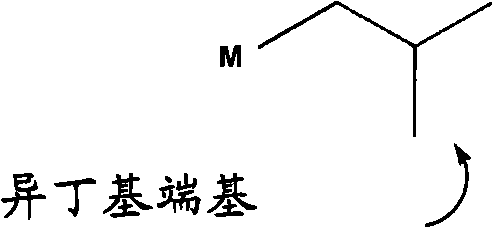
其中M表示低聚物链。在一个优选的实施方案中,所述异丁基链端由下式中之一表示:where M represents an oligomer chain. In a preferred embodiment, the isobutyl chain end is represented by one of the following formulae:
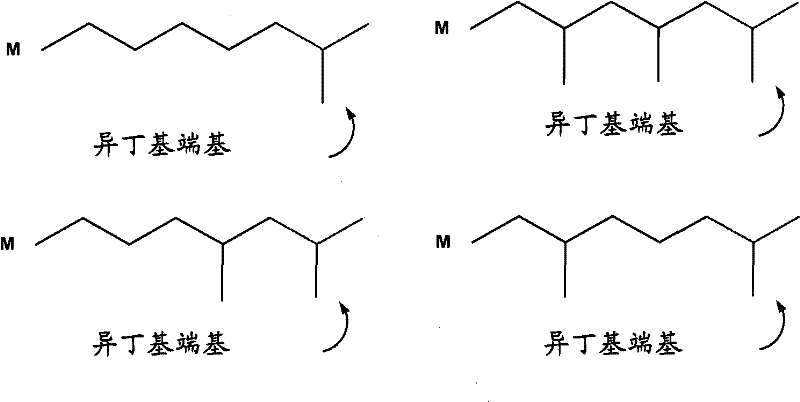
其中M表示低聚物链。where M represents an oligomer chain.
异丁基端基的百分数使用13CNMR测定(如实施例部分中所描述的),并且Rescon i等人,J Am.Chem.Soc.,1992,114,1025-1032报道了100%丙烯低聚物的化学位移归属,和图2中指明了乙烯-丙烯低聚物的化学位移归属。The percentage of isobutyl end groups was determined using 13 CNMR (as described in the Examples section), and Resconi et al., J Am. Chem. Soc., 1992, 114, 1025-1032 reported 100% propylene oligomerization The chemical shift assignments of the compounds, and the chemical shift assignments of the ethylene-propylene oligomers are indicated in Figure 2.
所述“异丁基链端与烯丙基型乙烯基比”被定义为异丁基链端的百分数与烯丙基型乙烯基的百分数之比。The "isobutyl chain ends to allylic vinyl ratio" is defined as the ratio of the percentage of isobutyl chain ends to the percentage of allylic vinyl groups.
“含芳香族的单体”是含有至少一个芳基的C4-C36烃基。实例包括苯乙烯、α-甲基苯乙烯、对甲基苯乙烯和4-(二氯甲基甲硅烷基)二苯基乙烯。芳基被定义为具有至少一个共轭双键对的环状基团。实例包括环戊二烯、茚、芴和苯。An "aromatic-containing monomer" is a C4 - C36 hydrocarbon group containing at least one aryl group. Examples include styrene, α-methylstyrene, p-methylstyrene, and 4-(dichloromethylsilyl)diphenylethylene. Aryl is defined as a cyclic group having at least one conjugated double bond pair. Examples include cyclopentadiene, indene, fluorene and benzene.
“苯乙烯属”单体是包含苯乙烯单元的单体,如:"Styrenic" monomers are monomers containing styrene units such as:
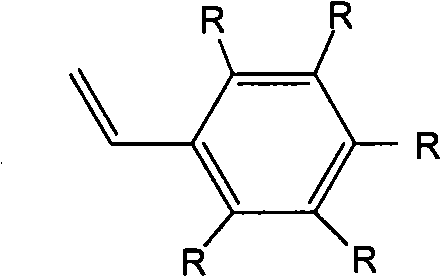
其中每个R独立地为氢或C1-C12烃基或C1-C12取代的烃基,优选用卤素(如Br或Cl)取代的C1-C12烃基。wherein each R is independently hydrogen or a C 1 -C 12 hydrocarbon group or a C 1 -C 12 substituted hydrocarbon group, preferably a C 1 -C 12 hydrocarbon group substituted with a halogen (such as Br or Cl).
反应区是其中发生反应的任何容器,如玻璃瓶、聚合反应器、反应挤出机、管式反应器等。A reaction zone is any vessel in which the reaction takes place, such as glass bottles, polymerization reactors, reaction extruders, tubular reactors, and the like.
本文中使用的术语“连续”是指没有间断或停止地运行的系统。例如,生产聚合物的连续方法是其中反应物被连续引入到一个或多个反应器并且聚合物产物被连续取出的方法。As used herein, the term "continuous" refers to a system that operates without interruption or stoppage. For example, a continuous process for producing a polymer is one in which reactants are continuously introduced into one or more reactors and polymer product is continuously withdrawn.
详细说明Detailed description
在另一个实施方案中,本发明涉及包含至少一种大分子单体和0.1-20wt%(优选0.5-15wt%,优选1-10wt%,优选1-5wt%,优选0-5mol%)的C2-C18共聚单体(优选C2-C12共聚单体,优选乙烯、丙烯、丁烯、己烯、4-甲基戊烯-1和3-甲基戊烯-1和/或降冰片烯)的聚大分子单体,其中所述大分子单体具有:In another embodiment, the present invention relates to C2 comprising at least one macromonomer and 0.1-20 wt. - C18 comonomers (preferably C2 - C12 comonomers, preferably ethylene, propylene, butene, hexene, 4-methylpentene-1 and 3-methylpentene-1 and/or norbornene ), wherein the macromer has:
1)20-800个碳原子(优选20-700,优选20-600,优选20-500,优选20-400,优选20-300,优选20-200,优选30-175),1) 20-800 carbon atoms (preferably 20-700, preferably 20-600, preferably 20-500, preferably 20-400, preferably 20-300, preferably 20-200, preferably 30-175),
2)280g/mol或更大(优选280-15,000,优选280-10,000,优选280-12,000,优选280-8,000,优选280-6,000,优选300-5,000,优选350-3,000,优选350-2,000)的Mn,2) 280 g/mol or more (preferably 280-15,000, preferably 280-10,000, preferably 280-12,000, preferably 280-8,000, preferably 280-6,000, preferably 300-5,000, preferably 350-3,000, preferably 350-2,000) Mn,
3)400g/mol或更大(优选400-50,000,优选400-20,000,优选450-15,000,优选450-10,000,优选450-5,000,优选450-3,000)的Mw,3) Mw of 400 g/mol or more (preferably 400-50,000, preferably 400-20,000, preferably 450-15,000, preferably 450-10,000, preferably 450-5,000, preferably 450-3,000),
4)600g/mol或更大(优选600-35,000,优选600-30,000,优选600-25,000,优选600-20,000,优选600-15,000,优选600-10,000,优选600-5,000,优选750-3,000)的Mz,4) 600 g/mol or more (preferably 600-35,000, preferably 600-30,000, preferably 600-25,000, preferably 600-20,000, preferably 600-15,000, preferably 600-10,000, preferably 600-5,000, preferably 750-3,000) Mz,
5)1.5或更大(优选1.5-7,优选1.5-6,优选1.6-5,优选1.8-4,优选1.5-3,优选1.5-2.5)的Mw/Mn,5) Mw/Mn of 1.5 or more (preferably 1.5-7, preferably 1.5-6, preferably 1.6-5, preferably 1.8-4, preferably 1.5-3, preferably 1.5-2.5),
6)相对于总不饱和度计70%或更大(优选75%或更大,优选80%或更大,优选85%或更大,优选90%或更大,优选95%或更大,优选98%或更大)的乙烯基末端(也称为乙烯基含量)(通过1H NMR测量),和6) 70% or greater relative to total unsaturation (preferably 75% or greater, preferably 80% or greater, preferably 85% or greater, preferably 90% or greater, preferably 95% or greater, preferably 98% or greater) of vinyl ends (also known as vinyl content) (measured by 1 H NMR), and
7)60℃或更高(优选70℃或更高,优选80℃或更高,优选90℃或更高,优选100℃或更高,优选110℃或更高,优选120℃或更高,优选130℃或更高)的熔点Tm,或者20J/g或更小,优选15J/g或更小的Hm,7) 60°C or higher (preferably 70°C or higher, preferably 80°C or higher, preferably 90°C or higher, preferably 100°C or higher, preferably 110°C or higher, preferably 120°C or higher, A melting point Tm of preferably 130° C. or higher), or a Hm of 20 J/g or less, preferably 15 J/g or less,
8)基于大分子单体的重量计0-10wt%(优选0-5wt%,优选0-1wt%,或者0wt%)的含芳香族的单体,如苯乙烯属单体;并且其中所述聚大分子单体具有:8) 0-10wt% (preferably 0-5wt%, preferably 0-1wt%, or 0wt%) of aromatic-containing monomers, such as styrenic monomers, based on the weight of the macromonomer; and wherein said Polymacromonomers have:
a)小于0.6(优选小于0.5,优选小于0.4,优选小于0.3,或者小于0.2)的g值,a) a g value of less than 0.6 (preferably less than 0.5, preferably less than 0.4, preferably less than 0.3, or less than 0.2),
b)大于30,000g/mol(优选40,000-3,000,000,优选60,000-1,500,000)的Mw,b) a Mw greater than 30,000 g/mol (preferably 40,000-3,000,000, preferably 60,000-1,500,000),
c)大于20,000g/mo l(优选40,000-2,000,000,优选60,000-1,000,000)的Mn,c) Mn greater than 20,000 g/mol (preferably 40,000-2,000,000, preferably 60,000-1,000,000),
d)小于0.5(优选小于0.4,优选小于0.3,优选小于0.2)的支化指数(g′)vis,d) a branching index (g') vis of less than 0.5 (preferably less than 0.4, preferably less than 0.3, preferably less than 0.2),
e)50℃或更高(优选60℃或更高,优选70℃或更高,优选80℃或更高,优选90℃或更高,优选100℃或更高,优选120℃或更高)的熔点,或者20J/g或更小,优选15J/g或更小的Hm,和e) 50°C or higher (preferably 60°C or higher, preferably 70°C or higher, preferably 80°C or higher, preferably 90°C or higher, preferably 100°C or higher, preferably 120°C or higher) melting point, or 20 J/g or less, preferably 15 J/g or less Hm, and
f)基于大分子单体的重量计0-10wt%(优选0-5wt%,优选0-1wt%,或者0wt%)的含芳香族的单体,如苯乙烯属单体。f) 0-10 wt% (preferably 0-5 wt%, preferably 0-1 wt%, or 0 wt%) of aromatic-containing monomers, such as styrenic monomers, based on the weight of the macromonomer.
在一个优选的实施方案中,所述大分子单体不是芳香族的(包含小于5wt%,优选小于1wt%,优选0wt%的含芳香族的单体),优选不是苯乙烯属的(包含小于5wt%,优选小于1wt%,优选0wt%的苯乙烯属单体)。In a preferred embodiment, the macromonomer is non-aromatic (comprising less than 5 wt%, preferably less than 1 wt%, preferably 0 wt% aromatic-containing monomers), preferably not styrenic (comprising less than 5 wt%, preferably less than 1 wt%, preferably 0 wt% styrenic monomer).
在一个优选的实施方案中,本文中所使用的大分子单体具有:In a preferred embodiment, the macromer used herein has:
1)20-800个碳原子(优选20-700,优选20-600,优选20-500,优选20-400,优选20-300,优选20-200,优选30-175),1) 20-800 carbon atoms (preferably 20-700, preferably 20-600, preferably 20-500, preferably 20-400, preferably 20-300, preferably 20-200, preferably 30-175),
2)280g/mo l或更大(优选280-15,000,优选280-10,000,优选280-12,000,优选280-8,000,优选280-6,000,优选300-5,000,优选350-3,000,优选350-2,000)的Mn,2) 280 g/mol or more (preferably 280-15,000, preferably 280-10,000, preferably 280-12,000, preferably 280-8,000, preferably 280-6,000, preferably 300-5,000, preferably 350-3,000, preferably 350-2,000) Mn,
3)400g/mol或更大(优选400-50,000,优选400-20,000,优选450-15,000,优选450-10,000,优选450-5,000,优选450-3,000)的Mw,3) Mw of 400 g/mol or more (preferably 400-50,000, preferably 400-20,000, preferably 450-15,000, preferably 450-10,000, preferably 450-5,000, preferably 450-3,000),
4)600g/mo l或更大(优选600-35,000,优选600-30,000,优选600-25,000,优选600-20,000,优选600-15,000,优选600-10,000,优选600-5,000,优选750-3,000)的Mz,4) 600 g/mol or more (preferably 600-35,000, preferably 600-30,000, preferably 600-25,000, preferably 600-20,000, preferably 600-15,000, preferably 600-10,000, preferably 600-5,000, preferably 750-3,000) Mz,
5)1.5或更大(优选1.5-7,优选1.5-6,优选1.6-5,优选1.8-4,优选1.5-3,优选1.5-2.5)的Mw/Mn,5) Mw/Mn of 1.5 or more (preferably 1.5-7, preferably 1.5-6, preferably 1.6-5, preferably 1.8-4, preferably 1.5-3, preferably 1.5-2.5),
6)相对于总不饱和度计70%或更大(优选70%或更大,优选80%或更大,优选85%或更大,优选90%或更大,优选95%或更大,优选97%,优选98%或更大,优选99%或更大)的乙烯基含量,6) 70% or greater relative to total unsaturation (preferably 70% or greater, preferably 80% or greater, preferably 85% or greater, preferably 90% or greater, preferably 95% or greater, preferably 97%, preferably 98% or greater, preferably 99% or greater) vinyl content,
7)60℃或更高的熔点(DSC,第二次熔融)(优选70℃或更高,优选80℃或更高,优选90℃或更高,优选100℃或更高,优选110℃或更高,优选120℃或更高,优选130℃或更高),或者20J/g或更小,优选15J/g或更小的Hm;和7) Melting point (DSC, second melting) of 60°C or higher (preferably 70°C or higher, preferably 80°C or higher, preferably 90°C or higher, preferably 100°C or higher, preferably 110°C or higher, preferably 120°C or higher, preferably 130°C or higher), or an Hm of 20J/g or less, preferably 15J/g or less; and
8)基于大分子单体的重量计0-10wt%(优选0-5wt%,优选0-1wt%,或者0wt%)的含芳香族的单体,如苯乙烯属单体。(在聚合物中的芳香族含量通过1H NMR测定)。8) 0-10 wt% (preferably 0-5 wt%, preferably 0-1 wt%, or 0 wt%) of aromatic-containing monomers, such as styrenic monomers, based on the weight of the macromonomer. (Aromatic content in the polymer was determined by 1 H NMR).
Mw、Mz和碳原子数通过GPC按照下文在实验部分中描述的程序测定。Mn通过1H NMR按照下文在实验部分中描述的程序测定。支化指数(g′)vis按照下文在实验部分中描述的程序测定。乙烯基含量(%)如在上面和在下文实验部分中所描述的那样测定。熔点通过下文在实验部分中描述的差示扫描量热法测定。“g值”通过下文在实验部分中描述的GPC程序和按照在Macromolecules,2001,34,6812-6820中的方法测定。Mw, Mz and number of carbon atoms were determined by GPC following the procedure described in the experimental section below. Mn was determined by 1 H NMR following the procedure described below in the experimental section. The branching index (g') vis was determined according to the procedure described below in the experimental part. Vinyl content (%) was determined as described above and in the experimental section below. Melting points were determined by differential scanning calorimetry as described below in the experimental section. The "g value" is determined by the GPC procedure described below in the experimental part and according to the method in Macromolecules, 2001, 34, 6812-6820.
在另一个实施方案中,在本发明中使用的所述大分子单体是丙烯均聚低聚物,其包含丙烯和小于0.5wt%的共聚单体,优选0wt%的共聚单体,其中该低聚物具有:In another embodiment, said macromonomer used in the present invention is a propylene homo-oligomer comprising propylene and less than 0.5 wt% comonomer, preferably 0 wt% comonomer, wherein the Oligomers have:
i)至少93%(优选至少95%,优选至少97%,优选至少98%)的烯丙基链端;i) at least 93% (preferably at least 95%, preferably at least 97%, preferably at least 98%) allyl chain ends;
ii)通过1H NMR测定的约500-约20,000g/mol(优选500-15,000,优选600-10,000,优选800-8,000g/mo l,优选900-7,000,优选1000-6,000,优选1000-5,000)的数均分子量(Mn);ii) about 500-about 20,000 g/mol (preferably 500-15,000, preferably 600-10,000, preferably 800-8,000 g/mol, preferably 900-7,000, preferably 1000-6,000, preferably 1000-5,000) as determined by 1 H NMR ) number average molecular weight (Mn);
iii)0.8∶1-1.3∶1.0的异丁基链端与烯丙基型乙烯基比;iii) an isobutyl chain end to allyl type vinyl ratio of 0.8:1-1.3:1.0;
iv)小于1400ppm(优选小于1200ppm,优选小于1000ppm,优选小于500ppm,优选小于100ppm)的铝。iv) less than 1400 ppm (preferably less than 1200 ppm, preferably less than 1000 ppm, preferably less than 500 ppm, preferably less than 100 ppm) of aluminum.
在另一个实施方案中,在本发明中使用的所述大分子单体是丙烯共聚低聚物,该丙烯共聚低聚物具有通过1H NMR测定的300-30,000g/mol的Mn(优选400-20,000,优选500-15,000,优选600-12,000,优选800-10,000,优选900-8,000,优选900-7,000g/mol),包含10-90mol%的丙烯(优选15-85mol%,优选20-80mol%,优选30-75mol%,优选50-90mol%),和10-90mol%(优选85-15mol%,优选20-80mol%,优选25-70mol%,优选10-50mol%)的一种或多种α-烯烃共聚单体(优选乙烯,丁烯,己烯或辛烯,优选乙烯),其中所述低聚物具有至少X%的烯丙基链端(相对于总不饱和度),其中:l)当所述共聚低聚物中存在10-60mol%的乙烯时,X=(-0.94(mol%结合的乙烯)+100{或者1.20(-0.94(mol%结合的乙烯)+100),或者1.50(-0.94(mol%结合的乙烯)+100)}),和2)当所述共聚低聚物中存在大于60并小于70mol%的乙烯时,X=45(或者50,或者60),和3)当所述共聚低聚物中存在70-90mol%的乙烯时,X=(1.83*(mol%结合的乙烯)-83{或者1.20[1.83*(mol%结合的乙烯)-83],或者1.50[1.83*(mol%结合的乙烯)-83]})。或者,X是80%或更大,优选85%或更大,优选90%或更大,优选95%或更大。In another embodiment, said macromer used in the present invention is a propylene co-oligomer having a Mn of 300-30,000 g/mol (preferably 400) as determined by 1 H NMR. -20,000, preferably 500-15,000, preferably 600-12,000, preferably 800-10,000, preferably 900-8,000, preferably 900-7,000 g/mol), containing 10-90 mol% propylene (preferably 15-85 mol%, preferably 20-80 mol% %, preferably 30-75mol%, preferably 50-90mol%), and one or more of 10-90mol% (preferably 85-15mol%, preferably 20-80mol%, preferably 25-70mol%, preferably 10-50mol%) An α-olefin comonomer (preferably ethylene, butene, hexene or octene, preferably ethylene), wherein the oligomer has at least X% allyl chain ends (relative to total unsaturation), wherein :l) When 10-60 mol% ethylene is present in the co-oligomer, X=(-0.94(mol% bound ethylene)+100{ or 1.20(-0.94(mol% bound ethylene)+100) , or 1.50(-0.94(mol% combined ethylene)+100)}), and 2) when there is more than 60 and less than 70mol% ethylene in the co-oligomer, X=45 (or 50, or 60 ), and 3) X=(1.83*(mol% bound ethylene)-83{ or 1.20[1.83*(mol% bound ethylene)- 83], or 1.50[1.83*(mol% bound ethylene)-83]}). Alternatively, X is 80% or greater, preferably 85% or greater, preferably 90% or greater, preferably 95% or greater.
在一个备选的实施方案中,低聚物i)-vi)中的任何一种具有至少80%的异丁基链端(基于异丁基和正丙基饱和链端的总和),优选至少85%的异丁基链端,优选至少90%的异丁基链端。或者,低聚物i)-vi)中的任何一种具有0.8∶1-1.35∶1.0,优选0.9∶1-1.20∶1.0,优选0.9∶1.0-1.1∶1.0的异丁基链端与烯丙基型乙烯基比。In an alternative embodiment, any of oligomers i)-vi) has at least 80% isobutyl chain ends (based on the sum of isobutyl and n-propyl saturated chain ends), preferably at least 85% isobutyl chain ends. Butyl chain ends, preferably at least 90% of isobutyl chain ends. Alternatively, any of the oligomers i)-vi) has an isobutyl chain end and an allyl type of 0.8:1-1.35:1.0, preferably 0.9:1-1.20:1.0, preferably 0.9:1.0-1.1:1.0 vinyl ratio.
在另一个实施方案中,在本发明中使用的所述大分子单体是丙烯低聚物,其包含超过90mol%(优选95-99mol%,优选98-9mol%)的丙烯和小于10mol%(优选1-4mol%,优选1-2mol%)的乙烯,其中所述低聚物具有:In another embodiment, the macromer used in the present invention is a propylene oligomer comprising more than 90 mol% (preferably 95-99 mol%, preferably 98-9 mol%) propylene and less than 10 mol% ( Preferably 1-4 mol%, preferably 1-2 mol%) of ethylene, wherein the oligomer has:
至少93%的烯丙基链端(优选至少95%,优选至少97%,优选至少98%);At least 93% allyl chain ends (preferably at least 95%, preferably at least 97%, preferably at least 98%);
通过1HNMR测定的约400-约30,000g/mol的数均分子量(Mn)(优选500-20,000,优选600-15,000,优选700-10,000g/mol,优选800-9,000,优选900-8,000,优选1000-6,000); A number average molecular weight (Mn) of from about 400 to about 30,000 g/mol (preferably 500-20,000, preferably 600-15,000, preferably 700-10,000 g/mol, preferably 800-9,000, preferably 900-8,000, preferably 1000-6,000);
0.8∶1-1.35∶1.0的异丁基链端与烯丙基型乙烯基比,和an isobutyl chain end to allylic vinyl ratio of 0.8:1 to 1.35:1.0, and
小于1400ppm的铝(优选小于1200ppm,优选小于1000ppm,优选小于500ppm,优选小于100ppm)。Less than 1400 ppm aluminum (preferably less than 1200 ppm, preferably less than 1000 ppm, preferably less than 500 ppm, preferably less than 100 ppm).
在另一个实施方案中,在本发明中使用的所述大分子单体是丙烯低聚物,其包含至少50(优选60-90,优选70-90)mol%的丙烯和10-50(优选10-40,优选10-30)mol%的乙烯,其中所述低聚物具有:In another embodiment, said macromonomer used in the present invention is a propylene oligomer comprising at least 50 (preferably 60-90, preferably 70-90) mol % propylene and 10-50 (preferably 10-40, preferably 10-30) mol% of ethylene, wherein the oligomer has:
至少90%的烯丙基链端(优选至少91%,优选至少93%,优选至少95%,优选至少98%);At least 90% allyl chain ends (preferably at least 91%, preferably at least 93%, preferably at least 95%, preferably at least 98%);
通过1H NMR测定的约150-约20,000g/mol的Mn(优选200-15,000,优选250-15,000,优选300-10,000,优选400-9,500,优选500-9,000,优选750-9,000);和A Mn of from about 150 to about 20,000 g/mol (preferably 200-15,000, preferably 250-15,000, preferably 300-10,000, preferably 400-9,500, preferably 500-9,000, preferably 750-9,000) as determined by 1 H NMR; and
0.8∶1-1.3∶1.0的异丁基链端与烯丙基型乙烯基比,其中具有四个或更多个碳原子的单体的存在量为0-3mol%(优选小于1mol%,优选小于0.5mol%,优选0mol%)。0.8:1-1.3:1.0 ratio of isobutyl chain ends to allyl-type vinyl, wherein monomers with four or more carbon atoms are present in an amount of 0-3 mol % (preferably less than 1 mol %, preferably less than 0.5 mol%, preferably 0 mol%).
在另一个实施方案中,在本发明中使用的所述大分子单体是丙烯低聚物,其包含至少50(优选至少60,优选70-99.5,优选80-99,优选90-98.5)mol%的丙烯,0.1-45(优选至少35,优选0.5-30,优选1-20,优选1.5-10)mol%的乙烯,和0.1-5(优选0.5-3,优选0.5-1)mol%的C4-C12烯烃(例如丁烯、己烯或辛烯,优选丁烯),其中所述低聚物具有:In another embodiment, said macromer used in the present invention is a propylene oligomer comprising at least 50 (preferably at least 60, preferably 70-99.5, preferably 80-99, preferably 90-98.5) mol % of propylene, 0.1-45 (preferably at least 35, preferably 0.5-30, preferably 1-20, preferably 1.5-10) mol% of ethylene, and 0.1-5 (preferably 0.5-3, preferably 0.5-1) mol% of C 4 -C 12 Olefins (such as butene, hexene or octene, preferably butene), wherein the oligomer has:
至少90%的烯丙基链端(优选至少91%,优选至少93%,优选至少95%,优选至少98%);At least 90% allyl chain ends (preferably at least 91%, preferably at least 93%, preferably at least 95%, preferably at least 98%);
通过1HNMR测定的约150-约15,000g/mo l(优选200-12,000,优选250-10,000,优选300-10,000,优选400-9500,优选500-9,000,优选750-9,000)的数均分子量(Mn);和 Number average molecular weight ( Mn); and
0.8∶1-1.35∶1.0的异丁基链端与烯丙基型乙烯基比。A ratio of isobutyl chain ends to allyl vinyl from 0.8:1 to 1.35:1.0.
在另一个实施方案中,在本发明中使用的所述大分子单体是丙烯低聚物,其包含至少50(优选至少60,优选70-99.5,优选80-99,优选90-98.5)mol%的丙烯,0.1-45(优选至少35,优选0.5-30,优选1-20,优选1.5-10)mol%的乙烯,和0.1-5(优选0.5-3,优选0.5-1)mol%的二烯(例如C4-C12α,ω-二烯(例如丁二烯,己二烯,辛二烯),降冰片烯,乙叉降冰片烯,乙烯基降冰片烯,降冰片二烯和二环戊二烯),其中所述低聚物具有:In another embodiment, said macromer used in the present invention is a propylene oligomer comprising at least 50 (preferably at least 60, preferably 70-99.5, preferably 80-99, preferably 90-98.5) mol % of propylene, 0.1-45 (preferably at least 35, preferably 0.5-30, preferably 1-20, preferably 1.5-10) mol% of ethylene, and 0.1-5 (preferably 0.5-3, preferably 0.5-1) mol% of Dienes (e.g. C4-C12α, ω-dienes (e.g. butadiene, hexadiene, octadiene), norbornene, ethylidene norbornene, vinyl norbornene, norbornadiene and bicyclic pentadiene), wherein the oligomer has:
至少90%的烯丙基链端(优选至少91%,优选至少93%,优选至少95%,优选至少98%);At least 90% allyl chain ends (preferably at least 91%, preferably at least 93%, preferably at least 95%, preferably at least 98%);
通过1H NMR测定的约150-约20,000g/mol(优选200-15,000,优选250-12,000,优选300-10,000,优选400-9,500,优选500-9,000,优选750-9,000)的数均分子量(Mn);和 Number average molecular weight ( Mn); and
0.7∶1-1.35∶1.0的异丁基链端与烯丙基型乙烯基比。A ratio of isobutyl chain ends to allylic vinyl from 0.7:1 to 1.35:1.0.
在本发明中制备的所述大分子单体(优选所述低聚物i)-vi))中的任何一种优选具有小于1400ppm的铝,优选小于1000ppm的铝,优选小于500ppm的铝,优选小于100ppm的铝,优选小于50ppm的铝,优选小于20ppm的铝,优选小于5ppm的铝。Any of said macromers (preferably said oligomers i)-vi)) prepared in the present invention preferably have less than 1400 ppm aluminum, preferably less than 1000 ppm aluminum, preferably less than 500 ppm aluminum, preferably Less than 100 ppm aluminium, preferably less than 50 ppm aluminium, preferably less than 20 ppm aluminium, preferably less than 5 ppm aluminium.
在另一个优选的实施方案中,所述大分子单体是无定形的、全同立构的或间规立构的,优选全同立构的。在另一个实施方案中,所述大分子单体是丙烯均聚物或丙烯均聚低聚物,所述丙烯均聚物或丙烯均聚低聚物可以是无定形的、全同立构的或间规立构的,优选全同立构的。在另一个实施方案中,所述大分子单体是丙烯共聚物或丙烯共聚低聚物,所述丙烯共聚物或丙烯共聚低聚物可以是无定形的、全同立构的或间规立构的,优选全同立构的。“无定形的”被定义为是指熔化热小于10J/g。“全同立构的”被定义为至少50%的全同立构五单元组(通过下文中描述的13CNMR测定),优选至少60%的全同立构五单元组,优选至少70%的全同立构五单元组,优选至少80%的全同立构五单元组。“间规立构的”被定义为至少50%的间规立构五单元组(通过下文描述的13CNMR测定),优选至少60%的间规立构五单元组,优选至少70%的间规立构五单元组,优选至少80%的间规立构五单元组。In another preferred embodiment, said macromer is amorphous, isotactic or syndiotactic, preferably isotactic. In another embodiment, the macromer is a propylene homopolymer or a propylene homo-oligomer, which may be amorphous, isotactic Or syndiotactic, preferably isotactic. In another embodiment, the macromer is a propylene copolymer or a propylene co-oligomer, which may be amorphous, isotactic or syndiotactic conformational, preferably isotactic. "Amorphous" is defined to mean a heat of fusion of less than 10 J/g. "Isotactic" is defined as at least 50% isotactic pentads (determined by 13 CNMR described hereinafter), preferably at least 60% isotactic pentads, preferably at least 70% Isotactic pentads, preferably at least 80% isotactic pentads. "Syndiotactic" is defined as at least 50% syndiotactic pentads (determined by 13 CNMR described below), preferably at least 60% syndiotactic pentads, preferably at least 70% syndiotactic pentads Stereotactic pentads, preferably at least 80% syndiotactic pentads.
在本文所描述的任一实施方案中,所述大分子单体仅含有C2-C18线性α-烯烃单体单元(优选C2-C12α-烯烃,优选乙烯、丙烯、丁烯、辛烯、癸烯或十二碳烯,优选乙烯和丙烯),或基本上由C2-C18线性α-烯烃单体单元(优选C2-C12α-烯烃,优选乙烯、丙烯、丁烯、辛烯、癸烯或十二碳烯,优选乙烯和丙烯)组成,或由C2-C18线性α-烯烃单体单元(优选C2-C12α-烯烃,优选乙烯、丙烯、丁烯、辛烯、癸烯或十二碳烯,优选乙烯和丙烯)组成。在另一个实施方案中,所述大分子单体不包含任何基于苯乙烯的单体单元。在另一个实施方案中,所述大分子单体不包含任何环状单体单元。在另一个实施方案中,所述大分子单体不包含任何芳香族单体单元。在另一个实施方案中,所述大分子单体包含1wt%或更少,优选小于0.5wt%,优选0wt%的苯乙烯属单体单元、环状单体单元或芳族单体单元,基于大分子单体的重量计。In any of the embodiments described herein, the macromer contains only C 2 -C 18 linear α-olefin monomer units (preferably C 2 -C 12 α-olefins, preferably ethylene, propylene, butene, octene, decene or dodecene, preferably ethylene and propylene), or consist essentially of C 2 -C 18 linear α-olefin monomer units (preferably C 2 -C 12 α-olefins, preferably ethylene, propylene, butane olefin, octene, decene or dodecene, preferably ethylene and propylene), or by C 2 -C 18 linear α-olefin monomer units (preferably C 2 -C 12 α-olefin, preferably ethylene, propylene, butene, octene, decene or dodecene, preferably ethylene and propylene). In another embodiment, the macromer does not contain any styrene-based monomer units. In another embodiment, the macromer does not contain any cyclic monomer units. In another embodiment, the macromer does not contain any aromatic monomeric units. In another embodiment, the macromer comprises 1 wt% or less, preferably less than 0.5 wt%, preferably 0 wt% of styrenic, cyclic or aromatic monomeric units, based on Weight of macromonomers.
在另一个实施方案中,所述大分子单体包含小于30wt%的无定形材料,优选小于20wt%的无定形材料,优选小于10wt%的无定形材料,优选小于5wt%的无定形材料,基于大分子单体的重量计。无定形材料的百分比通过从100中减去百分结晶度来确定。百分结晶度(X%)采用下式计算:[DSC曲线下的面积(以J/g为单位)/H °(以J/g为单位)]*100,其中H°是主要单体组分的均聚物的熔化热。H°的这些值可以从John Wiley and Sons出版的the Polymer Handbook,FourthEdition,New York 1999获得,除了将290J/g的值用作100%结晶的聚乙烯的平衡熔化热(H°),将140J/g的值用作100%结晶的聚丁烯的平衡熔化热(H°),和将207J/g的值(H°)用作100%结晶的聚丙烯的熔化热。DSC曲线如下文实验部分中所描述的那样获得。In another embodiment, the macromer comprises less than 30 wt % amorphous material, preferably less than 20 wt % amorphous material, preferably less than 10 wt % amorphous material, preferably less than 5 wt % amorphous material, based on Weight of macromonomers. The percentage of amorphous material was determined by subtracting the percent crystallinity from 100. Percent crystallinity (X%) is calculated using the following formula: [area under the DSC curve (in J/g)/H° (in J/g)]*100, where H° is the main monomer group The heat of fusion of the divided homopolymer. These values for H° can be obtained from the Polymer Handbook, Fourth Edition, New York 1999, published by John Wiley and Sons, except that a value of 290 J/g is used as the equilibrium heat of fusion (H°) for 100% crystalline polyethylene, and 140 J A value of /g was used as the equilibrium heat of fusion (H°) of 100% crystalline polybutene, and a value of 207 J/g (H°) was used as the heat of fusion of 100% crystalline polypropylene. DSC curves were obtained as described in the experimental section below.
在另一个实施方案中,所述大分子单体(特别是低聚物i)-iv))具有0℃或更低,优选-10℃或更低,更优选-20℃或更低,更优选-30℃或更低,更优选-50℃或更低的玻璃态转化温度(Tg)(通过下文所述的差示扫描量热法测定)。In another embodiment, said macromers (especially oligomers i)-iv)) have a temperature of 0°C or lower, preferably -10°C or lower, more preferably -20°C or lower, more preferably A glass transition temperature (Tg) (measured by differential scanning calorimetry described below) is preferably -30°C or lower, more preferably -50°C or lower.
在另一个实施方案中,所述大分子单体(特别是低聚物i)-iv))具有60-130℃的熔点(DSC第一次熔融),或者50-100℃的熔点(DSC第一次熔融)。在另一个实施方案中,本文中描述的低聚物在室温(23℃)下储存至少48小时以后不具有可通过DSC发觉的熔点。In another embodiment, the macromers (especially oligomers i)-iv)) have a melting point of 60-130° C. (DSC first melt), or a melting point of 50-100° C. (DSC second melt). once melted). In another embodiment, the oligomers described herein have no detectable melting point by DSC after storage at room temperature (23° C.) for at least 48 hours.
在另一个实施方案中,所述大分子单体(特别是低聚物i)-iv))在25℃为液体。In another embodiment, said macromers (especially oligomers i)-iv)) are liquid at 25°C.
在另一个实施方案中,本文中描述的任何大分子单体可以具有50J/g或更大,优选75J/g或更大,优选100J/g或更大的熔化热,通过下文实验部分中所描述的差示扫描量热法测量。In another embodiment, any of the macromers described herein may have a heat of fusion of 50 J/g or greater, preferably 75 J/g or greater, preferably 100 J/g or greater, as determined by the experimental section below. Describe the differential scanning calorimetry measurements.
在另一个实施方案中,本文中描述的任何大分子单体可以具有50%或更大,优选60%或更大,优选70%或更大的百分结晶度,通过下文实验部分中所述的DSC测定。In another embodiment, any of the macromers described herein may have a percent crystallinity of 50% or greater, preferably 60% or greater, preferably 70% or greater, as described in the Experimental Section below. DSC assay.
在另一个实施方案中,本文中描述的任何大分子单体包含小于1000ppm的第4族金属(优选小于750ppm或Ti、Hf和/或Zr)。或者,所述大分子单体包含小于1000ppm的锂(优选小于750ppm的锂)。In another embodiment, any of the macromers described herein comprises less than 1000 ppm of a Group 4 metal (preferably less than 750 ppm or Ti, Hf and/or Zr). Alternatively, the macromer comprises less than 1000 ppm lithium (preferably less than 750 ppm lithium).
在一个优选的实施方案中,本文中描述的任何大分子单体包含小于3wt%的选自氢氧根,芳基和取代的芳基,卤素,烷氧基,羧酸根,酯,丙烯酸根,氧,氮和羧基的官能团,优选小于2wt%,更优选小于1wt%,更优选小于0.5wt%,更优选小于0.1wt%,更优选0wt%,基于所述大分子单体的重量计。In a preferred embodiment, any of the macromers described herein comprises less than 3% by weight of a group selected from the group consisting of hydroxide, aryl and substituted aryl, halogen, alkoxy, carboxylate, ester, acrylate, Oxygen, nitrogen and carboxyl functional groups, preferably less than 2 wt%, more preferably less than 1 wt%, more preferably less than 0.5 wt%, more preferably less than 0.1 wt%, more preferably 0 wt%, based on the weight of the macromer.
在另一个实施方案中,本文中描述的所述大分子单体是丙烯低聚物或聚合物。在一些实施方案中,所述丙烯低聚物或聚合物具有以下性质中的一种或多种:In another embodiment, the macromer described herein is a propylene oligomer or polymer. In some embodiments, the propylene oligomer or polymer has one or more of the following properties:
a)0.95或更小,优选0.90或更小,优选0.85或更小,优选0.80或更小,优选0.75或更小,优选0.70或更小的g′vis;和/或a) a g'vis of 0.95 or less, preferably 0.90 or less, preferably 0.85 or less, preferably 0.80 or less, preferably 0.75 or less, preferably 0.70 or less; and/or
b)5,000-100,000g/mol(优选15,000-100,000,优选20,000-75,000g/mol)的Mw;和/或b) a Mw of 5,000-100,000 g/mol (preferably 15,000-100,000, preferably 20,000-75,000 g/mol); and/or
c)90℃或更高(或者100℃或更高,或者140℃或更高)的熔点。在一个优选的实施方案中,所述丙烯低聚物或聚合物是全同立构的。这样的丙烯低聚物或聚合物是本领域已知的,并且可以采用金属茂催化剂如二甲基甲硅烷基-双(2-甲基-4-苯基茚基)合铪二甲基化物或在US 7,279,536中描述的催化剂化合物制备,所述催化剂化合物典型地与N,N-二甲基苯胺鎓四(全氟苯基)硼酸盐或N,N-二甲基苯胺鎓四(七氟萘基)硼酸盐组合使用。c) A melting point of 90°C or higher (or 100°C or higher, or 140°C or higher). In a preferred embodiment said propylene oligomer or polymer is isotactic. Such propylene oligomers or polymers are known in the art and can be employed with metallocene catalysts such as dimethylsilyl-bis(2-methyl-4-phenylindenyl) hafnium dimethyl or prepared from catalyst compounds described in US 7,279,536, typically with N,N-dimethylanilinium tetrakis(perfluorophenyl)borate or N,N-dimethylanilinium tetrakis(7 Fluoronaphthyl) borates are used in combination.
在一个优选的实施方案中,所述大分子单体为乙烯和丙烯的共聚物,其优选具有20J/g或更小(优选15J/g或更小)的Hm,包含65-80wt%的乙烯和20-35wt%的丙烯,优选具有5,000-100,000g/mol、优选20,000-80,000g/mol的Mw。这样的共聚物是本领域已知的,并且可以采用金属茂催化剂如(五甲基环戊二烯基)(1,3-二甲基茚基)合铪二甲基化物制备,所述金属茂催化剂典型地与N,N-二甲基苯胺鎓四(全氟苯基)硼酸盐或N,N-二甲基苯胺鎓四(七氟萘基)硼酸盐组合使用。In a preferred embodiment, the macromonomer is a copolymer of ethylene and propylene, preferably having a Hm of 20 J/g or less (preferably 15 J/g or less), comprising 65-80 wt% ethylene and 20-35 wt% propylene, preferably with a Mw of 5,000-100,000 g/mol, preferably 20,000-80,000 g/mol. Such copolymers are known in the art and can be prepared using metallocene catalysts such as (pentamethylcyclopentadienyl)(1,3-dimethylindenyl)hafnium dimethyl Genecene catalysts are typically used in combination with N,N-dimethylanilinium tetrakis(perfluorophenyl)borate or N,N-dimethylanilinium tetrakis(heptafluoronaphthyl)borate.
可用于本发明的大分子单体可以通过本领域中已知的、用于生产乙烯基封端的大分子单体的方法制备,所述方法包括描述在US6,117,962;US 6,555,635;Small,Brookhart,Bennett,JACS,120,1998,4049;Britovsek等人,Chem.Comm.,1998,849;Su等人,Organome t.,25,2006,666中的那些。Macromonomers useful in the present invention can be prepared by methods known in the art for the production of vinyl-terminated macromers, including those described in US 6,117,962; US 6,555,635; Small, Brookhart, Those in Bennett, JACS, 120, 1998, 4049; Britovsek et al., Chem. Comm., 1998, 849; Su et al., Organome t., 25, 2006, 666.
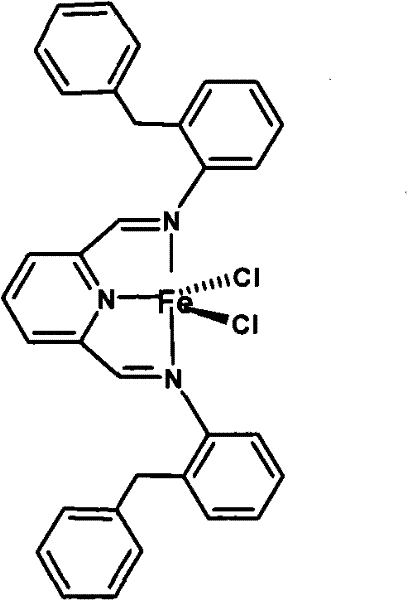
在一个优选的实施方案中,所述大分子单体可以组合使用以下文献中描述的一种或多种活化剂和一种或多种催化剂化合物来生产:1)G.J.P.Britovsek,V.C.Gibson,S.J.McTavi sh,G.A.Solan,B.S.Kimberley,P.J.Maddox,A.J.P.White,Williams,Chem.Comm.1998,849;2)Journal Organometallic Chemistry,648,2002,55;3)Iron Complexes Bearing 2-Imino-1,10-phenan throl inyl Ligandsas Highly Active Catalysts for Ethyylene Oligomerization,Organometallics,2006,666-677;和4)“Novel OlefinPolymeriza tion Catalysts Based on Iron and Cobalt”,Chem.Commun.1998,849。In a preferred embodiment, the macromer can be produced in combination with one or more activators and one or more catalyst compounds described in: 1) G.J.P. Britovsek, V.C.Gibson, S.J.McTavi sh, G.A.Solan, B.S.Kimberley, P.J.Maddox, A.J.P.White, Williams, Chem.Comm.1998, 849; 2) Journal Organometallic Chemistry, 648, 2002, 55; 3) Iron Complexes Bearing 2-Imino-1, 10-phenan throl inyl Ligands as Highly Active Catalysts for Ethyylene Oligomerization, Organometallics, 2006, 666-677; and 4) "Novel Olefin Polymerization Catalysts Based on Iron and Cobalt", Chem.Commun.1998, 849.
用于制备乙烯基封端的乙烯大分子单体(优选结晶的,例如具有至少40%结晶度)的特别有用的催化剂化合物包括由下式表示的那些:Particularly useful catalyst compounds for the preparation of vinyl-terminated ethylene macromers (preferably crystalline, e.g., having at least 40% crystallinity) include those represented by the formula:
用于制备乙烯基封端的全同立构的丙烯大分子单体(优选结晶的,例如具有至少40%结晶度)的特别有用的催化剂化合物包括由下式表示的那些:Particularly useful catalyst compounds for the preparation of vinyl-terminated isotactic propylene macromonomers (preferably crystalline, e.g., having at least 40% crystallinity) include those represented by the formula:

其中M1选自钛、锆、铪、钒、铌、钽、铬、钼或钨(优选锆和/或铪);wherein M is selected from titanium, zirconium, hafnium, vanadium, niobium, tantalum, chromium, molybdenum or tungsten (preferably zirconium and/or hafnium);
R1和R2相同或不同,并且选自氢原子、C1-C10烷基、C1-C10烷氧基、C6-C10芳基、C6-C10芳氧基、C2-C10烯基、C2-C40烯基、C7-C40芳烷基、C7-C40烷芳基、C8-C40芳基烯基、OH基团或卤素原子;或共轭二烯,其任选被一个或多个烃基、三(烃基)甲硅烷基或烃基三(烃基)甲硅烷基烃基取代(优选地,R1和R2是烷基如甲基或乙基,或者是卤素如氯); R1 and R2 are the same or different, and are selected from hydrogen atom, C1-C10 alkyl, C1-C10 alkoxy, C6-C10 aryl, C6-C10 aryloxy, C2-C10 alkenyl, C2-C40 Alkenyl, C7-C40 aralkyl, C7-C40 alkaryl, C8-C40 aryl alkenyl, OH group or halogen atom; Or conjugated diene, it is optionally replaced by one or more hydrocarbon groups, tri( Hydrocarbyl)silyl or hydrocarbyltri(hydrocarbyl)silylhydrocarbyl substitution (preferably, R and R are alkyl such as methyl or ethyl, or halogen such as chlorine);
R3-R12相同或不同,并且选自氢原子、卤素原子、C1-C10卤化或未卤化的烷基、C6-C10卤化或未卤化的芳基、C2-C10卤化或未卤化的烯基、C7-C40卤化或未卤化的芳烷基、C7-C40卤化或未卤化的烷芳基、C8-C40卤化或未卤化的芳基烯基、-NR′2、-SR′、-OR′、-OS iR′3或-PR′2基团,其中R′是卤素原子、C1-C10烷基或C6-C10芳基中的一种;或者两个或更多个相邻的基团R5-R7与连接它们的原子一起可以形成一个或多个环(优选R3是甲基、乙基或丁基),并且相邻的基团R11和R12可以形成一个或多个饱和的或芳香族的环(优选R11和R12与苯环结合形成取代或未取代的萘基),在一个有利的实施方案中,R9和R11是C1-C20烃基,或C3-C12烷基,有利地为叔丁基;R 3 -R 12 are the same or different, and are selected from hydrogen atom, halogen atom, C1-C10 halogenated or unhalogenated alkyl, C6-C10 halogenated or unhalogenated aryl, C2-C10 halogenated or unhalogenated alkenyl , C7-C40 halogenated or unhalogenated aralkyl, C7-C40 halogenated or unhalogenated alkaryl, C8-C40 halogenated or unhalogenated arylalkenyl, -NR' 2 , -SR', -OR' , -OS iR' 3 or -PR' 2 groups, wherein R' is one of a halogen atom, a C1-C10 alkyl group or a C6-C10 aryl group; or two or more adjacent groups R 5 -R 7 together with the atoms connecting them may form one or more rings (preferably R 3 is methyl, ethyl or butyl), and adjacent groups R 11 and R 12 may form one or more saturated or aromatic ring (preferably R 11 and R 12 combine with benzene ring to form substituted or unsubstituted naphthyl), in an advantageous embodiment, R 9 and R 11 are C1-C20 hydrocarbon group, or C3-C12 Alkyl, advantageously tert-butyl;
R13选自:R 13 is selected from:
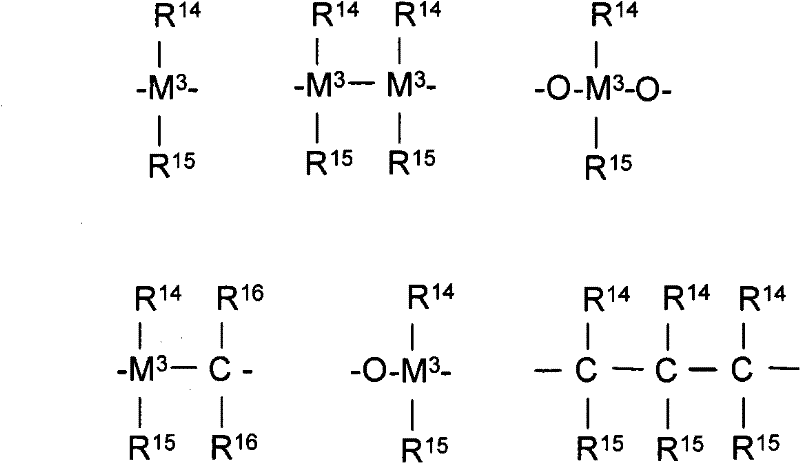
-B(R14)-、-Al(R14)-、-Ge-、-Sn-、-O-、-S-、-SO-、-SO2-、-N(R14)-、-CO-、-P(R14)-、-P(O)(R14)-、-B(NR14R15)-和-B[N(SiR14R15R16)2]-,其中R14、R15和R16各自独立地选自氢、卤素、C1-C20烷基、C6-C30芳基、C1-C20烷氧基、C2-C20烯基、C7-C40芳烷基、C8-C40芳基烯基和C7-C40烷芳基,或者R14和R15与连接它们的一个或多个原子一起形成环;并且M3选自碳、硅、锗和锡,或者R13由下式表示:-B(R 14 )-, -Al(R 14 )-, -Ge-, -Sn-, -O-, -S-, -SO-, -SO 2 -, -N(R 14 )-, - CO-, -P(R 14 )-, -P(O)(R 14 )-, -B(NR 14 R 15 )- and -B[N(SiR 14 R 15 R 16 ) 2 ]-, where R 14 , R 15 and R 16 are each independently selected from hydrogen, halogen, C1-C20 alkyl, C6-C30 aryl, C1-C20 alkoxy, C2-C20 alkenyl, C7-C40 aralkyl, C8- C40 aryl alkenyl and C7-C40 alkaryl, or R 14 and R 15 form a ring together with one or more atoms connecting them; and M 3 is selected from carbon, silicon, germanium and tin, or R 13 is selected from formula means:
其中R17-R24与R1和R2的定义相同,或者两个或更多个相邻的基团R17-R24(包括R20和R21)与连接它们的原子一起形成一个或多个环;M2是碳、硅、锗或锡(优选地,R13是二甲基甲硅烷基或二苯基甲硅烷基)。wherein R 17 -R 24 have the same definition as R 1 and R 2 , or two or more adjacent groups R 17 -R 24 (including R 20 and R 21 ) together with the atoms connecting them form a or multiple rings; M2 is carbon, silicon, germanium or tin (preferably, R13 is dimethylsilyl or diphenylsilyl).
用于制备乙烯基封端的全同立构丙烯大分子单体(优选结晶的,例如具有至少40%结晶度)的特别有用的催化剂化合物包括由下式表示的那些:外消旋-Me2Si-双(2-R-茚基)MX2或外消旋-Me2Si-双(2-R-4-Ph-茚基)MX2,其中R是烷基(如甲基),Ph是苯基或取代的苯基,M是Hf、Zr或Ti,和X是卤素或烷基(如C l或甲基)。实例包括二甲基甲硅烷基-双(2-甲基茚基)合锆二甲基化物(或二氯化物)、二甲基甲硅烷基-双(2-甲基-4-苯基-茚基)合锆二甲基化物(或二氯化物)、二甲基甲硅烷基-双(2-甲基-4-(3′,5′-二叔丁基苯基)茚基)合锆二甲基化物(或二氯化物)、二甲基甲硅烷基-双(2-甲基-4-萘基-茚基)合锆二甲基化物(或二氯化物)和二甲基甲硅烷基-双(2-甲基-4-(3′,5′-二叔丁基萘基)茚基)合锆二甲基化物(或二氯化物),或者其中锆被铪所代替的化合物。其它有用的催化剂化合物包括:(CpMe4)(1,3-二甲基Ind)HfMe2;(CpMe 4)(1-iPr Ind)HfMe 2;(CpMe 4)(1-iPr-3-nPr Ind)HfMe2;(CpMe 5)((1,3-二甲基Ind)HfMe2;(CpMe5)((1,3-二正丙基Ind)HfMe2;(CpMe 5)((1,2,3-三甲基Ind)HfMe2,其中Cp=环戊二烯基,Ind=茚基,Me=甲基,iPr=异丙基,和nPr=正丙基。Particularly useful catalyst compounds for the preparation of vinyl-terminated isotactic propylene macromonomers (preferably crystalline, e.g., having at least 40% crystallinity) include those represented by the formula: rac- Me2Si -bis(2-R-indenyl)MX 2 or rac-Me 2 Si-bis(2-R-4-Ph-indenyl)MX 2 , where R is alkyl (such as methyl) and Ph is Phenyl or substituted phenyl, M is Hf, Zr or Ti, and X is halogen or alkyl (such as Cl or methyl). Examples include dimethylsilyl-bis(2-methylindenyl)zirconium dimethyl (or dichloride), dimethylsilyl-bis(2-methyl-4-phenyl- Indenyl)zirconium dimethyl (or dichloride), dimethylsilyl-bis(2-methyl-4-(3',5'-di-tert-butylphenyl)indenyl) Zirconium dimethyl (or dichloride), dimethylsilyl-bis(2-methyl-4-naphthyl-indenyl) zirconium dimethyl (or dichloride) and dimethyl Silyl-bis(2-methyl-4-(3′,5′-di-tert-butylnaphthyl)indenyl)zirconium dimethylate (or dichloride), or in which zirconium is replaced by hafnium compound of. Other useful catalyst compounds include: (CpMe 4 )(1,3-DimethylInd)HfMe 2 ; (CpMe 4 )(1-iPr Ind)HfMe 2 ; (CpMe 4 )(1-iPr-3-nPr Ind) )HfMe 2 ; (CpMe 5 )((1,3-dimethyl Ind)HfMe 2 ; (CpMe 5 )((1,3-di-n-propyl Ind)HfMe 2 ; (CpMe 5 )((1,2 , 3-TrimethylInd) HfMe2 , where Cp = cyclopentadienyl, Ind = indenyl, Me = methyl, iPr = isopropyl, and nPr = n-propyl.
在一个优选的实施方案中,所述低聚物i)-iv)可以使用包含活化剂和由下式表示的催化剂化合物的催化剂体系生产:In a preferred embodiment, said oligomers i)-iv) can be produced using a catalyst system comprising an activator and a catalyst compound represented by the formula:
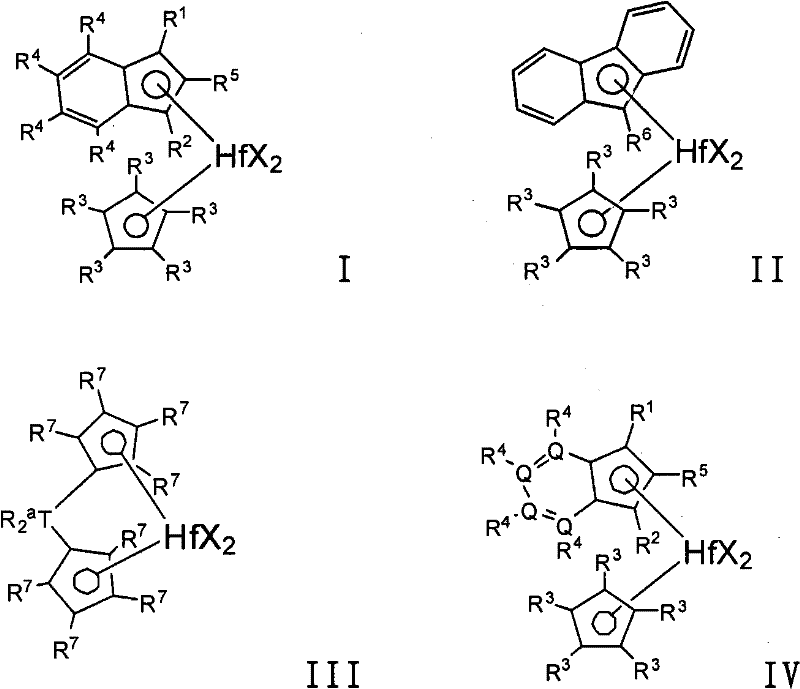
其中in
Hf是铪;Hf is hafnium;
每个X独立地选自下组:具有1-20个碳原子的烃基,氢,氨基,烷氧基,硫基(sulfides),磷基(phosphides),卤素,二烯,胺,膦,醚,或它们的组合,优选甲基,乙基,丙基,丁基,苯基,苄基,氯,溴,碘,(或者两个X可以形成稠合环或环体系的一部分);Each X is independently selected from the group consisting of hydrocarbons having 1-20 carbon atoms, hydrogen, amino, alkoxy, sulfides, phosphides, halogens, dienes, amines, phosphines, ethers , or combinations thereof, preferably methyl, ethyl, propyl, butyl, phenyl, benzyl, chlorine, bromine, iodine, (or two X's may form part of a fused ring or ring system);
每个Q独立地是碳或杂原子,优选C,N,P,S(优选至少一个Q是杂原子,或者至少两个Q是相同或不同的杂原子,或者至少三个Q是相同或不同的杂原子,或者至少四个Q是相同或不同的杂原子);Each Q is independently carbon or a heteroatom, preferably C, N, P, S (preferably at least one Q is a heteroatom, or at least two Q are the same or different heteroatoms, or at least three Q are the same or different heteroatoms, or at least four Q are the same or different heteroatoms);
每个R1独立地是氢或C1-C8烷基,优选C1-C8线性烷基,优选甲基,乙基,丙基,丁基,戊基,己基,庚基或辛基,R1可以与R2相同或不同;Each R is independently hydrogen or C1 - C8 alkyl, preferably C1 - C8 linear alkyl, preferably methyl, ethyl, propyl, butyl, pentyl, hexyl, heptyl or octyl , R 1 can be the same or different from R 2 ;
每个R2独立地是氢或C1-C8烷基,优选C1-C8线性烷基,优选甲基,乙基,丙基,丁基,戊基,己基,庚基或辛基,前提是R1或R2中至少之一不是氢,优选R1和R2都不是氢,优选R1和/或R2不是支化的;Each R2 is independently hydrogen or C1 - C8 alkyl, preferably C1 - C8 linear alkyl, preferably methyl, ethyl, propyl, butyl, pentyl, hexyl, heptyl or octyl , provided that at least one of R or R is not hydrogen, preferably neither R nor R is hydrogen, preferably R and /or R are not branched;
每个R3独立地是氢,或取代或未取代的具有1-8个碳原子、优选1-6个碳原子的烃基,优选取代或未取代的C1-C8线性烷基,优选甲基,乙基,丙基,丁基,戊基,己基,庚基,辛基,但是前提是至少三个R3基团不是氢(或者四个R3基团不是氢,或者五个R3基团不是氢);Each R 3 is independently hydrogen, or a substituted or unsubstituted hydrocarbon group having 1-8 carbon atoms, preferably 1-6 carbon atoms, preferably a substituted or unsubstituted C 1 -C 8 linear alkyl group, preferably methyl radical, ethyl, propyl, butyl, pentyl, hexyl, heptyl, octyl, but only if at least three R3 groups are not hydrogen (or four R3 groups are not hydrogen, or five R3 groups group is not hydrogen);
{或者,当所述催化剂化合物用于制备均聚低聚物时,那么每个R3独立地是氢,或取代或未取代的具有1-8个碳原子、优选1-6个碳原子的烃基,优选取代或未取代的C1-C8线性烷基,优选甲基,乙基,丙基,丁基,戊基,己基,庚基,辛基,但是前提是:1)所有五个R3基团是甲基,或2)四个R3基团不是氢,并且至少一个R3基团是C2-C8取代或未取代的烃基(优选至少两个,三个,四个或五个R3基团是C2-C8取代或未取代的烃基)};{Alternatively, when the catalyst compound is used to prepare homo-oligomers, each R3 is independently hydrogen, or substituted or unsubstituted with 1-8 carbon atoms, preferably 1-6 carbon atoms Hydrocarbyl, preferably substituted or unsubstituted C 1 -C 8 linear alkyl, preferably methyl, ethyl, propyl, butyl, pentyl, hexyl, heptyl, octyl, but only if: 1) all five R3 group is methyl, or 2) four R3 groups are not hydrogen, and at least one R3 group is C2 - C8 substituted or unsubstituted hydrocarbyl (preferably at least two, three, four Or five R 3 groups are C 2 -C 8 substituted or unsubstituted hydrocarbon groups)};
每个R4独立地是氢或取代或未取代的烃基,杂原子或含杂原子的基团,优选取代或未取代的具有1-20个碳原子、优选1-8个碳原子的烃基,优选取代或未取代的C1-C8线性烷基,优选甲基,乙基,丙基,丁基,戊基,己基,庚基,辛基,取代的苯基(例如丙基苯基),苯基,甲硅烷基,取代的甲硅烷基(例如CH2SiR′,其中R′是C1-C12烃基,例如甲基,乙基,丙基,丁基,苯基);Each R is independently hydrogen or a substituted or unsubstituted hydrocarbon group, a heteroatom or a heteroatom-containing group, preferably a substituted or unsubstituted hydrocarbon group having 1-20 carbon atoms, preferably 1-8 carbon atoms, Preferably substituted or unsubstituted C 1 -C 8 linear alkyl, preferably methyl, ethyl, propyl, butyl, pentyl, hexyl, heptyl, octyl, substituted phenyl (e.g. propylphenyl) , phenyl, silyl, substituted silyl (eg CH 2 SiR', wherein R' is a C 1 -C 12 hydrocarbon group, eg methyl, ethyl, propyl, butyl, phenyl);
R5是氢或C1-C8烷基,优选C1-C8线性烷基,优选甲基,乙基,丙基,丁基,戊基,己基,庚基或辛基; R is hydrogen or C 1 -C 8 alkyl, preferably C 1 -C 8 linear alkyl, preferably methyl, ethyl, propyl, butyl, pentyl, hexyl, heptyl or octyl;
R6是氢或C1-C8烷基,优选C1-C8线性烷基,优选甲基,乙基,丙基,丁基,戊基,己基,庚基或辛基; R is hydrogen or C 1 -C 8 alkyl, preferably C 1 -C 8 linear alkyl, preferably methyl, ethyl, propyl, butyl, pentyl, hexyl, heptyl or octyl;
每个R7独立地是氢,或C1-C8烷基,优选C1-C8线性烷基,优选甲基,乙基,丙基,丁基,戊基,己基,庚基或辛基,但是前提是至少七个R7基团不是氢,或者至少八个R7基团不是氢,或者所有R7基团不是氢,(优选地,在式IV的每个Cp环的3和4位上的R7基团不是氢);Each R is independently hydrogen, or C1 - C8 alkyl, preferably C1 - C8 linear alkyl, preferably methyl, ethyl, propyl, butyl, pentyl, hexyl, heptyl or octyl groups, but only if at least seven R7 groups are not hydrogen, or at least eight R7 groups are not hydrogen, or all R7 groups are not hydrogen, (preferably, 3 and The R group at position 4 is not hydrogen);
N是氮;N is nitrogen;
T是桥基,优选Si或Ge,优选Si;T is a bridging group, preferably Si or Ge, preferably Si;
每个Ra独立地是氢、卤素或C1-C20烃基,例如甲基,乙基,丙基,丁基,戊基,己基,庚基,辛基,苯基,苄基,取代的苯基,并且两个Ra可以形成环状结构,包括芳族的、部分饱和的或饱和的环状或稠合环体系;Each R is independently hydrogen, halogen or C1-C20 hydrocarbon group, such as methyl, ethyl, propyl, butyl, pentyl, hexyl, heptyl, octyl, phenyl, benzyl, substituted phenyl , and two R a can form a ring structure, including aromatic, partially saturated or saturated ring or fused ring system;
并且进一步的前提是任何两个相邻的R基团可以形成稠合环或多中心稠合环体系,其中所述环可以是芳族的、部分饱和的或饱和的。And a further premise is that any two adjacent R groups may form a fused ring or a multicenter fused ring system, wherein the rings may be aromatic, partially saturated or saturated.
术语“取代的”是指氢基已经被烃基、杂原子或含杂原子的基团替代。例如,甲基环戊二烯(Cp)是被甲基基团取代的Cp基团,和乙醇是被-OH基团取代的乙基基团。The term "substituted" means that a hydrogen group has been replaced by a hydrocarbyl group, a heteroatom or a heteroatom-containing group. For example, methylcyclopentadiene (Cp) is a Cp group substituted with a methyl group, and ethanol is an ethyl group substituted with a -OH group.
在一个备选的实施方案中,至少一个R4基团不是氢,或者至少两个R4基团不是氢,或者至少三个R4基团不是氢,或者至少四个R4基团不是氢,或者所有R4基团不是氢。In an alternative embodiment, at least one R group is not hydrogen, or at least two R groups are not hydrogen, or at least three R groups are not hydrogen, or at least four R groups are not hydrogen , or all R groups are not hydrogen.
特别有用的催化剂化合物包括以下化合物中的一种或多种:Particularly useful catalyst compounds include one or more of the following compounds:
(1,3-二甲基茚基)(五甲基环戊二烯基)合铪二甲基化物,(1,3-Dimethylindenyl)(pentamethylcyclopentadienyl)hafnium dimethyl compound,
(1,3,4,7-四甲基茚基)(五甲基环戊二烯基)合铪二甲基化物,(1,3,4,7-Tetramethylindenyl)(pentamethylcyclopentadienyl)hafnium dimethyl compound,
(1,3-二甲基茚基)(四甲基环戊二烯基)合铪二甲基化物,(1,3-Dimethylindenyl)(tetramethylcyclopentadienyl)hafnium dimethyl compound,
(1,3-二乙基茚基)(五甲基环戊二烯基)合铪二甲基化物,(1,3-Diethylindenyl)(pentamethylcyclopentadienyl)hafnium dimethyl compound,
(1,3-二丙基茚基)(五甲基环戊二烯基)合铪二甲基化物,(1,3-Dipropylindenyl)(pentamethylcyclopentadienyl)hafnium dimethyl compound,
(1-甲基-3-丙基茚基)(五甲基环戊二烯基)合铪二甲基化物,(1-Methyl-3-propylindenyl)(pentamethylcyclopentadienyl)hafnium dimethylate,
(1,3-二甲基茚基)(四甲基丙基环戊二烯基)合铪二甲基化物,(1,3-Dimethylindenyl)(tetramethylpropylcyclopentadienyl)hafnium dimethyl compound,
(1,2,3-三甲基茚基)(五甲基环戊二烯基)合铪二甲基化物,(1,2,3-Trimethylindenyl)(pentamethylcyclopentadienyl)hafnium dimethyl compound,
(1,3-二甲基苯并茚基)(五甲基环戊二烯基)合铪二甲基化物,(1,3-Dimethylbenzindenyl)(pentamethylcyclopentadienyl)hafnium dimethyl compound,
(2,7-二叔丁基芴基)(五甲基环戊二烯基)合铪二甲基化物,(2,7-Di-tert-butylfluorenyl)(pentamethylcyclopentadienyl)hafnium dimethyl compound,
(9-甲基芴基)(五甲基环戊二烯基)合铪二甲基化物,(9-Methylfluorenyl)(pentamethylcyclopentadienyl)hafnium dimethyl compound,
(2,7,9-三甲基芴基)(五甲基环戊二烯基)合铪二甲基化物,(2,7,9-trimethylfluorenyl)(pentamethylcyclopentadienyl)hafnium dimethyl compound,
μ-二氢甲硅烷基-双(四甲基环戊二烯基)合铪二甲基化物,μ-dihydrosilyl-bis(tetramethylcyclopentadienyl)hafnium dimethyl compound,
μ-二氢甲硅烷基-双(四甲基环戊二烯基)合铪二甲基化物,μ-dihydrosilyl-bis(tetramethylcyclopentadienyl)hafnium dimethyl compound,
μ-二甲基甲硅烷基(四甲基环戊二烯基)(3-丙基三甲基环戊二烯基)合铪二甲基化物,和μ-dimethylsilyl(tetramethylcyclopentadienyl)(3-propyltrimethylcyclopentadienyl)hafnium dimethylate, and
μ-二环丙基甲硅烷基双(四甲基环戊二烯基)合铪二甲基化物。μ-dicyclopropylsilyl bis(tetramethylcyclopentadienyl) hafnium dimethyl compound.
在一个备选的实施方案中,在上述催化剂化合物列表中所述过渡金属后面的“二甲基”被二卤(例如二氯或二氟)或二苯氧基替代,特别是在与铝氧烷活化剂一起使用时。In an alternative embodiment, the "dimethyl" after the transition metal in the above list of catalyst compounds is replaced by a dihalogen (such as dichloro or difluoro) or diphenoxy, especially in combination with aluminum oxide When used with alkanes activators.
活化剂activator
有用的活化剂包括铝氧烷和非配位阴离子活化剂,无论中性的或离子型的。实例包括烷基铝氧烷,如甲基铝氧烷、乙基铝氧烷、丁基铝氧烷、异丁基铝氧烷;改性的铝氧烷,如改性的烷基铝氧烷,包括改性的甲基铝氧烷等。还可以使用不同的铝氧烷和改性铝氧烷的混合物。铝氧烷可以通过水解相应的三烷基铝化合物来生产。MMAO可以通过水解三甲基铝和更高级的三烷基铝如三异丁基铝来生产。MMAO通常更可溶于脂肪族溶剂,并且在储存中更稳定。存在多种用于制备铝氧烷和改性铝氧烷的方法,其非限制性的实例被描述在美国专利号4,665,208、4,952,540、5,091,352、5,206,1995,204,419、4,874,734、4,924,018、4,908,463、4,968,827、5,308,815、5,329,032、5,248,801、5,235,081、5,157,137、5,103,031、5,391,793、5,391,529、5,693,838、5,731,253、5,731,451、5,744,656、5,847,177、5,854,166、5,856,256和5,939,346,以及欧洲公开EP-A-0561476、EP-B1-0279586、EP-A-0594-218和EP-B1-0586665,以及PCT公开WO 94/10180和WO 99/15534,所有这些文件通过引用全部结合到本文中。使用视觉上澄清的甲基铝氧烷可能是优选的。浑浊的或含凝胶的铝氧烷可以被过滤,以产生澄清的溶液,或者澄清的铝氧烷可以从所述浑浊的溶液中倾析出来。另一种有用的铝氧烷是3A型改性甲基铝氧烷(MMAO)助催化剂(可从Akzo Chemicals,Inc.以商品名3A型改性甲基铝氧烷商购得到,该产品被专利号US 5,041,584覆盖)。当活化剂是铝氧烷(改性的或未改性的)时,某些实施方案选择相对于催化剂前体(相对于金属催化位点)5000倍摩尔过量(A l/M)的最大的活化剂量。最小的活化剂与催化剂前体比通常是1∶1摩尔比。Useful activators include aluminoxanes and noncoordinating anionic activators, whether neutral or ionic. Examples include alkylalumoxanes such as methylalumoxane, ethylalumoxane, butylalumoxane, isobutylalumoxane; modified alumoxanes such as modified alkylalumoxanes , including modified methylalumoxane, etc. Mixtures of different alumoxanes and modified alumoxanes can also be used. Aluminoxanes can be produced by hydrolysis of the corresponding trialkylaluminum compounds. MMAO can be produced by hydrolysis of trimethylaluminum and higher trialkylaluminum such as triisobutylaluminum. MMAO is generally more soluble in aliphatic solvents and more stable in storage. There are a variety of methods for preparing aluminoxanes and modified alumoxanes, non-limiting examples of which are described in U.S. Pat. 5,308,815、5,329,032、5,248,801、5,235,081、5,157,137、5,103,031、5,391,793、5,391,529、5,693,838、5,731,253、5,731,451、5,744,656、5,847,177、5,854,166、5,856,256和5,939,346,以及欧洲公开EP-A-0561476、EP-B1-0279586、EP-A - 0594-218 and EP-B1-0586665, and PCT publications WO 94/10180 and WO 99/15534, all of which are incorporated herein by reference in their entirety. It may be preferable to use visually clear methylalumoxane. A cloudy or gel-containing alumoxane can be filtered to produce a clear solution, or the clear alumoxane can be decanted from the cloudy solution. Another useful aluminoxane is the modified methylalumoxane (MMAO) cocatalyst Type 3A (commercially available from Akzo Chemicals, Inc. under the tradename Modified Methylalumoxane Type 3A, which is Patent No. US 5,041,584 covered). When the activator is an aluminoxane (modified or unmodified), certain embodiments select a maximum Activating dose. The minimum activator to catalyst precursor ratio is usually a 1:1 molar ratio.
可以在本发明中用作活化剂(或清除剂)的烷基铝或有机铝化合物包括三甲基铝、三乙基铝、三异丁基铝、三正己基铝、三正辛基铝等。如果用作清除剂,它们一般以10∶1至100∶1摩尔:摩尔的比例存在。Alkylaluminum or organoaluminum compounds that can be used as activators (or scavengers) in the present invention include trimethylaluminum, triethylaluminum, triisobutylaluminum, tri-n-hexylaluminum, tri-n-octylaluminum, etc. . If used as scavengers, they are generally present in a 10:1 to 100:1 mole:mole ratio.
在另一个实施方案中,所述活化剂可以是中性或离子型的离子化或按化学计量比的活化剂,例如三正丁基铵四(五氟苯基)硼酸盐,三全氟苯基硼类金属前体或三全氟萘基硼类金属前体,多卤化杂硼烷阴离子(WO 98/43983),硼酸(美国专利号5,942,459)或它们的组合。单独使用或与铝氧烷或改性铝氧烷活化剂组合使用中性或离子型活化剂也在本发明的范围内。In another embodiment, the activator may be a neutral or ionic ionizing or stoichiometric activator such as tri-n-butylammonium tetrakis(pentafluorophenyl) borate, triperfluoro Phenyl boron metal precursors or trisperfluoronaphthyl boron metal precursors, polyhalogenated borazine anions (WO 98/43983), boronic acid (US Patent No. 5,942,459), or combinations thereof. It is also within the scope of this invention to use neutral or ionic activators alone or in combination with alumoxane or modified alumoxane activators.
中性的按化学计量比的活化剂的实例包括三取代的硼、碲、铝、镓和铟或它们的混合物。所述三个取代基各自独立地选自烷基,烯基,卤素,取代的烷基,芳基,芳基卤,烷氧基和卤化物。优选地,所述三个基团独立地选自卤素,单或多环(包括卤代的)芳基,烷基,和烯基化合物,和它们的混合物,优选的是具有1-20个碳原子的烯基,具有1-20个碳原子的烷基,具有1-20个碳原子的烷氧基和具有3-20个碳原子的芳基(包括取代的芳基)。更优选地,所述三个基团是具有1-4碳基团的烷基,苯基,萘基或它们的混合物。甚至更优选地,所述三个基团是卤代的(优选氟代的)芳基。最优选地,所述中性的按化学计量比的活化剂是三全氟苯基硼或三全氟萘基硼。Examples of neutral stoichiometric activators include trisubstituted boron, tellurium, aluminum, gallium and indium or mixtures thereof. The three substituents are each independently selected from the group consisting of alkyl, alkenyl, halogen, substituted alkyl, aryl, arylhalide, alkoxy and halide. Preferably, the three groups are independently selected from halogen, mono- or polycyclic (including halogenated) aryl, alkyl, and alkenyl compounds, and mixtures thereof, preferably having 1-20 carbons atomic alkenyl, alkyl having 1 to 20 carbon atoms, alkoxy having 1 to 20 carbon atoms, and aryl (including substituted aryl) having 3 to 20 carbon atoms. More preferably, the three groups are alkyl groups with 1-4 carbon groups, phenyl, naphthyl or mixtures thereof. Even more preferably, said three groups are halogenated (preferably fluorinated) aryl groups. Most preferably, the neutral stoichiometric activator is trisperfluorophenylboron or trisperfluoronaphthylboron.
离子型的按化学计量比的活化剂化合物可以含有活泼质子,或与所述离子化化合物的其余离子缔合但没有配位到或仅松散地配位到所述离子化化合物的其余离子的某些其它阳离子。这样的化合物等被描述在欧洲出版物EP-A-0570982,EP-A-0520732,EP-A-0495375,EP-B1-0500944,EP-A-0277003和EP-A-0277004,和美国专利号5,153,157,5,198,401,5,066,741,5,206,197,5,241,025,5,384,299和5,502,124,和1994年8月3日提交的美国专利申请序列号08/285,380中,它们都通过引用全部结合到本文中。Ionic stoichiometric activator compounds may contain active protons, or some species associated with, but not coordinated to, or only loosely coordinated to, the remaining ions of the ionizing compound. some other cations. Such compounds etc. are described in European publications EP-A-0570982, EP-A-0520732, EP-A-0495375, EP-B1-0500944, EP-A-0277003 and EP-A-0277004, and U.S. Patent No. 5,153,157, 5,198,401, 5,066,741, 5,206,197, 5,241,025, 5,384,299, and 5,502,124, and US Patent Application Serial No. 08/285,380, filed August 3, 1994, all of which are incorporated herein by reference in their entirety.
离子催化剂可以通过使过渡金属化合物与某些中性路易斯酸如B(C6F6)3反应制备,所述中性路易斯酸在与过渡金属化合物的可水解的配体(X)反应时形成阴离子,例如([B(C6F5)3(X)]-),该阴离子使通过所述反应产生的阳离子过渡金属物种稳定。所述催化剂可以并且优选用活化剂组分(其是离子化合物或组合物)来制备。然而,本发明也想到了采用中性化合物的活化剂制备。Ionic catalysts can be prepared by reacting a transition metal compound with certain neutral Lewis acids, such as B( C6F6 ) 3 , which form upon reaction with the hydrolyzable ligand (X) of the transition metal compound An anion, such as ([B(C 6 F 5 ) 3 (X)] − ), which stabilizes the cationic transition metal species produced by the reaction. The catalyst can and is preferably prepared with an activator component which is an ionic compound or composition. However, activator preparations employing neutral compounds are also contemplated by the present invention.
可在本发明方法中使用的所述离子催化剂体系的制备中用作活化剂组分的化合物包含阳离子(其优选是能够给出质子的布朗斯台德酸)和相容的非配位阴离子,该阴离子是相对大(大体积)的,能够稳定当所述两种化合物结合在一起时形成的活性催化剂物种(第4族阳离子),并且所述阴离子将是足够不稳定的以被烯属、二烯属和炔属不饱和底物或其它中性路易斯碱如醚、腈等置换。两类相容的非配位阴离子已经被公开在1988年出版的EPA 277,003和EPA 277,004中:1)阴离子配位络合物,其包含多个共价键配位到并屏蔽中心带电荷金属或类金属核的亲脂基团,和2)包含多个硼原子的阴离子,例如碳硼烷,金属碳硼烷和硼烷。Compounds which can be used as activator components in the preparation of the ionic catalyst system used in the process of the invention comprise a cation, which is preferably a Bronsted acid capable of donating a proton, and a compatible non-coordinating anion, This anion is relatively bulky (bulky), capable of stabilizing the active catalyst species (Group 4 cation) that forms when the two compounds are brought together, and the anion will be unstable enough to be destabilized by olefinic, Displacement with dienically and acetylenically unsaturated substrates or with other neutral Lewis bases such as ether, nitrile, etc. Two classes of compatible noncoordinating anions have been disclosed in EPA 277,003 and EPA 277,004, published in 1988: 1) Anionic coordination complexes, which contain multiple covalent bonds to coordinate to and shield a centrally charged metal or lipophilic groups of metalloid cores, and 2) anions containing multiple boron atoms, such as carboranes, metallocarboranes, and boranes.
在一个优选的实施方案中,所述按化学计量比的活化剂包括阳离子和阴离子组分,并且可以由下式表示:In a preferred embodiment, the stoichiometric activator includes cationic and anionic components and can be represented by the formula:
(L-H)d +(Ad-)(LH) d + (A d- )
其中L是中性的路易斯碱;H是氢;(L-H)+是布朗斯台德酸;Ad-是具有电荷d-的非配位阴离子;和d是整数1,2或3。where L is a neutral Lewis base; H is hydrogen; (LH) + is a Bronsted acid; A d- is a non-coordinating anion with charge d-;
所述阳离子组分(L-H)d +可以包括布朗斯台德酸,例如质子或质子化的路易斯碱或可还原的路易斯酸,其能够质子化或夺取来自所述含过渡金属的大体积配体金属茂催化剂前体的结构部分,如烷基或芳基,产生阳离子过渡金属物种。The cationic component (LH) d + may comprise a Bronsted acid, such as a protonated or protonated Lewis base or a reducible Lewis acid, which is capable of protonating or abstracting from the transition metal-containing bulky ligand Structural moieties of metallocene catalyst precursors, such as alkyl or aryl groups, generate cationic transition metal species.
所述活化阳离子(L-H)d +可以是能够给予所述过渡金属催化前体质子而导致过渡金属阳离子的布朗斯台德酸,包括铵,氧鎓,鏻,甲硅鎓,和它们的混合物,优选甲基胺、苯胺、二甲基胺、二乙基胺、N-甲基苯胺、二苯基胺、三甲基胺、三乙基胺、N,N-二甲基苯胺、甲基二苯基胺、吡啶、p-溴-N,N-二甲基苯胺、p-硝基-N,N-二甲基苯胺的铵,得自三乙基膦、三苯基膦和二苯基膦的鏻,得自醚如二甲基醚、二乙基醚、四氢呋喃和二噁烷的氧鎓,得自硫醚如二乙基硫醚和四氢噻吩的锍,和它们的混合物。所述活化阳离子(L-H)d +还可以是结构部分,例如银、
所述阴离子组分Ad-包括具有式[Mk+Qn]d-的那些,其中k是1-3的整数;n是2,3,4,5或6;n-k=d;M是选自元素周期表第13族的元素,优选硼或铝;和Q独立地是氢负离子,桥接或未桥接的二烷基氨负离子,卤离子,烷氧负离子,芳氧负离子,烃基,取代的烃基,卤化碳基(halocarbyl),取代的卤化碳基,和卤素取代的烃基,所述Q最高具有20个碳原子,前提是Q是卤离子的情况不超过1次。优选地,每个Q是氟代的具有1-20个碳原子的烃基,更优选每个Q是氟代的芳基,最优选每个Q是五氟代芳基。合适的Ad-的实例还包括二硼化合物,如美国专利号5,447,895中公开的,所述美国专利通过引用全部结合在本文中。The anionic component A d- includes those having the formula [M k+ Q n ] d- , wherein k is an integer from 1 to 3; n is 2, 3, 4, 5 or 6; nk=d; M is selected An element from Group 13 of the Periodic Table of the Elements, preferably boron or aluminum; and Q is independently a hydride, bridged or unbridged dialkylammonium, halide, alkoxide, aryloxide, hydrocarbyl, substituted hydrocarbyl , halocarbyl, substituted halocarbyl, and halogen-substituted hydrocarbyl, said Q having up to 20 carbon atoms, provided that Q is a halo ion not more than once. Preferably, each Q is a fluorinated hydrocarbon group having 1-20 carbon atoms, more preferably each Q is a fluorinated aryl group, most preferably each Q is a pentafluoroaryl group. Examples of suitable Ad- also include diboron compounds as disclosed in US Patent No. 5,447,895, which is incorporated herein by reference in its entirety.
有用的活化剂的实例包括:N,N-二甲基苯胺鎓四(全氟苯基)硼酸盐,N,N-二甲基苯胺鎓四(全氟萘基)硼酸盐,N,N-二甲基苯胺鎓四(全氟联苯基)硼酸盐,N,N-二甲基苯胺鎓四(3,5-双(三氟甲基)苯基)硼酸盐,三苯基碳鎓四(全氟萘基)硼酸盐,三苯基碳鎓四(全氟联苯基)硼酸盐,三苯基碳鎓四(3,5-双(三氟甲基)苯基)硼酸盐,和三苯基碳鎓四(全氟苯基)硼酸盐。Examples of useful activators include: N,N-dimethylanilinium tetrakis(perfluorophenyl)borate, N,N-dimethylanilinium tetrakis(perfluoronaphthyl)borate, N, N-dimethylanilinium tetrakis(perfluorobiphenyl)borate, N,N-dimethylanilinium tetrakis(3,5-bis(trifluoromethyl)phenyl)borate, triphenyl Triphenylcarbenium tetrakis(perfluoronaphthyl)borate, triphenylcarbenium tetrakis(perfluorobiphenyl)borate, triphenylcarbenium tetrakis(3,5-bis(trifluoromethyl)benzene base) borate, and triphenylcarbenium tetrakis (perfluorophenyl) borate.
术语“非配位阴离子”(NCA)是指阴离子,其不配位于所述阳离子或者其仅弱配位于所述阳离子,由此保持是足够不稳定的以被中性路易斯碱置换。“相容的”非配位阴离子是当初始形成的络合物分解时不降解至中性的那些阴离子。另外,所述阴离子不会转移阴离子取代基或片断给阳离子以使其形成中性的四配位金属茂化合物和来自所述阴离子的中性副产物。按照本发明,有用的非配位阴离子是那些非配位阴离子,它们是相容的,在平衡金属茂阳离子的+1离子电荷的意义上稳定金属茂阳离子,但保持足够的不稳定性以允许在聚合过程中被烯属或炔属不饱和单体置换。这些类型的助催化剂有时使用三异丁基铝或者三辛基铝作为清除剂。The term "non-coordinating anion" (NCA) refers to an anion which does not coordinate to the cation or which only weakly coordinates to the cation, thereby remaining sufficiently unstable to be displaced by a neutral Lewis base. "Compatible" non-coordinating anions are those anions that do not degrade to neutrality when the initially formed complex decomposes. In addition, the anion does not transfer an anionic substituent or moiety to the cation to form a neutral tetracoordinate metallocene compound and neutral by-products from the anion. According to the invention, useful noncoordinating anions are those noncoordinating anions that are compatible, stabilize the metallocene cation in the sense of balancing the +1 ionic charge of the metallocene cation, but remain sufficiently unstable to allow Displaced by ethylenically or acetylenically unsaturated monomers during polymerization. These types of cocatalysts sometimes use triisobutylaluminum or trioctylaluminum as a scavenger.
发明方法还可以采用最初是中性路易斯酸但在与本发明化合物反应后形成阳离子金属络合物和非配位阴离子或两性离子络合物的助催化剂化合物或活化剂化合物。例如,三(五氟苯基)硼或铝能够夺取烃基或氢配体,以产生发明的阳离子金属络合物和稳定化非配位阴离子,类似的第4族金属茂化合物的举例说明参见EP-A 0427697和EP-A 0520732。还有,参见EP-A 0495375的方法和化合物。关于使用类似的第4族化合物形成两性离子络合物,参见美国专利5,624,878;5,486,632;和5,527,929。The inventive process may also employ cocatalyst compounds or activator compounds which are initially neutral Lewis acids but form cationic metal complexes and noncoordinating anionic or zwitterionic complexes upon reaction with the compounds of the invention. For example, tris(pentafluorophenyl)boron or aluminum can abstract hydrocarbyl or hydrogen ligands to produce inventive cationic metal complexes and stabilized non-coordinating anions, similar Group 4 metallocene compounds are illustrated in EP -A 0427697 and EP-A 0520732. Also, see the methods and compounds of EP-A 0495375. See US Patents 5,624,878; 5,486,632; and 5,527,929 for the use of similar Group 4 compounds to form zwitterionic complexes.
当非配位阴离子前体的阳离子是布朗斯台德酸如质子或质子化的路易斯碱(水除外),或者可还原的路易斯酸如二茂铁离子或银阳离子,或者碱或碱土金属阳离子如钠、镁或锂的那些阳离子时,催化剂前体与活化剂的摩尔比可以是任意比例。上述活化剂化合物的组合也可以被用于活化。例如,三(全氟苯基)硼可以与甲基铝氧烷一起使用。When the cation of the non-coordinating anion precursor is a Bronsted acid such as a proton or a protonated Lewis base (except water), or a reducible Lewis acid such as a ferrocene or silver cation, or an alkali or alkaline earth metal cation such as For those cations of sodium, magnesium or lithium, the molar ratio of catalyst precursor to activator can be any ratio. Combinations of the above activator compounds may also be used for activation. For example, tris(perfluorophenyl)boron can be used with methylaluminoxane.
通常,将催化剂化合物和活化剂以约1∶10,000-约10∶1的比例结合。当使用铝氧烷或烷基铝活化剂时,催化剂与活化剂摩尔比可以为1∶5000-10∶1,或者1∶1000-10∶1,或者1∶500-2∶1,或者1∶300-1∶1。当使用离子化活化剂时,催化剂与活化剂摩尔比为10∶1-1∶10;5∶1-1∶5;2∶1-1∶2;或者1.2∶1-1∶1。可以使用多种活化剂,包括使用铝氧烷或烷基铝与离子化活化剂的混合物。Typically, the catalyst compound and activator are combined in a ratio of about 1:10,000 to about 10:1. When using aluminoxane or alkylaluminum activators, the catalyst to activator molar ratio can be 1:5000-10:1, or 1:1000-10:1, or 1:500-2:1, or 1:500-2:1 300-1:1. When an ionizing activator is used, the molar ratio of catalyst to activator is 10:1-1:10; 5:1-1:5; 2:1-1:2; or 1.2:1-1:1. A variety of activators can be used, including the use of alumoxanes or mixtures of aluminum alkyls with ionizing activators.
在一个备选的实施方案中,可以将其它添加剂如二乙基锌与所述催化剂化合物和活化剂组合使用。In an alternative embodiment, other additives such as diethylzinc may be used in combination with the catalyst compound and activator.
制备大分子单体的聚合方法Polymerization process for preparing macromonomers
上面所描述的催化剂和催化剂体系可以被用来在溶液、本体、气相或淤浆聚合方法或其组合,优选溶液相(优选连续溶液相)聚合方法中生产大分子单体。(为方便起见,这里描述的方法将被称作聚合,尽管它们可以生产低聚物)。还可以使用超临界方法,优选使用在所生产的大分子单体的熔点以上进行的超临界方法,优选使用在聚合体系的浑浊点以上进行的超临界方法。关于超临界方法的细节的更多信息(包括混浊点和聚合体系的定义),请参见WO 2004/026921。在另一个实施方案中,可以使用US 7,432,336(通过引用结合在本文中)中公开的方法。例如,连续聚合可以在配有搅拌器、蒸汽加热/水冷却装置和压力控制器的不锈钢连续高压釜反应器中进行。一般首先将溶剂、大分子单体和共聚单体(如果有的话)冷却到-15℃,然后使其进入歧管,并且然后泵入反应器。将预先活化的催化剂溶液从干燥箱通过在另外的管线中的计量泵进料到所述反应器中。将溶剂(如己烷)以希望的速度泵入所述反应器以控制停留时间。The catalysts and catalyst systems described above can be used to produce macromers in solution, bulk, gas phase or slurry polymerization processes or combinations thereof, preferably solution phase (preferably continuous solution phase) polymerization processes. (For convenience, the methods described here will be referred to as polymerizations, although they can produce oligomers). It is also possible to use a supercritical method, preferably a supercritical method carried out above the melting point of the macromonomer produced, preferably a supercritical method carried out above the cloud point of the polymerization system. See WO 2004/026921 for more information on the details of the supercritical process, including cloud point and definition of polymerization systems. In another embodiment, the method disclosed in US 7,432,336 (incorporated herein by reference) can be used. For example, continuous polymerization can be carried out in a stainless steel continuous autoclave reactor equipped with agitator, steam heating/water cooling and pressure controllers. Typically the solvent, macromer and comonomer (if any) are cooled to -15°C first, then allowed to enter the manifold, and then pumped into the reactor. The preactivated catalyst solution was fed into the reactor from a dry box by a metering pump in a separate line. Solvent, such as hexane, is pumped into the reactor at a desired rate to control residence time.
在一个实施方案中,本文中描述的催化剂体系可以与一种或多种具有2-30个碳原子、优选2-12个碳原子、更优选2-8个碳原子的单体一起在一个或多个串联或并联的反应器中使用,以生产本文中所述的大分子单体。(优选的单体包括乙烯、丙烯、丁烯-1、戊烯-1、4-甲基-戊烯-1、己烯-1、辛烯-1、癸烯-1、4-甲基-戊烯-1、3-甲基-戊烯-1或其组合中的一种或多种。)可以将催化剂组分和活化剂以溶液或淤浆的形式分开供给到反应器中,或者可以将催化剂组分和活化剂在线活化并且然后马上进料到反应器中,或者可以将催化剂组分和活化剂预活化并以活化的溶液或淤浆的形式泵送到反应器中。聚合在单个反应器操作中进行,其中将单体、共聚单体、催化剂/活化剂、清除剂和任选的改性剂连续加入单个反应器中;或者聚合在串联的反应器操作中进行,其中将上述组分加入串联连接的两个或更多个反应器中的每一个。可以将催化剂组分加入串联的第一个反应器中。还可以将催化剂组分加入两个反应器中,其中一种组分加入第一个反应,并且另一种组分加入其它反应器中。典型地,所述聚合在30-150℃,优选35-120℃,优选40-100℃,或者40-150℃,或者45-120℃,或者50-100℃的温度下进行。典型地,所述聚合在1秒-3小时,优选1分钟-90分钟,优选1分钟-30分钟,优选1分钟-15分钟的停留时间条件下进行。In one embodiment, the catalyst systems described herein may be combined with one or more monomers having 2-30 carbon atoms, preferably 2-12 carbon atoms, more preferably 2-8 carbon atoms, in one or more Multiple reactors in series or in parallel are used to produce the macromers described herein. (Preferred monomers include ethylene, propylene, butene-1, pentene-1, 4-methyl-pentene-1, hexene-1, octene-1, decene-1, 4-methyl- One or more of pentene-1, 3-methyl-pentene-1, or combinations thereof.) The catalyst component and activator can be fed separately to the reactor in the form of a solution or slurry, or can be The catalyst components and activator are activated in-line and then fed into the reactor immediately, or the catalyst components and activator can be preactivated and pumped into the reactor as an activated solution or slurry. the polymerization is carried out in a single reactor operation, wherein the monomer, comonomer, catalyst/activator, scavenger and optional modifier are continuously added to a single reactor; or the polymerization is carried out in a series of reactor operations, wherein the above components are fed into each of two or more reactors connected in series. Catalyst components may be added to the first reactor in series. It is also possible to feed the catalyst components into two reactors, where one component is fed to the first reaction and the other component is fed to the other reactor. Typically, the polymerisation is carried out at a temperature of 30-150°C, preferably 35-120°C, preferably 40-100°C, alternatively 40-150°C, alternatively 45-120°C, alternatively 50-100°C. Typically, the polymerization is carried out at a residence time of 1 second to 3 hours, preferably 1 minute to 90 minutes, preferably 1 minute to 30 minutes, preferably 1 minute to 15 minutes.
所述聚合可以在气相中进行,例如在用于生产聚合物的气相流化床工艺中进行,其中使包含一种或多种单体的气体物流在催化剂存在下在反应性条件下通过流化床连续循环。所述气体物流被从所述流化床取出并再循环回所述反应器。同时,将聚合物产物从所述反应器取出,并且将新鲜的单体加入以代替聚合的单体。(参见例如美国专利号4,543,399、4,588,790、5,028,670、5,317,036、5,352,749、5,405,922、5,436,304、5,453,471、5,462,999、5,616,661和5,668,228,它们都通过引用全部结合到本文中。)The polymerisation may be carried out in the gas phase, for example in a gas phase fluidized bed process for the production of polymers, in which a gaseous stream comprising one or more monomers is passed through the fluidized bed under reactive conditions in the presence of a catalyst. The bed is continuously cycled. The gas stream is withdrawn from the fluidized bed and recycled back to the reactor. Simultaneously, polymer product is withdrawn from the reactor, and fresh monomer is added to replace polymerized monomer. (See, eg, U.S. Patent Nos. 4,543,399, 4,588,790, 5,028,670, 5,317,036, 5,352,749, 5,405,922, 5,436,304, 5,453,471, 5,462,999, 5,616,661, and 5,668,228, all of which are incorporated by reference in their entirety.)
在某些情况下,在本发明中还可以使用淤浆相聚合体系。淤浆聚合方法通常在1-约50个大气压范围内(15psi-735psi,103kPa-5068kPa)或者甚至更大的压力下和在0℃-约120℃范围内的温度下操作。在淤浆聚合中,固体颗粒聚合物的悬浮体在液体聚合稀释介质中形成,单体和共聚单体以及催化剂被加入到所述液体聚合稀释介质中。从反应器中间歇地或连续地除去包括稀释剂的悬浮体,其中将挥发性组分与聚合物分离,并且任选在蒸馏之后,将挥发性组分循环回所述反应器。在聚合介质中使用的液体稀释剂一般是具有3-7个碳原子的烷烃,优选支化烷烃。所用的介质在聚合条件下应当是液体且相对惰性的。当使用丙烷介质时,所述方法必须在反应稀释剂临界温度和压力以上操作。优选地,使用己烷或异丁烷介质。In some cases, slurry phase polymerization systems can also be used in the present invention. Slurry polymerization processes typically operate at pressures ranging from 1 to about 50 atmospheres (15 psi to 735 psi, 103 kPa to 5068 kPa) or even greater and at temperatures ranging from 0°C to about 120°C. In slurry polymerization, a suspension of solid particulate polymer is formed in a liquid polymerization diluent medium to which monomer and comonomer and catalyst are added. The suspension including the diluent is intermittently or continuously removed from the reactor, wherein the volatile components are separated from the polymer, and the volatile components are recycled back to the reactor, optionally after distillation. The liquid diluents used in the polymerization medium are generally alkanes having 3 to 7 carbon atoms, preferably branched alkanes. The medium employed should be liquid and relatively inert under the conditions of the polymerization. When a propane medium is used, the process must be operated above the critical temperature and pressure of the reaction diluent. Preferably, a hexane or isobutane medium is used.
在一个实施方案中,可用于本发明的优选的聚合技术被称作颗粒形式聚合或淤浆法,其中将温度保持在聚合物变成溶液的温度以下。这样的技术在本领域是公知的,并且被描述在例如美国专利号3,248,179中,通过引用将其完全结合在本文中。在颗粒形式方法中的优选温度在约85℃-约110℃的范围内。对于淤浆法,两种优选的聚合方法是采用环管反应器的那些和采用多个串联、并联或其组合的搅拌反应器的那些。淤浆法的非限制性实例包括连续环管或搅拌釜方法。此外,淤浆法的其它实例被描述在美国专利号4,613,484中,通过引用将其完全结合在本文中。In one embodiment, the preferred polymerization technique that can be used in the present invention is called particle form polymerization or slurry process in which the temperature is maintained below the temperature at which the polymer becomes a solution. Such techniques are well known in the art and are described, for example, in US Patent No. 3,248,179, which is fully incorporated herein by reference. Preferred temperatures in the granular form process are in the range of about 85°C to about 110°C. For the slurry process, two preferred polymerization processes are those employing a loop reactor and those employing multiple stirred reactors in series, parallel or a combination thereof. Non-limiting examples of slurry processes include continuous loop or stirred tank processes. Additionally, other examples of slurry processes are described in US Pat. No. 4,613,484, which is fully incorporated herein by reference.
在另一个实施方案中,所述淤浆法在环管反应器中连续进行。将催化剂以在异丁烷中的淤浆的形式或以干燥的自由流动粉末的形式定期地注入反应器环管,该反应器环管本身充满生长的聚合物颗粒在含有单体和共聚单体的异丁烷稀释剂中的循环淤浆。任选地,可添加氢作为分子量控制剂。(在一个实施方案中,添加500ppm或更少的氢,或400ppm或更少的氢,或300ppm或更少的氢。在其它实施方案中,添加至少50ppm的氢,或100ppm或更多的氢,或150ppm或更多的氢)。In another embodiment, the slurry process is carried out continuously in a loop reactor. The catalyst is injected periodically as a slurry in isobutane or as a dry free-flowing powder into a reactor loop which is itself filled with growing polymer particles in a mixture containing monomer and comonomer circulating slurry in isobutane diluent. Optionally, hydrogen can be added as a molecular weight control agent. (In one embodiment, 500 ppm or less of hydrogen is added, or 400 ppm or less of hydrogen, or 300 ppm or less of hydrogen. In other embodiments, at least 50 ppm of hydrogen is added, or 100 ppm or more of hydrogen , or 150ppm or more of hydrogen).
在本发明中还可以使用均相(溶液或本体)间歇或连续法。通常,这涉及在连续反应器中的聚合,在该连续反应器中形成的聚合物和供给的起始单体和催化剂材料被搅拌以减少或避免浓度梯度。合适的方法在高于聚合物熔点的温度、在1-3000巴(10-30,000MPa)的高压下操作,其中单体起到稀释剂的作用,或者在溶液聚合中使用溶剂。反应器温度取决于所使用的催化剂。通常,反应器温度优选可以在约30℃和约160℃之间,更优选在约40℃-约120℃的范围内,最优选在约50℃-约110℃的范围内。在并联反应器操作中,两个反应器的温度是独立的。压力可以在约1mmHg-2500巴(25,000MPa)的范围内,优选在0.1巴-1600巴(1-16,000MPa)的范围内,最优选在1.0-500巴(10-5000MPa)的范围内。Homogeneous (solution or bulk) batch or continuous processes may also be used in the present invention. Typically, this involves polymerization in a continuous reactor in which the polymer formed and the feed of starting monomer and catalyst material are agitated to reduce or avoid concentration gradients. Suitable processes operate at temperatures above the melting point of the polymer, at elevated pressures of 1-3000 bar (10-30,000 MPa), with the monomer acting as diluent, or in solution polymerization using a solvent. The reactor temperature depends on the catalyst used. Typically, the reactor temperature may preferably be between about 30°C and about 160°C, more preferably in the range of about 40°C to about 120°C, most preferably in the range of about 50°C to about 110°C. In parallel reactor operation, the temperatures of the two reactors are independent. The pressure may be in the range of about 1 mmHg-2500 bar (25,000 MPa), preferably in the range of 0.1 bar-1600 bar (1-16,000 MPa), most preferably in the range of 1.0-500 bar (10-5000 MPa).
这些方法的每一种还可以在单个反应器、并联或串联的反应器结构中以间歇或连续模式使用。所述液体方法包括使烯烃单体与上述催化剂体系在合适的稀释剂或溶剂中接触,并允许所述单体反应足以产生希望的聚合物的时间。脂肪族和芳香族的烃溶剂是合适的。烷烃如己烷、戊烷、异戊烷和辛烷是优选的。Each of these processes can also be used in batch or continuous mode in a single reactor, in parallel or in series reactor configurations. The liquid process involves contacting the olefin monomer with the catalyst system described above in a suitable diluent or solvent and allowing the monomer to react for a time sufficient to produce the desired polymer. Aliphatic and aromatic hydrocarbon solvents are suitable. Alkanes such as hexane, pentane, isopentane and octane are preferred.
所述方法可以在连续搅拌釜反应器、间歇反应器或活塞流反应器中,或在串联或并联运行的超过一个的反应器中进行。这些反应器可以具有或不具有内部冷却或加热,并且单体进料可以被冷冻或不被冷冻。关于通用的工艺条件参见美国专利5,001,205的一般公开内容。还参见国际申请WO 96/33227和WO 97/22639。所有文件通过引用结合在本文中,为了US的目的并且为了描述聚合方法、金属茂选择和有用的清除化合物。The process can be carried out in continuous stirred tank reactors, batch reactors or plug flow reactors, or in more than one reactor operated in series or in parallel. These reactors may or may not have internal cooling or heating, and the monomer feed may or may not be chilled. See the general disclosure of US Patent 5,001,205 for general process conditions. See also International Applications WO 96/33227 and WO 97/22639. All documents are incorporated herein by reference for US purposes and for describing polymerization methods, metallocene selection and useful scavenging compounds.
关于生产低聚物i)-vi)的方法的更多信息请参见于2008年6月20日提交的US SN 12/143,663。For more information on methods of producing oligomers i)-vi), see US SN 12/143,663, filed June 20, 2008.
在一个优选的实施方案中,低聚物i)-vi)的丙烯共聚低聚物可以通过均相方法制备,所述方法具有至少4.5x10³g/mmol/hr的生产率,其中所述方法包括:在35℃-150℃的温度下,使丙烯、0.1至70mol%的乙烯和0至约5wt%的氢在催化剂体系存在下接触,所述催化剂体系包含活化剂和至少一种由上面式I、II、III或IV表示的金属茂化合物,其中:Hf是铪;每个X独立地选自下组:具有1-20个碳原子的烃基,氢,氨基,烷氧基,硫基,磷基,卤素,二烯,胺,膦,醚,或它们的组合,优选甲基,乙基,丙基,丁基,苯基,苄基,氯,溴,碘,(或者两个X可以形成稠合环或环体系的一部分);每个Q独立地是碳或杂原子,优选C,N,P,S(优选至少一个Q是杂原子,或者至少两个Q是相同或不同的杂原子,或者至少三个Q是相同或不同的杂原子,或者至少四个Q是相同或不同的杂原子);每个R1独立地是C1-C 8烷基,优选C1-C8线性烷基,优选甲基,乙基,丙基,丁基,戊基,己基,庚基或辛基,R1可以与R2相同或不同;每个R2独立地是C1-C8烷基,优选C1-C8线性烷基,优选甲基,乙基,丙基,丁基,戊基,己基,庚基或辛基,优选R1和/或R2不是支化的;每个R3独立地是氢,或取代或未取代的具有1-8个碳原子、优选1-6个碳原子的烃基,优选取代或未取代的C1-C8线性烷基,优选甲基,乙基,丙基,丁基,戊基,己基,庚基,辛基,但是前提是至少三个R3基团不是氢(或者四个R3基团不是氢,或者五个R3基团不是氢);每个R4独立地是氢或取代或未取代的烃基,杂原子或含杂原子的基团,优选取代或未取代的具有1-20个碳原子、优选1-8个碳原子的烃基,优选取代或未取代的C1-C8线性烷基,优选甲基,乙基,丙基,丁基,戊基,己基,庚基,辛基,取代的苯基(例如丙基苯基),苯基,甲硅烷基,取代的甲硅烷基(例如CH2SiR′,其中R′是C1-C12烃基,例如甲基,乙基,丙基,丁基,苯基);R5是氢或C1-C8烷基,优选C1-C8线性烷基,优选甲基,乙基,丙基,丁基,戊基,己基,庚基或辛基;R6是氢或C1-C8烷基,优选C1-C8线性烷基,优选甲基,乙基,丙基,丁基,戊基,己基,庚基或辛基;每个R7独立地是氢,或C1-C8烷基,优选C1-C8线性烷基,优选甲基,乙基,丙基,丁基,戊基,己基,庚基或辛基,但是前提是至少七个R7基团不是氢,或者至少八个R7基团不是氢,或者所有R7基团不是氢,(优选地,在式IV的每个Cp环的3和4位上的所述R7基团不是氢);N是氮;T是桥基,优选Si或Ge,优选Si;每个Ra独立地是氢,卤素或C1-C20烃基,例如甲基,乙基,丙基,丁基,戊基,己基,庚基,辛基,苯基,苄基,取代的苯基,并且两个Ra可以形成环状结构,包括芳族的、部分饱和的或饱和的环状或稠合环体系;并且进一步的前提是任何两个相邻的R基团可以形成稠合环或多中心稠合环体系,其中所述环可以是芳族的、部分饱和的或饱和的。In a preferred embodiment, the propylene co-oligomers of oligomers i)-vi) may be prepared by a homogeneous process having a productivity of at least 4.5x10³ g/mmol/hr, wherein said process comprises : At a temperature of 35° C. to 150° C., propylene, 0.1 to 70 mol % ethylene and 0 to about 5 wt % hydrogen are contacted in the presence of a catalyst system comprising an activator and at least one compound of formula I above , a metallocene compound represented by II, III or IV, wherein: Hf is hafnium; each X is independently selected from the group consisting of hydrocarbon groups having 1-20 carbon atoms, hydrogen, amino, alkoxy, thio, phosphorus group, halogen, diene, amine, phosphine, ether, or their combination, preferably methyl, ethyl, propyl, butyl, phenyl, benzyl, chlorine, bromine, iodine, (or two X can form fused ring or part of a ring system); each Q is independently carbon or a heteroatom, preferably C, N, P, S (preferably at least one Q is a heteroatom, or at least two Q are the same or different heteroatoms , or at least three Q are the same or different heteroatoms, or at least four Q are the same or different heteroatoms); each R 1 is independently C 1 -C 8 alkyl, preferably C 1 -C 8 linear Alkyl, preferably methyl, ethyl, propyl, butyl, pentyl, hexyl, heptyl or octyl, R and R may be the same or different; each R is independently a C1 - C8 alkane Base, preferably C 1 -C 8 linear alkyl, preferably methyl, ethyl, propyl, butyl, pentyl, hexyl, heptyl or octyl, preferably R and / or R are not branched; each Each R3 is independently hydrogen, or a substituted or unsubstituted hydrocarbon group having 1-8 carbon atoms, preferably 1-6 carbon atoms, preferably a substituted or unsubstituted C1 - C8 linear alkyl group, preferably methyl , ethyl, propyl, butyl, pentyl, hexyl, heptyl, octyl, but only if at least three R3 groups are not hydrogen (or four R3 groups are not hydrogen, or five R3 groups group is not hydrogen); each R is independently hydrogen or substituted or unsubstituted hydrocarbyl, heteroatom or heteroatom-containing group, preferably substituted or unsubstituted with 1-20 carbon atoms, preferably 1-8 Hydrocarbon groups of carbon atoms, preferably substituted or unsubstituted C 1 -C 8 linear alkyl groups, preferably methyl, ethyl, propyl, butyl, pentyl, hexyl, heptyl, octyl, substituted phenyl (e.g. propylphenyl), phenyl, silyl, substituted silyl (eg CH 2 SiR', where R' is C 1 -C 12 hydrocarbyl, eg methyl, ethyl, propyl, butyl, benzene R 5 is hydrogen or C 1 -C 8 alkyl, preferably C 1 -C 8 linear alkyl, preferably methyl, ethyl, propyl, butyl, pentyl, hexyl, heptyl or octyl; R 6 is hydrogen or C 1 -C 8 alkyl, preferably C 1 -C 8 linear alkyl, preferably methyl, ethyl, propyl, butyl, pentyl, hexyl, heptyl or octyl; each R 7 are independently hydrogen, or C 1 -C 8 alkyl, C 1 -C 8 linear alkyl is preferred, preferably methyl, ethyl, propyl, butyl, pentyl, hexyl, heptyl or octyl, but only if at least seven R groups are not hydrogen, or at least eight Each R7 group is not hydrogen, or all R7 groups are not hydrogen, (preferably, said R7 groups at the 3 and 4 positions of each Cp ring of formula IV are not hydrogen); N is nitrogen; T is a bridging group, preferably Si or Ge, preferably Si; each R a is independently hydrogen, halogen or C1-C20 hydrocarbon group, such as methyl, ethyl, propyl, butyl, pentyl, hexyl, heptyl, octyl, phenyl, benzyl, substituted phenyl, and two R a can form a ring structure, including aromatic, partially saturated or saturated ring or fused ring system; and further provided that any Two adjacent R groups can form a fused ring or a multicenter fused ring system, wherein the rings can be aromatic, partially saturated, or saturated.
在一个优选的实施方案中,低聚物i)-vi)的丙烯均聚低聚物可以通过均相方法生产,所述方法具有至少4.5x106g/mol/min的生产率,其中该方法包括:在30℃-120℃的温度下,使丙烯、0mol%共聚单体和0至约5wt%的氢在催化剂体系存在下接触,所述催化剂体系包含活化剂和至少一种由上面所公开的式I、II、III或IV表示的金属茂化合物,其中:Hf是铪;每个X独立地选自下组:具有1-20个碳原子的烃基,氢,氨基,烷氧基,硫基,磷基,卤素,二烯,胺,膦,醚,或它们的组合,优选甲基,乙基,丙基,丁基,苯基,苄基,氯,溴,碘,(或者两个X可以形成稠合环或环体系的一部分);每个Q独立地是碳或杂原子,优选C,N,P,S(优选至少一个Q是杂原子,或者至少两个Q是相同或不同的杂原子,或者至少三个Q是相同或不同的杂原子,或者至少四个Q是相同或不同的杂原子);每个R1独立地是C1-C8烷基,优选C1-C8线性烷基,优选甲基,乙基,丙基,丁基,戊基,己基,庚基或辛基,R1可以与R2相同或不同;每个R2独立地是C1-C8烷基,优选C1-C8线性烷基,优选甲基,乙基,丙基,丁基,戊基,己基,庚基或辛基,优选R1和/或R2不是支化的;每个R3独立地是氢,或取代或未取代的具有1-8个碳原子、优选1-6个碳原子的烃基,优选取代或未取代的C1-C8线性烷基,优选甲基,乙基,丙基,丁基,戊基,己基,庚基,辛基,但是前提是:1)所有五个R3基团是甲基,或2)四个R3基团不是氢,并且至少一个R3基团是C2-C8取代或未取代的烃基(优选至少两个,三个,四个或五个R3基团是C2-C8取代或未取代的烃基);每个R4独立地是氢或取代或未取代的烃基,杂原子或含杂原子的基团,优选取代或未取代的具有1-20个碳原子、优选1-8个碳原子的烃基,优选取代或未取代的C1-C8线性烷基,优选甲基,乙基,丙基,丁基,戊基,己基,庚基,辛基,取代的苯基(例如丙基苯基),苯基,甲硅烷基,取代的甲硅烷基(例如CH2SiR′,其中R′是C1-C12烃基,例如甲基,乙基,丙基,丁基,苯基);R5是氢或C1-C8烷基,优选C1-C8线性烷基,优选甲基,乙基,丙基,丁基,戊基,己基,庚基或辛基;R6是氢或C1-C8烷基,优选C1-C8线性烷基,优选甲基,乙基,丙基,丁基,戊基,己基,庚基或辛基;每个R7独立地是氢,或C1-C8烷基,优选C1-C8线性烷基,优选甲基,乙基,丙基,丁基,戊基,己基,庚基或辛基,但是前提是至少七个R7基团不是氢,或者至少八个R7基团不是氢,或者所有R7基团不是氢,(优选地,在式IV的每个Cp环的3和4位上的所述R7基团不是氢);N是氮;T是桥基,优选Si或Ge,优选Si;每个Ra独立地是氢,卤素或C1-C20烃基,例如甲基,乙基,丙基,丁基,戊基,己基,庚基,辛基,苯基,苄基,取代的苯基,并且两个Ra可以形成环状结构,包括芳族的、部分饱和的或饱和的环状或稠合环体系;并且进一步的前提是任何两个相邻的R基团可以形成稠合环或多中心稠合环体系,其中所述环可以是芳族的、部分饱和的或饱和的。In a preferred embodiment, the propylene homo-oligomers of oligomers i)-vi) can be produced by a homogeneous process having a productivity of at least 4.5x10⁶ g/mol/min, wherein the process comprises : contacting propylene, 0 mol % comonomer and 0 to about 5 wt % hydrogen in the presence of a catalyst system comprising an activator and at least one A metallocene compound represented by formula I, II, III or IV, wherein: Hf is hafnium; each X is independently selected from the group consisting of hydrocarbon groups having 1-20 carbon atoms, hydrogen, amino, alkoxy, thio , phosphorous, halogen, diene, amine, phosphine, ether, or combinations thereof, preferably methyl, ethyl, propyl, butyl, phenyl, benzyl, chlorine, bromine, iodine, (or two X may form part of a fused ring or ring system); each Q is independently carbon or a heteroatom, preferably C, N, P, S (preferably at least one Q is a heteroatom, or at least two Q are the same or different heteroatom, or at least three Q are the same or different heteroatoms, or at least four Q are the same or different heteroatoms); each R 1 is independently C 1 -C 8 alkyl, preferably C 1 -C 8 Linear alkyl, preferably methyl, ethyl, propyl, butyl, pentyl, hexyl, heptyl or octyl, R can be the same or different from R ; each R is independently C 1 -C 8 Alkyl, preferably C 1 -C 8 linear alkyl, preferably methyl, ethyl, propyl, butyl, pentyl, hexyl, heptyl or octyl, preferably R and / or R are not branched ; Each R 3 is independently hydrogen, or a substituted or unsubstituted hydrocarbon group having 1-8 carbon atoms, preferably 1-6 carbon atoms, preferably a substituted or unsubstituted C 1 -C 8 linear alkyl group, preferably Methyl, ethyl, propyl, butyl, pentyl, hexyl, heptyl, octyl, but only if: 1) all five R3 groups are methyl, or 2) four R3 groups are not hydrogen, and at least one R3 group is a C2 - C8 substituted or unsubstituted hydrocarbon group (preferably at least two, three, four or five R3 groups are C2 - C8 substituted or unsubstituted Hydrocarbyl); each R is independently hydrogen or substituted or unsubstituted hydrocarbyl, heteroatom or heteroatom-containing group, preferably substituted or unsubstituted with 1-20 carbon atoms, preferably 1-8 carbon atoms Hydrocarbyl, preferably substituted or unsubstituted C 1 -C 8 linear alkyl, preferably methyl, ethyl, propyl, butyl, pentyl, hexyl, heptyl, octyl, substituted phenyl (eg propyl phenyl), phenyl, silyl, substituted silyl (eg CH 2 SiR', where R' is C 1 -C 12 hydrocarbyl, eg methyl, ethyl, propyl, butyl, phenyl) ; R 5 is hydrogen or C 1 -C 8 alkyl, preferably C 1 -C 8 linear alkyl, preferably methyl, ethyl, propyl, butyl, pentyl, hexyl, heptyl or octyl; R 6 is hydrogen or C 1 -C 8 alkyl, preferably C 1 -C 8 linear alkyl, preferably methyl, ethyl, propyl, butyl, pentyl, hexyl, heptyl or octyl; each R 7 is independently hydrogen, or C 1 -C 8 alkyl, preferably C 1 -C 8 linear alkyl, preferably methyl, ethyl, propyl, butyl, pentyl, hexyl, heptyl or octyl, but only if at least seven R groups are not hydrogen, or at least eight R groups other than hydrogen, or all R groups other than hydrogen, (preferably, said R groups at positions 3 and 4 of each Cp ring of formula IV are not hydrogen); N is nitrogen; T is a bridging group, preferably Si or Ge, preferably Si; each R is independently hydrogen, halogen or C1-C20 hydrocarbon group, such as methyl, ethyl, propyl, butyl, pentyl, hexyl, heptyl, octyl base, phenyl, benzyl, substituted phenyl, and two R a may form a ring structure, including aromatic, partially saturated or saturated ring or fused ring system; and further provided that any two Two adjacent R groups can form a fused ring or a multicenter fused ring system, where the rings can be aromatic, partially saturated, or saturated.
在一个特别优选的实施方案中,在第一反应器中制得所述大分子单体,然后将其转移到第二反应器、反应区或反应挤出机,在那里将其聚合以形成所述聚大分子单体。In a particularly preferred embodiment, the macromer is produced in a first reactor and then transferred to a second reactor, reaction zone or reactive extruder where it is polymerized to form the The polymacromonomer.
聚合大分子单体以制备聚大分子单体的方法Process for polymerizing macromonomers to produce polymacromonomers
在另一个实施方案中,本发明涉及生产聚大分子单体的方法,该方法包括:在60-130℃(或者70-120℃,或者75-115℃)的温度下和在1分钟-90分钟(或者1-60min,或者1-45min)的反应时间内,使大分子单体和在进料物流中的0-40wt%的C2-C18烯烃(优选α-烯烃)共聚单体(优选0-30wt%,优选0-20wt%,优选0-10wt%,优选0-5wt%,优选0.5-1wt%的C2-C18共聚单体)与能够聚合乙烯基封端的大分子单体的催化剂体系接触(优选地,其中所述大分子单体如上所述(优选具有:1)20-1500个碳原子,2)280或更大的Mn,3)450或更大的Mw,4)600或更大的Mz,5)1.5或更大的Mw/Mn,6)70%或更大的乙烯基末端,7)小于10wt%的苯乙烯属单体,和8)任选地,60℃或更高的熔点Tm(或任选实质上无定形的),其中存在于反应器中的所有共聚单体与存在于所述反应区中的所有大分子单体的摩尔比为3∶1或更小,优选2∶1或更小,优选1∶1或更小。在一个优选的实施方案中,大分子单体的消耗率为70wt%或更大,优选75%或更大,优选80%或更大,优选90%或更大,基于在进料物流中进入反应器的大分子单体的重量与在聚合后在反应器出口处回收的大分子单体的量的比较,如上所述。In another embodiment, the present invention relates to a method of producing a polymacromer, the method comprising: at a temperature of 60-130°C (or 70-120°C, or 75-115°C) and at a temperature of 1 minute to 90 Minutes (or 1-60min, or 1-45min) of reaction time, make macromonomer and 0-40wt% C2 - C18 olefin (preferably α-olefin) comonomer ( Preferably 0-30 wt%, preferably 0-20 wt%, preferably 0-10 wt%, preferably 0-5 wt%, preferably 0.5-1 wt% of a C2 - C18 comonomer) with a polymerizable vinyl-terminated macromer Catalyst system contacts (preferably, wherein said macromer is as described above (preferably has: 1) 20-1500 carbon atoms, 2) Mn of 280 or greater, 3) Mw of 450 or greater, 4 ) Mz of 600 or greater, 5) Mw/Mn of 1.5 or greater, 6) vinyl ends of 70% or greater, 7) less than 10 wt% styrenic monomer, and 8) optionally, A melting point Tm of 60°C or higher (or optionally substantially amorphous), wherein the molar ratio of all comonomers present in the reactor to all macromonomers present in the reaction zone is 3: 1 or less, preferably 2:1 or less, preferably 1:1 or less. In a preferred embodiment, the macromonomer consumption rate is 70% by weight or greater, preferably 75% or greater, preferably 80% or greater, preferably 90% or greater, based on the amount entered in the feed stream The weight of the macromonomer of the reactor compared to the amount of macromonomer recovered at the outlet of the reactor after polymerization, as described above.
下文中描述的催化剂和催化剂体系可以被用来在溶液、本体、气相或淤浆聚合工艺或其组合,优选溶液相或淤浆相聚合工艺中生产聚大分子单体。上面描述的用于制备大分子单体的通用聚合工艺和条件也可以被用于制备所述聚大分子单体。也可以使用超临界方法,优选使用温度高于所生产的大分子单体的熔点的超临界方法,优选使用温度高于聚合体系的混浊点的超临界方法。关于超临界方法的细节的更多信息(包括混浊点和聚合体系的定义)请参见WO 2004/026921。The catalysts and catalyst systems described hereinafter can be used to produce polymacromonomers in solution, bulk, gas phase or slurry polymerization processes or combinations thereof, preferably solution phase or slurry phase polymerization processes. The general polymerization processes and conditions described above for the preparation of macromonomers can also be used to prepare the polymacromonomers. It is also possible to use a supercritical method, preferably at a temperature above the melting point of the macromonomer produced, preferably at a temperature above the cloud point of the polymerization system. See WO 2004/026921 for more information on the details of the supercritical process, including cloud point and definition of polymerization systems.
在一个备选的实施方案中,可以与催化剂化合物(优选多于一种,例如两种)和活化剂组合使用其它添加剂,例如二乙基锌。In an alternative embodiment, other additives, such as diethylzinc, may be used in combination with the catalyst compound (preferably more than one, such as two) and the activator.
本发明还涉及一种用于生产聚大分子单体的方法,优选在线方法,优选连续方法,该方法包括:将单体和催化剂体系引入反应器,获得含有大分子单体的反应器流出物,除去未使用的单体和/或其它挥发性物质,任选地除去(例如闪蒸掉)溶剂,获得基本上不含残余单体的大分子单体(例如本文所述的那些),将大分子单体和催化剂体系引入反应区(例如反应器、挤出机、管和/或泵),和获得聚大分子单体(例如本文所述的那些)。The invention also relates to a process, preferably an in-line process, preferably a continuous process, for the production of polymacromonomers, the process comprising: introducing monomers and a catalyst system into a reactor, obtaining a reactor effluent containing macromonomers , remove unused monomer and/or other volatile species, optionally remove (e.g., flash off) the solvent to obtain a macromonomer (such as those described herein) that is substantially free of residual monomer, and The macromonomer and catalyst system are introduced into a reaction zone (such as a reactor, extruder, pipe, and/or pump), and polymacromonomers (such as those described herein) are obtained.
本发明还涉及获得聚大分子单体的两段方法,该方法包括:使烯烃单体与催化剂体系接触,获得大分子单体,和之后使所述大分子单体与催化剂体系接触,和之后获得聚大分子单体。The present invention also relates to a two-stage process for obtaining polymacromonomers, the process comprising: contacting an olefin monomer with a catalyst system, obtaining a macromonomer, and thereafter contacting said macromonomer with a catalyst system, and thereafter A polymacromonomer is obtained.
在一个优选的实施方案中,聚合的温度可以为60-150℃,优选70-140℃,优选80-130℃。In a preferred embodiment, the polymerization temperature may be 60-150°C, preferably 70-140°C, preferably 80-130°C.
在一个优选的实施方案中,聚合的反应时间为1分钟-9小时,优选10min-3小时,优选20min-2小时,优选30-90min,或者5min-3小时,或者10min-2小时,或者15min-90min。In a preferred embodiment, the polymerization reaction time is 1 minute-9 hours, preferably 10min-3 hours, preferably 20min-2 hours, preferably 30-90min, or 5min-3 hours, or 10min-2 hours, or 15min -90min.
在一个优选的实施方案中,所述反应器含有小于90wt%的稀释剂或溶剂,优选小于85wt%,优选小于80wt%,基于进入反应器的溶剂和单体的重量计。In a preferred embodiment, the reactor contains less than 90 wt% diluent or solvent, preferably less than 85 wt%, preferably less than 80 wt%, based on the weight of solvent and monomer entering the reactor.
在一个优选的实施方案中,进入反应器的大分子单体与催化剂化合物(包括活化剂)的重量比是10∶1-20,000∶1,优选100∶1-15000∶1,优选500∶1-10000∶1,优选50∶1-15000∶1,优选100∶1-10000∶1。In a preferred embodiment, the weight ratio of macromer to catalyst compound (including activator) entering the reactor is 10:1-20,000:1, preferably 100:1-15000:1, preferably 500:1- 10000:1, preferably 50:1-15000:1, preferably 100:1-10000:1.
在一个优选的实施方案中,所述共聚单体仅含有C2-C18(或者C2-C12)线性α-烯烃单体单元(优选乙烯、丙烯、丁烯、辛烯、癸烯或十二碳烯,优选乙烯和丙烯),或基本上由C 2-C18(或者C2-C12)线性α-烯烃单体单元(优选乙烯、丙烯、丁烯、辛烯、癸烯或十二碳烯,优选乙烯和丙烯)组成,或由C2-C18(或者C2-C12)线性α-烯烃单体单元(优选乙烯、丙烯、丁烯、辛烯、癸烯或十二碳烯,优选乙烯和丙烯)组成。在另-个实施方案中,所述共聚单体不包含任何苯乙烯属单体。在另一个实施方案中,所述共聚单体不包含任何环状单体。在另一个实施方案中,所述大分子单体不包含任何含芳香族的单体(也称为芳族单体单元)。在另一个实施方案中,所述共聚单体包含1wt%或更少的苯乙烯属单体、环状单体或含芳香族的单体,优选小于0.5wt%,优选0wt%,基于进入反应区的共聚单体的重量。In a preferred embodiment, the comonomer contains only C 2 -C 18 (or C 2 -C 12 ) linear α-olefin monomer units (preferably ethylene, propylene, butene, octene, decene or dodecene, preferably ethylene and propylene), or consist essentially of C 2 -C 18 (or C 2 -C 12 ) linear α-olefin monomer units (preferably ethylene, propylene, butene, octene, decene or Dodecene, preferably ethylene and propylene), or C 2 -C 18 (or C 2 -C 12 ) linear α-olefin monomer units (preferably ethylene, propylene, butene, octene, decene or deca dicarbene, preferably ethylene and propylene). In another embodiment, the comonomers do not contain any styrenic monomers. In another embodiment, the comonomers do not contain any cyclic monomers. In another embodiment, the macromer does not comprise any aromatic-containing monomers (also referred to as aromatic monomer units). In another embodiment, the comonomer comprises 1 wt% or less of styrenic, cyclic or aromatic-containing monomers, preferably less than 0.5 wt%, preferably 0 wt%, based on incoming reaction The comonomer weight of the zone.
在一个优选的实施方案中,所述聚大分子单体包含至少15wt%的丙烯,或者至少20%的丙烯,或者至少50%的丙烯,或者100wt%的丙烯(余量由乙烯和/或C4-C12烯烃单体(优选线性α-烯烃单体,优选乙烯、丁烯、己烯和辛烯中的一种或多种构成)。In a preferred embodiment, the polymacromonomer comprises at least 15 wt% propylene, or at least 20% propylene, or at least 50% propylene, or 100 wt% propylene (the balance being composed of ethylene and/or C 4 -C 12 olefin monomers (preferably linear α-olefin monomers, preferably composed of one or more of ethylene, butene, hexene and octene).
在一个优选的实施方案中,所述聚大分子单体包含至少70wt%的乙烯,或者至少80%的乙烯,或者至少90%的乙烯,或者100wt%的乙烯(余量由C3-C12烯烃单体(优选线性α-烯烃单体,优选丙烯、丁烯、己烯和辛烯中的一种或多种构成)。In a preferred embodiment, the polymacromonomer comprises at least 70 wt% ethylene, or at least 80% ethylene, or at least 90% ethylene, or 100 wt% ethylene (the balance consists of C 3 -C 12 Olefin monomers (preferably linear α-olefin monomers, preferably composed of one or more of propylene, butene, hexene and octene).
在另一个实施方案中,所述大分子单体可以与α,ω-二烯如1,5-己二烯、1,7-辛二烯,或环状二烯如降冰片二烯或环戊二烯共聚。In another embodiment, the macromonomer can be combined with an α, ω-diene such as 1,5-hexadiene, 1,7-octadiene, or a cyclic diene such as norbornadiene or cyclic Pentadiene copolymerization.
在一个优选的实施方案中,所述聚大分子单体可以组合使用一种或多种活化剂(包括所有上面所述的活化剂)和一种或多种能够聚合乙烯基封端的大分子单体的催化剂化合物生产。通过如下方法来确定催化剂化合物或催化剂体系能够聚合乙烯基封端的大分子单体:取所讨论的催化剂化合物(加活化剂)或催化剂体系,并将其在所讨论的反应器条件(例如80℃)下与1-辛烯混合。如果所述催化剂化合物或催化剂体系能够聚合1-辛烯到1000或更大的数均分子量,那么该催化剂体系可以在本发明中使用。In a preferred embodiment, the polymacromonomer may be combined using one or more activators (including all activators described above) and one or more macromonomers capable of polymerizing vinyl terminated Bulk catalyst compound production. The ability of a catalyst compound or catalyst system to polymerize vinyl-terminated macromonomers is determined by taking the catalyst compound (plus activator) or catalyst system in question and subjecting it to reactor conditions in question (e.g., 80° C. ) mixed with 1-octene. If the catalyst compound or catalyst system is capable of polymerizing 1-octene to a number average molecular weight of 1000 or greater, then the catalyst system can be used in the present invention.
可用于聚合大分子单体的催化剂包括US 7,126,031中的描述那些,特别是由下式表示的化合物:Catalysts useful for polymerizing macromonomers include those described in US 7,126,031, especially compounds represented by the formula:
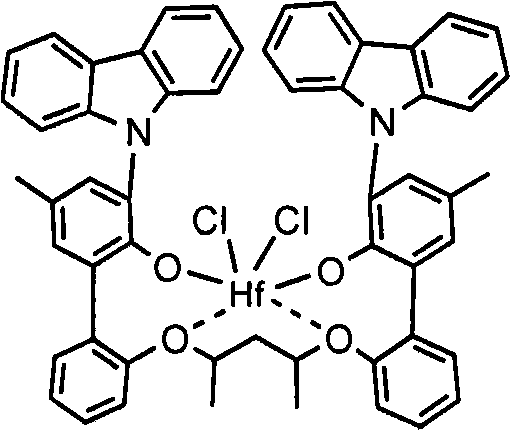
其它有用的催化剂包括二甲基甲硅烷基(环戊二烯基)(环十二基氨基)合钛二甲基化物、二苄基甲基(环戊二烯基)(芴基)合铪二甲基化物、二甲基锗二茚基合铪二甲基化物、二苯甲基(环戊二烯基)(芴基)合铪二甲基化物。Other useful catalysts include dimethylsilyl(cyclopentadienyl)(cyclododecylamino)titanium dimethylate, dibenzylmethyl(cyclopentadienyl)(fluorenyl)hafnium Dimethide, Dimethylgermanium Diindenyl Hafnium Dimethide, Diphenylmethyl(cyclopentadienyl)(fluorenyl)hafnium Dimethide.
另外的有用的催化剂包括以下化合物的外消旋形式:二甲基甲硅烷基(2-甲基-4-苯基茚基)合锆二氯化物、二甲基甲硅烷基(2-甲基-4-苯基茚基)合锆二甲基化物、二甲基甲硅烷基(2-甲基-4-苯基茚基)合铪二氯化物、二甲基甲硅烷基(2-甲基-4-苯基茚基)合铪二甲基化物、二甲基甲硅烷基双(茚基)合铪二甲基化物、二甲基甲硅烷基双(茚基)合铪二氯化物、二甲基甲硅烷基双(茚基)合锆二甲基化物、二甲基甲硅烷基双(茚基)合锆二氯化物。Additional useful catalysts include the racemic forms of the following compounds: dimethylsilyl(2-methyl-4-phenylindenyl)zirconium dichloride, dimethylsilyl(2-methyl -4-phenylindenyl) zirconium dimethyl compound, dimethylsilyl (2-methyl-4-phenylindenyl) hafnium dichloride, dimethylsilyl (2-methyl 4-phenylindenyl) hafnium dimethide, dimethylsilyl bis (indenyl) hafnium dimethide, dimethylsilyl bis (indenyl) hafnium dichloride , Dimethylsilylbis(indenyl)zirconium dimethyl compound, dimethylsilylbis(indenyl)zirconium dichloride.
另外的有用的催化剂包括以下化合物的外消旋异构体:二甲基硅烷二基双(2-甲基茚基)合金属二氯化物;二甲基硅烷二基双(茚基)合金属二氯化物;二甲基硅烷二基双(茚基)合金属二甲基化物;二甲基硅烷二基双(四氢茚基)合金属二氯化物;二甲基硅烷二基双(四氢茚基)合金属二甲基化物;二甲基硅烷二基双(茚基)合金属二乙基化物;和二苄基硅烷二基双(茚基)合金属二甲基化物;其中所述金属选自Zr、Hf或Ti。Additional useful catalysts include racemic isomers of the following compounds: dimethylsilanediylbis(2-methylindenyl)metal dichloride; dimethylsilanediylbis(indenyl)metal Dichloride; Dimethylsilanediylbis(indenyl)metal dimethylate; Dimethylsilanediylbis(tetrahydroindenyl)metal dichloride; Dimethylsilanediylbis(tetrahydroindenyl)metal Hydroindenyl)metal dimethylates; dimethylsilanediylbis(indenyl)metal diethylates; and dibenzylsilanediylbis(indenyl)metal dimethylates; where Said metal is selected from Zr, Hf or Ti.
与上述催化剂化合物一起使用的优选的活化剂包括:二甲基苯胺鎓四(五氟苯基)硼酸盐、N,N-二甲基苯胺鎓四(全氟苯基)硼酸盐、三苯基碳鎓全氟四苯基硼酸盐、二甲基苯胺鎓全氟四萘基硼酸盐、4-叔丁基苯胺鎓双(五氟苯基)双(全氟-2-萘基)硼酸盐、4-叔丁基苯胺鎓(五氟苯基)三(全氟-2-萘基)硼酸盐、二甲基苯胺鎓四(全氟-2-萘基)硼酸盐、二甲基苯胺鎓四(3,5-(五氟苯基)全氟苯基硼酸盐);和三全氟苯基硼。Preferred activators for use with the above catalyst compounds include: dimethylanilinium tetrakis (pentafluorophenyl) borate, N,N-dimethylanilinium tetrakis (perfluorophenyl) borate, tris Phenylcarbonium perfluorotetraphenyl borate, dimethylanilinium perfluorotetranaphthyl borate, 4-tert-butylanilinium bis(pentafluorophenyl)bis(perfluoro-2-naphthyl ) borate, 4-tert-butylanilinium (pentafluorophenyl) tris (perfluoro-2-naphthyl) borate, dimethylanilinium tetrakis (perfluoro-2-naphthyl) borate , dimethylanilinium tetrakis(3,5-(pentafluorophenyl)perfluorophenylborate); and trisperfluorophenylboron.
可与上述催化剂化合物组合使用以制备聚大分子单体的另外的活化剂包括上面描述用于制备大分子单体的那些。同样地,用于生产聚大分子单体的方法通常可用于生产聚大分子单体。Additional activators that may be used in combination with the catalyst compounds described above to prepare polymacromonomers include those described above for the preparation of macromers. Likewise, methods used to produce polymacromonomers can generally be used to produce polymacromonomers.
聚大分子单体polymacromer
在一个优选的实施方案中,所述聚大分子单体的聚合度为3或更大,或者5或更大,或者6或更大,或者10或更大,或者100或更大,或者150或更大,或者200或更大。In a preferred embodiment, the polymacromonomer has a degree of polymerization of 3 or more, or 5 or more, or 6 or more, or 10 or more, or 100 or more, or 150 or greater, or 200 or greater.
在另一实施方案中,至少70%,优选至少75%,优选至少80%,优选至少85%,优选至少90%,优选至少95%,优选至少98%的大分子单体在聚合中被消耗,通过下文在实验部分中描述的1H NMR测定。In another embodiment at least 70%, preferably at least 75%, preferably at least 80%, preferably at least 85%, preferably at least 90%, preferably at least 95%, preferably at least 98% of the macromonomer is consumed in the polymerization , determined by 1 H NMR as described below in the experimental section.
在一个优选的实施方案中,所述聚大分子单体具有:In a preferred embodiment, the polymacromonomer has:
a)小于0.5(优选小于0.4,优选小于0.3,优选小于0.25)的g值,a) a g value of less than 0.5 (preferably less than 0.4, preferably less than 0.3, preferably less than 0.25),
b)大于20,000g/mol(优选30,000-1,000,000,优选40,000-700,000)的Mw,b) a Mw greater than 20,000 g/mol (preferably 30,000-1,000,000, preferably 40,000-700,000),
c)大于8,000g/mol(优选15,000-400,000,优选30,000-200,000)的Mn,c) Mn greater than 8,000 g/mol (preferably 15,000-400,000, preferably 30,000-200,000),
d)小于0.5(优选小于0.4,优选小于0.3,优选小于0.2,优选小于0.1,优选小于0.05)的支化指数(g′vis),和d) a branching index (g' vis ) of less than 0.5 (preferably less than 0.4, preferably less than 0.3, preferably less than 0.2, preferably less than 0.1, preferably less than 0.05), and
e)50℃或更高,优选60℃或更高,优选70℃或更高,优选80℃或更高,优选90℃或更高,优选100℃或更高,优选120℃或更高,优选50-200℃的熔点,或者20J/g或更小,优选15J/g或更小的Hm。e) 50°C or higher, preferably 60°C or higher, preferably 70°C or higher, preferably 80°C or higher, preferably 90°C or higher, preferably 100°C or higher, preferably 120°C or higher, A melting point of 50-200°C is preferred, or a Hm of 20 J/g or less, preferably 15 J/g or less.
在另一个实施方案中,所述聚大分子单体含有小于1000ppm的第4族金属(优选小于750ppm或Ti、Hf和/或Zr,优选小于500ppm)。或者,所述聚大分子单体含有小于1000ppm的锂(优选小于750ppm的锂,优选小于500ppm的锂)。In another embodiment, the polymacromonomer contains less than 1000 ppm of a Group 4 metal (preferably less than 750 ppm or Ti, Hf and/or Zr, preferably less than 500 ppm). Alternatively, the polymacromonomer contains less than 1000 ppm lithium (preferably less than 750 ppm lithium, preferably less than 500 ppm lithium).
在一个优选的实施方案中,所述聚大分子单体包含小于3wt%的选自氢氧根,芳基和取代的芳基,卤素,烷氧基,羧酸根,酯,丙烯酸根,氧,氮和羧基的官能团,优选小于2wt%,更优选小于1wt%,更优选小于0.5wt%,更优选小于0.1wt%,更优选0wt%,基于所述聚大分子单体的重量计。In a preferred embodiment, the polymacromonomer comprises less than 3% by weight of a group selected from the group consisting of hydroxide, aryl and substituted aryl, halogen, alkoxy, carboxylate, ester, acrylate, oxygen, Nitrogen and carboxyl functional groups, preferably less than 2 wt%, more preferably less than 1 wt%, more preferably less than 0.5 wt%, more preferably less than 0.1 wt%, more preferably 0 wt%, based on the weight of the polymacromonomer.
在另一个优选的实施方案中,所述聚大分子单体是无定形的、全同立构的或间规立构的,优选全同立构的。在另一个实施方案中,所述聚大分子单体是丙烯均聚物或丙烯均聚低聚物,所述丙烯均聚物或丙烯均聚低聚物可以是无定形的、全同立构的或间规立构的,优选全同立构的。在另一个实施方案中,所述聚大分子单体是丙烯共聚物或丙烯共聚低聚物,所述丙烯共聚物或丙烯共聚低聚物可以是无定形的、全同立构的或间规立构的,优选全同立构的。In another preferred embodiment, said polymacromonomer is amorphous, isotactic or syndiotactic, preferably isotactic. In another embodiment, the polymacromonomer is a propylene homopolymer or a propylene homo-oligomer, which may be amorphous, isotactic or syndiotactic, preferably isotactic. In another embodiment, the polymacromonomer is a propylene copolymer or a propylene co-oligomer, which may be amorphous, isotactic or syndiotactic Stereotactic, preferably isotactic.
在另一个实施方案中,所述大分子单体包含小于30wt%,优选小于20wt%,优选小于10wt%,优选小于5wt%的无定形材料。In another embodiment, the macromer comprises less than 30 wt%, preferably less than 20 wt%, preferably less than 10 wt%, preferably less than 5 wt% amorphous material.
在另一个实施方案中,本文中描述的任何聚大分子单体可以具有60J/g或更大,优选70J/g或更大,优选90J/g或更大,优选120J/g或更大,优选160J/g或更大或15J/g或更小的熔化热。在一个优选的实施方案中,所述聚大分子单体包含两种或更多种不同的大分子单体,优选三种或更多种不同的大分子单体,优选四种或更多种不同的大分子单体。所谓“不同的大分子单体”是指大分子单体在组成(如单体含量或在大分子单体内共聚单体的分布)或分子量方面不同。例如,在一个实施方案中,所述聚大分子单体可以包含丙烯大分子单体和乙烯大分子单体,或丙烯大分子单体和乙烯-丙烯大分子单体,或乙烯大分子单体和丙烯-乙烯大分子单体。在一个特别优选的实施方案中,可获得从100%聚乙烯大分子单体到100%聚丙烯大分子单体以及中间的富丙烯变体和富乙烯变体的所有物质,包括无定形的和结晶的变体。下面的表1列出了一些特别优选的大分子单体的组合,其中乙烯基-PE是乙烯大分子单体,其优选具有结晶结构(例如60℃或更高的Tm)和0-10wt%的共聚单体,以及任何如上所述的性质;乙烯基-aPP是具有至少10%(优选至少50%,优选至少95%)的无定形含量并优选具有0-10wt%共聚单体的丙烯大分子单体;乙烯基iPP是具有至少50%的全同立构五单元组含量并优选具有0-10wt%共聚单体和/或至少70℃的熔点并优选具有0-10wt%共聚单体的丙烯大分子单体;乙烯基-EP是具有10-50wt%的丙烯和90-50wt%的乙烯的乙烯-丙烯大分子单体。乙烯基-PS是具有0-50wt%共聚单体的苯乙烯大分子单体。乙烯基-pe是具有10-50wt%的乙烯和90-50wt%的丙烯的丙烯-乙烯大分子单体。在大分子单体在表中具有相同名称的情况下,请注意它们在另一种意义上(如分子量或结晶度)不同。In another embodiment, any of the polymacromonomers described herein may have 60 J/g or greater, preferably 70 J/g or greater, preferably 90 J/g or greater, preferably 120 J/g or greater, A heat of fusion of 160 J/g or more or 15 J/g or less is preferred. In a preferred embodiment, the polymacromer comprises two or more different macromonomers, preferably three or more different macromers, preferably four or more different macromonomers. By "different macromers" is meant that the macromers differ in composition (eg, monomer content or distribution of comonomers within the macromer) or molecular weight. For example, in one embodiment, the polymacromonomer may comprise a propylene macromer and an ethylene macromer, or a propylene macromer and an ethylene-propylene macromer, or an ethylene macromer and propylene-ethylene macromers. In a particularly preferred embodiment, everything from 100% polyethylene macromers to 100% polypropylene macromers and intermediate propylene-rich and ethylene-rich variants are available, including amorphous and Crystalline variant. Table 1 below lists some particularly preferred combinations of macromonomers, wherein vinyl-PE is an ethylene macromonomer, which preferably has a crystalline structure (eg Tm of 60°C or higher) and 0-10 wt% comonomer, and any of the properties described above; vinyl-aPP is a propylene polymer having an amorphous content of at least 10%, preferably at least 50%, preferably at least 95%, and preferably 0-10 wt% comonomer Molecular monomer; vinyl iPP is one having an isotactic pentad content of at least 50% and preferably having 0-10 wt% comonomer and/or a melting point of at least 70°C and preferably having 0-10 wt% comonomer Propylene macromonomer; Vinyl-EP is an ethylene-propylene macromer having 10-50 wt% propylene and 90-50 wt% ethylene. Vinyl-PS is a styrene macromonomer with 0-50 wt% comonomer. Vinyl-pe is a propylene-ethylene macromer having 10-50 wt% ethylene and 90-50 wt% propylene. Where macromers have the same name in the table, note that they differ in another sense (such as molecular weight or crystallinity).
大分子单体 乙烯基 乙烯基 乙烯基 乙烯基 乙烯基 乙烯基Macromer Vinyl Vinyl Vinyl Vinyl Vinyl Vinyl
-PE -aPP -iPP -BP -PS -pe-PE -aPP -iPP -BP -PS -pe
乙烯基-PE X X X X X XVinyl-PE X X X X X X X X X X
乙烯基-aPP X X X X X XVinyl-aPP X X X X X X X X X X
乙烯基-iPP X X X X X XVinyl-iPP X X X X X X X X X
乙烯基-EP X X X X X XVinyl-EP X X X X X X X X X X
乙烯基-PS X X X X X XVinyl-PS X X X X X X X X X
乙烯基-pe X X X X X XVinyl-pe X X X X X X X X X X
在一个优选的实施方案中,所述聚大分子单体包含至少两种大分子单体,其中第一大分子单体包含60wt%或更多的乙烯,并且第二大分子单体包含60wt%或更多的丙烯。In a preferred embodiment, the polymacromonomer comprises at least two macromonomers, wherein the first macromonomer comprises 60 wt% or more ethylene and the second macromonomer comprises 60 wt% or more propylene.
在另一个实施方案中,存在第三大分子单体(termacromonomer),以生产具有三种不同的大分子单体的聚大分子单体,例如乙烯基-aPP+乙烯基-PE+烯基-EP。In another embodiment, a third macromonomer is present to produce a polymacromonomer with three different macromonomers, eg vinyl-aPP+vinyl-PE+alkenyl-EP.
或者,所述聚大分子单体可以包含分子量(Mw)相差至少200g/mol,或者相差至少300g/mol,或者相差至少1000g/mol,或者相差至少3000g/mol,或者相差至少5000g/mo l的多种大分子单体。在另一个实施方案中,所述大分子单体中的至少50wt%(优选至少60wt%,优选至少70wt%,优选至少80wt%)的单体分子量(Mw)相差至少200g/mol,或者相差至少300g/mol,或者相差至少1000g/mol,或者相差至少3000g/mol,或者相差至少5000g/mol。Alternatively, the polymacromonomers may comprise molecular weights (Mw) that differ by at least 200 g/mol, or that differ by at least 300 g/mol, or that differ by at least 1000 g/mol, or that differ by at least 3000 g/mol, or that differ by at least 5000 g/mol. A variety of macromonomers. In another embodiment, at least 50% by weight (preferably at least 60% by weight, preferably at least 70% by weight, preferably at least 80% by weight) of the macromonomers differ in molecular weight (Mw) by at least 200 g/mol, or differ by at least 300 g/mol, or a difference of at least 1000 g/mol, or a difference of at least 3000 g/mol, or a difference of at least 5000 g/mol.
或者,所述聚大分子单体可以包含单体含量不同的多种大分子单体,其中所述多种单体相差至少一个碳,或者相差至少2个碳,或者相差至少4个碳,或者相差至少6个碳。在另一个实施方案中,所述大分子单体中的至少50wt%(优选至少60wt%,优选至少70wt%,优选至少80wt%)的单体相差至少一个碳,或者相差至少2个碳,或者相差至少4个碳,或者相差至少6个碳。Alternatively, the polymacromonomer may comprise multiple macromers having different monomer contents, wherein the multiple monomers differ by at least one carbon, or differ by at least 2 carbons, or differ by at least 4 carbons, or Difference of at least 6 carbons. In another embodiment, at least 50% by weight (preferably at least 60% by weight, preferably at least 70% by weight, preferably at least 80% by weight) of the macromonomers differ by at least one carbon, or differ by at least 2 carbons, or A difference of at least 4 carbons, or a difference of at least 6 carbons.
或者,所述聚大分子单体可以包含多种大分子单体,所述多种大分子单体的总共聚单体含量相差至少2wt%,优选相差至少5wt%,优选相差至少10wt%,优选相差至少15wt%,优选相差至少20wt%。Alternatively, the polymacromonomer may comprise multiple macromonomers having a total comonomer content differing by at least 2 wt%, preferably by at least 5 wt%, preferably by at least 10 wt%, preferably The difference is at least 15 wt%, preferably at least 20 wt%.
在另一个实施方案中,所述聚大分子单体包含至少两种不同的大分子单体,其中一种大分子单体具有60℃或更高(优选70℃或更高,优选80℃或更高,优选90℃或更高,优选100℃或更高,优选110℃或更高,优选120℃或更高,优选130℃或更高)的Tm,并且第二种单体具有20J/g或更小,优选15J/g或更小的Hm。优选地,两种单体都还具有:1)20-600个碳原子;2)280g/mol或更大的Mn;3)400g/mol或更大的Mw;4)600g/mol或更大的Mz;5)1.5或更大的Mw/Mn;6)至少70%的乙烯基末端(相对于总不饱和度);和7)小于5wt%的含芳香族的单体。优选地,所述第一和第二大分子单体是基于乙烯的(优选地,每种大分子单体包含至少50wt%的乙烯,优选至少60wt%的乙烯)。In another embodiment, the polymacromonomer comprises at least two different macromonomers, one of which has a temperature of 60°C or higher (preferably 70°C or higher, preferably 80°C or higher, preferably 90°C or higher, preferably 100°C or higher, preferably 110°C or higher, preferably 120°C or higher, preferably 130°C or higher), and the second monomer has a Tm of 20 J/ g or less, preferably Hm of 15 J/g or less. Preferably, both monomers also have: 1) 20-600 carbon atoms; 2) Mn of 280 g/mol or greater; 3) Mw of 400 g/mol or greater; 4) 600 g/mol or greater 5) a Mw/Mn of 1.5 or greater; 6) at least 70% vinyl termination (relative to total unsaturation); and 7) less than 5 wt% aromatic-containing monomers. Preferably, said first and second macromonomers are ethylene based (preferably each macromonomer comprises at least 50 wt% ethylene, preferably at least 60 wt% ethylene).
在另外的实施方案中,可以控制聚合条件,使得可以制备大分子单体的嵌段(例如在一定的时间间隔脉冲式加入不同的大分子单体)。例如,丙烯大分子单体可以被聚合,然后大量的乙烯大分子单体可以被聚合,以产生二嵌段聚大分子单体,或者可以制备聚大分子单体的混合物。In other embodiments, the polymerization conditions can be controlled such that blocks of macromers can be prepared (eg, pulsed addition of different macromers at regular time intervals). For example, a propylene macromonomer can be polymerized and then a large amount of ethylene macromonomer can be polymerized to produce a diblock polymacromonomer, or a mixture of polymacromonomers can be prepared.
在另一个实施方案中,本发明涉及:In another embodiment, the invention relates to:
1.一种包含至少一种大分子单体和0-20wt%的C2-C18共聚单体的聚大分子单体,其中所述大分子单体具有:1. A polymacromonomer comprising at least one macromonomer and 0-20 wt% C2 - C18 comonomers, wherein said macromonomer has:
1)20-800个碳原子,1) 20-800 carbon atoms,
2)280g/mol或更大的Mn,2) Mn of 280 g/mol or greater,
3)400g/mol或更大的Mw,3) Mw of 400 g/mol or greater,
4)600g/mol或更大的Mz,4) Mz of 600 g/mol or greater,
5)1.5或更大的Mw/Mn,5) Mw/Mn of 1.5 or more,
6)相对于总不饱和度计至少70%的乙烯基末端(通过1H NMR测定),6) at least 70% vinyl termination relative to total unsaturation (determined by 1 H NMR),
7)60℃或更高的熔点(Tm)或20J/g或更小的Hm,和7) Melting point (Tm) of 60°C or higher or Hm of 20J/g or less, and
8)基于大分子单体的重量计小于10wt%的含芳香族的单体;8) less than 10% by weight of aromatic-containing monomers based on the weight of the macromonomer;
并且其中所述聚大分子单体具有:And wherein said polymacromonomer has:
a)小于0.6的g值,a) a g value of less than 0.6,
b)大于30,000g/mol的Mw,b) Mw greater than 30,000 g/mol,
c)大于20,000g/mol的Mn,c) Mn greater than 20,000 g/mol,
d)小于0.5的支化指数(g′)vis,d) a branching index (g′) vis of less than 0.5,
e)50℃或更高的熔点或20J/g或更小的Hm,e) a melting point of 50°C or higher or a Hm of 20 J/g or less,
f)相对于总不饱和度计小于25%的乙烯基末端(通过1H NMR测定),f) less than 25% vinyl ends relative to total unsaturation (determined by 1 H NMR),
g)基于聚大分子单体的重量计至少70wt%的大分子单体,和g) at least 70 wt% macromonomer based on the weight of the polymacromonomer, and
h)基于聚大分子单体的重量计0-20wt%的含芳香族的单体。h) 0-20% by weight of aromatic-containing monomers, based on the weight of the polymacromonomer.
2.段落1的聚大分子单体,其中所述聚大分子单体含有0wt%的含芳香族的单体。2. The polymacromonomer of
3.段落1或2的聚大分子单体,其中所述聚大分子单体含有0wt%的苯乙烯属单体。3. The polymacromonomer of
4.段落1、2或3的聚大分子单体,其中所述大分子单体是全同立构的。4. The polymacromonomer of
5.段落1、2、3或4的聚大分子单体,其中所述聚大分子单体包含至少70wt%的包含至少50wt%丙烯的大分子单体。5. The polymacromonomer of
6.权利要求1、2、3、4或5的聚大分子单体,其中所述聚大分子单体包含至少70wt%的包含至少50wt%乙烯的大分子单体。6. The polymacromonomer of
7.段落1-6中任一段落的聚大分子单体,其中所述聚大分子单体包含两种或更多种不同的大分子单体。7. The polymacromonomer of any of paragraphs 1-6, wherein the polymacromonomer comprises two or more different macromonomers.
8.段落7的聚大分子单体,其中所述多种大分子单体在分子量(Mw)方面相差至少200g/mol。8. The polymacromonomer of paragraph 7, wherein the plurality of macromonomers differ in molecular weight (Mw) by at least 200 g/mol.
9.段落7或8的聚大分子单体,其中第一大分子单体具有60℃或更高的熔点,并且第二大分子单体具有20J/g或更小的Hm。9. The polymacromonomer of
10.段落1-10中任一段落的聚大分子单体,其中所述大分子单体包含具有0.95或更小的g′vis的丙烯聚合物。10. The polymacromonomer of any of paragraphs 1-10, wherein the macromonomer comprises a propylene polymer having a g' vis of 0.95 or less.
11.段落1-11中任一段落的聚大分子单体,其中所述大分子单体包含65-80wt%乙烯和20-35wt%丙烯的共聚物(基于共聚物的重量计),并且具有15J/g或更小的Hm。11. The polymacromonomer of any of paragraphs 1-11, wherein the macromonomer comprises a copolymer of 65-80 wt% ethylene and 20-35 wt% propylene (based on the weight of the copolymer) and has 15J /g or less Hm.
12.一种包含至少一种大分子单体和0-20wt%的C2-C18共聚单体的聚大分子单体,其中所述聚大分子单体具有:12. A polymacromonomer comprising at least one macromer and 0-20 wt% of a C2 - C18 comonomer, wherein said polymacromonomer has:
a)小于0.6的g值,a) a g value of less than 0.6,
b)大于30,000g/mol的Mw,b) Mw greater than 30,000 g/mol,
c)大于20,000g/mol的Mn,c) Mn greater than 20,000 g/mol,
d)小于0.5的支化指数(g′)vis,d) a branching index (g′) vis of less than 0.5,
e)相对于总不饱和度计小于25%的乙烯基末端(通过1H NMR测定),e) less than 25% vinyl ends relative to total unsaturation (determined by 1 H NMR),
f)基于聚大分子单体的重量计至少70wt%的大分子单体,和f) at least 70 wt% macromonomer based on the weight of the polymacromonomer, and
g)基于聚大分子单体的重量计0-20wt%的含芳香族的单体;g) 0-20 wt% aromatic-containing monomers based on the weight of the polymacromonomer;
并且所述大分子单体包含以下物质中的一种或多种:And the macromer comprises one or more of the following substances:
i)丙烯共聚低聚物,其具有300-30,000g/mol的Mn,包含10-90mol%的丙烯和10-90mol%的乙烯,其中所述低聚物具有至少X%的烯丙基链端(相对于总不饱和度),其中:1)当所述共聚低聚物中存在10-60mol%的乙烯时,X=(-0.94(mol%结合的乙烯)+100),和2)当所述共聚低聚物中存在大于60mol%并且小于70mol%的乙烯时,X=45,和3)当所述共聚低聚物中存在70-90mol%的乙烯时,X=(1.83*(mol%结合的乙烯)-83),和/或i) Propylene co-oligomers having an Mn of 300-30,000 g/mol, comprising 10-90 mol% propylene and 10-90 mol% ethylene, wherein the oligomer has at least X% allyl chain ends (relative to total unsaturation), where: 1) when 10-60 mol% ethylene is present in the co-oligomer, X=(-0.94(mol% bound ethylene)+100), and 2) when When there is more than 60mol% and less than 70mol% of ethylene in the co-oligomer, X=45, and 3) when there is 70-90mol% of ethylene in the co-oligomer, X=(1.83*(mol % bound ethylene)-83), and/or
ii)丙烯低聚物,其包含超过90mol%的丙烯和小于10mol%的乙烯,其中所述低聚物具有:至少93%的烯丙基链端,约500至约20,000g/mol的Mn,0.8∶1-1.35∶1.0的异丁基链端与烯丙基型乙烯基比,和小于1400ppm的铝;和/或ii) a propylene oligomer comprising more than 90 mol% propylene and less than 10 mol% ethylene, wherein the oligomer has: at least 93% allyl chain ends, an Mn of from about 500 to about 20,000 g/mol, an isobutyl chain end to allylic vinyl ratio of 0.8:1 to 1.35:1.0, and less than 1400 ppm aluminum; and/or
iii)丙烯低聚物,其包含至少50mol%的丙烯和10-50mol%的乙烯,其中所述低聚物具有:至少90%的烯丙基链端,约150至约10,000g/mol的Mn,和0.8∶1-1.3∶1.0的异丁基链端与烯丙基型乙烯基比,其中具有四个或更多个碳原子的单体的存在量为0-3mol%;和/或iii) a propylene oligomer comprising at least 50 mol% propylene and 10-50 mol% ethylene, wherein the oligomer has: at least 90% allyl chain ends, an Mn of about 150 to about 10,000 g/mol , and an isobutyl chain end to allylic vinyl ratio of 0.8:1-1.3:1.0, wherein monomers having four or more carbon atoms are present in an amount of 0-3 mol %; and/or
iv)丙烯低聚物,其包含至少50mol%的丙烯,0.1-45mol%的乙烯,和0.1-5mol%的C4-C12烯烃,其中所述低聚物具有:至少87%(或者至少90%)的烯丙基链端,约150至约10,000g/mol的Mn,和0.8∶1-1.35∶1.0的异丁基链端与烯丙基型乙烯基比;和/或iv) a propylene oligomer comprising at least 50 mol% propylene, 0.1-45 mol% ethylene, and 0.1-5 mol% C 4 -C 12 olefins, wherein the oligomer has: at least 87% (or at least 90 %) of the allyl chain end, about 150 to about 10,000 g/mol of Mn, and 0.8:1-1.35:1.0 of the isobutyl chain end and allyl type vinyl ratio; and/or
v)丙烯低聚物,其包含至少50mol%的丙烯,0.1-45wt%的乙烯,和0.1-5mol%的二烯,其中所述低聚物具有:至少90%的烯丙基链端,约150至约10,000g/mol的Mn,和0.7∶1-1.35∶1.0的异丁基链端与烯丙基型乙烯基比;和/或v) a propylene oligomer comprising at least 50 mol% propylene, 0.1-45 wt% ethylene, and 0.1-5 mol% diene, wherein the oligomer has: at least 90% allyl chain ends, about 150 to about 10,000 g/mol Mn, and 0.7:1-1.35:1.0 isobutyl chain end to allyl type vinyl ratio; and/or
vi)包含丙烯的均聚低聚物,其中所述低聚物具有:至少93%的烯丙基链端,约500-约20,000g/mol的Mn,0.8∶1-1.2∶1.0的异丁基链端与烯丙基型乙烯基比,和小于1400ppm的铝。vi) A homo-oligomer comprising propylene, wherein the oligomer has: at least 93% allyl chain ends, an Mn of about 500 to about 20,000 g/mol, an isobutyl chain of 0.8:1-1.2:1.0 end to allylic vinyl ratio, and less than 1400ppm aluminum.
13.段落12的聚大分子单体,其中所述大分子单体是丙烯共聚低聚物,其具有300-30,000g/mol的Mn,包含10-90mol%的丙烯和10-90mol%的乙烯,其中所述低聚物具有至少X%的烯丙基链端(相对于总不饱和度),其中:1)当所述共聚低聚物中存在10-60mol%的乙烯时,X=(-0.94(mol%结合的乙烯)+100),和2)当所述共聚低聚物中存在大于60mol%并且小于70mol%的乙烯时,X=45,和3)当所述共聚低聚物中存在70-90mol%的乙烯时,X=(1.83*(mol%结合的乙烯)-83)。13. The polymacromonomer of paragraph 12, wherein the macromonomer is a propylene co-oligomer having an Mn of 300-30,000 g/mol comprising 10-90 mol% propylene and 10-90 mol% ethylene , wherein the oligomer has at least X% allyl chain ends (relative to total unsaturation), wherein: 1) when 10-60 mol% ethylene is present in the co-oligomer, X=( -0.94 (mol% bound ethylene)+100), and 2) when there is more than 60 mol% and less than 70 mol% ethylene in the co-oligomer, X=45, and 3) when the co-oligomer In the presence of 70-90 mol% ethylene in X=(1.83*(mol% bound ethylene)-83).
14.段落1-13中任一段落的聚大分子单体,其中所述大分子单体在25℃为液体。14. The polymacromonomer of any of paragraphs 1-13, wherein the macromonomer is a liquid at 25°C.
15.一种生产段落1-14的聚大分子单体的方法,该方法包括:使大分子单体和最多达40wt%的C2-C18共聚单体与能够聚合乙烯基封端的大分子单体的催化剂体系在60-130℃的温度和1-90分钟的反应时间的聚合条件下接触,其中所述大分子单体具有:15. A method of producing the polymacromonomer of paragraphs 1-14, the method comprising: combining the macromonomer and up to 40% by weight of a C2 - C18 comonomer with a macromolecule capable of polymerizing vinyl terminated A catalyst system of monomers is contacted under polymerization conditions of a temperature of 60-130° C. and a reaction time of 1-90 minutes, wherein the macromer has:
1)20-800个碳原子,1) 20-800 carbon atoms,
2)280g/mol或更大的Mn,2) Mn of 280 g/mol or greater,
3)400g/mol或更大的Mw,3) Mw of 400 g/mol or greater,
4)600g/mol或更大的Mz,4) Mz of 600 g/mol or greater,
5)1.5或更大的Mw/Mn,5) Mw/Mn of 1.5 or more,
6)相对于总不饱和度计至少70%的乙烯基末端(通过1H NMR测量),6) At least 70% vinyl termination relative to total unsaturation (measured by 1 H NMR),
7)60℃或更高的熔点Tm或20J/g或更小的Hm,和7) Melting point Tm of 60°C or higher or Hm of 20J/g or less, and
8)小于20wt%的含芳香族的单体;8) less than 20wt% aromatic-containing monomers;
其中存在于反应器中的所有共聚单体与存在于反应器中的所有大分子单体的摩尔比为3∶1或更小,并且其中大分子单体至聚大分子单体的转化率为70wt%或更大;wherein the molar ratio of all comonomers present in the reactor to all macromonomers present in the reactor is 3:1 or less, and wherein the conversion of macromonomers to polymacromonomers is 70% by weight or greater;
和获得聚大分子单体,其具有:and obtain a polymacromonomer with:
a)小于0.6的g值,a) a g value of less than 0.6,
b)大于30,000g/mol的Mw,b) Mw greater than 30,000 g/mol,
c)大于20,000g/mol的Mn,c) Mn greater than 20,000 g/mol,
d)小于0.5的支化指数(g′)vis,和d) a branching index (g′) vis less than 0.5, and
e)50℃或更高的熔点或20J/g或更小的Hm,e) a melting point of 50°C or higher or a Hm of 20 J/g or less,
f)相对于总不饱和度计小于25%的乙烯基末端(通过1H NMR测量),f) less than 25% vinyl ends relative to total unsaturation (measured by 1 H NMR),
g)基于聚大分子单体的重量计至少70wt%的大分子单体,和g) at least 70 wt% macromonomer based on the weight of the polymacromonomer, and
h)基于聚大分子单体的重量计0-20wt%的含芳香族的单体。h) 0-20% by weight of aromatic-containing monomers, based on the weight of the polymacromonomer.
16.段落15的方法,其中所述聚大分子单体的聚合度为6或更大。16. The method of paragraph 15, wherein the polymacromonomer has a degree of polymerization of 6 or greater.
17.段落15的方法,其中所述聚大分子单体的聚合度为100或更大。17. The method of paragraph 15, wherein the polymacromonomer has a degree of polymerization of 100 or greater.
18.段落15、16或17的方法,其中所述能够聚合乙烯基封端的大分子单体的催化剂体系包含由下式表示的化合物:18. The method of paragraph 15, 16, or 17, wherein the catalyst system capable of polymerizing vinyl-terminated macromonomers comprises a compound represented by the formula:

19.段落15、16、17或18的方法,其中所述能够聚合乙烯基封端的大分子单体的催化剂体系包含以下物质中的一种或多种:19. The method of
二甲基甲硅烷基(环戊二烯基)(环十二基氨基)合钛二甲基化物、二苄基甲基(环戊二烯基)(芴基)合铪二甲基化物、二苯甲基(环戊二烯基)(芴基)合铪二甲基化物、二甲基锗双茚基合铪二甲基化物、外消旋-二甲基甲硅烷基(2-甲基-4-苯基茚基)合锆二氯化物、外消旋-二甲基甲硅烷基(2-甲基-4-苯基茚基)合锆二甲基化物、外消旋-二甲基甲硅烷基(2-甲基-4-苯基茚基)合铪二氯化物、外消旋-二甲基甲硅烷基(2-甲基-4-苯基茚基)合铪二甲基化物、外消旋-二甲基甲硅烷基双(茚基)合铪二甲基化物、外消旋-二甲基甲硅烷基双(茚基)合铪二氯化物、外消旋-二甲基甲硅烷基双(茚基)合锆二甲基化物、外消旋-二甲基甲硅烷基双(茚基)合锆二氯化物、外消旋-二甲基硅烷二基双(2-甲基茚基)合金属二氯化物;外消旋-二甲基硅烷二基双(茚基)合金属二氯化物;外消旋-二甲基硅烷二基双(茚基)合金属二甲基化物;外消旋-二甲基硅烷二基双(四氢茚基)合金属二氯化物;外消旋-二甲基硅烷二基双(四氢茚基)合金属二甲基化物;外消旋-二甲基硅烷二基双(茚基)合金属二乙基化物;和外消旋-二苄基硅烷二基双(茚基)合金属二甲基化物;其中所述金属选自Zr、Hf或Ti。Dimethylsilyl(cyclopentadienyl)(cyclododecylamino)titanium dimethyl compound, dibenzylmethyl(cyclopentadienyl)(fluorenyl)hafnium dimethyl compound, Diphenylmethyl(cyclopentadienyl)(fluorenyl)hafnium dimethyl, dimethylgermaniumbisindenyl hafnium dimethyl, rac-dimethylsilyl(2-methyl Base-4-phenylindenyl)zirconium dichloride, rac-dimethylsilyl(2-methyl-4-phenylindenyl)zirconium dimethide, rac-di Methylsilyl(2-methyl-4-phenylindenyl)hafnium dichloride, rac-dimethylsilyl(2-methyl-4-phenylindenyl)hafnium dichloride Methylate, rac-Dimethylsilylbis(indenyl)hafnium dimethide, rac-Dimethylsilylbis(indenyl)hafnium dichloride, rac -Dimethylsilylbis(indenyl)zirconium dimethide, rac-dimethylsilylbis(indenyl)zirconium dichloride, rac-dimethylsilanediyl Bis(2-methylindenyl)metal dichloride; rac-dimethylsilanediylbis(indenyl)metal dichloride; rac-dimethylsilanediylbis(indenyl) ) metal dimethylate; rac-dimethylsilanediylbis(tetrahydroindenyl)metal dichloride; rac-dimethylsilanediylbis(tetrahydroindenyl)metal Dimethide; rac-dimethylsilanediylbis(indenyl)metal diethylate; and rac-dibenzylsilanediylbis(indenyl)metal dimethylate; Wherein said metal is selected from Zr, Hf or Ti.
20.段落15-19中任一段落的方法,其中所述能够聚合乙烯基封端的大分子单体的催化剂体系包含以下物质中的一种或多种:二甲基苯胺鎓四(五氟苯基)硼酸盐、N,N-二甲基苯胺鎓四(全氟苯基)硼酸盐、三苯基碳鎓全氟四苯基硼酸盐、二甲基苯胺鎓全氟四萘基硼酸盐、4-叔丁基苯胺鎓双(五氟苯基)双(全氟-2-萘基)硼酸盐、4-叔丁基苯胺鎓(五氟苯基)三(全氟-2-萘基)硼酸盐、二甲基苯胺鎓四(全氟-2-萘基)硼酸盐、二甲基苯胺鎓四(3,5(五氟苯基)全氟苯基硼酸盐);和三全氟苯基硼。20. The method of any of paragraphs 15-19, wherein the catalyst system capable of polymerizing vinyl-terminated macromonomers comprises one or more of the following: dimethylanilinium tetrakis(pentafluorophenyl ) borate, N, N-dimethylanilinium tetrakis (perfluorophenyl) borate, triphenylcarbenium perfluorotetraphenyl borate, dimethylanilinium perfluorotetranaphthylboron salt, 4-tert-butylanilinium bis(pentafluorophenyl) bis(perfluoro-2-naphthyl) borate, 4-tert-butylanilinium (pentafluorophenyl) tris(perfluoro-2 -naphthyl)borate, dimethylanilinium tetrakis(perfluoro-2-naphthyl)borate, dimethylanilinium tetrakis(3,5(pentafluorophenyl)perfluorophenyl borate ); and trisperfluorophenylboron.
21.段落15-20中任一段落的方法,还包括通过使单体与包含活化剂和由下式表示的催化剂的催化剂体系接触来制备大分子单体:21. The method of any of paragraphs 15-20, further comprising preparing the macromer by contacting the monomer with a catalyst system comprising an activator and a catalyst represented by the formula:
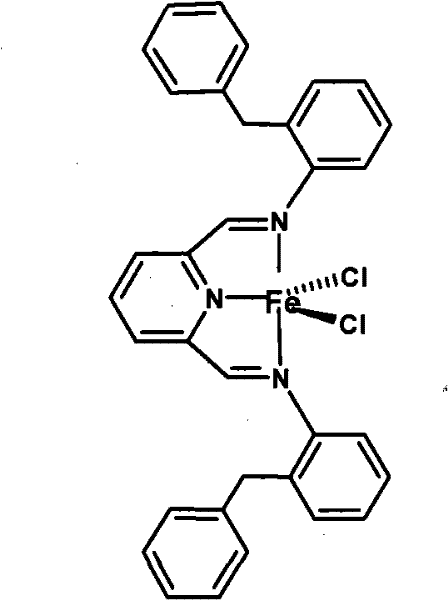
或外消旋-Me2Si-双(2-R-茚基)MX2或外消旋-Me2Si-双(2-R,4-Ph-茚基)MX2,其中R是烷基,Ph是苯基或取代的苯基,M是Hf、Zr或Ti,和X是卤素或烷基。or rac-Me 2 Si-bis(2-R-indenyl)MX 2 or rac-Me 2 Si-bis(2-R,4-Ph-indenyl)MX 2 where R is alkyl , Ph is phenyl or substituted phenyl, M is Hf, Zr or Ti, and X is halogen or alkyl.
22.一种生产聚大分子单体的方法,该方法包括使大分子单体和最多达40wt%的C2-C18共聚单体与能够聚合乙烯基封端的大分子单体的催化剂体系接触,其中所述大分子单体通过用于制备段落12或13的丙烯共聚低聚物的均相方法生产,所述方法具有至少4.5x10³g/mmol/hr的生产率,其中所述方法包括:22. A method of producing a polymacromonomer comprising contacting the macromonomer and up to 40% by weight of a C2 - C18 comonomer with a catalyst system capable of polymerizing a vinyl terminated macromonomer , wherein the macromer is produced by a homogeneous process for preparing the propylene co-oligomer of paragraph 12 or 13, the process having a productivity of at least 4.5×10 3 g/mmol/hr, wherein the process comprises:
在35℃-150℃的温度下,使丙烯、0.1至70mol%的乙烯和0至约5wt%的氢在催化剂体系存在下接触,所述催化剂体系包含活化剂和至少一种由上面式I、II、III或IV表示的金属茂化合物,Propylene, 0.1 to 70 mole percent ethylene, and 0 to about 5 weight percent hydrogen are contacted at a temperature between 35°C and 150°C in the presence of a catalyst system comprising an activator and at least one compound consisting of the above formula I, Metallocene compounds represented by II, III or IV,
其中:Hf是铪;Wherein: Hf is hafnium;
每个X独立地选自下组:具有1-20个碳原子的烃基,氢,氨基,烷氧基,硫基,磷基,卤素,二烯,胺,膦,醚,或它们的组合,优选甲基,乙基,丙基,丁基,苯基,苄基,氯,溴,碘,(或者两个X可以形成稠合环或环体系的一部分);Each X is independently selected from the group consisting of hydrocarbyl having 1-20 carbon atoms, hydrogen, amino, alkoxy, thio, phosphorus, halogen, diene, amine, phosphine, ether, or combinations thereof, Preferably methyl, ethyl, propyl, butyl, phenyl, benzyl, chlorine, bromine, iodine, (or two X's may form part of a fused ring or ring system);
每个Q独立地是碳或杂原子,优选C,N,P,S(优选至少一个Q是杂原子,或者至少两个Q是相同或不同的杂原子,或者至少三个Q是相同或不同的杂原子,或者至少四个Q是相同或不同的杂原子);Each Q is independently carbon or a heteroatom, preferably C, N, P, S (preferably at least one Q is a heteroatom, or at least two Q are the same or different heteroatoms, or at least three Q are the same or different heteroatoms, or at least four Q are the same or different heteroatoms);
每个R1独立地是C1-C8烷基,优选C1-C8线性烷基,优选甲基,乙基,丙基,丁基,戊基,己基,庚基或辛基,R1可以与R2相同或不同; Each R is independently C 1 -C 8 alkyl, preferably C 1 -C 8 linear alkyl, preferably methyl, ethyl, propyl, butyl, pentyl, hexyl, heptyl or octyl, R 1 can be the same or different from R 2 ;
每个R2独立地是C1-C8烷基,优选C1-C8线性烷基,优选甲基,乙基,丙基,丁基,戊基,己基,庚基或辛基,优选R1和/或R2不是支化的;Each R is independently C 1 -C 8 alkyl, preferably C 1 -C 8 linear alkyl, preferably methyl, ethyl, propyl, butyl, pentyl, hexyl, heptyl or octyl, preferably R 1 and/or R 2 are not branched;
每个R3独立地是氢,或取代或未取代的具有1-8个碳原子、优选1-6个碳原子的烃基,优选取代或未取代的C1-C8线性烷基,优选甲基,乙基,丙基,丁基,戊基,己基,庚基,辛基,但是前提是至少三个R3基团不是氢(或者四个R3基团不是氢,或者五个R3基团不是氢);Each R 3 is independently hydrogen, or a substituted or unsubstituted hydrocarbon group having 1-8 carbon atoms, preferably 1-6 carbon atoms, preferably a substituted or unsubstituted C 1 -C 8 linear alkyl group, preferably methyl radical, ethyl, propyl, butyl, pentyl, hexyl, heptyl, octyl, but only if at least three R3 groups are not hydrogen (or four R3 groups are not hydrogen, or five R3 groups group is not hydrogen);
每个R4独立地是氢或取代或未取代的烃基,杂原子或含杂原子的基团,优选取代或未取代的具有1-20个碳原子、优选1-8个碳原子的烃基,优选取代或未取代的C1-C8线性烷基,优选甲基,乙基,丙基,丁基,戊基,己基,庚基,辛基,取代的苯基(例如丙基苯基),苯基,甲硅烷基,取代的甲硅烷基(例如CH2SiR′,其中R′是C1-C12烃基,例如甲基,乙基,丙基,丁基,苯基);Each R is independently hydrogen or a substituted or unsubstituted hydrocarbon group, a heteroatom or a heteroatom-containing group, preferably a substituted or unsubstituted hydrocarbon group having 1-20 carbon atoms, preferably 1-8 carbon atoms, Preferably substituted or unsubstituted C 1 -C 8 linear alkyl, preferably methyl, ethyl, propyl, butyl, pentyl, hexyl, heptyl, octyl, substituted phenyl (e.g. propylphenyl) , phenyl, silyl, substituted silyl (eg CH 2 SiR', wherein R' is a C 1 -C 12 hydrocarbon group, eg methyl, ethyl, propyl, butyl, phenyl);
R5是氢或C1-C8烷基,优选C1-C8线性烷基,优选甲基,乙基,丙基,丁基,戊基,己基,庚基或辛基; R is hydrogen or C 1 -C 8 alkyl, preferably C 1 -C 8 linear alkyl, preferably methyl, ethyl, propyl, butyl, pentyl, hexyl, heptyl or octyl;
R6是氢或C1-C8烷基,优选C1-C8线性烷基,优选甲基,乙基,丙基,丁基,戊基,己基,庚基或辛基; R is hydrogen or C 1 -C 8 alkyl, preferably C 1 -C 8 linear alkyl, preferably methyl, ethyl, propyl, butyl, pentyl, hexyl, heptyl or octyl;
每个R7独立地是氢,或C1-C8烷基,优选C1-C8线性烷基,优选甲基,乙基,丙基,丁基,戊基,己基,庚基或辛基,但是前提是至少七个R7基团不是氢,或者至少八个R7基团不是氢,或者所有R7基团不是氢,(优选地,在式I V的每个Cp环的3和4位上的所述R7基团不是氢);Each R is independently hydrogen, or C1 - C8 alkyl, preferably C1 - C8 linear alkyl, preferably methyl, ethyl, propyl, butyl, pentyl, hexyl, heptyl or octyl groups, but only if at least seven R groups are not hydrogen, or at least eight R groups are not hydrogen, or all R groups are not hydrogen, (preferably, 3 and The R group at position 4 is not hydrogen);
N是氮;N is nitrogen;
T是桥基,优选S i或Ge,优选Si;T is a bridging group, preferably Si or Ge, preferably Si;
每个Ra独立地是氢,卤素或C1-C20烃基,例如甲基,乙基,丙基,丁基,戊基,己基,庚基,辛基,苯基,苄基,取代的苯基,并且两个Ra可以形成环状结构,包括芳族的、部分饱和的或饱和的环状或稠合环体系;Each R is independently hydrogen, halogen or C1-C20 hydrocarbyl, such as methyl, ethyl, propyl, butyl, pentyl, hexyl, heptyl, octyl, phenyl, benzyl, substituted phenyl , and two R a can form a ring structure, including aromatic, partially saturated or saturated ring or fused ring system;
并且进一步的前提是任何两个相邻的R基团可以形成稠合环或多中心稠合环体系,其中所述环可以是芳族的、部分饱和的或饱和的。And a further premise is that any two adjacent R groups may form a fused ring or a multicenter fused ring system, wherein the rings may be aromatic, partially saturated or saturated.
23.一种生产聚大分子单体的方法,该方法包括使大分子单体和最多达40wt%的C2-C18共聚单体与能够聚合乙烯基封端的大分子单体的催化剂体系接触,其中所述大分子单体通过用于制备段落12或13的丙烯均聚低聚物的均相方法生产,所述方法具有至少4.5x10⁶g/mol/min的生产率,其中所述方法包括:23. A method of producing a polymacromonomer, the method comprising contacting the macromonomer and up to 40% by weight of a C2 - C18 comonomer with a catalyst system capable of polymerizing a vinyl terminated macromonomer , wherein the macromer is produced by a homogeneous process for the preparation of the propylene homo-oligomer of paragraph 12 or 13, the process having a productivity of at least 4.5x10⁶ g/mol/min, wherein the process comprises :
在30℃-120℃的温度下,使丙烯、0mol%共聚单体和0至约5wt%的氢在催化剂体系存在下接触,所述催化剂体系包含活化剂和至少一种由上面的式I、II、III或IV表示的金属茂化合物,Propylene, 0 mol% comonomer, and 0 to about 5 wt% hydrogen are contacted at a temperature of 30°C to 120°C in the presence of a catalyst system comprising an activator and at least one compound consisting of formula I, above, Metallocene compounds represented by II, III or IV,
其中:Hf是铪;Wherein: Hf is hafnium;
每个X独立地选自下组:具有1-20个碳原子的烃基,氢,氨基,烷氧基,硫基,磷基,卤素,二烯,胺,膦,醚,或它们的组合,优选甲基,乙基,丙基,丁基,苯基,苄基,氯,溴,碘,(或者两个X可以形成稠合环或环体系的一部分);Each X is independently selected from the group consisting of hydrocarbyl having 1-20 carbon atoms, hydrogen, amino, alkoxy, thio, phosphorus, halogen, diene, amine, phosphine, ether, or combinations thereof, Preferably methyl, ethyl, propyl, butyl, phenyl, benzyl, chlorine, bromine, iodine, (or two X's may form part of a fused ring or ring system);
每个Q独立地是碳或杂原子,优选C,N,P,S(优选至少一个Q是杂原子,或者至少两个Q是相同或不同的杂原子,或者至少三个Q是相同或不同的杂原子,或者至少四个Q是相同或不同的杂原子);Each Q is independently carbon or a heteroatom, preferably C, N, P, S (preferably at least one Q is a heteroatom, or at least two Q are the same or different heteroatoms, or at least three Q are the same or different heteroatoms, or at least four Q are the same or different heteroatoms);
每个R1独立地是C1-C8烷基,优选C1-C8线性烷基,优选甲基,乙基,丙基,丁基,戊基,己基,庚基或辛基,R1可以与R2相同或不同; Each R is independently C 1 -C 8 alkyl, preferably C 1 -C 8 linear alkyl, preferably methyl, ethyl, propyl, butyl, pentyl, hexyl, heptyl or octyl, R 1 can be the same or different from R 2 ;
每个R2独立地是C1-C8烷基,优选C1-C8线性烷基,优选甲基,乙基,丙基,丁基,戊基,己基,庚基或辛基,优选R1和/或R2不是支化的;Each R is independently C 1 -C 8 alkyl, preferably C 1 -C 8 linear alkyl, preferably methyl, ethyl, propyl, butyl, pentyl, hexyl, heptyl or octyl, preferably R 1 and/or R 2 are not branched;
每个R3独立地是氢,或取代或未取代的具有1-8个碳原子、优选1-6个碳原子的烃基,优选取代或未取代的C1-C8线性烷基,优选甲基,乙基,丙基,丁基,戊基,己基,庚基,辛基,但是前提是:1)所有五个R3基团是甲基,或2)四个R3基团不是氢,并且至少一个R3基团是C2-C8取代或未取代的烃基(优选至少两个,三个,四个或五个R3基团是C2-C8取代或未取代的烃基);Each R 3 is independently hydrogen, or a substituted or unsubstituted hydrocarbon group having 1-8 carbon atoms, preferably 1-6 carbon atoms, preferably a substituted or unsubstituted C 1 -C 8 linear alkyl group, preferably methyl radical, ethyl, propyl, butyl, pentyl, hexyl, heptyl, octyl, but only if: 1) all five R3 groups are methyl, or 2) four R3 groups are not hydrogen , and at least one R 3 group is a C 2 -C 8 substituted or unsubstituted hydrocarbon group (preferably at least two, three, four or five R 3 groups are a C 2 -C 8 substituted or unsubstituted hydrocarbon group );
每个R4独立地是氢或取代或未取代的烃基,杂原子或含杂原子的基团,优选取代或未取代的具有1-20个碳原子、优选1-8个碳原子的烃基,优选取代或未取代的C1-C8线性烷基,优选甲基,乙基,丙基,丁基,戊基,己基,庚基,辛基,取代的苯基(例如丙基苯基),苯基,甲硅烷基,取代的甲硅烷基(例如CH2SiR′,其中R′是C1-C12烃基,例如甲基,乙基,丙基,丁基,苯基);Each R is independently hydrogen or a substituted or unsubstituted hydrocarbon group, a heteroatom or a heteroatom-containing group, preferably a substituted or unsubstituted hydrocarbon group having 1-20 carbon atoms, preferably 1-8 carbon atoms, Preferably substituted or unsubstituted C 1 -C 8 linear alkyl, preferably methyl, ethyl, propyl, butyl, pentyl, hexyl, heptyl, octyl, substituted phenyl (e.g. propylphenyl) , phenyl, silyl, substituted silyl (eg CH 2 SiR', wherein R' is a C 1 -C 12 hydrocarbon group, eg methyl, ethyl, propyl, butyl, phenyl);
R5是氢或C1-C8烷基,优选C1-C8线性烷基,优选甲基,乙基,丙基,丁基,戊基,己基,庚基或辛基; R is hydrogen or C 1 -C 8 alkyl, preferably C 1 -C 8 linear alkyl, preferably methyl, ethyl, propyl, butyl, pentyl, hexyl, heptyl or octyl;
R6是氢或C1-C8烷基,优选C1-C8线性烷基,优选甲基,乙基,丙基,丁基,戊基,己基,庚基或辛基; R is hydrogen or C 1 -C 8 alkyl, preferably C 1 -C 8 linear alkyl, preferably methyl, ethyl, propyl, butyl, pentyl, hexyl, heptyl or octyl;
每个R7独立地是氢,或C1-C8烷基,优选C1-C8线性烷基,优选甲基,乙基,丙基,丁基,戊基,己基,庚基或辛基,但是前提是至少七个R7基团不是氢,或者至少八个R7基团不是氢,或者所有R7基团不是氢,(优选地,在式IV的每个Cp环的3和4位上的所述R7基团不是氢);Each R is independently hydrogen, or C1 - C8 alkyl, preferably C1 - C8 linear alkyl, preferably methyl, ethyl, propyl, butyl, pentyl, hexyl, heptyl or octyl groups, but only if at least seven R7 groups are not hydrogen, or at least eight R7 groups are not hydrogen, or all R7 groups are not hydrogen, (preferably, 3 and The R group at position 4 is not hydrogen);
N是氮;N is nitrogen;
T是桥基,优选Si或Ge,优选Si;T is a bridging group, preferably Si or Ge, preferably Si;
每个Ra独立地是氢,卤素或C1-C20烃基,例如甲基,乙基,丙基,丁基,戊基,己基,庚基,辛基,苯基,苄基,取代的苯基,并且两个Ra可以形成环状结构,包括芳族的、部分饱和的或饱和的环状或稠合环体系;Each R is independently hydrogen, halogen or C1-C20 hydrocarbyl, such as methyl, ethyl, propyl, butyl, pentyl, hexyl, heptyl, octyl, phenyl, benzyl, substituted phenyl , and two R a can form a ring structure, including aromatic, partially saturated or saturated ring or fused ring system;
并且进一步的前提是任何两个相邻的R基团可以形成稠合环或多中心稠合环体系,其中所述环可以是芳族的、部分饱和的或饱和的。And a further premise is that any two adjacent R groups may form a fused ring or a multicenter fused ring system, wherein the rings may be aromatic, partially saturated or saturated.
实验experiment
所有分子量是以g/mol为单位的数均分子量,除非另有说明。All molecular weights are number average molecular weights in g/mol unless otherwise stated.
材料Material
催化剂1是1,1′-联苯亚甲基(环戊二烯基)(芴基)合铪二甲基化物,
催化剂2是外消旋-二甲基甲硅烷基双(茚基)合铪二甲基化物,Catalyst 2 is rac-dimethylsilylbis(indenyl)hafnium dimethylate,
催化剂3是外消旋-二甲基甲硅烷基双(2-甲基-4-苯基茚基)合铪二甲基化物,Catalyst 3 is rac-dimethylsilyl bis(2-methyl-4-phenylindenyl) hafnium dimethyl,
催化剂4是: 催化剂5是:Catalyst 4 is: Catalyst 5 is:
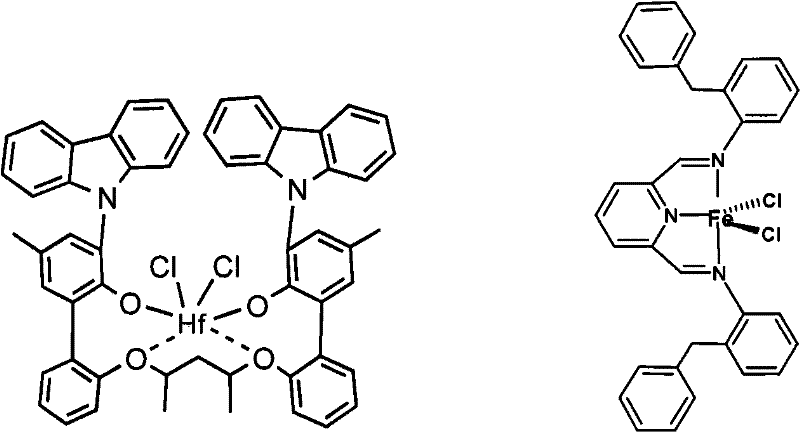
催化剂4按照US 7,126,031中的方法制备。催化剂5按照G.J.P.Britovsek,V.C.Gibson,S.J.McTavish,G.A.Solan,B.S.Kimberley,P.J.Maddox,A.J.P.White,Williams,Chem.Comm.1998,849中的方法制备及提纯。Catalyst 4 was prepared according to the method in US 7,126,031. Catalyst 5 was prepared and purified according to the method in G.J.P.Britovsek, V.C.Gibson, S.J.McTavish, G.A.Solan, B.S.Kimberley, P.J.Maddox, A.J.P.White, Williams, Chem.Comm.1998,849.
活化剂A是N,N-二甲基苯胺鎓四(全氟苯基)硼酸盐。Activator A is N,N-dimethylanilinium tetrakis(perfluorophenyl)borate.
活化剂B是从Albemarle购买的甲基铝氧烷(30wt%的甲苯溶液)。Activator B was methylalumoxane (30 wt% in toluene) purchased from Albemarle.
表征characterize
凝胶渗透色谱法gel permeation chromatography
Mw、Mz、碳原子数、g值和g′vis通过使用高温尺寸排阻色谱仪(HighTemperature Size Exclusion Chromatograph)(得自WatersCorporation或者Polymer Laboratories)测定,所述色谱仪装有三个在线检测器,即示差折光率检测器(DRI)、光散射(LS)检测器和粘度计。包括检测器校准在内的实验细节被描述在:T.Sun,P.Brant,R.R.Chance,and W.W.Graessley,Macromolecules,Volume 34,Number 19,6812-6820,(2001)及其中的参考文献中。使用三个Polymer Laboratories的PLgel 10mm Mixed-B LS柱。标称流量为0.5cm3/min,并且标称注射体积为300μL。将各种转移管线、柱和示差折光率检测器(DRI检测器)包容在保持在145℃的烘箱中。用于所述实验的溶剂通过将作为抗氧剂的6g丁基化的羟基甲苯溶解在4升Aldrich试剂级1,2,4-三氯苯(TCB)中来制备。然后将所述TCB混合物过滤通过0.7μm的玻璃预过滤器和然后通过0.1μm的Teflon过滤器。然后将所述TCB用在线脱气器脱气,然后进入所述尺寸排阻色谱仪。聚合物溶液通过如下步骤制备:将干燥的聚合物放在玻璃容器中,添加需要量的TCB,然后在160℃加热所述混合物约2小时,同时连续搅拌。所有的量是重量分析测定的。用于以质量/体积单位表示聚合物浓度的TCB密度在室温下是1.463g/ml,并且在145℃下是1.324g/ml。注射浓度为0.75-2.0mg/ml,其中较低的浓度用于较高分子量的样品。在运行每个样品之前,冲洗所述DRI检测器和所述注射器。然后将进入所述仪器的流量增加到0.5ml/分钟,并且允许所述DRI稳定8-9小时,然后注射第一个样品。在运行样品之前将LS激光打开1-1.5小时。在色谱图的各点的浓度c使用以下公式由扣除基线的DRI信号IDRI计算:Mw, Mz, number of carbon atoms, g value, and g'vis were determined by using a High Temperature Size Exclusion Chromatograph (from Waters Corporation or Polymer Laboratories) equipped with three on-line detectors, namely Differential Refractive Index Detector (DRI), Light Scattering (LS) Detector and Viscometer. Experimental details including detector calibration are described in: T. Sun, P. Brant, RR Chance, and WW Graessley, Macromolecules, Volume 34, Number 19, 6812-6820, (2001 ) and references therein. Three PLgel 10mm Mixed-B LS columns from Polymer Laboratories were used. The nominal flow rate is 0.5 cm 3 /min and the nominal injection volume is 300 μL. The various transfer lines, columns and differential refractive index detector (DRI detector) were contained in an oven maintained at 145°C. The solvent used for the experiment was prepared by dissolving 6 g of butylated hydroxytoluene as antioxidant in 4 liters of
c=KDRIIDRI/(dn/dc)c=K DRI I DRI /(dn/dc)
其中KDRI是通过校准DRI确定的常数,和(dn/dc)是所述系统的折光率增量。对于145℃的TCB和λ=690nm,折光率n=1.500。就本发明和所附权利要求书来说,对于丙烯聚合物(dn/dc)=0.104,对于丁烯聚合物(dn/dc)=0.098,并且对于其他聚合物(dn/dc)=0.1。在所述SEC方法的整个描述中,参数的单位为:浓度以g/cm3表示,分子量以g/mol表示,和特性粘度以dL/g表示。where K DRI is a constant determined by calibrating DRI, and (dn/dc) is the refractive index increment of the system. For TCB at 145°C and λ = 690 nm, the refractive index n = 1.500. For purposes of this invention and the appended claims, for propylene polymers (dn/dc) = 0.104, for butene polymers (dn/dc) = 0.098, and for other polymers (dn/dc) = 0.1. Throughout the description of the SEC method, the units of parameters are: concentration in g/ cm3 , molecular weight in g/mol, and intrinsic viscosity in dL/g.
所述LS检测器是Wyatt Technology High Temperaturemini-DAWN。在色谱图中每个点的分子量M通过采用用于静态光散射的Zimm模型分析LS输出来确定(M.B.Huglin,LIGHT SCATTERING FROMPOLYMER SOLUTIONS,Academic Press,1971):The LS detector is a Wyatt Technology High Temperature mini-DAWN. The molecular weight M of each point in the chromatogram was determined by analyzing the LS output using the Zimm model for static light scattering (MB Huglin, LIGHT S CATTERING FROM P OLYMER S OLUTIONS , Academic Press, 1971):
在这里,ΔR(θ)是在散射角θ处的测量的超瑞利散射强度(excess Rayleigh scattering intensity),c是由DRI分析测定的聚合物浓度,A2是第二位力系数[对本发明来说,对于丙烯聚合物A2=0.0006,对于丁烯聚合物A 2=0.0015,对于其它聚合物A2=0.001],Here, ΔR(θ) is the measured excess Rayleigh scattering intensity at scattering angle θ, c is the polymer concentration determined by DRI analysis, and A is the second viric coefficient [for the present invention For propylene polymers A 2 =0.0006, for butene polymers A 2 =0.0015, for other polymers A 2 =0.001],
对于丙烯聚合物(dn/dc)=0.104,对于丁烯聚合物(dn/dc)=0.098,对于其它聚合物(dn/dc)=0.1,P(θ)是单分散无规线团的形态因子,和For propylene polymers (dn/dc) = 0.104, for butene polymers (dn/dc) = 0.098, for other polymers (dn/dc) = 0.1, P(θ) is the form of monodisperse random coils factor, and
Ko是所述系统的光学常数:K o is the optical constant of the system:
其中NA是阿伏伽德罗常数,并且(dn/dc)是该系统的折光率增量。在145℃和λ=690nm,TCB的折光率n=1.500。where N A is Avogadro's number and (dn/dc) is the refractive index increment of the system. At 145°C and λ=690 nm, the refractive index of TCB is n=1.500.
采用具有安排在具有两个压力传感器的惠斯通电桥结构中的四个毛细管的高温Viscotek Corporation粘度计测定比粘度。一个传感器测量通过检测器的总压降,并且位于电桥的两侧之间的另一个传感器测量压差。流过粘度计的溶液的比粘度ηs由它们的输出计算。在色谱图中每个点的特性粘度[η]由以下方程计算:Specific viscosity was measured using a high temperature Viscotek Corporation viscometer with four capillaries arranged in a Wheatstone bridge configuration with two pressure transducers. One sensor measures the total pressure drop across the detector, and the other sensor located between the two sides of the bridge measures the differential pressure. The specific viscosity η s of the solution flowing through the viscometer is calculated from their output. The intrinsic viscosity [η] at each point in the chromatogram is calculated by the following equation:
ηs=c[η]+0.3(c[η])2 η s =c[η]+0.3(c[η]) 2
其中c是浓度,并且由DRI输出测定。where c is the concentration and is determined from the DRI output.
支化指数(g′vis)使用SEC-DRI-LS-VIS方法的输出如下所述计算。样品的平均特性粘度[η]avg由下式计算:The branching index (g' vis ) was calculated using the output of the SEC-DRI-LS-VIS method as described below. The average intrinsic viscosity [η] avg of the sample is calculated by the following formula:
其中所述总和是对在积分极限之间的色谱部分i的求和。支化指数g′vis定义为:where the sum is the sum over the chromatogram portion i between the integration limits. The branching index g′ vis is defined as:
其中就本发明及所附权利要求书来说,对于线性乙烯聚合物,α=0.695和k=0.000579;对于线性丙烯聚合物,α=0.705和k=0.000262;对于线性丁烯聚合物,α=0.695和k=0.000181。Mv是基于通过LS分析测定的分子量的粘均分子量。Wherein with regard to the present invention and appended claims, for linear ethylene polymers, α = 0.695 and k = 0.000579; for linear propylene polymers, α = 0.705 and k = 0.000262; for linear butene polymers, α = 0.695 and k=0.000181. Mv is the viscosity average molecular weight based on the molecular weight determined by LS analysis.
也称为“g值”的“g”被定义为Rg2 pm/Rg2 1s,其中Rgpm是聚大分子单体的回转半径,Rg2 1s是线性标准物的回转半径,和Rg1s=KsM0.58,其中Ks是幂律系数(对于线性聚乙烯为0.023,对于线性聚丙烯为0.0171,和对于线性聚丁烯为0.0145),M是如上所述的分子量,Rgpm=KTMαs。αs是聚大分子单体的尺寸系数,KT是聚大分子单体的幂律系数。关于选择具有分子量和共聚单体含量的线性标准物以及确定K系数和α幂的指导,参见Macromolecules,2001,34,6812-6820。"g", also known as the "g value", is defined as Rg 2 pm /Rg 2 1s , where Rg pm is the radius of gyration of the polymacromonomer, Rg 2 1s is the radius of gyration of the linear standard, and Rg 1s = K s M 0.58 , where K s is the power law coefficient (0.023 for linear polyethylene, 0.0171 for linear polypropylene, and 0.0145 for linear polybutene), M is the molecular weight as described above, Rg pm =K T M αs . α s is the size coefficient of the polymacromonomer and KT is the power law coefficient of the polymacromonomer. See Macromolecules, 2001, 34, 6812-6820 for guidance on selecting linear standards with molecular weight and comonomer content and determining K coefficients and alpha powers.
13C NMR 13 C NMR
13C NMR数据使用1H频率至少为400MHz的Varian分光计在120℃在10mm探针中收集。在整个获取时间内,采用90°脉冲,被调节以给出在0.1和0.12Hz之间的数字分辨率的获取时间,至少10秒脉冲获取延迟时间,同时使用没有门控的扫频矩形波调制来连续宽谱带质子去偶。使用时间平均来获取光谱,以提供足以测定感兴趣的信号的信噪比水平。将样品以10-15wt%的浓度溶解在四氯乙烷-d2中,然后插入到所述分光计磁体中。在数据分析之前,通过将其中n>6的(-CH2-)n信号的化学位移设定在29.9ppm来确定所述光谱的参照。使用在下表中显示的信号来鉴别用于定量的链端。由于正丁基和正丙基相对于下表中所显示的链端而言的低丰度(小于5%),没有报告正丁基和正丙基。 13 C NMR data were collected at 120° C. in a 10 mm probe using a Varian spectrometer with a 1 H frequency of at least 400 MHz. Using 90° pulses throughout the acquisition time, adjusted to give an acquisition time with digital resolution between 0.1 and 0.12 Hz, with a pulse acquisition delay time of at least 10 seconds, while using swept square wave modulation without gating to continuous broadband proton decoupling. Spectra are acquired using time averaging to provide a signal-to-noise level sufficient to determine the signal of interest. Samples were dissolved in tetrachloroethane- d at a concentration of 10-15 wt%, and then inserted into the spectrometer magnet. Prior to data analysis, the spectra were referenced by setting the chemical shift of the ( -CH2- ) n signal where n > 6 at 29.9 ppm. The signals shown in the table below were used to identify the chain ends for quantification. Due to their low abundance (less than 5%) relative to the chain ends shown in the table below, n-butyl and n-propyl groups were not reported.
聚丙烯微观结构通过13C-NMR光谱测定,包括全同立构和间规立构的二单元组([m]和[r])、三单元组([mm]和[rr])和五单元组([mmmm]和[rrrr])的浓度。名称“m”或“r”描述相邻的丙烯基团对的立体化学,“m”是指内消旋的,和“r”是指外消旋的。将样品溶解在d2-1,1,2,2-四氯乙烷中,并且光谱在125℃使用100MHz(或更高的)NMR分光计记录。聚合物共振峰以mmmm=21.8ppm为参照。在通过NMR表征聚合物中涉及的计算由F.A.Bovey,POLYMER CONFORMATION AND CONFIGURATION(Academic Press,New York,1969)和J.Randall,Polymer SequenceDetermination,13C-NMR METHOD(Academic Press,New York,1977)描述。The polypropylene microstructure was determined by 13 C-NMR spectroscopy, including isotactic and syndiotactic dyads ([m] and [r]), triads ([mm] and [rr]) and pentads Concentration of unit groups ([mmmm] and [rrrr]). The designation "m" or "r" describes the stereochemistry of adjacent pairs of propylene groups, "m" meaning meso, and "r" meaning racemic. Samples were dissolved in d2-1,1,2,2 -tetrachloroethane, and spectra were recorded at 125°C using a 100 MHz (or higher) NMR spectrometer. The polymer resonance peaks are referenced to mmmm = 21.8 ppm. Calculations involved in characterizing polymers by NMR are described by FA Bovey, POLYMER C ONFORMATION AND C ONFIGURATION (Academic Press, New York, 1969) and J. Randall, Polymer Sequence Determination, 13 C-NMR METHOD (Academic Press, New York, 1977 )describe.
本文中表达为[m/r]的“丙烯立构规整度指数”如H.N.Cheng,Macromolecules,17,1950(1984)中定义那样计算。当[m/r]是0到小于1.0时,所述聚合物通常被描述为间规立构的;当[m/r]是1.0时,该聚合物是无规立构的;当[m/r]大于1.0时,该聚合物通常被描述为全同立构的。The "propylene tacticity index" expressed herein as [m/r] is calculated as defined in H. N. Cheng, Macromolecules, 17, 1950 (1984). When [m/r] is 0 to less than 1.0, the polymer is generally described as syndiotactic; when [m/r] is 1.0, the polymer is atactic; when [m When /r] is greater than 1.0, the polymer is generally described as isotactic.
聚合物的“mm三单元组立构规整度指数”是以头-尾构型连接的三个相邻丙烯单元序列的相对全同规整度的量度。更具体地说,在本发明中,聚丙烯均聚物或共聚物的mm三单元组立构规整度指数(也称为“mm分数”)表示为内消旋立构规整的单元的数目与共聚物中所有丙烯三单元组数目之比:The "mm triad tacticity index" of a polymer is a measure of the relative isotacticity of a sequence of three adjacent propylene units linked in a head-to-tail configuration. More specifically, in the present invention, the mm triad tacticity index (also called "mm fraction") of a polypropylene homopolymer or copolymer is expressed as the number of meso-tactic units compared to The ratio of the number of all propylene triads in the copolymer:

其中PPP(mm)、PPP(mr)和PPP(rr)表示来源于对于三个头-尾丙烯单元来说可能的三单元组构型中第二单元的甲基的峰面积,下面显示在Fischer投影图中:where PPP(mm), PPP(mr) and PPP(rr) denote the peak areas derived from the methyl group of the second unit in the possible triad configuration for the three head-tail propylene units, shown below in the Fischer projection In the picture:
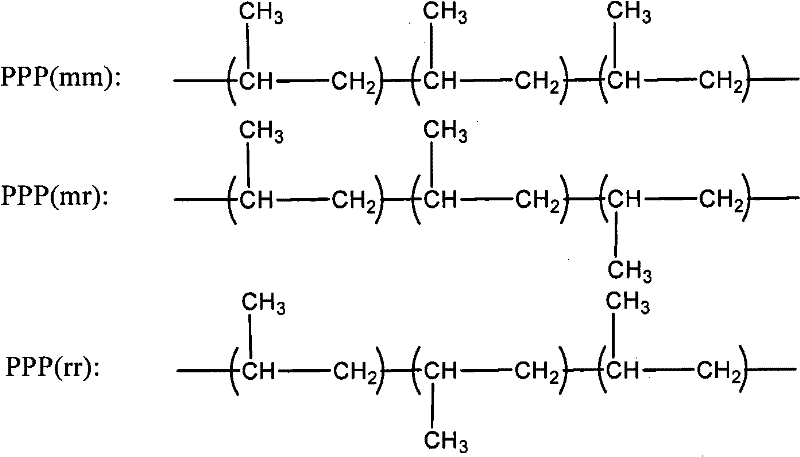
丙烯聚合物的mm分数的计算被描述在美国专利5,504,172中(均聚物:第25栏第49行-第27栏第26行;共聚物:第28栏第38行-第29栏第67行)。关于mm三单元组立构规整度如何可以由13C-NMR光谱测定的进一步的信息,参见1)J.A.Ewen,CATALYTIC POLYMERIZATION OF OLEFINS:PROCEEDINGS OF THE INTERNATIONAL SYMPOSIUM ON FUTURE ASPECTS OFOLEFIN POLYMERIZATION,T.Keii and K.Soga,Eds.(Elsevier,1986),pp.271-292;和2)美国专利申请US 2004/054086(第[0043]-[0054]段)。Calculation of the mm fraction of propylene polymers is described in U.S. Patent 5,504,172 (homopolymers: column 25, line 49 - column 27, line 26; copolymers: column 28, line 38 - column 29, line 67 ). For further information on how mm triad tacticity can be determined from 13 C-NMR spectroscopy, see 1) JAEwen, C ATALYTIC P OLYMERIZATION OF O LEFINS : P ROCEEDINGS OF THE I INTERNATIONAL S YMPOSIUM ON F UTURE A SPECTS OF O LEFIN POLYMERIZATION , T. Keii and K. Soga, Eds. (Elsevier, 1986), pp. 271-292; and 2) US Patent Application US 2004/054086 (paragraphs [0043]-[0054]).
1H NMR 1H NMR
1H NMR数据使用1H频率至少为400MHz的Varian分光计在室温或120℃(就权利要求书来说,应该使用120℃)在5mm探针中收集。使用45°的最大脉冲宽度,8秒的脉冲和平均120次瞬变的信号间间隔来记录数据。将光谱信号积分,并且通过将不同基团乘以1000并将该结果除以总碳数来计算每1000个碳的不饱和度类型的数目。 1 H NMR data were collected in a 5 mm probe using a Varian spectrometer with a 1 H frequency of at least 400 MHz at room temperature or 120°C (for the purposes of the claims, 120°C should be used). Data were recorded using a maximum pulse width of 45°, a pulse of 8 seconds and an inter-signal interval averaging 120 transients. The spectral signals were integrated and the number of unsaturation types per 1000 carbons was calculated by multiplying the different groups by 1000 and dividing the result by the total carbon number.
烯烃类型的1H NMR化学位移区域被定义为在以下光谱区域内。 1 H NMR chemical shift regions of olefinic species are defined as being within the following spectral regions.
不饱和度类型 区域(ppm) 每个结构的氢的数目 Unsaturation type area (ppm) Number of hydrogens per structure
乙烯基 4.95-5.10 2Vinyl 4.95-5.10 2
乙烯叉基 4.70-4.84 2Vinylidene 4.70-4.84 2
亚乙烯基 5.31-5.55 2Vinylene 5.31-5.55 2
三取代的 5.11-5.30 1Tri-substituted 5.11-5.30 1
差示扫描量热法(DSC)Differential Scanning Calorimetry (DSC)
结晶温度(Tc)、熔融温度(或熔点,Tm)、玻璃化转变温度(Tg)和熔化热(Hf)是使用差示扫描量热法(DSC)在市售设备如TA Instruments2920 DSC上测定的。典型地,将6-10mg模制的聚合物或增塑的聚合物封在铝盘中并在室温下装载在所述仪器中。数据通过如下步骤获得:以10℃/min的加热速率加热样品至高于其熔融温度至少30℃的温度,对于聚丙烯来说典型地为220℃。将样品在此温度保持至少5分钟以破坏其热历史。然后以20℃/min的冷却速率将样品由所述熔体冷却到低于结晶温度至少50℃的温度,对于聚丙烯一般为-100℃。将样品在此温度保持至少5分钟,并最后以10℃/min的速率加热以获得另外的熔融数据(第二次加热)。吸热熔化转变(第一次和第二次加热)和放热结晶转变按照标准程序分析。除非另外指明,报告的熔融温度(Tm)是来自第二次加热的峰值熔融温度。对于显示多个峰的聚合物,熔融温度被定义为来自熔融痕迹的、与最大吸热量热响应相关的峰值熔融温度(与在最高温度出现的峰成对比)。类似地,结晶温度被定义为来自结晶痕迹的、与最大放热量热响应相关的峰值结晶温度(与在最高温度出现的峰成对比)。Crystallization temperature (T c ), melting temperature (or melting point, T m ), glass transition temperature (T g ) and heat of fusion (H f ) were measured using differential scanning calorimetry (DSC) on commercially available equipment such as TA Instruments 2920 Measured on DSC. Typically, 6-10 mg of molded or plasticized polymer is enclosed in aluminum pans and loaded into the instrument at room temperature. Data were obtained by heating the sample at a heating rate of 10°C/min to a temperature at least 30°C above its melting temperature, typically 220°C for polypropylene. Hold the sample at this temperature for at least 5 minutes to destroy its thermal history. The sample is then cooled from the melt to a temperature at least 50°C below the crystallization temperature, typically -100°C for polypropylene, at a cooling rate of 20°C/min. The sample was held at this temperature for at least 5 minutes and finally heated at a rate of 10°C/min to obtain additional melting data (second heat). Endothermic melting transitions (first and second heating) and exothermic crystallization transitions were analyzed according to standard procedures. The reported melting temperature (Tm) is the peak melting temperature from the second heat unless otherwise indicated. For polymers exhibiting multiple peaks, the melting temperature is defined as the peak melting temperature associated with the maximum endothermic thermal response from the melting trace (as opposed to the peak occurring at the highest temperature). Similarly, the crystallization temperature was defined as the peak crystallization temperature (as opposed to the peak occurring at the highest temperature) associated with the most exothermic thermal response from the crystallization trace.
在DSC曲线下的面积被用来测量转变热(熔化时的熔化热Hf或结晶时的结晶热Hc),其可以被用于计算结晶度(也称为百分结晶度)。百分结晶度(X%)使用下式计算:[在曲线下的面积(以J/g为单位)/H°(以J/g为单位)*100,其中H°是主要单体组分的均聚物的完美晶体的理想熔化热。这些H°值从由John Wiley and Sons,New York 1999出版的Polymer Handbook第四版获得,除了将290J/g的值用于H°(聚乙烯),140J/g的值用于H°(聚丁烯)和207J/g的值用于H°(聚丙烯)。The area under the DSC curve is used to measure the heat of transition (heat of fusion H f on melting or heat of crystallization H c on crystallization), which can be used to calculate the degree of crystallinity (also called percent crystallinity). Percent crystallinity (X%) is calculated using the following formula: [area under the curve (in J/g)/H° (in J/g)*100, where H° is the major monomer component The ideal heat of fusion for a perfect crystal of a homopolymer. These H° values are obtained from the 4th edition of Polymer Handbook published by John Wiley and Sons, New York 1999, except that a value of 290 J/g is used for H° (polyethylene) and a value of 140 J/g is used for H° (polyethylene). butene) and 207 J/g values for H° (polypropylene).
熔融热(Hm)使用上述DSC方法测定,除了将样品冷却到-100℃,保持5分钟,然后以10℃/min的速率加热到200℃。Hm对第一熔体而非第二熔体测定。Hm样品必须已经在室温下陈化至少48小时且不应被加热来破坏热历史。The heat of fusion (Hm) was determined using the DSC method described above, except that the sample was cooled to -100°C, held for 5 minutes, and then heated to 200°C at a rate of 10°C/min. Hm is determined for the first melt but not for the second melt. Hm samples must have been aged at room temperature for at least 48 hours and should not be heated to destroy thermal history.
乙烯含量Ethylene content
在乙烯共聚物中的乙烯含量通过ASTM D 5017-96测定,除了最小信噪比应该为10,000∶1。在丙烯共聚物中的丙烯含量通过遵从DiMartino and Kelchermans,J.Appl.Polym.Sci.56,1781(1995)中的方法1的步骤并使用来自Zhang,Polymer,45,2651(2004)关于高级烯烃共聚单体的峰归属来测定。Ethylene content in ethylene copolymers is determined by ASTM D 5017-96, except that the minimum signal-to-noise ratio should be 10,000:1. The propylene content in the propylene copolymer was determined by following the procedure of
实施例1Example 1
使用催化剂5和活化剂B制备了三种乙烯基-PE-大分子单体。催化剂溶液在氮气吹扫的Vacuum Atmospheres干燥箱中如下制备:将接近等摩尔(1.00∶1.05)量的所述铁络合物和活化剂添加到在10mL玻璃瓶中的4mL干燥甲苯中。将所述混合物搅拌数分钟,然后转移到干净的、烘箱干燥的催化剂管中。用于合成乙烯基PEmac-1的基本聚合程序如下:将2mL 25wt%的三正辛基铝己烷溶液清除剂和400mL己烷加入到2L不锈钢高压釜反应器中。将反应器加热到100℃。在此期间,将催化剂管接到反应器。一旦反应器温度在100℃平衡,将催化剂溶液用300mL己烷从催化剂管冲入到反应器中。在此添加操作之后,将反应器用200psig乙烯加压。在该实施例中,聚合进行12分钟,在该时间之后将反应器冷却并减压。一旦该反应器被减压,但仍通过温和的干燥氮气流保持在正压下,将该聚乙烯大分子单体产物用轻微的氮气过压用导管送入到隔膜密封的小瓶中。将所述装料的小瓶转移到所述被吹扫的Vacuum Atmospheres干燥箱中。除非另有说明,按照相同的聚合方法生产了PEmac-2和PEmac-3。表A列出了用于制备所述大分子单体的聚合条件。Three vinyl-PE-macromers were prepared using Catalyst 5 and Activator B. Catalyst solutions were prepared in a nitrogen-purged Vacuum Atmospheres drybox by adding approximately equimolar (1.00:1.05) amounts of the iron complex and activator to 4 mL of dry toluene in a 10 mL glass vial. The mixture was stirred for several minutes, then transferred to a clean, oven-dried catalyst tube. The basic polymerization procedure for the synthesis of vinyl PE mac -1 was as follows: 2 mL of 25 wt% tri-n-octylaluminum hexane solution scavenger and 400 mL of hexane were added to a 2 L stainless steel autoclave reactor. The reactor was heated to 100°C. During this time, the catalyst was piped into the reactor. Once the reactor temperature equilibrated at 100°C, the catalyst solution was flushed from the catalyst tube into the reactor with 300 mL of hexane. After this addition, the reactor was pressurized with 200 psig ethylene. In this example, polymerization was carried out for 12 minutes, after which time the reactor was cooled and depressurized. Once the reactor was depressurized, but still maintained at positive pressure by a gentle flow of dry nitrogen, the polyethylene macromonomer product was cannulated with a slight nitrogen overpressure into a septum-sealed vial. The charged vials were transferred to the purged Vacuum Atmospheres dry box. Unless otherwise stated, PE mac -2 and PE mac -3 were produced following the same polymerization procedure. Table A lists the polymerization conditions used to prepare the macromers.
表A.用催化剂5/活化剂B的乙烯基-PE大分子单体的合成Table A. Synthesis of Vinyl-PE Macromers with Catalyst 5/Activator B
这三种大分子单体的性质列在表B中。The properties of these three macromers are listed in Table B.
表B:乙烯基-PE大分子单体的性质Table B: Properties of Vinyl-PE Macromers
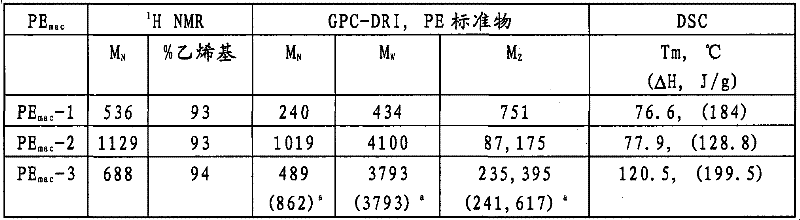
a来自GPC-3D的光散射值;g′=1.00(对PE标准物),在该表中的数据来自第二次熔融。 a Light scattering values from GPC-3D; g' = 1.00 (for PE standards), data in this table are from the second melt.
实施例2Example 2
用PEmac的聚合在被吹扫的Vacuum Atmospheres干燥箱中完成。基本的聚合程序如下:将2.0g PEmac与聚四氟乙烯涂覆的搅拌棒一起放入烘箱干燥的10mL小玻璃瓶中。然后将该小瓶在加热板上加热到85℃(高于此PEmac的熔点)。一旦PEmac熔化,添加催化剂和活化剂。在数个实施例中,不加入另外的溶剂。将小瓶中的内容物在加热板上搅拌1小时,然后冷却到环境温度。使用所述三种PEmac进行的聚合的总结提供在表C中。Polymerization with PE mac was done in purged Vacuum Atmospheres drybox. The basic polymerization procedure was as follows: 2.0 g of PE mac was placed in an oven-dried 10 mL vial along with a Teflon-coated stir bar. The vial was then heated to 85°C (above the melting point of this PE mac ) on a hot plate. Once the PE mac is melted, add the catalyst and activator. In several examples, no additional solvent was added. The contents of the vial were stirred on a hot plate for 1 hour, then cooled to ambient temperature. A summary of polymerizations performed using the three PE macs is provided in Table C.
表C:使用PEmac的PE刷合成的总结Table C: Summary of PE brush synthesis using PE mac
a斜体字的数值是除活化剂A外加入的MAO的以mL计的体积。 a Values in italics are volumes in mL of MAO added in addition to Activator A.
表D:1H NMR不饱和度分析Table D: 1 H NMR Unsaturation Analysis
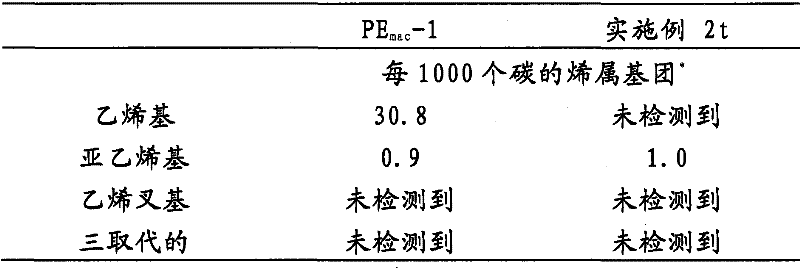
在表E中提供了对于用PEmac进行的八个聚合所记录的1H NMR结果的总结。总不饱和度(其是乙烯基)的百分比从约95%范围降低到0(未检出)和25%之间。根据残余乙烯基以及未反应的亚乙烯基的影响,我们能计算出所述刷状结构体的数均分子量,并且这些也列在下表中。A summary of the1H NMR results recorded for the eight polymerizations performed with PE mac is provided in Table E. The percentage of total unsaturation (which is vinyl) ranges from about 95% to between 0 (not detected) and 25%. According to the effect of residual vinyl groups and unreacted vinylidene groups, we can calculate the number average molecular weight of the brush structure, and these are also listed in the table below.
表E:聚大分子单体(PE刷)的1H NMR结果的总结Table E: Summary of 1 H NMR results for polymacromonomers (PE brushes )

*用来自未消耗PEmac的残余乙烯基和亚乙烯基贡献修正的聚合度*Polymerization corrected for residual vinyl and vinylidene contributions from unconsumed PE mac
在图1中显示了对实施例1记录的13C NMR光谱以及主要峰的归属。对于实施例1的峰谐振位置和归属列在表F中。在合理的范围内,这些归属和强度与作为在替代的碳上具有支链的产物的材料一致。归属命名法描述在图3中。The 13 C NMR spectrum recorded for Example 1 and the assignment of the major peaks are shown in FIG. 1 . The peak resonance positions and assignments for Example 1 are listed in Table F. Within reason, these assignments and intensities are consistent with a material that is a product with branches on alternate carbons. The attribution nomenclature is depicted in Figure 3.
表FForm F
ppm* 碳类型** 归属 积分面积*** ppm * Carbon Type ** Assignment Integral Area ***
41.04 CH2 αα 6541.04 CH2 αα 65
35.57 CH2 αδ+ 6035.57 CH2 αδ + 60
33.20 CH 支化点 6033.20 CH Branch Point 60
32.22 CH2 3S 7332.22
30.72 CH2 γδ+ 30.72 CH2 γδ +
29.98 CH2 δ+δ+ 162029.98 CH2 δ + δ + 1620
29.59 CH2 4S29.59
26.99 CH2 βδ+ 5826.99 CH2 βδ + 58
22.91 CH2 2S 8122.91
14.24 CH3 1S 8214.24
对于实施例2的13C NMR光谱归属For the 13 C NMR spectrum assignment of Example 2
*在四氯乙烷d2中在120C相对于设定到29.98ppm的主链亚甲基信号的位移 * Shift in tetrachloroethane d2 at 120C relative to backbone methylene signal set to 29.98ppm
**来自DEPT实验 ** From DEPT experiments
***来自门控去耦实验(抑制的NOE)的强度 *** Intensities from gated decoupling experiments (NOE of suppression)
归属命名法:Attributed nomenclature:
亚甲基碳通过一对希腊字母或者放在S之前的数字识别。所述希腊符号用于指出一个亚甲基从任一方向距离一个次甲基的碳的数目。当最近的次甲基离所讨论的亚甲基四个碳以上时,采用+符号。‘S’术语识别了在或接近饱和正烷基链的末端的碳。数字说明了一个亚甲基离末端-CH3多少个碳,其中1S碳被定义为末端碳。图3图示说明了该具体的命名规则。The methylene carbons are identified by a pair of Greek letters or numbers preceding the S. The Greek notation is used to indicate the number of carbons a methylene group is from a methine in either direction. The + sign is used when the nearest methine is more than four carbons away from the methylene in question. The 'S' term identifies a carbon at or near the end of a saturated n-alkyl chain. The numbers indicate how many carbons a methylene is from the terminal -CH3 , where the 1S carbon is defined as the terminal carbon. Figure 3 illustrates this specific naming rule.
表G:用PEmac 1和3制得的(PEmac)x刷状物的GPC-3D结果Table G: GPC-3D results of (PE mac ) x brushes made with
1H NMR 刷状物 分子量矩,DRI(粘度测定法) g′vis 1 H NMR brush molecular weight moment, DRI (viscometry) g′ vis
实施例 MN a %乙烯基 MN MW MZ Example M N a % Vinyl M N M W M Z
1 9,524 约5 2,766 18,771 35,649 0.1311 9,524 about 5 2,766 18,771 35,649 0.131
(29,525) (55,732) (101,875)(29,525) (55,732) (101,875)
2 12,727 约0 4,802 56,259 139,819 0.1222 12,727 about 0 4,802 56,259 139,819 0.122
(84,641) (207,202) (462,453)(84,641) (207,202) (462,453)
11 40 1,371 12,624 24,466 ----11 40 1,371 12,624 24,466 ----
3 17,949 25 6,715 41,019 86,999 0.1873 17,949 25 6,715 41,019 86,999 0.187
(52,631) (111,907) (198,094)(52,631) (111,907) (198,094)
10 50 3,325 18,227 80,842 ----10 50 3,325 18,227 80,842 ----
5 5,147 1 3,177 8,356 35,673 0.505 5,147 1 3,177 8,356 35,673 0.50
(4420) (10,600) (46,288)(4420) (10,600) (46,288)
6 5,577 16 3,660 13,038 838,876 0.496 5,577 16 3,660 13,038 838,876 0.49
(6,149) (13,689) (103,392)(6,149) (13,689) (103,392)
7 4,762 18 2,896 9,183 135,219 0.4947 4,762 18 2,896 9,183 135,219 0.494
(6,691) (11,491) (63784)(6,691) (11,491) (63784)
9 10,526 6 1,595 10,640 28,794 0.3709 10,526 6 1,595 10,640 28,794 0.370
(7,937) (13,762) (26,460)(7,937) (13,762) (26,460)
在表G中,(g′)vis被定义为g′=[η聚大分子单体/η线性HDPE](1)。数值覆盖0.122到0.50的范围。这些值反映了每单位体积的相对链质量。由于它们的拓扑结构,所述刷状物比聚乙烯紧密得多,并且最小的g′vis值比得上对聚(癸烯-1)和聚(十二烯-1)测量的那些。In Table G, (g') vis is defined as g'=[ ηpolymacromer / ηlinear HDPE ] (1). Values cover the range of 0.122 to 0.50. These values reflect the relative chain mass per unit volume. Due to their topology, the brushes are much more compact than polyethylene, and the minimum g'vis values are comparable to those measured for poly(decene-1) and poly(dodecene-1).
另外,大分子单体在装有搅拌器、蒸汽加热/水冷却装置和压力控制器的0.5升不锈钢连续高压釜反应器中在连续聚合中合成。一般首先将溶剂、大分子单体和共聚单体(如果有的话)首先冷却到-15℃,然后使它们进入歧管,并然后将它们泵入反应器中。将预活化的催化剂溶液((CpMe5)((1,3-二甲基Ind)HfMe2和N,N-二甲基苯胺鎓四(全氟苯基)硼酸盐,其中Cp=环戊二烯基,Me=甲基,Ind=茚基)从干燥箱通过在单独的管线中的计量泵进料到反应器中。将溶剂(例如己烷)以要求的速率泵入反应器,以控制停留时间。首先向反应器供给溶剂,并加热到要求的温度和控制在设定的压力。然后将单体和催化剂泵入反应器。对于所有实验,催化剂进料速度恒定在2.23×10-7mol/min。搅拌器的速度足够高,使得该反应器在连续搅拌釜式反应器条件下运行。当系统达到稳态时,将每个聚合物样品在收集箱中收集20分钟。将产物在真空烘箱中干燥。反应在350psig的压力下和在70到90℃的温度范围内进行。聚合及表征数据的总结提供在表H到L中。Alternatively, macromonomers were synthesized in continuous polymerization in a 0.5 liter stainless steel continuous autoclave reactor equipped with stirrer, steam heating/water cooling and pressure controller. Typically the solvent, macromer and comonomer (if any) are first cooled to -15°C before they enter the manifold and then they are pumped into the reactor. The preactivated catalyst solution ((CpMe 5 )((1,3-dimethylInd)HfMe 2 and N,N-dimethylanilinium tetrakis(perfluorophenyl)borate, where Cp = cyclopenta Dienyl, Me = methyl, Ind = indenyl) is fed into the reactor from the dry box by a metering pump in a separate line. The solvent (such as hexane) is pumped into the reactor at the required rate to The residence time is controlled. First, the solvent is supplied to the reactor, and heated to the required temperature and controlled at the set pressure. Then the monomer and catalyst are pumped into the reactor. For all experiments, the catalyst feed rate is constant at 2.23 × 10 − 7 mol/min. The speed of the agitator is high enough to make the reactor run under continuous stirred tank reactor conditions. When the system reaches a steady state, each polymer sample is collected in the collection box for 20 minutes. The product Dried in a vacuum oven. Reactions were run at a pressure of 350 psig and a temperature range of 70 to 90° C. A summary of polymerization and characterization data is provided in Tables H to L.
表H:乙丙共聚大分子单体合成条件Table H: Synthesis conditions of ethylene-propylene copolymerization macromonomer

表I:1H NMR测量的在E-共-P大分子单体中不饱和部分的概括Table I: Summary of unsaturation in E-co-P macromers measured by 1 H NMR

a假设每个链有一个不饱和度计算的 a assumes that each chain has a
表J:通过1H NMR测定的在E-P大分子单体产物中乙烯的含量Table J: Ethylene content in EP macromer products as determined by 1 H NMR

表K:由GPC-DRI(LS)测定的E-P大单体的分子量矩Table K: Molecular weight moments of E-P macromers determined by GPC-DRI (LS)

a由1H NMR计算的,g′vis相对于HDPE标准物。 a Calculated from 1 H NMR, g'vis relative to HDPE standards.
表L:差示扫描量热法数据Table L: Differential Scanning Calorimetry Data
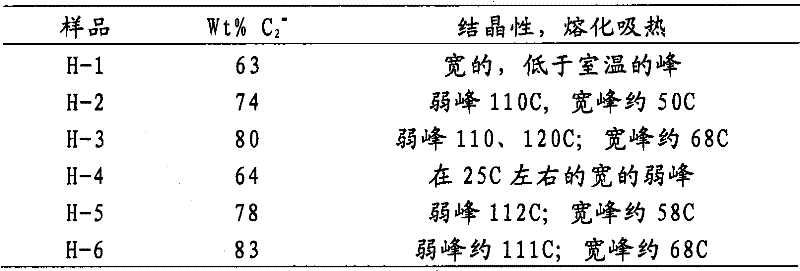
乙丙共聚大分子单体聚合反应Ethylene Propylene Copolymerization Macromonomer Polymerization
将大分子单体加入到催化剂和活化剂在甲苯中的溶液(1,1’-联苯亚甲基(环戊二烯基)(芴基)合铪二甲基化物和N,N-二甲基苯胺鎓四(全氟苯基)硼酸盐)中。所有催化剂溶于甲苯并简单地加入到在指定的聚合温度下的大分子单体。The macromonomer was added to a solution of the catalyst and activator in toluene (1,1'-biphenylmethylene(cyclopentadienyl)(fluorenyl)hafnium dimethyl and N,N-di methylanilinium tetrakis (perfluorophenyl) borate). All catalysts were dissolved in toluene and simply added to the macromonomer at the indicated polymerization temperature.
表M:用来自表H的大单体聚合Table M: Polymerization with macromonomers from Table H
大单体 催化剂 乙丙共聚大分子单体 温度,C 时间,minMacromonomer Catalyst Ethylene Propylene Copolymerized Macromonomer Temperature, C Time, min
prep μM wt,g mM 乙烯基prep μM wt,g mM vinyl
H-4 3.32 2.18g 3.32 85 100H-4 3.32 2.18g 3.32 85 100
H-4 3.32 3.28g 5.01 85 100H-4 3.32 3.28g 5.01 85 100
H-4 3.32 4.36g 6.67 85 100H-4 3.32 4.36g 6.67 85 100
表N:乙丙共聚聚大分子单体聚合Table N: Ethylene Propylene Copolymerization Macromonomer Polymerization
NB# Wt%C2 - GPC GPCNB# Wt% C2 - GPC GPC
1H NMR Mn Mw Mz g’(vis) 1 H NMR Mn Mw Mz g'(vis)
H-4 64 70101 132006 216733 0.125H-4 64 70101 132006 216733 0.125
H-4 64 43164 83147 136449 0.132H-4 64 43164 83147 136449 0.132
H-4 64 85470 157365 253983 0.125H-4 64 85470 157365 253983 0.125
g′vis相对于具有64wt%乙烯的线性标准物EP共聚物。g'vis is relative to a linear standard EP copolymer with 64 wt% ethylene.
本文中描述的、包括任何优先权文件和/或测试方法在内的所有文件通过引用结合在本文中,至它们不与本文内容不一致的程度。从前面的一般描述和具体实施方案可以清楚知道,尽管本发明的形式已经被举例说明和描述,但在不偏离本发明的精神和范围的情况下可以做出各种改变。因此,本发明不想被这些一般描述和具体实施方案所限制。同样,就澳大利亚法律来说,术语“包含”被认为与术语“包括”是同义的。All documents described herein, including any priority documents and/or test methods, are hereby incorporated by reference to the extent they are not inconsistent with the content herein. From the foregoing general description and specific embodiments it will be apparent that, while the form of the invention has been illustrated and described, various changes may be made without departing from the spirit and scope of the invention. Therefore, the invention is not intended to be limited by these general descriptions and specific embodiments. Likewise, the term "comprises" is considered synonymous with the term "comprises" for purposes of Australian law.
Claims (23)
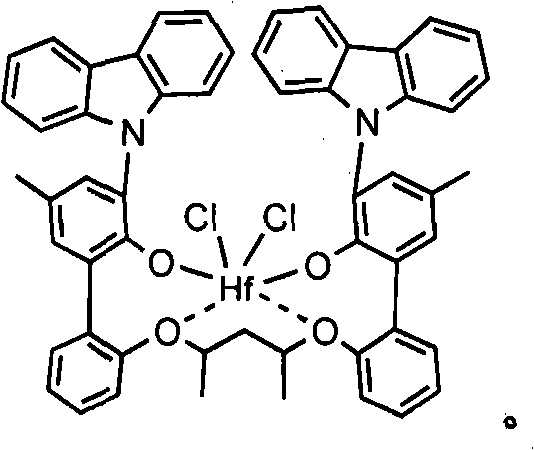

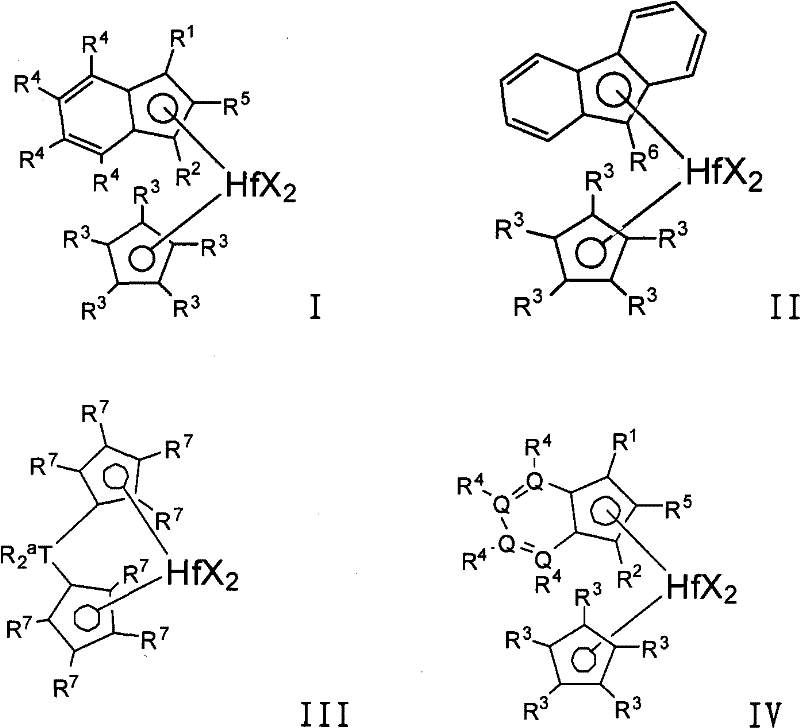
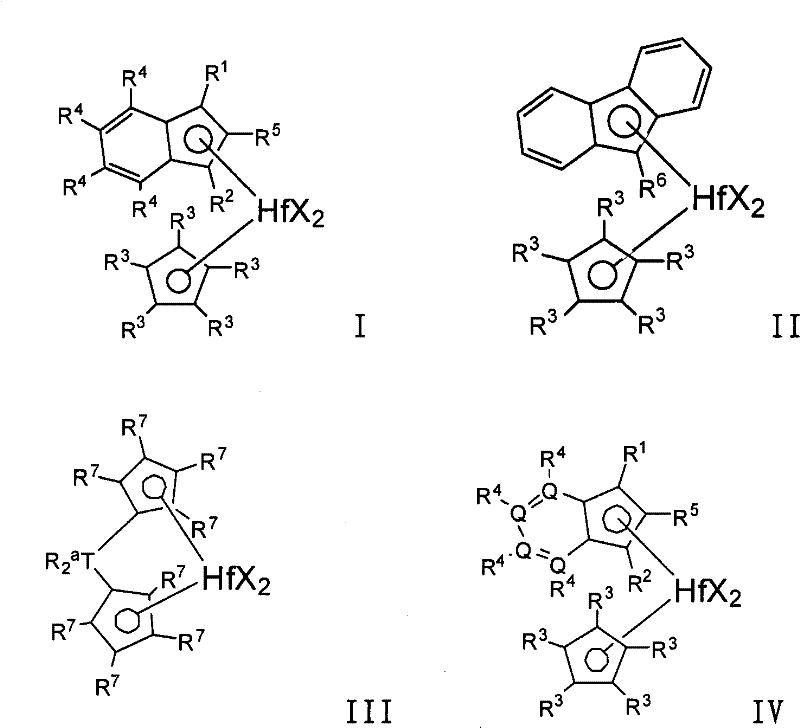
Applications Claiming Priority (3)
| Application Number | Priority Date | Filing Date | Title |
|---|---|---|---|
| US12/143,663 US8372930B2 (en) | 2008-06-20 | 2008-06-20 | High vinyl terminated propylene based oligomers |
| US12/143,663 | 2008-06-20 | ||
| PCT/US2009/047945 WO2009155510A2 (en) | 2008-06-20 | 2009-06-19 | Polymacromonomer and process for production thereof |
Publications (2)
| Publication Number | Publication Date |
|---|---|
| CN102066442A true CN102066442A (en) | 2011-05-18 |
| CN102066442B CN102066442B (en) | 2013-10-02 |
Family
ID=41431902
Family Applications (3)
| Application Number | Title | Priority Date | Filing Date |
|---|---|---|---|
| CN2009801228898A Expired - Fee Related CN102066436B (en) | 2008-06-20 | 2009-06-19 | Olefin functionalization by metathesis reaction |
| CN2009801233665A Expired - Fee Related CN102066442B (en) | 2008-06-20 | 2009-06-19 | Polymacromonomer and process for production thereof |
| CN2009801228864A Active CN102066440B (en) | 2008-06-20 | 2009-06-19 | Functionalized high vinyl terminated propylene based oligomers |
Family Applications Before (1)
| Application Number | Title | Priority Date | Filing Date |
|---|---|---|---|
| CN2009801228898A Expired - Fee Related CN102066436B (en) | 2008-06-20 | 2009-06-19 | Olefin functionalization by metathesis reaction |
Family Applications After (1)
| Application Number | Title | Priority Date | Filing Date |
|---|---|---|---|
| CN2009801228864A Active CN102066440B (en) | 2008-06-20 | 2009-06-19 | Functionalized high vinyl terminated propylene based oligomers |
Country Status (7)
| Country | Link |
|---|---|
| US (3) | US8372930B2 (en) |
| EP (3) | EP2318446A4 (en) |
| JP (3) | JP5604425B2 (en) |
| CN (3) | CN102066436B (en) |
| CA (2) | CA2726647C (en) |
| ES (1) | ES2434993T3 (en) |
| WO (3) | WO2009155517A2 (en) |
Cited By (1)
| Publication number | Priority date | Publication date | Assignee | Title |
|---|---|---|---|---|
| CN116438211A (en) * | 2020-11-23 | 2023-07-14 | Sabic环球技术有限责任公司 | Solution process for the production of halo- or tertiary-amine functionalized polyolefins |
Families Citing this family (130)
| Publication number | Priority date | Publication date | Assignee | Title |
|---|---|---|---|---|
| US8283428B2 (en) | 2008-06-20 | 2012-10-09 | Exxonmobil Chemical Patents Inc. | Polymacromonomer and process for production thereof |
| US8399725B2 (en) | 2008-06-20 | 2013-03-19 | Exxonmobil Chemical Patents Inc. | Functionalized high vinyl terminated propylene based oligomers |
| US8802797B2 (en) | 2008-06-20 | 2014-08-12 | Exxonmobil Chemical Patents Inc. | Vinyl-terminated macromonomer oligomerization |
| ES2420117T3 (en) * | 2008-06-20 | 2013-08-22 | Exxonmobil Chemical Patents Inc. | Oligomers based on superior vinyl finished propylene |
| US8372930B2 (en) | 2008-06-20 | 2013-02-12 | Exxonmobil Chemical Patents Inc. | High vinyl terminated propylene based oligomers |
| US8283419B2 (en) | 2008-06-20 | 2012-10-09 | Exxonmobil Chemical Patents Inc. | Olefin functionalization by metathesis reaction |
| EP2688922A4 (en) * | 2011-03-25 | 2015-03-04 | Exxonmobil Chem Patents Inc | AMPHIPHILIC SEQUENCED COPOLYMERS PREPARED BY ALCOHEN METATHESIS |
| EP2688921B1 (en) * | 2011-03-25 | 2019-04-24 | ExxonMobil Chemical Patents Inc. | Diblock copolymers prepared by cross metathesis |
| US8399724B2 (en) | 2011-03-25 | 2013-03-19 | Exxonmobil Chemical Patents Inc. | Vinyl terminated higher olefin copolymers and methods to produce thereof |
| CN103443132A (en) * | 2011-03-25 | 2013-12-11 | 埃克森美孚化学专利公司 | Enhanced catalyst performance for the production of vinyl-terminated propylene and ethylene/propylene macromers |
| US8669330B2 (en) | 2011-03-25 | 2014-03-11 | Exxonmobil Chemical Patents Inc. | Olefin triblock polymers via ring-opening metathesis polymerization |
| US8835563B2 (en) | 2011-03-25 | 2014-09-16 | Exxonmobil Chemical Patents Inc. | Block copolymers from silylated vinyl terminated macromers |
| US8669326B2 (en) | 2011-03-25 | 2014-03-11 | Exxonmobil Chemical Patents Inc. | Amine functionalized polyolefin and methods for preparation thereof |
| US8426659B2 (en) | 2011-03-25 | 2013-04-23 | Exxonmobil Chemical Patents Inc. | Vinyl terminated higher olefin polymers and methods to produce thereof |
| US8785562B2 (en) | 2011-03-25 | 2014-07-22 | Exxonmobil Chemical Patents Inc. | Amphiphilic block polymers prepared by alkene metathesis |
| US8501894B2 (en) | 2011-03-25 | 2013-08-06 | Exxonmobil Chemical Patents Inc. | Hydrosilyation of vinyl macromers with metallocenes |
| JP5826913B2 (en) * | 2011-03-25 | 2015-12-02 | エクソンモービル ケミカル パテンツ インコーポレイテッド | Vinyl-terminated higher olefin polymer and process for producing the same |
| US8841397B2 (en) | 2011-03-25 | 2014-09-23 | Exxonmobil Chemical Patents Inc. | Vinyl terminated higher olefin polymers and methods to produce thereof |
| CN103443133B (en) | 2011-03-25 | 2015-01-07 | 埃克森美孚化学专利公司 | Block copolymers from silylated vinyl-terminated macromonomers |
| JP5739054B2 (en) * | 2011-03-25 | 2015-06-24 | エクソンモービル ケミカル パテンツ インコーポレイテッド | Vinyl-terminated higher olefin copolymer and method for producing the same |
| US8940839B2 (en) | 2011-03-25 | 2015-01-27 | Exxonmobil Chemical Patents Inc. | Diblock copolymers prepared by cross metathesis |
| US8623974B2 (en) | 2011-03-25 | 2014-01-07 | Exxonmobil Chemical Patents Inc. | Branched vinyl terminated polymers and methods for production thereof |
| WO2012134718A2 (en) | 2011-03-25 | 2012-10-04 | Exxonmobil Chemical Patents Inc. | Amine functionalized polyolefin and methods for preparation thereof |
| JP5793820B2 (en) * | 2011-03-25 | 2015-10-14 | エクソンモービル ケミカル パテンツ インコーポレイテッド | Branched vinyl-terminated polymer and process for producing the same |
| US8318998B2 (en) | 2011-03-25 | 2012-11-27 | Exxonmobil Chemical Patents Inc. | Enhanced catalyst performance for production of vinyl terminated propylene and ethylene/propylene macromers |
| US8455597B2 (en) | 2011-03-25 | 2013-06-04 | Exxonmobil Chemical Patents Inc. | Catalysts and methods of use thereof to produce vinyl terminated polymers |
| US9290584B2 (en) | 2011-07-05 | 2016-03-22 | Exxonmobil Research And Engineering Company | Polyalkylene carboxylic acid polyamine additives for fouling mitigation in hydrocarbon refining processes |
| CN103732636B (en) * | 2011-08-12 | 2016-05-18 | 埃克森美孚化学专利公司 | The polymer of preparing by open loop/cross metathesis |
| JP5600219B2 (en) | 2011-10-24 | 2014-10-01 | 三菱化学株式会社 | Thermoplastic elastomer composition and method for producing the same |
| US8604148B2 (en) | 2011-11-29 | 2013-12-10 | Exxonmobil Chemical Patents Inc. | Functionalization of vinyl terminated polymers by ring opening cross metathesis |
| US8840996B2 (en) | 2011-12-19 | 2014-09-23 | Exxonmobil Research And Engineering Company | Processes for making polyolefin nanocomposites |
| EP2817343A4 (en) * | 2012-02-22 | 2015-10-21 | Exxonmobil Chem Patents Inc | Vinyl-terminated macromonomer oligomerization |
| US8796376B2 (en) | 2012-03-26 | 2014-08-05 | Exxonmobil Chemical Patents Inc. | Functionalized polymers and oligomers |
| US8952114B2 (en) | 2012-08-03 | 2015-02-10 | Exxonmobil Chemical Patents Inc. | Halogenated catalysts comprising Salan ligands |
| US8957171B2 (en) | 2012-08-03 | 2015-02-17 | Exxonmobil Chemical Patents Inc. | Catalysts comprising salan ligands |
| CN104379680B (en) * | 2012-08-03 | 2017-11-28 | 埃克森美孚化学专利公司 | The polyolefin of ethenyl blocking with long chain branching |
| EP2880096B1 (en) | 2012-08-03 | 2018-01-03 | ExxonMobil Chemical Patents Inc. | Process for preparing polyalphaolefins using modified salan catalyst compounds and polyalphaolefins prepared therewith |
| EP2880006B1 (en) | 2012-08-03 | 2017-12-20 | ExxonMobil Chemical Patents Inc. | Non-symmetric catalysts comprising salan ligands |
| US9382349B2 (en) | 2012-08-03 | 2016-07-05 | Exxonmobil Chemical Patents Inc. | Polyalphaolefins prepared using modified Salan catalyst compounds |
| US9422497B2 (en) | 2012-09-21 | 2016-08-23 | Exxonmobil Research And Engineering Company | Synthetic lubricant basestocks and methods of preparation thereof |
| US10017708B2 (en) * | 2012-09-21 | 2018-07-10 | Exxonmobil Chemical Patents Inc. | Lubricant and fuel dispersants and methods of preparation thereof |
| WO2014047482A1 (en) | 2012-09-24 | 2014-03-27 | Exxonmobil Chemical Patents Inc. | Hydrosilation of vinyl-terminated macromonomers |
| US9359456B2 (en) | 2012-09-24 | 2016-06-07 | Exxonmobil Chemical Patents Inc. | Catalytic hydroformylation of vinyl terminated polyolefins |
| US9382350B2 (en) | 2012-09-24 | 2016-07-05 | Exxonmobil Chemical Patents Inc. | Friedel crafts alkylation of aromatics using vinyl terminated macromonomers |
| WO2014047538A1 (en) * | 2012-09-24 | 2014-03-27 | Exxonmobil Chemical Patents Inc. | Production of vinyl terminated polyethylene using supported catalyst system |
| WO2014047343A1 (en) | 2012-09-24 | 2014-03-27 | Exxonmobil Chemical Patents Inc. | Oxygenation of vinyl-terminated macromonomers |
| US9434795B2 (en) | 2012-09-24 | 2016-09-06 | Exxonmobil Chemical Patents Inc. | Production of vinyl terminated polyethylene using supported catalyst system |
| CN104661751B (en) | 2012-09-24 | 2017-02-22 | 埃克森美孚化学专利公司 | Production of vinyl terminated polyethylene |
| US9273166B2 (en) | 2012-09-24 | 2016-03-01 | Exxonmobil Chemical Patents Inc. | Functionalized resins obtained via olefin metathesis |
| US9284387B2 (en) | 2012-09-24 | 2016-03-15 | Exxonmobil Chemical Patents Inc. | Hydroamination of aldehyde-containing macromonomers |
| US9527933B2 (en) | 2012-09-24 | 2016-12-27 | Exxonmobil Chemical Patents Inc. | Branched polyethylenes by hydrosilation grafting to improve processability of polyethylene |
| US9334343B2 (en) | 2012-09-24 | 2016-05-10 | Exxonmobil Chemical Patents Inc. | Hydrohalogenation of vinyl-terminated macromonomers and functionalized derivatives |
| CN104428326A (en) * | 2012-09-27 | 2015-03-18 | 埃克森美孚化学专利公司 | Vinyl-terminated polymers and methods of making the same |
| US9120879B2 (en) | 2012-11-02 | 2015-09-01 | Exxonmobil Chemical Patents Inc. | Supported Salan catalysts |
| WO2014099440A1 (en) * | 2012-12-20 | 2014-06-26 | Exxonmobil Chemical Patents Inc. | Metal polymeryls and the polymer solubilized surfaces derived therefrom |
| US9102844B2 (en) | 2012-12-20 | 2015-08-11 | Exxonmobil Chemical Patents Inc. | Metal polymeryls and the polymer solubilized surfaces derived therefrom |
| US20140179578A1 (en) | 2012-12-24 | 2014-06-26 | Exxonmobil Research And Engineering Company | Alternating block copolymer and process for making |
| SG11201505073SA (en) | 2012-12-27 | 2015-07-30 | Dow Global Technologies Llc | A polymerization process for producing ethylene based polymers |
| US9751998B2 (en) | 2012-12-27 | 2017-09-05 | Dow Global Technologies Llc | Catalyst systems for olefin polymerization |
| CN104884484B (en) * | 2012-12-27 | 2018-09-14 | 陶氏环球技术有限责任公司 | Polymerization for generating polyvinyls |
| US9422385B2 (en) * | 2013-01-30 | 2016-08-23 | Exxonmobil Chemical Patents Inc. | Polyethylene copolymers with vinyl terminated macromonomers as comonomers |
| US9169334B2 (en) | 2013-01-30 | 2015-10-27 | Exxonmobil Chemical Patents Inc. | Preparation of bottlebrush polymers via ring-opening metathesis polymerization |
| US8937137B2 (en) | 2013-03-13 | 2015-01-20 | Exxonmobil Chemical Patents Inc. | Diphenylamine salan catalyst |
| US9334460B2 (en) | 2013-03-14 | 2016-05-10 | Exxonmobil Research And Engineering Company | Ring opening cross metathesis of vinyl terminated polymers and their functionalized derivatives for fouling mitigation in hydrocarbon refining processes |
| US9617482B2 (en) | 2013-03-14 | 2017-04-11 | Exxonmobil Research And Engineering Company | Functionalized polymers containing polyamine succinimide for demulsification in hydrocarbon refining processes |
| US9085737B2 (en) | 2013-03-14 | 2015-07-21 | Exxonmobil Research And Engineering Company | Functionalized polymers containing polyamine succinimide for demulsification in hydrocarbon refining processes |
| US9212326B2 (en) | 2013-03-14 | 2015-12-15 | Exxonmobil Research And Engineering Company | Hydrohalogenation of vinyl terminated polymers and their functionalized derivatives for fouling mitigation in hydrocarbon refining processes |
| US9441171B2 (en) | 2013-03-14 | 2016-09-13 | Exxonmobil Research And Engineering Company | Functionalized polymers containing polyamine succinimide for antifouling in hydrocarbon refining processes |
| US20140275433A1 (en) | 2013-03-14 | 2014-09-18 | Exxonmobil Research And Engineering Company | Amination of polymers terminated with aldehyde group and their functionalized derivatives for fouling mitigation in hydrocarbon refining processes |
| US9416325B2 (en) | 2013-03-14 | 2016-08-16 | Exxonmobil Research And Engineering Company | Methods and systems for predicting a need for introducing anti-fouling additives to a hydrocarbon stream to reduce fouling of crude hydrocarbon refinery components |
| US9150676B2 (en) | 2013-06-20 | 2015-10-06 | Exxonmobil Chemical Patents Inc. | Thio-salalen catalyst |
| US9200099B2 (en) | 2013-06-20 | 2015-12-01 | Exxonmobil Chemical Patents Inc. | Salenol catalyst |
| CN105142777B (en) | 2013-06-20 | 2017-12-26 | 埃克森美孚化学专利公司 | Longbridge Salen Catalyst |
| CN105283474A (en) | 2013-06-28 | 2016-01-27 | 陶氏环球技术有限责任公司 | Molecular Weight Control of Polyolefins Using Halogenated Bisphenylphenoxy Catalysts |
| US9840597B2 (en) | 2013-08-16 | 2017-12-12 | Exxonmobil Chemical Patents Inc. | Polyamide-polyolefin copolymers and methods of making them |
| CN105473630B (en) * | 2013-08-16 | 2017-12-01 | 埃克森美孚化学专利公司 | Compatible tire tread compositions |
| WO2015041737A1 (en) * | 2013-09-23 | 2015-03-26 | Exxonmobil Chemical Patents Inc. | Process of polyolefin functionalization |
| US9382354B2 (en) | 2013-11-22 | 2016-07-05 | Exxonmobil Chemical Patents Inc. | Polyesters containing polyolefin arms |
| US9695288B2 (en) | 2013-11-22 | 2017-07-04 | Exxonmobil Chemical Patents Inc. | Graft engineering thermoplastics with polyolefins |
| EP3077433B1 (en) * | 2013-12-05 | 2022-04-20 | ExxonMobil Chemical Patents Inc. | Functionalized resins for high performance tires |
| WO2015088819A1 (en) | 2013-12-13 | 2015-06-18 | Exxonmobil Chemical Patents Inc. | Cyclopentadienyl-substituted salan catalysts |
| US9321856B2 (en) | 2013-12-19 | 2016-04-26 | Exxonmobil Chemical Patents Inc. | Process to produce functionalized polymer |
| US20160362510A1 (en) * | 2014-02-11 | 2016-12-15 | Univation Technologies, Llc | Method to prepare ethylene copolymers |
| US9714306B2 (en) | 2014-03-28 | 2017-07-25 | Mitsui Chemicals, Inc. | Olefin resin and method for producing same |
| EP3126325B1 (en) | 2014-03-31 | 2019-04-24 | ExxonMobil Chemical Patents Inc. | Phenylene-bridged salalen catalysts |
| RU2715722C2 (en) | 2014-10-24 | 2020-03-03 | Эксонмобил Кемикэл Пейтентс Инк. | Chain-terminated polyolefins designed to improve tire adhesion with wet road surface and tire tread resistance |
| US10280270B2 (en) | 2014-11-24 | 2019-05-07 | Exxonmobil Chemical Patents Inc. | Silane functionalized polyolefins for polyolefin nanocomposites |
| US20160160071A1 (en) | 2014-12-04 | 2016-06-09 | Exxonmobil Chemical Patents Inc. | Water-Based Polyolefin Corrosion Inhibitors Based on Vinyl/Vinylidene Terminated Polyolefins |
| US10023719B2 (en) | 2015-02-02 | 2018-07-17 | Exxonmobil Chemical Patents Inc. | Toughened polyolefin nanocomposites using silane functionalized polyolefins |
| WO2016144415A1 (en) | 2015-03-06 | 2016-09-15 | Exxonmobil Chemical Patents Inc. | Block copolymers of polyacrylates and polyolefins |
| US10538604B2 (en) | 2015-04-17 | 2020-01-21 | Univation Technologies, Llc | Catalysts for control of long chain branching |
| WO2017004456A1 (en) | 2015-06-30 | 2017-01-05 | Dow Global Technologies Llc | A polymerization process for producing ethylene based polymers |
| ES2785628T3 (en) | 2015-06-30 | 2020-10-07 | Dow Global Technologies Llc | A polymerization process to produce ethylene-based polymers |
| US9732300B2 (en) | 2015-07-23 | 2017-08-15 | Chevron Phillipa Chemical Company LP | Liquid propylene oligomers and methods of making same |
| KR102589562B1 (en) | 2015-09-30 | 2023-10-16 | 다우 글로벌 테크놀로지스 엘엘씨 | Polymerization method for producing ethylene-based polymer |
| EP3356431B1 (en) | 2015-09-30 | 2020-04-22 | Dow Global Technologies LLC | Procatalyst and polymerization process using the same |
| EP3365379B1 (en) * | 2015-10-23 | 2024-12-18 | ExxonMobil Chemical Patents Inc. | Production of polyolefins with internal unsaturation structures using a metallocene catalyst system |
| US9926396B2 (en) | 2015-10-23 | 2018-03-27 | Exxonmobil Chemical Patents Inc. | Production of polyolefins with internal unsaturation structures using a metallocene catalyst system |
| US10882932B2 (en) | 2016-10-05 | 2021-01-05 | Exxonmobil Chemical Patents Inc. | Sterically hindered metallocenes, synthesis and use |
| CN108570129B (en) * | 2017-03-10 | 2020-10-23 | 中国石油化工股份有限公司 | Modified ethylene propylene diene monomer and preparation method thereof |
| US10968290B2 (en) | 2017-03-28 | 2021-04-06 | Exxonmobil Chemical Patents Inc. | Metallocene-catalyzed polyalpha-olefins |
| US11066489B2 (en) | 2017-09-29 | 2021-07-20 | Dow Global Technologies Llc | Bis-phenyl-phenoxy polyolefin catalysts having two methylenetrialkylsilicon ligands on the metal for improved solubility |
| CN111108132B (en) | 2017-09-29 | 2023-06-20 | 陶氏环球技术有限责任公司 | Bis-phenyl-phenoxy polyolefin catalysts with methylene trialkyl silicon ligands on metal for improved solubility |
| KR102590973B1 (en) | 2017-09-29 | 2023-10-19 | 다우 글로벌 테크놀로지스 엘엘씨 | Bis-phenyl-phenoxy polyolefin catalysts with alkoxy or amido ligands on metal for improved solubility |
| CA3090994A1 (en) | 2018-02-12 | 2019-08-15 | Exxonmobil Chemical Patents Inc. | Catalyst systems and processes for poly alpha-olefin having high vinylidene content |
| US11021553B2 (en) | 2018-02-12 | 2021-06-01 | Exxonmobil Chemical Patents Inc. | Metallocene dimer selective catalysts and processes to produce poly alpha-olefin dimers |
| US11078308B2 (en) | 2018-02-12 | 2021-08-03 | Exxonmobil Chemical Patents Inc. | Processes to produce poly alpha-olefin trimers |
| SG11202010442QA (en) | 2018-04-26 | 2020-11-27 | Exxonmobil Chemical Patents Inc | Non-coordinating anion type activators containing cation having large alkyl groups |
| KR102282280B1 (en) * | 2018-05-04 | 2021-07-27 | 주식회사 엘지화학 | Ethylene/alpha-olefin copolymer and method for preparing the same |
| CN108912250A (en) * | 2018-08-15 | 2018-11-30 | 青岛科技大学 | A kind of high-damping, high wet-sliding resistant, the ionomer of low-heat-generation and preparation method |
| KR102836334B1 (en) | 2018-08-30 | 2025-07-21 | 다우 글로벌 테크놀로지스 엘엘씨 | Bis-phenyl-phenoxy polyolefin procatalyst having two anthracenyl ligands |
| CN113015755B (en) | 2018-09-17 | 2023-09-08 | 埃克森美孚化学专利公司 | Metallocene dimer selective catalyst and process for preparing poly alpha-olefin dimer |
| WO2020131311A1 (en) | 2018-12-18 | 2020-06-25 | Exxonmobil Research And Engineering Company | Modified asphalts and methods for producing the same |
| EP3940009A4 (en) | 2019-03-12 | 2023-03-15 | Mitsui Chemicals, Inc. | OLEFIN-BASED RESIN, CROSSLINKING PRODUCT THEREOF AND METHOD OF MANUFACTURE THEREOF |
| US11059791B2 (en) | 2019-04-25 | 2021-07-13 | Exxonmobil Chemical Patents Inc. | Non-coordinating anion type benzimidazolium activators |
| WO2020219050A1 (en) * | 2019-04-25 | 2020-10-29 | Exxonmobil Chemical Patents Inc. | Non-coordinating anion type benzimidazolium activators |
| WO2020219049A1 (en) * | 2019-04-25 | 2020-10-29 | Exxonmobil Chemical Patents Inc. | Non-coordinating anion type indolinium activators in aliphatic and alicyclic hydrocarbon solvents |
| WO2021030045A1 (en) | 2019-08-09 | 2021-02-18 | Exxonmobil Chemical Patents Inc. | Process to produce low viscosity polyalphaolefins using non-aromatic-hydrocarbon soluble activators |
| US11661465B2 (en) | 2019-10-28 | 2023-05-30 | Exxonmobil Chemical Patents Inc. | Dimer selective metallocene catalysts, non-aromatic hydrocarbon soluble activators, and processes to produce poly alpha-olefin oligmers therewith |
| WO2021173361A1 (en) | 2020-02-24 | 2021-09-02 | Exxonmobil Chemical Patents Inc. | Ansa-bis(inden-2-yl) catalysts for producing vinylidene-terminated polyalphaolefins |
| CA3176627A1 (en) | 2020-04-29 | 2021-11-04 | Mark H. Li | Poly alpha-olefin compositions and processes to produce poly alpha-olefins |
| EP4157813A1 (en) | 2020-05-29 | 2023-04-05 | ExxonMobil Chemical Patents Inc. | Processes for producing cyclic olefins from polymers and re-polymerization thereof |
| WO2021257264A1 (en) | 2020-06-16 | 2021-12-23 | Exxonmobil Chemical Patents Inc. | Metallocene catalysts for producing vinyl-terminated polyalphaolefins and methods associated therewith |
| CN113896816B (en) * | 2020-06-22 | 2025-09-19 | 中国石油化工股份有限公司 | Modified ethylene propylene diene monomer and preparation method thereof |
| CN113896837B (en) * | 2020-06-22 | 2025-09-19 | 中国石油化工股份有限公司 | Modified ethylene propylene diene monomer and preparation method thereof |
| CN115386044A (en) * | 2021-05-21 | 2022-11-25 | 中国石油化工股份有限公司 | Ester-based modified ethylene propylene diene monomer rubber and preparation method thereof |
| CN115368489A (en) * | 2021-05-21 | 2022-11-22 | 中国石油化工股份有限公司 | Preparation method of ester-based modified ethylene propylene diene monomer rubber and modified ethylene propylene diene monomer rubber |
| CN115386021A (en) * | 2021-05-25 | 2022-11-25 | 中国石油化工股份有限公司 | Preparation method of hydroxyl modified ethylene propylene diene monomer rubber and hydroxyl modified ethylene propylene diene monomer rubber |
| CN121001982A (en) | 2023-05-22 | 2025-11-21 | 埃克森美孚技术与工程公司 | Methods for activating metallocene catalysts in reactors to improve catalyst productivity in PAO production |
| CN118538308B (en) * | 2024-07-12 | 2024-11-22 | 碳氢数科(成都)信息技术有限公司 | Chemical reaction data mining method, system, storage medium and terminal |
Citations (2)
| Publication number | Priority date | Publication date | Assignee | Title |
|---|---|---|---|---|
| US6117962A (en) * | 1997-12-10 | 2000-09-12 | Exxon Chemical Patents Inc. | Vinyl-containing stereospecific polypropylene macromers |
| US20070293640A1 (en) * | 2002-10-15 | 2007-12-20 | Peijun Jiang | Multiple catalyst system for olefin polymerization and polymers produced therefrom |
Family Cites Families (214)
| Publication number | Priority date | Publication date | Assignee | Title |
|---|---|---|---|---|
| US3022305A (en) | 1957-06-17 | 1962-02-20 | Du Pont | Process for preparing pyridazine derivatives and novel fluorine-containing pyridazine derivatives |
| US3235484A (en) | 1962-03-27 | 1966-02-15 | Lubrizol Corp | Cracking processes |
| US3382291A (en) | 1965-04-23 | 1968-05-07 | Mobil Oil Corp | Polymerization of olefins with bf3 |
| GB1310847A (en) | 1971-03-12 | 1973-03-21 | Lubrizol Corp | Fuel compositions |
| US3780128A (en) | 1971-11-03 | 1973-12-18 | Ethyl Corp | Synthetic lubricants by oligomerization and hydrogenation |
| US3742082A (en) | 1971-11-18 | 1973-06-26 | Mobil Oil Corp | Dimerization of olefins with boron trifluoride |
| US3769363A (en) | 1972-03-13 | 1973-10-30 | Mobil Oil Corp | Oligomerization of olefins with boron trifluoride |
| US3876720A (en) | 1972-07-24 | 1975-04-08 | Gulf Research Development Co | Internal olefin |
| US4197398A (en) * | 1974-12-04 | 1980-04-08 | Exxon Research & Engineering Co. | Process for neutralizing and deashing polypropylene |
| US4017406A (en) | 1975-05-01 | 1977-04-12 | Exxon Research And Engineering Company | Carboxylate half esters of 1-aza-3,7-dioxabicyclo[3.3.0] oct-5-yl methyl alcohols, their preparation and use as additives for oleaginous compositions |
| US4149178A (en) * | 1976-10-05 | 1979-04-10 | American Technology Corporation | Pattern generating system and method |
| IT1068433B (en) | 1976-10-28 | 1985-03-21 | Snam Progetti | PROCEDURE FOR THE LACHILATION OF SECONDARY ALIPHATIC AMINES |
| US4172855A (en) | 1978-04-10 | 1979-10-30 | Ethyl Corporation | Lubricant |
| US4239930A (en) | 1979-05-17 | 1980-12-16 | Pearsall Chemical Company | Continuous oligomerization process |
| JPS56126315A (en) * | 1980-03-11 | 1981-10-03 | Sony Corp | Oscillator |
| US4367352A (en) | 1980-12-22 | 1983-01-04 | Texaco Inc. | Oligomerized olefins for lubricant stock |
| US4956122A (en) | 1982-03-10 | 1990-09-11 | Uniroyal Chemical Company, Inc. | Lubricating composition |
| US4413156A (en) | 1982-04-26 | 1983-11-01 | Texaco Inc. | Manufacture of synthetic lubricant additives from low molecular weight olefins using boron trifluoride catalysts |
| US4619758A (en) | 1982-07-09 | 1986-10-28 | Texaco, Inc. | Fluid catalytic cracking method |
| US4568663A (en) | 1984-06-29 | 1986-02-04 | Exxon Research And Engineering Co. | Cobalt catalysts for the conversion of methanol to hydrocarbons and for Fischer-Tropsch synthesis |
| CA1263498A (en) | 1985-03-26 | 1989-11-28 | Mitsui Chemicals, Incorporated | Liquid ethylene-type random copolymer, process for production thereof, and use thereof |
| US4619756A (en) | 1985-04-11 | 1986-10-28 | Exxon Chemical Patents Inc. | Method to inhibit deposit formation |
| CA1333596C (en) | 1986-10-16 | 1994-12-20 | Robert Dean Lundberg | High functionality low molecular weight oil soluble dispersant additives useful in oleaginous compositions |
| JPH01207248A (en) * | 1986-11-13 | 1989-08-21 | Idemitsu Kosan Co Ltd | Production of propylene lower polymer |
| DE3772331D1 (en) | 1986-11-13 | 1991-09-26 | Idemitsu Kosan Co | METHOD FOR OLIGOMERIZING PROPEN. |
| JP2732346B2 (en) * | 1986-11-13 | 1998-03-30 | 出光興産株式会社 | Method for producing propylene-based low polymer |
| US4827064A (en) | 1986-12-24 | 1989-05-02 | Mobil Oil Corporation | High viscosity index synthetic lubricant compositions |
| US5241025A (en) | 1987-01-30 | 1993-08-31 | Exxon Chemical Patents Inc. | Catalyst system of enhanced productivity |
| DE3855519T2 (en) | 1987-03-19 | 1997-04-17 | Idemitsu Kosan Co | Olefin polymers and processes for their production |
| US5545674A (en) | 1987-05-07 | 1996-08-13 | Exxon Research And Engineering Company | Surface supported cobalt catalysts, process utilizing these catalysts for the preparation of hydrocarbons from synthesis gas and process for the preparation of said catalysts |
| DE3718374A1 (en) | 1987-06-02 | 1988-12-15 | Bayer Ag | POLYETHER, METHOD FOR THE PRODUCTION THEREOF AND LUBRICANTS THAT CONTAIN THIS POLYETHER |
| JPS6487652A (en) | 1987-09-29 | 1989-03-31 | Toyota Motor Corp | Impact-resistant polypropylene resin composition |
| US4827073A (en) | 1988-01-22 | 1989-05-02 | Mobil Oil Corporation | Process for manufacturing olefinic oligomers having lubricating properties |
| DE3808267A1 (en) * | 1988-03-12 | 1989-09-21 | Hoechst Ag | METHOD FOR PRODUCING 1-OLEFIN POLYMERS |
| US4988784A (en) * | 1988-07-01 | 1991-01-29 | Union Carbide Chemicals And Plastics Company Inc. | Catalyst for regulating the molecular weight distribution of ethylene polymers |
| CA2034759C (en) * | 1988-08-01 | 2003-06-03 | Won R. Song | Novel ethylene alpha-olefin polymer substituted mono- and dicarboxylic acid dispersant additives |
| US5229022A (en) | 1988-08-01 | 1993-07-20 | Exxon Chemical Patents Inc. | Ethylene alpha-olefin polymer substituted mono- and dicarboxylic acid dispersant additives (PT-920) |
| US4999403A (en) | 1988-10-28 | 1991-03-12 | Exxon Chemical Patents Inc. | Graft polymers of functionalized ethylene-alpha-olefin copolymer with polypropylene, methods of preparation, and use in polypropylene compositions |
| US4910355A (en) | 1988-11-02 | 1990-03-20 | Ethyl Corporation | Olefin oligomer functional fluid using internal olefins |
| US4926004A (en) | 1988-12-09 | 1990-05-15 | Mobil Oil Corporation | Regeneration of reduced supported chromium oxide catalyst for alpha-olefin oligomerization |
| US4914254A (en) | 1988-12-12 | 1990-04-03 | Mobil Oil Corporation | Fixed bed process for high viscosity index lubricant |
| US5026948A (en) | 1989-02-21 | 1991-06-25 | Mobil Oil Corporation | Disproportionation of alpha-olefin dimer to liquid lubricant basestock |
| US4967032A (en) | 1989-09-05 | 1990-10-30 | Mobil Oil Corporation | Process for improving thermal stability of synthetic lubes |
| US5266186A (en) | 1989-10-12 | 1993-11-30 | Nalco Chemical Company | Inhibiting fouling employing a dispersant |
| US5348982A (en) | 1990-04-04 | 1994-09-20 | Exxon Research & Engineering Co. | Slurry bubble column (C-2391) |
| AU7875791A (en) | 1990-05-07 | 1991-11-27 | Exxon Chemical Patents Inc. | Unsaturated alpha-olefin copolymers and method for preparation thereof |
| JP2930371B2 (en) | 1990-06-08 | 1999-08-03 | 東燃株式会社 | Both-end-modified ethylene polymer and method for producing the same |
| US5068487A (en) | 1990-07-19 | 1991-11-26 | Ethyl Corporation | Olefin oligomerization with BF3 alcohol alkoxylate co-catalysts |
| EP0481480B1 (en) * | 1990-10-17 | 1995-01-25 | Idemitsu Kosan Company Limited | Process for producing propylene based oligomers |
| EP0485822B1 (en) | 1990-11-12 | 1996-07-03 | Hoechst Aktiengesellschaft | Process for preparing high molecular weight polyolefines |
| DE59104869D1 (en) | 1990-11-12 | 1995-04-13 | Hoechst Ag | 2-Substituted bisindenyl metallocenes, process for their preparation and their use as catalysts in olefin polymerization. |
| US5252677A (en) | 1990-11-20 | 1993-10-12 | Mitsubishi Petrochemical Company Limited | Functionalized olefin polymers |
| GB9027000D0 (en) * | 1990-12-12 | 1991-01-30 | Shell Int Research | Alkenyl succinimides as luboil additives |
| US5087788A (en) | 1991-03-04 | 1992-02-11 | Ethyl Corporation | Preparation of high purity vinylindene olefin |
| US5382634A (en) * | 1991-03-15 | 1995-01-17 | Tonen Corporation | Terminal-modifed polyolefins |
| ES2087339T3 (en) | 1991-05-27 | 1996-07-16 | Hoechst Ag | PROCEDURE FOR THE PREPARATION OF POLYOLEFINS WITH WIDE DISTRIBUTION OF MOLECULAR MASSES. |
| US5211834A (en) | 1992-01-31 | 1993-05-18 | Betz Laboratories, Inc. | Method for controlling fouling deposit formation in a liquid hydrocarbonaceous medium using boronated derivatives of polyalkenylsuccinimides |
| DE4205932A1 (en) * | 1992-02-27 | 1993-09-02 | Basf Ag | PROCESS FOR THE PREPARATION OF PROPENOLIGOMERS |
| EP1253156A3 (en) | 1992-04-03 | 2004-01-07 | California Institute Of Technology | High activity ruthenium or osmium metal carbene complexes for olefin metathesis reactions and synthesis and application thereof |
| JP3186218B2 (en) * | 1992-05-20 | 2001-07-11 | 出光興産株式会社 | Terminal vinyl ethylene-propylene copolymer and method for producing the same |
| US5688887A (en) | 1992-05-26 | 1997-11-18 | Amoco Corporation | Reactive, low molecular weight, viscous poly(1-olefins) and copoly(1-olefins) and their method of manufacture |
| US6043401A (en) | 1992-05-26 | 2000-03-28 | Bp Amoco Corporation | Reactive, low molecular weight, viscous poly(1-olefins) and copoly(1-olefins) and their method of manufacture |
| TW291486B (en) | 1992-12-17 | 1996-11-21 | Exxon Chemical Patents Inc | |
| IL107927A0 (en) | 1992-12-17 | 1994-04-12 | Exxon Chemical Patents Inc | Oil soluble ethylene/1-butene copolymers and lubricating oils containing the same |
| IT1256260B (en) | 1992-12-30 | 1995-11-29 | Montecatini Tecnologie Srl | ATACTIC POLYPROPYLENE |
| DE4302254A1 (en) * | 1993-01-28 | 1994-08-04 | Basf Ag | Cooligomers from alpha-olefins and small amounts of ethylene |
| EP0613873A3 (en) | 1993-02-23 | 1995-02-01 | Shell Int Research | Oligomerization process. |
| ES2163404T3 (en) | 1993-04-07 | 2002-02-01 | Atofina Res | PROCEDURE FOR THE PRODUCTION OF POLYOLEFINS AND POLYOLEFINAL CATALYST. |
| GB9312245D0 (en) | 1993-06-14 | 1993-07-28 | Exxon Chemical Patents Inc | Hydrocarbon treatment |
| DE4333128A1 (en) | 1993-09-29 | 1995-03-30 | Hoechst Ag | Process for the preparation of polyolefins |
| US5439607A (en) | 1993-12-30 | 1995-08-08 | Exxon Chemical Patents Inc. | Multifunctional viscosity index improver-dispersant antioxidant |
| DE69507598T2 (en) | 1994-02-22 | 1999-09-02 | Exxon Chemical Patents Inc. | OLIGOMERIZATION AND CATALYST DAFUER |
| IT1273420B (en) * | 1994-04-06 | 1997-07-08 | Spherilene Srl | METALLOCENIC COMPOUNDS, PROCEDURE FOR THE PREPARATION AND THEIR USE IN CATALYSTS FOR THE POLYMERIZATION OF OLEFINS |
| US6143686A (en) | 1994-08-03 | 2000-11-07 | Exxon Chemical Patents, Inc. | Supported ionic catalyst compositions |
| US5648557A (en) | 1994-10-27 | 1997-07-15 | Mobil Oil Corporation | Polyether lubricants and method for their production |
| US5500398A (en) * | 1994-11-09 | 1996-03-19 | Northwestern University | Homogeneous α-olefin dimerization catalysts |
| DE4446923A1 (en) | 1994-12-28 | 1996-07-04 | Hoechst Ag | Polyolefin wax |
| US5670595A (en) | 1995-08-28 | 1997-09-23 | Exxon Chemical Patents Inc. | Diene modified polymers |
| US5591340A (en) * | 1995-09-01 | 1997-01-07 | Costner Industries Nevada, Inc. | Centrifugal separator |
| US5736492A (en) | 1995-09-08 | 1998-04-07 | Shell Oil Company | Alkenyl-substituted dicarboxylic derivatives |
| US5616153A (en) * | 1995-10-03 | 1997-04-01 | Ethyl Corporation | Copolymer dispersants via vinyl terminated propene polymers |
| US5756609A (en) | 1995-10-19 | 1998-05-26 | Amoco Corporation | Homogeneous metallocene-based olefin polymerization system with increased activity |
| US6114477A (en) | 1996-02-09 | 2000-09-05 | Exxon Chemical Patents Inc. | Polymerization process |
| US5856256A (en) | 1996-02-20 | 1999-01-05 | Northwestern University | Organo-Lewis acid as cocatalyst for cationic homogeneous Ziegler-Natta olefin polymerizations |
| US6291695B1 (en) | 1996-02-20 | 2001-09-18 | Northwestern University | Organo-Lewis acids of enhanced utility, uses thereof, and products based thereon |
| EP0802216B1 (en) | 1996-04-15 | 2000-01-26 | Dow Corning Asia, Ltd. | Copolymer of polypropylene and organopolysiloxane and method for preparation thereof |
| US6114445A (en) | 1996-06-13 | 2000-09-05 | University Of Waterloo | Hydrosilylation of polypropylene |
| US5811379A (en) | 1996-06-17 | 1998-09-22 | Exxon Chemical Patents Inc. | Polymers derived from olefins useful as lubricant and fuel oil additives, processes for preparation of such polymers and additives and use thereof (PT-1267) |
| US6297301B1 (en) | 1996-08-06 | 2001-10-02 | Exxonmobil Chemical Patents Inc. | Thermoplastic elastomer compositions having improved processing properties |
| US6576306B2 (en) | 1996-09-04 | 2003-06-10 | Exxonmobil Chemical Patents Inc. | Propylene polymers for films |
| DE19645430A1 (en) | 1996-11-04 | 1998-05-07 | Basf Ag | Polyolefins and their functionalized derivatives |
| DE19648895A1 (en) | 1996-11-26 | 1998-05-28 | Clariant Gmbh | Polar modified polypropylene waxes |
| EP0958314B1 (en) | 1997-02-07 | 2002-11-06 | ExxonMobil Chemical Patents Inc. | Propylene polymers incorporating polyethylene macromers |
| BR9806952A (en) | 1997-02-07 | 2000-03-21 | Exxon Chemical Patents Inc | Preparation of macromers containing vinyl. |
| US6114457A (en) | 1997-02-07 | 2000-09-05 | Exxon Chemical Patents Inc. | High melt strength polyethylene compositions |
| US6197791B1 (en) * | 1997-02-27 | 2001-03-06 | American Cyanamid Company | N-hdroxy-2-(alkyl, aryl, or heteroaryl, sulfanyl, sulfinyl or sulfonyl)-3-substituted alkyl, aryl or heteroarylamides as matrix metalloproteinase inhibitors |
| DE19709667A1 (en) * | 1997-03-11 | 1998-09-17 | Basf Ag | Comb polymers via metallocene catalysis |
| WO1998043989A1 (en) | 1997-03-29 | 1998-10-08 | Montell Technology Company B.V. | Metallocenes and catalysts for polymerization of olefins |
| EP0979074A4 (en) * | 1997-05-01 | 2003-07-09 | Novogen Inc | TREATMENT OR PREVENTION OF MENOPAUSIC SYMPTOMS AND OSTEOPOROSIS |
| US6103946A (en) | 1997-07-15 | 2000-08-15 | E. I. Du Pont De Nemours And Company | Manufacture of α-olefins |
| DE19729833A1 (en) | 1997-07-11 | 1999-01-14 | Clariant Gmbh | Polypropylene wax |
| US6635597B1 (en) | 1997-08-01 | 2003-10-21 | Northwestern University | Perfluoronaphthyl substituted boron containing catalyst activator |
| US6242545B1 (en) * | 1997-12-08 | 2001-06-05 | Univation Technologies | Polymerization catalyst systems comprising substituted hafinocenes |
| US6197910B1 (en) | 1997-12-10 | 2001-03-06 | Exxon Chemical Patents, Inc. | Propylene polymers incorporating macromers |
| US6184327B1 (en) | 1997-12-10 | 2001-02-06 | Exxon Chemical Patents, Inc. | Elastomeric propylene polymers |
| EP1361232B1 (en) | 1997-12-10 | 2010-02-24 | ExxonMobil Chemical Patents Inc. | Polypropylene polymers incorporating macromers |
| ATE293132T1 (en) | 1998-03-04 | 2005-04-15 | Exxonmobil Chem Patents Inc | NON-COORDINATING ANIONS FOR THE POLYMERIZATION OF OLEFINS |
| US6049017A (en) | 1998-04-13 | 2000-04-11 | Uop Llc | Enhanced light olefin production |
| JP2002505713A (en) | 1998-04-21 | 2002-02-19 | モンテル テクノロジー カンパニー ビーブイ | Method for producing ethylene copolymer with α-olefin |
| US6207606B1 (en) | 1998-05-15 | 2001-03-27 | Univation Technologies, Llc | Mixed catalysts and their use in a polymerization process |
| JP2000080134A (en) | 1998-06-23 | 2000-03-21 | Sekisui Chem Co Ltd | Olefin macromer-containing copolymer, resin composition, resin compatibilizer, polyolefin resin composition, resin laminate and resin molded article |
| JP2000038418A (en) | 1998-07-24 | 2000-02-08 | Idemitsu Petrochem Co Ltd | Production of polyolefin |
| JP2000038420A (en) | 1998-07-24 | 2000-02-08 | Idemitsu Petrochem Co Ltd | Propylene copolymer and its production |
| US7247385B1 (en) | 1998-08-14 | 2007-07-24 | University Of Waterloo | Melt phase hydrosilylation of polypropylene |
| JP5407099B2 (en) | 1998-08-26 | 2014-02-05 | エクソンモービル・ケミカル・パテンツ・インク | Branched polypropylene composition |
| US6147173A (en) | 1998-11-13 | 2000-11-14 | Univation Technologies, Llc | Nitrogen-containing group 13 anionic complexes for olefin polymerization |
| US6258903B1 (en) | 1998-12-18 | 2001-07-10 | Univation Technologies | Mixed catalyst system |
| CN1234739C (en) | 1998-12-21 | 2006-01-04 | 埃克森化学专利公司 | Branched semi-crystalline ethylene-propylene compositions |
| EP1169364B1 (en) | 1999-03-18 | 2009-07-29 | California Institute Of Technology | Novel aba triblock and diblock copolymers and methods of preparing the same |
| US6713438B1 (en) | 1999-03-24 | 2004-03-30 | Mobil Oil Corporation | High performance engine oil |
| JP2000351813A (en) * | 1999-04-09 | 2000-12-19 | Mitsui Chemicals Inc | ETHYLENE/alpha-OLEFIN COPOLYMER, ITS PRODUCTION, AND ITS USE |
| WO2001007493A1 (en) * | 1999-07-26 | 2001-02-01 | Idemitsu Petrochemical Co., Ltd. | Branched olefinic macromonomer, olefin graft copolymer, and olefin resin composition |
| ATE283293T1 (en) | 1999-09-23 | 2004-12-15 | Bp Corp North America Inc | OLIGOMERIC OILS AND THEIR PRODUCTION |
| US6271323B1 (en) | 1999-10-28 | 2001-08-07 | Univation Technologies, Llc | Mixed catalyst compounds, catalyst systems and their use in a polymerization process |
| US6359091B1 (en) | 1999-11-22 | 2002-03-19 | The Dow Chemical Company | Polyarylene compositions with enhanced modulus profiles |
| US6323284B1 (en) | 1999-12-10 | 2001-11-27 | Exxonmobil Chemical Patents, Inc. | Method of preparation of crosslinked blends of amorphous and crystalline polymers |
| ES2239631T3 (en) | 1999-12-10 | 2005-10-01 | Exxonmobil Chemical Patents Inc. | COMPOLIMERIZED PROPYLENE AND DIENO POLYMERS. |
| US20010007896A1 (en) | 1999-12-10 | 2001-07-12 | Agarwal Pawan Kumar | Propylene diene copolymers |
| US6977287B2 (en) | 1999-12-10 | 2005-12-20 | Exxonmobil Chemical Patents Inc. | Propylene diene copolymers |
| US20020013440A1 (en) | 1999-12-10 | 2002-01-31 | Agarwal Pawan Kumar | Propylene diene copolymers |
| US6248832B1 (en) | 1999-12-10 | 2001-06-19 | Exxon Mobile Chemical Patents Inc. | Crosslinked blends of amorphous and crystalline polymers and their applications |
| US6809168B2 (en) | 1999-12-10 | 2004-10-26 | Exxonmobil Chemical Patents Inc. | Articles formed from propylene diene copolymers |
| US20010053837A1 (en) | 1999-12-10 | 2001-12-20 | Agarwal Pawan Kumar | Articles formed from propylene diene copolymers |
| US6414091B2 (en) | 1999-12-15 | 2002-07-02 | Sumitomo Chemical Company, Limited | Thermoplastic resin, process for producing same and thermoplastic resin composition |
| DE60108062T2 (en) | 2000-05-24 | 2005-06-02 | Basell Polyolefine Gmbh | PROPYLENE POLYMERS AND METHOD FOR THE PRODUCTION THEREOF |
| JP4931269B2 (en) | 2000-05-30 | 2012-05-16 | 出光興産株式会社 | Method for producing α-olefin polymer and lubricating oil |
| CA2413852C (en) | 2000-06-23 | 2012-06-05 | California Institute Of Technology | Synthesis of functionalized and unfunctionalized olefins via cross and ring-closing metathesis |
| US6476167B2 (en) | 2000-12-14 | 2002-11-05 | Bayer Corporation | End-functionalized polyolefin prepared via ring opening metathesis polymerization in the presence of a novel chain transfer agent, and a process for the preparation of the end-functionalized polyolefin via ring opening metathesis polyermization |
| EP1366098B1 (en) | 2000-12-20 | 2008-04-16 | Exxonmobil Chemical Patents Inc. | Olefin polymerization process to produce branched polymer compositions |
| US6875899B2 (en) | 2001-02-01 | 2005-04-05 | Exxonmobil Chemical Patents Inc. | Production of higher olefins |
| MY139205A (en) | 2001-08-31 | 2009-08-28 | Pennzoil Quaker State Co | Synthesis of poly-alpha olefin and use thereof |
| US6689188B2 (en) | 2002-01-25 | 2004-02-10 | Hoeganes Corporation | Powder metallurgy lubricant compositions and methods for using the same |
| US6869904B2 (en) | 2002-04-24 | 2005-03-22 | Symyx Technologies, Inc. | Bridged bi-aromatic ligands, catalysts, processes for polymerizing and polymers therefrom |
| US6706828B2 (en) | 2002-06-04 | 2004-03-16 | Crompton Corporation | Process for the oligomerization of α-olefins having low unsaturation |
| AU2003291627A1 (en) | 2002-09-20 | 2004-04-08 | Exxonmobil Chemical Patents Inc. | Supercritical polymerization process and polymers produced therefrom |
| US7700707B2 (en) | 2002-10-15 | 2010-04-20 | Exxonmobil Chemical Patents Inc. | Polyolefin adhesive compositions and articles made therefrom |
| US7541402B2 (en) | 2002-10-15 | 2009-06-02 | Exxonmobil Chemical Patents Inc. | Blend functionalized polyolefin adhesive |
| US7223822B2 (en) * | 2002-10-15 | 2007-05-29 | Exxonmobil Chemical Patents Inc. | Multiple catalyst and reactor system for olefin polymerization and polymers produced therefrom |
| US7550528B2 (en) | 2002-10-15 | 2009-06-23 | Exxonmobil Chemical Patents Inc. | Functionalized olefin polymers |
| AU2003277350A1 (en) | 2002-10-24 | 2004-05-13 | Exxonmobil Chemical Patents Inc. | Branched crystalline polypropylene |
| JP2004168803A (en) * | 2002-11-18 | 2004-06-17 | Takashi Sawaguchi | One terminal functionalized polyolefin |
| US7589160B2 (en) | 2002-12-04 | 2009-09-15 | Basell Polyolefine Gmbh | Process for preparing 1-butene polymers |
| WO2004052952A1 (en) | 2002-12-05 | 2004-06-24 | Exxonmobil Chemical Patents Inc. | Branched diene-modified crystalline polypropylene terpolymers |
| WO2004067589A1 (en) | 2003-01-24 | 2004-08-12 | Cornell Research Foundation, Inc. | Vinyl functional olefin polymers |
| US6780936B1 (en) | 2003-02-11 | 2004-08-24 | Exxonmobil Chemical Patents Inc. | Diene-modified propylene polymer nucleating agents |
| ATE546471T1 (en) | 2003-03-25 | 2012-03-15 | 3M Innovative Properties Co | MELTS-PROCESSABLE THERMOPLASTIC FLUROPOLYMERS WITH IMPROVED PROCESSABILITY AND METHOD FOR THE PRODUCTION THEREOF |
| CA2465479A1 (en) | 2003-04-28 | 2004-10-28 | Tosoh Corporation | Polyethylene composition and process for producing same |
| JP3751609B2 (en) | 2003-06-18 | 2006-03-01 | 相模サーボ株式会社 | Backfilling material injection device in shield method |
| EP1666507B1 (en) | 2003-08-27 | 2010-08-25 | Mitsui Chemicals, Inc. | Polyolefin functional at each end |
| US6939930B2 (en) | 2003-09-09 | 2005-09-06 | Equistar Chemicals, Lp | Hydrosilane additives for increased polyolefin molecular weight |
| US20050090571A1 (en) | 2003-10-27 | 2005-04-28 | Mehta Aspy K. | Expanded bead foams from propylene-diene copolymers and their use |
| JP2005139284A (en) | 2003-11-06 | 2005-06-02 | National Institute Of Advanced Industrial & Technology | Method for producing functionalized polypropylene |
| US7771737B2 (en) * | 2004-01-09 | 2010-08-10 | Ecolab Inc. | Medium chain peroxycarboxylic acid compositions |
| US7217676B2 (en) | 2004-01-16 | 2007-05-15 | Exxon Mobil Chemical Patents Inc. | Hydrophobization and silica for supported catalyst |
| WO2005095474A1 (en) | 2004-03-12 | 2005-10-13 | Basell Polyolefine Gmbh | Process for polymerizing 1-hexene or higher alpha-olefins |
| US7276567B2 (en) | 2004-04-16 | 2007-10-02 | Exxonmobil Chemical Patents Inc. | Heterocyclic substituted metallocene compounds for olefin polymerization |
| US20050261440A1 (en) | 2004-05-20 | 2005-11-24 | Dickakian Ghazi B | Dispersant material for mitigating crude oil fouling of process equipment and method for using same |
| JP4834965B2 (en) | 2004-05-26 | 2011-12-14 | 三菱化学株式会社 | Novel transition metal compound and method for producing propylene polymer using the transition metal compound |
| JP2005336090A (en) * | 2004-05-26 | 2005-12-08 | Kaisui Kagaku Kenkyusho:Kk | Disintegrant for tablets |
| JP4491669B2 (en) | 2004-06-18 | 2010-06-30 | 東ソー株式会社 | Method for producing polyethylene |
| JPWO2006028169A1 (en) | 2004-09-10 | 2008-05-08 | 三井化学株式会社 | Viscosity modifier for lubricating oil, additive composition for lubricating oil, and lubricating oil composition |
| US7183359B2 (en) | 2004-10-15 | 2007-02-27 | Baker Hughes Incorporated | Polypropylene having a high maleic anhydride content |
| GB0428172D0 (en) | 2004-12-23 | 2005-01-26 | Ici Plc | Olefin metathesis polymerisation |
| JP4667901B2 (en) | 2005-02-18 | 2011-04-13 | 出光興産株式会社 | Process for producing unsaturated hydrocarbon compounds |
| KR20070121684A (en) | 2005-03-22 | 2007-12-27 | 니폰 제온 가부시키가이샤 | Thermoplastics, Manufacturing Methods and Molding Materials thereof |
| ES2370416T5 (en) | 2005-05-20 | 2016-04-25 | Bridgestone Corporation | Method for preparing low molecular weight polymers |
| WO2006132902A2 (en) | 2005-06-06 | 2006-12-14 | Dow Global Technologies Inc. | METATHESIS PROCESS FOR PREPARING AN α, ω-FUNCTIONALIZED OLEFIN |
| US7928164B2 (en) | 2005-06-22 | 2011-04-19 | Exxonmobil Chemical Patents Inc. | Homogeneous polymer blend and process of making the same |
| US7951872B2 (en) | 2005-06-22 | 2011-05-31 | Exxonmobil Chemical Patents Inc. | Heterogeneous polymer blend with continuous elastomeric phase and process of making the same |
| US20060293462A1 (en) | 2005-06-22 | 2006-12-28 | Sunny Jacob | Heterogeneous polymer blend and process of making the same |
| US8288480B2 (en) | 2005-06-22 | 2012-10-16 | Exxonmobil Chemical Patents Inc. | In-reactor polymer blends |
| US8022142B2 (en) | 2008-12-15 | 2011-09-20 | Exxonmobil Chemical Patents Inc. | Thermoplastic olefin compositions |
| US7935760B2 (en) | 2005-06-22 | 2011-05-03 | Exxonmobil Chemical Patents Inc. | Process of making a heterogeneous polymer blend |
| US9241497B2 (en) * | 2005-06-30 | 2016-01-26 | The United States Of America, As Represented By The Secretary Of Agriculture | Method and apparatus for treatment of food products |
| WO2007011459A1 (en) * | 2005-07-19 | 2007-01-25 | Exxonmobil Chemical Patents Inc. | Polyalpha-olefin compositions and processes to produce the same |
| US7989670B2 (en) | 2005-07-19 | 2011-08-02 | Exxonmobil Chemical Patents Inc. | Process to produce high viscosity fluids |
| US7297653B2 (en) | 2005-07-21 | 2007-11-20 | Exxonmobil Chemical Patents Inc. | Fluorophenylborates and their use as activators in catalyst systems for olefin polymerization |
| US7709577B2 (en) | 2005-12-07 | 2010-05-04 | Exxonmobil Chemical Patents Inc. | Process of making polymer blends |
| JP5124938B2 (en) | 2005-12-19 | 2013-01-23 | 東ソー株式会社 | Olefin polymerization catalyst and process for producing olefin polymer |
| US7619047B2 (en) | 2006-02-22 | 2009-11-17 | Chevron Phillips Chemical Company, Lp | Dual metallocene catalysts for polymerization of bimodal polymers |
| JP5023522B2 (en) | 2006-03-15 | 2012-09-12 | 東ソー株式会社 | Organic transition metal compound, catalyst for olefin polymerization using the same, and method for producing polyolefin |
| US7977286B2 (en) | 2006-05-09 | 2011-07-12 | Exxonmobil Research And Engineering Company | Lubricating compositions containing ashless catalytic antioxidant additives |
| US7935761B2 (en) | 2006-06-08 | 2011-05-03 | Exxonmobil Chemical Patents Inc. | Process for preparing articles |
| US7915345B2 (en) | 2006-06-08 | 2011-03-29 | Exxonmobil Chemical Patents Inc. | Solution blending process for preparing thermoplastic vulcanizates |
| JP5205726B2 (en) | 2006-08-22 | 2013-06-05 | 東ソー株式会社 | Transition metal compound, catalyst for olefin polymerization, and method for producing polyolefin |
| WO2008027283A2 (en) | 2006-08-25 | 2008-03-06 | Dow Global Technologies Inc. | Production of meta-block copolymers by polymer segment interchange |
| DE102006045356A1 (en) * | 2006-09-26 | 2008-04-03 | Robert Bosch Gmbh | Ignition coil, in particular for an internal combustion engine of a motor vehicle |
| US7256240B1 (en) | 2006-12-22 | 2007-08-14 | Exxonmobil Chemical Patents Inc. | Process of making polymer blends |
| CN101011062B (en) | 2007-02-06 | 2010-05-19 | 张家港市骏博化工有限公司 | Organosilicon pesticide booster and preparing method thereof |
| WO2009009158A2 (en) * | 2007-03-21 | 2009-01-15 | Dow Global Technologies, Inc. | Metathetic production of functionalized polymers |
| DK2152770T3 (en) | 2007-05-23 | 2011-02-07 | Basf Se | ISOTACTIC POLYSTYRES HAVING REACTIVE GROUPS |
| US8772210B2 (en) | 2008-03-31 | 2014-07-08 | Exxonmobil Research And Engineering Company | High viscosity index PAO with polyurea thickeners in grease compositions |
| JP5256115B2 (en) | 2008-05-13 | 2013-08-07 | 日本ポリプロ株式会社 | Propylene polymer production method using metallocene compound |
| JP5286154B2 (en) | 2008-05-13 | 2013-09-11 | 日本ポリプロ株式会社 | Propylene polymer |
| US8399725B2 (en) * | 2008-06-20 | 2013-03-19 | Exxonmobil Chemical Patents Inc. | Functionalized high vinyl terminated propylene based oligomers |
| US8283419B2 (en) | 2008-06-20 | 2012-10-09 | Exxonmobil Chemical Patents Inc. | Olefin functionalization by metathesis reaction |
| US8283428B2 (en) | 2008-06-20 | 2012-10-09 | Exxonmobil Chemical Patents Inc. | Polymacromonomer and process for production thereof |
| US8372930B2 (en) | 2008-06-20 | 2013-02-12 | Exxonmobil Chemical Patents Inc. | High vinyl terminated propylene based oligomers |
| JP5208870B2 (en) | 2008-07-11 | 2013-06-12 | 三井化学株式会社 | Method for producing silylated polyolefin and additive containing silylated polyolefin |
| JP5456343B2 (en) | 2009-02-03 | 2014-03-26 | 日本ポリプロ株式会社 | Metallocene complex and olefin polymerization catalyst containing the same |
| JP2011026448A (en) | 2009-07-24 | 2011-02-10 | Mitsui Chemicals Inc | Composition having mold releasability |
| JP2012051859A (en) | 2010-09-03 | 2012-03-15 | Mitsui Chemicals Inc | Method for producing diol compound |
| JP2012052062A (en) | 2010-09-03 | 2012-03-15 | Mitsui Chemicals Inc | Method for producing epoxy compound |
| JP2012116871A (en) | 2010-11-29 | 2012-06-21 | Tosoh Corp | Olefin polymerization catalyst and method for producing olefin polymer |
-
2008
- 2008-06-20 US US12/143,663 patent/US8372930B2/en not_active Expired - Fee Related
-
2009
- 2009-06-19 CN CN2009801228898A patent/CN102066436B/en not_active Expired - Fee Related
- 2009-06-19 WO PCT/US2009/047953 patent/WO2009155517A2/en not_active Ceased
- 2009-06-19 EP EP09767826A patent/EP2318446A4/en not_active Withdrawn
- 2009-06-19 CA CA2726647A patent/CA2726647C/en not_active Expired - Fee Related
- 2009-06-19 CA CA2728125A patent/CA2728125C/en not_active Expired - Fee Related
- 2009-06-19 WO PCT/US2009/047945 patent/WO2009155510A2/en not_active Ceased
- 2009-06-19 JP JP2011514823A patent/JP5604425B2/en active Active
- 2009-06-19 EP EP09767819.7A patent/EP2291419B1/en not_active Not-in-force
- 2009-06-19 ES ES09767819T patent/ES2434993T3/en active Active
- 2009-06-19 JP JP2011514838A patent/JP5651588B2/en not_active Expired - Fee Related
- 2009-06-19 CN CN2009801233665A patent/CN102066442B/en not_active Expired - Fee Related
- 2009-06-19 CN CN2009801228864A patent/CN102066440B/en active Active
- 2009-06-19 JP JP2011514844A patent/JP5427887B2/en not_active Expired - Fee Related
- 2009-06-19 WO PCT/US2009/047882 patent/WO2009155472A2/en not_active Ceased
- 2009-06-19 EP EP09767781.9A patent/EP2300503B1/en active Active
-
2012
- 2012-11-06 US US13/670,108 patent/US8779067B2/en not_active Expired - Fee Related
- 2012-11-06 US US13/670,085 patent/US8653209B2/en not_active Expired - Fee Related
Patent Citations (2)
| Publication number | Priority date | Publication date | Assignee | Title |
|---|---|---|---|---|
| US6117962A (en) * | 1997-12-10 | 2000-09-12 | Exxon Chemical Patents Inc. | Vinyl-containing stereospecific polypropylene macromers |
| US20070293640A1 (en) * | 2002-10-15 | 2007-12-20 | Peijun Jiang | Multiple catalyst system for olefin polymerization and polymers produced therefrom |
Cited By (1)
| Publication number | Priority date | Publication date | Assignee | Title |
|---|---|---|---|---|
| CN116438211A (en) * | 2020-11-23 | 2023-07-14 | Sabic环球技术有限责任公司 | Solution process for the production of halo- or tertiary-amine functionalized polyolefins |
Also Published As
Similar Documents
| Publication | Publication Date | Title |
|---|---|---|
| CN102066442B (en) | Polymacromonomer and process for production thereof | |
| US8283428B2 (en) | Polymacromonomer and process for production thereof | |
| CN102066441B (en) | High Vinyl Terminated Propylene Based Oligomers | |
| JP4334053B2 (en) | Propene polymer, method for producing the same, and method for using the same | |
| US20040127649A1 (en) | Branched crystalline polypropylene | |
| KR20060116870A (en) | Olefin Branched Macromonomer, Olefin Graft Copolymer and Olefin Resin Composition | |
| US20040132935A1 (en) | Branched crystalline polypropylene | |
| WO1994000500A1 (en) | Solution phase polymerization process utilizing metallocene catalyst with production of olefin polymers | |
| JPH08502303A (en) | Long chain branched polymer and method for producing long chain branched polymer | |
| JP2003516451A (en) | Crosslinked blend of amorphous polymer and crystalline polymer and method of using the same | |
| CN103443139B (en) | Vinyl-terminated higher olefin polymers and methods for their production | |
| CN104968693B (en) | Polyethylene copolymers containing vinyl-terminated macromonomers as comonomers | |
| US6800706B1 (en) | Propylene polymer, molded object thereof, and process for producing propylene polymer | |
| US20070260026A1 (en) | Catalyst for Olefin Polymerization Process for Producing Olefin Polymer, Olefin Copolymer, Novel Transition Metal Compound, and Process for Producing Transition Metal Compound | |
| JP2002105132A (en) | Polymer and method for producing the same | |
| KR100467277B1 (en) | Branched polyolefin and process for producing the same | |
| JP2024542107A (en) | Syndiotactic propylene-based ethylene-propylene copolymer | |
| KR20200077331A (en) | Supported hybrid metallocene catalyst and method for preparing polyolefine using the same | |
| CN102245698B (en) | Thermoplastic olefin compositions | |
| JP4521092B2 (en) | Transition metal compound, olefin polymerization catalyst, and process for producing olefin polymer | |
| US7432336B2 (en) | Catalysts for propylene copolymers | |
| US20040215404A1 (en) | Alpha-olefin based branched polymer | |
| CN103443144B (en) | Vinyl-terminated higher olefin copolymer and method for producing same | |
| KR102117624B1 (en) | Olefin based copolymer and preparation method for the same | |
| JP2009501262A (en) | Method for producing thermoplastic polymer blends |
Legal Events
| Date | Code | Title | Description |
|---|---|---|---|
| C06 | Publication | ||
| PB01 | Publication | ||
| C10 | Entry into substantive examination | ||
| SE01 | Entry into force of request for substantive examination | ||
| C14 | Grant of patent or utility model | ||
| GR01 | Patent grant | ||
| CF01 | Termination of patent right due to non-payment of annual fee | ||
| CF01 | Termination of patent right due to non-payment of annual fee |
Granted publication date: 20131002 Termination date: 20160619 |