CN102063791A - Public transport travelling control method by combining signal control with positioning monitoring - Google Patents
Public transport travelling control method by combining signal control with positioning monitoring Download PDFInfo
- Publication number
- CN102063791A CN102063791A CN 201010593889 CN201010593889A CN102063791A CN 102063791 A CN102063791 A CN 102063791A CN 201010593889 CN201010593889 CN 201010593889 CN 201010593889 A CN201010593889 A CN 201010593889A CN 102063791 A CN102063791 A CN 102063791A
- Authority
- CN
- China
- Prior art keywords
- vehicle
- intersection
- time
- section
- interval
- Prior art date
- Legal status (The legal status is an assumption and is not a legal conclusion. Google has not performed a legal analysis and makes no representation as to the accuracy of the status listed.)
- Granted
Links
Images


Landscapes
- Traffic Control Systems (AREA)
Abstract
本发明公开了一种信号控制与定位监控相结合的公交车辆行车控制方法,针对快速公交线路,该方法综合使用车辆GPS定位、路口车辆识别、站台车辆识别信息,在行车路线区段划分的基础上,实现车辆运动信息的推算。给出了一种理想最小间隔计算方法,并利用理想最小间隔给出了畅通、饱和畅通、拥挤、严重拥挤、极端拥挤的道路使用情况等级量化划分标准。在预测或出现道路拥挤情况下,给出了信号控制与车辆定监控相结合的行车控制方法,可以达到合理调节车辆间距,有效降低“串车”、不合理的大间隔情况发生。本方法简单且易于实现,能够解决快速公交线路内车辆间隔不合理的问题,从而达到提高公交线路运输服务水平的目的。
The invention discloses a bus driving control method combining signal control and positioning monitoring. Aiming at express bus lines, the method comprehensively uses vehicle GPS positioning, intersection vehicle identification, and platform vehicle identification information, and is based on the division of driving route sections Above, the estimation of vehicle motion information is realized. A calculation method of the ideal minimum interval is given, and the quantification criteria of road usage grades such as unimpeded, saturated unimpeded, congested, severely congested, and extremely congested are given by using the ideal minimum interval. In the case of forecast or occurrence of road congestion, a traffic control method combining signal control and vehicle fixed monitoring is given, which can achieve reasonable adjustment of vehicle spacing and effectively reduce the occurrence of "cross-traffic" and unreasonable large intervals. The method is simple and easy to implement, and can solve the problem of unreasonable vehicle intervals in the rapid transit lines, thereby achieving the purpose of improving the transport service level of the public transport lines.
Description
技术领域technical field
本发明涉及交通行车控制技术,尤其涉及一种信号控制与定位监控相结合的公交车辆行车控制方法。The invention relates to traffic control technology, in particular to a method for controlling traffic of public transport vehicles combining signal control and positioning monitoring.
背景技术Background technique
为解决城市日益增加的车辆、乘客、行人与有限的交通资源之间的矛盾,优先发展公共交通已成为解决城市交通问题的重要手段。而发展公共交通,首先必须提高交通设施的利用效率,提高交通的服务能力,因此,作为交通控制方式的信号控制与定位监控相结合的公交车辆行车控制就成为主要的方式之一。In order to solve the contradiction between the increasing number of vehicles, passengers, pedestrians and limited traffic resources in the city, giving priority to the development of public transport has become an important means to solve urban traffic problems. To develop public transportation, it is first necessary to improve the utilization efficiency of transportation facilities and improve the service ability of transportation. Therefore, the traffic control of public transport vehicles, which combines signal control and positioning monitoring, has become one of the main methods.
现有的快速公交(BRT)具有良好的硬件基础、良好的道路优先权条件,可以提供快捷的运输服务。在高峰期,客流很大,以北京市南中轴BRT线路为例,高峰期的发车间隔已经缩短至50秒以下,由于路口信号控制、车辆行驶控制的不精确性,会导致出现“串车”、“大间隔”的情况发生,因而不利于客流及时疏散。在平峰期,若BRT线路运营车辆数目较少,发车间隔较大,会造成道路资源的明显浪费。为了能够高效利用BRT专用道资源,可以通过开设支线、纳入沿线常规公交车辆的方式有效提高道路使用率,并大大提高公交系统的运输效率,但在这种情况下会加重BRT线路内的“串车”、“大间隔”现象的发生,特别是在有非专用道的车辆进入专用道行驶的情况下,会加剧该现象的发生,因此,进行BRT线路行车控制对于保障行车畅通及车道的充分使用有着十分重要的意义。The existing Bus Rapid Transit (BRT) has a good hardware foundation and good road priority conditions, and can provide fast transportation services. During the peak period, the passenger flow is very large. Taking the BRT line on the south central axis of Beijing as an example, the departure interval of the peak period has been shortened to less than 50 seconds. ", "Large interval" occurs, which is not conducive to the timely evacuation of passenger flow. During the off-peak period, if the number of operating vehicles on the BRT line is small and the departure interval is large, it will cause a significant waste of road resources. In order to make efficient use of BRT dedicated lane resources, it is possible to effectively increase the road utilization rate by opening branch lines and incorporating regular bus vehicles along the line, and greatly improve the transportation efficiency of the bus system, but in this case, the "serial traffic" within the BRT line will be aggravated. The occurrence of the phenomenon of "vehicle" and "big gap", especially when there are non-dedicated vehicles entering the dedicated lane, will aggravate the occurrence of this phenomenon. Use is very important.
现有的BRT线路的行车控制方法,大多只是针对路口或整条线路进行车控制、优化,而对于行车线路进行分区段调控与优化较少;并且,仅仅使用车辆全球定位系统(GPS)定位,当BRT行驶在距路口或站台较远且有遮挡的区域时,车载位置信息难以准确获得;此外,没有形成基于道路拥挤量化等级评定、区段拥挤预测、车辆位置融合推算等技术的系统的行车控制方法,不利于有效抑制公交运营中“串车”、“大间隔”现象的发生。The traffic control method of existing BRT line, mostly just carries out car control, optimization for the crossing or whole line, and carries out segment regulation and optimization for traffic line less; When BRT is driving in an area that is far away from the intersection or platform and is covered, it is difficult to obtain accurate vehicle location information; in addition, there is no system based on road congestion quantitative grade evaluation, section congestion prediction, and vehicle position fusion calculation. The control method is not conducive to effectively suppressing the occurrence of "stringing cars" and "large intervals" in bus operation.
发明内容Contents of the invention
有鉴于此,本发明的主要目的在于提供一种信号控制与定位监控相结合的公交车辆行车控制方法,以解决高峰期BRT线路内“串车”、“大间隔”的问题、使平峰期内BRT线路能够获得充分利用,提高线路内公交运营效率。In view of this, the main purpose of the present invention is to provide a traffic control method for public transport vehicles combining signal control and positioning monitoring, so as to solve the problems of "cross trains" and "big intervals" in the BRT line during the peak period, so as to make the traffic flow during the peak period The BRT line can be fully utilized to improve the efficiency of bus operation within the line.
为达到上述目的,本发明的技术方案是这样实现的:In order to achieve the above object, technical solution of the present invention is achieved in that way:
一种信号控制与定位监控相结合的公交车辆行车控制方法,该方法包括:A bus driving control method combining signal control and positioning monitoring, the method comprising:
A、根据站台及路口能够实现车辆识别的情况将线路划分为多个区段;A. Divide the line into multiple sections according to the situation that the vehicle identification can be realized at the platform and intersection;
B、根据计划车辆行驶速度、快速公交从进站到出站所需的时间及最小间隔调节参数计算最小理想间隔;B. Calculate the minimum ideal interval according to the planned vehicle speed, the time required for BRT from entering to exiting the station, and the minimum interval adjustment parameters;
C、以区段为单位给出道路拥挤程度的分级指标,并根据所述最小理想间隔和区段内实际车辆平均间隔确定所述区段的拥挤等级;C. Give the grading index of road congestion in units of sections, and determine the congestion level of the section according to the minimum ideal interval and the actual vehicle average interval in the section;
D、对线路内车辆运行参数进行估计和车辆位置进行推算;D. Estimate the vehicle operating parameters and calculate the vehicle position in the line;
E、对各区段拥挤事件进行预测;E. Predict congestion events in each section;
F、对各区段拥挤事件进行检测;F. Detect congestion events in each section;
G、对多区段理想调节能力进行计算;G. Calculate the multi-section ideal adjustment ability;
H、制定行车控制调节策略,对各段道路的车辆进行调节。H. Formulate traffic control and adjustment strategies to adjust vehicles on each section of road.
其中,其特征在于,所述的划分为多个区段,具体为:按照最小分割原则和最大行驶区间原则进行划分,按照最小分割原则划分:当存在连续可以实现车辆识别的车站或路口的情况下,以相邻的两点之间作为一个区段;按照最大行驶区间原则划分:当有连续车站、路口没车辆识别能力时,将该路段中合适位置的路口或者车站作为切分点,每区段的距离控制在500~800米之间。Wherein, it is characterized in that the division is divided into multiple sections, specifically: dividing according to the principle of minimum segmentation and the principle of maximum driving interval, dividing according to the principle of minimum segmentation: when there are continuous stations or crossings that can realize vehicle identification Next, the interval between two adjacent points is taken as a section; it is divided according to the principle of the maximum driving interval: when there are continuous stations and intersections without vehicle identification capabilities, the intersection or station at a suitable location in the section is used as the segmentation point, and each The section distance is controlled between 500 and 800 meters.
所述的车辆理想最小间隔计算公式为:The formula for calculating the ideal minimum distance between vehicles is:
Dismin=vplan×(ΔTstation_delay+α)Dis min =v plan ×(ΔT station_delay +α)
其中:vplan为计划车辆行驶速度;α为车辆理想最小间隔调节参数,单位为秒;ΔTstation_delay为车辆从进站到出站所用的时间。Among them: v plan is the planned driving speed of the vehicle; α is the ideal minimum interval adjustment parameter of the vehicle, in seconds; ΔT station_delay is the time taken by the vehicle from entering to exiting the station.
所述的拥挤程度的分级指标是指依据区段最小理想车辆间隔Dismin与区段内实际车辆平均间隔Disavg确定的该区段的拥挤等级,具体分为5级:The grading index of the degree of congestion refers to the congestion level of the section determined based on the minimum ideal vehicle interval Dis min in the section and the actual average vehicle interval Dis avg in the section, and is specifically divided into 5 levels:
当Disavg<2Dismin时,为极端拥挤;When Dis avg < 2Dis min , it is extremely crowded;
当Disavg∈(2Dismin,3Dismin]时,为严重拥挤;When Dis avg ∈ (2Dis min , 3Dis min ], it is seriously crowded;
当Disavg∈(3Dismin,4Dismin]时,为拥挤;When Dis avg ∈ (3Dis min , 4Dis min ], it is crowded;
当Disavg∈(4Dismin,7Dismin]时,为饱和畅通;以及When Dis avg ∈ (4Dis min , 7Dis min ], it is unimpeded in saturation; and
当Disavg>7Dismin时,为畅通。When Dis avg > 7Dis min , it is unblocked.
所述的对线路内车辆位置的推算是指依据车辆最后由车辆全球定位系统GPS定位或者车站、路口车辆部分别得到的位置信息及车辆所处的运行状态对当前车辆位置进行推算,其推算公式如下:The described estimation of the vehicle position in the line refers to the estimation of the current vehicle position based on the position information obtained by the GPS positioning of the vehicle global positioning system or the vehicle department at the station and the intersection and the running state of the vehicle at the end of the vehicle. The calculation formula as follows:
Pnow=Plast+vbus×(tnow-Tlast_corrected)P now =P last +v bus ×(t now -T last_corrected )
其中:Tlast_corrected为考虑总延误时间下的有效车辆运动时间。Where: T last_corrected is the effective vehicle movement time considering the total delay time.
所述的各区段拥挤事件预测是指对线路内当前所有车辆位置进行推算、以30秒为推算间隔,对30秒后线路内车辆位置进行预测、依据预测位置进行拥挤事件判断。The prediction of congestion events in each section refers to estimating the current positions of all vehicles in the line, taking 30 seconds as the estimation interval, predicting the positions of vehicles in the line after 30 seconds, and judging congestion events based on the predicted positions.
所述的各区段拥挤事件检测是指对区段内车辆数量的检测、对车辆进入区段数量增量的检测、对车辆距离间隔的检测。The detection of congestion events in each section refers to the detection of the number of vehicles in the section, the detection of the increment of the number of vehicles entering the section, and the detection of the distance between vehicles.
所述的行车控制策略遵循以下规则:The traffic control strategy described follows the following rules:
调节车辆数目最少原则,依据当前线路内拥挤情况,以拥挤区段内部及相邻区段为调节对象,若在此范围内可以有效调节,并达到避免拥挤现象的出现,便不对该范围以外的车辆进行调节;The principle of adjusting the minimum number of vehicles, according to the current congestion situation in the line, takes the inside of the congested section and the adjacent section as the adjustment object, if it can be effectively adjusted within this range, and to avoid the occurrence of congestion, it will not be used outside the range vehicle adjustments;
调节有效性原则,只考虑绝对指标,距离终点距离小于2站的车辆不进行调节;The principle of adjustment effectiveness only considers the absolute index, and vehicles with a distance of less than 2 stops from the end point will not be adjusted;
严重拥挤下编组处理原则,拥挤情况下采用2车编队方式;明确编队驾驶要求以保证编队效果;车辆在进入路口之前将车辆间隔控制在安全距离之内;站台有2个停车位时,同一编队车辆同时进站同时出站,若没有,合理控制车辆间隔,使车辆能够连续进站、出站;The principle of forming formations under severe congestion is to use 2-vehicle formations under congested conditions; clarify the formation driving requirements to ensure the formation effect; control the distance between vehicles within a safe distance before entering the intersection; when there are 2 parking spaces on the platform, the same formation Vehicles enter and exit the station at the same time. If not, the distance between vehicles should be reasonably controlled so that vehicles can enter and exit the station continuously;
极端拥挤下调节发车原则,增加支线区间车、依据客流量插入支线发车延迟、依据客流量增大发车间隔;以及Adjust the departure principle under extreme congestion, increase the number of branch lines, insert the delay of branch line departures according to the passenger flow, and increase the departure interval according to the passenger flow; and
控制信号辅助原则,在高峰期,对下一车辆或编队到达本路口的时间进行预测。The auxiliary principle of the control signal predicts the time when the next vehicle or formation arrives at the intersection during the peak period.
所述控制信号辅助原则,进一步包括如下处置策略:The auxiliary principles of control signals further include the following treatment strategies:
扩展信号优先放行决策:车辆到达路口时处于绿灯相位的末尾,若当前车辆或编队与上次通过该路口的车辆或编队时间差大于理想最小时间间隔,说明该车辆或编队通过路口后,仍能满足理想最小间隔的要求,对该车辆或编队提供绿灯扩展优先信号,保证车辆或编队通过该路口;Extended signal priority release decision: When the vehicle arrives at the intersection, it is at the end of the green light phase. If the time difference between the current vehicle or formation and the vehicle or formation that passed the intersection last time is greater than the ideal minimum time interval, it means that the vehicle or formation can still meet the requirements after passing the intersection. The requirement of the ideal minimum interval, the green light extension priority signal is provided to the vehicle or formation to ensure that the vehicle or formation passes through the intersection;
无扩展信号优先阻止通过决策:若车辆到达路口,基本条件与信号优先方形决策相同,只是当前车辆与最后通过该路口车辆或编队的时间差小于理想最小时间间隔,且下一次到达该路口的车辆或编队距离当前时间差大于路口信号周期,即当前车辆不会与下一次到达车辆或编队混行,则可以采取阻止措施,不对其分配信号;Non-extended signal priority blocking decision: If the vehicle arrives at the intersection, the basic conditions are the same as the signal priority square decision, except that the time difference between the current vehicle and the last vehicle or formation passing through the intersection is less than the ideal minimum time interval, and the next vehicle arriving at the intersection or If the current time difference between the formation and the intersection is greater than the intersection signal cycle, that is, the current vehicle will not mix with the next arriving vehicle or formation, you can take blocking measures and not assign signals to it;
不施行调用信号优先决策:若车辆到达路口,此时正处于绿灯相位起始时刻,到达时间与起始时刻的时间差为-τ2,且下次到达该路口的车辆或编队与当前时刻差大于绿灯相位时间,即不会出现当前车辆与下次到达车辆混行的情况,若上次车辆通过该路口的时间与当前时刻相差小于理想最小时间间隔,不进行调用优先分配;以及Prioritization decision not to call signal: If the vehicle arrives at the intersection, it is at the start moment of the green light phase, the time difference between the arrival time and the start moment is -τ 2 , and the difference between the vehicle or formation arriving at the intersection next time and the current time is greater than Green light phase time, that is, there will be no mixed traffic between the current vehicle and the next arriving vehicle. If the difference between the time when the vehicle passed the intersection last time and the current time is less than the ideal minimum time interval, no call priority allocation will be made; and
施行调用信号优先决策:若车辆到达路口,上次车辆通过该路口的时间与当前时刻相差大于理想最小时间间隔,其他条件不变,可以给与调用优先信号。Implement call signal priority decision: If the vehicle arrives at the intersection, the difference between the last time the vehicle passed the intersection and the current time is greater than the ideal minimum time interval, and other conditions remain unchanged, the call priority signal can be given.
本发明所提供的信号控制与定位监控相结合的公交车辆行车控制方法,具有以下优点:The bus driving control method combining signal control and positioning monitoring provided by the present invention has the following advantages:
该方法综合使用车辆GPS定位、站台车辆识别、路口车辆识别信息,在行车路线区段划分的基础上,实现车辆运动信息的推算,给出了一种理想最小间隔计算方法,并利用理想最小间隔给出了畅通、饱和畅通、拥挤、严重拥挤、极端拥挤的道路使用情况的等级量化划分标准。在预测或出现道路拥挤情况下,利用本发明信号控制与车辆定位监控相结合的行车控制方法,可以达到合理调节车辆间距,有效降低“串车”、“大间隔”现象的发生,本方法具有简单、易于实现的特点,能够解决大规模公交网络的协调控制问题,普适性好,并且能够提高区域内车辆运营效率、提高道路的利用率。This method comprehensively uses vehicle GPS positioning, platform vehicle identification, and intersection vehicle identification information, and based on the division of driving route sections, realizes the calculation of vehicle movement information. The grade quantification standard of road usage condition of unimpeded, saturated unimpeded, congested, severely congested and extremely congested is given. In the case of forecast or occurrence of road congestion, using the driving control method combined with signal control and vehicle positioning monitoring of the present invention can achieve reasonable adjustment of the distance between vehicles and effectively reduce the occurrence of "traveling" and "big gaps". This method has the advantages of Simple and easy to implement, it can solve the problem of coordinated control of large-scale public transportation networks, has good universality, and can improve the efficiency of vehicle operation in the region and the utilization rate of roads.
附图说明Description of drawings
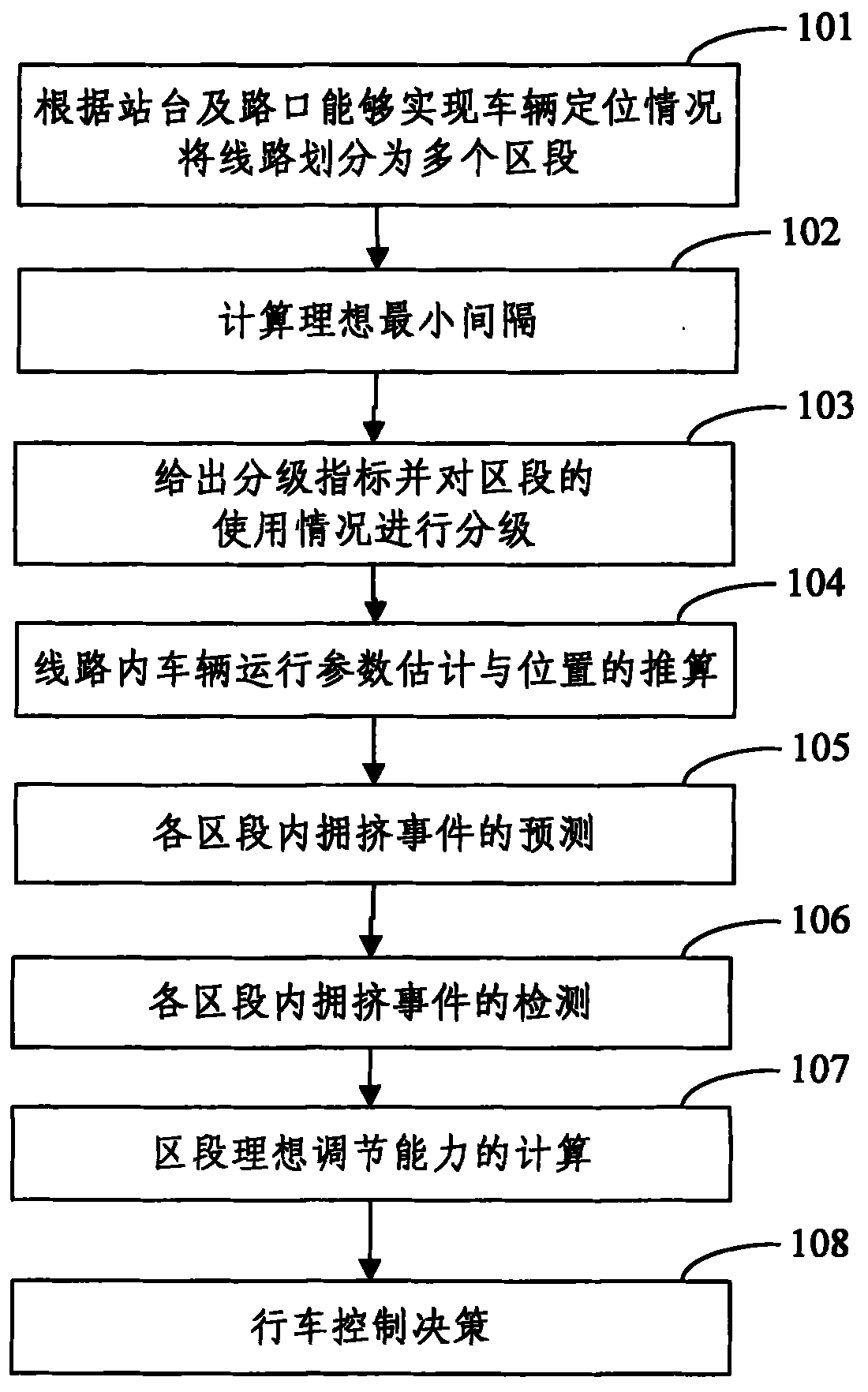
图1为本发明的信号控制与定位监控相结合的公交车辆行车控制方法的流程图;Fig. 1 is the flow chart of the bus driving control method that signal control of the present invention combines with location monitoring;
图2为按本发明方法将行车路线划分为多个区段的最小分割原则中车站到车站作为区段的情况示意图;Fig. 2 is the situation schematic diagram of a station to a station as a section in the minimum segmentation principle that the driving route is divided into a plurality of sections by the inventive method;
图3为按本发明方法将行车路线划分为多个区段的最小分割原则中车站到路口作为区段的情况示意图。Fig. 3 is a schematic diagram of a station to an intersection as a section in the minimum segmentation principle of dividing the driving route into a plurality of sections according to the method of the present invention.
具体实施方式Detailed ways
下面结合附图及本发明的实施例对本发明的方法作进一步详细的说明。The method of the present invention will be further described in detail below in conjunction with the accompanying drawings and embodiments of the present invention.
本发明的基本思路为:在对网络化公交实时行车控制过程中,综合使用车辆GPS定位、路口车辆识别、站台车辆识别信息,在行车路线区段划分的基础上,实现车辆运动信息的推算,通过给出一种理想最小间隔计算方法,并利用理想最小间隔定义了畅通、饱和畅通、拥挤、严重拥挤、极端拥挤的道路使用情况的等级量化划分标准。然后对划分好的各个区段内车辆的平均旅行时间、平均行驶速度进行检测、对车辆区段位置进行确定,在预测或出现道路拥挤情况下,使用该信号控制与车辆定监控相结合的行车控制方法,用以降低“串车”、“大间隔”现象的发生。The basic idea of the present invention is: in the real-time driving control process of the networked public transport, comprehensively use vehicle GPS positioning, intersection vehicle identification, platform vehicle identification information, and realize the calculation of vehicle motion information on the basis of division of driving route sections, By giving a calculation method of the ideal minimum interval, and using the ideal minimum interval to define the grade quantification standard of smooth, saturated unimpeded, congested, severely congested and extremely congested road usage conditions. Then detect the average travel time and average driving speed of vehicles in each divided section, and determine the location of the vehicle section. In the case of prediction or road congestion, use this signal to control the driving combined with vehicle fixed monitoring The control method is used to reduce the occurrence of "traffic" and "large interval" phenomena.
图1为本发明实施例信号控制与定位监控相结合的公交车辆行车控制方法流程图,如图1所示,该通过如下步骤实现。FIG. 1 is a flow chart of a bus driving control method combining signal control and positioning monitoring according to an embodiment of the present invention. As shown in FIG. 1 , this is realized through the following steps.
步骤101:根据站台及路口能够实现车辆识别的情况将线路划分为多个区段。Step 101: Divide the route into a plurality of sections according to the situation that vehicle identification can be realized at the platform and intersection.
这里,所述将行车路线划分为多个区段的划分原则如下:Here, the division principle for dividing the driving route into multiple sections is as follows:
1)最小分割原则:若存在连续可以实现车辆识别的车站或路口情况下,以相邻的两点之间作为一个区段,存在以下2种情况:1) The principle of minimum segmentation: if there are continuous stations or intersections that can realize vehicle identification, the interval between two adjacent points is taken as a section, and there are the following two situations:
其一是车站到车站,如图2所示,当车站具有车辆进站、出站识别能力,路口没有优先申请系统无法实现车辆识别定位的情况下,以车站到车站的最短距离作为一个区段。The first is station-to-station, as shown in Figure 2, when the station has the ability to identify vehicles entering and exiting the station, and the intersection does not have a priority application system that cannot realize vehicle identification and positioning, the shortest distance from station to station is taken as a section .
另一是车站到路口,如图3所示,若车站2不具备车辆进出站识别,路口2不具备公交优先车辆识别能力,而车站1、车站3可实现车辆进出站识别,路口1具备公交信号优先车辆识别能力,则可以构成车站与路口的区段1与区段2。The other is from the station to the intersection. As shown in Figure 3, if station 2 does not have the ability to identify vehicles entering and exiting the station, intersection 2 does not have the ability to identify vehicles with priority for buses, while stations 1 and 3 can recognize vehicles entering and exiting the station, and intersection 1 has the ability to identify vehicles with bus priority. Signal priority vehicle recognition capability can constitute Section 1 and Section 2 of stations and intersections.
2)最大行驶时间原则:若有连续的车站、路口没有车辆识别能力,会出现长距离的路段情况,不利于车辆精确控制。通常情况下,依据将该路段中合适位置的路口或车站作为切分点,每区段距离控制在500~800米之间。2) The principle of maximum travel time: If there are continuous stations and intersections without vehicle recognition capabilities, there will be long-distance road sections, which is not conducive to precise vehicle control. Usually, the distance between each section is controlled between 500 and 800 meters based on the intersection or station at a suitable location in the section as the cut-off point.
步骤102:计算理想最小间隔。Step 102: Calculate the ideal minimum interval.
这里,所述的理想最小车辆间隔Dismin是指两辆及两辆以上数目的快速公交同时进出站的距离。它的计算公式如下:Here, the ideal minimum vehicle interval Dis min refers to the distance between two or more BRTs entering and leaving the station at the same time. Its calculation formula is as follows:
Dismin=vplan×(ΔTstation_delay+α)Dis min =v plan ×(ΔT station_delay +α)
其中:vplan为计划车辆行驶速度;α为最小间隔调节参数,以秒为单位,通常取为3秒;ΔTstation_delay为快速公交从进站到出站所需要的时间。Among them: v plan is the planned vehicle speed; α is the minimum interval adjustment parameter in seconds, usually 3 seconds; ΔT station_delay is the time required for BRT from entering to exiting the station.
步骤103:给出分级指标并对区段的使用情况进行分级。Step 103: Giving a grading index and grading the usage of the segment.
这里,道路使用情况分级是以区段为单位统计的,依据区段最小理想车辆间隔Dismin与区段内实际车辆平均间隔Disavg确定的该区段的拥挤等级。在这里分为5级:Here, the road usage classification is calculated in units of sections, and the congestion level of the section is determined based on the minimum ideal vehicle interval Dis min in the section and the actual average vehicle interval Dis avg in the section. There are 5 levels here:
当Disavg<2Dismin时,为极端拥挤;When Dis avg < 2Dis min , it is extremely crowded;
当Disavg∈(2Dismin,3Dismin]时,为严重拥挤;When Dis avg ∈ (2Dis min , 3Dis min ], it is seriously crowded;
当Disavg∈(3Dismim,4Dismin]时,为拥挤;When Dis avg ∈ (3Dis mim , 4Dis min ], it is crowded;
当Disavg∈(4Dismin,7Dismin]时,为饱和畅通;When Dis avg ∈ (4Dis min , 7Dis min ], it is saturated and smooth;
当Disavg>7Dismin时,为畅通。When Dis avg > 7Dis min , it is unblocked.
利用已经计算出的Dismin与Disavg按照上述定义便可得知该区段的使用情况的等级。By using the calculated Dis min and Dis avg according to the above definition, the usage level of the segment can be known.
需要说明的是,由于区段的划分是按照车辆定位的能力进行的,因此会出现连续具有定位能力的车站、路口之间的距离很短,甚至小于最小理想间距的情况,这是不能机械地判定该区段处于拥堵状态,而应将该区段与其相邻的区段通体考虑,给出可信的拥堵情况判定。It should be noted that since the division of sections is carried out according to the ability of vehicle positioning, there will be situations where the distance between stations and intersections with continuous positioning capabilities is very short, or even smaller than the minimum ideal distance, which cannot be mechanically It is determined that the section is in a congested state, but the section and its adjacent sections should be considered as a whole to give a credible judgment of the congestion situation.
步骤104:对线路内车辆运行参数估计与车辆位置的推算。Step 104: Estimate the operating parameters of the vehicle on the route and calculate the position of the vehicle.
这里,所述的线路内车辆运行参数是指区段内的平均旅行时间及区段内平均行驶速度,这里取30分钟为一个观察时段。Here, the vehicle operating parameters in the line refer to the average travel time and the average driving speed in the section, and 30 minutes is taken as an observation period here.
所述的平均旅行时间分为上行时间与下行时间。以上行时间为例,其计算公式为:Said average travel time is divided into up time and down time. Taking the uplink time as an example, its calculation formula is:
其中:Ttravle_seg_k_up为该时段内第K区段的平均旅行时间;Ttravel_seg_k_up_all为该时段内所有车辆通过的总时间;ntravel_seg_k_up_all为该时段内所通过的车辆数目。Among them: T travle_seg_k_up is the average travel time of the Kth section in this period; T travel_seg_k_up_all is the total time of all vehicles passing in this period; n travel_seg_k_up_all is the number of vehicles passing in this period.
下行时间的计算同上行时间计算方法。The calculation method of the downlink time is the same as that of the uplink time.
所述的平均旅行速度,其计算公式为:The formula for calculating the average travel speed is:
其中:Disseg_k_up为第K区段的长度。Where: Dis seg_k_up is the length of the Kth segment.
所述车辆位置的推算,其计算公式为:The calculation formula for calculating the position of the vehicle is:
Pnow=Plast+vbus×(tnow-Tlast_corrected);P now =P last +v bus ×(t now -T last_corrected );
其中:Pnow为当前车辆所在的位置;Plast为最后一次车辆定位的位置;Vbus为车辆平均行驶速度;tnow为当前时刻;Tlast_corrected为上一次定位的时刻。Among them: P now is the current position of the vehicle; P last is the position of the last vehicle positioning; V bus is the average speed of the vehicle; t now is the current moment; T last_corrected is the moment of the last positioning.
步骤105:对各区段拥挤事件的预测。Step 105: Prediction of congestion events in each section.
这里,所述的区段拥挤事件预测的目的在于:依据当前车辆运行信息,对运行在BRT专用道上的车辆进站、上下客、出站、路口等待等行为进行准确预测,运用拥挤事件检测算法给出可能会出现的事件发生事件、发生地点、规模等方面的预测,结合行车控制可以预防拥挤事件的发生。Here, the purpose of the segment congestion event prediction is to accurately predict the behaviors of vehicles running on the BRT dedicated lane, such as entering the station, boarding and unloading, exiting the station, and waiting at intersections, based on the current vehicle operation information, and using the congestion event detection algorithm Given the predictions of possible events, events, locations, scales, etc., combined with traffic control, it can prevent the occurrence of crowded events.
步骤106:各区段拥挤事件的检测。Step 106: Detection of congestion events in each section.
这里,所述的各区段拥挤事件的检测包括区段车辆距离间隔检测,内车辆数量拥挤检测。Here, the detection of the congestion event in each section includes the detection of the vehicle distance interval in the section and the congestion detection of the number of vehicles in the section.
所述的车辆数量拥挤检测是指检测出该区段的平均车辆间隔,分为上行车辆拥挤检测与下行车辆拥挤检测。以上行拥挤检测为例,其计算公式为:The vehicle number congestion detection refers to the detection of the average vehicle interval in the section, which is divided into uplink vehicle congestion detection and downlink vehicle congestion detection. Taking uplink congestion detection as an example, its calculation formula is:
其中:Disseg_k_up_avg为该区段的平均车辆间隔。依据区段使用情况分级方法,判断出该区段的拥挤情况。下行拥挤检测与上行拥挤检测计算方法相同。Among them: Dis seg_k_up_avg is the average vehicle interval of this section. According to the section usage classification method, the congestion situation of the section is judged. Downlink congestion detection is calculated in the same way as uplink congestion detection.
依据车辆位置推算结果,计算区段内相邻车辆间距,若出现任一间距小于2Dismin,认为出现间距不合理的拥挤事件。Calculate the distance between adjacent vehicles in the section according to the results of vehicle position estimation. If any distance is less than 2Dis min , it is considered that there is a congestion event with an unreasonable distance.
步骤107:区段理想调节能力计算。Step 107: Calculation of the ideal adjustment capacity of the section.
这里,所述的调节能力分为给定区段BRT道路的调节能力,主线、支线线路重合部分道路系统调节能力。Here, the adjustment capacity is divided into the adjustment capacity of the BRT road in a given section, and the adjustment capacity of the road system where the main line and the branch line overlap.
所述的给定区段BRT道路的调节能力分为上行区段BRT道路的调节能力与下行区段BRT道路的调节能力。这里以上行区段BRT道路调节能力为例,其计算公式为:The adjustment capability of the BRT road in a given section is divided into the adjustment ability of the BRT road in the uplink section and the adjustment ability of the BRT road in the downlink section. Here, the BRT road regulation capacity in the uplink section is taken as an example, and its calculation formula is:
其中:nseg_adj_k_up为上行区段K内车辆调节能力;Disseg_k_up为上行线路中,区段K的道路长度;nseg_k_up为上行线路中,区段K中现有车辆数目。下行区段BRT道路的调节能力与上行区段BRT道路调节能力计算方法相同。Among them: n seg_adj_k_up is the vehicle adjustment capability in the uplink section K; Dis seg_k_up is the road length of section K in the uplink line; n seg_k_up is the number of existing vehicles in section K in the uplink line. The adjustment method of the BRT road in the downlink section is the same as that of the BRT road in the uplink section.
所述的主线、支线线路重合部分道路系统调节能力,其计算公式为:The calculation formula for the adjustment capacity of the road system on the overlapping part of the main line and the branch line is:
其中:nseg_adj_k_up_co为主线、支线线路重合部分道路系统调节能力;nseg_adj_k_up为上行区段K内车辆调节能力;λk为若主线与支线重合的区段取值为1,否则为0;nout为单位时间内重合区段内车辆驶出区段的数量;nin为单位时间内进入重合区段车辆的数量。Among them: n seg_adj_k_up_co is the adjustment capacity of the road system where the main line and the branch line overlap; n seg_adj_k_up is the vehicle adjustment capacity in the uplink section K; λ k is 1 if the main line and the branch line overlap, otherwise it is 0; n out is the number of vehicles leaving the overlapped section per unit time; n in is the number of vehicles entering the overlapped section per unit time.
步骤108:根据各段道路的调节能力实行行车控制调节策略。Step 108: Carry out the driving control regulation strategy according to the regulation capability of each section of road.
这里,行车控制调节策略规则如下:Here, the driving control adjustment policy rules are as follows:
1)调节车辆数目最少原则1) The principle of adjusting the minimum number of vehicles
其实现方式如下:确定最小的调节范围,也即是依据当前线路内拥挤情况,以拥挤区段内部及相邻区段为调节对象,若在此范围内可以有效调节,并达到避免拥挤现象的出现,便不对该范围以外的车辆进行调节。The implementation method is as follows: determine the minimum adjustment range, that is, according to the current congestion situation in the line, take the inside of the crowded section and the adjacent section as the adjustment object, if it can be effectively adjusted within this range, and achieve the goal of avoiding congestion. appears, vehicles outside this range will not be adjusted.
2)调节有效性原则2) Principle of Regulatory Effectiveness
在出现拥挤需要调节时,只考虑绝对指标,对于离终点距离小于2站的车辆不进行调节。When there is congestion and adjustment is required, only absolute indicators are considered, and no adjustment is made for vehicles whose distance from the end point is less than 2 stops.
3)严重拥挤下编组处理原则3) The principle of marshalling under severe congestion
拥挤情况下采用2车编队方式;明确编队驾驶要求以保证编队效果;车辆在进入路口之前将车辆间隔控制在安全距离之内;站台有2个停车位时,同一编队车辆同时进站同时出站,若没有,合理控制车辆间隔,使车辆能够连续进站、出站。Use 2-vehicle formation in congested conditions; clarify the formation driving requirements to ensure the formation effect; control the distance between vehicles within a safe distance before entering the intersection; when there are 2 parking spaces on the platform, vehicles in the same formation enter the station and leave the station at the same time , if not, the distance between vehicles should be reasonably controlled so that vehicles can enter and exit the station continuously.
4)车辆编队构成方法4) Vehicle formation composition method
若当前间隔单车可以满足站台乘客运输或支线剩余部分与主线完全重合,将支线、主线不同车辆进行编队;若线路内出现单车无法满足站台乘客运输要求,采用相同线路车辆编队。If the bicycles at the current interval can meet the passenger transportation requirements on the platform or the remaining part of the branch line completely overlaps with the main line, different vehicles on the branch line and the main line will be formed;
5)极端拥挤下调节发车原则5) Adjust the departure principle under extreme congestion
若2车编队无法满足行车控制要求时,采用如下处理规则:If the 2-vehicle formation cannot meet the traffic control requirements, the following processing rules shall be adopted:
增加支线区间车,减少主线内车辆数量;若支线、主线重合段极端拥挤,依据客流插入支线发车延迟;若简单插入发车延迟无法改善线路内车辆间隔控制,则依据客流增大发车间隔。Increase the number of vehicles in the branch line and reduce the number of vehicles in the main line; if the overlapping section of the branch line and the main line is extremely crowded, insert the departure delay of the branch line according to the passenger flow; if simply inserting the departure delay can not improve the control of the vehicle interval in the line, increase the departure interval according to the passenger flow.
6)信号控制辅助原则6) Auxiliary principle of signal control
在高峰期,对下一车辆或编队到达本路口的时间进行预测,处置决策包括:During the peak period, the time when the next vehicle or formation arrives at the intersection is predicted, and the disposal decision includes:
(1)扩展信号优先放行决策(1) Extended signal priority release decision
车辆到达路口时处于绿灯相位的末尾,其中τ用来描述车辆到达路口绿灯相位结束时间的变化范围,若当前车辆或编队与上次通过该路口的车辆或编队时间差大于理想最小时间间隔,说明该车辆或编队通过路口后,仍能满足理想最小间隔的要求,可以对该车辆或编队提供绿灯扩展优先信号,保证车辆或编队通过该路口。When the vehicle arrives at the intersection, it is at the end of the green light phase, where τ is used to describe the variation range of the end time of the green light phase when the vehicle arrives at the intersection. If the time difference between the current vehicle or formation and the vehicle or formation that passed the intersection last time is greater than the ideal minimum time interval, it means that the After the vehicle or formation passes the intersection, it can still meet the requirements of the ideal minimum interval, and the green light extension priority signal can be provided to the vehicle or formation to ensure that the vehicle or formation passes through the intersection.
passpass
其中:tnext为下次到达该路口的车辆或编队的到达时间;tprevious为不含本次车辆或编队最后到达该路口的时间;Tperiod为路口信号周期,单位为秒;tgreen_end为绿灯相位结束的时间;τ1为扩展优先比例常数,通常取为10;ΔTmin_dis为车辆间理想最小时间间隔。Among them: t next is the arrival time of the vehicle or formation arriving at the intersection next time; t previous is the time when the vehicle or formation finally arrives at the intersection excluding this time; T period is the intersection signal period in seconds; t green_end is the green light Phase end time; τ 1 is the extended priority proportional constant, usually taken as 10; ΔT min_dis is the ideal minimum time interval between vehicles.
(2)无扩展信号优先阻止通过决策(2) No extension signal priority blocking through decision
若车辆到达路口,基本条件与信号优先方形决策相同,只是当前车辆与最后通过该路口车辆或编队的时间差小于理想最小时间间隔,且下一次到达该路口的车辆或编队距离当前时间差大于路口信号周期,也就是说,当前车辆不会与下一次到达车辆或编队混行,则可以采取阻止措施,不对其分配信号,从而达到增大车辆间距的目的。If the vehicle arrives at the intersection, the basic conditions are the same as the signal priority square decision, except that the time difference between the current vehicle and the last vehicle or formation passing through the intersection is less than the ideal minimum time interval, and the next time the vehicle or formation arriving at the intersection is farther than the current time difference is greater than the intersection signal period , that is to say, if the current vehicle will not mix with the next arriving vehicle or formation, you can take blocking measures and not assign signals to it, so as to achieve the purpose of increasing the distance between vehicles.
preventprevent
(3)不施行调用信号优先决策(3) Do not implement call signal priority decision
若车辆到达路口,此时正处于绿灯相位起始时刻,到达时间与起始时刻的时间差为-τ2,且下次到达该路口的车辆或编队与当前时刻差大于绿灯相位时间,也就是说,不会出现当前车辆与下次到达车辆混行的情况,若上次车辆通过该路口的时间与当前时刻相差小于理想最小时间间隔,不进行调用优先分配。If the vehicle arrives at the intersection, it is now at the start time of the green light phase, and the time difference between the arrival time and the start time is -τ 2 , and the difference between the vehicle or formation arriving at the intersection next time and the current time is greater than the green light phase time, that is to say , there will be no mixed traffic between the current vehicle and the next arriving vehicle, and if the difference between the last time the vehicle passed the intersection and the current time is less than the ideal minimum time interval, no call priority allocation will be performed.
no priorityno priority
tnow∈[tgreen_strat-τ2%,tgreen_start]t now ∈ [t green_strat -τ 2 %, t green_start ]
tnext-tnow>tgreen_end-tgreen_start t next -t now >t green_end -t green_start
tnow-tprevious<ΔTmin_dis t now -t previous <ΔT min_dis
其中:tgreen_start为绿灯相位开始的时间;τ2为调用优先比例常数,通常取为10。Among them: t green_start is the start time of the green light phase; τ 2 is the call priority proportional constant, which is usually taken as 10.
(4)施行调用信号优先决策(4) Implement call signal priority decision
若车辆到达路口,上次车辆通过该路口的时间与当前时刻相差大于理想最小时间间隔,其他条件不变,可以给与调用优先信号。If the vehicle arrives at the intersection, the difference between the last time the vehicle passed the intersection and the current time is greater than the ideal minimum time interval, and other conditions remain unchanged, a call priority signal can be given.
bus prioritybus priority
tnow∈[tgreen_strat-τ2%,tgreen_start]t now ∈ [t green_strat -τ 2 %, t green_start ]
tnext-tnow>tgreen_end-tgreen_strat t next -t now >t green_end -t green_strat
tnow-tprevious>ΔTmin_dis t now -t previous >ΔT min_dis
在以上行车控制模型、算法研究的基础上,以朝阳路为对象,进行了行车控制的仿真分析,朝阳路线路及周边道路模型依据实际工程图绘制,仿真平台采用Paramics软件,通过VC++6.0进行API调用实现对行驶在道路上公交车辆的速度与期望位置控制,控制策略使用行车控制调节策略中的具体规则。On the basis of the above driving control model and algorithm research, taking Chaoyang Road as the object, the simulation analysis of driving control is carried out. The Chaoyang Road and surrounding road models are drawn according to the actual engineering drawings. The simulation platform uses Paramics software, through VC++6.0 API calls are made to control the speed and expected position of the bus on the road, and the control strategy uses the specific rules in the traffic control regulation strategy.
仿真结果说明如下:The simulation results are explained as follows:
在考虑朝阳路支线、主线共用BRT车道的情况下,主线发车间隔为2分钟、支线发车3分钟,以客流高峰期加载路网车流,BRT车辆速度上限设为40公里/小时,正常运行速度30公里/小时,仿真时间2小时,全程双向共使用调节手段38次,有效控制了车辆的间距,由于各别路段因路口与站台距离过近,会出现3~6次串车现象,其它情况等可有效达到合理控制车距的目的。Considering that the branch line of Chaoyang Road and the main line share the BRT lane, the departure interval of the main line is 2 minutes and the departure time of the branch line is 3 minutes, and the traffic flow of the road network is loaded during the peak passenger flow period. km/h, the simulation time is 2 hours, and a total of 38 times of adjustment means are used in both directions, which effectively controls the distance between vehicles. Due to the close distance between the intersection and the platform, there will be 3 to 6 times of cross-traffic phenomenon, and other situations, etc. It can effectively achieve the purpose of reasonably controlling the distance between vehicles.
以上所述,仅为本发明的较佳实施例而已,并非用于限定本发明的保护范围。The above descriptions are only preferred embodiments of the present invention, and are not intended to limit the protection scope of the present invention.
Claims (9)
Priority Applications (1)
| Application Number | Priority Date | Filing Date | Title |
|---|---|---|---|
| CN 201010593889 CN102063791B (en) | 2010-12-17 | 2010-12-17 | Public transport travelling control method by combining signal control with positioning monitoring |
Applications Claiming Priority (1)
| Application Number | Priority Date | Filing Date | Title |
|---|---|---|---|
| CN 201010593889 CN102063791B (en) | 2010-12-17 | 2010-12-17 | Public transport travelling control method by combining signal control with positioning monitoring |
Publications (2)
| Publication Number | Publication Date |
|---|---|
| CN102063791A true CN102063791A (en) | 2011-05-18 |
| CN102063791B CN102063791B (en) | 2013-06-05 |
Family
ID=43999055
Family Applications (1)
| Application Number | Title | Priority Date | Filing Date |
|---|---|---|---|
| CN 201010593889 Expired - Fee Related CN102063791B (en) | 2010-12-17 | 2010-12-17 | Public transport travelling control method by combining signal control with positioning monitoring |
Country Status (1)
| Country | Link |
|---|---|
| CN (1) | CN102063791B (en) |
Cited By (9)
| Publication number | Priority date | Publication date | Assignee | Title |
|---|---|---|---|---|
| CN102842219A (en) * | 2012-08-29 | 2012-12-26 | 苏州大学 | Forecasting method and system |
| CN103985265A (en) * | 2014-06-03 | 2014-08-13 | 北方工业大学 | Bus priority control method and system for avoiding bus clustering |
| CN105206040A (en) * | 2015-08-07 | 2015-12-30 | 北京航空航天大学 | Bus bunching predication method based on IC card data |
| CN106875670A (en) * | 2017-03-07 | 2017-06-20 | 重庆邮电大学 | Taxi concocting method based on gps data under Spark platforms |
| US9785896B2 (en) | 2013-07-31 | 2017-10-10 | International Business Machines Corporation | Real-time prediction and correction of scheduled service bunching |
| CN110211406A (en) * | 2019-05-27 | 2019-09-06 | 同济大学 | A kind of public transport pulls in speed guidance control method and system |
| CN110969845A (en) * | 2019-11-19 | 2020-04-07 | 武汉理工大学 | An intelligent vehicle speed control method and system based on vehicle-road coordination |
| CN112735184A (en) * | 2020-12-16 | 2021-04-30 | 上海蛛格科技有限公司 | Intelligent transportation system for realizing high-grade automatic driving and efficient transportation |
| CN116259170A (en) * | 2023-02-17 | 2023-06-13 | 上海电科智能系统股份有限公司 | A method of dynamic berth guidance for medium-traffic bus corridors |
Citations (3)
| Publication number | Priority date | Publication date | Assignee | Title |
|---|---|---|---|---|
| US20070008173A1 (en) * | 2005-06-16 | 2007-01-11 | Schwartz Mark A | Traffic preemption system with headway management |
| CN101556740A (en) * | 2009-04-30 | 2009-10-14 | 吉林大学 | Bus priority signal timing method based on running schedule |
| CN101710449A (en) * | 2009-12-04 | 2010-05-19 | 吉林大学 | Traffic flow running rate recognizing method based on bus GPS data |
-
2010
- 2010-12-17 CN CN 201010593889 patent/CN102063791B/en not_active Expired - Fee Related
Patent Citations (3)
| Publication number | Priority date | Publication date | Assignee | Title |
|---|---|---|---|---|
| US20070008173A1 (en) * | 2005-06-16 | 2007-01-11 | Schwartz Mark A | Traffic preemption system with headway management |
| CN101556740A (en) * | 2009-04-30 | 2009-10-14 | 吉林大学 | Bus priority signal timing method based on running schedule |
| CN101710449A (en) * | 2009-12-04 | 2010-05-19 | 吉林大学 | Traffic flow running rate recognizing method based on bus GPS data |
Cited By (15)
| Publication number | Priority date | Publication date | Assignee | Title |
|---|---|---|---|---|
| CN102842219B (en) * | 2012-08-29 | 2014-07-16 | 苏州大学 | Forecasting method and system |
| CN102842219A (en) * | 2012-08-29 | 2012-12-26 | 苏州大学 | Forecasting method and system |
| US9785896B2 (en) | 2013-07-31 | 2017-10-10 | International Business Machines Corporation | Real-time prediction and correction of scheduled service bunching |
| US9858542B2 (en) | 2013-07-31 | 2018-01-02 | International Business Machines Corporation | Real-time prediction and correction of scheduled service bunching |
| CN103985265A (en) * | 2014-06-03 | 2014-08-13 | 北方工业大学 | Bus priority control method and system for avoiding bus clustering |
| CN103985265B (en) * | 2014-06-03 | 2017-05-03 | 北方工业大学 | Bus priority control method and system for avoiding bus clustering |
| CN105206040A (en) * | 2015-08-07 | 2015-12-30 | 北京航空航天大学 | Bus bunching predication method based on IC card data |
| CN106875670A (en) * | 2017-03-07 | 2017-06-20 | 重庆邮电大学 | Taxi concocting method based on gps data under Spark platforms |
| CN106875670B (en) * | 2017-03-07 | 2019-12-31 | 重庆邮电大学 | Taxi allocation method based on GPS data under Spark platform |
| CN110211406A (en) * | 2019-05-27 | 2019-09-06 | 同济大学 | A kind of public transport pulls in speed guidance control method and system |
| CN110969845A (en) * | 2019-11-19 | 2020-04-07 | 武汉理工大学 | An intelligent vehicle speed control method and system based on vehicle-road coordination |
| CN110969845B (en) * | 2019-11-19 | 2020-11-24 | 武汉理工大学 | An intelligent vehicle speed control method and system based on vehicle-road coordination |
| CN112735184A (en) * | 2020-12-16 | 2021-04-30 | 上海蛛格科技有限公司 | Intelligent transportation system for realizing high-grade automatic driving and efficient transportation |
| CN116259170A (en) * | 2023-02-17 | 2023-06-13 | 上海电科智能系统股份有限公司 | A method of dynamic berth guidance for medium-traffic bus corridors |
| CN116259170B (en) * | 2023-02-17 | 2025-04-18 | 上海电科智能系统股份有限公司 | A method for dynamic berth guidance in medium-capacity bus corridors |
Also Published As
| Publication number | Publication date |
|---|---|
| CN102063791B (en) | 2013-06-05 |
Similar Documents
| Publication | Publication Date | Title |
|---|---|---|
| CN102063791A (en) | Public transport travelling control method by combining signal control with positioning monitoring | |
| CN113160582B (en) | Highway flow management and control method and system | |
| CN104778845B (en) | Multi-phase-jump and vehicle full-dynamic induction traffic control method | |
| CN101593419B (en) | Intelligent coordination control method for traffic flow of urban road network with public traffic priority | |
| CN103198681B (en) | A kind of intersection signal control method towards public traffic in priority | |
| CN103996300B (en) | A kind of crossing public transit vehicle does not stop the public transport abductive approach passed through | |
| CN109887267B (en) | Conventional public transportation adjusting method for common line segment of rail transit | |
| CN102289943A (en) | Traffic control method for ensuring smoothness of fly-over crossing | |
| CN102254443A (en) | Intermittent bus lane control system and method | |
| CN103871241A (en) | Lane dynamic partitioning control method for expressway intersection area | |
| CN109064754A (en) | A kind of expressway access shunts and flow Collaborative Control technology | |
| CN113538935B (en) | An inductive control method for optimizing bus punctuality in the environment without dedicated right of way | |
| CN104064041A (en) | Traffic signal lamp adjusting system and method based on public transport motorcade priority | |
| CN103794066A (en) | Bus priority signal control method not involved with bus lane | |
| CN107393321A (en) | A kind of modern tram bus priority at intersection control method for being used to prevent vehicle queue spilling | |
| CN106530756A (en) | Intersection optimal period duration calculation method considering downstream bus stations | |
| CN104599513B (en) | Bus signal priority control method | |
| CN114822017B (en) | A Passage Guidance System for Elevated Expressway Avoiding Local Congestion and Queuing | |
| Liu et al. | Modelling and simulation of cooperative control for bus rapid transit vehicle platoon in a connected vehicle environment | |
| CN103927888A (en) | Bus green wave signal control method under condition of high-density road network | |
| Jeng et al. | Adaptive urban traffic signal control system with bus priority | |
| CN113129593A (en) | Congestion optimization method for BRT road in unmanned driving mode | |
| Bagheri | Enhanced Traffic Signal Operation using Connected Vehicle Data | |
| CN118736854B (en) | Multi-intersection condition signal priority control method for public transportation trunk line | |
| CN117496725B (en) | A method, system, equipment, and medium for dynamic lane allocation and coordinated entrance/exit control of a ring expressway. |
Legal Events
| Date | Code | Title | Description |
|---|---|---|---|
| C06 | Publication | ||
| PB01 | Publication | ||
| C10 | Entry into substantive examination | ||
| SE01 | Entry into force of request for substantive examination | ||
| C14 | Grant of patent or utility model | ||
| GR01 | Patent grant | ||
| CF01 | Termination of patent right due to non-payment of annual fee | ||
| CF01 | Termination of patent right due to non-payment of annual fee |
Granted publication date: 20130605 Termination date: 20211217 |