CN102056593A - Insulin Nasal Preparations - Google Patents
Insulin Nasal Preparations Download PDFInfo
- Publication number
- CN102056593A CN102056593A CN2009801212279A CN200980121227A CN102056593A CN 102056593 A CN102056593 A CN 102056593A CN 2009801212279 A CN2009801212279 A CN 2009801212279A CN 200980121227 A CN200980121227 A CN 200980121227A CN 102056593 A CN102056593 A CN 102056593A
- Authority
- CN
- China
- Prior art keywords
- insulin
- dosage
- dose
- plasma
- goods
- Prior art date
- Legal status (The legal status is an assumption and is not a legal conclusion. Google has not performed a legal analysis and makes no representation as to the accuracy of the status listed.)
- Pending
Links
Images


Classifications
-
- A—HUMAN NECESSITIES
- A61—MEDICAL OR VETERINARY SCIENCE; HYGIENE
- A61K—PREPARATIONS FOR MEDICAL, DENTAL OR TOILETRY PURPOSES
- A61K38/00—Medicinal preparations containing peptides
- A61K38/16—Peptides having more than 20 amino acids; Gastrins; Somatostatins; Melanotropins; Derivatives thereof
- A61K38/17—Peptides having more than 20 amino acids; Gastrins; Somatostatins; Melanotropins; Derivatives thereof from animals; from humans
- A61K38/22—Hormones
- A61K38/28—Insulins
-
- A—HUMAN NECESSITIES
- A61—MEDICAL OR VETERINARY SCIENCE; HYGIENE
- A61K—PREPARATIONS FOR MEDICAL, DENTAL OR TOILETRY PURPOSES
- A61K9/00—Medicinal preparations characterised by special physical form
- A61K9/0012—Galenical forms characterised by the site of application
- A61K9/0043—Nose
-
- A—HUMAN NECESSITIES
- A61—MEDICAL OR VETERINARY SCIENCE; HYGIENE
- A61P—SPECIFIC THERAPEUTIC ACTIVITY OF CHEMICAL COMPOUNDS OR MEDICINAL PREPARATIONS
- A61P3/00—Drugs for disorders of the metabolism
- A61P3/08—Drugs for disorders of the metabolism for glucose homeostasis
- A61P3/10—Drugs for disorders of the metabolism for glucose homeostasis for hyperglycaemia, e.g. antidiabetics
-
- A—HUMAN NECESSITIES
- A61—MEDICAL OR VETERINARY SCIENCE; HYGIENE
- A61P—SPECIFIC THERAPEUTIC ACTIVITY OF CHEMICAL COMPOUNDS OR MEDICINAL PREPARATIONS
- A61P5/00—Drugs for disorders of the endocrine system
- A61P5/48—Drugs for disorders of the endocrine system of the pancreatic hormones
Landscapes
- Health & Medical Sciences (AREA)
- Life Sciences & Earth Sciences (AREA)
- Public Health (AREA)
- Veterinary Medicine (AREA)
- Chemical & Material Sciences (AREA)
- Pharmacology & Pharmacy (AREA)
- General Health & Medical Sciences (AREA)
- Medicinal Chemistry (AREA)
- Animal Behavior & Ethology (AREA)
- Diabetes (AREA)
- Endocrinology (AREA)
- Engineering & Computer Science (AREA)
- Bioinformatics & Cheminformatics (AREA)
- Epidemiology (AREA)
- Gastroenterology & Hepatology (AREA)
- Proteomics, Peptides & Aminoacids (AREA)
- Nuclear Medicine, Radiotherapy & Molecular Imaging (AREA)
- General Chemical & Material Sciences (AREA)
- Chemical Kinetics & Catalysis (AREA)
- Otolaryngology (AREA)
- Zoology (AREA)
- Organic Chemistry (AREA)
- Immunology (AREA)
- Hematology (AREA)
- Emergency Medicine (AREA)
- Obesity (AREA)
- Medicines That Contain Protein Lipid Enzymes And Other Medicines (AREA)
- Medicinal Preparation (AREA)
Abstract
Description
相关申请的交叉引用Cross References to Related Applications
本申请根据35U.S.C.§119(e)要求2008年6月5日提交的美国临时申请61/059,225的优先权。This application claims priority under 35 U.S.C. §119(e) to U.S. Provisional Application 61/059,225, filed June 5, 2008.
技术领域technical field
本发明涉及胰岛素鼻腔给药的方法和制剂。The present invention relates to methods and formulations for nasal administration of insulin.
背景技术Background technique
胰岛素是一种诱导葡萄糖从血液向细胞内转运的激素,在细胞内葡萄糖提供能量的来源。Ⅰ型和Ⅱ型糖尿病患者经常需要接受外源性胰岛素给药来控制血糖。大量研究表明严格控制血糖对于控制糖尿病的许多主要并发症的发病率和严重程度很关键(Skyler.Clinical Diabetes 22(4):162-166(2004)。维持血糖控制的一个关键因素——特别是在Ⅰ型糖尿病中,其胰岛素的产生有限或不存在——是及时递送剂量与饭后血糖增加量相匹配的胰岛素。如果递送过多的胰岛素或是递送的胰岛素的时机并没有恰当地与需要相匹配时,就会发生低血糖症。相反,如果递送过少的胰岛素,可能就会发生高血糖症。这两种情况都可以导致严重的临床并发症。胰岛素治疗最普遍的用药法是在饭前皮下注射短效但起效快的胰岛素,并结合给予较长效但起效慢的胰岛素制剂。当严密监控时,短效和长效胰岛素联合给药的最终结果一般是适当的;然而,在处于血糖控制的个体之间存在相当大的差异。这个差异部分地是由于注射位点处胰岛素释放的差异。注射位点上胰岛素的摄取对皮肤温度、血管分布以及下面的肌肉是否正在运动都是敏感的。随着时间的推移,多次注射的副作用如注射位点处的瘢痕形成和组织超敏性,也可以导致注射位点处胰岛素的摄取差异。Insulin is a hormone that induces the transport of glucose from the blood into cells, where glucose provides the source of energy. Patients with
胰岛素也可以通过吸入的方式给药。然而,这一给药途径是有缺点的。由于胰岛素的促生长和免疫原特性,已经提出了对于长期使用吸入性胰岛素的潜在肺毒性的担心。而且,已有报道称Ⅰ型和Ⅱ型糖尿病患者的肺功能衰减(Mori et al,Internal Medicine,31:189-93(1992))。吸入性胰岛素对肺功能的安全性是其临床发展中的主要关心的问题。Insulin can also be given by inhalation. However, this route of administration has disadvantages. Due to the growth-promoting and immunogenic properties of insulin, concerns have been raised about the potential pulmonary toxicity of long-term use of inhaled insulin. Furthermore, decreased lung function has been reported in type I and type II diabetic patients (Mori et al, Internal Medicine , 31:189-93 (1992)). The safety of inhaled insulin on lung function is a major concern in its clinical development.
19世纪80年代以来,人们一直对于经鼻递送胰岛素的可能性给予了极大的关注。这种给药方法的优点在于胰岛素通过粘膜直接吸收,即在递送位点和循环之间只有最小的阻碍。而且,已经发现某些在注射给药时会产生抗原效应的试剂,在鼻内给药时没有产生这种效应。鼻喷雾器尺寸小,因此比那些用于肺部给药的制剂更加方便。使用方便可导致顺应性的提高,尤其是对青少年患者。Since the 1980s, great attention has been paid to the possibility of nasal delivery of insulin. The advantage of this method of administration is that the insulin is absorbed directly through the mucosa, ie with minimal hindrance between the site of delivery and circulation. Furthermore, it has been found that certain agents which produce an antigenic effect when administered by injection do not produce such an effect when administered intranasally. Nasal sprays are small in size and therefore more convenient than those intended for pulmonary administration. Ease of use can lead to improved compliance, especially in adolescent patients.
一般地,鼻内给药的胰岛素的生物利用度很低(1-2%)。即使向所述制剂中添加吸收增强剂,绝对生物利用度仍然在5到15%(Hinchcliffe et al,Drug Delivery Reviews,35:199-234(1999))。努力促进鼻内制剂的发展的过程中,大量的试剂被提议用作吸收增强剂。这些包括胆盐及其衍生物、表面活性剂、脂肪酸及其衍生物,还有多种生物粘附分子(Hinchcliffe et al,Drug Delivery Reviews,35:199-234(1999))。然而,低的生物利用度依然在鼻内递送中普遍存在,通过这一途径吸收的胰岛素时的较高个体间差异度使得这一情况更加复杂。除了改善鼻内胰岛素制剂之外,迫切需要通过确定患者经鼻吸收胰岛素的能力来优化胰岛素给药技术和改善胰岛素疗法的安全性。In general, the bioavailability of intranasally administered insulin is very low (1-2%). Even with the addition of absorption enhancers to the formulations, the absolute bioavailability remains at 5 to 15% (Hinchcliffe et al, Drug Delivery Reviews , 35: 199-234 (1999)). In an effort to facilitate the development of intranasal formulations, a number of agents have been proposed as absorption enhancers. These include bile salts and their derivatives, surfactants, fatty acids and their derivatives, and various bioadhesion molecules (Hinchcliffe et al, Drug Delivery Reviews , 35:199-234 (1999)). However, low bioavailability remains prevalent in intranasal delivery, compounded by the high interindividual variability in insulin absorbed by this route. In addition to improving intranasal insulin formulations, there is an urgent need to optimize insulin dosing techniques and improve the safety of insulin therapy by determining a patient's ability to absorb insulin nasally.
发明内容Contents of the invention
本发明的一个目的是提供一种用于达到治疗有效的胰岛素血浆水平的方法,通过相继在单独一个鼻孔给予至少约两个剂量的胰岛素药物制剂进行。每一个剂量的胰岛素药物制剂包含每100微升至少约10个国际单位(U)到约100U的胰岛素。所述剂量也包含每100微升约15U到约75U、约20U到约50U、或者约25U胰岛素。血浆胰岛素的测量是在给予第二个剂量后0到约45分钟的时间段内,或是在约25分钟到约30分钟时间段内进行。在所述第二个药物剂量之后,在选定的给药间隔中测得的血浆胰岛素最大浓度(Cmax)至少是约70microU/ml。在所述第二个药物剂量之后,血浆胰岛素的血浆浓度-时间曲线下面积(AUC)至少是约1800microU/(ml*min)。当血浆胰岛素的测量是在给予所述第二个剂量后0到约45分钟的时间段内,或是在约25分钟到约30分钟时间段内时,在所述第二个剂量之后血浆胰岛素的Cmax(或AUC)为在给予第一个剂量后血浆胰岛素的Cmax(或AUC)的约二倍到约十倍、约三倍到八倍、约四倍到约五倍、或是约五倍。相继在同一个鼻孔给予第二个剂量之后,血浆胰岛素的Cmax(或AUC)为相继在两个不同鼻孔给予第二个剂量之后观察到的血浆胰岛素的Cmax(或AUC)的约两倍。胰岛素的药物制剂可包含治疗有效量的胰岛素、渗透促进剂和液体载体。It is an object of the present invention to provide a method for achieving therapeutically effective insulin plasma levels by sequentially administering at least about two doses of an insulin pharmaceutical preparation in a single nostril. Each dose of the insulin pharmaceutical formulation contains at least about 10 International Units (U) to about 100 U of insulin per 100 microliters. The dosage also includes about 15 U to about 75 U, about 20 U to about 50 U, or about 25 U of insulin per 100 microliters. Plasma insulin is measured within a time period of 0 to about 45 minutes, or within a time period of about 25 minutes to about 30 minutes, after administration of the second dose. Following said second drug dose, the maximum plasma insulin concentration (Cmax) measured at the selected dosing interval is at least about 70 microU/ml. After said second drug dose, the area under the plasma concentration-time curve (AUC) of plasma insulin is at least about 1800 microU/(ml*min). When plasma insulin is measured within a time period of 0 to about 45 minutes after administration of said second dose, or within a time period of about 25 minutes to about 30 minutes, plasma insulin after said second dose The Cmax (or AUC) is about two times to about ten times, about three times to eight times, about four times to about five times, or about five times the Cmax (or AUC) of plasma insulin after administration of the first dose times. The Cmax (or AUC) of plasma insulin following a second dose administered sequentially in the same nostril was approximately twice that observed after a second dose administered sequentially in two different nostrils. Pharmaceutical formulations of insulin may comprise a therapeutically effective amount of insulin, a penetration enhancer and a liquid carrier.
本发明还提供一种用于鉴别能够吸收治疗有效量的胰岛素的患者的方法,包括经鼻给予在药物制剂中的范围为约20U到约200U的一个剂量的胰岛素,以及,然后在给予所述剂量后约10到约30分钟测量胰岛素血浆水平。所述剂量可分解为多个更小的剂量,例如4×25U/剂。所述胰岛素剂量的范围可能是在约25U到约150U、约50U到约125U或约75U到约110U。所述胰岛素剂量也可为约100U。吸收治疗有效量胰岛素的患者的血浆胰岛素Cmax范围为约15到约400microU/ml、约30到约250microU/ml、约50到约150microU/ml、约70到约100microU/ml或约15到约20microU/ml。吸收治疗有效量的胰岛素的患者的Cmax的优选范围为高于约70microU/ml。The present invention also provides a method for identifying a patient capable of absorbing a therapeutically effective amount of insulin, comprising nasally administering a dose of insulin in a pharmaceutical formulation ranging from about 20 U to about 200 U, and, thereafter, administering said Insulin plasma levels are measured about 10 to about 30 minutes after the dose. The dose may be broken down into multiple smaller doses, eg 4 x 25 U/dose. The insulin dose may range from about 25 U to about 150 U, from about 50 U to about 125 U, or from about 75 U to about 110 U. The insulin dose may also be about 100 U. A patient absorbing a therapeutically effective amount of insulin has a plasma insulin Cmax in the range of about 15 to about 400 microU/ml, about 30 to about 250 microU/ml, about 50 to about 150 microU/ml, about 70 to about 100 microU/ml, or about 15 to about 20 microU /ml. A preferred range for Cmax in patients absorbing a therapeutically effective amount of insulin is above about 70 microU/ml.
本发明还提供了一种制品,包含用于鼻腔给药的胰岛素药物制剂和印刷品,所述印刷品指出为达到治疗有效的胰岛素血浆水平,应相继在单独一个鼻孔给予至少约两个剂量的胰岛素药物制剂。所述印刷品记载了所述剂量包含每100微升至少约10U到约100U的胰岛素。所述剂量也可包含每100微升约15U到约75U、约20U到约50U、或约25U胰岛素。所述胰岛素的药物制剂可包含治疗有效量的胰岛素、渗透促进剂和液体载体。所述印刷品记载了,当在给药后约0到约45分钟或是约25分钟到约30分钟的时间段内测量血浆胰岛素时,给予第二个剂量后的胰岛素的Cmax至少是约70microU/ml。所述印刷品还记载了,第二个剂量后血浆胰岛素的AUC是至少约1800microU/(ml*min)。所述印刷品记载了,给予第二个剂量之后血浆胰岛素的Cmax(或AUC)为给予第一个剂量后血浆胰岛素的Cmax(或AUC)的约二倍到约十倍、约三倍到约八倍、约四倍到约五倍、或约五倍。The present invention also provides an article of manufacture comprising an insulin drug formulation for nasal administration and printed literature stating that to achieve therapeutically effective insulin plasma levels at least about two doses of the insulin drug should be administered sequentially in a single nostril preparation. The printed matter states that the dose comprises at least about 10 U to about 100 U of insulin per 100 microliters. The dose may also comprise about 15 U to about 75 U, about 20 U to about 50 U, or about 25 U of insulin per 100 microliters. The pharmaceutical formulation of insulin may comprise a therapeutically effective amount of insulin, a penetration enhancer and a liquid carrier. The printed matter states that when plasma insulin is measured within a time period of about 0 to about 45 minutes or about 25 minutes to about 30 minutes after administration, the Cmax of the insulin after the second dose is at least about 70 microU/ ml. Said publication also states that the AUC of plasma insulin after the second dose is at least about 1800 microU/(ml*min). The printed matter states that the Cmax (or AUC) of plasma insulin after the second dose is from about two times to about ten times, from about three times to about eight times the Cmax (or AUC) of plasma insulin after the first dose. times, about four times to about five times, or about five times.
所述印刷品可能还指出在通过经鼻制剂给予胰岛素之前,应该评估患者以确定他们是否能经鼻吸收治疗有效量的胰岛素。所述步骤包含,经鼻给予在药物制剂中的范围为约20U到约200U的一个剂量的胰岛素,以及,随后在给予所述剂量约10到约30分钟测量胰岛素血浆水平。所述胰岛素剂量的范围可为约25U到约150U、约50U到约125U或约75U到约110U。所述胰岛素剂量可为约100U。吸收治疗有效量胰岛素的患者的血浆胰岛素Cmax范围为约15到约400microU/ml、约30到约250microU/ml、约50到约150microU/ml、约70到约100microU/ml或约15到约20microU/ml。吸收治疗有效量的胰岛素的患者的Cmax的优选范围为高于70microU/ml。所述印刷品记载了,所述胰岛素药物制剂的给药并不依赖于鼻内喷雾器插入鼻孔的深度,患者是否在吸气或所述鼻腔喷雾器插入的角度。The printed matter may also indicate that prior to administering insulin via a nasal formulation, patients should be evaluated to determine whether they are able to absorb therapeutically effective amounts of insulin nasally. The steps comprise nasally administering a dose of insulin in a pharmaceutical formulation ranging from about 20 U to about 200 U, and subsequently measuring insulin plasma levels about 10 to about 30 minutes after administration of said dose. The insulin dosage may range from about 25 U to about 150 U, from about 50 U to about 125 U, or from about 75 U to about 110 U. The insulin dose may be about 100 U. A patient absorbing a therapeutically effective amount of insulin has a plasma insulin Cmax in the range of about 15 to about 400 microU/ml, about 30 to about 250 microU/ml, about 50 to about 150 microU/ml, about 70 to about 100 microU/ml, or about 15 to about 20 microU /ml. A preferred range for Cmax in patients absorbing a therapeutically effective amount of insulin is above 70 microU/ml. The printed matter states that the administration of the insulin drug formulation does not depend on the depth of insertion of the intranasal nebulizer into the nostril, whether the patient is inhaling or the angle of insertion of the nasal nebulizer.
本发明还提供了一种用于鉴别吸收治疗有效量的胰岛素的患者的方法,包括经鼻给予在药物制剂中的剂量范围为约20U到约200U的一个剂量的胰岛素,提供热量刺激并随后在给予所述剂量后约15到约120分钟测量葡萄糖血浆水平的升高。所述胰岛素剂量也可在约25U到约150U范围、约50U到约125U范围或约75U到约110U范围。所述胰岛素剂量可为约100U。在那个时间段中葡萄糖增加量低于约60mg/dl的患者被认为是能够经鼻吸收治疗有效量的胰岛素的患者。对葡萄糖增加的反应范围可为低于约60mg/dl、低于约40mg/dl或低于约20mg/dl。The present invention also provides a method for identifying a patient absorbing a therapeutically effective amount of insulin comprising nasally administering a dose of insulin in a pharmaceutical formulation ranging from about 20 U to about 200 U, providing a thermal stimulus and subsequently The increase in plasma levels of glucose is measured from about 15 to about 120 minutes after administration of the dose. The insulin dose may also range from about 25 U to about 150 U, from about 50 U to about 125 U, or from about 75 U to about 110 U. The insulin dose may be about 100 U. Patients with an increase in glucose of less than about 60 mg/dl during that time period are considered patients capable of nasally absorbing a therapeutically effective amount of insulin. The range of responses to increases in glucose may be less than about 60 mg/dl, less than about 40 mg/dl, or less than about 20 mg/dl.
附图说明Description of drawings
图1A示出了相继在单独一个鼻孔给予一、二或三个剂量的胰岛素的剂量-药物暴露的关系。图1B示出了在同一鼻孔给予三个不同剂量胰岛素之间的全身暴露比率。Figure 1A shows the dose-drug exposure relationship for one, two or three doses of insulin administered sequentially in a single nostril. Figure 1B shows the ratio of systemic exposure between three different doses of insulin administered in the same nostril.
图2示出了在同一鼻孔给予第二个剂量的胰岛素与相继在第一个剂量对侧鼻孔给药相比,达到了更高的全身药物暴露。图2A和2B分别示出了,在给予第二个剂量后约0到约45分钟的时间段内测量血浆胰岛素水平后,血浆胰岛素的Cmax和AUC。Figure 2 shows that administration of a second dose of insulin in the same nostril achieves higher systemic drug exposure compared to sequential administration of the first dose in the contralateral nostril. Figures 2A and 2B show, respectively, Cmax and AUC of plasma insulin after measuring plasma insulin levels over a period of about 0 to about 45 minutes after administration of a second dose.
图3示出了个体之间在吸收鼻腔给药的胰岛素方面的高差异性。Figure 3 shows the high inter-individual variability in absorption of nasally administered insulin.
图4示出了葡萄糖代谢发生在高于70microU/ml的峰值胰岛素浓度处的血糖钳研究。Figure 4 shows a blood glucose clamp study where glucose metabolism occurs at peak insulin concentrations above 70 microU/ml.
具体实施方式Detailed ways
本发明提供了一种用于达到治疗有效的胰岛素血浆水平的方法,通过相继在同一的鼻孔给予至少两个剂量的胰岛素药物制剂进行。在同一的鼻孔给予第二个剂量与相继在两个不同的鼻孔给予药物剂量相比,胰岛素血浆水平要高得多。本发明的方法和制剂也包括在一个鼻孔中单次给予一个剂量的胰岛素。不局限于任何具体的生理机制,认为第一个剂量的胰岛素作为鼻粘膜的负荷剂量。这个负荷剂量要求达到使用随后剂量时所观察到的胰岛素血浆水平。当在给予所述第二个剂量后约0到约45分钟的时间段内测量血浆胰岛素时,通过本发明的方法和制剂达到的血浆胰岛素的Cmax可至少是约70microU/ml。达到的AUC可至少是约1800microU/(ml*min)。本文使用的“U”等同于“IU”。The present invention provides a method for achieving therapeutically effective plasma levels of insulin by sequentially administering at least two doses of a pharmaceutical preparation of insulin in the same nostril. Insulin plasma levels were much higher when the second dose was given in the same nostril compared with sequential drug doses given in two different nostrils. The methods and formulations of the invention also include a single administration of a single dose of insulin in one nostril. Without being bound by any particular physiological mechanism, it is believed that the first dose of insulin acts as a loading dose to the nasal mucosa. This loading dose is required to achieve the insulin plasma levels observed with subsequent doses. The Cmax of plasma insulin achieved by the methods and formulations of the invention may be at least about 70 microU/ml when plasma insulin is measured within a time period of about 0 to about 45 minutes after administration of said second dose. The AUC achieved may be at least about 1800 microU/(ml*min). As used herein, "U" is equivalent to "IU".
当在同一鼻孔相继给药时,第二个剂量后根据基线调整的血浆胰岛素的Cmax为所述第一个剂量后观察到的血浆胰岛素Cmax的约五倍;应注意,血浆胰岛素的测量是在给予所述第二个剂量后约0到约45分钟的时间段内或约25分钟到约30分钟的时间段内进行的。当在同一鼻孔相继给药时,当是在给予所述第三个剂量后约0到约45分钟的时间段内或约25分钟到约30分钟的时间段内测量血浆胰岛素时,第三个剂量后血浆胰岛素的Cmax为第一个剂量后观察到的血浆胰岛素Cmax的约六倍到约七倍。类似的,第二个剂量后血浆胰岛素AUC是所述第一个剂量后观察到的血浆胰岛素AUC的约五倍。第三个剂量后血浆胰岛素AUC是所述第一个剂量后观察的血浆胰岛素AUC的约六倍到约七倍。根据鼻腔给药的胰岛素剂量,所述第二个剂量后血浆胰岛素的Cmax(或AUC)的范围可为所述第一个剂量后观察到的血浆胰岛素的Cmax(或AUC)的约二倍到约十倍、约三倍到约八倍、约四倍到约五倍、或约五倍。所述第三个剂量后血浆胰岛素的Cmax(或AUC)的范围可为所述第一个剂量后观察到的血浆胰岛素的Cmax(或AUC)的约三倍到约十五倍、约四倍到约十二倍或约六倍到约七倍。When administered sequentially in the same nostril, the baseline-adjusted Cmax of plasma insulin after the second dose was approximately five times the Cmax of plasma insulin observed after the first dose; it should be noted that plasma insulin was measured at Within a period of about 0 to about 45 minutes or within a period of about 25 minutes to about 30 minutes after administration of said second dose. When plasma insulin is measured within a time period of about 0 to about 45 minutes or within a time period of about 25 minutes to about 30 minutes after administration of said third dose, when administered sequentially in the same nostril, the third dose The post-dose Cmax of plasma insulin is about six to about seven times the plasma insulin Cmax observed after the first dose. Similarly, the plasma insulin AUC after the second dose was about five times that observed after the first dose. The plasma insulin AUC after the third dose is about six to about seven times that observed after the first dose. Depending on the dose of insulin administered nasally, the Cmax (or AUC) of plasma insulin after the second dose may range from about two times the Cmax (or AUC) of plasma insulin observed after the first dose to About ten times, about three times to about eight times, about four times to about five times, or about five times. The Cmax (or AUC) of plasma insulin after said third dose may range from about three times to about fifteen times, about four times the Cmax (or AUC) of plasma insulin observed after said first dose to about twelve times or about six times to about seven times.
相继在同一鼻孔给药的血浆胰岛素Cmax是相继在两个不同鼻孔给药的血浆胰岛素Cmax的约二倍(血浆胰岛素是在相似的时间段内测量的,即给予所述第二个剂量的胰岛素后约0到45约分钟,或约25分钟到约30分钟)。在同一鼻孔中在所述第二个剂量后观察到AUC有类似的差异,即相继在单独一个鼻孔给予所述第二个剂量后血浆胰岛素AUC为相继在两个不同鼻孔给予第二个剂量后观察到的血浆胰岛素AUC的约两倍。The Cmax of plasma insulin administered sequentially in the same nostril was about twice that of plasma insulin administered sequentially in two different nostrils (plasma insulin was measured over a similar period of time when the second dose of insulin was given about 0 to about 45 minutes, or about 25 minutes to about 30 minutes). A similar difference in AUC was observed after the second dose in the same nostril, i.e. plasma insulin AUC after the second dose was given sequentially in a single nostril was after the second dose given in two different nostrils Approximately double the observed plasma insulin AUC.
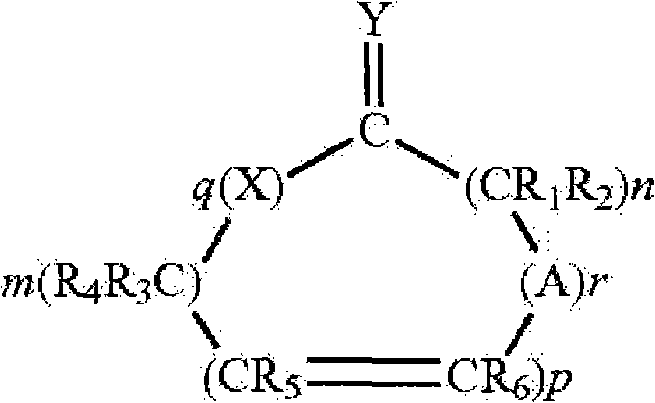
本发明的药物制剂可包含药用有效量的胰岛素和一种渗透促进剂(美国专利7,112,561、7,244,703和7,320,968)。所述渗透促进剂可为具有下列结构的一种Hsieh促进剂:The pharmaceutical formulations of the present invention may comprise a pharmaceutically effective amount of insulin and a penetration enhancer (US Patents 7,112,561, 7,244,703 and 7,320,968). The penetration enhancer may be a Hsieh enhancer having the following structure:
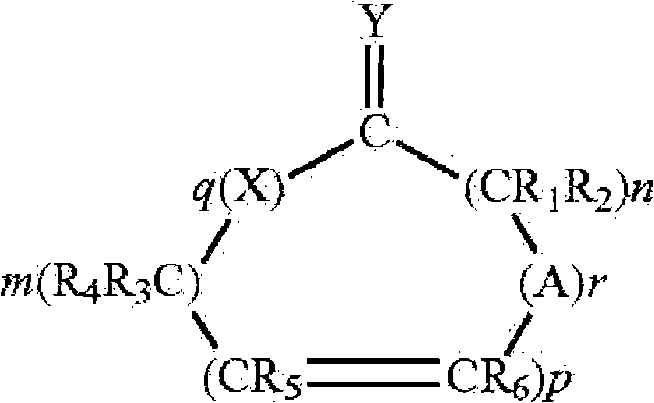
其中X和Y是氧、硫或如下结构的亚氨基Where X and Y are oxygen, sulfur or imino of the following structure

或=N-R,但条件是当Y是亚氨基时,X是亚氨基时,且当Y是硫时,X是硫或亚氨基,A是具有如下结构的基团or =N-R, but with the proviso that when Y is imino, X is imino, and when Y is sulfur, X is sulfur or imino, A is a group having the structure
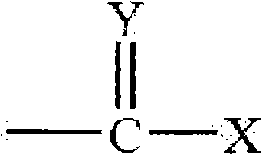
其中X和Y如上定义,m和n是1到20的整数且m+n总和不大于25,p是0或1的整数,q是0或1的整数,r是0或1的整数,并且R、R1、R2、R3、R4、R5和R6各自独立地是氢,或者具有1到6个碳原子的直链或支链烷基只要R1到R6中只有一个是烷基,条件是当p、q和r都取0且Y是氧时,m+n至少是11,并且其他条件是当X是亚氨基、q等于1、Y是氧原子且p和r是0,则m+n至少是11,并且所述化合物将提高药物穿过身体膜的通过速度。以下这些化合物都称为促进剂。当R、R1、R2、R3、R4、R5和R6是烷基时,它可以是甲基、乙基、丙基、异丙基、丁基、异丁基、仲丁基、戊基、己基等。这样的渗透促进剂在美国专利5,023,252和5,731,303中有描述。wherein X and Y are as defined above, m and n are integers from 1 to 20 and the sum of m+n is not greater than 25, p is an integer of 0 or 1, q is an integer of 0 or 1, r is an integer of 0 or 1, and R, R 1 , R 2 , R 3 , R 4 , R 5 and R 6 are each independently hydrogen, or a linear or branched chain alkyl group having 1 to 6 carbon atoms as long as there is only one of R 1 to R 6 is an alkyl group, provided that when p, q and r are all 0 and Y is oxygen, m+n is at least 11, and further provided that when X is an imino group, q is equal to 1, Y is an oxygen atom and p and r is 0, then m+n is at least 11, and the compound will increase the rate of passage of the drug across body membranes. These compounds are referred to below as accelerators. When R, R 1 , R 2 , R 3 , R 4 , R 5 and R 6 are alkyl, it can be methyl, ethyl, propyl, isopropyl, butyl, isobutyl, sec-butyl base, pentyl, hexyl, etc. Such penetration enhancers are described in US Patent Nos. 5,023,252 and 5,731,303.
渗透促进剂的实例有环状内酯(其中X和Y都是氧,q是1且r是0的化合物)、环状二酯(其中X和Y都是氧,且q和r都是1的化合物)和环酮(其中q和r都是0且Y是氧的化合物)。在环状二酯中,m+n优选地至少是3。在环酮中,m+n优选地至少是11到15且p优选地是0。本发明所用的促进剂的实例是大环促进剂。本文所用的术语“大环”是指环中至少有12个碳的环状化合物,包括:(A)大环酮类,例如,3-甲基环十五烷酮(麝香酮)、9-环十七碳烯-1-酮(灵猫酮)、环十六烷酮和环十五烷酮(降麝香酮);和(B)大环酯类,例如,十五内酯(pentadecalactone)如氧杂环十六-2-酮(oxacyclohexadecan-2-one)(环十五内酯、ω-十五内酯)。其他可以使用的渗透促进剂有在多种药典纲要中公认安全(GRAS)的简单长链酯类。这些可包括简单的脂肪族不饱和或饱和(但优选的是完全饱和的)酯类,其包含最高至中等长度的链。这些酯的非限制性实例包括十四酸异丙酯、棕榈酸异丙酯、十四酸十四酯、棕榈酸辛酯等。所述促进剂是一类适合用于药物组合物的促进剂。普通技术人员也会认识到应该避免使用那些与粘膜不相容或刺激粘膜的物质。Examples of penetration enhancers are cyclic lactones (compounds in which X and Y are both oxygen, q is 1 and r is 0), cyclic diesters (wherein X and Y are both oxygen, and q and r are both 1 compounds) and cyclic ketones (compounds in which q and r are both 0 and Y is oxygen). In cyclic diesters, m+n is preferably at least 3. In cyclic ketones, m+n is preferably at least 11 to 15 and p is preferably 0. Examples of accelerators used in the present invention are macrocyclic accelerators. The term "macrocycle" as used herein refers to cyclic compounds having at least 12 carbons in the ring, including: (A) macrocyclic ketones, for example, 3-methylcyclopentadecanone (muskone), 9-ring Heptadecen-1-one (lincatone), cyclohexadecanone, and cyclopentadecanone (normuskone); and (B) macrocyclic esters, for example, pentadecalactone (pentadecalactone) such as oxygen Heterocyclic hexadecan-2-one (oxacyclohexadecan-2-one) (cyclopentadecanolide, omega-pentadecanolide). Other permeation enhancers that can be used are simple long chain esters that are generally recognized as safe (GRAS) in various compendial schemes. These may include simple aliphatic unsaturated or saturated (but preferably fully saturated) esters containing chains of up to moderate length. Non-limiting examples of these esters include isopropyl myristate, isopropyl palmitate, myristyl myristate, octyl palmitate, and the like. The accelerator is a class of accelerators suitable for use in pharmaceutical compositions. Those of ordinary skill will also recognize that those substances which are incompatible with or irritating to the mucous membranes should be avoided.
所述促进剂以提高胰岛素对鼻粘膜的穿透力的有效浓度存在于组合物中。在确定促进剂的使用量时应该考虑多种考虑因素。这些考虑因素包括,例如,达到的流通量(穿透膜的通过速度)以及制剂中组分的稳定性和相容性。促进剂的一般使用量是组合物的约0.01到约25%(w/w),更通常使用的量是组合物的约0.1到约15%(w/w),在一些实施方案中的量是组合物的约0.5到约15%(w/w)(美国专利7,112,561)。The enhancer is present in the composition at a concentration effective to increase the penetration of insulin through the nasal mucosa. There are a number of considerations that should be taken into account when determining the amount of accelerator to use. These considerations include, for example, the flux achieved (speed of passage across the membrane) and the stability and compatibility of the components in the formulation. Accelerators are typically used in amounts of about 0.01 to about 25% (w/w) of the composition, more typically in amounts of about 0.1 to about 15% (w/w) of the composition, and in some embodiments the amount From about 0.5 to about 15% (w/w) of the composition (US Patent 7,112,561).
本发明的药物制剂可包含治疗有效量的胰岛素、渗透促进剂和液体载体。本发明的制剂可处在酸性pH,如不大于pH4.5。组合物中存在的液体载体的浓度为有效作为本发明组合物的合适载体的浓度。一般地,使用的载体量是组合物的约40到约98%(w/w),在一些实施方案中的量是组合物的约50到约98%(w/w)。The pharmaceutical formulations of the present invention may comprise a therapeutically effective amount of insulin, a penetration enhancer and a liquid carrier. The formulations of the invention may be at an acidic pH, such as not greater than pH 4.5. The liquid carrier is present in the composition at a concentration effective as a suitable carrier for the compositions of the invention. Generally, the amount of carrier used is from about 40 to about 98% (w/w) of the composition, and in some embodiments the amount is from about 50 to about 98% (w/w) of the composition.
不局限于任何具体的生理机制,认为第一个剂量的胰岛素作为鼻粘膜的负荷剂量。所述第一个剂量中的渗透促进剂可暂时增加后续剂量中胰岛素对粘膜层或上皮细胞膜的穿透力。所述第一个剂量中的渗透促进剂也可可逆性地打开上皮细胞间的紧密连接以便当在同一鼻孔中给予附加剂量时可以吸收更多的胰岛素。Without being bound by any particular physiological mechanism, it is believed that the first dose of insulin acts as a loading dose to the nasal mucosa. The penetration enhancer in the first dose may temporarily increase the penetration of insulin in subsequent doses through mucosal or epithelial cell membranes. The penetration enhancer in the first dose also reversibly opens the tight junctions between epithelial cells so that more insulin can be absorbed when additional doses are given in the same nostril.
在本发明的一个实施方案中,胰岛素的鼻内给药是通过使用水作为液体载体并将治疗有效量的胰岛素分散或溶解于水中的鼻喷雾剂进行的。在另一个实施方案中,将渗透促进剂乳化在包含胰岛素的水相中。乳化作用可通过使用一个或多个合适的表面活性剂来完成的。在实施本发明时可以使用任何合适的表面活性剂或表面活性剂的混合物,其包括,例如阴离子型、阳离子型和非离子型表面活性剂。非离子型表面活性剂的实例有PEG-60玉米甘油酯、PEG-20脱水山梨糖醇单硬脂酸酯、苯氧基-聚(乙烯氧基)乙醇、脱水山梨糖醇单油酸酯等。一般地,表面活性剂存在的量为低于组合物的约2%(w/w)。在另一个实施方案中,表面活性剂存在的量可为低于约1.5%(w/w),低于约1.3%(w/w),低于约1%(w/w)或低于约0.3%(w/w)。In one embodiment of the invention, the intranasal administration of insulin is by nasal spray using water as the liquid carrier and dispersing or dissolving a therapeutically effective amount of insulin in the water. In another embodiment, the penetration enhancer is emulsified in the aqueous phase comprising insulin. Emulsification can be accomplished through the use of one or more suitable surfactants. Any suitable surfactant or mixture of surfactants may be used in the practice of the present invention including, for example, anionic, cationic, and nonionic surfactants. Examples of nonionic surfactants are PEG-60 corn glyceride, PEG-20 sorbitan monostearate, phenoxy-poly(ethyleneoxy)ethanol, sorbitan monooleate, etc. . Typically, surfactants are present in an amount of less than about 2% (w/w) of the composition. In another embodiment, the surfactant may be present in an amount less than about 1.5% (w/w), less than about 1.3% (w/w), less than about 1% (w/w) or less than About 0.3% (w/w).
本发明的方法和制剂可使用任何类型的胰岛素,包括但不限于,天然的胰岛素即从牛或猪来源纯化得到的胰岛素、重组的胰岛素、胰岛素原、任何胰岛素类似物、衍生物、多晶型物(polymorph)、代谢物、前药、盐和/或水合物。胰岛素类似物的实例有人胰岛素、赖脯胰岛素(insulin lispro)、门冬胰岛素(insulin aspart)、谷赖胰岛素(insulin glulisine)、甘精胰岛素(insulin glargine)和地特胰岛素(insulin detemir)。胰岛素的锌盐也可以使用。胰岛素的衍生物包括在内部或末端氨基酸处被修饰的胰岛素,例如赖氨酸/脯氨酸取代的胰岛素衍生物。速效、中效和长效的胰岛素也可用于本发明的方法和系统中(Bethel et al.Journal of the American Board of Family Practice.18:199-204(2005))。The methods and formulations of the invention can be used with any type of insulin including, but not limited to, native insulin, i.e., insulin purified from bovine or porcine sources, recombinant insulin, proinsulin, any insulin analog, derivative, polymorphic form polymorphs, metabolites, prodrugs, salts and/or hydrates. Examples of insulin analogues are human insulin, insulin lispro, insulin aspart, insulin glulisine, insulin glargine and insulin detemir. Zinc salts of insulin may also be used. Derivatives of insulin include insulins modified at internal or terminal amino acids, eg lysine/proline substituted insulin derivatives. Rapid-, intermediate-, and long-acting insulins can also be used in the methods and systems of the invention (Bethel et al. Journal of the American Board of Family Practice . 18:199-204 (2005)).
一般地,药物制剂中存在的胰岛素或胰岛素衍生物的量是组合物的约0.01到约15%(w/w)。在一个实施方案中,使用的胰岛素的量是组合物的约0.01到约10%(w/w)。或者,胰岛素存在的量是药物制剂的约0.1到约5%(w/w)。使用的胰岛素的剂量的范围可为约25U到约150U,约50U到约125U,约75U到约110U或约25U到约50U。在一次给药中,胰岛素的给药量大约是100U。这个剂量可以单个剂量或多个剂量形式给药。这些剂量可包含等量的或不同量的胰岛素。在一个实施方案中,100U的胰岛素分为四个25U/剂的等剂量给药。Typically, the amount of insulin or insulin derivatives present in the pharmaceutical formulation is from about 0.01 to about 15% (w/w) of the composition. In one embodiment, the amount of insulin used is about 0.01 to about 10% (w/w) of the composition. Alternatively, insulin is present in an amount of about 0.1 to about 5% (w/w) of the pharmaceutical formulation. Dosages of insulin used may range from about 25 U to about 150 U, from about 50 U to about 125 U, from about 75 U to about 110 U, or from about 25 U to about 50 U. In one administration, the dose of insulin is about 100 U. This dose can be administered in single dose or in multiple doses. These doses may contain equal or different amounts of insulin. In one embodiment, 100 U of insulin is divided into four equal doses of 25 U/dose.
本发明的组合物一般是通过一个鼻腔喷雾给药器给药。如果需要用于鼻内,则可将组合物置于鼻内喷雾给药设备或雾化器中,随后通过将其喷射到患者的鼻孔中以递送至鼻孔的粘膜来施用。施用的量应足以达到所需的全身或局部药物水平。鼻内喷雾递送约200微升,通常施用50-150微升。在一个优选的实施方案中,每个剂量约100微升。可对一个或多个鼻孔给药,以需要的频率或以必要的频率施用。在本发明中,在单独一个鼻孔相继给药。在一个实施方案中,选择鼻腔喷雾给药器以提供平均尺寸在约10微米到200微米范围的组合物的小滴。更普遍的,小滴尺寸在约30微米到约100微米。The compositions of the present invention are generally administered via a nasal spray applicator. If intranasal use is desired, the composition can be placed in an intranasal spray delivery device or nebulizer and then administered by spraying it into the nostrils of the patient for delivery to the mucous membranes of the nostrils. The amount administered should be sufficient to achieve the desired systemic or local drug level. The intranasal spray delivers about 200 microliters, and 50-150 microliters are usually administered. In a preferred embodiment, each dose is about 100 microliters. Administration can be to one or more nostrils, as often as desired or as often as necessary. In the present invention, the administration is sequential in a single nostril. In one embodiment, the nasal spray applicator is selected to provide droplets of the composition having an average size in the range of about 10 microns to 200 microns. More generally, the droplet size is from about 30 microns to about 100 microns.
本发明的胰岛素喷雾组合物一般用于依赖于待治疗患者的给药方案。使用的频率和剂量可因患者不同而有所不同。一般地,给药量是每个剂量约10U到约50U,总给药量在约100U。在一个优选的实施方案中,每个剂量或每次喷雾为约15U到30U。患者可以一天中接受多次剂量。如本领域所知的,通过胰岛素疗法对疾病如糖尿病的治疗因患者不同而所不同。基于已知的胰岛素疗法和本文的教导,本领域技术人员如医生可以对具体的一个或多个患者选择给药方案和剂量。The insulin spray compositions of the present invention are generally used in a dosing regimen that depends on the patient to be treated. The frequency and dosage used may vary from patient to patient. Generally, the dosage is about 10 U to about 50 U per dose, and the total dosage is about 100 U. In a preferred embodiment, each dose or spray is about 15 U to 30 U. Patients may receive multiple doses throughout the day. As is known in the art, the treatment of diseases such as diabetes by insulin therapy varies from patient to patient. Based on known insulin therapy and the teachings herein, one skilled in the art, such as a physician, can select the dosing regimen and dosage for a particular patient or patients.
患者是在一个鼻孔给予单次剂量。给药并不依赖于鼻内喷雾设备插入鼻孔的深度,患者是否在吸气或所述设备插入的角度。一个剂量可包含每100微升至少约10U到约100U胰岛素。该剂量也可包含每100微升约15U到约75U,约20U到约50U,或约25U胰岛素。在一个实施方案中,将每100微升25U胰岛素给予到鼻孔内。在合适的时间段之后当液体量已被吸收时,相继在同一的鼻孔给予第二个剂量。在一个实施方案中,所述第二个剂量是在给予所述第一个剂量之后1-5秒内给予。所述第二个剂量可含约25U;然而,在第一或第二个剂量中胰岛素的量将由临床医师确定并且可以变化。Patients are given a single dose in one nostril. Dosing was not dependent on the depth of insertion of the intranasal spray device into the nostril, whether the patient was inhaling or the angle at which the device was inserted. A dose may contain at least about 10 U to about 100 U of insulin per 100 microliters. The dosage may also contain about 15 U to about 75 U, about 20 U to about 50 U, or about 25 U of insulin per 100 microliters. In one embodiment, 25 U of insulin per 100 microliters is administered into the nostrils. After a suitable period of time when the amount of fluid has been absorbed, a second dose is given sequentially in the same nostril. In one embodiment, said second dose is administered within 1-5 seconds after administration of said first dose. The second dose may contain about 25 U; however, the amount of insulin in the first or second dose will be determined by the clinician and may vary.
鼻内给予胰岛素后,可测定胰岛素和葡萄糖的血浆水平以确定在选定的给药间隔中血浆胰岛素的最大浓度(Cmax)、血浆浓度-时间曲线下的面积(AUC0-t)和达到Cmax的时间(Tmax)。AUC可从时间0测到时间t,其中可选择多种时间间隔。在一个实施方案中,血液收集的时间是在鼻内给予胰岛素后-5分钟(鼻内给予胰岛素前5分钟)、-1分钟和10、15、20、25、30和45分钟。胰岛素和C肽可通过免疫测定法测量。血浆葡萄糖使用任何标准实验室化学方法测得。Following intranasal administration of insulin, plasma levels of insulin and glucose can be measured to determine the maximum plasma insulin concentration (Cmax), the area under the plasma concentration-time curve (AUC 0-t ), and the Cmax achieved at selected dosing intervals. time (Tmax). AUC can be measured from
药代动力学(PK)参数来源于葡萄糖和胰岛素的相关血液浓度数据。葡萄糖和胰岛素是在0到45分钟取的样品中进行测量的。胰岛素的药代动力学参数包括Cmax、AUC0-t、Tmax,和为确定受试者内差异度和剂量反应的所有给药的比较动力学。葡萄糖的药代动力学参数包括AUC0-t,以及在相同重复给药和逐渐增加的给药时动力学效应一致性的比较。AUC可用混合对数线性规则计算。使用这个方法,AUC通过以下方式计算:第一个(数据)点和Tmax之间的梯形法,随后是Tmax和最后数据点之间的对数法。每次浓度水平增加或两个数据点相等时,计算自动转换成梯形法。认为在Tmax之前出现的定量限(LQQ)以下的数值是零。出现在Tmax之后的定量限以下的数值对于最终回归线的计算可以忽略不计。如果两个在定量限以上的数值之间出现一个在定量限以下的数值或丢失一个数值时,两个数据点之间插补值是允许的。为评估处置速度常数(Lz),通过以下方法得到曲线下的外推面积(t到无穷大):对t校正的曲线的对数(ln)变换数据点进行线性回归。用一种方差分析(ANOVA)模型比较各种治疗之间的每个PK参数,所述方差分析模型包括序列、治疗和时期的固定效果,以及,序列内和受试者误差内的受试者的随机效果。整体的治疗效果是用ANOVA模型的平均平方误差在5%显著性水平上测量的。如果整体的治疗效果不显著,那么治疗之间的比较将没有意义。两种治疗之间的比较是通过用SAS MIXED程序的“ESTIMATE”语句进行的。对于每个PK参数,利用治疗组来计算描述性统计量,包括N、平均值、中间值、标准差、最小值和最大值。对于AUC和Cmax,除上述的概括统计量外,还利用治疗组计算几何平均数和变异系数。除非另外特别说明,所有的统计学实验均按照双边对立假设进行,采用0.05的显著性水平。Pharmacokinetic (PK) parameters were derived from relative blood concentration data for glucose and insulin. Glucose and insulin were measured in samples taken from 0 to 45 minutes. Insulin pharmacokinetic parameters included Cmax, AUC 0-t , Tmax, and comparative kinetics of all doses to determine intra-subject variability and dose response. Pharmacokinetic parameters of glucose included AUC 0-t , and comparison of the consistency of kinetic effects at the same repeated doses and with increasing doses. AUC can be calculated using the mixed log-linear rule. Using this method, AUC is calculated by the trapezoidal method between the first (data) point and Tmax, followed by the logarithmic method between Tmax and the last data point. Every time the concentration level increases or two data points are equal, the calculation is automatically converted to the trapezoidal method. Values below the limit of quantitation (LQQ) occurring before Tmax were considered zero. Values below the limit of quantitation occurring after Tmax were ignored for the calculation of the final regression line. Interpolation between two data points is allowed if a value below the limit of quantification occurs or a value is missing between two values above the limit of quantitation. To estimate the disposition rate constant (Lz), the extrapolated area under the curve (t to infinity) was obtained by linear regression on the log (ln) transformed data points of the t corrected curve. Each PK parameter was compared between treatments using an analysis of variance (ANOVA) model that included fixed effects for sequence, treatment, and period, and, within-sequence and within-subjects error random effect. The overall treatment effect was measured using the mean squared error of the ANOVA model at the 5% significance level. If the overall treatment effect is not significant, comparisons between treatments will be meaningless. Comparisons between the two treatments were performed using the "ESTIMATE" statement of the SAS MIXED program. For each PK parameter, descriptive statistics were calculated by treatment group, including N, mean, median, standard deviation, minimum and maximum. For AUC and Cmax, in addition to the summary statistics described above, geometric means and coefficients of variation were calculated using treatment groups. Unless otherwise specified, all statistical experiments were performed according to the two-sided alternative hypothesis, with a significance level of 0.05.
经鼻内途径的胰岛素的吸收存在相当大的个体间差异性(Heinemann et al.Current Pharmaceutical Design.7:1327-1351(2001))。本发明还提供一种用于鉴别能够经鼻吸收治疗有效量的胰岛素的一个或一组患者的方法。为进行这个鉴别而给予的胰岛素在药物制剂中的剂量范围为约20U到约200U。给药后,胰岛素血浆水平的测定是在给予所述剂量后约10到约30分钟进行。胰岛素的测试剂量的范围可为约25U到约150U,约50U到约125U,约75U到约110U,或约100U。给药后血浆胰岛素的Cmax可在约15到约400microU/ml的范围,约30到约250microU/ml的范围,约50到约150microU/ml的范围,约70到约100microU/ml的范围,约15到约20microU/ml的范围或可高于约70microU/ml(在约200到250microU/ml的范围上限内)。在本发明的具体实施方案中,100U测试剂量的Cmax为约100microU/ml,对于75U测试剂量为约67microU/ml,对于50U测试剂量为约30microU/ml。There is considerable interindividual variability in the absorption of insulin by the intranasal route (Heinemann et al. Current Pharmaceutical Design . 7:1327-1351 (2001)). The present invention also provides a method for identifying a patient or a group of patients capable of nasally absorbing a therapeutically effective amount of insulin. The doses of insulin administered for this identification range from about 20 U to about 200 U in pharmaceutical formulations. Following administration, insulin plasma levels are measured from about 10 to about 30 minutes after administration of the dose. Test doses of insulin may range from about 25 U to about 150 U, about 50 U to about 125 U, about 75 U to about 110 U, or about 100 U. The Cmax of plasma insulin after administration can be in the range of about 15 to about 400 microU/ml, the range of about 30 to about 250 microU/ml, the range of about 50 to about 150 microU/ml, the range of about 70 to about 100 microU/ml, about The range of 15 to about 20 microU/ml or may be higher than about 70 microU/ml (within the upper limit of the range of about 200 to 250 microU/ml). In specific embodiments of the invention, the Cmax is about 100 microU/ml for a 100 U test dose, about 67 microU/ml for a 75 U test dose, and about 30 microU/ml for a 50 U test dose.
或者,血糖水平的检测可在经鼻给予胰岛素之后进行。血糖水平可用标准方法学(Blood Sugar[online],[retrieved on June 5,2009].Retrieved from the Internet<URL:http://en.wikipedia.org/wiki/Blood_sugar>)确定。此外,对经鼻吸收治疗有效量的胰岛素的患者的鉴定可在有热量刺激或没有热量刺激的条件下进行的。例如,处于禁食状态的患者可检测他们的血浆葡萄糖基线。通常,该数值的范围为约100-250mg/dl。用鼻喷雾剂进行合适的训练之后,所述患者随后就可以经鼻接受一个剂量的胰岛素。所给予的在鼻耐受的药物制剂中的胰岛素的剂量可为约20U到约200U。给药后,胰岛素血浆水平的检测是在给予所述剂量后约10到约30分钟进行。胰岛素剂量的范围可为约25U到约150U,约50U到约125U,约75U到约110U,或约100U。Alternatively, detection of blood glucose levels can be performed after nasal administration of insulin. Blood glucose levels can be determined using standard methodology (Blood Sugar [online], [retrieved on June 5, 2009]. Retrieved from the Internet <URL: http://en.wikipedia.org/wiki/Blood_sugar>). In addition, identification of patients who absorb therapeutically effective amounts of insulin nasally can be performed with or without a caloric challenge. For example, patients in a fasted state may have their baseline plasma glucose measured. Typically, this value ranges from about 100-250 mg/dl. After suitable training with the nasal spray, the patient can then receive a dose of insulin nasally. The dose of insulin administered may be from about 20 U to about 200 U in a nasally tolerated pharmaceutical formulation. Following administration, measurement of insulin plasma levels is performed from about 10 to about 30 minutes after administration of the dose. Insulin doses may range from about 25 U to about 150 U, from about 50 U to about 125 U, from about 75 U to about 110 U, or about 100 U.
然后血糖的测量是在经鼻给予胰岛素后约15到约120分钟进行。如果血糖低于葡萄糖基线,那么患者就被认为是能够经鼻吸收治疗有效量的胰岛素或是可对胰岛素足够敏感而造成血糖降低。或者,所述检测可使用标准热量刺激进行,如用含固体或液体碳水化合物的食物或饮料。例如,可以使用一个含75gm葡萄糖的饮料。处于禁食状态的患者应进行血糖基线测试。如其所述,血糖可以在约100到约250mg/dl范围。胰岛素的剂量范围如上所述。在接受经鼻给予的胰岛素之后,患者立刻接受热量刺激。在接受热量刺激之后约10到约120分钟的时间段中再次测量血糖。葡萄糖的升高低于约60mg/dl的患者被认为是能够经鼻吸收治疗有效量的胰岛素。对葡萄糖升高的反应范围可为低于约60mg/dl,低于约40mg/dl或低于约20mg/dl。Blood glucose measurements are then made about 15 to about 120 minutes after nasal administration of insulin. If blood glucose is below baseline glucose, the patient is considered to be able to absorb a therapeutically effective amount of insulin nasally or to be sensitive enough to insulin to cause a drop in blood glucose. Alternatively, the assay can be performed using a standard caloric stimulus, such as with a solid or liquid carbohydrate containing food or drink. For example, a drink containing 75gm of glucose can be used. Patients in the fasted state should have a baseline blood glucose test. As noted, blood glucose may range from about 100 to about 250 mg/dl. Insulin dosage ranges are as described above. Immediately after receiving nasally administered insulin, patients were challenged with heat. Blood glucose is again measured for a period of about 10 to about 120 minutes after receiving the heat challenge. Patients whose glucose rises below about 60 mg/dl are considered to be able to absorb therapeutically effective amounts of insulin nasally. The range of responses to elevated glucose may be less than about 60 mg/dl, less than about 40 mg/dl or less than about 20 mg/dl.
本发明还提供了一种制品如试剂盒,其包含用于鼻腔给药的胰岛素药物制剂和印刷品,所述印刷品指出为达到具有治疗有效的胰岛素血浆水平,应相继在单独一个鼻孔相继给予至少约两个剂量的胰岛素药物制剂。所述印刷品记载了一个剂量包含每100微升至少约10U到约100U的胰岛素。所述剂量也可包含每100微升约15U到约75U、约20U到约50U、或约25U的胰岛素。所述印刷品记载了,当在给予胰岛素的第二个剂量后约0到约45分钟或约25分钟到约30分钟时测量血浆胰岛素时,第二个剂量后胰岛素的Cmax的范围可为约15到约400microU/ml,约30到约250microU/ml,约50到约150microU/ml,约70到约100microU/ml,约15到约20microU/ml或可高于约70microU/ml,以及所述第二个剂量后血浆胰岛素的AUC是至少约1800microU/(ml*min)。所述印刷品也指出,给予第二个剂量后血浆胰岛素的Cmax(或AUC)为给予第一个剂量后血浆胰岛素的Cmax(或AUC)的约二倍到约十倍、约三倍到约八倍、约四倍到约五倍、或是约五倍。The invention also provides an article of manufacture, such as a kit, comprising a pharmaceutical formulation of insulin for nasal administration and printed matter stating that to achieve therapeutically effective insulin plasma levels, sequential administration of at least about Two doses of insulin pharmaceutical preparations. The printed matter states that a dose comprises at least about 10 U to about 100 U of insulin per 100 microliters. The dose may also comprise about 15 U to about 75 U, about 20 U to about 50 U, or about 25 U of insulin per 100 microliters. The printed matter states that when plasma insulin is measured from about 0 to about 45 minutes or from about 25 minutes to about 30 minutes after administration of the second dose of insulin, the Cmax of insulin after the second dose may range from about 15 to about 400 microU/ml, about 30 to about 250 microU/ml, about 50 to about 150 microU/ml, about 70 to about 100 microU/ml, about 15 to about 20 microU/ml or may be higher than about 70 microU/ml, and said The AUC of plasma insulin after two doses is at least about 1800 microU/(ml*min). The printed matter also states that the Cmax (or AUC) of plasma insulin after the second dose is about two to about ten times, about three times to about eight times the Cmax (or AUC) of plasma insulin after the first dose. times, about four times to about five times, or about five times.
所述印刷品也可指出,应该对患者进行测试以鉴别一个或一组经鼻吸收治疗有效量的胰岛素的患者。在适合鼻腔给药的药物制剂中经鼻给予胰岛素的剂量的范围为约20U到约200U。血浆胰岛素的测量可在给予所述剂量后约10到约30分钟进行的。胰岛素的剂量可在约25U到约150U的范围、约50U到约125U的范围、约75U到约110U的范围或约110U。鼻内给予胰岛素后,血浆胰岛素Cmax的范围为约15到约400microU/ml、约30到约250microU/ml、约50到约150microU/ml、约70到约100microU/ml、约15到约20microU/ml,或可高于约70microU/ml(在约200到250microU/ml的范围上限内)。The printed matter may also state that patients should be tested to identify a patient or group of patients who absorb a therapeutically effective amount of insulin nasally. Dosages for nasal administration of insulin in pharmaceutical formulations suitable for nasal administration range from about 20 U to about 200 U. Measurements of plasma insulin can be taken from about 10 to about 30 minutes after administration of the dose. The dose of insulin may range from about 25 U to about 150 U, from about 50 U to about 125 U, from about 75 U to about 110 U, or about 110 U. Following intranasal administration of insulin, plasma insulin Cmax ranges from about 15 to about 400 microU/ml, about 30 to about 250 microU/ml, about 50 to about 150 microU/ml, about 70 to about 100 microU/ml, about 15 to about 20 microU/ml ml, or may be above about 70 microU/ml (within the upper limit of the range of about 200 to 250 microU/ml).
或者,所述印刷品可指出,血糖的检测应该在鼻内给予胰岛素之后进行,以确定患者是否能经鼻吸收治疗有效量的胰岛素。所述印刷品可指出,检测应该使用标准热量刺激进行,如用含有固体或液体碳水化合物的食物或饮料。例如,可以使用一个含75gm葡萄糖的饮料。处于禁食状态的患者应进行血糖基线测试。在接受经鼻给予的胰岛素之后,患者立刻接受热量刺激。在接受热量刺激之后约10到约120分钟再次测量血糖。葡萄糖的升高低于约60mg/dl的患者被认为是能够经鼻吸收治疗有效量的胰岛素的患者。对葡萄糖升高的反应的范围可为低于约60mg/dl,低于约40mg/dl或低于约20mg/dl。Alternatively, the publication may state that blood glucose testing should be performed after intranasal administration of insulin to determine whether the patient is able to nasally absorb a therapeutically effective amount of insulin. The printed matter may indicate that testing should be performed using standard caloric stimuli, such as food or drink containing solid or liquid carbohydrates. For example, a drink containing 75gm of glucose can be used. Patients in the fasted state should have a baseline blood glucose test. Immediately after receiving nasally administered insulin, patients were challenged with heat. Blood glucose was measured again about 10 to about 120 minutes after receiving the heat challenge. A patient whose glucose rises below about 60 mg/dl is considered a patient capable of nasally absorbing a therapeutically effective amount of insulin. The response to elevated glucose may range from less than about 60 mg/dl, less than about 40 mg/dl or less than about 20 mg/dl.
如本领域所知的,通过胰岛素疗法对一种疾病如糖尿病的治疗,取决于待治疗的患者。纳入所述制品的印刷品可指出,胰岛素药物制剂的给药并不依赖于鼻内喷雾设备插入鼻孔的深度,患者是否正在吸气或鼻腔喷雾设备插入的角度。As is known in the art, the treatment of a disease, such as diabetes, by insulin therapy depends on the patient being treated. Print incorporated into the article may indicate that administration of the insulin drug formulation is not dependent on the depth of insertion of the intranasal spray device into the nostril, whether the patient is inhaling or the angle of insertion of the nasal spray device.
任何能够穿过粘膜递送的药学活性试剂,或两种或多种这种试剂的混合物,都可用于实施本发明。术语“药学活性试剂”包括肽、蛋白、类肽物、拟肽和化学化合物,还有所述肽、蛋白、类肽物、拟肽和化学化合物的前体、盐、复合物、类似物及衍生物。所述试剂可能本身有治疗、预防或诊断的性质。Any pharmaceutically active agent capable of transmucosal delivery, or a mixture of two or more such agents, may be used in the practice of the present invention. The term "pharmaceutically active agent" includes peptides, proteins, peptoids, peptidomimetics and chemical compounds, as well as precursors, salts, complexes, analogs and derivative. The agent may itself have therapeutic, prophylactic or diagnostic properties.
用于实施本发明的药学活性试剂的实例包括:可用于治疗糖尿病的化合物,如胰岛素、胰岛素原、前胰岛素原、胰岛素类似物和胰高血糖素样肽(GLP);降钙素和降钙素基因相关的肽;生长激素;生长激素释放剂;癌症治疗剂,如促生长素抑制素(SRIF)及其类似物;促性腺激素释放剂(GnRH,也称作黄体生成激素释放激素激动剂(LHRH));促性腺激素释放激素拮抗剂,如安替肽(Antide);δ-促睡眠肽(DSIP);阿片样物质;减肥药;抗炎药;血管生成素拮抗剂;抗阿片肽,如吗啡调节神经肽;β-拮抗剂,如沙丁胺醇;抗焦虑药,如地西泮(diazepam)、咪达唑仑(midazolam)、巴比妥类、帕罗西汀(paroxetine)、丙咪嗪和相关的精神治疗化合物;β-阻断剂;增加食欲的化合物;麻醉剂和阿片样镇痛剂;性激素,如睾酮、孕酮和雌二醇;代谢调节肽,如甲状旁腺激素(PTH)、促甲状腺激素、胸腺体液因子(THF)和卵泡刺激素(FSH)(WO 03/000158)。Examples of pharmaceutically active agents useful in the practice of the present invention include: compounds useful in the treatment of diabetes, such as insulin, proinsulin, preproinsulin, insulin analogs and glucagon-like peptide (GLP); calcitonin and calcitonin Growth hormone-releasing peptides; growth hormone; growth hormone-releasing agents; cancer therapeutics, such as somatostatin (SRIF) and its analogs; gonadotropin-releasing agents (GnRH, also known as luteinizing hormone-releasing hormone agonists (LHRH)); gonadotropin-releasing hormone antagonists such as Antide; delta-sleep-stimulating peptide (DSIP); opioids; weight loss drugs; anti-inflammatory drugs; angiopoietin antagonists; , such as morphine-modulating neuropeptides; beta-antagonists, such as albuterol; anxiolytics, such as diazepam, midazolam, barbiturates, paroxetine, imipramine, and Related psychotherapeutic compounds; beta-blockers; appetite-increasing compounds; narcotics and opioid analgesics; sex hormones such as testosterone, progesterone, and estradiol; Thyroid stimulating hormone, thymic humoral factor (THF) and follicle stimulating hormone (FSH) (WO 03/000158).
本发明的实施方案中包含一种肽或蛋白,所述组合物也可包含一种能阻止肽或蛋白——例如在吸收的位点上——分解的酶抑制剂。基本上上任何适合的酶抑制剂或酶抑制剂的混合物都可用于实施本发明。可用于实施本发明的酶抑制剂的实例有亮抑酶肽(leupeptin)、苯丁抑制素(bestatin)和抑肽酶。根据任何给定的肽或蛋白中的酶切割位点,可使用不同的酶抑制剂。所述酶抑制剂是以有效抑制给药位点处酶促降解的浓度来使用。为达到指导目标,认为大多数应用中会使用的酶抑制剂的量为所述组合物的约0.0001到约0.1%(w/w),更可能是所述组合物的约0.005到约0.1%(w/w)(WO 03/000158)。实施例是举例说明本发明的实施方案,而不应被认为具有限制性。In embodiments of the invention comprising a peptide or protein, the composition may also comprise an enzyme inhibitor which prevents breakdown of the peptide or protein, for example at the site of absorption. Essentially any suitable enzyme inhibitor or mixture of enzyme inhibitors can be used in the practice of the present invention. Examples of enzyme inhibitors useful in the practice of the present invention are leupeptin, bestatin and aprotinin. Depending on the enzyme cleavage site in any given peptide or protein, different enzyme inhibitors can be used. The enzyme inhibitor is used at a concentration effective to inhibit enzymatic degradation at the site of administration. As a guideline, it is believed that most applications will use enzyme inhibitors in amounts of about 0.0001 to about 0.1% (w/w) of the composition, more likely about 0.005 to about 0.1% of the composition (w/w) (WO 03/000158). The examples are illustrative of embodiments of the invention and should not be considered limiting.
实施例1Example 1
本研究的目标在于确定用于胰岛素鼻内给药的最佳方法,并表征剂量反应药代动力学和药效学。本研究依照机构审查委员会(Institutional Review Board,IRB)批准的操作方案进行。The goals of this study were to determine the optimal method for intranasal administration of insulin and to characterize the dose-response pharmacokinetics and pharmacodynamics. This study was conducted in accordance with the protocol approved by the Institutional Review Board (IRB).
制剂和设备Preparations and Equipment
测试的制剂是鼻内胰岛素喷雾剂,其包含溶解于水中的常规短效的人重组胰岛素与几种常见赋形剂,所述赋形剂包括聚山梨酯20、脱水山梨糖醇单月桂酸酯、棉籽油和环十五内酯(CPE-215)。赋形剂环十五内酯是在植物如欧白芷根(Angelia archangelica)中天然存在的化合物,并且是很多食品、化妆品和个人卫生用品中的常见组分。重要地是,胰岛素制剂在使用前被置于室温中2到10小时。将其缓慢倒置两到三次。第一次使用所述喷雾剂时启动泵。每100微升喷雾剂中分散着接近25U的胰岛素。高级无防腐剂(Advanced Preservative Free,APF)鼻喷雾剂设备保存容许范围内的剂量体积至少一周。The formulation tested was an intranasal insulin spray comprising conventional short-acting human recombinant insulin dissolved in water with several common
研究对象research object
年龄在18到50岁且适合入选/排除标准的八名健康不吸烟男性受试者参加了这项研究。受试者必须满足下列入选标准:现阶段身体(包括鼻腔检查)和病史没有临床重大异常;体重指数≤33;体重≥70kg;C肽水平>1.0mg/ml;在准许进入研究前签署书面知情同意书。Eight healthy nonsmoking male subjects, aged 18 to 50 years and meeting the inclusion/exclusion criteria, participated in this study. Subjects must meet the following selection criteria: no clinically significant abnormalities in the current body (including nasal cavity examination) and medical history; body mass index ≤ 33; body weight ≥ 70kg; C-peptide level > 1.0mg/ml; sign a written informed consent before entering the study consent.
如果受试者满足下列排除标准之一,将被排除:存在重大的心脏病、胃肠病、内分泌疾病、神经学疾病、肝脏疾病或肾脏疾病;存在已知影响胰岛素吸收、分布、代谢或排泄情况的病史;为任何原因长期使用药物(允许使用稳定的维他命/营养补剂);空腹血糖≥126mg/ml;增高的肝脏酶(ALT,AST,碱性磷酸酶)>正常上限的1.5倍;最近两年内有滥用药物或酒精的历史;在第一次治疗访问前30天内使用研究中新药;日常使用鼻腔喷雾;在筛检时药物滥用尿检呈阳性。Subjects will be excluded if they meet one of the following exclusion criteria: presence of significant cardiac, gastrointestinal, endocrine, neurological, liver, or renal disease; presence of known effects on insulin absorption, distribution, metabolism, or excretion Medical history of the condition; long-term use of drugs for any reason (stable vitamins/nutritional supplements allowed); fasting blood glucose ≥126 mg/ml; elevated liver enzymes (ALT, AST, alkaline phosphatase) > 1.5 times the upper limit of normal; History of drug or alcohol abuse within the last two years; use of an investigational new drug within 30 days prior to first treatment visit; daily use of nasal spray; positive urine test for drug abuse at screening.
研究程序research program
受试者的治疗依照表1中列出的计划进行。生命体征的获取是在受试者就坐(sitting)至少5分钟后进行。血压和心率的获取和记录是在每个剂量给药前和治疗日中需要时进行。由约600kcal(50%CHO,30%脂肪,20%蛋白质)构成的标准餐是在每次用胰岛素治疗后和最后一次抽血后45分钟提供。The treatment of the subjects was carried out according to the plan listed in Table 1. Vital signs were taken after subjects had been sitting for at least 5 minutes. Blood pressure and heart rate were obtained and recorded prior to each dose and as needed during the treatment days. A standard meal consisting of approximately 600 kcal (50% CHO, 30% fat, 20% protein) was provided 45 minutes after each insulin treatment and the last blood draw.
表1Table 1
在研究中,所有受试者在早上治疗前空腹过夜至少8小时。在过夜空腹期间,允许随意饮用水直至给药前一小时。受试者在坐正时接受鼻内剂量或自行给药。In the study, all subjects fasted overnight for at least 8 hours before morning treatment. During the overnight fast, water was allowed ad libitum until one hour before dosing. Subjects received the intranasal dose or self-administered it while sitting upright.
受试者依据下列方案给药。受试者通过交替按住另一个鼻孔并吸气来确定是否两个鼻孔都是通畅的。如果两个鼻孔都是通畅的,受试者确定是否一个鼻孔比另一个更加通畅。如果是这样的话,随后就对那个鼻孔给予25U(一次喷雾)的剂量。如果两个鼻孔全部都是堵塞的,受试者则轻轻地吹他的鼻孔直至至少一个是通畅的。当给予50、75和100U(两或更多次喷雾)的剂量时,两个鼻孔都应确保通畅(如果需要时通过轻吹鼻子来确保通畅)并且各次喷雾之间间隔近10-20秒。受试者被给药时应保持头向前朝向胸部弯曲的坐姿。这保证对每个剂量均有合适的向下倾斜的内道填充(dip tubefill)。在启动泵喷雾器之后,致动器被放入鼻孔。Subjects were dosed according to the following schedule. Subjects determined whether both nostrils were open by alternately pressing the other nostril and inhaling. If both nostrils were open, the subject determined whether one nostril was more open than the other. If so, a dose of 25 U (one spray) is then administered to that nostril. If both nostrils are blocked, the subject gently blows his nostril until at least one is unobstructed. When administering doses of 50, 75, and 100 U (two or more sprays), both nostrils should be cleared (by gently blowing the nose if needed) with approximately 10-20 seconds between sprays . Subjects should remain seated with the head bent forward toward the chest while being dosed. This ensures a proper downwardly sloping dip tubefill for each dose. After priming the pump sprayer, the actuator is placed into the nostril.
受试者闭住当前不被给药的鼻孔。对于每次喷雾,受试者或医疗护理工作者在用拇指支撑底部时,用食指和中指用力地向下按压白色喷雾器(applicator)的肩部。同时地,当给予喷雾时,受试者通过鼻孔轻轻地吸气或猛吸。受试者随后通过嘴呼气。当需要时重复吸气和呼气。每个受试者在接受其给药前都训练了吸气的技术。不允许受试者在给药后30分钟内吹他们的鼻子。应注意,上述任何说明均可能会纳入可交给患者作为试剂盒一部分的印刷品中。The subject closed the nostril not currently being dosed. For each spray, the subject or healthcare worker pressed down firmly on the shoulder of the white applicator with the index and middle fingers while supporting the base with the thumb. Simultaneously, the subject inhales gently or puffs through the nostrils while the spray is administered. The subject then exhales through the mouth. Inhale and exhale repeatedly as needed. Each subject was trained in inspiratory technique before receiving their drug. Subjects were not allowed to blow their noses within 30 minutes of dosing. It should be noted that any of the above instructions may be incorporated into printed matter that may be given to the patient as part of the kit.
样品采集和检测方法Sample Collection and Testing Methods
依据下列流程,从每个病患志愿者体内(通过静脉插管)无菌地抽出4ml静脉血样品:药代动力学(PK)胰岛素(8个样品):-5、-1、10、15、20、25、30、45分钟;PK葡萄糖(8个样品):-5、-1、10、15、20、25、30、45分钟;治疗期间床边葡萄糖测定(4个样品):*-5、30、40、45分钟(*-5分钟葡萄糖读数必须低于126mg/dl以继续进行给药)。A 4 ml venous blood sample was aseptically withdrawn (via venous cannula) from each patient volunteer according to the following protocol: Pharmacokinetic (PK) insulin (8 samples): -5, -1, 10, 15 , 20, 25, 30, 45 minutes; PK glucose (8 samples): -5, -1, 10, 15, 20, 25, 30, 45 minutes; bedside glucose measurement during treatment (4 samples): * -5, 30, 40, 45 minutes (*-5 minute glucose reading must be below 126 mg/dl to continue dosing).
为确定血糖,将血液样品采集至草酸氟管(fluoride oxalate tube)中。这些样品被捆成一束并且在同一分析批次中分析。另外的样品被采集至无添加剂采血管中(无抗凝血剂)且允许在室温下在工作台上凝固30分钟。血清被分离出来并分成两份,放入干冰中冷冻的标记聚丙烯管中,并在-70℃直立储藏。丢弃经离心后的血细胞。每个研究日的所有胰岛素样品捆扎在一起并且在同一分析批次中分析。To determine blood glucose, blood samples were collected into fluoride oxalate tubes. The samples were bundled and analyzed in the same analysis run. Additional samples were collected into additive-free blood collection tubes (no anticoagulant) and allowed to clot on the bench for 30 minutes at room temperature. Serum was separated and divided in two into labeled polypropylene tubes frozen in dry ice and stored upright at -70°C. Discard the centrifuged blood cells. All insulin samples from each study day were bundled together and analyzed in the same analytical run.
每个血液样品中胰岛素和C肽的浓度是通过免疫测定法测量的。仅测量0到45分钟取样的样品中胰岛素浓度和C肽浓度,所述C肽仅是为了筛选目的。验证的程序遵循国际准则。The concentrations of insulin and C-peptide in each blood sample were measured by immunoassay. Insulin concentration and C-peptide concentration were measured only in samples taken from 0 to 45 minutes for screening purposes only. Validation procedures follow international guidelines.
胰岛素结果insulin results
在图1A中,将血浆胰岛素的Cmax或AUC相对于胰岛素剂量作图以示出在同一鼻孔中以三个不同剂量(25、50和75U)中每个剂量单次给予胰岛素后的剂量-暴露关系(dose-exposure relation)。暴露是吸收进入全身循环中的胰岛素量。在同一鼻孔中给予第二个25U(总剂量为50U)所达到的Cmax或AUC是只给予单个25U剂量的两倍还多。事实上达到的暴露为在同一鼻孔中单次剂量暴露后的约五倍。第三个25U给药(总剂量为75U)的额外暴露大致是成比例的,相对于50U给药时分别导致Cmax和AUC的48%和41%的增长。图1B示出了在同一鼻孔给予三个不同剂量(25、50和75U)中每个剂量时,通过Cmax或AUC测量得到的增加的暴露比率。在图表的左侧,示出了暴露的预期变化。因此,如果在同一鼻孔给予两个剂量,即50U(2×25U),那么可预期AUC或Cmax两倍地增加或者一个线性比例。然而,在同一鼻孔给予两次喷雾,每次25U(总剂量50U)时,与25U单次喷雾时相比Cmax或AUC有约五倍的增加。In Figure 1A, the Cmax or AUC of plasma insulin is plotted against insulin dose to show the dose-exposure after a single administration of insulin in the same nostril at each of three different doses (25, 50 and 75 U). Relationship (dose-exposure relation). Exposure is the amount of insulin absorbed into the systemic circulation. Administration of a second 25 U in the same nostril (for a total dose of 50 U) more than doubled the Cmax or AUC of a single 25 U dose alone. In fact the exposure achieved was about five times that after a single dose exposure in the same nostril. The additional exposure from the third 25 U dose (for a total dose of 75 U) was roughly proportional, resulting in a 48% and 41% increase in Cmax and AUC, respectively, relative to the 50 U dose. Figure IB shows the ratio of increased exposure as measured by Cmax or AUC for each of three different doses (25, 50 and 75 U) administered in the same nostril. On the left side of the graph, the expected change in exposure is shown. Thus, if two doses, ie, 50 U (2 x 25 U), are given in the same nostril, then a two-fold increase in AUC or Cmax or a linear proportionality would be expected. However, there was an approximately five-fold increase in Cmax or AUC when two sprays of 25 U each (total dose 50 U) were administered in the same nostril compared to a single spray of 25 U.
图2A和2B示出了在两个鼻孔(Cmax 2nos)三个不同剂量(25、50和75U)的两次重复给药或在同一鼻孔(Cmax 1nos)三个不同剂量(25、50和75U)的单次给药后的剂量-暴露关系。在同一鼻孔中给予第二个25U剂量时与第一个剂量相比达到5倍增加的暴露水平,这通过图2A中的Cmax和图2B中的AUC反映出,然而在两个不同鼻孔相继给予第二个25U剂量时只达到约两倍的暴露。Figures 2A and 2B show two repeated doses of three different doses (25, 50 and 75 U) in two nostrils (Cmax 2nos) or three different doses (25, 50 and 75 U in the same nostril (Cmax 1nos) ) after a single dose-exposure relationship. A 5-fold increased exposure level was achieved when the second 25 U dose was administered in the same nostril compared to the first dose, as reflected by the Cmax in Figure 2A and the AUC in Figure 2B, whereas sequential administration in two different nostrils Only about double the exposure was achieved with the second 25 U dose.
图3示出了在吸收鼻腔给药的胰岛素方面的个体间高度差异性,这可以通过个体之间血浆胰岛素Cmax中15倍的差异来反映。#17到#24指代不同的研究受试者。在相同给药方案的两次重复间的受试者内部差异性看似较低。受试者之间的差异之前一直归因于给药技术,如鼻内喷雾设备插入鼻孔的深度,患者受否在吸气或鼻内喷雾剂插入的角度。然而,本研究反驳了那些可能性,并证明个体间的差异性更可能归因于存在能够吸收穿过鼻粘膜的治疗有效量胰岛素的患者和相对而言的那些通过相同给药方式吸收明显较少胰岛素的患者的情况。因此,为了改善胰岛素治疗的安全性,在胰岛素给药前,对患者进行检测以确定鼻腔给药后胰岛素的吸收情况是至关重要的。Figure 3 shows the high inter-individual variability in the absorption of nasally administered insulin, as reflected by the 15-fold difference in plasma insulin Cmax between individuals. #17 to #24 refer to different study subjects. Within-subject variability between two replicates of the same dosing regimen appeared to be low. Differences between subjects have previously been attributed to administration technique, such as how deeply the intranasal spray device is inserted into the nostril, whether the patient is inhaling or the angle at which the intranasal spray is inserted. However, the present study disproves those possibilities and demonstrates that interindividual variability is more likely attributable to the presence of patients who are able to absorb therapeutically effective amounts of insulin across the nasal mucosa versus those who absorb significantly less insulin by the same route of administration. The situation of patients with hypoinsulinemia. Therefore, in order to improve the safety of insulin therapy, it is crucial to test patients to determine the absorption of insulin after nasal administration before insulin administration.
实施例2Example 2
葡萄糖钳夹技术是一种用于测量胰岛素对葡萄糖摄取的直接作用的成熟测量方法。这种测量方法是通过夹住或维持预定的血糖水平(如~100mg/dl)来实现的,并且通过使用受调节的葡萄糖灌输速度抵偿所测试的胰岛素作用来完成。因此,葡萄糖灌输速度(GIR)变成检测每单位时间从血浆中“消失”的葡萄糖量的直接量度。The glucose clamp technique is a well-established measurement method for measuring the direct effect of insulin on glucose uptake. This method of measurement is achieved by clamping or maintaining a predetermined blood glucose level (eg -100 mg/dl) and by using a regulated rate of glucose infusion to offset the effect of the insulin being tested. Thus, the glucose infusion rate (GIR) becomes a direct measure of the amount of glucose "disappearing" from the plasma per unit time.
葡萄糖钳夹研究依据下列步骤完成:Glucose clamp studies are performed according to the following steps:
a.受试者从前一晚的11:00PM开始禁食(除了水)。a. Subjects fasted from 11:00 PM the night before (except water).
b.受试者保持坐姿休息5分钟后采集生命体征。b. The subjects kept the sitting position and rested for 5 minutes before collecting vital signs.
c.两个手臂都放在加热垫上使静脉扩张。在一个手臂上将静脉注射导管置入肘前静脉以便通过两个独立的调节阀输注右旋葡萄糖20%和胰岛素。将另一个静脉注射导管倒放以采集动脉血进行葡萄糖测量。加热垫可以从葡萄糖注射位点移开,但倒置的导管位点应维持在65℃。采集最初的血液(-30分钟)是为基线葡萄糖取样。30分钟后开始输注胰岛素以确保为钳夹操作提供合适的流量。c. Both arms are placed on a heating pad to dilate the vein. An IV catheter was placed in the antecubital vein in one arm for infusion of
d.在给药前1小时,以30cc/hr的速度输入生理盐水。d. One hour before administration, infuse physiological saline at a rate of 30cc/hr.
e.在整个钳夹操作过程中,每5分钟取一次血糖样本。使用YSI2300血糖分析仪进行静态(Stat)分析。当需要时可以调整葡萄糖输注速度以维持血糖在90-110mg/dl的稳定水平。e. Blood glucose samples were taken every 5 minutes throughout the clamp procedure. Static (Stat) analysis was performed using a YSI2300 blood glucose analyzer. The glucose infusion rate can be adjusted when needed to maintain a stable level of blood glucose at 90-110 mg/dl.
f.葡萄糖和胰岛素水平的血液样本是在-10、-1、3、6、9、12、15、20、25、30、35、40、45、50、55、60、65、70、75、80、90、120、150、180和240分钟采集。C肽在每个剂量在-10、-1、60、120和240分钟(总共5个时间点)取样。f. Blood samples for glucose and insulin levels are at -10, -1, 3, 6, 9, 12, 15, 20, 25, 30, 35, 40, 45, 50, 55, 60, 65, 70, 75 , 80, 90, 120, 150, 180 and 240 minute acquisitions. C-peptide was sampled at -10, -1, 60, 120 and 240 minutes (total of 5 time points) at each dose.
g.右旋葡萄糖20%继续输注额外的15分钟。g. Continue the infusion of
h.采集生命体征。h. Collect vital signs.
i.受试者就餐,并且确保受试者的血糖水平在排出之前大于100mg/dl。i. The subject eats a meal and ensures that the subject's blood glucose level is greater than 100 mg/dl prior to excretion.
图4将最大可达到的GIR作为测量的Cmax的函数作图。数据表明发生在大于约70microU/ml的胰岛素Cmax时发生明显的葡萄糖代谢。Figure 4 plots the maximum achievable GIR as a function of measured Cmax. The data indicate that significant glucose metabolism occurs at insulin Cmax greater than about 70 microU/ml.
本发明的范围并不局限于以上所具体示出和描述的内容。本发明的说明书中引用并讨论了大量参考文献包括专利和多种出版物。提供的对这些参考文献的引用和讨论仅仅是阐明对本发明的说明,并不是承认任何参考文献对本文所述的本发明来说是现有技术。本说明书中引用和讨论的所有参考文献均通过引用的方式全文纳入本文。本领域普通技术人员将可对本文所描述的内容进行变化、修改和以其他方式实施而不脱离本发明的精神和范围。当本发明的某些实施方案已经被示出和描述时,对本领域的技术人员来说显而易见的是,在不脱离本发明的精神和范围情况下可以做出变化和修改。在前面的描述和附图中所提到的内容只是通过举例说明的方式提出并不是作为限制。The scope of the present invention is not limited to what has been specifically shown and described above. Numerous references, including patents and various publications, are cited and discussed in the description of the present invention. The citation and discussion of these references are provided merely to illustrate the description of the present invention and are not an admission that any reference is prior art to the invention described herein. All references cited and discussed in this specification are hereby incorporated by reference in their entirety. Those of ordinary skill in the art will be able to change, modify, and otherwise implement what is described herein without departing from the spirit and scope of the invention. While certain embodiments of the present invention have been shown and described, it will be obvious to those skilled in the art that changes and modifications may be made without departing from the spirit and scope of the invention. What has been mentioned in the foregoing description and accompanying drawings is presented by way of illustration only and not limitation.
Claims (50)



Applications Claiming Priority (3)
| Application Number | Priority Date | Filing Date | Title |
|---|---|---|---|
| US5922508P | 2008-06-05 | 2008-06-05 | |
| US61/059,225 | 2008-06-05 | ||
| PCT/US2009/046438 WO2009149368A1 (en) | 2008-06-05 | 2009-06-05 | Nasal formulations of insulin |
Publications (1)
| Publication Number | Publication Date |
|---|---|
| CN102056593A true CN102056593A (en) | 2011-05-11 |
Family
ID=41398554
Family Applications (1)
| Application Number | Title | Priority Date | Filing Date |
|---|---|---|---|
| CN2009801212279A Pending CN102056593A (en) | 2008-06-05 | 2009-06-05 | Insulin Nasal Preparations |
Country Status (7)
| Country | Link |
|---|---|
| US (1) | US20090324502A1 (en) |
| EP (1) | EP2282725A4 (en) |
| JP (1) | JP2011522830A (en) |
| KR (1) | KR20110020877A (en) |
| CN (1) | CN102056593A (en) |
| CA (1) | CA2726641A1 (en) |
| WO (1) | WO2009149368A1 (en) |
Family Cites Families (8)
| Publication number | Priority date | Publication date | Assignee | Title |
|---|---|---|---|---|
| US5731303A (en) * | 1985-12-04 | 1998-03-24 | Conrex Pharmaceutical Corporation | Transdermal and trans-membrane delivery compositions |
| US5023252A (en) * | 1985-12-04 | 1991-06-11 | Conrex Pharmaceutical Corporation | Transdermal and trans-membrane delivery of drugs |
| US7244703B2 (en) * | 2001-06-22 | 2007-07-17 | Bentley Pharmaceuticals, Inc. | Pharmaceutical compositions and methods for peptide treatment |
| JP2004535432A (en) * | 2001-06-22 | 2004-11-25 | ベントレー ファーマシューティカルズ インコーポレイテッド | Pharmaceutical composition |
| MY139721A (en) * | 2002-04-19 | 2009-10-30 | Cpex Pharmaceuticals Inc | Pharmaceutical composition |
| EP2241326A1 (en) * | 2003-12-08 | 2010-10-20 | CPEX Pharmaceuticals, Inc. | Pharmaceutical compositions and methods for insulin treatment |
| US20070020299A1 (en) * | 2003-12-31 | 2007-01-25 | Pipkin James D | Inhalant formulation containing sulfoalkyl ether cyclodextrin and corticosteroid |
| CA2654207A1 (en) * | 2006-06-08 | 2007-12-21 | Cpex Pharmaceuticals, Inc. | Insulin composition |
-
2009
- 2009-06-05 CN CN2009801212279A patent/CN102056593A/en active Pending
- 2009-06-05 JP JP2011512698A patent/JP2011522830A/en active Pending
- 2009-06-05 EP EP09759526A patent/EP2282725A4/en not_active Withdrawn
- 2009-06-05 CA CA2726641A patent/CA2726641A1/en not_active Abandoned
- 2009-06-05 KR KR1020107029832A patent/KR20110020877A/en not_active Withdrawn
- 2009-06-05 WO PCT/US2009/046438 patent/WO2009149368A1/en not_active Ceased
- 2009-06-05 US US12/479,348 patent/US20090324502A1/en not_active Abandoned
Also Published As
| Publication number | Publication date |
|---|---|
| KR20110020877A (en) | 2011-03-03 |
| WO2009149368A1 (en) | 2009-12-10 |
| EP2282725A4 (en) | 2012-07-04 |
| JP2011522830A (en) | 2011-08-04 |
| CA2726641A1 (en) | 2009-12-10 |
| US20090324502A1 (en) | 2009-12-31 |
| EP2282725A1 (en) | 2011-02-16 |
Similar Documents
| Publication | Publication Date | Title |
|---|---|---|
| Farr et al. | Pulmonary insulin administration using the AERx® system: Physiological and physicochemical factors influencing insulin effectiveness in healthy fasting subjects | |
| JP7730443B2 (en) | Compositions and methods for treating opioid overdose | |
| CN101969928B (en) | Delivery of active agents | |
| US8044020B2 (en) | Pharmaceutical compositions and methods for insulin treatment | |
| CN112074286A (en) | Peptide YY pharmaceutical formulations, compositions and methods | |
| EA003196B1 (en) | Method for delivering an active agent as aerosolized active agent | |
| US7989419B2 (en) | Insulin composition | |
| CN101022822B (en) | Liquid formulations of physiologically active peptides | |
| Kapitza et al. | Intrasubject variability of inhaled insulin in type 1 diabetes: a comparison with subcutaneous insulin | |
| CN102056593A (en) | Insulin Nasal Preparations | |
| US20030079747A1 (en) | Method of decreasing fasting sugars and weight gains in diabetic patients | |
| Bansal et al. | The RapidMist™ system for buccal delivery of insulin | |
| Patton | Pulmonary delivery of insulin | |
| WO2004054606A1 (en) | Method of decreasing hepatic glucose output in diabetic patients | |
| Díez et al. | Inhaled insulin–a new therapeutic option in the treatment of diabetes mellitus | |
| JPH01501708A (en) | Nasal administration of amino acids | |
| US20100063251A1 (en) | Compositions and methods for treatment of chronic fatigue syndrome and neurodegenerative diseases | |
| Cefalu | Noninvasive Insulin-Delivery Systems | |
| US20110097363A1 (en) | Therapeutically Effective Preparations of Insulin | |
| AU2006203457A1 (en) | Method of decreasing fasting sugars and weight gains in diabetic patients |
Legal Events
| Date | Code | Title | Description |
|---|---|---|---|
| C06 | Publication | ||
| PB01 | Publication | ||
| C02 | Deemed withdrawal of patent application after publication (patent law 2001) | ||
| WD01 | Invention patent application deemed withdrawn after publication |
Open date: 20110511 |