CN102037775A - System and method to enable resource partitioning in wireless networks - Google Patents
System and method to enable resource partitioning in wireless networks Download PDFInfo
- Publication number
- CN102037775A CN102037775A CN200980118545XA CN200980118545A CN102037775A CN 102037775 A CN102037775 A CN 102037775A CN 200980118545X A CN200980118545X A CN 200980118545XA CN 200980118545 A CN200980118545 A CN 200980118545A CN 102037775 A CN102037775 A CN 102037775A
- Authority
- CN
- China
- Prior art keywords
- resource
- interference
- request
- channel
- resources
- Prior art date
- Legal status (The legal status is an assumption and is not a legal conclusion. Google has not performed a legal analysis and makes no representation as to the accuracy of the status listed.)
- Granted
Links
Images




Classifications
-
- H—ELECTRICITY
- H04—ELECTRIC COMMUNICATION TECHNIQUE
- H04J—MULTIPLEX COMMUNICATION
- H04J11/00—Orthogonal multiplex systems, e.g. using WALSH codes
- H04J11/0023—Interference mitigation or co-ordination
- H04J11/005—Interference mitigation or co-ordination of intercell interference
- H04J11/0056—Inter-base station aspects
-
- H—ELECTRICITY
- H04—ELECTRIC COMMUNICATION TECHNIQUE
- H04W—WIRELESS COMMUNICATION NETWORKS
- H04W72/00—Local resource management
- H04W72/20—Control channels or signalling for resource management
- H04W72/21—Control channels or signalling for resource management in the uplink direction of a wireless link, i.e. towards the network
-
- H—ELECTRICITY
- H04—ELECTRIC COMMUNICATION TECHNIQUE
- H04B—TRANSMISSION
- H04B17/00—Monitoring; Testing
- H04B17/30—Monitoring; Testing of propagation channels
- H04B17/309—Measuring or estimating channel quality parameters
- H04B17/345—Interference values
-
- H—ELECTRICITY
- H04—ELECTRIC COMMUNICATION TECHNIQUE
- H04W—WIRELESS COMMUNICATION NETWORKS
- H04W52/00—Power management, e.g. Transmission Power Control [TPC] or power classes
- H04W52/04—Transmission power control [TPC]
- H04W52/18—TPC being performed according to specific parameters
- H04W52/24—TPC being performed according to specific parameters using SIR [Signal to Interference Ratio] or other wireless path parameters
- H04W52/243—TPC being performed according to specific parameters using SIR [Signal to Interference Ratio] or other wireless path parameters taking into account interferences
-
- H—ELECTRICITY
- H04—ELECTRIC COMMUNICATION TECHNIQUE
- H04W—WIRELESS COMMUNICATION NETWORKS
- H04W72/00—Local resource management
- H04W72/20—Control channels or signalling for resource management
-
- H—ELECTRICITY
- H04—ELECTRIC COMMUNICATION TECHNIQUE
- H04W—WIRELESS COMMUNICATION NETWORKS
- H04W72/00—Local resource management
- H04W72/50—Allocation or scheduling criteria for wireless resources
- H04W72/54—Allocation or scheduling criteria for wireless resources based on quality criteria
- H04W72/541—Allocation or scheduling criteria for wireless resources based on quality criteria using the level of interference
-
- H—ELECTRICITY
- H04—ELECTRIC COMMUNICATION TECHNIQUE
- H04W—WIRELESS COMMUNICATION NETWORKS
- H04W92/00—Interfaces specially adapted for wireless communication networks
- H04W92/16—Interfaces between hierarchically similar devices
- H04W92/20—Interfaces between hierarchically similar devices between access points
Landscapes
- Engineering & Computer Science (AREA)
- Computer Networks & Wireless Communication (AREA)
- Signal Processing (AREA)
- Quality & Reliability (AREA)
- Physics & Mathematics (AREA)
- Electromagnetism (AREA)
- Mobile Radio Communication Systems (AREA)
Abstract
Description
基于35U.S.C.§119要求优先权Claiming Priority Based on 35 U.S.C. §119
本申请要求享受2008年5月22日提交的、题目为“SYSTEM AND METHOD TO ENABLE RESOURCE PARTITIONING IN WIRELESS NETWORKS”的美国临时申请No.61/055,384的优先权,以引用方式将上述临时申请的全部内容并入到本申请。This application claims priority to U.S. Provisional Application No. 61/055,384, filed May 22, 2008, entitled "SYSTEM AND METHOD TO ENABLE RESOURCE PARTITIONING IN WIRELESS NETWORKS," which is hereby incorporated by reference in its entirety incorporated into this application.
技术领域technical field
概括地说,本发明涉及无线通信,具体地说,本发明涉及在无线通信系统中进行资源和干扰管理的技术。Generally speaking, the present invention relates to wireless communication, and in particular, the present invention relates to techniques for resource and interference management in a wireless communication system.
背景技术Background technique
如今已广泛地布置无线通信系统以便提供各种通信服务;例如,可以经由这类无线通信系统提供语音、视频、分组数据、广播和消息服务。这些系统可以是多址接入系统,其能够通过共享可用的系统资源来支持多个终端的通信。这种多址接入系统的例子包括:码分多址(CDMA)系统、时分多址(TDMA)系统、频分多址(FDMA)系统、正交频分多址(OFDMA)系统。Wireless communication systems are widely deployed today to provide various communication services; for example, voice, video, packet data, broadcast and message services can be provided via such wireless communication systems. These systems may be multiple access systems capable of supporting communication for multiple terminals by sharing available system resources. Examples of such multiple access systems include: Code Division Multiple Access (CDMA) systems, Time Division Multiple Access (TDMA) systems, Frequency Division Multiple Access (FDMA) systems, Orthogonal Frequency Division Multiple Access (OFDMA) systems.
随着高速和多媒体数据业务需求的快速发展,人们在努力实现具有增强性能的高效和鲁棒的通信系统。例如,近些年来,用户已经开始用移动通信来替代固话通信,并且对于语音质量、可靠服务和低价有着强烈地日益增加的要求。With the rapid development of high-speed and multimedia data service demands, efforts are being made to realize efficient and robust communication systems with enhanced performance. For example, in recent years, users have begun to replace fixed-line communications with mobile communications, and have strong and increasing demands for voice quality, reliable service, and low prices.
除了当前存在的移动电话网络之外,还涌现了新类型的小型基站,这些新型的基站可以安装在用户的家中,它们可以使用现有的宽带因特网连接来为移动单元提供室内的无线覆盖。这种个人微型基站通常被称为接入点基站,或者又称为家用节点B(HNB)或毫微微小区。一般情况下,这种微型基站经由数字用户线(DSL)路由器、电缆调制解调器等等连接至因特网和移动运营商的网络。In addition to currently existing mobile phone networks, new types of small base stations are emerging that can be installed in a user's home and can use existing broadband Internet connections to provide indoor wireless coverage to mobile units. Such personal miniature base stations are often referred to as access point base stations, or alternatively, Home Node B (HNB) or femtocells. Typically, such miniature base stations are connected to the Internet and the mobile operator's network via a Digital Subscriber Line (DSL) router, cable modem, and the like.
无线通信网络可以包括一系列无线接入点,这些无线接入点可以为该系统内的各个位置提供覆盖。通常,这种网络结构称为蜂窝网络结构,接入点和/或其在该网络中进行分别服务的位置通常称为小区。A wireless communication network may include a series of wireless access points that provide coverage for various locations within the system. Generally, such a network structure is called a cellular network structure, and access points and/or their respective service locations in the network are usually called cells.
在常规的无线网络实现中,使用一组基站来为与这些基站相对应的各地理区域提供网络覆盖。此外,由于各种因素(如无线网络中各基站覆盖的区域的相对大小和/或其它这种因素),因此这些基站的功率电平也各不相同。例如,宏基站可以用于覆盖较大的区域,并使用较大的功率等级,而微微基站和/或毫微微基站则用于覆盖较小区域并使用较低的功率。In conventional wireless network implementations, a set of base stations are used to provide network coverage for respective geographic areas corresponding to the base stations. In addition, the power levels of base stations in a wireless network may vary due to various factors, such as the relative sizes of the areas covered by base stations in a wireless network and/or other such factors. For example, a macro base station may be used to cover a larger area and use a higher power level, while a pico base station and/or femto base station may be used to cover a smaller area and use a lower power level.
因此,在移动终端位于两个具有不同功率电平的基站之间的场景中,该移动终端可以根据各种因素从这些相邻基站中选择一个要连接的基站。但是,在移动终端与具有相对较低功率电平的基站建立通信的情况下,具有较高功率的一个或多个相邻基站就会干扰该终端。在上行链路上也会发生类似的情形,其中,以相对较高功率电平向远处的基站进行传输的移动终端对与该移动终端较近的一个或多个基站的上行链路通信造成干扰。Therefore, in a scenario where a mobile terminal is located between two base stations with different power levels, the mobile terminal can select a base station to connect to from among these neighboring base stations according to various factors. However, in cases where a mobile terminal establishes communication with a base station having a relatively low power level, one or more adjacent base stations having a higher power may interfere with the terminal. A similar situation occurs on the uplink, where a mobile terminal transmitting at a relatively high power level to a distant base station interferes with the uplink communications of one or more base stations closer to the mobile terminal. interference.
此外,在诸如上面所述的那些显著干扰状况中,在一些情况下,移动终端向期望的服务基站发射的常规接入请求可能由于上行链路干扰而造成所述基站接收失败。此外,如果所述基站识别出此常规接入请求并对其进行响应,那么在一些情况下,该终端可能由于下行链路干扰而不能够接收此响应。因此,人们期望实现改善无线网络的初始接入和/或干扰管理的技术,以便至少减轻上文关于显著干扰状况所述的缺点。Furthermore, in dominant interference conditions such as those described above, in some cases, regular access requests transmitted by a mobile terminal to a desired serving base station may fail to be received by that base station due to uplink interference. Furthermore, if the base station recognizes and responds to this regular access request, in some cases the terminal may not be able to receive this response due to downlink interference. Accordingly, it would be desirable to implement techniques that improve initial access and/or interference management of wireless networks, in order to at least mitigate the disadvantages described above with respect to dominant interference conditions.
发明内容Contents of the invention
下面给出对本发明的各个方面的简要概述,以提供对这些方面的基本理解。该概述不是对全部预期方面的泛泛概括,也不旨在标识关键或重要元件或者描述这些方面的范围。其唯一目的是用简单的形式呈现所公开方面的一些概念,以此作为后面的详细说明的前奏。A brief overview of various aspects of the invention is given below to provide a basic understanding of these aspects. This summary is not an extensive overview of all contemplated aspects, nor is it intended to identify key or critical elements or to delineate the scope of these aspects. Its sole purpose is to present some concepts of the disclosed aspects in a simplified form as a prelude to the more detailed description that is presented later.
根据一个方面,本申请描述了一种可在无线通信系统中操作的方法。该方法包括:确定无线通信系统使用的通信信道;检测一个或多个干扰基站;在所述通信信道上向检测到的各干扰基站发射干扰减少请求。According to one aspect, the present application describes a method operable in a wireless communication system. The method includes: determining a communication channel used by a wireless communication system; detecting one or more interfering base stations; and transmitting an interference reduction request to each detected interfering base station on the communication channel.
本申请所述的第二方面涉及一种无线通信装置,该无线通信装置包括存储器,后者存储与通信信道和对所述无线通信装置造成干扰的至少一个基站相关的数据。该无线通信装置还包括处理器,后者用于在所述通信信道上向所述至少一个基站发射各自的资源清空请求。A second aspect described herein relates to a wireless communication device comprising a memory storing data relating to a communication channel and at least one base station causing interference to said wireless communication device. The wireless communications apparatus also includes a processor configured to transmit respective resource clearing requests to the at least one base station over the communications channel.
本申请所述的第三方面涉及可在无线通信系统中操作的一种装置。该装置包括:干扰节点B确定模块,用于确定一个或多个干扰节点B;通信信道确定模块,用于确定为资源划分信令指定的通信信道;发射模块,用于向所确定的各干扰节点B发射资源利用信令,其中,所述资源利用信令指明了请求由所述各干扰节点B进行保留的一组资源。A third aspect described herein relates to an apparatus operable in a wireless communication system. The device includes: an interfering Node B determining module, configured to determine one or more interfering Node Bs; a communication channel determining module, configured to determine a communication channel designated for resource division signaling; a transmitting module, configured to transmit to each determined interfering node B The Node B transmits resource utilization signaling, wherein the resource utilization signaling specifies a set of resources that are requested to be reserved by the interfering Node Bs.
本申请所述的第四方面涉及一种计算机程序产品,其中该计算机程序产品包括计算机可读介质,后者包括:用于使计算机确定通信信道的代码;用于使计算机确定在所选定的预定一组资源上造成干扰的一个或多个演进节点B(eNB)的代码;用于使计算机在所述通信信道上向所确定的干扰eNB发射各自的资源利用消息的代码,其中所述资源利用消息请求清空所述预定的一组资源。A fourth aspect of the present application relates to a computer program product, wherein the computer program product comprises a computer readable medium comprising: code for causing a computer to determine a communication channel; codes for one or more evolved Node Bs (eNBs) causing interference on a predetermined set of resources; codes for causing a computer to transmit respective resource utilization messages on said communication channel to the determined interfering eNBs, wherein said resources A message is used to request that the predetermined set of resources be cleared.
本申请所述的第五方面涉及一种可在无线通信系统中使用的方法。该方法包括:从一个终端接收干扰减少请求;确定在所述干扰减少请求中提供的一组下行链路通信资源;计算对所述终端造成的干扰量;当判断出对所述终端造成的干扰量超过预定的门限时,保留所述干扰减少请求中提供的一组下行链路通信资源。A fifth aspect described herein relates to a method usable in a wireless communication system. The method includes: receiving an interference reduction request from a terminal; determining a set of downlink communication resources provided in the interference reduction request; calculating the amount of interference caused to the terminal; when determining the interference caused to the terminal When the amount exceeds a predetermined threshold, reserve a set of downlink communication resources provided in the interference reduction request.
本申请所述的第六方面涉及一种无线通信装置,其中该无线通信装置包括存储器,后者存储与用户设备单元(UE)相关的数据以及从所述UE接收的广播消息。该无线通信装置还包括处理器,后者用于:确定所述广播消息中指明的一组下行链路通信资源;计算所述无线通信装置对所述UE造成的干扰量;当判断出所计算的干扰量大于或等于门限值时,保留所述一组下行链路通信资源。A sixth aspect described herein relates to a wireless communication apparatus, wherein the wireless communication apparatus includes a memory storing data related to a User Equipment Unit (UE) and broadcast messages received from the UE. The wireless communication device also includes a processor configured to: determine a set of downlink communication resources specified in the broadcast message; calculate the amount of interference caused by the wireless communication device to the UE; When the amount of interference is greater than or equal to the threshold value, the group of downlink communication resources is reserved.
本申请所述的第七方面涉及一种可在无线通信系统中使用的装置。该装置包括:接收模块,用于从一个终端接收接入信令;确定模块,用于确定在所述接入信令中指定的一组资源;计算模块,用于计算由所述装置对所述终端造成的干扰量;保留模块,用于如果所计算的干扰量达到或超过门限时,保留所述接入信令中指定的一组资源中的资源。A seventh aspect described in the present application relates to an apparatus usable in a wireless communication system. The device includes: a receiving module, configured to receive access signaling from a terminal; a determining module, configured to determine a group of resources specified in the access signaling; a computing module, configured to calculate the value of the resource specified by the device The amount of interference caused by the terminal; a reservation module, configured to reserve resources in a group of resources specified in the access signaling if the calculated interference amount reaches or exceeds a threshold.
本申请所述的第八方面涉及一种计算机程序产品,其中该计算机程序产品包括计算机可读介质,后者包括:用于使计算机确定UE以及从所述UE接收的接入请求消息的代码;用于使计算机从所述接入请求消息中提取出与期望的一组通信资源相关的信息的代码;用于使计算机确定对所述UE造成的干扰量的代码;用于使计算机在判断出所确定的干扰量大于或等于预定的可允许干扰量时,保留在所述接入请求消息中指定的期望的一组资源的代码。An eighth aspect described herein relates to a computer program product, wherein the computer program product comprises a computer readable medium comprising: code for causing a computer to determine a UE and an access request message received from the UE; Code for causing a computer to extract information related to a desired group of communication resources from the access request message; code for making the computer determine the amount of interference caused to the UE; code for making the computer determine the When the determined amount of interference is greater than or equal to the predetermined allowable amount of interference, the codes of the expected set of resources specified in the access request message are reserved.
为了实现前述和有关的目的,本发明的一个或多个方面包括下文全面描述和权利要求书中具体指出的特征。下文描述和附图详细描述了本发明的某些说明性方面。但是,这些方面仅仅说明可采用本发明之基本原理的一些不同方法。此外,本申请所公开方面旨在包括所有这些方面及其等同物。To the accomplishment of the foregoing and related ends, one or more aspects of the invention comprise the features hereinafter fully described and particularly pointed out in the claims. The following description and accompanying drawings detail certain illustrative aspects of the invention. These aspects illustrate, however, just a few of the different ways in which the basic principles of the invention may be employed. Furthermore, aspects disclosed in this application are intended to include all such aspects and their equivalents.
附图说明Description of drawings
图1是根据各个方面用于在无线通信系统中协调控制资源的系统的框图。1 is a block diagram of a system for coordinating control resources in a wireless communication system in accordance with various aspects.
图2-4分别描绘了一些干扰场景,在这些场景中可以实现本申请所述的各种资源协调技术。Figures 2-4 respectively depict some interference scenarios in which various resource coordination techniques described in this application can be implemented.
图5是根据各个方面,针对下行链路资源协调使用单播消息的系统的框图。5 is a block diagram of a system for coordinating use of unicast messages for downlink resources in accordance with various aspects.
图6描绘了根据各个方面执行递增下行链路资源协调的技术。6 illustrates a technique for performing incremental downlink resource coordination in accordance with various aspects.
图7描绘了根据各个方面用于对资源协调消息传送进行时间安排的技术。7 depicts a technique for scheduling resource coordination message delivery in accordance with various aspects.
图8是根据各个方面,针对下行链路资源协调使用广播消息的系统的框图。8 is a block diagram of a system that coordinates the use of broadcast messages for downlink resources in accordance with various aspects.
图9是根据各个方面进行上行链路资源协调的系统的框图。9 is a block diagram of a system that performs uplink resource coordination in accordance with various aspects.
图10描绘了根据各个方面用于对资源协调消息传送进行时间安排的技术。10 depicts a technique for scheduling resource coordination message delivery in accordance with various aspects.
图11描绘了根据各个方面经由中间的小区连接至一个网络小区的技术。11 depicts a technique for connecting to a network cell via an intervening cell in accordance with various aspects.
图12-14分别是针对无线通信系统中的下行链路资源划分进行单播消息传送的各种方法的流程图。12-14 are flowcharts of various methods of unicast messaging for downlink resource partitioning in a wireless communication system, respectively.
图15-16分别是针对无线通信系统中的下行链路资源划分进行广播消息传送的各种方法的流程图。15-16 are flow diagrams, respectively, of various methodologies for broadcast messaging for downlink resource partitioning in a wireless communication system.
图17-18分别是用于无线通信系统中的上行链路资源划分的各种方法的流程图。17-18 are flowcharts of various methods for uplink resource partitioning in a wireless communication system, respectively.
图19-23分别是有助于在无线通信系统中的实体之间进行资源协调的各种装置的框图。19-23 are block diagrams, respectively, of various apparatuses that facilitate resource coordination among entities in a wireless communication system.
图24是描绘根据各个方面可以使用的一种示例性接入过程的时间图。24 is a timing diagram depicting an example access procedure that may be used in accordance with various aspects.
图25描绘了根据本申请所述的各个方面的示例性无线通信系统。25 illustrates an example wireless communication system in accordance with various aspects described herein.
图26是描绘示例性无线通信系统的框图,在此示例性无线通信系统中可以实现本申请所述各个方面的功能。26 is a block diagram illustrating an example wireless communication system in which various aspects described herein can be implemented functionally.
图27描绘了能够在网络环境中布置接入点基站的示例性通信系统。27 depicts an example communication system capable of deploying access point base stations in a network environment.
具体实施方式Detailed ways
现在参照附图描述本发明的各个方面,其中贯穿全文的相同标记用于表示相同的单元。在下文描述中,为了说明起见,为了对一个或多个方面有一个透彻理解,对众多特定细节进行了描述。但是,显而易见的是,可以在不使用这些特定细节的情况下实现这些方面。在其它实例中,为了便于描述一个或多个方面,公知的结构和设备以框图形式给出。Aspects of the invention will now be described with reference to the drawings, wherein like numerals are used to refer to like elements throughout. In the following description, for purposes of explanation, numerous specific details are set forth in order to provide a thorough understanding of one or more aspects. It can be evident, however, that these aspects can be practiced without the use of these specific details. In other instances, well-known structures and devices are shown in block diagram form in order to facilitate describing one or more aspects.
如本申请所使用的,术语“组件”、“模块”、“系统”等等旨在是指与计算机相关的实体,其可以是硬件、固件、硬件和软件的结合、软件或者运行中的软件。例如,组件可以是,但不限于是:在处理器上运行的处理、集成电路、对象、可执行文件、执行的线程、程序和/或计算机。作为示例,在计算设备上运行的应用和计算设备都可以是组件。一个或多个组件可以存在于处理和/或执行线程中,组件可以位于一个计算机中和/或分布在两个或更多计算机之间。此外,这些组件能够从在其上具有各种数据结构的各种计算机可读介质中执行。这些组件可以通过诸如根据具有一个或多个数据分组的信号(例如,来自一个组件的数据,该组件与本地系统、分布式系统中的另一个组件进行交互和/或以信号的方式通过诸如因特网之类的网络与其它系统进行交互),以本地和/或远程处理的方式进行通信。As used in this application, the terms "component", "module", "system" and the like are intended to refer to a computer-related entity, which may be hardware, firmware, a combination of hardware and software, software, or software in operation . For example, a component may be, but is not limited to being, a process running on a processor, an integrated circuit, an object, an executable, a thread of execution, a program, and/or a computer. As examples, both an application running on a computing device and a computing device can be a component. One or more components can reside within a process and/or thread of execution and a component can be localized on one computer and/or distributed between two or more computers. In addition, these components can execute from various computer readable media having various data structures thereon. These components may be communicated, for example, according to a signal with one or more packets of data (e.g., data from a component interacting with another component in a local system, a distributed interact with other systems over a network such as ), communicate locally and/or remotely.
此外,本申请结合无线终端和/或基站来描述各个方面。无线终端是指向用户提供语音和/或数据连接的设备。无线终端可以连接至诸如膝上型计算机或桌面型计算机之类的计算设备,或者无线终端可以是诸如个人数字助理(PDA)之类的自包含设备。无线终端还可以称为系统、用户单元、用户站、移动站、移动台、远程站、接入点、远程终端、接入终端、用户终端、用户代理、用户设备或用户装备(UE)。无线终端可以是用户站、无线设备、蜂窝电话、PCS电话、无绳电话、会话发起协议(SIP)电话、无线本地环路(WLL)站、个人数字助理(PDA)、具有无线连接能力的手持设备或者连接到无线调制解调器的其它处理设备。基站(例如,接入点或节点B)是指接入网络中的一种设备,其中所述接入网络通过一个或多个扇区在空中接口上与无线终端进行通信。基站可以通过将所接收的空中接口帧转换成IP分组来担当无线终端和接入网络的其余部分之间的路由器,其中所述接入网络包括因特网协议(IP)网络。基站还可以协调管理空中接口的属性。Additionally, various aspects are described herein in connection with wireless terminals and/or base stations. A wireless terminal is a device that provides a voice and/or data connection to a user. A wireless terminal can be connected to a computing device such as a laptop or desktop computer, or it can be a self-contained device such as a personal digital assistant (PDA). A wireless terminal can also be called a system, subscriber unit, subscriber station, mobile station, mobile station, remote station, access point, remote terminal, access terminal, user terminal, user agent, user equipment or user equipment (UE). A wireless terminal can be a subscriber station, wireless device, cellular phone, PCS phone, cordless phone, Session Initiation Protocol (SIP) phone, wireless local loop (WLL) station, personal digital assistant (PDA), handheld device with wireless connectivity Or other processing device connected to the wireless modem. A base station (eg, access point or Node B) refers to a device in an access network that communicates over the air-interface with wireless terminals through one or more sectors. The base station can act as a router between the wireless terminal and the rest of the access network, including an Internet Protocol (IP) network, by converting received air-interface frames to IP packets. The base station can also coordinate and manage the properties of the air interface.
此外,本申请所述各种功能可以用硬件、软件、固件或其任意组合来实现。当使用软件实现时,可以将这些功能作为一个或多个指令或代码存储在计算机可读介质中或者作为计算机可读介质上的一个或多个指令或代码进行传输。计算机可读介质包括计算机存储介质和通信介质,其中通信介质包括便于从一个地方向另一个地方传送计算机程序的任何介质。存储介质可以是计算机能够存取的任何可用介质。通过示例的方式而不是限制的方式,这种计算机可读介质可以包括RAM、ROM、EEPROM、CD-ROM或其它光盘存储、磁盘存储介质或其它磁存储设备、或者能够用于携带或存储期望的指令或数据结构形式的程序代码模块的任何其它介质,这些介质能够由计算机进行存取。此外,任何连接是以计算机可读介质适当地结束。例如,如果软件是使用同轴电缆、光纤光缆、双绞线、数字用户线(DSL)或者诸如红外线、无线和微波之类的无线技术从网站、服务器或其它远程源传输的,那么同轴电缆、光纤光缆、双绞线、DSL或者诸如红外线、无线和微波之类的无线技术包括在所述介质的定义中。如本申请所使用的,盘和碟包括压缩光碟(CD)、激光影碟、光碟、数字通用光碟(DVD)、软盘和蓝光光碟,其中盘(disk)通常磁性地复制数据,而碟(disc)则用激光来光学地复制数据。上面的组合也应当包括在计算机可读介质的保护范围之内。In addition, various functions described in this application may be realized by hardware, software, firmware or any combination thereof. If implemented in software, the functions may be stored on or transmitted over as one or more instructions or code on a computer-readable medium. Computer-readable media includes both computer storage media and communication media including any medium that facilitates transfer of a computer program from one place to another. A storage media may be any available media that can be accessed by a computer. By way of example and not limitation, such computer-readable media may include RAM, ROM, EEPROM, CD-ROM or other optical disk storage, magnetic disk storage media or other magnetic storage devices, or be capable of carrying or storing desired Any other medium of program code modules in the form of instructions or data structures that can be accessed by a computer. In addition, any connection is properly terminated with a computer readable medium. For example, if the software is transmitted from a website, server, or other remote source using coaxial cable, fiber optic cable, twisted pair, digital subscriber line (DSL), or wireless technologies such as infrared, wireless, and microwave, then the coaxial cable , fiber optic cable, twisted pair, DSL, or wireless technologies such as infrared, wireless, and microwave are included in the definition of media. As used in this application, disk and disc include compact disc (CD), laser video disc, compact disc, digital versatile disc (DVD), floppy disc, and blu-ray disc, where a disk (disk) usually reproduces data magnetically, and a disc (disc) Lasers are then used to optically reproduce the data. Combinations of the above should also be included within the scope of computer-readable media.
本申请描述的各种技术可以用于各种无线通信系统,例如码分多址(CDMA)系统、时分多址(TDMA)系统、频分多址(FDMA)系统、正交频分多址(OFDMA)、单载波FDMA(SC-FDMA)系统和其它这种系统。在本申请术语“系统”和“网络”经常互换地使用。CDMA系统可以实现诸如通用陆地无线接入(UTRA)、CDMA 2000等等之类的无线技术。UTRA包括宽带CDMA(W-CDMA)和CDMA的其它变型。此外,CDMA 2000覆盖IS-2000、IS-95和IS-856标准。TDMA系统可以实现诸如全球移动通信系统(GSM)之类的无线技术。OFDMA系统可以实现诸如演进UTRA(E-UTRA)、超移动宽带(UMB)、IEEE 802.11(Wi-Fi)、IEEE 802.16(WiMAX)、IEEE 802.20、闪速OFDM
本申请将围绕包括多个设备、组件、模块等等的系统来呈现各个方面。应当理解和明白的是,各个系统可以包括另外的设备、组件、模块等等和/或可以不包括结合附图讨论的所有设备、组件、模块等等。还可以使用这些方法途径的组合。Various aspects will be presented herein in terms of a system comprising a number of devices, components, modules and so on. It is to be understood and appreciated that the various systems may include additional devices, components, modules, etc. and/or may not include all of the devices, components, modules etc. discussed in connection with the figures. Combinations of these methodological approaches can also be used.
现参见附图,图1描绘了根据各个方面用于在无线通信系统中协调控制资源的系统100。如图1所示,系统100可以包括一个或多个基站110,这些基站可以与一个或多个终端120b进行通信。虽然在图1中仅描绘了一个基站110和一个终端120,但应当理解的是,系统100可以包括任意数量的基站110和/或终端120。此外,还应当理解的是,系统100中的各基站110可以服务于任何适当的覆盖区域,例如,与宏小区、毫微微小区(例如,接入点基站或家用节点B(HNB))相关的区域和/或任何其它适当类型的覆盖区域。Referring now to the drawings, FIG. 1 depicts a system 100 for coordinating control of resources in a wireless communication system in accordance with various aspects. As shown in FIG. 1, the system 100 may include one or more base stations 110, which may communicate with one or more terminals 120b. Although only one base station 110 and one terminal 120 are depicted in FIG. 1 , it should be understood that system 100 may include any number of base stations 110 and/or terminals 120 . Additionally, it should be appreciated that each base station 110 in system 100 may serve any suitable coverage area, such as those associated with macrocells, femtocells (e.g., access point base stations, or Home NodeBs (HNBs)). area and/or any other suitable type of coverage area.
根据一个方面,终端120可以与基站110(被称为终端120的服务eNB)进行通信。例如,终端120可以向基站110进行一个或多个上行链路(UL,还称作为反向链路(RL))传输,基站110可以向终端120进行一个或多个下行链路(DL,还称作为前向链路(FL))传输。举一个例子,终端120和基站110之间的上行链路和/或下行链路通信可能另外会对附近基站和/或终端(没有示出)造成干扰。例如,在具有多个基站110和/或终端120的系统中,位于各基站的覆盖区域之间的重叠区域内的终端可能对不与该终端进行通信但却处于该终端射程内的一个或多个基站和/或各种环境下的其它终端造成干扰。According to one aspect, terminal 120 may communicate with base station 110 (referred to as a serving eNB for terminal 120). For example, terminal 120 may perform one or more uplink (UL, also referred to as reverse link (RL)) transmissions to base station 110, and base station 110 may perform one or more downlink (DL, also referred to as reverse link (RL)) transmissions to terminal 120. referred to as forward link (FL)) transmission. As one example, uplink and/or downlink communications between terminal 120 and base station 110 may otherwise cause interference to nearby base stations and/or terminals (not shown). For example, in a system with multiple base stations 110 and/or terminals 120, a terminal located in the overlapping area between the coverage areas of the base stations may be sensitive to one or more terminals not in communication with the terminal but within range of the terminal. interference to a base station and/or other terminals in various circumstances.
如图2-4所示,这些图描绘了可能发生上文所述的干扰的一些特定示例。首先参见图2,系统200的图用于描绘与距离延伸相关的示例性干扰场景。如系统200所示,用户设备单元(UE)220可以位于一组多个演进节点B(eNB)212-214之间,使得eNB 212-214的覆盖区域在UE 220的位置重叠。如图进一步所描绘的,第一eNB 212可以使用相对较高等级的功率(例如,Phigh)进行通信,而第二eNB 214则可使用较低等级的功率(例如,Plow)进行通信。eNB 212和eNB 214的功率电平差异是由于例如各eNB212-214的配置差异、不同的eNB种类(例如,在eNB 212是宏小区而eNB214是微微小区或毫微微小区的场景中)等等原因造成的。As shown in Figures 2-4, these figures depict some specific examples where the interference described above may occur. Referring first to FIG. 2, a diagram of a system 200 is used to depict an exemplary interference scenario related to range extension. As shown in system 200 , a user equipment unit (UE) 220 may be located between a set of multiple evolved Node Bs (eNBs) 212 - 214 such that the coverage areas of the eNBs 212 - 214 overlap at the
举一个例子,应当理解的是,UE 220可以与在UE 220的射程内具有最少路径损耗的eNB 212或eNB 214建立连接。例如,在上行链路上,如果UE 220采用固定发射功率,那么,由于具有最低路径损耗的eNB 214也将同样具有最大接收功率,因此UE 220可以连接至具有最低路径损耗的eNB 214。此外,在下行链路上,即使从高功率eNB 212到UE 220的所接收功率大于来自具有较低功率的eNB 214的所接收功率,UE 220仍然可能选择连接至低功率eNB 214,以便减少总的系统干扰和/或产生小区分割增益、提高吞吐量或者对系统200的性能产生其它正面影响。由于这种连接延伸了诸如eNB 214之类的较弱eNB的距离,因此,通常其在本领域中称为“距离延伸”或“距离扩展”模式。As an example, it should be understood that
根据由系统200所描绘的一个方面,为了能够进行距离延伸,需要UE220连接至与系统200中的其它eNB 212的接收功率相比,具有较低接收功率的eNB 214。在eNB 214和UE 220之间进行连接之后,eNB 214可以向UE 220进行一个或多个传输,这些在图2中描绘成实线。但是,由于UE 220位于eNB 212和eNB 214之间覆盖区域的重叠部分,所以UE 220会另外经历来自eNB 212的干扰的传输,这在图2中描绘成虚线。举一个例子,如果eNB 212比eNB 214具有更强的功率,那么来自eNB 212的干扰传输就会妨碍UE 220,使其实质上不能够对来自eNB 214的期望传输进行检测或解码。According to one aspect depicted by system 200, to enable range extension,
图3中的系统300描绘了与具有受限制的关联的网络小区相关的第二示例干扰场景。如图3所示,系统300可以包括毫微微小区310以及宏小区320,其中,毫微微小区310具有相关覆盖区域312,宏小区320为包括毫微微小区310的覆盖区域312在内的区域提供覆盖。此外,系统300还包括UE 330,后者位于毫微微小区310的覆盖区域312之内。
举一个例子,毫微微小区310可以限制与其的关联,使得例如不允许UE 330连接至毫微微小区310。在此情况下,UE 330需要连接至为UE 330的位置提供服务的宏小区320而不是毫微微小区310。但是,这种场景导致毫微微小区310的上行链路干扰和UE 330的下行链路干扰。具体而言,宏小区320和UE 330之间的通信(在图3中由实线描绘)会对毫微微小区310的上行链路造成妨碍和/或干扰,并且,由于在UE 330的位置观测到的毫微微小区310的信号强度明显大于宏小区320的信号强度,所以毫微微小区310和毫微微小区310所服务的UE之间的通信会对UE 330的下行链路造成干扰和/或妨碍。毫微微小区310和UE 330之间的这种干扰在图3中描绘成虚线。In one example,
图4中的系统400描绘了第三示例干扰场景,该场景涉及相关网络中的毫微微小区和/或一个或多个其它小区414经历的上行链路干扰。在系统400描绘的示例中,一组多个网络小区412-414可以为包括给定UE 422的位置在内的地理区域提供覆盖。举一个例子,UE 422可以与第一网络小区412建立连接,使得UE 422向小区412进行一个或多个传输,这在图4中描绘成实线。但是,由于UE 422还处在系统400中的小区414所服务的区域范围内,所以应当理解的是,从UE 422到小区412的通信另外还会对小区414造成干扰,这在图4中描绘成虚线。这种干扰在反向链路上妨碍小区414,使得小区414所服务的其它UE 424不能够连接至小区414。就小区414被来自UE 422的干扰传输所妨碍的程度而言,其基于例如UE 422的相对功率电平、从小区414到UE 422和其它UE 424的相对距离和/或其它因素。The
返回到图1,在了解了图2-4描绘的干扰场景和/或任何其它可适用的干扰原因之后,系统100中的各实体可以根据一个方面参与资源协调,以便减轻系统100中所承受的干扰。为此,基站110可以包括资源协调模块112,后者用于协调基站110和终端120之间的资源使用情况,以便减轻系统100中的实体之间的干扰的影响。同样,终端120可以包括资源协调模块122,以用于干扰管理和/或其它适当目的。举一个例子,如果配置基站110和终端120使用在时域(例如,子帧、交织体等等)、频域(例如,子带等等)、编码等等中重叠的多组控制资源,那么基站110和/或终端120各自的资源协调模块112和/或122可以有助于实现重叠的控制资源之间的协调,使得系统100中的一个实体在重叠的资源上进行的传输不干扰另一个附近实体的通信。下面将进一步详细给出可以用于资源协调的特定技术。Returning to FIG. 1 , after understanding the interference scenarios depicted in FIGS. 2-4 and/or any other applicable causes of interference, entities in system 100 can participate in resource coordination according to one aspect in order to alleviate the stress experienced in system 100. interference. To this end, base station 110 may include a resource coordination module 112 for coordinating resource usage between base station 110 and terminals 120 in order to mitigate the effects of interference between entities in system 100 . Likewise, terminal 120 may include a resource coordination module 122 for interference management and/or other suitable purposes. As an example, if base station 110 and terminal 120 are configured to use multiple groups of control resources overlapping in time domain (eg, subframe, interlace, etc.), frequency domain (eg, subband, etc.), coding, etc., then Respective resource coordination modules 112 and/or 122 of base station 110 and/or terminal 120 may facilitate coordination between overlapping control resources so that transmissions by one entity in system 100 on overlapping resources do not interfere with another Communication of nearby entities. Specific techniques that can be used for resource coordination are given in further detail below.
根据一个方面,资源协调模块112和/或122可以通过例如在系统100的实体之间分割时间、频率等等资源,来促进资源划分。举一个例子,基站110的资源协调模块112可以与保留请求模块114进行协作,其中保留请求模块114可以请求一个或多个干扰实体在特定的频率子带、时域中的子帧或交织体等等中保持静默,其中基站110期望在这些特定的资源上从终端120和/或系统100中的其它实体接收信息。同样,终端可以包括与资源协调模块122进行协作的保留请求模块124,以请求系统100中的干扰实体在终端120期望在用于接收信息的频率子带、时域中的子帧或交织体和/或其它资源上保持静默。因此,通过特定而非限制性的示例,终端120的资源协调模块122和/或保留请求模块124可以用于使终端120在存在其它干扰基站的情形下能够与服务基站建立连接。再举一个例子,基站110的资源协调模块112和/或终端120的资源协调模块122可以用于协调基站110和终端120之间的控制资源和/或数据资源的使用情况。下面将进一步详细描述由终端120所使用的用于选择与其进行通信的基站110、确定在用于与所选定的基站110进行通信时要清空的资源等等的技术。According to one aspect, resource coordination modules 112 and/or 122 can facilitate resource partitioning by, for example, partitioning time, frequency, etc. resources among entities of system 100 . As an example, the resource coordination module 112 of the base station 110 can cooperate with the reservation request module 114, wherein the reservation request module 114 can request one or more interfering entities to be in specific frequency subbands, subframes or interlaces in the time domain, etc. Silence may be maintained on those particular resources in which base station 110 expects to receive information from terminal 120 and/or other entities in system 100 . Likewise, the terminal may include a reservation request module 124 cooperating with the resource coordination module 122 to request interfering entities in the system 100 to select subframes or interlaces in the frequency subband, time domain, and and/or silence on other resources. Therefore, by way of specific and non-limiting example, the resource coordination module 122 and/or the reservation request module 124 of the terminal 120 may be used to enable the terminal 120 to establish a connection with the serving base station in the presence of other interfering base stations. To give another example, the resource coordination module 112 of the base station 110 and/or the resource coordination module 122 of the terminal 120 may be used to coordinate the use of control resources and/or data resources between the base station 110 and the terminal 120 . Techniques employed by terminal 120 for selecting a base station 110 to communicate with, determining resources to clear for use in communicating with the selected base station 110, etc., are described in further detail below.
举一个例子,基站110和/或终端120可以通过向系统100中的各实体传输资源利用消息(RUM),来协调系统100中各实体之间的资源使用。例如,基站110可以向一个或多个终端120提交FL专用RUM(F-SRUM),以请求资源保留(例如,清空或空出),终端120也可以通过向系统100中的一个或多个基站110提交RL专用RUM(R-SRUM)来请求资源保留。举一个例子,RUM可以指定让接收实体要保留的资源,接收实体则响应该消息而保留所指定的资源。或者,RUM可以包括用于资源保留的通用请求,根据该通用请求,接收实体可以保留预定的资源量。In one example, the base station 110 and/or the terminal 120 may coordinate resource usage among entities in the system 100 by transmitting a Resource Utilization Message (RUM) to each entity in the system 100 . For example, the base station 110 may submit a FL-specific RUM (F-SRUM) to one or more terminals 120 to request resource reservation (for example, clear or vacate), and the terminal 120 may also submit a request to one or more base stations in the system 100 110 Submits a RL-Specific RUM (R-SRUM) to request resource reservation. As an example, the RUM can specify the resource to be reserved by the receiving entity, and the receiving entity will reserve the specified resource in response to the message. Alternatively, the RUM may include a general request for resource reservation, according to which a receiving entity may reserve a predetermined amount of resources.
根据一个方面,基站110和终端120可以按下列方式,交换与基站110和终端120之间建立通信相关的RUM。但是,应当理解的是,通过示例而不是限制方式给出下面描述,除非明确说明,否则本发明并不受到这些示例的限制。具体而言,为了能够与期望的基站110进行连接,终端120可以向该基站110发射接入请求命令,以在特定的一组资源上调度传输。另外地或替代地,终端120可以向对所请求的资源造成干扰的其它基站(没有示出)传送R-SRUM,以请求这些其它基站清空所期望的资源。应当理解的是,终端120可以按此方式使用R-SRUM,这是由于以下事实,即:所期望的基站110将在所配置的资源中向终端120发射消息;如果其它基站使用与期望的基站110相比更高的功率在相同的资源上发射信号,那么将致使终端120不能够恢复来自基站110的传输。因此,按此方式使用R-SRUM能够建立空闲的下行链路信道,以用于实现从期望的基站110到终端120的传输。According to one aspect, the base station 110 and the terminal 120 may exchange RUMs related to establishing communication between the base station 110 and the terminal 120 in the following manner. It should be understood, however, that the following description is given by way of example and not limitation, and that the invention is not to be limited by these examples unless expressly stated otherwise. Specifically, in order to be able to connect with a desired base station 110, the terminal 120 may transmit an access request command to the base station 110 to schedule transmission on a specific set of resources. Additionally or alternatively, terminal 120 may transmit an R-SRUM to other base stations (not shown) interfering with the requested resource to request these other base stations to clear the desired resource. It should be understood that terminal 120 may use R-SRUM in this manner due to the fact that the desired base station 110 will transmit messages to terminal 120 in the configured resources; if other base stations use the same Transmitting signals on the same resources at a higher power than 110 would render terminal 120 unable to resume transmissions from base station 110 . Thus, using the R-SRUM in this manner enables the establishment of idle downlink channels for enabling transmissions from the desired base station 110 to the terminal 120 .
另外地或替代地,从终端120接收到针对特定子带和/或一组资源的接入请求命令的基站110可以发射F-SRUM,以请求在相应资源上产生显著干扰的其它终端清空这些资源。因此,应当理解的是,基站110使用F-SRUM可以为终端120提供空闲的上行链路信道,以便用于向基站110发送消息。在下面的描述和相关附图中说明和描绘了用于发射接入请求、R-SRUM、F-SRUM消息的特定技术。Additionally or alternatively, a base station 110 that receives an access request command for a specific subband and/or set of resources from a terminal 120 may transmit an F-SRUM to request other terminals that are causing significant interference on the corresponding resources to clear those resources . Therefore, it should be understood that the base station 110 can provide the terminal 120 with an idle uplink channel for sending messages to the base station 110 by using the F-SRUM. Certain techniques for transmitting Access-Request, R-SRUM, F-SRUM messages are illustrated and depicted in the following description and associated figures.
举一个例子,终端120可以在物理上行链路控制信道(PUCCH)、物理上行链路共享信道(PUSCH)、探测参考信号(SRS)、物理随机接入信道(PRACH)、低再用率接入(LRA)信道和/或任何其它适当的信道上向基站110发射相应的接入请求命令和/或R-SRUM。再举一个例子,基站110可以使用主广播信道(PBCH)、物理下行链路控制信道(PDCCH)、物理下行链路共享信道(PDSCH)、物理混合ARQ(自动重传请求)指示符信道(PHICH)、系统信息块(SIB)、主同步序列(PSS)、从同步序列(SSS)、诸如低再用率前导(LRP)信道等等之类的前导信道和/或任何其它适当的信道,来向终端120发射一个或多个F-SRUM。此外,应当理解的是,基站110和/或终端120在发射如本申请所述的各种接入请求命令、R-SRUM和/或F-SRUM时,可以使用诸如层1(L1)信令、层3(L3)信令等等之类的任何适当的信令类型。To give an example, the terminal 120 can access the physical uplink control channel (PUCCH), physical uplink shared channel (PUSCH), sounding reference signal (SRS), physical random access channel (PRACH), low reuse rate A corresponding access request command and/or R-SRUM is transmitted to base station 110 on a (LRA) channel and/or any other suitable channel. As another example, base station 110 may use Primary Broadcast Channel (PBCH), Physical Downlink Control Channel (PDCCH), Physical Downlink Shared Channel (PDSCH), Physical Hybrid ARQ (Automatic Repeat Request) Indicator Channel (PHICH) ), System Information Block (SIB), Primary Synchronization Sequence (PSS), Secondary Synchronization Sequence (SSS), preamble channels such as Low Reuse Preamble (LRP) channels, etc., and/or any other suitable channel, to One or more F-SRUMs are transmitted to terminal 120 . In addition, it should be understood that when base station 110 and/or terminal 120 transmit various access request commands, R-SRUM and/or F-SRUM as described in this application, such as Layer 1 (L1) signaling , Layer 3 (L3) signaling, etc. Any suitable signaling type.
根据另一个特定的示例,终端120可以使用前导消息(例如,低再用率前导(LRP)消息)和/或其它的适当机制,确定终端120的射程之内的各基站110。根据确定结果,终端120可以识别要连接的基站110和/或正造成干扰的其它基站110。随后,终端120可以向期望的基站110提交接入请求命令,向被确定为造成干扰的基站110发送R-SRUM消息。According to another specific example, terminal 120 may determine base stations 110 within range of terminal 120 using preamble messages (eg, Low Reuse Preamble (LRP) messages) and/or other suitable mechanisms. Based on the determination result, the terminal 120 can identify the base station 110 to connect to and/or other base stations 110 that are causing interference. Subsequently, the terminal 120 may submit an access request command to the desired base station 110, and send an R-SRUM message to the base station 110 determined to cause interference.
根据一个方面,系统100中的基站110与它们各自服务的终端进行通信,并在接入请求被提交之前,没有与给定终端120进行通信的资源。同样,系统100中的终端120也没有与各非服务基站110进行通信的资源。因此,在一个示例中,可以在系统100中建立专门用于接入请求和/或资源保留请求的空闲信道。例如,可以通过将系统带宽的一部分专门用于接入信道,使得此专用部分仅用于接入请求和/或保留请求,从而建立其空闲信道。举一个例子,这些资源可以由所有基站110和/或终端120清空,以便能够在此显著干扰状况下进行通信。因此,可以配置系统100中的基站110和/或终端120来监控用于接入请求、资源请求或其它消息的专用资源。According to one aspect, the base stations 110 in the system 100 communicate with the terminals they respectively serve and do not have the resources to communicate with a given terminal 120 until an access request is submitted. Likewise, the terminals 120 in the system 100 do not have the resources to communicate with the non-serving base stations 110 . Accordingly, in one example, an idle channel dedicated to access requests and/or resource reservation requests can be established in system 100 . For example, idle channels of the system can be established by dedicating a portion of the system bandwidth to access channels such that this dedicated portion is only used for access requests and/or reservation requests. As one example, these resources can be cleared by all base stations 110 and/or terminals 120 to enable communication under such a significant interference condition. Accordingly, base stations 110 and/or terminals 120 in system 100 can be configured to monitor dedicated resources for access requests, resource requests, or other messages.
举一个具体的例子,系统100中的终端120可以在一个或多个通信信道(例如,PDCCH、SIB、PBCH、LRP和/或任何其它适当信道)上获得与一些资源(在这些资源上可以传输接入请求和/或资源保留请求信令)相关的信息。此外,应当理解的是,可以将终端120在获得与一些资源(在这些资源上可以传输接入请求和/或资源保留请求信令)相关的信息时使用的一个或多个信道配置成全局信道,使得终端120可以从系统100中的任何适当基站110获得必要信息,其中这些适当的基站110不同于终端120期望要连接的基站110。再举一个特定的示例,各基站110可以保留一个或多个PUCCH资源块(RB)(例如,位于系统频带的边缘和/或任何其它适合的资源位置),以便用于接收R-SRUM和/或接入请求消息。另外地或替代地,可以通过保留PUSCH资源来获得用于接入请求和/或R-SRUM传输的空闲资源。此外,在下行链路上,应当理解的是,可以通过由各基站110调度PDSCH资源来获得用于资源利用信令的空闲资源,使得在所调度的资源上不进行去往和/或来自各终端120的控制和/或数据传输。As a specific example, a terminal 120 in the system 100 may obtain resources on one or more communication channels (e.g., PDCCH, SIB, PBCH, LRP, and/or any other suitable channel) on which to transmit Access request and/or resource reservation request signaling) related information. In addition, it should be understood that one or more channels used by the terminal 120 when obtaining information related to some resources on which access requests and/or resource reservation request signaling may be transmitted can be configured as global channels , so that the terminal 120 can obtain necessary information from any appropriate base station 110 in the system 100 , where these appropriate base stations 110 are different from the base station 110 to which the terminal 120 expects to connect. As another specific example, each base station 110 may reserve one or more PUCCH resource blocks (RB) (for example, located at the edge of the system frequency band and/or any other suitable resource location) for receiving R-SRUM and/or or an access request message. Additionally or alternatively, idle resources for access request and/or R-SRUM transmissions may be obtained by reserving PUSCH resources. In addition, on the downlink, it should be understood that idle resources for resource utilization signaling can be obtained by scheduling PDSCH resources by each base station 110, so that no traffic to and/or from each base station is performed on the scheduled resources. Control and/or data transmission of terminal 120 .
根据另一个方面,如果多个消息在给定的时间冲突、消息没有由其目的接收者正确地接收和/或由于其它适当的原因,那么可以配置系统100中的基站110和/或终端120在专用空闲信道上重新发射信息。可以按照基于某种时间再用模式的时间间隔来进行重新发射,其中所述时间间隔可以是不变的和/或随时间变化的。举一个例子,当期望的基站110由于资源匮乏和/或其它原因没有调度终端120时,可以由终端120触发时间再用。因此,例如,在预定的时间段届满之后,如果没有发生终端120的调度,那么可以配置终端120重新发射接入请求。According to another aspect, base stations 110 and/or terminals 120 in system 100 may be configured to operate at The message is retransmitted on a dedicated idle channel. Retransmissions may be performed at time intervals based on some time reuse pattern, where the time intervals may be constant and/or vary over time. As an example, time reuse may be triggered by terminal 120 when desired base station 110 does not schedule terminal 120 due to lack of resources and/or other reasons. Thus, for example, the terminal 120 may be configured to retransmit the access request if no scheduling of the terminal 120 occurs after expiration of a predetermined period of time.
根据另一个方面,系统100中的一个或多个基站110和/或终端120可以在外部系统控制器(没有示出)的帮助下协调通信资源,其中外部系统控制器可以是例如用于系统100和/或系统100中的一个或多个区域的管理服务器或实体。举一个例子,这种系统控制器可以是家用节点B(HNB)管理服务器(HMS)和/或另外的适当实体,它们可以在给定的区域(例如,邻区)范围内协调一个或多个信道的使用情况。再举一个例子,单独的系统控制器可以经由回程消息和/或通过任何其它适当方式与系统100中的基站110和/或终端120进行通信。According to another aspect, one or more base stations 110 and/or terminals 120 in system 100 can coordinate communication resources with the help of an external system controller (not shown), which can be, for example, a and/or a management server or entity for one or more regions in the system 100 . As an example, such a system controller may be a Home Node B (HNB) Management Server (HMS) and/or another suitable entity that coordinates within a given area (e.g., a neighborhood) one or more Channel usage. As another example, a separate system controller can communicate with base stations 110 and/or terminals 120 in system 100 via backhaul messages and/or by any other suitable means.
如系统100所进一步描绘的,基站110可以包括处理器116和/或存储器118,它们可以用于实现基站100的资源协调模块112、保留请求模块114和/或任何其它组件的一些或全部功能。同样,图1描绘了终端120可以包括处理器126和/或存储器128,它们可以用于实现终端120的资源协调模块122、保留请求模块124和/或任何其它组件的一些或全部功能。As further depicted by system 100, base station 110 may include processor 116 and/or memory 118, which may be configured to implement some or all of the functionality of resource coordination module 112, reservation request module 114, and/or any other components of base station 100. Likewise, FIG. 1 depicts that terminal 120 may include processor 126 and/or memory 128, which may be configured to implement some or all of the functionality of resource coordination module 122, reservation request module 124, and/or any other components of terminal 120.
现转向图5,该图描绘了根据各个方面针对下行链路资源协调使用单播消息的示例性系统500的框图。如图5所示,系统500可以包括UE 510,后者位于期望的服务eNB 520以及对UE 510造成干扰的一个或多个相邻eNB 532-536的覆盖范围之中。如图5进一步所示的,可以以单播方式发射R-SRUM消息,使得向期望的服务eNB 520提供接入请求以及向各干扰eNB532、534和536分别发射经过剪裁的R-SRUM。举一个例子,向相应eNB532-536提供的各R-SRUM可以包括目的eNB的标识、要空出的特定资源和/或其它适当的信息。Turning now to FIG. 5, depicted is a block diagram of an
根据一个方面,可以在为R-SRUM专门保留的信道和/或传统信道(例如,物理随机接入信道(PRACH))上传输如系统500中所示的单播R-SRUM。举一个例子,为了在传统信道上向干扰eNB 532-536发射信息,在一些情况下,需要UE 510通过监听由各eNB 532-536发射的信号,来获得诸如带宽参数等等之类的系统参数。在一些情况下,UE 510可能不能够同时获得与所有干扰eNB 532相关的参数。因此,举一个例子,可以如图6所示,采用多阶段技术,以便获得信道信息和提交各R-SRUM。According to one aspect, a unicast R-SRUM as shown in
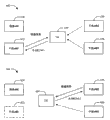
如图6所示,在有服务eNB 620和多个干扰eNB 632-636的情况下,UE 610可以获得与eNB 632相关的信道信息,其中UE 610能够如图602所示的那样连接至eNB 632。UE 610最初从中提取信道参数的eNB 632可以是(但不必是)造成UE 610观测到最强干扰量的eNB 632。根据提取出的信道信息,UE 610可以向eNB 632提交R-SRUM,以便使eNB 632空出预定的一组资源。在eNB 632保留所规定的资源之后,如图604所示,UE610可以从一个或多个其它eNB 634提取信道参数以及发射相应的R-SRUM。举一个例子,与UE 610进行通信的后边eNB 634可以(但不必须)是在先前最强干扰eNB 632保留资源之后产生UE 610所观测到的最强干扰量的eNB。举一个例子,图602-604所示的处理过程可以针对其它的eNB(例如,系统600中的eNB 636和/或其它eNB)随后连续地进行,以便使UE 610请求对UE 610造成高于门限干扰量的所有eNB 632-636进行资源保留。As shown in Figure 6, in the case of serving
返回到图5,另外地或替代地,可以通过例如使用空闲信道来进行单播R-SRUM消息传送,其中所述空闲信道可以由系统500中的任何UE 510和/或其它实体用来传输R-SRUM消息。举一个例子,用于R-SRUM消息的空闲信道可以是为R-SRUM专门分配的,其与为接入请求消息和/或其它类似类型消息保留的信道相一致,和/或这些空闲信道可用任何其它适当的方式来分配。例如,如图7中的图700所示,各eNB可以在与低再用率前导(LRP)信道和/或为诸如LRP消息712-716之类的前导消息保留的任何其它适当的前导信道相关的下行链路带宽702上,传输诸如LRP消息712-716之类的前导消息。此外,一个或多个UE可以在上行链路带宽704上,向期望的eNB发射接入请求命令722和/或向一个或多个干扰eNB发射R-SRUM724-726,使得消息722-726的时序与相应eNB在下行链路带宽702上发射的LRP 712-716的时序一致,以便提高效率和R-SRUM检测的准确性。Returning to FIG. 5, additionally or alternatively, unicast R-SRUM messaging may be performed by, for example, using idle channels that may be used by any
举一个例子,可以在给定的eNB通过下行链路带宽702发射LRP之后,在预定的时间段通过上行链路带宽704发射针对给定eNB的单播接入请求或R-SRUM消息。例如,图700描绘了在eNB 0传输LRP 712之后,在LRP712之后的预定时间段在上行链路带宽704上发射用于eNB 0的接入请求722。同样,可以使用上行链路带宽704,在eNB 1提供LRP 714之后的预定时间量,发射用于干扰eNB 1的R-SRUM 724。因此,应当理解的是,可以配置各基站在发射LRP之后的有限时间段扫描寻找接入请求和/或R-SRUM消息,从而减少R-SRUM检测所需要的资源量和降低检测R-SRUM的出错概率。举一个例子,LRP和相应R-SRUM的传输之间的预定时间量可以是对于相关系统中的所有实体都是相同的,或者是随时间变化和/或随实体而不同。再举一个例子,可以在相同的信道(例如,图700所示的信道)或不同的信道上传送接入请求消息和R-SRUM消息。In one example, a unicast access request or R-SRUM message for a given eNB can be transmitted over the uplink bandwidth 704 for a predetermined period of time after the given eNB transmits the LRP over the
再举一个例子,如果由多个UE分别发射的接入请求消息和/或R-SRUM之间发生冲突和/或发生对接收这些消息的目的接收者发射的消息进行响应产生妨碍的任何其它失败事件,那么可以配置接入请求消息和/或R-SRUM在上行链路带宽704上进行重传。As another example, if there is a collision between Access Request messages and/or R-SRUMs transmitted separately by multiple UEs and/or any other failure to respond to messages transmitted by the intended recipients of these messages event, the Access Request message and/or R-SRUM may be configured for retransmission on the uplink bandwidth 704 .
现转向图8,该图描绘了根据各个方面,针对下行链路资源协调使用广播消息的系统800的框图。如系统800所示,一组基站810和/或820可以为包括终端830在内的地理区域提供覆盖。根据一个方面,如果一个或多个基站810和/或820正在对终端830造成干扰,那么终端830就可以以广播方式向基站810和820提交R-SRUM。根据一个方面,广播R-SRUM可以作为接入请求消息的一部分来提交。Turning now to FIG. 8, depicted is a block diagram of a
应当理解的是,与图5-7所述的单播R-SRUM消息传送技术相比,由终端830发射的广播R-SRUM通常用于终端830覆盖范围之内的多个基站810和820。因此,例如,广播R-SRUM可以包括如下信息:期望的服务基站的标识、发射R-SRUM时的发射功率、子带索引和/或与期望的资源相关的其它信息等等。当基站810和/或基站820接收到广播R-SRUM时,基站810和/或基站820可以使用干扰计算模块812和/或822来判断其对终端830造成的干扰是否至少达到了门限等级。例如,干扰计算模块812和/或822可以测量R-SRUM的接收功率电平,将测量所得的功率电平与R-SRUM中提供的发射功率电平进行比较,以便计算从终端830到相应基站810和/或基站820的路径损耗。根据该信息,干扰计算模块812和/或822可以确定其相应基站810和/或基站820干扰终端830的程度。如果确定的干扰量至少是门限值,那么就使用相应的资源保留模块814和/或824来空出R-SRUM中指定的资源。It should be appreciated that, in contrast to the unicast R-SRUM messaging techniques described in Figures 5-7, the broadcast R-SRUM transmitted by
这样,根据一个方面,应当理解的是,图5-7所述的单播R-SRUM机制和图8所述的广播R-SRUM机制的不同之处在于:计算对终端830所造成的干扰的实体不同。具体而言,如本申请所述,对于单播R-SRUM的情况,是由终端方执行干扰计算,而对于广播R-SRUM的情况,是由网络方执行干扰计算。Thus, according to one aspect, it should be understood that the difference between the unicast R-SRUM mechanism described in FIGS. 5-7 and the broadcast R-SRUM mechanism described in FIG. Entities are different. Specifically, as described in this application, in the case of unicast R-SRUM, the interference calculation is performed by the terminal side, and in the case of broadcast R-SRUM, the interference calculation is performed by the network side.
接着转向图9,该图描绘了根据各个方面进行上行链路资源协调的系统900。根据一个方面,系统900可以包括位于eNB 930的覆盖区域之内的UE 910和/或UE 920。举一个例子,如果eNB 930没有向UE 910和/或UE920提供通信服务,那么在一些情况下,一个或多个UE 910和/或UE 920可能会在上行链路上对eNB 930造成干扰或妨碍(例如,如上面针对图4所示出的)。因此,为了管理由eNB 930观测到的干扰电平,eNB可以向一个或多个UE 910和/或UE 920广播F-SRUM消息,以便使干扰UE 910和/或UE 920空出给定的资源,从而使eNB 930能够与其关联的UE进行通信。Turning next to FIG. 9, an illustration of a
举一个例子,可以以与系统800所示的广播R-SRUM通信相似的方式进行F-SRUM通信。具体而言,eNB 930可以向UE 910和/或UE 920广播F-SRUM,后者包括用于发射F-SRUM的发射功率、期望使用的特定资源和/或其它信息。当接收到F-SRUM时,各干扰计算模块912和/或922可以根据F-SRUM中的信息确定它们各自相关的UE 910和/或UE 920对eNB930干扰的程度。这可以通过以下方式来完成,例如,将F-SRUM中指明的发射功率与F-SRUM的接收功率进行比较。当判断出UE 910和/或UE 920对eNB 930造成了至少预定的干扰量时,资源保留模块914和/或924就可以空出eNB 930所期望的资源的一部分或全部。As an example, F-SRUM communications may be conducted in a manner similar to the broadcast R-SRUM communications shown in
根据另一个方面,eNB 930可以在为前导传输所分配的下行链路信道上传送F-SRUM消息。通过如图10中的图1000所示的特定示例的方式,可以在为前导信道(例如,LRP信道)分配的下行链路资源上传送F-SRUM消息。举一个例子,可以将前导信道配置成由通信系统中的各基站所使用的公共信道,以便帮助UE识别相邻基站。作为示例,相关的通信系统中的各基站可以发射相应的LRP消息1010和/或1030,这些消息由UE进行检测以便帮助UE发现各基站。举一个例子,可以在相关的LRP信道上按照随机的时间间隔发射LRP消息1010和/或1030,以便降低来自不同基站的LRP消息1010和1030之间连续冲突的可能性。According to another aspect,
举一个例子,相关的通信系统中的各基站还可以在LRP信道上使用时间再用技术来发射除LRP消息1010和/或1030之外的F-SRUM消息1020。在一个替代性的示例中,基站可以将F-SRUM信息组合进各LRP消息1010和/或1030中,使得各UE能够获得与一个或多个相应LRP消息1010和/或1030中的F-SRUM相对应的信息。As an example, each base station in the related communication system may also transmit F-
在一个替代性的示例中,可以通过例如在各LRP消息1010和/或1030中添加一个参数(该参数指示是否装载了相应的基站),来将F-SRUM嵌入到一个或多个LRP消息1010和/或1030中。作为特定的示例,在LRP消息1010和/或1030中可以使用1比特装载指示符。在此示例中,当LRP消息1010和/或1030指示装载时,各干扰UE可以用于清空各资源,其中发射LRP消息1010和/或1030的基站将需要用这些资源来与其服务的一个或多个UE建立连接。或者,如果LRP消息1010和/或1030没有指示装载,那么UE可以继续使用这些资源。举一个例子,各UE可以根据在LRP消息1010和/或1030上测量的功率或通过任何其它适当的方式,来判断它们是否正在干扰与LRP消息1010和/或1030相对应的基站。In an alternative example, the F-SRUM may be embedded in one or
接着转向图11,其给出的一组图1102-1104描绘了根据各个方面,用于经由中间的小区连接至网络小区的技术。举一个例子,图11所示的系统可以包括一组网络小区1112和1114,其每一个小区都位于UE 1120的通信范围之内。根据一个方面,UE 1120从第一小区1112观测到的功率电平低于从第二小区1114观测到的功率电平,这是由于例如与小区1112和1114的相对距离、不同的小区类型(例如,宏小区、微微小区或毫微微小区)等等原因。但是,由于距离延伸、接入限制和/或其它原因,在一些情况下,UE 1120连接至具有相对较低观测功率电平的小区1112。这种连接将导致如上所述的干扰。此外,在一些情况下,UE 1120不具有处理功率或能力来协调各小区1112和1114之间的资源,以便减轻这种干扰。Turning next to FIG. 11 , a set of diagrams 1102 - 1104 presents techniques for connecting to a network cell via an intermediary cell, in accordance with various aspects. As an example, the system shown in FIG. 11 may include a set of
因此,在一个示例中,UE 1120可以首先连接至非服务小区1114,以便为了便于进行资源协调的有限目的,如图1102所示。当在小区1114和UE 1120之间建立连接之后,小区1114可以在回程上和/或通过其它适当的方式与小区1112进行通信,以便协调小区1112和小区1114之间的资源使用情况,从而减轻对UE 1120造成的干扰。在如图1102所示的资源协调之后,UE 1120的非服务小区1114可以实现切换到服务小区1112。作为特定的示例,图11所示的过程可以在以下场景中进行:小区1114是受限的毫微微小区,小区1112是宏小区,而UE 1120被禁止连接至小区1114。在此示例中,出于协商切换到宏小区1112的有限目的,图11所示的过程可以用于使UE 1120能够从UE 1120已被禁止连接到的毫微微小区1114接收一些接入特权。Thus, in one example,
现参见图12-18,在这些图中描绘了根据本申请所述的各个方面可以执行的方法。虽然为了使说明更简单,而将这些方法示出和描述为一系列的动作,但是应该理解和明白的是,这些方法并不限制动作的顺序,因为,依照一个或多个方面,一些动作可以按不同顺序发生和/或与本申请中示出和描述的其它动作同时发生。例如,本领域普通技术人员应该理解并明白,一个方法也可以表示成一系列相互关联的状态和事件,如在状态图中。此外,执行依照一个或多个方面的方法并不是需要所有示出的动作。Referring now to Figures 12-18, there are depicted methodologies that may be performed in accordance with various aspects described herein. While the methodologies are shown and described as a series of acts for ease of illustration, it should be understood and appreciated that the methodologies do not limit the order of the acts since, in accordance with one or more aspects, some acts may Occur in a different order and/or concurrently with other acts shown and described in this application. For example, those of ordinary skill in the art will understand and understand that a method can also be represented as a series of interrelated states and events, such as in a state diagram. Moreover, not all illustrated acts may be required to implement a methodology in accordance with one or more aspects.
参见图12,该图描绘了用于针对无线通信系统(例如,系统500)中的下行链路资源划分进行单播消息传送的方法1200。应当理解的是,方法1200可以由例如终端(例如,UE 510)和/或任何其它适当的网络设备来执行。方法1200开始于模块1202,首先在空闲通信信道上向期望的服务基站(例如,服务eNB 520)发射接入请求。接着,方法1200转到模块1204,在模块1204,向一个或多个检测到的干扰基站(例如,干扰eNB 532-536)发射各自的RUM。举一个例子,在模块1202发射的接入请求和在模块1204发射的RUM可以使用时间再用技术,使得在模块1206判断是否接收到对所述接入请求和RUM的响应。如果没有接收到对所述接入请求和RUM的响应,那么方法1200转到模块1208,在模块1208,可以根据时间再用模式来重新发射接入请求和RUM,之后可以重复模块1206的判断动作。否则,方法1200结束。Referring to FIG. 12, a
图13描绘了用于针对无线通信系统中的下行链路资源划分使用单播消息的另一种方法1300。方法1300可以由例如终端(例如,UE 610)和/或任何其它适当的网络设备来执行。方法1300开始于模块1302,首先确定最强干扰的eNB(例如,干扰eNB 632)。接着,在模块1304,观测与在模块1302所确定的eNB相关的信道信息。在模块1306,根据在模块1304观测到的信道信息,向所确定的eNB发射用于请求保留所指定的资源(例如,时间间隔、子带等等)的消息。随后,在模块1308进行检验,以判断所确定的eNB是否已空出了指定的资源,并在判断结果为否定时重复模块1306的发射。否则,方法1300可以转到模块1310,在模块1310,判断是否存在其它干扰eNB(例如,eNB 634-636)。如果存在这种eNB,那么方法1300可以返回到模块1302,以便处理次强干扰的eNB(例如,如图604所示)。13 depicts another
图14描绘了针对无线通信系统中的下行链路资源划分使用单播消息的另一种方法1400。方法1400可以由例如一个UE和/或任何其它适当的网络设备来执行。方法1400开始于模块1402,首先确定造成至少门限干扰电平的基站。接着,在模块1404,在公共信道(例如,LRP信道)上识别由模块1402所确定的基站发射的消息(例如,LRP 712或LRP 722)。随后,方法1400在模块1406结束,在模块1406,在公共信道上,在模块1404识别的消息之后的预定时间发射用于请求由模块1402所确定的基站进行资源保留的消息(例如,R-SRUM 714或R-SRUM 724)。14 illustrates another
图15描绘了在无线通信系统中的上行链路上发射广播资源协调消息的方法1500。方法1500可以由例如移动终端(例如,终端830)和/或任何其它适当的网络设备来执行。方法1500开始于模块1502,首先选择期望的服务节点B(例如,基站810或基站820)。接着,在模块1504,确定被指定用于与模块1502所选择的节点B进行通信的一组资源。随后,方法1500可以在模块1506结束,在模块1506,广播接入请求,后者包括所选定的节点B的标识、发射此接入请求所用的发射功率以及与模块1504所确定的一组资源相关的信息。15 illustrates a
接着转到图16,该图描绘了使用移动终端(例如,终端830)提供的广播接入请求消息来进行下行链路资源划分的方法1600。方法1600可以由例如节点B(例如,基站810和/或基站820)和/或任何其它适当的网络设备来执行。方法1600开始于模块1602,首先从一个终端接收包括接入请求和R-SRUM信息的消息。接着,在模块1604,判断在模块1602接收的消息中是否将执行方法1600的实体指定成期望的节点B。如果是那样指定了执行方法1600的实体,那么方法1600可以在模块1606结束,在模块1606,建立与所述终端的通信。Turning next to FIG. 16, this figure depicts a
如果没有将执行方法1600的实体指定为期望的节点B,那么方法1600转到模块1608,在模块1608,将在模块1602接收的消息中提供的发射功率电平与此消息的接收功率电平进行比较。随后在模块1610,根据模块1608的比较结果来判断用于执行方法1600的实体是否正干扰着发出了接入请求/R-SRUM消息的终端。如果在模块1610判断此干扰量低于门限干扰量,那么方法1600结束。否则,方法1600在结束之前转到模块1612,在模块1612,执行方法1600的实体空出在由模块1602接收的消息中指定的资源。If the
参见图17,该图描绘了进行上行链路资源划分的方法1700。方法1700可以由例如基站(例如,eNB 930)和/或任何其它适当的网络设备来执行。方法1700开始于模块1702,首先确定由相关的通信系统使用的LRP信道。接着,在模块1704,选择发射功率电平和资源索引信息。随后,方法1700可以在模块1706结束,在模块1706,在LRP信道(例如,如图1000所示的)上(例如,向UE 910和/或UE 920)传输下行链路RUM,后者标识在模块1704选定的发射功率电平和资源索引信息。Referring to FIG. 17, a
图18描绘了在无线通信系统中进行上行链路资源划分的另一种方法1800。方法1800可以由例如终端(例如,UE 910和/或UE 920)和/或任何其它适当的网络设备来执行。方法1800开始于模块1802,首先从一个基站(例如,eNB 930)接收F-SRUM消息。接着,在模块1804,测量在模块1802接收的F-SRUM消息的功率电平。在模块1806,随后,将F-SRUM消息中指明的发射功率电平与在模块1804测量的功率电平进行比较。在模块1808,随后根据模块1806的比较结果,判断用于执行方法1800的实体是否正干扰着在模块1802所接收的F-SRUM消息所来自的发送方基站。如果在模块1808确定出干扰量低于门限干扰量,那么方法1800结束。否则,方法1800在结束之前转到模块1810,在模块1810,在F-SRUM消息中指明的资源由执行方法1800的实体进行保留。18 illustrates another
接着参见图19-23,在这些图中描绘了便于在无线通信系统中进行资源划分的各种装置1900-2300。应当理解的是,将装置1900-2300表示成包括一些功能模块,其中这些功能模块表示可以由处理器、软件或其组合(例如,固件)实现的功能。Referring next to Figures 19-23, depicted are various apparatuses 1900-2300 that facilitate resource partitioning in a wireless communication system. It is to be appreciated that apparatuses 1900-2300 are represented as including functional blocks, where these functional blocks represent functions that may be implemented by a processor, software, or combination thereof (eg, firmware).
首先参见图19,该图描绘了用于进行单播下行链路资源协调信令的装置1900。装置1900可以由移动终端(例如,UE 610)和/或任何其它适当的网络设备来实现,其可以包括:模块1902,用于确定期望的服务节点B和一个或多个干扰节点B;模块1904,用于向期望的服务节点B发射接入请求;模块1906,用于向各干扰节点B发射单播资源保留请求。Referring first to FIG. 19 , an
图20描绘了用于进行广播下行链路资源协调信令的装置2000。装置2000可以由UE(例如,终端830)和/或任何其它适当的网络设备实现,其可以包括:模块2002,用于确定要与其建立通信的基站;模块2004,用于选择一组资源和发射功率电平;模块2006,用于广播接入请求,后者指出要与其建立通信的基站、所选定的一组资源以及所选定的发射功率电平。FIG. 20 depicts an
转到图21,该图描绘了用于处理上行链路资源划分消息的装置2100。装置2100可以由终端(例如,UE 910和/或UE 920)和/或任何其它适当的网络设备来实现,其可以包括:模块2102,用于从一个基站接收下行链路RUM;模块2104,用于将RUM中指明的发射功率电平与RUM的接收功率电平进行比较;模块2106,用于根据上述比较结果计算对所述基站造成的干扰量;模块2108,用于当所计算出的干扰量大于或等于某一门限时,保留RUM中指定的资源。Turning to FIG. 21 , an
接着参见图22,该图描绘了用于处理广播下行链路资源协调消息的装置2200。装置2200可以由节点B(例如,基站810和/或基站820)和/或任何其它适当的网络设备来实现,其可以包括:模块2202,用于从一个终端接收接入请求;模块2204,用于将接入请求中指明的发射功率电平与该接入请求的接收功率电平进行比较;模块2206,用于根据上述比较结果计算对所述终端造成的干扰量;模块2208,用于当所计算出的干扰量达到或超过某一门限时,保留此接入请求中指定的资源。Referring next to FIG. 22 , an
图23描绘了用于进行上行链路资源协调信令的装置2300。装置2300可以由基站(例如,eNB 930)和/或任何其它适当的网络设备来实现,其可以包括:模块2302,用于确定资源索引信息和发射功率;模块2304,用于以所确定的发射功率发射下行链路RUM,该下行链路RUM指明了资源索引信息和发射功率。Figure 23 depicts an
参见图24,其给出的时间图2400描绘了可以根据本申请的各个方面实现的示例性接入过程。举一个例子,由时间图2400描绘的过程可以由期望进行接入过程的UE和eNB、对期望的UE造成干扰的一个或多个eNB以及对期望的eNB造成干扰的一个或多个UE来执行。图2400描绘的过程开始于时间2402,在时间2402,准备进行接入过程的UE(例如,通过)检测相关通信系统中的各eNB,确定期望的eNB以及干扰的eNB。随后,期望的UE可以在时间2404向期望的eNB提交接入请求,在时间2406向干扰eNB发射各R-SRUM,其中R-SRUM指出在哪些下行链路资源上该UE将要接收关于接入同意的指示。在接收到各R-SRUM之后,一个或多个干扰eNB可以在时间2408清空由R-SRUM指明的DL资源。Referring to FIG. 24, a timing diagram 2400 is presented illustrating an exemplary access procedure that may be implemented in accordance with various aspects of the present application. In one example, the process depicted by timing diagram 2400 may be performed by a UE and an eNB desiring an access procedure, one or more eNBs causing interference to the desired UE, and one or more UEs causing interference to the desired eNB . The process depicted by diagram 2400 begins at
在期望的eNB从期望的UE接收到接入请求之后,所期望的eNB可以进行如下响应:在时间2410,在由R-SRUM所清空的下行链路资源上向期望的UE发射接入同意指示;在时间2412,向干扰UE提交各F-SRUM(其中,F-SRUM指出期望的UE将在哪一组上行链路资源上响应该接入同意指示)。举一个例子,期望的UE可以重复进行如时间2404-2406所示的接入请求和R-SRUM传输,直到从期望的eNB接收到接入同意为止。After the desired eNB receives the access request from the desired UE, the desired eNB may respond by transmitting, at
如果在时间2412从期望的eNB接收到各F-SRUM,那么,各干扰UE可以在时间2414清空F-SRUM中指定的上行链路资源。最后,在时间2416,期望的UE可以在时间2414清空的资源上,向期望的eNB反向提交对接入同意指示的响应。举一个例子,期望的eNB可以重复如时间2410-2412所示的接入同意和F-SRUM传输,直到从期望的UE接收到对接入同意指示的响应为止。If each F-SRUM is received from the desired eNB at
转到图25,该图描绘了一种示例性的无线通信系统2500。举一个例子,系统2500可以支持多个用户,在其中可以实现本申请所公开的各个实施例和方面。如图25所示,作为示例,系统2500可以为多个小区2502(例如,宏小区2502a-2502g)提供通信,其中各小区由相应的接入点(AP)2504(例如,AP 2504a-2504g)进行服务。举一个例子,还可以将一个或多个小区进一步划分成各个扇区(没有示出)。Turning to FIG. 25, an exemplary
如图25进一步所示的,各个接入终端(AT)2506(包括AT 2506a-2506k)可以分散于系统2500中。举一个例子,根据AT 2506是否活跃以及其是否处于软切换和/或其它类似状态,AT 2506可以在给定的时刻在前向链路(FL)和/或反向链路(RL)上与一个或多个AP 2504进行通信。如本申请所使用以及本领域所通常使用的,AT 2506还可以称为用户设备(UE)、移动终端和/或任何其它适当的术语。根据一个方面,系统2500可以在较大的地理区域内提供服务。例如,宏小区2502a-2502g可以为邻区和/或其它类似的适当覆盖区域中的多个块提供覆盖。As further shown in FIG. 25, various access terminals (ATs) 2506 (including
现参见图26,该图给出了描绘示例无线通信系统2600的框图,在该系统2600中,可以实现本文描述的各个方面功能。举一个例子,系统2600是包括发射机系统2610和接收机系统2650的多输入多输出(MIMO)系统。但是,应当理解的是,发射机系统2610和/或接收机系统2650还可以适用于多输入单输出系统,在多输入单输出系统中,例如(例如,基站上的)多付发射天线可以向单天线设备(例如,移动站)发射一个或多个符号流。此外,应当理解的是,本文描述的发射机系统2610和/或接收机系统2650的方面可以使用在单输出单输入天线系统中。Referring now to FIG. 26 , a block diagram depicting an example
根据一个方面,发射机系统2610从数据源2612向发射(TX)数据处理器2614提供用于多个数据流的业务数据。举一个例子,随后,可以经由各自的发射天线2624发射每一个数据流。此外,为了提供编码的数据,TX数据处理器2614可以根据为每一个数据流所选定的具体编码方案,对该数据流的业务数据进行格式化、编码和交织。举一个例子,随后,可以使用OFDM技术将每一个数据流的编码后数据与导频数据进行复用。导频数据可以是例如以已知方式处理的已知数据模式。此外,接收机系统2650可以使用导频数据来估计信道响应。返回发射机系统2610,为了提供调制符号,可以根据为每一个数据流所选定的特定调制方案(例如,BPSK、QPSK、M-PSK或M-QAM),对该数据流的复用后的导频和编码数据进行调制(例如,符号映射)。举一个例子,通过在处理器2630上执行和/或提供的指令来确定每一个数据流的数据速率、编码和调制方案。According to one aspect, a
接着,向TX MIMO处理器2620提供所有数据流的调制符号,TX MIMO处理器2620可以进一步处理这些调制符号(例如,针对OFDM)。随后,TX MIMO处理器2620向NT个收发机2622a到2622t提供NT个调制符号。举一个例子,每一个收发机2622接收和处理各自的符号流,以便提供一个或多个模拟信号。随后,每一个收发机2622可以进一步调节(例如,放大、滤波和上变频)这些模拟信号以便提供适合于在MIMO信道上传输的调制信号。因此,可以分别从NT付天线2624a到2624t发射来自收发机2622a到2622t的NT个调制信号。The modulation symbols for all data streams are then provided to
根据另一个方面,接收机系统2650可以通过NR付天线2652a到2652r接收所发射的调制信号。随后,可以将来自每一付天线2652的所接收信号提供给各自的收发机2654。举一个例子,每一个收发机2654可以调节(例如,滤波、放大和下变频)各自所接收的信号,对调节后的信号进行数字化以便提供采样,并随后处理这些采样以便提供相应的“接收的”符号流。随后,RX MIMO/数据处理器2660根据特定的接收机处理技术,从NR个收发机2654接收和处理NR个接收的符号流,以便提供NT个“检测的”符号流。举一个例子,每一个检测的符号流可以包括对于相应数据流发射的调制符号估计的符号。随后,RX数据处理器2660至少部分地通过解调、解交织和解码每一个检测的符号流来处理每一个符号流,以便恢复出相应数据流的业务数据。因此,RX数据处理器2660所执行的处理与发射机系统2610的TX MIMO处理器2620和TX数据处理器2616所执行的处理是相反的。RX处理器2660可以另外向数据宿2664提供经过处理的符号流。According to another aspect,
根据一个方面,RX处理器2660生成的信道响应估计量可以用于执行接收机空间/时间处理,调整功率电平,改变调制速率或方案和/或其它适当的动作。此外,RX处理器2660还可以估计信道特性,例如,检测的符号流的信号与噪声加干扰比(SNIR)。随后,RX处理器2660可以向处理器2670提供估计的信道特性。举一个例子,RX处理器2660和/或处理器2670可以进一步推导出该系统的“操作”SNR的估计。随后,处理器2670可以提供信道状态信息(CSI),后者可以包括关于通信链路和/或所接收的数据流的信息。这些信息可以包括,例如,操作SNR。随后,所述CSI可以由TX数据处理器2618进行处理,由调制器2680进行调制,由收发机2654a到2654r进行调节,并发射回发射机系统2610。此外,接收机系统2650的数据源2616可以提供另外的数据,以便由TX数据处理器2618进行处理。According to one aspect, the channel response estimates generated by
返回发射机系统2610,随后,来自接收机系统2650的调制信号可以由天线2624进行接收,由收发机2622进行调节,由解调器2640进行解调,并由RX数据处理器2642进行处理,以便恢复由接收机系统2650报告的CSI。举一个例子,随后,所报告的CSI可以提供给处理器2630,并用于确定一个或多个数据流所用的数据速率以及编码和调制方案。随后,所确定的编码和调制方案可以提供给收发机2622,以用于进行量化和/或在向接收机系统2650后续传输时使用。另外地和/或替代地,处理器2630可以使用所报告的CSI,来生成对于TX数据处理器2614和TX MIMO处理器2620的各种控制命令。再举另一个例子,可以将RX数据处理器2642处理过的CSI和/或其它信息提供给数据宿2644。Returning to
举一个例子,发射机系统2610的处理器2630和接收机系统2650的处理器2670指导它们各自系统的操作。此外,发射机系统2610的存储器2632和接收机系统2650的存储器2672可以分别存储处理器2630和2670所使用的程序代码和数据。此外,在接收机系统2650,各种处理技术可以用于处理NR个接收的信号,以便检测出NT个发射的符号流。这些接收机处理技术可以包括空间和空-时接收机处理技术,这些技术还可以称作为均衡技术和/或“连续归零/均衡和干扰消除”接收处理器技术,还可以称作为“串行干扰消除”或“连续消除”接收机处理技术。In one example,
图27描绘了一种示例性的通信系统2700,该系统能够在网络环境中布置接入点基站。如图27所示,系统2700可以包括多个接入点基站(例如,毫微微小区或家用节点B单元(HNB)),例如,HNB 2710。举一个例子,可以在相应的小规模网络环境(例如,一个或多个用户居住区2730)中安装各HNB 2710。此外,各HNB 2710还可以用于服务相关的和/或外来的UE 2720。根据一个方面,可以经由DSL路由器、电缆调制解调器和/或其它适当的设备(没有示出),将各HNB 2710耦接至因特网2740和移动运营商核心网2750。根据一个方面,毫微微小区或HNB 2710的所有者可以预订移动业务(例如,移动运营商核心网2750提供的3G/4G移动业务)。因此,可以使UE 2720能够工作在宏蜂窝环境2760以及居住地的小规模网络环境中。FIG. 27 depicts an
举一个例子,除宏小区移动网络2760之外,UE 2720还可以由一组毫微微小区或HNB 2710(例如,位于相应用户居住区2730中的HNB 2710)进行服务。如本申请所使用以及本领域所通常使用的,归属毫微微小区是授权AT或UE在其上进行工作的基站,客户毫微微小区是指临时授权AT或UE在其上进行工作的基站,外来毫微微小区是没有授权AT或UE在其上进行工作的基站。根据一个方面,可以将毫微微小区或HNB 2710布置在单一频率或多个频率(其中,这些频率可以与各宏小区的频率重叠)上。As one example,
应当理解的是,本申请描述的这些方面可以用硬件、软件、固件、中间件、微代码或其任意结合来实现。当本申请所述系统和/或方法使用软件、固件、中间件或微代码、程序代码或代码段实现时,可将它们存储于诸如存储组件之类的机器可读介质中。可以用过程、函数、子程序、程序、例行程序、子例行程序、模块、软件包、类、或指令、数据结构或程序语句的任意组合来表示代码段。可以通过传递和/或接收信息、数据、自变量、参数或存储器内容,将代码段耦接到另一代码段或硬件电路。可以通过任何适合的方式,包括内存共享、消息传递、令牌传递、网络传输等,对信息、自变量、参数和数据等进行传递、转发或发射。It should be understood that the aspects described herein may be implemented in hardware, software, firmware, middleware, microcode, or any combination thereof. When the systems and/or methods described herein are implemented using software, firmware, middleware or microcode, program code or code segments, they may be stored in a machine-readable medium such as a memory component. A code segment may be represented by a procedure, function, subroutine, program, routine, subroutine, module, software package, class, or any combination of instructions, data structures, or program statements. A code segment can be coupled to another code segment or a hardware circuit by passing and/or receiving information, data, arguments, parameters, or memory contents. Information, arguments, parameters, data, etc. may be passed, forwarded, or emitted by any suitable means, including memory sharing, message passing, token passing, network transmission, and the like.
对于软件实现,本申请描述的技术可用执行本申请所述功能的模块(例如,过程、函数等)来实现。这些软件代码可以存储在存储器单元中,并由处理器执行。存储器单元可以实现在处理器内,也可以实现在处理器外,在后一种情况下,它经由各种手段可通信地连接到处理器,这些都是本领域中所公知的。For a software implementation, the techniques described herein can be implemented with modules (eg, procedures, functions, and so on) that perform the functions described herein. These software codes may be stored in memory units and executed by processors. The memory unit can be implemented within the processor or external to the processor, in which case it can be communicatively coupled to the processor via various means as is known in the art.
上文的描述包括一个或多个方面的举例。当然,我们不可能为了描述前述的方面而描述部件或方法的所有可能的结合,但是本领域普通技术人员应该认识到,各个方面可以做进一步的结合和变换。因此,本申请描述的方面旨在涵盖落入所附权利要求书的精神和保护范围内的所有改变、修改和变形。此外,就说明书或权利要求书中使用的“包含”一词而言,该词的涵盖方式类似于“包括”一词,就如同“包括”一词在权利要求中用作衔接词所解释的那样。此外,无论在说明书还是在权利要求书中所使用的“或”一词都意味“非排他性的或”。What has been described above includes examples of one or more aspects. Of course, we cannot describe all possible combinations of components or methods in order to describe the foregoing aspects, but those skilled in the art should recognize that various aspects can be further combined and transformed. Accordingly, the aspects described herein are intended to embrace all changes, modifications and variations that fall within the spirit and scope of the appended claims. Furthermore, to the extent that the word "comprises" is used in the specification or claims, that word is covered in a manner similar to that of the word "comprises" as construed when the word "comprises" is used as a conjunction in a claim. like that. Furthermore, the word "or" as used in either the specification or the claims means a "non-exclusive or".
Claims (75)
Applications Claiming Priority (5)
| Application Number | Priority Date | Filing Date | Title |
|---|---|---|---|
| US5538408P | 2008-05-22 | 2008-05-22 | |
| US61/055,384 | 2008-05-22 | ||
| US12/465,413 US8489028B2 (en) | 2008-05-22 | 2009-05-13 | System and method to enable resource partitioning in wireless networks |
| US12/465,413 | 2009-05-13 | ||
| PCT/US2009/044909 WO2009143382A2 (en) | 2008-05-22 | 2009-05-21 | System and method to enable resource partitioning in wireless networks |
Publications (2)
| Publication Number | Publication Date |
|---|---|
| CN102037775A true CN102037775A (en) | 2011-04-27 |
| CN102037775B CN102037775B (en) | 2015-04-01 |
Family
ID=41100530
Family Applications (1)
| Application Number | Title | Priority Date | Filing Date |
|---|---|---|---|
| CN200980118545.XA Active CN102037775B (en) | 2008-05-22 | 2009-05-21 | System and method to enable resource partitioning in wireless networks |
Country Status (7)
| Country | Link |
|---|---|
| US (1) | US8489028B2 (en) |
| EP (2) | EP2365720B1 (en) |
| JP (2) | JP5456768B2 (en) |
| KR (2) | KR20130121184A (en) |
| CN (1) | CN102037775B (en) |
| TW (1) | TW200952515A (en) |
| WO (1) | WO2009143382A2 (en) |
Cited By (3)
| Publication number | Priority date | Publication date | Assignee | Title |
|---|---|---|---|---|
| CN106211177A (en) * | 2016-06-30 | 2016-12-07 | 北京邮电大学 | A Time-Frequency Resource Allocation Method Based on Dynamic TDD Configuration |
| CN108738146A (en) * | 2017-04-24 | 2018-11-02 | 中兴通讯股份有限公司 | The configuration method and node of radio resource and power |
| CN112584535A (en) * | 2015-03-13 | 2021-03-30 | 高通股份有限公司 | Scheduling of downlink transmissions based on exchange of pre-scheduling messages and scheduling messages |
Families Citing this family (56)
| Publication number | Priority date | Publication date | Assignee | Title |
|---|---|---|---|---|
| US8275314B1 (en) | 2007-08-13 | 2012-09-25 | Marvell International Ltd. | Bluetooth scan modes |
| US8577305B1 (en) | 2007-09-21 | 2013-11-05 | Marvell International Ltd. | Circuits and methods for generating oscillating signals |
| US8588705B1 (en) | 2007-12-11 | 2013-11-19 | Marvell International Ltd. | System and method of determining Power over Ethernet impairment |
| US8554147B2 (en) * | 2008-05-22 | 2013-10-08 | Qualcomm Incorporated | System and method to enable resource partitioning in wireless networks |
| WO2010005659A1 (en) | 2008-06-16 | 2010-01-14 | Marvell World Trade Ltd. | Short-range wireless communication |
| US8600324B1 (en) | 2008-06-27 | 2013-12-03 | Marvell International Ltd | Circuit and method for adjusting a digitally controlled oscillator |
| US8472968B1 (en) * | 2008-08-11 | 2013-06-25 | Marvell International Ltd. | Location-based detection of interference in cellular communications systems |
| US9288764B1 (en) | 2008-12-31 | 2016-03-15 | Marvell International Ltd. | Discovery-phase power conservation |
| KR101697596B1 (en) | 2009-01-29 | 2017-01-18 | 엘지전자 주식회사 | Method and apparatus of controlling transmission power |
| US20100222062A1 (en) * | 2009-02-27 | 2010-09-02 | Industrial Technology Research Institute | Method, apparatus and system for interference avoidance in a femtocell network |
| US8208848B2 (en) * | 2009-03-25 | 2012-06-26 | Enfora, Inc. | Enhanced jamming detection |
| US8472427B1 (en) | 2009-04-06 | 2013-06-25 | Marvell International Ltd. | Packet exchange arbitration for coexisting radios |
| US8532041B1 (en) | 2009-04-24 | 2013-09-10 | Marvell International Ltd. | Method for transmitting information in a regulated spectrum and network configured to operate in the regulated spectrum |
| US8718658B2 (en) * | 2009-06-25 | 2014-05-06 | Samsung Electronics Co., Ltd. | Communication system for distributedly managing interference using feedback message |
| US8644273B2 (en) * | 2009-07-01 | 2014-02-04 | Apple Inc. | Methods and apparatus for optimization of femtocell network management |
| US9066369B1 (en) | 2009-09-16 | 2015-06-23 | Marvell International Ltd. | Coexisting radio communication |
| US20110105135A1 (en) * | 2009-11-03 | 2011-05-05 | Motorola-Mobility, Inc. | Interference coordination in heterogeneous networks using wireless terminals as relays |
| US20110161514A1 (en) * | 2009-12-29 | 2011-06-30 | Nokia Corporation | Method and apparatus for delegating computationally intensive functions |
| US8953507B2 (en) * | 2010-02-11 | 2015-02-10 | Qualcomm Incorporated | Frequency and time domain range expansion |
| US9438366B2 (en) * | 2010-02-19 | 2016-09-06 | Qualcomm Incorporated | System access for heterogeneous networks |
| US8995359B2 (en) * | 2010-04-05 | 2015-03-31 | Qualcomm Incorporated | Method and apparatus to facilitate support for multi-radio coexistence |
| US8767771B1 (en) | 2010-05-11 | 2014-07-01 | Marvell International Ltd. | Wakeup beacons for mesh networks |
| BR112012026017A2 (en) * | 2010-05-11 | 2016-06-28 | Sharp Kk | communication system, communication apparatus, communication control method, and communication control program |
| US9049727B2 (en) * | 2010-08-12 | 2015-06-02 | Fujitsu Limited | Macro user equipment initiated evolved inter-cell interference coordination mechanism through private femtocells |
| US8934896B2 (en) | 2010-08-12 | 2015-01-13 | Fujitsu Limited | Macro user equipment initiated evolved inter-cell interference coordination mechanism through private femtocells |
| EP2630827B1 (en) | 2010-10-20 | 2018-11-21 | Marvell World Trade Ltd. | Pre-association service discovery |
| US8700085B2 (en) * | 2010-11-30 | 2014-04-15 | Intel Corporation | Dynamic interference mitigation for cellular networks |
| CA2830854C (en) * | 2011-03-24 | 2018-08-21 | Research In Motion Limited | Device-empowered radio resource assignment |
| EP2689611A1 (en) * | 2011-03-24 | 2014-01-29 | BlackBerry Limited | Device-empowered radio resource system |
| CN103548394B (en) * | 2011-03-24 | 2017-02-15 | 黑莓有限公司 | Device-empowered radio resource selection |
| US8478190B2 (en) | 2011-05-02 | 2013-07-02 | Motorola Mobility Llc | Multi-cell coordinated transmissions in wireless communication network |
| US8750278B1 (en) | 2011-05-26 | 2014-06-10 | Marvell International Ltd. | Method and apparatus for off-channel device invitation |
| US8983557B1 (en) | 2011-06-30 | 2015-03-17 | Marvell International Ltd. | Reducing power consumption of a multi-antenna transceiver |
| EP2750462B1 (en) * | 2011-08-23 | 2016-10-12 | Huawei Technologies Co., Ltd. | Method for reducing inter femtocell interference and femtocell base station |
| US9125216B1 (en) | 2011-09-28 | 2015-09-01 | Marvell International Ltd. | Method and apparatus for avoiding interference among multiple radios |
| US8917640B2 (en) | 2011-11-23 | 2014-12-23 | Lg Electronics Inc. | Method and apparatus for handling signals used for delay tolerant access in a wireless communication system |
| KR101564864B1 (en) * | 2011-11-23 | 2015-10-30 | 엘지전자 주식회사 | Method and apparatus for handling signals used for delay tolerant access in a wireless communication system |
| US9215708B2 (en) | 2012-02-07 | 2015-12-15 | Marvell World Trade Ltd. | Method and apparatus for multi-network communication |
| US9450649B2 (en) | 2012-07-02 | 2016-09-20 | Marvell World Trade Ltd. | Shaping near-field transmission signals |
| JP6518402B2 (en) * | 2013-02-18 | 2019-05-22 | 株式会社Nttドコモ | Base station and method |
| ES2689378T3 (en) * | 2013-02-27 | 2018-11-13 | Telefónica, S.A. | Method, system and computer program for canceling uplink interference in a wireless network |
| WO2013185150A1 (en) | 2013-03-14 | 2013-12-12 | Massachusetts Institute Of Technology | Method and apparatus for smart adaptive dynamic range multiuser detection radio receiver |
| WO2015069161A1 (en) * | 2013-11-08 | 2015-05-14 | Telefonaktiebolaget L M Ericsson (Publ) | Downlink inter-cell interference determination |
| CN104811946B (en) * | 2014-01-29 | 2020-03-20 | 北京三星通信技术研究有限公司 | Method and device for processing interference signal |
| US10299281B2 (en) * | 2014-06-16 | 2019-05-21 | Massachusetts Institute Of Technology | Cognitive radio method and apparatus for achieving ad hoc interference multiple access wireless communication |
| US10251088B2 (en) * | 2015-04-09 | 2019-04-02 | At&T Mobility Ii Llc | Facilitating load balancing in wireless heterogeneous networks |
| EP4247065B1 (en) * | 2016-02-04 | 2025-03-05 | Sharp Kabushiki Kaisha | Terminal apparatus, base station apparatus and communication methods |
| WO2018127424A1 (en) * | 2017-01-06 | 2018-07-12 | Sony Corporation | Wireless telecommunications apparatuses and methods |
| US11038650B2 (en) | 2017-05-05 | 2021-06-15 | Qualcomm Incorporated | Configuration of downlink and uplink partial subframes in shared radio frequency spectrum |
| US10455457B2 (en) | 2017-05-24 | 2019-10-22 | Qualcomm Incorporated | NR-SS unified operation mode in coordinated and uncoordinated bands |
| CN109729597B (en) * | 2017-10-31 | 2022-09-30 | 中国电信股份有限公司 | Uplink resource scheduling method, system, base station and user terminal |
| JP7238799B2 (en) * | 2018-01-31 | 2023-03-14 | ソニーグループ株式会社 | Transmitting device, transmitting method, receiving device, receiving method, and communication system |
| CN111869050B (en) | 2018-03-26 | 2022-12-30 | 三菱电机株式会社 | Stator, motor, electric vacuum cleaner, and hand dryer |
| CN110708750B (en) * | 2018-07-09 | 2021-06-22 | 华为技术有限公司 | Power adjustment method, terminal and storage medium |
| CN116391313A (en) * | 2021-02-17 | 2023-07-04 | 松下知识产权经营株式会社 | Permanent magnet synchronous motors, compressors and equipment |
| US12477411B2 (en) | 2022-12-22 | 2025-11-18 | Samsung Electronics Co., Ltd. | Electronic device for performing handover and operation method thereof |
Citations (6)
| Publication number | Priority date | Publication date | Assignee | Title |
|---|---|---|---|---|
| US20030100311A1 (en) * | 2001-10-12 | 2003-05-29 | Sae-Young Chung | Boosting a signal-to-interference ratio of a mobile station |
| US20070004423A1 (en) * | 2005-06-15 | 2007-01-04 | Alcatel | Method for uplink interference coordination on demand basis with cell identification, inter-cell interference detection and downlink measurement, a base station, a mobile terminal and a mobile network therefor |
| CA2623909A1 (en) * | 2005-10-26 | 2007-05-03 | Qualcomm Incorporated | Flexible medium access control (mac) for ad hoc deployed wireless networks |
| CN101009541A (en) * | 2006-01-23 | 2007-08-01 | 华为技术有限公司 | Disturbance coordination method and device of OFDMA system |
| EP1850612A1 (en) * | 2005-02-18 | 2007-10-31 | Fujitsu Limited | Base station and interference reduction method in the base station |
| CN101106391A (en) * | 2006-07-14 | 2008-01-16 | 大唐移动通信设备有限公司 | Method, device and system for transmitting broadcast service in time division synchronous code division multiple access system |
Family Cites Families (21)
| Publication number | Priority date | Publication date | Assignee | Title |
|---|---|---|---|---|
| EP1047208A1 (en) | 1999-04-20 | 2000-10-25 | Alcatel | Transmission power control in a CDMA system |
| ATE499770T1 (en) * | 2004-05-17 | 2011-03-15 | Telit Comm S P A | METHOD AND USER DEVICE FOR DETECTING FAULTS AND FOR SIGNALS IN A MOBILE TELECOMMUNICATIONS NETWORK |
| JP4555692B2 (en) | 2005-01-14 | 2010-10-06 | 富士通株式会社 | Mobile radio communication system and radio communication apparatus |
| WO2006077141A1 (en) | 2005-01-21 | 2006-07-27 | Telefonaktiebolaget Lm Ericsson (Publ) | Technique for radio resource management |
| KR100860752B1 (en) | 2005-06-23 | 2008-09-29 | 삼성전자주식회사 | Frame Composition Device and Method in Broadband Wireless Communication System |
| US8081592B2 (en) * | 2005-10-26 | 2011-12-20 | Qualcomm Incorporated | Flexible medium access control (MAC) for ad hoc deployed wireless networks |
| US9204428B2 (en) * | 2005-10-26 | 2015-12-01 | Qualcomm Incorporated | Interference management using resource utilization masks sent at constant PSD |
| US7853205B2 (en) * | 2005-11-02 | 2010-12-14 | Texas Instruments Incorporated | Methods for improving transmission efficiency of control channels in communication systems |
| US20070097867A1 (en) * | 2005-11-03 | 2007-05-03 | Kneckt Jarkko L S | Techniques to provide a new or suggested data transmission schedule in a wireless network |
| JP2007266052A (en) * | 2006-03-27 | 2007-10-11 | Nec Electronics Corp | Polishing pad, cmp apparatus, and method of manufacturing polishing pad |
| JP4767062B2 (en) | 2006-03-29 | 2011-09-07 | 株式会社エヌ・ティ・ティ・ドコモ | Wireless access point and control device for managing the wireless access point |
| JP4732948B2 (en) | 2006-05-01 | 2011-07-27 | 株式会社エヌ・ティ・ティ・ドコモ | Transmitting apparatus, receiving apparatus, and random access control method |
| US8582592B2 (en) | 2006-06-21 | 2013-11-12 | Qualcomm Incorporated | Wireless resource allocation methods and apparatus |
| JP5295955B2 (en) | 2006-06-21 | 2013-09-18 | クゥアルコム・インコーポレイテッド | Method and apparatus for measuring, communicating and / or using interference information |
| CN101175309A (en) | 2006-11-02 | 2008-05-07 | 北京三星通信技术研究有限公司 | Device and method for transmitting random access response message |
| CN101675691B (en) * | 2007-03-01 | 2013-07-10 | 株式会社Ntt都科摩 | Base station device, user device, and communication control method |
| US8432786B2 (en) * | 2007-07-10 | 2013-04-30 | Qualcomm Incorporated | Control channel design to support one-to-one, many-to-one, and one-to-many peer-to-peer communications |
| US9801188B2 (en) | 2008-02-01 | 2017-10-24 | Qualcomm Incorporated | Backhaul signaling for interference avoidance |
| US8843069B2 (en) | 2008-02-01 | 2014-09-23 | Qualcomm Incorporated | Interference reduction request in a wireless communication system |
| US8554147B2 (en) * | 2008-05-22 | 2013-10-08 | Qualcomm Incorporated | System and method to enable resource partitioning in wireless networks |
| US9084119B2 (en) * | 2009-01-07 | 2015-07-14 | Qualcomm Incorporated | Carrier reuse in a multicarrier wireless communication environment |
-
2009
- 2009-05-13 US US12/465,413 patent/US8489028B2/en not_active Expired - Fee Related
- 2009-05-21 TW TW098116876A patent/TW200952515A/en unknown
- 2009-05-21 EP EP11169331.3A patent/EP2365720B1/en active Active
- 2009-05-21 JP JP2011510713A patent/JP5456768B2/en not_active Expired - Fee Related
- 2009-05-21 WO PCT/US2009/044909 patent/WO2009143382A2/en not_active Ceased
- 2009-05-21 KR KR1020137024580A patent/KR20130121184A/en not_active Withdrawn
- 2009-05-21 EP EP09751610.8A patent/EP2281413B1/en active Active
- 2009-05-21 KR KR1020107028709A patent/KR101322773B1/en active Active
- 2009-05-21 CN CN200980118545.XA patent/CN102037775B/en active Active
-
2013
- 2013-02-28 JP JP2013038959A patent/JP5575941B2/en not_active Expired - Fee Related
Patent Citations (6)
| Publication number | Priority date | Publication date | Assignee | Title |
|---|---|---|---|---|
| US20030100311A1 (en) * | 2001-10-12 | 2003-05-29 | Sae-Young Chung | Boosting a signal-to-interference ratio of a mobile station |
| EP1850612A1 (en) * | 2005-02-18 | 2007-10-31 | Fujitsu Limited | Base station and interference reduction method in the base station |
| US20070004423A1 (en) * | 2005-06-15 | 2007-01-04 | Alcatel | Method for uplink interference coordination on demand basis with cell identification, inter-cell interference detection and downlink measurement, a base station, a mobile terminal and a mobile network therefor |
| CA2623909A1 (en) * | 2005-10-26 | 2007-05-03 | Qualcomm Incorporated | Flexible medium access control (mac) for ad hoc deployed wireless networks |
| CN101009541A (en) * | 2006-01-23 | 2007-08-01 | 华为技术有限公司 | Disturbance coordination method and device of OFDMA system |
| CN101106391A (en) * | 2006-07-14 | 2008-01-16 | 大唐移动通信设备有限公司 | Method, device and system for transmitting broadcast service in time division synchronous code division multiple access system |
Cited By (6)
| Publication number | Priority date | Publication date | Assignee | Title |
|---|---|---|---|---|
| CN112584535A (en) * | 2015-03-13 | 2021-03-30 | 高通股份有限公司 | Scheduling of downlink transmissions based on exchange of pre-scheduling messages and scheduling messages |
| CN112584535B (en) * | 2015-03-13 | 2023-09-19 | 高通股份有限公司 | Scheduling of downlink transmissions based on exchange of pre-scheduling messages and scheduling messages |
| CN106211177A (en) * | 2016-06-30 | 2016-12-07 | 北京邮电大学 | A Time-Frequency Resource Allocation Method Based on Dynamic TDD Configuration |
| CN106211177B (en) * | 2016-06-30 | 2019-09-03 | 北京邮电大学 | A Time-Frequency Resource Allocation Method Based on Dynamic TDD Configuration |
| CN108738146A (en) * | 2017-04-24 | 2018-11-02 | 中兴通讯股份有限公司 | The configuration method and node of radio resource and power |
| CN108738146B (en) * | 2017-04-24 | 2024-01-05 | 中兴通讯股份有限公司 | Wireless resource and power configuration methods, and nodes |
Also Published As
| Publication number | Publication date |
|---|---|
| JP2013153471A (en) | 2013-08-08 |
| CN102037775B (en) | 2015-04-01 |
| EP2365720B1 (en) | 2019-11-13 |
| WO2009143382A2 (en) | 2009-11-26 |
| JP5575941B2 (en) | 2014-08-20 |
| KR20130121184A (en) | 2013-11-05 |
| KR20110013497A (en) | 2011-02-09 |
| JP5456768B2 (en) | 2014-04-02 |
| EP2365720A2 (en) | 2011-09-14 |
| US8489028B2 (en) | 2013-07-16 |
| TW200952515A (en) | 2009-12-16 |
| EP2281413B1 (en) | 2014-02-12 |
| WO2009143382A3 (en) | 2010-08-26 |
| EP2281413A2 (en) | 2011-02-09 |
| US20090291640A1 (en) | 2009-11-26 |
| JP2011522474A (en) | 2011-07-28 |
| KR101322773B1 (en) | 2013-10-29 |
| EP2365720A3 (en) | 2013-08-21 |
Similar Documents
| Publication | Publication Date | Title |
|---|---|---|
| CN102037775B (en) | System and method to enable resource partitioning in wireless networks | |
| CN102037774B (en) | The system and method for resource division is carried out in wireless network | |
| US8705506B2 (en) | Time reservation for a dominant interference scenario in a wireless communication network | |
| HK1151167A (en) | Time slot reservation for a dominant interference scenario in a wireless communication network through direct communication between interferred and interfering base station |
Legal Events
| Date | Code | Title | Description |
|---|---|---|---|
| C06 | Publication | ||
| PB01 | Publication | ||
| C10 | Entry into substantive examination | ||
| SE01 | Entry into force of request for substantive examination | ||
| C14 | Grant of patent or utility model | ||
| GR01 | Patent grant |