CN102002507B - Method for improving expression quantity of target gene in plant by utilizing CsMADS1 gene - Google Patents
Method for improving expression quantity of target gene in plant by utilizing CsMADS1 gene Download PDFInfo
- Publication number
- CN102002507B CN102002507B CN201010538337XA CN201010538337A CN102002507B CN 102002507 B CN102002507 B CN 102002507B CN 201010538337X A CN201010538337X A CN 201010538337XA CN 201010538337 A CN201010538337 A CN 201010538337A CN 102002507 B CN102002507 B CN 102002507B
- Authority
- CN
- China
- Prior art keywords
- gene
- csmads1
- target
- plant
- protein
- Prior art date
- Legal status (The legal status is an assumption and is not a legal conclusion. Google has not performed a legal analysis and makes no representation as to the accuracy of the status listed.)
- Expired - Fee Related
Links
Images


Landscapes
- Micro-Organisms Or Cultivation Processes Thereof (AREA)
- Peptides Or Proteins (AREA)
Abstract
本发明公开了一种利用CsMADS1基因提高植物中目的基因表达量的方法。本发明提供的方法,包括如下步骤1)或2):1)将CsMADS1蛋白的编码基因和外源基因分别导入目的植物中,得到目的基因表达量强于所述目的植物的转基因植物;2)将CsMADS1蛋白的编码基因导入目的植物中,得到目的基因表达量强于所述目的植物的转基因植物。实验证明:雌激素诱导体系对要检测的目的基因没有影响。将CsMADS1基因与PCsETR1::GUS分别导入拟南芥中后,在雌激素诱导下,外源基因GUS表达量提高了,拟南芥内源基因AP3、ETR1、ERS1、ERS2的表达量也大大提高了。The invention discloses a method for increasing the expression level of a target gene in a plant by utilizing the CsMADS1 gene. The method provided by the present invention comprises the following steps 1) or 2): 1) respectively introducing the coding gene of the CsMADS1 protein and the foreign gene into the target plant to obtain a transgenic plant whose expression level of the target gene is stronger than that of the target plant; 2) The gene encoding the CsMADS1 protein is introduced into the target plant to obtain a transgenic plant whose expression level of the target gene is stronger than that of the target plant. The experiment proves that the estrogen induction system has no effect on the target gene to be detected. After introducing CsMADS1 gene and PCsETR1::GUS into Arabidopsis thaliana respectively, under the induction of estrogen, the expression of exogenous gene GUS was increased, and the expression of Arabidopsis endogenous genes AP3, ETR1, ERS1, ERS2 was also greatly increased up.
Description
技术领域 technical field
本发明涉及一种提高植物中目的基因表达量的方法。The invention relates to a method for increasing the expression level of a target gene in a plant.
背景技术 Background technique
将特定的外源目标基因转入植物,创造新的种质,改进植物性状,提高植物的品质是目前植物植物基因工程应用的主要形式,提高目的基因的表达对达成转基因植物的目的性状具有重要的意义。Transferring specific exogenous target genes into plants, creating new germplasm, improving plant traits, and improving plant quality are the main forms of plant genetic engineering applications at present. Improving the expression of target genes is important for achieving the target traits of transgenic plants. meaning.
发明内容 Contents of the invention
本发明的目的在于提供一种培育目的基因表达量增强的转基因植物的方法。The object of the present invention is to provide a method for cultivating transgenic plants with enhanced expression of target genes.
本发明提供的方法,包括如下步骤1)或2):The method provided by the invention comprises the following steps 1) or 2):
1)将CsMADS1蛋白的编码基因和外源基因分别导入目的植物中,得到目的基因表达量强于所述目的植物的转基因植物;1) respectively introducing the gene encoding the CsMADS1 protein and the foreign gene into the target plant to obtain a transgenic plant whose expression level of the target gene is stronger than that of the target plant;
2)将CsMADS1蛋白的编码基因导入目的植物中,得到目的基因表达量强于所述目的植物的转基因植物;2) introducing the gene encoding the CsMADS1 protein into the target plant to obtain a transgenic plant whose expression level of the target gene is stronger than that of the target plant;
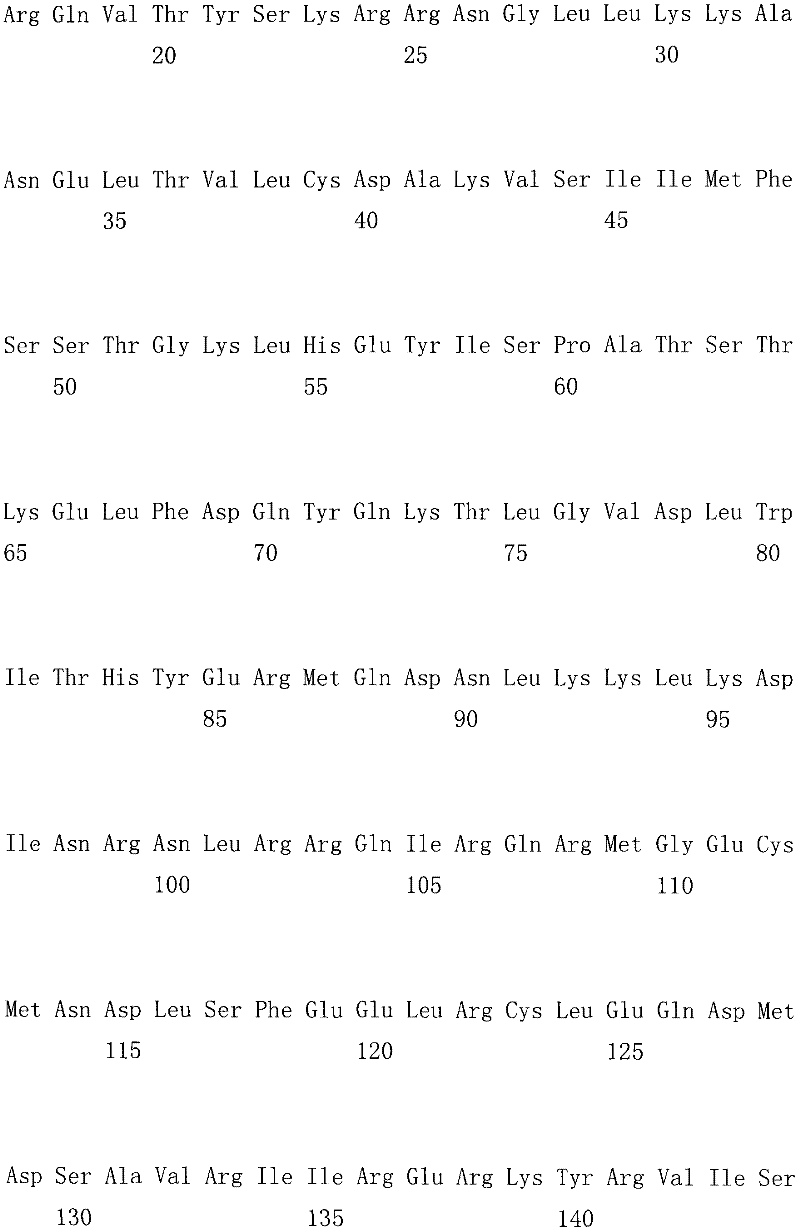
上述CsMADS1蛋白的氨基酸序列是如下a)或b):The amino acid sequence of the above-mentioned CsMADS1 protein is as follows a) or b):
a)由序列表中序列3所示的氨基酸序列组成的蛋白质;a) a protein consisting of the amino acid sequence shown in
b)将序列表中序列3的氨基酸残基序列经过一个或几个氨基酸残基的取代和/或缺失和/或添加的由a)衍生的蛋白质。b) A protein derived from a) by subjecting the amino acid residue sequence of
进一步,上述CsMADS1蛋白的编码基因是如下I)或II)或III):Further, the coding gene of the above-mentioned CsMADS1 protein is as follows I) or II) or III):
I)其编码序列是序列表中的序列2;1) its coding sequence is
II)在严格条件下与I)基因杂交且编码所述CsMADS1蛋白的基因;II) with I) gene hybridization under stringent conditions and the gene of described CsMADS1 albumen of coding;
III)与I)的基因具有90%以上的同源性且编码所述CsMADS1蛋白的基因。III) and the gene of I) have more than 90% homology and encode the gene of the CsMADS1 protein.
上述严格条件可为用0.1×SSPE(或0.1×SSC),0.1%SDS的溶液,在DNA或者RNA杂交实验中65℃下杂交并洗膜。The above-mentioned stringent conditions can be 0.1×SSPE (or 0.1×SSC), 0.1% SDS solution, hybridization at 65° C. in DNA or RNA hybridization experiments and membrane washing.
步骤1)和步骤2)中,所述CsMADS1蛋白的编码基因是通过重组表达载体导入所述目的植物中的;所述重组表达载体是将所述CsMADS1蛋白的编码基因插入到雌激素诱导表达载体的多克隆位点中得到的载体。In step 1) and step 2), the coding gene of the CsMADS1 protein is introduced into the target plant through a recombinant expression vector; the recombinant expression vector is to insert the coding gene of the CsMADS1 protein into the estrogen-induced expression vector The vector obtained in the multiple cloning site.
具体地讲,上述雌激素诱导表达载体是Px6。Specifically, the above-mentioned estrogen-inducible expression vector is Px6.
步骤1)和步骤2)中所述目的植物是双子叶植物或单子叶植物,优选是拟南芥。The target plant described in step 1) and step 2) is a dicotyledonous plant or a monocotyledonous plant, preferably Arabidopsis.
步骤1)中,所述外源基因是与黄瓜乙烯受体CsETR1启动子一起导入所述目的植物中的;所述由黄瓜乙烯受体CsETR1启动子的编码序列如序列表中序列1所示。In step 1), the exogenous gene is introduced into the target plant together with the cucumber ethylene receptor CsETR1 promoter; the coding sequence of the cucumber ethylene receptor CsETR1 promoter is shown in
步骤1)中,所述目的基因是所述外源基因和/或内源基因。In step 1), the target gene is the exogenous gene and/or endogenous gene.
所述内源基因是ETR1,ERS1,ERS2和AP3。The endogenous genes are ETR1, ERS1, ERS2 and AP3.
步骤2)中,所述目的基因是内源基因;所述内源基因优选是ETR1,ERS1,ERS2和AP3。In step 2), the target gene is an endogenous gene; the endogenous gene is preferably ETR1, ERS1, ERS2 and AP3.
所述ETR1的Genbank号为NM_105305,所述ERS1的Genbank号为NM_129658,所述ERS2的Genbank号为NM_100312,所述AP3的Genbank号为NM_115294。The Genbank number of the ETR1 is NM_105305, the Genbank number of the ERS1 is NM_129658, the Genbank number of the ERS2 is NM_100312, and the Genbank number of the AP3 is NM_115294.
实验证明:雌激素诱导体系对要检测的目的基因没有影响。将CsMADS1基因与PCsETR1::GUS分别导入拟南芥中后,在雌激素诱导下,外源基因GUS表达量提高了,拟南芥内源基因AP3、ETR1、ERS1、ERS2的表达量也大大提高了。The experiment proves that the estrogen induction system has no effect on the target gene to be detected. After introducing CsMADS1 gene and PCsETR1::GUS into Arabidopsis thaliana respectively, under the induction of estrogen, the expression of exogenous gene GUS was increased, and the expression of Arabidopsis endogenous genes AP3, ETR1, ERS1, ERS2 was also greatly increased up.
附图说明 Description of drawings
图1为转基因植物的GUS检测,从左到右依次为marker,1-15号植株基因组PCR检测。Figure 1 shows the GUS detection of transgenic plants. From left to right, markers are shown, and genome PCR detection of plants No. 1-15.
图2为为转基因植物的CsMADS1检测,从左到右依次为marker,1-15号植株基因组PCR检测。Figure 2 is the CsMADS1 detection of transgenic plants, markers from left to right, and genome PCR detection of plants No. 1-15.
图3为雌激素诱导体系对目的基因无影响验证,PCsETR1::GUS阳性植株在雌激素诱导后,ETR1、ERS1和GUS基因表达没有明显变化。Figure 3 is the verification that the estrogen induction system has no effect on the target gene. The expression of ETR1, ERS1 and GUS genes in PCsETR1::GUS positive plants did not change significantly after estrogen induction.
图4为转基因株系中CsMADS1、GUS检测。Figure 4 shows the detection of CsMADS1 and GUS in transgenic lines.
图5为转基因株系的CsMADS1的Western blot检测,其中nuclear protin为核蛋白,cytoplasm protin为胞质蛋白;MADS1是CsMADS1的简写;Tublin为广泛表达的蛋白,作为内参。Figure 5 shows the Western blot detection of CsMADS1 in transgenic lines, where nuclear protin is nuclear protein, cytoplasmic protin is cytoplasmic protein; MADS1 is the abbreviation of CsMADS1; Tublin is widely expressed protein, used as an internal reference.
图6为转基因株系中内源基因表达检测。Figure 6 is the detection of endogenous gene expression in transgenic lines.
其中,图3-图6中的mock为水代替雌激素负对照,induce为进行雌激素诱导的实验组。Among them, the mock in Figure 3-Figure 6 is water instead of estrogen negative control, and induce is the experimental group for estrogen induction.
具体实施方式 Detailed ways
下面结合具体实施例对本发明作进一步说明,但本发明并不限于以下实施例。The present invention will be further described below in conjunction with specific examples, but the present invention is not limited to the following examples.
下述实施例中,如无特殊说明,均为常规方法。In the following examples, unless otherwise specified, all are conventional methods.
实施例1、转基因植物的培育及其基因表达检测
一、转基因植物的培育1. Breeding of transgenic plants
1、重组表达载体构建1. Construction of recombinant expression vector
1)黄瓜乙烯受体CsETR1启动子(PCsETR1)与外源基因(GUS)构成的重组载体1) Recombinant vector composed of cucumber ethylene receptor CsETR1 promoter (PCsETR1) and foreign gene (GUS)
利用5′GTAAGCTTtcttttaatcatagg和ccatggGTCCATGGGAGTCTAAATGCAATGTT从黄瓜基因组中克隆到黄瓜ETR1启动子,命名为PCsETR1,经HINDIII和Nco I双酶切后连入pCAMBIA1305.1(CAMBIA公司)的相应多克隆位点,构成PCsETR1::GUS载体。Use 5'GTAAGCTTtcttttaatcatagg and ccatggGTCCATGGGAGTCTAAATGCAATGTT to clone the cucumber ETR1 promoter from the cucumber genome, named PCsETR1, and connect it into the corresponding multiple cloning site of pCAMBIA1305.1 (CAMBIA company) after HINDIII and NcoI double digestion, to form PCsETR1:: GUS carrier.
测序表明:PCsETR1::GUS是在pCAMBIA1305.1的HIND III和Nco I酶切位点间插入了序列表中序列1所示的PCsETR1启动子。Sequencing showed that: PCsETR1::GUS is the PCsETR1 promoter shown in
2)CsMADS1基因插入雌激素诱导表达载体Px6构成的重组载体2) Recombinant vector composed of CsMADS1 gene inserted into estrogen-inducible expression vector Px6
用CsMADS1引物(S:actagtATGGCTCGTGGGAAGATCCAGA和A:ctcgagCTCAAGGAGTGGATAGGTAGTG),从黄瓜cDNA模板中PCR扩增全长cDNA,经过双酶切(Spe1和Xho1)连入载体Px6(购自NEB公司)的相应多克隆位点,构成CsMADS1-Px6。Using CsMADS1 primers (S: actagtATGGCTCGTGGGAAGATCCAGA and A: ctcgagCTCAAGGAGTGGATAGGTAGTG), PCR amplified the full-length cDNA from the cucumber cDNA template, and ligated into the corresponding multiple cloning site of the vector Px6 (purchased from NEB Company) after double digestion (Spe1 and Xho1) , constituting CsMADS1-Px6.
测序表明:CsMADS1-Px6是在Px6的Spe1和Xho1酶切位点间插入了序列表中序列2所示的CsMADS1基因。Sequencing shows that: CsMADS1-Px6 is the insertion of the CsMADS1 gene shown in
2、转基因植物构建2. Construction of transgenic plants
①将步骤1中的PCsETR1::GUS通过花絮浸泡方法方法导入拟南芥(Col-0生态型)(美国拟南芥生物资源中心(Arabidopsis Biological Resource Center,ABRC)),得到含GUS报告基因的转基因拟南芥。①Introduce the PCsETR1::GUS in
②将步骤1中的CsMADS1-Px6通过花絮浸泡方法方法导入上述含GUS报告基因的转基因拟南芥中,得到转基因植物。②Introduce the CsMADS1-Px6 in
3)筛选阳性株系3) Screen positive strains
将步骤2)得到的转基因植物在抗性培养基(含卡纳霉素和潮霉素的MS培养基)中筛选到具有双抗性的阳性苗转到土里培养,长出真叶后进行基因组DNA的PCR组鉴定,筛选同时具有GUS报告基因(表1中的引物)(图1)和CsMADS1(表1中的引物)(图2)的阳性植株。The transgenic plant obtained in step 2) is screened in a resistant medium (MS medium containing kanamycin and hygromycin), and the positive seedlings with double resistance are selected and transferred to the soil for cultivation, and after growing true leaves, carry out PCR group identification of genomic DNA, screening positive plants with both GUS reporter gene (primers in Table 1) (Figure 1) and CsMADS1 (primers in Table 1) (Figure 2).
二、基因表达检测2. Gene expression detection
(一)雌激素诱导体系的影响(1) The influence of estrogen induction system
为了确定雌激素诱导体系对要检测的目的基因没有影响,对只转入GUS报告基因的拟南芥株系(即上述步骤一中步骤2的①中含GUS报告基因的转基因拟南芥)进行雌激素诱导,用表1中的引物Real-timePCR检测了四个基因:GUS,ETR1,ERS1,ACS7。除ACS7略有升高外,其余三个基因对雌激素处理都没有反应,说明雌激素诱导表达系统正常(图3)。In order to confirm that the estrogen-inducing system has no effect on the target gene to be detected, the Arabidopsis line that is only transferred to the GUS reporter gene (i.e. the transgenic Arabidopsis containing the GUS reporter gene in
表1.检测引物Table 1. Detection primers

(二)基因表达检测(2) Gene expression detection
将步骤一中经鉴定过的阳性苗,采用花序浸泡雌激素17β-雌二醇(17β-estradiol)的方法来检测诱导表达后目的基因的表达水平,每次选用4-5株拟南芥花序取平均值来降低个体间表达差异,处理时间为三到五分钟,处理后透光密封放置8小时。With the positive seedlings identified in
1、Real-timePCR(外源基因:CsMADS1、GUS)1. Real-time PCR (exogenous gene: CsMADS1, GUS)
提取RNA反转录后,利用表1中引物进行Real-timePCR检验。经过雌激素处理的转基因植株,与负对照(水代替雌激素)相比,CsMADS1和GUS基因表达都有明显上升(图4)。After the extracted RNA was reverse-transcribed, Real-time PCR was performed using the primers in Table 1. Compared with the negative control (water instead of estrogen), the transgenic plants treated with estrogen had significantly increased expression of CsMADS1 and GUS genes ( FIG. 4 ).
2、Western blot(CsMADS1)2. Western blot (CsMADS1)
雌激素诱导后通过Western blot检测转基因植株(分别测核蛋白和胞质蛋白中CsMADS1蛋白),经过诱导后CsMADS1蛋白含量明显增加(图5),并且CsMADS1集中在诱导后的核蛋白中,说明雌激素诱导体系不仅在转录水平激活CsMADS1表达,而且可以翻译成为蛋白质进入细胞核。After estrogen induction, the transgenic plants were detected by Western blot (detection of CsMADS1 protein in nucleoprotein and cytoplasmic protein respectively), and the content of CsMADS1 protein increased significantly after induction (Figure 5), and CsMADS1 was concentrated in the induced nucleoprotein, indicating that estrogen The hormone-induced system not only activates the expression of CsMADS1 at the transcriptional level, but also can be translated into protein and enter the nucleus.
其中,Western blot检测步骤:Among them, Western blot detection steps:
1)取材:叶子4g。1) Materials: 4g leaves.
2)植物细胞核提取:液氮研磨材料,加入25ml预冷的提核缓冲液(Nucleiisolation buffer:0.25mM蔗糖,15mM PIPES(pH6.8),5mM MgCl2,60mM KCl,15mMNaCl,1mM CaCl2,0.9%Triton X-100(用前加1Xcocktail和1mMPMSF)),其中PMSF和cocktail现用现加。2) Extraction of plant cell nuclei: grinding materials with liquid nitrogen, adding 25ml pre-cooled nuclei isolation buffer (Nuclei isolation buffer: 0.25mM sucrose, 15mM PIPES (pH6.8), 5mM MgCl2, 60mM KCl, 15mMNaCl, 1mM CaCl2, 0.9% Triton X-100 (add 1Xcocktail and 1mMPMSF before use)), where PMSF and cocktail are added now.
3)用滤膜过滤研磨得到的液体,单层过滤2次,滤出液4℃ 11000g离心20min。上清可作为胞质蛋白保存。3) The liquid obtained by grinding is filtered with a filter membrane, single-layer filtered twice, and the filtrate is centrifuged at 11000g at 4°C for 20min. Supernatants can be stored as cytosolic proteins.
4)核裂解:弃上清,向沉淀加入1ml预冷的Co-IP buffer(Co-IP buffer:Nucleiisolation buffer:0.25mM蔗糖,15mM PIPES(pH6.8),5mM MgCl2,60mM KCl,15mMNaCl,1mM CaCl2,0.9%Triton X-100(用前加1Xcocktail和1mMPMSF)),重悬,将重悬液转入新的1.5ml EP管中。4) Nuclear lysis: discard the supernatant, add 1ml pre-cooled Co-IP buffer (Co-IP buffer: Nuclei isolation buffer: 0.25mM sucrose, 15mM PIPES (pH6.8), 5mM MgCl2, 60mM KCl, 15mMNaCl, 1mM CaCl2, 0.9% Triton X-100 (add 1Xcocktail and 1mMPMSF before use), resuspend, and transfer the resuspension into a new 1.5ml EP tube.
5)超声破碎:将EP管放在EP管架上并泡在冰水混合物中,超声条件:200W 3-5S。中间。5) Ultrasonic crushing: put the EP tube on the EP tube rack and soak in the ice-water mixture, ultrasonic condition: 200W 3-5S. middle.
6)4℃ 13800g离心10分钟,取上清作为核蛋白。6) Centrifuge at 13800g at 4°C for 10 minutes, and take the supernatant as nucleoprotein.
7)煮样:用2x蛋白电泳buffer50-100ul煮沉淀10min.7) Cook the sample: cook the precipitate with 2x protein electrophoresis buffer50-100ul for 10min.
8)western检测(western检测所用抗体是anti-CsMADS1(Santa cruz(sc-12639))。8) western detection (the antibody used in western detection is anti-CsMADS1 (Santa cruz (sc-12639)).
3、Real-timePCR(内源基因:AP3、ETR1、ERS1、ERS2)3. Real-time PCR (endogenous genes: AP3, ETR1, ERS1, ERS2)
提取RNA反转录后用表1所示引物针对AP3、ETR1、ERS1、ERS2分别进行Real-timePCR检验。在雌激素诱导实验中拟南芥乙烯受体基因ETR1,ERS1,ERS2的表达也有明显上升,并且花器官中AP3表达量也明显增加(图6),说明CsMADS1可以激活AP3表达。After the extracted RNA was reverse-transcribed, the primers shown in Table 1 were used to perform Real-time PCR tests against AP3, ETR1, ERS1, and ERS2, respectively. In the estrogen induction experiment, the expressions of Arabidopsis ethylene receptor genes ETR1, ERS1, and ERS2 also increased significantly, and the expression of AP3 in floral organs also increased significantly (Figure 6), indicating that CsMADS1 can activate AP3 expression.



Claims (5)
Priority Applications (1)
| Application Number | Priority Date | Filing Date | Title |
|---|---|---|---|
| CN201010538337XA CN102002507B (en) | 2010-11-08 | 2010-11-08 | Method for improving expression quantity of target gene in plant by utilizing CsMADS1 gene |
Applications Claiming Priority (1)
| Application Number | Priority Date | Filing Date | Title |
|---|---|---|---|
| CN201010538337XA CN102002507B (en) | 2010-11-08 | 2010-11-08 | Method for improving expression quantity of target gene in plant by utilizing CsMADS1 gene |
Publications (2)
| Publication Number | Publication Date |
|---|---|
| CN102002507A CN102002507A (en) | 2011-04-06 |
| CN102002507B true CN102002507B (en) | 2012-01-11 |
Family
ID=43810209
Family Applications (1)
| Application Number | Title | Priority Date | Filing Date |
|---|---|---|---|
| CN201010538337XA Expired - Fee Related CN102002507B (en) | 2010-11-08 | 2010-11-08 | Method for improving expression quantity of target gene in plant by utilizing CsMADS1 gene |
Country Status (1)
| Country | Link |
|---|---|
| CN (1) | CN102002507B (en) |
Families Citing this family (4)
| Publication number | Priority date | Publication date | Assignee | Title |
|---|---|---|---|---|
| CN104450735A (en) * | 2014-11-19 | 2015-03-25 | 江西农业大学 | Cucumber CsMADSi gene overexpression vector and an application thereof |
| CN104480116B (en) * | 2014-11-19 | 2017-08-04 | 江西农业大学 | Cucumber CsMADS23 gene overexpressions carrier and its application |
| CN106755526B (en) * | 2017-02-22 | 2020-07-10 | 中山大学 | A functional molecular marker related to the "lip and petal sepalization" trait of Molan and its identification method |
| CN108611345A (en) * | 2018-04-26 | 2018-10-02 | 福建农林大学 | A kind of sample preparation methods of pineapple chromosome secondary structure |
Family Cites Families (5)
| Publication number | Priority date | Publication date | Assignee | Title |
|---|---|---|---|---|
| CA2511824A1 (en) * | 2002-12-26 | 2004-07-22 | Syngenta Participations Ag | Cell proliferation-related polypeptides and uses therefor |
| BRPI0510045A (en) * | 2004-04-20 | 2007-10-16 | Syngenta Participations Ag | regulatory sequences to express plant genetic products |
| KR100604186B1 (en) * | 2004-08-25 | 2006-07-25 | 고려대학교 산학협력단 | High-efficiency expression promoter base sequence for sweet potato-derived plant storage roots, a plant high-efficiency transient expression vector comprising the same, and a method for temporarily expressing in a storage root of a plant using the expression vector |
| MX2009013171A (en) * | 2007-06-06 | 2010-01-20 | Cropdesign Nv | Yield enhancement in plants by modulation of maize mads box transcription factor zmm28. |
| CN101629184A (en) * | 2009-08-19 | 2010-01-20 | 中国科学院植物研究所 | Application of E-like gene in rice in cultivating early-flowering and dwarf transgenic plants |
-
2010
- 2010-11-08 CN CN201010538337XA patent/CN102002507B/en not_active Expired - Fee Related
Also Published As
| Publication number | Publication date |
|---|---|
| CN102002507A (en) | 2011-04-06 |
Similar Documents
| Publication | Publication Date | Title |
|---|---|---|
| Catanzariti et al. | The tomato I‐3 gene: a novel gene for resistance to Fusarium wilt disease | |
| Koo et al. | A GUS/luciferase fusion reporter for plant gene trapping and for assay of promoter activity with luciferin-dependent control of the reporter protein stability | |
| CN103483438B (en) | Gene for cadmium pollution remediation of plant soil and coded protein and application thereof | |
| CN102978221B (en) | A kind of rice tillering and final height-related protein HTDF and encoding gene thereof and application | |
| Pogorelko et al. | A cyst nematode effector binds to diverse plant proteins, increases nematode susceptibility and affects root morphology | |
| CN102002507B (en) | Method for improving expression quantity of target gene in plant by utilizing CsMADS1 gene | |
| CN103130885B (en) | Malus sieversii (Ledeb.) Roem-derived plant growth-related protein, and coding gene and application thereof | |
| CN102766610B (en) | Plant drought-resistant relevant protein PvSnRK 2.3 and encoding gene and application thereof | |
| CN102643832A (en) | Soybean growth period E1 gene and encoding protein of soybean growth period E1 gene | |
| Thilmony et al. | The LP2 leucine‐rich repeat receptor kinase gene promoter directs organ‐specific, light‐responsive expression in transgenic rice | |
| CN110295175A (en) | The application of one soybean NAC transcription factor family gene Glyma08g41995 | |
| Cheng et al. | Characterization of a disease susceptibility locus for exploring an efficient way to improve rice resistance against bacterial blight | |
| WO2024093843A1 (en) | Disease resistance-related protein rcr1, coding gene thereof, and use thereof | |
| CN100489099C (en) | Method for imparting or controlling fertility by using fertility restorer gene of rice BT-male sterile cytoplasm and method for identifying existence of fertility restorer gene | |
| WO2012064827A1 (en) | Methods and compositions to regulate plant transformation susceptibility | |
| CN106892971B (en) | Corn flowering and grain development related protein, coding gene and application | |
| CN102295689B (en) | Plant drought tolerance related protein AtDi19, and coding gene and application thereof | |
| Qu et al. | Development of a new transformation-competent artificial chromosome (TAC) vector and construction of tomato and rice TAC libraries | |
| CN105296443A (en) | Plant drought-resistant salt-tolerant associated protein EeSAPK7 as well as encoding gene and application thereof | |
| CN102234327B (en) | Plant salt resistant associated protein AtST1, coded genes and application thereof | |
| CN106831967A (en) | Reduce IAA10 albumen and its encoding gene expression is improving plant to the application in fractilinea oryzae resistance | |
| CN106317213A (en) | Plant stress resistance related protein, coding gene and application thereof | |
| CN106636032A (en) | Plant drought-resisting related protein EeSnRK2.7, and encoding gene and application thereof | |
| CN103304653B (en) | Application of arabidopsis ERF protein and coding gene of arabidopsis ERF protein for regulating and controlling plant pollen fertility | |
| CN102392020A (en) | Cloning and function analysis of Zea mays adverse stress inducible promoter |
Legal Events
| Date | Code | Title | Description |
|---|---|---|---|
| C06 | Publication | ||
| PB01 | Publication | ||
| C10 | Entry into substantive examination | ||
| SE01 | Entry into force of request for substantive examination | ||
| C14 | Grant of patent or utility model | ||
| GR01 | Patent grant | ||
| CF01 | Termination of patent right due to non-payment of annual fee |
Granted publication date: 20120111 Termination date: 20141108 |
|
| EXPY | Termination of patent right or utility model |