CN101990474B - Composite silver nanoparticles, composite silver nanopaste, and production method, production apparatus, conjugation method and patterning method of the same - Google Patents
Composite silver nanoparticles, composite silver nanopaste, and production method, production apparatus, conjugation method and patterning method of the same Download PDFInfo
- Publication number
- CN101990474B CN101990474B CN2008801281306A CN200880128130A CN101990474B CN 101990474 B CN101990474 B CN 101990474B CN 2008801281306 A CN2008801281306 A CN 2008801281306A CN 200880128130 A CN200880128130 A CN 200880128130A CN 101990474 B CN101990474 B CN 101990474B
- Authority
- CN
- China
- Prior art keywords
- temperature
- composite silver
- mentioned
- silver
- composite
- Prior art date
- Legal status (The legal status is an assumption and is not a legal conclusion. Google has not performed a legal analysis and makes no representation as to the accuracy of the status listed.)
- Active
Links
Images


Classifications
-
- B—PERFORMING OPERATIONS; TRANSPORTING
- B22—CASTING; POWDER METALLURGY
- B22F—WORKING METALLIC POWDER; MANUFACTURE OF ARTICLES FROM METALLIC POWDER; MAKING METALLIC POWDER; APPARATUS OR DEVICES SPECIALLY ADAPTED FOR METALLIC POWDER
- B22F1/00—Metallic powder; Treatment of metallic powder, e.g. to facilitate working or to improve properties
- B22F1/05—Metallic powder characterised by the size or surface area of the particles
- B22F1/054—Nanosized particles
- B22F1/056—Submicron particles having a size above 100 nm up to 300 nm
-
- B—PERFORMING OPERATIONS; TRANSPORTING
- B01—PHYSICAL OR CHEMICAL PROCESSES OR APPARATUS IN GENERAL
- B01J—CHEMICAL OR PHYSICAL PROCESSES, e.g. CATALYSIS OR COLLOID CHEMISTRY; THEIR RELEVANT APPARATUS
- B01J8/00—Chemical or physical processes in general, conducted in the presence of fluids and solid particles; Apparatus for such processes
- B01J8/005—Separating solid material from the gas/liquid stream
- B01J8/006—Separating solid material from the gas/liquid stream by filtration
-
- B—PERFORMING OPERATIONS; TRANSPORTING
- B22—CASTING; POWDER METALLURGY
- B22F—WORKING METALLIC POWDER; MANUFACTURE OF ARTICLES FROM METALLIC POWDER; MAKING METALLIC POWDER; APPARATUS OR DEVICES SPECIALLY ADAPTED FOR METALLIC POWDER
- B22F1/00—Metallic powder; Treatment of metallic powder, e.g. to facilitate working or to improve properties
- B22F1/05—Metallic powder characterised by the size or surface area of the particles
- B22F1/054—Nanosized particles
-
- B—PERFORMING OPERATIONS; TRANSPORTING
- B22—CASTING; POWDER METALLURGY
- B22F—WORKING METALLIC POWDER; MANUFACTURE OF ARTICLES FROM METALLIC POWDER; MAKING METALLIC POWDER; APPARATUS OR DEVICES SPECIALLY ADAPTED FOR METALLIC POWDER
- B22F1/00—Metallic powder; Treatment of metallic powder, e.g. to facilitate working or to improve properties
- B22F1/10—Metallic powder containing lubricating or binding agents; Metallic powder containing organic material
- B22F1/102—Metallic powder coated with organic material
-
- B—PERFORMING OPERATIONS; TRANSPORTING
- B22—CASTING; POWDER METALLURGY
- B22F—WORKING METALLIC POWDER; MANUFACTURE OF ARTICLES FROM METALLIC POWDER; MAKING METALLIC POWDER; APPARATUS OR DEVICES SPECIALLY ADAPTED FOR METALLIC POWDER
- B22F1/00—Metallic powder; Treatment of metallic powder, e.g. to facilitate working or to improve properties
- B22F1/10—Metallic powder containing lubricating or binding agents; Metallic powder containing organic material
- B22F1/107—Metallic powder containing lubricating or binding agents; Metallic powder containing organic material containing organic material comprising solvents, e.g. for slip casting
-
- B—PERFORMING OPERATIONS; TRANSPORTING
- B22—CASTING; POWDER METALLURGY
- B22F—WORKING METALLIC POWDER; MANUFACTURE OF ARTICLES FROM METALLIC POWDER; MAKING METALLIC POWDER; APPARATUS OR DEVICES SPECIALLY ADAPTED FOR METALLIC POWDER
- B22F9/00—Making metallic powder or suspensions thereof
- B22F9/02—Making metallic powder or suspensions thereof using physical processes
-
- B—PERFORMING OPERATIONS; TRANSPORTING
- B22—CASTING; POWDER METALLURGY
- B22F—WORKING METALLIC POWDER; MANUFACTURE OF ARTICLES FROM METALLIC POWDER; MAKING METALLIC POWDER; APPARATUS OR DEVICES SPECIALLY ADAPTED FOR METALLIC POWDER
- B22F9/00—Making metallic powder or suspensions thereof
- B22F9/16—Making metallic powder or suspensions thereof using chemical processes
- B22F9/18—Making metallic powder or suspensions thereof using chemical processes with reduction of metal compounds
- B22F9/24—Making metallic powder or suspensions thereof using chemical processes with reduction of metal compounds starting from liquid metal compounds, e.g. solutions
-
- B—PERFORMING OPERATIONS; TRANSPORTING
- B22—CASTING; POWDER METALLURGY
- B22F—WORKING METALLIC POWDER; MANUFACTURE OF ARTICLES FROM METALLIC POWDER; MAKING METALLIC POWDER; APPARATUS OR DEVICES SPECIALLY ADAPTED FOR METALLIC POWDER
- B22F9/00—Making metallic powder or suspensions thereof
- B22F9/16—Making metallic powder or suspensions thereof using chemical processes
- B22F9/30—Making metallic powder or suspensions thereof using chemical processes with decomposition of metal compounds, e.g. by pyrolysis
-
- B—PERFORMING OPERATIONS; TRANSPORTING
- B23—MACHINE TOOLS; METAL-WORKING NOT OTHERWISE PROVIDED FOR
- B23K—SOLDERING OR UNSOLDERING; WELDING; CLADDING OR PLATING BY SOLDERING OR WELDING; CUTTING BY APPLYING HEAT LOCALLY, e.g. FLAME CUTTING; WORKING BY LASER BEAM
- B23K35/00—Rods, electrodes, materials, or media, for use in soldering, welding, or cutting
- B23K35/22—Rods, electrodes, materials, or media, for use in soldering, welding, or cutting characterised by the composition or nature of the material
- B23K35/24—Selection of soldering or welding materials proper
-
- B—PERFORMING OPERATIONS; TRANSPORTING
- B82—NANOTECHNOLOGY
- B82Y—SPECIFIC USES OR APPLICATIONS OF NANOSTRUCTURES; MEASUREMENT OR ANALYSIS OF NANOSTRUCTURES; MANUFACTURE OR TREATMENT OF NANOSTRUCTURES
- B82Y30/00—Nanotechnology for materials or surface science, e.g. nanocomposites
-
- H—ELECTRICITY
- H01—ELECTRIC ELEMENTS
- H01B—CABLES; CONDUCTORS; INSULATORS; SELECTION OF MATERIALS FOR THEIR CONDUCTIVE, INSULATING OR DIELECTRIC PROPERTIES
- H01B1/00—Conductors or conductive bodies characterised by the conductive materials; Selection of materials as conductors
- H01B1/20—Conductive material dispersed in non-conductive organic material
- H01B1/22—Conductive material dispersed in non-conductive organic material the conductive material comprising metals or alloys
-
- H10W72/07331—
-
- H10W72/325—
-
- H10W72/352—
Landscapes
- Chemical & Material Sciences (AREA)
- Engineering & Computer Science (AREA)
- Nanotechnology (AREA)
- Chemical Kinetics & Catalysis (AREA)
- General Chemical & Material Sciences (AREA)
- Physics & Mathematics (AREA)
- Inorganic Chemistry (AREA)
- Mechanical Engineering (AREA)
- General Physics & Mathematics (AREA)
- Crystallography & Structural Chemistry (AREA)
- Materials Engineering (AREA)
- Condensed Matter Physics & Semiconductors (AREA)
- Dispersion Chemistry (AREA)
- Spectroscopy & Molecular Physics (AREA)
- Composite Materials (AREA)
- Organic Chemistry (AREA)
- Manufacture Of Metal Powder And Suspensions Thereof (AREA)
- Powder Metallurgy (AREA)
- Conductive Materials (AREA)
- Non-Insulated Conductors (AREA)
- Computer Hardware Design (AREA)
- Microelectronics & Electronic Packaging (AREA)
- Power Engineering (AREA)
Abstract
Description
技术领域 technical field
本发明涉及在包含多个银原子的银核的周围形成含有机物的有机被覆层的复合银纳米粒子,特别详细地涉及,通过加热至规定温度,使上述有机被覆层发生逸散、金属化,即发生银化的复合银纳米粒子、复合银纳米糊膏、其制法、制造装置、接合方法及图案形成方法。The present invention relates to composite silver nanoparticles in which an organic coating layer containing organic substances is formed around a silver nucleus containing a plurality of silver atoms, and in particular relates to dissipating and metallizing the organic coating layer by heating to a predetermined temperature, That is, silverized composite silver nanoparticles, composite silver nanopaste, their manufacturing method, manufacturing device, bonding method, and pattern forming method.
背景技术 Background technique
一般,半导体、电子电路、电子仪器等,是把各种电子部件用焊锡熔融固定在基板上而确保导电性。然而,现有的焊锡为Sn与Pb的合金,由于近年来的环保对策禁止使用Pb,故正在开发无Pb焊锡代替上述现有焊锡。Sn与Pb的共晶焊锡的熔点为183℃,而现有的代替焊锡Sn·Ag·Cu焊锡的熔点为217℃。当在树脂基板上进行焊锡焊接时,由于树脂的耐热性低,现有的代替焊锡的熔点过高,有时损伤树脂基板,故要求低温用焊锡。从上述的现有代替焊锡的熔点考虑,渴望一种200℃以下进行接合的代替焊锡。In general, in semiconductors, electronic circuits, electronic instruments, etc., various electronic components are melted and fixed on the substrate with solder to ensure electrical conductivity. However, the existing solder is an alloy of Sn and Pb, and since the use of Pb is banned in recent years for environmental protection measures, a Pb-free solder is being developed to replace the above-mentioned conventional solder. The melting point of the eutectic solder of Sn and Pb is 183°C, while the melting point of the existing substitute solder Sn·Ag·Cu solder is 217°C. When performing soldering on a resin substrate, due to the low heat resistance of the resin, the melting point of the existing substitute solder is too high, and the resin substrate may be damaged, so solder for low temperature is required. Considering the melting point of the above-mentioned conventional substitute solders, substitute solders that perform bonding at 200° C. or lower are desired.
作为代替焊锡的特性,当然是不含Pb且金属化温度低,其他要求安全性高,无腐蚀性,且导电性及导热性良好。作为满足这些要求的原材料,银引起关注。但是,为了降低熔点,要求开发出超微粒子的复合银纳米粒子。As the characteristics of replacing solder, of course, it does not contain Pb and has a low metallization temperature. Other requirements include high safety, non-corrosion, and good electrical and thermal conductivity. As a raw material satisfying these requirements, silver attracts attention. However, in order to lower the melting point, it is required to develop composite silver nanoparticles of ultrafine particles.
作为专利文献1的特许第3205793号公报(特开平10-183207号)已经公开。作为起始原料选择银有机化合物(特别是银有机配位化合物)。在隔绝空气的惰性气体氛围气下,在上述银有机化合物的开始分解温度以上且低于完全分解温度的温度下进行加热,在被分解还原了的银核的周围,来自上述银有机化合物的有机物形成被覆层的复合银纳米粒子被制造出来。该制法为固体-气体反应。银核的粒径为1~100nm,因此,通称为复合银纳米粒子。具体的是,把固体硬脂酸银100g于氮气流下的烧瓶内,250℃加热4小时,在粒径5nm的银核的周围生成具有硬脂酸基有机被覆层的复合银纳米粒子。Japanese Patent No. 3205793 (Japanese Unexamined Patent Publication No. Hei 10-183207 ) as
采用上述制法时,其缺点在于,由于把硬脂酸银的固体物加热至无溶剂,生成了的复合银纳米粒子难以分散,多个复合银纳米粒子结合成团状的大型2次粒子。然而,已知生成温度高到250℃,复合银纳米粒子的金属化温度极高达到220℃。生成温度高的银纳米粒子其银化温度也高。一般的Sn-Pb焊锡的熔点为183℃,当考虑渴望的接合温度在200℃以下时,由于上述金属化温度(银化温度)过高,在220℃,故难以作为低温用的代替焊锡使用。金属化温度高是由于团状的巨大粒子且硬脂酸基的分解温度高所致。然而,上述银核不是单晶,是单一的原子团,或是多晶,已为发明人确认。当银核为多晶或无序时,多个晶粒表面发生电子散射或热散射,结果成为电导度或热导度降低的原因。When adopting above-mentioned preparation method, its shortcoming is, owing to heating the solid matter of silver stearate to solvent-free, the composite silver nano-particle that produces is difficult to disperse, and a plurality of composite silver nano-particles combine into the large-scale secondary particle of agglomerate. However, it is known that the formation temperature is as high as 250°C, and the metallization temperature of composite silver nanoparticles is as high as 220°C. Silver nanoparticles with a high generation temperature also have a high silverization temperature. The melting point of general Sn-Pb solder is 183°C. When considering that the desired joining temperature is below 200°C, the above-mentioned metallization temperature (silverization temperature) is too high at 220°C, so it is difficult to use as a substitute solder for low temperature. . The high metallization temperature is due to the large particles in the form of agglomerates and the high decomposition temperature of the stearic acid group. However, the above-mentioned silver nucleus is not a single crystal, but a single atomic group, or a polycrystal, which has been confirmed by the inventor. When the silver core is polycrystalline or disordered, electron scattering or heat scattering occurs on the surface of a plurality of crystal grains, resulting in a decrease in electric conductivity or thermal conductivity.
其次,作为专利文献2的特开2003-342605号公报已经公开。上述专利文献2,作为发明人之一的本发明人也参加了发明。使金属有机化合物在有机溶剂或水中溶解、分散,成功制造了来自上述金属有机化合物的有机物被覆的复合银纳米粒子。该制法为固体-液体反应。然而,该复合银纳米粒子当用高分辨率透射型电子显微镜观察时,银核被确认为晶格图像,已确认为单晶银核。可以认为是,基于固液反应法,金属有机化合物作为分子于溶剂中溶解分散,还原上述分子,使银原子析出,通过银原子彼此的再结合,而产生单晶化。即,可以认为其单晶性起因于分子间反应。因银核为单晶,故具有电导度及热导度高的优点。然而,关于银化温度,在段落[0076]中已加以说明,硬脂酸基被覆的复合银纳米粒子于250℃加热10分钟。即,银化温度达到250℃的高温,是专利文献2的弱点。银化温度高的理由是,从醋酸银、己酸银、辛酸银等的银有机化合物起始,构成被覆层的有机酸基的分解温度高所致。必需更加设法使金属化温度在200℃以下。Next, Japanese Unexamined Patent Publication No. 2003-342605 as
在这里,作为专利文献3的WO00/076699号公报已经公开。本发明人为该国际公开公报的发明人之一。该公开公报中公开了多个发明,其中,用金属无机化合物作为表面活性剂进行处理的方法首次公开,公开了以金属无机化合物作为起始物质的方法。即,其构成为:用金属无机化合物作为表面活性剂,在非水溶剂中加以胶体化,形成超微粒子母体的第1工序;以及,往该胶体溶液中添加还原剂,还原上述超微粒子母体,金属核的外周形成表面活性剂壳作为被覆层的复合金属纳米粒子的第2工序。Here, WO00/076699 publication which is
上述方法的特征在于,使金属无机化合物溶于非水系溶剂后,生成的复合金属纳米粒子彼此于非水系溶剂中分散,难以形成团状。然而,实施例为油酸铜、松香酸银、醋酸银、油酸镍、二乙基己基铟、醋酸铜、硬脂酸银,仅实施了有机金属化合物。然而,从硬脂酸银生成的复合银纳米粒子的金属化温度,已知高达220℃。金属化温度必需再努力使在200℃以下。为了达到比Sn-Pb焊锡更好的特性,要求进一步努力使金属化温度在150℃以下。然而,在专利文献3中,由于未进行银核的单晶性、多晶性的判定,故不能判定复合金属纳米粒子的导电性及导热性良否。The above-mentioned method is characterized in that, after dissolving the metal-inorganic compound in a non-aqueous solvent, the generated composite metal nanoparticles are dispersed in the non-aqueous solvent, making it difficult to form agglomerates. However, the examples are copper oleate, silver abietate, silver acetate, nickel oleate, diethylhexyl indium, copper acetate, silver stearate, and only organometallic compounds were implemented. However, the metallization temperature of composite silver nanoparticles produced from silver stearate is known to be as high as 220°C. The metallization temperature must be kept below 200°C. In order to achieve better characteristics than Sn-Pb solder, further efforts are required to achieve a metallization temperature below 150°C. However, in
在以上的状况下,作为专利文献4的WO01/070435号公报已经公开。在该国际公开公报中公开了,从金属盐得到的粒径1~100nm的金属核周围,形成了含碳原子数4以上的醇性羟基的有机化合物被覆层的复合金属纳米粒子。然而,作为含有具有吸附性官能基的有机化合物,记载有碳原子数6以上的高级醇。Under the above circumstances, WO01/070435, which is
另外,作为专利文献5的WO2005/075132号公报已经公开。在该公报中公开了,中心部含有金属核,其周围具有热脱离开始温度140℃以上至低于190℃的有机物被覆层的复合金属纳米粒子。作为制法,记载有使无机金属盐与有机物质共存,无机金属盐发生分解,形成金属核,其周围形成有机物被覆层的复合金属纳米粒子的制造方法。另外,还公开了在无机金属盐或分解生成的无机金属化合物的周围,形成有机物被覆层的复合金属纳米粒子。In addition, WO2005/075132 A is disclosed as
作为专利文献6的特开2007-95510号公报已经公开。专利文献6的权利要求1公开了,来自用(R-A)n-M的化学式表示的金属盐的金属成分构成的金属芯,以及含有来自上述金属盐的有机被覆层的复合金属纳米粒子与有机溶剂的导电性糊膏。R为碳原子数4~9的烃基、A为COO、OSO3、SO3或OPO3,M为银、金或铂族。因此,包含复合银纳米粒子。Japanese Unexamined Patent Publication No. 2007-95510 as
作为专利文献7的特开2004-107728号公报已经公开。专利文献7的权利要求1记载了,在平均粒径100nm以下的金属核的周围,具有以C、H及/或O作为主成分的有机被覆层的复合金属纳米粒子,该有机被覆层是从有机酸金属盐生成的。Japanese Unexamined Patent Publication No. 2004-107728 as
【专利文献1】特许第3205793号(特开平10-183207号)[Patent Document 1] Patent No. 3205793 (JP-A-10-183207)
【专利文献2】特开2003-342605号【Patent Document 2】JP-A-2003-342605
【专利文献3】WO00/076699号[Patent Document 3] WO00/076699
【专利文献4】WO01/070435号[Patent Document 4] WO01/070435
【专利文献5】WO2005/075132号[Patent Document 5] WO2005/075132
【专利文献6】特开2007-95510号【Patent Document 6】JP-A-2007-95510
【专利文献7】特开2004-107728号【Patent Document 7】JP-A-2004-107728
发明内容 Contents of the invention
发明所要解决的课题The problem to be solved by the invention
专利文献4中记载了,5~10nm粒径的复合银纳米粒子,如有机化合物的分解温度在80℃以下,则银皮膜形成温度达到80℃,如分解温度在80℃以上,如加热达到其分解温度,则可形成银皮膜。然而,上述内容不过仅是希望的观测结果,但在实施例中,如此情况一切均未记载。下面,加以具体介绍。It is recorded in
实施例1记载了,当甲酸铜与1-癸醇发生反应时,可以得到从185℃附近,溶液变色的复合银纳米粒子,其银化烧成温度为200~350℃,优选250~300℃。实施例2记载了,从碳酸银与肉豆蔻酸(C数为14),于230℃通过溶液变色,生成复合银纳米粒子,在空气中烧成,于250℃形成银涂膜。实施例3记载了,从碳酸银与硬脂醇(C数为18),于150℃加热1小时,通过溶液变色可以确认复合银纳米粒子的生成,在氮氛围气下的银化温度为250℃。实施例4中记载了,从碳酸银与苯酚(C数为6),于180℃加热1小时,通过溶液变色,可以确认复合银纳米粒子的生成,银化温度为300℃。实施例5中记载了,从醋酸铜与月桂醇(C数为12),于100℃加热1小时,从溶液变色可以确认复合银纳米粒子的生成,但在加氢的氮氛围气下,银化温度为250℃。Example 1 records that when copper formate reacts with 1-decanol, composite silver nanoparticles that change color from the solution around 185°C can be obtained, and the silvering firing temperature is 200-350°C, preferably 250-300°C . Example 2 describes that from silver carbonate and myristic acid (C number is 14), the color of the solution is changed at 230°C to generate composite silver nanoparticles, which are fired in air to form a silver coating film at 250°
另外,实施例6中,从氯化铂与乙二酵(C数为2),于180℃加热1小时,从溶液变色可以确认复合铂纳米粒子的生成,但加热处理温度为300℃。实施例7中,从醋酸铜与月桂醇(C数为12),于110℃加热,从溶液变色可以确认复合铜纳米粒子的生成,但在氮氛围气下的铜化温度为300℃。最后,实施例8中,从醋酸铜与乙醇(C数为2)与非离子性表面活性剂(山梨糖醇酐三硬脂酸酯),于150℃,通过溶液变色可以确认复合铜纳米粒子的生成,但在氮氛围气下的铜化温度为300℃。In addition, in Example 6, platinum chloride and ethylene glycol (C number is 2) were heated at 180°C for 1 hour, and the generation of composite platinum nanoparticles could be confirmed from the discoloration of the solution, but the heat treatment temperature was 300°C. In Example 7, copper acetate and lauryl alcohol (C number is 12) were heated at 110°C, and the generation of composite copper nanoparticles could be confirmed from the discoloration of the solution, but the copperization temperature under nitrogen atmosphere was 300°C. Finally, in Example 8, from copper acetate, ethanol (C number 2) and nonionic surfactant (sorbitan tristearate), at 150°C, the composite copper nanoparticles can be confirmed by the color change of the solution. , but the copperization temperature under nitrogen atmosphere is 300°C.
如上所述,专利文献3的8个实施例中仅记载了具有C数14以上的有机被覆层的银核,然而,银化温度(金属化温度)为200℃以上的高温。由于碳原子数14以上,分子量加大,有机被覆层的重量相对银核重量之比相对增大,仅有机成分量增大,则烧成时的排气量增加,作为糊膏的适用性降低。然而,任何复合银纳米粒子其金属化温度也明显超过200℃,不能生成渴望的实现200℃以下金属化温度的复合金属纳米粒子。因此,作为代替焊锡,显然不合适。即,作为本发明的目的的来自醇的有机被覆层,换言之,可见:通过具有含碳原子数1~12的醇分子衍生物、醇分子残基、或醇分子一种以上的有机被覆层,为达到200℃以下的金属化,更优选150℃以下的金属化,显然还更遥远。然而,关于银及铜的金属核,单晶核或多晶核的任何一种也未作记载,也没有暗示。因此,完全不能判定导电性及导热性良否。As described above, only silver cores having an organic coating layer having a C number of 14 or higher are described in eight examples of
专利文献5中记载了不能理解的情况。当无机金属盐与有机物质共存时,在含无机金属盐或被分解的无机金属化合物的中心核的周围形成了有机物被覆层。例如,在第6页记载了当碳酸银(无机金属盐)与肉豆蔻醇(有机物质、C数为14)的混合物于120℃反应2小时时,生成了有机物于银或碳酸银上被物理吸附的复合银纳米粒子。当于碳酸银的周围附着有机物时,从碳酸银析出银的热分解温度超过400℃,对此从以下的反应式可明白理解。
Ag2CO3→Ag2O+CO2(150℃<T<210℃) (A)Ag 2 CO 3 →Ag 2 O+CO 2 (150℃<T<210℃) (A)
Ag2O→2Ag+1/2O2(T>400℃) (B)Ag 2 O→2Ag+1/2O 2 (T>400℃) (B)
首先,发生式(A)的反应,但式(B)的分解温度在400℃以上,未达到200℃以下的金属化,作为熔点183℃的Sn-Pb焊锡的代替品也不合适。然而,对银核的结晶性完全未记载,导电性与导热性良否完全不能判定。First, the reaction of formula (A) occurs, but the decomposition temperature of formula (B) is above 400°C, and metallization is not achieved below 200°C, and it is not suitable as a substitute for Sn-Pb solder with a melting point of 183°C. However, the crystallinity of the silver core is not described at all, and it is impossible to determine whether the electrical conductivity and thermal conductivity are good or not.
另外,通过手续补正书加以补正的权利要求7记载了,当碳酸银与肉豆蔻醇共存加热,于70℃以上、低于140℃的温度T(℃)时,在跨越下式(C)成立的时间t(h)进行加热,得到复合银纳米粒子。In addition,
7.85≤(T+273)(20+logt)×10-3≤7.98 (C)7.85≤(T+273)(20+logt)×10-3≤7.98 (C)
当在式(C)中,代入T=70℃,计算保持时间t(h)时,则变成794h≤t≤1995h,70℃的生成时间变为794小时~1995小时,当进行日数换算时,则变成33日~83日,生成时间达到月单位。这产生明显差错。当代入T=100℃时,变成11.22h≤t≤24.54h,生成时间变成半日~1日。该结果表示与本发明完全相反。当代入T=140℃时,变成0.1h≤t≤0.2h,换言之,由于t=6分钟~12分钟,好不容易进入纳米银生成的合适的区域,显然,即使在上述(C)式的边界区域变得妥当,其还不够作为指导方针的式子。然而,如T=200℃,反应时间变成数十秒~数秒,这也与本发明人的结果完全不同。在数十秒~数秒的反应时间,对生成复合银纳米粒子的化学反应不可能加以控制。当然,由于上述(C)式限制在140℃以下,故对200℃不适用。按照下述的本发明人等的发明,反应温度在50℃~200℃的范围,反应时间在1小时以内,随着温度升高,反应时间急速缩小,于200℃必需数分钟。其理由是,当反应时间加长时,复合纳米粒子急速凝聚,而且,同时发生金属化。专利文献5的内容,与本发明完全不同,不能作为参考。另外,肉豆蔻醇的C数为14,分子量大,对银核的有机被覆层的重量比增大,当烧成温度升高时,烧成时的排气量增大,接合时产生大量空隙,作为接合用糊膏的适应性有降低的缺点。When substituting T=70°C in the formula (C) and calculating the retention time t(h), it becomes 794h≤t≤1995h, and the generation time at 70°C becomes 794 hours to 1995 hours, when converted into days , it becomes 33 days to 83 days, and the generation time reaches the month unit. This produces an obvious error. When entering T=100°C, it becomes 11.22h≤t≤24.54h, and the generation time becomes half a day to one day. This result represents the complete opposite of the present invention. When put into T=140 ℃, become 0.1h≤t≤0.2h, in other words, because t=6 minutes~12 minutes, finally enter the suitable area that nano-silver is produced, obviously, even in above-mentioned (C) formula The border area becomes appropriate, which is not enough formula as a guideline. However, when T=200°C, the reaction time becomes several tens of seconds to several seconds, which is completely different from the result of the present inventors. In the reaction time of tens of seconds to several seconds, it is impossible to control the chemical reaction to form composite silver nanoparticles. Of course, since the above formula (C) is limited to below 140°C, it is not applicable to 200°C. According to the invention of the present inventors described below, the reaction temperature is in the range of 50°C to 200°C, and the reaction time is within 1 hour. As the temperature rises, the reaction time shortens rapidly, and at 200°C, several minutes are required. The reason is that when the reaction time is prolonged, the composite nanoparticles aggregate rapidly and metallization occurs simultaneously. The content of
专利文献6的复合金属纳米粒子,作为金属盐分解的分解生成物,形成有金属核与有机被覆层,从有机金属化合物起始这点看,与本发明不同。本发明是从碳酸银生成银核,从醇形成有机被覆层,故制法完全不同。然而,有机被覆层为烃基与COO、OSO3、SO3或OPO3的结合基,结构复杂,分解温度高。特别是由于含硫S,通过烧成生成作为大气污染成分的SOX,不符合环境标准。如段落[0018]中记载的那样,即使金属化温度可达到约150℃,也不可能形成复合金属纳米粒子。另外,含有对半导体接合不利的S或P,在半导体接合时,S或P有向半导体中扩散的危险,具有不适于半导体接合的弱点。然而,对金属核的结晶性既未记载也未暗示,导电性与导热性良否的判定完全不能进行。The composite metal nanoparticles of
专利文献7的复合金属纳米粒子,由于有机酸金属盐分解,形成有机被覆层,故有机被覆层为有机酸基,逸散温度明显升高。其段落[0031]中记载的熔点为210℃,段落[0068]中记载了于210~250℃的温度范围进行烧成。因此,作为本发明目的的200℃以下、优选150℃以下的金属化,在专利文献7中最终未实现。然而,对金属核的结晶性完全未作记载也未作暗示,完全不能进行导电性与导热性良否的判定。In the composite metal nanoparticles of
本发明是鉴于上述课题提出的,确定了具有来自C数1~12之醇的有机被覆层的复合银纳米粒子于低温生成的方法及制造装置,提供:由于C数小,银核重量与现有的相比显著增大,并且200℃以下的金属化温度(银化温度)可实现的来自醇的有机被覆型的复合银纳米粒子。上述来自醇的有机被覆层,含有醇分子衍生物、醇分子残基或醇分子的一种以上,即使烧成也仅生成H2O与CO2,完全符合环境标准。然而,由于在200℃以下进行金属化,故可用作Pb-Sn焊锡的代替焊锡。然而,分解开始温度T1与分解温度T2的互相关系成功控制在T2-100≤T1≤T2的范围,可成功制造能在低温烧成的复合银纳米粒子。这种复合银纳米粒子的生成温度PT(℃)比金属化温度T3低,故PT≤T3≤200℃的不等式成立,低温生成成功。然而,采用本发明方法制造的复合银纳米粒子,当用高分辨率透过电子显微镜进行观察时,晶格图像可明确被确认,结晶性高的复合银纳米粒子被证实。因此,成功制造了具有高的导电性及导热性的复合银纳米粒子。同时,提供含上述复合银纳米粒子的复合银纳米糊膏。确立了采用该复合银纳米糊膏,进行半导体及电子部件的接合的接合方法,同时,确立了于低熔点基板上烧成银图案的图案形成方法。另外,如上所述,所谓来自醇的物质,具体的有醇衍生物、醇残基或醇分子,进行烧成时仅产生H2O和CO2,故对半导体等电子部件接合也可有效采用。醇衍生物也包括羧酸或羧酸基,还包括醇盐或醇盐基,通过从醇的化学反应衍生的化合物全部也包含在内。The present invention is proposed in view of the above-mentioned problems, and has determined a method and a manufacturing device for the generation of composite silver nanoparticles having an organic coating layer derived from alcohols with C numbers of 1 to 12 at low temperatures. Alcohol-derived organic-coated composite silver nanoparticles that are remarkably larger than others and can be realized at a metallization temperature (silverization temperature) of 200°C or lower. The alcohol-derived organic coating layer contains one or more of alcohol molecule derivatives, alcohol molecule residues, or alcohol molecules, and only produces H 2 O and CO 2 when fired, which fully complies with environmental standards. However, since metallization is performed below 200°C, it can be used as a substitute for Pb-Sn solder. However, the relationship between the decomposition start temperature T1 and the decomposition temperature T2 is successfully controlled within the range of T2-100≤T1≤T2, and the composite silver nanoparticles that can be fired at low temperature can be successfully produced. The formation temperature PT (°C) of the composite silver nanoparticles is lower than the metallization temperature T3, so the inequality of PT≤T3≤200°C holds true, and the low-temperature formation is successful. However, when the composite silver nanoparticles produced by the method of the present invention are observed with a high-resolution transmission electron microscope, the lattice pattern can be clearly confirmed, and the composite silver nanoparticles with high crystallinity have been confirmed. Therefore, composite silver nanoparticles having high electrical and thermal conductivity were successfully produced. At the same time, a composite silver nano paste containing the above composite silver nanoparticles is provided. A bonding method for bonding semiconductors and electronic components using this composite silver nanopaste has been established, and a patterning method for firing a silver pattern on a low-melting point substrate has been established. In addition, as mentioned above, the so-called alcohol-derived substances include alcohol derivatives, alcohol residues, or alcohol molecules. When fired, only H 2 O and CO 2 are generated, so it can be effectively used for bonding electronic components such as semiconductors. . Alcohol derivatives also include carboxylic acids or carboxylic acid groups, further include alkoxides or alkoxide groups, and all compounds derived by chemical reactions from alcohols are also included.
用于解决课题的手段means to solve the problem
本发明是为了解决上述课题而提出的,本发明的第1方案涉及复合银纳米粒子,其在银原子集合体构成的平均粒径处于1~20nm范围的银核的周围,形成含碳原子数1~12的醇分子衍生物、醇分子残基、或醇分子的一种以上的有机被覆层。The present invention is proposed in order to solve the above-mentioned problems. The first aspect of the present invention relates to composite silver nanoparticles, which form a carbon-containing 1 to 12 alcohol molecule derivatives, alcohol molecule residues, or one or more organic coating layers of alcohol molecules.
本发明的第2方案涉及复合银纳米粒子,在上述第1方案中,上述复合银纳米粒子多个凝聚,形成了凝聚体。A second aspect of the present invention relates to composite silver nanoparticles. In the above-mentioned first aspect, a plurality of composite silver nanoparticles are aggregated to form aggregates.
本发明的第3方案涉及复合银纳米粒子,在上述第1或第2方案中,上述有机被覆层至少含有醇盐基及/或羧酸基。A third aspect of the present invention relates to composite silver nanoparticles. In the first or second aspect, the organic coating layer contains at least an alkoxide group and/or a carboxylic acid group.
本发明的第4方案涉及复合银纳米粒子,在上述第1、第2或第3方案中,上述复合银纳米粒子以升温速度VT=1℃/min大气中进行热分析时,从差示热分析(DTA)得到的金属化温度T3(℃)在200℃以下。A fourth aspect of the present invention relates to composite silver nanoparticles. In the above-mentioned first, second, or third aspects, when the above-mentioned composite silver nanoparticles are subjected to thermal analysis in the atmosphere at a heating rate VT=1° C./min, from the differential thermal The metallization temperature T3 (°C) obtained by analysis (DTA) is below 200°C.
本发明的第5方案涉及复合银纳米粒子,在上述第1~第4方案的任一方案中,上述复合银纳米粒子在升温速度VT=1(℃/min)于大气中进行热分析时,从热重量测定(TG)得到的分解开始温度T1(℃)与从差示热分析(DTA)得到的分解温度T2(℃)的关系为T2-100≤T1≤T2。The 5th aspect of the present invention relates to composite silver nanoparticles. In any of the above-mentioned 1st to 4th aspects, when the above-mentioned composite silver nanoparticles are subjected to thermal analysis in the atmosphere at a heating rate VT=1 (° C./min), The relationship between the decomposition initiation temperature T1 (° C.) obtained from thermogravimetry (TG) and the decomposition temperature T2 (° C.) obtained from differential thermal analysis (DTA) is T2−100≦T1≦T2.
本发明的第6方案涉及复合银纳米粒子,在上述第4或第5方案中,生成上述复合银纳米粒子的生成温度PT(℃)比上述金属化温度T3(℃)低。A sixth aspect of the present invention relates to composite silver nanoparticles. In the fourth or fifth aspect, the generation temperature PT (° C.) at which the composite silver nanoparticles are formed is lower than the metallization temperature T3 (° C.).
本发明的第7方案涉及复合银纳米粒子,在上述第1~第6方案的任一方案中,上述复合银纳米粒子用高分辨率透射型电子显微镜观察时,对上述银核可观察到晶格图像。A seventh aspect of the present invention relates to composite silver nanoparticles. In any one of the above-mentioned first to sixth aspects, when the above-mentioned composite silver nanoparticles are observed with a high-resolution transmission electron microscope, crystals can be observed on the above-mentioned silver cores. grid image.
本发明的第8方案涉及复合银纳米粒子,在上述第4~第7方案的任一方案中,上述分解开始温度T1(℃)、上述分解温度T2(℃)及上述金属化温度T3(℃)随着上述升温速度VT的增加而增加。An eighth aspect of the present invention relates to composite silver nanoparticles. In any one of the above-mentioned fourth to seventh aspects, the above-mentioned decomposition start temperature T1 (° C.), the above-mentioned decomposition temperature T2 (° C.) and the above-mentioned metallization temperature T3 (° C. ) increases with the increase of the above-mentioned heating rate VT.
本发明的第9方案涉及复合银纳米粒子,在上述第1~第8方案的任一方案中,以银盐与碳原子数1~12的醇作为起始原料。A ninth aspect of the present invention relates to composite silver nanoparticles, wherein in any one of the above-mentioned first to eighth aspects, a silver salt and an alcohol having 1 to 12 carbon atoms are used as starting materials.
本发明的第10方案涉及复合银纳米糊膏,其中至少含有上述第1~第9方案的任一方案的复合银纳米粒子,添加了溶剂及/或粘性赋与剂。A tenth aspect of the present invention relates to a composite silver nanopaste comprising at least the composite silver nanoparticles according to any one of the above-mentioned first to ninth aspects, and a solvent and/or a viscosity-imparting agent added thereto.
本发明的第11方案涉及复合银纳米糊膏,在上述第10方案中,配合银微粒子。An eleventh aspect of the present invention relates to a composite silver nanopaste, in which silver fine particles are blended in the above tenth aspect.
本发明的第12方案涉及复合银纳米糊膏,在上述第10或第11方案中,上述复合银纳米糊膏以升温速度VT(℃/min)在大气中进行热分析时,从热重量测定(TG)及差示热分析(DTA)得到的糊膏分解开始温度Tp1(℃)、糊膏分解温度Tp2(℃)及糊膏金属化温度Tp3(℃)随着上述升温速度VT的增加而增加。The 12th scheme of the present invention relates to composite silver nano-paste, in above-mentioned 10th or 11th scheme, when above-mentioned composite silver nano-paste paste is carried out thermal analysis in air with heating rate VT (℃/min), from thermogravimetry (TG) and differential thermal analysis (DTA) obtained paste decomposition start temperature Tp1 (°C), paste decomposition temperature Tp2 (°C) and paste metallization temperature Tp3 (°C) with the increase of the above heating rate VT Increase.
本发明的第13方案涉及复合银纳米糊膏,在上述第10、第11或第12方案中,上述复合银纳米粒子及上述复合银纳米糊膏以升温速度VT=1~20(℃/min)、在大气中进行热分析时,各个金属化温度为T3(℃)及Tp3(℃)时,则T3≤Tp3≤T3+50成立。The 13th scheme of the present invention relates to composite silver nano paste, in above-mentioned 10th, 11th or 12th scheme, above-mentioned composite silver nano-particle and above-mentioned composite silver nano-paste are with heating rate VT=1~20 (℃/min ), when performing thermal analysis in the atmosphere, when each metallization temperature is T3 (°C) and Tp3 (°C), then T3≤Tp3≤T3+50 holds true.
本发明的第14方案涉及复合银纳米粒子的制造方法,该方法把银盐微粒子于碳原子数1~12的醇溶剂中进行混合,配制醇溶液,上述醇溶液于反应室中以规定的生成温度PT仅加热规定的生成时间,通过上述醇溶剂还原上述银盐微粒子,形成平均粒径1~20nm的银核,在该银核的周围,形成含上述醇溶剂的醇分子衍生物、醇分子残基、或醇分子的一种以上的有机被覆层。A fourteenth aspect of the present invention relates to a method for producing composite silver nanoparticles. In the method, silver salt fine particles are mixed in an alcoholic solvent having 1 to 12 carbon atoms to prepare an alcoholic solution, and the alcoholic solution is produced in a reaction chamber at a predetermined rate. The temperature PT is only heated for a predetermined generation time, and the above-mentioned silver salt particles are reduced by the above-mentioned alcohol solvent to form a silver nucleus with an average particle diameter of 1 to 20 nm. Around the silver nucleus, alcohol molecule derivatives and alcohol molecules containing the above-mentioned alcohol solvent are formed. One or more organic coatings of residues, or alcohol molecules.
本发明的第15方案涉及复合银纳米粒子的制造方法,在上述第14方案中,上述银盐微粒子于上述醇溶剂中分散或溶解。A fifteenth aspect of the present invention relates to a method for producing composite silver nanoparticles. In the above fourteenth aspect, the silver salt fine particles are dispersed or dissolved in the alcohol solvent.
本发明的第16方案涉及复合银纳米粒子的制造方法,在上述第14或第15方案中,上述醇溶液为上述醇溶剂中比上述银盐微粒子的摩尔数过量添加的过量醇溶液。A sixteenth aspect of the present invention relates to a method for producing composite silver nanoparticles. In the above fourteenth or fifteenth aspect, the alcohol solution is an excess alcohol solution added in excess of the number of moles of the silver salt fine particles in the alcohol solvent.
本发明的第17方案涉及复合银纳米粒子的制造方法,在上述第14、第15或第16方案中,上述复合银纳米粒子以升温速度VT=1(℃/min),在大气中进行热分析时,从差示热分析(DTA)得到的金属化温度T3(℃)在200℃以下。A seventeenth aspect of the present invention relates to a method for producing composite silver nanoparticles. In the above-mentioned fourteenth, fifteenth, or sixteenth aspect, the above-mentioned composite silver nanoparticles are heated in the atmosphere at a heating rate VT=1 (° C./min). At the time of analysis, the metallization temperature T3 (° C.) obtained from differential thermal analysis (DTA) was 200° C. or lower.
本发明的第18方案涉及复合银纳米粒子的制造方法,在上述第17方案中,上述生成温度PT(℃)比上述金属化温度T3(℃)低。The 18th aspect of this invention is related with the manufacturing method of the composite silver nanoparticle, In the said 17th aspect, the said formation temperature PT (degreeC) is lower than the said metallization temperature T3(degreeC).
本发明的第19方案涉及复合银纳米粒子的制造方法,在上述第14~第18方案的任何一方案中,上述复合银纳米粒子的上述生成时间在60分以内。A nineteenth aspect of the present invention relates to a method for producing composite silver nanoparticles, and in any one of the above fourteenth to eighteenth aspects, the generation time of the composite silver nanoparticles is within 60 minutes.
本发明的第20方案涉及复合银纳米粒子的制造方法,在上述第14~第19方案的任一方案中,上述生成时间后冷却上述醇溶液使生成反应停止。A twentieth aspect of the present invention relates to a method for producing composite silver nanoparticles. In any one of the fourteenth to nineteenth aspects, the alcohol solution is cooled after the formation time to stop the formation reaction.
本发明的第21方案涉及权利要求13~19方案的任一方案所述的复合银纳米粒子的制造方法,在上述第14~第20方案的任一方案中,对上述银盐微粒进行微细化处理,使其粒径达到10nm~1000nm的范围。A 21st aspect of the present invention relates to the method for producing composite silver nanoparticles according to any one of the 13th to 19th aspects, wherein in any one of the 14th to 20th aspects, the silver salt fine particles are miniaturized Treat to make the particle size range from 10nm to 1000nm.
本发明的第22方案涉及复合银纳米粒子的制造方法,在上述第16~第21方案的任一方案中,上述过量醇溶液中的上述醇溶剂相对银盐微粒子的摩尔比调整至5~100的范围。A twenty-second aspect of the present invention relates to a method for producing composite silver nanoparticles. In any one of the sixteenth to twenty-first aspects, the molar ratio of the alcohol solvent in the excess alcohol solution to the silver salt microparticles is adjusted to 5-100. range.
本发明的第23方案涉及复合银纳米粒子的制造方法,在上述第14~第22方案的任一方案中,从生成上述复合银纳米粒子的上述醇溶液分离上述复合银纳米粒子。A twenty-third aspect of the present invention relates to a method for producing composite silver nanoparticles, wherein in any one of the fourteenth to twenty-second aspects, the composite silver nanoparticles are separated from the alcohol solution from which the composite silver nanoparticles are produced.
本发明的第24方案涉及复合银纳米粒子的制造装置,该装置具有:银盐微粒于醇溶剂中混合,配制醇溶液的原料混合器;把上述醇溶液通过加热器,仅在规定时间加热至规定温度,生成复合银纳米粒子的反应器;以及,把从上述反应器供给的上述醇溶液加以冷却的冷却器;并附设把从上述冷却器供给的醇溶液分离为复合银纳米粒子的成分精制器,上述原料混合器与上述反应器与上述冷却器与成分精制器以连续式、部分连续式或间隙式连接。The twenty-fourth aspect of the present invention relates to a manufacturing device of composite silver nanoparticles, which has: a raw material mixer for mixing silver salt particles in an alcoholic solvent to prepare an alcoholic solution; passing the above-mentioned alcoholic solution through a heater to be heated to A reactor for producing composite silver nanoparticles at a predetermined temperature; and a cooler for cooling the alcohol solution supplied from the reactor; and a component purification for separating the alcohol solution supplied from the cooler into composite silver nanoparticles The above-mentioned raw material mixer, the above-mentioned reactor, the above-mentioned cooler and the component refiner are connected continuously, partially continuously or intermittently.
本发明的第25方案涉及复合银纳米粒子的制造装置,在上述第24方案,投入上述原料混合器的银盐微粒子,事前加以细微化处理。A twenty-fifth aspect of the present invention relates to a manufacturing apparatus of composite silver nanoparticles. In the above-mentioned twenty-fourth aspect, the silver salt fine particles put into the raw material mixer are subjected to micronization treatment in advance.
本发明的第26方案涉及复合银纳米粒子的制造装置,在上述第24方案中,该装置具有把从上述原料混合器供给醇溶液中的银盐微粒子加以细微化的细微化器;以及,由上述细微化器形成的细微化醇溶液供给上述反应器。A twenty-sixth aspect of the present invention relates to an apparatus for producing composite silver nanoparticles. In the above-mentioned twenty-fourth aspect, the apparatus has a miniaturizer for miniaturizing the silver salt fine particles in the alcohol solution supplied from the raw material mixer; and, by The micronized alcohol solution formed by the above-mentioned micronizer is supplied to the above-mentioned reactor.
本发明的第27方案涉及复合银纳米粒子的制造装置,在上述第24~第26方案的任一方案中,把从上述成分精制器供给的含有上述复合银纳米粒子的精制液加以处理,把上述复合银纳米粒子作为醇湿式状态或粉末加以回收。A twenty-seventh aspect of the present invention relates to a manufacturing device of composite silver nanoparticles. In any one of the above-mentioned twenty-fourth to twenty-sixth aspects, the refining liquid containing the above-mentioned composite silver nanoparticles supplied from the above-mentioned component refiner is treated, and the The above-mentioned composite silver nanoparticles are recovered as alcohol-wet state or powder.
本发明的第28方案涉及复合银纳米粒子的制造装置,在上述第24~第27方案的任一方案中,上述成分精制器由离心超滤装置构成,介由细微孔,上述复合银纳米粒子扩散至萃取溶剂中,形成上述精制液。A twenty-eighth aspect of the present invention relates to a manufacturing device of composite silver nanoparticles. In any one of the above-mentioned twenty-fourth to twenty-seventh aspects, the above-mentioned component refiner is composed of a centrifugal ultrafiltration device, and the composite silver nanoparticles are Diffuse into the extraction solvent to form the above-mentioned refined solution.
本发明的第29方案涉及复合银纳米粒子的制造装置,在上述第28方案中,上述超滤装置含有内管、中管、外管的三重管,使上述内管及中管进行同轴旋转,生成上述复合银纳米粒子的过量醇溶液,供给上述内管与中管之间的中通路,上述细微孔于上述内管的表面上形成,向上述内管内部的内通路供给上述萃取溶剂,上述复合银纳米粒子从上述中通路介由上述细微孔,选择性地扩散至上述萃取溶剂中。A twenty-ninth aspect of the present invention relates to a manufacturing device for composite silver nanoparticles. In the twenty-eighth aspect, the ultrafiltration device includes a triple tube of an inner tube, a middle tube, and an outer tube, and the inner tube and the middle tube are coaxially rotated. , generating the excess alcohol solution of the above-mentioned composite silver nanoparticles, supplying the middle passage between the above-mentioned inner pipe and the middle pipe, the above-mentioned fine pores are formed on the surface of the above-mentioned inner pipe, supplying the above-mentioned extraction solvent to the inner passage inside the above-mentioned inner pipe, The composite silver nanoparticles are selectively diffused into the extraction solvent from the central passage through the fine pores.
本发明的第30方案涉及一种接合方法,准备上述第10~第13方案的任一方案涉及的复合银纳米糊膏,上述复合银纳米糊膏于下体上涂布,形成糊膏层,在上述糊膏层上配置上体,通过加热,上述糊膏层发生银化,把上述下体与上述上体进行接合。The 30th scheme of the present invention relates to a kind of joining method, prepares the composite silver nano-paste involved in any scheme of above-mentioned 10th~13 schemes, above-mentioned composite silver nano-paste is coated on the lower body, forms the paste layer, in The upper body is disposed on the paste layer, and the paste layer is silverized by heating to join the lower body and the upper body.
本发明的第31方案涉及一种图案形成方法,准备上述第10~第13方案的任一方案涉及的复合银纳米糊膏,把上述复合银纳米糊膏于基体的面上涂布规定图案,形成糊膏图案,通过加热,使上述糊膏图案发生银化,形成银图案。The 31st scheme of the present invention relates to a kind of pattern forming method, prepares the composite silver nano-paste that any one scheme of above-mentioned 10th~13 schemes relates to, the above-mentioned composite silver nano-paste is coated on the surface of the substrate with a prescribed pattern, A paste pattern is formed, and the paste pattern is silverized by heating to form a silver pattern.
发明效果Invention effect
按照本发明的第1方案,提供在含银原子集合体的平均粒径处于1~20nm范围的银核的周围,形成含碳原子数1~12的醇分子衍生物、醇分子残基或醇分子的一种以上的有机被覆层的复合银纳米粒子。碳原子数(C数)为1~12的醇,与C14以上进行比较,醇分子量与现有的相比较小,具有烧成时排气量少,空隙发生量少,接合强度高且银核重量比增大的优点。有机被覆层由来自醇成分构成,即使于手肌上附着也安全,通过烧成,仅CO2与H2O发生气散,是极安全的,对环境保护有效。所谓醇分子衍生物,是指从醇分子衍生生成的全部醇衍生物质,包括羧酸或羧酸基、醇盐或醇盐基等。所谓醇分子残基,是指醇分子的部分成分被分离的残基,既包括醇盐或醇盐基,又包括其他的切断残基。所谓醇分子,是指醇分子本身。According to the first aspect of the present invention, it is provided to form an alcohol molecule derivative, an alcohol molecule residue or an alcohol containing 1 to 12 carbon atoms around the silver nucleus whose average particle diameter of the silver atom aggregate is in the range of 1 to 20 nm. Composite silver nanoparticles with more than one organic coating of molecules. Alcohols with a carbon number (C number) of 1 to 12. Compared with C14 or more, the molecular weight of the alcohol is smaller than that of the existing ones, and it has less exhaust gas during firing, less void generation, high bonding strength and silver core. Advantages of increased weight ratio. The organic coating layer is made of alcohol, which is safe even if it is attached to the hand muscles. After firing, only CO 2 and H 2 O are released, which is extremely safe and effective for environmental protection. The so-called alcohol molecule derivatives refer to all alcohol derivatives derived from alcohol molecules, including carboxylic acid or carboxylic acid group, alkoxide or alkoxide group, etc. The so-called alcohol molecule residue refers to the residue from which some components of the alcohol molecule are separated, including not only alkoxide or alkoxide group, but also other cutting residues. The so-called alcohol molecule refers to the alcohol molecule itself.
复合银纳米粒子的银核粒径为1~20nm,复合银纳米粒子本身的粒径仅使醇有机被覆层的厚度部分增大,由于碳原子数限制在1~12,故其厚度不怎么大。碳原子数愈少,其厚度也愈小,同时,具有银核重量比增大,接合强度也增强的性质。The particle size of the silver core of the composite silver nanoparticles is 1-20nm, and the particle size of the composite silver nanoparticles itself only increases the thickness of the alcohol organic coating layer. Since the number of carbon atoms is limited to 1-12, the thickness is not very large. . The smaller the number of carbon atoms, the smaller the thickness. At the same time, the weight ratio of the silver core increases, and the bonding strength also increases.
按照本发明的第2方案,提供复合银纳米粒子多个发生凝聚,形成了凝聚体的复合银纳米粒子。本发明的复合银纳米粒子,在有机溶剂中具有单分散的性质,但有时通过生成中的碰撞作用发生凝聚,形成凝聚体,在本发明中,该凝聚体也称作复合银纳米粒子。其结果是,复合银纳米粒子集合的粉末的粒度分布从小到大进行分布,最小限界为单一的复合银纳米粒子粒径d0,最大限界与凝聚个数N的1/3次方成比例,达到d0(Nmax)1/3。因此,当采用粒径分布的复合银纳米粒子粉末时,大小的复合银纳米粒子互相边埋设间隙边进行烧结,仅间隙少者,接合强度有增大的效果。According to the second aspect of the present invention, a plurality of composite silver nanoparticles are aggregated to form composite silver nanoparticles. The composite silver nanoparticles of the present invention have a monodisperse property in an organic solvent, but sometimes agglomerate due to collision during formation to form aggregates. In the present invention, the aggregates are also referred to as composite silver nanoparticles. As a result, the particle size distribution of the powder of the composite silver nanoparticle assembly is distributed from small to large, the minimum limit is a single composite silver nanoparticle particle size d 0 , and the maximum limit is proportional to the 1/3 power of the aggregation number N, up to d 0 (Nmax) 1/3 . Therefore, when the composite silver nanoparticle powder with particle size distribution is used, the composite silver nanoparticles of large and small sizes are sintered while filling gaps with each other, and only those with small gaps have the effect of increasing the bonding strength.
按照本发明的第3方案,提供有机被覆层至少具有醇盐基及/或羧酸基的复合银纳米粒子。提供多个发生凝聚,形成了凝聚体的复合银纳米粒子。当醇的分子式为CnH2n+1OH时,其醇盐基为CnH2n+1O,即使更低级醇盐基,也相当于上述醇盐基。醇盐基既是醇分子残基,也是醇分子衍生物。另外,当醇的分子式为CnH2n+1OH时,其羧酸基为Cn-1H2n-1COO,即使更低级的羧酸基也可。该羧酸基包括在醇分子衍生物中。当有机被覆层含有羧酸基或醇盐基时,复合银纳米粒子极安全。另外,生成后的有机被覆层发生时间变化,变成羧酸基,或变成醇盐基,还有时在这些混合层中发生变化。CnH2n+1O为狭义的醇盐基,在本发明中,称作醇盐被覆复合银纳米粒子时使用广义的含意,是指具有来自上述醇的有机被覆层的复合银纳米粒子。有机被覆层的材料完全来自醇,醇的安全性与其他有机物比较,是极高的,按照本发明的复合银纳米粒子,可以保证安全性、环保性、操作容易性。According to a third aspect of the present invention, there is provided composite silver nanoparticles in which an organic coating layer has at least an alkoxide group and/or a carboxylic acid group. A plurality of composite silver nanoparticles aggregated to form aggregates are provided. When the molecular formula of an alcohol is C n H 2n+1 OH, its alkoxide group is C n H 2n+1 O, and even a lower alkoxide group is equivalent to the above-mentioned alkoxide group. The alkoxide group is not only the residue of alcohol molecule, but also the derivative of alcohol molecule. In addition, when the molecular formula of an alcohol is C n H 2n+1 OH, its carboxylic acid group is C n-1 H 2n-1 COO, even a lower carboxylic acid group is acceptable. The carboxylic acid group is included in alcohol molecular derivatives. When the organic coating layer contains carboxylic acid groups or alkoxide groups, the composite silver nanoparticles are extremely safe. In addition, the formed organic coating layer changes with time, becomes carboxylic acid group, or becomes alkoxide group, and sometimes changes in these mixed layers. C n H 2n+1 O is an alkoxide group in a narrow sense, and in the present invention, when referring to alkoxide-coated composite silver nanoparticles, it is used in a broad sense and refers to composite silver nanoparticles having an organic coating layer derived from the above-mentioned alcohol. The material of the organic coating layer comes entirely from alcohol, and the safety of alcohol is extremely high compared with other organic substances. According to the composite silver nanoparticles of the present invention, safety, environmental protection and ease of operation can be ensured.
按照本发明的第4方案,提供复合银纳米粒子,当该复合银纳米粒子以升温速度VT=1℃/min在大气中进行热分析时,从差示热分析(DTA)得到的金属化温度T3(℃)在200℃以下。当复合银纳米粒子于大气中进行差示热分析(DTA)时,有机被覆层发生氧化,产生反应热,形成大的DTA峰。当该DTA峰由单一峰构成时,该单一峰的终止温度为金属化温度T3(℃)。当上述DTA峰由多个峰构成时,最终峰终止温度为金属化温度T3(℃)。从热重量测定(TG)的观点看,TG曲线的减少终止温度相当于上述金属化温度T3(℃)。在本发明中,由于上述金属化温度T3在200℃以内,故复合银纳米粒子可能于低温烧成。当DTA测定时的升温速度VT加大时,上述温度T3也增大,在本发明中,于VT=1℃/min进行测定时的金属化温度T3(℃)在200℃以下。According to a fourth aspect of the present invention, composite silver nanoparticles are provided, and when the composite silver nanoparticles are subjected to thermal analysis in the atmosphere at a heating rate VT=1°C/min, the metallization temperature obtained from differential thermal analysis (DTA) is T3 (°C) is below 200°C. When the composite silver nanoparticles are subjected to differential thermal analysis (DTA) in the atmosphere, the organic coating layer is oxidized to generate reaction heat and form a large DTA peak. When the DTA peak consists of a single peak, the termination temperature of the single peak is the metallization temperature T3 (° C.). When the above-mentioned DTA peak consists of a plurality of peaks, the final peak termination temperature is the metallization temperature T3 (° C.). From the viewpoint of thermogravimetric measurement (TG), the decrease termination temperature of the TG curve corresponds to the above-mentioned metallization temperature T3 (° C.). In the present invention, since the above-mentioned metallization temperature T3 is within 200° C., the composite silver nanoparticles can be fired at low temperature. When the temperature rise rate VT during DTA measurement is increased, the above-mentioned temperature T3 is also increased. In the present invention, the metallization temperature T3 (° C.) when measured at VT = 1° C./min is 200° C. or less.
当初,本发明人研究了低温烧成型的复合银纳米粒子,开发出满足T3≤150℃或T2≤150℃的复合银纳米粒子,但通过更深入研究开发出T3≤200℃范围的复合银纳米粒子。研究现有文献后发现,T3≤200℃的复合银纳米粒子是不存在的,本发明首先实现了T3≤200℃的复合银纳米粒子。At the beginning, the inventors studied low-temperature sintered composite silver nanoparticles and developed composite silver nanoparticles satisfying T3≤150°C or T2≤150°C. Nanoparticles. After studying existing documents, it is found that composite silver nanoparticles with T3≤200°C do not exist, and the present invention first realizes composite silver nanoparticles with T3≤200°C.
通过金属化温度T3在200℃以下的复合银纳米粒子的开发,成功提供:与现有的Sn-Pb焊锡的熔点183℃相匹敌的高特性的代替焊锡。由于金属化温度T3在200℃以下,故制造装置或制造设备的成本也大幅下降。因此,按照本发明的复合银纳米粒子,可用于印刷配线·导电性材料等电子材料、磁性记录介质·电磁波吸收体·电磁波共振器等磁性材料、远红外材料·复合被膜形成材料等结构材料、烧结助剂·涂布材料等陶瓷·金属材料、医疗材料等各种用途。Through the development of composite silver nanoparticles with a metallization temperature T3 of 200°C or less, we succeeded in providing a high-performance alternative solder comparable to the melting point of the existing Sn-Pb solder of 183°C. Since the metallization temperature T3 is below 200° C., the cost of manufacturing devices or manufacturing equipment is also greatly reduced. Therefore, according to the composite silver nanoparticles of the present invention, it can be used for structural materials such as electronic materials such as printed wiring and conductive materials, magnetic materials such as magnetic recording media, electromagnetic wave absorbers and electromagnetic wave resonators, far-infrared materials and composite film forming materials. , sintering aids, coating materials and other ceramic and metal materials, medical materials and other applications.
按照本发明的第5方案,上述复合银纳米粒子是以升温速度VT=1(℃/min)在大气中进行热分析时,从热重量测定(TG)得到的分解开始温度T1(℃)与从差示热分析(DTA)得到的分解温度T2(℃)的关系为T2-100≤T1≤T2的复合银纳米粒子。上述分解开始温度T1(℃)可通过TG曲线的开始减少温度加以测定,起初,TG曲线直线减少、中途偏离直线、以2次曲线减少时,其变化点,即从直线的拐点定义为分解开始温度T1。直线区域也可以理解为显示纯粹的醇成分减少的区域。当采用TG曲线的微分曲线,即DTG曲线时,DTG曲线从一定值开始下降的温度也可定义为分解开始温度T1。有机被覆层受到强力地氧化分解的分解温度T2,当DTA峰为单一峰时,用该峰温度定义,又当DTA峰为多个峰时,用最初的第1峰温度定义。在T2-100≤T1≤T2的范围内,是指分解开始温度T1于分解温度T2下方100℃的范围内存在,当与第4方案的T2≤T3≤200℃加以组合时,则变成T2-100≤T1≤T2≤T3≤200℃。因此,各温度T1、T2、T3全部于200℃以下的低温区域存在,是指按照本发明的复合银纳米粒子为低温烧成用,是本发明涉及的复合银纳米粒子特性之一。According to the fifth aspect of the present invention, when the above-mentioned composite silver nanoparticles are thermally analyzed in the atmosphere at a heating rate VT=1 (° C./min), the decomposition initiation temperature T1 (° C.) obtained from thermogravimetric measurement (TG) and Composite silver nanoparticles having a relationship of decomposition temperature T2 (°C) obtained from differential thermal analysis (DTA) such that T2-100≦T1≦T2. The above-mentioned decomposition start temperature T1 (°C) can be measured by the temperature at which the TG curve begins to decrease. At first, when the TG curve decreases in a straight line, deviates from a straight line in the middle, and decreases with a quadratic curve, the point of change, that is, the inflection point of the straight line is defined as the beginning of decomposition. temperature T1. The linear region can also be understood as a region showing a decrease in the pure alcohol component. When using the differential curve of the TG curve, that is, the DTG curve, the temperature at which the DTG curve begins to drop from a certain value can also be defined as the decomposition start temperature T1. The decomposition temperature T2 at which the organic coating layer is strongly oxidized and decomposed is defined by the peak temperature when the DTA peak is a single peak, and by the initial first peak temperature when there are multiple DTA peaks. In the range of T2-100≤T1≤T2, it means that the decomposition start temperature T1 exists within the range of 100°C lower than the decomposition temperature T2, and when combined with T2≤T3≤200°C of the fourth scheme, it becomes T2 -100≤T1≤T2≤T3≤200°C. Therefore, all the temperatures T1, T2, and T3 exist in the low-temperature region below 200°C, which means that the composite silver nanoparticles according to the present invention are for low-temperature firing, which is one of the characteristics of the composite silver nanoparticles involved in the present invention.
本发明人得出的结论是,实行2种CnAgAL(n=1~12)的热解析测定,第1种为T2-60≤T1≤T2、第2种为T2-90≤T1≤T2。因此,本发明中可以确认T2-100≤T1≤T2的不等式成立。The present inventors concluded that two types of thermal analysis measurements of CnAgAL (n=1 to 12) were carried out, the first type was T2-60≤T1≤T2, and the second type was T2-90≤T1≤T2. Therefore, in the present invention, it can be confirmed that the inequality of T2-100≦T1≦T2 holds true.
按照本发明的第6方案,提供:生成上述复合银纳米粒子的生成温度PT(℃)比上述金属化温度T3(℃)低的复合银纳米粒子。按照第4方案,金属化温度T3为T3≤200(℃),在本方案中,由于PT≤T3(℃),当两者加以组合时,变成PT≤T3≤200(℃)。因此,生成温度PT为200℃,比达到最大值的金属化温度T3低,故本发明提供一种低温生成用的复合银纳米粒子。According to a sixth aspect of the present invention, there is provided composite silver nanoparticles in which the generation temperature PT (° C.) at which the composite silver nanoparticles are generated is lower than the metallization temperature T3 (° C.). According to the fourth scheme, the metallization temperature T3 is T3≤200(°C). In this scheme, since PT≤T3(°C), when the two are combined, PT≤T3≤200(°C). Therefore, the formation temperature PT is 200° C., which is lower than the maximum metallization temperature T3, so the present invention provides composite silver nanoparticles for low-temperature formation.
按照本发明的第7方案,提供:当上述复合银纳米粒子用高分辨率透射型电子显微镜进行观察时,银核被观察到晶格图像的复合银纳米粒子。采用设置在京都大学的加速电压200kV的透射型电子显微镜JEM-2000FX,对按照本发明的复合银纳米粒子进行摄影时,处于单分散状态的复合银纳米粒子的银核确认为晶格图像。该银核直径处于1~20nm的范围,晶格图间隔变成0.24nm,已知与主体银的(111)面的面间隔一致。从该结果可知,银核不是多晶,是银的单晶,或是近似单晶的状态。因此,本发明涉及的来自醇的物质被覆的复合银纳米粒子,观察到晶格图像的程度,表示结晶性高,该结果证明,由于银核内部几乎无晶粒边界,电子散射性或热散射性小,具有高导电性与高导热性。已知是现有所说的多晶性被完全否定的划时代的新物质。具有来自醇的有机被覆层的银核被观察为晶格图像,这是本发明一开始就明确的事实。According to a seventh aspect of the present invention, there is provided composite silver nanoparticles in which silver nuclei are observed as lattice images when the composite silver nanoparticles are observed with a high-resolution transmission electron microscope. When the composite silver nanoparticles according to the present invention were photographed using a transmission electron microscope JEM-2000FX with an accelerating voltage of 200kV installed at Kyoto University, the silver cores of the composite silver nanoparticles in a monodisperse state were confirmed as lattice images. The diameter of the silver core is in the range of 1 to 20 nm, and the spacing in the lattice diagram is 0.24 nm, which is known to match the spacing of (111) planes of bulk silver. From this result, it can be seen that the silver nucleus is not a polycrystal, but a single crystal of silver, or a state close to a single crystal. Therefore, the alcohol-derived substance-coated composite silver nanoparticles according to the present invention have high crystallinity to the extent that a lattice image is observed, and this result proves that electron scattering or heat scattering are almost non-existent due to the fact that there is almost no grain boundary inside the silver core. Small resistance, high electrical conductivity and high thermal conductivity. It is known as an epoch-making new substance whose so-called polycrystallinity has been completely denied. The fact that the silver cores with the alcohol-derived organic coating are observed as a lattice pattern is clear from the outset of the invention.
按照本发明的第8方案,提供:上述分解开始温度T1(℃)、上述分解温度T2(℃)及上述金属化温度T3(℃)随着上述升温速度VT的增加而增加的复合银纳米粒子。当上述升温速度VT仅于1~20(℃/min)的范围变化时,可以发现分解开始温度T1增加约50℃左右、分解温度T2增加约60℃左右、金属化温度T3增加约70℃左右的倾向。在第4方案及第5方案中,用VT=1(℃/min)定义T1、T2、T3,同样,复合银纳米粒子在VT=20(℃/min)进行测定时,上述T1、T2、T3分别增加约50℃、约60℃、约70℃。然而,这些温度增加量,不用说依赖于有机被覆层的碳原子数,也多少依赖于银核粒径。According to an eighth aspect of the present invention, there is provided composite silver nanoparticles in which the decomposition start temperature T1 (° C.), the decomposition temperature T2 (° C.) and the metallization temperature T3 (° C.) increase as the temperature increase rate VT increases. . When the above-mentioned heating rate VT only changes in the range of 1 to 20 (°C/min), it can be found that the decomposition start temperature T1 increases by about 50°C, the decomposition temperature T2 increases by about 60°C, and the metallization temperature T3 increases by about 70°C Propensity. In the 4th scheme and the 5th scheme, define T1, T2, T3 with VT=1 (°C/min), similarly, when the composite silver nanoparticle is measured at VT=20 (°C/min), the above-mentioned T1, T2, T3 increases by about 50°C, about 60°C, and about 70°C, respectively. However, the amount of these temperature increases depends not only on the number of carbon atoms in the organic coating layer but also somewhat on the particle size of the silver core.
按照本发明的第9方案,提供以银盐与碳原子数1~12的醇作为起始原料的复合银纳米粒子。作为银盐,可以采用无机银盐与有机银盐,作为无机银盐,有碳酸银、氯化银、硝酸银、磷酸银、硫酸银、硼酸银、氟化银等,而有机银盐,有甲酸银、醋酸银等脂肪酸盐、磺酸盐、羟基·硫醇基·烯醇基的银盐等。其中,含C、H、O与Ag的银盐或含C、O与Ag的银盐是优选的。其理由是,P、S、N等原子扩散至半导体或陶瓷中作为杂质,有可能使物性降低。从该观点考虑,碳酸银(Ag2CO3)是最合适的。由于用醇作为溶剂,通过醇的还原力,无论无机银盐或有机银盐,都可在较低温下生成本发明的复合银纳米粒子。无机银盐难溶于醇,而有机银盐溶于醇但也具难溶性。作为醇溶解性有机银盐,有松香酸银等极少数,故可以认为无机银盐与多数有机银盐为醇难溶性。According to a ninth aspect of the present invention, there is provided composite silver nanoparticles comprising a silver salt and an alcohol having 1 to 12 carbon atoms as starting materials. As silver salts, inorganic silver salts and organic silver salts can be used. As inorganic silver salts, there are silver carbonate, silver chloride, silver nitrate, silver phosphate, silver sulfate, silver borate, silver fluoride, etc., while organic silver salts include Fatty acid salts such as silver formate and silver acetate, sulfonates, silver salts of hydroxyl, thiol, and enol groups, and the like. Among them, silver salts containing C, H, O and Ag or silver salts containing C, O and Ag are preferred. The reason for this is that atoms such as P, S, and N diffuse into semiconductors or ceramics as impurities, which may degrade physical properties. From this point of view, silver carbonate (Ag 2 CO 3 ) is most suitable. Since the alcohol is used as a solvent, the composite silver nanoparticles of the present invention can be produced at a relatively low temperature through the reducing power of the alcohol, regardless of the inorganic silver salt or the organic silver salt. Inorganic silver salts are poorly soluble in alcohol, while organic silver salts are soluble in alcohol but also poorly soluble. As alcohol-soluble organic silver salts, there are very few such as silver abietic acid, so it can be considered that inorganic silver salts and most organic silver salts are poorly soluble in alcohol.
本发明的复合银纳米粒子,有下表中所列的CnAgAL。与n=1~12对应,存在有C1AgAL、C2AgAL、C3AgAL、C4AgAL、C5AgAL、C6AgAL、C7AgAL、C8AgAL、C9AgAL、C10AgAL、C11AgAL、C12AgAL。其意义是,从碳原子数n=1~12的醇生成的复合银纳米粒子。因此,C1为甲醇、C2为乙醇、C3为丙醇、C4为丁醇、C5为戊醇、C6为己醇、C7为庚醇、C8为辛醇、C9为壬醇、C10为癸醇、C11为十一醇、C12为十二醇。n=偶数的醇为来自天然植物的醇,另一方面,n=奇数为化学合成醇,故n=偶数的醇比较廉价,提供一种比较廉价的复合银纳米粒子。另外,由于碳原子数n变小,银核的重量比变高,提供一种银量多的复合银纳米粒子。The composite silver nanoparticles of the present invention include CnAgAL listed in the following table. Corresponding to n=1 to 12, C1AgAL, C2AgAL, C3AgAL, C4AgAL, C5AgAL, C6AgAL, C7AgAL, C8AgAL, C9AgAL, C10AgAL, C11AgAL, and C12AgAL exist. This means that the composite silver nanoparticles are produced from an alcohol having n=1 to 12 carbon atoms. Therefore, C1 is methanol, C2 is ethanol, C3 is propanol, C4 is butanol, C5 is pentanol, C6 is hexanol, C7 is heptanol, C8 is octanol, C9 is nonanol, C10 is decanol, C11 is undecyl alcohol, and C12 is dodecyl alcohol. Alcohols with n=even numbers are alcohols from natural plants. On the other hand, alcohols with n=odd numbers are chemically synthesized alcohols, so alcohols with n=even numbers are relatively cheap, and a relatively cheap composite silver nanoparticle is provided. In addition, since the number of carbon atoms n becomes smaller, the weight ratio of the silver core becomes higher, thereby providing composite silver nanoparticles having a large amount of silver.
按照本发明的第10方案,提供:至少含有上述第1~第9方案的任一方案的复合银纳米粒子,添加了溶剂及/或粘性赋与剂的复合银纳米糊膏。According to a tenth aspect of the present invention, there is provided a composite silver nanopaste comprising at least the composite silver nanoparticles according to any one of the above-mentioned first to ninth aspects, and a solvent and/or a viscosity-imparting agent added thereto.
上述溶剂是使含复合银纳米粒子的粉末分散的溶液化材料,例如,可以使用乙醇、丙酮、甲苯、二甲苯、丙醇、乙醚、石油醚、苯等。上述粘性赋予剂是添加至上述溶液中赋予易涂布粘性的材料,例如,可以使用松节油、萜品醇、甲基纤维素、乙基纤维素、丁缩醛、各种萜烯衍生物、IBCH(异冰片基环己醇)、丙三醇、C14以上的常温下为固体的醇等。作为萜烯衍生物,有1,8-萜烯一乙酸酯、1,8-萜烯二乙酸酯等。IBCH为松脂状、丙三醇为果汁状、C14以上的醇具有进行固液变化的性质,于10℃以下具非流动性。上述非流动性粘性赋予剂中使本发明的复合银纳米粒子加以混合分散、形成非流动性糊膏,在10℃以下的低温,复合银纳米粒子固定为分散状,复合银纳米粒子彼此不产生凝聚。在使用前,如加热上述非流动性糊膏则产生流动化,可作为糊膏涂布,可以发挥作为糊膏的性能。另外,在使用前,如往上述非流动性糊膏中添加溶剂,即使不加热也可形成流动性糊膏,不用说可以发挥作为糊膏的性能。The above-mentioned solvent is a solubilizing material for dispersing the composite silver nanoparticle-containing powder, and for example, ethanol, acetone, toluene, xylene, propanol, diethyl ether, petroleum ether, benzene, etc. can be used. The above-mentioned viscosity-imparting agent is a material added to the above-mentioned solution to impart an easy-to-coat viscosity, for example, turpentine, terpineol, methylcellulose, ethylcellulose, butyral, various terpene derivatives, IBCH (isobornylcyclohexanol), glycerin, alcohols that are solid at room temperature above C14, and the like. As terpene derivatives, there are 1,8-terpene monoacetate, 1,8-terpene diacetate and the like. IBCH is rosin-like, glycerol is fruit juice-like, and alcohols above C14 have the property of undergoing solid-liquid change, and have non-fluidity below 10°C. In the non-fluidity imparting agent, the composite silver nanoparticles of the present invention are mixed and dispersed to form a non-fluid paste. At a low temperature below 10° C., the composite silver nanoparticles are fixed in a dispersed state, and the composite silver nanoparticles do not generate each other. Cohesion. Before use, if the above-mentioned non-fluid paste is heated, it will be fluidized, and can be applied as a paste, and the performance as a paste can be exhibited. In addition, if a solvent is added to the above-mentioned non-fluid paste before use, a fluid paste can be formed without heating, and it goes without saying that the performance as a paste can be exhibited.
本发明的复合银纳米粒子由于金属化温度T3在200℃以下,故希望上述溶剂及/或粘性赋予剂的蒸发温度或分解温度设定在极低值。因此,糊膏的烧成温度不仅取决于复合银纳米粒子的金属化温度,而且也依赖于溶剂及/或粘性赋予剂的蒸发温度及分解温度。另外,通过加热产生蒸发·分解逸散是必要的,除去炭化而残留的物质。另外,作为使用形态,可以使用仅添加溶剂的糊膏、仅添加粘性赋予剂的糊膏、添加溶剂与粘性赋予剂两者的糊膏。Since the metallization temperature T3 of the composite silver nanoparticles of the present invention is below 200° C., it is desirable to set the evaporation temperature or decomposition temperature of the solvent and/or viscosity-imparting agent at an extremely low value. Therefore, the firing temperature of the paste depends not only on the metallization temperature of the composite silver nanoparticles but also on the evaporation temperature and decomposition temperature of the solvent and/or the viscosity imparting agent. In addition, it is necessary to generate evaporation and decomposition by heating to remove the remaining substances due to carbonization. In addition, as the usage form, a paste to which only a solvent is added, a paste to which only a viscosity-imparting agent is added, or a paste to which both a solvent and a viscosity-imparting agent are added can be used.
按照本发明的第11方案,提供配合了银微粒子的复合银纳米糊膏。上述复合银纳米粒子含有银核与有机被覆层,构成有机被覆层的来自醇的物质的碳原子数(C数)愈少,复合银纳米粒子中的银含有率愈高。另外,为了提高作为糊膏整体的银含有率,也可把银微粒子配合在上述糊膏中。银微粒子的粒径愈小愈好,但根据接合部位的种类,例如50nm~5μm的范围是适当的,更优选的是0.1μm~1μm的银微粒子,与复合银纳米粒子具有尺寸适合性。复合银纳米粒子与银微粒子的质量比可适当地调整。According to an eleventh aspect of the present invention, there is provided a composite silver nanopaste containing silver fine particles. The above-mentioned composite silver nanoparticles contain a silver nucleus and an organic coating layer, and the smaller the number of carbon atoms (C number) of the alcohol-derived substance constituting the organic coating layer, the higher the silver content in the composite silver nanoparticles. In addition, in order to increase the silver content of the paste as a whole, silver fine particles may be blended into the above-mentioned paste. The smaller the particle size of the silver particles, the better, but depending on the type of junction, for example, the range of 50nm to 5μm is appropriate, and more preferably silver particles of 0.1μm to 1μm have size compatibility with the composite silver nanoparticles. The mass ratio of composite silver nanoparticles and silver microparticles can be adjusted appropriately.
按照本发明的第12方案,提供一种上述复合银纳米糊膏以升温速度VT(℃/min),在大气中进行热分析时,从热重量测定(TG)及差示热分析(DTA)得到的糊膏分解开始温度Tp1(℃)、糊膏分解温度Tp2(℃)及糊膏金属化温度Tp3(℃),随着上述升温速度VT的增加而增加复合银纳米糊膏。According to the twelfth solution of the present invention, there is provided a kind of above-mentioned composite silver nano-paste paste with heating rate VT (℃/min), when carrying out thermal analysis in air, from thermogravimetry (TG) and differential thermal analysis (DTA) The resulting paste decomposition start temperature Tp1 (°C), paste decomposition temperature Tp2 (°C) and paste metallization temperature Tp3 (°C), with the increase of the above-mentioned heating rate VT increase the composite silver nano paste.
本发明的复合银纳米糊膏的糊膏分解开始温度Tp1(℃)、糊膏分解温度Tp2(℃)及糊膏金属化温度Tp3(℃)的定义,与前述的本发明的复合银纳米粒子中的分解开始温度T1(℃)、分解温度T2(℃)及金属化温度T3(℃)的定义对应。但是,在复合银纳米糊膏中,往复合银纳米粒子添加溶剂及/或粘性赋予剂后,于复合银纳米粒子被氧化分解前,先进行溶剂及/或粘性赋予剂的脱离与氧化分解。因此,在TG曲线及DTA曲线上,溶剂及/或粘性赋予剂的曲线先行,其后,复合银纳米粒子曲线后续。即,TG曲线上出现的第1急激减少,在其微分曲线的DTG曲线上形成最初的深谷间隙,把该深谷间隙加以回归,从DTG曲线达到大致为零的温度可以判断糊膏分解开始温度Tp1。该Tp1给出DT曲线的第2开始减少温度。在该糊膏分解开始温度Tp1后,DTA曲线上出现DTA峰,该最初出现的DTA第1峰温度为糊膏分解温度Tp2(℃)。DTA峰的最后出现的急峻的最终峰,可以认为是有机被覆层被氧化分解后残留的裸露的银核彼此结合的结合能放出峰。该最终峰下降,横向的折点定义为糊膏金属化温度Tp3(℃)。这些糊膏温度满足Tp1≤Tp2≤Tp3的不等式。The definition of paste decomposition start temperature Tp1 (°C), paste decomposition temperature Tp2 (°C) and paste metallization temperature Tp3 (°C) of the composite silver nano paste of the present invention is similar to the aforementioned composite silver nanoparticles of the present invention The definitions of the decomposition start temperature T1 (°C), decomposition temperature T2 (°C) and metallization temperature T3 (°C) correspond to each other. However, in the composite silver nano paste, after adding solvent and/or viscosity-imparting agent to the composite silver nanoparticles, before the composite silver nanoparticles are oxidatively decomposed, the solvent and/or viscosity-imparting agent are decomposed and oxidatively decomposed. Therefore, on the TG curve and the DTA curve, the curve of the solvent and/or the viscosity-imparting agent precedes, and the curve of the composite silver nanoparticles follows thereafter. That is, the first sharp decrease that appears on the TG curve forms an initial deep valley gap on the DTG curve of the differential curve, and the deep valley gap is regressed, and the paste decomposition start temperature Tp1 can be judged from the temperature at which the DTG curve reaches approximately zero . This Tp1 gives the second onset temperature of the DT curve. After the paste decomposition start temperature Tp1, a DTA peak appears on the DTA curve, and the temperature of the first DTA peak that first appears is the paste decomposition temperature Tp2 (° C.). The sharp final peak that appears at the end of the DTA peak is considered to be a binding energy release peak in which bare silver nuclei remaining after the organic coating layer is oxidatively decomposed are bonded to each other. This final peak descends, and the inflection point in the transverse direction is defined as the paste metallization temperature Tp3 (° C.). These paste temperatures satisfy the inequality of Tp1≤Tp2≤Tp3.
当上述升温速度VT仅在1~20(℃/min)的范围变化时,可以看到糊膏分解开始温度Tp1增加约50℃左右,糊膏分解温度Tp2增加约65℃左右,糊膏金属化温度Tp3有增加约80℃左右的倾向。因此,复合银纳米糊膏边以VT=1(℃/min)升温边测定Tp1、Tp2、Tp3,同样,复合银纳米糊膏以VT=20(℃/min)进行测定时,可以认为上述Tp1、Tp2、Tp3分别以约50℃、约65℃、约80℃增加。然而,这些温度增加量,不用说依赖于有机被覆层的碳原子数,还认为多少依赖于银核粒径。When the above-mentioned heating rate VT only changes in the range of 1 to 20 (°C/min), it can be seen that the paste decomposition start temperature Tp1 increases by about 50°C, the paste decomposition temperature Tp2 increases by about 65°C, and the paste is metallized The temperature Tp3 tends to increase by about 80°C. Therefore, the composite silver nano-paste measures Tp1, Tp2, Tp3 while heating up with VT=1 (°C/min), and similarly, when the composite silver nano-paste is measured with VT=20 (°C/min), it can be considered that the above-mentioned Tp1 , Tp2, and Tp3 increase at about 50°C, about 65°C, and about 80°C, respectively. However, the amount of these temperature increases is considered to depend not only on the number of carbon atoms in the organic coating layer but also on the silver core particle diameter.
按照本发明的第13方案,提供:上述复合银纳米粒子及上述复合银纳米糊膏,以升温速度VT=1~20(℃/min)在大气中进行热分析时,金属化温度分别为T3(℃)及Tp3(℃)时,T3≤Tp3≤T3+50成立的复合银纳米糊膏。按照本发明人的研究,复合银纳米粒子(用CnAgAL、n=1~12表示)的T1、T2、T3与复合银纳米糊膏(用PCnAgAL、n=1~12表示)的Tp1、Tp2、Tp3之间,在升温速度VT=1~20(℃/min)的范围内,已知大致满足下列不等式。According to the thirteenth solution of the present invention, it is provided: the above-mentioned composite silver nanoparticles and the above-mentioned composite silver nano-paste, when thermal analysis is carried out in the atmosphere with the heating rate VT=1~20 (° C./min), the metallization temperature is respectively T3 (℃) and Tp3(℃), T3≤Tp3≤T3+50 is a composite silver nano paste. According to the inventor's research, T1, T2, T3 of composite silver nanoparticles (represented by CnAgAL, n=1~12) and Tp1, Tp2, Tp2, T3 of composite silver nano paste (represented by PCnAgAL, n=1~12) Between Tp3, it is known that the following inequality is substantially satisfied in the range of the temperature increase rate VT=1 to 20 (°C/min).
T1(VT)≤Tp1(VT)≤T1(VT)+100 (P1)T1(VT)≤Tp1(VT)≤T1(VT)+100 (P1)
T2(VT)≤Tp2(VT)≤T2(VT)+70 (P2)T2(VT)≤Tp2(VT)≤T2(VT)+70 (P2)
T3(VT)≤Tp3(VT)≤T3(VT)+50 (P3)T3(VT)≤Tp3(VT)≤T3(VT)+50 (P3)
本方案用(P3)式表示。从该不等式可以通过测定复合银纳米粒子的特性温度T1、T2、T3推测复合银纳米糊膏的特性温度Tp1、Tp2、Tp3。This scheme is represented by (P3) formula. From this inequality, the characteristic temperatures Tp1, Tp2, and Tp3 of the composite silver nano paste can be estimated by measuring the characteristic temperatures T1, T2, and T3 of the composite silver nanoparticles.
按照本发明的第14方案,提供复合银纳米粒子的制造方法,该方法把银盐微粒子混合在碳原子数1~12的醇溶剂中,配制醇溶液,把该醇溶液于反应室中,用规定的生成温度PT仅加热规定的生成时间,通过上述醇溶剂还原上述银盐微粒子,形成平均粒径为1~20nm的银核,在该银核的周围,形成含上述醇溶剂的醇分子衍生物、醇分子残基、或醇分子的一种以上的有机被覆层。According to the 14th scheme of the present invention, the manufacture method of composite silver nanoparticles is provided, the method mixes the silver salt microparticles in the alcohol solvent with 1 to 12 carbon atoms, prepares the alcohol solution, puts the alcohol solution in the reaction chamber, and uses The specified generation temperature PT is only heated for a specified generation time, and the above-mentioned silver salt particles are reduced by the above-mentioned alcohol solvent to form a silver nucleus with an average particle size of 1-20 nm, and around the silver nucleus, alcohol molecular derivatives containing the above-mentioned alcohol solvent are formed. substances, residues of alcohol molecules, or more than one organic coating layer of alcohol molecules.
所谓醇溶液,是指银盐与醇的混合液,如使醇量增加,生成的复合银纳米粒子于醇中形成悬浮的状态,则互相的碰撞几率降低,可以阻止复合银纳米粒子的会合。另外,大量的醇分子被吸附在上述银盐微粒子的表面,可促进表面反应。醇的通式为RnOH(Rn为烃基),Rn为疏水基,OH为亲水基,如改变考虑的方法,醇是具有表面活性作用的表面活性剂。多数银盐为醇难溶性的,但银盐微粒子表面具有与醇的OH基易结合的性质。因此,银盐微粒子由醇包围,当银盐微粒子的粒径变小时,不用说形成稳定的单分散胶体。当银盐微粒子的粒径加大时,有在醇中沉淀的可能性,当混合搅拌一定时间达到分散状态时,也可在其间完成反应。The so-called alcohol solution refers to the mixed solution of silver salt and alcohol. If the amount of alcohol is increased, the resulting composite silver nanoparticles will form a suspended state in the alcohol, and the probability of mutual collision will be reduced, which can prevent the composite silver nanoparticles from meeting. In addition, a large number of alcohol molecules are adsorbed on the surface of the above-mentioned silver salt fine particles, and surface reactions can be promoted. The general formula of alcohol is R n OH (R n is a hydrocarbon group), R n is a hydrophobic group, and OH is a hydrophilic group. If the method of consideration is changed, alcohol is a surfactant with surface activity. Most silver salts are poorly soluble in alcohol, but the surface of silver salt fine particles has the property of being easy to bond with the OH group of alcohol. Therefore, the silver salt fine particles are surrounded by alcohol, and when the particle size of the silver salt fine particles becomes small, it goes without saying that a stable monodisperse colloid is formed. When the particle size of the silver salt particles increases, there is a possibility of precipitation in the alcohol, and when they are mixed and stirred for a certain period of time to reach a dispersed state, the reaction can also be completed during the process.
另外,醇本身有还原作用,醇在200℃以下的生成温度易变成醛,该醛具有强力的还原作用。即,醇及/或醛作用于上述银盐微粒子表面,依次析出银,最终使银盐微粒子的全部区域发生还原,转变为银核。在该银核的周围,形成含来自醇的醇分子衍生物、醇分子残基、或醇分子的一种以上的有机被覆层,生成复合银纳米粒子。生成温度PT,例如如设定在200℃以下,则可以生成金属化温度T3低的复合银纳米粒子。在本发明中,生成温度PT设定比金属化温度T3(≤200℃)低,则生成低温烧成用的复合银纳米粒子。银核的平均粒径为1~20nm,如银盐微粒子的细微化处理彻底进行,则可以制造更小粒径的复合银纳米粒子。In addition, the alcohol itself has a reducing effect, and the alcohol is easily converted into an aldehyde at a formation temperature below 200°C, and the aldehyde has a strong reducing effect. That is, alcohols and/or aldehydes act on the surface of the above-mentioned silver salt fine particles, successively depositing silver, and finally reducing the entire area of the silver salt fine particles to transform into silver nuclei. Around the silver core, an organic coating layer containing one or more alcohol-derived alcohol molecule derivatives, alcohol molecule residues, or alcohol molecules is formed to produce composite silver nanoparticles. For example, if the production temperature PT is set at 200° C. or lower, composite silver nanoparticles having a low metallization temperature T3 can be produced. In the present invention, the formation temperature PT is set lower than the metallization temperature T3 (≤200° C.), and composite silver nanoparticles for low-temperature firing are produced. The average particle size of the silver core is 1-20nm. If the micronization treatment of the silver salt particles is thoroughly carried out, composite silver nanoparticles with smaller particle sizes can be produced.
按照本发明的第15方案,提供:上述银盐微粒子于上述醇溶剂中分散或溶解的复合银纳米粒子的制造方法。According to a fifteenth aspect of the present invention, there is provided a method for producing composite silver nanoparticles in which the above-mentioned silver salt fine particles are dispersed or dissolved in the above-mentioned alcohol solvent.
作为本发明中使用的银盐微粒子,可以采用无机银盐与有机银盐,作为无机银盐,有碳酸银、氯化银、硝酸银、磷酸银、硫酸银、硼酸银、氟化银等,而有机银盐,有甲酸银、醋酸银等脂肪酸盐、磺酸盐、羟基·硫醇基·烯醇基的银盐等。其中,含C、H、O与Ag的银盐或含C、O与Ag的银盐是优选的。其理由是,P、S、N等原子扩散至半导体或陶瓷中作为杂质,有可能使物性降低。从该观点考虑,碳酸银(Ag2CO3)是最合适的。由于用醇作为溶剂,通过醇的还原力,无论无机银盐或有机银盐,在较低温下可以生成本发明的复合银纳米粒子。无机银盐难溶于醇,而有机银盐虽溶于醇但也具难溶性。作为醇溶解性有机银盐,例如有松香酸银等极少数,也可以认为无机银盐与多数有机银盐为醇难溶性。醇溶解性银盐在醇中以分子水平溶解,与醇的反应性高。另一方面,醇难溶性银盐产生微粒子化,于醇中混合分散,该微粒子的大小当细微达到纳米尺寸时,于醇溶剂中稳定分散,提高与醇的反应性。As the silver salt microparticles used in the present invention, inorganic silver salts and organic silver salts can be used. As the inorganic silver salts, there are silver carbonate, silver chloride, silver nitrate, silver phosphate, silver sulfate, silver borate, silver fluoride, etc. The organic silver salts include fatty acid salts such as silver formate and silver acetate, sulfonates, silver salts of hydroxyl, thiol, and enol groups, and the like. Among them, silver salts containing C, H, O and Ag or silver salts containing C, O and Ag are preferred. The reason for this is that atoms such as P, S, and N diffuse into semiconductors or ceramics as impurities, which may degrade physical properties. From this point of view, silver carbonate (Ag 2 CO 3 ) is most suitable. Since alcohol is used as a solvent, the composite silver nanoparticles of the present invention can be produced at a relatively low temperature through the reducing power of the alcohol, regardless of the inorganic silver salt or the organic silver salt. Inorganic silver salts are poorly soluble in alcohol, while organic silver salts are also poorly soluble in alcohol. Alcohol-soluble organic silver salts include very few such as silver abietate, and inorganic silver salts and many organic silver salts are considered to be poorly soluble in alcohol. Alcohol-soluble silver salt dissolves in alcohol at a molecular level and has high reactivity with alcohol. On the other hand, the poorly alcohol-soluble silver salt is micronized, mixed and dispersed in alcohol, and when the size of the fine particles reaches nanometer size, it is stably dispersed in the alcohol solvent, and the reactivity with alcohol is improved.
按照本发明的第16方案,提供复合银纳米粒子的制造方法,上述醇溶液为在上述醇溶剂中过量添加大于上述银盐微粒子摩尔数的过量醇溶液。According to a sixteenth aspect of the present invention, there is provided a method for producing composite silver nanoparticles, wherein the alcohol solution is an alcohol solution in which an excess amount greater than the number of moles of the silver salt fine particles is added in excess.
在本制法中,醇质量比银盐质量大而过量。例如,当银盐以碳酸银为例时,通常的银醇盐的生成按下式(D)进行。In this preparation method, the mass of alcohol is larger and excessive than the mass of silver salt. For example, when the silver salt is silver carbonate as an example, the general generation of silver alkoxide is carried out according to the formula (D).
Ag2CO3+2RnOH→2RnOAg+CO2+H2O (D)Ag 2 CO 3 +2R n OH→2R n OAg+CO 2 +H 2 O (D)
即,碳酸银∶醇=1摩尔∶2摩尔,该摩尔比为化学计量比。在本制法中,醇的摩尔比比上述化学计量比大,形成过量醇溶液。其过量度愈高,生成的复合银纳米粒子互相碰撞愈难,可以阻止复合银纳米粒子的会合与凝聚。当复合银纳米粒子发生凝聚变大时,金属化温度T3变得过高,金属化温度T3有可能达到200℃以上。在本制法中,通过形成过量醇溶液,金属化温度T3首先成功降低至200以下。That is, silver carbonate:alcohol=1 mol:2 mol, and this molar ratio is a stoichiometric ratio. In this production method, the molar ratio of alcohol is larger than the above-mentioned stoichiometric ratio to form an excess alcohol solution. The higher the excess, the harder it is for the generated composite silver nanoparticles to collide with each other, which can prevent the convergence and aggregation of the composite silver nanoparticles. When the composite silver nanoparticles aggregate and become larger, the metallization temperature T3 becomes too high, and the metallization temperature T3 may reach 200° C. or higher. In this preparation method, the metallization temperature T3 was first successfully lowered to below 200 by forming an excess alcohol solution.
按照本发明的第17方案,提供复合银纳米粒子的制造方法,上述复合银纳米粒子以升温速度VT=1(℃/min),在大气中进行热分析时,从差示热分析(DTA)得到的金属化温度T3(℃)在200℃以下。当把金属化温度T3调整至200℃以下时,该糊膏金属化温度Tp3也从(p3)式调整至250℃以下,低温烧成用糊膏的提供成为可能。According to the 17th aspect of the present invention, there is provided a method for producing composite silver nanoparticles, wherein the above composite silver nanoparticles are subjected to thermal analysis in the atmosphere at a heating rate VT=1 (° C./min), from differential thermal analysis (DTA) The obtained metallization temperature T3 (°C) is below 200°C. When the metallization temperature T3 is adjusted to 200°C or lower, the paste metallization temperature Tp3 is also adjusted from the formula (p3) to 250°C or lower, making it possible to provide a paste for low-temperature firing.
按照本发明的第18方案,提供复合银纳米粒子的制造方法,上述生成温度PT(℃)比上述金属化温度T3(℃)低。按照本发明人的经验,复合银纳米粒子的生成温度PT有比其大气中金属化温度T3低的倾向,即有PT≤T3的关系。因此,当达到T3≤200(℃)时,在生成温度PT,达到PT≤T3≤200(℃),可于低温生成且于低温烧成。According to an eighteenth aspect of the present invention, there is provided a method for producing composite silver nanoparticles, wherein the generation temperature PT (° C.) is lower than the metallization temperature T3 (° C.). According to the experience of the present inventors, the formation temperature PT of composite silver nanoparticles tends to be lower than the metallization temperature T3 in the atmosphere, that is, there is a relationship of PT≤T3. Therefore, when T3≤200(°C) is reached, at the formation temperature PT, PT≤T3≤200(°C) can be formed and fired at low temperature.
按照本发明的第19方案,提供复合银纳米粒子的制造方法,上述复合银纳米粒子的上述生成时间处于60分以内。复合银纳米粒子逐渐于醇溶液中生成后,当延长生成时间时,复合银纳米粒子彼此发生凝聚,复合银纳米粒子的粒径增大的事实已经确认。考虑该点,生成时间控制在60分以内,如在该时间内,则可以制造目的银核粒径的复合银纳米粒子。另外,当碳原子数变小时,有机被覆层变薄,通过其作用,凝聚加速的事实也被确认。因此,重要的是碳原子数愈变小,生成时间比60分更加短缩。According to a nineteenth aspect of the present invention, there is provided a method for producing composite silver nanoparticles, wherein the generation time of the composite silver nanoparticles is within 60 minutes. It has been confirmed that the composite silver nanoparticles are gradually formed in the alcohol solution, and when the formation time is prolonged, the composite silver nanoparticles aggregate and the particle size of the composite silver nanoparticles increases. Considering this point, the production time is controlled within 60 minutes, and within this time, composite silver nanoparticles with the desired silver core particle size can be produced. In addition, it was also confirmed that the organic coating layer becomes thinner as the number of carbon atoms becomes smaller, and the aggregation is accelerated by this action. Therefore, it is important that the smaller the number of carbon atoms is, the shorter the production time is than 60 minutes.
按照本发明的第20方案,提供复合银纳米粒子的制造方法,在上述生成时间后冷却上述醇溶液使生成反应停止。当生成时间终止时,冷却醇溶液,使生成反应急速停止,因此,也可同时降低凝聚反应,可以制造粒径整齐的均质的复合银纳米粒子。冷却速度愈急速愈好,作为冷却装置,可以使用电冷却装置、流体冷却装置等。从筒单考虑,用冰水冷却至0℃是有效果的。另外,把反应容器于液氮中浸渍,也可使生成反应急速停止。According to a twentieth aspect of the present invention, there is provided a method for producing composite silver nanoparticles, wherein the alcohol solution is cooled after the above formation time to stop the formation reaction. When the generation time is over, the alcohol solution is cooled to stop the generation reaction rapidly. Therefore, the aggregation reaction can also be reduced at the same time, and homogeneous composite silver nanoparticles with uniform particle diameters can be produced. The faster the cooling rate, the better. As the cooling device, an electric cooling device, a fluid cooling device, etc. can be used. From simple considerations, cooling to 0°C with ice water is effective. In addition, the production reaction can also be stopped rapidly by immersing the reaction vessel in liquid nitrogen.
按照本发明的第21方案,提供复合银纳米粒子的制造方法,该方法把上述银盐微粒子进行细微化处理,使粒径达到10nm~1000nm的范围。市场销售的银盐微粒子的平均粒径为10μm,但粒径分布的偏差大,还存在50μm的粒子。因此,将其仅用混合机加以粉碎,可形成均匀的平均粒径10μm。其次,与玻璃珠一起进行离心旋转,通过玻璃珠把银盐微粒子进行强制粉碎,进行细微化处理,使银盐微粒子的粒径达到10nm~1000nm的范围,该粒径愈小,愈可以制造均匀的具有小的银核粒径的复合银纳米粒子。According to a twenty-first aspect of the present invention, there is provided a method for producing composite silver nanoparticles, wherein the above-mentioned silver salt fine particles are miniaturized so that the particle diameter is in the range of 10 nm to 1000 nm. Commercially available silver salt fine particles have an average particle size of 10 μm, but the particle size distribution varies greatly, and there are also particles of 50 μm. Therefore, only by pulverizing it with a mixer, it can be made into a uniform average particle diameter of 10 μm. Secondly, it is centrifugally rotated together with glass beads, and the silver salt particles are forcibly pulverized through the glass beads, and subjected to micronization treatment, so that the particle size of the silver salt particles reaches the range of 10nm to 1000nm. The smaller the particle size, the more uniform it can be produced. Composite silver nanoparticles with small silver core particle size.
按照本发明的第22方案,提供复合银纳米粒子的制造方法,上述过量醇溶液中的上述醇溶剂对银盐的摩尔比被调整至5~200的范围。醇溶剂对银盐的摩尔比可配制处于5~200的范围。如在5以下,复合银纳米粒子发生凝聚,如在100以上、特别是在200以上,醇的成本变得过高,是不经济的,另外,反应室也加大,设备成本过大。因此,上述摩尔比处于10~100的范围是更优选的。According to a twenty-second aspect of the present invention, there is provided a method for producing composite silver nanoparticles, wherein the molar ratio of the alcohol solvent to the silver salt in the excess alcohol solution is adjusted to a range of 5-200. The molar ratio of alcohol solvent to silver salt can be prepared in the range of 5-200. If it is less than 5, the composite silver nanoparticles will aggregate; if it is more than 100, especially more than 200, the cost of alcohol becomes too high, which is uneconomical. In addition, the reaction chamber is also enlarged, and the equipment cost is too large. Therefore, it is more preferable that the said molar ratio exists in the range of 10-100.
按照本发明的第23方案,提供复合银纳米粒子的制造方法,该方法从生成上述复合银纳米粒子的上述醇溶液,分离复合银纳米粒子。银盐微粒子与醇在反应容器内完全反应,反应容器内残留的复合银纳米粒子与醇是最希望的。然而,未反应的银盐与复合银纳米粒子也有时共存,但仅复合银纳米粒子从反应容器分离,复合银纳米粒子的纯度也可提高。另外,即使不少银盐作为杂质残留,但通过烧成银盐也发生分解。According to a twenty-third aspect of the present invention, there is provided a method for producing composite silver nanoparticles, which comprises isolating composite silver nanoparticles from the alcohol solution in which the composite silver nanoparticles are produced. The silver salt microparticles and alcohol completely react in the reaction vessel, and the remaining composite silver nanoparticles and alcohol in the reaction vessel are most desirable. However, unreacted silver salt and composite silver nanoparticles sometimes coexist, but only the composite silver nanoparticles are separated from the reaction container, and the purity of the composite silver nanoparticles can also be improved. In addition, even if a large amount of silver salt remains as an impurity, the silver salt is decomposed by firing.
按照本发明的第24方案,提供复合银纳米粒子的制造装置,该装置具有:银盐微粒于醇溶剂中混合,配制醇溶液的原料混合器;以及,把上述醇溶液通过加热器,仅在规定温度加热规定时间,生成复合银纳米粒子的反应器;以及,把从上述反应器供给的上述醇溶液加以冷却的冷却器;附设把从上述冷却器供给的醇溶液分离为复合银纳米粒子的成分精制器,上述原料混合器与上述反应器与上述冷却器与成分精制器以连续式、部分连续式或间隙式连接。According to the 24th aspect of the present invention, there is provided a manufacturing device for composite silver nanoparticles, which has: a raw material mixer for mixing silver salt particles in an alcoholic solvent to prepare an alcoholic solution; A reactor for heating at a predetermined temperature for a predetermined time to generate composite silver nanoparticles; and a cooler for cooling the alcohol solution supplied from the reactor; and a device for separating the alcohol solution supplied from the cooler into composite silver nanoparticles The component refiner, the above-mentioned raw material mixer, the above-mentioned reactor, the above-mentioned cooler and the component refiner are connected continuously, partially continuously or intermittently.
本装置的基本构成为:银盐微粒于醇溶剂中混合,配制醇溶液的原料混合器;以及,把上述醇溶液通过加热器,仅在规定温度加热规定时间,生成复合银纳米粒子的反应器;以及,把从上述反应器供给的上述醇溶液加以冷却的冷却器。还附设把从上述冷却器供给的醇溶液分离为复合银纳米粒子的成分精制器。上述反应器由加热装置与反应容器构成,作为上述加热装置,可以采用衍生加热装置·红外线加热装置·等离子体加热装置·激光加热装置·超音波加热装置·或这些组合的加热装置。作为本装置,既可以是连续制造装置,也可以是间隙式制造装置,因此,可以提供一种上述原料混合器与上述反应器与上述冷却器与成分精制器以连续式、部分连续式或间隙式相连接的复合银纳米粒子的制造装置。提供一种具有复合银纳米粒子的制造装置。采用本装置,可以高速大量制造复合银纳米粒子,提供一种代替Sn-Pb焊锡的代替焊锡的批量生产装置。当往上述原料混合器中一次投入玻璃珠、原料混合器成为原料细微化混合器时也包括在本方案内。The basic structure of this device is: a raw material mixer for mixing silver salt particles in an alcohol solvent to prepare an alcohol solution; and a reactor for passing the above alcohol solution through a heater and heating it at a specified temperature for a specified time to generate composite silver nanoparticles and, a cooler for cooling the above-mentioned alcohol solution supplied from the above-mentioned reactor. A component refiner for separating the alcohol solution supplied from the cooler into composite silver nanoparticles is also attached. The above-mentioned reactor is composed of a heating device and a reaction container. As the above-mentioned heating device, a derivative heating device, an infrared heating device, a plasma heating device, a laser heating device, an ultrasonic heating device, or a combination of these heating devices can be used. As this device, it can be either a continuous manufacturing device or a batch manufacturing device. Therefore, it is possible to provide a continuous, partially continuous or batch-type method for the above-mentioned raw material mixer, the above-mentioned reactor, the above-mentioned cooler and the component refiner. Fabrication device of formula-linked composite silver nanoparticles. A manufacturing device having composite silver nanoparticles is provided. By using this device, composite silver nanoparticles can be mass-produced at a high speed, and a mass production device that replaces Sn-Pb solder can be provided. It is also included in this aspect when glass beads are put into the above-mentioned raw material mixer at one time, and the raw material mixer becomes a raw material miniaturization mixer.
按照本发明的第25方案,提供复合银纳米粒子的制造装置,其把往上述原料混合器中投入的银盐微粒子,事前加以细微化处理。往上述原料混合器中投入的碳酸银,如用混合机或玻璃珠事前加以细微化,则可以保证反应的银盐微粒子的粒径细微化及均匀性,其结果是,生成的复合银纳米粒子的粒径达到高度均匀。当然,不用说,也可在上述原料混合器中,采用混合机把上述银盐微粒子加以细微化。因此,作为装置形态,提供一种细微粉碎器与原料混合器与反应器与冷却器与成分精制器以连续式或间隙式构成的制造装置。细微粉碎器为采用混合机的第1段细微化,而原料细微化混合器也可处于玻璃珠的超细微化的位置。According to a twenty-fifth aspect of the present invention, there is provided an apparatus for producing composite silver nanoparticles in which the silver salt fine particles charged into the above-mentioned raw material mixer are miniaturized in advance. If the silver carbonate put into the above-mentioned raw material mixer is miniaturized in advance with a mixer or glass beads, the particle size and uniformity of the reacted silver salt particles can be ensured. As a result, the composite silver nanoparticles produced The particle size is highly uniform. Of course, it goes without saying that in the above-mentioned material mixer, the above-mentioned silver salt fine particles may be made finer by using a mixer. Therefore, as an apparatus form, there is provided a production apparatus in which a fine pulverizer, a raw material mixer, a reactor, a cooler, and a component refiner are configured in a continuous or batch manner. The fine pulverizer adopts the first section of the mixer to refine, and the raw material miniaturization mixer can also be in the position of ultrafine miniaturization of glass beads.
按照本发明的第26方案,提供复合银纳米粒子的制造装置,该装置具有:把上述原料混合器供给的醇溶液中的银盐微粒子进一步细微化的细微化器;以及,把通过上述细微化器形成的细微化醇溶液供给上述反应器。因此,作为装置形态,提供一种原料混合器与细微化器与反应器与冷却器与成分精制器以连续式或间隙式构成的制造装置。在该装置配置中,原料混合器与反应器之间配制细微化器,此点与上述构成不同。无论怎样,银盐微粒子愈达到细微化,则复合银纳米粒子愈达到细微化与粒径的微小化、均匀化。According to a twenty-sixth aspect of the present invention, there is provided an apparatus for producing composite silver nanoparticles, the apparatus having: a micronizer for further micronizing the silver salt microparticles in the alcohol solution supplied from the raw material mixer; The micronized alcohol solution formed by the reactor is supplied to the above-mentioned reactor. Therefore, as an apparatus form, there is provided a production apparatus in which a raw material mixer, a micronizer, a reactor, a cooler, and a component refiner are configured in a continuous or batch manner. This device configuration differs from the above configuration in that a micronizer is provided between the raw material mixer and the reactor. In any case, the finer the silver salt fine particles are, the finer the composite silver nanoparticles and the miniaturization and homogenization of the particle diameter.
按照本发明的第27方案,提供复合银纳米粒子的制造装置,其把从上述成分精制器供给的含上述复合银纳米粒子的精制液进行处理,上述复合银纳米粒子作为醇湿式状态或粉末加以回收。最终萃取复合银纳米粒子分散的精制液,如从该萃取液分离溶剂,则可以分离出最终目的的复合银纳米粒子。作为分离方法,有膜分离法、蒸发干燥法等。所谓湿式状态,用少量的醇等溶剂润湿上述粉末,可以防止粉末的飞散。According to a twenty-seventh aspect of the present invention, there is provided a manufacturing apparatus for composite silver nanoparticles, which processes the refining solution containing the composite silver nanoparticles supplied from the component refiner, wherein the composite silver nanoparticles are added in an alcohol-wet state or as a powder. Recycle. Finally, the purified solution in which the composite silver nanoparticles are dispersed is extracted, and the solvent is separated from the extracted solution, so that the final target composite silver nanoparticles can be isolated. As the separation method, there are a membrane separation method, an evaporative drying method, and the like. The so-called wet state means that the above-mentioned powder is wetted with a small amount of solvent such as alcohol to prevent scattering of the powder.
按照本发明的第28方案,提供复合银纳米粒子的制造装置,上述成分精制器由离心超滤装置构成,通过细微孔,使上述复合银纳米粒子扩散至萃取溶剂中,形成上述精制液。在生成复合银纳米粒子的醇溶液中,存在未反应的银盐微粒子、复合银纳米粒子、醇,其粒径順序为银盐微粒子>复合银纳米粒子>醇。另外,质量順序为银盐微粒子>复合银纳米粒子>醇。因此,采用离心法,质量轻的醇吹向外侧而分离。另外,复合银纳米粒子向己烷、甲苯等萃取溶剂中扩散而分离。其结果是也可与银盐分离。因此,如分离了成分,则醇与碳酸银可以再使用,另外,可以回收未混入杂质的纯的复合银纳米粒子粉末。According to a twenty-eighth aspect of the present invention, there is provided an apparatus for producing composite silver nanoparticles, wherein the component refiner is composed of a centrifugal ultrafiltration device, and diffuses the composite silver nanoparticles into an extraction solvent through micropores to form the purified solution. In the alcohol solution for producing composite silver nanoparticles, there are unreacted silver salt microparticles, composite silver nanoparticles, and alcohol, and the order of particle diameters is silver salt microparticles>composite silver nanoparticles>alcohol. In addition, the mass order is silver salt fine particles>composite silver nanoparticles>alcohol. Therefore, with centrifugation, the light alcohol is blown to the outside and separated. In addition, the composite silver nanoparticles diffuse and separate in extraction solvents such as hexane and toluene. As a result, it can also be separated from silver salts. Therefore, if the components are separated, alcohol and silver carbonate can be reused, and pure composite silver nanoparticle powder without impurities can be recovered.
按照本发明的第29方案,提供复合银纳米粒子的制造装置,其中,上述超滤装置含有内管、中管、外管等三重管,使上述内管及中管进行同轴旋转,生成上述复合银纳米粒子的过量醇溶液供给上述内管与中管之间的中通路,上述细微孔于上述内管的表面上形成,向上述内管内部的内通路供给上述萃取溶剂,上述复合银纳米粒子从上述中通路通过上述细微孔,选择性地扩散至上述萃取溶剂中。质量小的醇通过离心力吹向外方,在中管的壁面上形成小的细微孔,在从该细微孔至中管与外管之间形成的外通路中被分离。中通路中仅残留银盐微粒子。因此,采用本装置,醇、未反应银盐微粒子及复合银纳米粒子被各自分离。According to the twenty-ninth aspect of the present invention, there is provided a manufacturing device for composite silver nanoparticles, wherein the ultrafiltration device includes triple tubes such as an inner tube, a middle tube, and an outer tube, and the inner tube and the middle tube are coaxially rotated to generate the above-mentioned The excess alcohol solution of composite silver nanoparticles is supplied to the middle passage between the above-mentioned inner tube and the middle tube, the above-mentioned fine pores are formed on the surface of the above-mentioned inner tube, the above-mentioned extraction solvent is supplied to the inner passage inside the above-mentioned inner tube, and the above-mentioned composite silver nanoparticles The particles are selectively diffused into the extraction solvent from the above-mentioned middle channel through the above-mentioned fine pores. Alcohol with a small mass is blown outward by centrifugal force, forms small micropores on the wall surface of the middle tube, and is separated from the micropores to the outer passage formed between the middle tube and the outer tube. Only silver salt fine particles remain in the middle pathway. Therefore, according to this device, alcohol, unreacted silver salt microparticles, and composite silver nanoparticles are separated separately.
按照本发明的第30方案,提供接合方法,准备上述第10~第13方案的任一方案涉及的复合银纳米糊膏,把上述复合银纳米糊膏涂布在下体上,形成糊膏层,在上述糊膏层上配置上体,通过加热,使上述糊膏层发生银化,把上述下体与上述上体加以接合。本方案是采用复合银纳米糊膏的二个物体的接合方法,一物体为下体、另一物体称作上体,两者通过糊膏层粘接,进行烧成,通过糊膏层的银化,可以达到牢固的接合。然而,由于银膜的导电性与导热性优良,且可低温烧成,故低熔点物体彼此的接合也成为可能。According to the 30th aspect of the present invention, a bonding method is provided, the composite silver nano-paste related to any one of the above-mentioned 10th to 13th schemes is prepared, and the above-mentioned composite silver nano-paste is coated on the lower body to form a paste layer, The upper body is disposed on the paste layer, and the paste layer is silverized by heating to join the lower body and the upper body. This program is a joint method of two objects using composite silver nano paste. One object is the lower body and the other is called the upper body. The two are bonded through the paste layer and fired. , can achieve a firm joint. However, since the silver film has excellent electrical and thermal conductivity and can be fired at a low temperature, it is also possible to join objects with low melting points.
按照本发明的第31方案,提供图案形成方法,准备上述第10~第13方案的任一方案涉及的复合银纳米糊膏,把上述复合银纳米糊膏于基体的面上涂布规定图案,形成糊膏图案,通过使上述糊膏图案发生银化,形成银图案。例如,当在低熔点的树脂基板上形成规定图案的银膜时等,采用本发明的方式,在各种原材料上,于低温形成各种图案银膜。According to the 31st scheme of the present invention, a method for forming a pattern is provided, preparing the composite silver nano paste related to any one of the above-mentioned 10th to 13th schemes, coating the above-mentioned composite silver nanopaste with a prescribed pattern on the surface of the substrate, A paste pattern is formed, and a silver pattern is formed by silverizing the paste pattern. For example, when a silver film of a predetermined pattern is formed on a resin substrate having a low melting point, various patterns of silver films can be formed at low temperatures on various materials by using the method of the present invention.
附图说明 Description of drawings
图1为本发明涉及的复合银纳米粒子的低温生成反应第1工序的说明图。FIG. 1 is an explanatory diagram of the first step of the low-temperature production reaction of composite silver nanoparticles according to the present invention.
图2为本发明涉及的复合银纳米粒子的低温生成反应的第2工序说明图。Fig. 2 is an explanatory diagram of the second step of the low-temperature production reaction of composite silver nanoparticles according to the present invention.
图3为本发明涉及的复合银纳米粒子的低温生成程序的详细流程图。Fig. 3 is a detailed flowchart of the low-temperature generation procedure of the composite silver nanoparticles involved in the present invention.
图4为采用本发明涉及的复合银纳米粒子的制造装置的低温生成程序的制造装置详细流程图。Fig. 4 is a detailed flow chart of the manufacturing apparatus using the low-temperature production program of the manufacturing apparatus of composite silver nanoparticles according to the present invention.
图5为本发明涉及的复合银纳米粒子的制造装置构成图。Fig. 5 is a configuration diagram of an apparatus for producing composite silver nanoparticles according to the present invention.
图6为采用图5的制造装置的成分精制器的精制方法图。FIG. 6 is a diagram showing a purification method of a component refiner using the manufacturing apparatus of FIG. 5 .
图7为本发明涉及的C6AgAL的生成量与生成温度的关系图。Fig. 7 is a graph showing the relationship between the amount of C6AgAL produced and the production temperature involved in the present invention.
图8为本发明涉及的C6AgAL的物质成分(%)与生成温度的关系图。Fig. 8 is a graph showing the relationship between the material composition (%) and the formation temperature of C6AgAL according to the present invention.
图9为本发明涉及的生成温度PT=70℃的C6AgAL的热解析图。Fig. 9 is a thermal analysis diagram of C6AgAL having a production temperature PT = 70°C according to the present invention.
图10为本发明涉及的生成温度PT=80℃的C6AgAL的热解析图(升温速度为1℃/min)。Fig. 10 is a thermal analysis diagram of C6AgAL with a formation temperature PT = 80°C (temperature increase rate is 1°C/min) related to the present invention.
图11为本发明涉及的生成温度PT=90℃的C6AgAL的热解析图(升温速度为1℃/min)。FIG. 11 is a thermal analysis diagram of C6AgAL with a formation temperature PT=90° C. (the temperature increase rate is 1° C./min) related to the present invention.
图12为本发明涉及的生成温度PT=100℃的C6AgAL的热解析图(升温速度为1℃/min)。Fig. 12 is a thermal analysis diagram of C6AgAL with a formation temperature PT = 100°C (temperature increase rate is 1°C/min) related to the present invention.
图13为本发明涉及的生成温度PT=110℃的C6AgAL的热解析图(升温速度为1℃/min)。Fig. 13 is a thermal analysis diagram of C6AgAL with a formation temperature PT = 110°C (temperature increase rate is 1°C/min) related to the present invention.
图14为本发明涉及的C8AgAL的吸收强度与生成时间的关系图。Fig. 14 is a graph showing the relationship between the absorption intensity and the generation time of C8AgAL involved in the present invention.
图15为显示本发明涉及的C10AgAL生成时的光学浓度与表面脂质团(Plasmon:胞质团)迁移区域的光子能量的关系图。Fig. 15 is a graph showing the relationship between the optical concentration and the photon energy in the migration region of the surface lipid group (Plasmon: cytoplasm) when C10AgAL is produced according to the present invention.
图16为显示本发明涉及的C10AgAL生成中甲醛生成时的光学浓度与表面脂质团迁移区域的光子能量的关系图。FIG. 16 is a graph showing the relationship between the optical concentration and the photon energy in the migration region of the surface lipid group during the generation of formaldehyde in the generation of C10AgAL according to the present invention.
图17为本发明涉及的C10AgAL的吸收强度与生成温度的关系图。Fig. 17 is a graph showing the relationship between the absorption intensity and the formation temperature of C10AgAL according to the present invention.
图18为本发明涉及的C10AgAL的吸收强度与生成时间的关系图。Fig. 18 is a graph showing the relationship between the absorption intensity and the generation time of C10AgAL according to the present invention.
图19为显示90℃生成的C10AgAL的晶格图像的透过电子显微镜图。Fig. 19 is a transmission electron microscope image showing a lattice image of C10AgAL produced at 90°C.
图20为显示126℃生成的C12AgAL的晶格图像的透过电子显微镜图。Fig. 20 is a transmission electron microscope image showing a lattice image of C12AgAL produced at 126°C.
图21为图20所示的C12AgAL的粒径分布图。Fig. 21 is a particle size distribution diagram of C12AgAL shown in Fig. 20 .
图22为本发明涉及的生成温度PT=59℃的C1AgAL的热解析图(升温速度为1℃/min)。Fig. 22 is a thermal analysis diagram of C1AgAL with a formation temperature PT = 59°C (temperature increase rate: 1°C/min) according to the present invention.
图23为本发明涉及的生成温度PT=65℃的C2AgAL的热解析图(升温速度为1℃/min)。Fig. 23 is a thermal analysis diagram of C2AgAL with a formation temperature PT = 65°C (temperature increase rate is 1°C/min) related to the present invention.
图24为显示本发明涉及的C2AgAL的晶格图像的透过电子显微镜图。Fig. 24 is a transmission electron microscope image showing a lattice image of C2AgAL according to the present invention.
图25为本发明涉及的生成温度PT=80℃的C4AgAL的热解析图(升温速度为1℃/min)。Fig. 25 is a thermal analysis diagram of C4AgAL with a formation temperature PT = 80°C (temperature increase rate is 1°C/min) related to the present invention.
图26为显示本发明涉及的C4AgAL的晶格图像的透过电子显微镜图。Fig. 26 is a transmission electron microscope image showing a lattice image of C4AgAL according to the present invention.
图27为本发明涉及的复合银纳米粒子CnAgAL(C1~C12)的生成温度PT与分解温度T2的关系图。Fig. 27 is a graph showing the relationship between the generation temperature PT and the decomposition temperature T2 of composite silver nanoparticles CnAgAL (C1-C12) according to the present invention.
图28为本发明涉及的复合银纳米粒子CnAgAL(C1~C12)的分解开始温度T1与分解温度T2的关系图。Fig. 28 is a graph showing the relationship between the decomposition start temperature T1 and the decomposition temperature T2 of composite silver nanoparticles CnAgAL (C1-C12) according to the present invention.
图29为显示本发明涉及的复合银纳米粒子CnAgAL(C1~C12)的分解开始温度T1的范围T2-60≤T1≤T2的关系图。29 is a graph showing the relationship between the range T2-60≦T1≦T2 of the decomposition start temperature T1 of composite silver nanoparticles CnAgAL (C1-C12) according to the present invention.
图30为本发明涉及的复合银纳米粒子CnAgAL(C1~C12)的升温速度1℃/min中的特性温度(PT、T1、T2、T3)与C数的关系图。30 is a graph showing the relationship between the characteristic temperature (PT, T1, T2, T3) and the C number of composite silver nanoparticles CnAgAL (C1-C12) according to the present invention at a heating rate of 1° C./min.
图31为另一实施例的复合银纳米粒子C1AgAL(PT=40℃)及C2AgAL(PT=78℃)的热解析图(升温速度为1℃/min)。FIG. 31 is a thermal analysis diagram of composite silver nanoparticles C1AgAL (PT=40° C.) and C2AgAL (PT=78° C.) in another embodiment (the heating rate is 1° C./min).
图32为另一实施例的复合银纳米粒子C3AgAL(PT=97℃)及C4AgAL(PT=117℃)的热解析图(升温速度1℃/min)。Fig. 32 is a thermal analysis diagram of composite silver nanoparticles C3AgAL (PT=97°C) and C4AgAL (PT=117°C) in another embodiment (
图33为另一实施例的复合银纳米粒子C5AgAL(PT=120℃)及C6AgAL(PT=110℃)的热解析图(升温速度为1℃/min)。FIG. 33 is a thermal analysis diagram of composite silver nanoparticles C5AgAL (PT=120° C.) and C6AgAL (PT=110° C.) of another embodiment (the heating rate is 1° C./min).
图34为另一实施例的复合银纳米粒子C7AgAL(PT=132℃)及C8AgAL(PT=148℃)的热解析图(升温速度为1℃/min)。Fig. 34 is a thermal analysis diagram of composite silver nanoparticles C7AgAL (PT=132° C.) and C8AgAL (PT=148° C.) in another embodiment (the heating rate is 1° C./min).
图35为另一实施例的复合银纳米粒子C9AgAL(PT=110℃)及C10AgAL(PT=140℃)的热解析图(升温速度为1℃/min)。FIG. 35 is a thermal analysis diagram of composite silver nanoparticles C9AgAL (PT=110° C.) and C10AgAL (PT=140° C.) of another embodiment (the heating rate is 1° C./min).
图36为另一实施例的复合银纳米粒子C11AgAL(PT=148℃)及C12AgAL(PT=151℃)的热解析图(升温速度为1℃/min)。FIG. 36 is a thermal analysis diagram of composite silver nanoparticles C11AgAL (PT=148° C.) and C12AgAL (PT=151° C.) in another embodiment (the heating rate is 1° C./min).
图37为另一实施例的复合银纳米粒子CnAgAL(C1~C12)的升温速度1℃/min中的特性温度(PT、T1、T2、T3)与C数的关系图。Fig. 37 is a graph showing the relationship between the characteristic temperature (PT, T1, T2, T3) and the C number of composite silver nanoparticles CnAgAL (C1-C12) in another embodiment at a heating rate of 1° C./min.
图38为显示另一实施例的复合银纳米粒子CnAgAL(C1~C12)的分解开始温度T1范围T2-90≤T1≤T2的关系图。FIG. 38 is a graph showing the relationship between the range T2-90≦T1≦T2 of the decomposition start temperature T1 of composite silver nanoparticles CnAgAL (C1˜C12) according to another embodiment.
图39为另一实施例的复合银纳米粒子C10AgAL(PT=176℃)的热解析图(升温速度为1℃/min)。FIG. 39 is a thermal analysis diagram of composite silver nanoparticles C10AgAL (PT=176° C.) in another example (the temperature increase rate is 1° C./min).
图40为另一实施例的复合银纳米粒子C10AgAL(PT=176℃)的热解析图(升温速度为3℃/min)。FIG. 40 is a thermal analysis diagram of composite silver nanoparticles C10AgAL (PT=176° C.) in another embodiment (the heating rate is 3° C./min).
图41为另一实施例的复合银纳米粒子C10AgAL(PT=176℃)的热解析图(升温速度为5℃/min)。Fig. 41 is a thermal analysis diagram of composite silver nanoparticles C10AgAL (PT=176° C.) in another example (the heating rate is 5° C./min).
图42为另一实施例的复合银纳米粒子C10AgAL(PT=176℃)的热解析图(升温速度为10℃/min)。Fig. 42 is a thermal analysis diagram of composite silver nanoparticles C10AgAL (PT=176° C.) in another embodiment (the heating rate is 10° C./min).
图43为另一实施例的复合银纳米粒子C10AgAL(PT=176℃)的热解析图(升温速度为15℃/min)。FIG. 43 is a thermal analysis diagram of composite silver nanoparticles C10AgAL (PT=176° C.) in another embodiment (the heating rate is 15° C./min).
图44为另一实施例的复合银纳米粒子C10AgAL(PT=176℃)的热解析图(升温速度为20℃/min)。Fig. 44 is a thermal analysis diagram of composite silver nanoparticles C10AgAL (PT=176° C.) in another embodiment (the heating rate is 20° C./min).
图45为另一实施例的复合银纳米糊膏PC10AgAL(PT=176℃)的热解析图(升温速度1℃/min)。Fig. 45 is a thermal analysis diagram (
图46为另一实施例的复合银纳米糊膏PC10AgAL(PT=176℃)的热解析图(升温速度为3℃/min)。FIG. 46 is a thermal analysis diagram (heating rate: 3° C./min) of the composite silver nanopaste PC10AgAL (PT=176° C.) of another embodiment.
图47为另一实施例的复合银纳米糊膏PC10AgAL(PT=176℃)的热解析图(升温速度为5℃/min)。Fig. 47 is a thermal analysis diagram (heating rate: 5°C/min) of composite silver nanopaste PC10AgAL (PT=176°C) according to another embodiment.
图48为另一实施例的复合银纳米糊膏PC10AgAL(PT=176℃)的热解析图(升温速度为10℃/min)。Fig. 48 is a thermal analysis diagram (heating rate: 10°C/min) of composite silver nanopaste PC10AgAL (PT=176°C) according to another embodiment.
图49为另一实施例的复合银纳米糊膏PC10AgAL(PT=176℃)的热解析图(升温速度15℃/min)。Fig. 49 is a thermal analysis diagram (
图50为另一实施例的复合银纳米糊膏PC10AgAL(PT=176℃)的热解析图(升温速度为20℃/min)。FIG. 50 is a thermal analysis diagram (heating rate: 20° C./min) of the composite silver nanopaste PC10AgAL (PT=176° C.) of another embodiment.
图51为图39~图50得到的CnAgAL及PCnAgAL的特性温度(T1、T2、T3、Tp1、Tp2、Tp3)与升温速度的关系图。Fig. 51 is a graph showing the relationship between the characteristic temperature (T1, T2, T3, Tp1, Tp2, Tp3) and the heating rate of CnAgAL and PCnAgAL obtained in Fig. 39 to Fig. 50 .
图52为图51得到的CnAgAL与PCnAgAL的特性温度(T1、T2、T3、Tp1、Tp2、Tp3)的大小关系图。Fig. 52 is a graph showing the relationship between the characteristic temperatures (T1, T2, T3, Tp1, Tp2, Tp3) of CnAgAL and PCnAgAL obtained in Fig. 51 .
【符号的说明】【Description of symbols】
10 超细微化器10 ultrafine miniaturizer
11 原料混合器11 raw material mixer
12 超细微化容器12 ultra-fine miniaturization container
13 投入口13 input port
14 中心管14 central tube
15 旋转轴15 axis of rotation
16 旋转叶片16 rotating blades
17 玻璃珠(beads)17 glass beads (beads)
20 反应器20 reactors
21 原料供给口21 raw material supply port
22 反应管22 reaction tubes
23 加热器23 heater
24 生成区域24 spawn area
25 冷却器25 cooler
26 冷却区域26 cooling zones
27 生成物排出口27 product outlet
30 成分精制器30 ingredient refiner
31 外管31 outer tube
32 中管32 middle tube
33 超细微孔33 ultra-fine pores
34 内管34 inner tube
35 细微孔35 micropores
36 内通路36 Internal access
37 中通路37 Middle Passage
38 外通路38 External access
40 中间分离器40 Intermediate separator
41 银盐分离容器41 Silver salt separation container
42 醇分离容器42 Alcohol separation container
50 粉末回收器50 powder recycler
51 喷雾器51 sprayer
52 干燥器52 Dryer
53 雾53 fog
54 漏斗54 funnel
55 回收管55 recovery tube
56 粉末回收容器56 powder recovery container
HE 萃取溶剂HE extraction solvent
具体实施方式 Detailed ways
下面对本发明涉及的复合银纳米粒子、复合银纳米糊膏、其制法、制造装置、接合方法及图案形成方法的实施方案,按照附图及表加以详细说明。Embodiments of the composite silver nanoparticle, composite silver nanopaste, manufacturing method, manufacturing device, joining method and pattern forming method of the present invention will be described in detail below in accordance with the accompanying drawings and tables.
图1为本发明涉及的复合银纳米粒子的低温生成反应的第1工序说明图。作为原料的无机化合物是银盐(1)。作为银盐,可以采用无机银盐与有机银盐,作为无机银盐,有碳酸银、氯化银、硝酸银、磷酸银、硫酸银、硼酸银、氟化银等,而有机银盐,有甲酸银、醋酸银等脂肪酸盐、磺酸盐、羟基·硫醇基·烯醇基的银盐等。这些银盐中,含C、H、O、Ag的银盐;含C、H、Ag的银盐;含H、O、Ag的银盐;含C、O、Ag的银盐;含O、Ag的银盐,由于不含杂质,是优选的。作为其理由是,生成的复合银纳米粒子中既使银盐作为杂质混入时,通过烧成,仅生成H2O、CO2、O2等。按照本发明的实施例,碳酸银Ag2CO3作为优选的银盐将在下述,不用说,即使其它银盐也同样。FIG. 1 is an explanatory diagram of the first step of the low-temperature production reaction of composite silver nanoparticles according to the present invention. The inorganic compound used as a raw material is a silver salt (1). As silver salts, inorganic silver salts and organic silver salts can be used. As inorganic silver salts, there are silver carbonate, silver chloride, silver nitrate, silver phosphate, silver sulfate, silver borate, silver fluoride, etc., while organic silver salts include Fatty acid salts such as silver formate and silver acetate, sulfonates, silver salts of hydroxyl, thiol, and enol groups, and the like. Among these silver salts, silver salts containing C, H, O, Ag; silver salts containing C, H, Ag; silver salts containing H, O, Ag; silver salts containing C, O, Ag; Silver salts of Ag, since they do not contain impurities, are preferred. The reason for this is that only H 2 O, CO 2 , O 2 and the like are produced by firing even when silver salt is mixed as an impurity in the produced composite silver nanoparticles. According to the embodiment of the present invention, silver carbonate Ag 2 CO 3 as a preferred silver salt will be described below, needless to say, even other silver salts are the same.
醇采用式(2)表示的醇。式(3)的Rn表示醇的烃基。碳原子数n限制在1~12。一般,银盐微粒子为醇不溶性,但具有醇的亲水基OH易与银盐微粒子的表面结合的性质。另外,醇的疏水基Rn与醇溶剂的亲和性高。因此,如式(4)所示,当银盐微粒子于醇溶剂中分散时,醇在银盐微粒子表面以周边环状吸附,于醇溶液中悬浮。当银盐微粒子的粒径小时,可形成稳定的银盐微粒子胶体。另一方面,当银盐微粒子的粒径大时,有时也发生沉淀,但悬浮状态持续数十分钟无问题,另外,也可边缓慢搅拌边进行反应。The alcohol represented by formula (2) is used. R n in formula (3) represents a hydrocarbon group of an alcohol. The number n of carbon atoms is limited to 1-12. Generally, silver salt fine particles are insoluble in alcohol, but have the property that the hydrophilic group OH of alcohol easily binds to the surface of silver salt fine particles. In addition, the hydrophobic group R n of alcohol has a high affinity with alcohol solvents. Therefore, as shown in the formula (4), when the silver salt fine particles are dispersed in the alcohol solvent, the alcohol is adsorbed on the surface of the silver salt fine particles in a peripheral ring, and suspended in the alcohol solution. When the particle size of the silver salt fine particles is small, a stable colloid of silver salt fine particles can be formed. On the other hand, when the particle size of the silver salt fine particles is large, precipitation may occur in some cases, but there is no problem in maintaining the suspended state for several tens of minutes, and the reaction can also be carried out while stirring slowly.
图2为本发明涉及的复合银纳米粒子的低温生成反应的第2工序说明图。为了明确反应式,在这里,作为银盐,以碳酸银为例加以说明,即使采用其它银盐也同样。碳酸银微粒子表面的碳酸银与醇进行反应,如式(5)所示,在银化同时,可以生成醛Rn-1CHO。另外,如式(6)所示,为了不形成醛,也存在立即生成银醇盐AgORn的反应路线。上述醛具有强力的还原作用,如式(7)所示,还原碳酸银,在银化同时形成羧酸Rn-1COOH。中间生成的Ag、AgORn、Rn-1COOH,通过式(8)及式(9)所示的反应进行互相凝聚,生成作为复合银纳米粒子的Agk +m(ORn)m、Agk+m(ORn)mRn-1COOH。这些复合银纳米粒子于式(10)及式(11)中图示。上述反应为碳酸银微粒子的表面反应,从表面依次边向内部渗透边继续反应,作为中心核的碳酸银微粒子向银核转化,最终生成式(10)及式(11)表示的复合银纳米粒子。Fig. 2 is an explanatory diagram of the second step of the low-temperature production reaction of composite silver nanoparticles according to the present invention. In order to clarify the reaction formula, here, as the silver salt, silver carbonate will be described as an example, and it is the same even if other silver salts are used. The silver carbonate on the surface of the silver carbonate microparticles reacts with alcohol, as shown in formula (5), at the same time as the silverization, the aldehyde R n-1 CHO can be generated. In addition, as shown in the formula (6), in order not to form aldehydes, there is also a reaction route to immediately generate silver alkoxide AgOR n . The above-mentioned aldehyde has a strong reducing effect, as shown in formula (7), it reduces silver carbonate and forms carboxylic acid R n-1 COOH at the same time as silverization. Ag, AgOR n , and R n-1 COOH generated in the middle are mutually aggregated through the reactions shown in formula (8) and formula (9), and Ag k +m (OR n ) m , Ag k +m (OR n ) m , Ag k+m (OR n ) m R n-1 COOH. These composite silver nanoparticles are shown in formula (10) and formula (11). Above-mentioned reaction is the surface reaction of silver carbonate microparticles, continues to react while infiltrating from the surface in turn, the silver carbonate microparticles as central core transforms to silver nucleus, finally generates the composite silver nanoparticle represented by formula (10) and formula (11) .
式(10)及式(11)表示银核及其周围形成的有机被覆层的构成式。如有机被覆层为醇盐基ORn时,也可以是羧酸Rn-1COOH。当然,也可以是从羧酸(脂肪酸)脱H的羧酸基Rn-1COO。因此,有机被覆层也可以醇盐、醇盐基、羧酸、羧酸基、或以这些混合形态存在。Formulas (10) and (11) represent the constitutional formulas of the silver core and the organic coating layer formed around it. When the organic coating layer is an alkoxide group OR n , it may be a carboxylic acid R n-1 COOH. Of course, it may also be a carboxylic acid group R n-1 COO dehydrogenated from a carboxylic acid (fatty acid). Therefore, the organic coating layer may exist in an alkoxide, an alkoxide group, a carboxylic acid, a carboxylic acid group, or a mixture thereof.
表1示出复合银纳米粒子的原料(碳酸银与醇)的种类、其质量及过量醇溶液的摩尔比。另外,表1示出复合银纳米粒子原料的分子量与每100g的摩尔数。与碳原子数(C数)n对应,示出醇的个别名称。下述实施例1对应为n=6、实施例2为n=8、实施例3为n=10、实施例4为n=12、实施例5为n=1、实施例6为n=2、实施例7为n=4、实施例8为n=3、实施例9为n=5、实施例10为n=7、实施例11为n=9、实施例12为n=11。Table 1 shows the types of raw materials (silver carbonate and alcohol) of the composite silver nanoparticles, their mass and the molar ratio of the excess alcohol solution. In addition, Table 1 shows the molecular weight and the number of moles per 100 g of the composite silver nanoparticle raw material. Individual names of alcohols are shown corresponding to the number of carbon atoms (C number) n. The
如上式(D)所示,在碳酸银与醇的气体反应中,化学计量比为碳酸银∶醇=1摩尔∶2摩尔。然而,如表1所示,在本发明中,碳酸银必需在过量的醇中分散。这是由于使生成的复合银纳米粒子的碰撞几率降低,防止复合银纳米粒子的凝聚。如表1所示,在实施例1~12中,配制摩尔比控制在醇摩尔数/碳酸银摩尔数=10~63.9范围的过量醇溶液。即使碳酸银以外的银盐,也可调整至过量醇溶液。表1如下所示。As shown in the above formula (D), in the gas reaction of silver carbonate and alcohol, the stoichiometric ratio is silver carbonate: alcohol=1 mole: 2 moles. However, as shown in Table 1, in the present invention, silver carbonate must be dispersed in excess alcohol. This is because the probability of collision of the generated composite silver nanoparticles is reduced, and aggregation of the composite silver nanoparticles is prevented. As shown in Table 1, in Examples 1-12, the molar ratio of the preparation is controlled in excess alcohol solution in the range of alcohol moles/silver carbonate moles=10-63.9. Even silver salts other than silver carbonate can be adjusted to excess alcohol solution. Table 1 is shown below.
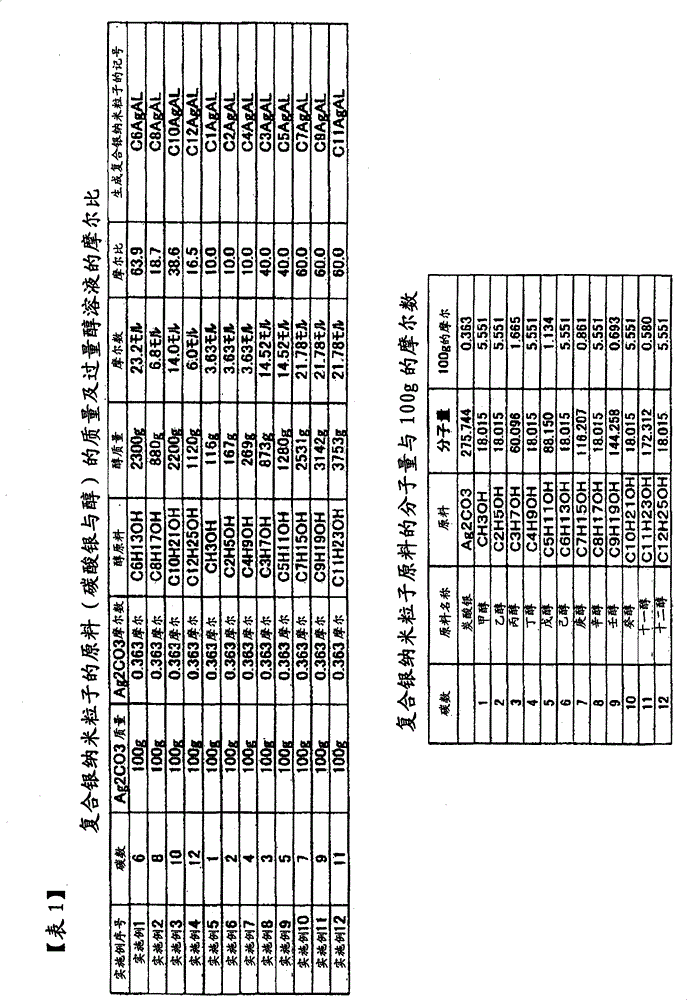
图3为本发明涉及的复合银纳米粒子的低温生成程序的详细流程图。在步骤n=1中,把规定量的市场销售的银盐用混合机加以细微化。市场销售的银盐的平均粒径为10μm,偏差极大。采用混合机使达到大致均匀的粒径10nm。在步骤n=2,使被细微化的银盐粉末于过量醇中分散。在步骤n=3,把银盐过量醇溶液与玻璃珠一起旋转,依次使银盐粒子磨碎加以超细微化。玻璃珠粒径和银盐超细微化粒径的关系如下表2所示。在步骤n=4,通过筛网回收玻璃珠。在步骤n=5,最终添加醇,配制过量的规定摩尔比的醇溶液。Fig. 3 is a detailed flowchart of the low-temperature generation procedure of the composite silver nanoparticles involved in the present invention. In step n=1, a predetermined amount of commercially available silver salt is miniaturized by a mixer. The average particle diameter of commercially available silver salts is 10 μm, and the variation is extremely large. A mixer was used to achieve a substantially uniform particle diameter of 10 nm. At step n=2, the micronized silver salt powder is dispersed in excess alcohol. In step n=3, the silver salt excess alcohol solution is rotated together with the glass beads, and the silver salt particles are ground and ultrafine in turn. The relationship between the particle size of the glass beads and the ultrafine particle size of the silver salt is shown in Table 2 below. At step n=4, the glass beads are recovered through a sieve. In step n=5, alcohol is finally added to prepare an excess alcohol solution with a specified molar ratio.
在步骤n=6,把超细微化银盐过量醇溶液放入反应容器,在步骤n=7,加热至规定温度。该规定温度对应于生成温度PT。在步骤n=8,于上述规定温度仅加热规定时间,生成CnAgAL。在步骤n=9,仅对CnAgAL溶液取规定量,在步骤10,使温度上升,于更高的生成温度生成CnAgAL。通过该反复操怍,制成各种生成温度的CnAgAL。萃取得到的CnAgAL溶液,在步骤n=11,立即用冰水急速冷却至0℃,使生成反应停止。在步骤n=12,从萃取容器加压过滤醇部分,在步骤n=13,生成的CnAgAL作为固体粉末回收。在步骤n=14,对作成的各种生成温度的CnAgAL进行各种测定。In step n=6, put the excess alcohol solution of ultrafine micronized silver salt into the reaction vessel, and in step n=7, heat to the specified temperature. This predetermined temperature corresponds to the generation temperature PT. In step n=8, CnAgAL is produced by heating at the above-mentioned predetermined temperature for a predetermined time. In step n=9, a predetermined amount of only the CnAgAL solution is taken, and in
表2为玻璃珠粒径与含Ag2CO3的银盐超细微化粒径的关系表。玻璃珠粒径愈小,超细微化粒径愈小,上述生成的CnAgAL粒径也变小。玻璃珠粒径以1mm至0.03mm存在,由此,则超细微化粒径可自由自在地控制在5000nm~10nm的范围。Table 2 is a relationship table between the particle size of glass beads and the ultrafine particle size of silver salt containing Ag 2 CO 3 . The smaller the particle size of the glass beads, the smaller the ultrafine particle size, and the smaller the particle size of the CnAgAL produced above. Glass beads have a particle size ranging from 1 mm to 0.03 mm, whereby the ultrafine particle size can be freely controlled within the range of 5000 nm to 10 nm.
【表2】【Table 2】
原料银盐粒径:粒径偏差在10μm以上Raw material silver salt particle size: the particle size deviation is above 10μm
用混合机加以细微化的银盐粒径:均匀的10μmParticle size of silver salt refined by mixer: uniform 10μm
细微化的银盐采用玻璃珠进行超细微化Micronized silver salt Ultrafine micronization using glass beads
(采用2000rpm公转与800rpm自转进行旋转)(rotate with 2000rpm revolution and 800rpm rotation)
图4为采用本发明涉及的复合银纳米粒子的制造装置,显示低温生成程序的制造装置详细流程图。该流程图对应于图5的制造装置的各制造阶段。在步骤s=1,把规定量的银盐粉末与过量醇加以混合,用混合机把银盐粒子细微化至均匀。在步骤s=2,银盐醇溶液用玻璃珠进行超细微化,用筛网过滤器除去玻璃珠。因此,在该阶段形成超细微化银盐醇溶液。在步骤s=3,把超细微化银盐醇溶液供给反应器,于生成温度仅加热规定时间(生成时间),生成CnAgAL。在这里,醇的碳原子数n处于n=1~12的范围。萃取过的醇溶液立即冷却,使生成反应停止。Fig. 4 is a detailed flow chart of the manufacturing device showing the low-temperature generation procedure using the manufacturing device of composite silver nanoparticles according to the present invention. This flowchart corresponds to each manufacturing stage of the manufacturing apparatus of FIG. 5 . In step s=1, a predetermined amount of silver salt powder is mixed with an excess amount of alcohol, and the silver salt particles are miniaturized to uniformity with a mixer. In step s=2, the silver salt alcohol solution is ultrafinely micronized with glass beads, and the glass beads are removed with a mesh filter. Therefore, an ultrafine micronized silver salt alcohol solution is formed at this stage. In step s=3, the ultra-fine micronized silver salt alcohol solution is supplied to the reactor, and it is only heated at the generation temperature for a predetermined time (generation time) to generate CnAgAL. Here, the carbon number n of the alcohol is in the range of n=1-12. The extracted alcoholic solution was cooled immediately to stop the formation reaction.
在步骤s=4,把生成的CnAgAL溶液供给成分精制器,进行离心超滤,制造CnAgAL精制液。在步骤s=5,上述醇溶液中的醇成分回收至醇分离容器,银盐回收至银盐分离容器。在步骤s=6,把上述CnAgAL精制液加以干燥,使萃取溶剂气化,回收CnAgAL粉末。在步骤s=7,对各生成温度的各种CnAgAL粒子进行各种测定。In step s=4, the produced CnAgAL solution is supplied to a component refiner, and subjected to centrifugal ultrafiltration to produce a CnAgAL purified solution. In step s=5, the alcohol component in the alcohol solution is recovered to the alcohol separation container, and the silver salt is recovered to the silver salt separation container. In step s=6, the above-mentioned CnAgAL refined liquid is dried, the extraction solvent is vaporized, and the CnAgAL powder is recovered. In step s=7, various measurements are performed on various CnAgAL particles at various production temperatures.
图5为本发明涉及的复合银纳米粒子的制造装置的构成图。该制造装置的各部分装置的功能,与图4所示的各步骤对应。超细微化器10由原料混合器11与超细微化容器12构成。把过量规定量的醇与规定量的银盐放入原料混合器11,其中安装了混合机。该细微化过量醇溶液沿箭头a方向,从投入口13供给超细微化容器12。超细微化容器12的内部,填充了许多玻璃珠17,通过内插至中心管14的旋转轴15,使旋转叶片16进行旋转,通过玻璃珠17,把上述银盐细微化粒子磨碎,银盐细微化粒子转变为银盐超细微化粒子。超细微化过量醇溶液沿箭头b方向供给反应器20。Fig. 5 is a configuration diagram of an apparatus for producing composite silver nanoparticles according to the present invention. The functions of each part of the manufacturing device correspond to each step shown in FIG. 4 . The
在反应器20,把超细微化过量醇溶液从原料供给口21供给反应管22,通过加热器23进行加热,CnAgAL于生成区域24中生成。再沿箭头c方向供给的、来自冷却器25的反应液,通过冷却区域26加以低温化,生成反应被急速停止。上述生成醇溶液从生成排出口27,沿箭头d方向供给成分精制器30。In the
成分精制器30包含外管31与中管32与内管34的三重管,中管32沿箭头e方向进行轴旋转,内管34沿箭头f方向进行轴旋转,外管31为不旋转的固定管。在内管34的周壁面上形成多个可通过CnAgAL大小的细微孔35。同时,在中管32的周壁面上形成多个可通过醇分子大小的超细微孔33。The
内通路36向内管34打开,内管34与中管32之间的间隙形成中通路37,另外,在中管32与外管31之间的间隙,形成外通路38。向中通路36供给使CnAgAL扩散分散的己烷等萃取溶剂HE。向中通路37,把从生成排出口27送出的生成醇溶液,沿箭头d方向供给。The
生成醇溶液中含有生成的复合银纳米粒子CnAgAL与未反应银盐与醇。质量最轻的醇分子用离心力,通过超细微孔33,移至外通路38。CnAgAL通过细微孔35,扩散至内通路36的萃取溶剂HE。未反应银盐原样留在中通路37。The generated alcohol solution contains the generated composite silver nanoparticles CnAgAL, unreacted silver salt and alcohol. The alcohol molecules with the lightest mass move to the
中间分离器40由醇分离容器42与银盐分离容器41构成。从外通路38流出的醇,由醇分离容器42回收,从中通路37流出的未反应银盐,由银盐分离容器41回收。从内通路36流出的含CnAgAL的萃取溶剂,沿箭头h方向供给粉末回收器50。The
CnAgAL萃取溶液,从喷雾器51,向干燥器52作为雾53喷出,萃取溶剂发生蒸发,使CnAgAL变成粉末。CnAgAL粉末,从漏斗54,通过回收管55,回收至粉末回收容器56中。The CnAgAL extraction solution is sprayed from the sprayer 51 to the drier 52 as a
图6为图5的制造装置的成分精制器的精制方法图。向中通路37供给的生成醇溶液AS,为银盐AG与复合银纳米粒子CA与醇分子AL的混合溶液。向内通路36供给萃取溶剂HE。中通路37的物质通过强大的离心力,把质量最轻的醇分子AL从超细微孔33排至外通路38。复合银纳米粒子CA,从细微孔35向萃取溶剂HE扩散浸透。其结果是,从内通路36把含复合银纳米粒子CA的萃取溶液排出,从中通路37把未反应银盐AG排出,从外通路38把醇AL排出。因此,3种物质被分离回收。FIG. 6 is a diagram showing a refining method of a component refiner of the manufacturing apparatus of FIG. 5 . The generated alcohol solution AS supplied to the
实施例1:C6AgALExample 1: C6AgAL
表3涉及C6AgAL,从实验得到的测定数据等,作为:“低温生成反应中的C6AgAL的生成量”、“C6AgAL在低温生成中的各物质量的质量”及“C6AgAL的生成温度与特性温度的关系”汇总于表中。“低温生成反应中的C6AgAL的生成量”,如表所示,记载了各生成温度涉及的C6AgAL的生成时间及生成量的详细实验数据。“C6AgAL的低温生成中的各物质量的质量”,记载了在上述各生成温度(70℃、80℃、90℃、100℃、111.5℃),生成物中含有的碳酸银与C6AgAL的质量比以及C6AgAL含有的有机成分与Ag的质量比。在这里,把生成物或C6AgAL的总质量作为1。在“C6AgAL的生成温度与特性温度的关系”中记载了上述各生成温度PT(℃)生成的C6AgAL的TG开始减少温度T1(℃)、DTA峰温度T2(℃)及金属化温度T3(℃)。Table 3 relates to C6AgAL, measured data obtained from experiments, etc., as: "the amount of C6AgAL produced in the low-temperature production reaction", "the mass of each substance in the low-temperature production of C6AgAL" and "the relationship between the production temperature and characteristic temperature of C6AgAL relationship" is summarized in the table. "C6AgAL production amount in low-temperature production reaction", as shown in the table, describes the detailed experimental data of the production time and production amount of C6AgAL at each production temperature. "The mass of each substance in the low-temperature formation of C6AgAL" describes the mass ratio of silver carbonate contained in the product to C6AgAL at each of the above-mentioned formation temperatures (70°C, 80°C, 90°C, 100°C, and 111.5°C) And the mass ratio of organic components contained in C6AgAL to Ag. Here, let the total mass of the product or C6AgAL be 1. In "The relationship between the formation temperature of C6AgAL and the characteristic temperature", the TG start decrease temperature T1 (°C), DTA peak temperature T2 (°C) and metallization temperature T3 (°C) of C6AgAL formed at each of the above formation temperatures PT (°C) are described. ).
因此,生成温度PT为自由可变,当生成温度PT增加时,相当于TG开始减少温度的分解开始温度T1、相当于DTA第1峰温度的分解温度T2、相当于TG减少终止温度或DTA最终峰终止温度的金属化温度T3,呈现依次增加的倾向。因此,设定生成温度PT,以使分解温度T2达到150℃以下,复合银纳米粒子可边自由自在地设计边制造。金属化温度T3仅比分解温度T2上升数℃。在热解析中,TG曲线,在热重量测定曲线中,重量减少用%表示,TG曲线开始减少,显示有机物从有机被覆层逸散。因此,TG开始减少温度,即分解开始温度T1相当于有机物的分解开始温度。DTA曲线,在差示热分析曲线中,发热用μV表示。DTA曲线上升,表示因分解反应而发热,DTA曲线减少,表示冷却。当DTA曲线形成峰时,在该峰温度的分解发热达到最大,表示分解反应达到了高峰。当DTA峰存在多个时,从DTA第1峰温度定义分解温度。DTA峰中的DTA最终峰,在有机被覆层逸散后,裸露的银核彼此结合的结合能的放出峰,对此本发明人已进行了考察。因此,DTA第1峰温度T2,表示有机物的分解以最高速进行的分解温度。当有机物完全逸散,发热停止时,上述峰急速降低,下降的温度相当于金属化(银化)温度T3。即,在分解温度T2,TG曲线急速降低,有机物总量逸散的结果是,在金属化温度T3,TG曲线收敛为一定值。通过上述DTA峰后,DTA曲线发生增减,或TG曲线减少时,表示复合银纳米粒子以外的别的反应产生,必需个别进行分析。不管怎样,DTA曲线上出现的DTA第1峰表示复合银纳米粒子中有机被覆层的分解逸散。Therefore, the generation temperature PT is freely variable. When the generation temperature PT increases, the decomposition start temperature T1 corresponding to the temperature at which TG begins to decrease, the decomposition temperature T2 corresponding to the first peak temperature of DTA, the temperature corresponding to the end temperature of TG reduction or the final temperature of DTA The metallization temperature T3 of the peak termination temperature tends to increase sequentially. Therefore, the generation temperature PT is set so that the decomposition temperature T2 becomes 150° C. or lower, and the composite silver nanoparticles can be freely designed and produced. The metallization temperature T3 is only a few degrees Celsius higher than the decomposition temperature T2. In thermal analysis, the TG curve, in the thermogravimetry curve, the weight loss is expressed in %, and the TG curve begins to decrease, showing the escape of organic matter from the organic coating. Therefore, the temperature at which TG begins to decrease, that is, the decomposition initiation temperature T1 corresponds to the decomposition initiation temperature of organic matter. DTA curve, in the differential thermal analysis curve, heat generation is represented by μV. An increase in the DTA curve indicates heat generation due to decomposition reactions, and a decrease in the DTA curve indicates cooling. When the DTA curve forms a peak, the decomposition heat at this peak temperature reaches the maximum, indicating that the decomposition reaction has reached a peak. When there are multiple DTA peaks, the decomposition temperature is defined from the first DTA peak temperature. Among the DTA peaks, the last peak of DTA is a release peak of binding energy of exposed silver cores after the organic coating layer has dissipated, and the present inventors have examined this. Therefore, the first peak temperature T2 of DTA indicates the decomposition temperature at which the decomposition of organic matter proceeds at the highest rate. When the organic matter is completely dissipated and the heat generation stops, the above-mentioned peak decreases rapidly, and the falling temperature corresponds to the metallization (silverization) temperature T3. That is, at the decomposition temperature T2, the TG curve drops rapidly, and as a result of the total amount of organic matter dissipating, the TG curve converges to a constant value at the metallization temperature T3. After passing the above DTA peak, if the DTA curve increases or decreases, or the TG curve decreases, it means that other reactions other than composite silver nanoparticles have occurred, and individual analysis is necessary. In any case, the first DTA peak appearing on the DTA curve indicates the decomposed dissipation of the organic coating layer in the composite silver nanoparticles.
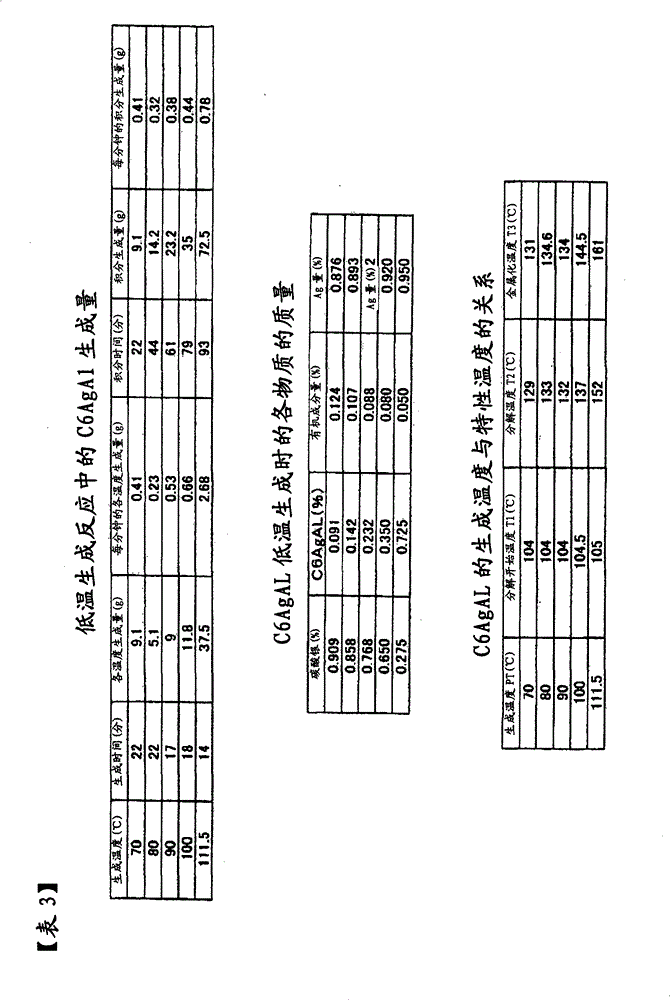
图7为本发明涉及的C6AgAL的生成量与生成温度的关系图。纵轴为C6AgAL的生成量(g),表3示出的各温度生成量(g)用黑菱形、每1分钟的各温度生成量(g)用黑圆、积分生成量(g)用黑三角表示,对各生成温度PT(℃)作图。从图可知,即使在100℃以下也可以生成C6AgAL,本发明涉及的复合银纳米粒子可以确认在低温生成。Fig. 7 is a graph showing the relationship between the amount of C6AgAL produced and the production temperature involved in the present invention. The vertical axis is the production amount (g) of C6AgAL. The production amount (g) at each temperature shown in Table 3 is represented by black diamonds, the production amount (g) at each temperature per minute is represented by black circles, and the integral generation amount (g) is represented by black circles. Triangles indicate that each generation temperature PT (° C.) is plotted. As can be seen from the figure, C6AgAL can be produced even at 100° C. or lower, and it can be confirmed that the composite silver nanoparticles according to the present invention are produced at low temperatures.
图8为本发明涉及的C6AgAL的物质成分(%)与生成温度的关系图。即,图8是表3的“C6AgAL低温生成中的各物质量的质量”中记载的碳酸银与C6AgAL的质量比(%),对生成温度PT(℃),分别用黑圆与黑四角作图,C6AgAL中含有的有机成分量与Ag量的质量比(%),对生成温度PT(℃),分别用黑菱形与黑三角作图。伴随着生成温度的上升,碳酸银的质量比(黑圆)减少,C6AgAL的质量比(黑四角)增大,以碳酸银作原料生成6AgAL得到解决。特别是可以确认,既使在100℃以下的生成温度,也生成C6AgAL,本发明涉及的复合银纳米粒子以碳酸银作为原料可于低温生成。另外已知,生成的C6AgAL,即使于低温生成,Ag量的比例(黑三角)也高,生成了适宜的复合银纳米粒子。因此,可以证明,本发明涉及的复合银纳米粒子,金属含有率高,作为代替焊锡是优选的材料。Fig. 8 is a graph showing the relationship between the material composition (%) and the formation temperature of C6AgAL according to the present invention. That is, Fig. 8 shows the mass ratio (%) of silver carbonate and C6AgAL recorded in "The mass of each substance in the low-temperature formation of C6AgAL" in Table 3, and the formation temperature PT (°C) is represented by black circles and black squares, respectively. In the figure, the mass ratio (%) of the amount of organic components contained in C6AgAL to the amount of Ag, and the formation temperature PT (° C.), are plotted with black diamonds and black triangles, respectively. With the increase of the formation temperature, the mass ratio of silver carbonate (black circle) decreases, and the mass ratio of C6AgAL (black square) increases, and the formation of 6AgAL with silver carbonate as raw material is solved. In particular, it was confirmed that C6AgAL is produced even at a production temperature of 100° C. or lower, and that the composite silver nanoparticles according to the present invention can be produced at low temperatures using silver carbonate as a raw material. In addition, it is known that the produced C6AgAL has a high proportion of Ag (black triangle) even when produced at low temperature, and it is known that suitable composite silver nanoparticles are produced. Therefore, it can be proved that the composite silver nanoparticles according to the present invention have a high metal content and are suitable as a substitute for solder.
图9~图13分别为本发明涉及的生成温度PT=70℃、80℃、90℃、100℃、110℃时的C6AgAL升温速度VT=1℃/min的热解析图。图中的箭头PT为生成温度(℃)、T1为分解开始温度(℃)、T2为分解温度、T3为金属化温度(℃),这些的具体的温度,记载在表3的“C6AgAL的生成温度与特性温度的关系”中,从图9~图13的热解析也可估计。作为代表,用图9进行说明,从差示热分析(differential thermalanalysis;DTA)可知,当比分解开始温度T1高时,C6AgAL的有机被覆层发生分解,放热量明确增大。另外,在分解温度T2,通过有机被覆层的分解呈现放热量的峰值。这些结果与热重量测定(thermogravimetry;TG)完全一致,在比分解开始温度T1的高温侧,通过有机被覆层的分解而质量减少。在上述DTA最终峰下降的金属化温度T3,有机被覆层的总量发生逸散,复合银纳米粒子的银核彼此结合,完成了银化。Figures 9 to 13 are thermal analysis diagrams of C6AgAL temperature rise rate VT=1°C/min at the formation temperatures PT=70°C, 80°C, 90°C, 100°C, and 110°C in the present invention, respectively. The arrow PT in the figure is the formation temperature (°C), T1 is the decomposition start temperature (°C), T2 is the decomposition temperature, and T3 is the metallization temperature (°C). The relationship between temperature and characteristic temperature" can also be estimated from the thermal analysis of Fig. 9 to Fig. 13. Referring to FIG. 9 as a representative example, it can be seen from differential thermal analysis (DTA) that when the decomposition start temperature T1 is higher than the decomposition start temperature T1, the organic coating layer of C6AgAL decomposes, and the heat release increases significantly. In addition, at the decomposition temperature T2, the peak value of the amount of heat released by the decomposition of the organic coating layer appears. These results are completely consistent with thermogravimetry (TG), and the mass decreases due to the decomposition of the organic coating layer on the higher side than the decomposition start temperature T1. At the metallization temperature T3 at which the final peak of DTA falls, the total amount of the organic coating layer dissipates, and the silver cores of the composite silver nanoparticles combine with each other to complete silverization.
在图9~图11中,DTA峰为单一峰,在图12~图13中,DTA峰变成双峰。如上所述,DTA第1峰,为急速分解产生的分解峰,DTA最终峰即DTA第2峰,考虑是裸露的银核彼此的结合能峰,则理解容易。实际上,既使在图9~图11中,也存在DTA第1峰与DTA第2峰,可以认为是由于互相接近,通过迭加仅见到单一峰。In FIGS. 9 to 11, the DTA peak is a single peak, and in FIGS. 12 to 13, the DTA peak becomes a double peak. As described above, the first peak of DTA is a decomposition peak caused by rapid decomposition, and the second peak of DTA, which is the last peak of DTA, is easy to understand considering that it is a peak of binding energy between exposed silver nuclei. In fact, even in FIGS. 9 to 11 , there are DTA 1st peak and DTA 2nd peak, and it is considered that only a single peak can be seen by superposition because they are close to each other.
另外,如图12所示,在DTA第1峰温度T2,呈现伴随着金属化的放热量大的峰值,对TG也见到凹处。另外,在上述DTA最终峰降低的金属化温度T3,TG变成一定值。然后,TG缓慢减少,可以认为是作为杂质的碳酸银的有机物减少所致。还有,在图12~图13中,DTA第1峰连续而出现DTA最终峰,该第1峰的DTA第1峰温度T2与金属化温度T3,可作为特性温度估计。如图9~图12所示,当生成温度PT处于70℃~100℃的范围时,分解温度T2与金属化温度T3,全部在150℃以下。然而,分解开始温度T1,包含在分解温度T2的下侧60℃以内。即,如采用在100℃以下的生成温度得到的C6AgAL,则在150℃以下,含有的有机物发生分解,可提供被金属化的理想的代替焊锡材料。另外,在图13中,分解温度T2与金属化温度T3分别为T2=153℃与T3=161℃,仅稍高于150℃,可作为代替焊锡材料。另外,T1=105℃,TG开始减少温度T1包含在DTA峰温度T2的下侧60℃以内。In addition, as shown in FIG. 12 , at the first peak temperature T2 of DTA, a peak with a large amount of heat release due to metallization appears, and a depression is also seen at TG. In addition, at the metallization temperature T3 at which the final peak of DTA decreases, TG becomes a constant value. Then, TG gradually decreased, which is considered to be due to the decrease of organic matter of silver carbonate as an impurity. In addition, in Fig. 12 to Fig. 13, the DTA first peak continues and the DTA final peak appears, and the DTA first peak temperature T2 and metallization temperature T3 of the first peak can be estimated as the characteristic temperature. As shown in FIGS. 9 to 12 , when the generation temperature PT is in the range of 70°C to 100°C, the decomposition temperature T2 and the metallization temperature T3 are all below 150°C. However, the decomposition start temperature T1 is included within 60°C lower than the decomposition temperature T2. That is, if C6AgAL obtained at a formation temperature below 100°C is used, the organic matter contained therein will be decomposed at below 150°C, and an ideal alternative solder material that is metallized can be provided. In addition, in Fig. 13, the decomposition temperature T2 and the metallization temperature T3 are T2 = 153°C and T3 = 161°C, respectively, which are only slightly higher than 150°C, which can be used as a substitute solder material. In addition, T1 = 105°C, and the TG decrease start temperature T1 is included within 60°C below the DTA peak temperature T2.
实施例2:C8AgALExample 2: C8AgAL
表4中记载了C8AgAL的低温生成中的脂质团吸收与醛吸收的测定结果。边使反应管内的温度上升边于各温度采取试样,测定纳米粒子脂质团的吸收峰(波长:410nm)与醛吸收(波长:290nm)的光学浓度(O.D.)。反应时间为达到各温度的时间,相当于C8AgAL的生成时间。另外,纳米粒子脂质团的峰位置相当于纳米粒子中表面脂质团的共振能。Table 4 shows the measurement results of lipid mass absorption and aldehyde absorption in the low-temperature production of C8AgAL. Samples were collected at each temperature while increasing the temperature in the reaction tube, and the optical density (O.D.) of the absorption peak (wavelength: 410nm) and aldehyde absorption (wavelength: 290nm) of the nanoparticle lipid cluster was measured. The reaction time is the time to reach each temperature, and corresponds to the generation time of C8AgAL. In addition, the peak position of the nanoparticle lipid cluster corresponds to the resonance energy of the surface lipid cluster in the nanoparticle.
【表4】【Table 4】
C8AgAL低温生成时的胞质团吸收与醛吸收的测定Determination of Plasmoplasmic Uptake and Aldehyde Uptake of C8AgAL Produced at Low Temperature
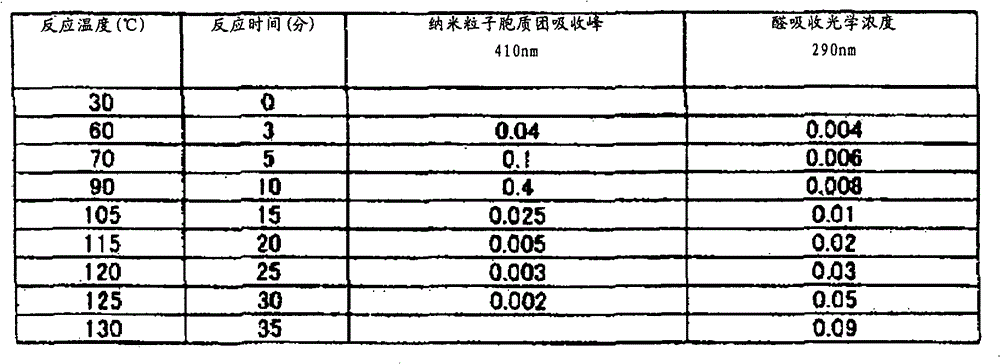
图14为本发明涉及的C8AgAL的吸收强度与生成时间的关系图。该图是,表4中记载的吸收强度与反应温度(生成温度)对反应时间作图,纳米粒子脂质团的吸收强度用黑圆表示,醛光学浓度用黑菱形表示。如图2的说明所述,碳酸银微粒子表面的碳酸银与醇进行反应,在银化的同时生成醛Rn-1CHO,通过醛的强大的还原作用,碳酸银被还原、银化的同时,形成羧酸Rn-1COOH。中间生成的Ag、AgORn、Rn-1COOH互相发生凝聚,生成复合银纳米粒子。在图14中,已知在最初的10分钟,纳米粒子脂质团的吸收强度急激增大,纳米粒子急速成长。另一方面,醛光学浓度缓慢增加,如上所述,已知与醇反应产生的碳酸银在银化的同时,通过生成的醛的还原反应,使碳酸银的银化增强,在短时间内可高效生成复合银纳米粒子。另外,于生成时间10分钟的生成温度(反应温度)为90℃,在100℃以下,复合银纳米粒子可高效率生成,从该测定也得到证明。还有,纳米粒子脂质团吸收强度的减少,可以认为是由于凝聚、生成的复合银纳米粒子的增加所致。Fig. 14 is a graph showing the relationship between the absorption intensity and the generation time of C8AgAL involved in the present invention. This figure is a plot of the absorption intensity and the reaction temperature (generation temperature) described in Table 4 against the reaction time. The absorption intensity of the nanoparticle lipid cluster is represented by black circles, and the optical concentration of aldehyde is represented by black diamonds. As described in Figure 2, silver carbonate on the surface of silver carbonate microparticles reacts with alcohol to form aldehyde R n-1 CHO at the same time as silverization. Through the strong reduction of aldehyde, silver carbonate is reduced and silverized at the same time , forming the carboxylic acid R n-1 COOH. Ag, AgOR n , and R n-1 COOH generated in the middle coagulate with each other to form composite silver nanoparticles. In FIG. 14 , it is known that in the first 10 minutes, the absorption intensity of the nanoparticle lipid cluster increases rapidly, and the nanoparticle grows rapidly. On the other hand, the optical concentration of aldehyde increases slowly. As mentioned above, it is known that the silver carbonate produced by the reaction with alcohol is silverized, and the reduction reaction of the generated aldehyde strengthens the silverization of silver carbonate, which can be achieved in a short time. Efficient generation of composite silver nanoparticles. In addition, the generation temperature (reaction temperature) at a generation time of 10 minutes was 90° C., and composite silver nanoparticles can be efficiently generated at a temperature of 100° C. or lower, as evidenced by this measurement. Also, the decrease in the absorption strength of the nanoparticle lipid clusters is considered to be due to the increase in aggregation and formation of composite silver nanoparticles.
另外,在实施例1的C6AgAL中也进行纳米粒子脂质团吸收强度与醛光学浓度的测定,但由于与实施例2得到同样的结果,故测定结果的记载省略。另外,在实施例2涉及的热分析中,得到与实施例1同样的结果,可以确认100℃以下的复合银纳米粒子的生成。另外,可以确认,DTA峰温度T2在150℃以下,TG开始减少温度T1也在上述T2的下侧60℃以内存在,还可以确认,有机被膜层的分解及金属化于150℃以内发生。In addition, in the C6AgAL of Example 1, the absorption intensity of nanoparticle lipid clusters and the optical concentration of aldehydes were also measured, but since the same results were obtained as in Example 2, the description of the measurement results is omitted. In addition, in the thermal analysis related to Example 2, the same results as in Example 1 were obtained, and it was confirmed that composite silver nanoparticles were formed at 100° C. or lower. In addition, it was confirmed that the DTA peak temperature T2 was 150°C or lower, and the TG decrease start temperature T1 was also within 60°C below T2, and it was also confirmed that the decomposition and metallization of the organic film layer occurred within 150°C.
实施例3:C10AgALExample 3: C10AgAL
图15为显示本发明涉及的C10AgAL生成的光学浓度与表面脂质团迁移区域的光子能量的关系图。既使涉及C10AgAL,与实施例2同样,在表面脂质团迁移区域进行光学测定,如图所示,测定伴随着温度的上升,纳米粒子的表面脂质团引起的吸收强度的增大。在C10AgAL生成时,在生成时间17分钟、生成温度81.9℃的光谱中,由于表面脂质团的作用,吸收达到最大。Fig. 15 is a graph showing the relationship between the optical concentration generated by C10AgAL and the photon energy in the migration region of the surface lipid group involved in the present invention. Even for C10AgAL, as in Example 2, the optical measurement was carried out in the migration region of surface lipid clusters, and as shown in the figure, the increase in absorption intensity due to the surface lipid clusters of nanoparticles along with the temperature rise was measured. When C10AgAL was formed, the absorption reached the maximum due to the effect of the surface lipid group in the spectrum of the generation time of 17 minutes and the generation temperature of 81.9°C.
图16为本发明涉及的C10AgAL的生成试验中,显示醛生成的光学浓度与光子能量的关系图。碳酸银微粒子表面的碳酸银与醇发生反应、在银化的同时生成醛,测定伴随着温度的上升及生成时间的增大,醛引起的吸收强度的增大。即,在经过时间17分钟、生成温度81.9℃时,醛吸收达到最大,证明通过醛促进碳酸银的还原。Fig. 16 is a graph showing the relationship between the optical concentration of aldehyde and the photon energy in the C10AgAL production test according to the present invention. The silver carbonate on the surface of the silver carbonate microparticles reacts with alcohol to form aldehydes at the same time as silverization, and the increase in absorption intensity due to the aldehydes is measured as the temperature rises and the generation time increases. That is, the aldehyde absorption reached the maximum when the elapsed time was 17 minutes and the generation temperature was 81.9° C., which proves that the reduction of silver carbonate is promoted by aldehyde.
图17为本发明涉及的C10AgAL的吸收强度与生成温度的关系图。该图为图15及图16所示的表面脂质团的吸收强度用黑圆、醛光学浓度用黑四角,对生成温度作图。从该图可知,在生成温度PT达到100℃前,表面脂质团的吸收强度急激增大,醛吸收增大。即,如上所述,通过与醇反应的碳酸银的银化,同时因生成的醛引起的还原反应,使碳酸银的银化增强,在100℃以下可高效率生成复合银纳米粒子。Fig. 17 is a graph showing the relationship between the absorption intensity and the formation temperature of C10AgAL according to the present invention. 15 and 16, the absorption intensity of surface lipid clusters shown in FIG. 15 and FIG. 16 is plotted with black circles and aldehyde optical concentration with black squares, plotted against the formation temperature. It can be seen from the figure that before the generation temperature PT reaches 100°C, the absorption intensity of the surface lipid group increases sharply, and the aldehyde absorption increases. That is, as described above, the silverization of silver carbonate reacted with alcohol and the reduction reaction caused by the generated aldehyde strengthen the silverization of silver carbonate, and composite silver nanoparticles can be efficiently produced at 100° C. or lower.
表5为“C10AgAL的脂质团吸收的生成温度-生成时间依赖性”与“C10AgAL的醛吸收的生成温度-生成时间依赖性”的一览表。反应容器的温度(生成温度)依次上升,测定脂质团吸收与醛吸收。Table 5 is a list of "generation temperature-generation time dependence of lipid mass absorption by C10AgAL" and "generation temperature-generation time dependence of aldehyde absorption by C10AgAL". The temperature of the reaction vessel (generation temperature) was increased sequentially, and the lipid mass absorption and aldehyde absorption were measured.
【表5】【table 5】
C10AgAL的胞质团吸收的生成温度·生成时间依赖性Formation temperature and time dependence of cytoplasmic uptake by C10AgAL
C10AgAL的醛吸收的生成温度·生成时间依赖性Formation temperature and time dependence of aldehyde absorption in C10AgAL
图18为本发明涉及的C10AgAL的吸收强度与生成时间的关系图。该图是表5所示的表面脂质团的吸收强度用黑圆、醛光学浓度用黑菱形,对生成时间作图。表面脂质团的吸收强度与醛吸收急激增大,生成时间在17分钟时达到最大,通过与醇的反应,在碳酸银银化的同时,通过生成的醛的还原反应,于短时间,碳酸银的银化可高效率进行。可以确认,生成温度PT在100℃以下,C10AgAL的生成在数十分钟以内急速产生。Fig. 18 is a graph showing the relationship between the absorption intensity and the generation time of C10AgAL according to the present invention. This figure shows the absorption intensity of the surface lipid groups shown in Table 5 with black circles and the aldehyde optical concentration with black diamonds, plotted against the generation time. The absorption intensity of the surface lipid groups and the absorption of aldehydes increase sharply, and the generation time reaches the maximum at 17 minutes. Through the reaction with alcohol, silver carbonate is silverized, and the reduction reaction of the generated aldehydes, in a short time, carbonic acid Silverization of silver can be performed efficiently. It was confirmed that when the formation temperature PT was 100° C. or lower, the formation of C10AgAL occurred rapidly within several tens of minutes.
图19为在90℃生成的C10AgAL的高分辨率透射型电子显微镜图。在透射型电子显微镜像的放大图中,可明确看到银纳米粒子的银核的晶格图像,结晶性极高得到证明。从这些晶格图像已知,银核为几乎单晶化。通过该高度结晶性,可得到本发明的复合银纳米粒子具有高导电性与高导热性的结论。还有,复合银纳米粒子的有机被覆层,由于不能用透过电子显微镜进行观察,在图中未见到,但从上述实验结果可明确已知,已形成了有机被覆层。另外,测定3000个复合银纳米粒子的直径,估计平均粒径D为D=4.5±1(nm),已知得到了理想尺寸的复合银纳米粒子。Fig. 19 is a high-resolution transmission electron micrograph of C10AgAL produced at 90°C. In the magnified view of the transmission electron microscope image, the crystal lattice image of the silver core of the silver nanoparticles can be clearly seen, and it is proved that the crystallinity is extremely high. From these lattice images, it is known that the silver core is almost single crystallized. From this high degree of crystallinity, it can be concluded that the composite silver nanoparticles of the present invention have high electrical conductivity and high thermal conductivity. In addition, the organic coating layer of composite silver nanoparticles is not seen in the figure because it cannot be observed with a transmission electron microscope, but it is clearly known from the above experimental results that an organic coating layer has been formed. In addition, the diameters of 3000 composite silver nanoparticles were measured, and the average particle diameter D was estimated to be D=4.5±1 (nm), and it was known that composite silver nanoparticles of ideal size were obtained.
实施例4:C12AgALExample 4: C12AgAL
图20为126℃生成的C12AgAL的透过电子显微镜图。对C12AgAL也观察了透射型电子显微镜像,在其放大图中,可明确见到银纳米粒子的晶格图像,已知形成高度的结晶化。从该晶格图像可以判断几乎为单晶。通过其单晶性,可得到本发明的复合银纳米粒子具有高导电性与高导热性的结论。Fig. 20 is a transmission electron microscope image of C12AgAL produced at 126°C. The transmission electron microscope image was also observed for C12AgAL, and the lattice image of silver nanoparticles can be clearly seen in the enlarged image, and it is known that a high degree of crystallization is formed. From this lattice image, it can be judged that it is almost a single crystal. Through its single crystallinity, it can be concluded that the composite silver nanoparticles of the present invention have high electrical conductivity and high thermal conductivity.
测定3000个复合银纳米粒子的直径,估计平均粒径D为D=3±1(nm)。C12AgAL的生成温度为126℃,超过100℃,可以得到D=3±1(nm)的极小粒径的复合银纳米粒子。The diameters of 3000 composite silver nanoparticles were measured, and the average particle diameter D was estimated to be D=3±1 (nm). The formation temperature of C12AgAL is 126° C., and exceeding 100° C., it is possible to obtain composite silver nanoparticles with an extremely small particle diameter of D=3±1 (nm).
图21为图20中所示的C12AgAL的粒径分布图。如上所述,测定3000个复合银纳米粒子的直径,估计平均粒径D,可以认为粒径分布符合高斯分布,从该分布也可估计平均粒径D为D=3±1(nm)。FIG. 21 is a particle size distribution graph of C12AgAL shown in FIG. 20 . As mentioned above, the diameters of 3000 composite silver nanoparticles were measured, and the average particle diameter D was estimated. It can be considered that the particle size distribution conforms to the Gaussian distribution. From this distribution, the average particle diameter D can also be estimated as D=3±1 (nm).
实施例5:C1AgALExample 5: C1AgAL
图22为本发明涉及的生成温度PT=59℃的C1AgAL的热解析图(VT=1℃/min)。与实施例1同样,从TG及DTA估计分解开始温度T1(℃)、分解温度T2(℃)及金属化温度T3(℃)为T1=70℃、T2=123℃、T3=141℃。既使就C1AgAL来说,也可知于100℃以下生成C1AgAL的同时,在150℃以下,有机被膜层等有机成分被分解,进一步被金属化。由于T2-T1=53(℃),TG开始减少温度T1处于DTA峰温度T2的下方60℃以内。上述60℃作为含有该53℃的临界值而设定。如C1AgAL那样,当为碳原子数少的复合银纳米粒子时,银的含有率高,可用作有机成分少的代替焊锡材料或图案材料的金属原材料。Fig. 22 is a thermal analysis diagram (VT = 1°C/min) of C1AgAL having a formation temperature PT = 59°C according to the present invention. As in Example 1, the decomposition start temperature T1 (°C), decomposition temperature T2 (°C) and metallization temperature T3 (°C) are estimated from TG and DTA as T1 = 70°C, T2 = 123°C, and T3 = 141°C. Also for C1AgAL, it can be seen that at 100°C or lower, C1AgAL is formed, and at 150°C or lower, organic components such as an organic film layer are decomposed and further metallized. Since T2-T1=53 (°C), the TG decrease start temperature T1 is within 60°C below the DTA peak temperature T2. The aforementioned 60°C is set as a critical value including this 53°C. Like C1AgAL, when it is a composite silver nanoparticle with few carbon atoms, the silver content rate is high, and it can be used as a metal raw material which replaces a solder material or a pattern material with few organic components.
实施例6:C2AgALExample 6: C2AgAL
图23为本发明涉及的生成温度PT=65℃的C2AgAL的热解析图(VT=1℃/min)。如图所示,既使就碳原子数少的C2AgAL来说,也从TG及DTA测定分解开始温度T1(℃)、分解温度T2(℃)及金属化温度T3(℃),估计T1=109℃、T2=111℃、T3=115℃。但是,于100℃以下生成的C2AgAL,在150℃以下,该有机被膜层等有机成分被分解,进行金属化,已被实验确认。另外,从T2-T1=2(℃)已知,TG开始减少温度T1处于DTA峰温度T2的下方60℃以内。Fig. 23 is a thermal analysis diagram (VT = 1°C/min) of C2AgAL at a production temperature PT = 65°C according to the present invention. As shown in the figure, even for C2AgAL with a small number of carbon atoms, the decomposition start temperature T1 (°C), decomposition temperature T2 (°C) and metallization temperature T3 (°C) were measured from TG and DTA, and it is estimated that T1 = 109 °C, T2=111°C, T3=115°C. However, it has been experimentally confirmed that in C2AgAL produced at 100°C or lower, organic components such as the organic film layer are decomposed and metallized at 150°C or lower. In addition, it is known from T2-T1=2(°C) that the TG decrease start temperature T1 is within 60°C below the DTA peak temperature T2.
图24为于65℃生成的C2AgAL的透射型电子显微镜图。对C2AgAL观察透射型电子显微镜像,在其放大图中可明确见到银纳米粒子的晶格图像,已知发生高度结晶化。从该晶格图像可以判断几乎为单晶。晶格图像的面间隔为0.24nm。当从整体银结晶的晶格图常数a=0.40862nm进行计算时,(111)面的面间隔为
实施例7:C4AgALExample 7: C4AgAL
图25为本发明涉及的生成温度PT=80℃的C4AgAL的热解析图。就C4AgAL来说,从TG及DTA测定分解开始温度T1(℃)、分解温度T2(℃)及金属化温度T3(℃),估计T1=103℃、T2=120℃、T3=122℃。从以上的结果可知,于100℃以下生成的C4AgAL,在150℃以下,该有机被膜层等有机成分被分解、金属化已为实验确认。另外,从T2-T1=17(℃)也可以确认,TG开始减少温度T1处于DTA峰温度T2的下方60℃以内。Fig. 25 is a thermal analysis diagram of C4AgAL having a production temperature PT = 80°C according to the present invention. For C4AgAL, the decomposition start temperature T1 (°C), decomposition temperature T2 (°C) and metallization temperature T3 (°C) are measured from TG and DTA, and it is estimated that T1 = 103°C, T2 = 120°C, and T3 = 122°C. From the above results, it has been confirmed experimentally that organic components such as the organic coating layer are decomposed and metallized at temperatures below 150°C for C4AgAL produced at temperatures below 100°C. Also, from T2-T1=17 (°C), it can be confirmed that the TG decrease start temperature T1 is within 60°C below the DTA peak temperature T2.
图26为于80℃生成的C4AgAL的透射型电子显微镜图。对C4AgAL观察透射型电子显微镜像,在其放大图中可明确见到银纳米粒子的晶格图像,已知发生高度结晶化。晶格图像的面间隔为0.24nm。与整体银结晶的(111)面的面间隔d=0.24nm一致,已知上述晶格图像为(111)面。可以判断,上侧的银核为单晶,下侧的银核为单晶或双晶。由于其高度结晶性,可以得到本发明的复合银纳米粒子具有高导电性与高导热性的结论。Fig. 26 is a transmission electron micrograph of C4AgAL produced at 80°C. The transmission electron microscope image of C4AgAL is observed, and the lattice image of silver nanoparticles is clearly seen in the enlarged image, which is known to be highly crystallized. The plane interval of the lattice image was 0.24 nm. It is known that the above-mentioned lattice pattern is a (111) plane, which corresponds to the interplanar spacing d=0.24 nm of the (111) plane of the overall silver crystal. It can be judged that the silver nucleus on the upper side is a single crystal, and the silver nucleus on the lower side is a single crystal or twin crystal. Due to its high crystallinity, it can be concluded that the composite silver nanoparticles of the present invention have high electrical conductivity and high thermal conductivity.
实施例8:C3AgALExample 8: C3AgAL
对生成温度PT=88℃的C3AgAL进行热解析。从TG及DTA测定分解开始温度T1(℃)、分解温度T2(℃)及金属化温度T3(℃),得到T1=112℃、T2=129℃、T3=132℃。因此,于100℃以下生成的C3AgAL,在150℃以下,其有机被膜层等有机成分被分解、金属化,已被实验确认。另外,由于T2-T1=17(℃),已知TG开始减少温度T1处于DTA峰温度T2的下方60℃以内。另外,采用高分辨率透射型电子显微镜,对C3AgAL粒子的银核也观察到晶格图像。由于与上述同样,故TG·DTA曲线与电子显微镜图省略。Thermal analysis was performed on C3AgAL at a generation temperature PT=88°C. Decomposition initiation temperature T1 (°C), decomposition temperature T2 (°C) and metallization temperature T3 (°C) were measured from TG and DTA, and T1 = 112°C, T2 = 129°C, and T3 = 132°C. Therefore, it has been confirmed experimentally that C3AgAL produced at a temperature below 100°C decomposes and metallizes its organic components such as an organic film layer at a temperature below 150°C. In addition, since T2-T1=17 (°C), it is known that the TG decrease start temperature T1 is within 60°C below the DTA peak temperature T2. In addition, using a high-resolution transmission electron microscope, a lattice image was also observed for the silver core of the C3AgAL particle. Since it is the same as above, the TG·DTA curve and the electron micrograph are omitted.
实施例9:C5AgALExample 9: C5AgAL
对生成温度PT=89℃的C5AgAL进行热解析。从TG及DTA测定分解开始温度T1(℃)、分解温度T2(℃)及金属化温度T3(℃),得到T1=117℃、T2=134℃、T3=138℃。因此,于100℃以下生成的C5AgAL,在150℃以下,其有机被膜层等有机成分被分解、金属化,已被实验确认。由于T2-T1=17(℃),已知TG开始减少温度T1处于DTA峰温度T2の下方60℃以内。另外,采用高分辨率透射型电子显微镜,对C5AgAL粒子的银核也观察到晶格图像。由于与上述同样,故TG·DTA曲线与电子显微镜图省略。Thermal analysis was performed on C5AgAL at a generation temperature PT=89°C. Decomposition initiation temperature T1 (°C), decomposition temperature T2 (°C) and metallization temperature T3 (°C) were measured from TG and DTA to obtain T1 = 117°C, T2 = 134°C, and T3 = 138°C. Therefore, it has been confirmed experimentally that C5AgAL produced at a temperature below 100°C decomposes and metallizes organic components such as an organic film layer at a temperature below 150°C. Since T2-T1=17(°C), it is known that TG begins to decrease temperature T1 is within 60°C below DTA peak temperature T2. In addition, using a high-resolution transmission electron microscope, a lattice image was also observed for the silver core of the C5AgAL particles. Since it is the same as above, the TG·DTA curve and the electron micrograph are omitted.
实施例10:C7AgALExample 10: C7AgAL
对生成温度PT=92℃的C7AgAL进行热解析。从TG及DTA,测定分解开始温度T1(℃)、分解温度T2(℃)及金属化温度T3(℃),得到T1=120℃、T2=135℃、T3=141℃。因此,于100℃以下生成的C7AgAL,在150℃以下,其有机被膜层等有机成分被分解、金属化,已被实验确认。已知由于T2-T1=15(℃),TG开始减少温度T1处于DTA峰温度T2的下方60℃以内。另外,用高分辨率透射型电子显微镜,对C7AgAL粒子的银核也观察到晶格图像。由于与上述同样,故TG·DTA曲线与电子显微镜图省略。Thermal analysis was performed on C7AgAL having a generation temperature PT=92°C. From TG and DTA, the decomposition start temperature T1 (°C), decomposition temperature T2 (°C) and metallization temperature T3 (°C) were measured, and T1 = 120°C, T2 = 135°C, and T3 = 141°C. Therefore, it has been confirmed experimentally that C7AgAL produced at a temperature below 100°C decomposes and metallizes organic components such as an organic film layer at a temperature below 150°C. It is known that since T2-T1=15 (°C), the TG decrease start temperature T1 is within 60°C below the DTA peak temperature T2. In addition, with a high-resolution transmission electron microscope, a lattice image was also observed for the silver core of the C7AgAL particle. Since it is the same as above, the TG·DTA curve and the electron micrograph are omitted.
实施例11:C9AgALExample 11: C9AgAL
对生成温度PT=94℃的C9AgAL进行热解析。从TG及DTA测定分解开始温度T1(℃)、分解温度T2(℃)及金属化温度T3(℃),得到T1=124℃、T2=138℃、T3=144℃。因此,于100℃以下生成的C9AgAL,在150℃以下,其有机被膜层等有机成分被分解、金属化,已被实验确认。从T2-T1=14(℃)已知,TG开始减少温度T1处于DTA峰温度T2的下方60℃以内。另外,采用高分辨率透射型电子显微镜,对C9AgAL粒子的银核也观察晶格图像。由于与上述同样,故TG·DTA曲线与电子显微镜图省略。Thermal analysis was performed on C9AgAL at a generation temperature PT=94°C. Decomposition initiation temperature T1 (°C), decomposition temperature T2 (°C) and metallization temperature T3 (°C) were measured from TG and DTA to obtain T1 = 124°C, T2 = 138°C, and T3 = 144°C. Therefore, it has been confirmed experimentally that C9AgAL produced at a temperature below 100°C decomposes and metallizes its organic components such as an organic film layer at a temperature below 150°C. From T2-T1=14 (°C), it is known that the TG decrease start temperature T1 is within 60°C below the DTA peak temperature T2. In addition, the lattice image of the silver core of the C9AgAL particles was also observed using a high-resolution transmission electron microscope. Since it is the same as above, the TG·DTA curve and the electron micrograph are omitted.
实施例12:C11AgALExample 12: C11AgAL
对生成温度PT=98℃的C11AgAL进行热解析。从TG及DTA测定分解开始温度T1(℃)、分解温度T2(℃)及金属化温度T3(℃),得到T1=127℃、T2=141℃、T3=148℃。因此,于100℃以下生成的C11AgAL,在150℃以下,其有机被膜层等有机成分被分解、金属化,已被实验确认。已知由于T2-T1=14(℃),TG开始减少温度T1处于DTA峰温度T2的下方60℃以内。另外,采用高分辨率透射型电子显微镜,对C11AgAL粒子的银核也观察晶格图像。由于与上述同样,故TG·DTA曲线与电子显微镜图省略。Thermal analysis was performed on C11AgAL having a generation temperature PT=98°C. Decomposition initiation temperature T1 (°C), decomposition temperature T2 (°C) and metallization temperature T3 (°C) were measured from TG and DTA, and T1 = 127°C, T2 = 141°C, and T3 = 148°C. Therefore, it has been confirmed experimentally that C11AgAL produced at a temperature below 100°C decomposes and metallizes organic components such as an organic film layer at a temperature below 150°C. It is known that since T2-T1=14 (°C), the TG decrease start temperature T1 is within 60°C below the DTA peak temperature T2. In addition, the lattice image of the silver core of the C11AgAL particles was also observed using a high-resolution transmission electron microscope. Since it is the same as above, the TG·DTA curve and the electron micrograph are omitted.
表6记载了实施例1~12中的生成温度PT、分解开始温度T1(℃)、分解温度T2(℃)及金属化温度T3(℃)的具体值。明确可知:除C12AgAL外,生成温度PT均在100℃以下,分解温度T2及金属化温度T3在150℃以下,并且,分解开始温度T1于分解温度T2的下方60℃以内存在。C12AgAL的生成温度PT为126℃,但分解温度T2及金属化温度T3在150℃以下,并且分解开始温度T1于分解温度T2的下方60℃以内存在的条件,已知与其他CnAgAL同样。因此,分解温度T2在150℃以下的条件、及分解开始温度T1于分解温度T2的下方60℃以内存在的条件,已知是C1~C12的CnAgAL的共同条件。通过上述CnAgAL的测定,得到T2-60≤T1≤T2的不等式。Table 6 shows specific values of the formation temperature PT, the decomposition start temperature T1 (° C.), the decomposition temperature T2 (° C.) and the metallization temperature T3 (° C.) in Examples 1 to 12. It is clear that except for C12AgAL, the formation temperature PT is below 100°C, the decomposition temperature T2 and metallization temperature T3 are below 150°C, and the decomposition start temperature T1 exists within 60°C below the decomposition temperature T2. The formation temperature PT of C12AgAL is 126°C, but the decomposition temperature T2 and metallization temperature T3 are below 150°C, and the decomposition start temperature T1 is within 60°C below the decomposition temperature T2. The conditions are known to be the same as other CnAgAL. Therefore, the condition that the decomposition temperature T2 is 150° C. or less and the condition that the decomposition start temperature T1 exists within 60° C. or lower than the decomposition temperature T2 are known to be common conditions for C1 to C12 CnAgAL. Through the measurement of the above-mentioned CnAgAL, the inequality of T2-60≤T1≤T2 is obtained.
【表6】【Table 6】
复合银纳米粒子的特性温度PT,T1,T2,T3,BT(℃)与来自醇的有机碳数的关系(1℃/min)The relationship between the characteristic temperature PT, T1, T2, T3, BT (°C) of composite silver nanoparticles and the number of organic carbons from alcohol (1°C/min)
表7为复合银纳米粒子中的生成温度PT与分解温度T2的关系一览表。图27图示了表7的数据,横轴表示生成温度PT(℃)及纵轴表示分解温度T2(℃)。分解温度T2在150℃以下的条件,仅是生成温度PT=111.5℃的C6AgAL,其他的C6AgAL满足T2≤150℃。因此,在本实施方案中,得到分解温度T2≤150℃。Table 7 is a list of the relationship between the formation temperature PT and the decomposition temperature T2 in the composite silver nanoparticles. Fig. 27 shows the data in Table 7, with the horizontal axis representing the generation temperature PT (°C) and the vertical axis representing the decomposition temperature T2 (°C). The condition that the decomposition temperature T2 is below 150°C is only C6AgAL whose formation temperature PT=111.5°C, and other C6AgALs satisfy T2≤150°C. Therefore, in this embodiment, a decomposition temperature T2≤150°C is obtained.
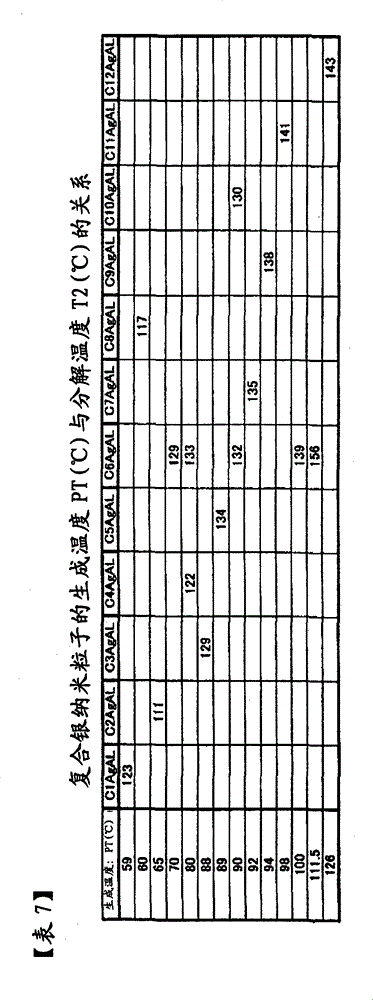
表8是复合银纳米粒子中的分解开始温度T1与分解温度T2的关系一览表。图28图示了表8的数据,横轴为分解开始温度T1(℃)及纵轴为分解温度T2(℃)。如图28所示可知,分解温度T2在150℃以下,并且,分解开始温度T1在140℃以下成立。Table 8 is a list of the relationship between the decomposition start temperature T1 and the decomposition temperature T2 in composite silver nanoparticles. Fig. 28 graphically shows the data of Table 8, with the decomposition start temperature T1 (°C) on the horizontal axis and the decomposition temperature T2 (°C) on the vertical axis. As shown in FIG. 28 , it can be seen that the decomposition temperature T2 is 150° C. or lower, and the decomposition start temperature T1 is 140° C. or lower.
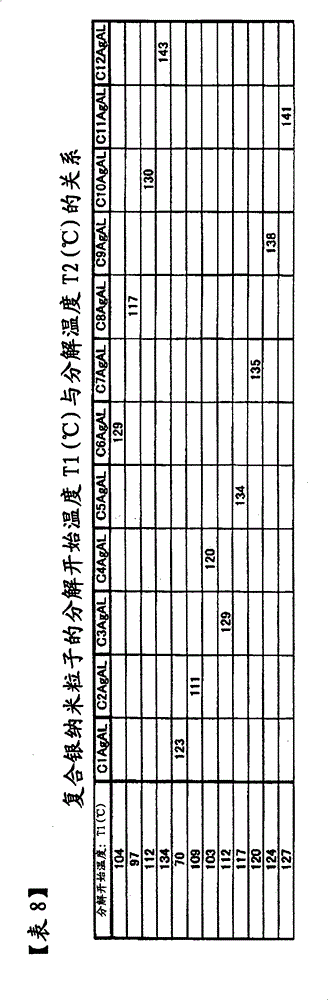
表9为复合银纳米粒子中的分解开始温度T1、分解温度T2、及T2-60的关系一览表。T2-60记载有为了处于T2-60≤T1≤T2范围的满足性的判定。在上述实施方案中,上述范围得到满足,能通过数值可知。Table 9 is a list of the relationship between the decomposition start temperature T1, the decomposition temperature T2, and T2-60 in composite silver nanoparticles. T2-60 describes the determination of satisfaction in the range of T2-60≦T1≦T2. In the above-mentioned embodiment, the above-mentioned range is satisfied, and it can be known from the numerical value.
【表9】【Table 9】
复合银纳米粒子的分解开始温度T1的范围T2-60≤T1≤T2The range of decomposition start temperature T1 of composite silver nanoparticles T2-60≤T1≤T2
图29图示了表9的数据,横轴表示C数、纵轴表示特性温度。本发明的特性温度为生成温度PT、分解开始温度T1、分解温度T2、金属化温度T3,在图29中,T2-60也作为特性温度被包含。黑四角为分解温度T2,黑三角为T2-60,黑圆表示分解开始温度T2。由于全部黑圆于黑三角与黑四角之间存在,故T2-60≤T1≤T2的不等式条件,对C1~C12成立,通过上述实施方案已经被实际证明。FIG. 29 shows the data of Table 9 in graphs, the horizontal axis represents the C number, and the vertical axis represents the characteristic temperature. The characteristic temperatures of the present invention are the generation temperature PT, the decomposition start temperature T1, the decomposition temperature T2, and the metallization temperature T3. In FIG. 29, T2-60 is also included as the characteristic temperature. The black squares represent the decomposition temperature T2, the black triangles represent T2-60, and the black circles represent the decomposition start temperature T2. Since all the black circles exist between the black triangles and the black four corners, the inequality condition of T2-60≤T1≤T2 holds true for C1-C12, which has been proven through the above implementation.
表10为实施例1~12中的生成温度PT、分解开始温度T1(℃)、分解温度T2(℃)、金属化温度T3(℃)及C数对应醇的沸点BT的一览表。所谓C数对应醇,是指C数=n的CnH2n+1OH。Table 10 is a list of the formation temperature PT, decomposition start temperature T1 (°C), decomposition temperature T2 (°C), metallization temperature T3 (°C) and boiling point BT of alcohols corresponding to C numbers in Examples 1-12. The so-called alcohol corresponding to C number refers to C n H 2n+1 OH in which C number=n.
【表10】【Table 10】
复合银纳米粒子的特性温度PT,T1,T2,T3,BT(℃)与来自醇的有机碳数的关系The relationship between the characteristic temperature PT, T1, T2, T3, BT (°C) of composite silver nanoparticles and the number of organic carbons from alcohols
图30图示了表10的数据,横轴表示来自醇的有机被覆层的C数、纵轴表示特性温度。本发明的特性温度为生成温度PT、分解开始温度T1、分解温度T2、金属化温度T3及醇沸点BT。图30中全部包含本发明的主要条件。关于生成温度PT≤100℃的条件,除C12以外全部成立。关于DTA峰温度T2≤150℃,C1~C12全部成立。关于金属化温度T3≤150℃,C1~C12全部成立。关于T2-60≤T1≤150℃,C1~C12全部成立。本发明涉及在过量醇溶液内的银盐反应,关于加热温度控制,也可通过控制醇的沸点BT来进行。例如,C1的甲醇沸点BT=64.7℃,即使在醇的沸腾状态进行反应,醇温度也不超过64.7℃,生成温度PT固定在PT=64.7℃(=BT)。然而,醇沸点BT随着C数的增加而上升。采用沸点低的醇时,通过加压沸腾,生成温度可设定比沸点高。另外,采用沸点高的醇时,通过减压沸腾,生成温度可设定比沸点低。Fig. 30 is a graph showing the data in Table 10, the horizontal axis represents the C number of the alcohol-derived organic coating layer, and the vertical axis represents the characteristic temperature. The characteristic temperatures of the present invention are formation temperature PT, decomposition start temperature T1, decomposition temperature T2, metallization temperature T3 and alcohol boiling point BT. The main conditions of the present invention are all contained in FIG. 30 . Regarding the condition that the generation temperature PT≦100°C, all of them are satisfied except C12. Regarding the DTA peak temperature T2≤150°C, all of C1-C12 are established. Regarding the metallization temperature T3≤150°C, all of C1 to C12 are established. Regarding T2-60≤T1≤150°C, all of C1 to C12 are established. The present invention relates to the reaction of silver salt in excess alcohol solution, and the control of heating temperature can also be carried out by controlling the boiling point BT of alcohol. For example, the methanol boiling point of C1 is BT=64.7°C. Even if the reaction is carried out in the boiling state of alcohol, the alcohol temperature does not exceed 64.7°C, and the production temperature PT is fixed at PT=64.7°C (=BT). However, alcohol boiling point BT increases with increasing C number. When alcohol with a low boiling point is used, the production temperature can be set higher than the boiling point by pressurized boiling. In addition, when an alcohol with a high boiling point is used, the production temperature can be set lower than the boiling point by boiling under reduced pressure.
表11为C1~C12中的CnAgAL的采用高分辨率透射型电子显微镜的晶格图像一览表。C1~C12的全部复合银纳米粒子中,已确认银核的晶格图像,证明是结晶性极高的。因此,在醇盐被覆银纳米粒子中已确认银核的晶格图像,为本发明人首次发现,可成功提供一种具有银核的单晶性或双晶性等高度结晶性的醇盐被覆银纳米粒子。因此,证明本发明的CnAgAL的电导性与导热性是极高的。Table 11 is a list of lattice images of CnAgAL in C1 to C12 using a high-resolution transmission electron microscope. In all the composite silver nanoparticles of C1 to C12, the crystal lattice pattern of the silver core was confirmed, and it was proved that the crystallinity was extremely high. Therefore, the crystal lattice image of the silver core has been confirmed in the alkoxide-coated silver nanoparticles, and it is the first discovery by the present inventors that a highly crystalline alkoxide-coated nanoparticle having a silver core such as single crystal or twin crystal can be successfully provided. silver nanoparticles. Therefore, it is proved that the electrical conductivity and thermal conductivity of the CnAgAL of the present invention are extremely high.
【表11】【Table 11】
CnAgAL的用高分辨率透过电显观察的银核晶格图像的有无Presence or absence of silver nucleus lattice images observed by high-resolution transmission electron microscopy in CnAgAL
实施例011~123:C1~C12的复合银纳米糊膏的特性Embodiment 011~123: Characteristics of composite silver nanopaste of C1~C12
其次,采用本发明生成的复合银纳米粒子,制成复合银纳米糊膏。从各种C1~C12的CnAgAL,制成下列3种糊膏。(1)CnAgAL+粘性赋予剂、(2)CnAgAL+溶剂+粘性赋予剂、(3)CnAgAL+银粒子+溶剂+粘性赋予剂。CnAgAL的至少之一具有实施例1~12所示的金属化温度T3,其余CnAgAL,采用金属化温度T3与上述实施例的金属化温度T3稍有不同的银粒子。然而,金属化温度T3全部选择在150℃以下。银粒子的粒径使用0.4μm与1.0μm的2种。溶剂选自甲醇、乙醇、丁醇、二甲苯、甲苯、己烷。粘性赋予剂选自松节油、萜品醇、萜品衍生物(1,8-萜品一乙酸酯与1,8-萜品二乙酸酯的混合物)、甲基纤维素。甲基纤维素为粉末,必需与溶剂并用。银粒子的粒径、溶剂的种类、粘性赋予剂的种类、各成分的质量%及大气中糊膏烧成温度如表12及表13所示。C1~C12的CnAgAL的金属化温度T3(℃)与实际的大气中糊膏烧成温度(℃)均记载于表12及表13中。Secondly, the composite silver nano-particles produced by the present invention are used to make a composite silver nano-paste. From various C1-C12 CnAgAL, the following 3 kinds of pastes were prepared. (1) CnAgAL+viscosity-imparting agent, (2) CnAgAL+solvent+viscosity-imparting agent, (3) CnAgAL+silver particles+solvent+viscosity-imparting agent. At least one of the CnAgALs has the metallization temperature T3 shown in Examples 1 to 12, and the remaining CnAgAL uses silver particles whose metallization temperature T3 is slightly different from the metallization temperature T3 of the above-mentioned examples. However, the metallization temperature T3 is all selected below 150°C. Two types of particle sizes of silver particles, 0.4 μm and 1.0 μm, were used. The solvent is selected from methanol, ethanol, butanol, xylene, toluene, hexane. The viscosity-imparting agent is selected from turpentine, terpineol, terpine derivatives (a mixture of 1,8-terpine monoacetate and 1,8-terpine diacetate), and methylcellulose. Methylcellulose is a powder and must be used with a solvent. Table 12 and Table 13 show the particle size of the silver particles, the type of solvent, the type of viscosity-imparting agent, the mass % of each component, and the paste firing temperature in the atmosphere. Table 12 and Table 13 describe the metallization temperature T3 (° C.) of C1 to C12 CnAgAL and the actual paste firing temperature (° C.) in the atmosphere.
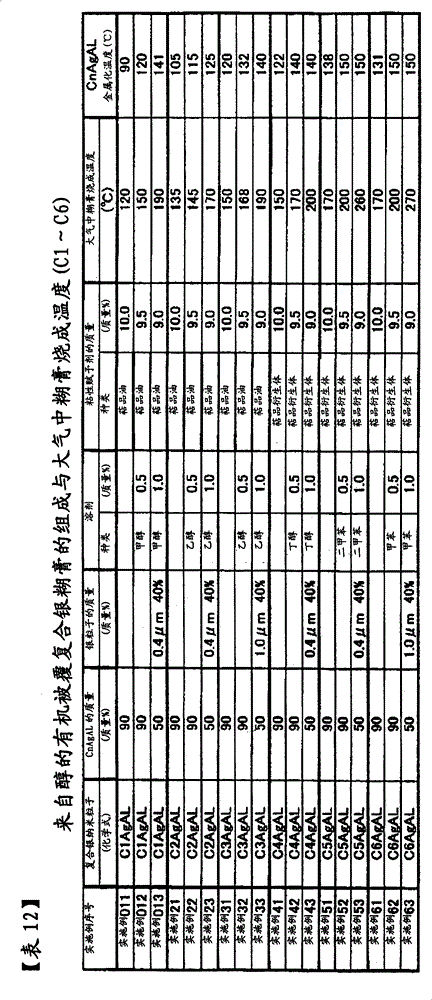
大气中糊膏烧成温度设定比CnAgAL的金属化温度T3高。其理由是,不仅使CnAgAL金属化,而且使溶剂蒸发,或者使粘性赋予剂蒸发或分解逸散所必需的。另外,CnAgAL的金属化温度T3在150℃以下,当在比金属化温度高的温度下进行烧成时,可形成美丽的金属膜,并且,形成电导度高的银膜。因此,如表12及表13所示,把大气中糊膏烧成温度设定比上述金属化温度T3高,可以确认愈高温,银膜特性愈提高。作为粘性赋予剂,当使用松节油时,大气中糊膏烧成温度调整至200℃以下。另外,作为粘性赋予剂,当使用萜品衍生物时,烧成温度更高。另外,作为粘性赋予剂,当使用甲基纤维素时,设定烧成温度更高,设定在400℃、450℃。如上所述,大气中糊膏烧成温度依赖于粘性赋予剂的逸散温度。The paste firing temperature in the atmosphere is set higher than the metallization temperature T3 of CnAgAL. The reason for this is that not only metallization of CnAgAL but also evaporation of the solvent, or evaporation or decomposition of the viscosity-imparting agent is necessary. In addition, the metallization temperature T3 of CnAgAL is 150° C. or less, and when fired at a temperature higher than the metallization temperature, a beautiful metal film can be formed, and a silver film with high electrical conductivity can be formed. Therefore, as shown in Table 12 and Table 13, setting the firing temperature of the paste in the air higher than the metallization temperature T3 above, it can be confirmed that the higher the temperature, the better the silver film characteristics. When turpentine is used as the viscosity-imparting agent, the paste firing temperature in the atmosphere is adjusted to 200° C. or lower. In addition, when a terpine derivative is used as a viscosity-imparting agent, the firing temperature is higher. In addition, when methyl cellulose is used as the viscosity-imparting agent, the firing temperature is set higher, and is set at 400°C or 450°C. As mentioned above, the paste firing temperature in the atmosphere depends on the dissipation temperature of the viscosity-imparting agent.
把实施例011~实施例123中所示的36种糊膏涂布在耐热玻璃基板上,通过表12及表13的大气中糊膏烧成温度进行烧成的结果是,在玻璃基板上形成美丽的银膜。形成的银膜表面用光学显微镜进行观察,测定比电阻的结果是,可以确认是耐实用的银膜,得到本发明的复合银纳米糊膏为有效的结论。The 36 kinds of pastes shown in Examples 011 to 123 were coated on heat-resistant glass substrates and fired at the paste firing temperatures in the atmosphere shown in Table 12 and Table 13. As a result, on the glass substrates Forms a beautiful silver film. As a result of observing the surface of the formed silver film with an optical microscope and measuring the specific resistance, it was confirmed that it was a practical silver film, and it was concluded that the composite silver nanopaste of the present invention is effective.
实施例124:半导体电极与电路基板的接合Example 124: Bonding of semiconductor electrodes and circuit substrates
半导体芯片作为上体,电路基板作为下体,进行接合试验。半导体芯片的电极端插入电路基板的穿通孔,在两者间的接触部涂布实施例011~实施例123的复合银纳米糊膏,得到36种糊膏试验体。然后,把上述涂布部用表12及表13中记载的糊膏烧成温度进行局部加热,使上述涂布部金属化,完成了接合。冷却后,用光学显微镜,检查上述接合部的外观的结果是,36种试验体均无问题。进行导电试验与电阻测定,作为代替焊锡,可以确认有效的功能。从上述36种接合试验已知,本发明涉及的复合银纳米糊膏作为代替焊锡,能够在工业上使用。The semiconductor chip is used as the upper body, and the circuit board is used as the lower body, and the bonding test is performed. The electrode end of the semiconductor chip was inserted into the through hole of the circuit board, and the composite silver nanopaste of Examples 011 to 123 was applied to the contact portion between the two to obtain 36 kinds of paste test bodies. Then, the above-mentioned coated part was locally heated at the paste firing temperature described in Table 12 and Table 13 to metallize the above-mentioned coated part to complete the bonding. After cooling, the appearance of the above-mentioned junction was inspected with an optical microscope, and it was found that there was no problem in any of the 36 test pieces. Conduct conductivity test and resistance measurement to confirm effective function as a substitute for solder. From the above 36 types of bonding tests, it is known that the composite silver nanopaste according to the present invention can be used industrially as a substitute for solder.
实施例125:对耐热玻璃基板上的银图案的形成Example 125: Formation of a silver pattern on a heat-resistant glass substrate
耐热玻璃基板作为基体,在该基体上丝网印刷实施例011~实施例123的复合银纳米糊膏,得到了形成规定图案的糊膏图案的36种试验体。然后,把上述试验体用电炉于表12及表13中记载的大气中糊膏烧成温度进行加热,从上述糊膏图案形成了银图案。冷却后,用光学显微镜检查上述银图案表面的结果是,36种试验体均无问题。从上述36种图案形成试验已知,本发明涉及的复合银纳米糊膏作为银图案形成用材料,能够在工业上使用。A heat-resistant glass substrate was used as a substrate, and the composite silver nanopaste of Examples 011 to 123 were screen-printed on the substrate to obtain 36 kinds of test bodies in which paste patterns of predetermined patterns were formed. Then, the above-mentioned test body was heated in an electric furnace at the paste firing temperature in the atmosphere described in Table 12 and Table 13, and a silver pattern was formed from the above-mentioned paste pattern. After cooling, when the surface of the above-mentioned silver pattern was inspected with an optical microscope, all of the 36 test pieces had no problem. From the above-mentioned 36 types of pattern formation tests, it is known that the composite silver nanopaste according to the present invention can be industrially used as a silver pattern formation material.
实施例1001~1012:CnAgAL(n=1~12)的第2实施方案的热解析Examples 1001-1012: Thermal analysis of the second embodiment of CnAgAL (n=1-12)
如上所述,对第1实施方案的CnAgAL(n=1~12)进行热解析,得到表10、图29及图30的特性温度的一览状况。由于对该点进行进一步研究,本发明人对另外的复合银纳米粒子CnAgAL(n=1~12),作为第2实施方案,进行得到特性温度一览表实验。As described above, thermal analysis was performed on CnAgAL (n=1 to 12) according to the first embodiment, and a list of characteristic temperatures in Table 10, Fig. 29 and Fig. 30 was obtained. In order to further investigate this point, the present inventors conducted an experiment to obtain a characteristic temperature table for another composite silver nanoparticle CnAgAL (n=1 to 12) as the second embodiment.
图31~图36为对另外的复合银纳米粒子C1AgAL~C12AgAL,以升温速度1℃/min进行的热解析图,各热解析图由TG曲线与DTA曲线构成。分解开始温度T1为TG开始减少温度,分解温度T2为DTA第1峰温度,金属化温度T3为TG减少终止温度或DTA最终峰终止温度。这些的具体温度与生成温度PT,记载于表14中,T1、T2及T3的温度从图31~图13的热解析中进行估计。另外,在图37中,实施例1001~1012的复合银纳米粒子CnAgAL(C1~C12)的升温速度为1℃/min时的特性温度(PT、T1、T2、T3)与C数的关系图,对表14所示的温度作图。FIGS. 31 to 36 are thermal analysis diagrams of other composite silver nanoparticles C1AgAL to C12AgAL at a heating rate of 1° C./min. Each thermal analysis diagram is composed of a TG curve and a DTA curve. The decomposition start temperature T1 is the temperature at which TG begins to decrease, the decomposition temperature T2 is the first peak temperature of DTA, and the metallization temperature T3 is the termination temperature of TG reduction or the final peak termination temperature of DTA. These specific temperatures and generation temperature PT are described in Table 14, and the temperatures of T1, T2 and T3 were estimated from the thermal analysis in Fig. 31 to Fig. 13 . In addition, in Figure 37, the relationship between the characteristic temperature (PT, T1, T2, T3) and the C number of the composite silver nanoparticles CnAgAL (C1-C12) of Examples 1001-1012 when the heating rate is 1 °C/min , plotted against the temperatures shown in Table 14.
【表14】【Table 14】
C1AgAL~C12AgAL粉末的生成温度PT(℃)与特性温度T1·T2·T3(℃)的关系2The relationship between the formation temperature PT (°C) of C1AgAL~C12AgAL powder and the characteristic temperature T1 T2 T3 (°C) 2
图31及图32的C1AgAL~C3AgAL,其DTA峰为单一峰,图32~图36的C4AgAL~C12AgAL,其DTA峰为双峰。如上所述,DTA第1峰是急速分解产生的分解峰,DTA最终峰,即DTA第2峰为裸露的银核彼此的结合能峰,则容易理解。实际上,既使在图31及图32的C1AgAL~C3AgAL上,也存在DTA第1峰与DTA第2峰,由于互相接近,通过迭加而仅见到单一峰。The DTA peaks of C1AgAL-C3AgAL in Figure 31 and Figure 32 are single peaks, and the DTA peaks of C4AgAL-C12AgAL in Figure 32-Figure 36 are double peaks. As mentioned above, it is easy to understand that the first peak of DTA is a decomposition peak caused by rapid decomposition, and the last peak of DTA, that is, the second peak of DTA is a peak of binding energy between exposed silver nuclei. In fact, even on C1AgAL to C3AgAL in Fig. 31 and Fig. 32, there are DTA first peak and DTA second peak, and since they are close to each other, only a single peak can be seen by superposition.
图32~图36中所示的C2AgAL~C12AgAL的DTA,当达到比分解开始温度T1高时,已知C6AgAL的有机被覆层发生分解,放热量明确增大。这种倾向,在图32所示的C1AgAL的DTA中未明确见到,可以认为这是由于复合银纳米粒子以外的成分的放热而未明确呈现所致。然而,图32~图36的C1AgAL~C12AgAL,在分解温度T2,由于有机被覆层的分解而放热量显示峰值,也与TG一致。在比分解开始温度T1的高温侧,已知通过有机被覆层的分解而质量减少。另外已知,在上述DTA最终峰下降的金属化温度T3,有机被覆层总量发生逸散,复合银纳米粒子的银核彼此结合,完成了银化。In DTA of C2AgAL to C12AgAL shown in Fig. 32 to Fig. 36, it is known that the organic coating layer of C6AgAL is decomposed and the heat generation is clearly increased when the decomposition start temperature T1 is higher than that of DTA. This tendency was not clearly seen in the DTA of C1AgAL shown in FIG. 32 , and it is considered that it was not clearly expressed due to the heat generation of components other than the composite silver nanoparticles. However, for C1AgAL to C12AgAL in Figs. 32 to 36, at the decomposition temperature T2, the amount of heat released due to the decomposition of the organic coating layer shows a peak, which also coincides with TG. On the higher temperature side than the decomposition start temperature T1, it is known that the mass decreases due to decomposition of the organic coating layer. It is also known that at the metallization temperature T3 at which the final peak of DTA falls, the total amount of the organic coating layer is dissipated, and the silver cores of the composite silver nanoparticles are combined to complete silverization.
如图32的C4AgAL所示,在DTA第1峰温度T2,伴随着金属化而呈现放热量大的峰值,TG也见到凹处。另外,呈现连续的DTA第2峰与DTA最终峰,该DTA最终峰在降低的金属化温度T3,TG也达到一定值。然后,TG缓慢增加认为是作为杂质的碳酸银的分解所致。还有,图32~图36所示的C4AgAL~C12AgAL的DTA上,第1峰的DTA第1峰温度T2与金属化温度T3作为特性温度被估计。As shown in C4AgAL in FIG. 32 , at the first peak temperature T2 of DTA, a peak with a large amount of exothermic heat appears due to metallization, and a depression is also seen in TG. In addition, there is a continuous second peak of DTA and a final peak of DTA, and the final peak of DTA also reaches a certain value at the lowered metallization temperature T3, TG. Then, the slow increase in TG is considered to be due to the decomposition of silver carbonate as an impurity. In addition, in the DTA of C4AgAL-C12AgAL shown in FIG. 32-FIG. 36, DTA 1st peak temperature T2 and metallization temperature T3 of the 1st peak were estimated as characteristic temperature.
如图37所示,在C1AgAL~C7AgAL及C9AgAL,分解温度T2与金属化温度T 3全部在200℃以下。即,另外实施例的复合银纳米粒子在升温速度VT=1℃/min于大气中进行热分析的结果表明,从DTA得到的金属化温度T3(℃)在200℃以下的复合银纳米粒子明确生成。因此,可以提供于低温烧成被金属化的理想的代替焊锡材料。另外,在C8AgAL与C10AgAL~C12AgAL中,金属化温度T 3在200℃附近或稍大于200℃,可作为代替焊锡的材料。然而,在C1AgAL~C12AgAL中,分解开始温度T1包含在分解温度T2的下侧100℃以内。As shown in Figure 37, in C1AgAL~C7AgAL and C9AgAL, the decomposition temperature T2 and the metallization temperature T3 are all below 200°C. That is, the results of thermal analysis of the composite silver nanoparticles of the other examples in the air at a temperature increase rate of VT=1°C/min show that the composite silver nanoparticles with a metallization temperature T3 (°C) obtained from DTA of 200°C or below are clearly generate. Therefore, it is possible to provide an ideal substitute solder material which is metallized by low-temperature firing. In addition, in C8AgAL and C10AgAL~C12AgAL, the metallization temperature T3 is around 200°C or slightly higher than 200°C, which can be used as a material to replace solder. However, in C1AgAL to C12AgAL, the decomposition start temperature T1 is included within 100°C lower than the decomposition temperature T2.
【表15】【Table 15】
复合银纳米粒子的分解开始温度T1的范围2 T2-90<T1<T2The range of decomposition start temperature T1 of
表15为实施例1001~1012的复合银纳米粒子的分解开始温度T1、分解温度T2、及T2-90的关系一览表。T2-90是用于判定T2-90≤T1≤T2范围的满足性而记载的。在上述实施方案中,上述范围得到满足可从数值明知。Table 15 is a list of the relationship between the decomposition start temperature T1, the decomposition temperature T2, and T2-90 of the composite silver nanoparticles of Examples 1001-1012. T2-90 is described for judging the satisfaction of the range of T2-90≤T1≤T2. In the above-mentioned embodiment, it can be understood from the numerical value that the above-mentioned range is satisfied.
图38图示了表15的数据,横轴表示C数、纵轴表示特性温度。本发明的特性温度为生成温度PT、分解开始温度T1、分解温度T2、金属化温度T3,在图38中,T2-90也作为特性温度包含在内。黑四角为分解温度T2,黑三角为T2-90,黑圆为分解开始温度T2。由于全部的黑圆在黑三角与黑四角之间存在,故T2-90≤T1≤T2的不等式条件,对C1~C12成立,是对第2实施方案的证明。FIG. 38 shows the data of Table 15 in graphs, with the horizontal axis representing the C number and the vertical axis representing the characteristic temperature. The characteristic temperatures of the present invention are the generation temperature PT, the decomposition start temperature T1, the decomposition temperature T2, and the metallization temperature T3. In FIG. 38, T2-90 is also included as the characteristic temperature. The black squares are the decomposition temperature T2, the black triangles are T2-90, and the black circles are the decomposition start temperature T2. Since all the black circles exist between the black triangles and the black squares, the inequality condition T2-90≤T1≤T2 holds for C1-C12, which is a proof of the second embodiment.
图39~44为另外实施例的复合银纳米粒子C10AgAL(PT=176℃)的热解析图,升温速度VT在1~20℃/min的范围内变化。在图39~44中,DTA与TG的测定结果一起,对该TG估计的微分热重量(DTG)作图。图39~图44中的升温速度VT分别为VT=1℃/min、3℃/min、5℃/min、10℃/min、15℃/min、20℃/min。在图39~图44中,分解开始温度T1为TG开始减少温度、分解温度T2为DTA第1峰温度、金属化温度T3为TG减少终止温度或DTA最终峰终止温度。从DTG的曲线可知,所谓分解开始温度T1,是指从直线的TG减少变化至曲线的TG减少的温度。即,在DTG的曲线中,在比分解开始温度T1的低温侧,TG减少率呈现大致常数的倾向,当大于分解开始温度T1时,TG减少率急激增加。直线的TG稍减少,可以认为作为TG试料的复合银纳米粒子粉末中含有的残留物等发生蒸发的成分所致。因此,所谓估计分解开始温度T1的TG开始减少温度,是指纯粹的复合银纳米粒子的TG开始减少温度,认为从该TG开始减少温度估计分解开始温度T1是妥当的。39 to 44 are thermal analysis diagrams of composite silver nanoparticles C10AgAL (PT=176° C.) in another example, and the heating rate VT varies within the range of 1 to 20° C./min. In FIGS. 39 to 44 , DTA is plotted together with the measurement results of TG, and the differential thermogravimetry (DTG) estimated for the TG is plotted. The heating rate VT in Fig. 39 to Fig. 44 is VT=1°C/min, 3°C/min, 5°C/min, 10°C/min, 15°C/min, 20°C/min respectively. In Fig. 39 to Fig. 44, the decomposition start temperature T1 is the temperature at which TG begins to decrease, the decomposition temperature T2 is the first peak temperature of DTA, and the metallization temperature T3 is the end temperature of TG decrease or the final peak end temperature of DTA. As can be seen from the DTG curve, the decomposition start temperature T1 refers to the temperature at which TG decreases from a straight line to a TG decrease on a curve. That is, in the DTG curve, the TG decrease rate tends to be substantially constant on the lower side than the decomposition start temperature T1, and the TG decrease rate rapidly increases when the temperature exceeds the decomposition start temperature T1. The linear TG is slightly decreased, which is considered to be due to evaporated components such as residues contained in the composite silver nanoparticle powder as a TG sample. Therefore, the TG start decrease temperature of the estimated decomposition start temperature T1 refers to the TG start decrease temperature of pure composite silver nanoparticles, and it is considered appropriate to estimate the decomposition start temperature T1 from this TG start decrease temperature.
另外,在图39~图44的DTG曲线上,示出DTA第1峰、DTA第2峰及最终峰的位置或其近旁达到极小的倾斜结构,TG减少率达到极大。这些倾斜结构中TG减少率达到极大,在DTA的各峰温度或其近旁,伴随着有机物的分解,放热量达到极大,对其加以整合,呈现良好的一致。另外,当超过金属化温度T3时,DTG达到近似为零,伴随着复合银纳米粒子的金属化,TG减少终止,显示更加明确。In addition, in the DTG curves of FIGS. 39 to 44 , the positions of the DTA first peak, the DTA second peak, and the final peak or their vicinity are shown to be extremely small, and the TG reduction rate is extremely large. In these inclined structures, the reduction rate of TG reaches the maximum, and at or near each peak temperature of DTA, the heat release along with the decomposition of the organic matter reaches the maximum, and when integrated, they show a good agreement. In addition, when the metallization temperature T3 is exceeded, DTG reaches approximately zero, and with the metallization of composite silver nanoparticles, TG decreases and terminates, showing more clearly.
如上所述,在图39~图44中,复合银纳米粒子C10AgAL的升温速度VT在1~20的范围内变化,图39~图44中,分解开始温度T1、分解温度T2、金属化温度T3伴随着升温速度VT的增大而上升。通过升温速度VT增大,到达规定温度的时间缩短,施加在复合银纳米粒子上的热量时间积分值减少。这是主要的原因,分解开始温度T1、分解温度T2及金属化温度T3伴随着升温速度VT的增大而上升。As mentioned above, in Figures 39 to 44, the temperature rise rate VT of composite silver nanoparticles C10AgAL varies in the range of 1 to 20, and in Figures 39 to 44, the decomposition start temperature T1, decomposition temperature T2, metallization temperature T3 It rises with the increase of the heating rate VT. By increasing the temperature increase rate VT, the time to reach the predetermined temperature is shortened, and the time integral value of the heat applied to the composite silver nanoparticles is reduced. This is the main reason, and the decomposition start temperature T1, the decomposition temperature T2, and the metallization temperature T3 increase as the temperature increase rate VT increases.
图45~图50为另外实施例的复合银纳米糊膏PC10AgAL(PT=176℃)的热解析图,升温速度VT在1~20℃/min的范围内变化。在图45~图50中,DTA与TG一起,对该TG估计的微分热重量(DTG)作图。图45~图50中升温速度VT分别为VT=1℃/min、3℃/min、5℃/min、10℃/min、15℃/min、20℃/min。在图45~图50的DTG中,在比糊膏分解开始温度Tp1的低温侧,因复合银纳米糊膏中含有的粘性赋予剂蒸发而见到倾斜的结构。即,在复合银纳米糊膏中,由于在复合银纳米粒子中添加溶剂及/或粘性赋予剂,在复合银纳米粒子氧化分解前,溶剂及/或粘性赋予剂先行脱离或氧化分解。Figures 45 to 50 are thermal analysis diagrams of the composite silver nanopaste PC10AgAL (PT=176° C.) in another embodiment, and the heating rate VT varies within the range of 1 to 20° C./min. In Figures 45-50, DTA is plotted along with TG and the differential thermogravimetry (DTG) estimated for that TG. The heating rate VT in Fig. 45 to Fig. 50 is VT=1°C/min, 3°C/min, 5°C/min, 10°C/min, 15°C/min, 20°C/min respectively. In the DTG of FIGS. 45 to 50 , on the lower side than the paste decomposition initiation temperature Tp1 , an inclined structure is seen due to the evaporation of the viscosity-imparting agent contained in the composite silver nanopaste. That is, in the composite silver nanopaste, since the solvent and/or the viscosity-imparting agent are added to the composite silver nanoparticles, the solvent and/or the viscosity-imparting agent are detached or oxidatively decomposed before the composite silver nanoparticles are oxidatively decomposed.
因此,图45~图50中糊膏分解开始温度Tp1,复合银纳米糊膏中含有的粘性赋予剂发生蒸发,伴随着上述有机被膜层的分解,显示TG开始减少的温度。在图45~图50中,在糊膏分解开始温度Tp1,DTG曲线达到大致为零或零值附近,给出DTG的第2开始减少温度。在该糊膏分解开始温度Tp1后,DTA曲线中出现DTA峰,其最初出现的DTA第1峰温度为糊膏分解温度Tp2(℃)。DTA峰的最后出现的急峻的最终峰,可以认为是在有机被覆层氧化分解后残留的裸露的银核彼此结合的结合能的放出峰。该最终峰下降于横向的折点,定义为糊膏金属化温度Tp3(℃)。这些的糊膏温度满足Tp1≤Tp2≤Tp3的不等式。Therefore, the paste decomposition start temperature Tp1 in FIGS. 45 to 50 shows the temperature at which the viscosity-imparting agent contained in the composite silver nano paste evaporates, and TG starts to decrease along with the decomposition of the above-mentioned organic film layer. In Figs. 45 to 50, at the paste decomposition start temperature Tp1, the DTG curve reaches approximately zero or a value near zero, indicating the second temperature at which DTG begins to decrease. After the paste decomposition start temperature Tp1, a DTA peak appears in the DTA curve, and the temperature of the first DTA peak that first appears is the paste decomposition temperature Tp2 (°C). The steep final peak appearing at the end of the DTA peak is considered to be a release peak of the binding energy of the bare silver nuclei remaining after the oxidative decomposition of the organic coating layer. The inflection point at which this final peak falls in the transverse direction is defined as the paste metallization temperature Tp3 (° C.). These paste temperatures satisfy the inequality of Tp1≤Tp2≤Tp3.
【表16】【Table 16】
C10AgAl粉末热分析时的升温速度依赖性Dependence of Heating Rate in Thermal Analysis of C10AgAl Powder

表16中记载了包括图39~图50估计的复合银纳米粒子粉末的分解开始温度T1、分解温度T2及金属化温度T3与复合银糊膏的分解开始温度Tp1、分解温度Tp2及金属化温度Tp3的特性温度。另外,图51示出了表16所示的从图39~图50得到的CnAgAL及PCnAgAL的特性温度(T1、T2、T3、Tp1、Tp2、Tp3)与升温速度的关系图。如表16及图51所示,当上述升温速度VT仅在1~20(℃/min)的范围内变化时,可以看到糊膏分解开始温度Tp1增加约50℃左右、糊膏分解温度Tp2增加约65℃左右、糊膏金属化温度Tp3增加约80℃左右的倾向。因此,复合银纳米糊膏边以VT=1(℃/min)升温边测定Tp1、Tp2、Tp3,同样当复合银纳米糊膏以VT=20(℃/min)测定时,可以认为上述Tp1、Tp2、Tp3分别以约50℃、约65℃、约80℃增加。然而,这些温度增加量,不用说依赖于有机被覆层的碳原子数,对银核粒径也多少有所依赖。Table 16 records the decomposition initiation temperature T1, decomposition temperature T2, and metallization temperature T3 of the composite silver nanoparticle powder estimated from Figures 39 to 50, and the decomposition initiation temperature Tp1, decomposition temperature Tp2, and metallization temperature of the composite silver paste. The characteristic temperature of Tp3. In addition, FIG. 51 shows the relationship between the characteristic temperature (T1, T2, T3, Tp1, Tp2, Tp3) and the temperature increase rate of CnAgAL and PCnAgAL obtained from FIGS. 39 to 50 shown in Table 16. As shown in Table 16 and Figure 51, when the above-mentioned heating rate VT only changes within the range of 1-20 (°C/min), it can be seen that the paste decomposition start temperature Tp1 increases by about 50°C, and the paste decomposition temperature Tp2 It tends to increase by about 65°C and the paste metallization temperature Tp3 by about 80°C. Therefore, the composite silver nano paste measures Tp1, Tp2, Tp3 while heating up with VT=1 (°C/min), and when the composite silver nano paste is measured with VT=20 (°C/min), it can be considered that the above Tp1, Tp1, Tp3 Tp2 and Tp3 increase at about 50°C, about 65°C, and about 80°C, respectively. However, the amount of these temperature increases depends not only on the number of carbon atoms in the organic coating layer but also somewhat on the particle size of the silver core.
图52为从图51得到的CnAgAL与PCnAgAL的特性温度(T1、T2、T3、Tp1、Tp2、Tp3)的大小关系图。从图50可见,复合银纳米粒子(用CnAgAL、n=1~12表示)及复合银纳米糊膏(用PCnAgAL、n=1~12表示),以升温速度VT=1~20(℃/min),在大气中进行热分析时,对粉末分解开始温度T1与糊膏分解开始温度Tp1来说,T1(VT)≤Tp1(VT)≤T1(VT)+100的关系成立。另外,对粉末分解温度T2与糊膏分解温度Tp2的关系以及粉末金属化温度T3(℃)与糊膏金属化温度Tp3(℃)的关系加以汇总,在升温速度VT=1~20(℃/min)的范围内,图52所示的(P1)~(P3)的不等式已知几乎满足。从这些不等式,通过测定复合银纳米粒子的特性温度T1、T2、T3,可以推定该复合银纳米糊膏的特性温度的Tp1、Tp2、Tp3。Fig. 52 is a graph showing the relationship between the characteristic temperatures (T1, T2, T3, Tp1, Tp2, Tp3) of CnAgAL and PCnAgAL obtained from Fig. 51 . As can be seen from Figure 50, composite silver nanoparticles (represented by CnAgAL, n=1~12) and composite silver nano paste (represented by PCnAgAL, n=1~12), at a heating rate VT=1~20(℃/min ), when performing thermal analysis in the atmosphere, for the powder decomposition start temperature T1 and the paste decomposition start temperature Tp1, the relationship of T1(VT)≤Tp1(VT)≤T1(VT)+100 is established. In addition, the relationship between powder decomposition temperature T2 and paste decomposition temperature Tp2 and the relationship between powder metallization temperature T3 (°C) and paste metallization temperature Tp3 (°C) are summarized. min), it is known that the inequalities (P1) to (P3) shown in Fig. 52 are almost satisfied. From these inequalities, the characteristic temperatures Tp1, Tp2, and Tp3 of the composite silver nanopaste can be estimated by measuring the characteristic temperatures T1, T2, and T3 of the composite silver nanoparticles.
本发明不限于上述实施方案及变形例,在不偏离本发明的技术思想的范围内的各种变形例、设计变更等,不用说也包含在其技术范围内。The present invention is not limited to the above-described embodiments and modifications, and various modifications, design changes, and the like within a range not departing from the technical idea of the present invention are also included in the technical scope of the invention.
产业上的利用可能性Industrial Utilization Possibility
按照本发明,提供:DTA峰温度T2为200℃以下,具有醇残基、醇衍生物或醇分子的一种以上的有机被覆层,银核粒径为1~20nm的复合银纳米粒子。另外,上述复合银纳米粒子的TG开始减少温度T1处于T2-90≤T1≤T2的范围。该复合银纳米粒子,在生成温度PT为160℃以下、更优选低至140℃以下可以生成,DTA峰温度T2、TG开始减少温度T1及生成温度PT具有互相关连的关系。金属化温度T3仅比DTA峰温度T2高数℃,由于DTA峰温度T2在200℃以下,故金属化温度T3也几乎在200℃以下。因此,通过低温生成复合银纳米粒子,可以达到约200℃以下的金属化。现有的Sn-Pb焊锡的熔点为183℃,本发明的复合银纳米粒子可用作无铅的代替焊锡,另外,可用作银膜形成材料。由于生成温度在160℃以下,制造装置及制造设备的成本可大幅降低。因此,本发明的复合银纳米粒子,可用于印刷配线、导电性材料等电子材料;磁性记录介质、电磁波吸收体、电磁波共振器等磁性材料;远红外材料、复合被膜形成材料等结构材料;烧结助剂、涂布材料等陶瓷、金属材料;医疗材料等各种用途。另外,按照本发明,提供复合银纳米粒子的廉价的制造方法及制造装置。According to the present invention, there is provided: a DTA peak temperature T2 of 200° C. or less, an organic coating layer having one or more alcohol residues, alcohol derivatives, or alcohol molecules, and composite silver nanoparticles with a silver core particle diameter of 1 to 20 nm. In addition, the TG decrease start temperature T1 of the composite silver nanoparticles is in the range of T2-90≦T1≦T2. The composite silver nanoparticles can be produced when the production temperature PT is below 160°C, more preferably below 140°C, and the DTA peak temperature T2, the TG decrease temperature T1, and the production temperature PT are interrelated. The metallization temperature T3 is only a few degrees higher than the DTA peak temperature T2, and since the DTA peak temperature T2 is below 200°C, the metallization temperature T3 is also almost below 200°C. Therefore, metallization below about 200 °C can be achieved by low temperature generation of composite silver nanoparticles. The melting point of conventional Sn-Pb solder is 183° C., and the composite silver nanoparticles of the present invention can be used as a lead-free substitute solder, and can also be used as a silver film forming material. Since the generation temperature is below 160° C., the cost of manufacturing devices and manufacturing equipment can be greatly reduced. Therefore, the composite silver nanoparticles of the present invention can be used for electronic materials such as printed wiring and conductive materials; Magnetic materials such as magnetic recording media, electromagnetic wave absorbers, electromagnetic wave resonators; Structural materials such as far-infrared materials and composite film forming materials; Ceramic and metal materials such as sintering aids and coating materials; medical materials and other uses. Moreover, according to this invention, the inexpensive manufacturing method and manufacturing apparatus of composite silver nanoparticle are provided.
Claims (25)
Applications Claiming Priority (9)
| Application Number | Priority Date | Filing Date | Title |
|---|---|---|---|
| PCT/JP2008/050558 WO2009090748A1 (en) | 2008-01-17 | 2008-01-17 | Silver composite nanoparticle and process and apparatus for producing the same |
| JPPCT/JP2008/050558 | 2008-01-17 | ||
| PCT/JP2008/054971 WO2009116136A1 (en) | 2008-03-18 | 2008-03-18 | Composite silver nanopaste, process for producing the composite silver nanopaste, and method for bonding the nanopaste |
| JPPCT/JP2008/054971 | 2008-03-18 | ||
| PCT/JP2008/061822 WO2009090767A1 (en) | 2008-01-17 | 2008-06-30 | Composite silver nanoparticles, composite silver nanopaste, process and apparatus for producing the composite silver nanopaste, joining method, and method for pattern formation |
| JPPCT/JP2008/061822 | 2008-06-30 | ||
| JPPCT/JP2008/062238 | 2008-07-04 | ||
| PCT/JP2008/062238 WO2009116185A1 (en) | 2008-03-18 | 2008-07-04 | Composite silver nanopaste, process for production thereof, method of connection and pattern formation process |
| PCT/JP2008/073660 WO2009090846A1 (en) | 2008-01-17 | 2008-12-25 | Composite silver nanoparticles, composite silver nanopaste, and production method, production apparatus, conjugation method and patterning method of the same |
Publications (2)
| Publication Number | Publication Date |
|---|---|
| CN101990474A CN101990474A (en) | 2011-03-23 |
| CN101990474B true CN101990474B (en) | 2013-09-04 |
Family
ID=42813479
Family Applications (1)
| Application Number | Title | Priority Date | Filing Date |
|---|---|---|---|
| CN2008801281306A Active CN101990474B (en) | 2008-01-17 | 2008-12-25 | Composite silver nanoparticles, composite silver nanopaste, and production method, production apparatus, conjugation method and patterning method of the same |
Country Status (6)
| Country | Link |
|---|---|
| US (3) | US8348134B2 (en) |
| EP (1) | EP2298471B1 (en) |
| JP (1) | JP4680313B2 (en) |
| KR (1) | KR101222304B1 (en) |
| CN (1) | CN101990474B (en) |
| WO (3) | WO2009090748A1 (en) |
Families Citing this family (37)
| Publication number | Priority date | Publication date | Assignee | Title |
|---|---|---|---|---|
| WO2011155055A1 (en) * | 2010-06-11 | 2011-12-15 | Dowaエレクトロニクス株式会社 | Low-temperature-sintering bonding material and bonding method using the bonding material |
| US8895962B2 (en) | 2010-06-29 | 2014-11-25 | Nanogram Corporation | Silicon/germanium nanoparticle inks, laser pyrolysis reactors for the synthesis of nanoparticles and associated methods |
| JP5683256B2 (en) * | 2010-12-24 | 2015-03-11 | 三菱製紙株式会社 | Method for producing silver nanowires |
| KR101296327B1 (en) * | 2010-12-29 | 2013-08-14 | 포항공과대학교 산학협력단 | Surface modified metal nano-particle and use thereof |
| JP2013036053A (en) * | 2011-08-03 | 2013-02-21 | Nippon Synthetic Chem Ind Co Ltd:The | Method for producing metal composite ultrafine particle |
| JP2013044016A (en) * | 2011-08-24 | 2013-03-04 | Nippon Synthetic Chem Ind Co Ltd:The | Method for producing metal composite ultrafine particle |
| CN103619529B (en) * | 2011-09-02 | 2015-05-06 | 三菱综合材料株式会社 | Solder powder, and solder paste using solder powder |
| JP5777981B2 (en) * | 2011-09-02 | 2015-09-16 | 日本合成化学工業株式会社 | Method for producing metal composite ultrafine particles |
| JP5788281B2 (en) * | 2011-09-29 | 2015-09-30 | 日本合成化学工業株式会社 | Method for producing metal composite ultrafine particles |
| US20140318618A1 (en) * | 2011-11-21 | 2014-10-30 | Hanwha Chemical Corporation | Paste composition for front electrode of solar cell and solar cell using the same |
| US9533380B2 (en) * | 2012-01-20 | 2017-01-03 | Dowa Electronics Materials Co., Ltd. | Bonding material and bonding method in which said bonding material is used |
| JP2013159830A (en) * | 2012-02-06 | 2013-08-19 | Toyota Central R&D Labs Inc | Surface-coated metal nanoparticle, and method for producing the same |
| JP5410643B1 (en) | 2012-02-20 | 2014-02-05 | 株式会社応用ナノ粒子研究所 | Oxygen source-containing composite nanometal paste and bonding method |
| JP5398935B1 (en) | 2012-03-30 | 2014-01-29 | 株式会社応用ナノ粒子研究所 | Copper filler-containing composite nanometal paste and bonding method |
| CN104919012A (en) | 2013-05-24 | 2015-09-16 | 纳克公司 | Printable ink with silicon/germanium based nanoparticles and with high viscosity alcoholic solvent |
| US10427220B2 (en) | 2013-07-11 | 2019-10-01 | Applied Nanoparticle Laboratory Corporation | Nanoparticle production method, production device and automatic production device |
| EP3057123B1 (en) * | 2013-10-07 | 2021-12-08 | Furukawa Electric Co., Ltd. | Joining structure comprising layers with different average crystal grain sizes for a semiconductor chip |
| KR101886263B1 (en) * | 2014-02-27 | 2018-08-07 | 더 스쿨 코포레이션 칸사이 유니버시티 | Copper nanoparticles and production method for same, copper nanoparticle fluid dispersion, copper nanoink, copper nanoparticle preservation method, and copper nanoparticle sintering method |
| JP6508193B2 (en) | 2014-03-11 | 2019-05-08 | 富士電機株式会社 | Semiconductor device manufacturing method and semiconductor device |
| JP6373066B2 (en) * | 2014-05-30 | 2018-08-15 | Dowaエレクトロニクス株式会社 | Bonding material and bonding method using the same |
| WO2016076306A1 (en) * | 2014-11-12 | 2016-05-19 | ハリマ化成株式会社 | Electroconductive paste |
| TWI683789B (en) * | 2014-11-21 | 2020-02-01 | 日商日清工程股份有限公司 | Silver nanoparticles |
| JP5953361B2 (en) * | 2014-12-10 | 2016-07-20 | 株式会社伊東化学研究所 | Nanoparticles for nanobonding agents |
| JP5950427B1 (en) * | 2015-06-12 | 2016-07-13 | 株式会社フェクト | Method for producing composition liquid for forming silver mirror film layer and method for forming silver mirror film layer |
| KR20170011663A (en) | 2015-07-23 | 2017-02-02 | 덕산하이메탈(주) | Solder powder with exothermic and amorphous characteristics manufacture method and solder paste manufacture method and solder paste using low temperature bonding method |
| JP6920029B2 (en) | 2016-04-04 | 2021-08-18 | 日亜化学工業株式会社 | Metal powder sintered paste and its manufacturing method, conductive material manufacturing method |
| JP6770277B2 (en) * | 2017-01-30 | 2020-10-14 | 株式会社日本スペリア社 | Thermoelectric conversion module and its manufacturing method |
| JP6927490B2 (en) * | 2017-05-31 | 2021-09-01 | 株式会社応用ナノ粒子研究所 | Heat dissipation structure |
| CN107538147A (en) * | 2017-08-14 | 2018-01-05 | 武汉工程大学 | A kind of composite Nano silver solder and the connector being prepared by it |
| CN107538148B (en) * | 2017-08-14 | 2020-07-28 | 武汉工程大学 | Composite nano silver soldering paste and application thereof |
| KR101888526B1 (en) | 2017-08-28 | 2018-08-14 | 덕산하이메탈(주) | Solder powder with exothermic and amorphous characteristics manufacture method and solder paste manufacture method and solder paste using low temperature bonding method |
| JP7075785B2 (en) * | 2018-03-08 | 2022-05-26 | スタンレー電気株式会社 | Circuit boards, electronic circuit devices, and methods for manufacturing circuit boards |
| CN111558728B (en) * | 2020-05-13 | 2022-12-27 | 哈尔滨工业大学(深圳)(哈尔滨工业大学深圳科技创新研究院) | Multi-size composite nano silver paste and preparation method thereof |
| CN112117205B (en) * | 2020-09-15 | 2024-01-16 | 桂林航天工业学院 | A method for preparing solder joints packaged with tin-based solder |
| CN113056088B (en) * | 2021-03-02 | 2021-09-03 | 福建钰辰微电子有限公司 | High-performance flexible circuit board |
| CN117464000A (en) * | 2023-10-23 | 2024-01-30 | 湖南越摩先进半导体有限公司 | A kind of heat dissipation material for electronic packaging and preparation method thereof |
| CN119319248B (en) * | 2024-12-19 | 2025-04-01 | 浙江码尚科技股份有限公司 | Silver-coated copper powder and preparation method thereof, conductive paste and printed RFID tag |
Citations (1)
| Publication number | Priority date | Publication date | Assignee | Title |
|---|---|---|---|---|
| WO2001070435A1 (en) * | 2000-03-22 | 2001-09-27 | Ebara Corporation | Ultra fine composite metal particles |
Family Cites Families (50)
| Publication number | Priority date | Publication date | Assignee | Title |
|---|---|---|---|---|
| US3063564A (en) * | 1960-02-24 | 1962-11-13 | Detrex Chem Ind | Centrifugal extractor |
| FR2668076B1 (en) * | 1990-10-18 | 1993-04-30 | Kodak Pathe | METHOD FOR SEPARATING SOLID CONSTITUENTS FROM A SUSPENSION AND DEVICE FOR CARRYING OUT SAID METHOD. |
| JPH06163234A (en) * | 1992-11-26 | 1994-06-10 | Kao Corp | Manufacture of surface treatment magnetic powder and coating film for magnetic recording medium |
| JP3429958B2 (en) * | 1996-08-28 | 2003-07-28 | 三井金属鉱業株式会社 | Method for producing silver colloid liquid |
| US5792351A (en) * | 1996-09-26 | 1998-08-11 | The United States Of America As Represented By The Secretary Of The Navy | Spinning filter separation system for oil spill clean-up operation |
| JP3205793B2 (en) | 1996-12-19 | 2001-09-04 | 株式会社巴製作所 | Ultrafine particles and method for producing the same |
| AU6438398A (en) * | 1997-02-24 | 1998-09-09 | Superior Micropowders Llc | Aerosol method and apparatus, particulate products, and electronic devices made therefrom |
| WO2000076699A1 (en) | 1999-06-15 | 2000-12-21 | Kimoto, Masaaki | Ultrafine composite metal powder and method for producing the same |
| US6486413B1 (en) * | 1999-11-17 | 2002-11-26 | Ebara Corporation | Substrate coated with a conductive layer and manufacturing method thereof |
| US6599356B2 (en) * | 2000-06-28 | 2003-07-29 | Seiko Epson Corporation | Method for manufacturing pigment dispersed liquid, and pigment dispersed liquid, and ink for ink-jet printer recording using said pigment dispersed liquid |
| JP3900248B2 (en) * | 2001-03-30 | 2007-04-04 | ハリマ化成株式会社 | Multilayer wiring board and method for forming the same |
| WO2002096262A2 (en) * | 2001-05-25 | 2002-12-05 | Northwestern University | Non-alloying core shell nanoparticles |
| US6951666B2 (en) * | 2001-10-05 | 2005-10-04 | Cabot Corporation | Precursor compositions for the deposition of electrically conductive features |
| US7553512B2 (en) * | 2001-11-02 | 2009-06-30 | Cabot Corporation | Method for fabricating an inorganic resistor |
| JP2003342605A (en) * | 2002-05-21 | 2003-12-03 | Akio Komatsu | Ultrafine particles, ultrafine crystal film and method for producing ultrafine crystals |
| US6878184B1 (en) * | 2002-08-09 | 2005-04-12 | Kovio, Inc. | Nanoparticle synthesis and the formation of inks therefrom |
| US6713241B2 (en) * | 2002-08-09 | 2004-03-30 | Eastman Kodak Company | Thermally developable emulsions and imaging materials containing binder mixture |
| US6630291B1 (en) * | 2002-08-21 | 2003-10-07 | Eastman Kodak Company | Thermally sensitive imaging materials containing phthalazine precursor |
| EP1578559B1 (en) * | 2002-09-18 | 2009-03-18 | Ebara Corporation | Bonding method |
| JP2004107728A (en) * | 2002-09-18 | 2004-04-08 | Ebara Corp | Joining material and joining method |
| JP2005157190A (en) * | 2003-11-28 | 2005-06-16 | Konica Minolta Medical & Graphic Inc | Manufacturing method for organic silver salt particle and heat developing image recording material |
| FR2862955B1 (en) * | 2003-12-02 | 2006-03-10 | Commissariat Energie Atomique | INORGANIC NANOCRYSTALS WITH ORGANIC COATING LAYER, PROCESS FOR THEIR PREPARATION, AND MATERIALS THEREOF |
| JP2005165006A (en) * | 2003-12-03 | 2005-06-23 | Konica Minolta Medical & Graphic Inc | Method for manufacturing organic silver salt particle and silver salt photothermographic dry imaging material |
| EP1701910A4 (en) * | 2003-12-18 | 2013-04-03 | Massachusetts Inst Technology | ENHANCED BIOPROCEDES BY MAGNETIC NANOPARTICLES |
| TW200536638A (en) * | 2004-02-04 | 2005-11-16 | Ebara Corp | Complex nano-particle and manufacturing method thereof |
| JP4020948B2 (en) * | 2004-02-04 | 2007-12-12 | 株式会社荏原製作所 | Method for producing composite nanoparticles |
| US7524351B2 (en) * | 2004-09-30 | 2009-04-28 | Intel Corporation | Nano-sized metals and alloys, and methods of assembling packages containing same |
| KR100633695B1 (en) * | 2004-12-08 | 2006-10-11 | 제일모직주식회사 | Manufacturing method of artificial marble containing marble chips |
| WO2006076610A2 (en) * | 2005-01-14 | 2006-07-20 | Cabot Corporation | Controlling ink migration during the formation of printable electronic features |
| JP4301247B2 (en) * | 2005-01-21 | 2009-07-22 | 昭栄化学工業株式会社 | Method for producing spherical silver powder |
| TWI285568B (en) * | 2005-02-02 | 2007-08-21 | Dowa Mining Co | Powder of silver particles and process |
| JP4801958B2 (en) * | 2005-09-29 | 2011-10-26 | 東海ゴム工業株式会社 | Conductive paste |
| JP5177339B2 (en) * | 2005-09-30 | 2013-04-03 | 関東化学株式会社 | Metal nanoparticles, catalyst containing the same, and method for hydrogenating alkyne compounds |
| JP2007191789A (en) * | 2005-12-19 | 2007-08-02 | Fujifilm Corp | Core / shell type particles and method for producing the same |
| JP2007204778A (en) * | 2006-01-31 | 2007-08-16 | Ebara Corp | Bonding material |
| JP2007238979A (en) * | 2006-03-06 | 2007-09-20 | Daiken Kagaku Kogyo Kk | Metal powder, manufacturing method thereof and conductor paste |
| JP4304279B2 (en) * | 2006-03-24 | 2009-07-29 | 国立大学法人長岡技術科学大学 | Method for producing ultrafine metal particles having an organic film formed on the surface |
| DE112007001507T5 (en) * | 2006-06-30 | 2009-07-30 | Mitsubishi Materials Corp. | A composition for producing an electrode of a solar cell, a method of manufacturing the electrode, and a solar cell comprising the electrode obtainable by this method |
| JP2008077048A (en) * | 2006-08-23 | 2008-04-03 | Fujifilm Corp | Photothermographic material |
| US20080152534A1 (en) * | 2006-12-21 | 2008-06-26 | Jingwu Zhang | Self-assembling raman-active nanoclusters |
| JP4872663B2 (en) * | 2006-12-28 | 2012-02-08 | 株式会社日立製作所 | Joining material and joining method |
| JP4873160B2 (en) * | 2007-02-08 | 2012-02-08 | トヨタ自動車株式会社 | Joining method |
| US20090181183A1 (en) * | 2008-01-14 | 2009-07-16 | Xerox Corporation | Stabilized Metal Nanoparticles and Methods for Depositing Conductive Features Using Stabilized Metal Nanoparticles |
| TWI456707B (en) * | 2008-01-28 | 2014-10-11 | 瑞薩電子股份有限公司 | Semiconductor device and method of manufacturing same |
| US20090214764A1 (en) * | 2008-02-26 | 2009-08-27 | Xerox Corporation | Metal nanoparticles stabilized with a bident amine |
| JP5203769B2 (en) * | 2008-03-31 | 2013-06-05 | 富士フイルム株式会社 | Silver nanowire and method for producing the same, aqueous dispersion and transparent conductor |
| JP4454673B2 (en) * | 2008-08-01 | 2010-04-21 | 株式会社新川 | Metal nano ink, method for producing the same, die bonding method and die bonding apparatus using the metal nano ink |
| US8382878B2 (en) * | 2008-08-07 | 2013-02-26 | Xerox Corporation | Silver nanoparticle process |
| US7922939B2 (en) * | 2008-10-03 | 2011-04-12 | The Board Of Trustees Of The University Of Illinois | Metal nanoparticle inks |
| TWI395613B (en) * | 2009-03-31 | 2013-05-11 | Yeu Kuang Hwu | Particle and manufacture method thereof |
-
2008
- 2008-01-17 WO PCT/JP2008/050558 patent/WO2009090748A1/en not_active Ceased
- 2008-06-30 WO PCT/JP2008/061822 patent/WO2009090767A1/en not_active Ceased
- 2008-12-25 US US12/735,435 patent/US8348134B2/en active Active
- 2008-12-25 KR KR1020107017975A patent/KR101222304B1/en active Active
- 2008-12-25 CN CN2008801281306A patent/CN101990474B/en active Active
- 2008-12-25 WO PCT/JP2008/073660 patent/WO2009090846A1/en not_active Ceased
- 2008-12-25 EP EP08870788.0A patent/EP2298471B1/en active Active
- 2008-12-25 JP JP2009549977A patent/JP4680313B2/en active Active
-
2012
- 2012-12-06 US US13/707,384 patent/US8906317B2/en active Active
- 2012-12-06 US US13/707,298 patent/US8459529B2/en active Active
Patent Citations (1)
| Publication number | Priority date | Publication date | Assignee | Title |
|---|---|---|---|---|
| WO2001070435A1 (en) * | 2000-03-22 | 2001-09-27 | Ebara Corporation | Ultra fine composite metal particles |
Also Published As
| Publication number | Publication date |
|---|---|
| WO2009090846A1 (en) | 2009-07-23 |
| US8348134B2 (en) | 2013-01-08 |
| KR101222304B1 (en) | 2013-01-15 |
| US8906317B2 (en) | 2014-12-09 |
| US20130098205A1 (en) | 2013-04-25 |
| WO2009090748A1 (en) | 2009-07-23 |
| US8459529B2 (en) | 2013-06-11 |
| US20130164187A1 (en) | 2013-06-27 |
| CN101990474A (en) | 2011-03-23 |
| WO2009090767A1 (en) | 2009-07-23 |
| EP2298471B1 (en) | 2020-02-05 |
| US20110042447A1 (en) | 2011-02-24 |
| KR20100113566A (en) | 2010-10-21 |
| JP4680313B2 (en) | 2011-05-11 |
| EP2298471A1 (en) | 2011-03-23 |
| JPWO2009090846A1 (en) | 2011-05-26 |
| EP2298471A4 (en) | 2013-07-24 |
Similar Documents
| Publication | Publication Date | Title |
|---|---|---|
| CN101990474B (en) | Composite silver nanoparticles, composite silver nanopaste, and production method, production apparatus, conjugation method and patterning method of the same | |
| US6730400B1 (en) | Ultrafine composite metal particles and method for manufacturing same | |
| JP3939735B2 (en) | Method for forming finely divided conductor of copper fine particle sintered body, copper fine wiring using the method, and method for forming copper thin film | |
| TWI277469B (en) | Silver particle powder and its production method | |
| US11767443B2 (en) | Copper particle mixture and method for manufacturing same, copper particle mixture dispersion, ink containing copper particle mixture, method for storing copper particle mixture, and method for sintering copper particle mixture | |
| EP2208559A1 (en) | Silver microparticle-containing composition, process for production of the composition, process for production of the silver microparticle, and paste containing the silver microparticle | |
| JP2001513697A (en) | Aerosol method and apparatus, particle product, and electronic device manufactured from the particle product | |
| EP3778069A1 (en) | Copper paste, bonding method, and method for producing bonded body | |
| JP6153076B2 (en) | Metal nanoparticle paste, bonding material containing the same, and semiconductor device using the same | |
| JP2014162966A (en) | Metal fine particle composition, joining material, electronic component, formation method of junction layer, formation method of conductor layer, and ink composition | |
| CN104668807A (en) | Spherical low-melting-point brazing filler metal powder manufacturing method | |
| KR102900164B1 (en) | Ag-Pd CORE-SHELL PARTICLE AND USE THEREOF | |
| JP2019067514A (en) | Conductor forming composition, and bonding body and method for producing the same | |
| CN102740997B (en) | Composition containing small metal particles | |
| JP2023164097A (en) | Spherical silver powder, method for producing spherical silver powder, apparatus for producing spherical silver powder, and conductive paste | |
| JP2007019055A (en) | Silver particle dispersion liquid | |
| WO2019171908A1 (en) | Metal particle aggregates, method for producing same, paste-like metal particle aggregate composition, and method for producing composite body using said paste-like metal particle aggregate composition | |
| JP6603989B2 (en) | COMPOSITE PARTICLE AND ITS MANUFACTURING METHOD, ELECTRIC CONDUCTIVE PASTE, SINTERED BODY AND SEMICONDUCTOR DEVICE | |
| JP5394769B2 (en) | Method for producing alloy catalyst electrode for fuel cell | |
| JP5124822B2 (en) | Method for producing composite metal powder and dispersion thereof | |
| WO2021210557A1 (en) | Method for producing inorganic fine powder | |
| CN118513548A (en) | Ordered single crystal nano silver and preparation method thereof |
Legal Events
| Date | Code | Title | Description |
|---|---|---|---|
| C06 | Publication | ||
| PB01 | Publication | ||
| C10 | Entry into substantive examination | ||
| SE01 | Entry into force of request for substantive examination | ||
| C14 | Grant of patent or utility model | ||
| GR01 | Patent grant |