CN101967511B - Gene chip, detection reagent and kit for detecting GDM susceptible population - Google Patents
Gene chip, detection reagent and kit for detecting GDM susceptible population Download PDFInfo
- Publication number
- CN101967511B CN101967511B CN2009101532103A CN200910153210A CN101967511B CN 101967511 B CN101967511 B CN 101967511B CN 2009101532103 A CN2009101532103 A CN 2009101532103A CN 200910153210 A CN200910153210 A CN 200910153210A CN 101967511 B CN101967511 B CN 101967511B
- Authority
- CN
- China
- Prior art keywords
- gdm
- gene
- gene chip
- chip
- detection reagent
- Prior art date
- Legal status (The legal status is an assumption and is not a legal conclusion. Google has not performed a legal analysis and makes no representation as to the accuracy of the status listed.)
- Active
Links
- 108090000623 proteins and genes Proteins 0.000 title claims abstract description 73
- 238000001514 detection method Methods 0.000 title claims abstract description 32
- 239000003153 chemical reaction reagent Substances 0.000 title claims abstract description 21
- 239000000523 sample Substances 0.000 claims description 35
- 238000000034 method Methods 0.000 claims description 12
- 239000002773 nucleotide Substances 0.000 claims description 5
- 125000003729 nucleotide group Chemical group 0.000 claims description 5
- 230000008569 process Effects 0.000 claims description 5
- 239000013642 negative control Substances 0.000 claims description 4
- 238000012360 testing method Methods 0.000 claims description 4
- 239000011521 glass Substances 0.000 claims description 3
- 239000011159 matrix material Substances 0.000 claims description 3
- 239000013641 positive control Substances 0.000 claims description 3
- 125000002924 primary amino group Chemical group [H]N([H])* 0.000 claims description 3
- 239000007790 solid phase Substances 0.000 claims description 3
- 108020005187 Oligonucleotide Probes Proteins 0.000 claims description 2
- 239000002751 oligonucleotide probe Substances 0.000 claims description 2
- 238000013467 fragmentation Methods 0.000 claims 1
- 238000006062 fragmentation reaction Methods 0.000 claims 1
- 208000004104 gestational diabetes Diseases 0.000 abstract description 52
- 238000012216 screening Methods 0.000 abstract description 8
- 230000035945 sensitivity Effects 0.000 abstract description 4
- 238000003759 clinical diagnosis Methods 0.000 abstract description 2
- 230000004907 flux Effects 0.000 abstract 1
- 230000002265 prevention Effects 0.000 abstract 1
- 208000001072 type 2 diabetes mellitus Diseases 0.000 description 12
- 238000009396 hybridization Methods 0.000 description 11
- 239000000758 substrate Substances 0.000 description 9
- 238000012408 PCR amplification Methods 0.000 description 7
- 206010012601 diabetes mellitus Diseases 0.000 description 7
- 108020004414 DNA Proteins 0.000 description 6
- 238000013461 design Methods 0.000 description 5
- 230000000694 effects Effects 0.000 description 5
- XLYOFNOQVPJJNP-UHFFFAOYSA-N water Chemical compound O XLYOFNOQVPJJNP-UHFFFAOYSA-N 0.000 description 5
- 230000015572 biosynthetic process Effects 0.000 description 4
- 238000005516 engineering process Methods 0.000 description 4
- 239000000203 mixture Substances 0.000 description 4
- 108020004707 nucleic acids Proteins 0.000 description 4
- 102000039446 nucleic acids Human genes 0.000 description 4
- 150000007523 nucleic acids Chemical class 0.000 description 4
- 230000035935 pregnancy Effects 0.000 description 4
- 239000000047 product Substances 0.000 description 4
- 108010076365 Adiponectin Proteins 0.000 description 3
- 108020003215 DNA Probes Proteins 0.000 description 3
- 238000000018 DNA microarray Methods 0.000 description 3
- 239000003298 DNA probe Substances 0.000 description 3
- 206010022489 Insulin Resistance Diseases 0.000 description 3
- 108090001005 Interleukin-6 Proteins 0.000 description 3
- 108091028043 Nucleic acid sequence Proteins 0.000 description 3
- 230000003321 amplification Effects 0.000 description 3
- 238000006243 chemical reaction Methods 0.000 description 3
- 239000012634 fragment Substances 0.000 description 3
- 238000003199 nucleic acid amplification method Methods 0.000 description 3
- 238000002360 preparation method Methods 0.000 description 3
- 239000001509 sodium citrate Substances 0.000 description 3
- NLJMYIDDQXHKNR-UHFFFAOYSA-K sodium citrate Chemical compound O.O.[Na+].[Na+].[Na+].[O-]C(=O)CC(O)(CC([O-])=O)C([O-])=O NLJMYIDDQXHKNR-UHFFFAOYSA-K 0.000 description 3
- 238000003860 storage Methods 0.000 description 3
- 238000011144 upstream manufacturing Methods 0.000 description 3
- FAPWRFPIFSIZLT-UHFFFAOYSA-M Sodium chloride Chemical compound [Na+].[Cl-] FAPWRFPIFSIZLT-UHFFFAOYSA-M 0.000 description 2
- 108700012920 TNF Proteins 0.000 description 2
- 230000002159 abnormal effect Effects 0.000 description 2
- 125000003172 aldehyde group Chemical group 0.000 description 2
- 125000003277 amino group Chemical group 0.000 description 2
- 239000008280 blood Substances 0.000 description 2
- 210000004369 blood Anatomy 0.000 description 2
- 238000011161 development Methods 0.000 description 2
- 230000018109 developmental process Effects 0.000 description 2
- 230000004069 differentiation Effects 0.000 description 2
- 238000001035 drying Methods 0.000 description 2
- 230000006870 function Effects 0.000 description 2
- NOESYZHRGYRDHS-UHFFFAOYSA-N insulin Chemical compound N1C(=O)C(NC(=O)C(CCC(N)=O)NC(=O)C(CCC(O)=O)NC(=O)C(C(C)C)NC(=O)C(NC(=O)CN)C(C)CC)CSSCC(C(NC(CO)C(=O)NC(CC(C)C)C(=O)NC(CC=2C=CC(O)=CC=2)C(=O)NC(CCC(N)=O)C(=O)NC(CC(C)C)C(=O)NC(CCC(O)=O)C(=O)NC(CC(N)=O)C(=O)NC(CC=2C=CC(O)=CC=2)C(=O)NC(CSSCC(NC(=O)C(C(C)C)NC(=O)C(CC(C)C)NC(=O)C(CC=2C=CC(O)=CC=2)NC(=O)C(CC(C)C)NC(=O)C(C)NC(=O)C(CCC(O)=O)NC(=O)C(C(C)C)NC(=O)C(CC(C)C)NC(=O)C(CC=2NC=NC=2)NC(=O)C(CO)NC(=O)CNC2=O)C(=O)NCC(=O)NC(CCC(O)=O)C(=O)NC(CCCNC(N)=N)C(=O)NCC(=O)NC(CC=3C=CC=CC=3)C(=O)NC(CC=3C=CC=CC=3)C(=O)NC(CC=3C=CC(O)=CC=3)C(=O)NC(C(C)O)C(=O)N3C(CCC3)C(=O)NC(CCCCN)C(=O)NC(C)C(O)=O)C(=O)NC(CC(N)=O)C(O)=O)=O)NC(=O)C(C(C)CC)NC(=O)C(CO)NC(=O)C(C(C)O)NC(=O)C1CSSCC2NC(=O)C(CC(C)C)NC(=O)C(NC(=O)C(CCC(N)=O)NC(=O)C(CC(N)=O)NC(=O)C(NC(=O)C(N)CC=1C=CC=CC=1)C(C)C)CC1=CN=CN1 NOESYZHRGYRDHS-UHFFFAOYSA-N 0.000 description 2
- 230000007774 longterm Effects 0.000 description 2
- 239000006166 lysate Substances 0.000 description 2
- 230000003449 preventive effect Effects 0.000 description 2
- 238000012545 processing Methods 0.000 description 2
- 238000000746 purification Methods 0.000 description 2
- 239000012279 sodium borohydride Substances 0.000 description 2
- 229910000033 sodium borohydride Inorganic materials 0.000 description 2
- 239000006228 supernatant Substances 0.000 description 2
- 238000003786 synthesis reaction Methods 0.000 description 2
- 101150073128 56 gene Proteins 0.000 description 1
- 102100031786 Adiponectin Human genes 0.000 description 1
- 208000019901 Anxiety disease Diseases 0.000 description 1
- 206010006074 Brachial plexus injury Diseases 0.000 description 1
- 101150006246 CAPN10 gene Proteins 0.000 description 1
- BHPQYMZQTOCNFJ-UHFFFAOYSA-N Calcium cation Chemical compound [Ca+2] BHPQYMZQTOCNFJ-UHFFFAOYSA-N 0.000 description 1
- 102100025465 Calpain-10 Human genes 0.000 description 1
- 108090000451 Calpain-10 Proteins 0.000 description 1
- 206010009245 Clavicle fracture Diseases 0.000 description 1
- 101150097493 D gene Proteins 0.000 description 1
- 206010013082 Discomfort Diseases 0.000 description 1
- 101150005585 E3 gene Proteins 0.000 description 1
- 206010064571 Gene mutation Diseases 0.000 description 1
- 108010043121 Green Fluorescent Proteins Proteins 0.000 description 1
- 206010018852 Haematoma Diseases 0.000 description 1
- 206010020772 Hypertension Diseases 0.000 description 1
- 208000013016 Hypoglycemia Diseases 0.000 description 1
- DGAQECJNVWCQMB-PUAWFVPOSA-M Ilexoside XXIX Chemical compound C[C@@H]1CC[C@@]2(CC[C@@]3(C(=CC[C@H]4[C@]3(CC[C@@H]5[C@@]4(CC[C@@H](C5(C)C)OS(=O)(=O)[O-])C)C)[C@@H]2[C@]1(C)O)C)C(=O)O[C@H]6[C@@H]([C@H]([C@@H]([C@H](O6)CO)O)O)O.[Na+] DGAQECJNVWCQMB-PUAWFVPOSA-M 0.000 description 1
- 208000026350 Inborn Genetic disease Diseases 0.000 description 1
- 102000004877 Insulin Human genes 0.000 description 1
- 108090001061 Insulin Proteins 0.000 description 1
- 108010001127 Insulin Receptor Proteins 0.000 description 1
- 102000003746 Insulin Receptor Human genes 0.000 description 1
- 206010023379 Ketoacidosis Diseases 0.000 description 1
- 208000007976 Ketosis Diseases 0.000 description 1
- 102000016267 Leptin Human genes 0.000 description 1
- 108010092277 Leptin Proteins 0.000 description 1
- 206010025394 Macrosomia Diseases 0.000 description 1
- 108091034117 Oligonucleotide Proteins 0.000 description 1
- 206010035148 Plague Diseases 0.000 description 1
- 206010036595 Premature delivery Diseases 0.000 description 1
- 102000001253 Protein Kinase Human genes 0.000 description 1
- 206010069510 Subgaleal haematoma Diseases 0.000 description 1
- 108010088184 T Cell Transcription Factor 1 Proteins 0.000 description 1
- 102000017422 Transcription factor 7 Human genes 0.000 description 1
- 241000607479 Yersinia pestis Species 0.000 description 1
- 210000001789 adipocyte Anatomy 0.000 description 1
- 210000000577 adipose tissue Anatomy 0.000 description 1
- 230000002411 adverse Effects 0.000 description 1
- 150000001299 aldehydes Chemical class 0.000 description 1
- 238000004458 analytical method Methods 0.000 description 1
- 230000036506 anxiety Effects 0.000 description 1
- 231100000871 behavioral problem Toxicity 0.000 description 1
- 230000009286 beneficial effect Effects 0.000 description 1
- 230000008901 benefit Effects 0.000 description 1
- 108010014502 beta-3 Adrenergic Receptors Proteins 0.000 description 1
- 230000004641 brain development Effects 0.000 description 1
- 229910001424 calcium ion Inorganic materials 0.000 description 1
- 210000004027 cell Anatomy 0.000 description 1
- 239000003795 chemical substances by application Substances 0.000 description 1
- 238000004140 cleaning Methods 0.000 description 1
- 230000000295 complement effect Effects 0.000 description 1
- 238000007796 conventional method Methods 0.000 description 1
- 238000007405 data analysis Methods 0.000 description 1
- 230000007812 deficiency Effects 0.000 description 1
- 235000005911 diet Nutrition 0.000 description 1
- 230000037213 diet Effects 0.000 description 1
- 201000010099 disease Diseases 0.000 description 1
- 208000022602 disease susceptibility Diseases 0.000 description 1
- 208000037265 diseases, disorders, signs and symptoms Diseases 0.000 description 1
- 239000012153 distilled water Substances 0.000 description 1
- 208000010515 dystocia Diseases 0.000 description 1
- 238000001962 electrophoresis Methods 0.000 description 1
- 238000009207 exercise therapy Methods 0.000 description 1
- 238000002474 experimental method Methods 0.000 description 1
- 210000003754 fetus Anatomy 0.000 description 1
- 230000008014 freezing Effects 0.000 description 1
- 238000007710 freezing Methods 0.000 description 1
- 208000016361 genetic disease Diseases 0.000 description 1
- 102000054766 genetic haplotypes Human genes 0.000 description 1
- 230000004153 glucose metabolism Effects 0.000 description 1
- 239000004220 glutamic acid Substances 0.000 description 1
- 230000036541 health Effects 0.000 description 1
- 230000002218 hypoglycaemic effect Effects 0.000 description 1
- 208000015181 infectious disease Diseases 0.000 description 1
- 229940125396 insulin Drugs 0.000 description 1
- 230000003993 interaction Effects 0.000 description 1
- 230000003834 intracellular effect Effects 0.000 description 1
- NRYBAZVQPHGZNS-ZSOCWYAHSA-N leptin Chemical compound O=C([C@H](CO)NC(=O)[C@H](CC(C)C)NC(=O)[C@H](CC(O)=O)NC(=O)[C@H](CC(C)C)NC(=O)[C@H](CCC(N)=O)NC(=O)[C@H](CC=1C2=CC=CC=C2NC=1)NC(=O)[C@H](CC(C)C)NC(=O)[C@@H](NC(=O)[C@H](CC(O)=O)NC(=O)[C@H](CCC(N)=O)NC(=O)[C@H](CC(C)C)NC(=O)[C@H](CO)NC(=O)CNC(=O)[C@H](CCC(N)=O)NC(=O)[C@@H](N)CC(C)C)CCSC)N1CCC[C@H]1C(=O)NCC(=O)N[C@@H](CS)C(O)=O NRYBAZVQPHGZNS-ZSOCWYAHSA-N 0.000 description 1
- 229940039781 leptin Drugs 0.000 description 1
- 238000004519 manufacturing process Methods 0.000 description 1
- 230000008774 maternal effect Effects 0.000 description 1
- 230000001404 mediated effect Effects 0.000 description 1
- 239000012528 membrane Substances 0.000 description 1
- 208000030159 metabolic disease Diseases 0.000 description 1
- 230000004060 metabolic process Effects 0.000 description 1
- 238000012986 modification Methods 0.000 description 1
- 230000004048 modification Effects 0.000 description 1
- 230000000877 morphologic effect Effects 0.000 description 1
- 239000012452 mother liquor Substances 0.000 description 1
- 210000000056 organ Anatomy 0.000 description 1
- 230000005305 organ development Effects 0.000 description 1
- 230000008506 pathogenesis Effects 0.000 description 1
- 230000001717 pathogenic effect Effects 0.000 description 1
- 230000002093 peripheral effect Effects 0.000 description 1
- 230000003234 polygenic effect Effects 0.000 description 1
- 201000007532 polyhydramnios Diseases 0.000 description 1
- 229920000642 polymer Polymers 0.000 description 1
- 102000054765 polymorphisms of proteins Human genes 0.000 description 1
- 238000007781 pre-processing Methods 0.000 description 1
- 239000002244 precipitate Substances 0.000 description 1
- 239000013615 primer Substances 0.000 description 1
- 239000002987 primer (paints) Substances 0.000 description 1
- 230000001681 protective effect Effects 0.000 description 1
- 108060006633 protein kinase Proteins 0.000 description 1
- 102000004169 proteins and genes Human genes 0.000 description 1
- 239000002994 raw material Substances 0.000 description 1
- 238000003753 real-time PCR Methods 0.000 description 1
- 102000005962 receptors Human genes 0.000 description 1
- 108020003175 receptors Proteins 0.000 description 1
- 230000009467 reduction Effects 0.000 description 1
- 238000011160 research Methods 0.000 description 1
- 230000000630 rising effect Effects 0.000 description 1
- 238000012772 sequence design Methods 0.000 description 1
- 210000002966 serum Anatomy 0.000 description 1
- 230000019491 signal transduction Effects 0.000 description 1
- 239000011734 sodium Substances 0.000 description 1
- 229910052708 sodium Inorganic materials 0.000 description 1
- 239000011780 sodium chloride Substances 0.000 description 1
- 238000010257 thawing Methods 0.000 description 1
- 210000001519 tissue Anatomy 0.000 description 1
- 238000013518 transcription Methods 0.000 description 1
- 230000035897 transcription Effects 0.000 description 1
- 238000012546 transfer Methods 0.000 description 1
- 238000012795 verification Methods 0.000 description 1
Images


Landscapes
- Measuring Or Testing Involving Enzymes Or Micro-Organisms (AREA)
Abstract
Description
技术领域 technical field
本发明属于检测技术领域,涉及一种基因芯片(或称为DNA微阵列)及其检测试剂和试剂盒,尤其涉及一种妊娠期糖尿病易患人群SNP检测和分型的基因芯片及其检测试剂和检测分型试剂盒。 The invention belongs to the technical field of detection, and relates to a gene chip (or called a DNA microarray) and its detection reagent and kit, in particular to a gene chip and its detection reagent for SNP detection and typing of people susceptible to gestational diabetes and detection kits. the
背景技术 Background technique
妊娠期糖尿病(Gestational Diabetes Mellitus GDM)是指妊娠期间发生的或首次发现的糖尿病,其发生率世界各国报道为1%~14%。我国GDM的发生率已由1996年的2%增加到2003年的4.6%。现有证据表明:中国女性是患GDM的最危险人群之一。GDM的主要并发症为巨大儿、羊水过多、妊娠期高血压疾病、感染、早产、酮症酸中毒等。且常由于难产而致新生儿头颅血肿、帽状腱膜下血肿、臂丛神经损伤、锁骨骨折等。GDM不但会造成孕妇一系列代谢紊乱,也会造成胎儿、新生儿生长发育异常,甚至在儿童期、青春期以后出现更远期的影响,其中最多见的是糖代谢异常问题。糖尿病母亲所生婴儿出生后极易发生低血糖、器官发育不成熟现象、脏器功能低于实际孕龄、常有脑发育不成熟现象。某些GDM患者的孩子虽然智能发育在正常范围,却存在一些心理行为问题,如自述各种不适的感觉,学习困难,不同程度的焦虑、抑郁等。由外GDM患者产后随访转变为2型糖尿病的发生率为60%~70%,母亲糖尿病带来的短期和长期影响以及不断上升的GDM患病率,使之成为在不远的将来困扰中国人健康的严重问题之一。 Gestational Diabetes Mellitus (GDM) refers to diabetes that occurs or is discovered for the first time during pregnancy, and its incidence is reported to be 1% to 14% in various countries around the world. The incidence of GDM in my country has increased from 2% in 1996 to 4.6% in 2003. Existing evidence shows that Chinese women are one of the most at-risk groups suffering from GDM. The main complications of GDM are macrosomia, polyhydramnios, hypertensive disorders of pregnancy, infection, premature delivery, ketoacidosis and so on. And often due to dystocia, neonatal head hematoma, subgaleal hematoma, brachial plexus injury, clavicle fracture, etc. GDM will not only cause a series of metabolic disorders in pregnant women, but also cause abnormal growth and development of fetuses and newborns, and even have longer-term effects after childhood and adolescence. The most common problem is abnormal glucose metabolism. Babies born to diabetic mothers are prone to hypoglycemia, immature organ development, organ function below the actual gestational age, and immature brain development. Some children of GDM patients have some psychological and behavioral problems, although their intellectual development is within the normal range, such as self-reported various discomforts, learning difficulties, anxiety, depression, etc. to varying degrees. The incidence of type 2 diabetes after postpartum follow-up of GDM patients outside the country is 60% to 70%. The short-term and long-term effects of maternal diabetes and the rising prevalence of GDM make it a problem that will plague Chinese people in the near future. One of the serious problems of health. the
在孕期甚至更早期及时加以干预,不仅可以降低甚至消除GDM对母儿的不良影响,可能成为本世纪最重要的医疗预防措施之一。GDM是多基因遗传性疾病,遗传学上称之复杂病(complex disease),它具有下列特点:参与发病的基因不止1个,每个基因的作用程度不同,起主要作用者称为主效基因,作用较小者为次要基因,不同基因之间存在交互作用;各个致病易感基因作用于代谢的不同环节。目前国内外的研究表明下列几种基因可能与2型糖尿病相关,亦有可能与GDM有关:(1)蛋白激酶Cξ亚型基因,用单核苷酸多态性(singlenucleotide polymorphism,SNP)方法发现其rs36045(A/G)与2型糖尿病相关;应用连锁不平衡分析了位于rs36045上、下游共15个SNP的单倍型与2型糖尿病的相关性,结果发现有5个SNP组成的C-G-T-A-G单倍型在病例组显著增多,进一步证实了该基因可能为所研究人群的易感基因;(2)ALDHIAI-E3/56基因, 在糖尿病和非糖尿病人群中,用高频SNP筛查基因型,发现该基因存在非常显著性。该基因可能参与中国汉人2型糖尿病的易感性;(3)编码脂肪细胞分化相关蛋白的基因(ADFP)基因,该基因对脂肪组织的分化和功能非常重要,特别是与脂肪、胰岛素抵抗的形成有关。该基因突变有可能参与胰岛素抵抗和2型糖尿病形成;(4)CAPN10基因,其产物是calpain-10蛋白,它可能与细胞内钙离子介导的信号传导有关。该基因的单核苷酸多态性位点与2型糖尿病发病有关。统计学数据分析,该基因的SNP43与组织胰岛素敏感性及糖负荷过程中胰岛素水平相关,该基因可能为中国人2型糖尿病的相关基因;(5)IL-6基因启动子C-174G的多态性位点与2型糖尿病的发生有很大关联。CC型与GC型相比,IL-6的转录水平更高,使得血清中IL-6水平增高,而IL-6又可以降低体内一些保护因子,如脂联素、瘦素等,从而使得个体更容易发生糖尿病。 Timely intervention during pregnancy or even earlier can not only reduce or even eliminate the adverse effects of GDM on mother and child, but may become one of the most important medical preventive measures in this century. GDM is a polygenic genetic disease, which is called a complex disease in genetics. It has the following characteristics: more than one gene is involved in the pathogenesis, and each gene has a different effect. The one that plays the main role is called the main effect gene. , those with smaller effects are secondary genes, and there are interactions between different genes; each pathogenic susceptibility gene acts on different links of metabolism. At present, domestic and foreign studies have shown that the following genes may be related to type 2 diabetes, and may also be related to GDM: (1) protein kinase Cξ subtype gene, discovered by single nucleotide polymorphism (singlenucleotide polymorphism, SNP) method Its rs36045(A/G) is related to type 2 diabetes; the correlation between the haplotypes of 15 SNPs located upstream and downstream of rs36045 and type 2 diabetes was analyzed by linkage disequilibrium, and it was found that there were 5 SNPs composed of C-G-T-A-G The ploidy increased significantly in the case group, further confirming that the gene may be a susceptibility gene of the population studied; (2) ALDHIAI-E3/56 gene, in diabetic and non-diabetic populations, genotypes were screened with high-frequency SNPs, This gene was found to be very significant. This gene may be involved in the susceptibility of type 2 diabetes in Chinese Han people; (3) the gene encoding adipocyte differentiation-related protein (ADFP), which is very important for the differentiation and function of adipose tissue, especially the formation of fat and insulin resistance related. The gene mutation may be involved in the formation of insulin resistance and type 2 diabetes; (4) CAPN10 gene, its product is calpain-10 protein, which may be related to intracellular calcium ion-mediated signal transduction. The single nucleotide polymorphism site of this gene is related to the onset of type 2 diabetes. According to statistical data analysis, SNP43 of this gene is related to tissue insulin sensitivity and insulin level in the process of sugar load, and this gene may be a related gene of Chinese type 2 diabetes; Morphological loci are strongly associated with the occurrence of type 2 diabetes. Compared with GC type, CC type has a higher transcription level of IL-6, which increases the level of IL-6 in serum, and IL-6 can reduce some protective factors in the body, such as adiponectin, leptin, etc., so that the individual more prone to diabetes. the
基于上述这些基因可能与GDM发生有关,而国内外尚未涉及用基因芯片探针来预测糖尿病高危人群的研究。本专利设计了检测GDM易感人群的基因芯片系统,确立SNP模式和GDM对应关系。通过基因芯片可迅速便捷的对普通人群进行筛查,可在孕早期甚至孕前检查就预测出GDM的高危人群,从而通过饮食控制和运动疗法尽早干预,减轻甚至消除GDM对母儿的近远期影响。 Based on the fact that these genes may be related to the occurrence of GDM, there is no research involving the use of gene chip probes to predict high-risk groups of diabetes at home and abroad. This patent designs a gene chip system for detecting GDM susceptible populations, and establishes the corresponding relationship between SNP patterns and GDM. The general population can be screened quickly and conveniently through the gene chip, and the high-risk group of GDM can be predicted in the first trimester or even pre-pregnancy examination, so as to intervene as early as possible through diet control and exercise therapy, and reduce or even eliminate the short-term and long-term effects of GDM on mother and child. Influence. the
发明内容 Contents of the invention
本发明的目的在于针对现有技术的不足,提供一种用于检测GDM易感人群的基因芯片、检测方法以及测试剂和试剂盒。 The object of the present invention is to provide a gene chip, a detection method, a testing agent and a kit for detecting GDM susceptible populations in view of the deficiencies in the prior art. the
本发明的目的是通过以下技术方案来实现的: The purpose of the present invention is achieved by the following technical solutions:
一种用于GDM易感人群检测与分型的基因芯片,包括固相载体和固定在其上的寡和谷氨酸探针,其中该芯片上的寡核苷酸探针是针对GDM易感SNP位点检测的DNA片段。 A gene chip for detection and typing of GDM susceptible populations, comprising a solid phase carrier and oligo-glutamic acid probes immobilized thereon, wherein the oligonucleotide probes on the chip are for GDM susceptibility DNA fragments for SNP site detection. the
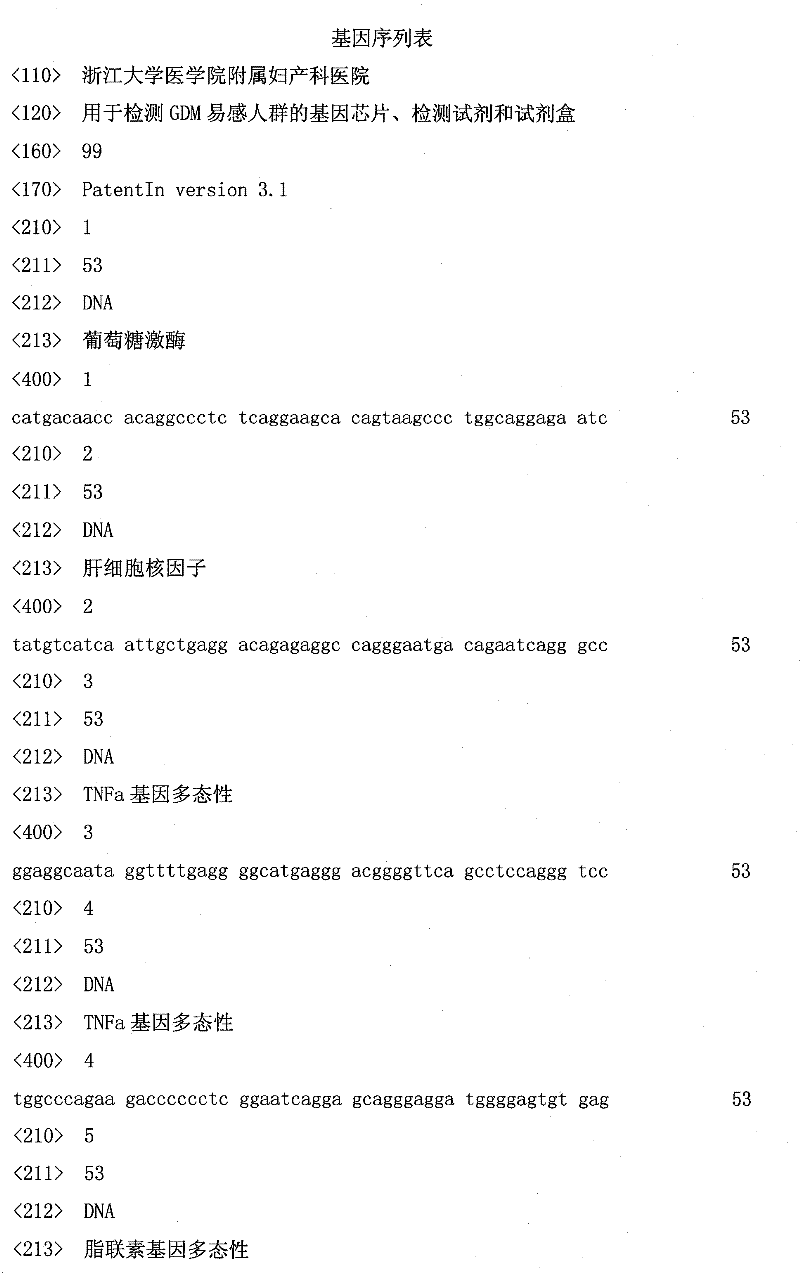
上述SNP位点包括:rs1799884、rs2144908、rs1800629、rs361525、rs266729、rs17300539、rs1801278、rs4994和rs12255372。它们的序列具有Seq IDNo.1-No.9所示的核苷酸序列的DNA片段。 The above SNP sites include: rs1799884, rs2144908, rs1800629, rs361525, rs266729, rs17300539, rs1801278, rs4994 and rs12255372. Their sequences have the DNA fragments of the nucleotide sequences shown in Seq ID No.1-No.9. the
一种包含上述基因芯片的检测试剂,该检测试剂还包含用于扩增各GDM相关SNPs的PCR引物,这些PCR引物具有Seq ID No.82-No.90的核苷酸序列。 A detection reagent comprising the above-mentioned gene chip, the detection reagent also comprises PCR primers for amplifying each GDM-related SNPs, and these PCR primers have the nucleotide sequences of Seq ID No.82-No.90. the
一种用于GDM易感人群检测与分型的试剂盒,至少包括基因芯片,PCR扩增引物,阴性对照和阳性对照样本。该试剂盒还包括杂交盒,杂交液。 A kit for detection and typing of GDM susceptible population, at least including a gene chip, PCR amplification primers, negative control and positive control samples. The kit also includes a hybridization box and a hybridization solution. the
本发明对不同GDM易感相关SNP位点设计特异性探针进行检测,通过基因芯片杂交结果进行判读,预测检测样本疾病易感性。 The invention designs specific probes for different GDM susceptibility-related SNP sites to detect, interprets the results of gene chip hybridization, and predicts the disease susceptibility of detection samples. the
本发明的有益效果是:本发明用于检测GDM易感人群的基因芯片、检测试 剂和试剂盒构建了筛查GDM各相关基因多态性高危人群的基因芯片检测系统,可快速、准确检测临床样本中的GDM各相关SNPs,通量大、灵敏度高,对于GDM的临床诊断和高危人群早期筛查、早期预防干预有重要的意义,可广泛用于临床高效筛查GDM高危人群。 The beneficial effect of the present invention is: the present invention is used for detecting the gene chip of GDM susceptibility population, detection reagent and test kit have constructed the gene chip detection system of screening the high-risk population of each relevant gene polymorphism of GDM, can detect rapidly and accurately The GDM-related SNPs in clinical samples have large throughput and high sensitivity, which are of great significance for the clinical diagnosis of GDM, early screening and early preventive intervention of high-risk groups, and can be widely used in clinical and efficient screening of high-risk groups for GDM. the
附图说明 Description of drawings
图1为基因芯片的一般制作流程图;图2为PCR扩增流程图。 Fig. 1 is a general flow chart of making a gene chip; Fig. 2 is a flow chart of PCR amplification. the
具体实施方式Detailed ways
以玻璃基质为载体的DNA芯片技术采用的是微量点样DNA微阵列技术,其基本原理如下:DNA探针为含有特定DNA序列的寡核苷酸片段,其末端带有氨基标记。经化学修饰处理的玻璃基质基片带有活化醛基基团,可以与DNA探针附带的修饰氨基共价结合,利用这种方法可将DNA探针按一定的排列规律固定在基片表面。其主要优点是简便易行,能根据使用者的要求简便的制出符合目的的芯片。在此基础上结合PCR技术对微量待测样品进行大量快速扩增,扩增后含有荧光标记物的待测样品与芯片上的探针进行特异性杂交和扫描,此后对杂交信号强弱和有无进行分析,即可判断样品中靶基因的数量和性质,基因芯片的制作流程如图1所示。 The DNA chip technology with glass matrix as the carrier adopts the DNA microarray technology with micro spotting, and its basic principle is as follows: the DNA probe is an oligonucleotide fragment containing a specific DNA sequence, and its end is labeled with an amino group. The chemically modified glass matrix substrate has an activated aldehyde group, which can be covalently bonded to the modified amino group attached to the DNA probe. Using this method, the DNA probe can be fixed on the surface of the substrate according to a certain arrangement. Its main advantage is that it is simple and easy to operate, and can easily produce chips that meet the purpose according to the requirements of users. On this basis, combined with PCR technology, a large amount of rapid amplification is performed on a small amount of samples to be tested. After amplification, the samples to be tested containing fluorescent markers are specifically hybridized and scanned with the probes on the chip. After that, the strength and effectiveness of the hybridization signal Without analysis, the quantity and nature of the target gene in the sample can be judged. The production process of the gene chip is shown in Figure 1. the
本发明的基因芯片包括一基底和固定于该基底上的探针,固定于基片上的探针为可与GDM各相关基因SNP多态性核酸杂交的特异型探针。 The gene chip of the present invention comprises a substrate and probes fixed on the substrate, and the probes fixed on the substrate are specific probes capable of hybridizing with SNP polymorphic nucleic acids of GDM related genes. the
本发明的GDM各相关基因SNP多态性核酸选取如下: Each related gene SNP polymorphic nucleic acid of GDM of the present invention is selected as follows:
表1:GDM各相关基因SNP多态性核酸基因序列表; Table 1: SNP polymorphic nucleic acid gene sequence list of GDM related genes;
GDM各相关基因多态性的特异性探针序列如下: The specific probe sequences for each related gene polymorphism of GDM are as follows:
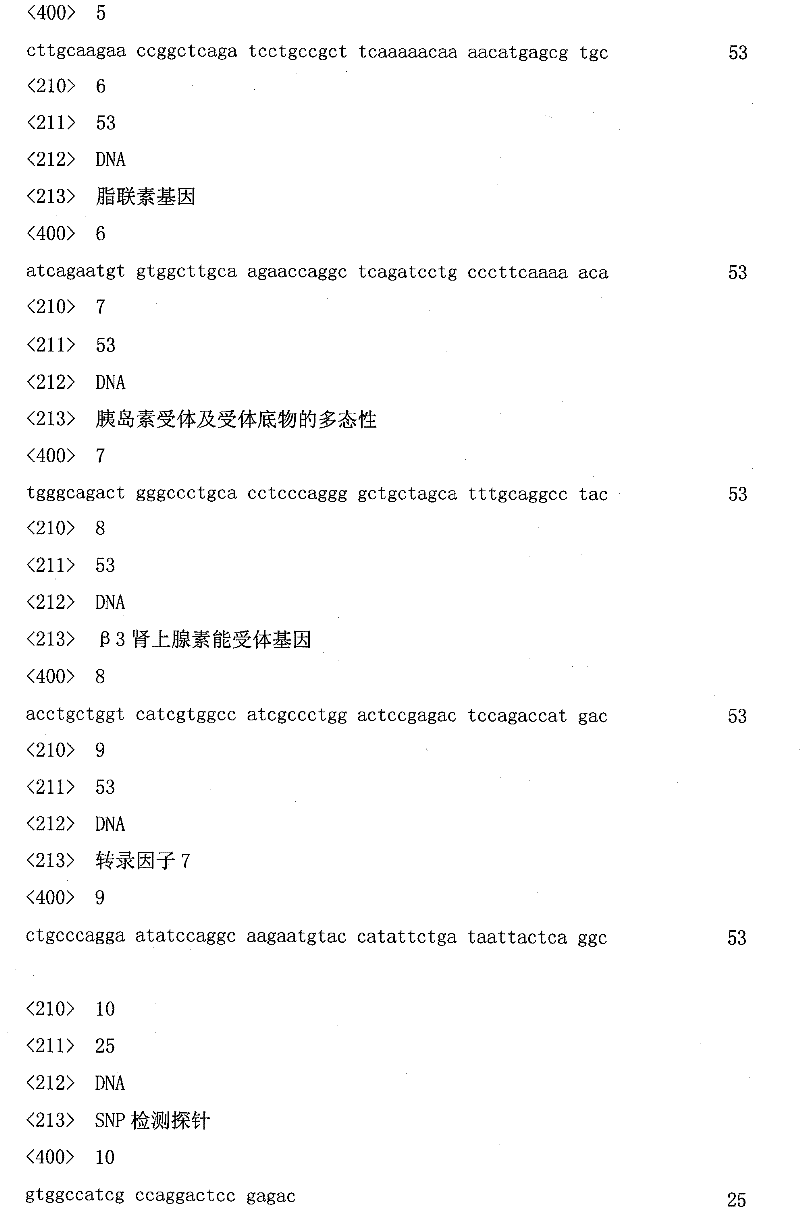
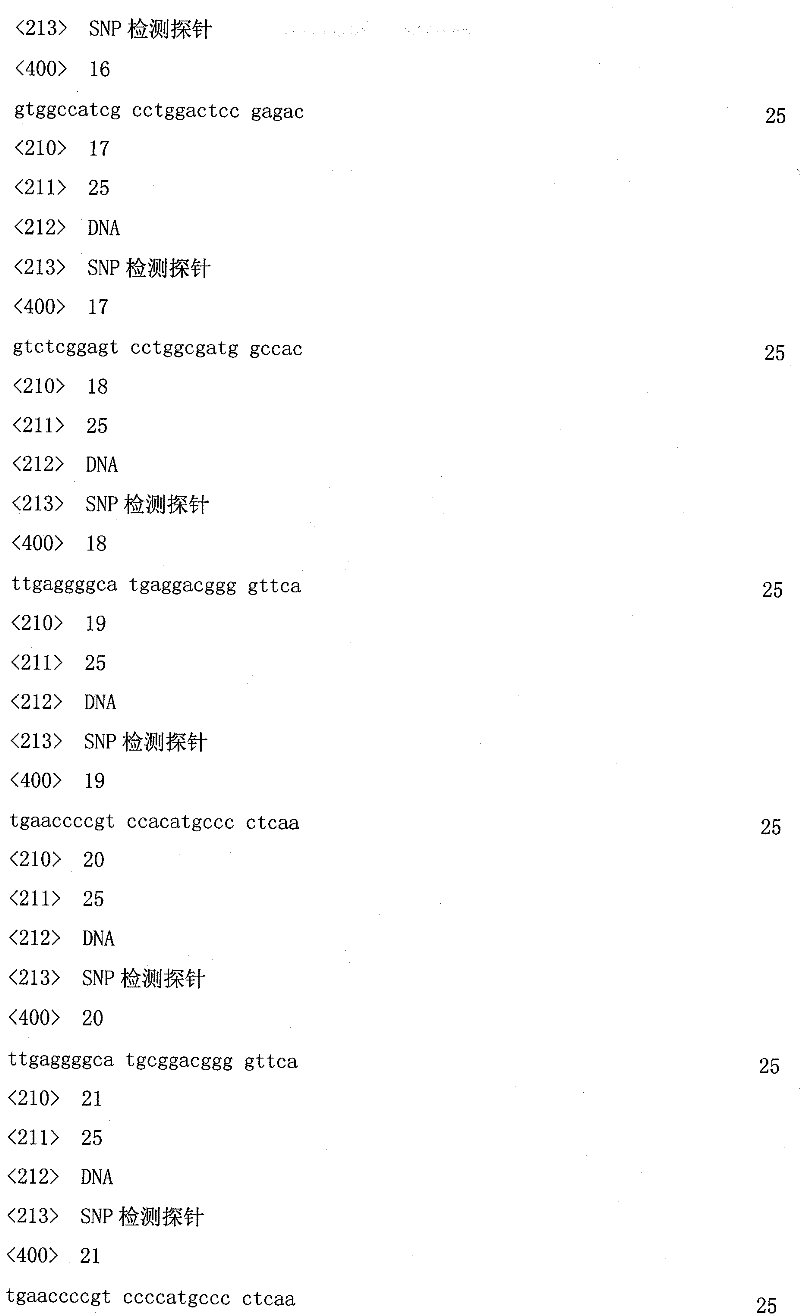
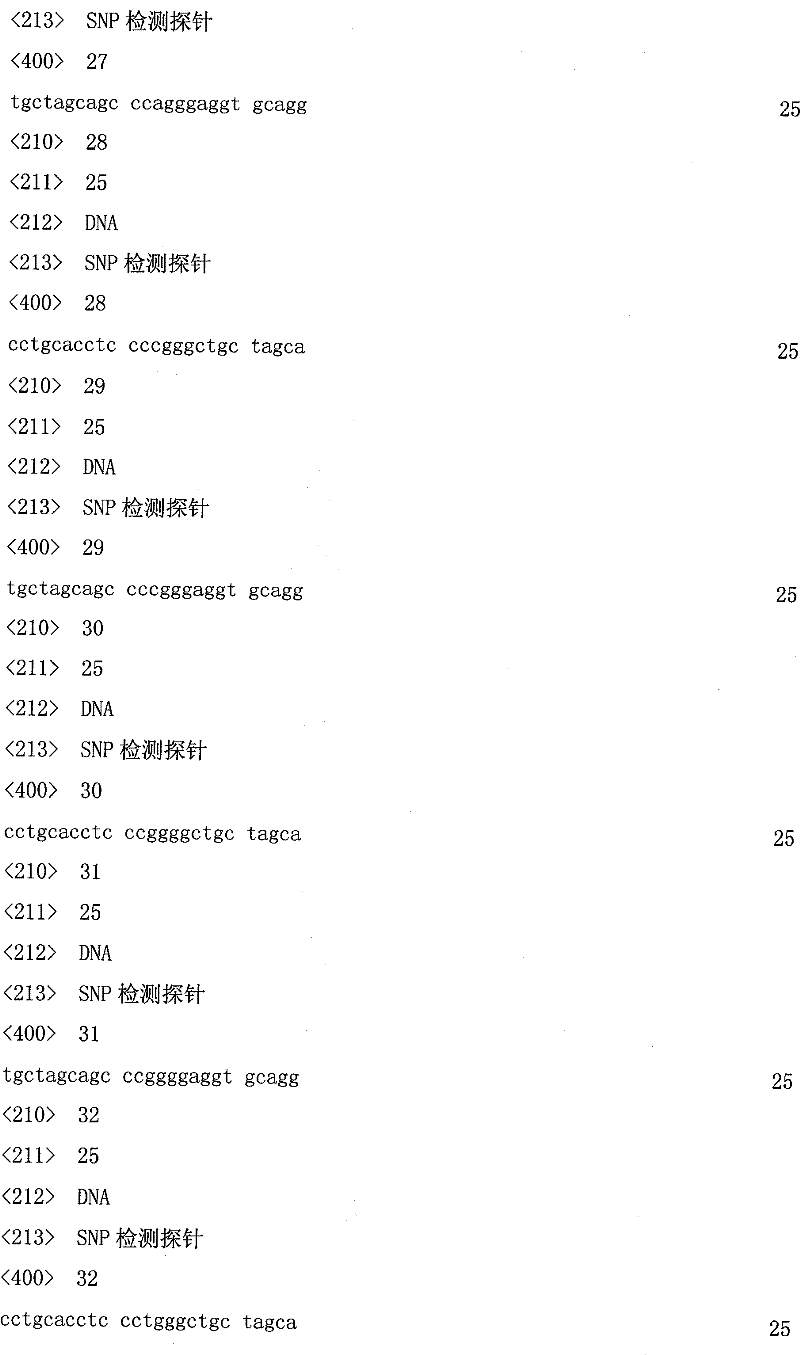
表2.根据SNP位点和侧翼序列设计SNP检测探针(Seq ID No.10-No.81针对每个SNP位点,正反2条DNA链共设计8条探针): Table 2. Design of SNP detection probes based on SNP sites and flanking sequences (Seq ID No.10-No.81 for each SNP site, a total of 8 probes are designed for the positive and negative 2 DNA strands):
在上述序列中,针对每一个GDM相关的SNP设计了正、反两条序列。 In the above sequences, two sequences, positive and negative, were designed for each GDM-related SNP. the
在上述设计的GDM各相关SNPs的基础上,本领域技术人员可以通过本领域常规方法进行探针合成,并进行5’端Poly(T)和氨基修饰。 On the basis of the above-mentioned designed GDM-related SNPs, those skilled in the art can carry out probe synthesis by conventional methods in the field, and carry out poly(T) and amino modification at the 5' end. the
在本发明的一个实施方案中,芯片制备通过芯片点样仪进行,将探针溶解在点样液中,根据设定的点样程序进行点样,点样后的基因芯片经过水合和硼氢化钠还原后即可应用于检测。 In one embodiment of the present invention, the chip preparation is carried out by a chip spotter, the probes are dissolved in the spotting solution, and the spotting is carried out according to the set spotting program, and the gene chip after spotting is hydrated and hydroborated After sodium reduction, it can be used for detection. the
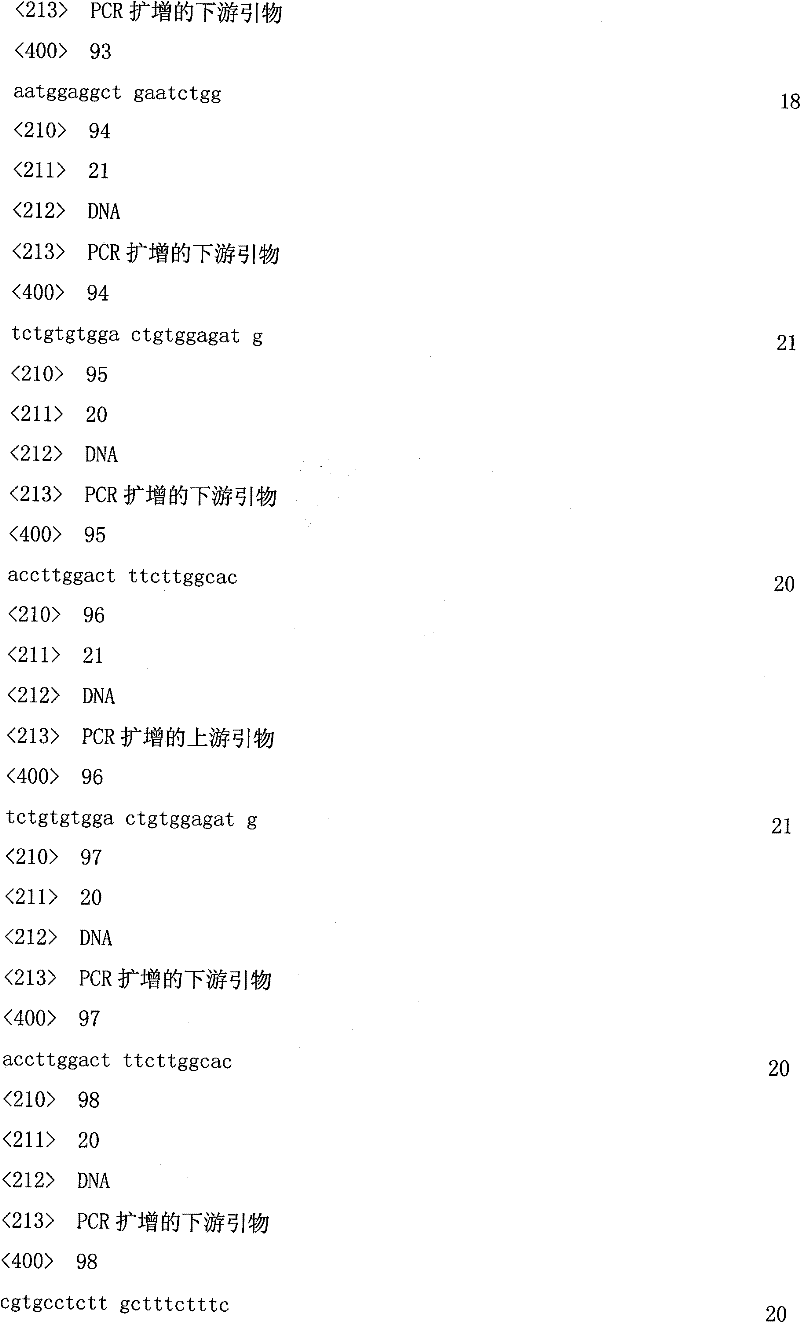
用于检测样本中GDM各相关性SNPs的检测试剂至少包括一对用于扩增样本中各SNPs的PCR引物以及上述本发明的基因芯片。本发明的PCR引物根据GDM各相关SNPs的特点,利用其各自特异的侧翼序列设计引物,通过9次PCR反应可广谱扩增特异性SNP序列。在本发明的一个较佳实施方案中,设计了如SEQ IDNO.82-90引物序列如下: The detection reagent used to detect the GDM-related SNPs in the sample at least includes a pair of PCR primers used to amplify the SNPs in the sample and the above-mentioned gene chip of the present invention. According to the characteristics of each related SNPs of GDM, the PCR primers of the present invention utilize their respective specific flanking sequences to design primers, and the specific SNP sequences can be broadly amplified through 9 PCR reactions. In a preferred embodiment of the present invention, designed as SEQ ID NO.82-90 primer sequence is as follows:
表3.根据SNP位点两端的更远侧序列设计的用于PCR扩增的上下游引物(Seq ID No.82-No.99): Table 3. Upstream and downstream primers (Seq ID No.82-No.99) for PCR amplification designed according to the more distal sequences at both ends of the SNP site:
引物合成过程中对没对引物之一的5’端预先进行荧光标记, During the primer synthesis process, the 5' end of one of the paired primers was fluorescently labeled in advance,
在使用时,抽提待检测样品的基因组DNA,以每个待检测SNP位点设计上下游引物并进行PCR扩增,在扩增过程中引入荧光标记。荧光标记的核酸靶标分子通过碱基互补配对原则与芯片上的探针杂交,通过芯片扫描获得每个位点的荧光信号。 When in use, extract the genomic DNA of the sample to be detected, design upstream and downstream primers for each SNP site to be detected and perform PCR amplification, and introduce fluorescent markers during the amplification process. Fluorescently labeled nucleic acid target molecules hybridize with the probes on the chip through the principle of complementary base pairing, and the fluorescent signal of each site is obtained by scanning the chip. the
上述样本处理试剂、PCR扩增试剂、杂交试剂均可以使用本领域技术人员所熟知的在这些操作过程中需使用的各种试剂,这些试剂必要时可以包括在试剂盒中,也可以将其配方列明在试剂盒的说明书中由使用者按照说明书中的指示自行配制。 The above-mentioned sample processing reagents, PCR amplification reagents, and hybridization reagents can all use various reagents that are well known to those skilled in the art and need to be used in these operations. These reagents can be included in the kit if necessary, or their formula Listed in the instructions of the kit, users should follow the instructions in the instructions to prepare by themselves. the
本发明的试剂盒中还包括相应的阴性对照和/或阳性对照样本。 The kit of the present invention also includes corresponding negative control and/or positive control samples. the
根据本发明的再一方面,提供一种评估待测样本中GDM各相关SNPs,从而高效筛查GDM高危人群的方法。将来自待检测个体的样本使用本发明的检测试剂检测,通过样本中GDM各相关SNPs的表达情况评估该个体发生GDM甚至今后进展为2型糖尿病的可能性大小。 According to yet another aspect of the present invention, a method is provided for evaluating each GDM-related SNPs in a sample to be tested, thereby efficiently screening GDM high-risk groups. The samples from the individual to be tested are detected by the detection reagent of the present invention, and the possibility of the individual developing GDM or even developing type 2 diabetes in the future is evaluated by the expression of each GDM-related SNPs in the sample. the
下面,结合附图,通过对本发明较佳实施方式的描述,详细说明但不限制本发明。 Below, with reference to the accompanying drawings, the present invention will be described in detail but not limited by describing the preferred embodiments of the present invention. the
实施例1:GDM各相关SNPs检测芯片的制备 Embodiment 1: Preparation of each related SNPs detection chip of GDM
1.生产原材料的厂商、规格 1. Manufacturers and specifications of raw materials
探针序列设计如Seq ID No.10-No.81所示,按照本领域技术人员熟知的方法合成5’端氨基标记探针。 The probe sequence design is shown in Seq ID No.10-No.81, and the 5'-terminal amino-labeled probe was synthesized according to methods well known to those skilled in the art. the
2.芯片制备过程: 2. Chip preparation process:
(1)将合成的探针溶解于基因芯片点样液中,用SmartArrayTM(CapitalBioCorp.)点样仪点制在一张75×25mm、经过醛基修饰的芯片基片上,干燥后保存。 (1) Dissolve the synthesized probe in the gene chip spotting solution, and spot it on a 75×25 mm chip substrate modified with aldehyde groups with a SmartArray TM (CapitalBioCorp.) spotting instrument, and store it after drying.
(2)芯片使用前需经过如下前处理: (2) The chip needs to undergo the following pre-processing before use:
1)将芯片置于密闭、100%湿度的湿盒中,37℃过夜处理。 1) Place the chip in a closed, 100% humidity humid box and process overnight at 37°C. the
2)将芯片放于0.25%NaBH4溶液中,水平摇床(80rpm)上还原处理5min。 2) Put the chip in 0.25% NaBH4 solution, and reduce it on a horizontal shaker (80 rpm) for 5 minutes. the
3)在蒸馏水中,水平摇床(80rpm)上清洗5min。 3) Wash in distilled water on a horizontal shaker (80 rpm) for 5 minutes. the
4)重复3)一次。 4) Repeat 3) once. the
5)把芯片放置于50ml专门的离心甩干管中,2000rpm离心1min。经如 5) Place the chip in a 50ml special centrifugal drying tube and centrifuge at 2000rpm for 1min. as
上处理的芯片即可用于杂交。 The processed chips are ready for hybridization. the
实施例2:GDM各相关SNPs检测试剂盒样本检测 Example 2: GDM related SNPs detection kit sample detection
临床验证结果表明,本发明的检测系统通量大、灵敏度高,基因芯片技术的引入使得该方法具有与荧光定量PCR相当的灵敏度。具体试剂、检测方法如下: The clinical verification results show that the detection system of the present invention has large throughput and high sensitivity, and the introduction of the gene chip technology makes the method have a sensitivity comparable to that of fluorescent quantitative PCR. The specific reagents and detection methods are as follows:
1.试剂盒组成 1. Kit composition
其中,PCR Mix1-9含SEQ ID NO.82-90的引物。 Wherein, PCR Mix1-9 contains the primers of SEQ ID NO.82-90. the
2.需配备的仪器及配制的试剂如下: 2. The instruments and reagents to be equipped are as follows:
DNA电泳仪、PCR仪、芯片杂交仪、摇床、0.25%NaBH4溶液。 DNA electrophoresis instrument, PCR instrument, chip hybridization instrument, shaker, 0.25% NaBH4 solution. the
其他需要的试剂按照以下配方配制: Other required reagents were prepared according to the following formula:
3、操作步骤 3. Operation steps
(1)样本收集及保存 (1) Sample collection and storage
GDM易感人群筛查样本主要取外周静脉血样本进行检测。采集的样本在室温放置不超过2小时,4℃保存不超过24小时,-20℃保存不超过3个月。样本应避免反复冻融。 The screening samples of GDM susceptible population are mainly taken from peripheral venous blood samples for detection. The collected samples should be stored at room temperature for no more than 2 hours, stored at 4°C for no more than 24 hours, and stored at -20°C for no more than 3 months. Samples should avoid repeated freezing and thawing. the
(2)样本处理 (2) Sample processing
将血液样本转移到1.5ml微量离心管中,13000rpm离心10分钟,弃去上清,保留管底的细胞块。 Transfer the blood sample to a 1.5ml microcentrifuge tube, centrifuge at 13000rpm for 10 minutes, discard the supernatant, and keep the cell mass at the bottom of the tube. the
加入50ul裂解液悬浮沉淀,100℃加热10分钟,13000rpm离心10分钟,保留上清待用。 Add 50ul of lysate to suspend the precipitate, heat at 100°C for 10 minutes, centrifuge at 13000rpm for 10 minutes, and save the supernatant for later use. the
(3)PCR扩增 (3) PCR amplification
取PCR反应管,在管壁上做好标记,分别加入已提取的待测样品DNA5μl,反应总体系为25μl。每次实验,必须设置一个阴性对照,即以5μl无菌纯水为模板。 Take the PCR reaction tube, mark it on the tube wall, add 5 μl of the extracted DNA of the sample to be tested, and the total reaction system is 25 μl. For each experiment, a negative control must be set, that is, 5 μl of sterile pure water is used as a template. the
按图2流程进行扩增: Amplify according to the flow chart in Figure 2:
(4)杂交 (4) hybridization
取同一待检样品的各个PCR扩增产物各2μl混合,经PCR产物纯化试剂盒纯化后,加入杂交液15μl,95℃变性处理3min,冰上放置2min以上后上样于芯片。 Take 2 μl of each PCR amplification product of the same sample to be tested and mix, after purification by the PCR product purification kit, add 15 μl of hybridization solution, denature at 95°C for 3 minutes, place on ice for more than 2 minutes, and then load the sample on the chip. the
(5)芯片清洗 (5) Chip cleaning
取出芯片,移至装有预热B液的50ml管中,于42℃轻摇洗涤5分钟。 Take out the chip, move it to a 50ml tube filled with preheated solution B, and shake and wash at 42°C for 5 minutes. the
(6)扫描 (6) scan
将芯片放置于扫描仪(LuxScan 10K)中按既定程序扫描。 Place the chip in the scanner (LuxScan 10K) and scan according to the established procedures. the
(7)结果判定 (7) Result judgment
作为对照的杂交点会在PC位置出现绿色荧光信号,提示本次杂交成功;同时其他位点不应该显色,此时结果的判读视为有效。 As a control hybridization point, a green fluorescent signal will appear at the PC position, indicating that the hybridization is successful; at the same time, other sites should not develop color, and the interpretation of the result at this time is considered valid. the
结果见下表。 The results are shown in the table below. the
膜条上的探针排列顺序 Arrangement order of probes on membrane strips
由信号点显现的位置即可断定该患者是否携带GDM各相关SNPs。 Whether the patient carries the relevant SNPs of GDM can be judged by the positions displayed by the signal points. the




Claims (3)
Priority Applications (1)
| Application Number | Priority Date | Filing Date | Title |
|---|---|---|---|
| CN2009101532103A CN101967511B (en) | 2009-10-29 | 2009-10-29 | Gene chip, detection reagent and kit for detecting GDM susceptible population |
Applications Claiming Priority (1)
| Application Number | Priority Date | Filing Date | Title |
|---|---|---|---|
| CN2009101532103A CN101967511B (en) | 2009-10-29 | 2009-10-29 | Gene chip, detection reagent and kit for detecting GDM susceptible population |
Publications (2)
| Publication Number | Publication Date |
|---|---|
| CN101967511A CN101967511A (en) | 2011-02-09 |
| CN101967511B true CN101967511B (en) | 2012-07-18 |
Family
ID=43546733
Family Applications (1)
| Application Number | Title | Priority Date | Filing Date |
|---|---|---|---|
| CN2009101532103A Active CN101967511B (en) | 2009-10-29 | 2009-10-29 | Gene chip, detection reagent and kit for detecting GDM susceptible population |
Country Status (1)
| Country | Link |
|---|---|
| CN (1) | CN101967511B (en) |
Families Citing this family (1)
| Publication number | Priority date | Publication date | Assignee | Title |
|---|---|---|---|---|
| CN104073556B (en) * | 2014-05-20 | 2015-11-18 | 宁波大学 | A kind of detection kit of auxiliary diagnosis diabetes |
Citations (1)
| Publication number | Priority date | Publication date | Assignee | Title |
|---|---|---|---|---|
| CA2617649A1 (en) * | 2005-08-11 | 2007-02-22 | Amylin Pharmaceuticals, Inc. | Hybrid polypeptides with selectable properties |
-
2009
- 2009-10-29 CN CN2009101532103A patent/CN101967511B/en active Active
Patent Citations (1)
| Publication number | Priority date | Publication date | Assignee | Title |
|---|---|---|---|---|
| CA2617649A1 (en) * | 2005-08-11 | 2007-02-22 | Amylin Pharmaceuticals, Inc. | Hybrid polypeptides with selectable properties |
Non-Patent Citations (3)
| Title |
|---|
| RICHARD et al.Genetics of Gestational Diabetes Mellitus and Type 2 Diabetes.《DIABETES CARE》.2007,第30卷(第2期),134-140. * |
| 张新宇等.TNF-a和IL-6基因多态性与妊娠期糖尿病的相关研究.《基础研究与临床决策》.2008,第29卷(第7期),39-40. * |
| 武海荣等.妊娠期糖尿病基因多态性研究进展.《国际妇产科学杂志》.2009,第36卷(第1期),20-26. * |
Also Published As
| Publication number | Publication date |
|---|---|
| CN101967511A (en) | 2011-02-09 |
Similar Documents
| Publication | Publication Date | Title |
|---|---|---|
| MX2013008846A (en) | Method for discovering pharmacogenomic biomarkers. | |
| KR102158717B1 (en) | SNP marker for diagnosis of intracranial aneurysm comprising SNP of CD163L1 gene | |
| CN103667326B (en) | The qualification of hypertension susceptible gene group | |
| KR102158716B1 (en) | SNP marker for diagnosis of intracranial aneurysm comprising SNP of ARHGAP32 gene | |
| CN111593118A (en) | Gene mutations used to diagnose Marfan syndrome | |
| CN101967511B (en) | Gene chip, detection reagent and kit for detecting GDM susceptible population | |
| CN105018602B (en) | Susceptibility gene of antipsychotic drug-related metabolic syndrome and application thereof | |
| KR102158713B1 (en) | SNP marker for diagnosis of intracranial aneurysm comprising SNP of GBA gene | |
| KR102158721B1 (en) | SNP marker for diagnosis of intracranial aneurysm comprising SNP of RNF144A gene | |
| CN100362110C (en) | Leptin and leptin receptor gene polymorphism detection chip and its preparation method and application | |
| JP2007516719A (en) | Polynucleotide involved in type 2 diabetes including single nucleotide polymorphism, microarray and diagnostic kit containing the same, and method for analyzing polynucleotide using the same | |
| KR102158715B1 (en) | SNP marker for diagnosis of intracranial aneurysm comprising SNP of OLFML2A gene | |
| CN114231620B (en) | Application of UQCC1 gene polymorphism in diagnosis of moderate and severe MAFLD (myeloproliferative disorder) | |
| CN1771337B (en) | A plynucleotide associated with a colon cancer comprising single nucleotide polymorphism, microarray and diagnostic kit comprising the same and method for diagnosing a colon cancer using the polynucle | |
| KR102778944B1 (en) | Method for providing the information for diagnosing risk of atopy dermatitis | |
| CN111041086B (en) | SNP site susceptible to RPL13 gene congenital heart disease and application thereof | |
| KR101216378B1 (en) | Method for diagnosing premature ovarian failure comprising genotype analysis or haplotype analysis of 2 single nucleotide polymorphisms | |
| KR102158722B1 (en) | SNP marker for diagnosis of intracranial aneurysm comprising SNP of FLJ45964 gene | |
| KR102158719B1 (en) | SNP marker for diagnosis of intracranial aneurysm comprising SNP of LOC102724084 gene | |
| KR102158723B1 (en) | SNP marker for diagnosis of intracranial aneurysm comprising SNP of SPCS3 gene | |
| KR102158720B1 (en) | SNP marker for diagnosis of intracranial aneurysm comprising SNP of LRRC3 gene | |
| KR102158714B1 (en) | SNP marker for diagnosis of intracranial aneurysm comprising SNP of TCF24 gene | |
| KR102158725B1 (en) | SNP marker for diagnosis of intracranial aneurysm comprising SNP of MINK1 gene | |
| CN101871003A (en) | Kit and primers for predicting the susceptibility of type 2 diabetes in Chinese | |
| CN120310900A (en) | A method for detecting SNP sites associated with diabetes, a kit and application thereof |
Legal Events
| Date | Code | Title | Description |
|---|---|---|---|
| C06 | Publication | ||
| PB01 | Publication | ||
| C10 | Entry into substantive examination | ||
| SE01 | Entry into force of request for substantive examination | ||
| C14 | Grant of patent or utility model | ||
| GR01 | Patent grant |