CN101928347B - Anti-carcinoembryonic-antigen (CEA) antibody and application thereof - Google Patents
Anti-carcinoembryonic-antigen (CEA) antibody and application thereof Download PDFInfo
- Publication number
- CN101928347B CN101928347B CN2010101630522A CN201010163052A CN101928347B CN 101928347 B CN101928347 B CN 101928347B CN 2010101630522 A CN2010101630522 A CN 2010101630522A CN 201010163052 A CN201010163052 A CN 201010163052A CN 101928347 B CN101928347 B CN 101928347B
- Authority
- CN
- China
- Prior art keywords
- cea
- antibody
- cancer
- tumor
- chimeric antibody
- Prior art date
- Legal status (The legal status is an assumption and is not a legal conclusion. Google has not performed a legal analysis and makes no representation as to the accuracy of the status listed.)
- Active
Links
Images


Classifications
-
- C—CHEMISTRY; METALLURGY
- C07—ORGANIC CHEMISTRY
- C07K—PEPTIDES
- C07K16/00—Immunoglobulins [IGs], e.g. monoclonal or polyclonal antibodies
- C07K16/18—Immunoglobulins [IGs], e.g. monoclonal or polyclonal antibodies against material from animals or humans
- C07K16/28—Immunoglobulins [IGs], e.g. monoclonal or polyclonal antibodies against material from animals or humans against receptors, cell surface antigens or cell surface determinants
- C07K16/30—Immunoglobulins [IGs], e.g. monoclonal or polyclonal antibodies against material from animals or humans against receptors, cell surface antigens or cell surface determinants from tumour cells
- C07K16/3007—Carcino-embryonic Antigens
-
- A—HUMAN NECESSITIES
- A61—MEDICAL OR VETERINARY SCIENCE; HYGIENE
- A61K—PREPARATIONS FOR MEDICAL, DENTAL OR TOILETRY PURPOSES
- A61K51/00—Preparations containing radioactive substances for use in therapy or testing in vivo
- A61K51/02—Preparations containing radioactive substances for use in therapy or testing in vivo characterised by the carrier, i.e. characterised by the agent or material covalently linked or complexing the radioactive nucleus
- A61K51/04—Organic compounds
- A61K51/08—Peptides, e.g. proteins, carriers being peptides, polyamino acids, proteins
- A61K51/10—Antibodies or immunoglobulins; Fragments thereof, the carrier being an antibody, an immunoglobulin or a fragment thereof, e.g. a camelised human single domain antibody or the Fc fragment of an antibody
- A61K51/1093—Antibodies or immunoglobulins; Fragments thereof, the carrier being an antibody, an immunoglobulin or a fragment thereof, e.g. a camelised human single domain antibody or the Fc fragment of an antibody conjugates with carriers being antibodies
-
- A—HUMAN NECESSITIES
- A61—MEDICAL OR VETERINARY SCIENCE; HYGIENE
- A61P—SPECIFIC THERAPEUTIC ACTIVITY OF CHEMICAL COMPOUNDS OR MEDICINAL PREPARATIONS
- A61P35/00—Antineoplastic agents
-
- A—HUMAN NECESSITIES
- A61—MEDICAL OR VETERINARY SCIENCE; HYGIENE
- A61K—PREPARATIONS FOR MEDICAL, DENTAL OR TOILETRY PURPOSES
- A61K39/00—Medicinal preparations containing antigens or antibodies
- A61K2039/505—Medicinal preparations containing antigens or antibodies comprising antibodies
-
- C—CHEMISTRY; METALLURGY
- C07—ORGANIC CHEMISTRY
- C07K—PEPTIDES
- C07K2317/00—Immunoglobulins specific features
- C07K2317/10—Immunoglobulins specific features characterized by their source of isolation or production
- C07K2317/14—Specific host cells or culture conditions, e.g. components, pH or temperature
-
- C—CHEMISTRY; METALLURGY
- C07—ORGANIC CHEMISTRY
- C07K—PEPTIDES
- C07K2317/00—Immunoglobulins specific features
- C07K2317/20—Immunoglobulins specific features characterized by taxonomic origin
- C07K2317/24—Immunoglobulins specific features characterized by taxonomic origin containing regions, domains or residues from different species, e.g. chimeric, humanized or veneered
-
- C—CHEMISTRY; METALLURGY
- C07—ORGANIC CHEMISTRY
- C07K—PEPTIDES
- C07K2317/00—Immunoglobulins specific features
- C07K2317/70—Immunoglobulins specific features characterized by effect upon binding to a cell or to an antigen
- C07K2317/73—Inducing cell death, e.g. apoptosis, necrosis or inhibition of cell proliferation
Landscapes
- Health & Medical Sciences (AREA)
- Life Sciences & Earth Sciences (AREA)
- Chemical & Material Sciences (AREA)
- Immunology (AREA)
- Organic Chemistry (AREA)
- Proteomics, Peptides & Aminoacids (AREA)
- Medicinal Chemistry (AREA)
- General Health & Medical Sciences (AREA)
- Pharmacology & Pharmacy (AREA)
- Biophysics (AREA)
- Molecular Biology (AREA)
- Public Health (AREA)
- Veterinary Medicine (AREA)
- Genetics & Genomics (AREA)
- Animal Behavior & Ethology (AREA)
- Oncology (AREA)
- Cell Biology (AREA)
- Biochemistry (AREA)
- Physics & Mathematics (AREA)
- Optics & Photonics (AREA)
- Epidemiology (AREA)
- Chemical Kinetics & Catalysis (AREA)
- General Chemical & Material Sciences (AREA)
- Nuclear Medicine, Radiotherapy & Molecular Imaging (AREA)
- Peptides Or Proteins (AREA)
- Medicines Containing Antibodies Or Antigens For Use As Internal Diagnostic Agents (AREA)
- Preparation Of Compounds By Using Micro-Organisms (AREA)
- Micro-Organisms Or Cultivation Processes Thereof (AREA)
- Medicinal Preparation (AREA)
- Medicines That Contain Protein Lipid Enzymes And Other Medicines (AREA)
Abstract
本发明涉及一种抗癌胚抗原(CEA)人源化嵌合抗体,编码该抗体的多核苷酸,包含该多核苷酸的表达载体以及含有所述表达载体的宿主细胞,以及它们在制备用于诊断和/或治疗肿瘤的药物中的用途。

The present invention relates to an anti-carcinoembryonic antigen (CEA) humanized chimeric antibody, a polynucleotide encoding the antibody, an expression vector comprising the polynucleotide and a host cell containing the expression vector, and their preparation Use in medicines for diagnosing and/or treating tumors.
Description
技术领域 technical field
本发明涉及一种抗癌胚抗原(CEA)人源化嵌合抗体,编码该抗体的多核苷酸,包含该多核苷酸的表达载体以及含有所述表达载体的宿主细胞,以及它们在制备用于诊断和/或治疗肿瘤的药物中的用途。The present invention relates to an anti-carcinoembryonic antigen (CEA) humanized chimeric antibody, a polynucleotide encoding the antibody, an expression vector comprising the polynucleotide and a host cell containing the expression vector, and their preparation Use in medicines for diagnosing and/or treating tumors.
背景技术 Background technique
1965年,加拿大的Gold和Fredman用人结肠癌提取液免疫兔所得的血清检测多种人组织,发现由人内胚叶来源的消化道肿瘤为染色强阳性,同时还发现2-6个月胎儿的消化道组织也阳性,因而将这种在消化道肿瘤中表达呈阳性的抗原分子命名为癌胚抗原(Carcinoembryonic antigen,CEA)。后来发现CEA抗原在由内胚层细胞分化而来的肿瘤细胞中的表达水平较正常组织高上百倍,是多种人恶性肿瘤重要的肿瘤抗原和标志物。CEA是一种由糖链和肽链组成的分子量约为180-200KD的糖蛋白,由于糖链的组成不同和来源不同其生化特性及免疫原性显示出极大的异质性、多样性和不均一性,是一个相对大的大分子家族。CEA分子具有许多不同的抗原表位,这些不同的表位在成人不同正常组织、胎儿器官和各种恶性肿瘤组织中的表达不同,特异性也有差别。Hammarstrom等于1989年提出把CEA抗原表位分为5组,即Gold 1-5组(Gold分类),研究表明Gold 1-5组的抗原表位分别位于CEA分子的结构域A3、B2、B3、A1和N,其中A3和B3结构域与其它CEA相关分子的同源性低,是CEA分子相对专一的结构域。In 1965, Gold and Fredman in Canada detected a variety of human tissues with the serum obtained from rabbits immunized with human colon cancer extracts, and found that the digestive tract tumors derived from human endoderm were strongly positive for staining, and also found that the 2-6-month-old fetus The digestive tract tissue was also positive, so this antigen molecule expressed positively in digestive tract tumors was named carcinoembryonic antigen (CEA). Later, it was found that the expression level of CEA antigen in tumor cells differentiated from endoderm cells was hundreds of times higher than that in normal tissues, and it was an important tumor antigen and marker for various human malignant tumors. CEA is a glycoprotein with a molecular weight of about 180-200KD composed of sugar chains and peptide chains. Due to the different composition and sources of sugar chains, its biochemical characteristics and immunogenicity show great heterogeneity, diversity and Heterogeneity, is a relatively large family of macromolecules. CEA molecules have many different antigenic epitopes, and these different epitopes are expressed differently in different adult normal tissues, fetal organs and various malignant tumor tissues, and their specificities are also different. Hammarstrom et al. proposed in 1989 to divide the CEA antigenic epitopes into 5 groups, that is, Gold 1-5 groups (Gold classification), and studies have shown that the antigenic epitopes of the Gold 1-5 groups are located in the domains A3, B2, B3, and B3 of the CEA molecule, respectively. A1 and N, in which the A3 and B3 domains have low homology with other CEA-related molecules, are relatively specific domains of CEA molecules.
CEA主要在细胞胞膜和胞浆表达,在8周的胚胎的各胚层组织也有表达。3个月后的胚胎组织中CEA主要表达于胃肠上皮组织,至成人组织CEA表达明显减弱或消失,只有结肠上皮细胞表面有微量表达。但当细胞发生癌变后,CEA在多种恶性肿瘤高表达,包括结肠直肠癌、胃癌、肺癌、乳腺癌、胰腺癌、卵巢癌、宫颈癌、前列腺癌、膀胱癌、胆囊癌和食管癌等11种肿瘤,其阳性率达50-90%,并且在这些恶性肿瘤的转移灶中CEA也高表达,且表达水平高于原发病灶。在这些肿瘤中,结肠直肠癌CEA表达阳性率和强度均居首位,达95%以上。几乎所有的结直癌组织中都有CEA的高表达,而且其在转移病灶如肝转移灶中的表达水平和阳性率显著高于原发病灶。大量的研究还证明CEA在恶性肿瘤的表达与肿瘤的负荷、分期、转移预后密切相关。因此CEA已被世界范围公认为恶性肿瘤特异的分子标志物,使之成为肿瘤靶向治疗和诊断的最佳靶位之一。CEA is mainly expressed in the cell membrane and cytoplasm, and it is also expressed in various germ layer tissues of 8-week embryos. In embryonic tissues after 3 months, CEA is mainly expressed in gastrointestinal epithelial tissues, and in adult tissues, the expression of CEA is obviously weakened or disappeared, and only a small amount of expression is expressed on the surface of colonic epithelial cells. However, when cells become cancerous, CEA is highly expressed in a variety of malignant tumors, including colorectal cancer, gastric cancer, lung cancer, breast cancer, pancreatic cancer, ovarian cancer, cervical cancer, prostate cancer, bladder cancer, gallbladder cancer and esophageal cancer11 The positive rate of these tumors is 50-90%, and CEA is also highly expressed in the metastases of these malignant tumors, and the expression level is higher than that of the primary lesions. Among these tumors, the positive rate and intensity of CEA expression in colorectal cancer rank first, reaching over 95%. CEA is highly expressed in almost all colorectal cancer tissues, and its expression level and positive rate in metastatic lesions such as liver metastases are significantly higher than those in primary lesions. A large number of studies have also proved that the expression of CEA in malignant tumors is closely related to the tumor burden, stage, metastasis and prognosis. Therefore, CEA has been recognized worldwide as a specific molecular marker for malignant tumors, making it one of the best targets for tumor targeted therapy and diagnosis.
CEA阳性的恶性肿瘤发病率高,发病人数巨大,是全世界范围内对人民生命健康威胁最大的疾病之一。以CEA高表达的结肠癌为例,结肠癌是最常见的恶性肿瘤之一,结肠直肠癌的发病率在欧美发达国家居所有恶性肿瘤第三位,死亡率居第二位。全球每年新增病例超过100万,死于结肠直肠癌的病人达52.9万。每年我国新增结肠直肠癌病人近40万需要治疗,有约近20万的结肠直肠癌病人因为治疗失败或无效而死亡。到目前为止FDA批准的最常用的结肠癌化疗药有4种:氟尿嘧啶(fluorouracie)、伊立替康(irinotacan)、奥沙利铂(oxaliplatin)和卡培他滨(capecitabine),现有这些化疗药物和化疗方案作为术后辅助治疗可以减少结肠直肠癌的复发率到约为15%左右,改善和提高5年生存率到约10-13%。抗体靶向药物是近十年发展起来的另一类治疗恶性肿瘤的新药。在临床上用于治疗某些血液系统肿瘤,如非霍杰金氏淋巴瘤等,已取得显著的疗效,可提高病人的5年生存率。以CEA抗原为靶点的放射免疫抗体靶向治疗剂虽然目前尚未有批准上市治疗肿瘤的CEA抗体药。但现已有2种CEA抗体放射免疫治疗剂被批准正在进行I、II期临床试用研究。一种是美国Immunomedics公司于1999年研制开发的131I偶联的重组CEA人源化抗体hMN-14的131I-hMN-14抗体药,目前已基本完成治疗耐药性转移进展期结肠直肠癌的II期临床研究,进入III期临床研究。另一种抗人CEA抗体药物是美国FDA批准美国City of Hope国家医学中心研发的与放射核素90y偶联的cT84.66人/鼠嵌合抗体,目前已完成治疗进展期恶性肿瘤的I期临床试验。然而,以上2种CEA抗体药物还存在特异性还需进一步提高,毒副反应需进一步降低;抗体亲合力过高,易造成放射免疫靶向治疗时产生亲合力壁垒,从而显著影响疗效等问题。需要新的抗CEA抗体以克服现有技术抗CEA抗体存在的问题。CEA-positive malignant tumors have a high incidence and a large number of patients, and are one of the diseases that threaten people's lives and health worldwide. Taking colon cancer with high CEA expression as an example, colon cancer is one of the most common malignant tumors. The incidence of colorectal cancer ranks third among all malignant tumors in developed countries in Europe and America, and its mortality rate ranks second. Globally, there are more than 1 million new cases every year, and 529,000 patients die from colorectal cancer. Every year, nearly 400,000 new colorectal cancer patients in my country need treatment, and nearly 200,000 colorectal cancer patients die due to treatment failure or ineffectiveness. Four of the most commonly used chemotherapy drugs for colon cancer approved by the FDA so far are fluorouracil, irinotacan, oxaliplatin, and capecitabine, which are currently And chemotherapy as postoperative adjuvant therapy can reduce the recurrence rate of colorectal cancer to about 15%, improve and increase the 5-year survival rate to about 10-13%. Antibody-targeted drugs are another class of new drugs for the treatment of malignant tumors that have been developed in the past decade. It has been used clinically to treat certain blood system tumors, such as non-Hodgkin's lymphoma, etc., and has achieved remarkable curative effects, which can improve the 5-year survival rate of patients. Radioimmune antibody-targeted therapeutic agent with CEA antigen as the target Although there is no CEA antibody drug approved for marketing to treat tumors. However, two CEA antibody radioimmunotherapy agents have been approved and are undergoing phase I and II clinical trials. One is the 131 I-hMN-14 antibody drug of the 131 I -coupled recombinant CEA humanized antibody hMN-14 developed by Immunomedics in 1999, and has basically completed the treatment of drug-resistant metastatic advanced colorectal cancer Phase II clinical research, enters Phase III clinical research. Another anti-human CEA antibody drug is the cT84.66 human/mouse chimeric antibody conjugated with radionuclide 90y developed by the City of Hope National Medical Center of the United States approved by the US FDA. phase clinical trials. However, the specificity of the above two CEA antibody drugs needs to be further improved, and the toxicity and side effects need to be further reduced; the antibody affinity is too high, which may easily cause affinity barriers in radioimmunotargeted therapy, which will significantly affect the curative effect. New anti-CEA antibodies are needed to overcome the problems with prior art anti-CEA antibodies.
现有的众多研究已经定论,抗体的结合特异性及亲合力均是绝大部分由抗体的轻链和重链超可变区(或称互补决定区,complementary determinantregion,简称CDR)的氨基酸序列决定的。美国食品及药品监督管理局(U.S.Food and Drug Administration,FDA)在其指导原则中认定,凡是具有相同互补决定区的同类型抗体属于同一种抗体。因此,在获得一种有临床治疗价值的抗体的CDR之后,业界很容易根据成熟、公知的现有各项技术将其非CDR区域的氨基酸序列改变而获得具有相同甚至更好的生物活性的变体。Numerous existing studies have concluded that the binding specificity and affinity of antibodies are mostly determined by the amino acid sequences of the antibody's light chain and heavy chain hypervariable region (or complementarity determining region, complementary determinant region, referred to as CDR). of. The U.S. Food and Drug Administration (FDA) has determined in its guidelines that all antibodies of the same type with the same complementarity-determining region belong to the same antibody. Therefore, after obtaining the CDR of an antibody with clinical therapeutic value, it is easy for the industry to change the amino acid sequence of its non-CDR region according to mature and well-known existing technologies to obtain a variant with the same or even better biological activity. body.
发明内容 Contents of the invention
本发明是基于具有优异的CEA结合特异性和适宜亲合力的亲本抗CEA鼠单克隆抗体,通过克隆、鉴定与基因结构的分析,确定了其CDR区序列,构建了相应的人源化嵌合抗体及其真核细胞表达载体,并获得了表达并分泌该抗CEA人源化嵌合抗体的细胞株。The present invention is based on the parental anti-CEA mouse monoclonal antibody with excellent CEA binding specificity and suitable affinity. Through cloning, identification and analysis of gene structure, the sequence of its CDR region is determined, and the corresponding humanized chimeric antibody is constructed. The antibody and its eukaryotic cell expression vector were obtained, and the cell line expressing and secreting the anti-CEA humanized chimeric antibody was obtained.
本发明进一步证明了所述的人源化嵌合抗体除了具有与原鼠单抗相匹配的适宜的亲合力外,还具有优异的CEA结合特异性和体内肿瘤靶向性,并在体内可显著抑制多种结肠癌动物模型的生长,同时由于具有人源性,将可减少其人体应用时的毒副作用。本发明进一步采用动物模型及放射免疫显像等实验在体内充分证明了所述的人源化嵌合抗体具有优异的CEA阳性肿瘤的靶向性,因此可用于制备CEA阳性肿瘤的体内诊断药物。此外,本发明还利用放射免疫治疗等实验在多种动物模型体内证明了所述的人源化嵌合抗体具有优异的抑制CEA阳性肿瘤生长的能力,因此可用于制备CEA阳性肿瘤的治疗药物。The present invention further proves that the humanized chimeric antibody has excellent CEA binding specificity and in vivo tumor targeting in addition to having a suitable affinity matching that of the original mouse monoclonal antibody, and can significantly It inhibits the growth of various animal models of colon cancer, and at the same time, due to its human origin, it will reduce the toxic and side effects of its human application. The present invention further uses animal models and radioimmunoimaging experiments to fully prove that the humanized chimeric antibody has excellent targeting of CEA-positive tumors in vivo, so it can be used to prepare in vivo diagnostic drugs for CEA-positive tumors. In addition, the present invention also uses radioimmunotherapy and other experiments to prove that the humanized chimeric antibody has an excellent ability to inhibit the growth of CEA-positive tumors in various animal models, so it can be used to prepare therapeutic drugs for CEA-positive tumors.
因此,本发明主要涉及了以下几个方面:Therefore, the present invention mainly relates to the following aspects:
第一方面,本发明涉及一种抗癌胚抗原的人源化嵌合单克隆抗体或其功能变体,其中所述单克隆抗体的重链包含SEQ ID NO:7-9所示的CDR区,所述单克隆抗体的轻链包含SEQ ID NO:10-12所示的CDR区。In a first aspect, the present invention relates to an anti-carcinoembryonic antigen humanized chimeric monoclonal antibody or a functional variant thereof, wherein the heavy chain of the monoclonal antibody comprises the CDR region shown in SEQ ID NO: 7-9 , the light chain of the monoclonal antibody comprises the CDR region shown in SEQ ID NO: 10-12.
第二方面,本发明涉及一种抗CEA人源化嵌合单克隆抗体或其功能变体,其中该抗CEA人源化嵌合抗体的轻链蛋白质氨基酸序列为SEQ IDNO:1,重链蛋白质氨基酸序列为SEQ ID NO:2。In a second aspect, the present invention relates to an anti-CEA humanized chimeric monoclonal antibody or a functional variant thereof, wherein the amino acid sequence of the light chain protein of the anti-CEA humanized chimeric antibody is SEQ ID NO: 1, and the heavy chain protein The amino acid sequence is SEQ ID NO:2.
第三方面,本发明涉及具有与所述人源化嵌合抗体相同的CDR序列的多肽,其具有与本发明所述的人源化嵌合抗体相同或更高的生物活性。本领域公知,抗体的结合特异性及亲合力均主要由CDR序列决定,根据成熟、公知的现有各项技术可轻易地将非CDR区域的氨基酸序列改变而获得具有相同甚至更好的生物活性的变体。In the third aspect, the present invention relates to a polypeptide having the same CDR sequence as the humanized chimeric antibody, which has the same or higher biological activity as the humanized chimeric antibody of the present invention. It is well known in the art that the binding specificity and affinity of an antibody are mainly determined by the CDR sequence, and the amino acid sequence of the non-CDR region can be easily changed according to mature and well-known existing technologies to obtain the same or even better biological activity variant of .
第四方面,本发明涉及编码编码第一方面或第二方面所述的单克隆抗体或其变体或第三方面所述的多肽的核酸。本领域公知,即使改变核苷酸的序列,只要最后按照三联密码子遗传法则可翻译出含氨基酸序列SEQ IDNO:1和氨基酸序列SEQ ID NO:2的抗体蛋白质,均为编码该抗CEA人源化嵌合抗体的多核苷酸。所述的核酸可为DNA或RNA。In the fourth aspect, the present invention relates to a nucleic acid encoding the monoclonal antibody or its variant described in the first aspect or the second aspect or the polypeptide described in the third aspect. It is well known in the art that even if the nucleotide sequence is changed, as long as the antibody protein containing the amino acid sequence SEQ ID NO: 1 and the amino acid sequence SEQ ID NO: 2 can be translated according to the genetic rules of triplet codons, they all encode the anti-CEA human source polynucleotides of chimeric antibodies. The nucleic acid can be DNA or RNA.
第五方面,本发明涉及一种表达载体,其中含有编码氨基酸序列SEQ IDNO:1或SEQ ID NO:2的多核苷酸,优选所述表达载体在真核细胞中高效表达。优选地,所述真核细胞是中国仓鼠卵巢细胞。在优选的实施方案中,所述的表达载体为图4所示的pSRNC-Cκ-CEA或图5所示的pSRDC-Cγ1-CEA。In the fifth aspect, the present invention relates to an expression vector, which contains a polynucleotide encoding the amino acid sequence of SEQ ID NO: 1 or SEQ ID NO: 2, preferably, the expression vector is highly expressed in eukaryotic cells. Preferably, said eukaryotic cells are Chinese hamster ovary cells. In a preferred embodiment, the expression vector is pSRNC-Cκ-CEA shown in FIG. 4 or pSRDC-Cγ1-CEA shown in FIG. 5 .
第六方面,本发明涉及一种宿主细胞,其包含第五方面所述的表达载体。在优选的实施方案中,本发明的宿主细胞为中国仓鼠卵巢(CHO)细胞,具体是保藏号为CGMCC No.3803的细胞。In the sixth aspect, the present invention relates to a host cell comprising the expression vector described in the fifth aspect. In a preferred embodiment, the host cell of the present invention is a Chinese hamster ovary (CHO) cell, specifically a cell with a preservation number of CGMCC No.3803.
第七方面,本发明涉及治疗有效量的第一到第三方面之一所述的抗体或多肽或它们的功能变体或它们的偶联物或融合蛋白,或第四方面所述的核酸,或第五方面所述的载体,或第六方面所述的宿主细胞在制备抗肿瘤药物中的用途。所述的肿瘤选自结直肠癌、胃癌、肺癌、乳腺癌、胰腺癌、卵巢癌、宫颈癌、前列腺癌、膀胱癌、胆囊癌和食管癌组成的组,优选为结直肠癌。一个优选实施方案中,所述的抗肿瘤的药物包含与放射核素偶联的第一到第三方面之一所述的抗体或多肽作为活性药物成分,优选所述放射核素是碘131。In the seventh aspect, the present invention relates to a therapeutically effective amount of the antibody or polypeptide described in one of the first to third aspects or their functional variants or their conjugates or fusion proteins, or the nucleic acid described in the fourth aspect, Or the vector described in the fifth aspect, or the use of the host cell described in the sixth aspect in the preparation of antitumor drugs. The tumor is selected from the group consisting of colorectal cancer, gastric cancer, lung cancer, breast cancer, pancreatic cancer, ovarian cancer, cervical cancer, prostate cancer, bladder cancer, gallbladder cancer and esophageal cancer, preferably colorectal cancer. In a preferred embodiment, the anti-tumor drug comprises the antibody or polypeptide of any one of the first to third aspects coupled with a radionuclide as an active pharmaceutical ingredient, preferably the radionuclide is iodine-131.
第八方面,本发明涉及第一到第三方面之一所述的抗体或多肽或它们的功能变体或它们的偶联物或融合蛋白,或第四方面所述的核酸,或第五方面所述的载体,或第六方面所述的宿主细胞在制备肿瘤诊断剂中的用途。所述的肿瘤选自结直肠癌、胃癌、肺癌、乳腺癌、胰腺癌、卵巢癌、宫颈癌、前列腺癌、膀胱癌、胆囊癌和食管癌组成的组,优选为结直肠癌。一个优选实施方案中,所述的肿瘤诊断药物包含与放射免疫显像剂偶联的第一到第三方面之一所述的抗体或多肽作为活性药物成分,优选所述放射免疫显像剂是铼188。In the eighth aspect, the present invention relates to the antibody or polypeptide described in one of the first to third aspects or their functional variants or their conjugates or fusion proteins, or the nucleic acid described in the fourth aspect, or the fifth aspect Use of the vector, or the host cell described in the sixth aspect, in the preparation of a tumor diagnostic agent. The tumor is selected from the group consisting of colorectal cancer, gastric cancer, lung cancer, breast cancer, pancreatic cancer, ovarian cancer, cervical cancer, prostate cancer, bladder cancer, gallbladder cancer and esophageal cancer, preferably colorectal cancer. In a preferred embodiment, the tumor diagnostic drug comprises the antibody or polypeptide described in any one of the first to third aspects coupled with a radioimmunoimaging agent as an active pharmaceutical ingredient, preferably the radioimmunoimaging agent is Rhenium 188.
附图说明 Description of drawings
图1显示采用琼脂糖凝胶电泳分析所提取的亲本鼠单克隆抗体杂交瘤细胞总RNA。泳道1.分子量标准品,λDNA/Hind III。泳道2.亲本鼠单克隆抗体杂交瘤细胞总RNA。Figure 1 shows total RNA extracted from parental mouse monoclonal antibody hybridoma cells analyzed by agarose gel electrophoresis.
图2显示采用琼脂糖凝胶电泳分析亲本鼠单克隆抗体VL、VH基因的PCR产物。泳道1.分子量标准品,λDNA/Hind III。泳道2.亲本鼠单克隆抗体VL基因PCR产物。泳道3.亲本鼠单克隆抗体VH基因PCR产物。Figure 2 shows the PCR products of VL and VH genes of the parental mouse monoclonal antibodies analyzed by agarose gel electrophoresis.
图3显示所扩增获得的亲本鼠单克隆抗体VL、VH基因的核苷酸序列、氨基酸序列及CDR序列。Figure 3 shows the nucleotide sequence, amino acid sequence and CDR sequence of the amplified parental mouse monoclonal antibody VL and VH genes.
图4显示抗CEA人源化嵌合抗体轻链真核表达载体pSRNC-Cκ-CEA的结构示意图。Pw,弱化的真核启动子;Neo,氨基糖苷磷酸转移酶(neo)基因;PhCMV-IE,人巨细胞病毒立早启动子及增强子;VL基因,带有前导肽序列及5’内含子端剪接位点序列的轻链可变区基因片段;Cκ基因,人抗体轻链κ链恒定区基因片段;BGH poly A,牛生长激素poly A加尾位点;Ap,氨苄抗性基因。Figure 4 shows the schematic structure of the light chain eukaryotic expression vector pSRNC-Cκ-CEA of the anti-CEA humanized chimeric antibody. Pw, weakened eukaryotic promoter; Neo, aminoglycoside phosphotransferase (neo) gene; PhCMV-IE, human cytomegalovirus immediate promoter and enhancer; VL gene, with leader peptide sequence and 5' inclusive The light chain variable region gene fragment of the terminal splice site sequence; Cκ gene, the human antibody light chain κ chain constant region gene fragment; BGH poly A, bovine growth hormone poly A tailing site; Ap, ampicillin resistance gene.
图5显示抗CEA人源化嵌合抗体重链真核表达载体pSRDC-Cγ1-CEA的结构示意图。Pw,弱化的真核启动子;dhfr,二氢叶酸还原酶(dhfr)基因;PhCMV-IE,人巨细胞病毒立早启动子及增强子;VH基因,带有前导肽序列及5’内含子端剪接位点序列的重链可变区基因片段;Cγ1基因,人抗体重链γ1链恒定区基因片段;BGH poly A,牛生长激素poly A加尾位点;Ap,氨苄抗性基因。Figure 5 shows the schematic structure of the anti-CEA humanized chimeric antibody heavy chain eukaryotic expression vector pSRDC-Cγ1-CEA. Pw, weakened eukaryotic promoter; dhfr, dihydrofolate reductase (dhfr) gene; PhCMV-IE, human cytomegalovirus immediate early promoter and enhancer; VH gene, with leader peptide sequence and 5' inclusive Heavy chain variable region gene fragment of sub-terminal splice site sequence; Cγ1 gene, human antibody heavy chain γ1 chain constant region gene fragment; BGH poly A, bovine growth hormone poly A tailing site; Ap, ampicillin resistance gene.
图6显示高水平分泌表达抗CEA人源化嵌合抗体的细胞株的构建、筛选过程。Figure 6 shows the construction and screening process of cell lines secreting and expressing anti-CEA humanized chimeric antibody at a high level.
图7显示采用ELISA法测定分泌表达抗CEA人源化嵌合抗体的细胞株CHO的上清中嵌合抗体的含量。其中,CHO上清(1∶1000),OD490=1.520,对应于0.08μg/ml,上清原液浓度:0.08×1000=80μg/ml。Fig. 7 shows the determination of the content of chimeric antibody in the supernatant of the cell line CHO secreting and expressing humanized chimeric antibody against CEA by ELISA method. Among them, CHO supernatant (1:1000), OD490=1.520, corresponding to 0.08 μg/ml, supernatant stock solution concentration: 0.08×1000=80 μg/ml.
图8显示采用RT-PCR分析抗CEA人源化嵌合抗体的抗原特异性。泳道1.λDNA/Hind III。泳道2.320bp标记。泳道3.抗CEA人源化嵌合抗体VL基因PCR扩增产物。泳道4.抗CEA人源化嵌合抗体VH基因PCR扩增产物。泳道5,6.阴性对照。Figure 8 shows the analysis of antigen specificity of anti-CEA humanized chimeric antibody by RT-PCR.
图9显示采用免疫荧光分析抗CEA人源化嵌合抗体的抗原特异性。Figure 9 shows the antigen specificity of anti-CEA humanized chimeric antibodies analyzed by immunofluorescence.
图10显示抗CEA人源化嵌合抗体可以识别多种CEA表达的癌细胞上的CEA抗原。Figure 10 shows that anti-CEA humanized chimeric antibodies can recognize CEA antigens on various CEA-expressing cancer cells.
图11显示采用Western印迹分析抗CEA人源化嵌合抗体的人源性.泳道1.分子量标记。泳道2.嵌合抗体,抗人IgG Fc-HRP为二抗。泳道3.鼠单克隆抗体,抗人IgG Fc-HRP为二抗。泳道4.嵌合抗体,抗人κ链为一抗。泳道5.鼠单克隆抗体,抗人κ链为一抗。Figure 11 shows the humanization of anti-CEA humanized chimeric antibody analyzed by Western blot.
图12显示抗CEA人源化嵌合抗体的每克组织放射剂量摄入百分比研究(ID%/g)结果。Figure 12 shows the results of the percent dose uptake per gram of tissue study (ID%/g) of the anti-CEA humanized chimeric antibody.
图13显示抗CEA人源化嵌合抗体的肿瘤组织与正常组织放射剂量比值研究(T/NT)结果。Figure 13 shows the results of the study on the ratio of radiation dose between tumor tissue and normal tissue (T/NT) of anti-CEA humanized chimeric antibody.
图14显示抗CEA人源化嵌合抗体在体内放射免疫显像CEA阳性结肠癌的肿瘤。Figure 14 shows in vivo radioimmunoimaging of CEA-positive colon cancer tumors by anti-CEA humanized chimeric antibody.
图15显示了抗CEA人源化嵌合抗体与碘131的偶联物单次治疗荷人结肠癌裸鼠移植瘤模型的结果(生长曲线)。Fig. 15 shows the results (growth curve) of a single treatment of the conjugate of the anti-CEA humanized chimeric antibody and iodine 131 in a nude mouse xenograft model bearing human colon cancer.
图16显示了抗CEA人源化嵌合抗体与碘131的偶联物多次治疗荷人结肠癌裸鼠移植瘤模型的结果(生长曲线)。Fig. 16 shows the results (growth curve) of multiple treatments of the conjugate of anti-CEA humanized chimeric antibody and iodine 131 to nude mouse xenograft tumor model bearing human colon cancer.
具体实施方式 Detailed ways
本发明所涉及的抗CEA人源化嵌合抗体基因的抗体可变区来自于我们以往以CEA免疫小鼠制备获得的一株抗CEA鼠单克隆抗体C24,其可得自2010年5月4日保藏的保藏号为CGMCC No.3802的杂交瘤细胞。以往的多项研究表明(卢宝兰.程明.强来英.等.癌胚抗原单克隆抗体的制各及免疫学性状的研究.生物工程学报.1986,15(2):37),该鼠单克隆抗体具有非常优异的适于靶向治疗的生物学特性,包括具有极强的特异性和适宜的亲合力。该单克隆抗体与CEA抗原结合的特异性强,在体外能特异地与多种人肿瘤结合,包括胃癌、肺癌、结肠癌、直肠癌、乳腺癌、卵巢癌、膀胱癌等,但极少与人的正常组织细胞结合特异性强,数千例的免疫组织化学研究证明该抗体与上述多种肿瘤组织结合的阳性率达60%-90%,而与正常组织结合的阳性率仅在5%-10%之间;此外,该单克隆抗体除了特异性强以外的另一个适用于靶向治疗的优点是亲合力适宜,按照抗原抗体结合的动力学计算结果,过高亲合力的抗体用于靶向治疗时反而导致靶向治疗抗体被吸附阻碍于肿瘤的表面,而不能继续渗透深入肿瘤内部更好地发挥疗效,因而具有适宜亲合力的抗体更适用于肿瘤的靶向治疗。而本发明中的抗CEA鼠单克隆抗体具有适宜的亲合力,亲合常数约为1×10⁻⁹M-1,可以预计其人源化抗体将在临床治疗肿瘤中拥有更良好的疗效和应用前景。The antibody variable region of the anti-CEA humanized chimeric antibody gene involved in the present invention comes from a strain of anti-CEA mouse monoclonal antibody C24 prepared by immunizing mice with CEA in the past, which can be obtained from May 4, 2010 The hybridoma cell with the preservation number CGMCC No.3802 deposited in Japan. A number of previous studies have shown (Lu Baolan. Cheng Ming. Qiang Laiying. et al. Preparation of monoclonal antibody against carcinoembryonic antigen and research on immunological properties. Acta Bioengineering. 1986, 15(2): 37), the mouse Monoclonal antibodies have excellent biological characteristics suitable for targeted therapy, including extremely strong specificity and suitable affinity. The monoclonal antibody has strong specificity in binding to CEA antigen, and can specifically bind to a variety of human tumors in vitro, including gastric cancer, lung cancer, colon cancer, rectal cancer, breast cancer, ovarian cancer, bladder cancer, etc., but rarely with Human normal tissue cells have strong binding specificity. Thousands of cases of immunohistochemical studies have proved that the positive rate of this antibody binding to the above-mentioned various tumor tissues is as high as 60%-90%, while the positive rate of binding to normal tissues is only 5%. Between -10%; In addition, besides strong specificity, another advantage of this monoclonal antibody suitable for targeted therapy is that its affinity is appropriate. According to the kinetic calculation results of antigen-antibody binding, antibodies with too high affinity are used for Targeted therapy instead causes the targeted therapy antibody to be adsorbed and blocked on the surface of the tumor, and cannot continue to penetrate deep into the tumor to better exert its curative effect. Therefore, antibodies with suitable affinity are more suitable for targeted therapy of tumors. However, the anti-CEA mouse monoclonal antibody of the present invention has a suitable affinity, and the affinity constant is about 1×10 -9 M -1 . It can be expected that its humanized antibody will have better curative effect and Application prospect.
定义definition
单克隆抗体Monoclonal antibodies
如本文所用,术语“单克隆抗体”是指得自一群基本同源的抗体的抗体,即包含除了可能以很小量存在的天然发生的突变之外是相同的各个抗体。单克隆抗体是针对单一靶位点的高度特异性的抗体。另外,与常规的(多克隆)抗体制备物(其典型包括针对不同决定簇(表位)的不同抗体)相反,每个单克隆抗体均针对靶上的一个单一决定簇。除了其特异性之外,单克隆抗体的优势是可以通过杂交瘤培养而合成,不被其它免疫球蛋白污染。修饰语“单克隆”表示抗体得自基本上同质的抗体群的这一特征,而不是指需要通过任何特殊方法产生该抗体。例如,本发明使用的单克隆抗体可以通过使用熟知的技术分离自噬菌体抗体文库。根据本发明使用的亲代单克隆抗体可以通过由Kohler和Milstein,Nature 256,495(1975)首先描述的杂交瘤方法产生,或者可以通过重组方法产生。As used herein, the term "monoclonal antibody" refers to an antibody obtained from a population of substantially homologous antibodies, ie, comprising individual antibodies that are identical except for naturally occurring mutations that may be present in minor amounts. Monoclonal antibodies are highly specific antibodies directed against a single target site. Furthermore, each monoclonal antibody is directed against a single determinant on the target, in contrast to conventional (polyclonal) antibody preparations, which typically comprise different antibodies directed against different determinants (epitopes). In addition to their specificity, monoclonal antibodies have the advantage that they can be synthesized by hybridoma culture without contamination by other immunoglobulins. The modifier "monoclonal" indicates the characteristic that an antibody is obtained from a substantially homogeneous population of antibodies and does not imply that the antibody was produced by any particular method. For example, monoclonal antibodies used in the present invention can be isolated from phage antibody libraries by using well-known techniques. The parental monoclonal antibodies used in accordance with the invention can be produced by the hybridoma method first described by Kohler and Milstein, Nature 256, 495 (1975), or can be produced by recombinant methods.
互补决定区(CDR)Complementarity Determining Regions (CDRs)
如本文所用,术语“互补决定区”是指结合分子如免疫球蛋白的可变区中的序列,其通常主要提供在形状和电荷分布方面与抗原上被识别的表位互补的抗原结合位点。CDR区可以特异于线性表位、不连续表位或者蛋白质或蛋白质片段的构象表位,这些表位以其天然构象存在于蛋白质上或者在一些情况中作为例如通过在SDS中增溶而变性的形式存在于蛋白质上。表位也可以由翻译后修饰的蛋白质组成。As used herein, the term "complementarity-determining region" refers to a sequence in the variable region of a binding molecule such as an immunoglobulin, which typically primarily provides an antigen-binding site that is complementary in shape and charge distribution to an epitope recognized on the antigen . The CDR regions may be specific for linear epitopes, discontinuous epitopes, or conformational epitopes of proteins or protein fragments that are present on the protein in its native conformation or in some cases as denatured epitopes, e.g. by solubilization in SDS. forms exist on proteins. Epitopes can also consist of post-translationally modified proteins.
多核苷酸polynucleotide
如本文所用,“多核苷酸”包括脱氧核糖多核苷酸、核糖多核苷酸或其具有天然核糖核苷酸的必需性质的类似物,只要其在严格杂交条件下,与天然核苷酸一样和基本上相同的核苷酸序列杂交和/或与天然核苷酸一样可以翻译成相同的氨基酸。多核苷酸可以是天然或异源结构或调节基因的全长或亚序列。除非特别指出,该术语包括特异的序列以及其互补序列。因此,本文中术语“多核苷酸”包含具有为了稳定性或其它原因而修饰的主链的DNA或RNA。As used herein, "polynucleotide" includes deoxyribose polynucleotides, ribopolynucleotides, or analogs thereof that have the essential properties of natural ribonucleotides, as long as they are identical to natural nucleotides under stringent hybridization conditions. Nucleotide sequences that are substantially identical hybridize and/or can be translated to the same amino acids as native nucleotides. A polynucleotide may be the full length or a subsequence of a native or heterologous structural or regulatory gene. Unless otherwise indicated, the term includes the specific sequence as well as its complement. Thus, the term "polynucleotide" herein encompasses DNA or RNA having a backbone modified for stability or for other reasons.
多肽polypeptide
本文中使用的术语“多肽”可与“肽”和“蛋白质”互换使用,指氨基酸残基的聚合物。该术语用于氨基酸聚合物,其中一或多个氨基酸残基是相应的天然氨基酸的人造化学类似物,以及用于天然氨基酸聚合物。这种天然氨基酸的类似物的必需性质是当其掺入蛋白质中时,该蛋白质特异与由相同的但是完全由天然氨基酸组成的蛋白质引发的抗体反应。术语“多肽”、“肽”和“蛋白质”也包括修饰,包括但不限于磷酸化、糖基化、脂质附着、硫化、谷氨酸残基的γ-羧基化、羟基化和ADP-核糖基化。As used herein, the term "polypeptide" is used interchangeably with "peptide" and "protein" and refers to a polymer of amino acid residues. The term is used for amino acid polymers in which one or more amino acid residues are a man-made chemical analog of the corresponding natural amino acid, as well as for natural amino acid polymers. An essential property of such analogs of natural amino acids is that when incorporated into a protein, the protein specifically elicits an antibody reaction with a protein consisting of the same but consisting entirely of natural amino acids. The terms "polypeptide", "peptide" and "protein" also include modifications including, but not limited to, phosphorylation, glycosylation, lipid attachment, sulfuration, gamma-carboxylation of glutamic acid residues, hydroxylation, and ADP-ribose Basicization.
特异性结合specific binding
如本文所用,针对抗体与其结合配偶体例如抗原之间的相互作用而提及的术语“特异性结合”,是指所述相互作用依赖于结合配偶体上特定结构的存在,例如抗原决定簇或表位的存在。换句话说,甚至当所述结合配偶体存在于其它分子或生物体的混合物中时,所述抗体也优先结合或识别所述结合配偶体。所述结合可以由共价或非共价相互作用或者这两种作用介导。再换句话说,术语“特异性结合”是指免疫特异性结合抗原或其片段及非免疫特异性结合其它抗原。免疫特异性结合抗原的结合分子可以以较低亲和性结合其它肽或多肽,根据例如放射性免疫分析(RIA)、酶联免疫吸附测定(ELISA)、BIACORE或者本领域已知的其它测定法确定。免疫特异性地结合抗原的结合分子或其片段可以与相关抗原交叉反应。优选地,免疫特异性地结合抗原的结合分子或其片段与其它抗原不交叉反应。As used herein, the term "specific binding" in reference to the interaction between an antibody and its binding partner, such as an antigen, means that the interaction is dependent on the presence of a specific structure on the binding partner, such as an antigenic determinant or presence of the epitope. In other words, the antibody preferentially binds or recognizes the binding partner even when the binding partner is present in a mixture of other molecules or organisms. The association may be mediated by covalent or non-covalent interactions or both. In other words, the term "specifically binds" refers to immunospecific binding to an antigen or a fragment thereof and non-immunospecific binding to other antigens. A binding molecule that immunospecifically binds an antigen may bind other peptides or polypeptides with lower affinity as determined, for example, by radioimmunoassay (RIA), enzyme-linked immunosorbent assay (ELISA), BIACORE, or other assays known in the art . A binding molecule or fragment thereof that immunospecifically binds an antigen may cross-react with a related antigen. Preferably, a binding molecule or fragment thereof that immunospecifically binds an antigen does not cross-react with other antigens.
功能变体functional variant
如本文所用,术语“功能变体”是指包含与亲代结合分子的核苷酸和/或氨基酸序列相比改变了一或多个核苷酸和/或氨基酸的核苷酸序列和/或氨基酸序列但仍能竞争性结合亲代结合分子的结合配偶体例如CEA的结合分子。换句话说,亲代结合分子的氨基酸和/或核苷酸序列中的修饰不显著影响或改变由所述核苷酸序列编码的或含有所述氨基酸序列的结合分子的结合特性,即所述结合分子仍能识别并结合其靶位。所述功能变体可具有保守的序列修饰,包括核苷酸和氨基酸取代、添加和缺失。这些修饰可以通过本领域已知的标准技术导入,例如定点诱变和随机PCR介导的诱变,并且可以包含天然以及非天然核苷酸和氨基酸。As used herein, the term "functional variant" refers to a nucleotide sequence and/or amino acid comprising one or more nucleotide and/or amino acid changes compared to the nucleotide and/or amino acid sequence of the parental binding molecule A binding molecule that binds a binding partner, such as CEA, that does not sequence but is still able to compete for binding to the parental binding molecule. In other words, modifications in the amino acid and/or nucleotide sequence of the parental binding molecule do not significantly affect or alter the binding properties of the binding molecule encoded by said nucleotide sequence or comprising said amino acid sequence, i.e. said binding The molecule is still able to recognize and bind its target. The functional variants may have conservative sequence modifications, including nucleotide and amino acid substitutions, additions and deletions. These modifications can be introduced by standard techniques known in the art, such as site-directed mutagenesis and random PCR-mediated mutagenesis, and can comprise natural as well as unnatural nucleotides and amino acids.
保守的氨基酸取代包括氨基酸残基由具有相似结构或化学性质的氨基酸残基置换。本领域已经明确了具有相似侧链的氨基酸残基家族。这些家族包括具有碱性侧链(例如赖氨酸、精氨酸、组氨酸)、酸性侧链(例如天冬氨酸、谷氨酸)、不带电极性侧链(例如甘氨酸、天冬酰胺、谷氨酰胺、丝氨酸、苏氨酸、酪氨酸、胱氨酸、色氨酸)、非极性侧链(例如丙氨酸、缬氨酸、亮氨酸、异亮氨酸、脯氨酸、苯丙氨酸、甲硫氨酸)、β-分支的侧链(例如苏氨酸、缬氨酸、异亮氨酸)和芳族侧链(例如酪氨酸、苯丙氨酸、色氨酸、组氨酸)的氨基酸。本领域技术人员清楚也可以应用除了上述之外的其它氨基酸残基家族分类。另外,变体可具有非保守的氨基酸取代,例如将氨基酸残基用具有不同结构或化学性质的氨基酸残基置换。相似的小变化也可以包括氨基酸缺失或插入或者这两者。确定氨基酸残基可以被取代、插入、或缺失而不消除其免疫学活性的指导可以使用本领域熟知的计算机程序发现。Conservative amino acid substitutions involve the replacement of an amino acid residue with one having similar structural or chemical properties. Families of amino acid residues having similar side chains have been defined in the art. These families include those with basic side chains (e.g. lysine, arginine, histidine), acidic side chains (e.g. aspartic acid, glutamic acid), uncharged polar side chains (e.g. glycine, aspartic acid) Amide, glutamine, serine, threonine, tyrosine, cystine, tryptophan), non-polar side chains (e.g. alanine, valine, leucine, isoleucine, pro amino acid, phenylalanine, methionine), β-branched side chains (e.g. threonine, valine, isoleucine) and aromatic side chains (e.g. tyrosine, phenylalanine , tryptophan, histidine) amino acids. It will be clear to those skilled in the art that other amino acid residue family classifications than those described above may also be applied. In addition, a variant may have non-conservative amino acid substitutions, eg, replacing an amino acid residue with an amino acid residue having different structural or chemical properties. Similar minor changes may also include amino acid deletions or insertions or both. Guidance for determining which amino acid residues may be substituted, inserted, or deleted without abrogating their immunological activity can be found using computer programs well known in the art.
核苷酸序列中的突变可以是在基因座产生的单一改变(点突变),如转换或颠换突变,或者可以在一个单基因座插入、缺失或改变多个核苷酸。另外,可以在核苷酸序列内的任意数目的基因座中产生一或多个改变。突变可以通过本领域已知的合适方法进行。A mutation in a nucleotide sequence may be a single change at a locus (point mutation), such as a transition or transversion mutation, or may insert, delete or change multiple nucleotides at a single locus. Additionally, one or more alterations may be made at any number of loci within the nucleotide sequence. Mutations can be performed by suitable methods known in the art.
嵌合抗体chimeric antibody
产生嵌合抗体的方法是本领域技术人员可获得的。例如轻链和重链可使用例如免疫球蛋白轻链和免疫球蛋白重链在单独的质粒中分别表达。然后将其纯化并在体外装配为完整抗体;对实现这种装配的方法已有描述。见例如Scharff,M.,Harvey Lectures 69:125(1974)所述。也见于Oi等,BioTechniques 4(4):214-221(1986);及Sun等,Hybridoma 5(1986)Suppl1:517-20所述。Methods for producing chimeric antibodies are available to those skilled in the art. For example light and heavy chains can be expressed separately in separate plasmids using eg immunoglobulin light chain and immunoglobulin heavy chain. They are then purified and assembled in vitro into intact antibodies; methods to achieve this assembly have been described. See, eg, Scharff, M., Harvey Lectures 69:125 (1974). Also described in Oi et al., BioTechniques 4(4):214-221 (1986); and Sun et al., Hybridoma 5 (1986) Suppl 1:517-20.
从还原的分离的轻链和重链中形成IgG抗体的体外反应参数也已经描述。见例如Beychok,S.,Cells of Immunoglobulin Synthesis,学术出版社,纽约,p.69,1979。轻链和重链在相同细胞中共表达以实现重链和轻链胞内缔合及连接成为完整的H2L2IgG抗体也是可能的。这种共表达可以使用相同宿主细胞中的相同或不同质粒实现。The in vitro reaction parameters for the formation of IgG antibodies from reduced isolated light and heavy chains have also been described. See, eg, Beychok, S., Cells of Immunoglobulin Synthesis, Academic Press, New York, p. 69, 1979. It is also possible that the light and heavy chains are co-expressed in the same cell to achieve intracellular association and ligation of the heavy and light chains into a complete H2L2 IgG antibody. Such co-expression can be achieved using the same or different plasmids in the same host cell.
人源化抗体Humanized Antibody
非人(例如鼠)抗体的“人源化”形式是含有衍生自非人免疫球蛋白的最小序列的嵌合的免疫球蛋白、免疫球蛋白链或其片段(例如抗体的Fv、Fab、Fab′、F(ab′)2片段或者其它结合靶的亚序列)。一般而言,人源化抗体包含基本上全部的至少一个、通常为两个可变区,其中所有或者基本上所有CDR区域均相应于非人免疫球蛋白的那些区域,并且所有或者基本上所有FR区域是人免疫球蛋白共有序列的那些区域。人源化抗体也可以包含至少一部分免疫球蛋白恒定区(Fc),通常是所选择的人免疫球蛋白模板的至少一部分免疫球蛋白恒定区。"Humanized" forms of non-human (e.g., murine) antibodies are chimeric immunoglobulins, immunoglobulin chains, or fragments thereof (e.g., Fv, Fab, Fab ', F(ab') 2 fragments, or other target-binding subsequences). In general, a humanized antibody will comprise substantially all of at least one, and usually two, variable domains, wherein all or substantially all of the CDR regions correspond to those of a non-human immunoglobulin, and all or substantially all of the CDR regions correspond to those of a non-human immunoglobulin FR regions are those of the human immunoglobulin consensus sequence. The humanized antibody will also comprise at least a portion of an immunoglobulin constant region (Fc), typically that of a human immunoglobulin template of choice.
载体carrier
术语“载体”是指一种核酸分子,其中可以插入另一种核酸分子以用于将其导入宿主中以便其复制、在一些情况中表达。换句话说,载体能转运与其连接的核酸分子。克隆以及表达载体均涵盖在本发明所用术语“载体”中。载体包括但不限于质粒、粘粒、细菌人工染色体(BAC)和酵母人工染色体(YAC)及衍生自噬菌体或植物或动物(包括人)的病毒的载体。载体包含由指定宿主识别的复制起源,在表达载体情况中还包含由宿主识别的启动子及其它调节区。含有另一种核酸分子的载体通过转化、转染,或者通过利用病毒进入机制而导入细胞中。某些载体能在其被导入的宿主中自主复制(例如具有细菌复制起源的载体可以在细菌中复制)。其它载体可以在导入宿主时整合进宿主基因组中,从而与宿主基因组一起复制。The term "vector" refers to a nucleic acid molecule into which another nucleic acid molecule can be inserted for introduction into a host for its replication, and in some cases expression. In other words, a vector is capable of transporting a nucleic acid molecule to which it is attached. Cloning as well as expression vectors are encompassed by the term "vector" as used herein. Vectors include, but are not limited to, plasmids, cosmids, bacterial artificial chromosomes (BACs) and yeast artificial chromosomes (YACs), and vectors derived from bacteriophage or plant or animal (including human) viruses. A vector contains an origin of replication recognized by a given host and, in the case of an expression vector, a promoter and other regulatory regions recognized by the host. A vector containing another nucleic acid molecule is introduced into a cell by transformation, transfection, or by utilizing a viral entry mechanism. Certain vectors are capable of autonomous replication in the host into which they are introduced (eg, vectors with a bacterial origin of replication can replicate in bacteria). Other vectors can be integrated into the host genome when introduced into the host, thereby replicating together with the host genome.
可操纵地连接operatively connected
术语“可操纵地连接”是指两或多个核酸序列元件通常经物理方式连接并且彼此存在功能关系。例如,如果启动子能起始或调节编码序列的转录或表达则该启动子与所述编码序列是可操纵地连接的,在这种情况中编码序列应理解为是在所述启动子的“控制”下。The term "operably linked" means that two or more nucleic acid sequence elements are usually physically linked and in a functional relationship with each other. For example, a promoter is operably linked to a coding sequence if the promoter is capable of initiating or regulating the transcription or expression of the coding sequence, in which case the coding sequence is understood to be within the "promoter" of the promoter. Control".
宿主Host
如本文所用,术语“宿主”是指其中已经导入载体如克隆载体或表达载体的生物体或细胞。所述生物体或细胞可以是原核或真核生物体或细胞。应理解这个术语不仅是指特定对象生物体或细胞,也是指这种生物体或细胞的后代。由于突变或环境影响导致在后续的世代中可以发生某些修饰,因此这种后代实际上与亲代生物体或细胞不相同,但仍包括在本文所用术语“宿主”范围内。As used herein, the term "host" refers to an organism or cell into which a vector, such as a cloning vector or an expression vector, has been introduced. The organism or cell may be a prokaryotic or eukaryotic organism or cell. It is to be understood that this term refers not only to the particular subject organism or cell, but also to the progeny of such an organism or cell. Certain modifications may occur in subsequent generations as a result of mutations or environmental influences, such that such offspring are not substantially identical to the parent organism or cell, but are still included within the term "host" as used herein.
药物学可接受的赋形剂Pharmaceutically acceptable excipients
“药物学可接受的赋形剂”是指与活性分子如药物、活性物质(agent)或结合分子组合的用以制备合适或方便的剂量形式的任何惰性物质。“药物学可接受的赋形剂”是在应用剂量和浓度对于受体无毒性并且与包含药物、药剂或结合分子的配制品的其它成分相容的赋形剂。A "pharmaceutically acceptable excipient" refers to any inert substance that is combined with an active molecule such as a drug, an agent or a binding molecule to produce a suitable or convenient dosage form. A "pharmaceutically acceptable excipient" is an excipient that is nontoxic to the recipient at the dosages and concentrations used and is compatible with the other ingredients of the formulation comprising the drug, agent or binding molecule.
治疗有效量therapeutically effective amount
术语“治疗有效量”是指本发明所述抗体有效预防、改善和/或治疗癌症的量。The term "therapeutically effective amount" refers to the amount of the antibody of the present invention that is effective in preventing, improving and/or treating cancer.
治疗treat
术语“治疗”是指用以治愈疾病或阻止或者至少延迟疾病进展的治疗性处理和预防措施。需要治疗的对象包括已经患有癌症以及需要防止癌症的对象。从癌症部分或全部痊愈的对象也需要治疗。预防包括抑制或减慢癌症进展或者抑制或降低与癌症相关的一或多种症状的发生、发展或进展。The term "treatment" refers to both therapeutic treatment and prophylactic measures to cure a disease or to arrest or at least delay the progression of a disease. Those in need of treatment include those already with cancer as well as those in which cancer is to be prevented. Subjects who have partially or fully recovered from cancer are also in need of treatment. Prevention includes inhibiting or slowing cancer progression or inhibiting or reducing the occurrence, development or progression of one or more symptoms associated with cancer.
在本说明书中,术语“包含”是指包含所述的要素、整数或步骤,或者要素、整数或步骤组,但不排除任何其它要素、整数或步骤,或者其它要素、整数或步骤组。In this specification, the term "comprising" means including the stated elements, integers or steps, or groups of elements, integers or steps, but not excluding any other elements, integers or steps, or other groups of elements, integers or steps.
一方面,本发明提供一种抗癌胚抗原的人源化嵌合单克隆抗体或其功能变体,其中所述单克隆抗体的重链包含SEQ ID NO:7-9所示的CDR区,所述单克隆抗体的轻链包含SEQ ID NO:10-12所示的CDR区。In one aspect, the present invention provides a humanized chimeric monoclonal antibody against carcinoembryonic antigen or its functional variant, wherein the heavy chain of the monoclonal antibody comprises the CDR region shown in SEQ ID NO: 7-9, The light chain of the monoclonal antibody comprises the CDR regions shown in SEQ ID NO: 10-12.
一方面,本发明提供一种抗CEA抗体或其功能变体,其中该抗抗体的轻链蛋白质氨基酸序列包含或由SEQ ID NO:1组成,重链蛋白质氨基酸序列包含或由SEQ ID NO:2组成。在本发明优选的实施方案中,抗CEA抗体是一种重组或单克隆抗体。在另一个优选的实施方案中,所述抗体是嵌合的或人源化抗体。In one aspect, the present invention provides an anti-CEA antibody or a functional variant thereof, wherein the light chain protein amino acid sequence of the anti-antibody comprises or consists of SEQ ID NO: 1, and the heavy chain protein amino acid sequence comprises or consists of SEQ ID NO: 2 composition. In preferred embodiments of the invention, the anti-CEA antibody is a recombinant or monoclonal antibody. In another preferred embodiment, said antibody is a chimeric or humanized antibody.
在本申请中,术语“本发明的抗体”指的是本发明所述的抗CEA人源化嵌合单克隆抗体或其功能变体,其中所述单克隆抗体的重链包含SEQ IDNO:7-9所示的CDR区,所述单克隆抗体的轻链包含SEQ ID NO:10-12所示的CDR区,具体地所述抗CEA人源化嵌合抗体的轻链蛋白质氨基酸序列包含或由SEQ ID NO:1组成,重链蛋白质氨基酸序列包含或由SEQ ID NO:2组成。In the present application, the term "antibody of the present invention" refers to the anti-CEA humanized chimeric monoclonal antibody of the present invention or a functional variant thereof, wherein the heavy chain of the monoclonal antibody comprises SEQ ID NO: 7 The CDR region shown in -9, the light chain of the monoclonal antibody includes the CDR region shown in SEQ ID NO: 10-12, specifically the light chain protein amino acid sequence of the anti-CEA humanized chimeric antibody includes or Composed of SEQ ID NO: 1, the heavy chain protein amino acid sequence contains or consists of SEQ ID NO: 2.
本发明还涉及与所述人源化嵌合抗体具有相同的CDR序列的多肽,其具有与本发明所述的人源化嵌合抗体相同或更高的生物活性。本发明术语“本发明的多肽”指与所述人源化嵌合抗体具有相同的CDR序列的多肽,所述的多肽具有与本发明所述的人源化嵌合抗体相同或更高的生物活性。The present invention also relates to a polypeptide having the same CDR sequence as the humanized chimeric antibody, which has the same or higher biological activity as the humanized chimeric antibody of the present invention. The term "polypeptide of the present invention" in the present invention refers to a polypeptide having the same CDR sequence as the humanized chimeric antibody, and the polypeptide has the same or higher biological active.
在另一个方面,本发明涉及编码本发明的抗体的核酸,其包含编码本发明的抗体或多肽的多核苷酸或其互补序列。所述的核酸可为DNA或RNA。本领域公知,即使改变核苷酸的序列,只要最后按照三联密码子遗传法则可翻译出含氨基酸序列SEQ ID NO:1和氨基酸序列SEQ ID NO:2的抗体蛋白质,均为编码该抗CEA人源化嵌合抗体的多核苷酸。In another aspect, the invention relates to a nucleic acid encoding an antibody of the invention comprising a polynucleotide encoding an antibody or polypeptide of the invention or a complementary sequence thereof. The nucleic acid can be DNA or RNA. It is well known in the art that even if the nucleotide sequence is changed, as long as the antibody protein containing the amino acid sequence SEQ ID NO: 1 and the amino acid sequence SEQ ID NO: 2 can be translated according to the genetic rules of triplet codons at last, all of them will encode the anti-CEA human Polynucleotides for derivatized chimeric antibodies.
在另一个方面,本发明提供了可用于制备该抗CEA人源化嵌合抗体的重组表达载体,所述载体包含编码本发明的抗体的核酸。载体可衍生自质粒如F、R1、RP1、Col、pBR322、TOL、Ti等;粘粒;噬菌体如λ、lambdoid、M13、Mu、P1、P22、Qβ、T-even、T-odd、T2、T4、T7等;植物病毒;或者动物病毒。载体可用于克隆和/或表达目的及基因治疗目的。包含与一或多种调节表达的核酸分子可操纵地连接的编码本发明的抗体的一或多种核酸分子的载体也包括在本发明内。载体的选择依赖于重组程序及使用的宿主。在宿主细胞中导入载体可通过磷酸钙转染、病毒感染、DEAE-葡聚糖介导的转染、lipofectamin转染或电穿孔实现。载体可以自主复制或者可以与其已经整合进其中的染色体一起复制。优选地,所述载体含有一或多种选择标记。所述标记的选择可依赖于选择的宿主细胞,其对于本发明不是关键的并且已经为本领域技术人员所熟知。所述标记包括但不限于卡那霉素、新霉素、嘌呤霉素、潮霉素、zeocin、单纯疱疹病毒的胸苷激酶基因(HSV-TK)、小鼠二氢叶酸还原酶基因(dhfr)。具体地,本发明将编码该抗CEA人源化嵌合抗体的轻链和重链的多核苷酸分别重组克隆入含有真核启动子的两种载体中,并将所得的表达载体导入真核宿主细胞,通过筛选获得高产量表达本发明的抗体的真核宿主细胞,在该宿主细胞的培养上清中含有大量其所分泌的该抗CEA人源化嵌合抗体蛋白,根据本领域公知的技术方法可以从中方便地提取并制备该抗CEA人源化嵌合抗体蛋白。一个优选的实施方案中,所述表达载体分别是含有该抗CEA人源化嵌合抗体基因和氨甲喋呤加压扩增表达选择标志基因(dhfr)并且可在中国仓鼠卵巢细胞中表达的载体pSRNC-Cκ-CEA和pSRDC-Cγ1-CEA。一个优选的实施方案中,所述宿主细胞是中国仓鼠卵巢细胞CHO。In another aspect, the present invention provides a recombinant expression vector that can be used to prepare the anti-CEA humanized chimeric antibody, said vector comprising nucleic acid encoding the antibody of the present invention. Vectors can be derived from plasmids such as F, R1, RP1, Col, pBR322, TOL, Ti, etc.; cosmids; bacteriophages such as λ, lambdoid, M13, Mu, P1, P22, Qβ , T-even, T-odd, T2 , T4, T7, etc.; plant viruses; or animal viruses. Vectors can be used for cloning and/or expression purposes as well as for gene therapy purposes. Vectors comprising one or more nucleic acid molecules encoding the antibodies of the invention operably linked to one or more expression-modulating nucleic acid molecules are also encompassed by the invention. The choice of vector depends on the recombination procedure and the host used. The vector can be introduced into host cells by calcium phosphate transfection, virus infection, DEAE-dextran mediated transfection, lipofectamin transfection or electroporation. A vector can replicate autonomously or can replicate with the chromosome into which it has integrated. Preferably, the vector contains one or more selectable markers. The choice of said marker may depend on the chosen host cell, which is not critical to the invention and is already well known to those skilled in the art. Said markers include but are not limited to kanamycin, neomycin, puromycin, hygromycin, zeocin, thymidine kinase gene (HSV-TK) of herpes simplex virus, mouse dihydrofolate reductase gene (dhfr ). Specifically, the present invention recombinantly clones polynucleotides encoding the light chain and heavy chain of the anti-CEA humanized chimeric antibody into two vectors containing eukaryotic promoters, and introduces the resulting expression vectors into eukaryotic Host cells, obtained by screening eukaryotic host cells that express the antibody of the present invention in high yield, contain a large amount of the anti-CEA humanized chimeric antibody protein secreted by the host cells in the culture supernatant, according to the well-known methods in the art The technical method can conveniently extract and prepare the anti-CEA humanized chimeric antibody protein therefrom. In a preferred embodiment, the expression vectors are respectively the vector pSRNC- CK-CEA and pSRDC-Cγ1-CEA. In a preferred embodiment, the host cell is Chinese hamster ovary cell CHO.
本发明还提供了含有一或多个拷贝的上述载体的宿主。优选地,所述宿主是宿主细胞。宿主细胞包括但不限于哺乳动物、植物、昆虫、真菌或细菌来源的细胞。使用哺乳动物细胞如中国仓鼠卵巢(CHO)细胞的表达系统是本发明优选的。一个优选的实施方案中,本发明提供了重组宿主细胞(RCC-24),其是含有pSRNC-Cκ-CEA和pSRDC-Cγ1-CEA的中国仓鼠卵巢细胞。所述的重组宿主细胞是经过逐步氨甲喋呤加压扩增表达,并经过亚克隆表达产量筛选出的高表达株,最后经无血清培养驯化获得的。该宿主细胞是于2010年5月4日保藏于中国微生物菌种保藏管理委员会普通微生物中心,保藏号CGMCC No.3803。The present invention also provides hosts containing one or more copies of the above-mentioned vectors. Preferably, said host is a host cell. Host cells include, but are not limited to, cells of mammalian, plant, insect, fungal, or bacterial origin. Expression systems using mammalian cells such as Chinese Hamster Ovary (CHO) cells are preferred in the present invention. In a preferred embodiment, the present invention provides a recombinant host cell (RCC-24), which is a Chinese hamster ovary cell containing pSRNC-CK-CEA and pSRDC-Cγ1-CEA. The recombinant host cell is a high-expressing strain selected through step-by-step methotrexate pressurized amplification and subcloning expression yield screening, and finally obtained through acclimatization through serum-free culture. The host cell was deposited on May 4, 2010 in the General Microorganism Center of China Committee for Culture Collection of Microorganisms, with the preservation number CGMCC No.3803.
根据本发明的一个方面,该抗CEA人源化嵌合抗体蛋白可用于制备诊断或/和治疗人类CEA阳性肿瘤的药物。通过本发明的抗CEA人源化嵌合抗体偶联示踪分子可制备用于诊断人类CEA阳性肿瘤的药物。所述的示踪分子可以是放射核素,(例如125I、111In、99Te等)或者可采用可用临床可接受的技术手段探测的其它类型的分子,如纳米荧光材料或远红外材料等。在本发明的一个优选实施方案中,示踪分子是放射核素铼188。将示踪分子偶联抗CEA人源化嵌合抗体后,通过γ照相机或成像仪可以准确地放射免疫显像诊断CEA阳性肿瘤,具有较好的信噪比、靶向性和显像质量。According to one aspect of the present invention, the anti-CEA humanized chimeric antibody protein can be used to prepare medicines for diagnosing and/or treating human CEA-positive tumors. The medicament for diagnosing human CEA-positive tumors can be prepared by coupling the anti-CEA humanized chimeric antibody to the tracer molecule. The tracer molecules can be radionuclides (such as 125 I, 111 In, 99 Te, etc.) or other types of molecules that can be detected by clinically acceptable technical means, such as nano-fluorescent materials or far-infrared materials, etc. . In a preferred embodiment of the invention, the tracer molecule is the radionuclide rhenium-188. After the tracer molecule is coupled to the anti-CEA humanized chimeric antibody, the radioimmunoimaging diagnosis of CEA-positive tumors can be accurately performed by a gamma camera or imager, which has good signal-to-noise ratio, targeting and imaging quality.
本发明的抗体还可用于制备用于治疗肿瘤的药物组合物。此外,可以将一些治疗性物质如放射性核素与该抗CEA人源化嵌合抗体偶联,制备用于治疗人类CEA阳性肿瘤的药物组合物。本文中所述的“抗体偶联物”指通过本领域技术人员所公知的各种偶联方法,将放射性核素等治疗性物质与本发明的抗体偶联所得的偶联物。其中,所述的放射性核素包括131I、90Y。在本发明的一个实施方案中,所述治疗性物质是放射核素碘131,将其偶联抗CEA人源化嵌合抗体后,对CEA阳性肿瘤进行放射免疫治疗,可以非常显著地抑制肿瘤生长,具有很好的治疗效果并基本不具有明显的毒副作用。在优选实施方案中,本发明的抗体或抗体偶联物可用于诊断、治疗表达CEA的肿瘤,包括卵巢癌、乳腺癌、肺癌、其他CEA阳性肿瘤等。在具体优选的实施方案中,所述表达CEA的肿瘤是结直肠癌。本领域技术人员根据现有临床诊断技术,检测病人血清中CEA的含量,辅助判断病人肿瘤是否为CEA阳性肿瘤,完全能够选择适宜的待治疗肿瘤类型。本领域技术人员还应理解,上述的药物组合物中还可包含药物学可接受的赋形剂。The antibody of the present invention can also be used to prepare a pharmaceutical composition for treating tumors. In addition, some therapeutic substances such as radionuclides can be coupled with the anti-CEA humanized chimeric antibody to prepare a pharmaceutical composition for treating human CEA-positive tumors. The "antibody conjugate" described herein refers to a conjugate obtained by conjugating therapeutic substances such as radionuclides to the antibody of the present invention through various conjugation methods known to those skilled in the art. Wherein, the radionuclides include 131 I, 90 Y. In one embodiment of the present invention, the therapeutic substance is the radionuclide iodine 131, and after it is coupled with an anti-CEA humanized chimeric antibody, radioimmunotherapy for CEA-positive tumors can significantly inhibit tumors. growth, has a good therapeutic effect and basically does not have obvious toxic side effects. In a preferred embodiment, the antibody or antibody conjugate of the present invention can be used for diagnosis and treatment of CEA-expressing tumors, including ovarian cancer, breast cancer, lung cancer, other CEA-positive tumors, and the like. In a particularly preferred embodiment, said CEA-expressing tumor is colorectal cancer. Those skilled in the art can detect the content of CEA in the patient's serum according to the existing clinical diagnosis technology, assist in judging whether the patient's tumor is a CEA-positive tumor, and can completely select the appropriate tumor type to be treated. Those skilled in the art should also understand that the above pharmaceutical composition may also contain pharmaceutically acceptable excipients.
所述抗CEA人源化嵌合抗体可以作为药物通过常规给药途径给予患者,所述的给药途径例如但不限于经胃肠外给药,例如经静脉、经输注、局部给药等。合适的剂量依赖于若干个参数,包括给药的方法和所治疗的对象及耐受程度。可以明确的是131I标记的抗CEA人源化嵌合抗体能明显抑制人结直肠癌的生长,并呈剂量依赖关系。优选的剂量是12.5mCi/kg,间隔10天进行2次治疗。The anti-CEA humanized chimeric antibody can be administered to patients as a drug through conventional administration routes, such as but not limited to parenteral administration, such as intravenous, infusion, local administration, etc. . Suitable dosages will depend on several parameters, including the method of administration and the subject being treated and how well tolerated. It is clear that the 131 I-labeled anti-CEA humanized chimeric antibody can significantly inhibit the growth of human colorectal cancer in a dose-dependent manner. The preferred dose is 12.5 mCi/kg in 2
本发明通过下述实施例进一步阐明,但任何实施例或其组合不应当理解为对本发明的范围或实施方式的限定。本发明的范围由所附权利要求书限定,结合本说明书和本领域一般常识,本领域普通技术人员可以清楚地明白权利要求书所限定的范围。The present invention is further illustrated by the following examples, but any example or combination thereof should not be construed as limiting the scope or implementation of the present invention. The scope of the present invention is defined by the appended claims, and those skilled in the art can clearly understand the scope defined by the claims in combination with the description and common knowledge in the field.
微生物材料保藏信息Deposit Information of Microbial Materials
产生亲本鼠单克隆抗体的小鼠杂交瘤细胞系C24于2010年5月4日保藏于中国微生物菌种保藏管理委员会普通微生物中心(CGMCC,北京市朝阳区大屯路,中国科学院微生物研究所),保藏号为CGMCC No.3802。The mouse hybridoma cell line C24 producing the parental mouse monoclonal antibody was deposited in the General Microbiology Center of the China Committee for Culture Collection of Microorganisms (CGMCC, Datun Road, Chaoyang District, Beijing, Institute of Microbiology, Chinese Academy of Sciences) on May 4, 2010 , the deposit number is CGMCC No.3802.
产生人源化嵌合单克隆抗体的CHO细胞系RCC-24于2010年5月4日保藏于中国微生物菌种保藏管理委员会普通微生物中心(CGMCC,北京市朝阳区大屯路,中国科学院微生物研究所),保藏号为CGMCC No.3803。The CHO cell line RCC-24, which produces humanized chimeric monoclonal antibodies, was deposited on May 4, 2010 in the General Microbiology Center of the China Committee for Culture Collection of Microorganisms (CGMCC, Datun Road, Chaoyang District, Beijing, Microbiology Research, Chinese Academy of Sciences institute), the deposit number is CGMCC No.3803.
实施例 Example
实施例1嵌合抗体基因的克隆、测序Cloning and sequencing of the chimeric antibody gene of
采用基因克隆的方法,克隆亲本抗CEA鼠单克隆抗体的轻、重链可变区基因,并进行核苷酸序列分析。Using the method of gene cloning, the light and heavy chain variable region genes of parental anti-CEA mouse monoclonal antibody were cloned, and the nucleotide sequence was analyzed.
亲本抗CEA鼠单克隆抗体可变区基因的扩增方法:鼠单克隆抗体杂交瘤细胞C24(保藏号:CGMCC No.3802)总RNA的提取按Trizol试剂(Gibco公司)说明书进行,收集1×10⁷鼠单克隆抗体杂交瘤细胞,10000rpm离心1min,吸弃上清。加入1ml Trizol充分溶解细胞,室温静置3-5min后加入0.2ml氯仿,颠倒混匀,4℃下12000rpm离心10min,转移上清约0.6ml在新的离心管中。加入0.5ml异丙醇,颠倒混匀,室温静置5-10min,4℃下12000rpm离心10min,弃上清,75%乙醇洗涤一次,空气干燥,加入50μlddH2O溶解沉淀物。鼠单克隆抗体杂交瘤细胞cDNA第一条链的合成利用MMLV-反转录酶(Gibco公司)按照厂商提供的说明书进行:在20μl的体系中加入5×缓冲液4μl,10mM DDT(Promega公司),10μg总RNA,终浓度0.5mM的dNTP(Promega公司),终浓度10μg/ml的Oligo d(T)15(Promega公司),40u RNasin(Promega公司),200u(U)MMLV-反转录酶(Gibco公司),混匀。37℃水浴1h,沸水浴5min灭活反转录酶。鼠单克隆抗体轻重链可变区基因的扩增使用高精度DNA聚合酶Taq(Promega公司)+Pfu DNA聚合酶(Promega公司),在100μl的反应体系中含有:10×缓冲液10μl,10mM dNTP2μl,cDNA 20μl,扩增引物各50pmol,混匀后表面覆盖石蜡油。95℃水浴5min后,透过石蜡油加入1-2u的Taq+Pfu DNA聚合酶,开始以下循环,94℃1min,55℃1min,72℃1min,共30个循环,最后一个循环72℃10min。PCR引物:扩增轻链可变区用的引物:PVL5:5′-GACAT TCAGC TGACCCAGTC TCCA-3′(SEQ ID NO:3);PVL3:5′-GTTAG ATCTC CAGCT TGGTCCC-3′(SEQ ID NO:4)。扩增重链可变区用的引物:PVH5:5′-AGGTS MARCTGCAGS AGTCW GG-3′(S=C/G,M=A/C,R=A/G,W=A/T)(SEQ ID NO:5);PVH3:5′-TGAGG AGACG GTGAC CGTGG TCCCT TGGCC CCAG-3′(SEQID NO:6)。The amplification method of the variable region gene of parental anti-CEA mouse monoclonal antibody: the extraction of total RNA from mouse monoclonal antibody hybridoma C24 (preservation number: CGMCC No.3802) was carried out according to the instructions of Trizol reagent (Gibco Company), and collected 1× 10 7 mouse monoclonal antibody hybridoma cells were centrifuged at 10,000 rpm for 1 min, and the supernatant was discarded. Add 1ml Trizol to fully dissolve the cells, let stand at room temperature for 3-5min, add 0.2ml chloroform, invert and mix well, centrifuge at 12000rpm at 4°C for 10min, transfer about 0.6ml supernatant to a new centrifuge tube. Add 0.5ml of isopropanol, mix by inversion, let stand at room temperature for 5-10min, centrifuge at 12000rpm at 4°C for 10min, discard the supernatant, wash once with 75% ethanol, air dry, add 50μ1ddH 2 O to dissolve the precipitate. The synthesis of the first strand of mouse monoclonal antibody hybridoma cell cDNA was carried out using MMLV-reverse transcriptase (Gibco Company) according to the instructions provided by the manufacturer: 4 μl of 5× buffer and 10 mM DDT (Promega Company) were added to the 20 μl system , 10 μg total RNA, the dNTP (Promega company) of final concentration 0.5mM, the Oligo d (T) 15 (Promega company) of
采用0.7%非变性琼脂糖凝胶电泳分析从亲本抗CEA鼠单克隆抗体杂交瘤细胞株中提取的总RNA,18S RNA和28S RNA大小正确,亮度比约1∶2,泳道清晰,说明所提总RNA比较完整(图1)。以Oligo d(T)15为引物合成cDNA第一条链,并以此cDNA为模板,采用轻链引物PVL5、PVL3进行PCR,扩增出320bp大小左右的轻链可变区基因片段;采用重链引物PVH5、PVH3进行PCR,扩增出360bp大小左右的重链可变区基因片段;未加模板的空白对照无扩增带(图2)。扩增出的可变区基因片段大小与一般抗体可变区基因的大小相符。The total RNA extracted from the parental anti-CEA mouse monoclonal antibody hybridoma cell line was analyzed by 0.7% non-denaturing agarose gel electrophoresis. The size of 18S RNA and 28S RNA was correct, the brightness ratio was about 1:2, and the swimming lanes were clear, indicating that the proposed The total RNA is relatively complete (Figure 1). Using Oligo d(T)15 as a primer to synthesize the first strand of cDNA, and using this cDNA as a template, PCR was performed using light chain primers PVL5 and PVL3 to amplify a light chain variable region gene fragment of about 320 bp in size; Chain primers PVH5 and PVH3 were used for PCR, and a heavy chain variable region gene fragment of about 360 bp in size was amplified; the blank control without template had no amplified band (Fig. 2). The size of the amplified variable region gene fragment is consistent with the size of the general antibody variable region gene.
亲本抗CEA鼠单克隆抗体的轻、重链可变区基因的克隆、测序、基因结构分析:大量扩增亲本抗CEA鼠单克隆抗体轻链可变区基因片段,采用玻璃奶吸附法分离回收后以Pvu II和Bgl II双酶切,并定向克隆入克隆载体pRGWL的相应位点,共有153个转化克隆,随机挑取24个克隆筛选,获得6个重组克隆。选取3个VL基因重组克隆进行核苷酸序列分析,核苷酸序列及推导出的氨基酸序列如图3所示,3个克隆的序列完全相同,说明所克隆的抗体轻链可变区基因确实为真正的亲本抗CEA鼠单克隆抗体轻链可变区基因。从这3个克隆中随机挑选一个克隆命名为pRGWH-C502。与Kabat的数据比较可知,亲本抗CEA鼠单克隆抗体的VL属于小鼠K轻链VI亚群,轻链CDR1-3序列如图3中所示。大量扩增亲本抗CEA鼠单克隆抗体重链可变区基因片段,采用玻璃奶法分离回收后以Pst I和BstE II双酶切,并定向克隆入克隆载体pRGWH的相应位点,共有364个转化克隆,随机挑取24个克隆筛选,获得18个重组克隆。选取3个VH基因重组克隆进行核苷酸序列分析,核苷酸序列及推导出的氨基酸序列如图3,3个克隆的序列完全相同,证明所克隆的抗体重链可变区基因确实为真正的亲本抗CEA鼠单克隆抗体重链可变区基因,从中随机挑选一个克隆命名为pRGWL-C504。与Kabat的数据比较可知,亲本抗CEA鼠单克隆抗体的VH属于小鼠重链II(B)亚群,重链CDR1-3序列如图3中所示(SEQ ID NO:7-9)。具体地,SEQ ID NOS:7-12的序列为:Cloning, sequencing, and gene structure analysis of the light and heavy chain variable region genes of the parental anti-CEA mouse monoclonal antibody: a large number of light chain variable region gene fragments of the parental anti-CEA mouse monoclonal antibody were amplified, and the glass milk adsorption method was used to separate and recover Afterwards, it was digested with Pvu II and Bgl II, and cloned into the corresponding site of the cloning vector pRGWL. A total of 153 transformed clones were selected, and 24 clones were randomly selected for screening, and 6 recombinant clones were obtained. Three VL gene recombinant clones were selected for nucleotide sequence analysis. The nucleotide sequence and deduced amino acid sequence are shown in Figure 3. The sequences of the three clones are identical, indicating that the cloned antibody light chain variable region gene is indeed Genes for the light chain variable region of the true parental anti-CEA mouse monoclonal antibody. A clone was randomly selected from these 3 clones and named pRGWH-C502. Compared with the data of Kabat, it can be seen that the VL of the parental anti-CEA mouse monoclonal antibody belongs to the VI subgroup of the mouse kappa light chain, and the light chain CDR1-3 sequence is shown in FIG. 3 . A large number of parental anti-CEA mouse monoclonal antibody heavy chain variable region gene fragments were amplified, separated and recovered by the glass milk method, and then digested with Pst I and BstE II, and directional cloned into the corresponding site of the cloning vector pRGWH, a total of 364 For the transformed clones, 24 clones were randomly selected and screened, and 18 recombinant clones were obtained. Three VH gene recombination clones were selected for nucleotide sequence analysis. The nucleotide sequence and deduced amino acid sequence are shown in Figure 3. The sequences of the three clones are identical, which proves that the cloned antibody heavy chain variable region gene is indeed genuine. The heavy chain variable region gene of the parental anti-CEA mouse monoclonal antibody, from which a clone was randomly selected and named pRGWL-C504. Compared with the data of Kabat, it can be seen that the VH of the parental anti-CEA mouse monoclonal antibody belongs to the mouse heavy chain II (B) subgroup, and the heavy chain CDR1-3 sequence is shown in Figure 3 (SEQ ID NO: 7-9). Specifically, the sequence of SEQ ID NOS: 7-12 is:
VH CDR1(SEQ ID NO:7)His Tyr Tyr Met HisVH CDR1 (SEQ ID NO: 7) His Tyr Tyr Met His
VH CDR2(SEQ ID NO:8)Trp Ile Asn Pro Glu Asn Val Asp Thr Glu Tyr Ala Pro Lys Phe Gln GlyVH CDR2 (SEQ ID NO: 8) Trp Ile Asn Pro Glu Asn Val Asp Thr Glu Tyr Ala Pro Lys Phe Gln Gly
VH CDR3(SEQ ID NO:9)Tyr Arg Tyr Ala Gly Gly Gly Ala Leu Asp TyrVH CDR3 (SEQ ID NO: 9) Tyr Arg Tyr Ala Gly Gly Gly Ala Leu Asp Tyr
VL CDR1(SEQ ID NO:10)Ser Ala Ser Ser Ser Val Ser Tyr Ile HisVL CDR1 (SEQ ID NO: 10) Ser Ala Ser Ser Ser Ser Val Ser Tyr Ile His
VL CDR2(SEQ ID NO:11)Asp Thr Ser Lys Leu Ala SerVL CDR2 (SEQ ID NO: 11) Asp Thr Ser Lys Leu Ala Ser
VL CDR3(SEQ ID NO:12)Gln Gln Trp Asn Asn Asn Pro Tyr SerVL CDR3 (SEQ ID NO: 12) Gln Gln Trp Asn Asn Asn Pro Tyr Ser
实施例2抗CEA人源化嵌合抗体基因及表达载体的构建Example 2 Construction of anti-CEA humanized chimeric antibody gene and expression vector
采用基因克隆、DNA重组的方法,将亲本抗CEA鼠单克隆抗体的可变区基因重组入含有调控序列和人抗体恒定区基因的载体中,构建抗CEA人源化嵌合抗体的基因及包含所述基因的真核表达载体。Using gene cloning and DNA recombination methods, the variable region gene of the parental anti-CEA mouse monoclonal antibody is recombined into the vector containing the regulatory sequence and the human antibody constant region gene, and the gene of the anti-CEA humanized chimeric antibody and the gene containing The eukaryotic expression vector of the gene.
通过PCR扩增带调控序列的可变区基因片段:使用高精度DNA聚合酶Taq+Pfu DNA聚合酶,其中在100μl的反应体系中含有:10×缓冲液10μl,10mM dNTP 2μl,质粒1μg,扩增引物各50pmol,混匀后表面覆盖石蜡油。95℃水浴5分钟后,透过石蜡油加入1-2u的Taq+Pfu DNA聚合酶,开始以下循环,94℃1分钟,55℃1分钟,72℃1分钟,共20个循环,最后一个循环72℃10分钟。Amplify variable region gene fragments with regulatory sequences by PCR: use high-precision DNA polymerase Taq+Pfu DNA polymerase, in which 100 μl reaction system contains: 10×
抗CEA人源化嵌合抗体真核表达载体的构建和鉴定:以经测序鉴定过的实施例1中所获得的重组克隆质粒pRGWL-C502和pRGWH-C504为模板,使用含两端克隆位点BamH I和Not I酶切位点的引物PVLS(SEQ IDNO:13)(序列为:5′-GGGTC CAAGC TTGCG GCCGC AACTG AGGAAGCAAA GTTTA AATTC TACTC ACGTT TGATC ACCA-3′)+PVNP(SEQ IDNO:14)(序列为:5′-GCTCG GGAAT TCGGA TCCAT GGGAT GGAGCTGTAT CATCC-3′)和PVHS(SEQ ID NO:15)(序列为:5′-GGGTC CGAATTCGCG GCCGC TATAA ATCTC TGGCC ATGAA G-3′)+PVNP,采用PCR技术,扩增带有引导肽和5′-端剪接位点的亲本抗CEA鼠单克隆抗体的VL和VH。通过PCR反应从轻链的重组质粒中扩增出带有引导肽和5′-端剪接位点的亲本抗CEA鼠单克隆抗体的VL片段,大小约500bp;从重链的重组质粒中扩增出带有引导肽和5′-端剪接位点的亲本抗CEA鼠单克隆抗体的VH片段,大小约700bp。PCR产物采用玻璃奶法分离回收后以BamH I和Not I酶切。按《分子克隆》所述进行常规DNA重组操作,将VL克隆入pSRNC-Cκ,VH克隆入pSRDC-Cγ1中的相应位点,构建成完整的抗CEA人源化嵌合抗体基因的真核表达载体。在分别将VL和VH连入表达载体pSRNC-Cκ和pSRDC-Cγ1后,分别挑取12个克隆进行筛选,经酶切鉴定得到9个轻链和7个重链重组克隆。经BamH I和Not I酶切后可切出相应的VL、VH片段,证明构建成功完整的抗癌胚抗原单克隆抗体基因及其真核表达载体。经2次重复的核苷酸序列测定证明,抗癌胚抗原单克隆抗体真核表达载体pSRNC-Cκ-CEA和pSRDC-Cγ1-CEA中的可变区基因序列分别与pRGWL-C502和pRGWH-C504所含的可变区基因序列完全相同。Construction and identification of eukaryotic expression vectors for anti-CEA humanized chimeric antibodies: using the recombinant cloning plasmids pRGWL-C502 and pRGWH-C504 obtained in Example 1 identified by sequencing as templates, using cloning sites containing both ends Primer PVLS (SEQ IDNO: 13) (sequence is: 5′-GGGTC CAAGC TTGCG GCCGC AACTG AGGAAGCAAA GTTTA AATTC TACTC ACGTT TGATC ACCA-3′)+PVNP (SEQ IDNO: 14) ( The sequence is: 5′-GCTCG GGAAT TCGGA TCCAT GGGAT GGAGCTGTAT CATCC-3′) and PVHS (SEQ ID NO: 15) (sequence: 5′-GGGTC CGAATTCGCG GCCGC TATAA ATCTC TGGCC ATGAA G-3′)+PVNP, using PCR technique, amplifying the VL and VH of a parental anti-CEA murine monoclonal antibody with a leader peptide and a 5′-terminal splice site. The VL fragment of parental anti-CEA mouse monoclonal antibody with guide peptide and 5′-end splice site was amplified from the recombinant plasmid of the light chain by PCR reaction, the size was about 500bp; amplified from the recombinant plasmid of the heavy chain VH fragment of parental anti-CEA mouse monoclonal antibody with leader peptide and 5'-end splice site, about 700bp in size. The PCR products were separated and recovered by the glass milk method, and digested with BamH I and Not I. Carry out routine DNA recombination operations as described in "Molecular Cloning", clone VL into pSRNC-Cκ, and clone VH into the corresponding sites in pSRDC-Cγ1 to construct a complete eukaryotic expression of the anti-CEA humanized chimeric antibody gene carrier. After linking VL and VH into expression vectors pSRNC-Cκ and pSRDC-Cγ1, respectively, 12 clones were selected for screening, and 9 light chain and 7 heavy chain recombinant clones were identified by enzyme digestion. After digestion with BamH I and Not I, the corresponding VL and VH fragments can be cut out, which proves that the complete anti-carcinoembryonic antigen monoclonal antibody gene and its eukaryotic expression vector have been successfully constructed. The nucleotide sequence determination of two repetitions proved that the variable region gene sequences in the eukaryotic expression vectors pSRNC-Cκ-CEA and pSRDC-Cγ1-CEA of anti-carcinoembryonic antigen monoclonal antibodies were similar to pRGWL-C502 and pRGWH-C504, respectively. The sequences of the variable region genes contained are identical.
抗CEA人源化嵌合抗体真核表达载体的结构:抗CEA人源化嵌合抗体真核表达载体分别采用了轻链真核表达载体(pSRNC-Cκ-CEA)和重链真核表达载体(pSRDC-Cγ1-CEA)2个独立的表达载体,其结构示意图如图4,5所示。The structure of eukaryotic expression vector of anti-CEA humanized chimeric antibody: the eukaryotic expression vector of anti-CEA humanized chimeric antibody adopts light chain eukaryotic expression vector (pSRNC-Cκ-CEA) and heavy chain eukaryotic expression vector respectively (pSRDC-Cγ1-CEA) two independent expression vectors, the schematic diagrams of which are shown in Figures 4 and 5.
实施例3抗CEA人源化嵌合抗体的表达载体转染CHO细胞表达Example 3 The expression vector of anti-CEA humanized chimeric antibody was transfected into CHO cells for expression
CHO-dhfr-细胞(本室保存)采用含10%FBS、0.03mmol/l次黄嘌呤(H)、0.003mmol/l胸腺嘧啶脱氧核苷(T)、0.1mmol/l脯氨酸(Pro)、0.1mmol/l甘氨酸(Gly)、100u/ml青链霉素、2mmol/l谷氨酰胺的DMEM完全培养液在5%CO2、37℃的条件下培养,常规按1∶10传代,大约3-4天传一代。上述细胞培养试剂购自Gibco公司。采用基因转染的方法,用Lipofect AMINE试剂(Gibco公司)转染,将抗CEA人源化嵌合抗体的表达载体转染细胞,并采用不含H、T、Gly的培养基培养进行筛选,待克隆形成后再采用含200μg/ml的G418(Gibco公司)的选择培养基培养进行筛选。结果,各取4μg轻、重链嵌合抗体基因表达载体转染CHO-dhfr-细胞,约10天后可见克隆生长,计数共约350个克隆。间接ELISA法测得抗性克隆混合物培养上清OD490=1.622,而阴性对照CHO-dhfr-上清OD490仅为0.063,表明转染细胞的上清中有抗CEA人源化嵌合抗体的表达。CHO-dhfr - cells (preserved in this laboratory) adopt 10% FBS, 0.03mmol/l hypoxanthine (H), 0.003mmol/l thymidine (T), 0.1mmol/l proline (Pro) , 0.1mmol/l glycine (Gly), 100u/ml penicillin, streptomycin, 2mmol/l glutamine DMEM complete culture solution cultured under the conditions of 5% CO 2 and 37°C, routinely passed down at 1:10, approximately Passage to one generation in 3-4 days. The above cell culture reagents were purchased from Gibco. Using the method of gene transfection, transfection with Lipofect AMINE reagent (Gibco company), the expression vector of anti-CEA humanized chimeric antibody was transfected into cells, and culture medium without H, T, Gly was used for screening, After the clones were formed, they were cultured in selection medium containing 200 μg/ml G418 (Gibco Company) for screening. As a result, 4 μg of light and heavy chain chimeric antibody gene expression vectors were transfected into CHO-dhfr- cells, and clonal growth was observed after about 10 days, and a total of about 350 clones were counted. The OD490 of the culture supernatant of the resistant clone mixture was measured by indirect ELISA = 1.622, while the OD490 of the negative control CHO-dhfr- supernatant was only 0.063, indicating that the anti-CEA humanized chimeric antibody was expressed in the supernatant of the transfected cells.
表1.通过ELISA检测转染后培养细胞上清中的抗CEA人源化嵌合抗体Table 1. Detection of anti-CEA humanized chimeric antibody in supernatant of cultured cells after transfection by ELISA

a,用山羊抗人IgG多克隆抗体包被a, Coating with goat anti-human IgG polyclonal antibody
b,用山羊抗人κ链多克隆抗体包被b, coated with goat anti-human κ chain polyclonal antibody
c,用人CEA抗原包被c, Coating with human CEA antigen
实施例4加压扩增表达,筛选抗CEA人源化嵌合抗体高表达株Example 4 Pressurized Amplified Expression, Screening High Expression Strains of Anti-CEA Humanized Chimeric Antibody
转染后的CHO细胞采用含10%FBS、100u/ml青链霉素、2mmol/l谷氨酰胺的DMEM(Gibco公司)完全培养液在5%CO2、37℃的条件下培养,常规按1∶10传代,大约3-4天传一代。采用氨甲喋呤(MTX)加压扩增表达筛选方法,筛选高表达株。上清中有抗CEA人源化嵌合抗体的表达的细胞克隆依次采用含3×10-8M和10-7M的氨甲喋呤(MTX)(Sigma公司)的完全培养基培养,进行加压扩增表达,每轮加压扩增表达后均采用有限稀释法进行亚克隆,筛选最高产量的克隆(见图6)。The transfected CHO cells were cultured in DMEM (Gibco company) containing 10% FBS, 100u/ml penicillin and streptomycin, 2mmol/l glutamine under the condition of 5% CO 2 and 37°C. 1:10 subculture, about 3-4 days for one generation. High expression strains were screened by methotrexate (MTX) pressurized amplification expression screening method. The cell clones expressing the anti-CEA humanized chimeric antibody in the supernatant were cultured in the complete medium containing 3×10 -8 M and 10 -7 M methotrexate (MTX) (Sigma Company) sequentially, and pressurized and expanded. After each round of pressurized amplification and expression, the limiting dilution method was used for subcloning, and the clone with the highest yield was screened (see Figure 6).
将抗CEA人源化嵌合抗体表达载体转染CHO-dhfr-细胞后初次筛选获得的高效表达抗CEA人源化嵌合抗体的克隆1C5(嵌合抗体的产量可达0.41μg/ml)采用含3×10-8M的氨甲喋呤(MTX)(Sigma公司)的培养基培养,连续培养约30天后,观察细胞形态和生长速度恢复正常,已适应3×10-8M的MTX,嵌合抗体表达产量为10.4μg/ml,亚克隆后筛选出嵌合抗体产量最高的克隆2B2,其嵌合抗体的产量可达16μg/ml。克隆2B2继续在1∶5传代后换含10-7M MTX的完全培养基培养,细胞适应后,嵌合抗体的产量可达32μg/ml,亚克隆后筛选出嵌合抗体产量最高的克隆3B2,其嵌合抗体的产量经初步检测就可达80μg/ml(见图7)。After transfecting CHO- dhfr- cells with the anti-CEA humanized chimeric antibody expression vector, the clone 1C5 (the yield of chimeric antibody can reach 0.41 μg/ml) obtained by high-efficiency expression of anti-CEA humanized chimeric antibody was obtained by using Culture medium containing 3×10 -8 M methotrexate (MTX) (Sigma Company), after continuous culture for about 30 days, observed that the cell morphology and growth rate returned to normal, adapted to 3×10 -8 M MTX, chimeric antibody The expression yield was 10.4 μg/ml, and the clone 2B2 with the highest yield of chimeric antibody was screened after subcloning, and the yield of chimeric antibody could reach 16 μg/ml. Clone 2B2 continued to be cultured in the complete medium containing 10 -7 M MTX after subcloning at 1:5. After the cells adapted, the chimeric antibody production could reach 32 μg/ml. After subcloning, the clone 3B2 with the highest chimeric antibody production was screened , the yield of the chimeric antibody can reach 80 μg/ml after preliminary detection (see Figure 7).
实施例5可产生抗CEA人源化嵌合抗体的无血清悬浮培养适应细胞株的驯化和制备Example 5 Acclimatization and preparation of a serum-free suspension culture adapted cell line capable of producing anti-CEA humanized chimeric antibodies
采用递减血清的方法驯化无血清悬浮培养适应细胞株,获得高水平分泌表达抗CEA人源化嵌合抗体的无血清悬浮培养适应型细胞株。The serum-free suspension culture-adapted cell line was acclimated by the method of decreasing serum, and a serum-free suspension culture-adapted cell line was obtained that secreted and expressed anti-CEA humanized chimeric antibody at a high level.
在血清培养中贴壁生长的高效表达分泌抗CEA人源化嵌合抗体的rCHO RCC-24细胞(即克隆3B2)首先在培养瓶中采用含5%血清的DMEM完全生长液培养(Gibco公司),待其适应并显示出恒定的生长速度后,已相同方法依次更换为含2%、1%、0.5%、0.25%血清的完全生长液培养,待其适应并显示出恒定的生长速度后,最终更换为完全的无血清培养基CHO-S-SFM II生长液培养(Gibco公司)。此时细胞已经大部分丧失贴壁生长的特性,基本属于半悬浮培养。然后待其适应并显示出恒定的生长速度后,将细胞转入摇瓶培养,80-100rpm,强制细胞悬浮生长,待其适应并显示出恒定的生长速度后,我们将所获得的无血清悬浮生长的高效表达分泌抗CEA人源化嵌合抗体的新细胞命名为rCHO RCC-24(SF)细胞系(保藏号CGMCC No.3803)。The rCHO RCC-24 cells (clone 3B2) that highly express and secrete anti-CEA humanized chimeric antibody and grow adherently in serum culture were first cultured in DMEM complete growth solution containing 5% serum in a culture flask (Gibco Company) , after it adapts and shows a constant growth rate, it has been replaced by the same method with the complete growth medium containing 2%, 1%, 0.5%, 0.25% serum for culture. After it adapts and shows a constant growth rate, Finally, it was replaced with a complete serum-free medium CHO-S-SFM II growth medium (Gibco). At this time, most of the cells have lost the characteristics of adherent growth, and basically belong to semi-suspension culture. Then after it adapts and shows a constant growth rate, transfer the cells to shake flask culture, 80-100rpm, force the cells to grow in suspension, after it adapts and shows a constant growth rate, we will obtain the obtained serum-free suspension The new cells that highly express and secrete anti-CEA humanized chimeric antibody are named rCHO RCC-24(SF) cell line (preservation number CGMCC No.3803).
实施例6抗CEA人源化嵌合抗体的特异性、人源性和体内靶向性的鉴定Example 6 Identification of specificity, human origin and in vivo targeting of anti-CEA humanized chimeric antibody
一、抗CEA人源化嵌合抗体的特异性鉴定:1. Specific identification of anti-CEA humanized chimeric antibody:
采用RT-PCR方法,细胞总RNA提取按Trizol试剂说明书进行。具体如实施例1中所述。cDNA的第一条链的合成利用MMLV-反转录酶(Promega公司)根据厂商说明书进行。具体如实施例1中所述。PCR扩增实验中,从细胞的cDNA中扩增可变区基因的PCR方法如实施例中所述。结果表明,从rCHO RCC-24(SF)细胞系中所扩增的轻重链可变区基因(图8)经测序与原亲本抗CEA鼠单克隆抗体的轻重链可变区基因相同,故抗癌胚抗原单克隆抗体应保持亲本抗CEA鼠单克隆抗体的特异性,与CEA特异结合。The RT-PCR method was used, and the total RNA was extracted according to the instructions of Trizol reagent. Specifically as described in Example 1. Synthesis of the first strand of cDNA was carried out using MMLV-reverse transcriptase (Promega) according to the manufacturer's instructions. Specifically as described in Example 1. In the PCR amplification experiment, the PCR method for amplifying the variable region gene from the cDNA of the cell is as described in the examples. The results showed that the light and heavy chain variable region genes amplified from the rCHO RCC-24 (SF) cell line (Figure 8) were sequenced identical to those of the original parental anti-CEA mouse monoclonal antibody, so the anti-CEA The carcinoembryonic antigen monoclonal antibody should maintain the specificity of the parental anti-CEA mouse monoclonal antibody and specifically bind to CEA.
采用ELISA方法,以1μg/ml CEA包被酶标板,加样品反应后,再加羊抗人IgG Fc片段-HRP酶标抗体(Sigma公司)(不与鼠Ig交叉反应)或羊抗鼠gG Fc片段-HRP酶标抗体(Sigma公司)(不与人Ig交叉反应)孵育,显色,测OD490值。随后采用人CEA抗原包被酶标板,羊抗人IgG Fc片段-HRP作二抗进行直接ELISA,转染细胞上清中的抗CEA人源化嵌合抗体和蛋白A亲和层析柱纯化的抗CEA人源化嵌合抗体均可与包被的CEA抗原结合,并被羊抗人IgG Fc片段多克隆抗体所识别,呈现强阳性反应,而未转染CHO-dhfr-细胞培养上清和亲本鼠单克隆抗体则呈阴性反应。在以羊抗鼠IgG Fc片段-HRP作二抗时,则未转染CHO-dhfr-细胞培养上清和纯化的抗CEA人源化嵌合抗体均呈阴性,而亲本鼠单克隆抗体则呈阳性反应。无关抗体人IgG1均为阴性。证明所表达的抗CEA人源化嵌合抗体可与CEA抗原特异结合,与亲本鼠单克隆抗体的抗原结合特异性相同。Using ELISA method, 1 μg/ml CEA was used to coat the enzyme-labeled plate, after adding the sample for reaction, add goat anti-human IgG Fc fragment-HRP enzyme-labeled antibody (Sigma Company) (does not cross-react with mouse Ig) or goat anti-mouse IgG Fc fragment-HRP enzyme-labeled antibody (Sigma Company) (not cross-reacting with human Ig) was incubated for color development, and the OD490 value was measured. Then human CEA antigen was used to coat the microtiter plate, goat anti-human IgG Fc fragment-HRP was used as the secondary antibody for direct ELISA, and the anti-CEA humanized chimeric antibody in the supernatant of transfected cells was purified by protein A affinity chromatography The anti-CEA humanized chimeric antibody can bind to the coated CEA antigen and be recognized by the goat anti-human IgG Fc fragment polyclonal antibody, showing a strong positive reaction, while the culture supernatant of CHO-dhfr- cells without transfection And the parental mouse monoclonal antibody was negative. When goat anti-mouse IgG Fc fragment-HRP was used as the secondary antibody, the culture supernatant of untransfected CHO-dhfr- cells and the purified anti-CEA humanized chimeric antibody were negative, while the parental mouse monoclonal antibody was positive reaction. Unrelated antibody human IgG1 was negative. It is proved that the expressed anti-CEA humanized chimeric antibody can specifically bind to the CEA antigen, which is the same as the antigen-binding specificity of the parental mouse monoclonal antibody.
表2.直接ELISA分析抗CEA人源化嵌合抗体的抗原结合特异性Table 2. Antigen-binding specificity of anti-CEA humanized chimeric antibodies analyzed by direct ELISA
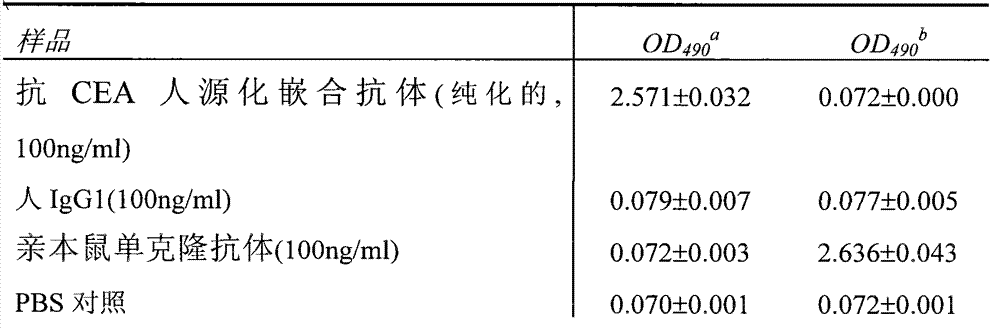

a,利用羊抗人IgG Fc片段-HRP作为第二抗体b,利用羊抗小鼠IgG Fc片段-HRP作为第二抗体a, using goat anti-human IgG Fc fragment-HRP as the secondary antibody b, using goat anti-mouse IgG Fc fragment-HRP as the secondary antibody
采用竞争抑制试验,以1μg/ml的CEA抗原包被酶标板(Biodesign公司)。加入2.5ng/孔的无关小鼠单克隆抗体(自行制备)或2.5ng/孔的亲本抗CEA鼠单抗C50(自行制备)与不同浓度的抗CEA人源化嵌合抗体,37℃孵育后再加入羊抗鼠IgG-HRP酶标抗体(Sigma公司),反应后测OD490值,并计算其竞争抑制率,竞争抑制率按以下公式计算:同时设无关抗体人IgG1对照。Competitive inhibition assay was used to coat a microtiter plate (Biodesign Company) with 1 μg/ml CEA antigen. Add 2.5ng/well irrelevant mouse monoclonal antibody (prepared by yourself) or 2.5ng/well parental anti-CEA mouse monoclonal antibody C50 (prepared by yourself) and different concentrations of anti-CEA humanized chimeric antibody, after incubation at 37°C Then add goat anti-mouse IgG-HRP enzyme-labeled antibody (Sigma Company), measure OD490 value after reaction, and calculate its competitive inhibition rate, and the competitive inhibition rate is calculated according to the following formula: set an irrelevant antibody human IgG1 control at the same time.

竞争抑制试验结果如下表,阴性对照无关抗体人IgG1与亲本抗CEA鼠单克隆抗体反应无竞争抑制作用(竞争抑制率为-12.80%)。抗CEA人源化嵌合抗体在与亲本抗CEA鼠单克隆抗体的比例为2∶1时,亲本抗CEA鼠单克隆抗体与抗原的结合即可发生较明显的竞争抑制,随着嵌合抗体浓度的增加,亲本抗CEA鼠单克隆抗体与抗原的结合反应物减少,其OD490值逐渐降低,竞争抑制率增加,当比例为32∶1时抑制率达40.85%。这表明抗CEA人源化嵌合抗体和亲本抗CEA鼠单克隆抗体均可与CEA抗原的相同表位结合,从而证明该抗CEA人源化嵌合抗体与亲本抗CEA鼠单克隆抗体有相同的抗原结合特异性。The results of the competition inhibition test are shown in the following table. The reaction between the negative control irrelevant antibody human IgG1 and the parental anti-CEA mouse monoclonal antibody has no competitive inhibition effect (competitive inhibition rate -12.80%). When the ratio of the anti-CEA humanized chimeric antibody to the parental anti-CEA mouse monoclonal antibody is 2:1, the binding of the parental anti-CEA mouse monoclonal antibody to the antigen can be obviously competitively inhibited. With the increase of the concentration, the binding reactant between the parental anti-CEA mouse monoclonal antibody and the antigen decreased, the OD490 value gradually decreased, and the competitive inhibition rate increased, and the inhibition rate reached 40.85% when the ratio was 32:1. This indicates that both the anti-CEA humanized chimeric antibody and the parental anti-CEA mouse mAb can bind to the same epitope of the CEA antigen, thereby demonstrating that the anti-CEA humanized chimeric antibody has the same properties as the parental anti-CEA mouse mAb. antigen-binding specificity.
表3.利用竞争抑制ELI SA检测抗CEA人源化嵌合抗体的特异性Table 3. Specificity of Anti-CEA Humanized Chimeric Antibody Detection by Competitive Inhibition ELISA
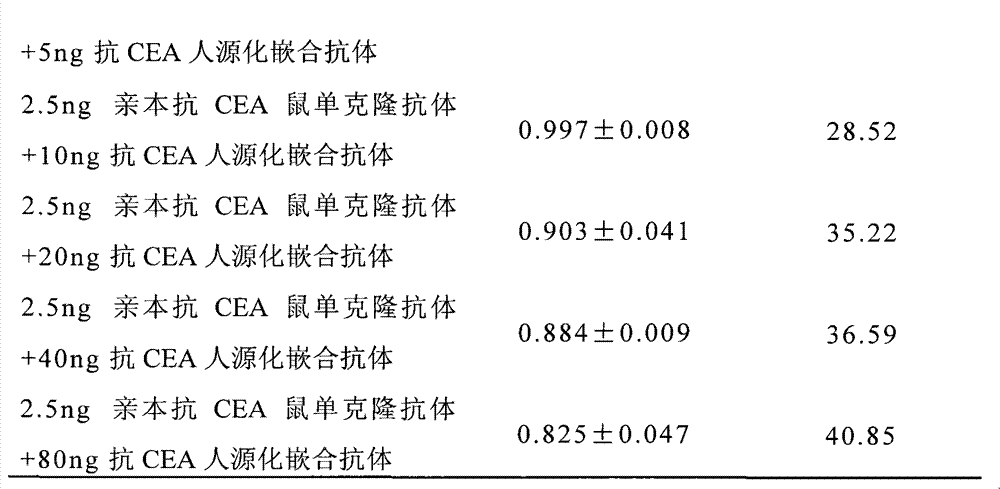
采用免疫荧光试验,以CEA高表达的结肠癌细胞LS180(购自ATCC)为靶细胞,加入抗CEA人源化嵌合抗体,37℃孵育后再加入羊抗人IgG-FITC荧光二抗(Sigma公司),反应后荧光显微镜下观察,同时设无关抗体对照。结果如图9显示,抗CEA人源化嵌合抗体可以识别CEA高表达的结肠癌细胞LS180上的CEA抗原。Using immunofluorescence assay, colon cancer cells LS180 (purchased from ATCC) with high expression of CEA were used as target cells, anti-CEA humanized chimeric antibody was added, incubated at 37°C, and then goat anti-human IgG-FITC fluorescent secondary antibody (Sigma company), observed under a fluorescent microscope after the reaction, and an irrelevant antibody control was set at the same time. The results are shown in Figure 9, the anti-CEA humanized chimeric antibody can recognize the CEA antigen on the colon cancer cell LS180 with high expression of CEA.
采用免疫荧光试验,以CEA表达的多种癌细胞SW1116、LOVO(购自ATCC)为靶细胞,加入抗CEA人源化嵌合抗体,37℃孵育后再加入羊抗人IgG-Cy5荧光二抗(Chemicon公司),反应后荧光显微镜下观察,同时设无关抗体对照。结果(图10)显示,抗癌胚抗原单克隆抗体可以识别表达CEA的癌细胞上的CEA抗原。Using immunofluorescence test, various cancer cells SW1116 and LOVO (purchased from ATCC) expressing CEA were used as target cells, anti-CEA humanized chimeric antibody was added, incubated at 37°C, and then goat anti-human IgG-Cy5 fluorescent secondary antibody was added (Chemicon Company), observed under a fluorescent microscope after the reaction, and an irrelevant antibody control was set at the same time. The results ( FIG. 10 ) showed that the anti-CEA monoclonal antibody could recognize the CEA antigen on the CEA-expressing cancer cells.
二、抗CEA人源化嵌合抗体的人源性鉴定:2. Identification of human origin of anti-CEA humanized chimeric antibody:
在ELISA实验中,用CEA、羊抗人κ链(Sigma公司)或羊抗人IgG多克隆抗体(Sigma公司)包被酶标板,以羊抗人IgG Fc片段-HRP(Sigma公司)作酶标抗体的ELISA结果(表4)显示,纯化抗CEA人源化嵌合抗体呈现强阳性反应,而抗CEA人源化嵌合抗体的亲本鼠单克隆抗体则呈阴性反应。证明纯化的抗CEA人源化嵌合抗体含有人IgG的轻、重链恒定区。In the ELISA experiment, the microtiter plate was coated with CEA, goat anti-human κ chain (Sigma Company) or goat anti-human IgG polyclonal antibody (Sigma Company), and goat anti-human IgG Fc fragment-HRP (Sigma Company) was used as the enzyme The ELISA results of the labeled antibodies (Table 4) showed that the purified anti-CEA humanized chimeric antibody showed a strong positive reaction, while the parental mouse monoclonal antibody against the CEA humanized chimeric antibody showed a negative reaction. It was proved that the purified anti-CEA humanized chimeric antibody contained the light and heavy chain constant regions of human IgG.
表4.通过ELISA检测抗CEA人源化嵌合抗体的人源性Table 4. Detection of Humanity of Anti-CEA Humanized Chimeric Antibody by ELISA


a,用CEA包被b,用羊抗人IgG包被.c,用羊抗人κ链包被.a, coated with CEA b, coated with goat anti-human IgG. c, coated with goat anti-human κ chain.
采用Western印迹实验,对抗CEA人源化嵌合抗体进行还原型SDS-PAGE,转膜后,分别以羊抗人IgG Fc片段-HRP或羊抗人κ链多克隆抗体进行Western印迹,结果显示(图11)在55kD处的蛋白条带可被羊抗人IgG Fc片段-HRP识别,染出单一的特异免疫染色带,大小位置对应于抗体的重链,鼠单克隆抗体对照在此处未出现条带,证明所表达的抗CEA人源化嵌合抗体重链含有人的恒定区。在25kD处的蛋白条带有可被羊抗人κ链多抗所识别,出现单一的特异免疫染色带,大小位置对应于抗体轻链,鼠单克隆抗体对照在此处呈阴性反应,表明抗CEA人源化嵌合抗体含有人的κ链恒定区。Using Western blot experiment, the anti-CEA humanized chimeric antibody was subjected to reduced SDS-PAGE, and after transfer to the membrane, Western blot was performed with goat anti-human IgG Fc fragment-HRP or goat anti-human κ chain polyclonal antibody, the results showed ( Figure 11) The protein band at 55kD can be recognized by goat anti-human IgG Fc fragment-HRP, and a single specific immunostaining band is stained. The size and position correspond to the heavy chain of the antibody. The mouse monoclonal antibody control does not appear here Bands, demonstrating that the heavy chain of the expressed anti-CEA humanized chimeric antibody contains a human constant region. The protein band at 25kD can be recognized by the goat anti-human κ chain polyclonal antibody, and a single specific immunostaining band appears, and the size and position correspond to the light chain of the antibody. The mouse monoclonal antibody control shows a negative reaction here, indicating that the anti- CEA humanized chimeric antibody contains human kappa chain constant region.
采用羊抗人IgG、羊抗人IgM和羊抗人IgA免疫血清,经免疫双扩散试验测定,结果表明抗CEA人源化嵌合抗体属于人IgG类免疫球蛋白。采用鼠抗人IgG1、鼠抗人IgG2、鼠抗人IgG3和鼠抗人IgG4单克隆抗体进行ELISA测定,结果表明抗CEA人源化嵌合抗体为人的IgG1。Using goat anti-human IgG, goat anti-human IgM and goat anti-human IgA immune sera, the results showed that the anti-CEA humanized chimeric antibody belonged to human IgG class immunoglobulin by immunodiffusion test. Mouse anti-human IgG1, mouse anti-human IgG2, mouse anti-human IgG3 and mouse anti-human IgG4 monoclonal antibodies were used for ELISA determination, and the results showed that the anti-CEA humanized chimeric antibody was human IgG1.
三、抗CEA人源化嵌合抗体的体内靶向性鉴定:3. In vivo targeting identification of anti-CEA humanized chimeric antibody:
我们采用了多种体内放射免疫实验,包括体内放射免疫摄取实验、体内放射免疫生物分布实验来检测抗CEA人源化嵌合抗体的体内特异靶向肿瘤性(以CEA阳性肿瘤结肠癌细胞LS174T荷瘤小鼠为模型),结果显示,注射核素125I标记的抗CEA人源化嵌合抗体后,各组织中肿瘤摄取的标记抗体最多,远远高于其他正常组织,最高达33%,并且7d后仍然维持在26%,能非常好地在肿瘤部位聚集并长时间滞留,正常组织摄取量少,均随着时间迅速下降,无法滞留(图12);T/N比值研究结果表明标记抗体注射24小时后主要分布于肿瘤,在血池略有分布,但96小时后仅主要分布于肿瘤,显示了核素标记的抗CEA人源化嵌合抗体可非常特异地分布于肿瘤局部,而不分布于正常组织(图13)。以上的研究结果表明,抗CEA人源化嵌合抗体具有优异的体内肿瘤靶向性,在动物体内也可与CEA阳性肿瘤细胞特异地结合,从而特异浓聚并滞留在肿瘤局部,而在除血池以外的正常组织中几乎不分布,也无滞留。We used a variety of in vivo radioimmunoassays, including in vivo radioimmune uptake assays and in vivo radioimmunobiodistribution assays, to detect the specific tumor-targeting properties of anti-CEA humanized chimeric antibodies in vivo (carried with CEA-positive tumor colon cancer cell line LS174T). Tumor mice were used as models), the results showed that after injection of nuclide 125 I-labeled anti-CEA humanized chimeric antibody, the uptake of the labeled antibody in each tissue was the most, much higher than other normal tissues, up to 33%. And it still maintained at 26% after 7 days, and it can accumulate in the tumor site very well and stay for a long time. The antibody was mainly distributed in the tumor 24 hours after injection, slightly distributed in the blood pool, but only mainly distributed in the tumor after 96 hours, showing that the nuclide-labeled anti-CEA humanized chimeric antibody can be very specifically distributed in the local tumor, Not distributed in normal tissues (Figure 13). The above research results show that the anti-CEA humanized chimeric antibody has excellent tumor targeting in vivo, and can also specifically bind to CEA-positive tumor cells in animals, so that it can be specifically concentrated and retained in the local tumor. There is almost no distribution and no retention in normal tissues other than the blood pool.
实施例7抗CEA人源化嵌合抗体制备诊断药物用于体内放射免疫显像诊断Example 7 Anti-CEA humanized chimeric antibody preparation of diagnostic drugs for in vivo radioimmunoimaging diagnosis
我们采用了体内放射免疫显像实验评价了利用本发明的抗CEA人源化嵌合抗体制备的诊断药物用于体内放射免疫显像诊断的能力,结果(图14)显示,注射核素188Re标记的本发明的抗CEA人源化嵌合抗体后24小时,即可异常清晰地显像肿瘤,在5-7d后肿瘤更加清晰,能显示出的最小的肿瘤大小为0.5cm,具有很好的体内诊断应用价值。We used the in vivo radioimmunoimaging experiment to evaluate the ability of the diagnostic drug prepared by using the anti-CEA humanized chimeric antibody of the present invention to be used in the in vivo radioimmunoimaging diagnosis. 24 hours after the labeled anti-CEA humanized chimeric antibody of the present invention, the tumor can be visualized abnormally clearly, and the tumor is more clear after 5-7 days, and the smallest tumor size that can be displayed is 0.5cm, which has a good in vivo diagnostic applications.
实施例8抗CEA人源化嵌合抗体制备治疗药物用于体内放射免疫治疗CEA阳性的肿瘤Example 8 Anti-CEA humanized chimeric antibody preparation of therapeutic drugs for in vivo radioimmunotherapy of CEA-positive tumors
用核素碘131标记抗CEA人源化嵌合抗体(简称rch24,约20mCi/mg蛋白),在荷人CEA阳性结肠癌细胞LS180(购自美国ATCC)移植瘤的小鼠(所述小鼠右侧背部皮下注射100万LS180,待瘤体积适宜后进行治疗)体内进行体内放射免疫治疗杀伤结肠癌肿瘤的有效性研究,结果显示,对于已形成肿瘤(瘤体积超过0.5cm3后进行治疗),250μCi/剂量高免疫活性和放射比活性的标记抗体单次治疗对已形成的肿瘤的抑瘤率为81.1%(表5,图15);而125μCi/只、以间隔1w的方式给药3次的治疗组(瘤体积约0.1cm3时进行治疗)的抑瘤率为93%(表6,图16),肿瘤几乎停止生长,均可显著的抑制人结肠癌的生长。血相分析及体重变化的初步毒理学研究表明,131I标记的抗CEA人源化嵌合抗体体内放射免疫治疗人结肠癌时,其血相各成分及小鼠体重在实验组和对照组之间均无显著差异,证明其并无明显的毒性。Labeled anti-CEA humanized chimeric antibody (rch24 for short, about 20mCi/mg protein) with radionuclide iodine 131, in mice bearing human CEA positive colon cancer cell LS180 (purchased from ATCC, USA) transplanted tumors (the
表5.250μCi/剂量单次治疗对已形成的肿瘤的抑瘤率为81.1%Table 5.250μCi/dose single treatment has an inhibitory rate of 81.1% for established tumors
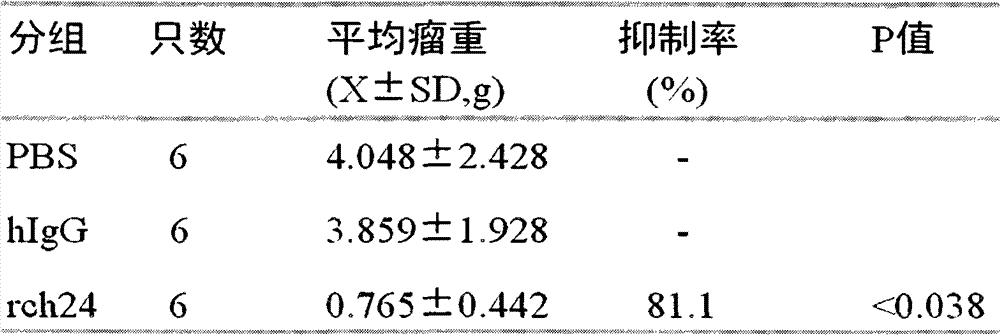
表6.125μCi/剂量标记抗体3次治疗的抑瘤率为93%Table 6. The tumor inhibition rate of 125 μCi/dose of labeled antibody for 3 treatments was 93%
在荷人大肠癌裸鼠模型上,观察受试品131I标记抗CEA嵌合抗体rch24的体内抗肿瘤活性。方法:BABL/c nu/nu裸小鼠皮下分别接种人大肠癌细胞LS180、LS174T和SW1116后8~10天后,分组给药。按瘤体积大小均衡原则分成:对照组、“裸”抗CEA人源化嵌合抗体rch24 156.2μg/kg组、625.0μg/kg组、相同放射比活性标记的无关人IgG 3.1mCi/kg组、12.5mCi/kg组、131I标记的抗CEA人源化嵌合抗体rch24 3.1mCi/kg、6.25mCi/kg、12.5mCi/kg组和阳性化疗药物对照组。受试品和相关对照品尾静脉注射给药,10天1次,共2次。定期观察动物一般状态、称体重、量瘤体积、测血清CEA水平和外周血指标、同位素在瘤组织和非瘤组织的分布。实验结束时处置荷瘤裸鼠称瘤重量。结果:受试品131I标记抗CEA嵌合抗体rch24高剂量组和相同放射比活性标记的无关人IgG高剂量组各有1只裸鼠死亡。给药后受试品各剂量组的肿瘤体积低于模型对照组,相对肿瘤增殖率低于模型对照组。低剂量组三个瘤株LS180、LS174、SW1116的抑瘤率在47.8~71.4%,中剂量组在52.2~75.0%,高剂量组在65.2~86.2%。受试品各剂量组裸鼠血清CEA水平明显低于模型对照组。与同剂量的“裸”抗CEA人源化嵌合抗体组和131I标记的无关人IgG组比较,受试品低剂量和高剂量组抑瘤效果更显著。比较三种瘤株抑瘤效果,受试品131I标记抗CEA嵌合抗体rch24对LS180肿瘤增长抑制作用最强。首次给药48小时和96小时后同位素在瘤组织分布明显高于非瘤组织。给药后30天,用药组裸鼠的外周血白细胞计数等指标与模型对照组比较无明显差别。结论:受试品131I标记抗CEA嵌合抗体rch24能明显抑制荷人大肠癌的生长,呈剂量依赖关系,同时降低荷瘤裸鼠血清中CEA水平,在瘤组织中靶向性分布显著。间隔10天给药2次,30天后用药组荷瘤裸鼠造血功能无明显的变化。On the nude mouse model bearing human colorectal cancer, the in vivo anti-tumor activity of 131I-labeled anti-CEA chimeric antibody rch24 was observed. Methods: BABL/c nu/nu nude mice were subcutaneously inoculated with human colorectal cancer cells LS180, LS174T and SW1116, respectively, and administered in groups 8-10 days later. According to the principle of tumor volume balance, it was divided into: control group, "naked" anti-CEA humanized chimeric antibody rch24 156.2μg/kg group, 625.0μg/kg group, unrelated human IgG 3.1mCi/kg group labeled with the same radioactivity ratio, 12.5mCi/kg group, 131I-labeled anti-CEA humanized chimeric antibody rch24 3.1mCi/kg, 6.25mCi/kg, 12.5mCi/kg group and positive chemotherapy drug control group. The test article and related control articles were administered by tail vein injection, once every 10 days, for a total of 2 times. Regularly observe the general state of the animals, weigh the body weight, measure the tumor volume, measure the serum CEA level and peripheral blood indicators, and the distribution of isotopes in tumor tissues and non-tumor tissues. At the end of the experiment, the tumor-bearing nude mice were treated and the tumor weight was weighed. Results: One nude mouse died in each of the 131I-labeled anti-CEA chimeric antibody rch24 high-dose group and the same radioactivity-labeled irrelevant human IgG high-dose group. After administration, the tumor volume of each dose group of the test product was lower than that of the model control group, and the relative tumor proliferation rate was lower than that of the model control group. The tumor inhibition rates of the three tumor lines LS180, LS174, and SW1116 were 47.8-71.4% in the low-dose group, 52.2-75.0% in the middle-dose group, and 65.2-86.2% in the high-dose group. The serum CEA level of nude mice in each dose group of the test product was significantly lower than that of the model control group. Compared with the "naked" anti-CEA humanized chimeric antibody group and the 131I-labeled irrelevant human IgG group at the same dose, the low-dose and high-dose groups of the test product had more significant tumor inhibitory effects. Comparing the anti-tumor effects of the three tumor lines, the test product 131I-labeled anti-CEA chimeric antibody rch24 has the strongest inhibitory effect on the growth of LS180 tumors. 48 hours and 96 hours after the first administration, the isotope distribution in tumor tissue was significantly higher than that in non-tumor tissue. 30 days after the administration, there was no significant difference in the peripheral blood leukocyte count and other indicators of the nude mice in the treatment group compared with the model control group. Conclusion: The test product 131I-labeled anti-CEA chimeric antibody rch24 can significantly inhibit the growth of human colorectal cancer in a dose-dependent manner, and at the same time reduce the level of CEA in the serum of tumor-bearing nude mice, and the targeted distribution in tumor tissues is significant. The drug was administered twice at intervals of 10 days, and the hematopoietic function of the tumor-bearing nude mice in the treatment group had no obvious change after 30 days.
表7131I标记抗CEA嵌合抗体对荷瘤裸鼠瘤重和抑瘤率的影响(LS180,一批)Table 7 Effect of 131 I-labeled anti-CEA chimeric antibody on tumor weight and tumor inhibition rate in tumor-bearing nude mice (LS180, one batch)
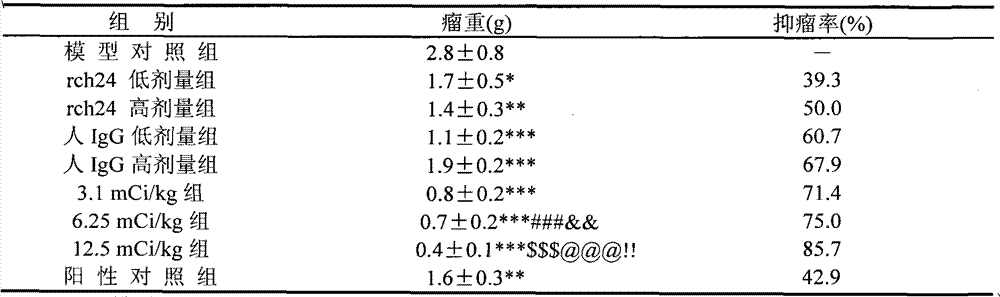
注:与模型对照组比较,*p<0.05,**p<0.01,***p<0.001;与rch24低剂量组比较,#p<0.05,Note: Compared with the model control group, *p<0.05, **p<0.01, ***p<0.001; compared with the rch24 low-dose group, #p<0.05,
##p<0.01;与rch24高剂量组比较,$$$p<0.001;与人IgG低剂量组比较,&&p<0.01;##p<0.01; compared with the rch24 high-dose group, $$$p<0.001; compared with the human IgG low-dose group, &&p<0.01;
与人IgG高剂量组比较,p<0.001;与6.25mCi/kg组比较,!!p<0.01。Compared with the human IgG high-dose group, p<0.001; compared with the 6.25mCi/kg group,! ! p<0.01.
表8131I标记抗CEA嵌合抗体对荷瘤裸鼠瘤重和抑瘤率的影响(LS180,二批)Table 8 Effect of 131 I-labeled anti-CEA chimeric antibody on tumor weight and tumor inhibition rate in tumor-bearing nude mice (LS180, second batch)

注:与模型对照组比较,***p<0.001;与rch24低剂量组比较,###p<0.001;与rch24高剂量组Note: Compared with the model control group, ***p<0.001; compared with the rch24 low-dose group, ###p<0.001; compared with the rch24 high-dose group
比较,$$$p<0.001;与人IgG低剂量组比较,&&&p<0.001;与人IgG高剂量组比较,p<0.001;与6.25mCi/kg组比较,!!!p<0.001。Compared, $$$p<0.001; compared with the low-dose human IgG group, &&&p<0.001; compared with the high-dose human IgG group, p<0.001; compared with the 6.25mCi/kg group,! ! ! p<0.001.
表9131I标记抗CEA嵌合抗体对荷瘤裸鼠瘤重和抑瘤率的影响(LS174T,一批)Table 9 Effect of 131 I-labeled anti-CEA chimeric antibody on tumor weight and tumor inhibition rate in tumor-bearing nude mice (LS174T, one batch)

注:与模型对照组比较,***p<0.001;与rch24低剂量组比较,###p<0.001;与rch24高剂量组比较,$$$p<0.001;与人IgG低剂量组比较,&&&p<0.001;与3.1mCi/kg组比较,%p<0.05;与人IgG高剂量组比较,p<0.001。Note: Compared with the model control group, ***p<0.001; compared with the rch24 low-dose group, ###p<0.001; compared with the rch24 high-dose group, $$$p<0.001; compared with the human IgG low-dose group , &&&p<0.001; compared with the 3.1mCi/kg group, %p<0.05; compared with the human IgG high-dose group, p<0.001.
表10131I标记抗CEA嵌合抗体对荷瘤裸鼠瘤重和抑瘤率的影响(LS174T,二批)Table 10 Effect of 131 I-labeled anti-CEA chimeric antibody on tumor weight and tumor inhibition rate in tumor-bearing nude mice (LS174T, second batch)

注:与模型对照组比较,***p<0.001;与rch24低剂量组比较,###p<0.001;与rch24高剂量组比较,$$$p<0.001;与人IgG低剂量组比较,&&&p<0.001;与3.1mCi/比组比较,%p<0.05;与人IgG高剂量组比较,p<0.001;与6.25mCi/kg组比较,!p<0.05。Note: Compared with the model control group, ***p<0.001; compared with the rch24 low-dose group, ###p<0.001; compared with the rch24 high-dose group, $$$p<0.001; compared with the human IgG low-dose group , &&&p<0.001; compared with the 3.1mCi/ratio group, %p<0.05; compared with the human IgG high-dose group, p<0.001; compared with the 6.25mCi/kg group,! p<0.05.
表11131I标记抗CEA嵌合抗体对荷瘤裸鼠瘤重和抑瘤率的影响(SW1116,一批)Table 11 Effect of 131 I-labeled anti-CEA chimeric antibody on tumor weight and tumor inhibition rate in tumor-bearing nude mice (SW1116, one batch)
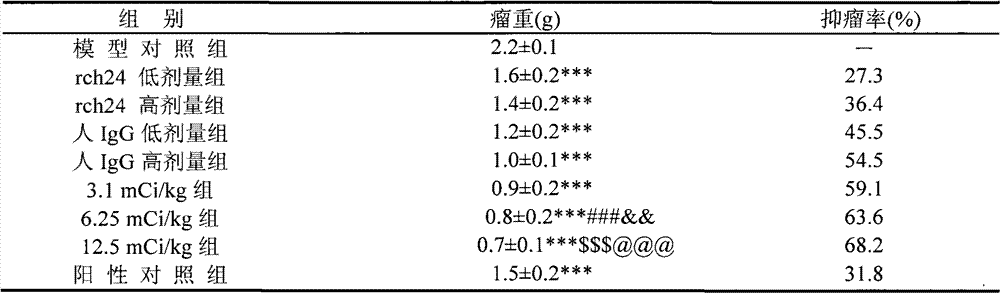
注:与模型对照组比较,***p<0.001;与rch24低剂量组比较,###p<0.001;与rch24高剂量组Note: Compared with the model control group, ***p<0.001; compared with the rch24 low-dose group, ###p<0.001; compared with the rch24 high-dose group
比较,$$$p<0.001;与人IgG低剂量组比较,&&p<0.01;与人IgG高剂量组比较,p<0.001。Compared, $$$p<0.001; compared with the low-dose human IgG group, &&p<0.01; compared with the high-dose human IgG group, p<0.001.
表12131I标记抗CEA嵌合抗体对荷瘤裸鼠瘤重和抑瘤率的影响(SW1116,二批)Table 12 Effect of 131 I-labeled anti-CEA chimeric antibody on tumor weight and tumor inhibition rate in tumor-bearing nude mice (SW1116, second batch)

注:与模型对照组比较,***p<0.001;与rch24低剂量组比较,###p<0.001;与rch24高剂量组比较,$$$p<0.001;与人IgG低剂量组比较,&&&p<0.001;与人IgG高剂量组比较,p<0.001;与6.25mCi/kg组比较,!!p<0.01。Note: Compared with the model control group, ***p<0.001; compared with the rch24 low-dose group, ###p<0.001; compared with the rch24 high-dose group, $$$p<0.001; compared with the human IgG low-dose group , &&&p<0.001; compared with the human IgG high-dose group, p<0.001; compared with the 6.25mCi/kg group,! ! p<0.01.
序列表sequence listing
<110>上海海抗中医药科技发展有限公司<110>Shanghai Haikang Traditional Chinese Medicine Technology Development Co., Ltd.
<120>抗癌胚抗原抗体及其应用<120> Anti-carcinoembryonic antigen antibody and its application
<130>I201002047CB<130>I201002047CB
<160>15<160>15
<170>PatentIn version 3.3<170>PatentIn version 3.3
<210>1<210>1
<211>450<211>450
<212>PRT<212>PRT
<213>Artificial<213>Artificial
<220><220>
<223>chimeric<223>chimeric
<400>1<400>1
Gln Val Gln Leu Gln Gln Ser Gly Ala Glu Leu Val Arg Ser Gly AlaGln Val Gln Leu Gln Gln Ser Gly Ala Glu Leu Val Arg Ser Gly Ala
1 5 10 151 5 10 15
Ser Ile Lys Leu Ser Cys Thr Ala Ser Gly Phe Asn Ile Lys His TyrSer Ile Lys Leu Ser Cys Thr Ala Ser Gly Phe Asn Ile Lys His Tyr
20 25 3020 25 30
Tyr Met His Trp Val Lys Gln Arg Pro Glu Gln Gly Leu Glu Trp IleTyr Met His Trp Val Lys Gln Arg Pro Glu Gln Gly Leu Glu Trp Ile
35 40 4535 40 45
Gly Trp Ile Asn Pro Glu Asn Val Asp Thr Glu Tyr Ala Pro Lys PheGly Trp Ile Asn Pro Glu Asn Val Asp Thr Glu Tyr Ala Pro Lys Phe
50 55 6050 55 60
Gln Gly Lys Ala Thr Met Thr Ala Asp Thr Ser Ser Asn Thr Ala TyrGln Gly Lys Ala Thr Met Thr Ala Asp Thr Ser Ser Asn Thr Ala Tyr
65 70 75 8065 70 75 80
Leu Gln Leu Ser Ser Leu Thr Ser Glu Asp Thr Ala Val Tyr Tyr CysLeu Gln Leu Ser Ser Leu Thr Ser Glu Asp Thr Ala Val Tyr Tyr Cys
85 90 9585 90 95
Asn His Tyr Arg Tyr Ala Gly Gly Gly Ala Leu Asp Tyr Trp Gly GlnAsn His Tyr Arg Tyr Ala Gly Gly Gly Ala Leu Asp Tyr Trp Gly Gln
100 105 110100 105 110
Gly Thr Thr Val Thr Val Ser Ser Ala Ser Thr Lys Gly Pro Ser ValGly Thr Thr Val Thr Val Ser Ser Ala Ser Thr Lys Gly Pro Ser Val
115 120 125115 120 125
Phe Pro Leu Ala Pro Ser Ser Lys Ser Thr Ser Gly Gly Thr Ala AlaPhe Pro Leu Ala Pro Ser Ser Lys Ser Thr Ser Gly Gly Thr Ala Ala
130 135 140130 135 140
Leu Gly Cys Leu Val Lys Asp Tyr Phe Pro Glu Pro Val Thr Val SerLeu Gly Cys Leu Val Lys Asp Tyr Phe Pro Glu Pro Val Thr Val Ser
145 150 155 160145 150 155 160
Trp Asn Ser Gly Ala Leu Thr Ser Gly Val His Thr Phe Pro Ala ValTrp Asn Ser Gly Ala Leu Thr Ser Gly Val His Thr Phe Pro Ala Val
165 170 175165 170 175
Leu Gln Ser Ser Gly Leu Tyr Ser Leu Ser Ser Val Val Thr Val ProLeu Gln Ser Ser Gly Leu Tyr Ser Leu Ser Ser Val Val Thr Val Pro
180 185 190180 185 190
Ser Ser Ser Leu Gly Thr Gln Thr Tyr Ile Cys Asn Val Asn His LysSer Ser Ser Leu Gly Thr Gln Thr Tyr Ile Cys Asn Val Asn His Lys
195 200 205195 200 205
Pro Ser Asn Thr Lys Val Asp Lys Lys Val Glu Pro Lys Ser Cys AspPro Ser Asn Thr Lys Val Asp Lys Lys Val Glu Pro Lys Ser Cys Asp
210 215 220210 215 220
Lys Thr His Thr Cys Pro Pro Cys Pro Ala Pro Glu Leu Leu Gly GlyLys Thr His Thr Cys Pro Pro Cys Pro Ala Pro Glu Leu Leu Gly Gly
225 230 235 240225 230 235 240
Pro Ser Val Phe Leu Phe Pro Pro Lys Pro Lys Asp Thr Leu Met IlePro Ser Val Phe Leu Phe Pro Pro Lys Pro Lys Asp Thr Leu Met Ile
245 250 255245 250 255
Ser Arg Thr Pro Glu Val Thr Cys Val Val Val Asp Val Ser His GluSer Arg Thr Pro Glu Val Thr Cys Val Val Val Asp Val Ser His Glu
260 265 270260 265 270
Asp Pro Glu Val Lys Phe Asn Trp Tyr Val Asp Gly Val Glu Val HisAsp Pro Glu Val Lys Phe Asn Trp Tyr Val Asp Gly Val Glu Val His
275 280 285275 280 285
Asn Ala Lys Thr Lys Pro Arg Glu Glu Gln Tyr Asn Ser Thr Tyr ArgAsn Ala Lys Thr Lys Pro Arg Glu Glu Gln Tyr Asn Ser Thr Tyr Arg
290 295 300290 295 300
Val Val Ser Val Leu Thr Val Leu His Gln Asp Trp Leu Asn Gly LysVal Val Ser Val Leu Thr Val Leu His Gln Asp Trp Leu Asn Gly Lys
305 310 315 320305 310 315 320
Glu Tyr Lys Cys Lys Val Ser Asn Lys Ala Leu Pro Ala Pro Ile GluGlu Tyr Lys Cys Lys Val Ser Asn Lys Ala Leu Pro Ala Pro Ile Glu
325 330 335325 330 335
Lys Thr Ile Ser Lys Ala Lys Gly Gln Pro Arg Glu Pro Gln Val TyrLys Thr Ile Ser Lys Ala Lys Gly Gln Pro Arg Glu Pro Gln Val Tyr
340 345 350340 345 350
Thr Leu Pro Pro Ser Arg Asp Glu Leu Thr Lys Asn Gln Val Ser LeuThr Leu Pro Pro Ser Arg Asp Glu Leu Thr Lys Asn Gln Val Ser Leu
355 360 365355 360 365
Thr Cys Leu Val Lys Gly Phe Tyr Pro Ser Asp Ile Ala Val Glu TrpThr Cys Leu Val Lys Gly Phe Tyr Pro Ser Asp Ile Ala Val Glu Trp
370 375 380370 375 380
Glu Ser Asn Gly Gln Pro Glu Asn Asn Tyr Lys Thr Thr Pro Pro ValGlu Ser Asn Gly Gly Gln Pro Glu Asn Asn Tyr Lys Thr Thr Pro Pro Val
385 390 395 400385 390 395 400
Leu Asp Ser Asp Gly Ser Phe Phe Leu Tyr Ser Lys Leu Thr Val AspLeu Asp Ser Asp Gly Ser Phe Phe Leu Tyr Ser Lys Leu Thr Val Asp
405 410 415405 410 415
Lys Ser Arg Trp Gln Gln Gly Asn Val Phe Ser Cys Ser Val Met HisLys Ser Arg Trp Gln Gln Gly Asn Val Phe Ser Cys Ser Val Met His
420 425 430420 425 430
Glu Ala Leu His Asn His Tyr Thr Gln Lys Ser Leu Ser Leu Ser ProGlu Ala Leu His Asn His Tyr Thr Gln Lys Ser Leu Ser Leu Ser Pro
435 440 445435 440 445
Gly LysGly Lys
450450
<210>2<210>2
<211>212<211>212
<212>PRT<212>PRT
<213>Artificial<213>Artificial
<220><220>
<223>chimeric<223>chimeric
<400>2<400>2
Asp Ile Gln Leu Thr Gln Ser Pro Ala Ile Met Ser Ala Ser Pro GlyAsp Ile Gln Leu Thr Gln Ser Pro Ala Ile Met Ser Ala Ser Pro Gly
1 5 10 151 5 10 15
Glu Lys Val Thr Met Thr Cys Ser Ala Ser Ser Ser Val Ser Tyr IleGlu Lys Val Thr Met Thr Cys Ser Ala Ser Ser Ser Val Ser Tyr Ile
20 25 3020 25 30
His Trp Tyr Gln Gln Lys Ser Gly Thr Ser Pro Lys Arg Trp Val TyrHis Trp Tyr Gln Gln Lys Ser Gly Thr Ser Pro Lys Arg Trp Val Tyr
35 40 4535 40 45
Asp Thr Ser Lys Leu Ala Ser Gly Val Pro Ala Arg Phe Ser Gly SerAsp Thr Ser Lys Leu Ala Ser Gly Val Pro Ala Arg Phe Ser Gly Ser
50 55 6050 55 60
Gly Ser Gly Thr Ser Tyr Ser Leu Thr Ile Ser Thr Met Glu Ala GluGly Ser Gly Thr Ser Tyr Ser Leu Thr Ile Ser Thr Met Glu Ala Glu
65 70 75 8065 70 75 80
Asp Ala Ala Thr Tyr Tyr Cys Gln Gln Trp Asn Asn Asn Pro Tyr SerAsp Ala Ala Thr Tyr Tyr Cys Gln Gln Trp Asn Asn Asn Pro Tyr Ser
85 90 9585 90 95
Phe Gly Gly Gly Thr Lys Val Val Ile Lys Thr Val Ala Ala Pro SerPhe Gly Gly Gly Thr Lys Val Val Ile Lys Thr Val Ala Ala Pro Ser
100 105 110100 105 110
Val Phe Ile Phe Pro Pro Ser Asp Glu Gln Leu Lys Ser Gly Thr AlaVal Phe Ile Phe Pro Pro Ser Asp Glu Gln Leu Lys Ser Gly Thr Ala
115 120 125115 120 125
Ser Val Val Cys Leu Leu Asn Asn Phe Tyr Pro Arg Glu Ala Lys ValSer Val Val Cys Leu Leu Asn Asn Phe Tyr Pro Arg Glu Ala Lys Val
130 135 140130 135 140
Gln Trp Lys Val Asp Asn Ala Leu Gln Ser Gly Asn Ser Gln Glu SerGln Trp Lys Val Asp Asn Ala Leu Gln Ser Gly Asn Ser Gln Glu Ser
145 150 155 160145 150 155 160
Val Thr Glu Gln Asp Ser Lys Asp Ser Thr Tyr Ser Leu Ser Ser ThrVal Thr Glu Gln Asp Ser Lys Asp Ser Thr Tyr Ser Leu Ser Ser Ser Thr
165 170 175165 170 175
Leu Thr Leu Ser Lys Ala Asp Tyr Glu Lys His Lys Val Tyr Ala CysLeu Thr Leu Ser Lys Ala Asp Tyr Glu Lys His Lys Val Tyr Ala Cys
180 185 190180 185 190
Glu Val Thr His Gln Gly Leu Ser Ser Pro Val Thr Lys Ser Phe AsnGlu Val Thr His Gln Gly Leu Ser Ser Pro Val Thr Lys Ser Phe Asn
195 200 205195 200 205
Arg Gly Glu CysArg Gly Glu Cys
210210
<210>3<210>3
<211>24<211>24
<213>Artificial<213>Artificial
<220><220>
<223>primer<223> primer
<400>3<400>3
gacattcagc tgacccagtc tcca 24gacattcagc tgacccagtc tcca 24
<210>4<210>4
<211>22<211>22
<213>Artificial<213>Artificial
<220><220>
<223>primer<223> primer
<400>4<400>4
gttagatctc cagcttggtc cc 22gttagatctc cagcttggtc cc 22
<210>5<210>5
<211>22<211>22
<213>artificial<213> artificial
<220><220>
<223>primer<223> primer
<400>5<400>5
aggtsmarct gcagsagtcw gg 22aggtsmarct gcagsagtcw gg 22
<210>6<210>6
<211>34<211>34
<213>Artificial<213>Artificial
<220><220>
<223>primer<223> primer
<400>6<400>6
tgaggagacg gtgaccgtgg tcccttggcc ccag 34tgaggagacg gtgaccgtgg tcccttggcc ccag 34
<210>7<210>7
<211>5<211>5
<212>PRT<212>PRT
<213>Mus musculus<213>Mus musculus
<400>7<400>7
His Tyr Tyr Met HisHis Tyr Tyr Met His
1 51 5
<210>8<210>8
<211>17<211>17
<212>PRT<212>PRT
<213>Mus musculus<213>Mus musculus
<400>8<400>8
Trp Ile Asn Pro Glu Asn Val Asp Thr Glu Tyr Ala Pro Lys Phe GlnTrp Ile Asn Pro Glu Asn Val Asp Thr Glu Tyr Ala Pro Lys Phe Gln
1 5 10 151 5 10 15
GlyGly
<210>9<210>9
<211>11<211>11
<212>PRT<212>PRT
<213>Mus musculus<213>Mus musculus
<400>9<400>9
Tyr Arg Tyr Ala Gly Gly Gly Ala Leu Asp TyrTyr Arg Tyr Ala Gly Gly Gly Ala Leu Asp Tyr
1 5 101 5 10
<210>10<210>10
<211>10<211>10
<212>PRT<212>PRT
<213>Mus musculus<213>Mus musculus
<400>10<400>10
Ser Ala Ser Ser Ser Val Ser Tyr Ile HisSer Ala Ser Ser Ser Ser Val Ser Tyr Ile His
1 5 101 5 10
<210>11<210>11
<211>9<211>9
<212>PRT<212>PRT
<213>Mus musculus<213>Mus musculus
<400>11<400>11
Asp Thr Ser Lys Leu Ala SerAsp Thr Ser Lys Leu Ala Ser
1 51 5
<210>12<210>12
<211>7<211>7
<212>PRT<212>PRT
<213>Mus musculus<213>Mus musculus
<400>12<400>12
Gln Gln Trp Asn Asn Asn Pro Tyr SerGln Gln Trp Asn Asn Asn Pro Tyr Ser
1 51 5
<210>13<210>13
<211>64<211>64
<213>Artificial<213>Artificial
<220><220>
<223>Primer<223>Primer
<400>13<400>13
gggtccaagc ttgcggccgc aactgaggaa gcaaagttta aattctactc acgtttgatc 60gggtccaagc ttgcggccgc aactgaggaa gcaaagttta aattctactc acgtttgatc 60
acca 64acca 64
<210>14<210>14
<211>40<211>40
<213>Artificial<213>Artificial
<220><220>
<223>Primer<223>Primer
<400>14<400>14
gctcgggaat tcggatccat gggatggagc tgtatcatcc 40gctcgggaat tcggatccat gggatggagc tgtatcatcc 40
<210>15<210>15
<211>41<211>41
<213>Artificial<213>Artificial
<220><220>
<223>Primer<223>Primer
<400>15<400>15
gggtccgaat tcgcggccgc tataaatctc tggccatgaa g 41gggtccgaat tcgcggccgc tataaatctc tggccatgaa g 41
Claims (18)
Priority Applications (10)
| Application Number | Priority Date | Filing Date | Title |
|---|---|---|---|
| CN2010101630522A CN101928347B (en) | 2010-05-05 | 2010-05-05 | Anti-carcinoembryonic-antigen (CEA) antibody and application thereof |
| JP2013508358A JP5987822B2 (en) | 2010-05-05 | 2011-03-16 | Antibodies against carcinoembryonic antigen and uses thereof |
| ES11777108.9T ES2655998T3 (en) | 2010-05-05 | 2011-03-16 | Antibody directed against the carcinoembryonic antigen and uses thereof |
| US13/696,251 US9056911B2 (en) | 2010-05-05 | 2011-03-16 | Antibody against carcinoembryonic antigen and uses thereof |
| PCT/CN2011/071840 WO2011137687A1 (en) | 2010-05-05 | 2011-03-16 | Antibody against carcinoembryonic antigen and uses thereof |
| PL11777108T PL2567982T3 (en) | 2010-05-05 | 2011-03-16 | Antibody against carcinoembryonic antigen and uses thereof |
| EP11777108.9A EP2567982B1 (en) | 2010-05-05 | 2011-03-16 | Antibody against carcinoembryonic antigen and uses thereof |
| CA2798285A CA2798285C (en) | 2010-05-05 | 2011-03-16 | Antibody against carcinoembryonic antigen and uses thereof |
| HK11104115.9A HK1149937B (en) | 2011-04-26 | An anti-carcinoembryonic antigen antibody and its application | |
| JP2015163791A JP2016028577A (en) | 2010-05-05 | 2015-08-21 | Antibody against carcinoembryonic antigen and uses thereof |
Applications Claiming Priority (1)
| Application Number | Priority Date | Filing Date | Title |
|---|---|---|---|
| CN2010101630522A CN101928347B (en) | 2010-05-05 | 2010-05-05 | Anti-carcinoembryonic-antigen (CEA) antibody and application thereof |
Publications (2)
| Publication Number | Publication Date |
|---|---|
| CN101928347A CN101928347A (en) | 2010-12-29 |
| CN101928347B true CN101928347B (en) | 2013-03-27 |
Family
ID=43367813
Family Applications (1)
| Application Number | Title | Priority Date | Filing Date |
|---|---|---|---|
| CN2010101630522A Active CN101928347B (en) | 2010-05-05 | 2010-05-05 | Anti-carcinoembryonic-antigen (CEA) antibody and application thereof |
Country Status (8)
| Country | Link |
|---|---|
| US (1) | US9056911B2 (en) |
| EP (1) | EP2567982B1 (en) |
| JP (2) | JP5987822B2 (en) |
| CN (1) | CN101928347B (en) |
| CA (1) | CA2798285C (en) |
| ES (1) | ES2655998T3 (en) |
| PL (1) | PL2567982T3 (en) |
| WO (1) | WO2011137687A1 (en) |
Families Citing this family (17)
| Publication number | Priority date | Publication date | Assignee | Title |
|---|---|---|---|---|
| CN101928347B (en) * | 2010-05-05 | 2013-03-27 | 上海海抗中医药科技发展有限公司 | Anti-carcinoembryonic-antigen (CEA) antibody and application thereof |
| PT3604339T (en) | 2011-01-14 | 2021-04-13 | Univ California | Therapeutic antibodies against ror-1 protein and methods for use of same |
| RU2493166C1 (en) * | 2012-04-09 | 2013-09-20 | Общество с ограниченной ответственностью "Технофарма" | Nanoantibody specifically binding cea protein, method of its usage for detection of this protein |
| US10656156B2 (en) * | 2012-07-05 | 2020-05-19 | Mepur Ravindranath | Diagnostic and therapeutic potential of HLA-E monospecific monoclonal IgG antibodies directed against tumor cell surface and soluble HLA-E |
| CN104628859A (en) * | 2015-01-26 | 2015-05-20 | 佳德资本投资管理(Bvi)有限公司 | Anti-human carcino-embryonic antigen antibody as well as coding gene and application thereof |
| SG10201912529SA (en) | 2016-11-18 | 2020-02-27 | Astellas Pharma Inc | Novel anti-human muc1 antibody fab fragment |
| CN106749667B (en) * | 2016-12-04 | 2020-07-14 | 深圳市国创纳米抗体技术有限公司 | A nanobody against carcinoembryonic antigen and its application |
| KR20200130514A (en) * | 2017-02-27 | 2020-11-18 | 드래곤플라이 쎄라퓨틱스, 인크. | Multispecific binding proteins targeting caix, ano1, mesothelin,trop2, cea, or claudin-18.2 |
| TWI795415B (en) * | 2017-07-07 | 2023-03-11 | 日商安斯泰來製藥股份有限公司 | A novel anti-human CEACAM5 antibody Fab fragment |
| TW201922796A (en) | 2017-10-30 | 2019-06-16 | 國立研究開發法人國立癌症研究中心 | Antibody beneficial for treatment of solid tumors, antibody-drug conjugate, and cancer drug including same |
| CA3100317A1 (en) | 2018-05-17 | 2019-11-21 | Astellas Pharma Inc. | Complex having anti-human muc1 antibody fab fragment, peptide linker and/or ligand |
| CN112839683B (en) | 2018-10-10 | 2023-11-14 | 安斯泰来制药株式会社 | Pharmaceutical composition containing labeling part-anti-human antibody Fab fragment complex |
| CN110297093B (en) * | 2019-03-18 | 2022-04-22 | 山西瑞豪生物科技有限公司 | Method and kit for detecting human immunoglobulin G4 |
| KR20240004937A (en) | 2021-05-05 | 2024-01-11 | 이매틱스 바이오테크놀로지스 게엠베하 | BMA031 antigen-binding polypeptide |
| WO2022242681A1 (en) * | 2021-05-21 | 2022-11-24 | Beigene, Ltd. | Anti-cea antibodies and methods of use |
| CN114560944B (en) * | 2022-03-30 | 2022-08-09 | 北京科跃中楷生物技术有限公司 | Antibody labeled by colloidal gold particles and application thereof |
| CN114409789B (en) * | 2022-03-30 | 2022-06-07 | 北京科跃中楷生物技术有限公司 | Colloidal gold particle marking method and detection kit |
Citations (3)
| Publication number | Priority date | Publication date | Assignee | Title |
|---|---|---|---|---|
| CN1216321A (en) * | 1997-10-31 | 1999-05-12 | 广州军区广州总医院医务部科训科 | Cloning method, sequence and application of carcinoembryonic antigen promoter DNA |
| CN1223145A (en) * | 1997-11-19 | 1999-07-21 | 中国科学院微生物研究所 | Carcinoembryonic antigen gene engineering antiboy CL-3-scFv |
| CN1532281A (en) * | 2003-03-21 | 2004-09-29 | 吉林大学第一医院 | Recombination of Carcinoembryonic Antigen Gene Fragment and Gene Vaccine |
Family Cites Families (5)
| Publication number | Priority date | Publication date | Assignee | Title |
|---|---|---|---|---|
| US5874540A (en) * | 1994-10-05 | 1999-02-23 | Immunomedics, Inc. | CDR-grafted type III anti-CEA humanized mouse monoclonal antibodies |
| US20040096826A1 (en) * | 2002-01-30 | 2004-05-20 | Evans Glen A. | Methods for creating recombination products between nucleotide sequences |
| US7232888B2 (en) | 2002-07-01 | 2007-06-19 | Massachusetts Institute Of Technology | Antibodies against tumor surface antigens |
| JP4908440B2 (en) * | 2008-03-06 | 2012-04-04 | 株式会社東芝 | Image processing apparatus and method |
| CN101928347B (en) * | 2010-05-05 | 2013-03-27 | 上海海抗中医药科技发展有限公司 | Anti-carcinoembryonic-antigen (CEA) antibody and application thereof |
-
2010
- 2010-05-05 CN CN2010101630522A patent/CN101928347B/en active Active
-
2011
- 2011-03-16 ES ES11777108.9T patent/ES2655998T3/en active Active
- 2011-03-16 EP EP11777108.9A patent/EP2567982B1/en active Active
- 2011-03-16 WO PCT/CN2011/071840 patent/WO2011137687A1/en not_active Ceased
- 2011-03-16 PL PL11777108T patent/PL2567982T3/en unknown
- 2011-03-16 JP JP2013508358A patent/JP5987822B2/en active Active
- 2011-03-16 US US13/696,251 patent/US9056911B2/en active Active
- 2011-03-16 CA CA2798285A patent/CA2798285C/en active Active
-
2015
- 2015-08-21 JP JP2015163791A patent/JP2016028577A/en active Pending
Patent Citations (3)
| Publication number | Priority date | Publication date | Assignee | Title |
|---|---|---|---|---|
| CN1216321A (en) * | 1997-10-31 | 1999-05-12 | 广州军区广州总医院医务部科训科 | Cloning method, sequence and application of carcinoembryonic antigen promoter DNA |
| CN1223145A (en) * | 1997-11-19 | 1999-07-21 | 中国科学院微生物研究所 | Carcinoembryonic antigen gene engineering antiboy CL-3-scFv |
| CN1532281A (en) * | 2003-03-21 | 2004-09-29 | 吉林大学第一医院 | Recombination of Carcinoembryonic Antigen Gene Fragment and Gene Vaccine |
Also Published As
| Publication number | Publication date |
|---|---|
| US9056911B2 (en) | 2015-06-16 |
| US20130123471A1 (en) | 2013-05-16 |
| CA2798285C (en) | 2017-06-06 |
| JP2013534406A (en) | 2013-09-05 |
| JP2016028577A (en) | 2016-03-03 |
| JP5987822B2 (en) | 2016-09-07 |
| EP2567982A4 (en) | 2013-09-18 |
| HK1149937A1 (en) | 2011-10-21 |
| ES2655998T3 (en) | 2018-02-22 |
| CN101928347A (en) | 2010-12-29 |
| WO2011137687A1 (en) | 2011-11-10 |
| EP2567982A1 (en) | 2013-03-13 |
| EP2567982B1 (en) | 2017-11-01 |
| CA2798285A1 (en) | 2011-11-10 |
| PL2567982T3 (en) | 2018-04-30 |
Similar Documents
| Publication | Publication Date | Title |
|---|---|---|
| CN101928347B (en) | Anti-carcinoembryonic-antigen (CEA) antibody and application thereof | |
| JP7575102B2 (en) | MUC18-specific antibodies | |
| CN104105708B (en) | PDGF receptor beta binding polypeptide | |
| CN113474362B (en) | Antibodies specific for CD44 | |
| CN114191565A (en) | Antibodies specific for trophoblast cell surface antigen 2(TROP2) | |
| JP5463036B2 (en) | Pharmaceutical antibody composition having resistance to soluble CEA | |
| TWI865456B (en) | Antibodies specific to folate receptor alpha | |
| JP7578289B2 (en) | MUC18-specific antibodies | |
| KR20210063782A (en) | Antibodies Against c-kit and Uses Thereof | |
| TWI900705B (en) | Cd73 antigen binding protein and the application thereof | |
| US20240067747A1 (en) | Cd73-binding protein and use thereof | |
| CN116410315A (en) | Construction and application of a novel chimeric antigen receptor-modified T cell targeting human FLT3 | |
| TW202210518A (en) | Antibody binding to human cd38, preparation method thereof, and use thereof | |
| AU2018262648B2 (en) | Antibodies against carcinoembryonic antigen for cancer therapy and diagnosis | |
| HK1149937B (en) | An anti-carcinoembryonic antigen antibody and its application | |
| CN120399079A (en) | Nanobodies targeting CD90 and their applications | |
| CN103374071B (en) | A kind of preparation of the humanized antibodies of anti-DERLIN 1 | |
| HK40060753A (en) | Antibodies specific to muc18 | |
| HK40060752A (en) | Antibodies specific to muc18 | |
| NZ569144A (en) | Pharmaceutical antibody compositions with resistance to soluble CEA - comprising IgG1antibodies that bind to CEA |
Legal Events
| Date | Code | Title | Description |
|---|---|---|---|
| C06 | Publication | ||
| PB01 | Publication | ||
| C10 | Entry into substantive examination | ||
| SE01 | Entry into force of request for substantive examination | ||
| REG | Reference to a national code |
Ref country code: HK Ref legal event code: DE Ref document number: 1149937 Country of ref document: HK |
|
| C53 | Correction of patent of invention or patent application | ||
| CB02 | Change of applicant information |
Address after: 200000 Shanghai Zhou Zhu Road No. 6, building 2218, room 337 Applicant after: Shanghai Haikang Pharmaceutical Tech. & Deve. Co.,Ltd. Address before: 201203 Shanghai Zhangjiang Cailun Road, room 1003 No. 781 Applicant before: Shanghai Haikang Pharmaceutical Tech. & Deve. Co.,Ltd. |
|
| C14 | Grant of patent or utility model | ||
| GR01 | Patent grant | ||
| ASS | Succession or assignment of patent right |
Owner name: SHANGHAI HAIKANG BIOPHARMACEUTICALS CO., LTD. Effective date: 20130419 |
|
| C41 | Transfer of patent application or patent right or utility model | ||
| TR01 | Transfer of patent right |
Effective date of registration: 20130419 Address after: 200000 Shanghai Zhou Zhu Road No. 6, building 2218, room 337 Patentee after: Shanghai Haikang Pharmaceutical Tech. & Deve. Co.,Ltd. Patentee after: SHANGHAI HAIKANG BIO-PHARMACEUTICAL Co.,Ltd. Address before: 200000 Shanghai Zhou Zhu Road No. 6, building 2218, room 337 Patentee before: Shanghai Haikang Pharmaceutical Tech. & Deve. Co.,Ltd. |
|
| REG | Reference to a national code |
Ref country code: HK Ref legal event code: GR Ref document number: 1149937 Country of ref document: HK |
|
| TR01 | Transfer of patent right |
Effective date of registration: 20170927 Address after: 337 No. 6, building 2218, Zhou Zhu highway 201318, Shanghai Patentee after: Shanghai Haikang Pharmaceutical Tech. & Deve. Co.,Ltd. Address before: 337 No. 6, building 2218, Zhou Zhu highway 201318, Shanghai Co-patentee before: SHANGHAI HAIKANG BIO-PHARMACEUTICAL Co.,Ltd. Patentee before: Shanghai Haikang Pharmaceutical Tech. & Deve. Co.,Ltd. |
|
| TR01 | Transfer of patent right | ||
| PP01 | Preservation of patent right |
Effective date of registration: 20190508 Granted publication date: 20130327 |
|
| PP01 | Preservation of patent right | ||
| PD01 | Discharge of preservation of patent |
Date of cancellation: 20220508 Granted publication date: 20130327 |
|
| PD01 | Discharge of preservation of patent | ||
| PP01 | Preservation of patent right | ||
| PP01 | Preservation of patent right |
Effective date of registration: 20220508 Granted publication date: 20130327 |
|
| PD01 | Discharge of preservation of patent | ||
| PD01 | Discharge of preservation of patent |
Date of cancellation: 20221102 Granted publication date: 20130327 |
|
| PP01 | Preservation of patent right | ||
| PP01 | Preservation of patent right |
Effective date of registration: 20221102 Granted publication date: 20130327 |
|
| PD01 | Discharge of preservation of patent | ||
| PD01 | Discharge of preservation of patent |
Date of cancellation: 20251102 Granted publication date: 20130327 |
|
| PP01 | Preservation of patent right | ||
| PP01 | Preservation of patent right |
Effective date of registration: 20251102 Granted publication date: 20130327 |
|
| PD01 | Discharge of preservation of patent |
Date of cancellation: 20260115 Granted publication date: 20130327 |