CN101883534A - Methods, systems, and apparatus for performing electrosurgical procedures - Google Patents
Methods, systems, and apparatus for performing electrosurgical procedures Download PDFInfo
- Publication number
- CN101883534A CN101883534A CN2009801012554A CN200980101255A CN101883534A CN 101883534 A CN101883534 A CN 101883534A CN 2009801012554 A CN2009801012554 A CN 2009801012554A CN 200980101255 A CN200980101255 A CN 200980101255A CN 101883534 A CN101883534 A CN 101883534A
- Authority
- CN
- China
- Prior art keywords
- electrosurgery
- tissue
- electrode
- wave generator
- electric energy
- Prior art date
- Legal status (The legal status is an assumption and is not a legal conclusion. Google has not performed a legal analysis and makes no representation as to the accuracy of the status listed.)
- Granted
Links
Images


Classifications
-
- A—HUMAN NECESSITIES
- A61—MEDICAL OR VETERINARY SCIENCE; HYGIENE
- A61B—DIAGNOSIS; SURGERY; IDENTIFICATION
- A61B18/00—Surgical instruments, devices or methods for transferring non-mechanical forms of energy to or from the body
- A61B18/04—Surgical instruments, devices or methods for transferring non-mechanical forms of energy to or from the body by heating
- A61B18/12—Surgical instruments, devices or methods for transferring non-mechanical forms of energy to or from the body by heating by passing a current through the tissue to be heated, e.g. high-frequency current
- A61B18/14—Probes or electrodes therefor
- A61B18/1402—Probes for open surgery
-
- A—HUMAN NECESSITIES
- A61—MEDICAL OR VETERINARY SCIENCE; HYGIENE
- A61B—DIAGNOSIS; SURGERY; IDENTIFICATION
- A61B18/00—Surgical instruments, devices or methods for transferring non-mechanical forms of energy to or from the body
- A61B18/04—Surgical instruments, devices or methods for transferring non-mechanical forms of energy to or from the body by heating
- A61B18/12—Surgical instruments, devices or methods for transferring non-mechanical forms of energy to or from the body by heating by passing a current through the tissue to be heated, e.g. high-frequency current
- A61B18/14—Probes or electrodes therefor
- A61B18/1477—Needle-like probes
-
- A—HUMAN NECESSITIES
- A61—MEDICAL OR VETERINARY SCIENCE; HYGIENE
- A61B—DIAGNOSIS; SURGERY; IDENTIFICATION
- A61B18/00—Surgical instruments, devices or methods for transferring non-mechanical forms of energy to or from the body
- A61B2018/00053—Mechanical features of the instrument of device
- A61B2018/00059—Material properties
- A61B2018/00071—Electrical conductivity
- A61B2018/00083—Electrical conductivity low, i.e. electrically insulating
-
- A—HUMAN NECESSITIES
- A61—MEDICAL OR VETERINARY SCIENCE; HYGIENE
- A61B—DIAGNOSIS; SURGERY; IDENTIFICATION
- A61B18/00—Surgical instruments, devices or methods for transferring non-mechanical forms of energy to or from the body
- A61B2018/00636—Sensing and controlling the application of energy
- A61B2018/00696—Controlled or regulated parameters
- A61B2018/00702—Power or energy
-
- A—HUMAN NECESSITIES
- A61—MEDICAL OR VETERINARY SCIENCE; HYGIENE
- A61B—DIAGNOSIS; SURGERY; IDENTIFICATION
- A61B18/00—Surgical instruments, devices or methods for transferring non-mechanical forms of energy to or from the body
- A61B2018/00636—Sensing and controlling the application of energy
- A61B2018/00773—Sensed parameters
- A61B2018/00875—Resistance or impedance
-
- A—HUMAN NECESSITIES
- A61—MEDICAL OR VETERINARY SCIENCE; HYGIENE
- A61B—DIAGNOSIS; SURGERY; IDENTIFICATION
- A61B18/00—Surgical instruments, devices or methods for transferring non-mechanical forms of energy to or from the body
- A61B18/04—Surgical instruments, devices or methods for transferring non-mechanical forms of energy to or from the body by heating
- A61B18/12—Surgical instruments, devices or methods for transferring non-mechanical forms of energy to or from the body by heating by passing a current through the tissue to be heated, e.g. high-frequency current
- A61B18/14—Probes or electrodes therefor
- A61B2018/1405—Electrodes having a specific shape
- A61B2018/1407—Loop
-
- A—HUMAN NECESSITIES
- A61—MEDICAL OR VETERINARY SCIENCE; HYGIENE
- A61B—DIAGNOSIS; SURGERY; IDENTIFICATION
- A61B18/00—Surgical instruments, devices or methods for transferring non-mechanical forms of energy to or from the body
- A61B18/04—Surgical instruments, devices or methods for transferring non-mechanical forms of energy to or from the body by heating
- A61B18/12—Surgical instruments, devices or methods for transferring non-mechanical forms of energy to or from the body by heating by passing a current through the tissue to be heated, e.g. high-frequency current
- A61B18/14—Probes or electrodes therefor
- A61B2018/1405—Electrodes having a specific shape
- A61B2018/1422—Hook
-
- A—HUMAN NECESSITIES
- A61—MEDICAL OR VETERINARY SCIENCE; HYGIENE
- A61B—DIAGNOSIS; SURGERY; IDENTIFICATION
- A61B18/00—Surgical instruments, devices or methods for transferring non-mechanical forms of energy to or from the body
- A61B18/04—Surgical instruments, devices or methods for transferring non-mechanical forms of energy to or from the body by heating
- A61B18/12—Surgical instruments, devices or methods for transferring non-mechanical forms of energy to or from the body by heating by passing a current through the tissue to be heated, e.g. high-frequency current
- A61B18/14—Probes or electrodes therefor
- A61B2018/1405—Electrodes having a specific shape
- A61B2018/1425—Needle
Landscapes
- Health & Medical Sciences (AREA)
- Surgery (AREA)
- Engineering & Computer Science (AREA)
- Life Sciences & Earth Sciences (AREA)
- Biomedical Technology (AREA)
- Otolaryngology (AREA)
- Nuclear Medicine, Radiotherapy & Molecular Imaging (AREA)
- Plasma & Fusion (AREA)
- Physics & Mathematics (AREA)
- Heart & Thoracic Surgery (AREA)
- Medical Informatics (AREA)
- Molecular Biology (AREA)
- Animal Behavior & Ethology (AREA)
- General Health & Medical Sciences (AREA)
- Public Health (AREA)
- Veterinary Medicine (AREA)
- Surgical Instruments (AREA)
Abstract
Description
相关申请的交叉引用Cross References to Related Applications
本申请要求2008年5月13日提交的题为“用于执行电外科手术疗程的方法、系统和设备”的美国临时专利申请S/N.61/052,733的优先权和权益,其公开内容通过引用结合于此。This application claims priority and benefit to U.S. Provisional Patent Application S/N.61/052,733, filed May 13, 2008, entitled "Methods, Systems, and Apparatus for Performing Electrosurgical Procedures," the disclosure of which is adopted by Incorporated by reference.
发明背景Background of the invention
1.技术领域1. Technical field
本发明一般涉及电外科手术系统。更具体地,本发明涉及使用磨快的电外科手术电极与定制功率曲线的组合来增强电极的切割效率、降低不期望的组织损伤、并便于改进术后痊愈。The present invention generally relates to electrosurgical systems. More specifically, the present invention relates to the use of sharpened electrosurgical electrodes in combination with customized power curves to enhance the cutting efficiency of the electrodes, reduce undesired tissue damage, and facilitate improved postoperative recovery.
2.背景技术2. Background technology
在电外科手术领域中,通过利用射频(RF)电能来执行切割组织和/或烧灼渗漏血管的疗程。由电波发生器产生该RF能量并通过由外科医生操作的手持式电极传送至患者的组织。该手持式电极将放电递送至与电极相邻的患者身体的细胞物质。此放电使得细胞物质变热以便于切割组织和/或烧灼血管。In the field of electrosurgery, procedures in which tissue is cut and/or leaky blood vessels are cauterized are performed by utilizing radio frequency (RF) electrical energy. This RF energy is generated by a wave generator and delivered to the patient's tissue through hand-held electrodes operated by the surgeon. The hand-held electrode delivers electrical discharges to the cellular material of the patient's body adjacent to the electrode. This electrical discharge heats the cellular material to facilitate cutting tissue and/or cauterizing blood vessels.
电外科手术中所涉及的高温能引起与电极相邻的组织的热坏死。组织暴露于与电外科手术关联的高温越长,该组织将遭受热坏死的可能性越大。组织的热坏死可降低切割组织的速度,增加术后并发症、焦痂生成、以及治愈时间,并且增加对不处于切割点的组织的热损伤的发生率。The high temperatures involved in electrosurgery can cause thermal necrosis of tissue adjacent to the electrodes. The longer tissue is exposed to the high temperatures associated with electrosurgery, the more likely that tissue will suffer thermal necrosis. Thermal necrosis of tissue can reduce the rate at which tissue is cut, increase postoperative complications, eschar formation, and healing time, and increase the incidence of thermal injury to tissue not at the point of incision.
如上所述,由电波发生器生成RF能量并在电外科手术期间传送至与电极相邻的患者身体处。RF能量放电的密集度影响电极能够切割组织的效率和不在切割点处的组织损伤的可能性两者。在标准电极几何结构的情况下,RF能量倾向于均匀地分布在与期望切割点相邻的相对较大区域上。RF能量释放的一般均匀分布增加了额外电荷损耗进入周围组织的可能性,这增加了周围组织中不期望的组织损伤的可能性。As described above, RF energy is generated by the wave generator and delivered to the patient's body adjacent to the electrodes during electrosurgery. The intensity of the RF energy discharge affects both the efficiency with which the electrode is able to cut tissue and the likelihood of tissue damage not at the point of cut. With standard electrode geometries, RF energy tends to be evenly distributed over a relatively large area adjacent to the desired cutting point. The generally uniform distribution of RF energy release increases the likelihood of additional charge loss into surrounding tissue, which increases the likelihood of undesired tissue damage in the surrounding tissue.
另外,典型的电外科手术电波发生器需要外科医生或手术室工作人员调节该电波发生器的各个输出参数,诸如要递送至患者组织的放电的功率电平和/或频率。恰当地调节各个设置需要来自外科医生或其它人员的良好学识、技术和专注度。一旦外科医生作出了对发生器上各个设置的合需调节,发生器就在电外科手术期间保持那些输出参数。例如,如果外科医生要将发生器的输出功率电平设置成50W、然后将电极轻触患者来进行电外科手术,则该发生器的功率电平将迅速升至并保持在50W。尽管将功率电平设置成诸如50W的特定设置将使得外科医生能切入患者的组织,但保持这种高功率电平增加了患者组织热坏死的可能性。Additionally, typical electrosurgical wave generators require the surgeon or operating room staff to adjust various output parameters of the wave generator, such as the power level and/or frequency of the electrical discharge to be delivered to patient tissue. Properly adjusting the various settings requires good knowledge, skill and dedication from the surgeon or other personnel. Once the surgeon has made the desired adjustments to the various settings on the generator, the generator maintains those output parameters during electrosurgery. For example, if a surgeon were to set the output power level of a generator to 50W and then perform electrosurgery by lightly touching the electrodes to the patient, the generator power level would be quickly ramped up to and held at 50W. While setting the power level to a specific setting such as 50W will allow the surgeon to cut into the patient's tissue, maintaining such a high power level increases the likelihood of thermal necrosis of the patient's tissue.
因此,具有能提供足以有效进行电外科手术的功率的电波发生器和增加RF能量释放的密集度的电极,同时限制不期望的组织损伤、减少术后并发症、并便于更快痊愈是有利的。然而,在此要求保护的主题不限于解决任何缺点或仅在诸如上述环境中操作的各个实施例。相反地,提供该背景仅用以示出在其中可实践在此描述的部分实施例的一个示例性技术领域。Accordingly, it would be advantageous to have a wave generator capable of delivering sufficient power to effectively perform electrosurgery and electrodes that increase the density of RF energy delivery while limiting undesired tissue damage, reducing postoperative complications, and facilitating faster healing . However, the subject matter claimed herein is not limited to various embodiments that solve any disadvantages or that only operate in environments such as those described above. Rather, this background is provided merely to illustrate one exemplary technology area in which some embodiments described herein may be practiced.
发明内容Contents of the invention
本发明涉及具有磨制工作刃和相对有限质量或厚度的电外科手术电极、与由电波发生器产生的定制功率曲线的组合,将电波发生器具体制造成与磨制电外科手术刀刃一起工作。更具体地,本发明涉及具有磨制工作刃、有限质量或厚度的电外科手术电极与由电外科手术电波发生器所产生的定制功率曲线的组合。发生器适于基本上实时地感测患者的组织阻抗并响应于组织的阻抗级自动调节发生器的输出功率电平。响应于组织阻抗改变的输出功率电平自动调节改善了电外科手术疗程的结果。改善的结果包括降低疗程进行的难度、使通常与电外科手术相关联的热坏死和术后并发症最小化、改进术后痊愈的质量和速度、以及提供既改善有源电极的性能又有助于减少热坏死的自动调节特征。本发明的示例性实施例的实现与诸如电外科手术电极端的表面(在本文中也成为电极刃或刀刃)的至少一部分的表面相关联地进行,该表面可用来在包括使用电外科手术电波发生器的电外科手术期间切割组织和/或烧灼患者的血管,电波发生器基于电路的阻抗级将发生器的输出功率电平自动调适成预定电平。The present invention relates to the combination of an electrosurgical electrode having a ground working edge and a relatively limited mass or thickness, with a customized power curve generated by a wave generator specifically manufactured to work with a ground electrosurgical blade. More specifically, the present invention relates to the combination of an electrosurgical electrode having a ground working edge, finite mass or thickness, and a customized power curve generated by an electrosurgical wave generator. The generator is adapted to sense the patient's tissue impedance in substantially real time and automatically adjust the output power level of the generator in response to the tissue's impedance level. Automatic adjustment of output power levels in response to changes in tissue impedance improves the outcome of electrosurgical procedures. Improved outcomes include reducing the difficulty of performing procedures, minimizing thermal necrosis and postoperative complications commonly associated with electrosurgery, improving the quality and speed of postoperative recovery, and providing both improved active electrode performance and helpful Autoregulatory features for reducing thermal necrosis. Exemplary embodiments of the present invention are implemented in association with a surface such as at least a portion of the surface of an electrosurgical electrode tip (herein also referred to as an electrode edge or knife edge), which can be used in applications involving the use of electrosurgical waves. During electrosurgery of the generator to cut tissue and/or cauterize a patient's blood vessels, the wave generator automatically adapts the output power level of the generator to a predetermined level based on the impedance level of the circuit.
本发明的示例性实施例提供具有经整形或磨制的工作面的电外科手术电极。对要用来实施电外科手术切割的几何表面进行整形达成了电外科手术能量的重要集聚,从而允许更快速更有效地切割组织。此外,由于实现切割作为电外科手术能量集聚的结果而非普通机械手术刀锋利的结果,因此根据本发明的电极在操作上比手术刀更安全,这是因为电极端的工作面不需要与手术刀一样锋利,从而降低了医生或其它手术室工作人员在操作电极时遭机械切割的风险。因电极端的磨制工作刃引起的电场的集聚和能量传递(如下所述)在电荷集聚和组织解离方面提供了显著的改善,并导致热坏死减少、切割更快速、以及焦痂产生减少。Exemplary embodiments of the present invention provide electrosurgical electrodes having shaped or ground working surfaces. Shaping the geometric surface to be used to perform electrosurgical cutting achieves a significant concentration of electrosurgical energy, allowing for faster and more efficient cutting of tissue. Furthermore, since cutting is achieved as a result of the concentration of electrosurgical energy rather than the sharpness of an ordinary mechanical scalpel, electrodes according to the invention are safer to operate than scalpels because the working surface of the electrode tip does not need to be in contact with the surgical knife. Knife-like sharpness reduces the risk of mechanical cuts for doctors or other OR staff while handling electrodes. Focusing and energy delivery of the electric field due to the ground working edge at the electrode tip (described below) provides significant improvements in charge buildup and tissue dissociation, and results in reduced thermal necrosis, faster cutting, and reduced eschar production .
本发明的示例性实施例还提供具有有限总厚度和/或质量的电外科手术电极端。限制电极端的厚度和/或质量限制了电极端能保留的潜热的量。可使在外科手术期间在电极端上积聚的潜热传递至电极端周围的组织。此热能的传递会在切割点周围且不在切割点处的组织中引起不期望的坏死损伤。因而,减小电极端的厚度和/或质量还减少了电极端能传递至周围组织的潜热的量,从而减少切割点周围不期望的组织损伤的量。Exemplary embodiments of the present invention also provide electrosurgical electrode tips with limited overall thickness and/or mass. Limiting the thickness and/or mass of the electrode tip limits the amount of latent heat that the electrode tip can retain. Latent heat that builds up on the electrode tip during surgery can be transferred to tissue surrounding the electrode tip. The delivery of this thermal energy can cause undesired necrotic damage in tissue surrounding and not at the point of incision. Thus, reducing the thickness and/or mass of the electrode tip also reduces the amount of latent heat that the electrode tip can transfer to surrounding tissue, thereby reducing the amount of undesired tissue damage around the cut site.
本发明的示例性实施例提供经磨制和涂敷的电外科手术电极端。该电外科手术电极端涂层可包括非粘性涂层,诸如聚四氟乙烯(“PTFE”)或
根据本发明的磨制的小质量的电极端与定制的功率曲线的组合产生了自限制和自动调节的电外科手术系统。例如,电外科手术系统的一个实施例基于电极端与接触该电极端的组织之间的阻抗来调节提供给电极端的功率的量。由此,随着阻抗改变(不管因组织温度的变化引起的还是因电极端与组织之间接触面积大小的改变引起的),自动调节提供给电极端的功率以解决这些改变。类似地,电外科手术系统可基于因改变外科手术技术(诸如切割速度)而导致的改变来调节输出功率。The combination of ground, low-mass electrode tips and customized power curves according to the present invention results in a self-limiting and self-regulating electrosurgical system. For example, one embodiment of an electrosurgical system adjusts the amount of power provided to an electrode tip based on the impedance between the electrode tip and tissue contacting the electrode tip. Thus, as impedance changes (whether due to changes in tissue temperature or changes in the size of the contact area between the electrode tips and tissue), the power supplied to the electrode tips is automatically adjusted to account for these changes. Similarly, an electrosurgical system may adjust output power based on changes resulting from changing surgical technique, such as cutting speed.
尽管先前已在本领域内使用本发明的各方面,诸如使用磨制和/或涂敷电极以及各种发生器功率曲线和分布图,但已发现i)在此所揭示的刀刃几何结构,ii)在此所揭示的发生器功率分布图,以及iii)由发生器电路系统对发生器的输出参数进行自动化高速监控的组合产生了在切割效率方面的显著改进性能、不期望的组织损伤的明显减少、以及术后恢复的改善,由此使得本发明优于机械手术刀的性能。While aspects of the invention have been previously used in the art, such as using ground and/or coated electrodes and various generator power curves and profiles, it has been found that i) the blade geometry disclosed herein, ii ) the generator power profile disclosed herein, and iii) the combination of automated high-speed monitoring of the generator's output parameters by the generator circuitry yields significantly improved performance in cutting efficiency, significant reduction in unwanted tissue damage reduction, and improved postoperative recovery, thereby making the present invention superior to the performance of mechanical scalpels.
提供本概述以便以简化形式介绍将在以下的详细描述中进一步描述的一些概念。该概述不旨在标识所要求保护的主题的关键特征或本质特征,也不旨在用于帮助确定所要求保护的主题的范围。This Summary is provided to introduce a selection of concepts in a simplified form that are further described below in the Detailed Description. This Summary is not intended to identify key features or essential features of the claimed subject matter, nor is it intended to be used as an aid in determining the scope of the claimed subject matter.
本发明的附加特征和优点将在以下描述中叙述,且其部分根据本描述将是显而易见的,或可通过对本发明的实践领会。可通过在所附权利要求书中特别指出的工具和组合来实现和获得本发明的特征和优点。本发明的这些和其他特征将通过以下描述和所附权利要求书变得更加完全明显,或可通过对下文中所述的本发明的实践来领会。Additional features and advantages of the invention will be set forth in the description which follows, and in part will be obvious from the description, or may be learned by practice of the invention. The features and advantages of the invention may be realized and obtained by means of the instrumentalities and combinations particularly pointed out in the appended claims. These and other features of the present invention will become more fully apparent from the following description and appended claims, or may be learned by practice of the invention hereinafter described.
附图简述Brief description of the drawings
为了进一步阐明本发明的以上和其他优点与特点,将参考附图中例示的其具体实施例来呈现本发明的更具体描述。可理解:这些附图只描绘本发明的典型实施例,因此将不认为限制其范围。将通过使用附图来额外确切、详细地描述和解释本发明,在这些附图中:In order to further clarify the above and other advantages and features of the present invention, a more particular description of the invention will be rendered with reference to specific embodiments thereof which are illustrated in the accompanying drawings. It is understood that the drawings depict only typical embodiments of the invention and therefore are not to be considered limiting of its scope. The invention will be described and explained in additional detail and detail by using the accompanying drawings, in which:
图1示出根据本发明的示例性电外科手术系统;Figure 1 shows an exemplary electrosurgical system according to the present invention;
图2示出与图1的电外科手术系统一起使用以在一般外科手术中切割组织并烧灼血管的示例性电外科手术电极端。FIG. 2 illustrates an exemplary electrosurgical electrode tip for use with the electrosurgical system of FIG. 1 to cut tissue and cauterize blood vessels during a general surgical procedure.
图3是体现根据本发明的原理的电外科手术电极端的立体图;Figure 3 is a perspective view of an electrosurgical electrode tip embodying principles in accordance with the present invention;
图3A是示出磨制工作面的、图3的电外科手术电极端的端部截面图;3A is an end cross-sectional view of the electrosurgical electrode tip of FIG. 3 showing a ground working surface;
图4是根据本发明一示例性实施例的手术刀型电外科手术电极端的立体图;4 is a perspective view of a scalpel-type electrosurgical electrode tip according to an exemplary embodiment of the present invention;
图5是根据本发明一示例性实施例的L钩型电外科手术电极端的立体图;5 is a perspective view of an L-hook electrosurgical electrode tip according to an exemplary embodiment of the present invention;
图6是根据本发明一示例性实施例的J钩型电外科手术电极端的立体图;6 is a perspective view of a J-hook electrosurgical electrode tip according to an exemplary embodiment of the present invention;
图7是体现根据本发明的原理的另一电外科手术电极端的立体图;Figure 7 is a perspective view of another electrosurgical electrode tip embodying principles in accordance with the present invention;
图8示出在图1的适当手术系统中使用以在切割组织并在特别致密区中烧灼血管的示例性针型电外科手术电极端;Fig. 8 shows an exemplary needle-type electrosurgical electrode tip for use in the suitable surgical system of Fig. 1 to cut tissue and cauterize blood vessels in particularly dense areas;
图9示出在图1的适当手术系统中使用以去除大截面组织的示例性电外科手术电极端;Figure 9 illustrates an exemplary electrosurgical electrode tip for use in the suitable surgical system of Figure 1 to remove large sections of tissue;
图10示出在图1的适当手术系统中使用以烧灼渗漏血管并敞开结构封口的示例性电外科手术电极端。10 illustrates an exemplary electrosurgical electrode tip for use in the appropriate surgical system of FIG. 1 to cauterize a leaking vessel and open a structural seal.
图11示出在图1的适当手术系统中使用以隔离组织并单独切割或烧灼的示例性电外科手术电极端。11 illustrates an exemplary electrosurgical electrode tip for use in the appropriate surgical system of FIG. 1 to isolate tissue and cut or cauterize it individually.
图12是存在于圆形面工具与工作反回电极之间的典型电场的示意图;Figure 12 is a schematic diagram of a typical electric field that exists between a circular face tool and a working return electrode;
图13是与具有磨制刃的工具相关联的修正电场密集度的示意图;Figure 13 is a schematic diagram of modified electric field concentrations associated with a tool having a sharpened edge;
图14是从图3A的磨制刃投影的电场的典型密集度的简化示意图;Figure 14 is a simplified schematic diagram of a typical concentration of an electric field projected from the sharpened edge of Figure 3A;
图15示出切入患者组织的磨制电极端和受电极端影响的区域;Figure 15 shows a ground electrode tip cut into patient tissue and the area affected by the electrode tip;
图16是示出根据本发明的示例性电外科手术电路的组件的示意图;16 is a schematic diagram illustrating components of an exemplary electrosurgical circuit according to the present invention;
图17是由电外科手术电波发生器所产生的各种功率曲线的图示;Figure 17 is a graphical representation of various power curves produced by an electrosurgical wave generator;
图18是根据本发明的示例性定制功率曲线的图示;Figure 18 is an illustration of an exemplary customized power curve in accordance with the present invention;
图19是示出根据本发明的电波发生器为产生功率曲线所遵循的过程步骤的流程图;Figure 19 is a flow chart showing the process steps followed by a wave generator in accordance with the present invention to generate a power curve;
图20示出以速度V协割切入患者组织的简化电极端。Figure 20 shows a simplified electrode tip cutting into patient tissue at velocity V co-cut .
详细描述A detailed description
本发明涉及将磨制电外科手术电极端与定制功率曲线一起使用。更具体地,本发明涉及使用具有磨制工作面和有限质量/厚度的电外科手术电极端,并将由电波发生器所产生的定制功率曲线应用于电外科手术电极端以便引入和/或增强工作面上的特性、特征和/或属性。The present invention relates to the use of ground electrosurgical electrode tips with custom power curves. More specifically, the present invention relates to the use of electrosurgical electrode tips having ground working surfaces and finite mass/thickness, and applying a custom power profile generated by a wave generator to the electrosurgical electrode tip to introduce and/or enhance working Properties, features, and/or attributes on a face.
将以下的公开内容分成四个副标题,即“示例性手术系统”、“电极端几何结构”、“定制功率曲线”和“临床试验示例”。使用副标题仅仅是为了方便读者,决不解释为是限制性的。The following disclosure is divided into four subheadings, namely "Exemplary Surgical System", "Electrode Tip Geometry", "Customized Power Curves", and "Clinical Trial Examples". Subheadings are used solely for the convenience of the reader and are in no way to be construed as limiting.
示例性手术系统Exemplary Surgical System
图1和对应的讨论旨在提供其中可实现本发明的一个实施例的手术系统的简要一般描述。尽管并非必需,将在向电外科手术电极及其工作面提供特定属性、特性和/或特征、并向电外科手术电极端应用定制功率曲线,以便改进电外科手术的质量并限制因电外科手术而导致的对患者组织的损伤的一般上下文中描述本发明。然而,本领域技术人员可理解,本发明各实施例可与各种不同表面和功率曲线相关联地实践,从而在电外科手术期间提供合乎需要的属性、特性和/或特征。Figure 1 and the corresponding discussion are intended to provide a brief general description of a surgical system in which one embodiment of the present invention may be implemented. Although not required, providing specific properties, characteristics and/or characteristics to the electrosurgical electrode and its working surface, and applying a custom power curve to the electrosurgical electrode tip, will improve the quality of the electrosurgical procedure and limit the The present invention is described in the general context of resulting damage to patient tissue. However, those skilled in the art will appreciate that embodiments of the present invention may be practiced in association with a variety of different surfaces and power curves to provide desirable properties, properties, and/or characteristics during electrosurgery.
参照图1,示出可包括本发明特征的示例性系统。在图1中示出了电外科手术系统100,其包括电波发生器110、手持式电极120、以及电极端130。在一优选实施例中,发生器110是RF电波发生器。外科医生在外科手术期间可使用电外科手术系统100对患者身体进行切割组织和/或烧灼血管。Referring to FIG. 1 , an exemplary system that may include features of the present invention is shown. An
在电外科手术中,由诸如电波发生器110的电波发生器产生射频(RF)电能,并通过诸如电极120的手持式电极引入患者体内,该电极120与电波发生器110电耦合且包括电极端130。电波发生器110可包括高频振荡器和放大器以产生可用来在电外科手术期间切割组织和/或烧灼血管的RF电能波。该RF电能波向电极120供电并经由电线140从电波发生器110传送至电极120。放电从电极端130传递至患者以使极为靠近地接触电极端130的患者的细胞物质变热。在适当高的温度处发生加热以使电极120能用来进行电外科手术。接地电极(未示出)为耗散至患者身体组织周围的任何过剩电荷提供至电波发生器110的返回电路径。In electrosurgery, radio frequency (RF) electrical energy is generated by a wave generator, such as
在电外科手术期间,电极120可用来单独或并发地切割和烧灼。由电波发生器110提供并传送至电极120的恒定正弦波使电极端130能切入患者身体组织。或者,由电波发生器110提供并传送至电极120的减幅波使电极端130能烧灼渗漏血管。电波发生器110可向电极120提供恒定正弦波与减幅波的组合,以使电极端130能并发切割和烧灼,由此在外科手术期间使组织损伤和失血最小化。During electrosurgery,
电极端几何结构Electrode Tip Geometry
图2-11示出可互换电极端的各个示例性品种,包括标准电极端、具有磨制工作面的磨制电极端、手术刀型电极端、针形电极端、变形球电极、以及各种腹腔镜检查用电极,它们与诸如图1中所见的手持式电极120的常规电外科手术固定器一起使用以便于进行切割组织和/或烧灼血管的动作。可互换电极端的每一个具有可耦合至手持式电极120的连接端以使由电波发生器110所产生的RF电能能通过手持式电极120传送至电极端。各个电极端的连接端的长度可取决于电极端的具体类型和/或使用电极端的手术类型而变化。例如,连接端的长度可在约6.35cm到约48cm的范围内变化。在一些实施例中,连接端的长度为约6.35cm、6.9cm、10.16cm、15.24cm、33cm、45cm和48cm。可以理解,连接端的长度可以是任何适当的长度,而不旨在限制本发明的范围。2-11 illustrate various exemplary varieties of interchangeable electrode tips, including standard electrodes, ground electrodes with ground working surfaces, scalpel-style electrodes, needle-shaped electrodes, deformation ball electrodes, and various A laparoscopic electrode that is used with a conventional electrosurgical fixture such as the hand-held
所示电极端的每一个还包括向患者身体施加放电的工作端。套筒或涂层可包围电极端的至少一部分以用作绝缘体、提供保护、并便于通过手持式电极120夹持电极端。例如,绝缘材料可施加于电极端的工作端的一部分以便于在工作端的一部分和患者组织之间提供绝缘阻挡层。在一个实施例中,绝缘材料被施加于电极端的工作端周围,从而仅使电极端的一小部分暴露以供在电外科手术期间使用。例如,除电极端端部上的约0.3cm外,绝缘材料可覆盖整个工作端。所暴露的部分然后可用来在余下工作端与患者组织之间没有放电的情况下进行电外科手术。在一个实施例中,涂层可包括聚对二甲苯(PARYLENE)材料。PARYLENE材料是化学气相沉积的聚(对-亚二甲苯基)聚合体,其提供防潮层和电绝缘特性两者。例如,PARYLENE材料可施加于电极端的工作端的一部分以便于在工作端的一部分和患者组织之间提供绝缘阻挡层。Each of the electrode terminals shown also includes a working end for applying an electrical discharge to the patient's body. A sleeve or coating may surround at least a portion of the electrode tip to act as an insulator, provide protection, and facilitate gripping of the electrode tip by the hand-held
可将所示电极的工作端配置成在各种不同外科手术中提供切割和/或烧灼组织和/或血管的极大多数功能性。此外,可将电极端配置成产生在切割效率方面的显著改进性能、不期望组织损伤的明显减少和术后痊愈的改善。例如,图2-11所示的电极端的每一个包括一个或多个经整形或磨制的工作刃或可形成有这些工作刃。如以下更详细地描述的,经整形的工作刃集聚从电极端传递至患者组织的电能。所集聚的电能减少流失至周围组织的过剩电荷的量,从而减少切割点周围组织中坏死损伤的量。类似地,所示电极端的每一个具有和/或可形成为有限厚度和/或质量,以限制可在电极端中积聚的潜热或热能的量。如下所述,减少电极端内潜热的量减少了从电极端传递至组织的潜热的量,这减少了在切割点周围组织中引起的组织损伤的量。The working ends of the electrodes shown can be configured to provide a wide variety of functionality for cutting and/or cauterizing tissue and/or blood vessels in a variety of different surgical procedures. In addition, the electrode tip can be configured to produce significantly improved performance in cutting efficiency, significant reduction in unwanted tissue damage, and improved postoperative healing. For example, each of the electrode tips shown in FIGS. 2-11 includes or can be formed with one or more shaped or ground working edges. As described in more detail below, the shaped working edge focuses the electrical energy delivered from the electrode tip to the patient's tissue. The accumulated electrical energy reduces the amount of excess charge lost to surrounding tissue, thereby reducing the amount of necrotic damage in tissue surrounding the cut site. Similarly, each of the electrode tips shown has and/or can be formed with a finite thickness and/or mass to limit the amount of latent heat or thermal energy that can build up in the electrode tip. As described below, reducing the amount of latent heat within the electrode tip reduces the amount of latent heat transferred from the electrode tip to tissue, which reduces the amount of tissue damage caused in tissue surrounding the cut site.
回到图2-11,现在将描述各个所示电极端的各个方面。如上所述并如以下结合图2-11所示实施例所标识,电极端的每一个可包括一个或多个整形或磨制面。尽管结合图2-11的讨论来标识这些整形/磨制面,但在各个电极端实施例的讨论之后将进行适用于这些整形/磨制面的每一个的特征和参数的更详细讨论,不管具体电极端的中配置。另外,将在适用于这些整形/磨制面的特征和参数的讨论之后进行适用于所示电极端的每一个的质量/厚度方面的更详细讨论。Returning to Figures 2-11, various aspects of the various illustrated electrode terminals will now be described. As noted above and identified below in connection with the embodiments shown in FIGS. 2-11 , each of the electrode tips may include one or more shaped or ground surfaces. Although these shaping/abrasive surfaces are identified in conjunction with the discussion of FIGS. The configuration of the specific electrode terminal. Additionally, a more detailed discussion of the mass/thickness aspects applicable to each of the electrode tips shown will follow a discussion of the features and parameters applicable to these shaped/abrased surfaces.
图2示出电极端210,其可在一般外科手术中用来切割组织和/或烧灼血管。电极端210包括用于耦合电极端210与手持式电极120的连接端212。放电从处于标准电极类似刀刃配置的工作端214传递至患者身体。在此例示配置中,工作端214具有两个平行侧面,这两个侧面是扁平的以使工作端214以与传统手术刀相似的方式起作用;然而,工作端214能具有本领域技术人员所知的各种其它配置,包括但不限于磨制侧面或部分磨制侧面(举例而言如参照图3-7所述)。在所示配置中,放电使工作端214能在使组织过热至适当温度时滑入组织以进行电外科手术。电极端210还包括包围端210的至少一部分的涂层或套筒216。FIG. 2 shows an
图3示出与图1和2所示相似的电极端。由此,在图3中可见具有连接端222、装有定位于电极杆周围以提供保护并便于通过图1中可见的常规电外科手术固定器夹持电极的套筒式管套224的电外科手术电极220。该电极还包括形成有经整形或磨制几何结构的工作端226。图3所示实施例以包括如图3A所示的经磨制的两个相对刀刃228A和228B的截面几何结构为特征。另外,工作端226还可包括具有与刃228A和228B相似的截面形状的刃228C。刃228A、228B和228C可用于在电外科手术期间切割组织和/或烧灼血管。图3A是沿图3的截面线3A-3A取得的电极端220的工作端226的截面图。可看到导电主体230,其可以是诸如优选外科手术级不锈钢的任何适当材料。将主体230的两个相对表面磨制成刃228A和228B,每一个刃如以下结合图12-14更详细所述地积聚或集中当电位施加至电极端时所产生的电场,由此增加所传递电能的积聚、相应地改进工具实现例如切断组织的切割动作的效率、并且减少不紧邻尖端或磨制刃的组织中额外电荷损失的量。此外,还如以下所更详细地讨论,磨制电极端的工作刃的至少之一还减小了电极端的质量。减小了的质量限制了传递至周围组织的潜热的量,从而减小了与电外科手术过程相关联的坏死的组织深度。FIG. 3 shows an electrode terminal similar to that shown in FIGS. 1 and 2 . Thus, seen in FIG. 3 is an electrosurgical sleeve having a
现在转到图4,可看到也可在一般外科手术中用来切割组织和/或烧灼血管的电极端240。电极端240包括连接端242和工作端244。工作端244为类似手术刀的刀刃配置,其外形类似机械手术刀且在以下进一步描述。电极端240还包括用以提供保护并便于通过手持式电极120夹持电极端240的绝缘套筒或涂层246。Turning now to FIG. 4, there can be seen an
与图3和图3A中所示的电极端220相似,电极端240包括多个经整形或磨制的工作刃248A、248B、248C和248D。工作刃248A、248B、248C和248D具有与以上所述的刀刃228A、228B和228C相似的横截面形状。更具体地,将工作刃248A、248B、248C和248D整形或磨制以集聚或集中在向电极端220施加电势时创建的电场。注意,将在以下参照图12-14更详细地讨论对工作刃进行整形或磨制的细节。Similar to
由于用工作刃228A、228B、228C、248A、248B、248C和248D切割是作为电外科手术能量集聚、而非普通机械手术刀锋利的结果而实现的,因此根据本发明的电极在操作上比手术刀更安全,这是因为电极端的工作刃不需要与手术刀一样锋利,从而降低了医生或其它手术室工作人员在操作电极时遭机械切割的风险。Since cutting with working
如在图4中可见地,形成工作刃248A、248B、248C和248D为具有不同长度,并且可相对彼此成一定角度。所示实施例中工作刃248A、248B、248C和248D的不同长度和取向给予工作端244与机械手术刀相似的外形。类似手术刀的外形允许在使用电极端240时有极大的多功能性。工作刃的不同长度和取向可使外科医生能用单个电极端作出许多不同类型的切割并烧灼或大或小的区域。例如,单个电极的较短工作刃和较长工作刃的切割允许外科医生使用同一电极在单个手术期间创建不同类型的切割而不必更换电极。相反,外科医生可简单地旋转电极来利用合需的工作刃。As can be seen in FIG. 4 , working
作为非限制示例,可将工作刃248A的大小制成在患者皮肤上作相对较浅和/或较轻柔的切割。工作刃248A的长度还可有助于防止外科医生在不当心时切得过深。一旦作了浅切割,外科医生就可180°地旋转电极端240并使用工作刃248D来在皮下层作更深切割。在一个实施例中,工作刃248A约为3mm长而工作刃248D约为8mm长。在另一实施例中,工作刃248A约为4mm长而工作刃248D约为11mm长。对于不同的工作刃还可使用其它长度和组合。另外,可将工作刃248C的大小制成允许外科医生在不必用例如针形电极替换电极端240的情况下切割和/或烧灼极小区域。在一个实施例中,工作刃248C约为0.5mm长。可以理解,可形成电极端240为有或多或少的工作刃248。因而,工作刃248C的形状和大小可提供进行近乎针尖大小的切割和/或凝固的能力。As a non-limiting example, working
图5示出电极端250,其是可通过能隔离各个组织或血管并单独切割和/或烧灼来便于外科医生减少额外组织损伤的电极端。电极端250包括连接端252和工作端254。工作端254具有L钩形配置。工作端254具有三个工作刃256A、256B和256C,对其每一个如本文所述地进行整形或磨制。可以理解,电极端250可形成有或多或少的工作刃256。与其它电极端一样,电极端250包括涂层或套筒258,其包围电极端250的至少一部分以用作绝缘体、提供保护、并便于夹持电极端250。FIG. 5 shows an
图6示出与电极端250相似的电极端260。电极端260包括连接端262和工作端264。工作端264具有J钩形配置,并具有两个工作刃266A和266B,对其每一个如本文所述地进行整形或磨制。电极端260可形成有或多或少的工作刃266,并且还包括包围电极端260的至少一部分的涂层或套筒268。FIG. 6 shows an electrode tip 260 similar to
图7示出包括连接端272和工作端274的电极端270。工作端274具有三个工作刃276A、276B和276C,对其每一个如本文所述地进行整形或磨制。电极端270可形成有或多或少的工作刃276。与其它电极端一样,电极端270包括包围电极端270的至少一部分以用作绝缘体的涂层278。FIG. 7 shows an
图8示出电极端280,其是可在患者身体的特别致密区(诸如在脑科手术中所遇到的)切割组织和/或烧灼渗漏血管的电极端。电极端280包括连接端282和工作端284。工作端284具有针形配置,其变尖为一个点而允许在患者身体的致密区内进行极为准确的外科手术。对工作端284的尖端和/或侧面可如本文所述地进行整形或磨制。此外,电极端280还包括包围尖端280的至少一部分的涂层或套筒286。通过使用电极端280,可准确地去除脆弱的脑部组织,而对任何周围细胞膜没有实质损伤并且因手术导致的出血和/或肿胀最少。Figure 8 shows
图9-11示出可结合电外科手术系统100使用的附加电极端。尽管没有示出图9-11的电极端具有磨制工作刃,但可以理解,可形成图9-11中所示的电极端的每一个使之有如本文所述的一个或多个磨制工作刃。图9示出电极端290,其是如在举例而言前列腺和肿瘤切除术中可用于去除大截面组织的电极端。连接端292被耦合至手持式电极,而工作端294被用来将电能传递至患者身体。工作端294具有环形配置。涂层套筒296可包围电极端290的至少一部分。9-11 illustrate additional electrode tips that may be used in conjunction with
图10示出电极端300,其是可用来特别地烧灼渗漏血管并将敞开结构封口的电极端。电极端300包括连接端302和球形工作端304。涂层或套筒306可包围电极端300的至少一部分。Figure 10 shows an
图11示出电极端310,其是可通过能隔离各个组织或血管并单独切割和/或烧灼来便于外科医生减少额外组织损伤的电极端。电极端310包括连接端312和钩形工作端314。涂层或套筒316可包围电极端310的至少一部分。Figure 11 shows an
注意,所述电极端每一个包括或可形成有一个或多个经整形或磨制工作刃。还要注意,这些经整形的工作刃集聚来自电极端的放电,由此减少不紧邻尖端或磨制刃的组织中额外电荷损失的量。可参照图12-14理解前述显著改进之下的物理原理。图12是示出存在于具有圆形或弯曲外表面322的导体或电极端320与对电极324之间的电场的电场线图案的示图。尽管在图12中所示的电极320是中空的,但所示电场图案在电极实心的情况下实质上是相同的。可看到,椭圆326内电场线的密度几乎是均匀的,由此电场在该区域内基本上不变化。然而,在图13中,注意,如果制造电极330的几何结构使之包括如尖端或刃332所表示的尖形区域,则相应电场变成密集得多,如由电极330与对电极336之间的电场线(椭圆334内)的大得多的线密度来表示。由此,在不规则形状的导体上,电荷倾向于积聚在表面曲率最大的位置处,即尖头或刀刃处。通过磨制刀刃,电荷沿小得多的表面面积或区域积聚,由此将电场线集中成更紧密的排列,这减少在不紧邻尖端或磨制刃的组织中的额外电荷损失。电极的切割刃不需要是尖头的,它只需要整形(磨制)成将能量传递集聚成最优切割所需的程度。Note that the electrode tips each include or may be formed with one or more shaped or ground working edges. Note also that these shaped working edges funnel the discharge from the electrode tip, thereby reducing the amount of additional charge loss in tissue not immediately adjacent to the tip or ground edge. The physical principles behind the aforementioned significant improvements can be understood with reference to Figures 12-14. FIG. 12 is a diagram illustrating a pattern of electric field lines for an electric field existing between a conductor or electrode terminal 320 having a rounded or curved outer surface 322 and a counter electrode 324 . Although the electrode 320 shown in FIG. 12 is hollow, the electric field pattern shown is substantially the same as if the electrode were solid. It can be seen that the density of the electric field lines within the ellipse 326 is almost uniform, so that the electric field does not vary substantially in this region. However, in FIG. 13, note that if the geometry of the
作为例示,常规的未经磨制的电极的刃厚为约0.33mm,且在典型切割模式时可利用接近50瓦的功率设置。当磨制成刃厚为约0.00735mm-“锐度”低于机械手术刀刃所需时,图3-11的电极可在低于20瓦-即比典型未经磨制电极所需低50%的功率设置下,快速切入组织。此外,这样的刃更快地切割,且具有更少阻力、产生更少焦痂和更少热坏死、并改进手术控制。As an illustration, a conventional unground electrode has a blade thickness of about 0.33mm and may utilize a power setting close to 50 watts in typical cutting mode. When ground to a blade thickness of about 0.00735mm - "sharpness" lower than required for mechanical surgical blades, the electrodes of Figures 3-11 can operate at less than 20 watts - i.e. 50% less than required for typical unground electrodes Cut through tissue quickly at the lowest power setting. In addition, such blades cut faster with less drag, produce less eschar and less thermal necrosis, and improve surgical control.
在图14中示出以上原理。如上所述,图14是示出从图3和3A中所示的电极220的磨制刃228B投影的电场的典型密集度的简化视图。为便于清晰且简单地演示,仅示出表示经磨制尖端或刃228B方向上电场的线338。The above principle is shown in FIG. 14 . As noted above, FIG. 14 is a simplified diagram illustrating a typical intensity of the electric field projected from the honed
可观察到,图14的电极是早先在图3A中示出的电极。由此,示出了具有磨制刃或尖端228和228B的导电主体230。当在存在需要切割的组织的情况下将电外科手术电势施加至主体230时,在顶点228B处集聚了能量传递的密度,如由线束338内的较长线表示。因而,在所示示例中,能量沿从刃228B延伸的主体230的主轴集聚。可以理解,电极端320作为示例使用,且本讨论适于上述电极端的每一个的经磨制工作刃。还应当理解,尽管电极端的优选几何结构包括至少一个全磨制的刃(或尖端),但当工作刃宽度(即举例而言图3A中工作刃228A的宽度232)一般在0.0254mm与0.1270mm之间、较优选在0.076mm与0.1270mm之间、最优选为0.1016mm时,开始能显著地观察到源自本发明的有效特征。It can be observed that the electrodes of Figure 14 are the electrodes shown earlier in Figure 3A. Thus,
除了以上电极端的工作面的尺寸外,以下进一步讨论经整形或磨制的电极端如何减少切割点周围不期望的组织损伤的量。如在本文中所述,经整形或磨制的电极端将电场集聚在电极端的经整形或磨制的刃上,由此产生比标准电极端所呈现的电场更强的电场。该更强电场在电极端表面上引起温度的快速上升。快速升高电极端表面的温度引起极靠近电极端的组织中温度的快速上升。临近电极端的组织中温度的快速上升使得较小深度的组织快速达到凝固。如本文中其它地方所讨论地,一旦靠近电极端的组织达到凝固,电外科手术系统100就能快速且自动地减小流过电极端的电外科手术电流。快速减小电外科手术电流防止切割点周围组织的温度上升至足以引起坏死。In addition to the dimensions of the working face of the electrode tip above, how a shaped or ground electrode tip can reduce the amount of undesired tissue damage around the cut site is discussed further below. As described herein, the shaped or ground electrode tip concentrates the electric field on the shaped or ground edge of the electrode tip, thereby creating a stronger electric field than would be exhibited by a standard electrode tip. This stronger electric field causes a rapid rise in temperature on the electrode tip surfaces. Rapidly increasing the temperature of the surface of the electrode tip causes a rapid temperature rise in the tissue in close proximity to the electrode tip. The rapid rise in temperature in the tissue adjacent to the electrode tip enables rapid coagulation of smaller depths of tissue. As discussed elsewhere herein, the
现在参看图15,其示出了用来切割组织342的简化电极端340。电极端340包括经整形/磨制的工作刃344,其如本文中所述在电外科手术期间集聚或集中电极端340与组织342之间的放电。在进行电外科手术期间,在电极端340与组织342之间产生阻抗R。阻抗R可由以下方程定义:Referring now to FIG. 15 , a
其中ρc是组织342的体电阻率,λ是烧灼深度或受电外科手术影响的组织的深度,而A是进行电外科手术的面积。面积A等于L x ds,其中L是与组织342接触的电极端340的长度,ds是围绕与组织342接触的工作刃344的距离。磨制电极端340减小了ds的值,这与使用标准电极端相比,又依次减小了接触面积A。where pc is the volume resistivity of the
众所周知,组织的体电阻率ρc是组织相关的。根据体电阻率ρc,组织可粗分成以下四组中之一:极高电阻率、高电阻率、中等电阻率和低电阻率。分别属于这些类别的组织的示例包括:疤痕组织(极高电阻率)、脂肪组织(高电阻率)、腹部组织(中等电阻率)、以及肌肉组织(低电阻率)。此外,组织的体电阻率ρc也是温度相关的。随着组织温度Tt的上升,组织的体电阻率ρc降低,直至达到临界的脱水温度Td。当组织温度上升到脱水温度Td之上时,组织的体电阻率ρc开始迅速上升。组织体电阻率ρc的快速上升因此可用作电外科手术完成的指示。可由以下方程定义组织体电阻率ρc的温度相关性:It is well known that the volume resistivity pc of tissue is tissue dependent. Based on bulk resistivity pc , tissues can be roughly classified into one of four groups: very high resistivity, high resistivity, medium resistivity, and low resistivity. Examples of tissues that fall into each of these categories include: scar tissue (very high resistivity), adipose tissue (high resistivity), abdominal tissue (medium resistivity), and muscle tissue (low resistivity). In addition, the volume resistivity pc of tissue is also temperature dependent. As the tissue temperature T t increases, the volume resistivity ρ c of the tissue decreases until it reaches the critical dehydration temperature T d . When the tissue temperature rises above the dehydration temperature Td , the volume resistivity ρc of the tissue begins to rise rapidly. A rapid rise in tissue bulk resistivity pc can thus be used as an indication that the electrosurgery is complete. The temperature dependence of tissue resistivity ρ c can be defined by the following equation:
ρc=ρc0+f(T) 方程2ρ c =ρ c0 +f(T) Equation 2
其中ρc0是初始组织电阻率且f(T)是温度的函数。where ρ c0 is the initial tissue resistivity and f(T) is a function of temperature.
根据方程1和2,可看出由于阻抗R对温度相关的组织体电阻率ρc的相关性,阻抗R是温度相关的。因此,可定义因为温度改变引起的阻抗R改变的速率为From Equations 1 and 2, it can be seen that the impedance R is temperature dependent due to its dependence on the temperature dependent tissue bulk resistivity pc. Therefore, the rate of change of impedance R due to temperature change can be defined as
此关系揭示了:使用经整形或磨制的工作刃344,对于同样的温度变化
经磨制的电极端与由电外科手术发生器(在下面详细讨论)提供的输出功率的快速减小的组合提供一种快速反馈机制,该快速反馈机制自动校正/调节电外科手术技术并显著减小坏死组织损伤的深度。在电极端的质量受到限制时,经磨制的电极端与可调功率输出组合的效果得到进一步的增强。如上所述,电极端可保留的潜热的量与电极端的质量直接相关。较大质量的电极端能比较小质量的电极端保留更多潜热。由此,限制电极端的质量就限制了电极端能保留的潜热的量。The combination of the ground electrode tip and the rapid reduction in output power provided by the electrosurgical generator (discussed in detail below) provides a rapid feedback mechanism that automatically corrects/adjusts the electrosurgical technique and significantly Reduce the depth of necrotic tissue damage. The effect of ground electrode tips combined with adjustable power output is further enhanced when the mass of the electrode tip is limited. As noted above, the amount of latent heat that an electrode tip can retain is directly related to the mass of the electrode tip. A larger mass electrode tip retains more latent heat than a lower mass electrode tip. Thus, limiting the mass of the electrode tip limits the amount of latent heat that the electrode tip can retain.
可将在外科手术期间能在电极端上积聚的潜热传递至电极端周围的组织。此热能的传递会在切割点周围且不在切割点处的组织中引起不期望的坏死损伤。因此,减小电极端的质量还减少了电极端能传递至周围组织的潜热的量,从而减少切割点周围不期望的组织损伤的量。尽管小质量电极端仍然将潜热能传递给周围组织,但小质量电极端传递至周围组织的潜热能的量与电外科手术期间用来烧灼组织的放电相比相对较小。因而,为了进一步增强经磨制电极端和可调功率输出组合的效果,可限制电极端的质量以进一步减少切割点周围过多和不期望的组织损伤的量。Latent heat that can build up on the electrode tip during surgery can be transferred to tissue surrounding the electrode tip. The delivery of this thermal energy can cause undesired necrotic damage in tissue surrounding and not at the point of incision. Thus, reducing the mass of the electrode tip also reduces the amount of latent heat that the electrode tip can transfer to surrounding tissue, thereby reducing the amount of undesired tissue damage around the cut site. Although the low-mass electrode tip still transfers latent heat energy to surrounding tissue, the amount of latent heat energy transferred to the surrounding tissue by the low-mass electrode tip is relatively small compared to the electrical discharge used to cauterize tissue during electrosurgery. Thus, to further enhance the effect of the combination of ground electrode tips and adjustable power output, the mass of the electrode tips can be limited to further reduce the amount of excessive and undesired tissue damage around the cut site.
为了确定不锈钢电极端需要多薄才能限制过多潜热的积聚所引起的组织损伤,开始时,使不锈钢电极端在温度TB下的热能与组织区域在温度Tt下的热能相等。如下确定电极端的最大合需厚度确保来自电极端的潜热将只会使组织温度Tt上升至足以在靠近电极端的组织区域中促成自身体内平衡。换言之,根据以下计算限制电极端的厚度将限制潜热在电极端内的积聚,否则潜热在电极端内的积聚将在切割点周围组织的更深处引起不期望的坏死损伤。To determine how thin the stainless steel tip needs to be to limit tissue damage from the build-up of excess latent heat, initially the thermal energy at the stainless steel tip at temperature T B is equal to the thermal energy at the tissue region at temperature T t . Determining the maximum desired thickness of the electrode tip as follows ensures that latent heat from the electrode tip will only raise the tissue temperature Tt high enough to cause its own homeostasis in the tissue region close to the electrode tip. In other words, limiting the thickness of the electrode tip according to the following calculations will limit the build-up of latent heat within the electrode tip that would otherwise cause undesired necrotic damage deeper in the tissue surrounding the cut site.
使电极端的热能与组织的热能相等提供:Equalizing the thermal energy at the electrode tip to that of the tissue provides:
在方程4中,CB、ρB和WB分别是钢制电极端的热容量、密度和厚度,而Ct、ρt和λ分别是组织的热容量、密度和烧灼深度。通过重新排列方程4可得到:In Equation 4, C B , ρ B , and W B are the heat capacity, density, and thickness of the steel electrode tip, respectively, while C t , ρ t , and λ are the tissue heat capacity, density, and cauterization depth, respectively. By rearranging Equation 4 we get:
已知钢的热容量CB和密度ρB分别约为

通过代入组织和电极端中在电外科手术期间所经历的典型温度变化值,可重新排列方程6以得出作为组织烧灼深度λ的函数的钢电极端厚度WB。在电外科手术期间,组织温度通常上升约50-100℃,而电极端温度通常上升约250-350℃。因而,电极端的厚度应当为:By substituting values for the typical temperature changes experienced in the tissue and electrode tip during electrosurgery, Equation 6 can be rearranged to derive the steel electrode tip thickness WB as a function of tissue cauterization depth λ. During electrosurgery, tissue temperature typically rises by about 50-100°C, while electrode tip temperature typically rises by about 250-350°C. Therefore, the thickness of the electrode tip should be:
如在本文中讨论,使切割点周围所经历的组织损伤的深度最小化是合乎需要的。因此,优选使烧灼深度λ最小化同时仍然有效地在切割点促成自身体内平衡。可接受的烧灼深度为约0.5mm。因此,为了防止因电极端中积聚的潜热引起的过多组织损伤,方程7和0.5mm的可接受烧灼深度可用来确定电极端的厚度应当为约0.17mm或更小。根据本文中的讨论,本领域普通技术人员容易显而易见的是具有薄于0.17mm的尺寸的电极端将进一步减小由电极端的潜热所引起的组织损伤的量。如上所述,当电极端的尺寸一般在0.0254mm与0.1270mm之间,较优选地在0.076mm与0.1270mm之间,最优选地为0.1016mm时,可明显地观察到源自本发明的有效特征。As discussed herein, it is desirable to minimize the depth of tissue damage experienced around the point of incision. Therefore, it is preferable to minimize the depth of cauterization λ while still effectively promoting homeostasis at the point of incision. An acceptable depth of cautery is about 0.5mm. Therefore, to prevent excessive tissue damage due to latent heat build-up in the electrode tip, Equation 7 and an acceptable cauterization depth of 0.5 mm can be used to determine that the thickness of the electrode tip should be about 0.17 mm or less. From the discussion herein, it will be readily apparent to those of ordinary skill in the art that electrode tips having dimensions thinner than 0.17 mm will further reduce the amount of tissue damage caused by latent heat from the electrode tips. As mentioned above, when the size of the electrode tip is generally between 0.0254mm and 0.1270mm, more preferably between 0.076mm and 0.1270mm, most preferably 0.1016mm, it can be clearly observed that the effective feature.
为了限制电极端的厚度/质量并磨制端214、226、244、254、264、274、284、294、304和314的工作面,可涂敷端214、226、244、254、264、274、284、294、304和314的至少一部分以在工作面上提供一个或多个合乎需要的属性和/或特性。这些合乎需要的特性和/或属性可包括耐受电外科手术的温度的高温稳定性和增加电极端的耐用性的柔性。另外,非粘性涂层可用来消除或减少烧焦组织对刃的粘附,从而减少不期望的组织损伤的发生率。适于用作端214、226、244、254、264、274、284、294、304和314上涂层的非粘性材料可以是但不限于PTFE或混合材料,该混合材料可包括有机材料和无机材料的至少之一的组合,并且提供具有合需特性(诸如高温稳定性、柔性和低温施加条件)的涂敷表面从而可通过喷涂或浸渍工艺施加涂层。在题为“在电外科手术工具的表面涂敷中利用混合材料”(Utilization of a Hybrid Material in aSurface Coating of an Electrosurgical Instrument)的、在2005年10月4日授权给Greep的美国专利No.6,951,559中提供混合涂层的一个示例,该专利通过引用全部结合于此。To limit the thickness/mass of the electrode tips and to grind the working faces of the
定制功率曲线Custom Power Curve
电外科手术端部发生器是本领域公知的。电波发生器通常包括产生可通过电极端传递至患者组织的RF电能的高频振荡器和放大器。Electrosurgical tip generators are well known in the art. A wave generator typically includes a high frequency oscillator and amplifier that generate RF power that can be delivered to the patient's tissue through the electrode tips.
典型的电外科手术电波发生器产生RF电能的各种工作频率和输出功率电平。电波发生器的具体工作频率和功率输出基于在电外科手术期间所使用的特定电外科手术发生器和医生的需要而变化。必须由医生或其它手术室工作人员在电波发生器上手动调节具体的工作频率和功率输出电平。一般而言,用于电外科手术的电波发生器适于产生在切割模式中具有范围为1-300W的输出功率、在凝固模式中具有范围为1-120W的输出功率、且频率在300-600kHz的范围内的RF电波。典型的电波发生器适于在电外科手术期间保持所选的设置。Typical electrosurgical wave generators produce RF power at various operating frequencies and output power levels. The specific operating frequency and power output of a wave generator varies based on the particular electrosurgical generator being used and the needs of the physician during electrosurgery. Specific operating frequencies and power output levels must be manually adjusted on the wave generator by a physician or other operating room personnel. In general, a wave generator for electrosurgery is adapted to generate a frequency of 300-600 kHz with an output power in the range of 1-300 W in the cutting mode and in the range of 1-120 W in the coagulation mode. range of RF waves. Typical wave generators are adapted to maintain selected settings during electrosurgery.
图16是图1的电外科手术系统100的示意图。电外科手术系统100由提供120V或240V的AC电源402供电。将AC电源402所提供的电压送往AC/DC转换器404,其将120V或240V的交流电转换成360V的直流电。然后将360V的直流电送往降压转换器406。降压转换器406是降压DC-DC转换器。在一实施例中,降压转换器406适于将传入的360V降压至在0-150V范围内的合需电平。FIG. 16 is a schematic illustration of the
外科手术系统100还包括处理器408。可对处理器408编程以调节外科手术系统100的各个方面、功能和参数。例如,处理器408能确定电极端130上的合需输出功率电平,并指示降压转换器406将电压降至指定电平从而提供合需输出功率。
连接在处理器408与降压转换器406之间的是数模转换器(DAC)410。DAC 410适于将处理器408所创建的数字码转换成控制由降压转换器406执行的降压的模拟信号(电流、电压、或电荷)。一旦降压转换器406将360V降至处理器408所已确定的将提供合需输出功率电平的电平,就将降压后的电压送往电极端130以实行患者组织的电外科手术切割。电压传感器412和电流传感器414适于检测存在于电外科手术电路中的电压和电流,并将检测到的参数传达至处理器408以使处理器408能确定是否要调节输出功率电平。如上所述,典型的电波发生器适于在电外科手术的整个过程中保持所选设置。例如,图17示出表示本领域已知的电波发生器所生成的典型功率分布图的功率曲线A和B。在功率曲线A的情形中,将输出功率电平手动设置成50W,而将功率曲线B的输出功率电平手动设置成100W。功率曲线A和B的每一个在其相应输出功率电平设置上具有延展平顶区。这些延展平顶区图形地例示典型的电波发生器如何在电极端被激活时保持手动选择的输出功率电平。在功率曲线A和B的情况下功率设置在1-300W的范围内时,电波发生器必须将功率保持于固定电平以便于在电极端产生足够热量来切割组织。然而,如上所述,保持这种功率电平会引起对组织的不期望损伤,诸如组织坏死和/或烧焦。Connected between the
相反,本发明的电波发生器110的示例性实施例适于创建诸如图17所示的功率曲线C的功率曲线。与功率曲线A和B不同,不由医生或其它人员手动设置功率曲线C的各个参数(诸如频率和功率电平),而是如本文中所述,编程到电波发生器110中,由电波发生器110基于通过电极感测到并反馈给电波发生器110的参数进行自动调节。此外,功率曲线C并非必需在电极端被激活的全部时间内都保持特定输出设置。相反,处理器408与电压和电流传感器412和414检测电外科手术电路的各个参数,诸如患者组织的阻抗,并如本文中所述,基于所感测到的电路参数自动调节各个输出参数。电外科手术电路中使用的用于检测/测量诸如电压和电流的电路参数的传感器是本领域中公知的。此外,可关联于电波发生器110使用能够执行本文中所述功能的任何处理器。In contrast, the exemplary embodiment of the
在一示例性实施例中,对电波发生器110进行编程使之具有特定输出功率曲线,一般示为如图17中所示的功率曲线C。为了产生经编程功率曲线,电波发生器的电压和电流传感器412和414检测电外科手术电路的电压和电流,并将测量值转发给处理器408,该处理器408计算电流/组织阻抗。基于电路/组织阻抗,处理器408将输出功率调节至与所检测/计算电路/组织阻抗相关联的经编程输出功率曲线上的那个电平。通过电压和电流传感器412和414适配处理器408使之约每20毫秒对电外科手术电路的电压和电流进行采样、计算电路/组织阻抗、并调节输出功率电平。约每20毫秒对电路参数进行采样并调节输出功率使电波发生器110能对电路/组织阻抗中的快速变化作出响应,以便于防止此处所述的不期望的组织损失。此外,如上所述,电极端的经整形或磨制的工作刃促成阻抗中的更大、可更快检测的变化,而没有相应的大的温度升高。In an exemplary embodiment, the
如图17中的功率曲线C所示,当电外科手术开始时,组织阻抗处于或约为0Ω。随着RF信号从电波发生器110通过电极端130传送至患者组织,组织阻抗开始增大。组织阻抗从0Ω至预定阻抗级的增大与输出功率电平的快速增加相关联。增大了的功率电平使电极端切入组织并与新鲜组织相接触。该新鲜组织具有比先前切割组织低的阻抗级,由此使得功率电平保持为高,从而便于切割新鲜组织。如图17所示,电波发生器110的显著高于本领域已知的典型电波发生器的最大输出功率电平。As shown by power curve C in FIG. 17, when electrosurgery begins, the tissue impedance is at or about 0Ω. As the RF signal is transmitted from the
随着组织阻抗级增大,组织损伤的可能性也增加。As the tissue impedance level increases, the likelihood of tissue damage also increases.
因此,如果组织阻抗超过预定阻抗级,则输出功率电平快速减小至低于预定功率电平以防止不期望的组织损伤。如以下更详细地讨论,在预定阻抗级以上,电波发生器110以反比减小输出功率以进一步将组织阻抗增大到预定阻抗级之上。输出功率电平保持低于预定功率电平,直至组织阻抗减小至低于预定阻抗级。一旦组织阻抗降至低于预定阻抗级,则输出功率电平再次开始增大,如上所述。Thus, if the tissue impedance exceeds a predetermined impedance level, the output power level is rapidly reduced below the predetermined power level to prevent undesired tissue damage. As discussed in more detail below, above the predetermined impedance level, the
换言之,对电波发生器110进行编程使之创建一功率曲线,该功率曲线将输出功率从0W快速增大至显著高于典型电波发生器所产生的功率电平。电波发生器110还保持该较高功率电平直至组织阻抗达到预定最大值,在该预定最大值处,电波发生器110快速减小输出功率从而不会引起不期望的组织损伤。一旦组织阻抗降至低于预定最大值,电波发生器110就快速增大输出功率电平以允许切割组织。只要激活电极端且与患者组织接触,该循环就继续。In other words, the
可以理解,图17所示的针对功率曲线C的输出功率电平和阻抗的值仅用于例示目的。例如,特定电波发生器产生的或特定手术的输出功率电平可比图17所示的更高或更低。为例示起见,图18示出在本发明范围内构想的多条示例性功率曲线,其中与特定阻抗值相关联的输出功率电平比图17中相关于功率曲线C的那些更高或更低。一般而言,图18示出目前优选的输出功率曲线的近似上限和下限。如图18中用图形示出,仍然用比图17所示的目前优选功率曲线C更高或更低的输出功率电平获得本文中所述的合需结果。类似地,还可以理解,基于所使用的电波发生器或具体手术,与特定输出功率电平相关联的阻抗值还可以是不同的。最后,可以理解,本发明的功率曲线可具有与图17和18所示或根本未在这些附图中示出的输出功率电平不同的输出功率电平相关联的阻抗级。It will be appreciated that the values of output power level and impedance for power curve C shown in FIG. 17 are for illustrative purposes only. For example, output power levels for a particular wave generator or for a particular procedure may be higher or lower than shown in FIG. 17 . By way of illustration, FIG. 18 shows a number of exemplary power curves contemplated within the scope of the present invention in which output power levels associated with particular impedance values are higher or lower than those in FIG. 17 with respect to power curve C . In general, Figure 18 shows the approximate upper and lower limits of the presently preferred output power curve. As shown graphically in FIG. 18 , the desired results described herein are still achieved with higher or lower output power levels than the presently preferred power curve C shown in FIG. 17 . Similarly, it will also be appreciated that the impedance value associated with a particular output power level may also vary based on the wave generator used or the particular procedure. Finally, it will be appreciated that the power curves of the present invention may have impedance levels associated with different output power levels than those shown in Figures 17 and 18, or not shown in these Figures at all.
以下是对本发明的定制功率曲线如何减少切割点周围的不期望组织损伤的量的进一步讨论。在此定制功率曲线的讨论中,将参照图19,其示出在速度V切割和输出功率P处在组织504内产生切割502的电极端500。The following is a further discussion of how the customized power curve of the present invention reduces the amount of undesired tissue damage around the cut point. In this discussion of custom power curves, reference will be made to FIG. 19 , which shows
如上所述,组织温度的变化
方程8 Equation 8
可转换方程8来求解作为阻抗R的函数的功率P,从而得到:Equation 8 can be transformed to solve for the power P as a function of impedance R, resulting in:
其中in

根据方程9可看出:功率P与阻抗R成反比,而与量


通过允许或迫使电外科手术发生器根据电外科手术阻抗R的倒数来减小输出功率P,不管接触面积A和组织体电阻率ρc如何变化,组织损伤的量(即
类似地,系统对变化的外科手术技术(诸如切割速度)作补偿。根据方程9和10,可看到输出功率P与切割速度V切割直接相关。随着外科医生将电极端穿过组织,电极端与新鲜组织相接触,如上所述。该新鲜组织与已切割组织相比具有较低阻抗R。因此,当电极端以较快速率穿过组织时,由于持续接触新鲜组织而阻抗保持相对固定。相对固定的阻抗有助于保持较高的功率电平,从而导致切割效率和速度增强。相反,如果电极端缓慢地穿过组织,则组织温度以及因此阻抗开始上升。上升的阻抗引起输出功率和切割效率的下降。因而,如上所述基于阻抗R的变化值监视阻抗R并调节输出功率P提供自限制和自动调节的反馈机制,其针对组织内容和外科手术技术的变化自动补偿。Similarly, the system compensates for varying surgical technique, such as cutting speed. According to Equations 9 and 10, it can be seen that the output power P is directly related to the cutting speed Vcut . As the surgeon passes the electrode tip through the tissue, the electrode tip contacts fresh tissue, as described above. This fresh tissue has a lower impedance R compared to cut tissue. Thus, as the electrode tip travels through the tissue at a faster rate, the impedance remains relatively constant due to the continued contact with the fresh tissue. The relatively fixed impedance helps maintain high power levels, resulting in enhanced cutting efficiency and speed. Conversely, if the electrode tip is passed slowly through the tissue, the temperature of the tissue and thus the impedance starts to rise. Rising impedance causes a drop in output power and cutting efficiency. Thus, monitoring impedance R and adjusting output power P based on changing values of impedance R as described above provides a self-limiting and self-regulating feedback mechanism that automatically compensates for variations in tissue content and surgical technique.
继续参照图16-18,现在注意图20,其示出用于近似图17所示的功率曲线C或图18所示的任一功率曲线的方法。根据该方法,处理器408在步骤510确定是否已激活了电极端130。该处理器将继续监视电极端130的激活状态直至检测到激活。一旦已激活了电极端130,电压和电流传感器412和414就在步骤512测量各个电路参数,诸如电压和电流。将这些测量值转发至处理器408,该处理器408依次计算电路/组织阻抗。例如,可通过比较电波发生器110所提供电压与流过电路的电流来计算电路/组织阻抗。With continued reference to FIGS. 16-18 , attention is now drawn to FIG. 20 , which illustrates a method for approximating the power curve C shown in FIG. 17 or either power curve shown in FIG. 18 . According to the method,
一旦处理器408确定了电路/组织阻抗,处理器480就在步骤514将该电路/组织阻抗与各个预定阻抗范围作比较,并将该电路/组织阻抗归入至那些范围之一内。例如,如图20所示,所算得的阻抗值与五个阻抗范围作比较并归入至这五个阻抗范围之一,即大致低于100Ω的阻抗、100-199Ω之间的阻抗、200-700Ω之间的阻抗、701-1930Ω之间的阻抗、以及1930Ω以上的阻抗。Once
随着所算得的阻抗归入至正确范围内,处理器408在步骤5516计算要通过电极端130提供的适当输出功率。例如,如果所算得的阻抗小于100Ω,则处理器408通过将所算得的阻抗乘以约1.5来计算适当的输出功率电平。如果所算得的阻抗大于等于100Ω且小于200Ω,则处理器408将输出功率电平设置成约150瓦。如果所算得的阻抗大于等于200Ω且小于等于700Ω,则处理器408通过将所算得的阻抗乘以约0.192并将该值从约188减去来计算适当的输出功率电平。类似地,对于大于700Ω且小于等于1930Ω的阻抗,处理器408通过将所算得的阻抗乘以约0.034并将该值从约85.7减去来计算适当的输出功率电平。With the calculated impedance falling within the correct range, the
最终,对于大于1930Ω的所算得阻抗,将输出功率大致设置为20W。Finally, for a calculated impedance greater than 1930Ω, the output power is set approximately at 20W.
可以理解,图20所示及以上所述的各个计算阻抗范围仅仅是示例性的。类似地,图20所示及以上所述的用来确定针对各个阻抗范围的适当输出功率电平的计算也仅仅是示例性的,并且不旨在限制本发明的范围。另外,如上所述,即使在输出功率曲线在以上所陈述的示例性值上下变化时,也可获得本文中所述的合需结果。如上所述,输出功率的具体值与电极端所检测到的组织阻抗成反比。It is understood that the various calculated impedance ranges shown in FIG. 20 and described above are merely exemplary. Similarly, the calculations shown in FIG. 20 and described above to determine appropriate output power levels for various impedance ranges are also exemplary only and are not intended to limit the scope of the invention. Additionally, as noted above, the desired results described herein may be obtained even when the output power curve varies above and below the exemplary values set forth above. As mentioned above, the specific value of the output power is inversely proportional to the tissue impedance detected by the electrodes.
一旦处理器408已经针对电路的算得阻抗计算了适当的输出功率电平,处理器408就在步骤518指示降压转换器406调节输出功率电平以匹配所计算得到的合需输出功率电平。处理器408然后返回至检测电极端130是否仍然被激活的初始步骤。如果处理器408确定电极端130不再被激活,则切断对电极端130的供电,且处理器408继续监视电极端130的激活状态。如果处理器408确定电极端130仍然被激活或者已被重新激活,则电波发生器110再次确定电路/组织阻抗并如上所述地调节输出功率电平。Once
由此可适配电波发生器110以感测电路参数、计算组织阻抗、并响应于变化的组织阻抗调节输出功率P。此外,发生器110可基本上实时地(即20ms一个循环)执行此自限制过程。这是重要的,因为如上所述组织损伤的可能性随着组织阻抗增大而增加。因此,相对于组织阻抗的变化基本上实时地调节输出功率电平使得电波发生器110能降低或消除不期望组织损伤的发生率。The
临床试验示例Examples of Clinical Trials
进行临床试验是为了比较不同设备所产生切割的痊愈的速度和质量。在这些试验中,使用不同设备来在猪的皮肤上作6个切口。具体地,每两个切口分别用以下设备作出:i)外科手术刀;ii)在50W使用经涂敷的非磨制刃(MegaDyne目录No.0012,0.13mm)的标准电外科手术系统,在本文中称为标准烧灼系统;以及iii)根据本发明一示例性实施例的电外科手术系统,即如本文中所述的使用具有磨制刃的电极和编程有定制功率曲线的电波发生器的系统,在本文中称为原型烧灼系统。缝合这些切口并监视30天。两周后拆线,并且在30天后采集并分析切割点。每个切割被分成三段以供分析。Clinical trials are conducted to compare the speed and quality of healing of cuts produced by different devices. In these experiments, 6 incisions were made in the pig's skin using different equipment. Specifically, each of the two incisions was made with: i) a surgical scalpel; ii) a standard electrosurgical system at 50W using a coated non-ground edge (MegaDyne Cat. No. 0012, 0.13mm), at referred to herein as a standard cautery system; and iii) an electrosurgical system according to an exemplary embodiment of the invention, i.e., as described herein using electrodes with honed edges and a wave generator programmed with a custom power curve system, referred to herein as the prototype cauterization system. These incisions were closed and monitored for 30 days. Sutures were removed after two weeks, and cut points were collected and analyzed after 30 days. Each cut was divided into three segments for analysis.
如照片A-D所示,前两个切割用标准外科手术刀作出。如以下照片A和B所示,对第一手术刀切割的分析揭示了以下内容:As shown in photographs A-D, the first two cuts were made with a standard surgical scalpel. As shown in photographs A and B below, analysis of the first scalpel cut revealed the following:
·皮肤切片1:此皮肤切片没有任何显微变化。• Skin section 1: This skin section does not have any microscopic changes.
·皮肤切片2:所对焦的是在此皮肤切片的皮下组织内的被少量到适量的异物炎症和纤维症所包围和浸润的一段缝合材料。在对焦于缝合材料之上的表皮至深层真皮的情况下,皮肤组织中纤维性结缔组织略有增加,且少量的成纤维细胞与真皮胶原纤维相混合。覆盖皮肤切片的表皮是正常的。·Skin section 2: The focus is on a section of suture material surrounded and infiltrated by a small to moderate amount of foreign body inflammation and fibrosis in the subcutaneous tissue of this skin section. In the case of focusing on the epidermis above the suture material to the deep dermis, there was a slight increase in fibrous connective tissue in the skin tissue, and a small amount of fibroblasts mixed with dermal collagen fibers. The epidermis covering the skin section is normal.
·皮肤切片3:此皮肤切片在皮下组织内具有动脉,该动脉部分地被附连于血管内膜的机化组织阻塞。此机化组织可以是内膜增生或机化血栓。• Skin section 3: This skin section has an artery within the subcutaneous tissue that is partially occluded by organized tissue attached to the intima of the vessel. This organized tissue can be intimal hyperplasia or organized thrombus.
图片APicture A

图片BPicture B
类似地,如以下照片C和D所示,对第二手术刀切割的三个切片的分析揭示了以下内容:Similarly, as shown in photographs C and D below, analysis of three sections cut with the second scalpel revealed the following:
·皮肤切片1:在此组织切片的表皮至深层真皮中,存在机化平行结缔组织/胶原纤维的小病灶。表皮是正常的。在此皮肤切片内,在皮肤纤维化略微下方,还存在横穿皮下组织之下肌肉层的纤维性结缔组织的长而薄的病灶。在紧邻结缔组织的区域内,是若干变性和再生的肌原纤维。• Skin Section 1: In this tissue section, there are small foci of organized parallel connective tissue/collagen fibers in the epidermis to the deep dermis. The epidermis is normal. Within this skin section, slightly below the skin fibrosis, there is also a long, thin focus of fibrous connective tissue traversing the muscle layer beneath the subcutaneous tissue. In the area immediately adjacent to the connective tissue are several degenerated and regenerated myofibrils.
·皮肤切片2:在此组织切片的表皮至深层真皮中,存在机化平行结缔组织/胶原纤维的小病灶。表皮是正常的。在皮下组织中,在皮肤纤维化下侧的是被大量异物炎症和纤维化所包围和浸润的两大片干净的缝合材料。与缝合材料所在之处相邻,存在横穿皮下组织之下肌肉层的伴随有一些再生肌原纤维的纤维性结缔组织的小而薄的病灶。围绕缝合材料以及在皮肤切片的深处边缘上的肉芽肿性炎症内存在小面积的出血。该出血可能源自组织的组织学处理。• Skin section 2: In this tissue section from the epidermis to the deep dermis, there are small foci of organized parallel connective tissue/collagen fibers. The epidermis is normal. In the subcutaneous tissue, on the underside of skin fibrosis, are two large sheets of clean suture material surrounded and infiltrated by massive foreign body inflammation and fibrosis. Adjacent to where the suture material was located, there was a small, thin lesion of fibrous connective tissue with some regenerated myofibrils across the subcutaneous muscle layer. There was a small area of hemorrhage around the suture material and within the granulomatous inflammation on the deep edge of the skin section. This hemorrhage may result from histological processing of the tissue.
·皮肤切片3:在此组织切片的表皮至深层真皮中,存在平行和波状的机化结缔组织/胶原纤维的小病灶。表皮是正常的。• Skin section 3: In this tissue section from the epidermis to the deep dermis, there are small foci of parallel and undulating organized connective tissue/collagen fibers. The epidermis is normal.

图片CPicture C
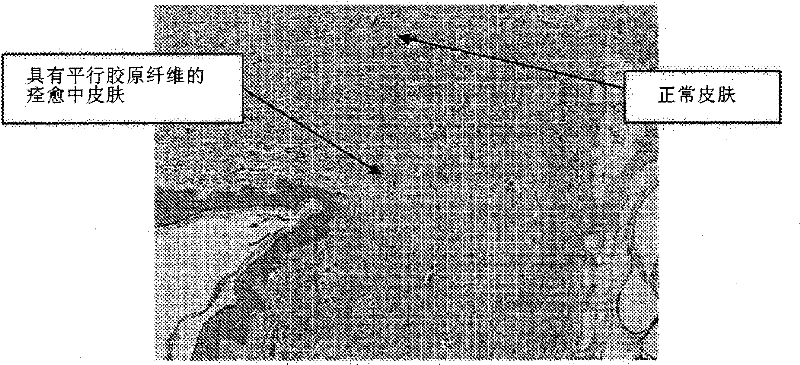
图片DPicture D
如照片E-H所示,下两个切割用标准烧灼系统作出。如以下照片E和F所示,对第一标准烧灼切割的三个切片的分析揭示了以下内容:As shown in photographs E-H, the next two cuts were made with a standard cautery system. As shown in photographs E and F below, analysis of three sections cut from the first standard cauterization revealed the following:
·皮肤切片1:所聚焦的是真皮内适量的成熟纤维性结缔组织,其包含若干小血管与一些多核巨细胞和巨噬细胞。覆盖此真皮区域的表皮由于角蛋白的轻微增加而被最小限度地增生。该真皮的纤维性结缔组织从深层真皮经皮下组织延伸至皮下组织之下的肌肉层。在整个皮下组织的结缔组织与肌肉层上混合有单个到小簇的多核巨细胞、巨噬细胞(某些包含黑色素)、以及淋巴细胞(异物炎症)。• Skin Section 1: Focused on a moderate amount of mature fibrous connective tissue within the dermis, containing several small blood vessels and some multinucleated giant cells and macrophages. The epidermis covering this dermal area is minimally hyperplastic due to a slight increase in keratin. The fibrous connective tissue of the dermis extends from the deep dermis through the subcutaneous tissue to the muscular layer beneath the subcutaneous tissue. Single to small clusters of multinucleated giant cells, macrophages (some containing melanin), and lymphocytes (foreign body inflammation) are mixed throughout the connective tissue and muscle layers of the subcutaneous tissue.
·皮肤切片2:所聚焦的是真皮内适量的成熟纤维性结缔组织,其包含若干小血管和一些多核巨细胞和巨噬细胞。覆盖此真皮区域的表皮由于角蛋白的轻微增加而被最小限度地增生。真皮纤维化区域内的皮肤表面略微凸出。真皮结缔组织从深层真皮延伸至表面皮下组织。伴随皮下组织内结缔组织的是轻微的异物炎症。• Skin Section 2: Focused on a moderate amount of mature fibrous connective tissue within the dermis containing several small blood vessels and some multinucleated giant cells and macrophages. The epidermis covering this dermal area is minimally hyperplastic due to a slight increase in keratin. The skin surface in areas of dermal fibrosis is slightly raised. The dermal connective tissue extends from the deep dermis to the superficial subcutaneous tissue. Mild foreign body inflammation is accompanied by connective tissue within the subcutaneous tissue.
·皮肤切片3:所聚焦的是真皮内适量的成熟纤维性结缔组织,其包含若干小血管和一些多核巨细胞和巨噬细胞。覆盖此真皮区域的表皮由于角蛋白的轻微增加而被最小限度地增生。真皮纤维化区域内的皮肤表面略微凸出。在皮下组织内,就在真皮纤维化的区域之下是由与异物炎症混合的成熟纤维性结缔组织所包围的大片干净的缝合材料。围绕缝合材料的组织反应延伸至皮下组织之下的肌肉层。• Skin Section 3: Focused on a moderate amount of mature fibrous connective tissue within the dermis containing several small blood vessels and some multinucleated giant cells and macrophages. The epidermis covering this dermal area is minimally hyperplastic due to a slight increase in keratin. The skin surface in areas of dermal fibrosis is slightly raised. Within the subcutaneous tissue, just below the area of dermal fibrosis is a large expanse of clean suture material surrounded by mature fibrous connective tissue mixed with foreign body inflammation. The tissue reaction surrounding the suture material extends into the muscle layer beneath the subcutaneous tissue.

图片EPicture E

图片FPicture F
类似地,如以下照片G和H所示,对第二标准烧灼切割的三个切片的分析揭示了以下内容:Similarly, analysis of three sections cut from the second standard cautery, as shown in photographs G and H below, revealed the following:
·皮肤切片1:所对焦的是包含若干小血管的少量成熟纤维性结缔组织。覆盖此真皮区域的表皮由于角蛋白的轻微增加而被最小限度地增生。在皮下组织内,就在真皮纤维化的区域之下是由与异物炎症混合的成熟纤维性结缔组织所包围的大片干净的缝合材料。• Skin Section 1: In focus is a small amount of mature fibrous connective tissue containing several small blood vessels. The epidermis covering this dermal area is minimally hyperplastic due to a slight increase in keratin. Within the subcutaneous tissue, just below the area of dermal fibrosis is a large expanse of clean suture material surrounded by mature fibrous connective tissue mixed with foreign body inflammation.
·皮肤切片2:所对焦的是包含若干小血管的少量成熟纤维性结缔组织。覆盖此真皮区域的表皮具有轻微增加的角蛋白。真皮结缔组织轻微浸润下侧皮下组织,并且在混合有结缔组织的皮下组织内存在少量的与结缔组织相邻的多核巨细胞。皮下组织纤维化之下的肌肉层包含异物炎症的小病灶。在组织切片的边缘上有少量出血,这是该组织的组织学处理继发的。• Skin Section 2: In focus is a small amount of mature fibrous connective tissue containing several small blood vessels. The epidermis covering this dermal area has slightly increased keratin. Dermal connective tissue slightly infiltrates the underlying subcutaneous tissue, and there are a small number of multinucleated giant cells adjacent to the connective tissue in the subcutaneous tissue mixed with connective tissue. The muscle layer beneath the fibrosis of the subcutaneous tissue contains small foci of foreign body inflammation. There was a small amount of bleeding at the edge of the tissue section secondary to histological processing of the tissue.
·皮肤片段3:所对焦的是包含若干小血管的少量成熟纤维性结缔组织。覆盖此真皮区域的表皮由于角蛋白的轻微增加而被最小限度地增生。真皮的纤维化集中延伸至深层皮下组织。在皮下组织结缔组织内的是伴随有极少的巨噬细胞和偶见的多核巨细胞的若干小血管。在组织切片的边缘上有少量出血,这是该组织的组织学处理继发的。• Skin Fragment 3: In focus is a small amount of mature fibrous connective tissue containing several small blood vessels. The epidermis covering this dermal area is minimally hyperplastic due to a slight increase in keratin. The fibrosis of the dermis is concentrated and extends into the deep subcutaneous tissue. Within the subcutaneous connective tissue are several small blood vessels with rare macrophages and occasional multinucleated giant cells. There was a small amount of bleeding at the edge of the tissue section secondary to histological processing of the tissue.
图片GPicture G
图片HPicture H
最后,图片I-L所示的两个切割是以使用根据本发明的一示例实施例的经磨制电极结合定制功率曲线的原型烧灼系统作出的。如以下照片I和J所示,对第一原型烧灼切割的三个切片的分析揭示了以下内容:Finally, the two cuts shown in panels I-L were made with a prototype cautery system using a ground electrode in combination with a custom power curve according to an example embodiment of the present invention. As shown in photographs I and J below, analysis of three slices from the cautery cut of the first prototype revealed the following:
·皮肤切片1:所对焦的是真皮内混合有胶原纤维的成纤维细胞有最小增加。覆盖该真皮区域的表皮被最小限度地增生。真皮纤维化最小限度地延伸至皮下组织中。在皮下组织的结缔组织内存在一些多核巨细胞(异物炎症)。肌肉层内有纤维化小病灶。在表面至深层真皮至表面皮下组织内存在三个区域的异物炎症。表面真皮内的炎症浸润相邻表皮,并且存在小面积的表皮退化。• Skin Section 1: Focused on minimal increase in fibroblasts intermingled with collagen fibers in the dermis. The epidermis covering this dermal area is minimally hyperplastic. Dermal fibrosis minimally extends into the subcutaneous tissue. There are some multinucleated giant cells in the connective tissue of the subcutaneous tissue (foreign body inflammation). There are small foci of fibrosis within the muscle layer. There are three areas of foreign body inflammation within the superficial to deep dermis to superficial subcutaneous tissue. Inflammation within the superficial dermis infiltrates the adjacent epidermis, and there is small area of epidermal degeneration.
·皮肤切片2:所对焦的是真皮内混合有胶原纤维的成纤维细胞有最小增加。覆盖该真皮区域的表皮被最小限度地角化过度。真皮纤维化延伸至下侧皮下组织。皮下结缔组织围绕着大片的干净缝合材料。还存在混合有皮下结缔组织的异物炎症。在皮下组织纤维化和炎症之下肌肉层内有适度纤维化病灶。• Skin Section 2: Focused on minimal increase in fibroblasts intermingled with collagen fibers in the dermis. The epidermis covering this dermal area is minimally hyperkeratotic. Dermal fibrosis extending to the underlying subcutaneous tissue. Subcutaneous connective tissue surrounds a large expanse of clean suture material. There is also foreign body inflammation mixed with subcutaneous connective tissue. Moderately fibrotic foci in the muscular layer beneath subcutaneous tissue fibrosis and inflammation.
·皮肤切片3:所对焦的是真皮内混合有胶原纤维的成纤维细胞有最小增加。覆盖该真皮区域的表皮正常。在真皮纤维化之处附近的肌肉层内有适度纤维化病灶。• Skin Section 3: Focused on minimal increase in fibroblasts intermingled with collagen fibers in the dermis. The epidermis covering this dermal area is normal. Moderately fibrotic foci within the muscular layer adjacent to sites of dermal fibrosis.

图片IPicture I

图片JPicture J
类似地,如以下照片K和L所示,对第二原型烧灼切割的三个切片的分析揭示了以下内容:Similarly, analysis of three sections of a cautery cut of the second prototype, shown in photographs K and L below, revealed the following:
·皮肤切片1:所对焦的是真皮内成纤维细胞的少量增加,比周围真皮有更多胶原纤维组织。表皮是正常的。在上述真皮区域正下方的表面皮下组织内,有混合了一些巨噬细胞和多核巨细胞的两小片干净的缝合材料。在深层皮下组织和下侧肌肉层中存在纤维化大病灶。• Skin Section 1: In focus is a small increase in fibroblasts within the dermis, with more collagenous fibrous tissue than the surrounding dermis. The epidermis is normal. Within the superficial subcutaneous tissue just below the aforementioned dermal area, there were two small patches of clean suture material mixed with some macrophages and multinucleated giant cells. There are large foci of fibrosis in the deep subcutaneous tissue and in the underlying muscle layer.
·皮肤切片2:在此组织切片内没有显微变化。• Skin Section 2: No microscopic changes within this tissue section.
·皮肤切片3:所对焦的是真皮内成纤维细胞的少量增加且比周围真皮有更多胶原纤维组织。表皮是正常的。在上述真皮区域正下方的皮下组织内,存在被成熟纤维性结缔组织和异物炎症包围和浸润的大片干净缝合材料。在皮下缝合材料下侧的肌肉组织内有适度纤维化病灶。• Skin Section 3: In focus is a small increase in fibroblasts within the dermis with more collagenous fibrous tissue than the surrounding dermis. The epidermis is normal. In the subcutaneous tissue just below the above-mentioned dermal area, there is a large piece of clean suture material surrounded and infiltrated by mature fibrous connective tissue and foreign body inflammation. Moderately fibrotic foci within the musculature beneath the subcutaneous suture material.

图片KPicture K

图片LPicture L
尽管在全部所分析切割中皮肤的表皮、真皮、皮下组织和肌肉层都被视为正常痊愈,但手术刀和原型烧灼切割比标准烧灼产生的切割痊愈得更快。对于各个切割,在皮肤切割点内留有最少量的痊愈中病灶组织,并且大部分痊愈中组织主要在真皮中发现。另外,在手术刀和原型烧灼切割点中存在最少量的纤维原细胞和平行取向的真皮胶原纤维。然而,与手术刀和原型烧灼切割中所发现的相比,标准烧灼切割点在真皮痊愈中切割点内仍然包含更多的纤维原细胞和结缔组织。在所有标准烧灼的痊愈中切割点内存在表皮增生和/或真菌性角化,而两个原型烧灼痊愈中皮肤切割点则具有最少的表皮增生和/或真菌性角化,且手术刀痊愈中皮肤点则没有任何表皮改变。表皮增生和真菌性角化是慢性刺激的结果。因此,对本领域普通技术人员容易显而易见的是:本发明的原型烧灼产生与典型外科手术刀所产生结果相似的、却比标准烧灼系统的结果改善得多的结果。Although the epidermis, dermis, subcutaneous tissue, and muscle layers of the skin were considered to heal normally in all cuts analyzed, the scalpel and prototype cautery cuts healed faster than cuts produced by standard cautery. For each incision, a minimal amount of healing tissue was left within the skin incision site, and most of the healing tissue was found primarily in the dermis. Additionally, minimal fibroblasts and parallel-oriented dermal collagen fibers were present in the scalpel and prototype ablation cut sites. However, the standard cautery cut still contained more fibroblasts and connective tissue within the cut in dermal healing than was found in the scalpel and prototype cautery cuts. Epidermal hyperplasia and/or fungal keratosis were present in the cut site in the healing of all standard cautery, while the skin incision site in the two prototype cautery healed had minimal epidermal hyperplasia and/or fungal keratosis, and the scalpel healed in Skin points do not have any epidermal changes. Epidermal hyperplasia and fungal keratosis are the result of chronic irritation. Thus, it will be readily apparent to those of ordinary skill in the art that the prototype cauterization of the present invention produces results similar to those produced by a typical surgical scalpel, yet much improved over those of standard cautery systems.
因而,如本文中所述,本发明的各个实施例包括利用经磨制的质量/厚度受限的电极端连同定制功率曲线。电极端可被磨制成便于将电能集聚在切割点。电极端的质量/厚度可被限制以防止可引起不期望组织损伤的潜热的积聚。功率曲线表征为显著高于电外科手术中通常使用的功率电平、并且基于电路/组织阻抗实时地自动调节的最大输出功率电平。定制功率曲线的输出功率能被自动调节以使其保持与电路/组织阻抗成反比。组合经磨制的质量/厚度受限的电极端和定制功率曲线的使用减少或消除了切割点处及其周围的不期望组织损伤。组织损伤的减少降低了术后并发症的发生率,并提高了术后康复和痊愈的质量和速度。Thus, as described herein, various embodiments of the present invention include utilizing ground mass/thickness limited electrode tips in conjunction with custom power curves. The electrode tip can be ground to facilitate focusing the electrical energy at the cutting point. The mass/thickness of the electrode tip can be limited to prevent the build-up of latent heat that can cause undesired tissue damage. The power curve is characterized by a maximum output power level that is significantly higher than typically used in electrosurgery and that automatically adjusts in real time based on circuit/tissue impedance. The output power of the custom power curve can be automatically adjusted so that it remains inversely proportional to the circuit/tissue impedance. The use of combined ground mass/thickness limited electrode tips and custom power curves reduces or eliminates undesired tissue damage at and around the cut point. The reduction in tissue damage reduces the incidence of postoperative complications and improves the quality and speed of postoperative rehabilitation and recovery.
尽管本发明的方法和过程已被证明在电外科手术领域中是特别有用的,但本领域技术人员能理解,能在各种不同种类的表面上和各种用于执行特定任务的不同应用领域中使用本发明的方法和过程。Although the method and process of the present invention have proven to be particularly useful in the field of electrosurgery, those skilled in the art will appreciate that the method and process of the present invention can be used on a variety of different types of surfaces and in a variety of different application areas for performing specific tasks. using the methods and processes of the present invention.
本发明可具体化为其他具体形式而不背离其精神或本质特征。所述实施例在所有方面都应被认为仅是说明性而非限制性的。从而,本发明的范围由所附权利要求书而非前述描述指示。落入权利要求书的等效方式的含义和范围内的所有改变应被权利要求书的范围涵盖。The present invention may be embodied in other specific forms without departing from its spirit or essential characteristics. The described examples should be considered in all respects as illustrative only and not restrictive. Accordingly, the scope of the invention is indicated by the appended claims rather than the foregoing description. All changes that come within the meaning and range of equivalency of the claims are intended to be embraced by the scope of the claims.
权利要求书(按照条约第19条的修改)Claims (as amended under Article 19 of the Treaty)
1.一种电外科手术系统,包括:1. An electrosurgical system comprising:
适于在电外科手术期间将电能传送至患者组织的电外科手术电极,所述电极的工作面被磨制以在电外科手术期间集聚从所述电极传送至所述患者组织的电能;以及an electrosurgical electrode adapted to deliver electrical energy to patient tissue during electrosurgery, the working surface of the electrode ground to focus electrical energy delivered from the electrode to the patient tissue during electrosurgery; and
电耦合至所述电极的电外科手术电波发生器,所述电波发生器适于感测所述电外科手术系统的各个参数,并基于存储在所述电波发生器中的定制功率曲线自动调节从所述电极发送至所述患者组织的电能的电平,an electrosurgical wave generator electrically coupled to the electrodes, the wave generator adapted to sense various parameters of the electrosurgical system and automatically adjust from the level of electrical energy delivered by the electrodes to the patient tissue,
其中所述定制功率曲线适于当所感测的所述电外科手术系统的参数在预定义范围内时将传送至所述患者组织的电能保持在最大功率电平,并且其中当所感测的所述电外科手术系统的参数在预定义范围之外时所述传送至所述患者组织的电能快速减少。wherein the custom power curve is adapted to maintain electrical energy delivered to the patient tissue at a maximum power level when a sensed parameter of the electrosurgical system is within a predefined range, and wherein when the sensed parameter of the electrosurgical system is within a predefined range, The delivery of electrical energy to the patient tissue is rapidly reduced when a parameter of the electrosurgical system is outside a predefined range.
2.如权利要求1所述的电外科手术系统,其特征在于,所述电极的经磨制工作面的厚度在约0.0254mm与约0.127mm之间。2. The electrosurgical system of claim 1, wherein the thickness of the ground working surface of the electrode is between about 0.0254 mm and about 0.127 mm.
3.如权利要求1所述的电外科手术系统,其特征在于,所述电极具有经减小质量以使所述电极保留并传递至周围组织的潜热的量最小化。3. The electrosurgical system of claim 1, wherein the electrode has a reduced mass to minimize the amount of latent heat retained by the electrode and transferred to surrounding tissue.
4.如权利要求1所述的电外科手术系统,其特征在于,所述电波发生器适于感测所述电外科手术系统的电压和电流。4. The electrosurgical system of claim 1, wherein the wave generator is adapted to sense voltage and current of the electrosurgical system.
5.如权利要求4所述的电外科手术系统,其特征在于,所述电波发生器适于根据所感测的电压和电流计算所述电外科手术系统的阻抗。5. The electrosurgical system of claim 4, wherein the wave generator is adapted to calculate the impedance of the electrosurgical system from the sensed voltage and current.
6.如权利要求1所述的电外科手术系统,其特征在于,所述定制功率曲线的电能能级与所述组织的阻抗成反比。6. The electrosurgical system of claim 1, wherein the electrical energy level of the customized power curve is inversely proportional to the impedance of the tissue.
7.如权利要求1所述的电外科手术系统,其特征在于,所述电波发生器包括一处理器,其适于:7. The electrosurgical system of claim 1, wherein the wave generator includes a processor adapted to:
根据所感测的所述电外科手术系统的参数计算所述电外科手术系统的阻抗;calculating an impedance of the electrosurgical system based on sensed parameters of the electrosurgical system;
使用所算得的所述电外科手术系统的阻抗来计算与所算得阻抗级相关联的定制功率曲线上的电能能级;以及using the calculated impedance of the electrosurgical system to calculate an electrical energy level on a custom power curve associated with the calculated impedance level; and
将通过所述电极传送的电能能级调节成与所算得阻抗相关联的定制功率曲线上的级别。The level of electrical energy delivered through the electrodes is adjusted to a level on a custom power curve associated with the calculated impedance.
8.如权利要求1所述的电外科手术系统,其特征在于,所述电波发生器适于感测所述电外科手术系统的各个参数,并且每约20毫秒就自动调节从所述电极传送至所述患者组织的电能的能级。8. The electrosurgical system of claim 1, wherein the wave generator is adapted to sense various parameters of the electrosurgical system and to automatically adjust the frequency transmitted from the electrodes every about 20 milliseconds. The energy level of the electrical energy to the patient tissue.
9.如权利要求1所述的电外科手术系统,其特征在于,当所述电外科手术系统的阻抗在约100Ω与约200Ω之间时,所述定制功率曲线将传送至所述患者组织的电能保持在最大功率电平。9. The electrosurgical system of claim 1, wherein said customized power curve is to deliver to said patient tissue when the impedance of said electrosurgical system is between about 100Ω and about 200Ω. Electrical energy is maintained at maximum power level.
10.如权利要求9所述的电外科手术系统,其特征在于,传送至所述患者组织的所述最大功率电平约为150瓦。10. The electrosurgical system of claim 9, wherein said maximum power level delivered to said patient tissue is approximately 150 watts.
11.一种电外科手术系统,包括:能在电外科手术期间将电能传送至患者组织的电极,所述电极具有用以进行所述电极与所述患者组织之间电能的可能高集聚的经磨制工作刃;以及11. An electrosurgical system comprising: an electrode capable of delivering electrical energy to patient tissue during electrosurgery, said electrode having an electrode for potentially high concentration of electrical energy between said electrode and said patient tissue grind the working edge; and
电波发生器,适于产生要通过所述电极传送至患者组织的电能,所述电波发生器包括:an electrical wave generator adapted to generate electrical energy to be delivered to tissue of the patient through said electrodes, said electrical wave generator comprising:
适于检测所述电外科手术系统的各个参数的传感器;以及sensors adapted to detect various parameters of the electrosurgical system; and
编程有定制功率曲线的处理器,所述处理器适于基于所检测到的所述电外科手术系统的参数和所述定制功率曲线来自动调节传送至所述患者组织的电能,a processor programmed with a customized power curve adapted to automatically adjust electrical energy delivered to the patient tissue based on detected parameters of the electrosurgical system and the customized power curve,
其中当所述电外科手术系统的阻抗低于第一阈值水平时所述定制功率曲线包括所传送的电能的能级的激增,且其中当所述电外科手术系统的阻抗高于第二阈值水平时所述定制功率曲线包括所传送的电能的能级的速降。wherein the customized power curve includes a surge in the energy level of the delivered electrical energy when the impedance of the electrosurgical system is below a first threshold level, and wherein when the impedance of the electrosurgical system is above a second threshold level When the custom power curve includes a drop in energy level of the delivered electrical energy.
12.如权利要求11所述的电外科手术系统,其特征在于,所述电极的经磨制工作刃的厚度为约0.1mm。12. The electrosurgical system of claim 11, wherein the thickness of the ground working edge of the electrode is about 0.1 mm.
13.如权利要求11所述的电外科手术系统,其特征在于,所述传感器与所述电极电连通。13. The electrosurgical system of claim 11, wherein the sensor is in electrical communication with the electrode.
14.如权利要求11所述的电外科手术系统,其特征在于,所述电极的经磨制工作刃涂敷有非粘性涂层。14. The electrosurgical system of claim 11, wherein the ground working edge of the electrode is coated with a non-stick coating.
15.如权利要求11所述的电外科手术系统,其特征在于,所述电波发生器适于感测所述电外科手术系统的各个参数,并且实时地自动调节传送至所述患者组织的电能。15. The electrosurgical system of claim 11, wherein the wave generator is adapted to sense various parameters of the electrosurgical system and automatically adjust the electrical energy delivered to the patient tissue in real time .
16.如权利要求11所述的电外科手术系统,其特征在于,所述电波发生器适于产生在约0瓦至约150瓦范围内的电能。16. The electrosurgical system of claim 11, wherein the wave generator is adapted to generate electrical power in the range of about 0 watts to about 150 watts.
17.如权利要求11所述的电外科手术系统,其特征在于,所述电波发生器适于基于所感测的所述电外科手术系统的参数计算所述电外科手术系统的阻抗。17. The electrosurgical system of claim 11, wherein the wave generator is adapted to calculate an impedance of the electrosurgical system based on sensed parameters of the electrosurgical system.
18.如权利要求11所述的电外科手术系统,其特征在于,当所述电外科手术系统的阻抗在第一阈值水平与第二阈值水平之间时,所述定制功率曲线将所传送的电能的能级保持在最大功率电平。18. The electrosurgical system of claim 11 , wherein the customized power curve is the delivered The energy level of the electrical energy is maintained at the maximum power level.
19.一种电外科手术系统,包括:19. An electrosurgical system comprising:
能将电能传送至患者组织的电外科手术电极,所述电极的工作面的厚度约为0.1270mm或以下以进行所述电极与所述患者组织之间电能的可能高集聚,所述电极还具有约0.4mm的总厚度以便于减少从所述电极传递至患者组织的潜热的量;An electrosurgical electrode capable of delivering electrical energy to tissue of a patient, said electrode having a working surface having a thickness of about 0.1270 mm or less for a high possible concentration of electrical energy between said electrode and said tissue of a patient, said electrode further having an overall thickness of about 0.4 mm in order to reduce the amount of latent heat transferred from the electrodes to the patient's tissue;
电外科手术电波发生器,适于产生电能以供通过所述电极传送至患者组织,所述电波发生器适于感测所述电外科手术系统的各个参数,并且基于所感测的电外科手术系统参数,使通过所述电极传送的电能的能级自动顺应经预编程的功率曲线上的对应电能的能级,an electrosurgical wave generator adapted to generate electrical energy for delivery through the electrodes to patient tissue, the wave generator adapted to sense various parameters of the electrosurgical system and based on the sensed electrosurgical system parameters, so that the energy level of the electrical energy delivered through the electrodes automatically conforms to the energy level of the corresponding electrical energy on the pre-programmed power curve,
其中所述经预编程的功率曲线在所感测的电外科手术系统参数在预定义范围内时将传送至所述患者组织的电能的能级保持在预定最大功率电平,并且wherein said preprogrammed power curve maintains the level of electrical energy delivered to said patient tissue at a predetermined maximum power level when a sensed electrosurgical system parameter is within a predefined range, and
其中当所感测的电外科手术系统参数高于预定义范围时,传送至所述患者组织的所述电能的能级与所述组织的阻抗成反比。Wherein when the sensed electrosurgical system parameter is above a predefined range, the level of the electrical energy delivered to the patient tissue is inversely proportional to the impedance of the tissue.
20.如权利要求19所述的电外科手术系统,其特征在于,所述电波发生器适于基于所感测的所述电外科手术系统的参数计算所述组织的阻抗。20. The electrosurgical system of claim 19, wherein the wave generator is adapted to calculate an impedance of the tissue based on sensed parameters of the electrosurgical system.
21.如权利要求20所述的电外科手术系统,其特征在于,所述电波发生器所产生的电能的能级与所述电极穿入所述组织的速度直接成正比。21. The electrosurgical system of claim 20, wherein the level of electrical energy generated by the wave generator is directly proportional to the speed at which the electrode penetrates the tissue.
22.如权利要求19所述的电外科手术系统,其特征在于,所述电波发生器适于感测所述电外科手术系统的各个参数,并且至少每20毫秒就使所述电能能级级自动顺应经预编程的功率曲线上的对应电能能级。22. The electrosurgical system of claim 19, wherein said wave generator is adapted to sense various parameters of said electrosurgical system and to set said electrical energy level at least every 20 milliseconds. Automatically conforms to the corresponding electrical energy level on the pre-programmed power curve.
23.如权利要求19所述的电外科手术系统,其特征在于,所述电波发生器适于产生在约0瓦至约150瓦范围内的电能以供通过所述电极传送至患者组织。23. The electrosurgical system of claim 19, wherein the wave generator is adapted to generate electrical power in the range of about 0 watts to about 150 watts for delivery through the electrodes to patient tissue.
Claims (20)
Applications Claiming Priority (5)
| Application Number | Priority Date | Filing Date | Title |
|---|---|---|---|
| US5273308P | 2008-05-13 | 2008-05-13 | |
| US61/052,733 | 2008-05-13 | ||
| US12/464,591 | 2009-05-12 | ||
| US12/464,591 US8500727B2 (en) | 2008-05-13 | 2009-05-12 | Methods, systems, and devices for performing electrosurgical procedures |
| PCT/US2009/043833 WO2009146260A1 (en) | 2008-05-13 | 2009-05-13 | Methods, systems, and devices for performing electrosurgical procedures |
Publications (2)
| Publication Number | Publication Date |
|---|---|
| CN101883534A true CN101883534A (en) | 2010-11-10 |
| CN101883534B CN101883534B (en) | 2012-11-28 |
Family
ID=41377529
Family Applications (1)
| Application Number | Title | Priority Date | Filing Date |
|---|---|---|---|
| CN200980101255.4A Active CN101883534B (en) | 2008-05-13 | 2009-05-13 | System for performing electrosurgical procedures |
Country Status (9)
| Country | Link |
|---|---|
| US (1) | US8500727B2 (en) |
| EP (2) | EP3424456B1 (en) |
| JP (1) | JP5876291B2 (en) |
| CN (1) | CN101883534B (en) |
| AU (1) | AU2009251399B2 (en) |
| BR (1) | BRPI0905851B8 (en) |
| CA (1) | CA2703418C (en) |
| ES (1) | ES2694274T3 (en) |
| WO (1) | WO2009146260A1 (en) |
Cited By (5)
| Publication number | Priority date | Publication date | Assignee | Title |
|---|---|---|---|---|
| CN103222892A (en) * | 2012-01-27 | 2013-07-31 | 科维蒂恩有限合伙公司 | Systems and methods for phase predictive impedance loss model calibration and compensation |
| CN107028652A (en) * | 2012-01-30 | 2017-08-11 | 科维蒂恩有限合伙公司 | The electrosurgery unit of energy sensing with integrated tissue site |
| CN108472069A (en) * | 2015-07-20 | 2018-08-31 | 玛格戴恩医疗产品公司 | Electrosurgery wave producer |
| CN111836594A (en) * | 2018-03-13 | 2020-10-27 | 奥林匹斯冬季和Ibe有限公司 | High-frequency generator, control unit, method for operating a high-frequency generator |
| CN115005969A (en) * | 2021-03-03 | 2022-09-06 | 奥林巴斯医疗株式会社 | Medical device, controller, and storage medium |
Families Citing this family (24)
| Publication number | Priority date | Publication date | Assignee | Title |
|---|---|---|---|---|
| USD631160S1 (en) * | 2008-11-18 | 2011-01-18 | Erbe Elektromedizin Gmbh | High-frequency surgery device |
| US8439910B2 (en) * | 2010-01-22 | 2013-05-14 | Megadyne Medical Products Inc. | Electrosurgical electrode with electric field concentrating flash edge |
| US8617154B2 (en) * | 2010-06-25 | 2013-12-31 | Covidien Lp | Current-fed push-pull converter with passive voltage clamp |
| US9084606B2 (en) | 2012-06-01 | 2015-07-21 | Megadyne Medical Products, Inc. | Electrosurgical scissors |
| WO2014153149A1 (en) | 2013-03-14 | 2014-09-25 | Ellman International, Inc. | Electrosurgical systems and methods |
| EP2967711B1 (en) * | 2013-03-15 | 2020-05-06 | Cynosure, LLC | Electrosurgical instruments with multimodes of operation |
| BR112015025935B1 (en) | 2013-04-24 | 2022-03-08 | Medovex Corp | SURGICAL TOOLS FOR FACETARY SPINE SURGICAL PROCEDURES TO RELIEVE SPINE PAIN |
| US10285750B2 (en) | 2013-07-29 | 2019-05-14 | Covidien Lp | Systems and methods for operating an electrosurgical generator |
| GB201318204D0 (en) | 2013-10-15 | 2013-11-27 | Gyrus Medical Ltd | Electrosurgical electrode & instrument |
| GB2525113B (en) | 2014-04-10 | 2016-02-24 | Cook Medical Technologies Llc | Apparatus and method for occluding a vessel by RF embolization |
| JP6689761B2 (en) | 2014-07-30 | 2020-04-28 | メドヴェックス コーポレーションMedovex Corp. | Surgical instruments for the treatment of spinal facet joints for pain relief and related methods |
| US10398494B2 (en) | 2014-07-30 | 2019-09-03 | Medovex Corp. | Surgical tools for spinal facet therapy to alleviate pain and related methods |
| CN106999210B (en) | 2014-12-12 | 2020-10-30 | 梅多维克斯公司 | Surgical tools with positioning components |
| BR112017014919A2 (en) * | 2015-01-13 | 2018-01-09 | Megadyne Med Prod Inc | precision tapered blade electrosurgical instrument |
| DE102015226846A1 (en) * | 2015-12-30 | 2017-07-06 | Olympus Winter & Ibe Gmbh | Electrosurgical system for generating high-frequency alternating current |
| USD810290S1 (en) | 2016-01-29 | 2018-02-13 | Medovex Corp. | Surgical portal driver |
| US12376898B2 (en) | 2016-07-01 | 2025-08-05 | Cynosure, Llc | Non-invasive, uniform and non-uniform RF methods and systems related applications |
| US11648047B2 (en) | 2017-10-06 | 2023-05-16 | Vive Scientific, Llc | System and method to treat obstructive sleep apnea |
| AU2019217623B2 (en) | 2018-02-07 | 2021-10-28 | Cynosure, Inc. | Methods and apparatus for controlled RF treatments and RF generator system |
| US11607265B2 (en) | 2018-08-24 | 2023-03-21 | Covidien Lp | Cutting electrode enhancement for laparoscopic electrosurgical device |
| US12521171B2 (en) * | 2018-10-11 | 2026-01-13 | Rebound Therapeutics Corporation | Macerator for intracranial surgery |
| CN113811255B (en) | 2019-05-09 | 2024-07-05 | 捷锐士阿希迈公司(以奥林巴斯美国外科技术名义) | Electrosurgical systems and methods |
| USD1005484S1 (en) | 2019-07-19 | 2023-11-21 | Cynosure, Llc | Handheld medical instrument and docking base |
| JP2019205921A (en) * | 2019-09-11 | 2019-12-05 | メガダイン・メディカル・プロダクツ・インコーポレーテッドMegaDyne Medical Products, Inc. | Tapered precision blade electrosurgical instrument |
Family Cites Families (62)
| Publication number | Priority date | Publication date | Assignee | Title |
|---|---|---|---|---|
| US2917614A (en) | 1957-09-18 | 1959-12-15 | Vincent J Caliri | Cauterizing device |
| US4202337A (en) | 1977-06-14 | 1980-05-13 | Concept, Inc. | Bipolar electrosurgical knife |
| US4228800A (en) | 1978-04-04 | 1980-10-21 | Concept, Inc. | Bipolar electrosurgical knife |
| US4658819A (en) | 1983-09-13 | 1987-04-21 | Valleylab, Inc. | Electrosurgical generator |
| DE3480462D1 (en) * | 1983-09-13 | 1989-12-21 | Valleylab Inc | Electrosurgical generator |
| US4850353A (en) | 1988-08-08 | 1989-07-25 | Everest Medical Corporation | Silicon nitride electrosurgical blade |
| US5013312A (en) | 1990-03-19 | 1991-05-07 | Everest Medical Corporation | Bipolar scalpel for harvesting internal mammary artery |
| US5122137A (en) * | 1990-04-27 | 1992-06-16 | Boston Scientific Corporation | Temperature controlled rf coagulation |
| US5167658A (en) * | 1991-01-31 | 1992-12-01 | Mdt Corporation | Method and apparatus for electrosurgical measurement |
| GB9204217D0 (en) | 1992-02-27 | 1992-04-08 | Goble Nigel M | Cauterising apparatus |
| US5558671A (en) | 1993-07-22 | 1996-09-24 | Yates; David C. | Impedance feedback monitor for electrosurgical instrument |
| US5817093A (en) | 1993-07-22 | 1998-10-06 | Ethicon Endo-Surgery, Inc. | Impedance feedback monitor with query electrode for electrosurgical instrument |
| US5514129A (en) | 1993-12-03 | 1996-05-07 | Valleylab Inc. | Automatic bipolar control for an electrosurgical generator |
| JPH08308851A (en) * | 1995-05-16 | 1996-11-26 | Olympus Optical Co Ltd | Electrosurgical device |
| US5599344A (en) | 1995-06-06 | 1997-02-04 | Valleylab Inc. | Control apparatus for electrosurgical generator power output |
| US5628745A (en) | 1995-06-06 | 1997-05-13 | Bek; Robin B. | Exit spark control for an electrosurgical generator |
| US5720744A (en) * | 1995-06-06 | 1998-02-24 | Valleylab Inc | Control system for neurosurgery |
| DE19623840A1 (en) | 1996-06-14 | 1997-12-18 | Berchtold Gmbh & Co Geb | High frequency electrosurgical generator |
| US5836943A (en) | 1996-08-23 | 1998-11-17 | Team Medical, L.L.C. | Electrosurgical generator |
| US6033399A (en) | 1997-04-09 | 2000-03-07 | Valleylab, Inc. | Electrosurgical generator with adaptive power control |
| DE19730127C2 (en) | 1997-07-14 | 2001-04-12 | Erbe Elektromedizin | Dissecting instrument |
| US6056747A (en) | 1997-08-04 | 2000-05-02 | Gynecare, Inc. | Apparatus and method for treatment of body tissues |
| US6039735A (en) | 1997-10-03 | 2000-03-21 | Megadyne Medical Products, Inc. | Electric field concentrated electrosurgical electrode |
| AU729125B2 (en) * | 1997-10-03 | 2001-01-25 | Megadyne Medical Products, Inc. | Electric field concentrated electrosurgical electrode |
| US6287305B1 (en) * | 1997-12-23 | 2001-09-11 | Team Medical, L.L.C. | Electrosurgical instrument |
| US6533781B2 (en) | 1997-12-23 | 2003-03-18 | Team Medical Llc | Electrosurgical instrument |
| US7137980B2 (en) * | 1998-10-23 | 2006-11-21 | Sherwood Services Ag | Method and system for controlling output of RF medical generator |
| US6398779B1 (en) * | 1998-10-23 | 2002-06-04 | Sherwood Services Ag | Vessel sealing system |
| US6692489B1 (en) | 1999-07-21 | 2004-02-17 | Team Medical, Llc | Electrosurgical mode conversion system |
| JP2001029355A (en) * | 1999-07-21 | 2001-02-06 | Olympus Optical Co Ltd | Electric cautery device |
| DE29913688U1 (en) | 1999-08-05 | 1999-10-14 | Richard Wolf Gmbh, 75438 Knittlingen | Transurethral dissection electrode |
| JP2001120566A (en) | 1999-10-22 | 2001-05-08 | Olympus Optical Co Ltd | Galvanosurgery apparatus |
| US6974452B1 (en) | 2000-01-12 | 2005-12-13 | Clinicon Corporation | Cutting and cauterizing surgical tools |
| US6589239B2 (en) | 2000-02-01 | 2003-07-08 | Ashok C. Khandkar | Electrosurgical knife |
| JP4502565B2 (en) | 2000-02-28 | 2010-07-14 | コンメド コーポレイション | Electrosurgical scalpel with silicon coating directly bonded |
| DE10026508A1 (en) | 2000-05-24 | 2001-11-29 | Kai Desinger | Surgical hollow tube |
| DK176207B1 (en) | 2000-09-28 | 2007-02-05 | Xo Care As | Electrosurgical apparatus |
| US6843789B2 (en) | 2000-10-31 | 2005-01-18 | Gyrus Medical Limited | Electrosurgical system |
| US6893435B2 (en) | 2000-10-31 | 2005-05-17 | Gyrus Medical Limited | Electrosurgical system |
| US6620157B1 (en) | 2000-12-28 | 2003-09-16 | Senorx, Inc. | High frequency power source |
| US6572613B1 (en) | 2001-01-16 | 2003-06-03 | Alan G. Ellman | RF tissue penetrating probe |
| US7367973B2 (en) | 2003-06-30 | 2008-05-06 | Intuitive Surgical, Inc. | Electro-surgical instrument with replaceable end-effectors and inhibited surface conduction |
| JP4656755B2 (en) | 2001-05-07 | 2011-03-23 | オリンパス株式会社 | Electrosurgical equipment |
| US6740079B1 (en) | 2001-07-12 | 2004-05-25 | Neothermia Corporation | Electrosurgical generator |
| US6923804B2 (en) | 2001-07-12 | 2005-08-02 | Neothermia Corporation | Electrosurgical generator |
| US6951559B1 (en) | 2002-06-21 | 2005-10-04 | Megadyne Medical Products, Inc. | Utilization of a hybrid material in a surface coating of an electrosurgical instrument |
| US7442192B2 (en) | 2002-07-14 | 2008-10-28 | Knowlton Edward W | Method and apparatus for surgical dissection |
| AU2003295518B2 (en) * | 2002-11-13 | 2009-06-04 | Artemis Medical, Inc. | Devices and methods for controlling initial movement of an electrosurgical electrode |
| US7255694B2 (en) | 2002-12-10 | 2007-08-14 | Sherwood Services Ag | Variable output crest factor electrosurgical generator |
| US7044948B2 (en) | 2002-12-10 | 2006-05-16 | Sherwood Services Ag | Circuit for controlling arc energy from an electrosurgical generator |
| EP1603474B1 (en) * | 2003-02-14 | 2013-09-11 | The Board Of Trustees Of The Leland Stanford Junior University | Electrosurgical system with uniformly enhanced electric field and minimal collateral damage |
| WO2004098385A2 (en) * | 2003-05-01 | 2004-11-18 | Sherwood Services Ag | Method and system for programing and controlling an electrosurgical generator system |
| BRPI0416323A (en) | 2003-11-10 | 2007-01-09 | Team Medical Llc | electrosurgical instrument |
| US7300435B2 (en) | 2003-11-21 | 2007-11-27 | Sherwood Services Ag | Automatic control system for an electrosurgical generator |
| US7066936B2 (en) | 2004-06-07 | 2006-06-27 | Ethicon, Inc. | Surgical cutting and tissue vaporizing instrument |
| GB2415140A (en) | 2004-06-18 | 2005-12-21 | Gyrus Medical Ltd | A surgical instrument |
| US8562603B2 (en) | 2005-06-30 | 2013-10-22 | Microline Surgical, Inc. | Method for conducting electrosurgery with increased crest factor |
| US7867226B2 (en) | 2005-06-30 | 2011-01-11 | Microline Surgical, Inc. | Electrosurgical needle electrode |
| US7922713B2 (en) | 2006-01-03 | 2011-04-12 | Geisel Donald J | High efficiency, precision electrosurgical apparatus and method |
| US8382748B2 (en) | 2006-01-03 | 2013-02-26 | Donald J. Geisel | High efficiency, precision electrosurgical apparatus and method |
| CA2574935A1 (en) * | 2006-01-24 | 2007-07-24 | Sherwood Services Ag | A method and system for controlling an output of a radio-frequency medical generator having an impedance based control algorithm |
| US20080103494A1 (en) | 2006-11-01 | 2008-05-01 | Boston Scientific Scimed, Inc. | Bipolar ablation probe having porous electrodes for delivering electrically conductive fluid |
-
2009
- 2009-05-12 US US12/464,591 patent/US8500727B2/en active Active
- 2009-05-13 AU AU2009251399A patent/AU2009251399B2/en not_active Ceased
- 2009-05-13 CA CA2703418A patent/CA2703418C/en not_active Expired - Fee Related
- 2009-05-13 ES ES09755622.9T patent/ES2694274T3/en active Active
- 2009-05-13 EP EP18187312.6A patent/EP3424456B1/en active Active
- 2009-05-13 CN CN200980101255.4A patent/CN101883534B/en active Active
- 2009-05-13 JP JP2011509664A patent/JP5876291B2/en active Active
- 2009-05-13 EP EP09755622.9A patent/EP2293733B1/en active Active
- 2009-05-13 BR BRPI0905851A patent/BRPI0905851B8/en active IP Right Grant
- 2009-05-13 WO PCT/US2009/043833 patent/WO2009146260A1/en not_active Ceased
Cited By (12)
| Publication number | Priority date | Publication date | Assignee | Title |
|---|---|---|---|---|
| CN103222892A (en) * | 2012-01-27 | 2013-07-31 | 科维蒂恩有限合伙公司 | Systems and methods for phase predictive impedance loss model calibration and compensation |
| CN103222892B (en) * | 2012-01-27 | 2016-02-24 | 科维蒂恩有限合伙公司 | For the impedance loss model calibration of Phase Prediction and the system and method for compensation |
| CN107028652A (en) * | 2012-01-30 | 2017-08-11 | 科维蒂恩有限合伙公司 | The electrosurgery unit of energy sensing with integrated tissue site |
| CN107028652B (en) * | 2012-01-30 | 2019-08-23 | 科维蒂恩有限合伙公司 | The electrosurgery unit of energy sensing with integrated tissue site |
| CN108472069A (en) * | 2015-07-20 | 2018-08-31 | 玛格戴恩医疗产品公司 | Electrosurgery wave producer |
| CN108472069B (en) * | 2015-07-20 | 2024-06-07 | 玛格戴恩医疗产品公司 | Electrosurgical wave generator |
| CN111836594A (en) * | 2018-03-13 | 2020-10-27 | 奥林匹斯冬季和Ibe有限公司 | High-frequency generator, control unit, method for operating a high-frequency generator |
| CN111836594B (en) * | 2018-03-13 | 2023-09-15 | 奥林匹斯冬季和Ibe有限公司 | High frequency generator, control unit, method for operating high frequency generator |
| US11931093B2 (en) | 2018-03-13 | 2024-03-19 | Olympus Winter & Ibe Gmbh | High-frequency generator, control unit, method for operating a high-frequency generator |
| CN115005969A (en) * | 2021-03-03 | 2022-09-06 | 奥林巴斯医疗株式会社 | Medical device, controller, and storage medium |
| CN115005969B (en) * | 2021-03-03 | 2025-11-11 | 奥林巴斯医疗株式会社 | Medical device, controller, and storage medium |
| US12539165B2 (en) | 2021-03-03 | 2026-02-03 | Olympus Medical Systems Corp. | Apparatus and method for electrosurgery |
Also Published As
| Publication number | Publication date |
|---|---|
| EP3424456A1 (en) | 2019-01-09 |
| US20100030212A1 (en) | 2010-02-04 |
| WO2009146260A1 (en) | 2009-12-03 |
| EP2293733B1 (en) | 2018-09-19 |
| ES2694274T3 (en) | 2018-12-19 |
| BRPI0905851A2 (en) | 2015-06-30 |
| JP2011520520A (en) | 2011-07-21 |
| BRPI0905851B8 (en) | 2021-06-22 |
| EP2293733A1 (en) | 2011-03-16 |
| AU2009251399B2 (en) | 2014-07-17 |
| CA2703418A1 (en) | 2009-12-03 |
| CN101883534B (en) | 2012-11-28 |
| JP5876291B2 (en) | 2016-03-02 |
| US8500727B2 (en) | 2013-08-06 |
| CA2703418C (en) | 2016-06-28 |
| BRPI0905851B1 (en) | 2020-09-29 |
| AU2009251399A1 (en) | 2009-12-03 |
| EP2293733A4 (en) | 2016-09-28 |
| EP3424456B1 (en) | 2020-05-13 |
Similar Documents
| Publication | Publication Date | Title |
|---|---|---|
| CN101883534A (en) | Methods, systems, and apparatus for performing electrosurgical procedures | |
| CN101188978B (en) | Devices for tissue cautery | |
| CN101677832B (en) | Surgical tool | |
| CN102939055B (en) | Electrosurgical electrodes with electric field concentrating flash | |
| EP1862137B1 (en) | System for controlling tissue heating rate prior to cellular vaporization | |
| WO2012151493A2 (en) | Variable-frequency stimulator for electrosurgery | |
| HK1155343B (en) | System for performing electrosurgical procedures | |
| HK1155343A (en) | System for performing electrosurgical procedures | |
| HK1138749B (en) | Surgical tool |
Legal Events
| Date | Code | Title | Description |
|---|---|---|---|
| C06 | Publication | ||
| PB01 | Publication | ||
| C10 | Entry into substantive examination | ||
| SE01 | Entry into force of request for substantive examination | ||
| C14 | Grant of patent or utility model | ||
| GR01 | Patent grant |