CN101848712A - Treatment of Progressive Neurodegenerative Diseases with Ibudiide - Google Patents
Treatment of Progressive Neurodegenerative Diseases with Ibudiide Download PDFInfo
- Publication number
- CN101848712A CN101848712A CN200880106623A CN200880106623A CN101848712A CN 101848712 A CN101848712 A CN 101848712A CN 200880106623 A CN200880106623 A CN 200880106623A CN 200880106623 A CN200880106623 A CN 200880106623A CN 101848712 A CN101848712 A CN 101848712A
- Authority
- CN
- China
- Prior art keywords
- progressive
- disease
- familial
- syndrome
- atrophy
- Prior art date
- Legal status (The legal status is an assumption and is not a legal conclusion. Google has not performed a legal analysis and makes no representation as to the accuracy of the status listed.)
- Granted
Links
Images


Classifications
-
- A—HUMAN NECESSITIES
- A61—MEDICAL OR VETERINARY SCIENCE; HYGIENE
- A61K—PREPARATIONS FOR MEDICAL, DENTAL OR TOILETRY PURPOSES
- A61K31/00—Medicinal preparations containing organic active ingredients
- A61K31/33—Heterocyclic compounds
- A61K31/395—Heterocyclic compounds having nitrogen as a ring hetero atom, e.g. guanethidine or rifamycins
- A61K31/435—Heterocyclic compounds having nitrogen as a ring hetero atom, e.g. guanethidine or rifamycins having six-membered rings with one nitrogen as the only ring hetero atom
- A61K31/4353—Heterocyclic compounds having nitrogen as a ring hetero atom, e.g. guanethidine or rifamycins having six-membered rings with one nitrogen as the only ring hetero atom ortho- or peri-condensed with heterocyclic ring systems
- A61K31/437—Heterocyclic compounds having nitrogen as a ring hetero atom, e.g. guanethidine or rifamycins having six-membered rings with one nitrogen as the only ring hetero atom ortho- or peri-condensed with heterocyclic ring systems the heterocyclic ring system containing a five-membered ring having nitrogen as a ring hetero atom, e.g. indolizine, beta-carboline
-
- A—HUMAN NECESSITIES
- A61—MEDICAL OR VETERINARY SCIENCE; HYGIENE
- A61K—PREPARATIONS FOR MEDICAL, DENTAL OR TOILETRY PURPOSES
- A61K45/00—Medicinal preparations containing active ingredients not provided for in groups A61K31/00 - A61K41/00
- A61K45/06—Mixtures of active ingredients without chemical characterisation, e.g. antiphlogistics and cardiaca
-
- A—HUMAN NECESSITIES
- A61—MEDICAL OR VETERINARY SCIENCE; HYGIENE
- A61K—PREPARATIONS FOR MEDICAL, DENTAL OR TOILETRY PURPOSES
- A61K9/00—Medicinal preparations characterised by special physical form
- A61K9/0012—Galenical forms characterised by the site of application
- A61K9/0014—Skin, i.e. galenical aspects of topical compositions
-
- A—HUMAN NECESSITIES
- A61—MEDICAL OR VETERINARY SCIENCE; HYGIENE
- A61K—PREPARATIONS FOR MEDICAL, DENTAL OR TOILETRY PURPOSES
- A61K9/00—Medicinal preparations characterised by special physical form
- A61K9/0012—Galenical forms characterised by the site of application
- A61K9/0019—Injectable compositions; Intramuscular, intravenous, arterial, subcutaneous administration; Compositions to be administered through the skin in an invasive manner
-
- A—HUMAN NECESSITIES
- A61—MEDICAL OR VETERINARY SCIENCE; HYGIENE
- A61K—PREPARATIONS FOR MEDICAL, DENTAL OR TOILETRY PURPOSES
- A61K9/00—Medicinal preparations characterised by special physical form
- A61K9/0012—Galenical forms characterised by the site of application
- A61K9/0053—Mouth and digestive tract, i.e. intraoral and peroral administration
-
- A—HUMAN NECESSITIES
- A61—MEDICAL OR VETERINARY SCIENCE; HYGIENE
- A61K—PREPARATIONS FOR MEDICAL, DENTAL OR TOILETRY PURPOSES
- A61K9/00—Medicinal preparations characterised by special physical form
- A61K9/06—Ointments; Bases therefor; Other semi-solid forms, e.g. creams, sticks, gels
-
- A—HUMAN NECESSITIES
- A61—MEDICAL OR VETERINARY SCIENCE; HYGIENE
- A61P—SPECIFIC THERAPEUTIC ACTIVITY OF CHEMICAL COMPOUNDS OR MEDICINAL PREPARATIONS
- A61P21/00—Drugs for disorders of the muscular or neuromuscular system
-
- A—HUMAN NECESSITIES
- A61—MEDICAL OR VETERINARY SCIENCE; HYGIENE
- A61P—SPECIFIC THERAPEUTIC ACTIVITY OF CHEMICAL COMPOUNDS OR MEDICINAL PREPARATIONS
- A61P25/00—Drugs for disorders of the nervous system
-
- A—HUMAN NECESSITIES
- A61—MEDICAL OR VETERINARY SCIENCE; HYGIENE
- A61P—SPECIFIC THERAPEUTIC ACTIVITY OF CHEMICAL COMPOUNDS OR MEDICINAL PREPARATIONS
- A61P25/00—Drugs for disorders of the nervous system
- A61P25/14—Drugs for disorders of the nervous system for treating abnormal movements, e.g. chorea, dyskinesia
-
- A—HUMAN NECESSITIES
- A61—MEDICAL OR VETERINARY SCIENCE; HYGIENE
- A61P—SPECIFIC THERAPEUTIC ACTIVITY OF CHEMICAL COMPOUNDS OR MEDICINAL PREPARATIONS
- A61P25/00—Drugs for disorders of the nervous system
- A61P25/14—Drugs for disorders of the nervous system for treating abnormal movements, e.g. chorea, dyskinesia
- A61P25/16—Anti-Parkinson drugs
-
- A—HUMAN NECESSITIES
- A61—MEDICAL OR VETERINARY SCIENCE; HYGIENE
- A61P—SPECIFIC THERAPEUTIC ACTIVITY OF CHEMICAL COMPOUNDS OR MEDICINAL PREPARATIONS
- A61P25/00—Drugs for disorders of the nervous system
- A61P25/28—Drugs for disorders of the nervous system for treating neurodegenerative disorders of the central nervous system, e.g. nootropic agents, cognition enhancers, drugs for treating Alzheimer's disease or other forms of dementia
-
- A—HUMAN NECESSITIES
- A61—MEDICAL OR VETERINARY SCIENCE; HYGIENE
- A61P—SPECIFIC THERAPEUTIC ACTIVITY OF CHEMICAL COMPOUNDS OR MEDICINAL PREPARATIONS
- A61P43/00—Drugs for specific purposes, not provided for in groups A61P1/00-A61P41/00
Landscapes
- Health & Medical Sciences (AREA)
- Medicinal Chemistry (AREA)
- Chemical & Material Sciences (AREA)
- Public Health (AREA)
- Veterinary Medicine (AREA)
- Pharmacology & Pharmacy (AREA)
- Life Sciences & Earth Sciences (AREA)
- Animal Behavior & Ethology (AREA)
- General Health & Medical Sciences (AREA)
- Epidemiology (AREA)
- Bioinformatics & Cheminformatics (AREA)
- Engineering & Computer Science (AREA)
- Neurology (AREA)
- Nuclear Medicine, Radiotherapy & Molecular Imaging (AREA)
- Organic Chemistry (AREA)
- Biomedical Technology (AREA)
- General Chemical & Material Sciences (AREA)
- Neurosurgery (AREA)
- Chemical Kinetics & Catalysis (AREA)
- Dermatology (AREA)
- Psychology (AREA)
- Nutrition Science (AREA)
- Physiology (AREA)
- Psychiatry (AREA)
- Orthopedic Medicine & Surgery (AREA)
- Physical Education & Sports Medicine (AREA)
- Hospice & Palliative Care (AREA)
- Pharmaceuticals Containing Other Organic And Inorganic Compounds (AREA)
- Nitrogen Condensed Heterocyclic Rings (AREA)
Abstract
Description
相关申请related application
本申请要求2007年7月11日提交的序号为60/929,745的美国临时专利申请和2008年4月3日提交的序号为61/042,181的美国临时专利申请的权益,其全部公开内容通过引用并入本文。This application claims the benefit of U.S. Provisional Patent Application Serial No. 60/929,745, filed July 11, 2007, and U.S. Provisional Patent Application Serial No. 61/042,181, filed April 3, 2008, the entire disclosures of which are hereby incorporated by reference into this article.
技术领域technical field
本发明一般涉及治疗渐进性神经变性疾病的方法。特别是,本发明涉及通过施用异丁地特(3-异丁酰基-2-异丙基吡唑并[1,5-a]吡啶)治疗或预防渐进性神经变性疾病及其相关症状的方法。The present invention generally relates to methods of treating progressive neurodegenerative diseases. In particular, the present invention relates to a method of treating or preventing progressive neurodegenerative diseases and their associated symptoms by administering ibudiide (3-isobutyryl-2-isopropylpyrazolo[1,5-a]pyridine) .
背景技术Background technique
小分子异丁地特(3-异丁酰基-2-异丙基吡唑并[1,5-a]吡啶)是环核苷酸磷酸二酯酶(PDE)3A、4、10A1和11A1的选择性抑制剂(Gibson等,Eur J Pharmacol 538:39-42,2006)。异丁地特也用作白三烯D4拮抗剂、抗炎剂、PAF拮抗剂和血管舒张剂(ThompsonCurrent Drug Reports)。据信,异丁地特在哺乳动物中枢神经系统中起神经保护作用,推测是通过抑制神经胶质细胞的活化(Mizuno等,Neuropharmacology 46:404-411,2004)。The small molecule isobutydiide (3-isobutyryl-2-isopropylpyrazolo[1,5-a]pyridine) is a cyclic nucleotide phosphodiesterase (PDE) 3A, 4, 10A1 and 11A1 Selective inhibitors (Gibson et al., Eur J Pharmacol 538:39-42, 2006). Ibudiide is also used as a leukotriene D4 antagonist, anti-inflammatory agent, PAF antagonist, and vasodilator (ThompsonCurrent Drug Reports). Ibudiide is believed to play a neuroprotective role in the mammalian central nervous system, presumably by inhibiting the activation of glial cells (Mizuno et al., Neuropharmacology 46:404-411, 2004).
异丁地特在日本已广泛用于减轻与缺血性中风或支气管哮喘相关的症状。在近期临床实验中,已经探索了其治疗中枢神经系统炎性疾病多发性硬化(MS)的用途(News.Medical.Net;PharmaceuticalNews,2005年8月2日)。如该出版物中公开的,该临床实验预期治疗“复发-缓解型MS”,但是没有提到渐进性多发性硬化。在美国专利6,395,747中,异丁地特被公开用于治疗多发性硬化,所述多发性硬化一般被理解为指复发缓解型多发性硬化而非渐进性多发性硬化。美国专利申请第20060160843号公开了异丁地特用于治疗间歇性和短暂疼痛,但是该疼痛不是与渐进性神经变性疾病有关的疼痛。Ibudiide has been widely used in Japan to relieve symptoms associated with ischemic stroke or bronchial asthma. In recent clinical trials, its use has been explored for the treatment of the central nervous system inflammatory disease multiple sclerosis (MS) (News.Medical.Net; PharmaceuticalNews, Aug. 2, 2005). As disclosed in the publication, this clinical trial contemplates the treatment of "relapsing-remitting MS", but does not mention progressive multiple sclerosis. In US Patent 6,395,747, ibudiide is disclosed for the treatment of multiple sclerosis, which is generally understood to mean relapsing remitting multiple sclerosis rather than progressive multiple sclerosis. US Patent Application No. 20060160843 discloses the use of ibudiide for the treatment of intermittent and transient pain, but not pain associated with progressive neurodegenerative diseases.
虽然迄今已经报道了异丁地特用于许多不同适应症的用途,但是据申请人所知,其治疗渐进性神经变性疾病的用途迄今依然远没有被探索。Although the use of ibudiide for many different indications has been reported to date, to the applicant's knowledge its use in the treatment of progressive neurodegenerative diseases has hitherto remained far from explored.
发明内容Contents of the invention
本发明涉及治疗渐进性神经变性疾病的新方法并且基于令人惊讶的发现:渐进性神经变性疾病可以通过施用异丁地特而被成功治疗或预防。使用标准渐进性神经变性疾病模型,本发明人已经发现,全身施用异丁地特有效预防和/或缓解(如果不是消除)慢性渐进性神经变性疾病,例如伴随各种综合征的慢性渐进性神经变性疾病。The present invention relates to new methods of treatment of progressive neurodegenerative diseases and is based on the surprising discovery that progressive neurodegenerative diseases can be successfully treated or prevented by administering ibudiide. Using standard progressive neurodegenerative disease models, the inventors have found that systemic administration of ibudidiide is effective in preventing and/or ameliorating, if not eliminating, chronic progressive neurodegenerative diseases, such as chronic progressive neurodegenerative diseases associated with various syndromes. degenerative disease.
因此,一方面,本发明提供了通过向受治疗者施用治疗有效量的异丁地特来治疗罹患渐进性神经变性疾病的人类受治疗者的方法。Accordingly, in one aspect, the invention provides a method of treating a human subject suffering from a progressive neurodegenerative disease by administering to the subject a therapeutically effective amount of ibudiide.
适合被选择治疗的人类受治疗者包括罹患下述疾病的人类受治疗者:缺乏其他显著神经症侯的痴呆,阿尔茨海默病,阿尔茨海默型老年性痴呆,或皮克病(脑叶萎缩),包括组合了渐进性痴呆与其他显著神经异常的综合征的神经变性疾病,主要影响成人并包括亨廷顿病、组合了痴呆与共济失调和/或帕金森病表现的多系统萎缩,渐进性核上性麻痹(Steele-Richardson-Olszewski),弥漫性Lewy体疾病,或corticodentatinigral变性的渐进性神经变性形式的渐进性神经变性疾病。其他受治疗者可能罹患下述疾病:主要影响青少年和儿童并包括Hallervorden-Spatz疾病和渐进性家族性肌阵挛性癫痫的渐进性神经变性疾病,包括逐渐发展姿势和运动异常的综合征的渐进性神经变性疾病,或包括震颤麻痹(帕金森病)、纹状体黑质变性、渐进性核上性麻痹、变形性肌张力不全(扭转痉挛;变形性肌张力障碍)、痉挛性斜颈和其他限制性运动障碍、家族性震颤或抽动秽语综合征的疾病,渐进性共济失调综合征,小脑变性或脊髓小脑变性,小脑皮质变性或橄榄体脑桥小脑萎缩(OPCA),脊髓小脑变性,包括脊髓小脑变性(弗里德赖希共济失调和相关病症)。其他适应症包括中枢自主神经系统衰竭(Shy-Drager综合征),无感觉变化的肌无力和消瘦综合征(运动神经元疾病),肌萎缩性侧索硬化(ALS),脊髓性肌萎缩,婴儿脊髓性肌萎缩(Werdnig-Hoffmann),青少年脊髓性肌萎缩(Wohlfart-Kugelberg-Welander),或其他形式的家族性脊髓性肌萎缩,原发性侧索硬化或遗传性痉挛性截瘫,组合无感觉变化的肌无力和消瘦的综合征(渐进性神经性肌萎缩;慢性家族性多发性神经病),腓侧肌萎缩(Charcot-Marie-Tooth),肥大间质性多发性神经病(Deferine-Sottas),或各种形式的慢性渐进性神经病,包括渐进性视力丧失的综合征的渐进性神经变性疾病。可用本发明治疗的其他适应症有视网膜色素变性(色素性视网膜炎),或遗传性视神经萎缩(利伯病),运动神经元疾病和渐进性共济失调;散发性渐进性神经变性疾病,具有传导阻滞的多灶性运动神经病,具有副蛋白血症(paraproeinemia)的运动神经病,运动主导的外周神经病,橄榄体脑桥小脑萎缩,Azorean(Machado-Joseph)病,家族性渐进性神经变性疾病,例如家族性肌萎缩性侧索硬化,脊髓性肌肉萎缩,家族性痉挛性下肢轻瘫,遗传性生化病症,先天性多发性关节弯曲,或渐进性青少年延髓麻痹(Fazio-Londe)-遗传性生化病症的例子有超氧化物歧化酶缺乏症,氨基己糖苷酶A和B缺乏症,或雄性激素受体突变(Kennedy综合征)。进一步地,渐进性神经变性疾病可包括病毒和阮病毒疾病,例如HTLV-1相关的脊髓病,渐进性多灶性脑白质病,克雅病,Gerstmann-Straussler-Scheinker病,库鲁病,致命性家族性失眠症,或Alper病。Human subjects suitable for treatment of choice include those suffering from dementia in the absence of other significant neurological symptoms, Alzheimer's disease, senile dementia of the Alzheimer type, or Pick's disease (cerebral lobar atrophy), including neurodegenerative disorders combining syndromes of progressive dementia with other significant neurologic abnormalities, mainly affecting adults and including Huntington's disease, multiple system atrophy combining dementia with ataxia and/or Parkinson's disease manifestations, Progressive neurodegenerative disease with progressive supranuclear palsy (Steele-Richardson-Olszewski), diffuse Lewy body disease, or progressive neurodegenerative form of corticodentatinigral degeneration. Other subjects may suffer from progressive neurodegenerative disorders that primarily affect adolescents and children and include Hallervorden-Spatz disease and progressive familial myoclonic epilepsy, including progressive progression of the syndrome with progressive development of postural and motor abnormalities neurodegenerative disorders, or include parkinsonian paralysis (Parkinson disease), striatonigral degeneration, progressive supranuclear palsy, deformed dystonia (torsion spasm; deformed dystonia), spastic torticollis, and Other restrictive movement disorders, disorders of familial tremor or Tourette syndrome, progressive ataxia syndrome, cerebellar degeneration or spinocerebellar degeneration, cerebellar cortical degeneration or olivopontocerebellar atrophy (OPCA), spinocerebellar degeneration, including Spinocerebellar degeneration (Friedreich's ataxia and related conditions). Other indications include central autonomic nervous system failure (Shy-Drager syndrome), muscle weakness and wasting syndrome without sensory changes (motor neurone disease), amyotrophic lateral sclerosis (ALS), spinal muscular atrophy, infant Spinal muscular atrophy (Werdnig-Hoffmann), juvenile spinal muscular atrophy (Wohlfart-Kugelberg-Welander), or other forms of familial spinal muscular atrophy, primary lateral sclerosis, or hereditary spastic paraplegia, combined with no sensation Syndromes of variable muscle weakness and wasting (progressive neuropathic muscular atrophy; chronic familial polyneuropathy), peroneal muscular atrophy (Charcot-Marie-Tooth), hypertrophic interstitial polyneuropathy (Deferine-Sottas), or various forms of chronic progressive neuropathy, including progressive neurodegenerative diseases of the syndrome of progressive vision loss. Other indications that may be treated with the present invention are retinitis pigmentosa (retinitis pigmentosa), or hereditary optic atrophy (Leeber disease), motor neuron disease and progressive ataxia; sporadic progressive neurodegenerative diseases with Multifocal motor neuropathy with conduction block, motor neuropathy with paraproteinemia, motor-dominant peripheral neuropathy, olivopontocerebellar atrophy, Azorean (Machado-Joseph) disease, familial progressive neurodegenerative disease, Examples include familial amyotrophic lateral sclerosis, spinal muscular atrophy, familial spastic paraparesis, hereditary biochemical disorders, congenital multiple arthrodesis, or progressive juvenile bulbar palsy (Fazio-Londe) - hereditary biochemical Examples of disorders are superoxide dismutase deficiency, hexosaminidase A and B deficiency, or androgen receptor mutations (Kennedy syndrome). Further, progressive neurodegenerative diseases can include viral and prion diseases such as HTLV-1-associated myelopathy, progressive multifocal leukoencephalopathy, Creutzfeldt-Jakob disease, Gerstmann-Straussler-Scheinker disease, Kuru disease, fatal Sexual familial insomnia, or Alper's disease.
在所述方法的一个或多个替代实施方案中,异丁地特以每天约30mg至240mg、或每天约30mg至180mg、或每天60mg至120mg、或每天20至80mg的日剂量施用。In one or more alternative embodiments of the method, ibudiide is administered in a daily dose of about 30 mg to 240 mg per day, or about 30 mg to 180 mg per day, or 60 mg to 120 mg per day, or 20 to 80 mg per day.
治疗剂量可以通过每天一次(即,以单剂)、每天两次(即,以两个分开的剂)、每天三次施用来实现,或者可以在几天、周或甚至月的时程内以多剂施用。这种施用通常在有效导致减缓(抑制)或减少(减轻)且理想地消除或甚至逆转渐进性神经变性疾病的时间持续期内。示例性的治疗持续期包括至少约1个月、1至3个月、最多约6个月、最多约12个月或甚至更长例如24个月或更长。在一个特定实施方案中,治疗持续约1周至约52周。Therapeutic dosages may be achieved by once daily (i.e., in a single dose), twice daily (i.e., in two divided doses), three times daily administration, or may be administered in multiple doses over the course of days, weeks, or even months. dose application. Such administration is typically for a duration of time effective to result in slowing (inhibition) or reduction (alleviation) and ideally elimination or even reversal of the progressive neurodegenerative disease. Exemplary treatment durations include at least about 1 month, 1 to 3 months, up to about 6 months, up to about 12 months, or even longer, eg, 24 months or longer. In a specific embodiment, treatment lasts from about 1 week to about 52 weeks.
在治疗方法的优选实施方案中,施用在有效导致消除渐进性神经变性疾病的时间持续期内。这样的时间可以是至少一年、至少20个月或至少2年。In preferred embodiments of the method of treatment, the administration is for a duration of time effective to result in resolution of the progressive neurodegenerative disease. Such time may be at least one year, at least 20 months or at least 2 years.
在本发明的一个具体实施方案中描述了一种方法,其中有效量的异丁地特被施用至罹患渐进性形式的复发缓解型多发性硬化(RRMS)的患者,所述患者存在其疾病转化为继发性渐进性多发性硬化(SPMS)的风险,对于每天用有效量的异丁地特治疗至少两年时期的患者,从RRMS至SPMS的转化速率被降低至少约一半(与例如未治疗患者或每天治疗持续仅一年的患者相比较)。因此,本方法包括对某些患者群体施用有效量的异丁地特至少约2年、至少约3年、至少约4年或至少约5年和可能更长时间的方法。In a particular embodiment of the invention a method is described wherein an effective amount of ibudidel is administered to a patient suffering from a progressive form of relapsing-remitting multiple sclerosis (RRMS) in which the patient has transformed For the risk of secondary progressive multiple sclerosis (SPMS), for patients treated daily with an effective amount of ibudidel for a period of at least two years, the conversion rate from RRMS to SPMS is reduced by at least about half (compared to, for example, untreated patients or patients treated daily for only one year). Accordingly, the present methods include administering to certain patient populations an effective amount of ibudiide for at least about 2 years, at least about 3 years, at least about 4 years, or at least about 5 years and possibly longer.
在另一实施方案中,当单独或作为组合疗法的部分施用时,异丁地特全身或中枢施用(例如,通过鞘内施用,即,进入脊髓周围的脑脊液)。异丁地特的这种施用提供了可能通过抑制神经胶质细胞活化而缓解渐进性神经变性疾病的新机制。In another embodiment, ibudiide is administered systemically or centrally (eg, by intrathecal administration, ie, into the cerebrospinal fluid surrounding the spinal cord), when administered alone or as part of a combination therapy. This administration of ibudiide provides a new mechanism for the alleviation of progressive neurodegenerative diseases, possibly by inhibiting glial cell activation.
根据进一步的实施方案,异丁地特例如通过胃肠外、肠内、口服、静脉内、鼻内、舌下或其他全身途径全身施用至人类受治疗者以治疗渐进性神经变性疾病。According to a further embodiment, ibudiide is administered systemically to a human subject, eg, by parenteral, enteral, oral, intravenous, intranasal, sublingual or other systemic routes, for the treatment of progressive neurodegenerative diseases.
在另一方面,本发明提供有效治疗渐进性神经变性疾病的组合物或组合。组合物包括如下的组合:(i)异丁地特,和(ii)至少一种有效治疗渐进性神经变性疾病的其他药剂,其中每种组分包含在单个组合物或剂型中(例如为混合物)或者作为离散或分开的实体而存在(例如,在试剂盒中)。In another aspect, the present invention provides compositions or combinations effective in the treatment of progressive neurodegenerative diseases. The composition comprises a combination of (i) ibudiide, and (ii) at least one other agent effective for the treatment of a progressive neurodegenerative disease, wherein each component is contained in a single composition or dosage form (e.g. as a mixture ) or exist as discrete or separate entities (eg, in a kit).
本发明组合物可以任选包括一种或多种药学可接受的赋形剂。Compositions of the invention may optionally include one or more pharmaceutically acceptable excipients.
在另一方面,本发明涵盖包括用于治疗渐进性神经变性疾病或相关综合征的药剂组合的试剂盒,包括:(i)异丁地特,和(ii)同时、顺序或分开使用的至少一种治疗渐进性神经变性疾病的其他药剂。In another aspect, the invention encompasses a kit comprising a combination of agents for the treatment of a progressive neurodegenerative disease or related syndrome, comprising: (i) ibudiide, and (ii) simultaneously, sequentially or separately, at least An additional agent for the treatment of progressive neurodegenerative diseases.
除非另外指明,本文描述的本发明特征的每一个意图等同应用于本文所述的每一个实施方案。Unless otherwise indicated, each of the features of the invention described herein is intended to apply equally to each of the embodiments described herein.
本发明的其他目的、优点和新特征将在随后的说明书中提出,并且部分地对于阅读下文后的本领域技术人员而言是明显的,或者可以通过实施本发明而了解。Other objects, advantages and novel features of the present invention will be set forth in the ensuing description, and in part will be apparent to those skilled in the art after reading the following, or can be understood by practicing the present invention.
附图说明Description of drawings
图1显示II期临床实验中患者的脑容量百分比变化。每天施用60mg异丁地特的患者具有平均0.79%的脑容量损失,而施用安慰剂的患者在1年治疗期内的脑容量损失为1.2%。这是统计学上显著的结果,p值为0.0352。Figure 1 shows the percentage change in brain volume of patients in the phase II clinical trial. Patients administered 60 mg of ibudiide per day had a mean brain volume loss of 0.79% compared to 1.2% in patients administered placebo over the 1-year treatment period. This is a statistically significant result with a p-value of 0.0352.
图2显示与安慰剂相比,每天60mg MN-166治疗12个月后在MS患者中观察到脑容量损失的显著减少(p=0.04),通过头颅磁共振成像(MRI)扫描测量。在复发缓解型患者中观察到类似效果。Figure 2 shows a significant reduction in brain volume loss (p=0.04) observed in MS patients after 12 months of 60 mg daily MN-166 treatment compared to placebo, as measured by cranial magnetic resonance imaging (MRI) scans. Similar effects were observed in relapsing-remitting patients.
图3显示如下临床实验的结果:在实验第一个12个月接受安慰剂的患者在实验的第二个12个月随机接受每天30或60mgMN-166(保持双盲);在第一个12个月接受每天30或60mg MN-166的患者在实验的第二个12个月保持分配剂量。实验结果显示,通过头颅磁共振成像(MRI)扫描测量,12个月后在用每天60mg MN-166治疗的患者中观察到的、与安慰剂相比脑容量损失的显著减少(p=0.04)(图2)在第2年再次被证明,并且与其他治疗组(安慰剂持续12个月,30mg MN-166持续12个月;安慰剂持续12个月,60mgMN-166持续12个月;30mg持续24个月)相比在接受每天60mgMN-166持续24个月的患者中显著低(p=0.030)。Figure 3 shows the results of the following clinical trials: patients who received placebo in the first 12 months of the experiment randomly received 30 or 60 mg MN-166 per day in the second 12 months of the experiment (maintain double-blind); Patients who received 30 or 60 mg of MN-166 per day for 1 month maintained their assigned dose for the second 12 months of the trial. Results of the trial showed a significant reduction in brain volume loss compared to placebo observed after 12 months in patients treated with 60 mg per day of MN-166 as measured by cranial magnetic resonance imaging (MRI) scans (p=0.04) (Fig. 2) This was again demonstrated at
具体实施方式Detailed ways
除非另外说明,本发明的实施将采用本领域技术内的常规的化学、生物化学和药理学方法。这类技术在文献中完整解释。参见例如A.L.Lehninger,Biochemistry(Worth Publishers,Inc.,现行版本);Morrison和Boyd,Organic Chemistry(Allyn and Bacon,Inc.,现行版本);J.March,Advanced Organic Chemistry(McGrawHill,现行版本);Remington:The Science and Practice ofPharmacy,A.Gennaro,编辑,第20版;FDA的橘皮书,Goodman &Gilman The Pharmacological Basis of Therapeutics,J.GriffithHardman,L.L.Limbird,A.Gilman,第11版,2005,The MerckManual,第18版,2007,以及The Merck Manual of MedicalInformation 2003。The practice of the present invention will employ, unless otherwise indicated, conventional methods of chemistry, biochemistry and pharmacology, within the skill of the art. Such techniques are explained fully in the literature. See, e.g., A.L. Lehninger, Biochemistry (Worth Publishers, Inc., current edition); Morrison and Boyd, Organic Chemistry (Allyn and Bacon, Inc., current edition); J. March, Advanced Organic Chemistry (McGrawHill, current edition); Remington : The Science and Practice of Pharmacy, A.Gennaro, ed., 20th ed.; FDA's Orange Book, Goodman & Gilman The Pharmacological Basis of Therapeutics, J.GriffithHardman, L.L.Limbird, A.Gilman, 11th ed., 2005, The Merck Manual , 18th Edition, 2007, and The Merck Manual of Medical Information 2003.
无论是上文还是下文引用的所有出版物,包括因特网文章、FDA橘皮书(可获自FDA网站)、书籍、手册、期刊文章、专利和专利申请,都通过引用整体并入本文。All publications, including Internet articles, FDA Orange Book (available from the FDA website), books, handbooks, journal articles, patents, and patent applications, whether cited above or below, are hereby incorporated by reference in their entirety.
定义definition
在详细描述本发明之前,应该理解,本发明不限于特定的施用方式、患者群体等,这些可以改变,会根据随后的描述和附图而明显。Before the present invention is described in detail, it is to be understood that this invention is not limited to particular modes of administration, patient populations, etc., as these may vary, as will be apparent from the ensuing description and accompanying drawings.
必须注意,如在本说明书和预期权利要求中使用的,单数形式“一种”、“一个”和“所述”包括多个提及物,除非上下文另有清楚指明。因此,例如,对“药物”的提及包括单个药物以及两个或多个相同或不同的药物,对“任选赋形剂”的提及指单个任选的赋形剂以及两个或多个相同或不同的任选赋形剂,等等。It must be noted that, as used in this specification and the intended claims, the singular forms "a," "an," and "the" include plural referents unless the context clearly dictates otherwise. Thus, for example, reference to "a drug" includes a single drug as well as two or more of the same or different drugs, and reference to an "optional excipient" includes a single optional excipient as well as two or more of the same or different optional excipients, etc.
在描述和要求保护本发明时,下述术语将根据下述定义来使用。In describing and claiming the present invention, the following terminology will be used in accordance with the definitions set out below.
″药学可接受的赋形剂或载体″指可任选包括在本发明组合物中并且不对患者产生显著不良毒理作用的赋形剂。A "pharmaceutically acceptable excipient or carrier" refers to an excipient that may optionally be included in the compositions of the present invention and which does not produce significant adverse toxicological effects on the patient.
″药学可接受的盐″包括但不限于氨基酸、用无机酸制备的盐(例如氯化物、硫酸盐、磷酸盐、二磷酸盐、溴化物和硝酸盐)、或者用前述任何的相应无机酸形式制备的盐(例如盐酸盐等)、或者用有机酸制备的盐(例如苹果酸盐、马来酸盐、延胡索酸盐、酒石酸盐、琥珀酸盐、乙基琥珀酸盐、柠檬酸盐、乙酸盐、乳酸盐、甲磺酸盐、苯甲酸盐、抗坏血酸盐、对甲苯磺酸盐、扑酸盐、水杨酸盐和硬脂酸盐,以及丙酸酯月桂硫酸盐、葡庚糖酸盐和乳糖醛酸盐)。类似地,含有药学可接受阳离子的盐包括但不限于钠、钾、钙、铝、锂和铵(包括取代铵)。"Pharmaceutically acceptable salts" include, but are not limited to, amino acids, salts prepared with inorganic acids (such as chlorides, sulfates, phosphates, diphosphates, bromides, and nitrates), or the corresponding inorganic acid forms of any of the foregoing prepared salts (such as hydrochloride, etc.), or salts prepared with organic acids (such as malate, maleate, fumarate, tartrate, succinate, ethyl succinate, citrate, ethyl succinate, etc. salt, lactate, mesylate, benzoate, ascorbate, p-toluenesulfonate, pamoate, salicylate and stearate, and propionate lauryl sulfate, glucoheptin sugar and lactobionate). Similarly, salts containing pharmaceutically acceptable cations include, but are not limited to, sodium, potassium, calcium, aluminum, lithium, and ammonium (including substituted ammonium).
本文所述的″活性分子″或″活性剂″包括提供可在体内或体外证明的某种药理、通常有益效应的任何物质、药物、化合物、物质组合物或混合物。这包括食物、食物补充剂、营养品、滋补品、药物、疫苗、抗体、维生素和其他有益物质。如本文使用的,该术语还包括在患者中产生局部或全身效应的任何生理或药理活性物质。"Active molecule" or "active agent" as used herein includes any substance, drug, compound, composition of matter or mixture that confers some pharmacological, generally beneficial effect that can be demonstrated in vivo or in vitro. This includes food, food supplements, nutritional products, tonics, medications, vaccines, antibodies, vitamins and other beneficial substances. As used herein, the term also includes any physiologically or pharmacologically active substance that produces local or systemic effects in a patient.
″大体上″或″基本上″表示接近完整或完全地,例如某一给定量的95%或更大。"Substantially" or "essentially" means nearly complete or completely, for example 95% or more of a given amount.
″任选的″或″任选地″表示随后描述的事件可以发生或可以不发生,以便该描述包括其中所述事件发生的情况和其中所述事件不发生的情况。"Optional" or "optionally" means that the subsequently described event can or cannot occur such that the description includes instances where said event occurs and instances where it does not.
″渐进性神经变性疾病″表示处于渐进性状态中或者具有渐进性特征并且不是单纯处于发生复发和或缓解的状态的任何神经变性疾病。渐进性状态是症状随时间的恶化。一般,症状渐进地恶化。"Progressive neurodegenerative disease" means any neurodegenerative disease that is in a progressive state or has progressive features and is not simply in a state of relapses and or remissions. A progressive state is a worsening of symptoms over time. Typically, symptoms worsen gradually.
渐进性神经变性疾病的例子包括阿尔茨海默病、帕金森症和肌萎缩性侧索硬化。Examples of progressive neurodegenerative diseases include Alzheimer's disease, Parkinson's disease, and amyotrophic lateral sclerosis.
术语″中枢神经系统″或″CNS″包括脊髓动物的脑和脊髓的所有细胞和组织。因此,该术语包括但不限于神经细胞、神经胶质细胞、星形胶质细胞、脑脊液(CSF)、间质间隙等。The term "central nervous system" or "CNS" includes all cells and tissues of the brain and spinal cord of spinal cord animals. Thus, the term includes, but is not limited to, nerve cells, glial cells, astrocytes, cerebrospinal fluid (CSF), interstitial space, and the like.
″神经胶质细胞″指还称为小胶质细胞、星形胶质细胞和少突胶质细胞的CNS的各种细胞。"Glial cells"refers to various cells of the CNS also known as microglia, astrocytes and oligodendrocytes.
术语″受治疗者″、″个体″或″患者″在本文可互换使用,并且指脊椎动物、优选哺乳动物。哺乳动物包括但不限于鼠、啮齿动物、猿、人、农场动物、体育动物和宠物。The terms "subject", "individual" or "patient" are used interchangeably herein and refer to a vertebrate, preferably a mammal. Mammals include, but are not limited to, mice, rodents, apes, humans, farm animals, sport animals, and pets.
如本文提供的,术语″药理有效量″或″治疗有效量″的组合物或物质指无毒性但足以提供所需响应例如减少或逆转渐进性神经变性疾病的量的组合物或物质。所需的精确量将因受治疗者不同而不同,取决于受治疗者的物种、年龄和健康状况、待治疗病况的严重度、采用的特定药物、施用方式等。任何个体情况下适合的″有效″量可以由本领域普通技术人员根据本文提供的信息使用常规实验确定。As provided herein, the term "pharmacologically effective amount" or "therapeutically effective amount" of a composition or substance refers to an amount of the composition or substance that is non-toxic but sufficient to provide a desired response, eg, reduction or reversal of progressive neurodegenerative disease. The precise amount required will vary from subject to subject, depending on the species, age and health of the subject, the severity of the condition being treated, the particular drug employed, the mode of administration, and the like. An appropriate "effective" amount in any individual case can be determined by one of ordinary skill in the art using routine experimentation based on the information provided herein.
术语″约″,特别是提及给定量时,是指包括加或减百分之五的偏差。The term "about", especially when referring to a given amount, is meant to include a deviation of plus or minus five percent.
″渐进性神经变性疾病″指处于渐进性状态(即,与基线水平相比变得更差)或具有此类渐进性特征的任何神经变性疾病。因此,渐进性状态是症状随时间恶化并且可以是急促的或逐渐的。渐进性神经变性疾病的例子包括帕金森病、肌萎缩性侧索硬化、阿尔茨海默病和渐进性形式的多发性硬化(排除复发/缓解型多发性硬化)。"Progressive neurodegenerative disease" refers to any neurodegenerative disease that is progressive (ie, becomes worse compared to baseline levels) or is characterized by such progression. Thus, a progressive state is one in which symptoms worsen over time and can be acute or gradual. Examples of progressive neurodegenerative diseases include Parkinson's disease, amyotrophic lateral sclerosis, Alzheimer's disease, and progressive forms of multiple sclerosis (excluding relapsing/remitting multiple sclerosis).
有四种公认的多发性硬化类型:(1)复发/缓解型多发性硬化(RR多发性硬化),(2)继发性渐进性多发性硬化(SP多发性硬化),(3)渐进性复发型多发性硬化(PR多发性硬化),和(4)原发性渐进性多发性硬化(PP多发性硬化)。认为RR多发性硬化不落入权利要求范围,但是认为其他形式的多发性硬化,即,SP多发性硬化、PR多发性硬化和PP多发性硬化是本发明的一个方面。在所有类型的渐进性MS中,功能随时间丧失而不论复发与否。There are four recognized types of multiple sclerosis: (1) relapsing/remitting multiple sclerosis (RR multiple sclerosis), (2) secondary progressive multiple sclerosis (SP multiple sclerosis), (3) progressive Relapsing multiple sclerosis (PR multiple sclerosis), and (4) primary progressive multiple sclerosis (PP multiple sclerosis). RR multiple sclerosis is not considered to fall within the scope of the claims, but other forms of multiple sclerosis, ie SP multiple sclerosis, PR multiple sclerosis and PP multiple sclerosis are considered an aspect of the invention. In all types of progressive MS, function is lost over time regardless of relapse.
″复发/缓解型多发性硬化(RR多发性硬化)″特征为复发(还称为加重),期间新症状可能出现并且老症状重现或恶化。复发后是缓解期,期间人完全或部分地从复发期间获得的缺陷恢复。复发可以持续数天、数周或数月,并且恢复可能是慢且逐渐或几乎瞬时的。许多表现多发性硬化的人首先诊断有复发/缓解型。这在他们在二十多岁或三十多岁时是通常的,尽管已知有诊断得早得多或晚得多的。大约有两倍于男性的女性患有这种病。"Relapsing/remitting multiple sclerosis (RR multiple sclerosis)" is characterized by relapses (also called exacerbations), during which new symptoms may appear and old symptoms reappear or worsen. A relapse is followed by a period of remission, during which the person fully or partially recovers from the deficits acquired during the relapse. Relapses can last for days, weeks, or months, and recovery may be slow and gradual or almost instantaneous. Many people who present with multiple sclerosis are first diagnosed with a relapsing/remitting form. This is usually in their twenties or thirties, although it is known to be diagnosed much earlier or later. About twice as many women as men suffer from the condition.
″继发性渐进性多发性硬化(S多发性硬化)″,最初患有复发-缓解型多发性硬化的人开始发生神经功能的逐渐衰退,有或无复发。多年后,许多患有复发/缓解型多发性硬化的人进入疾病的继发性渐进性阶段。其特征在于复发之间疾病的逐渐恶化。在继发性渐进性早期,人们可能依然经历几次复发,但是不久,这些合并成一般性进展。人们通常在复发后不回复到其之前的功能水平。继发性渐进性的人可能经历好的和差的数天或数周,但是除了复发事件之后的一些缓解外,没有真正的恢复。10年后,50%的患有复发/缓解型多发性硬化的人演变为继发性渐进性的。经过25至30年,该数字升至90%。"Secondary progressive multiple sclerosis (S multiple sclerosis)", people initially with relapsing-remitting multiple sclerosis begin to experience a gradual decline in neurological function, with or without relapses. Over the years, many people with relapsing/remitting MS enter a secondary progressive phase of the disease. It is characterized by gradual worsening of the disease between relapses. In the early stages of secondary progression, people may still experience several relapses, but before long, these coalesce into general progression. People often do not return to their previous level of function after a relapse. A person with secondary progressive may experience good and bad days or weeks, but apart from some remission following recurrent episodes, there is no real recovery. After 10 years, 50% of people with relapsing/remitting MS develop secondary progressive. After 25 to 30 years, that number rises to 90%.
″渐进性复发性多发性硬化(PR多发性硬化)″显示从症状首次出现时伤残等级的明显进展,但是发生明显复发事件,其可以或可以不伴随在急性事件后的一定恢复。这种形式的多发性硬化从开始遵循渐进性过程,受复发停顿。紧随复发的是显著的恢复,但在复发之间是症状的逐渐恶化。"Progressive relapsing multiple sclerosis (PR multiple sclerosis)" shows a marked progression in disability grade from the first onset of symptoms, but marked recurrent episodes occur, which may or may not be accompanied by some recovery after the acute event. This form of multiple sclerosis follows a progressive course from the beginning, paused by relapses. Relapses are followed by significant recovery, but between relapses there is a gradual worsening of symptoms.
″原发性渐进性多发性硬化(PP多发性硬化)″特征为疾病从其发作开始逐渐进展,根本没有缓解或复发。可能存在疾病活动性的平缓期,与继发性渐进性一样,可能存在好的和差的数天或数周。PP多发性硬化与复发/缓解型和继发性渐进性的差别在于发作通常在三十末或四十出头,男性与女性一样发展其,并且初始疾病活动性在脊髓而不在脑。原发性渐进性多发性硬化通常迁移入脑,但是与复发/缓解型或继发性渐进性相比较不可能损伤脑区-例如,具有原发性渐进性的人较不可能发生认知问题。"Primary progressive multiple sclerosis (PP multiple sclerosis)" is characterized by gradual progression of the disease from its onset, with no remission at all or relapses. There may be plateaus of disease activity, as with secondary progression, there may be days or weeks of good and bad. PP multiple sclerosis differs from relapsing/remitting and secondary progressive forms in that onset usually occurs in the late thirties or early forties, men develop it as much as women, and initial disease activity is in the spinal cord rather than the brain. Primary progressive multiple sclerosis usually migrates into the brain, but is less likely to damage brain regions than relapsing/remitting or secondary progressive - for example, people with primary progressive are less likely to develop cognitive problems .
″治疗″或″预防″渐进性神经变性疾病包括阻止发展或逆转渐进性神经变性疾病的症状。"Treating" or "preventing" a progressive neurodegenerative disease includes arresting the development or reversing the symptoms of a progressive neurodegenerative disease.
“持续性神经或轴突损伤”包括长期或永久的神经元损伤,例如当神经元死亡或消失时。"Persistent nerve or axonal damage" includes long-term or permanent damage to neurons, such as when neurons die or disappear.
“持续性黑洞”定义为低强度损伤。T1加权磁共振成像(MRI)扫描上的黑洞或黑区显示髓磷脂损失和轴突损失。本领域技术人员将理解,T1加权扫描利用纵向弛豫时间,短弛豫时间(TR)和短回波时间(TE)(TR<1000毫秒,TE<30毫秒)。"Persistent black holes" are defined as low-intensity damage. Black holes or areas on a T1-weighted magnetic resonance imaging (MRI) scan show myelin loss and axon loss. Those skilled in the art will appreciate that T1 weighted scans utilize longitudinal relaxation times, short relaxation times (TR) and short echo times (TE) (TR < 1000 milliseconds, TE < 30 milliseconds).

异丁地特还见于ChemBank ID 3227、CAS # 50847-11-5和Beilstein手册标号5-24-03-00396。其分子式对应于C14H18N2O。还已知异丁地特的各种化学名,包括2-甲基-1-(2-(1-甲基乙基)吡唑并(1,5-a)吡啶-3-基)1-丙酮;3-异丁酰基-2-异丙基吡唑并(1,5-a)吡啶];和1-(2-异丙基-吡唑并[1,5-a]吡啶-3-基)-2-甲基-丙-1-酮。异丁地特的其他同义词包括Ibudilastum(Latin)、BRN 0656579、KC-404和MN-166。其商品名是
异丁地特是环核苷酸磷酸二酯酶(PDE)3A、4、10A1和11A1的选择性抑制剂(Gibson等,Eur J Pharmacol 538:39-42,2006),并且也已经报道具有白三烯D4和PAF拮抗活性。其特征表现为有效抗炎并且与其他PDE抑制剂和抗炎剂相比是独特的。PDE催化3’-碳上的磷酸酯键水解以产生相应的5’-核苷酸单磷酸酯。因此,它们调节环核苷酸的细胞浓度。因为许多激素和神经递质的细胞外受体利用环核苷酸作为第二信使,PDE还调节对这些细胞外信号的细胞应答。有至少八类PDE:Ca2+/钙调蛋白依赖性PDE(PDE1);cGMP刺激的PDE(PDE2);cGMP抑制的PDE(PDE3);cAMP特异性PDE(PDE4);cGMP结合的PDE(PDE5);光感受器PDE(PDE6);高亲和性cAMP特异性PDE(PDE7);和高亲和性cGMP特异性PDE(PDE9)。异丁地特通过作用于炎性细胞(例如,神经胶质细胞)而用以抑制炎症,导致抑制促炎介质和神经活性介质释放。异丁地特还可以抑制促炎细胞因子(IL-1、TNF-α)的产生并可以增强抗炎细胞因子(IL-4、IL-10)的产生。涉及前述的参考文献包括下述:Obernolte,R.,等(1993)″ThecDNA of a human lymphocyte cyclic-AMP phosphodiesterase(PDEIV)reveals a multigene family″Gene 129:239-247;Rile,G.,等(2001)″Potentiation of ibudilast inhibition of plateletaggregation in the presence of endothelial cells″Thromb.Res.102:239-246;Souness,J.E.,等(1994)″Possible role ofcyclic AMP phosphodiesterases in the actions of ibudilast oneosinophil thromboxane generation and airways smooth muscletone″Br.J.Pharmacol.111:1081-1088;Suzumura,A.,等(1999)″ibudilast suppresses TNF.alpha.production by glial cellsfunctioning mainly as type III phosphodiesterase inhibitor inCNS″Brain Res.837:203-212;Takuma,K.,等(2001)″ibudilastattenuates astrocyte apoptosis via cyclic GMP signalingpathway in an in vitro reperfusion model″Br.J.Pharmacol.133:841-848。Ibudiide is a selective inhibitor of cyclic nucleotide phosphodiesterases (PDE) 3A, 4, 10A1 and 11A1 (Gibson et al., Eur J Pharmacol 538:39-42, 2006), and has also been reported to have Triene D4 and PAF antagonistic activity. It is characterized by potent anti-inflammatory properties and is unique compared to other PDE inhibitors and anti-inflammatory agents. PDEs catalyze the hydrolysis of the phosphate bond on the 3'-carbon to produce the corresponding 5'-nucleotide monophosphate. Thus, they regulate the cellular concentration of cyclic nucleotides. Because many extracellular receptors for hormones and neurotransmitters utilize cyclic nucleotides as second messengers, PDEs also modulate cellular responses to these extracellular signals. There are at least eight classes of PDEs: Ca2 +/calmodulin-dependent PDEs (PDE1); cGMP-stimulated PDEs (PDE2); cGMP-inhibited PDEs (PDE3); cAMP-specific PDEs (PDE4); ); a photoreceptor PDE (PDE6); a high-affinity cAMP-specific PDE (PDE7); and a high-affinity cGMP-specific PDE (PDE9). Ibudiide acts to suppress inflammation by acting on inflammatory cells (eg, glial cells), resulting in inhibition of the release of pro-inflammatory and neuroactive mediators. Ibudiide can also inhibit the production of pro-inflammatory cytokines (IL-1, TNF-α) and can enhance the production of anti-inflammatory cytokines (IL-4, IL-10). References related to the foregoing include the following: Obernolte, R., etc. (1993) "The cDNA of a human lymphocyte cyclic-AMP phosphodiesterase (PDEIV) reveals a multigene family" Gene 129: 239-247; Rile, G., etc. ( 2001) "Potentiation of ibudilast inhibition of platelet aggregation in the presence of endothelial cells" Thromb. Res. 102:239-246; Souness, JE, et al. (1994) "Possible role of cyclic AMP phosphodiesterases in the actions of ibudilast oneosinophil thromboxane generation smooth muscletone"Br.J.Pharmacol.111:1081-1088; Suzumura, A., et al. (1999)"ibudilast suppresses TNF.alpha.production by glial cellsfunctioning mainly as type III phosphodiesterase inhibitor in CNS"Brain Res.837:203- 212; Takuma, K., et al. (2001) "ibudilastattenuates astrocyte apoptosis via cyclic GMP signaling pathway in an in vitro reperfusion model" Br. J. Pharmacol. 133:841-848.
如前所述,对任何一种或多种本文所述药物、特别是异丁地特的提及,表示在适用时包括任何和所有对映异构体、对映异构体的混合物,包括外消旋混合物、前药、药学可接受的盐形式、水合物(例如,单水合物、二水合物等)、溶剂化物、不同的物理形式(例如,结晶固体、非晶形固体)、代谢物等。As previously stated, reference to any one or more of the drugs described herein, particularly ibudidel, is meant to include, where applicable, any and all enantiomers, mixtures of enantiomers, including Racemic mixtures, prodrugs, pharmaceutically acceptable salt forms, hydrates (e.g., monohydrate, dihydrate, etc.), solvates, different physical forms (e.g., crystalline solid, amorphous solid), metabolites wait.
施用方法Application method
如上所述,本发明涉及通过施用治疗有效剂量的异丁地特治疗罹患渐进性神经变性疾病的人类受治疗者的方法。这样的施用有效降低受治疗者经历的渐进性神经变性疾病的量,即,导致渐进性神经变性疾病的显著减弱或甚至逆转,如在所附实施例中证实的。异丁地特优选以每天约30mg至240mg、或每天约30mg至180mg、或每天60mg至120mg的日剂量施用。As noted above, the present invention relates to methods of treating a human subject suffering from a progressive neurodegenerative disease by administering a therapeutically effective dose of ibudiide. Such administration effectively reduces the amount of progressive neurodegenerative disease experienced by the subject, ie, results in a significant attenuation or even reversal of progressive neurodegenerative disease, as demonstrated in the accompanying Examples. Ibuditel is preferably administered in a daily dose of about 30 mg to 240 mg per day, or about 30 mg to 180 mg per day, or 60 mg to 120 mg per day.
在某些情况下,本发明方法包括在向其施用异丁地特之前选择经历渐进性神经变性疾病的受治疗者的步骤。这样的受治疗者通常选自罹患下述疾病的那些受治疗者:阿尔茨海默病、阿尔茨海默型老年性痴呆、或皮克病(脑叶萎缩)、组合了渐进性痴呆与其他显著神经异常的综合征、亨廷顿病、组合了痴呆与共济失调和/或帕金森病表现的多系统萎缩、渐进性核上性麻痹(Steele-Richardson-Olszewski)、弥漫性Lewy体疾病、或corticodentatinigral变性、Hallervorden-Spatz病和渐进性家族性肌阵挛性癫痫、逐渐发展姿势和运动异常的症状、震颤麻痹(帕金森病)、纹状体黑质变性、渐进性核上性麻痹、变形性肌张力不全(扭转痉挛;变形性肌张力障碍)、痉挛性斜颈和其他限制性运动障碍、家族性震颤或抽动秽语综合征、渐进性共济失调、小脑变性或脊髓小脑变性、小脑皮质变性或橄榄体脑桥小脑萎缩(OPCA)、脊髓小脑变性(弗里德赖希共济失调和相关病症)、中枢自主神经系统衰竭(Shy-Drager综合征),无感觉变化的肌无力和消瘦综合征(运动神经元疾病),肌萎缩性侧索硬化(ALS),脊髓性肌萎缩,婴儿脊髓性肌萎缩(Werdnig-Hoffmann),青少年脊髓性肌萎缩(Wohlfart-Kugelberg-Welander)或其他形式的家族性脊髓性肌萎缩、原发性侧索硬化或遗传性痉挛性截瘫,组合无感觉变化的肌无力和消瘦的综合征(渐进性神经性肌萎缩;慢性家族性多发性神经病),腓侧肌萎缩(Charcot-Marie-Tooth),肥大间质性多发性神经病(Deferine-Sottas),或各种形式的慢性渐进性神经病、渐进性视力丧失综合征、视网膜色素变性(色素性视网膜炎)或遗传性视神经萎缩(利伯病)、帕金森病和其他锥体束外病症、渐进性核上性麻痹(Steele-Richardson-Olszewski综合征)、变形性肌张力不全(扭转痉挛、变形性肌张力障碍)、局部肌张力障碍、家族性震颤或抽动秽语综合征、运动神经元疾病和渐进性共济失调、肌萎缩性侧索硬化、原发性侧索硬化、具有传导阻滞的多灶性运动神经病、具有副蛋白血症的运动神经病、运动主导的外周神经病、橄榄体脑桥小脑萎缩、Azorean(Machado-Joseph)病、家族性渐进性神经变性疾病、家族性肌萎缩性侧索硬化、脊髓性肌肉萎缩、家族性痉挛性下肢轻瘫、遗传性生化病症、先天性多发性关节弯曲或渐进性青少年延髓麻痹(Fazio-Londe)、婴儿(Werdnig-Hoffman病)、儿童期发作或青春期(Wohlfart-Kugelberg-Welander病)、家族性HTLV-1脊髓病、单独的FSP或并发的FSP、超氧化物歧化酶缺乏症、氨基己糖苷酶A和B缺乏症或雄性激素受体突变(Kennedy综合征)、病毒和阮病毒疾病、脊髓病、渐进性多灶性脑白质病、克雅病、Gerstmann-Straussler-Scheinker病、库鲁病、致命性家族性失眠症或Alper病、原发性渐进性或继发性渐进性多发性硬化但不是复发缓解型多发性硬化、额颞叶失智症、Wilson病或渐进性神经疼痛。在本发明的一些实施方案中,排除治疗多发性硬化患者的施用。In certain instances, the methods of the invention include the step of selecting a subject experiencing a progressive neurodegenerative disease prior to administering ibudiide thereto. Such subjects are generally selected from those suffering from Alzheimer's disease, senile dementia of the Alzheimer type, or Pick's disease (lobar atrophy), a combination of progressive dementia and other Syndrome of significant neurological abnormalities, Huntington's disease, multiple system atrophy combined with dementia and ataxia and/or Parkinsonian manifestations, progressive supranuclear palsy (Steele-Richardson-Olszewski), diffuse Lewy body disease, or corticodentatinigral degeneration, Hallervorden-Spatz disease and progressive familial myoclonic epilepsy, gradually developing symptoms of postural and motor abnormalities, parkinsonism, striatonigral degeneration, progressive supranuclear palsy, metamorphosis Dystonia (torsion spasm; deformed dystonia), spastic torticollis and other restrictive movement disorders, familial tremor or Tourette syndrome, progressive ataxia, cerebellar degeneration or spinocerebellar degeneration, cerebellar cortex Degeneration or olivopontocerebellar atrophy (OPCA), spinocerebellar degeneration (Friedreich's ataxia and related conditions), central autonomic nervous system failure (Shy-Drager syndrome), myasthenia without sensory changes and wasting syndrome (motor neurone disease), amyotrophic lateral sclerosis (ALS), spinal muscular atrophy, infantile spinal muscular atrophy (Werdnig-Hoffmann), juvenile spinal muscular atrophy (Wohlfart-Kugelberg-Welander) or other forms Syndrome of familial spinal muscular atrophy, primary lateral sclerosis, or hereditary spastic paraplegia combined with muscle weakness and wasting without sensory changes (progressive neuromuscular atrophy; chronic familial polyneuropathy), peroneal side Muscular dystrophy (Charcot-Marie-Tooth), hypertrophic interstitial polyneuropathy (Deferine-Sottas), or various forms of chronic progressive neuropathy, progressive vision loss syndrome, retinitis pigmentosa (retinitis pigmentosa), or Hereditary optic atrophy (Leeber disease), Parkinson's disease and other extrapyramidal disorders, progressive supranuclear palsy (Steele-Richardson-Olszewski syndrome), deformed dystonia (torsion spasm, deformed dystonia disorder), focal dystonia, familial tremor or Tourette syndrome, motor neuron disease and progressive ataxia, amyotrophic lateral sclerosis, primary lateral sclerosis, multifocal Motor neuropathy, motor neuropathy with paraproteinemia, motor-dominant peripheral neuropathy, olivopontocerebellar atrophy, Azorean (Machado-Joseph) disease, familial progressive neurodegenerative disease, familial amyotrophic lateral sclerosis, spinal cord muscular dystrophy, familial spastic paraparesis, hereditary biochemical disorders, congenital multiple arthrodesis or progressive juvenile bulbar palsy (Fazio-Londe), infantile Infant (Werdnig-Hoffman disease), childhood onset or puberty (Wohlfart-Kugelberg-Welander disease), familial HTLV-1 myelopathy, FSP alone or concurrently, superoxide dismutase deficiency, hexosaminidase A and B deficiency or androgen receptor mutations (Kennedy syndrome), viral and prions, myelopathy, progressive multifocal leukoencephalopathy, Creutzfeldt-Jakob disease, Gerstmann-Straussler-Scheinker disease, Kuru disease, Fatal familial insomnia or Alper's disease, primary progressive or secondary progressive multiple sclerosis but not relapsing-remitting multiple sclerosis, frontotemporal dementia, Wilson disease, or progressive neuropathic pain. In some embodiments of the invention, administration to treat patients with multiple sclerosis is excluded.
异丁地特还可与有效治疗渐进性神经变性疾病的其他药剂组合施用。在优选实施方案中,这样的药剂具有不同于异丁地特的作用机制。示例性药剂包括胆碱酯酶抑制剂(例如













用于治疗渐进性神经疾病的基于异丁地特的治疗性制剂的优选递送方法包括全身和局部递送。这样的施用途径包括但不限于口服、动脉内、鞘内、脊柱内、肌肉内、腹膜内、鼻内和吸入途径。Preferred delivery methods for ibudiide-based therapeutic formulations for the treatment of progressive neurological diseases include systemic and local delivery. Such routes of administration include, but are not limited to, oral, intraarterial, intrathecal, intraspinal, intramuscular, intraperitoneal, intranasal and inhalation routes.
更具体说,本发明基于异丁地特的制剂可以通过任何适合途径施用以治疗,包括但不限于口服、直肠、鼻、局部(包括透皮、气溶胶、口腔和舌下)、阴道、胃肠外(包括皮下、静脉内、肌肉内和皮内)、鞘内和肺。优选的途径当然根据受者的状况和年龄、待治疗的具体综合征和采用的具体药物组合而变化。More specifically, the ibudiide-based formulations of the present invention may be administered for treatment by any suitable route including, but not limited to, oral, rectal, nasal, topical (including transdermal, aerosol, buccal and sublingual), vaginal, gastric Parenteral (including subcutaneous, intravenous, intramuscular and intradermal), intrathecal and pulmonary. The preferred route will of course vary depending on the condition and age of the recipient, the particular syndrome being treated and the particular drug combination employed.
本发明的异丁地特组合物当包含超过一种活性剂时可以作为单个组合组合物施用,该单个组合组合物包括异丁地特和至少一种有效治疗渐进性神经变性疾病的其他活性剂的组合。就患者依从性和易于施用而言,这样的方法是优选的,因为患者在治疗期间通常不愿意通常每天多次服用多个丸剂或剂型。可选地,尽管较不优选,本发明的组合作为单独剂型施用。在其中包含本发明治疗组合物的药物作为单独剂型施用并且需要共施用时,异丁地特和其他活性剂的每一种可以同时、以任何顺序依次、或单独施用。The ibudiide compositions of the present invention when comprising more than one active agent may be administered as a single combined composition comprising ibudiide and at least one other active agent effective in the treatment of a progressive neurodegenerative disease The combination. Such an approach is preferred in terms of patient compliance and ease of administration, since patients are often reluctant to take multiple pills or dosage forms, often multiple times per day, during treatment. Alternatively, although less preferred, the combinations of the invention are administered as separate dosage forms. Where the medicament comprising the therapeutic composition of the invention is administered as a separate dosage form and co-administration is desired, each of the ibudiidel and the other active agents may be administered simultaneously, sequentially in any order, or separately.
剂量dose
治疗量可以经验确定,并且可以根据待治疗的特定病况、受治疗者和组合物中含有的每种活性剂的效力和毒性而改变。待施用的实际剂量将根据受治疗者的年龄、体重和健康状况以及待治疗病况的严重度、医护专业人员的判断和待施用的特定组合而改变。Therapeutic amounts can be determined empirically and will vary depending on the particular condition being treated, the subject and the efficacy and toxicity of each active agent contained in the composition. The actual dosage to be administered will vary depending on the age, weight and health of the subject and the severity of the condition being treated, the judgment of the healthcare professional and the particular combination being administered.
治疗有效量可以由本领域技术人员确定,并且根据每种特定情况的需要而调整。一般,异丁地特的治疗有效量为约0.1至200mg/天、更优选1-240mg/天、30-240mg/天、1-120mg/天、30-120mg/天的总日剂量,以单剂量或多剂量施用。优选的剂量包括大于约10mg BID或TID的剂量。这就是说,优选的剂量大于约20mg/天或大于30mg/天。剂量可以选自30mg/天、60mg/天、90mg/天或120mg/天或更多。根据剂量和待治疗的确切病况,施用可以是每天一次、两次或三次,持续一天至几天、数周、数月和甚至数年的时程,并且可以甚至持续患者终生。示例性给药方案将持续至少约1周、约1-4周、1-3月、1-6月、1-52周、1-24月或更长的时期。A therapeutically effective amount can be determined by one of skill in the art and adjusted as required for each particular case. Generally, the therapeutically effective amount of ibudiide is about 0.1 to 200 mg/day, more preferably 1-240 mg/day, 30-240 mg/day, 1-120 mg/day, 30-120 mg/day total daily dose, as a single dose or multiple doses. Preferred doses include doses greater than about 10 mg BID or TID. That said, preferred dosages are greater than about 20 mg/day or greater than 30 mg/day. The dose may be selected from 30 mg/day, 60 mg/day, 90 mg/day or 120 mg/day or more. Depending on dosage and the exact condition to be treated, administration may be once, twice or three times daily for a period of one to several days, weeks, months and even years, and may even continue for the lifetime of the patient. Exemplary dosing regimens will be for a period of at least about 1 week, about 1-4 weeks, 1-3 months, 1-6 months, 1-52 weeks, 1-24 months, or longer.
实事求是地说,任何给定的本发明组合物或活性剂的单位剂量可以多种给药方案施用,取决于医师判断、患者需要等。具体的给药方案是本领域普通技术人员已知的,或者可以使用常规方法经验确定。示例性给药方案包括但不限于每天施用五次、每天四次、每天三次、每天两次、每天一次、每两天一次、每周三次、每周两次、每周一次、每月两次、每月一次等。Practically speaking, any given unit dose of a composition or active agent of the invention may be administered in a variety of dosage regimens, depending on the judgment of the physician, the needs of the patient, and the like. Specific dosing regimens are known to those of ordinary skill in the art or can be determined empirically using routine methods. Exemplary dosing regimens include, but are not limited to, administration five times a day, four times a day, three times a day, twice a day, once a day, once every other day, three times a week, twice a week, once a week, twice a month , once a month, etc.
治疗渐进性神经变性疾病的方法Methods of treating progressive neurodegenerative diseases
异丁地特是有效的胶质细胞活化抑制剂(Mizuno等(2004)Neuropharmacology 46:404-411)。以剂量依赖方式,异丁地特已经显示抑制氧化亚氮(NO)、活性氧簇、白介素(IL)-1β、IL-6和肿瘤坏死因子(TNF)的产生,并增强抑制性细胞因子IL-10以及其他神经营养因子的产生,包括神经生长因子(NGF)、胶质细胞衍生的神经营养因子(GDNF)和活化的小胶质细胞中的神经营养蛋白(NT)-4。因此,发现异丁地特介导的神经保护主要是由于炎性介质的抑制和神经营养因子的上调。Ibudiide is a potent inhibitor of glial cell activation (Mizuno et al. (2004) Neuropharmacology 46:404-411). In a dose-dependent manner, ibudiide has been shown to inhibit the production of nitrous oxide (NO), reactive oxygen species, interleukin (IL)-1β, IL-6, and tumor necrosis factor (TNF), and enhance the suppressive cytokine IL -10 and the production of other neurotrophic factors, including nerve growth factor (NGF), glial cell-derived neurotrophic factor (GDNF), and neurotrophin (NT)-4 in activated microglia. Therefore, it was found that ibudiide-mediated neuroprotection was mainly due to the suppression of inflammatory mediators and the upregulation of neurotrophic factors.
异丁地特被全身施用时穿越血脑屏障(Sugiyama等(1993)NoTo Shinkei 45(2):139-42;图5),因此消除了对更侵入性施用方法以到达渐进性神经变性疾病中枢位点的需要。Ibudiide crosses the blood-brain barrier when administered systemically (Sugiyama et al. (1993) NoTo Shinkei 45(2):139-42; Figure 5), thus eliminating the need for more invasive methods of administration to reach the center of progressive neurodegenerative disease. site needs.
如实施例1所示,本发明发明人在人类临床实验中做出了令人惊讶的发现:施用异丁地特可以在遭受导致脑容量变小的痛苦的患者中减少脑容量损失。不希望受特定理论束缚,本发明人相信,根据本权利要求施用的异丁地特将导致由于引起脑萎缩的渐进性神经变性疾病中神经元萎缩和死亡的脑容量损失的减缓或逆转;这些变化可以在脑MR或CT图像中跟踪。减缓或逆转脑容量萎缩的该发现在本申请描述的渐进性神经变性疾病的治疗中具有明显应用。As shown in Example 1, the inventors of the present invention made the surprising discovery in human clinical trials that administration of ibudiide can reduce brain volume loss in patients suffering from afflictions that lead to brain volume loss. Without wishing to be bound by a particular theory, the inventors believe that ibudiide administered according to the present claims will result in slowing or reversing the loss of brain volume due to neuronal atrophy and death in progressive neurodegenerative diseases causing brain atrophy; these Changes can be tracked in brain MR or CT images. This discovery of slowing or reversing brain volume loss has obvious applications in the treatment of the progressive neurodegenerative diseases described in this application.
动物模型animal model
异丁地特治疗渐进性神经疾病的能力可以通过本领域已知的任何标准渐进性神经疾病模型来评价。此类模型的实例描述于神经疾病的动物模型:Neurodegenerative Diseases(Neuromethods),AlanA.Boulton,Glen B.Baker,和Roger F.Butterworth(1992);Handbook of Laboratory Animal Science,第二版:I-III卷(Handbook of Laboratory Animal Science),Jann Hau(编辑),Jr.,Gerald L.Van Hoosier(编辑).(2004);Animal Models of MovementDisorders,Mark LeDoux(编辑),(2005);和Animal Models ofCognitive Impairment(Frontiers in Neuroscience)(2006),Edward D.Levin(Editor),Jerry J.Buccafusco(编辑)。The ability of ibudiide to treat progressive neurological disease can be assessed by any standard progressive neurological disease model known in the art. Examples of such models are described in Animal Models of Neurodegenerative Diseases: Neurodegenerative Diseases (Neuromethods), Alan A. Boulton, Glen B. Baker, and Roger F. Butterworth (1992); Handbook of Laboratory Animal Science, 2nd Edition: I-III Vol. (Handbook of Laboratory Animal Science), Jann Hau (ed.), Jr., Gerald L. Van Hoosier (ed.). (2004); Animal Models of Movement Disorders, Mark LeDoux (ed.), (2005); and Animal Models of Cognitive Impairment (Frontiers in Neuroscience) (2006), Edward D. Levin (Editor), Jerry J. Buccafusco (Editor).
本发明的制剂Formulations of the invention
除了包括异丁地特,本发明的治疗性制剂可以任选含有如下所述的一种或多种其他组分。In addition to including ibudiide, the therapeutic formulations of the invention may optionally contain one or more other components as described below.
赋形剂/载体Excipients / Carriers
除了异丁地特,本发明的渐进性神经变性疾病的组合物还可以包括一种或多种药学可接受的赋形剂或载体。示例性赋形剂包括但不限于聚乙二醇(PEG)、氢化蓖麻油(HCO)、克列莫佛、糖类、淀粉(例如玉米淀粉)、无机盐、抗微生物剂、抗氧化剂、粘合剂/填充剂、表面活性剂、润滑剂(例如,硬脂酸钙或硬脂酸镁)、助流剂例如滑石、崩解剂、稀释剂、缓冲剂、酸、碱、膜衣、其组合等。In addition to ibudiide, the progressive neurodegenerative disease composition of the present invention may also include one or more pharmaceutically acceptable excipients or carriers. Exemplary excipients include, but are not limited to, polyethylene glycol (PEG), hydrogenated castor oil (HCO), Cremophor, sugars, starches (e.g., corn starch), inorganic salts, antimicrobials, antioxidants, viscose Compounding agents/fillers, surfactants, lubricants (e.g., calcium stearate or magnesium stearate), glidants such as talc, disintegrants, diluents, buffers, acids, bases, film coatings, etc. combination etc.
本发明组合物可以包括一种或多种糖类,例如糖、衍生糖例如糖醛、糖醛酸、酯化糖和/或糖聚合物。特定的糖类赋形剂包括例如:单糖,例如果糖、麦芽糖、半乳糖、葡萄糖、D-甘露糖、山梨糖等;二糖,例如乳糖、蔗糖、海藻糖、纤维二糖等;多糖,例如棉子糖、松三糖、麦芽糖糊精、葡聚糖、淀粉等;和糖醇,例如甘露糖醇、木糖醇、麦芽糖醇、乳糖醇、木糖醇、山梨糖醇(葡糖醇)、吡喃糖基山梨糖醇、肌醇等。Compositions of the invention may comprise one or more carbohydrates, such as sugars, derivatized sugars such as furfurals, uronic acids, esterified sugars and/or sugar polymers. Specific carbohydrate excipients include, for example: monosaccharides such as fructose, maltose, galactose, glucose, D-mannose, sorbose, etc.; disaccharides such as lactose, sucrose, trehalose, cellobiose, etc.; polysaccharides, Such as raffinose, melezitose, maltodextrin, dextran, starch, etc.; and sugar alcohols such as mannitol, xylitol, maltitol, lactitol, xylitol, sorbitol (glucitol ), pyranosyl sorbitol, inositol, etc.
还适用于本发明组合物的有基于马铃薯和玉米的淀粉,例如淀粉羟乙酸钠和直接可压缩的改性淀粉。Also suitable for use in the compositions of the present invention are potato and corn based starches such as sodium starch glycolate and directly compressible modified starches.
其他代表性赋形剂包括无机盐或缓冲剂,例如柠檬酸、氯化钠、氯化钾、硫酸钠、硝酸钾、磷酸二氢钠、磷酸氢二钠及其组合。Other representative excipients include inorganic salts or buffers, such as citric acid, sodium chloride, potassium chloride, sodium sulfate, potassium nitrate, monosodium phosphate, disodium phosphate, and combinations thereof.
含有异丁地特的本发明组合物还可以包括例如用于预防或阻止微生物生长的抗微生物剂。适合本发明的抗微生物剂的非限制性实例包括苯扎氯胺、苄索氯胺、苄醇、西吡氯胺、氯丁醇、苯酚、苯乙醇、硝酸苯汞、thimersol及其组合。Compositions of the invention containing ibudiide may also include antimicrobial agents, for example, for preventing or arresting the growth of microorganisms. Non-limiting examples of antimicrobial agents suitable for the present invention include benzalkonium chloride, benzethonium chloride, benzyl alcohol, cetylchloride, chlorobutanol, phenol, phenethyl alcohol, phenylmercuric nitrate, thimersol, and combinations thereof.
本发明组合物还可含有一种或多种抗氧化剂。抗氧化剂用于防止氧化,从而防止药物或制剂其他组分变质。适用于本发明的抗氧化剂包括例如抗坏血酸棕榈酸盐、丁羟基茴香醚、丁羟基甲苯、次磷酸、单硫代甘油、没食子酸丙酯、亚硫酸氢钠、甲醛次硫酸钠、亚硫酸钠及其组合。The compositions of the present invention may also contain one or more antioxidants. Antioxidants are used to prevent oxidation, thereby preventing deterioration of a drug or other components of a formulation. Antioxidants suitable for use in the present invention include, for example, ascorbyl palmitate, butylated hydroxyanisole, butylated hydroxytoluene, hypophosphorous acid, monothioglycerol, propyl gallate, sodium bisulfite, sodium formaldehyde sulfoxylate, sodium sulfite, and combinations thereof .
其他赋形剂包括表面活性剂,例如聚山梨酯例如″Tween 20″和″Tween 80″和普流罗尼类例如F68和F88(两者可获自BASF,MountOlive,N.J.)、失水山梨醇酯、脂质(例如,磷脂例如卵磷脂和其他磷脂酰胆碱和磷脂酰乙醇胺)、脂肪酸和脂肪酯、类固醇例如胆固醇和螯合剂例如EDTA、锌和其他此类适合的阳离子。Other excipients include surfactants such as polysorbates such as "Tween 20" and "Tween 80" and pluronics such as F68 and F88 (both available from BASF, Mount Olive, N.J.), sorbitan Esters, lipids (eg, phospholipids such as lecithin and other phosphatidylcholines and phosphatidylethanolamines), fatty acids and fatty esters, steroids such as cholesterol and chelating agents such as EDTA, zinc and other such suitable cations.
进一步地,本发明组合物可以任选包括一种或多种酸或碱。可使用的酸的非限制性实例包括选自由盐酸、乙酸、磷酸、柠檬酸、苹果酸、乳酸、甲酸、三氯乙酸、硝酸、高氯酸、磷酸、磷酸、富马酸及其组合组成的组的那些酸。适合的碱的实例包括但不限于选自由氢氧化钠、乙酸钠、氢氧化铵、氢氧化钾、乙酸铵、乙酸钾、磷酸钠、磷酸钾、柠檬酸钠、甲酸钠、硫酸钠、硫酸钾、丁烯二酸钾及其组合组成的组的碱。Further, the compositions of the present invention may optionally include one or more acids or bases. Non-limiting examples of acids that may be used include those selected from the group consisting of hydrochloric acid, acetic acid, phosphoric acid, citric acid, malic acid, lactic acid, formic acid, trichloroacetic acid, nitric acid, perchloric acid, phosphoric acid, phosphoric acid, fumaric acid, and combinations thereof. Set of those acids. Examples of suitable bases include, but are not limited to, those selected from the group consisting of sodium hydroxide, sodium acetate, ammonium hydroxide, potassium hydroxide, ammonium acetate, potassium acetate, sodium phosphate, potassium phosphate, sodium citrate, sodium formate, sodium sulfate, potassium sulfate, Bases of the group consisting of potassium butenedioates and combinations thereof.
组合物中任何单独赋形剂的量将根据赋形剂作用、活性剂组分剂量要求和特定组合物需要而变化。通常,任何单独赋形剂的任选量由常规实验确定,即,通过制备含有不同量的赋形剂(范围从低到高)的组合物,检查稳定性和其他参数,然后确定获得最佳性能而无显著副作用时的范围。The amount of any individual excipient in the composition will vary according to the effect of the excipient, the dosage requirements of the active ingredient and the needs of the particular composition. In general, the optional amount of any individual excipient is determined by routine experimentation, i.e., by preparing compositions containing varying amounts of excipients (ranging from low to high), examining stability and other parameters, and then determining the optimum performance without significant side effects.
但是一般而言,赋形剂以约1%至约99%重量、优选约5%至约98%重量、更优选约15至约95%重量赋形剂的量存在于组合物中。一般,本发明异丁地特组合物中存在的赋形剂的量选自下述:至少约2%、5%、10%、15%、20%、25%、30%、35%、40%、45%、50%、55%、60%、65%、70%、75%、80%、85%、90%或甚至95%重量。In general, however, the excipient is present in the composition in an amount of from about 1% to about 99%, preferably from about 5% to about 98%, more preferably from about 15 to about 95% by weight of excipient. Typically, the excipients are present in the ibudiide compositions of the present invention in an amount selected from the group consisting of at least about 2%, 5%, 10%, 15%, 20%, 25%, 30%, 35%, 40% %, 45%, 50%, 55%, 60%, 65%, 70%, 75%, 80%, 85%, 90% or even 95% by weight.
这些前述药物赋形剂以及其他赋形剂描述于″Remington:TheScience & Practice of Pharmacy″,第19版,Williams & Williams,(1995),the″Physician’s Desk Reference″,第52增补版,MedicalEconomics,Montvale,N.J.(1998),和Kibbe,A.H.,Handbook ofPharmaceutical Excipients,第3增补版,AmericanPharmaceutical Association,Washington,D.C.,2000。These aforementioned pharmaceutical excipients, as well as others, are described in "Remington: The Science & Practice of Pharmacy", 19th Edition, Williams & Williams, (1995), the "Physician's Desk Reference", 52nd Supplement, Medical Economics, Montvale , N.J. (1998), and Kibbe, A.H., Handbook of Pharmaceutical Excipients, 3rd Supplement, American Pharmaceutical Association, Washington, D.C., 2000.
其他活性剂other active agents
根据本发明的制剂(或试剂盒)可以含有除了异丁地特以外的一种或多种有效治疗渐进性神经变性疾病的其他活性剂。优选地,活性剂是具有不同于异丁地特的作用机制的活性剂。这样的活性剂包括美国申请第20060160843号中列出的用于疼痛的组合,以及公认用于治疗靶疾病的活性成分。这样的活性成分可以发现列于FDA的橘皮书Goodman & Gilman The Pharmacological Basis ofTherapeutics,J.Griffith Hardman,L.L.Limbird,A.Gilman,第11版,2005,The Merck Manual,第18版,2007,和The MerckManual of Medical Information 2003。The formulation (or kit) according to the present invention may contain, besides ibudiide, one or more other active agents effective for the treatment of progressive neurodegenerative diseases. Preferably, the active agent is an active agent with a different mechanism of action than ibudiide. Such active agents include the combinations listed in US Application No. 20060160843 for pain, as well as active ingredients recognized for use in the treatment of the target disease. Such active ingredients can be found listed in FDA's Orange Book Goodman & Gilman The Pharmacological Basis of Therapeutics, J. Griffith Hardman, L.L. Limbird, A. Gilman, 11th Edition, 2005, The Merck Manual, 18th Edition, 2007, and The Merck Manual of Medical Information 2003.
上文提供的剂量表示仅是指导原则;组合疗法中与异丁地特一起施用的第二活性剂的精确量当然会被相应调整并且根据诸如预期患者群体、待治疗的特定渐进性神经疾病症状或病况、施用的活性剂之间可能的协同效应等因素,并且将容易由本领域技术人员根据本文提供的指导原则来确定。The dosage representations provided above are guidelines only; the precise amount of the second active agent to be administered with ibudiide in the combination therapy will of course be adjusted accordingly and according to factors such as the intended patient population, the particular progressive neurological disease symptoms to be treated or condition, possible synergistic effects between the active agents administered, etc., and will be readily determined by one skilled in the art based on the guidelines provided herein.
制剂的持续递送Sustained Delivery of Formulations
优选地,组合物被配制以提高异丁地特的稳定性并延长其半衰期。例如,异丁地特可以在缓释制剂中递送。控释和缓释制剂通过将异丁地特掺入载体或赋形剂(例如脂质体)、不可吸收的不透性聚合物(例如乙烯乙酸乙烯酯共聚物和Hytrel.RTM共聚物)、可溶胀聚合物(例如水凝胶)或可吸收聚合物(例如胶原和某些多元酸或多元酯例如用于制备可吸收缝合线的那些)而制备。此外,异丁地特可以被包封、吸附至或结合于微粒载体。微粒载体的实例包括衍生自聚甲基丙烯酸甲酯聚合物的那些以及衍生自聚(丙交酯)和称为PLG的丙交酯-乙交酯共聚物的微粒。参见例如Jeffery等,Pharm.Res.(1993)10:362-368;和McGee等,J.Microencap.(1996)。Preferably, the composition is formulated to increase the stability and half-life of ibudiide. For example, ibudiide can be delivered in a sustained release formulation. Controlled-release and sustained-release formulations are achieved by incorporating ibudiide into carriers or excipients (such as liposomes), nonabsorbable impermeable polymers (such as ethylene vinyl acetate copolymers and Hytrel.RTM copolymers), Swellable polymers such as hydrogels or absorbable polymers such as collagen and certain polyacids or polyesters such as those used to make absorbable sutures. In addition, ibudiide can be encapsulated, adsorbed to or bound to particulate carriers. Examples of particulate carriers include those derived from polymethylmethacrylate polymers and particulates derived from poly(lactide) and lactide-glycolide copolymers known as PLG. See, eg, Jeffery et al., Pharm. Res. (1993) 10:362-368; and McGee et al., J. Microencap. (1996).
递送形式delivery form
本文所述的异丁地特组合物包括所有类型的制剂,特别是适合全身或鞘内施用的那些。口服剂型包括片剂、锭剂、胶囊、糖浆、口服悬浮剂、乳状液、颗粒和小片。可选制剂包括气溶胶、透皮贴片、凝胶、乳膏、软膏、栓剂、可以重构的粉剂或冻干剂(lyophilates)以及液体。适合例如在注射前重构固体组合物的适合稀释剂的实例包括用于注射的无菌水、5%葡聚糖水溶液、磷酸盐缓冲盐水、林格氏溶液、盐水、无菌水、去离子水及其组合。就液体药物组合物而言,考虑了溶液和悬浮液。优选地,本发明的异丁地特组合物是适合口服施用的组合物。The ibudiide compositions described herein include all types of formulations, especially those suitable for systemic or intrathecal administration. Oral dosage forms include tablets, lozenges, capsules, syrups, oral suspensions, emulsions, granules and minitablets. Alternative formulations include aerosols, transdermal patches, gels, creams, ointments, suppositories, reconstitutable powders or lyophilates, and liquids. Examples of suitable diluents suitable, e.g., for reconstitution of solid compositions prior to injection, include sterile water for injection, 5% dextran in water, phosphate buffered saline, Ringer's solution, saline, sterile water, deionized Water and its combinations. For liquid pharmaceutical compositions, solutions and suspensions are contemplated. Preferably, the ibudiide composition of the present invention is a composition suitable for oral administration.
现在转到口服递送制剂,片剂可以通过任选地与一种或多种辅助成分或添加剂压制或模制而制备。压制片剂例如通过在适合的压片机中压制自由流动形式的活性成分例如粉末或颗粒来制备,所述活性成分任选与粘合剂(例如聚维酮、明胶、羟丙基甲基纤维素)、润滑剂、惰性稀释剂、防腐剂、崩解剂(例如淀粉羟乙酸钠、交联聚维酮、交联羧甲基纤维素钠)和/或表面活性剂或分散剂。Turning now to formulations for oral delivery, a tablet may be prepared by compression or molding, optionally with one or more accessory ingredients or additives. Compressed tablets are prepared, for example, by compressing in a suitable tablet machine the active ingredient in a free-flowing form such as powder or granules, optionally with a binder (for example povidone, gelatin, hydroxypropylmethylcellulose, factors), lubricants, inert diluents, preservatives, disintegrants (eg sodium starch glycolate, crospovidone, croscarmellose sodium) and/or surfactants or dispersants.
模制片剂例如通过在适合制片机中模制用惰性液体稀释剂润湿的粉末化合物的混合物来制备。片剂可以任选地被包被或刻痕,并且可以被配制以提供活性成分的缓慢或控制释放,施用例如各种比例的羟丙基甲基纤维素来提供希望的释放特征。片剂可以任选地被提供包衣例如薄膜、糖包衣或肠溶衣以提供除了胃以外的肠道部分中的释放。制备片剂和胶囊的工艺、设备和委托生产商是本领域公知的。Molded tablets are made, for example, by molding in a suitable tablet machine a mixture of the powdered compound moistened with an inert liquid diluent. The tablets may optionally be coated or scored and may be formulated so as to provide slow or controlled release of the active ingredient employing, for example, hydroxypropylmethylcellulose in various proportions to provide the desired release profile. Tablets may optionally be provided with coatings such as films, sugar coatings or enteric coatings to provide release in parts of the intestinal tract other than the stomach. The processes, equipment and contract manufacturers for making tablets and capsules are well known in the art.
口中局部施用的制剂包括锭剂和软锭剂,所述锭剂包含一般在调味基质例如蔗糖和金合欢或黄蓍胶中的活性成分,所述软锭剂包含在惰性基质例如明胶和甘油或蔗糖和金合欢中的活性成分。Formulations for topical administration in the mouth include lozenges containing the active ingredient, typically in a flavored base such as sucrose and acacia or tragacanth, and pastilles containing the active ingredient in an inert base such as gelatin and glycerin or Active ingredients in sucrose and acacia.
用于局部施用的药物组合物还可以配制为软膏、乳膏、悬浮液、洗液、粉末、溶液、糊剂、凝胶、喷雾剂、气溶胶或油。Pharmaceutical compositions for topical administration may also be formulated as ointments, creams, suspensions, lotions, powders, solutions, pastes, gels, sprays, aerosols or oils.
可选地,制剂可以是浸渍有活性成分和任选一种或多种赋形剂或稀释剂的贴片(例如透皮贴片)或敷料形式,例如绷带或胶布。局部制剂可以额外包括增强成分通过皮肤或其它效应区吸收或穿过的化合物,例如二甲基亚砜没药醇、油酸、肉豆蔻酸异丙酯和D-柠檬烯,仅举一些例子。Alternatively, the formulation may be in the form of a patch (such as a transdermal patch) or a dressing, such as a bandage or adhesive, impregnated with the active ingredient and optionally one or more excipients or diluents. Topical formulations may additionally include compounds that enhance the absorption or passage of ingredients through the skin or other affected area, such as bisabolol dimethyl sulfoxide, oleic acid, isopropyl myristate, and D-limonene, just to name a few.
对于乳状液,油相由已知成分以已知方式构成。虽然该相可以仅包含乳化剂(emulsifier)((或者称为乳化剂(emulgent)),其需要包含至少一种乳化剂与脂肪和/或油的混合物。优选地,亲水性乳化剂与用作稳定剂的亲脂性乳化剂一起被包括。含有或没有稳定剂的乳化剂一起构成所谓的乳化蜡,蜡与油和/或脂肪一起构成所谓的乳化软膏基质,其形成乳膏制剂的油分散相。示例性乳化剂和乳状液稳定剂包括Tween 60、Span 80、十六醇十八醇混合物、肉豆蔻醇、单硬脂酸甘油酯和月桂基硫酸钠。In emulsions, the oily phase is constituted in a known manner from known ingredients. Although this phase may contain only emulsifiers (emulsifiers) ((otherwise known as emulgents), it needs to contain at least one emulsifier in admixture with fat and/or oil. Preferably, a hydrophilic emulsifier is used in combination with Lipophilic emulsifiers are included together as stabilizers.Emulsifiers with or without stabilizers together constitute so-called emulsifying waxes, which together with oils and/or fats constitute so-called emulsifying ointment bases, which form the oil dispersion of cream formulations Phase. Exemplary emulsifiers and emulsion stabilizers include
直肠施用制剂通常是具有适合基质(包括例如可可脂或水杨酸酯)的栓剂形式。适合Formulations for rectal administration are usually in the form of suppositories with a suitable base including, for example, cocoa butter or a salicylate. Suitable
适合阴道施用的制剂一般采取栓剂、棉塞、乳膏、凝胶、糊剂、泡沫或喷雾剂的形式。Formulations suitable for vaginal administration generally take the form of suppositories, tampons, creams, gels, pastes, foams or sprays.
其中载体是固体的、适合鼻施用的制剂包括粒度为例如约20至约500微米的粗粉。这样的制剂通常例如从靠近鼻子的粉末容器经鼻通道快速吸入来施用。或者,鼻递送制剂可以是液体形式,例如鼻喷雾剂或鼻滴剂。Formulations in which the carrier is a solid, suitable for nasal administration include coarse powders having a particle size, for example, from about 20 to about 500 microns. Such formulations are typically administered, eg, by rapid inhalation through the nasal passages, from a powder container placed close to the nose. Alternatively, formulations for nasal delivery may be in liquid form, such as nasal sprays or nasal drops.
用于吸入的气雾制剂可以是干燥粉末形式(例如,适合通过干燥粉末吸入器施用),或者可选地,可以是液体形式,例如在喷雾器中使用。用于递送气雾溶液的喷雾器包括AERx.TM.(Aradigm)、


适合胃肠外施用的制剂包括适合注射的水性和非水性的等渗无菌溶液以及水性和非水性无菌悬浮液。Formulations suitable for parenteral administration include aqueous and nonaqueous isotonic sterile solutions and aqueous and nonaqueous sterile suspensions suitable for injection.
本发明胃肠外制剂任选包含在单剂或多剂密封容器例如安瓿瓶和管形瓶中,并且可以贮存在冷冻干燥(冻干)条件下,在即将使用前仅需要添加无菌液体载体例如注射水。即用型注射溶液和悬浮液可以由前述类型的无菌粉末、颗粒和片剂来制备。The parenteral formulations of this invention are optionally contained in single-dose or multi-dose sealed containers, such as ampoules and vials, and can be stored in a freeze-dried (lyophilized) condition requiring only the addition of a sterile liquid carrier immediately before use. Such as water for injection. Extemporaneous injection solutions and suspensions can be prepared from sterile powders, granules and tablets of the kind previously described.
本发明制剂还可以是持续释放制剂,以便与非持续释放制剂相比,每种药物组分随时间缓慢释放或吸收。持续释放制剂可以采用活性剂的前药形式、延迟释放药物递送系统例如脂质体或聚合物基质、水凝胶或聚合物例如聚乙二醇与活性剂共价连接。The formulations of the present invention may also be sustained release formulations so that each drug component is released or absorbed slowly over time as compared to non-sustained release formulations. Sustained release formulations may employ prodrug forms of the active agent, delayed release drug delivery systems such as liposomes or polymer matrices, hydrogels or polymers such as polyethylene glycol to which the active agent is covalently attached.
除了上文特别提到的成分外,本发明制剂可以任选包括制药领域常规的其他物质,用于例如口服施用形式的特定类型的制剂、口服施用的组合物还可以包括作为增甜剂、增稠剂或调味剂的其他物质。In addition to the ingredients specifically mentioned above, the preparations of the present invention may optionally include other substances conventional in the pharmaceutical field, for example for certain types of preparations in the form of oral administration, compositions for oral administration may also include ingredients as sweeteners, sweeteners, Other substances as thickeners or flavoring agents.
试剂盒Reagent test kit
还提供了含有至少一种本发明组合组合物以及使用说明书的试剂盒。Kits comprising at least one combination composition of the invention together with instructions for use are also provided.
例如,在其中每种药物本身作为单独或分开剂型施用的情况下,除了构成本发明组合物的每种药物外,试剂盒包含异丁地特以及使用说明书。药物组分可以任何适合施用的方式包装,只要包装在结合施用说明书时明确指明每种药物组分被施用的方式。For example, in the case where each drug is administered by itself as a single or separate dosage form, the kit contains ibudiide and instructions for use in addition to each drug constituting the composition of the present invention. The pharmaceutical components may be packaged in any manner suitable for administration, so long as the packaging, in conjunction with the instructions for administration, clearly indicates the manner in which each pharmaceutical component is to be administered.
例如,对于包含异丁地特和加巴喷丁的示例性试剂盒而言,该试剂盒可以按照任何适当时段例如天来组织。例如,第一天,代表性试剂盒可以包含异丁地特和加巴喷丁各自的单位剂量。如果每种药物每天施用两次,则对应于第一天,试剂盒可以含有异丁地特和加巴喷丁各自两排的单位剂量形式,以及施用时间安排的说明书。可选地,如果一种或多种药物在单位剂量形式的时间安排或量上与组合的其他药物成员不同,则这将反映在包装和说明书中。根据上文的各种实施方案可以容易想到,并且当然取决于除了异丁地特以外用于治疗的特定的药物组合、它们的相应的剂型、推荐剂量、预期患者群体等。包装可以是药物包装中普遍采用的任何形式,并且可以采用许多特征例如不同颜色、包装材料、防拆包装、吸塑包装、干燥剂等的任一种。For example, for an exemplary kit comprising ibudiide and gabapentin, the kit may be organized by any suitable time period, eg, days. For example, on day one, a representative kit may contain unit doses of each of ibudiide and gabapentin. If each drug is administered twice daily, corresponding to the first day, the kit may contain two rows of unit dosage forms each of ibudiide and gabapentin, together with instructions for the schedule of administration. Optionally, if one or more drugs differ in timing or amount in the unit dosage form from the other drug members of the combination, this will be reflected in the packaging and instructions. Various embodiments are readily conceivable in light of the above, and will of course depend on the particular combination of drugs used for the treatment in addition to ibudidel, their corresponding dosage forms, recommended doses, intended patient population, and the like. The packaging may be in any form commonly used in pharmaceutical packaging and may employ any of a number of features such as different colors, packaging materials, tamper-evident packaging, blister packaging, desiccants, and the like.
要理解,虽然已经结合优选的具体实施方案描述了本发明,前述描述以及随后实施例预期示例但不限制本发明范围。本发明范围内的其他方面、优点和修饰对于本发明所属领域技术人员而言是明显的。It is to be understood that while the invention has been described in connection with preferred specific embodiments, the foregoing description and the following examples are intended to illustrate but not limit the scope of the invention. Other aspects, advantages and modifications within the scope of the invention will be apparent to those skilled in the art to which the invention pertains.
本申请提及的所有参考文献,包括任何专利、公布的专利申请、书籍、手册、杂志出版物或FDA橘皮书,通过引用整体并入本文。All references mentioned in this application, including any patents, published patent applications, books, handbooks, journal publications, or FDA Orange Books, are hereby incorporated by reference in their entirety.
实施例Example
实施例1Example 1
使用异丁地特在多发性硬化患者中进行II期安慰剂对照的、随机的、双盲研究。第一年,患者用0mg每日三次(安慰剂)、10mg每日三次或20mg每日三次异丁地特治疗;第二年,安慰剂患者随机接受10mg每日三次或20mg每日三次异丁地特(在研究第一年中10mg每日三次或20mg每日三次异丁地特的患者在第二年继续该剂量)。在治疗前两周进行基线MRI扫描。脑容量改变使用随后的MRI扫描每年评估。MRI扫描在评估T1和T2损伤改变的2年期每两个月进行一次。2年研究的第一年的结果概括于下表1:Phase II placebo-controlled, randomized, double-blind study with ibudiide in patients with multiple sclerosis. In the first year, patients were treated with 0 mg three times a day (placebo), 10 mg three times a day, or 20 mg three times a day ibudiide; in the second year, placebo patients were randomized to receive either 10 mg three times a day or 20 mg three times a day ibudiide Detemir (patients who received 10 mg three times daily or 20 mg three times daily ibudiide during the first year of the study continued this dose in the second year). A baseline MRI scan was performed two weeks prior to treatment. Brain volume changes were assessed annually using subsequent MRI scans. MRI scans were performed every two months during the 2-year period to assess changes in T1 and T2 lesions. The results of the first year of the 2-year study are summarized in Table 1 below:
表1Table 1
实施例2Example 2
阿尔茨海默病的大鼠动物模型被施用异丁地特,被施用异丁地特的动物组实现认知功能改善,从而表明该模型能够有效治疗人类阿尔茨海默病。A rat animal model of Alzheimer's disease was administered with ibudiide, and the group of animals administered with ibudiide achieved improvement in cognitive function, thereby demonstrating that the model can effectively treat human Alzheimer's disease.
实施例3Example 3
渐进性多发性硬化的动物模型被施用异丁地特,被施用异丁地特的动物组实现功能结果的改善,从而表明该模型能够有效治疗渐进性多发性硬化。The animal model of progressive multiple sclerosis was administered with ibudiide, and the group of animals administered with ibudiide achieved an improvement in functional outcome, thereby demonstrating that this model is effective in the treatment of progressive multiple sclerosis.
实施例4Example 4
帕金森病的动物模型被施用异丁地特,被施用异丁地特的动物组实现运动改善,从而表明该模型能够有效治疗帕金森病。The animal model of Parkinson's disease was administered with ibudiide, and the group of animals administered with ibudiide achieved motor improvement, thereby showing that this model can effectively treat Parkinson's disease.
实施例5Example 5
下表2显示,伤残进展(连续4个月大于或等于伤残状态扩展评分表中1.0分增加,参见Kurtzke JF(1983).″Rating neurologicimpairment in multiple sclerosis:an expanded disabilitystatus scale(EDSS)″.Neurology 33(11):1444-52.)在接受MN-166持续24个月的那些患者中的可能性比在接受药物12个月的患者中的可能性小(p=0.026)。24个月的p值是:2年活性剂(集中30mg和60mg剂量组)vs.安慰剂至活性剂(p=0.0264);60mg vs.安慰剂至活性剂(p=0.0516),和30mg vs.安慰剂至活性剂(p=0.0832)。已经显示MRI的脑容量损失与MS患者的临床进展和伤残相关联。这些结果与MN-166在复发型MS患者中的潜在神经保护作用相一致。Table 2 below shows that disability progression (greater than or equal to 1.0 point increase in the Expanded Disability Status Scale for 4 consecutive months, see Kurtzke JF (1983). "Rating neurological impairment in multiple sclerosis: an expanded disability status scale (EDSS)". Neurology 33(11):1444-52.) was less likely in those patients who received MN-166 for 24 months than in those who received the drug for 12 months (p=0.026). The 24-month p-values were: 2-year active (pooled 30mg and 60mg dose groups) vs. placebo to active (p=0.0264); 60mg vs. placebo to active (p=0.0516), and 30mg vs. . Placebo to active (p=0.0832). Brain volume loss on MRI has been shown to correlate with clinical progression and disability in MS patients. These results are consistent with a potential neuroprotective effect of MN-166 in relapsing MS patients.
表2Table 2
伤残进展Disability Progression
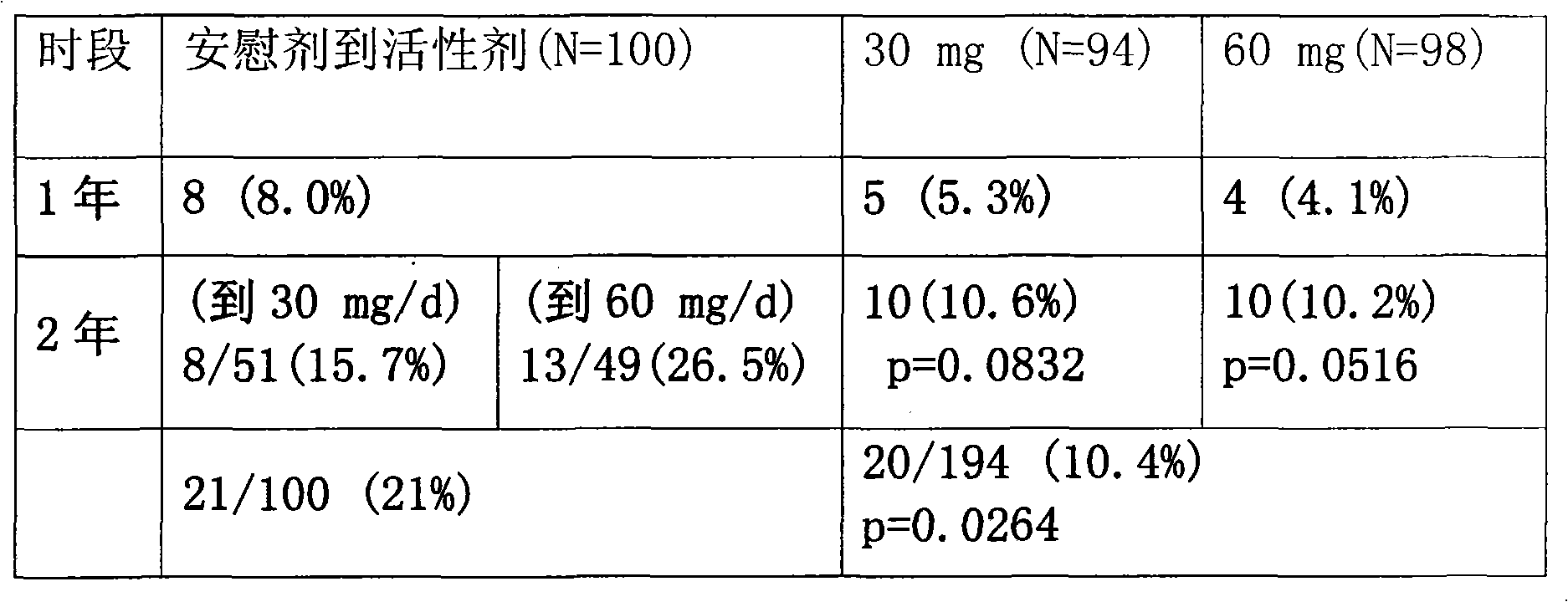
实施例6Example 6
表3显示对MN-166治疗多发性硬化(MS)的两年II期临床实验的第一年MRI数据进行双盲分析。分析显示,MN-166减少了MS患者中磁共振成像(MRI)上黑洞(永久性脑损伤,被认为指示脑中的神经死亡)的形成。数据说明,与安慰剂相比,MN-166的60mg/天给药方案显著降低了在研究的第二个月鉴定并在第10个月发展成永久性黑洞的新T1钆增强或新T2损伤(RR 0.63,p=0.011)。30mg/天MN-166给药方案的治疗显示了与安慰剂相比新损伤发展成永久性黑洞的风险降低的趋势(RR 0.735,p=0.074)。292个接受安慰剂(n=100)、30mg/天MN-166(n=94)或60mg/天MN-166(n=98)的患者中,72个安慰剂治疗的患者、64个接受30mg/天MN-166的患者和56个接受60mg/天MN-166的患者在研究的第2个月具有新损伤。发展成永久性黑洞的新损伤的比例在安慰剂、30mg/天MN-166和60mg/天MN-166治疗组中分别是0.24、0.20和0.16。与安慰剂治疗的患者相比,新损伤发展成永久性黑洞的相对风险(RR)在用60mg/天MN-166治疗的MS患者中显著低(RR 0.63,p=0.011),并且在用30mg/天MN-166治疗的患者中趋于更低(RR 0.735,p=0.074)。Table 3 shows a double-blind analysis of
该研究是MN-166施用的第1年MRI数据的随机、双盲、安慰剂对照分析的结果。对于该新分析,MRI在一年治疗期每两月收集一次并且以双盲方式再评价。该评价预先确定的终点是新损伤发展成永久性黑洞和髓鞘损伤的比率。预先确定的统计学终点是新损伤(NL)发展成永久性黑洞(PBH)和髓鞘损伤(RL)的比率。新T1钆增强或新T2损伤在第2个月被确定为第一个被研究的MRI中的NL。在第10个月低强度和无活性的损伤被确定为PBH。在第10个月等强度的第2或4个月的低强度损伤是RL。每个患者NL发展成PBH和RL的相对风险(RR)使用带有泊松分布的误差项的普通线性模型分析。The study is the result of a randomized, double-blind, placebo-controlled analysis of MRI data from
总体上,多发性硬化患者延长(至少约2年)施用异丁地特的益处包括但不限于复发时间延长(与未治疗患者相比,平均延长约130天)、持续伤残进展可能性降低(与治疗少于2年的患者相比,降低约50%的比率)、脑容量损失减少和急性损伤向永久性黑洞转化的减少。Overall, the benefits of prolonged (at least approximately 2 years) administration of ibudiide in patients with multiple sclerosis include, but are not limited to, prolonged time to relapse (approximately 130 days on average compared with untreated patients), reduced likelihood of persistent disability progression (approximately 50% lower rate compared to patients treated for less than 2 years), reduced brain volume loss, and reduced conversion of acute damage to permanent black holes.
表3table 3
永久性黑洞(PBH)形成的减少Decrease in permanent black hole (PBH) formation

Claims (52)
Applications Claiming Priority (5)
| Application Number | Priority Date | Filing Date | Title |
|---|---|---|---|
| US92974507P | 2007-07-11 | 2007-07-11 | |
| US60/929,745 | 2007-07-11 | ||
| US4218108P | 2008-04-03 | 2008-04-03 | |
| US61/042,181 | 2008-04-03 | ||
| PCT/US2008/069417 WO2009009529A1 (en) | 2007-07-11 | 2008-07-08 | Treatment of progressive neurodegenerative disease with ibudilast |
Publications (2)
| Publication Number | Publication Date |
|---|---|
| CN101848712A true CN101848712A (en) | 2010-09-29 |
| CN101848712B CN101848712B (en) | 2013-07-24 |
Family
ID=39789775
Family Applications (1)
| Application Number | Title | Priority Date | Filing Date |
|---|---|---|---|
| CN200880106623XA Active CN101848712B (en) | 2007-07-11 | 2008-07-08 | Treatment of progressive neurodegenerative disease with ibudilast |
Country Status (14)
| Country | Link |
|---|---|
| US (10) | US8138201B2 (en) |
| EP (2) | EP2187882B1 (en) |
| JP (2) | JP5468001B2 (en) |
| CN (1) | CN101848712B (en) |
| AU (1) | AU2008275148A1 (en) |
| BR (1) | BRPI0814624A2 (en) |
| CA (2) | CA2970273C (en) |
| DK (1) | DK2187882T3 (en) |
| ES (1) | ES2402175T3 (en) |
| HR (1) | HRP20130057T1 (en) |
| PL (1) | PL2187882T3 (en) |
| PT (1) | PT2187882E (en) |
| TW (1) | TW200918051A (en) |
| WO (1) | WO2009009529A1 (en) |
Cited By (11)
| Publication number | Priority date | Publication date | Assignee | Title |
|---|---|---|---|---|
| CN103255142A (en) * | 2012-02-21 | 2013-08-21 | 上海转基因研究中心 | Method for regulating endogenous prion protein expression by using RNAi, and application thereof |
| CN105163737A (en) * | 2013-02-15 | 2015-12-16 | 梯瓦制药工业有限公司 | Treatment of multiple sclerosis with laquinimod |
| CN105395511A (en) * | 2015-12-07 | 2016-03-16 | 黑龙江省智诚医药科技有限公司 | Ibudilast sustained-release pellet and preparation method thereof |
| CN105431163A (en) * | 2013-05-03 | 2016-03-23 | 俄勒冈健康科学大学 | Sobetirome in the treatment of myelination diseases |
| CN109475538A (en) * | 2016-05-10 | 2019-03-15 | 美迪诺亚公司 | Use of ibudilast to treat alcoholism and depression and/or anxiety |
| CN112770748A (en) * | 2018-10-09 | 2021-05-07 | 美迪诺亚公司 | Combinations of ibudilast and interferon-beta and methods of use thereof |
| CN112804999A (en) * | 2018-10-19 | 2021-05-14 | 美迪诺亚公司 | Method for treating ophthalmic diseases/disorders or injuries by ibudilast |
| US11667606B2 (en) | 2019-03-01 | 2023-06-06 | Autobahn Therapeutics, Inc. | Thyromimetics |
| US11827596B2 (en) | 2018-12-12 | 2023-11-28 | Autobahn Therapeutics, Inc. | Thyromimetics |
| US12466781B2 (en) | 2019-11-29 | 2025-11-11 | Autobahn Therapeutics, Inc. | Thyromimetics |
| US12528761B2 (en) | 2020-06-17 | 2026-01-20 | Autobahn Therapeutics, Inc. | Thyromimetics |
Families Citing this family (37)
| Publication number | Priority date | Publication date | Assignee | Title |
|---|---|---|---|---|
| EA201270041A1 (en) * | 2009-06-19 | 2012-06-29 | Тева Фармасьютикал Индастриз Лтд. | TREATMENT OF MULTIPLE SCLEROSIS BY LAKININIMODOM |
| CA2766632A1 (en) | 2009-06-23 | 2010-12-29 | Medicinova, Inc. | Enantiomeric compositions of 2-amino-1-(2-isopropylpyrazolo[1,5-a]pyridin-3-yl)propan-1-one and related methods |
| RS54707B1 (en) * | 2009-07-30 | 2016-08-31 | Teva Pharmaceutical Industries Ltd. | TREATMENT OF CROWN LAKVINIMOD DISEASE |
| PL2467372T3 (en) * | 2009-08-10 | 2017-04-28 | Teva Pharmaceutical Industries Ltd. | Treatment of bdnf-related disorders using laquinimod |
| HRP20182076T1 (en) * | 2010-01-04 | 2019-02-08 | Mapi Pharma Limited | CONTROLLED RELEASE SYSTEM COVERING GLATIRAMER ACETAT |
| USRE49251E1 (en) | 2010-01-04 | 2022-10-18 | Mapi Pharma Ltd. | Depot systems comprising glatiramer or pharmacologically acceptable salt thereof |
| US8889661B2 (en) * | 2010-03-03 | 2014-11-18 | Teva Pharmaceutical Industries, Ltd. | Treatment of lupus nephritis using laquinimod |
| PH12012501741A1 (en) * | 2010-03-03 | 2012-11-12 | Teva Pharma | Treatment of lupus arthritis using laquinimod |
| KR20130014523A (en) * | 2010-03-03 | 2013-02-07 | 테바 파마슈티컬 인더스트리즈 리미티드 | Treatment of rheumatoid arthritis with a combination of laquinimod and methotrexate |
| EP2699317B1 (en) | 2011-04-21 | 2016-08-10 | Mapi Pharma Limited | Random pentapolymer for treatment of autoimmune diseases |
| US8889627B2 (en) | 2011-10-12 | 2014-11-18 | Teva Pharmaceutical Industries, Ltd. | Treatment of multiple sclerosis with combination of laquinimod and fingolimod |
| US9161935B2 (en) | 2012-02-03 | 2015-10-20 | Teva Pharmaceutical Industries, Ltd. | Use of laquinimod for treating Crohn's disease patients who failed first-line anti-TNF therapy |
| TW201400117A (en) | 2012-06-05 | 2014-01-01 | Teva Pharma | Treatment of ocular inflammation with laquinimod |
| CN103505731A (en) * | 2012-06-15 | 2014-01-15 | 中国药科大学 | Applications of 1 type cysteinyl leukotriene receptor antagonist on preparation of medicament for treating the Alzheimer disease |
| FR3000746A1 (en) | 2013-01-04 | 2014-07-11 | Centre Nat Rech Scient | PEPTIDE FOR ITS USE IN THE TREATMENT OF MOTOR NEURONOPATHY |
| WO2015168103A1 (en) | 2014-04-29 | 2015-11-05 | Teva Pharmaceutical Industries Ltd. | Laquinimod for the treatment of relapsing-remitting multiple sclerosis (rrms) patients with a high disability status |
| WO2015195822A1 (en) * | 2014-06-20 | 2015-12-23 | Medicinova, Inc. | A combination of geranylgeranylacetone and ibudilast and methods of using same |
| CA2961187A1 (en) * | 2014-09-16 | 2016-03-24 | Teva Pharmaceuticals Industries Ltd. | Treatment of neurodegenerative diseases with combination of laquinimod and fingolimod |
| WO2016086000A1 (en) * | 2014-11-26 | 2016-06-02 | Medicinova, Inc. | A combination of geranygeranylacetone, ibudilast, and riluzole and methods of using same |
| CA2967826C (en) * | 2014-11-26 | 2024-01-16 | Medicinova, Inc. | A combination of ibudilast and riluzole and methods of using same |
| US12097292B2 (en) | 2016-08-28 | 2024-09-24 | Mapi Pharma Ltd. | Process for preparing microparticles containing glatiramer acetate |
| FI3506921T3 (en) | 2016-08-31 | 2023-07-21 | Mapi Pharma Ltd | Depot systems comprising glatiramer acetate |
| US10391085B2 (en) | 2016-12-22 | 2019-08-27 | Medicinova, Inc. | Methods of treating glioblastoma multiforme using ibudilast |
| MX2019010174A (en) | 2017-03-26 | 2019-10-15 | Mapi Pharma Ltd | Glatiramer depot systems for treating progressive forms of multiple sclerosis. |
| US10744123B2 (en) | 2018-02-12 | 2020-08-18 | Medicinova, Inc. | Methods and dosing regimens using ibudilast and a second agent for cancer therapy |
| EP3740205B1 (en) * | 2018-02-12 | 2023-09-20 | MediciNova, Inc. | Methods of suppressing myeloid-derived suppressor cells in patients |
| EP3930728A1 (en) * | 2019-02-26 | 2022-01-05 | Universitat de Valencia - Estudi General | Methods and compositions for treating motor neuron diseases |
| WO2020251748A1 (en) * | 2019-06-11 | 2020-12-17 | Yale University | Novel treatment for wolfram syndrome |
| US11865214B2 (en) | 2019-09-23 | 2024-01-09 | Medicinova, Inc. | Ibudilast oral formulations and methods of using same |
| EP4132521A1 (en) * | 2020-04-06 | 2023-02-15 | MediciNova, Inc. | Methods of reducing plasma level of macrophage migratory inhibitory factor in patients with ibudilast |
| JP2024506840A (en) | 2021-01-29 | 2024-02-15 | メディシノバ・インコーポレイテッド | How to treat chemical gas exposure |
| CA3226898A1 (en) | 2021-07-26 | 2023-02-02 | Kazuko Matsuda | Ibudilast for preventing eye cancer metastasis |
| JP2024535880A (en) | 2021-09-21 | 2024-10-02 | メディシノバ・インコーポレイテッド | Ibudilast in combination therapy for use in the treatment of glioblastoma |
| US12042485B2 (en) | 2021-10-07 | 2024-07-23 | Medicinova, Inc. | Methods of minimizing cancer metastasis |
| CN118973574A (en) | 2022-02-01 | 2024-11-15 | 美迪诺亚公司 | Use of Ibudilast in the treatment of sequelae of COVID-19 |
| WO2023192885A2 (en) * | 2022-03-28 | 2023-10-05 | Praxis Precision Medicines, Inc. | Methods of using oligomeric compounds to treat scn2a-related disorders |
| US20240016729A1 (en) | 2022-07-13 | 2024-01-18 | Medicinova, Inc. | Injectable formulations of ibudilast |
Family Cites Families (6)
| Publication number | Priority date | Publication date | Assignee | Title |
|---|---|---|---|---|
| US6395747B1 (en) | 1998-08-10 | 2002-05-28 | Sauro Sakoda | Remedies for multiple sclerosis |
| JP2004532809A (en) * | 2000-11-02 | 2004-10-28 | リサーチ ファウンデーション オブ シティ ユニバーシティ オブ ニューヨーク | Method for stimulating nervous system regeneration and repair by inhibiting phosphodiesterase type 4 |
| US20050043319A1 (en) * | 2001-08-14 | 2005-02-24 | Exonhit Therapeutics Sa | Molecular target of neurotoxicity |
| NZ547389A (en) | 2003-11-21 | 2009-11-27 | Combinatorx Inc | Combinations of a compound such as ibudilast and a corticosteroid for the treatment of inflammatory disorders |
| BRPI0518829A2 (en) * | 2004-12-06 | 2008-12-09 | Avigen Inc | Method for the treatment of neuropathic pain and associated syndromes |
| JP2009512711A (en) | 2005-10-21 | 2009-03-26 | ブレインセルス,インコーポレイティド | Regulation of neurogenesis by PDE inhibition |
-
2008
- 2008-07-08 BR BRPI0814624-1A2A patent/BRPI0814624A2/en not_active Application Discontinuation
- 2008-07-08 ES ES08781498T patent/ES2402175T3/en active Active
- 2008-07-08 CA CA2970273A patent/CA2970273C/en active Active
- 2008-07-08 EP EP08781498A patent/EP2187882B1/en active Active
- 2008-07-08 JP JP2010516198A patent/JP5468001B2/en active Active
- 2008-07-08 DK DK08781498.4T patent/DK2187882T3/en active
- 2008-07-08 EP EP12196108A patent/EP2567699A1/en not_active Withdrawn
- 2008-07-08 WO PCT/US2008/069417 patent/WO2009009529A1/en not_active Ceased
- 2008-07-08 PL PL08781498T patent/PL2187882T3/en unknown
- 2008-07-08 CN CN200880106623XA patent/CN101848712B/en active Active
- 2008-07-08 US US12/169,042 patent/US8138201B2/en active Active
- 2008-07-08 CA CA2693697A patent/CA2693697C/en active Active
- 2008-07-08 AU AU2008275148A patent/AU2008275148A1/en not_active Abandoned
- 2008-07-08 PT PT87814984T patent/PT2187882E/en unknown
- 2008-07-08 HR HRP20130057AT patent/HRP20130057T1/en unknown
- 2008-07-10 TW TW097126065A patent/TW200918051A/en unknown
-
2012
- 2012-02-22 US US13/402,702 patent/US8338453B2/en active Active
- 2012-12-21 US US13/725,627 patent/US9114136B2/en active Active
-
2013
- 2013-12-10 JP JP2013255214A patent/JP2014062118A/en active Pending
-
2014
- 2014-02-24 US US14/188,061 patent/US9314452B2/en active Active
- 2014-09-19 US US14/491,939 patent/US20150011581A1/en not_active Abandoned
-
2016
- 2016-03-23 US US15/078,291 patent/US20170014390A1/en not_active Abandoned
- 2016-10-07 US US15/288,582 patent/US20170020851A1/en not_active Abandoned
-
2019
- 2019-05-01 US US16/400,844 patent/US11083713B2/en active Active
-
2021
- 2021-07-02 US US17/366,563 patent/US11944607B2/en active Active
-
2024
- 2024-03-29 US US18/621,850 patent/US20250073213A1/en active Pending
Cited By (15)
| Publication number | Priority date | Publication date | Assignee | Title |
|---|---|---|---|---|
| CN103255142B (en) * | 2012-02-21 | 2017-07-25 | 上海转基因研究中心 | A kind of method and its application of utilization RNAi regulation and control endogenous PrPC expression |
| CN103255142A (en) * | 2012-02-21 | 2013-08-21 | 上海转基因研究中心 | Method for regulating endogenous prion protein expression by using RNAi, and application thereof |
| CN105163737A (en) * | 2013-02-15 | 2015-12-16 | 梯瓦制药工业有限公司 | Treatment of multiple sclerosis with laquinimod |
| US11510887B2 (en) | 2013-05-03 | 2022-11-29 | Oregon Health & Science University | Sobetirome in the treatment of myelination diseases |
| CN105431163A (en) * | 2013-05-03 | 2016-03-23 | 俄勒冈健康科学大学 | Sobetirome in the treatment of myelination diseases |
| CN105395511A (en) * | 2015-12-07 | 2016-03-16 | 黑龙江省智诚医药科技有限公司 | Ibudilast sustained-release pellet and preparation method thereof |
| CN109475538A (en) * | 2016-05-10 | 2019-03-15 | 美迪诺亚公司 | Use of ibudilast to treat alcoholism and depression and/or anxiety |
| US20190151294A1 (en) * | 2016-05-10 | 2019-05-23 | Medicinova, Inc. | Treatment of alcoholism and depression and/or dysphoric mood using ibudilast |
| CN112770748A (en) * | 2018-10-09 | 2021-05-07 | 美迪诺亚公司 | Combinations of ibudilast and interferon-beta and methods of use thereof |
| CN112804999A (en) * | 2018-10-19 | 2021-05-14 | 美迪诺亚公司 | Method for treating ophthalmic diseases/disorders or injuries by ibudilast |
| CN112804999B (en) * | 2018-10-19 | 2024-03-15 | 美迪诺亚公司 | Treatment of Ophthalmic Disease/Condition or Injury with Ibudilast |
| US11827596B2 (en) | 2018-12-12 | 2023-11-28 | Autobahn Therapeutics, Inc. | Thyromimetics |
| US11667606B2 (en) | 2019-03-01 | 2023-06-06 | Autobahn Therapeutics, Inc. | Thyromimetics |
| US12466781B2 (en) | 2019-11-29 | 2025-11-11 | Autobahn Therapeutics, Inc. | Thyromimetics |
| US12528761B2 (en) | 2020-06-17 | 2026-01-20 | Autobahn Therapeutics, Inc. | Thyromimetics |
Also Published As
Similar Documents
| Publication | Publication Date | Title |
|---|---|---|
| CN101848712B (en) | Treatment of progressive neurodegenerative disease with ibudilast | |
| EP4404928A1 (en) | Ibudilast in combination therapy for use in the treatment of glioblastoma | |
| CN112804999B (en) | Treatment of Ophthalmic Disease/Condition or Injury with Ibudilast | |
| US10946071B2 (en) | Combination of ibudilast and interferon-beta and methods of using same | |
| HK1147953A (en) | Treatment of progressive neurodegenerative disease with ibudilast |
Legal Events
| Date | Code | Title | Description |
|---|---|---|---|
| C06 | Publication | ||
| PB01 | Publication | ||
| C10 | Entry into substantive examination | ||
| SE01 | Entry into force of request for substantive examination | ||
| REG | Reference to a national code |
Ref country code: HK Ref legal event code: DE Ref document number: 1147953 Country of ref document: HK |
|
| C14 | Grant of patent or utility model | ||
| GR01 | Patent grant | ||
| REG | Reference to a national code |
Ref country code: HK Ref legal event code: WD Ref document number: 1147953 Country of ref document: HK |