[go: up one dir, main page]

CN101848406A - Headphone apparatus and reproducing apparatus - Google Patents

Headphone apparatus and reproducing apparatus Download PDF

Info

Publication number
CN101848406A
CN101848406A CN200910265645A CN200910265645A CN101848406A CN 101848406 A CN101848406 A CN 101848406A CN 200910265645 A CN200910265645 A CN 200910265645A CN 200910265645 A CN200910265645 A CN 200910265645A CN 101848406 A CN101848406 A CN 101848406A
Authority
CN
China
Prior art keywords
reproduction
cpu
case
music data
headphone
Prior art date
Legal status (The legal status is an assumption and is not a legal conclusion. Google has not performed a legal analysis and makes no representation as to the accuracy of the status listed.)
Pending
Application number
CN200910265645A
Other languages
Chinese (zh)
Inventor
增山彻
Current Assignee (The listed assignees may be inaccurate. Google has not performed a legal analysis and makes no representation or warranty as to the accuracy of the list.)
Sony Corp
Original Assignee
Sony Corp
Priority date (The priority date is an assumption and is not a legal conclusion. Google has not performed a legal analysis and makes no representation as to the accuracy of the date listed.)
Filing date
Publication date
Application filed by Sony Corp filed Critical Sony Corp
Publication of CN101848406A publication Critical patent/CN101848406A/en
Pending legal-status Critical Current

Links

Images

Classifications

    • HELECTRICITY
    • H04ELECTRIC COMMUNICATION TECHNIQUE
    • H04RLOUDSPEAKERS, MICROPHONES, GRAMOPHONE PICK-UPS OR LIKE ACOUSTIC ELECTROMECHANICAL TRANSDUCERS; DEAF-AID SETS; PUBLIC ADDRESS SYSTEMS
    • H04R1/00Details of transducers, loudspeakers or microphones
    • H04R1/10Earpieces; Attachments therefor ; Earphones; Monophonic headphones
    • H04R1/1041Mechanical or electronic switches, or control elements
    • HELECTRICITY
    • H04ELECTRIC COMMUNICATION TECHNIQUE
    • H04RLOUDSPEAKERS, MICROPHONES, GRAMOPHONE PICK-UPS OR LIKE ACOUSTIC ELECTROMECHANICAL TRANSDUCERS; DEAF-AID SETS; PUBLIC ADDRESS SYSTEMS
    • H04R2460/00Details of hearing devices, i.e. of ear- or headphones covered by H04R1/10 or H04R5/033 but not provided for in any of their subgroups, or of hearing aids covered by H04R25/00 but not provided for in any of its subgroups
    • H04R2460/03Aspects of the reduction of energy consumption in hearing devices
    • HELECTRICITY
    • H04ELECTRIC COMMUNICATION TECHNIQUE
    • H04RLOUDSPEAKERS, MICROPHONES, GRAMOPHONE PICK-UPS OR LIKE ACOUSTIC ELECTROMECHANICAL TRANSDUCERS; DEAF-AID SETS; PUBLIC ADDRESS SYSTEMS
    • H04R5/00Stereophonic arrangements
    • H04R5/033Headphones for stereophonic communication

Landscapes

  • Physics & Mathematics (AREA)
  • Engineering & Computer Science (AREA)
  • Acoustics & Sound (AREA)
  • Signal Processing (AREA)
  • Headphones And Earphones (AREA)
  • Reverberation, Karaoke And Other Acoustics (AREA)

Abstract

在此公开了耳机装置,其包括:两个壳;连接部分,被配置为:将所述两个壳彼此连接;检测器,被配置为:检测所述两个壳经由所述连接部分对于彼此的连接;以及控制器,被配置为:响应于所述检测器检测到所述两个壳对于彼此的连接,执行预定控制。
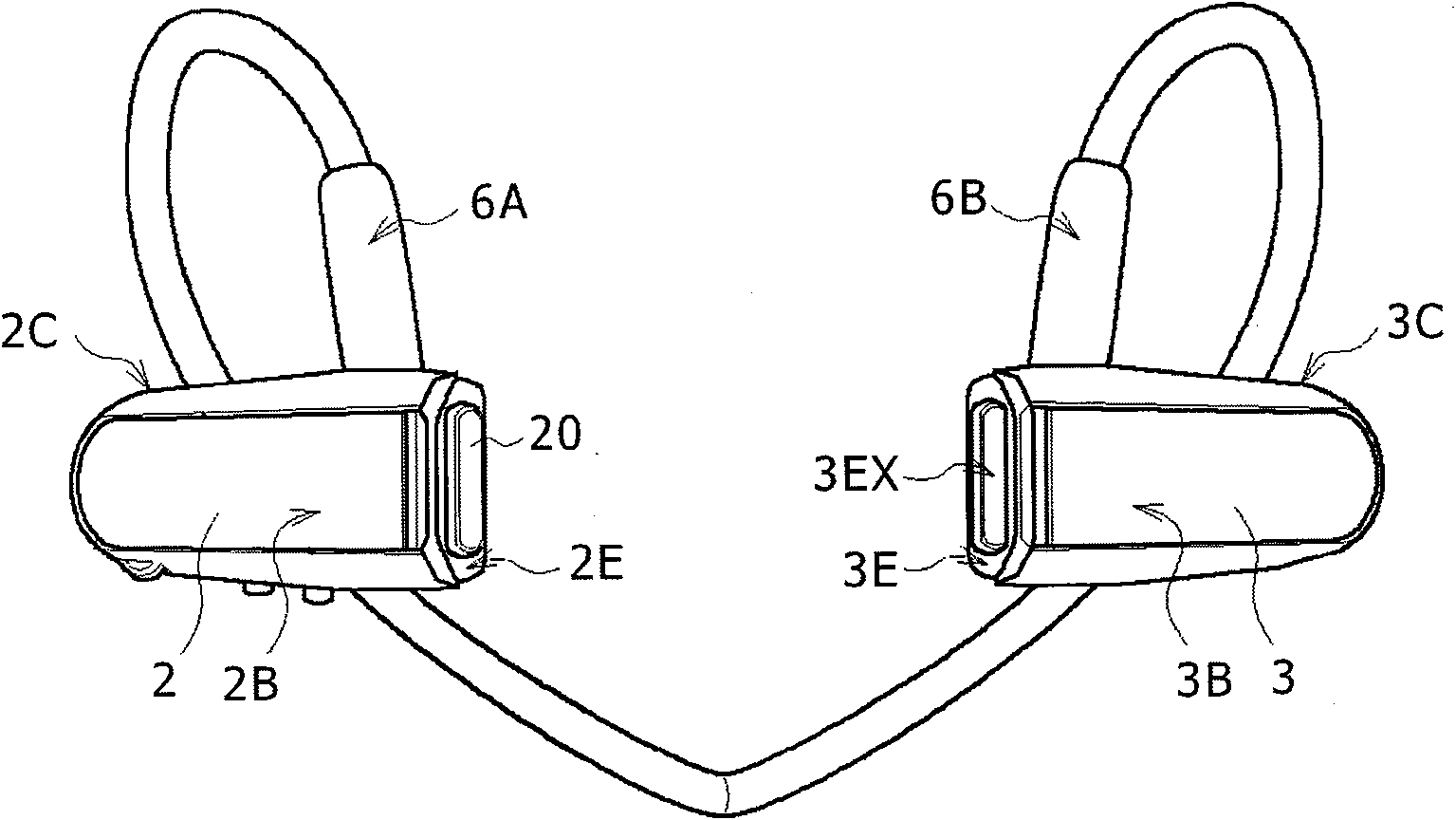
Figure 200910265645

Disclosed herein is an earphone device comprising: two cases; a connection portion configured to connect the two cases to each other; a detector configured to detect the movement of the two cases to each other via the connection portion. and a controller configured to: execute predetermined control in response to the detector detecting the connection of the two cases to each other.

Figure 200910265645

Description

耳机装置和再现装置 Headphone device and reproduction device

技术领域technical field

本发明涉及耳机装置和再现装置,并且适合应用于例如配备有一对道型(canal type)立体声耳机的再现装置(下文中也将称为“耳机集成再现装置”)。The present invention relates to a headphone device and a reproducing device, and is suitably applied to, for example, a reproducing device equipped with a pair of canal type stereo headphones (hereinafter also referred to as "headphone-integrated reproducing device").

背景技术Background technique

现有技术的耳机装置是通过将均包括扬声器单元的右外壳和左外壳连接到颈带的一端部分和另一端部分而形成的。A related art earphone device is formed by connecting right and left housings each including a speaker unit to one end portion and the other end portion of a neckband.

耳机装置允许用户按以下方式将耳机装置安装在右外耳和左外耳上,所述方式为:通过利用颈带,使得用于音频输出的右外壳的一个表面邻接右外耳的耳道部分,并且使得用于音频输出的左外壳的一个表面邻接左外耳的耳道部分。The headphone device allows the user to mount the headphone device on the right and left conchas in such a manner that one surface of the right housing for audio output abuts the ear canal portion of the right auricle by using the neckband, and such that One surface of the left housing for audio output abuts the ear canal portion of the left concha.

在该状态下,耳机装置将外部再现装置所再现并且给出的用于右声道和左声道的音频数据捕获到右外壳中的扬声器单元和左外壳中的扬声器单元,由此生成音频。In this state, the earphone device captures audio data for the right and left channels reproduced and given by the external reproduction device to the speaker unit in the right housing and the speaker unit in the left housing, thereby generating audio.

因此,耳机装置允许用户经由右外耳和左外耳收听立体声音频(诸如音乐)。Accordingly, the earphone device allows the user to listen to stereo audio (such as music) via the right outer ear and the left outer ear.

在这种耳机装置中,将连接组件提供在颈带的一端部分和另一端部分中的每一个处。当未被安装时,通过将这些连接组件彼此连接而将耳机装置包封为紧凑的尺寸(例如,参见日本专利公开No.2008-227966(第5、6和7页以及图1和图5))。In such an earphone device, a connection assembly is provided at each of one end portion and the other end portion of the neckband. When not mounted, the earphone device is packaged in a compact size by connecting these connecting components to each other (for example, see Japanese Patent Laid-Open No. 2008-227966 (pages 5, 6 and 7 and FIGS. 1 and 5 ) ).

发明内容Contents of the invention

顺便提及,虽然现有技术的耳机装置安装在用户的右外耳和左外耳上,但连接到这种耳机装置的再现装置用于包或衣服口袋中。Incidentally, although the prior art earphone device is mounted on the right and left outer ears of the user, the reproduction device connected to such an earphone device is used in a bag or a pocket of clothes.

因此,在音频数据的再现开始、再现停止等的时候,从包或口袋取出再现装置并且直接对其操作。Therefore, when reproduction of audio data is started, reproduction is stopped, etc., the reproduction device is taken out of the bag or pocket and directly operated.

所以,近年来,已经提出了这样的方案:该方案向现有技术的耳机装置例如提供用于对于再现装置的命令输入的操作单元。另外,近年来,同样已经提出了这样的方案:该方案将现有技术的耳机装置的右外壳和左外壳中的至少一个与再现装置集成,并且向该耳机装置提供用于对于再现装置的命令输入的操作单元。Therefore, in recent years, a scheme has been proposed that provides, for example, an operation unit for command input to a reproduction device, to a related art headphone device. In addition, in recent years, a scheme has also been proposed that integrates at least one of the right housing and the left housing of the related art headphone device with the reproduction device, and provides the headphone device with commands for the reproduction device. Input operating unit.

根据这些提议,在音频数据的再现开始、再现停止等的时候,可以通过操作耳机装置上所提供的操作单元来控制再现装置,而不必麻烦将再现装置从包或口袋中取出并且对其进行操作。According to these proposals, when reproduction of audio data starts, reproduction stops, etc., the reproduction device can be controlled by operating an operation unit provided on the headphone device without taking the trouble of taking the reproduction device out of a bag or pocket and operating it .

然而,具有该配置的耳机装置具有连接到颈带的两个外壳。因此,在某些情况下,当结束了具有该配置的耳机装置的使用时或者当携带耳机装置时,对操作单元进行操作,然后持续地通过在颈带的一端部分和另一端部分处的连接组件的连接而将耳机装置包封为紧凑尺寸。However, an earphone set with this configuration has two housings connected to the neckband. Therefore, in some cases, when the use of the earphone device with this configuration is finished or when the earphone device is carried, the operation unit is operated and then continuously passed through the connection at the one end portion and the other end portion of the neckband. The headphone device is packaged in a compact size by the connection of the components.

也就是说,具有该配置的耳机装置具有这样的问题:由于当其使用结束时或者当其被携带时的操作(handling)是麻烦的,因此可用性较低。That is, the earphone device having this configuration has a problem that usability is low since handling when its use ends or when it is carried is troublesome.

本发明需要提出具有增强的可用性的耳机装置和再现装置。The present invention needs to propose a headphone device and a reproducing device with enhanced usability.

根据本发明实施例,提供了耳机装置和再现装置,其中,控制器响应于用于检测两个壳的连接的检测器对于这两个壳经由连接部分彼此连接的检测而执行预定控制。According to an embodiment of the present invention, there is provided a headphone device and a reproducing device, wherein the controller performs predetermined control in response to detection by a detector for detecting connection of the two cases that the two cases are connected to each other via the connecting portion.

因此,在本发明实施例中,当耳机装置和再现装置的使用结束时或者当它们被携带时,可以仅通过两个壳经由连接部分的连接来执行预定控制,而无需任何操作。Therefore, in the embodiment of the present invention, when the use of the earphone device and the reproducing device ends or when they are carried, predetermined control can be performed only by the connection of the two cases via the connection portion without any operation.

根据本发明实施例,在耳机装置和再现装置中,控制器响应于用于检测两个壳的连接的检测器对于这两个壳经由连接部分彼此连接的检测而执行预定控制。由于该特征,因此当耳机装置和再现装置的使用结束时或者当它们被携带时,可以仅通过两个壳经由连接部分的连接来执行预定控制,而无需任何操作。从而,可以实现具有增强的可用性的耳机装置和再现装置。According to an embodiment of the present invention, in the headphone device and the reproducing device, the controller performs predetermined control in response to detection by the detector for detecting connection of the two cases that the two cases are connected to each other via the connecting portion. Due to this feature, when the use of the headphone device and the reproducing device is over or when they are carried, predetermined control can be performed only by the connection of the two cases via the connection portion without any operation. Thus, a headphone device and a reproducing device with enhanced usability can be realized.

附图说明Description of drawings

图1A和图1B是示出根据本发明一个实施例的耳机集成再现装置的外观配置的示意性透视图;1A and 1B are schematic perspective views showing the appearance configuration of an earphone-integrated reproduction device according to an embodiment of the present invention;

图2是示出右耳机的配置的示意图;FIG. 2 is a schematic diagram showing the configuration of the right earphone;

图3是示出左耳机的配置的示意图;3 is a schematic diagram showing the configuration of the left earphone;

图4是示出头带和右壳与左壳中的每一个的一个端表面的配置的示意图;FIG. 4 is a schematic diagram showing the configuration of the headband and one end surface of each of the right shell and the left shell;

图5A和图5B是用于解释右壳和左壳的连接的示意性透视图;5A and 5B are schematic perspective views for explaining the connection of the right shell and the left shell;

图6是示出当右壳和左壳彼此连接时头带的配置的示意图;6 is a schematic diagram showing the configuration of the headband when the right shell and the left shell are connected to each other;

图7是示出当右壳和左壳彼此分离时头带的配置的示意图;7 is a schematic diagram showing the configuration of the headband when the right shell and the left shell are separated from each other;

图8是用于解释耳机集成再现装置的安装的示意图(1);FIG. 8 is a schematic diagram (1) for explaining the installation of the earphone-integrated reproduction device;

图9是用于解释耳机集成再现装置的安装的示意图(2);Fig. 9 is a schematic diagram (2) for explaining the installation of the earphone-integrated reproduction device;

图10是用于解释耳机集成再现装置的安装的示意图(3);Fig. 10 is a schematic diagram (3) for explaining the installation of the earphone-integrated reproduction device;

图11是示出右壳的右壳下表面的配置的示意图;11 is a schematic diagram showing the configuration of the lower surface of the right case of the right case;

图12是用于解释转点通的操作的示意图;Fig. 12 is a schematic diagram for explaining the operation of PTT;

图13是示出右壳的右壳内表面的配置的示意图;FIG. 13 is a schematic diagram showing the configuration of the inner surface of the right case of the right case;

图14是用于解释当从右外耳和左外耳移除耳机集成再现装置时的状态的示意图;14 is a schematic diagram for explaining a state when the earphone-integrated reproduction device is removed from the right and left auricles;

图15是用于解释当右壳和左壳彼此连接时通过剩余量通知发光器通知电池的剩余量的示意图;15 is a schematic diagram for explaining notification of a remaining amount of a battery through a remaining amount notifying light emitter when a right case and a left case are connected to each other;

图16是示出右壳的右壳外表面的配置的示意图;16 is a schematic diagram showing the configuration of the right case outer surface of the right case;

图17是示出耳机集成再现装置的内部配置的示意图;FIG. 17 is a schematic diagram showing an internal configuration of an earphone-integrated reproducing apparatus;

图18是用于解释检测器上的所施加磁场的强度根据吸引板与磁体之间的距离的改变的示意图(1);Fig. 18 is a schematic diagram (1) for explaining the change of the strength of the applied magnetic field on the detector according to the distance between the attracting plate and the magnet;

图19是用于解释检测器上的所施加磁场的强度根据吸引板与磁体之间的距离的改变的示意图(2);Fig. 19 is a schematic diagram (2) for explaining the change of the strength of the applied magnetic field on the detector according to the distance between the attracting plate and the magnet;

图20是用于解释检测器上的所施加磁场的强度根据吸引板与磁体之间的距离的改变的示意图(3);Fig. 20 is a schematic diagram (3) for explaining the change of the strength of the applied magnetic field on the detector according to the distance between the attracting plate and the magnet;

图21是用于解释检测器上的所施加磁场的强度根据吸引板与磁体之间的距离的改变的示意图(4);Fig. 21 is a schematic diagram (4) for explaining the change of the strength of the applied magnetic field on the detector according to the distance between the attracting plate and the magnet;

图22是示出耳机集成再现装置的电路配置的框图;22 is a block diagram showing a circuit configuration of an earphone-integrated reproducing apparatus;

图23是用于解释耳机集成再现装置和再现控制的操作的示意图;23 is a schematic diagram for explaining the operation of the headphone-integrated reproduction device and reproduction control;

图24是示出检测器的电路配置的框图;24 is a block diagram showing a circuit configuration of a detector;

图25是用于解释通过检测器的磁传感器关于右壳和左壳是否而彼此连接的检测的示意图;25 is a schematic diagram for explaining detection of whether the right shell and the left shell are connected to each other by the magnetic sensor of the detector;

图26A至图26F是用于解释CPU在右壳和左壳彼此分离的状态下CPU的控制的时序图;26A to 26F are timing charts for explaining the control of the CPU in the state where the CPU is separated from the right case and the left case;

制的时序图;The timing diagram made;

图27A至图27F是用于解释当右壳和左壳在音乐数据再现期间彼此连接时CPU的控制的时序图;27A to 27F are timing charts for explaining the control of the CPU when the right case and the left case are connected to each other during reproduction of music data;

图28A至图28F是用于解释当右壳和左壳在未再现音乐数据的状态下彼此连接时CPU的控制的时序图;28A to 28F are timing charts for explaining the control of the CPU when the right case and the left case are connected to each other in a state where music data is not reproduced;

图29A和图29B是用于解释右壳和左壳的连接的检查的示意图;29A and 29B are schematic views for explaining the inspection of the connection of the right shell and the left shell;

图30A至图30F是用于解释CPU在右壳和左壳彼此连接时的控制的时序图;以及30A to 30F are timing charts for explaining the control of the CPU when the right case and the left case are connected to each other; and

图31是示出操作控制处理的过程的流程图。FIG. 31 is a flowchart showing the procedure of operation control processing.

具体实施方式Detailed ways

以下将参照附图描述用于执行本发明的最佳模式(下文中,也将其称为实施例)。将按以下顺序进行描述。The best mode for carrying out the invention (hereinafter, also referred to as an embodiment) will be described below with reference to the drawings. Description will be made in the following order.

1.实施例1. Example

2.其它实施例2. Other embodiments

<1.实施例><1. Example>

[1-1耳机集成再现装置的外观配置][1-1 Appearance Configuration of Headphone-Integrated Reproducing Device]

在图1A和图1B中,标号1全部示出应用了本发明实施例的耳机集成再现装置的外观配置。该耳机集成再现装置1具有两个壳2和3,其均由具有基本上弓形的长框形成。In FIGS. 1A and 1B , reference numeral 1 entirely shows the appearance configuration of the headphone-integrated reproduction device to which the embodiment of the present invention is applied. This headphone-integrated reproduction device 1 has two housings 2 and 3 each formed of a long frame having a substantially arcuate shape.

在此情况下,为了使壳纵向方向上的两个壳2和3中的每一个的一端部分可以比另一端部分更厚,在一个表面2A和一个表面3A上的一端部分处形成凸起的阶梯(raised step)部分2AX和3AX。In this case, in order that the one end portion of each of the two shells 2 and 3 in the shell longitudinal direction can be thicker than the other end portion, a raised portion is formed at one end portion on one surface 2A and one surface 3A. Ladder (raised step) part 2AX and 3AX.

在耳机集成再现装置1中,一对道型立体声耳机中用于右声道的一个耳机(下文中,也将其称为右耳机)4被提供为在一个壳2的一个表面2A的另一端部分处突出。In the earphone-integrated reproducing apparatus 1, an earphone (hereinafter, also referred to as a right earphone) 4 for the right channel among a pair of stereo earphones is provided at the other end of one surface 2A of one case 2 Some are highlighted.

此外,在耳机集成再现装置1中,一对道型立体声耳机中用于左声道的另一耳机(下文中,也将其称为左耳机)5被提供为在另一壳3的一个表面3A的另一端部分处突出。Furthermore, in the headphone-integrated reproducing apparatus 1, another headphone (hereinafter, also referred to as a left headphone) 5 for the left channel among the pair of stereo headphones is provided as one surface of the other casing 3 3A protrudes from the other end portion.

此外,在耳机集成再现装置1中,所述一个和另一壳2和3经由头带6彼此连接。Furthermore, in the headphone-integrated reproduction device 1 , the one and the other cases 2 and 3 are connected to each other via the headband 6 .

该耳机集成再现装置1被配置为:将音乐的音频数据(下文中,具体地也将其称为音乐数据)以及音频指南和声效的音频数据(下文中,具体地也将其称为指南数据)再现为音频数据。The headphone-integrated reproduction device 1 is configured to: convert audio data of music (hereinafter, specifically referred to as music data) and audio data of audio guides and sound effects (hereinafter, specifically referred to as guide data) ) is reproduced as audio data.

在以下描述中,配备有右耳机4的一个壳2也将称为右壳2,而配备有左耳机5的另一壳3也将称为左壳3。In the following description, one case 2 equipped with the right earphone 4 will also be referred to as the right case 2 , and the other case 3 equipped with the left earphone 5 will also be referred to as the left case 3 .

另外,在以下描述中,提供右耳机4的右壳2的一个表面2A也将称为右壳内表面2A,而位于右壳内表面2A的相对侧且具有弓形的另一表面2B也将称为右壳外表面2B。In addition, in the following description, one surface 2A of the right housing 2 providing the right earphone 4 will also be referred to as a right housing inner surface 2A, and the other surface 2B having an arcuate shape located on the opposite side of the right housing inner surface 2A will also be referred to as a right housing inner surface 2A. It is the outer surface 2B of the right shell.

另外,在以下描述中,对于与右壳2中的右壳内表面2A和右壳外表面2B接触的一对侧表面2C和2D,一个侧表面2C也将称为右壳上表面2C,而另一侧表面2D也将称为右壳下表面2D。此外,在以下描述中,右壳2的一个端表面2E也将称为右壳一端表面2E。In addition, in the following description, for a pair of side surfaces 2C and 2D that are in contact with the right case inner surface 2A and the right case outer surface 2B in the right case 2, one side surface 2C will also be referred to as a right case upper surface 2C, and The other side surface 2D will also be referred to as the right shell lower surface 2D. Furthermore, in the following description, the one end surface 2E of the right case 2 will also be referred to as the right case one end surface 2E.

此外,在以下描述中,提供左耳机5的左壳3的一个表面3A也将称为左壳内表面3A,而位于左壳内表面3A的相对侧且具有弓形的另一表面3B也将称为左壳外表面3B。In addition, in the following description, one surface 3A of the left case 3 providing the left earphone 5 will also be referred to as the left case inner surface 3A, and the other surface 3B having an arcuate shape located on the opposite side of the left case inner surface 3A will also be referred to as the left case inner surface 3A. It is the outer surface 3B of the left shell.

另外,在以下描述中,对于与左壳3中的左壳内表面3A和左壳外表面3B接触的一对侧表面3C和3D,一个侧表面3C也将称为左壳上表面3C,而另一侧表面3D也将称为左壳下表面3D。此外,在以下描述中,左壳3的一个端表面3E也将称为左壳一端表面3E。.In addition, in the following description, for a pair of side surfaces 3C and 3D that are in contact with the left case inner surface 3A and the left case outer surface 3B in the left case 3, one side surface 3C will also be referred to as a left case upper surface 3C, and The other side surface 3D will also be referred to as the left shell lower surface 3D. In addition, in the following description, the one end surface 3E of the left case 3 will also be referred to as the left case one end surface 3E. .

如图1A、图1B和图2实际所示,右耳机4具有柱形驱动器外壳10,其顶端部分10B具有比其基底部分10A的直径更大的直径。As practically shown in FIGS. 1A , 1B and 2 , the right earphone 4 has a cylindrical driver housing 10 whose top portion 10B has a larger diameter than that of its base portion 10A.

在驱动器外壳10的中心轴平行于与右壳2的右壳内表面2A垂直的壳厚度方向的状态下,驱动器外壳10的基底部分10A结合到右壳内表面2A的另一端部分,并且驱动器外壳10被提供为从右壳内表面2A的另一端部分突出。In the state where the central axis of the driver case 10 is parallel to the case thickness direction perpendicular to the right case inner surface 2A of the right case 2, the base portion 10A of the driver case 10 is joined to the other end portion of the right case inner surface 2A, and the driver case 10 is provided to protrude from the other end portion of the right case inner surface 2A.

在驱动器外壳10的圆形顶端表面10C上,以如下的方式在更接近于壳纵向方向上一端的预定位置处提供柱形声音导引管11,所述方式为:使声音导引管11的中心轴CE1从平行于驱动器外壳10的中心轴CE2的线朝向壳纵向方向上的一端侧稍微倾斜。On the circular top end surface 10C of the driver case 10, a cylindrical sound guide pipe 11 is provided at a predetermined position closer to one end in the case longitudinal direction in such a manner that the sound guide pipe 11 The center axis CE1 is slightly inclined from a line parallel to the center axis CE2 of the driver case 10 toward one end side in the case longitudinal direction.

声音导引管11插入穿透通过使用树脂材料(诸如硅树脂橡胶)而在柱形附连部分的一端处提供伞形耳道插入部分12A所形成的耳件12的中心的孔(声音导引管11插入从附连部分的内部穿透到耳道插入部分12A的顶端的孔)。The sound guide tube 11 is inserted through a hole in the center of the earpiece 12 formed by using a resin material such as silicone rubber to provide an umbrella-shaped ear canal insertion portion 12A at one end of a cylindrical attachment portion (sound guide tube 11). The tube 11 is inserted into a hole penetrating from the inside of the attachment portion to the top end of the ear canal insertion portion 12A).

也就是说,以使得声音导引管11的顶端部分从耳道插入部分12A的顶端处的孔径暴露的方式,将耳件12附连到声音导引管11。That is, the ear piece 12 is attached to the sound guide tube 11 in such a manner that the tip portion of the sound guide tube 11 is exposed from the aperture at the tip end of the ear canal insertion portion 12A.

在右耳机4中,隔膜和具有用于隔膜等的驱动电路的耳机驱动器(未示出)容纳在驱动器外壳10中。In the right earphone 4 , a diaphragm and an earphone driver (not shown) having a drive circuit for the diaphragm and the like are accommodated in a driver case 10 .

这允许右耳机4通过声音导引管11的内部从驱动器外壳10的内部发送耳机驱动器所生成的音频(诸如音乐),并且将其从声音导引管11的顶端输出到外部。This allows the right earphone 4 to transmit audio (such as music) generated by the earphone driver from the inside of the driver housing 10 through the inside of the sound guide tube 11 and output it from the top end of the sound guide tube 11 to the outside.

另一方面,如图1A、图1B和图3所示,与右耳机4基本相似地配置左耳机5。On the other hand, as shown in FIGS. 1A , 1B and 3 , the left earphone 5 is configured substantially similarly to the right earphone 4 .

因此,在左耳机5中,在驱动器外壳15的中心轴平行于与左壳3的左壳内表面3A垂直的壳厚度方向的状态下,具有比顶端部分15B的直径更小的直径的驱动器外壳15的基底部分15A结合到左壳内表面3A的另一端部分。Therefore, in the left earphone 5, in a state where the central axis of the driver housing 15 is parallel to the case thickness direction perpendicular to the left case inner surface 3A of the left case 3, there is a driver case having a diameter smaller than that of the tip portion 15B. The base portion 15A of 15 is joined to the other end portion of the left case inner surface 3A.

也就是说,同样在左耳机5中,为左壳3提供驱动器外壳15,以使得从左壳内表面3A的另6一端部分突出。That is, also in the left earphone 5, the driver case 15 is provided for the left case 3 so as to protrude from the other 6 end portion of the left case inner surface 3A.

在驱动器外壳15的圆形顶端表面15C上,以如下的方式将柱形声音导引管16提供在更接近于壳纵向方向上一端的预定位置处,所述方式为:使声音导引管16的中心轴CE3从平行于驱动器外壳15的中心轴CE4的线朝向壳纵向方向上一端侧稍微倾斜。On the circular top end surface 15C of the driver case 15, a cylindrical sound guide pipe 16 is provided at a predetermined position closer to one end in the case longitudinal direction in such a manner that the sound guide pipe 16 The central axis CE3 of the driver housing 15 is slightly inclined from a line parallel to the central axis CE4 of the driver housing 15 toward one end side in the housing longitudinal direction.

具有与上述耳件12相同配置的耳件17经由孔部分附连到声音导引管16,声音导引管16的顶端部分从耳件17的耳道插入部分17A的顶端处的孔径暴露。An ear piece 17 having the same configuration as the ear piece 12 described above is attached to the sound guide tube 16 via a hole portion whose tip portion is exposed from an aperture at the tip end of an ear canal insertion portion 17A of the ear piece 17 .

与右耳机4类似地,在左耳机5中,隔膜和具有用于隔膜等的驱动电路的耳机驱动器(未示出)容纳在驱动器外壳15中。Similar to the right earphone 4 , in the left earphone 5 , a diaphragm and an earphone driver (not shown) having a drive circuit for the diaphragm and the like are accommodated in a driver case 15 .

这还允许左耳机5通过声音导引管16的内部从驱动器外壳15的内部发送耳机驱动器所生成的音频(诸如音乐),并且将其从声音导引管16的顶端输出到外部。This also allows the left earphone 5 to transmit audio (such as music) generated by the headphone driver from the inside of the driver housing 15 through the inside of the sound guide tube 16 and output it from the top of the sound guide tube 16 to the outside.

在右壳2内部,容纳用于安装各种电路元件(诸如中央处理单元(CPU)和只读存储器(ROM))(稍后描述)的电路板。该电路板与用于右耳机4的耳机驱动器电连接。Inside the right case 2, a circuit board for mounting various circuit elements such as a central processing unit (CPU) and a read only memory (ROM) (described later) is housed. This circuit board is electrically connected to the earphone driver for the right earphone 4 .

在左壳3内部,容纳能够提供用于驱动耳机集成再现装置1的电源的电池。Inside the left case 3, a battery capable of supplying a power source for driving the earphone-integrated reproducing device 1 is housed.

如图1A、图1B和图4所示,头带6的一端与右壳2的右壳上表面2C的一端侧连接,其另一端与左壳3的左壳上表面3C的一端侧连接。As shown in FIGS. 1A, 1B and 4 , one end of the headband 6 is connected to one end side of the right case upper surface 2C of the right case 2 , and the other end thereof is connected to one end side of the left case upper surface 3C of the left case 3 .

头带6是由具有弹性的绝缘树脂组成的涂层所覆盖的多条导线形成的。这些导线将右壳2内部的电路板电连接到左壳3内部的电池以及用于左耳机5的耳机驱动器。The headband 6 is formed of a plurality of wires covered with a coating composed of elastic insulating resin. These wires electrically connect the circuit board inside the right housing 2 to the battery inside the left housing 3 and the earphone driver for the left earphone 5 .

头带6的一端部分和另一端部分的涂层进一步由绝缘树脂所组成的保护管6A和6B覆盖。The coatings of one end portion and the other end portion of the headband 6 are further covered with protective tubes 6A and 6B composed of insulating resin.

因此,即使当在佩戴/移除耳机集成再现装置1的时候而将使头带6的一端部分和另一端部分弯曲的这种外力施加到一端部分和另一端部分时,保护管6A和6B也防止一端部分和另一端部分弯曲。Therefore, even when such an external force that bends the one end portion and the other end portion of the headband 6 is applied to the one end portion and the other end portion at the time of wearing/removing the headphone-integrated reproducing apparatus 1, the protective tubes 6A and 6B Prevent one end portion and the other end portion from bending.

因此,即使当在佩戴/移除耳机集成再现装置1的时候而将使头带6的一端部分和另一端部分弯曲的这种外力施加到一端部分和另一端部分时,也防止断裂在涂层中的出现,并且防止导线在一端部分和另一端部分的断连。Therefore, even when such an external force that bends the one end portion and the other end portion of the headband 6 is applied to the one end portion and the other end portion at the time of wearing/removing the headphone-integrated reproducing apparatus 1, the coating layer is prevented from breaking. in, and prevent the disconnection of the wire at one end part and the other end part.

由吸引磁体的金属板所形成的吸引板20被布置在右壳2的右壳一端表面2E上。An attraction plate 20 formed of a metal plate that attracts magnets is arranged on the right case one end surface 2E of the right case 2 .

在左壳3的左壳一端表面3E的中心部分处,由具有与吸引板20的形状、尺寸和厚度匹配的形状、尺寸和深度的凹入所形成的吸引板外壳3EX得以形成。At the central portion of the left case one end surface 3E of the left case 3, an attraction plate case 3EX formed of a recess having a shape, size and depth matching those of the attraction plate 20 is formed.

对于左壳3,将磁体(稍后描述)提供在吸引板外壳3EX的底部板的后侧(即,左壳3内部)。For the left case 3, a magnet (described later) is provided on the rear side of the bottom plate of the attraction plate case 3EX (ie, inside the left case 3).

因此,在耳机集成再现装置1中,当在右壳内表面2A和左壳内表面3A方位朝向同一方向的情况下而使得右壳2的右壳一端表面2E和左壳3的左壳一端表面3E彼此接近时,磁体将吸引板20与吸引板外壳3EX中底部板的中间吸引。Therefore, in the headphone-integrated reproduction device 1, when the azimuths of the right housing inner surface 2A and the left housing inner surface 3A face the same direction, the right housing one end surface 2E of the right housing 2 and the left housing one end surface of the left housing 3 When 3E approaches each other, the magnets attract the attraction plate 20 to the middle of the bottom plate in the attraction plate housing 3EX.

因此,如图5A和图5B所示,当未安装耳机集成再现装置1时,可以通过在右壳内表面2A和左壳内表面3A的方位朝向同一方向的情况下将右壳一端表面2E连接到左壳一端表面3E而使右壳2和左壳3紧密地聚集在一起。Therefore, as shown in FIGS. 5A and 5B , when the headphone-integrated reproducing device 1 is not installed, it is possible to connect the right case one end surface 2E with the orientations of the right case inner surface 2A and the left case inner surface 3A facing the same direction. The right shell 2 and the left shell 3 are closely gathered together to one end surface 3E of the left shell.

在头带6中,在几乎的中心位置(其将整个头带6划分为两半)处预先形成由具有转弯形状的折叠部分所形成的弯曲部分6C。In the headband 6 , a bent portion 6C formed of a folded portion having a turn shape is formed in advance at an almost central position which divides the entire headband 6 into two halves.

对头带6成形,使得:当右壳2和左壳3彼此连接时,头带6的一端侧和另一端侧按弧形弯曲,并且在所连接的右壳2和左壳3周围连同弯曲部分6C一起整体上构成小于人脸的基本心形。The headband 6 is shaped so that: when the right case 2 and the left case 3 are connected to each other, one end side and the other end side of the headband 6 are curved in an arc, and around the connected right case 2 and left case 3 together with the bent portion 6C together form a basic heart shape smaller than a human face as a whole.

此外,如图6所示,同样对头带6成形,使得:当右壳2和左壳3以此方式彼此连接时,一端部分与另一端部分之间的头带6的中心部分位于右壳内表面2A和左壳内表面3A方位朝向的一侧的同一虚拟平面上。In addition, as shown in FIG. 6, the headband 6 is also shaped such that when the right case 2 and the left case 3 are connected to each other in this way, the center portion of the headband 6 between the one end portion and the other end portion is located inside the right case. The surface 2A and the inner surface 3A of the left shell are on the same virtual plane on the side facing the azimuth.

因此,如图7所示,当右壳2和左壳3彼此分离(即,拉开)并且头带6的中心部分连同弯曲部分6C的弯曲角一起扩展时,在头带6上出现使弯曲部分6C的扩展的弯曲角返回到原始弯曲角的这种弹力。Therefore, as shown in FIG. 7, when the right case 2 and the left case 3 are separated from each other (that is, pulled apart) and the central portion of the headband 6 expands together with the bending angle of the curved portion 6C, a bending occurs on the headband 6. This resilience of the extended bend angle of section 6C returns to the original bend angle.

因此,当头带6的中心部分连同弯曲部分6C的弯曲角一起扩展时,由于此时出现的弹力,因而头带6可以施加使得右壳2和左壳3彼此更接近这样的偏置。Therefore, when the central portion of the headband 6 expands together with the bending angle of the curved portion 6C, the headband 6 can exert a bias that brings the right shell 2 and the left shell 3 closer to each other due to the elastic force occurring at this time.

此外,当以使得右壳内表面2A和左壳内表面3A彼此面对的方式将右壳2和左壳3彼此分离并且头带6的一端侧和另一端侧相对于中心部分扭曲时,在头带6上出现释放一端侧和另一端侧相对于中心部分的扭曲的这种弹力。Furthermore, when the right case 2 and the left case 3 are separated from each other in such a manner that the right case inner surface 2A and the left case inner surface 3A face each other and the one end side and the other end side of the headband 6 are twisted with respect to the center portion, the This elastic force that releases the twisting of the one end side and the other end side with respect to the central portion appears on the headband 6 .

因此,当一端侧和另一端侧相对于中心部分扭曲时,由于此时出现的弹力,因而头带6可以施加使右壳2和左壳3旋转并且使得右壳一端表面2E和左壳一端表面3E彼此面对这样的偏置。Therefore, when the one end side and the other end side are twisted with respect to the central part, due to the elastic force occurring at this time, the headband 6 can apply to rotate the right case 2 and the left case 3 and make the right case one end surface 2E and the left case one end surface 3E face each other with such bias.

此外,当弧形的一端侧和另一端侧在无论右壳2和左壳3是彼此连接还是彼此分离的情况下都以从右壳2和左壳3拉开中心部分的方式伸展为弓形时,在头带6上出现使一端侧和另一端侧的形状返回到原始弧形的这种弹力。In addition, when the one end side and the other end side of the arc are stretched in an arcuate shape in such a way that the central part is pulled away from the right case 2 and the left case 3 regardless of whether the right case 2 and the left case 3 are connected to each other or separated from each other , this elastic force that returns the shapes of the one end side and the other end side to the original arc occurs on the headband 6 .

因此,当弧形的一端侧和另一端侧伸展为弓形时,由于此时出现的弹力,头带6也可以施加使中心部分位于上述同一虚拟平面上并使得中心部分更接近于右壳2和左壳3的这种偏置。Therefore, when one end side and the other end side of the arc are stretched into an arc, due to the elastic force occurring at this time, the headband 6 can also be exerted so that the central part is located on the above-mentioned same virtual plane and makes the central part closer to the right shell 2 and the right shell 2. This bias of the left case 3.

在耳机集成再现装置1中,例如例如,当用户将右手握持的右壳2和左手握持的左壳3由用户彼此分离时,头带6的中心部分可以扩展,从而而使得头可以穿过右壳2与左壳3之间的空间。In the headphone-integrated reproduction device 1, for example, when the user separates the right case 2 held by the right hand and the left case 3 held by the left hand from each other by the user, the center portion of the headband 6 can be expanded so that the head can be worn. Through the space between the right shell 2 and the left shell 3.

因此,在耳机集成再现装置1的情况下,如果用户将右手握持的右壳2和左手握持的左壳3由用户彼此分离,并且使得头头穿过右壳2与左壳3之间的空间时,那么可以将右耳机4和左耳机5安装在右边的外耳(auricle)和左边的外耳上。在以下描述中,右边的外耳也称为右外耳,左边的外耳也称为左外

Figure G2009102656457D00081
体地说,如图8至图10所示,在耳机集成再现装置1的情况下,在右外耳中,将右耳机4的驱动器外壳10的顶端部分10B插入耳甲(ear concha),将右耳机4的耳件(eyepiece)12插入耳道(ear canal)。Therefore, in the case of the earphone-integrated reproduction device 1, if the user separates the right case 2 held by the right hand and the left case 3 held by the left hand from each other by the user, and passes the head through the gap between the right case 2 and the left case 3 If there is no space, then the right earphone 4 and the left earphone 5 can be mounted on the right auricle and the left auricle. In the following descriptions, the right outer ear is also referred to as the right outer ear, and the left outer ear is also referred to as the left outer ear
Figure G2009102656457D00081
Specifically, as shown in FIGS. 8 to 10, in the case of the earphone-integrated reproduction device 1, in the right outer ear, the top portion 10B of the driver housing 10 of the right earphone 4 is inserted into the ear concha, and the right earphone 4 is inserted into the ear concha. An earpiece 12 of the earphone 4 is inserted into an ear canal.

此外,在耳机集成再现装置1的情况下,在左外耳中,将左耳机5的驱动器外壳15的顶端部分15B插入耳甲,将左耳机5的耳件17插入耳道。Furthermore, in the case of the earphone-integrated reproduction device 1, in the left outer ear, the tip portion 15B of the driver housing 15 of the left earphone 5 is inserted into the concha, and the earpiece 17 of the left earphone 5 is inserted into the ear canal.

此外,在此场合下,关于耳机集成再现装置1的头带6,使得弯曲成弧形的一端部分接近于右外耳且位于头的右侧,并使得类似地弯曲成弧形的另一端部分接近于左外耳且位于头的左侧,并且中心部分位于头的后面。Also, on this occasion, with respect to the headband 6 of the earphone-integrated reproduction apparatus 1, one end portion bent in an arc is brought close to the right outer ear and located on the right side of the head, and the other end portion similarly bent in an arc is brought close to On the left outer ear and on the left side of the head, and the central part is on the back of the head.

由于此时头带6的中心部分连同其弯曲部分6C的弯曲角一起扩展,所以如上所述那样,耳机集成再现装置1施加使得右壳2和左壳3彼此更接近这样的偏置。Since the central portion of the headband 6 expands together with the bending angle of its curved portion 6C at this time, the headphone-integrated reproduction device 1 applies a bias such that the right case 2 and the left case 3 are brought closer to each other as described above.

因此,在耳机集成再现装置1的情况下,在右外耳中,右耳机4的驱动器外壳10的顶端部分10B稍微受按压并使得与耳甲紧密接触,右耳机4的耳件12稍微受按压并使得与耳道紧密接触。Therefore, in the case of the earphone-integrated reproduction device 1, in the right outer ear, the tip portion 10B of the driver housing 10 of the right earphone 4 is slightly pressed and brought into close contact with the concha, and the ear piece 12 of the right earphone 4 is slightly pressed and brought into close contact with the concha. Makes close contact with the ear canal.

此外,在耳机集成再现装置1的情况下,在左外耳中,左耳机5的驱动器外壳15的顶端部分15B稍微受按压并使得与耳甲紧密接触,左耳机5的耳件17稍微受按压并使得与耳道紧密接触。Furthermore, in the case of the earphone-integrated reproduction device 1, in the left outer ear, the top end portion 15B of the driver housing 15 of the left earphone 5 is slightly pressed and brought into close contact with the concha, and the earpiece 17 of the left earphone 5 is slightly pressed and brought into close contact with the concha. Makes close contact with the ear canal.

此外,耳机集成再现装置1使得头带6的一端部分和另一端部分稍微受按压,并且使得与用户的右侧头和左侧头紧密接触。Furthermore, the headphone-integrated reproducing device 1 has the one end portion and the other end portion of the headband 6 slightly pressed, and brought into close contact with the user's right and left heads.

由于这种特征,因此耳机集成再现装置1允许将右耳机4和左耳机5稳定地安装在用户的右外耳和左外耳上。Due to this feature, the headphone-integrated reproduction device 1 allows the right earphone 4 and the left earphone 5 to be stably mounted on the user's right and left outer ears.

此时,在耳机集成再现装置1的头带6中,以使得右壳2的右壳内表面2A和左壳3的左壳内表面3A彼此面对的方式,一端侧和另一端侧相对于中心部分扭曲。At this time, in the headband 6 of the headphone-integrated reproduction device 1, one end side and the other end side are opposed to each other in such a manner that the right case inner surface 2A of the right case 2 and the left case inner surface 3A of the left case 3 face each other. The center part is twisted.

因此,如上所述那样,耳机集成再现装置1施加使右壳2和左壳3旋转并使得右壳一端表面2E和左壳一端表面3E彼此面对这样的偏置。Therefore, as described above, the headphone-integrated reproduction device 1 applies such a bias that the right case 2 and the left case 3 are rotated so that the right case one end surface 2E and the left case one end surface 3E face each other.

从而,耳机集成再现装置1使得右壳2的右壳内表面2A上的一端部分(阶梯部分2AX)稍微受按压且使得与用户的右颊紧密接触,并且使得左壳3的左壳内表面3A上的一端部分(阶梯部分3AX)稍微受按压且使得其与用户的左颊紧密接触。Thus, the headphone-integrated reproducing device 1 makes one end portion (step portion 2AX) on the right case inner surface 2A of the right case 2 slightly pressed and brought into close contact with the user's right cheek, and makes the left case inner surface 3A of the left case 3 The upper end portion (step portion 3AX) is slightly pressed and brought into close contact with the user's left cheek.

由于这种特征,耳机集成再现装置1允许将右耳机4和左耳机5进一步稳定地安装在用户的右外耳和左外耳上。Due to this feature, the headphone-integrated reproduction device 1 allows the right earphone 4 and the left earphone 5 to be further stably mounted on the user's right and left outer ears.

顺便提及,佩戴具有这种配置的耳机集成再现装置1的用户包括两种人:具有相对大的右外耳和左外耳的人,以及具有相对小的右外耳和左外耳的人。Incidentally, users who wear the headphone-integrated reproduction device 1 having such a configuration include two kinds of people: those with relatively large right and left outer ears, and those with relatively small right and left outer ears.

当用户具有相对大的右外耳和左外耳时,耳机集成再现装置1允许头带6的一端部分穿过右外耳的耳轮后面与右侧头之间的空间,并且允许头带6的另一端部分穿过左外耳的耳轮后面与左侧头之间的空间。When the user has relatively large right and left outer ears, the headphone-integrated reproduction device 1 allows one end portion of the headband 6 to pass through the space between the helix behind the right outer ear and the right head, and allows the other end portion of the headband 6 to Passes through the space between the back of the helix of the left outer ear and the left side of the head.

因此,耳机集成再现装置1允许头带6的一端部分和另一端部分悬挂在右外耳和左外耳的耳轮上,由此允许将右耳机4和左耳机5进一步稳定地安装在用户的右外耳和左外耳上。Therefore, the earphone-integrated reproduction device 1 allows the one end portion and the other end portion of the headband 6 to hang on the helixes of the right and left auricles, thereby allowing the right earphone 4 and the left earphone 5 to be further stably mounted on the user's right and left auricles. On the left outer ear.

与之对照,当用户具有相对小的右外耳和左外耳时,耳机集成再现装置1不允许头带6的一端部分穿过右外耳的耳轮的后侧与右侧头之间的空间。此外,当用户具有相对小的右外耳和左外耳时,耳机集成再现装置1也不允许头带6的另一端部分穿过左外耳的耳轮的后侧与右侧头之间的空间。In contrast, when the user has relatively small right and left auricles, the headphone-integrated reproduction device 1 does not allow one end portion of the headband 6 to pass through the space between the rear side of the helix of the right auricle and the right head. Furthermore, when the user has relatively small right and left auricles, the headphone-integrated reproduction device 1 also does not allow the other end portion of the headband 6 to pass through the space between the rear side of the helix of the left auricle and the right head.

然而,同样当右外耳和左外耳相对较小时,耳机集成再现装置1将头带6的一端部分和另一端部分偏置为使得其与右侧头和左侧头紧密接触,因此防止了右耳机4和左耳机5的稳定安装的失败。However, also when the right and left auricles are relatively small, the headphone-integrated reproduction device 1 biases the one end portion and the other end portion of the headband 6 so that it comes into close contact with the right and left heads, thus preventing the right headphone 4 and the failure of the stable installation of the left earphone 5.

此外,此时,头带6的中心部分对抗着头的后面受按压,并且从头带6的一端部分和另一端部分被拉开。因此,耳机集成再现装置1施加使得头带6的中心部分更接近于一端部分和另一端部分的这种配置。Also, at this time, the center portion of the headband 6 is pressed against the back of the head, and is pulled away from the one end portion and the other end portion of the headband 6 . Therefore, the headphone-integrated reproducing device 1 imposes such a configuration that the center portion of the headband 6 is brought closer to the one end portion and the other end portion.

因此,耳机集成再现装置1使得头带6的中心部分稍微受按压并使得与用户的头的后面紧密接触。由于这种特征,因此耳机集成再现装置1允许将右耳机4和左耳机5进一步稳定地安装在用户的右外耳和左外耳上。Therefore, the headphone-integrated reproducing device 1 has the central portion of the headband 6 slightly pressed and brought into close contact with the back of the user's head. Due to this feature, the headphone-integrated reproduction device 1 allows the right earphone 4 and the left earphone 5 to be further stably mounted on the user's right and left outer ears.

顺便提及,如图11所示,在右壳2的右壳下表面2D上的一端部分处提供基于通用串行总线(USB)标准的连接器23。Incidentally, as shown in FIG. 11 , a connector 23 based on the Universal Serial Bus (USB) standard is provided at one end portion on the right case lower surface 2D of the right case 2 .

耳机集成再现装置1经由连接器23和USB线缆(未示出)连接到诸如个人计算机之类的外部装置(未示出),并且与其进行通信。The headphone-integrated reproducing device 1 is connected to an external device (not shown) such as a personal computer via a connector 23 and a USB cable (not shown), and communicates therewith.

因此,耳机集成再现装置1可以加载并存储经由USB线缆从外部装置传递的音乐数据等,并且可以通过经由USB线缆从外部装置提供的电源来对电池进行充电。Accordingly, the headphone-integrated reproducing device 1 can load and store music data and the like transferred from the external device via the USB cable, and can charge the battery by power supplied from the external device via the USB cable.

此外,在右壳2中,以如下方式在右壳下表面2D的中心部分处提供具有“U”字形的音量调节键24,所述方式为:其主干部分的纵向方向平行于壳纵向方向,并且主干部分两端处的突出部分24A和24B从右壳下表面2D稍微突出。Further, in the right case 2, a volume adjustment key 24 having a "U" shape is provided at the central portion of the right case lower surface 2D in such a manner that the longitudinal direction of its trunk portion is parallel to the case longitudinal direction, And the protruding portions 24A and 24B at both ends of the trunk portion slightly protrude from the right case lower surface 2D.

在以下描述中,位于音量调节键24中更接近壳纵向方向上的一端的突出部分24A也被具体地称为音量增大按钮24A,位于更接近壳纵向方向上的另一端的突出部分24B也被具体地称为音量减小按钮24B。In the following description, the protruding portion 24A located closer to one end in the case longitudinal direction among the volume adjustment keys 24 is also specifically referred to as the volume up button 24A, and the protruding portion 24B located closer to the other end in the case longitudinal direction is also specifically referred to as the volume up button 24A. Specifically referred to as volume down button 24B.

每当在相当短的时间内进行将音量调节键24的音量增大按钮24A下压到右壳2中这样的按下操作,耳机集成再现装置1逐级地顺次调高经由右耳机4和左耳机5输出的音频的音量。Whenever the pressing operation of pressing the volume up button 24A of the volume adjustment key 24 into the right housing 2 is performed within a relatively short period of time, the headphone integrated playback device 1 gradually turns up the volume via the right earphone 4 and the The volume of the audio output by the left earphone 5.

此外,每当在相当短的时间内进行将音量调节键24的音量减小按钮24B下压到右壳2中这样的按下操作,耳机集成再现装置1逐级地顺次调低经由右耳机4和左耳机5输出的音频的音量。In addition, whenever the pressing operation of pressing the volume down button 24B of the volume adjustment key 24 into the right case 2 is performed within a relatively short period of time, the headphone-integrated reproducing device 1 sequentially turns down the volume via the right headphone step by step. 4 and the volume of the audio output from the left earphone 5.

如果对音量增大按钮24A持续进行按下操作(即,将其持续推动),则耳机集成再现装置1在此期间持续调高经由右耳机4和左耳机5输出的音频的音量。If the volume up button 24A is kept pressed (ie, pushed), the headphone-integrated playback device 1 keeps turning up the volume of the audio output via the right earphone 4 and the left earphone 5 during this period.

如果对音量减小按钮24B持续进行按下操作(即,将其持续推动),则耳机集成再现装置1在此期间持续调低经由右耳机4和左耳机5输出的音频的音量。If the volume down button 24B is kept pressed (ie, pushed), the headphone-integrated reproduction device 1 keeps turning down the volume of the audio output via the right earphone 4 and the left earphone 5 during this period.

此外,在右壳2中,以如下方式将允许按下操作和旋转操作的旋转操作元件25提供在右壳下表面2D的另一端部分处且更接近右壳外表面2B,所述方式为:其边缘的一部分从右壳下表面2D稍微突出。Further, in the right case 2, a rotation operating member 25 allowing a pressing operation and a rotating operation is provided at the other end portion of the right case lower surface 2D and closer to the right case outer surface 2B in such a manner that: A part of its edge protrudes slightly from the lower surface of the right shell 2D.

在以下描述中,该旋转操作元件25也将称为转点通(jog dial)25。此外,在以下描述中,从右壳2的右壳下表面2D稍微突出的转点通25的边缘的一部分也将称为突出部分。In the following description, this rotary operating element 25 will also be referred to as a jog dial 25 . Furthermore, in the following description, a part of the edge of the pivot channel 25 slightly protruding from the right case lower surface 2D of the right case 2 will also be referred to as a protruding portion.

实际上,转点通25的中心轴基本上对应于右耳机4的驱动器外壳10的中心轴,或者位于与驱动器外壳10的中心轴平行并且比该中心轴稍微更接近右壳下表面2D。In fact, the central axis of the switch 25 basically corresponds to the central axis of the driver housing 10 of the right earphone 4, or is located parallel to the central axis of the driver housing 10 and slightly closer to the lower surface 2D of the right housing than the central axis.

在耳机集成再现装置1中,可以以手指等按压转点通25的突出部分的方式,在相当短的时间内对转点通25进行将其下压到右壳2中这样的按下操作,并且也可以相当长的时间内对转点通25进行将其下压这样的按下操作。In the headphone-integrated playback device 1, the push button 25 can be pushed down into the right housing 2 in a relatively short period of time by pressing the protruding part of the switch switch 25 with a finger or the like, And it is also possible to press down the rotary switch 25 for a relatively long period of time.

此外,在耳机集成再现装置1中,也可以以使得邻接转点通25的突出部分的手指等朝向壳纵向方向上的一端侧和另一端侧移动的方式,在一个方向和另一方向上对转点通25进行旋转操作。In addition, in the headphone-integrated reproduction device 1, it is also possible to counter-rotate in one direction and the other in such a manner that the fingers or the like adjoining the protruding portion of the switch 25 move toward one end side and the other end side in the case longitudinal direction. Click 25 to rotate.

在以下描述中,在相当短的时间内(例如,在短于1秒的时间内)将转点通25下压到右壳2中的按下操作具体地也称为短按压操作。此外,在以下描述中,在相当长的时间内(例如,在等于或长于1秒的时间内)将转点通25下压到右壳2中的按下操作具体地也称为长按压操作。In the following description, the pressing operation of pressing the rotary switch 25 into the right housing 2 within a relatively short time (for example, less than 1 second) is specifically also referred to as a short pressing operation. Also, in the following description, the pressing operation of pressing the rotary switch 25 into the right housing 2 for a considerably long time (for example, within a time equal to or longer than 1 second) is specifically also referred to as a long pressing operation. .

另外,在以下描述中,转点通25在一个方向上的旋转操作(即,右壳2的右壳外表面2B的前视图中的逆时针旋转操作)具体地也称为+旋转操作。In addition, in the following description, the rotation operation of the rotary switch 25 in one direction (ie, the counterclockwise rotation operation in the front view of the right housing outer surface 2B of the right housing 2 ) is specifically also referred to as a + rotation operation.

此外,在以下描述中,转点通25在另一方向上的旋转操作(即,右壳2的右壳外表面2B的前视图中顺时针旋转操作)具体地也称为-旋转操作。Furthermore, in the following description, the rotational operation of the rotary switch 25 in the other direction (ie, the clockwise rotational operation in the front view of the right housing outer surface 2B of the right housing 2 ) is also specifically referred to as -rotation operation.

通过转点通25的这些各种操作,耳机集成再现装置1允许输入多种命令(诸如再现开始和再现停止)。Through these various operations of the switch 25, the headphone-integrated reproducing apparatus 1 allows input of various commands such as reproduction start and reproduction stop.

顺便提及,如图12所示,当用户将右手和左手举起到右外耳和左外耳的级别时,由于人体结构,因此拇指自然地位于较低侧,而从食指到小指的其它四个手指位于拇指上方。Incidentally, as shown in FIG. 12, when the user lifts the right and left hands to the level of the right and left outer ears, due to the structure of the human body, the thumb is naturally located on the lower side, while the other four from the index finger to the little finger The fingers are positioned above the thumb.

因此,在将耳机集成再现装置1安装到用户上时,例如,用户可以以如下方式将右壳2夹在中间,所述方式为:仅将右手的食指或其食指和中指放置在右壳2的右壳上表面2C上,并且将右手的拇指放置在右壳下表面2D上。Therefore, when mounting the headphone-integrated reproducing apparatus 1 to the user, for example, the user can sandwich the right case 2 in such a manner that only the index finger of the right hand or its index and middle fingers are placed on the right case 2. on the right shell upper surface 2C, and place the thumb of the right hand on the right shell lower surface 2D.

在耳机集成再现装置1中,在如上所述那样提供在右壳2的另一端部分处的右耳机4中,将驱动器外壳10的顶端部分10B插入右外耳的耳甲中并且使得其与右外耳的耳甲紧密接触,将耳件12插入右外耳的耳道中并且使得其与右外耳的耳道紧密接触。In the headphone-integrated reproduction device 1, in the right headphone 4 provided at the other end part of the right case 2 as described above, the top end part 10B of the driver case 10 is inserted into the concha of the right outer ear and made to be in contact with the right outer ear. The ear piece 12 is inserted into the ear canal of the right outer ear and brought into close contact with the ear canal of the right outer ear.

此外,在耳机集成再现装置1中,如上所述那样,转点通25的突出部分从右壳2的右壳下表面2D的另一端部分突出。Furthermore, in the headphone-integrated playback device 1 , as described above, the protruding portion of the switch 25 protrudes from the other end portion of the right case lower surface 2D of the right case 2 .

具体地说,在耳机集成再现装置1中,当将耳机集成再现装置1安装在用户上时,转点通25的突出部分位于接近右耳机4(即,右外耳的耳道),转点通25的突出部分垂直地位于右耳机4下方。Specifically, in the headphone-integrated reproduction device 1, when the headphone-integrated reproduction device 1 is installed on the user, the protruding portion of the turn-to-talk 25 is located close to the right earphone 4 (that is, the ear canal of the right outer ear), and the turn-to-talk The protruding part of 25 is located vertically below the right earphone 4.

因此,在耳机集成再现装置1的情况下,尽管用户不能直接地查看安装在右外耳上的右壳2,但是通过仅使得右手的手指接近右外耳的耳道并且使得手指将右壳2的另一端部分夹在中间,可以容易地使得右手的拇指指肚与转点通25的突出部分接触。Therefore, in the case of the headphone-integrated reproduction device 1, although the user cannot directly view the right shell 2 mounted on the right outer ear, by only bringing the fingers of the right hand close to the ear canal of the right outer ear and making the fingers place the other part of the right shell 2 One end part is sandwiched in the middle, so that the pad of the thumb of the right hand can be easily contacted with the protruding part of the turning point 25 .

在耳机集成再现装置1中,如上所述那样,在右壳2的右壳下表面2D上,转点通25的突出部分位于更接近右壳外表面2D,并且与右壳内表面2A分离尽可能大的距离。In the headphone-integrated reproduction device 1, as described above, on the right housing lower surface 2D of the right housing 2, the protruding portion of the pivot channel 25 is located closer to the right housing outer surface 2D, and is separated from the right housing inner surface 2A as much as possible. Potentially large distances.

因此,在耳机集成再现装置1的情况下,在将右壳2夹在中间的右手中,可以使得拇指精确地与转点通25的突出部分接触,而不与用户的右外耳、其周边等接触。Therefore, in the case of the earphone-integrated reproduction device 1, in the right hand sandwiching the right shell 2, it is possible to make the thumb accurately contact the protruding part of the rotary switch 25 without touching the user's right outer ear, its periphery, etc. touch.

在耳机集成再现装置1中,如上所述那样,在右壳2的另一端部分被握持为通过上述右耳机4的中间固定到右外耳的状态下,由将右壳2的另一端部分夹在中间的右手的拇指执行转点通25的按下操作和旋转操作。In the headphone-integrated playback device 1, as described above, in the state where the other end portion of the right case 2 is held so as to be fixed to the right auricle through the middle of the above-mentioned right earphone 4, the other end portion of the right case 2 is clamped. The thumb of the right hand in the middle performs the pressing operation and the rotating operation of the switch 25 .

因此,当右手的拇指执行转点通25的按下操作和旋转操作时,耳机集成再现装置1可以防止右壳2摇晃,还可以防止右壳2相对于右外耳关于驱动器外壳10旋转。Therefore, when the thumb of the right hand performs the pressing operation and rotating operation of the rotary switch 25, the earphone-integrated reproduction device 1 can prevent the right housing 2 from shaking, and can also prevent the right housing 2 from rotating with respect to the driver housing 10 relative to the right auricle.

也就是说,耳机集成再现装置1允许通过将右壳2夹在中间的右手的拇指来容易且精确地执行转点通25的按下操作和旋转操作。That is, the headphone-integrated reproduction device 1 allows the pressing operation and the rotating operation of the rotary switch 25 to be easily and precisely performed by the thumb of the right hand sandwiching the right case 2 .

此外,在耳机集成再现装置1中,在右壳2中,将音量调节键24提供在尽可能接近另一端部分处,所述另一端部分被握持为通过右耳机4的中间固定到右外耳。Furthermore, in the headphone-integrated reproducing apparatus 1, in the right case 2, the volume adjustment key 24 is provided as close as possible to the other end portion held to be fixed to the right outer ear through the middle of the right headphone 4 .

因此,在耳机集成再现装置1的情况下,当以右手位于比右外耳的耳道稍微更接近面部前侧的方式而由用户的右手将右壳2夹在中间时,可以使得右手的拇指容易且精确地与右壳下表面2D中心部分的音量调节键24接触。Therefore, in the case of the headphone-integrated reproduction device 1, when the user's right hand sandwiches the right shell 2 in such a manner that the right hand is positioned slightly closer to the front of the face than the ear canal of the right outer ear, it is possible to make it easy for the thumb of the right hand to And it is precisely in contact with the volume adjustment key 24 on the central part of the lower surface 2D of the right shell.

此外,当右手的拇指执行音量调节键24的按下操作时,耳机集成再现装置1可以防止右壳2摇晃,还可以防止右壳2相对于右外耳关于驱动器外壳10旋转。In addition, when the thumb of the right hand performs the depressing operation of the volume adjustment key 24, the headphone-integrated reproduction device 1 can prevent the right housing 2 from shaking, and can also prevent the right housing 2 from rotating with respect to the driver housing 10 relative to the right auricle.

也就是说,耳机集成再现装置1还允许通过将右壳2夹在中间的右手的拇指来容易且精确地执行音量调节键24的按下操作。That is, the headphone-integrated reproducing device 1 also allows the pressing operation of the volume adjustment key 24 to be easily and accurately performed by the thumb of the right hand sandwiching the right case 2 .

如上所述,在耳机集成再现装置1中,将转点通25和音量调节键24提供在右壳2的右壳下表面2D上。因此,当安装耳机集成再现装置1时,可以在不使用左手的情况下,仅通过使用右手来操作它们。As described above, in the headphone-integrated reproducing device 1 , the rotary switch 25 and the volume adjustment key 24 are provided on the right case lower surface 2D of the right case 2 . Therefore, when the headphone-integrated reproducing apparatus 1 is mounted, they can be operated by using only the right hand without using the left hand.

另外,如图13所示,在右壳2的右壳内表面2A的中心部分处滑动地提供再现顺序切换开关26,其用于将多个音乐数据的再现顺序从不同的两种再现顺序之一任意地改变为另一个。In addition, as shown in FIG. 13 , at the central portion of the right case inner surface 2A of the right case 2, there is slidably provided a reproduction order switching switch 26 for changing the reproduction order of a plurality of music data from one of two different reproduction orders. One is arbitrarily changed to the other.

耳机集成再现装置1保存用于指定如稍后所述那样的多个音乐数据的再现顺序的顺序指定列表。The headphone-integrated playback device 1 holds an order designation list for designating the reproduction order of a plurality of music data as described later.

因此,当再现顺序切换开关26例如在壳纵向方向上朝向另一端侧进行滑动操作时,耳机集成再现装置1将多个音乐数据的再现顺序改变为顺序指定列表所指示的再现顺序。Therefore, when the reproduction order switching switch 26 is slid toward the other end side in the case longitudinal direction, for example, the headphone-integrated reproduction device 1 changes the reproduction order of the plurality of music data to the reproduction order indicated by the order designation list.

此外,当再现顺序切换开关26例如在壳纵向方向上朝向壳的一端侧进行滑动操作时,耳机集成再现装置1将多个音乐数据的再现顺序改变为从顺序指定列表所指示的再现顺序的随机重排而出现的再现顺序。Furthermore, when the reproduction order changeover switch 26 is slid toward one end side of the case in the case longitudinal direction, for example, the headphone-integrated reproduction device 1 changes the reproduction order of the plurality of music data to random from the reproduction order indicated by the order designation list. Rearranged to appear in the order of reproduction.

在以下描述中,顺序指定列表所指示的再现顺序也将称为所指定再现顺序,从顺序指定列表所指示的所指定再现顺序的随机重排出现的再现顺序也将称为扰乱再现顺序。In the following description, a reproduction order indicated by the order designation list will also be referred to as a designated reproduction order, and a reproduction order occurring from random rearrangement of the designated reproduction order indicated by the order designation list will also be referred to as a scrambled reproduction order.

将用于向用户通知电池的剩余量的发光器27(下文中,其也将称为剩余量通知发光器)提供接近右壳2的右壳内表面2A的一端。A light emitter 27 for notifying the user of the remaining amount of the battery (hereinafter, it will also be referred to as a remaining amount notification light emitter) is provided near one end of the right casing inner surface 2A of the right casing 2 .

在工作期间,耳机集成再现装置1根据电池的剩余量改变剩余量通知发光器27的发光颜色,并且通过该发光颜色向用户通知电池的剩余量。During operation, the headphone-integrated reproducing apparatus 1 changes the light emission color of the remaining amount notification light emitter 27 according to the remaining amount of the battery, and notifies the user of the remaining amount of the battery through the light emission color.

例如,当电池完全充电时,耳机集成再现装置1使得剩余量通知发光器27发射绿光。结合电池的剩余量的减少,耳机集成再现装置1顺次将剩余量通知发光器27的发光颜色从绿色改变为橙色然后最终红色。For example, when the battery is fully charged, the headphone-integrated reproducing apparatus 1 causes the remaining amount notification light emitter 27 to emit green light. In conjunction with the decrease in the remaining amount of the battery, the headphone-integrated reproducing device 1 sequentially changes the light emission color of the remaining amount notifying light emitter 27 from green to orange and finally red.

如图14所示,当在右手握持右壳2且左手握持左壳3的同时将耳机集成再现装置1从用户的右外耳和左外耳移除且使其位于用户身体前面时,可以查看剩余量通知发光器27和右壳内表面2A。As shown in FIG. 14 , when the headphone-integrated reproduction device 1 is removed from the user's right and left outer ears and positioned in front of the user's body while holding the right case 2 with the right hand and the left case 3 with the left hand, it is possible to view The remaining amount informs the light emitter 27 and the right housing inner surface 2A.

因此,耳机集成再现装置1可以通过剩余量通知发光器27的发光颜色来向用户通知电池的剩余量。Therefore, the headphone-integrated reproduction device 1 can notify the user of the remaining amount of the battery through the light emission color of the remaining amount notifying light emitter 27 .

如图15所示,当将耳机集成再现装置1从用户的右外耳和左外耳移除并且在右手和左手握持右壳2和左壳3的同时而将右壳2和左壳3在用户身体前面彼此连接时,可以将剩余量通知发光器27以及右壳内表面2A朝向用户面部进行定向。As shown in FIG. 15 , when the earphone-integrated reproduction device 1 is removed from the user's right and left outer ears and the right and left cases are held by the right and left hands while the right and left cases are held by the user, When the front of the body is connected to each other, the remaining amount notification light emitter 27 and the right housing inner surface 2A can be directed toward the user's face.

因此,在此情况下,耳机集成再现装置1允许用户直接查看剩余量通知发光器27,并且精确检查发光颜色,由此可以向用户精确地通知电池的剩余量。Therefore, in this case, the headphone-integrated reproducing apparatus 1 allows the user to directly view the remaining amount notifying light emitter 27, and accurately check the color of the light emission, whereby the user can be accurately notified of the remaining amount of the battery.

如图16所示,在右壳2中,沿着右壳外表面2B的一端线提供了用于向用户通知耳机集成再现装置1的状态的条形(strip)发光器28(下文中,其也将称为状况通知发光器)。As shown in FIG. 16, in the right case 2, a strip light emitter 28 (hereinafter, its Also referred to as the Status Notification Illuminator).

在经由USB线缆连接到外部装置的同时、在存储从外部装置传递的音乐数据的同时、在通过从外部装置提供的电源对电池进行充电的同时等,耳机集成再现装置1使得状况通知发光器28例如发射白光。The headphone-integrated reproducing device 1 makes the status notification light emitter while being connected to an external device via a USB cable, while storing music data delivered from the external device, while charging the battery by power supplied from the external device, etc. 28 for example emits white light.

然而,耳机集成再现装置1响应于连接到外部装置的状态、存储音乐数据的状态、对电池进行充电的状态等来改变状况通知发光器28的发光状态(具体地说,发光、闪烁、闪烁间隔等)。However, the headphone-integrated reproducing apparatus 1 changes the lighting state (specifically, lighting, blinking, blinking interval) of the status notification light emitter 28 in response to a state of being connected to an external device, a state of storing music data, a state of charging a battery, etc. wait).

因此,耳机集成再现装置1可以通过状况通知发光器28的发射状态向用户通过耳机集成再现装置1的状态。Therefore, the headphone-integrated reproduction device 1 can notify the user of the state of the headphone-integrated reproduction device 1 through the emission state of the light emitter 28 .

同样响应于右壳2和左壳3的连接,耳机集成再现装置1可以通过使得状况通知发光器28发射白光一次而向用户通知该连接。Also in response to the connection of the right case 2 and the left case 3, the headphone-integrated reproducing apparatus 1 can notify the user of the connection by causing the status notification light emitter 28 to emit white light once.

[1-2耳机集成再现装置的内部配置][1-2 Internal Configuration of Headphone-Integrated Reproducing Device]

以下将参照图17描述耳机集成再现装置1的内部配置。如图17所示,上述磁体30以如下方式容纳在耳机集成再现装置1中的左壳3内部,所述方式为:N极的端表面邻接吸引板外壳3EX的底板的后侧,S极的端表面方位朝向壳纵向方向上的另一端侧。The internal configuration of the headphone-integrated reproducing apparatus 1 will be described below with reference to FIG. 17 . As shown in FIG. 17, the above-mentioned magnet 30 is accommodated inside the left case 3 in the earphone integrated reproducing device 1 in such a manner that the end surface of the N pole abuts the rear side of the bottom plate of the attraction plate housing 3EX, and the end surface of the S pole The end surface is oriented toward the other end side in the longitudinal direction of the case.

用于放大磁体30的吸引力的磁轭31以使得其一个表面邻接磁体30的S极的端表面这样容纳在左壳3内部。A yoke 31 for amplifying the attractive force of the magnet 30 is accommodated inside the left case 3 such that one surface thereof abuts the end surface of the S pole of the magnet 30 .

另一方面,如上所述,电路板32容纳在右壳2内部。在电路板32的一个表面上的预定位置处,将具有基于例如巨磁阻抗效应(GMR)的磁传感器(由在硅衬底上形成的磁薄膜元件所形成的磁传感器)的检测器33安装为电路元件。On the other hand, the circuit board 32 is accommodated inside the right case 2 as described above. At a predetermined position on one surface of the circuit board 32, a detector 33 having a magnetic sensor (a magnetic sensor formed of a magnetic thin film element formed on a silicon substrate) based on, for example, the giant magnetoresistance effect (GMR) is mounted. for circuit components.

如图18至图21所示,当使得磁体30接近检测器33时,磁体30所生成的磁场施加到检测器33。在以下描述中,施加到检测器33的磁场也将称为所施加磁场。As shown in FIGS. 18 to 21 , when the magnet 30 is brought close to the detector 33 , the magnetic field generated by the magnet 30 is applied to the detector 33 . In the following description, the magnetic field applied to the detector 33 will also be referred to as an applied magnetic field.

当吸引板20被磁体30吸引并且右壳2和左壳3检测器33彼此连接时(即,当使得磁体30最接近检测器33时),检测器33上的所施加磁场的强度(即,磁通密度)变为最高。When the attraction plate 20 is attracted by the magnet 30 and the right case 2 and the left case 3 detectors 33 are connected to each other (i.e., when the magnet 30 is brought closest to the detector 33), the strength of the applied magnetic field on the detector 33 (i.e., magnetic flux density) becomes the highest.

也就是说,随着右壳2与左壳3之间的距离增加,检测器33上的所施加磁场的强度(即,磁通密度)变得更低。That is, as the distance between the right case 2 and the left case 3 increases, the strength of the applied magnetic field (ie, magnetic flux density) on the detector 33 becomes lower.

因此,检测器33基于所施加磁场的强度(即,磁通密度)的变化来检测右壳2和左壳3是否彼此连接。Accordingly, the detector 33 detects whether the right case 2 and the left case 3 are connected to each other based on a change in the strength of the applied magnetic field (ie, magnetic flux density).

在收听音乐时,耳机集成再现装置1安装在右外耳和左外耳上。然而,当携带耳机集成再现装置1时、当在其使用结束之后将其放置在桌子等上时,右壳2和左壳3可以彼此连接,以用于将整个装置布置为紧凑形式。When listening to music, the headphone-integrated reproducing device 1 is mounted on the right outer ear and the left outer ear. However, when the headphone-integrated reproducing apparatus 1 is carried, when it is placed on a table or the like after its use is finished, the right case 2 and the left case 3 may be connected to each other for arranging the entire apparatus in a compact form.

在与这种使用匹配(在所述使用中,右壳2和左壳3在耳机集成再现装置1未使用的时候彼此连接)时,如稍后所述那样,如果由检测器33检测右壳2和左壳3的连接,则耳机集成再现装置1根据检测结果执行预定控制。In matching with such a use in which the right case 2 and the left case 3 are connected to each other when the headphone-integrated reproduction device 1 is not in use, as will be described later, if the right case is detected by the detector 33 2 and the left shell 3, the headphone integrated reproduction device 1 performs predetermined control according to the detection result.

以此方式,当右壳2和左壳3通过吸引板20和磁体30的中间而彼此连接时,允许耳机集成再现装置1执行预定控制,而此时没有转点通25等的任何控制。In this way, when the right case 2 and the left case 3 are connected to each other through the middle of the attraction plate 20 and the magnet 30, the headphone-integrated reproduction device 1 is allowed to perform predetermined control without any control of the switch 25 or the like.

[1-3耳机集成再现装置的电路配置][1-3 Circuit Configuration of Headphone-Integrated Reproducing Device]

以下将参照图22描述耳机集成再现装置1的电路配置。当耳机集成再现装置1经由USB线缆(未示出)连接到外部装置时,耳机集成再现装置1中的CPU 40主要基于外部装置而依赖地工作。The circuit configuration of the headphone-integrated reproducing apparatus 1 will be described below with reference to FIG. 22 . When the headphone-integrated reproduction device 1 is connected to an external device via a USB cable (not shown), the CPU 40 in the headphone-integrated reproduction device 1 mainly operates dependently based on the external device.

因此,响应于来自外部装置的一个或多个音乐数据的传递,CPU 40经由连接器23加载所传递的音乐数据,并且将音乐数据发送到由闪存所形成的ROM 41,以将音乐数据存储在ROM 41中。Therefore, in response to the transfer of one or more pieces of music data from the external device, the CPU 40 loads the transferred music data via the connector 23, and sends the music data to the ROM 41 formed of flash memory to store the music data in ROM 41.

为了简化描述,以下描述所基于这样的假设:从外部装置传递的每一音乐数据是用于一个音轨的音乐数据。对于该音乐数据,例如添加通过利用基于音乐数据的音乐的标题(即,音轨名称)所创建的文件。To simplify the description, the following description is based on the assumption that each piece of music data delivered from the external device is music data for one track. To this music data, for example, a file created by using the title (ie, track name) of the music based on the music data is added.

因此,一旦将通过一次传递处理从外部装置传递的所有音乐数据存储在ROM 41中,CPU 40读出此时存储的音乐数据的文件名以及之前传递处理所存储的所有音乐数据的文件名。Therefore, once all the music data transferred from the external device by one transfer process is stored in the ROM 41, the CPU 40 reads out the file names of the music data stored at this time and the file names of all the music data stored before the transfer process.

随后,CPU 40例如以字母顺序排列这些文件名。基于文件名的排列,CPU 40创建用于指定对应音乐数据的再现顺序的顺序指定列表,并且将所创建的顺序指定列表发送到ROM 41,以将其存储在其中。Then, the CPU 40 arranges these file names in alphabetical order, for example. Based on the arrangement of the file names, the CPU 40 creates an order specifying list for specifying the reproduction order of the corresponding music data, and sends the created order specifying list to the ROM 41 to store it therein.

顺便提及,作为连接到耳机集成再现装置1的外部装置,例如,存在如下的装置:所述装置可以从音乐数据中提取均与一个八度音阶中十二个音调的各个音调对应的每一频段的能量,并且可以基于所提取的每一频段的能量来分析该音乐的特性。Incidentally, as an external device connected to the headphone-integrated reproducing device 1, for example, there is a device that can extract, from music data, each corresponding to each of the twelve tones in one octave. energy of frequency bands, and the characteristics of the music can be analyzed based on the extracted energy of each frequency band.

实际上,例如,具有这种配置的外部装置基于音乐数据的每一频段的能量来检测音乐演奏时所使用的乐器、和声、节拍等。Actually, for example, an external device having such a configuration detects instruments, harmony, tempo, etc. used in music performance based on the energy of each band of music data.

此外,基于和声、节拍等的检测结果,具有这种配置的外部装置将称作“钩线(hook-line)”的部分的开始位置指定为音乐的特征部分(即,与“钩线”的开始对应的位置,下文中其也将称为钩线开始位置)。Furthermore, based on the detection results of harmony, tempo, etc., the external device with such a configuration designates the start position of a portion called a “hook-line” as a characteristic portion of music (that is, the same as the “hook-line”). The position corresponding to the start of the hook line, which will also be referred to as the hook line start position hereinafter).

在传递音乐数据时,除了作为传递对象的音乐数据之外,具有这种配置的外部装置还将关于该音乐数据指定为开始位置信息的钩线开始位置传递到耳机集成再现装置1。When transferring music data, the external device having such a configuration transfers, to the headphone-integrated reproducing device 1 , the hook-line start position designated as start position information on the music data, in addition to the music data as a transfer object.

因此,当连同音乐数据一起从外部装置传递开始位置信息时,耳机集成再现装置1中的CPU 40连同开始位置信息一起将音乐数据发送到ROM 41,并且将彼此关联的音乐数据和开始位置信息存储在ROM 41中。Therefore, when the start position information is transferred from the external device together with the music data, the CPU 40 in the headphone-integrated reproduction device 1 sends the music data to the ROM 41 together with the start position information, and stores the music data and the start position information in association with each other. In ROM 41.

以此方式,CPU 40可以将多个音乐数据存储在ROM 41中,并且每当将音乐数据附加地存储在ROM 41时更新顺序指定列表的内容。In this way, the CPU 40 can store a plurality of music data in the ROM 41, and update the contents of the order designation list every time the music data is additionally stored in the ROM 41.

此外,一旦从外部装置提供了用于对电池进行充电的充电电源时,CPU40经由过压保护电路42捕获充电电源,并且经由CPU 40内部的电源电路(未示出)将电源提供给电池43。Furthermore, once the charging power for charging the battery is supplied from an external device, the CPU 40 captures the charging power via the overvoltage protection circuit 42, and supplies power to the battery 43 via a power supply circuit (not shown) inside the CPU 40.

以此方式,CPU 40可以基于从外部装置提供的充电电源对电池43进行充电。In this way, the CPU 40 can charge the battery 43 based on the charging power supplied from the external device.

当耳机集成再现装置1连接到外部装置,在CPU 40加载从外部装置传递的音乐数据并且将数据存储在ROM 41的同时,以及在对电池43进行充电的同时,CPU 40生成与这些状态对应的发光控制信号。When the headphone-integrated reproducing device 1 is connected to an external device, while the CPU 40 loads the music data transferred from the external device and stores the data in the ROM 41, and while charging the battery 43, the CPU 40 generates data corresponding to these states. Illuminated control signal.

CPU 40将发光控制信号发送到状况通知发光器28,由此基于发光控制信号来控制状况通知发光器28,并且以依赖于耳机集成再现装置1的状况的发光状态来使其发光。The CPU 40 sends a light emission control signal to the status notification light emitter 28, thereby controlling the status notification light emitter 28 based on the light emission control signal, and making it emit light in a light emission state depending on the state of the headphone-integrated reproduction device 1.

因此,当耳机集成再现装置1连接到外部装置时,CPU 40允许用户通过状况通知发光器28的通知来检查耳机集成再现装置1处于何种状态。Therefore, when the headphone-integrated reproducing device 1 is connected to an external device, the CPU 40 allows the user to check what state the headphone-integrated reproducing device 1 is in through the notification of the status notification light 28.

另一方面,当外部装置未连接到耳机集成再现装置1时,CPU 40甚至仅响应于操作单元44(即,上述的音量调节键24、转点通25和再现顺序切换开关26)的操作等而进行工作。On the other hand, when an external device is not connected to the earphone-integrated reproducing device 1, the CPU 40 responds even only to the operation of the operation unit 44 (i.e., the above-mentioned volume adjustment key 24, rotary switch 25, and reproduction order switching switch 26), etc. And work.

实际上,如果在停止各种处理的执行、各个电路块的控制等的断电状态下执行转点通25的短按压操作,那么CPU 40确定输入了通电命令。Actually, if the short-press operation of the switch 25 is performed in the power-off state in which the execution of various processes, the control of each circuit block, etc. are stopped, the CPU 40 determines that a power-on command is input.

此时,CPU 40捕获从电池43提供给内部电源电路的电源,并且生成用于操作各个电路块(包括CPU 40)的工作电源。At this time, the CPU 40 captures the power supplied from the battery 43 to the internal power supply circuit, and generates operating power for operating each circuit block (including the CPU 40).

然后,CPU 40进入其可通过自身的工作电源来执行各种处理以及关于各个电路块的控制的通电状态,并且开始工作。Then, the CPU 40 enters a power-on state in which it can perform various processing and control regarding the respective circuit blocks by its own operating power supply, and starts working.

此外,此时,CPU 40向每一电路块提供对应的工作电源,并且使得这些电路块进入可工作状态。In addition, at this time, the CPU 40 provides corresponding operating power to each circuit block, and makes these circuit blocks enter a workable state.

在断电状态下,CPU 40将安装转点通25的电路元件设置为能够仅检测用于通电命令输入的短按压操作的状态。因此,CPU 40允许用户经由转点通25仅输入通电命令。In the power-off state, the CPU 40 sets the circuit element mounting the switch 25 to a state capable of detecting only a short-press operation for power-on command input. Thus, the CPU 40 allows the user to input only the power-on command via the switch 25.

当CPU 40通过充电电源对电池43进行充电或者捕获来自电池43的电源时,CPU 40使用连接到电源电路的电感器46来抑制充电电源和供电电源上的噪声并执行整流和滤波。When the CPU 40 charges the battery 43 from the charging power source or captures power from the battery 43, the CPU 40 uses the inductor 46 connected to the power supply circuit to suppress noise on the charging power source and the power supply and perform rectification and filtering.

CPU 40在ROM 41中预先存储各种程序(诸如以基本程序为代表的应用程序、再现控制程序、以及操作控制程序)。The CPU 40 prestores various programs (such as application programs typified by basic programs, reproduction control programs, and operation control programs) in the ROM 41.

因此,如果在未连接到外部装置的情况下开始通电状态,则CPU 40从ROM 41读出各种程序,并且响应于根据操作单元44的操作等输入的各种命令而将它们扩展到随机存取存储器(RAM)45中。Therefore, if the power-on state is started without being connected to an external device, the CPU 40 reads out various programs from the ROM 41, and expands them to the random memory in response to various commands input according to the operation of the operation unit 44, etc. In the memory (RAM) 45.

因此,CPU 40根据扩展在RAM 45中的各种程序来控制整个装置(即,各个电路块)并执行各种处理。Therefore, the CPU 40 controls the entire device (ie, each circuit block) and executes various processes according to various programs expanded in the RAM 45.

在通电状态下,CPU 40以振荡器47所生成的工作时钟的时序进行操作,并且将工作时钟提供给各个电路块,以使得这些电路块也以该工作时钟的时序进行工作。In the power-on state, the CPU 40 operates at the timing of the operating clock generated by the oscillator 47, and supplies the operating clock to the respective circuit blocks so that these circuit blocks also operate at the timing of the operating clock.

基于这种配置,例如,如果CPU 40确定响应于再现顺序切换开关26的滑动操作而输入了用于选择所指定再现顺序的选择命令,则CPU 40响应于此而将多个音乐数据的再现顺序设置为所指定再现顺序。Based on this configuration, for example, if the CPU 40 determines that a selection command for selecting a designated reproduction order is input in response to the slide operation of the reproduction order switching switch 26, the CPU 40 changes the reproduction order of the plurality of music data in response thereto. Set to the specified rendering order.

与之对照,如果CPU 40确定响应于再现顺序切换开关26的滑动操作而输入了用于选择扰乱再现顺序的选择命令,则CPU 40将多个音乐数据的再现顺序设置为扰乱再现顺序。In contrast, if the CPU 40 determines that a selection command for selecting a disturbed reproduction order is input in response to the slide operation of the reproduction order switching switch 26, the CPU 40 sets the reproduction order of a plurality of music data as the disturbed reproduction order.

当执行转点通25的短按压操作、长按压操作、+旋转操作或-旋转操作时,CPU 40响应于该操作而执行音乐数据的再现控制。具体地说,CPU 40执行关于音乐数据再现的再现模式和音乐数据的再现控制(诸如,再现开始、再现停止、向前寻轨以及向后寻轨)的切换。When a short press operation, a long press operation, a +rotation operation, or a −rotation operation of the rotary switch 25 is performed, the CPU 40 performs reproduction control of music data in response to the operation. Specifically, the CPU 40 executes switching of reproduction modes regarding reproduction of music data and reproduction control of music data such as reproduction start, reproduction stop, forward seek, and backward seek.

作为再现模式,CPU 40具有:正常再现模式,其执行从音乐数据的开始位置到结束位置的再现(其也将称为正常再现);以及钧线再现模式,其仅执行等效于钩线的部分的再现(其也将称为钩线再现)。在以下描述中,音乐数据中等效于音乐的钩线的部分也将称为钩线部分。As reproduction modes, the CPU 40 has: a normal reproduction mode that performs reproduction from the start position to the end position of music data (which will also be referred to as normal reproduction); and a hook-line reproduction mode that performs only hook-line equivalent Partial reproduction (which will also be called hook-line reproduction). In the following description, a portion of music data equivalent to a hook line of music will also be referred to as a hook line portion.

在正常再现中,CPU 40从ROM 41读出音乐数据,并且执行包括解码处理、数模转换处理、放大处理等在内的再现处理以用于读取音乐数据,由此产生用于右声道和左声道的音乐信号。In normal reproduction, the CPU 40 reads out music data from the ROM 41, and performs reproduction processing including decoding processing, digital-to-analog conversion processing, amplification processing, etc. for reading the music data, thereby generating and the music signal of the left channel.

CPU 40将用于右声道的音乐信号发送到右耳机4的耳机驱动器48,并且将用于左声道的音乐信号发送到左耳机5的耳机驱动器49。The CPU 40 sends the music signal for the right channel to the earphone driver 48 of the right earphone 4, and sends the music signal for the left channel to the earphone driver 49 of the left earphone 5.

因此,CPU 40基于用于右声道的音乐信号来控制耳机驱动器48的驱动,以用于从右耳机4输出用于右声道的音乐。Therefore, the CPU 40 controls the driving of the earphone driver 48 for outputting the music for the right channel from the right earphone 4 based on the music signal for the right channel.

此外,CPU 40基于用于左声道的音乐信号来控制耳机驱动器49的驱动,以用于从左耳机5输出用于左声道的音乐。Furthermore, the CPU 40 controls the driving of the earphone driver 49 for outputting the music for the left channel from the left earphone 5 based on the music signal for the left channel.

以此方式,CPU 40允许用户经由右耳机4和左耳机5收听立体声音乐。In this way, the CPU 40 allows the user to listen to music in stereo via the right earphone 4 and the left earphone 5.

另一方面,在钩线再现中,CPU 40从ROM 41读出音乐数据。此时,如果从ROM 41读出的音乐数据与开始位置信息关联,则CPU 40还从ROM 41读出开始位置信息。On the other hand, in hook reproduction, the CPU 40 reads out music data from the ROM 41. At this time, if the music data read out from the ROM 41 is associated with the start position information, the CPU 40 also reads out the start position information from the ROM 41.

此外,CPU 40将音乐数据中与从开始位置信息所指示的钩线开始位置起的预定再现时间对应的部分看作钩线部分,并且执行与用于钩线部分的上述处理相似的再现处理,由此产生用于右声道和左声道的钩线部分信号。Further, the CPU 40 regards a portion of the music data corresponding to a predetermined reproduction time from the hook-line start position indicated by the start position information as a hook-line portion, and performs reproduction processing similar to the above-described processing for the hook-line portion, The hook-line part signals for the right and left channels are thus generated.

CPU 40将用于右声道的钩线部分信号发送到右耳机4的耳机驱动器48,并且将用于左声道的钩线部分信号发送到左耳机5的耳机驱动器49。The CPU 40 sends the hook part signal for the right channel to the earphone driver 48 of the right earphone 4, and sends the hook part signal for the left channel to the earphone driver 49 of the left earphone 5.

因此,CPU 40基于用于右声道的钩线部分信号来控制耳机驱动器48的驱动,以用于从右耳机4输出用于右声道的音乐的、与从钩线开始的预定再现时间对应的部分。Therefore, the CPU 40 controls the driving of the earphone driver 48 based on the hook portion signal for the right channel, corresponding to the predetermined reproduction time from the hook line for outputting music for the right channel from the right earphone 4 part.

此外,CPU 40基于用于左声道的钩线部分信号来控制耳机驱动器49的驱动,以用于从左耳机5输出用于左声道的音乐的、与从钩线开始的预定再现时间对应的部分。In addition, the CPU 40 controls the driving of the headphone driver 49 based on the hook portion signal for the left channel, for outputting music for the left channel from the left headphone 5 corresponding to a predetermined reproduction time from the hook line. part.

在钩线再现中,如果从ROM 41读出的音乐数据与开始位置信息不关联,则CPU 40从ROM 41仅读出音乐数据。In hook-line reproduction, if the music data read from the ROM 41 is not associated with the start position information, the CPU 40 reads only the music data from the ROM 41.

在此情况下,CPU 40将音乐数据中与开始位置相距预先选择的预定再现时间(例如,45秒)的位置指定为钩线开始位置。In this case, the CPU 40 designates a position in the music data separated from the start position by a preselected predetermined reproduction time (for example, 45 seconds) as the hook-line start position.

因此,在此情况下,CPU 40将音乐数据中与自所指定钩线开始位置起预定再现时间对应的部分看作钩线部分,并且执行与用于钩线部分的上述处理类似的再现处理,由此产生用于右声道和左声道的钩线部分信号。Therefore, in this case, the CPU 40 regards a portion of the music data corresponding to a predetermined reproduction time from the specified hook-line start position as a hook-line portion, and performs reproduction processing similar to the above-described processing for the hook-line portion, The hook-line part signals for the right and left channels are thus generated.

CPU 40将用于右声道的钩线部分信号发送到右耳机4的耳机驱动器48,并且将用于左声道的钩线部分信号发送到左耳机5的耳机驱动器49。The CPU 40 sends the hook part signal for the right channel to the earphone driver 48 of the right earphone 4, and sends the hook part signal for the left channel to the earphone driver 49 of the left earphone 5.

因此,CPU 40基于用于右声道的钩线部分信号控制耳机驱动器48的驱动,以用于从右耳机4输出用于右声道的音乐的与自钩线开始起预定再现时间对应的部分。Therefore, the CPU 40 controls the driving of the earphone driver 48 based on the hook portion signal for the right channel for outputting from the right earphone 4 a portion of the music for the right channel corresponding to a predetermined reproduction time from the start of the hook .

此外,CPU 40基于用于左声道的钩线部分信号控制耳机驱动器49的驱动,以用于从左耳机5输出用于左声道的音乐的与自钩线开始起预定再现时间对应的部分。Further, the CPU 40 controls the driving of the headphone driver 49 based on the hook portion signal for the left channel for outputting from the left headphone 5 a portion of music for the left channel corresponding to a predetermined reproduction time from the start of the hook .

以此方式,CPU 40允许用户经由右耳机4和左耳机5收听立体声音乐的钩线。In this way, the CPU 40 allows the user to listen to hook lines of stereo music via the right earphone 4 and the left earphone 5.

CPU 40不仅可以再现音乐数据,而且还可以再现指南数据。同样在指南数据再现中,与音乐数据的正常再现类似,CPU 40从ROM 41读出指南数据,并且对读取的指南数据执行再现处理,由此产生用于右声道和左声道的音频信号。The CPU 40 can reproduce not only music data but also guide data. Also in the guide data reproduction, similarly to the normal reproduction of music data, the CPU 40 reads out the guide data from the ROM 41, and executes reproduction processing on the read guide data, thereby generating audio for the right and left channels Signal.

CPU 40将用于右声道的音频信号发送到右耳机4的耳机驱动器48,并且将用于左声道的音频信号发送到左耳机5的耳机驱动器49。The CPU 40 sends the audio signal for the right channel to the earphone driver 48 of the right earphone 4, and sends the audio signal for the left channel to the earphone driver 49 of the left earphone 5.

因此,CPU 40基于用于右声道的音乐信号控制耳机驱动器48的驱动,以用于从右耳机4输出用于右声道的音频指南或声效。Therefore, the CPU 40 controls the driving of the earphone driver 48 based on the music signal for the right channel for outputting the audio guide or sound effect for the right channel from the right earphone 4.

此外,CPU 40基于用于左声道的音乐信号控制耳机驱动器49的驱动,以用于从左耳机5输出用于左声道的音频指南或声效。In addition, the CPU 40 controls the driving of the earphone driver 49 for outputting audio guide or sound effects for the left channel from the left earphone 5 based on the music signal for the left channel.

以此方式,CPU 40允许用户经由右耳机4和左耳机5收听音频指南或声效。In this way, the CPU 40 allows the user to listen to audio guides or sound effects via the right earphone 4 and the left earphone 5.

于在将多个音乐数据的再现顺序设置为所指定再现顺序的状态下执行正常再现或钩线再现的情况下,CPU 40以顺序指定列表所指示的所指定再现顺序顺次地再现多个音乐数据中的每一个的、从开始位置到结束位置的整个部分或钩线部分。In the case of performing normal reproduction or hook reproduction in a state where the reproduction order of a plurality of music data is set to the designated reproduction order, the CPU 40 sequentially reproduces the plurality of music data in the designated reproduction order indicated by the order designation list. The entire section or hook line section from the start position to the end position of each of the data.

例如,于在将多个音乐数据的再现顺序设置为扰乱再现顺序的状态下执行正常再现或钩线再现的情况下,CPU 40通过将顺序指定列表所指示的所指定再现顺序进行重排来判断扰乱再现顺序。For example, in the case of performing normal reproduction or hook reproduction in a state where the reproduction order of a plurality of music data is set to disturb the reproduction order, the CPU 40 judges by rearranging the designated reproduction order indicated by the order designation list. Disrupt the playback order.

此外,CPU 40以扰乱再现顺序顺次地再现多个音乐数据中的每一个的从开始位置到结束位置的整个部分或钩线部分。Further, the CPU 40 sequentially reproduces the entire portion from the start position to the end position or the hook-line portion of each of the plurality of music data in a disturbed reproduction order.

以此方式,于在将多个音乐数据的再现顺序设置为所指定再现顺序或扰乱再现顺序的状态下执行正常再现的情况下,除了该多个音乐数据的再现顺序不同之外,CPU 40基本上执行相同的再现控制。In this way, in the case of performing normal reproduction in a state where the reproduction order of the plurality of music data is set to the designated reproduction order or the reproduction order is disturbed, the CPU 40 basically Execute the same playback control as above.

同样于在将多个音乐数据的再现顺序设置为所指定再现顺序或扰乱再现顺序的状态下执行钩线再现的情况下,除了所述多个音乐数据的再现顺序不同之外,CPU 40基本上执行相同的再现控制。Also in the case of performing hook-line reproduction in a state where the reproduction order of a plurality of music data is set to the specified reproduction order or the reproduction order is disturbed, except that the reproduction order of the plurality of music data is different, the CPU 40 basically The same reproduction control is performed.

以下将通过使用图23进行关于耳机集成再现装置1的转点通25的操作和再现控制的详细描述。作为一个示例,该描述将涉及在将多个音乐数据的再现顺序设置为所指定再现顺序的状态下的再现控制。A detailed description about the operation and reproduction control of the switch 25 of the headphone-integrated reproduction apparatus 1 will be made below by using FIG. 23 . As one example, the description will relate to reproduction control in a state where the reproduction order of a plurality of music data is set to a designated reproduction order.

如上所述,耳机集成再现装置1允许通过转点通25的各种操作(短按压操作、长按压操作、+旋转操作和-旋转操作)来输入多种命令。As described above, the headphone-integrated reproducing apparatus 1 allows input of various commands through various operations (short press operation, long press operation, +rotation operation, and −rotation operation) of the switch 25 .

耳机集成再现装置1中的CPU 40响应于转点通25的操作而执行音乐数据的再现控制。The CPU 40 in the headphone-integrated reproduction device 1 performs reproduction control of music data in response to the operation of the switch 25.

实际上,例如,如果在不再现音乐数据的状态下(即在再现停止状态下)执行转点通25的短按压操作,则CPU 40转换为执行音乐数据的正常再现的正常再现模式。Actually, for example, if a short press operation of the rotary switch 25 is performed in a state in which music data is not reproduced (i.e., in a reproduction stopped state), the CPU 40 switches to a normal reproduction mode in which normal reproduction of music data is performed.

一旦转换为正常再现模式,CPU 40基于ROM 41中所存储的顺序指定列表,例如从开始音乐数据顺次执行正常再现。Once shifted to the normal reproduction mode, the CPU 40 executes normal reproduction sequentially from the beginning music data, for example, based on the order designation list stored in the ROM 41.

如果在该正常再现模式下执行转点通25的+旋转操作,则CPU 40停止当前再现的音乐数据的再现,并且基于顺序指定列表从下一音乐数据的开始位置执行下一音乐数据的正常再现。也就是说,CPU 40响应于转点通25的+旋转操作而执行对于下一音轨(音乐数据)的开始位置的前向寻轨。If the +rotation operation of the switch 25 is performed in this normal reproduction mode, the CPU 40 stops the reproduction of the currently reproduced music data, and performs normal reproduction of the next music data from the start position of the next music data based on the sequence designation list . That is, the CPU 40 performs forward seek for the start position of the next track (music data) in response to the +rotation operation of the rotary switch 25.

此外,如果在正常再现模式下执行转点通25的-旋转操作,则CPU 40依据当前再现的音乐数据的再现位置执行后向寻轨。In addition, if the -rotation operation of the switch 25 is performed in the normal reproduction mode, the CPU 40 performs backward seek in accordance with the reproduction position of the currently reproduced music data.

具体地说,如果音乐数据的再现位置在执行转点通25的-旋转操作的时刻落入自开始位置起的预定时间(例如,四秒)范围内,则CPU 40停止该音乐数据的再现,并且从前一音乐数据的开始位置执行前一音乐数据的正常再现。也就是说,CPU 40执行对于前一音轨的开始位置的后向寻轨。Specifically, if the reproduction position of the music data falls within a predetermined time (for example, four seconds) from the start position at the moment when the -rotation operation of the rotary switch 25 is performed, the CPU 40 stops the reproduction of the music data, And normal reproduction of the previous music data is performed from the start position of the previous music data. That is to say, the CPU 40 performs backward seek to the start position of the previous track.

与之对照,如果音乐数据的再现位置在执行转点通25的-旋转操作的时刻位于自开始位置起的预定时间(例如,四秒)范围之外,则CPU 40停止该音乐数据的再现,并且再次从该音乐数据的开始位置执行该音乐数据的正常再现。也就是说,CPU 40执行对于当前再现的音轨的开始位置的后向寻轨。In contrast, if the reproduction position of the music data is outside the range of a predetermined time (for example, four seconds) from the start position at the moment when the -rotation operation of the rotary switch 25 is performed, the CPU 40 stops the reproduction of the music data, And the normal reproduction of the music data is performed again from the start position of the music data. That is, the CPU 40 performs track-back to the start position of the currently reproduced audio track.

以此方式,响应于转点通25的-旋转操作,CPU 40执行对于前一音轨的开始位置或当前再现的音轨的开始位置的后向寻轨。In this way, in response to the -rotation operation of the rotary switch 25, the CPU 40 performs backward seek to the start position of the previous track or the start position of the currently reproduced track.

此外,如果在正常再现模式下执行转点通25的短按压操作,则CPU 40停止音乐数据的再现,并且进入再现停止状态。Furthermore, if a short push operation of the rotary switch 25 is performed in the normal reproduction mode, the CPU 40 stops reproduction of music data, and enters a reproduction stop state.

如果在正常再现模式下执行转点通25的长按压操作,则CPU 40转换为再现音乐数据的钩线部分的钩线再现模式。If the long press operation of the switch 25 is performed in the normal reproduction mode, the CPU 40 switches to the hook reproduction mode for reproducing the hook part of the music data.

作为该钩线再现模式,存在两种模式:钩线再现(短)模式,其中钩线再现时间较短;以及钩线再现(长)模式,其中钩线再现时间较长。以下描述基于如下假设:将钩线再现(短)模式下的钩线再现时间例如设置为四秒,而将钩线再现(长)模式下的钩线再现时间例如设置为15秒。As the hook-line reproduction mode, there are two modes: a hook-line reproduction (short) mode in which the hook-line reproduction time is short; and a hook-line reproduction (long) mode in which the hook-line reproduction time is long. The following description is based on the assumption that the hook-line reproduction time in the hook-line reproduction (short) mode is set to, for example, four seconds, and the hook-line reproduction time in the hook-line reproduction (long) mode is set to, for example, 15 seconds.

实际上,如果在正常再现模式下执行转点通25的长按压操作,则CPU 40转换为两种钩线再现模式中的钩线再现(短)模式。Actually, if the long press operation of the switch 25 is performed in the normal reproduction mode, the CPU 40 switches to the hook-line reproduction (short) mode among the two hook-line reproduction modes.

一旦从正常再现模式转换为钩线再现(短)模式,CPU 40停止当前再现的音乐数据的正常再现,并且基于顺序指定列表从该音乐数据的下一音乐数据的钩线开始位置执行其钩线再现。自此,CPU 40基于顺序指定列表依次执行音乐数据的钩线再现。如上所述,此时的钩线再现时间是四秒。Upon shifting from the normal reproduction mode to the hook-line reproduction (short) mode, the CPU 40 stops the normal reproduction of the currently reproduced music data, and executes its hook-line from the hook-line start position of the next music data of the music data based on the sequence designation list reproduce. From then on, the CPU 40 sequentially executes the hook-line reproduction of the music data based on the order designation list. As described above, the hook-line reproduction time at this time is four seconds.

此外,此时(即,在从正常再现模式转换为钩线再现(短)模式时),CPU 40再现指南数据,用于向用户通知对于钩线再现(短)模式的转换。此时再现的指南数据例如是通过记录用于指示对于钩线再现(短)模式的转换的音频指南而获得的音频数据。通过再现这种指南数据,CPU 40允许用户仅通过音频识别对于钩线再现(短)模式的转换。Also, at this time (i.e., upon transition from the normal reproduction mode to the hook-line reproduction (short) mode), the CPU 40 reproduces guide data for notifying the user of the transition to the hook-line reproduction (short) mode. The guide data reproduced at this time is, for example, audio data obtained by recording an audio guide for instructing transition to the hook-line reproduction (short) mode. By reproducing such guide data, the CPU 40 allows the user to recognize the transition to the hook-line reproduction (short) mode only by audio.

如果在钩线再现(短)模式下执行转点通25的+旋转操作,则CPU 40停止当前再现的音乐数据的钩线再现,并且基于顺序指定列表从下一音乐数据的钩线开始位置执行其钩线再现。也就是说,CPU 40响应于转点通25的+旋转操作而执行对于下一音轨(音乐数据)的钩线开始位置的前向寻轨。If the +rotation operation of the rotary switch 25 is performed in the hook-line reproduction (short) mode, the CPU 40 stops the hook-line reproduction of the currently reproduced music data, and executes from the hook-line start position of the next music data based on the sequence designation list Its hook line reproduces. That is, the CPU 40 performs forward tracking for the hook-line start position of the next track (music data) in response to the +rotation operation of the rotary switch 25.

如果在钩线再现(短)模式下执行转点通25的-旋转操作,则CPU 40停止当前再现的音乐数据的钩线再现,并且从前一音乐数据的钩线开始位置执行其钩线再现。也就是说,CPU 40响应于转点通25的-旋转操作而执行对于前一音轨(音乐数据)的钩线开始位置的后向寻轨。If the -rotation operation of the rotary switch 25 is performed in the hook-line reproduction (short) mode, the CPU 40 stops the hook-line reproduction of the currently reproduced music data, and performs its hook-line reproduction from the hook-line start position of the previous music data. That is to say, the CPU 40 performs backward seek to the hook-line start position of the previous track (music data) in response to the -rotation operation of the rotary switch 25.

如果在钩线再现(短)模式下执行转点通25的短按压操作,则CPU 40转换为正常再现模式。If the short press operation of the switch button 25 is carried out under the hook line reproduction (short) mode, the CPU 40 switches to the normal reproduction mode.

一旦从钩线再现(短)模式转换为正常再现模式,CPU 40停止当前再现的音乐数据的钩线再现,并且再次从该音乐数据的开始位置执行其正常再现。自此,CPU 40基于顺序指定列表依次执行音乐数据的正常再现。Once switched from the hook-line reproduction (short) mode to the normal reproduction mode, the CPU 40 stops the hook-line reproduction of the currently reproduced music data, and performs its normal reproduction from the start position of the music data again. From then on, the CPU 40 sequentially executes the normal reproduction of the music data based on the sequence designation list.

此外,此时(即,在从钩线再现(短)模式转换为正常再现模式时),CPU 40再现指南数据,用于向用户通知对于正常再现模式的转换。此时再现的指南数据例如是通过记录用于指示对于正常再现模式的转换的音频指南而获得的音频数据。通过再现这种指南数据,CPU 40允许用户通过音频识别对于正常再现模式的转换。Also, at this time (i.e., upon transition from the hook-line reproduction (short) mode to the normal reproduction mode), the CPU 40 reproduces guide data for notifying the user of the transition to the normal reproduction mode. The guide data reproduced at this time is, for example, audio data obtained by recording an audio guide for instructing transition to the normal reproduction mode. By reproducing such guide data, the CPU 40 allows the user to recognize the transition to the normal reproduction mode by audio.

如上所述,如果在正常再现模式下执行转点通25的长按压操作,则CPU40转换为钩线再现(短)模式。自此,CPU 40从在正常再现模式下最近再现的音乐数据的下一音乐数据依次再现钩线部分。As described above, if the long press operation of the switch 25 is performed in the normal reproduction mode, the CPU 40 shifts to the hook-line reproduction (short) mode. From then on, the CPU 40 sequentially reproduces the hook-line portion from the music data next to the music data reproduced most recently in the normal reproduction mode.

以此方式,CPU 40可以通过仅执行转点通25的长按压操作的简单操作来将模式从正常再现模式转换为钩线再现(短)模式。In this way, the CPU 40 can switch the mode from the normal reproduction mode to the hook-line reproduction (short) mode by performing only a simple operation of a long-press operation of the rotary switch 25.

在钩线再现(短)模式下,CPU 40依次再现音乐数据的钩线部分,由此允许用户仅通过钩线部分的音频来搜索期望的音轨(音乐数据)。In the hook-line reproduction (short) mode, the CPU 40 sequentially reproduces the hook-line parts of the music data, thereby allowing the user to search for a desired track (music data) by only the audio of the hook-line parts.

如果在音乐数据的钩线部分的再现期间执行转点通25的短按压操作,则CPU 40转换为正常再现模式。此时,CPU 40从钩线部分被当前再现的音乐数据的开始位置执行该音乐数据的正常再现。If a short press operation of the rotary switch 25 is performed during the reproduction of the hook-line portion of the music data, the CPU 40 switches to the normal reproduction mode. At this time, the CPU 40 executes normal reproduction of the music data whose hook-line portion is currently reproduced from the start position of the music data.

因此,CPU 40允许在钩线再现(短)模式下已经找到期望的音轨(音乐数据)的用户立即收听整个该音轨(音乐数据)。Therefore, the CPU 40 allows the user who has found a desired track (music data) to listen to the entire track (music data) at once in the hook-line reproduction (short) mode.

如果在钩线再现(短)模式下执行转点通25的长按压操作,则CPU 40转换为钩线再现(长)模式。If carry out the long press operation of switch 25 under hook line reproduction (short) mode, then CPU 40 is converted into hook line reproduction (long) mode.

一旦从钩线再现(短)模式转换为钩线再现(长)模式,CPU 40延长钩线被当前再现的音乐数据的钩线再现时间。具体地说,CPU 40将时间从四秒延长到15秒。对于此时再现的音乐数据,钩线再现将从转换为钩线再现(长)模式的时刻起持续15秒。自此,CPU 40基于顺序指定列表依次执行音乐数据的钩线再现。如上所述,此时的钩线再现时间是15秒。Upon switching from the hook-line reproduction (short) mode to the hook-line reproduction (long) mode, the CPU 40 extends the hook-line reproduction time of the music data currently reproduced by the hook. Specifically, CPU 40 extends the time from four seconds to 15 seconds. For the music data reproduced at this time, the hook-line reproduction will continue for 15 seconds from the moment of transition to the hook-line reproduction (long) mode. From then on, the CPU 40 sequentially executes the hook-line reproduction of the music data based on the order designation list. As described above, the hook line reproduction time at this time is 15 seconds.

此外,此时(即,在从钩线再现(短)模式转换为钩线再现(长)模式时),CPU 40再现指南数据,用于向用户通知对于正常再现(长)模式的转换。此时再现的指南数据例如是通过记录用于指示对于钩线再现模式下的钩线再现(长)模式的转换的音频指南而获得的音频数据。通过再现这种指南数据,CPU 40允许用户通过音频识别对于钩线再现模式下的钩线再现(长)模式的转换。Also, at this time (i.e., upon transition from the hook-line reproduction (short) mode to the hook-line reproduction (long) mode), the CPU 40 reproduces guide data for notifying the user of the transition to the normal reproduction (long) mode. The guide data reproduced at this time is, for example, audio data obtained by recording an audio guide indicating transition to the hook-line reproduction (long) mode in the hook-line reproduction mode. By reproducing such guide data, the CPU 40 allows the user to recognize the transition to the hook-line reproduction (long) mode in the hook-line reproduction mode by audio.

如果在钩线再现(长)模式下执行转点通25的+旋转操作,则CPU 40停止当前再现的音乐数据的钩线再现,并且基于顺序指定列表从下一音乐数据的钩线开始位置执行下一音乐数据的钩线再现。也就是说,CPU 40响应于转点通25的+旋转操作而执行对于下一音轨(音乐数据)的钩线开始位置的前向寻轨。If the +rotation operation of the rotary switch 25 is performed in the hook-line reproduction (long) mode, the CPU 40 stops the hook-line reproduction of the currently reproduced music data, and executes from the hook-line start position of the next music data based on the order designation list Hook-line reproduction of the next music data. That is, the CPU 40 performs forward tracking for the hook-line start position of the next track (music data) in response to the +rotation operation of the rotary switch 25.

如果在钩线再现(长)模式下执行转点通25的-旋转操作,则CPU 40停止当前再现的音乐数据的钩线再现,并且从前一音乐数据的钩线开始位置执行前一音乐数据的钩线再现。也就是说,CPU 40响应于转点通25的-旋转操作而执行对于前一音轨(音乐数据)的钩线开始位置的后向寻轨。If the -rotation operation of the rotary switch 25 is performed in the hook-line reproduction (long) mode, the CPU 40 stops the hook-line reproduction of the currently reproduced music data, and performs the hook-line reproduction of the previous music data from the hook-line start position of the previous music data. Hook line reappears. That is to say, the CPU 40 performs backward seek to the hook-line start position of the previous track (music data) in response to the -rotation operation of the rotary switch 25.

如果在钩线再现(长)模式下执行转点通25的长按压操作,则CPU 40转换为钩线再现(短)模式。If carry out the long press operation of turning point 25 under hook line reproduction (long) mode, then CPU 40 is converted into hook line reproduction (short) mode.

一旦从钩线再现(长)模式转换为钩线再现(短)模式时,CPU 40缩短钩线被当前再现的音乐数据的再现时间。具体地说,CPU 40将时间从15秒缩短到四秒。对于此时再现的音乐数据,钩线再现从转换为钩线再现(短)模式的时刻起持续四秒。自此,CPU 40基于顺序指定列表依次执行音乐数据的钩线再现。如上所述,此时钩线再现时间是四秒。Upon switching from the hook-line reproduction (long) mode to the hook-line reproduction (short) mode, the CPU 40 shortens the reproduction time of the music data currently reproduced by the hook line. Specifically, CPU 40 reduced the time from 15 seconds to four seconds. For the music data reproduced at this time, the hook-line reproduction continues for four seconds from the moment of transition to the hook-line reproduction (short) mode. From then on, the CPU 40 sequentially executes the hook-line reproduction of the music data based on the order designation list. As described above, the hook line reproduction time at this time is four seconds.

此外,此时(即,在从钩线再现(长)模式转换为钩线再现(短)模式时),CPU 40再现指南数据,用于向用户通知对于正常再现(短)模式的转换。此时再现的指南数据例如是通过记录用于指示对于钩线再现模式下的钩线再现(短)模式的转换的音频指南而获得的音频数据。通过再现这种指南数据,CPU 40允许用户通过音频识别对于钩线再现模式下的钩线再现(短)模式的转换。Also, at this time (i.e., upon transition from the hook-line reproduction (long) mode to the hook-line reproduction (short) mode), the CPU 40 reproduces guide data for notifying the user of the transition to the normal reproduction (short) mode. The guide data reproduced at this time is, for example, audio data obtained by recording an audio guide indicating transition to the hook-line reproduction (short) mode in the hook-line reproduction mode. By reproducing such guide data, the CPU 40 allows the user to recognize the transition to the hook-line reproduction (short) mode in the hook-line reproduction mode by audio.

如果在钩线再现(长)模式下执行转点通25的短按压操作,则CPU 40转换为正常再现模式。If the short press operation of the switch 25 is carried out under the hook line reproduction (long) mode, then the CPU 40 switches to the normal reproduction mode.

一旦从钩线再现(长)模式转换为正常再现模式,CPU 40停止当前再现的音乐数据的钩线再现,并且再次从该音乐数据的开始位置执行该音乐数据的正常再现。自此,CPU 40基于顺序指定列表依次执行音乐数据的正常再现。Once switched from the hook-line reproduction (long) mode to the normal reproduction mode, the CPU 40 stops the hook-line reproduction of the currently reproduced music data, and performs normal reproduction of the music data from the beginning position of the music data again. From then on, the CPU 40 sequentially executes the normal reproduction of the music data based on the sequence designation list.

此外,此时(即,在从正常再现(长)模式转换为正常再现模式时),CPU 40再现指南数据,用于向用户通知对于正常再现模式的转换。此时再现的指南数据例如是与在从钩线再现(短)模式转换为正常再现模式的时候再现的音频数据相同的音频数据。通过再现这种指南数据,CPU 40允许用户通过音频识别对于正常再现模式的转换。Also, at this time (i.e., upon transition from the normal reproduction (long) mode to the normal reproduction mode), the CPU 40 reproduces guide data for notifying the user of the transition to the normal reproduction mode. The guide data reproduced at this time is, for example, the same audio data as that reproduced at the time of transition from the hook-line reproduction (short) mode to the normal reproduction mode. By reproducing such guide data, the CPU 40 allows the user to recognize the transition to the normal reproduction mode by audio.

如上所述,如果在钩线再现时间为四秒那么短的钩线再现(短)模式下执行转点通25的长按压操作,则CPU 40转换为钩线再现时间为15秒那么长的钩线再现(长)模式。此外,如果在钩线再现(长)模式下执行长按压操作,则CPU 40转换为钩线再现(短)模式。As described above, if the long press operation of the rotary switch 25 is performed in the hook line reproduction (short) mode in which the hook line reproduction time is as short as four seconds, the CPU 40 switches to the hook line reproduction time as long as 15 seconds. Line reproduction (long) mode. Also, if the long press operation is performed in the hook-line reproduction (long) mode, the CPU 40 shifts to the hook-line reproduction (short) mode.

以此方式,CPU 40可以通过仅执行转点通25的长按压操作的简单操作来将钩线再现模式下的钩线再现时间从四秒切换到15秒,反之亦然。In this way, the CPU 40 can switch the hook-line reproduction time in the hook-line reproduction mode from four seconds to 15 seconds, and vice versa, by performing only a simple operation of a long press operation of the rotary switch 25.

这允许CPU 40以适合于用户的钩线再现时间执行钩线再现,由此通过钩线再现增强了搜索音轨(音乐数据)的容易性。This allows the CPU 40 to perform hook reproduction at a hook reproduction time suitable for the user, thereby enhancing the ease of searching for tracks (music data) by hook reproduction.

如上所述,在模式转换时,CPU 40再现指南数据,以用于向用户通知模式的转换。实际上,在再现该指南数据时,存在该指南数据的再现以及音乐数据的再现彼此交叠的时段。在该时段期间,CPU 40执行指南数据和音乐数据的混合再现。As described above, at the time of mode switching, the CPU 40 reproduces guide data for notifying the user of the mode switching. Actually, when the guide data is reproduced, there is a period in which the reproduction of the guide data and the reproduction of the music data overlap with each other. During this period, the CPU 40 performs mixed reproduction of guide data and music data.

此时,对于指南数据和音乐数据,CPU 40调低音乐数据的再现音量,由此防止指南数据的音频由于音乐而变得难以听到。At this time, for the guide data and the music data, the CPU 40 lowers the reproduction volume of the music data, thereby preventing the audio of the guide data from becoming hard to hear due to the music.

例如,假设再现模式从正常再现模式转换为钩线再现(短)模式。此时,CPU 40停止当前再现的音乐数据的正常再现,并且从该音乐数据的下一音乐数据的钩线开始位置执行该音乐数据的下一音乐数据的钩线再现。此外,CPU40再现指南数据,以用于向用户通知对于钩线再现(短)模式的转换。For example, assume that the reproduction mode is switched from the normal reproduction mode to the hook-line reproduction (short) mode. At this time, the CPU 40 stops the normal reproduction of the currently reproduced music data, and performs hook-line reproduction of the next music data of the music data from the hook-line start position of the next music data of the music data. Furthermore, the CPU 40 reproduces guide data for notifying the user of the transition to the hook-line reproduction (short) mode.

在此情况下,从指南数据的再现开始到当前再现的音乐数据的再现停止的时段以及从下一音乐数据的再现开始到指南数据的再现结束的时段是执行音乐数据和指南数据的混合再现的时段。In this case, the period from the start of the reproduction of the guide data to the stop of the reproduction of the currently reproduced music data and the period from the start of the reproduction of the next music data to the end of the reproduction of the guide data are to perform mixed reproduction of the music data and the guide data. time period.

此时,CPU 40以将该音乐数据的再现音量从当前设置值逐渐调低到0的方式(即,执行渐弱处理),停止当前再现的音乐数据的正常再现。此外,一旦开始音乐数据的再现,CPU 40将该音乐数据的再现音量从0逐渐调高到当前设置值(即,执行渐强处理)。At this time, the CPU 40 stops the normal reproduction of the currently reproduced music data in such a manner that the reproduction volume of the music data is gradually lowered from the currently set value to 0 (ie, performs fade-out processing). Furthermore, once the reproduction of music data is started, the CPU 40 gradually turns up the reproduction volume of the music data from 0 to the current set value (ie, performs fade-in processing).

以此方式,在执行指南数据和音乐数据的混合再现的时段中,CPU 40对音乐数据执行渐弱/渐强,由此改变音乐数据的再现音量。In this way, in a period when mixed reproduction of guide data and music data is performed, the CPU 40 performs fade-out/fades-in for the music data, thereby changing the reproduction volume of the music data.

通过该操作,CPU 40允许用户更清楚地通过指南数据听到音频。By this operation, the CPU 40 allows the user to hear the audio through the guide data more clearly.

此外,例如,假设再现模式从钩线再现(短)模式转换为钩线再现(长)模式。此时,CPU 40延长当前再现的音乐数据的钩线再现时间,并且持续再现。另外,CPU 40再现指南数据,以用于向用户通知对于钩线再现(长)模式的转换。Also, for example, assume that the reproduction mode is switched from the hook-line reproduction (short) mode to the hook-line reproduction (long) mode. At this time, the CPU 40 extends the hook-line reproduction time of the currently reproduced music data, and continues the reproduction. In addition, the CPU 40 reproduces guide data for notifying the user of the transition to the hook-line reproduction (long) mode.

在此情况下,再现指南数据的时段是执行音乐数据和指南数据的混合再现的时段。In this case, the period in which guide data is reproduced is a period in which mixed reproduction of music data and guide data is performed.

此时,CPU 40将钧线被当前再现的音乐数据的再现音量从当前设置值逐渐调低到例如小了百分之几十的值(即,执行渐弱处理)。在经过预定时段之后,CPU 40再次将再现音量调高到当前设置值(即,执行渐强处理)。将抑制了钩线被当前再现的音乐数据的再现音量的时段设置为基本上等于指南数据的再现时间。At this time, the CPU 40 gradually lowers the reproduction volume of the music data currently being reproduced from the current set value to a value smaller by, for example, several tens of percent (ie, performs fade-out processing). After a predetermined period of time has elapsed, the CPU 40 again turns up the reproduction volume to the currently set value (ie, executes fade-in processing). The period during which the reproduction volume of the music data whose hook line is currently reproduced is suppressed is set substantially equal to the reproduction time of the guide data.

以此方式,CPU 40在执行指南数据和音乐数据的混合再现的时段中调低音乐数据的再现音量。通过该操作,在持续音乐数据的钩线再现的同时,CPU40允许用户更清楚地通过指南数据听到音频。In this way, the CPU 40 turns down the reproduction volume of the music data in the period when the mixed reproduction of the guide data and the music data is performed. With this operation, the CPU 40 allows the user to hear the audio through the guide data more clearly while continuing the hook-line reproduction of the music data.

此外,同样在从钩线再现模式转换为正常再现模式时以及在从钩线再现(长)模式转换为钩线再现(短)模式时,CPU 40在执行指南数据和音乐数据的混合再现的时段中类似地调低音乐数据的再现音量。Furthermore, also at the time of transition from the hook-line reproduction mode to the normal reproduction mode and at the time of transition from the hook-line reproduction (long) mode to the hook-line reproduction (short) mode, the CPU 40 performs mixed reproduction of guide data and music data similarly turn down the reproduction volume of music data in .

另外,不仅在模式转换时而且在钩线再现模式下音乐数据的转换时刻,CPU 40再现指南数据,以用于向用户通知音乐数据的转换。“音乐数据的转换时刻”指的是执行前向寻轨操作(+旋转操作)的时刻、执行后向寻轨操作(-旋转操作)的时刻、以及由于经过了钩线再现时间而转换到下一音乐数据的钩线再现的时刻。In addition, the CPU 40 reproduces guide data for notifying the user of the transition of the music data not only at the time of mode transition but also at the transition timing of the music data in the hook-line reproduction mode. "Switching timing of music data" refers to the timing at which the forward seek operation (+rotation operation) is performed, the timing at which the backward seek operation (-rotation operation) is performed, and the transition to the next A moment of hook-line reproduction of music data.

此时再现的指南数据是通过记录用于指示音乐数据到下一音乐数据或前一音乐数据的转换的声效而获得的声效数据。通过再现这种指南数据,CPU 40允许用户通过声效识别钩线再现模式下的音乐数据的转换。The guide data reproduced at this time is sound effect data obtained by recording sound effects for instructing transition of music data to next music data or previous music data. By reproducing such guide data, the CPU 40 allows the user to recognize the transition of the music data in the hook-line reproduction mode by sound effects.

同样在此情况下,存在该指南数据的再现与音乐数据的再现彼此交叠的时段。在该时段期间,CPU 40执行指南数据和音乐数据的混合再现。Also in this case, there is a period in which the reproduction of the guide data and the reproduction of the music data overlap with each other. During this period, the CPU 40 performs mixed reproduction of guide data and music data.

同样此时,对于指南数据和音乐数据,CPU 40调低音乐数据的再现音量,由此防止指南数据的声效由于音乐而变得难以听到。Also at this time, for the guide data and the music data, the CPU 40 lowers the reproduction volume of the music data, thereby preventing the sound effect of the guide data from becoming hard to hear due to the music.

例如,假设执行前向寻轨操作。此时,CPU 40停止当前再现的音乐数据的钩线再现,并且从下一音乐数据的钩线开始位置执行所述下一音乐数据的钩线再现。此外,CPU 40再现指南数据,以用于向用户通知音乐数据的转换。For example, assume that a forward seek operation is performed. At this time, the CPU 40 stops the hook-line reproduction of the currently reproduced music data, and executes the hook-line reproduction of the next music data from the hook-line start position of the next music data. In addition, the CPU 40 reproduces guide data for notifying the user of the transition of the music data.

在此情况下,从指南数据的再现开始到当前再现的音乐数据的钩线再现停止的时段以及从下一音乐数据的钩线再现开始到指南数据的再现结束的时段是执行音乐数据和指南数据的混合再现的时段。In this case, the period from the start of the reproduction of the guide data to the stop of the hook-line reproduction of the currently reproduced music data and the period from the start of the hook-line reproduction of the next music data to the end of the reproduction of the guide data are execution music data and guide data. The period of mixed reproduction.

此时,CPU 40以将该音乐数据的再现音量从当前设置值逐渐调低到0的方式(即,执行渐弱处理)停止当前再现的音乐数据的钩线再现。此外,一旦开始下一音乐数据的钩线再现,CPU 40将该音乐数据的再现音量从0逐渐调高到当前设置值(即,执行渐强处理)。At this time, the CPU 40 stops the hook-line reproduction of the currently reproduced music data in such a manner that the reproduction volume of the music data is gradually lowered from the currently set value to 0 (ie, performs fade-out processing). Furthermore, upon starting the hook-line reproduction of the next music data, the CPU 40 gradually turns up the reproduction volume of the music data from 0 to the current set value (ie, performs fade-in processing).

通过该操作,CPU 40允许用户更清楚地通过指南数据听到声效。By this operation, the CPU 40 allows the user to hear sound effects more clearly through the guide data.

此外,同样在执行后向寻轨操作时以及在由于经过了钩线再现时间而转换到下一音乐数据的钩线再现时,CPU 40类似地在执行指南数据和音乐数据的混合再现的时段中调低音乐数据的再现音量。Further, also at the time of performing the backward seek operation and at the time of shifting to the hook-line reproduction of the next music data due to elapse of the hook-line reproduction time, the CPU 40 similarly executes the mixed reproduction of the guide data and the music data in the period Turn down the reproduction volume of music data.

如上所述,耳机集成再现装置1允许仅通过转点通25的操作来输入多个命令(诸如,模式转换、再现开始、再现停止、前向寻轨和后向寻轨)。As described above, the headphone-integrated reproducing apparatus 1 allows input of a plurality of commands such as mode switching, reproduction start, reproduction stop, forward seek, and reverse seek, only by operation of the switch 25 .

此外,耳机集成再现装置1在钩线再现模式下依次再现音乐数据的钩线部分,由此尽管耳机集成再现装置1没有用于显示与音乐数据有关的信息(音轨名称等)的显示部分,但是允许用户在多个音乐数据之中容易地搜索所期望的音乐数据。Furthermore, the headphone-integrated reproducing apparatus 1 reproduces the hook-line portion of the music data sequentially in the hook-line reproducing mode, whereby although the headphone-integrated reproducing apparatus 1 has no display section for displaying information (track names, etc.) related to the music data, But allows the user to easily search for desired music data among a plurality of music data.

此外,在转换模式时以及在转换再现的音乐数据时,耳机集成再现装置1再现指南数据以用于通知该转换,由此允许用户容易地识别该转换。Furthermore, when switching modes and when switching reproduced music data, the headphone-integrated reproducing apparatus 1 reproduces guide data for notifying the switching, thereby allowing the user to easily recognize the switching.

从而,虽然没有显示部分,但耳机集成再现装置1可以实现等于或高于具有显示部分的再现装置的可用性的可用性。Thus, the headphone-integrated reproducing device 1 can realize usability equal to or higher than that of a reproducing device having a display part although it has no display part.

顺便提及,耳机集成再现装置1(图22)配备有检测器33,其如上所述那样基于所施加的磁场强度(即,磁通密度)的变化来检测右壳2和左壳3是否彼此连接。Incidentally, the headphone-integrated reproducing device 1 ( FIG. 22 ) is equipped with a detector 33 that detects whether the right case 2 and the left case 3 are mutually compatible based on a change in the applied magnetic field strength (ie, magnetic flux density) as described above. connect.

如图24所示,如上所述那样,检测器33具有磁传感器60,并且该磁传感器60配备有电源端子、输出端子和参考地端子。As shown in FIG. 24 , the detector 33 has the magnetic sensor 60 as described above, and the magnetic sensor 60 is equipped with a power supply terminal, an output terminal, and a reference ground terminal.

对于磁传感器60,电源端子连接到CPU 40中的电源电路的电源端子,输出端子连接到CPU 40的输入端子(通用端口),参考地端子接参考地。For the magnetic sensor 60, the power supply terminal is connected to the power supply terminal of the power supply circuit in the CPU 40, the output terminal is connected to the input terminal (common port) of the CPU 40, and the reference ground terminal is connected to the reference ground.

对于检测器33,磁传感器60的电源端子与电源电路的电源端子之间的连接节点经由第一电容器61而接参考地,磁传感器60的输出端子与CPU 40的输入端子之间的连接节点经由第二电容器62而接参考地。For the detector 33, the connection node between the power supply terminal of the magnetic sensor 60 and the power supply terminal of the power supply circuit is connected to the reference ground via the first capacitor 61, and the connection node between the output terminal of the magnetic sensor 60 and the input terminal of the CPU 40 is connected via the first capacitor 61. The second capacitor 62 is connected to the reference ground.

如图25所示,检测器33通过磁传感器60将依据右壳2与左壳3之间的距离(即,检测器33与磁体30之间的距离)而改变的所施加磁场(即,磁体30的所施加磁场)的强度检测为磁通密度的值。As shown in FIG. 25 , the detector 33 passes through the magnetic sensor 60 the applied magnetic field (ie, the magnet 30 ) that varies depending on the distance between the right case 2 and the left case 3 (ie, the distance between the detector 33 and the magnet 30 ). The strength of the applied magnetic field of 30) is detected as the value of the magnetic flux density.

在此情况下,同样从图25所示的特性曲线A中显而易见,磁传感器60检测到的磁通密度随右壳2与左壳3之间的距离减小而变得更高,并且在右壳2和左壳3经由吸引板20和磁体30而彼此连接时是最高的。另一方面,磁传感器60检测到的磁通密度随右壳2与左壳3之间的距离增大而变得更低。In this case, it is also apparent from the characteristic curve A shown in FIG. 25 that the magnetic flux density detected by the magnetic sensor 60 becomes higher as the distance between the right case 2 and the left case 3 decreases, and at the right The case 2 and the left case 3 are the highest when connected to each other via the attraction plate 20 and the magnet 30 . On the other hand, the magnetic flux density detected by the magnetic sensor 60 becomes lower as the distance between the right case 2 and the left case 3 increases.

因此,为了检测右壳2和左壳3是否彼此连接而任意选择的第一阈值TH1以及比第一阈值TH1更低的第二阈值TH2被设置用于检测器33中的磁传感器60。Therefore, a first threshold TH1 arbitrarily selected for detecting whether the right case 2 and the left case 3 are connected to each other and a second threshold TH2 lower than the first threshold TH1 are set for the magnetic sensor 60 in the detector 33 .

例如,当CPU 40进入通电状态并且配备了来自电源电路的电源以开始工作时,检测器33中的磁传感器60将工作开始时刻所检测到的磁通密度的值与第一和第二阈值TH1和TH2进行比较。For example, when the CPU 40 enters the power-on state and is equipped with power from the power supply circuit to start work, the magnetic sensor 60 in the detector 33 compares the value of the magnetic flux density detected at the start of work with the first and second threshold values TH1 Compare with TH2.

结果,如果磁通密度的值等于或高于第一阈值TH1,则磁传感器60向CPU 40发送处于逻辑“L”电平(其指示右壳2和左壳3彼此连接的状态)的连接检测信号。As a result, if the value of the magnetic flux density is equal to or higher than the first threshold TH1, the magnetic sensor 60 sends to the CPU 40 a connection detection at a logic "L" level (which indicates a state where the right case 2 and the left case 3 are connected to each other). Signal.

与之对照,如果工作开始时刻所检测到的磁通密度的值等于或低于第二阈值TH2,则磁传感器60向CPU 40发送处于逻辑“H”电平(其指示右壳2和左壳3彼此分离的状态)的分离检测信号。In contrast, if the value of the magnetic flux density detected at the start of work is equal to or lower than the second threshold TH2, the magnetic sensor 60 sends a signal at logic "H" level (which indicates the right case 2 and the left case 2) to the CPU 40. 3 separated state) of the separation detection signal.

在工作期间,磁传感器60总是检测磁通密度,并且将检测到的磁通密度的值与第一和第二阈值TH1和TH2进行比较。During operation, the magnetic sensor 60 always detects the magnetic flux density, and compares the value of the detected magnetic flux density with the first and second thresholds TH1 and TH2.

一旦磁传感器60检测到等于或高于第一阈值TH1的磁通密度并且将连接检测信号发送到CPU 40,磁传感器60就将连接检测信号持续发送到CPU40,直到其检测到等于或低于第二阈值TH2的磁通密度为止。Once the magnetic sensor 60 detects a magnetic flux density equal to or higher than the first threshold TH1 and sends a connection detection signal to the CPU 40, the magnetic sensor 60 continues to send the connection detection signal to the CPU 40 until it detects a magnetic flux density equal to or lower than the first threshold TH1. up to the magnetic flux density of the second threshold TH2.

如果磁传感器60在将连接检测信号发送到CPU 40的同时检测到等于或低于第二阈值TH2的磁通密度,则此刻磁传感器60将分离检测信号(而不是连接检测信号)发送到CPU 40。If the magnetic sensor 60 detects a magnetic flux density equal to or lower than the second threshold TH2 while sending the connection detection signal to the CPU 40, the magnetic sensor 60 sends a separation detection signal (not a connection detection signal) to the CPU 40 at this moment. .

一旦磁传感器60检测到等于或低于第二阈值TH2的磁通密度并且将分离检测信号发送到CPU 40,磁传感器60就将分离检测信号持续发送到CPU40,直到其检测到等于或高于第一阈值TH1的磁通密度为止。Once the magnetic sensor 60 detects a magnetic flux density equal to or lower than the second threshold TH2 and sends a separation detection signal to the CPU 40, the magnetic sensor 60 continues to send the separation detection signal to the CPU 40 until it detects a magnetic flux density equal to or higher than the second threshold TH2. up to the magnetic flux density of a threshold TH1.

如果磁传感器60在将分离检测信号发送到CPU 40的同时检测到等于或高于第一阈值TH1的磁通密度,则此刻磁传感器60将连接检测信号(而不是分离检测信号)发送到CPU 40。If the magnetic sensor 60 detects a magnetic flux density equal to or higher than the first threshold TH1 while sending the separation detection signal to the CPU 40, the magnetic sensor 60 sends a connection detection signal (not a separation detection signal) to the CPU 40 at this moment. .

以此方式,通过磁传感器60,检测器33可以检测右壳2和左壳3是否彼此连接,并且可以通过连接检测信号和分离检测信号向CPU 40通知检测结果。In this way, through the magnetic sensor 60, the detector 33 can detect whether the right case 2 and the left case 3 are connected to each other, and can notify the CPU 40 of the detection result through the connection detection signal and the separation detection signal.

在以下描述中,如果不需要特别区分连接检测信号和分离检测信号,则它们也将统称为连接存在/缺少检测信号。In the following description, if there is no special need to distinguish between connection detection signals and separation detection signals, they will also be collectively referred to as connection presence/absence detection signals.

另一方面,如果将连接存在/缺少检测信号从检测器33提供给CPU 40,则CPU 40依据所提供的连接存在/缺少检测信号来执行各种控制。On the other hand, if the connection presence/absence detection signal is supplied from the detector 33 to the CPU 40, the CPU 40 performs various controls in accordance with the supplied connection presence/absence detection signal.

如图26A至图26F所示,如果在右壳2和左壳3彼此分离的状态下执行转点通25的短按压操作,则CPU 40从转点通25捕获仅在短按压操作期间上升至逻辑“H”电平的操作信号S1(图26A)。此时,CPU 40响应于操作信号S1而确定输入了通电命令。As shown in FIGS. 26A to 26F , if a short pressing operation of the rotary switch 25 is performed in a state where the right case 2 and the left case 3 are separated from each other, the CPU 40 captures from the rotary switch 25 only during the short pressing operation. Operation signal S1 of logic "H" level (FIG. 26A). At this time, the CPU 40 determines that the power-on command is input in response to the operation signal S1.

一旦确定输入了通电命令,CPU 40将来自电池43的所提供电源PW1捕获到电源电路(图26B),并且基于电源电路的所提供电源PW1生成工作电源PW2(图26C)。Upon determining that the power-on command is input, the CPU 40 captures the supplied power PW1 from the battery 43 to the power supply circuit (FIG. 26B), and generates the operating power PW2 based on the supplied power PW1 of the power supply circuit (FIG. 26C).

因此,CPU 40进入通电状态并通过工作电源PW2开始工作,并且向每一电路块提供对应的工作电源PW2,以使得电路块相应地进行工作。Therefore, the CPU 40 enters the power-on state and starts to work through the working power PW2, and provides the corresponding working power PW2 to each circuit block, so that the circuit blocks work accordingly.

结果,由此时开始工作的检测器33检测右壳2与左壳3之间的分离,并且从其提供分离检测信号S2A(图26D)。响应于分离检测信号S2A,CPU 40持续控制各个电路块,以使得电路块相应地进行工作。As a result, the separation between the right case 2 and the left case 3 is detected by the detector 33 which is activated at this time, and a separation detection signal S2A is supplied therefrom (FIG. 26D). In response to the separation detection signal S2A, the CPU 40 continues to control the respective circuit blocks so that the circuit blocks operate accordingly.

如果CPU 40正以此方式在右壳2和左壳3彼此分离的状态下进行工作,则CPU 40例如经由电源电路来检测电池43的剩余量。If the CPU 40 is operating in a state where the right case 2 and the left case 3 are separated from each other in this way, the CPU 40 detects the remaining amount of the battery 43, for example, via the power supply circuit.

随后,CPU 40依据检测结果生成发光控制信号S3,并且将其发送到剩余量通知发光器27,由此基于发光控制信号S3控制剩余量通知发光器27,以使得剩余量通知发光器27以依据电池43的剩余量的发光颜色进行发光(图26E)。Subsequently, the CPU 40 generates a light emission control signal S3 according to the detection result, and sends it to the remaining amount notification light emitter 27, thereby controlling the remaining amount notification light emitter 27 based on the light emission control signal S3, so that the remaining amount notification light emitter 27 is set according to The light emission color of the remaining amount of the battery 43 emits light (FIG. 26E).

然而,当耳机集成再现装置1安装在用户的右外耳和左外耳上时,提供了剩余量通知发光器27的右壳2的右壳内表面2A方位朝向用户的脸颊,这使得用户不可直接查看剩余量通知发光器27。However, when the earphone-integrated reproduction device 1 is installed on the right and left outer ears of the user, the right housing inner surface 2A of the right housing 2 provided with the remaining amount notification light 27 is oriented toward the user's cheek, which makes it impossible for the user to directly view The remaining amount notifies the light emitter 27 .

因此,在通电状态下,CPU 40以预定周期(例如,5[秒]的周期)顺次控制剩余量通知发光器27,由此使得剩余量通知发光器27以依据电池43的剩余量的发光颜色来周期性地闪烁。因此,CPU 40防止电池43的电源由于剩余量通知发光器27的发光而被无用地消耗。Therefore, in the power-on state, the CPU 40 sequentially controls the remaining amount notification light emitter 27 at a predetermined cycle (for example, a cycle of 5 [seconds]), thereby causing the remaining amount notification light emitter 27 to emit light according to the remaining amount of the battery 43. The color comes and flashes periodically. Therefore, the CPU 40 prevents the power supply of the battery 43 from being uselessly consumed due to the light emission of the remaining amount notification light emitter 27.

此外,例如,如果在右壳2和左壳3保持彼此分离的通电状态下执行转点通25的短按压操作,则CPU 40从转点通25捕获仅在短按压操作期间上升至逻辑“H”电平的工作信号。此时,CPU 40确定响应于工作信号输入了用于开始音乐数据D1的再现的命令。Furthermore, for example, if a short pressing operation of the rotary switch 25 is performed in an energized state in which the right case 2 and the left case 3 are kept separated from each other, the CPU 40 captures from the rotary switch 25 a rise to logic "H" only during the short pressing operation. "level working signal. At this time, the CPU 40 determines that a command for starting reproduction of the music data D1 is input in response to the work signal.

一旦确定输入了再现开始命令时,CPU 40如上所述那样再现音乐数据D1,由此从右耳机4和左耳机5输出基于音乐数据D1的立体声音乐,并且允许用户收听立体声音乐(图26F)。Upon determining that the reproduction start command is input, the CPU 40 reproduces the music data D1 as described above, thereby outputting stereo music based on the music data D1 from the right earphone 4 and the left earphone 5, and allowing the user to listen to the stereo music (FIG. 26F).

顺便提及,如图27A至图27F所示,如果CPU 40在右壳2和左壳3彼此分离的情况下响应于通电命令的输入(图26A)而处于通电状态下,则CPU40使得能够进行与音乐数据D1的再现有关的操作单元44的任何操作。Incidentally, as shown in FIGS. 27A to 27F , if the CPU 40 is in a power-on state in response to an input of a power-on command ( FIG. 26A ) with the right case 2 and the left case 3 separated from each other, the CPU 40 enables Any operation of the operation unit 44 related to the reproduction of the music data D1.

使得能够进行操作输入(即,操作单元44针对命令输入的操作)的状态指的是CPU 40响应于操作单元44的操作而接受操作命令的输入(即,确定输入操作命令)的状态。A state enabling operation input (i.e., operation of the operation unit 44 for command input) refers to a state in which the CPU 40 accepts input of an operation command (i.e., determines input of the operation command) in response to operation of the operation unit 44.

与音乐数据D1的再现有关的操作指的是:转点通25的短按压操作、长按压操作、+旋转操作和-旋转操作,其用于音乐数据D1的再现的开始和停止、再现模式的转换、前向寻轨和后向寻轨等。The operation relevant to the reproduction of the music data D1 refers to: the short press operation, the long press operation, the + rotation operation and the -rotation operation of the switch button 25, which are used for the start and stop of the reproduction of the music data D1 and the stop of the reproduction mode. Conversion, forward tracking and backward tracking, etc.

此外,与音乐数据D1的再现有关的操作还指的是:再现顺序切换开关26的滑动操作,其用于转换音乐数据D1的再现顺序;以及音量调节键24的按下操作,其用于调整音量。In addition, the operations related to the reproduction of the music data D1 also refer to: the slide operation of the reproduction order switching switch 26, which is used to switch the reproduction order of the music data D1; and the pressing operation of the volume adjustment key 24, which is used to adjust volume.

因此,在右壳2和左壳3彼此分离的同时,CPU 40允许用户通过操作单元44输入与音乐数据D1的再现有关的任何各种操作命令(诸如,再现开始命令、再现停止命令以及再现顺序切换命令)。Therefore, while the right case 2 and the left case 3 are separated from each other, the CPU 40 allows the user to input any of various operation commands (such as a reproduction start command, a reproduction stop command, and a reproduction order) related to the reproduction of the music data D1 through the operation unit 44. toggle command).

因此,如果右壳2和左壳3彼此分离,则CPU 40可以执行音乐数据D1的上述正常再现和钩线再现(图27F)。Therefore, if the right case 2 and the left case 3 are separated from each other, the CPU 40 can perform the above-described normal reproduction and hook reproduction of the music data D1 (FIG. 27F).

在以下描述中,如果不需要特别区分音乐数据D1的正常再现和钩线再现,则它们也将简单统称为再现。In the following description, if there is no need to particularly distinguish between normal reproduction and hook-line reproduction of the music data D1, they will also be simply collectively referred to as reproduction.

具体地说,如果右壳2和左壳3彼此分离,则CPU 40响应于操作单元44的操作而控制各个电路块,由此允许将耳机集成再现装置1自由地用于音乐的正常再现和钩线再现。Specifically, if the right case 2 and the left case 3 are separated from each other, the CPU 40 controls the respective circuit blocks in response to the operation of the operation unit 44, thereby allowing the earphone-integrated reproduction device 1 to be freely used for normal reproduction and hooking of music. line reproduction.

在音乐数据D1的再现期间,CPU 40基于发光控制信号S3控制剩余量通知发光器27,以使得剩余量通知发光器27与以上描述类似地以依据电池43的剩余量的发光颜色来发光(图27E)。During the reproduction of the music data D1, the CPU 40 controls the remaining amount notification light emitter 27 based on the light emission control signal S3 so that the remaining amount notification light emitter 27 emits light in a light emission color according to the remaining amount of the battery 43 similarly to the above description (FIG. 27E).

在该状态下,如果检测器33检测到右壳2和左壳3的连接并且从其向CPU 40提供连接检测信号S2B(而不是分离检测信号S2A)(图27D),则CPUIn this state, if the detector 33 detects the connection of the right case 2 and the left case 3 and supplies the connection detection signal S2B (instead of the separation detection signal S2A) therefrom to the CPU 40 (FIG. 27D), the CPU

40强行停止当前再现的音乐数据D1的再现(图27F)。40 forcibly stops the reproduction of the currently reproduced music data D1 (Fig. 27F).

另外,一旦强行停止音乐数据D1的再现,CPU 40持续地停止发光控制信号S3到剩余量通知发光器27的发送,以便同样停止发光(图27E)。In addition, once the reproduction of the music data D1 is forcibly stopped, the CPU 40 continuously stops the transmission of the light emission control signal S3 to the remaining amount notification light emitter 27 so as to stop light emission as well (FIG. 27E).

然而,在某些情况下,当检测到右壳2和左壳3的连接时,耳机集成再现装置1已经从右外耳和左外耳移除(如图14和图15所示),并且在剩余量通知发光器27方位朝向用户面部的情况下已经将右壳2和左壳3彼此连接。However, in some cases, when the connection of the right shell 2 and the left shell 3 is detected, the headphone-integrated reproduction device 1 has been removed from the right and left auricles (as shown in FIGS. 14 and 15 ), and the remaining The right case 2 and the left case 3 have been connected to each other with the quantity notification light emitter 27 facing the user's face.

因此,如果检测到右壳2和左壳3的连接,则CPU 40忽略将发光控制信号S3发送到剩余量通知发光器27的周期,并且在强行停止音乐数据D1的再现之后立即将发光控制信号S3发送到剩余量通知发光器27。Therefore, if the connection of the right case 2 and the left case 3 is detected, the CPU 40 ignores the period in which the light emission control signal S3 is sent to the remaining quantity notifying light emitter 27, and sends the light emission control signal S3 immediately after the reproduction of the music data D1 is forcibly stopped. S3 is sent to the remaining quantity notification illuminator 27 .

因此,当检测到右壳2和左壳3的连接时,CPU 40忽略直到此时刻为止服从(obey)的预定发光周期,并且在使得剩余量通知发光器27基于发光控制信号S3最终一次(即,在诸如若干秒的短时间内)发光之后停止发光。Therefore, when the connection of the right case 2 and the left case 3 is detected, the CPU 40 ignores the predetermined lighting period obeyed up to this point, and makes the remaining amount notify the light emitter 27 one last time based on the lighting control signal S3 (i.e. , after a short period of time such as a few seconds) to emit light and then stop emitting light.

所以,当用户在剩余量通知发光器27方位朝向面部的情况下将右壳2和左壳3彼此连接时,CPU 40可以允许用户通过剩余量通知发光器27的剩余量通知来基本上确信地检查电池43的剩余量。Therefore, when the user connects the right case 2 and the left case 3 to each other with the remaining amount notifying lighter 27 azimuth facing the face, the CPU 40 can allow the user to substantially surely The remaining charge of the battery 43 is checked.

一旦停止剩余量通知发光器27的发光,CPU 40持续地控制电源电路,以停止生成工作电源PW2并且还停止将工作电源PW2提供到各个电路块,以用于停止电路块的工作(图27C)。Once the light emission of the remaining amount notifying light emitter 27 is stopped, the CPU 40 continuously controls the power supply circuit to stop generating the operation power PW2 and also stops supplying the operation power PW2 to the respective circuit blocks for stopping the operation of the circuit blocks (FIG. 27C) .

另外,一旦停止各个电路块的工作,CPU 40还持续地停止从电池43捕获所提供电源PW1,以便停止其自身工作并且转换为断电状态(图27B)。In addition, once the operation of each circuit block is stopped, the CPU 40 also continuously stops capturing the supplied power PW1 from the battery 43 to stop its own operation and transition to a power-off state (FIG. 27B).

以此方式,如果当耳机集成再现装置1用于收听音乐时检测到右壳2和左壳3的连接,则CPU 40响应于检测而考虑结束了耳机集成再现装置1的使用,并且进入断电状态。In this way, if the connection of the right case 2 and the left case 3 is detected when the headphone-integrated reproducing device 1 is used for listening to music, the CPU 40 considers that the use of the headphone-integrated reproducing device 1 is ended in response to the detection, and enters power-off state.

当检测到右壳2和左壳3的连接时,CPU 40响应于检测而生成发光控制信号,并且将所生成的发光控制信号发送到状况通知发光器28。When the connection of the right case 2 and the left case 3 is detected, the CPU 40 generates a light emission control signal in response to the detection, and sends the generated light emission control signal to the status notification light emitter 28.

因此,例如,CPU 40使得状况通知发光器28基于发光控制信号仅一次(即,仅在诸如若干秒的短时间内)发白光,因此通过状况通知发光器28的发光向用户通知对于断电状态的转换。Therefore, for example, the CPU 40 causes the status notification light emitter 28 to emit white light only once (i.e., only for a short time such as several seconds) based on the lighting control signal, thus notifying the user of the power-off state by the lighting of the status notification light emitter 28. conversion.

此外,如图28A至图28F所示,如果CPU 40在右壳2和左壳3彼此分离的情况下响应于通电命令的输入(图26A)而处于通电状态下(如上所述),则CPU 40使得能够进行操作单元44的任何操作。In addition, as shown in FIGS. 28A to 28F, if the CPU 40 is in the power-on state (as described above) in response to the input of the power-on command (FIG. 26A) with the right case 2 and the left case 3 separated from each other, the CPU 40 enables any operation of the operation unit 44 .

然而,如果在该状态下根本未执行与音乐数据D1的再现有关的操作,则CPU 40不执行音乐数据D1的再现(图28F),并且也根本不控制剩余量通知发光器27,由此保持将其发光停止(图28E)。However, if the operation related to the reproduction of the music data D1 is not performed at all in this state, the CPU 40 does not perform the reproduction of the music data D1 (FIG. 28F), and also does not control the remaining amount notification light unit 27 at all, thereby maintaining Turn off its glow (FIG. 28E).

在该状态下,如果检测器33检测到右壳2和左壳3的连接并且从其向CPU 40提供连接检测信号S2B(而不是分离检测信号S2A)(图28D),则CPU40在该时刻生成依据电池43的剩余量的发光控制信号S3。In this state, if the detector 33 detects the connection of the right case 2 and the left case 3 and supplies the connection detection signal S2B (instead of the separation detection signal S2A) therefrom to the CPU 40 (FIG. 28D), the CPU 40 generates The light emission control signal S3 according to the remaining amount of the battery 43 .

通过将发光控制信号S3发送到剩余量通知发光器27,CPU 40使得剩余量通知发光器27基于发光控制信号S3,以依据电池43的剩余量的发光颜色一次(即,在诸如若干秒的短时间内)发光,然后停止发光。By sending the light emission control signal S3 to the remaining amount notifying light emitter 27, the CPU 40 causes the remaining amount notifying light emitter 27 to emit light in a light color according to the remaining amount of the battery 43 once (that is, in a short period of time such as several seconds) based on the light emission control signal S3. time) glows and then stops glowing.

因此,如果此时用户在剩余量通知发光器27方位朝向面部的情况下将右壳2和左壳3彼此连接,则CPU 40可以允许用户通过剩余量通知发光器27的剩余量通知来基本上确信地检查电池43的剩余量。Therefore, if at this time the user connects the right case 2 and the left case 3 with each other with the remaining amount notifying light emitter 27 azimuth facing the face, the CPU 40 can allow the user to substantially The remaining amount of the battery 43 is checked with certainty.

一旦停止剩余量通知发光器27的发光,CPU 40持续地控制电源电路,以停止生成工作电源PW2并且还停止将工作电源PW2提供到各个电路块,以用于停止电路块的工作(图28C)。Once the light emission of the remaining amount notifying light emitter 27 is stopped, the CPU 40 continuously controls the power supply circuit to stop generating the operating power PW2 and also stops supplying the operating power PW2 to the respective circuit blocks for stopping the operation of the circuit blocks (FIG. 28C) .

另外,一旦停止各个电路块的工作,CPU 40还持续地停止从电池43捕获所提供电源PW1,以便停止其自身工作并且转换为断电状态(图28B)。In addition, once the operation of each circuit block is stopped, the CPU 40 also continuously stops capturing the supplied power PW1 from the battery 43 to stop its own operation and transition to a power-off state (FIG. 28B).

以此方式,即使在通电状态下不再现音乐数据D1时,如果检测到右壳2和左壳3的连接时,则CPU 40响应于检测而考虑结束了耳机集成再现装置1的使用,并且进入断电状态。In this way, even when the music data D1 is not reproduced in the power-on state, if the connection of the right case 2 and the left case 3 is detected, the CPU 40 considers that the use of the headphone-integrated reproducing device 1 is ended in response to the detection, and enters power off state.

同样在此情况下,与上面的描述类似,CPU 40使得状况通知发光器28发光,以便向用户通知对于断电状态的转换。Also in this case, similar to the above description, the CPU 40 causes the status notification light 28 to emit light in order to notify the user of the transition to the power-off state.

顺便提及,如图29A和图29B所示,通电状态下的CPU 40总是监控从检测器33提供的连接存在/缺少检测信号S2的电平。Incidentally, as shown in FIGS. 29A and 29B , the CPU 40 in the power-on state always monitors the level of the connection presence/absence detection signal S2 supplied from the detector 33.

另外,CPU 40检测从检测器33提供的连接存在/缺少检测信号S2的电平的下降(即,从分离检测信号S2A转换到连接检测信号S2B)。In addition, the CPU 40 detects a drop in the level of the connection presence/absence detection signal S2 supplied from the detector 33 (ie, transition from the separation detection signal S2A to the connection detection signal S2B).

当CPU 40检测到连接存在/缺少检测信号S2的电平的下降时,CPU 40响应于右壳2和左壳3的连接而挂起控制的执行,直到从检测到电平下降时刻起经过预先选择的预定时间(例如,几百[毫秒])为止。When the CPU 40 detects a drop in the level of the connection presence/absence detection signal S2, the CPU 40 suspends the execution of the control in response to the connection of the right case 2 and the left case 3 until a predetermined period of time elapses from the moment when the level drop is detected. Selected predetermined time (for example, hundreds of [milliseconds]).

一旦从检测到电平下降时刻起经过预定时间,CPU 40以预定周期(例如,100[毫秒]的周期)对连接存在/缺少检测信号S2的电平进行若干次检测(例如三次)。Once a predetermined time elapses from the moment when the level drop is detected, the CPU 40 detects the level of the connection presence/absence detection signal S2 several times (for example, three times) at a predetermined cycle (for example, a cycle of 100 [ms]).

结果,如果针对连接存在/缺少检测信号S2的若干次检测的所有电平均与逻辑“L”电平相同,则CPU 40确定右壳2和左壳3彼此连接。As a result, if all the levels of the several detections for the connection presence/absence detection signal S2 are the same as the logic "L" level, the CPU 40 determines that the right case 2 and the left case 3 are connected to each other.

也就是说,如果从检测器33向CPU 40持续提供连接检测信号S2B(而不是分离检测信号S2A),则CPU 40确定右壳2和左壳3彼此连接。That is, if the connection detection signal S2B (instead of the separation detection signal S2A) is continuously supplied from the detector 33 to the CPU 40, the CPU 40 determines that the right case 2 and the left case 3 are connected to each other.

一旦确定右壳2和左壳3彼此连接,CPU 40如上所述那样响应于检测而停止音乐数据D1等的再现,并且最终进入断电状态。Once it is determined that the right case 2 and the left case 3 are connected to each other, the CPU 40 stops reproduction of the music data D1 and the like in response to the detection as described above, and finally enters a power-off state.

另一方面,如果针对连接存在/缺少检测信号S2的若干次检测的所有电平并非均与逻辑“L”电平相同,则CPU 40确定右壳2和左壳3彼此未连接。On the other hand, if not all levels of the several detections for the connection presence/absence detection signal S2 are identical to the logic "L" level, the CPU 40 determines that the right case 2 and the left case 3 are not connected to each other.

也就是说,如果从检测器33提供的连接检测信号S2B(而不是分离检测信号S2A)再次被分离检测信号S2A替换,则CPU 40确定右壳2和左壳3彼此未连接。That is, if the connection detection signal S2B (instead of the separation detection signal S2A) supplied from the detector 33 is replaced by the separation detection signal S2A again, the CPU 40 determines that the right case 2 and the left case 3 are not connected to each other.

一旦确定右壳2和左壳3彼此未连接,CPU 40保持通电状态,由此还持续当前执行的处理(诸如,再现)。Once it is determined that the right case 2 and the left case 3 are not connected to each other, the CPU 40 maintains the power-on state, thereby also continuing the currently executed processing (such as reproduction).

以此方式,仅当用户有意将右壳2和左壳3彼此连接时,CPU 40执行处理的停止和对于断电状态的控制。In this way, only when the user intentionally connects the right case 2 and the left case 3 to each other, the CPU 40 performs stop of processing and control for the power-off state.

具体地说,当用户错误地将右壳2和左壳3临时彼此连接时,虽然用户不想停止音乐,但是CPU 40防止音乐输出被强行停止,并且防止电源关闭。Specifically, when the user mistakenly connects the right case 2 and the left case 3 to each other temporarily, although the user does not want to stop the music, the CPU 40 prevents the music output from being forcibly stopped, and prevents the power from being turned off.

特别地,检测器33依据磁传感器60的位置精度、检测精度等,不仅在右壳2和左壳3彼此完全连接时而且在使得它们在某种程度上彼此接近(例如,其之间若干毫米的距离的两端)时检测右壳2和左壳3的连接。Specifically, the detector 33 depends on the positional accuracy, detection accuracy, etc. of the magnetic sensor 60, not only when the right case 2 and the left case 3 are fully connected to each other but also when they are brought close to each other to some extent (for example, several millimeters therebetween). The two ends of the distance) detect the connection between the right shell 2 and the left shell 3.

因此,同样当用户错误地将右壳2和左壳3临时彼此接近时,虽然用户不想停止音乐,但CPU 40防止音乐输出被强行停止,并且防止电源关闭。Therefore, also when the user mistakenly brings the right case 2 and the left case 3 close to each other temporarily, although the user does not want to stop the music, the CPU 40 prevents the music output from being forcibly stopped, and prevents the power from being turned off.

如图30A至图30F所示,如果在右壳2和左壳3彼此连接的状态下执行转点通25的短按压操作,则CPU 40响应于短按压操作捕获从转点通25提供的工作信号S1(图30A)。此时,CPU 40响应于工作信号S1而确定输入了通电命令。As shown in FIGS. 30A to 30F , if a short pressing operation of the rotary switch 25 is performed in a state where the right case 2 and the left case 3 are connected to each other, the CPU 40 captures the work provided from the rotary switch 25 in response to the short pressing operation. Signal S1 (FIG. 30A). At this time, the CPU 40 determines that the power-on command is input in response to the operation signal S1.

一旦确定输入了通电命令,CPU 40将来自电池43的所提供电源PW1捕获到电源电路(图30B),并且基于电源电路的所提供电源PW1生成工作电源PW2(图30C)。Upon determining that the power-on command is input, the CPU 40 captures the supplied power PW1 from the battery 43 to the power supply circuit (FIG. 30B), and generates the operating power PW2 based on the supplied power PW1 of the power supply circuit (FIG. 30C).

因此,CPU 40进入通电状态并通过工作电源PW2开始工作,并且向每一电路块提供对应的工作电源PW2,以使得电路块相应地进行工作。Therefore, the CPU 40 enters the power-on state and starts to work through the working power PW2, and provides the corresponding working power PW2 to each circuit block, so that the circuit blocks work accordingly.

然而,由此时开始工作的检测器33检测右壳2和左壳3之间的连接,并且从其向CPU 40提供连接检测信号S2B(图30D)。响应于连接检测信号S2B,CPU 40控制电源电路以停止工作电源PW2的生成。However, the detector 33 activated at this time detects the connection between the right case 2 and the left case 3, and supplies the connection detection signal S2B therefrom to the CPU 40 (FIG. 30D). In response to the connection detection signal S2B, the CPU 40 controls the power supply circuit to stop generation of the operating power PW2.

另外,CPU 40还停止将工作电源PW2提供到各个电路块,由此停止电路块的工作(图30C)。In addition, the CPU 40 also stops the supply of the operating power PW2 to the respective circuit blocks, thereby stopping the operation of the circuit blocks (FIG. 30C).

另外,一旦停止电路块的工作,CPU 40还持续地停止从电池43捕获所提供电源PW1,以停止其自身的工作并再次返回到断电状态(图30B)。In addition, once the operation of the circuit block is stopped, the CPU 40 also continuously stops capturing the supplied power PW1 from the battery 43 to stop its own operation and return to the power-off state again (FIG. 30B).

如果在右壳2和左壳3彼此分离的断电状态下执行转点通25的短按压操作,则耳机集成再现装置1将该短按压操作看作用于输入通电命令的操作,并且允许操作单元44在短按压操作之后接受与音乐数据D1的再现有关的操作。If a short press operation of the switch 25 is performed in a power-off state where the right case 2 and the left case 3 are separated from each other, the headphone-integrated reproduction device 1 regards the short press operation as an operation for inputting a power-on command, and allows the operation unit 44 accepts an operation related to reproduction of the music data D1 after a short press operation.

与之对照,如果在右壳2和左壳3彼此连接的断电状态下执行转点通25的短按压操作,则CPU 40转换为通电状态,但立即返回到断电状态。In contrast, if a short press operation of the switch 25 is performed in the power-off state where the right case 2 and the left case 3 are connected to each other, the CPU 40 transitions to the power-on state, but immediately returns to the power-off state.

因此,在右壳2和左壳3彼此连接的同时,CPU 40以如下的方式执行控制,所述方式为:仅接受用于将通电命令输入到转点通25的短按压操作,并且基本上使得不能进行与音乐数据D1的再现有关的操作单元44的所有操作。Therefore, while the right case 2 and the left case 3 are connected to each other, the CPU 40 performs control in such a manner that only a short push operation for inputting a power-on command to the rotary switch 25 is accepted, and basically All the operations of the operation unit 44 related to the reproduction of the music data D1 are made disabled.

使得不能进行与音乐数据D1的再现有关的操作单元44的操作的状态指的是这样的状态,所述状态为:CPU 40不响应于与音乐数据D1的再现有关的操作单元44的操作来接受操作命令的输入。The state in which the operation of the operation unit 44 related to the reproduction of the music data D1 cannot be performed refers to a state in which the CPU 40 does not accept an operation in response to an operation of the operation unit 44 related to the reproduction of the music data D1. Input of operation commands.

由于该特征,因此例如即使当在右壳2和左壳3彼此连接的情况下携带耳机集成再现装置1的同时错误地操作操作单元44,CPU 40也不再现音乐数据D1(图30F),因此可以防止电池43的电源被无用地消耗。Due to this feature, for example, even when the operation unit 44 is erroneously operated while the headphone-integrated reproducing apparatus 1 is carried with the right case 2 and the left case 3 connected to each other, the CPU 40 does not reproduce the music data D1 ( FIG. 30F ), so It is possible to prevent the power of the battery 43 from being wasted uselessly.

此外,例如即使当在右壳2和左壳3彼此连接的情况下携带耳机集成再现装置1的同时错误地操作操作单元44,CPU 40也不使得剩余量通知发光器27发光(图30E),因此可以更确信地防止电池43的电源被无用地消耗。Furthermore, for example, even when the operation unit 44 is erroneously operated while the headphone-integrated reproducing apparatus 1 is carried with the right case 2 and the left case 3 connected to each other, the CPU 40 does not cause the remaining amount notification light emitter 27 to emit light ( FIG. 30E ), It is therefore possible to more surely prevent the power of the battery 43 from being uselessly consumed.

在右壳2和左壳3彼此连接的同时,尽管响应于转点通25的短按压操作临时进入通电状态,但是CPU 40根本不允许状况通知发光器28等的发光,并且不产生耳机集成再现装置1的明显改变。While the right case 2 and the left case 3 are connected to each other, although the power-on state is temporarily entered in response to a short-press operation of the rotary switch 25, the CPU 40 does not allow light emission of the status notification light 28 or the like at all, and no headphone-integrated reproduction occurs Significant changes to device 1.

因此,在右壳2和左壳3彼此连接的同时,CPU 40使得耳机集成再现装置1表现为根本不接受操作(其包括用于输入通电命令的短按压操作)(即,表现为将操作单元44维持在保持状态)。Therefore, while the right case 2 and the left case 3 are connected to each other, the CPU 40 makes the headphone-integrated reproducing apparatus 1 appear to accept no operation at all (which includes a short press operation for inputting a power-on command) (that is, appears to turn the operation unit 44 remain on hold).

因此,当用户在右壳2和左壳3彼此连接的情况下操作操作单元44时,CPU 40可以允许用户容易地识别设置被安排为不能进行该操作。Therefore, when the user operates the operation unit 44 with the right case 2 and the left case 3 connected to each other, the CPU 40 can allow the user to easily recognize that the setting is arranged to disable the operation.

因此,右壳2和左壳3彼此连接的同时,响应于用户对于转点通25的多次短按压操作,CPU 40还可以防止例如由于通电状态和断电状态的交替转换而将电池43的电源无用地消耗。Therefore, while the right case 2 and the left case 3 are connected to each other, the CPU 40 can also prevent the battery 43 from being switched, for example, due to alternate switching between the power-on state and the power-off state, in response to the user's multiple short-press operations on the switch 25. Power is wasted uselessly.

[1-4操作控制处理][1-4 Operation Control Processing]

参照图31所示的流程图,以下将关于依据右壳2和左壳3的连接的存在/缺少而在耳机集成再现装置1中由CPU 40执行操作控制处理的过程RT1进行描述。Referring to the flowchart shown in FIG. 31 , description will be made below regarding the procedure RT1 of the operation control process performed by the CPU 40 in the headphone-integrated reproduction device 1 in accordance with the presence/absence of connection of the right case 2 and the left case 3.

一旦响应于转点通25的短按压操作以及在断电状态下随后输入的通电命令而进入通电状态,CPU 40根据预先在ROM 41中存储的操作控制程序开始图31所示的操作控制处理的过程RT1。Once the power-on state is entered in response to a short press operation of the rotary switch 25 and a power-on command input subsequently in the power-off state, the CPU 40 starts operation control processing shown in FIG. 31 according to an operation control program stored in the ROM 41 in advance. Process RT1.

一旦开始操作控制处理的过程RT1,在步骤SP1中,CPU 40基于从电池43给出的所提供电源PW1生成用于使各个电路块进行工作的工作电源PW2。Once the procedure RT1 of the operation control process is started, in step SP1, the CPU 40 generates the operating power PW2 for operating the respective circuit blocks based on the supplied power PW1 given from the battery 43.

此外,CPU 40将工作电源PW2提供给包括检测器33在内的每一电路块,由此使得检测器33和其它电路块开始工作,然后移至下一步骤SP2。Further, the CPU 40 supplies the operating power PW2 to each circuit block including the detector 33, thereby causing the detector 33 and other circuit blocks to start operating, and then moves to the next step SP2.

在步骤SP2中,CPU 40基于作为关于右壳2和左壳3是否彼此连接的检测的结果而从已开始工作的检测器33给出的连接存在/缺少检测信号S2,来确定右壳2和左壳3是否彼此分离。In step SP2, the CPU 40 determines the right case 2 and the left case 3 based on the connection presence/absence detection signal S2 given from the detector 33 that has started operating as a result of detection of whether the right case 2 and the left case 3 are connected to each other. Whether the left shells 3 are separated from each other.

如果在该步骤SP2中获得肯定结果,则这例如指示这样的状态:右壳2和左壳3彼此分离,用户将耳机集成再现装置1安装在右外耳和左外耳上。如果在步骤SP2中CPU 40获得该肯定结果,则其移至下一步骤SP3。If an affirmative result is obtained in this step SP2, this indicates, for example, a state where the right case 2 and the left case 3 are separated from each other and the user mounts the earphone-integrated reproduction device 1 on the right and left auricles. If the CPU 40 obtains this positive result in step SP2, it moves to the next step SP3.

在步骤SP3中,CPU 40基于作为关于右壳2和左壳3是否彼此连接的持续检测的结果而从检测器33给出的连接存在/缺少检测信号S2,来确定右壳2和左壳3是否彼此连接。In step SP3, the CPU 40 determines the right case 2 and the left case 3 based on the connection presence/absence detection signal S2 given from the detector 33 as a result of continuous detection about whether the right case 2 and the left case 3 are connected to each other. are connected to each other.

如果在该步骤SP3中获得肯定结果,则这例如指示这样的状态:耳机集成再现装置1从右外耳和左外耳移除,并且直到那时为止彼此分离的右壳2和左壳3经由吸引板20和磁体30而彼此连接。如果在步骤SP3中CPU 40获得这种肯定结果,则其移至下一步骤SP4。If an affirmative result is obtained in this step SP3, this indicates, for example, a state in which the headphone-integrated reproduction device 1 is removed from the right and left auricles, and the right shell 2 and the left shell 3, which were separated from each other until then, are removed via the suction plate. 20 and magnet 30 are connected to each other. If the CPU 40 obtains such an affirmative result in step SP3, it moves to the next step SP4.

在步骤SP4中,CPU 40确定当前是否再现了音乐数据D1。如果在该步骤SP4中获得肯定结果,则这例如指示这样的状态:用户从右外耳和左外耳移除耳机集成再现装置1,并且右壳2和左壳3在不停止音乐数据D1的再现的情况下彼此连接。如果在步骤SP4中CPU 40获得这种肯定结果,则其移至下一步骤SP5。In step SP4, the CPU 40 determines whether the music data D1 is currently reproduced. If an affirmative result is obtained in this step SP4, this indicates, for example, a state in which the user removes the headphone-integrated reproducing device 1 from the right and left auricles, and the right case 2 and the left case 3 are not stopping the reproduction of the music data D1. cases are connected to each other. If the CPU 40 obtains such an affirmative result in step SP4, it moves to the next step SP5.

在步骤SP5中,CPU 40强行停止当前再现的音乐数据D1的再现,然后移至下一步骤SP6。In step SP5, the CPU 40 forcibly stops the reproduction of the currently reproduced music data D1, and then moves to the next step SP6.

在步骤SP6中,CPU 40生成根据电池43的当前剩余量的发光控制信号S3,并且基于所生成的发光控制信号S3控制剩余量通知发光器27。因此,CPU 40使得剩余量通知发光器27以依据电池43的当前剩余量的发光颜色一次(即,在诸如若干秒的短时间内)发光。In step SP6, the CPU 40 generates a light emission control signal S3 according to the current remaining amount of the battery 43, and controls the remaining amount notifying light emitter 27 based on the generated light emission control signal S3. Therefore, the CPU 40 causes the remaining amount notifying light emitter 27 to emit light once (ie, for a short period of time such as several seconds) in a light emitting color according to the current remaining amount of the battery 43.

此外,CPU 40响应于右壳2和左壳3的连接的检测而生成发光控制信号,并且基于所生成的发光控制信号来控制状况通知发光器28。因此,CPU 40使得状况通知发光器28仅一次(即,仅在诸如若干秒的短时间内)发白光,以用于通知对于断电状态的转换,然后移至下一步骤SP7。Further, the CPU 40 generates a light emission control signal in response to detection of connection of the right case 2 and the left case 3, and controls the status notification light emitter 28 based on the generated light emission control signal. Therefore, the CPU 40 causes the status notification light emitter 28 to emit white light only once (that is, only for a short time such as several seconds) for notifying the transition to the power-off state, and then moves to the next step SP7.

在步骤SP7中,CPU 40停止生成工作电源PW2,并且还停止将工作电源PW2提供到包括检测器33的各个电路块,以便停止检测器33和其它电路块的工作,然后移至下一步骤SP8。In step SP7, the CPU 40 stops generating the operating power PW2, and also stops supplying the operating power PW2 to each circuit block including the detector 33, so as to stop the operation of the detector 33 and other circuit blocks, and then moves to the next step SP8 .

在步骤SP8中,CPU 40停止从电池43捕获所提供电源PW1以及其自身的工作,由此转换为断电状态,这基本上结束了操作控制处理的过程RT1。In step SP8, the CPU 40 stops capturing the supplied power PW1 from the battery 43 and its own operation, thereby shifting to the power-off state, which basically ends the procedure RT1 of the operation control process.

如果在上述步骤SP3中获得否定结果,则这例如指示这样的状态:耳机集成再现装置1当前安装在右外耳和左外耳上并且由用户使用。如果在步骤SP3中CPU 40获得这种否定结果,则其移至步骤SP9。If a negative result is obtained in the above-mentioned step SP3, this indicates, for example, a state that the headphone-integrated reproducing apparatus 1 is currently mounted on the right and left auricles and used by the user. If the CPU 40 obtains such a negative result in step SP3, it moves to step SP9.

在步骤SP9中,CPU 40确定是否转换为断电状态。如果在该步骤SP9中获得否定结果,则这例如指示这样的状态:用户尚未通过转点通25的短按压操作输入断电命令(即,耳机集成再现装置1正在使用中)。如果在步骤SP9中CPU 40获得这种否定结果,则其返回步骤SP3。In step SP9, the CPU 40 determines whether to transition to the power-off state. If a negative result is obtained in this step SP9, this indicates, for example, a state that the user has not input a power-off command by a short push operation of the switch 25 (ie, the headphone-integrated reproduction device 1 is in use). If the CPU 40 obtains such a negative result in step SP9, it returns to step SP3.

此后,直到在步骤SP3或步骤SP9中获得肯定结果为止,例如响应于用户对于操作单元44的操作,在相应地执行音乐数据D1的再现的同时,CPU 40周期性地重复步骤SP3和步骤SP9的处理。Thereafter, until an affirmative result is obtained in step SP3 or step SP9, for example, in response to the user's operation on the operation unit 44, while correspondingly performing reproduction of the music data D1, the CPU 40 periodically repeats steps of step SP3 and step SP9. deal with.

如果在该步骤SP9中获得肯定结果,则这例如指示这样的状态:用户已经通过转点通25的短按压操作输入了断电命令(即,结束了耳机集成再现装置1的使用)。如果在步骤SP9中CPU 40获得这种肯定结果,则其移至步骤SP6。If an affirmative result is obtained in this step SP9, this indicates, for example, a state that the user has input a power-off command (ie, ended use of the headphone-integrated reproduction device 1 ) by a short press operation of the switch 25 . If the CPU 40 obtains such an affirmative result in step SP9, it moves to step SP6.

如果在上述步骤SP2中获得否定结果,则这例如指示这样的状态:右壳2和左壳3在通电状态的开始时刻已经彼此连接。也就是说,该否定结果表示这样的状态:在右壳2和左壳3彼此连接的同时已经输入了通电命令,并且响应于通电命令的输入已经开始了通电状态。如果在步骤SP2中CPU 40获得这种否定结果,则其移至步骤SP7。If a negative result is obtained in the above step SP2, this indicates, for example, a state in which the right case 2 and the left case 3 have been connected to each other at the beginning of the power-on state. That is, the negative result indicates a state in which a power-on command has been input while the right case 2 and the left case 3 are connected to each other, and the power-on state has started in response to the input of the power-on command. If the CPU 40 obtains such a negative result in step SP2, it moves to step SP7.

以此方式,如果当在右壳2和左壳3彼此分离的情况下操作耳机集成再现装置1时而将右壳2和左壳3彼此连接,则CPU 40可以在用户未对操作单元44进行操作的情况下执行各种控制。In this way, if the right case 2 and the left case 3 are connected to each other when the headphone-integrated reproducing apparatus 1 is operated while the right case 2 and the left case 3 are separated from each other, the CPU 40 can operate the operation unit 44 without the user Execute various controls under the circumstances.

[1-5实施例的操作和有利效果][operation and advantageous effect of 1-5 embodiment]

基于上述配置,当使用耳机集成再现装置1时,配备有右耳机4的右壳2以及配备有左耳机5的左壳3可以彼此分离,并且右耳机4和左耳机5可以分别安装在右外耳和左外耳上。Based on the above configuration, when the headphone-integrated reproduction device 1 is used, the right case 2 equipped with the right earphone 4 and the left case 3 equipped with the left earphone 5 can be separated from each other, and the right earphone 4 and the left earphone 5 can be mounted on the right outer ear, respectively. and on the left outer ear.

如果在此状态对操作单元44进行操作,则耳机集成再现装置1响应于该操作而从断电状态转换为通电状态。另外,其可以再现音乐数据并且从右耳机4和左耳机5输出立体声音乐,以允许用户收听音乐。If the operation unit 44 is operated in this state, the headphone-integrated reproduction device 1 transitions from the power-off state to the power-on state in response to the operation. In addition, it can reproduce music data and output stereo music from the right earphone 4 and the left earphone 5 to allow the user to listen to music.

当未使用耳机集成再现装置1并且将右耳机4和左耳机5从右外耳和左外耳移除时,可以通过右壳2和左壳3经由吸引板20和磁体30的连接而将其包封为紧凑的尺寸。When the earphone-integrated reproduction device 1 is not used and the right earphone 4 and the left earphone 5 are removed from the right and left auricles, it can be enclosed by the connection of the right shell 2 and the left shell 3 via the attraction plate 20 and the magnet 30 For compact size.

在通电状态下,耳机集成再现装置1检测右壳2和左壳3是否彼此连接。如果检测到右壳2和左壳3的连接,则耳机集成再现装置1从通电状态自动转换为断电状态。In a power-on state, the headphone-integrated reproducing device 1 detects whether the right case 2 and the left case 3 are connected to each other. If the connection of the right case 2 and the left case 3 is detected, the headphone-integrated reproducing device 1 is automatically switched from the power-on state to the power-off state.

另外,如果在右壳2和左壳3的连接时刻再现音频数据(音乐数据和指南数据),则耳机集成再现装置1强行停止音频数据的再现,此后从通电状态转换为断电状态。In addition, if the audio data (music data and guide data) is reproduced at the connection moment of the right case 2 and the left case 3, the headphone integrated reproduction device 1 forcibly stops the reproduction of the audio data, and then switches from the power-on state to the power-off state.

因此,当结束了耳机集成再现装置1的使用时或者当携带耳机集成再现装置1时,耳机集成再现装置1可以仅通过经由吸引板20和磁体30将右壳2和左壳3彼此连接以使得将其包封为紧凑的尺寸,来自动执行用于停止音频数据的再现以及从通电状态到断电状态的转换的控制,而无需操作单元44的任何操作。Therefore, when the use of the headphone-integrated reproduction device 1 is finished or when the headphone-integrated reproduction device 1 is carried, the headphone-integrated reproduction device 1 can only connect the right case 2 and the left case 3 to each other via the attraction plate 20 and the magnet 30 so that It is packaged in a compact size to automatically perform control for stopping reproduction of audio data and transition from a power-on state to a power-off state without any operation of the operation unit 44 .

因此,例如当将右耳机4和左耳机5从右外耳和左外耳移除并且右壳2和左壳3彼此连接时,即使用户忘记输入再现停止命令或断电命令,耳机集成再现装置1也可以强行停止再现。此外,耳机集成再现装置1此时也可以转换到断电状态。结果,可以防止电池43的无用功耗。Therefore, for example, when the right earphone 4 and the left earphone 5 are removed from the right and left auricles and the right case 2 and the left case 3 are connected to each other, even if the user forgets to input a reproduction stop command or a power-off command, the earphone-integrated reproduction device 1 Reproduction can be forcibly stopped. In addition, the headphone-integrated reproduction device 1 may also be switched to the power-off state at this time. As a result, useless power consumption of the battery 43 can be prevented.

基于上述配置,一旦检测到配备有操作单元44的右壳2和配备有左耳机5的左壳3经由吸引板20和磁体30的连接时,耳机集成再现装置1执行用于从通电状态自动转换为断电状态的控制,并且执行用于强行停止音频数据的再现并且此后从通电状态转换到断电状态的控制。Based on the above-mentioned configuration, upon detection of the connection of the right case 2 equipped with the operation unit 44 and the left case 3 equipped with the left earphone 5 via the attraction plate 20 and the magnet 30, the headphone-integrated reproduction device 1 performs automatic switching from the power-on state. is control of the power-off state, and control for forcibly stopping reproduction of audio data and thereafter transitioning from the power-on state to the power-off state is performed.

由于该特征,因此当结束了耳机集成再现装置1的使用时或者当携带耳机集成再现装置1时,耳机集成再现装置1可以仅通过右壳2和左壳3的连接来自动执行通常要求操作单元44的操作的控制。因此,耳机集成再现装置1可以尽可能地减少操作单元44的操作,并且增强可用性。Due to this feature, when the use of the headphone-integrated reproducing device 1 is finished or when the headphone-integrated reproducing device 1 is carried, the headphone-integrated reproducing device 1 can automatically perform operations normally required only by connecting the right case 2 and the left case 3. 44 operation controls. Therefore, the headphone-integrated reproducing apparatus 1 can reduce operations of the operation unit 44 as much as possible and enhance usability.

此外,即使当耳机集成再现装置1响应于转点通25的短按压操作从断电状态转换为通电状态时,如果在该时刻检测到右壳2和左壳3的连接,则耳机集成再现装置1执行用于从通电状态立即转换为断电状态的控制。因此,耳机集成再现装置1执行用于基本上使得不能进行操作单元44的操作的控制。In addition, even when the headphone-integrated reproduction device 1 is switched from the power-off state to the power-on state in response to a short press operation of the rotary switch 25, if the connection of the right case 2 and the left case 3 is detected at this moment, the headphone-integrated reproduction device 1 Executes control for immediate transition from the power-on state to the power-off state. Therefore, the headphone-integrated reproduction device 1 performs control for substantially disabling the operation of the operation unit 44 .

因此,即使当在右壳2和左壳3彼此连接的情况下携带耳机集成再现装置1以使其放置在包或衣服口袋中的同时错误地操作了操作单元44,也可以防止电池43的电源由于再现等的执行而被无用地消耗。Therefore, even if the operation unit 44 is erroneously operated while the headphone-integrated reproducing apparatus 1 is carried with the right case 2 and the left case 3 connected to each other so as to be placed in a bag or a clothes pocket, the power supply of the battery 43 can be prevented. Uselessly consumed due to execution of rendering etc.

此外,同样当在右壳2和左壳3彼此连接的情况下错误地操作了操作单元44时(例如,当耳机集成再现装置1被手握持以用于其位置的改变时),也可以防止电池43的电源由于再现等的执行而被无用地消耗。Furthermore, also when the operation unit 44 is erroneously operated with the right case 2 and the left case 3 connected to each other (for example, when the headphone-integrated reproducing apparatus 1 is held by hand for a change in its position), it is also possible The power supply of the battery 43 is prevented from being uselessly consumed due to execution of reproduction or the like.

另外,在耳机集成再现装置1中,将剩余量通知发光器27提供在右壳内表面2A上,当右手握持的右壳2和左手握持的左壳3从右外耳和左外耳移除并且彼此连接时,右壳内表面2A方位朝向用户的脸部。In addition, in the headphone-integrated reproducing device 1, the remaining amount notifying light emitter 27 is provided on the right case inner surface 2A when the right case 2 held by the right hand and the left case 3 held by the left hand are removed from the right and left auricles And when they are connected with each other, the inner surface 2A of the right shell faces the face of the user.

此外,当检测到右壳2和左壳3的连接时,耳机集成再现装置1控制剩余量通知发光器27,并且在该时刻使得其根据电池43的剩余量进行发光。Furthermore, when the connection of the right case 2 and the left case 3 is detected, the headphone-integrated reproducing device 1 controls the remaining amount notification light emitter 27 and causes it to emit light according to the remaining amount of the battery 43 at that moment.

因此,当右手握持的右壳2和左手握持的左壳3从右外耳和左外耳移除并且彼此连接时,耳机集成再现装置1可以在此时通过剩余量通知发光器27向用户精确地通知电池43的剩余量。Therefore, when the right case 2 held by the right hand and the left case 3 held by the left hand are removed from the right and left auricles and connected to each other, the headphone-integrated reproduction device 1 can inform the user of the exact amount through the remaining amount notification light emitter 27 at this time. The remaining amount of the battery 43 is notified in a timely manner.

<2.其它实施例><2. Other Embodiments>

[2-1另一实施例1][2-1 Another Embodiment 1]

在上述实施例中,如果当在通电状态下再现音乐数据D1时检测到右壳2和左壳3的连接,则CPU 40执行用于停止再现并且此后从通电状态转换为断电状态的控制。In the above-described embodiment, if the connection of the right case 2 and the left case 3 is detected when the music data D1 is reproduced in the power-on state, the CPU 40 performs control for stopping the reproduction and thereafter transitioning from the power-on state to the power-off state.

然而,本发明实施例不限于此,而是,如果当在通电状态下再现音乐数据D1时检测到右壳2和左壳3的连接,则CPU 40可以在保持通电状态的情况下执行用于持续音乐数据D1的再现并且调高立体声音乐的音量的控制。However, the embodiment of the present invention is not limited thereto, but if the connection of the right case 2 and the left case 3 is detected when the music data D1 is reproduced in the power-on state, the CPU 40 may perform The reproduction of the music data D1 is continued and the control to turn up the volume of the stereo music is performed.

通过该配置,当耳机集成再现装置1从右外耳和左外耳移除并且右壳2和左壳3彼此连接时,右耳机4和左耳机5可以用作用于允许用户收听立体声音乐的立体声扬声器。With this configuration, when the earphone-integrated reproduction device 1 is removed from the right and left auricles and the right case 2 and the left case 3 are connected to each other, the right earphone 4 and the left earphone 5 can be used as stereo speakers for allowing the user to listen to stereo music.

另外,在耳机集成再现装置1中,可以将显示器提供在右壳2和左壳3中的至少一个上。此外,当检测到右壳2和左壳3的连接时,CPU 40可以在保持通电状态的情况下执行用于将各条信息显示在显示器上的控制。In addition, in the headphone-integrated reproducing device 1 , a display may be provided on at least one of the right case 2 and the left case 3 . Furthermore, when the connection of the right case 2 and the left case 3 is detected, the CPU 40 can perform control for displaying various pieces of information on the display while maintaining the power-on state.

也就是说,在具有该配置的耳机集成再现装置1的情况下,虽然将其安装在右外耳和左外耳上,但是由于用户不能直接观看显示器,因此显示器保持为关闭状态。That is, in the case of the headphone-integrated reproduction device 1 having this configuration, although it is mounted on the right and left auricles, since the user cannot directly view the display, the display remains in an off state.

在具有该配置的耳机集成再现装置1中,当检测到右壳2和左壳3的连接时,可以将与在该时刻再现的音乐数据D1有关的各条信息(诸如音乐标题、艺术家名字、以及类别名称)显示在显示器上。In the headphone-integrated reproduction device 1 having this configuration, when the connection of the right case 2 and the left case 3 is detected, various pieces of information (such as music title, artist name, and category name) are shown on the display.

另外,在具有该配置的耳机集成再现装置1中,例如,当在耳机集成再现装置1连接到外部装置的情况下检测到右壳2和左壳3的连接时,可以将指示在外部装置的控制下所执行的处理的内容和处理的状态(诸如音乐数据D1的存储、电池43的充电等)的信息显示在显示器上。In addition, in the headphone-integrated reproducing device 1 having this configuration, for example, when the connection of the right case 2 and the left case 3 is detected in the case where the headphone-integrated reproducing device 1 is connected to an external device, an indication may be placed on the external device. Information on the contents of the processing performed under the control and the status of the processing (such as storage of the music data D1, charging of the battery 43, etc.) is displayed on the display.

通过这种配置,当右壳2和左壳3彼此连接时,耳机集成再现装置1可以基于显示器上的显示内容向用户通知各条信息,而无需用户对于操作单元44的具体操作。With this configuration, when the right case 2 and the left case 3 are connected to each other, the headphone-integrated reproducing device 1 can notify the user of various pieces of information based on the displayed content on the display without specific operation of the operation unit 44 by the user.

[2-2另一实施例2][2-2 Another Embodiment 2]

在上述实施例中,当检测到右壳2和左壳3的连接时,执行预定控制。In the above-described embodiments, when the connection of the right case 2 and the left case 3 is detected, predetermined control is performed.

然而,本发明实施例不限于此,而是CPU 40可以响应于对于右壳2和左壳3的分离的检测而执行预定控制。However, the embodiment of the present invention is not limited thereto, but the CPU 40 may execute predetermined control in response to detection of separation of the right case 2 and the left case 3.

例如,在具有该配置的耳机集成再现装置1中,当CPU 40响应于用户的操作而停止音乐数据D1的再现或者强行停止再现时(如上所述),指示直到再现被停止为止所采用的再现模式和再现顺序的再现相关信息、再现被停止的音乐数据D1的标识信息等被存储在ROM 41中。For example, in the headphone-integrated reproducing apparatus 1 having this configuration, when the CPU 40 stops the reproduction of the music data D1 in response to the user's operation or forcibly stops the reproduction (as described above), indicates the reproduction adopted until the reproduction is stopped. Reproduction-related information of the mode and reproduction order, identification information of the music data D1 whose reproduction is stopped, and the like are stored in the ROM 41.

在具有该配置的耳机集成再现装置1中,当检测到右壳2和左壳3的分离时,CPU 40可以基于再现相关信息而从前一时间停止再现的音乐数据D1开始(重新开始)自动再现。In the headphone-integrated reproducing device 1 having this configuration, when separation of the right case 2 and the left case 3 is detected, the CPU 40 can start (restart) automatic reproduction from the music data D1 whose reproduction was stopped at a previous time based on the reproduction-related information .

可替换地,在具有该配置的耳机集成再现装置1中,可以从再现顺序指定列表开始处的音乐数据D1或新判断的扰乱再现顺序开始处的音乐数据D1开始自动再现,而无需使用再现相关信息。Alternatively, in the headphone-integrated reproduction device 1 having this configuration, automatic reproduction can be started from the music data D1 at the beginning of the reproduction order designation list or the music data D1 at the beginning of the newly judged disturbed reproduction order without using the reproduction-related information.

具有该配置的耳机集成再现装置1还可以响应于对于右壳2和左壳3的分离的检测而立即开始音乐数据D1的再现。The headphone-integrated reproducing device 1 having this configuration can also immediately start reproduction of the music data D1 in response to detection of separation of the right case 2 and the left case 3 .

具有该配置的耳机集成再现装置1还可以考虑到从右壳2和左壳3的分离时刻到安装在右外耳和左外耳上的时刻的时间段,开始从检测到右壳2和左壳3的分离的时刻起经过预定时间处的音乐数据D1的再现。The headphone-integrated reproduction device 1 having this configuration can also start from the detection of the right case 2 and the left case 3 in consideration of the time period from the moment of separation of the right case 2 and the left case 3 to the moment of mounting on the right and left auricles. Reproduction of the music data D1 at a predetermined time elapsed from the moment of separation.

[2-3另一实施例3][2-3 Another embodiment 3]

在上述实施例中,当检测到右壳2和左壳3的连接时,使得不能进行与音乐数据D1的再现有关的操作单元44的所有操作。In the above-described embodiment, when the connection of the right case 2 and the left case 3 is detected, all operations of the operation unit 44 related to the reproduction of the music data D1 are disabled.

然而,本发明实施例不限于此,而是当检测到右壳2和左壳3的连接时,可以使得不能进行包括用于输入通电命令的操作单元44的操作在内的所有操作(即,对于操作单元44的所有操作输入)。However, the embodiment of the present invention is not limited thereto, but when the connection of the right case 2 and the left case 3 is detected, all operations including the operation of the operation unit 44 for inputting a power-on command may be disabled (ie, For all operation inputs of the operation unit 44).

在具有该配置的耳机集成再现装置1中,在右壳2和左壳3彼此连接的同时,即使当操作单元44(即,转点通25)被操作用于输入通电命令(即,执行转点通25的短按压操作)时,操作状态也不转换到通电状态。In the headphone-integrated reproducing apparatus 1 having this configuration, while the right case 2 and the left case 3 are connected to each other, even when the operation unit 44 (that is, the switch 25) is operated to input a power-on command (that is, to execute a switch) During the short press operation of 25), the operating state does not switch to the power-on state either.

因此,在具有该配置的耳机集成再现装置1中,即使当在右壳2和左壳3彼此连接的同时而将操作单元44操作用于输入通电命令时,也可以避免电池43的功耗。Therefore, in the headphone-integrated reproduction device 1 having this configuration, power consumption of the battery 43 can be avoided even when the operation unit 44 is operated for inputting a power-on command while the right case 2 and the left case 3 are connected to each other.

[2-4另一实施例4][2-4 Another embodiment 4]

在上述实施例中,将根据本发明实施例的耳机装置和再现装置应用于以上针对图1至图31所描述的耳机集成再现装置1。In the above-described embodiments, the headphone device and the reproducing device according to the embodiments of the present invention are applied to the headphone-integrated reproducing device 1 described above with respect to FIGS. 1 to 31 .

然而,本发明实施例不限于此,而是可以将本发明实施例应用于具有两个壳并且不仅再现音频数据而且再现任何各种内容数据(诸如,视频音频数据、照片图像数据以及电视广播节目数据)的再现装置。However, the embodiment of the present invention is not limited thereto, but the embodiment of the present invention can be applied to having two casings and reproducing not only audio data but also any various content data such as video audio data, photo image data, and television broadcast programs. data) playback device.

此外,还可以将本发明实施例应用于具有任何其它各种配置的耳机集成再现装置,诸如通过将具有两个壳的耳机装置与能够再现各种内容数据的再现装置集成而形成的耳机集成再现装置。In addition, the embodiments of the present invention can also be applied to headphone-integrated reproduction devices having any other various configurations, such as headphone-integrated reproduction formed by integrating a headphone device having two cases with a reproduction device capable of reproducing various content data. device.

此外,还可以将本发明实施例应用于通过有线连接或无线连接而连接到具有任何其它各种配置的外部再现装置(诸如以计算机、蜂窝电话、个人数字助理(PDA)、游戏机为代表的信息处理装置;以硬盘记录器、电视接收机以及数码摄像机为代表的记录和再现装置)的耳机装置。In addition, the embodiments of the present invention can also be applied to external reproduction devices (such as typified by computers, cellular phones, personal digital assistants (PDAs), game machines) connected to any other various configurations by wired connection or wireless connection. information processing devices; recording and reproducing devices typified by hard disk recorders, television receivers, and digital video cameras) earphone devices.

[2-5另一实施例5][2-5 another embodiment 5]

在上述实施例中,以上针对图1至图31所描述的耳机集成再现装置1中的CPU 40根据预先在耳机集成再现装置1中的ROM 41中所存储的操作控制程序来执行以上针对图31所描述的操作控制处理的过程RT1。In the above-described embodiment, the CPU 40 in the headphone integrated playback device 1 described above with respect to FIGS. The described operation controls the procedure RT1 of the process.

然而,本发明的实施例不限于此,而是耳机集成再现装置1可以通过记录了操作控制程序的计算机可读记录介质来安装操作控制程序,并且CPU 40可以根据所安装的操作控制程序执行以上针对图31所描述的操作控制处理的过程RT1。However, the embodiment of the present invention is not limited thereto, but the headphone-integrated reproducing device 1 may install the operation control program through a computer-readable recording medium in which the operation control program is recorded, and the CPU 40 may execute the above-mentioned operations according to the installed operation control program. Procedure RT1 of the operation control processing described for FIG. 31 .

可替换地,耳机集成再现装置1可以通过利用有线或无线通信介质(诸如局域网、因特网或数字卫星广播)从外部安装操作控制程序。Alternatively, the headphone-integrated reproducing apparatus 1 may install an operation control program from the outside by using a wired or wireless communication medium such as a local area network, the Internet, or digital satellite broadcasting.

作为用于将操作控制程序安装到耳机集成再现装置1中并且将程序设置为可执行状态的计算机可读记录介质,例如,可以采用如同软盘那样的封装介质。As a computer-readable recording medium for installing the operation control program into the headphone-integrated reproducing apparatus 1 and setting the program into an executable state, for example, a package medium such as a floppy disk can be employed.

可替换地,作为用于将操作控制程序安装到耳机集成再现装置1中并且将程序设置为可执行状态的计算机可读记录介质,例如,可以采用如同致密盘-只读存储器(CD-ROM)那样的封装介质。Alternatively, as a computer-readable recording medium for installing the operation control program into the headphone-integrated reproducing apparatus 1 and setting the program into an executable state, for example, a compact disk-read only memory (CD-ROM) such as Such packaging medium.

进一步可替换地,作为用于将操作控制程序安装到耳机集成再现装置1中并且将程序设置为可执行状态的计算机可读记录介质,例如,可以采用如同数字多功能盘(DVD)那样的封装介质。Further alternatively, as a computer-readable recording medium for installing an operation control program into the headphone-integrated reproducing apparatus 1 and setting the program into an executable state, for example, a package like a digital versatile disc (DVD) may be employed. medium.

此外,作为计算机可读记录介质,不仅可以采用封装介质,而且可以采用临时或永久记录各种程序的半导体存储器、磁盘等。Furthermore, as the computer-readable recording medium, not only package media but also semiconductor memories, magnetic disks, and the like in which various programs are temporarily or permanently recorded can be employed.

另外,可以将有线或无线通信介质(诸如局域网、因特网或数字卫星广播)用作被配置为将操作控制程序记录在这些计算机可读记录介质中的部分。In addition, a wired or wireless communication medium such as a local area network, the Internet, or digital satellite broadcasting can be used as a portion configured to record the operation control program in these computer-readable recording media.

可替换地,可以将任何各种通信接口(诸如路由器和调制解调器)用作被配置为将操作控制程序记录在计算机可读记录介质中的部分。Alternatively, any of various communication interfaces such as a router and a modem may be used as a portion configured to record the operation control program in a computer-readable recording medium.

[2-6另一实施例6][2-6 Another embodiment 6]

在上述实施例中,作为两个壳,采用了以上针对图1至图31所描述的均由具有基本上弓形的长框形成的并且配备有道型的右耳机4和左耳机5的右壳2和左壳3。In the above-described embodiment, as the two cases, the right case described above with respect to FIGS. 2 and left shell 3.

然而,本发明实施例不限于此,而是可以广泛采用具有其它各种配置的两个壳,诸如配备有内耳型或耳钩型的右耳机和左耳机的两个柱形或盘形壳、以及由耳钩型的耳机的主体所形成的两个壳。However, the embodiment of the present invention is not limited thereto, but two cases having other various configurations, such as two cylindrical or disk-shaped cases equipped with right earphones and left earphones of inner ear type or ear hook type, And two shells formed by the main body of the ear hook type earphone.

[2-7另一实施例7][2-7 Another embodiment 7]

在上述实施例中,将以上针对图1至图31所描述的吸引板20和磁体30用作用于将两个壳彼此连接的连接部分。In the above-described embodiment, the attraction plate 20 and the magnet 30 described above with respect to FIGS. 1 to 31 are used as the connecting portion for connecting the two cases to each other.

然而,本发明实施例不限于此,而是可以广泛采用具有其它各种配置的连接部分,诸如在右壳2和左壳3周围的任何各种位置处提供的且具有内配合(fit-in)结构的连接部分。However, the embodiment of the present invention is not limited thereto, but connection portions having other various configurations, such as those provided at any various positions around the right case 2 and the left case 3 and having a fit-in ) connection part of the structure.

[2-8另一实施例8][2-8 another embodiment 8]

在上述实施例中,将以上针对图1至图31所描述的具有磁传感器60的检测器33用作用于检测两个壳经由连接部分的连接的检测器。In the above-described embodiment, the detector 33 having the magnetic sensor 60 described above with respect to FIGS. 1 to 31 is used as the detector for detecting the connection of the two cases via the connecting portion.

然而,本发明实施例不限于此,而是可以广泛采用具有其它各种配置的检测器,诸如推动式按钮开关和光电开关。However, embodiments of the present invention are not limited thereto, but detectors having other various configurations, such as push button switches and photoelectric switches, may be widely adopted.

[2-9另一实施例9][2-9 Another embodiment 9]

在上述实施例中,将以上针对图1至图31所描述的CPU 40用作在检测器检测到两个壳的连接时执行预定控制的控制器。In the above-described embodiment, the CPU 40 described above with respect to FIGS. 1 to 31 is used as a controller that executes predetermined control when the detector detects connection of the two cases.

然而,本发明实施例不限于此,而是可以广泛采用具有其它各种配置的控制器,诸如微处理器。However, embodiments of the present invention are not limited thereto, but controllers having other various configurations, such as microprocessors, may be widely adopted.

[2-10另一实施例10][2-10 another embodiment 10]

在上述实施例中,作为操作单元,采用以上针对图1至图31所描述的提供在右壳2上的具有音量调节键24、转点通25和再现顺序切换开关26的操作单元44。In the above embodiment, as the operation unit, the operation unit 44 provided on the right case 2 with the volume adjustment key 24, the rotary switch 25 and the reproduction order switching switch 26 described above with respect to FIGS. 1 to 31 is used.

然而,本发明实施例不限于此,而是可以广泛采用具有其它各种配置的操作单元,诸如除了或代替音量调节键24、转点通25和再现顺序切换开关26,具有操纵杆、再现模式切换开关等且被提供在右壳2或左壳3上的操作单元;以及与右壳2和左壳3分离地提供的且通过有线连接或无线连接而连接到右壳2和左壳3的操作单元。However, the embodiment of the present invention is not limited thereto, but an operation unit having other various configurations may be widely adopted, such as having a joystick, a reproduction mode, in addition to or instead of the volume adjustment key 24, the rotary switch 25, and the reproduction order switching switch 26. An operation unit that switches switches and the like and is provided on the right case 2 or the left case 3; and that is provided separately from the right case 2 and the left case 3 and is connected to the right case 2 and the left case 3 by wired connection or wireless connection. operating unit.

[2-11另一实施例11][2-11 Another embodiment 11]

在上述实施例中,将以上针对图1至图31所描述的左壳3中提供的电池43用作电池。In the above-described embodiments, the battery 43 provided in the left case 3 described above with respect to FIGS. 1 to 31 is used as a battery.

然而,本发明实施例不限于此,而是可以广泛采用在其它各种位置处提供的电池,诸如在右壳2或头带6中提供的电池。However, the embodiment of the present invention is not limited thereto, but batteries provided at other various locations such as batteries provided in the right case 2 or the headband 6 may be widely employed.

[2-12另一实施例12][2-12 Another embodiment 12]

在上述实施例中,将以上针对图1至图31所描述的提供在右壳2上的剩余量通知发光器27用作被提供在两个壳中的至少一个上且用于通知电池的剩余量的通知部分。In the above-described embodiment, the remaining amount notification light emitter 27 provided on the right case 2 described above with respect to FIGS. amount of notifications.

然而,本发明实施例不限于此,而是可以广泛采用其它各种通知部分,诸如提供在左壳上的剩余量通知发光器以及提供在右壳2或左壳3上的显示器。However, the embodiment of the present invention is not limited thereto, but other various notification parts such as a remaining amount notification light provided on the left case and a display provided on the right case 2 or the left case 3 may be widely adopted.

[2-13另一实施例13][2-13 Another embodiment 13]

在上述实施例中,将以上针对图1至图31所描述的CPU 40用作基于对于操作单元的操作输入来再现存储介质中所存储的音频数据的再现单元。In the above-described embodiments, the CPU 40 described above with respect to FIGS. 1 to 31 is used as a reproduction unit that reproduces audio data stored in a storage medium based on an operation input to the operation unit.

然而,本发明实施例不限于此,而是可以广泛采用具有其它各种配置的再现单元,诸如数字信号处理器。However, embodiments of the present invention are not limited thereto, but reproduction units having other various configurations, such as digital signal processors, may be widely employed.

[2-14另一实施例14][2-14 Another embodiment 14]

在上述实施例中,将以上针对图1至图31所描述的ROM 41用作存储音频数据的存储介质。In the above-described embodiments, the ROM 41 described above with respect to FIGS. 1 to 31 is used as a storage medium for storing audio data.

然而,本发明实施例不限于此,而是可以广泛采用其它各种存储介质,诸如可拆卸地提供在再现装置中的半导体存储器以及提供在再现装置中的外部硬盘驱动器中的硬盘。However, embodiments of the present invention are not limited thereto, but various other storage media such as a semiconductor memory detachably provided in a reproducing apparatus and a hard disk provided in an external hard disk drive in a reproducing apparatus may be widely employed.

本发明实施例可以用于通过有线连接或无线连接而连接到再现装置的耳机装置以及耳机集成再现装置。Embodiments of the present invention can be used for an earphone device and an earphone-integrated reproducing device connected to a reproducing device by a wired connection or a wireless connection.

本申请包含与2008年12月26日向日本专利局提交的日本优先权专利申请JP2008-334943中公开的主题有关的主题,其全部内容通过引用合并于此。The present application contains subject matter related to that disclosed in Japanese Priority Patent Application JP2008-334943 filed in the Japan Patent Office on Dec. 26, 2008, the entire content of which is hereby incorporated by reference.

本领域技术人员应理解,取决于设计需求以及其它因素,可以出现各种修改、组合、部分组合和变更,只要其在所附权利要求及其等同物的范围内即可。It should be understood by those skilled in the art that various modifications, combinations, partial combinations and alterations may occur depending on design requirements and other factors insofar as they are within the scope of the appended claims and the equivalents thereof.

Claims (14)

1.一种耳机装置,包括:1. An earphone device comprising: 两个壳;two shells; 连接部分,被配置为:将所述两个壳彼此连接;a connecting portion configured to: connect the two shells to each other; 检测器,被配置为:检测所述两个壳经由所述连接部分对于彼此的连接;以及a detector configured to: detect the connection of the two cases to each other via the connecting portion; and 控制器,被配置为:响应于所述检测器检测到所述两个壳对于彼此的连接,执行预定控制。A controller configured to execute predetermined control in response to the detector detecting the connection of the two cases to each other. 2.如权利要求1所述的耳机装置,其中,2. The earphone device as claimed in claim 1, wherein, 所述控制器响应于所述检测器检测到所述两个壳对于彼此的连接而执行控制,以使得用于再现音频数据的外部再现装置停止所述音频数据的再现。The controller performs control such that an external reproduction device for reproducing audio data stops reproduction of the audio data in response to the detector detecting the connection of the two cases to each other. 3.如权利要求2所述的耳机装置,其中,3. The earphone device as claimed in claim 2, wherein, 所述控制器响应于所述检测器检测到所述两个壳彼此分离而执行控制,以使得所述再现装置开始所述音频数据的再现。The controller performs control such that the reproduction device starts reproduction of the audio data in response to the detector detecting that the two cases are separated from each other. 4.如权利要求3所述的耳机装置,其中,4. The earphone device as claimed in claim 3, wherein, 所述控制器在从所述检测器检测到所述两个壳彼此分离经过预定时间执行控制,以使得所述再现装置开始所述音频数据的再现。The controller performs control so that the reproducing device starts reproduction of the audio data after a predetermined time has elapsed since the detector detects that the two casings are separated from each other. 5.如权利要求1所述的耳机装置,还包括:5. The earphone device of claim 1, further comprising: 操作单元,其中,operating unit, where, 所述控制器响应于所述检测器检测到所述两个壳对于彼此的连接而使得不能进行输入到所述操作单元的操作。The controller disables an operation input to the operation unit in response to the detector detecting the connection of the two cases to each other. 6.如权利要求1所述的耳机装置,还包括:6. The earphone device of claim 1, further comprising: 电池;以及batteries; and 通知部分,被配置为:被提供在所述两个壳中的至少一个上,并且功能是通知电池的剩余量,其中,a notification part configured to be provided on at least one of the two cases and function to notify the remaining amount of the battery, wherein, 所述控制器响应于所述检测器检测到所述两个壳对于彼此的连接而使得所述通知部分发布所述电池的剩余量的通知。The controller causes the notification section to issue a notification of the remaining amount of the battery in response to the detector detecting the connection of the two cases to each other. 7.如权利要求6所述的耳机装置,其中,7. The earphone device as claimed in claim 6, wherein, 所述通知部分被提供在与提供容纳耳机驱动器的驱动器外壳的表面相同的所述两个壳中的至少一个的表面上。The notification portion is provided on the same surface of at least one of the two housings as a surface providing a driver housing accommodating the earphone driver. 8.一种再现装置,包括:8. A reproduction device comprising: 两个壳;two shells; 操作单元;operating unit; 再现单元,被配置为:基于输入到所述操作单元的操作,再现存储介质中存储的音频数据;a reproduction unit configured to: reproduce audio data stored in a storage medium based on an operation input to the operation unit; 连接部分,被配置为:将所述两个壳彼此连接;a connecting portion configured to: connect the two shells to each other; 检测器,被配置为:检测所述两个壳经由所述连接部分对于彼此的连接;以及a detector configured to: detect the connection of the two cases to each other via the connecting portion; and 控制器,被配置为:响应于所述检测器检测到所述两个壳对于彼此的连接,执行预定控制。A controller configured to execute predetermined control in response to the detector detecting the connection of the two cases to each other. 9.如权利要求8所述的再现装置,其中,9. The reproducing apparatus as claimed in claim 8, wherein, 所述控制器响应于所述检测器检测到所述两个壳对于彼此的连接而使得所述再现单元停止所述音频数据的再现。The controller causes the reproduction unit to stop reproduction of the audio data in response to the detector detecting the connection of the two cases to each other. 10.如权利要求9所述的再现装置,其中,10. The reproducing apparatus as claimed in claim 9, wherein, 所述控制器响应于所述检测器检测到所述两个壳彼此分离而使得所述再现单元开始所述音频数据的再现。The controller causes the reproduction unit to start reproduction of the audio data in response to the detector detecting that the two cases are separated from each other. 11.如权利要求10所述的再现装置,其中,11. The reproducing apparatus as claimed in claim 10, wherein, 所述控制器在从所述检测器检测到所述两个壳彼此分离经过预定时间使得所述再现单元开始所述音频数据的再现。The controller causes the reproducing unit to start reproduction of the audio data when a predetermined time elapses from the detector detecting that the two casings are separated from each other. 12.如权利要求8所述的再现装置,其中,12. The reproducing apparatus as claimed in claim 8, wherein, 所述控制器响应于所述检测器检测到所述两个壳对于彼此的连接而使得不能进行输入到所述操作单元的操作。The controller disables an operation input to the operation unit in response to the detector detecting the connection of the two cases to each other. 13.如权利要求8所述的再现装置,还包括:13. The reproducing apparatus as claimed in claim 8, further comprising: 电池;以及batteries; and 通知部分,被配置为:被提供在所述两个壳中的至少一个上,并且功能是通知电池的剩余量,其中,a notification part configured to be provided on at least one of the two cases and function to notify the remaining amount of the battery, wherein, 所述控制器响应于所述检测器检测到所述两个壳对于彼此的连接而使得所述通知部分发布所述电池的剩余量的通知。The controller causes the notification section to issue a notification of the remaining amount of the battery in response to the detector detecting the connection of the two cases to each other. 14.如权利要求13所述的再现装置,其中,14. The reproducing apparatus as claimed in claim 13, wherein, 所述通知部分被提供在与提供容纳耳机驱动器的驱动器外壳的表面相同的所述两个壳中的至少一个的表面上。The notification portion is provided on the same surface of at least one of the two housings as a surface providing a driver housing accommodating the earphone driver.
CN200910265645A 2008-12-26 2009-12-28 Headphone apparatus and reproducing apparatus Pending CN101848406A (en)

Applications Claiming Priority (2)

Application Number Priority Date Filing Date Title
JP334943/08 2008-12-26
JP2008334943A JP4798219B2 (en) 2008-12-26 2008-12-26 Headphone device and playback device

Publications (1)

Publication Number Publication Date
CN101848406A true CN101848406A (en) 2010-09-29

Family

ID=42270185

Family Applications (1)

Application Number Title Priority Date Filing Date
CN200910265645A Pending CN101848406A (en) 2008-12-26 2009-12-28 Headphone apparatus and reproducing apparatus

Country Status (4)

Country Link
US (1) US20100166207A1 (en)
EP (1) EP2217003A1 (en)
JP (1) JP4798219B2 (en)
CN (1) CN101848406A (en)

Cited By (13)

* Cited by examiner, † Cited by third party
Publication number Priority date Publication date Assignee Title
CN102970636A (en) * 2011-08-31 2013-03-13 索尼公司 Sound reproduction device
CN106982402A (en) * 2017-05-19 2017-07-25 北京小米移动软件有限公司 Control method, device and earphone that earphone is played
CN107613573A (en) * 2017-09-28 2018-01-19 上海摩软通讯技术有限公司 ANTENNAUDIO transcriber and its communication means
CN109429131A (en) * 2017-08-28 2019-03-05 哈曼国际工业有限公司 Equipment for controlling headphone
CN109788387A (en) * 2019-01-28 2019-05-21 深圳市傲基电子商务股份有限公司 Control method, bluetooth headset and the computer readable storage medium of bluetooth headset
CN110622522A (en) * 2017-05-19 2019-12-27 三星电子株式会社 Electronic device and current consumption control method thereof
US10951968B2 (en) 2016-04-19 2021-03-16 Snik Llc Magnetic earphones holder
US10993013B2 (en) 2012-02-22 2021-04-27 Snik Llc Magnetic earphones holder
US10993012B2 (en) 2012-02-22 2021-04-27 Snik Llc Magnetic earphones holder
US11095972B2 (en) 2016-04-19 2021-08-17 Snik Llc Magnetic earphones holder
US11153671B2 (en) 2016-04-19 2021-10-19 Snik Llc Magnetic earphones holder
US11272281B2 (en) 2016-04-19 2022-03-08 Snik Llc Magnetic earphones holder
US11678101B2 (en) 2016-04-19 2023-06-13 Snik Llc Magnetic earphones holder

Families Citing this family (41)

* Cited by examiner, † Cited by third party
Publication number Priority date Publication date Assignee Title
US8621724B2 (en) 2008-06-27 2014-01-07 Snik Llc Headset cord holder
US10652661B2 (en) 2008-06-27 2020-05-12 Snik, LLC Headset cord holder
US8225465B2 (en) 2008-06-27 2012-07-24 Snik Llc Headset cord holder
US8249286B2 (en) * 2009-08-24 2012-08-21 Koss Corporation Interconnecting earphones
CN102202250A (en) * 2010-03-25 2011-09-28 国基电子(上海)有限公司 Earphone, electronic device and power saving method
KR101076050B1 (en) * 2010-09-29 2011-10-26 주식회사 세나테크놀로지 Bluetooth headset for helmet with intercom function
JP6019553B2 (en) 2011-08-31 2016-11-02 ソニー株式会社 Earphone device
US20130129110A1 (en) * 2011-11-18 2013-05-23 Kaddan Entertainment, Inc. Headphone System for Activating a Control Module
TW201332377A (en) * 2011-11-22 2013-08-01 Monster Llc System and method for securing headphone transducers using magnets with a protrusion and depression to prevent movement in the securing plane
US9167329B2 (en) * 2012-02-22 2015-10-20 Snik Llc Magnetic earphones holder
KR101306494B1 (en) 2012-10-05 2013-09-09 이철재 Earphones that can be attached to each speaker
JP2014127756A (en) * 2012-12-25 2014-07-07 Sdk Kk Headband
US20140348339A1 (en) * 2013-05-24 2014-11-27 Transcend Information, Inc. Earphone System and Related Method of Temporarily Increasing Volume
GB2520267A (en) * 2013-11-13 2015-05-20 Racal Acoustics Ltd Earpiece
KR102102445B1 (en) * 2014-01-28 2020-05-29 삼성전자주식회사 Bluetooth headset
US10299025B2 (en) 2014-02-07 2019-05-21 Samsung Electronics Co., Ltd. Wearable electronic system
KR20160018123A (en) * 2014-08-08 2016-02-17 삼성전자주식회사 Device and method for outputting sound
US9747739B2 (en) * 2014-08-18 2017-08-29 Noke, Inc. Wireless locking device
KR102343269B1 (en) * 2014-08-28 2021-12-27 삼성전자주식회사 Wearable Electronic Device
US9728022B2 (en) 2015-01-28 2017-08-08 Noke, Inc. Electronic padlocks and related methods
KR101638924B1 (en) * 2015-04-06 2016-07-12 엘지전자 주식회사 Electronic Device
US9900680B2 (en) 2015-11-10 2018-02-20 Skullcandy, Inc. Wireless earbuds and related methods
US10157037B2 (en) * 2016-03-31 2018-12-18 Bose Corporation Performing an operation at a headphone system
US9924255B2 (en) 2016-03-31 2018-03-20 Bose Corporation On/off head detection using magnetic field sensing
KR101835337B1 (en) * 2016-08-26 2018-03-07 엘지전자 주식회사 Portable sound equipment
EP3499909B1 (en) * 2016-09-06 2021-11-24 Huawei Technologies Co., Ltd. Smart device with detachable bodies
CN110100452B (en) * 2017-01-05 2020-06-16 邱柏豪 headphone device
USD873247S1 (en) * 2017-12-20 2020-01-21 Xiaodong Chen Earphones
JP2019201734A (en) * 2018-05-21 2019-11-28 三菱電機エンジニアリング株式会社 Bone conduction alarm notification device and bone conduction alarm notification system
US11102563B2 (en) 2018-09-28 2021-08-24 Apple Inc. Attachment mechanism for eartips
CN109246528B (en) * 2018-11-16 2021-08-27 歌尔股份有限公司 Line control earphone
US11352817B2 (en) 2019-01-25 2022-06-07 Noke, Inc. Electronic lock and interchangeable shackles
JP6556394B1 (en) * 2019-03-12 2019-08-07 Sb C&S株式会社 Portable acoustic device
KR102745904B1 (en) * 2019-06-10 2024-12-20 선문대학교 산학협력단 Ear warmer
US12453865B2 (en) * 2019-06-26 2025-10-28 Neuraxis, Inc. External auditory canal photobiomodulation and audio therapy device
CN111988696B (en) * 2020-08-31 2025-06-27 歌尔科技有限公司 earphone
US11870475B2 (en) * 2020-09-29 2024-01-09 Sonos, Inc. Audio playback management of multiple concurrent connections
US20240430609A1 (en) * 2021-10-29 2024-12-26 Sony Group Corporation Sound output device
CN115190404B (en) * 2022-07-13 2025-04-25 深圳市博音科技有限公司 Bone conduction hearing aid with snap-on magnetic connection and control method and system thereof
CN115119098B (en) * 2022-08-30 2022-12-27 荣耀终端有限公司 Audio playing control method, TWS earphone and storage medium
US20240073576A1 (en) * 2022-08-31 2024-02-29 Apple Inc. Magnetic ear tip attachment with polarity

Family Cites Families (16)

* Cited by examiner, † Cited by third party
Publication number Priority date Publication date Assignee Title
JPH0562290A (en) * 1991-09-03 1993-03-12 Sharp Corp Reproducing device
JPH08195997A (en) * 1995-01-18 1996-07-30 Sony Corp Sound reproduction device
US6704428B1 (en) * 1999-03-05 2004-03-09 Michael Wurtz Automatic turn-on and turn-off control for battery-powered headsets
JP2002078056A (en) * 2000-08-24 2002-03-15 Casio Comput Co Ltd Mobile music reproduction device
US20020076060A1 (en) * 2000-12-19 2002-06-20 Hall Ronald W. Programmable headset and programming apparatus and method
JP2004096442A (en) * 2002-08-30 2004-03-25 Matsushita Electric Ind Co Ltd Portable information playback terminal
US7436974B2 (en) * 2004-07-06 2008-10-14 Patrick Sean Harper System and method for securing headphone transducers
US20070202950A1 (en) * 2005-03-04 2007-08-30 Saied Hussaini Wireless game controller with integrated audio system
US8472659B2 (en) * 2005-04-15 2013-06-25 Creative Technology Ltd Multimode audio reproduction device
US7356362B2 (en) * 2005-06-09 2008-04-08 Wen-Han Chang Headset structure with built-in audio source
DE202005009405U1 (en) * 2005-06-15 2005-09-08 Chang, Wen-Han Headphones for receiving audio signals have ear hoops with two independent earpieces connected by a cable, a source of audio signals and control knobs
US7836770B2 (en) * 2005-12-20 2010-11-23 Etymotic Research, Inc. Method and system for noise dosimeter with quick-check mode and earphone adapter
DE102006019693B4 (en) * 2006-04-27 2012-12-06 Siemens Audiologische Technik Gmbh Binaural hearing system with magnetic control
US7787913B2 (en) * 2006-06-13 2010-08-31 The Boeing Company Wireless headset communication system for aircraft and method therefor
JP4946538B2 (en) 2007-03-13 2012-06-06 ソニー株式会社 Headphone device
NZ563243A (en) * 2007-11-07 2010-06-25 Objective Concepts Nz Ltd Headset

Cited By (28)

* Cited by examiner, † Cited by third party
Publication number Priority date Publication date Assignee Title
CN102970636A (en) * 2011-08-31 2013-03-13 索尼公司 Sound reproduction device
US11570540B2 (en) 2012-02-22 2023-01-31 Snik, LLC Magnetic earphones holder
US12335676B2 (en) 2012-02-22 2025-06-17 Snik Llc Magnetic earphones holder
US12439194B2 (en) 2012-02-22 2025-10-07 Snik Llc Magnetic earphones holder
US12088987B2 (en) 2012-02-22 2024-09-10 Snik Llc Magnetic earphones holder
US12088984B2 (en) 2012-02-22 2024-09-10 Snik Llc Magnetic earphones holder
US11575983B2 (en) 2012-02-22 2023-02-07 Snik, LLC Magnetic earphones holder
US10993013B2 (en) 2012-02-22 2021-04-27 Snik Llc Magnetic earphones holder
US10993012B2 (en) 2012-02-22 2021-04-27 Snik Llc Magnetic earphones holder
US12015889B2 (en) 2016-04-19 2024-06-18 Snik Llc Magnetic earphones holder
US11632615B2 (en) 2016-04-19 2023-04-18 Snik Llc Magnetic earphones holder
US12464278B2 (en) 2016-04-19 2025-11-04 Snik Llc Magnetic earphones holder
US11985472B2 (en) 2016-04-19 2024-05-14 Snik, LLC Magnetic earphones holder
US12137316B2 (en) 2016-04-19 2024-11-05 Snik Llc Magnetic earphones holder
US11095972B2 (en) 2016-04-19 2021-08-17 Snik Llc Magnetic earphones holder
US11272281B2 (en) 2016-04-19 2022-03-08 Snik Llc Magnetic earphones holder
US11638075B2 (en) 2016-04-19 2023-04-25 Snik Llc Magnetic earphones holder
US11153671B2 (en) 2016-04-19 2021-10-19 Snik Llc Magnetic earphones holder
US11722811B2 (en) 2016-04-19 2023-08-08 Snik Llc Magnetic earphones holder
US10951968B2 (en) 2016-04-19 2021-03-16 Snik Llc Magnetic earphones holder
US11678101B2 (en) 2016-04-19 2023-06-13 Snik Llc Magnetic earphones holder
CN110622522A (en) * 2017-05-19 2019-12-27 三星电子株式会社 Electronic device and current consumption control method thereof
CN106982402A (en) * 2017-05-19 2017-07-25 北京小米移动软件有限公司 Control method, device and earphone that earphone is played
CN110622522B (en) * 2017-05-19 2021-12-21 三星电子株式会社 Electronic device and current consumption control method thereof
CN109429131B (en) * 2017-08-28 2022-03-22 哈曼国际工业有限公司 Device for controlling a headset
CN109429131A (en) * 2017-08-28 2019-03-05 哈曼国际工业有限公司 Equipment for controlling headphone
CN107613573A (en) * 2017-09-28 2018-01-19 上海摩软通讯技术有限公司 ANTENNAUDIO transcriber and its communication means
CN109788387A (en) * 2019-01-28 2019-05-21 深圳市傲基电子商务股份有限公司 Control method, bluetooth headset and the computer readable storage medium of bluetooth headset

Also Published As

Publication number Publication date
EP2217003A1 (en) 2010-08-11
US20100166207A1 (en) 2010-07-01
JP2010157897A (en) 2010-07-15
JP4798219B2 (en) 2011-10-19

Similar Documents

Publication Publication Date Title
CN101848406A (en) Headphone apparatus and reproducing apparatus
US8331579B2 (en) Reproducing apparatus and headphone apparatus
US10966012B2 (en) Wireless earbuds, and a storage and charging capsule therefor
JP5027235B2 (en) Portable media device
JP6275734B2 (en) Smart terminal device control method, system, program, and recording medium
US7734055B2 (en) User configurable headset for monaural and binaural modes
JP3930039B2 (en) Audio processing device and display device including the same
US7925029B2 (en) Personal audio system with earpiece remote controller
CA2643798C (en) Power management in a portable media delivery system
TW201137625A (en) Method for providing video setting for a portable media player
US20010029192A1 (en) Cellular phone having an audio player
WO2018128577A2 (en) Wireless earbuds, and a storage and charging capsule therefor
KR20150107094A (en) Wireless sound equipment
JP2007180934A (en) Information communication terminal, information processing method, and program
WO2024067862A1 (en) Data cable
JP2010060941A (en) Dock station and playback system
KR102363917B1 (en) A voice recorder with extended power switch and charging port
CN108419161A (en) A detachable earphone based on big data
EP1930871B1 (en) Content reproduction system
US20060092773A1 (en) Media device with retractable earpiece
JP2007108769A (en) Audio processing device and display device including the same
WO2019056341A1 (en) Earphones capable of intercepting audio file and control method therefor
JP2007110430A (en) Audio processing device and display device including the same
CN120812471A (en) Audio playing control method for earphone charging box
US20050015530A1 (en) MP3 voice recording/playing device

Legal Events

Date Code Title Description
C06 Publication
PB01 Publication
C10 Entry into substantive examination
SE01 Entry into force of request for substantive examination
C12 Rejection of a patent application after its publication
RJ01 Rejection of invention patent application after publication

Application publication date: 20100929