CN101820757A - Treatment of viral infections by modulating host cell metabolic pathways - Google Patents
Treatment of viral infections by modulating host cell metabolic pathways Download PDFInfo
- Publication number
- CN101820757A CN101820757A CN200880101544A CN200880101544A CN101820757A CN 101820757 A CN101820757 A CN 101820757A CN 200880101544 A CN200880101544 A CN 200880101544A CN 200880101544 A CN200880101544 A CN 200880101544A CN 101820757 A CN101820757 A CN 101820757A
- Authority
- CN
- China
- Prior art keywords
- compound
- virus
- definition
- section
- formulation
- Prior art date
- Legal status (The legal status is an assumption and is not a legal conclusion. Google has not performed a legal analysis and makes no representation as to the accuracy of the status listed.)
- Pending
Links
- 230000009385 viral infection Effects 0.000 title claims abstract description 92
- 208000036142 Viral infection Diseases 0.000 title abstract description 75
- 230000037353 metabolic pathway Effects 0.000 title abstract description 19
- 238000011282 treatment Methods 0.000 title description 35
- 150000001875 compounds Chemical class 0.000 claims abstract description 550
- 102000004190 Enzymes Human genes 0.000 claims abstract description 261
- 108090000790 Enzymes Proteins 0.000 claims abstract description 261
- 238000000034 method Methods 0.000 claims abstract description 132
- 230000000694 effects Effects 0.000 claims abstract description 79
- 239000003112 inhibitor Substances 0.000 claims abstract description 39
- 239000003814 drug Substances 0.000 claims abstract description 21
- 239000002532 enzyme inhibitor Substances 0.000 claims abstract description 4
- 229940125532 enzyme inhibitor Drugs 0.000 claims abstract 2
- 125000000217 alkyl group Chemical group 0.000 claims description 195
- 239000000203 mixture Substances 0.000 claims description 127
- 125000004169 (C1-C6) alkyl group Chemical group 0.000 claims description 112
- 241000700605 Viruses Species 0.000 claims description 97
- 229910052736 halogen Inorganic materials 0.000 claims description 87
- -1 XIX compound Chemical class 0.000 claims description 78
- 150000002367 halogens Chemical class 0.000 claims description 76
- 125000001188 haloalkyl group Chemical group 0.000 claims description 66
- 229910052760 oxygen Inorganic materials 0.000 claims description 57
- 125000003342 alkenyl group Chemical group 0.000 claims description 53
- 229910052717 sulfur Inorganic materials 0.000 claims description 53
- 125000003545 alkoxy group Chemical group 0.000 claims description 47
- 229910052757 nitrogen Inorganic materials 0.000 claims description 47
- 102000000452 Acetyl-CoA carboxylase Human genes 0.000 claims description 43
- 108010016219 Acetyl-CoA carboxylase Proteins 0.000 claims description 43
- 108010018763 Biotin carboxylase Proteins 0.000 claims description 43
- 125000000753 cycloalkyl group Chemical group 0.000 claims description 42
- 235000014113 dietary fatty acids Nutrition 0.000 claims description 42
- 229930195729 fatty acid Natural products 0.000 claims description 42
- 239000000194 fatty acid Substances 0.000 claims description 42
- 150000004665 fatty acids Chemical class 0.000 claims description 42
- 230000015572 biosynthetic process Effects 0.000 claims description 39
- 150000003839 salts Chemical class 0.000 claims description 35
- 238000003556 assay Methods 0.000 claims description 34
- 125000001931 aliphatic group Chemical group 0.000 claims description 32
- 125000003178 carboxy group Chemical group [H]OC(*)=O 0.000 claims description 30
- HVYWMOMLDIMFJA-DPAQBDIFSA-N cholesterol Chemical compound C1C=C2C[C@@H](O)CC[C@]2(C)[C@@H]2[C@@H]1[C@@H]1CC[C@H]([C@H](C)CCCC(C)C)[C@@]1(C)CC2 HVYWMOMLDIMFJA-DPAQBDIFSA-N 0.000 claims description 29
- 125000002768 hydroxyalkyl group Chemical group 0.000 claims description 26
- 238000003786 synthesis reaction Methods 0.000 claims description 25
- 102000014156 AMP-Activated Protein Kinases Human genes 0.000 claims description 24
- 108010011376 AMP-Activated Protein Kinases Proteins 0.000 claims description 24
- 102100022089 Acyl-[acyl-carrier-protein] hydrolase Human genes 0.000 claims description 24
- 239000000651 prodrug Substances 0.000 claims description 24
- 229940002612 prodrug Drugs 0.000 claims description 24
- 125000000304 alkynyl group Chemical group 0.000 claims description 21
- 230000003612 virological effect Effects 0.000 claims description 21
- CZRCFAOMWRAFIC-UHFFFAOYSA-N 5-(tetradecyloxy)-2-furoic acid Chemical compound CCCCCCCCCCCCCCOC1=CC=C(C(O)=O)O1 CZRCFAOMWRAFIC-UHFFFAOYSA-N 0.000 claims description 19
- 238000002360 preparation method Methods 0.000 claims description 18
- 241000701024 Human betaherpesvirus 5 Species 0.000 claims description 17
- 230000004060 metabolic process Effects 0.000 claims description 15
- 239000002253 acid Substances 0.000 claims description 13
- 150000007523 nucleic acids Chemical class 0.000 claims description 12
- 108010039731 Fatty Acid Synthases Proteins 0.000 claims description 11
- 102000039446 nucleic acids Human genes 0.000 claims description 10
- 108020004707 nucleic acids Proteins 0.000 claims description 10
- 235000012000 cholesterol Nutrition 0.000 claims description 9
- 102000004146 ATP citrate synthases Human genes 0.000 claims description 8
- 108090000662 ATP citrate synthases Proteins 0.000 claims description 8
- 102100034542 Acyl-CoA (8-3)-desaturase Human genes 0.000 claims description 8
- 241000124008 Mammalia Species 0.000 claims description 8
- 108010000775 Hydroxymethylglutaryl-CoA synthase Proteins 0.000 claims description 7
- 239000008194 pharmaceutical composition Substances 0.000 claims description 7
- 108090000895 Hydroxymethylglutaryl CoA Reductases Proteins 0.000 claims description 6
- 102000004286 Hydroxymethylglutaryl CoA Reductases Human genes 0.000 claims description 6
- 102000004316 Oxidoreductases Human genes 0.000 claims description 6
- 108090000854 Oxidoreductases Proteins 0.000 claims description 6
- 102100034544 Acyl-CoA 6-desaturase Human genes 0.000 claims description 5
- 102000002666 Carnitine O-palmitoyltransferase Human genes 0.000 claims description 5
- 108010018424 Carnitine O-palmitoyltransferase Proteins 0.000 claims description 5
- 108010073542 Delta-5 Fatty Acid Desaturase Proteins 0.000 claims description 5
- 108010037138 Linoleoyl-CoA Desaturase Proteins 0.000 claims description 5
- 241000700584 Simplexvirus Species 0.000 claims description 5
- 102000005782 Squalene Monooxygenase Human genes 0.000 claims description 5
- 108020003891 Squalene monooxygenase Proteins 0.000 claims description 5
- 125000005082 alkoxyalkenyl group Chemical group 0.000 claims description 5
- 210000004185 liver Anatomy 0.000 claims description 5
- 102000004195 Isomerases Human genes 0.000 claims description 4
- 108090000769 Isomerases Proteins 0.000 claims description 4
- 108010081805 Malonyl-CoA decarboxylase Proteins 0.000 claims description 4
- 102100029461 Malonyl-CoA decarboxylase, mitochondrial Human genes 0.000 claims description 4
- 241000714474 Rous sarcoma virus Species 0.000 claims description 4
- CSPPKDPQLUUTND-NBVRZTHBSA-N Sethoxydim Chemical compound CCO\N=C(/CCC)C1=C(O)CC(CC(C)SCC)CC1=O CSPPKDPQLUUTND-NBVRZTHBSA-N 0.000 claims description 4
- 150000007513 acids Chemical class 0.000 claims description 4
- KRKNYBCHXYNGOX-UHFFFAOYSA-N citric acid Substances OC(=O)CC(O)(C(O)=O)CC(O)=O KRKNYBCHXYNGOX-UHFFFAOYSA-N 0.000 claims description 4
- RGJOEKWQDUBAIZ-UHFFFAOYSA-N coenzime A Natural products OC1C(OP(O)(O)=O)C(COP(O)(=O)OP(O)(=O)OCC(C)(C)C(O)C(=O)NCCC(=O)NCCS)OC1N1C2=NC=NC(N)=C2N=C1 RGJOEKWQDUBAIZ-UHFFFAOYSA-N 0.000 claims description 4
- 239000005516 coenzyme A Substances 0.000 claims description 4
- 229940093530 coenzyme a Drugs 0.000 claims description 4
- KDTSHFARGAKYJN-UHFFFAOYSA-N dephosphocoenzyme A Natural products OC1C(O)C(COP(O)(=O)OP(O)(=O)OCC(C)(C)C(O)C(=O)NCCC(=O)NCCS)OC1N1C2=NC=NC(N)=C2N=C1 KDTSHFARGAKYJN-UHFFFAOYSA-N 0.000 claims description 4
- 239000001177 diphosphate Substances 0.000 claims description 4
- 230000001988 toxicity Effects 0.000 claims description 4
- 231100000419 toxicity Toxicity 0.000 claims description 4
- 241001430294 unidentified retrovirus Species 0.000 claims description 4
- LDQKDRLEMKIYMC-XMMPIXPASA-N (3R)-1'-(9-anthrylcarbonyl)-3-(morpholin-4-ylcarbonyl)-1,4'-bipiperidine Chemical compound O=C([C@H]1CN(CCC1)C1CCN(CC1)C(=O)C=1C2=CC=CC=C2C=C2C=CC=CC2=1)N1CCOCC1 LDQKDRLEMKIYMC-XMMPIXPASA-N 0.000 claims description 3
- 108010006229 Acetyl-CoA C-acetyltransferase Proteins 0.000 claims description 3
- 101710102367 Acyl-CoA (8-3)-desaturase Proteins 0.000 claims description 3
- 101710159293 Acyl-CoA desaturase 1 Proteins 0.000 claims description 3
- 102100032011 Lanosterol synthase Human genes 0.000 claims description 3
- 108010059597 Lanosterol synthase Proteins 0.000 claims description 3
- 102000019010 Methylmalonyl-CoA Mutase Human genes 0.000 claims description 3
- 108010051862 Methylmalonyl-CoA mutase Proteins 0.000 claims description 3
- 108700040132 Mevalonate kinases Proteins 0.000 claims description 3
- 102100024279 Phosphomevalonate kinase Human genes 0.000 claims description 3
- 230000001851 biosynthetic effect Effects 0.000 claims description 3
- 201000010099 disease Diseases 0.000 claims description 3
- 208000037265 diseases, disorders, signs and symptoms Diseases 0.000 claims description 3
- 230000004129 fatty acid metabolism Effects 0.000 claims description 3
- 230000007412 host metabolism Effects 0.000 claims description 3
- 102000002678 mevalonate kinase Human genes 0.000 claims description 3
- 230000035772 mutation Effects 0.000 claims description 3
- AHLBNYSZXLDEJQ-FWEHEUNISA-N orlistat Chemical compound CCCCCCCCCCC[C@H](OC(=O)[C@H](CC(C)C)NC=O)C[C@@H]1OC(=O)[C@H]1CCCCCC AHLBNYSZXLDEJQ-FWEHEUNISA-N 0.000 claims description 3
- 229960001243 orlistat Drugs 0.000 claims description 3
- 108091000116 phosphomevalonate kinase Proteins 0.000 claims description 3
- SIARJEKBADXQJG-LFZQUHGESA-N stearoyl-CoA Chemical compound O[C@@H]1[C@H](OP(O)(O)=O)[C@@H](COP(O)(=O)OP(O)(=O)OCC(C)(C)[C@@H](O)C(=O)NCCC(=O)NCCSC(=O)CCCCCCCCCCCCCCCCC)O[C@H]1N1C2=NC=NC(N)=C2N=C1 SIARJEKBADXQJG-LFZQUHGESA-N 0.000 claims description 3
- 241000283690 Bos taurus Species 0.000 claims description 2
- 241000283707 Capra Species 0.000 claims description 2
- 241000238631 Hexapoda Species 0.000 claims description 2
- 241000282898 Sus scrofa Species 0.000 claims description 2
- 230000036571 hydration Effects 0.000 claims description 2
- 238000006703 hydration reaction Methods 0.000 claims description 2
- WPMGNXPRKGXGBO-OFQQMTDKSA-N soraphen A Chemical compound C1([C@H]2OC(=O)[C@@H](C)[C@@]3(O)O[C@@H]([C@H](/C=C/[C@@H](OC)[C@@H](OC)CCCC2)C)[C@@H](C)[C@H](O)[C@H]3OC)=CC=CC=C1 WPMGNXPRKGXGBO-OFQQMTDKSA-N 0.000 claims description 2
- WPMGNXPRKGXGBO-UHFFFAOYSA-N soraphen A1alpha Natural products COC1C(O)C(C)C(C(C=CC(OC)C(OC)CCCC2)C)OC1(O)C(C)C(=O)OC2C1=CC=CC=C1 WPMGNXPRKGXGBO-UHFFFAOYSA-N 0.000 claims description 2
- 238000009472 formulation Methods 0.000 claims 91
- 102000057234 Acyl transferases Human genes 0.000 claims 4
- 108700016155 Acyl transferases Proteins 0.000 claims 4
- 102000002284 Hydroxymethylglutaryl-CoA Synthase Human genes 0.000 claims 4
- 241000709661 Enterovirus Species 0.000 claims 3
- VGGSQFUCUMXWEO-UHFFFAOYSA-N Ethene Chemical compound C=C VGGSQFUCUMXWEO-UHFFFAOYSA-N 0.000 claims 3
- 239000005977 Ethylene Substances 0.000 claims 3
- QYIMSPSDBYKPPY-BANQPHDMSA-N 2,3-epoxysqualene Chemical compound CC(C)=CCC\C(C)=C\CC\C(C)=C\CC\C=C(/C)CC\C=C(/C)CCC1OC1(C)C QYIMSPSDBYKPPY-BANQPHDMSA-N 0.000 claims 2
- 102000005345 Acetyl-CoA C-acetyltransferase Human genes 0.000 claims 2
- 241000701822 Bovine papillomavirus Species 0.000 claims 2
- 241000700664 Capripoxvirus Species 0.000 claims 2
- 241000204955 Colorado tick fever virus Species 0.000 claims 2
- 241000711573 Coronaviridae Species 0.000 claims 2
- 241000709687 Coxsackievirus Species 0.000 claims 2
- 101710095468 Cyclase Proteins 0.000 claims 2
- 241000701022 Cytomegalovirus Species 0.000 claims 2
- 101100011517 Drosophila melanogaster ELOVL gene Proteins 0.000 claims 2
- 241001466953 Echovirus Species 0.000 claims 2
- 102100035111 Farnesyl pyrophosphate synthase Human genes 0.000 claims 2
- 102000036181 Fatty Acid Elongases Human genes 0.000 claims 2
- 108010058732 Fatty Acid Elongases Proteins 0.000 claims 2
- 102100037738 Fatty acid-binding protein, heart Human genes 0.000 claims 2
- 101100226596 Gallus gallus FABP gene Proteins 0.000 claims 2
- 108010026318 Geranyltranstransferase Proteins 0.000 claims 2
- 241000711549 Hepacivirus C Species 0.000 claims 2
- 206010060766 Heteroplasia Diseases 0.000 claims 2
- 101001027663 Homo sapiens Fatty acid-binding protein, heart Proteins 0.000 claims 2
- 241000701044 Human gammaherpesvirus 4 Species 0.000 claims 2
- 241000725303 Human immunodeficiency virus Species 0.000 claims 2
- 229930194542 Keto Natural products 0.000 claims 2
- 108090000364 Ligases Proteins 0.000 claims 2
- 102000003960 Ligases Human genes 0.000 claims 2
- 241000829100 Macaca mulatta polyomavirus 1 Species 0.000 claims 2
- 241000702259 Orbivirus Species 0.000 claims 2
- 241001631646 Papillomaviridae Species 0.000 claims 2
- 102100034627 Phospholipid scramblase 1 Human genes 0.000 claims 2
- 101710149609 Phospholipid scramblase 1 Proteins 0.000 claims 2
- 102100035170 Phospholipid scramblase 2 Human genes 0.000 claims 2
- 101710149613 Phospholipid scramblase 2 Proteins 0.000 claims 2
- 102100024494 Phospholipid scramblase 4 Human genes 0.000 claims 2
- 101710149612 Phospholipid scramblase 4 Proteins 0.000 claims 2
- 241000709664 Picornaviridae Species 0.000 claims 2
- 241001505332 Polyomavirus sp. Species 0.000 claims 2
- 201000004681 Psoriasis Diseases 0.000 claims 2
- 229940123934 Reductase inhibitor Drugs 0.000 claims 2
- 108050002018 Thioesterase domains Proteins 0.000 claims 2
- 102000012463 Thioesterase domains Human genes 0.000 claims 2
- 241000700618 Vaccinia virus Species 0.000 claims 2
- 108010064926 acyl-CoA carboxylase Proteins 0.000 claims 2
- USHRRYVVGLGHAL-UHFFFAOYSA-N chembl1214277 Chemical compound C1=CC(O)=CC=C1CCN1C2=C(C=3C=C(O)C(O)=CC=3)C(=O)C3=CC(O)=C(O)C=C3C2=C2C3=CC(O)=C(O)C=C3C(=O)C(C=3C=C(O)C(O)=CC=3)=C21 USHRRYVVGLGHAL-UHFFFAOYSA-N 0.000 claims 2
- 239000003966 growth inhibitor Substances 0.000 claims 2
- 208000006454 hepatitis Diseases 0.000 claims 2
- 231100000283 hepatitis Toxicity 0.000 claims 2
- 210000005075 mammary gland Anatomy 0.000 claims 2
- 150000004667 medium chain fatty acids Chemical class 0.000 claims 2
- 241000701161 unidentified adenovirus Species 0.000 claims 2
- 241001529453 unidentified herpesvirus Species 0.000 claims 2
- 208000009663 Acute Necrotizing Pancreatitis Diseases 0.000 claims 1
- 108010001058 Acyl-CoA Dehydrogenase Proteins 0.000 claims 1
- 102000002735 Acyl-CoA Dehydrogenase Human genes 0.000 claims 1
- 208000003200 Adenoma Diseases 0.000 claims 1
- 206010001233 Adenoma benign Diseases 0.000 claims 1
- 241000701242 Adenoviridae Species 0.000 claims 1
- 241000710189 Aphthovirus Species 0.000 claims 1
- 241000565310 Aquareovirus A Species 0.000 claims 1
- 241000712892 Arenaviridae Species 0.000 claims 1
- 241000712891 Arenavirus Species 0.000 claims 1
- 206010003757 Atypical pneumonia Diseases 0.000 claims 1
- 241000701802 Aviadenovirus Species 0.000 claims 1
- 241001302800 Beak and feather disease virus Species 0.000 claims 1
- 241000120506 Bluetongue virus Species 0.000 claims 1
- 241000145903 Bombyx mori cypovirus 1 Species 0.000 claims 1
- 208000027312 Bursal disease Diseases 0.000 claims 1
- 241000714198 Caliciviridae Species 0.000 claims 1
- 241001137864 Camelpox virus Species 0.000 claims 1
- 241000178270 Canarypox virus Species 0.000 claims 1
- 241000701931 Canine parvovirus Species 0.000 claims 1
- 241000710190 Cardiovirus Species 0.000 claims 1
- 241000725585 Chicken anemia virus Species 0.000 claims 1
- 201000009182 Chikungunya Diseases 0.000 claims 1
- 208000004293 Chikungunya Fever Diseases 0.000 claims 1
- 241000150230 Crimean-Congo hemorrhagic fever orthonairovirus Species 0.000 claims 1
- 244000241257 Cucumis melo Species 0.000 claims 1
- 235000015510 Cucumis melo subsp melo Nutrition 0.000 claims 1
- 208000001490 Dengue Diseases 0.000 claims 1
- 206010012310 Dengue fever Diseases 0.000 claims 1
- 241000725618 Duck hepatitis B virus Species 0.000 claims 1
- 241001115402 Ebolavirus Species 0.000 claims 1
- 241000709643 Echovirus E9 Species 0.000 claims 1
- 241000725630 Ectromelia virus Species 0.000 claims 1
- 102100030880 Enoyl-CoA hydratase domain-containing protein 3, mitochondrial Human genes 0.000 claims 1
- 241000991587 Enterovirus C Species 0.000 claims 1
- 241000709691 Enterovirus E Species 0.000 claims 1
- 206010066919 Epidemic polyarthritis Diseases 0.000 claims 1
- 208000010201 Exanthema Diseases 0.000 claims 1
- 241000710781 Flaviviridae Species 0.000 claims 1
- 241000710831 Flavivirus Species 0.000 claims 1
- 241000190598 Flexal mammarenavirus Species 0.000 claims 1
- 241001208403 Frog siadenovirus A Species 0.000 claims 1
- 241000531123 GB virus C Species 0.000 claims 1
- 241000288105 Grus Species 0.000 claims 1
- 206010061192 Haemorrhagic fever Diseases 0.000 claims 1
- 241000150562 Hantaan orthohantavirus Species 0.000 claims 1
- 241000700721 Hepatitis B virus Species 0.000 claims 1
- 241001529916 Hepatitis GB virus B Species 0.000 claims 1
- 241000709715 Hepatovirus Species 0.000 claims 1
- 241000709721 Hepatovirus A Species 0.000 claims 1
- 241001136039 Heron hepatitis B virus Species 0.000 claims 1
- 241000175212 Herpesvirales Species 0.000 claims 1
- 101000919891 Homo sapiens Enoyl-CoA hydratase domain-containing protein 3, mitochondrial Proteins 0.000 claims 1
- 241001502974 Human gammaherpesvirus 8 Species 0.000 claims 1
- 241000620571 Human mastadenovirus A Species 0.000 claims 1
- 241001545456 Human mastadenovirus B Species 0.000 claims 1
- 241000620147 Human mastadenovirus C Species 0.000 claims 1
- 241000886679 Human mastadenovirus D Species 0.000 claims 1
- 241000886703 Human mastadenovirus E Species 0.000 claims 1
- 241000886705 Human mastadenovirus F Species 0.000 claims 1
- 241000702617 Human parvovirus B19 Species 0.000 claims 1
- 241000829111 Human polyomavirus 1 Species 0.000 claims 1
- 101710091977 Hydrophobin Proteins 0.000 claims 1
- 241000710842 Japanese encephalitis virus Species 0.000 claims 1
- 241000712890 Junin mammarenavirus Species 0.000 claims 1
- 208000007766 Kaposi sarcoma Diseases 0.000 claims 1
- 208000003140 Kyasanur forest disease Diseases 0.000 claims 1
- 206010023927 Lassa fever Diseases 0.000 claims 1
- 241000190596 Latino mammarenavirus Species 0.000 claims 1
- 241000609846 Lumpy skin disease virus Species 0.000 claims 1
- 108010064548 Lymphocyte Function-Associated Antigen-1 Proteins 0.000 claims 1
- 241001042466 Mammalian orthoreovirus Species 0.000 claims 1
- 241001480504 Mammalian orthoreovirus 1 Species 0.000 claims 1
- 241001115401 Marburgvirus Species 0.000 claims 1
- 241000283923 Marmota monax Species 0.000 claims 1
- 241000712079 Measles morbillivirus Species 0.000 claims 1
- 241000700627 Monkeypox virus Species 0.000 claims 1
- 241000713333 Mouse mammary tumor virus Species 0.000 claims 1
- 206010028034 Mouth ulceration Diseases 0.000 claims 1
- 241000711386 Mumps virus Species 0.000 claims 1
- 241000700562 Myxoma virus Species 0.000 claims 1
- 208000006595 Necrotizing Ulcerative Gingivitis Diseases 0.000 claims 1
- 241000714209 Norwalk virus Species 0.000 claims 1
- 241000713112 Orthobunyavirus Species 0.000 claims 1
- 241000712464 Orthomyxoviridae Species 0.000 claims 1
- 240000007594 Oryza sativa Species 0.000 claims 1
- 235000007164 Oryza sativa Nutrition 0.000 claims 1
- 241000886676 Ovine atadenovirus D Species 0.000 claims 1
- 206010058096 Pancreatic necrosis Diseases 0.000 claims 1
- 241000711504 Paramyxoviridae Species 0.000 claims 1
- 208000002606 Paramyxoviridae Infections Diseases 0.000 claims 1
- 241000190594 Parana mammarenavirus Species 0.000 claims 1
- 241000701945 Parvoviridae Species 0.000 claims 1
- 241000287127 Passeridae Species 0.000 claims 1
- 241000682990 Pegivirus A Species 0.000 claims 1
- 241000150350 Peribunyaviridae Species 0.000 claims 1
- 241000700667 Pigeonpox virus Species 0.000 claims 1
- 241000700625 Poxviridae Species 0.000 claims 1
- 241000125945 Protoparvovirus Species 0.000 claims 1
- 241000287531 Psittacidae Species 0.000 claims 1
- 241000700564 Rabbit fibroma virus Species 0.000 claims 1
- 241000714203 Rabbit hemorrhagic disease virus Species 0.000 claims 1
- 241000700638 Raccoonpox virus Species 0.000 claims 1
- 241000702247 Reoviridae Species 0.000 claims 1
- 241000702263 Reovirus sp. Species 0.000 claims 1
- 241000725643 Respiratory syncytial virus Species 0.000 claims 1
- 241000712907 Retroviridae Species 0.000 claims 1
- 241000711931 Rhabdoviridae Species 0.000 claims 1
- 241000713124 Rift Valley fever virus Species 0.000 claims 1
- 241000710942 Ross River virus Species 0.000 claims 1
- 241000702670 Rotavirus Species 0.000 claims 1
- 241001137860 Rotavirus A Species 0.000 claims 1
- 241000710799 Rubella virus Species 0.000 claims 1
- 241000369753 Sapporo virus Species 0.000 claims 1
- 241000700665 Sheeppox virus Species 0.000 claims 1
- 241000283925 Spermophilus Species 0.000 claims 1
- 241001476589 Squirrel fibroma virus Species 0.000 claims 1
- 241000710888 St. Louis encephalitis virus Species 0.000 claims 1
- 208000000389 T-cell leukemia Diseases 0.000 claims 1
- 208000028530 T-cell lymphoblastic leukemia/lymphoma Diseases 0.000 claims 1
- 241000712908 Tacaribe mammarenavirus Species 0.000 claims 1
- 241000710924 Togaviridae Species 0.000 claims 1
- 241000700647 Variola virus Species 0.000 claims 1
- 241000710959 Venezuelan equine encephalitis virus Species 0.000 claims 1
- 241000711975 Vesicular stomatitis virus Species 0.000 claims 1
- 241000710886 West Nile virus Species 0.000 claims 1
- 241000710772 Yellow fever virus Species 0.000 claims 1
- FJJCIZWZNKZHII-UHFFFAOYSA-N [4,6-bis(cyanoamino)-1,3,5-triazin-2-yl]cyanamide Chemical compound N#CNC1=NC(NC#N)=NC(NC#N)=N1 FJJCIZWZNKZHII-UHFFFAOYSA-N 0.000 claims 1
- 108700010877 adenoviridae proteins Proteins 0.000 claims 1
- 210000003323 beak Anatomy 0.000 claims 1
- 208000025729 dengue disease Diseases 0.000 claims 1
- 201000002491 encephalomyelitis Diseases 0.000 claims 1
- 201000005884 exanthem Diseases 0.000 claims 1
- 206010016629 fibroma Diseases 0.000 claims 1
- VOWCXSYDBWCCCF-QIBOXNKSSA-N gbv-b Chemical compound C([C@H](NC(=O)[C@H](CCC(N)=O)NC(=O)[C@H](CC=1C2=CC=CC=C2NC=1)NC(=O)[C@@H](N)[C@@H](C)CC)C(=O)N[C@@H](C(C)C)C(=O)N[C@@H](CS)C(=O)N[C@@H](CC(N)=O)C(=O)N[C@@H](CC=1C=CC=CC=1)C(=O)N[C@@H](CC=1C=CC=CC=1)C(=O)N[C@@H](C(C)C)C(=O)N[C@@H]([C@@H](C)CC)C(=O)N[C@@H](CS)C(=O)N[C@@H](CC=1C=CC=CC=1)C(=O)N[C@@H](CC(N)=O)C(=O)N[C@@H](C(C)C)C(=O)N[C@@H](CC(C)C)C(=O)N[C@@H](CCCCN)C(=O)N[C@@H](C)C(O)=O)C1=CC=C(O)C=C1 VOWCXSYDBWCCCF-QIBOXNKSSA-N 0.000 claims 1
- ASKSDLRLUXEOOR-SUFRFZPQSA-N gbv-c Chemical compound C1=CC=C2C(C[C@@H](C(=O)N[C@@H](CCC(O)=O)C(=O)N[C@@H](CC=3C4=CC=CC=C4NC=3)C(=O)N[C@@H]([C@@H](C)CC)C(=O)N[C@@H](CCSC)C(=O)N[C@@H](CCCNC(N)=N)C(=O)N[C@@H](CCC(N)=O)C(=O)N[C@@H](C(C)C)C(=O)N[C@@H](CCCNC(N)=N)C(=O)N[C@@H](CCSC)C(=O)N[C@@H](C(C)C)C(=O)N[C@@H](CCSC)C(=O)N[C@@H](CO)C(=O)N[C@@H](CCCNC(N)=N)C(=O)N[C@@H](CC(C)C)C(=O)N[C@@H](CCCNC(N)=N)C(=O)N[C@@H](C)C(O)=O)NC(=O)[C@@H](N)CC(C)C)=CNC2=C1 ASKSDLRLUXEOOR-SUFRFZPQSA-N 0.000 claims 1
- 206010037844 rash Diseases 0.000 claims 1
- 235000009566 rice Nutrition 0.000 claims 1
- 239000012622 synthetic inhibitor Substances 0.000 claims 1
- 241001147422 tick-borne encephalitis virus group Species 0.000 claims 1
- 201000008587 ulcerative stomatitis Diseases 0.000 claims 1
- 241000712461 unidentified influenza virus Species 0.000 claims 1
- 229940051021 yellow-fever virus Drugs 0.000 claims 1
- 238000012360 testing method Methods 0.000 abstract description 55
- 230000000840 anti-viral effect Effects 0.000 abstract description 43
- 230000002503 metabolic effect Effects 0.000 abstract description 36
- 230000004907 flux Effects 0.000 abstract description 30
- 230000029812 viral genome replication Effects 0.000 abstract description 22
- 239000002207 metabolite Substances 0.000 abstract description 17
- 239000003443 antiviral agent Substances 0.000 abstract description 15
- 238000000338 in vitro Methods 0.000 abstract description 14
- 229940079593 drug Drugs 0.000 abstract description 9
- 238000012216 screening Methods 0.000 abstract description 7
- 230000004044 response Effects 0.000 abstract description 6
- 238000010171 animal model Methods 0.000 abstract description 4
- 230000000670 limiting effect Effects 0.000 abstract description 3
- 206010010144 Completed suicide Diseases 0.000 abstract description 2
- 230000002441 reversible effect Effects 0.000 abstract description 2
- 230000005727 virus proliferation Effects 0.000 abstract description 2
- 229910052739 hydrogen Inorganic materials 0.000 description 128
- 239000001257 hydrogen Substances 0.000 description 122
- 210000004027 cell Anatomy 0.000 description 94
- 150000002431 hydrogen Chemical class 0.000 description 77
- 125000003118 aryl group Chemical group 0.000 description 76
- KHPXUQMNIQBQEV-UHFFFAOYSA-N oxaloacetic acid Chemical compound OC(=O)CC(=O)C(O)=O KHPXUQMNIQBQEV-UHFFFAOYSA-N 0.000 description 60
- IJGRMHOSHXDMSA-UHFFFAOYSA-N Atomic nitrogen Chemical compound N#N IJGRMHOSHXDMSA-UHFFFAOYSA-N 0.000 description 59
- 125000000623 heterocyclic group Chemical group 0.000 description 57
- 108020004459 Small interfering RNA Proteins 0.000 description 56
- 125000001072 heteroaryl group Chemical group 0.000 description 52
- PGSADBUBUOPOJS-UHFFFAOYSA-N neutral red Chemical compound Cl.C1=C(C)C(N)=CC2=NC3=CC(N(C)C)=CC=C3N=C21 PGSADBUBUOPOJS-UHFFFAOYSA-N 0.000 description 51
- 239000004055 small Interfering RNA Substances 0.000 description 47
- 108090000623 proteins and genes Proteins 0.000 description 43
- UFHFLCQGNIYNRP-UHFFFAOYSA-N Hydrogen Chemical compound [H][H] UFHFLCQGNIYNRP-UHFFFAOYSA-N 0.000 description 40
- 239000001301 oxygen Substances 0.000 description 39
- 125000002887 hydroxy group Chemical group [H]O* 0.000 description 38
- 229920006395 saturated elastomer Polymers 0.000 description 38
- 238000012228 RNA interference-mediated gene silencing Methods 0.000 description 36
- QVGXLLKOCUKJST-UHFFFAOYSA-N atomic oxygen Chemical compound [O] QVGXLLKOCUKJST-UHFFFAOYSA-N 0.000 description 36
- 125000004432 carbon atom Chemical group C* 0.000 description 36
- 230000009368 gene silencing by RNA Effects 0.000 description 36
- 125000001997 phenyl group Chemical group [H]C1=C([H])C([H])=C(*)C([H])=C1[H] 0.000 description 36
- 108091032973 (ribonucleotides)n+m Proteins 0.000 description 32
- 125000004093 cyano group Chemical group *C#N 0.000 description 32
- 125000001424 substituent group Chemical group 0.000 description 31
- ZSLZBFCDCINBPY-ZSJPKINUSA-N acetyl-CoA Chemical compound O[C@@H]1[C@H](OP(O)(O)=O)[C@@H](COP(O)(=O)OP(O)(=O)OCC(C)(C)[C@@H](O)C(=O)NCCC(=O)NCCSC(=O)C)O[C@H]1N1C2=NC=NC(N)=C2N=C1 ZSLZBFCDCINBPY-ZSJPKINUSA-N 0.000 description 30
- 238000006243 chemical reaction Methods 0.000 description 30
- 108090000765 processed proteins & peptides Proteins 0.000 description 30
- NINIDFKCEFEMDL-UHFFFAOYSA-N Sulfur Chemical compound [S] NINIDFKCEFEMDL-UHFFFAOYSA-N 0.000 description 29
- 125000005842 heteroatom Chemical group 0.000 description 29
- 102000004169 proteins and genes Human genes 0.000 description 29
- 239000000758 substrate Substances 0.000 description 29
- 238000009739 binding Methods 0.000 description 28
- 239000011593 sulfur Substances 0.000 description 28
- 125000004183 alkoxy alkyl group Chemical group 0.000 description 27
- 230000014509 gene expression Effects 0.000 description 27
- 230000001413 cellular effect Effects 0.000 description 25
- 208000015181 infectious disease Diseases 0.000 description 24
- 229910052799 carbon Inorganic materials 0.000 description 23
- 102000004196 processed proteins & peptides Human genes 0.000 description 23
- 235000018102 proteins Nutrition 0.000 description 22
- 108020004999 messenger RNA Proteins 0.000 description 21
- 102000040650 (ribonucleotides)n+m Human genes 0.000 description 19
- 125000002877 alkyl aryl group Chemical group 0.000 description 19
- 239000003795 chemical substances by application Substances 0.000 description 19
- 239000000126 substance Substances 0.000 description 19
- 239000002773 nucleotide Chemical group 0.000 description 18
- 208000024891 symptom Diseases 0.000 description 18
- 108010087894 Fatty acid desaturases Proteins 0.000 description 17
- 108091027967 Small hairpin RNA Proteins 0.000 description 17
- 102100028897 Stearoyl-CoA desaturase Human genes 0.000 description 17
- 125000005213 alkyl heteroaryl group Chemical group 0.000 description 17
- WQZGKKKJIJFFOK-VFUOTHLCSA-N beta-D-glucose Chemical compound OC[C@H]1O[C@@H](O)[C@H](O)[C@@H](O)[C@@H]1O WQZGKKKJIJFFOK-VFUOTHLCSA-N 0.000 description 17
- 125000002619 bicyclic group Chemical group 0.000 description 17
- 150000002430 hydrocarbons Chemical group 0.000 description 17
- 125000004435 hydrogen atom Chemical group [H]* 0.000 description 17
- 230000037361 pathway Effects 0.000 description 17
- 239000000047 product Substances 0.000 description 17
- WHUUTDBJXJRKMK-VKHMYHEASA-N L-glutamic acid Chemical compound OC(=O)[C@@H](N)CCC(O)=O WHUUTDBJXJRKMK-VKHMYHEASA-N 0.000 description 16
- 239000002679 microRNA Substances 0.000 description 16
- 125000003729 nucleotide group Chemical group 0.000 description 16
- 125000002924 primary amino group Chemical group [H]N([H])* 0.000 description 16
- 125000000882 C2-C6 alkenyl group Chemical group 0.000 description 15
- 238000004458 analytical method Methods 0.000 description 15
- 238000002372 labelling Methods 0.000 description 15
- 125000000449 nitro group Chemical group [O-][N+](*)=O 0.000 description 15
- 150000003904 phospholipids Chemical class 0.000 description 15
- 125000004191 (C1-C6) alkoxy group Chemical group 0.000 description 14
- 101710190443 Acetyl-CoA carboxylase 1 Proteins 0.000 description 14
- 102100021641 Acetyl-CoA carboxylase 2 Human genes 0.000 description 14
- 102100021334 Bcl-2-related protein A1 Human genes 0.000 description 14
- OKTJSMMVPCPJKN-UHFFFAOYSA-N Carbon Chemical compound [C] OKTJSMMVPCPJKN-UHFFFAOYSA-N 0.000 description 14
- 101000677540 Homo sapiens Acetyl-CoA carboxylase 2 Proteins 0.000 description 14
- 101000824278 Homo sapiens Acyl-[acyl-carrier-protein] hydrolase Proteins 0.000 description 14
- 101000894929 Homo sapiens Bcl-2-related protein A1 Proteins 0.000 description 14
- 108010044467 Isoenzymes Proteins 0.000 description 14
- 230000002401 inhibitory effect Effects 0.000 description 14
- 230000005764 inhibitory process Effects 0.000 description 14
- 125000000959 isobutyl group Chemical group [H]C([H])([H])C([H])(C([H])([H])[H])C([H])([H])* 0.000 description 14
- 150000003905 phosphatidylinositols Chemical class 0.000 description 14
- ZKHQWZAMYRWXGA-KQYNXXCUSA-N Adenosine triphosphate Chemical compound C1=NC=2C(N)=NC=NC=2N1[C@@H]1O[C@H](COP(O)(=O)OP(O)(=O)OP(O)(O)=O)[C@@H](O)[C@H]1O ZKHQWZAMYRWXGA-KQYNXXCUSA-N 0.000 description 13
- OKKJLVBELUTLKV-UHFFFAOYSA-N Methanol Chemical compound OC OKKJLVBELUTLKV-UHFFFAOYSA-N 0.000 description 13
- 238000001514 detection method Methods 0.000 description 13
- 210000002950 fibroblast Anatomy 0.000 description 13
- 239000011541 reaction mixture Substances 0.000 description 13
- 239000002904 solvent Substances 0.000 description 13
- 125000003601 C2-C6 alkynyl group Chemical group 0.000 description 12
- 125000004966 cyanoalkyl group Chemical group 0.000 description 12
- 150000002632 lipids Chemical class 0.000 description 12
- 125000006239 protecting group Chemical group 0.000 description 12
- 230000010076 replication Effects 0.000 description 12
- 101000964894 Bos taurus 14-3-3 protein zeta/delta Proteins 0.000 description 11
- 101000611023 Homo sapiens Tumor necrosis factor receptor superfamily member 6 Proteins 0.000 description 11
- 108700011259 MicroRNAs Proteins 0.000 description 11
- 125000004414 alkyl thio group Chemical group 0.000 description 11
- 125000003710 aryl alkyl group Chemical group 0.000 description 11
- 239000002585 base Substances 0.000 description 11
- 230000000875 corresponding effect Effects 0.000 description 11
- 125000000524 functional group Chemical group 0.000 description 11
- 125000004994 halo alkoxy alkyl group Chemical group 0.000 description 11
- 125000000592 heterocycloalkyl group Chemical group 0.000 description 11
- 125000002950 monocyclic group Chemical group 0.000 description 11
- 125000004043 oxo group Chemical group O=* 0.000 description 11
- 229920001184 polypeptide Polymers 0.000 description 11
- 241000894007 species Species 0.000 description 11
- 125000001316 cycloalkyl alkyl group Chemical group 0.000 description 10
- 125000004475 heteroaralkyl group Chemical group 0.000 description 10
- 239000002243 precursor Substances 0.000 description 10
- 230000008569 process Effects 0.000 description 10
- FSASIHFSFGAIJM-UHFFFAOYSA-N 3-methyladenine Chemical compound CN1C=NC(N)=C2N=CN=C12 FSASIHFSFGAIJM-UHFFFAOYSA-N 0.000 description 9
- LTYOQGRJFJAKNA-KKIMTKSISA-N Malonyl CoA Natural products S(C(=O)CC(=O)O)CCNC(=O)CCNC(=O)[C@@H](O)C(CO[P@](=O)(O[P@](=O)(OC[C@H]1[C@@H](OP(=O)(O)O)[C@@H](O)[C@@H](n2c3ncnc(N)c3nc2)O1)O)O)(C)C LTYOQGRJFJAKNA-KKIMTKSISA-N 0.000 description 9
- 210000000170 cell membrane Anatomy 0.000 description 9
- 239000001913 cellulose Substances 0.000 description 9
- 235000010980 cellulose Nutrition 0.000 description 9
- 229920002678 cellulose Polymers 0.000 description 9
- 230000003993 interaction Effects 0.000 description 9
- LTYOQGRJFJAKNA-DVVLENMVSA-N malonyl-CoA Chemical compound O[C@@H]1[C@H](OP(O)(O)=O)[C@@H](COP(O)(=O)OP(O)(=O)OCC(C)(C)[C@@H](O)C(=O)NCCC(=O)NCCSC(=O)CC(O)=O)O[C@H]1N1C2=NC=NC(N)=C2N=C1 LTYOQGRJFJAKNA-DVVLENMVSA-N 0.000 description 9
- IBGCXOFOCKCBNQ-UHFFFAOYSA-N nitro cyanate Chemical compound [O-][N+](=O)OC#N IBGCXOFOCKCBNQ-UHFFFAOYSA-N 0.000 description 9
- 230000000069 prophylactic effect Effects 0.000 description 9
- 125000004434 sulfur atom Chemical group 0.000 description 9
- 210000001519 tissue Anatomy 0.000 description 9
- 125000002023 trifluoromethyl group Chemical group FC(F)(F)* 0.000 description 9
- HBAQYPYDRFILMT-UHFFFAOYSA-N 8-[3-(1-cyclopropylpyrazol-4-yl)-1H-pyrazolo[4,3-d]pyrimidin-5-yl]-3-methyl-3,8-diazabicyclo[3.2.1]octan-2-one Chemical class C1(CC1)N1N=CC(=C1)C1=NNC2=C1N=C(N=C2)N1C2C(N(CC1CC2)C)=O HBAQYPYDRFILMT-UHFFFAOYSA-N 0.000 description 8
- 206010011831 Cytomegalovirus infection Diseases 0.000 description 8
- FAPWRFPIFSIZLT-UHFFFAOYSA-M Sodium chloride Chemical compound [Na+].[Cl-] FAPWRFPIFSIZLT-UHFFFAOYSA-M 0.000 description 8
- 125000002252 acyl group Chemical group 0.000 description 8
- 125000004429 atom Chemical group 0.000 description 8
- 239000000460 chlorine Substances 0.000 description 8
- 238000011161 development Methods 0.000 description 8
- 239000008103 glucose Substances 0.000 description 8
- XLYOFNOQVPJJNP-UHFFFAOYSA-M hydroxide Chemical compound [OH-] XLYOFNOQVPJJNP-UHFFFAOYSA-M 0.000 description 8
- 239000000463 material Substances 0.000 description 8
- QJGQUHMNIGDVPM-UHFFFAOYSA-N nitrogen group Chemical group [N] QJGQUHMNIGDVPM-UHFFFAOYSA-N 0.000 description 8
- 125000003367 polycyclic group Chemical group 0.000 description 8
- 235000000346 sugar Nutrition 0.000 description 8
- 238000002560 therapeutic procedure Methods 0.000 description 8
- 230000004102 tricarboxylic acid cycle Effects 0.000 description 8
- 125000004178 (C1-C4) alkyl group Chemical group 0.000 description 7
- KRKNYBCHXYNGOX-UHFFFAOYSA-K Citrate Chemical compound [O-]C(=O)CC(O)(CC([O-])=O)C([O-])=O KRKNYBCHXYNGOX-UHFFFAOYSA-K 0.000 description 7
- RTZKZFJDLAIYFH-UHFFFAOYSA-N Diethyl ether Chemical compound CCOCC RTZKZFJDLAIYFH-UHFFFAOYSA-N 0.000 description 7
- 125000004104 aryloxy group Chemical group 0.000 description 7
- 150000001732 carboxylic acid derivatives Chemical class 0.000 description 7
- 230000008859 change Effects 0.000 description 7
- 125000001153 fluoro group Chemical group F* 0.000 description 7
- 239000012634 fragment Substances 0.000 description 7
- 125000004446 heteroarylalkyl group Chemical group 0.000 description 7
- 150000002484 inorganic compounds Chemical class 0.000 description 7
- 238000004519 manufacturing process Methods 0.000 description 7
- 125000002496 methyl group Chemical group [H]C([H])([H])* 0.000 description 7
- 230000000704 physical effect Effects 0.000 description 7
- 238000000746 purification Methods 0.000 description 7
- 239000007787 solid Substances 0.000 description 7
- 229940124597 therapeutic agent Drugs 0.000 description 7
- YBJHBAHKTGYVGT-ZKWXMUAHSA-N (+)-Biotin Chemical compound N1C(=O)N[C@@H]2[C@H](CCCCC(=O)O)SC[C@@H]21 YBJHBAHKTGYVGT-ZKWXMUAHSA-N 0.000 description 6
- 125000004454 (C1-C6) alkoxycarbonyl group Chemical group 0.000 description 6
- 125000006710 (C2-C12) alkenyl group Chemical group 0.000 description 6
- 125000006652 (C3-C12) cycloalkyl group Chemical group 0.000 description 6
- 125000006654 (C3-C12) heteroaryl group Chemical group 0.000 description 6
- 125000006707 (C3-C12) heterocycloalkyl group Chemical group 0.000 description 6
- 125000004182 2-chlorophenyl group Chemical group [H]C1=C([H])C(Cl)=C(*)C([H])=C1[H] 0.000 description 6
- 125000004198 2-fluorophenyl group Chemical group [H]C1=C([H])C(F)=C(*)C([H])=C1[H] 0.000 description 6
- WQZGKKKJIJFFOK-GASJEMHNSA-N Glucose Natural products OC[C@H]1OC(O)[C@H](O)[C@@H](O)[C@@H]1O WQZGKKKJIJFFOK-GASJEMHNSA-N 0.000 description 6
- PEDCQBHIVMGVHV-UHFFFAOYSA-N Glycerine Chemical compound OCC(O)CO PEDCQBHIVMGVHV-UHFFFAOYSA-N 0.000 description 6
- 229940121373 acetyl-coa carboxylase inhibitor Drugs 0.000 description 6
- 125000003806 alkyl carbonyl amino group Chemical group 0.000 description 6
- 239000000872 buffer Substances 0.000 description 6
- 230000009918 complex formation Effects 0.000 description 6
- 150000002148 esters Chemical class 0.000 description 6
- 229910010272 inorganic material Inorganic materials 0.000 description 6
- 239000011159 matrix material Substances 0.000 description 6
- 210000004379 membrane Anatomy 0.000 description 6
- 239000012528 membrane Substances 0.000 description 6
- 125000000956 methoxy group Chemical group [H]C([H])([H])O* 0.000 description 6
- 108091070501 miRNA Proteins 0.000 description 6
- 125000004971 nitroalkyl group Chemical group 0.000 description 6
- 150000002894 organic compounds Chemical class 0.000 description 6
- 230000001105 regulatory effect Effects 0.000 description 6
- 125000003107 substituted aryl group Chemical group 0.000 description 6
- 230000002195 synergetic effect Effects 0.000 description 6
- 230000008685 targeting Effects 0.000 description 6
- SZPQTEWIRPXBTC-KFOWTEFUSA-N 1,2-dipalmitoyl-sn-glycero-3-phospho-(1'D-myo-inositol-3'-phosphate) Chemical compound CCCCCCCCCCCCCCCC(=O)OC[C@@H](OC(=O)CCCCCCCCCCCCCCC)COP(O)(=O)O[C@H]1[C@H](O)[C@@H](O)[C@H](O)[C@@H](OP(O)(O)=O)[C@H]1O SZPQTEWIRPXBTC-KFOWTEFUSA-N 0.000 description 5
- 229940121710 HMGCoA reductase inhibitor Drugs 0.000 description 5
- 229910019142 PO4 Inorganic materials 0.000 description 5
- 150000001335 aliphatic alkanes Chemical class 0.000 description 5
- 125000003302 alkenyloxy group Chemical group 0.000 description 5
- 125000005133 alkynyloxy group Chemical group 0.000 description 5
- 230000000692 anti-sense effect Effects 0.000 description 5
- 238000013459 approach Methods 0.000 description 5
- 239000007795 chemical reaction product Substances 0.000 description 5
- 230000000295 complement effect Effects 0.000 description 5
- 210000004748 cultured cell Anatomy 0.000 description 5
- 125000000392 cycloalkenyl group Chemical group 0.000 description 5
- 238000013461 design Methods 0.000 description 5
- 238000010586 diagram Methods 0.000 description 5
- 239000000284 extract Substances 0.000 description 5
- 238000002875 fluorescence polarization Methods 0.000 description 5
- 230000034659 glycolysis Effects 0.000 description 5
- 230000012010 growth Effects 0.000 description 5
- 239000002471 hydroxymethylglutaryl coenzyme A reductase inhibitor Substances 0.000 description 5
- 230000002458 infectious effect Effects 0.000 description 5
- 239000007791 liquid phase Substances 0.000 description 5
- 230000004048 modification Effects 0.000 description 5
- 238000012986 modification Methods 0.000 description 5
- 239000010452 phosphate Substances 0.000 description 5
- 125000004076 pyridyl group Chemical group 0.000 description 5
- 230000009467 reduction Effects 0.000 description 5
- 239000007790 solid phase Substances 0.000 description 5
- 125000000472 sulfonyl group Chemical group *S(*)(=O)=O 0.000 description 5
- 125000001544 thienyl group Chemical group 0.000 description 5
- 238000012546 transfer Methods 0.000 description 5
- 125000000391 vinyl group Chemical group [H]C([*])=C([H])[H] 0.000 description 5
- 229920002554 vinyl polymer Polymers 0.000 description 5
- 125000006728 (C1-C6) alkynyl group Chemical group 0.000 description 4
- 125000005913 (C3-C6) cycloalkyl group Chemical group 0.000 description 4
- KJTLQQUUPVSXIM-ZCFIWIBFSA-M (R)-mevalonate Chemical class OCC[C@](O)(C)CC([O-])=O KJTLQQUUPVSXIM-ZCFIWIBFSA-M 0.000 description 4
- 241000255581 Drosophila <fruit fly, genus> Species 0.000 description 4
- AFVFQIVMOAPDHO-UHFFFAOYSA-N Methanesulfonic acid Chemical compound CS(O)(=O)=O AFVFQIVMOAPDHO-UHFFFAOYSA-N 0.000 description 4
- WMLLJSBRSSYYPT-UHFFFAOYSA-N Moiramide B Natural products C=1C=CC=CC=1C(NC(=O)C=CC=CC)CC(=O)NC(C(C)C)C(=O)C1C(C)C(=O)NC1=O WMLLJSBRSSYYPT-UHFFFAOYSA-N 0.000 description 4
- 238000005481 NMR spectroscopy Methods 0.000 description 4
- 206010028980 Neoplasm Diseases 0.000 description 4
- 108091007960 PI3Ks Proteins 0.000 description 4
- 102000001708 Protein Isoforms Human genes 0.000 description 4
- 108010029485 Protein Isoforms Proteins 0.000 description 4
- 102000000574 RNA-Induced Silencing Complex Human genes 0.000 description 4
- 108010016790 RNA-Induced Silencing Complex Proteins 0.000 description 4
- XSQUKJJJFZCRTK-UHFFFAOYSA-N Urea Chemical compound NC(N)=O XSQUKJJJFZCRTK-UHFFFAOYSA-N 0.000 description 4
- XJLXINKUBYWONI-DQQFMEOOSA-N [[(2r,3r,4r,5r)-5-(6-aminopurin-9-yl)-3-hydroxy-4-phosphonooxyoxolan-2-yl]methoxy-hydroxyphosphoryl] [(2s,3r,4s,5s)-5-(3-carbamoylpyridin-1-ium-1-yl)-3,4-dihydroxyoxolan-2-yl]methyl phosphate Chemical compound NC(=O)C1=CC=C[N+]([C@@H]2[C@H]([C@@H](O)[C@H](COP([O-])(=O)OP(O)(=O)OC[C@@H]3[C@H]([C@@H](OP(O)(O)=O)[C@@H](O3)N3C4=NC=NC(N)=C4N=C3)O)O2)O)=C1 XJLXINKUBYWONI-DQQFMEOOSA-N 0.000 description 4
- BJEPYKJPYRNKOW-UHFFFAOYSA-N alpha-hydroxysuccinic acid Natural products OC(=O)C(O)CC(O)=O BJEPYKJPYRNKOW-UHFFFAOYSA-N 0.000 description 4
- 150000001413 amino acids Chemical class 0.000 description 4
- 125000001797 benzyl group Chemical group [H]C1=C([H])C([H])=C(C([H])=C1[H])C([H])([H])* 0.000 description 4
- 150000001721 carbon Chemical group 0.000 description 4
- 238000004587 chromatography analysis Methods 0.000 description 4
- VFLDPWHFBUODDF-FCXRPNKRSA-N curcumin Chemical compound C1=C(O)C(OC)=CC(\C=C\C(=O)CC(=O)\C=C\C=2C=C(OC)C(O)=CC=2)=C1 VFLDPWHFBUODDF-FCXRPNKRSA-N 0.000 description 4
- 125000000113 cyclohexyl group Chemical group [H]C1([H])C([H])([H])C([H])([H])C([H])(*)C([H])([H])C1([H])[H] 0.000 description 4
- 125000001559 cyclopropyl group Chemical group [H]C1([H])C([H])([H])C1([H])* 0.000 description 4
- 230000001086 cytosolic effect Effects 0.000 description 4
- 125000003700 epoxy group Chemical group 0.000 description 4
- 230000006870 function Effects 0.000 description 4
- 230000030279 gene silencing Effects 0.000 description 4
- 238000011534 incubation Methods 0.000 description 4
- 230000003834 intracellular effect Effects 0.000 description 4
- 125000001449 isopropyl group Chemical group [H]C([H])([H])C([H])(*)C([H])([H])[H] 0.000 description 4
- WMLLJSBRSSYYPT-PQUJRENYSA-N moiramide B Chemical compound O=C([C@H](C(C)C)NC(=O)C[C@H](NC(=O)/C=C/C=C/C)C=1C=CC=CC=1)[C@H]1[C@H](C)C(=O)NC1=O WMLLJSBRSSYYPT-PQUJRENYSA-N 0.000 description 4
- 125000001624 naphthyl group Chemical group 0.000 description 4
- 125000004433 nitrogen atom Chemical group N* 0.000 description 4
- 239000002777 nucleoside Substances 0.000 description 4
- 125000003261 o-tolyl group Chemical group [H]C1=C([H])C(*)=C(C([H])=C1[H])C([H])([H])[H] 0.000 description 4
- 210000000056 organ Anatomy 0.000 description 4
- 125000004430 oxygen atom Chemical group O* 0.000 description 4
- 239000002245 particle Substances 0.000 description 4
- NBIIXXVUZAFLBC-UHFFFAOYSA-K phosphate Chemical compound [O-]P([O-])([O-])=O NBIIXXVUZAFLBC-UHFFFAOYSA-K 0.000 description 4
- 235000021317 phosphate Nutrition 0.000 description 4
- 230000032361 posttranscriptional gene silencing Effects 0.000 description 4
- 230000035755 proliferation Effects 0.000 description 4
- QFYXSLAAXZTRLG-UHFFFAOYSA-N pyrrolidine-2,3-dione Chemical class O=C1CCNC1=O QFYXSLAAXZTRLG-UHFFFAOYSA-N 0.000 description 4
- 239000000376 reactant Substances 0.000 description 4
- 230000002829 reductive effect Effects 0.000 description 4
- 238000011160 research Methods 0.000 description 4
- 239000011780 sodium chloride Substances 0.000 description 4
- 239000000243 solution Substances 0.000 description 4
- 125000003003 spiro group Chemical group 0.000 description 4
- 238000010561 standard procedure Methods 0.000 description 4
- 238000006467 substitution reaction Methods 0.000 description 4
- 230000035897 transcription Effects 0.000 description 4
- 238000013518 transcription Methods 0.000 description 4
- DZLOHEOHWICNIL-QGZVFWFLSA-N (2R)-2-[6-(4-chlorophenoxy)hexyl]-2-oxiranecarboxylic acid ethyl ester Chemical compound C=1C=C(Cl)C=CC=1OCCCCCC[C@]1(C(=O)OCC)CO1 DZLOHEOHWICNIL-QGZVFWFLSA-N 0.000 description 3
- 125000006273 (C1-C3) alkyl group Chemical group 0.000 description 3
- 125000006727 (C1-C6) alkenyl group Chemical group 0.000 description 3
- JECYNCQXXKQDJN-UHFFFAOYSA-N 2-(2-methylhexan-2-yloxymethyl)oxirane Chemical compound CCCCC(C)(C)OCC1CO1 JECYNCQXXKQDJN-UHFFFAOYSA-N 0.000 description 3
- 108010049926 Acetate-CoA ligase Proteins 0.000 description 3
- QTBSBXVTEAMEQO-UHFFFAOYSA-N Acetic acid Chemical compound CC(O)=O QTBSBXVTEAMEQO-UHFFFAOYSA-N 0.000 description 3
- 102100035709 Acetyl-coenzyme A synthetase, cytoplasmic Human genes 0.000 description 3
- JTRCEEDCNBSKLP-UHFFFAOYSA-N Andrimid Natural products CC=CC=CC=CC(=O)NC(C(=O)NC(C(=O)C1C(C)C(=O)NC1=O)C(C)(C)C)c2ccccc2 JTRCEEDCNBSKLP-UHFFFAOYSA-N 0.000 description 3
- UHOVQNZJYSORNB-UHFFFAOYSA-N Benzene Chemical compound C1=CC=CC=C1 UHOVQNZJYSORNB-UHFFFAOYSA-N 0.000 description 3
- 102100025064 Cellular tumor antigen p53 Human genes 0.000 description 3
- RGJOEKWQDUBAIZ-IBOSZNHHSA-N CoASH Chemical compound O[C@@H]1[C@H](OP(O)(O)=O)[C@@H](COP(O)(=O)OP(O)(=O)OCC(C)(C)[C@@H](O)C(=O)NCCC(=O)NCCS)O[C@H]1N1C2=NC=NC(N)=C2N=C1 RGJOEKWQDUBAIZ-IBOSZNHHSA-N 0.000 description 3
- MYMOFIZGZYHOMD-UHFFFAOYSA-N Dioxygen Chemical compound O=O MYMOFIZGZYHOMD-UHFFFAOYSA-N 0.000 description 3
- 102100023387 Endoribonuclease Dicer Human genes 0.000 description 3
- 239000004593 Epoxy Substances 0.000 description 3
- LYCAIKOWRPUZTN-UHFFFAOYSA-N Ethylene glycol Chemical compound OCCO LYCAIKOWRPUZTN-UHFFFAOYSA-N 0.000 description 3
- 241000282326 Felis catus Species 0.000 description 3
- 102000005720 Glutathione transferase Human genes 0.000 description 3
- 108010070675 Glutathione transferase Proteins 0.000 description 3
- 208000031886 HIV Infections Diseases 0.000 description 3
- 241000282412 Homo Species 0.000 description 3
- 101000721661 Homo sapiens Cellular tumor antigen p53 Proteins 0.000 description 3
- 101000907904 Homo sapiens Endoribonuclease Dicer Proteins 0.000 description 3
- 241000713772 Human immunodeficiency virus 1 Species 0.000 description 3
- VEXZGXHMUGYJMC-UHFFFAOYSA-N Hydrochloric acid Chemical compound Cl VEXZGXHMUGYJMC-UHFFFAOYSA-N 0.000 description 3
- 102100028888 Hydroxymethylglutaryl-CoA synthase, cytoplasmic Human genes 0.000 description 3
- CZQHHVNHHHRRDU-UHFFFAOYSA-N LY294002 Chemical compound C1=CC=C2C(=O)C=C(N3CCOCC3)OC2=C1C1=CC=CC=C1 CZQHHVNHHHRRDU-UHFFFAOYSA-N 0.000 description 3
- 241001465754 Metazoa Species 0.000 description 3
- 108010043958 Peptoids Proteins 0.000 description 3
- 108090000430 Phosphatidylinositol 3-kinases Proteins 0.000 description 3
- 102000003993 Phosphatidylinositol 3-kinases Human genes 0.000 description 3
- 241000288906 Primates Species 0.000 description 3
- 241000700159 Rattus Species 0.000 description 3
- 108010083644 Ribonucleases Proteins 0.000 description 3
- 102000006382 Ribonucleases Human genes 0.000 description 3
- 229940124639 Selective inhibitor Drugs 0.000 description 3
- 108091081021 Sense strand Proteins 0.000 description 3
- 102100022596 Tyrosine-protein kinase ABL1 Human genes 0.000 description 3
- 238000009825 accumulation Methods 0.000 description 3
- 230000004913 activation Effects 0.000 description 3
- 150000001345 alkine derivatives Chemical class 0.000 description 3
- 229940024606 amino acid Drugs 0.000 description 3
- OHDXGZAYYBMHCY-QSUIEZAASA-N andrimid Chemical compound O=C([C@H](C(C)C)NC(=O)C[C@H](NC(=O)/C=C/C=C/C=C/C)C=1C=CC=CC=1)[C@H]1[C@H](C)C(=O)NC1=O OHDXGZAYYBMHCY-QSUIEZAASA-N 0.000 description 3
- 230000001580 bacterial effect Effects 0.000 description 3
- 239000011324 bead Substances 0.000 description 3
- 229960002685 biotin Drugs 0.000 description 3
- 235000020958 biotin Nutrition 0.000 description 3
- 239000011616 biotin Substances 0.000 description 3
- 229910052794 bromium Inorganic materials 0.000 description 3
- 238000004422 calculation algorithm Methods 0.000 description 3
- 201000011510 cancer Diseases 0.000 description 3
- 125000003917 carbamoyl group Chemical group [H]N([H])C(*)=O 0.000 description 3
- 125000002915 carbonyl group Chemical group [*:2]C([*:1])=O 0.000 description 3
- 150000007942 carboxylates Chemical class 0.000 description 3
- 238000005119 centrifugation Methods 0.000 description 3
- 125000003636 chemical group Chemical group 0.000 description 3
- 229910052801 chlorine Inorganic materials 0.000 description 3
- 238000003776 cleavage reaction Methods 0.000 description 3
- 125000000000 cycloalkoxy group Chemical group 0.000 description 3
- UZBQIPPOMKBLAS-UHFFFAOYSA-N diethylazanide Chemical compound CC[N-]CC UZBQIPPOMKBLAS-UHFFFAOYSA-N 0.000 description 3
- 239000012636 effector Substances 0.000 description 3
- 230000002255 enzymatic effect Effects 0.000 description 3
- 230000009483 enzymatic pathway Effects 0.000 description 3
- 238000001952 enzyme assay Methods 0.000 description 3
- 229950006213 etomoxir Drugs 0.000 description 3
- 235000019000 fluorine Nutrition 0.000 description 3
- 125000002485 formyl group Chemical group [H]C(*)=O 0.000 description 3
- 125000002541 furyl group Chemical group 0.000 description 3
- 239000000499 gel Substances 0.000 description 3
- 238000012226 gene silencing method Methods 0.000 description 3
- RWSXRVCMGQZWBV-WDSKDSINSA-N glutathione Chemical compound OC(=O)[C@@H](N)CCC(=O)N[C@@H](CS)C(=O)NCC(O)=O RWSXRVCMGQZWBV-WDSKDSINSA-N 0.000 description 3
- 125000004438 haloalkoxy group Chemical group 0.000 description 3
- 125000005843 halogen group Chemical group 0.000 description 3
- 125000002883 imidazolyl group Chemical group 0.000 description 3
- 238000000099 in vitro assay Methods 0.000 description 3
- 238000001727 in vivo Methods 0.000 description 3
- 210000003000 inclusion body Anatomy 0.000 description 3
- 125000001041 indolyl group Chemical group 0.000 description 3
- MWDZOUNAPSSOEL-UHFFFAOYSA-N kaempferol Natural products OC1=C(C(=O)c2cc(O)cc(O)c2O1)c3ccc(O)cc3 MWDZOUNAPSSOEL-UHFFFAOYSA-N 0.000 description 3
- 229940049920 malate Drugs 0.000 description 3
- 210000004962 mammalian cell Anatomy 0.000 description 3
- 238000005259 measurement Methods 0.000 description 3
- 229910052751 metal Inorganic materials 0.000 description 3
- 239000002184 metal Substances 0.000 description 3
- 125000001570 methylene group Chemical group [H]C([H])([*:1])[*:2] 0.000 description 3
- VYGYNVZNSSTDLJ-HKCOAVLJSA-N monorden Natural products CC1CC2OC2C=C/C=C/C(=O)CC3C(C(=CC(=C3Cl)O)O)C(=O)O1 VYGYNVZNSSTDLJ-HKCOAVLJSA-N 0.000 description 3
- 125000004123 n-propyl group Chemical group [H]C([H])([H])C([H])([H])C([H])([H])* 0.000 description 3
- 231100000252 nontoxic Toxicity 0.000 description 3
- 230000003000 nontoxic effect Effects 0.000 description 3
- 230000003287 optical effect Effects 0.000 description 3
- 230000036961 partial effect Effects 0.000 description 3
- 239000012071 phase Substances 0.000 description 3
- 229940096701 plain lipid modifying drug hmg coa reductase inhibitors Drugs 0.000 description 3
- 238000012545 processing Methods 0.000 description 3
- 238000002731 protein assay Methods 0.000 description 3
- 125000003226 pyrazolyl group Chemical group 0.000 description 3
- 125000000168 pyrrolyl group Chemical group 0.000 description 3
- AECPBJMOGBFQDN-YMYQVXQQSA-N radicicol Chemical compound C1CCCC(=O)C[C@H]2[C@H](Cl)C(=O)CC(=O)[C@H]2C(=O)O[C@H](C)C[C@H]2O[C@@H]21 AECPBJMOGBFQDN-YMYQVXQQSA-N 0.000 description 3
- 229930192524 radicicol Natural products 0.000 description 3
- 230000002285 radioactive effect Effects 0.000 description 3
- 238000004153 renaturation Methods 0.000 description 3
- 239000011347 resin Substances 0.000 description 3
- 229920005989 resin Polymers 0.000 description 3
- 238000004007 reversed phase HPLC Methods 0.000 description 3
- 125000006413 ring segment Chemical group 0.000 description 3
- 230000007017 scission Effects 0.000 description 3
- 230000011664 signaling Effects 0.000 description 3
- 150000003384 small molecules Chemical class 0.000 description 3
- 238000001228 spectrum Methods 0.000 description 3
- 150000008163 sugars Chemical class 0.000 description 3
- 238000002198 surface plasmon resonance spectroscopy Methods 0.000 description 3
- 230000004083 survival effect Effects 0.000 description 3
- 125000003831 tetrazolyl group Chemical group 0.000 description 3
- 230000001225 therapeutic effect Effects 0.000 description 3
- 125000000335 thiazolyl group Chemical group 0.000 description 3
- 231100000331 toxic Toxicity 0.000 description 3
- 230000002588 toxic effect Effects 0.000 description 3
- 238000010361 transduction Methods 0.000 description 3
- 230000026683 transduction Effects 0.000 description 3
- 230000014616 translation Effects 0.000 description 3
- 238000013519 translation Methods 0.000 description 3
- 125000001425 triazolyl group Chemical group 0.000 description 3
- 238000011144 upstream manufacturing Methods 0.000 description 3
- 239000013598 vector Substances 0.000 description 3
- QDLHCMPXEPAAMD-QAIWCSMKSA-N wortmannin Chemical compound C1([C@]2(C)C3=C(C4=O)OC=C3C(=O)O[C@@H]2COC)=C4[C@@H]2CCC(=O)[C@@]2(C)C[C@H]1OC(C)=O QDLHCMPXEPAAMD-QAIWCSMKSA-N 0.000 description 3
- CABVTRNMFUVUDM-VRHQGPGLSA-N (3S)-3-hydroxy-3-methylglutaryl-CoA Chemical compound O[C@@H]1[C@H](OP(O)(O)=O)[C@@H](COP(O)(=O)OP(O)(=O)OCC(C)(C)[C@@H](O)C(=O)NCCC(=O)NCCSC(=O)C[C@@](O)(CC(O)=O)C)O[C@H]1N1C2=NC=NC(N)=C2N=C1 CABVTRNMFUVUDM-VRHQGPGLSA-N 0.000 description 2
- 125000004768 (C1-C4) alkylsulfinyl group Chemical group 0.000 description 2
- 125000000229 (C1-C4)alkoxy group Chemical group 0.000 description 2
- 125000004916 (C1-C6) alkylcarbonyl group Chemical group 0.000 description 2
- 125000006570 (C5-C6) heteroaryl group Chemical group 0.000 description 2
- GHOKWGTUZJEAQD-ZETCQYMHSA-N (D)-(+)-Pantothenic acid Chemical compound OCC(C)(C)[C@@H](O)C(=O)NCCC(O)=O GHOKWGTUZJEAQD-ZETCQYMHSA-N 0.000 description 2
- 102100031251 1-acylglycerol-3-phosphate O-acyltransferase PNPLA3 Human genes 0.000 description 2
- JZOWIOVOZVPXCJ-UHFFFAOYSA-N 10,14-bis(3,4-dihydroxyphenyl)-12-[2-(3,4-dihydroxyphenyl)ethyl]-5,6,18,19-tetrahydroxy-12-azapentacyclo[11.8.0.02,11.03,8.016,21]henicosa-1,3,5,7,10,13,16,18,20-nonaene-9,15-dione Chemical compound C1(=C(C=C2C(=C1)C(=O)C(=C1N(C3=C(C4=CC=C(O)C(O)=C4)C(=O)C4=CC(O)=C(O)C=C4C3=C21)CCC1=CC=C(O)C(O)=C1)C1=CC(O)=C(O)C=C1)O)O JZOWIOVOZVPXCJ-UHFFFAOYSA-N 0.000 description 2
- GOCUAJYOYBLQRH-UHFFFAOYSA-N 2-(4-{[3-chloro-5-(trifluoromethyl)pyridin-2-yl]oxy}phenoxy)propanoic acid Chemical compound C1=CC(OC(C)C(O)=O)=CC=C1OC1=NC=C(C(F)(F)F)C=C1Cl GOCUAJYOYBLQRH-UHFFFAOYSA-N 0.000 description 2
- YTRNLFYTHYWDAU-KDOFPFPSSA-N 2-[(3s,5r)-5-[6-(2,4-dichlorophenyl)hexyl]-3-hydroxy-2-oxooxolan-3-yl]acetic acid Chemical compound O1C(=O)[C@](CC(=O)O)(O)C[C@H]1CCCCCCC1=CC=C(Cl)C=C1Cl YTRNLFYTHYWDAU-KDOFPFPSSA-N 0.000 description 2
- 108010054662 2-acylglycerophosphate acyltransferase Proteins 0.000 description 2
- 125000003903 2-propenyl group Chemical group [H]C([*])([H])C([H])=C([H])[H] 0.000 description 2
- HVBSAKJJOYLTQU-UHFFFAOYSA-N 4-aminobenzenesulfonic acid Chemical compound NC1=CC=C(S(O)(=O)=O)C=C1 HVBSAKJJOYLTQU-UHFFFAOYSA-N 0.000 description 2
- PQGCEDQWHSBAJP-TXICZTDVSA-N 5-O-phosphono-alpha-D-ribofuranosyl diphosphate Chemical compound O[C@H]1[C@@H](O)[C@@H](O[P@](O)(=O)OP(O)(O)=O)O[C@@H]1COP(O)(O)=O PQGCEDQWHSBAJP-TXICZTDVSA-N 0.000 description 2
- KDCGOANMDULRCW-UHFFFAOYSA-N 7H-purine Chemical compound N1=CNC2=NC=NC2=C1 KDCGOANMDULRCW-UHFFFAOYSA-N 0.000 description 2
- 108091006112 ATPases Proteins 0.000 description 2
- IKHGUXGNUITLKF-UHFFFAOYSA-N Acetaldehyde Chemical compound CC=O IKHGUXGNUITLKF-UHFFFAOYSA-N 0.000 description 2
- 102000057290 Adenosine Triphosphatases Human genes 0.000 description 2
- QGZKDVFQNNGYKY-UHFFFAOYSA-N Ammonia Chemical compound N QGZKDVFQNNGYKY-UHFFFAOYSA-N 0.000 description 2
- 101000950981 Bacillus subtilis (strain 168) Catabolic NAD-specific glutamate dehydrogenase RocG Proteins 0.000 description 2
- 241000894006 Bacteria Species 0.000 description 2
- 125000006374 C2-C10 alkenyl group Chemical group 0.000 description 2
- 125000000041 C6-C10 aryl group Chemical group 0.000 description 2
- RGHNJXZEOKUKBD-SQOUGZDYSA-N D-gluconic acid Chemical compound OC[C@@H](O)[C@@H](O)[C@H](O)[C@@H](O)C(O)=O RGHNJXZEOKUKBD-SQOUGZDYSA-N 0.000 description 2
- 108020004414 DNA Proteins 0.000 description 2
- 102000053602 DNA Human genes 0.000 description 2
- 101710088194 Dehydrogenase Proteins 0.000 description 2
- 241000283086 Equidae Species 0.000 description 2
- 102000009114 Fatty acid desaturases Human genes 0.000 description 2
- 239000005531 Flufenacet Substances 0.000 description 2
- VZCYOOQTPOCHFL-OWOJBTEDSA-N Fumaric acid Chemical compound OC(=O)\C=C\C(O)=O VZCYOOQTPOCHFL-OWOJBTEDSA-N 0.000 description 2
- IAJILQKETJEXLJ-UHFFFAOYSA-N Galacturonsaeure Natural products O=CC(O)C(O)C(O)C(O)C(O)=O IAJILQKETJEXLJ-UHFFFAOYSA-N 0.000 description 2
- 102000016901 Glutamate dehydrogenase Human genes 0.000 description 2
- 108010024636 Glutathione Proteins 0.000 description 2
- AEMRFAOFKBGASW-UHFFFAOYSA-N Glycolic acid Chemical compound OCC(O)=O AEMRFAOFKBGASW-UHFFFAOYSA-N 0.000 description 2
- 101000605630 Homo sapiens Phosphatidylinositol 3-kinase catalytic subunit type 3 Proteins 0.000 description 2
- 101001055594 Homo sapiens S-adenosylmethionine synthase isoform type-1 Proteins 0.000 description 2
- 101100041816 Homo sapiens SCD gene Proteins 0.000 description 2
- OAKJQQAXSVQMHS-UHFFFAOYSA-N Hydrazine Chemical compound NN OAKJQQAXSVQMHS-UHFFFAOYSA-N 0.000 description 2
- PMAAYIYCDXGUAP-UHFFFAOYSA-N Indanofan Chemical compound O=C1C2=CC=CC=C2C(=O)C1(CC)CC1(C=2C=C(Cl)C=CC=2)CO1 PMAAYIYCDXGUAP-UHFFFAOYSA-N 0.000 description 2
- 241000712431 Influenza A virus Species 0.000 description 2
- 102000009112 Mannose-Binding Lectin Human genes 0.000 description 2
- 108010087870 Mannose-Binding Lectin Proteins 0.000 description 2
- 108010006519 Molecular Chaperones Proteins 0.000 description 2
- 241000699670 Mus sp. Species 0.000 description 2
- OTCCIMWXFLJLIA-UHFFFAOYSA-N N-acetyl-DL-aspartic acid Natural products CC(=O)NC(C(O)=O)CC(O)=O OTCCIMWXFLJLIA-UHFFFAOYSA-N 0.000 description 2
- OTCCIMWXFLJLIA-BYPYZUCNSA-N N-acetyl-L-aspartic acid Chemical compound CC(=O)N[C@H](C(O)=O)CC(O)=O OTCCIMWXFLJLIA-BYPYZUCNSA-N 0.000 description 2
- ZSBDPRIWBYHIAF-UHFFFAOYSA-N N-acetyl-acetamide Natural products CC(=O)NC(C)=O ZSBDPRIWBYHIAF-UHFFFAOYSA-N 0.000 description 2
- MBBZMMPHUWSWHV-BDVNFPICSA-N N-methylglucamine Chemical compound CNC[C@H](O)[C@@H](O)[C@H](O)[C@H](O)CO MBBZMMPHUWSWHV-BDVNFPICSA-N 0.000 description 2
- DRBBFCLWYRJSJZ-UHFFFAOYSA-N N-phosphocreatine Chemical compound OC(=O)CN(C)C(=N)NP(O)(O)=O DRBBFCLWYRJSJZ-UHFFFAOYSA-N 0.000 description 2
- 108091028043 Nucleic acid sequence Proteins 0.000 description 2
- 108700020796 Oncogene Proteins 0.000 description 2
- 206010053159 Organ failure Diseases 0.000 description 2
- 101800000628 PDH precursor-related peptide Proteins 0.000 description 2
- 239000008118 PEG 6000 Substances 0.000 description 2
- 102100038329 Phosphatidylinositol 3-kinase catalytic subunit type 3 Human genes 0.000 description 2
- XYFCBTPGUUZFHI-UHFFFAOYSA-N Phosphine Chemical compound P XYFCBTPGUUZFHI-UHFFFAOYSA-N 0.000 description 2
- NBIIXXVUZAFLBC-UHFFFAOYSA-N Phosphoric acid Chemical compound OP(O)(O)=O NBIIXXVUZAFLBC-UHFFFAOYSA-N 0.000 description 2
- 108091000080 Phosphotransferase Proteins 0.000 description 2
- 229920002584 Polyethylene Glycol 6000 Polymers 0.000 description 2
- ATUOYWHBWRKTHZ-UHFFFAOYSA-N Propane Chemical compound CCC ATUOYWHBWRKTHZ-UHFFFAOYSA-N 0.000 description 2
- CZPWVGJYEJSRLH-UHFFFAOYSA-N Pyrimidine Chemical compound C1=CN=CN=C1 CZPWVGJYEJSRLH-UHFFFAOYSA-N 0.000 description 2
- LCTONWCANYUPML-UHFFFAOYSA-M Pyruvate Chemical compound CC(=O)C([O-])=O LCTONWCANYUPML-UHFFFAOYSA-M 0.000 description 2
- REFJWTPEDVJJIY-UHFFFAOYSA-N Quercetin Chemical compound C=1C(O)=CC(O)=C(C(C=2O)=O)C=1OC=2C1=CC=C(O)C(O)=C1 REFJWTPEDVJJIY-UHFFFAOYSA-N 0.000 description 2
- LOUPRKONTZGTKE-WZBLMQSHSA-N Quinine Chemical compound C([C@H]([C@H](C1)C=C)C2)C[N@@]1[C@@H]2[C@H](O)C1=CC=NC2=CC=C(OC)C=C21 LOUPRKONTZGTKE-WZBLMQSHSA-N 0.000 description 2
- 102000014450 RNA Polymerase III Human genes 0.000 description 2
- 108010078067 RNA Polymerase III Proteins 0.000 description 2
- 108020004511 Recombinant DNA Proteins 0.000 description 2
- 241000283984 Rodentia Species 0.000 description 2
- 102100026115 S-adenosylmethionine synthase isoform type-1 Human genes 0.000 description 2
- 101150097713 SCD1 gene Proteins 0.000 description 2
- 108010090804 Streptavidin Proteins 0.000 description 2
- QAOWNCQODCNURD-UHFFFAOYSA-N Sulfuric acid Chemical compound OS(O)(=O)=O QAOWNCQODCNURD-UHFFFAOYSA-N 0.000 description 2
- 239000013504 Triton X-100 Substances 0.000 description 2
- 229920004890 Triton X-100 Polymers 0.000 description 2
- 108010003533 Viral Envelope Proteins Proteins 0.000 description 2
- 108010067390 Viral Proteins Proteins 0.000 description 2
- 229940100228 acetyl coenzyme a Drugs 0.000 description 2
- 239000012190 activator Substances 0.000 description 2
- 125000002015 acyclic group Chemical group 0.000 description 2
- 238000001042 affinity chromatography Methods 0.000 description 2
- XCSGPAVHZFQHGE-UHFFFAOYSA-N alachlor Chemical compound CCC1=CC=CC(CC)=C1N(COC)C(=O)CCl XCSGPAVHZFQHGE-UHFFFAOYSA-N 0.000 description 2
- 150000001336 alkenes Chemical class 0.000 description 2
- 125000004450 alkenylene group Chemical group 0.000 description 2
- 125000004457 alkyl amino carbonyl group Chemical group 0.000 description 2
- 125000005119 alkyl cycloalkyl group Chemical group 0.000 description 2
- AWUCVROLDVIAJX-UHFFFAOYSA-N alpha-glycerophosphate Natural products OCC(O)COP(O)(O)=O AWUCVROLDVIAJX-UHFFFAOYSA-N 0.000 description 2
- DTOSIQBPPRVQHS-PDBXOOCHSA-N alpha-linolenic acid Chemical compound CC\C=C/C\C=C/C\C=C/CCCCCCCC(O)=O DTOSIQBPPRVQHS-PDBXOOCHSA-N 0.000 description 2
- 235000001014 amino acid Nutrition 0.000 description 2
- RWZYAGGXGHYGMB-UHFFFAOYSA-N anthranilic acid Chemical compound NC1=CC=CC=C1C(O)=O RWZYAGGXGHYGMB-UHFFFAOYSA-N 0.000 description 2
- 230000004888 barrier function Effects 0.000 description 2
- 230000009286 beneficial effect Effects 0.000 description 2
- 125000004618 benzofuryl group Chemical group O1C(=CC2=C1C=CC=C2)* 0.000 description 2
- WPYMKLBDIGXBTP-UHFFFAOYSA-N benzoic acid Chemical compound OC(=O)C1=CC=CC=C1 WPYMKLBDIGXBTP-UHFFFAOYSA-N 0.000 description 2
- 125000004196 benzothienyl group Chemical group S1C(=CC2=C1C=CC=C2)* 0.000 description 2
- 125000003236 benzoyl group Chemical group [H]C1=C([H])C([H])=C(C([H])=C1[H])C(*)=O 0.000 description 2
- 230000004071 biological effect Effects 0.000 description 2
- 230000005540 biological transmission Effects 0.000 description 2
- 230000006696 biosynthetic metabolic pathway Effects 0.000 description 2
- 230000000903 blocking effect Effects 0.000 description 2
- 239000011575 calcium Substances 0.000 description 2
- 229910052791 calcium Inorganic materials 0.000 description 2
- 239000004202 carbamide Substances 0.000 description 2
- 125000002837 carbocyclic group Chemical group 0.000 description 2
- 150000001720 carbohydrates Chemical class 0.000 description 2
- 235000014633 carbohydrates Nutrition 0.000 description 2
- 230000021523 carboxylation Effects 0.000 description 2
- 238000006473 carboxylation reaction Methods 0.000 description 2
- 230000015556 catabolic process Effects 0.000 description 2
- 150000001768 cations Chemical class 0.000 description 2
- 238000004113 cell culture Methods 0.000 description 2
- 239000013592 cell lysate Substances 0.000 description 2
- 230000019522 cellular metabolic process Effects 0.000 description 2
- 239000012707 chemical precursor Substances 0.000 description 2
- 239000003153 chemical reaction reagent Substances 0.000 description 2
- 239000003638 chemical reducing agent Substances 0.000 description 2
- OEYIOHPDSNJKLS-UHFFFAOYSA-N choline Chemical compound C[N+](C)(C)CCO OEYIOHPDSNJKLS-UHFFFAOYSA-N 0.000 description 2
- 229960001231 choline Drugs 0.000 description 2
- 238000003271 compound fluorescence assay Methods 0.000 description 2
- 238000012937 correction Methods 0.000 description 2
- 229940109262 curcumin Drugs 0.000 description 2
- 235000012754 curcumin Nutrition 0.000 description 2
- 239000004148 curcumin Substances 0.000 description 2
- 150000001924 cycloalkanes Chemical class 0.000 description 2
- 125000005356 cycloalkylalkenyl group Chemical group 0.000 description 2
- 125000001995 cyclobutyl group Chemical group [H]C1([H])C([H])([H])C([H])(*)C1([H])[H] 0.000 description 2
- 125000004210 cyclohexylmethyl group Chemical group [H]C([H])(*)C1([H])C([H])([H])C([H])([H])C([H])([H])C([H])([H])C1([H])[H] 0.000 description 2
- 125000001511 cyclopentyl group Chemical group [H]C1([H])C([H])([H])C([H])([H])C([H])(*)C1([H])[H] 0.000 description 2
- NNBZCPXTIHJBJL-UHFFFAOYSA-N decalin Chemical compound C1CCCC2CCCCC21 NNBZCPXTIHJBJL-UHFFFAOYSA-N 0.000 description 2
- 230000001419 dependent effect Effects 0.000 description 2
- 239000003599 detergent Substances 0.000 description 2
- VFLDPWHFBUODDF-UHFFFAOYSA-N diferuloylmethane Natural products C1=C(O)C(OC)=CC(C=CC(=O)CC(=O)C=CC=2C=C(OC)C(O)=CC=2)=C1 VFLDPWHFBUODDF-UHFFFAOYSA-N 0.000 description 2
- 125000002147 dimethylamino group Chemical group [H]C([H])([H])N(*)C([H])([H])[H] 0.000 description 2
- XBDQKXXYIPTUBI-UHFFFAOYSA-N dimethylselenoniopropionate Natural products CCC(O)=O XBDQKXXYIPTUBI-UHFFFAOYSA-N 0.000 description 2
- ZUOUZKKEUPVFJK-UHFFFAOYSA-N diphenyl Chemical compound C1=CC=CC=C1C1=CC=CC=C1 ZUOUZKKEUPVFJK-UHFFFAOYSA-N 0.000 description 2
- VHJLVAABSRFDPM-QWWZWVQMSA-N dithiothreitol Chemical compound SC[C@@H](O)[C@H](O)CS VHJLVAABSRFDPM-QWWZWVQMSA-N 0.000 description 2
- 231100000673 dose–response relationship Toxicity 0.000 description 2
- 238000009510 drug design Methods 0.000 description 2
- 230000009977 dual effect Effects 0.000 description 2
- 238000005516 engineering process Methods 0.000 description 2
- 238000011156 evaluation Methods 0.000 description 2
- 238000002474 experimental method Methods 0.000 description 2
- 239000000835 fiber Substances 0.000 description 2
- 229930003935 flavonoid Natural products 0.000 description 2
- 150000002215 flavonoids Chemical class 0.000 description 2
- 235000017173 flavonoids Nutrition 0.000 description 2
- 238000005206 flow analysis Methods 0.000 description 2
- IANUJLZYFUDJIH-UHFFFAOYSA-N flufenacet Chemical compound C=1C=C(F)C=CC=1N(C(C)C)C(=O)COC1=NN=C(C(F)(F)F)S1 IANUJLZYFUDJIH-UHFFFAOYSA-N 0.000 description 2
- 238000002866 fluorescence resonance energy transfer Methods 0.000 description 2
- 108020001507 fusion proteins Proteins 0.000 description 2
- 102000037865 fusion proteins Human genes 0.000 description 2
- 230000006377 glucose transport Effects 0.000 description 2
- 229930195712 glutamate Natural products 0.000 description 2
- 235000011187 glycerol Nutrition 0.000 description 2
- 230000002414 glycolytic effect Effects 0.000 description 2
- 229940093915 gynecological organic acid Drugs 0.000 description 2
- 125000004447 heteroarylalkenyl group Chemical group 0.000 description 2
- 125000004366 heterocycloalkenyl group Chemical group 0.000 description 2
- 238000013537 high throughput screening Methods 0.000 description 2
- 238000009396 hybridization Methods 0.000 description 2
- 150000004677 hydrates Chemical class 0.000 description 2
- 125000005020 hydroxyalkenyl group Chemical group 0.000 description 2
- 150000002466 imines Chemical class 0.000 description 2
- 210000000987 immune system Anatomy 0.000 description 2
- 230000000977 initiatory effect Effects 0.000 description 2
- 230000009545 invasion Effects 0.000 description 2
- 230000019948 ion homeostasis Effects 0.000 description 2
- 230000002427 irreversible effect Effects 0.000 description 2
- SUMDYPCJJOFFON-UHFFFAOYSA-N isethionic acid Chemical compound OCCS(O)(=O)=O SUMDYPCJJOFFON-UHFFFAOYSA-N 0.000 description 2
- 125000001786 isothiazolyl group Chemical group 0.000 description 2
- 125000000842 isoxazolyl group Chemical group 0.000 description 2
- IYRMWMYZSQPJKC-UHFFFAOYSA-N kaempferol Chemical compound C1=CC(O)=CC=C1C1=C(O)C(=O)C2=C(O)C=C(O)C=C2O1 IYRMWMYZSQPJKC-UHFFFAOYSA-N 0.000 description 2
- JVTAAEKCZFNVCJ-UHFFFAOYSA-N lactic acid Chemical compound CC(O)C(O)=O JVTAAEKCZFNVCJ-UHFFFAOYSA-N 0.000 description 2
- 238000012417 linear regression Methods 0.000 description 2
- KWGKDLIKAYFUFQ-UHFFFAOYSA-M lithium chloride Chemical compound [Li+].[Cl-] KWGKDLIKAYFUFQ-UHFFFAOYSA-M 0.000 description 2
- PCZOHLXUXFIOCF-BXMDZJJMSA-N lovastatin Chemical compound C([C@H]1[C@@H](C)C=CC2=C[C@H](C)C[C@@H]([C@H]12)OC(=O)[C@@H](C)CC)C[C@@H]1C[C@@H](O)CC(=O)O1 PCZOHLXUXFIOCF-BXMDZJJMSA-N 0.000 description 2
- 239000006166 lysate Substances 0.000 description 2
- 229920002521 macromolecule Polymers 0.000 description 2
- 239000011777 magnesium Substances 0.000 description 2
- 229910052749 magnesium Inorganic materials 0.000 description 2
- 230000014759 maintenance of location Effects 0.000 description 2
- 238000004949 mass spectrometry Methods 0.000 description 2
- 230000007246 mechanism Effects 0.000 description 2
- 210000004779 membrane envelope Anatomy 0.000 description 2
- BDAGIHXWWSANSR-UHFFFAOYSA-N methanoic acid Natural products OC=O BDAGIHXWWSANSR-UHFFFAOYSA-N 0.000 description 2
- 150000007522 mineralic acids Chemical class 0.000 description 2
- 238000010369 molecular cloning Methods 0.000 description 2
- 238000012544 monitoring process Methods 0.000 description 2
- 125000002757 morpholinyl group Chemical group 0.000 description 2
- CHDKQNHKDMEASZ-UHFFFAOYSA-N n-prop-2-enoylprop-2-enamide Chemical compound C=CC(=O)NC(=O)C=C CHDKQNHKDMEASZ-UHFFFAOYSA-N 0.000 description 2
- 229930027945 nicotinamide-adenine dinucleotide Natural products 0.000 description 2
- 230000006959 non-competitive inhibition Effects 0.000 description 2
- 150000007524 organic acids Chemical class 0.000 description 2
- 235000005985 organic acids Nutrition 0.000 description 2
- 239000012074 organic phase Substances 0.000 description 2
- MNBKLUUYKPBKDU-BBECNAHFSA-N palmitoyl-CoA Chemical compound O[C@@H]1[C@H](OP(O)(O)=O)[C@@H](COP(O)(=O)OP(O)(=O)OCC(C)(C)[C@@H](O)C(=O)NCCC(=O)NCCSC(=O)CCCCCCCCCCCCCCC)O[C@H]1N1C2=NC=NC(N)=C2N=C1 MNBKLUUYKPBKDU-BBECNAHFSA-N 0.000 description 2
- 230000026731 phosphorylation Effects 0.000 description 2
- 238000006366 phosphorylation reaction Methods 0.000 description 2
- 102000020233 phosphotransferase Human genes 0.000 description 2
- 125000004193 piperazinyl group Chemical group 0.000 description 2
- 229910052700 potassium Inorganic materials 0.000 description 2
- 230000002265 prevention Effects 0.000 description 2
- 230000025220 protein targeting to vacuole Effects 0.000 description 2
- 125000003373 pyrazinyl group Chemical group 0.000 description 2
- 150000003217 pyrazoles Chemical class 0.000 description 2
- 125000000719 pyrrolidinyl group Chemical group 0.000 description 2
- 239000001397 quillaja saponaria molina bark Substances 0.000 description 2
- 150000003254 radicals Chemical class 0.000 description 2
- 230000035484 reaction time Effects 0.000 description 2
- 238000000611 regression analysis Methods 0.000 description 2
- 230000003362 replicative effect Effects 0.000 description 2
- 238000012552 review Methods 0.000 description 2
- YGSDEFSMJLZEOE-UHFFFAOYSA-N salicylic acid Chemical compound OC(=O)C1=CC=CC=C1O YGSDEFSMJLZEOE-UHFFFAOYSA-N 0.000 description 2
- 239000000523 sample Substances 0.000 description 2
- 229930182490 saponin Natural products 0.000 description 2
- 150000007949 saponins Chemical class 0.000 description 2
- 238000003345 scintillation counting Methods 0.000 description 2
- 238000000926 separation method Methods 0.000 description 2
- 239000011734 sodium Substances 0.000 description 2
- 229910052708 sodium Inorganic materials 0.000 description 2
- SNOOUWRIMMFWNE-UHFFFAOYSA-M sodium;6-[(3,4,5-trimethoxybenzoyl)amino]hexanoate Chemical compound [Na+].COC1=CC(C(=O)NCCCCCC([O-])=O)=CC(OC)=C1OC SNOOUWRIMMFWNE-UHFFFAOYSA-M 0.000 description 2
- 125000005346 substituted cycloalkyl group Chemical group 0.000 description 2
- 239000013076 target substance Substances 0.000 description 2
- 150000003573 thiols Chemical class 0.000 description 2
- JOXIMZWYDAKGHI-UHFFFAOYSA-N toluene-4-sulfonic acid Chemical compound CC1=CC=C(S(O)(=O)=O)C=C1 JOXIMZWYDAKGHI-UHFFFAOYSA-N 0.000 description 2
- VZCYOOQTPOCHFL-UHFFFAOYSA-N trans-butenedioic acid Natural products OC(=O)C=CC(O)=O VZCYOOQTPOCHFL-UHFFFAOYSA-N 0.000 description 2
- 230000032258 transport Effects 0.000 description 2
- 239000001226 triphosphate Substances 0.000 description 2
- 235000011178 triphosphate Nutrition 0.000 description 2
- 210000002845 virion Anatomy 0.000 description 2
- 238000005406 washing Methods 0.000 description 2
- XLYOFNOQVPJJNP-UHFFFAOYSA-N water Substances O XLYOFNOQVPJJNP-UHFFFAOYSA-N 0.000 description 2
- QDLHCMPXEPAAMD-UHFFFAOYSA-N wortmannin Natural products COCC1OC(=O)C2=COC(C3=O)=C2C1(C)C1=C3C2CCC(=O)C2(C)CC1OC(C)=O QDLHCMPXEPAAMD-UHFFFAOYSA-N 0.000 description 2
- JYVXNLLUYHCIIH-UHFFFAOYSA-N (+/-)-mevalonolactone Natural products CC1(O)CCOC(=O)C1 JYVXNLLUYHCIIH-UHFFFAOYSA-N 0.000 description 1
- WMBWREPUVVBILR-WIYYLYMNSA-N (-)-Epigallocatechin-3-o-gallate Chemical compound O([C@@H]1CC2=C(O)C=C(C=C2O[C@@H]1C=1C=C(O)C(O)=C(O)C=1)O)C(=O)C1=CC(O)=C(O)C(O)=C1 WMBWREPUVVBILR-WIYYLYMNSA-N 0.000 description 1
- 229930014124 (-)-epigallocatechin gallate Natural products 0.000 description 1
- RRKODOZNUZCUBN-CCAGOZQPSA-N (1z,3z)-cycloocta-1,3-diene Chemical compound C1CC\C=C/C=C\C1 RRKODOZNUZCUBN-CCAGOZQPSA-N 0.000 description 1
- YMXHPSHLTSZXKH-RVBZMBCESA-N (2,5-dioxopyrrolidin-1-yl) 5-[(3as,4s,6ar)-2-oxo-1,3,3a,4,6,6a-hexahydrothieno[3,4-d]imidazol-4-yl]pentanoate Chemical compound C([C@H]1[C@H]2NC(=O)N[C@H]2CS1)CCCC(=O)ON1C(=O)CCC1=O YMXHPSHLTSZXKH-RVBZMBCESA-N 0.000 description 1
- QBYIENPQHBMVBV-HFEGYEGKSA-N (2R)-2-hydroxy-2-phenylacetic acid Chemical compound O[C@@H](C(O)=O)c1ccccc1.O[C@@H](C(O)=O)c1ccccc1 QBYIENPQHBMVBV-HFEGYEGKSA-N 0.000 description 1
- MTCFGRXMJLQNBG-REOHCLBHSA-N (2S)-2-Amino-3-hydroxypropansäure Chemical compound OC[C@H](N)C(O)=O MTCFGRXMJLQNBG-REOHCLBHSA-N 0.000 description 1
- RAVVEEJGALCVIN-AGVBWZICSA-N (2s)-2-[[(2s)-2-[[(2s)-2-[[(2s)-5-amino-2-[[(2s)-2-[[(2s)-2-[[(2s)-6-amino-2-[[(2s)-6-amino-2-[[(2s)-2-[[2-[[(2s)-2-amino-3-(4-hydroxyphenyl)propanoyl]amino]acetyl]amino]-5-(diaminomethylideneamino)pentanoyl]amino]hexanoyl]amino]hexanoyl]amino]-5-(diamino Chemical compound NC(N)=NCCC[C@@H](C(O)=O)NC(=O)[C@H](CCCN=C(N)N)NC(=O)[C@H](CCCN=C(N)N)NC(=O)[C@H](CCC(N)=O)NC(=O)[C@H](CCCN=C(N)N)NC(=O)[C@H](CCCN=C(N)N)NC(=O)[C@H](CCCCN)NC(=O)[C@H](CCCCN)NC(=O)[C@H](CCCN=C(N)N)NC(=O)CNC(=O)[C@@H](N)CC1=CC=C(O)C=C1 RAVVEEJGALCVIN-AGVBWZICSA-N 0.000 description 1
- ZGGHKIMDNBDHJB-NRFPMOEYSA-M (3R,5S)-fluvastatin sodium Chemical compound [Na+].C12=CC=CC=C2N(C(C)C)C(\C=C\[C@@H](O)C[C@@H](O)CC([O-])=O)=C1C1=CC=C(F)C=C1 ZGGHKIMDNBDHJB-NRFPMOEYSA-M 0.000 description 1
- SQWZFLMPDUSYGV-POHAHGRESA-N (5Z)-5-(quinoxalin-6-ylmethylidene)-1,3-thiazolidine-2,4-dione Chemical compound S1C(=O)NC(=O)\C1=C\C1=CC=C(N=CC=N2)C2=C1 SQWZFLMPDUSYGV-POHAHGRESA-N 0.000 description 1
- 125000000008 (C1-C10) alkyl group Chemical group 0.000 description 1
- 125000006274 (C1-C3)alkoxy group Chemical group 0.000 description 1
- 125000004769 (C1-C4) alkylsulfonyl group Chemical group 0.000 description 1
- 125000006700 (C1-C6) alkylthio group Chemical group 0.000 description 1
- 125000000171 (C1-C6) haloalkyl group Chemical group 0.000 description 1
- 125000006701 (C1-C7) alkyl group Chemical group 0.000 description 1
- 125000004209 (C1-C8) alkyl group Chemical group 0.000 description 1
- 125000006552 (C3-C8) cycloalkyl group Chemical group 0.000 description 1
- MIOPJNTWMNEORI-GMSGAONNSA-N (S)-camphorsulfonic acid Chemical compound C1C[C@@]2(CS(O)(=O)=O)C(=O)C[C@@H]1C2(C)C MIOPJNTWMNEORI-GMSGAONNSA-N 0.000 description 1
- WHTVZRBIWZFKQO-AWEZNQCLSA-N (S)-chloroquine Chemical compound ClC1=CC=C2C(N[C@@H](C)CCCN(CC)CC)=CC=NC2=C1 WHTVZRBIWZFKQO-AWEZNQCLSA-N 0.000 description 1
- BJEPYKJPYRNKOW-REOHCLBHSA-N (S)-malic acid Chemical compound OC(=O)[C@@H](O)CC(O)=O BJEPYKJPYRNKOW-REOHCLBHSA-N 0.000 description 1
- SQDDNXLKKRCUBM-UHFFFAOYSA-N 1,1-difluoro-2-hydroxypropane-1,2,3-tricarboxylic acid Chemical compound OC(=O)CC(O)(C(O)=O)C(F)(F)C(O)=O SQDDNXLKKRCUBM-UHFFFAOYSA-N 0.000 description 1
- WNXJIVFYUVYPPR-UHFFFAOYSA-N 1,3-dioxolane Chemical compound C1COCO1 WNXJIVFYUVYPPR-UHFFFAOYSA-N 0.000 description 1
- RYHBNJHYFVUHQT-UHFFFAOYSA-N 1,4-Dioxane Chemical compound C1COCCO1 RYHBNJHYFVUHQT-UHFFFAOYSA-N 0.000 description 1
- WRGQSWVCFNIUNZ-GDCKJWNLSA-N 1-oleoyl-sn-glycerol 3-phosphate Chemical compound CCCCCCCC\C=C/CCCCCCCC(=O)OC[C@@H](O)COP(O)(O)=O WRGQSWVCFNIUNZ-GDCKJWNLSA-N 0.000 description 1
- GVEZIHKRYBHEFX-MNOVXSKESA-N 13C-Cerulenin Natural products CC=CCC=CCCC(=O)[C@H]1O[C@@H]1C(N)=O GVEZIHKRYBHEFX-MNOVXSKESA-N 0.000 description 1
- 125000004215 2,4-difluorophenyl group Chemical group [H]C1=C([H])C(*)=C(F)C([H])=C1F 0.000 description 1
- KKLMJYDGZSAIQX-UHFFFAOYSA-N 2-(n-hydroxyanilino)acetic acid Chemical compound OC(=O)CN(O)C1=CC=CC=C1 KKLMJYDGZSAIQX-UHFFFAOYSA-N 0.000 description 1
- GOJUJUVQIVIZAV-UHFFFAOYSA-N 2-amino-4,6-dichloropyrimidine-5-carbaldehyde Chemical group NC1=NC(Cl)=C(C=O)C(Cl)=N1 GOJUJUVQIVIZAV-UHFFFAOYSA-N 0.000 description 1
- SCVJRXQHFJXZFZ-KVQBGUIXSA-N 2-amino-9-[(2r,4s,5r)-4-hydroxy-5-(hydroxymethyl)oxolan-2-yl]-3h-purine-6-thione Chemical compound C1=2NC(N)=NC(=S)C=2N=CN1[C@H]1C[C@H](O)[C@@H](CO)O1 SCVJRXQHFJXZFZ-KVQBGUIXSA-N 0.000 description 1
- SMADWRYCYBUIKH-UHFFFAOYSA-N 2-methyl-7h-purin-6-amine Chemical compound CC1=NC(N)=C2NC=NC2=N1 SMADWRYCYBUIKH-UHFFFAOYSA-N 0.000 description 1
- 108010030844 2-methylcitrate synthase Proteins 0.000 description 1
- 125000005916 2-methylpentyl group Chemical group 0.000 description 1
- WLJVXDMOQOGPHL-PPJXEINESA-N 2-phenylacetic acid Chemical compound O[14C](=O)CC1=CC=CC=C1 WLJVXDMOQOGPHL-PPJXEINESA-N 0.000 description 1
- UMCMPZBLKLEWAF-BCTGSCMUSA-N 3-[(3-cholamidopropyl)dimethylammonio]propane-1-sulfonate Chemical compound C([C@H]1C[C@H]2O)[C@H](O)CC[C@]1(C)[C@@H]1[C@@H]2[C@@H]2CC[C@H]([C@@H](CCC(=O)NCCC[N+](C)(C)CCCS([O-])(=O)=O)C)[C@@]2(C)[C@@H](O)C1 UMCMPZBLKLEWAF-BCTGSCMUSA-N 0.000 description 1
- GUQQBLRVXOUDTN-XOHPMCGNSA-N 3-[dimethyl-[3-[[(4r)-4-[(3r,5s,7r,8r,9s,10s,12s,13r,14s,17r)-3,7,12-trihydroxy-10,13-dimethyl-2,3,4,5,6,7,8,9,11,12,14,15,16,17-tetradecahydro-1h-cyclopenta[a]phenanthren-17-yl]pentanoyl]amino]propyl]azaniumyl]-2-hydroxypropane-1-sulfonate Chemical compound C([C@H]1C[C@H]2O)[C@H](O)CC[C@]1(C)[C@@H]1[C@@H]2[C@@H]2CC[C@H]([C@@H](CCC(=O)NCCC[N+](C)(C)CC(O)CS([O-])(=O)=O)C)[C@@]2(C)[C@@H](O)C1 GUQQBLRVXOUDTN-XOHPMCGNSA-N 0.000 description 1
- BMYNFMYTOJXKLE-UHFFFAOYSA-N 3-azaniumyl-2-hydroxypropanoate Chemical compound NCC(O)C(O)=O BMYNFMYTOJXKLE-UHFFFAOYSA-N 0.000 description 1
- 125000004180 3-fluorophenyl group Chemical group [H]C1=C([H])C(*)=C([H])C(F)=C1[H] 0.000 description 1
- 102100026105 3-ketoacyl-CoA thiolase, mitochondrial Human genes 0.000 description 1
- 125000005917 3-methylpentyl group Chemical group 0.000 description 1
- OSWFIVFLDKOXQC-UHFFFAOYSA-N 4-(3-methoxyphenyl)aniline Chemical compound COC1=CC=CC(C=2C=CC(N)=CC=2)=C1 OSWFIVFLDKOXQC-UHFFFAOYSA-N 0.000 description 1
- FWMNVWWHGCHHJJ-SKKKGAJSSA-N 4-amino-1-[(2r)-6-amino-2-[[(2r)-2-[[(2r)-2-[[(2r)-2-amino-3-phenylpropanoyl]amino]-3-phenylpropanoyl]amino]-4-methylpentanoyl]amino]hexanoyl]piperidine-4-carboxylic acid Chemical compound C([C@H](C(=O)N[C@H](CC(C)C)C(=O)N[C@H](CCCCN)C(=O)N1CCC(N)(CC1)C(O)=O)NC(=O)[C@H](N)CC=1C=CC=CC=1)C1=CC=CC=C1 FWMNVWWHGCHHJJ-SKKKGAJSSA-N 0.000 description 1
- 125000001255 4-fluorophenyl group Chemical group [H]C1=C([H])C(*)=C([H])C([H])=C1F 0.000 description 1
- 125000004070 6 membered heterocyclic group Chemical group 0.000 description 1
- 125000003341 7 membered heterocyclic group Chemical group 0.000 description 1
- ZCYVEMRRCGMTRW-UHFFFAOYSA-N 7553-56-2 Chemical compound [I] ZCYVEMRRCGMTRW-UHFFFAOYSA-N 0.000 description 1
- 102000002260 Alkaline Phosphatase Human genes 0.000 description 1
- 108020004774 Alkaline Phosphatase Proteins 0.000 description 1
- 108020005544 Antisense RNA Proteins 0.000 description 1
- 108091023037 Aptamer Proteins 0.000 description 1
- XUKUURHRXDUEBC-KAYWLYCHSA-N Atorvastatin Chemical compound C=1C=CC=CC=1C1=C(C=2C=CC(F)=CC=2)N(CC[C@@H](O)C[C@@H](O)CC(O)=O)C(C(C)C)=C1C(=O)NC1=CC=CC=C1 XUKUURHRXDUEBC-KAYWLYCHSA-N 0.000 description 1
- XUKUURHRXDUEBC-UHFFFAOYSA-N Atorvastatin Natural products C=1C=CC=CC=1C1=C(C=2C=CC(F)=CC=2)N(CCC(O)CC(O)CC(O)=O)C(C(C)C)=C1C(=O)NC1=CC=CC=C1 XUKUURHRXDUEBC-UHFFFAOYSA-N 0.000 description 1
- 241000271566 Aves Species 0.000 description 1
- 241000713842 Avian sarcoma virus Species 0.000 description 1
- 102000004276 BCL2-related protein A1 Human genes 0.000 description 1
- 239000005711 Benzoic acid Substances 0.000 description 1
- BVKZGUZCCUSVTD-UHFFFAOYSA-M Bicarbonate Chemical compound OC([O-])=O BVKZGUZCCUSVTD-UHFFFAOYSA-M 0.000 description 1
- BTBUEUYNUDRHOZ-UHFFFAOYSA-N Borate Chemical compound [O-]B([O-])[O-] BTBUEUYNUDRHOZ-UHFFFAOYSA-N 0.000 description 1
- 241000714266 Bovine leukemia virus Species 0.000 description 1
- 238000009010 Bradford assay Methods 0.000 description 1
- 206010006187 Breast cancer Diseases 0.000 description 1
- WKBOTKDWSSQWDR-UHFFFAOYSA-N Bromine atom Chemical compound [Br] WKBOTKDWSSQWDR-UHFFFAOYSA-N 0.000 description 1
- 125000003320 C2-C6 alkenyloxy group Chemical group 0.000 description 1
- OYPRJOBELJOOCE-UHFFFAOYSA-N Calcium Chemical compound [Ca] OYPRJOBELJOOCE-UHFFFAOYSA-N 0.000 description 1
- 241000282832 Camelidae Species 0.000 description 1
- 241000282472 Canis lupus familiaris Species 0.000 description 1
- 241000282693 Cercopithecidae Species 0.000 description 1
- GHOKWGTUZJEAQD-UHFFFAOYSA-N Chick antidermatitis factor Natural products OCC(C)(C)C(O)C(=O)NCCC(O)=O GHOKWGTUZJEAQD-UHFFFAOYSA-N 0.000 description 1
- ZAMOUSCENKQFHK-UHFFFAOYSA-N Chlorine atom Chemical compound [Cl] ZAMOUSCENKQFHK-UHFFFAOYSA-N 0.000 description 1
- 235000001258 Cinchona calisaya Nutrition 0.000 description 1
- 108010071536 Citrate (Si)-synthase Proteins 0.000 description 1
- 108010036824 Citrate (pro-3S)-lyase Proteins 0.000 description 1
- 102000006732 Citrate synthase Human genes 0.000 description 1
- 241000938605 Crocodylia Species 0.000 description 1
- AEMOLEFTQBMNLQ-YMDCURPLSA-N D-galactopyranuronic acid Chemical compound OC1O[C@H](C(O)=O)[C@H](O)[C@H](O)[C@H]1O AEMOLEFTQBMNLQ-YMDCURPLSA-N 0.000 description 1
- RGHNJXZEOKUKBD-UHFFFAOYSA-N D-gluconic acid Natural products OCC(O)C(O)C(O)C(O)C(O)=O RGHNJXZEOKUKBD-UHFFFAOYSA-N 0.000 description 1
- AEMOLEFTQBMNLQ-AQKNRBDQSA-N D-glucopyranuronic acid Chemical compound OC1O[C@H](C(O)=O)[C@@H](O)[C@H](O)[C@H]1O AEMOLEFTQBMNLQ-AQKNRBDQSA-N 0.000 description 1
- GUBGYTABKSRVRQ-WFVLMXAXSA-N DEAE-cellulose Chemical compound OC1C(O)C(O)C(CO)O[C@H]1O[C@@H]1C(CO)OC(O)C(O)C1O GUBGYTABKSRVRQ-WFVLMXAXSA-N 0.000 description 1
- KJTLQQUUPVSXIM-UHFFFAOYSA-N DL-mevalonic acid Natural products OCCC(O)(C)CC(O)=O KJTLQQUUPVSXIM-UHFFFAOYSA-N 0.000 description 1
- 230000004543 DNA replication Effects 0.000 description 1
- UBSCDKPKWHYZNX-UHFFFAOYSA-N Demethoxycapillarisin Natural products C1=CC(O)=CC=C1OC1=CC(=O)C2=C(O)C=C(O)C=C2O1 UBSCDKPKWHYZNX-UHFFFAOYSA-N 0.000 description 1
- FEWJPZIEWOKRBE-JCYAYHJZSA-N Dextrotartaric acid Chemical compound OC(=O)[C@H](O)[C@@H](O)C(O)=O FEWJPZIEWOKRBE-JCYAYHJZSA-N 0.000 description 1
- 206010059866 Drug resistance Diseases 0.000 description 1
- 238000002965 ELISA Methods 0.000 description 1
- 230000010665 Enzyme Interactions Effects 0.000 description 1
- 241000713730 Equine infectious anemia virus Species 0.000 description 1
- 241001331845 Equus asinus x caballus Species 0.000 description 1
- 241000588724 Escherichia coli Species 0.000 description 1
- LFQSCWFLJHTTHZ-UHFFFAOYSA-N Ethanol Chemical group CCO LFQSCWFLJHTTHZ-UHFFFAOYSA-N 0.000 description 1
- 102000007317 Farnesyltranstransferase Human genes 0.000 description 1
- 108010007508 Farnesyltranstransferase Proteins 0.000 description 1
- 102000015303 Fatty Acid Synthases Human genes 0.000 description 1
- 241000714165 Feline leukemia virus Species 0.000 description 1
- PXGOKWXKJXAPGV-UHFFFAOYSA-N Fluorine Chemical compound FF PXGOKWXKJXAPGV-UHFFFAOYSA-N 0.000 description 1
- WMBWREPUVVBILR-UHFFFAOYSA-N GCG Natural products C=1C(O)=C(O)C(O)=CC=1C1OC2=CC(O)=CC(O)=C2CC1OC(=O)C1=CC(O)=C(O)C(O)=C1 WMBWREPUVVBILR-UHFFFAOYSA-N 0.000 description 1
- DSLZVSRJTYRBFB-UHFFFAOYSA-N Galactaric acid Natural products OC(=O)C(O)C(O)C(O)C(O)C(O)=O DSLZVSRJTYRBFB-UHFFFAOYSA-N 0.000 description 1
- JRZJKWGQFNTSRN-UHFFFAOYSA-N Geldanamycin Natural products C1C(C)CC(OC)C(O)C(C)C=C(C)C(OC(N)=O)C(OC)CCC=C(C)C(=O)NC2=CC(=O)C(OC)=C1C2=O JRZJKWGQFNTSRN-UHFFFAOYSA-N 0.000 description 1
- 102000058061 Glucose Transporter Type 4 Human genes 0.000 description 1
- WHUUTDBJXJRKMK-UHFFFAOYSA-N Glutamic acid Natural products OC(=O)C(N)CCC(O)=O WHUUTDBJXJRKMK-UHFFFAOYSA-N 0.000 description 1
- 102000009127 Glutaminase Human genes 0.000 description 1
- 108010073324 Glutaminase Proteins 0.000 description 1
- 108010053070 Glutathione Disulfide Proteins 0.000 description 1
- CTKINSOISVBQLD-UHFFFAOYSA-N Glycidol Chemical compound OCC1CO1 CTKINSOISVBQLD-UHFFFAOYSA-N 0.000 description 1
- 108010001483 Glycogen Synthase Proteins 0.000 description 1
- 101000963424 Homo sapiens Acetyl-CoA carboxylase 1 Proteins 0.000 description 1
- 101000615488 Homo sapiens Methyl-CpG-binding domain protein 2 Proteins 0.000 description 1
- 101000639987 Homo sapiens Stearoyl-CoA desaturase 5 Proteins 0.000 description 1
- 108010001336 Horseradish Peroxidase Proteins 0.000 description 1
- 241000714260 Human T-lymphotropic virus 1 Species 0.000 description 1
- 241000714259 Human T-lymphotropic virus 2 Species 0.000 description 1
- 108700000788 Human immunodeficiency virus 1 tat peptide (47-57) Proteins 0.000 description 1
- 241000713340 Human immunodeficiency virus 2 Species 0.000 description 1
- AVXURJPOCDRRFD-UHFFFAOYSA-N Hydroxylamine Chemical compound ON AVXURJPOCDRRFD-UHFFFAOYSA-N 0.000 description 1
- DGAQECJNVWCQMB-PUAWFVPOSA-M Ilexoside XXIX Chemical compound C[C@@H]1CC[C@@]2(CC[C@@]3(C(=CC[C@H]4[C@]3(CC[C@@H]5[C@@]4(CC[C@@H](C5(C)C)OS(=O)(=O)[O-])C)C)[C@@H]2[C@]1(C)O)C)C(=O)O[C@H]6[C@@H]([C@H]([C@@H]([C@H](O6)CO)O)O)O.[Na+] DGAQECJNVWCQMB-PUAWFVPOSA-M 0.000 description 1
- 108010021625 Immunoglobulin Fragments Proteins 0.000 description 1
- 102000008394 Immunoglobulin Fragments Human genes 0.000 description 1
- 238000013051 Liquid chromatography–high-resolution mass spectrometry Methods 0.000 description 1
- WHXSMMKQMYFTQS-UHFFFAOYSA-N Lithium Chemical compound [Li] WHXSMMKQMYFTQS-UHFFFAOYSA-N 0.000 description 1
- 108060001084 Luciferase Proteins 0.000 description 1
- 239000005089 Luciferase Substances 0.000 description 1
- KDXKERNSBIXSRK-UHFFFAOYSA-N Lysine Natural products NCCCCC(N)C(O)=O KDXKERNSBIXSRK-UHFFFAOYSA-N 0.000 description 1
- 239000004472 Lysine Substances 0.000 description 1
- FYYHWMGAXLPEAU-UHFFFAOYSA-N Magnesium Chemical compound [Mg] FYYHWMGAXLPEAU-UHFFFAOYSA-N 0.000 description 1
- 108010052285 Membrane Proteins Proteins 0.000 description 1
- 102100021299 Methyl-CpG-binding domain protein 2 Human genes 0.000 description 1
- 102000005431 Molecular Chaperones Human genes 0.000 description 1
- PCZOHLXUXFIOCF-UHFFFAOYSA-N Monacolin X Natural products C12C(OC(=O)C(C)CC)CC(C)C=C2C=CC(C)C1CCC1CC(O)CC(=O)O1 PCZOHLXUXFIOCF-UHFFFAOYSA-N 0.000 description 1
- 229930190086 Monocillin Natural products 0.000 description 1
- XTUZVEOWUSGCSV-HKCOAVLJSA-N Monocillin I Natural products CC1CC2OC2C=C/C=C/C(=O)Cc3cc(O)cc(O)c3C(=O)O1 XTUZVEOWUSGCSV-HKCOAVLJSA-N 0.000 description 1
- 241001529936 Murinae Species 0.000 description 1
- 241000714177 Murine leukemia virus Species 0.000 description 1
- NQTADLQHYWFPDB-UHFFFAOYSA-N N-Hydroxysuccinimide Chemical compound ON1C(=O)CCC1=O NQTADLQHYWFPDB-UHFFFAOYSA-N 0.000 description 1
- 150000007945 N-acyl ureas Chemical class 0.000 description 1
- GRYLNZFGIOXLOG-UHFFFAOYSA-N Nitric acid Chemical compound O[N+]([O-])=O GRYLNZFGIOXLOG-UHFFFAOYSA-N 0.000 description 1
- 238000000636 Northern blotting Methods 0.000 description 1
- 101710163270 Nuclease Proteins 0.000 description 1
- 108091034117 Oligonucleotide Proteins 0.000 description 1
- 102000043276 Oncogene Human genes 0.000 description 1
- 102000038030 PI3Ks Human genes 0.000 description 1
- 241000282579 Pan Species 0.000 description 1
- 241001494479 Pecora Species 0.000 description 1
- 108091005804 Peptidases Proteins 0.000 description 1
- 102000035195 Peptidases Human genes 0.000 description 1
- ZLMJMSJWJFRBEC-UHFFFAOYSA-N Potassium Chemical compound [K] ZLMJMSJWJFRBEC-UHFFFAOYSA-N 0.000 description 1
- TUZYXOIXSAXUGO-UHFFFAOYSA-N Pravastatin Natural products C1=CC(C)C(CCC(O)CC(O)CC(O)=O)C2C(OC(=O)C(C)CC)CC(O)C=C21 TUZYXOIXSAXUGO-UHFFFAOYSA-N 0.000 description 1
- OFOBLEOULBTSOW-UHFFFAOYSA-N Propanedioic acid Natural products OC(=O)CC(O)=O OFOBLEOULBTSOW-UHFFFAOYSA-N 0.000 description 1
- 239000004365 Protease Substances 0.000 description 1
- 101710149951 Protein Tat Proteins 0.000 description 1
- 108090000412 Protein-Tyrosine Kinases Proteins 0.000 description 1
- 102000004022 Protein-Tyrosine Kinases Human genes 0.000 description 1
- JUJWROOIHBZHMG-UHFFFAOYSA-N Pyridine Chemical group C1=CC=NC=C1 JUJWROOIHBZHMG-UHFFFAOYSA-N 0.000 description 1
- ZVOLCUVKHLEPEV-UHFFFAOYSA-N Quercetagetin Natural products C1=C(O)C(O)=CC=C1C1=C(O)C(=O)C2=C(O)C(O)=C(O)C=C2O1 ZVOLCUVKHLEPEV-UHFFFAOYSA-N 0.000 description 1
- IWYDHOAUDWTVEP-UHFFFAOYSA-N R-2-phenyl-2-hydroxyacetic acid Natural products OC(=O)C(O)C1=CC=CC=C1 IWYDHOAUDWTVEP-UHFFFAOYSA-N 0.000 description 1
- JYVXNLLUYHCIIH-ZCFIWIBFSA-N R-mevalonolactone, (-)- Chemical compound C[C@@]1(O)CCOC(=O)C1 JYVXNLLUYHCIIH-ZCFIWIBFSA-N 0.000 description 1
- 108020005093 RNA Precursors Proteins 0.000 description 1
- 238000011529 RT qPCR Methods 0.000 description 1
- 108091007187 Reductases Proteins 0.000 description 1
- HWTZYBCRDDUBJY-UHFFFAOYSA-N Rhynchosin Natural products C1=C(O)C(O)=CC=C1C1=C(O)C(=O)C2=CC(O)=C(O)C=C2O1 HWTZYBCRDDUBJY-UHFFFAOYSA-N 0.000 description 1
- 108010057163 Ribonuclease III Proteins 0.000 description 1
- 102000003661 Ribonuclease III Human genes 0.000 description 1
- RYMZZMVNJRMUDD-UHFFFAOYSA-N SJ000286063 Natural products C12C(OC(=O)C(C)(C)CC)CC(C)C=C2C=CC(C)C1CCC1CC(O)CC(=O)O1 RYMZZMVNJRMUDD-UHFFFAOYSA-N 0.000 description 1
- AJLFOPYRIVGYMJ-UHFFFAOYSA-N SJ000287055 Natural products C12C(OC(=O)C(C)CC)CCC=C2C=CC(C)C1CCC1CC(O)CC(=O)O1 AJLFOPYRIVGYMJ-UHFFFAOYSA-N 0.000 description 1
- 108091006300 SLC2A4 Proteins 0.000 description 1
- 229910006074 SO2NH2 Inorganic materials 0.000 description 1
- 229920002684 Sepharose Polymers 0.000 description 1
- MTCFGRXMJLQNBG-UHFFFAOYSA-N Serine Natural products OCC(N)C(O)=O MTCFGRXMJLQNBG-UHFFFAOYSA-N 0.000 description 1
- 108020004682 Single-Stranded DNA Proteins 0.000 description 1
- 235000021355 Stearic acid Nutrition 0.000 description 1
- 102100033930 Stearoyl-CoA desaturase 5 Human genes 0.000 description 1
- 229930182558 Sterol Natural products 0.000 description 1
- KDYFGRWQOYBRFD-UHFFFAOYSA-N Succinic acid Natural products OC(=O)CCC(O)=O KDYFGRWQOYBRFD-UHFFFAOYSA-N 0.000 description 1
- 229930006000 Sucrose Natural products 0.000 description 1
- CZMRCDWAGMRECN-UGDNZRGBSA-N Sucrose Chemical compound O[C@H]1[C@H](O)[C@@H](CO)O[C@@]1(CO)O[C@@H]1[C@H](O)[C@@H](O)[C@H](O)[C@@H](CO)O1 CZMRCDWAGMRECN-UGDNZRGBSA-N 0.000 description 1
- 241000282887 Suidae Species 0.000 description 1
- FEWJPZIEWOKRBE-UHFFFAOYSA-N Tartaric acid Natural products [H+].[H+].[O-]C(=O)C(O)C(O)C([O-])=O FEWJPZIEWOKRBE-UHFFFAOYSA-N 0.000 description 1
- 206010043275 Teratogenicity Diseases 0.000 description 1
- FZWLAAWBMGSTSO-UHFFFAOYSA-N Thiazole Chemical compound C1=CSC=N1 FZWLAAWBMGSTSO-UHFFFAOYSA-N 0.000 description 1
- 102000004357 Transferases Human genes 0.000 description 1
- 108090000992 Transferases Proteins 0.000 description 1
- XEFQLINVKFYRCS-UHFFFAOYSA-N Triclosan Chemical compound OC1=CC(Cl)=CC=C1OC1=CC=C(Cl)C=C1Cl XEFQLINVKFYRCS-UHFFFAOYSA-N 0.000 description 1
- 108700005077 Viral Genes Proteins 0.000 description 1
- HCHKCACWOHOZIP-UHFFFAOYSA-N Zinc Chemical compound [Zn] HCHKCACWOHOZIP-UHFFFAOYSA-N 0.000 description 1
- JLCPHMBAVCMARE-UHFFFAOYSA-N [3-[[3-[[3-[[3-[[3-[[3-[[3-[[3-[[3-[[3-[[3-[[5-(2-amino-6-oxo-1H-purin-9-yl)-3-[[3-[[3-[[3-[[3-[[3-[[5-(2-amino-6-oxo-1H-purin-9-yl)-3-[[5-(2-amino-6-oxo-1H-purin-9-yl)-3-hydroxyoxolan-2-yl]methoxy-hydroxyphosphoryl]oxyoxolan-2-yl]methoxy-hydroxyphosphoryl]oxy-5-(5-methyl-2,4-dioxopyrimidin-1-yl)oxolan-2-yl]methoxy-hydroxyphosphoryl]oxy-5-(6-aminopurin-9-yl)oxolan-2-yl]methoxy-hydroxyphosphoryl]oxy-5-(6-aminopurin-9-yl)oxolan-2-yl]methoxy-hydroxyphosphoryl]oxy-5-(6-aminopurin-9-yl)oxolan-2-yl]methoxy-hydroxyphosphoryl]oxy-5-(6-aminopurin-9-yl)oxolan-2-yl]methoxy-hydroxyphosphoryl]oxyoxolan-2-yl]methoxy-hydroxyphosphoryl]oxy-5-(5-methyl-2,4-dioxopyrimidin-1-yl)oxolan-2-yl]methoxy-hydroxyphosphoryl]oxy-5-(4-amino-2-oxopyrimidin-1-yl)oxolan-2-yl]methoxy-hydroxyphosphoryl]oxy-5-(5-methyl-2,4-dioxopyrimidin-1-yl)oxolan-2-yl]methoxy-hydroxyphosphoryl]oxy-5-(5-methyl-2,4-dioxopyrimidin-1-yl)oxolan-2-yl]methoxy-hydroxyphosphoryl]oxy-5-(6-aminopurin-9-yl)oxolan-2-yl]methoxy-hydroxyphosphoryl]oxy-5-(6-aminopurin-9-yl)oxolan-2-yl]methoxy-hydroxyphosphoryl]oxy-5-(4-amino-2-oxopyrimidin-1-yl)oxolan-2-yl]methoxy-hydroxyphosphoryl]oxy-5-(4-amino-2-oxopyrimidin-1-yl)oxolan-2-yl]methoxy-hydroxyphosphoryl]oxy-5-(4-amino-2-oxopyrimidin-1-yl)oxolan-2-yl]methoxy-hydroxyphosphoryl]oxy-5-(6-aminopurin-9-yl)oxolan-2-yl]methoxy-hydroxyphosphoryl]oxy-5-(4-amino-2-oxopyrimidin-1-yl)oxolan-2-yl]methyl [5-(6-aminopurin-9-yl)-2-(hydroxymethyl)oxolan-3-yl] hydrogen phosphate Polymers Cc1cn(C2CC(OP(O)(=O)OCC3OC(CC3OP(O)(=O)OCC3OC(CC3O)n3cnc4c3nc(N)[nH]c4=O)n3cnc4c3nc(N)[nH]c4=O)C(COP(O)(=O)OC3CC(OC3COP(O)(=O)OC3CC(OC3COP(O)(=O)OC3CC(OC3COP(O)(=O)OC3CC(OC3COP(O)(=O)OC3CC(OC3COP(O)(=O)OC3CC(OC3COP(O)(=O)OC3CC(OC3COP(O)(=O)OC3CC(OC3COP(O)(=O)OC3CC(OC3COP(O)(=O)OC3CC(OC3COP(O)(=O)OC3CC(OC3COP(O)(=O)OC3CC(OC3COP(O)(=O)OC3CC(OC3COP(O)(=O)OC3CC(OC3COP(O)(=O)OC3CC(OC3COP(O)(=O)OC3CC(OC3COP(O)(=O)OC3CC(OC3CO)n3cnc4c(N)ncnc34)n3ccc(N)nc3=O)n3cnc4c(N)ncnc34)n3ccc(N)nc3=O)n3ccc(N)nc3=O)n3ccc(N)nc3=O)n3cnc4c(N)ncnc34)n3cnc4c(N)ncnc34)n3cc(C)c(=O)[nH]c3=O)n3cc(C)c(=O)[nH]c3=O)n3ccc(N)nc3=O)n3cc(C)c(=O)[nH]c3=O)n3cnc4c3nc(N)[nH]c4=O)n3cnc4c(N)ncnc34)n3cnc4c(N)ncnc34)n3cnc4c(N)ncnc34)n3cnc4c(N)ncnc34)O2)c(=O)[nH]c1=O JLCPHMBAVCMARE-UHFFFAOYSA-N 0.000 description 1
- CDRPUNPLIFNCAJ-DJVIHCHSSA-N [[(2r,3s,4r,5r)-5-(6-aminopurin-9-yl)-4-hydroxy-3-phosphonooxyoxolan-2-yl]methoxy-hydroxyphosphoryl] [(3r)-3-hydroxy-2,2-dimethyl-4-oxo-4-[[3-oxo-3-[2-(3-oxobutylsulfanyl)ethylamino]propyl]amino]butyl] hydrogen phosphate Chemical compound O[C@@H]1[C@H](OP(O)(O)=O)[C@@H](COP(O)(=O)OP(O)(=O)OCC(C)(C)[C@@H](O)C(=O)NCCC(=O)NCCSCCC(=O)C)O[C@H]1N1C2=NC=NC(N)=C2N=C1 CDRPUNPLIFNCAJ-DJVIHCHSSA-N 0.000 description 1
- 238000002835 absorbance Methods 0.000 description 1
- 125000002777 acetyl group Chemical group [H]C([H])([H])C(*)=O 0.000 description 1
- 102000005421 acetyltransferase Human genes 0.000 description 1
- 108020002494 acetyltransferase Proteins 0.000 description 1
- 125000000641 acridinyl group Chemical group C1(=CC=CC2=NC3=CC=CC=C3C=C12)* 0.000 description 1
- 210000001789 adipocyte Anatomy 0.000 description 1
- 210000000577 adipose tissue Anatomy 0.000 description 1
- 239000011543 agarose gel Substances 0.000 description 1
- SYHNZXHNEJUCJR-JGWLITMVSA-N aldehydo-D-glucose 3-phosphate Chemical compound OC[C@@H](O)[C@@H](O)[C@H](OP(O)(O)=O)[C@@H](O)C=O SYHNZXHNEJUCJR-JGWLITMVSA-N 0.000 description 1
- 235000010443 alginic acid Nutrition 0.000 description 1
- 239000000783 alginic acid Substances 0.000 description 1
- 229920000615 alginic acid Polymers 0.000 description 1
- 229960001126 alginic acid Drugs 0.000 description 1
- 150000004781 alginic acids Chemical class 0.000 description 1
- 229910052783 alkali metal Inorganic materials 0.000 description 1
- 150000001340 alkali metals Chemical class 0.000 description 1
- 229910052784 alkaline earth metal Inorganic materials 0.000 description 1
- 150000001342 alkaline earth metals Chemical class 0.000 description 1
- 125000004702 alkoxy alkyl carbonyl group Chemical group 0.000 description 1
- 125000004453 alkoxycarbonyl group Chemical group 0.000 description 1
- 125000004448 alkyl carbonyl group Chemical group 0.000 description 1
- 125000005907 alkyl ester group Chemical group 0.000 description 1
- 125000002947 alkylene group Chemical group 0.000 description 1
- HSFWRNGVRCDJHI-UHFFFAOYSA-N alpha-acetylene Natural products C#C HSFWRNGVRCDJHI-UHFFFAOYSA-N 0.000 description 1
- 235000020661 alpha-linolenic acid Nutrition 0.000 description 1
- 229910052782 aluminium Inorganic materials 0.000 description 1
- XAGFODPZIPBFFR-UHFFFAOYSA-N aluminium Chemical compound [Al] XAGFODPZIPBFFR-UHFFFAOYSA-N 0.000 description 1
- 229910000147 aluminium phosphate Inorganic materials 0.000 description 1
- 125000003368 amide group Chemical group 0.000 description 1
- 150000001408 amides Chemical class 0.000 description 1
- 125000000539 amino acid group Chemical group 0.000 description 1
- 125000003277 amino group Chemical group 0.000 description 1
- PECIYKGSSMCNHN-UHFFFAOYSA-N aminophylline Chemical compound NCCN.O=C1N(C)C(=O)N(C)C2=NC=N[C]21.O=C1N(C)C(=O)N(C)C2=NC=N[C]21 PECIYKGSSMCNHN-UHFFFAOYSA-N 0.000 description 1
- 229960003556 aminophylline Drugs 0.000 description 1
- 229910021529 ammonia Inorganic materials 0.000 description 1
- BFNBIHQBYMNNAN-UHFFFAOYSA-N ammonium sulfate Chemical compound N.N.OS(O)(=O)=O BFNBIHQBYMNNAN-UHFFFAOYSA-N 0.000 description 1
- 229910052921 ammonium sulfate Inorganic materials 0.000 description 1
- 235000011130 ammonium sulphate Nutrition 0.000 description 1
- 238000004873 anchoring Methods 0.000 description 1
- 125000002178 anthracenyl group Chemical group C1(=CC=CC2=CC3=CC=CC=C3C=C12)* 0.000 description 1
- 230000000844 anti-bacterial effect Effects 0.000 description 1
- 229940121357 antivirals Drugs 0.000 description 1
- 230000006907 apoptotic process Effects 0.000 description 1
- 229960005370 atorvastatin Drugs 0.000 description 1
- 125000003943 azolyl group Chemical group 0.000 description 1
- JUHORIMYRDESRB-UHFFFAOYSA-N benzathine Chemical compound C=1C=CC=CC=1CNCCNCC1=CC=CC=C1 JUHORIMYRDESRB-UHFFFAOYSA-N 0.000 description 1
- SRSXLGNVWSONIS-UHFFFAOYSA-N benzenesulfonic acid Chemical compound OS(=O)(=O)C1=CC=CC=C1 SRSXLGNVWSONIS-UHFFFAOYSA-N 0.000 description 1
- 229940092714 benzenesulfonic acid Drugs 0.000 description 1
- 125000003785 benzimidazolyl group Chemical group N1=C(NC2=C1C=CC=C2)* 0.000 description 1
- 125000005873 benzo[d]thiazolyl group Chemical group 0.000 description 1
- 235000010233 benzoic acid Nutrition 0.000 description 1
- JFDZBHWFFUWGJE-UHFFFAOYSA-N benzonitrile Substances N#CC1=CC=CC=C1 JFDZBHWFFUWGJE-UHFFFAOYSA-N 0.000 description 1
- 125000001584 benzyloxycarbonyl group Chemical group C(=O)(OCC1=CC=CC=C1)* 0.000 description 1
- FCPVYOBCFFNJFS-LQDWTQKMSA-M benzylpenicillin sodium Chemical compound [Na+].N([C@H]1[C@H]2SC([C@@H](N2C1=O)C([O-])=O)(C)C)C(=O)CC1=CC=CC=C1 FCPVYOBCFFNJFS-LQDWTQKMSA-M 0.000 description 1
- 230000003115 biocidal effect Effects 0.000 description 1
- 238000007413 biotinylation Methods 0.000 description 1
- 230000006287 biotinylation Effects 0.000 description 1
- 239000004305 biphenyl Substances 0.000 description 1
- 235000010290 biphenyl Nutrition 0.000 description 1
- 210000004369 blood Anatomy 0.000 description 1
- 239000008280 blood Substances 0.000 description 1
- ZADPBFCGQRWHPN-UHFFFAOYSA-N boronic acid Chemical compound OBO ZADPBFCGQRWHPN-UHFFFAOYSA-N 0.000 description 1
- 210000004556 brain Anatomy 0.000 description 1
- GDTBXPJZTBHREO-UHFFFAOYSA-N bromine Substances BrBr GDTBXPJZTBHREO-UHFFFAOYSA-N 0.000 description 1
- 125000001246 bromo group Chemical group Br* 0.000 description 1
- QARVLSVVCXYDNA-UHFFFAOYSA-N bromobenzene Chemical compound BrC1=CC=CC=C1 QARVLSVVCXYDNA-UHFFFAOYSA-N 0.000 description 1
- KDYFGRWQOYBRFD-NUQCWPJISA-N butanedioic acid Chemical compound O[14C](=O)CC[14C](O)=O KDYFGRWQOYBRFD-NUQCWPJISA-N 0.000 description 1
- GVEZIHKRYBHEFX-UHFFFAOYSA-N caerulein A Natural products CC=CCC=CCCC(=O)C1OC1C(N)=O GVEZIHKRYBHEFX-UHFFFAOYSA-N 0.000 description 1
- 150000004657 carbamic acid derivatives Chemical class 0.000 description 1
- 150000001722 carbon compounds Chemical class 0.000 description 1
- 150000004649 carbonic acid derivatives Chemical class 0.000 description 1
- 125000006297 carbonyl amino group Chemical group [H]N([*:2])C([*:1])=O 0.000 description 1
- 230000003197 catalytic effect Effects 0.000 description 1
- 238000000423 cell based assay Methods 0.000 description 1
- 210000002421 cell wall Anatomy 0.000 description 1
- 229960005110 cerivastatin Drugs 0.000 description 1
- SEERZIQQUAZTOL-ANMDKAQQSA-N cerivastatin Chemical compound COCC1=C(C(C)C)N=C(C(C)C)C(\C=C\[C@@H](O)C[C@@H](O)CC(O)=O)=C1C1=CC=C(F)C=C1 SEERZIQQUAZTOL-ANMDKAQQSA-N 0.000 description 1
- GVEZIHKRYBHEFX-NQQPLRFYSA-N cerulenin Chemical compound C\C=C\C\C=C\CCC(=O)[C@H]1O[C@H]1C(N)=O GVEZIHKRYBHEFX-NQQPLRFYSA-N 0.000 description 1
- 229950005984 cerulenin Drugs 0.000 description 1
- 239000002738 chelating agent Substances 0.000 description 1
- 238000001311 chemical methods and process Methods 0.000 description 1
- 125000004803 chlorobenzyl group Chemical group 0.000 description 1
- VDANGULDQQJODZ-UHFFFAOYSA-N chloroprocaine Chemical compound CCN(CC)CCOC(=O)C1=CC=C(N)C=C1Cl VDANGULDQQJODZ-UHFFFAOYSA-N 0.000 description 1
- 229960002023 chloroprocaine Drugs 0.000 description 1
- 229960003677 chloroquine Drugs 0.000 description 1
- WHTVZRBIWZFKQO-UHFFFAOYSA-N chloroquine Natural products ClC1=CC=C2C(NC(C)CCCN(CC)CC)=CC=NC2=C1 WHTVZRBIWZFKQO-UHFFFAOYSA-N 0.000 description 1
- LOUPRKONTZGTKE-UHFFFAOYSA-N cinchonine Natural products C1C(C(C2)C=C)CCN2C1C(O)C1=CC=NC2=CC=C(OC)C=C21 LOUPRKONTZGTKE-UHFFFAOYSA-N 0.000 description 1
- 239000011248 coating agent Substances 0.000 description 1
- 238000000576 coating method Methods 0.000 description 1
- 238000002648 combination therapy Methods 0.000 description 1
- 238000011284 combination treatment Methods 0.000 description 1
- 230000006957 competitive inhibition Effects 0.000 description 1
- 239000003184 complementary RNA Substances 0.000 description 1
- 239000002131 composite material Substances 0.000 description 1
- 238000009833 condensation Methods 0.000 description 1
- 230000005494 condensation Effects 0.000 description 1
- 210000002808 connective tissue Anatomy 0.000 description 1
- 230000001276 controlling effect Effects 0.000 description 1
- 125000000332 coumarinyl group Chemical group O1C(=O)C(=CC2=CC=CC=C12)* 0.000 description 1
- 238000012258 culturing Methods 0.000 description 1
- 125000004122 cyclic group Chemical group 0.000 description 1
- 125000000582 cycloheptyl group Chemical group [H]C1([H])C([H])([H])C([H])([H])C([H])([H])C([H])(*)C([H])([H])C1([H])[H] 0.000 description 1
- 125000000596 cyclohexenyl group Chemical group C1(=CCCCC1)* 0.000 description 1
- 125000000640 cyclooctyl group Chemical group [H]C1([H])C([H])([H])C([H])([H])C([H])([H])C([H])(*)C([H])([H])C([H])([H])C1([H])[H] 0.000 description 1
- 125000000058 cyclopentadienyl group Chemical group C1(=CC=CC1)* 0.000 description 1
- 125000000298 cyclopropenyl group Chemical class [H]C1=C([H])C1([H])* 0.000 description 1
- 230000009089 cytolysis Effects 0.000 description 1
- 210000000805 cytoplasm Anatomy 0.000 description 1
- 230000034994 death Effects 0.000 description 1
- 230000007123 defense Effects 0.000 description 1
- 238000006731 degradation reaction Methods 0.000 description 1
- 229940120124 dichloroacetate Drugs 0.000 description 1
- JXTHNDFMNIQAHM-UHFFFAOYSA-N dichloroacetic acid Chemical compound OC(=O)C(Cl)Cl JXTHNDFMNIQAHM-UHFFFAOYSA-N 0.000 description 1
- ZBCBWPMODOFKDW-UHFFFAOYSA-N diethanolamine Chemical compound OCCNCCO ZBCBWPMODOFKDW-UHFFFAOYSA-N 0.000 description 1
- 229940043237 diethanolamine Drugs 0.000 description 1
- 238000001085 differential centrifugation Methods 0.000 description 1
- 125000004786 difluoromethoxy group Chemical group [H]C(F)(F)O* 0.000 description 1
- 239000000539 dimer Substances 0.000 description 1
- 102000024323 dimethylallyltranstransferase activity proteins Human genes 0.000 description 1
- 108040001168 dimethylallyltranstransferase activity proteins Proteins 0.000 description 1
- 239000002552 dosage form Substances 0.000 description 1
- 230000002222 downregulating effect Effects 0.000 description 1
- 238000007876 drug discovery Methods 0.000 description 1
- 229940125436 dual inhibitor Drugs 0.000 description 1
- 238000001962 electrophoresis Methods 0.000 description 1
- ZSWFCLXCOIISFI-UHFFFAOYSA-N endo-cyclopentadiene Natural products C1C=CC=C1 ZSWFCLXCOIISFI-UHFFFAOYSA-N 0.000 description 1
- 210000002472 endoplasmic reticulum Anatomy 0.000 description 1
- 230000007613 environmental effect Effects 0.000 description 1
- 102000029724 enzyme binding proteins Human genes 0.000 description 1
- 108091009282 enzyme binding proteins Proteins 0.000 description 1
- 239000003822 epoxy resin Substances 0.000 description 1
- 125000001033 ether group Chemical group 0.000 description 1
- 125000002534 ethynyl group Chemical group [H]C#C* 0.000 description 1
- 238000000605 extraction Methods 0.000 description 1
- 235000019197 fats Nutrition 0.000 description 1
- 230000004136 fatty acid synthesis Effects 0.000 description 1
- 150000002190 fatty acyls Chemical group 0.000 description 1
- 230000002349 favourable effect Effects 0.000 description 1
- 239000012530 fluid Substances 0.000 description 1
- 238000001917 fluorescence detection Methods 0.000 description 1
- 229910052731 fluorine Inorganic materials 0.000 description 1
- 239000011737 fluorine Substances 0.000 description 1
- 229960003765 fluvastatin Drugs 0.000 description 1
- 235000019253 formic acid Nutrition 0.000 description 1
- 238000007710 freezing Methods 0.000 description 1
- 230000008014 freezing Effects 0.000 description 1
- 239000001530 fumaric acid Substances 0.000 description 1
- DSLZVSRJTYRBFB-DUHBMQHGSA-N galactaric acid Chemical compound OC(=O)[C@H](O)[C@@H](O)[C@@H](O)[C@H](O)C(O)=O DSLZVSRJTYRBFB-DUHBMQHGSA-N 0.000 description 1
- 238000001502 gel electrophoresis Methods 0.000 description 1
- 238000001641 gel filtration chromatography Methods 0.000 description 1
- QTQAWLPCGQOSGP-GBTDJJJQSA-N geldanamycin Chemical compound N1C(=O)\C(C)=C/C=C\[C@@H](OC)[C@H](OC(N)=O)\C(C)=C/[C@@H](C)[C@@H](O)[C@H](OC)C[C@@H](C)CC2=C(OC)C(=O)C=C1C2=O QTQAWLPCGQOSGP-GBTDJJJQSA-N 0.000 description 1
- 230000002068 genetic effect Effects 0.000 description 1
- 239000000174 gluconic acid Substances 0.000 description 1
- 235000012208 gluconic acid Nutrition 0.000 description 1
- 229930182478 glucoside Natural products 0.000 description 1
- 125000002791 glucosyl group Chemical group C1([C@H](O)[C@@H](O)[C@H](O)[C@H](O1)CO)* 0.000 description 1
- 229940097043 glucuronic acid Drugs 0.000 description 1
- WHUUTDBJXJRKMK-VKHMYHEASA-L glutamate group Chemical group N[C@@H](CCC(=O)[O-])C(=O)[O-] WHUUTDBJXJRKMK-VKHMYHEASA-L 0.000 description 1
- 235000013922 glutamic acid Nutrition 0.000 description 1
- 239000004220 glutamic acid Substances 0.000 description 1
- 229960003180 glutathione Drugs 0.000 description 1
- YPZRWBKMTBYPTK-BJDJZHNGSA-N glutathione disulfide Chemical compound OC(=O)[C@@H](N)CCC(=O)N[C@H](C(=O)NCC(O)=O)CSSC[C@@H](C(=O)NCC(O)=O)NC(=O)CC[C@H](N)C(O)=O YPZRWBKMTBYPTK-BJDJZHNGSA-N 0.000 description 1
- 239000001963 growth medium Substances 0.000 description 1
- 229960000789 guanidine hydrochloride Drugs 0.000 description 1
- PJJJBBJSCAKJQF-UHFFFAOYSA-N guanidinium chloride Chemical compound [Cl-].NC(N)=[NH2+] PJJJBBJSCAKJQF-UHFFFAOYSA-N 0.000 description 1
- 125000004996 haloaryloxy group Chemical group 0.000 description 1
- 125000005347 halocycloalkyl group Chemical group 0.000 description 1
- 235000015220 hamburgers Nutrition 0.000 description 1
- 210000002216 heart Anatomy 0.000 description 1
- 125000005223 heteroarylcarbonyl group Chemical group 0.000 description 1
- 102000034345 heterotrimeric G proteins Human genes 0.000 description 1
- 108091006093 heterotrimeric G proteins Proteins 0.000 description 1
- IPCSVZSSVZVIGE-UHFFFAOYSA-N hexadecanoic acid Chemical compound CCCCCCCCCCCCCCCC(O)=O IPCSVZSSVZVIGE-UHFFFAOYSA-N 0.000 description 1
- 238000004128 high performance liquid chromatography Methods 0.000 description 1
- 238000004896 high resolution mass spectrometry Methods 0.000 description 1
- 229960000443 hydrochloric acid Drugs 0.000 description 1
- 230000007062 hydrolysis Effects 0.000 description 1
- 238000006460 hydrolysis reaction Methods 0.000 description 1
- 229940089491 hydroxycitric acid Drugs 0.000 description 1
- CBOIHMRHGLHBPB-UHFFFAOYSA-N hydroxymethyl Chemical compound O[CH2] CBOIHMRHGLHBPB-UHFFFAOYSA-N 0.000 description 1
- 150000002460 imidazoles Chemical class 0.000 description 1
- 230000003100 immobilizing effect Effects 0.000 description 1
- 230000001900 immune effect Effects 0.000 description 1
- 238000003018 immunoassay Methods 0.000 description 1
- 238000001114 immunoprecipitation Methods 0.000 description 1
- 230000001976 improved effect Effects 0.000 description 1
- 125000003453 indazolyl group Chemical group N1N=C(C2=C1C=CC=C2)* 0.000 description 1
- 230000006698 induction Effects 0.000 description 1
- 239000004615 ingredient Substances 0.000 description 1
- 238000011221 initial treatment Methods 0.000 description 1
- 150000007529 inorganic bases Chemical class 0.000 description 1
- 229910052500 inorganic mineral Inorganic materials 0.000 description 1
- 229910052816 inorganic phosphate Inorganic materials 0.000 description 1
- 238000012482 interaction analysis Methods 0.000 description 1
- 210000004020 intracellular membrane Anatomy 0.000 description 1
- 229910052740 iodine Inorganic materials 0.000 description 1
- 239000011630 iodine Substances 0.000 description 1
- 229960002358 iodine Drugs 0.000 description 1
- 238000004255 ion exchange chromatography Methods 0.000 description 1
- 229940045996 isethionic acid Drugs 0.000 description 1
- 125000004491 isohexyl group Chemical group C(CCC(C)C)* 0.000 description 1
- 238000002955 isolation Methods 0.000 description 1
- BPHPUYQFMNQIOC-NXRLNHOXSA-N isopropyl beta-D-thiogalactopyranoside Chemical compound CC(C)S[C@@H]1O[C@H](CO)[C@H](O)[C@H](O)[C@H]1O BPHPUYQFMNQIOC-NXRLNHOXSA-N 0.000 description 1
- 235000008777 kaempferol Nutrition 0.000 description 1
- 150000002576 ketones Chemical class 0.000 description 1
- 238000000021 kinase assay Methods 0.000 description 1
- 229940043355 kinase inhibitor Drugs 0.000 description 1
- 239000004310 lactic acid Substances 0.000 description 1
- 235000014655 lactic acid Nutrition 0.000 description 1
- 229960000448 lactic acid Drugs 0.000 description 1
- 238000011031 large-scale manufacturing process Methods 0.000 description 1
- 208000032839 leukemia Diseases 0.000 description 1
- 229960004488 linolenic acid Drugs 0.000 description 1
- 230000037356 lipid metabolism Effects 0.000 description 1
- 239000002502 liposome Substances 0.000 description 1
- 239000007788 liquid Substances 0.000 description 1
- 229910052744 lithium Inorganic materials 0.000 description 1
- 230000033001 locomotion Effects 0.000 description 1
- 230000007774 longterm Effects 0.000 description 1
- 229960004844 lovastatin Drugs 0.000 description 1
- QLJODMDSTUBWDW-UHFFFAOYSA-N lovastatin hydroxy acid Natural products C1=CC(C)C(CCC(O)CC(O)CC(O)=O)C2C(OC(=O)C(C)CC)CC(C)C=C21 QLJODMDSTUBWDW-UHFFFAOYSA-N 0.000 description 1
- IQPNAANSBPBGFQ-UHFFFAOYSA-N luteolin Chemical compound C=1C(O)=CC(O)=C(C(C=2)=O)C=1OC=2C1=CC=C(O)C(O)=C1 IQPNAANSBPBGFQ-UHFFFAOYSA-N 0.000 description 1
- LRDGATPGVJTWLJ-UHFFFAOYSA-N luteolin Natural products OC1=CC(O)=CC(C=2OC3=CC(O)=CC(O)=C3C(=O)C=2)=C1 LRDGATPGVJTWLJ-UHFFFAOYSA-N 0.000 description 1
- 235000009498 luteolin Nutrition 0.000 description 1
- 230000002934 lysing effect Effects 0.000 description 1
- VZCYOOQTPOCHFL-UPHRSURJSA-N maleic acid Chemical compound OC(=O)\C=C/C(O)=O VZCYOOQTPOCHFL-UPHRSURJSA-N 0.000 description 1
- 239000011976 maleic acid Substances 0.000 description 1
- 229940098895 maleic acid Drugs 0.000 description 1
- 239000001630 malic acid Substances 0.000 description 1
- 235000011090 malic acid Nutrition 0.000 description 1
- 229940099690 malic acid Drugs 0.000 description 1
- 238000007726 management method Methods 0.000 description 1
- 229960002510 mandelic acid Drugs 0.000 description 1
- 239000003550 marker Substances 0.000 description 1
- 239000002609 medium Substances 0.000 description 1
- 229960003194 meglumine Drugs 0.000 description 1
- 229940098779 methanesulfonic acid Drugs 0.000 description 1
- 229940057061 mevalonolactone Drugs 0.000 description 1
- AJLFOPYRIVGYMJ-INTXDZFKSA-N mevastatin Chemical compound C([C@H]1[C@@H](C)C=CC2=CCC[C@@H]([C@H]12)OC(=O)[C@@H](C)CC)C[C@@H]1C[C@@H](O)CC(=O)O1 AJLFOPYRIVGYMJ-INTXDZFKSA-N 0.000 description 1
- 229950009116 mevastatin Drugs 0.000 description 1
- BOZILQFLQYBIIY-UHFFFAOYSA-N mevastatin hydroxy acid Natural products C1=CC(C)C(CCC(O)CC(O)CC(O)=O)C2C(OC(=O)C(C)CC)CCC=C21 BOZILQFLQYBIIY-UHFFFAOYSA-N 0.000 description 1
- 210000001589 microsome Anatomy 0.000 description 1
- 235000010755 mineral Nutrition 0.000 description 1
- 239000011707 mineral Substances 0.000 description 1
- 230000006961 mixed inhibition Effects 0.000 description 1
- 238000002156 mixing Methods 0.000 description 1
- 108091005601 modified peptides Proteins 0.000 description 1
- 235000021281 monounsaturated fatty acids Nutrition 0.000 description 1
- UXOUKMQIEVGVLY-UHFFFAOYSA-N morin Natural products OC1=CC(O)=CC(C2=C(C(=O)C3=C(O)C=C(O)C=C3O2)O)=C1 UXOUKMQIEVGVLY-UHFFFAOYSA-N 0.000 description 1
- AFFLGGQVNFXPEV-UHFFFAOYSA-N n-decene Natural products CCCCCCCCC=C AFFLGGQVNFXPEV-UHFFFAOYSA-N 0.000 description 1
- 229910017604 nitric acid Inorganic materials 0.000 description 1
- 244000309711 non-enveloped viruses Species 0.000 description 1
- 150000003833 nucleoside derivatives Chemical class 0.000 description 1
- 125000003835 nucleoside group Chemical group 0.000 description 1
- QIQXTHQIDYTFRH-UHFFFAOYSA-N octadecanoic acid Chemical compound CCCCCCCCCCCCCCCCCC(O)=O QIQXTHQIDYTFRH-UHFFFAOYSA-N 0.000 description 1
- OQCDKBAXFALNLD-UHFFFAOYSA-N octadecanoic acid Natural products CCCCCCCC(C)CCCCCCCCC(O)=O OQCDKBAXFALNLD-UHFFFAOYSA-N 0.000 description 1
- HEGSGKPQLMEBJL-RKQHYHRCSA-N octyl beta-D-glucopyranoside Chemical compound CCCCCCCCO[C@@H]1O[C@H](CO)[C@@H](O)[C@H](O)[C@H]1O HEGSGKPQLMEBJL-RKQHYHRCSA-N 0.000 description 1
- JRZJOMJEPLMPRA-UHFFFAOYSA-N olefin Natural products CCCCCCCC=C JRZJOMJEPLMPRA-UHFFFAOYSA-N 0.000 description 1
- 231100000590 oncogenic Toxicity 0.000 description 1
- 230000002246 oncogenic effect Effects 0.000 description 1
- 210000003463 organelle Anatomy 0.000 description 1
- 150000007530 organic bases Chemical class 0.000 description 1
- 125000001477 organic nitrogen group Chemical group 0.000 description 1
- 150000002902 organometallic compounds Chemical class 0.000 description 1
- 125000002971 oxazolyl group Chemical group 0.000 description 1
- 230000003647 oxidation Effects 0.000 description 1
- 238000007254 oxidation reaction Methods 0.000 description 1
- YPZRWBKMTBYPTK-UHFFFAOYSA-N oxidized gamma-L-glutamyl-L-cysteinylglycine Natural products OC(=O)C(N)CCC(=O)NC(C(=O)NCC(O)=O)CSSCC(C(=O)NCC(O)=O)NC(=O)CCC(N)C(O)=O YPZRWBKMTBYPTK-UHFFFAOYSA-N 0.000 description 1
- 125000000466 oxiranyl group Chemical group 0.000 description 1
- WLJNZVDCPSBLRP-UHFFFAOYSA-N pamoic acid Chemical compound C1=CC=C2C(CC=3C4=CC=CC=C4C=C(C=3O)C(=O)O)=C(O)C(C(O)=O)=CC2=C1 WLJNZVDCPSBLRP-UHFFFAOYSA-N 0.000 description 1
- 239000011713 pantothenic acid Substances 0.000 description 1
- 229940055726 pantothenic acid Drugs 0.000 description 1
- 235000019161 pantothenic acid Nutrition 0.000 description 1
- FJKROLUGYXJWQN-UHFFFAOYSA-N papa-hydroxy-benzoic acid Natural products OC(=O)C1=CC=C(O)C=C1 FJKROLUGYXJWQN-UHFFFAOYSA-N 0.000 description 1
- 238000005192 partition Methods 0.000 description 1
- 230000008506 pathogenesis Effects 0.000 description 1
- 230000001575 pathological effect Effects 0.000 description 1
- 210000001428 peripheral nervous system Anatomy 0.000 description 1
- UYWQUFXKFGHYNT-UHFFFAOYSA-N phenylmethyl ester of formic acid Natural products O=COCC1=CC=CC=C1 UYWQUFXKFGHYNT-UHFFFAOYSA-N 0.000 description 1
- 125000003170 phenylsulfonyl group Chemical group C1(=CC=CC=C1)S(=O)(=O)* 0.000 description 1
- ACVYVLVWPXVTIT-UHFFFAOYSA-N phosphinic acid Chemical class O[PH2]=O ACVYVLVWPXVTIT-UHFFFAOYSA-N 0.000 description 1
- 150000003906 phosphoinositides Chemical class 0.000 description 1
- 125000001476 phosphono group Chemical group [H]OP(*)(=O)O[H] 0.000 description 1
- VQHUWZGVPUQSFH-UHFFFAOYSA-N phosphonophosphanylphosphonic acid Chemical compound P(=O)(O)(O)PP(=O)(O)O VQHUWZGVPUQSFH-UHFFFAOYSA-N 0.000 description 1
- 150000003013 phosphoric acid derivatives Chemical class 0.000 description 1
- 229910000073 phosphorus hydride Inorganic materials 0.000 description 1
- 238000001394 phosphorus-31 nuclear magnetic resonance spectrum Methods 0.000 description 1
- 239000003757 phosphotransferase inhibitor Substances 0.000 description 1
- 230000010399 physical interaction Effects 0.000 description 1
- 230000004962 physiological condition Effects 0.000 description 1
- 230000001766 physiological effect Effects 0.000 description 1
- 230000035479 physiological effects, processes and functions Effects 0.000 description 1
- 125000003386 piperidinyl group Chemical group 0.000 description 1
- 239000000902 placebo Substances 0.000 description 1
- 229940068196 placebo Drugs 0.000 description 1
- 229920000647 polyepoxide Polymers 0.000 description 1
- 229920001223 polyethylene glycol Polymers 0.000 description 1
- 229920002704 polyhistidine Polymers 0.000 description 1
- 102000040430 polynucleotide Human genes 0.000 description 1
- 108091033319 polynucleotide Proteins 0.000 description 1
- 239000002157 polynucleotide Substances 0.000 description 1
- 230000019260 positive regulation of glycolysis Effects 0.000 description 1
- 108091005626 post-translationally modified proteins Proteins 0.000 description 1
- 102000035123 post-translationally modified proteins Human genes 0.000 description 1
- 239000011591 potassium Substances 0.000 description 1
- 229960002965 pravastatin Drugs 0.000 description 1
- TUZYXOIXSAXUGO-PZAWKZKUSA-N pravastatin Chemical compound C1=C[C@H](C)[C@H](CC[C@@H](O)C[C@@H](O)CC(O)=O)[C@H]2[C@@H](OC(=O)[C@@H](C)CC)C[C@H](O)C=C21 TUZYXOIXSAXUGO-PZAWKZKUSA-N 0.000 description 1
- 238000001556 precipitation Methods 0.000 description 1
- 230000002028 premature Effects 0.000 description 1
- 238000004237 preparative chromatography Methods 0.000 description 1
- MFDFERRIHVXMIY-UHFFFAOYSA-N procaine Chemical compound CCN(CC)CCOC(=O)C1=CC=C(N)C=C1 MFDFERRIHVXMIY-UHFFFAOYSA-N 0.000 description 1
- 229960004919 procaine Drugs 0.000 description 1
- 239000001294 propane Substances 0.000 description 1
- 235000019260 propionic acid Nutrition 0.000 description 1
- PBMFSQRYOILNGV-UHFFFAOYSA-N pyridazine Chemical compound C1=CC=NN=C1 PBMFSQRYOILNGV-UHFFFAOYSA-N 0.000 description 1
- 125000002098 pyridazinyl group Chemical group 0.000 description 1
- 150000003222 pyridines Chemical class 0.000 description 1
- 125000005030 pyridylthio group Chemical group N1=C(C=CC=C1)S* 0.000 description 1
- 229960001285 quercetin Drugs 0.000 description 1
- 235000005875 quercetin Nutrition 0.000 description 1
- IUVKMZGDUIUOCP-BTNSXGMBSA-N quinbolone Chemical compound O([C@H]1CC[C@H]2[C@H]3[C@@H]([C@]4(C=CC(=O)C=C4CC3)C)CC[C@@]21C)C1=CCCC1 IUVKMZGDUIUOCP-BTNSXGMBSA-N 0.000 description 1
- 229960000948 quinine Drugs 0.000 description 1
- 125000002943 quinolinyl group Chemical group N1=C(C=CC2=CC=CC=C12)* 0.000 description 1
- 230000005855 radiation Effects 0.000 description 1
- 238000009790 rate-determining step (RDS) Methods 0.000 description 1
- 108020003175 receptors Proteins 0.000 description 1
- 238000010188 recombinant method Methods 0.000 description 1
- 230000009711 regulatory function Effects 0.000 description 1
- 230000008521 reorganization Effects 0.000 description 1
- LALFOYNTGMUKGG-BGRFNVSISA-L rosuvastatin calcium Chemical compound [Ca+2].CC(C)C1=NC(N(C)S(C)(=O)=O)=NC(C=2C=CC(F)=CC=2)=C1\C=C\[C@@H](O)C[C@@H](O)CC([O-])=O.CC(C)C1=NC(N(C)S(C)(=O)=O)=NC(C=2C=CC(F)=CC=2)=C1\C=C\[C@@H](O)C[C@@H](O)CC([O-])=O LALFOYNTGMUKGG-BGRFNVSISA-L 0.000 description 1
- 229960004889 salicylic acid Drugs 0.000 description 1
- 238000012106 screening analysis Methods 0.000 description 1
- 238000007423 screening assay Methods 0.000 description 1
- 238000010517 secondary reaction Methods 0.000 description 1
- 108091006024 signal transducing proteins Proteins 0.000 description 1
- 102000034285 signal transducing proteins Human genes 0.000 description 1
- 230000009131 signaling function Effects 0.000 description 1
- 230000001743 silencing effect Effects 0.000 description 1
- 229960002855 simvastatin Drugs 0.000 description 1
- RYMZZMVNJRMUDD-HGQWONQESA-N simvastatin Chemical compound C([C@H]1[C@@H](C)C=CC2=C[C@H](C)C[C@@H]([C@H]12)OC(=O)C(C)(C)CC)C[C@@H]1C[C@@H](O)CC(=O)O1 RYMZZMVNJRMUDD-HGQWONQESA-N 0.000 description 1
- 238000009097 single-agent therapy Methods 0.000 description 1
- 210000003491 skin Anatomy 0.000 description 1
- 238000002415 sodium dodecyl sulfate polyacrylamide gel electrophoresis Methods 0.000 description 1
- 239000002689 soil Substances 0.000 description 1
- 239000012453 solvate Substances 0.000 description 1
- 238000012289 standard assay Methods 0.000 description 1
- 239000008117 stearic acid Substances 0.000 description 1
- 150000003431 steroids Chemical class 0.000 description 1
- 150000003432 sterols Chemical class 0.000 description 1
- 235000003702 sterols Nutrition 0.000 description 1
- 239000005720 sucrose Substances 0.000 description 1
- 229950000244 sulfanilic acid Drugs 0.000 description 1
- 229940124530 sulfonamide Drugs 0.000 description 1
- 125000000565 sulfonamide group Chemical group 0.000 description 1
- 150000003456 sulfonamides Chemical class 0.000 description 1
- 150000003457 sulfones Chemical class 0.000 description 1
- 230000003319 supportive effect Effects 0.000 description 1
- 235000002906 tartaric acid Nutrition 0.000 description 1
- 239000011975 tartaric acid Substances 0.000 description 1
- 231100000378 teratogenic Toxicity 0.000 description 1
- 230000003390 teratogenic effect Effects 0.000 description 1
- 231100000211 teratogenicity Toxicity 0.000 description 1
- 125000000999 tert-butyl group Chemical group [H]C([H])([H])C(*)(C([H])([H])[H])C([H])([H])[H] 0.000 description 1
- 125000004305 thiazinyl group Chemical group S1NC(=CC=C1)* 0.000 description 1
- 150000007979 thiazole derivatives Chemical class 0.000 description 1
- 238000004809 thin layer chromatography Methods 0.000 description 1
- 125000002813 thiocarbonyl group Chemical group *C(*)=S 0.000 description 1
- 150000003568 thioethers Chemical class 0.000 description 1
- 238000003161 three-hybrid assay Methods 0.000 description 1
- 231100000027 toxicology Toxicity 0.000 description 1
- 230000002103 transcriptional effect Effects 0.000 description 1
- 229960003500 triclosan Drugs 0.000 description 1
- 125000000876 trifluoromethoxy group Chemical group FC(F)(F)O* 0.000 description 1
- 125000000430 tryptophan group Chemical group [H]N([H])C(C(=O)O*)C([H])([H])C1=C([H])N([H])C2=C([H])C([H])=C([H])C([H])=C12 0.000 description 1
- 229910052721 tungsten Inorganic materials 0.000 description 1
- 238000003160 two-hybrid assay Methods 0.000 description 1
- 235000021122 unsaturated fatty acids Nutrition 0.000 description 1
- 150000004670 unsaturated fatty acids Chemical class 0.000 description 1
- 230000003827 upregulation Effects 0.000 description 1
- NLVXSWCKKBEXTG-UHFFFAOYSA-N vinylsulfonic acid Chemical compound OS(=O)(=O)C=C NLVXSWCKKBEXTG-UHFFFAOYSA-N 0.000 description 1
- 230000007501 viral attachment Effects 0.000 description 1
- 238000001262 western blot Methods 0.000 description 1
- 210000005253 yeast cell Anatomy 0.000 description 1
- 229910052725 zinc Inorganic materials 0.000 description 1
- 239000011701 zinc Substances 0.000 description 1
- DGVVWUTYPXICAM-UHFFFAOYSA-N β‐Mercaptoethanol Chemical compound OCCS DGVVWUTYPXICAM-UHFFFAOYSA-N 0.000 description 1
Images


Classifications
-
- A—HUMAN NECESSITIES
- A61—MEDICAL OR VETERINARY SCIENCE; HYGIENE
- A61K—PREPARATIONS FOR MEDICAL, DENTAL OR TOILETRY PURPOSES
- A61K31/00—Medicinal preparations containing organic active ingredients
- A61K31/33—Heterocyclic compounds
- A61K31/335—Heterocyclic compounds having oxygen as the only ring hetero atom, e.g. fungichromin
-
- A—HUMAN NECESSITIES
- A61—MEDICAL OR VETERINARY SCIENCE; HYGIENE
- A61K—PREPARATIONS FOR MEDICAL, DENTAL OR TOILETRY PURPOSES
- A61K31/00—Medicinal preparations containing organic active ingredients
- A61K31/70—Carbohydrates; Sugars; Derivatives thereof
- A61K31/7042—Compounds having saccharide radicals and heterocyclic rings
- A61K31/7052—Compounds having saccharide radicals and heterocyclic rings having nitrogen as a ring hetero atom, e.g. nucleosides, nucleotides
- A61K31/706—Compounds having saccharide radicals and heterocyclic rings having nitrogen as a ring hetero atom, e.g. nucleosides, nucleotides containing six-membered rings with nitrogen as a ring hetero atom
- A61K31/7064—Compounds having saccharide radicals and heterocyclic rings having nitrogen as a ring hetero atom, e.g. nucleosides, nucleotides containing six-membered rings with nitrogen as a ring hetero atom containing condensed or non-condensed pyrimidines
- A61K31/7076—Compounds having saccharide radicals and heterocyclic rings having nitrogen as a ring hetero atom, e.g. nucleosides, nucleotides containing six-membered rings with nitrogen as a ring hetero atom containing condensed or non-condensed pyrimidines containing purines, e.g. adenosine, adenylic acid
-
- A—HUMAN NECESSITIES
- A61—MEDICAL OR VETERINARY SCIENCE; HYGIENE
- A61K—PREPARATIONS FOR MEDICAL, DENTAL OR TOILETRY PURPOSES
- A61K31/00—Medicinal preparations containing organic active ingredients
- A61K31/12—Ketones
- A61K31/122—Ketones having the oxygen directly attached to a ring, e.g. quinones, vitamin K1, anthralin
-
- A—HUMAN NECESSITIES
- A61—MEDICAL OR VETERINARY SCIENCE; HYGIENE
- A61K—PREPARATIONS FOR MEDICAL, DENTAL OR TOILETRY PURPOSES
- A61K31/00—Medicinal preparations containing organic active ingredients
- A61K31/13—Amines
- A61K31/15—Oximes (>C=N—O—); Hydrazines (>N—N<); Hydrazones (>N—N=) ; Imines (C—N=C)
-
- A—HUMAN NECESSITIES
- A61—MEDICAL OR VETERINARY SCIENCE; HYGIENE
- A61K—PREPARATIONS FOR MEDICAL, DENTAL OR TOILETRY PURPOSES
- A61K31/00—Medicinal preparations containing organic active ingredients
- A61K31/185—Acids; Anhydrides, halides or salts thereof, e.g. sulfur acids, imidic, hydrazonic or hydroximic acids
- A61K31/19—Carboxylic acids, e.g. valproic acid
- A61K31/194—Carboxylic acids, e.g. valproic acid having two or more carboxyl groups, e.g. succinic, maleic or phthalic acid
-
- A—HUMAN NECESSITIES
- A61—MEDICAL OR VETERINARY SCIENCE; HYGIENE
- A61K—PREPARATIONS FOR MEDICAL, DENTAL OR TOILETRY PURPOSES
- A61K31/00—Medicinal preparations containing organic active ingredients
- A61K31/33—Heterocyclic compounds
- A61K31/335—Heterocyclic compounds having oxygen as the only ring hetero atom, e.g. fungichromin
- A61K31/336—Heterocyclic compounds having oxygen as the only ring hetero atom, e.g. fungichromin having three-membered rings, e.g. oxirane, fumagillin
-
- A—HUMAN NECESSITIES
- A61—MEDICAL OR VETERINARY SCIENCE; HYGIENE
- A61K—PREPARATIONS FOR MEDICAL, DENTAL OR TOILETRY PURPOSES
- A61K31/00—Medicinal preparations containing organic active ingredients
- A61K31/33—Heterocyclic compounds
- A61K31/335—Heterocyclic compounds having oxygen as the only ring hetero atom, e.g. fungichromin
- A61K31/337—Heterocyclic compounds having oxygen as the only ring hetero atom, e.g. fungichromin having four-membered rings, e.g. taxol
-
- A—HUMAN NECESSITIES
- A61—MEDICAL OR VETERINARY SCIENCE; HYGIENE
- A61K—PREPARATIONS FOR MEDICAL, DENTAL OR TOILETRY PURPOSES
- A61K31/00—Medicinal preparations containing organic active ingredients
- A61K31/33—Heterocyclic compounds
- A61K31/335—Heterocyclic compounds having oxygen as the only ring hetero atom, e.g. fungichromin
- A61K31/34—Heterocyclic compounds having oxygen as the only ring hetero atom, e.g. fungichromin having five-membered rings with one oxygen as the only ring hetero atom, e.g. isosorbide
- A61K31/341—Heterocyclic compounds having oxygen as the only ring hetero atom, e.g. fungichromin having five-membered rings with one oxygen as the only ring hetero atom, e.g. isosorbide not condensed with another ring, e.g. ranitidine, furosemide, bufetolol, muscarine
-
- A—HUMAN NECESSITIES
- A61—MEDICAL OR VETERINARY SCIENCE; HYGIENE
- A61K—PREPARATIONS FOR MEDICAL, DENTAL OR TOILETRY PURPOSES
- A61K31/00—Medicinal preparations containing organic active ingredients
- A61K31/33—Heterocyclic compounds
- A61K31/335—Heterocyclic compounds having oxygen as the only ring hetero atom, e.g. fungichromin
- A61K31/357—Heterocyclic compounds having oxygen as the only ring hetero atom, e.g. fungichromin having two or more oxygen atoms in the same ring, e.g. crown ethers, guanadrel
-
- A—HUMAN NECESSITIES
- A61—MEDICAL OR VETERINARY SCIENCE; HYGIENE
- A61K—PREPARATIONS FOR MEDICAL, DENTAL OR TOILETRY PURPOSES
- A61K31/00—Medicinal preparations containing organic active ingredients
- A61K31/33—Heterocyclic compounds
- A61K31/335—Heterocyclic compounds having oxygen as the only ring hetero atom, e.g. fungichromin
- A61K31/365—Lactones
-
- A—HUMAN NECESSITIES
- A61—MEDICAL OR VETERINARY SCIENCE; HYGIENE
- A61K—PREPARATIONS FOR MEDICAL, DENTAL OR TOILETRY PURPOSES
- A61K31/00—Medicinal preparations containing organic active ingredients
- A61K31/33—Heterocyclic compounds
- A61K31/38—Heterocyclic compounds having sulfur as a ring hetero atom
- A61K31/381—Heterocyclic compounds having sulfur as a ring hetero atom having five-membered rings
-
- A—HUMAN NECESSITIES
- A61—MEDICAL OR VETERINARY SCIENCE; HYGIENE
- A61K—PREPARATIONS FOR MEDICAL, DENTAL OR TOILETRY PURPOSES
- A61K31/00—Medicinal preparations containing organic active ingredients
- A61K31/33—Heterocyclic compounds
- A61K31/395—Heterocyclic compounds having nitrogen as a ring hetero atom, e.g. guanethidine or rifamycins
- A61K31/40—Heterocyclic compounds having nitrogen as a ring hetero atom, e.g. guanethidine or rifamycins having five-membered rings with one nitrogen as the only ring hetero atom, e.g. sulpiride, succinimide, tolmetin, buflomedil
- A61K31/403—Heterocyclic compounds having nitrogen as a ring hetero atom, e.g. guanethidine or rifamycins having five-membered rings with one nitrogen as the only ring hetero atom, e.g. sulpiride, succinimide, tolmetin, buflomedil condensed with carbocyclic rings, e.g. carbazole
-
- A—HUMAN NECESSITIES
- A61—MEDICAL OR VETERINARY SCIENCE; HYGIENE
- A61K—PREPARATIONS FOR MEDICAL, DENTAL OR TOILETRY PURPOSES
- A61K31/00—Medicinal preparations containing organic active ingredients
- A61K31/33—Heterocyclic compounds
- A61K31/395—Heterocyclic compounds having nitrogen as a ring hetero atom, e.g. guanethidine or rifamycins
- A61K31/435—Heterocyclic compounds having nitrogen as a ring hetero atom, e.g. guanethidine or rifamycins having six-membered rings with one nitrogen as the only ring hetero atom
- A61K31/44—Non condensed pyridines; Hydrogenated derivatives thereof
- A61K31/445—Non condensed piperidines, e.g. piperocaine
- A61K31/4523—Non condensed piperidines, e.g. piperocaine containing further heterocyclic ring systems
- A61K31/4545—Non condensed piperidines, e.g. piperocaine containing further heterocyclic ring systems containing a six-membered ring with nitrogen as a ring hetero atom, e.g. pipamperone, anabasine
-
- A—HUMAN NECESSITIES
- A61—MEDICAL OR VETERINARY SCIENCE; HYGIENE
- A61K—PREPARATIONS FOR MEDICAL, DENTAL OR TOILETRY PURPOSES
- A61K31/00—Medicinal preparations containing organic active ingredients
- A61K31/33—Heterocyclic compounds
- A61K31/395—Heterocyclic compounds having nitrogen as a ring hetero atom, e.g. guanethidine or rifamycins
- A61K31/53—Heterocyclic compounds having nitrogen as a ring hetero atom, e.g. guanethidine or rifamycins having six-membered rings with three nitrogens as the only ring hetero atoms, e.g. chlorazanil, melamine
-
- A—HUMAN NECESSITIES
- A61—MEDICAL OR VETERINARY SCIENCE; HYGIENE
- A61K—PREPARATIONS FOR MEDICAL, DENTAL OR TOILETRY PURPOSES
- A61K31/00—Medicinal preparations containing organic active ingredients
- A61K31/33—Heterocyclic compounds
- A61K31/395—Heterocyclic compounds having nitrogen as a ring hetero atom, e.g. guanethidine or rifamycins
- A61K31/535—Heterocyclic compounds having nitrogen as a ring hetero atom, e.g. guanethidine or rifamycins having six-membered rings with at least one nitrogen and one oxygen as the ring hetero atoms, e.g. 1,2-oxazines
- A61K31/5375—1,4-Oxazines, e.g. morpholine
- A61K31/5377—1,4-Oxazines, e.g. morpholine not condensed and containing further heterocyclic rings, e.g. timolol
-
- A—HUMAN NECESSITIES
- A61—MEDICAL OR VETERINARY SCIENCE; HYGIENE
- A61P—SPECIFIC THERAPEUTIC ACTIVITY OF CHEMICAL COMPOUNDS OR MEDICINAL PREPARATIONS
- A61P1/00—Drugs for disorders of the alimentary tract or the digestive system
- A61P1/16—Drugs for disorders of the alimentary tract or the digestive system for liver or gallbladder disorders, e.g. hepatoprotective agents, cholagogues, litholytics
-
- A—HUMAN NECESSITIES
- A61—MEDICAL OR VETERINARY SCIENCE; HYGIENE
- A61P—SPECIFIC THERAPEUTIC ACTIVITY OF CHEMICAL COMPOUNDS OR MEDICINAL PREPARATIONS
- A61P31/00—Antiinfectives, i.e. antibiotics, antiseptics, chemotherapeutics
- A61P31/12—Antivirals
-
- A—HUMAN NECESSITIES
- A61—MEDICAL OR VETERINARY SCIENCE; HYGIENE
- A61P—SPECIFIC THERAPEUTIC ACTIVITY OF CHEMICAL COMPOUNDS OR MEDICINAL PREPARATIONS
- A61P31/00—Antiinfectives, i.e. antibiotics, antiseptics, chemotherapeutics
- A61P31/12—Antivirals
- A61P31/14—Antivirals for RNA viruses
-
- A—HUMAN NECESSITIES
- A61—MEDICAL OR VETERINARY SCIENCE; HYGIENE
- A61P—SPECIFIC THERAPEUTIC ACTIVITY OF CHEMICAL COMPOUNDS OR MEDICINAL PREPARATIONS
- A61P31/00—Antiinfectives, i.e. antibiotics, antiseptics, chemotherapeutics
- A61P31/12—Antivirals
- A61P31/14—Antivirals for RNA viruses
- A61P31/16—Antivirals for RNA viruses for influenza or rhinoviruses
-
- A—HUMAN NECESSITIES
- A61—MEDICAL OR VETERINARY SCIENCE; HYGIENE
- A61P—SPECIFIC THERAPEUTIC ACTIVITY OF CHEMICAL COMPOUNDS OR MEDICINAL PREPARATIONS
- A61P31/00—Antiinfectives, i.e. antibiotics, antiseptics, chemotherapeutics
- A61P31/12—Antivirals
- A61P31/14—Antivirals for RNA viruses
- A61P31/18—Antivirals for RNA viruses for HIV
-
- A—HUMAN NECESSITIES
- A61—MEDICAL OR VETERINARY SCIENCE; HYGIENE
- A61P—SPECIFIC THERAPEUTIC ACTIVITY OF CHEMICAL COMPOUNDS OR MEDICINAL PREPARATIONS
- A61P31/00—Antiinfectives, i.e. antibiotics, antiseptics, chemotherapeutics
- A61P31/12—Antivirals
- A61P31/20—Antivirals for DNA viruses
-
- A—HUMAN NECESSITIES
- A61—MEDICAL OR VETERINARY SCIENCE; HYGIENE
- A61P—SPECIFIC THERAPEUTIC ACTIVITY OF CHEMICAL COMPOUNDS OR MEDICINAL PREPARATIONS
- A61P31/00—Antiinfectives, i.e. antibiotics, antiseptics, chemotherapeutics
- A61P31/12—Antivirals
- A61P31/20—Antivirals for DNA viruses
- A61P31/22—Antivirals for DNA viruses for herpes viruses
-
- A—HUMAN NECESSITIES
- A61—MEDICAL OR VETERINARY SCIENCE; HYGIENE
- A61P—SPECIFIC THERAPEUTIC ACTIVITY OF CHEMICAL COMPOUNDS OR MEDICINAL PREPARATIONS
- A61P35/00—Antineoplastic agents
- A61P35/02—Antineoplastic agents specific for leukemia
-
- A—HUMAN NECESSITIES
- A61—MEDICAL OR VETERINARY SCIENCE; HYGIENE
- A61P—SPECIFIC THERAPEUTIC ACTIVITY OF CHEMICAL COMPOUNDS OR MEDICINAL PREPARATIONS
- A61P43/00—Drugs for specific purposes, not provided for in groups A61P1/00-A61P41/00
-
- A—HUMAN NECESSITIES
- A61—MEDICAL OR VETERINARY SCIENCE; HYGIENE
- A61K—PREPARATIONS FOR MEDICAL, DENTAL OR TOILETRY PURPOSES
- A61K31/00—Medicinal preparations containing organic active ingredients
- A61K31/21—Esters, e.g. nitroglycerine, selenocyanates
- A61K31/215—Esters, e.g. nitroglycerine, selenocyanates of carboxylic acids
- A61K31/22—Esters, e.g. nitroglycerine, selenocyanates of carboxylic acids of acyclic acids, e.g. pravastatin
-
- A—HUMAN NECESSITIES
- A61—MEDICAL OR VETERINARY SCIENCE; HYGIENE
- A61K—PREPARATIONS FOR MEDICAL, DENTAL OR TOILETRY PURPOSES
- A61K31/00—Medicinal preparations containing organic active ingredients
- A61K31/21—Esters, e.g. nitroglycerine, selenocyanates
- A61K31/215—Esters, e.g. nitroglycerine, selenocyanates of carboxylic acids
- A61K31/22—Esters, e.g. nitroglycerine, selenocyanates of carboxylic acids of acyclic acids, e.g. pravastatin
- A61K31/221—Esters, e.g. nitroglycerine, selenocyanates of carboxylic acids of acyclic acids, e.g. pravastatin with compounds having an amino group, e.g. acetylcholine, acetylcarnitine
-
- A—HUMAN NECESSITIES
- A61—MEDICAL OR VETERINARY SCIENCE; HYGIENE
- A61K—PREPARATIONS FOR MEDICAL, DENTAL OR TOILETRY PURPOSES
- A61K31/00—Medicinal preparations containing organic active ingredients
- A61K31/33—Heterocyclic compounds
- A61K31/335—Heterocyclic compounds having oxygen as the only ring hetero atom, e.g. fungichromin
- A61K31/35—Heterocyclic compounds having oxygen as the only ring hetero atom, e.g. fungichromin having six-membered rings with one oxygen as the only ring hetero atom
- A61K31/351—Heterocyclic compounds having oxygen as the only ring hetero atom, e.g. fungichromin having six-membered rings with one oxygen as the only ring hetero atom not condensed with another ring
-
- A—HUMAN NECESSITIES
- A61—MEDICAL OR VETERINARY SCIENCE; HYGIENE
- A61K—PREPARATIONS FOR MEDICAL, DENTAL OR TOILETRY PURPOSES
- A61K31/00—Medicinal preparations containing organic active ingredients
- A61K31/33—Heterocyclic compounds
- A61K31/395—Heterocyclic compounds having nitrogen as a ring hetero atom, e.g. guanethidine or rifamycins
- A61K31/40—Heterocyclic compounds having nitrogen as a ring hetero atom, e.g. guanethidine or rifamycins having five-membered rings with one nitrogen as the only ring hetero atom, e.g. sulpiride, succinimide, tolmetin, buflomedil
- A61K31/403—Heterocyclic compounds having nitrogen as a ring hetero atom, e.g. guanethidine or rifamycins having five-membered rings with one nitrogen as the only ring hetero atom, e.g. sulpiride, succinimide, tolmetin, buflomedil condensed with carbocyclic rings, e.g. carbazole
- A61K31/404—Indoles, e.g. pindolol
- A61K31/405—Indole-alkanecarboxylic acids; Derivatives thereof, e.g. tryptophan, indomethacin
-
- A—HUMAN NECESSITIES
- A61—MEDICAL OR VETERINARY SCIENCE; HYGIENE
- A61K—PREPARATIONS FOR MEDICAL, DENTAL OR TOILETRY PURPOSES
- A61K31/00—Medicinal preparations containing organic active ingredients
- A61K31/33—Heterocyclic compounds
- A61K31/395—Heterocyclic compounds having nitrogen as a ring hetero atom, e.g. guanethidine or rifamycins
- A61K31/435—Heterocyclic compounds having nitrogen as a ring hetero atom, e.g. guanethidine or rifamycins having six-membered rings with one nitrogen as the only ring hetero atom
- A61K31/44—Non condensed pyridines; Hydrogenated derivatives thereof
-
- A—HUMAN NECESSITIES
- A61—MEDICAL OR VETERINARY SCIENCE; HYGIENE
- A61K—PREPARATIONS FOR MEDICAL, DENTAL OR TOILETRY PURPOSES
- A61K31/00—Medicinal preparations containing organic active ingredients
- A61K31/33—Heterocyclic compounds
- A61K31/395—Heterocyclic compounds having nitrogen as a ring hetero atom, e.g. guanethidine or rifamycins
- A61K31/495—Heterocyclic compounds having nitrogen as a ring hetero atom, e.g. guanethidine or rifamycins having six-membered rings with two or more nitrogen atoms as the only ring heteroatoms, e.g. piperazine or tetrazines
- A61K31/505—Pyrimidines; Hydrogenated pyrimidines, e.g. trimethoprim
- A61K31/519—Pyrimidines; Hydrogenated pyrimidines, e.g. trimethoprim ortho- or peri-condensed with heterocyclic rings
- A61K31/52—Purines, e.g. adenine
-
- A—HUMAN NECESSITIES
- A61—MEDICAL OR VETERINARY SCIENCE; HYGIENE
- A61K—PREPARATIONS FOR MEDICAL, DENTAL OR TOILETRY PURPOSES
- A61K31/00—Medicinal preparations containing organic active ingredients
- A61K31/33—Heterocyclic compounds
- A61K31/395—Heterocyclic compounds having nitrogen as a ring hetero atom, e.g. guanethidine or rifamycins
- A61K31/495—Heterocyclic compounds having nitrogen as a ring hetero atom, e.g. guanethidine or rifamycins having six-membered rings with two or more nitrogen atoms as the only ring heteroatoms, e.g. piperazine or tetrazines
- A61K31/505—Pyrimidines; Hydrogenated pyrimidines, e.g. trimethoprim
- A61K31/519—Pyrimidines; Hydrogenated pyrimidines, e.g. trimethoprim ortho- or peri-condensed with heterocyclic rings
- A61K31/52—Purines, e.g. adenine
- A61K31/522—Purines, e.g. adenine having oxo groups directly attached to the heterocyclic ring, e.g. hypoxanthine, guanine, acyclovir
-
- A—HUMAN NECESSITIES
- A61—MEDICAL OR VETERINARY SCIENCE; HYGIENE
- A61K—PREPARATIONS FOR MEDICAL, DENTAL OR TOILETRY PURPOSES
- A61K31/00—Medicinal preparations containing organic active ingredients
- A61K31/66—Phosphorus compounds
- A61K31/675—Phosphorus compounds having nitrogen as a ring hetero atom, e.g. pyridoxal phosphate
-
- A—HUMAN NECESSITIES
- A61—MEDICAL OR VETERINARY SCIENCE; HYGIENE
- A61K—PREPARATIONS FOR MEDICAL, DENTAL OR TOILETRY PURPOSES
- A61K31/00—Medicinal preparations containing organic active ingredients
- A61K31/70—Carbohydrates; Sugars; Derivatives thereof
- A61K31/7042—Compounds having saccharide radicals and heterocyclic rings
- A61K31/7052—Compounds having saccharide radicals and heterocyclic rings having nitrogen as a ring hetero atom, e.g. nucleosides, nucleotides
- A61K31/706—Compounds having saccharide radicals and heterocyclic rings having nitrogen as a ring hetero atom, e.g. nucleosides, nucleotides containing six-membered rings with nitrogen as a ring hetero atom
-
- Y—GENERAL TAGGING OF NEW TECHNOLOGICAL DEVELOPMENTS; GENERAL TAGGING OF CROSS-SECTIONAL TECHNOLOGIES SPANNING OVER SEVERAL SECTIONS OF THE IPC; TECHNICAL SUBJECTS COVERED BY FORMER USPC CROSS-REFERENCE ART COLLECTIONS [XRACs] AND DIGESTS
- Y02—TECHNOLOGIES OR APPLICATIONS FOR MITIGATION OR ADAPTATION AGAINST CLIMATE CHANGE
- Y02A—TECHNOLOGIES FOR ADAPTATION TO CLIMATE CHANGE
- Y02A50/00—TECHNOLOGIES FOR ADAPTATION TO CLIMATE CHANGE in human health protection, e.g. against extreme weather
- Y02A50/30—Against vector-borne diseases, e.g. mosquito-borne, fly-borne, tick-borne or waterborne diseases whose impact is exacerbated by climate change
Landscapes
- Health & Medical Sciences (AREA)
- Life Sciences & Earth Sciences (AREA)
- Chemical & Material Sciences (AREA)
- Medicinal Chemistry (AREA)
- Veterinary Medicine (AREA)
- Animal Behavior & Ethology (AREA)
- Public Health (AREA)
- General Health & Medical Sciences (AREA)
- Pharmacology & Pharmacy (AREA)
- Epidemiology (AREA)
- Virology (AREA)
- Chemical Kinetics & Catalysis (AREA)
- Nuclear Medicine, Radiotherapy & Molecular Imaging (AREA)
- Organic Chemistry (AREA)
- General Chemical & Material Sciences (AREA)
- Molecular Biology (AREA)
- Oncology (AREA)
- Communicable Diseases (AREA)
- Engineering & Computer Science (AREA)
- Bioinformatics & Cheminformatics (AREA)
- Biotechnology (AREA)
- Tropical Medicine & Parasitology (AREA)
- Hematology (AREA)
- Pulmonology (AREA)
- AIDS & HIV (AREA)
- Gastroenterology & Hepatology (AREA)
- Pharmaceuticals Containing Other Organic And Inorganic Compounds (AREA)
- Medicines That Contain Protein Lipid Enzymes And Other Medicines (AREA)
- Measuring Or Testing Involving Enzymes Or Micro-Organisms (AREA)
- Acyclic And Carbocyclic Compounds In Medicinal Compositions (AREA)
- Peptides Or Proteins (AREA)
Abstract
本文描述在响应病毒感染时,某些代谢物的浓度和流量会发生变化。选择参与代谢通路的宿主细胞酶作为干涉的目标;如,恢复代谢流以破坏病毒复制,或进一步扰乱代谢流致使病毒感染细胞“自杀”(而非未感染细胞)从而限制病毒增殖。因为可以选择相关代谢途径中的任意酶,可将这些代谢途径中处于关键控制点的关键酶作为抗病毒药物靶点的最佳选择。使用这些酶的抑制剂来逆转或改变病毒感染所产生的效应。通过筛选法测定候选药物在体外,宿主细胞以及动物模型中的抗病毒活性。然后使用动物模型以测试候选化合物在预防和治疗病毒感染中的功效。酶抑制剂的抗病毒活性得到证实。

This article describes the changes in the concentration and flux of certain metabolites in response to viral infection. Select host cell enzymes involved in metabolic pathways as targets for intervention; eg, restore metabolic flux to disrupt viral replication, or further perturb metabolic flux to cause virus-infected cells to "suicide" (rather than uninfected cells) thereby limiting viral proliferation. Because any enzyme in the relevant metabolic pathway can be selected, the key enzyme at the key control point in these metabolic pathways can be the best choice as the target of antiviral drugs. Inhibitors of these enzymes are used to reverse or alter the effects of viral infection. The antiviral activity of candidate drugs in vitro, host cells and animal models is determined by screening methods. Animal models are then used to test the efficacy of candidate compounds in preventing and treating viral infections. The antiviral activity of the enzyme inhibitor was confirmed.
Description
本申请案基于35U.S.C.§119(e)主张2007年6月1日申请之美国临时专利申请案第60/932,769号及2008年3月3日申请之美国临时专利申请案第61/033,243号之权利,以上两案均通过引用方式并入本发明。本发明部分由贝克曼基金会(Beckman Foundation)援助。美国政府可拥有本发明之权利。1.引言This application is based on 35 U.S.C. § 119(e) claiming U.S. Provisional Patent Application No. 60/932,769 filed on June 1, 2007 and U.S. Provisional Patent Application No. 61/033,243 filed on March 3, 2008 The above two cases are incorporated into the present invention by reference. This invention was supported in part by the Beckman Foundation. The US Government may have rights in this invention. 1 Introduction
本发明与抗病毒治疗及抗病毒药物设计相关。The present invention is related to antiviral treatment and antiviral drug design.
2.技术背景2. Technical background
抗病毒药物设计的策略尤其注重于识别攻击病毒的化合物。因此,最常使用的抗病毒目标为病毒体的构件-病毒蛋白,以及病毒复制所必需的病毒基因组编码酶。抗病毒复合物被设计并发展成可干扰病毒附着于宿主细胞膜而进入细胞内,此病毒基因的转译,复制,细胞内病毒颗粒的增殖,和/或子代病毒颗粒从细胞排出相关联的病毒蛋白。Strategies for antiviral drug design are particularly focused on identifying compounds that attack viruses. Therefore, the most commonly used antiviral targets are viral proteins, building blocks of the virion, and viral genome-encoded enzymes necessary for viral replication. Antiviral complexes are designed and developed to interfere with viral attachment to the host cell membrane for entry into the cell, translation of the viral genes, replication, proliferation of intracellular viral particles, and/or shedding of progeny viral particles from the cell associated with the virus protein.
不过,目标病毒蛋白途径具有以下若干限制:1)病毒目标的数量有限;2)病毒目标趋于对特定病毒甚至毒株存在高度特异性;及3)病毒具有快速改变其基因组成以增强其对抗病毒药耐药性的能力。However, targeting viral protein pathways has several limitations: 1) the number of viral targets is limited; 2) viral targets tend to be highly specific to a particular virus or even strain; and 3) viruses have the ability to rapidly alter their genetic makeup to enhance their defense against The capacity for viral drug resistance.
抗病毒药物发展的另外一个途径是设计药物以增强其免疫系统对病毒感染的抵抗力而非药物自身去抗病毒感染。使用此策略,药物被设计成提高宿主的免疫系统进而使宿主更好地抵抗病毒所造成的感染。Another approach to the development of antiviral drugs is to design drugs to enhance the immune system's resistance to viral infections rather than the drugs themselves to fight viral infections. Using this strategy, drugs are designed to boost the host's immune system so that the host is better able to fight off infections caused by the virus.
另一方面,细胞目标则通常被当作抗病毒治疗的不理想选择。因为某些原因,鲜有抗病毒药物直指宿主酶,其中,最突出的就是对宿主自身具有毒性的高风险。虽然宿主细胞因素对促进病毒生长增殖启动关键作用,但攻击这些宿主细胞因素的策略仍不甚明了。On the other hand, cellular targets are generally considered less than ideal candidates for antiviral therapy. For several reasons, few antiviral drugs directly target host enzymes, the most prominent of which is the high risk of toxicity to the host itself. Although host cellular factors are critical for initiating viral growth and proliferation, strategies to attack these host cellular factors remain poorly understood.
抗病毒药物发展的一个主要挑战就是寻找抗击病毒感染的新策略。A major challenge in the development of antiviral drugs is to find new strategies to combat viral infections.
3.发明概要3. Outline of Invention
本发明涉及抗病毒复合物,筛选这些复合物的方法,使用这些复合物治疗病毒感染的方法以及直接针对宿主细胞酶的抗病毒策略。The present invention relates to antiviral complexes, methods of screening for these complexes, methods of using these complexes to treat viral infections, and antiviral strategies directed against host cell enzymes.
病毒感染过程中的病毒增殖需要能量和从宿主细胞代谢网络衍生出的大分子前体。病毒通过不同途径改变细胞代谢活性以满足病毒需要。这些改变引起的代谢流很可能对病毒的存活和增殖起到决定性作用。然而,直到最近才出现能够评价病毒感染对宿主新陈代谢作用的技术。Viral multiplication during viral infection requires energy and macromolecular precursors derived from the metabolic network of the host cell. Viruses alter cellular metabolic activity in different ways to meet viral needs. The metabolic flux caused by these changes is likely to play a decisive role in the survival and proliferation of the virus. However, techniques capable of assessing the effects of viral infection on host metabolism have not been available until recently.
本发明部分基于发明人一种综合算法的研究,在本文中称为“动力学流分析”以分析代谢流。使用此方法,申请人发现某种代谢物的浓度及代谢流产生与病毒感染相对应的变化。基于这些发现,申请人选择了宿主细胞酶并将如下代谢途径作为干涉目标:如,恢复代谢流以破坏病毒复制,或进一步扰乱代谢流致其死亡,如病毒感染细胞(但非未被病毒感染细胞)“自杀”从而限制病毒增殖。因为可以选择在相关代谢途径中的任意酶,可将在这些代谢途径中处于关键控制点的关键酶作为抗病毒药物靶点的最佳选择。这些酶的抑制剂被用来逆转或改变病毒感染所产生的效应。通过筛选法测定候选药物在体外,宿主细胞以及动物模型中的抗病毒活性。然后使用动物模型以测试候选化合物在防治病毒感染中的功效。The present invention is based in part on the inventors' development of an integrated algorithm, referred to herein as "kinetic flow analysis" to analyze metabolic flow. Using this approach, Applicants found that the concentration and flux of certain metabolites produced changes corresponding to viral infection. Based on these findings, Applicants selected host cell enzymes and targeted metabolic pathways for intervention, e.g., to restore metabolic flux to disrupt viral replication, or to further disrupt metabolic flux to its death, such as in virus-infected (but not virus-infected) cells cells) "suicide" to limit virus proliferation. Because any enzyme in the relevant metabolic pathway can be selected, the key enzyme at the key control point in these metabolic pathways can be the best choice as the target of antiviral drugs. Inhibitors of these enzymes are used to reverse or alter the effects of viral infection. The antiviral activity of candidate drugs in vitro, host cells and animal models is determined by screening methods. Animal models are then used to test the efficacy of candidate compounds in combating viral infection.
文中描述的动力学流分析导致了此意外的发现,即有包膜病毒改变代谢流分析,这表明有包膜病毒可能使用一般机制以改变宿主代谢途径进而实现其能量需求。在本发明的一个有效实例中,申请人已经展示了在感染其宿主细胞后,人巨细胞病毒(HCMV)增加从葡萄糖至脂肪酸的生物合成途径的代谢流以生产脂肪酸和/或通过葡萄糖-3-磷酸脱氢酶将葡萄糖转换为丙三醇。这样,脂肪酸生物合成途径中的酶就构成了关键抗病毒药物靶点。在不同实例中,此病毒可有包膜或裸露(如,一种无包膜病毒)。此原理已在有效案例中得到证明。其中,所属案例表明在这些代谢途径中的宿主酶抑制剂可抑制至少以10为底2的对数的子代病毒的产生。尤其是延长酶和/或脂肪酸延长相关酶,脂肪酸去饱和酶以及调节胆固醇代谢和/或脂质相关进程的酶也可构成关键抗病毒药物靶点。The kinetic flux analysis described here led to the unexpected finding that enveloped viruses alter metabolic flux analysis, suggesting that enveloped viruses may use general mechanisms to alter host metabolic pathways to meet their energy requirements. In a working example of the present invention, Applicants have shown that upon infection of its host cells, human cytomegalovirus (HCMV) increases the metabolic flux of the biosynthetic pathway from glucose to fatty acids to produce fatty acids and/or through glucose-3 -Phosphate dehydrogenase converts glucose to glycerol. As such, enzymes in the fatty acid biosynthetic pathway constitute key antiviral drug targets. In various embodiments, the virus can be enveloped or naked (eg, a non-enveloped virus). This principle has been proven in valid cases. Among other things, the affiliated case shows that inhibitors of host enzymes in these metabolic pathways inhibit the production of progeny virus by at least a
未受任何特定理论约束,这些通过此途径识别出的候选抗病毒复合物可能通过阻止病毒使用宿主酶实现其代谢需求,从而至少部分恢复宿主细胞的正常代谢活性。因此,本发明也涉及一种调整人类主体中被病毒感染改变的代谢流方向的方法,包括给予人类主体所需有效量的预选化合物,其中,所述预选化合物为细胞酶的抑制剂,从而逆转或改变被病毒感染后培养细胞中的代谢流。Without being bound by any particular theory, these candidate antiviral complexes identified through this pathway may at least partially restore the normal metabolic activity of the host cell by preventing the virus from using host enzymes to fulfill its metabolic needs. Accordingly, the present invention also relates to a method of redirecting metabolic flux altered by viral infection in a human subject, comprising administering to the human subject a desired effective amount of a preselected compound, wherein said preselected compound is an inhibitor of a cellular enzyme, thereby reversing Or alter the metabolic flux in cultured cells after being infected by the virus.
3.1术语3.1 Terminology
本文中所用术语“代谢组”指在给定时间细胞内代谢物的全集。The term "metabolome" as used herein refers to the complete collection of metabolites within a cell at a given time.
本文中所用术语“大约”或“接近”,当它们和一个数字联合使用时指在所涉及数字的1,5或10%以内的任何数字。As used herein, the terms "about" or "approximately" when used in conjunction with a number refer to any number that is within 1, 5 or 10% of the number involved.
本文中所用术语“化合物”指何药剂(其抑制目标酶活性能力已被测试,已被识别为抑制目标酶活性),包括通过引用方式提供或并入本文的特定结构以及溶剂,水化物,药物前体,立体异构体和药学可接受盐。化合物包括但不局限于蛋白质分子,包括但不局限于肽(包括此肽的二聚体和多聚体),多肽,蛋白质,包括翻译后修饰蛋白质,结合物,抗体,抗体片段等,小细胞,包括无机或有机化合物,核酸分子包括但不限于,双链或单链DNA,或双链或单链RNA,反义RNA,RNA干扰(RNAi)分子(如,小干扰RNA(siRNA),微小RNA(miRNA),短发夹RNA(shRNA),等),内含子序列,三螺旋核酸分子和适配子;碳水化合物;及脂质。在一个实例中,一化合物为结构(I)-(XLIV)。在一个实例中,一化合物被提纯。As used herein, the term "compound" refers to any agent (whose ability to inhibit the activity of the target enzyme has been tested, has been identified as inhibiting the activity of the target enzyme), including specific structures and solvents, hydrates, drugs provided by reference or incorporated herein Precursors, stereoisomers and pharmaceutically acceptable salts. Compounds include but are not limited to protein molecules, including but not limited to peptides (including dimers and multimers of such peptides), polypeptides, proteins, including post-translationally modified proteins, conjugates, antibodies, antibody fragments, etc., small cells , including inorganic or organic compounds, nucleic acid molecules including, but not limited to, double- or single-stranded DNA, or double- or single-stranded RNA, antisense RNA, RNA interference (RNAi) molecules (e.g., small interfering RNA (siRNA), micro RNA (miRNA), short hairpin RNA (shRNA), etc.), intron sequences, triple-helix nucleic acid molecules and aptamers; carbohydrates; and lipids. In one example, a compound is Structure (I)-(XLIV). In one example, a compound is purified.
本文中所用术语“提纯”,当其在化学合成化合物语境中使用时,指在化学合成时完全游离于化学前体或其它化学制品的化合物。在一特定实例中,此化合物为60%,优选为65%,70%,75%,80%,85%,90%,或99%游离于其它不同化合物。As used herein, the term "purified", when used in the context of a chemically synthesized compound, refers to a compound that is completely free from chemical precursors or other chemicals upon chemical synthesis. In a specific example, the compound is 60%, preferably 65%, 70%, 75%, 80%, 85%, 90%, or 99% free from other different compounds.
“独立”或“提纯”核酸序列或核苷酸序列,如RNAi分子(siRNA,miRNA,shRNA等)或生产RNAi分子构建的载体,在使用重组技术制造时可完全游离于其他分子材料或培养基,或在化学合成时完全游离于化学前体。在特定的实例中,“独立”核酸序列或核苷酸序列为在异种细胞中重组表达的核酸序列或核苷酸序列。"Independent" or "purified" nucleic acid sequences or nucleotide sequences, such as RNAi molecules (siRNA, miRNA, shRNA, etc.) or vectors constructed to produce RNAi molecules, are completely free from other molecular materials or culture media when manufactured using recombinant techniques , or completely free from chemical precursors during chemical synthesis. In a particular example, an "independent" nucleic acid sequence or nucleotide sequence is one that is recombinantly expressed in a heterogeneous cell.
本文中所用术语“提纯”和“独立”,当其在可从自然源(如细胞)获取的化合物(包括蛋白制剂如肽)语境中使用时,指完全游离于自然源(环境中土壤颗粒,矿物质,化学物)中污染材料和/或自然源中细胞材料(如但不限于细胞碎片,细胞壁材料,细胞膜,细胞器,大量核酸,碳水化合物,蛋白质)和/或存在于细胞中的脂质的化合物或药剂。短语“完全游离于自然源材料”指从被孤立材料(如细胞的细胞成分)分离出的化合物或药剂的制备。因此,“独立”的化合物包括含有少于约30%,20%,10%,5%,2%,或1%(干重)细胞材料和/或污染物质化合物或药剂的制备。As used herein, the terms "purified" and "independent" when used in the context of compounds (including protein preparations such as peptides) available from natural sources (such as cells) mean completely free from natural sources (environmental soil particles , minerals, chemicals) and/or cellular material from natural sources (such as but not limited to cell debris, cell wall material, cell membranes, organelles, large amounts of nucleic acids, carbohydrates, proteins) and/or lipids present in cells Substance compounds or agents. The phrase "completely free from natural source material" refers to the preparation of a compound or agent that is separated from isolated material, such as the cellular components of a cell. Thus, a "freestanding" compound includes preparations of compounds or agents that contain less than about 30%, 20%, 10%, 5%, 2%, or 1% (by dry weight) cellular material and/or contaminating substances.
更常列举的化学基团定义如下:本文中所揭露的化合物种类中定变量列举其他化学基团。本文中列举的化学基团,但不特别定义,具有可被此领域化学技术人员所熟知的一般意义。The more commonly enumerated chemical groups are defined as follows: Other chemical groups are enumerated invariably within the class of compounds disclosed herein. The chemical groups listed herein, but not specifically defined, have the general meanings known to those skilled in the art of chemistry.
“C1-x烷基”基团是饱和直链或具有1至x个碳原子的非环状支链。-(C1-8烷基)代表的基团包括-甲基,-乙基,-n-丙基,-n-丁基,-n-戊烷基,-n-己基,-n-庚基和-n-辛基;而饱和支链烷基包括-异丙基,-仲-丁基,-异丁基,-特-丁基,-异戊基,2-甲基戊烷基,3-甲基戊烷基,4-甲基戊烷基,2,3-二甲基丁基及其类似物。-(C1-x甲基)基团可被替代或未被替代。A "C1-x alkyl" group is a saturated straight chain or an acyclic branched chain having 1 to x carbon atoms. The groups represented by -(C1-8 alkyl) include -methyl, -ethyl, -n-propyl, -n-butyl, -n-pentyl, -n-hexyl, -n-heptyl and -n-octyl; while saturated branched alkyl includes -isopropyl, -sec-butyl, -isobutyl, -tert-butyl, -isopentyl, 2-methylpentyl, 3 - methylpentyl, 4-methylpentyl, 2,3-dimethylbutyl and the like. A -(C1-x methyl) group may be substituted or unsubstituted.
术语“卤素”指氟,氯,溴和碘。The term "halogen" refers to fluorine, chlorine, bromine and iodine.
“芳基”基团指6至14碳元素具有一个独立环(如苯基)或多稠环(如萘基或蒽基)的不饱和芳香碳环基团。特定芳基包括苯基,联苯基,萘基及其类似物。芳基可被替代或未被替代。An "aryl" group refers to an unsaturated aromatic carbocyclic group with 6 to 14 carbon elements having one independent ring (such as phenyl) or multiple condensed rings (such as naphthyl or anthracenyl). Specific aryl groups include phenyl, biphenyl, naphthyl and the like. Aryl groups may be substituted or unsubstituted.
“杂芳基”基团指在其杂环系统中具有一至四个杂原子作为环原子的芳香环,其中其它原子则为碳原子。合适的杂原子包括氧,硫和氮。在特定实例中,此杂环系统为单环或双环。非限制例包括选自如下基团的芳香基:
其中,Q为CH2,CH=CH,O,S或NH。杂芳基更具代表性的例子包括但不限于苯并呋喃基,苯并噻吩基,吲哚基,苯并吡唑基,香豆素基,呋喃基,异噻唑基,咪唑基,异噁唑基,噻唑基,三唑基,四唑基,苯硫基,嘧啶碱基,四氢喹啉基,喹啉基,吡啶基,吡咯基,吡唑基,1H-吲哚基,1H-吲唑基,苯并[d]噻唑基和吡嗪基。杂环基可结合在任何环原子(如在任何碳原子或杂环的杂原子)。杂环基可被替代或未被替代。在一个实例中,杂芳基为C3-10杂芳基。Wherein, Q is CH2, CH=CH, O, S or NH. More representative examples of heteroaryl include, but are not limited to, benzofuryl, benzothienyl, indolyl, benzopyrazolyl, coumarinyl, furyl, isothiazolyl, imidazolyl, isoxa Azolyl, thiazolyl, triazolyl, tetrazolyl, thiophenyl, pyrimidine base, tetrahydroquinolyl, quinolinyl, pyridyl, pyrrolyl, pyrazolyl, 1H-indolyl, 1H- Indazolyl, benzo[d]thiazolyl and pyrazinyl. A heterocyclyl group may be bonded at any ring atom (eg, at any carbon atom or heteroatom of a heterocyclic ring). A heterocyclyl group may be substituted or unsubstituted. In one example, heteroaryl is C3-10 heteroaryl.
“环烷基”基团可为饱和或不饱和非芳香族碳环。具有代表性的环烷基包括但不限于:环丙基,环丁基,环戊基,环戊二烯基,环己基,环己烯基,1,3-环己二烯基,1,4-环己二烯基,环庚基,1,3-环庚二烯基,1,3,5-环庚二烯基,环辛基,和环辛二烯。环烷基可被替代或未被替代。在一个实例中,环烷基为C3-8环烷基。A "cycloalkyl" group can be a saturated or unsaturated non-aromatic carbocyclic ring. Representative cycloalkyl groups include, but are not limited to: cyclopropyl, cyclobutyl, cyclopentyl, cyclopentadienyl, cyclohexyl, cyclohexenyl, 1,3-cyclohexadienyl, 1, 4-cyclohexadienyl, cycloheptyl, 1,3-cycloheptadienyl, 1,3,5-cycloheptadienyl, cyclooctyl, and cyclooctadiene. Cycloalkyl groups may be substituted or unsubstituted. In one example, cycloalkyl is C3-8 cycloalkyl.
“杂环烷基”基团为其一至四环碳原子被一个包括O,S和N的基团中的杂原子独立替代的非芳香族环烷基。杂环烷基的代表例子包括但不限于吗啉基,吡咯基,吡咯烷基,噻嗯基,呋喃基,噻唑基,咪唑基,吡唑基,三唑基,哌嗪基,异噻唑基,异噁唑基,(1,4)-二氧己环,(1,3)-二恶茂烷,4,5-二氢-1H-咪唑基和四唑基。杂环烷基也可结合于任何环原子(如在任何碳原子或杂环中的杂原子)。杂环烷基可被替代或未被替代。在一个实例中,此杂环烷基为3-7元杂环烷基。A "heterocycloalkyl" group is a non-aromatic cycloalkyl group in which one to four ring carbon atoms are independently replaced by a heteroatom in a group including O, S and N. Representative examples of heterocycloalkyl include, but are not limited to, morpholinyl, pyrrolyl, pyrrolidinyl, thienyl, furyl, thiazolyl, imidazolyl, pyrazolyl, triazolyl, piperazinyl, isothiazolyl , isoxazolyl, (1,4)-dioxane, (1,3)-dioxolane, 4,5-dihydro-1H-imidazolyl and tetrazolyl. A heterocycloalkyl group can also be attached to any ring atom (eg, at any carbon atom or heteroatom in a heterocycle). A heterocycloalkyl group can be substituted or unsubstituted. In one example, the heterocycloalkyl is a 3-7 membered heterocycloalkyl.
在一个实例中,当本文中所描述的基团被称作“被取代”时,它们可能被任何适合取代基(单个或多个)取代。取代基的例示包括那些在典型化合物和本文所揭示实例中发现的基团,如:卤素(氯,碘,溴,或氟);C1-6烷基;C2-6链烯基;C2-6炔基;羟基;C1-6烷氧基;氨基;硝基;硫醇基;硫醚;亚胺;氰基;酰胺基;膦酰基;磷化氢;羧基;硫代羰基;磺酰基;磺胺;酮;乙醛;酯;氧(=O);卤代烷基(如,三氟甲基);环碳环烷基,它可能为单环或融合或未融合多环(如,环丙基,环丁基,环戊基,或环己基),或杂环烷基,它可能为单环或融合或未融合多环(如,吡咯烷基,呱啶基,哌嗪基,吗啉基,或噻嗪基);碳环或杂环,单环或融合或未融合多环芳基(如,苯基,萘基,吡咯基,吲哚基,呋喃基,苯硫基,咪唑基,噁唑基,异噁唑基,噻唑基,三唑基,四唑基,吡唑基,吡啶基,四氢喹啉基,四氢异喹啉,吖啶基,吡嗪基,哒嗪基,嘧啶碱基,苯并咪唑基,苯并噻吩基,或苯并呋喃基);氨基(首位,二位,或三位);o-低烷基;o-芳基,芳基;芳基-低烷基;CO2CH3;CONH2;OCH2CONH2;NH2;SO2NH2;OCHF2;CF3;OCF3。In one example, when groups described herein are referred to as "substituted", they may be substituted with any suitable substituent (single or multiple). Illustrative substituents include those found in typical compounds and examples disclosed herein, such as: halogen (chloro, iodo, bromo, or fluoro); C 1-6 alkyl; C 2-6 alkenyl; C 2-6 alkynyl; hydroxyl; C 1-6 alkoxy; amino; nitro; thiol; thioether; imine; cyano; amido; phosphono; phosphine; carboxyl; thiocarbonyl; Sulfonyl; Sulfonamide; Ketone; Acetaldehyde; Ester; Oxygen (=O); Haloalkyl (e.g., trifluoromethyl); Cyclocarbocycloalkyl, which may be monocyclic or fused or unfused polycyclic (e.g., cyclopropyl, cyclobutyl, cyclopentyl, or cyclohexyl), or heterocycloalkyl, which may be monocyclic or fused or unfused polycyclic (e.g., pyrrolidinyl, piperidinyl, piperazinyl, morpholinyl, or thiazinyl); carbocyclic or heterocyclic, monocyclic or fused or unfused polycyclic aromatic groups (e.g., phenyl, naphthyl, pyrrolyl, indolyl, furyl, thiophenyl, imidazolyl, oxazolyl, isoxazolyl, thiazolyl, triazolyl, tetrazolyl, pyrazolyl, pyridyl, tetrahydroquinolyl, tetrahydroisoquinolyl, acridinyl, pyrazinyl, Pyridazinyl, pyrimidine base, benzimidazolyl, benzothienyl, or benzofuryl); amino (first, second, or third); o-lower alkyl; o-aryl, aryl ;Aryl-lower alkyl;CO2CH3;CONH2;OCH2CONH2;NH2;SO2NH2;OCHF2;CF3;OCF3.
本文中所用术语“药学可接受盐”指从药学可接受无毒性酸或基(包括无机酸和基及有机酸和基)制备的盐。此化合物的适合药学可接受基添加盐包括但不限于从铝,钙,锂,镁,钾,钠和锌制作的金属盐或从赖氨酸,N,N’-二苄基乙二胺,氯普鲁卡因,胆碱,二乙醇胺,氨茶碱,甲葡胺(N-甲葡糖胺)和普鲁卡因制作的有机盐。适合的无毒性酸包括但不限于无机和有机酸如乙酸,藻朊酸,氨茴酸,苯磺酸,苯甲酸,樟脑磺酸,柠檬酸,乙烯磺酸,蚁酸,反丁烯二酸,糠酸,半乳糖醛酸,葡糖酸,葡萄醛酸,谷氨酸,乙醇酸,氢溴酸,盐酸,羟乙磺酸,乳酸,马来酸,苹果酸,苦杏仁酸,甲磺酸,粘酸,硝酸,帕莫酸,泛酸,苯乙酸,磷酸,丙酸,水杨酸,硬脂酸,琥珀酸,磺胺酸,硫酸,酒石酸和对甲苯磺酸。特定无毒性酸包括盐酸,氢溴酸,磷酸,硫酸和甲磺酸。特定盐的例子还包括盐酸盐和甲磺酸盐。其余也是本领域所周知的,如见于由Easton PA(1990)或Remington的Mack Publishing出版的《雷明登氏制药科学》第18版:由Easton PA(1995)Mack Publishing出版的《制药科学及实践》,第19版。The term "pharmaceutically acceptable salt" as used herein refers to salts prepared from pharmaceutically acceptable non-toxic acids or bases, including inorganic acids and bases and organic acids and bases. Suitable pharmaceutically acceptable addition salts of this compound include, but are not limited to, metal salts prepared from aluminum, calcium, lithium, magnesium, potassium, sodium and zinc or from lysine, N,N'-dibenzylethylenediamine, Organic salt made of chloroprocaine, choline, diethanolamine, aminophylline, meglumine (N-methylglucamine) and procaine. Suitable non-toxic acids include but are not limited to inorganic and organic acids such as acetic acid, alginic acid, anthranilic acid, benzenesulfonic acid, benzoic acid, camphorsulfonic acid, citric acid, ethylenesulfonic acid, formic acid, fumaric acid , Furoic Acid, Galacturonic Acid, Gluconic Acid, Glucuronic Acid, Glutamic Acid, Glycolic Acid, Hydrobromic Acid, Hydrochloric Acid, Isethionic Acid, Lactic Acid, Maleic Acid, Malic Acid, Mandelic Acid, Methanesulfonic Acid Acid, mucic acid, nitric acid, pamoic acid, pantothenic acid, phenylacetic acid, phosphoric acid, propionic acid, salicylic acid, stearic acid, succinic acid, sulfanilic acid, sulfuric acid, tartaric acid and p-toluenesulfonic acid. Specific non-toxic acids include hydrochloric, hydrobromic, phosphoric, sulfuric and methanesulfonic acids. Examples of specific salts also include hydrochloride and methanesulfonate. The rest are also well known in the art, as seen in Remington's Pharmaceutical Sciences, 18th Edition, published by Easton PA (1990) or Mack Publishing, Remington: Pharmaceutical Science and Practice, published by Easton PA (1995) Mack Publishing , 19th ed.
本文中所用术语“水化”,除非另外指出,指一种通过非共价分子间力与化学计量或非化学计量数额水结合的化合物或其盐。The term "hydration" as used herein, unless otherwise indicated, refers to a compound or salt thereof that binds a stoichiometric or non-stoichiometric amount of water through non-covalent intermolecular forces.
本文中所用术语“溶剂化物”,除非另外指出,指一种通过非共价分子间力与化学计量或非化学计量数额溶剂结合的化合物或其盐。The term "solvate" as used herein, unless otherwise indicated, refers to a compound or a salt thereof which is bound by non-covalent intermolecular forces to a stoichiometric or non-stoichiometric amount of solvent.
本文中所用术语“药物前体”,除非另外指出,指一种可水解,氧化或在生物学条件下(体外或体内)发生反应以提供化合物的化合物衍生物。药物前体的例子包括但不限于,包含可生物水解部分(如可生物水解的氨基化物,酯,氨基甲酸酯,碳酸盐,酰脲和磷酸盐类似物)的化合物的衍生物和代谢物。在特定实例中,带有羧基功能基团化合物的药物前体为羧酸的低烷酯。此羧酸酯易于通过酯化分子中存在的任何羧酸部分形成。药物前体可通过已知方法制备,如描述于以下文献的方法:Burger的《药物化学和药物发现》,第6版(Donald J.Abraham等,2001,Wiley)及《药物前体的设计和应用》(H.Bundgaard等,1985,Harwood Academic Publishers Gmfh)。The term "prodrug" as used herein, unless otherwise indicated, refers to a derivative of a compound that is hydrolyzed, oxidized, or otherwise reacted under biological conditions (either in vitro or in vivo) to provide the compound. Examples of prodrugs include, but are not limited to, derivatives and metabolites of compounds containing biohydrolyzable moieties such as biohydrolyzable amides, esters, carbamates, carbonates, ureides, and phosphate analogs. thing. In a specific example, the prodrug of the compound bearing a carboxyl functional group is a lower alkyl ester of a carboxylic acid. This carboxylate is readily formed by esterifying any carboxylic acid moiety present in the molecule. Prodrugs can be prepared by known methods, such as those described in: Burger, Medicinal Chemistry and Drug Discovery, 6th Edition (Donald J. Abraham et al., 2001, Wiley) and Design and Development of Prodrugs Applications" (H. Bundgaard et al., 1985, Harwood Academic Publishers Gmfh).
本文中所用术语“立体异构体”或“纯立体异构体”,除非另外指出,指化合物的一种立体异构体,在有机或无机分子的语境中,即为完全游离于此化合物的其它立体异构体。例如,一具有一个手性中心的纯立体异构体化合物将完全游离于此化合物的相反对映体。一具有两个手性中心的纯立体异构体化合物将完全游离于此化合物的非对映体。一个典型的纯立体异构体化合物包括占重大于约80%的此化合物的一种立体异构体和占重少于约20%的此化合物的其它立体异构体,占重大于约90%的此化合物的一种立体异构体和占重少于约10%的此化合物的其它立体异构体,占重大于约95%的此化合物的一种立体异构体和占重少于约5%的此化合物的其它立体异构体,占重大于约97%的此化合物的一种立体异构体和占重少于约3%的此化合物的其它立体异构体。此化合物可具有手性中心并可作为其外消旋酸盐,独立对映体或非对映体及其混合物。所有这些同质异构形式及其混合物均包括在本文所揭示的实例中。As used herein, the terms "stereoisomer" or "pure stereoisomer", unless otherwise indicated, refer to one stereoisomer of a compound, that is, in the context of an organic or inorganic molecule, completely free from the compound other stereoisomers. For example, a pure stereoisomeric compound having one chiral center will be completely free from the opposite enantiomer of the compound. A pure stereoisomeric compound having two chiral centers will be completely free from the diastereomers of that compound. A typical pure stereoisomeric compound comprises greater than about 80% by weight of one stereoisomer of the compound and less than about 20% by weight of the other stereoisomer of the compound, greater than about 90% by weight One stereoisomer of the compound and less than about 10% by weight of the other stereoisomer of the compound, greater than about 95% of one stereoisomer of the compound and less than about 5% other stereoisomers of the compound, greater than about 97% by weight of one stereoisomer of the compound and less than about 3% by weight of the other stereoisomer of the compound. The compounds may have chiral centers and are available as their racemic salts, individual enantiomers or diastereomers and mixtures thereof. All such isomeric forms and mixtures thereof are included in the examples disclosed herein.
各种化合物包含一或多个手性中心并可作为对映体的外消旋混合物,非对映体的混合物或或对映体的或光学的纯化合物存在。这些化合物纯立体异构体形式及其混合物的使用均涵盖于本文所公开的实例中。例如,包含相等或不等数量的特定化合物的对映体的混合物可能用于本文所揭露的方法和构成。这些异构体可能使用标准技术(如手性柱或手性拆分剂)被不对称的合成或分解。见于如Jacques,J.,等,《对映体,外消旋酸盐和分离(Enantiomers,Racemates and Resolutions)》(Wiley-Interscience,纽约,1981);Wilen,S.H.,等,《四面体(Tetrahedron)》33:2725(1977);Eliel,E.L.,《碳化合物的立体化学(Stereochemistry of Carbon Compounds)》(McGraw-Hill,NY,1962);以及Wilen,S.H.,《拆解剂和光学拆分表(Tables of Resolving Agents andOptical Resolutions)》第268页(E.L.Eliel,等,圣母大学出版社,圣母市,印第安那州,1972)。Each compound contains one or more chiral centers and can exist as a racemic mixture of enantiomers, a mixture of diastereomers or as either an enantiomerically or optically pure compound. The use of these compounds in their pure stereoisomeric forms and mixtures thereof is encompassed in the examples disclosed herein. For example, mixtures containing equal or unequal amounts of enantiomers of a particular compound may be used in the methods and compositions disclosed herein. These isomers may be asymmetrically synthesized or resolved using standard techniques such as chiral columns or chiral resolving agents. See, for example, Jacques, J., et al., "Enantiomers, Racemates and Resolutions" (Wiley-Interscience, New York, 1981); Wilen, S.H., et al., "Tetrahedron )" 33:2725 (1977); Eliel, E.L., Stereochemistry of Carbon Compounds (McGraw-Hill, NY, 1962); and Wilen, S.H., Resolving Agents and Optical Resolution Tables (Tables of Resolving Agents and Optical Resolutions)" p. 268 (E.L. Eliel, et al., University of Notre Dame Press, Notre Dame, Indiana, 1972).
同时也应注意,当化合物在有机和无机分子语境中使用时,可包括E和Z异构体或其混合物,和正和反旋异构体或其混合物。在特定实例中,化合物可作为E或Z异构体独立。在特定实例中,化合物为E和Z异构体的混合物。It should also be noted that when compounds are used in the context of organic and inorganic molecules, E and Z isomers or mixtures thereof, and forward and trans isomers or mixtures thereof may be included. In certain instances, compounds can be isolated as E or Z isomers. In certain instances, the compound is a mixture of the E and Z isomers.
本文中所用术语“有效量”,当其在给予主体一种治疗语境中使用时,指获得一,二,三,四或更多相应效应的足够的治疗量。(i)降低或改善病毒感染的严重程度或其相关症状;(ii)减少病毒感染或其相关症状的持续时间;(iii)阻止病毒感染或其相关症状的进程;(iv)引起病毒感染或其相关症状的衰退;(v)防止病毒感染或其相关症状的开始和发展;(vi)防止病毒感染或其相关症状的反复;(vii)降低或防止病毒从一个细胞传播至另一个细胞或从一个组织传播至另一个组织;(ix)防止或降低病毒从一个主体传播至另一个主体;(x)减少病毒感染相关的器官衰竭;(xi)降低主体的住院率;(xii)缩短住院时间;(xiii)增加病毒感染主体的存活率;(xiv)消除病毒感染;和/或(xv)提高或改善另一种治疗的预防效果或治疗效果。The term "effective amount" as used herein, when used in the context of administering a therapy to a subject, refers to a therapeutic amount sufficient to obtain one, two, three, four or more of the corresponding effects. (i) reduce or ameliorate the severity of a viral infection or its associated symptoms; (ii) reduce the duration of a viral infection or its associated symptoms; (iii) arrest the progression of a viral infection or its associated symptoms; (iv) cause a viral infection or (v) preventing the onset and development of viral infection or its associated symptoms; (vi) preventing the recurrence of viral infection or its associated symptoms; (vii) reducing or preventing the spread of the virus from one cell to another or Transmission from one tissue to another; (ix) prevent or reduce virus transmission from one subject to another; (x) reduce viral infection-associated organ failure; (xi) reduce hospitalization rates in subjects; (xii) shorten hospitalization time; (xiii) increasing the survival rate of a virally infected subject; (xiv) eliminating the viral infection; and/or (xv) increasing or improving the prophylactic or therapeutic effect of another treatment.
本文中所用术语“有效量”,当其在一种用于细胞培养相关产品化合物的语境中使用时,指该化合物可在细胞培养中降低病毒浓度或防止病毒复制所足够的量。The term "effective amount" as used herein, when used in the context of a compound used in a cell culture-related product, refers to a sufficient amount of the compound to reduce virus concentration or prevent virus replication in cell culture.
本文中所用术语“联合”,当其在给予主体两种或更多治疗的语境中使用时,指多于一种治疗(如多于一种预防药剂和/或治疗药剂)的使用。本文中所用术语“联合”并未限制给予病毒感染主体治疗的顺序。一期治疗(如,首次预防性或治疗性药剂)可早于(如5分钟,15分钟,30分钟,45分钟,1小时,2小时,4小时,6小时,12小时,24小时,48小时,72小时,96小时,1周,2周,3周,4周,5周,6周,8周,或12周前),附随,或在给予病毒感染主体二期治疗后(如5分钟,15分钟,30分钟,45分钟,1小时,2小时,4小时,6小时,12小时,24小时,48小时,72小时,96小时,1周,2周,3周,4周,5周,6周,8周,或12周后)。The term "combination" as used herein, when used in the context of administering two or more treatments to a subject, refers to the use of more than one treatment (eg, more than one prophylactic and/or therapeutic agent). The term "combination" as used herein does not limit the order in which treatment is administered to a virus-infected subject. Primary treatment (eg, first prophylactic or therapeutic agent) can be earlier than (eg, 5 minutes, 15 minutes, 30 minutes, 45 minutes, 1 hour, 2 hours, 4 hours, 6 hours, 12 hours, 24 hours, 48 hours hours, 72 hours, 96 hours, 1 week, 2 weeks, 3 weeks, 4 weeks, 5 weeks, 6 weeks, 8 weeks, or 12 weeks ago), concomitantly, or after a second phase of treatment (such as 5 minutes, 15 minutes, 30 minutes, 45 minutes, 1 hour, 2 hours, 4 hours, 6 hours, 12 hours, 24 hours, 48 hours, 72 hours, 96 hours, 1 week, 2 weeks, 3 weeks, 4 weeks, 5 weeks, 6 weeks, 8 weeks, or 12 weeks later).
本文中所用术语“感染”指因细胞或主体中病毒存在和/或增殖所产生的入侵。在一个实例中,感染指的是“活性的”感染,如在其中,病毒正在细胞或主体中进行复制。这种感染的特点是病毒从其最初感染的细胞,组织,和/或器官传播至其它细胞,组织,和/或器官。感染也可能是潜伏感染,如在其中病毒并未进行复制。在一个实例中,感染指因细胞或主体中病毒的存在所致的病理状态,或病毒入侵细胞或主体。The term "infection" as used herein refers to an invasion resulting from the presence and/or proliferation of a virus in a cell or subject. In one example, an infection refers to an "active" infection, as in which the virus is replicating in a cell or subject. This infection is characterized by the spread of the virus from the cell, tissue, and/or organ it originally infected to other cells, tissues, and/or organs. The infection may also be latent, such as in which the virus is not replicating. In one example, an infection refers to a pathological condition due to the presence of a virus in a cell or a subject, or invasion of a cell or subject by a virus.
本文中所用术语“库”指多个化合物。一个库可以是组合库,如,使用组合化学技术所合成化合物的合集,或低分子量(低于1000道尔顿)独特化学物的合集。The term "library" as used herein refers to a plurality of compounds. A library can be a combinatorial library, eg, a collection of compounds synthesized using combinatorial chemistry techniques, or a collection of low molecular weight (below 1000 Daltons) unique chemicals.
本文中所用术语“管理”,当其在给予主体治疗的语境中使用时,指主体因治疗(未治愈病毒感染)所产生的有利效果。在特定的多个实例中,一个主体被给与一种或多种治疗以“管理”疾病,从而防止病毒感染的进展或恶化。The term "management" as used herein, when used in the context of administering treatment to a subject, refers to the beneficial effect of treatment on a subject that is not cured of a viral infection. In certain examples, a subject is given one or more treatments to "manage" the disease, thereby preventing the progression or worsening of the viral infection.
本文中所用术语“感染复数”或“MOI”指每个被感染细胞中病毒的平均数量。此MOI取决于加入病毒数目(加入毫升量x噬斑形成单位)与加入细胞数目(加入毫升量x细胞数/毫升)的比值。The term "multiplicity of infection" or "MOI" as used herein refers to the average amount of virus per infected cell. This MOI depends on the ratio of the number of virus added (in mL x plaque forming units) to the number of cells added (in mL x number of cells/ml).
本文中所用术语“人类早产婴儿”指胎龄未满37周出生的人类婴儿。The term "human premature infant" as used herein refers to a human infant born before 37 weeks of gestational age.
本文中所用术语“人类婴儿”指从出生至一岁的人类。The term "human infant" as used herein refers to a human being from birth to one year of age.
本文中所用术语“人类儿童”指从1岁至18岁的人类。The term "human child" as used herein refers to a human being from 1 to 18 years of age.
本文中所用术语“人类成人”指18岁或年龄更大的人类。The term "human adult" as used herein refers to a human being 18 years of age or older.
本文中所用术语“老年人”指65岁或以上的人类。The term "elderly" as used herein refers to a human being 65 years of age or older.
本文中所用术语“防止”,当其在给予主体单或多种治疗以防止病毒感染语境中使用时,指给予一种治疗或联合治疗所产生的一或多种相应效应。(i)抑制病毒感染和/或其相关症状的产生和发展;及(ii)抑制病毒感染和/或其相关症状的反复。As used herein, the term "prevent" when used in the context of administering single or multiple treatments to a subject to prevent viral infection refers to one or more corresponding effects of administering a treatment or a combination of treatments. (i) inhibiting the occurrence and development of viral infection and/or its related symptoms; and (ii) inhibiting the recurrence of viral infection and/or its related symptoms.
本文中所用术语“预防性药剂”指任何可用于防止病毒感染或其相关症状的单种或多种药剂。更优的是,预防性药剂是周知的有效的或已用于或正在用于防止或阻止病毒感染或其相关症状的发生,发展,进展和/或严重程度的药剂。The term "prophylactic agent" as used herein refers to any agent or agents that can be used to prevent viral infection or its associated symptoms. More preferably, the prophylactic agent is a known agent that is effective or has been or is being used to prevent or arrest the occurrence, development, progression and/or severity of viral infection or its associated symptoms.
本文中所用术语“预防有效量”指足够用来防止病毒感染或其相关症状的治疗(预防性药剂)的药量。The term "prophylactically effective amount" as used herein refers to an amount sufficient for treatment (prophylactic agent) to prevent viral infection or its associated symptoms.
本文中所用术语“小分子”及相似术语,包括但不限于,肽,类肽,氨基酸,类氨基酸,多聚核苷酸,类多聚核苷酸,核苷酸,类核苷酸以及其它分子量低于大约10,000克每摩尔的有机和无机化合物(如,包括杂有机和有机金属化合物),分子量低于约5,000克每摩尔的有机或无机化合物,分子量低于约1,000克每摩尔的有机或无机化合物,分子量低于约500克每摩尔的有机或无机化合物,分子量低于约100克每摩尔的有机或无机化合物,以及这些化合物的盐,酯和其它药学可接受盐形式。这些化合物的盐,酯和其它药学可接受形式也包含在内。The term "small molecule" and similar terms as used herein include, but are not limited to, peptides, peptoids, amino acids, amino acid-like, polynucleotides, polynucleotide-like, nucleotides, nucleotide-like and other Organic and inorganic compounds with a molecular weight of less than about 10,000 grams per mole (e.g., including heteroorganic and organometallic compounds), organic or inorganic compounds with a molecular weight of less than about 5,000 grams per mole, organic or inorganic compounds with a molecular weight of less than about 1,000 grams per mole Inorganic compounds, organic or inorganic compounds having a molecular weight of less than about 500 grams per mole, organic or inorganic compounds having a molecular weight of less than about 100 grams per mole, and salts, esters and other pharmaceutically acceptable salt forms of these compounds. Salts, esters and other pharmaceutically acceptable forms of these compounds are also included.
本文中所用术语“主体”或“患者”可交换使用。本文中所用术语“主体”指动物(如鸟类,爬行动物和哺乳动物),优选为哺乳类包括非灵长类(如骆驼,骡子,斑马,牛,猪,马,山羊,绵羊,猫,狗,鼠和耗子)和灵长类(如猴,黑猩猩和人类),最优选为人类。As used herein, the terms "subject" or "patient" are used interchangeably. The term "subject" as used herein refers to animals (such as birds, reptiles and mammals), preferably mammals including non-primates (such as camels, mules, zebras, cows, pigs, horses, goats, sheep, cats, dogs, rats and mice) and primates (such as monkeys, chimpanzees and humans), most preferably humans.
本文中所用术语“治疗”可是任何可被用于防止,治疗,管理或改进病毒感染或其相关症状的指南,方法,成分,剂型和/或药剂。在特定实例中,术语“治疗”指所在领域技术人员所熟知的在治疗,管理,防止,或改善病毒感染或其相关症状中有效的生物学治疗,支持性治疗,和/或其他治疗。The term "treatment" as used herein refers to any guideline, method, composition, dosage form and/or agent that can be used to prevent, treat, manage or ameliorate viral infection or its associated symptoms. In certain instances, the term "treatment" refers to biological, supportive, and/or other treatments known to those skilled in the art to be effective in treating, managing, preventing, or ameliorating viral infection or its associated symptoms.
本文中所用术语“协同”,当其在多种治疗的效果的语境中使用时,指比任何两种或多种单一治疗加入后效果更有效的联合治疗。在一个特定实例中,多种治疗联合使用的协同效果允许对病毒感染主体低剂量的使用一或多种治疗和/或低频率给予所述治疗。在某些实例中,这种利用对病毒感染主体使用低剂量的治疗(如预防性或治疗性药剂)和/或低频率给予这些治疗却又未降低这些治疗在防止或治疗病毒感染中的效率的能力。在一些实例中,协同效应可改进在防止,管理和/或治疗病毒感染中的治疗(如预防性或治疗性药剂)功效。在一些实例中,联合治疗(如预防性或治疗性药剂)的协同效果可避免或降低任何与单一疗法相关的毒副作用。The term "synergistic" as used herein, when used in the context of the effect of multiple treatments, refers to a combined treatment that is more effective than any two or more single treatments when added. In a specific example, the synergistic effect of the combined use of multiple treatments allows for the administration of low doses and/or infrequent administration of one or more treatments to a virally infected subject. In certain instances, such utilization uses low doses of treatments (such as prophylactic or therapeutic agents) and/or infrequent administration of such treatments to virally infected subjects without reducing the effectiveness of such treatments in preventing or treating viral infection Ability. In some instances, the synergistic effect improves the efficacy of a treatment (eg, a prophylactic or therapeutic agent) in preventing, managing and/or treating a viral infection. In some instances, the synergistic effect of combination therapy (eg, prophylactic or therapeutic agents) avoids or reduces any toxic side effects associated with monotherapy.
本文中所用术语“治疗有效量”指足够用来治疗和/或管理病毒感染的治疗量。本文中所用术语“治疗性药剂”指任何可用于防止,治疗和/或管理病毒感染或其相关症状的药剂(单或多种)。更优的是,治疗性药剂是周知的有效的或已用于或正在用于防止,治疗和/或管理病毒感染或其相关症状的药剂。The term "therapeutically effective amount" as used herein refers to a therapeutic amount sufficient to treat and/or manage a viral infection. The term "therapeutic agent" as used herein refers to any agent (single or multiple) that can be used to prevent, treat and/or manage viral infection or its associated symptoms. More preferably, the therapeutic agent is known to be effective or has been or is being used to prevent, treat and/or manage viral infection or its associated symptoms.
本文中所用术语“治疗”,当其在给予主体单或多种治疗以治疗病毒感染语境中使用时,指给予一种治疗或联合治疗所产生的一,二,三,四,五或多种相应效应。(i)降低或改善病毒感染和/或其相关症状的严重程度;(ii)缩短病毒感染和/或其相关症状的持续时间;(iii)改善病毒感染和/或其相关症状;(iv)降低病毒的浓度;(v)减小病毒感染相关的器官衰竭;(vi)降低主体的住院率;(vii)缩短住院时长;(viii)增加主体存活率;(ix)消除病毒感染;(x)抑制病毒感染和/或其相关症状的进展;(xi)防止病毒从一个细胞,组织或主体传播至其它细胞,组织,或主体;和/或(xii)提高或改善另外一种治疗的治疗效果。The term "treatment" as used herein, when used in the context of administering single or multiple therapies to a subject to treat a viral infection, refers to the administration of one, two, three, four, five or more a corresponding effect. (i) reduce or ameliorate the severity of the viral infection and/or its associated symptoms; (ii) shorten the duration of the viral infection and/or its associated symptoms; (iii) ameliorate the viral infection and/or its associated symptoms; (iv) Reduce the concentration of virus; (v) reduce the organ failure associated with viral infection; (vi) reduce the hospitalization rate of the subject; (vii) shorten the length of hospitalization; (viii) increase the survival rate of the subject; (ix) eliminate the viral infection; (x ) inhibit the progression of viral infection and/or its associated symptoms; (xi) prevent the spread of the virus from one cell, tissue, or subject to other cells, tissues, or subject; and/or (xii) enhance or improve the treatment of another treatment Effect.
4.附图说明4. Description of drawings
图1.病毒分类的图解Figure 1. Diagram of virus taxonomy
图1显示的是病毒科的分类及其结构特点。图1修改自Flint等《病毒学原理:分子生物学,动物病毒的致病机制和控制》第二版,ASM Press,2003。其中显示出一个病毒的子集(评估化合物对抗这些病毒的活性)。图2.CMV感染引导糖分解输出流至脂肪酸生物分解。Figure 1 shows the classification and structural features of Viridae. Figure 1 is modified from Flint et al., Principles of Virology: Molecular Biology, Pathogenesis and Control of Animal Viruses, 2nd Edition, ASM Press, 2003. A subset of the viruses against which the activity of the compound was assessed was shown. Figure 2. CMV infection directs glycolytic output flow to fatty acid biolysis.
图2A总结了实验的动力学流分析(KFP)的结果,在实验中观察到CMV感染细胞的代谢物标记类型随着他们从未标记状态一起转变至一致的13C-葡萄糖。因为被迅速全面标记而发现的化合物在深灰色中显示,尤其在深灰/浅灰混合中被标记,并在只有浅灰色中不被标记。乙酰基辅酶A(AcCoA)的标记只限于乙酰基团,柠檬酸盐的标记只限于直接来自AcCoA的两个碳原子。符合已观察标记类型的通路显示为实线,从丙酮酸盐至脂肪酸生物分解。虚线表示大量似乎不活动的主要代谢途径,因为他们的活性将导致标记类型完全不同于那些已被观察到的,所以这些代谢途径似乎大部分为不活动的。图2B显示用来生成图2A的试验性动力学数据。柠檬酸盐对苹果酸盐标记的动力学(当它们从柠檬酸盐的使用到驱动至三羧酸(TCA)循环(导致苹果酸盐被标记并与柠檬酸盐具有相似动力学,进而最终生成更多完全标记的柠檬酸盐)过程识别使用于脂质生物分解(不引起苹果酸标记的柠檬酸盐)提供关键信息。见于例2。图3.CMV感染降低脂质从14C-葡萄糖的重新分解。Figure 2A summarizes the results of kinetic flow analysis (KFP) of experiments in which the metabolite labeling pattern of CMV-infected cells was observed to shift to a consistent 13C-glucose along with their unlabeled state. Compounds found because they were quickly and comprehensively labeled are shown in dark gray, especially labeled in dark gray/light gray mixes, and not labeled in light gray only. Acetyl-CoA (AcCoA) labeling was limited to the acetyl group, and citrate labeling was limited to the two carbon atoms directly derived from AcCoA. Pathways consistent with the type of markers observed are shown as solid lines, from pyruvate to fatty acid biolysis. Dashed lines indicate a number of major metabolic pathways that appear to be inactive, and these metabolic pathways appear to be mostly inactive because their activity would result in a signature pattern quite different from those that have been observed. Figure 2B shows the experimental kinetic data used to generate Figure 2A. Kinetics of citrate to malate labeling (as they go from citrate use to drive into the tricarboxylic acid (TCA) cycle (resulting in malate being labeled with similar kinetics to citrate, which in turn results in More fully labeled citrate) process identification for lipid biolysis (not causing malate-labeled citrate) provides key information. See Example 2. Figure 3. CMV infection reduces lipid reorganization from 14C-glucose break down.
见例4。图4.C75抑制HSV病毒复制。See example 4. Figure 4. C75 inhibits HSV viral replication.
图4显示随着初级成纤维细胞MRC-5细胞的感染,C75可有效的抑制HSV的复制。C75减少HSV病毒复制多于以10为底2的对数。见例8。图5.C75抑制HCMV病毒复制。Figure 4 shows that C75 can effectively inhibit the replication of HSV following the infection of primary fibroblast MRC-5 cells. C75 reduces HSV viral replication by more than 2
图5显示随着初级成纤维细胞MRC-5细胞的感染,C75可有效的抑制HCMV的复制。C75减少HCMV病毒复制多于以10为底3的对数。见例8。图6.乙莫克舍(Etomoxir)抑制HCMV病毒复制。Figure 5 shows that C75 can effectively inhibit the replication of HCMV following the infection of primary fibroblast MRC-5 cells. C75 reduces HCMV viral replication by more than 3 logs to the
图6显示随着初级成纤维细胞的感染,乙莫克舍可有效的抑制HCMV的复制。乙莫克舍减少HCMV病毒复制多于以10为底1的对数。见例8。图7A和7B.CMV感染引导糖分解及相关化合物的代谢流。Figure 6 shows that Etomoxir can effectively inhibit the replication of HCMV following the infection of primary fibroblasts. Etomoxir reduces HCMV viral replication by more than 1 log to the base of 10. See Example 8. Figures 7A and 7B. CMV infection directs glycolysis and metabolic flux of related compounds.
图7A和7B显示在模拟感染和CMV感染后的人纤维原细胞中糖分解及相关化合物的标记代谢流。见于例9,6.9.1章节图8.CMV感染引导核苷三磷酸及其前体PRPP的代谢流。Figures 7A and 7B show labeled metabolic fluxes of glycolysis and related compounds in mock-infected and CMV-infected human fibroblasts. See Example 9, Section 6.9.1 Figure 8. CMV infection directs the metabolic flux of nucleoside triphosphates and their precursor PRPP.
图8显示在模拟感染(标记为“2”)和CMV感染(标记为“1”)后的人纤维原细胞中核苷三磷酸及其前体PRPP的标记代谢流。见于例9,6.9.2章节。图9A和9B.CMV感染引导TCA循环化合物的代谢流。葡萄糖标记Figure 8 shows labeled metabolic fluxes of nucleoside triphosphates and their precursor PRPP in human fibroblasts after mock infection (marked "2") and CMV infection (marked "1"). See Example 9, Section 6.9.2. Figures 9A and 9B. CMV infection directs metabolic flux of TCA cycle compounds. Glucose labeling
图9A和9B显示TCA循环化合物的标记动力学及它们各自的微小标记。见于例9,6.9.3章节图10A和10B.CMV感染引导TCA循环化合物的代谢流。谷氨酸标记Figures 9A and 9B show the labeling kinetics of TCA cycle compounds and their respective microlabels. See Example 9, Section 6.9.3 Figures 10A and 10B. CMV infection induces metabolic flux of TCA cycle compounds. Glutamate labeling
图10A和10B显示TCA循环化合物的标记动力学及它们各自的微小标记。见于例9,6.9.4章节图11.CMV感染细胞中中央碳代谢流的图解。Figures 10A and 10B show the labeling kinetics of TCA cycle compounds and their respective microlabels. See Example 9, Section 6.9.4 Figure 11. Schematic representation of central carbon metabolic flux in CMV-infected cells.
图11显示病毒感染细胞中中央碳代谢流的图解。阴影部分代表葡萄糖及其代谢物,无阴影区则代表谷氨酸及其代谢物。见于例9,6.9.5章节图12细胞对应病毒感染的综合代谢体及通量体分析。Figure 11 shows a diagram of central carbon metabolic flux in virus-infected cells. The shaded area represents glucose and its metabolites, and the unshaded area represents glutamate and its metabolites. See Example 9, Section 6.9.5 Figure 12 for comprehensive metabolite and flux analysis of cells corresponding to virus infection.
图12提供细胞对应病毒感染的综合代谢体及通量体分析的回顾。详见于第6节。图13 C75和TOFA抑制HCMV复制的剂量反应Figure 12 provides a review of comprehensive metabolome and fluxome analysis of cells in response to viral infection. See Section 6 for details. Figure 13 C75 and TOFA inhibit the dose response of HCMV replication
图13显示:10微克/毫升的C75和TOFA均足以引起HCMV感染初级成纤维细胞中病毒复制减少大约以10为底1的对数。误差线显示重复测量的标准偏差。见于例11。图14TOFA抑制HCMV复制的剂量反应Figure 13 shows that 10 micrograms/ml of C75 and TOFA are both sufficient to cause approximately a
图14显示:20微克/毫升的TOFA导致HCMV感染初级成纤维细胞中病毒复制减少大约以10为底2的对数。误差线显示重复测量的标准偏差。见于例12。图15A-B C75和TOFA对HCMV和甲型流感病毒复制的效果Figure 14 shows that TOFA at 20 μg/ml resulted in approximately a
图15A显示:10微克/毫升的C75和TOFA可分别导致传染性HCMV病毒颗粒在感染(MOI=3.0)后96小时的病毒复制(PFU/毫升)减少大于100倍和1000倍。图15B显示:10微克/毫升的C75和TOFA可分别导致传染性甲型流感病毒颗粒在感染(MOI=0.1)后24小时的病毒复制(PFU/毫升)减少大于10倍和1000倍。见于例13。图16中心代谢物及其与生物合成关联的网络图。Figure 15A shows that 10 μg/ml of C75 and TOFA resulted in greater than 100-fold and 1000-fold reduction in viral replication (PFU/ml) of infectious HCMV virions at 96 hours post-infection (MOI=3.0), respectively. Figure 15B shows that 10 μg/ml of C75 and TOFA resulted in a greater than 10-fold and 1000-fold reduction in viral replication (PFU/ml) of infectious influenza A virus particles at 24 hours post-infection (MOI=0.1), respectively. See Example 13. Figure 16 Network diagram of central metabolites and their association with biosynthesis.
图16显示中心代谢物及其与生物合成关联的网络图,它可用作构建例14所形容的常微分方程(ODE)模型的基础。图17 TOFA对HCMV感染纤维原细胞代谢组的作用Figure 16 shows a network diagram of central metabolites and their association with biosynthesis, which can be used as the basis for constructing the ordinary differential equation (ODE) model described in Example 14. Figure 17 The effect of TOFA on the metabolome of HCMV-infected fibroblasts
图17显示丙二酰-辅酶A,NADP+,NADPH,和模拟感染纤维原细胞(灰色条)中的柠檬酸盐,HCMV-感染纤维原细胞(斑纹条),和在包含TOFA的介质中培养的HCMV感染纤维原细胞(实心黑色条)中的倍数变化(相对于模拟)。病毒引起的丙二酰-辅酶A的升高和细胞NADPH(NADP+升高)的消耗可被TOFA阻止。见于例22。图18 ACC1/ACC2双重抑制剂具有抗HCMV活性。Figure 17 shows malonyl-CoA, NADP + , NADPH, and citrate in mock-infected fibroblasts (gray bars), HCMV-infected fibroblasts (striped bars), and cultured in media containing TOFA Fold change (relative to mock) in HCMV-infected fibroblasts (solid black bars). Virus-induced elevation of malonyl-CoA and depletion of cellular NADPH (elevation of NADP + ) can be prevented by TOFA. See Example 22. Figure 18 ACC1/ACC2 dual inhibitors have anti-HCMV activity.
图18显示ACC1/ACC2双重抑制剂化合物的结构,它们各自在体外和啮齿类动物的IC50值以及每种化合物抑制病毒复制的抗HCMV效果。见于例23。图19 ACC2选择性抑制剂具有抗HCMV活性Figure 18 shows the structures of ACC1/ACC2 dual inhibitor compounds, their respective IC50 values in vitro and in rodents, and the anti-HCMV effect of each compound in inhibiting viral replication. See Example 23. Figure 19 ACC2 selective inhibitors have anti-HCMV activity
图19显示ACC2选择性抑制剂化合物的结构,它们各自在体外抑制ACC2和ACC1的IC50值以及每种化合物抑制病毒复制的抗HCMV效果。见于例23。图20 ACC抑制剂的抗病毒效果Figure 19 shows the structures of ACC2 selective inhibitor compounds, their respective IC50 values for inhibiting ACC2 and ACC1 in vitro and the anti-HCMV effect of each compound on inhibiting viral replication. See Example 23. Figure 20 Antiviral effect of ACC inhibitors
图20通过条状图显示ACC抑制剂化合物在病毒产量(pfu/毫升)的效果。此条状图复合表13中的原始数据。见于例23。图21使用高分辨质谱法识别被病毒感染正调节的代谢途径。Figure 20 shows the effect of ACC inhibitor compounds on virus yield (pfu/ml) by bar graph. This bar chart composites the raw data in Table 13. See Example 23. Figure 21 Identification of metabolic pathways positively regulated by viral infection using high resolution mass spectrometry.
图21显示的是通过在Orbitrap仪器全扫描模式下使用液体色谱-高分辨质谱法分析模拟感染或HCMV感染细胞所得到的实验数据。此图表示信号强度对模拟感染或HCMV感染细胞提取时间。此实验将识别出N-乙酰基-天冬氨酸(NAA)作为代谢物,其产生可增加感染HCMV的细胞。见于例24。图22 3-甲基腺嘌呤抑制HCMV的病毒复制Figure 21 shows the experimental data obtained by analyzing mock-infected or HCMV-infected cells using liquid chromatography-high resolution mass spectrometry in Orbitrap instrument full scan mode. This graph represents signal intensity versus extraction time for mock-infected or HCMV-infected cells. This experiment will identify N-acetyl-aspartic acid (NAA) as a metabolite whose production increases HCMV-infected cells. See Example 24. Figure 22 3-Methyladenine inhibits viral replication of HCMV
图22显示的是相关HCMV传染性单位对感染后天数。此图表明3-甲基腺嘌呤作为III型PI(3)激酶抑制剂具有抗病毒活性。见于例25。Figure 22 shows the relative HCMV infectious units versus days post infection. This figure demonstrates that 3-methyladenine has antiviral activity as a type III PI(3) kinase inhibitor. See Example 25.
5.详细说明5. Detailed description
病毒复制需要源自宿主细胞代谢网络的能量和大分子前体。通过使用一种综合算法来分析代谢流,发明者们发现了特定代谢物浓度和流出对病毒感染产生相应的变化。基于这些发现,不同代谢途径中的特定酶,尤其是那些作为关键“开关”起作用的酶,被选作干预对象;如,作为改变代谢流以阻碍病毒复制并恢复正常代谢流目标,因此作为抗病毒治疗目标。与代谢途径起始步骤有关的酶,它们为优选酶靶。此外,那些在代谢途径中催化“不可逆”反应或关键步骤的酶可用作抗病毒治疗的酶靶。Viral replication requires energy and macromolecular precursors derived from the metabolic network of the host cell. By using an integrated algorithm to analyze metabolic flux, the inventors found that specific metabolite concentrations and efflux produced corresponding changes in viral infection. Based on these findings, specific enzymes in different metabolic pathways, especially those that function as key 'switches', were selected for intervention; e.g., as targets for altering metabolic flux to impede viral replication and restore normal metabolic flux, and thus as Targets of antiviral therapy. Enzymes involved in the initial steps of metabolic pathways are preferred enzyme targets. Furthermore, those enzymes that catalyze "irreversible" reactions or critical steps in metabolic pathways can be used as enzyme targets for antiviral therapy.
例如,引导糖分解流出至脂肪酸生物合成的病毒感染可通过阻断脂肪酸合成加以治疗。虽然所有脂肪酸生物合成相关的酶都可用作酶靶,但还是首选与转换葡萄糖为脂肪酸的关键步骤相关的那些酶,如它们包括但不限于,乙酰辅酶A羧化酶(ACC),其上游调节子AMP活化蛋白激酶(AMPK),或ATP柠檬酸裂解酶。For example, viral infections that direct glycolytic efflux to fatty acid biosynthesis can be treated by blocking fatty acid synthesis. While all enzymes involved in fatty acid biosynthesis can be used as enzyme targets, those enzymes involved in the key steps in the conversion of glucose to fatty acids are preferred, such as they include, but are not limited to, acetyl-CoA carboxylase (ACC), its upstream Regulator AMP-activated protein kinase (AMPK), or ATP citrate lyase.
延长酶和/或脂肪酸延长相关酶,脂肪酸去饱和酶,包括但不限于,硬脂酰基-辅酶A去饱和酶(SCDs),δ-6-去饱和酶,δ-5-去饱和酶,以及那些调节胆固醇代谢的酶和/或脂质相关进程可能也构成关键抗病毒药物靶点。Elongases and/or fatty acid elongation-related enzymes, fatty acid desaturases, including but not limited to, stearoyl-CoA desaturases (SCDs), delta-6-desaturases, delta-5-desaturases, and Those enzymes and/or lipid-related processes that regulate cholesterol metabolism may also constitute key antiviral drug targets.
作为另一个例子,病毒感染可能改变指向氨同化的氮流出。此代谢途径的酶靶,包括但不限于,谷氨酸脱氢酶和谷氨酰胺酶可用来改变病毒感染细胞中氮流出。As another example, viral infection may alter nitrogen efflux directed toward ammonia assimilation. Enzyme targets of this metabolic pathway, including but not limited to, glutamate dehydrogenase and glutaminase, can be used to alter nitrogen efflux in virus-infected cells.
下面的各个章节将会详细描述本发明的靶酶,抑制这些靶酶并可用作抗病毒用化合物,识别并描述新的抗病毒化合物的筛选法,以及他们用作治疗和防止病毒感染的方法。The following sections will describe in detail the target enzymes of the present invention, compounds that inhibit these target enzymes and are useful as antivirals, screening methods to identify and describe novel antiviral compounds, and their use in the treatment and prevention of viral infections .
5.1宿主细胞靶酶5.1 Host cell target enzymes
细胞代谢途径的任何酶均可作为抗病毒干预目标,在所述代谢途径中,代谢物浓度和/或流出被调节以对病毒感染作出反应。在多个特定实例中,参与脂肪酸生物合成及代谢的宿主酶为抗病毒干预的目标。基于此病毒调节宿主代谢流并进而妨碍宿主细胞能量的正常流(如从葡萄糖至脂质)的发现,与这些途径相关的宿主酶均被识别为抗病毒药物靶点。这些作为抗病毒干预靶点的酶的非限制案例列举于表1。Any enzyme of a cellular metabolic pathway in which metabolite concentration and/or efflux is modulated in response to viral infection can be targeted for antiviral intervention. In specific examples, host enzymes involved in fatty acid biosynthesis and metabolism are targets for antiviral intervention. Based on the discovery that viruses modulate host metabolic fluxes and thereby interfere with the normal flow of host cellular energy (eg, from glucose to lipids), host enzymes associated with these pathways were identified as antiviral drug targets. Non-limiting examples of these enzymes as targets for antiviral intervention are listed in Table 1.
我们观察到乙酰辅酶A流出(尤其是通过胞质乙酰辅酶A流出)的增加和在脂肪酸初始生物合成中的相关增加,对病毒有许多功能,尤其是包裹病毒。例如,脂肪酸初始生物合成为磷脂提供前体,而磷脂的众多功能之一即为构成病毒包膜。尤为重要的是,新合成的脂肪酸和磷脂可能被病毒用来作某些目的:包括包膜化学成分和物理属性(如,磷脂脂肪酰链长和/或趋饱和作用及相关的膜流动性)的控制。既存的细胞磷脂在足够数量,化学成分或物理属性上不足以支持病毒生长和复制。We observed an increase in acetyl-CoA efflux, especially through cytosolic acetyl-CoA efflux, and a related increase in the initial biosynthesis of fatty acids, which has many functions for viruses, especially enveloped viruses. For example, the initial biosynthesis of fatty acids provides precursors for phospholipids, one of the many functions of which is to form the viral envelope. Of particular importance, newly synthesized fatty acids and phospholipids may be used by viruses for purposes including envelope chemical composition and physical properties (eg, phospholipid fatty acyl chain length and/or saturation and associated membrane fluidity) control. Existing cellular phospholipids are insufficient in sufficient quantity, chemical composition or physical properties to support viral growth and replication.
因此,磷脂生物合成的任何步骤的抑制剂均可构成抗病毒药剂。这包括从连接初始脂肪酸生物合成至合成适于合成病毒磷脂的脂酰辅酶A化合物的这些步骤。这些步骤包括但不限于,脂肪酸延长和去饱和化。脂肪酸延长用去脂肪酸合酶(FAS),棕榈酰辅酶A(一种C16-脂肪酸)的终端产品,而进一步延长它另外还需要2个碳单位(以形成,如C18和更长的脂肪酸)。相关的酶为延长酶。因为控制病毒包膜化学成分和物理性质需要C18和更长的脂肪酸这样的公式,所以延长酶抑制剂可能起到病毒生长和/或复制抑制剂的作用。因此,除通过抑制初始脂肪酸生物合成相关各种酶(例如,乙酰辅酶A羧化酶和脂肪酸合酶)治疗病毒感染的化合物之外,本发明还包括通过抑制延长酶和/或脂肪酸延长相关酶治疗病毒感染的化合物。延长酶,包括但不限于,α-亚麻酸特定延长酶,已在本领域有所描述,如,见于美国专利申请:公开号US 2005/0089981 A1和US 2005/00009140 A1,以上每一篇均以引用方式并入本文。Thus, inhibitors of any step in phospholipid biosynthesis may constitute antiviral agents. This includes the steps from linking initial fatty acid biosynthesis to synthesis of fatty acyl-CoA compounds suitable for the synthesis of viral phospholipids. These steps include, but are not limited to, fatty acid elongation and desaturation. Fatty acid elongation uses defatty acid synthase (FAS), the end product of palmitoyl-CoA (a C16-fatty acid), while further elongation requires an additional 2 carbon units (to form, eg, C18 and longer fatty acids). A related enzyme is elongase. Because such formulas as C18 and longer fatty acids are required to control viral envelope chemistry and physical properties, elongase inhibitors may act as inhibitors of viral growth and/or replication. Thus, in addition to compounds that treat viral infections by inhibiting various enzymes involved in initial fatty acid biosynthesis (e.g., acetyl-CoA carboxylase and fatty acid synthase), the present invention also includes compounds that inhibit elongase and/or enzymes involved in fatty acid elongation. Compounds for the treatment of viral infections. Elongases, including but not limited to, alpha-linolenic acid-specific elongases, have been described in the art, e.g., in U.S. Patent Application Publication Nos. US 2005/0089981 A1 and US 2005/00009140 A1, each of which Incorporated herein by reference.
哺乳动物中单一不饱和脂肪酸产生的典型途径使用棕榈酰辅酶A(FAS的产物,其生产需要使用乙酰辅酶A羧化酶[ACC]将细胞质的乙酰辅酶A羧化)和硬脂酰辅酶A(延长酶的初级产品)作为主要底物。这些主要酶为硬脂酰辅酶A去饱和酶(SCD)1-5(一般称作脂肪酸去饱和酶1或δ-9-去饱和酶)。SCD同工酶1和5表达于灵长类包括人类(Wang等,《生物化学与生物物理研究通讯》332:735-42,2005),并且相应成为治疗被需要这些同工酶的病毒所感染的人类患者的目标。其它同工酶表达于哺乳动物中并相应成为在它们能够表达的物种中治疗病毒感染的目标。因此,除了通过抑制初始脂肪酸生物合成相关的那些酶(如,乙酰辅酶A羧化酶和脂肪酸合酶)治疗病毒感染的化合物之外,本发明也包括通过抑制脂肪酸去饱和酶治疗病毒感染的化合物(如,SCD1,SCD5,以及高度不饱和脂肪酸形成相关的酶,如δ-6-去饱和酶,δ-5-去饱和酶)。SCD的代表性抑制剂描述于5.2章节。The typical pathway for monounsaturated fatty acid production in mammals uses palmitoyl-CoA (the product of FAS, whose production requires carboxylation of cytoplasmic acetyl-CoA using acetyl-CoA carboxylase [ACC]) and stearoyl-CoA ( primary product of elongase) as the main substrate. These major enzymes are stearoyl-CoA desaturase (SCD) 1-5 (commonly referred to as
如上所述,脂质相关进程的控制为病毒生长,复制和/或其它感染元素所必不可少的。这些进程的重要性部分源自病毒控制细胞膜成分和/或物理属性(如,质膜或如内质网等细胞内膜结构)的需要,部分源自有包膜病毒控制其薄膜成分和/或物理属性的需要。这种控制的重要性起初未被认知,通过观察到其显著增加与胆固醇生物合成相关代谢物的流出,它已被揭示。如本文已描述的通过代谢和流出分析观察细胞质的乙酰辅酶A的试验。哺乳动物细胞膜的一个关键成分为胆固醇(及其衍生物)。胆固醇,如同脂肪酰基链长度和去饱和作用,在控制细胞膜/包膜的物理属性(如流动性,冰点等)上其关键作用。胆固醇百分比,如同磷脂成分的细节,也可影响膜蛋白的属性和/或脂质信号功能的运行。因为一些或所有的事件均在病毒感染中其关键作用,胆固醇代谢的抑制剂或其它调节剂均可能用作抗病毒药剂。例如,以下这些酶的抑制剂均可用作抗病毒药剂:乙酰辅酶A乙酰转移酶,HMG-辅酶A合酶,HMG-辅酶A还原酶,甲羟戊酸激酶,磷酸甲羟戊酸激酶,异戊烷二磷酸异构酶,香叶-二磷酸合酶,法呢-二磷酸合酶,法呢-二磷酸法呢酰基转移酶,鲨烯单氧合酶,羊毛甾醇合酶,及相关脱甲基酶,氧化酶,还原酶,异构酶,和固醇类的去饱和酶。HMG-辅酶A还原酶抑制剂及其结构在此领域已被熟知。代表性的HMG-辅酶A还原酶抑制剂描述于5.2章节。As mentioned above, control of lipid-associated processes is essential for viral growth, replication and/or other infectious elements. The importance of these processes stems in part from the need for viruses to control cell membrane composition and/or physical properties (e.g., the plasma membrane or intracellular membrane structures such as the endoplasmic reticulum), and in part from the need for enveloped viruses to control their membrane composition and/or Physical properties required. The initially unrecognized importance of this control has been revealed by the observation that it significantly increases the efflux of metabolites associated with cholesterol biosynthesis. Assays for cytoplasmic acetyl-CoA were visualized by metabolism and efflux assays as already described herein. A key component of mammalian cell membranes is cholesterol (and its derivatives). Cholesterol, like fatty acyl chain length and desaturation, plays a key role in controlling the physical properties of cell membranes/envelopes (eg fluidity, freezing point, etc.). Cholesterol percentages, like details of phospholipid composition, can also affect the properties of membrane proteins and/or the functioning of lipid signaling functions. Because some or all events have critical roles in viral infection, inhibitors or other modulators of cholesterol metabolism may be useful as antiviral agents. For example, inhibitors of the following enzymes are useful as antiviral agents: acetyl-CoA acetyltransferase, HMG-CoA synthase, HMG-CoA reductase, mevalonate kinase, phosphomevalonate kinase, Isopentane diphosphate isomerase, geranyl-diphosphate synthase, farnes-diphosphate synthase, farnes-diphosphate farnesyltransferase, squalene monooxygenase, lanosterol synthase, and related Demethylases, oxidases, reductases, isomerases, and sterol desaturases. HMG-CoA reductase inhibitors and their structures are well known in the art. Representative HMG-CoA reductase inhibitors are described in Section 5.2.
脂肪酸生物合成酶的抑制剂在治疗病毒感染中通常有效,乙酰辅酶A羧化酶(ACC)具有特定属性,从而使其作为治疗病毒感染的尤其有价值的目标。ACC只适用于控制贯穿脂肪酸生物合成流量的酶。上游酶(如丙酮酸脱氢酶,柠檬酸合酶,ATP-柠檬酸裂解酶,乙酰-辅酶A合成酶)作为潜在抗病毒目标,生成与多种反应途径相关的产品,但是ACC生成丙二酰辅酶A,其系脂肪酸途径的一个关键底物。乙酰辅酶A合成酶和ATP-柠檬酸裂解酶均具有生成细胞质乙酰辅酶A的潜力。因此,在一些情况下,其中一种可部分代替其它。相对的,除了乙酰辅酶A的羧化(ACC反应),没有其它生成丙二酰辅酶A的替代途径。在这个方面,将ACC作为酶靶比其上游反应更能完全和特定的控制脂肪酸生物合成。Inhibitors of fatty acid biosynthetic enzymes are often effective in the treatment of viral infections, and acetyl-CoA carboxylase (ACC) has specific properties that make it a particularly valuable target for the treatment of viral infections. ACC applies only to enzymes that control flux throughout fatty acid biosynthesis. Upstream enzymes (eg, pyruvate dehydrogenase, citrate synthase, ATP-citrate lyase, acetyl-CoA synthetase) serve as potential antiviral targets, generating products associated with multiple reaction pathways, but ACC generates propane Acyl-CoA, which is a key substrate of the fatty acid pathway. Both acetyl-CoA synthetase and ATP-citrate lyase have the potential to generate cytoplasmic acetyl-CoA. Therefore, one of them may partially replace the other in some cases. In contrast, there is no alternative route to malonyl-CoA other than carboxylation of acetyl-CoA (ACC reaction). In this respect, ACC as an enzyme target controls fatty acid biosynthesis more completely and specifically than its upstream reactions.
作为ACC酶靶的备选或附加,FAS酶靶也从整体上可用于控制脂肪酸初始生物合成。ACC酶靶和FAS酶靶的关键不同在于ACC(乙酰辅酶A)的底物用于众多途径。因此,ACC酶靶不一定会导致乙酰辅酶A的显著累积,因为其他途径也可以消耗它。相对的,FAS的底物(丙二酰辅酶A)则大部分被FAS使用。因此,FAS酶靶趋于导致丙二酰辅酶A的显著累积。虽然这些累积在一些情况下对治疗病毒感染有利,但它也可能在其他情况下导致副作用。这些副作用基于如下情况应尤其关注:(1)丙二酰辅酶A的重要信号和代谢调节功能和(2)缺乏在哺乳动物体内保持最低限度副作用的FAS抑制剂。抑制FAS导致细胞内丙二酰辅酶A增加,可阻滞细胞内DNA复制并导致凋亡的开始(Pizer等,《癌症研究》56:2745-7,1996;Pizer 等,《癌症研究》58:4611-5,1998;Pizer等,《癌症研究》60:213-8,2000),资料表明这种毒性反应可一定程度上归咎于FAS抑制剂对病毒复制的抑制(Rassmann 等,《抗病毒研究》76:150-8,2007)。相对的,ACC抑制剂,如TOFA,在哺乳动物中非常安全,见于如,Gibson 等,《降血脂药RMI 14,514对鼠的毒性及致畸性研究》《基础与应用毒理学》1981年1月至2月;1(1):19-25。例如,在鼠类中,口服TOFA的LD50可以超过5,000毫克/千克,并且六个月内每天服用100毫克/千克不见毒副作用。此外,TOFA在150毫克/千克/日剂量对鼠没有致畸性。ACC抑制剂的非限制性例子提供于5.2章节。Alternatively or in addition to the ACC enzyme target, the FAS enzyme target may also be used in its entirety to control initial fatty acid biosynthesis. A key difference between ACC enzyme targets and FAS enzyme targets is that ACC (acetyl-CoA) substrates are used in numerous pathways. Thus, ACC enzyme targets do not necessarily lead to significant accumulation of acetyl-CoA, since other pathways can also consume it. In contrast, the substrate of FAS (malonyl-CoA) is mostly used by FAS. Thus, FAS enzyme targets tend to result in significant accumulation of malonyl-CoA. While this accumulation can be beneficial in treating viral infections in some cases, it can also cause side effects in others. These side effects are of particular concern based on (1) the important signaling and metabolic regulatory functions of malonyl-CoA and (2) the lack of FAS inhibitors that maintain minimal side effects in mammals. Inhibition of FAS results in increased intracellular malonyl-CoA, which blocks intracellular DNA replication and leads to initiation of apoptosis (Pizer et al., Cancer Res. 56:2745-7, 1996; Pizer et al., Cancer Res. 58: 4611-5, 1998; Pizer et al., "Cancer Research" 60: 213-8, 2000), the data indicate that this toxic reaction can be attributed to some extent to the inhibition of viral replication by FAS inhibitors (Rassmann et al., "Antiviral Research "76:150-8, 2007). In contrast, ACC inhibitors, such as TOFA, are very safe in mammals, as seen in, for example, Gibson et al., "Studies on the Toxicity and Teratogenicity of Blood Lipid Drug RMI 14,514 in Rats", "Basic and Applied Toxicology", 1981 Jan-Feb;1(1):19-25. For example, in rodents, the LD50 of oral TOFA can exceed 5,000 mg/kg, and no toxic side effects were observed when taking 100 mg/kg per day for six months. In addition, TOFA was not teratogenic to mice at a dose of 150 mg/kg/day. Non-limiting examples of ACC inhibitors are provided in Section 5.2.
值得注意的是,ACC在人体内以两种同工酶形式存在,ACC1和ACC2。此处所描述的化合物包括但不限于ACC的同工酶特异抑制剂。选择性同工酶的化合物描述于5.2章节。It is worth noting that ACC exists in two isozymes in the human body, ACC1 and ACC2. Compounds described herein include, but are not limited to, isozyme-specific inhibitors of ACC. Compounds with selective isozymes are described in Section 5.2.
基于特定病毒感染及特定感染部位(如脑,外周神经系统,皮肤,结缔组织,肝,心,脂肪等),仅把向ACC的单个同工酶相对于其风险(它将可能被同工酶特定药剂的使用降低)可能优化ACC抑制剂疗法中抗病毒治疗效果。一般而言,优选靶酶将为(1)着重考虑在特定感染组织中主要的同工酶和/或(2)其活性被特定病毒大幅上调的同工酶。Based on the particular viral infection and the particular site of infection (e.g., brain, peripheral nervous system, skin, connective tissue, liver, heart, fat, etc.), only a single isozyme to ACC is compared to its risk (it will likely be eliminated by the isozyme Reduced use of specific agents) may optimize the efficacy of antiviral therapy in ACC inhibitor therapy. In general, preferred target enzymes will be (1) isozymes that are predominantly considered to be predominant in a particular infected tissue and/or (2) isozymes whose activity is substantially upregulated by a particular virus.
在多个特定实例中,参与糖酵解通路的宿主酶为抗病毒干扰的靶酶。在一个实例中,三羧酸(TCA)循环的宿主酶为抗病毒干扰的靶酶。在一个特定实例中,与脂肪酸代谢相关的宿主酶,它们为抗病毒干扰的目标。在一个实例中,与脂肪酸氧化相关的宿主酶,它们为抗病毒干扰的目标。在一些实例中,与脂肪酸生物合成相关的宿主酶,它们为抗病毒干扰的目标。在一个实例中,与胆固醇合成和代谢相关的宿主酶,它们为抗病毒干扰的目标。在一个实例中,与葡萄糖转送途径相关的宿主酶为抗病毒干扰的靶酶。在一个实例中,根据我们关于病毒调节宿主细胞代谢流的发现。与离子稳态和能量跨屏障转运相关的细胞成分,如质子ATP酶,为抗病毒干扰可行的目标。本发明的代表性靶酶列于表1。这些或其它与细胞代谢相关途径的其它酶,它们也可作为本发明化合物的潜在靶酶。在一些实例中,此酶不是脂肪酸生物合成的酶。在本发明的一些实例中,靶酶不是与脂肪酸分解相关的酶。在多个特定实例中,此靶酶与胆固醇生物合成和代谢无关。在一些实例中,此靶酶不在糖酵解途径部分中。在多个特定实例中,此酶不是TCA循环的一部分。在一些实例中,此靶酶不是脂肪酸合酶。在一些实例中,此酶不是ATP柠檬酸裂解酶。在一些实例中,此靶酶不是乙酰辅酶A羧化酶。在一些实例中,此靶酶不是AMP激活蛋白激酶。在一些实例中,此酶不是肉碱棕榈酰转移酶(CPTI)。在一些实例中,此酶不是丙二酰-辅酶A脱羧酶。在一些实例中,此酶不是甲基丙二酸单酰辅酶A变位酶。在一些实例中,此酶不是谷氨酸脱氢酶。在一些实例中,此酶不是HMG-辅酶A合酶。在一些实例中,抗病毒干扰的靶酶不是溶血磷脂酸乙酰转移酶或溶血磷脂酸酰基转移酶。在其它实例中,此酶不是硬脂酰辅酶A去饱和酶(SCD)。在多个特定实例中,此酶不是δ-6-去饱和酶。在一些实例中,此酶不是δ-5-去饱和酶。In specific examples, host enzymes involved in the glycolytic pathway are targeted against viral interference. In one example, a host enzyme of the tricarboxylic acid (TCA) cycle is a target enzyme against viral interference. In a specific example, host enzymes involved in fatty acid metabolism, which are targets for antiviral interference. In one example, host enzymes involved in fatty acid oxidation, which are targets for antiviral interference. In some instances, host enzymes associated with fatty acid biosynthesis, which are targets for antiviral interference. In one example, host enzymes involved in cholesterol synthesis and metabolism, which are targets for antiviral interference. In one example, host enzymes associated with glucose transport pathways are targeted against viral interference. In one example, based on our discovery that viruses regulate host cell metabolic flux. Cellular components involved in ion homeostasis and energy transport across barriers, such as proton ATPases, are viable targets for antiviral interference. Representative target enzymes of the present invention are listed in Table 1. These or other enzymes of other pathways involved in cellular metabolism may also serve as potential target enzymes for the compounds of the invention. In some instances, the enzyme is not an enzyme of fatty acid biosynthesis. In some examples of the invention, the target enzyme is not an enzyme associated with fatty acid breakdown. In specific instances, the target enzyme is not related to cholesterol biosynthesis and metabolism. In some instances, the target enzyme is not part of the glycolytic pathway. In certain instances, the enzyme is not part of the TCA cycle. In some instances, the target enzyme is not fatty acid synthase. In some instances, the enzyme is not ATP citrate lyase. In some instances, the target enzyme is not acetyl-CoA carboxylase. In some instances, the target enzyme is not AMP-activated protein kinase. In some examples, the enzyme is not carnitine palmitoyltransferase (CPTI). In some instances, the enzyme is not malonyl-CoA decarboxylase. In some instances, the enzyme is not methylmalonyl-CoA mutase. In some instances, the enzyme is not glutamate dehydrogenase. In some instances, the enzyme is not HMG-CoA synthase. In some examples, the target enzyme for antiviral interference is not lysophosphatidic acid acetyltransferase or lysophosphatidic acid acyltransferase. In other examples, the enzyme is not stearoyl-CoA desaturase (SCD). In specific instances, the enzyme is not a delta-6-desaturase. In some instances, the enzyme is not a delta-5-desaturase.
在一些特定实例中,与磷脂质生产和/或磷脂质活性调节相关的宿主酶,它们为抗病毒干扰的靶酶。这些磷脂类具有多种首基(如,胆碱,丝氨酸,纤维糖等)。它们的生产依赖于脂肪酸,甘油和此首基的能力。因此,在病毒感染细胞中(或在具有向病毒感染细胞提供原料的那些细胞中),对这些化学成分中任意成分生物合成或同化的抑制可具有抗病毒效果。此外,对这些成分生产磷脂的冷凝作用的抑制,或对由此产生的磷脂的后续代谢的抑制,也可具有抗病毒效果。In some specific examples, host enzymes associated with phospholipid production and/or modulation of phospholipid activity are target enzymes against viral interference. These phospholipids have various head groups (eg, choline, serine, cellulose sugar, etc.). Their production is dependent on fatty acids, glycerol and the capacity of this head group. Thus, inhibition of the biosynthesis or assimilation of any of these chemical moieties may have antiviral effects in virus-infected cells (or in those cells that have a feedstock for virus-infected cells). Furthermore, inhibition of the condensation of these components to produce phospholipids, or inhibition of the subsequent metabolism of the phospholipids thus produced, may also have an antiviral effect.
在众多磷脂类中,这些包含纤维糖首基的磷脂在病毒感染中尤为重要。代谢数据显示纤维糖主要被人纤维原细胞的HCMV感染消耗。因为纤维糖存在于用来培养纤维原细胞的介质中,这种消耗显得尤为明显。根据本文中的其它数据,纤维糖的这种消耗可能代表用作纤维糖-磷脂类的合成的病毒所致消耗。这些发明者最近发现:包含纤维糖的特定种类再HCMV复制中具有不可或缺的地位。它们包括磷脂酰环己六醇和磷脂酰环己六醇(3)-磷酸。因此,在多个特定实例中,此处所描述的化合物为病毒复制的抑制剂。它们以纤维糖或包含纤维糖的代谢物和/或磷脂的同化或代谢过程中的一步或多步为目标。见于例25,6.25.1章节在多个实例中,本文所描述的治疗病毒感染的方法包括给予遭受病毒感染主体一种化合物。在多个特定实例中,治疗遭受病毒感染主体的病毒感染的这些方法包括用化合物抑制III型PI(3)K。在其它多个实例中,本文所述化合物是病毒复制的抑制剂,它们隔离包含纤维糖的化学物质并阻断其在病毒感染中的正常基本作用。见于例25,6.25.2章节。在多个特定实例中,治疗遭受病毒感染主体的病毒感染的方法包括用化合物隔离PI(3)P。Among many phospholipids, these phospholipids containing cellulosic head groups are particularly important in viral infection. Metabolic data show that cellulose sugar is mainly consumed by HCMV infection of human fibroblasts. This depletion was particularly pronounced because of the presence of cellulose in the medium used to culture fibroblasts. According to other data herein, this depletion of cellulose may represent a virus-induced depletion for the synthesis of cellulose-phospholipids. These inventors have recently discovered that specific species containing cellulose sugars are indispensable for HCMV replication. These include phosphatidylcyclohexanol and phosphatidylincyclohexyl(3)-phosphate. Thus, in certain embodiments, the compounds described herein are inhibitors of viral replication. They target one or more steps in the assimilation or metabolism of fiber sugars or metabolites comprising fiber sugars and/or phospholipids. See Example 25, Section 6.25.1 In various examples, the methods of treating a viral infection described herein comprise administering a compound to a subject suffering from a viral infection. In specific examples, the methods of treating a viral infection in a subject suffering from the viral infection comprise inhibiting type III PI(3)K with a compound. In other examples, the compounds described herein are inhibitors of viral replication, sequestering cellulose-containing chemicals and blocking their normal essential role in viral infection. See Example 25, Section 6.25.2. In specific examples, the method of treating a viral infection in a subject suffering from the viral infection comprises sequestering PI(3)P with a compound.
磷脂酰肌醇3-激酶(PI(3)Ks)为以纤维糖或包含纤维糖的代谢物和/或磷脂的同化或代谢中一步或多步为目标的非限制例子。PI(3)Ks为一族磷酸化磷酸肌醇循环中纤维糖的激酶(见如,Toker和Cantley,Nature 387:673-676,1997)PI3Ks根据其结构特征和底物特性分成3型。I型酶为包含一个p110催化亚基和一个p85或p101调节亚基的异质二聚体,并且它们可通过酪氨酸激酶的信号通路或异源三聚体G蛋白信号通路激活。II型酶为大分子酶(>200千道尔顿),它们的特征为,在其羧基端有一个C2结构。III型酶与酿酒酵母的Vps34p同源,它们的底物对PtdIns高度特异并且可生成PtdIns(3)P(见如Schu 等,Science 260:88-91,1993)。III型PI(3)K,也被称为人体液泡蛋白分拣(hVps34),磷酸化PI肌醇环上的3’-羟基以生产PI(3)P。在多个特定实例中,此靶点是III型PI(3)K(也被称为人体液泡蛋白分拣(hVps34))。Phosphatidylinositol 3-kinases (PI(3)Ks) are non-limiting examples that target one or more steps in the assimilation or metabolism of cellulose or cellulose-containing metabolites and/or phospholipids. PI(3)Ks are a family of kinases that phosphorylate cellulose in the phosphoinositide cycle (see eg, Toker and Cantley, Nature 387:673-676, 1997). PI3Ks are divided into 3 types based on their structural features and substrate properties. Type I enzymes are heterodimers comprising a p110 catalytic subunit and a p85 or p101 regulatory subunit, and they can be activated by either tyrosine kinase signaling or heterotrimeric G protein signaling. Type II enzymes are macromolecular enzymes (>200 kilodaltons), which are characterized by a C2 structure at their carboxyl terminus. Type III enzymes are homologous to Vps34p of S. cerevisiae, their substrates are highly specific for PtdIns and can generate PtdIns(3)P (see, eg, Schu et al., Science 260:88-91, 1993). Type III PI(3)K, also known as human vacuolar protein sorting (hVps34), phosphorylates the 3'-hydroxyl on the PI inositol ring to produce PI(3)P. In specific examples, the target is PI(3)K type III (also known as human vacuolar protein sorting (hVps34)).
在一些实例中,此靶酶不是磷脂酰肌醇3-激酶(PI(3)K)。在其它多个实例中,此靶酶不是III型PI(3)K。In some instances, the target enzyme is not phosphatidylinositol 3-kinase (PI(3)K). In other instances, the target enzyme is not type III PI(3)K.
如上所述,脂质相关进程为病毒生长,复制和/或其它感染元素所必不可少的。因此,在脂质代谢中发挥作用的众多细胞酶可能为病毒的成功感染所必需,并且同时对多种酶(如两种或多种不同的酶)的抑制将可能产生对感染的协同抑制或可低剂量使用每种化合物取得预期效果。因此,本发明涉及通过给予其两种或多种所述化合物(其中,每种化合物以所述一种或多种不同酶作为靶酶),哺乳动物中病毒感染的预防和治疗。在一些实例中,这些联合治疗是序贯的;在其它实例中,它是同步的。在一些实例中,两种或多种药剂被配置在一起从而构成一种新的成分,它包含两种或多种通过调节宿主细胞脂质和/或胆固醇代谢以预防和/或治疗病毒感染的化合物。在一些实例中,较之独立使用以预防和/或治疗病毒感染所需量,这些化合物中每一种的剂量都大幅减少,减少1.5,2,3,5,7,或10倍。在一些实例中,两种药剂的剂量都减少1.5,2,3,5,7,或10倍或者更多。As noted above, lipid-associated processes are essential for viral growth, replication and/or other infectious elements. Thus, numerous cellular enzymes that play a role in lipid metabolism may be necessary for successful virus infection, and simultaneous inhibition of multiple enzymes (e.g., two or more different enzymes) would likely result in synergistic inhibition of infection or Low doses of each compound can be used to achieve the desired effect. Accordingly, the present invention relates to the prevention and treatment of viral infections in mammals by administering two or more of said compounds, wherein each compound has said one or more different enzymes as target enzymes. In some instances, these combination treatments are sequential; in other instances, it is simultaneous. In some instances, two or more agents are formulated together to form a new composition comprising two or more agents that prevent and/or treat viral infection by regulating host cell lipid and/or cholesterol metabolism. compound. In some instances, the dose of each of these compounds is substantially reduced, by 1.5, 2, 3, 5, 7, or 10-fold, compared to the amount required alone to prevent and/or treat a viral infection. In some instances, the doses of both agents are reduced by 1.5, 2, 3, 5, 7, or 10-fold or more.
联合用药以抑制病毒感染的代表性配对酶包括但不限于:ACC和柠檬酸裂解酶;ACC和FAS;ACC和延长酶;ACC和SCD;ACC和HMG-辅酶A还原酶;FAS和HMG-辅酶A还原酶;延长酶和HMG-辅酶A还原酶;SCD和HMG-辅酶A还原酶;延长酶和SCD;及乙酰-辅酶A合成酶和ATP-柠檬酸裂解酶。Representative enzyme pairs to inhibit viral infection include, but are not limited to: ACC and citrate lyase; ACC and FAS; ACC and elongase; ACC and SCD; ACC and HMG-CoA reductase; FAS and HMG-CoA A reductase; elongase and HMG-CoA reductase; SCD and HMG-CoA reductase; elongase and SCD; and acetyl-CoA synthetase and ATP-citrate lyase.
代表性的宿主细胞途径和靶酶列于表1。表1:宿主细胞途径及靶酶


5.2化合物5.2 Compounds
化合物用在本文所述方法中治疗或预防病毒感染,他们包括但不限于:有机和无机分子,肽和类肽,小分子,及核酸分子(如,RNA干扰(RNAi)分子,包括小干扰RNA(siRNA),微小RNA(miRNA),短发夹RNA(shRNA)等)。Compounds for use in the methods described herein to treat or prevent viral infections include, but are not limited to: organic and inorganic molecules, peptides and peptoids, small molecules, and nucleic acid molecules (e.g., RNA interference (RNAi) molecules, including small interfering RNA (siRNA), microRNA (miRNA), short hairpin RNA (shRNA), etc.).
化合物图解如下。The compound diagram is as follows.
在一个实例中,一种化合物具有如下结构(I)(这些结构标志在本文中另外也被称作“公式”):
其中A是-(CH2)X-或 where A is -(CH 2 ) X - or
其中,x是从0至6where x is from 0 to 6
结构(I)的化合物可用本领域技术人员熟知的有机合成技术制作,也可以用某些方法制作,方法详情参考Hadvary等(美国专利号4,958,089),以上文献以引用方式并入本文(尤其是第8章,第1行至第11页,第10行)。另外,这些化合物的特定例子可在这个作品中找到。The compound of structure (I) can be produced by organic synthesis techniques well known to those skilled in the art, and can also be produced by certain methods. For details of the method, refer to Hadvary et al. (US Patent No. 4,958,089), and the above documents are incorporated herein by reference (especially No.
具有结构(I)化合物的具体例子为:
它也被识别为奥利斯特。It is also identified as Orlistat.
在另一个实例中,一个具有结构(I)的化合物为:

在一个实例中,此具有结构(I)的化合物不是奥利斯特。In one example, the compound of structure (I) is not orlistat.
在一个实例中,一种化合物具有如下结构(II):
其中,虚线代表一个键则构成双键,或虚线消失则构成单键。Wherein, a dotted line represents a bond to constitute a double bond, or a dotted line disappears to constitute a single bond.
R1为氢,卤素,一个脂肪族的,杂化脂肪族的,芳基的,杂芳基,烷基芳基,或烷基杂芳基分子,或N(RA)2,其中RA的每次出现独立分别为氢,一个保护基,或一个脂肪族的,杂化脂肪族的,芳基的,杂芳基,烷基芳基,或烷基杂芳基分子。R 1 is hydrogen, halogen, an aliphatic, heteroaliphatic, aryl, heteroaryl, alkylaryl, or alkylheteroaryl molecule, or N( RA ) 2 , where R A Each occurrence of is independently hydrogen, a protecting group, or an aliphatic, hybrid aliphatic, aryl, heteroaryl, alkylaryl, or alkylheteroaryl molecule.
R2为氢,卤素,氰基,,-ORB,-N(RB)2,-SRB,-O(C=O)RB,-N(RB)(C=O)(RB),-C(O)RB,-C(O)ORB,-CON(RB)2,-OCO2RB,或一个脂肪族的,杂化脂肪族的,芳基的,杂芳基,烷基芳基,或烷基杂芳基分子,其中RB的每次出现独立分别为氢,一个保护基,或一个脂肪族的,杂化脂肪族的,芳基的,杂芳基,烷基芳基,或烷基杂芳基分子。R 2 is hydrogen, halogen, cyano, -OR B , -N(R B ) 2 , -SR B , -O(C=O)RB , -N(R B ) (C=O)(R B ), -C(O)R B , -C(O)OR B , -CON(R B ) 2 , -OCO 2 R B , or an aliphatic, hybrid aliphatic, aryl, hetero Aryl, alkylaryl, or alkylheteroaryl molecules in which each occurrence of R is independently hydrogen, a protecting group, or an aliphatic, hybrid aliphatic, aryl, heteroaryl radical, alkylaryl, or alkylheteroaryl molecule.
R3为氢,卤素,一个脂肪族的,杂化脂肪族的,芳基的,杂芳基,烷基芳基,或烷基杂芳基分子,或-N(RC)2,其中R的每次出现独立分别为氢,一个保护基,或一个脂肪族的,杂化脂肪族的,芳基的,杂芳基,烷基芳基,或烷基杂芳基分子。R 3 is hydrogen, halogen, an aliphatic, heteroaliphatic, aryl, heteroaryl, alkylaryl, or alkylheteroaryl molecule, or -N(R C ) 2 , wherein R Each occurrence of is independently hydrogen, a protecting group, or an aliphatic, hybrid aliphatic, aryl, heteroaryl, alkylaryl, or alkylheteroaryl molecule.
R4为氢,卤素,氰基,-ORD,-N(RD)2,-SRD,-O(C=O)RD,-N(RD)(C=O)(RD),-C(O)RD,-C(O)ORD,-CON(RD)2,-OCO2RD,或一个脂肪族的,杂化脂肪族的,芳基的,杂芳基,烷基芳基,或烷基杂芳基分子,其中RD的每次出现独立分别为氢,一个保护基,或一个脂肪族的,杂化脂肪族的,芳基的,杂芳基,烷基芳基,或烷基杂芳基分子。R 4 is hydrogen, halogen, cyano, -OR D , -N(R D ) 2 , -SR D , -O(C=O)RD , -N(R D )(C= O )(R D ), -C(O ) RD , -C(O)OR D , -CON(RD ) 2 , -OCO 2 RD , or an aliphatic, hybrid aliphatic, aryl, heteroaryl radical, alkylaryl, or alkylheteroaryl molecule in which each occurrence of RD is independently hydrogen, a protecting group, or an aliphatic, hybrid aliphatic, aryl, heteroaryl, Alkylaryl, or alkylheteroaryl molecules.
Z为O,S或NRE,其中RE为氢,一个保护基,或一个脂肪族的,杂化脂肪族的,芳基的,杂芳基,烷基芳基,或烷基杂芳基分子或ORF,其中RF为氢,一个保护基,或一个脂肪族的,杂化脂肪族的,芳基的,杂芳基,烷基芳基,或烷基杂芳基分子。Z is O, S, or NRE , where RE is hydrogen, a protecting group, or an aliphatic, heteroaliphatic, aryl, heteroaryl, alkylaryl, or alkylheteroaryl The molecule or OR F , where R F is hydrogen, a protecting group, or an aliphatic, hybrid aliphatic, aryl, heteroaryl, alkylaryl, or alkylheteroaryl molecule.
X为O,S或NRG,其中RG为氢或低烷基;A和B共同代表
-CHR5-CHR6-,-CR5=CR6-,其中R5和R6独立分别为氢,卤素,氰基,-ORJ,-N(RJ)2,-SRJ,-O(C=O)RJ,-O(S=O)RJ,-N(RJ)(C=O)(RJ),-C(=O)RJ,-C(=O)ORB,-CON(RJ)2,-OCO2RJ,-OS(=O)ORJ或一个脂肪族的,杂化脂肪族的,芳基的,杂芳基,烷基芳基,或烷基杂芳基分子,其中RJ的每次出现独立分别代表氢,一个保护基,或一个脂肪族的,杂化脂肪族的,芳基的,杂芳基,烷基芳基,或烷基杂芳基分子,其中R7为氢,一个保护基,-ORK,-SRK,-C(O)ORK,-C(O)NRK,-S(O)2RK,-O(C=O)RK,-N(RK)(C=O)(RK),-C(O)RK,-C(O)ORK,-CON(RK)2,-OCO2RK,或一个脂肪族的,杂化脂肪族的,芳基的,杂芳基,烷基芳基,或烷基杂芳基分子,其中RK的每次出现分别代表氢,一个保护基,或一个脂肪族的,杂化脂肪族的,芳基的,杂芳基,烷基芳基,或烷基杂芳基分子,或A和B共同代表-CHR5-CHR6-,R5和R6放在一起则代表一个已被替代或未被替代的3-7元脂肪族的,杂化脂肪族的,芳香族的或杂芳族的环。-CHR 5 -CHR 6 -, -CR 5 =CR 6 -, wherein R 5 and R 6 are independently hydrogen, halogen, cyano, -OR J , -N(R J ) 2 , -SR J , -O (C=O)R J , -O(S=O)R J , -N(R J )(C=O)(R J ), -C(=O)R J , -C(=O)OR B , -CON(R J ) 2 , -OCO 2 R J , -OS(=O)OR J or an aliphatic, hybrid aliphatic, aryl, heteroaryl, alkylaryl, or Alkylheteroaryl molecules in which each occurrence of R J independently represents hydrogen, a protecting group, or an aliphatic, heteroaliphatic, aryl, heteroaryl, alkylaryl, or alkane base heteroaryl molecule, wherein R 7 is hydrogen, a protecting group, -OR K , -SR K , -C(O)OR K , -C(O)NR K , -S(O) 2 R K , - O(C=O)R K , -N(R K )(C=O)(R K ), -C(O)R K , -C(O)OR K , -CON(R K ) 2 , - OCO 2 R K , or an aliphatic, hybrid aliphatic, aryl, heteroaryl, alkylaryl, or alkylheteroaryl molecule in which each occurrence of R K represents hydrogen, a protecting group, or an aliphatic, hybrid aliphatic, aryl, heteroaryl, alkylaryl, or alkylheteroaryl molecule, or A and B together represent -CHR5 - CHR6- , R 5 and R 6 taken together represent a substituted or unsubstituted 3-7 membered aliphatic, hybrid aliphatic, aromatic or heteroaromatic ring.
D和E相结合表示-CHR8-CHR9-,-CR8=CR9-,其中R8和R9独立分别代表氢或低烷基;The combination of D and E means -CHR 8 -CHR 9 -, -CR 8 =CR 9 -, wherein R 8 and R 9 independently represent hydrogen or lower alkyl;
G和J相结合表示-CHR10-CHR11-,-CR10=CR11-,其中R10和R11独立分别代表氢或低烷基;The combination of G and J means -CHR 10 -CHR 11 -, -CR 10 =CR 11 -, wherein R 10 and R 11 independently represent hydrogen or lower alkyl;
K和L相结合表示C=O,C=S,CH-CH3,CH-CH(RL)2,C=C(RL)2,-CH2-,-C(-S(CH2)3S-)-,CH-ORL,CH-SRL,CH-N(RL)2,CH-N(RL)(C=O)(RL),C=N-O-RL,CH-N=O,C=C(RL)-N(RL)2,C=N-RL,C=N-N-(RL)2,或者如果虚线---代表一个键则形成双键,那么K和L相结合代表C-N(RL)2,其中RL的每次出现独立分别代表氢,一个保护基,或一个脂肪族的,杂化脂肪族的,芳基的,杂芳基,烷基芳基,或烷基杂芳基分子或RL两次出现共同代表一个3至7元环状脂肪族的,杂化脂肪族的,芳香族或杂芳基分子,可能独立分别被或不被替换,环状或者非环状,支链或无支链,并且每个芳基,杂芳基,烷基芳基,及烷基杂芳基分子可能被或不被替换,其中一个或任意两个R1,RA,R2,RB,R3,RC,R4,RD,RS,R6,RJ,或RL可通过共价键预选中的一种选择性结合:根赤壳菌素及其类似物,monocillin及其类似物,格尔德霉素及其类似物,类固醇;及其药学可接受衍生物。The combination of K and L means C=O, C=S, CH-CH 3 , CH-CH( RL ) 2 , C=C( RL ) 2 , -CH 2 -, -C(-S(CH 2 ) 3 S-)-, CH-OR L , CH-SR L , CH-N( RL ) 2 , CH-N( RL )(C=O)( RL ), C= NORL , CH- N=O, C=C( RL )-N( RL ) 2 , C=NR L , C=NN-( RL ) 2 , or if the dashed line --- represents a bond forming a double bond, then K and L in combination represent CN( RL ) 2 , where each occurrence of R L independently represents hydrogen, a protecting group, or an aliphatic, heteroaliphatic, aryl, heteroaryl, alkyl Two occurrences of aryl, or alkylheteroaryl molecule or RL together represent a 3- to 7-membered cycloaliphatic, hybrid aliphatic, aromatic or heteroaryl molecule, which may or may not be independently Substitution, cyclic or acyclic, branched or unbranched, and each aryl, heteroaryl, alkylaryl, and alkylheteroaryl molecule may or may not be substituted, one or any two Each of R 1 , R A , R 2 , R B , R 3 , R C , R 4 , R D , R S , R 6 , R J , or R L can be selectively bonded by a covalently preselected one : Radicicol and its analogs, monocillin and its analogs, geldanamycin and its analogs, steroids; and pharmaceutically acceptable derivatives thereof.
结构(II)的化合物可用本领域技术人员熟知的有机合成技术制作,也可以用Danishefsky等描述的方法(国际标准刊号WO02/16369),以上文献以引用方式并入本文(尤其是第69页,第25行至第87页,第28行)。另外,这些化合物的特定例子可在这个出版物中发现。The compound of structure (II) can be produced by organic synthesis techniques well known to those skilled in the art, and can also be prepared by the method described by Danishefsky et al. ,
具有结构(II)化合物的具体例子为:
它被识别为根赤壳菌素。It is identified as radicicol.
在另一个实例中,此具有结构(II)的化合物为: 
在一个实例中,此具有结构(II)的化合物不是根赤壳菌素。In one example, the compound of structure (II) is not radicicol.
在一个实例中,一种化合物具有如下结构(III):
其中,每个R1分别代表一个亲脂性和/或吸电性基团。Wherein, each R 1 represents a lipophilic and/or electro-absorbing group respectively.
n为5至8;R2和R3均为氢,R4为氢或羟基,R5为CH(R6)R7其中R6为氢或羟基,R7为一个羧基或一个可水解为羧基的羧酸酯基团;或R4为氢,R5为氢或羟基,R2为羟基,R3为一个羧基或一个可水解为羧基的羧酸酯基团;或R2和R3为氢,R4和R5共同形成一个基团=C(R6)R7其中,R6和R7定义如上或其盐形式。n is 5 to 8; R 2 and R 3 are both hydrogen, R 4 is hydrogen or hydroxyl, R 5 is CH(R 6 ) R 7 wherein R 6 is hydrogen or hydroxyl, R 7 is a carboxyl group or a hydrolyzable a carboxylate group of a carboxyl group; or R4 is hydrogen, R5 is hydrogen or hydroxyl, R2 is hydroxyl, and R3 is a carboxyl group or a carboxylate group hydrolyzable to a carboxyl group; or R2 and R3 is hydrogen, R 4 and R 5 together form a group =C(R 6 )R 7 wherein R 6 and R 7 are as defined above or a salt form thereof.
具有结构(III)的化合物可用本领域技术人员熟知的有机合成技术制备,也可以用某些方法制备,这些方法描述于Gribble等(美国专利号5,447,954),以上文献以引用方式并入本文(尤其是第10栏,第37行至第24栏,第50行)。另外,这些化合物的特定例子可在这个出版物中发现。Compounds of structure (III) can be prepared by organic synthesis techniques well known to those skilled in the art, and can also be prepared by certain methods described in Gribble et al. (U.S. Patent No. 5,447,954), which is incorporated herein by reference (particularly is
具有结构III化合物的具体例子为: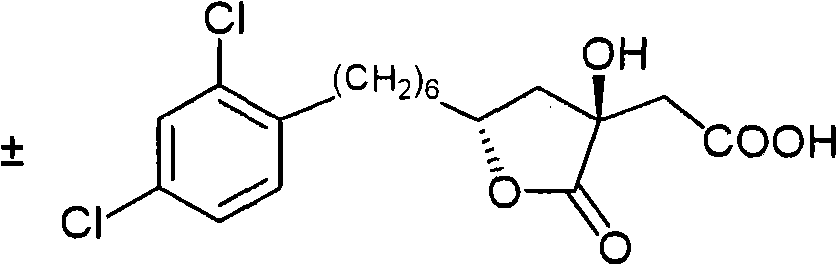
在另一个实例中,此具有结构(III)的化合物为:

在一个实例中,此具有结构(III)的化合物不是SB-204990。In one example, the compound of structure (III) is not SB-204990.
在一个实例中,此化合物具有结构(IV): In one example, this compound has structure (IV):
其中,每个R1分别代表一个亲脂性和/或吸电性基团。Wherein, each R 1 represents a lipophilic and/or electro-absorbing group respectively.
n为5至8;以及n is 5 to 8; and
R2和R3均为氢,R4为氢或羟基,R5为CH(R6)COOH,其中R6为氢或羟基;或R4为氢,R5为氢或羟基,R2为羟基和R3为COOH;或R2和R3为氢,R4和R5共同形成一个基团=C(R6)COOH其中R6为以上所定义的基团或其药学上可接受的盐。 Both R2 and R3 are hydrogen, R4 is hydrogen or hydroxyl, R5 is CH( R6 )COOH, wherein R6 is hydrogen or hydroxyl; or R4 is hydrogen, R5 is hydrogen or hydroxyl, and R2 is Hydroxyl and R3 are COOH; or R2 and R3 are hydrogen, R4 and R5 together form a group =C( R6 )COOH wherein R6 is a group as defined above or a pharmaceutically acceptable Salt.
具有结构(IV)的化合物可用本领域技术人员熟知的有机合成技术制作,也可以用某些方法制作,这些方法描述于Gribble等(美国专利号5,447,954),以上文献以引用方式并入本文(尤其是第10栏,第37行至第24栏,第50行)。另外,这些化合物的特定例子可在这个出版物中发现。Compounds of structure (IV) may be prepared using organic synthesis techniques well known to those skilled in the art, and may also be prepared by methods described in Gribble et al. (U.S. Patent No. 5,447,954), which is incorporated herein by reference (particularly is
具有结构(IV)化合物的具体例子为:
它被名为SB-201076的化合物识别。It was identified by a compound called SB-201076.
在另一个实例中,一个具有结构(IV)的化合物为:

在一个实例中,此具有结构(IV)的化合物不是SB-201076。In one example, the compound of structure (IV) is not SB-201076.
在一个实例中,一种化合物具有如下结构(V):
其中:Y可从含有CH、CH2、N、C=O、O、S和NR3的基团中选择,其中R3选自以下基团:H,烷基,链烯基,炔基,芳基,烷氧基,并且Y可存在或缺失;Where: Y can be selected from groups containing CH, CH 2 , N, C=O, O, S and NR 3 , wherein R 3 is selected from the following groups: H, alkyl, alkenyl, alkynyl, Aryl, alkoxy, and Y may be present or absent;
X为O,S,和NR4,其中每个R4分别选自:H,烷基,链烯基,炔基,芳基,烷氧基。X is O, S, and NR 4 , wherein each R 4 is independently selected from: H, alkyl, alkenyl, alkynyl, aryl, alkoxy.
R1选自烷基,卤素,氢氧根,烷氧基,芳氧基,及烷氧基。R 1 is selected from the group consisting of alkyl, halogen, hydroxide, alkoxy, aryloxy, and alkoxy.
R2选自烷基,卤素,氢氧根,烷氧基,芳氧基,及烷氧基。R2 is selected from alkyl, halogen, hydroxide, alkoxy, aryloxy, and alkoxy.
n为从0至3的整数。n is an integer from 0 to 3.
具有结构(V)的化合物可用本领域技术人员熟知的有机合成技术制作,也可以用某些方法制作,这些方法描述于(国际标准刊号WO 2005/051296),以上文献以引用方式并入本文(尤其是第38页,第4行至第49页,第11行)。另外,这些化合物的特定例子可在这个出版物中发现。Compounds with structure (V) can be prepared by organic synthesis techniques well known to those skilled in the art, and can also be prepared by certain methods, which are described in (International Standard Publication No. WO 2005/051296), the above documents are incorporated herein by reference (especially page 38,
具有结构V化合物的具体例子为:
在另一个实例中,一个具有结构(V)的化合物为: In another example, a compound of structure (V) is:
在一个实例中,此具有结构(V)的化合物不是: In one example, the compound of structure (V) is not:
在一个实例中,一种化合物具有如下结构(VI):
其中,A-B为N-CH或CH-N;K为(CH2)r,其中r为2,3或4;当A-B为N-CH时m和n分别为1,2或3;或,当A-B为CH-N时m和n分别为2或3;虚线代表存在可选双键;Wherein, AB is N-CH or CH-N; K is (CH 2 )r, wherein r is 2, 3 or 4; when AB is N-CH, m and n are 1, 2 or 3 respectively; or, when When AB is CH-N, m and n are 2 or 3 respectively; the dotted line represents the presence of optional double bonds;
D为羰基或磺酰基;D is carbonyl or sulfonyl;
E为以下中的一个:a)一个双环,其系由2个稠合的完全不饱和5至7元环独立组成,这些环各自可任选含有1至4个分别选自氧,硫和氮的杂原子;b)一个三环,其系包括2个稠合的完全不饱和5至7元环,这些环可任选含有1至4个分别选自氧,硫和氮的杂原子,此2环稠环与第三个部分饱和的,完全不饱和的或完全饱和的5至7元环稠合,所述第三个环可任选含有1至4个分别选自氧,硫和氮的杂原子;c)一个四环,其系包括1个双环,所述双环包括2个稠合的完全不饱和5至7元环,这些环可任选含有1至4个分别选自氧,硫和氮的杂原子,所述双环与2个完全饱和,部分饱和或完全不饱和5至7元单环稠合,这些环可任选含有1至4个分别选自氧,硫和氮的杂原子,或此二环与第二个双环稠合——包括2个相融的完全饱和,部分饱和或完全不饱和的5至7元环,这些环可任选含有1至4个分别选自氧,硫和氮的杂原子;d)一个联三芳香环,其系包括一个完全不饱和5至7元环,此环可任选含有1至4个分别选自氧,硫和氮的杂原子,此环独立的,被一个完全不饱和5至7元环二取代以形成一个联三芳香环的非稠合体系,此取代环可任选含有1至4个分别选自氧,硫和氮的杂原子,其中所述E双-,三或四环或联三芳香环在每一个用于形成双、三或四环或连三芳香环的环上任选独立被卤素、羟基、氨基、氰基、硝基、氧、羧基、(C1-C6)烷基、(C2-C6)链烯基、(C2-C6)炔基、(C1-C6)烷氧基、(C1-C4)烷硫基、(C1-C6)烷氧羰基单、二或三取代。E is one of the following: a) a bicyclic ring consisting independently of two fused fully unsaturated 5 to 7 membered rings, each of which may optionally contain 1 to 4 rings selected from oxygen, sulfur and nitrogen, respectively. b) a tricyclic ring comprising 2 fused fully unsaturated 5 to 7 membered rings which may optionally contain 1 to 4 heteroatoms selected from oxygen, sulfur and nitrogen, respectively, wherein A 2-ring fused ring fused to a third partially saturated, fully unsaturated or fully saturated 5 to 7 membered ring which may optionally contain 1 to 4 rings selected from oxygen, sulfur and nitrogen, respectively c) a tetracyclic ring comprising 1 bicyclic ring comprising 2 fused fully unsaturated 5 to 7 membered rings which may optionally contain 1 to 4 oxygen atoms, respectively, Heteroatoms of sulfur and nitrogen, said bicyclic ring is fused to 2 fully saturated, partially saturated or fully unsaturated 5 to 7 membered monocyclic rings, these rings may optionally contain 1 to 4 atoms selected from oxygen, sulfur and nitrogen, respectively Heteroatoms, or this bicyclic ring fused to a second bicyclic ring - including 2 fused fully saturated, partially saturated or fully unsaturated 5 to 7 membered rings, these rings may optionally contain 1 to 4 selected Heteroatoms from oxygen, sulfur and nitrogen; d) a triple aromatic ring comprising a fully unsaturated 5- to 7-membered ring, which may optionally contain 1 to 4 atoms selected from oxygen, sulfur and nitrogen, respectively Heteroatoms, the ring is independent, disubstituted by a fully unsaturated 5 to 7 membered ring to form a non-fused system of three aromatic rings, this substituted ring can optionally contain 1 to 4 atoms selected from oxygen, sulfur and nitrogen heteroatoms, wherein the E bis-, tri- or tetracyclic or bi-tricyclic aromatic rings are optionally independently replaced by halogen, hydroxyl, Amino, cyano, nitro, oxygen, carboxyl, (C 1 -C 6 ) alkyl, (C 2 -C 6 ) alkenyl, (C 2 -C 6 ) alkynyl, (C 1 -C 6 ) Alkoxy, (C 1 -C 4 )alkylthio, (C 1 -C 6 )alkoxycarbonyl mono-, di- or trisubstituted.
其中,所述的E二、三或四环或连三芳香环任选被部分饱和的、完全饱和的或完全不饱和的、任选含有1至4个独立地选自氧、硫和氮的杂原子的3到8元环R10单取代,或被二环R″单取代,所述R″由两个稠和的部分饱和的、完全饱和的或完全不饱和的3到8元环独立组成,每一个所述环各自任选含有1至4个独立分别选自氧、硫和氮的杂原子,所述的R10和R″环任选被另外桥接,并且所述的R10和R″环任选通过完全饱和的、部分饱和的或完全不饱和的1至4元直链或支链碳链相连接,其中,碳可以任选被1或2个独立分别选自氧、氮和硫的杂原子取代,条件是所述E二环含有至少一个取代基并且与D键合的E二环原子是碳;其中,所述的R10和R″环任选独立地被卤素、羟基、氨基、氰基、硝基、氧、羧基、(C1-C6)烷基、(C2-C6)链烯基、(C2-C6)炔基、(C1-C6)烷氧基、(C1-C4)烷硫基、(C1-C6)烷氧羰基、(C1-C6)烷基羰基、(C1-C6)烷基羰基氨基、或单-N-或二-N,N-(C1-C6)烷基氨基、单-N-或二-N,N-(C1-C6)烷基氨基羰基单、二或三取代,其中,所述的(C1-C6)烷基和(C1-C6)烷氧基取代基也任选独立地被卤素、羟基、(C1-C6)烷氧基、氨基、单-N-或二-N,N-(C1-C6)烷基氨基或1到9个氟单、二或三取代;G是羰基、磺酰基或CR7R8;其中,R7和R8各自独立分别是H、(C1-C6)烷基、(C2-C6)链烯基或(C2-C6)炔基或5至7元部分饱和的、完全饱和的或完全不饱和的、任选含有1个选自氧、硫和氮的杂原子的环;J是OR′、NR2R3或CR4R5R6;其中,R′、R2和R3各自独立分别是H、Q或(C1-C10)烷基、(C3-C10)链烯基或(C3-C10)炔基取代基,其中,所述的碳可以任选被1个或2个独立分别选自氧、氮和硫的杂原子取代,其中,所述的硫任选被氧单或二取代,所述的碳任选被氧单取代,所述的氮任选被氧双取代,所述的碳任选地独立地被卤素、羟基、氨基、硝基、氰基、羧基、(C1-C4)烷硫基、(C1-C6)烷氧羰基、单-N-或二-N,N-(C1-C6)烷基氨基或单-N-或二-N,N-(C1-C6)烷基氨基羰基单、二或三取代;并且所述的链任选被Q1单取代;其中,Q和Q1各自分别是部分饱和的、完全饱和的或完全不饱和的、任选含有1到3个分别选自氧、硫和氮的杂原子3到8元环,或是由两个稠和的或螺环的部分饱和的、完全饱和的或完全不饱和的3到6元环组成的二环,所述的二环任选含有1到3个分别选自氧、硫和氮的杂原子,所述的单环或二环任选被(C1-C3)亚烷基另外地桥接,其中,所述(C1-C3)亚烷基碳任选被1到2个分别选自氧、硫和氮的杂原子取代;其中,所述Q和Q1环各自独立地任选地被卤素、羟基、氨基、硝基、氰基、氧、羧基、(C1-C6)烷基、(C2-C6)链烯基、(C2-C6)炔基、(C1-C6)烷氧基、(C1-C4)烷硫基、(C1-C6)烷基羰基、(C1-C6)烷基羰基氨基、(C1-C6)烷氧羰基、单-N-或二-N,N-(C1-C6)烷基氨基、单-N-或二-N,N-(C1-C6)烷基氨基磺酰基、单-N-或二-N,N-(C1-C6)烷基氨基羰基单、二、三或四取代,其中,所述的(C1-C6)烷基取代基任选独立地被卤素、羟基、氨基、硝基、氰基、氧、羧基、(C1-C6)烷氧基、(C1-C4)烷硫基、(C1-C6)烷氧羰基或单-N-或二-N,N-(C1-C6)烷基氨基单、二或三取代,其中,所述的(C1-C6)烷基取代基也任选被1到9个氟取代;Wherein, said E two, three or tetracyclic or even three aromatic rings are optionally partially saturated, fully saturated or fully unsaturated, optionally containing 1 to 4 independently selected from oxygen, sulfur and nitrogen Heteroatomic 3 to 8 membered ring R 10 monosubstituted, or monosubstituted with a bicyclic R" independently of two fused partially saturated, fully saturated or fully unsaturated 3 to 8 membered rings Each of said rings optionally contains 1 to 4 heteroatoms independently selected from oxygen, sulfur and nitrogen, said R 10 and R" rings are optionally bridged additionally, and said R 10 and The R" ring is optionally connected by a fully saturated, partially saturated or fully unsaturated 1 to 4 membered straight or branched carbon chain, wherein the carbon can be optionally separated by 1 or 2 independently selected from oxygen, nitrogen and sulfur heteroatoms, provided that the E bicyclic ring contains at least one substituent and the E bicyclic atom bonded to D is carbon; wherein the R and R" rings are optionally independently halogen, Hydroxy, amino, cyano, nitro, oxygen, carboxyl, (C 1 -C 6 ) alkyl, (C 2 -C 6 ) alkenyl, (C 2 -C 6 ) alkynyl, (C 1 -C 6 ) Alkoxy, (C 1 -C 4 ) Alkylthio, (C 1 -C 6 ) Alkoxycarbonyl, (C 1 -C 6 ) Alkylcarbonyl, (C 1 -C 6 ) Alkylcarbonylamino , or mono-N- or di-N, N-(C 1 -C 6 ) alkylamino, mono-N- or di-N, N-(C 1 -C 6 ) alkylaminocarbonyl mono, di or Trisubstituted, wherein the (C 1 -C 6 ) alkyl and (C 1 -C 6 ) alkoxy substituents are also optionally independently replaced by halogen, hydroxyl, (C 1 -C 6 ) alkoxy , amino, mono-N- or di-N, N-(C 1 -C 6 ) alkylamino or 1 to 9 fluoro mono-, di- or tri-substituted; G is carbonyl, sulfonyl or CR 7 R 8 ; where , R 7 and R 8 are each independently H, (C 1 -C 6 ) alkyl, (C 2 -C 6 ) alkenyl or (C 2 -C 6 ) alkynyl or 5 to 7 membered partially saturated , a fully saturated or fully unsaturated ring optionally containing a heteroatom selected from oxygen, sulfur and nitrogen; J is OR', NR 2 R 3 or CR 4 R 5 R 6 ; wherein, R', R 2 and R 3 are independently H, Q or (C 1 -C 10 ) alkyl, (C 3 -C 10 ) alkenyl or (C 3 -C 10 ) alkynyl substituents, wherein, The carbon in can be optionally substituted by 1 or 2 heteroatoms independently selected from oxygen, nitrogen and sulfur, wherein the sulfur is optionally mono- or disubstituted by oxygen, and the carbon is optionally mono-substituted by oxygen , the nitrogen is optionally double substituted by oxygen, and the carbon is optionally independently halogen, hydroxyl, amino, nitro, cyano, carboxyl, (C 1 -C 4 ) alkylthio, (C 1 -C 6 ) alkoxycarbonyl, mono-N- or di-N, N-(C 1 -C 6 ) alkylamino or mono-N- or di-N, N-(C 1 -C 6 ) alkylaminocarbonyl mono-, di- or tri-substituted; and said chain is optionally mono - substituted by Q ; wherein Q and Q are each partially saturated, fully saturated or fully unsaturated, optionally containing 1 to 3 heteroatoms respectively selected from oxygen, sulfur and nitrogen, 3 to 8 membered rings, or are formed by A bicyclic ring consisting of two fused or spiro partially saturated, fully saturated or fully unsaturated 3 to 6 membered rings optionally containing 1 to 3 members selected from the group consisting of oxygen, sulfur and A nitrogen heteroatom, said monocyclic or bicyclic ring is optionally bridged additionally by (C 1 -C 3 )alkylene, wherein said (C 1 -C 3 )alkylene carbon is optionally bridged by 1 to 2 heteroatoms respectively selected from oxygen, sulfur and nitrogen are substituted; wherein, the Q and Q rings are independently optionally halogen, hydroxyl, amino, nitro, cyano, oxygen, carboxyl, ( C -C 6 )alkyl, (C 2 -C 6 )alkenyl, (C 2 -C 6 )alkynyl, (C 1 -C 6 )alkoxy, (C 1 -C 4 )alkylthio, (C 1 -C 6 )alkylcarbonyl, (C 1 -C 6 )alkylcarbonylamino, (C 1 -C 6 )alkoxycarbonyl, mono-N- or di-N,N-(C 1 -C 6 ) Alkylamino, mono-N- or di-N, N-(C 1 -C 6 ) alkylaminosulfonyl, mono-N- or di-N, N-(C 1 -C 6 ) alkyl Aminocarbonyl is mono-, di-, tri- or tetra-substituted, wherein the (C 1 -C 6 ) alkyl substituent is optionally independently halogen, hydroxyl, amino, nitro, cyano, oxygen, carboxyl, (C 1 -C 6 )alkoxy, (C 1 -C 4 )alkylthio, (C 1 -C 6 )alkoxycarbonyl or mono-N- or di-N,N-(C 1 -C 6 )alkane Mono-, di- or tri-substituted amino, wherein said (C 1 -C 6 ) alkyl substituent is also optionally substituted by 1 to 9 fluorines;
或其中,R2和R3可以和与它们相连的氮原子一起形成部分饱和的、完全饱和的和完全不饱和的、任选含有1到3个另外的独立选自氧、硫和氮的杂原子的3到8元环,或形成由两个稠和的、桥接的或螺环的部分饱和的、完全饱和的或完全不饱和的3到6元环组成的二环,独立地,所述的二环任选含有1到3个另外的独立选自氧、硫和氮的杂原子,或形成由两个稠和的、桥接的或螺环的部分饱和的、完全饱和的或完全不饱和的3到6元环组成的双环,所述的双环任选含有1到3个另外的分别选自氧、硫和氮的杂原子;或形成由三个稠和的、桥接的或螺环的部分饱和的、完全饱和的或完全不饱和的3到6元环组成的双环,所述的三环任选含有1到3个另外的分别选自氧、硫和氮的杂原子;其中,所述的NR2R3环任选独立地被R15、卤素、羟基、氨基、硝基、氰基、氧、羧基、(C1-C6)烷基、(C2-C6)链烯基、(C2-C6)炔基、(C1-C6)烷氧基、(C1-C4)烷硫基、(C1-C6)烷基羰基氨基或单-N-或二-N,N-(C1-C6)烷基氨基单、二、三或四取代,其中,所述的(C1-C6)烷基取代基任选地被卤素、羟基、氨基、硝基、氰基、氧、羧基、(C1-C6)烷氧基、(C1-C4)烷硫基、(C1-C6)烷氧羰基或单-N-或二-N,N-(C1-C6)烷基氨基单、二或三取代,所述的(C1-C6)烷基取代基也任选地被1到9个氟取代;Or wherein, R and R can form partially saturated, fully saturated and fully unsaturated, optionally containing 1 to 3 additional heteros independently selected from oxygen, sulfur and nitrogen, together with the nitrogen atoms attached to them 3 to 8 membered rings of atoms, or form a bicyclic ring consisting of two fused, bridged or spiro partially saturated, fully saturated or fully unsaturated 3 to 6 membered rings, independently, said The bicyclic ring optionally contains 1 to 3 additional heteroatoms independently selected from oxygen, sulfur and nitrogen, or forms a partially saturated, fully saturated or fully unsaturated ring consisting of two fused, bridged or spiro rings A bicyclic ring consisting of 3 to 6 membered rings, said bicyclic ring optionally containing 1 to 3 additional heteroatoms selected from oxygen, sulfur and nitrogen, respectively; or formed by three fused, bridged or spiro rings Partially saturated, fully saturated or fully unsaturated bicyclic rings composed of 3 to 6 membered rings, said tricyclic rings optionally contain 1 to 3 additional heteroatoms respectively selected from oxygen, sulfur and nitrogen; wherein said The NR2R3 ring is optionally independently replaced by R15, halogen, hydroxyl, amino, nitro, cyano, oxygen, carboxyl, (C 1 -C 6 ) alkyl, (C 2 -C 6 ) alkenyl, (C 2 -C 6 )alkynyl, (C 1 -C 6 )alkoxy, (C 1 -C 4 )alkylthio, (C 1 -C 6 )alkylcarbonylamino or mono-N- or di-N , N-(C 1 -C 6 ) alkylamino mono-, di-, tri- or tetra-substituted, wherein said (C 1 -C 6 ) alkyl substituent is optionally replaced by halogen, hydroxyl, amino, nitro , cyano, oxygen, carboxyl, (C 1 -C 6 ) alkoxy, (C 1 -C 4 ) alkylthio, (C 1 -C 6 ) alkoxycarbonyl or mono-N- or di-N, N-(C 1 -C 6 ) alkylamino is mono-, di- or tri-substituted, and said (C 1 -C 6 ) alkyl substituent is also optionally substituted by 1 to 9 fluorines;
其中,三个杂原子各自分别选自氧,硫和氮,其中所述环任选地被卤素、羟基、氨基、硝基、氰基、氧、羧基、(C1-C6)烷基、(C2-C6)链烯基、(C2-C6)炔基、(C1-C4)烷硫基、(C1-C6)烷氧基、(C1-C6)烷基羰基氨基或单-N-或二-N,N-(C1-C6)烷基氨基单、二、三或四取代,其中所述NR2R3是任选地被部分饱和,完全饱和或完全不饱和的,任选含有1到3个分别选自氧、硫和氮的杂原子的3到8元环取代,或被由两个稠和的部分饱和的、完全饱和的或完全不饱和的3到6元环组成的二环取代,所述二环任选含有1到3个分别选自氧、硫和氮的杂原子,所述单环或二环任选被另外地桥接,所述的环任选含有1到3个分别选自氧、硫和氮的杂原子,其中,所述(C1-C6)烷基和所述环任选被卤素、羟基、氨基、硝基、氰基、氧、羧基、(C2-C6)链烯基、(C3-C6)炔基、(C1-C6)烷基羰基氨基、羟基、(C1-C6)烷氧基、(C1-C4)烷硫基、(C1-C6)烷氧基、单-N-或二-N,N-(C1-C6)烷基氨基单、二或三取代;其中,R4、R5和R6独立地是H、卤素、羟基、(C1-C6)烷基,或者R4和R5一起形成部分饱和的、完全饱和的或完全不饱和的3到8元环,所述环任选含有一到三个独立地选自氧、硫和氮的杂原子,其中,所述(C1-C6)烷基和所述环任选被卤素、羟基、氨基、硝基、氰基、氧、羧基、(C2-C6)链烯基、(C3-C6)炔基、(C1-C6)烷基羰基氨基、羟基、(C1-C6)烷氧基、(C1-C4)烷硫基、(C1-C6)烷氧基、单-N-或二-N,N-(C1-C6)烷基氨基单、二或三取代;条件是1′-(蒽-9-羰基)-[1,4′]双哌啶基-3-羧酸二乙酰胺、1′-(1-氧杂-2,3-二氮杂-环五[a]萘-5-磺酰基)-[1,4′]双哌啶基-3-羧酸二乙酰胺、1′-(5-二甲氨基-萘-1-磺酰基)-[1,4′]双哌啶基-3-羧酸二乙酰胺、1′(9,10,10-三氧代-9,10-二氢-硫代噻吨-3-羰基)-]1-4′]双哌啶基-3-羧酸二乙酰胺和1′-(2-氧代-2H-苯并吡喃-3-羰基)-[1-4′]双哌啶基-3-羧酸二乙酰胺不包括在内。wherein the three heteroatoms are each selected from oxygen, sulfur and nitrogen, wherein the ring is optionally replaced by halogen, hydroxyl, amino, nitro, cyano, oxygen, carboxyl, (C 1 -C 6 ) alkyl, (C 2 -C 6 )alkenyl, (C 2 -C 6 )alkynyl, (C 1 -C 4 )alkylthio, (C 1 -C 6 )alkoxy, (C 1 -C 6 ) Alkylcarbonylamino or mono-N- or di-N, N-(C 1 -C 6 ) alkylamino mono-, di-, tri- or tetra-substituted, wherein said NR 2 R 3 is optionally partially saturated, Fully saturated or fully unsaturated, optionally substituted with 3 to 8 membered rings containing 1 to 3 heteroatoms respectively selected from oxygen, sulfur and nitrogen, or substituted by two fused partially saturated, fully saturated or Fully unsaturated bicyclic rings consisting of 3 to 6 membered rings optionally containing 1 to 3 heteroatoms respectively selected from oxygen, sulfur and nitrogen, said monocyclic or bicyclic rings optionally being additionally bridging, the ring optionally contains 1 to 3 heteroatoms respectively selected from oxygen, sulfur and nitrogen, wherein the (C 1 -C 6 ) alkyl and the ring are optionally replaced by halogen, hydroxyl, amino , nitro, cyano, oxygen, carboxyl, (C 2 -C 6 ) alkenyl, (C 3 -C 6 ) alkynyl, (C 1 -C 6 ) alkylcarbonylamino, hydroxyl, (C 1 - C 6 )alkoxy, (C 1 -C 4 )alkylthio, (C 1 -C 6 )alkoxy, mono-N- or di-N,N-(C 1 -C 6 )alkylamino Mono-, di-, or tri-substituted; wherein, R4, R5, and R6 are independently H, halogen, hydroxyl, (C 1 -C 6 ) alkyl, or R 4 and R 5 together form partially saturated, fully saturated, or fully An unsaturated 3- to 8-membered ring optionally containing one to three heteroatoms independently selected from oxygen, sulfur and nitrogen, wherein the (C 1 -C 6 )alkyl and the ring are optionally Selected from halogen, hydroxyl, amino, nitro, cyano, oxygen, carboxyl, (C 2 -C 6 ) alkenyl, (C 3 -C 6 ) alkynyl, (C 1 -C 6 ) alkylcarbonylamino , hydroxy, (C 1 -C 6 ) alkoxy, (C 1 -C 4 ) alkylthio, (C 1 -C 6 ) alkoxy, mono-N- or di-N, N-(C 1 -C 6 ) alkylamino mono-, di- or tri-substitution; the proviso is that 1′-(anthracene-9-carbonyl)-[1,4′]bispiperidinyl-3-carboxylic acid diethylamide, 1′-( 1-oxa-2,3-diaza-cyclopenta[a]naphthalene-5-sulfonyl)-[1,4′]bispiperidinyl-3-carboxylic acid diethylamide, 1′-(5 -Dimethylamino-naphthalene-1-sulfonyl)-[1,4′]bispiperidinyl-3-carboxylic acid diacetamide, 1′(9,10,10-trioxo-9,10-di Hydrogen-thiothioxanthene-3-carbonyl)-]1-4′]bispiperidinyl-3-carboxylic acid diacetamide and 1′-(2-oxo-2H-benzopyran-3-carbonyl )-[1 -4']bispiperidinyl-3-carboxylic acid diethylamide is not included.
具有结构(VI)的化合物可用本领域技术人员熟知的有机合成技术制备,也可以用某些方法制备,这些方法描述于(国际标准刊号WO 03/072197),以上文献以引用方式并入本文(尤其是第103页,第14行至第160页,第17行)。另外,这些化合物的特定例子可在这个出版物中发现。Compounds of structure (VI) can be prepared by organic synthesis techniques well known to those skilled in the art, and can also be prepared by certain methods described in (International Standard Publication No. WO 03/072197), which is incorporated herein by reference (especially
具有结构(VI)化合物的其它具体例子为:
也称作CP-610431。Also known as CP-610431.
具有结构(VI)化合物的其它具体例子为:
也称作CP-640186。Also known as CP-640186.
在另一个实例中,一个具有结构(VI)的化合物为:

在一个实例中,此具有结构(VI)的化合物不是CP-610431。In one example, the compound of structure (VI) is not CP-610431.
在另一个实例中,此具有结构(VI)的化合物不是CP-640186。In another example, the compound of structure (VI) is not CP-640186.
在一个实例中,一种化合物具有如下结构(VII): In one example, a compound has structure (VII):
其中每个R1分别为氢,(C1-C6)烷基,(C1-C6)链烯基,(C1-C6)炔基,苯基,苯甲基,或C(O)R3;wherein each R 1 is independently hydrogen, (C 1 -C 6 ) alkyl, (C 1 -C 6 ) alkenyl, (C 1 -C 6 ) alkynyl, phenyl, benzyl, or C( O) R 3 ;
R2为-H或OR1;R 2 is -H or OR 1 ;
R3为(C1-C6)烷基,(C1-C6)链烯基,(C1-C6)炔基,NR4,或苯基;R 3 is (C 1 -C 6 ) alkyl, (C 1 -C 6 ) alkenyl, (C 1 -C 6 ) alkynyl, NR 4 , or phenyl;
R4为(C1-C6)烷基,(C1-C6)链烯基,(C1-C6)炔基,或苯基;R4 is (C 1 -C 6 ) alkyl, (C 1 -C 6 ) alkenyl, (C 1 -C 6 ) alkynyl, or phenyl;
具有结构(VII)的化合物可用本领域技术人员熟知的有机合成技术制作,也可用以下描述的方法制作,(Peschko等,《四面体快报》,41:9477-9481,2000),通过引用方式并入本文。另外,这些化合物的特定例子可在这个出版物中发现。Compounds of structure (VII) can be prepared using organic synthesis techniques well known to those skilled in the art, and can also be prepared by the methods described below, (Peschko et al., Tetrahedron Letters, 41:9477-9481, 2000), incorporated by reference and into this article. Additionally, specific examples of these compounds can be found in this publication.
具有结构(VII)化合物的具体例子为: Specific examples of compounds having structure (VII) are:
它也被称为Pupurone。It is also known as Pupurone.
在一个具体实例中,一个具有结构(VII)的化合物为:
它也被称为ningalin D。It is also known as ningalin D.
在一个具体实例中,一个具有结构(VII)的化合物为:
在一个实例中,此具有结构(VII)的化合物不是Puporone。In one example, the compound of structure (VII) is not Puporone.
在另一个实例中,此具有结构(VII)的化合物不是ningalinD。In another example, the compound of structure (VII) is not ningalinD.
在一个实例中,一种化合物具有如下结构(VIII): In one example, a compound has structure (VIII):
在这个公式中,虚线分别为饱和键或双键,R为氢,CH3或-C(O)A,其中A为氢,(C3-C6)环烷基或(C1-C6)烷基,它被或不被卤素或(C1-C3)烷氧基取代。<In this formula, the dotted lines are saturated bonds or double bonds respectively, R is hydrogen, CH 3 or -C(O)A, where A is hydrogen, (C 3 -C 6 )cycloalkyl or (C 1 -C 6 )alkyl, which is or is not substituted by halogen or (C 1 -C 3 )alkoxy. <
如果虚线为饱和键,X为-OH,或如果虚线为不饱和键,X则为=O,=N-OY或=N-N(R1)(R2),其中If the dotted line is a saturated bond, X is -OH, or if the dotted line is an unsaturated bond, X is =O, =N-OY or =NN(R 1 )(R 2 ), where
Y为氢,(C1-C6)烷基,(C3-C6)链烯基,(C3-C6)炔基或一个酰基基团-C(O)-Z,其中Y is hydrogen, (C 1 -C 6 )alkyl, (C 3 -C 6 )alkenyl, (C 3 -C 6 )alkynyl or an acyl group -C(O)-Z, wherein
Z为苯基,或一个被卤素或(C1-C4)烷氧基取代的(C1-C6)烷基基团,或为氢,(C1-C6)烷基,(C2-C6)链烯基或(C2-C6)炔基;Z is phenyl, or a (C 1 -C 6 )alkyl group substituted by halogen or (C 1 -C 4 )alkoxy, or hydrogen, (C 1 -C 6 ) alkyl , ( C 2 -C 6 )alkenyl or (C 2 -C 6 )alkynyl;
R1为氢或(C1-C6)烷基和R 1 is hydrogen or (C 1 -C 6 )alkyl and
R2为氢,(C1-C6)烷基,苯基,氨基甲酰(CONH2),-COA或-SO2-R3,其中R 2 is hydrogen, (C 1 -C 6 ) alkyl, phenyl, carbamoyl (CONH 2 ), -COA or -SO 2 -R 3 , wherein
R3为(C1-C6)烷基,或为被或不被(C1-C4)烷基取代的苯基;R 3 is a (C 1 -C 6 ) alkyl group, or a phenyl group substituted or not by a (C 1 -C 4 ) alkyl group;
具有结构(VIII)的化合物可用本领域技术人员熟知的有机合成技术制作,也可以用某些方法制作,这些方法描述于等(美国专利号5,026,878),以上文献以引用方式并入本文(尤其是第10栏,第25行至第16栏,第14行)。另外,这些化合物的特定例子可在这个出版物中发现。Compounds of structure (VIII) may be prepared by organic synthesis techniques well known to those skilled in the art, and may also be prepared by methods described in et al. (US Patent No. 5,026,878), which is incorporated herein by reference (especially
具有结构(VIII)化合物的具体例子为: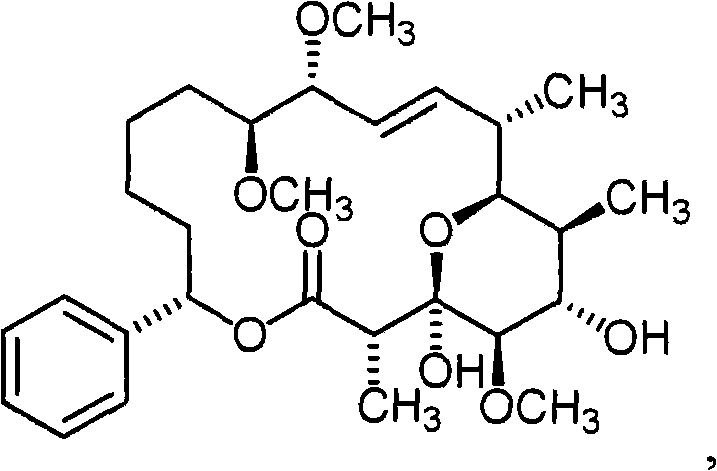
它也被称为Soraphen A。It is also known as Soraphen A.
在一个具体实例中,一个具有结构(VIII)的化合物为:
它也被称为Soraphen B。It is also known as Soraphen B.
在另一个实例中,一个具有结构(VIII)的化合物为:
在一个实例中,此具有结构(VII)的化合物不是SoraphenA。In one example, the compound of structure (VII) is not SoraphenA.
在一个实例中,此具有结构(VII)的化合物不是SoraphenB。In one example, the compound of structure (VII) is not SoraphenB.
在一个实例中,一种化合物具有如下结构(IX): In one example, a compound has the following structure (IX):
其中,T为氧或硫;Wherein, T is oxygen or sulfur;
X为Cl,Br或CF3;X is Cl, Br or CF3 ;
若X和Y至少一个是CF3,Y为H,Cl,Br或CF3;If at least one of X and Y is CF 3 , Y is H, Cl, Br or CF 3 ;
Z为-C(O)OR1,-C(O)NR2R3,-C(O)O-M+,-C(O)SR4,-CN R1为H,(C1-C8)烷基,苯甲基,氯代苯甲基或C3-C6烷氧基烷基;Z is -C(O)OR 1 , -C(O)NR 2 R 3 , -C(O)O - M + , -C(O)SR 4 , -CN R 1 is H, (C 1 -C 8 ) Alkyl, benzyl, chlorobenzyl or C 3 -C 6 alkoxyalkyl;
R4为(C1-C4)烷基;R 4 is (C 1 -C 4 ) alkyl;
R5为H或(C1-C4)烷基;R5 is H or (C 1 -C 4 ) alkyl;
R6为(C1-C7)烷基;R6 is (C 1 -C7) alkyl;
M为NHR2R3R7,Na,K,Mg或CaM is NHR 2 R 3 R 7 , Na, K, Mg or Ca
R2和R3各自分别选自:R7或-OCH3,条件是其中的R2和R3不可同时为-OCH3两者也都不是-NHR2R3R7中的-OCH3;及R 2 and R 3 are each selected from: R 7 or -OCH 3 , provided that R 2 and R 3 are neither -
R7为H或(C1-C4)烷基或(C2-C3)羟烷基;R7 is H or (C 1 -C 4 ) alkyl or (C 2 -C 3 ) hydroxyalkyl;
具有结构(IX)化合物的具体例子为:
它也被称为吡氟氯禾灵(haloxyfop)。It is also known as haloxyfop.
在另一个实例中,一个具有结构(IX)的化合物为:

在一个实例中,此具有结构(IX)的化合物不是吡氟氯禾灵。In one example, the compound of structure (IX) is not haloxyfop.
在一个实例中,一种化合物具有如下结构(X):
其中,当虚线是一个键时,R2和R3则不存在;Wherein, when the dotted line is a bond, R 2 and R 3 do not exist;
R1为H,OR4,NR4R5,SR6,卤素,C(O)OR4或O与R3结合以成一个环氧环;R 1 is H, OR 4 , NR 4 R 5 , SR 6 , halogen, C(O)OR 4 or O combined with R 3 to form an epoxy ring;
R2为-H或卤素;R 2 is -H or halogen;
R3为H,SR6,或O,与R1结合组成一个环氧环;R 3 is H, SR 6 , or O, combined with R 1 to form an epoxy ring;
R4为H,(C1-C6)烷基,(C2-C6)链烯基,(C2-C6)炔基,芳基,或苯基;R 4 is H, (C 1 -C 6 ) alkyl, (C2-C 6 ) alkenyl, (C2-C 6 ) alkynyl, aryl, or phenyl;
R5为H,(C1-C6)烷基或OR4;R 5 is H, (C 1 -C6) alkyl or OR 4 ;
R6为H,(C1-C6)烷基,SH,或S-(C1-C6)烷基;R 6 is H, (C 1 -C6) alkyl, SH, or S-(C1-C6) alkyl;
条件是当R1为OR4或O并与R3结合组成一个环氧环时,R2不能是卤素。The proviso is that when R1 is OR4 or O and combines with R3 to form an epoxy ring, R2 cannot be halogen.
具有结构(X)的化合物可用本领域技术人员熟知的有机合成技术制作,也可以用某些方法制作,这些方法描述于Saxty等1992Eur.J.Biochem.202:889-896及Dolle等1995《药物化学杂志》38(3):537-543,以上文献以引用方式并入本文。另外,这些化合物的具体例子可在这些资料中发现。Compounds with structure (X) can be prepared by organic synthesis techniques well known to those skilled in the art, and can also be prepared by certain methods, which are described in Saxty et al. 1992 Eur.J.Biochem.202:889-896 and Dolle et al. Journal of Chemistry 38(3): 537-543, which is hereby incorporated by reference. In addition, specific examples of these compounds can be found in these materials.
具有结构(X)化合物的具体例子为:
也称作2S-羟基柠檬酸;Also known as 2S-hydroxycitric acid;
在一个具体实例中,一个具有结构(X)的化合物为:
也称作2,2-二氟代柠檬酸;Also known as 2,2-difluorocitric acid;
在一个具体实例中,一个具有结构(X)的化合物为: In a specific example, a compound of structure (X) is:
在一个具体实例中,一个具有结构(X)的化合物为:
在一个具体实例中,一个具有结构(X)的化合物为:
在一个具体实例中,一个具有结构(X)的化合物为: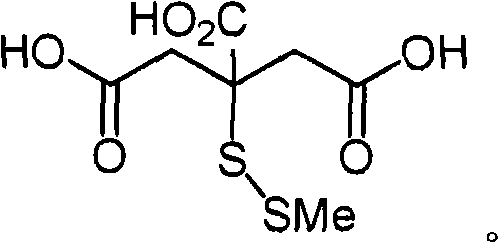
在另一个实例中,一个具有结构(X)的化合物为: In another example, a compound of structure (X) is:
在一个实例中,一种化合物具有如下结构(XI):
其中X为S,S=O或-CH2-;Wherein X is S, S=O or -CH 2 -;
n为从0至6;n is from 0 to 6;
Z为(C1-C6)烷基,(C1-C6)烷基-COOH,OR1,或NR1R2;Z is (C 1 -C 6 ) alkyl, (C 1 -C 6 ) alkyl-COOH, OR 1 , or NR 1 R 2 ;
R1为H,(C1-C6)烷基,(C2-C6)链烯基,(C2-C6)炔基,苯基,或苯甲基;R 1 is H, (C 1 -C 6 ) alkyl, (C 2 -C 6 ) alkenyl, (C 2 -C 6 ) alkynyl, phenyl, or benzyl;
R2为H,(C1-C6)烷基,(C2-C6)链烯基,(C2-C6)炔基,苯基,或苯甲基;R 2 is H, (C 1 -C 6 ) alkyl, (C 2 -C 6 ) alkenyl, (C 2 -C 6 ) alkynyl, phenyl, or benzyl;
具有结构(XI)的化合物可用本领域技术人员熟知的有机合成技术制作,也可用以下描述的方法制作,(Usher等.1994《生物化学》33;7753-7759.及Charlier等1997《生物化学》36;1551-1558),通过引用方式并入本文。另外,这些化合物的具体例子可在这些资料中发现。Compounds with structure (XI) can be prepared by organic synthesis techniques well known to those skilled in the art, and can also be prepared by the methods described below, (Usher et al. 1994 "Biochemistry" 33; 7753-7759. and Charlier et al. 1997 "Biochemistry" 36;1551-1558), incorporated herein by reference. In addition, specific examples of these compounds can be found in these materials.
具有结构(XI)化合物的具体例子为:
它也被称作3-氧代丁基-辅酶AIt is also known as 3-oxobutyl-CoA
在另一个实例中,一个具有结构(XI)的化合物为: 
在一个实例中,此具有结构(XI)的化合物不是-氧代丁基-辅酶A。In one example, the compound of structure (XI) is not -oxobutyl-CoA.
在一个实例中,一种化合物具有如下结构(XII): In one example, a compound has the following structure (XII):
其中:in:
Ra 为(C1-C6)烷基;R a is (C 1 -C 6 ) alkyl;
Rb为氢,1当量农业上可用的阳离子,C2-C8-烷基碳酰氧基,C1-C10-烷基磺酰基,C1-C10-烷基膦酰基或苯甲酰,苯磺酰基或苯膦酰基,其中最后提及的三个基团可能另外携带1至5个卤素原子。R b is hydrogen, 1 equivalent of an agriculturally acceptable cation, C 2 -C 8 -alkylcarbonyloxy, C 1 -C 10 -alkylsulfonyl, C 1 -C 10 -alkylphosphonyl or benzyl Acyl, phenylsulfonyl or phenylphosphonyl, where the last three groups mentioned may additionally carry 1 to 5 halogen atoms.
Rc为氢,氰基,甲酰基,C1-C6-烷基,C1-C4-烷氧基-C1-C6-烷基或C1-C4-烷硫基-C1-C6-烷基,苯氧基-C1-C6-烷基,苯硫基-C1-C6-烷基,吡啶氧基-C1-C6-烷基或吡啶基硫代-C1-C6-烷基,其中所述苯环和吡啶环可能各自另外携带1至3个以下基团:硝基,氰基,卤素,C1-C4-烷基,部分或完全卤化的C1-C4-烷基,C1-C4-烷氧基,部分或完全卤化的C1-C4-烷氧基,C1-C4-烷硫基,C3-C6-链烯基,C3-C6-链烯氧基,C3-C6-炔基,C3-C6-炔氧基和-NRgRh,其中R c is hydrogen, cyano, formyl, C 1 -C 6 -alkyl, C 1 -C 4 -alkoxy-C 1 -C 6 -alkyl or C 1 -C 4 -alkylthio-C 1 -C 6 -alkyl, phenoxy-C 1 -C 6 -alkyl, phenylthio-C 1 -C 6 -alkyl, pyridyloxy-C 1 -C 6 -alkyl or pyridylthio Substituted-C 1 -C 6 -alkyl, wherein the benzene and pyridine rings may each additionally carry 1 to 3 of the following groups: nitro, cyano, halogen, C 1 -C 4 -alkyl, moieties or Fully halogenated C 1 -C 4 -alkyl, C 1 -C 4 -alkoxy, partially or fully halogenated C 1 -C 4 -alkoxy, C 1 -C 4 -alkylthio, C 3 - C 6 -alkenyl, C 3 -C 6 -alkenyloxy, C 3 -C 6 -alkynyl, C 3 -C 6 -alkynyloxy and -NR g R h , where
Rg为氢,C1-C4-烷基,C3-C6-链烯基,C3-C6-炔基,C1-C6-酰基或苯甲酰,它携带1至3个以下基团:硝基,氰基,卤素,C1-C4-烷基,部分或完全卤化的C1-C4-烷基,C1-C4-烷氧基和C1-C4-烷硫基及R g is hydrogen, C 1 -C 4 -alkyl, C 3 -C 6 -alkenyl, C 3 -C 6 -alkynyl, C 1 -C 6 -acyl or benzoyl, which carries 1 to 3 one of the following groups: nitro, cyano, halogen, C 1 -C 4 -alkyl, partially or fully halogenated C 1 -C 4 -alkyl, C 1 -C 4 -alkoxy and C 1 -C 4 -Alkylthio and
Rh为氢,C1-C4-烷基,C3-C6-链烯基或C3-C6-炔基;C3-C7-环烷基或C5-C7-环状链烯基,其中这些基团可能另外携带1至3个以下基团:氢氧根,卤素,C1-C4-烷基,部分或完全卤化的C1-C4-烷基,C1-C4-烷氧基,C1-C4-烷硫基,苯甲硫基,C1-C4-烷磺酰基,C1-C4-烷基亚磺酰基和C1-C4-烷基亚硫酰基,一个包括1或2个氧或硫原子或一个氧和一个硫原子作为杂原子的5元饱和杂环并且它可能另外携带1至3个以下基团:C1-C4-烷基,部分或完全卤化的C1-C4-烷基,C1-C4-烷氧基和C1-C4-烷硫基,一个含有1或2个氧或氧或硫原子或一个氧原子和一个硫原子作为杂原子的6元或7元杂环结构或一或二不饱和的杂环结构并且它可能另外携带1至3个以下基团:氢氧根,卤素,C1-C4-烷基,部分或完全卤化的C1-C4-烷基,C1-C4-烷氧基和C1-C4-烷硫基,一个含有1至3个选自以下基团杂原子:1或2个氮原子和一个氧和硫原子的5元杂芳族结构,并且它可能另外携带1至3个以下基团:氰基,卤素,C1-C4-烷基,部分或完全卤化的C1-C4-烷基,C1-C4-烷氧基,部分或完全卤化的C1-C4-烷氧基,C1-C4-烷硫基,C2-C6-链烯基,C2-C6-链烯氧基,C3-C6-炔氧基和C1-C4-烷氧基-C1-C4-烷基,苯基或吡啶基,它们各自可能另外携带1至3个以下基团:硝基,氰基,甲酰基,卤素,C1-C4-烷基,部分或完全卤化的C1-C4-烷基,C1-C4-烷氧基,部分或完全卤化的C1-C4-烷氧基,C1-C4-烷硫基,C3-C6-链烯基,C3-C6-链烯氧基,C3-C6-炔基,C3-C6-炔氧基及-NRgRh,其中Rg和Rh意义同上;R h is hydrogen, C 1 -C 4 -alkyl, C 3 -C 6 -alkenyl or C 3 -C 6 -alkynyl; C 3 -C 7 -cycloalkyl or C 5 -C 7 -cyclo alkenyl, wherein these groups may additionally carry 1 to 3 of the following groups: hydroxide, halogen, C 1 -C 4 -alkyl, partially or fully halogenated C 1 -C 4 -alkyl, C 1 -C 4 -Alkoxy, C 1 -C 4 -Alkylthio, C 1 -C 4 -Alkylthio, C 1 -C 4 -Alkylsulfonyl, C 1 -C 4 -Alkylsulfinyl and C 1 -C 4 -Alkylsulfinyl, a 5-membered saturated heterocyclic ring comprising 1 or 2 oxygen or sulfur atoms or an oxygen and a sulfur atom as heteroatoms and which may additionally carry 1 to 3 of the following groups: C 1 - C 4 -alkyl, partially or fully halogenated C 1 -C 4 -alkyl, C 1 -C 4 -alkoxy and C 1 -C 4 -alkylthio, one containing 1 or 2 oxygen or oxygen or A 6- or 7-membered heterocyclic structure or a mono- or diunsaturated heterocyclic structure with a sulfur atom or an oxygen atom and a sulfur atom as heteroatoms and which may additionally carry 1 to 3 of the following groups: hydroxide, halogen , C 1 -C 4 -alkyl, partially or fully halogenated C 1 -C 4 -alkyl, C 1 -C 4 -alkoxy and C 1 -C 4 -alkylthio, one containing 1 to 3 Heteroatoms selected from the following groups: 5-membered heteroaromatic structure with 1 or 2 nitrogen atoms and one oxygen and sulfur atom, and which may additionally carry 1 to 3 of the following groups: cyano, halogen, C 1 -C 4 -Alkyl, partially or fully halogenated C 1 -C 4 -alkyl, C 1 -C 4 -alkoxy, partially or fully halogenated C 1 -C 4 -alkoxy, C 1 -C 4 - Alkylthio, C 2 -C 6 -alkenyl, C 2 -C 6 -alkenyloxy, C 3 -C 6 -alkynyloxy and C 1 -C 4 -alkoxy-C 1 -C 4 - alkyl, phenyl or pyridyl, each of which may additionally carry 1 to 3 of the following groups: nitro, cyano, formyl, halogen, C 1 -C 4 -alkyl, partially or fully halogenated C 1 -C 4 -alkyl, C 1 -C 4 -alkoxy, partially or fully halogenated C 1 -C 4 -alkoxy, C 1 -C 4 -alkylthio, C 3 -C 6 -alkene C 3 -C 6 -alkenyloxy, C 3 -C 6 -alkynyl, C 3 -C 6 -alkynyloxy and -NR g R h , wherein R g and Rh have the same meaning as above;
Rd为氢,氢氧根或C1-C6-烷基;R d is hydrogen, hydroxide or C 1 -C 6 -alkyl;
Ro为氢,氢,氰基,一个C1-C4-烷氧羰基或一个C1-C4-烷基酮肟基团;R o is hydrogen, hydrogen, cyano, a C 1 -C 4 -alkoxycarbonyl group or a C 1 -C 4 -alkylketoxime group;
W为C1-C6-烯属烃,C3-C6-亚烯基或C3-C6-亚炔基链,它们中的每一个都携带1至3个以下基团:C3-C6-烷基三取代物,三个卤素原子及亚甲基的一取代物;C3-C6-烯属烃或C4-C6-亚烯基链,它们都另外携带1至3个C3-C6-烷基基团,其中,此链的亚甲基基团都可能被以下基团替代:一个氧或硫原子,一个增效砜或磺酰基基团,或一个-N(Ri)-,基团,其中Ri为氢,C1-C4-烷基,C3-C6-链烯基或C3-C6-炔基。W is a C 1 -C 6 -olefinic, C 3 -C 6 -alkenylene or C 3 -C 6 -alkynylene chain, each of which carries 1 to 3 of the following groups: C 3 -C 6 -alkyl trisubstitution, three halogen atoms and methylene monosubstitution; C 3 -C 6 -alkene or C 4 -C 6 -alkenylene chains, which additionally carry 1 to 3 C 3 -C 6 -alkyl groups, wherein the methylene groups of this chain can all be replaced by: an oxygen or sulfur atom, a synergistic sulfone or sulfonyl group, or a - N(R i )-, the radical, wherein R i is hydrogen, C 1 -C 4 -alkyl, C 3 -C 6 -alkenyl or C 3 -C 6 -alkynyl.
Rf为氢;C1-C6-烷基;乙烯基;一个-CH=CH-Z基团,其中Z为氰基,卤素,C1-C4-烷基,部分或完全卤化的C1-C4-烷基,C3-C6-环烷基,根据需要,它们可携带1至3个以下取代基:氢氧根,卤素,C1-C4-烷基,部分或完全卤化的C1-C4-烷基和C1-C4-烷氧基;羧基,C1-C8-烷氧羰基,苄氧羰基,苯基,噻嗯基或吡啶基,其中这三个芳香基团可能为未取代的或可能携带从1至3个以下取代基:硝基,氰基,卤素,C1-C4-烷基,部分或完全卤化的C1-C4-烷基,C1-C4-烷氧基,部分或完全卤化的C1-C4-烷氧基,C1-C4-烷硫基和C3-C6-环烷基,其中此环烷基取代基可能不被取代或可能另外含有1至3以下基团:卤素,C1-C4-烷基,部分或完全卤化的C1-C4-烷基和C1-C4-烷氧基;携带以下基团的乙炔基:C1-C4-烷基,C3-C6-环烷基,其中,根据需要,它们可能携带1至3个以下取代基:羟基,卤素,C1-C4-烷基,部分或完全卤化的C1-C4-烷基和C1-C4-烷氧基,或苯基,噻嗯基或吡啶基,其中这些芳香基团可能不被取代或可能另外携带1至3个以下取代基:硝基,氰基,卤素,C1-C4-烷基,部分或完全卤化的C1-C4-烷基,C1-C4-烷氧基,部分或完全卤化的C1-C4-烷氧基和C1-C4-烷硫基;苯基,卤化苯基,二卤化苯基,一个具有1至3个以下的基团做为杂原子的5-元杂芳族基团:3个氮原子和一个氧或硫原子,或一个具有1至4个氮原子做为杂原子的6元杂芳族基团,它们可能不会同时相连,其中苯基和hetaryl基团可能,如果需要,另外携带1至3个以下基团:硝基,C1-C4-烷氧基,C1-C4-烷硫基,部分或完全卤化的C1-C4-烷氧基,基团Z和-NRkRl,其中R f is hydrogen; C 1 -C 6 -alkyl; vinyl; a -CH=CH-Z group, where Z is cyano, halogen, C 1 -C 4 -alkyl, partially or fully halogenated C 1 -C 4 -Alkyl, C 3 -C 6 -Cycloalkyl, which may carry, as required, 1 to 3 of the following substituents: hydroxide, halogen, C 1 -C 4 -alkyl, partially or completely Halogenated C 1 -C 4 -alkyl and C 1 -C 4 -alkoxy; carboxy, C 1 -C 8 -alkoxycarbonyl, benzyloxycarbonyl, phenyl, thienyl or pyridyl, wherein the three Each aromatic group may be unsubstituted or may carry from 1 to 3 of the following substituents: nitro, cyano, halogen, C 1 -C 4 -alkyl, partially or fully halogenated C 1 -C 4 -alkane C 1 -C 4 -alkoxy, partially or fully halogenated C 1 -C 4 -alkoxy, C 1 -C 4 -alkylthio and C 3 -C 6 -cycloalkyl, wherein the ring Alkyl substituents may be unsubstituted or may additionally contain 1 to 3 of the following groups: halogen, C 1 -C 4 -alkyl, partially or fully halogenated C 1 -C 4 -alkyl and C 1 -C 4 - Alkoxy; ethynyl carrying: C 1 -C 4 -alkyl, C 3 -C 6 -cycloalkyl, where, as required, they may carry 1 to 3 of the following substituents: hydroxy, halogen , C 1 -C 4 -alkyl, partially or fully halogenated C 1 -C 4 -alkyl and C 1 -C 4 -alkoxy, or phenyl, thienyl or pyridyl, wherein these aromatic groups May be unsubstituted or may additionally carry 1 to 3 of the following substituents: nitro, cyano, halogen, C 1 -C 4 -alkyl, partially or fully halogenated C 1 -C 4 -alkyl, C 1 - C 4 -alkoxy, partially or fully halogenated C 1 -C 4 -alkoxy and C 1 -C 4 -alkylthio; phenyl, halogenated phenyl, dihalogenated phenyl, one with 1 to 3 5-membered heteroaromatic group with the following groups as heteroatoms: 3 nitrogen atoms and an oxygen or sulfur atom, or a 6-membered heteroaromatic group with 1 to 4 nitrogen atoms as heteroatoms , they may not be attached at the same time, where the phenyl and hetaryl groups may, if desired, additionally carry 1 to 3 of the following groups: nitro, C 1 -C 4 -alkoxy, C 1 -C 4 -alk Thio, partially or fully halogenated C 1 -C 4 -alkoxy, groups Z and -NR k R l , where
Rk为氢,C1-C4-烷基,C3-C6-链烯基或C3-C6-炔基;以及R is hydrogen , C 1 -C 4 -alkyl, C 3 -C 6 -alkenyl or C 3 -C 6 -alkynyl; and
Rl为氢,C1-C4-烷基,C3-C6-链烯基,C3-C6-炔基,C1-C6-酰基或苯甲酰,它携带1至3个以下基团作为取代基:硝基,氰基,卤素,C1-C4-烷基,部分或完全卤化的C1-C4-烷基,C1-C4-烷氧基和C1-C4-烷硫基。R l is hydrogen, C 1 -C 4 -alkyl, C 3 -C 6 -alkenyl, C 3 -C 6 -alkynyl, C 1 -C 6 -acyl or benzoyl, which carries 1 to 3 the following groups as substituents: nitro, cyano, halogen, C 1 -C 4 -alkyl, partially or fully halogenated C 1 -C 4 -alkyl, C 1 -C 4 -alkoxy and C 1 -C 4 -Alkylthio.
具有结构(XII)的化合物可用本领域技术人员熟知的有机合成技术制作,也可以用某些方法制作,这些方法描述于美国专利号5,491,123,发布于1996年2月13日,以上文献以引用方式并入本文(尤其是第11栏,第62行至第13栏,第5行)。另外,这些化合物的具体例子可在这个专利中发现。具有结构(XII)的化合物的其它例子也可见于美国专利号6,383,987,公布于2002年5月7日;美国专利号6,103,664,公布于2000年8月15日;和美国专利号4,334,913,公布于1982年6月15日以上所有都通过引用方式并入本文。Compounds of structure (XII) can be prepared by organic synthesis techniques well known to those skilled in the art, and can also be prepared by methods described in U.S. Patent No. 5,491,123, issued February 13, 1996, which is incorporated by reference Incorporated herein (especially column 11, line 62 to column 13, line 5). Additionally, specific examples of these compounds can be found in this patent. Other examples of compounds having structure (XII) can also be found in U.S. Patent No. 6,383,987, published May 7, 2002; U.S. Patent No. 6,103,664, published August 15, 2000; and U.S. Patent No. 4,334,913, published All above June 15, 2009 are incorporated herein by reference.
具有结构(XII)化合物的一个具体例子为:
它也被称为稀禾定。It is also known as sethoxydim.
在另一个实例中,此具有结构(XII)的化合物为:

在一个实例中,此具有结构(XII)的化合物不是稀禾定。In one example, the compound of structure (XII) is not sethoxydim.
在一个实例中,一种化合物具有如下结构(XIII): In one example, a compound has the structure (XIII):
其中:in:
R为C1-10烷基,C2-10链烯基,芳基或芳基代的烷基;R is C 1-10 alkyl, C 2-10 alkenyl, aryl or aryl-substituted alkyl;
X为NHR1或OR2;和X is NHR 1 or OR 2 ; and
R1和R2为H或C1-6烷基R 1 and R 2 are H or C 1-6 alkyl
具有结构(XIII)的化合物可用本领域技术人员熟知的有机合成技术制作,也可以用某些方法制作,这些方法描述于美国专利号5,188,830,发布于1993年2月23日,以上文献以引用方式并入本文(尤其是第5栏,第1行至第6栏,第62行)。另外,这些化合物的具体例子可在这个专利中发现。具有结构(XIII)的其它例子也可见于美国专利申请案第2003/0158156号,发布于2005年8月21日;FR2425432,发布于1980年1月11日;FR 2457864,发布于1908年12月26日;以及Lawrence等,1999,J.Med.Chem.42:4932-4941,以上文献以引用方式并入本文。Compounds of structure (XIII) can be prepared by organic synthesis techniques well known to those skilled in the art, and can also be prepared by methods described in U.S. Patent No. 5,188,830, issued February 23, 1993, which is incorporated by reference Incorporated herein (especially
在一个实例中,一个具有结构(XIII)的化合物中的R为C2-10链烯基。In one example, R in a compound of structure (XIII) is C 2-10 alkenyl.
具有结构(XIII)化合物的一个具体例子为:
它也被称为浅蓝菌素。It is also known as cerulenin.
在另一个实例中,此具有结构(XIII)的化合物为: 
在一个实例中,此具有结构(XIII)的化合物不是稀禾定。In one example, the compound of structure (XIII) is not sethoxydim.
在一个实例中,一种化合物具有如下结构(XIV):
其中:in:
R选自-CH2OH,-CO2R2,-CONR3R4或COR5,其中R2为氢或一个低烷基,R3和R4分别为氢或一个低烷基,R5为一个其上绑有一个终端氮的氨基酸残基或一个具有至少2个氨基酸残基的肽;及R is selected from -CH 2 OH, -CO 2 R 2 , -CONR 3 R 4 or COR 5 , wherein R 2 is hydrogen or a lower alkyl, R 3 and R 4 are hydrogen or a lower alkyl, respectively, R 5 is an amino acid residue to which a terminal nitrogen is bound or a peptide of at least 2 amino acid residues; and
其中R1为芳基代的烷基,芳基代的烷基(低烷基)醚或C5-C13烷基(低烷基)醚。Wherein R 1 is aryl substituted alkyl, aryl substituted alkyl (lower alkyl) ether or C 5 -C 13 alkyl (lower alkyl) ether.
具有结构(XIV)的化合物可用本领域技术人员熟知的有机合成技术制作,也可以用某些方法制作,这些方法描述于美国专利号6,153,589,发布于2000年11月28日,以上文献以引用方式并入本文(尤其是第4栏,第21行至第17栏,第24行)。另外,这些化合物的具体例子可在这个专利中发现。Compounds of structure (XIV) can be prepared by organic synthesis techniques well known to those skilled in the art, and can also be prepared by methods described in U.S. Patent No. 6,153,589, issued November 28, 2000, which is incorporated by reference Incorporated herein (especially
在一个实例中,具有结构(XIV)的此化合物对逆转录酶病毒不具有活性。In one example, the compound of structure (XIV) is inactive against retroviruses.
在另一个实例中,具有结构(XIV)的此化合物对编码朊酶的病毒不具有活性。In another example, the compound of structure (XIV) is inactive against a virus encoding a prionase.
在另一个实例中,具有结构(XIV)的这些化合物对以下病毒不具有活性:C型逆转录病毒,D型逆转录病毒,HTLV-1,HTLV-2,HIV-1,HIV-2,鼠白血病病毒,鼠类乳腺肿瘤病毒,猫白血病病毒,牛白血病病毒,马传染性贫血病毒,或禽肉瘤病毒如劳氏肉瘤病毒。In another example, these compounds having structure (XIV) are inactive against the following viruses: retrovirus type C, retrovirus type D, HTLV-1, HTLV-2, HIV-1, HIV-2, murine Leukemia virus, murine mammary tumor virus, feline leukemia virus, bovine leukemia virus, equine infectious anemia virus, or avian sarcoma virus such as Rous sarcoma virus.
在另一个实例中,此具有结构(XIV)的化合物为:In another example, the compound of structure (XIV) is:
2R-顺-壬基环氧乙烷甲醇,2S-顺-壬基环氧乙烷甲醇,2R-顺-庚基环氧乙烷甲醇,2S-顺-庚基环氧乙烷甲醇,2R-顺-(庚基氧甲基)环氧乙烷,甲醇,2S-顺-(庚基氧甲基)环氧乙烷,甲醇,2-顺-十一烷基环氧乙烷甲醇,2R-顺-(苯甲基氧甲基)环氧乙烷,甲醇,2S-顺-(苯甲基氧甲基)环氧乙烷甲醇,顺-2-环氧基树脂癸烯,2R-反-壬基环氧乙烷甲醇,2S-反-壬基环氧乙烷甲醇,2R-反-庚基环氧乙烷甲醇,2S-反-庚基环氧乙烷甲醇,2R-反-十一烷基环氧乙烷甲醇,2S-反-十一烷基环氧乙烷甲醇,2-反-十一烷基环氧乙烷甲醇,2R-反-壬基环氧乙烷甲酸,2S-反-壬基环氧乙烷甲酸,2R-反-庚基环氧乙烷甲酸,2S-反-庚基环氧乙烷甲酸,2-反-十一烷基环氧乙烷甲酸,2R-反-壬基环氧乙烷甲酸,2S-反-壬基环氧乙烷甲酸,2R-反-十一烷基环氧乙烷甲酸,2S-反-十一烷基环氧乙烷羧酸,2R-顺-壬基环氧乙烷羧基酰胺,2S-顺-壬基环氧乙烷羧基酰胺,N,N-二乙基-2R-顺-壬基环氧乙烷羧基酰胺,或N-(2R-顺-壬基环氧乙烷)-L-脯氨酸甲酯。2R-cis-nonyloxiranemethanol, 2S-cis-nonyloxiranemethanol, 2R-cis-heptyloxiranemethanol, 2S-cis-heptyloxiranemethanol, 2R- cis-(heptyloxymethyl)oxirane, methanol, 2S-cis-(heptyloxymethyl)oxirane, methanol, 2-cis-undecyloxiranemethanol, 2R- cis-(phenylmethyloxymethyl)oxirane, methanol, 2S-cis-(phenylmethyloxymethyl)oxiranemethanol, cis-2-epoxyresin decene, 2R-trans- Nonyloxiranemethanol, 2S-trans-nonyloxiranemethanol, 2R-trans-heptyloxiranemethanol, 2S-trans-heptyloxiranemethanol, 2R-trans-undeca Alkyl oxirane methanol, 2S-trans-undecyl oxirane methanol, 2-trans-undecyl oxirane methanol, 2R-trans-nonyl oxirane carboxylic acid, 2S- trans-nonyloxirane carboxylic acid, 2R-trans-heptyloxirane carboxylic acid, 2S-trans-heptyloxirane carboxylic acid, 2-trans-undecyloxirane carboxylic acid, 2R- trans-nonyloxirane carboxylic acid, 2S-trans-nonyloxirane carboxylic acid, 2R-trans-undecyloxirane carboxylic acid, 2S-trans-undecyloxirane carboxylic acid , 2R-cis-nonyloxiranecarboxamide, 2S-cis-nonyloxiranecarboxamide, N,N-diethyl-2R-cis-nonyloxiranecarboxamide, or N -(2R-cis-nonyloxirane)-L-proline methyl ester.
在一个实例中,一种化合物具有如下结构(XV):
其中:in:
R11为H,或C1-C20烷基,环烷基,链烯基,芳基,芳基烷基,或烷基芳基,=CHR13,-C(O)OR13,-C(O)R13,-CH2C(O)OR13,-CH2C(O)NHR13,其中R13为H或C1-C10烷基,环烷基,或链烯基;R 11 is H, or C 1 -C 20 alkyl, cycloalkyl, alkenyl, aryl, arylalkyl, or alkylaryl, =CHR 13 , -C(O)OR 13 , -C (O)R 13 , -CH 2 C(O)OR 13 , -CH 2 C(O)NHR 13 , wherein R 13 is H or C 1 -C 10 alkyl, cycloalkyl, or alkenyl;
R12为C1-C20烷基,环烷基,链烯基,芳基,芳基烷基,或烷基芳基;R 12 is C 1 -C 20 alkyl, cycloalkyl, alkenyl, aryl, arylalkyl, or alkylaryl;
X3为OR14或NHR14,其中R14为H,C1-C20烷基,羟烷基,环烷基,链烯基,芳基,芳基烷基,或烷基芳基,此R14基团任选地包含一个羰基,一个羧基基团,一个氨基甲酰基团,一个乙醇基团,或一个乙醚基团,此R14基团另外任选地包含抑或多个卤素原子。X 3 is OR 14 or NHR 14 , wherein R 14 is H, C 1 -C 20 alkyl, hydroxyalkyl, cycloalkyl, alkenyl, aryl, arylalkyl, or alkylaryl, the The R 14 group optionally contains a carbonyl group, a carboxyl group, a carbamoyl group, an ethanol group, or an ether group, and this R 14 group further optionally contains or more halogen atoms.
具有结构(XV)的化合物可用本领域技术人员熟知的有机合成技术制作,也可以用某些方法制作,这些方法描述于美国专利号2006/0241177,发布于2006年10月26日,以上文献以引用方式并入本文(尤其是第7-10页和图1和2)。另外,这些化合物的具体例子可在这个出版物中发现。具有结构(XV)的化合物的另外一些例子可见于国际专利公布号WO 2004/041189,公布于2004年5月21日;国际专利公布号WO 97/18806,公布于1997年5月29日;及美国专利申请公布号2005/0239877,公布于2005年10月27日,以上文献以引用方式并入本文。Compounds with structure (XV) can be prepared by organic synthesis techniques well known to those skilled in the art, and can also be prepared by certain methods, which are described in U.S. Patent No. 2006/0241177, published on October 26, 2006, and the above documents are referred to as Incorporated herein by reference (particularly pages 7-10 and Figures 1 and 2). In addition, specific examples of these compounds can be found in this publication. Additional examples of compounds having structure (XV) can be found in International Patent Publication No. WO 2004/041189, published May 21, 2004; International Patent Publication No. WO 97/18806, published May 29, 1997; and US Patent Application Publication No. 2005/0239877, published on October 27, 2005, the above documents are incorporated herein by reference.
具有结构(XV)化合物的具体例子为:
它也被称作C75(反-4-羧基-5-辛基-3-亚甲基-丁内酯)It is also known as C75 (trans-4-carboxy-5-octyl-3-methylene-butyrolactone)
在另一个实例中,此具有结构(XV)的化合物为:

在一个实例中,此具有结构(XV)的化合物不是C75。In one example, the compound of structure (XV) is not C75.
在一个实例中,一种化合物具有如下结构(XVI):
其中:in:
R1-R5分别为H,OH,烷基,烷氧基,卤素,NH2,NHR,NR2,或CR3,其中R每次出现分别为H,卤素或烷基;R 1 -R 5 are H, OH, alkyl, alkoxy, halogen, NH 2 , NHR, NR 2 , or CR 3 , wherein each occurrence of R is H, halogen or alkyl;
Q为NH,O或S;Q is NH, O or S;
并且X,Y和Z中的两个为N而第三个则为N或CH。And two of X, Y and Z are N and the third is either N or CH.
具有结构(XVI)的化合物可用本领域技术人员熟知的有机合成技术制作,也可以用某些方法制作,这些方法描述于美国专利申请公布号2003/0153570,发布于2003年8月14日,以上文献以引用方式并入本文(尤其是第8-41页和例1-90)。另外,这些化合物的具体例子可在这个出版物中发现。具有结构(XVI)的化合物的另外一些例子也可见于美国专利号6,875,781公布于2005年4月5日,以上文献以引用方式并入本文。Compounds of structure (XVI) can be made using organic synthesis techniques well known to those skilled in the art, and can also be made using certain methods described in U.S. Patent Application Publication No. 2003/0153570, published August 14, 2003, supra The literature is incorporated herein by reference (particularly pages 8-41 and Examples 1-90). In addition, specific examples of these compounds can be found in this publication. Additional examples of compounds having structure (XVI) can also be found in US Patent No. 6,875,781, published April 5, 2005, which is incorporated herein by reference.
具有结构(XVI)化合物的具体例子为:
它也被称为CT-32228。It is also known as CT-32228.
在另一个实例中,此具有结构(XVI)的化合物为: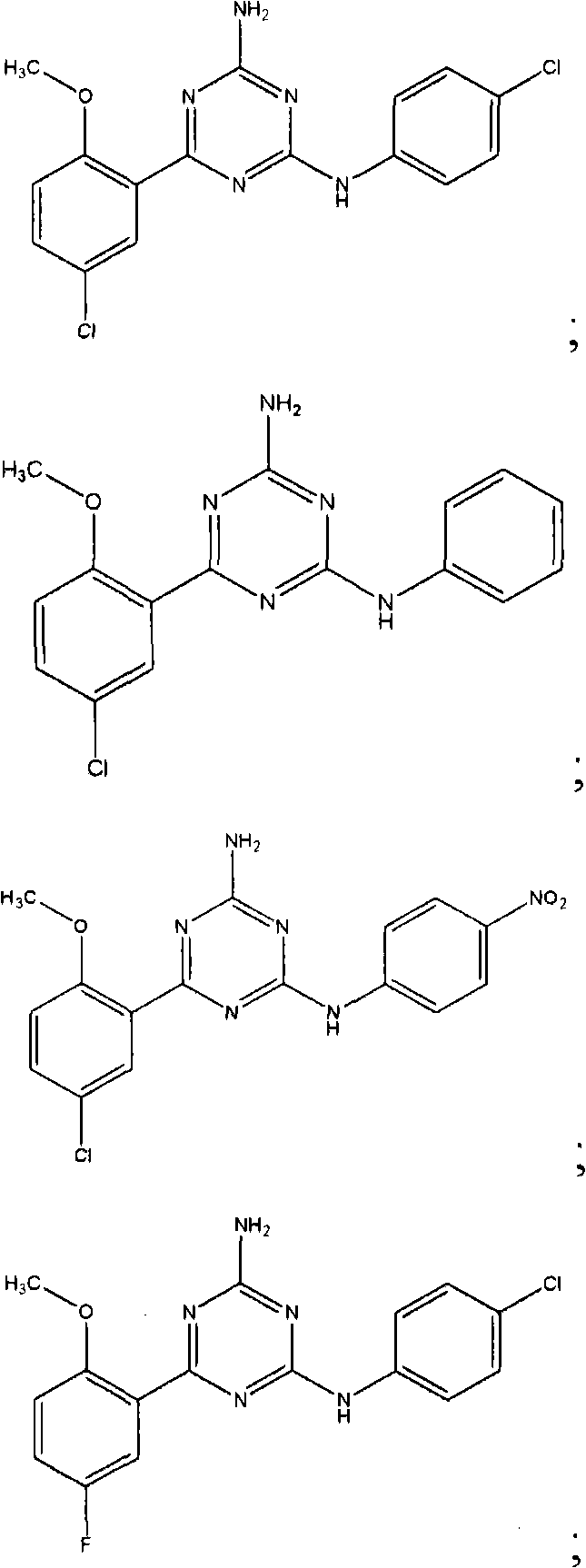

在一个实例中,此具有结构(XVI)的化合物不是CT32228。In one example, the compound of structure (XVI) is not CT32228.
在一个实例中,一种化合物具有如下结构(XVII):
其中:in:
R1为一个直链或支链的单,聚合或未被取代的烷基基团,一个直链或支链的单,聚合或未被取代的烯属烃基团,一个直链或支链的单,聚合或未被取代的芳基代的烷基,烷基芳基或芳基; R1 is a straight-chain or branched mono-, polymeric or unsubstituted alkyl group, a straight-chain or branched mono-, polymeric or unsubstituted olefinic group, a straight-chain or branched Mono, polymerized or unsubstituted aryl-substituted alkyl, alkylaryl or aryl;
R6选自以下基团OH,O-M+,O-M2+,其中M为碱金属,碱土金属或土金属或一个有机氮基的阳离子,及OR,其中R为一个已被或未被取代的烷基或具有1至15个碳原子的烯属烃基团。R6 is selected from the following groups OH, O-M+, O-M2+, wherein M is an alkali metal, alkaline earth metal or earth metal or an organic nitrogen-based cation, and OR, wherein R is a substituted or unsubstituted alkane group or an olefinic group having 1 to 15 carbon atoms.
结构(XVII)的化合物可用本领域技术人员熟知的有机合成技术制作,也可以用某些方法制作,这些方法描述于Cernerud等(美国专利号7,078,543),以上文献以引用方式并入本文。另外,这些化合物的特定例子可在这个出版物中发现。Compounds of structure (XVII) can be prepared using organic synthesis techniques well known to those skilled in the art, and can also be prepared by methods described in Cernerud et al. (US Patent No. 7,078,543), which is incorporated herein by reference. Additionally, specific examples of these compounds can be found in this publication.
具有结构(XVII)化合物的具体例子为:
它也被称为乙莫克舍。It is also known as Emoksher.
在一个实例中,此具有结构(XVII)的化合物不是乙莫克舍。In one example, the compound of structure (XVII) is not etamoxer.
在一个实例中,一种化合物具有如下结构(XVIII):
它的化学名为6-[4-(2-哌啶-1-基-乙氧基)-苯基)]-3-吡啶-4-基-吡唑[1,5-a]-嘧啶。Its chemical name is 6-[4-(2-piperidin-1-yl-ethoxy)-phenyl)]-3-pyridin-4-yl-pyrazol[1,5-a]-pyrimidine.
在一个实例中,一种化合物具有如下结构(XIX):
他也被称为羟苯甘氨酸He is also known as hydroxyphenylglycine
在一个实例中,一种化合物具有如下结构(XX): In one example, a compound has the following structure (XX):
它也被称为氯化奎宁。It is also known as chloroquine.
在一个实例中,一种化合物具有如下结构(XXI):
它也被称为三氯生。It is also known as triclosan.
在一个实例中,一种化合物具有如下结构(XXII):
它也被称为表没食子儿茶素-3-镓酸盐。It is also known as epigallocatechin-3-gallate.
在一个实例中,一种化合物为自然生的类黄酮。In one example, a compound is a naturally occurring flavonoid.
在一个具体实例中,一种化合物为以下自然生的类黄酮中的一种:
它也被称为毛地黄黄酮;
它也被称为橡黄素;或
它也被称为山柰酚。It is also known as kaempferol.
在一个实例中,一种化合物为CBM-301106。In one example, a compound is CBM-301106.
在一个实例中,一种化合物具有如下结构(XXIV):
或它的适于治疗的盐,酯,药物前体or its therapeutically suitable salts, esters, prodrugs
其中:in:
A选自以下基团:链烯基,烷氧基烷基,烷基,芳基,芳基烷基,环烷基,环烷基烷基,卤代烷基,杂芳基,杂芳烷基,杂环和卤代环烷基;A is selected from the group consisting of alkenyl, alkoxyalkyl, alkyl, aryl, arylalkyl, cycloalkyl, cycloalkylalkyl, haloalkyl, heteroaryl, heteroarylalkyl, Heterocycles and halocycloalkyls;
B选自芳香环和杂芳环,它可能被以下基团取代:卤素,-卤素,-OH,-NO2,NHC(O)-(C1-6)杂环,CHO,乙烯基,烯丙基,(C1-6)羟烷基,NH2,NH(C1-6)烷基,N[(C1-6)烷基]2CH=NOH,CH2N[(C1-6)烷基]2或CN;B is selected from aromatic and heteroaromatic rings, which may be substituted by the following groups: halogen, -halogen, -OH, -NO 2 , NHC(O)-(C 1-6 )heterocycle, CHO, vinyl, alkenyl Propyl, (C 1-6 ) hydroxyalkyl, NH 2 , NH(C 1-6 ) alkyl, N[(C 1-6 ) alkyl] 2 CH=NOH, CH 2 N[(C 1- 6 ) alkyl] 2 or CN;
D选自芳香环和杂芳环。D is selected from aromatic and heteroaromatic rings.
L1可缺失或者选自包含羟基烯属烃,-C(RaRb)-,-C(O)-,-C(O)O-,-C(O)NH-,-NRc-,-NRcCH2-,-NRcC(O)-,-NRcC(O)-O-,-NH-N=CH-,--NRcS(O)2-,-O-,-OC(O)NH-,-OC(O)-,-O-N=CH-,-S-,-S(O)2-,-S(O)2NH-的基团;L 1 may be absent or selected from the group consisting of hydroxyalkenes, -C(R a R b )-, -C(O)-, -C(O)O-, -C(O)NH-, -NR c - , -NR c CH 2 -, -NR c C(O)-, -NR c C(O)-O-, -NH-N=CH-, -NR c S(O) 2 -, -O- , -OC(O)NH-, -OC(O)-, -ON=CH-, -S-, -S(O) 2 -, -S(O) 2 NH- groups;
L2i选自由-C(RdRe)-,-(CH2)n-,-NH-,-O-,和-S-组成的基团;L 2 i is selected from the group consisting of -C(R d R e )-, -(CH 2 ) n -, -NH-, -O-, and -S-;
n为1,2或3;n is 1, 2 or 3;
Z选自以下基团:烷氧基,羟基,羟烷基,Rg-O-和Rj-NH-;Z is selected from the following groups: alkoxy, hydroxyl, hydroxyalkyl, R g -O- and R j -NH-;
R1为氢,(C1-6)卤代烷基或(C1-6)烷基;Ra和Rb各自分别选自:氢,烷基,卤代烷基和羟基或者R 1 is hydrogen, (C 1-6 ) haloalkyl or (C 1-6 ) alkyl; R a and R b are each selected from: hydrogen, alkyl, haloalkyl and hydroxyl or
Ra and Rb将这些原子结合在一起组成Rf-N=;R a and R b bind these atoms together to form R f -N =;
Rc选自如下基团:氢,烷基,芳基,卤代烷基和杂芳基; Rc is selected from the group consisting of hydrogen, alkyl, aryl, haloalkyl and heteroaryl;
Rd选自如下基团:烷基,卤代烷基,羟基和卤素;R d is selected from the following groups: alkyl, haloalkyl, hydroxyl and halogen;
Re选自如下基团:氢,烷基,卤代烷基,羟基和卤素,或者Rd和Re相邻原子结合在一起组成氧代;R e is selected from the following groups: hydrogen, alkyl, haloalkyl, hydroxyl and halogen, or the adjacent atoms of R d and R e are combined to form oxo;
Rf选自如下基团:烷氧基,芳氧基,卤代芳氧基,羟基;R f is selected from the following groups: alkoxy, aryloxy, haloaryloxy, hydroxyl;
Rg为H2N-C(O)-或(C1-6)烷基HN-C-(O)-;和Rj选自以下基团:烷基羰基,烷基-NH-C(O)-,烷氧基烷基,烷氧基烷基羰基,烷氧基羰基,烷氧基羰基-NH-烷基-NHC(O)-,烷氧基-NH-C(O)-,氰烷基羰基,羟基,HONH-C(O)-,H2NC(O)-,H2NC(=NH)-,H2NC(O)烷基-NHC(O)-,H2N-O-C(O)-,杂芳基,杂芳基羰基,杂环和杂环羰基。R g is H 2 NC(O)- or (C 1-6 )alkylHN-C-(O)-; and R j is selected from the following groups: alkylcarbonyl, alkyl-NH-C(O) -, alkoxyalkyl, alkoxyalkylcarbonyl, alkoxycarbonyl, alkoxycarbonyl-NH-alkyl-NHC(O)-, alkoxy-NH-C(O)-, cyanoalkane Cylcarbonyl, hydroxyl, HONH-C(O)-, H 2 NC(O)-, H 2 NC(=NH)-, H 2 NC(O)alkyl-NHC(O)-, H 2 NOC(O )-, heteroaryl, heteroarylcarbonyl, heterocyclic and heterocyclic carbonyl.
结构(XXIV)的一个实例为结构(XXIVa);
R为(C1-6)烷基,(C1-6)烷基-环烷基,(C1-6)烷基-杂芳基,(C1-6)烷基-卤代环烷基;并且其中X为-卤素,-OH,-NO2,NHC(O)-(C1-6)烷基,CHO,乙烯基,烯丙基,(C1-6)羟烷基,NH2,NH(C1-6)烷基,N[(C1-6)烷基]2CH=NOH,CH2N[(C1-6)alkyl]2或CN;R is (C 1-6 ) alkyl, (C 1-6 ) alkyl-cycloalkyl, (C 1-6 ) alkyl-heteroaryl, (C 1-6 ) alkyl-halogenated cycloalkane and wherein X is -halogen, -OH, -NO 2 , NHC(O)-(C 1-6 )alkyl, CHO, vinyl, allyl, (C 1-6 )hydroxyalkyl, NH 2 , NH(C 1-6 )alkyl, N[(C 1-6 )alkyl] 2 CH=NOH, CH 2 N[(C 1-6 )alkyl] 2 or CN;
结构(XXIVa)的具体事例列于下表。
结构(XXIV)的另一个实例为结构(XXIVb):
R为(C1-6)烷基,(C1-6)烷基-环烷基,(C1-6)烷基-杂芳基,(C1-6)烷基-卤代环烷基;并且其中X为-卤素,-OH,-NO2,NHC(O)-(C1-6)烷基,CHO,乙烯基,烯丙基,(C1-6)羟烷基,NH2,NH(C1-6)烷基,N[(C1-6)烷基]2CH=NOH,CH2N[(C1-6)alkyl]2或CN;R is (C 1-6 ) alkyl, (C 1-6 ) alkyl-cycloalkyl, (C 1-6 ) alkyl-heteroaryl, (C 1-6 ) alkyl-halogenated cycloalkane and wherein X is -halogen, -OH, -NO 2 , NHC(O)-(C 1-6 )alkyl, CHO, vinyl, allyl, (C 1-6 )hydroxyalkyl, NH 2 , NH(C 1-6 )alkyl, N[(C 1-6 )alkyl] 2 CH=NOH, CH 2 N[(C 1-6 )alkyl] 2 or CN;
在一个具体实例中,一个具有结构(XXIVb)的化合物为: In a specific example, a compound of structure (XXIVb) is:
在另一个实例中,此具有结构(XXIV)的化合物为:
在一个具体实例中,此具有结构(XXIV)的化合物为:
在一个实例中,一种化合物具有如下结构(XXV):
其中:in:
x和y各自分别为1,2或3;W为-C(O)N(R1)-,-C(O)N[C(O)R1a]-,-N(R1)C(O)N(R1a)-或-N(R1)C(O)-;V为-C(O)-,-C(S)-,-C(R10)H,-O-or-CH2-;x and y are each 1, 2 or 3; W is -C(O)N(R 1 )-, -C(O)N[C(O)R 1a ]-, -N(R 1 )C( O)N(R 1a )- or -N(R 1 )C(O)-; V is -C(O)-, -C(S)-, -C(R 10 )H, -O-or- CH2- ;
每个R1分别选自以下基团:氢;(C1-C6)烷基任选地被以下基团单或多取代:卤素,甲基或三氟甲基;以及(C2-C6)烷基任选地被选自以下基团的单个或多个取代基取代:甲氧基和氢氧根;Each R 1 is independently selected from the following groups: hydrogen; (C 1 -C 6 )alkyl optionally mono- or polysubstituted by: halogen, methyl or trifluoromethyl; and (C 2 -C 6 ) The alkyl group is optionally substituted by one or more substituents selected from the group consisting of methoxy and hydroxide;
R1a选自如下基团:氢,(C1-C6)烷基和环烷基;R 1a is selected from the group consisting of hydrogen, (C 1 -C 6 )alkyl and cycloalkyl;
R2选自以下基团:(C1-C6)烷基,(C2-C12)链烯基,(C2-C12)羟烷基,(C2-C12)羟基链烯基,(C2-C12)烷氧基,(C2-C12)烷氧基烷基,(C3-C12)环烷基,(C4-C12)环烷基烷基,芳基,(C7-C12)芳基代的烷基,(C3-C12)杂环,(C3-C12)杂环烷基,(C3-C12)杂芳基和(C3-C12)杂芳烷基;或R 2 is selected from the following groups: (C 1 -C 6 )alkyl, (C 2 -C 12 )alkenyl, (C 2 -C 12 )hydroxyalkyl, (C 2 -C 12 )hydroxyalkenyl radical, (C 2 -C 12 )alkoxy, (C 2 -C 12 )alkoxyalkyl, (C 3 -C 12 )cycloalkyl, (C 4 -C 12 )cycloalkylalkyl, Aryl, (C 7 -C 12 ) aryl-substituted alkyl, (C 3 -C 12 ) heterocycle, (C 3 -C 12 ) heterocycloalkyl, (C 3 -C 12 ) heteroaryl and (C 3 -C 12 )heteroaralkyl; or
R2为一个具有2至4个环的多环结构,其中这些环分别选自以下基团:环烷基,杂环,芳基和杂芳基并且一些或所有这些环可能互相稠合;R is a polycyclic structure with 2 to 4 rings, wherein these rings are respectively selected from the following groups: cycloalkyl, heterocycle, aryl and heteroaryl and some or all of these rings may be fused to each other;
R3选自以下基团:(C1-C6)烷基,(C2-C12)链烯基,(C2-C12)羟烷基,(C2-C12)羟基链烯基,(C2-C12)烷氧基,(C2-C12)烷氧基烷基,(C3-C12)环烷基,(C4-C12)环烷基烷基,被取代的芳基,被取代的(C7-C12)芳基代的烷基,(C3-C12)杂环,(C3-C12)杂环烷基,(C3-C12)杂芳基和(C3-C12)杂芳烷基;或R3是一个具有2至4个环的多环,其中这些环分别选自:环烷基,杂环,芳基和杂芳基并且一些或所有的这些环可能互相稠合;R 3 is selected from the following groups: (C 1 -C 6 )alkyl, (C 2 -C 12 )alkenyl, (C 2 -C 12 )hydroxyalkyl, (C 2 -C 12 )hydroxyalkenyl radical, (C 2 -C 12 )alkoxy, (C 2 -C 12 )alkoxyalkyl, (C 3 -C 12 )cycloalkyl, (C 4 -C 12 )cycloalkylalkyl, Substituted aryl, substituted (C 7 -C 12 ) aryl substituted alkyl, (C 3 -C 12 ) heterocycle, (C 3 -C 12 ) heterocycloalkyl, (C 3 -C 12 ) heteroaryl and (C 3 -C 12 ) heteroaralkyl; or R 3 is a polycyclic ring having 2 to 4 rings, wherein these rings are respectively selected from: cycloalkyl, heterocyclic, aryl and Heteroaryl and some or all of these rings may be fused to each other;
R4和R5各自分别选自:氢,氟代,氯代,甲基,甲氧基,三氟甲基,氰基,硝基或-N(R12)2;R 4 and R 5 are each selected from: hydrogen, fluoro, chloro, methyl, methoxy, trifluoromethyl, cyano, nitro or -N(R 12 ) 2 ;
R6,R6a,R7,R7a,R8,R8a,R9,和R9a各自分别选自:氢或(C1-C3)烷基;或R 6 , R 6a , R 7 , R 7a , R 8 , R 8a , R 9 , and R 9a are each independently selected from: hydrogen or (C 1 -C 3 )alkyl; or
R6和R6a组成,或R7和R7a组成,或R8和R8a组成,或R9和R9a组成为一个氧代基团,前提是当V为-C(O)-时,R7和R7a结合或R8和R8a结合但不组成一个氧代基团,而剩余的R6,R6a,R7,R7a,R8,R8a,R9,和R9a各自分别选自氢或(C3-C12)烷基;或R 6 and R 6a , or R 7 and R 7a , or R 8 and R 8a , or R 9 and R 9a form an oxo group, provided that when V is -C(O)-, R 7 and R 7a combined or R 8 and R 8a combined but not forming an oxo group, while the remaining R 6 , R 6a , R 7 , R 7a , R 8 , R 8a , R 9 , and R 9a are each independently selected from hydrogen or (C 3 -C 12 )alkyl; or
R6,R6a,R7,和R7a中的一个与R8,R8a,R9和R9a中的一个共同形成一个亚烷基桥,而剩余R6,R6a,R7,R7a,R8,R8a,R9,和R9a各自分别选自氢或(C3-C12)烷基;One of R 6 , R 6a , R 7 , and R 7a forms an alkylene bridge with one of R 8 , R 8a , R 9 , and R 9a , while the remaining R 6 , R 6a , R 7 , R 7a , R 8 , R 8a , R 9 , and R 9a are each independently selected from hydrogen or (C 3 -C 12 ) alkyl;
R10为氢或(C3-C12)烷基;并且每个R12分别选自氢或(C1-C6)烷基;其立体异构体,对映体或互变异构体,其药学可接受盐,其药物组合物或其药物前体。R 10 is hydrogen or (C 3 -C 12 ) alkyl; and each R 12 is independently selected from hydrogen or (C 1 -C 6 ) alkyl; stereoisomers, enantiomers or tautomers thereof , its pharmaceutically acceptable salt, its pharmaceutical composition or its prodrug.
在一个具体实例中,一个具有结构(XXV)的化合物为:
Ar为2-三氟甲基苯基,苯基,2-氟苯基,3-氟苯基,4-氟苯基,2,3-二氟苯基,2,4-二氟苯基,2,5-二氟苯基,2,6-二氟苯基,2-氯苯基或2,5-二氯苯基。Ar is 2-trifluoromethylphenyl, phenyl, 2-fluorophenyl, 3-fluorophenyl, 4-fluorophenyl, 2,3-difluorophenyl, 2,4-difluorophenyl, 2,5-difluorophenyl, 2,6-difluorophenyl, 2-chlorophenyl or 2,5-dichlorophenyl.
结构(XXV)的另一个具体实例为:
在一个实例中,一种化合物具有如下结构(XXVI):
m为1,2或3。m is 1, 2 or 3.
n为1,2,3或4;n is 1, 2, 3 or 4;
p为2,3或4;p is 2, 3 or 4;
V为-C(O)-,-S(O)-或-S(O)2,-O-或-CH2-;V is -C(O)-, -S(O)- or -S(O)2, -O- or -CH 2 -;
R1为氢,烷基,链烯基,芳基,杂芳基,芳基代的烷基,芳基代的链烯基或环烷基; R is hydrogen, alkyl, alkenyl, aryl, heteroaryl, aryl-substituted alkyl, aryl-substituted alkenyl or cycloalkyl;
R2选自以下基团:氢,-R7-OR8,-R7-N(R8)2,-R7-S(O)tR10(其中t为0,1或2),烷基,链烯基,可选被取代芳基,可选被取代芳基代的烷基,可选被取代芳基代的链烯基,可选被取代环烷基,可选被取代环烷基烷基,可选被取代环烷基链烯基,可选被取代杂环,可选被取代杂环烷基,可选被取代杂环链烯基,可选被取代杂芳基,可选被取代杂芳烷基和可选被取代杂芳基链烯基;R 2 is selected from the following groups: hydrogen, -R 7 -OR 8 , -R 7 -N(R 8 ) 2 , -R 7 -S(O) t R 10 (where t is 0, 1 or 2), Alkyl, alkenyl, optionally substituted aryl, optionally substituted aryl-substituted alkyl, optionally substituted aryl-substituted alkenyl, optionally substituted cycloalkyl, optionally substituted ring Alkylalkyl, optionally substituted cycloalkylalkenyl, optionally substituted heterocycle, optionally substituted heterocycloalkyl, optionally substituted heterocycloalkenyl, optionally substituted heteroaryl, optionally substituted heteroarylalkyl and optionally substituted heteroarylalkenyl;
R3选自以下基团:氢,-R9-OR8,-R9-N(R8)2,烷基,链烯基,可选被取代芳基,可选被取代芳基代的烷基,可选被取代芳基代的链烯基,可选被取代环烷基,可选被取代环烷基烷基,可选被取代环烷基链烯基,可选被取代杂环,可选被取代杂环烷基,可选被取代杂环链烯基,可选被取代杂芳基,可选被取代杂芳烷基和可选被取代杂芳基链烯基;R 3 is selected from the following groups: hydrogen, -R9-OR 8 , -R9-N(R 8 ) 2 , alkyl, alkenyl, optionally substituted aryl, optionally substituted aryl substituted alkyl , optionally substituted aryl substituted alkenyl, optionally substituted cycloalkyl, optionally substituted cycloalkylalkyl, optionally substituted cycloalkylalkenyl, optionally substituted heterocycle, can optionally substituted heterocycloalkyl, optionally substituted heterocycloalkenyl, optionally substituted heteroaryl, optionally substituted heteroarylalkyl and optionally substituted heteroarylalkenyl;
每个R4分别为氢,烷基,链烯基,卤素,卤代烷基,芳基,氰基,硝基,-R9-OR8,-R9-N(R8)2或-S(O)t-R10(其中t为0,1或2);Each R 4 is independently hydrogen, alkyl, alkenyl, halogen, haloalkyl, aryl, cyano, nitro, -R 9 -OR 8 , -R 9 -N(R 8 ) 2 or -S( O) t -R 10 (wherein t is 0, 1 or 2);
每个R5和R6分别为氢,氧代,烷基,链烯基,卤素,卤代烷基或芳基;或each of R and R is independently hydrogen, oxo, alkyl, alkenyl, halogen, haloalkyl or aryl; or
一个R5和一个R6可共同组成一个直链或支链的亚烷基桥;One R5 and one R6 can together form a linear or branched alkylene bridge;
每个R7分别为一个直链或支链的烯属烃或亚烯基;Each R 7 is respectively a linear or branched olefin or alkenylene;
每个R8分别为氢,烷基,链烯基,卤代烷基,环烷基,环烷基烷基,芳基,芳基代的烷基,杂环,杂环烷基,杂芳基或杂芳烷基;Each R is independently hydrogen, alkyl, alkenyl, haloalkyl, cycloalkyl, cycloalkylalkyl, aryl, aryl-substituted alkyl, heterocycle, heterocycloalkyl, heteroaryl or Heteroaralkyl;
每个R9分别为一个直连键或一个直链或支链的烯属烃或亚烯基;并且Each R is independently a direct bond or a linear or branched alkene or alkenylene; and
R10为烷基,链烯基,卤代烷基,环烷基,环烷基烷基,芳基,芳基代的烷基,杂环,杂环烷基,杂芳基或杂芳烷基;及其单个立体异构体,立体异构体混合物,立体异构体的外消旋混合物,或互变异构体;或其药学可接受盐,药物前体,溶剂或多晶型物。 R is alkyl, alkenyl, haloalkyl, cycloalkyl, cycloalkylalkyl, aryl, aryl-substituted alkyl, heterocycle, heterocycloalkyl, heteroaryl or heteroaralkyl; A single stereoisomer, a mixture of stereoisomers, a racemic mixture of stereoisomers, or a tautomer; or a pharmaceutically acceptable salt, prodrug, solvent, or polymorph thereof.
结构(XXVI)的另一个具体实例为:
在一个实例中,一种化合物具有如下结构(XXVII):
其中:in:
x和y各自分别为1,2或3;W 为-C(O)N(R1)-,-C(O)N[C(O)R1a]-,-N(R1)C(O)N(R1a)-或-N(R1)C(O)-;V为-C(O)-,-C(S)-,-C(R10)H,-O-或-CH2-;x and y are each 1, 2 or 3; W is -C(O)N(R 1 )-, -C(O)N[C(O)R 1a ]-, -N(R 1 )C( O)N(R 1a )- or -N(R 1 )C(O)-; V is -C(O)-, -C(S)-, -C(R 10 )H, -O- or - CH2- ;
每个R1分别为氢;(C1-C6)烷基可选被一或多个选自以下基团的取代基取代:卤素,甲基或三氟甲基;并且(C2-C6)烷基可选地被一或多个选自以下基团的取代基取代:甲氧基和氢氧根;R1a选自氢,(C1-C6)烷基和环烷基;R2选自以下基团:(C1-C6)烷基,(C2-C12)链烯基,(C2-C12)羟烷基,(C2-C12)羟基链烯基,(C2-C12)烷氧基,(C2-C12)烷氧基烷基,(C3-C12)环烷基,(C4-C12)环烷基烷基,芳基,(C7-C12)芳基代的烷基,(C3-C12)杂环,(C3-C12)杂环烷基,(C3-C12)杂芳基和(C3-C12)杂芳烷基;Each R 1 is independently hydrogen; (C 1 -C 6 )alkyl is optionally substituted by one or more substituents selected from the group consisting of halogen, methyl or trifluoromethyl; and (C 2 -C 6 ) The alkyl group is optionally substituted by one or more substituents selected from the group consisting of methoxy and hydroxide; R 1a is selected from hydrogen, (C 1 -C 6 )alkyl and cycloalkyl; R 2 is selected from the following groups: (C 1 -C 6 )alkyl, (C 2 -C 12 )alkenyl, (C 2 -C 12 )hydroxyalkyl, (C 2 -C 12 )hydroxyalkenyl radical, (C 2 -C 12 )alkoxy, (C 2 -C 12 )alkoxyalkyl, (C 3 -C 12 )cycloalkyl, (C 4 -C 12 )cycloalkylalkyl, Aryl, (C 7 -C 12 ) aryl-substituted alkyl, (C 3 -C 12 ) heterocycle, (C 3 -C 12 ) heterocycloalkyl, (C 3 -C 12 ) heteroaryl and (C 3 -C 12 )heteroaralkyl;
或R2为一个具有2至4个环的多环结构,其中这些环分别选自以下基团:环烷基,杂环,芳基和杂芳基并且一些或所有的这些环可能互相稠合;or R2 is a polycyclic structure having 2 to 4 rings, wherein these rings are respectively selected from the following groups: cycloalkyl, heterocycle, aryl and heteroaryl and some or all of these rings may be fused to each other ;
R3选自以下基团:(C1-C6)烷基,(C2-C12)链烯基,(C2-C12)羟烷基,(C2-C12)羟基链烯基,(C2-C12)烷氧基,(C2-C12)烷氧基烷基,(C3-C12)环烷基,(C4-C12)环烷基烷基,被取代的芳基,被取代的(C7-C12)芳基代的烷基,(C3-C12)杂环,(C3-C12)杂环烷基,(C3-C12)杂芳基和(C3-C12)杂芳烷基;或R3 is selected from the following groups: (C 1 -C 6 )alkyl, (C 2 -C 12 )alkenyl, (C 2 -C 12 )hydroxyalkyl, (C 2 -C 12 )hydroxyalkenyl , (C 2 -C 12 )alkoxy, (C 2 -C 12 )alkoxyalkyl, (C 3 -C 12 )cycloalkyl, (C 4 -C 12 )cycloalkylalkyl, by Substituted aryl, substituted (C 7 -C 12 ) aryl substituted alkyl, (C 3 -C 12 ) heterocycle, (C 3 -C 12 ) heterocycloalkyl, (C 3 -C 12 ) heteroaryl and (C 3 -C 12 ) heteroaralkyl; or
R3为一个具有2至4个环的多环结构,其中这些环分别选自以下基团:环烷基,杂环,芳基和杂芳基并且一些或所有的这些环可能互相稠合;R3 is a polycyclic structure with 2 to 4 rings, wherein these rings are respectively selected from the following groups: cycloalkyl, heterocycle, aryl and heteroaryl and some or all of these rings may be fused to each other;
R4和R5各自分别选自:氢,氟代,氯代,甲基,甲氧基,三氟甲基,氰基,硝基或-N(R12)2;R 4 and R 5 are each selected from: hydrogen, fluoro, chloro, methyl, methoxy, trifluoromethyl, cyano, nitro or -N(R 12 ) 2 ;
R6,R6a,R7,R7a,R8,R8a,R9,和R9a各自分别选自:氢或(C1-C3)烷基;或R 6 , R 6a , R 7 , R 7a , R 8 , R 8a , R 9 , and R 9a are each independently selected from: hydrogen or (C 1 -C 3 )alkyl; or
R6和R6a组成,或R7和R7a组合,或R8和R8a组合,或R9和R9a组成为一个氧代基团,前提是当V为-C(O)-时,R7和R7a结合或R8和R8a结合但不组成一个氧代基团,而剩余的R6,R6a,R7,R7a,R8,R8a,R9,和R9a各自分别选自氢或(C3-C12)烷基;或R 6 and R 6a are combined, or R 7 and R 7a are combined, or R 8 and R 8a are combined, or R 9 and R 9a are combined to form an oxo group, provided that when V is -C(O)-, R 7 and R 7a combined or R 8 and R 8a combined but not forming an oxo group, while the remaining R 6 , R 6a , R 7 , R 7a , R 8 , R 8a , R 9 , and R 9a are each independently selected from hydrogen or (C 3 -C 12 )alkyl; or
R6,R6a,R7,和R7a中的一个和R8,R8a,R9和R9a中的一个共同形成一个亚烷基桥,而剩余R6,R6a,R7,R7a,R8,R8a,R9,和R9a各自分别选自氢或(C3-C12)烷基;One of R 6 , R 6a , R 7 , and R 7a and one of R 8 , R 8a , R 9 , and R 9a together form an alkylene bridge, while the remaining R 6 , R 6a , R 7 , R 7a , R 8 , R 8a , R 9 , and R 9a are each independently selected from hydrogen or (C 3 -C 12 ) alkyl;
R10为氢或(C3-C12)烷基;和R 10 is hydrogen or (C3-C12) alkyl; and
每个R12分别选自氢或(C1-C6)烷基;Each R 12 is independently selected from hydrogen or (C 1 -C 6 ) alkyl;
其立体异构体,对映体或互变异构体,或其药学可接受盐,药物组合物,药物前体。Stereoisomers, enantiomers or tautomers thereof, or pharmaceutically acceptable salts thereof, pharmaceutical compositions, drug prodrugs.
结构(XXVII)的一个实例为结构(XXVIIa):

在一个实例中,一种化合物具有如下结构(XXVIII):其中:In one example, a compound has the following structure (XXVIII): in:
x和y各自分别为1,2或3;x and y are each 1, 2 or 3;
V为-C(O)-,-C(S)-,-C(R10)H,-O-或-CH2-;V is -C(O)-, -C(S)-, -C(R 10 )H, -O- or -CH 2 -;
每个R1分别选自以下基团:氢;(C1-C6)烷基任选地被以下基团单或多取代:卤素,甲基或三氟甲基;以及(C2-C6)烷基任选地被以下单或多个基团取代:甲氧基和氢氧根;Each R 1 is independently selected from the following groups: hydrogen; (C 1 -C 6 )alkyl optionally mono- or polysubstituted by: halogen, methyl or trifluoromethyl; and (C 2 -C 6 ) The alkyl group is optionally substituted by one or more of the following groups: methoxy and hydroxide;
R1a选自如下基团:氢,(C1-C6)烷基和环烷基;R 1a is selected from the group consisting of hydrogen, (C 1 -C 6 )alkyl and cycloalkyl;
R2选自以下基团:(C1-C6)烷基,(C2-C12)链烯基,(C2-C12)羟烷基,(C2-C12)羟基链烯基,(C2-C12)烷氧基,(C2-C12)烷氧基烷基,(C3-C12)环烷基,(C4-C12)环烷基烷基,芳基,(C7-C12)芳基代的烷基,(C3-C12)杂环,(C3-C12)杂环烷基,(C3-C12)杂芳基和(C3-C12)杂芳烷基;或R 2 is selected from the following groups: (C 1 -C 6 )alkyl, (C 2 -C 12 )alkenyl, (C 2 -C 12 )hydroxyalkyl, (C 2 -C 12 )hydroxyalkenyl radical, (C 2 -C 12 )alkoxy, (C 2 -C 12 )alkoxyalkyl, (C 3 -C 12 )cycloalkyl, (C 4 -C 12 )cycloalkylalkyl, Aryl, (C 7 -C 12 ) aryl-substituted alkyl, (C 3 -C 12 ) heterocycle, (C 3 -C 12 ) heterocycloalkyl, (C 3 -C 12 ) heteroaryl and (C 3 -C 12 )heteroaralkyl; or
R2是一个具有2至4个环的多环结构,其中这些环分别选自:环烷基,杂环,芳基和杂芳基并且其中一些或所有的这些环可相互稠合;R3选自以下基团:(C1-C6)烷基,(C2-C12)链烯基,(C2-C12)羟烷基,(C2-C12)羟基链烯基,(C2-C12)烷氧基,(C2-C12)烷氧基烷基,(C3-C12)环烷基,(C4-C12)环烷基烷基,被取代的芳基,被取代的(C7-C12)芳基代的烷基,(C3-C12)杂环,(C3-C12)杂环烷基,(C3-C12)杂芳基和(C3-C12)杂芳烷基;或R 2 is a polycyclic structure with 2 to 4 rings, wherein these rings are respectively selected from: cycloalkyl, heterocycle, aryl and heteroaryl and some or all of these rings may be fused to each other; R 3 Groups selected from the group consisting of: (C 1 -C 6 )alkyl, (C 2 -C 12 )alkenyl, (C 2 -C 12 )hydroxyalkyl, (C 2 -C 12 )hydroxyalkenyl, (C 2 -C 12 )alkoxy, (C 2 -C 12 )alkoxyalkyl, (C 3 -C 12 )cycloalkyl, (C 4 -C 12 )cycloalkylalkyl, substituted Aryl, substituted (C 7 -C 12 ) aryl substituted alkyl, (C 3 -C 12 ) heterocycle, (C 3 -C 12 ) heterocycloalkyl, (C 3 -C 12 ) Heteroaryl and (C 3 -C 12 )heteroaralkyl; or
R3为一个具有2至4个环的多环结构,其中这些环分别选自以下基团:环烷基,杂环,芳基和杂芳基并且一些或所有的这些环可能互相稠合; R is a polycyclic structure with 2 to 4 rings, wherein these rings are respectively selected from the following groups: cycloalkyl, heterocycle, aryl and heteroaryl and some or all of these rings may be fused to each other;
R4和R5各自分别选自:氢,氟代,氯代,甲基,甲氧基,三氟甲基,氰基,硝基或-N(R12)2;R 4 and R 5 are each selected from: hydrogen, fluoro, chloro, methyl, methoxy, trifluoromethyl, cyano, nitro or -N(R 12 ) 2 ;
R6,R6a,R7,R7a,R8,R8a,R9,和R9a各自分别选自:氢或(C1-C3)烷基;或R 6 , R 6a , R 7 , R 7a , R 8 , R 8a , R 9 , and R 9a are each independently selected from: hydrogen or (C 1 -C 3 )alkyl; or
R6和R6a组成,或R7和R7a组合或R8和R8a组合或R9和R9a组成为一个氧代基团,前提是当V为-C(O)-时,R7和R7a结合或R8和R8a结合但不组成一个氧代基团,而剩余的R6,R6a,R7,R7a,R8,R8a,R9,和R9a各自分别选自氢或(C3-C12)烷基;或The combination of R 6 and R 6a , or the combination of R 7 and R 7a , or the combination of R 8 and R 8a , or the combination of R 9 and R 9a forms an oxo group, provided that when V is -C(O)-, R 7 and R 7a or R 8 and R 8a are combined but do not form an oxo group, and the remaining R 6 , R 6a , R 7 , R 7a , R 8 , R 8a , R 9 , and R 9a are each selected from from hydrogen or (C 3 -C 12 )alkyl; or
R6,R6a,R7,和R7a中的一个和R8,R8a,R9和R9a中的一个共同形成一个亚烷基桥,而剩余R6,R6a,R7,R7a,R8,R8a,R9,和R9a各自分别选自氢或(C3-C12)烷基;One of R 6 , R 6a , R 7 , and R 7a and one of R 8 , R 8a , R 9 , and R 9a together form an alkylene bridge, while the remaining R 6 , R 6a , R 7 , R 7a , R 8 , R 8a , R 9 , and R 9a are each independently selected from hydrogen or (C 3 -C 12 ) alkyl;
R10为氢或(C3-C12)烷基;和R 10 is hydrogen or (C3-C12) alkyl; and
每个R12分别选自氢或(C1-C6)烷基;其立体异构体,对映体或互变异构体,其药学可接受盐,其药物组合物或其药物前体。Each R 12 is independently selected from hydrogen or (C 1 -C 6 ) alkyl; stereoisomers, enantiomers or tautomers thereof, pharmaceutically acceptable salts thereof, pharmaceutical compositions or prodrugs thereof .
在一个实例中,此具有结构(XVIII)的化合物是:

结构(XXVIII)的一个具体实例为如下的(XXVIIIa):
R13为-CH3,-CF3,n-Pr或-CH2Ph;并且其中R 13 is -CH 3 , -CF 3 , n-Pr or -CH 2 Ph; and wherein
Ar为苯基,2-氯苯基,2-氟苯基,2-甲苯基或2-氯代-5-氟苯基。Ar is phenyl, 2-chlorophenyl, 2-fluorophenyl, 2-tolyl or 2-chloro-5-fluorophenyl.
结构(XXVIII)的一个具体实例为如下的(XVIIIb):
其中R13为-CH3,-CF3,n-Pr或-CH2Ph;Wherein R 13 is -CH 3 , -CF 3 , n-Pr or -CH 2 Ph;
并且其中Ar为苯基,2-氯苯基,2-氟苯基,2-甲苯基或2-氯代-5-氟苯基。And wherein Ar is phenyl, 2-chlorophenyl, 2-fluorophenyl, 2-tolyl or 2-chloro-5-fluorophenyl.
结构(XXVIII)的一个具体实例为如下的(XXVIIIc):
其中R13为-CH3,-CF3,n-Pr或-CH2Ph;Wherein R 13 is -CH 3 , -CF 3 , n-Pr or -CH 2 Ph;
并且其中Ar为苯基,2-氯苯基,2-氟苯基,2-甲苯基或2-氯代-5-氟苯基。And wherein Ar is phenyl, 2-chlorophenyl, 2-fluorophenyl, 2-tolyl or 2-chloro-5-fluorophenyl.
结构(XXVIII)的一个具体实例为如下的(XXVIIId):
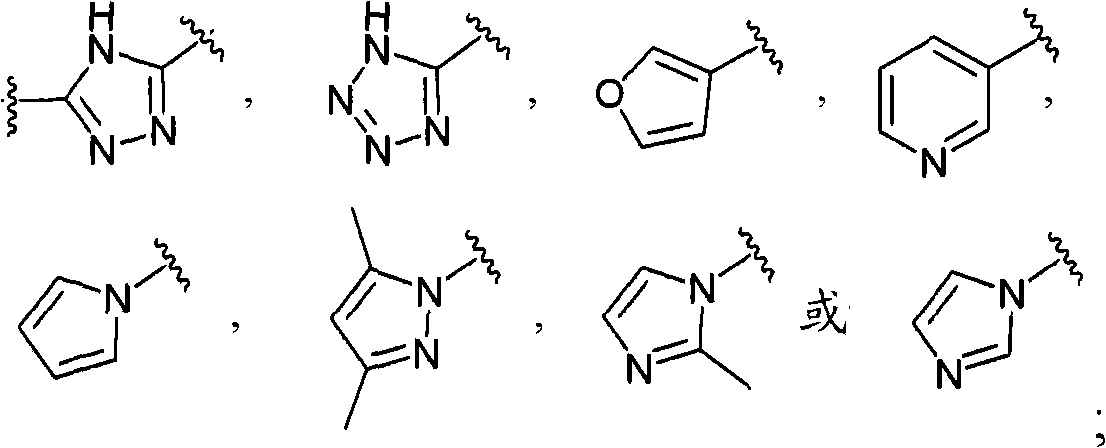
并且其中Ar为苯基,2-氯苯基,2-氟苯基,2-甲苯基或2-氯代-5-氟苯基。And wherein Ar is phenyl, 2-chlorophenyl, 2-fluorophenyl, 2-tolyl or 2-chloro-5-fluorophenyl.
在一个实例中,一种化合物具有如下结构(XXIX):
X为-(C5-C20)烷基,-O-(C5-C20)烷基或-(C5-C20)烷氧基;R为-O-(C1-C6)烷基,(C1-C6)烷氧基,O-(C1-C6)烷基-NHC(O)-(C1-C6)烷基,-NH2或-NH-(C1-C6)烷基;X is -(C 5 -C 20 )alkyl, -O-(C 5 -C 20 )alkyl or -(C 5 -C 20 )alkoxy; R is -O-(C 1 -C 6 ) Alkyl, (C 1 -C 6 )alkoxy, O-(C 1 -C 6 )alkyl-NHC(O)-(C 1 -C 6 )alkyl, -NH 2 or -NH-(C 1 -C 6 ) alkyl;
其立体异构体,对映异构体或互变异构体,或其药学可接受盐,金属螯合物,药物组合物或药物前体。Stereoisomers, enantiomers or tautomers thereof, or pharmaceutically acceptable salts, metal chelates, pharmaceutical compositions or drug prodrugs thereof.
在一个具体实例中,一个具有结构(XXIX)的化合物为:

在一个实例中,一种化合物具有如下结构(XXX):
X为-(C1-C6)烷基,-(C1-C6)烷氧基,-(C1-C6)链烯氧基,-(C1-C6)羟烷基,芳基,杂环,杂芳基,-CN,-CHO,-CO(C1-C6)烷基,-S(C1-C6)烷基,-CON[(C1-C6)烷基]2,-CONH2,-(C1-C6)烷基COO(C1-C6)烷基,-(C1-C6)烷基OCOO(C1-C6)烷基,-(C1-C6)烷基COO(C1-C6)烷基,-CO(C1-C6)烷基COO(C1-C6)烷基,CO(C1-C6)烷基COOH,-O(C1-C6)烷基COO(C1-C6)烷基或-S(C1-C6)烷基COO(C1-C6)烷基。X is -(C 1 -C 6 ) alkyl, -(C 1 -C 6 ) alkoxy, -(C 1 -C 6 ) alkenyloxy, -(C 1 -C 6 ) hydroxyalkyl, Aryl, heterocycle, heteroaryl, -CN, -CHO, -CO(C 1 -C 6 ) alkyl, -S(C 1 -C 6 ) alkyl, -CON[(C 1 -C 6 ) Alkyl] 2 , -CONH 2 , -(C 1 -C 6 )alkylCOO(C 1 -C 6 )alkyl, -(C 1 -C 6 )alkylOCOO(C 1 -C 6 )alkyl , -(C 1 -C 6 )alkylCOO(C 1 -C 6 )alkyl, -CO(C 1 -C 6 )alkylCOO(C 1 -C 6 )alkyl, CO(C 1 -C 6 ) AlkylCOOH, -O(C 1 -C 6 )alkylCOO(C 1 -C 6 )alkyl or -S(C 1 -C 6 )alkylCOO(C 1 -C 6 )alkyl.
在一个具体实例中,一个具有结构(XXX)的化合物为: In a specific example, a compound of structure (XXX) is:
在一个实例中,一种化合物具有如下结构(XXXI):
X为-(C5-C20)烷基,-O(C5-C20)烷基或-(C5-C20)烷氧基,-(C5-C20)卤代烷基,-O-(C5-C20)卤代烷基或-(C5-C20)卤代烷氧基,-卤素,-OH,-(C5-C20)链烯基,-(C5-C20)炔基,-(C5-C20)烷氧基-链烯基,-(C5-C20)羟烷基,-O(C1-C6)烷基,-CO2(C1-C6)烷基,-O(C5-C20)链烯基,-O(C5-C20)炔基,-O(C5-C20)环烷基;,-S(C5-C20)烷基,-NH(C5-C20)烷基,-NHCO(C5-C20)烷基,-N(C1-C6)烷基CO(C5-C20)烷基或-O(C5-C20)烷氧基;X is -(C 5 -C 20 )alkyl, -O(C 5 -C 20 )alkyl or -(C 5 -C 20 )alkoxy, -(C 5 -C 20 )halogenated alkyl, -O -(C 5 -C 20 )haloalkyl or -(C 5 -C 20 )haloalkoxy, -halogen, -OH, -(C 5 -C 20 )alkenyl, -(C 5 -C 20 )alkyne -(C 5 -C 20 )alkoxy-alkenyl, -(C 5 -C 20 )hydroxyalkyl, -O(C 1 -C 6 )alkyl, -CO 2 (C 1 -C 6 ) Alkyl, -O(C 5 -C 20 ) alkenyl, -O(C 5 -C 20 ) alkynyl, -O(C 5 -C 20 ) cycloalkyl;, -S(C 5 - C 20 )alkyl, -NH(C 5 -C 20 )alkyl, -NHCO(C 5 -C 20 )alkyl, -N(C 1 -C 6 )alkylCO(C 5 -C 20 )alkane group or -O(C 5 -C 20 )alkoxy;
R为-H或(C1-C6)烷基;R is -H or (C 1 -C6) alkyl;
m为1,2或3。m is 1, 2 or 3.
在一个具体实例中,一个具有结构(XXXI)的化合物为: 
在一个实例中,一种化合物具有如下结构(XXXIII):
Y为O或S;-NH或N(C-1-C6)烷基Y is O or S; -NH or N(C-1-C6) alkyl
X为-COOH,-CO2(C1-C6)烷基,-CONH2,-H,-CO(C1-C6)烷基,-COC(卤素)3,或一个可与辅酶A形成加合物的官能团;并且X is -COOH, -CO 2 (C 1 -C 6 ) alkyl, -CONH 2 , -H, -CO (C 1 -C 6 ) alkyl, -COC (halogen) 3 , or a functional group that can form an adduct with Coenzyme A; and
Z为-(C5-C20)烷基,-O(C5-C20)烷基或-(C5-C20)烷氧基,-(C5-C20)卤代烷基,-O-(C5-C20)卤代烷基或-(C5-C20)卤代烷氧基,-卤素,-OH,-(C5-C20)链烯基,-(C5-C20)炔基,-(C5-C20)烷氧基-链烯基,-(C5-C20)羟烷基,-O(C1-C6)烷基,-CO2(C1-C6)烷基,-O(C5-C20)链烯基,-O(C5-C20)炔基,-O(C5-C20)环烷基;-S(C5-C20)烷基,-NH(C5-C20)烷基,-NHCO(C5-C20)烷基,-N(C1-C6)烷基CO(C5-C20)烷基或-O(C5-C20)烷氧基。Z is -(C 5 -C 20 )alkyl, -O(C 5 -C 20 )alkyl or -(C 5 -C 20 )alkoxy, -(C 5 -C 20 )halogenated alkyl, -O -(C 5 -C 20 )haloalkyl or -(C 5 -C 20 )haloalkoxy, -halogen, -OH, -(C 5 -C 20 )alkenyl, -(C 5 -C 20 )alkyne -(C 5 -C 20 )alkoxy-alkenyl, -(C 5 -C 20 )hydroxyalkyl, -O(C 1 -C 6 )alkyl, -CO 2 (C 1 -C 6 ) Alkyl, -O(C 5 -C 20 ) alkenyl, -O(C 5 -C 20 ) alkynyl, -O(C 5 -C 20 ) cycloalkyl; -S(C 5 -C 20 ) Alkyl, -NH(C 5 -C 20 ) Alkyl, -NHCO(C 5 -C 20 ) Alkyl, -N(C 1 -C 6 ) AlkylCO(C 5 -C 20 ) Alkyl or -O(C 5 -C 20 )alkoxy.
在一个实例中,具有结构(XXXIII)的这些化合物中的Y为O。In one example, Y in these compounds of structure (XXXIII) is O.
在另外一个实例中,具有结构(XXXIII)的这些化合物中的X为-COOH。In another example, X in these compounds of structure (XXXIII) is -COOH.
在另外一个实例中,具有结构(XXXIII)的这些化合物中的Z为-O(C5-C20)烷基,-O(C5-C20)卤代烷基,-O(C5-C20)链烯基,-O(C5-C20)炔基或-O(C5-C20)烷氧基。In another example, Z in these compounds having structure (XXXIII) is -O(C 5 -C 20 )alkyl, -O(C 5 -C 20 )haloalkyl, -O(C 5 -C 20 )alkenyl, -O(C 5 -C 20 )alkynyl or -O(C 5 -C 20 )alkoxy.
在另外一个实例中,具有结构(XXXIII)的这些化合物中的Y为O,X为-COOH并且Z为-O(C5-C20)烷基,-O(C5-C20)卤代烷基,-O(C5-C20)链烯基,-O(C5-C20)炔基或-O(C5-C20)烷氧基。In another example, Y is O, X is -COOH and Z is -O(C 5 -C 20 )alkyl, -O(C 5 -C 20 )haloalkyl in these compounds of structure (XXXIII) , -O(C 5 -C 20 )alkenyl, -O(C 5 -C 20 )alkynyl or -O(C 5 -C 20 )alkoxy.
在另一个实例中,具有结构(XXXIII)的这些化合物中的X为一个可与辅酶A形成酯的官能团。例如,X可为一个能形成如下这种结构的官能团:
在一个具体实例中,一种具有结构(XXXIII)的化合物为:
X为-COOH,-CO2(C1-C6)烷基,-CONH2,-H,-CO(C1-C6)烷基,-COC(卤素)3,
在另外一个具体实例中,一种具有结构(XXXIII)的化合物为:
在一个具体实例中,具有结构(XXXIII)的这些化合物被揭露于Parker等《医药化学期刊》1977,20,781-791,它被通过引用方式并入本文。In a specific example, these compounds having structure (XXXIII) are disclosed in Parker et al.,
在一个实例中,一种化合物具有如下结构(XXXII):
X为-(C5-C20)烷基,-O(C5-C20)烷基或-(C5-C20)烷氧基,-(C5-C20)卤代烷基,-O-(C5-C20)卤代烷基或-(C5-C20)卤代烷氧基,-卤素,-OH,-(C5-C20)链烯基,-(C5-C20)炔基,-(C5-C20)烷氧基-链烯基,-(C5-C20)羟烷基,-O(C1-C6)烷基,-CO2(C1-C6)烷基,-O(C5-C20)链烯基,-O(C5-C20)炔基,-O(C5-C20)环烷基,-S(C5-C20)烷基,-NH(C5-C20)烷基,-NHCO(C5-C20)烷基,-N(C1-C6)烷基CO(C5-C20)烷基或-O(C5-C20)烷氧基;X is -(C 5 -C 20 )alkyl, -O(C 5 -C 20 )alkyl or -(C 5 -C 20 )alkoxy, -(C 5 -C 20 )halogenated alkyl, -O -(C 5 -C 20 )haloalkyl or -(C 5 -C 20 )haloalkoxy, -halogen, -OH, -(C 5 -C 20 )alkenyl, -(C 5 -C 20 )alkyne -(C 5 -C 20 )alkoxy-alkenyl, -(C 5 -C 20 )hydroxyalkyl, -O(C 1 -C 6 )alkyl, -CO 2 (C 1 -C 6 ) Alkyl, -O(C 5 -C 20 ) alkenyl, -O(C 5 -C 20 ) alkynyl, -O(C 5 -C 20 ) cycloalkyl, -S(C 5 -C 20 ) Alkyl, -NH(C 5 -C 20 ) Alkyl, -NHCO(C 5 -C 20 ) Alkyl, -N(C 1 -C 6 ) AlkylCO(C 5 -C 20 ) Alkyl or -O(C 5 -C 20 )alkoxy;
Y为O,S;-NH或N(C1-C6)烷基。Y is O, S; -NH or N(C 1 -C 6 )alkyl.
在一个具体实例中,一种具有结构(XXXII)的化合物为:
在一个具体实例中,具有结构(XXXII)的这些化合物由Parker等公开于《医药化学期刊》1977,20,781-791,它被通过引用方式并入本文。In a specific example, these compounds having structure (XXXII) are disclosed by Parker et al. in Journal of
在一个具体实例中,一种具有结构(XXXIII)的化合物为:
在一个具体实例中,一种具有结构(XXXIII)的化合物不是TOFA,它也通常被描述成如下结构: In a specific example, a compound of structure (XXXIII) is not TOFA, which is also generally described as the following structure:
在一个实例中,一种化合物具有如下结构(XXXIV):
其中:in:
R1选自如下基团:氢,环烷基,烷基和卤代烷基; R is selected from the following groups: hydrogen, cycloalkyl, alkyl and haloalkyl;
Y选自以下基团:-(CR4aR4b)m-,-C(O)-,-O-,-N(H)-,-N(烷基)-和-S-;其中Y is selected from the following groups: -(CR 4a R 4b ) m -, -C(O)-, -O-, -N(H)-, -N(alkyl)- and -S-; wherein
m为1,2或3;m is 1, 2 or 3;
每个R4a,R4b,每次出现各自分别选自以下基团:氢,烷基,羟烷基,和卤代烷基,其中m为1,2或3;可选地,当m是1时R4a和R4b通过和相连的碳共同形成一个单环环烷基或杂环;Each R 4a , R 4b , each occurrence is independently selected from the following groups: hydrogen, alkyl, hydroxyalkyl, and haloalkyl, wherein m is 1, 2 or 3; alternatively, when m is 1 R 4a and R 4b form a monocyclic cycloalkyl or heterocyclic ring together with the connected carbon;
Ar3为苯基或单环的杂芳基;其中Ar3被分别选自以下基团的1,2或3或4个取代基取代:烷基,链烯基,-CN,-NO2,卤素,-OR5,-O-N=CH(R2),-OC(O)R2,-OC(O)N(R3)(R5),-OC(O)OR2,-OS(O)2R5,-SR2,-S(O)R2,-S(O)2R5,-S(O)2OR5,-S(O)2N(R3)(R5),-C(O)R5,-C(O)N(R3)(R5),-C(O)OR5,-C(O)N(R3)(R5),-N(R3)(R5),-N(H)-N=CH(R2),--N(R3)C(O)R2,-N(R3)C(O)OR5,-N(R3)S(O)2R5,-N(R3)C(O)N(R3)(R5),-N(R3)S(O)2N(R3)(R5),-R8,卤代烷基,氰烷基,硝烷基,羟烷基,烷氧基烷基,卤代烷氧基烷基,-烷基烯-OC(O)R2,-烷基烯-OC(O)N(R3)(R5),-烷基烯-OC(O)OR2,-烷基烯-OS(O)2R5,-烷基烯-SR2,-烷基烯-S(O)R2,-烷基烯-S(O)2R5,-烷基烯-S(O)2OR5,-烷基烯-S(O)2N(R3)(R5),-烷基烯-C(O)R5,-烷基烯-C(O)N(R3)(R5),-烷基烯-C(O)OR5,-烷基烯-C(O)N(R3)(R5),-烷基烯-N(R3)(R5),-烷基烯-N(R3)C(O)R2,-烷基烯-N(R2)C(O)OR5,-烷基烯-N(R3)S(O)2R5,-烷基烯-N(R3)C(O)N(R3)(R5),-烷基烯-N(R3)S(O)2N(R3)(R5),和-烷基烯-R8;Ar 3 is phenyl or monocyclic heteroaryl; wherein Ar 3 is substituted by 1, 2 or 3 or 4 substituents respectively selected from the following groups: alkyl, alkenyl, -CN, -NO 2 , Halogen, -OR 5 , -ON=CH(R 2 ), -OC(O)R 2 , -OC(O)N(R 3 )(R 5 ), -OC(O)OR 2 , -OS(O ) 2 R 5 , -SR 2 , -S(O)R 2 , -S(O) 2 R 5 , -S(O) 2 OR 5 , -S(O) 2 N(R 3 )(R 5 ) , -C(O)R 5 , -C(O)N(R 3 )(R 5 ), -C(O)OR 5 , -C(O)N(R 3 )(R 5 ), -N( R 3 )(R 5 ),-N(H)-N=CH(R 2 ),--N(R 3 )C(O)R 2 ,-N(R 3 )C(O)OR 5 ,- N(R 3 )S(O) 2 R 5 , -N(R 3 )C(O)N(R 3 )(R 5 ), -N(R 3 )S(O) 2 N(R 3 )( R 5 ), -R 8 , haloalkyl, cyanoalkyl, nitroalkyl, hydroxyalkyl, alkoxyalkyl, haloalkoxyalkyl, -alkylene-OC(O)R 2 , -alkyl ene-OC(O)N(R 3 )(R 5 ),-alkylene-OC(O)OR 2 ,-alkylene-OS(O) 2 R 5 ,-alkylene-SR 2 ,- Alkene-S(O)R 2 ,-Alkene-S(O) 2 R 5 ,-Alkene-S(O) 2 OR 5 ,-Alkene-S(O) 2 N(R 3 ) (R 5 ), -alkylene-C(O)R 5 , -alkylene-C(O)N(R 3 )(R 5 ), -alkylene-C(O)OR 5 , -Alkene-C(O)N(R 3 )(R 5 ), -Alkene-N(R 3 )(R 5 ), -Alkene-N(R 3 )C(O)R 2 ,-Alkene-N(R 2 )C(O)OR 5 ,-Alkene-N(R 3 )S(O) 2 R 5 ,-Alkene-N(R 3 )C(O) N(R 3 )(R 5 ), -alkylene-N(R 3 )S(O) 2 N(R 3 )(R 5 ), and -alkylene-R 8 ;
R2每次出现分别为以下基团:烷基,链烯基,卤代烷基,烷氧基烷基,卤代烷氧基烷基,-R8和-烷基烯-R8; Each occurrence of R is respectively the following groups: alkyl, alkenyl, haloalkyl, alkoxyalkyl, haloalkoxyalkyl, -R 8 and -alkylene-R 8 ;
R3每次出现分别为以下基团:氢,烷基,芳基烷基,卤代烷基,杂芳基烷基;Each occurrence of R3 is respectively the following groups: hydrogen, alkyl, arylalkyl, haloalkyl, heteroarylalkyl;
R5每次出现分别为以下基团:氢,烷基,链烯基,卤代烷基,烷氧基烷基,卤代烷氧基烷基,-R8和-烷基烯-R8; Each occurrence of R is respectively the following groups: hydrogen, alkyl, alkenyl, haloalkyl, alkoxyalkyl, haloalkoxyalkyl, -R 8 and -alkylene-R 8 ;
Ar1选自以下基团:苯基和一个单环,5或6元的杂芳基;Ar is selected from the following groups: phenyl and a monocyclic, 5- or 6-membered heteroaryl;
Ar2为一个单环5元杂芳基,其中每个Ar2分别被或不被1或2个选自以下基团的基取代:烷基,链烯基,卤素,-CN,-NO2,羟基,烷氧基,-NH2,-N(H)(烷基),-N(烷基)2,-C(O)OH,-C(O)O烷基,-C(O)H,-C(O)烷基,和卤代烷基;Ar 2 is a monocyclic 5-membered heteroaryl, wherein each Ar 2 is independently or not substituted by 1 or 2 groups selected from the group consisting of: alkyl, alkenyl, halogen, -CN, -NO 2 , hydroxy, alkoxy, -NH 2 , -N(H)(alkyl), -N(alkyl) 2 , -C(O)OH, -C(O)Oalkyl, -C(O) H, -C(O)alkyl, and haloalkyl;
Z选自以下基团:-OR9a,-烷基烯-OR9a,-NR6R9b和-烷基烯-NR6R9b;Z is selected from the following groups: -OR 9a , -alkylene-OR 9a , -NR 6 R 9b and -alkylene-NR 6 R 9b ;
R6每次出现分别为以下基团:氢,烷基,和卤代烷基;Each occurrence of R is respectively the following groups: hydrogen, alkyl, and haloalkyl;
R9a每次出现分别为以下基团:氢,烷基,卤代烷基,R8,-C(O)OR10,-S(O)2R10,-C(O)NR7R11,-S(O)2NR7R11,-C(O)R10,-烷基烯-OR10,-烷基烯-NR7R11,-烷基烯-N(R7)C(O)OR10,-烷基烯-N(R7)C(O)R10,-烷基烯-C(O)OR10,-烷基烯-S(O)2R10,-烷基烯-S(O)2NR7R11,-烷基烯-C(O)NR7R11,-烷基烯-C(O)R10,和-烷基烯-R8,Each occurrence of R 9a is the following groups: hydrogen, alkyl, haloalkyl, R 8 , -C(O)OR 10 , -S(O) 2 R 10 , -C(O)NR 7 R 11 , - S(O) 2 NR 7 R 11 , -C(O)R 10 , -Alkene-OR 10 , -Alkene-NR 7 R 11 , -Alkene-N(R 7 )C(O) OR 10 ,-alkylene-N(R 7 )C(O)R 10 ,-alkylene-C(O)OR 10 ,-alkylene-S(O) 2 R 10 ,-alkylene- S(O)2NR 7 R 11 , -alkylene-C(O)NR 7 R 11 , -alkylene-C(O)R 10 , and -alkylene-R 8 ,
R9b,每次出现分别为以下基团:氢,烷基,羟基,烷氧基,R8,-C(=NH)NH2,-C(O)OR10,-S(O)2R10,-C(O)NR7R12,-C(O)ONH2,-S(O)2NR7R12,-C(O)R10,-C(O)CH2C(O)R10,卤代烷基,-烷基烯-OR10,-烷基烯-NR7R12,-烷基烯-N(R7)C(O)OR10,-烷基烯-N(R7)C(O)R10,-烷基烯-C(O)OR10,-烷基烯-S(O)2R10,-烷基烯-S(O)2NR7R12,-烷基烯-C(O)NR7R12,-烷基烯-C(O)R10,和-烷基烯-R8,R 9b , each occurrence of which is hydrogen, alkyl, hydroxy, alkoxy, R 8 , -C(=NH)NH 2 , -C(O)OR 10 , -S(O) 2 R 10 , -C(O)NR 7 R 12 , -C(O)ONH 2 , -S(O) 2 NR 7 R 12 , -C(O)R 10 , -C(O)CH 2 C(O) R 10 , haloalkyl, -alkylene-OR 10 , -alkylene-NR 7 R 12 , -alkylene-N(R 7 )C(O)OR 10 , -alkylene-N(R 7 )C(O)R 10 ,-alkylene-C(O)OR 10 ,-alkylene-S(O) 2 R 10 ,-alkylene-S(O) 2N R 7 R 12 ,-alkane Alkene-C(O)NR 7 R 12 ,-Alkene-C(O)R 10 , and-Alkene-R 8 ,
R7,每次出现分别为以下基团:氢,烷基,和卤代烷基;R 7 , each occurrence is independently the following groups: hydrogen, alkyl, and haloalkyl;
R10每次出现时从含氢,烷基,烷氧基烷基,氰烷基,卤代烷基,-R8和-烷基烯-R8的基团中独立的挑选;Each occurrence of R is independently selected from groups containing hydrogen, alkyl, alkoxyalkyl, cyanoalkyl, haloalkyl, -R and -alkylene- R ;
R11,每次出现分别为以下基团:氢,烷基,羟基,烷氧基,烷氧基烷基,氰烷基,卤代烷基,-R8和-烷基烯-R8;R 11 , each occurrence is the following group: hydrogen, alkyl, hydroxy, alkoxy, alkoxyalkyl, cyanoalkyl, haloalkyl, -R 8 and -alkylene-R 8 ;
R12,每次出现分别为以下基团:氢,烷基,羟基,烷氧基,--R8,烷氧基烷基,氰烷基,卤代烷基,-烷基烯-C(O)NH2,-烷基烯-C(O)N(H)(烷基),-烷基烯-C(O)N(烷基)2,-烷基烯-N(H)C(O)O烷基,-烷基烯-N(烷基)C(O)O烷基,和-烷基烯-R8;并且R 12 , each occurrence of which is hydrogen, alkyl, hydroxy, alkoxy, --R 8 , alkoxyalkyl, cyanoalkyl, haloalkyl, -alkylene-C(O) NH 2 ,-alkylene-C(O)N(H)(alkyl),-alkylene-C(O)N(alkyl) 2 ,-alkylene-N(H)C(O) O alkyl, -alkylene-N(alkyl)C(O)Oalkyl, and -alkylene-R 8 ; and
R8,每次出现分别为以下基团:芳基,杂芳基,杂环,环烷基和环状链烯基;和苯基,环烷基,环状链烯基,芳基,杂芳基,杂环,芳基烷基的芳基官能团,代表Ar1,R3和R8的杂芳烷基的杂芳基官能团,它们各自被或不被分别1,2,3或4个选自以下基团的取代基取代:烷基,链烯基,-CN,-NO2,卤素,亚乙二氧基,亚甲二氧基,氧代,-ORa,-OC(O)Ra,-OC(O)ORa,-OS(O)2Ra,-S(烷基),-S(O)烷基,-S(O)2烷基,-S(O)2ORa,-S(O)2NRaRb,-C(O)ORa,-C(O)NRaRa,-C(O)ORa,-C(O)NRaRb,-NRaRb,-NORa,-N(Rb)C(O)Ra,-N(Rb)C(O)ORa,-N(Rb)S(O)2Ra,-N(Rb)C(O)NRaRb,-N(Rb)S(O)2NRaRb,卤代烷基,氰烷基,硝烷基,羟烷基,烷氧基烷基,卤代烷氧基烷基,-烷基烯-OC(O)Ra,-烷基烯-OC(O)ORa,-烷基烯-OS(O)2烷基,-烷基烯-S(烷基),-烷基烯-S(O)烷基,-烷基烯-S(O)2烷基,-烷基烯-S(O)2ORa,-烷基烯-S(O)2NRaRb,-烷基烯-C(O)Ra,-烷基烯-C(O)NRaRb,-烷基烯-C(O)ORa,-烷基烯-C(O)NRaRb,-烷基烯-NRaRb,-烷基烯-N(Rb)C(O)Ra,-烷基烯-N(Rb)C(O)ORa,-烷基烯-N(Rb)S(O)2Ra,-烷基烯-N(Rb)C(O)NRaRb,和-烷基烯-N(Rb)S(O)2NRaRb;其中R 8 , each occurrence of the following groups, respectively: aryl, heteroaryl, heterocycle, cycloalkyl and cycloalkenyl; and phenyl, cycloalkyl, cycloalkenyl, aryl, hetero Aryl, heterocycle, aryl functional group of arylalkyl, heteroaryl functional group of heteroaralkyl representing Ar1 , R3 and R8 , each of which is or is not respectively 1, 2, 3 or 4 Substitution with a substituent selected from the group consisting of: alkyl, alkenyl, -CN, -NO2 , halogen, ethylenedioxy, methylenedioxy, oxo, -ORa, -OC(O)R a , -OC(O)OR a , -OS(O) 2 R a , -S(alkyl), -S(O)alkyl, -S(O) 2 alkyl, -S(O) 2 OR a , -S(O) 2 NR a R b , -C(O)OR a , -C(O)NR a R a , -C(O)OR a , -C(O)NR a R b , - NR a R b , -NOR a , -N(R b )C(O)R a , -N(R b )C(O)OR a , -N(R b )S(O) 2 R a ,- N(R b )C(O)NR a R b , -N(R b )S(O) 2 NR a R b , haloalkyl, cyanoalkyl, nitroalkyl, hydroxyalkyl, alkoxyalkyl , Haloalkoxyalkyl, -alkylene-OC(O)R a , -alkylene-OC(O)OR a , -alkylene-OS(O) 2alkyl , -alkylene-S (Alkyl), -alkylene-S (O) alkyl, -alkylene-S (O) 2 alkyl, -alkylene-S (O) 2 OR a , -alkylene-S( O) 2 NR a R b ,-alkylene-C(O)R a ,-alkylene-C(O)NR a R b ,-alkylene-C(O)OR a ,-alkylene -C(O)NR a R b ,-alkylene-NR a R b ,-alkylene-N(R b )C(O)R a ,-alkylene-N(R b )C(O )OR a ,-alkylene-N(R b )S(O) 2 R a ,-alkylene-N(R b )C(O)NR a R b , and-alkylene-N(R b )S(O) 2 NR a R b ; where
Ra,每次出现分别为以下基团:氢,烷基,链烯基和卤代烷基;并且R a , each occurrence of hydrogen, alkyl, alkenyl, and haloalkyl; and
Rb,每次出现分别为以下基团:氢和烷基;R b , each occurrence of the following groups: hydrogen and alkyl;
在一个具体实例中,一种具有结构(XXXIV)的化合物为: 
在一个实例中,一种化合物具有如下结构(XXXV):
R1为氢,烷基,卤代烷基,或环烷基;L1为-CRxRy-,-C(O)-,-O-,-S-,-N(烷基)-,或-N(H)-;其中Rx和Ry分别选自以下基团:氢,烷基,羟基烷基和卤代烷基;或Rx,和Ry通过相连的碳原子共同形成一个选自以下基团的3至6元单环:环烷基和杂环;R 1 is hydrogen, alkyl, haloalkyl, or cycloalkyl; L 1 is -CR x R y -, -C(O)-, -O-, -S-, -N(alkyl)-, or -N(H)-; wherein R x and R y are respectively selected from the following groups: hydrogen, alkyl, hydroxyalkyl and haloalkyl; or R x , and R y jointly form a group selected from the following through the connected carbon atoms 3- to 6-membered monocyclic rings of radicals: cycloalkyl and heterocycle;
RA,RB和RC分别为:氢,烷基,卤素或卤代烷基;R A , R B and R C are respectively: hydrogen, alkyl, halogen or haloalkyl;
Z为-CN,-OR2,-烷基烯-OR2,--N(R3)(R4)或-烷基烯-N(R3)(R4);Z is -CN, -OR 2 , -alkylene-OR 2 , -N(R 3 )(R 4 ) or -alkylene-N(R 3 )(R 4 );
R2,每次出现分别为以下基团:氢,烷基,卤代烷基,-C(O)ORa,-S(O)2Ra,-C(O)N(Ra)(Rb),-S(O)2N(Ra)(Rb),-C(O)Ra,-烷基烯-ORa,-烷基烯-N(Ra)(Rb),-烷基烯-N(Rb)C(O)ORa,-烷基烯-N(Rb)C(O)N(Ra)(Rb),-烷基烯-N(Rb)C(O)Ra,-烷基烯-N(Rb)S(O)2Ra,-烷基烯-C(O)ORa,-烷基烯-S(O)2Ra,-烷基烯-S(O)2ORa,-烷基烯-S(O)2N(Ra)(Rb),-烷基烯-C(O)N(Ra)(Rb)和-烷基烯-C(O)Ra;R 2 , each occurrence is the following group: hydrogen, alkyl, haloalkyl, -C(O)OR a , -S(O) 2 R a , -C(O)N(R a )(R b ),-S(O) 2 N(R a )(R b ),-C(O)R a ,-alkylene-OR a ,-alkylene-N(R a )(R b ),- Alkylene-N(R b )C(O)OR a ,-Alkylene-N(R b )C(O)N(R a )(R b ),-Alkylene-N(R b ) C(O)R a , -alkylene-N(R b )S(O) 2 R a , -alkylene-C(O)OR a , -alkylene-S(O) 2 R a , -Alkene-S(O) 2 OR a , -Alkene-S(O) 2 N(R a )(R b ), -Alkene-C(O)N(R a )(R b ) and -alkylene-C (O) Ra ;
R3,每次出现分别为以下基团:氢,烷基和卤代烷基;R 3 , each occurrence is independently the following groups: hydrogen, alkyl and haloalkyl;
R4,每次出现分别为以下基团:氢,烷基,羟基,烷氧基,-C(=NH)NH2,-C(O)ORa,-S(O)2Ra,-C(O)N(Ra)(Rb),--S(O)2N(Ra)(Rb),-C(O)Ra,-C(O)CH2C(O)Ra,卤代烷基,-烷基烯-ORa,-烷基烯-N(Ra)(Rb),-烷基烯-N(Rb)C(O)ORa,-烷基烯-N(Rb)C(O)N(Ra)(Rb),-烷基烯-N(Rb)S(O)S2Ra,-烷基烯-N(Rb)C(O)Ra,-烷基烯-C(O)ORa,-烷基烯-S(O)2Ra,-烷基烯-S(O)2ORa,-烷基烯-S(O)2N(Ra)(Rb),-烷基烯-C(O)N(Ra)(Rb)和-烷基烯-C(O)Ra;R 4 , each occurrence is the following group: hydrogen, alkyl, hydroxy, alkoxy, -C(=NH)NH 2 , -C(O)OR a , -S(O) 2 R a , - C(O)N(R a )(R b ),--S(O) 2 N(R a )(R b ),-C(O)R a ,-C(O)CH 2 C(O) R a , haloalkyl, -alkylene-OR a , -alkylene-N(R a )(R b ), -alkylene-N(R b )C(O)OR a , -alkylene -N(R b )C(O)N(R a )(R b ),-alkylene-N(R b )S(O)S 2 R a ,-alkylene-N(R b )C (O)R a ,-alkylene-C(O)OR a ,-alkylene-S(O) 2 R a ,-alkylene-S(O) 2 OR a ,-alkylene-S (O) 2 N(R a )(R b ), -alkylene-C(O)N(R a )(R b ) and -alkylene-C(O)R a ;
Ar1为苯基或单环杂芳基,它可选地稠合于一个苯基或一个选自以下基团的5至6元单环:环烷基,环状链烯基,杂环和杂芳基,并且每个Ar1各自被或不被分别1,2,3或4个选自以下基团的取代基取代:烷基,链烯基,-CN,-NO2,卤素,-OR6,-O-N=CH(R5),-OC(O)R5,-OC(O)N(R7)(R6),-OC(O)OR5,-OS(O)2R5,-SR6,-S(O)R5,-S(O)2R5,-S(O)2OR6,-S(O)2N(R7)(R6),-C(O)R6,-C(O)N(R7)(R6),-C(O)OR6,-C(O)N(R7)(R6),-N(R7)(R6),-N(H)-N=CH(R5),-N(R7)C(O)R6,--N(R7)C(O)OR6,--N(R7)S(O)2R6,--N(R7)C(O)N(R7)(R6),-N(R7)S(O)2N(R7)(R6),-R8,卤代烷基,氰烷基,硝烷基,羟烷基,烷氧基烷基,卤代烷氧基烷基,-烷基烯-OC(O)R5,-烷基烯-OC(O)N(R7)(R6),-烷基烯-OC(O)OR5,-烷基烯-OS(O)2R5,-烷基烯-SR6,-烷基烯-S(O)R5,-烷基烯-S(O)2R5,-烷基烯-S(O)2OR6,-烷基烯-S(O)2N(R7)(R6),-烷基烯-C(O)R6,-烷基烯-C(O)N(R7)(R6),-烷基烯-C(O)OR6,-烷基烯-C(O)N(R7)(R6),-烷基烯-N(R7)(R6),-烷基烯-N(R7)C(O)R5,-烷基烯-N(R7)C(O)OR5,-烷基烯-N(R7)S(O)2R5,-烷基烯-N(R7)C(O)N(R7)(R6),-烷基烯-N(R7)S(O)2N(R7)(R6),和-烷基烯-R8; Ar is phenyl or monocyclic heteroaryl, which is optionally fused to a phenyl or a 5- to 6-membered monocyclic ring selected from the group consisting of: cycloalkyl, cyclic alkenyl, heterocycle and Heteroaryl, and each Ar 1 is individually or unsubstituted by 1, 2, 3 or 4 substituents respectively selected from the group consisting of: alkyl, alkenyl, -CN, -NO 2 , halogen, - OR 6 , -ON=CH(R 5 ), -OC(O)R 5 , -OC(O)N(R 7 )(R 6 ), -OC(O)OR 5 , -OS(O) 2 R 5 , -SR 6 , -S(O)R 5 , -S(O) 2 R 5 , -S(O) 2 OR 6 , -S(O) 2 N(R 7 )(R 6 ), -C (O)R 6 , -C(O)N(R 7 )(R 6 ), -C(O)OR 6 , -C(O)N(R 7 )(R 6 ), -N(R 7 ) (R 6 ),-N(H)-N=CH(R 5 ),-N(R 7 )C(O)R 6 ,--N(R 7 )C(O)OR 6 ,--N( R 7 )S(O) 2 R 6 ,--N(R 7 )C(O)N(R 7 )(R 6 ),-N(R 7 )S(O) 2 N(R 7 )(R 6 ), -R 8 , haloalkyl, cyanoalkyl, nitroalkyl, hydroxyalkyl, alkoxyalkyl, haloalkoxyalkyl, -alkylene-OC(O)R 5 , -alkylene -OC(O)N(R 7 )(R 6 ),-Alkene-OC(O)OR 5 ,-Alkene-OS(O) 2 R 5 ,-Alkene-SR 6 ,-Alkane Alkene-S(O)R 5 ,-Alkene-S(O) 2 R 5 ,-Alkene-S(O) 2 OR 6 ,-Alkene-S(O) 2 N(R 7 )(R 6 ),-alkylene-C(O)R 6 ,-alkylene-C(O)N(R 7 )(R 6 ),-alkylene-C(O)OR 6 ,- Alkylene-C(O)N(R 7 )(R 6 ),-Alkylene-N(R 7 )(R 6 ),-Alkylene-N(R 7 )C(O)R 5 , -alkylene-N(R 7 )C(O)OR 5 ,-alkylene-N(R 7 )S(O) 2 R 5 ,-alkylene-N(R 7 )C(O)N (R 7 )(R 6 ), -alkylene-N(R 7 )S(O) 2 N(R 7 )(R 6 ), and -alkylene-R 8 ;
R5,每次出现分别为以下基团:烷基,链烯基,卤代烷基,烷氧基烷基,卤代烷氧基烷基,-R8,和-烷基烯-R8;R 5 , each occurrence is independently the following groups: alkyl, alkenyl, haloalkyl, alkoxyalkyl, haloalkoxyalkyl, -R 8 , and -alkylene-R 8 ;
R6,每次出现分别为以下基团:氢,烷基,链烯基,卤代烷基,烷氧基烷基,卤代烷氧基烷基,-R8,和-烷基烯-R8;R 6 , each occurrence of which is hydrogen, alkyl, alkenyl, haloalkyl, alkoxyalkyl, haloalkoxyalkyl, -R 8 , and -alkylene-R 8 ;
R7,每次出现分别为以下基团:氢,烷基,芳基烷基,卤代烷基,杂芳基烷基;R 7 , each occurrence of which is hydrogen, alkyl, arylalkyl, haloalkyl, heteroarylalkyl;
R8,每次出现分别为以下基团:芳基,杂芳基,杂环,环烷基和环状链烯基;和苯基,环烷基,环状链烯基,芳基,杂芳基,杂环,芳基烷基的芳基官能团,R7和R8代表的杂芳烷基的杂芳基官能团,它们各自被或不被分别1,2,3或4个选自以下基团的取代基取代:烷基,链烯基,-CN,-NO2,卤素,亚乙二氧基,亚甲二氧基,氧代,-ORa,-OC(O)Ra,-OC(O)ORa,-OS(O)2Ra,-S(烷基),-S(O)烷基,-S(O)2烷基,-S(O)2ORa,-S(O)2NRaRb,-C(O)Ra,-C(O)NRaRb,C(O)ORa,-C(O)NRaRb,-NRaRb,-NORa,-N(Rb)C(O)Ra,-N(Rb)C(O)ORa,-N(Rb)S(O)2Ra,N(Rb)C(O)NRaRb,-N(Rb)S(O)2NRaRb,卤代烷基,氰烷基,硝烷基,羟烷基,烷氧基烷基,卤代烷氧基烷基,-烷基烯-OC(O)Ra,-烷基烯-OC(O)ORa,-烷基烯-OS(O)2烷基,-烷基烯-S(烷基),-烷基烯-S(O)烷基,-烷基烯-S(O)2烷基,-烷基烯-S(O)2ORa,-烷基烯-S(O)2NRaRb,-烷基烯-C(O)Ra,-烷基烯-C(O)NRaRb,-烷基烯-C(O)ORa,-烷基烯-C(O)NRaRb,-烷基烯-NRaRb,-烷基烯-N(Rb)C(O)Ra,-烷基烯-N(Rb)C(O)ORa,-烷基烯-N(Rb)S(O)2Ra,-烷基烯-N(Rb)C(O)NRaRb,和-烷基烯-N(Rb)S(O)2NRaRb;R 8 , each occurrence of the following groups, respectively: aryl, heteroaryl, heterocycle, cycloalkyl and cycloalkenyl; and phenyl, cycloalkyl, cycloalkenyl, aryl, hetero Aryl, heterocycle, aryl functional group of arylalkyl, heteroaryl functional group of heteroarylalkyl represented by R7 and R8 , each of which is or is not respectively 1, 2, 3 or 4 selected from the following Substituent Substitution of Groups: Alkyl, Alkenyl, -CN, -NO 2 , Halogen, Ethylenedioxy, Methylenedioxy, Oxo, -OR a , -OC(O)R a , -OC(O)OR a , -OS(O) 2 R a , -S(alkyl), -S(O)alkyl, -S(O) 2 alkyl, -S(O) 2 OR a , -S(O) 2 NR a R b , -C(O)R a , -C(O)NR a R b , C(O)OR a , -C(O)NR a R b , -NR a R b , -NOR a , -N(R b )C(O)R a , -N(R b )C(O)OR a , -N(R b )S(O) 2 R a , N(R b )C(O)NR a R b , -N(R b )S(O)2NR a R b , haloalkyl, cyanoalkyl, nitroalkyl, hydroxyalkyl, alkoxyalkyl, haloalkoxyalkane Base, -alkylene-OC(O)R a , -alkylene-OC(O)OR a , -alkylene-OS(O) 2 alkyl, -alkylene-S(alkyl), -alkylene-S(O)alkyl, -alkylene-S(O ) 2alkyl , -alkylene-S(O) 2ORa , -alkylene-S(O) 2NRa R b , -alkylene-C(O)Ra , -alkylene-C(O)NR a R b , -alkylene-C(O)OR a , -alkylene -C(O) NR a R b ,-alkylene-NR a R b ,-alkylene-N(R b )C(O)R a ,-alkylene-N(R b )C(O)OR a ,- Alkene-N(R b )S(O) 2 R a , -Alkene-N(R b )C(O)NR a R b , and -Alkene-N(R b )S(O ) 2 NR a R b ;
Ra,每次出现分别为以下基团:氢,烷基,链烯基和卤代烷基;并且R a , each occurrence of hydrogen, alkyl, alkenyl, and haloalkyl; and
Rb,每次出现分别为以下基团:氢和烷基;R b , each occurrence of the following groups: hydrogen and alkyl;
在一个具体实例中,一种具有结构(XXXV)的化合物为:

在一个实例中,一种化合物具有如下结构(XXXVI):
Y选自以下基团:-CRxRy--,-C(O)-,-O-,-N(H)-,-N(烷基)-和-S-;其中Y is selected from the following groups: -CR x R y --, -C(O)-, -O-, -N(H)-, -N(alkyl)- and -S-; wherein
每个Rx和Ry分别选自:氢,烷基,羟烷基和卤代烷基;或者Rx和Ry通过相连的碳原子共同组成一个环烷基单环或杂环;Each R x and R y are respectively selected from: hydrogen, alkyl, hydroxyalkyl and haloalkyl; or R x and R y together form a cycloalkyl monocyclic or heterocyclic ring through connected carbon atoms;
Ar1选自以下基团:苯基和一个单环,5或6元的杂芳基;Ar is selected from the following groups: phenyl and a monocyclic, 5- or 6-membered heteroaryl;
Ar3为苯基或单环的杂芳基;其中Ar3被分别选自以下基团的1,2或3或4个取代基取代:烷基,链烯基,-CN,-NO2,卤素,-OR2,-O-N=CH(R1),-OC(O)R1,-OC(O)N(R3)(R2),-OC(O)OR1,-OS(O)2R1,-SR2,--S(O)R1,-S(O)2R2,-S(O)2OR2,-S(O)2N(R3)(R2),-C(O)R-,-C(O)N(R3)(R2),-C(O)OR2,-C(O)N(R3)(R2),-N(R3)(R2),-N(H)-N-CH(R1),-N(R3)C(O)R2,-N(R3)C(O)OR2,-N(R3)S(O)2R1,-N(R3)C(O)N(R3)(R2),-N(R3)S(O)2N(R3)(R2),-R4,卤代烷基,氰烷基,硝烷基,羟烷基,烷氧基烷基,卤代烷氧基烷基,-烷基烯-CO(O)R1,-烷基烯-OC(O)N(R3)(R2),-烷基烯-OC(O)OR1,-烷基烯-OS(O)R1,-烷基烯-SR2,-烷基烯-S(O)R1,-烷基烯-S(O)2R1,-烷基烯-S(O)2OR2,-烷基烯-S(O)2N(R3)(R2),-烷基烯-C(O)R2,-烷基烯-C(O)N(R3)(R2),-烷基烯-C(O)O R2,-烷基烯-C(O)N(R2)(R2),-烷基烯-N(R3)(R2),-烷基烯-N(R3)C(O)R2,-烷基烯-N(R3)C(O)OR2,-烷基烯-N(R3)S(O)2R1,-烷基烯-N(R3)C(O)N(R3)(R2),-烷基烯-N(R3)S(O)2N(R3)(R2),和-烷基烯-R4;Ar 3 is phenyl or monocyclic heteroaryl; wherein Ar 3 is substituted by 1, 2 or 3 or 4 substituents respectively selected from the following groups: alkyl, alkenyl, -CN, -NO 2 , Halogen, -OR 2 , -ON=CH(R 1 ), -OC(O)R 1 , -OC(O)N(R 3 )(R 2 ), -OC(O)OR 1 , -OS(O ) 2 R 1 ,-SR 2 ,--S(O)R 1 ,-S(O) 2 R 2 ,-S(O) 2 OR 2 ,-S(O) 2 N(R 3 )(R 2 ), -C(O)R-, -C(O)N(R 3 )(R 2 ), -C(O)OR 2 , -C(O)N(R 3 )(R 2 ), -N (R 3 )(R 2 ),-N(H)-N-CH(R 1 ),-N(R 3 )C(O)R 2 ,-N(R 3 )C(O)OR 2 ,- N(R 3 )S(O) 2 R 1 ,-N(R 3 )C(O)N(R 3 )(R 2 ),-N(R 3 )S(O) 2 N(R 3 )( R 2 ), -R 4 , haloalkyl, cyanoalkyl, nitroalkyl, hydroxyalkyl, alkoxyalkyl, haloalkoxyalkyl, -alkylene-CO(O)R 1 , -alkyl Alkene-OC(O)N(R 3 )(R 2 ),-Alkene-OC(O)OR 1 ,-Alkene-OS(O)R 1 ,-Alkene-SR 2 ,-Alkane Alkene-S(O)R 1 ,-Alkene-S(O) 2 R 1 ,-Alkene-S(O) 2 OR 2 ,-Alkene-S(O) 2 N(R 3 )(R 2 ),-alkylene-C(O)R 2 ,-alkylene-C(O)N(R 3 )(R 2 ),-alkylene-C(O)O R 2 ,- Alkylene-C(O)N(R 2 )(R 2 ),-Alkylene-N(R 3 )(R 2 ),-Alkylene-N(R 3 )C(O)R 2 , -alkylene-N(R 3 )C(O)OR 2 ,-alkylene-N(R 3 )S(O) 2 R 1 ,-alkylene-N(R 3 )C(O)N (R 3 )(R 2 ), -alkylene-N(R 3 )S(O) 2 N(R 3 )(R 2 ), and -alkylene-R 4 ;
R1,每次出现分别为以下基团:烷基,链烯基,卤代烷基,烷氧基烷基,卤代烷氧基烷基,-R4,和-烷基烯-R4;R 1 is each occurrence of the following groups: alkyl, alkenyl, haloalkyl, alkoxyalkyl, haloalkoxyalkyl, -R4 , and -alkylene-R4;
R2,每次出现分别为以下基团:氢,烷基,链烯基,卤代烷基,烷氧基烷基,卤代烷氧基烷基,-R4,和-烷基烯-R4; R2 , each occurrence is hydrogen, alkyl, alkenyl, haloalkyl, alkoxyalkyl, haloalkoxyalkyl, -R4 , and -alkylene-R4;
R3,每次出现分别为以下基团:氢,烷基,芳基烷基,卤代烷基,杂芳基烷基;R 3 , each occurrence of which is hydrogen, alkyl, arylalkyl, haloalkyl, heteroarylalkyl;
R4,每次出现分别为以下基团:芳基,杂芳基,杂环,环烷基和环状链烯基;R4, each occurrence of the following groups: aryl, heteroaryl, heterocycle, cycloalkyl and cycloalkenyl;
Ar2为具有公式(a),(b),(c),(d),或(e)的基团;
其中:in:
R为氢,环烷基,烷基或卤代烷基;R is hydrogen, cycloalkyl, alkyl or haloalkyl;
Z1,Z2,Z3和Z4为C(R101),或Z1,Z2,Z3和Z4中的1或2个为N而其它为C(R101);Z 1 , Z 2 , Z 3 and Z 4 are C(R 101 ), or one or two of Z 1 , Z 2 , Z 3 and Z 4 are N and the others are C(R 101 );
Z5,Z6和Z7为C(R102),或Z5,Z6and Z7中的1或2个为N;而其它则为C(R102);R101和R102,每次出现分别为氢,烷基,链烯基,卤素,-CN,-NO2,羟基,烷氧基,-NH2,-N(H)(烷基),-N(烷基)2,-C(O)OH,-C(O)O烷基,-C(O)H,-C(O)烷基,或卤代烷基;Z 5 , Z 6 and Z 7 are C(R 102 ), or one or two of Z 5 , Z 6 and Z 7 are N; and the others are C(R 102 ); R 101 and R 102 , each Secondary occurrences are hydrogen, alkyl, alkenyl, halogen, -CN, -NO 2 , hydroxyl, alkoxy, -NH 2 , -N(H)(alkyl), -N(alkyl) 2 , -C(O)OH, -C(O)Oalkyl, -C(O)H, -C(O)alkyl, or haloalkyl;
W1为CH2,而W2为CH2,CH2-CH2,或X-CH2;其中X与W1相连,并且X为N(Rz),O或S;或者W 1 is CH 2 , and W 2 is CH 2 , CH 2 -CH 2 , or X-CH 2 ; wherein X is connected to W 1 , and X is N(R z ), O or S; or
W1为N(Rz),O或S,而W2为CH2-CH2;W 1 is N(R z ), O or S, and W 2 is CH 2 -CH 2 ;
Rz每次出现分别为氢,烷基,卤代烷基,-C(O)O烷基,-C(O)烷基,-C(O)NH2),-C(O)N(H)(烷基),-C(O)N(烷基)2,-S(O)2NH2,-S(O)2N(H)(烷基)或--S(O)2N(烷基)2;Each occurrence of R z is hydrogen, alkyl, haloalkyl, -C(O)Oalkyl, -C(O)alkyl, -C(O) NH2 ), -C(O)N(H) (Alkyl), -C(O)N(Alkyl) 2 , -S(O) 2 NH 2 , -S(O) 2 N(H)(Alkyl) or -S(O) 2 N( Alkyl) 2 ;
Z选自以下基团:-OR5,-烷基烯-OR5,-N(R6)(R7)和-烷基烯-N(R6)(R7);Z is selected from the following groups: -OR 5 , -alkylene-OR 5 , -N(R 6 )(R 7 ) and -alkylene-N(R 6 )(R 7 );
R5,每次出现分别为以下基团:氢,烷基,卤代烷基,R4,-C(O)OR8,-S(O)2R8,-C(O)N(R9)(R10),-S(O)2N(R9)(R10),--C(O)R8,-烷基烯-OR8,-烷基烯-N(R9)(R10),-烷基烯-N(R9)C(O)OR8,-烷基烯-N(R9)C(O)R8,-烷基烯-C(O)OR9,-烷基烯-S(O)2R8,-烷基烯-S(O)2N(R9)(R10),-烷基烯-C(O)N(R9)(R10),-烷基烯-C(O)R8,和-烷基烯-R4,R 5 , each occurrence of which is hydrogen, alkyl, haloalkyl, R 4 , -C(O)OR 8 , -S(O) 2 R 8 , -C(O)N(R 9 ) (R 10 ),-S(O) 2 N(R 9 )(R 10 ),--C(O)R 8 ,-Alkene-OR 8 ,-Alkene-N(R 9 )(R 10 ),-alkylene-N(R 9 )C(O)OR 8 ,-alkylene-N(R 9 )C(O)R 8 ,-alkylene-C(O)OR 9 ,- Alkylene-S(O) 2 R 8 , -Alkylene-S(O) 2 N(R 9 )(R 10 ), -Alkylene-C(O)N(R 9 )(R 10 ) , -alkylene-C(O)R 8 , and -alkylene-R 4 ,
R6,每次出现分别为以下基团:氢,烷基和卤代烷基;R6, each occurrence is the following groups: hydrogen, alkyl and haloalkyl;
R7,每次出现分别为以下基团:氢,烷基,羟基,烷氧基,R4,-C(=NH)NH2,-C(O)OR8,--S(O)2R8,-C(O)N(R9)(R11),-C(O)ON(R9)(R11),-S(O)2N(R9)(R11),-C(O)R8,-C(O)CH2C(O)R8,卤代烷基,-烷基烯-OR8,-烷基烯-N(R9)(R11),-烷基烯-N(R9)C(O)OR8,-烷基烯-N(R9)C(O)R9,-烷基烯-C(O)OR8,-烷基烯-S(O)2R8,-烷基烯-S(O)2N(R9)(R11),-烷基烯-C(O)N(R9)(R11),-烷基烯-C(O)R8,和-烷基烯-R4;R 7 , each occurrence of which is hydrogen, alkyl, hydroxy, alkoxy, R 4 , -C(=NH)NH 2 , -C(O)OR 8 , --S(O) 2 R 8 , -C(O)N(R 9 )(R 11 ), -C(O)ON(R 9 )(R 11 ), -S(O) 2 N(R 9 )(R 11 ), - C(O)R 8 , -C(O)CH 2 C(O)R 8 , haloalkyl, -alkylene-OR 8 , -alkylene-N(R 9 )(R 11 ), -alkyl Alkene-N(R 9 )C(O)OR 8 ,-alkylene-N(R 9 )C(O)R 9 ,-alkylene-C(O)OR 8 ,-alkylene-S( O) 2 R 8 ,-alkylene-S(O) 2 N(R 9 )(R 11 ),-alkylene-C(O)N(R 9 )(R 11 ),-alkylene- C(O)R 8 , and -alkylene-R 4 ;
R8,每次出现分别为以下基团:氢,烷基,烷氧基烷基,氰烷基,卤代烷基,-R4和-烷基烯-R4;R 8 , each occurrence of the following groups: hydrogen, alkyl, alkoxyalkyl, cyanoalkyl, haloalkyl, -R 4 and -alkylene-R 4 ;
R9,每次出现分别为以下基团:氢,烷基和卤代烷基;R9, each occurrence is the following groups: hydrogen, alkyl and haloalkyl;
R10,每次出现分别为以下基团:氢,烷基,羟基,烷氧基,烷氧基烷基,氰烷基,卤代烷基,-R4和-烷基烯-R4;R 10 , each occurrence of which is hydrogen, alkyl, hydroxy, alkoxy, alkoxyalkyl, cyanoalkyl, haloalkyl, -R 4 and -alkylene-R 4 ;
R11,每次出现分别为以下基团:氢,烷基,羟基,烷氧基,--R4,烷氧基烷基,氰烷基,卤代烷基,-烷基烯-C(O)NH2,-烷基烯-C(O)N(H)(烷基),-烷基烯-C(O)N(烷基)2,-烷基烯-N(H)C(O)O烷基,-烷基烯-N(烷基)C(O)O烷基和-烷基烯-R4;并且R 11 , each occurrence of which is hydrogen, alkyl, hydroxy, alkoxy, --R 4 , alkoxyalkyl, cyanoalkyl, haloalkyl, -alkylene-C(O) NH 2 ,-alkylene-C(O)N(H)(alkyl),-alkylene-C(O)N(alkyl) 2 ,-alkylene-N(H)C(O) Oalkyl, -alkylene-N(alkyl)C(O)Oalkyl and -alkylene-R4; and
苯基,环烷基,环状链烯基,芳基,杂芳基,杂环,芳基烷基的芳基官能团,和由Ar1,R3和R4代表的杂芳烷基的杂芳基官能团,它们各自分别被或不被1,2,3或4个选自以下基团的取代基取代:烷基,链烯基,-CN,-NO2,卤素,亚乙二氧基,亚甲二氧基,氧代,-ORa,-OC(O)Ra,-OC(O)ORa,-OS(O)2Ra,-S(alkyl),-S(O)alkyl,-S(O)2alkyl,-S(O)2ORa,-S(O)2NRaRb,-C(O)Ra,-C(O)NRaRb,-C(O)ORaRb,-C(O)NRaRb,-NRaRb,-NORa,N(Rb)C(O)Ra,-N(Rb)C(O)ORa,-N(Rb)S(O)2Ra,-N(Rb)C(O)NRaRb,-N(Rb)S(O)2NRaRb,卤代烷基,氰烷基,硝烷基,羟烷基,烷氧基烷基,卤代烷氧基烷基,-烷基烯-OC(O)Ra,-烷基烯-OC(O)ORa,-烷基烯-OS(O)2烷基,-烷基烯-S(烷基),-烷基烯-S(O)烷基,-烷基烯-S(O)2烷基,-烷基烯-S(O)2ORa,-烷基烯-S(O)2NRaRb,-烷基烯-C(O)Ra,-烷基烯-C(O)NRaRb,-烷基烯-C(O)ORa,-烷基烯-C(O)NRaRb,-烷基烯-NRaRb,-烷基烯-N(Rb)C(O)Ra,-烷基烯-N(Rb)C(O)ORa,-烷基烯-N(Rb)S(O)2Ra,-烷基烯-N(Rb)C(O)NRaRb,和-烷基烯-N(Rb)S(O)2NRaRb;其中Aryl functional groups of phenyl, cycloalkyl, cyclic alkenyl, aryl, heteroaryl, heterocycle, arylalkyl, and heteroaralkyl represented by Ar1 , R3 and R4 Aryl functional groups, each of which is individually or unsubstituted by 1, 2, 3 or 4 substituents selected from the group consisting of: alkyl, alkenyl, -CN, -NO2 , halogen, ethylenedioxy , methylenedioxy, oxo, -OR a , -OC(O)R a , -OC(O)OR a , -OS(O) 2 R a , -S(alkyl), -S(O) alkyl, -S(O) 2 alkyl, -S(O) 2 OR a , -S(O) 2 NR a R b , -C(O)R a , -C(O)NR a R b , -C (O)OR a R b , -C(O)NR a R b , -NR a R b , -NOR a , N(R b )C(O)R a , -N(R b )C(O) OR a , -N(R b )S(O) 2 R a , -N(R b )C(O)NR a R b , -N(R b )S(O) 2 NR a R b , haloalkyl , cyanoalkyl, nitroalkyl, hydroxyalkyl, alkoxyalkyl, haloalkoxyalkyl, -alkylene-OC(O)R a , -alkylene-OC(O)OR a ,- Alkene-OS(O) 2Alkyl , -Alkene-S(Alkyl), -Alkene-S(O)Alkyl, -Alkene-S(O) 2Alkyl , -Alkene Alkene-S(O) 2 OR a ,-Alkene-S(O) 2 NR a R b ,-Alkene-C(O)R a ,-Alkene-C(O)NR a R b ,-alkylene-C(O)OR a ,-alkylene-C(O)NR a R b ,-alkylene-NR a R b ,-alkylene-N(R b )C( O)R a ,-alkylene-N(R b )C(O)OR a ,-alkylene-N(R b )S(O) 2 R a ,-alkylene-N(R b ) C(O)NR a R b , and -alkylene-N(R b )S(O) 2 NR a R b ; where
Ra,每次出现分别为以下基团:氢,烷基,链烯基和卤代烷基;并且R a , each occurrence of hydrogen, alkyl, alkenyl, and haloalkyl; and
Rb,每次出现分别为以下基团:氢和烷基;R b , each occurrence of the following groups: hydrogen and alkyl;
在一个具体实例中,一种具有结构(XXXVI)的化合物为:
在一个实例中,一种化合物具有如下结构(XXXVII):
W为-OH,-O(C1-C6)烷基,-NH2,N((C1-C6)烷基)2,-NH(C1-C6)烷基,-SH,-S(C1-C6)烷基,卤素,-CN,-H或-(C1-C6)烷基;W is -OH, -O(C 1 -C 6 )alkyl, -NH 2 , N((C 1 -C 6 )alkyl) 2 , -NH(C 1 -C 6 )alkyl, -SH, -S(C 1 -C 6 )alkyl, halogen, -CN, -H or -(C 1 -C 6 )alkyl;
X为-OH,-O(C1-C6)烷基,-NH2,N((C1-C6)烷基)2,-NH(C1-C6)烷基,-SH,-S(C1-C6)烷基,卤素,-CN,-H或-(C1-C6)烷基;X is -OH, -O(C 1 -C 6 )alkyl, -NH 2 , N((C 1 -C 6 )alkyl) 2 , -NH(C 1 -C 6 )alkyl, -SH, -S(C 1 -C 6 )alkyl, halogen, -CN, -H or -(C 1 -C 6 )alkyl;
Y为-OH,-O(C1-C6)烷基,-NH2,N((C1-C6)烷基)2,-NH(C1-C6)烷基,-SH,-S(C1-C6)烷基,卤素,-CN,-H或-(C1-C6)烷基;Y is -OH, -O(C 1 -C 6 )alkyl, -NH 2 , N((C 1 -C 6 )alkyl) 2 , -NH(C 1 -C 6 )alkyl, -SH, -S(C 1 -C 6 )alkyl, halogen, -CN, -H or -(C 1 -C 6 )alkyl;
Z 为-OH,-O(C1-C6)烷基,-NH2,N((C1-C6)烷基)2,-NH(C1-C6)烷基,-SH,-S(C1-C6)烷基,卤素,-CN,-H或-(C1-C6)烷基;Z is -OH, -O(C 1 -C 6 )alkyl, -NH 2 , N((C 1 -C 6 )alkyl) 2 , -NH(C 1 -C 6 )alkyl, -SH, -S(C 1 -C 6 )alkyl, halogen, -CN, -H or -(C 1 -C 6 )alkyl;
在一个具体实例中,一种具有结构(XXXVII)的化合物为:
在一个具体实例中,一种具有结构(XXXVII)的化合物不是姜黄素。In a specific example, a compound of structure (XXXVII) is not curcumin.
在另外一个具体实例中,一种具有结构(XXXVII)的化合物为:
在一个实例中,一种化合物具有如下结构(XXXVIII):
R1为-H,-(C1-C6)烷基,-(C1-C6)链烯基,-(C1-C6)炔基,或-(C1-C6)烷氧基;R 1 is -H, -(C 1 -C 6 )alkyl, -(C 1 -C 6 )alkenyl, -(C 1 -C 6 )alkynyl, or -(C 1 -C 6 )alkane Oxygen;
R2为-H,-(C1-C6)烷基,-(C1-C6)链烯基,-(C1-C6)炔基,-(C3-C6)环烷基或一个被一个或多个卤素,-(C1-C6)烷基,-(C1-C6)链烯基-和/或(C1-C6)炔基基团可选取代的苯基。R 2 is -H, -(C 1 -C 6 )alkyl, -(C 1 -C 6 )alkenyl, -(C 1 -C 6 )alkynyl, -(C 3 -C 6 )cycloalkane radical or one optionally substituted by one or more halogen, -(C 1 -C 6 )alkyl, -(C 1 -C 6 )alkenyl- and/or (C 1 -C 6 )alkynyl groups of phenyl.
X为-CH2O,-CH2S,O,-S,-NH,-N(C1-C6)烷基,-CH2-,
Y为-卤素,
在一个具体实例中,一种具有结构(XXXVIII)的化合物为:也被称作氟噻草胺。In a specific example, a compound of structure (XXXVIII) is: Also known as flufenacet.
在一个具体实例中,一种具有结构(XXXVIII)的化合物不是氟噻草胺。In a specific example, a compound of structure (XXXVIII) is not flufenacet.
在一个具体实例中,一种具有结构(XXXVIII)的化合物为:
在一个具体实例中,一种具有结构(XXXVIII)的化合物不是莎稗磷。In a specific example, a compound of structure (XXXVIII) is not saponin.
在一个具体实例中,一种具有结构(XXXVIII)的化合物为:
在一个具体实例中,一种具有结构(XXXVIII)的化合物不是四唑酰草胺。In a specific example, a compound of structure (XXXVIII) is not tetramen.
在一个具体实例中,一种具有结构(XXXVIII)的化合物为:
在一个具体实例中,一种具有结构(XXXVIII)的化合物不是苯酮唑。In a specific example, a compound of structure (XXXVIII) is not benzoconazole.
在一个具体实例中,一种具有结构(XXXVIII)的化合物为:
在一个具体实例中,一种具有结构(XXXVIII)的化合物不是甲草胺。In a specific example, a compound of structure (XXXVIII) is not alachlor.
在一个具体实例中,一种具有结构(XXXVIII)的化合物为:
在一个具体实例中,一种具有结构(XXXVIII)的化合物不是二丙烯草胺。In a specific example, a compound of structure (XXXVIII) is not diacrylamide.
在一个具体实例中,一种具有结构(XXXVIII)的化合物为:
在一个具体实例中,一种具有结构(XXXVIII)的化合物不是三氟烯丹。In a specific example, a compound of structure (XXXVIII) is not trifluridan.
在一个实例中,一种化合物具有如下结构(XXXIX):
R1为-C(卤素)3,或
R2a和R2b可相结合以形成一个环氧乙烷环或(=CH2);R 2a and R 2b may combine to form an oxirane ring or (=CH 2 );
X为-卤素;X is -halogen;
Y为-卤素;Y is -halogen;
m为0,1或2,并且m is 0, 1 or 2, and
n为0,1或2。n is 0, 1 or 2.
在一个具体实例中,一种具有结构(XXXIX)的化合物为:
在一个具体实例中,一种具有结构(XXXIX)的化合物为:S-茚草酮(indanofan)。In one embodiment, a compound having structure (XXXIX) is: S-indanofan.
在一个具体实例中,一种具有结构(XXXIX)的化合物为:R-茚草酮(indanofan)。In one embodiment, a compound having structure (XXXIX) is: R-indanofan.
在一个具体实例中,一种具有结构(XXXIX)的化合物不是茚草酮(indanofan)。In a specific example, a compound of structure (XXXIX) is not indanofan.
在一个具体实例中,一种具有结构(XXXIX)的化合物不是S-茚草酮(indanofan)。In a specific example, a compound of structure (XXXIX) is not S-indanofan.
在一个具体实例中,一种具有结构(XXXIX)的化合物不是R-茚草酮(indanofan)。In a specific example, a compound of structure (XXXIX) is not R-indanofan.
在一个具体实例中,一种具有结构(XXXIX)的化合物为: 
在一个实例中,一种化合物具有如下结构(XL):
R为碳氢化合物基团或碳氢氧化合物基团,优选基团包括:烷基,链烯基,炔基,环烷基,环状链烯基,环状炔基,烷氧基,链烯基,炔氧基,环烷氧基,环状链烯氧基,芳基和芳氧基,它被或不被取代并且其取代基包括1至30个碳原子,优选为1至20碳原子,或R为一个被或不被取代的杂环基团或杂环氧基团,或R为一个氢原子,卤素或一个C(O)R3,OC(O)R3,S(O)nR3,OS(O)nR3,OH,CN,NO2,NH2,SF5,NR4R5或Si(R6)3根,其中R is a hydrocarbon group or a hydrocarbon group. Preferred groups include: alkyl, alkenyl, alkynyl, cycloalkyl, cyclic alkenyl, cyclic alkynyl, alkoxy, chain Alkenyl, alkynyloxy, cycloalkoxy, cyclic alkenyloxy, aryl and aryloxy, which may or may not be substituted and whose substituents comprise 1 to 30 carbon atoms, preferably 1 to 20 carbon atoms atom, or R is a substituted or unsubstituted heterocyclic group or heteroepoxy group, or R is a hydrogen atom, halogen or a C(O)R 3 , OC(O)R 3 , S(O) ) n R 3 , OS(O) n R 3 , OH, CN, NO 2 , NH 2 , SF 5 , NR 4 R 5 or Si(R 6 ) 3 , among which
n为0,1或2;n is 0, 1 or 2;
R1每次出现分别为卤素,OH,SH,一个不含碳的,含氮基团或一个具有1至30个碳原子的含碳的基团,优选为1至20个碳原子;Each occurrence of R is independently halogen, OH, SH, a carbon-free, nitrogen-containing group or a carbon-containing group with 1 to 30 carbon atoms, preferably 1 to 20 carbon atoms;
l为0,1,2或3,优选为0,1或2,更优选为0至1,非常优选为0;l is 0, 1, 2 or 3, preferably 0, 1 or 2, more preferably 0 to 1, very preferably 0;
R2为被或不被取代的杂环基团,它具有5个还原子,其中优选为至少有一个氧,硫或氮而其它一至四个还原子可为氮;R 2 is an or unsubstituted heterocyclic group having 5 reducing atoms, preferably at least one of which is oxygen, sulfur or nitrogen and the other one to four reducing atoms may be nitrogen;
R3为一个碳氢化合物基团或碳氢氧化合物基团,优选基团包括:烷基,链烯基,炔基,环烷基,环状链烯基,环炔基,烷氧基,链烯氧基,炔氧基,换烷氧基,环状链烯氧基,芳基和芳氧基,他被或不被取代并且其取代基包含1至30碳原子,优选为1至20个碳原子,或R3为一个被或不被取代的杂环基团或杂环氧基团,或R3为一个氢原子,CN或NR4R5; R3 is a hydrocarbon group or a hydrocarbon group, preferred groups include: alkyl, alkenyl, alkynyl, cycloalkyl, cyclic alkenyl, cycloalkynyl, alkoxy, Alkenyloxy, alkynyloxy, alkoxy, cyclic alkenyloxy, aryl and aryloxy, which may or may not be substituted and whose substituents contain 1 to 30 carbon atoms, preferably 1 to 20 carbon atoms, or R 3 is a substituted or unsubstituted heterocyclic group or heterocyclic epoxy group, or R 3 is a hydrogen atom, CN or NR 4 R 5 ;
R4为一个具有结构R0-Q0-的基团,其中R0为一个氢原子,一个酰基基团,一个碳氢化合物基团基团或一个杂环基团,后二者分别被或不被取代并且其取代基包含1至30个碳原子,优选为1至20个碳原子,Q0为结构-O-或-N(R#)-的一个直连键或一个二价的基团,R#为一个氢原子,一个酰基基团或一个碳氢化合物基团,而最后提及的基团被或不被取代,其取代基包含1至30个碳原子,优选为1至20个碳原子,或R0和R#彼此形成一个含氮杂环;R4 is a group having the structure R 0 -Q 0 -, wherein R 0 is a hydrogen atom, an acyl group, a hydrocarbon group or a heterocyclic group, the latter two being or not respectively is substituted and its substituent contains 1 to 30 carbon atoms, preferably 1 to 20 carbon atoms, Q 0 is a direct bond or a divalent group of the structure -O- or -N(R # )- , R # is a hydrogen atom, an acyl group or a hydrocarbon group, and the last mentioned group is or is not substituted, the substituents of which contain 1 to 30 carbon atoms, preferably 1 to 20 A carbon atom, or R 0 and R # form a nitrogen-containing heterocycle with each other;
R5为一个氢原子,一个酰基基团,一个碳氢化合物基团或一个杂环基团,后两者分别被或不被取代并且其取代基包含1至30个碳原子,优选为1至20个碳原子,或R4和R5彼此结合形成一个含氮杂环;R6为一个被或不被取代的碳氢化合物基团,其取代基包含1至30个碳原子,优选为1至20个碳原子,优选为(C1-C4)烷基或(C6-C10)芳基;及R 5 is a hydrogen atom, an acyl group, a hydrocarbon group or a heterocyclic group, the latter two are respectively or unsubstituted and the substituents thereof contain 1 to 30 carbon atoms, preferably 1 to 30
W为一个氧原子或一个硫原子。W is an oxygen atom or a sulfur atom.
在一个具体实例中,一种具有结构(XL)的化合物为: In a specific example, a compound having structure (XL) is:
在一个实例中,一种化合物具有如下结构(XLI):
R为碳氢化合物基团或碳氢氧化合物基团,优选基团包括:烷基,链烯基,炔基,环烷基,环状链烯基,环状炔基,烷氧基,链烯氧基,炔氧基,环烷氧基,环状链烯氧基,芳基和芳氧基,它被或不被取代并且其取代基包括1至30个碳原子,优选为1至20碳原子,或R为一个被或不被取代的杂环基团或杂环氧基团,或R为一个被或不被取代的杂环基团或杂环氧基团或R为一个氢原子,卤素或一个C(O)R3,OC(O)R3,S(O)nR3,OS(O)nR3,OH,CN,NO2,NH2,SF5,NR4R5根或Si(R6)3根,其中n为0,1或2;R1每次出现分别为卤素,OH,SH,一个不含碳,含氮的基团或一个含有1至30个碳原子,优选为1至20个碳原子的含碳基团;R is a hydrocarbon group or a hydrocarbon group. Preferred groups include: alkyl, alkenyl, alkynyl, cycloalkyl, cyclic alkenyl, cyclic alkynyl, alkoxy, chain Alkenyloxy, alkynyloxy, cycloalkoxy, cyclic alkenyloxy, aryl and aryloxy, which may or may not be substituted and whose substituents contain 1 to 30 carbon atoms, preferably 1 to 20 carbon atom, or R is a heterocyclic group or a heterocyclic epoxy group that may or may not be substituted, or R is a heterocyclic group or a heterocyclic epoxy group that may or may not be substituted, or R is a hydrogen atom , halogen or a C(O)R 3 , OC(O)R 3 , S(O) n R 3 , OS(O) n R 3 , OH, CN, NO 2 , NH 2 , SF 5 , NR 4 R 5 or Si(R 6 ) 3 , where n is 0, 1 or 2; each occurrence of R 1 is halogen, OH, SH, a carbon-free, nitrogen-containing group or a group containing 1 to 30 carbon atoms, preferably carbon-containing groups of 1 to 20 carbon atoms;
l为0,1,2或3,优选为0,1或2,更优选为0至1,非常优选为0;l is 0, 1, 2 or 3, preferably 0, 1 or 2, more preferably 0 to 1, very preferably 0;
R2为一个被或不被取代的氢原子或碳氢化合物基团并且其取代基含有1至20个碳原子,优选为1至10个碳原子,如被或不被取代的(C1-C4)烷基,优选为H或CH3;R 2 is an or unsubstituted hydrogen atom or a hydrocarbon group and its substituent contains 1 to 20 carbon atoms, preferably 1 to 10 carbon atoms, such as being or unsubstituted (C 1 - C4 ) alkyl, preferably H or CH3 ;
R3为一个碳氢化合物基团或碳氢氧化合物基团,优选基团包括:烷基,链烯基,炔基,环烷基,环状链烯基,环炔基,烷氧基,链烯氧基,炔氧基,环烷氧基,环状链烯氧基,芳基和芳氧基,他被或不被取代并且其取代基包含1至30碳原子,优选为1至20个碳原子,或R3为一个被或不被取代的杂环基团或杂环氧基团,或R3为一个氢原子,CN或NR4R5; R3 is a hydrocarbon group or a hydrocarbon group, preferred groups include: alkyl, alkenyl, alkynyl, cycloalkyl, cyclic alkenyl, cycloalkynyl, alkoxy, Alkenyloxy, alkynyloxy, cycloalkoxy, cyclic alkenyloxy, aryl and aryloxy, which may or may not be substituted and whose substituents contain 1 to 30 carbon atoms, preferably 1 to 20 carbon atoms, or R 3 is a substituted or unsubstituted heterocyclic group or heterocyclic epoxy group, or R 3 is a hydrogen atom, CN or NR 4 R 5 ;
R4为一个具有结构R0-Q0-的基团,其中R0为一个氢原子,一个酰基基团,一个碳氢化合物基团基团或一个杂环基团,后二者分别被或不被取代并且其取代基包含1至30个碳原子,优选为1至20个碳原子,Q0为结构-O-或-N(R#)-的一个直连键或一个二价的基团,R#为一个氢原子,一个酰基基团或一个碳氢化合物基团,而最后提及的基团被或不被取代,其取代基包含1至30个碳原子,优选为1至20个碳原子,或R0和R#彼此形成一个含氮杂环;R 4 is a group having the structure R 0 -Q 0 -, wherein R 0 is a hydrogen atom, an acyl group, a hydrocarbon group or a heterocyclic group, the latter two being respectively or Unsubstituted and its substituent contains 1 to 30 carbon atoms, preferably 1 to 20 carbon atoms, Q 0 is a direct bond or a divalent group of the structure -O- or -N(R # )- group, R # is a hydrogen atom, an acyl group or a hydrocarbon group, and the last mentioned group is or is not substituted, the substituents of which contain 1 to 30 carbon atoms, preferably 1 to 20 carbon atoms, or R 0 and R # form a nitrogen-containing heterocyclic ring with each other;
R5为一个氢原子,一个酰基基团,一个碳氢化合物基团或一个杂环基团,后两者被或不被取代并且其取代基包含1至30个碳原子,优选为1至20个碳原子,或R4和R5彼此结合形成一个含氮杂环;R6为一个被或不被取代的碳氢化合物基团并且其取代基包含1至30个碳原子,优选为1至20个碳原子,优选为(C1-C4)烷基或(C6-C10)芳基; R is a hydrogen atom, an acyl group, a hydrocarbon group or a heterocyclic group, the latter two being or not substituted and the substituents of which contain 1 to 30 carbon atoms, preferably 1 to 20 carbon atoms, or R 4 and R 5 combine with each other to form a nitrogen-containing heterocyclic ring; R 6 is a hydrocarbon group that is substituted or not and its substituent contains 1 to 30 carbon atoms, preferably 1 to 30
W为一个氧原子或一个硫原子;W is an oxygen atom or a sulfur atom;
X和Y互相独立,他们为一个氢原子,卤素,(C1-C6)烷基,(C1-C6)烷氧基或(C1-C6)烷硫基,后三者分别被或不被一或多个选自以下基团的取代基取代:卤素,(C1-C4)烷氧基,和(C1-C4)烷硫基,或者单-或双[(C1-C6)烷基]氨基,(C2-C6)链烯基,(C2-C6)炔基,(C3-C6)链烯氧基或(C3-C6)炔氧基;并且X and Y are independent of each other, they are a hydrogen atom, halogen, (C 1 -C 6 ) alkyl, (C 1 -C 6 ) alkoxy or (C 1 -C 6 ) alkylthio, the latter three are respectively is or is not substituted by one or more substituents selected from the group consisting of halogen, (C 1 -C 4 )alkoxy, and (C 1 -C 4 )alkylthio, or mono- or bis[( C 1 -C 6 )alkyl]amino, (C 2 -C 6 )alkenyl, (C 2 -C 6 )alkynyl, (C 3 -C 6 )alkenyloxy or (C 3 -C 6 ) alkynyloxy; and
V和Z互相独立,为CH或N。V and Z are independently CH or N.
在一个具体实例中,一种具有结构(XLI)的化合物为:
在一个实例中,一种化合物具有如下结构(XLII):
Z1和Z2各自分别为-OH,-OPO3H,-OP2O6H2,-OPO2-(核苷酸),-OP2O6(H)-(核苷酸);Z 1 and Z 2 are each -OH, -OPO 3 H, -OP 2 O 6 H 2 , -OPO 2 -(nucleotide), -OP 2 O 6 (H)-(nucleotide);
R1和R3分别为氢,甲基,或苯基;R 1 and R 3 are hydrogen, methyl, or phenyl, respectively;
R2和R4分别为甲基,或苯基;R 2 and R 4 are methyl or phenyl respectively;
m和n分别为0,1,2,3,4,5,或6;m and n are 0, 1, 2, 3, 4, 5, or 6, respectively;
Y1和Y2分别为-CH2,
在一个具体实例中,一种具有结构(XLIII)的化合物为: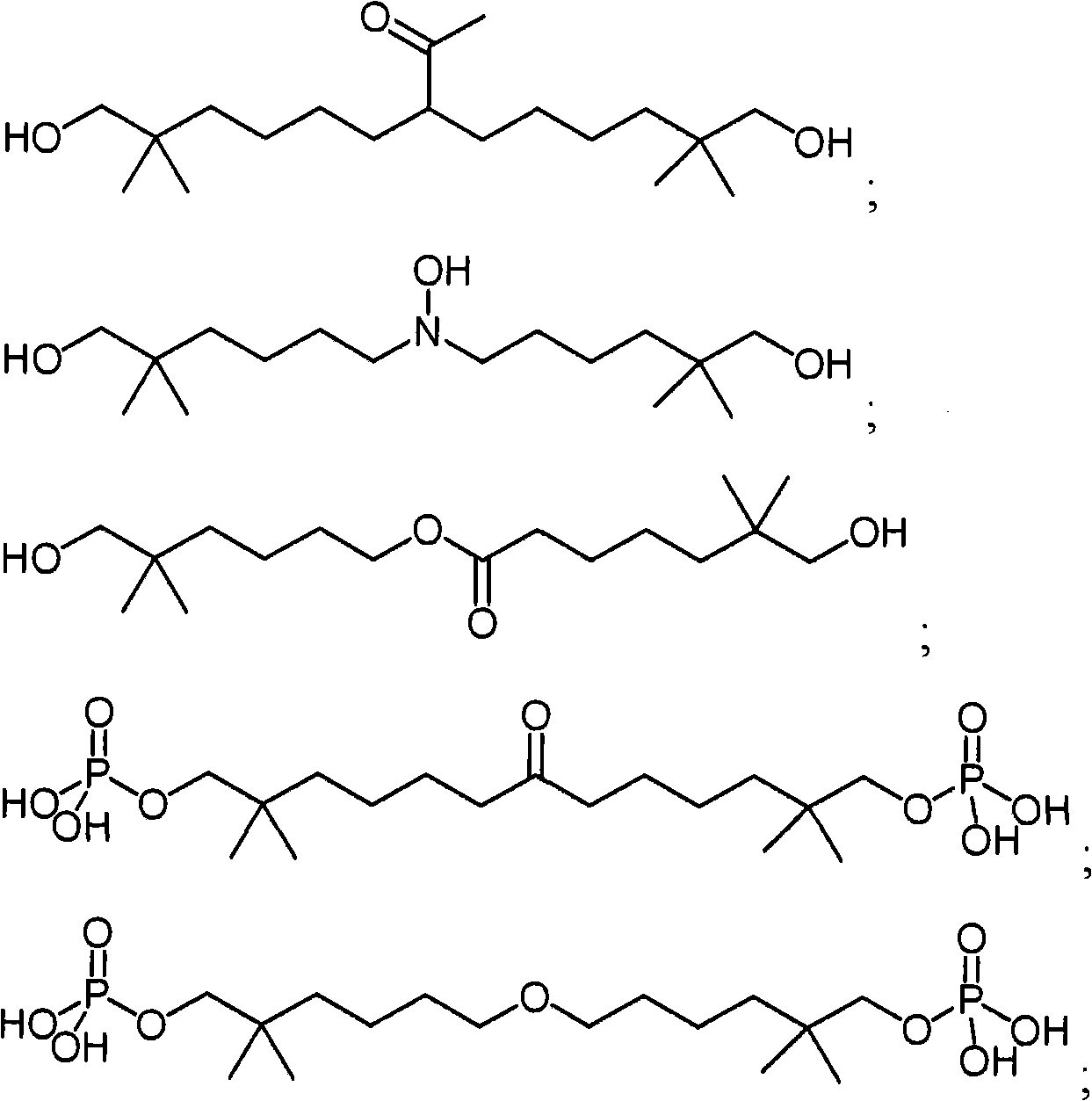

在一个实例中,一种化合物具有如下结构(XIII):
R1为H或可选被取代的低烷基,芳基,芳烷基,或烷基氧烷基; R is H or optionally substituted lower alkyl, aryl, aralkyl, or alkyloxyalkyl;
每个R2分别为H,保护基,或-C(=O)-CHRa-NHRb,其中:Each R is independently H, a protecting group, or -C(=O)-CHR a -NHR b , wherein:
Ra选自以下基团:烷基,芳基,酰基,氧化,叠氮基,羟基,联氨,氰基,卤素,酰肼,链烯基,炔基,醚,硫醇基,硒基,磺酰基,硼酸基,硼酸盐,二氧磷基,膦酰,三氢化磷,杂环,烯酮,亚胺,乙醛,酯基,硫代酸,羟胺,氨基基团,及其结合体,及R a is selected from the following groups: alkyl, aryl, acyl, oxide, azido, hydroxyl, hydrazine, cyano, halogen, hydrazide, alkenyl, alkynyl, ether, thiol, selenyl , sulfonyl, boronic acid, borate, phosphono, phosphono, phosphine, heterocycle, enone, imine, acetaldehyde, ester, thioacid, hydroxylamine, amino group, and combination, and
Rb为H或氨基保护基;R b is H or an amino protecting group;
每个V和Z分别为(CRcRd)n,O,NRe,S,Ar,CRcRdAr,OAr,NR4Ar,SAr,或Ar,其中:Each of V and Z is (CR c R d ) n , O, NR e , S, Ar, CR c R d Ar, OAr, NR 4 Ar, SAr, or Ar, respectively, where:
每个Rc和Rd分别为H,低烷基,OH,O-低烷基,或Each R c and R d is independently H, lower alkyl, OH, O-lower alkyl, or
Rc和Rd,结合成=O,=N-OH,=N-O-低烷基,或=N-O-CH2CH2-O-CH3;R c and R d combined to form =O, =N-OH, =NO-lower alkyl, or =NO-CH 2 CH 2 -O-CH 3 ;
Re为H,低烷基,或-CH2CH2-O-CH3;及R e is H, lower alkyl, or -CH 2 CH 2 -O-CH 3 ; and
n为1至7;n is 1 to 7;
q为0至3;q is 0 to 3;
Ar是一个可选取代的芳基或杂芳基;Ar is an optionally substituted aryl or heteroaryl;
u为0或1;u is 0 or 1;
每个X分别为H或卤素;及each X is independently H or halogen; and
m为4至12。m is 4 to 12.
在一个具体实例中,一个具有结构(XLIII)的化合物为:
在一个实例中,一种化合物具有如下结构(XLIV):
R1为-H,-(C1-C6)烷基,-(C3-C6)环烷基,-(C1-C6)烷氧基,-O(C1-C6)烷基,-N((C1-C6)烷基)2或-NH(C1-C6)烷基;R 1 is -H, -(C 1 -C 6 )alkyl, -(C 3 -C 6 )cycloalkyl, -(C 1 -C 6 )alkoxy, -O(C 1 -C 6 ) Alkyl, -N((C 1 -C 6 )alkyl) 2 or -NH(C 1 -C 6 )alkyl;
R2为-H或(C1-C6)烷基;R 2 is -H or (C 1 -C6) alkyl;
R3为-H或(C1-C6)烷基;及
R4为
_在一个具体实例中,一个具有结构(XLIV)的化合物为: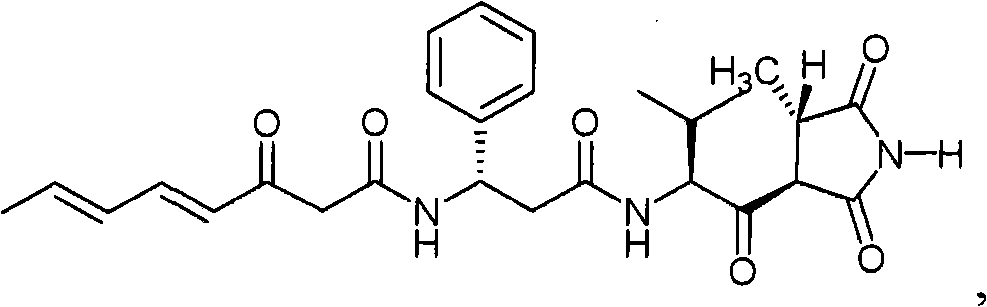
在一个具体实例中,一个具有结构(XLIV)的化合物不是moiramide B。In a specific example, a compound of structure (XLIV) is not moiramide B.
在一个具体实例中,一个具有结构(XLIV)的化合物为:
在一个具体实例中,一个具有结构(XLIV)的化合物不是andrimid。In a specific example, a compound of structure (XLIV) is not an andrimid.
在一个具体实例中,一个具有结构(XLIV)的化合物为:

在一个实例中,一种化合物,为III型磷酸肌醇3-激酶(IIIPI3K)的抑制剂。In one example, a compound that is an inhibitor of type III phosphoinositide 3-kinase (IIIPI3K).
在一个具体实例中,一个具有结构(XLV)的化合物为:
在一个具体实例中,此化合物为3-甲基腺嘌呤的衍生物。In one embodiment, the compound is a derivative of 3-methyladenine.
在一个具体实例中,一个具有结构(XLVI)的化合物为:
在一个具体实例中,此化合物为LY 294002的衍生物。In a specific example, the compound is a derivative of LY 294002.
在一个具体实例中,一个具有结构(XLVII)的化合物为:它也被称为渥曼青霉素。In a specific example, a compound of structure (XLVII) is: It is also known as wortmannin.
在一个具体实例中,此化合物为渥曼青霉素的衍生物。In one embodiment, the compound is a derivative of wortmannin.
在多个具体实例中,一种化合物为HMG-辅酶A抑制剂。代表性HMG-辅酶A还原酶抑制剂在此领域已被熟知,它们包括但不限于:美伐他汀及相关分子(如见美国专利第3,983,140号);洛伐他(美维诺林)及相关分子(如见美国专利第4,231,938号);普伐他汀及相关分子(如见美国专利第4,346,227号);辛伐他汀及相关分子。(如见美国专利第4,448,784号和4,450,171号);氟伐他汀及相关分子(如见美国专利第5,354,772号);西立伐他汀(如见美国专利第5,006,530和5,177,080号);阿伐他汀(如见美国专利第4,681,893,5,273,995,5,385,929和5,686,104号);伊伐他汀(如见美国专利第.5,011,930号);Shionogi-Astra/Zeneca的visastatin ZD-4522(如见美国专利第5,260,440号),相关抑制素化合物(如见美国专利第5,753,675号);甲羟戊酸内酯衍生物的吡唑类似物(如见美国专利第4,613,610号);甲羟戊酸内酯衍生物的本骈环丙烯类似物(如见国际专利申请公布号WO 1986/03488);6-[2-(取代-吡咯-1-基)-烷基)吡喃-2-酮及其衍生物(如见美国专利第4,647,576号);Searle′sSC-45355(一个3-取代戊二酸衍生物)二氯代醋酸盐,甲羟戊酸内酯的咪唑类似物(如见国际专利申请公布号WO 1986/07054);3-羧基-2-羟基-丙烷-膦酸衍生物;甲羟戊酸内酯的萘基类似物(如见美国专利第4,686,237号);十氢萘(如见美国专利第4,499,289号);美维诺林的氧化类似物(洛伐他汀);次膦酸化合物(如见于GB 2205837);及奎林和吡啶衍生物(如见美国专利第5,506,219和5,691,322号)。以上全部通过引用方式并入本文。此代表性HMG-辅酶A还原酶抑制剂的结构为此技术领域已知。在一些实例中,一种化合物不是HMG-辅酶A还原酶抑制剂。In various embodiments, a compound is an HMG-CoA inhibitor. Representative HMG-CoA reductase inhibitors are well known in the art and include, but are not limited to: mevastatin and related molecules (see, for example, U.S. Patent No. 3,983,140); lovastatin (mevinolin) and related molecules (see eg US Patent No. 4,231,938); pravastatin and related molecules (eg see US Patent No. 4,346,227); simvastatin and related molecules. (see e.g. U.S. Patent Nos. 4,448,784 and 4,450,171); fluvastatin and related molecules (e.g. see U.S. Patent No. 5,354,772); cerivastatin (e.g. see U.S. Patent Nos. 5,006,530 and 5,177,080); atorvastatin (e.g. See U.S. Patent Nos. 4,681,893, 5,273,995, 5,385,929, and 5,686,104); Ivastatin (see U.S. Patent No. 5,011,930); Shionogi-Astra/Zeneca's visastatin ZD-4522 (see U.S. Patent No. 5,260,440), related inhibition Pyrazole analogs of mevalonate derivatives (see, for example, U.S. Patent No. 5,753,675); pyrazole analogs of mevalonate derivatives (see, for example, U.S. Patent No. 4,613,610); present cyclopropene analogs of mevalonate derivatives (see, for example, International Patent Application Publication No. WO 1986/03488); 6-[2-(substituted-pyrrol-1-yl)-alkyl)pyran-2-ones and derivatives thereof (see, for example, U.S. Patent No. 4,647,576 ); Searle's SC-45355 (a 3-substituted glutaric acid derivative) dichloroacetate, an imidazole analog of mevalonate (see, for example, International Patent Application Publication No. WO 1986/07054);3 -Carboxy-2-hydroxy-propane-phosphonic acid derivatives; naphthyl analogs of mevalonolactone (see e.g. U.S. Patent No. 4,686,237); decahydronaphthalene (e.g. see U.S. Patent No. 4,499,289); Oxidized analogues of norlin (lovastatin); phosphinic acid compounds (see eg GB 2205837); and quinine and pyridine derivatives (eg see US Patent Nos. 5,506,219 and 5,691,322). All of the above are incorporated herein by reference. The structure of this representative HMG-CoA reductase inhibitor is known in the art. In some examples, a compound is not an HMG-CoA reductase inhibitor.
SCD代表性的抑制剂可见于Liu 等J.Med.Chem.50:3086-3100,2007;国际专利申请公布号WO 2005/011655 A2;美国专利申请第2005/0119251号;及国际专利申请公布号WO 2007/0099236A1,以上全部通过引用方式并入本文。这些抑制剂包括但不限于,衍生物和基于哒嗪heterozryl-的SCD1抑制剂。Representative inhibitors of SCD can be found in Liu et al. J.Med.Chem.50:3086-3100, 2007; International Patent Application Publication No. WO 2005/011655 A2; U.S. Patent Application No. 2005/0119251; and International Patent Application Publication No. WO 2007/0099236A1, all of which are incorporated herein by reference. These inhibitors include, but are not limited to, derivatives and pyridazine heterozryl-based SCD1 inhibitors.
在一些实例中,瞄准和抑制ACC的化合物,包括但不限于,如moiramide B及其合成类似物,和andrimid及其合成类似物;以及吡咯烷二酮类衍生物。见于Freiberg 等J.Biol.Chem.279:26066-26073,2004;Freiberg 等。《抗菌试剂及化学方法》。49:749-759,2005;和Pohlmann 等,Bioorg.Med.Chem.Lett.15:1189-1192,2005,以上均通过引用方式并入本文。在其它多个实例中,一种化合物不是类肽吡咯烷二酮类抗生素。在特定实例中,一种化合物不是moiramide B。In some examples, compounds targeting and inhibiting ACC include, but are not limited to, moiramide B and its synthetic analogs, and andrimid and its synthetic analogs; and pyrrolidinedione derivatives. In Freiberg et al. J. Biol. Chem. 279:26066-26073, 2004; Freiberg et al. "Antibacterial Reagents and Chemical Methods". 49:749-759, 2005; and Pohlmann et al., Bioorg. Med. Chem. Lett. 15:1189-1192, 2005, all incorporated herein by reference. In other instances, a compound is not a peptoid pyrrolidione antibiotic. In particular instances, a compound is not moiramide B.
在一些实例中,一种化合物为吡咯烷二酮衍生物。吡咯烷二酮衍生物的非限制例子揭露于Pohlmann 等,Bioorg.Med.Chem.Lett.2005 15:1189-1192.在其它一些实例中,一种化合物不是吡咯烷二酮衍生物。In some examples, one compound is a pyrrolidinedione derivative. Non-limiting examples of pyrrolidinedione derivatives are disclosed in Pohlmann et al., Bioorg. Med. Chem. Lett. 2005 15: 1189-1192. In other examples, a compound is not a pyrrolidinedione derivative.
值得注意的是,ACC作为人体内存在的两种同工酶,ACC1和ACC2。本文描述的化合物包括但不限于ACC的同工酶特异性抑制剂。同工酶选择性化合物见如Clark等,Bioorg.Med.Chem.Lett.200717:1961-1965;和Gu等,J.Med.Chem.200649:3770-3773,以上全部通过引用方式并入本文。在一些实例中,包含一个苯环替代基的苯氧基偶氮系列的ACC抑制剂为ACC2的选择性抑制剂。在一些具体实例中,一种化合物对ACC2的选择性抑制比ACC1的抑制多大约至少10倍,100倍,1,000倍,2,000倍,3,000倍,4,000倍,5,000倍,或10,000倍。It is worth noting that ACC exists as two isoenzymes in the human body, ACC1 and ACC2. Compounds described herein include, but are not limited to, isozyme-specific inhibitors of ACC. Isoenzyme-selective compounds are found, eg, in Clark et al., Bioorg. Med. Chem. Lett. 2007 17: 1961-1965; and Gu et al., J. Med. Chem. 2006 49: 3770-3773, all of which are incorporated herein by reference. In some examples, the phenoxyazo series of ACC inhibitors comprising a benzene ring substituent are selective inhibitors of ACC2. In some embodiments, a compound selectively inhibits ACC2 at least about 10-fold, 100-fold, 1,000-fold, 2,000-fold, 3,000-fold, 4,000-fold, 5,000-fold, or 10,000-fold more than ACC1.
在一些特定实例中,瞄准和抑制PI(3)Ks的化合物包括但不限于,2-甲基腺嘌呤,渥曼青霉素,LY294002,5-苯噻唑衍生物(如见国际专利申请WO 2003/072557,WO 2004/078754和WO 2005/021519),特定的5-杂芳基代噻唑衍生物(如见国际专利申请公布WO2004/096797),特定的2-酰氨基-5-三唑-4-基噻唑衍生物(如见国际专利申请公布WO 2005/068444),AS-605240(见于,如Camp 等,《自然医药》(Nat.Med.)2005,11(9):936-43),和噻唑烷二酮衍生物(如.,见于国际专利申请公布号WO 2008/014219)。3-甲基腺嘌呤抑制III型PI(3)K(见于,如Petiot 等,《生物化学期刊》275:992-998,2000)。在具体实例中,化合物瞄准和抑制III型PI(3)K。在特定实例中,一种化合物为3-基腺嘌呤。在其它实例中,一种化合物不是3-基腺嘌呤。在一些实例中,一种化合物不是PI(3)K的一种抑制剂。In some specific examples, compounds that target and inhibit PI(3)Ks include, but are not limited to, 2-methyladenine, wortmannin, LY294002, 5-benzothiazole derivatives (see International Patent Application WO 2003/072557 , WO 2004/078754 and WO 2005/021519), specific 5-heteroaryl thiazole derivatives (see, for example, International Patent Application Publication WO 2004/096797), specific 2-amido-5-triazol-4-yl Thiazole derivatives (see, for example, International Patent Application Publication WO 2005/068444), AS-605240 (see, for example, Camp et al., "Nat. Med." (Nat. Med.) 2005, 11(9):936-43), and thiazole Alkanedione derivatives (eg, found in International Patent Application Publication No. WO 2008/014219). 3-Methyladenine inhibits type III PI(3)K (see, eg, Petiot et al., J. Biol. Chem. 275:992-998, 2000). In specific examples, the compounds target and inhibit type III PI(3)K. In a particular example, one compound is 3-yladenine. In other examples, a compound is not 3-yladenine. In some examples, a compound is not an inhibitor of PI(3)K.
在特定实例中,一种化合物为一种PI(3)P螯溶剂。PI(3)P螯溶剂的非限制例子包括但不限于肽或化学修饰肽,它包含一或多个55)修饰,包括肽——含有FYVE(序列号:55)修饰,通过一个细胞转导区,如1型人类免疫缺陷病毒(HIV-1)的细胞-膜转导区Tat蛋白(氨基酸序列YGRKKRRQRRR(序列号:56)或子集或其扩展版)。其它细胞-膜转导区为本领域所已知并且可结合于FYVE(序列号:55)序列(包括其多重复制或变种)或和其它PI(3)P-螯合序列在抗病毒治疗的设计中,在其它实例中,此FYVE(序列号:55)修饰(带有或不带有一个细胞-膜转导区)可结合于其它化学分子以增加FYVE(序列号:55)的血浆半衰期(如,通过保护此FYVE修饰不被水解通过循环和/或细胞蛋白酶)。In particular examples, a compound is a PI(3)P chelating solvent. Non-limiting examples of PI(3)P chelating agents include, but are not limited to, peptides or chemically modified peptides comprising one or more 55) modifications, including peptides-containing FYVE (SEQ ID NO: 55) modifications, transduced by a cell A region, such as the cell-membrane transduction region Tat protein (amino acid sequence YGRKKRRQRRR (SEQ ID: 56) or a subset or an extended version thereof) of human immunodeficiency virus type 1 (HIV-1). Other cell-membrane transduction regions are known in the art and can be combined with the FYVE (SEQ ID NO: 55) sequence (including multiple copies or variants thereof) or with other PI(3)P-chelating sequences in antiviral therapy. In design, among other examples, this FYVE (SEQ ID NO: 55) modification (with or without a cell-membrane transduction domain) can be combined with other chemical molecules to increase the plasma half-life of FYVE (SEQ ID NO: 55) (eg, by protecting the FYVE modification from hydrolysis by circulating and/or cellular proteases).
在一个实例中,当一种化合物被本文描述或引用,这种描述或引用也包括其药学可接受盐,药物前体,药物前体的盐,溶剂,笼形物和立体异构体。RNAi分子 In one example, when a compound is described or referenced herein, such description or reference also includes its pharmaceutically acceptable salts, prodrugs, salts of prodrugs, solvents, clathrates and stereoisomers. RNAi molecules
在特定实例中,一种化合物为RNA干扰(RNAi)分子,它可降低靶酶的表达水平。RNAi分子包括但不限于,小-干扰RNA(siRNA),短发夹RNA(shRNA),微小RNA(miRNA),及任何可编码序列特定RNAi的分子。In a specific example, a compound is an RNA interference (RNAi) molecule that reduces the expression level of a target enzyme. RNAi molecules include, but are not limited to, small-interfering RNA (siRNA), short hairpin RNA (shRNA), microRNA (miRNA), and any molecule that encodes sequence-specific RNAi.
RNAi指一种分子生物学上由具有与目标mRNA同源序列的双链RNA(dsRNA)诱发的基因沉默现象。RNAi也被称作转录后基因沉默或PTGS。见如,Couzin,2002,《科学》298:2296-2297;McManus 等,2002,Nat.Rev.Genet.3,737-747;Hannon,G.J.,2002,《自然》418,244-251;Paddison 等,2002,《癌细胞》2,17-23.dsRNA被一种叫作Dicer的III-型核糖核酸酶识别并降解。此Dicer酶将此RNA“切割”成含有约21至23个核苷酸的小片段,它们被称作siRNAs或短-干扰RNAs(siRNAs),由19个与新生核苷酸完全配对的核苷酸组成并且在其每条链的3′端都有2至3个未配对的核苷酸。这些短双链与一种叫做RISC的多蛋白复合物相连,并引导此复合物至具有与siRNA相近序列的mRNA副本。结果,存在于RNA诱导沉默复合体(RISC)中的核酸酶切割并降解目标mRNA副本,从而彻底废止此基因产品的表达。RNAi refers to a gene silencing phenomenon induced by double-stranded RNA (dsRNA) with a sequence homologous to the target mRNA in molecular biology. RNAi is also known as post-transcriptional gene silencing or PTGS. See eg, Couzin, 2002, Science 298:2296-2297; McManus et al., 2002, Nat. Rev. Genet. 3, 737-747; Hannon, G.J., 2002, Nature 418, 244-251; Paddison et al. , 2002,
在文献中的许多报告强调siRNAs的特异性,提示用siRNA近乎完美识别的必要(Elbashir 等,2001.EMBO J.20:6877-6888;Tuschl等,1999,Genes Dev.13:3191-3197;Hutvagner 等,《科学快讯》297:2056-2060)。一个报告显示对siRNA目标副本的切割需要完美序列互补性,而部分互补性将会抑制翻译但是不会降解副本,如同microRNAs(Hutvagner 等,《科学快讯》297:2056-2060)。Many reports in the literature emphasize the specificity of siRNAs, suggesting the necessity for near-perfect recognition with siRNAs (Elbashir et al., 2001. EMBO J.20:6877-6888; Tuschl et al., 1999, Genes Dev.13:3191-3197; Hutvagner et al., Science Express 297:2056-2060). One report showed that perfect sequence complementarity is required for cleavage of the target copy of an siRNA, whereas partial complementarity will inhibit translation but not degrade the copy, like microRNAs (Hutvagner et al., Science Letters 297:2056-2060).
miRNAs为基因组表达的调节RNAs,其前体发夹环(短发夹)结构(大约80个核苷酸长度)被加工以生产与目标mRNA的3′UTR中互补序列结合(或杂交)的单链核酸(大约22个核苷酸长度)(Lee等,1993,Cell 75:843-854;Reinhart 等,2000,Nature 403:901-906;Lee 等,2001,《科学》294:862-864;Lau 等,2001,《科学》294:858-862;Hutvagner 等,2001,《科学》293:834-838).miRNAs与仅具有部分互补性的转录序列结合(Zeng 等,2002,Molec。细胞9:1327-1333)并抑制翻译而不影响稳定的RNA水平(Lee 等,1993,细胞75:843-854;Wightman 等,1993,细胞75:855-862)。miRNAs和siRNAs都被Dicer加工并与RNA诱导沉默复合体的构件相连(Hutvagner 等,2001,《科学》293:834-838;Grishok 等,2001,细胞106:23-34;Ketting 等,2001,《基因和发育》(Genes Dev)15:2654-2659;Williams 等,2002,Proc.Natl.Acad.Sci.USA 99:6889-6894;Hammond 等,2001,《科学》293:1146-1150;Mourlatos 等,2002,《基因和发育》16:720-728)。miRNAs are regulatory RNAs of genomic expression whose precursor hairpin loop (short hairpin) structures (approximately 80 nucleotides in length) are processed to produce a single Stranded nucleic acids (about 22 nucleotides in length) (Lee et al., 1993, Cell 75:843-854; Reinhart et al., 2000, Nature 403:901-906; Lee et al., 2001, Science 294:862-864; Lau et al., 2001, "Science" 294:858-862; Hutvagner et al., 2001, "Science" 293:834-838). miRNAs bind to transcribed sequences with only partial complementarity (Zeng et al., 2002, Molec. Cell 9 : 1327-1333) and inhibit translation without affecting stable RNA levels (Lee et al., 1993, Cell 75: 843-854; Wightman et al., 1993, Cell 75: 855-862). Both miRNAs and siRNAs are processed by Dicer and associate with components of the RNA-induced silencing complex (Hutvagner et al., 2001, Science 293:834-838; Grishok et al., 2001, Cell 106:23-34; Ketting et al., 2001, pp. Genes Dev 15:2654-2659; Williams et al., 2002, Proc.Natl.Acad.Sci.USA 99:6889-6894; Hammond et al., 2001, Science 293:1146-1150; , 2002, "Genes and Development" 16:720-728).
shRNA是一个包含至少2个互补结构的单链RNA分子,它,杂交或可杂交成一个足够长双链结构(双螺旋)以被RNAi处理成具有突出端的双链RNA,如siRNAs和miRNAs.shRNA也包含至少一个形成一个环状结构非互补结构,它在互补结构的杂交后形成此双链结构。shRNAs起到miRNAs和siRNAs前体的作用。shRNA is a single-stranded RNA molecule containing at least 2 complementary structures that hybridize or can hybridize into a double-stranded structure (double helix) long enough to be processed by RNAi into double-stranded RNA with overhangs, such as siRNAs and miRNAs.shRNA Also included is at least one non-complementary structure forming a loop structure which upon hybridization of complementary structures forms the double-stranded structure. shRNAs function as precursors to miRNAs and siRNAs.
通常,编码shRNA的序列被克隆至一个载体,然后此载体被引导至一个细胞并被此细胞的转录机器转录(Chen 等,2003,《生物化学与生物物理研究通讯》311:398-404)。这些shRNAs然后可被转录,例如,通过RNA聚合酶III(Pol III)对此载体中的一个Pol III-型启动子的回应。(Yuan 等,2006,Mol Biol Rep 33:33-41和Scherer 等,2004,MolTher 10:597-603)。已表达的shRNAs然后被输出至细胞质,在其中,它们被如Dicer等蛋白加工成此后触发RNAi的siRNAs(Amarzguioui等,2005,FEBS Letter 579:5974-5981)。有报道称,理想的RNA聚合酶III转录需要在全新的初始RNA的5′端具有嘌呤。更多详细论述可见于Zecherle 等,1996,Mol.Cell.Biol.16:5801-5810;Fruscoloni 等,1995,Nucleic Acids Res,23:2914-2918;和Mattaj 等,1988,Cell,55:435-442.这些shRNAs核心序列可在细胞中稳定的表达,实现细胞在体外和体内都可保持长期基因沉默,如在动物中(见于,McCaffrey等,2002,《自然》418:38-39;Xia 等,2002,《自然生物技术》(Nat.Biotech).20:1006-1010;Lewis 等,2002,Nat.Genetics 32:107-108;Rubinson 等,2003,《自然遗传学》(Nat.Genetics)33:401-406;和Tiscornia 等,2003,Proc.Natl.Acad.Sci.USA 100:1844-1848)。Typically, the shRNA-encoding sequence is cloned into a vector, which is then introduced into a cell and transcribed by the cell's transcriptional machinery (Chen et al., 2003, Biochem. Biophys. Res. Letters 311:398-404). These shRNAs can then be transcribed, for example, by RNA polymerase III (Pol III) in response to a Pol III-type promoter in this vector. (Yuan et al., 2006, Mol Biol Rep 33:33-41 and Scherer et al., 2004, MolTher 10:597-603). Expressed shRNAs are then exported to the cytoplasm where they are processed by proteins such as Dicer into siRNAs that then trigger RNAi (Amarzguioui et al., 2005, FEBS Letter 579:5974-5981). It has been reported that ideal RNA polymerase III transcription requires a purine at the 5′ end of the de novo initial RNA. More detailed discussions can be found in Zecherle et al., 1996, Mol. Cell. Biol. 16:5801-5810; Fruscoloni et al., 1995, Nucleic Acids Res, 23:2914-2918; and Mattaj et al., 1988, Cell, 55:435- 442. These shRNAs core sequences can be stably expressed in cells, enabling cells to maintain long-term gene silencing both in vitro and in vivo, such as in animals (see, McCaffrey et al., 2002, "Nature" 418: 38-39; Xia et al. , 2002, "Nat.Biotech" (Nat.Biotech).20:1006-1010; Lewis et al., 2002, Nat.Genetics 32:107-108; Rubinson et al., 2003, "Nat.Genetics" (Nat.Genetics)33 : 401-406; and Tiscornia et al., 2003, Proc. Natl. Acad. Sci. USA 100: 1844-1848).
Martinez 等报告,RNA干扰可用于选择性瞄准于致癌基因突变。(Martinez 等,2002,Proc.Natl.Acad.Sci.USA 99:14849-14854)。在这个报告中,一个瞄准包含点突变的p53的R248W突变区的siRNA被显露以沉默突变型p53而不是野生型p53的表达。Martinez et al. report that RNA interference can be used to selectively target oncogenic mutations. (Martinez et al., 2002, Proc. Natl. Acad. Sci. USA 99: 14849-14854). In this report, an siRNA targeting the R248W mutant region of p53 containing a point mutation was revealed to silence the expression of mutant p53 but not wild-type p53.
Wilda 等报告,一个瞄准于M-BCR/ABL结合mRNA的siRNA可被用来消耗M-BCR/ABL mRNA和白血病的细胞中的M-BCR/ABL肿瘤蛋白(Wilda 等,2002,《致癌基因》21:5716-5724)。Wilda et al. reported that an siRNA targeting M-BCR/ABL binding mRNA could be used to deplete M-BCR/ABL mRNA and M-BCR/ABL tumor protein in leukemia cells (Wilda et al., 2002, Oncogenes 21:5716-5724).
美国专利第6,506,559号揭露,一个用来抑制细胞中靶基因表达RNA干扰过程。此过程包括引导部分或完全双链的具有一个位于双螺旋区的与在靶基因中的序列相同的序列的RNA进入细胞或进入,细胞外环境。US Patent No. 6,506,559 discloses a RNA interference process for inhibiting the expression of target genes in cells. This process involves the introduction of partially or fully double-stranded RNA having a sequence located in the duplex region identical to the sequence in the target gene into the cell or into the extracellular environment.
美国专利申请公布号US 2002/0086356揭露,在体外系统使用21-23个核苷酸长RNA片段的果蝇的RNA干扰。专利申请公布表明,当这些21-23nt片段被提纯并加回至果蝇提出物,它们在不存在长dsRNA的条件下调节序列特定的RNA干扰。此专利申请公布也表明,具有相同或相似性质的化学合成的寡核苷酸也可用于瞄准特定mRNA以在哺乳动物细胞中发生降解。US Patent Application Publication No. US 2002/0086356 discloses RNA interference in Drosophila using 21-23 nucleotide long RNA fragments in an in vitro system. The patent application publication showed that when these 21-23nt fragments were purified and added back to Drosophila extracts, they modulated sequence-specific RNA interference in the absence of long dsRNA. This patent application publication also shows that chemically synthesized oligonucleotides with the same or similar properties can also be used to target specific mRNAs for degradation in mammalian cells.
国际专利申请公布号WO 2002/44321揭露,19-23nt长的双链RNA(dsRNA)引导在体外系统果蝇的序列特定的转录后基因沉默。此PCT公布表明,由一个类RNase III的生成的短干扰RNAs(siRNAs)处理发生自长dsRNA或化学合成的具有3′短突出的siRNA双链体的反应调节溶菌液中靶RNA有效切割,并且切割点定位在引导siRNA跨越区中心附近。International Patent Application Publication No. WO 2002/44321 discloses that 19-23 nt long double-stranded RNA (dsRNA) guides sequence-specific post-transcriptional gene silencing in the in vitro system Drosophila. This PCT publication demonstrates that processing of short interfering RNAs (siRNAs) generated by an RNase III-like reaction from long dsRNA or chemically synthesized siRNA duplexes with short 3' overhangs regulates efficient cleavage of target RNA in lysates, and The cut point is positioned near the center of the guide siRNA spanning region.
美国专利申请公布号US 2002/016216揭露,一种减少培养细胞中靶基因的表达方法,其系通过引导包含一个在严格条件下与一个靶基因的核苷酸序列杂交的核苷酸序列的双链RNA(dsRNA)进入细胞,其数量足以减少靶基因的表达。U.S. Patent Application Publication No. US 2002/016216 discloses a method for reducing the expression of a target gene in cultured cells by introducing a doublet comprising a nucleotide sequence that hybridizes to a nucleotide sequence of a target gene under stringent conditions. Stranded RNA (dsRNA) enters the cell in sufficient quantities to reduce the expression of the target gene.
国际专利申请公布号WO 2003/006477公开,在细胞中表达的改造后的RNA前体被细胞加工以生产可使用细胞自有的RNA干扰(RNAi)途径选择性沉默靶基因(通过切割特定mRNAs),目标小干扰RNAs(siRNAs)。此PCT公布表明,通过使用合适的序列引导编码这些改造后的RNA前体的核酸分子进入活体细胞,可临时性和时空性地选择性控制改造后的RNA前体的表达,在特定时间和/或在特定阻止,器官或细胞中。International Patent Application Publication No. WO 2003/006477 discloses that engineered RNA precursors expressed in cells are processed by the cell to produce genes that can be selectively silenced (by cleaving specific mRNAs) using the cell's own RNA interference (RNAi) pathway. , target small interfering RNAs (siRNAs). This PCT publication demonstrates that by directing nucleic acid molecules encoding these engineered precursor RNAs into living cells using appropriate sequences, the expression of engineered precursor RNAs can be selectively controlled temporally and spatiotemporally, at specific times and/or Or in specific blocks, organs or cells.
国际专利申请公布号WO 02/44321揭露,19-23nt长的双链RNA(dsRNA)引导在体外系统果蝇的序列特定的转录后基因沉默。此PCT公布表明,由一个类RNase III的生成的siRNAs双链体处理发生自长dsRNA的反应或化学合成的具有3′短突出的siRNA双链体的反应调节溶菌液中靶RNA有效切割,并且切割点定位在引导siRNA跨越区中心附近。此PCT公布也提供证据显示,对dsRNA加工的引导决定正或反义靶RNA能否被刺siRNA复合体切割。对RNA干扰中siRNAs的长度,二级结构,糖骨架和序列特异性效果的特异性分析已被揭露,这有助于siRNA设计。此外,沉默效果与19bp长靶序列的5′和3′区中的GC含量有关。它还发现,瞄准具有高GC 5′和低GC 3′的序列的siRNAs表现出来的效果最好。更多详细论述可见于Elbashir 等,2001,EMBO J.20:6877-6888和Aza-Blanc 等,2003,Mol。Cell 12:627-637;以上全部通过引用方式并入本文。International Patent Application Publication No. WO 02/44321 discloses that 19-23 nt long double-stranded RNA (dsRNA) guides sequence-specific post-transcriptional gene silencing in the in vitro system Drosophila. This PCT publication demonstrates that duplex processing of siRNAs generated by an RNase III-like reaction from long dsRNA or chemically synthesized siRNA duplexes with short 3' overhangs modulates efficient cleavage of target RNA in lysate, and The cut point is positioned near the center of the guide siRNA spanning region. This PCT publication also provides evidence that guidance on dsRNA processing determines whether a sense or antisense target RNA can be cleaved by the barbed siRNA complex. Specific analysis of the length, secondary structure, sugar backbone, and sequence-specific effects of siRNAs in RNA interference has been revealed, which facilitates siRNA design. Furthermore, the silencing effect was related to the GC content in the 5' and 3' regions of the 19 bp long target sequence. It also found that siRNAs targeting sequences with
此外,siRNA设计算法也被揭露于PCT公布WO2005/018534A2和WO 2005/042708A2;以上全部通过引用方式并入本文。具体来说,国际专利申请公布号WO 2005/018534A2揭露使用具有部分与其靶基因同源序列的siRNA进行基因沉默的方法和成分。此申请提供识别不同siRNAs靶基因相应的共同和/或不同反应的方法。此申请也提供评价siRNA双链的相对活性的方法。此申请另外还提供使用siRNAs治疗疾病的方法。国际专利申请公布号WO 2005/042708A2提供一种使用位置加权矩阵(PSSM)方法识别转录中siRNA目标修饰的方法。它也提供一种使用位置加权矩阵(PSSM)方法识别siRNA脱靶基因的方法。此申请另外还提供一种设计具有改进沉默效果和特性性的siRNAs的方法以及一个代表性siRNAs库。In addition, siRNA design algorithms are also disclosed in PCT Publications WO 2005/018534A2 and WO 2005/042708A2; all of which are incorporated herein by reference. Specifically, International Patent Application Publication No. WO 2005/018534A2 discloses methods and compositions for gene silencing using siRNAs having partial sequences homologous to their target genes. This application provides methods for identifying common and/or differential responses corresponding to different siRNAs target genes. This application also provides methods for assessing the relative activity of siRNA duplexes. This application additionally provides methods of treating diseases using siRNAs. International Patent Application Publication No. WO 2005/042708A2 provides a method for identifying siRNA target modifications in transcription using the Position Weighted Matrix (PSSM) method. It also provides a method to identify siRNA off-target genes using position weighted matrix (PSSM) method. This application additionally provides a method for designing siRNAs with improved silencing efficacy and properties and a library of representative siRNAs.
设计软件可被用于识别靶酶mRNA(可被文中所描述方法中的siRNAs瞄准)中潜在序列。见如,http://www.ambion.com/techlib/misc/siRNA_finder.html(“Ambion siRNATarget Finder Software”)。例如,ACC1的核苷酸序列,它在本领域已知(基因库登录号NM_198834),已被记入Ambion siRNA Target FinderSoftware(http://www.ambion.com/techlib/misc/siRNA_finder.html),并且此软件识别潜在ACC1靶序列和相应siRNA序列(在分析中通过向下调节ACC1表达的抑制人ACC1活性)。使用这种方法,用来抑制ACC1的ACC1靶序列(5’至3’)及相应正反义链siRNA序列(5’至3’)的非限制例子可见于以下:ACC1靶序列 正义链siRNA 反义链siRNA1AATCACTTTGCCCGTGT UCACUUUGCCCGUGUG CGCCACACGGGCAAAG.GGCG GCGUU UGAUU(序列号:1) (序列号:2) (序列号:3)2AACGTTCCCATCTCCAC CGUUCCCAUCUCCACC AGGGGUGGAGAUGGGA.CCCT CCUUU ACGUU(序列号:4) (序列号:5) (序列号:6)3AAGGGAAATTGAGGCT GGGAAAUUGAGGCUG CCCUCAGCCUCAAUUU.GAGGG AGGGUU CCCUU(序列号:7) (序列号:8) (序列号:9)4AAATTGAGGCTGAGGG AUUGAGGCUGAGGGA CAGUUCCCUCAGCCUC.AACTG ACUGUU AAUUU(序列号:10) (序列号:11) (序列号:12)5AACTGGGCCCAGGGAC CUGGGCCCAGGGACGG UCGCCGUCCCUGGGCC.GGCGA CGAUU CAGUU(序列号:13) (序列号:14) (序列号:15)6AAGGGCTGCTCGTGGA GGGCUGCUCGUGGAUG GUUCAUCCACGAGCAG.TGAAC AACUU CCCUU(序列号:16) (序列号:17) (序列号:18)7AATCAGATGCTTCTGG UCAGAUGCUUCUGGAA ACGUUCCAGAAGCAUC.AACGT CGUUU UGAUU(序列号:19) (序列号:20) (序列号:21)8AATAATGGATGAACCA UAAUGGAUGAACCAUC GGAGAUGGUUCAUCCA.TCTCC UCCUU UUAUU(序列号:22) (序列号:23) (序列号:24)9AATGGATGAACCATCT UGGAUGAACC AUCUCC AAGGGAGAUGGUUCAU.CCCTT CUUUU CCAUU(序列号:25) (序列号:26) (序列号:27)Design software can be used to identify potential sequences in target enzyme mRNAs that can be targeted by siRNAs in the methods described herein. See, eg, http://www.ambion.com/techlib/misc/siRNA_finder.html ("Ambion siRNATarget Finder Software"). For example, the nucleotide sequence of ACC1, which is known in the art (GenBank Accession No. NM_198834), has been posted to Ambion siRNA Target Finder Software ( http://www.ambion.com/techlib/misc/siRNA_finder.html ) , and this software identifies potential ACC1 target sequences and corresponding siRNA sequences (inhibition of human ACC1 activity by down-regulating ACC1 expression in the assay). Using this approach, non-limiting examples of ACC1 target sequences (5' to 3') and corresponding sense and antisense strand siRNA sequences (5' to 3') to inhibit ACC1 can be found below: ACC1 Target Sequence Sense Strand siRNA Anti Sense strand siRNA1AATCACTTTGCCCGTGT UCACUUUGCCCGUGUG CGCCACACGGGCAAAG.GGCG GCGUU UGAUU (SEQ ID NO: 1) (SEQ ID NO: 2) (SEQ ID NO: 3) 6) 3AAGGGAAATTGAGGCT GGGAAAUUGAGGCUG CCCUCAGCCUCAAUUU.GAGGG AGGGUU CCCUU (Serial Number: 7) (Serial Number: 8) (Serial Number: 9) 4AAATTGAGGCTGAGGG AUUGAGGCUGAGGGA CAGUUCCCUCAGCCUC.AACTG ACUGUU AAUUU (Serial Number: 10) (Serial Number: 11) 12) 5AACTGGGCCCAGGGAC CUGGGCCCAGGGACGG UCGCCGUCCCUGGGCC.GGCGA CGAUU CAGUU (Serial Number: 13) (Serial Number: 14) (Serial Number: 15) 6AAGGGCTGCTCGTGGA GGGCUGCUCGUGGAUG GUUCAUCCACGAGCAG. 18) 7AATCAGATGCTTCTGG UCAGAUGCUUCUGGAA ACGUUCCAGAAGCAUC.AACGT CGUUU UGAUU (sequence Serial Number: 19) (Serial Number: 20) (Serial Number: 21) 8AATAATGGATGAACCA UAAUGGAUGAACCAUC GGAGAUGGUUCAUCCA.TCTCC UCCUU UUAUU (Serial Number: 22) (Serial Number: 23) (Serial Number: 24) 9AATGGATGAACCATCT UGGAUGAACC AUCUCC AAGGGAGAUGGUCCAU.CCCTT AUUU (Serial Number: 25) (Serial Number: 26) (Serial Number: 27)
同样的方法也适用于识别ACC2靶序列(5’至3’)及相应siRNA序列(正反义链,5’至3’)。用来抑制ACC2的siRNA序列的非限制性例子见于以下:ACC2靶序列 正义链siRNA 反义链siRNA1AATGGTCTTGCTTCTT UGGUCUUGCUUCUUUG AGACAAAGAAGCAAG.TGTCT UCUUU ACCAUU(序列号:28) (序列号:29) (序列号:30)2AAGCCGATCACCAAG GCCGAUCACCAAGAGU UUUACUCUUGGUGAU.AGTAAA AAAUU CGGCUU(序列号:31) (序列号:32) (序列号:33)3AAGAAACCCCCTTTCT GAAACCCCCUUUCUUCC CUGGAAGAAAGGGGG.TCCAG AGUU UUUCUU(序列号:34) (序列号:35) (序列号:36)4AAAGAAGACAAGAAG AGAAGACAAGAAGCAG UGCCUGCUUCUUGUCCAGGCA GCAUU UUCUUU(序列号:37) (序列号:38) (序列号:39)5AAGGTGCTTATTGCCA GGUGCUUAUUGCCAAC GUUGUUGGCAAUAAG.ACAAC AACUU CACCUU(序列号:40) (序列号:41) (序列号:42)6AATCAGTGTCCCAGAA UCAGUGUCCCAGAAGA ACAUCUUCUGGGACAC.GATGT UGUUU UGAUU(序列号:43) (序列号:44) (序列号:45)7AATTTCCGGAGCAGCA UUUCCGGAGCAGCAAG GUUCUUGCUGCUCCG.AGAAC AACUU GAAAUU(序列号:46) (序列号:47) (序列号:48)8AATTTGGGCACTGCTT UUUGGGCACUGCUUCU AGGAGAAGCAGUGCCC.CTCCT CCUUU AAAUU(序列号:49) (序列号:50) (序列号:51)9AATACCTCATTAACCT UACCUCAUUAACCUCC CCAGGAGGUUAAUGA.CCTGG UGGUU GGUAUU(序列号:52) (序列号:53) (序列号:54)The same approach was also applied to identify the ACC2 target sequence (5' to 3') and the corresponding siRNA sequence (sense and antisense strands, 5' to 3').用来抑制ACC2的siRNA序列的非限制性例子见于以下:ACC2靶序列 正义链siRNA 反义链siRNA1AATGGTCTTGCTTCTT UGGUCUUGCUUCUUUG AGACAAAGAAGCAAG.TGTCT UCUUU ACCAUU(序列号:28) (序列号:29) (序列号:30)2AAGCCGATCACCAAG GCCGAUCACCAAGAGU UUUACUCUUGGUGAU.AGTAAA AAAUU CGGCUU(序列号:31) (序列号:32) (序列号:33)3AAGAAACCCCCTTTCT GAAACCCCCUUUCUUCC CUGGAAGAAAGGGGG.TCCAG AGUU UUUCUU(序列号:34) (序列号:35) (序列号:36)4AAAGAAGACAAGAAG AGAAGACAAGAAGCAG UGCCUGCUUCUUGUCCAGGCA GCAUU UUCUUU(序列号:37) (序列号:38) (序列号:39)5AAGGTGCTTATTGCCA GGUGCUUAUUGCCAAC GUUGUUGGCAAUAAG.ACAAC AACUU CACCUU(序列号:40) (序列号:41) (序列号:42)6AATCAGTGTCCCAGAA UCAGUGUCCCAGAAGA ACAUCUUCUGGGACAC .Gatgt uguuu Ugauu (serial number: 43) (serial number: 44) (serial number: 45) 7AATTTTTTTTTTTTTTTTTTTTTTTTTTTTTTTTTTTTTTTTTTTTTTTTTTTTTTTTTTTTTTTTTTTTTTTTTTTTTTTCGGCAGCAGCAGCAGCAGCATC's (序列号:48)8AATTTGGGCACTGCTT UUUGGGCACUGCUUCU AGGAGAAGCAGUGCCC.CTCCT CCUUU AAAUU(序列号:49) (序列号:50) (序列号:51)9AATACCTCATTAACCT UACCUCAUUAACCUCC CCAGGAGGUUAAUGA.CCTGG UGGUU GGUAUU(序列号:52) (序列号:53) (serial number: 54)
同样的方法也适用于识别任何酶及其所得RNAi分子的相应siRNA序列(正反义链)。The same approach applies to the corresponding siRNA sequences (sense and antisense strands) that recognize any enzyme and its resulting RNAi molecule.
在多个特定实例中,一种化合物为可有效抑制靶酶表达的一种siRNA,如ACC或FAS,其中所述siRNA包含一个由靶酶mRNA的正义链构成的第一链和由靶酶正义序列的补体所组成的第二链,其中这些第一和第二链为大约21至23个核苷酸长。在一些实例中,siRNA包含由正义和补体序列(尤其是约17,18,19,或20个核苷酸长的靶酶mRNA的序列)所组成的第一和第二链。In specific examples, a compound is an siRNA effective to inhibit the expression of a target enzyme, such as ACC or FAS, wherein the siRNA comprises a first strand composed of the sense strand of the target enzyme mRNA and a sense strand composed of the target enzyme mRNA. A second strand consisting of the complement of the sequence, wherein these first and second strands are about 21 to 23 nucleotides in length. In some examples, the siRNA comprises first and second strands consisting of sense and complement sequences (especially sequences of target enzyme mRNAs that are about 17, 18, 19, or 20 nucleotides long).
此RNAi分子(如,siRNA,shRNA,miRNA)可为部分或完全双链,并且可每个链可包含至少18,19,20,21,22,23,24,25,30,35,40,45,50或更多个核苷酸。此RNAi分子(e.g.,siRNA,shRNA,miRNA)也可包含至少1,2,3或4个核苷酸的3′突出。此RNAi分子(如,siRNA,shRNA,miRNA)可以是用户所希望的任何长度,只要其还存有抑制靶基因表达的能力。Such RNAi molecules (e.g., siRNA, shRNA, miRNA) may be partially or fully double-stranded, and each strand may comprise at least 18, 19, 20, 21, 22, 23, 24, 25, 30, 35, 40, 45, 50 or more nucleotides. The RNAi molecule (e.g., siRNA, shRNA, miRNA) may also comprise a 3' overhang of at least 1, 2, 3 or 4 nucleotides. The RNAi molecule (eg, siRNA, shRNA, miRNA) can be of any length desired by the user, as long as it still has the ability to inhibit the expression of the target gene.
也有用户需要瞄准ACC2的RNAi分子,如在美国专利号7,211,423和美国专利申请公布号US 2008/0026363A1中,以上全部都通过引用方式并入本文。There are also users who need RNAi molecules targeting ACC2, as in US Patent No. 7,211,423 and US Patent Application Publication No. US 2008/0026363A1, all of which are incorporated herein by reference.
在一些实例中,治疗和预防人类主体中病毒感染的方法包括给予有效量的RNAi分子(如siRNA,shRNA,miRNA),从而通过降低靶酶表达水平抑制此靶酶(例如ACC,FAS,SCD)活性。可被RNAi分子抑制的代表性靶酶可见于5.1章节。In some examples, the method of treating and preventing viral infection in a human subject comprises administering an effective amount of an RNAi molecule (e.g., siRNA, shRNA, miRNA), thereby inhibiting a target enzyme (e.g., ACC, FAS, SCD) by reducing the expression level of the target enzyme active. Representative target enzymes that can be inhibited by RNAi molecules can be found in Section 5.1.
RNAi分子可通过使用此领域一般技术人员已知的技术获得。通常,RNAi分子的生产可通过化学合成方法或重组核酸技术实现。制备dsRNA的方法描述于,如Ausubel 等,《现代分子生物学实验技术》(Current Protocols in Molecular Biology)(附录56),John Wiley &Sons,纽约(2001);Sambrook 等,《分子克隆实验指南》(MolecularCloning):实验室手册,3.sup.rd ed.,冷泉港实验室出版社,冷泉港实验室(2001);例如,RNA可在凝胶提纯后从PCR产品转录得到。从PCR模板体外转录RNA的标准程序在本领域中为已知技术。例如,dsRNA可使用PCR模板和Ambion T7 MEGASCRIPT,或其它相似组套(Austin,Tex.)合成;其后此RNA可用LiCl沉淀并在缓冲溶剂中回溶。RNAi molecules can be obtained using techniques known to those of ordinary skill in the art. Generally, the production of RNAi molecules can be achieved by chemical synthesis methods or recombinant nucleic acid technology. Methods for preparing dsRNA are described, e.g., in Ausubel et al., Current Protocols in Molecular Biology (Appendix 56), John Wiley & Sons, New York (2001); Sambrook et al., A Laboratory Guide to Molecular Cloning ( Molecular Cloning): A Laboratory Manual, 3.sup.rd ed., Cold Spring Harbor Laboratory Press, Cold Spring Harbor Laboratory (2001); for example, RNA can be transcribed from PCR products after gel purification. Standard procedures for in vitro transcription of RNA from PCR templates are known in the art. For example, dsRNA can be synthesized using a PCR template and Ambion T7 MEGASCRIPT, or other similar kits (Austin, Tex.); this RNA can then be precipitated with LiCl and redissolved in a buffered solvent.
本领域中一般技术人员已知的任何一种技术可被用来分析细胞中RNAi活性。例如,此RNAi分子被引导进细胞中,然后使用本领域已知的分析方法如,ELISA和免疫印迹法分析靶酶的表达水平。同样,靶酶的mRNA转录水平也可使用本领域中的已知方法,如Northern印记杂交法和实时定量PCR法分析。此外,靶酶活性也可使用本领域已知的和/或本文5.3章节中所描述的方法分析。在一个具体实例中,此RNAi分子可降低靶酶蛋白表达水平至少约10%,20%,30%,40%,50%,60%,70%,80%,90%,或95%。在一个具体实例中,此RNAi分子可降低靶酶mRNA转录水平至少约10%,20%,30%,40%,50%,60%,70%,80%,90%,或95%。在一个具体实例中,此RNAi分子可降低靶酶酶活性至少约10%,20%,30%,40%,50%,60%,70%,80%,90%,或95%。5.3识别宿主细胞靶酶抑制剂的筛选分析Any technique known to those of ordinary skill in the art can be used to analyze RNAi activity in cells. For example, the RNAi molecule is introduced into cells, and then the expression level of the target enzyme is analyzed using analytical methods known in the art, such as ELISA and Western blotting. Likewise, the mRNA transcript level of the target enzyme can also be analyzed using methods known in the art, such as Northern blot hybridization and real-time quantitative PCR. In addition, target enzyme activity can also be assayed using methods known in the art and/or described in Section 5.3 herein. In one embodiment, the RNAi molecule reduces the expression level of the target enzyme protein by at least about 10%, 20%, 30%, 40%, 50%, 60%, 70%, 80%, 90%, or 95%. In one embodiment, the RNAi molecule reduces the level of mRNA transcription of a target enzyme by at least about 10%, 20%, 30%, 40%, 50%, 60%, 70%, 80%, 90%, or 95%. In one embodiment, the RNAi molecule reduces the enzymatic activity of a target enzyme by at least about 10%, 20%, 30%, 40%, 50%, 60%, 70%, 80%, 90%, or 95%. 5.3 Screening analysis to identify host cell target enzyme inhibitors
通过使用本领域已知和/或下文描述的分析法可直接筛选化合物(已知的宿主靶酶抑制剂)的抗病毒活性(见如5.4章节部分内容以及下列等等)。使用本领域一般技术人员已知的和/或下文描述的分析法可任选地测试这些酶抑制剂的衍生物或同源物,或任何其它化合物调节靶酶的能力。具有调节这些靶酶能力的化合物可进一步测试其抗病毒活性。具有调节这些靶酶能力或抗病毒活性(或两者)的化合物也可用例1中描述的代谢流分析法测试以确认其对细胞代谢流的效果。这对确定此化合物阻断病毒改变细胞代谢流的能力和识别其它可被此化合物瞄准的可能代谢途径尤其有用。Compounds (known inhibitors of host target enzymes) can be directly screened for antiviral activity by using assays known in the art and/or described below (see eg Section 5.4 and below, etc.). Derivatives or homologues of these enzyme inhibitors, or any other compound, can optionally be tested for their ability to modulate a target enzyme using assays known to those of ordinary skill in the art and/or described below. Compounds with the ability to modulate these target enzymes can be further tested for antiviral activity. Compounds with the ability to modulate these target enzymes or antiviral activity (or both) can also be tested using the metabolic flux assay described in Example 1 to confirm their effect on cellular metabolic flux. This is especially useful for determining the ability of the compound to block the ability of the virus to alter cellular metabolic flux and to identify other possible metabolic pathways that could be targeted by the compound.
或者,可直接测试化合物的抗病毒活性。这些化合物(显示出抗病毒活性,或者已知其可抗病毒但却具有不可接受的特异性或毒性)可被本发明的酶靶筛选。具有调节酶靶能力的抗病毒化合物可被优化以获得更好的活性分析。Alternatively, compounds can be tested directly for antiviral activity. These compounds (which exhibit antiviral activity, or which are known to be antiviral but have unacceptable specificity or toxicity) can be screened against the enzyme targets of the invention. Antiviral compounds with the ability to modulate enzyme targets can be optimized for better activity analysis.
任何宿主酶(本领域已知的和/或描述于5.1章节的)可作为抗病毒干扰的潜在靶酶。此外,其它宿主细胞酶(具有直接或间接调节细胞代谢的作用)也可作为抗病毒干扰的潜在靶酶。化合物(如揭示于5.2章节,或其他任何化合物,如化合物的公开库)调节(激活或抑制)宿主细胞酶的能力可被测试。发现一种化合物可调节一种特定酶的活性,也意味着识别出一种潜在抗病毒化合物。Any host enzyme (known in the art and/or described in Section 5.1) may serve as a potential target enzyme for antiviral interference. In addition, other host cell enzymes (with direct or indirect roles in regulating cellular metabolism) may also serve as potential target enzymes for antiviral interference. The ability of a compound (as disclosed in Section 5.2, or any other compound, such as a public library of compounds) to modulate (activate or inhibit) a host cell enzyme can be tested. Finding a compound that modulates the activity of a specific enzyme also means identifying a potential antiviral compound.
在一个实例中,影响或与脂肪酸生物合成和/或代谢相关的酶作为此化合物靶酶被测试,例如,ATP柠檬酸裂解酶及其同工型,HMG-辅酶A合酶,乙酰-辅酶A碳酸酵素及其同工型,脂肪酸合成酶及其亚族,溶血磷脂酸转移酶或溶血磷脂酸酰基转移酶及其同工型,或丙二酰-辅酶A脱羧酶。在一个实例中,化合物对醣酵解途径的酶的调节被测试。在一个实例中,三羧酸(TCA)循环的成分被测试。在一个实例中,依据本发明的化合物调节(抑制或激活)作用,与离子稳态和跨屏障能量传送相关的细胞成分,如质子ATPase,被筛查。在一些实例中,与葡萄糖转运相关的宿主酶(作为此化合物目标)活性被测试。In one example, enzymes affecting or associated with fatty acid biosynthesis and/or metabolism are tested as target enzymes of the compound, e.g., ATP citrate lyase and its isoforms, HMG-CoA synthase, acetyl-CoA Carbonic enzymes and isoforms thereof, fatty acid synthases and subfamilies thereof, lysophosphatidic acid transferases or lysophosphatidic acid acyltransferases and isoforms thereof, or malonyl-CoA decarboxylases. In one example, compounds are tested for modulation of enzymes of the glycolytic pathway. In one example, components of the tricarboxylic acid (TCA) cycle were tested. In one example, cellular components related to ion homeostasis and energy transport across barriers, such as proton ATPase, are screened according to the modulation (inhibition or activation) effect of compounds of the invention. In some examples, the activity of host enzymes associated with glucose transport that are targeted by the compound is tested.
在优选实例中,我们通过将包含此一种合物的合成物与包含宿主代谢酶的合成物接触并测量此酶的活性测试此化合物调节宿主代谢酶的能力。如果与对照组相比,此化合物存在时此酶的活性被改变,那么此化合物调节此酶的活性。在本发明的一些实例中,此化合物可提高一种酶的活性(例如,使用潜在抗病毒化合物可提高一种酶(脂肪酸生物合成负调节物)的活性)。在具体实例中,此化合物增加酶的活性至少接近10%,15%,20%,25%,30%,40%,50%,60%,70%,80%或90%。在一些实例中,此化合物降低酶的活性。在具体实例中,此化合物降低酶的活性至少接近10%,15%,20%,25%,30%,40%,50%,60%,70%,80%,90%,95%或100%。在特定实例中,此化合物专门调节一种酶。在一些实例中,此化合物调节多种酶,但是它可能对一种酶的调节幅度比其他酶更大。使用本文所描述的标准酶活性分析,这些化合物的活性可以被描述出来。在一个实例中,一种化合物对一种特定酶显示出不可逆的抑制或活化作用。在一些实例中,一种化合物可逆地抑制或活化一种酶。在一些实例中,一种化合物改变此酶的动力学。In preferred embodiments, we test the ability of a compound to modulate a host metabolic enzyme by contacting a composition comprising such a compound with a composition comprising a host metabolic enzyme and measuring the activity of the enzyme. The compound modulates the activity of the enzyme if the activity of the enzyme is altered in the presence of the compound compared to a control. In some embodiments of the invention, the compound increases the activity of an enzyme (eg, using a potential antiviral compound increases the activity of an enzyme (negative regulator of fatty acid biosynthesis)). In particular embodiments, the compound increases the activity of the enzyme by at least approximately 10%, 15%, 20%, 25%, 30%, 40%, 50%, 60%, 70%, 80%, or 90%. In some instances, the compound reduces the activity of the enzyme. In particular embodiments, the compound reduces the activity of the enzyme by at least approximately 10%, 15%, 20%, 25%, 30%, 40%, 50%, 60%, 70%, 80%, 90%, 95% or 100% %. In certain examples, the compound specifically modulates one enzyme. In some instances, the compound modulates multiple enzymes, but it may modulate one enzyme more than others. The activity of these compounds can be characterized using standard enzyme activity assays described herein. In one example, a compound exhibits irreversible inhibition or activation of a particular enzyme. In some examples, a compound reversibly inhibits or activates an enzyme. In some examples, a compound alters the kinetics of the enzyme.
在一个实例中,例如,评价此测试化合物和宿主靶酶的相互作用包括以下一或多种:(i)评价测试化合物和此酶的绑定;(ii)评价此酶的一种生物活性;(iii)评价此酶在测试化合物存在和不存在的情况下的一种酶活性(如,激酶活性)。这种体外接触可包括组成一种反应混合物,此混合物包括测试混合物,酶,任何辅因子(如,生物素)或能源(如,ATP,放射性同位素示踪的ATP或),一种底物(如乙酰辅酶A,糖,多肽,核苷,或任何其它代谢物,带或不带有标记),和对此底物转换至一种产品的评价。评价产品信息可包括,例如,检测碳或磷酸盐的转送(如,化学的或使用一种标记,如,一种放射性标记),检测反应产品,检测基于首次反应的二次反应,或检测此底物的一种物理属性,如,分子量,电荷或pI的改变。In one example, for example, evaluating the interaction of the test compound and the host target enzyme comprises one or more of: (i) evaluating the binding of the test compound to the enzyme; (ii) evaluating a biological activity of the enzyme; (iii) assessing an enzymatic activity (eg, kinase activity) of the enzyme in the presence and absence of the test compound. Such in vitro contacting may involve making up a reaction mixture that includes the test mixture, enzymes, any cofactors (e.g., biotin) or energy sources (e.g., ATP, radiolabeled ATP or ), a substrate ( such as acetyl-CoA, sugar, polypeptide, nucleoside, or any other metabolite, with or without labeling), and the evaluation of conversion of this substrate to a product. Evaluation of product information may include, for example, detection of carbon or phosphate transfer (e.g., chemically or using a label, e.g., a radioactive label), detection of reaction products, detection of secondary reactions based on primary reactions, or detection of such A change in a physical property of a substrate, eg, molecular weight, charge or pI.
用于筛选分析的靶酶可提纯自一种自然源,如,细胞,组织或包含脂肪细胞的器官(如脂肪组织),肝等。或者,靶酶可表达于任何不同的重组DNA表达系统并可大量获取和被测试其生物学活性。为了能够在重组细菌细胞(例如,大肠杆菌(E.coli))中表达,细胞需在任何一种大量合适介质(例如LB)中生长,并且通过添加IPTG至介质或改变潜伏期至更高温度,可诱导此重组多肽的表达。在进一步培养此细菌2至24小时候,通过离心作用收集这些细胞并且冲洗其以移除剩余介质。然后,这些细菌细胞被溶解,如,通过细胞均化器中的裂解作用,并通过离心作用将致密包涵体和细胞膜从可溶性细胞成分中分离。这种离心作用可在各种条件执行,如,通过将糖(如蔗糖)混入缓冲剂并在可调速度上离心可选择性浓缩致密包涵体。如果这些重组多肽在此包涵体中表达,则可将其冲洗入任意多种溶剂以移除一些污染的宿主蛋白,然后在还原剂如β-巯基乙醇或DTT(二硫苏糖醇)存在的条件下,将其溶解于包含高浓度尿素(如,8M)或如盐酸胍等促溶剂的溶剂中。在此步骤中,在多肽经历复性过程进而形成更加类似与自然多肽构造的适合条件下培养此多肽若干小时可能更有帮助。这种条件一般包括低浓度多肽(浓度低于500毫克/毫升),低水平的还原剂,尿素浓度低于2M及在以下试剂存在条件下:如,可促进此蛋白质分子中双硫键交换的还原型和氧化性谷胱甘肽的混合物。这种复性过程可使用如下物质监控,例如,SDS-PAGE或对自然分子特异的抗体。在复性作用后,通过在包括交换树脂,凝胶渗透树脂或多种亲和柱等任意多种担体上使用层析法,此多肽可被进一步提纯并从复性混合物中分离。Target enzymes for screening assays can be purified from a natural source, eg, cells, tissues or organs containing adipocytes (eg, adipose tissue), liver, and the like. Alternatively, the target enzyme can be expressed in any of various recombinant DNA expression systems and can be obtained in large quantities and tested for its biological activity. To enable expression in recombinant bacterial cells (e.g., E. coli), the cells need to be grown in any one of a number of suitable media (e.g. LB) and either by adding IPTG to the media or changing the incubation period to a higher temperature, Expression of this recombinant polypeptide can be induced. After further culturing the bacteria for 2 to 24 hours, the cells were harvested by centrifugation and washed to remove residual media. These bacterial cells are then lysed, eg, by lysis in a cell homogenizer, and dense inclusion bodies and cell membranes are separated from soluble cellular components by centrifugation. Such centrifugation can be performed under various conditions, eg dense inclusion bodies can be selectively concentrated by mixing a sugar such as sucrose into the buffer and centrifuging at an adjustable speed. If these recombinant polypeptides are expressed in such inclusion bodies, they can be washed into any of a variety of solvents to remove some contaminating host proteins, and then treated in the presence of reducing agents such as β-mercaptoethanol or DTT (dithiothreitol). conditions, it is dissolved in a solvent containing a high concentration of urea (eg, 8M) or a solubilizer such as guanidine hydrochloride. In this step, it may be more helpful to incubate the polypeptide for several hours under suitable conditions where the polypeptide undergoes a renaturation process to form a conformation more similar to that of the native polypeptide. Such conditions typically include low concentrations of peptide (less than 500 mg/ml), low levels of reducing agents, urea concentrations below 2M, and the presence of reagents such as, A mixture of reduced and oxidized glutathione. This refolding process can be monitored using, for example, SDS-PAGE or antibodies specific for the natural molecule. After renaturation, the polypeptide can be further purified and isolated from the renaturation mixture by chromatography on any of a variety of supports including exchange resins, gel permeation resins or various affinity columns.
宿主细胞中已表达多肽及其片段的分离和提纯可通过以下方便的方式实现,包括但不限于,制备色谱法和涉及单克隆或多克隆抗体的免疫分离。Isolation and purification of expressed polypeptides and fragments thereof in host cells can be accomplished by convenient means including, but not limited to, preparative chromatography and immunoisolation involving monoclonal or polyclonal antibodies.
这些多肽可能在多种途径生产,包括通过重组DNA技术,大规模生产纯净的具有生物学活性的可有效筛选能够实现本发明目的的化合物的靶酶。或者,此被筛选的靶酶可能在细胞溶菌液或其它溶剂或混合物中被部分纯化或测试。These polypeptides may be produced in various ways, including large-scale production of pure biologically active target enzymes that can effectively screen for compounds that can achieve the purpose of the present invention through recombinant DNA technology. Alternatively, the screened target enzymes may be partially purified or tested in cell lysates or other solvents or mixtures.
靶酶活性分析最好为使用溶液中的酶或表达这些酶的细胞溶菌液进行体外分析,但本发明并不限于此。在特定实例中,这些酶在溶液中。在其它实例中,这些酶与微粒体结合或在清洁剂中。在其它实例中,此酶被固化于一种固体或凝胶担体。在特定实例中,此酶被标记以促进纯化和/或检测。在其它实例中,一种底物被标记以促进纯化和/或检测。标记包括多肽标记,生物素,放射性标记,荧光标记,或比色分析标记。任何本领域公认的测试代谢酶活性的分析都可被用于本发明中。优选为,使用高通量筛选法后,多种化合物可针对多种靶酶。The target enzyme activity assay is preferably an in vitro assay using enzymes in solution or cell lysates expressing these enzymes, but the present invention is not limited thereto. In certain examples, the enzymes are in solution. In other examples, these enzymes are associated with microsomes or in detergents. In other examples, the enzyme is immobilized on a solid or gel support. In certain examples, the enzyme is labeled to facilitate purification and/or detection. In other examples, a substrate is labeled to facilitate purification and/or detection. Labels include polypeptide labels, biotin, radioactive labels, fluorescent labels, or colorimetric labels. Any art-recognized assay for measuring the activity of metabolic enzymes can be used in the present invention. Preferably, multiple compounds are directed against multiple target enzymes using high throughput screening methods.
底物和产品水平可在体外系统中被评价,如,蛋白质等物质的生化提取物。例如,此提取物可能包括所有可溶性蛋白或蛋白的一个亚群(如,70%或50%硫酸铵),蛋白有效亚群的定义为包括此靶酶的亚群。所测试化合物的效果可通过以下方法评价,例如,通过测量在一个时间过程开始时底物和产品水平,然后在一段预定时间(如,0.5,1,或2小时)后比较在包括测试化合物的反应中和不包括此测试化合物的平行测试反应中的这些水平。这是一种确定一种测试化合物在体外对底物-对-产物比率的影响效果。反应率可通过对加入的放射性或其它标记对每次细菌培养的反应时间进行线性回归分析获得。KM和Vmax值可依据标准Henri-Michaelis-Menten方程式,通过对初始速度的非线性回归分析确定,kcat可通过将Vmax值除以酶的反应浓度获得,如源于比色法蛋白质测定(如,Bio-RAD蛋白分析,Bradford分析,Lowry法)。在一个实例中,此化合物不可逆地使靶酶失活。在另一个实例中,此化合物不可逆地抑制靶酶。在一些实例中,此化合物通过竞争性抑制不可逆地抑制靶酶。在一些实例中,此化合物通过非竞争性抑制可逆地抑制靶酶。在一些实例中,此化合物通过非竞争性抑制可逆地抑制靶酶。在另外一个实例中,此化合物通过混合性抑制作用抑制靶酶。此化合物抑制作用的机制可被本领域技术人员已知的标准分析确定。Substrate and product levels can be assessed in in vitro systems, eg, biochemical extracts of proteins etc. For example, the extract may include all soluble proteins or a subpopulation of proteins (eg, 70% or 50% ammonium sulfate), an effective subpopulation of proteins being defined as a subpopulation that includes the target enzyme. The effect of a test compound can be assessed, for example, by measuring substrate and product levels at the beginning of a time course, and then comparing after a predetermined period of time (e.g., 0.5, 1, or 2 hours) in the presence of the test compound. These levels were in the reactions and in parallel test reactions excluding this test compound. This is a method for determining the effect of a test compound on the substrate-to-product ratio in vitro. Response rates can be obtained by linear regression analysis of the reaction time for each bacterial incubation with the addition of radioactive or other label. K M and V max values can be determined by nonlinear regression analysis of the initial velocity according to the standard Henri-Michaelis-Menten equation, k cat can be obtained by dividing the V max value by the reaction concentration of the enzyme, as derived from the colorimetric protein Assays (eg, Bio-RAD protein assay, Bradford assay, Lowry method). In one example, the compound irreversibly inactivates the target enzyme. In another example, the compound irreversibly inhibits the target enzyme. In some examples, the compound irreversibly inhibits the target enzyme through competitive inhibition. In some examples, the compound reversibly inhibits the target enzyme by non-competitive inhibition. In some examples, the compound reversibly inhibits the target enzyme by non-competitive inhibition. In another example, the compound inhibits the target enzyme by mixed inhibition. The mechanism of inhibition by this compound can be determined by standard assays known to those skilled in the art.
利用相分配系统定量测量酶活性的方法描述于美国专利第6,994,956号,以上文献以引用方式并入本文。具体来说,一种已被放射性标记的底物和反应产物被有区别地分配至液相和含非混相闪烁流体的有机相,并且可通过将一个含放射性标记有机溶性分子并入产品分子(信号增益分析)或将其分离出底物分子(信号损失分析)评价酶活性。只有当放射性核素为含闪烁有机相时,闪烁才能被检测出。这些方法可被用来测试一种化合物抑制靶酶活性能力。Methods for the quantitative measurement of enzyme activity using a phase partition system are described in US Patent No. 6,994,956, which is incorporated herein by reference. Specifically, a radiolabeled substrate and reaction product are differentially partitioned into the liquid phase and the organic phase containing the immiscible scintillation fluid, and can be obtained by incorporating a radiolabeled organosoluble molecule into the product molecule ( Signal gain assay) or by separating it from the substrate molecule (signal loss assay) to assess enzyme activity. Scintillation can only be detected when the radionuclide contains the scintillation organic phase. These methods can be used to test the ability of a compound to inhibit the activity of a target enzyme.
可能用到细胞分析。一个代表性细胞分析包括连接一种测试化合物至培养细胞(如,一种哺乳动物的培养细胞,如人培养细胞),然后评价细胞中底物和产物的水平,例如,使用任何本文所描述的方法,如反相高效液相色谱法(RP-HPLC)。Cell analysis may be used. A representative cellular assay involves attaching a test compound to cultured cells (e.g., a mammalian cultured cell, such as a human cultured cell), and then assessing the levels of substrates and products in the cells, e.g., using any of the methods described herein. methods, such as reversed-phase high-performance liquid chromatography (RP-HPLC).
底物和产物水平可通过以下方法评价,如,NMR,HPLC(见如,Bak,M.I.,和Ingwall,J.S.(1994)《临床研究杂志》(J.Clin.Invest.)93,40-49),质谱法,薄层色谱法,或使用放射性同位素标记的成分(如,用于激酶分析的放射性标记的ATP)。例如,31P NMR可被用来评价ATP和AMP水平。在一个实例中,细胞和/或组织可被置于一个10-毫米NMR试管并放入一个位于内径89厘米的9.4-特斯拉超导磁铁中的1H/31P双调谐探头中。如果需要的话,细胞可以与一个能够提供独特峰的底物相连从而标志扫描。6个31P核磁共振谱-自由感应衰减信号平均值104-可使用60°倾倒角,15-微秒脉冲,2.14-秒延迟,6,000Hz扫探宽度,及2048数据点的GE-400 Omega NMR分光计(Bruker Instruments,Freemont,CA,USA)收集。使用20-Hz指数加权及零级和一级相校正分析光谱。共振峰面积可使用NMR1软件(New MethodsResearch Inc.,Syracuse,NY,USA)按照Lorentzian线形拟合。通过比较完全松弛谱(循环时间:15秒)和部分饱和谱(循环时间:2.14秒)的峰面积,饱和度的校正因子可被用来计算峰值。峰面积可以细胞和/或组织重量或数量标准化并在任意单位面积表示。另一个评价如,ATP和AMP水平的方法包括将细胞溶解于一个样本中以形成提取物,和在监测吸光度在260纳米时,通过反相HPLC分离此提取物。Substrate and product levels can be assessed by methods such as, NMR, HPLC (see, e.g., Bak, MI, and Ingwall, JS (1994) J. Clin. Invest. 93, 40-49) , mass spectrometry, thin-layer chromatography, or use of radioisotope-labeled components (eg, radiolabeled ATP for kinase assays). For example, 31 P NMR can be used to assess ATP and AMP levels. In one example, cells and/or tissue can be placed in a 10-mm NMR cuvette and placed in a 1H/31P dual tuned probe inside a 9.4-Tesla superconducting magnet with an inner diameter of 89 cm. If desired, cells can be linked to a substrate that provides unique peaks to mark the scan. 6 31 P NMR spectra - free induction decay signal average 104 - can use GE-400 Omega NMR with 60° dump angle, 15-microsecond pulse, 2.14-second delay, 6,000Hz sweep width, and 2048 data points Spectrometer (Bruker Instruments, Freemont, CA, USA) collection. Spectra were analyzed using 20-Hz exponential weighting with zero- and first-order phase correction. The resonance peak area can be fitted according to the Lorentzian line shape using NMR1 software (New Methods Research Inc., Syracuse, NY, USA). By comparing the peak areas of the fully relaxed spectrum (cycle time: 15 seconds) and the partially saturated spectrum (cycle time: 2.14 seconds), a correction factor for saturation can be used to calculate the peak value. Peak areas can be normalized to cell and/or tissue weight or number and expressed in arbitrary unit areas. Another method for assessing, eg, ATP and AMP levels involves lysing cells in a sample to form an extract, and separating the extract by reverse phase HPLC while monitoring absorbance at 260 nm.
另一种体外分析法评价一种测试化合物调节某一代谢途径中第一个酶成分和第二个酶成分之间相互作用的能力,如,在AMPKα和β-γ之间或脂肪酸合酶的不同酶活性。这种分析法可通过如下方法完成,例如,通过将这些成分中的一种与一种放射性同位素或酶标记结合,然后将,从而可通过检测混合物中有标记化合物确定这种有标记的成分与第二种途径成分结合。一种酶途径成分可被125I,35S,14C,或3H直接或间接标记,放射性同位素通过射电辐射的直接计数或闪烁计数检测。或者,一种成分可被以下物质酶标记,如,辣根过氧化物酶,碱性磷酸酶或萤光素酶,并且此酶标记通过测量适当底物至产物的转变量检测。竞争分析法也被用来评价一种测试化合物及其目标物理学相互作用。Another in vitro assay evaluates the ability of a test compound to modulate the interaction between the first and second enzyme components of a metabolic pathway, e.g., between AMPKα and β-γ or the difference in fatty acid synthase enzyme activity. Such assays can be accomplished, for example, by labeling one of the components with a radioisotope or enzyme, and then labeling the labeled component, whereby the labeled compound can be identified by detection of the labeled compound in the mixture. The second pathway combines ingredients. An enzymatic pathway component can be directly or indirectly labeled with 125 I, 35 S, 14 C, or 3 H, and the radioisotope detected by direct counting of radio radiation or scintillation counting. Alternatively, a component may be enzymatically labeled with, for example, horseradish peroxidase, alkaline phosphatase or luciferase, and this enzymatic labeling detected by measuring the amount of conversion of the appropriate substrate to product. Competition assays are also used to evaluate the physical interaction between a test compound and its target.
分离的蛋白质的可溶性和/或膜结合形式(如,酶途径成分及其受体或生物学活性部分)可被用于本发明的非细胞分析法中。当使用此酶的膜结合形式时,可能需要利用一种增溶剂。这些增溶剂的例子包括非离子洗涤剂,如n-辛基糖苷,n-十二烷基糖苷,n-月桂酰基麦芽糖苷,辛酰-N-甲基葡糖酰胺,癸酰基-N-甲基葡糖酰胺,Triton X-100,TritonX-114,Thesit,异十三烷基聚(乙二醇醚)n,3-[(3-胆酰胺丙基)二甲氨基]-1-丙磺酸内盐(CHAPS),3-[(3-胆酰胺丙基)二甲氨基]-2-羟基-1-丙磺酸内盐(CHAPSO),或N-十二烷基-N,N-双甲基-3-氨基-1-丙磺酸内盐。在另一个例子中,此酶途径成分(就AMPK来说是GLUT-4)能存在于一个膜中,如,脂质体或其它囊泡。Soluble and/or membrane-bound forms of isolated proteins (eg, enzymatic pathway components and their receptors or biologically active portions) can be used in the cell-free assays of the invention. When using the membrane-bound form of the enzyme, it may be necessary to utilize a solubilizing agent. Examples of these solubilizers include nonionic detergents such as n-octyl glucoside, n-dodecyl glucoside, n-lauroyl maltoside, capryl-N-methylglucamide, capryl-N-methyl Glucamide, Triton X-100, TritonX-114, Thesit, Isotridecyl poly(ethylene glycol ether) n, 3-[(3-cholamidopropyl)dimethylamino]-1-propanesulfonate acid inner salt (CHAPS), 3-[(3-cholamidopropyl)dimethylamino]-2-hydroxy-1-propanesulfonic acid inner salt (CHAPSO), or N-dodecyl-N,N- Dimethyl-3-amino-1-propanesulfonic acid inner salt. In another example, the enzymatic pathway component (GLUT-4 in the case of AMPK) can reside in a membrane, eg, a liposome or other vesicle.
非细胞分析包含制备此靶酶和测试化合物的反应混合物,在一定条件,一段时间内以足够使这两者成分相互作用并结合,进而形成可被移除和/或被检测的混合物。Cell-free assays involve preparing a reaction mixture of the target enzyme and a test compound under conditions and for a period of time sufficient to allow the two components to interact and bind to form a removable and/or detectable mixture.
这种发生在两种分子,如,靶酶和测试化合物,的相互作用,也可被检测,如,使用一种荧光分析,其中至少一种分子被荧光标记,如,以评价测试化合物和靶酶间的相互作用。这种分析的一个例子包括荧光能量转移(FET或FRET的荧光共振能量转移)(见如,Lakowicz等,美国专利号5,631,169;Stavrianopoulos,等,美国专利号4,868,103)。荧光首先标记选定的“授体”分子,然后它发出的荧光能量将会被荧光其后标记的“受体”吸收,因为它吸收了能量所以能够发出荧光。或者,一种蛋白质的“授体”分子可能简单利用色氨酸残基的自然荧光能量。选择那些能发出不同波长光的标记,从而“受体”分子标记可能不同于“授体”的。由于标记间的能量转移与这些分子间隔距离有关,这些分子的空间关系可被评估。当分子间发生结合时,分析中“受体”的荧光发射应该为最大。一个FET绑定事件通过本领域中已知的标准荧光检测方法(如,使用荧光计).被方便的检测。This interaction between two molecules, e.g., a target enzyme and a test compound, can also be detected, e.g., using a fluorescence assay in which at least one molecule is fluorescently labeled, e.g., to evaluate the test compound and target. Enzyme interactions. An example of such an assay includes fluorescence energy transfer (fluorescence resonance energy transfer of FET or FRET) (see, eg, Lakowicz et al., US Patent No. 5,631,169; Stavrianopoulos, et al., US Patent No. 4,868,103). Fluorescence first labels the selected "donor" molecule, and then the fluorescent energy it emits will be absorbed by the "acceptor" that is subsequently labeled by the fluorescence, which can fluoresce because it absorbs the energy. Alternatively, a protein's "donor" molecule might simply exploit the natural fluorescent energy of tryptophan residues. Those labels are chosen to emit light at different wavelengths, so that the "acceptor" molecular label may be different from that of the "donor". Since the energy transfer between labels is related to the separation distance of these molecules, the spatial relationship of these molecules can be assessed. The fluorescence emission of the "acceptor" in the assay should be maximal when intermolecular binding occurs. A FET binding event is conveniently detected by standard fluorescence detection methods known in the art (eg, using a fluorometer).
荧光分析法的另外一个例子为荧光偏振法(FP)。对于FP,只有一种成分需要被标记。结合作用因为其改变了标记成分的分子大小从而被检测出。这种大小的变化改变了溶液中此成分的翻滚率并作为FP中的一种改变被检测。见如,Nasir 等。(1999)Comb Chem HTS 2:177-190;Jameson 等(1995)《酶学方法》(Methods Enzymol)246:283;见于Anal Biochem255:257(1998).荧光偏振可在多孔板中被监测。见如Parker等(2000)《生物分子筛选杂志》(Journal of BiomolecularScreening)5:77-88;及Shoeman等(1999)38,16802-16809.Another example of a fluorescence assay is fluorescence polarization (FP). For FP, only one component needs to be labeled. Binding is detected as it changes the molecular size of the labeled component. This size change changes the tumbling rate of this component in solution and is detected as a change in FP. See eg, Nasir et al. (1999) Comb Chem HTS 2:177-190; Jameson et al. (1995) Methods Enzymol 246:283; In Anal Biochem 255:257 (1998). Fluorescence polarization can be monitored in multiwell plates. See eg Parker et al. (2000) Journal of Biomolecular Screening 5:77-88; and Shoeman et al. (1999) 38, 16802-16809.
在另一个实例中,对此靶酶绑定于一个靶分子能力的确定可通过使用实时生物分子相互作用分析(BIA)完成。(见如,Sjolander,S.和Urbaniczky,C.(1991)Anal.Chem.63:2338-2345及Szabo 等(1995)Curr.Opin.Struct.Biol.5:699-705)“表面等离子体共振”或“BIA”实时检测生物特异相互作用,而不标记任何反应物(如,BIAcore)。在其结合面的改变(代表绑定事件)导致表面附近光相互作用指数的变化(表面等离子体共振(SPR)的光学现象),进而产生一个可探测的信号,其中,此信号可被用来表示生物分子间的实时反应。In another example, determination of the ability of the target enzyme to bind to a target molecule can be accomplished using real-time biomolecular interaction analysis (BIA). (See, e.g., Sjolander, S. and Urbaniczky, C. (1991) Anal. Chem. 63: 2338-2345 and Szabo et al. (1995) Curr. Opin. Struct. Biol. 5: 699-705) "Surface plasmon resonance " or "BIA" to detect biospecific interactions in real time without labeling any reactants (eg, BIAcore). A change in its binding surface (representing a binding event) results in a change in the light interaction index near the surface (the optical phenomenon of surface plasmon resonance (SPR)), which in turn produces a detectable signal that can be used to Represents real-time reactions between biomolecules.
在一个实例中,此靶酶被固化为一种固相。固定在此固相的此靶酶/测试化合物混合物可在反应(如绑定反应)末被检测。例如,此靶酶可被固定于一种固体表面,而此测试化合物(不被固定)可被本文所讨论的可探测标记直接或间接地标记。In one example, the target enzyme is immobilized as a solid phase. The target enzyme/test compound mixture immobilized on the solid phase can be detected at the end of the reaction (eg binding reaction). For example, the target enzyme can be immobilized on a solid surface, and the test compound (not immobilized) can be directly or indirectly labeled with a detectable label as discussed herein.
固定此靶酶或一种抗-靶酶抗体可促进一种或两种非复合形式的蛋白质所组成的复合体的分离,并使其适应分析的自动化。一种测试化合物与靶酶的结合,或在一种候选化合物存在或不在的情况下,一种靶酶与第二种成分的相互作用可在任何适于容纳反应物的容器中实现。这些容器的例子包括微量滴定板,试管,和微型离心管。在一个实例中,我们提供了一种融合蛋白,它增加了一个允许一种或两种蛋白质绑定于一个基质的区域。例如,谷胱甘肽-S-转移酶/靶酶融合蛋白可被吸附于谷胱甘肽琼脂糖凝胶珠(Sigma Chemical,St.Louis,MO,USA)或谷胱甘肽衍生微孔板,然后他们与此测试化合物结合,或者此测试化合物和非吸附靶酶结合,此混合物在有利于络合物形成的条件下培养,(如,在特定盐和pH的生理条件下)。在培育期后,这些珠或微孔板的孔被冲洗以移除任何未绑定成分,就珠的情况而言,此基质被固定。此复合体直接或间接地确定,例如,如上所述。或者,这些复合物可从基质中被分离,并且使用标准技术可确定靶酶绑定水平或活性。Immobilization of the target enzyme or an anti-target enzyme antibody facilitates the separation of complexes of one or two proteins in uncomplexed form and makes them amenable to automation of the assay. Binding of a test compound to a target enzyme, or, in the presence or absence of a candidate compound, the interaction of a target enzyme to a second component can be accomplished in any vessel suitable for containing the reactants. Examples of such containers include microtiter plates, test tubes, and microcentrifuge tubes. In one example, we provide a fusion protein that adds a region that allows binding of one or both proteins to a substrate. For example, glutathione-S-transferase/target enzyme fusion proteins can be adsorbed to glutathione-sepharose beads (Sigma Chemical, St. Louis, MO, USA) or glutathione-derived microwell plates. , and then they bind to the test compound, or the test compound to a non-adsorbed target enzyme, and the mixture is incubated under conditions favorable for complex formation (eg, under physiological conditions of specified salt and pH). After the incubation period, the beads or the wells of the microplate are washed to remove any unbound components and, in the case of beads, the matrix is immobilized. This complex is determined directly or indirectly, eg, as described above. Alternatively, these complexes can be isolated from the matrix, and the level of binding or activity of the target enzyme can be determined using standard techniques.
其它固定靶酶或测试化合物于基质的技术包括使用生物素和抗生蛋白链菌素的结合。生物素化靶酶或测试化合物可使用本领域已知的技术(如,生物素化组套,Pierce Chemicals,罗克福德,IL)从生物素-NHS(N-羟基-琥珀酰亚胺)制备,并且在抗生蛋白链菌素覆盖96孔板(Pierce Chemical)中固定。Other techniques for immobilizing target enzymes or test compounds on matrices include the use of a combination of biotin and streptavidin. Biotinylated target enzymes or test compounds can be prepared from biotin-NHS (N-hydroxy-succinimide) using techniques known in the art (e.g., biotinylation kits, Pierce Chemicals, Rockford, IL), and immobilized in streptavidin-coated 96-well plates (Pierce Chemical).
为了进行此分析,未固定成分被添加入包含固定成分的涂层表面。反应完毕以后,未反应的成分被移除(例如,通过冲洗)条件是,这些形成的复合物将会保持固定在固体表面。固定于固体表面复合物的检测可通过多种方法实现。最初未固定成分被预先标记,检测出固定于表面的标记则代表复合物已形成。若是最初未固定成分未被预先标记,则可使用间接标记检测固定于表面的复合体,如,使用对固定成分具有特异性的已标记抗体(此抗体可被,如已标记抗-Ig抗体,直接或间接标记)。For this analysis, unfixed components are added to the coating surface containing fixed components. After the reaction is complete, unreacted components are removed (eg, by washing) provided that these formed complexes will remain immobilized on the solid surface. Detection of complexes immobilized on solid surfaces can be achieved in a number of ways. The initially unimmobilized component is prelabeled, and the detection of label immobilized on the surface indicates complex formation. If the initially unimmobilized component was not prelabeled, indirect labeling can be used to detect complexes immobilized on the surface, e.g., using a labeled antibody specific for the immobilized component (this antibody can be, for example, labeled with an anti-Ig antibody, directly or indirectly).
在一个实例中,此分析的进行需利用与靶酶反应但却对靶酶与测试化合物和/或底物结合不产生干扰的抗体。这些抗体可被衍生于板的各孔中,然后通过与靶酶结合从而捕获未绑定靶酶。检测这些复合物的方法,上文所述的GST-固定复合物使用方法,包括通过抗体与靶酶反应进行复合物的免疫学检测技术,及通过检测靶酶相关酶活性进行的酶联分析法。In one example, the assay is performed using antibodies that react with the target enzyme but do not interfere with the binding of the target enzyme to the test compound and/or substrate. These antibodies can be derivatized in the wells of the plate and then bind to the target enzyme to capture the unbound target enzyme. The method for detecting these complexes, the method for using the GST-immobilized complex described above, includes the immunological detection technique of the complex by reacting the antibody with the target enzyme, and the enzyme-linked assay method by detecting the activity of the target enzyme-related enzyme .
此外,非细胞分析法也可在一种液相中进行。在这种分析中,反应产物被分离出未未反应成分,其系通过使用一些标准技术,包括但不限于:区别离心技术(见如,Rivas,G.,和Minton,A.P.,(1993)《生物化学趋势》(Trends Biochem Sci)18:284-7);层析法(凝胶过滤层析法,离子交换层析法);电泳(见如,Ausubel,F.等,eds《现代分子生物学实验技术》(Current Protocols in Molecular Biology)1999,J.Wiley:纽约);及免疫沉淀法(见于,例如,Ausubel,F.等,eds(1999)《现代分子生物学实验技术》(Current Protocols in Molecular Biology),J.Wiley:NewYork).这些树脂及层析技术为本领域技术人员所已知(见如,Heegaard,N.H.,(1998)J Mol Recognit 11:141-8;Hage,D.S.,和Tweed,S.A.(1997)《色谱法杂志B辑:生物医学应用》(J Chromatogr B Biomed SciAppl).699:499-525).此外,荧光能量传送也可能被方便地利用,如本文所述,以检测结合而不用进一步将复合物从液体中提纯。In addition, cell-free assays can also be performed in a liquid phase. In this analysis, reaction products are separated from unreacted components by using a number of standard techniques including, but not limited to, differential centrifugation (see, e.g., Rivas, G., and Minton, A.P., (1993) " Trends Biochem Sci 18:284-7); chromatography (gel filtration chromatography, ion exchange chromatography); electrophoresis (see, e.g., Ausubel, F. et al., eds Modern Molecular Biology (Current Protocols in Molecular Biology) 1999, J.Wiley: New York); and immunoprecipitation (see, for example, Ausubel, F. et al., eds (1999) Current Protocols in Molecular Biology in Molecular Biology), J.Wiley: NewYork). These resins and chromatographic techniques are known to those skilled in the art (see, e.g., Heegaard, N.H., (1998) J Mol Recognit 11:141-8; Hage, D.S., and Tweed, S.A. (1997) "J Chromatogr B Biomed SciAppl." (J Chromatogr B Biomed SciAppl). 699: 499-525). In addition, fluorescent energy delivery may also be conveniently utilized, as described herein, To detect binding without further purification of the complex from liquid.
在一较佳实施例中,该分析方法包括用已知的化合物接触它的靶酶或生物活性部分,该化合物与靶酶结合形成分析混合物,用测试化合物接触分析混合物,并确定测试化合物与靶酶相互作用的能力,其中确定测试化合物与靶酶相互作用的能力包括,相对于已知的化合物(例如,竞争性分析),确定测试化合物与靶酶优先结合的能力,或调节靶酶活性的能力。在另一实施例中,测试化合物与靶酶结合和调节靶酶活性的能力,与已知的该靶酶的激活剂或抑制剂与靶酶结合和调节靶酶活性的能力进行比较。In a preferred embodiment, the assay comprises contacting its target enzyme or biologically active moiety with a known compound, which compound binds to the target enzyme to form an assay mixture, contacting the assay mixture with a test compound, and determining the relationship between the test compound and the target enzyme. Ability to interact with an enzyme, wherein determining the ability of a test compound to interact with a target enzyme includes determining the ability of the test compound to bind preferentially to the target enzyme relative to known compounds (e.g., competition assays), or to modulate the activity of the target enzyme ability. In another embodiment, the ability of the test compound to bind to and modulate the activity of the target enzyme is compared to the ability of known activators or inhibitors of the target enzyme to bind to and modulate the activity of the target enzyme.
在体内,本发明中的靶酶可以与一个或多个细胞内或细胞外大分子相互作用,例如蛋白,这些大分子与宿主细胞异质或为宿主细胞内生,并可以或不可以通过重组表达。为了达到本讨论的目的,此细胞和细胞外大分子在此处称作“结合伴侣”。破坏该相互作用的化合物在调控靶酶活性中可能非常有用。该化合物可包括,但不限于分子,例如抗体、肽和小分子。在一可选实施例中,本发明提供了一种测定测试化合物通过调节该靶酶下游效应子活性,以调节靶酶活性能力的方法。例如,如前所述,可以测定效应分子对适当靶分子的活性,或效应子与适当的靶分子结合的能力。In vivo, the target enzymes of the invention may interact with one or more intracellular or extracellular macromolecules, such as proteins, that are heterologous to or endogenous to the host cell and that may or may not be recombinantly Express. For the purposes of this discussion, such cellular and extracellular macromolecules are referred to herein as "binding partners." Compounds that disrupt this interaction may be very useful in modulating the activity of target enzymes. Such compounds may include, but are not limited to, molecules such as antibodies, peptides and small molecules. In an alternative embodiment, the invention provides a method for determining the ability of a test compound to modulate the activity of a target enzyme by modulating the activity of a downstream effector of the target enzyme. For example, the activity of an effector molecule against an appropriate target molecule, or the ability of an effector to bind an appropriate target molecule, can be assayed, as previously described.
为了鉴别干扰靶酶和它的细胞或细胞外结合伴侣相互作用的化合物,制备含有该靶酶和该结合伴侣的反应混合物,在一定的条件下经过充足的时间,使这两种产物形成混合物。为了测试一种抑制化合物,提供存在和不存在测试化合物的反应混合物。测试化合物可以在开始时即加入反应混合物,也可以在加入靶分子和它的细胞或细胞外结合伴侣后一段时间再加入。对照反应混合物孵育时不加入测试化合物或加入安慰剂。然后可以检测到靶物质与细胞或细胞外结合伴侣间形成的任何复合物。对照反应中形成复合物,而不是含有测试化合物的反应混合物,表明化合物干扰靶物质与相互作用结合伴侣间的反应。此外,含测试化合物和正常靶酶的反应混合物中形成的复合物,可以与含测试化合物和突变靶酶的反应混合物中形成的复合物相比较。在预期识别干扰突变靶酶而不是正常靶酶间反应的化合物中,这一比较非常重要。To identify compounds that interfere with the interaction of a target enzyme and its cellular or extracellular binding partner, a reaction mixture containing the target enzyme and the binding partner is prepared and subjected to conditions for a sufficient time to allow the two products to form a mixture. To test for an inhibitory compound, a reaction mixture is provided in the presence and absence of the test compound. The test compound can be added to the reaction mixture initially or some time after addition of the target molecule and its cellular or extracellular binding partner. Control reaction mixtures were incubated without the addition of test compound or with the addition of placebo. Any complexes formed between the target substance and the cellular or extracellular binding partners can then be detected. Complexes were formed in the control reactions, but not in the reaction mixture containing the test compound, indicating that the compound interferes with the reaction between the target substance and the interacting binding partner. In addition, complexes formed in reaction mixtures containing the test compound and normal target enzyme can be compared to complexes formed in reaction mixtures containing the test compound and the mutated target enzyme. This comparison is important in that it is expected to identify compounds that interfere with the interaction between the mutated target enzymes rather than the normal target enzymes.
此处描述的分析方法可以在异质或同质形式中进行。异质分析包括锚定靶酶或结合伴侣、基质或测试复合物至固相,并在反应最后检测锚定至固相上的复合物。在同质分析中,整个反应在液相中进行。在任何一种方法中,加入反应物的顺序不同,可以获得检测复合物的不同信息。例如,检测干扰靶酶和结合伴侣或基质反应的化合物,如通过竞争,可以通过在存在测试物质的情况下进行反应来鉴别。可选的,测试干扰预先形成的复合物的化合物,例如,较高结合常数的化合物可以从复合物中置换其中一种成分,可以通过形成复合物后向反应混合物中加入测试化合物来测试。下面对各种不同的形式进行了简单描述。The analytical methods described here can be performed in heterogeneous or homogeneous formats. Heterogeneous assays involve anchoring target enzymes or binding partners, substrates or test complexes to a solid phase and detection of the complexes anchored to the solid phase at the end of the reaction. In homogeneous analysis, the entire reaction takes place in the liquid phase. In either method, the order in which the reactants are added can yield different information about the detected complexes. For example, detection of compounds that interfere with the reaction of a target enzyme with a binding partner or substrate, such as by competition, can be identified by performing the reaction in the presence of a test substance. Alternatively, testing compounds that interfere with a pre-formed complex, eg, a compound with a higher binding constant that displaces one of the components from the complex, can be tested by adding the test compound to the reaction mixture after complex formation. The various forms are briefly described below.
在异质分析系统中,靶酶或相互作用细胞或细胞外结合伴侣或基质锚定至固相上(例如微量滴定板),而未锚定的种类将被直接或间接标记。锚定的种类可以通过非共价或共价结合固定。可选的,对被锚定种类特异的固定抗体可用于锚定该种类至固相表面。In heterogeneous assay systems, target enzymes or interacting cellular or extracellular binding partners or matrices are anchored to a solid phase (eg microtiter plates), while unanchored species will be directly or indirectly labeled. Anchored species can be immobilized by non-covalent or covalent binding. Alternatively, immobilized antibodies specific for the species being anchored can be used to anchor the species to the solid surface.
为了进行此分析,固定种类的伴侣暴露于带有或不带有测试化合物的涂层表面。反应完毕以后,移除未反应的成分(例如,通过冲洗)形成的这些复合物将会持续固定在固体表面。未固定种类被预先标记,检测出固定于表面的标记则代表复合物已形成。若是未固定种类未被预先标记,则可使用间接标记检测固定于表面的复合体,如使用对最初未固定种类具有特异性的已标记抗体(此抗体可被已标记抗-Ig抗体等依次直接或间接标记)。依赖于反应组分的加入顺序,可以检测到抑制复合物形成或干扰预先形成复合物的测试化合物。For this analysis, fixed species of chaperones are exposed to coated surfaces with or without test compounds. After the reaction is complete, unreacted components are removed (eg, by washing) to form these complexes that remain immobilized on the solid surface. Unimmobilized species are prelabeled, and detection of label immobilized on the surface indicates complex formation. If the unimmobilized species has not been previously labeled, indirect labeling can be used to detect complexes immobilized on the surface, such as using a labeled antibody specific for the original unimmobilized species (this antibody can in turn be directly labeled with a labeled anti-Ig antibody, etc.). or indirect markers). Depending on the order of addition of the reaction components, test compounds that inhibit complex formation or interfere with pre-formed complexes can be detected.
可选的,反应可在存在或不存在测试化合物的液相中进行,从未反应的成分中分离反应产物,并检测复合物,例如,使用对一种结合成分特异的固定抗体锚定溶液中形成的任何复合物,对另一种伴侣特异的标记抗体检测锚定的复合物。此外,依赖于反应物加入液相的顺序,可以识别抑制复合物或干扰预先形成复合物的测试化合物。Alternatively, the reaction can be performed in the liquid phase in the presence or absence of the test compound, the reaction product separated from the unreacted components, and the complex detected, e.g., using an immobilized antibody specific for one of the binding components anchored in solution. For any complexes formed, the anchored complexes are detected by a labeled antibody specific for the other chaperone. Furthermore, depending on the order in which the reactants are added to the liquid phase, test compounds that inhibit complexes or interfere with pre-formed complexes can be identified.
在本发明的可选实施例中,可以使用同质分析法。例如,制备靶酶和交互细胞或细胞外结合伴侣产物或基质预先形成的复合物,其中标记靶酶或它们的结合伴侣或基质,但是由于复合物形成,标记生成的信号将淬灭(例如见美国专利第4,109,496号使用本方法用于免疫测定)。加入一种测试物,它可以竞争和替代预先形成复合物中的种类,这将导致生成高于背景的信号。以此种方法,可以鉴别干扰靶酶-结合伴侣或基质接触的测试化合物。In an alternative embodiment of the invention, homogeneous assays may be used. For example, preformed complexes of target enzymes and interacting cellular or extracellular binding partner products or substrates are prepared in which the target enzymes or their binding partners or substrates are labeled, but the signal generated by the labels will be quenched due to complex formation (see e.g. US Patent No. 4,109,496 uses this method for immunoassay). Adding a test substance that competes and displaces species in the preformed complex will result in a signal above background. In this way, test compounds that interfere with target enzyme-binding partner or substrate contacts can be identified.
然而另一方面,在双杂交分析或三杂交分析中,靶酶可用作“诱饵蛋白”(例如见美国专利号5,283,317;Zervos等(1993)细胞72:223-232;Madura 等91993)《生物化学期刊》268:12046-12054;Bartel等(1993)《生物技术》14:920-924;Iwabuchi 等(1993)癌基因8:1693-1696;和Brent,国际专利申请公开号WO94/10300),以鉴别与靶酶结合或相互作用(“靶酶结合蛋白”或“靶酶-bp”)并参与靶酶通路活动的其它蛋白。此靶酶-bps可以是靶酶或靶酶目标(例如靶酶通路下游元素)的活化剂或抑制剂。On the other hand, however, in two-hybrid or three-hybrid assays, the target enzyme can be used as a "bait protein" (see for example U.S. Pat. No. 5,283,317; Zervos et al. (1993) Cell 72:223-232; Madura et al. 91993) Biology Chemical Journal 268:12046-12054; Bartel et al. (1993) Biotechnology 14:920-924; Iwabuchi et al. (1993) Oncogene 8:1693-1696; and Brent, International Patent Application Publication No. WO94/10300), To identify other proteins that bind or interact with the target enzyme ("target enzyme binding protein" or "target enzyme-bp") and participate in the activity of the target enzyme pathway. This target enzyme-bps can be an activator or inhibitor of the target enzyme or target of the target enzyme (eg, downstream element of the target enzyme pathway).
在另一实施例中,鉴别了靶酶基因表达的调解剂。例如,细胞或无细胞混合物与侯补化合物接触,评估的靶酶mRNA或蛋白表达与不存在侯补化合物的靶酶mRNA或蛋白表达水平相关。当存在候补化合物比不存在候补化合物时,靶酶成分mRNA或蛋白表达更高时,认为候补化合物为靶酶mRNA或蛋白表达的刺激物。可选的,当存在候补化合物比不存在候补化合物时,靶酶mRNA或蛋白表达更低时(统计上显著减少),认为候补化合物为靶酶mRNA或蛋白表达的抑制物。通过检测靶酶mRNA或蛋白的方法,例如,Westerns、Northerns、PCR、质谱、2-D凝胶电泳等本领域技术人员熟知的普通技术,可以确定靶酶mRNA或蛋白表达的水平。In another embodiment, a modulator of gene expression of a target enzyme is identified. For example, a cell or cell-free mixture is contacted with a candidate compound, and target enzyme mRNA or protein expression assessed correlates to the level of target enzyme mRNA or protein expression in the absence of the candidate compound. A candidate compound is considered a stimulator of target enzyme mRNA or protein expression when the target enzyme component mRNA or protein expression is higher in the presence of the candidate compound than in the absence of the candidate compound. Alternatively, a candidate compound is considered an inhibitor of target enzyme mRNA or protein expression when the target enzyme mRNA or protein expression is lower (statistically significant reduction) in the presence of the candidate compound than in the absence of the candidate compound. The expression level of target enzyme mRNA or protein can be determined by methods for detecting target enzyme mRNA or protein, such as Westerns, Northerns, PCR, mass spectrometry, 2-D gel electrophoresis and other common techniques well known to those skilled in the art.
如下使用与脂肪酸生物合成相关的酶例子描述了生成酶靶、测试它们的活性、和对它们的抑制或活化进行筛选的分析方法。这些分析方法可由本领域的一种普通技术改造而成,或可使用本领域已知的其它分析方法,以测试本发明其它目标的活性。AMP活化蛋白激酶(AMPK) Assays for generating enzyme targets, testing their activity, and screening for their inhibition or activation are described below using examples of enzymes related to fatty acid biosynthesis. These assays can be adapted by one of ordinary skill in the art, or other assays known in the art can be used to test the activity of other targets of the invention. AMP-activated protein kinase (AMPK)
在本发明的一实施例中,由于AMPK为乙酰辅酶A羧化酶的抑制剂,上调脂肪酸生物合成的一种病毒将受激活AMP-活化蛋白激酶(AMPK)化合物的抑制。在一较佳实施例中,AMPK抑制为首选结果,依靠上调糖酵解和依靠上调AMPK活性的病毒将受AMPK抑制剂的抑制。In one embodiment of the invention, since AMPK is an inhibitor of acetyl-CoA carboxylase, a virus that upregulates fatty acid biosynthesis will be inhibited by compounds that activate AMP-activated protein kinase (AMPK). In a preferred embodiment, AMPK inhibition is the preferred outcome, and viruses that rely on up-regulation of glycolysis and that rely on up-regulation of AMPK activity will be inhibited by AMPK inhibitors.
作为示范,AMPK可从猪肝中纯化。将肝脏(1kg)在4000毫升缓冲液中匀质。制备2.5-7.0%(w/v)PEG 6000碎片,生成的碎片成批置入1,500毫升DEAE纤维素内(Whatman,Clifton,NJ)并用含0.25M NaCl的缓冲液洗脱。将洗脱液在蓝色琼脂糖凝胶(Pharmacia,Uppsala,Sweden)和含1M NaCl缓冲液洗脱的AMPK中进行色谱分析。进行色谱分析之前,采用肽基质亲和色谱,使用10%(w/v)PEG-6000沉淀对酶片段进行浓缩和脱盐。用相同的含0.1%(v/v)Triton X-100和0.5M NaCl的缓冲液,和含2M NaCl和30%(v/v)乙二醇的这一缓冲液洗脱的AMPK,冲洗肽基质亲和柱。As a demonstration, AMPK can be purified from pig liver. The liver (1 kg) was homogenized in 4000 ml buffer. 2.5-7.0% (w/v) PEG 6000 fragments were prepared, the resulting fragments were placed in batches in 1,500 mL of DEAE cellulose (Whatman, Clifton, NJ) and eluted with a buffer containing 0.25M NaCl. The eluate was chromatographed on blue agarose gel (Pharmacia, Uppsala, Sweden) and AMPK eluted with 1 M NaCl buffer. Enzyme fragments were concentrated and desalted using peptide matrix affinity chromatography using 10% (w/v) PEG-6000 precipitation before chromatographic analysis. Peptides were washed with the same buffer containing 0.1% (v/v) Triton X-100 and 0.5M NaCl, and AMPK was eluted with this buffer containing 2M NaCl and 30% (v/v) ethylene glycol Matrix affinity column.
除了前述酶活性和化合物筛选的普通分析方法,测定AMPK活性的分析方法可用于测试潜在抗病毒化合物的作用,这已在美国专利公开号20060147947、美国专利公开号7220729、美国专利公开号6124125并由Feng等做了讲授。2004.抗病毒研究62,A43,它通过引用方式并入本文。一项AMPK活性的体外分析包括形成包括测试化合物的反应混合物、AMPK、AMP、基质(例如,蛋白)和ATP(例如,放射标记的ATP),磷酸盐从ATP转移至基质的评估。评价磷酸盐的转移可包括,例如,检测磷酸盐(例如,化学的或使用一种标记,如,一种放射性标记)或检测基质的生理属性,例如,分子量、电荷或pI的改变。In addition to the aforementioned common assays for enzyme activity and compound screening, assays for assaying AMPK activity can be used to test the effects of potential antiviral compounds, which have been described in U.S. Patent Publication No. 20060147947, U.S. Patent Publication No. 7220729, U.S. Patent Publication No. 6124125 and by Feng et al. gave lectures. 2004. Antiviral Research 62, A43, which is hereby incorporated by reference. An in vitro assay for AMPK activity involves formation of a reaction mixture comprising test compound, AMPK, AMP, substrate (eg, protein) and ATP (eg, radiolabeled ATP), and assessment of phosphate transfer from ATP to the substrate. Assessing phosphate transfer can include, for example, detecting phosphate (eg, chemically or using a label, eg, a radiolabel) or detecting a physiological property of the substrate, eg, a change in molecular weight, charge, or pi.
AMPK活性可在体外进行分析。例如见Hardie 等(1997)《欧洲生物化学期刊》246:259;Hardie 等,(1998)《生物化学年度综述》67:851;Vavvas 等(1997)《生物化学期刊》272:13256;和Winder 等(1996)《美国生理内分泌代谢期刊》270:E299。反应混合物可包括放射标记的ATP,例如,[32P]ATP和人造肽基质,例如,称作“SAMS”的15-氨基酸肽,它是来自于乙酰辅酶A羧化酶(ACC)的氨基酸序列。SAMS肽可包括序列:HMRSAMSGLHLVKRR.例如见Davies 等(1989)《欧洲生物化学期刊》,186:123。也可以使用来自于糖原合酶的肽,例如,含有序列PLSRTLSVAAKK的肽。AMPK activity can be assayed in vitro. See, eg, Hardie et al. (1997) European Journal of Biochemistry 246:259; Hardie et al. (1998) Annual Review of Biochemistry 67:851; Vavvas et al. (1997) Biochemistry Journal 272:13256; and Winder et al. (1996) American Journal of Physiology, Endocrinology and Metabolism 270: E299. The reaction mixture may include radiolabeled ATP, e.g., [ 32 P]ATP, and an artificial peptide substrate, e.g., a 15-amino acid peptide known as "SAMS," which is derived from the amino acid sequence of acetyl-CoA carboxylase (ACC) . SAMS peptides may include the sequence: HMRSAMSGLHLVKRR. See, eg, Davies et al. (1989) European Journal of Biochemistry, 186:123. Peptides derived from glycogen synthase may also be used, for example, peptides containing the sequence PLSRTLSVAAKK.
AMPK活性增加将导致肽磷酸化作用增加。在一些实施例中,反应混合物可包括AMP或磷酸肌酸。可以检测到磷酸化作用,例如,从肽中分离出游离ATP后使用闪烁计数器。乙酰辅酶A羧化酶(ACC) Increased AMPK activity will result in increased peptide phosphorylation. In some embodiments, the reaction mixture may include AMP or creatine phosphate. Phosphorylation can be detected, for example, using a scintillation counter after separating free ATP from the peptide. Acetyl-CoA carboxylase (ACC)
乙酰辅酶A羧化酶(ACC)催化脂肪酸生物合成的第一个步骤是脂肪酸生物合成的限速步骤之一,它将ATP、重碳酸盐和乙酰辅酶A转化为丙二酰辅酶A,ADP和无机磷酸盐。ACC酶分析可使用重组、纯化ACC1和/或ACC2来进行。人和大鼠ACC2的核苷酸和氨基酸序列已在美国专利号7,211,423中做了描述,在此并入本文。因此注意到在本发明的一些实施例中,通常希望确定特定化合物对特定同工酶或酶异形体的特异性。重组ACC1或ACC2可用标记物标记,例如,Myc,谷胱甘肽S-转移酶(GST)、多聚组氨酸、HA、标记、或甘露糖结合蛋白(MBP),在任何适当的宿主细胞内表达,例如,细菌、昆虫细胞、酵母细胞、或哺乳动物细胞,并通过亲和色谱法纯化。在一项示范性分析中,通过监测ACC-和ATP-依赖性,结合酸不稳定性H[14C]O3 -转换为乙酰辅酶A以形成酸稳定性丙二酰辅酶A的放射活性,确定稳态运动参数。反应在37℃下进行,可以大规模进行,例如,96孔微孔反应板。反应淬灭,并移除未结合的标记。平板中14C的量可通过闪烁计数测定,每次孵育结合的放射活性与反应时间的线性回归分析可获得反应速率。KM和Vmax值可依据标准Henri-Michaelis-Menten方程式,通过对初始速度的非线性回归分析确定,kcat可通过将Vmax值除以酶的反应浓度获得,源于比色法蛋白质测定。基于特定化合物滴度的这些值的差异表明,该化合物可以调节ACC的活性(见Cheng 等2007.蛋白表达与纯化51:11-21,它在此并入本文)。其它ACC活性的分析方法讲授于美国专利号6069298、国际专利申请公开号WO 2003/072602、欧洲专利申请EP1607477;Oizumi 等1990.色谱期刊529:55-63;Bijleveld 等1987.生物化学生物物理学报918:274-283;和Haas A.1994.方法126:87-97,每项通过引用方式并入本文。The first step in fatty acid biosynthesis catalyzed by acetyl-CoA carboxylase (ACC) is one of the rate-limiting steps in fatty acid biosynthesis, which converts ATP, bicarbonate and acetyl-CoA to malonyl-CoA, ADP and inorganic phosphates. ACC enzyme assays can be performed using recombinant, purified ACC1 and/or ACC2. The nucleotide and amino acid sequences of human and rat ACC2 are described in US Patent No. 7,211,423, which is incorporated herein. It is thus noted that in some embodiments of the invention it is often desirable to determine the specificity of a particular compound for a particular isozyme or enzyme isoform. Recombinant ACC1 or ACC2 can be labeled with a marker, e.g., Myc, glutathione S-transferase (GST), polyhistidine, HA, TAG, or mannose binding protein (MBP), in any suitable host cell Expression in, for example, bacteria, insect cells, yeast cells, or mammalian cells, and purification by affinity chromatography. In an exemplary assay, by monitoring the ACC- and ATP-dependent, combined acid-labile H[ 14 C] O 3 -conversion to acetyl-CoA to form acid-stable malonyl-CoA radioactivity, Determine steady-state motion parameters. Reactions are performed at 37°C and can be performed on a large scale, eg, in 96-well microplates. The reaction is quenched and unbound label is removed. The amount of 14 C in the plate can be determined by scintillation counting, and the reaction rate can be obtained by linear regression analysis of the radioactivity bound for each incubation versus the reaction time. K M and V max values can be determined by nonlinear regression analysis of the initial velocity according to the standard Henri-Michaelis-Menten equation, k cat can be obtained by dividing the V max value by the reaction concentration of the enzyme, derived from the colorimetric protein assay . Differences in these values based on the titer of a particular compound suggest that the compound may modulate the activity of ACC (see Cheng et al. 2007. Protein Expression and Purification 51: 11-21, which is hereby incorporated). Other assays for ACC activity are taught in U.S. Patent No. 6069298, International Patent Application Publication No. WO 2003/072602, European Patent Application EP1607477; Oizumi et al. 1990. Journal of Chromatography 529:55-63; Bijleveld et al. 1987. Acta Biochemical Biophysics 918 : 274-283; and Haas A. 1994. Methods 126: 87-97, each incorporated herein by reference.
工艺中描述的测定ACC酶活性的分析方法,如,美国专利号6,994,956中所公开(它通过引用方式并入本文),可用于测试化合物抑制ACC酶活性的能力。此种分析方法也可以用于高通量筛选分析。美国专利号6,994,956中所描述的方法通过使用ACC作为FAS的基质,催化NaHCO3和[1-14C]乙酰辅酶A间反应所得[2-14C]丙二酰辅酶A产物使信号分析增益增加,对ACC活性进行辐射度检测。ACC活性的辐射度检测通过分配ACC-FAS耦合分析放射活性产物(14C-放射标记油酸和棕榈酸)至PPSF(MicroscintTM-E),随后将反应混合物酸化来调节。例如,96孔密度反应以如下方式分配。含酶(ACC和FAS)、基质、检测化合物、和缓冲成分的100μL酶分析抑制剂检测混合物在室温下孵育以生成脂肪酸产物。加入20μL 2N HCl,随后加入150μLMicroscintTM-E,酶反应即可停止。分配不需要特定混合步骤,但是建立这一过程需要若干小时,并可稳定存在24小时。放射性基质[1-14C]乙酰辅酶A和ACC反应产物[2-14C]丙二酰辅酶A均不可以划分为有机相。Assays for ACC enzymatic activity described in the art, eg, disclosed in US Pat. No. 6,994,956, which is incorporated herein by reference, can be used to test compounds for their ability to inhibit ACC enzymatic activity. This analysis method can also be used for high-throughput screening analysis. The method described in U.S. Patent No. 6,994,956 increases the signal analysis gain by using ACC as a substrate for FAS to catalyze the [2- 14 C]malonyl-CoA product from the reaction between NaHCO 3 and [1- 14 C]acetyl-CoA , radiometric detection of ACC activity. Radiometric detection of ACC activity was mediated by partitioning the ACC-FAS coupled assay radioactive products ( 14 C-radiolabeled oleic acid and palmitic acid) to PPSF (Microscint ™ -E), followed by acidification of the reaction mixture. For example, a 96-well density reaction is dispensed as follows. 100 [mu]L of Enzyme Assay Inhibitor Assay Cocktail containing enzymes (ACC and FAS), substrate, assay compound, and buffer components was incubated at room temperature to generate fatty acid products. The enzymatic reaction was stopped by adding 20 μL of 2N HCl followed by 150 μL of Microscint ™ -E. Partition does not require a specific mixing step, but it takes several hours to set up and is stable for 24 hours. Neither the radioactive substrate [1- 14 C]acetyl-CoA nor the ACC reaction product [2- 14 C]malonyl-CoA can be divided into the organic phase.
酶活性与有机相中的放射性成比例,该放射性可通过液体闪烁计数确定。PPSF中检测到的放射活性的量(相分配闪烁流体)依赖于孔内FAS的量和酶反应进行的时间,也就是说,CPMs的反应时间和ACC浓度依赖于剂量。可使用已知量的可靠放射标记的棕榈酸评估酸化和PPSF分配长链脂肪酸至PPSF的有效性。分析所得理论信号与背景之比可通过,使用等摩尔和等量的放射性放射标记基质和产物,比较PPSF中的CPMs而确定。Enzyme activity is proportional to the radioactivity in the organic phase, which can be determined by liquid scintillation counting. The amount of radioactivity detected in PPSF (phase-partitioning scintillation fluid) was dependent on the amount of FAS in the well and the time for the enzymatic reaction to proceed, that is, the reaction time of CPMs and the concentration of ACC were dose-dependent. The effectiveness of acidification and PPSF partitioning of long chain fatty acids to PPSF can be assessed using known amounts of reliably radiolabeled palmitic acid. The theoretical signal-to-background ratio of the assay can be determined by comparing the CPMs in the PPSF using equimolar and equal amounts of radiolabeled substrate and product.
下述样品反应可以在存在或不存在化合物的情况下进行。不同浓度的ACC和FAS,与4毫摩ATP,400微摩NADPH和在含50毫摩HEPES(pH 7.5)缓冲液的16微摩乙酰辅酶A(0.015μCi;[乙酰-1-14C]-辅酶A)、20毫摩NaHCO3、10毫摩柠檬酸、5毫摩DTT,10毫摩MgCl2,1毫摩EDTA、和0.03%BSA共计100μL,在室温下孵育75分钟。加入10μL 10N醋酸,随后加入150μL MicroscintTM-CAT,反应即终止。数据采集前,允许混合物孵育过夜。The sample reactions described below can be performed in the presence or absence of compounds. Different concentrations of ACC and FAS, with 4 mM ATP, 400 mM NADPH and 16 mM acetyl-CoA (0.015 μCi; [acetyl-1- 14 C]- Coenzyme A), 20 mM NaHCO 3 , 10 mM citric acid, 5 mM DTT, 10 mM MgCl 2 , 1 mM EDTA, and 0.03% BSA in a total of 100 μL were incubated at room temperature for 75 minutes. The reaction was terminated by the addition of 10 μL 10N acetic acid, followed by 150 μL Microscint ™ -CAT. The mixture was allowed to incubate overnight before data collection.
其它测定ACC酶活性试验的无限制性例子列于下面。分光光度测定可用于测定ATP依赖性生物素的局部反应,其中生物素羟化酶水解ATP的速率可通过耦合ADP产物至丙酮酸激酶和乳酸脱氢酶,利用分光光度计在340纳米处测得(见Levert 等,《生物化学》39:4122-3128,2000)。同时,光谱光度测量分析可用于监测ACC催化的丙二酰辅酶A脱羧,其中ACC反应生成的乙酰辅酶A通过草酰乙酸浓缩,该草酰乙酸由苹果酸脱氢酶与苹果酸盐和NAD反应,在柠檬酸合酶催化生成柠檬酸盐的情况下生成,在340纳米吸收峰测定NADH产物为增加(见Winder 等,《应用生理学期刊》882219-2226,2000)。放射标记分析可用于测定NaH14CO3和乙酰辅酶A的产物[3-14C]丙二酰辅酶A(见Herbert 等,《生物化学期刊》318:997-1006,1996)。溶血磷脂酸酰基转移酶(包括溶血磷脂酸乙酰基转移酶)(LPAAT) 分析法 Non-limiting examples of other assays for measuring ACC enzyme activity are listed below. Spectrophotometric assays can be used to measure ATP-dependent local biotin reactions, where the rate at which biotin hydroxylase hydrolyzes ATP can be measured spectrophotometrically at 340 nm by coupling the ADP product to pyruvate kinase and lactate dehydrogenase (See Levert et al., Biochemistry 39:4122-3128, 2000). Meanwhile, spectrophotometric analysis can be used to monitor ACC-catalyzed decarboxylation of malonyl-CoA, in which acetyl-CoA produced by the ACC reaction is concentrated by oxaloacetate, which is reacted with malate and NAD by malate dehydrogenase , which is generated when citrate synthase catalyzes the generation of citrate, and the NADH product is determined to increase at the 340 nm absorption peak (see Winder et al., "Journal of Applied Physiology" 882219-2226, 2000). Radiolabeled analysis can be used to measure [ 3-14C ] malonyl-CoA, the product of NaH14CO3 and acetyl-CoA (see Herbert et al., J. Biol. Chem. 318:997-1006, 1996). Lysophosphatidic acid acyltransferase (including lysophosphatidic acid acetyltransferase) (LPAAT) assay
LPAAT多肽可在众多不同的重组DNA表达系统中表达,例如,重组LPAAT可在大肠杆菌中表达并从中纯化,从而可以大规模生产纯的、有生物活性的hLPAAT-α、hLPAAT-β、hLPAAT-γ-1、hLPAAT-γ-2、和hLPAAT-δ,用于为本发明筛选化合物。LPAAT polypeptides can be expressed in many different recombinant DNA expression systems. For example, recombinant LPAAT can be expressed in E. coli and purified from it, allowing large-scale production of pure, biologically active hLPAAT-α, hLPAAT-β, hLPAAT- Gamma-1, hLPAAT-gamma-2, and hLPAAT-delta were used to screen compounds for the present invention.
筛选抑制LPAAT酶的化合物包括,例如,在存在LPAAT化合物和基质,即LPA和脂肪酰辅酶A时,接触hLPAAT-α、hLPAAT-β、hLPAAT-γ1、hLPAAT-γ2、和/或hLPAAT-δ。这些hLPAAT蛋白可以在孵育前纯化,或者可包含于一个或多个细胞系(例如,Sf9,ECV304,A549)的提取物内,这些细胞系与编码这些多肽的cDNA转染(West 等,DNA细胞生物学16:691,1997).可选的,hLPAAT蛋白可从转染细胞中纯化,作为跨膜蛋白的蛋白可以在脂质双层中重组以形成脂质体用于转运至细胞内(Weiner,《免疫方法》4:201,1994)。Screening for compounds that inhibit the LPAAT enzyme includes, for example, contacting hLPAAT-α, hLPAAT-β, hLPAAT-γ1, hLPAAT-γ2, and/or hLPAAT-δ in the presence of an LPAAT compound and a substrate, ie, LPA and fatty acyl-CoA. These hLPAAT proteins can be purified prior to incubation, or can be contained in extracts of one or more cell lines (e.g., Sf9, ECV304, A549) transfected with cDNAs encoding these polypeptides (West et al., DNA Cells Biology 16:691,1997). Alternatively, the hLPAAT protein can be purified from transfected cells, and the protein as a transmembrane protein can be reconstituted in the lipid bilayer to form liposomes for transport into the cell (Weiner , "Methods of Immunization" 4:201, 1994).
例如,可通过测定生成的PA和辅酶A确定化合物或合成物对hLPAAT-α、hLPAAT-β、hLPAAT-γ1、hLPAAT-γ2、或hLPAAT-δ的作用。例如,PA可由下述例3和7中所描述的TLC方法测定。可选的,LPAAT活性可通过检测反应中生成的游离辅酶A来分析。含有游离巯基的辅酶A可通过比色法或荧光法测定,测定时加入特异性巯基试剂,例如,5,5′-联硫二-(2-硝基苯甲酸)(DTNB)或ThioGlo(共价结合,Woburn,MA)。观察到的对hLPAAT-α、hLPAAT-β、hLPAAT-γ1、hLPAAT-γ2、或hLPAAT-δ的作用可能为抑制,也可能为刺激。For example, the effect of a compound or composition on hLPAAT-[alpha], hLPAAT-[beta], hLPAAT-[gamma]l, hLPAAT-[gamma]2, or hLPAAT-[delta] can be determined by measuring the production of PA and CoA. For example, PA can be determined by the TLC method described in Examples 3 and 7 below. Alternatively, LPAAT activity can be assayed by detecting free CoA produced during the reaction. Coenzyme A containing free sulfhydryl groups can be determined by colorimetric or fluorometric methods by adding specific sulfhydryl reagents, for example, 5,5'-dithiobis-(2-nitrobenzoic acid) (DTNB) or ThioGlo (co- Valence Binding, Woburn, MA). The observed effects on hLPAAT-[alpha], hLPAAT-[beta], hLPAAT-[gamma]l, hLPAAT-[gamma]2, or hLPAAT-[delta] may be inhibitory or stimulatory.
对溶血磷脂酸乙酰转移酶活性的示范性分析见美国专利公开号20040043465,Bonham 等2003。治疗目标专家评论7/5:643-661,和美国专利第6136964号,每项通过引用方式并入本文。HMG CoA合酶 An exemplary assay for lysophosphatidic acid acetyltransferase activity is found in US Patent Publication No. 20040043465, Bonham et al. Therapeutic
HMG-辅酶A合酶可从猪肝中纯化。在一项示范性方案中,将雄性查理士河CD大鼠的肝脏(225-350g)在0.25M蔗糖中匀浆,并加入苯基甲基磺酰氟化物(PMSF)和N-p-甲苯磺酰-1-赖氨酸氯甲基酮(TLCK)调整,使最终浓度分别为50和25微克/毫升。将匀浆首先在700xg离心10分钟,将上清液慢慢倒出,在7,700xg再次离心20分钟。将上清液通过一个较细的尼龙筛过滤以除去大部分的脂肪层,并在100,000xg再次离心1小时。移除上清液,加入1M磷酸钾、二硫苏糖醇(DTT)和乙二醇bis(β-氨乙基乙醚)-N,N,N′,N′-四乙酸(EGTA),得到的最终浓度分别为0.1M(pH 7.2)、0.5毫摩和0.1毫摩。将固体氨盐基硫酸盐加入蛋白溶液中至50%饱和,在15,000xg离心,去除上清液。析出的蛋白可储存于-70℃至少一个月,而活性几乎不丧失。该氨盐基硫酸盐沉淀溶于最少0.06M的磷酸钾缓冲液中(pH 7.2),该缓冲液中含0.5毫摩二硫苏糖醇和0.1毫摩EGTA(称为0.06M磷酸盐缓冲液),与2L相同的缓冲液透析过夜,以移除氨盐基硫酸盐和失活HMG-辅酶A裂解酶(Clinkenbeard,等,《生物化学期刊》250,3108-3116(1975))。HMG-CoA synthase can be purified from pig liver. In an exemplary protocol, livers (225-350 g) of male Charles River CD rats were homogenized in 0.25 M sucrose and added phenylmethylsulfonyl fluoride (PMSF) and N-p-toluenesulfonyl -1-Lysine chloromethyl ketone (TLCK) was adjusted to make the
将透析后的提取物加入DEAE-52(Whatman)柱,它等效于0.06M磷酸缓冲液(10毫克蛋白加入1毫升柱床体积的树脂)。将DEAE-纤维素用0.06M磷酸盐缓冲液洗脱,直至280纳米的光学密度实质上为零。这一部分含有β-酮乙酰-辅酶A硫解酶活性。HMG-辅酶A合酶用溶于0.06M磷酸盐缓冲液(pH 7.2)的0.1M KCl从柱上洗脱,该磷酸缓冲液内含0.5毫摩DTT and 0.1毫摩EGTA,所有的硫解酶实际上是游离的。加入氨盐基硫酸盐至50%饱和,使蛋白沉淀。将溶液在4℃下搅拌10分钟,在15,000rpm离心10分钟收集沉淀。将上清液丢弃,沉淀溶于至少0.06M磷酸盐缓冲液,pH 7.2(约10毫升),将酶储存于-80℃。The dialyzed extract was applied to a DEAE-52 (Whatman) column, which is equivalent to 0.06M phosphate buffer (10 mg protein in 1 ml bed volume of resin). The DEAE-cellulose was eluted with 0.06M phosphate buffer until the optical density at 280 nm was essentially zero. This fraction contains β-ketoacetyl-CoA thiolase activity. HMG-CoA synthase was eluted from the column with 0.1M KCl in 0.06M phosphate buffer (pH 7.2) containing 0.5 mM DTT and 0.1 mM EGTA, all thiolase is actually free. Ammonium sulfate was added to 50% saturation to precipitate the protein. The solution was stirred at 4°C for 10 minutes, and the precipitate was collected by centrifugation at 15,000 rpm for 10 minutes. Discard the supernatant, dissolve the pellet in at least 0.06M phosphate buffer, pH 7.2 (about 10 mL), and store the enzyme at -80°C.
如下体外分析中将测定HMG-辅酶A合酶的固有活性。酶蛋白(约12.2微克)加入含117毫摩Tris-HCl(pH 8.0)、11.7毫摩MgCl2、1.17毫摩乙二胺四乙酸(EDTA)、0.58毫摩二硫苏糖醇溶液中,其中存在或不存在测试化合物(例如,加入2微克/毫升溶液于二甲亚砜)。在体积为0.085毫升、温度为30℃的摇动水浴中孵育。5分钟后,将含有乙酰乙酰-辅酶A和0.1μCi 1[14C]-乙酰-辅酶A的15μl溶液加入其中,分别得到最终浓度0.1和0.4毫摩。再孵育2分钟,将50微升分析混合物加入玻璃闪烁瓶内的0.2毫升6N HCl中,反应将停止。将小瓶在110℃加热1小时,此后再次在每个小瓶中加入0.2毫升6N HCl,并再加热1小时。此后,每一小瓶中加入1.0毫升0.9%盐水,最后加入10毫升闪烁液体。在Packard Tri-Carb液体闪烁计数器内确定放射活性。用标准公式计算抑制百分比。绘制测试化合物浓度的对数与抑制百分比的曲线,确定IC50值,使用最小平方法对结果数据绘制适当的直线。The intrinsic activity of HMG-CoA synthase will be determined in the following in vitro assay. Enzyme protein (about 12.2 μg) was added to a solution containing 117 mmol Tris-HCl (pH 8.0), 11.7 mmol MgCl 2 , 1.17 mmol ethylenediaminetetraacetic acid (EDTA), and 0.58 mmol dithiothreitol solution, wherein Presence or absence of test compound (eg, 2 μg/ml solution in DMSO). Incubate in a shaking water bath with a volume of 0.085 mL and a temperature of 30 °C. After 5 minutes, 15 μl of a solution containing acetoacetyl-CoA and 0.1 μCi 1[ 14 C]-acetyl-CoA were added to give final concentrations of 0.1 and 0.4 mmol, respectively. After an additional 2 min incubation, the reaction will be stopped by adding 50 µl of assay mix to 0.2 ml of 6N HCl in glass scintillation vials. The vials were heated at 110°C for 1 hour after which time 0.2 mL of 6N HCl was added to each vial again and heated for an additional 1 hour. Thereafter, 1.0 mL of 0.9% saline was added to each vial, and finally 10 mL of scintillation fluid was added. Radioactivity was determined in a Packard Tri-Carb liquid scintillation counter. Percent inhibition was calculated using a standard formula. The logarithm of the concentration of the test compound was plotted against the percent inhibition to determine the IC50 value and an appropriate straight line was drawn to the resulting data using the method of least squares.
美国专利5064856、欧洲专利申请号EP99107413和Omura S.1992.《工业微生物期刊》10:135-156中给出了测定HMG-辅酶A合酶活性的示范性分析方法,每项均通过引用并入本文。ATP柠檬酸裂解酶 Exemplary assays for the determination of HMG-CoA synthase activity are given in U.S. Patent 5,064,856, European Patent Application No. EP99107413, and Omura S.1992. Journal of Industrial Microbiology 10:135-156, each incorporated by reference This article. ATP citrate lyase
大鼠或人的ATP柠檬酸裂解酶均可纯化,并可依照本发明的方法使用。雄性Wistar大鼠固定24小时,然后在摘除肝脏前72小时内给予高碳水化合物饮食。按照Wraight 等人的方法制备ATP柠檬酸裂解酶。(分析生物化学,1985,144,604-609)依照Wells方法进行改进以适合大规模纯化(《欧洲生物化学期刊》,1991,199,163-168)。蛋白的纯度可由SDS-PAGE测定。按照欧洲生物化学期刊1992,204,491-99中所描述的方法制备人ATP柠檬酸裂解酶,按照上述提及的Wells方法将其改进以适合大规模纯化。通过本方法获得蛋白的纯度可由SDS-PAGE测定。Either rat or human ATP citrate lyase can be purified and used according to the methods of the present invention. Male Wistar rats were fixed for 24 hours and then given a high carbohydrate diet for 72 hours before liver removal. ATP citrate lyase was prepared according to the method of Wraight et al. (Analytical Biochemistry, 1985, 144, 604-609) adapted to large-scale purification according to the Wells method ("European Journal of Biochemistry", 1991, 199, 163-168). The purity of protein can be determined by SDS-PAGE. Human ATP citrate lyase was prepared according to the method described in European Journal of Biochemistry 1992, 204, 491-99, which was modified for large-scale purification according to the above-mentioned Wells method. The purity of the protein obtained by this method can be determined by SDS-PAGE.
通过减少苹果酸脱氢酶和NADH生成的草酰乙酸盐,在25℃分析ATP柠檬酸裂解酶的活性,同时使用Beckman DU50分光光度计监测340纳米处值(按照Linnet等人的方法(《生物化学期刊》,1979,254,1691-1698))。简单的说,将ATP柠檬酸裂解酶(人或大鼠)加入1毫升比色杯内,其中含50毫摩Tris/HCl(pH=8.0)、0.2毫摩NADH、10毫摩MgCl2、10毫摩KCl、5毫摩ATP、200微摩辅酶A、10毫摩二硫苏糖醇和苹果酸脱氢酶。加入抑制剂水溶液(对于溶于水的抑制剂,在DMSO中制备母液。然而比色杯中最终的DMSO浓度不允许超过1%)。最后,将三钾柠檬酸加入100微摩最终溶液中。这就是柠檬酸的KM(Wells等(《欧洲生物化学期刊》,1992,204,249-255)和Houston等(《生物化学和生物物理学报》,1985,844,233-239))使用曲线拟合程序包Enzfitter进行数据分析(Elsevier Biosoft)。ATP citrate lyase activity was analyzed at 25 °C by reducing oxaloacetate generated by malate dehydrogenase and NADH while monitoring the value at 340 nm using a Beckman DU50 spectrophotometer (according to the method of Linnet et al. Biochemical Journal, 1979, 254, 1691-1698)). Briefly, add ATP citrate lyase (human or rat) into a 1ml cuvette containing 50mM Tris/HCl (pH=8.0), 0.2mM NADH, 10mM MgCl 2 , 10 Millimolar KCl, 5 millimolar ATP, 200 micromolar coenzyme A, 10 millimolar dithiothreitol and malate dehydrogenase. Aqueous inhibitor solutions were added (for inhibitors dissolved in water, stock solutions were prepared in DMSO. However the final DMSO concentration in the cuvette was not allowed to exceed 1%). Finally, tripotassium citrate was added to the final solution at 100 μM. This is the K M (Wells et al. ("European Journal of Biochemistry", 1992, 204, 249-255) and Houston et al. ("Acta Biochemistry and Biophysics", 1985, 844, 233-239)) usage curves for citric acid Data analysis was performed with the fitting package Enzfitter (Elsevier Biosoft).
ATP柠檬酸盐裂解酶活性分析方法可见于美国专利5447954、国际专利申请公开号WO 2004/100885、以及Holdsworth 等人的关于酵母的分析方法,它们在此以参考资料的方式并入本文。1998.普通微生物学期刊134:2907-2915。脂肪酸合酶 Assays for ATP citrate lyase activity can be found in US Pat. No. 5,447,954, International Patent Application Publication No. WO 2004/100885, and Holdsworth et al. assays for yeast, which are incorporated herein by reference. 1998. Journal of General Microbiology 134: 2907-2915. fatty acid synthase
典型情况下,破坏皮下脂肪组织、溶解细胞、且可溶性溶解产物可用于酶分析。加入丙二酰辅酶A后分析即开始,测定NADPH的氧化速率。Wiesner 等提供了分离和测试脂肪酸合酶活性的方法。1988欧洲生物化学期刊177:69-79A K Joshi和S Smith.1993.生物化学期刊296:143-149。Typically, subcutaneous adipose tissue is disrupted, cells are lysed, and the soluble lysate is used for enzymatic analysis. The analysis begins after the addition of malonyl-CoA to determine the rate of oxidation of NADPH. Methods for isolating and testing fatty acid synthase activity are provided by Wiesner et al. 1988 European Journal of Biochemistry 177:69-79A K Joshi and S Smith. 1993. Biochemistry Journal 296:143-149.
脂肪酸合酶的活性可通过改进的分光光度法测定(Lowry 等1951.“使用Folin苯酚试剂测定蛋白,”生物化学期刊193(1):265-75).脂肪酸合酶活性的详细分析方法可见于美国专利号4735895、国际专利申请公开号WO 2003/051307、和美国专利申请公开号US20070099230和US20020151463,每一项均以引文方式并入本专利。5.3.1复合物和靶酶的高通量筛选The activity of fatty acid synthase can be determined by a modified spectrophotometric method (Lowry et al. 1951. "Protein Determination Using Folin Phenol Reagent," Journal of Biochemistry 193(1):265-75). A detailed analysis of fatty acid synthase activity can be found at U.S. Patent No. 4735895, International Patent Application Publication No. WO 2003/051307, and U.S. Patent Application Publication Nos. US20070099230 and US20020151463, each of which is incorporated herein by reference. 5.3.1 High-throughput screening of complexes and target enzymes
例如,在一实施例中,使用质谱进行高通量筛选,可同时筛选众多复合物和众多潜在靶酶。质谱可用于测定代谢物水平和酶活性。For example, in one embodiment, mass spectrometry is used for high-throughput screening, and many complexes and many potential target enzymes can be screened simultaneously. Mass spectrometry can be used to measure metabolite levels and enzyme activity.
特定代谢物的水平(例如,AMP、ATP)可通过液相色谱-质谱(LC-MS/MS)进行定量。感兴趣的代谢物将有一个特定的色谱存留时间,在此时间点,质谱仪将执行选定的反应监测扫描事件(SRM),它由三种标志物组成:1)代谢物的质量(亲本离子);2)在有氩气的碰撞中,使亲本离子成为碎片以产生特定质量碎片所需的能量;和3)特定碎片的质量。使用上述标志物,可以测定代谢物的累积,该代谢物的产量依赖于感兴趣代谢酶的活性。加入过量的酶基质至细胞溶解产物中,使酶的速率活性受限,随后如上所述采用LC-MS/MS测定随时间酶产物的累积情况,并作为代谢酶活性的函数。Munger等报告了此种分析方法的例子,2006PLoS病原体,2:1-11,在此以引文方式并入本发明,其中,通过加入过量磷酸果糖激酶基质ATP和果糖磷酸盐测定感染的溶解产物中磷酸果糖激酶的活性,通过LC-MS/MS测定果糖二磷酸盐的累积情况。这一方法可用于测定众多宿主靶酶的活性。5.3.2动力流概述(KFP)以评估潜在的抗病毒复合物Levels of specific metabolites (eg, AMP, ATP) can be quantified by liquid chromatography-mass spectrometry (LC-MS/MS). Metabolites of interest will have a specific chromatographic retention time at which point the mass spectrometer will perform a Selected Reaction Monitoring Scan Event (SRM), which consists of three markers: 1) the mass of the metabolite (parent ions); 2) the energy required to fragment the parent ion in a collision with argon to produce a fragment of a specific mass; and 3) the mass of the specific fragment. Using the aforementioned markers, the accumulation of metabolites can be determined, the production of which depends on the activity of the metabolic enzyme of interest. Enzyme rate activity was rate limited by addition of excess enzyme substrate to cell lysates, followed by LC-MS/MS as described above to determine the accumulation of enzyme product over time as a function of metabolic enzyme activity. An example of such an assay is reported by Munger et al., 2006 PLoS Pathogens, 2: 1-11, which is hereby incorporated by reference, wherein the phosphofructokinase substrates ATP and fructose phosphate were assayed in lysates of infection. Activity of phosphofructokinase, accumulation of fructose bisphosphate measured by LC-MS/MS. This method can be used to measure the activity of numerous host target enzymes. 5.3.2 Kinetic flow profile (KFP) to assess potential antiviral complexes
在本发明更进一步的实施例中,使用动力流概述(KFP)在存在或不存在病毒的情况下,概述了细胞的代谢流(见第6章,Munger等2006 PLoS病原体,2:1-11)在上述其中一种分析方法中,存在或不存在已发现可抑制靶酶的化合物。此代谢流概述额外提供了(i)宿主代谢物的哪些成分在抗病毒干扰中可作为靶目标的引导;(ii)不同病毒靶向代谢通路的引导;(iii)化合物作为潜在抗病毒药剂的有效性,基于它们抵消代谢流的能力,该代谢流由病毒引起或触发针对病毒感染细胞的细胞死亡性代谢紊乱。在一实施例中,本发明中的动力流概述方法可用于筛选以确定(i)不同病毒引起的代谢特异性改变和(ii)一种化合物抵消(或特异性增加)由不同病毒引起的代谢流改变的能力。In a still further embodiment of the present invention, the kinetic flow profiling (KFP) is used to profile the metabolic flow of cells in the presence or absence of virus (see Chapter 6, Munger et al. 2006 PLoS Pathogens, 2:1-11 ) In one of the assays described above, in the presence or absence of compounds that have been found to inhibit the target enzyme. This metabolic flux overview additionally provides (i) guidance on which components of host metabolites could be targeted for antiviral interference; (ii) guidance on metabolic pathways targeted by different viruses; and (iii) identification of compounds as potential antiviral agents. Effectiveness, based on their ability to counteract the metabolic flux induced by the virus or to trigger cell-death metabolic disturbances against virus-infected cells. In one example, the kinetic flow profiling method of the present invention can be used in a screen to identify (i) specific changes in metabolism caused by different viruses and (ii) a compound that counteracts (or specifically increases) metabolism caused by different viruses Ability to change flow.
因此,在本发明的一个实施例中,细胞感染一种病毒,在病毒感染后的不同时间点测定代谢流,此时间点是本领域已知的一种技术。例如,可在感染后24、48或72小时后测定代谢流。如果存在病毒时,代谢流发生改变,那么在感染期间,病毒改变了细胞的代谢。观察到的代谢流改变类型(见上述和此处的例子)将引导病毒起作用的细胞通路。本领域技术人员熟知的分析方法和此处下面描述的分析方法,可用于确定病毒的靶目标。例如,如果病毒调节脂肪酸合酶的活性,在下述5.4章节部分的抗病毒活性描述中,可测试浅蓝菌素干扰病毒的能力。如果发现病毒调节ATP柠檬酸裂解酶,可测试根赤壳菌素及其衍生物的抗病毒作用。如果这些清楚定性的化合物可以有效的抗病毒,就可以识别特异性的病毒代谢靶,调节这些靶的其它化合物也可以作为潜在的抗病毒物质进行类似的评估。表2中列出了部分本发明中可用的测试化合物,可用作抗病毒物质的化合物、和可用于识别新型抗病毒药物或抗病毒干扰中其它病毒代谢靶的测试化合物。表2.与宿主细胞代谢相关的化合物和靶酶
在本发明的一实施例中,一个感染病毒的细胞与一化合物接触,测定其代谢流。如果存在化合物时的代谢流与不存在化合物时的代谢流不同,一种病毒代谢作用受抑制或增强,即可识别一种通过调节病毒能力改变代谢流的化合物。观察到的代谢流改变类型将引导至化合物起作用的细胞通路。本领域技术人员熟知的分析方法和此处描述的分析方法,可用于确定抗病毒化合物的靶。In one embodiment of the invention, a virus-infected cell is exposed to a compound and its metabolic flux is measured. If the metabolic flux in the presence of the compound differs from that in the absence of the compound, a virus whose metabolism is inhibited or enhanced, a compound that alters metabolic flux by modulating the ability of the virus can be identified. The type of metabolic flux change observed will lead to the cellular pathways on which the compound acts. Assays well known to those skilled in the art, and the assays described herein, can be used to identify targets for antiviral compounds.
在一实施例中,可使用高通量代谢物组学定量质谱筛选病毒感染引起的代谢变化,无论化合物或化合物库是否抵消这些变化。见Munger 等2006.PLoS病原体,2:1-11.5.3.3化合物In one example, high-throughput metabolomics quantitative mass spectrometry can be used to screen for metabolic changes induced by viral infection, whether or not a compound or compound library counteracts these changes. See Munger et al 2006. PLoS Pathogens, 2:1-11.5.3.3 Compounds
采用基于代谢组学和通量组学的分析方法分析病毒感染的细胞,发明人发现表1中列出的宿主细胞靶酶(5.1章节)受病毒感染的影响。基于这些发现,由于它们对这些酶活性的特异性调节,识别和筛选结构上与这些酶的已知抑制剂相关的化合物,见表2,(上述5.3.2章节)。此外,可测试任何感兴趣的化合物调节这些酶活性的能力。可选的,可测试化合物抑制与代谢相关的任何其它宿主细胞酶的能力。一旦确认此化合物具有代谢酶-调节活性,可进一步如5.4章节的描述测试它们的抗病毒活性。可选的,可使用此处描述的代谢筛选分析方法,筛选化合物的抗病毒活性和任意特征。Using metabolomics- and fluxomics-based analysis methods to analyze virus-infected cells, the inventors found that the host cell target enzymes listed in Table 1 (Section 5.1) were affected by virus infection. Based on these findings, compounds structurally related to known inhibitors of these enzymes, see Table 2, (section 5.3.2 above) were identified and screened due to their specific modulation of the activity of these enzymes. In addition, any compound of interest can be tested for its ability to modulate the activity of these enzymes. Alternatively, compounds can be tested for their ability to inhibit any other host cell enzymes involved in metabolism. Once the compounds are confirmed to have metabolic enzyme-modulating activity, they can be further tested for antiviral activity as described in Section 5.4. Alternatively, compounds can be screened for antiviral activity and any of the characteristics using the metabolic screening assays described herein.
在一实施例中,使用高通量筛选方法提供了含众多潜在治疗化合物(潜在调节剂或配体化合物)的组合化学或肽文库(例如,公共可用的文库)。然后如此处5.3章节的描述,用一种或多种分析方法筛选此“组合化学文库”或“配体文库”,以识别这些文库中具有预期特征性活性的成员(特别是化学种类或子类)。以此方法识别出的化合物可作为常规“主导化合物”或可用于潜在的或现行的治疗。In one embodiment, a combinatorial chemical or peptide library (eg, a publicly available library) containing a multitude of potential therapeutic compounds (potential modulator or ligand compounds) is provided using high-throughput screening methods. This "combinatorial chemical library" or "ligand library" is then screened using one or more assays, as described in Section 5.3 herein, to identify members of these libraries (particularly chemical species or subclasses) that have the desired characteristic activity ). Compounds identified in this way may serve as conventional "lead compounds" or may be used in potential or current treatments.
组合化学文库是通过化学合成或生物合成,结合若干化学“构成要素”,例如试剂,生成的多种化学化合物。例如,线性组合化学文库,例如多肽文库,是通过以所有可能的方式结合一系列化学构成要素达到给定化合物长度(即,多肽化合物中氨基酸的数量)而形成的。数百万的化学化合物可通过此化学构成成分的组合混合而合成。A combinatorial chemical library is a variety of chemical compounds generated by combining several chemical "building blocks", such as reagents, through chemical synthesis or biosynthesis. For example, a linear combinatorial chemical library, such as a polypeptide library, is formed by combining a series of chemical building blocks in all possible ways to a given compound length (ie, the number of amino acids in a polypeptide compound). Millions of chemical compounds can be synthesized from this combination of chemical building blocks.
制备和筛选组合化学文库为本领域技术人员所熟知。此组合化学文库包括,但不限于,肽文库(例如见,美国专利号5,010,175,Furka,《国际肽蛋白研究期刊》37:487-493(1991)和Houghton 等,《自然》354:84-88(1991))。也可以使用生成化学多样性文库的其它化学物。此化学物包括,但不限于:类肽(例如,PCT公开号WO 91/19735)、编码肽(例如,PCT公开号WO 93/20242)、随机生物寡聚物(例如,PCT公开号WO 92/00091)、苯二氮平类药物(例如,美国专利第5,288,514号)、diversomers例如乙内酰脲、苯二氮平类和二肽(Hobbs 等,美国科学院院刊90:6909-6913(1993))、插烯多肽(Hagihara 等,美国化学协会期刊114:6568(1992))、带葡萄糖骨架的非肽性类肽物(Hirschmann 等,美国化学协会期刊114:9217-9218(1992))、小化合物文库的同功有机综合体(Chen 等,美国化学协会期刊116:2661(1994))、寡氨基甲酸酯(Cho 等,科学261:1303(1993))、和/或肽基磷酸盐(Campbell 等,有机化学期刊59:658(1994))、核酸文库(见Ausubel,Berger和Sambrook,均在前面)、肽核苷酸文库(例如见,.美国专利第5,539,083号)、抗体文库(例如见,Vaughn 等,《自然生物技术》,14(3):309-314(1996)和PCT/US96/10287)、碳水化合物文库(例如见,Liang 等,《科学》,274:1520-1522(1996)和国际专利申请公开号WO 1997/000271)、小有机分子文库(例如见,苯二氮平类药物、Baum C&EN,1月18日,33页(1993);类异戊二烯、美国专利第5,569,588号;噻唑烷酮和间噻嗪酮,美国专利第5,549,974号;吡咯烷,美国专利Nos.5,525,735和5,519,134;吗啉代化合物,美国专利第5,506,337号;苯二氮平类药物,美国专利第5,288,514号,及其类似物)。其它合成分子文库方法的例子见本领域资料,例如:DeWitt等(1993)美国国家科学院院刊90:6909;Erb 等(1994)美国国家科学院院刊91:11422;Zuckermann 等(1994).药物化学期刊37:2678;Cho 等(1993)《科学》261:1303;Carrell 等(1994)Angew.Chem.Int.Ed.Engl.33:2059;Carell 等(1994)Angew.Chem.Int.Ed.Engl.33:2061;和Gallop 等(1994)《医学化学期刊》37:1233。Preparation and screening of combinatorial chemical libraries is well known to those skilled in the art. Such combinatorial chemical libraries include, but are not limited to, peptide libraries (see, e.g., U.S. Patent No. 5,010,175, Furka, International Journal of Peptide Protein Research 37:487-493 (1991) and Houghton et al., Nature 354:84-88 (1991)). Other chemistries for generating chemical diversity libraries can also be used. Such chemicals include, but are not limited to: peptoids (e.g., PCT Publication No. WO 91/19735), encoded peptides (e.g., PCT Publication No. WO 93/20242), random biooligomers (e.g., PCT Publication No. WO 92 /00091), benzodiazepines (e.g., U.S. Patent No. 5,288,514), diversomers such as hydantoins, benzodiazepines, and dipeptides (Hobbs et al., Proceedings of the American Academy of Sciences 90:6909-6913 (1993 )), intercalated polypeptides (Hagihara et al., J.A.C.S. 114:6568 (1992)), non-peptidic peptoids with a glucose backbone (Hirschmann et al., J.A.C.S. 114:9217-9218(1992)), Isoorganic complexes of small compound libraries (Chen et al., J. American Chemical Society 116:2661 (1994)), oligocarbamates (Cho et al., Science 261:1303 (1993)), and/or peptidylphosphates (Campbell et al., J. Org. Chem. 59:658 (1994)), nucleic acid libraries (see Ausubel, Berger and Sambrook, supra), peptide nucleotide libraries (see, e.g., U.S. Pat. No. 5,539,083), antibody libraries ( See, e.g., Vaughn et al., Nature Biotechnology, 14(3):309-314 (1996) and PCT/US96/10287), carbohydrate libraries (see, e.g., Liang et al., Science, 274:1520-1522 (1996) and International Patent Application Publication No. WO 1997/000271), libraries of small organic molecules (see, e.g., Benzodiazepines, Baum C&EN, Jan. 18, p. 33 (1993); isoprenoids, U.S. Patent No. 5,569,588; thiazolidinones and buprofezinones, U.S. Patent Nos. 5,549,974; pyrrolidines, U.S. Patent Nos. 5,525,735 and 5,519,134; morpholino compounds, U.S. Patent No. 5,506,337; benzodiazepines, U.S. Patent No. 5,288,514, and its like). Examples of other synthetic molecular library methods are found in the art, for example: DeWitt et al. (1993) Proceedings of the National Academy of Sciences USA 90:6909; Erb et al. (1994) Proceedings of the National Academy of Sciences USA 91:11422; Zuckermann et al. (1994). Medicinal Chemistry Journal 37:2678; Cho et al (1993) Science 261:1303; Carrell et al (1994) Angew.Chem.Int.Ed.Engl.33:2059; Carell et al (1994) Angew.Chem.Int.Ed.Engl. .33:2061; and Gallop et al. (1994) Journal of Medicinal Chemistry 37:1233.
一些典型的文库用于从特定主导化合物生成变异体。一种方法包括生成组合文库,其中主导化合物的一或多个功能基团存在差异,例如,通过衍生。因此,组合文库可包括一类化合物,它们有共同的结构特征(例如,骨架或框架)。可用作文库生成启动分子的主导化合物例子包括,例如,在AMPK情况下,双胍类药物,例如二甲双胍;噻唑烷二酮类,例如,罗格列酮和吡格列酮;AMP类似物,例如AICAR=5′-氨基咪唑-4-酰胺-核糖甙;瘦素和瘦素相关分子;脂联素和脂联素相关分子。Some typical libraries are used to generate variants from a specific lead compound. One method involves generating a combinatorial library in which lead compounds differ in one or more functional groups, eg, by derivatization. Thus, a combinatorial library can include a class of compounds that share a common structural feature (eg, a backbone or framework). Examples of lead compounds that can be used as promoter molecules for library generation include, for example, in the case of AMPK, biguanides such as metformin; thiazolidinediones such as rosiglitazone and pioglitazone; AMP analogs such as AICAR=5' -aminoimidazole-4-amide-riboside; leptin and leptin-related molecules; adiponectin and adiponectin-related molecules.
制备组合文库的仪器可在市场上购买到(例如见,357 MPS,390 MPS,Advanced Chem Tech,Louisville Ky.,Symphony,Rainin,Woburn,Mass.,433A Applied Biosystems,Foster City,Calif.,9050 Plus,Millipore,Bedford,Mass.)。此外,众多组合文库本身可在市场上购买到(例如见,ComGenex,Princeton,N.J.,Asinex,Moscow,Ru,Tripos,Inc.,St.Louis,Mo.,ChemStar,Ltd,Moscow,RU,3D Pharmaceuticals,Exton,Pa.,Martek Biosciences,Columbia,Md.,etc.)。测试化合物也可以获取自:生物文库;类肽文库(文库中的分子具有肽的功能,但是具有新型、非肽类骨架,它们耐受酶降解,但是尽管如此仍然有生物活性,例如见,Zuckermann,R.N.等(1994)《医学化学期刊》37:2678-85);空间可寻址平行固相或溶液相文库;需要去卷积的合成文库法;‘一珠一化合物’文库法;和使用亲和色谱选择的合成文库方法。生物文库包括核酸文库和蛋白文库。一些核酸文库编码多种蛋白(例如,天然和人造蛋白;其它提供,例如,功能RNA和DNA分子,例如核酸寡核苷酸适配子或核糖酶。类肽文库可包括与肽文库类似的结构。(也可见于Lam(1997)抗癌药物设计12:145).蛋白文库可由表达文库或展示文库生成(例如,噬菌体展示文库)。化合物文库可能存在于溶液(例如,Houghten(1992)生物技术13:412-421)、或颗粒(Lam(1991)《自然》354:82-84)、碎片(Fodor(1993)《自然》364:555-556)、细菌(Ladner,美国专利第5,223,409号)、孢子(Ladner美国专利第5,223,409号)、质粒(Cull 等(1992)美国国家科学院院刊89:1865-1869)或在噬菌体(Scott和Smith(1990)科学249:386-390;Devlin(1990)《科学》249:404-406;Cwirla 等(1990)美国国家科学院院刊87:6378-6382;Felici(1991)《分子生物学期刊》222:301-310;Ladner如上)。可筛选酶用于识别化合物,该化合物可选自组合化学文库或任何其它适当的来源(Hogan,Jr.,《自然生物技术》15:328,1997)。Instruments for preparing combinatorial libraries are commercially available (see, e.g., 357 MPS, 390 MPS, Advanced Chem Tech, Louisville Ky., Symphony, Rainin, Woburn, Mass., 433A Applied Biosystems, Foster City, Calif., 9050 Plus , Millipore, Bedford, Mass.). In addition, numerous combinatorial libraries are themselves commercially available (see, e.g., ComGenex, Princeton, N.J., Asinex, Moscow, Ru, Tripos, Inc., St. Louis, Mo., ChemStar, Ltd, Moscow, RU, 3D Pharmaceuticals , Exton, Pa., Martek Biosciences, Columbia, Md., etc.). Test compounds can also be obtained from: biological libraries; peptoid libraries (libraries with molecules that function as peptides, but with novel, non-peptidic backbones that are resistant to enzymatic degradation, but are nevertheless biologically active, see, for example, Zuckermann , R.N. et al. (1994) Journal of Medicinal Chemistry 37:2678-85); space-addressable parallel solid-phase or solution-phase libraries; synthetic library methods requiring deconvolution; 'one-bead-one-compound' library methods; and using A synthetic library approach for affinity chromatography selection. Biological libraries include nucleic acid libraries and protein libraries. Some nucleic acid libraries encode a variety of proteins (e.g., natural and man-made proteins; others provide, for example, functional RNA and DNA molecules, such as nucleic acid oligonucleotide aptamers or ribozymes. Peptoid libraries may include structures similar to peptide libraries (See also Lam (1997) Anticancer Drug Design 12:145). Protein libraries can be generated from expression libraries or display libraries (eg, phage display libraries). Compound libraries may exist in solution (eg, Houghten (1992) Biotech 13:412-421), or particles (Lam (1991) Nature 354:82-84), fragments (Fodor (1993) Nature 364:555-556), bacteria (Ladner, US Patent No. 5,223,409) , spores (Ladner U.S. Patent No. 5,223,409), plasmids (Cull et al. (1992) Proceedings of the National Academy of Sciences USA 89: 1865-1869) or in phages (Scott and Smith (1990) Science 249: 386-390; Devlin (1990) "Science" 249:404-406; Cwirla et al. (1990) Proceedings of the National Academy of Sciences of the United States of America 87:6378-6382; Felici (1991) "Journal of Molecular Biology" 222:301-310; Ladner supra). Enzymes can be screened for Compounds are identified, which may be selected from a combinatorial chemical library or any other suitable source (Hogan, Jr., Nature Biotechnology 15:328, 1997).
此处的任何分析,例如,体外分析或体内分析,均可单独进行,例如仅使用测试化合物,或仅使用适当的对照。例如,无测试化合物的平行分析,或无其它反应成分的其它平行分析,例如,无靶目标或无基质。可选的,可将分析结果与参考值进行比较,例如,参考值,例如,获取自文献的之前分析结果等。可采用适当的相关分析和本领域人员已知的统计方法来评估分析结果。见上述5.3.1章节。Any assay herein, eg, an in vitro assay or an in vivo assay, can be performed alone, eg, with only the test compound, or only with an appropriate control. For example, parallel assays without a test compound, or other parallel assays without other reaction components, eg, no target or no matrix. Optionally, the analysis results may be compared with reference values, eg, reference values, eg, previous analysis results obtained from literature, etc. The results of the analyzes can be evaluated using appropriate correlation analyzes and statistical methods known to those skilled in the art. See section 5.3.1 above.
一旦认定一种化合物具有预期的作用,就可以合成该化合物的生产量,例如,生产至少50毫克、500毫克、5g、或500g该化合物。虽然能够透过宿主细胞的化合物在本发明的实践中是最佳的,化合物可能结合可溶性药剂,或与其它一种或多种化合物联合给药以维持它的可溶性,或帮助它进入宿主细胞,例如,通过与脂质体形成混合物。该化合物可以制成配方,例如,给予被试者,也可以给被试者注射。5.4化合物抗病毒活性特征5.4.1病毒Once a compound is identified as having the desired effect, a production amount of the compound can be synthesized, for example, to produce at least 50 mg, 500 mg, 5 g, or 500 g of the compound. Although compounds that are capable of penetrating host cells are preferred in the practice of the invention, the compound may be administered in conjunction with a soluble agent, or in combination with one or more other compounds to maintain its solubility, or to facilitate its entry into the host cell, For example, by forming a mixture with liposomes. The compound can be formulated, eg, administered to a subject, or injected into a subject. 5.4 Characteristics of Antiviral Activity of Compounds 5.4.1 Viruses
本发明提供了用于预防、管理和/或治疗病毒感染的化合物。可使用此处下面5.4.2章节描述的技术检测化合物对任何病毒的抗病毒活性。病毒可能有包膜或裸露、有DNA或RNA基因组、或有双链或单链基因组。例如见图1修改自Flint等,《病毒学原理》:分子生物学,动物病毒的致病机制和控制。第二版,ASM出版,2003,对于病毒家族的子集及它们的分类,以及一个病毒的子集,可评估对抗它们的化合物的抗病毒活性。在具体的实施例中,该病毒感染人类。在其它实施例中,该病毒感染非人类动物。在一个具体的实施例中,该病毒感染猪、家禽、其它家畜、或宠物。The present invention provides compounds useful in the prevention, management and/or treatment of viral infections. Compounds can be tested for antiviral activity against any virus using the techniques described in Section 5.4.2 herein below. Viruses may be enveloped or naked, have a DNA or RNA genome, or have a double- or single-stranded genome. See, for example, Figure 1 modified from Flint et al., Principles of Virology: Molecular Biology, Pathogenesis and Control of Animal Viruses. Second edition, ASM Publishing, 2003, for subsets of virus families and their classification, and for a subset of viruses against which the antiviral activity of compounds can be assessed. In specific embodiments, the virus infects humans. In other embodiments, the virus infects a non-human animal. In a specific embodiment, the virus infects pigs, poultry, other livestock, or pets.
在某些实施例中,该病毒为有包膜病毒。有包膜的病毒包括,但是不限于,肝DNA病毒家族的成员、疱疹病毒家族、虹彩病毒家族、痘病毒家族、黄病毒家族、披膜病毒家族、逆转录病毒家族、冠状病毒家族、线状病毒家族、弹状病毒家族、本雅病毒家族、正粘病毒家族、副粘病毒家族、和沙粒病毒家族。属于这些家族病毒的非限定性例子列于表3.表3:包膜病毒家族
在一些实施例中,病毒为无包膜病毒,即,病毒没有包膜,是裸露的。此病毒的非限定性例子包括如下病毒家族的成员:细小病毒家族、圆环病毒家族、多瘤病毒家族、乳头瘤病毒家族、腺病毒家族、虹彩病毒家族、呼吸道肠道病毒家族、双核糖核酸病毒家族、杯状病毒家族、和细小核糖核酸病毒家族。属于这些家族的病毒包括但不限于表4中所列出的例子。表4:无包膜(裸露)病毒家族
在某些实施例中,该病毒为DNA病毒。在其它实施例中,该病毒为RNA病毒。在一实施例中,该病毒为带单链基因组的DNA或RNA病毒。在另一实施例中,该病毒为带双链基因组的DNA或RNA病毒。In certain embodiments, the virus is a DNA virus. In other embodiments, the virus is an RNA virus. In one embodiment, the virus is a DNA or RNA virus with a single-stranded genome. In another embodiment, the virus is a DNA or RNA virus with a double-stranded genome.
在某些实施例中,该病毒有一线状基因组。在其它实施例中,该病毒有一环状基因组。在一些实施例中,该病毒有一分段基因组。在其它实施例中,该病毒有一非分段基因组。In certain embodiments, the virus has a linear genome. In other embodiments, the virus has a circular genome. In some embodiments, the virus has a segmented genome. In other embodiments, the virus has a non-segmented genome.
在一些实施例中,该病毒为正链RNA病毒。在其它实施例中,该病毒为负链RNA病毒。在一实施例中,该病毒为分段、负链RNA病毒。在另一实施例中,该病毒为非分段、负链RNA病毒。In some embodiments, the virus is a positive-strand RNA virus. In other embodiments, the virus is a negative-strand RNA virus. In one embodiment, the virus is a segmented, negative-strand RNA virus. In another embodiment, the virus is a non-segmented, negative-strand RNA virus.
在一些实施例中,该病毒为二十面体病毒。在其它实施例中,该病毒为螺旋状病毒。然而在其它实施例中,该病毒为复合体病毒。In some embodiments, the virus is an icosahedral virus. In other embodiments, the virus is a helicovirus. In other embodiments, however, the virus is a complex virus.
在某些实施例中,该病毒为疱疹病毒,例如,HSV-1、HSV-2、和CMV。在其它实施例中,该病毒不是疱疹病毒,(例如,HSV-1、HSV-2、和CMV)。在一个具体实施例中,该病毒为HSV。在一个可选实施例中,该病毒不是HSV。在另一实施例中,该病毒为HCMV。在一进一步可选实施例中,该病毒不是HCMV。在另一实施例中,该病毒为肝营养性病毒。在一可选实施例中,该病毒不是肝营养性病毒。在另一实施例中,该病毒为肝炎病毒。在一可选实施例中,该病毒不是肝炎病毒。在另一实施例中,该病毒为肝炎C病毒。在一进一步可选实施例中,该病毒不是肝炎C病毒。在另一具体实施例中,该病毒为流感病毒。在一可选实施例中,该病毒不是流感病毒。在一些实施例中,该病毒为HIV。在其它实施例中,该病毒不是HIV。在某些实施例中,该病毒为肝炎B病毒。在另一可选实施例中,该病毒不是肝炎B病毒。在一具体实施例中,该病毒为EBV。在一特定可选实施例中,该病毒不是EBV。在一些实施例中,该病毒为Kaposi肉瘤相关疱疹病毒(KSHV)。在一些可选实施例中,该病毒不是KSHV。在某些实施例中,该病毒为天花病毒。在某些可选实施例中,该病毒不是天花病毒。在一实施例中,该病毒为登革热病毒。在一可选实施例中,该病毒不是登革热病毒。在其它实施例中,该病毒为SARS病毒。在其它可选实施例中,该病毒不是SARS病毒。在一特定实施例中,该病毒为埃博拉病毒。在一可选实施例中,该病毒不是埃博拉病毒。在一些实施例中,该病毒为马堡(Marburg)病毒。在一可选实施例中,该病毒不是马堡(Marburg)病毒。在某些实施例中,该病毒为麻疹病毒。在一些可选实施例中,该病毒不是麻疹病毒。在特殊实施例中,该病毒为牛痘病毒。在可选实施例中,该病毒不是牛痘病毒。在一些实施例中,该病毒为水痘-带状疱疹病毒(VZV)。在一个可选实施例中,该病毒不是VZV。在一些实施例中,该病毒为细小核糖核酸病毒。在可选实施例中,该病毒不是细小核糖核酸病毒。在某些实施例中,该病毒不是鼻病毒。在某些实施例中,该病毒为脊髓灰质炎病毒。在可选实施例中,该病毒不是脊髓灰质炎病毒。在一些实施例中,该病毒为腺病毒。在可选实施例中,该病毒不是腺病毒。在特殊实施例中,该病毒为柯萨基病毒(例如,柯萨基病毒B3)。在其它实施例中,该病毒不是柯萨基病毒(例如,柯萨基病毒B3)。在一些实施例中,该病毒为鼻病毒。在其它实施例中,该病毒不是鼻病毒。在某些实施例中,该病毒为人乳头状瘤病毒(HPV)。在其它实施例中,该病毒不是人乳头状瘤病毒。在某些实施例中,该病毒为选自表3和4中的病毒。在其它实施例中,该病毒不是选自表3和4中的病毒。在一实施例中,该病毒不是选自表3和4中的一个或多个病毒。In certain embodiments, the virus is a herpes virus, eg, HSV-1, HSV-2, and CMV. In other embodiments, the virus is not a herpes virus, (eg, HSV-1, HSV-2, and CMV). In a specific embodiment, the virus is HSV. In an alternative embodiment, the virus is not HSV. In another embodiment, the virus is HCMV. In a further alternative embodiment, the virus is not HCMV. In another embodiment, the virus is a hepatotrophic virus. In an alternative embodiment, the virus is not a hepatotrophic virus. In another embodiment, the virus is a hepatitis virus. In an alternative embodiment, the virus is not a hepatitis virus. In another embodiment, the virus is hepatitis C virus. In a further alternative embodiment, the virus is not hepatitis C virus. In another specific embodiment, the virus is influenza virus. In an alternative embodiment, the virus is not influenza virus. In some embodiments, the virus is HIV. In other embodiments, the virus is not HIV. In certain embodiments, the virus is hepatitis B virus. In another alternative embodiment, the virus is not hepatitis B virus. In a specific embodiment, the virus is EBV. In a specific alternative embodiment, the virus is not EBV. In some embodiments, the virus is Kaposi sarcoma-associated herpesvirus (KSHV). In some alternative embodiments, the virus is not KSHV. In certain embodiments, the virus is variola virus. In some alternative embodiments, the virus is not variola virus. In one embodiment, the virus is dengue virus. In an alternative embodiment, the virus is not dengue virus. In other embodiments, the virus is SARS virus. In other alternative embodiments, the virus is not the SARS virus. In a specific embodiment, the virus is Ebola virus. In an alternative embodiment, the virus is not Ebola virus. In some embodiments, the virus is Marburg virus. In an alternative embodiment, the virus is not Marburg virus. In certain embodiments, the virus is measles virus. In some alternative embodiments, the virus is not measles virus. In a particular embodiment, the virus is a vaccinia virus. In alternative embodiments, the virus is not vaccinia virus. In some embodiments, the virus is varicella-zoster virus (VZV). In an alternative embodiment, the virus is not VZV. In some embodiments, the virus is a picornavirus. In alternative embodiments, the virus is not a picornavirus. In certain embodiments, the virus is not a rhinovirus. In certain embodiments, the virus is poliovirus. In alternative embodiments, the virus is not poliovirus. In some embodiments, the virus is an adenovirus. In alternative embodiments, the virus is not an adenovirus. In particular embodiments, the virus is a Coxsackievirus (eg, Coxsackievirus B3). In other embodiments, the virus is not a Coxsackievirus (eg, Coxsackievirus B3). In some embodiments, the virus is a rhinovirus. In other embodiments, the virus is not a rhinovirus. In certain embodiments, the virus is human papillomavirus (HPV). In other embodiments, the virus is not human papillomavirus. In certain embodiments, the virus is a virus selected from Tables 3 and 4. In other embodiments, the virus is not selected from the viruses in Tables 3 and 4. In one embodiment, the virus is not selected from one or more of the viruses in Tables 3 and 4.
可评估化合物对任何病毒类型、子类型或菌株的抗病毒活性。例如,可评估化合物对自然生成的菌株、变异体或突变体、诱变处理病毒、重排列和/或遗传工程病毒的抗病毒活性。Compounds can be assessed for antiviral activity against any virus type, subtype or strain. For example, compounds can be assessed for antiviral activity against naturally occurring strains, variants or mutants, mutagenized viruses, rearranged and/or genetically engineered viruses.
某些病毒的致死率、作用于某些病毒的安全性问题和/或作用于某些病毒的难度可能预先排除(至少初步)化合物对此病毒的抗病毒活性特征。在此种情况下,可使用代表此病毒的其它动物病毒。例如,SIV可用于初步判定化合物抗HIV的抗病毒活性特征。此外,Pichinde(一种感染哥伦比亚啮齿动物的砂粒病毒)病毒可用于初步判定化合物抗拉沙热病毒的抗病毒活性特征。The lethality of certain viruses, the safety concerns of acting on certain viruses, and/or the difficulty of acting on certain viruses may preclude (at least tentatively) the characterization of antiviral activity of compounds against this virus. In such cases, other animal viruses representative of this virus can be used. For example, SIV can be used to initially characterize the antiviral activity of compounds against HIV. In addition, Pichinde (an arenavirus that infects Colombian rodents) virus can be used to initially characterize the antiviral activity of compounds against Lassa virus.
在一些实施例中,病毒在细胞培养或被试者中达到峰值滴度需4小时或更少,6小时或更少,8小时或更少,12小时或更少,16小时或更少,或24小时或更少。在其它实施例中,病毒在细胞培养或被试者中达到峰值滴度需48小时或更少,72小时或更少,或1周或更少。在其它实施例中,病毒在超过1周后才达到峰值滴度。依据这些实施例,可在感染的组织或血清中测定病毒滴度。In some embodiments, it takes 4 hours or less, 6 hours or less, 8 hours or less, 12 hours or less, 16 hours or less for the virus to reach peak titer in cell culture or in a subject, or 24 hours or less. In other embodiments, it takes 48 hours or less, 72 hours or less, or 1 week or less for the virus to reach peak titer in cell culture or in a subject. In other embodiments, the virus takes more than 1 week to reach peak titer. According to these examples, virus titers can be determined in infected tissue or serum.
在一些实施例中,在细胞培养中病毒滴度达到104pfu/毫升或以上、5x104pfu/毫升或以上、105pfu/毫升或以上、5x105pfu/毫升或以上、106pfu/毫升或以上、5x106pfu/毫升或以上、107pfu/毫升或以上、5x107pfu/毫升或以上、108pfu/毫升或以上、5x108pfu/毫升或以上、109pfu/毫升或以上、5x109pfu/毫升或以上、或1010pfu/毫升或以上。在某些实施例中,在细胞培养中,4小时、6小时、8小时、12小时、16小时、或24小时以内或更少,病毒滴度达到104pfu/毫升或以上、5x104pfu/毫升或以上、105pfu/毫升或以上、5x105pfu/毫升或以上、106pfu/毫升或以上、5x106pfu/毫升或以上、107pfu/毫升或以上、5x107pfu/毫升或以上、108pfu/毫升或以上、5x108pfu/毫升或以上、109pfu/毫升或以上、5x109pfu/毫升或以上、或1010pfu/毫升或以上。在其它实施例中,在细胞培养中,48小时、72小时、或1周以内,病毒滴度达到104pfu/毫升或以上、5x104pfu/毫升或以上、105pfu/毫升或以上、5x105pfu/毫升或以上、106pfu/毫升或以上、5x106pfu/毫升或以上、107pfu/毫升或以上、5x107pfu/毫升或以上、108pfu/毫升或以上、5x108pfu/毫升或以上、109PFU/毫升或以上、5x109pfu/毫升或以上、或1010pfu/毫升或以上。In some embodiments, the virus titers in cell culture reach 10 4 pfu/ml or more, 5x10 4 pfu/ml or more, 10 5 pfu/ml or more, 5x10 5 pfu/ml or more, 10 6 pfu/ml ml or more, 5x10 6 pfu/ml or more, 10 7 pfu/ml or more, 5x10 7 pfu/ml or more, 10 8 pfu/ml or more, 5x10 8 pfu/ml or more, 10 9 pfu/ml or Above, 5x10 9 pfu/mL or above, or 10 10 pfu/mL or above. In certain embodiments, within 4 hours, 6 hours, 8 hours, 12 hours, 16 hours, or 24 hours or less in cell culture, the virus titer reaches 10 4 pfu/mL or more, 5×10 4 pfu /ml or more, 10 5 pfu/ml or more, 5x10 5 pfu/ml or more, 10 6 pfu/ml or more, 5x10 6 pfu/ml or more, 10 7 pfu/ml or more, 5x10 7 pfu/ml or more, 10 8 pfu/ml or more, 5x10 8 pfu/ml or more, 10 9 pfu/ml or more, 5x10 9 pfu/ml or more, or 10 10 pfu/ml or more. In other embodiments, in cell culture, within 48 hours, 72 hours, or within 1 week, the virus titer reaches 10 4 pfu/ml or more, 5 x 10 4 pfu/ml or more, 10 5 pfu/ml or more, 5x10 5 pfu/ml or more, 10 6 pfu/ml or more, 5x10 6 pfu/ml or more, 10 7 pfu/ml or more, 5x10 7 pfu/ml or more, 10 8 pfu/ml or more, 5x10 8 pfu/ml or more, 10 9 PFU/ml or more, 5x10 9 pfu/ml or more, or 10 10 pfu/ml or more.
在一些实施例中,被试者体内病毒的产生量为1pfu/毫升或以上、10pfu/毫升或以上、5x101pfu/毫升或以上、102pfu/毫升或以上、5x102pfu/毫升或以上、103pfu/毫升或以上、2.5x103pfu/毫升或以上、5x103pfu/毫升或以上、104pfu/毫升或以上、2.5x104pfu/毫升或以上、5x104pfu/毫升或以上、或105pfu/毫升或以上。在某些实施例中,被试者在4小时、6小时、8小时、12小时、16小时、24小时、或48小时以内,病毒的产生量为1pfu/毫升或以上、10pfu/毫升或以上、5x101pfu/毫升或以上、102pfu/毫升或以上、5x102pfu/毫升或以上、103pfu/毫升或以上、2.5x103pfu/毫升或以上、5x103pfu/毫升或以上、104pfu/毫升或以上、2.5x104pfu/毫升或以上、5x104pfu/毫升或以上、或105pfu/毫升或以上。在某些实施例中,被试者在48小时、72小时、或1周以内,病毒的产生量为1pfu/毫升或以上、10pfu/毫升或以上、101pfu/毫升或以上、5x101pfu/毫升或以上、102pfu/毫升或以上、5x 102pfu/毫升或以上、103pfu/毫升或以上、2.5x103pfu/毫升或以上、5x103pfu/毫升或以上、104pfu/毫升或以上、2.5x104pfu/毫升或以上、5x104pfu/毫升或以上、或105pfu/毫升或以上。依据这些实施例,可测定感染的组织或血清中病毒的生成量。在一具体实施例中,被试者有免疫活性。在另一实施例中,被试者有免疫减弱或免疫抑制。In some embodiments, the virus production in the subject is 1 pfu/ml or more, 10 pfu/ml or more, 5x10 1 pfu/ml or more, 10 2 pfu/ml or more, 5x10 2 pfu/ml or more , 10 3 pfu/ml or more, 2.5x10 3 pfu/ml or more, 5x10 3 pfu/ml or more, 10 4 pfu/ml or more, 2.5x10 4 pfu/ml or more, 5x10 4 pfu/ml or more , or 10 5 pfu/ml or above. In certain embodiments, the subject has a virus production of 1 pfu/ml or more, 10 pfu/ml or more within 4 hours, 6 hours, 8 hours, 12 hours, 16 hours, 24 hours, or 48 hours , 5x10 1 pfu/ml or more, 10 2 pfu/ml or more, 5x10 2 pfu/ml or more, 10 3 pfu/ml or more, 2.5x10 3 pfu/ml or more, 5x10 3 pfu/ml or more, 10 4 pfu/ml or more, 2.5x10 4 pfu/ml or more, 5x10 4 pfu/ml or more, or 10 5 pfu/ml or more. In certain embodiments, the subject has a virus production of 1 pfu/ml or more, 10 pfu/ml or more, 10 1 pfu/ml or more, 5x10 1 pfu within 48 hours, 72 hours, or 1 week /ml or more, 10 2 pfu/ml or more,
在一些实施例中,被试者体内病毒的产生量为1pfu或以上、10pfu或以上、5x101pfu或以上、102pfu或以上、5x102pfu或以上、103pfu或以上、2.5x103pfu或以上、5x10³pfu或以上、104pfu或以上、2.5x10⁴pfu或以上、5x10⁴pfu或以上、或105pfu或以上。在某些实施例中,被试者在4小时、6小时、8小时、12小时、16小时、24小时、或48小时以内,病毒的产生量为1pfu或以上、10pfu或以上、5x101pfu或以上、102pfu或以上、5x10²pfu或以上、103pfu或以上、2.5x10³pfu或以上、5x10³pfu或以上、104pfu或以上、2.5x10⁴pfu或以上、5x10⁴pfu或以上、或105pfu或以上。在某些实施例中,被试者在48小时、72小时、或1周以内,病毒的产生量为1pfu或以上、10pfu或以上、101pfu或以上、5x101pfu或以上、102pfu或以上、5x10²pfu或以上、103pfu或以上、2.5x10³pfu或以上、5x10³pfu或以上、104pfu或以上、2.5x10⁴pfu或以上、5x10⁴pfu或以上、或105pfu或以上。依据这些实施例,可在感染的组织或血清中测定病毒生成量。在一具体实施例中,被试者有免疫活性。在另一实施例中,被试者有免疫减弱或免疫抑制。In some embodiments, the amount of virus produced in the subject is 1 pfu or more, 10 pfu or more, 5×10 1 pfu or more, 10 2 pfu or more, 5×10 2 pfu or more, 10 3 pfu or more, 2.5×10 3 pfu or greater, 5x10 3 pfu or greater, 10 4 pfu or greater, 2.5x10 4 pfu or greater, 5x10 4 pfu or greater, or 10 5 pfu or greater. In certain embodiments, the subject produces 1 pfu or more, 10 pfu or more, 5×10 1 pfu within 4 hours, 6 hours, 8 hours, 12 hours, 16 hours, 24 hours, or 48 hours or more, 10 2 pfu or more, 5x10 2 pfu or more, 10 3 pfu or more, 2.5x10 3 pfu or more, 5x10 3 pfu or more, 10 4 pfu or more, 2.5x10 4 pfu or more, 5x10 4 pfu or above, or 10 5 pfu or above. In certain embodiments, the subject produces 1 pfu or more, 10 pfu or more, 10 1 pfu or more, 5x10 1 pfu or more, or 10 2 pfu within 48 hours, 72 hours, or 1 week. or more, 5x10 2 pfu or more, 10 3 pfu or more, 2.5x10 3 pfu or more, 5x10 3 pfu or more, 10 4 pfu or more, 2.5x10 4 pfu or more, 5x10 4 pfu or more, or 10 5 pfu or above. According to these examples, viral production can be measured in infected tissue or serum. In a specific embodiment, the subject is immunocompetent. In another embodiment, the subject is immunocompromised or immunosuppressed.
在一些实施例中,被试者体内病毒的产生量为1感染单位或以上、10感染单位或以上、5x101感染单位或以上、102感染单位或以上、5x102感染单位或以上、103感染单位或以上、2.5x103感染单位或以上、5x103感染单位或以上、104感染单位或以上、2.5x104感染单位或以上、5x104感染单位或以上、或105感染单位或以上。在某些实施例中,被试者在4小时、6小时、8小时、12小时、16小时、24小时、或48小时以内,病毒的产生量为1感染单位或以上、10感染单位或以上、5x101感染单位或以上、102感染单位或以上、5x10²感染单位或以上、103感染单位或以上、2.5x10³感染单位或以上、5x10³感染单位或以上、104感染单位或以上、2.5x10⁴感染单位或以上、5x10⁴感染单位或以上、或105感染单位或以上。在一些实施例中,被试者在48小时、72小时、或1周以内,病毒的产生量为1感染单位或以上、10感染单位或以上、101感染单位或以上、5x101感染单位或以上、102感染单位或以上、5x10²感染单位或以上、103感染单位或以上、2.5x10³感染单位或以上、5x10³感染单位或以上、104感染单位或以上、2.5x104感染单位或以上、5x104感染单位或以上、或105感染单位或以上。依据这些实施例,可在感染的组织或血清中测定病毒生成量。在一具体实施例中,被试者有免疫活性。在另一实施例中,被试者有免疫减弱或免疫抑制。在一具体实施例中,病毒的产生量少于104感染单位。在另一实施例中,病毒的产生量为105或以上感染单位。In some embodiments, the amount of virus produced in the subject is 1 infectious unit or more, 10 infectious units or more, 5x101 infectious units or more, 102 infectious units or more, 5x10² infectious units or more, 103 IU or more, 2.5x10³ IU or more, 5x10³ IU or more, 104 IU or more, 2.5x10⁴ IU or more, 5x10⁴ IU or more, or 105 IU or more. In certain embodiments, the subject produces 1 infectious unit or more, 10 infectious units or more within 4 hours, 6 hours, 8 hours, 12 hours, 16 hours, 24 hours, or 48 hours , 5x10 1 infection unit or more, 10 2 infection units or more, 5x10 2 infection units or more, 10 3 infection units or more, 2.5x10 3 infection units or more, 5x10 3 infection units or more, 10 4 infection units or more , 2.5x10 4 infectious units or more, 5x10 4 infectious units or more, or 10 5 infectious units or more. In some embodiments, the subject produces 1 infectious unit or more, 10 infectious units or more, 101 infectious units or more, 5x101 infectious units or more within 48 hours, 72 hours, or 1 week. Over, 10 2 IU or more, 5x10 2 IU or more, 10 3 IU or more, 2.5x10 3 IU or more, 5x10 3 IU or more, 10 4 IU or more, 2.5x10 4 IU or above, 5x10⁴ infectious units or above, or 105 infectious units or above. According to these examples, virus production can be measured in infected tissue or serum. In a specific embodiment, the subject is immunocompetent. In another embodiment, the subject is immunocompromised or immunosuppressed. In a specific embodiment, the virus is produced in an amount of less than 10 4 infectious units. In another embodiment, the virus is produced in an amount of 10 5 or more infectious units.
在一些实施例中,被试者病毒的病毒滴度达到1感染单位/毫升或以上、10感染单位/毫升或以上、5x101感染单位/毫升或以上、102感染单位/毫升或以上、5x102感染单位/毫升或以上、103感染单位/毫升或以上、2.5x103感染单位/毫升或以上、5x103感染单位/毫升或以上、104感染单位/毫升或以上、2.5x104感染单位/毫升或以上、5x104感染单位/毫升或以上、或105感染单位/毫升或以上。在某些实施例中,被试者在4小时、6小时、8小时、12小时、16小时、24小时、或48小时以内,病毒滴度达到10感染单位/毫升或以上、5x101感染单位/毫升或以上、102感染单位/毫升或以上、5x102感染单位/毫升或以上、103感染单位/毫升或以上、2.5x103感染单位/毫升或以上、5x103感染单位/毫升或以上、104感染单位/毫升或以上、2.5x104感染单位/毫升或以上、5x104感染单位/毫升或以上、或105感染单位/毫升或以上。在某些实施例中,被试者在48小时、72小时、或1周以内,病毒滴度达到1感染单位/毫升或以上、10感染单位/毫升或以上、5x101感染单位/毫升或以上、102感染单位/毫升或以上、5x102感染单位/毫升或以上、103感染单位/毫升或以上、2.5x103感染单位/毫升或以上、5x103感染单位/毫升或以上、104感染单位/毫升或以上、2.5x104感染单位/毫升或以上、5x104感染单位/毫升或以上、或105感染单位/毫升或以上。依据这些实施例,可在感染的组织或血清中测定病毒滴度。在一具体实施例中,被试者有免疫活性。在另一实施例中,被试者有免疫减弱或免疫抑制。在一具体实施例中,病毒滴度少于104感染单位/毫升。在一些实施例中,病毒滴度达到105或以上感染单位/毫升。In some embodiments, the viral titer of the subject's virus reaches 1 infectious unit/ml or more, 10 infectious units/ml or more, 5x101 infectious units/ml or more, 102 infectious units/ml or more, 5x10 2 IU/mL or more, 103 IU/mL or more, 2.5x10³ IU/mL or more, 5x10³ IU/mL or more, 104 IU/mL or more, 2.5x10⁴ IU /ml or more, 5x10 4 infectious units/ml or more, or 10 5 infectious units/ml or more. In certain embodiments, the subject has a viral titer of 10 IU/mL or more, 5 x 10 IU within 4 hours, 6 hours, 8 hours, 12 hours, 16 hours, 24 hours, or 48 hours /mL or more, 102 IU/mL or more, 5x10² IU/mL or more, 103 IU/mL or more, 2.5x10³ IU/mL or more , 5x10³ IU/mL or more , 10 4 infectious units/ml or more, 2.5x10 4 infectious units/ml or more, 5x10 4 infectious units/ml or more, or 10 5 infectious units/ml or more. In certain embodiments, the subject has a viral titer of 1 IU/mL or more, 10 IU/mL or more, 5x10 IU/mL or more within 48 hours, 72 hours, or 1 week , 10 2 infectious units/ml or more, 5x10 2 infectious units/ml or more, 10 3 infectious units/ml or more, 2.5x10 3 infectious units/ml or more, 5x10 3 infectious units/ml or more, 10 4 infections Units/ml or more, 2.5x10⁴ infectious units/ml or more, 5x10⁴ infectious units/ml or more, or 105 infectious units/ml or more. According to these examples, virus titers can be determined in infected tissue or serum. In a specific embodiment, the subject is immunocompetent. In another embodiment, the subject is immunocompromised or immunosuppressed. In a specific embodiment, the viral titer is less than 10 4 infectious units/ml. In some embodiments, the viral titer reaches 10 5 or more infectious units/ml.
在一些实施例中,病毒感染细胞,并在每个细胞内生成101或以上、2.5x101或以上、5x101或以上、7.5x101或以上、102或以上、2.5x102或以上、5x102或以上、7.5x102或以上、103或以上、2.5x103或以上、5x103或以上、7.5x10³或以上、104或以上、2.5x10⁴或以上、5x10⁴或以上、7.5x10⁴或以上、或105或以上个病毒颗粒。在某些实施例中,病毒感染细胞,并在4小时、6小时、8小时、12小时、16小时、24小时以内,在每个细胞内生成10或以上、101或以上、2.5x101或以上、5x101或以上、7.5x101或以上、102或以上、2.5x10²或以上、5x10²或以上、7.5x10²或以上、103或以上、2.5x10³或以上、5x10³或以上、7.5x10³或以上、104或以上、2.5x10⁴或以上、5x10⁴或以上、7.5x10⁴或以上、或105或以上个病毒颗粒。在其它实施例中,病毒感染细胞,并在48小时、72小时、或1周以内,在每个细胞内生成10或以上、101或以上、2.5x101或以上、5x101或以上、7.5x101或以上、102或以上、2.5x102或以上、5x102或以上、7.5x102或以上、103或以上、2.5x103或以上、5x103或以上、7.5x103或以上、104或以上、2.5x104或以上、5x104或以上、7.5x104或以上、或105或以上个病毒颗粒。In some embodiments, the virus infects cells and produces 10 1 or more, 2.5x10 1 or more, 5x10 1 or more, 7.5x10 1 or more, 10 2 or more, 2.5x10 2 or more, 5x10 2 or more, 7.5x10 2 or more, 10 3 or more, 2.5x10 3 or more, 5x10 3 or more, 7.5x10 3 or more, 10 4 or more, 2.5x10 4 or more, 5x10 4 or more, 7.5 x10 4 or more, or 10 5 or more virus particles. In certain embodiments, the virus infects cells and produces 10 or more, 101 or more, 2.5x101 or more, 5x10 1 or more, 7.5x10 1 or more, 10 2 or more, 2.5x10 2 or more, 5x10 2 or more, 7.5x10 2 or more, 10 3 or more, 2.5x10 3 or more, 5x10 3 or more More than, 7.5x10³ or more, 104 or more, 2.5x10⁴ or more, 5x10⁴ or more, 7.5x10⁴ or more, or 105 or more virus particles. In other embodiments, the virus infects cells and produces 10 or more, 101 or more, 2.5x101 or more, 5x101 or more, 7.5 x10 1 or more, 10 2 or more, 2.5x10 2 or more, 5x10 2 or more, 7.5x10 2 or more, 10 3 or more, 2.5x10 3 or more, 5x10 3 or more, 7.5x10 3 or more, 10 4 or more, 2.5x10⁴ or more, 5x10⁴ or more, 7.5x10⁴ or more, or 105 or more virus particles.
在其它实施例中,病毒的潜伏周期至少约为1天、2天、3天、4天、5天、6天、7天、8天、9天、10天、11天、12天、13天、14天或15天。在另一实施例中,病毒的潜伏周期至少约为1周、或2周、3周、4周、5周、6周、7周、8周、9周、或10周。在一进一步实施例中,病毒的潜伏周期至少约为1个月、2个月、3个月、4个月、5个月、6个月、7个月、8个月、9个月、10个月、或11个月。然而在另一实施例中,病毒的潜伏周期至少约为1年、2年、3年、4年、5年、6年、7年、8年、9年、10年、11年、12年、13年、14年、或15年。在一些实施例中,该病毒的潜伏期超过15年。5.4.2体外分析以检测抗病毒活性In other embodiments, the incubation period of the virus is at least about 1 day, 2 days, 3 days, 4 days, 5 days, 6 days, 7 days, 8 days, 9 days, 10 days, 11 days, 12 days, 13 days days, 14 days or 15 days. In another embodiment, the incubation period of the virus is at least about 1 week, or 2 weeks, 3 weeks, 4 weeks, 5 weeks, 6 weeks, 7 weeks, 8 weeks, 9 weeks, or 10 weeks. In a further embodiment, the incubation period of the virus is at least about 1 month, 2 months, 3 months, 4 months, 5 months, 6 months, 7 months, 8 months, 9 months, 10 months, or 11 months. However, in another embodiment, the incubation period of the virus is at least about 1 year, 2 years, 3 years, 4 years, 5 years, 6 years, 7 years, 8 years, 9 years, 10 years, 11 years, 12 years , 13, 14, or 15 years. In some embodiments, the virus has an incubation period of more than 15 years. 5.4.2 In vitro assays to detect antiviral activity
化合物的抗病毒活性可通过此处描述或其它本领域技术人员熟知的各种体外分析方法进行评估。上述5.4.1章节提供了非限制性例子,其中所述方法可用于检测针对此病毒具有抗病毒活性的化合物。在具体实施例中,化合物展示了一种活性属性,这与它们抑制病毒复制,同时维持对真核细胞,优选哺乳动物细胞,低毒性的能力相一致。例如,化合物对病毒复制的作用,可通过在存在或不存在不同浓度的化合物时,通过感染不同病毒稀释度细胞来确定,评估化合物对病毒基因组复制(例如,病毒复制)和/或病毒蛋白合成的作用。可选的,化合物对病毒复制的作用,可通过接触具有不同浓度的化合物或安慰剂的细胞来确定,感染不同病毒浓度的细胞,评估化合物对病毒基因组复制(例如,病毒复制)和/或病毒蛋白合成的作用。例如,通过空斑形成评估变异的病毒复制。例如,可通过ELISA、Western印迹、或流式细胞仪分析评估生成的病毒蛋白。例如,可通过RT-PCR、PCR、Norther印迹分析法、或Southern印迹评估生成的病毒核酸。The antiviral activity of compounds can be assessed by various in vitro assays described herein or otherwise known to those skilled in the art. Section 5.4.1 above provides non-limiting examples where the method can be used to detect compounds with antiviral activity against this virus. In specific embodiments, the compounds exhibit an activity profile consistent with their ability to inhibit viral replication while maintaining low toxicity to eukaryotic cells, preferably mammalian cells. For example, the effect of a compound on viral replication can be determined by infecting cells at different dilutions of the virus in the presence or absence of different concentrations of the compound, assessing the effect of the compound on viral genome replication (e.g., viral replication) and/or viral protein synthesis role. Alternatively, the effect of a compound on viral replication can be determined by exposing cells to different concentrations of the compound or a placebo, infecting the cells at different concentrations of virus, and assessing the effect of the compound on viral genome replication (e.g., viral replication) and/or viral role in protein synthesis. For example, assess variant viral replication by plaque formation. For example, viral protein production can be assessed by ELISA, Western blot, or flow cytometric analysis. For example, viral nucleic acid produced can be assessed by RT-PCR, PCR, Northern blot analysis, or Southern blot.
在某些实施例中,化合物可降低病毒复制约10%,在此处描述或其它本领域人员熟知的分析方法中,相对于阴性对照(例如PBS、DMSO),较佳的为15%、25%、30%、45%、50%、60%、75%、95%或更高。在一些实施例中,在此处描述或其它本领域技术人员熟悉的分析中,相对于阴性对照(例如PBS、DMSO),化合物可降低病毒的复制至少约为1.5倍、2倍、3倍、4倍、5倍、6倍、7倍、8倍、9倍、10倍、15倍、20倍、25倍、30倍、35倍、40倍、45倍、50倍、75倍、100倍、500倍、或1000倍。在其它实施例中,在此处描述或其它本领域技术人员熟悉的分析中,相对于阴性对照(例如PBS、DMSO),化合物可降低病毒的复制至少约为1.5至3倍、2至4倍、3至5倍、4至8倍、6至9倍、8至10倍、2至10倍、5至20倍、10至40倍、10至50倍、25至50倍、50至100倍、75至100倍、100至500倍、500至1000倍、或10至1000倍。在其它实施例中,在此处描述或其它本领域技术人员熟悉的分析中,相对于阴性对照的对数(例如PBS、DMSO),化合物可降低病毒复制约以10为底1的对数、1.5的对数、2的对数、2.5的对数、3的对数、3.5的对数、4的对数、4.5的对数、5的对数或更多。依据这些实施例,在于面5.4章节描述的分析中,应进一步评估此化合物的安全性和疗效。In certain embodiments, the compound reduces viral replication by about 10%, preferably 15%, 25% relative to a negative control (e.g., PBS, DMSO) in assays described herein or other assays known to those skilled in the art. %, 30%, 45%, 50%, 60%, 75%, 95% or higher. In some embodiments, the compound reduces viral replication by at least about 1.5, 2, 3, 4 times, 5 times, 6 times, 7 times, 8 times, 9 times, 10 times, 15 times, 20 times, 25 times, 30 times, 35 times, 40 times, 45 times, 50 times, 75 times, 100 times , 500 times, or 1000 times. In other embodiments, the compound reduces viral replication by at least about 1.5 to 3 fold, 2 to 4 fold relative to a negative control (e.g., PBS, DMSO) in assays described herein or other assays familiar to those skilled in the art , 3 to 5 times, 4 to 8 times, 6 to 9 times, 8 to 10 times, 2 to 10 times, 5 to 20 times, 10 to 40 times, 10 to 50 times, 25 to 50 times, 50 to 100 times , 75 to 100 times, 100 to 500 times, 500 to 1000 times, or 10 to 1000 times. In other embodiments, the compound reduces viral replication by about a
在某些实施例中,化合物可降低病毒基因组复制约10%,在此处描述或其它本领域人员熟知的分析方法中,相对于阴性对照(例如PBS、DMSO),较佳的为15%、25%、30%、45%、50%、60%、75%、95%或更高。在一些实施例中,在此处描述或其它本领域技术人员熟悉的分析中,相对于阴性对照(例如PBS、DMSO),化合物可降低病毒基因组复制至少约为1.5倍、2倍、3倍、4倍、5倍、6倍、7倍、8倍、9倍、10倍、15倍、20倍、25倍、30倍、35倍、40倍、45倍、50倍、75倍、100倍、500倍、或1000倍。在其它实施例中,在此处描述或其它本领域技术人员熟悉的分析中,相对于阴性对照(例如PBS、DMSO),化合物可降低病毒基因组复制至少约为1.5至3倍、2至4倍、3至5倍、4至8倍、6至9倍、8至10倍、2至10倍、5至20倍、10至40倍、10至50倍、25至50倍、50至100倍、75至100倍、100至500倍、500至1000倍、或10至1000倍。在其它实施例中,在此处描述或其它本领域技术人员熟悉的分析中,相对于阴性对照(例如PBS、DMSO),化合物可降低病毒基因组复制约以10为底1的对数、1.5的对数、2的对数、2.5的对数、3的对数、3.5的对数、4的对数、4.5的对数、5的对数或更多。依据这些实施例,在下面5.4章节描述的分析中,应进一步评估此化合物的安全性和疗效。In certain embodiments, the compound can reduce viral genome replication by about 10%, preferably 15%, 15%, or 25%, 30%, 45%, 50%, 60%, 75%, 95% or higher. In some embodiments, the compound reduces viral genome replication by at least about 1.5, 2, 3, 4 times, 5 times, 6 times, 7 times, 8 times, 9 times, 10 times, 15 times, 20 times, 25 times, 30 times, 35 times, 40 times, 45 times, 50 times, 75 times, 100 times , 500 times, or 1000 times. In other embodiments, the compound reduces viral genome replication by at least about 1.5 to 3 fold, 2 to 4 fold relative to a negative control (e.g., PBS, DMSO) in assays described herein or other assays familiar to those skilled in the art , 3 to 5 times, 4 to 8 times, 6 to 9 times, 8 to 10 times, 2 to 10 times, 5 to 20 times, 10 to 40 times, 10 to 50 times, 25 to 50 times, 50 to 100 times , 75 to 100 times, 100 to 500 times, 500 to 1000 times, or 10 to 1000 times. In other embodiments, the compound reduces viral genome replication by about a
在某些实施例中,化合物可降低病毒蛋白合成约10%,在此处描述或其它本领域人员熟知的分析方法中,相对于阴性对照(例如PBS、DMSO),较佳的为15%、25%、30%、45%、50%、60%、75%、95%或更高。在一些实施例中,在此处描述或其它本领域技术人员熟悉的分析中,相对于阴性对照(例如PBS、DMSO),化合物可降低病毒蛋白合成至少约1.5倍、2倍、3倍、4倍、5倍、6倍、7倍、8倍、9倍、10倍、15倍、20倍、25倍、30倍、35倍、40倍、45倍、50倍、75倍、100倍、500倍、或1000倍。在其它实施例中,在此处描述或其它本领域技术人员熟悉的分析中,相对于阴性对照(例如PBS、DMSO),化合物可降低病毒蛋白合成至少约1.5至3倍、2至4倍、3至5倍、4至8倍、6至9倍、8至10倍、2至10倍、5至20倍、10至40倍、10至50倍、25至50倍、50至100倍、75至100倍、100至500倍、500至1000倍、或10至1000倍。在其它实施例中,在此处描述或其它本领域技术人员熟悉的分析中,相对于阴性对照(例如PBS、DMSO),化合物可降低病毒蛋白合成约以10为底1的对数、1.5的对数、2的对数、2.5的对数、3的对数、3.5的对数、4的对数、4.5的对数、5的对数或更多。依据这些实施例,在下面5.5章节描述的分析中,应进一步评估此化合物的安全性和疗效。In certain embodiments, the compound can reduce viral protein synthesis by about 10%, preferably 15%, 15%, or 25%, 30%, 45%, 50%, 60%, 75%, 95% or higher. In some embodiments, the compound reduces viral protein synthesis by at least about 1.5-fold, 2-fold, 3-fold, 4-fold relative to a negative control (e.g., PBS, DMSO) in assays described herein or other assays familiar to those skilled in the art. Times, 5 times, 6 times, 7 times, 8 times, 9 times, 10 times, 15 times, 20 times, 25 times, 30 times, 35 times, 40 times, 45 times, 50 times, 75 times, 100 times, 500 times, or 1000 times. In other embodiments, the compound reduces viral protein synthesis by at least about 1.5 to 3 fold, 2 to 4 fold, relative to a negative control (e.g., PBS, DMSO) in assays described herein or other assays familiar to those skilled in the art. 3 to 5 times, 4 to 8 times, 6 to 9 times, 8 to 10 times, 2 to 10 times, 5 to 20 times, 10 to 40 times, 10 to 50 times, 25 to 50 times, 50 to 100 times, 75 to 100 times, 100 to 500 times, 500 to 1000 times, or 10 to 1000 times. In other embodiments, the compound reduces viral protein synthesis by about a
在一些实施例中,在每个病毒复制循环中,化合物可以导致病毒产生量抑制/减少1.5倍或更多、2倍或更多、3倍或更多、4倍或更多、5倍或更多、6倍或更多、7倍或更多、8倍或更多、9倍或更多、10倍或更多、15倍或更多、20倍或更多、25倍或更多、30倍或更多、35倍或更多、40倍或更多、45倍或更多、50倍或更多、60倍或更多、70倍或更多、80倍或更多、90倍或更多、或100倍或更多。在某些实施例中,在每个病毒复制循环中,化合物可以导致病毒产生量抑制/减少2倍或更多。在具体实施例中,在每个病毒复制循环中,化合物可以抑制/减少病毒产生量10倍或更多。In some embodiments, the compound can cause a 1.5-fold or greater, 2-fold or greater, 3-fold or greater, 4-fold or greater, 5-fold or greater inhibition/reduction of viral production per cycle of viral replication. More, 6 times or more, 7 times or more, 8 times or more, 9 times or more, 10 times or more, 15 times or more, 20 times or more, 25 times or more , 30 times or more, 35 times or more, 40 times or more, 45 times or more, 50 times or more, 60 times or more, 70 times or more, 80 times or more, 90 times times or more, or 100 times or more. In certain embodiments, the compound results in an inhibition/reduction of viral production by a factor of 2 or more per cycle of viral replication. In specific embodiments, the compound inhibits/reduces viral production by 10-fold or more per cycle of viral replication.
可使用任何真核细胞,包括原代细胞和建立的细胞系,进行体外抗病毒分析。选定的细胞或细胞系应对感兴趣病毒的感染具有易感性。表5列于各病毒的可用于标准体外抗病毒分析(例如,病毒细胞病变作用分析、中性红吸附分析、病毒产量分析、空斑形成减少试验)的哺乳动物细胞系的非限制性例子。表5:抗病毒分析中的哺乳动物细胞系示例
下述5.4.2.1至5.4.2.7章节提供了抗病毒分析的非限定性例子,可用于描述化合物对抗各病毒的抗病毒活性特征。本领域技术人员熟知怎样将5.4.2.1至5.4.2.7章节描述的方法应用于其它病毒,例如,通过改变细胞系统和病毒病原体,如表5所描述。5.4.2.1病毒细胞病变效应(CPE)分析Sections 5.4.2.1 to 5.4.2.7 below provide non-limiting examples of antiviral assays that can be used to characterize the antiviral activity of compounds against individual viruses. Those skilled in the art are familiar with how to apply the methods described in sections 5.4.2.1 to 5.4.2.7 to other viruses, for example, by modifying cellular systems and viral pathogens, as described in Table 5. 5.4.2.1 Virus Cytopathic Effect (CPE) Analysis
CPE为形态学改变,培养的细胞经受大部分病毒的感染。在未固定、未染色的细胞中,这些形态学改变通过显微镜可以很容易的观察到。依赖于病毒,CPE的形式可以不同,包括但不限于围绕细胞、感染细胞细胞核和/细胞质内出现包涵体、和合胞体形成、或多核细胞(含有众多细胞核的大细胞质团块)。在腺病毒感染中,腺病毒衣壳的结晶阵列在细胞核内累积形成包涵体。CPE is a morphological change, and cultured cells are subjected to infection by most viruses. In unfixed, unstained cells, these morphological changes can be easily observed by microscopy. Depending on the virus, the form of CPE can vary and include, but are not limited to, surrounding cells, inclusion bodies within the nucleus and/or cytoplasm of infected cells, and syncytium formation, or multinucleated cells (large cytoplasmic clumps containing numerous nuclei). During adenovirus infection, crystalline arrays of adenovirus capsids accumulate in the nucleus to form inclusion bodies.
CPE分析可提供化合物抗病毒效应的测量值。在此分析的非限定性例子中,将化合物连续稀释(例如,1000、500、100、50、10、1微克/毫升)并加入96孔板的3个含单层细胞(较佳的是80-100%融合性的哺乳动物细胞)的孔内。在5分钟内,将病毒加入并将平板密封,在37℃孵育,孵育时间为诱导接近最大病毒CPE所需的标准时间(例如,约48至120小时,依赖于病毒和感染的多样性)。评估每一检测中与化合物平行的已知阳性对照药物后,在显微镜下阅读CPE。阳性对照的非限定性例子为用于治疗登革热、流感、麻疹、呼吸系统合胞体、副流感病毒、Pichinde、蓬塔托罗和委内瑞拉马脑炎病毒的三唑核苷;用于治疗腺病毒的西多福韦;用于治疗鼻病毒的pirodovir;用于治疗西尼罗河和黄热病的6-氮尿苷;和用于治疗SARS病毒的Alferon(干扰素α-n3)。数据表达为50%有效浓度或近似病毒-抑制浓度,50%终点(EC50)和细胞抑制浓度,50%终点(IC50)。常规选择指数(“SI”)由IC50除以EC50计算而得。这些值可使用本领域技术人员熟悉的任何方法计算而得到,例如,计算机软件程序MacSynergy II,它由密歇根州安阿伯市密歇根大学的M.N.Prichard、K.R.Asaltine和C.Shipman,Jr.开发。CPE analysis can provide a measure of the antiviral effect of a compound. In the non-limiting example of this assay, compounds were serially diluted (e.g., 1000, 500, 100, 50, 10, 1 μg/ml) and added to 3 cell-containing monolayers (preferably 80 -100% confluent mammalian cells) wells. Within 5 minutes, virus is added and the plate is sealed and incubated at 37°C for the standard time required to induce near-maximal viral CPE (eg, about 48 to 120 hours, depending on the diversity of virus and infection). After evaluating a known positive control drug in parallel with the compound in each assay, read the CPE under the microscope. Non-limiting examples of positive controls are ribavirin for the treatment of dengue, influenza, measles, respiratory syncytia, parainfluenza, Pichinde, Punta Toro, and Venezuelan equine encephalitis viruses; cidofovir; pirodovir for rhinoviruses; 6-azuridine for West Nile and yellow fever; and Alferon (interferon alpha-n3) for SARS virus. Data are expressed as 50% effective concentration or approximate virus-inhibitory concentration, 50% endpoint (EC50) and cellular inhibitory concentration, 50% endpoint (IC50). The conventional selection index ("SI") was calculated by dividing the IC50 by the EC50. These values can be calculated using any method familiar to those skilled in the art, for example, the computer software program MacSynergy II developed by M.N. Prichard, K.R. Asaltine, and C. Shipman, Jr., University of Michigan, Ann Arbor, Michigan.
在一实施例中,化合物有大于3、或4、或5、或6、或7、或8、或9、或10、或11、或12、或13、或14、或15、或20、或21、或22、或23、或24、或25、或30、或35、或40、或45、或50、或60、或70、或80、或90、或100、或200、或300、或400、或500、1,000、或10,000的SI。在一些实施例中,化合物有大于10的SI。在一特定实施例中,化合物有大于10的SI,在此处描述的或其它本领域熟知体外和体内分析中进行了进一步的评估,以确定它的安全性和疗效特征。5.4.2.2中性红(NR)染料摄入分析In one embodiment, the compound has more than 3, or 4, or 5, or 6, or 7, or 8, or 9, or 10, or 11, or 12, or 13, or 14, or 15, or 20, Or 21, or 22, or 23, or 24, or 25, or 30, or 35, or 40, or 45, or 50, or 60, or 70, or 80, or 90, or 100, or 200, or 300 , or 400, or 500, 1,000, or 10,000 SI. In some embodiments, compounds have a SI greater than 10. In a specific embodiment, a compound having a SI greater than 10 is further evaluated in in vitro and in vivo assays described herein or other well known in the art to determine its safety and efficacy profile. 5.4.2.2 Neutral red (NR) dye uptake analysis
NR染料摄入分析可用于验证CPE抑制分析法(见5.4.2.1章节)。在此分析的一个非限定性例子中,可使用与CPE抑制分析中相同的96孔微孔板。将中性红加入培养基,未被病毒破坏的细胞摄入的染料量更多些。表明细胞存活的摄入百分比可在405和540纳米的双工波长下,采用微孔板自动阅读器阅读,采用不同的波长是为了去除背景。(见McManus 等,《应用环境微生物学》31:35-38,1976)。测定感染细胞和接触化合物样品的EC50,测定未感染细胞接触化合物样品的IC50。5.4.2.3病毒产量分析The NR dye uptake assay can be used to validate the CPE inhibition assay (see Section 5.4.2.1). In one non-limiting example of this assay, the same 96-well microplate as used in the CPE inhibition assay can be used. When neutral red was added to the medium, cells that were not damaged by the virus took up more of the dye. Percent uptake indicating cell viability can be read using a microplate automated reader at duplex wavelengths of 405 and 540 nm, with different wavelengths used to remove background. (See McManus et al., Applied Environmental Microbiology 31:35-38, 1976). Determination of EC50 of infected cells and exposure to compound samples, determination of IC50 of uninfected cells exposure to compound samples. 5.4.2.3 Analysis of virus yield
感染培养物中的溶解细胞和上清液,例如CPE抑制分析中的物质(见5.3.2.1章节)可用于分析病毒产量(初次感染后生成的病毒颗粒)。在一非限定性例子中,将这些上清液连续稀释,并加入单层易感细胞中(例如,Vero细胞)。这些细胞发生CPE表示上清液中存在感染性病毒。90%有效浓度(EC90)是按以10为底2的对数抑制病毒生成的测试化合物浓度,它可以使用本领域已知的计算方法根据这些数据确定。在一实施例中,化合物的EC90至少比阴性对照样品的EC90少1.5倍、2倍、3倍、4倍、5倍、6倍、7倍、8倍、9倍、10倍、20倍、30倍、40倍、或50倍。5.4.2.4空斑减少分析Lysed cells and supernatants from infected cultures, such as those in the CPE inhibition assay (see section 5.3.2.1), can be used to analyze virus yield (viral particles produced after primary infection). In one non-limiting example, these supernatants are serially diluted and added to a monolayer of susceptible cells (eg, Vero cells). CPE in these cells indicates the presence of infectious virus in the supernatant. The 90% effective concentration (EC90) is the concentration of the test compound that inhibits virus production on a
在此分析的非限定性例子中,将该病毒稀释成不同的浓度,并加入含单层靶哺乳动物细胞一式三份的每一个孔内。然后将平板孵育一段时间,以达到对照样本的有效感染(例如,1小时内每隔15分钟进行摇动)。孵育完成后,将等量1%琼脂糖加入等体积的在2x浓度中制备的每一化合物的稀释液中。在某些实施例中,最终化合物浓度为0.03微克/毫升至100微克/毫升,可使用0.5%的最终琼脂糖覆盖浓度进行检测。向每一孔内加入2毫升的药物琼脂糖混合物,将平板孵育3天,此后将细胞用1.5%中性红溶液染色。在4-6小时孵育结束时,将中性红溶液抽出,使用立体显微镜计数空斑。可选的,可使用0.4%的最终琼脂糖浓度。在其它实施例中,平板孵育3天以上,适当时在第4天和第8天额外进行覆盖。在另一实施例中,覆盖基质为液体,而不是半固体。5.4.2.5病毒滴度分析In the non-limiting example of this assay, the virus was diluted to different concentrations and added to each well containing a monolayer of target mammalian cells in triplicate. The plates are then incubated for a period of time to achieve efficient infection of the control samples (eg, with shaking every 15 minutes for 1 hour). After incubation was complete, an equal volume of 1% agarose was added to an equal volume of each compound dilution prepared at 2x concentration. In certain embodiments, the final compound concentration is 0.03 μg/ml to 100 μg/ml, and a final agarose overlay concentration of 0.5% can be used for detection. 2 ml of the drug-agarose mixture was added to each well and the plate was incubated for 3 days, after which the cells were stained with a 1.5% neutral red solution. At the end of the 4-6 h incubation, the neutral red solution was aspirated and plaques were counted using a stereomicroscope. Alternatively, a final agarose concentration of 0.4% can be used. In other embodiments, the plates are incubated for more than 3 days, with additional overlays on
在本非限定性例子中,单层靶哺乳动物细胞系感染不同量(例如,多样性为3空斑形成单位(pfu)或5pfu)的病毒(例如,HCMV或HSV),随后在存在或不存在不同稀释度化合物的情况下培养(例如,0.1微克/毫升、1微克/毫升、5微克/毫升、或10微克/毫升)。感染后48或72小时后收获感染的培养物,并对适当的靶细胞系(例如Vero细胞或MRC5细胞)采用本领域技术人员熟悉的标准空斑分析法进行滴定。在某些实施例中,相对于不存在化合物时培养的感染细胞,存在化合物时培养的感染细胞可以减少感染病毒的产量至少1.5倍、2倍、3倍、4倍、5倍、6倍、7倍、8倍、9倍、10倍、15倍、20倍、25倍、30倍、35倍、40倍、45倍、50倍、100倍、500倍、或1000倍。在一特定实施例中,相对于不存在化合物时培养的感染细胞,存在化合物时培养感染的细胞,pfu/毫升可以减少至少10倍。In this non-limiting example, monolayers of target mammalian cell lines were infected with varying amounts (e.g., a multiplicity of 3 plaque-forming units (pfu) or 5 pfu) of virus (e.g., HCMV or HSV) and subsequently treated in the presence or absence of Incubate in the presence of different dilutions of compound (eg, 0.1 μg/ml, 1 μg/ml, 5 μg/ml, or 10 μg/ml). Infected cultures are harvested 48 or 72 hours post-infection and titrated against the appropriate target cell line (eg, Vero cells or MRC5 cells) using standard plaque assays familiar to those skilled in the art. In certain embodiments, infected cells cultured in the presence of a compound reduce the production of infectious virus by at least 1.5-fold, 2-fold, 3-fold, 4-fold, 5-fold, 6-fold, relative to infected cells cultured in the absence of the compound. 7 times, 8 times, 9 times, 10 times, 15 times, 20 times, 25 times, 30 times, 35 times, 40 times, 45 times, 50 times, 100 times, 500 times, or 1000 times. In a specific embodiment, pfu/mL can be reduced by at least 10-fold in cultured infected cells in the presence of the compound relative to infected cells cultured in the absence of the compound.
在某些实施例中,相对于不存在化合物时培养的感染细胞,存在化合物时培养的感染细胞可以减少感染病毒的产量至少以10为底0.5的对数、10为底1的对数、10为底1.5的对数、10为底2的对数、10为底2.5的对数、10为底3的对数、10为底3.5的对数、10为底4的对数、10为底4.5的对数、10为底5的对数、10为底5.5的对数、10为底6的对数、10为底6.5的对数、10为底7的对数、10为底7.5的对数、10为底8的对数、10为底8.5的对数、或10为底9的对数。在一特定实施例中,相对于不存在化合物时培养的感染细胞,存在化合物时培养感染的细胞,可以减少感染病毒的产量至少以10为底1的对数或10为底2的对数。在另一实施例中,相对于不存在化合物时培养的感染细胞,存在化合物时培养感染的细胞,可以减少感染病毒的产量至少10为底2的对数。5.4.2.6流式细胞仪分析法In certain embodiments, the infected cells cultured in the presence of the compound reduce the production of infectious virus by at least 0.5
流式细胞仪可用于检测,存在或不存在化合物时培养的感染靶细胞中病毒抗原的表达(例如见,McSharry 等,临床微生物学综述,1994,7:576-604)。流式细胞仪可检测的细胞表面病毒抗原的非限定性例子,包括但不限于HSV的gB、gC、gC和gE;日本脑炎的E蛋白;小鼠乳腺肿瘤病毒的病毒gp52;水痘-带状疱疹病毒的gpI;HCMV的gB;HIV的gp160/120;流感的HA;HHV-6的gp110/60和麻疹病毒的H和F。在其它实施例中,通过流式细胞仪采用本领域内技术人员熟悉的方法可检测细胞内病毒抗原或病毒核苷酸。5.4.2.7用于抗病毒分析的遗传工程细胞系Flow cytometry can be used to detect expression of viral antigens in infected target cells cultured in the presence or absence of compounds (see, eg, McSharry et al., Clinical Microbiology Reviews, 1994, 7:576-604). Non-limiting examples of cell surface viral antigens detectable by flow cytometry include, but are not limited to, gB, gC, gC, and gE of HSV; E protein of Japanese encephalitis; viral gp52 of mouse mammary tumor virus; varicella-zone gpI of herpes zoster virus; gB of HCMV; gp160/120 of HIV; HA of influenza; gp110/60 of HHV-6 and H and F of measles virus. In other embodiments, intracellular viral antigens or viral nucleotides can be detected by flow cytometry using methods familiar to those skilled in the art. 5.4.2.7 Genetically engineered cell lines for antiviral assays
抗病毒分析中使用的各种细胞系可通过遗传工程生成,可在提供更适合的宿主用于病毒感染或病毒复制,并可提供更便利的基质用于快速检测病毒感染的细胞(例如见,Olivo,P.D,临床微生物学综述,1996,9:321-334)。在一些方面,这些细胞系可用于检测化合物阻断病毒复制任一步骤的抗病毒活性,例如,转录、翻译、前基因组壳体化、反转录、粒子组装和释放。下面将讨论用于各自病毒抗病毒分析的遗传工程细胞系的非限定性例子。Various cell lines used in antiviral assays can be genetically engineered to provide more suitable hosts for viral infection or viral replication, and can provide a more convenient substrate for rapid detection of virus-infected cells (see, for example, Olivo, P.D., Clinical Microbiology Reviews, 1996, 9:321-334). In some aspects, these cell lines can be used to test the antiviral activity of compounds that block any step of viral replication, eg, transcription, translation, pregenome encapsidation, reverse transcription, particle assembly, and release. Non-limiting examples of genetically engineered cell lines used in the respective viral antiviral assays are discussed below.
HepG2-2.2.15为稳定的细胞系,它含有肝炎B病毒(HBV)ayw菌株基因组,可用于识别和定性阻断病毒复制任一步骤的化合物,例如,转录、翻译、前基因组壳体化、反转录、粒子组装和释放。一方面,可将化合物加入HepG2-2.2.15培养物,使用实时定量PCR(TaqMan)分析测定HBV DNA副本,以检测化合物是否会减少细胞内分泌的HBV的量。具体来说,将96孔平底组织培养板中培养的HepG2-2.2.15细胞汇合,并使用不同浓度日剂量的化合物进行处理。最后一次处理后24小时,可使用定量印迹杂交或实时定量PCR(TaqMan)分析,以评估培养基内HBV病毒体的DNA。可使用中性红染料的摄入量(在510nM[A510]处内在染料的吸光度)来测定最后一次处理后24小时的相对毒性水平。结果值表达为同一平板上培养的未处理细胞各自培养物平均A510值的百分比。细胞内HBV DNA复制中间产物可通过定量Southern印迹杂交进行评估。细胞内的HBV粒子可从处理过的HepG2-2.2.15细胞中分离,前基因组RNA可通过Southern印迹分析法进行测定。ELISAs可用于对培养物中释放出的HBV包封蛋白,表面抗原(HBsAg),和分泌的抗原(HBeAg)进行定量。拉米夫定(Lamivudine(3TC))可用作阳性分析对照。(见Korba & Gerin,《抗病毒综述》,19:55-70,1992)。HepG2-2.2.15 is a stable cell line containing the hepatitis B virus (HBV) ayw strain genome that can be used to identify and characterize compounds that block any step of viral replication, e.g., transcription, translation, pregenome encapsidation, Reverse transcription, particle assembly and release. In one aspect, compounds can be added to HepG2-2.2.15 cultures and HBV DNA copies measured using real-time quantitative PCR (TaqMan) assays to test whether compounds reduce the amount of secreted HBV within the cells. Specifically, HepG2-2.2.15 cells cultured in 96-well flat-bottomed tissue culture plates were confluent and treated with daily doses of compounds at different concentrations. Twenty-four hours after the last treatment, quantitative blot hybridization or real-time quantitative PCR (TaqMan) analysis can be used to assess the DNA of HBV virions in the medium. The
一方面,含有新的HCV RNA复制子,并带有稳定的荧光素酶(LUC)指针的Huh7ET(luc-ubi-neo/ET)细胞系,可用于分析化合物针对肝炎C病毒复制的抗病毒活性(见Krieger,N.,V.Lohmann,和R.Bartenschlager病毒学期刊,2001,75:4614-4624)。LUC报道基因的活性与HCV RNA水平直接成比例,使用LUC或RNA终点,阳性对照抗病毒化合物同样起作用。将Huh7ET细胞置于96孔板进行亚融合培养,第二天将化合物加入适当的孔内,样品以及阳性(例如,人干扰素-α2b)和阴性对照样本在72小时后细胞仍然亚融合时进行处理。也可以使用定量PCR(TaqMan)评估HCV RNA水平。在一些实施例中,相对于未处理的对照样品,化合物可减少LUC信号(或HCV RNA水平)20%、35%、30%、35%、40%、45%、50%、55%、60%、65%、70%、75%、80%、90%、或95%或更多。在较佳实施例中,相对于未处理的对照细胞,化合物可减少LUC信号(或HCV RNA水平)50%或更多。研究HCV的其它相关细胞培养模型已有描述,例如见,Durantel 等,《肝脏学期刊》,2007,46:1-5。In one aspect, the Huh7ET (luc-ubi-neo/ET) cell line containing a novel HCV RNA replicon with a stable luciferase (LUC) pointer can be used to analyze the antiviral activity of compounds against hepatitis C virus replication (See Krieger, N., V. Lohmann, and R. Bartenschlager J. Virol. 2001, 75:4614-4624). The activity of the LUC reporter gene is directly proportional to the level of HCV RNA, and the positive control antiviral compound works equally well using LUC or RNA endpoints. Place Huh7ET cells in a 96-well plate for subconfluent culture, and add compounds to appropriate wells the next day, samples and positive (e.g., human interferon-α2b) and negative control samples were performed 72 hours later when the cells were still subconfluent deal with. HCV RNA levels can also be assessed using quantitative PCR (TaqMan). In some embodiments, the compound reduces the LUC signal (or HCV RNA level) by 20%, 35%, 30%, 35%, 40%, 45%, 50%, 55%, 60%, relative to an untreated control sample %, 65%, 70%, 75%, 80%, 90%, or 95% or more. In preferred embodiments, the compound reduces the LUC signal (or HCV RNA level) by 50% or more relative to untreated control cells. Other relevant cell culture models for studying HCV have been described, see, eg, Durantel et al., Journal of Hepatology, 2007, 46: 1-5.
可使用ELISA分析法,测定Daudi细胞中病毒衣壳抗原(VCA)产物的水平,分析化合物针对EBV的抗病毒作用。测试不同浓度的化合物(例如,50毫克/毫升至0.03毫克/毫升),获取自未处理和化合物处理细胞的结果用于计算EC50值。选定具有良好的对抗EBVVCA产物活性且无毒的化合物,测定它们抑制EBV DNA合成的能力。Antiviral effects of compounds against EBV can be analyzed using ELISA assays to measure the level of viral capsid antigen (VCA) product in Daudi cells. Compounds are tested at various concentrations (eg, 50 mg/ml to 0.03 mg/ml) and results obtained from untreated and compound-treated cells are used to calculate EC50 values. The compounds with good anti-EBVVCA product activity and non-toxicity were selected, and their ability to inhibit EBV DNA synthesis was determined.
对于HSV的分析,可使用BHKICP6LacZ细胞系,它在HSV-1UL39启动子的控制下转录,可用大肠细菌lacZ基因稳定的转换(见Stabell等,1992,《方法》38:195-204)。感染的细胞可使用本领域技术人员熟悉的β-牛乳糖分析法检测,例如,比色分析。For HSV analysis, the BHKICP6LacZ cell line, transcribed under the control of the HSV-1 UL39 promoter, can be stably switched with the E. coli lacZ gene (see Stabell et al., 1992, Methods 38: 195-204). Infected cells can be detected using beta-galactose assays familiar to those skilled in the art, eg, colorimetric assays.
流感病毒的标准抗病毒分析法已有描述,例如见,Sidwell等,《抗病毒研究》,2000,48:1-16。这些分析方法也可用于其它病毒的分析。5.5化合物的安全性和疗效特征Standard antiviral assays for influenza viruses have been described, see, eg, Sidwell et al., Antiviral Research, 2000, 48: 1-16. These analytical methods can also be used for the analysis of other viruses. 5.5 Safety and Efficacy Profiles of Compounds
化合物的安全性和疗效可使用本领域技术人员熟知的技术进行评估。下述5.5.1和5.5.2章节分别提供了细胞毒性分析和动物模型分析的非限定性例子,以定性化合物的安全性和疗效。在某些实施例中,在上述5.4部分描述的体外抗病毒分析后,进行5.5.1章节描述的细胞毒性分析。在其它实施例中,5.5.1章节描述的细胞毒性分析,在上述5.4部分描述的体外抗病毒分析之前或同时进行。The safety and efficacy of compounds can be assessed using techniques well known to those skilled in the art. Sections 5.5.1 and 5.5.2 below provide non-limiting examples of cytotoxicity assays and animal model assays, respectively, to characterize the safety and efficacy of compounds. In certain embodiments, the cytotoxicity assay described in Section 5.5.1 is performed after the in vitro antiviral assay described in Section 5.4 above. In other embodiments, the cytotoxicity assay described in Section 5.5.1 is performed before or simultaneously with the in vitro antiviral assay described in Section 5.4 above.
在一些实施例中,化合物有区别的影响未感染的细胞和病毒感染的细胞的生存能力。可使用如下述5.5.1章节描述的技术、或其它本领域技术人员熟悉的技术,评估化合物对病毒感染和未感染细胞存活能力的有差别的影响。在某些实施例中,化合物对病毒感染细胞的毒性比未感染细胞大。在具体实施例中,化合物倾向于影响病毒感染细胞的生存能力。不受任何特定概念的束缚,化合物对未感染细胞和病毒感染细胞生存能力的不同影响,可能是由于化合靶向特定酶或蛋白的结果,该酶或蛋白在未感染和病毒感染的细胞中有不同的表达或调控或具有不同的活性。例如,感染的宿主细胞内的病毒感染和/或病毒复制可能改变酶和/或蛋白的表达、调控、和/或活性。相应的,在一些实施例中,测定靶向相同酶、蛋白或代谢通路其它化合物的抗病毒活性。在其它实施例中,设计并测试有差别的作用于感染病毒细胞生存能力的化合物同源物的抗病毒活性。上述5.4章节提供了可用于评估化合物抗病毒活性的抗病毒分析方法的非限定性例子。5.5.1细胞毒性研究In some embodiments, the compounds differentially affect the viability of uninfected cells and virus-infected cells. The differential effect of compounds on the viability of virus-infected and non-infected cells can be assessed using techniques such as those described in Section 5.5.1 below, or other techniques familiar to those skilled in the art. In certain embodiments, the compounds are more toxic to virus-infected cells than to uninfected cells. In particular embodiments, the compounds tend to affect the viability of virus-infected cells. Without being bound by any particular concept, the differential effects of compounds on the viability of uninfected and virus-infected cells may be the result of the compound targeting a specific enzyme or protein that is active in uninfected and virus-infected cells. Differently expressed or regulated or have different activities. For example, viral infection and/or viral replication within an infected host cell may alter the expression, regulation, and/or activity of enzymes and/or proteins. Accordingly, in some embodiments, the antiviral activity of other compounds targeting the same enzyme, protein or metabolic pathway is assayed. In other embodiments, compound congeners that differentially affect the viability of virus-infected cells are designed and tested for antiviral activity. Section 5.4 above provides non-limiting examples of antiviral assays that can be used to assess the antiviral activity of compounds. 5.5.1 Cytotoxicity studies
在一较佳实施例中,该细胞为动物细胞,包括原代细胞和细胞系。在一些实施例中,该细胞为人细胞。在某些实施例中,评估下述一或多个细胞系的细胞毒性。U937-人单细胞细胞系;原代外周血单核细胞(PBMC)Huh7-人肝母细胞癌细胞系;293T-人胚胎肾细胞系;和THP-1-单核细胞系。表5中提供了可用于测试化合物细胞毒性的,其它细胞系的非限定性例子。In a preferred embodiment, the cells are animal cells, including primary cells and cell lines. In some embodiments, the cells are human cells. In certain embodiments, one or more of the cell lines described below are evaluated for cytotoxicity. U937 - human monocytic cell line; primary peripheral blood mononuclear cells (PBMC) Huh7 - human hepatoblastoma cell line; 293T - human embryonic kidney cell line; and THP-1 - monocyte cell line. Non-limiting examples of other cell lines that can be used to test compound cytotoxicity are provided in Table 5.
本领域技术人员熟知的众多分析方法可用于评估暴露于化合物后细胞(感染或未感染)或细胞系的存活能力,以此可以确定化合物的毒性。例如,细胞增殖可通过测定如下值进行分析:结合溴脱氧尿苷(BrdU)(例如见,Hoshino 等,1986,国际癌症期刊38,369;Campana等,1988,免疫方法期刊107:79)、结合(3H)胸苷(例如见,Chen,J.,1996,癌基因13:1395-403;Jeoung,J.,1995,生物化学期刊270:1836773)、直接细胞计数、或检测转录、翻译或已知基因活性变化、例如原癌基因(例如,fos,myc)、或细胞周期标志物(Rb、cdc2、细胞周期蛋白A、D1、D2、D3、E等)。这些蛋白和mRNA的水平和活性可通过本领域已知的任何方法测定。例如,蛋白可以通过已知的免疫诊断方法定量,例如ELISA、Western印迹或使用抗体的免疫沉淀、包括市场上的各种抗体。mRNA可使用本领域人员熟悉的常规方法进行定量,例如,使用Northern分析法、核糖核酸酶、或与反转录相关的多聚酶链反应。细胞生存能力可使用本领域人员已知的台盼蓝染色或其它细胞死亡或生存能力标志物评估。在一具体实施例中,测定细胞ATP水平,以确定细胞的生存能力。Toxicity of a compound can be determined by assessing the viability of cells (infected or uninfected) or cell lines following exposure to a compound by a variety of assays well known to those skilled in the art. For example, cell proliferation can be assayed by determining the value of: bound bromodeoxyuridine (BrdU) (see, e.g., Hoshino et al., 1986, International Journal of Cancer 38, 369; Campana et al., 1988, Journal of Immunological Methods 107:79), bound (3H) thymidine (see, for example, Chen, J., 1996, Oncogene 13:1395-403; Jeoung, J., 1995, Biochem. J. 270:1836773), direct cell counting, or detection of transcription, translation or Changes in gene activity, such as proto-oncogenes (eg, fos, myc), or cell cycle markers (Rb, cdc2, cyclin A, D1, D2, D3, E, etc.). The levels and activities of these proteins and mRNAs can be determined by any method known in the art. For example, proteins can be quantified by known immunodiagnostic methods, such as ELISA, Western blotting, or immunoprecipitation using antibodies, including various antibodies on the market. mRNA can be quantified using conventional methods familiar to those skilled in the art, for example, using Northern analysis, ribonuclease, or polymerase chain reaction associated with reverse transcription. Cell viability can be assessed using trypan blue staining or other markers of cell death or viability known to those in the art. In one embodiment, cellular ATP levels are measured to determine cell viability.
在具体实施例中,使用本领域的分析标准,在三天和七天周期内测定细胞生存能力,例如细胞滴度CellTiter-Glo分析试剂盒(Promega),它测定细胞内ATP水平。细胞ATP减少表示有细胞毒性作用。在另一具体实施例中,可在中性红摄入分析中测定细胞生存能力。在另一实施例中,视觉上可观察到形态改变,包括增大、颗粒、细胞有锯齿边缘、膜状外观、变圆、与孔表面分离、或其它变化。将这些改变定义为T(100%毒性)、PVH(部分毒性-非常重-80%)、PH(部分毒性-重-60%)、P(部分毒性-40%)、Ps(部分毒性-轻-20%)、或0(无毒性-0%),以确认观察到毒性的程度。通过对这些数据的回归分析确定细胞的50%抑制(细胞毒性)浓度(IC50)。In specific examples, cell viability is measured over three and seven day cycles using assay standards in the art, such as the Cell Titer-Glo Assay Kit (Promega), which measures intracellular ATP levels. A decrease in cellular ATP indicates cytotoxicity. In another embodiment, cell viability can be determined in a neutral red uptake assay. In another embodiment, morphological changes including enlargement, granularity, jagged edges of cells, membranous appearance, rounding, separation from the well surface, or other changes are visually observable. These changes are defined as T (100% toxic), PVH (partially toxic-very severe-80%), PH (partially toxic-heavy-60%), P (partially toxic-40%), Ps (partially -20%), or 0 (no toxicity -0%), to confirm the degree of observed toxicity. The 50% inhibitory (cytotoxic) concentration of cells (IC50) was determined by regression analysis of these data.
可在动物模型中测试化合物的体内毒性。例如,此处描述的和/或其它本领域已知的动物模型可用于测试抗病毒活性的化合物,也可以用于确定这些化合物的体内毒性。例如给动物注射一定浓度范围内的化合物。随后,一段时间内监测动物的致死率、体重减少或体重增加减少、和/或可指示组织损伤的血清标志物的水平(例如,肌酸磷酸激酶水平是常规组织损伤的指示物,谷氨草酸转氨酶或丙酮酸转氨酶水平可能是肝损伤的指示物)。这些体内分析法除了可用于测试剂量毒性外,还可用于测试不同给药方式和/或疗程的毒性。Compounds can be tested for in vivo toxicity in animal models. For example, animal models described herein and/or others known in the art can be used to test compounds for antiviral activity and can also be used to determine the in vivo toxicity of such compounds. For example, animals are injected with a compound within a certain concentration range. Animals are then monitored over time for lethality, decreased body weight loss or body weight gain, and/or levels of serum markers indicative of tissue damage (e.g., creatine phosphokinase levels are an indicator of conventional tissue damage, glutamate oxalate Transaminase or pyruvate aminotransferase levels may be indicators of liver injury). These in vivo assays can be used to test the toxicity of different administration modes and/or courses of treatment in addition to dose toxicity.
依据本发明化合物的毒性和/或疗效可通过细胞培养物或实验动物标准制药规程测定,例如,测定LD50(50%个体致命的剂量)和ED50(50%个体治疗有效的剂量)。毒性和治疗有效剂量之比为治疗指数,可表达为LD50/ED50的比率。依照本发明识别的化合物,展现较大治疗指数时较佳。当依照本发明识别的化合物展示出毒副作用时,也可能使用,但是应谨慎设计一种运送系统,使此药剂靶向受影响的组织部位,以减少对未感染细胞的潜在损伤,从而可以减少副作用。Toxicity and/or therapeutic efficacy of compounds according to the invention can be determined by standard pharmaceutical procedures in cell culture or experimental animals, eg, determining LD50 (the dose lethal to 50% of subjects) and ED50 (the dose therapeutically effective in 50% of subjects). The ratio between the toxic and the therapeutically effective dose is the therapeutic index and it can be expressed as the ratio LD50/ED50. Compounds identified in accordance with the present invention preferably exhibit a large therapeutic index. It may also be used when compounds identified according to the invention exhibit toxic side effects, but care should be taken to design a delivery system that targets the agent to the affected tissue site to reduce potential damage to uninfected cells, thereby reducing side effect.
获取自细胞培养分析和动物研究的数据,可用于指定依照本发明识别化合物配方的剂量范围,以用于人类。该药物的剂量最好位于循环浓度范围内,该浓度包括几乎无毒或无毒的ED50。这一范围内的剂量可能有差异,这依赖于采用的剂型和使用的给药途径。本发明方法中使用的任何药剂,治疗有效剂量可根据细胞培养分析做出初步估计。可将一种剂量在动物模型中制成配方,以达到循环血浆浓度范围,该范围包括细胞培养中确定的IC50(即,测试化合物达到对症状半最大抑制的浓度)。此信息可用于更准确的确定人类的有用剂量。可测定血浆中的浓度,例如,通过高性能液相色谱。下文5.7.4章节提供了有关剂量确定的更多信息。5.5.2动物模型The data obtained from cell culture assays and animal studies can be used in formulating a range of dosage for formulations of compounds identified according to the invention for use in humans. The dosage of the drug lies preferably within a range of circulating concentrations that include the ED50 with little or no toxicity. Dosages within this range may vary depending upon the dosage form employed and the route of administration utilized. For any agent used in the methods of the invention, the therapeutically effective dose can be estimated initially from cell culture assays. A dose can be formulated in animal models to achieve a circulating plasma concentration range that includes the IC50 (ie, the concentration of the test compound which achieves a half-maximal inhibition of symptoms) determined in cell culture. Such information can be used to more accurately determine useful doses in humans. Concentrations in plasma can be determined, eg, by high performance liquid chromatography. Section 5.7.4 below provides more information on dose determination. 5.5.2 Animal models
在人类中使用之前,最好在体内分析化合物和成分的预期治疗或预防活性。例如,体内分析可确定给予化合物和/或另一种治疗药剂是否更合适。例如,为了评估使用化合物预防病毒感染的作用,在动物感染该病毒之前,给予该化合物。在另一实施例中,在动物感染该病毒的同时给予化合物。为了评估使用化合物治疗或管理病毒感染的能力,在一实施例中,在动物感染病毒后给予该化合物。在另一实施例中,在动物感染该病毒的同时给予化合物,以治疗和/或管理病毒感染。在一特定实施例中,给予动物该化合物一次以上。Compounds and ingredients are preferably analyzed in vivo for their intended therapeutic or prophylactic activity prior to use in humans. For example, in vivo assays can determine whether administration of a compound and/or another therapeutic agent is more appropriate. For example, to assess the effect of using a compound to prevent viral infection, the compound is administered to the animal prior to infection with the virus. In another embodiment, the compound is administered at the same time as the animal is infected with the virus. To assess the ability of a compound to treat or manage a viral infection, in one embodiment, the compound is administered to an animal after infection with the virus. In another embodiment, the compound is administered to treat and/or manage the viral infection while the animal is infected with the virus. In a specific embodiment, the compound is administered to the animal more than once.
可在动物模型系统中测试化合物的抗病毒活性,包括但不限于,大鼠、小鼠、鸡、牛、猴、猪、山羊、绵羊、狗、兔、豚鼠等。在本发明的一具体实施例中,在小鼠模型系统中测试化合物的抗病毒活性。此模型系统已广泛应用,且本领域技术人员熟知。The antiviral activity of compounds can be tested in animal model systems including, but not limited to, rats, mice, chickens, cows, monkeys, pigs, goats, sheep, dogs, rabbits, guinea pigs, and the like. In a specific embodiment of the invention, compounds are tested for antiviral activity in a mouse model system. This model system is widely used and is well known to those skilled in the art.
动物感染病毒,同时或随后用化合物或安慰剂治疗。可通过本领域技术人员熟知的方法测试从这些动物中获得样本(例如,血清、尿、痰、精液、唾液、血浆、或组织样本)的病毒复制,例如测定变异的病毒复制(例如,通过血小板生成测定)或病毒蛋白产物(例如,通过Western印迹、ELISA、或流式细胞仪分析测定)或病毒核酸(例如,通过RT-PCR、Northern印迹分析或Southern印迹测定)。为了测定组织样本中病毒的量,将组织样本在磷酸盐缓冲溶液(PBS)中匀质,稀释的澄清匀浆在37℃单层细胞(例如,Vero、CEF或MDCK细胞)吸附1小时。在另一分析中,感染后进行组织病理评估,最好评估已知病毒靶向感染的一个或多个器官。可使用特异性病毒单克隆抗体进行病毒免疫组织化学。可采用下述(5.5.2.1-5.5.2.5章节)非限定性典型动物模型,用于其它病毒系统。Animals are infected with the virus and simultaneously or subsequently treated with the compound or placebo. Samples obtained from such animals (e.g., serum, urine, sputum, semen, saliva, plasma, or tissue samples) can be tested for viral replication by methods well known to those skilled in the art, e.g., to measure variable viral replication (e.g., by platelet production assays) or viral protein products (eg, determined by Western blot, ELISA, or flow cytometry analysis) or viral nucleic acid (eg, determined by RT-PCR, Northern blot analysis, or Southern blot analysis). To determine the amount of virus in a tissue sample, the tissue sample is homogenized in phosphate buffered saline (PBS) and the diluted clarified homogenate is adsorbed on a monolayer of cells (eg, Vero, CEF, or MDCK cells) for 1 hour at 37°C. In another assay, histopathological assessment is performed after infection, preferably one or more organs known to be targeted by the virus for infection. Viral immunohistochemistry can be performed using virus-specific monoclonal antibodies. The non-limiting representative animal models described below (Sections 5.5.2.1-5.5.2.5) can be used for other viral systems.
一种化合物对病毒毒性的作用可采用体内分析方法确定,评估已给予化合物感染被试者的病毒滴度、已给予化合物感染被试者的存活时间、已给予化合物感染被试者的免疫响应、已给予化合物感染被试者的症状数量、持续时间和/或严重程度、和/或已给予化合物感染被试者的发生一或多项症状前的潜伏时间。本领域技术人员已知的技术可用于测定此作用。5.5.2.1单纯疱疹病毒(HSV)The effect of a compound on viral toxicity can be determined using in vivo assays to assess viral titers in subjects infected with the compound, survival time of subjects infected with the compound, immune responses in subjects infected with the compound, The number, duration, and/or severity of symptoms in subjects infected with the compound, and/or the latency time before the onset of one or more symptoms in subjects infected with the compound. Techniques known to those skilled in the art can be used to determine this effect. 5.5.2.1 Herpes simplex virus (HSV)
可使用单纯疱疹病毒1型或2型(HSV-1或HSV-2)的小鼠模型评估化合物在体内的抗病毒活性。通常使用BALB/c小鼠,也可使用敏感的其它适当的小鼠菌株。小鼠通过多种途径接种适当的多重HSV感染(例如,105pfu HSV-1菌株E-377或4x10⁴pfu HSV-2菌株MS),随后给予化合物和安慰剂。i.p.接种后,HSV-1在肠、肝和肾中复制,并传播至CNS。i.n.接种后,HSV-1在鼻咽中复制,并传播至CNS。可测试任何适当的给药途径(例如,口服、局部、全身、经鼻)、频率和给药剂量,以确定使用化合物、可选的与其它疗法联合使用时的最佳剂量和治疗疗程。Antiviral activity of compounds in vivo can be assessed using a mouse model of herpes
在HSV-2生殖器疾病的小鼠模型中,雌性Swiss Webster小鼠阴道内接种HSV-1或HSV-2,采集阴道拭子以评估对病毒复制的治疗作用(例如见,Crute 等,天然药物,2002,8:386-391)。例如,通过空斑分析确定阴道拭子的病毒滴度。本领域也有描述使用SKH-1小鼠(有免疫力无毛小鼠品系)的HSV-1小鼠模型,研究皮肤病变(例如见,天然药物,002,8:386-391和Bolger 等 抗病毒研究,1997,35:157-165)。也有豚鼠HSV模型的描述,例如见,Chen 等,病毒学期刊。2004年11月23日,1:11。进行统计学分析计算显著性(例如,P值为0.05或更小)。5.5.2.2HCMVIn a mouse model of HSV-2 genital disease, female Swiss Webster mice were inoculated intravaginally with HSV-1 or HSV-2, and vaginal swabs were collected to assess the effect of treatment on viral replication (see, for example, Crute et al., Natural Medicines, 2002, 8: 386-391). For example, determine viral titers from vaginal swabs by plaque analysis. The HSV-1 mouse model using SKH-1 mice (an immune hairless mouse strain) is also described in the art to study skin lesions (see, for example, Natural Medicines, 002, 8:386-391 and Bolger et al. Antiviral Research, 1997, 35:157-165). There are also descriptions of the guinea pig HSV model, see, eg, Chen et al., Journal of Virology. Nov 23, 2004 at 1:11. Statistical analysis was performed to calculate significance (eg, P value of 0.05 or less). 5.5.2.2 HCMV
由于HCMV通常不感染实验室动物,可使用感染鼠科CMV(MCMV)的小鼠模型分析化合物的体内抗病毒活性。例如,BALB/c小鼠的MCMV小鼠模型,当给予感染的小鼠化合物时,可用于测定化合物的抗病毒活性(例如见,Kern 等,抗菌药剂化疗,2004,48:4745-4753)。使用小鼠胚胎纤维母细胞(MEFs)的标准空斑分析法,检测经化合物处理或未经化合物处理的从感染小鼠分离的组织匀浆。然后进行统计学分析,计算显著性(例如,P值为0.05或更低)。Since HCMV does not usually infect laboratory animals, the in vivo antiviral activity of compounds can be analyzed using a mouse model infected with murine CMV (MCMV). For example, the MCMV mouse model of BALB/c mice can be used to determine the antiviral activity of compounds when administered to infected mice (see, e.g., Kern et al., Antimicrobial Agent Chemotherapy, 2004, 48:4745-4753). Compound-treated or compound-untreated tissue homogenates isolated from infected mice were examined using standard plaque assays of mouse embryonic fibroblasts (MEFs). Statistical analysis is then performed, calculating significance (eg, P-value 0.05 or less).
可选的,将人体组织(即,视网膜组织或胎儿胸腺和肝组织)植入SCID小鼠,随后小鼠感染HCMV,最好在组织皮片部位(例如见,Kern 等,抗菌。药剂化疗,2004,48:4745-4753)。用于接种HCMV的pfu依据试验和病毒菌株会有差异。可测试任何适当的给药途径(例如,口服、局部、全身、经鼻)、频率和给药剂量,以确定使用化合物、可选的与其它疗法联合使用时的最佳剂量和治疗疗程。使用人包皮纤维母细胞(HFFs)的标准空斑分析法,在不同时间点检测经化合物处理或未经化合物处理的从感染小鼠分离的移植组织匀浆。然后进行统计学分析,计算显著性(例如,P值为0.05或更小)。Alternatively, human tissue (i.e., retinal tissue or fetal thymus and liver tissue) is implanted into SCID mice, and the mice are subsequently infected with HCMV, preferably at the site of a tissue graft (see, e.g., Kern et al., Antimicrobial. Agent Chemotherapy, 2004, 48:4745-4753). The pfu used for HCMV vaccination will vary by assay and virus strain. Any appropriate route of administration (eg, oral, topical, systemic, nasal), frequency and dosage can be tested to determine optimal dosage and duration of treatment using the compound, optionally in combination with other therapies. Compound-treated or compound-untreated graft homogenates isolated from infected mice were examined at various time points using standard plaque assays of human foreskin fibroblasts (HFFs). Statistical analysis is then performed, calculating significance (eg, a P value of 0.05 or less).
也有关于豚鼠的CMV模型用以研究抗病毒药剂的描述,例如见,Bourne 等,抗病毒研究,2000,47:103-109;Bravo 等,抗病毒研究,2003,60:41-49;和Bravo等,感染疾病期刊,2006,193:591-597。5.5.2.3流感The guinea pig CMV model has also been described for the study of antiviral agents, see, for example, Bourne et al., Antiviral Research, 2000, 47:103-109; Bravo et al., Antiviral Research, 2003, 60:41-49; and Bravo et al. et al., Journal of Infectious Diseases, 2006, 193:591-597. 5.5.2.3 Influenza
已开发出雪貂、小鼠和鸡等动物模型用于测试对抗流感病毒的抗病毒药剂,例如见,Sidwell 等,抗病毒研究,2000,48:1-16;和McCauley 等,抗病毒研究,1995,27:179-186。小鼠流感病毒模型中,给予流感病毒感染小鼠化合物,可用于分析该化合物抗病毒活性参数的非限定性例子包括肺炎相关死亡、血清α1-酸糖蛋白增加、动物体重、通过血凝素分析的肺病毒、通过空斑分析法分析的肺病毒、和肺组织病理学变化。然后进行统计学分析,计算显著性(例如,P值为0.05或更小)。Animal models such as ferrets, mice, and chickens have been developed for testing antiviral agents against influenza viruses, see, for example, Sidwell et al., Antiviral Research, 2000, 48:1-16; and McCauley et al., Antiviral Research, 1995, 27:179-186. In a mouse model of influenza virus, compounds administered to mice infected with influenza virus, non-limiting examples of parameters that can be used to analyze the antiviral activity of the compound include pneumonia-associated death, increased serum alpha 1-acid glycoprotein, animal body weight, by hemagglutinin assay Pneumoviruses, pneumoviruses analyzed by plaque assay, and lung histopathological changes. Statistical analysis is then performed, calculating significance (eg, a P value of 0.05 or less).
可检查鼻甲和呼吸道上皮变化和上皮下的炎症。可检查肺的细支气管上皮变化和大、中和小或末端细支气管周围的炎症。也评估了肺泡的炎症变化。将中支气管分为如下的0至3+级:0(正常:中至高柱状上皮细胞作为正常衬里,有纤毛顶端边界和基底假复层核;炎症最小);1+(柱状上皮层,甚至轮廓仅有轻微的细胞增殖增加;许多细胞的纤毛仍然可见);2+(上皮层显著变化,从减弱至显著增殖;细胞紊乱并且腔边界处层轮廓不规则);3+(上皮层显著破坏和紊乱,腔内可见可见坏死细胞;一些细支气管减弱,其它有显著的反应性增殖)。The turbinate and airway epithelium can be examined for changes and subepithelial inflammation. The lungs can be examined for changes in the bronchiole epithelium and inflammation around the large, medium, and small or terminal bronchioles. Inflammatory changes in the alveoli were also assessed. The middle bronchi were graded 0 to 3+ as follows: 0 (normal: medium to tall columnar epithelium as normal lining, with ciliated apical border and basal pseudostratified nucleus; minimal inflammation); 1+ (columnar epithelium, even contour Only slight increase in cell proliferation; cilia of many cells still visible); 2+ (significant change in epithelial layer, from attenuated to markedly proliferative; cells are disorganized and layer profile irregular at luminal border); 3+ (marked disruption of epithelial layer and Disorganized, with necrotic cells visible in the lumen; some bronchioles were weakened, others had marked reactive proliferation).
将气管分为如下的0至2.5+级:0(中至高的柱状上皮细胞作为正常衬里,有纤毛顶端边界、基底核和假复层。顶端边界和核之间的细胞质明显。偶尔有鳞状细胞的小聚集);1+(上皮层局灶鳞状化生);2+(上皮层有大量的弥散性鳞状化生,局灶纤毛可能明显);2.5+(弥散性鳞状化生,极少量纤毛明显)。The trachea was graded 0 to 2.5+ as follows: 0 (medium to tall columnar epithelium as normal lining with ciliated apical border, basal nucleus and pseudostratification. Cytoplasm between apical border and nucleus is prominent. Occasionally squamous small aggregates of cells); 1+ (focal squamous metaplasia in the epithelium); 2+ (massive diffuse squamous metaplasia in the epithelium, focal cilia may be evident); 2.5+ (diffuse squamous metaplasia , very few cilia are evident).
可使用特异性病毒单克隆抗体进行病毒免疫组织化学。(例如NP-,N-或HN-特异性单克隆抗体)。染色按如下分为0至3+级:0(无感染细胞);0.5+(少数感染细胞);1+(少数感染细胞,个体细胞广泛分离);1.5+(少量感染细胞,细胞个体广泛分离,并有小簇);2+(中等数量的感染细胞,通常影响细支气管衬里上皮层部分临近细胞簇,或在小肺叶病灶的肺泡内);3+(大量感染细胞,影响细支气管的大部分上皮层,或在大肺叶病灶的肺泡内广泛分布)。5.5.2.4肝炎Viral immunohistochemistry can be performed using virus-specific monoclonal antibodies. (eg NP-, N- or HN-specific monoclonal antibodies). Staining was graded from 0 to 3+ as follows: 0 (no infected cells); 0.5+ (few infected cells); 1+ (few infected cells, individual cells widely separated); 1.5+ (few infected cells, individual cells widely separated , with small clusters); 2+ (moderate number of infected cells, usually affecting clusters of cells adjacent to portions of the epithelial lining of the bronchioles, or in the alveoli of small lobar lesions); 3+ (large number of infected cells, affecting large bronchiole Partial epithelial layer, or widespread intraalveolar distribution in large lobar lesions). 5.5.2.4 Hepatitis
之前有描述HBV转基因小鼠模型,家系1.3.46(官方指定,Tg[HBV 1.3基因组]Chi46)可用于测试化合物的体内抗病毒活性,以及剂量和给药疗程(例如见,Cavanaugh 等,病毒学期刊,1997,71:3236-3243;和Guidotti 等,病毒学期刊,1995,69:6158-6169)。在这些HBV转基因小鼠中,肝薄壁组织细胞内有大量病毒复制,这些转基因小鼠肾近侧肾曲小管病毒水平,与慢性HBV肝炎患者感染的肝脏中观察到的病毒水平相当。按年龄(即6-10周)、性别(即雄性)、和血清中肝炎B表面抗原(HBsAg)水平对HBV转基因小鼠进行匹配,用化合物或安慰剂进行处理,随后进行抗病毒活性分析,评估化合物的抗病毒活性。可对这些接受或未接受化合物处理小鼠进行的分析的非限定性例子包括,Southern分析-用以测定肝脏中的HBV DNA,定量反转录PCR(qRT-PCR)-用以测定肝脏中的HBV RNA,免疫分析-用以测定血清中的肝炎e抗原(HBeAg)和HBV表面抗原(HBsAg),免疫组织化学-用以测定肝脏中的HBV抗原,和定量PCR(qPCR)-用以测定血清HBV DNA。可按照需要进行整体和显微病理检查。A previously described HBV transgenic mouse model, lineage 1.3.46 (official designation, Tg[HBV 1.3 genome] Chi46), can be used to test the antiviral activity of compounds in vivo, as well as the dosage and duration of administration (see, for example, Cavanaugh et al., Virology Journal of Virology, 1997, 71:3236-3243; and Guidotti et al., Journal of Virology, 1995, 69:6158-6169). In these HBV transgenic mice, there was extensive viral replication in the parenchyma cells of the liver, and the levels of virus in the proximal renal tubules of the kidneys of these transgenic mice were comparable to those observed in the livers of patients with chronic HBV hepatitis. HBV transgenic mice were matched by age (i.e., 6-10 weeks), sex (i.e., male), and hepatitis B surface antigen (HBsAg) levels in serum, treated with compound or placebo, and then analyzed for antiviral activity, Assess the antiviral activity of the compounds. Non-limiting examples of analyzes that can be performed on these mice that receive or do not receive compound treatment include, Southern analysis - to measure HBV DNA in the liver, quantitative reverse transcription PCR (qRT-PCR) - to measure HBV DNA in the liver HBV RNA, immunoassay - to measure hepatitis e antigen (HBeAg) and HBV surface antigen (HBsAg) in serum, immunohistochemistry - to measure HBV antigen in liver, and quantitative PCR (qPCR) - to measure serum HBV DNA. Gross and microscopic pathological examination can be performed as needed.
本领域中描述的各种肝炎C病毒(HCV)小鼠模型,可用于评估化合物对抗HCV感染的抗病毒活性(见Zhu 等,抗菌剂和化疗,2006,50:3260-3268;Bright 等,自然,2005,436:973-978;Hsu 等,自然生物技术2003,21:519-525;Ilan 等,感染疾病期刊。2002,185:153-161;Kneteman 等,肝脏学,2006,43:1346-1353;Mercer 等,自然药物,2001,7:927-933;和Wu 等,胃肠病学,2005,128:1416-1423)。例如,通过移植正常人肝细胞至载有纤溶酶原活化转基因的SCID小鼠中,生成有嵌合人肝脏(Alb uPA)的小鼠(见Mercer 等,自然药物,2001,7:927-933)。这些小鼠接种HCV后,可发生有较高病毒滴度的长期HCV感染(例如,来自感染的人血清)。因此,这些小鼠可以再HCV感染之前、同时、或之后给予化合物或安慰剂,病毒的复制可通过检测移植肝脏内的阴性链病毒RNA,或移植的肝细胞结节内HCV病毒蛋白表达来证实。确定病毒复制水平减少的统计显著性。Various hepatitis C virus (HCV) mouse models described in the art can be used to evaluate the antiviral activity of compounds against HCV infection (see Zhu et al., Antibacterial Agents and Chemotherapy, 2006, 50:3260-3268; Bright et al., Nature , 2005, 436: 973-978; Hsu et al., Nature Biotechnology 2003, 21: 519-525; Ilan et al., Journal of Infectious Diseases. 2002, 185: 153-161; Kneteman et al., Hepatology, 2006, 43: 1346- 1353; Mercer et al., Nature Medicines, 2001, 7:927-933; and Wu et al., Gastroenterology, 2005, 128:1416-1423). For example, mice with chimeric human livers (AlbuPA) were generated by transplanting normal human hepatocytes into SCID mice carrying a transgene for plasminogen activation (see Mercer et al., Nature Medicines, 2001, 7:927- 933). Following HCV inoculation of these mice, long-term HCV infection (eg, from infected human sera) can occur with higher viral titers. Therefore, these mice can be administered compound or placebo before, simultaneously with, or after HCV infection, and viral replication can be confirmed by detection of negative strand viral RNA in transplanted livers, or HCV viral protein expression in transplanted hepatocyte nodules . The statistical significance of the reduction in viral replication levels was determined.
另一个小鼠HCV模型的例子涉及,将表达荧光素酶指针(链接至HCV亚基因组)的HuH7细胞系移植至SCID小鼠的皮下或直接至肝脏(见Zhu 等,抗菌剂和化疗,2006,50:3260-3268)。用化合物或安慰剂治疗小鼠,用全身影像检测和定量生物荧光信号强度。使用有效对抗HCV化合物治疗的小鼠生物荧光信号强度,比安慰剂或阴性对照治疗小鼠的强度要弱。5.5.2.5HIVAnother example of a mouse HCV model involves transplantation of the HuH7 cell line expressing a luciferase pointer (linked to the HCV subgenome) into SCID mice either subcutaneously or directly into the liver (see Zhu et al., Antimicrobial Agents and Chemotherapy, 2006, 50:3260-3268). Mice were treated with compound or placebo, and bioluminescent signal intensity was detected and quantified using whole-body imaging. Mice treated with compounds effective against HCV had weaker bioluminescent signal intensities than mice treated with placebo or negative controls. 5.5.2.5 HIV
对抗HIV化合物的安全性和疗效可用本领域技术人员熟知的已建立动物模型进行体内评估。例如,通过重组经辐照的正常BALB/c小鼠和鼠SCID骨髓,并输入人外周血单核细胞,开发了Trimera小鼠HIV-1感染模型(见Ayash-Rashkovsky 等,FASEB期刊,2005,19:1149-1151)。给这些小鼠腹腔注射T-和M-翻转HIV-1实验室菌株。HIV感染后可观察到,人CD4+T细胞迅速丧失、CD4/CD8比率减小和T细胞活性增加。可将化合物给予这些小鼠,可使用本领域人员已知的标准分析法测定化合物治疗或未治疗动物的病毒复制能力。此分析的非限定性例子包括COBAS
任何在此描述或通过引文并入的化合物可选择的形式是,含有该化合物的合成物。An alternative form of any compound described or incorporated by reference herein is a composition comprising the compound.
在此提供的某些实施例中,成分(包括药物成分)由化合物和成药中可接受的载体、赋形剂或稀释剂组成。In certain embodiments provided herein, compositions, including pharmaceutical compositions, consist of a compound and a pharmaceutically acceptable carrier, excipient, or diluent.
在其它实施例中,此处提供的是药物成分,由有效量的化合物和成药中可接受的载体、赋形剂或稀释剂组成。药物成分适用于动物疾病和/或人使用。In other embodiments, provided herein is a pharmaceutical composition consisting of an effective amount of the compound and a pharmaceutically acceptable carrier, excipient or diluent. The pharmaceutical composition is suitable for animal disease and/or human use.
此处提供的药物成分可为,允许该成分提供给被试者的任何形式,所述被试者较佳的为动物,包括但不限于人、哺乳动物、或非人动物,例如牛、马、羊、猪、家禽、猫、狗、小鼠、大鼠、兔、豚鼠等,更佳的为哺乳动物,最佳的为人。The pharmaceutical compositions provided herein may be in any form that allows the composition to be provided to a subject, preferably an animal, including but not limited to a human, mammal, or non-human animal such as a bovine, equine , sheep, pigs, poultry, cats, dogs, mice, rats, rabbits, guinea pigs, etc., preferably mammals, and most preferably humans.
在一具体实施例和此上下文中,术语“成药可接受的载体、赋形剂或稀释剂”表示载体、赋形剂或稀释剂已经联邦管理机构或州政府批准或列于美国药典或其它普遍认可的用于动物、特别是用于人的处方。术语“载体”是指稀释剂、辅药(例如,Freund辅药(完整和不完整)),赋形剂或载体,它们共同用于治疗。此药物载体可以是灭菌的液体,例如水和油,包括石油、动物、植物或合成物质,例如花生油、大豆油、矿物油、芝麻油及类似物。药物成分静脉注射时,水是较佳的载体。盐溶液和和含水右旋葡萄糖和丙三醇溶液也可用作液体载体,特别是在注射液中。E.W.Martin在“Remington制药科学”中描述了适当的药物载体例子。In a particular embodiment and in this context, the term "pharmaceutically acceptable carrier, excipient or diluent" means a carrier, excipient or diluent that has been approved by a federal regulatory agency or a state government or listed in the US Pharmacopoeia or other generally accepted Approved formulations for use in animals, especially in humans. The term "carrier" refers to a diluent, adjuvant (eg, Freund's adjuvant (intact and incomplete)), excipient or carrier, which together are used in therapy. Such pharmaceutical carriers can be sterile liquids, such as water and oils, including petroleum, animal, vegetable or synthetic substances, such as peanut oil, soybean oil, mineral oil, sesame oil and the like. Water is a preferred carrier for intravenous injection of pharmaceutical ingredients. Saline solutions and aqueous dextrose and glycerol solutions can also be employed as liquid carriers, particularly in injectable solutions. Examples of suitable pharmaceutical carriers are described in "Remington Pharmaceutical Sciences" by E.W. Martin.
典型的成分和剂型由一或多种赋形剂组成。制药领域技术人员熟知适当的赋形剂,适当赋形剂的非限定性例子包括淀粉、葡萄糖、乳糖、蔗糖、明胶、麦芽、大米、面粉、防滑粉、硅凝胶、硬脂酸钠、单硬脂酸甘油酯、滑石粉、氯化钠、脱脂乳粉、甘油、丙烯、乙二醇、水、乙醇及其类似物。一种特定的赋形剂是否适合并入药物合成物或剂型中,依赖于本领域技术人员已知的多种因素,包括但不限于剂型给予患者的方式,和剂型中的具体活性成分。如果希望,合成物或一单位剂型也可以含有最少量的湿润或乳化剂、或pH缓冲剂。Typical compositions and dosage forms consist of one or more excipients. Suitable excipients are well known to those skilled in the pharmaceutical art, and non-limiting examples of suitable excipients include starch, dextrose, lactose, sucrose, gelatin, malt, rice, flour, non-slip powder, silica gel, sodium stearate, monosodium glutamate, Glyceryl stearate, talc, sodium chloride, skim milk powder, glycerin, propylene, glycol, water, ethanol and the like. Whether a particular excipient is suitable for incorporation into a pharmaceutical composition or dosage form depends on a variety of factors known to those skilled in the art, including, but not limited to, the manner in which the dosage form will be administered to a patient, and the particular active ingredients in the dosage form. The composition or unit dosage form, if desired, can also contain minimal amounts of wetting or emulsifying agents, or pH buffering agents.
无乳糖成分可构成赋形剂,该赋形剂为本领域熟知并且收录在,例如,美国药典(USP)SP(XXI)/NF(XVI)。一般来说,制药兼容量和制药可接受量的无乳糖成分可构成活性成分、粘合剂/填充剂、和润滑剂。较佳的无乳糖剂型由化合物、微晶纤维素、前糊化淀粉、和硬脂酸镁组成。Lactose-free ingredients can constitute excipients, which are well known in the art and are included, for example, in the United States Pharmacopoeia (USP) SP(XXI)/NF(XVI). In general, pharmaceutically compatible and pharmaceutically acceptable amounts of lactose-free ingredients can constitute active ingredients, binders/fillers, and lubricants. A preferred lactose-free dosage form consists of the compound, microcrystalline cellulose, pregelatinized starch, and magnesium stearate.
此处进一步提供包含一种或多种化合物的无水药物合成物和剂型,由于水可有助于一些化合物降解。例如,在制药行业加水(例如,5%)广泛用作模拟长期储存,测定特性的方法,例如货架期或一段时间内制剂的稳定性。例如见,Jens T.Carstensen,药物稳定性:原理和实践,第二版Marcel Dekker,NY,NY,1995,pp.379 80.事实上,水和热可加速一些化合物的分解。因此,制剂中水的作用具有重大意义,由于生产、搬运、包装、储存、出货、和制剂使用经常会遇到湿气和/或潮湿的情况。Further provided herein are anhydrous pharmaceutical compositions and dosage forms comprising one or more compounds, since water can assist in the degradation of some compounds. For example, the addition of water (eg, 5%) is widely used in the pharmaceutical industry as a means of simulating long-term storage, determining properties such as shelf life or the stability of a formulation over time. See, eg, Jens T. Carstensen, Pharmaceutical Stability: Principles and Practice, 2nd ed. Marcel Dekker, NY, NY, 1995, pp. 379 80. In fact, water and heat can accelerate the decomposition of some compounds. Therefore, the role of water in formulations is of great significance, as production, handling, packaging, storage, shipment, and formulation use often encounter moisture and/or humidity.
此处提供的无水成分和剂型,可使用含有成分的无水或低湿气和低湿气或低湿度条件制备。含有乳糖的化合物和剂型,和至少一种含有主要或次要胺类的化合物,最好为无水,如果预计生产、包装和/或储存期间大量接触湿气和/或潮湿环境。Anhydrous ingredients and dosage forms provided herein can be prepared using anhydrous or low moisture and low moisture or low humidity conditions with the ingredients. Compounds and dosage forms containing lactose, and at least one compound containing a major or minor amine, are preferably anhydrous if substantial exposure to moisture and/or humid environments during manufacturing, packaging and/or storage is expected.
应制备和储存无水合成物,这样才能维持它的无水特征。相应的,无水合成物最好使用已知可防止接触水的材料包装,这样可将它们放入适当的处方盒。适当包装的例子包括但不限于密闭的铝箔、塑料、单位剂量容器(例如,小瓶)、罩板包装和垫条。Anhydrous compositions should be prepared and stored so that their anhydrous character is maintained. Accordingly, anhydrous compositions are preferably packaged using materials known to prevent contact with water so that they can be placed in appropriate formulary kits. Examples of suitable packaging include, but are not limited to, hermetically sealed foils, plastics, unit dose containers (eg, vials), blister packs, and strips.
此处进一步提供含有一种或多种药剂的合成物和剂型,其中的药剂可减缓化合物的分解速率。此处提及的该药剂为“稳定剂”,它包括但不限于抗氧化剂,例如抗坏血酸、pH缓冲液、或盐缓冲液。Further provided herein are compositions and dosage forms containing one or more agents that slow the rate of decomposition of the compound. The agents referred to herein are "stabilizers" which include but are not limited to antioxidants such as ascorbic acid, pH buffers, or salt buffers.
化合物和一单位剂型的形式可以为溶液、混悬液、乳液、片剂、药丸、胶囊、粉末、缓释剂型及其类似物。口服剂型可包括标准载体,例如药物级甘露醇、乳糖、淀粉、硬脂酸镁、糖精钠、纤维素、碳酸镁等。此组合物和剂型将含有预防或治疗作用量的化合物,最好为纯化形式,连同适量的载体,以提供给予患者的适当形式。配方应适合给药方式。在一较佳实施例中,所有成分或一单位剂型已灭菌,并且为可给予受试者的适当形式,较佳的为动物受试者,更加的为哺乳动物受试者,最佳的为人受试者。The compound and a unit dosage form can be in the form of solutions, suspensions, emulsions, tablets, pills, capsules, powders, sustained release dosage forms, and the like. Oral dosage forms can include standard carriers such as pharmaceutical grades of mannitol, lactose, starch, magnesium stearate, sodium saccharine, cellulose, magnesium carbonate, and the like. Such compositions and dosage forms will contain a prophylactic or therapeutic amount of the compound, preferably in purified form, together with an appropriate amount of carrier to provide a suitable form for administration to the patient. The formulation should suit the mode of administration. In a preferred embodiment, all components or a unit dosage form are sterilized and in a form suitable for administration to a subject, preferably an animal subject, more preferably a mammalian subject, most preferably human subjects.
此处提供成分制成的配方与目的给药途径兼容。给药途径的例子包括但不限于肠胃外,例如,静脉内、皮内、皮下、口服(例如,吸入)、鼻内、经皮(局部)、跨粘膜、滑液内和直肠给药。在一具体实施例中,将成分依照常规流程制成配方,得到的合成物适用于静脉、皮下、肌内、口服、鼻内或局部给药至人类。在一较佳实施例中,一种成分依照常规流程制成配方用于人类的皮下注射。典型的,用于静脉内注射的成分为无菌等渗水缓冲溶液。必要时,合成物中可能也包括可溶性药剂和局部麻醉剂,例如,利多卡因,用以缓解注射部位的痛疼。剂型例子包括但不限于:片剂;囊片;胶囊,例如软弹性明胶胶囊;扁囊剂;锭剂;糖锭;分散剂;栓剂;软膏剂;泥敷剂(糊药);糊剂;粉末;敷料剂;霜剂;膏药;溶液;补片;气雾剂(例如,鼻喷雾或吸入剂);凝胶;适用于口服或粘膜给予患者的液体剂型,包括混悬剂(例如,含水或不含水的液体混悬剂,油悬于水乳剂,或水悬于油液体乳剂),溶液,和酏剂;适用于非口服给予患者的液体剂型;和无菌固体(例如,结晶或无定型固体),它可以在提供的液体剂型中重组,适合于注射给予患者。The ingredients provided herein are formulated to be compatible with the intended route of administration. Examples of routes of administration include, but are not limited to, parenteral, eg, intravenous, intradermal, subcutaneous, oral (eg, inhalation), intranasal, transdermal (topical), transmucosal, intrasynovial, and rectal administration. In one embodiment, the ingredients are formulated according to conventional procedures, and the resulting composition is suitable for intravenous, subcutaneous, intramuscular, oral, intranasal or topical administration to humans. In a preferred embodiment, one component is formulated for subcutaneous injection in humans according to conventional procedures. Typically, compositions for intravenous injection are in sterile isotonic aqueous buffer. If necessary, the composition may also include a soluble agent and a local anesthetic, such as lidocaine, to relieve pain at the injection site. Examples of dosage forms include, but are not limited to: tablets; caplets; capsules, such as soft elastic gelatin capsules; cachets; lozenges; lozenges; dispersions; suppositories; ointments; poultices (pastes); pastes; Powders; dressings; creams; plasters; solutions; patches; aerosols (e.g., nasal sprays or inhalants); gels; liquid dosage forms, including suspensions (e.g., aqueous or non-aqueous liquid suspensions, oily-in-water emulsions, or water-in-oily liquid emulsions), solutions, and elixirs; liquid dosage forms suitable for parenteral administration to patients; and sterile solids (e.g., crystalline or sterile fixed solid), which can be reconstituted in the provided liquid dosage form, suitable for injectable administration to patients.
本发明的成分、形状、和剂型类型,依据不同的用途将会有典型的差异。The composition, shape, and type of dosage form of the present invention will typically vary depending on the application.
一般说来,此处提供的合成物成分以单独或单剂型混合的形式供应,例如,冻干粉或密闭容器中的无水浓缩物,例如,指明活性药剂量的安瓿或囊。化合物通过注射给予时,它可以用含有无菌药物级水或盐的注射瓶分配。当化合物通过注射给予,提供一安瓿注射用无菌水,那么注射前就可以与成分混合。Generally, the ingredients of the compositions provided herein are supplied individually or in unit dosage form in admixture, eg, as a lyophilized powder or as a water-free concentrate in a hermetically sealed container, eg, an ampoule or sachet, indicating the amount of the active agent. When the compound is administered by injection, it can be dispensed from an injection vial containing sterile pharmaceutical grade water or saline. When the compound is administered by injection, an ampoule of sterile water for injection is provided so that it can be mixed with the ingredients prior to injection.
此处提供的适合于口服的药物成分可为分散剂型,例如,但不限于片剂(例如,咀嚼片)、囊片、胶囊、和液体(例如,较佳口味的糖浆)。这些剂型含有预设量的活性成分,并可通过本领域技术人员熟知的制药方法制备。见通用Remington制药科学,第18版,Mack出版社,Easton PA(1990)。Pharmaceutical compositions suitable for oral administration provided herein may be in dispersible dosage forms such as, but not limited to, tablets (eg, chewable tablets), caplets, capsules, and liquids (eg, preferably flavored syrups). These dosage forms contain predetermined amounts of active ingredients and may be prepared by methods of pharmacy well known to those skilled in the art. See General Remington Pharmaceutical Sciences, 18th Ed., Mack Press, Easton PA (1990).
此处提供的典型口服剂型,依照传统的药剂混合技术,将紧密掺和剂内的化合物与至少一种赋形剂结合。赋形剂可为多种形式,依赖于预期给予制剂的形式。例如,适用于口服液体或气雾剂形式使用的赋形剂包括但不限于水、乙二醇、油、乙醇、芳香剂、防腐剂和着色剂。适用于固体口服剂形式使用的赋形剂例子(例如,粉末、片剂、胶囊和囊片)包括但不限于淀粉、糖、微晶纤维素、稀释剂、粒化剂、润滑剂、粘结剂和离解剂。Typical oral dosage forms provided herein combine the compounds in intimate admixture with at least one excipient according to conventional pharmaceutical compounding techniques. Excipients can take a variety of forms, depending on the form in which the preparation is intended to be administered. For example, excipients suitable for oral liquid or aerosol form use include, but are not limited to, water, glycols, oils, ethanol, flavoring agents, preservatives and coloring agents. Examples of excipients suitable for use in solid oral dosage forms (e.g., powders, tablets, capsules, and caplets) include, but are not limited to, starches, sugars, microcrystalline cellulose, diluents, granulating agents, lubricants, binders agent and dissociating agent.
由于它们易于给药,片剂和胶囊是最佳的剂量单位形式,在此情况下使用固体赋形剂。如果要求,片剂可通过标准含水或不含水技术涂覆。此剂型可通过制药业的任何方法制备。一般说来,将活性成分和液体载体、精细分离的固体载体或两者均匀化和紧密掺和,即可制备药物合成物和剂型,如果需要然后将产品制成期望的形状。Because of their ease of administration, tablets and capsules are the preferred dosage unit forms in which case solid excipients are employed. Tablets may be coated, if desired, by standard aqueous or non-aqueous techniques. Such dosage forms may be prepared by any of the methods of pharmacy. In general, pharmaceutical compositions and dosage forms are prepared by homogenizing and intimately admixing the active ingredient with liquid carriers, finely divided solid carriers or both, and then, if necessary, shaping the product into the desired shape.
例如,可通过压缩或成型制备片剂。将自由流动形式(例如粉末或颗粒)的活性成分在适当的机器中压缩,可选的,其中混合赋形剂,即可制成压缩片剂。将粉末化合物用惰性液体稀释剂弄湿,在适当的机器中成型,即可制成成形片剂。For example, tablets may be prepared by compression or molding. Compressed tablets are prepared by compressing in a suitable machine the active ingredient in a free-flowing form such as powder or granules, optionally mixed with an excipient. Shaped tablets can be made from the powdered compound moistened with an inert liquid diluent and molded in a suitable machine.
此处提供的可用于口服剂型的赋形剂例子包括但不限于粘合剂、填充剂、崩解剂、和润滑剂。适合于药物成分和剂型中使用的粘结剂,包括但不限于,玉米淀粉、土豆淀粉、或其它淀粉、明胶、天然和合成树胶,例如阿拉伯胶、藻朊酸钠、藻朊酸、其它海藻酸盐、粉末状黄芪胶、凝胶、纤维素及其衍生物(例如,乙基纤维素、纤维素醋酸盐、羧甲纤维素钙、羧甲纤维素钠)、聚乙烯吡咯烷酮、甲基纤维素、前胶凝淀粉、羟丙甲纤维素(例如,第2208号,2906号,2910号),微晶纤维素及含它的混合物。Examples of excipients that can be used in oral dosage forms provided herein include, but are not limited to, binders, fillers, disintegrants, and lubricants. Binders suitable for use in pharmaceutical compositions and dosage forms include, but are not limited to, cornstarch, potato starch, or other starches, gelatin, natural and synthetic gums such as acacia, sodium alginate, alginic acid, other seaweeds salt, powdered tragacanth, gelatin, cellulose and its derivatives (eg, ethyl cellulose, cellulose acetate, carmellose calcium, carmellose sodium), polyvinylpyrrolidone, methyl Cellulose, pregelatinized starch, hypromellose (eg, Nos. 2208, 2906, 2910), microcrystalline cellulose and mixtures containing it.
此处提供的适合于药物合成物和剂型使用的填充剂例子,包括但不限于滑石粉、碳酸钙(例如,颗粒或粉末)、微晶纤维素、粉末纤维素、葡萄糖结合剂、高岭土、甘露醇、硅酸、山梨醇、淀粉、前胶凝淀粉和含它们的混合物。此处提供的粘结剂或填充剂在药物合成物或剂型中的典型重量百分比为50至99。Examples of fillers suitable for use in pharmaceutical compositions and dosage forms provided herein include, but are not limited to, talc, calcium carbonate (e.g., granules or powder), microcrystalline cellulose, powdered cellulose, dextrose, kaolin, manna Alcohol, silicic acid, sorbitol, starch, pregelatinized starch and mixtures containing them. A typical weight percent of the binder or filler provided herein is 50 to 99 percent by weight in the pharmaceutical composition or dosage form.
微晶纤维素的适当形式包括但不限于按AVICEL PH 101,AVICEL PH 103 AVICEL RC 581,AVICEL PH 105(可购买自FMCCorporation,American Viscose Division,Avicel Sales,Marcus Hook,PA)销售的物质,及含它们的混合物。一种具体的结合剂为微晶纤维素和羧甲纤维素钠的混合物,它可按AVICEL RC 581销售。适合的无水或低湿气赋形剂或添加剂包括AVICEL PH 103TM和Starch 1500LM。Suitable forms of microcrystalline cellulose include, but are not limited to, those sold as AVICEL PH 101,
崩解剂也用于此处提供的合成物,可制成暴露于含水环境即崩解的片剂。含太多崩解剂的片剂在储存时可能崩解,而含量太少的片剂可能不能以预期的速率或在预期的情况下崩解。因此,应使用足量的崩解剂制成此处提供的固体口服剂型,崩解剂的量太多或太少都会对活性成分的释放造成有害的改变。基于制剂的类型,使用的崩解剂的量存在差异,本领域的普通技术人员即可辨别。典型的药物合成物中含有重量百分比为0.5至约15的崩解剂,特别是重量百分比在1至约5的崩解剂。Disintegrants are also used in the compositions provided herein to form tablets that disintegrate upon exposure to an aqueous environment. Tablets with too much disintegrant may disintegrate on storage, while tablets with too little may not disintegrate at the expected rate or under the expected conditions. Therefore, the solid oral dosage forms provided herein should be formulated with sufficient disintegrant that too much or too little disintegrant can deleteriously alter the release of the active ingredient. Based on the type of formulation, there are differences in the amount of disintegrant used, as will be discernible to one of ordinary skill in the art. A typical pharmaceutical composition contains 0.5 to about 15 weight percent disintegrant, especially 1 to about 5 weight percent disintegrant.
此处提供的药物合成物和剂型中可用的崩解剂,包括但不限于琼脂、藻朊酸、碳酸钙、微晶纤维素、交联羧甲纤维素钠、交聚维酮、波拉克林钾、羟甲淀粉钠、土豆或木薯淀粉、前凝胶淀粉、其它淀粉、粘土、其它藻酸、其它纤维素、树胶和含它们的混合物。Disintegrants useful in the pharmaceutical compositions and dosage forms provided herein include, but are not limited to, agar, alginic acid, calcium carbonate, microcrystalline cellulose, croscarmellose sodium, crospovidone, polacrilin Potassium, sodium carboxymethyl starch, potato or tapioca starch, pregelatinized starch, other starches, clays, other alginic acids, other celluloses, gums and mixtures containing them.
可用于此处提供药物合成物和剂型的润滑剂,包括但不限于硬脂酸钙、硬脂酸镁、矿物油、轻质矿物油、甘油、山梨醇、甘露醇、聚乙烯乙二醇、其它乙二醇、硬脂酸、月桂基磺酸钠、滑石、氢化植物油(例如,花生油、棉籽油、向日葵油、芝麻油、橄榄油、玉米油和大豆油)、硬脂酸锌、油酸乙酯、月桂酸乙酯、琼脂和含它们的混合物。其它润滑剂包括,例如,Syloid二氧化硅胶(马里兰州巴尔迪摩的W.R.Grace Co.生产的AEROSIL 200)、合成硅凝固喷雾(由德克萨斯州普莱诺的Degussa Co.销售)、CAB O SIL(马萨诸塞州波士顿的Cabot Co.销售的热解二氧化硅产品)和含它们的混合物。如果使用,典型的润滑剂用量为小于它们参与合成的药物合成物或剂型质量的百分之一。Lubricants that may be used to provide pharmaceutical compositions and dosage forms herein include, but are not limited to, calcium stearate, magnesium stearate, mineral oil, light mineral oil, glycerin, sorbitol, mannitol, polyethylene glycol, Other glycols, stearic acid, sodium lauryl sulfonate, talc, hydrogenated vegetable oils (for example, peanut oil, cottonseed oil, sunflower oil, sesame oil, olive oil, corn oil, and soybean oil), zinc stearate, ethyl oleate Esters, ethyl laurate, agar and mixtures containing them. Other lubricants include, for example, Syloid silica gel (
化合物可由本领域普通技术人员熟知的控释方法或给药设备给予。例子包括但不限于美国专利号3,845,770;3,916,899;3,536,809;3,598,123;和4,008,719,5,674,533,5,059,595,5,591,767,5,120,548,5,073,543,5,639,476,5,354,556和5,733,566中的描述,在此它们已全部通过引文方式并入本专利。此剂型可用于提供缓释或控释一或多种活性成分,例如使用羟丙甲纤维素、其它聚合物基质、凝胶、可渗膜、渗透系统、多层膜、微粒、脂质体、微球或它们的结合物,提供不同比率的预期释放情况。本领域普通技术人员已知的适当的控释制剂,包括此处描述的制剂,可以容易的选定用于本发明的活性成分。因此本发明包括适合于口服给药的单一单位剂型,例如,包括但不限于片剂、胶囊、软胶囊和胶囊片,它们适于控释。The compounds can be administered by controlled release methods or delivery devices well known to those of ordinary skill in the art.例子包括但不限于美国专利号3,845,770;3,916,899;3,536,809;3,598,123;和4,008,719,5,674,533,5,059,595,5,591,767,5,120,548,5,073,543,5,639,476,5,354,556和5,733,566中的描述,在此它们已全部通过引文方式并入本专利. Such dosage forms may be used to provide sustained or controlled release of one or more active ingredients, for example using hypromellose, other polymer matrices, gels, permeable membranes, osmotic systems, multilayer membranes, microparticles, liposomes, Microspheres, or combinations thereof, provide desired release profiles in varying ratios. Suitable controlled-release formulations known to those of ordinary skill in the art, including those described herein, can be readily selected for use with the active ingredients of the invention. The invention thus includes single unit dosage forms suitable for oral administration such as, for example, including, but not limited to, tablets, capsules, gelcaps, and caplets, which are adapted for controlled release.
所有的控释药物产品有一个共同的目标,改善药物治疗效果,使其优于它们非对照等同物所达到的效果。理想情况下,在药物治疗中使用优选设计的控释制剂,通过使用最小的药物量,在最短的时间内治愈或控制疾病状况。控释配方的优点包括延伸药物活性、减少给药频率和增加患者顺从性。此外,控释制剂可用于影响起作用时间或其它特征,例如血液药物水平,因此可影响副(例如,不良)作用的发生。All controlled-release drug products share a common goal of improving the therapeutic effect of the drug over that achieved by their non-comparative equivalents. Ideally, a controlled release formulation with optimal design is used in drug therapy to cure or control the disease condition in the shortest time by using the smallest amount of drug. Advantages of controlled-release formulations include extended drug activity, reduced dosing frequency, and increased patient compliance. In addition, controlled-release formulations can be used to affect the time of action or other characteristics, such as blood drug levels, and thus the occurrence of side (eg, adverse) effects.
大部分控释制剂设计为,在最初时释放一定量的药物(活性成分),它可以迅速产生预期治疗作用,随后逐渐连续释放其它部分药物,以维持延伸周期治疗或预防作用的药物水平。为了维持体内药物的这一恒定水平,药物必须以一定的速率从剂型中释放,这将替代体内代谢和排除的药物的量。各种条件可刺激活性成分的控释,包括但不限于pH、温度、酶、水或其它生理状况或药剂。Most controlled-release formulations are designed to initially release a certain amount of drug (active ingredient), which can rapidly produce the desired therapeutic effect, followed by gradual and continuous release of other parts of the drug to maintain drug levels for extended periods of treatment or prophylaxis. In order to maintain this constant level of drug in the body, the drug must be released from the dosage form at a rate that will replace the amount of drug that is metabolized and eliminated by the body. Various conditions can stimulate controlled release of the active ingredient including, but not limited to, pH, temperature, enzymes, water, or other physiological conditions or agents.
可通过各种途径给予患者非口服剂型,包括但不限于皮下、静脉内(包括静脉团注)、肌内、和动脉内。由于它们给药时,通常会绕过患者对抗污物的天然屏障,非经口剂型最好为无菌,或给予患者前能够进行灭菌。非经口剂型的例子包括但不限于,可直接注射的溶液、可直接溶解或悬浮于药用级载体注射的干燥物,可直接注射的混悬液、和乳液。Parenteral dosage forms can be administered to a patient by a variety of routes including, but not limited to, subcutaneous, intravenous (including bolus), intramuscular, and intraarterial. Since their administration usually bypasses the patient's natural barriers against contamination, parenteral dosage forms are preferably sterile or capable of being sterilized prior to administration to the patient. Examples of parenteral dosage forms include, but are not limited to, directly injectable solutions, injectable dry matter directly dissolved or suspended in pharmaceutical grade carriers, directly injectable suspensions, and emulsions.
此处提供的可用于不经肠剂型的适当赋形剂是本领域技术人员熟知的。例子包括但不限于:用于注射的水USP;水合赋形剂例如,但是不限于,氯化钠注射液、林格氏(Ringer)注射液、葡萄糖注射液、葡萄糖和氯化钠注射液、和乳酸林格氏注射液、与水混溶的赋形剂例如,但是不限于,酒精、聚乙二醇和聚丙二醇;和非水合赋形剂例如,但是不限于,玉米油、棉籽油、花生油、芝麻油、油酸乙酯、肉豆蔻酸异丙酯和苯甲酸苄酯。Suitable excipients for parenteral dosage forms provided herein are well known to those skilled in the art. Examples include, but are not limited to: Water USP for Injection; Hydration excipients such as, but not limited to, Sodium Chloride Injection, Ringer's Injection, Dextrose Injection, Dextrose and Sodium Chloride Injection, and Lactated Ringer's Injection, water-miscible excipients such as, but not limited to, alcohol, polyethylene glycol, and polypropylene glycol; and non-hydrating excipients such as, but not limited to, corn oil, cottonseed oil, peanut oil , Sesame Oil, Ethyl Oleate, Isopropyl Myristate, and Benzyl Benzoate.
此处提供的可增加一种或多种化合物溶解度的药剂,也可以并入此处提供的不经肠剂型。Agents provided herein that increase the solubility of one or more compounds can also be incorporated into the parenteral dosage forms provided herein.
此处提供的经皮、局部和粘膜剂型,包括但不限于,眼用溶液、喷雾、气溶胶、乳膏、洗剂、油膏、凝胶、溶液、乳剂、混悬剂或本领域技术人员已知的其它形式。例如见,Remington制药科学,第16和18版,Mack出版社,Easton PA(1980 & 1990),和《制药剂型简介》,第4版,Lea & Febiger,费城(1985)。适合于治疗口腔内粘膜组织的剂型可制成漱口水或口内胶。此外,经皮剂型包括“药库型”或“基质型”贴片,它们可敷于皮肤一段时间,使预期量的活性成分渗入。Transdermal, topical, and mucosal dosage forms provided herein include, but are not limited to, ophthalmic solutions, sprays, aerosols, creams, lotions, ointments, gels, solutions, emulsions, suspensions, or those skilled in the art other known forms. See, eg, Remington's Pharmaceutical Sciences, 16th and 18th ed., Mack Press, Easton PA (1980 & 1990), and An Introduction to Pharmaceutical Formulations, 4th ed., Lea & Febiger, Philadelphia (1985). Dosage forms suitable for treating the mucosal tissues in the oral cavity can be formulated as mouthwashes or oral gels. In addition, transdermal dosage forms include "reservoir" or "matrix" patches, which are applied to the skin for a period of time to allow the desired amount of active ingredient to penetrate.
此处提供的可用于制成经皮、局部、和粘膜剂型的适当赋形剂(例如,载体和稀释剂)和其它材料是制药领域技术人员熟知的,依赖于将要使用给定的药物合成物或剂型的特定组织。考虑到这些情况,典型的赋形剂包括但不限于,水、丙酮、乙醇、乙二醇、丙二醇、丁烷1,3二醇、肉豆蔻酸异丙酯、棕榈酸异丙酯、矿物油和含它们的化合物制成的洗剂、酊剂、乳膏、乳液、凝胶或油膏,它们无毒并且为药用级。如果愿意,保湿剂或湿润剂也可加入药物合成物和剂型中。此添加成分的例子是本领域所周知的,例如见,Remington制药科学,第16和18版,Mack出版社,Easton PA(1980 & 1990)。Suitable excipients (e.g., carriers and diluents) and other materials useful in the formulation of transdermal, topical, and mucosal dosage forms provided herein are well known to those skilled in the pharmaceutical arts, depending upon the intended use of a given pharmaceutical composition. or dosage form specific organization. With these in mind, typical excipients include, but are not limited to, water, acetone, ethanol, ethylene glycol, propylene glycol,
依赖于要治疗的具体组织,额外的成分可能先于、同时或随后用于化合物治疗组织。例如,可使用穿透促进剂辅助运送活性成分至组织。适当的穿透促进剂包括但不限于:丙酮;各种醇类,例如乙醇、油醇、和四氢糠醇;烷基亚砜,例如二甲亚砜;二甲基乙酰胺;二甲基甲酰胺;聚乙二醇;吡咯烷酮例如聚乙烯吡咯烷酮;各等级科利当(Povidone聚维酮,Polyvidone聚维酮);尿素和各种水溶或不溶的糖酯类,例如吐温80(聚山梨醇酯)和司盘(Span)60(山梨醇酐单硬脂酸酯)。Depending on the particular tissue to be treated, additional components may be used prior to, concurrently with, or subsequent to the compound's treatment of the tissue. For example, penetration enhancers can be used to aid in delivery of the active ingredient to the tissue. Suitable penetration enhancers include, but are not limited to: acetone; various alcohols, such as ethanol, oleyl alcohol, and tetrahydrofurfuryl alcohol; alkylsulfoxides, such as dimethylsulfoxide; dimethylacetamide; dimethylformamide Amides; Polyethylene glycol; Pyrrolidones such as polyvinylpyrrolidone; Various grades of Cordang (Povidone povidone, Polyvidone povidone); Urea and various water-soluble or insoluble sugar esters, such as Tween 80 (polysorbate Esters) and Span 60 (Sorbitan Monostearate).
也可以药物合成物或剂型的pH,或药物合成物或剂型作用的组织的pH值,改善一种或多种化合物的运送。类似的,可调整溶剂载体的极性、它的离子强度或张力以改进运送能力。也可将硬脂酸盐等药剂加入药物合成物或剂型内,有利于改变一种或多种化合物的亲水性或亲油性,改善运送情况。就此而言,在制剂中硬脂酸盐可用作脂质载体,乳化剂或表面活性剂,和运送促进剂或渗透促进剂。可使用化合物的不同的盐、水合物或溶剂进一步调整生成合成物的属性。The pH of the pharmaceutical composition or dosage form, or the pH of the tissue on which the pharmaceutical composition or dosage form acts, can also be used to improve delivery of one or more compounds. Similarly, the polarity of a solvent carrier, its ionic strength or tonicity can be adjusted to improve delivery. Agents such as stearates can also be added to pharmaceutical compositions or dosage forms, which is beneficial to change the hydrophilicity or lipophilicity of one or more compounds and improve delivery. In this regard, stearates can serve as lipid vehicles, emulsifying agents or surfactants, and transport-enhancing or penetration-enhancing agents in the formulations. The properties of the resulting composition can be further tuned using different salts, hydrates or solvents of the compound.
在某些具体实施例中,合成物可为口服、注射、或经皮剂型。在一具体实施例中,合成物为口服剂型。在另一具体实施例中,合成物为注射剂型。在另一具体实施例中,合成物为经皮剂型。5.7预防和治疗方法In certain embodiments, the compositions are in oral, injectable, or transdermal dosage forms. In one embodiment, the composition is in oral dosage form. In another embodiment, the composition is in injectable form. In another embodiment, the composition is a transdermal dosage form. 5.7 Prevention and treatment methods
本发明提供了预防、治疗和/或管理病毒感染的方法,所述方法包括将含有一种或多种化合物的药物按照需要给予被试者。在一具体实施例中,本发明提供了预防、治疗和/或管理病毒感染的方法,所述方法包括将一种或多种化合物或含有化合物的合成物,一剂预防或治疗有效量药物按照需要给予被试者。化合物或含有化合物的合成物可用于任何线病毒感染的治疗(例如,一线、二线、三线、四线或五线治疗)。The present invention provides methods of preventing, treating and/or managing viral infections comprising administering to a subject in need a medicament comprising one or more compounds. In a specific embodiment, the present invention provides a method for preventing, treating and/or managing viral infection, said method comprising combining one or more compounds or compositions containing compounds, a dose of a prophylactically or therapeutically effective amount of the drug according to need to be given to the subjects. The compounds or compositions containing the compounds can be used in the treatment of any first-line viral infection (eg, first-line, second-line, third-line, fourth-line or fifth-line treatment).
在另一实施例中,本发明涉及一种反转或重定向病毒感染受试者已改变的代谢流的方法,它通过按照需要给予人受试者有效量的一种或多种化合物或含有一种或多种化合物的合成物。例如,采用几种酶抑制化合物联合治疗病毒感染,得到有益效果,例如,协同作用、减轻副作用、较高的治疗指数。在其中一个此类实施例中,柠檬酸裂解酶抑制剂可与乙酰辅酶A羧化酶(ACC)联合使用。In another embodiment, the present invention is directed to a method of reversing or redirecting altered metabolic flux in a virally infected subject by administering to a human subject an effective amount of one or more compounds or compounds containing A composition of one or more compounds. For example, the use of several enzyme-inhibiting compounds in combination in the treatment of viral infections results in beneficial effects, eg, synergy, reduced side effects, higher therapeutic index. In one such embodiment, the citrate lyase inhibitor is used in combination with acetyl-CoA carboxylase (ACC).
在具体实施例中,化合物是给予药物中唯一的活性成分,它可预防、治疗、管理或改善所述病毒感染。在某一实施例中,由一种化合物组成的合成物是唯一的活性成分。In specific embodiments, the compound is the sole active ingredient in the administered medicament which prevents, treats, manages or ameliorates said viral infection. In a certain embodiment, the composition consists of one compound as the sole active ingredient.
将要使用化合物的选择取决于若干因素,包括但不限于,病毒感染的类型,患者的健康状况和年龄,以及毒性或副作用。例如,抑制酶的治疗需要核心ATP产物,例如质子ATP酶不是最佳的,除非在补偿毒性的疗程中给予;例如,使用限定药物全身分布的局部运送系统。The choice of compound to be used depends on several factors including, but not limited to, the type of viral infection, the patient's health and age, and toxicity or side effects. For example, therapies that inhibit enzymes that require core ATP production, such as proton ATPase, are not optimal unless administered in a course that compensates for toxicity; eg, using localized delivery systems that limit the systemic distribution of the drug.
本发明实现了预防、治疗和/或管理病毒感染的方法,该病毒感染已没有有效的抗病毒疗法。本发明实现了预防、治疗和/或管理病毒感染的方法,该方法作为其它传统疗法的替代。The present invention enables methods of preventing, treating and/or managing viral infections for which there is no effective antiviral therapy. The present invention enables methods of preventing, treating and/or managing viral infections as an alternative to other traditional therapies.
本发明也提供了预防、治疗和/或管理病毒感染的方法,所述方法包括按照需要给予被试者一种或多种化合物和一种或多种其它疗法(例如,预防或治疗药剂)。在一具体实例中,其它疗法同时在使用,或已经使用过或已知在病毒感染的预防、治疗和/或管理中有用。下文5.6.3章节描述了此疗法的非限定性实例。在一具体实施例中,将一种或多种化合物联合一种或多种下文5.6.3章节描述的疗法给予被试者。在另一实施例中,将一种或多种化合物联同支持疗法、痛疼缓解疗法、或不具有抗病毒活性的其它疗法给予被试者。The invention also provides methods of preventing, treating and/or managing viral infections comprising administering one or more compounds and one or more other therapies (eg, prophylactic or therapeutic agents) to a subject as needed. In a specific example, other therapies are concurrently used, or have been used or are known to be useful in the prevention, treatment and/or management of viral infection. Non-limiting examples of this therapy are described in Section 5.6.3 below. In a specific embodiment, one or more compounds are administered to a subject in combination with one or more therapies described in Section 5.6.3 below. In another embodiment, one or more compounds are administered to a subject in combination with supportive therapy, pain relief therapy, or other therapy that does not have antiviral activity.
本发明的联合疗法可以顺序给予或同时给予。在一实施例中,本发明的联合疗法由一种化合物和至少一种有相同作用机制的其它疗法组成。在另一实施例中,本发明的联合疗法由一种化合物和至少一种与化合物不同作用机制的其它疗法组成。The combination therapies of the invention may be administered sequentially or simultaneously. In one embodiment, a combination therapy of the invention consists of a compound and at least one other therapy that has the same mechanism of action. In another embodiment, the combination therapy of the invention consists of a compound and at least one other therapy that has a different mechanism of action than the compound.
在一具体实施例中,本发明的联合疗法通过与化合物共同起作用达到加成或协同作用,改善了化合物的预防和/或治疗作用。在另一实施例中,本发明中的联合疗法减轻了与单独使用其中一种疗法相关的副作用。In a specific embodiment, the combination therapy of the present invention improves the prophylactic and/or therapeutic effect of the compound by acting together with the compound to achieve an additive or synergistic effect. In another embodiment, the combination therapy of the invention reduces the side effects associated with using one of the therapies alone.
本联合疗法中的预防或治疗药剂可在同一药物合成物中给予受试者。可选的,本联合疗法中的预防或治疗药剂可在不同的药物合成物中同时给予受试者。该预防或治疗药剂可通过相同或不同的给药途径给予受试者。5.7.1患者人群The prophylactic or therapeutic agents in this combination therapy can be administered to the subject in the same pharmaceutical composition. Optionally, the prophylactic or therapeutic agents in this combination therapy can be administered to the subject simultaneously in different pharmaceutical compositions. The prophylactic or therapeutic agent can be administered to the subject by the same or different administration route. 5.7.1 Patient Population
在一些实施例中,将化合物、含有化合物的合成物、或联合疗法给予病毒感染患者。在其它一些实施例中,将化合物、含有化合物的合成物、或联合疗法给予有病毒感染倾向或对病毒感染敏感的患者。在一些实施例中,将化合物、含有化合物的合成物、或联合疗法给予生活在已经有或可能有病毒感染爆发区域的受试者。在一些实例中,病毒感染为潜在的病毒感染。在一实施例中,将化合物或联合疗法给予人类婴儿。在一实施例中,将化合物或联合疗法给予早产人类婴儿。在其它一些实实例中,病毒感染为主动感染。而在其它一些实施例中,病毒感染为慢性病毒感染。病毒感染类型的非限定性例子包括上述5.4.1章节提供的原因引起的感染。在一具体实施例中,病毒感染为包膜病毒感染。在一些实施例中,包膜病毒为DNA病毒。在其它实施例中,包膜病毒为RNA病毒。在一些实施例中,包膜病毒有双链DNA或RNA基因组。在其它一些实施例中,包膜病毒有单链DNA或RNA基因组。在一具体实施例中,该病毒感染人类。In some embodiments, a compound, a composition comprising a compound, or a combination therapy is administered to a virally infected patient. In other embodiments, a compound, a composition comprising a compound, or a combination therapy is administered to a patient predisposed or susceptible to a viral infection. In some embodiments, a compound, a composition containing a compound, or a combination therapy is administered to a subject living in an area where there has been or is likely to be an outbreak of viral infection. In some instances, the viral infection is a latent viral infection. In one embodiment, the compound or combination therapy is administered to a human infant. In one embodiment, the compound or combination therapy is administered to premature human infants. In other examples, the viral infection is an active infection. In yet other embodiments, the viral infection is a chronic viral infection. Non-limiting examples of types of viral infections include infections from the causes given in section 5.4.1 above. In a specific embodiment, the viral infection is an enveloped virus infection. In some embodiments, the enveloped virus is a DNA virus. In other embodiments, the enveloped virus is an RNA virus. In some embodiments, enveloped viruses have double-stranded DNA or RNA genomes. In other embodiments, the enveloped virus has a single-stranded DNA or RNA genome. In a specific embodiment, the virus infects humans.
在某些实施例中,将化合物、含有化合物的合成物、或联合疗法给予0至6个月、6至12个月、1至5岁、5至10岁、10至15岁、15至20岁、20至25岁、25至30岁、30至35岁、35至40岁、40至45岁、45至50岁、50至55岁、55至60岁、60至65岁、65至70岁、70至75岁、75至80岁、80至85岁、85至90岁、90至95岁或95至100岁的哺乳动物。在某些实施例中,将化合物、含有化合物的合成物、或联合疗法给予有病毒感染风险的人。在某些实施例中,将化合物、含有化合物的合成物、或联合疗法给予病毒感染的人。在某些实施例中,患者为0至6个月、6至12个月、1至5岁、5至10岁、5至12岁、10至15岁、15至20岁、13至19岁、20至25岁、25至30岁、20至65岁、30至35岁、35至40岁、40至45岁、45至50岁、50至55岁、55至60岁、60至65岁、65至70岁、70至75岁、75至80岁、80至85岁、85至90岁、90至95岁或95至100岁的人。在一些实施例中,将化合物、含有化合物的合成物、或联合疗法给予人类婴儿。在其它一些实施例中,将化合物或联合疗法给予人类儿童。在其它一些实施例中,将化合物、含有化合物的合成物、或联合疗法给予人类成人。而在其它一些实施例中,将化合物、含有化合物的合成物、或联合疗法给予人类老人。In certain embodiments, the compound, composition containing the compound, or combination therapy is administered from 0 to 6 months, 6 to 12 months, 1 to 5 years, 5 to 10 years, 10 to 15 years, 15 to 20 years Aged, 20 to 25, 25 to 30, 30 to 35, 35 to 40, 40 to 45, 45 to 50, 50 to 55, 55 to 60, 60 to 65, 65 to 70 A mammal that is 70 to 75 years old, 75 to 80 years old, 80 to 85 years old, 85 to 90 years old, 90 to 95 years old, or 95 to 100 years old. In certain embodiments, a compound, a composition comprising a compound, or a combination therapy is administered to a human at risk of viral infection. In certain embodiments, a compound, a composition comprising a compound, or a combination therapy is administered to a virally infected human. In certain embodiments, the patient is 0 to 6 months, 6 to 12 months, 1 to 5 years, 5 to 10 years, 5 to 12 years, 10 to 15 years, 15 to 20 years, 13 to 19 years , 20 to 25 years old, 25 to 30 years old, 20 to 65 years old, 30 to 35 years old, 35 to 40 years old, 40 to 45 years old, 45 to 50 years old, 50 to 55 years old, 55 to 60 years old, 60 to 65 years old , 65 to 70 years old, 70 to 75 years old, 75 to 80 years old, 80 to 85 years old, 85 to 90 years old, 90 to 95 years old, or 95 to 100 years old. In some embodiments, a compound, a composition comprising a compound, or a combination therapy is administered to a human infant. In other embodiments, the compound or combination therapy is administered to a human child. In other embodiments, a compound, a composition comprising a compound, or a combination therapy is administered to a human adult. In yet other embodiments, a compound, a composition comprising a compound, or a combination therapy is administered to an elderly human.
在某些实施例中,将化合物、含有化合物的合成物、或联合疗法给予宠物,例如,狗或猫。在某些实施例中,将化合物、含有化合物的合成物、或联合疗法给予农场动物或家畜,例如,猪、牛、马、鸡等。在某些实施例中,将化合物、含有化合物的合成物、或联合疗法给予鸟,例如,鸭子或鸡。In certain embodiments, a compound, a composition comprising a compound, or a combination therapy is administered to a pet, eg, a dog or a cat. In certain embodiments, the compounds, compositions containing the compounds, or combination therapies are administered to farm animals or livestock, eg, pigs, cows, horses, chickens, and the like. In certain embodiments, the compounds, compositions containing the compounds, or combination therapy are administered to birds, eg, ducks or chickens.
在某些实施例中,将化合物、含有化合物的合成物、或联合疗法给予处于免疫缺陷状态或免疫抑制状态或发生免疫缺陷状态或免疫抑制状态风险的灵长类动物,最佳的为人,或其它哺乳动物、例如猪、牛、马、绵羊、山羊、狗、猫和啮齿类。在某些实施例中,将化合物、含有化合物的合成物、或联合疗法给予接受免疫抑制治疗或从免疫抑制治疗中恢复的被试者。在某些实施例中,将化合物、含有化合物的合成物、或联合疗法给予已患有或有患癌症、AIDS、其它病毒感染、或细菌感染风险的受试者。在某些实施例中,被试者将或已经经受手术、化疗和/或放疗。在某些实施例中,将化合物、含有化合物的合成物、或联合疗法给予患有胆囊纤维化、肺纤维化、或其它疾病的被试者,这使这些被试者对病毒感染敏感。在某些实施例中,将化合物、含有化合物的合成物、或联合疗法给予已经接受、将要接受或已接受过组织移植的被试者。在某些实施例中,将化合物、含有化合物的合成物、或联合疗法给予生活在疗养院、团体家庭(即,一个家庭有10名及以上的被试者)或监狱中的被试者。在一些实施例中,将化合物、含有化合物的合成物、或联合疗法给予学生(例如,小学、中学、高中、大学)或接受日托的被试者。在一些实施例中,将化合物、含有化合物的合成物、或联合疗法给予工作在保健领域的被试者,例如医生或护士,或医院中的人员。在某些实施例中,将化合物、含有化合物的合成物、或联合疗法给予怀孕或将怀孕的被试者。In certain embodiments, the compound, composition comprising the compound, or combination therapy is administered to a primate, most preferably a human, who is or is at risk of developing an immunodeficiency or immunosuppression state, or Other mammals such as pigs, cows, horses, sheep, goats, dogs, cats and rodents. In certain embodiments, a compound, a composition comprising a compound, or a combination therapy is administered to a subject receiving or recovering from immunosuppressive therapy. In certain embodiments, a compound, a composition containing a compound, or a combination therapy is administered to a subject who has or is at risk of developing cancer, AIDS, other viral infections, or bacterial infections. In certain embodiments, the subject will or has undergone surgery, chemotherapy and/or radiation therapy. In certain embodiments, administering a compound, a composition comprising a compound, or a combination therapy to a subject with cystic fibrosis, pulmonary fibrosis, or other disease sensitizes the subject to viral infection. In certain embodiments, a compound, a composition comprising a compound, or a combination therapy is administered to a subject who has received, will receive, or has received a tissue transplant. In certain embodiments, the compounds, compositions containing the compounds, or combination therapy are administered to subjects living in nursing homes, group homes (ie, 10 or more subjects in a family), or prisons. In some embodiments, a compound, a composition comprising a compound, or a combination therapy is administered to a student (eg, elementary school, middle school, high school, college) or a subject in day care. In some embodiments, the compounds, compositions containing the compounds, or combination therapy are administered to subjects working in the healthcare field, such as doctors or nurses, or personnel in a hospital. In certain embodiments, a compound, a composition comprising a compound, or a combination therapy is administered to a subject who is or will become pregnant.
在一些实施例中,在不是由化合物引起的任何不良反应或对治疗不耐受的情况发生之前,给予患者化合物、含有化合物的合成物、或联合疗法。在一些实施例中,将化合物、含有一种或多种化合物的合成物、或联合疗法给予难治性患者。在某些实施例中,难治性患者为标准抗病毒治疗难治的患者。在某些实施例中,有病毒感染的患者,当感染未明显根除和/或症状未显著缓解,对治疗无反应。确定一名患者是否难治,可通过本领域已知的任何体内或体外方法,用于分析感染治疗的效果,在此种环境中使用本领域接受的“难治”的含义。在各种实施例中,有病毒感染的患者,当病毒复制未减弱或有增加时,难治。In some embodiments, the compound, the composition containing the compound, or the combination therapy is administered to the patient prior to the occurrence of any adverse reaction not caused by the compound or intolerance to the treatment. In some embodiments, a compound, a composition comprising one or more compounds, or a combination therapy is administered to a refractory patient. In certain embodiments, a refractory patient is a patient refractory to standard antiviral therapy. In certain embodiments, patients with viral infection are non-responsive to treatment when the infection is not substantially eradicated and/or symptoms are not significantly relieved. Determining whether a patient is refractory can be performed by any in vivo or in vitro method known in the art for analyzing the effect of infection treatment, using the art-accepted meaning of "refractory" in this context. In various embodiments, a patient with viral infection is refractory when viral replication is unabated or increased.
在一些实施例中,将化合物、含有一种或多种化合物的合成物、或联合疗法给予有发生病毒感染风险的患者,预防病毒感染的发作或复发。在一些实施例中,将化合物、含有一种或多种化合物的合成物、或联合疗法给予对传统疗法中的副作用敏感的患者。In some embodiments, a compound, a composition comprising one or more compounds, or a combination therapy is administered to a patient at risk of developing a viral infection to prevent the onset or recurrence of the viral infection. In some embodiments, a compound, a composition comprising one or more compounds, or a combination therapy is administered to a patient susceptible to side effects from conventional therapies.
在一些实施例中,将一种或多种化合物、含有一种或多种化合物的合成物、或联合疗法给予已证明除了化合物,其它疗法难治的患者,而且患者不再使用这些疗法。在某些实施例中,患者接受依照本发明方法的管理或治疗,就是说患者正接受抗生素、抗病毒、抗真菌、或其它生物疗法/免疫疗法的治疗。难治性患者包括年龄太小而不能使用传统疗法的患者,和尽管使用现有疗法管理或治疗,病毒感染仍复发的患者。In some embodiments, one or more compounds, compositions containing one or more compounds, or combination therapy are administered to a patient who has proven refractory to therapies other than the compound and the patient is no longer on these therapies. In certain embodiments, the patient is being managed or treated in accordance with the methods of the invention, that is, the patient is being treated with antibiotics, antivirals, antifungals, or other biological/immunotherapy. Refractory patients include those who are too young to use conventional therapies, and those whose viral infection recurs despite management or treatment with existing therapies.
在一些实施例中,接受一种或多种化合物、或含有一种或多种化合物的合成物、或联合疗法的受试者,在接受化合物、或合成物、或联合疗法之前,未接受治疗。在其它实施例中,给予受试者一种或多种化合物、或含有一种或多种化合物的合成物、或联合疗法,该受试者在接受一种或多种化合物、或含有一种或多种化合物的合成物、或联合疗法之前,已接受治疗。在一些实施例中,接受一种化合物或含有化合物的合成物治疗的患者,之前的疗法难治,或之前的疗法中经历了不良副作用,或由于对受试者造成了不能接受的毒性水平而中止治疗。5.7.2给药方式In some embodiments, a subject receiving one or more compounds, or a composition comprising one or more compounds, or a combination therapy, is not treated prior to receiving the compound, or composition, or combination therapy . In other embodiments, one or more compounds, or compositions containing one or more compounds, or combination therapy are administered to a subject who receives one or more compounds, or a composition containing one or a combination of multiple compounds, or combination therapy, has received treatment. In some embodiments, a patient receiving treatment with a compound or a composition comprising a compound is refractory to previous therapy, or has experienced adverse side effects from a previous therapy, or suffers from an unacceptable level of toxicity to the subject. Discontinue treatment. 5.7.2 Mode of administration
当给予受试者时,化合物最好是作为合成物的一种成分给予,该合成物可含有药用级赋形剂。合成物可以经口、或通过任何其它传统途径给予,例如,通过输液或弹丸注射,或通过上皮或粘膜皮肤内层吸收(例如,口腔粘膜、直肠和肠粘膜),也可以与其它生物活性药剂同时给予。可以是全身性给药,也可以是局部给药。已知有各种不同的运送系统,例如,包封在脂质体内、微粒、微囊、胶囊,并且这些系统可用于给予化合物和它们的药用级盐。When administered to a subject, the compound is preferably administered as a component of a composition which may contain pharmaceutical grade excipients. The compositions can be administered orally, or by any other conventional route, e.g., by infusion or bolus injection, or absorbed through epithelial or mucocutaneous linings (e.g., oral mucosa, rectal and intestinal mucosa), or in combination with other biologically active agents. give at the same time. It can be administered systemically or locally. A variety of different delivery systems are known, eg, encapsulated within liposomes, microparticles, microcapsules, capsules, and can be used to administer the compounds and their pharmaceutical grade salts.
给药方法包括但不限于肠胃外、皮内、肌内、腹膜内、静脉内、皮下、鼻内、硬膜外、口服、舌下、鼻内、脑内、阴道内、透皮、直肠、通过吸入、或局部,特别是耳朵、鼻子、眼睛或皮肤。给药方式留待从业者酌情处理。在大部分例子中,给药将使化合物释放进入血流。Methods of administration include, but are not limited to, parenteral, intradermal, intramuscular, intraperitoneal, intravenous, subcutaneous, intranasal, epidural, oral, sublingual, intranasal, intracerebral, intravaginal, transdermal, rectal, By inhalation, or topically, especially in the ears, nose, eyes or skin. The mode of administration is left to the discretion of the practitioner. In most instances, administration will result in release of the compound into the bloodstream.
在具体实施例中,可能希望局部给予化合物。它实现的方式有,但是不限于此,通过局部注射、局部涂敷,例如,连同伤口敷料、通过注射、通过导管方式、通过栓剂方式、或通过植入方式,所述植入物为多孔、非多孔、或胶状物,包括膜,例如硅橡胶膜、或纤维。In particular embodiments, it may be desirable to administer the compounds locally. It can be accomplished by, but not limited to, local injection, local application, for example, together with a wound dressing, by injection, by catheter, by suppository, or by implantation, said implant being porous, Non-porous, or colloidal, including membranes, such as silicone rubber membranes, or fibers.
在某些实施例中,可能希望通过任何适当的途径将化合物引入中枢系统,包括心室内、鞘内和硬膜外注射。心室内注射可通过一根心室内导管,例如,连接至储液池(例如Ommaya储液池)。In certain embodiments, it may be desirable to introduce the compound into the central system by any suitable route, including intraventricular, intrathecal and epidural injection. Intraventricular injection can be via an intraventricular catheter, for example, connected to a reservoir (eg, Ommaya reservoir).
也可以采用肺部给药,例如,吸入器或雾化器,且制剂中含有雾化剂,或通过在碳氟化合物或人工肺表面活性剂中灌注。在某些实施例中,化合物制成栓剂,其中加入了额外的粘合剂和赋形剂(例如甘油三酯)。Pulmonary administration may also be used, for example, with an inhaler or nebulizer, with a formulation containing an aerosolized agent, or by insufflation in a fluorocarbon or artificial lung surfactant. In certain embodiments, the compounds are formulated as suppositories, with additional binders and excipients (eg, triglycerides).
在有皮肤症状的病毒感染中,可以局部给予化合物。类似的,在眼部有症状的病毒感染中,可以在眼部给予化合物。In viral infections with skin symptoms, the compounds may be administered topically. Similarly, in symptomatic viral infections of the eye, the compounds can be administered ocularly.
在另一实施例中,化合物通过小泡给药,特别是微脂粒(见Langer,1990,科学249:1527 1533;Treat 等,利用微脂粒治疗感染疾病和细菌感染,Lopez-Berestein和Fidler(eds.),Liss,纽约,第353-365页(1989);Lopez Berestein,ibid.,第317-327页;见通常出处同上)。In another embodiment, the compound is administered via vesicles, particularly liposomes (see Langer, 1990, Science 249:1527-1533; Treat et al., Using Liposomes to Treat Infectious Diseases and Bacterial Infections, Lopez-Berestein and Fidler (eds.), Liss, New York, pp. 353-365 (1989); Lopez Berestein, ibid., pp. 317-327; see usual sources ibid).
在另一实施例中,化合物在控释系统中运送(例如见,Goodson,控释在医学中的应用,如上,vol.2,pp。115 138(1984))。可使用Langer,1990,科学249:1527 1533综述中讨论的控释系统的例子。在一实施例中,可使用泵(见Langer,如上;Sefton,1987,CRC生物医学工程述评14:201;Buchwald 等,1980,外科学88:507;Saudek 等,1989,新英格兰医学期刊.321:574)。在另一实施例中,可使用聚合物(见控释的医学应用,Langer和Wise(eds.),CRC Pres.,Boca Raton,佛罗里达(1974);控释药物的生物相容性,药物产物设计和性能,Smolen和Ball(篇者),Wiley,纽约(1984);Ranger和Peppas,1983,高分子科学综述与高分子化学期刊23:61;也见Levy等,1985,科学228:190;During 等,1989,神经病学纪事.25:351;Howard 等,1989,神经外科期刊71:105)。在一具体实施例中,将含有化合物的控释系统置于非常接近病毒感染组织的地方,以预防、处理和/或管理。依照这一实施例,如果是全身给药,控释系统非常接近感染部位,将仅使一小部分需要的化合物剂量进入病患处。In another embodiment, the compound is delivered in a controlled release system (see, eg, Goodson, The Use of Controlled Release in Medicine, supra, vol. 2, pp. 115 138 (1984)). An example of a controlled release system discussed in Langer, 1990, Reviewed in Science 249: 1527 1533 may be used. In one embodiment, a pump can be used (see Langer, supra; Sefton, 1987, CRC Biomedical Engineering Review 14:201; Buchwald et al., 1980, Surgery 88:507; Saudek et al., 1989, New England Journal of Medicine. 321 :574). In another embodiment, polymers can be used (see Medical Applications of Controlled Release, Langer and Wise (eds.), CRC Press., Boca Raton, Florida (1974); Biocompatibility of Controlled Release Drugs, Drug Products Design and Properties, Smolen and Ball (authors), Wiley, New York (1984); Ranger and Peppas, 1983, Review of Polymer Science and Journal of Polymer Chemistry 23:61; see also Levy et al., 1985, Science 228:190; During et al., 1989, Annals of Neurology. 25:351; Howard et al., 1989, Journal of Neurosurgery 71:105). In one embodiment, a controlled release system containing a compound is placed in close proximity to virus-infected tissue for prophylaxis, treatment and/or management. According to this embodiment, if administered systemically, the controlled release system is in close proximity to the site of infection and will allow only a small fraction of the required dose of compound to reach the affected site.
在某些实施例中,较佳的是通过病毒感染的天然途径给予化合物,化合物具有对抗该病毒的抗病毒活性。例如,可能希望通过任何适当的途径给予本发明中的化合物至肺,以治疗或预防呼吸道病毒感染(例如,流感病毒)。也可以采用肺部给药,例如,通过使用吸入器或雾化器,和含有雾化剂的配方用作喷雾。5.7.3与化合物共同使用的药剂In certain embodiments, it is preferred to administer the compound via the natural route of viral infection against which the compound has antiviral activity. For example, it may be desirable to administer a compound of the invention to the lung by any suitable route to treat or prevent a respiratory viral infection (eg, influenza virus). Pulmonary administration may also be used, for example, by use of an inhaler or nebulizer, and formulations containing nebulizers are used as sprays. 5.7.3 Agents used in conjunction with the compound
可与化合物共同使用以预防、治疗和/或管理病毒感染的治疗或预防药剂包括但不限于,小分子、合成药物、肽(包括环肽)、多肽、蛋白、核酸(例如,DNA和RNA核苷酸,包括但不限于,反义核苷酸序列、三链、RNAi、和编码生物活性蛋白的核苷酸序列、多肽或肽)、抗体、合成或天然无机分子、模拟剂和合成或天然有机分子。此药剂的具体例子包括但不限于,免疫调节剂(例如,干扰素)、抗炎剂(例如,肾上腺皮质激素,皮质类固醇(例如,倍氯米松,布地奈德、氟尼缩松、氟替卡松、曲安西龙、甲泼尼龙、强的松龙、强的松、氢化可的松)、糖皮质激素、类固醇和非甾体抗炎药(例如,阿司匹林、布洛芬、双氯芬酸和COX-2抑制剂)、痛疼缓解剂、白三烯拮抗剂(例如,盂鲁司特、甲基黄嘌呤、扎鲁司特和齐留通)、β2-拮抗剂(例如,沙丁胺醇、biterol、菲诺特罗、新异丙肾上腺素、奥西那林、吡布特罗、沙丁胺醇、特普他林福莫特罗、沙美特罗、和沙丁胺醇特普他林)、抗胆碱药(例如,异丙托溴铵和氧托溴铵)、硫代磺胺吡啶、青霉胺、氨苯砜、抗组胺、抗疟疾药(例如,羟氯喹)、抗病毒剂(例如,核苷类似物(例如,齐多夫定、阿昔洛韦、更昔洛韦、阿糖腺苷、碘苷、曲氟尿苷和三唑核苷)、膦甲酸钠、金刚烷胺、金刚烷乙胺、沙奎那韦、茚地那韦、利托那韦、和AZT)和抗生素(例如,更生霉素(之前称为放线菌素)、博来霉素、红霉素、青霉素、光神霉素、和氨曲霉素(AMC))。Therapeutic or prophylactic agents that can be used with compounds to prevent, treat and/or manage viral infections include, but are not limited to, small molecules, synthetic drugs, peptides (including cyclic peptides), polypeptides, proteins, nucleic acids (e.g., DNA and RNA core nucleotides, including but not limited to, antisense nucleotide sequences, triplex, RNAi, and nucleotide sequences encoding biologically active proteins, polypeptides or peptides), antibodies, synthetic or natural inorganic molecules, mimetics and synthetic or natural organic molecules. Specific examples of such agents include, but are not limited to, immunomodulators (e.g., interferon), anti-inflammatory agents (e.g., corticosteroids, corticosteroids (e.g., beclomethasone, budesonide, flunisolide, fluticasone, Triamcinolone, methylprednisolone, prednisolone, prednisone, hydrocortisone), glucocorticoids, steroids, and NSAIDs (eg, aspirin, ibuprofen, diclofenac, and COX-2 inhibitors drugs), pain relievers, leukotriene antagonists (e.g., umelukast, methylxanthines, zafirlukast, and zileuton), beta2-antagonists (e.g., albuterol, biterol, fenot ipratropium, neoisoproterenol, orcinalin, pirbuterol, salbutamol, terbutaline (formoterol, salmeterol, and salbutamol terbutaline), anticholinergics (e.g., ipratropium bromide and bromide), sulfapyridine, penicillamine, dapsone, antihistamines, antimalarials (e.g., hydroxychloroquine), antivirals (e.g., nucleoside analogs (e.g., zidovudine , acyclovir, ganciclovir, vidarabine, iodine, trifluridine and ribavirin), sodium foscarnet, amantadine, rimantadine, saquinavir, indina vir, ritonavir, and AZT) and antibiotics (eg, dactinomycin (formerly known as actinomycin), bleomycin, erythromycin, penicillin, mithramycin, and azramycin ( AMC)).
任何已知有效的疗法、或任何已用于或正用于预防、管理、和/或治疗病毒感染的疗法,或可与此处描述的依照本发明的化合物联合使用的疗法。例如见Gilman 等,Goodman和Gilman′s:治疗的药理学基础,第10版,McGraw-Hill,纽约,2001;Merck诊断和治疗手册,Berkow,M.D.等。(eds.),第17版,Merck Sharp & Dohme研究实验室,Rahway,NJ,1999;Cecil医学教科书,第20版,Bennett和Plum(编者),W.B.Saunders,Philadelphia,1996,和医师案头参考书(第61版1007)用于治疗相关的资料(例如,预防或治疗药物),已用于或正用于预防、治疗和/或管理病毒感染。5.7.3.1抗病毒药剂Any known effective therapy, or any therapy that has been or is being used to prevent, manage, and/or treat viral infection, or that can be used in combination with the compounds according to the invention described herein. See, eg, Gilman et al., Goodman and Gilman's: Pharmacological Basis of Therapy, 10th Ed., McGraw-Hill, New York, 2001; Merck Manual of Diagnosis and Therapy, Berkow, M.D. et al. (eds.), 17th ed., Merck Sharp & Dohme Research Laboratories, Rahway, NJ, 1999; Cecil Textbook of Medicine, 20th ed., Bennett and Plum (eds.), W.B. Saunders, Philadelphia, 1996, and Physician's Desk Reference (61st Edition 1007) for treatment-related information (eg, prophylactic or therapeutic drugs) that have been or are being used to prevent, treat, and/or manage viral infections. 5.7.3.1 Antiviral agents
可与化合物共同使用的抗病毒药剂包括但不限于,非核苷酸反转录酶抑制剂,核酸反转录酶抑制剂,蛋白酶抑制剂和融合抑制剂。在一实施例中,从含有金刚烷胺、奥司他韦磷酸盐、金刚烷乙胺和扎那米韦中选择抗病毒药剂。在另一实施例中,抗病毒药剂为非核苷反转录酶抑制剂,它选自含有地拉韦啶、依法韦伦、和奈韦拉平的组。在另一实施例中,抗病毒药剂为核苷反转录酶抑制剂,它选自含有阿巴卡韦、地达诺新、恩曲他滨、恩曲他滨、拉米夫定、司他夫定、泰诺福韦DF、扎西他滨、和齐多夫定的组。在另一实施例中,抗病毒药剂为蛋白酶抑制剂,它选自含有安瑞那韦、阿扎那韦、fosamprenavir、茚地那韦、洛匹那韦、奈非那韦、利托那韦和沙奎那韦的组。在另一实施例中,抗病毒药剂为融合抑制剂,例如恩夫韦地。Antiviral agents that can be used with the compounds include, but are not limited to, non-nucleotide reverse transcriptase inhibitors, nucleic acid reverse transcriptase inhibitors, protease inhibitors and fusion inhibitors. In one embodiment, the antiviral agent is selected from the group consisting of amantadine, oseltamivir phosphate, rimantadine, and zanamivir. In another embodiment, the antiviral agent is a non-nucleoside reverse transcriptase inhibitor selected from the group comprising delavirdine, efavirenz, and nevirapine. In another embodiment, the antiviral agent is a nucleoside reverse transcriptase inhibitor selected from the group consisting of abacavir, didanosine, emtricitabine, emtricitabine, lamivudine, The group of tavudine, tenofovir DF, zalcitabine, and zidovudine. In another embodiment, the antiviral agent is a protease inhibitor selected from the group consisting of amprenavir, atazanavir, fosamprenavir, indinavir, lopinavir, nelfinavir, ritonavir and saquinavir group. In another embodiment, the antiviral agent is a fusion inhibitor, such as enfuvirtide.
此外,用于和化合物联合使用的抗病毒药剂的非限定性例子如下:利福平,核苷反转录酶抑制剂(例如,AZT、ddI、ddC、3TC、d4T),非核苷反转录酶抑制剂(例如,地拉韦啶依法韦伦、奈韦拉平),蛋白酶抑制剂(例如,aprenavir、茚地那韦、利托那韦和沙奎那韦),碘苷、西多福韦、阿昔洛韦、更昔洛韦、扎那米韦、金刚烷胺和帕利珠单抗。其它抗病毒药剂的例子包括但不限于,醋孟南、阿昔洛韦、阿昔洛韦钠、阿德福韦、阿洛夫定、阿韦舒托、盐酸金刚烷胺、阿拉诺丁、阿立酮、阿替韦啶甲磺酸盐、阿夫立定、西多福韦、西潘茶碱、盐酸阿糖胞苷、地拉韦啶甲磺酸盐、地昔洛韦、地达诺新、二恶沙利、依度尿苷、恩韦拉登、恩韦胯、泛昔洛韦、盐酸法莫汀、非西他滨、非阿尿苷、磷利酯、膦甲酸钠、膦乙酸钠、更昔洛韦、更昔洛韦钠、碘苷、乙氧丁酮醛、拉米夫定、洛布卡韦、盐酸美漠汀、甲吲噻腙、奈韦拉平、奥司他韦磷酸盐、喷昔洛韦、吡罗达韦、利巴韦林、盐酸金刚烷乙胺、甲磺酸沙奎那韦、盐酸索金刚胺、索立夫定、维斯托隆、司他夫定、盐酸替洛隆、三氟尿苷、盐酸伐昔洛韦、阿糖腺苷、磷酸阿糖腺苷、磷酸阿糖腺苷钠、韦罗胯、扎西他滨、扎那米韦、齐多夫定、和净韦胯。5.7.3.2抗菌剂In addition, non-limiting examples of antiviral agents for use in combination with the compounds include the following: rifampicin, nucleoside reverse transcriptase inhibitors (e.g., AZT, ddI, ddC, 3TC, d4T), non-nucleoside reverse transcriptase Enzyme inhibitors (eg, delavirdine, efavirenz, nevirapine), protease inhibitors (eg, aprenavir, indinavir, ritonavir, and saquinavir), iodine glycosides, cidofovir, acicivir Lowe, ganciclovir, zanamivir, amantadine, and palivizumab. Examples of other antiviral agents include, but are not limited to, acemannan, acyclovir, acyclovir sodium, adefovir, alovudine, avisuto, amantadine hydrochloride, aranotine, Aperidone, Ateviridine mesylate, Avridine, Cidofovir, Cipanfylline, Cytarabine hydrochloride, Delaviridine mesylate, Deciclovir, Didano Neo, Dioxalid, Eduridine, Enveraden, Enwei Kui, Famciclovir, Famotine Hydrochloride, Fecitabine, Fealuridine, Phospholipid, Sodium Foscarnet, Sodium Phosphonacetate, Ganciclovir Lovir, Ganciclovir Sodium, Iodine Glycoside, Ethoxybutanal, Lamivudine, Lobucavir, Memetine Hydrochloride, Meinthizone, Nevirapine, Oseltamivir Phosphate, Penciclo Ribavirin, Pirodavir, Ribavirin, Amantadine Hydrochloride, Saquinavir Mesylate, Somantine Hydrochloride, Solivudine, Vestolon, Stavudine, Tivolone Hydrochloride, Trifluridine, valacyclovir hydrochloride, adenosine vidarabine, adenosine vidarabine phosphate, adenosine vidarabine phosphate sodium, veloci, zalcitabine, zanamivir, zidovudine, and net Wei hip. 5.7.3.2 Antimicrobial agents
包括抗菌剂在内的抗生素药剂,可与化合物共同使用的例子包括但不限于,氨基糖苷类抗生素、糖肽类、酰胺醇抗生素、袢霉素抗生素、头孢菌素、头霉素恶唑烷酮、青霉素、喹诺酮、加明链霉素、四环素和含它们的类似物。在一些实施例中,抗生素与化合物联合给予,以预防和/或治疗细菌感染。Antibiotic agents, including antibacterial agents, examples of compounds that can be used in combination include, but are not limited to, aminoglycoside antibiotics, glycopeptides, amidol antibiotics, haptomycin antibiotics, cephalosporins, cephamycin oxazolidinones , penicillin, quinolones, garmin streptomycin, tetracycline and their analogs. In some embodiments, antibiotics are administered in combination with compounds to prevent and/or treat bacterial infections.
在一具体实施例中,化合物与其它蛋白合成抑制物共同使用,它们的例子包括但不限于,链霉素、新霉素、红霉素、碳霉素和螺旋霉素。In a specific embodiment, the compound is used in combination with other protein synthesis inhibitors, examples of which include, but are not limited to, streptomycin, neomycin, erythromycin, carboxycin, and spiramycin.
在一实施例中,抗菌剂从含有氨苄青霉素、阿莫西林、环丙沙星、庆大霉素、卡那霉素、新霉素、青霉素G、链霉素、磺胺和万古霉素的组中选择。在另一实施例中,抗菌剂从含有阿奇霉素、头孢尼西、头孢替坦、头孢菌素、头霉素、氯四环素、克拉霉素、氯林肯霉素、环丝氨酸、达福普丁、强力霉素、红霉素、利奈唑胺、莫匹罗星、氧四环素、奎奴普丁、利福平、大观霉素、和甲氧苄氨嘧啶的组中选择。In one embodiment, the antibacterial agent is selected from the group consisting of ampicillin, amoxicillin, ciprofloxacin, gentamicin, kanamycin, neomycin, penicillin G, streptomycin, sulfonamide and vancomycin to choose from. In another embodiment, the antibacterial agent contains azithromycin, cefnicillin, cefotetan, cephalosporin, cephamycin, chlortetracycline, clarithromycin, clindamycin, cycloserine, dalfoprisdin, doxycycline Selected from the group of erythromycin, erythromycin, linezolid, mupirocin, oxytetracycline, quinupristin, rifampicin, spectinomycin, and trimethoprim.
此外,用于和化合物联合使用的抗菌剂的非限定性例子如下:氨基糖甙抗生素(例如,阿泊拉霉素、阿贝卡星、班贝霉素、丁苷菌素、地贝卡星、新霉素、新霉素、十一碳烯酸盐、奈替米星、巴龙霉素、核糖霉素、西索霉素、和大观霉素)、酰胺醇抗生素(例如,叠氮氯霉素、氯霉素、氟甲砜霉素和甲砜霉素)、袢霉素抗生素(例如,利福米特和利福平)、碳头孢烯类(例如,氯碳头孢)、碳青霉烯类(例如,比阿培南和亚胺培南)、头孢菌素(例如,头孢克洛、头孢拉定、头孢孟多、头孢曲秦、头孢西酮、头孢唑兰、头孢咪唑、头孢匹胺、和头孢匹罗)、头霉素类(例如,头孢拉宗、头孢美唑、和头孢米诺)、叶酸类似物(例如,甲氧苄氨嘧啶)、糖肽类(例如,万古霉素)、林可胺类(例如,氯林肯霉素和林肯霉素)、大环内酯类(例如,阿奇霉素、碳霉素、克拉霉素、地红霉素、红霉素和醋硬脂红霉素)、内酰胺类(例如,氨曲南、卡芦莫南、和替吉莫南)、硝基呋喃类(例如,呋喃他酮和呋唑氯胺)、氧头孢烯类(例如,氟氧头孢和拉氧头孢)、唑烷酮类(例如,利奈唑胺)、青霉素(例如,氮卓西林、匹伏氮卓西林、阿莫西林、巴氨西林、苄基青霉素酸、苄基青霉素钠、依匹西林、芬贝西林、氟氯青霉素、penamccillin、青霉素G乙胺酯、o苯明青霉素、青霉素0、青霉素V、苄星青霉素V、海巴青霉素V、青哌环素、和青霉素钾)、喹诺酮和含它的类似物(例如,西诺沙星、环丙沙星、克林沙星、氟甲喹、[grepafloxacin]、左氧氟沙星和莫西沙星)、链阳性菌素(例如,奎奴普丁和达福普丁)、磺胺类药(例如,乙酰磺胺甲氧吡嗪、苄磺胺、诺丙磺胺、酞磺胺醋酰、磺胺柯定和磺胺西汀)、砜类(例如,地百里砜、葡糖砜钠、和苯丙砜)和四环素类(例如,阿哌环素、氯四环素、氯莫环素、和地美环素)。其它例子包括环丝氨酸、莫匹罗星、薯球蛋白安福霉素、杆菌肽、卷曲霉素、粘菌素、持久杀菌素、恩维酶素、和2,4二氨基嘧啶(例如,溴莫普林)。5.7.4给药的剂量和频率In addition, non-limiting examples of antibacterial agents for use in combination with the compounds include the following: aminoglycoside antibiotics (e.g., apramycin, arbekacin, bambemycin, butyramycin, dibekacin , neomycin, neomycin, undecylenate, netilmicin, paromomycin, ribomycin, sisomycin, and spectinomycin), amide alcohol antibiotics (for example, azide chloride chloramphenicol, fluthiamphenicol, and thiamphenicol), loopycin antibiotics (eg, riformide and rifampicin), carbacephems (eg, clocarbef), carbapenems Mycocenes (e.g., biapenem and imipenem), cephalosporins (e.g., cefaclor, cephradine, cefamandole, ceftriaxone, cefzizone, cefzoram, cefmidazole, cefpiritin amines, and cefpirome), cephamycins (e.g., cefbuperazone, cefmetazole, and cefminox), folate analogs (e.g., trimethoprim), glycopeptides (e.g., vancomycin lincomycin), lincosamides (e.g., clindamycin and lincomycin), macrolides (e.g., azithromycin, carboxycin, clarithromycin, dirithromycin, erythromycin, and acetearin erythromycin), lactams (e.g., aztreonam, calumonam, and tegemonam), nitrofurans (e.g., furaltadone and furazolamine), oxycephems (e.g. , fluoxyceph and latamoxef), oxazolidinones (e.g., linezolid), penicillins (e.g., azacillin, pivazillin, amoxicillin, baxicillin, benzyl penicillin acid, benzyl penicillin Penicillin sodium, epicillin, fenbecillin, flucloxacillin, penamccillin, penicillin G ethylamine, o benzylpenicillin,
可使用标准临床技术确定能够有效预防、治疗和/或管理病毒感染的化合物、或含化合物合成物的量。可选择体外或体内分析法帮助确定最佳的剂量范围。将要使用药物的精确剂量也依赖于,例如,给药途径、发明类型和感染的严重程度,确定精确剂量时也应依照从业者对每名患者或受试者情况的判断。The amount of a compound, or composition comprising a compound, effective to prevent, treat and/or manage a viral infection can be determined using standard clinical techniques. In vitro or in vivo assays can be chosen to help determine optimal dosage ranges. The precise dose of drug to be used will also depend upon, for example, the route of administration, the type of invention, and the severity of the infection, and should also be determined in accordance with the judgment of the practitioner regarding the circumstances of each patient or subject.
在一些实施例中,化合物的剂量通过动物试验中未观察到不良反应的有效剂量(NOAEL)外推而确定。这一外推剂量可用于确定人临床试验的最大推荐起始剂量。例如,可从NOAEL外推确定人的等效剂量(HED)。典型情况下,基于标准化体表面积的剂量(即毫克/平方公尺),从非人类动物的剂量外推HED。在一具体实施例中,在小鼠、仓鼠、大鼠、雪貂、豚鼠、兔、狗、灵长类、灵长类(猴子、绒猴、松鼠、狒狒)、微型猪或迷你猪中确定NOAEL。使用NOAEL和从它外推以确定人等效剂量的讨论见制药业估计成人健康志愿者治疗目的初步临床试验中最大安全起始剂量指南,美国保健与人类食品和药品服务管理中心药品评估与研究部(CDER),药理学与毒性,2005年7月。在一实施例中,化合物或含它的合成物给药剂量在1周、2周、3周、1个月、2个月、3个月、4个月、6个月、9个月、1年、2年、3年、4年或更久的时间段内低于NOAEL的人体等效剂量(HED)。In some embodiments, the dose of the compound is determined by extrapolation from the no observed adverse effect effective dose (NOAEL) in animal experiments. This extrapolated dose can be used to determine the maximum recommended starting dose for human clinical trials. For example, the human equivalent dose (HED) can be determined by extrapolation from the NOAEL. Typically, HEDs are extrapolated from doses in non-human animals based on doses normalized to body surface area (ie, mg/m2). In a specific embodiment, determination is made in mice, hamsters, rats, ferrets, guinea pigs, rabbits, dogs, primates, primates (monkeys, marmosets, squirrels, baboons), minipigs or minipigs NOAEL. For a discussion of the use of the NOAEL and extrapolation from it to determine human equivalent doses see Guidance for the Pharmaceutical Industry Estimating Maximum Safe Starting Dose in Initial Clinical Trials in Adult Healthy Volunteers for Therapeutic Purposes, Centers for Health and Human Food and Drug Services Administration Drug Evaluation and Research Department of Medicine (CDER), Pharmacology and Toxicity, July 2005. In one embodiment, the compound or a composition containing it is administered at a dosage of 1 week, 2 weeks, 3 weeks, 1 month, 2 months, 3 months, 4 months, 6 months, 9 months, The human equivalent dose (HED) below the NOAEL for a period of 1, 2, 3, 4 or more years.
在某些实施例中,人体受试者的剂量疗程可从动物模型研究中外推,使用10%动物死亡的剂量(LD10)。一般情况下,I期临床试验的初始剂量是基于临床前试验。临床前试验药物毒性的标准指标为由于治疗而死亡动物的百分比。本领域人员熟知动物研究LD10与人类最大耐受剂量(MTD)间的关系,调整体表面积,基于此外推人类起始剂量。在一些实施例中,一种动物模型的剂量相互关系可使用转换系数(基于每平方米体表面积的毫克量)转换后用于其它动物,包括人类,相关描述见于Freireich 等,癌症化疗。Rep.,1966,50:219-244.体表面积可从患者高度和体重做出近似估计。例如见,科学表,精化制药,Ardley,N.Y.,1970,537。在某些实施例中,体表面积的调整包括主体因素,例如表面积、体重、代谢、组织分布、吸收率和排泄率。此外,给药途径、赋形剂的使用和具体的疾病或病毒靶也是应考虑的因素。在一实施例中,标准保守开始剂量为鼠科LD10的十分之一,如果其它物种(例如,狗)对化合物更敏感,剂量还可能会更低。在其它实施例中,标准保守起始剂量为鼠科动物LD10的1/100、1/95、1/90、1/85、1/80、1/75、1/70、1/65、1/60、1/55、1/50、1/45、1/40、1/35、1/30、1/25、1/20、1/15、2/10、3/10、4/10或5/10。在其它实施例中,人的化合物起始剂量低于从动物模型研究外推的剂量。在其它实施例中,人的化合物起始剂量高于从动物模型研究外推的剂量。本领域技术人员熟知在相对低的活性合成物剂量水平起始给药,并按照需要增加或减少剂量,以达到预期效果,同时毒性最小。In certain embodiments, the dosage regimen for human subjects can be extrapolated from studies in animal models, using the dose at which 10% of the animals die (LD10). In general, the initial dose of phase I clinical trials is based on preclinical trials. A standard measure of drug toxicity in preclinical studies is the percentage of animals that die as a result of treatment. Those skilled in the art are familiar with the relationship between animal studies LD10 and the maximum tolerated dose (MTD) in humans, adjusted for body surface area, on the basis of which the human starting dose is extrapolated. In some embodiments, dose relationships in one animal model can be converted for other animals, including humans, using conversion factors (based on milligrams per square meter of body surface area) as described in Freireich et al., Cancer Chemotherapy. Rep., 1966, 50:219-244. Body surface area can be approximated from patient height and weight. See, eg, Table of Science, Fine Pharma, Ardley, N.Y., 1970, 537. In certain embodiments, body surface area adjustments include subject factors such as surface area, body weight, metabolism, tissue distribution, absorption rate, and excretion rate. In addition, the route of administration, the use of excipients, and the specific disease or viral target are also factors that should be considered. In one example, a standard conservative starting dose is one-tenth the murine LD10, although lower doses may be used if other species (eg, dogs) are more sensitive to the compound. In other embodiments, the standard conservative starting dose is 1/100, 1/95, 1/90, 1/85, 1/80, 1/75, 1/70, 1/65, 1/10 of the murine LD10 /60, 1/55, 1/50, 1/45, 1/40, 1/35, 1/30, 1/25, 1/20, 1/15, 2/10, 3/10, 4/10 or 5/10. In other embodiments, the starting dose of the compound in humans is lower than that extrapolated from studies in animal models. In other embodiments, the starting dose of the compound in humans is higher than that extrapolated from studies in animal models. It is well within the skill of the art to start administration at relatively low dosage levels of the active compound and to increase or decrease the dosage as necessary to achieve the desired effect with minimal toxicity.
化合物或合成物的典型剂量包括,受试者或样品每千克重量给予毫克或微克的药物量(例如,每千克约1微克至每千克约500毫克,每千克约5微克至每千克约100毫克,或者每千克约1微克至每千克约50微克)。在具体实施例中,日剂量至少50毫克、75毫克、100毫克、150毫克、250毫克、500毫克、750毫克或至少1克。Typical dosages of compounds or compositions include administration of milligrams or micrograms of drug per kilogram weight of the subject or sample (e.g., about 1 microgram per kilogram to about 500 milligrams per kilogram, about 5 micrograms per kilogram to about 100 milligrams per kilogram , or from about 1 microgram per kilogram to about 50 micrograms per kilogram). In specific embodiments, the daily dose is at least 50 mg, 75 mg, 100 mg, 150 mg, 250 mg, 500 mg, 750 mg or at least 1 gram.
在一实施例中,剂量浓度为0.01至5000毫摩、1至300毫摩、10至100毫摩和10毫摩至1摩。在另一实施例中,剂量浓度为至少5微摩、至少10微摩、至少50微摩、至少100微摩、至少500微摩、至少1毫摩、至少5毫摩、至少10毫摩、至少50毫摩、至少100毫摩或至少500毫摩。In one embodiment, the dose concentration is 0.01 to 5000 millimolar, 1 to 300 millimolar, 10 to 100 millimolar, and 10 millimolar to 1 millimolar. In another embodiment, the dosage concentration is at least 5 micromolar, at least 10 micromolar, at least 50 micromolar, at least 100 micromolar, at least 500 micromolar, at least 1 millimolar, at least 5 millimolar, at least 10 millimolar, At least 50 mmol, at least 100 mmol, or at least 500 mmol.
在一实施例中,剂量浓度为0.01至5000毫摩、1至300毫摩、10至100毫摩和10毫摩至1摩。在另一实施例中,剂量浓度为至少5微摩、至少10微摩、至少50微摩、至少100微摩、至少500微摩、至少1毫摩、至少5毫摩、至少10毫摩、至少50毫摩、至少100毫摩或至少500毫摩。在一具体实施例中,剂量为按患者体重计算0.25微克/千克或以上,较佳的为0.5微克/千克或以上、1微克/千克或以上、2微克/千克或以上、3微克/千克或以上、4微克/千克或以上、5微克/千克或以上、6微克/千克或以上、7微克/千克或以上、8微克/千克或以上、9微克/千克或以上、或10微克/千克或以上、25微克/千克或以上、较佳的为50微克/千克或以上、100微克/千克或以上、250微克/千克或以上、500微克/千克或以上、1微克/千克或以上、5微克/千克或以上、6微克/千克或以上、7微克/千克或以上、8微克/千克或以上、9微克/千克或以上或10微克/千克或以上。In one embodiment, the dose concentration is 0.01 to 5000 millimolar, 1 to 300 millimolar, 10 to 100 millimolar, and 10 millimolar to 1 millimolar. In another embodiment, the dosage concentration is at least 5 micromolar, at least 10 micromolar, at least 50 micromolar, at least 100 micromolar, at least 500 micromolar, at least 1 millimolar, at least 5 millimolar, at least 10 millimolar, At least 50 mmol, at least 100 mmol, or at least 500 mmol. In a specific embodiment, the dose is 0.25 μg/kg or more based on patient body weight, preferably 0.5 μg/kg or more, 1 μg/kg or more, 2 μg/kg or more, 3 μg/kg or Above, 4 µg/kg or above, 5 µg/kg or above, 6 µg/kg or above, 7 µg/kg or above, 8 µg/kg or above, 9 µg/kg or above, or 10 µg/kg or Above, 25 μg/kg or above, preferably 50 μg/kg or above, 100 μg/kg or above, 250 μg/kg or above, 500 μg/kg or above, 1 μg/kg or above, 5 μg /kg or more, 6 μg/kg or more, 7 μg/kg or more, 8 μg/kg or more, 9 μg/kg or more or 10 μg/kg or more.
在另一实施例中,剂量为5毫克,较佳的为10毫克、50毫克、100毫克、150毫克、200毫克、250毫克、300毫克、350毫克、400毫克、500毫克、550毫克、600毫克、650毫克、700毫克、750毫克、800毫克或以上的单位剂量。在另一实施例中,剂量为范围从约5毫克至约100毫克、约100毫克至约200微克、约150毫克至约300毫克、约150毫克至约400毫克、250微克至约500毫克、约500毫克至约800毫克、约500毫克至约1000毫克、或约5毫克至约1000毫克的单位剂量。In another embodiment, the dose is 5 mg, preferably 10 mg, 50 mg, 100 mg, 150 mg, 200 mg, 250 mg, 300 mg, 350 mg, 400 mg, 500 mg, 550 mg, 600 mg Unit doses of mg, 650 mg, 700 mg, 750 mg, 800 mg or more. In another embodiment, the dose ranges from about 5 mg to about 100 mg, about 100 mg to about 200 micrograms, about 150 mg to about 300 mg, about 150 mg to about 400 mg, 250 micrograms to about 500 mg, A unit dose of about 500 mg to about 800 mg, about 500 mg to about 1000 mg, or about 5 mg to about 1000 mg.
在某些实施例中,口服给药的适当剂量范围为0.001毫克至约500毫克化合物/千克体重/天。在本发明的一些具体实施例中,口服剂量为约0.01毫克至约100毫克/千克体重/天、约0.1毫克至约75毫克/千克体重/天、或约0.5毫克至5毫克/千克体重/天。此处描述的剂量总量是指给予的总量,也就是说,如果给予的是一种以上的化合物,那么在一些实施例中,剂量对应的是总的给予量。在一具体实施例中,口服合成物中含有本发明化合物的质量为10%至约95%。In certain embodiments, suitable dosage ranges for oral administration are 0.001 mg to about 500 mg compound/kg body weight/day. In some embodiments of the invention, the oral dose is about 0.01 mg to about 100 mg/kg body weight/day, about 0.1 mg to about 75 mg/kg body weight/day, or about 0.5 mg to 5 mg/kg body weight/day sky. Amounts of dosages described herein refer to the total amount administered, that is, if more than one compound is administered, in some embodiments the dosage corresponds to the total amount administered. In a specific embodiment, the oral composition contains 10% to about 95% by mass of the compound of the present invention.
静脉内(i.v.)注射的适当剂量范围为约0.01毫克至约100毫克/千克体重/天、约0.1毫克至约35毫克/千克体重/天、和约1毫克至10毫克/千克体重/天。在一些实施例中,鼻内给药的适当剂量范围为0.01微微克/千克体重/天至约1毫克/千克体重/天。栓剂通常含有约0.01毫克至约50毫克本发明化合物/千克体重/天,其中活性成分的质量范围约为0.5%至约10%。Suitable dosage ranges for intravenous (i.v.) injection are about 0.01 mg to about 100 mg/kg body weight/day, about 0.1 mg to about 35 mg/kg body weight/day, and about 1 mg to 10 mg/kg body weight/day. In some embodiments, suitable dosages for intranasal administration range from 0.01 pg/kg body weight/day to about 1 mg/kg body weight/day. Suppositories generally contain about 0.01 mg to about 50 mg of the compound of the present invention/kg body weight/day, wherein the mass range of the active ingredient is about 0.5% to about 10%.
皮内、肌内、腹膜内、皮下、硬膜外、舌下、大脑内、阴道内、透皮给药或吸入给药的推荐剂量范围为约0.001毫克至约500毫克/千克体重/天。局部给药的适当剂量范围为约0.001毫克至约50毫克,依赖于给药的面积。有效剂量可由体外或动物模型试验系统的剂量-响应曲线外推而得。此动物模型和系统为本领域所熟知。The recommended dosage range for intradermal, intramuscular, intraperitoneal, subcutaneous, epidural, sublingual, intracerebral, intravaginal, transdermal or inhalation administration is about 0.001 mg to about 500 mg/kg body weight/day. Suitable dosages for topical administration range from about 0.001 mg to about 50 mg, depending on the area of administration. Effective doses may be extrapolated from dose-response curves derived from in vitro or animal model test systems. Such animal models and systems are well known in the art.
在另一实施例中,给予受试者一剂或多剂预防或治疗有效量的化合物或合成物,其中每一剂的预防或治疗有效量不相同。在另一实施例中,给予受试者一剂或多剂预防或治疗有效量的化合物或合成物,其中给予所述受试者的预防或治疗有效量按照治疗进展增加,例如,0.01微克/千克、0.02微克/千克、0.04微克/千克、0.05微克/千克、0.06微克/千克、0.08微克/千克、0.1微克/千克、0.2微克/千克、0.25微克/千克、0.5微克/千克、0.75微克/千克、1微克/千克、1.5微克/千克、2微克/千克、4微克/千克、5微克/千克、10微克/千克、15微克/千克、20微克/千克、25微克/千克、30微克/千克、35微克/千克、40微克/千克、45微克/千克或50微克/千克。在另一实施例中,给予受试者一剂或多剂预防或治疗有效量的化合物或合成物,其中给予所述受试者的预防或治疗有效量按照治疗进展增加,例如,0.01微克/千克、0.02微克/千克、0.04微克/千克、0.05微克/千克、0.06微克/千克、0.08微克/千克、0.1微克/千克、0.2微克/千克、0.25微克/千克、0.5微克/千克、0.75微克/千克、1微克/千克、1.5微克/千克、2微克/千克、4微克/千克、5微克/千克、10微克/千克、15微克/千克、20微克/千克、25微克/千克、30微克/千克、35微克/千克、40微克/千克、45微克/千克或50微克/千克。In another embodiment, one or more prophylactically or therapeutically effective doses of a compound or composition are administered to a subject, wherein the prophylactically or therapeutically effective dose is different for each dose. In another embodiment, one or more doses of a prophylactically or therapeutically effective amount of a compound or composition is administered to a subject, wherein the prophylactically or therapeutically effective amount administered to said subject increases as the treatment progresses, for example, 0.01 μg/ kg, 0.02 μg/kg, 0.04 μg/kg, 0.05 μg/kg, 0.06 μg/kg, 0.08 μg/kg, 0.1 μg/kg, 0.2 μg/kg, 0.25 μg/kg, 0.5 μg/kg, 0.75 μg/kg kg, 1 μg/kg, 1.5 μg/kg, 2 μg/kg, 4 μg/kg, 5 μg/kg, 10 μg/kg, 15 μg/kg, 20 μg/kg, 25 μg/kg, 30 μg/kg kg, 35 µg/kg, 40 µg/kg, 45 µg/kg or 50 µg/kg. In another embodiment, one or more doses of a prophylactically or therapeutically effective amount of a compound or composition is administered to a subject, wherein the prophylactically or therapeutically effective amount administered to said subject increases as the treatment progresses, for example, 0.01 μg/ kg, 0.02 μg/kg, 0.04 μg/kg, 0.05 μg/kg, 0.06 μg/kg, 0.08 μg/kg, 0.1 μg/kg, 0.2 μg/kg, 0.25 μg/kg, 0.5 μg/kg, 0.75 μg/kg kg, 1 μg/kg, 1.5 μg/kg, 2 μg/kg, 4 μg/kg, 5 μg/kg, 10 μg/kg, 15 μg/kg, 20 μg/kg, 25 μg/kg, 30 μg/kg kg, 35 µg/kg, 40 µg/kg, 45 µg/kg or 50 µg/kg.
在某些实施例中,给予受试者可有效抑制或减少病毒基因组复制的化合物或合成物,使用此处描述的分析法或其它本领域技术人员熟知的分析方法确定的相对于阴性对照的量至少为20%至25%、较佳的为至少25%至30%、至少30%至35%、至少35%至40%、至少40%至45%、至少45%至50%、至少50%至55%、至少55%至60%、至少60%至65%、至少65%至70%、至少70%至75%、至少75%至80%或多达至少85%。在其它实施例中,给予受试者可有效抑制或减少病毒基因组复制的化合物或合成物,使用此处描述的分析法或其它本领域技术人员熟知的分析方法确定的相对于阴性对照的量至少为20%至25%、较佳的为至少25%至30%、至少30%至35%、至少35%至40%、至少40%至45%、至少45%至50%、至少50%至55%、至少55%至60%、至少60%至65%、至少65%至70%、至少70%至75%、至少75%至80%或多达至少85%。在某些实施例中,给予受试者可有效抑制或减少病毒基因组复制的化合物或合成物,使用此处描述的分析法或其它本领域技术人员熟知的分析方法确定的相对于阴性对照的量至少为1.5倍、2倍、2.5倍、3倍、4倍、5倍、8倍、10倍、15倍、20倍、或2至5倍、2至10倍、5至10倍或5至20倍。In certain embodiments, a compound or composition effective to inhibit or reduce viral genome replication is administered to a subject in an amount relative to a negative control determined using assays described herein or other assays known to those skilled in the art At least 20% to 25%, preferably at least 25% to 30%, at least 30% to 35%, at least 35% to 40%, at least 40% to 45%, at least 45% to 50%, at least 50% To 55%, at least 55% to 60%, at least 60% to 65%, at least 65% to 70%, at least 70% to 75%, at least 75% to 80%, or up to at least 85%. In other embodiments, a compound or composition effective to inhibit or reduce viral genome replication is administered to a subject in an amount relative to a negative control of at least 20% to 25%, preferably at least 25% to 30%, at least 30% to 35%, at least 35% to 40%, at least 40% to 45%, at least 45% to 50%, at least 50% to 55%, at least 55% to 60%, at least 60% to 65%, at least 65% to 70%, at least 70% to 75%, at least 75% to 80%, or up to at least 85%. In certain embodiments, a compound or composition effective to inhibit or reduce viral genome replication is administered to a subject in an amount relative to a negative control determined using assays described herein or other assays known to those skilled in the art At least 1.5 times, 2 times, 2.5 times, 3 times, 4 times, 5 times, 8 times, 10 times, 15 times, 20 times, or 2 to 5 times, 2 to 10 times, 5 to 10 times or 5 to 20 times.
在某些实施例中,给予受试者可有效抑制或减少病毒蛋白合成的化合物或合成物,使用此处描述的分析法或其它本领域技术人员熟知的分析方法确定的相对于阴性对照的量至少为20%至25%、较佳的为至少25%至30%、至少30%至35%、至少35%至40%、至少40%至45%、至少45%至50%、至少50%至55%、至少55%至60%、至少60%至65%、至少65%至70%、至少70%至75%、至少75%至80%或多达至少85%。在其它实施例中,给予受试者可有效抑制或减少病毒蛋白合成的化合物或合成物,使用此处描述的分析法或其它本领域技术人员熟知的分析方法确定的相对于阴性对照的量至少为20%至25%、较佳的为至少25%至30%、至少30%至35%、至少35%至40%、至少40%至45%、至少45%至50%、至少50%至55%、至少55%至60%、至少60%至65%、至少65%至70%、至少70%至75%、至少75%至80%或多达至少85%。在某些实施例中,给予受试者可有效抑制或减少病毒蛋白合成的化合物或合成物,使用此处描述的分析法或其它本领域技术人员熟知的分析方法确定的相对于阴性对照的量至少为1.5倍、2倍、2.5倍、3倍、4倍、5倍、8倍、10倍、15倍、20倍、或2至5倍、2至10倍、5至10倍或5至20倍。In certain embodiments, a compound or composition effective to inhibit or reduce viral protein synthesis is administered to a subject in an amount relative to a negative control determined using assays described herein or other assays known to those skilled in the art. At least 20% to 25%, preferably at least 25% to 30%, at least 30% to 35%, at least 35% to 40%, at least 40% to 45%, at least 45% to 50%, at least 50% To 55%, at least 55% to 60%, at least 60% to 65%, at least 65% to 70%, at least 70% to 75%, at least 75% to 80%, or up to at least 85%. In other embodiments, a compound or composition effective to inhibit or reduce viral protein synthesis is administered to a subject in an amount relative to a negative control of at least 20% to 25%, preferably at least 25% to 30%, at least 30% to 35%, at least 35% to 40%, at least 40% to 45%, at least 45% to 50%, at least 50% to 55%, at least 55% to 60%, at least 60% to 65%, at least 65% to 70%, at least 70% to 75%, at least 75% to 80%, or up to at least 85%. In certain embodiments, a compound or composition effective to inhibit or reduce viral protein synthesis is administered to a subject in an amount relative to a negative control determined using assays described herein or other assays known to those skilled in the art. At least 1.5 times, 2 times, 2.5 times, 3 times, 4 times, 5 times, 8 times, 10 times, 15 times, 20 times, or 2 to 5 times, 2 to 10 times, 5 to 10 times or 5 to 20 times.
在某些实施例中,给予受试者可有效抑制或减少病毒感染的化合物或合成物,使用此处描述的分析法或其它本领域技术人员熟知的分析方法确定的相对于阴性对照的量至少为20%至25%、较佳的为至少25%至30%、至少30%至35%、至少35%至40%、至少40%至45%、至少45%至50%、至少50%至55%、至少55%至60%、至少60%至65%、至少65%至70%、至少70%至75%、至少75%至80%或多达至少85%。在一些实施例中,给予受试者可有效抑制或减少病毒感染的化合物或合成物,使用此处描述的分析法或其它本领域技术人员熟知的分析方法确定的相对于阴性对照的量至少为1.5倍、2倍、2.5倍、3倍、4倍、5倍、8倍、10倍、15倍、20倍、或2至5倍、2至10倍、5至10倍、或5至20倍。In certain embodiments, a compound or composition effective to inhibit or reduce viral infection is administered to a subject in an amount relative to a negative control of at least 20% to 25%, preferably at least 25% to 30%, at least 30% to 35%, at least 35% to 40%, at least 40% to 45%, at least 45% to 50%, at least 50% to 55%, at least 55% to 60%, at least 60% to 65%, at least 65% to 70%, at least 70% to 75%, at least 75% to 80%, or up to at least 85%. In some embodiments, a compound or composition effective to inhibit or reduce viral infection is administered to a subject in an amount relative to a negative control of at least 1.5 times, 2 times, 2.5 times, 3 times, 4 times, 5 times, 8 times, 10 times, 15 times, 20 times, or 2 to 5 times, 2 to 10 times, 5 to 10 times, or 5 to 20 times times.
在某些实施例中,给予受试者可有效抑制或减少病毒复制的化合物或合成物,使用此处描述的分析法或其它本领域技术人员熟知的分析方法确定的相对于阴性对照的量至少为20%至25%、较佳的为至少25%至30%、至少30%至35%、至少35%至40%、至少40%至45%、至少45%至50%、至少50%至55%、至少55%至60%、至少60%至65%、至少65%至70%、至少70%至75%、至少75%至80%或多达至少85%。在一些实施例中,给予受试者可有效抑制或减少病毒复制的化合物或合成物,使用此处描述的分析法或其它本领域技术人员熟知的分析方法确定的相对于阴性对照的量至少为1.5倍、2倍、2.5倍、3倍、4倍、5倍、8倍、10倍、15倍、20倍、或2至5倍、2至10倍、5至10倍、或5至20倍。在其它一些实施例中,给予受试者可有效抑制或减少病毒复制的化合物或合成物,使用此处描述的分析法或其它本领域技术人员熟知的分析方法确定的相对于阴性对照的量至少为10为底1的对数、1.5的对数、2的对数、2.5的对数、3的对数、3.5的对数、4的对数、4.5的对数、5的对数或更多。In certain embodiments, a compound or composition effective to inhibit or reduce viral replication is administered to a subject in an amount relative to a negative control of at least 20% to 25%, preferably at least 25% to 30%, at least 30% to 35%, at least 35% to 40%, at least 40% to 45%, at least 45% to 50%, at least 50% to 55%, at least 55% to 60%, at least 60% to 65%, at least 65% to 70%, at least 70% to 75%, at least 75% to 80%, or up to at least 85%. In some embodiments, a compound or composition effective to inhibit or reduce viral replication is administered to a subject in an amount relative to a negative control of at least 1.5 times, 2 times, 2.5 times, 3 times, 4 times, 5 times, 8 times, 10 times, 15 times, 20 times, or 2 to 5 times, 2 to 10 times, 5 to 10 times, or 5 to 20 times times. In some other embodiments, a compound or composition effective to inhibit or reduce viral replication is administered to a subject in an amount relative to a negative control of at least
在某些实施例中,给予受试者可有效抑制或减少病毒传播至其他个体能力的化合物或合成物,使用此处描述的分析法或其它本领域技术人员熟知的分析方法确定的相对于阴性对照的量至少为20%至25%、较佳的为至少25%至30%、至少30%至35%、至少35%至40%、至少40%至45%、至少45%至50%、至少50%至55%、至少55%至60%、至少60%至65%、至少65%至70%、至少70%至75%、至少75%至80%或多达至少85%。在某些实施例中,给予受试者可有效抑制或减少病毒传播至被试者其他细胞、组织或器官能力的化合物或合成物,使用此处描述的分析法或其它本领域技术人员熟知的分析方法确定的相对于阴性对照的量至少为20%至25%、较佳的为至少25%至30%、至少30%至35%、至少35%至40%、至少40%至45%、至少45%至50%、至少50%至55%、至少55%至60%、至少60%至65%、至少65%至70%、至少70%至75%、至少75%至80%或多达至少85%。In certain embodiments, a compound or composition is administered to a subject that is effective in inhibiting or reducing the ability of the virus to spread to other individuals, relative to negative The amount of control is at least 20% to 25%, preferably at least 25% to 30%, at least 30% to 35%, at least 35% to 40%, at least 40% to 45%, at least 45% to 50%, At least 50% to 55%, at least 55% to 60%, at least 60% to 65%, at least 65% to 70%, at least 70% to 75%, at least 75% to 80%, or up to at least 85%. In certain embodiments, a compound or composition effective to inhibit or reduce the ability of a virus to spread to other cells, tissues, or organs of the subject is administered to the subject using assays described herein or other methods known to those skilled in the art. The amount determined by the analytical method relative to the negative control is at least 20% to 25%, preferably at least 25% to 30%, at least 30% to 35%, at least 35% to 40%, at least 40% to 45%, At least 45% to 50%, at least 50% to 55%, at least 55% to 60%, at least 60% to 65%, at least 65% to 70%, at least 70% to 75%, at least 75% to 80% or more up to at least 85%.
在某些实施例中,给予受试者可有效抑制或减少病毒诱导脂质合成的化合物或合成物,使用此处描述的分析法或其它本领域技术人员熟知的分析方法确定的相对于阴性对照的量至少为20%至25%、较佳的为至少25%至30%、至少30%至35%、至少35%至40%、至少40%至45%、至少45%至50%、至少50%至55%、至少55%至60%、至少60%至65%、至少65%至70%、至少70%至75%、至少75%至80%或多达至少85%。在其它实施例中,给予受试者可有效抑制或减少病毒诱导脂质合成的化合物或合成物,使用此处描述的分析法或其它本领域技术人员熟知的分析方法确定的相对于阴性对照的量至少为20%至25%、较佳的为至少25%至30%、至少30%至35%、至少35%至40%、至少40%至45%、至少45%至50%、至少50%至55%、至少55%至60%、至少60%至65%、至少65%至70%、至少70%至75%、至少75%至80%或多达至少85%。在某些实施例中,给予受试者可有效抑制或减少病毒诱导脂质合成的化合物或合成物,使用此处描述的分析法或其它本领域技术人员熟知的分析方法确定的相对于阴性对照的量至少为1.5倍、2倍、2.5倍、3倍、4倍、5倍、8倍、10倍、15倍、20倍、或2至5倍、2至10倍、5至10倍或5至20倍。In certain embodiments, a subject is administered a compound or composition effective to inhibit or reduce virus-induced lipid synthesis relative to a negative control as determined using the assays described herein or other assays known to those skilled in the art. The amount is at least 20% to 25%, preferably at least 25% to 30%, at least 30% to 35%, at least 35% to 40%, at least 40% to 45%, at least 45% to 50%, at least 50% to 55%, at least 55% to 60%, at least 60% to 65%, at least 65% to 70%, at least 70% to 75%, at least 75% to 80%, or up to at least 85%. In other embodiments, a compound or composition effective to inhibit or reduce virus-induced lipid synthesis is administered to a subject relative to a negative control as determined using the assays described herein or other assays known to those skilled in the art. The amount is at least 20% to 25%, preferably at least 25% to 30%, at least 30% to 35%, at least 35% to 40%, at least 40% to 45%, at least 45% to 50%, at least 50% % to 55%, at least 55% to 60%, at least 60% to 65%, at least 65% to 70%, at least 70% to 75%, at least 75% to 80%, or up to at least 85%. In certain embodiments, a subject is administered a compound or composition effective to inhibit or reduce virus-induced lipid synthesis relative to a negative control as determined using the assays described herein or other assays known to those skilled in the art. at least 1.5, 2, 2.5, 3, 4, 5, 8, 10, 15, 20, or 2 to 5, 2 to 10, 5 to 10 times, or 5 to 20 times.
在某些实施例中,每天、每隔一天、每隔几天、每三天、每周一次、每周两次、每周三次、或每两周一次给予受试者一剂化合物或合成物。在其它一些实施例中,每天、每隔几天、每隔一天、每周一次、或每两周一次给予受试者二剂、三剂或四剂化合物或合成物。在一些实施例中,在2天、3天、5天、7天、14天、或21天中给予受试者一剂或多剂化合物或合成物。在某些实施例中,在1个月、1.5个月、2个月、2.5个月、3个月、或4个月、5个月、6个月或更长的时间内中给予受试者一剂化合物或合成物。In certain embodiments, a dose of the compound or composition is administered to the subject every day, every other day, every few days, every three days, once a week, twice a week, three times a week, or once every two weeks . In other embodiments, the subject is administered two, three, or four doses of the compound or composition daily, every few days, every other day, once a week, or once every two weeks. In some embodiments, the subject is administered one or more doses of the compound or composition over 2 days, 3 days, 5 days, 7 days, 14 days, or 21 days. In certain embodiments, the subject is administered for 1 month, 1.5 months, 2 months, 2.5 months, 3 months, or 4 months, 5 months, 6 months or longer or a dose of a compound or composition.
已经或正用于预防、治疗和/或管理病毒感染的预防或治疗药剂的量,可使用临床医师的参考资料确定,例如,医师桌上参考手册(第61版,2007)。低于已经或正在使用的预防、治疗和/或管理感染的药物剂量,与一种或多种化合物或合成物联合使用。The amount of a prophylactic or therapeutic agent that has been or is being used to prevent, treat and/or manage a viral infection can be determined using a clinician's reference material, eg, Physician's Desk Reference (61st Edition, 2007). In combination with one or more compounds or compositions at doses lower than those already or currently being used to prevent, treat and/or manage infection.
已经批准可用于除了预防、治疗或管理病毒感染的化合物,可使用临床医师的参考资料立即确定安全剂量范围,例如,医师桌上参考手册(第61版,2007)。For compounds that have been approved for use in addition to preventing, treating or managing viral infections, safe dosage ranges can be immediately determined using reference materials for clinicians, eg, Physician's Desk Reference (61st Edition, 2007).
提供上述给药时间表仅是为了作为例证说明,不应作为限定。本领域的普通技术人员能立即明白所有的剂量均在本发明的范围内。The above dosing schedules are provided by way of illustration only and should not be taken as limitations. All dosages will be immediately apparent to those of ordinary skill in the art to be within the scope of the invention.
在一实施例中,Orlistat(也按商标名
在某些实施例中,将具有(I)结构的化合物以固体剂型给予,例如,胶囊。In certain embodiments, a compound having structure (I) is administered in a solid dosage form, eg, a capsule.
在其它一些实施例中,给予剂量从约100毫克至约800毫克的(I)结构化合物。在一具体实施例中,给予剂量120毫克、400毫克或800毫克的(I)结构化合物。In other embodiments, the compound of structure (I) is administered at a dose of from about 100 mg to about 800 mg. In a specific embodiment, a dose of 120 mg, 400 mg or 800 mg of the compound of structure (I) is administered.
在其它实施例中,每日一次、两次或三次给予(I)结构的化合物。In other embodiments, the compound of structure (I) is administered once, twice or three times daily.
在一具体实施例中,每日三次给予120毫克(I)结构化合物的胶囊。(I)结构化合物可与膳食同时服用,例如,含脂饮食。In a specific embodiment, a capsule of 120 mg of the compound of structure (I) is administered three times daily. The compound of structure (I) may be administered with a meal, for example, a fat-containing meal.
在一实施例中,(II)结构化合物的给药剂量范围为,0.001微克/千克至约50微克/千克体重/天。In one embodiment, the dosage of the compound of structure (II) ranges from 0.001 μg/kg to about 50 μg/kg body weight/day.
在另一实施例中,(II)结构化合物的给药剂量范围为,0.01微克/千克至约25微克/千克体重/天。In another embodiment, the compound of structure (II) is administered at a dosage ranging from 0.01 μg/kg to about 25 μg/kg body weight/day.
在另一实施例中,(II)结构化合物的给药剂量范围为,0.1微克/千克至约10微克/千克体重/天。In another embodiment, the dosage of the compound of structure (II) is in the range of 0.1 μg/kg to about 10 μg/kg body weight/day.
在另一实施例中,(II)结构化合物的给药剂量范围为,50微克/千克至约100微克/千克/天。In another embodiment, the compound of structure (II) is administered at a dosage ranging from 50 μg/kg to about 100 μg/kg/day.
在另一实施例中,(II)结构化合物的给药剂量为低于0.001微克/千克/天。In another embodiment, the dosage of the compound of structure (II) is less than 0.001 μg/kg/day.
在一实施例中,(III)结构化合物的给药剂量范围为,0.001微克/千克至约100微克/千克体重/天。In one embodiment, the dosage of the compound of structure (III) ranges from 0.001 μg/kg to about 100 μg/kg body weight/day.
在另一实施例中,(III)结构化合物的给药剂量范围为,0.01微克/千克至约50微克/千克体重/天。In another embodiment, the dosage of the compound of structure (III) ranges from 0.01 μg/kg to about 50 μg/kg body weight/day.
在另一实施例中,(III)结构化合物的给药剂量范围为,10微克/千克至约30微克/千克体重/天。In another embodiment, the dosage of the compound of structure (III) ranges from 10 μg/kg to about 30 μg/kg body weight/day.
在另一实施例中,(III)结构化合物的给药剂量范围为,50微克/千克至约100微克/千克/天。In another embodiment, the dosage of the compound of structure (III) ranges from 50 μg/kg to about 100 μg/kg/day.
在另一实施例中,(III)结构化合物的给药剂量为低于0.001微克/千克/天。In another embodiment, the dosage of the compound of structure (III) is less than 0.001 μg/kg/day.
在一实施例中,(IV)结构化合物的给药剂量范围为,0.001微克/千克至约100微克/千克体重/天。In one embodiment, the dosage of the compound of structure (IV) ranges from 0.001 μg/kg to about 100 μg/kg body weight/day.
在另一实施例中,(IV)结构化合物的给药剂量范围为,0.01微克/千克至约50微克/千克体重/天。In another embodiment, the dosage of the compound of structure (IV) ranges from 0.01 μg/kg to about 50 μg/kg body weight/day.
在另一实施例中,(IV)结构化合物的给药剂量范围为,10微克/千克至约30微克/千克体重/天。In another embodiment, the compound of structure (IV) is administered at a dosage ranging from 10 μg/kg to about 30 μg/kg body weight/day.
在另一实施例中,(IV)结构化合物的给药剂量范围为,50微克/千克至约100微克/千克/天。In another embodiment, the dosage of the compound of structure (IV) is in the range of 50 μg/kg to about 100 μg/kg/day.
在另一实施例中,(IV)结构化合物的给药剂量为低于0.001微克/千克/天。In another embodiment, the dosage of the compound of structure (IV) is less than 0.001 μg/kg/day.
在一实施例中,(VI)结构化合物的给药剂量范围为,0.001微克/千克至约50微克/千克体重/天。In one embodiment, the dosage of the compound of structure (VI) ranges from 0.001 μg/kg to about 50 μg/kg body weight/day.
在另一实施例中,(VI)结构化合物的给药剂量范围为,0.01微克/千克至约25微克/千克体重/天。In another embodiment, the dosage of the compound of structure (VI) ranges from 0.01 μg/kg to about 25 μg/kg body weight/day.
在另一实施例中,(VI)结构化合物的给药剂量范围为,0.1微克/千克至约10微克/千克体重/天。In another embodiment, the dosage of the compound of structure (VI) ranges from 0.1 μg/kg to about 10 μg/kg body weight/day.
在另一实施例中,(VI)结构化合物的给药剂量范围为,50微克/千克至约100微克/千克/天。In another embodiment, the dosage of the compound of structure (VI) is in the range of 50 μg/kg to about 100 μg/kg/day.
在另一实施例中,(VI)结构化合物的给药剂量为低于0.001微克/千克/天。In another embodiment, the dosage of the compound of structure (VI) is less than 0.001 μg/kg/day.
在另一实施例中,经口给予(VI)结构化合物的胶囊,剂量范围为0.25毫克至约500毫克。In another embodiment, the capsule of the compound of structure (VI) is administered orally, and the dose ranges from 0.25 mg to about 500 mg.
在另一实施例中,经口给予(VI)结构化合物的片剂,剂量范围为0.25毫克至约500毫克。In another embodiment, the tablet of the compound of structure (VI) is administered orally, with a dose ranging from 0.25 mg to about 500 mg.
在另一实施例中,经口给予(VI)结构化合物的混悬剂,剂量范围为0.25毫克至约500毫克。In another embodiment, the suspension of the compound of structure (VI) is administered orally, and the dose ranges from 0.25 mg to about 500 mg.
在另一实施例中,以吸入气雾剂形式给予(VI)结构化合物,剂量范围为0.10毫克至约100毫克。In another embodiment, the compound of structure (VI) is administered in the form of inhalation aerosol, and the dose ranges from 0.10 mg to about 100 mg.
在另一实施例中,给予(VI)结构化合物的栓剂,剂量范围为10毫克至约500毫克。In another embodiment, the compound of structure (VI) is administered as a suppository at a dose ranging from 10 mg to about 500 mg.
在另一实施例中,静脉注射(VI)结构化合物,剂量范围为0.1毫克/毫升至约100毫克/毫升。In another embodiment, the compound of structure (VI) is injected intravenously, and the dose ranges from 0.1 mg/ml to about 100 mg/ml.
在一实施例中,给予(VIII)结构化合物,剂量范围为1毫克至约100毫克/天。In one embodiment, the compound of structure (VIII) is administered at a dosage ranging from 1 mg to about 100 mg/day.
在另一实施例中,给予(VIII)结构化合物,剂量范围为1毫克至约10毫克/天。In another embodiment, the compound of structure (VIII) is administered at a dosage ranging from 1 mg to about 10 mg/day.
在另一实施例中,经口给予(VIII)结构化合物的片剂,剂量范围为1毫克至约100毫克。In another embodiment, the tablet of the compound of structure (VIII) is administered orally, and the dose ranges from 1 mg to about 100 mg.
在另一实施例中,经口给予(VIII)结构化合物的胶囊,剂量范围为1毫克至约100毫克。In another embodiment, the capsule of the compound of structure (VIII) is administered orally, and the dose ranges from 1 mg to about 100 mg.
在另一实施例中,经口给予(VIII)结构化合物的香囊,剂量范围为1毫克至约100毫克。In another embodiment, the sachet of the compound of structure (VIII) is administered orally, and the dose ranges from 1 mg to about 100 mg.
在另一实施例中,注射(VIII)结构化合物,剂量范围为1毫克至约100毫克。In another embodiment, the compound of structure (VIII) is injected at a dose ranging from 1 mg to about 100 mg.
在一实施例中,给予(XIII)结构化合物,剂量范围为10微克/千克/天至约100微克/千克/天。In one embodiment, the compound of structure (XIII) is administered at a dose ranging from 10 μg/kg/day to about 100 μg/kg/day.
在另一实施例中,以口服(例如,片剂)或不经肠剂型给予(XIII)结构化合物。In another embodiment, the compound of structure (XIII) is administered in an oral (eg, tablet) or parenteral dosage form.
在另一实施例中,以含有约2微克至约1000毫克(XIII)结构化合物固体剂型给予(XIII)结构化合物。在一具体实施例中,以含有约500毫克(XIII)结构化合物固体剂型给予(XIII)结构化合物。In another embodiment, the compound of structure (XIII) is administered in a solid dosage form containing about 2 micrograms to about 1000 mg of the compound of structure (XIII). In a specific embodiment, the compound of structure (XIII) is administered in a solid dosage form containing about 500 mg of the compound of structure (XIII).
在一实施例中,给予(XIV)结构化合物,剂量范围为0.5微克/千克至约100微克/千克。In one embodiment, the compound of structure (XIV) is administered at a dosage ranging from 0.5 μg/kg to about 100 μg/kg.
在另一实施例中,经口或全身给予(XIV)结构化合物。In another embodiment, the compound of structure (XIV) is administered orally or systemically.
在一实施例中,给予(XV)结构化合物,剂量范围为1微克/千克至约100微克/千克。在一具体实施例中,给予(XV)结构化合物,剂量为10微克/千克。In one embodiment, the compound of structure (XV) is administered at a dose ranging from 1 μg/kg to about 100 μg/kg. In a specific embodiment, the compound of structure (XV) is administered at a dose of 10 μg/kg.
在另一实施例中,以液体剂型腹膜内给予(XV)结构化合物。在一具体实施例中,以液体剂型腹膜内给予浓度为10微克/千克的(XV)结构化合物。In another embodiment, the compound of structure (XV) is administered intraperitoneally in a liquid dosage form. In a specific embodiment, the compound of structure (XV) is administered intraperitoneally in a liquid dosage form at a concentration of 10 μg/kg.
在一实施例中,每日给予(XVI)结构化合物,剂量范围为5微克/千克至约200微克/千克体重。在另一实施例中,每日给予(XVI)结构化合物,剂量范围为10微克/千克至约100微克/千克体重,每日给予一剂或多剂。In one embodiment, the compound of structure (XVI) is administered daily at a dose ranging from 5 μg/kg to about 200 μg/kg body weight. In another embodiment, the compound of structure (XVI) is administered daily at a dose ranging from 10 μg/kg to about 100 μg/kg body weight, one or more doses per day.
在一具体实施例中,给予人TOFA化合物,剂量范围为500毫克/天至约1,000毫克/天。In a specific embodiment, a TOFA compound is administered to humans at a dose ranging from 500 mg/day to about 1,000 mg/day.
在另一实施例中,给予啮齿动物AAC抑制剂化合物,例如,TOFA,剂量为150微克/千克/天,达到血浆水平约75微摩(或近似30微克/毫升)。在某一实施例中,给予人AAC抑制剂化合物,例如TOFA,剂量近似为1,500毫克/天(基于BSA)。在一具体实施例中,给予人AAC抑制剂化合物,例如TOFA,剂量范围为约1,000毫克/天至约1,500毫克/天(基于BSA)。在另一实施例中,给予人AAC抑制剂化合物,例如TOFA,剂量范围为约1,500毫克/天至约2,000毫克/天(基于BSA)。在具体实施例中,给予人ACC抑制剂化合物,例如,TOFA,其中组织中化合物的浓度,例如,肺组织或肝组织,高于血浆中化合物的浓度。在一些实施例中,给予人ACC抑制剂化合物,例如,TOFA,其中肺组织中化合物的浓度高于血浆中化合物浓度约1.5倍或约2倍或约3倍或约4倍或约5倍。在具体实施例中,给予人ACC抑制剂化合物,例如,TOFA,其中肺组织中化合物的浓度高于血浆中化合物浓度约3倍。在某些实施例中,给予人ACC抑制剂化合物,例如,TOFA,其中肝组织中化合物的浓度高于血浆中化合物浓度的约5倍或约10倍或约15倍或约20倍或约25倍或约30倍或约35倍或约40倍或约50倍。在具体实施例中,给予人ACC抑制剂化合物,例如,TOFA,其中肝组织中化合物的浓度高于血浆中化合物浓度约30倍。5.7.5细胞培养中使用In another embodiment, rodents are administered an AAC inhibitor compound, eg, TOFA, at a dose of 150 micrograms/kg/day to achieve plasma levels of about 75 micromolar (or approximately 30 micrograms/ml). In a certain embodiment, a human is administered an AAC inhibitor compound, such as TOFA, at a dose of approximately 1,500 mg/day (based on BSA). In a specific embodiment, an AAC inhibitor compound, such as TOFA, is administered to a human at a dose ranging from about 1,000 mg/day to about 1,500 mg/day (based on BSA). In another embodiment, an AAC inhibitor compound, such as TOFA, is administered to a human in a dosage range of about 1,500 mg/day to about 2,000 mg/day (based on BSA). In specific embodiments, a human is administered an ACC inhibitor compound, eg, TOFA, where the concentration of the compound in tissue, eg, lung tissue or liver tissue, is higher than the concentration of the compound in plasma. In some embodiments, a human is administered an ACC inhibitor compound, e.g., TOFA, wherein the concentration of the compound in lung tissue is about 1.5 times, or about 2 times, or about 3 times, or about 4 times, or about 5 times greater than the concentration of the compound in plasma. In specific embodiments, an ACC inhibitor compound, eg, TOFA, is administered to a human where the concentration of the compound in lung tissue is about 3-fold higher than the concentration of the compound in plasma. In certain embodiments, a human is administered an ACC inhibitor compound, e.g., TOFA, wherein the concentration of the compound in liver tissue is about 5-fold, or about 10-fold, or about 15-fold, or about 20-fold, or about 25-fold greater than the concentration of the compound in plasma. times or about 30 times or about 35 times or about 40 times or about 50 times. In specific embodiments, a human is administered an ACC inhibitor compound, eg, TOFA, wherein the concentration of the compound in liver tissue is about 30-fold higher than the concentration of the compound in plasma. 5.7.5 Use in cell culture
本发明提供将化合物作为细胞培养相关产品成分,预期它具有抗病毒活性。在一实施例中,将一种或多种化合物添加至细胞培养基。在某些实施例中,将已证明毒性太大而不用于受试者的化合物添加至细胞培养相关产物,例如培养基。6.实例The present invention provides compounds that are expected to have antiviral activity as components of cell culture related products. In one embodiment, one or more compounds are added to the cell culture medium. In certain embodiments, a compound that has proven too toxic to be used in a subject is added to a cell culture-related product, such as a culture medium. 6. Examples
生物试剂和细胞培养将MRC-5纤维母细胞(ATCC)在含7.5%乳牛血清和4.5克/升葡萄糖的Dulbecco改良Eagle培养基(DMEM)中培养。均用BADwt感染人巨细胞病毒,BADwt源自HCMV的AD169菌株细菌人造染色体(BAC)群落(见Giaever 等,自然418,387(2002年7月25日))。将BAC插入无任何病毒序列缺失的HCMV基因组,并用共转录CRE重组酶切割,该酶在loxP部位调节重组,它在侧面与BAC相接,只剩loxP部位在病毒菌落中。将这一菌落在各种分析中进行测试,通常显示野生型AD169显型。Biological reagents and cell culture MRC-5 fibroblasts (ATCC) were cultured in Dulbecco's Modified Eagle's Medium (DMEM) containing 7.5% dairy bovine serum and 4.5 g/L glucose. Both were infected with human cytomegalovirus with BADwt derived from the bacterial artificial chromosome (BAC) community of the AD169 strain of HCMV (see Giaever et al., Nature 418, 387 (July 25, 2002)). The BAC was inserted into the HCMV genome without any viral sequence deletion and cut with co-transcriptional CRE recombinase, which regulates recombination at the loxP site, which flanks the BAC, leaving only the loxP site in the viral colony. This colony was tested in various assays and generally showed a wild-type AD169 phenotype.
在所有的代谢试验中,纤维母细胞在10-cm培养皿中生长至融合,使每皿的细胞达~1.5x10⁶。融合后培养3-5天,移除含血清的培养基,加入不含血清的培养基,将细胞在无血清DMEM中保存24小时,之前证明这可以使细胞同步在细胞周期的G0期(Munger等,PLoSPathog 2,e132(2006年12月15日))。在多达3.0pfu/细胞中,细胞模拟感染或感染HCMV。在2个小时的吸收周期后,抽出接种液,加入新鲜的无血清DMEM。为了测定在存在代谢抑制剂中生长的HCMV,通过对MRC-5细胞的标准空斑分析测定病毒滴度。In all metabolic assays, fibroblasts were grown to confluency in 10-cm dishes, resulting in ~ 1.5x10⁶ cells per dish. After 3-5 days of culture after confluency, the serum-containing medium was removed, serum-free medium was added, and the cells were maintained in serum-free DMEM for 24 hours, which was previously shown to synchronize cells in the G0 phase of the cell cycle (Munger et al. et al.,
将取自ATCC的Madin-darby犬肾上皮细胞(MDCK细胞)在含7.5%乳牛血清和4.5克/升葡萄糖的DMEM中培养。在含0.2%BSA、0.01%CaCl2、0.01%MgCl2、1微克/毫升胰蛋白酶(Worthington)和0.1%FBS的DMEM中,MDCK细胞感染A/WSN/33流感菌株(ATCC)。为了测定流感病毒A在存在代谢抑制剂中的生长,通过对MDCK细胞的标准空斑分析测定病毒滴度。Madin-darby canine kidney epithelial cells (MDCK cells) obtained from ATCC were cultured in DMEM containing 7.5% dairy bovine serum and 4.5 g/L glucose. MDCK cells were infected with the A/WSN/33 influenza strain (ATCC) in DMEM containing 0.2% BSA, 0.01% CaCl2 , 0.01% MgCl2 , 1 μg/ml trypsin (Worthington) and 0.1% FBS. To measure influenza virus A growth in the presence of metabolic inhibitors, virus titers were determined by standard plaque assays on MDCK cells.
代谢流试验和代谢物提取为了限制代谢流试验期间的试验伪迹,引入代谢扰动尽可能少的标记营养细胞是非常重要的。由于我们发现基质和细胞中某些代谢物的水平随时间变化(Munger 等,PLoS病理学2,e132(2006年12月15日)),将模拟和HCMV感染培养物的基质抽出,并在感染后置于新鲜DMEM(含10毫摩HEPES)中24小时,并在感染后47小时再次置入其中,以预防在引入标记时新鲜基质引入的代谢变化。感染后48小时,将模拟的基质和HCMV感染的培养物抽出,在t=0时间点替换为含4.5克/升12C葡萄糖的DMEM(含10毫摩HEPES),或在其它时间点替换为含4.5克/升普遍13C标记葡萄糖(Cambridge同位素,http://www.isotope.com/)的DMEM(含10毫摩HEPES)。加入乙醇∶水80∶20(80%乙醇)萃取代谢物,在-75℃的t=0时间点迅速加入,或孵育0.5、1、2、5、15、30、60、或120分钟后迅速加入。代谢淬灭后,在干冰上将细胞从塑料组织培养皿中刮除。将获得的细胞混悬液涡旋,在6000×g离心5分钟,在-75℃用80%乙醇再次提取两次。将这三组提取物混合后,在氮气中将样品完全干燥,溶解于220微升50%乙醇,在13,000×g离心5分钟以去除碎片,用下述LC-MS/MS法轮流分析病毒感染和模拟感染的样品(以避免由于不同的处理时间,不稳定化合物在测定中造成的人工伪迹)。从基质中取样用于代谢物提取时,取得基质并与一体积-75℃100%乙醇混合,制成80∶20乙醇∶基质混合物。然后将基质样品如上所述,离心、干燥和再混悬。Metabolic flux assays and metabolite extraction To limit assay artifacts during metabolic flux assays, it is important to introduce labeled vegetative cells with as little metabolic perturbation as possible. Since we found that the levels of certain metabolites in the matrix and cells varied over time (Munger et al.,
测定代谢物浓度通过质谱测定代谢物绝对量需要加入内标准。重同位素标准物非常昂贵,不适合于对众多相关代谢物的测定。为了跨越这一障碍,我们用13C重组了纤维母细胞的代谢网络,并使用12C-代谢物作为内标准。为了达到这一目标,我们在双倍DMEM缺陷的12C-葡萄糖和12C-谷氨酰胺中培养原代纤维母细胞~3次传代倍增,但是用13C-葡萄糖和13C-谷氨酰胺补充至初始水平。碳置换的效果列于表S1。在融合状态下孵育细胞3天,用上述预期含13C-葡萄糖和13C-谷氨酰胺的DMEM基质指示血清饥饿和感染。在表S4指出的浓度下,将含12C-代谢物内标准的-75℃80%乙醇加入,收获细胞。为了对代谢物进行定量,测定12C-内标准和13C-代谢库的SRM峰值高度。基于特定内标准的峰值高度、起始内标准浓度和原始13C置换效率,计算代谢物库浓度。结果为三组独立感染的均值。Determination of metabolite concentrations Determination of absolute metabolite amounts by mass spectrometry requires the addition of an internal standard. Heavy isotope standards are expensive and not suitable for the determination of many related metabolites. To overcome this hurdle, we reconstituted the metabolic network of fibroblasts with 13 C and used 12 C-metabolites as internal standards. To achieve this, we cultured primary fibroblasts for ~3 passage doublings in double DMEM deficient in 12 C-glucose and 12 C-glutamine, but with 13 C-glucose and 13 C-glutamine Replenish to initial level. The effect of carbon replacement is listed in Table S1. Cells were incubated at confluency for 3 days, serum starvation and infection indicated above with DMEM matrix expected to contain13C -glucose and13C -glutamine. -75°
为了测定各种代谢物的摄入和排除,从未培养的基质,或模拟或HCMV感染的培养物中在感染后44小时起,及随后的0.5、1、2、4、6、8小时取样。结果为6组独立感染物的均值。为了获取葡萄糖摄入量,使用标准血糖测试仪测定细胞培养基中葡萄糖浓度的变化。断裂较差的乳酸盐在单离子模式下测定(SIM),而谷氨酰胺、天冬氨酸盐和谷氨酸盐的水平则通过下述SRM峰值高度测定。用于乳酸盐、谷氨酸盐、天冬氨酸盐的已知浓度13C内标准加入80%甲醇萃取溶剂(Cambridge同位素,http://www.isotope.com)。To determine the uptake and elimination of various metabolites, samples were taken from uncultured substrate, or mock- or HCMV-infected cultures starting at 44 h post-infection and at subsequent 0.5, 1, 2, 4, 6, and 8 h . Results are the mean of 6 groups of independent infections. To obtain glucose uptake, the change in glucose concentration in the cell culture medium was measured using a standard blood glucose meter. The poorly fragmented lactate was determined in single ion mode (SIM), while the levels of glutamine, aspartate and glutamate were determined by SRM peak heights as described below. Internal standards of known concentrations for lactate , glutamate, aspartate were added to 80% methanol extraction solvent (Cambridge Isotopes, http://www.isotope.com).
糖酵解和戊糖磷酸酶通路评估如Lee 等,美国生理学期刊274,E843(May,1998)的描述,已进行了大量糖酵解和戊糖磷酸酶通路间碳流量相关性的评估。具体来说,模拟或病毒感染MRC5细胞48小时后,吸取组织培养基,加入含30%1,2-C13-葡萄糖和70%C12葡萄糖(4.5克/升总葡萄糖)的DMEM。孵育4小时后,如上所述提取细胞,并通过质谱分析1-C13-乳酸盐和1,2-C13-乳酸盐的相对水平。通过氧化戊糖磷酸盐通路的乳酸盐产物的相对比率,等于1-C13-乳酸盐标记的乳酸盐与1-C13-乳酸盐和1,2-C13-乳酸盐之和的比值。用自然生成的碳-13同位素丰度,1.1%,纠正1-C13-乳酸盐的量。Assessment of Glycolysis and Pentose Phosphatase Pathways As described by Lee et al., Am. J. Physiology 274, E843 (May, 1998), a number of assessments of the carbon flux correlation between the glycolysis and pentose phosphatase pathways have been performed. Specifically, 48 hours after mock or viral infection of MRC5 cells, tissue culture medium was aspirated and DMEM containing 30% 1,2-C 13 -glucose and 70% C 12 glucose (4.5 g/L total glucose) was added. After 4 hours of incubation, cells were extracted as described above and analyzed by mass spectrometry for relative levels of 1-C 13 -lactate and 1,2-C 13 -lactate. Relative ratio of lactate products via the oxidative pentose phosphate pathway, equal to 1-C 13 -lactate-labeled lactate versus 1-C 13 -lactate and 1,2-C 13 -lactate The ratio of the sum. The amount of 1-C 13 -lactate was corrected for the naturally occurring carbon-13 isotope abundance, 1.1%.
评估丙酮酸盐对TCA循环中氧化和羧化的贡献。基于丙酮酸盐氧化至乙酰辅酶A时,丙酮酸盐的第三个碳将释放为CO2,而丙酮酸盐羧化时,不会发生这种情况。模拟或病毒感染MRC5细胞48小时后,吸取组织培养基,加入含100%3-C13-葡萄糖的DMEM。在含3-C13-葡萄糖的DMEM中孵育6小时后,提取细胞代谢物,并按上述方法处理。用天然同位素丰度和不完全标记3-碳糖酵解化合物,纠正3-C13标记TCA组分的相对量(如果细胞仅氧化3-C13-葡萄糖,仅有50%的三碳糖酵解成分将从葡萄糖收到3-碳)。Assessment of the contribution of pyruvate to oxidation and carboxylation in the TCA cycle. Based on the oxidation of pyruvate to acetyl-CoA, the third carbon of pyruvate will be released as CO 2 , which does not happen when pyruvate is carboxylated. After 48 hours of mock or virus infection of MRC5 cells, the tissue culture medium was aspirated and DMEM containing 100% 3-C 13 -glucose was added. After 6 hours of incubation in DMEM containing 3-C 13 -glucose, cellular metabolites were extracted and processed as described above. Using natural isotopic abundance and incomplete labeling of 3 -carbon glycolytic compounds, correct for relative amounts of 3-C 13 -labeled TCA components (only 50% of 3-carbon glycolytic The decomposition component will receive the 3-carbon from glucose).
LC-MS/MS仪器采用LC-10A HPLC系统(Shimadzu,http://www.shimadzu.com)进行阳性模式LC-MS/MS,该系统为Luna氨丙基柱(100毫米×1毫米粒度3-μm或250毫米x 2粒度5-微摩产自Phenomenex,http://www.phenomenex.com)耦合至质谱中。LC参数如下:自动取样温度:4℃;注射体积:20微升;柱温度:15℃;和流速:100毫米柱为50微升/分钟,250毫米柱为150微升/分钟。两个柱的LC溶剂均为溶剂A:20毫摩醋酸铵+20毫摩氢氧化铵于95∶5水∶乙腈中(pH 9.45);溶剂B:乙腈。100毫米柱的梯度如下:t=0,85%B;t=12,0%B;t=24,0%B,t=26,85%B,t=40,85%B,250毫米柱为:t=0,85%B;t=15分钟,0%B;t=28分钟,0%B;t=30分钟,85%B;t=40分钟,85%B;阴性模式-t=0,85%B;t=15分钟,0%B;t=38分钟,0%B;t=40分钟,85%B;t=50分钟,85%B。The LC-MS/MS instrument uses the LC-10A HPLC system (Shimadzu, http://www.shimadzu.com) for positive mode LC-MS/MS, which is a Luna aminopropyl column (100 mm × 1 mm particle size 3 -μm or 250 mm x 2 particle size 5-micromolar from Phenomenex, http://www.phenomenex.com) coupled to the mass spectrometer. LC parameters were as follows: autosampling temperature: 4°C; injection volume: 20 µl; column temperature: 15°C; and flow rate: 50 µl/min for a 100 mm column and 150 µl/min for a 250 mm column. The LC solvents for both columns were solvent A: 20 mmol ammonium acetate + 20 mmol ammonium hydroxide in 95:5 water: acetonitrile (pH 9.45); solvent B: acetonitrile. The gradient for the 100 mm column was as follows: t=0, 85% B; t=12, 0% B; t=24, 0% B, t=26, 85% B, t=40, 85% B, 250 mm column For: t = 0, 85% B; t = 15 minutes, 0% B; t = 28 minutes, 0% B; t = 30 minutes, 85% B; t = 40 minutes, 85% B; negative mode - t = 0, 85% B; t = 15 minutes, 0% B; t = 38 minutes, 0% B; t = 40 minutes, 85% B; t = 50 minutes, 85% B.
按照(Luo等,色谱学期刊,A 1147,153(2007年4月20日))所述做轻度改进后进行阴性模式LC-MS/MS。采用LC-20AD HPLC系统(Shimadzu,http://www.shimadzu.com)分析样品,该系统为lunaC 18柱(150x2毫米粒度4μM产自Phenomenex,http://www.phenomenex.com)耦合至质谱中。LC参数如下:自动取样温度:4℃;注射体积:20微升;柱温度:25℃;和流速:200微升/分钟。LC溶剂为溶剂A:15毫摩醋酸,10毫摩三丁胺于97∶3水∶醋酸中(pH 4.95);溶剂B:甲醇。梯度如下:t=0,0%B;t=5,0%B;t=10,20%B;t=20,20%B;t=35,65%B;t=38,95%B;t=42,95%B,t=43,0%B;t=50,0%B。Negative mode LC-MS/MS was performed as described (Luo et al., Journal of Chromatography, A 1147, 153 (April 20, 2007)) with minor modifications. Samples were analyzed using LC-20AD HPLC system (Shimadzu, http://www.shimadzu.com), which was a lunaC 18 column (150x2
在Finnigan TSQ Quantum Ultra(用于阳性模式)或FinniganTSQ Discovery Max(用于阴性模式)三-四极质谱仪(Thermo ElectronCorporation,http://www.thermo.com),配备电喷射离子化(ESI)源,中进行质谱分析。在两种模式下,ESI喷雾电压为3,200V,氮气用作保护,辅助气体分别为20psi和10psi。在1.5毫托氩气用作碰撞气体,毛细柱温度设置为325℃。每一SRM转换的扫描时间为0.1秒,扫描宽度为1m/z。LC运行分为时间部分,每一时间段内的SRM扫描限制于在此时间间隔内洗脱的化合物。在时间段边界处洗脱的化合物,两个时间段内都会执行对应化合物的SRM扫描。Xcalibar软件将进行仪器控制、数据采集和数据分析(Thermo Electron Corporation,版本1.4SR1),它也控制色谱分析系统。On a Finnigan TSQ Quantum Ultra (for positive mode) or FinniganTSQ Discovery Max (for negative mode) triple-quadrupole mass spectrometer (Thermo Electron Corporation, http://www.thermo.com ), equipped with electrospray ionization (ESI) source, for mass spectrometry analysis. In both modes, the ESI spray voltage is 3,200V, nitrogen is used as shield, and the auxiliary gas is 20psi and 10psi respectively. Argon at 1.5 mTorr was used as the collision gas and the capillary column temperature was set at 325 °C. The sweep time for each SRM transition is 0.1 sec and the sweep width is 1 m/z. The LC run was divided into time segments, and the SRM scan within each time segment was limited to compounds eluting during that time interval. For compounds eluting at the boundary of the time period, the SRM scan of the corresponding compound will be performed in both time periods. Xcalibar software will perform instrument control, data acquisition and data analysis (Thermo Electron Corporation, version 1.4SR1), which also controls the chromatography system.
脂质合成的测定为了定量用于磷脂合成的葡萄糖的量,将原代纤维母细胞在12个孔内培养,并维持3-5天,在此时间内移除含血清培养基,加入无血清培养基。在无血清DMEM中维持24小时后,细胞模拟感染或感染BADwt(MOI=3.0)。感染后48小时,将8μC/毫升D-[6-14C]葡萄糖加入含1g/L葡萄糖DMEM中的模拟或病毒感染细胞。在37℃孵育4小时后,将细胞培养基吸出,用PBS冲洗细胞,加入500微升己烷∶异丙醇(3∶2)萃取磷脂。另外加入400微升己烷∶异丙醇(3∶2)冲洗各孔。然后将磷脂提取物在N2气下干燥,在500微升1NKOH溶于90%甲醇∶水中再悬浮,在70℃孵育60分钟,此后加入100微升2.5m H2SO4。然后加入700微升己烷提取脂肪酸。通过离心分离有机和水相,进行闪烁计数。报告带有平均标准差的三份独立感染的结果。6.1实例1:识别病毒感染上调的代谢流的方法Assay of Lipid Synthesis To quantify the amount of glucose used for phospholipid synthesis, primary fibroblasts were cultured in 12 wells and maintained for 3-5 days, during which time the serum-containing medium was removed and serum-free Medium. After 24 hours in serum-free DMEM, cells were mock-infected or infected with BADwt (MOI=3.0). Forty-eight hours after infection, 8 μC/ml D-[ 6-14C ]glucose was added to mock or virus-infected cells in DMEM containing 1 g/L glucose. After incubation at 37°C for 4 hours, the cell culture medium was aspirated, the cells were washed with PBS, and 500 μl of hexane:isopropanol (3:2) was added to extract the phospholipids. An additional 400 microliters of hexane:isopropanol (3:2) was added to rinse the wells. Phospholipid extracts were then dried under N2 gas, resuspended in 500
病毒复制需要源自宿主细胞代谢网络的能量和大分子前体。然而,直到最近才出现能够评价病毒感染对宿主新陈代谢作用的技术。Viral replication requires energy and macromolecular precursors derived from the metabolic network of the host cell. However, techniques capable of assessing the effects of viral infection on host metabolism have not been available until recently.
病毒可通过多种途径改变细胞代谢活性。它们包括影响转录、翻译和/或降解mRNA和/或蛋白、重定位mRNA和/或蛋白、共价修饰蛋白和变构调节酶或其它蛋白,以及改变含复合体蛋白的构成,该复合体可修改它们的活性。所有这些改变的实际结果是调节代谢流以满足病毒的需要。因此,代谢流变化代表了病毒调节宿主细胞代谢的最终作用点。相应的,病毒增加的流动非常有可能对病毒的存活和复制非常关键,也是非常有价值的药物靶。Viruses can alter cellular metabolic activity in a number of ways. They include affecting transcription, translation and/or degradation of mRNA and/or protein, repositioning of mRNA and/or protein, covalently modifying protein and allosteric regulation of enzymes or other proteins, and altering the composition of proteins containing complexes that can Modify their activity. The net result of all these changes is the regulation of metabolic flux to meet the needs of the virus. Thus, changes in metabolic flux represent the ultimate point of action for viruses to regulate host cell metabolism. Accordingly, the increased flux of the virus is very likely to be critical for virus survival and replication and a valuable drug target.
已开发出一种新颖的方法可以知道代谢流的总体状况。它基于Rabinowitz和他的同僚(Yuan 等,2006,天然化学和生物学2:529-530)开发的大肠杆菌氮代谢流测定方法,在此它已经以引文方式并入本发明。这一动力流框架(KFP)法的本质如下:(1)细胞(未感染或病毒感染)迅速从未标记转换为同位素标记的营养(或反之亦然);为了达到当前目的,较佳的营养物包括均一或部分13C-标记或15N-标记的葡萄糖、谷氨酰胺、谷氨酸盐或相关的化合物包括但不限于丙酮酸盐、乳酸盐、甘油、醋酸盐、天冬酸盐、精氨酸和尿素。标记可包括所有已知的同位素H、C、N、O、P、或S,稳定和放射活性标记均包括在内。结果依赖于宿主细胞类型和病毒病原体间的相互作用,包括病毒载量和感染后的时间。(2)代谢物在同位素转换后的不同时间点熄灭(例如,0.2、0.5、1、2、5、10、20、30分钟和1、2、4、8、12、16、24、36、48小时或含它们的子集或变量)。代谢物熄灭的一种便利的方法是加入冷(例如,干冰温度)的甲醇,虽然其他溶剂和温度也可以,也包括沸腾的溶剂。(3)代谢组学(包括它的同位素标记程度)用于定量收集的每一份样品。此定量的一种便利的方法是从细胞中提取代谢物,随后采用液相色谱-串联质谱法(LC-MS/MS)分析提取物。本领域人员已知适当的提取方案和LC-MS/MS方法。见如下引文,在此它以参考文献并入本发明(Bajad 等,2006,色谱学期刊A 1125:76-88;Bolling和Fiehn,2005,植物生理学139:1995-2005;Coulier 等,2006,分析化学78:6573-6582;Kimball和Rabinowitz,2006,分析生物化学358:273-280;Lu 等,2006,美国质谱协会期刊17:37-50;Lu 等,2007,美国质谱协会期刊18:898-909;Luo 等,2007,色谱学期刊A 1147:153-164;Maharjan和Ferenci,2003,分析生物化学313:145-154;Milne 等,2006,方法39:92-103;Munger 等,2006,PLoS病原学2:e132;Olsson 等,2004,分析化学76:2453-2461;Rabinowitz和Kimball,2007,分析化学79:6167-73;Schaub 等,2006,生物技术进展22:1434-1442;van Winden 等,2005,FEMS酵母研究5:559-568;Villas-Boas 等,2005,酵母22:1155-1169.;Wittmann 等,2004,分析生物化学327:135-139;Wu 等,2005,分析生物化学336:164-171;Yuan 等,2006,自然·化学生物学2:529-530)。(4)分析结果数据,确定细胞代谢流。A novel method has been developed to know the overall status of metabolic flux. It is based on the E. coli nitrogen flux assay developed by Rabinowitz and colleagues (Yuan et al., 2006, Nature Chemistry and Biology 2:529-530), which has been incorporated herein by reference. The essence of this kinetic flow framework (KFP) method is as follows: (1) cells (uninfected or virus-infected) rapidly switch from unlabeled to isotope-labeled nutrition (or vice versa); Substances include homogeneous or partially 13 C-labeled or 15 N-labeled glucose, glutamine, glutamate or related compounds including but not limited to pyruvate, lactate, glycerol, acetate, aspartic acid salt, arginine and urea. Labels may include all known isotopes H, C, N, O, P, or S, both stable and radioactive labels are included. Results depend on host cell type and viral-pathogen interactions, including viral load and time after infection. (2) Metabolites extinguished at different time points after isotope switching (e.g., 0.2, 0.5, 1, 2, 5, 10, 20, 30 minutes and 1, 2, 4, 8, 12, 16, 24, 36, 48 hours or subsets or variants thereof). A convenient method for quenching metabolites is the addition of cold (eg, dry ice temperature) methanol, although other solvents and temperatures are also possible, including boiling solvents. (3) Metabolomics (including its degree of isotopic labeling) was used to quantify each sample collected. A convenient method for this quantification is to extract metabolites from cells, followed by analysis of the extracts using liquid chromatography-tandem mass spectrometry (LC-MS/MS). Appropriate extraction protocols and LC-MS/MS methods are known to those skilled in the art. See the following citation, which is hereby incorporated by reference (Bajad et al., 2006, Journal of Chromatography A 1125:76-88; Bolling and Fiehn, 2005, Plant Physiology 139:1995-2005; Coulier et al., 2006, Analytical Chemistry 78: 6573-6582; Kimball and Rabinowitz, 2006, Analytical Biochemistry 358: 273-280; Lu et al., 2006, Journal of the American Society for Mass Spectrometry 17: 37-50; Lu et al., 2007, Journal of the American Society for Mass Spectrometry 18: 898- 909; Luo et al., 2007, Journal of Chromatography A 1147:153-164; Maharjan and Ferenci, 2003, Analytical Biochemistry 313:145-154; Milne et al., 2006, Methods 39:92-103; Munger et al., 2006, PLoS Etiology 2: e132; Olsson et al., 2004, Analytical Chemistry 76: 2453-2461; Rabinowitz and Kimball, 2007, Analytical Chemistry 79: 6167-73; Schaub et al., 2006, Advances in Biotechnology 22: 1434-1442; van Winden et al. , 2005, FEMS Yeast Research 5: 559-568; Villas-Boas et al., 2005, Yeast 22: 1155-1169.; Wittmann et al., 2004, Analytical Biochemistry 327: 135-139; Wu et al., 2005, Analytical Biochemistry 336 : 164-171; Yuan et al., 2006, Nature Chemical Biology 2: 529-530). (4) Analyzing the resulting data to determine the metabolic flow of the cells.
基于如下原理分析KFP数据,凭借这些数据的应用,细胞代谢领域的技术人员通过比较感染和未感染样品的结果,可以识别与病毒感染相关的代谢流变化。(1)在代谢网络中靠近加入营养物的代谢物,将在它们的下游产物之前被标记。因此,标记的类型提供了洞察特定代谢物形成途径的方法。例如,基于从未标记细胞转换至均一13C-标记葡萄糖细胞过程中,草酰乙酸盐的标记速度要快于柠檬酸盐,这暗示草酰乙酸盐的形成是通过磷酸烯醇丙酮酸盐羧化酶或磷酸烯醇丙酮酸羧激酶,而不是通过三羧酸循环中的顺时针转化。(2)标记的速度提供了洞察通过不同代谢通路代谢流量的方法,代谢物库标记快是源于大量的代谢流通过该库和/或库的绝对大小较小。理想情况下混合良好的系统中,营养物直接转换为细胞内代谢物,输入的营养瞬时转换为同位素标记形式,而无需对系统做出其它的调节,导致未标记代谢物随时间消逝。dXU/dt=-fXXU/XT 公式(A)其中XT为全部代谢物X;XU为未标记形式;fX为消耗代谢物的所有代谢流之和。对于常量fX和XT(即,同位素转换之前,系统假定的稳态),XU/XT=exp(-fXt/XT)公式(B)和fX=XTkX 公式(C)其中kX为用于未标记代谢物消失的表观一阶速率常数。依据公式(C),基于两个实验中可直接测定的参数,可确定通过代谢物X的总代谢流。代谢物细胞内库的大小,和未标记形式的消失速率。而在实际中,同位素转换不是瞬时的,需要稍加复杂的公式,该全微分方程通常仍可通过分析而解出,典型情况下仅涉及两个自由参数,其中一个为kX,它直接生成上文列出的总代谢流(Yuan 等,2006,自然化学生物学2:529-530)。The analysis of KFP data is based on the following principles. With the application of these data, technicians in the field of cell metabolism can identify changes in metabolic flux associated with viral infection by comparing the results of infected and uninfected samples. (1) Metabolites that are close to the added nutrient in the metabolic network will be labeled before their downstream products. Thus, the type of marker provides insight into the pathway by which a particular metabolite is formed. For example, oxaloacetate is labeled faster than citrate based on the transition from unlabeled cells to homogeneous 13 C-labeled glucose cells, suggesting that oxaloacetate is formed via phosphoenolpyruvate Salt carboxylase or phosphoenolpyruvate carboxykinase instead of clockwise conversion in the Krebs cycle. (2) The speed of labeling provides insight into the metabolic flux through different metabolic pathways. Fast labeling of metabolite libraries is due to the large amount of metabolic flux through the library and/or the small absolute size of the library. Ideally in a well-mixed system, where nutrients are converted directly to intracellular metabolites, input nutrients are converted instantaneously to isotope-labeled forms without other adjustments to the system, resulting in the loss of unlabeled metabolites over time. dXU /dt= -fXXU / XT Formula (A) where XT is the total metabolite X; XU is the unlabeled form; fX is the sum of all metabolic fluxes that consume the metabolite. For constants f X and X T (i.e., before isotope switching, the assumed steady state of the system), X U /X T = exp(-f X t/X T ) formula (B) and f X = X T k X formula (C) where kX is the apparent first-order rate constant for the disappearance of unlabeled metabolites. According to equation (C), the total metabolic flux through metabolite X can be determined based on directly measurable parameters in two experiments. The size of the intracellular pool of metabolites, and the rate of disappearance of the unlabeled form. In practice, however, isotope transitions are not instantaneous and require slightly more complicated formulations. The total differential equation can usually still be solved analytically, typically involving only two free parameters, one of which is k X , which directly generates Total metabolic fluxes listed above (Yuan et al., 2006, Nature Chemical Biology 2:529-530).
然而,在某些情况下,涉及分支和循环通路,数学公式将变得更加复杂,可能需要使用更复杂的算法才能更好的分析数据。细胞代谢网络可通过一组描述代谢水平随时间变化的微分公式来表示(包括同位素标记类型变化)。见如下引文,它们在此以引文方式并入本发明(Reed 等,2003,基因组生物学4:R54;Sauer,2006,分子系统生物学2:62;Stephanopoulos,1999,代谢工程1:1-11;Szyperski 等,1999,代谢工程1:189-197;Zupke 等,1995)。基于试验观察到的描述代谢物浓度和标记动力的数据(在假定稳态的XT,XU/XT作为时间的函数),从与上述公式(A)类似形式的公式组中可解出代谢流fx1,fx2等。解此方程组的一种适当算法见于如下引文,它们在此以引文方式并入本发明(Feng和Rabitz,2004,生物物理学期刊86:1270-1281;Feng 等,2006,物理化学期刊A.分子、光谱、动力、环境一般理论110:7755-7762)。However, in some cases, involving branching and cyclic pathways, the mathematical formula will become more complex and may require the use of more complex algorithms to better analyze the data. The cellular metabolic network can be represented by a set of differential equations describing changes in metabolic levels over time (including changes in the type of isotope labeling). See the following citations, which are hereby incorporated by reference (Reed et al., 2003, Genome Biology 4:R54; Sauer, 2006, Molecular Systems Biology 2:62; Stephanopoulos, 1999, Metabolic Engineering 1:1-11 ; Szyperski et al., 1999, Metabolic Engineering 1:189-197; Zupke et al., 1995). Based on experimentally observed data describing metabolite concentrations and labeling kinetics (X U /X T as a function of time at an assumed steady-state X T ), from a set of equations of similar form to that of equation (A) above can be solved for Metabolic flux f x1 , f x2 etc. A suitable algorithm for solving this system of equations is found in the following citations, which are hereby incorporated by reference (Feng and Rabitz, 2004, Biophysical Journal 86: 1270-1281; Feng et al., 2006, Physical Chemistry Journal A. Molecular, Spectral, Dynamical, Environmental General Theory 110: 7755-7762).
一般情况下,相对于代谢物的流动,病毒感染引起的代谢流变化通常较慢。相应的,稳态假设通常适用于在较短或中度时间内病毒扰动的代谢网络(例如,对于CMV,多达~2小时,实际的时间长度依赖于病原体的类型,病原体侵袭性越强,通常时间越短)。In general, changes in metabolic flux due to viral infection are usually slow relative to the flux of metabolites. Correspondingly, the steady-state assumption generally applies to metabolic networks that are perturbed by the virus for short or moderate periods of time (e.g., up to ~2 hours for CMV, the actual length of time depends on the type of pathogen, with more aggressive pathogens, Usually the shorter the time).
在稳态情况下,通过线性代谢通路所有步骤的代谢流必须相等。相应的,如果代谢通路的一个步骤受病毒感染影响,代谢流显著增加,那么通过其它步骤的代谢流可能也会增加。然而,分支使其复杂化。当侧支的代谢流相对较低时,分支的影响较小,相对于仅测定一条代谢通路,分支(以及非稳态条件)的需要量可能需要更多的试验数据,以确定代谢通路其它步骤为可行的药物靶。如果实验证实通路中某一未测定步骤的上游和下游代谢流均增加,那么你可以更加相信中间步骤(未测定步骤)的代谢流也增加。相应的,在此我们认为,证明上游和下游步骤的代谢流均增加(但是,在选定的实施例中,没有单独的实例)就足够验证中间节点的代谢流(和相关的催化酶),可将其作为有效的抗病毒药物靶。6.2实例2:通过人巨细胞病毒上调丙三醇-3-磷酸盐脱氢酶,柠檬酸转运蛋白,和柠檬酸裂解酶流量Under steady state conditions, the metabolic flux through all steps of a linear metabolic pathway must be equal. Correspondingly, if one step of a metabolic pathway is affected by viral infection and the metabolic flux is significantly increased, the metabolic flux through other steps may also be increased. Branches, however, complicate it. The effect of branching is small when the metabolic flux of the collaterals is relatively low, and the requirement for branching (and non-steady-state conditions) may require more experimental data to determine other steps in the metabolic pathway than for measuring only one metabolic pathway as a viable drug target. If the experiment demonstrates an increase in flux both upstream and downstream of an unmeasured step in a pathway, then you can be more confident that flux is also increased at an intermediate step (the unmeasured step). Correspondingly, we consider here that demonstrating an increase in metabolic flux at both upstream and downstream steps (however, in selected examples, there are no separate instances) is sufficient to validate metabolic flux (and associated catalytic enzymes) at intermediate nodes, It can be used as an effective antiviral drug target. 6.2 Example 2: Upregulation of glycerol-3-phosphate dehydrogenase, citrate transporter, and citrate lyase flux by human cytomegalovirus
使用此处描述的动力流概况(KFP)法,检查主要在人包皮纤维母细胞感染的人巨细胞病毒(CMV)引起的碳代谢流变化。使用均一13C-标记的葡萄糖作为同位素示踪物。如下的糖分解和糖酵解相关代谢物,感染后48小时浓度有实质的增加(hpi)(相对于未感染,静止的纤维母细胞),同位素标记率未变化或增加:己糖磷酸盐(与代谢物有联合信号,包括葡萄糖-6-磷酸盐、葡萄糖-1-磷酸盐和果糖-6-磷酸盐)、果糖二磷酸盐、甘油醛-3-磷酸盐、磷酸烯醇丙酮酸盐和乙酰辅酶A。浓度增加联合未变化或增加的流通量速率,暗示代谢流增加(见公式C)。Using the kinetic flow profile (KFP) method described here, changes in carbon metabolic flux induced mainly by human cytomegalovirus (CMV) infection in human foreskin fibroblasts were examined. Uniformly13C -labeled glucose was used as isotopic tracer. The following glycolysis- and glycolysis-related metabolites had substantial increases in concentration (hpi) at 48 hours post infection (relative to uninfected, quiescent fibroblasts) with unchanged or increased rates of isotope labeling: hexose phosphate ( Associated signals with metabolites including glucose-6-phosphate, glucose-1-phosphate and fructose-6-phosphate), fructose bisphosphate, glyceraldehyde-3-phosphate, phosphoenolpyruvate and Acetyl-CoA. Increases in concentration combined with unchanged or increased flux rates imply increased metabolic flux (see Equation C).
也发现CMV感染后标记的丙三醇-3-磷酸盐(糖酵解的副产物,用于形成磷脂)、二酰甘油和甘油三酯增加。这表明甘油-3-磷酸盐脱氢酶流是由CMV感染引起。Markers of glycerol-3-phosphate (a by-product of glycolysis used to form phospholipids), diacylglycerol and triglycerides were also found to increase after CMV infection. This suggests that glycerol-3-phosphate dehydrogenase flux is caused by CMV infection.
也检查了柠檬酸循环的标记成分。结果总结于图2A,两个特别重要代谢物(柠檬酸盐和苹果酸盐)的全部数据列于图2B。Marker components of the citric acid cycle were also examined. The results are summarized in Figure 2A and full data for two particularly important metabolites (citrate and malate) are presented in Figure 2B.
观察到CMV感染显著增加标记的柠檬酸盐,而类似的增加在标记的苹果酸盐中未观察到,该结果诊断为病毒引起柠檬酸盐转运蛋白和柠檬酸裂解酶流量剧烈上调:由于总的柠檬酸盐浓度实质上没有改变(即,未标记柠檬酸盐浓度的下降与标记柠檬酸盐的上升类似),必然有病毒上调的柠檬酸盐的流出。这一流出必然不会生成标记的酮戊二酸盐、琥珀酸盐或苹果酸盐(由于未观察到这些种类的快速标记)。相应的,流出物不能通过异柠檬酸至酮戊二酸(TCA循环将形成标记的酮戊二酸盐、琥珀酸盐和苹果酸盐)或通过异柠檬酸至琥珀酸盐(乙醛酸盐循环将形成标记的琥珀酸盐和苹果酸盐)。剩余唯一的可能性为增加的流量通过下述步骤至胞浆乙酰辅酶A+苹果酸盐。(1)线粒体柠檬酸转运蛋白催化柠檬酸盐和一个质子的互换,利于苹果酸盐通过线粒体内膜。(2)胞液中的柠檬酸裂解酶催化反应:柠檬酸盐+ATP+CoA+水→乙酰辅酶A+ADP+Pi+草酰乙酸(3)得到的草酰乙酸盐通过NADH胞液苹果酸盐脱氢酶还原为苹果酸盐。The observation that CMV infection markedly increased labeled citrate, whereas a similar increase was not observed in labeled malate, was diagnostic of a dramatic upregulation of citrate transporter and citrate lyase flux by the virus: due to the total Citrate concentrations were substantially unchanged (ie, unlabeled citrate concentrations decreased similarly to labeled citrate increases), and there must have been an efflux of virus-upregulated citrate. This efflux would necessarily not generate labeled ketoglutarate, succinate or malate (since no rapid labeling of these species was observed). Accordingly, the effluent cannot pass from isocitrate to ketoglutarate (the TCA cycle will form labeled ketoglutarate, succinate, and malate) or from isocitrate to succinate (glyoxylate cycle will form labeled succinate and malate). The only remaining possibility is increased flux to cytosolic acetyl-CoA+malate through the following steps. (1) The mitochondrial citrate transporter catalyzes the exchange of citrate and a proton, which facilitates the passage of malate through the inner mitochondrial membrane. (2) The reaction catalyzed by citrate lyase in the cytosol: citrate + ATP + CoA + water → acetyl-CoA + ADP + Pi + oxaloacetate (3) The oxaloacetate obtained through NADH cytosol malate Dehydrogenase reduces to malate.
应注意,相对于乙醛酸盐循环或TCA循环,这些步骤从2C-标记的柠檬酸盐形成未标记的苹果酸盐(标记的柠檬酸盐来源于线粒体中AcCoA[一半标记的乙酰]与未标记的草酰乙酸盐浓缩;由MS/MS分析确认CMV感染引起的柠檬酸盐标记类型,以匹配预期柠檬酸盐合酶催化乙酰辅酶A[标记的乙酰组]与草酰乙酸盐[未标记]浓缩所得柠檬酸盐)。It should be noted that, relative to the glyoxylate cycle or the TCA cycle, these steps form unlabeled malate from 2C-labeled citrate (labeled citrate is derived from the combination of AcCoA [half labeled acetyl] in mitochondria with unlabeled Concentration of labeled oxaloacetate; citrate labeling pattern induced by CMV infection was confirmed by MS/MS analysis to match the expected citrate synthase catalyzing the interaction of acetyl-CoA [labeled acetyl group] with oxaloacetate [ Unlabeled] concentrated the resulting citrate).
所得胞浆苹果酸盐有可能通过NADP+-链接的苹果酸盐酶(也称作苹果酸酶)转换为丙酮酸盐+NADPH。The resulting cytosolic malate is potentially converted to pyruvate + NADPH by NADP + -linked malic enzyme (also called malic enzyme).
由于本方案中的步骤(1)和(2)对其非常关键。图2中观察到的数据证明,增加的柠檬酸盐转运蛋白和柠檬酸盐裂解酶流量是由CMV引起。6.3实例3:人巨细胞病毒上调谷氨酰胺酶和谷氨酸脱氢酶流:Because steps (1) and (2) in this scheme are very critical to it. The data observed in Figure 2 demonstrate that the increased citrate transporter and citrate lyase flux is caused by CMV. 6.3 Example 3: Human cytomegalovirus up-regulates glutaminase and glutamate dehydrogenase flux:
在本例中,使用均一13C-标记的谷氨酰胺作为同位素示踪物。在CMV感染后48小时的纤维母细胞和未感染的静止纤维母细胞,观察到氨基酸谷氨酸盐以及TCA循环成分酮戊二酸盐、琥珀酸盐、延胡索酸盐和苹果酸盐的标记动力学。代谢物的浓度增加,在CMV感染的样品中,同位素标记率也增加。从标记的谷氨酰胺生成标记的谷氨酸盐(和下游TCA循环化合物,例如酮戊二酸、琥珀酸盐、延胡索酸盐和苹果酸盐)涉及通过谷氨酰胺酶的流量。相应的,KFP数据表明谷氨酰胺酶流量增加。谷氨酸盐必须通过谷氨酸盐脱氢酶转化为酮戊二酸盐。相应的,KFP数据表明谷氨酸盐酶流量增加。人类基因组内谷氨酸盐脱氢酶有两种形式:谷氨酸盐脱氢酶I和谷氨酸盐脱氢酶II,它们分别生成NADH和NADPH,基于谷氨酸盐脱氨基生成酮戊二酸+氨气。基于这些数据,谷氨酰胺酶和两种形式的谷氨酸盐脱氢酶组成新的抗病毒药物靶,将抑制剂运送至感染的个体,构成了治疗病毒感染的方法。通过谷氨酸盐脱氢酶增加的流量非常有趣,因为由此生成的NADPH使脂肪酸生物合成的还原步骤得以进行。相应的,抑制谷氨酸盐脱氢酶II构成了阻止脂肪酸生物合成的方法,因此可用于治疗病毒感染。6.4实例4:通过人巨细胞病毒上调游离脂肪酸和脂质的生物合成In this example, homogeneous13C -labeled glutamine was used as isotopic tracer. Kinetics of labeling of the amino acid glutamate, as well as TCA cycle components ketoglutarate, succinate, fumarate, and malate, were observed in
在本例中,14C-标记的葡萄糖用作同位素示踪物,基于放射活度(通过闪烁计数测定)而不是通过质谱,测定标记的下游代谢物。靶代谢物为总的游离(即非共价蛋白-结合)脂质和脂肪酸,使用氯仿-乙酸乙酯混合物等疏水溶剂萃取,使其与其它细胞物质分离(主要包括与蛋白共价链接的脂质)。CMV感染导致如图3所示的,标记的葡萄糖至游离脂质和脂肪酸的流量增加。相应的,抑制脂肪酸生物合成(包括无限制的抑制游离脂肪酸和脂质的生物合成,不同于通过脂质抑制蛋白的共价修饰,例如,蛋白棕榈酰化)构成了一种治疗病毒感染的方法。由于脂肪酸生物合成依赖于脂肪酸合酶(包括它的酰基载体蛋白),这些数据表明脂肪酸合酶为抗病毒药物靶。6.5实例5:脂肪酸合酶作为抗病毒药物靶的验证In this example, 14C -labeled glucose was used as an isotopic tracer, and labeled downstream metabolites were determined based on radioactivity (measured by scintillation counting) rather than by mass spectrometry. Target metabolites are total free (i.e., non-covalent protein-bound) lipids and fatty acids, separated from other cellular material (mainly including lipids covalently linked to proteins) using hydrophobic solvents such as chloroform-ethyl acetate mixtures quality). CMV infection resulted in increased flux of labeled glucose to free lipids and fatty acids as shown in FIG. 3 . Accordingly, inhibition of fatty acid biosynthesis (including unrestricted inhibition of free fatty acid and lipid biosynthesis, as distinct from covalent modification of lipid-inhibiting proteins, e.g., protein palmitoylation) constitutes a method for the treatment of viral infections . Since fatty acid biosynthesis is dependent on fatty acid synthase (including its acyl carrier protein), these data suggest fatty acid synthase as an antiviral drug target. 6.5 Example 5: Validation of fatty acid synthase as an antiviral drug target
在存在和不存在脂肪酸合酶抑制剂C75的情况下,确定CMV和简单疱疹病毒1(HSV-1)的复制能力。注意C75不同于浅蓝菌素,它不直接抑制蛋白棕榈酰化。用5-10微摩C75治疗,导致CMV和HSV-1滴度减少超过100倍。这些结果验证脂肪酸合酶不同于蛋白棕榈酰化,它是抗病毒药物靶。6.6实例6:乙酰辅酶A羧化酶作为抗病毒药物靶的确认The replication capacity of CMV and herpes simplex virus 1 (HSV-1 ) was determined in the presence and absence of the fatty acid synthase inhibitor C75. Note that C75, unlike cerenin, does not directly inhibit protein palmitoylation. Treatment with 5-10 micromolar C75 resulted in more than 100-fold reduction in CMV and HSV-1 titers. These results validate that fatty acid synthase, distinct from protein palmitoylation, is an antiviral drug target. 6.6 Example 6: Identification of Acetyl-CoA Carboxylase as an Antiviral Drug Target
CMV感染人纤维母细胞,观察到柠檬酸盐裂解酶流量和脂肪酸合酶流量均增加,基于流量平衡的约束,乙酰辅酶A羧化酶这一中间物流量必然也增加。乙酰辅酶A羧化酶流量增加暗示,乙酰辅酶A羧化酶构成抗病毒药物靶。6.7实例7:确定CMV感染引起的酶转录变化。CMV infected human fibroblasts, and it was observed that the flow of citrate lyase and fatty acid synthase increased. Based on the constraints of flow balance, the flow of acetyl-CoA carboxylase, an intermediate, must also increase. The increased flux of acetyl-CoA carboxylase suggests that acetyl-CoA carboxylase constitutes an antiviral drug target. 6.7 Example 7: Determination of enzymatic transcriptional changes caused by CMV infection.
在模拟或CMV感染后4、24、48或72小时后,按照生产商的建议使用Trizol制备RNA(Invitrogen,Carisbad,CA),随后通过RNAeasy柱纯化(Quiagen,Valencia,CA)。按照生产商的说明,使用低RNA线性扩增试剂盒(Agilent,Palo Alto,CA),从所有的样品以及对照RNA组(试剂盒中的人通用参考总RNA)制备荧光cRNA(Cy3和Cy5)。依照生产商的说明书,将独立复制样品反转染色,样品cRNA与选择标记(Cy3和Cy5)的对照cRNA混合,并与人整体基因组寡核苷酸微阵列杂交(Agilent,Palo Alto,CA)。使用Agilent扫描仪(型号#G2505B)对片子进行扫描,并使用Feature Extractor 7.5软件提取数据。将结果数据文件导入Genespring GX 7.3。随后对记录的荧光值使用活动的跨基因错误模型,进行默认每芯片和每基因Lowess归一化。仅检测荧光信号标记为存在或未知的探针集。通过对照通道表达进一步过滤探针集,cRNA对照信号小于33荧光单位的所有探针不再做进一步分析。使用模拟和CMV感染作为参数,在剩余的探针中进行方差分析(ANOVA),将模拟24、48和72小时时间点的各组结合在一起,CMV感染24、48、和72小时时间点的各组结合在一起。将4小时时间点忽略,由于在这一时间点模拟和CMV感染代谢基因间均基本无变化。使用误差方差模型和截止P值为0.05的Benjamini/Hochberg多重检验校正进行Welsh ANOVA分析。已知或怀疑满足这一截止P值的酶列于表6。After 4, 24, 48 or 72 hours post-mock or CMV infection, RNA was prepared using Trizol (Invitrogen, Carisbad, CA) according to the manufacturer's recommendations and subsequently purified by RNAeasy columns (Quiagen, Valencia, CA). Fluorescent cRNA (Cy3 and Cy5) were prepared from all samples as well as a control RNA panel (Human Universal Reference Total RNA in the kit) using the Low RNA Linear Amplification Kit (Agilent, Palo Alto, CA) following the manufacturer's instructions . Independent replicate samples were reverse-stained and sample cRNA mixed with control cRNA for selectable markers (Cy3 and Cy5) and hybridized to a human whole genome oligonucleotide microarray (Agilent, Palo Alto, CA) following the manufacturer's instructions. Slides were scanned using an Agilent scanner (model #G2505B) and data was extracted using Feature Extractor 7.5 software. Import the resulting data files into Genespring GX 7.3. The recorded fluorescence values were then subjected to default per-chip and per-gene Lowess normalization using an active cross-gene error model. Only probe sets whose fluorescent signal is marked as present or unknown are detected. Probe sets were further filtered by control channel expression, and all probes with a cRNA control signal of less than 33 fluorescence units were excluded from further analysis. Using mock and CMV infection as parameters, an analysis of variance (ANOVA) was performed among the remaining probes, combining the groups at the mock 24, 48, and 72-hour time points, and the CMV-infected 24, 48, and 72-hour time points. The groups are combined. The 4 hour time point was ignored as there were essentially no changes between mock and CMV-infected metabolic genes at this time point. Welsh ANOVA analyzes were performed using the error variance model and Benjamini/Hochberg multiple testing correction with a cut-off P value of 0.05. Enzymes known or suspected to meet this cutoff P value are listed in Table 6.
在柠檬酸盐裂解酶、乙酰辅酶A羧化酶、脂肪酸合酶、谷氨酰胺酶、谷氨酸盐脱氢酶I或II或丙三醇-3-磷酸盐脱氢酶中未见显著影响。基于转录数据不能识别这些酶(尽管通过它们反应的流量增加已得到KFP的证实),证明之前的方法不够完善,例如在代谢中用于识别抗病毒药物靶的转录概况。因此,它们将指向具有新颖和无法预期特性的靶,这些靶是通过此处描述的KFP方法选定的。尽管如此,凭借它们自身的能力,通过病毒转录上调的酶仍能构成抗病毒药物靶。应注意苹果酶1,它是一种与NADPH生成以驱动脂质生物合成相关的酶,病毒在转录过程中将其上调。表6:CMV感染诱导宿主代谢酶转录变化
这些实例证明脂肪酸合酶抑制剂,即C75、反式-4-羰基-5-辛基-3-亚甲基-丁内酯,和肉毒碱棕榈酰转移酶1(CPT-1)抑制剂,即乙莫克舍,在减少HSV和/或HCMV病毒复制中的效果。6.8.1C75抑制单纯疱疹病毒(HSV)复制These examples demonstrate that fatty acid synthase inhibitors, namely C75, trans-4-carbonyl-5-octyl-3-methylene-butyrolactone, and carnitine palmitoyltransferase 1 (CPT-1) inhibitors , ie, Etomoxir, in reducing the effect of HSV and/or HCMV viral replication. 6.8.1C75 Inhibits Herpes Simplex Virus (HSV) Replication
原代纤维母细胞(MRC-5细胞)生长于含7.5%FBS的DMEM中(高糖)。感染前24小时,通过在DMEM(无血清)中孵育,对细胞进行血清饥饿。随后,细胞在多样性为5.0空斑形成单位(PFU)/细胞的环境中感染,其中存在C75(5微克/毫升)或等效量的载体(DMSO)。在37℃进行病毒吸附2小时后,将病毒接种物吸出,用低pH柠檬酸钠缓冲液冲洗细胞一次(40毫摩柠檬酸钠,10毫摩KCl,135毫摩NACl,pH 3.0),以失活未结合的病毒,然后在加入含C75(5微克/毫升)或等效量载体的生长培养基之前,用PBS缓冲液冲洗一次。感染后48小时收获感染的纤维母细胞培养物,在Vero细胞通过标准空斑分析测定病毒滴度。如图4所示,C75减少病毒复制10为底2的对数以上。6.8.2C75抑制人巨细胞病毒(HCMV)复制Primary fibroblasts (MRC-5 cells) were grown in DMEM containing 7.5% FBS (high glucose). Twenty-four hours before infection, cells were serum-starved by incubation in DMEM (serum-free). Subsequently, cells were infected at a multiplicity of 5.0 plaque forming units (PFU)/cell in the presence of C75 (5 μg/ml) or an equivalent amount of vehicle (DMSO). After virus adsorption at 37°C for 2 hours, the virus inoculum was aspirated, and the cells were washed once with low pH sodium citrate buffer (40 mM sodium citrate, 10 mM KCl, 135 mM NACl, pH 3.0) to remove To inactivate unbound virus, wash once with PBS buffer before adding growth medium containing C75 (5 μg/ml) or an equivalent amount of vector. Infected fibroblast cultures were harvested 48 hours after infection and virus titers were determined by standard plaque assays in Vero cells. As shown in Figure 4, C75 reduced viral replication by more than a
原代纤维母细胞(MRC-5细胞)生长于含7.5%FBS的DMEM中(高糖)。随后,细胞在多样性为3.0空斑形成单位(PFU)/细胞的环境中感染,其中存在C75(10微克/毫升)或等效量的载体(DMSO)。在37℃进行病毒吸附2小时后,将病毒接种物吸出,用低pH柠檬酸钠缓冲液冲洗细胞一次(40毫摩柠檬酸钠,10毫摩KCl,135毫摩NACl,pH 3.0),以失活未结合的病毒,然后在加入含C75(10微克/毫升)或等效量载体的生长培养基之前,用PBS缓冲液冲洗一次。感染后72小时收获感染的纤维母细胞培养物,在MRC-5细胞中通过标准空斑分析测定病毒滴度。如图5所示,C75减少病毒复制10为底3的对数以上。6.8.3乙莫克舍(Etomoxir)抑制HCMV病毒复制Primary fibroblasts (MRC-5 cells) were grown in DMEM containing 7.5% FBS (high glucose). Subsequently, cells were infected at a multiplicity of 3.0 plaque forming units (PFU)/cell in the presence of C75 (10 μg/ml) or an equivalent amount of vehicle (DMSO). After virus adsorption at 37°C for 2 hours, the virus inoculum was aspirated, and the cells were washed once with low pH sodium citrate buffer (40 mM sodium citrate, 10 mM KCl, 135 mM NACl, pH 3.0) to remove To inactivate unbound virus, wash once with PBS buffer before adding growth medium containing C75 (10 μg/ml) or an equivalent amount of vector. Infected fibroblast cultures were harvested 72 hours after infection and virus titers were determined by standard plaque assays in MRC-5 cells. As shown in Figure 5, C75 reduced viral replication by more than a
乙莫克舍是肉毒碱棕榈酰转移酶1(CPT-1)的抑制剂,在一项体外病毒复制分析中,它具有对抗HCMV的抗病毒活性。在存在乙莫克舍(5微摩)或等效量载体(DMSO)的HCMV(AD169,感染多样性1.0)感染之前,将原代纤维母细胞血清饥饿24小时。感染后96小时收获感染的纤维母细胞培养物,通过标准空斑分析测定病毒滴度。如图6所示,乙莫克舍减少病毒复制10为底1的对数以上。6.9实例9:CMV调节代谢流6.9.1CMV感染直接作用于糖分解及相关化合物的代谢流。Etomoxir, an inhibitor of carnitine palmitoyltransferase 1 (CPT-1), had antiviral activity against HCMV in an in vitro viral replication assay. Primary fibroblasts were serum starved for 24 hours prior to HCMV (AD169, infectious multiplicity 1.0) infection in the presence of etomoxir (5 μM) or an equivalent amount of vehicle (DMSO). Infected fibroblast cultures were harvested 96 hours after infection and virus titers were determined by standard plaque assays. As shown in Figure 6, etomoxir reduced viral replication by more than a logarithm of
图7示(A)糖分解(按照通路中的先后顺序)和(B)模拟感染和CMV感染人纤维母细胞中的相关化合物的标记动力学。使用均一13C葡萄糖进行标记,在时间t=0从未标记转换为均一标记的葡萄糖。病毒感染细胞标记为“1”,模拟感染的细胞标记为“2”。实心方块表示未标记化合物的水平(均一12C),同位素变换后将降低。空心圆圈表示部分或全部13C-标记化合物的水平,同位素变换后将升高。本图中列出的每一种化合物,标记化合物的主要形式涉及完全标记(均一13C)。未标记形式下降和标记形式上升越快(适用于预期核糖磷酸化的化合物)表明感染细胞中糖分解流和甘油磷酸化流越快。6.9.2CMV感染引导核苷三磷酸及其前体PRPP的代谢流Figure 7 shows (A) glycolysis (sequentially in the pathway) and (B) labeling kinetics of related compounds in mock-infected and CMV-infected human fibroblasts. Labeling was performed using homogeneous13C glucose, switching from unlabeled to homogeneously labeled glucose at time t=0. Virus-infected cells are marked "1" and mock-infected cells are marked "2". Solid squares represent the level of unlabeled compound ( uniform12C ), which will decrease after isotope switching. Open circles indicate levels of partially or fully 13 C-labeled compounds, which would be elevated after isotope switching. For each compound listed in this figure, the predominant form of labeled compound involves full labeling ( uniform13C ). A faster decrease in the unlabeled form and an increase in the labeled form (for compounds expected to be phosphorylated on ribose) indicates a faster flux of glycolysis and phosphorylation of glycerol in infected cells. 6.9.2 CMV infection guides the metabolic flux of nucleoside triphosphates and their precursor PRPP
图8示在模拟感染和CMV感染的人纤维母细胞中,核苷三磷酸及其前体PRPP的标记动力学。使用均一的13C-葡萄糖进行标记,在时间t=0从未标记转换为一致标记的葡萄糖。病毒感染细胞标记为“1”,模拟感染的细胞标记为“2”。实心方块表示未标记化合物的水平(均一12C),同位素变换后将降低。空心圆圈表示部分或全部13C标记化合物的水平,同位素变换后将升高。对于PRPP,标记化合物的主要形式涉及完全标记(均一13C)。对于ATP和UTP,核糖体部分通常完全标记,而碱基部分通常不是。未标记形式下降和标记形式上升越快,表明感染细胞中核苷酸生物合成流越快。6.9.3CMV感染直接作用于TCA循环化合物的代谢流:葡萄糖标记Figure 8 shows the labeling kinetics of nucleoside triphosphates and their precursor PRPP in mock-infected and CMV-infected human fibroblasts. Labeling was performed using uniform13C -glucose, switching from unlabeled to uniformly labeled glucose at time t=0. Virus-infected cells are marked "1" and mock-infected cells are marked "2". Solid squares represent the level of unlabeled compound ( uniform12C ), which will decrease after isotope switching. Open circles indicate levels of some or all13C -labeled compounds, which would be elevated after isotope switching. For PRPP, the predominant form of labeling compounds involves complete labeling ( uniform13C ). For ATP and UTP, the ribosomal part is usually fully labeled, whereas the base part is usually not. A faster decrease in the unlabeled form and an increase in the labeled form indicates a faster flux of nucleotide biosynthesis in infected cells. 6.9.3 CMV infection directly affects the metabolic flux of TCA cycle compounds: glucose markers
图9示(A)TCA循环化合物的标记动力学(B)这些化合物的标记分数(标记的比例=[已标记的量]/[已标记的量+完全未标记的量])。结果为模拟感染和CMV感染的人纤维母细胞。使用均一的13C葡萄糖进行标记,在时间t=0从未标记转换为一致标记的葡萄糖。在(A)部分,病毒感染细胞标记为“1”,模拟感染的细胞标记为“2”。此外在(A)部分,实心方块代表未标记化合物的水平(均一12C),同位素变换后降低,圆圈代表含2x13C原子的苹果酸盐和柠檬酸盐的水平(主要的标记形式),同位素变换后升高。未标记形式下降和标记形式上升越快,表明感染细胞中TCA循环流越快。然而,最惊人的结果是,标记的柠檬酸盐远超过标记的苹果酸盐,指明重新生物合成脂肪酸中实质上使用的是柠檬酸盐(通过柠檬酸盐裂解酶和AcCoA羧化酶)。6.9.4CMV感染直接作用于TCA循环化合物的代谢流:标记的谷氨酰胺Figure 9 shows (A) labeling kinetics of TCA cycle compounds (B) labeling fraction of these compounds (ratio of labeling=[amount labeled]/[amount labeled+amount completely unlabeled]). Results are mock-infected and CMV-infected human fibroblasts. Labeling was performed using uniform13C glucose, switching from unlabeled to uniformly labeled glucose at time t=0. In part (A), virus-infected cells are labeled "1" and mock-infected cells are labeled "2". Also in part (A), solid squares represent levels of unlabeled compounds (uniform 12 C), which decrease after isotope shift, and circles represent levels of malate and citrate containing 2x 13 C atoms (mainly labeled forms), Increased after isotope change. A faster decrease in the unlabeled form and an increase in the labeled form indicates faster TCA cycle flux in infected cells. The most striking result, however, was that labeled citrate far outnumbered labeled malate, indicating that citrate is essentially used in de novo fatty acid biosynthesis (by citrate lyase and AcCoA carboxylase). 6.9.4 CMV infection directly affects the metabolic flux of TCA cycle compounds: labeled glutamine
图10示(A)TCA循环化合物的标记动力学(B)这些化合物的标记分数(标记的比例=[已标记的量]/[已标记的量+完全未标记的量])。结果为模拟感染和CMV感染的人纤维母细胞。使用均一的13C谷氨酰胺进行标记,在时间t=0从未标记转换为一致标记的谷氨酰胺。在(A)部分,病毒感染细胞标记为“1”,模拟感染的细胞标记为“2”。此外在(A)部分,实心方块代表未标记化合物的水平(均一12C),同位素变换后降低,圆圈代表部分或全部标记化合物的水平,同位素变换后升高。未标记形式下降和标记形式上升越快,表明感染细胞中TCA循环流越快。柠檬酸盐和苹果酸盐的标记动力学(苹果酸盐的标记稍快于柠檬酸盐的标记),结合前文的结果(有关这些化合物的葡萄糖标记),表明谷氨酰胺(而不是葡萄糖)是驱动TCA循环顺时针从酮戊二酸至草酰乙酸的主要刺激因素。6.9.5CMV感染细胞中中央碳代谢流示意图Figure 10 shows (A) labeling kinetics of TCA cycle compounds (B) labeling fraction of these compounds (ratio of labeling=[amount labeled]/[amount labeled+amount completely unlabeled]). Results are mock-infected and CMV-infected human fibroblasts. Labeling was performed using uniform13C glutamine, switching from unlabeled to uniformly labeled glutamine at time t=0. In part (A), virus-infected cells are labeled "1" and mock-infected cells are labeled "2". Also in part (A), solid squares represent levels of unlabeled compounds (uniform 12 C), which decrease after isotope switching, and circles represent levels of partially or fully labeled compounds, which increase after isotope switching. A faster decrease in the unlabeled form and an increase in the labeled form indicates faster TCA cycle flux in infected cells. The labeling kinetics of citrate and malate (labeling of malate was slightly faster than that of citrate), combined with previous results (regarding glucose labeling of these compounds), suggest that glutamine (rather than glucose) is the Major stimulus driving the TCA cycle clockwise from ketoglutarate to oxaloacetate. 6.9.5 Schematic diagram of central carbon metabolic flux in CMV-infected cells
图11示病毒感染细胞内中央碳代谢流的示意图(使用来自CMV的数据建立本示意图,但是该示意图可适用于所有的快速生长包膜病毒),从其形成的葡萄糖及代谢物列于阴影中,从其形成的谷氨酰胺及代谢物列于无阴影处。柠檬酸盐同时从谷氨酰胺和葡萄糖处接收碳,但是是葡萄糖的碳驱动脂质生物合成。6.10实例10:细胞响应病毒感染的整体代谢体及流分析。Figure 11 shows a schematic diagram of the central carbon metabolic flux in virus-infected cells (this diagram was developed using data from CMV, but the diagram can be applied to all fast-growing enveloped viruses), from which glucose and metabolites are formed are listed in shade , from which glutamine and metabolites are listed unshaded. Citrate receives carbon from both glutamine and glucose, but it is the glucose carbon that drives lipid biosynthesis. 6.10 Example 10: Overall Metabolome and Flow Analysis of Cellular Response to Viral Infection.
图12提供了细胞响应病毒感染的整体代谢和流分析概观,包括,例如,目标、测定代谢物和流的方法、分析病毒感染是否会打破代谢内稳态、确定是否涉及转录、分析病毒感染怎样影响糖酵解(关于相关代谢物的流和浓度)。此处列出的数据表明,病毒感染可能上调糖酵解,以驱动脂质生物合成。因此,阻断病毒诱导的脂质生物合成,可能可以抑制病毒复制。6.11实例11:C75和TOFA在抑制HCMV复制中的剂量响应Figure 12 provides an overview of the overall metabolic and flux analysis of cellular responses to viral infection, including, for example, targets, methods for assaying metabolites and flux, analyzing whether viral infection disrupts metabolic homeostasis, determining whether transcription is involved, analyzing how viral infection Affects glycolysis (regarding flux and concentration of relevant metabolites). The data presented here suggest that viral infection may upregulate glycolysis to drive lipid biosynthesis. Therefore, blocking virus-induced lipid biosynthesis may inhibit viral replication. 6.11 Example 11: Dose Response of C75 and TOFA in Inhibiting HCMV Replication
原代纤维母细胞(MRC-5细胞)生长于含10%FBS的DMEM中(高糖),在多样性为3.0空斑形成单位/细胞的情况下感染。使用的HCMV为野生型病毒,除了带有利于测定病毒滴度的绿色荧光蛋白受体。允许感染灶37℃下进行1.5小时。此后,将病毒接种液吸出,用低pH柠檬酸钠缓冲液洗涤一次,以失活未结合的病毒和仍然在细胞表面的病毒粒子,然后用PBS缓冲液冲洗一次后,再加入新鲜DMEM+10%FBS,其中含有标明浓度的C75或TOFA或等效量的载体(DMSO)。通过收集细胞和上清液物质,在感染后72小时收获感染的纤维母细胞培养物,在MRC-5细胞中通过标准空斑分析(带有空斑荧光绿)测定病毒滴度。如图13所示:10微克/毫升的两种药剂足以使病毒复制减少约10为底1的对数,药物浓度越高,效果越重大。图13中的误差条显示了重复测量的标准偏差。6.12实例12:TOFA在抑制HCMV复制中的剂量响应。Primary fibroblasts (MRC-5 cells) were grown in DMEM with 10% FBS (high glucose) and infected at a multiplicity of 3.0 plaque forming units/cell. The HCMV used was wild-type virus except for the green fluorescent protein receptor which facilitates the determination of viral titers. Allow the infected foci to proceed for 1.5 hr at 37 °C. Thereafter, the virus inoculum was aspirated, washed once with low pH sodium citrate buffer to inactivate unbound virus and virions still on the cell surface, and then washed once with PBS buffer before adding fresh DMEM+10 % FBS containing indicated concentrations of C75 or TOFA or equivalent amount of vehicle (DMSO). Infected fibroblast cultures were harvested 72 hours post-infection by harvesting cells and supernatant material, and virus titers were determined in MRC-5 cells by standard plaque assay (with plaque fluorescent green). As shown in Figure 13: 10 μg/ml of both agents was sufficient to reduce viral replication by about 10 logarithms, and the higher the drug concentration, the more significant the effect. The error bars in Figure 13 show the standard deviation of repeated measurements. 6.12 Example 12: Dose Response of TOFA in Inhibiting HCMV Replication.
原代纤维母细胞(MRC-5细胞)生长于含10%FBS的DMEM中(高糖),在多样性为3.0空斑形成单位/细胞的情况下感染。使用的HCMV为野生型病毒,除了带有利于测定病毒滴度的绿色荧光蛋白受体。允许感染灶37℃下进行1.5小时。此后,将病毒接种物吸出,然后用PBS缓冲液冲洗一次后,再加入新鲜DMEM+10%FBS,其中含有标明浓度的TOFA或等效量的载体(DMSO)。仅通过收集释放的病毒(见于上清液中),在感染后72小时收获感染的纤维母细胞培养物,在MRC-5细胞中通过标准空斑分析(带有空斑荧光绿)测定病毒滴度。如图14所示:20微克/毫升的TOFA可使病毒复制减少约10为底2的对数,药物浓度越高,效果越重大。图14中的误差条显示了重复测量的标准偏差。6.13实例13:C75和TOFA对HCMV和甲型流感病毒复制的效果。Primary fibroblasts (MRC-5 cells) were grown in DMEM with 10% FBS (high glucose) and infected at a multiplicity of 3.0 plaque forming units/cell. The HCMV used was wild-type virus except for the green fluorescent protein receptor which facilitates the determination of viral titers. Allow the infected foci to proceed for 1.5 hr at 37 °C. Thereafter, the viral inoculum was aspirated, washed once with PBS buffer, and fresh DMEM+10% FBS containing indicated concentrations of TOFA or an equivalent amount of carrier (DMSO) was added. Infected fibroblast cultures were harvested 72 hours post-infection by collecting only released virus (seen in the supernatant) and virus titers were measured in MRC-5 cells by standard plaque assay (with plaque fluorescent green) Spend. As shown in Figure 14: TOFA at 20 μg/ml can reduce viral replication by about 10 to the
为了使HCMV生长,将MRC-5纤维母细胞(获取自ATCC)在含7.5%乳牛血清和4.5克/升葡萄糖的Dulbecco改良Eagle培养基(DMEM)中培养。用BADwt感染人巨细胞病毒,BADwt源自HCMV的AD169菌株细菌人造染色体(BAC)群落(见Giaever 等,自然418,387(2002年7月25日))。将BAC插入无任何病毒序列缺失的HCMV基因组,并用共转录CRE重组酶切割,该酶在loxP部位调节重组,它在侧面与BAC相接,只剩loxP部位在病毒菌落中。将这一菌落在各种分析中进行测试,通常显示野生型AD169显型。在MCR-5细胞中采用标准空斑分析测定病毒滴度。To grow HCMV, MRC-5 fibroblasts (obtained from ATCC) were cultured in Dulbecco's Modified Eagle's Medium (DMEM) containing 7.5% dairy bovine serum and 4.5 g/L glucose. Human cytomegalovirus was infected with BADwt, which is derived from the bacterial artificial chromosome (BAC) population of the AD169 strain of HCMV (see Giaever et al., Nature 418, 387 (July 25, 2002)). The BAC was inserted into the HCMV genome without any viral sequence deletion and cut with co-transcriptional CRE recombinase, which regulates recombination at the loxP site, which flanks the BAC, leaving only the loxP site in the viral colony. This colony was tested in various assays and generally showed a wild-type AD169 phenotype. Virus titers were determined using standard plaque assays in MCR-5 cells.
为了使甲型流感病毒生长,将取自ATCC的Madin-darby犬肾上皮细胞(MDCK细胞)在含7.5%乳牛血清和4.5克/升葡萄糖的DMEM中培养。在含0.2%BSA、0.01%CaCl2、0.01%MgCl2、1微克/毫升胰蛋白酶(Worthington)和0.1%FBS的DMEM中,MDCK细胞感染A/WSN/33流感菌株(ATCC)。在MDCK细胞中采用标准空斑分析测定病毒滴度。For the growth of influenza A virus, Madin-darby canine kidney epithelial cells (MDCK cells) obtained from ATCC were cultured in DMEM containing 7.5% dairy bovine serum and 4.5 g/L glucose. MDCK cells were infected with the A/WSN/33 influenza strain (ATCC) in DMEM containing 0.2% BSA, 0.01% CaCl2 , 0.01% MgCl2 , 1 μg/ml trypsin (Worthington) and 0.1% FBS. Virus titers were determined using standard plaque assays in MDCK cells.
图15A-B示,TOFA(10微克/毫升)、C75(10微克/毫升)和仅载体(DMSO)在(A)HCMV(MOI=3.0)和(B)甲型流感病毒(MOI=0.1)复制中的效果。在这些分析中,C75或TOFA(10微克/毫升)与病毒同时添加至宿主细胞中。感染HCMV96小时,然后收集病毒颗粒,采用空斑分析计数(图15A)。感染甲型流感病毒24小时,然后收集病毒颗粒,采用空斑分析计数(图15B)。图15A示,在存在载体、TOFA(10微克/毫升)或C75(10微克/毫升)情况下,高度多样性感染(MOI=3.0)后96小时的感染性HCMV病毒颗粒产物(平均值+标准差)。图15B示,在存在载体、TOFA(10微克/毫升)或C75(10微克/毫升)情况下,感染(MOI=1.0)后24小时的感染性甲型流感病毒颗粒物(平均值+标准差)。如图15A-B所示,10微克/毫升TOFA可使HCMV复制减少1000倍以上,甲型流感病毒复制减少1000倍以上。10微克/毫升C75可使HCMV复制减少100倍以上,甲型流感病毒复制减少10倍以上。6.14实例14:在未感染和病毒感染细胞中,整合试验和计算以获得代谢物浓度值和流估计值Fig. 15A-B shows that TOFA (10 μg/ml), C75 (10 μg/ml) and vehicle only (DMSO) in (A) HCMV (MOI=3.0) and (B) influenza A virus (MOI=0.1) Effect in copy. In these assays, C75 or TOFA (10 μg/ml) was added to the host cells simultaneously with the virus. After HCMV infection for 96 hours, virus particles were collected and counted by plaque analysis (Fig. 15A). After being infected with influenza A virus for 24 hours, virus particles were collected and counted by plaque analysis ( FIG. 15B ). Figure 15A shows infectious HCMV virion production (mean + standard Difference). Figure 15B shows infectious influenza A virus particles (mean + SD) 24 hours after infection (MOI = 1.0) in the presence of vehicle, TOFA (10 μg/ml) or C75 (10 μg/ml) . As shown in Figures 15A-B, 10 μg/ml TOFA can reduce HCMV replication by more than 1000-fold, and influenza A virus replication by more than 1000-fold. 10 μg/ml C75 can reduce the replication of HCMV by more than 100 times, and the replication of influenza A virus by more than 10 times. 6.14 Example 14: Integrating Experiments and Calculations to Obtain Metabolite Concentration Values and Flux Estimates in Uninfected and Virus-Infected Cells
当前实例是建立在如下基础之上的:能够使用此处描述的方法,和使用包括质谱和核磁共振谱在内的分析技术,收集未感染和病毒感染细胞中有关代谢物浓度和同位素标记类型的各种类型数据的能力。它始于描述一个典型的计算框架,然后描述将数据整合至此框架中,获得HCMV感染的结果。通用试验和计算流程图可用于研究代谢中更多和/或不同的元素,以及其它宿主细胞和病毒。The current example builds on the ability to collect data on metabolite concentrations and isotope labeling patterns in uninfected and virus-infected cells using the methods described here, and using analytical techniques including mass spectrometry and NMR spectroscopy. Capabilities for various types of data. It begins by describing a typical computational framework and then describes the results of integrating data into this framework to obtain HCMV infection. Generic experimental and computational flow diagrams can be used to study additional and/or different elements in metabolism, as well as other host cells and viruses.
基于图16所示原理图,建立了中心碳代谢的普通微分方程(ODE)模型,它由68个微分方程组成,以维持流的平衡。基于摄取U-13C-葡萄糖或U-13C谷氨酰胺基质,模型中的公式描述了未标记形式代谢物的丢失(和特定标记形式的产生)速率。虽然假定两种情况下的流完全相同,但是使用单独的公式描述葡萄糖和谷氨酰胺的标记情况。模型中明确包括的标记形式包括柠檬酸盐(有2、3、4、或5个13C-原子,每一个单独处理)、酮戊二酸盐和谷氨酸盐(有1、2、3、或4个13C-原子,每一个单独处理)和苹果酸盐、草酰乙酸和天冬氨酸盐(有1、2、或3个13C-原子,每一个单独处理)。由于葡萄糖摄取比谷氨酰胺摄取会产生更多的信息性部分标记TCA成分,虽然也可以内含谷氨酰胺标记,但是当前实施例中部分标记形式显式处理方法局限在葡萄糖。依照相关酶的已知反应,可确定部分标记形式间的反应(表10)。Based on the schematic diagram shown in Fig. 16, an ordinary differential equation (ODE) model of central carbon metabolism was established, which consists of 68 differential equations to maintain the balance of flow. Equations in the model describe the rate of loss of metabolites in unlabeled forms (and production of specific labeled forms) based on uptake of U-13C-glucose or U-13C-glutamine substrates. Separate equations were used to describe the labeling of glucose and glutamine, although the flow was assumed to be identical in both cases. Labeled forms explicitly included in the model include citrate (with 2, 3, 4, or 5 13 C-atoms, each treated individually), ketoglutarate, and glutamate (with 1, 2, 3 , or 4 13 C-atoms, each treated separately) and malate, oxaloacetate, and aspartate (with 1, 2, or 3 13 C-atoms, each treated separately). Since glucose intake will produce more informative partially labeled TCA components than glutamine intake, although glutamine labeling can also be included, the explicit processing method of partially labeled form in the current embodiment is limited to glucose. According to the known reactions of the relevant enzymes, the reactions between the partially labeled forms can be determined (Table 10).
该模型由20个参数组成:12个细胞内流量、2个营养吸收率、2个分泌率和4个细胞内浓度,此处它们不是通过试验直接测得(葡萄糖、谷氨酰胺和草酰乙酸、和糖酵解分离的部分己糖-磷酸盐组合物)。图11列出的其它细胞内流量,减化为上述16个流量的线性组合。The model consists of 20 parameters: 12 intracellular fluxes, 2 nutrient uptake rates, 2 secretion rates and 4 intracellular concentrations, here they are not directly measured experimentally (glucose, glutamine and oxaloacetate , and part of the hexose-phosphate composition separated from glycolysis). The other intracellular flows listed in Figure 11 are reduced to linear combinations of the above 16 flows.
采用整体翻转算法识别参数(流量和未测定的浓度),该算法通过成本函数测定,试图找到可使实验观察和模拟结果间的差异最小化的参数值。该最小限度是基于在“GAlib”中执行的遗传算法(GA),“GAlib”是由Matthew Wall在马萨诸塞技术研究院书写的遗传算法包(Wall,1995;Feng和Rabitz,生物物理学期刊,86:1270-1281(2004年3月))。每一个参数(表11)搜索范围的选择是基于之前的文献知识和初步的研究的扩充范围。模拟和病毒模型使用相同的搜索范围。The parameters (flux and unmeasured concentrations) were identified using a global inversion algorithm, measured by a cost function, that attempted to find parameter values that minimized the discrepancy between experimental observations and simulated results. This minimum is based on a genetic algorithm (GA) implemented in "GAlib", a genetic algorithm package written by Matthew Wall at the Massachusetts Institute of Technology (Wall, 1995; Feng and Rabitz, Biophysical Journal, 86 : 1270-1281 (March 2004). The choice of search scope for each parameter (Table 11) was based on previous literature knowledge and the extension of the initial research. Simulation and virus models use the same search range.
按照一套原理运行的GA类似于自然选择。首先,随机生成一组参数集群。使用刚性Gear积分器通过对ODEs系统积分,使每一个参数集生成类似的结果(例如见,Hindmarsh,A.C.,和L.R.Petzold,“普通微分方程和微分代数等式用算法和软件,”计算机在物理学中的应用,9,(1995),pp.34-41和148-155,也见于Lawrence Livermore国家实验室技术报告UCRL-JC-116619,1994年4月)。基于输出数据和实验室数据的匹配程度,为参数集指定一个适当的分值。将与实验室数据匹配最佳的参数集(50%)保留,剩余的数据集通过如下的匹配过程替换:随机的选择成对的参数集,基于它们的适当分值,以给出成对的子代参数集(下一代的成员),这样可以使第一子代的每一参数值有56%的机会来自于第一父系,24%的机会来自于第二父系,20%的机会从预定搜索范围(“突变”)接收随机参数值。然后将这一过程迭代。GAs operate on a set of principles similar to natural selection. First, a set of parameter clusters is randomly generated. By integrating a system of ODEs using a rigid Gear integrator, each parameter set yields similar results (see, for example, Hindmarsh, A.C., and L.R. Petzold, "Algorithms and Software for Ordinary Differential and Differential-Algebraic Equations," Computer in Physics Applications in Science, 9, (1995), pp.34-41 and 148-155, also in Lawrence Livermore National Laboratory Technical Report UCRL-JC-116619, April 1994). Assign an appropriate score to the parameter set based on how closely the output data matches the laboratory data. The parameter set (50%) that best matched the laboratory data was retained, and the remaining data sets were replaced by the following matching process: randomly selected paired parameter sets, based on their appropriate scores, to give the paired Set of offspring parameters (members of the next generation), such that each parameter value of the first offspring has a 56% chance of coming from the first parent, a 24% chance of coming from the second parent, and a 20% chance of coming from the predetermined The search range ("mutation") receives random parameter values. This process is then iterated.
评分函数评估实验室结果和如下规模模拟数据间的一致性:(1)U-13C-葡萄糖摄取的动力流概况数据;(2)U-13C谷氨酰胺摄取的动力流概况数据;(3)测定的谷氨酰胺和葡萄糖的摄取率;(4)测定的乳酸盐、丙氨酸和谷氨酸盐的分泌率;(5)1,2-13C-葡萄糖摄取后的稳态下,乳酸盐与1和2标记碳的分数;和(6)3-13C葡萄糖摄取后的稳态下,标记的TCA中间体的分数。此外,已知单向呈现负值的流应尽量避免(虽然所有参数的搜索范围都限制为正值,但是一些流不是本身作为参数输入,相反是基于流平衡约束条件从两个或多个参数化流的差异计算而得)。附加额外的限制条件,以限制代谢流出量在生理合理比率:葡萄糖-1-磷酸盐的消耗量(例如,糖蛋白或糖原)限制在糖分解比率的20%,氨基酸的消耗量限制在2纳摩尔蛋白/(每板细胞×小时)(这一限制基于病毒感染期间直接测定蛋白生物量的净变化;基于总蛋白中特定氨基酸的发生率,而后估计特定氨基酸的比率)。The scoring function assessed the agreement between the laboratory results and the following scale simulation data: (1) kinetic flow profile data for U- 13C -glucose uptake; (2) kinetic flow profile data for U- 13C glutamine uptake; ( 3) Measured uptake rates of glutamine and glucose; (4) Measured secretion rates of lactate, alanine and glutamate; (5) Steady state after 1,2- 13 C-glucose uptake , the fraction of lactate with 1 and 2 labeled carbons; and (6) the fraction of labeled TCA intermediates at steady state after 3- 13 C glucose uptake. In addition, flows known to exhibit negative values in one direction should be avoided as much as possible (although the search range of all parameters is restricted to positive values, some flows are not input as parameters themselves, but instead are derived from two or more parameters based on flow balance constraints. Calculated from the difference of the chemical flow). Additional constraints are imposed to limit metabolic efflux at physiologically reasonable rates: consumption of glucose-1-phosphate (e.g., glycoprotein or glycogen) is limited to 20% of the glycolytic rate, amino acid consumption is limited to 2 Nanomoles of protein/(cells per plate x hours) (this limit is based on direct determination of net change in protein biomass during virus infection; based on the occurrence of specific amino acids in total protein, and then estimates of specific amino acid ratios).
所有成分各自的函数形式分别列于表12。通用方法是仅当模拟结果在试验数据的95%置信限之外时(±2标准误差)应用罚分。对每一试验指标,通过评估模拟数据在95%置信限之内(在此情况下分值=1)还是之外(在此情况下分值=偏差的绝对量值/2SE)以达到要求。The respective functional forms of all components are listed in Table 12, respectively. A general approach is to apply penalties only when the simulation results are outside the 95% confidence limits of the experimental data (±2 standard errors). For each test index, the requirement was met by assessing whether the simulated data were within the 95% confidence limits (in this case score=1) or outside (in this case score=absolute magnitude of deviation/2SE).
在代谢流概况试验中,上述公式中使用的SE为给定代谢物所有试验点的平均SE。执行这一平均误差是为了占用小的样本数量。为了防止低丰度种属的过度拟合,为所有种属设定最小误差0.02纳摩尔。其它试验的误差估计直接根据实验的重复性设置。无动态标记数据可用的代谢物,从评分函数中去除。代谢物模型含有多个种属,它们具有相同标记碳个数的情况下,将它们的浓度加和,再与实验室数据进行比较。In a flux profiling assay, the SE used in the above formula is the average SE of all assay points for a given metabolite. This averaging error is performed to take up a small sample size. To prevent overfitting of low-abundance species, a minimum error of 0.02 nmol was set for all species. Error estimates for other experiments were set directly from the repeatability of the experiments. Metabolites for which no dynamically labeled data was available, were removed from the scoring function. The metabolite model contains multiple species, and when they have the same number of labeled carbons, their concentrations are summed and compared with laboratory data.
3-13C-葡萄糖摄入后,稳态TCA标记试验的目的是,调查通过丙酮酸羧化酶和柠檬酸盐合酶进入TCA循环的相对流量。将试验数据(具体来说,用于柠檬酸盐和天冬氨酸盐(它们应完全相同)以及苹果酸盐)与给定流量参数预测的稳态标记分数进行比较。这些预测是基于求解描述稳态TCA活性的线性等式。数学上,预计每一种属的标记分数如下:
准确获取流量的关键在于正确地确定主要途径中关键步骤的流量。这有助于大多数途径获取动力学流量分析数据之外的具体数据(如,糖酵解途径中葡萄糖摄取;磷酸戊糖途径中1,213C-葡萄糖标记的葡萄糖摄取)。对于TCA循环的,此313C-葡萄糖数据可给出进入此循环中丙酮酸羧化酶比柠檬酸合酶的比值;然而,还是需要绝对流量估算。由于无法直接测量进入TCA循环的碳总量,我们将额外的重量(额外的4倍)置于未标记柠檬酸盐信号衰变中的5和15分钟时点,而这些时点对从葡萄糖至TCA循环的整体流量的信息获取存在特异性。在特定环境中,其它计分函数及其它类型数据的合集为可用并具有价值。此处的确切细节仅为范例性。The key to accurate flow acquisition is to correctly determine the flow of critical steps in the main pathway. This helps most pathways to obtain specific data beyond kinetic flux analysis data (eg, glucose uptake in the glycolysis pathway; 1,2 13 C-glucose labeled glucose uptake in the pentose phosphate pathway). For the TCA cycle, the 3 13 C-glucose data give the ratio of pyruvate carboxylase to citrate synthase entering the cycle; however, an absolute flux estimate is still required. Since the total amount of carbon entering the TCA cycle could not be directly measured, we placed additional weights (an extra 4-fold) at the 5 and 15 min time points in the decay of the unlabeled citrate signal, which were correlated with the transition from glucose to TCA There is specificity in the information acquisition of the overall flow of the cycle. In certain circumstances, other scoring functions and collections of other types of data may be available and of value. The exact details here are exemplary only.
各方面的计分均通过加权平均法整合。所接收的每次代谢产物时间分析(总共8次测量)权重等于每个其它输入数据(如,葡萄糖摄取测量;3-13C-葡萄糖稳态TCA标记)权重。最终积分被输入的总数(及其权重)标准化,如此所得的完美分数为1:
以上方法适用于上文所描述数据类型,并可如此处所描述收集以用于在感染后48小时的模拟感染和HCMV感染纤维原细胞。The above method is applicable to the data types described above and can be collected as described here for mock-infected and HCMV-infected fibroblasts at 48 hours post-infection.
代谢物的浓度通过HPLC-MS/MS直接测量。培养基中的纤维原细胞为HCMV或模拟感染,并在U-13C-葡萄糖和U-13C-谷氨酸中培养一周。如本文所述,在感染后48小时代谢停止,并在于-80℃80∶20甲醇∶水条件下提取代谢物。内源性代谢物的标记含量见于表7。相同标记感染和模拟感染细胞也可通过混有已知浓度未标记形式的表8所示代谢物的溶剂提取。标记峰值(来源于标记细胞的代谢物)和未标记峰值(大部分来源于混入的标准)的比值结合标准浓度的知识及细胞内代谢物的标记范围(表8)共同用于确定感染和未感染细胞代谢物的绝对量。许多细胞的代谢物在HCMV感染后,其浓度有显著升高。这些特定代谢物(如,柠檬酸盐)的增长表明病毒可促进脂肪酸生物合成相关进程。Concentrations of metabolites were measured directly by HPLC-MS/MS. Fibroblasts in culture were either HCMV or mock-infected and cultured for one week in U- 13 C-glucose and U- 13 C-glutamate. Metabolism was arrested 48 hours post infection and metabolites were extracted at -80°C under 80:20 methanol:water conditions as described herein. The labeled content of endogenous metabolites is shown in Table 7. The same labeled-infected and mock-infected cells were also extracted by solvent mixing with known concentrations of the metabolites shown in Table 8 in the unlabeled form. The ratio of labeled peaks (derived from metabolites from labeled cells) to unlabeled peaks (mostly from spiked standards) combined with knowledge of standard concentrations and the range of labeling of intracellular metabolites (Table 8) was used to identify infected and unlabeled peaks. Absolute amounts of metabolites in infected cells. The concentrations of many cellular metabolites were significantly increased after HCMV infection. The increase in these specific metabolites (eg, citrate) suggests that the virus promotes processes involved in fatty acid biosynthesis.
通过表8中浓度乘以KFP研究中所获得的代谢物标记分数可将KFP研究的数据转换为标记和未标记种属的绝对浓度。(如,未标记的绝对浓度=表8中代谢物的绝对浓度×KFP研究中未标记峰值/(KFP研究中未标记和所有标记形式的峰值总和))。Data from the KFP study were converted to absolute concentrations of labeled and unlabeled species by multiplying the concentrations in Table 8 by the metabolite labeling fractions obtained in the KFP study. (eg, absolute concentration of unlabeled = absolute concentration of metabolites in Table 8 x unlabeled peak in KFP study/(sum of peaks of unlabeled and all labeled forms in KFP study)).
使用反复进行KFP,确定代谢物流入和流出的反复试验及1,2-13C-葡萄糖标记和3-13C-葡萄糖标记的反复研究所得到的数据,通过上述的GA可确定细胞内代谢流。运行总计20个独立GA以运算来自HCMV感染细胞的数据,并且使用来自模拟感染细胞的数据作为对比数值。从这些计算运行所得中收集100个最符合实验数据的流量。每个流量集的中值,最大值及最小值报告于表9。多种流量被病毒显著上调。它们包括至核苷酸生物合成(戊糖-P至ATP,GTP,UTP,或CTP;上升~2.5倍)的流量及至脂肪酸合成的流量(柠檬酸盐至丙二酰-辅酶A;上升~20倍)。丙二酰-辅酶A流量因病毒显著上升的幅度表明以脂肪酸合成作为目标的病毒感染治疗在治疗学的独特价值。Intracellular metabolic flux can be determined by GA as described above using data from repeated trials of KFP, determination of metabolite influx and efflux, and repeated studies of 1,2-13 C-glucose labeling and 3-13 C-glucose labeling . A total of 20 independent GAs were run on data from HCMV-infected cells, and data from mock-infected cells were used as comparative values. From these computational runs, the 100 flows that best fit the experimental data were collected. The median, maximum and minimum values for each flow set are reported in Table 9. Multiple flows were significantly upregulated by the virus. They include flux to nucleotide biosynthesis (pentose-P to ATP, GTP, UTP, or CTP; rise ~2.5-fold) and flux to fatty acid synthesis (citrate to malonyl-CoA; rise ~20 times). The magnitude of the significant increase in malonyl-CoA flux due to the virus suggests the unique therapeutic value of targeting fatty acid synthesis in the treatment of viral infections.
因此,表8和9中所示被病毒显著上调的流量可能为抗病毒治疗所需的目标,其抑制幅度为不对未感染细胞产生不利影响。哺乳动物通常可较好的耐受脂肪酸合成及相关进程(如,延伸,去饱和,胆固醇合成)的抑制。因此,单独或联合抑制这些进程为治疗病毒感染有价值的方法。Thus, the fluxes shown in Tables 8 and 9 that are significantly upregulated by the virus may be desirable targets for antiviral therapy to the extent that their inhibition does not adversely affect uninfected cells. Inhibition of fatty acid synthesis and related processes (eg, elongation, desaturation, cholesterol synthesis) is generally well tolerated by mammals. Therefore, inhibition of these processes alone or in combination is a valuable approach for the treatment of viral infections.
下表7显示在包含13C-葡萄糖和13C-谷氨酰胺的介质中培养的纤维原细胞的中央碳代谢物的标记百分比。这些纤维原细胞已被模拟或HCMV感染48小时。表7:中央碳代谢物的标记百分比
下表8显示模拟或HCMV感染纤维原细胞中代谢物浓度(纳摩尔/10厘米板的纤维原细胞)。表8:代谢物流浓度
下表9显示模拟和HCMV感染中的中央碳代谢流值。表9:模型导出的代谢流值

在下表10中,在第3列的柠檬酸盐产自第1和2列的草酰乙酸盐(OAA)及乙酰辅酶A(AcCoA)。第4列的丙二酰辅酶A(MalCoA)及第5列的苹果酸和OAA通过柠檬酸裂解酶产自第三列的柠檬酸。第6列的酮戊二酸盐(KG)通过异柠檬酸裂解酶产自第三列的柠檬酸。第7列的苹果酸盐和OAA通过TCA循环的顺时针反应产自第6列的酮戊二酸盐。表中的数字和希腊字母表示标记碳的位置。表10:传递部分标记TCA循环成分中13C的反应 a此α-碳特指其结合于CoA的硫,β指与α相邻的碳。b我们指定柠檬酸盐的碳1为源自乙酰辅酶A的羧酸。通过相连主干与最远端羧酸相连的碳分别被编为2、3、4和(对最远端羧酸)5。我们将与含乙醇碳结合的羧酸作为碳6。c由于产自KG的琥珀酸盐,苹果酸盐及OAA上标记的混乱,以1∶1的比率产生两种不同的标记模式。两者都显示与此栏,以斜线分割。d我们假定这些形式在模拟时长全程中微量累积,与我们的实验观察相一致。因此,他们所产生的产品不被考虑。e这种形式的OAA为在丙酮酸羧化酶作用下已标记丙酮酸盐和未标记碳酸盐的反应产生。表11:模型参数的搜索范围(流定义于图16)

如5.4和5章节所述,可使用各种分析以测量一种化合物对病毒感染的潜在治疗效果,包括单独的病毒进程分析,病毒成份,颗粒或传染性子代的分析,病毒在培养细胞或动物中传播的分析,或在感染动物中病毒发病机制的分析。HBV对人类导致严重的、危及生命的慢性疾病。一种分析的非限制性例子可被用来评价ACC抑制剂对HBV复制的效果。如5.4章节所记,HepG2-2.2.15(Sells 等人,PNAS 84,1005-9,1987)为包含HBV ayw菌株基因组的一种稳定细胞株。阻断病毒复制及释放任何步骤的化合物均可在这些细胞中进行分析(Korba和Milman,抗病毒研究15:217-28,1991).ACC抑制剂,例如,TOFA,以各种不同浓度(1,3,10,30,90微克/毫升)加入至培养在无血清介质或含血清介质中的HepG2-2.2.15细胞。含ACC抑制剂的介质每24小时更换一次,并且介质样本在药物治疗24,48,72或96小时后被移除,然后通过实时定量PCR分析细胞外病毒DNA的存在。在使用ACC抑制剂治疗期间,细胞外病毒DNA总量的降低或其积聚的延迟表明抗HBV活性。中性红染料的摄取用来确定每次收取样本时复制培养菌的毒性相关水平。拉米夫定(3TC)用作抑制细胞外HBV DNA产物的阳性分析对照。(Korba &Gerin,抗病毒研究19:55-70,1992)。在一个代表性分析中,拉米夫定产生其典型的抗HBV效果。载体(DMSO)没有改变细胞外HBV DNA的产物。3微克/毫升的TOFA使细胞外HBV DNA的减少量较小但却在统计学上具有重要意义。10微克/毫升的TOFA使细胞外HBV DNA生产量减少~10倍(范围~3至~30倍)。30微克/毫升的TOFA明显削弱细胞外HBV DNA的生产,其效果大于10倍,在一些案例中甚至大于100倍。90微克/毫升的TOFA几乎完全阻断了细胞外HBV DNA的生产但也对一些未感染宿主细胞株产生负面影响。6.16实例16通过ACC抑制剂对丙型肝炎病毒(HCV)复制的抑制。As described in Sections 5.4 and 5, a variety of assays can be used to measure the potential therapeutic effect of a compound on viral infection, including assays of viral progression alone, assays of viral components, particles or infectious progeny, and viral expression in cultured cells or animals. Analysis of transmission in animals, or analysis of viral pathogenesis in infected animals. HBV causes severe, life-threatening chronic disease in humans. A non-limiting example of an assay can be used to evaluate the effect of an ACC inhibitor on HBV replication. As noted in section 5.4, HepG2-2.2.15 (Sells et al., PNAS 84, 1005-9, 1987) is a stable cell strain comprising the genome of the HBV ayw strain. Compounds that block any step of viral replication and release can be assayed in these cells (Korba and Milman, Antiviral Research 15: 217-28, 1991). ACC inhibitors, for example, TOFA, are present at various concentrations (1 , 3, 10, 30, 90 μg/ml) were added to HepG2-2.2.15 cells cultured in serum-free medium or serum-containing medium. The medium containing the ACC inhibitor was changed every 24 hours, and samples of the medium were removed after 24, 48, 72 or 96 hours of drug treatment and then analyzed by real-time quantitative PCR for the presence of extracellular viral DNA. A decrease in the total amount of extracellular viral DNA or a delay in its accumulation during treatment with an ACC inhibitor indicates anti-HBV activity. Uptake of the neutral red dye was used to determine the relative level of toxicity in the replicate cultures each time a sample was taken. Lamivudine (3TC) was used as a positive assay control for inhibition of extracellular HBV DNA production. (Korba & Gerin, Antiviral Research 19:55-70, 1992). In a representative analysis, lamivudine produced its typical anti-HBV effect. The carrier (DMSO) did not alter the production of extracellular HBV DNA. TOFA at 3 μg/ml resulted in a small but statistically significant reduction in extracellular HBV DNA. TOFA at 10 μg/ml reduced extracellular HBV DNA production by ~10-fold (range ~3 to ~30-fold). TOFA at 30 μg/ml significantly attenuated extracellular HBV DNA production by more than 10-fold and in some cases even more than 100-fold. TOFA at 90 μg/ml almost completely blocked extracellular HBV DNA production but also negatively affected some uninfected host cell lines. 6.16 Example 16 Inhibition of Hepatitis C Virus (HCV) Replication by ACC Inhibitors.
如5.4和5.5章节所述,可使用各种分析以测量一种药物对病毒感染的潜在治疗效果,包括单独的病毒进程分析,病毒成份,颗粒或传染性子代的分析,病毒在培养细胞或动物中传播的分析,或在感染动物中病毒发病机制的分析。HCV在感染人群中引起严重的、危及生命的慢性疾病。HCV为黄病毒科的一种,它将一正性RNA链(正义mRNA)包装入其病毒体。很多正链RNA病毒在感染细胞中独特的细胞膜位点复制其基因组(Sagan 等人,生物化学细胞生物学84,67-79,2006并被本文引用),并可被预期为对调节细胞内脂质合成及组成的药物敏感。值得注意的是,一正链RNA病毒已被测试(柯萨奇病毒B3)并报告为对ACC抑制剂TOFA不敏感(Rassmann 等人,抗病毒研究76,150-8,2007).已有研究报告TOFA在包含HCV复制子的Huh-7细胞中仅适当幅度(约3倍)地抑制HCV复制(Kapadia和Chisari,PNAS 102,2561-6,2004),其抑制水平不表明TOFA对HCV疾病的治疗效果。然而更重要的是,只有单一低剂量的TOFA(5微克/毫升)被测试。一种分析的非限制性例子可被用来评价可更完全抑制HCV复制中ACC活性的更高剂量TOFA的效果。如5.4章节所述,Huh7ET细胞,它包含一具有稳定萤光素酶(LUC)指针的HCV RNA复制子,可被用于分析化合物对HCV的抗病毒活性。(Krieger 等人.病毒学期刊,2001,75,4614-24)。此LUC指针的活性与HCV RNA水平成直接比例,并且使用LUC或RNA端点可相应地阳性控制抗病毒化合物。TOFA以各种不同浓度(1,3,10,30,90微克/毫升)加入至培养在无血清介质或含血清介质中的Huh7ET细胞。含有药物的介质每24小时替换一次,并且在TOFA治疗开始24,48,72和96小时后提取细胞并分析LUC活性。药物治疗后降低的LUC活性与未接受药物的细胞相比较,显示其抗病毒活性。阳性控制,如人α干扰素2b,被用于确认LUC分析对HCV复制抑制作用的响应;中性红染料的摄取被用于确定每次收取样本时复制培养菌的毒性相关水平。10微克/毫升的TOFA导致LUC活性降低~10倍,此效果大于以前的文献(它表明TOFA对HCV疾病不会产生治疗效果)所显示的效果。30微克/毫升的TOFA导致LUC活性显著降低,在一些实例中达到100倍或更高。10微克/毫升或30微克/毫升的TOFA不会导致细胞内中性红染料的摄取,这表明不存在对宿主细胞的毒性。使用在剂量上和抑制ACC活性相当的其它ACC抑制剂治疗产生相似效果。6.17实例17:通过ACC抑制剂对西尼罗河病毒(WNV)或登革病毒(DV)复制的抑制。As described in Sections 5.4 and 5.5, a variety of assays can be used to measure the potential therapeutic effect of a drug on a viral infection, including analysis of viral progression alone, analysis of viral components, particles or infectious progeny, and viral expression in cultured cells or animals. Analysis of transmission in animals, or analysis of viral pathogenesis in infected animals. HCV causes severe, life-threatening chronic disease in infected humans. HCV is a member of the Flaviviridae family that packages a positive-sense RNA strand (sense mRNA) into its virion. Many positive-strand RNA viruses replicate their genomes at unique membrane sites in infected cells (Sagan et al., Biochem. Cell Biology 84, 67-79, 2006 and cited herein), and can be expected to contribute to the regulation of intracellular lipids. Synthetic and compositional drug sensitivities. Of note, one positive-strand RNA virus has been tested (Coxsackievirus B3) and reported to be insensitive to the ACC inhibitor TOFA (Rassmann et al., Antiviral Research 76, 150-8, 2007). Studies have It is reported that TOFA inhibits HCV replication only to a moderate extent (approximately 3-fold) in Huh-7 cells containing the HCV replicon (Kapadia and Chisari,
如5.4和5.5章节所述,可使用各种分析以测量一种药物对病毒感染的潜在治疗效果,包括单独的病毒进程分析,病毒成份,颗粒或传染性子代的分析,病毒在培养细胞或动物中传播的分析,或在感染动物中病毒发病机制的分析。WNV和DV,属于黄病毒科的RNA正链病毒,导致人类严重疾病。一种分析的非限制性例子可被用来评价ACC抑制剂对WNV和DV复制的效果。ACC抑制剂TOFA以各种不同浓度(1,3,10,30,90微克/毫升)加入至培养在无血清介质或含血清介质中的WNV-感染或DV感染非洲绿猴肾细胞。含药物的介质每24小时更换一次,并且介质样本在药物治疗24,48,72或96小时后被移除,然后通过实时定量RT-PCR分析细胞外病毒RNA的存在。在药物治疗期间,细胞外病毒RNA总量的降低或细胞外病毒RNA积聚的延迟将显示抗-WNV或抗-DV活性。中性红染料的摄取被用来确定每次收取样本时复制培养菌的毒性相关水平。20微克/毫升的TOFA导致细胞外病毒RNA积聚量降低~10倍,有时则更多。与未被治疗细胞相比,细胞外病毒RNA的积聚也被延迟。6.18实例18:通过ACC抑制剂对1型人类免疫缺陷病毒(HIV-1)的抑制As described in Sections 5.4 and 5.5, a variety of assays can be used to measure the potential therapeutic effect of a drug on a viral infection, including analysis of viral progression alone, analysis of viral components, particles or infectious progeny, and viral expression in cultured cells or animals. Analysis of transmission in animals, or analysis of viral pathogenesis in infected animals. WNV and DV, RNA positive-strand viruses belonging to the Flaviviridae family, cause severe disease in humans. A non-limiting example of an assay can be used to evaluate the effect of ACC inhibitors on WNV and DV replication. The ACC inhibitor TOFA was added at various concentrations (1, 3, 10, 30, 90 μg/ml) to WNV-infected or DV-infected Vero cells cultured in serum-free or serum-containing medium. The drug-containing medium was changed every 24 hours, and samples of the medium were removed after 24, 48, 72 or 96 hours of drug treatment and analyzed for the presence of extracellular viral RNA by real-time quantitative RT-PCR. A reduction in the total amount of extracellular viral RNA or a delay in the accumulation of extracellular viral RNA will indicate anti-WNV or anti-DV activity during drug treatment. Uptake of the neutral red dye was used to determine the virulence-related levels of the replicate cultures each time a sample was collected. TOFA at 20 μg/ml resulted in ~10-fold, and sometimes more, reductions in extracellular viral RNA accumulation. The accumulation of extracellular viral RNA was also delayed compared to untreated cells. 6.18 Example 18: Inhibition of Human Immunodeficiency Virus Type 1 (HIV-1) by ACC Inhibitors
如5.4和5.5章节所述,可使用各种分析以测量一种药物对病毒感染的潜在治疗效果,包括单独的病毒进程分析,病毒成份,颗粒或传染性子代的分析,病毒在培养细胞或动物中传播的分析,或在感染动物中病毒发病机制的分析。HIV-1是AIDS综合症的病原体。一种分析的非限制性例子可被用来评价ACC抑制剂对HIV-1复制的效果。ACC抑制剂TOFA以各种不同浓度(1,3,10,30,90微克/毫升)加入至培养于含有10%乳牛血清介质中的HIV-1IIIB链(Popovic 等人,科学224,497-500,1984)-感染C8166细胞,允许HIV-1复制的淋巴细胞株(Somasundaran和Robinson,科学242,1554-7,1988)。含药物的介质每24小时更换一次,并且介质样本在药物治疗24,48,72,96,120或144小时后被移除,然后通过实时定量RT-PCR分析细胞外病毒DNA的存在或通过ELISA分析HIV的存在。在药物治疗期间,细胞外病毒RNA或p24抗原总量的降低或细胞外病毒RNA或p24积聚的延迟将显示其抗HIV-1活性。中性红染料的摄取被用来确定每次收取样本时复制培养菌的毒性相关水平。6.19实例19:通过ACC抑制剂对痘病毒及牛痘病毒(VV)复制的抑制。As described in Sections 5.4 and 5.5, a variety of assays can be used to measure the potential therapeutic effect of a drug on a viral infection, including assays of viral progression alone, assays of viral components, particles or infectious progeny, and viral expression in cultured cells or animals. Analysis of transmission in animals, or analysis of viral pathogenesis in infected animals. HIV-1 is the causative agent of AIDS syndrome. A non-limiting example of an assay can be used to evaluate the effect of an ACC inhibitor on HIV-1 replication. The ACC inhibitor TOFA was added at various concentrations (1, 3, 10, 30, 90 μg/ml) to HIV-1 IIIB chain cultured in media containing 10% dairy bovine serum ( Popovic et al., Science 224, 497-500 , 1984) - a lymphocyte line infected with C8166 cells that allows HIV-1 replication (Somasundaran and Robinson, Science 242, 1554-7, 1988). The drug-containing medium was changed every 24 hours, and samples of the medium were removed after 24, 48, 72, 96, 120, or 144 hours of drug treatment and analyzed for the presence of extracellular viral DNA by real-time quantitative RT-PCR or by ELISA Analyze for the presence of HIV. During drug treatment, a reduction in the total amount of extracellular viral RNA or p24 antigen or a delay in the accumulation of extracellular viral RNA or p24 will indicate its anti-HIV-1 activity. Uptake of the neutral red dye was used to determine the virulence-related levels of the replicate cultures each time a sample was taken. 6.19 Example 19: Inhibition of Poxvirus and Vaccinia Virus (VV) Replication by ACC Inhibitors.
如5.4和5.5章节所述,可使用各种分析以测量一种药物对病毒感染的潜在治疗效果,包括单独的病毒进程分析,病毒成份,颗粒或传染性子代的分析,病毒在培养细胞或动物中传播的分析,或在感染动物中病毒发病机制的分析。VV属于正痘病毒属,并作为天花病毒(小痘病毒)的一个模型被研究。虽然通过种痘已消除了自然的痘病毒感染,但关于使用痘病毒作为生物武器的担忧已日渐加重。一种分析的非限制性例子可被用来评价ACC抑制剂对VV复制的效果,此效果具有前瞻性。ACC抑制剂TOFA以各种不同浓度(1,3,10,30,90微克/毫升)加入至培养在无血清介质或含血清介质中的VV(改良型痘苗病毒安卡拉株)-感染BHK-21仓鼠肾细胞。含药物的介质每24小时更换一次,并且介质加细胞样本在药物治疗24,48,72或96小时后被移除,然后细胞溶解于介质中并通过实时定量RT-PCR分析溶菌液中病毒DNA的存在。在药物治疗期间,病毒DNA总量降低或病毒DNA积聚延迟将显示其抗VV活性。中性红染料的摄取被用来确定每次收取样本时复制培养菌的毒性相关水平。6.20实例20:ACC抑制剂和HMG-辅酶A还原酶抑制剂联合可增强对HCMV、甲型流感病毒、HIV-1、HBV或HCV的抑制。As described in Sections 5.4 and 5.5, a variety of assays can be used to measure the potential therapeutic effect of a drug on a viral infection, including analysis of viral progression alone, analysis of viral components, particles or infectious progeny, and viral expression in cultured cells or animals. Analysis of transmission in animals, or analysis of viral pathogenesis in infected animals. VV belongs to the genus Orthopoxvirus and has been studied as a model for variola virus (small poxvirus). Although natural poxvirus infection has been eliminated by vaccination, concerns have grown regarding the use of poxviruses as biological weapons. A non-limiting example of an assay can be used to assess the effect of an ACC inhibitor on VV replication prospectively. The ACC inhibitor TOFA was added at various concentrations (1, 3, 10, 30, 90 μg/ml) to VV (modified vaccinia virus Ankara strain)-infected BHK-21 cultured in serum-free or serum-containing medium Hamster kidney cells. The drug-containing medium was changed every 24 hours, and the medium plus cell samples were removed after 24, 48, 72, or 96 hours of drug treatment, and then the cells were lysed in the medium and the lysates were analyzed for viral DNA by real-time quantitative RT-PCR The presence. During drug treatment, a reduction in the total amount of viral DNA or a delay in the accumulation of viral DNA will indicate its anti-VV activity. Uptake of the neutral red dye was used to determine the virulence-related levels of the replicate cultures each time a sample was collected. 6.20 Example 20: The combination of ACC inhibitor and HMG-CoA reductase inhibitor can enhance the inhibition of HCMV, influenza A virus, HIV-1, HBV or HCV.
他汀类药物为3-羟基-3-甲基戊二酰-辅酶A(HMG-辅酶A)还原酶(在甲羟戊酸及胆固醇合成中发挥作用)的竞争性抑制剂。多种他汀类药物已被发现为可部分干扰特定病毒的复制周期。例如,氟伐他汀(Fluvastatin)可部分抑制所培养内皮细胞中得HCMV复制(Potena等人,血液循环109,532-6,2004);洛伐他汀(Lovastatin)可部分抑制Huh-7细胞中HCV的复制(Kapadia和Chisari,PNAS 102,2561-6,2005;Sagan 等人,生物化学生物化学细胞生物学84,67-79,2006).洛伐他汀(Lovastatin)不会阻断传染性HBV颗粒的生产,但可抑制HBV表面抗原(即HBsAg,它在感染个体中被大量生产并可能影响HBV的发病机制)的分泌(Lin 等人,病毒学原理314,253-60,2003)。有趣的是,虽然他汀类削弱甲型流感病毒生长和/或复制的潜力最初未被提及,但接受他汀类的患者却更少表现为呼吸系统疾病的发展或死于流感爆发(Hak等人.第16届临床微生物学和传染性疾病欧洲会议,Nice,摘要;http://www.blackwellpublishing.com/eccmid16/abstract.asp?id=49073,2006)。如上所述,本发明的一个实例涉及使用HMG-辅酶A还原酶抑制剂以治疗甲型流感病毒及其它最初未被认知为对他汀类治疗敏感的病毒。此实例也涉及联合使用他汀类和ACC抑制剂以拮抗病毒复制和传播。这种联合用药存在多种依据。这些依据的非限制性实例包括如下:脂类代谢过程中起作用的两种酶:ACC催化脂肪酸合成的限速反应和HMG-辅酶A还原酶催化甲戊二羟酸途径中的一个关键步骤。两种酶均将乙酰辅酶A用作脂质合成的底物;两种酶均在生产脂质以修饰蛋白质的途径中起到关键作用(如ACC:棕榈酰化;HMG-辅酶A还原酶:异戊烯化),并且两种酶均被AMP-激活的蛋白激酶磷酸化和灭活。多种分析的非限制性实例可被用来分析联合使用ACC抑制剂和他汀类对HCMV、甲型流感病毒、HBV或HCV复制的效果。此处描述的是使用HCMV-感染人纤维原细胞,甲型流感病毒感染MDCK细胞,HIV-1感染C8166细胞,HBV生产HepG2-2.2.15细胞,和包含HCV RNA复制子的Huh7ET细胞分析TOFA介导的抗病毒活性。在每个分析中,各种浓度的TOFA可与各种浓度的洛伐他汀联合使用并被用来分析它们对病毒复制的作用。洛伐他汀在用于此分析之前必须通过将其内酯药物前体形式转换为其活性形式以活化之。在一个优选实例中,我们增加TOFA的剂量并维持洛伐他汀的生理浓度。给予的控制培养分别为无药,只用洛伐他汀或TOFA的各种浓度。在药物治疗开始后24、48、72和96小时后提取样本。然后我们将洛伐他汀加各种浓度TOFA的抗病毒效果与单独使用洛伐他汀的活性或单独使用各种浓度的TOFA的活性相比较。中性红染料的摄取可被用来确定每次收取样本时复制培养菌的毒性相关水平。降低病毒生长和/或复制量10倍所需要的TOFA浓度降低2倍,在药学有效浓度的洛伐他汀活性形式存在时则有时更多。6.21实例21:通过联合使用ACC抑制剂和Cox抑制剂对HCMV复制的增强抑制Statins are competitive inhibitors of 3-hydroxy-3-methylglutaryl-CoA (HMG-CoA) reductase, which plays a role in the synthesis of mevalonate and cholesterol. Various statins have been found to partially interfere with the replication cycle of certain viruses. For example, fluvastatin (Fluvastatin) can partially inhibit HCMV replication in cultured endothelial cells (Potena et al., Blood Circulation 109, 532-6, 2004); lovastatin (Lovastatin) can partially inhibit HCV replication in Huh-7 cells. (Kapadia and Chisari,
环氧合酶2(Cox2)在HCMV感染纤维原细胞后被强烈诱导,前列腺素E2合成在感染后被强烈诱导,并且超生理浓度的Cox抑制剂可抑制HCMV复制(Zhu等人,PNAS 99,3932-3937,2002)。Cox抑制剂阻断作为第二信使的前列腺素,脂质化合物的生产,并在细胞和组织中诱导出大范围的生理反应。联合使用ACC抑制剂和Cox抑制剂所得到抗病毒效果的依据的一个非限制性实例源自COX与花生四烯酸反应合成二十烷类的事实。花生四烯酸衍生自饮食及脂肪酸合成,因此其利用率受到ACC活性的影响。一种分析的非限制性例子可被用来评价联合使用ACC抑制剂和Cox抑制剂对HCMV复制的效果。本文已描述了使用HCMV感染人纤维原细胞对TOFA介导的抗病毒活性的分析。在每个分析中,各种浓度的TOFA可与各种浓度的吲哚美辛联合使用并被用来分析它们对病毒复制的作用。在一个优选实例中,我们增加TOFA的剂量并维持吲哚美辛的生理浓度。给予的控制培养分别为无药,只用吲哚美辛或各种浓度的TOFA。在药物治疗开始后24、48、72和96小时后提取样本。然后我们将吲哚美辛加各种浓度TOFA的抗病毒效果与单独使用吲哚美辛的活性或单独使用各种浓度的TOFA的活性相比较。中性红染料的摄取被用来确定每次收取样本时复制培养菌的毒性相关水平。当存在药学可接受浓度的吲哚美辛(与使用FDA许可剂量药物治疗疼痛时所得到的血浆水平相同)时,降低HCMV复制10倍所需的TOFA浓度从~10微克/毫升显著降低至≤5微克/毫升。在TOFA为10微克/毫升时,其联合吲哚美辛所产生的治疗效果等级从~10倍增加至~100倍。通过中性红染料分析得出,联合使用TOFA和吲哚美辛不会增加宿主细胞毒性。使用其他Cox2抑制剂和ACC抑制剂也可获得相似结果。6.22实例22:TOFA对HCMV感染纤维原细胞代谢组的效果表明其对ACC和脂肪酸合成的有效阻断。Cyclooxygenase 2 (Cox2) is strongly induced after HCMV infection of fibroblasts, prostaglandin E2 synthesis is strongly induced after infection, and supraphysiological concentrations of Cox inhibitors can inhibit HCMV replication (Zhu et al., PNAS 99, 3932-3937, 2002). Cox inhibitors block the production of prostaglandins, lipid compounds that act as second messengers and induce a wide range of physiological responses in cells and tissues. A non-limiting example of the basis for the antiviral effect obtained with the combined use of an ACC inhibitor and a Cox inhibitor derives from the fact that COX reacts with arachidonic acid to synthesize eicosanes. Arachidonic acid is derived from diet and fatty acid synthesis, so its availability is influenced by ACC activity. A non-limiting example of an assay can be used to evaluate the effect of a combination of an ACC inhibitor and a Cox inhibitor on HCMV replication. The analysis of TOFA-mediated antiviral activity using HCMV infection of human fibroblasts has been described herein. In each assay, various concentrations of TOFA were used in combination with various concentrations of indomethacin and their effects on viral replication were analyzed. In a preferred example, we increased the dose of TOFA while maintaining the physiological concentration of indomethacin. The control cultures given were no drug, only indomethacin or various concentrations of TOFA. Samples were drawn 24, 48, 72, and 96 hours after initiation of drug treatment. We then compared the antiviral effect of indomethacin plus various concentrations of TOFA with the activity of indomethacin alone or of various concentrations of TOFA alone. Uptake of the neutral red dye was used to determine the virulence-related levels of the replicate cultures each time a sample was collected. In the presence of pharmaceutically acceptable concentrations of indomethacin (same plasma levels as those obtained with drugs at FDA-approved doses for pain management), the concentration of TOFA required to reduce HCMV replication 10-fold was significantly reduced from ~10 μg/mL to ≤ 5 μg/ml. When TOFA was 10 μg/ml, the magnitude of the therapeutic effect produced by its combination with indomethacin increased from ~10-fold to ~100-fold. The combined use of TOFA and indomethacin did not increase host cell toxicity as analyzed by neutral red dye. Similar results were also obtained with other Cox2 inhibitors and ACC inhibitors. 6.22 Example 22: The effect of TOFA on the metabolome of HCMV-infected fibroblasts demonstrates its potent blockade of ACC and fatty acid synthesis.
原代纤维原细胞(MRC-5细胞)在含有7.5%FBS的DMEM(高糖)中生长并在多样性为3.0空斑形成单位/细胞时被感染(对照细胞被模拟感染而非病毒感染)。在37℃条件下病毒吸附2小时后,我们将此病毒吸附体吸出并使用低pH柠檬酸钠缓冲液(40毫摩柠檬酸钠,10毫摩KCl,135毫摩NACl,pH 3.0)冲洗这些细胞一次以灭活未结合病毒,然后再用PBS缓冲液冲洗一次。然后将模拟感染细胞送回至培养基(+DMSO)中培养48小时,将HCMV感染细胞送回至培养基(+DMSO赋形剂)或含有TOFA(20微克/毫升)的培养基中培养48小时。在48小时培养周期末(HCMV感染细胞中病毒复制最大量的时间),将培养基吸出并立即使用-70℃80∶20甲醇∶水替换。提取代谢物至甲醇∶水并如本文所述通过LC-MS/MS分析样本中的各种代谢物。四种高信息性细胞内代谢物的结果显示于图17。Primary fibroblasts (MRC-5 cells) were grown in DMEM (high glucose) containing 7.5% FBS and infected at a multiplicity of 3.0 plaque-forming units/cell (control cells were mock-infected rather than virus-infected) . After 2 hours of virus adsorption at 37°C, we aspirated the virus adsorbents and washed them with low pH sodium citrate buffer (40 mM sodium citrate, 10 mM KCl, 135 mM NACl, pH 3.0). Cells were washed once with PBS buffer to inactivate unbound virus. Then the mock-infected cells were returned to culture medium (+DMSO) for 48 hours, and the HCMV-infected cells were returned to culture medium (+DMSO excipient) or medium containing TOFA (20 μg/ml) for 48 hours. Hour. At the end of the 48 hour culture period (the time of maximal viral replication in HCMV-infected cells), the medium was aspirated and immediately replaced with -70°C 80:20 methanol:water. Metabolites were extracted into methanol:water and samples were analyzed by LC-MS/MS for each metabolite as described herein. Results for four highly informative intracellular metabolites are shown in FIG. 17 .
丙二酰辅酶A是ACC的直接产物。其浓度因HCMV感染增加~8倍。在HCMV感染细胞中加入TOFA使丙二酰辅酶A得浓度降低至检测限制以下。丙二酰辅酶A的这种大幅下降与TOFA对ACC的有效抑制相符合。Malonyl-CoA is a direct product of ACC. Its concentration is increased ~8-fold by HCMV infection. Addition of TOFA to HCMV-infected cells reduced malonyl-CoA concentrations below the limit of detection. This large decrease in malonyl-CoA is consistent with the potent inhibition of ACC by TOFA.
脂肪酸合酶以丙二酰辅酶A作为底物添加2个碳原子单位以延长脂肪酸链。一旦添加,这些二碳单位必须用NADPH还原两次。如图A所示,HCMV感染细胞中的NADPH水平低于模拟感染细胞,与病毒诱导的脂肪酸生物合成所快速消耗的NADPH相一致。TOFA显著增加病毒感染细胞中的NADPH浓度,与其通过停止脂肪酸生物合成中消耗NADPH的还原步骤以间接阻断NADPH消耗相一致。NADP+与NADPH呈反相关,病毒感染时上升,TOFA治疗时下降,并与TOFA间接阻断NADPH的利用(及NADP+的生成)相一致。Fatty acid synthase uses malonyl-CoA as a substrate to add 2 carbon atom units to elongate the fatty acid chain. Once added, these two-carbon units must be reduced twice with NADPH. As shown in Panel A, NADPH levels were lower in HCMV-infected cells than in mock-infected cells, consistent with the rapid depletion of NADPH by virus-induced fatty acid biosynthesis. TOFA significantly increased NADPH concentrations in virus-infected cells, consistent with its indirect blockade of NADPH consumption by halting NADPH-consuming reduction steps in fatty acid biosynthesis. NADP + was inversely correlated with NADPH, rising with viral infection and falling with TOFA treatment, consistent with indirect blockade of NADPH utilization (and NADP + production) by TOFA.
柠檬酸的作用为将二碳单位从线粒体搬运至细胞溶质(他们在其中被ACC使用)。柠檬酸浓度因HCMV感染增加并与HCMV增加的柠檬酸搬运活性一致。TOFA通过削弱ACC及柠檬酸利用,导致病毒感染细胞中柠檬酸浓度进一步提高。6.23实例23:结构不同的ACC抑制剂阻断HCMV复制。Citric acid acts to transport two-carbon units from mitochondria to the cytosol where they are used by ACC. Citrate concentrations were increased by HCMV infection and consistent with increased citrate transport activity of HCMV. TOFA leads to a further increase in the concentration of citric acid in virus-infected cells by weakening ACC and citric acid utilization. 6.23 Example 23: Structurally distinct ACC inhibitors block HCMV replication.
ACC1/ACC2双通道抑制剂如CP-640186(见于5.2中的结构VI),CP-610431(见于5.2中的结构VI),及图18所示化合物8a(见于5.2中的结构XXIVb)也可抑制HCMV复制,其幅度分别接近50倍,50倍,和100倍。见于,如Harwood 等人,生物化学期刊2003278:37099-37111;Clark 等人,Bioorg.Med.Chem.Lett.200717:1961-1965;及Gu 等人,药物化学期刊200649:3770-3773。ACC1/ACC2 dual channel inhibitors such as CP-640186 (structure VI in 5.2), CP-610431 (structure VI in 5.2), and
ACC2选择性抑制剂,如化合物7a(见于5.2章节中的结构XXIVa3),化合物8b(见于5.2章节中的结构XXIVb),及图19所示化合物9c(见于5.2章节中的结构XXIVa1)也可抑制HCMV复制,其幅度分别接近40倍,100倍,和大于100倍。见于,如Harwood 等人,生物化学期刊2003 278:37099-37111;Clark 等人,Bioorg.Med.Chem.Lett.2007 17:1961-1965;及Gu 等人,药物化学期刊2006 49:3770-3773。ACC2 selective inhibitors, such as compound 7a (structure XXIVa3 in Section 5.2),
图20显示使用图18和19中列出的ACC抑制剂化合物7b,8a,8b和9c所得到实际结果的条形图。用来生成图20中条形图的原始数据显示于表13中。表13:ACC抑制剂阻断HCMV感染细胞中病毒的复制
图20及表13和14所描述的试验简要步骤如下:原代纤维原细胞(MRC-5细胞)在含有7.5%FBS的DMEM(高糖)中生长并在3.0空斑形成单位/细胞时被感染(当ACC抑制剂或载体控制(DMSO)存在时)。在37℃进行病毒吸附2小时后,将病毒接种物吸出,用低pH柠檬酸钠缓冲液冲洗细胞一次(40毫摩柠檬酸钠,10毫摩KCl,135毫摩NACl,pH 3.0),以灭活未结合的病毒,然后在加入含ACC抑制剂或载体控制的培养基之前,用PBS缓冲液冲洗一次。感染后72小时收获感染的纤维母细胞培养物,在MRC-5细胞中通过标准空斑分析测定病毒滴度。如表13和14所示,所有测试的ACC抑制剂,包括对ACC2异构酶特异的化合物,可有效阻断HCMV复制。在表13中,所有结果均收集自一个单独的试验。在表14中,结果来自两个独立的试验(用空白行分割),每个实验日均需分别报告其培养基控制和载体控制结果。The brief steps of the experiment described in Fig. 20 and Tables 13 and 14 are as follows: primary fibroblasts (MRC-5 cells) were grown in DMEM (high glucose) containing 7.5% FBS and treated at 3.0 plaque-forming units/cell. Infection (in the presence of ACC inhibitors or vehicle control (DMSO)). After virus adsorption at 37°C for 2 hours, the virus inoculum was aspirated, and the cells were washed once with low pH sodium citrate buffer (40 mM sodium citrate, 10 mM KCl, 135 mM NACl, pH 3.0) to remove Unbound virus was inactivated and washed once with PBS buffer before addition of medium containing ACC inhibitor or vehicle control. Infected fibroblast cultures were harvested 72 hours after infection and virus titers were determined by standard plaque assays in MRC-5 cells. As shown in Tables 13 and 14, all ACC inhibitors tested, including compounds specific for ACC2 isomerase, effectively blocked HCMV replication. In Table 13, all results are collected from a single experiment. In Table 14, the results are from two independent experiments (separated by a blank row), and the media control and vehicle control results are reported separately for each experimental day.
宿主细胞中不同ACC抑制剂的毒性通过直观检查细胞菌苔及中性红可行性分析确定。通过中性红分析未发现证据表明以上测试浓度的任何抑制剂具有毒性。直观检查未发现细胞形态学中药物诱导的改变,除了CP化合物,CP31(CP610431)比CP86(CP640186)具有更强效果(对这些测试浓度化合物的中性红分析与DMSO组相比没有明显差别).6.24实例24:使用高分辨质谱法检测被HCMV感染上调的代谢物。Toxicity of different ACC inhibitors in host cells was determined by visual inspection of cell lawns and neutral red viability assays. No evidence of toxicity was found by neutral red analysis for any of the inhibitors at the concentrations tested above. Visual inspection revealed no drug-induced changes in cell morphology, except for the CP compound, CP31 (CP610431) which had a stronger effect than CP86 (CP640186) (neutral red analysis of compounds at these concentrations tested was not significantly different compared to the DMSO group) .6.24 Example 24: Detection of metabolites upregulated by HCMV infection using high resolution mass spectrometry.
寻找被病毒感染上调的代谢途径的另一个非限制性方法基于无偏高分辨质谱分析法。例如,这种分析法的应用描述如下。Another non-limiting approach to finding metabolic pathways upregulated by viral infection is based on unbiased high resolution mass spectrometry. For example, applications of this assay are described below.
原代纤维母细胞(MRC-5细胞)生长并汇合于含7.5%FBS的DMEM中(高糖)。这些细胞然后被转至无血清DMEM(高糖)并维持培养3-5天。其后,这些细胞在病毒为3.0空斑形成单位/细胞时被感染(对照细胞被模拟感染而非病毒感染)。在37℃条件下病毒吸附2小时后,我们将此病毒吸附体吸出并使用低pH柠檬酸钠缓冲液(40毫摩柠檬酸钠,10毫摩KCl,135毫摩NACl,pH 3.0)冲洗这些细胞一次以灭活未结合病毒,然后再用PBS缓冲液冲洗一次。然后将细胞送回至DMEM(高糖)并通过在冷甲醇∶水中冷却提取位于不同时点的代谢组样本。然后通过使用Orbitrap仪器的全扫描模式液相色谱-高分辨率质谱法分析所产生的提取物(使用TOF仪器也可获得相似结果)。检查所得原始数据在病毒感染中显著增加的LC-MS/MS峰。这些峰显示因病毒感染可能导致其产量增加的代谢物,因此抑制其生产途径可能具有抗病毒效果。如图21所示,其中的一个峰见于m/z 174。准确质量的分析可识别分子式C6H8NO5-它相当于C6H9NO5的去质子化分子离子。公式C6H9NO5与包括N-乙酰基-天冬氨酸盐的化合物相匹配,这种化合物是一种由天冬氨酸盐与乙酰辅酶A反应所生成的天冬氨酸衍生物(它也在HCMV诱导的脂肪酸生物合成过程中起关键作用),对N-乙酰基-天冬氨酸盐的识别基于与纯化标准和MS/MS分析相匹配的LC保留时间。N-乙酰基-天冬氨酸盐在脑中含量仅次于谷氨酸盐并在液体平衡及能量代谢中起关键作用。N-乙酰基-天冬氨酸盐在HCMV诱导的巨细胞化起关键作用,并且对其生产的抑制可削弱这一进程及HCMV复制。N-乙酰基-天冬氨酸盐在HCMV感染细胞中2碳转移反应或能量代谢中也发挥不可或缺的作用。6.25实例25:磷酸肌醇3-激酶的抑制剂作为抗病毒药剂。6.25.1通过3-甲基腺嘌呤对HCMV复制的抑制:一种III型磷酸肌醇3-激酶。Primary fibroblasts (MRC-5 cells) were grown and confluent in DMEM containing 7.5% FBS (high glucose). These cells were then transferred to serum-free DMEM (high glucose) and maintained in culture for 3-5 days. Thereafter, these cells were infected with virus at 3.0 plaque-forming units/cell (control cells were mock-infected but not virus-infected). After 2 hours of virus adsorption at 37°C, we aspirated the virus adsorbents and washed them with low pH sodium citrate buffer (40 mM sodium citrate, 10 mM KCl, 135 mM NACl, pH 3.0). Cells were washed once with PBS buffer to inactivate unbound virus. Cells were then returned to DMEM (high glucose) and metabolome samples were extracted at different time points by cooling in cold methanol:water. The resulting extract was then analyzed by full-scan mode liquid chromatography-high resolution mass spectrometry using an Orbitrap instrument (similar results can also be obtained using a TOF instrument). Examine the resulting raw data for LC-MS/MS peaks that are significantly increased in virus infection. These peaks indicate metabolites whose production may be increased by viral infection, and therefore inhibition of their production pathways may have antiviral effects. One of the peaks is seen at m/z 174 as shown in Figure 21. Accurate mass analysis identified the molecular formula C6H8NO5 - which corresponds to the deprotonated molecular ion of C6H9NO5 . The formula C 6 H 9 NO 5 matches compounds that include N-acetyl-aspartate, an aspartic acid derivative formed by the reaction of aspartate with acetyl-CoA (It also plays a key role in HCMV-induced fatty acid biosynthesis), and identification of N-acetyl-aspartate was based on LC retention times matched to purified standards and MS/MS analysis. N-acetyl-aspartate is second only to glutamate in the brain and plays a key role in fluid balance and energy metabolism. N-acetyl-aspartate plays a key role in HCMV-induced megacytosis, and inhibition of its production impairs this process and HCMV replication. N-acetyl-aspartate also plays an integral role in 2-carbon transfer reactions or energy metabolism in HCMV-infected cells. 6.25 Example 25: Inhibitors of phosphoinositide 3-kinase as antiviral agents. 6.25.1 Inhibition of HCMV replication by 3-methyladenine: a type III phosphoinositide 3-kinase.
磷脂酸由甘油主干,与碳-1结合的饱和脂肪酸,与碳-2结合的不饱和脂肪酸,及于碳-3结合的磷酸盐基团组成。磷脂酰肌醇[PI]是一种磷脂,它主要由磷脂酸主干及与其磷酸盐基团相连的肌醇组成。重要的是,PI的生产取决于脂肪酸利用率。Phosphatidic acid consists of a glycerol backbone, a saturated fatty acid bound to carbon-1, an unsaturated fatty acid bound to carbon-2, and a phosphate group bound to carbon-3. Phosphatidylinositol [PI] is a phospholipid consisting primarily of a phosphatidic acid backbone with inositol attached to its phosphate group. Importantly, PI production depends on fatty acid availability.
磷酸肌醇3-激酶[PI(3)Ks]是激酶的一种,它可磷酸化磷酸肌醇的肌醇环。III型PI(3)K,也被称为人体液泡蛋白分拣(hVps34),磷酸化PI肌醇环上的3’-羟基基团以生成PI(3)P。Phosphoinositide 3-kinases [PI(3)Ks] are kinases that phosphorylate the inositol ring of phosphoinositides. Type III PI(3)K, also known as human vacuolar protein sorting (hVps34), phosphorylates the 3'-hydroxyl group on the PI inositol ring to generate PI(3)P.
3-甲基腺嘌呤抑制III型PI(3)K(Petiot 等人,生物化学期刊275,992-998,2000),也可抑制人巨细胞病毒的复制(图22)。此项观察表明,III型PI(3)K酶及其产物对人巨细胞病毒子代的高效生产尤为重要。因此,III型PI(3)K的抑制剂可为新型的抗病毒药剂。在特定实例中,本文所描述的一种治疗病毒感染的方法包括抑制遭受病毒感染的哺乳动物中的III型PI(3)K。抑制III型PI(3)K的一种化合物的非限制性实例为3-甲基腺嘌呤。3-Methyladenine inhibits type III PI(3)K (Petiot et al., J. Biochem. 275, 992-998, 2000) and also inhibits the replication of human cytomegalovirus (Fig. 22). This observation suggests that the type III PI(3)K enzyme and its product are particularly important for the efficient production of human cytomegalovirus progeny. Thus, inhibitors of type III PI(3)Ks may be novel antiviral agents. In particular examples, a method of treating a viral infection described herein comprises inhibiting PI(3)K type III in a mammal suffering from a viral infection. A non-limiting example of a compound that inhibits type III PI(3)K is 3-methyladenine.
图22所示的结果出自下文简要描述的试验。当3-甲基腺嘌呤(5毫摩),存在或不存在时,纤维原被0.01pfu/细胞的HCMV感染,然后分析培养基以研究感染后各时点的传染性病毒。6.25.2通过隐蔽保护含肌醇的化学物种抑制病毒复制。The results shown in Figure 22 are from experiments described briefly below. Fibroblasts were infected with 0.01 pfu/cell of HCMV in the presence or absence of 3-methyladenine (5 mM), and the medium was then analyzed for infectious virus at various time points after infection. 6.25.2 Inhibition of viral replication by cloaked protection of inositol-containing chemical species.
PI(3)P调节多细胞内进程,包括膜运输,含有FYVE(序列号:55)区蛋白质的相互作用。我们将一含有串FYVE(序列号:55)区(Gillooly 等人,EMBO J.19:4577-4588,2000)的多肽导入细胞中,发现它可阻断细胞质小囊泡(它在人巨细胞病毒感染的晚期生成)的形成。这些小囊泡的出现与传染性病毒生成相关。未与任何特殊理论绑定,一种解释是FYVE区可隐蔽PI(3)P并阻止它与蛋白质的相互反应及构成传染性病毒所必须的小囊泡形成。此观察表明与PI(3)P结合的药物可阻断其正常功能从而作为新型抗病毒药物使用。因此,在特定实例中,本文所述的治疗病毒感染的一种方法涉及掩蔽PI(3)P。PI(3)P掩蔽剂的非限制性实例包括含有一或多个FYVE(序列号:55)修饰的肽或化学修饰肽,包括含有用如HIV-1Tat蛋白(氨基酸序列:YGRKKRRQRRR(序列号:56)或其亚基或延伸版)。的细胞膜转导区等细胞转导区修饰FYVE(序列号:55)的肽。其它细胞-膜转导区为本领域所已知并且可结合于FYVE(序列号:55)序列(包括其多重复制或变种)或和其它PI(3)P-螯合序列在抗病毒治疗的设计中,此FYVE(序列号:55)修饰(带有或不带有一个细胞-膜转导区)可结合于其它化学分子以增加其血浆半衰期(如,通过保护FYVE(序列号:55)修饰免受循环和/或细胞蛋白酶水解)。PI(3)P regulates multiple intracellular processes, including membrane trafficking, and the interaction of proteins containing the FYVE (SEQ ID NO: 55) domain. We introduced a polypeptide containing a string of FYVE (sequence number: 55) regions (Gillooly et al., EMBO J.19:4577-4588, 2000) into cells and found that it can block cytoplasmic vesicles (which are in human giant cells Late generation of viral infection) formation. The appearance of these vesicles correlates with infectious virus production. Without being bound to any particular theory, one explanation is that the FYVE region may sequester PI(3)P and prevent its interaction with proteins and the formation of vesicles necessary to constitute infectious virus. This observation suggests that drugs that bind to PI(3)P could block its normal function and thus serve as novel antiviral drugs. Thus, in certain examples, one method of treating viral infections described herein involves masking PI(3)P. Non-limiting examples of PI(3)P masking agents include peptides or chemically modified peptides containing one or more FYVE (SEQ ID NO: 55) modifications, including peptides containing proteins such as HIV-1 Tat (amino acid sequence: YGRKKRRQRRR (SEQ ID: 56) or a subunit or extension thereof). The cell transduction region such as the cell membrane transduction region is modified with the peptide of FYVE (SEQ ID NO: 55). Other cell-membrane transduction regions are known in the art and can be combined with the FYVE (SEQ ID NO: 55) sequence (including multiple copies or variants thereof) or with other PI(3)P-chelating sequences in antiviral therapy. In design, this FYVE (SEQ ID NO: 55) modification (with or without a cell-membrane transduction region) can be combined with other chemical molecules to increase their plasma half-life (eg, by protecting FYVE (SEQ ID NO: 55) modified from circulation and/or cellular proteolysis).
通过使用不超越常规的试验法,本领域技术人员将认知或能够弄清本文所述的本发明的具体实例的等价物。这些等价物包括以下要求。Those skilled in the art will recognize, or be able to ascertain, using no more than routine experimentation, equivalents to the specific examples of the invention described herein. These equivalents include the following requirements.
本文所引用的参考文献均通过全文引用方式并入本文,其引用程度就如同将每一个别公开案、专利或专利申请案特定且个别地以全文引用的方式并入。All references cited herein are herein incorporated by reference in their entirety to the same extent as if each individual publication, patent, or patent application was specifically and individually indicated to be incorporated by reference in its entirety.
本发明不限于本文所描述的具体实例的范围。事实上,除了本文所描述的内容外,该领域的技术人员根据先前的描述及相应附图可清楚理解本发明的各种修改。这些修改也适用于附加的权利要求范围内。The invention is not to be limited in scope by the specific examples described herein. Indeed, various modifications of the invention, in addition to those described herein, will become apparent to those skilled in the art from the foregoing description and accompanying drawings. These modifications also apply within the scope of the appended claims.
可通过以下编码后的附加条款阐述的实例进一步描述本发明。1.一种治疗或预防哺乳动物中病毒感染的方法,其包括给予哺乳动物主体以治疗有效量的一或多种化合物或其前药,或所述化合物或前药的药学可接受盐,其中该化合物为:i)一种具有公式I的化合物:


参考文献Bajad等人,(2006)色谱学期刊A 1125,76-88.Bolling,C.,和Fiehn,O.(2005)植物生理学139:1995-2005.Clark 等人,(2007)Bioorg.Med.Chem.Lett.17:1961-1965.Clayton 等人,(2006)自然.440:1073-1077.Coulier 等人,(2006)分析化学78:6573-6582.Feng,X.J.,和Rabitz,H.(2004)生物物理学期刊86:1270-1281.Feng 等人,(2006).物理化学期刊A.分子、光谱、动力、环境一般理论110:7755-7762.Fiehn,O.,(2002)植物分子生物学48:155-171.Giaever 等人,(2002)自然418:387-391.Gibson 等人,(1981)Fundam.Appl.Toxicol.1:19-25.Gillooly 等人,EMBO J.19:4577-4588,2000.Gu等人,(2006)药物化学期刊49:3770-3773.Harwood 等人,(2003)生物化学期刊278:37099-37111.Holmes 等人,(2006)PLoS Med.3:e327.Kapadia 等人,(2007)病毒学期刊81,374-383.Kapadia 等人,(2005)美国国家科学院院刊102:2561-2566.Kariya 等人,(1978)Biochem Biophys Res Commun 80,1022-1024.Kind 等人,(2007)分析生物化学363:185-195.Kimball,E.,和Rabinowitz,J.D.(2006)分析生物化学358:273-280.Landini,M.P.,(1984)普通病毒学65(Pt7):1229-1232.Lee 等人,(1998)美国生理学期刊274:E843-E851.Lu,W.,Kimball,E.和Rabinowitz,J.D.(2006)美国质谱协会期刊17:37-50.Lu,W.,Kwon,Y.K.和Rabinowitz,J.D.(2007)美国质谱协会期刊18:898-909.Luo 等人,(2007)色谱学期刊A 1147:153-164.Maharjan,R.P.,和Ferenci,T.(2003)分析生物化学313:145-154.Milne 等人,(2006)方法39:92-103.Munger 等人,(2006)PLoS病原学2:e132.Nicholson 等人,(2002)自然评论:药物发现1:153-161.Olsson 等人,(2004)分析化学76:2453-2461.Petiot 等人,(2000)生物化学期刊275,992-998.Pizer 等人,(1998)癌症研究58:4611-4615.Rabinowitz,J.D.和Kimball,E.K.(2007).分析化学79:6167-73.Reed 等人,(2003)基因组生物学4:R54.Rezzi 等人,(2007)蛋白质组研究杂志6:4469-4477.Sabatine 等人,(2005)血液循环112:3868-3875.Sauer,U.(2006)分子系统生物学2:62.Schaub 等人,(2006)生物技术进展22:1434-1442.Schilling和Palsson,(1998)美国国家科学院院刊95:4193-4198.Stephanopoulos,G.(1999)代谢工程1:1-11.Szyperski 等人,(1999)代谢工程1:189-197.van Winden 等人,(2005)FEMS酵母研究5:559-568.Villas-Boas 等人,(2005)酵母22:1155-1169.Wikoff 等人,(2007)临床化学53:2169-2176.Wittmann 等人,(2004)分析生物化学327:135-139.Wu 等人,(2005)分析生物化学336:164-171.Yuan 等人,(2006)自然化学生物学2:529-530.Zupke 等人,(1995)应用微生物技术44:27-36.References Bajad et al., (2006) Journal of Chromatography A 1125, 76-88. Bolling, C., and Fiehn, O. (2005) Plant Physiology 139:1995-2005. Clark et al., (2007) Bioorg.Med . Chem. Lett. 17: 1961-1965. Clayton et al., (2006) Nature. 440: 1073-1077. Coulier et al., (2006) Analytical Chemistry 78: 6573-6582. Feng, X.J., and Rabitz, H. (2004) Journal of Biophysics 86: 1270-1281. Feng et al., (2006). Journal of Physical Chemistry A. General Theory of Molecules, Spectroscopy, Dynamics, Environment 110: 7755-7762. Fiehn, O., (2002) Plants Molecular Biology 48:155-171. Giaever et al., (2002) Nature 418:387-391. Gibson et al., (1981) Fundam.Appl.Toxicol.1:19-25. Gillooly et al., EMBO J.19 : 4577-4588, 2000. Gu et al., (2006) Journal of Medicinal Chemistry 49: 3770-3773. Harwood et al., (2003) Journal of Biochemistry 278: 37099-37111. Holmes et al., (2006) PLoS Med.3 : e327. Kapadia et al., (2007) Journal of Virology 81, 374-383. Kapadia et al., (2005) Proceedings of the National Academy of Sciences USA 102: 2561-2566. Kariya et al., (1978) Biochem
序列列表sequence list
the
<110>普林斯顿大学理事会<110> Council of Princeton University
the
<120>通过调节宿主细胞代谢途径治疗病毒感染<120> Treatment of viral infection by modulating host cell metabolic pathways
the
<130>12171-002-228<130>12171-002-228
the
<140>待指派<140> to be assigned
<141><141>
the
<150>60/932,769<150>60/932,769
<151>2007-06-01<151>2007-06-01
the
<150>61/033,243<150>61/033,243
<151>2008-03-03<151>2008-03-03
the
<160>56<160>56
the
<170>FastSEQ适用于Windows版本4.0<170> FastSEQ for Windows Version 4.0
the
<210>1<210>1
<211>21<211>21
<212>DNA<212>DNA
<213>人工序列<213> Artificial sequence
the
<220><220>
<223>ACC1靶序列1<223>
the
<400>1<400>1
aatcactttg cccgtgtggc g 21aatcactttg cccgtgtggc g 21
the
<210>2<210>2
<211>21<211>21
<212>RNA<212> RNA
<213>人工序列<213> Artificial sequence
the
<220><220>
<223>正义链siRNA 1<223>
the
<400>2<400>2
ucacuuugcc cguguggcgu u 21ucacuuugcc cguguggcgu u 21
<210>3<210>3
<211>21<211>21
<212>RNA<212> RNA
<213>人工序列<213> Artificial sequence
the
<220><220>
<223>反义链siRNA 1<223>
the
<400>3<400>3
cgccacacgg gcaaagugau u 21cgccacacgg gcaaagugau u 21
the
<210>4<210>4
<211>21<211>21
<212>DNA<212>DNA
<213>人工序列<213> Artificial sequence
the
<220><220>
<223>ACC1靶序列2<223>
the
<400>4<400>4
aacgttccca tctccacccc t 21aacgttccca tctccacccc t 21
the
<210>5<210>5
<211>21<211>21
<212>RNA<212> RNA
<213>人工序列<213> Artificial sequence
the
<220><220>
<223>正义链siRNA 2<223>
the
<400>5<400>5
cguucccauc uccaccccuu u 21cguucccauc uccacccccuu u 21
the
<210>6<210>6
<211>21<211>21
<212>RNA<212> RNA
<213>人工序列<213> Artificial sequence
the
<220><220>
<223>反义链siRNA 2<223>
the
<400>6<400>6
agggguggag augggaacgu u 21agggguggag augggaacgu u 21
<210>7<210>7
<211>21<211>21
<212>DNA<212>DNA
<213>人工序列<213> Artificial sequence
the
<220><220>
<223>ACC1靶序列3<223>
the
<400>7<400>7
aagggaaatt gaggctgagg g 21aagggaaatt gaggctgagg g 21
the
<210>8<210>8
<211>21<211>21
<212>RNA<212> RNA
<213>人工序列<213> Artificial sequence
the
<220><220>
<223>正义链siRNA 2<223>
the
<400>8<400>8
gggaaauuga ggcugagggu u 21gggaaauuga ggcugagggu u 21
the
<210>9<210>9
<211>21<211>21
<212>RNA<212> RNA
<213>人工序列<213> Artificial sequence
the
<220><220>
<223>反义链siRNA 2<223>
the
<400>9<400>9
cccucagccu caauuucccu u 21cccucagccu caauuucccu u 21
the
<210>10<210>10
<211>21<211>21
<212>DNA<212>DNA
<213>人工序列<213> Artificial sequence
the
<220><220>
<223>ACC1靶序列4<223>
the
<400>10<400>10
aaattgaggc tgagggaact g 21aaattgaggc tgagggaact g 21
the
<210>11<210>11
<211>21<211>21
<212>RNA<212> RNA
<213>人工序列<213> Artificial sequence
the
<220><220>
<223>正义链siRNA 4<223>
the
<400>11<400>11
auugaggcug agggaacugu u 21auugaggcug agggaacugu u 21
the
<210>12<210>12
<211>21<211>21
<212>RNA<212> RNA
<213>人工序列<213> Artificial sequence
the
<220><220>
<223>反义链siRNA 4<223>
the
<400>12<400>12
caguucccuc agccucaauu u 21caguucccuc agccucaauu u 21
the
<210>13<210>13
<211>21<211>21
<212>DNA<212>DNA
<213>人工序列<213> Artificial sequence
the
<220><220>
<223>ACC1靶序列5<223>
the
<400>13<400>13
aactgggccc agggacggcg a 21aactgggccc agggacggcg a 21
the
<210>14<210>14
<211>21<211>21
<212>RNA<212> RNA
<213>人工序列<213> Artificial sequence
the
<220><220>
<223>正义链siRNA 5<223>
the
<400>14<400>14
cugggcccag ggacggcgau u 21cugggcccag ggacggcgau u 21
the
<210>15<210>15
<211>21<211>21
<212>RNA<212> RNA
<213>人工序列<213> Artificial sequence
the
<220><220>
<223>反义链siRNA 5<223>
the
<400>15<400>15
ucgccguccc ugggcccagu u 21ucgccguccc ugggcccagu u 21
the
<210>16<210>16
<211>21<211>21
<212>DNA<212>DNA
<213>人工序列<213> Artificial sequence
the
<220><220>
<223>ACC1靶序列6<223> ACC1 target sequence 6
the
<400>16<400>16
aagggctgct cgtggatgaa c 21aagggctgct cgtggatgaa c 21
the
<210>17<210>17
<211>21<211>21
<212>RNA<212> RNA
<213>人工序列<213> Artificial sequence
the
<220><220>
<223>正义链siRNA 6<223>sense strand siRNA 6
the
<400>17<400>17
gggcugcucg uggaugaacu u 21gggcugcucg uggaugaacu u 21
the
<210>18<210>18
<211>21<211>21
<212>RNA<212> RNA
<213>人工序列<213> Artificial sequence
the
<220><220>
<223>反义链siRNA 6<223>antisense strand siRNA 6
the
<400>18<400>18
guucauccac gagcagcccu u 21guucauccac gagcagcccu u 21
the
<210>19<210>19
<211>21<211>21
<212>DNA<212>DNA
<213>人工序列<213> Artificial sequence
the
<220><220>
<223>ACC1靶序列7<223>
the
<400>19<400>19
aatcagatgc ttctggaacg t 21aatcagatgc ttctggaacg t 21
the
<210>20<210>20
<211>21<211>21
<212>RNA<212> RNA
<213>人工序列<213> Artificial sequence
the
<220><220>
<223>正义链siRNA 7<223>
the
<400>20<400>20
ucagaugcuu cuggaacguu u 21ucagaugcuu cuggaacguu u 21
the
<210>21<210>21
<211>21<211>21
<212>RNA<212> RNA
<213>人工序列<213> Artificial sequence
the
<220><220>
<223>反义链siRNA 7<223>
<400>21<400>21
acguuccaga agcaucugau u 21acguucaga agcaucugau u 21
the
<210>22<210>22
<211>21<211>21
<212>DNA<212>DNA
<213>人工序列<213> Artificial sequence
the
<220><220>
<223>ACC1靶序列8<223>
the
<400>22<400>22
aataatggat gaaccatctc c 21aataatggat gaaccatctc c 21
the
<210>23<210>23
<211>21<211>21
<212>RNA<212> RNA
<213>人工序列<213> Artificial sequence
the
<220><220>
<223>正义链siRNA 8<223>
the
<400>23<400>23
uaauggauga accaucuccu u 21uaauggauga accaucucu u 21
the
<210>24<210>24
<211>21<211>21
<212>RNA<212> RNA
<213>人工序列<213> Artificial sequence
the
<220><220>
<223>反义链siRNA 8<223>
<400>24<400>24
ggagaugguu cauccauuau u 21ggagaugguu cauccauuau u 21
the
<210>25<210>25
<211>21<211>21
<212>DNA<212>DNA
<213>人工序列<213> Artificial sequence
the
<220><220>
<223>ACC1靶序列9<223> ACC1 target sequence 9
the
<400>25<400>25
aatggatgaa ccatctccct t 21aatggatgaa ccatctccct t 21
the
<210>26<210>26
<211>21<211>21
<212>RNA<212> RNA
<213>人工序列<213> Artificial sequence
the
<220><220>
<223>正义链siRNA 9<223>sense strand siRNA 9
the
<400>26<400>26
uggaugaacc aucucccuuu u 21uggaugaacc auccccuuu u 21
<210>27<210>27
<211>21<211>21
<212>RNA<212> RNA
<213>人工序列<213> Artificial sequence
the
<220><220>
<223>反义链siRNA 9<223>antisense strand siRNA 9
<400>27<400>27
aagggagaug guucauccau u 21aagggagaug guucauccau u 21
the
<210>28<210>28
<211>21<211>21
<212>DNA<212>DNA
<213>人工序列<213> Artificial sequence
the
<220><220>
<223>ACC2靶序列1<223>
the
<400>28<400>28
aatggtcttg cttctttgtc t 21aatggtcttg cttctttgtc t 21
the
<210>29<210>29
<211>21<211>21
<212>RNA<212> RNA
<213>人工序列<213> Artificial sequence
the
<220><220>
<223>正义链siRNA 1<223>
the
<400>29<400>29
uggucuugcu ucuuugucuu u 21ugguugcu ucuuugucuu u 21
the
<210>30<210>30
<211>21<211>21
<212>RNA<212> RNA
<213>人工序列<213> Artificial sequence
the
<220><220>
<223>反义链siRNA 1<223>
the
<400>30<400>30
agacaaagaa gcaagaccau u 21agacaaagaa gcaagaccau u 21
the
<210>31<210>31
<211>21<211>21
<212>DNA<212>DNA
<213>人工序列<213> Artificial sequence
the
<220><220>
<223>ACC2靶序列2<223>
the
<400>31<400>31
aagccgatca ccaagagtaa a 21aagccgatca ccaagagtaa a 21
the
<210>32<210>32
<211>21<211>21
<212>RNA<212> RNA
<213>人工序列<213> Artificial sequence
the
<220><220>
<223>正义链siRNA 2<223>
the
<400>32<400>32
gccgaucacc aagaguaaau u 21gccgaucacc aagaguaaau u 21
the
<210>33<210>33
<211>21<211>21
<212>RNA<212> RNA
<213>人工序列<213> Artificial sequence
the
<220><220>
<223>反义链siRNA 2<223>
the
<400>33<400>33
uuuacucuug gugaucggcu u 21uuuacucuug gugaucggcu u 21
the
<210>34<210>34
<211>21<211>21
<212>DNA<212>DNA
<213>人工序列<213> Artificial sequence
the
<220><220>
<223>ACC2靶序列3<223>
<400>34<400>34
aagaaacccc ctttcttcca g 21aagaaacccc ctttcttcca g 21
the
<210>35<210>35
<211>21<211>21
<212>RNA<212> RNA
<213>人工序列<213> Artificial sequence
the
<220><220>
<223>正义链siRNA 3<223>
the
<400>35<400>35
gaaacccccu uucuuccagu u 21gaaaccccccu uucuuccagu u 21
the
<210>36<210>36
<211>21<211>21
<212>RNA<212> RNA
<213>人工序列<213> Artificial sequence
the
<220><220>
<223>反义链siRNA 3<223>
the
<400>36<400>36
cuggaagaaa ggggguuucu u 21cuggaagaaa ggggguuucu u 21
the
<210>37<210>37
<211>21<211>21
<212>DNA<212>DNA
<213>人工序列<213> Artificial sequence
the
<220><220>
<223>ACC2靶序列4<223>
the
<400>37<400>37
aaagaagaca agaagcaggc a 21aaagaagaca agaagcaggc a 21
the
<210>38<210>38
<211>21<211>21
<212>RNA<212> RNA
<213>人工序列<213> Artificial sequence
the
<220><220>
<223>正义链siRNA 4<223>
<400>38<400>38
agaagacaag aagcaggcau u 21agaagacaag aagcaggcau u 21
the
<210>39<210>39
<211>21<211>21
<212>RNA<212> RNA
<213>人工序列<213> Artificial sequence
the
<220><220>
<223>反义链siRNA 4<223>
the
<400>39<400>39
ugccugcuuc uugucuucuu u 21ugccugcuuc uugucuucuu u 21
the
<210>40<210>40
<211>21<211>21
<212>DNA<212>DNA
<213>人工序列<213> Artificial sequence
the
<220><220>
<223>ACC2靶序列5<223>
the
<400>40<400>40
aaggtgctta ttgccaacaa c 21aaggtgctta ttgccaacaa c 21
the
<210>41<210>41
<211>21<211>21
<212>RNA<212> RNA
<213>人工序列<213> Artificial sequence
the
<220><220>
<223>正义链siRNA 5<223>
the
<400>41<400>41
ggugcuuauu gccaacaacu u 21ggugcuuauu gccaacaacu u 21
the
<210>42<210>42
<211>21<211>21
<212>RNA<212> RNA
<213>人工序列<213> Artificial sequence
the
<220><220>
<223>反义链siRNA 5<223>
the
<400>42<400>42
guuguuggca auaagcaccu u 21guuguuggca auaagcaccu u 21
the
<210>43<210>43
<211>21<211>21
<212>DNA<212>DNA
<213>人工序列<213> Artificial sequence
the
<220><220>
<223>ACC2靶序列6<223> ACC2 target sequence 6
the
<400>43<400>43
aatcagtgtc ccagaagatg t 21aatcagtgtc ccagaagatg t 21
the
<210>44<210>44
<211>21<211>21
<212>RNA<212> RNA
<213>人工序列<213> Artificial sequence
the
<220><220>
<223>正义链siRNA 6<223>sense strand siRNA 6
the
<400>44<400>44
ucaguguccc agaagauguu u 21ucaguguccc agaagauguu u 21
the
<210>45<210>45
<211>21<211>21
<212>RNA<212> RNA
<213>人工序列<213> Artificial sequence
the
<220><220>
<223>反义链siRNA 6<223>antisense strand siRNA 6
the
<400>45<400>45
acaucuucug ggacacugau u 21acaucuucug ggacacugau u 21
the
<210>46<210>46
<211>21<211>21
<212>DNA<212>DNA
<213>人工序列<213> Artificial sequence
the
<220><220>
<223>ACC2靶序列7<223>
the
<400>46<400>46
aatttccgga gcagcaagaa c 21aatttccgga gcagcaagaa c 21
the
<210>47<210>47
<211>21<211>21
<212>RNA<212> RNA
<213>人工序列<213> Artificial sequence
the
<220><220>
<223>正义链siRNA 7<223>
the
<400>47<400>47
uuuccggagc agcaagaacu u 21uuuccggagc agcaagaacu u 21
the
<210>48<210>48
<211>21<211>21
<212>RNA<212> RNA
<213>人工序列<213> Artificial sequence
the
<220><220>
<223>反义链siRNA 7<223>
the
<400>48<400>48
guucuugcug cuccggaaau u 21guucuugcug cuccggaaau u 21
the
<210>49<210>49
<211>21<211>21
<212>DNA<212>DNA
<213>人工序列<213> Artificial sequence
the
<220><220>
<223>ACC2靶序列8<223>
the
<400>49<400>49
aatttgggca ctgcttctcc t 21aatttgggca ctgcttctcc t 21
the
<210>50<210>50
<211>21<211>21
<212>RNA<212> RNA
<213>人工序列<213> Artificial sequence
the
<220><220>
<223>正义链siRNA 8<223>
the
<400>50<400>50
uuugggcacu gcuucuccuu u 21uuugggcacu gcuucuccuu u 21
the
<210>51<210>51
<211>21<211>21
<212>RNA<212> RNA
<213>人工序列<213> Artificial sequence
the
<220><220>
<223>反义链siRNA 8<223>
the
<400>51<400>51
aggagaagca gugcccaaau u 21aggagaagca gugcccaaau u 21
the
<210>52<210>52
<211>21<211>21
<212>DNA<212>DNA
<213>人工序列<213> Artificial sequence
the
<220><220>
<223>ACC2靶序列9<223> ACC2 target sequence 9
the
<400>52<400>52
aatacctcat taacctcctg g 21aatacctcat taacctcctg g 21
the
<210>53<210>53
<211>21<211>21
<212>RNA<212> RNA
<213>人工序列<213> Artificial sequence
the
<220><220>
<223>正义链siRNA 9<223>sense strand siRNA 9
the
<400>53<400>53
uaccucauua accuccuggu u 21uaccucauua accuccuggu u 21
the
<210>54<210>54
<211>21<211>21
<212>RNA<212> RNA
<213>人工序列<213> Artificial sequence
<220><220>
<223>反义链siRNA 9<223>antisense strand siRNA 9
the
<400>54<400>54
ccaggagguu aaugagguau u 21ccaggagguu aaugagguau u 21
the
<210>55<210>55
<211>4<211>4
<212>PRT<212>PRT
<213>人工序列<213> Artificial sequence
the
<220><220>
<223>FYVE区<223> FYVE area
the
<400>55<400>55
Phe Tyr Val GluPhe Tyr Val Glu
1 1
the
<210>56<210>56
<211>11<211>11
<212>PRT<212>PRT
<213>人工序列<213> Artificial sequence
the
<220><220>
<223>HIV-1 Tat<223>HIV-1 Tat
the
<400>56<400>56
Tyr Gly Arg Lys Lys Arg Arg Gln Arg Arg ArgTyr Gly Arg Lys Lys Arg Arg Gln Arg Arg Arg
1 5 101 5 5 10
Claims (36)


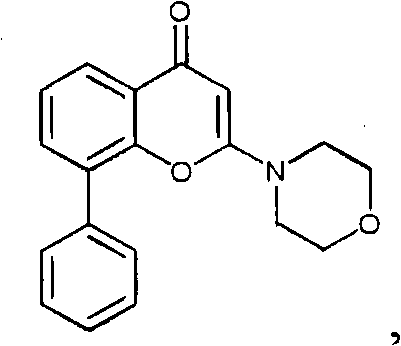


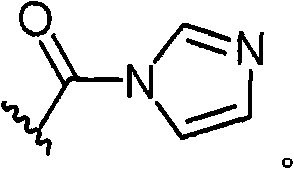





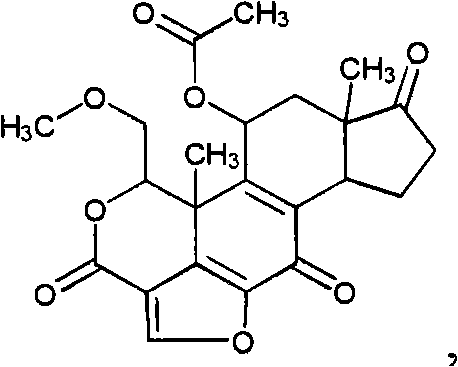
Applications Claiming Priority (5)
| Application Number | Priority Date | Filing Date | Title |
|---|---|---|---|
| US93276907P | 2007-06-01 | 2007-06-01 | |
| US60/932769 | 2007-06-01 | ||
| US3324308P | 2008-03-03 | 2008-03-03 | |
| US61/033243 | 2008-03-03 | ||
| PCT/US2008/006959 WO2009023059A2 (en) | 2007-06-01 | 2008-06-02 | Treatment of viral infections by modulation of host cell metabolic pathways |
Publications (1)
| Publication Number | Publication Date |
|---|---|
| CN101820757A true CN101820757A (en) | 2010-09-01 |
Family
ID=40351337
Family Applications (1)
| Application Number | Title | Priority Date | Filing Date |
|---|---|---|---|
| CN200880101544A Pending CN101820757A (en) | 2007-06-01 | 2008-06-02 | Treatment of viral infections by modulating host cell metabolic pathways |
Country Status (10)
| Country | Link |
|---|---|
| US (3) | US8158677B2 (en) |
| EP (3) | EP2166843A4 (en) |
| JP (1) | JP5616220B2 (en) |
| KR (1) | KR20100031528A (en) |
| CN (1) | CN101820757A (en) |
| AU (1) | AU2008287542C1 (en) |
| CA (1) | CA2687964A1 (en) |
| IL (1) | IL202403A0 (en) |
| IN (1) | IN2009KN04568A (en) |
| WO (1) | WO2009023059A2 (en) |
Cited By (14)
| Publication number | Priority date | Publication date | Assignee | Title |
|---|---|---|---|---|
| CN102462674A (en) * | 2010-11-04 | 2012-05-23 | 刘丽宏 | Application of curcumin and curcumin derivatives in preparation of drug and/or health care product for treating and preventing diseases related to human cytomegalovirus infection |
| CN105794561A (en) * | 2016-03-23 | 2016-07-27 | 浙江省农业科学院 | Application of brassinazole to improvement of rice black-streaked dwarf virus resistance of rice and method |
| CN109563057A (en) * | 2016-05-31 | 2019-04-02 | 大鹏药品工业株式会社 | Sulfonamide compounds or its salt |
| CN110603041A (en) * | 2017-04-12 | 2019-12-20 | 沃泰克斯药物股份有限公司 | Combination therapy for the treatment of influenza virus infections |
| CN110812357A (en) * | 2019-11-06 | 2020-02-21 | 山东省农业科学院奶牛研究中心 | Application of biapenem in the preparation of drugs for preventing and treating bovine enterovirus infection |
| CN111317737A (en) * | 2020-02-24 | 2020-06-23 | 南方医科大学 | ACCase inhibitor CP640184 as medicine for treating and/or preventing dengue virus infection and pharmaceutical application thereof |
| CN111920801A (en) * | 2020-09-18 | 2020-11-13 | 郑州大学第一附属医院 | Application of epigallocatechin gallate in preparing medicine for treating and/or preventing diseases caused by Ehrlich virus infection |
| CN115006390A (en) * | 2022-06-27 | 2022-09-06 | 国药集团动物保健股份有限公司 | Virus attenuation preparation, preparation method and application thereof |
| WO2023005984A1 (en) * | 2021-07-28 | 2023-02-02 | 浙江海洋大学 | Halogenated curcumin derivative, preparation method therefor, and application thereof in preservation of aquatic products |
| CN115768424A (en) * | 2020-05-20 | 2023-03-07 | 法国国家科学研究中心 | Compounds for reactivating HIV in latent HIV-infected cells |
| CN116183788A (en) * | 2023-01-09 | 2023-05-30 | 中国农业大学 | A method for accurate metabolic flux analysis of TCA cycle based on isotope tracer technology combined with high-resolution mass spectrometry |
| CN116256418A (en) * | 2022-12-30 | 2023-06-13 | 核工业理化工程研究院 | Analysis method and analysis system for carbon isotope abundance in perfluorohexane |
| CN119158019A (en) * | 2024-09-03 | 2024-12-20 | 安徽大学 | Application of Hacl1 gene in the preparation of drugs for treating RNA virus infection-related diseases and maintaining innate immune homeostasis |
| CN120694986A (en) * | 2025-07-11 | 2025-09-26 | 中山大学·深圳 | Application of a small molecule inhibitor in the preparation of products for resisting Ebola virus infection |
Families Citing this family (61)
| Publication number | Priority date | Publication date | Assignee | Title |
|---|---|---|---|---|
| JP5369257B2 (en) * | 2006-02-15 | 2013-12-18 | アッヴィ・インコーポレイテッド | Novel acetyl-CoA carboxylase (ACC) inhibitors and their use in diabetes, obesity and metabolic syndrome |
| CN101384568B (en) * | 2006-02-15 | 2012-12-12 | 雅培制药有限公司 | Acetyl-CoA carboxylase (ACC) inhibitors and their use in diabetes, obesity and metabolic syndrome |
| JP5462784B2 (en) | 2007-04-27 | 2014-04-02 | パーデュー、ファーマ、リミテッド、パートナーシップ | TRPV1 antagonists and uses thereof |
| CN101820757A (en) | 2007-06-01 | 2010-09-01 | 普林斯顿大学托管委员会 | Treatment of viral infections by modulating host cell metabolic pathways |
| EP2265603B1 (en) | 2008-03-13 | 2014-05-07 | The General Hospital Corporation | Inhibitors of the bmp signaling pathway |
| CN101869568A (en) * | 2009-04-27 | 2010-10-27 | 中国医学科学院基础医学研究所 | Use of inhibitors of autophagy (type II apoptosis) |
| US20110038852A1 (en) * | 2009-06-10 | 2011-02-17 | 3-V Biosciences, Inc. | Antivirals that target transporters, carriers, and ion channels |
| CA2766643C (en) | 2009-07-08 | 2017-01-03 | Dermira (Canada), Inc. | Tofa analogs useful in treating dermatological disorders or conditions |
| EP2536411A4 (en) * | 2010-02-18 | 2013-08-07 | Univ Princeton | INHIBITORS OF FATTY ACID METABOLISM LONG AND VERY LONG CHAIN AS BROAD SPECTRUM ANTIVIRALS |
| CN101892226A (en) * | 2010-03-11 | 2010-11-24 | 新乡医学院 | A kind of siRNA that suppresses human adipocyte ACC gene expression and its expression vector and application |
| WO2011140296A1 (en) | 2010-05-05 | 2011-11-10 | Infinity Pharmaceuticals | Triazoles as inhibitors of fatty acid synthase |
| CA2798330A1 (en) | 2010-05-05 | 2011-11-10 | Infinity Pharmaceuticals, Inc. | Tetrazolones as inhibitors of fatty acid synthase |
| EP2392327A1 (en) * | 2010-06-04 | 2011-12-07 | Universitätsmedizin der Johannes Gutenberg-Universität Mainz | Use of orlistat for the anti-parasitic treatment of a parasitic disease |
| EP2614144B1 (en) * | 2010-09-08 | 2015-07-22 | Twincore Zentrum für Experimentelle und Klinische Infektionsforschung GmbH | Use of inhibitors of phospholipase a2 for the treatment or prevention of flavivirus infection |
| EA201300867A1 (en) * | 2011-01-27 | 2014-03-31 | Дзе Трастиз Оф Принстон Юнивесити | MTOR KINASE INHIBITORS AS ANTI-VIRUS AGENTS |
| JP2014510155A (en) * | 2011-04-06 | 2014-04-24 | ザ トラスティーズ オブ プリンストン ユニバーシティ | Antiviral combination therapy |
| WO2012136852A1 (en) * | 2011-04-08 | 2012-10-11 | Inserm (Institut National De La Sante Et De La Recherche Medicale) | Method for increasing the replication capacity of an influenza virus in cultured cells |
| PL2723732T3 (en) | 2011-06-22 | 2017-07-31 | Purdue Pharma Lp | Trpv1 antagonists including dihydroxy substituent and uses thereof |
| WO2013006394A1 (en) | 2011-07-01 | 2013-01-10 | Institute For Hepatitis And Virus Research | Sulfamoylbenzamide derivatives as antiviral agents against hbv infection |
| WO2013158820A1 (en) * | 2012-04-19 | 2013-10-24 | The Trustees Of The University Of Pennsylvania | Compositions and methods for treating viral diseases |
| CA2927146A1 (en) * | 2012-07-03 | 2014-01-09 | Graceland Biotechnology Inc. | Compositions and methods for treating and inhibiting viral infections |
| US9682983B2 (en) | 2013-03-14 | 2017-06-20 | The Brigham And Women's Hospital, Inc. | BMP inhibitors and methods of use thereof |
| WO2015036892A1 (en) | 2013-09-12 | 2015-03-19 | Pfizer Inc. | Use of acetyl-coa carboxylase inhibitors for treating acne vulgaris |
| CA2928003A1 (en) * | 2013-11-14 | 2015-05-21 | Novira Therapeutics, Inc. | Azepane derivatives and methods of treating hepatitis b infections |
| WO2015154883A1 (en) * | 2014-04-11 | 2015-10-15 | Helmholtz-Zentrum für Infektionsforschung GmbH | Neosoraphens |
| WO2016011019A1 (en) | 2014-07-15 | 2016-01-21 | The Brigham And Women's Hospital, Inc. | Compositions and methods for inhibiting bmp |
| CN104188969A (en) * | 2014-08-13 | 2014-12-10 | 广州凯普生物科技有限公司 | Medicament for preventing and treating reproductive organ cancer and application thereof |
| US10542961B2 (en) | 2015-06-15 | 2020-01-28 | The Research Foundation For The State University Of New York | System and method for infrasonic cardiac monitoring |
| WO2017019636A1 (en) * | 2015-07-24 | 2017-02-02 | Insmed Incorporated | Compositions and methods for the treatment of sarcoidosis |
| EP3368663B1 (en) | 2015-11-01 | 2022-06-01 | Glycobac, LLC | Virus-free cell lines and methods for obtaining same |
| EP3430549A1 (en) * | 2016-03-16 | 2019-01-23 | Juno Therapeutics, Inc. | Methods for adaptive design of a treatment regimen and related treatments |
| US20190287013A1 (en) * | 2016-03-16 | 2019-09-19 | Juno Therapeutics, Inc. | Methods for determining dosing of a therapeutic agent and related treatments |
| CN109790143A (en) | 2016-05-10 | 2019-05-21 | C4医药公司 | The C of amine connection for target protein degradation3Glutarimide degron body |
| EP4483875A3 (en) | 2016-05-10 | 2025-04-02 | C4 Therapeutics, Inc. | Spirocyclic degronimers for target protein degradation |
| CN109562107A (en) | 2016-05-10 | 2019-04-02 | C4医药公司 | Heterocycle degron body for target protein degradation |
| EP3455218A4 (en) | 2016-05-10 | 2019-12-18 | C4 Therapeutics, Inc. | CARBON-BONDED GLUTARIMIDE-TYPE DEGRONIMERS FOR THE DEGRADATION OF TARGET PROTEINS |
| KR101805394B1 (en) * | 2016-05-27 | 2017-12-06 | 전남대학교산학협력단 | Pharmaceutical composition for preventing or treating Calicivirus infection |
| US10889555B2 (en) | 2016-05-31 | 2021-01-12 | Taiho Pharmaceutical Co., Ltd. | Sulfonamide compound or salt thereof |
| WO2017222951A1 (en) | 2016-06-23 | 2017-12-28 | Merck Sharp & Dohme Corp. | 3-aryl and heteroaryl substituted 5-trifluoromethyl oxadiazoles as histone deacetylase 6 (hdac6) inhibitors |
| BR112018076326B1 (en) | 2016-12-15 | 2023-03-07 | Société des Produits Nestlé S.A. | PET FOOD COMPOSITION, ITS USE, AND NON-THERAPEUTIC METHODS FOR MODULATING AT LEAST ONE OF PHOSPHORUS, ALKALINE PHOSPHATASE, ASPARTATE AMINOTRANSFERASE, OR GAMMAGLUTAMYLTRANSFERASE IN A PET AND FOR MEASURING A CHANGE IN THE AMOUNT OF AT LEAST ONE OF PHOSPHORUS, ALKALINE PHOSPHATASE , ASPARTATE AMINOTRANSFERASE, OR GAMMAGLUTAMILTRANSFERASE |
| JPWO2018147472A1 (en) * | 2017-02-09 | 2020-01-16 | 学校法人慶應義塾 | Blood biomarkers |
| CN118440096A (en) | 2017-06-20 | 2024-08-06 | C4医药公司 | Degradation stator and degradation determinant for N/O-ligation of protein degradation |
| AU2018354418B2 (en) * | 2017-10-27 | 2025-09-11 | Immunebridge Inc. | Compositions and methods of making expanded hematopoietic stem cells using derivatives of fluorene |
| MX2020005478A (en) | 2017-11-29 | 2020-08-27 | Taiho Pharmaceutical Co Ltd | Sulfonamide compounds and use thereof. |
| WO2020095260A1 (en) * | 2018-11-08 | 2020-05-14 | Universita' Degli Studi Di Torino | Strigolactones for use in preventing and/or treating infections caused by viruses of the herpesviridae family |
| CN110506676B (en) * | 2019-08-23 | 2022-03-08 | 上海海洋大学 | ELOVL1 gene and its application |
| WO2021216385A1 (en) * | 2020-04-20 | 2021-10-28 | Tran Lloyd Hung Loi | Methods for the prophylaxis and treatment of covid and covid-19 |
| US20240041861A1 (en) * | 2020-04-21 | 2024-02-08 | Ned Biosystems, Inc. | Compositions and methods for treatment and prophylaxis of viral infections |
| US12042514B2 (en) | 2020-05-01 | 2024-07-23 | Tygrus, LLC | Therapeutic material with low pH and low toxicity active against at least one pathogen for addressing patients with respiratory illnesses |
| US11826382B2 (en) * | 2020-05-01 | 2023-11-28 | Tygrus, LLC | Therapeutic material with low pH and low toxicity active against at least one pathogen for addressing patients with respiratory illnesses |
| US20240091253A1 (en) * | 2020-05-01 | 2024-03-21 | Tygrus, LLC | THERAPEUTIC MATERIAL WITH LOW pH AND LOW TOXICITY ACTIVE AGAINST AT LEAST ONE PATHOGEN FOR ADDRESSING PATIENTS WITH RESPIRATORY ILLNESSES |
| WO2021236614A1 (en) * | 2020-05-18 | 2021-11-25 | Northwestern University | Targeted antiviral drugs |
| WO2021252607A1 (en) * | 2020-06-12 | 2021-12-16 | Novomer, Inc. | Beta-propiolactone compounds and ring opened beta-propiolactone compounds and uses for same |
| TW202221120A (en) * | 2020-08-04 | 2022-06-01 | 美商黛瑟納製藥公司 | Compositions and methods for the treatment of metabolic syndrome |
| KR20230118644A (en) * | 2020-12-14 | 2023-08-11 | 엠디 벌트 엘엘씨 | Methods and pharmaceutical compositions for the treatment and prevention of microbial infectious diseases and related inflammatory disorders |
| CN116583274A (en) * | 2020-12-14 | 2023-08-11 | 医学文库有限责任公司 | Methods and pharmaceutical compositions for treating and preventing microbial infectious diseases and related inflammatory disorders |
| CN114292851B (en) * | 2022-01-12 | 2023-08-08 | 徐州医科大学 | Interfering sequence, shRNA lentiviral vector, construction method and application for inhibiting Cnr1 gene expression |
| US20250288577A1 (en) * | 2022-04-29 | 2025-09-18 | Cornell University | Methods of treating a virus infection and methods of inhibiting viral replication |
| CN115282278A (en) * | 2022-07-13 | 2022-11-04 | 山东大学 | Application of cholesterol regulator as antigen presentation promoter in treatment of hepatitis B |
| IT202200016647A1 (en) * | 2022-08-04 | 2024-02-04 | Np1 Srl | PHARMACEUTICAL COMPOSITION FOR THE TREATMENT AND PREVENTION OF HPV |
| CN119174772B (en) * | 2024-11-26 | 2025-02-28 | 四川省医学科学院·四川省人民医院 | Application of fructose-1,6-diphosphate in the preparation of drugs for preventing and treating herpes simplex virus type 1 infection |
Citations (2)
| Publication number | Priority date | Publication date | Assignee | Title |
|---|---|---|---|---|
| US4602099A (en) * | 1973-04-02 | 1986-07-22 | Merrell Dow Pharmaceuticals Inc. | Antirhinovirus agents |
| CN1043711A (en) * | 1988-12-21 | 1990-07-11 | 默里尔多药物公司 | Antiretroviral furanone |
Family Cites Families (122)
| Publication number | Priority date | Publication date | Assignee | Title |
|---|---|---|---|---|
| US3536809A (en) | 1969-02-17 | 1970-10-27 | Alza Corp | Medication method |
| US3598123A (en) | 1969-04-01 | 1971-08-10 | Alza Corp | Bandage for administering drugs |
| US3845770A (en) | 1972-06-05 | 1974-11-05 | Alza Corp | Osmatic dispensing device for releasing beneficial agent |
| US3916899A (en) | 1973-04-25 | 1975-11-04 | Alza Corp | Osmotic dispensing device with maximum and minimum sizes for the passageway |
| JPS5612114B2 (en) | 1974-06-07 | 1981-03-18 | ||
| US4008719A (en) | 1976-02-02 | 1977-02-22 | Alza Corporation | Osmotic system having laminar arrangement for programming delivery of active agent |
| US4109496A (en) | 1977-12-20 | 1978-08-29 | Norris Industries | Trapped key mechanism |
| FR2425432A1 (en) | 1978-05-10 | 1979-12-07 | Boehringer Ingelheim Lab | Antibiotic and antifungal cerulenin derivs. - prepd. from a 5-sulphonyloxy 1,2-isopropylidene xylofuranose |
| FR2457864A2 (en) | 1979-06-01 | 1980-12-26 | Boehringer Ingelheim Lab | Chiral synthesis for prepn. of cerulenin enantiomers - starting from 5,6-di:desoxy 1,2-O-isopropylidene-alpha-d-xylo-hex-5-eno:furanose |
| US4231938A (en) | 1979-06-15 | 1980-11-04 | Merck & Co., Inc. | Hypocholesteremic fermentation products and process of preparation |
| DK149080C (en) | 1980-06-06 | 1986-07-28 | Sankyo Co | METHOD FOR PREPARING ML-236B CARBOXYLIC ACID DERIVATIVES |
| US4450171A (en) | 1980-08-05 | 1984-05-22 | Merck & Co., Inc. | Antihypercholesterolemic compounds |
| US4334913A (en) | 1981-03-31 | 1982-06-15 | Union Carbide Corporation | Substituted 3-hydroxy-2-cyclohexene-1-one compounds as sugar enhancers for plants |
| US4448784A (en) | 1982-04-12 | 1984-05-15 | Hoechst-Roussel Pharmaceuticals, Inc. | 1-(Aminoalkylphenyl and aminoalkylbenzyl)-indoles and indolines and analgesic method of use thereof |
| US5354772A (en) | 1982-11-22 | 1994-10-11 | Sandoz Pharm. Corp. | Indole analogs of mevalonolactone and derivatives thereof |
| US4499289A (en) | 1982-12-03 | 1985-02-12 | G. D. Searle & Co. | Octahydronapthalenes |
| CA1247547A (en) * | 1983-06-22 | 1988-12-28 | Paul Hadvary | Leucine derivatives |
| JPS611698A (en) * | 1984-06-12 | 1986-01-07 | Mitsubishi Chem Ind Ltd | Novel corticoid derivative and its preparation |
| US4613610A (en) | 1984-06-22 | 1986-09-23 | Sandoz Pharmaceuticals Corp. | Cholesterol biosynthesis inhibiting pyrazole analogs of mevalonolactone and its derivatives |
| US4686237A (en) | 1984-07-24 | 1987-08-11 | Sandoz Pharmaceuticals Corp. | Erythro-(E)-7-[3'-C1-3 alkyl-1'-(3",5"-dimethylphenyl)naphth-2'-yl]-3,5-dihydroxyhept-6-enoic acids and derivatives thereof |
| US4647576A (en) | 1984-09-24 | 1987-03-03 | Warner-Lambert Company | Trans-6-[2-(substitutedpyrrol-1-yl)alkyl]-pyran-2-one inhibitors of cholesterol synthesis |
| IE58110B1 (en) | 1984-10-30 | 1993-07-14 | Elan Corp Plc | Controlled release powder and process for its preparation |
| ATE60571T1 (en) | 1984-12-04 | 1991-02-15 | Sandoz Ag | INDENE ANALOGUES OF MEVALONOLACTONE AND THEIR DERIVATIVES. |
| US4735895A (en) | 1984-12-28 | 1988-04-05 | Oncotech, Inc. | Cancer susceptibility test |
| US5506337A (en) | 1985-03-15 | 1996-04-09 | Antivirals Inc. | Morpholino-subunit combinatorial library and method |
| US4668794A (en) | 1985-05-22 | 1987-05-26 | Sandoz Pharm. Corp. | Intermediate imidazole acrolein analogs |
| US4868103A (en) | 1986-02-19 | 1989-09-19 | Enzo Biochem, Inc. | Analyte detection by means of energy transfer |
| US4681893A (en) | 1986-05-30 | 1987-07-21 | Warner-Lambert Company | Trans-6-[2-(3- or 4-carboxamido-substituted pyrrol-1-yl)alkyl]-4-hydroxypyran-2-one inhibitors of cholesterol synthesis |
| US5188830A (en) | 1987-03-27 | 1993-02-23 | Merck & Co., Inc. | Methods for thrombolytic therapy |
| ES2009918A6 (en) | 1987-05-22 | 1989-10-16 | Squibb & Sons Inc | PROCEDURE FOR PREPARING HMG-COA-REDUCTASE INHIBITORS CONTAINING PHOSPHORUS. |
| US5080891A (en) | 1987-08-03 | 1992-01-14 | Ddi Pharmaceuticals, Inc. | Conjugates of superoxide dismutase coupled to high molecular weight polyalkylene glycols |
| JP2569746B2 (en) | 1987-08-20 | 1997-01-08 | 日産化学工業株式会社 | Quinoline mevalonolactones |
| NO177005C (en) | 1988-01-20 | 1995-07-05 | Bayer Ag | Analogous process for the preparation of substituted pyridines, as well as intermediates for use in the preparation |
| US5010175A (en) | 1988-05-02 | 1991-04-23 | The Regents Of The University Of California | General method for producing and selecting peptides with specific properties |
| US5073543A (en) | 1988-07-21 | 1991-12-17 | G. D. Searle & Co. | Controlled release formulations of trophic factors in ganglioside-lipsome vehicle |
| US5506219A (en) | 1988-08-29 | 1996-04-09 | E. R. Squibb & Sons, Inc. | Pyridine anchors for HMG-CoA reductase inhibitors |
| US5223409A (en) | 1988-09-02 | 1993-06-29 | Protein Engineering Corp. | Directed evolution of novel binding proteins |
| EP0358607A3 (en) | 1988-09-09 | 1990-10-31 | Gesellschaft für Biotechnologische Forschung mbH (GBF) | Macrocyclic lacton derivatives with a microbicidal activity |
| US4958089A (en) | 1988-12-20 | 1990-09-18 | Gazelle Microcircuits, Inc. | High output drive FET buffer for providing high initial current to a subsequent stage |
| US5190969A (en) | 1988-12-20 | 1993-03-02 | The United States Of America As Represented By The Secretary Of The Department Of Health & Human Services | 2,3-epoxy derivatives as anti retrovital chemotherapeutic agents |
| US5753675A (en) | 1989-03-03 | 1998-05-19 | Novartis Pharmaceuticals Corporation | Quinoline analogs of mevalonolactone and derivatives thereof |
| IT1229203B (en) | 1989-03-22 | 1991-07-25 | Bioresearch Spa | USE OF 5 METHYLTHETRAHYDROPHOLIC ACID, 5 FORMYLTHETRAHYDROPHOLIC ACID AND THEIR PHARMACEUTICALLY ACCEPTABLE SALTS FOR THE PREPARATION OF PHARMACEUTICAL COMPOSITIONS IN THE FORM OF CONTROLLED RELEASE ACTIVE IN THE THERAPY OF MENTAL AND ORGANIC DISORDERS. |
| FI94339C (en) | 1989-07-21 | 1995-08-25 | Warner Lambert Co | Process for the preparation of pharmaceutically acceptable [R- (R *, R *)] - 2- (4-fluorophenyl) -, - dihydroxy-5- (1-methylethyl) -3-phenyl-4 - [(phenylamino) carbonyl] -1H- for the preparation of pyrrole-1-heptanoic acid and its pharmaceutically acceptable salts |
| US5064856A (en) | 1989-07-31 | 1991-11-12 | Merck & Co., Inc. | Novel hmg-coa synthase inhibitors |
| US5120548A (en) | 1989-11-07 | 1992-06-09 | Merck & Co., Inc. | Swelling modulated polymeric drug delivery device |
| US5733566A (en) | 1990-05-15 | 1998-03-31 | Alkermes Controlled Therapeutics Inc. Ii | Controlled release of antiparasitic agents in animals |
| IE66205B1 (en) | 1990-06-14 | 1995-12-13 | Paul A Bartlett | Polypeptide analogs |
| US5650489A (en) | 1990-07-02 | 1997-07-22 | The Arizona Board Of Regents | Random bio-oligomer library, a method of synthesis thereof, and a method of use thereof |
| US5177080A (en) | 1990-12-14 | 1993-01-05 | Bayer Aktiengesellschaft | Substituted pyridyl-dihydroxy-heptenoic acid and its salts |
| JP2648897B2 (en) | 1991-07-01 | 1997-09-03 | 塩野義製薬株式会社 | Pyrimidine derivatives |
| DE4126999A1 (en) | 1991-08-16 | 1993-02-18 | Basf Ag | HERBICIDE AGENT, CONTAINING 3-AMINOBENZO (B) THIOPHENE AS ANTIDOTS |
| US5580578A (en) | 1992-01-27 | 1996-12-03 | Euro-Celtique, S.A. | Controlled release formulations coated with aqueous dispersions of acrylic polymers |
| DE69326967T2 (en) | 1992-01-17 | 2000-06-15 | Lakowicz, Joseph R. | Phase modulation energy transfer fluoroimmunoassay |
| US5573905A (en) | 1992-03-30 | 1996-11-12 | The Scripps Research Institute | Encoded combinatorial chemical libraries |
| GB9209628D0 (en) | 1992-05-05 | 1992-06-17 | Smithkline Beecham Plc | Compounds |
| US5288514A (en) | 1992-09-14 | 1994-02-22 | The Regents Of The University Of California | Solid phase and combinatorial synthesis of benzodiazepine compounds on a solid support |
| DE69333366T2 (en) | 1992-10-30 | 2004-09-16 | The General Hospital Corp., Boston | A NEW CELL CYCLE CONTROL PROTEIN |
| SG45369A1 (en) | 1993-01-19 | 1998-10-16 | Warner Lambert Co | Stable oral ci-981 formulation and process of preparing same |
| US5591767A (en) | 1993-01-25 | 1997-01-07 | Pharmetrix Corporation | Liquid reservoir transdermal patch for the administration of ketorolac |
| US6069298A (en) | 1993-02-05 | 2000-05-30 | Regents Of The University Of Minnesota | Methods and an acetyl CoA carboxylase gene for conferring herbicide tolerance and an alteration in oil content of plants |
| US6310034B1 (en) | 1993-05-21 | 2001-10-30 | Ut-Battelle, Llc | Agouti polypeptide compositions |
| US5519134A (en) | 1994-01-11 | 1996-05-21 | Isis Pharmaceuticals, Inc. | Pyrrolidine-containing monomers and oligomers |
| US5614551A (en) * | 1994-01-24 | 1997-03-25 | The Johns Hopkins University | Inhibitors of fatty acid synthesis as antimicrobial agents |
| US5539083A (en) | 1994-02-23 | 1996-07-23 | Isis Pharmaceuticals, Inc. | Peptide nucleic acid combinatorial libraries and improved methods of synthesis |
| US5385929A (en) | 1994-05-04 | 1995-01-31 | Warner-Lambert Company | [(Hydroxyphenylamino) carbonyl] pyrroles |
| US5525735A (en) | 1994-06-22 | 1996-06-11 | Affymax Technologies Nv | Methods for synthesizing diverse collections of pyrrolidine compounds |
| US5549974A (en) | 1994-06-23 | 1996-08-27 | Affymax Technologies Nv | Methods for the solid phase synthesis of thiazolidinones, metathiazanones, and derivatives thereof |
| IT1270594B (en) | 1994-07-07 | 1997-05-07 | Recordati Chem Pharm | CONTROLLED RELEASE PHARMACEUTICAL COMPOSITION OF LIQUID SUSPENSION MOGUISTEIN |
| US5977322A (en) | 1995-06-14 | 1999-11-02 | The Regents Of The University Of California | High affinity human antibodies to tumor antigens |
| US5569588A (en) | 1995-08-09 | 1996-10-29 | The Regents Of The University Of California | Methods for drug screening |
| BR9610572B1 (en) | 1995-09-20 | 2012-02-22 | herbicidal composition, process for preparing synergistically active herbicidal compositions, and processes for controlling undesirable vegetation, and for selectively controlling undesirable vegetation. | |
| DK0869784T3 (en) | 1995-11-17 | 2006-01-16 | Univ Johns Hopkins | Inhibition of fatty acid synthase as a means of reducing the amount of adipocyte |
| US6124125A (en) | 1996-01-08 | 2000-09-26 | Trustees Of Dartmouth College | AMP activated protein kinase |
| US6136964A (en) | 1996-03-19 | 2000-10-24 | Cell Therapeutics, Inc. | Mammalian lysophosphatidic acid acyltransferase |
| US6300487B1 (en) | 1996-03-19 | 2001-10-09 | Cell Therapuetics, Inc. | Mammalian lysophosphatidic acid acyltransferase |
| US6576636B2 (en) * | 1996-05-22 | 2003-06-10 | Protarga, Inc. | Method of treating a liver disorder with fatty acid-antiviral agent conjugates |
| US6506559B1 (en) | 1997-12-23 | 2003-01-14 | Carnegie Institute Of Washington | Genetic inhibition by double-stranded RNA |
| US20030163845A1 (en) | 1998-09-02 | 2003-08-28 | Pradip Mukerji | Elongase genes and uses thereof |
| WO2000044914A1 (en) | 1999-01-28 | 2000-08-03 | Medical College Of Georgia Research Institute, Inc. | Composition and method for in vivo and in vitro attenuation of gene expression using double stranded rna |
| US20020016216A1 (en) | 1999-06-08 | 2002-02-07 | Kenji Kobayashi | Golf club |
| US6383987B1 (en) | 1999-12-15 | 2002-05-07 | Basf Aktiengesellschaft | Cyclohexenone oxime ether/(glyphosates/gluphosinates) suspension concentrates |
| US7078205B2 (en) | 2000-02-17 | 2006-07-18 | Millennium Pharmaceuticals, Inc. | Nucleic acid sequences encoding melanoma associated antigen molecules, aminotransferase molecules, atpase molecules, acyltransferase molecules, pyridoxal-phosphate dependent enzyme molecules and uses therefor |
| NZ522045A (en) | 2000-03-30 | 2007-05-31 | Whitehead Biomedical Inst | RNA sequence-specific mediators of RNA interference |
| DE60120427D1 (en) | 2000-08-25 | 2006-07-20 | Sloan Kettering Inst Cancer | RADICICOL AND MONOCILLIN AND ITS ANALOGS AND ITS APPLICATIONS |
| US7704979B2 (en) | 2000-09-01 | 2010-04-27 | The University Of Tennessee Research Foundation | Materials and methods for the treatment or prevention of obesity |
| IL155991A0 (en) | 2000-12-01 | 2003-12-23 | Max Planck Gesellschaft | Rna interference mediating small rna molecules |
| GB0107510D0 (en) | 2001-03-26 | 2001-05-16 | Univ Bristol | New elongase gene and a process for the production of -9-polyunsaturated fatty acids |
| DE10115938A1 (en) | 2001-03-30 | 2002-10-10 | Medigene Ag Ges Fuer Molekular | Process for the preparation of oxirane carboxylic acids and derivatives thereof |
| US20080161256A1 (en) | 2001-05-18 | 2008-07-03 | Sirna Therapeutics, Inc. | RNA interference mediated inhibition of gene expression using short interfering nucleic acid (siNA) |
| US6482858B1 (en) * | 2001-06-20 | 2002-11-19 | Dallas L Clouatre | (−)-hydroxycitric acid for wound healing and immunomodulation |
| ES2609014T3 (en) | 2001-07-12 | 2017-04-18 | University Of Massachusetts | In vivo production of small interfering RNAs that mediate gene silencing |
| US20030144345A1 (en) * | 2001-07-27 | 2003-07-31 | Marcel Gubler | Treatment of metabolic diseases with soraphen derivatives |
| US7291616B2 (en) | 2001-10-31 | 2007-11-06 | Cell Therapeutics, Inc. | Aryl triazines as LPAAT-β inhibitors and uses thereof |
| US20030158156A1 (en) | 2001-11-21 | 2003-08-21 | Kimberly-Clark Worldwide, Inc. | Methods for inhibiting the production of TSST-1 |
| WO2003072602A2 (en) | 2001-12-20 | 2003-09-04 | Cellzome Ag | Protein complexes and methods for their use |
| US20050119251A1 (en) | 2001-12-21 | 2005-06-02 | Jian-Min Fu | Nicotinamide derivatives and their use as therapeutic agents |
| PL372887A1 (en) | 2002-02-27 | 2005-08-08 | Pfizer Products Inc. | Acc inhibitors |
| AR038703A1 (en) | 2002-02-28 | 2005-01-26 | Novartis Ag | DERIVATIVES OF 5-PHENYLTIAZOL AND USE AS AN INHIBITOR OF QUINASA P I 3 |
| US8188145B2 (en) | 2002-06-12 | 2012-05-29 | Magnachem International Laboratories, Inc. | Synthetic lactone formulations and method of use |
| US20060241177A1 (en) | 2002-07-01 | 2006-10-26 | Kuhadja Francis P | Novel compounds, pharmaceutical compositions containing same, and methods of use for same |
| EA200500745A1 (en) | 2002-10-31 | 2005-12-29 | Фасджен, Ллс. | METHOD OF INHIBITING THE DEVELOPMENT OF MALIGNANT TUMORS BY FAT ACIDS SYNTHASE INHIBITORS |
| US20060147947A1 (en) | 2002-12-04 | 2006-07-06 | Javier Apfeld | AMPK pathway components |
| GB0305152D0 (en) | 2003-03-06 | 2003-04-09 | Novartis Ag | Organic compounds |
| US6875781B2 (en) | 2003-04-04 | 2005-04-05 | Cell Therapeutics, Inc. | Pyridines and uses thereof |
| AR044519A1 (en) | 2003-05-02 | 2005-09-14 | Novartis Ag | DERIVATIVES OF PIRIDIN-TIAZOL AMINA AND PIRIMIDIN-TIAZOL AMINA |
| EP1626711A4 (en) | 2003-05-09 | 2010-10-06 | Univ Pennsylvania | COMPOSITIONS AND METHODS FOR ANTICANCER TREATMENT |
| CA2525619A1 (en) | 2003-05-16 | 2005-03-03 | Rosetta Inpharmatics, Llc | Methods and compositions for rna interference |
| AU2004261252C1 (en) | 2003-07-30 | 2009-09-17 | Xenon Pharmaceuticals Inc. | Pyridazine derivatives and their use as therapeutic agents |
| US6994956B2 (en) | 2003-08-04 | 2006-02-07 | Bayer Pharmaceuticals Corporation | Method for assaying enzyme activity |
| GB0320197D0 (en) | 2003-08-28 | 2003-10-01 | Novartis Ag | Organic compounds |
| CA2543954C (en) | 2003-10-27 | 2016-11-08 | Rosetta Inpharmatics Llc | Method of designing sirnas for gene silencing |
| JP2007513888A (en) | 2003-11-24 | 2007-05-31 | ユニバーシティ オブ ノース カロライナ アット チャペル ヒル | Fused ring dicationic antiprotozoal agents and their prodrugs |
| EP1709019B1 (en) | 2004-01-12 | 2007-08-08 | Applied Research Systems ARS Holding N.V. | Thiazole derivatives and use thereof |
| US7220729B2 (en) | 2004-05-10 | 2007-05-22 | Academia Sinica | Huntington's Disease Treatment |
| US20060195938A1 (en) | 2004-06-15 | 2006-08-31 | Eva-Maria Franken | Polynucleotides encoding insect acetyl coenzyme-A carboxylase and uses thereof |
| US7211423B2 (en) | 2004-07-23 | 2007-05-01 | Bristol-Myers Squibb Co. | Acetyl CoA carboxylase 2 sequences and methods |
| US20060040003A1 (en) * | 2004-08-10 | 2006-02-23 | Alvin Needleman | Dietary supplement for supressing appetite, enhancing and extending satiety, improving glycemic control, and stimulant free |
| FR2888816B1 (en) | 2005-07-20 | 2007-08-31 | Airbus France Sas | MONOLITHIC AUTO-RAIDI PANEL |
| JP5320077B2 (en) | 2006-03-03 | 2013-10-23 | ユニベルシテ パリ ディドロ−パリ 7 | Method for electrochemical detection of target nucleic acid sequence |
| WO2008014219A2 (en) | 2006-07-24 | 2008-01-31 | Smithkline Beecham Corporation | Thiozolidinedione derivatives as p13 kinase inhibitors |
| CN101820757A (en) * | 2007-06-01 | 2010-09-01 | 普林斯顿大学托管委员会 | Treatment of viral infections by modulating host cell metabolic pathways |
| TWI552751B (en) | 2011-06-20 | 2016-10-11 | H 朗德貝克公司 | Administration of 4-((1R,3S)-6-chloro-3-phenyl-dihydroindol-1-yl)-1,2,2-trimethyl-piperidin and its salts for the treatment of schizophrenia Methods |
-
2008
- 2008-06-02 CN CN200880101544A patent/CN101820757A/en active Pending
- 2008-06-02 KR KR20097027678A patent/KR20100031528A/en not_active Withdrawn
- 2008-06-02 EP EP08827478A patent/EP2166843A4/en not_active Withdrawn
- 2008-06-02 EP EP20120178048 patent/EP2572712A3/en not_active Withdrawn
- 2008-06-02 CA CA002687964A patent/CA2687964A1/en not_active Abandoned
- 2008-06-02 US US12/156,517 patent/US8158677B2/en not_active Expired - Fee Related
- 2008-06-02 EP EP20120178059 patent/EP2581081A3/en not_active Withdrawn
- 2008-06-02 IN IN4568KON2009 patent/IN2009KN04568A/en unknown
- 2008-06-02 WO PCT/US2008/006959 patent/WO2009023059A2/en not_active Ceased
- 2008-06-02 AU AU2008287542A patent/AU2008287542C1/en not_active Ceased
- 2008-06-02 JP JP2010510373A patent/JP5616220B2/en not_active Expired - Fee Related
-
2009
- 2009-11-29 IL IL202403A patent/IL202403A0/en unknown
-
2012
- 2012-04-03 US US13/438,616 patent/US9029413B2/en not_active Expired - Fee Related
-
2015
- 2015-12-21 US US14/977,424 patent/US9757407B2/en not_active Expired - Fee Related
Patent Citations (2)
| Publication number | Priority date | Publication date | Assignee | Title |
|---|---|---|---|---|
| US4602099A (en) * | 1973-04-02 | 1986-07-22 | Merrell Dow Pharmaceuticals Inc. | Antirhinovirus agents |
| CN1043711A (en) * | 1988-12-21 | 1990-07-11 | 默里尔多药物公司 | Antiretroviral furanone |
Non-Patent Citations (2)
| Title |
|---|
| ROGER A. PARKER ET AL.: "5-(Tetradecyloxy)-2-furancarboxylic Acid and Related Hypolipidemic Fatty Acid-Like Alkyloxyarylcarboxylic Acids", 《JOURNAL OF MEDICINAL CHEMISTRY》 * |
| SHAROOKH B. KAPADIA ET AL.: "Hepatitis C virus RNA replication is regulated by host geranylgeranylation and fatty acids", 《PNAS》 * |
Cited By (20)
| Publication number | Priority date | Publication date | Assignee | Title |
|---|---|---|---|---|
| CN102462674A (en) * | 2010-11-04 | 2012-05-23 | 刘丽宏 | Application of curcumin and curcumin derivatives in preparation of drug and/or health care product for treating and preventing diseases related to human cytomegalovirus infection |
| CN105794561A (en) * | 2016-03-23 | 2016-07-27 | 浙江省农业科学院 | Application of brassinazole to improvement of rice black-streaked dwarf virus resistance of rice and method |
| CN105794561B (en) * | 2016-03-23 | 2019-01-01 | 浙江省农业科学院 | Rape element azoles improves the application and method of Rice Resistance rice black-streaked dwarf virus disease |
| CN109563057B (en) * | 2016-05-31 | 2022-06-24 | 大鹏药品工业株式会社 | Sulfonamide compound or salt thereof |
| CN109563057A (en) * | 2016-05-31 | 2019-04-02 | 大鹏药品工业株式会社 | Sulfonamide compounds or its salt |
| CN110603041A (en) * | 2017-04-12 | 2019-12-20 | 沃泰克斯药物股份有限公司 | Combination therapy for the treatment of influenza virus infections |
| CN110812357B (en) * | 2019-11-06 | 2022-09-23 | 山东省农业科学院奶牛研究中心 | Application of biapenem in preparation of medicine for preventing and treating bovine enterovirus infection |
| CN110812357A (en) * | 2019-11-06 | 2020-02-21 | 山东省农业科学院奶牛研究中心 | Application of biapenem in the preparation of drugs for preventing and treating bovine enterovirus infection |
| CN111317737A (en) * | 2020-02-24 | 2020-06-23 | 南方医科大学 | ACCase inhibitor CP640184 as medicine for treating and/or preventing dengue virus infection and pharmaceutical application thereof |
| CN111317737B (en) * | 2020-02-24 | 2023-02-17 | 南方医科大学 | ACCase inhibitor CP640184 as medicine for treating and/or preventing dengue virus infection and pharmaceutical application thereof |
| CN115768424A (en) * | 2020-05-20 | 2023-03-07 | 法国国家科学研究中心 | Compounds for reactivating HIV in latent HIV-infected cells |
| CN111920801A (en) * | 2020-09-18 | 2020-11-13 | 郑州大学第一附属医院 | Application of epigallocatechin gallate in preparing medicine for treating and/or preventing diseases caused by Ehrlich virus infection |
| WO2023005984A1 (en) * | 2021-07-28 | 2023-02-02 | 浙江海洋大学 | Halogenated curcumin derivative, preparation method therefor, and application thereof in preservation of aquatic products |
| CN115006390A (en) * | 2022-06-27 | 2022-09-06 | 国药集团动物保健股份有限公司 | Virus attenuation preparation, preparation method and application thereof |
| CN115006390B (en) * | 2022-06-27 | 2024-04-19 | 国药集团动物保健股份有限公司 | Virus attenuation preparation, preparation method and application thereof |
| CN116256418A (en) * | 2022-12-30 | 2023-06-13 | 核工业理化工程研究院 | Analysis method and analysis system for carbon isotope abundance in perfluorohexane |
| CN116256418B (en) * | 2022-12-30 | 2025-04-29 | 核工业理化工程研究院 | A method and system for analyzing carbon isotope abundance in perfluorohexane |
| CN116183788A (en) * | 2023-01-09 | 2023-05-30 | 中国农业大学 | A method for accurate metabolic flux analysis of TCA cycle based on isotope tracer technology combined with high-resolution mass spectrometry |
| CN119158019A (en) * | 2024-09-03 | 2024-12-20 | 安徽大学 | Application of Hacl1 gene in the preparation of drugs for treating RNA virus infection-related diseases and maintaining innate immune homeostasis |
| CN120694986A (en) * | 2025-07-11 | 2025-09-26 | 中山大学·深圳 | Application of a small molecule inhibitor in the preparation of products for resisting Ebola virus infection |
Also Published As
| Publication number | Publication date |
|---|---|
| US20130065850A1 (en) | 2013-03-14 |
| AU2008287542C1 (en) | 2015-01-22 |
| EP2581081A2 (en) | 2013-04-17 |
| WO2009023059A2 (en) | 2009-02-19 |
| IL202403A0 (en) | 2010-06-30 |
| US9029413B2 (en) | 2015-05-12 |
| EP2572712A3 (en) | 2013-11-20 |
| CA2687964A1 (en) | 2009-02-19 |
| WO2009023059A3 (en) | 2010-01-07 |
| US8158677B2 (en) | 2012-04-17 |
| EP2581081A3 (en) | 2013-07-31 |
| IN2009KN04568A (en) | 2015-08-28 |
| AU2008287542B2 (en) | 2014-07-31 |
| US20090239830A1 (en) | 2009-09-24 |
| US9757407B2 (en) | 2017-09-12 |
| EP2166843A2 (en) | 2010-03-31 |
| KR20100031528A (en) | 2010-03-22 |
| AU2008287542A1 (en) | 2009-02-19 |
| JP5616220B2 (en) | 2014-10-29 |
| US20160346309A1 (en) | 2016-12-01 |
| EP2166843A4 (en) | 2010-08-11 |
| JP2010538968A (en) | 2010-12-16 |
| EP2572712A2 (en) | 2013-03-27 |
Similar Documents
| Publication | Publication Date | Title |
|---|---|---|
| CN101820757A (en) | Treatment of viral infections by modulating host cell metabolic pathways | |
| US9168269B2 (en) | Inhibitors of long and very long chain fatty acid metabolism as broad spectrum anti-virals | |
| WO2012139028A2 (en) | Anti-viral combination therapy | |
| Mansour et al. | Quinazoline-Schiff base conjugates: in silico study and ADMET predictions as multi-target inhibitors of coronavirus (SARS-CoV-2) proteins | |
| US20140018354A9 (en) | Inhibitors of mtor kinase as anti-viral agents | |
| Vitner et al. | Glucosylceramide synthase inhibitors prevent replication of SARS-CoV-2 and influenza virus | |
| US20120184600A1 (en) | Inhibition of Glycerol-3-Phosphate Acyltransferase (GPAT) and Associated Enzymes for Treatment of Viral Infections | |
| US10189822B2 (en) | Heterocyclic modulators of lipid synthesis | |
| JP2014505076A (en) | Inhibitors of mTOR kinase as antiviral agents | |
| Wakao et al. | Sangivamycin induces apoptosis by suppressing Erk signaling in primary effusion lymphoma cells | |
| US9624173B2 (en) | Heterocyclic modulators of lipid synthesis | |
| Bouzari et al. | Immunometabolites in viral infections: action mechanism and function | |
| Greene et al. | Inhibiting glutamine metabolism blocks coronavirus replication in mammalian cells | |
| Class et al. | Patent application title: TREATMENT OF VIRAL INFECTIONS BY MODULATION OF HOST CELL METABOLIC PATHWAYS Inventors: Josh Munger (Rochester, NY, US) Bryson Bennett (Metuchen, NJ, US) Thomas Shenk (Princeton, NJ, US) Thomas Shenk (Princeton, NJ, US) Joshua Rabinowitz (Princeton, NJ, US) Assignees: The Trustees of Princeton University | |
| Jacolin et al. | NAD metabolism plays multiple roles in influenza A virus replication in a novel ex vivo model of mouse lung infection | |
| Passalacqua et al. | Central carbon metabolism is an intrinsic factor for optimal replication of a norovirus | |
| Mayer et al. | Hijacking the Supplies: Metabolism as a Novel Facet of Virus-Host Interaction. Front. Immunol. 10: 1533. doi: 10.3389/fimmu. 2019.01533 Hijacking the Supplies: Metabolism as a Novel Facet of Virus-Host Interaction Katharina A | |
| RU2774758C2 (en) | Heterocyclic lipid synthesis modulators |
Legal Events
| Date | Code | Title | Description |
|---|---|---|---|
| C06 | Publication | ||
| PB01 | Publication | ||
| C10 | Entry into substantive examination | ||
| SE01 | Entry into force of request for substantive examination | ||
| RJ01 | Rejection of invention patent application after publication | ||
| RJ01 | Rejection of invention patent application after publication |
Application publication date: 20100901 |