CN101785210B - Channel aware multiple user MIMO scheme unified with single user closed loop MIMO - Google Patents
Channel aware multiple user MIMO scheme unified with single user closed loop MIMO Download PDFInfo
- Publication number
- CN101785210B CN101785210B CN200880102523.XA CN200880102523A CN101785210B CN 101785210 B CN101785210 B CN 101785210B CN 200880102523 A CN200880102523 A CN 200880102523A CN 101785210 B CN101785210 B CN 101785210B
- Authority
- CN
- China
- Prior art keywords
- channel quality
- quality indicator
- indicator values
- grade
- subscriber stations
- Prior art date
- Legal status (The legal status is an assumption and is not a legal conclusion. Google has not performed a legal analysis and makes no representation as to the accuracy of the status listed.)
- Expired - Fee Related
Links
Images


Classifications
-
- H—ELECTRICITY
- H04—ELECTRIC COMMUNICATION TECHNIQUE
- H04B—TRANSMISSION
- H04B7/00—Radio transmission systems, i.e. using radiation field
- H04B7/02—Diversity systems; Multi-antenna system, i.e. transmission or reception using multiple antennas
- H04B7/04—Diversity systems; Multi-antenna system, i.e. transmission or reception using multiple antennas using two or more spaced independent antennas
- H04B7/0413—MIMO systems
- H04B7/0452—Multi-user MIMO systems
-
- H—ELECTRICITY
- H04—ELECTRIC COMMUNICATION TECHNIQUE
- H04B—TRANSMISSION
- H04B7/00—Radio transmission systems, i.e. using radiation field
- H04B7/02—Diversity systems; Multi-antenna system, i.e. transmission or reception using multiple antennas
- H04B7/04—Diversity systems; Multi-antenna system, i.e. transmission or reception using multiple antennas using two or more spaced independent antennas
- H04B7/06—Diversity systems; Multi-antenna system, i.e. transmission or reception using multiple antennas using two or more spaced independent antennas at the transmitting station
- H04B7/0613—Diversity systems; Multi-antenna system, i.e. transmission or reception using multiple antennas using two or more spaced independent antennas at the transmitting station using simultaneous transmission
- H04B7/0615—Diversity systems; Multi-antenna system, i.e. transmission or reception using multiple antennas using two or more spaced independent antennas at the transmitting station using simultaneous transmission of weighted versions of same signal
- H04B7/0617—Diversity systems; Multi-antenna system, i.e. transmission or reception using multiple antennas using two or more spaced independent antennas at the transmitting station using simultaneous transmission of weighted versions of same signal for beam forming
-
- H—ELECTRICITY
- H04—ELECTRIC COMMUNICATION TECHNIQUE
- H04B—TRANSMISSION
- H04B7/00—Radio transmission systems, i.e. using radiation field
- H04B7/02—Diversity systems; Multi-antenna system, i.e. transmission or reception using multiple antennas
- H04B7/04—Diversity systems; Multi-antenna system, i.e. transmission or reception using multiple antennas using two or more spaced independent antennas
- H04B7/06—Diversity systems; Multi-antenna system, i.e. transmission or reception using multiple antennas using two or more spaced independent antennas at the transmitting station
- H04B7/0613—Diversity systems; Multi-antenna system, i.e. transmission or reception using multiple antennas using two or more spaced independent antennas at the transmitting station using simultaneous transmission
- H04B7/0615—Diversity systems; Multi-antenna system, i.e. transmission or reception using multiple antennas using two or more spaced independent antennas at the transmitting station using simultaneous transmission of weighted versions of same signal
- H04B7/0619—Diversity systems; Multi-antenna system, i.e. transmission or reception using multiple antennas using two or more spaced independent antennas at the transmitting station using simultaneous transmission of weighted versions of same signal using feedback from receiving side
- H04B7/0621—Feedback content
- H04B7/063—Parameters other than those covered in groups H04B7/0623 - H04B7/0634, e.g. channel matrix rank or transmit mode selection
-
- H—ELECTRICITY
- H04—ELECTRIC COMMUNICATION TECHNIQUE
- H04B—TRANSMISSION
- H04B7/00—Radio transmission systems, i.e. using radiation field
- H04B7/02—Diversity systems; Multi-antenna system, i.e. transmission or reception using multiple antennas
- H04B7/04—Diversity systems; Multi-antenna system, i.e. transmission or reception using multiple antennas using two or more spaced independent antennas
- H04B7/06—Diversity systems; Multi-antenna system, i.e. transmission or reception using multiple antennas using two or more spaced independent antennas at the transmitting station
- H04B7/0613—Diversity systems; Multi-antenna system, i.e. transmission or reception using multiple antennas using two or more spaced independent antennas at the transmitting station using simultaneous transmission
- H04B7/0615—Diversity systems; Multi-antenna system, i.e. transmission or reception using multiple antennas using two or more spaced independent antennas at the transmitting station using simultaneous transmission of weighted versions of same signal
- H04B7/0619—Diversity systems; Multi-antenna system, i.e. transmission or reception using multiple antennas using two or more spaced independent antennas at the transmitting station using simultaneous transmission of weighted versions of same signal using feedback from receiving side
- H04B7/0621—Feedback content
- H04B7/0632—Channel quality parameters, e.g. channel quality indicator [CQI]
-
- H—ELECTRICITY
- H04—ELECTRIC COMMUNICATION TECHNIQUE
- H04B—TRANSMISSION
- H04B7/00—Radio transmission systems, i.e. using radiation field
- H04B7/02—Diversity systems; Multi-antenna system, i.e. transmission or reception using multiple antennas
- H04B7/04—Diversity systems; Multi-antenna system, i.e. transmission or reception using multiple antennas using two or more spaced independent antennas
- H04B7/06—Diversity systems; Multi-antenna system, i.e. transmission or reception using multiple antennas using two or more spaced independent antennas at the transmitting station
- H04B7/0613—Diversity systems; Multi-antenna system, i.e. transmission or reception using multiple antennas using two or more spaced independent antennas at the transmitting station using simultaneous transmission
- H04B7/0615—Diversity systems; Multi-antenna system, i.e. transmission or reception using multiple antennas using two or more spaced independent antennas at the transmitting station using simultaneous transmission of weighted versions of same signal
- H04B7/0619—Diversity systems; Multi-antenna system, i.e. transmission or reception using multiple antennas using two or more spaced independent antennas at the transmitting station using simultaneous transmission of weighted versions of same signal using feedback from receiving side
- H04B7/0621—Feedback content
- H04B7/0634—Antenna weights or vector/matrix coefficients
-
- H—ELECTRICITY
- H04—ELECTRIC COMMUNICATION TECHNIQUE
- H04B—TRANSMISSION
- H04B7/00—Radio transmission systems, i.e. using radiation field
- H04B7/02—Diversity systems; Multi-antenna system, i.e. transmission or reception using multiple antennas
- H04B7/04—Diversity systems; Multi-antenna system, i.e. transmission or reception using multiple antennas using two or more spaced independent antennas
- H04B7/06—Diversity systems; Multi-antenna system, i.e. transmission or reception using multiple antennas using two or more spaced independent antennas at the transmitting station
- H04B7/0613—Diversity systems; Multi-antenna system, i.e. transmission or reception using multiple antennas using two or more spaced independent antennas at the transmitting station using simultaneous transmission
- H04B7/0615—Diversity systems; Multi-antenna system, i.e. transmission or reception using multiple antennas using two or more spaced independent antennas at the transmitting station using simultaneous transmission of weighted versions of same signal
- H04B7/0619—Diversity systems; Multi-antenna system, i.e. transmission or reception using multiple antennas using two or more spaced independent antennas at the transmitting station using simultaneous transmission of weighted versions of same signal using feedback from receiving side
- H04B7/0636—Feedback format
- H04B7/0639—Using selective indices, e.g. of a codebook, e.g. pre-distortion matrix index [PMI] or for beam selection
Landscapes
- Engineering & Computer Science (AREA)
- Computer Networks & Wireless Communication (AREA)
- Signal Processing (AREA)
- Physics & Mathematics (AREA)
- Mathematical Physics (AREA)
- Mobile Radio Communication Systems (AREA)
- Radio Transmission System (AREA)
Abstract
通过接收来自一个或多个用户站的等级1CQI值,基站能够使单用户MIMO方案与多用户MIMO方案一致。基站还接收来自用户站的预编码矢量,然后确定用户站的哪一个具有最佳等级1CQI值。然后,基站至少部分根据从具有最佳等级1CQI值的用户站所接收的矢量来确定要使用的波束形成矩阵。然后,基站向用户站广播数据,其中使用与具有最佳等级1信道质量指示符的用户站对应的波束形成矩阵以便在送往该用户站的一个或多个流中实现单用户MIMO,或者使用与具有最佳等级2信道质量指示符的用户站对应的波束形成矩阵以便在多个流中实现多用户MIMO。
By receiving Level 1 CQI values from one or more user stations, the base station can make single-user MIMO schemes consistent with multi-user MIMO schemes. The base station also receives precoding vectors from the user stations and then determines which user station has the optimal Level 1 CQI value. The base station then determines the beamforming matrix to use, at least in part, based on the vectors received from the user station with the optimal Level 1 CQI value. The base station then broadcasts data to the user stations, using the beamforming matrix corresponding to the user station with the optimal Level 1 CQI value to achieve single-user MIMO in one or more streams destined for that user station, or using the beamforming matrix corresponding to the user station with the optimal Level 2 CQI value to achieve multi-user MIMO in multiple streams.
Description
背景技术 Background technique
近年来,多用户-多输入多输出(MU-MIMO)方案正引起越来越多的重视,因为MU-MIMO可提供多用户分集和空间分集。MU-MIMO的容量可比单用户MIMO(SU-MIMO)高许多,特别是例如当天线配置为不对称时,例如在4×2布置或2×1布置中。当基站(BS)具有比用户站(SS)的接收(Rx)天线的数量更大数量的发射(Tx)天线时,或者在高相关信道条件中,可发生不对称配置。MU-MIMO与SU-MIMO的不同之处在于,MU-MIMO可涉及一个传输功能单元中的多个用户的传输流的传送。In recent years, a multi-user-multiple-input multiple-output (MU-MIMO) scheme is drawing more and more attention because MU-MIMO can provide multi-user diversity and space diversity. The capacity of MU-MIMO may be much higher than Single User MIMO (SU-MIMO), especially when the antenna configuration is asymmetrical, eg in a 4x2 arrangement or a 2x1 arrangement. An asymmetric configuration may occur when a base station (BS) has a larger number of transmit (Tx) antennas than the number of receive (Rx) antennas of a subscriber station (SS), or in highly correlated channel conditions. MU-MIMO differs from SU-MIMO in that MU-MIMO may involve the transmission of transport streams for multiple users in one transmission functional unit.
附图说明 Description of drawings
在说明书的结束部分具体指出要求权益的主题并且明确要求其权益。但是,通过在阅读时结合附图参照以下具体实施方式,可理解这种主题,附图包括:The claimed subject matter is specifically identified and expressly claimed in the concluding portion of the specification. Such subject matter, however, can be understood by referring to the following Detailed Description when read in conjunction with the accompanying drawings, which include:
图1是根据一个或多个实施例的MU-MIMO系统的框图;Figure 1 is a block diagram of an MU-MIMO system according to one or more embodiments;
图2是根据一个或多个实施例、具有多个流的信道感知MU-MIMO传输方案的简图;Figure 2 is a diagram of a channel-aware MU-MIMO transmission scheme with multiple streams, according to one or more embodiments;
图3是根据一个或多个实施例、使用没有缩减取样的信道质量指示符和矢量(CQI/V)的反馈的MU-MIMO传输方案的简图;3 is a diagram of a MU-MIMO transmission scheme using feedback of channel quality indicators and vectors (CQI/V) without downsampling, according to one or more embodiments;
图4是根据一个或多个实施例、使用具有缩减取样的信道质量指示符和矢量(CQI/V)的反馈的MU-MIMO传输方案的简图;以及4 is a diagram of a MU-MIMO transmission scheme using feedback with downsampled channel quality indicators and vectors (CQI/V), according to one or more embodiments; and
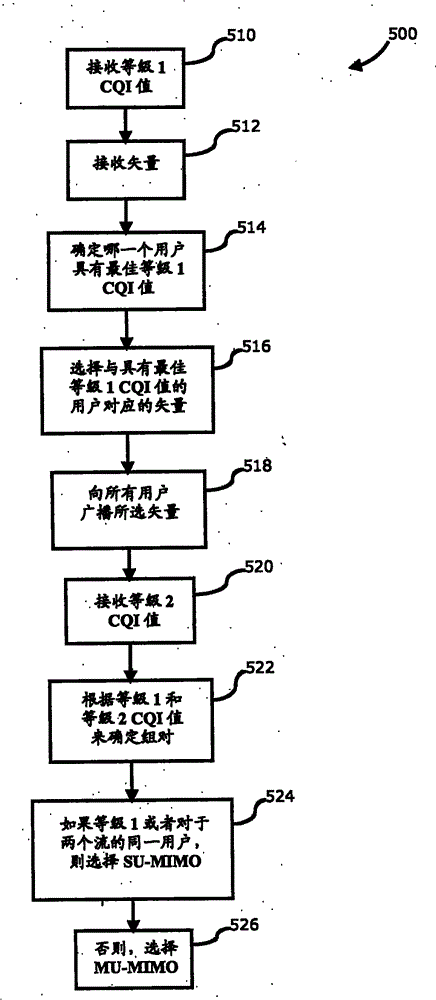
图5是根据一个或多个实施例、用于使多用户MIMO方案与单用户MIMO方案一致的方法的流程图。5 is a flowchart of a method for aligning a multi-user MIMO scheme with a single-user MIMO scheme, according to one or more embodiments.
大家会理解,为了说明的简洁和/或清晰起见,图中所示的元件不一定按比例绘制。例如,为了清楚起见,一部分元件的尺寸可能相对于其它元件经过放大。另外,如果认为适当,附图中重复了参考标号,以便指明对应和/或类似的元件。It will be appreciated that for simplicity and/or clarity of illustration, elements shown in the figures have not necessarily been drawn to scale. For example, the dimensions of some of the elements may be exaggerated relative to other elements for clarity. Further, where considered appropriate, reference numerals have been repeated among the figures to indicate corresponding and/or analogous elements.
具体实施方式 Detailed ways
以下具体实施方式中提出了大量具体细节,以便提供对要求权益的主题的透彻理解。但是,本领域的技术人员会理解,没有这些具体细节也可实施要求权益的主题。在其它情况下,没有详细描述众所周知的方法、过程、组件和/或电路。In the following detailed description, numerous specific details are set forth in order to provide a thorough understanding of the claimed subject matter. However, it will be understood by those skilled in the art that the claimed subject matter may be practiced without these specific details. In other instances, well-known methods, procedures, components and/or circuits have not been described in detail.
在以下描述和/或权利要求中,可采用术语“耦合”和/或“连接”及其派生。在具体实施例中,“连接”可用来表示两个或更多元件相互进行直接物理和/或电气接触。“耦合”可表示两个或更多元件进行直接物理和/或电气接触。但是,“耦合”也可表示两个或更多元件可能不是相互直接接触,但仍然可相互配合和/或交互。例如,“耦合”可表示两个或更多元件没有相互接触,而是经由另一个元件或中间元件间接地接合在一起。最后,在以下描述和权利要求书中,可使用术语“在...之上”、“上覆”和“在...上方”。“在...之上”、“上覆”和“在...上方”可用于表示两个或更多元件相互进行直接物理接触。但是,“在...上方”还可表示两个或更多元件不是相互直接接触。例如,“在...上方”可表示一个元件在另一个元件上方但没有相互接触,并且可在两个元件之间具有另一个或一些元件。此外,术语“和/或”可表示“和”,可表示“或”,可表示“异或”,可表示“一个”,可表示“部分但不是全部”,可表示“两者都不”,和/或可表示“两者”,但要求权益的主题的范围不局限于这个方面。在以下描述和/或权利要求书中,术语“包含”和“包括”及其派生可使用,并且意在作为彼此的同义词。In the following description and/or claims, the terms "coupled" and/or "connected" and their derivatives may be used. In particular embodiments, "connected" may be used to mean that two or more elements are in direct physical and/or electrical contact with each other. "Coupled" may mean that two or more elements are in direct physical and/or electrical contact. However, "coupled" may also mean that two or more elements may not be in direct contact with each other, but still cooperate and/or interact with each other. For example, "coupled" may mean that two or more elements do not contact each other but are indirectly joined together via another element or intermediate elements. Finally, in the following description and claims, the terms "on", "overlying" and "over" may be used. "On," "overlying," and "over" may be used to mean that two or more elements are in direct physical contact with each other. However, "over" may also mean that two or more elements are not in direct contact with each other. For example, "over" may mean that one element is above another element without contacting each other, and there may be another element or elements between the two elements. Additionally, the term "and/or" may mean "and", it may mean "or", it may mean "exclusive-or", it may mean "one", it may mean "some but not all", it may mean "neither" , and/or may mean "both," although the scope of claimed subject matter is not limited in this respect. In the following description and/or claims, the terms "comprises" and "comprises" and their derivatives may be used and are intended as synonyms for each other.
现在参照图1,将论述根据一个或多个实施例的MU-MIMO系统的框图。如图1所示,MIMO系统100可包括基站(BS)110以及其中包括第一用户站(SS1)、第二用户站(SS2)直到N个用户站(SSN)的一个或多个用户站(SS)114,其中用户站114的一个或多个可与基站110无线通信。在这种MIMO系统100中,基站110可包括多个天线112,并且相应用户站114可同样具有一个或多个天线116、118和/或120。应当知道,用户站114的一个或多个可具有其自己的天线数量,其中例如第一用户站SS1的天线116的数量可不同于第二用户站SS2的天线118的数量,它们两者均可与第N个用户站SSN的天线数量不同。同样地,用户站114的一个或多个可具有与基站的天线112的数量不同数量的天线,但在一些情况下,基站110的一个或多个以及用户站114的任何一个或多个可具有相同数量的天线,并且要求权益的主题的范围不局限于这个方面。还应当注意,图1所示的基站110和用户站114模型只是MIMO系统100的布置的示例,而在一个或多个备选实施例中,基站110本身可以是用户站114,和/或例如在自组网络配置等中,用户站114的一个或多个可与用户站114的另一个或多个直接通信,但是要求权益的主题的范围不局限于这个方面。Referring now to FIG. 1 , a block diagram of a MU-MIMO system according to one or more embodiments will be discussed. As shown in FIG. 1 , a
在一个或多个实施例中,基站110与用户站114的一个或多个之间的通信可单独或者组合地包括预编码、空间复用和/或分集编码。此外,通过将其所有天线资源定向到相应用户站114,基站110可与用户站114其中之一直接通信,例如以便实现较高数据速率,或者备选地,基站110可将其天线资源的一部分在一个或多个用户站114之间划分,例如以便进行优化,从而服务于更大数量的用户站114。在本文将要论述的一个或多个实施例中,MIMO系统100可实现信道感知多用户MIMO(CA-MU-MIMO)系统。在这种信道感知MIMO系统100中,预编码矢量和/或码本索引至少部分根据从例如用户站114的一个或多个等一个或多个用户所接收的反馈可以是信道感知的。在一个或多个实施例中,将对应于所选预编码矢量的信道质量指示符(CQI)反馈给基站110,供基站110中的用户站114的用户调度。基站110中的用户调度可基于一个或多个原理,例如用户正交性或者比例公平度量的最大化等。在一个或多个具体实施例中,例如等级1(Rank-1)和等级2(Rank-2)等两种CQI可用于MIMO等级/模式适配。干扰未感知(interference unaware)等级1CQI可用于选择预编码矢量,而干扰感知等级2CQI可用于MIMO等级/链路/模式适配和用户选择。通过使用与单用户、闭环MIMO方案中所使用的相同的码本,MIMO系统100所实现的信道感知MU-MIMO方案可与单用户闭环MIMO方案一致。下面针对图2、图3和图4更详细地论述这种MU-MIMO方案。In one or more embodiments, communications between
现在参照图2,将论述根据一个或多个实施例、具有多个流的信道感知MU-MIMO传输方案的简图。在图2所示的信道感知MU-MIMO方案200中,能够由基站110实现的传输过程对于例如具有两个流的2×2布置的多个流可按如下所述。应当注意,术语2×2表示基站110使用两个天线传输到使用两个天线进行接收的用户站114。简言之,传输过程可包括具有CQI和矢量反馈的信道感知MU-MIMO过程。用户站114可在第i帧212的倒数第二个子帧214执行所有用户信道的奇异值分解(SVD),以便得到各用户站114的波束形成矢量。然后,用户站114向基站110反馈等级1CQI。用户站114的每个也将向基站110反馈其相应的两个主矢量。然后,基站110从具有最佳等级1CQI值的用户站114确定所选波束形成矢量,它在2×2情况下包括两个矢量。然后,基站110可在第i帧210的最后一个子帧216向所有用户站114广播来自具有最佳等级1CQI值的用户站114的所选矢量。然后,对于在第i帧210的最后一个子帧216中的等级2CQI反馈,各用户站通过使用从基站110所接收的广播矢量来计算等级2CQI,它在本例中可包括两个等级2CQI。然后,用户站114可向基站110反馈所计算的两个CQI。在接收CQI时,基站110可根据调度标准和/或MIMO模式/等级、按照基站100从用户站114所接收的等级1/等级2CQI来确定组对用户(Upon receipt thereof,basestation 110 may determine the pairing users based on scheduling criteriaand/or MIMO mode/rank according to the Rank-1/Rank-2CQIs basestation 100 received from subscriber stations 114)。在等级1模式或同一个用户被分配给同一个资源块(RB)上的两个流的情况下,则基站110可选择使用单用户MIMO传输。否则,选择多用户传输。Referring now to FIG. 2 , a simplified diagram of a channel-aware MU-MIMO transmission scheme with multiple streams will be discussed in accordance with one or more embodiments. In the channel-aware MU-MIMO
在一个或多个实施例中,用于图2的信道感知MU-MIMO方案200的更详细的传输过程可如下所述。在第i帧210的倒数第二个子帧214,对于从用户站114到基站110的上行链路(UL)传输,各用户站114根据其本身的信道信息向基站110反馈一个等级1CQI值供等级适配,SVD分解可基于该信道信息。在等级1CQI计算中,不存在来自第二流的干扰。然后,各用户站将来自它自己的信道矩阵上的其相应SVD分解的波束形成矩阵或其两个主矢量反馈给基站110。In one or more embodiments, a more detailed transmission process for the channel-aware MU-
随后,在第i帧210的最后一个子帧216,对于从基站110到用户站114的下行链路(DL)传输,基站110比较从用户站114的每个所接收的所有等级1CQI,并且确定用户站114的哪一个具有最佳等级1CQI值。然后,基站110可从具有最佳等级1CQI值的用户站114确定包括两个主波束形成矢量的所选波束形成矩阵。然后,基站110向MIMO系统100中的所有用户站114广播所选波束形成矩阵。Subsequently, in the
对于后续上行链路传输,每个用户站则通过使用本例中为两个矢量的波束形成矩阵矢量来计算在两个流的情况下可包括两个等级2CQI的等级2CQI,然后将两个所计算CQI反馈给基站110。在一个或多个实施例中,等级2CQI可采用用户站114的干扰感知最小均方误差(MMSE)接收器来计算。然后,各用户站114向基站10反馈两个等级2CQI值供用户组对。For subsequent uplink transmissions, each subscriber station then computes a level 2 CQI which may include two level 2 CQIs in the case of two streams by using beamforming matrix vectors which in this example are two vectors, and then combining the two The calculated CQI is fed back to the
随后,在下一帧、即第(i+1)帧212的第一子帧218,对于下行链路传输,基站110可根据MU-MIMO的调度标准和/或根据MIMO模式/等级、按照先前从用户站114所接收的等级1/等级2CQI来确定组对用户站114。然后,基站110可通过使用预编码矢量开始传送数据(如下所述)。如果等级1CQI的值大于单用户等级2CQI和/或多用户等级2CQI,则基站110选择SU-MIMO等级1模式供数据传输。在这种情况下,基站110将采用来自所选用户站114的广播波束形成矩阵的第一矢量来传送一个流。这个所选用户站114对应于与SU-MIMO等级2CQI和/或MU-MIMO等级2CQI相比的最高取值等级1CQI。Subsequently, in the next frame, ie, the
否则,在单用户等级2CQI大于单用户等级1CQI和/或多用户等级2CQI的情况下,基站110选择SU-MIMO等级2模式供数据传输。在这种情况下,基站110将采用来自所选用户站114的广播波束形成矩阵的两个矢量来传送两个流。这个所选用户站114对应于与SU等级1CQI和/或MU等级2CQI相比的最高取值SU等级2CQI。Otherwise,
否则,如果上述比较没有一个是有效的,则基站110选择MU-MIMO等级2模式供数据传输。在这种情况下,基站110将采用来自所选的两个不同用户站的广播波束形成矩阵的两个波束形成矢量来传送两个流。根据对两个不同用户站114求和,这两个所选用户站114将具有与SU等级1CQI和/或SU等级2CQI相比的最高取值MU等级2CQI。Otherwise, if none of the above comparisons are valid, the
在一个或多个实施例中,图2所示的信道感知MU-MIMO方案200可扩展到超过两个流的更大数量的流以及更大数量的天线配置,例如其中基站110可具有4个天线并且用户站114可具有2个天线的4×2天线配置,或者其中基站110可具有4个天线并且用户站114可具有4个天线的4×4天线配置,等等。在这类扩展中,差别可包括所使用的反馈波束形成矢量和CQI的数量。在更大的流数量/更大的天线配置下,将存在波束形成矢量和CQI的对应反馈数量。例如,对于通过4×4天线配置的4个流的情况,对于MIMO系统100中的多个用户,将存在用于广播的4个波束形成矢量以及用于用户组对的4个CQI。但是,这些只是关于可如何实现多个流和/或更大数量的天线的示例,而要求权益的主题的范围不局限于这些方面。In one or more embodiments, the channel-aware MU-
现在参照图3,将论述根据一个或多个实施例、使用没有缩减取样的信道质量指示符和矢量(CQI/V)的反馈的MU-MIMO传输方案的简图。在图3的信道感知MU-MIMO方案300中,在帧级没有采用缩减取样。在一个具体实施例中,帧大小为5毫秒,但是要求权益的主题的范围不局限于这个方面。如图3所示,对于各子帧,每一个用户站114可向基站110反馈相同的内容,例如各用户站114将至少部分根据最近的信道信息来反馈一个CQI值。各用户站114将至少部分根据从基站110接收的所广播的两个或更多波束形成矢量来计算两个等级2CQI,然后向基站110反馈等级2CQI。Referring now to FIG. 3 , a diagram of a MU-MIMO transmission scheme using feedback of channel quality indicators and vectors (CQI/V) without downsampling will be discussed in accordance with one or more embodiments. In the channel-aware MU-
在下一个子帧,基站110将从具有最高取值等级1CQI的用户站114选择两个新波束形成矢量供广播。基站110将通过所选MIMO模式、即SU-MIMO模式或MU-MIMO模式来传送数据,以及使用所选波束形成矢量对数据进行预编码。在一个或多个实施例中,一个子帧内的整带上的反馈可以至少部分基于最佳M算法,以便减少反馈开销。波束形成矢量还可至少部分根据最佳M算法与CQI反馈联合使用。这种实施例可经由流线模式来实现。各子帧可具有相同的反馈开销,并且各子帧可实现SU-MIMO模式与MU-MIMO模式之间、等级1与等级2之间等的交换,但是要求权益的主题的范围不局限于这些方面。In the next subframe, the
现在参照图4,将论述根据一个或多个实施例、使用带有缩减取样的信道质量指示符和矢量(CQI/V)的反馈的MU-MIMO传输方案的简图。在图4的信道感知MU-MIMO方案400中,缩减取样可用于帧级的反馈。在一个或多个实施例中,帧大小可以是5毫秒或更大。图4的MU-MIMO方案400实质上与图3的MU-MIMO方案300相似,其中差别可包括交换单元或交换周期。5ms各帧或者大于5ms更长的帧将反馈相同的内容。例如,各用户站114将至少部分根据最近的信道信息来反馈一个CQI。各用户站114将至少部分根据所广播的两个波束形成矢量来计算两个等级2CQI,然后将其反馈给基站110。Referring now to FIG. 4 , a diagram of a MU-MIMO transmission scheme using feedback with downsampled channel quality indicators and vectors (CQI/V) will be discussed in accordance with one or more embodiments. In the channel-aware MU-
在下一个5ms帧或大于5ms的更长的帧,基站110将从具有最高值等级1CQI的用户站选择两个新波束形成矢量供广播。基站110将经由所选MIMO模式、即SU-MIMO或MU-MIMO来传送数据,以及使用所选波束形成矢量对数据进行预编码。一个5ms的帧或者大于5ms的更长的帧内的整带上的反馈可以至少部分基于最佳M算法,以便减少反馈开销。波束形成矢量还可至少部分根据最佳M算法与CQI反馈联合使用。这种情况可经由流线模式来实现。5ms的各帧或者大于5ms的更长的帧将具有相同的反馈开销,并且5ms的各帧或者大于5ms的更长的帧可具有SU-MIMO与MU-MIMO之间、等级1与等级2之间等的交换,但是要求权益的主题的范围不局限于这些方面。In the next 5ms frame or a longer frame longer than 5ms, the
在一个或多个实施例中,信道感知MU-MIMO方案可实现调度和/或混合自动重复请求(HARQ)重传。对于信道感知MU-MIMO的用户调度,基站中的用户调度可以至少部分基于例如用户正交性或者比例公平度量的最大化等原理。在用户调度中,基站110将至少部分根据SU等级1、SU等级2和/或MU等级2CQI和/或至少部分根据标准来计算PF度量,以便选出一个MIMO模式供传输。然后可确定用户组对。In one or more embodiments, a channel-aware MU-MIMO scheme may enable scheduling and/or hybrid automatic repeat request (HARQ) retransmission. For channel-aware MU-MIMO user scheduling, user scheduling in the base station may be based at least in part on principles such as user orthogonality or maximization of proportional fairness metrics. In user scheduling,
对于信道感知MU-MIMO方案中实现的HARQ,HARQ重传可作为异步模式或同步模式来实现。非抑制/抑制HARQ模式(non-blanking/blanking HARQ mode)可用于信道感知MU-MIMO方案,其中即使MIMO系统100正经历重传,MU-MIMO也将具有两个流供传输。例如,在其中支持两个数据流的情况中,在存在为MU-MIMO传送的两个流的情况下,具有误差的一个流将在下一个传输时间重传。另一个正确流将在下一个传输时间随新数据传送。用于新数据和重传的预编码矢量可以是来自MU-MIMO调度的最近波束形成矢量。For HARQ implemented in channel-aware MU-MIMO scheme, HARQ retransmission can be implemented as asynchronous mode or synchronous mode. Non-blanking/blanking HARQ mode can be used for channel-aware MU-MIMO schemes, where MU-MIMO will have two streams for transmission even if the
在MU-MIMO的一个或多个实施例中,即使信道正发生变化,模式/等级适配也可用于保持链路性能。可为灵活和/或半静态解决方案实现变化模式。对于灵活适配模式,用户站将反馈所有可适配等级/模式的CQI值,然后基站110将收集所有信息供模式/等级确定。变化可在逐帧级实现。这种变化机制可具有充分性能和较高反馈开销。对于半静态适配,用户站114将在用户站114注意到信道变化时请求适配,然后基站110判定所需适配。在这种布置中,频率可以比较缓慢地变化但使用更少量的反馈开销。In one or more embodiments of MU-MIMO, mode/level adaptation may be used to maintain link performance even when the channel is changing. Variation patterns can be implemented for flexible and/or semi-static solutions. For the flexible adaptation mode, the subscriber station will feed back the CQI values of all adaptable levels/modes, and then the
在一个或多个实施例中,信道感知MU-MIMO方案可利用下行链路传输进行导频信号测量和/或检测。用于测量的导频可例如从散射公共导频、Midamble、参考信号来实现,以便计算出MIMO CQI反馈,例如信道质量指示符(CQI)、控制序列指示符(CSI)、功率余量指示符(PMI)、码本索引等(Pilots for measurement may be implemented,forexample from a scattered common pilot,a midamble,reference signals tocalculate out the MIMO CQI feedback,such as channel qualityindicator(CQI),control sequence indicator(CSI),power marginindicator(PMI),codebook index,and so on)。在导频用于解调的情况下,信道感知MU-MIMO方案可利用专用预编码导频进行数据检测,以便节省导频开销,但是要求权益的主题的范围不局限于这些方面。In one or more embodiments, a channel-aware MU-MIMO scheme may utilize downlink transmissions for pilot signal measurement and/or detection. Pilots for measurements can be realized e.g. from scattered common pilots, Midamble, reference signals in order to calculate MIMO CQI feedback, e.g. Channel Quality Indicator (CQI), Control Sequence Indicator (CSI), Power Headroom Indicator (PMI), codebook index, etc. (Pilots for measurement may be implemented, for example from a scattered common pilot, a midamble, reference signals to calculate out the MIMO CQI feedback, such as channel quality indicator (CQI), control sequence indicator (CSI), power margin indicator (PMI), codebook index, and so on). Where pilots are used for demodulation, channel-aware MU-MIMO schemes can utilize dedicated precoded pilots for data detection in order to save pilot overhead, although the scope of claimed subject matter is not limited in these respects.
现在参照图5,将论述根据一个或多个实施例、用于使多用户MIMO方案与单用户MIMO方案一致的方法的流程图。图5的方法500包括SU-MIMO和MU-MIMO方案的一个特定顺序,但是,方法500可包括与图5所示不同的顺序和/或更多或更少块,并且要求权益的主题的范围不局限于这个方面。在框510,基站110从可一般称作用户的一个或多个用户站114接收等级1CQI值。在框512,基站110从相应用户站接收与波束形成矩阵码本对应的两个或更多矢量。然后在框514,基站110确定用户的哪一个为最佳等级1CQI值。然后在框516,基站110选择与具有最佳等级1CQI值的用户对应的矢量。使用来自具有最佳等级1CQI值的用户的矢量,在框518,基站110向所有用户广播矢量。用户则将通过使用广播矢量来计算等级2CQI值,然后反馈等级2CQI值,等级2CQI值由基站110在框520接收。然后在框522,基站110通过比较从用户站114所接收的等级1和等级2值,至少部分根据等级2CQI值来确定用户组对。如果在框524,基站110确定等级1CQI值为CQI值的最佳值,或者同一个用户被分配到两个或更多流,则基站110选择单用户MIMO操作。否则,如果在框526,基站确定组合的两个或更多用户具有最佳等级2CQI值,则基站110选择多用户MIMO操作。Referring now to FIG. 5 , a flowchart of a method for aligning a multi-user MIMO scheme with a single-user MIMO scheme will be discussed, in accordance with one or more embodiments. Method 500 of FIG. 5 includes one particular order of SU-MIMO and MU-MIMO schemes, however, method 500 may include a different order and/or more or fewer blocks than shown in FIG. 5 and the scope of claimed subject matter Not limited to this aspect. At block 510, the
虽然以某种程度的细节描述了要求权益的主题,但是应当知道,其中的元件可由本领域的技术人员变更,而没有背离要求权益的主题的精神和/或范围。我们认为,通过以上描述将会理解与和单用户闭环MIMO一致的信道感知多用户MIMO方案和/或许多其伴随物有关的主题,并且大家会清楚地知道,可进行其组件的形式、构造和/或布置的各种变更,而没有背离要求权益的主题的范围和/或精神或者没有牺牲其材料优势的全部,本文前面所述的形式只是其说明性实施例,和/或也没有对其中提供实质变更。权利要求书的目的是包含和/或包括这类变更。Although the claimed subject matter has been described with a certain degree of detail, it will be appreciated that elements thereof may be altered by those skilled in the art without departing from the spirit and/or scope of the claimed subject matter. We believe that the subject matter related to channel-aware multi-user MIMO schemes consistent with single-user closed-loop MIMO and/or many of its concomitants will be understood from the above description, and it will be clear that the form, construction, and Various changes in and/or arrangements without departing from the scope and/or spirit of the claimed subject matter or without sacrificing all of its material advantages, the foregoing forms herein are merely illustrative examples thereof, and/or are not intended to Substantial changes are provided. It is the intent of the claims to cover and/or include such modifications.
Claims (14)
Applications Claiming Priority (7)
| Application Number | Priority Date | Filing Date | Title |
|---|---|---|---|
| US95515507P | 2007-08-10 | 2007-08-10 | |
| US60/955155 | 2007-08-10 | ||
| US60/955,155 | 2007-08-10 | ||
| US12/183,371 US7716909B2 (en) | 2008-07-31 | 2008-07-31 | Apparatus and method for picking up berries |
| US12/183371 | 2008-07-31 | ||
| US12/183,371 | 2008-07-31 | ||
| PCT/US2008/072511 WO2009023532A2 (en) | 2007-08-10 | 2008-08-07 | Channel aware multiple user mimo scheme unified with single user closed loop mimo |
Publications (2)
| Publication Number | Publication Date |
|---|---|
| CN101785210A CN101785210A (en) | 2010-07-21 |
| CN101785210B true CN101785210B (en) | 2013-04-24 |
Family
ID=40351416
Family Applications (1)
| Application Number | Title | Priority Date | Filing Date |
|---|---|---|---|
| CN200880102523.XA Expired - Fee Related CN101785210B (en) | 2007-08-10 | 2008-08-07 | Channel aware multiple user MIMO scheme unified with single user closed loop MIMO |
Country Status (4)
| Country | Link |
|---|---|
| CN (1) | CN101785210B (en) |
| DE (1) | DE112008002055B4 (en) |
| GB (1) | GB2465111B (en) |
| WO (1) | WO2009023532A2 (en) |
Families Citing this family (11)
| Publication number | Priority date | Publication date | Assignee | Title |
|---|---|---|---|---|
| US7907677B2 (en) | 2007-08-10 | 2011-03-15 | Intel Corporation | Open loop MU-MIMO |
| CN101848068B (en) * | 2009-03-24 | 2014-07-16 | 中兴通讯股份有限公司 | Intermediate code allocation method and device based on multi-user multiple input multiple output technology |
| US9184511B2 (en) | 2009-07-10 | 2015-11-10 | Futurewei Technologies, Inc. | System and method for downlink channel sounding in wireless communications systems |
| CN102035585B (en) * | 2009-09-28 | 2015-03-11 | 华为技术有限公司 | Pre-coding method, communication device and relay device in cooperative relay system |
| WO2011038530A1 (en) * | 2009-09-29 | 2011-04-07 | France Telecom Research & Development Beijing Company Limited | Method of precoding symbols for transmission, method of sending a quality value associated with a precoding vector and corresponding devices |
| US8547918B2 (en) * | 2009-11-17 | 2013-10-01 | Qualcomm Incorporated | Multiple-user multiple-input and multiple-output for high-speed packet access systems |
| US9241323B2 (en) * | 2010-08-19 | 2016-01-19 | Telefonaktiebolaget L M Ericsson (Publ) | Method and apparatus for transport format selection in wireless communication system |
| WO2012024837A1 (en) | 2010-08-26 | 2012-03-01 | Huawei Technologies Co., Ltd. | Method and system for precoding |
| WO2013143099A1 (en) * | 2012-03-29 | 2013-10-03 | Nec(China) Co., Ltd. | Method and apparatus for link adaptation in precoded mimo systems |
| US9935699B2 (en) | 2012-06-22 | 2018-04-03 | Samsung Electronics Co., Ltd. | Communication method and apparatus using beamforming in a wireless communication system |
| CN103812603A (en) * | 2012-11-12 | 2014-05-21 | 华为技术有限公司 | SUMIMO/MUMIMO dynamic switching feedback method and device |
Citations (2)
| Publication number | Priority date | Publication date | Assignee | Title |
|---|---|---|---|---|
| WO2006099349A1 (en) * | 2005-03-10 | 2006-09-21 | Qualcomm Incorporated | Systems and methods for beamforming and rate control in a multi-input multi-output communication systems |
| WO2006130865A2 (en) * | 2005-06-01 | 2006-12-07 | Qualcomm Incorporated | Cqi and rank prediction for list sphere decoding and ml mimo receivers |
Family Cites Families (3)
| Publication number | Priority date | Publication date | Assignee | Title |
|---|---|---|---|---|
| US8971461B2 (en) * | 2005-06-01 | 2015-03-03 | Qualcomm Incorporated | CQI and rank prediction for list sphere decoding and ML MIMO receivers |
| KR20070108304A (en) * | 2005-10-31 | 2007-11-09 | 삼성전자주식회사 | Method and apparatus for transmitting / receiving channel quality information in multiple transmit / receive antenna system |
| US8116267B2 (en) * | 2006-02-09 | 2012-02-14 | Samsung Electronics Co., Ltd. | Method and system for scheduling users based on user-determined ranks in a MIMO system |
-
2008
- 2008-08-07 CN CN200880102523.XA patent/CN101785210B/en not_active Expired - Fee Related
- 2008-08-07 GB GB1002392.7A patent/GB2465111B/en not_active Expired - Fee Related
- 2008-08-07 WO PCT/US2008/072511 patent/WO2009023532A2/en not_active Ceased
- 2008-08-07 DE DE112008002055.8T patent/DE112008002055B4/en not_active Expired - Fee Related
Patent Citations (2)
| Publication number | Priority date | Publication date | Assignee | Title |
|---|---|---|---|---|
| WO2006099349A1 (en) * | 2005-03-10 | 2006-09-21 | Qualcomm Incorporated | Systems and methods for beamforming and rate control in a multi-input multi-output communication systems |
| WO2006130865A2 (en) * | 2005-06-01 | 2006-12-07 | Qualcomm Incorporated | Cqi and rank prediction for list sphere decoding and ml mimo receivers |
Also Published As
| Publication number | Publication date |
|---|---|
| GB2465111A (en) | 2010-05-12 |
| DE112008002055T5 (en) | 2010-09-16 |
| DE112008002055B4 (en) | 2015-12-17 |
| WO2009023532A3 (en) | 2009-04-16 |
| CN101785210A (en) | 2010-07-21 |
| GB201002392D0 (en) | 2010-03-31 |
| WO2009023532A2 (en) | 2009-02-19 |
| GB2465111B (en) | 2012-06-06 |
Similar Documents
| Publication | Publication Date | Title |
|---|---|---|
| US8179844B2 (en) | Channel aware multiple user MIMO scheme unified with single user closed loop MIMO | |
| CN101785210B (en) | Channel aware multiple user MIMO scheme unified with single user closed loop MIMO | |
| US8218422B2 (en) | Coordinated linear beamforming in downlink multi-cell wireless networks | |
| US9407343B2 (en) | Method and apparatus for mitigating downlink interference | |
| US8761288B2 (en) | Limited channel information feedback error-free channel vector quantization scheme for precoding MU-MIMO | |
| EP2242187B1 (en) | Method and device for data processing in a communication network | |
| US7944906B2 (en) | Method and system for operating a multi-user multiple-input multiple-output (MU-MIMO) wireless communications system | |
| CN101686110B (en) | Multi-input multi-output system, data transmission method and data transmission device thereof | |
| US8577303B2 (en) | Apparatus and method for transmitting channel sounding signal in wireless communication system | |
| US8582672B2 (en) | System and method for wireless communications using spatial multiplexing with incomplete channel information | |
| US20110319027A1 (en) | Method for channel quality feedback in wireless communication systems | |
| US20100322351A1 (en) | Channel State Information Feedback for Coordinated Multiple Points Transmission | |
| US20100035555A1 (en) | Method and apparatus for implementing multi-cell cooperation techniques | |
| KR101624148B1 (en) | Method and appratus for sending and receiving channel state information in network multiple-input mutiple-output wireless communication systems | |
| KR20100086407A (en) | Method of transmitting data in coordinated multi-cell wireless communication system | |
| US20100278059A1 (en) | Method, system and apparatus for uplink space transmission of tdd system | |
| CN101453259A (en) | Pre-encoded transmission method for MIMO system | |
| CN112204898B (en) | Apparatus and method for adaptively adjusting MIMO transmission scheme | |
| KR20120033335A (en) | Method and device for signal transmission in time-division duplex mimo system | |
| CN102823177A (en) | Methods for operating slaves | |
| US9520924B2 (en) | Method for communicating in a network | |
| CN102104450A (en) | Sending method and equipment in MU-MIMO (Multiuser Multi-Input Multi-Output) system | |
| CN102088339A (en) | User equipment and communication processing method thereof | |
| CN102474739B (en) | Adaptive implicit feedback method and user equipment | |
| Hara et al. | Pilot-based CSI feedback in TDD/MIMO systems with cochannel interference |
Legal Events
| Date | Code | Title | Description |
|---|---|---|---|
| C06 | Publication | ||
| PB01 | Publication | ||
| C10 | Entry into substantive examination | ||
| SE01 | Entry into force of request for substantive examination | ||
| C14 | Grant of patent or utility model | ||
| GR01 | Patent grant | ||
| CF01 | Termination of patent right due to non-payment of annual fee |
Granted publication date: 20130424 Termination date: 20180807 |
|
| CF01 | Termination of patent right due to non-payment of annual fee |