CN101712694B - Ruthenium metal complex and photoelectric component therefrom - Google Patents
Ruthenium metal complex and photoelectric component therefrom Download PDFInfo
- Publication number
- CN101712694B CN101712694B CN2008101619901A CN200810161990A CN101712694B CN 101712694 B CN101712694 B CN 101712694B CN 2008101619901 A CN2008101619901 A CN 2008101619901A CN 200810161990 A CN200810161990 A CN 200810161990A CN 101712694 B CN101712694 B CN 101712694B
- Authority
- CN
- China
- Prior art keywords
- dye
- metal complex
- sensitized solar
- ruthenium metal
- ruthenium
- Prior art date
- Legal status (The legal status is an assumption and is not a legal conclusion. Google has not performed a legal analysis and makes no representation as to the accuracy of the status listed.)
- Expired - Fee Related
Links
- KJTLSVCANCCWHF-UHFFFAOYSA-N Ruthenium Chemical compound [Ru] KJTLSVCANCCWHF-UHFFFAOYSA-N 0.000 title claims abstract description 38
- WEVYAHXRMPXWCK-UHFFFAOYSA-N Acetonitrile Chemical compound CC#N WEVYAHXRMPXWCK-UHFFFAOYSA-N 0.000 claims description 24
- OKKJLVBELUTLKV-UHFFFAOYSA-N Methanol Chemical compound OC OKKJLVBELUTLKV-UHFFFAOYSA-N 0.000 claims description 21
- LFQSCWFLJHTTHZ-UHFFFAOYSA-N Ethanol Chemical compound CCO LFQSCWFLJHTTHZ-UHFFFAOYSA-N 0.000 claims description 8
- 239000003792 electrolyte Substances 0.000 claims description 8
- ZMXDDKWLCZADIW-UHFFFAOYSA-N N,N-Dimethylformamide Chemical compound CN(C)C=O ZMXDDKWLCZADIW-UHFFFAOYSA-N 0.000 claims description 6
- LRHPLDYGYMQRHN-UHFFFAOYSA-N N-Butanol Chemical compound CCCCO LRHPLDYGYMQRHN-UHFFFAOYSA-N 0.000 claims description 4
- SECXISVLQFMRJM-UHFFFAOYSA-N N-Methylpyrrolidone Chemical group CN1CCCC1=O SECXISVLQFMRJM-UHFFFAOYSA-N 0.000 claims description 3
- BDERNNFJNOPAEC-UHFFFAOYSA-N propan-1-ol Chemical compound CCCO BDERNNFJNOPAEC-UHFFFAOYSA-N 0.000 claims description 2
- 239000003960 organic solvent Substances 0.000 claims 2
- 230000005693 optoelectronics Effects 0.000 abstract 1
- 239000000243 solution Substances 0.000 description 34
- 239000000975 dye Substances 0.000 description 29
- 239000000758 substrate Substances 0.000 description 23
- 238000006243 chemical reaction Methods 0.000 description 18
- 239000002245 particle Substances 0.000 description 17
- YAYGSLOSTXKUBW-UHFFFAOYSA-N ruthenium(2+) Chemical compound [Ru+2] YAYGSLOSTXKUBW-UHFFFAOYSA-N 0.000 description 17
- 239000004065 semiconductor Substances 0.000 description 17
- 125000000217 alkyl group Chemical group 0.000 description 13
- XOLBLPGZBRYERU-UHFFFAOYSA-N tin dioxide Chemical compound O=[Sn]=O XOLBLPGZBRYERU-UHFFFAOYSA-N 0.000 description 13
- -1 N3 dyes Chemical class 0.000 description 12
- FXPLCAKVOYHAJA-UHFFFAOYSA-L 2-(4-carboxylatopyridin-2-yl)pyridine-4-carboxylate Chemical compound [O-]C(=O)C1=CC=NC(C=2N=CC=C(C=2)C([O-])=O)=C1 FXPLCAKVOYHAJA-UHFFFAOYSA-L 0.000 description 11
- GWEVSGVZZGPLCZ-UHFFFAOYSA-N Titan oxide Chemical compound O=[Ti]=O GWEVSGVZZGPLCZ-UHFFFAOYSA-N 0.000 description 11
- 239000011521 glass Substances 0.000 description 11
- 239000010410 layer Substances 0.000 description 11
- RTZKZFJDLAIYFH-UHFFFAOYSA-N Diethyl ether Chemical compound CCOCC RTZKZFJDLAIYFH-UHFFFAOYSA-N 0.000 description 10
- 125000001797 benzyl group Chemical group [H]C1=C([H])C([H])=C(C([H])=C1[H])C([H])([H])* 0.000 description 10
- 239000012153 distilled water Substances 0.000 description 10
- 239000000463 material Substances 0.000 description 10
- 239000012265 solid product Substances 0.000 description 10
- XLYOFNOQVPJJNP-UHFFFAOYSA-N water Chemical compound O XLYOFNOQVPJJNP-UHFFFAOYSA-N 0.000 description 10
- 239000007864 aqueous solution Substances 0.000 description 9
- 238000004519 manufacturing process Methods 0.000 description 9
- 125000000858 thiocyanato group Chemical group *SC#N 0.000 description 9
- 229910001887 tin oxide Inorganic materials 0.000 description 9
- FXPLCAKVOYHAJA-UHFFFAOYSA-N 2-(4-carboxypyridin-2-yl)pyridine-4-carboxylic acid Chemical compound OC(=O)C1=CC=NC(C=2N=CC=C(C=2)C(O)=O)=C1 FXPLCAKVOYHAJA-UHFFFAOYSA-N 0.000 description 8
- 125000001997 phenyl group Chemical group [H]C1=C([H])C([H])=C(*)C([H])=C1[H] 0.000 description 8
- 239000002904 solvent Substances 0.000 description 8
- XLOMVQKBTHCTTD-UHFFFAOYSA-N Zinc monoxide Chemical compound [Zn]=O XLOMVQKBTHCTTD-UHFFFAOYSA-N 0.000 description 6
- VBQDSLGFSUGBBE-UHFFFAOYSA-N benzyl(triethyl)azanium Chemical compound CC[N+](CC)(CC)CC1=CC=CC=C1 VBQDSLGFSUGBBE-UHFFFAOYSA-N 0.000 description 6
- 230000015572 biosynthetic process Effects 0.000 description 6
- 238000000034 method Methods 0.000 description 6
- BASFCYQUMIYNBI-UHFFFAOYSA-N platinum Chemical compound [Pt] BASFCYQUMIYNBI-UHFFFAOYSA-N 0.000 description 6
- 239000000047 product Substances 0.000 description 6
- 238000003786 synthesis reaction Methods 0.000 description 6
- FKPSBYZGRQJIMO-UHFFFAOYSA-M benzyl(triethyl)azanium;hydroxide Chemical compound [OH-].CC[N+](CC)(CC)CC1=CC=CC=C1 FKPSBYZGRQJIMO-UHFFFAOYSA-M 0.000 description 5
- 239000010406 cathode material Substances 0.000 description 5
- 239000003153 chemical reaction reagent Substances 0.000 description 5
- OGIDPMRJRNCKJF-UHFFFAOYSA-N titanium oxide Inorganic materials [Ti]=O OGIDPMRJRNCKJF-UHFFFAOYSA-N 0.000 description 5
- LTNAYKNIZNSHQA-UHFFFAOYSA-L 2-(4-carboxypyridin-2-yl)pyridine-4-carboxylic acid;ruthenium(2+);dithiocyanate Chemical compound N#CS[Ru]SC#N.OC(=O)C1=CC=NC(C=2N=CC=C(C=2)C(O)=O)=C1.OC(=O)C1=CC=NC(C=2N=CC=C(C=2)C(O)=O)=C1 LTNAYKNIZNSHQA-UHFFFAOYSA-L 0.000 description 4
- ZCYVEMRRCGMTRW-UHFFFAOYSA-N 7553-56-2 Chemical compound [I] ZCYVEMRRCGMTRW-UHFFFAOYSA-N 0.000 description 4
- 239000004642 Polyimide Substances 0.000 description 4
- 239000004743 Polypropylene Substances 0.000 description 4
- DKGAVHZHDRPRBM-UHFFFAOYSA-N Tert-Butanol Chemical compound CC(C)(C)O DKGAVHZHDRPRBM-UHFFFAOYSA-N 0.000 description 4
- 238000000576 coating method Methods 0.000 description 4
- 230000000052 comparative effect Effects 0.000 description 4
- 238000002347 injection Methods 0.000 description 4
- 239000007924 injection Substances 0.000 description 4
- 239000011630 iodine Substances 0.000 description 4
- 229910052740 iodine Inorganic materials 0.000 description 4
- 239000000434 metal complex dye Substances 0.000 description 4
- 239000000075 oxide glass Substances 0.000 description 4
- 229920000139 polyethylene terephthalate Polymers 0.000 description 4
- 239000005020 polyethylene terephthalate Substances 0.000 description 4
- 229920001721 polyimide Polymers 0.000 description 4
- 229920001155 polypropylene Polymers 0.000 description 4
- 229920001169 thermoplastic Polymers 0.000 description 4
- ZNOKGRXACCSDPY-UHFFFAOYSA-N tungsten trioxide Chemical compound O=[W](=O)=O ZNOKGRXACCSDPY-UHFFFAOYSA-N 0.000 description 4
- 239000004698 Polyethylene Substances 0.000 description 3
- 238000010521 absorption reaction Methods 0.000 description 3
- QSRFYFHZPSGRQX-UHFFFAOYSA-N benzyl(tributyl)azanium Chemical compound CCCC[N+](CCCC)(CCCC)CC1=CC=CC=C1 QSRFYFHZPSGRQX-UHFFFAOYSA-N 0.000 description 3
- 239000011248 coating agent Substances 0.000 description 3
- 150000001875 compounds Chemical class 0.000 description 3
- 238000001914 filtration Methods 0.000 description 3
- 239000000203 mixture Substances 0.000 description 3
- 229910052697 platinum Inorganic materials 0.000 description 3
- 229920000573 polyethylene Polymers 0.000 description 3
- 239000002244 precipitate Substances 0.000 description 3
- 239000007787 solid Substances 0.000 description 3
- 238000003756 stirring Methods 0.000 description 3
- 239000004408 titanium dioxide Substances 0.000 description 3
- VSKJPZUWPMWFAU-UHFFFAOYSA-M triethyl(hexyl)azanium;hydroxide Chemical compound [OH-].CCCCCC[N+](CC)(CC)CC VSKJPZUWPMWFAU-UHFFFAOYSA-M 0.000 description 3
- 239000011787 zinc oxide Substances 0.000 description 3
- DOYFPFXFXUFACV-UHFFFAOYSA-M 1-dodecylpyridin-1-ium;hydroxide Chemical compound [OH-].CCCCCCCCCCCC[N+]1=CC=CC=C1 DOYFPFXFXUFACV-UHFFFAOYSA-M 0.000 description 2
- JJWJFWRFHDYQCN-UHFFFAOYSA-J 2-(4-carboxypyridin-2-yl)pyridine-4-carboxylate;ruthenium(2+);tetrabutylazanium;dithiocyanate Chemical compound [Ru+2].[S-]C#N.[S-]C#N.CCCC[N+](CCCC)(CCCC)CCCC.CCCC[N+](CCCC)(CCCC)CCCC.OC(=O)C1=CC=NC(C=2N=CC=C(C=2)C([O-])=O)=C1.OC(=O)C1=CC=NC(C=2N=CC=C(C=2)C([O-])=O)=C1 JJWJFWRFHDYQCN-UHFFFAOYSA-J 0.000 description 2
- ADSOSINJPNKUJK-UHFFFAOYSA-N 2-butylpyridine Chemical group CCCCC1=CC=CC=N1 ADSOSINJPNKUJK-UHFFFAOYSA-N 0.000 description 2
- 229910018072 Al 2 O 3 Inorganic materials 0.000 description 2
- OKTJSMMVPCPJKN-UHFFFAOYSA-N Carbon Chemical compound [C] OKTJSMMVPCPJKN-UHFFFAOYSA-N 0.000 description 2
- 229910005191 Ga 2 O 3 Inorganic materials 0.000 description 2
- GRYLNZFGIOXLOG-UHFFFAOYSA-N Nitric acid Chemical compound O[N+]([O-])=O GRYLNZFGIOXLOG-UHFFFAOYSA-N 0.000 description 2
- XUIMIQQOPSSXEZ-UHFFFAOYSA-N Silicon Chemical compound [Si] XUIMIQQOPSSXEZ-UHFFFAOYSA-N 0.000 description 2
- ATJFFYVFTNAWJD-UHFFFAOYSA-N Tin Chemical compound [Sn] ATJFFYVFTNAWJD-UHFFFAOYSA-N 0.000 description 2
- 239000007983 Tris buffer Substances 0.000 description 2
- HCHKCACWOHOZIP-UHFFFAOYSA-N Zinc Chemical compound [Zn] HCHKCACWOHOZIP-UHFFFAOYSA-N 0.000 description 2
- JODIJOMWCAXJJX-UHFFFAOYSA-N [O-2].[Al+3].[O-2].[Zn+2] Chemical compound [O-2].[Al+3].[O-2].[Zn+2] JODIJOMWCAXJJX-UHFFFAOYSA-N 0.000 description 2
- VJGNLOIQCWLBJR-UHFFFAOYSA-M benzyl(tributyl)azanium;chloride Chemical compound [Cl-].CCCC[N+](CCCC)(CCCC)CC1=CC=CC=C1 VJGNLOIQCWLBJR-UHFFFAOYSA-M 0.000 description 2
- ANHXKSXTBQIUAZ-UHFFFAOYSA-M benzyl(tributyl)azanium;hydroxide Chemical compound [OH-].CCCC[N+](CCCC)(CCCC)CC1=CC=CC=C1 ANHXKSXTBQIUAZ-UHFFFAOYSA-M 0.000 description 2
- IGEFNRBONHLJHS-UHFFFAOYSA-N benzyl(triethyl)azanium ruthenium(2+) Chemical compound C(C1=CC=CC=C1)[N+](CC)(CC)CC.C(C1=CC=CC=C1)[N+](CC)(CC)CC.[Ru+2] IGEFNRBONHLJHS-UHFFFAOYSA-N 0.000 description 2
- 229910052799 carbon Inorganic materials 0.000 description 2
- PBAYDYUZOSNJGU-UHFFFAOYSA-N chelidonic acid Natural products OC(=O)C1=CC(=O)C=C(C(O)=O)O1 PBAYDYUZOSNJGU-UHFFFAOYSA-N 0.000 description 2
- 239000004020 conductor Substances 0.000 description 2
- 239000001177 diphosphate Substances 0.000 description 2
- 239000008151 electrolyte solution Substances 0.000 description 2
- 238000003912 environmental pollution Methods 0.000 description 2
- PCHJSUWPFVWCPO-UHFFFAOYSA-N gold Chemical compound [Au] PCHJSUWPFVWCPO-UHFFFAOYSA-N 0.000 description 2
- 229910052737 gold Inorganic materials 0.000 description 2
- 239000010931 gold Substances 0.000 description 2
- 230000001965 increasing effect Effects 0.000 description 2
- AMGQUBHHOARCQH-UHFFFAOYSA-N indium;oxotin Chemical compound [In].[Sn]=O AMGQUBHHOARCQH-UHFFFAOYSA-N 0.000 description 2
- 239000011810 insulating material Substances 0.000 description 2
- 239000007788 liquid Substances 0.000 description 2
- 239000011244 liquid electrolyte Substances 0.000 description 2
- ZKATWMILCYLAPD-UHFFFAOYSA-N niobium pentoxide Inorganic materials O=[Nb](=O)O[Nb](=O)=O ZKATWMILCYLAPD-UHFFFAOYSA-N 0.000 description 2
- URLJKFSTXLNXLG-UHFFFAOYSA-N niobium(5+);oxygen(2-) Chemical compound [O-2].[O-2].[O-2].[O-2].[O-2].[Nb+5].[Nb+5] URLJKFSTXLNXLG-UHFFFAOYSA-N 0.000 description 2
- 229910017604 nitric acid Inorganic materials 0.000 description 2
- NFHFRUOZVGFOOS-UHFFFAOYSA-N palladium;triphenylphosphane Chemical compound [Pd].C1=CC=CC=C1P(C=1C=CC=CC=1)C1=CC=CC=C1.C1=CC=CC=C1P(C=1C=CC=CC=1)C1=CC=CC=C1.C1=CC=CC=C1P(C=1C=CC=CC=1)C1=CC=CC=C1.C1=CC=CC=C1P(C=1C=CC=CC=1)C1=CC=CC=C1 NFHFRUOZVGFOOS-UHFFFAOYSA-N 0.000 description 2
- 229920003023 plastic Polymers 0.000 description 2
- CLSUSRZJUQMOHH-UHFFFAOYSA-L platinum dichloride Chemical compound Cl[Pt]Cl CLSUSRZJUQMOHH-UHFFFAOYSA-L 0.000 description 2
- 239000004417 polycarbonate Substances 0.000 description 2
- 229920000515 polycarbonate Polymers 0.000 description 2
- 239000010453 quartz Substances 0.000 description 2
- 150000003303 ruthenium Chemical class 0.000 description 2
- 238000007650 screen-printing Methods 0.000 description 2
- 229910052710 silicon Inorganic materials 0.000 description 2
- 239000010703 silicon Substances 0.000 description 2
- VYPSYNLAJGMNEJ-UHFFFAOYSA-N silicon dioxide Inorganic materials O=[Si]=O VYPSYNLAJGMNEJ-UHFFFAOYSA-N 0.000 description 2
- 239000000126 substance Substances 0.000 description 2
- 238000002834 transmittance Methods 0.000 description 2
- NAWZSHBMUXXTGV-UHFFFAOYSA-M triethyl(hexyl)azanium;bromide Chemical compound [Br-].CCCCCC[N+](CC)(CC)CC NAWZSHBMUXXTGV-UHFFFAOYSA-M 0.000 description 2
- 229910052725 zinc Inorganic materials 0.000 description 2
- 239000011701 zinc Substances 0.000 description 2
- FFYRIXSGFSWFAQ-UHFFFAOYSA-N 1-dodecylpyridin-1-ium Chemical compound CCCCCCCCCCCC[N+]1=CC=CC=C1 FFYRIXSGFSWFAQ-UHFFFAOYSA-N 0.000 description 1
- GKQHIYSTBXDYNQ-UHFFFAOYSA-M 1-dodecylpyridin-1-ium;chloride Chemical compound [Cl-].CCCCCCCCCCCC[N+]1=CC=CC=C1 GKQHIYSTBXDYNQ-UHFFFAOYSA-M 0.000 description 1
- IKTPBRAHAAMNHV-UHFFFAOYSA-N 2-(4-carboxypyridin-2-yl)pyridine-4-carboxylic acid Chemical compound N1=C(C=C(C=C1)C(=O)O)C1=NC=CC(=C1)C(=O)O.N1=C(C=C(C=C1)C(=O)O)C1=NC=CC(=C1)C(=O)O IKTPBRAHAAMNHV-UHFFFAOYSA-N 0.000 description 1
- OOWFYDWAMOKVSF-UHFFFAOYSA-N 3-methoxypropanenitrile Chemical compound COCCC#N OOWFYDWAMOKVSF-UHFFFAOYSA-N 0.000 description 1
- PXGOKWXKJXAPGV-UHFFFAOYSA-N Fluorine Chemical compound FF PXGOKWXKJXAPGV-UHFFFAOYSA-N 0.000 description 1
- 239000012327 Ruthenium complex Substances 0.000 description 1
- 206010070834 Sensitisation Diseases 0.000 description 1
- MQBIGZBUVUVDKE-UHFFFAOYSA-N [2-(4-phosphonopyridin-2-yl)pyridin-4-yl]phosphonic acid Chemical compound OP(O)(=O)C1=CC=NC(C=2N=CC=C(C=2)P(O)(O)=O)=C1 MQBIGZBUVUVDKE-UHFFFAOYSA-N 0.000 description 1
- RBBXYNKMDMMROM-UHFFFAOYSA-H [O-]O[O-].[Sr+2].[Ti+4].[O-]O[O-].[O-]O[O-] Chemical compound [O-]O[O-].[Sr+2].[Ti+4].[O-]O[O-].[O-]O[O-] RBBXYNKMDMMROM-UHFFFAOYSA-H 0.000 description 1
- 239000002253 acid Substances 0.000 description 1
- 230000004888 barrier function Effects 0.000 description 1
- 230000005540 biological transmission Effects 0.000 description 1
- 150000001879 copper Chemical class 0.000 description 1
- 238000001035 drying Methods 0.000 description 1
- 230000002708 enhancing effect Effects 0.000 description 1
- 239000010419 fine particle Substances 0.000 description 1
- 239000011737 fluorine Substances 0.000 description 1
- 229910052731 fluorine Inorganic materials 0.000 description 1
- 229910001195 gallium oxide Inorganic materials 0.000 description 1
- QZQVBEXLDFYHSR-UHFFFAOYSA-N gallium(III) oxide Inorganic materials O=[Ga]O[Ga]=O QZQVBEXLDFYHSR-UHFFFAOYSA-N 0.000 description 1
- 238000005286 illumination Methods 0.000 description 1
- 229910010272 inorganic material Inorganic materials 0.000 description 1
- 239000011147 inorganic material Substances 0.000 description 1
- 150000002505 iron Chemical class 0.000 description 1
- 239000012528 membrane Substances 0.000 description 1
- 238000012986 modification Methods 0.000 description 1
- 230000004048 modification Effects 0.000 description 1
- LFLZOWIFJOBEPN-UHFFFAOYSA-N nitrate, nitrate Chemical compound O[N+]([O-])=O.O[N+]([O-])=O LFLZOWIFJOBEPN-UHFFFAOYSA-N 0.000 description 1
- 150000002907 osmium Chemical class 0.000 description 1
- SOQBVABWOPYFQZ-UHFFFAOYSA-N oxygen(2-);titanium(4+) Chemical compound [O-2].[O-2].[Ti+4] SOQBVABWOPYFQZ-UHFFFAOYSA-N 0.000 description 1
- 150000003057 platinum Chemical class 0.000 description 1
- 230000004044 response Effects 0.000 description 1
- 238000007789 sealing Methods 0.000 description 1
- 230000008313 sensitization Effects 0.000 description 1
- 239000002356 single layer Substances 0.000 description 1
- 238000005245 sintering Methods 0.000 description 1
- 230000003595 spectral effect Effects 0.000 description 1
- 238000001228 spectrum Methods 0.000 description 1
- 238000004528 spin coating Methods 0.000 description 1
- 238000005507 spraying Methods 0.000 description 1
- VEALVRVVWBQVSL-UHFFFAOYSA-N strontium titanate Chemical compound [Sr+2].[O-][Ti]([O-])=O VEALVRVVWBQVSL-UHFFFAOYSA-N 0.000 description 1
- 238000010998 test method Methods 0.000 description 1
- HJHUXWBTVVFLQI-UHFFFAOYSA-N tributyl(methyl)azanium Chemical compound CCCC[N+](C)(CCCC)CCCC HJHUXWBTVVFLQI-UHFFFAOYSA-N 0.000 description 1
- GCRCSLNXFKCFHB-UHFFFAOYSA-N triethyl(hexyl)azanium Chemical compound CCCCCC[N+](CC)(CC)CC GCRCSLNXFKCFHB-UHFFFAOYSA-N 0.000 description 1
- 125000000391 vinyl group Chemical group [H]C([*])=C([H])[H] 0.000 description 1
- 229920002554 vinyl polymer Polymers 0.000 description 1
Classifications
-
- C—CHEMISTRY; METALLURGY
- C07—ORGANIC CHEMISTRY
- C07F—ACYCLIC, CARBOCYCLIC OR HETEROCYCLIC COMPOUNDS CONTAINING ELEMENTS OTHER THAN CARBON, HYDROGEN, HALOGEN, OXYGEN, NITROGEN, SULFUR, SELENIUM OR TELLURIUM
- C07F15/00—Compounds containing elements of Groups 8, 9, 10 or 18 of the Periodic Table
-
- C—CHEMISTRY; METALLURGY
- C07—ORGANIC CHEMISTRY
- C07D—HETEROCYCLIC COMPOUNDS
- C07D213/00—Heterocyclic compounds containing six-membered rings, not condensed with other rings, with one nitrogen atom as the only ring hetero atom and three or more double bonds between ring members or between ring members and non-ring members
- C07D213/02—Heterocyclic compounds containing six-membered rings, not condensed with other rings, with one nitrogen atom as the only ring hetero atom and three or more double bonds between ring members or between ring members and non-ring members having three double bonds between ring members or between ring members and non-ring members
- C07D213/04—Heterocyclic compounds containing six-membered rings, not condensed with other rings, with one nitrogen atom as the only ring hetero atom and three or more double bonds between ring members or between ring members and non-ring members having three double bonds between ring members or between ring members and non-ring members having no bond between the ring nitrogen atom and a non-ring member or having only hydrogen or carbon atoms directly attached to the ring nitrogen atom
- C07D213/06—Heterocyclic compounds containing six-membered rings, not condensed with other rings, with one nitrogen atom as the only ring hetero atom and three or more double bonds between ring members or between ring members and non-ring members having three double bonds between ring members or between ring members and non-ring members having no bond between the ring nitrogen atom and a non-ring member or having only hydrogen or carbon atoms directly attached to the ring nitrogen atom containing only hydrogen and carbon atoms in addition to the ring nitrogen atom
- C07D213/22—Heterocyclic compounds containing six-membered rings, not condensed with other rings, with one nitrogen atom as the only ring hetero atom and three or more double bonds between ring members or between ring members and non-ring members having three double bonds between ring members or between ring members and non-ring members having no bond between the ring nitrogen atom and a non-ring member or having only hydrogen or carbon atoms directly attached to the ring nitrogen atom containing only hydrogen and carbon atoms in addition to the ring nitrogen atom containing two or more pyridine rings directly linked together, e.g. bipyridyl
-
- C—CHEMISTRY; METALLURGY
- C07—ORGANIC CHEMISTRY
- C07D—HETEROCYCLIC COMPOUNDS
- C07D213/00—Heterocyclic compounds containing six-membered rings, not condensed with other rings, with one nitrogen atom as the only ring hetero atom and three or more double bonds between ring members or between ring members and non-ring members
- C07D213/02—Heterocyclic compounds containing six-membered rings, not condensed with other rings, with one nitrogen atom as the only ring hetero atom and three or more double bonds between ring members or between ring members and non-ring members having three double bonds between ring members or between ring members and non-ring members
- C07D213/04—Heterocyclic compounds containing six-membered rings, not condensed with other rings, with one nitrogen atom as the only ring hetero atom and three or more double bonds between ring members or between ring members and non-ring members having three double bonds between ring members or between ring members and non-ring members having no bond between the ring nitrogen atom and a non-ring member or having only hydrogen or carbon atoms directly attached to the ring nitrogen atom
- C07D213/06—Heterocyclic compounds containing six-membered rings, not condensed with other rings, with one nitrogen atom as the only ring hetero atom and three or more double bonds between ring members or between ring members and non-ring members having three double bonds between ring members or between ring members and non-ring members having no bond between the ring nitrogen atom and a non-ring member or having only hydrogen or carbon atoms directly attached to the ring nitrogen atom containing only hydrogen and carbon atoms in addition to the ring nitrogen atom
- C07D213/16—Heterocyclic compounds containing six-membered rings, not condensed with other rings, with one nitrogen atom as the only ring hetero atom and three or more double bonds between ring members or between ring members and non-ring members having three double bonds between ring members or between ring members and non-ring members having no bond between the ring nitrogen atom and a non-ring member or having only hydrogen or carbon atoms directly attached to the ring nitrogen atom containing only hydrogen and carbon atoms in addition to the ring nitrogen atom containing only one pyridine ring
- C07D213/20—Quaternary compounds thereof
-
- C—CHEMISTRY; METALLURGY
- C07—ORGANIC CHEMISTRY
- C07D—HETEROCYCLIC COMPOUNDS
- C07D213/00—Heterocyclic compounds containing six-membered rings, not condensed with other rings, with one nitrogen atom as the only ring hetero atom and three or more double bonds between ring members or between ring members and non-ring members
- C07D213/02—Heterocyclic compounds containing six-membered rings, not condensed with other rings, with one nitrogen atom as the only ring hetero atom and three or more double bonds between ring members or between ring members and non-ring members having three double bonds between ring members or between ring members and non-ring members
- C07D213/04—Heterocyclic compounds containing six-membered rings, not condensed with other rings, with one nitrogen atom as the only ring hetero atom and three or more double bonds between ring members or between ring members and non-ring members having three double bonds between ring members or between ring members and non-ring members having no bond between the ring nitrogen atom and a non-ring member or having only hydrogen or carbon atoms directly attached to the ring nitrogen atom
- C07D213/60—Heterocyclic compounds containing six-membered rings, not condensed with other rings, with one nitrogen atom as the only ring hetero atom and three or more double bonds between ring members or between ring members and non-ring members having three double bonds between ring members or between ring members and non-ring members having no bond between the ring nitrogen atom and a non-ring member or having only hydrogen or carbon atoms directly attached to the ring nitrogen atom with hetero atoms or with carbon atoms having three bonds to hetero atoms with at the most one bond to halogen, e.g. ester or nitrile radicals, directly attached to ring carbon atoms
- C07D213/62—Oxygen or sulfur atoms
- C07D213/70—Sulfur atoms
- C07D213/71—Sulfur atoms to which a second hetero atom is attached
-
- C—CHEMISTRY; METALLURGY
- C07—ORGANIC CHEMISTRY
- C07D—HETEROCYCLIC COMPOUNDS
- C07D213/00—Heterocyclic compounds containing six-membered rings, not condensed with other rings, with one nitrogen atom as the only ring hetero atom and three or more double bonds between ring members or between ring members and non-ring members
- C07D213/02—Heterocyclic compounds containing six-membered rings, not condensed with other rings, with one nitrogen atom as the only ring hetero atom and three or more double bonds between ring members or between ring members and non-ring members having three double bonds between ring members or between ring members and non-ring members
- C07D213/04—Heterocyclic compounds containing six-membered rings, not condensed with other rings, with one nitrogen atom as the only ring hetero atom and three or more double bonds between ring members or between ring members and non-ring members having three double bonds between ring members or between ring members and non-ring members having no bond between the ring nitrogen atom and a non-ring member or having only hydrogen or carbon atoms directly attached to the ring nitrogen atom
- C07D213/60—Heterocyclic compounds containing six-membered rings, not condensed with other rings, with one nitrogen atom as the only ring hetero atom and three or more double bonds between ring members or between ring members and non-ring members having three double bonds between ring members or between ring members and non-ring members having no bond between the ring nitrogen atom and a non-ring member or having only hydrogen or carbon atoms directly attached to the ring nitrogen atom with hetero atoms or with carbon atoms having three bonds to hetero atoms with at the most one bond to halogen, e.g. ester or nitrile radicals, directly attached to ring carbon atoms
- C07D213/78—Carbon atoms having three bonds to hetero atoms, with at the most one bond to halogen, e.g. ester or nitrile radicals
- C07D213/79—Acids; Esters
-
- C—CHEMISTRY; METALLURGY
- C07—ORGANIC CHEMISTRY
- C07D—HETEROCYCLIC COMPOUNDS
- C07D215/00—Heterocyclic compounds containing quinoline or hydrogenated quinoline ring systems
- C07D215/02—Heterocyclic compounds containing quinoline or hydrogenated quinoline ring systems having no bond between the ring nitrogen atom and a non-ring member or having only hydrogen atoms or carbon atoms directly attached to the ring nitrogen atom
- C07D215/04—Heterocyclic compounds containing quinoline or hydrogenated quinoline ring systems having no bond between the ring nitrogen atom and a non-ring member or having only hydrogen atoms or carbon atoms directly attached to the ring nitrogen atom with only hydrogen atoms or radicals containing only hydrogen and carbon atoms, directly attached to the ring carbon atoms
- C07D215/10—Quaternary compounds
-
- C—CHEMISTRY; METALLURGY
- C07—ORGANIC CHEMISTRY
- C07F—ACYCLIC, CARBOCYCLIC OR HETEROCYCLIC COMPOUNDS CONTAINING ELEMENTS OTHER THAN CARBON, HYDROGEN, HALOGEN, OXYGEN, NITROGEN, SULFUR, SELENIUM OR TELLURIUM
- C07F15/00—Compounds containing elements of Groups 8, 9, 10 or 18 of the Periodic Table
- C07F15/0006—Compounds containing elements of Groups 8, 9, 10 or 18 of the Periodic Table compounds of the platinum group
- C07F15/0046—Ruthenium compounds
- C07F15/0053—Ruthenium compounds without a metal-carbon linkage
-
- C—CHEMISTRY; METALLURGY
- C09—DYES; PAINTS; POLISHES; NATURAL RESINS; ADHESIVES; COMPOSITIONS NOT OTHERWISE PROVIDED FOR; APPLICATIONS OF MATERIALS NOT OTHERWISE PROVIDED FOR
- C09B—ORGANIC DYES OR CLOSELY-RELATED COMPOUNDS FOR PRODUCING DYES, e.g. PIGMENTS; MORDANTS; LAKES
- C09B45/00—Complex metal compounds of azo dyes
- C09B45/02—Preparation from dyes containing in o-position a hydroxy group and in o'-position hydroxy, alkoxy, carboxyl, amino or keto groups
- C09B45/24—Disazo or polyazo compounds
- C09B45/32—Disazo or polyazo compounds containing other metals
-
- C—CHEMISTRY; METALLURGY
- C09—DYES; PAINTS; POLISHES; NATURAL RESINS; ADHESIVES; COMPOSITIONS NOT OTHERWISE PROVIDED FOR; APPLICATIONS OF MATERIALS NOT OTHERWISE PROVIDED FOR
- C09B—ORGANIC DYES OR CLOSELY-RELATED COMPOUNDS FOR PRODUCING DYES, e.g. PIGMENTS; MORDANTS; LAKES
- C09B57/00—Other synthetic dyes of known constitution
- C09B57/10—Metal complexes of organic compounds not being dyes in uncomplexed form
-
- C—CHEMISTRY; METALLURGY
- C09—DYES; PAINTS; POLISHES; NATURAL RESINS; ADHESIVES; COMPOSITIONS NOT OTHERWISE PROVIDED FOR; APPLICATIONS OF MATERIALS NOT OTHERWISE PROVIDED FOR
- C09B—ORGANIC DYES OR CLOSELY-RELATED COMPOUNDS FOR PRODUCING DYES, e.g. PIGMENTS; MORDANTS; LAKES
- C09B69/00—Dyes not provided for by a single group of this subclass
- C09B69/02—Dyestuff salts, e.g. salts of acid dyes with basic dyes
- C09B69/04—Dyestuff salts, e.g. salts of acid dyes with basic dyes of anionic dyes with nitrogen containing compounds
-
- H—ELECTRICITY
- H01—ELECTRIC ELEMENTS
- H01G—CAPACITORS; CAPACITORS, RECTIFIERS, DETECTORS, SWITCHING DEVICES, LIGHT-SENSITIVE OR TEMPERATURE-SENSITIVE DEVICES OF THE ELECTROLYTIC TYPE
- H01G9/00—Electrolytic capacitors, rectifiers, detectors, switching devices, light-sensitive or temperature-sensitive devices; Processes of their manufacture
- H01G9/20—Light-sensitive devices
- H01G9/2059—Light-sensitive devices comprising an organic dye as the active light absorbing material, e.g. adsorbed on an electrode or dissolved in solution
-
- H—ELECTRICITY
- H10—SEMICONDUCTOR DEVICES; ELECTRIC SOLID-STATE DEVICES NOT OTHERWISE PROVIDED FOR
- H10F—INORGANIC SEMICONDUCTOR DEVICES SENSITIVE TO INFRARED RADIATION, LIGHT, ELECTROMAGNETIC RADIATION OF SHORTER WAVELENGTH OR CORPUSCULAR RADIATION
- H10F10/00—Individual photovoltaic cells, e.g. solar cells
-
- H—ELECTRICITY
- H10—SEMICONDUCTOR DEVICES; ELECTRIC SOLID-STATE DEVICES NOT OTHERWISE PROVIDED FOR
- H10F—INORGANIC SEMICONDUCTOR DEVICES SENSITIVE TO INFRARED RADIATION, LIGHT, ELECTROMAGNETIC RADIATION OF SHORTER WAVELENGTH OR CORPUSCULAR RADIATION
- H10F19/00—Integrated devices, or assemblies of multiple devices, comprising at least one photovoltaic cell covered by group H10F10/00, e.g. photovoltaic modules
-
- H—ELECTRICITY
- H10—SEMICONDUCTOR DEVICES; ELECTRIC SOLID-STATE DEVICES NOT OTHERWISE PROVIDED FOR
- H10K—ORGANIC ELECTRIC SOLID-STATE DEVICES
- H10K85/00—Organic materials used in the body or electrodes of devices covered by this subclass
- H10K85/30—Coordination compounds
- H10K85/341—Transition metal complexes, e.g. Ru(II)polypyridine complexes
- H10K85/344—Transition metal complexes, e.g. Ru(II)polypyridine complexes comprising ruthenium
-
- H—ELECTRICITY
- H01—ELECTRIC ELEMENTS
- H01G—CAPACITORS; CAPACITORS, RECTIFIERS, DETECTORS, SWITCHING DEVICES, LIGHT-SENSITIVE OR TEMPERATURE-SENSITIVE DEVICES OF THE ELECTROLYTIC TYPE
- H01G9/00—Electrolytic capacitors, rectifiers, detectors, switching devices, light-sensitive or temperature-sensitive devices; Processes of their manufacture
- H01G9/20—Light-sensitive devices
- H01G9/2027—Light-sensitive devices comprising an oxide semiconductor electrode
- H01G9/2031—Light-sensitive devices comprising an oxide semiconductor electrode comprising titanium oxide, e.g. TiO2
-
- Y—GENERAL TAGGING OF NEW TECHNOLOGICAL DEVELOPMENTS; GENERAL TAGGING OF CROSS-SECTIONAL TECHNOLOGIES SPANNING OVER SEVERAL SECTIONS OF THE IPC; TECHNICAL SUBJECTS COVERED BY FORMER USPC CROSS-REFERENCE ART COLLECTIONS [XRACs] AND DIGESTS
- Y02—TECHNOLOGIES OR APPLICATIONS FOR MITIGATION OR ADAPTATION AGAINST CLIMATE CHANGE
- Y02E—REDUCTION OF GREENHOUSE GAS [GHG] EMISSIONS, RELATED TO ENERGY GENERATION, TRANSMISSION OR DISTRIBUTION
- Y02E10/00—Energy generation through renewable energy sources
- Y02E10/50—Photovoltaic [PV] energy
- Y02E10/542—Dye sensitized solar cells
-
- Y—GENERAL TAGGING OF NEW TECHNOLOGICAL DEVELOPMENTS; GENERAL TAGGING OF CROSS-SECTIONAL TECHNOLOGIES SPANNING OVER SEVERAL SECTIONS OF THE IPC; TECHNICAL SUBJECTS COVERED BY FORMER USPC CROSS-REFERENCE ART COLLECTIONS [XRACs] AND DIGESTS
- Y02—TECHNOLOGIES OR APPLICATIONS FOR MITIGATION OR ADAPTATION AGAINST CLIMATE CHANGE
- Y02E—REDUCTION OF GREENHOUSE GAS [GHG] EMISSIONS, RELATED TO ENERGY GENERATION, TRANSMISSION OR DISTRIBUTION
- Y02E10/00—Energy generation through renewable energy sources
- Y02E10/50—Photovoltaic [PV] energy
- Y02E10/549—Organic PV cells
-
- Y—GENERAL TAGGING OF NEW TECHNOLOGICAL DEVELOPMENTS; GENERAL TAGGING OF CROSS-SECTIONAL TECHNOLOGIES SPANNING OVER SEVERAL SECTIONS OF THE IPC; TECHNICAL SUBJECTS COVERED BY FORMER USPC CROSS-REFERENCE ART COLLECTIONS [XRACs] AND DIGESTS
- Y02—TECHNOLOGIES OR APPLICATIONS FOR MITIGATION OR ADAPTATION AGAINST CLIMATE CHANGE
- Y02P—CLIMATE CHANGE MITIGATION TECHNOLOGIES IN THE PRODUCTION OR PROCESSING OF GOODS
- Y02P70/00—Climate change mitigation technologies in the production process for final industrial or consumer products
- Y02P70/50—Manufacturing or production processes characterised by the final manufactured product
Landscapes
- Chemical & Material Sciences (AREA)
- Organic Chemistry (AREA)
- Engineering & Computer Science (AREA)
- Materials Engineering (AREA)
- Power Engineering (AREA)
- Crystallography & Structural Chemistry (AREA)
- Inorganic Chemistry (AREA)
- Microelectronics & Electronic Packaging (AREA)
- Hybrid Cells (AREA)
- Photovoltaic Devices (AREA)
- Pyridine Compounds (AREA)
Abstract
本发明是关于一种钌金属络合物及用此络合物制作的光电组件,而钌金属络合物的结构如下式(I):RuL2(NCS)2Am (I)其中,L、A、及m的定义如说明书中所述。本发明的钌金属络合物,可适用于染料敏化太阳能电池,并可同时增加染料敏化太阳能电池的光电效率。The present invention relates to a ruthenium metal complex and an optoelectronic component made of the complex, and the structure of the ruthenium metal complex is the following formula (I): RuL 2 (NCS) 2 A m (I) wherein, L , A, and m are as defined in the specification. The ruthenium metal complex of the invention can be applied to dye-sensitized solar cells, and can simultaneously increase the photoelectric efficiency of the dye-sensitized solar cells.
Description
技术领域 technical field
本发明是关于一种钌金属络合物及用此络合物制作的光电组件,特别是一种适用于染料敏化太阳能电池(Dye-Sensitized Solar Cell,DSSC)的钌金属络合物及染料敏化太阳能电池。The invention relates to a ruthenium metal complex and a photoelectric component made of the complex, in particular to a ruthenium metal complex and a dye suitable for a dye-sensitized solar cell (Dye-Sensitized Solar Cell, DSSC). Sensitized solar cells.
背景技术 Background technique
随着人类文明发展,全球面临严重的能源危机及环境污染等问题,以光电太阳能电池将太阳能直椄转变成电能,是解决全世界能源危机及降低环境污染的重要方法之一;其中染料敏化太阳能电池以其制造成本低、可制成大面积、可挠性、透光性可用于建筑物上等优异特性,而成为一种有前景的新型太阳能电池。With the development of human civilization, the world is facing serious energy crisis and environmental pollution. Using photoelectric solar cells to directly convert solar energy into electrical energy is one of the important methods to solve the world's energy crisis and reduce environmental pollution; among them, dye sensitization Solar cells have become a promising new type of solar cells due to their low manufacturing cost, large area, flexibility, and light transmission, which can be used in buildings.
近年,等人发表一系列染料敏化太阳能电池相关文献(例如O’Regan,B.;

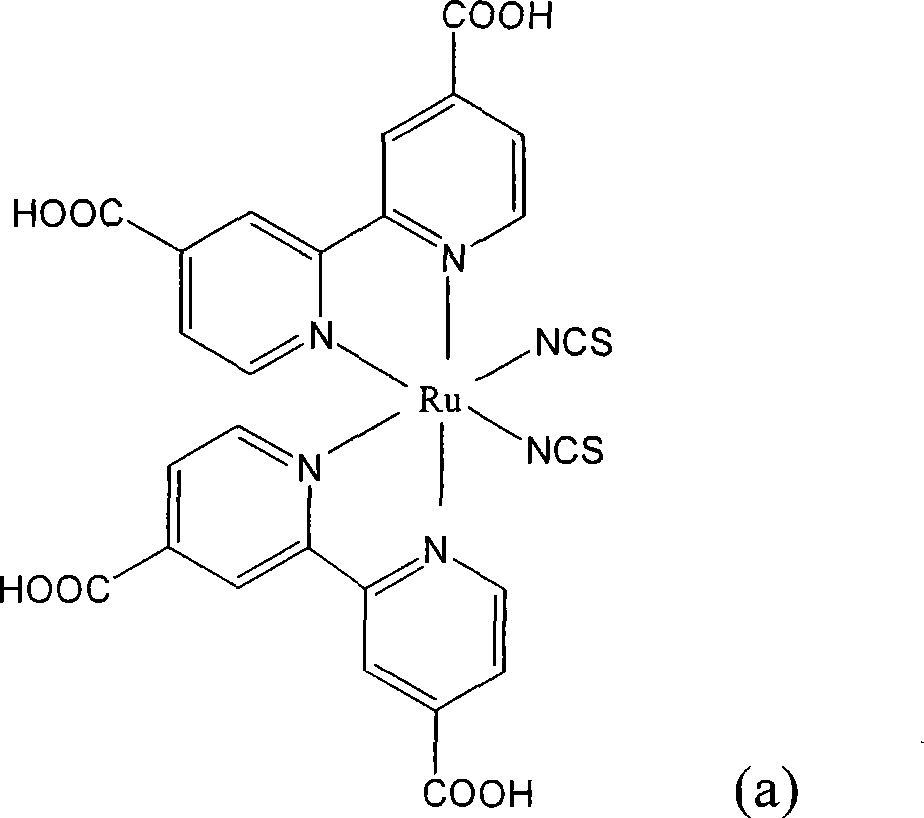
直至2003年

而后2004年同实验室发表使用黑染料(Black dye)所制备的染料敏化太阳能电池,其效率则达到11.04%(AM1.5)。黑染料可强化红光区和红外光区的光谱应答,从而提升染料敏化太阳能电池的效能。黑染料的结构如下式(c)所示。Then in 2004, the same laboratory published a dye-sensitized solar cell prepared by using black dye, and its efficiency reached 11.04% (AM1.5). The black dye can enhance the spectral response in the red and infrared regions, thereby enhancing the efficiency of the dye-sensitized solar cell. The structure of the black dye is shown in the following formula (c).
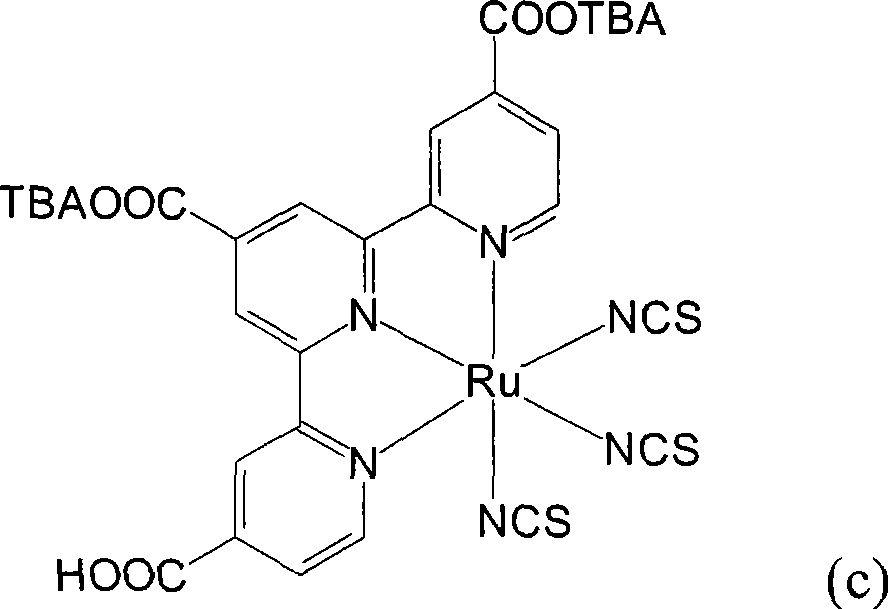
除了
由于染料敏化太阳能电池中的染料对电池效率有关键性的影响。因此,寻找可以提高染料敏化太阳能电池效率的染料分子,是改善染料敏化太阳能电池效率的重要方法之一。The dyes in dye-sensitized solar cells have a critical impact on cell efficiency. Therefore, finding dye molecules that can improve the efficiency of dye-sensitized solar cells is one of the important methods to improve the efficiency of dye-sensitized solar cells.
发明内容 Contents of the invention
本发明的目的在于提供一种新颖钌金属络合物,其适用于染料敏化太阳能电池,可以增加染料敏化太阳能电池的光电效率。The object of the present invention is to provide a novel ruthenium metal complex, which is suitable for dye-sensitized solar cells and can increase the photoelectric efficiency of the dye-sensitized solar cells.
本发明的另一目在于提供一种染料敏化太阳能电池,其有较高的光电效率。Another object of the present invention is to provide a dye-sensitized solar cell with higher photoelectric efficiency.
为实现上述目的,本发明提供的钌金属络合物,其结构如下式(I):In order to achieve the above object, the ruthenium metal complex provided by the invention has the following structure (I):
RuL2(NCS)2Am (I)RuL 2 (NCS) 2 A m (I)
其中in
L为2,2’-双吡啶-4,4’-二甲酸(2,2’-bipyridyl-4,4’-dicarboxylic acid)、2,2’-双吡啶-4,4’-二磺酸(2,2’-bipyridyl-4,4’-disulfonic acid)或2,2’-双吡啶-4,4’-二磷酸(2,2’-bipyridyl-4,4’-diphosphonic acid);L is 2,2'-bipyridine-4,4'-dicarboxylic acid (2,2'-bipyridyl-4,4'-dicarboxylic acid), 2,2'-bipyridine-4,4'-disulfonic acid (2,2'-bipyridyl-4,4'-disulfonic acid) or 2,2'-bipyridine-4,4'-diphosphate (2,2'-bipyridyl-4,4'-diphosphonic acid);
A为N+R1R2R3R4、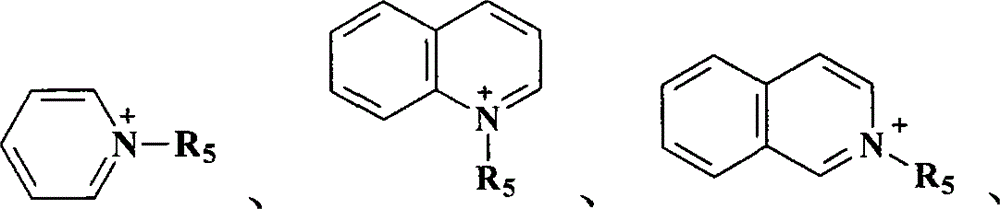
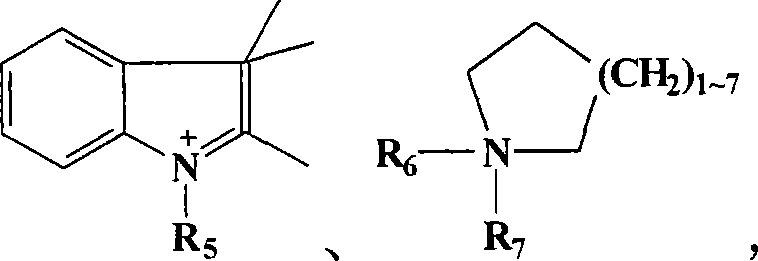
其中,R1为C5-20烷基(alkyl)、苯基(phenyl)或苯甲基(benzyl),R2、R3、及R4各自独立分别为C1-20烷基、苯基或苯甲基,R5、R6、及R7各自独立分别为C1-20烷基;Wherein, R 1 is C 5-20 alkyl (alkyl), phenyl (phenyl) or benzyl (benzyl), R 2 , R 3 , and R 4 are each independently C 1-20 alkyl, phenyl or benzyl, R 5 , R 6 , and R 7 are each independently C 1-20 alkyl;
m为1至4的整数。m is an integer of 1 to 4.
于上述式(I)中,L可为2,2’-双吡啶-4,4’-二甲酸、2,2’-双吡啶-4,4’-二磺酸或2,2’-双吡啶-4,4’-二磷酸。较佳的,L为2,2’-双吡啶-4,4’-二甲酸。In the above formula (I), L can be 2,2'-bispyridine-4,4'-dicarboxylic acid, 2,2'-bispyridine-4,4'-disulfonic acid or 2,2'-bis Pyridine-4,4'-diphosphate. Preferably, L is 2,2'-bispyridine-4,4'-dicarboxylic acid.
于上述式(I)中,A可为N+R1R2R3R4、

其中R1为C5-20烷基、苯基或苯甲基,R2、R3、及R4各自独立分别为C1-20烷基、苯基或苯甲基,R5、R6、及R7各自独立分别为C1-20烷基;较佳的,A为N+R1R2R3R4,其中R1为C5-20烷基、苯基或苯甲基,R2、R3、及R4各自独立分别为C1-20烷基、苯基或苯甲基;更佳的,A为N+R1R2R3R4,其中R1为C5-20烷基、苯基或苯甲基,R2、R3、及R4各自独立分别为C1-6烷基、苯基或苯甲基;最佳的,A为N+R1R2R3R4,其中R1为C5-20烷基、苯基或苯甲基,R2、R3、及R4各自独立分别为C1-6烷基。Where R 1 is C 5-20 alkyl, phenyl or benzyl, R 2 , R 3 , and R 4 are each independently C 1-20 alkyl, phenyl or benzyl, R 5 , R 6 , and R 7 are each independently C 1-20 alkyl; preferably, A is N + R 1 R 2 R 3 R 4 , wherein R 1 is C 5-20 alkyl, phenyl or benzyl, R 2 , R 3 , and R 4 are each independently C 1-20 alkyl, phenyl or benzyl; more preferably, A is N + R 1 R 2 R 3 R 4 , wherein R 1 is C 5 -20 alkyl, phenyl or benzyl, R 2 , R 3 , and R 4 are each independently C 1-6 alkyl, phenyl or benzyl; most preferably, A is N + R 1 R 2 R 3 R 4 , wherein R 1 is C 5-20 alkyl, phenyl or benzyl, and R 2 , R 3 , and R 4 are each independently C 1-6 alkyl.
于上述式(I)中,m可为1至4的整数;较佳的,m为2或3的整数。In the above formula (I), m can be an integer of 1 to 4; preferably, m is an integer of 2 or 3.
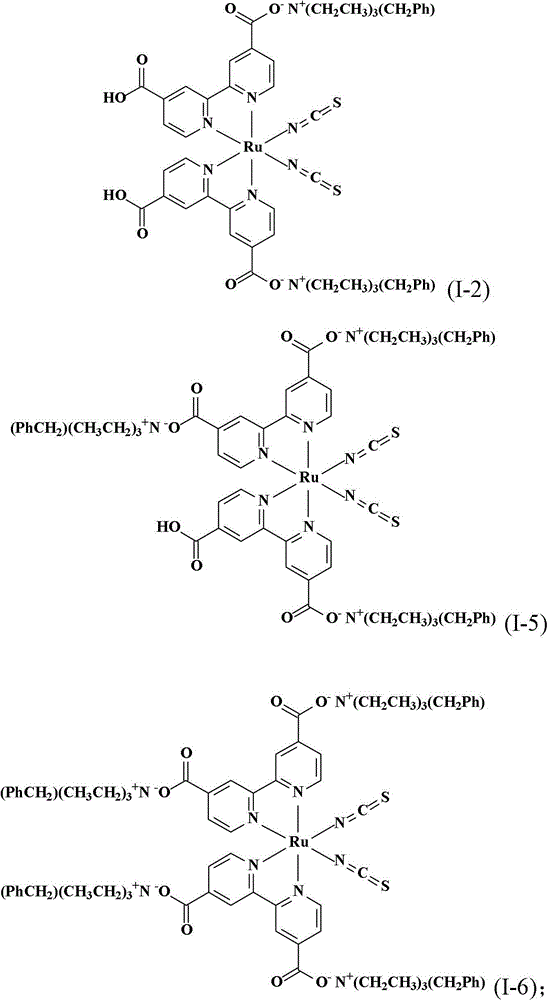
上述式(I)的钌金属络合物具体实例有:The ruthenium metal complex concrete example of above-mentioned formula (I) has:
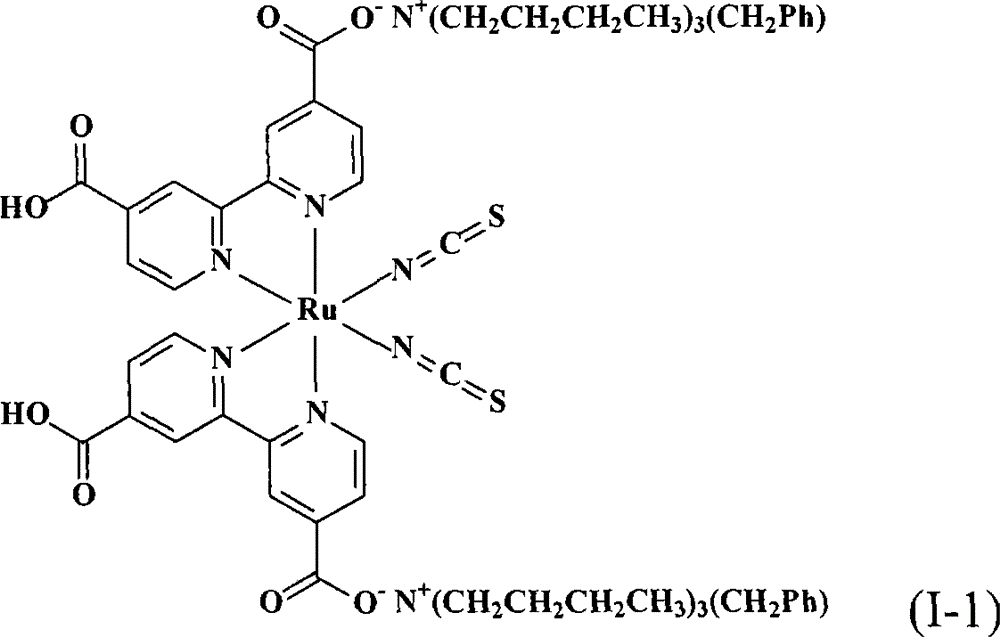
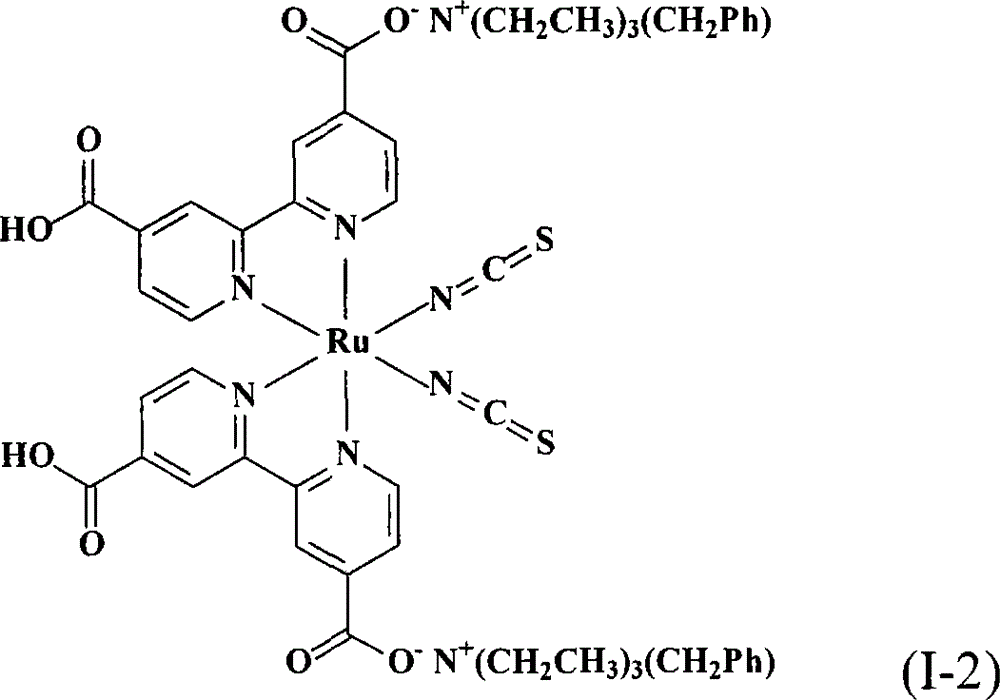
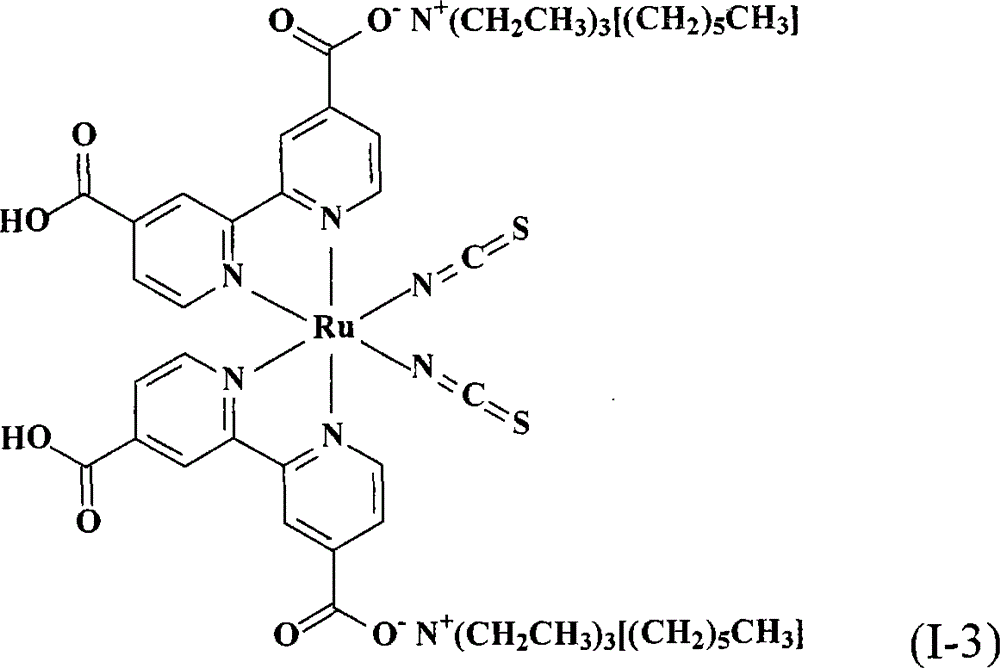
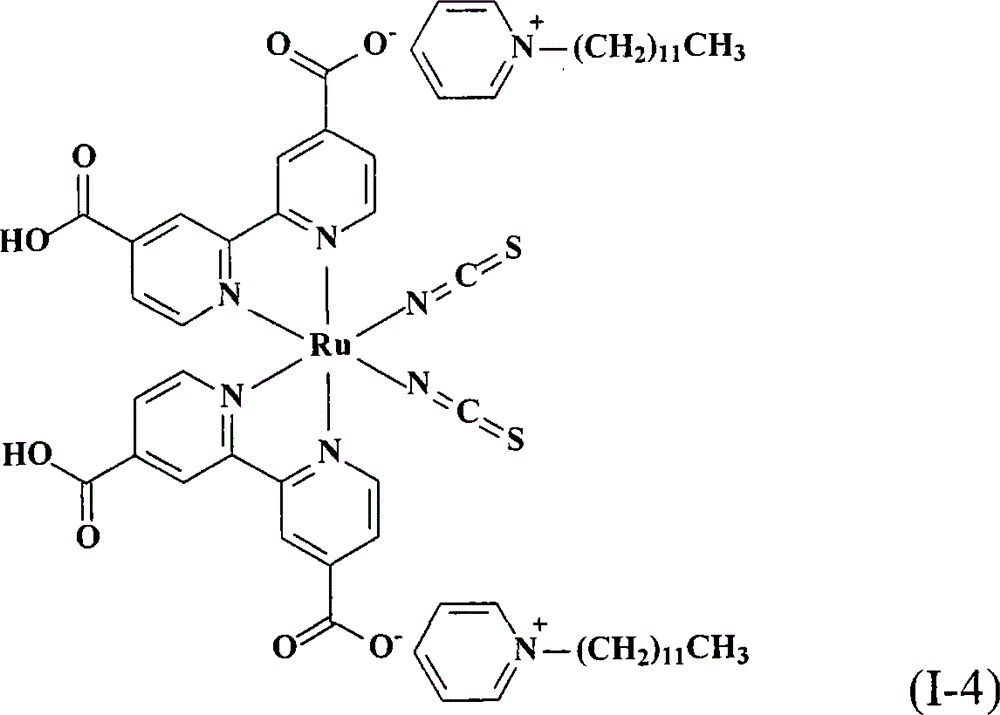

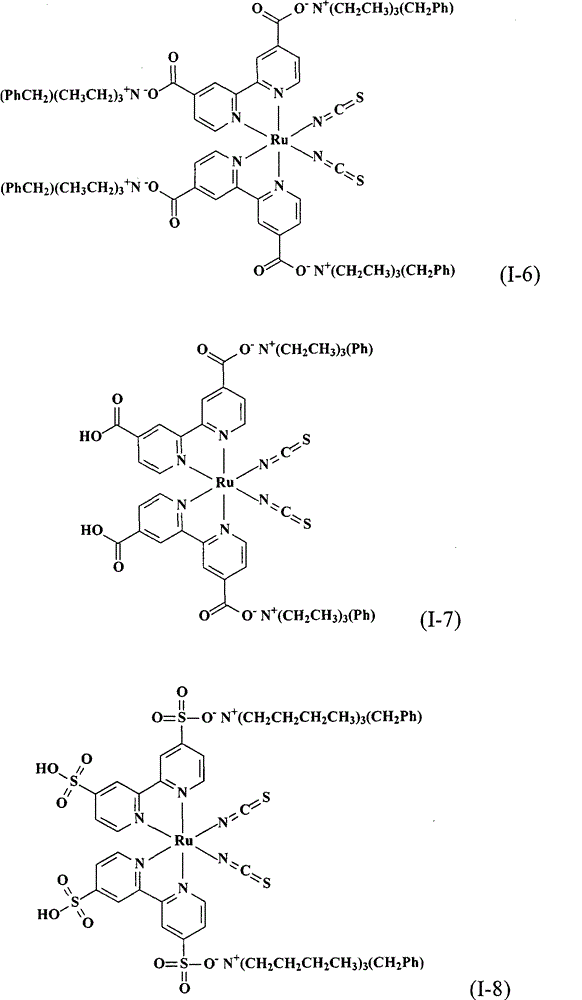
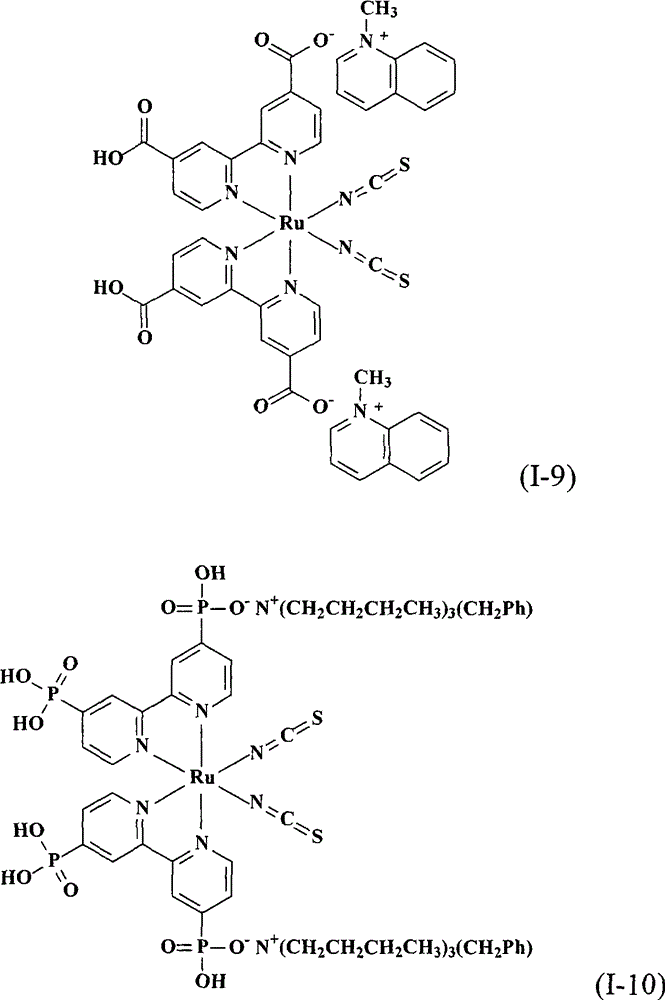
本发明提供的染料敏化太阳能电池,其含有上述的钌金属络合物。The dye-sensitized solar cell provided by the present invention contains the above-mentioned ruthenium metal complex.
此外,本发明的染料敏化太阳能电池,包括:一含有上述钌金属络合物的光电阳极(photoanode);一阴极(cathode);以及位于光电阳极及阴极之间的电解质层(electrolyte layer)。In addition, the dye-sensitized solar cell of the present invention includes: a photoanode (photoanode) containing the above-mentioned ruthenium metal complex; a cathode (cathode); and an electrolyte layer (electrolyte layer) between the photoanode and the cathode.
于本发明的染料敏化太阳能电池中,光电阳极包括有:透明基板、透明导电膜、多孔性半导体膜、以及钌金属络合物染料。In the dye-sensitized solar cell of the present invention, the photoanode includes: a transparent substrate, a transparent conductive film, a porous semiconductor film, and a ruthenium metal complex dye.
于本发明的染料敏化太阳能电池中,光电阳极的透明基板的材质并无特别限制,只要是透明的基材均可使用。较佳地,透明基板的材质为对于由染料敏化太阳能电池外部侵入的水分或气体具有良好的遮断性、耐溶剂性、耐候性等的透明基材。透明基板的具体列举,包括有:石英、玻璃等透明无机基板;聚乙烯对苯二甲酸酯(PET)、聚(萘二甲酸乙二酯)(PEN)、聚碳酸酯(PC)、聚乙烯(PE)、聚丙烯(PP)、聚酰亚胺(PI)等透明塑料基板,但是,并非限定于这些。此外,透明基板的厚度并无特别限制,可依照透光率、染料敏化太阳能电池特性要求而自由选择。较佳的,透明基板的材质为玻璃。In the dye-sensitized solar cell of the present invention, the material of the transparent substrate of the photoanode is not particularly limited, and any substrate can be used as long as it is transparent. Preferably, the material of the transparent substrate is a transparent substrate with good barrier properties, solvent resistance, weather resistance, etc. for moisture or gas intruding from the outside of the dye-sensitized solar cell. Specific examples of transparent substrates include: transparent inorganic substrates such as quartz and glass; polyethylene terephthalate (PET), poly(ethylene naphthalate) (PEN), polycarbonate (PC), poly Transparent plastic substrates such as vinyl (PE), polypropylene (PP), and polyimide (PI), however, are not limited to these. In addition, the thickness of the transparent substrate is not particularly limited, and can be freely selected according to the light transmittance and the characteristic requirements of the dye-sensitized solar cell. Preferably, the material of the transparent substrate is glass.
此外,于本发明的染料敏化太阳能电池中,透明导电膜的材料可为氧化铟锡(ITO)、氟掺杂的氧化锡(FTO)、氧化锌-三氧化二镓(ZnO-Ga2O3)、氧化锌-三氧化二铝(ZnO-Al2O3)、或以钖为基础的氧化物材料。In addition, in the dye-sensitized solar cell of the present invention, the material of the transparent conductive film may be indium tin oxide (ITO), fluorine-doped tin oxide (FTO), zinc oxide-gallium trioxide (ZnO-Ga 2 O 3 ), zinc oxide-aluminum oxide (ZnO-Al 2 O 3 ), or tin-based oxide materials.
再者,于本发明的染料敏化太阳能电池中,多孔性半导体膜是用半导体微粒所制成。适当的半导体微粒可包括:硅、二氧化钛、二氧化锡、氧化锌、三氧化钨、五氧化二铌、三氧化钛锶、及其组合;较佳的,半导体微粒是二氧化钛。半导体微粒的平均粒径为5至500纳米,较佳的为10至50纳米。多孔性半导体膜的厚度为5~25微米。Furthermore, in the dye-sensitized solar cell of the present invention, the porous semiconductor film is made of semiconductor fine particles. Suitable semiconductor particles may include: silicon, titanium dioxide, tin dioxide, zinc oxide, tungsten trioxide, niobium pentoxide, titanium strontium trioxide, and combinations thereof; preferably, the semiconductor particle is titanium dioxide. The average particle size of the semiconductor particles is 5 to 500 nm, preferably 10 to 50 nm. The thickness of the porous semiconductor film is 5-25 microns.
于本发明的染料敏化太阳能电池中,钌金属络合物染料如上所述的钌金属络合物。In the dye-sensitized solar cell of the present invention, the ruthenium metal complex dye is the above-mentioned ruthenium metal complex.
此外,作为染料敏化太阳能电池的阴极材料并无特别限制,可包括任何具有传导性的材料。或者,阴极材料也可以是一絶缘材料,只要有传导层形成于朝向光电阳极的表面上。电化学穏定的物质就可作为阴极,且适用于阴极材料的非限制实例包括:铂、金、碳、及其相似物。In addition, the cathode material of the dye-sensitized solar cell is not particularly limited, and may include any conductive material. Alternatively, the cathode material may also be an insulating material as long as a conductive layer is formed on the surface facing the photoanode. Electrochemically stable substances can serve as cathodes, and non-limiting examples of suitable cathode materials include: platinum, gold, carbon, and the like.
再者,作为染料敏化太阳能电池的电解质层并无特别限制,可包括任何具有电子及/或电洞传导性的基材。Furthermore, the electrolyte layer of the dye-sensitized solar cell is not particularly limited, and may include any substrate having electron and/or hole conductivity.
具体实施方式 Detailed ways
本发明的钌金属络合物可以下列方式合成。The ruthenium metal complex of the present invention can be synthesized in the following manner.
顺-二硫氰基-N,N’-双(2,2’-双吡啶-4,4’-二甲酸基)钌(II)(cis-di(thiocyanato)-N,N’-bis(2,2’-bipyridyl-4,4’-dicarboxylicacid)ruthenium(II),N3 dye)依照Inorganic Chemistry,Vol.38,No.26,1999,6298-6305的方法合成。Cis-dithiocyanato-N, N'-bis(2,2'-bipyridine-4,4'-dicarboxylate) ruthenium (II) (cis-di(thiocyanato)-N, N'-bis( 2,2'-bipyridyl-4,4'-dicarboxylic acid) ruthenium (II), N3 dye) was synthesized according to the method of Inorganic Chemistry, Vol.38, No.26, 1999, 6298-6305.
将顺-二硫氰基-N,N’-双(2,2’-双吡啶-4,4’-二甲酸基)钌(II)溶于蒸馏水中,再滴入10%的氢氧苯甲基三丁基铵(benzyltributylammonium hydroxide)水溶液(用氯化苯甲基三丁基铵试剂(benzyltributylammonium chloridereagent,ACROS,98%)所配制)到反应液中,直到反应液的pH值穏定达到10,然后浓缩得到黏稠液。将此黏稠液溶于甲醇(methanol)中,然后加入乙醚(diethyl ether)沈淀出产物,取出此吸湿性固体产物后在真空下干燥一天。将此干燥后的固体溶于蒸馏水中,再用0.1M的硝酸(nitric acid)水溶液调整pH值到5以下,即可得到式(I-1)的钌金属络合物。Dissolve cis-dithiocyano-N, N'-bis(2,2'-bipyridine-4,4'-dicarboxylate) ruthenium (II) in distilled water, and then drop into 10% hydrogenoxybenzene Methyl tributylammonium (benzyltributylammonium hydroxide) aqueous solution (prepared with benzyltributylammonium chloride reagent (benzyltributylammonium chloridereagent, ACROS, 98%)) in the reaction solution, until the pH value of the reaction solution reaches 10 , and then concentrated to obtain a viscous liquid. The viscous solution was dissolved in methanol, and then diethyl ether was added to precipitate the product. The hygroscopic solid product was taken out and dried under vacuum for one day. The dried solid was dissolved in distilled water, and the pH value was adjusted to below 5 with 0.1M aqueous nitric acid solution to obtain the ruthenium metal complex of formula (I-1).
本发明的染料敏化太阳能电池的制造方法并无特别限制,可用一般已知的方法制造。The method for producing the dye-sensitized solar cell of the present invention is not particularly limited, and generally known methods can be used.
透明基板的材质并无特别限制,只要是透明的基材均可使用。较佳地,透明基板的材质为对于由染料敏化太阳能电池外部侵入的水分或气体具有良好的遮断性、耐溶剂性、耐候性等的透明基材,具体列举,有石英、玻璃等透明无机基板,聚乙烯对苯二甲酸酯(PET)、聚(萘二甲酸乙二酯)(PEN)、聚碳酸酯(PC)、聚乙烯(PE)、聚丙烯(PP)、聚酰亚胺(PI)等透明塑料基板,但是,并非限定于这些。透明基板的厚度并无特别限制,可以由透光率、染料敏化太阳能电池特性要求而自由选择。在一具体实例中,透明基板是使用玻璃基板。The material of the transparent substrate is not particularly limited, and any substrate can be used as long as it is transparent. Preferably, the material of the transparent substrate is a transparent substrate with good shielding properties, solvent resistance, weather resistance, etc. for moisture or gas intruded from the outside of the dye-sensitized solar cell. Specifically, there are transparent inorganic materials such as quartz and glass. Substrate, polyethylene terephthalate (PET), poly(ethylene naphthalate) (PEN), polycarbonate (PC), polyethylene (PE), polypropylene (PP), polyimide (PI) and other transparent plastic substrates, however, are not limited to these. The thickness of the transparent substrate is not particularly limited, and can be freely selected according to the light transmittance and the characteristic requirements of the dye-sensitized solar cell. In a specific example, the transparent substrate is a glass substrate.
透明导电膜的材料可以选自氧化铟锡(ITO)、氟掺杂的氧化锡(FTO)、氧化锌-三氧化二镓(ZnO-Ga2O3)、氧化锌-三氧化二铝(ZnO-Al2O3)、以及钖为基础的氧化物材料。在一具体实例中,透明导电膜是使用氟掺杂的氧化锡。The material of the transparent conductive film can be selected from indium tin oxide (ITO), fluorine-doped tin oxide (FTO), zinc oxide-gallium oxide (ZnO-Ga 2 O 3 ), zinc oxide-aluminum oxide (ZnO -Al 2 O 3 ), and tin-based oxide materials. In one embodiment, the transparent conductive film is tin oxide doped with fluorine.
多孔性半导体膜是用半导体微粒所制成。适当的半导体微粒包括有硅、二氧化钛、二氧化锡、氧化锌、三氧化钨、五氧化二铌、三氧化钛锶及其组合。首先,先将半导体微粒配制成糊状物,再将其涂布到透明导电基板上,涂布方法可用刮墨刀、网印、旋转涂布、喷洒等或一般湿式涂布。此外,为了得到适当的膜厚,可以涂布一次或多次。半导体膜层可以为单层或多层,多层是指各层使用不同粒径的半导体微粒。例如,可先涂布粒径为5至50纳米的半导体微粒,其涂布厚度为5至20微米,然后再涂布粒径为200至400纳米的半导体微粒,其涂布厚度为3至5微米。然后在50至100℃干燥后,再在400至500℃烧结30分钟可制得一多层半导体膜层。Porous semiconductor membranes are made of semiconductor particles. Suitable semiconductor particles include silicon, titanium dioxide, tin dioxide, zinc oxide, tungsten trioxide, niobium pentoxide, strontium titanium trioxide, and combinations thereof. First, the semiconductor particles are formulated into a paste, and then coated on a transparent conductive substrate. The coating method can be squeegee, screen printing, spin coating, spraying, etc. or general wet coating. In addition, in order to obtain an appropriate film thickness, it may be applied one or more times. The semiconductor film layer can be single-layer or multi-layer, and multi-layer refers to the use of semiconductor particles with different particle sizes in each layer. For example, semiconductor particles with a particle size of 5 to 50 nanometers can be coated first, and the coating thickness is 5 to 20 microns, and then semiconductor particles with a particle size of 200 to 400 nanometers can be coated with a coating thickness of 3 to 5 microns. Micron. Then, after drying at 50-100° C., and then sintering at 400-500° C. for 30 minutes, a multi-layer semiconductor film can be prepared.
钌金属络合物染料可以溶于适当的溶剂配制成染料溶液。适当的溶剂包括有乙腈、甲醇、乙醇、丙醇、丁醇、二甲基甲酰胺、N-甲基吡咯烷酮或其混合物,但是,并非限定于这些。在此,将涂布有半导体膜的透明基板浸泡到染料溶液中,让其充分吸收染料溶液中的染料,并于染料吸收完成后取出干燥,可制得一染料敏化太阳能电池的光电阳极。The ruthenium metal complex dye can be dissolved in an appropriate solvent to prepare a dye solution. Suitable solvents include, but are not limited to, acetonitrile, methanol, ethanol, propanol, butanol, dimethylformamide, N-methylpyrrolidone, or mixtures thereof. Here, the transparent substrate coated with the semiconductor film is immersed in the dye solution to allow it to fully absorb the dye in the dye solution, and after the dye absorption is completed, it is taken out and dried to prepare a photoanode of a dye-sensitized solar cell.
作为阴极的材料并无特别限制,可包括任何具有传导性的材料。或者,阴极材料也可以是一絶缘材料,只要有传导层形成于朝向光电阳极的表面上。此外,电化学穏定的物质就可作为阴极,且适用于阴极材料的非限制实例包括:铂、金、碳、及其相似物。The material for the cathode is not particularly limited, and may include any conductive material. Alternatively, the cathode material may also be an insulating material as long as a conductive layer is formed on the surface facing the photoanode. In addition, an electrochemically stable substance can serve as the cathode, and non-limiting examples of suitable cathode materials include: platinum, gold, carbon, and the like.
电解质层并无特别限制,可以包括任何具有电子及/或电洞传导性的基材。另外,液态电解质可以是含碘的乙腈溶液、含碘的N-甲基吡咯烷酮溶液、或含碘的3-甲氧基丙腈溶液。在一具体实例中,液态电解质为一含有碘的乙腈溶液。The electrolyte layer is not particularly limited, and may include any substrate having electron and/or hole conductivity. In addition, the liquid electrolyte may be an iodine-containing acetonitrile solution, an iodine-containing N-methylpyrrolidone solution, or an iodine-containing 3-methoxypropionitrile solution. In one embodiment, the liquid electrolyte is an iodine-containing acetonitrile solution.
本发明的染料敏化太阳能电池一具体制造方式如下。A specific manufacturing method of the dye-sensitized solar cell of the present invention is as follows.
首先,将包括具有粒径为20~30纳米(nm)的氧化钛微粒的糊状物,由一次或数次的网印涂布在覆盖有氟掺杂的氧化锡(FTO)玻璃板上,而后在450℃烧结30分钟。First, a paste comprising titanium oxide particles with a particle size of 20 to 30 nanometers (nm) is coated on a fluorine-doped tin oxide (FTO) glass plate by one or several screen printing, It was then sintered at 450° C. for 30 minutes.
将钌金属络合物溶于乙腈(acetonitrile)及三级-丁醇(t-butanol)的混合液(1:1 v/v)中,配成钌金属络合物染料溶液。接着,将上述含有多孔氧化钛膜的玻璃板浸泡在染料溶中,让其吸收染料溶液中的染料后,取出干燥即可得到一光电阳极(photoanode)。Dissolve the ruthenium metal complex in a mixture of acetonitrile and t-butanol (1:1 v/v) to prepare a ruthenium metal complex dye solution. Next, soak the above-mentioned glass plate containing the porous titanium oxide film in a dye solution, let it absorb the dye in the dye solution, take it out and dry it to obtain a photoanode.
将覆盖有氟掺杂的氧化锡玻璃板钻一直径为0.75毫米的注入口,以备注入电解质用。再将氯化铂酸(H2PtCl6)溶液涂布在覆盖有氟掺杂的氧化锡玻璃板上,然后加热到400℃处理15分钟即可得到一阴极(cathode)。An injection port with a diameter of 0.75 mm was drilled on a fluorine-doped tin oxide glass plate for injecting electrolyte. Platinum chloride (H 2 PtCl 6 ) solution was coated on a fluorine-doped tin oxide glass plate, and then heated to 400° C. for 15 minutes to obtain a cathode.
然后,将厚度60微米的热塑性聚合物膜配置在光电阳极和阴极之间,在120至140℃下施加压力于此二电极,以黏合此两电极。Then, a thermoplastic polymer film with a thickness of 60 μm is disposed between the photoanode and the cathode, and pressure is applied to the two electrodes at 120 to 140° C. to bond the two electrodes.
将电解液(0.03M I2/0.3M LiI/0.5M三级丁基吡啶的乙腈溶液)注入,再用热塑性聚合物膜将注入口密封,即可得到本发明的染料敏化电池。The dye-sensitized battery of the present invention can be obtained by injecting the electrolyte solution (0.03M I 2 /0.3M LiI/0.5M tertiary butylpyridine in acetonitrile solution), and sealing the injection port with a thermoplastic polymer film.
以下实例仅用以说明本发明,本发明的权利范围并不会因此而受限制。若无特别注明,则温度为摄氏温度,份数及百分比是以重量计。重量份数和体积份数的关系就如同公斤和公升的关系。The following examples are only used to illustrate the present invention, and the scope of rights of the present invention will not be limited thereby. Unless otherwise specified, temperatures are in degrees Celsius, and parts and percentages are by weight. The relationship between parts by weight and parts by volume is like the relationship between kilograms and liters.
实施例1Example 1
合成顺-二硫氰基-N,N’-双(2,2’-双吡啶-4,4’-二甲酸基)钌(II)双(苯甲基三丁基铵)(cis-di(thiocyanato)-N,N’-bis(2,2’-bi pyridyl-4,4’-dicarboxylicacid)ruthenium(II)bis(benzyl tributyl ammonium))(I-1)Synthesis of cis-dithiocyano-N,N'-bis(2,2'-bipyridine-4,4'-dicarboxylate)ruthenium(II)bis(benzyltributylammonium)(cis-di (thiocyanato)-N, N'-bis(2,2'-bi pyridyl-4,4'-dicarboxylic acid)ruthenium(II)bis(benzyl tributyl ammonium))(I-1)
将0.50份顺-二硫氰基-N,N’-双(2,2’-双吡啶-4,4’-二甲酸基)钌(II)(cis-di(thiocyanato)-N,N’-bis(2,2’-bipyridyl-4,4’-dicarboxylicacid)ruthenium(II),N3 dye)(依照Inorganic Chemistry,Vol.38,No.26,1999,6298-6305的方法合成)以及10份蒸馏水加入反应瓶中搅拌混合,再滴入10%的氢氧苯甲基三丁基铵(benzyltributylammonium hydroxide)水溶液(用氯化苯甲基三丁基铵试剂(benzyltributylammonium chloride reagent,ACROS,98%)所配制)到反应液中,直到反应液的pH值穏定达到10,然后用旋转蒸发仪(rotary-evaporator)蒸除溶剂得到黏稠液。接着,将此黏稠液溶于甲醇(methanol)中,然后加入乙醚(diethyl ether)产生沈淀物,取出此吸湿性固体产物后在真空下干燥一天。将此干燥后的固体溶于10份的蒸馏水中,再用0.1M的硝酸(nitric acid)水溶液调整pH值到5以下,用烧结玻璃过滤器(sintered glass filter)过滤收集产物,并用5份pH4.1的蒸馏水冲洗产物,得到式(I-1)的黑色固体产物0.52份,产率61.5%。0.50 parts of cis-di(thiocyanato)-N,N'-bis(2,2'-bipyridine-4,4'-dicarboxylate) ruthenium(II) (cis-di(thiocyanato)-N,N' -bis(2,2'-bipyridyl-4,4'-dicarboxylic acid)ruthenium(II), N3 dye) (synthesized according to the method of Inorganic Chemistry, Vol.38, No.26, 1999, 6298-6305) and 10 parts Distilled water was added in the reaction bottle and stirred to mix, then dripped into 10% aqueous solution of benzyltributylammonium hydroxide (benzyltributylammonium chloride reagent, ACROS, 98%) prepared) into the reaction solution until the pH value of the reaction solution reached 10, and then the solvent was evaporated with a rotary-evaporator to obtain a viscous solution. Next, the viscous solution was dissolved in methanol, and then diethyl ether was added to produce a precipitate. The hygroscopic solid product was taken out and dried under vacuum for one day. Dissolve the dried solid in 10 parts of distilled water, adjust the pH value to below 5 with 0.1M aqueous nitric acid (nitric acid) solution, collect the product by filtration with a sintered glass filter, and use 5 parts of pH4 .1 distilled water to wash the product to obtain 0.52 parts of the black solid product of formula (I-1), yield 61.5%.
实施例2Example 2
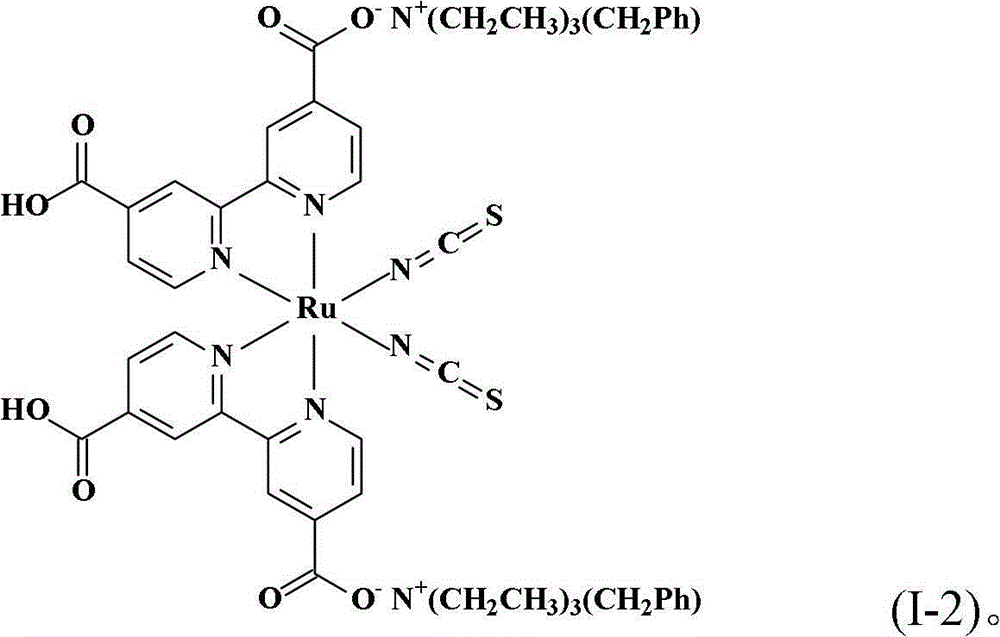
合成顺-二硫氰基-N,N’-双(2,2’-双吡啶-4,4’-二甲酸基)钌(II)双(苯甲基三乙基铵)(cis-di(thiocyanato)-N,N’-bis(2,2’-bi pyridyl-4,4’-dicarboxylicacid)ruthenium(II)bis(benzyl triethyl ammonium))(I-2)Synthesis of cis-dithiocyano-N,N'-bis(2,2'-bipyridine-4,4'-dicarboxylate)ruthenium(II)bis(benzyltriethylammonium)(cis-di (thiocyanato)-N, N'-bis(2,2'-bi pyridyl-4,4'-dicarboxylic acid)ruthenium(II)bis(benzyl triethyl ammonium))(I-2)
同实施例1的相同步骤制备本实施例的化合物,除了使用氢氧苯甲基三乙基铵(benzyltriethylammonium hydroxide)水溶液(TCI Co.,Ltd.,)取代氢氧苯甲基三丁基铵水溶液。得到式(I-2)的黑色固体产物0.30份,产率41.1%。The compound of the present embodiment was prepared in the same steps as in Example 1, except that benzyltriethylammonium hydroxide (benzyltriethylammonium hydroxide) aqueous solution (TCI Co., Ltd.,) was used to replace benzyltriethylammonium hydroxide aqueous solution . 0.30 part of black solid product of formula (I-2) was obtained with a yield of 41.1%.
实施例3Example 3
合成顺-二硫氰基-N,N’-双(2,2’-双吡啶-4,4’-二甲酸基)钌(II)双(三乙基己基铵)(cis-di(thiocyanato)-N,N’-bis(2,2’-bi pyridyl-4,4’-dicarboxylicacid)ruthenium(II)bis(triethyl hexyl ammonium))(I-3)Synthesis of cis-dithiocyanato-N, N'-bis(2,2'-bipyridine-4,4'-dicarboxylate) ruthenium(II) bis(triethylhexylammonium) (cis-di(thiocyanato )-N, N'-bis(2,2'-bi pyridyl-4,4'-dicarboxylic acid)ruthenium(II)bis(triethyl hexyl ammonium))(I-3)
将0.50份顺-二硫氰基-N,N’-双(2,2’-双吡啶-4,4’-二甲酸基)钌(II)以及10份蒸馏水加入反应瓶中搅拌混合,再滴入10%的氢氧三乙基己基铵(triethylhexylammonium hydroxide)水溶液(用溴化三乙基己基铵试剂(triethylhexylammonium bromide reagent,ALDRICH,99%)所配制)到反应液中,直到反应液的pH值穏定达到12,然后用旋转蒸发仪蒸除溶剂得到黏稠液。接着,将此黏稠液溶于甲醇中,然后加入乙醚产生沈淀物,取出此吸湿性固体产物后在真空下干燥一天。将此干燥后的固体溶于10份的蒸馏水中,再用0.1M的硝酸水溶液调整pH值到4以下,用烧结玻璃过滤器过滤收集产物,并用5份pH4.1的蒸馏水冲洗产物,得到式(I-3)的黑色固体产物0.44份,产率81.5%。Add 0.50 parts of cis-dithiocyano-N, N'-bis(2,2'-bipyridine-4,4'-dicarboxylate) ruthenium(II) and 10 parts of distilled water into the reaction flask and stir to mix, then Drop 10% triethylhexylammonium hydroxide (triethylhexylammonium hydroxide) aqueous solution (prepared with triethylhexylammonium bromide reagent (triethylhexylammonium bromide reagent, ALDRICH, 99%)) in the reaction solution, until the pH of the reaction solution The value was stable to 12, and then the solvent was evaporated with a rotary evaporator to obtain a viscous liquid. Next, the viscous solution was dissolved in methanol, and ether was added to produce a precipitate. The hygroscopic solid product was taken out and dried under vacuum for one day. Dissolve the dried solid in 10 parts of distilled water, adjust the pH value to below 4 with 0.1M aqueous nitric acid solution, collect the product by filtration with a sintered glass filter, and wash the product with 5 parts of distilled water at pH 4.1 to obtain the formula (I-3) black solid product 0.44 parts, yield 81.5%.
实施例4Example 4
合成顺-二硫氰基-N,N’-双(2,2’-双吡啶-4,4’-二甲酸基)钌(II)双(1-十二烷基吡啶)(cis-di(thiocyanato)-N,N’-bis(2,2’-bi pyridyl-4,4’-dicarboxylicacid)ruthenium(II)bis(1-dodecyl pyridinium))(I-4)Synthesis of cis-dithiocyano-N, N'-bis(2,2'-bipyridine-4,4'-dicarboxylate) ruthenium(II) bis(1-dodecylpyridine) (cis-di (thiocyanato)-N, N'-bis(2,2'-bi pyridyl-4,4'-dicarboxylic acid)ruthenium(II)bis(1-dodecyl pyridinium))(I-4)
同实施例3的相同步骤制备本实施例的化合物,除了使用氢氧1-十二烷基吡啶(1-dodecylpyridinium hydroxide)水溶液(用氯化1-十二烷基吡啶试剂(1-dodecylpyridinium chloride reagent,ALDRICH,98%)所配制)取代氢氧三乙基己基铵水溶液。得到式(I-4)的黑色固体产物0.20份,产率32.8%。The compound of the present embodiment was prepared in the same steps as in Example 3, except that 1-dodecylpyridinium hydroxide (1-dodecylpyridinium hydroxide) aqueous solution was used (1-dodecylpyridinium chloride reagent was used to , ALDRICH, 98%)) substituted triethylhexylammonium hydroxide aqueous solution. 0.20 part of black solid product of formula (I-4) was obtained with a yield of 32.8%.
实施例5Example 5
合成顺-二硫氰基-N,N’-双(2,2’-双吡啶-4,4’-二甲酸基)钌(II)三(苯甲基三乙基铵)(cis-di(thiocyanato)-N,N’-bis(2,2’-bi pyridyl-4,4’-dicarboxylicacid)ruthenium(II)tris(benzyl triethyl ammonium))(I-5)Synthesis of cis-dithiocyano-N,N'-bis(2,2'-bipyridine-4,4'-dicarboxylate)ruthenium(II) tris(benzyltriethylammonium)(cis-di (thiocyanato)-N, N'-bis(2,2'-bi pyridyl-4,4'-dicarboxylic acid)ruthenium(II)tris(benzyl triethyl ammonium))(I-5)
将0.20份10%的氢氧苯甲基三乙基铵水溶液及100份甲醇加入反应瓶中搅拌混合,再加入0.10份顺-二硫氰基-N,N’-双(2,2’-双吡啶-4,4’-二甲酸基)钌(II)双(苯甲基三乙基铵)(I-2)到反应液中,搅拌混合反应2.5小时。然后用旋转蒸发仪蒸除溶剂得到析出的产物,用烧结玻璃过滤器过滤收集产物,并用10份的蒸馏水冲洗产物,得到式(I-5)的黑色固体产物0.08份,产率74.0%。Add 0.20 parts of 10% aqueous solution of benzyltriethylammonium hydroxide and 100 parts of methanol into the reaction flask and stir to mix, then add 0.10 parts of cis-dithiocyano-N, N'-bis(2,2'- Bispyridine-4,4'-dicarboxylate) ruthenium (II) bis(benzyltriethylammonium) (I-2) was added to the reaction solution, stirred and mixed for 2.5 hours. Then the solvent was evaporated with a rotary evaporator to obtain the precipitated product, which was collected by filtration with a sintered glass filter and washed with 10 parts of distilled water to obtain 0.08 parts of a black solid product of formula (I-5), with a yield of 74.0%.
实施例6Example 6
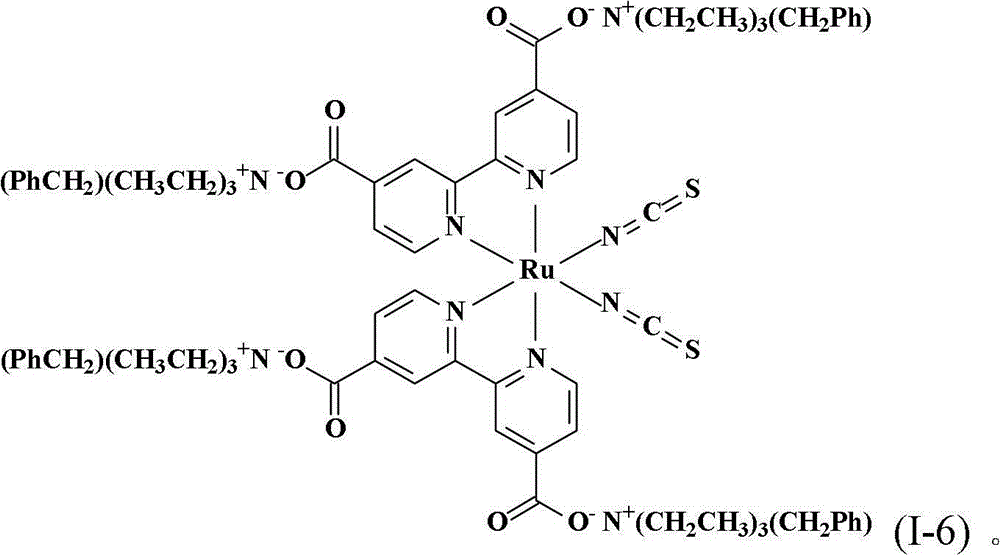
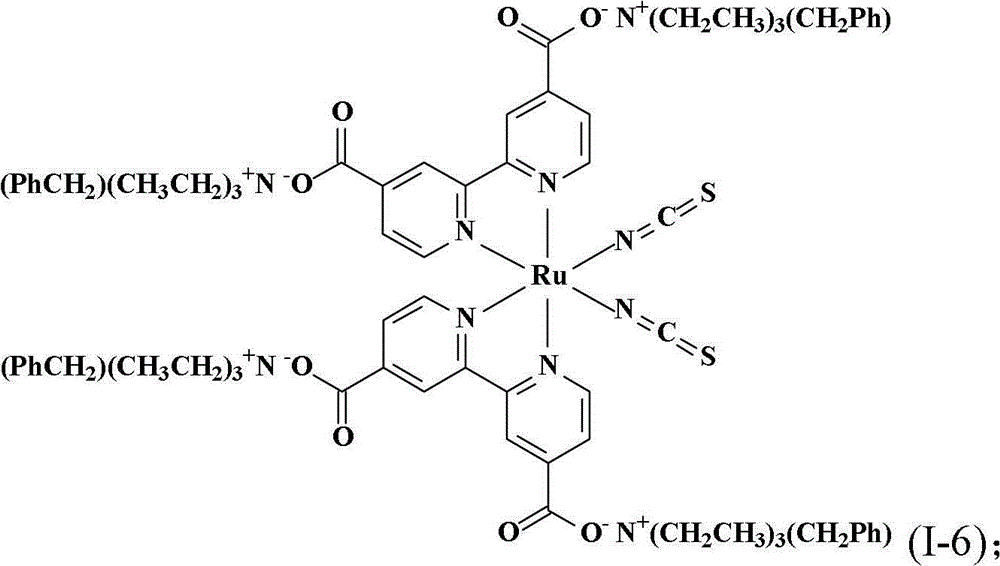
合成顺-二硫氰基-N,N’-双(2,2’-双吡啶-4,4’-二甲酸基)钌(II)四(苯甲基三乙基铵)(cis-di(thiocyanato)-N,N’-bis(2,2’-bi pyridyl-4,4’-dicarboxylicacid)ruthenium(II)tetrakis(benzyl triethyl ammonium))(I-6)Synthesis of cis-dithiocyano-N,N'-bis(2,2'-bipyridine-4,4'-dicarboxylate)ruthenium(II)tetrakis(benzyltriethylammonium)(cis-di (thiocyanato)-N, N'-bis(2,2'-bi pyridyl-4,4'-dicarboxylic acid)ruthenium(II)tetrakis(benzyl triethyl ammonium))(I-6)
将0.50份顺-二硫氰基-N,N’-双(2,2’-双吡啶-4,4’-二甲酸基)钌(II)以及50份蒸馏水加入反应瓶中搅拌混合,再滴入10%的氢氧苯甲基三乙基铵水溶液到反应液中,直到反应液的pH值穏定达到7,然后用旋转蒸发仪蒸除溶剂得到黏稠液。将此黏稠液溶于甲醇中,然后加入乙醚产生沈淀物,取出此吸湿性固体产物后在真空下干燥一天,得到式(I-6)的黑色固体产物0.43份,产率68.0%。。Add 0.50 parts of cis-dithiocyano-N, N'-bis(2,2'-bipyridine-4,4'-dicarboxylate) ruthenium(II) and 50 parts of distilled water into the reaction flask and stir to mix, then A 10% aqueous solution of benzyltriethylammonium hydroxide was added dropwise into the reaction solution until the pH value of the reaction solution reached 7, and then the solvent was evaporated with a rotary evaporator to obtain a viscous solution. The viscous solution was dissolved in methanol, and ether was added to produce a precipitate. The hygroscopic solid product was taken out and dried under vacuum for one day to obtain 0.43 parts of a black solid product of formula (I-6), with a yield of 68.0%. .
实施例7Example 7
制造染料敏化太阳能电池Fabrication of Dye-Sensitized Solar Cells
将包括具有粒径为20~30纳米(nm)的氧化钛微粒的糊状物,由一次或数次的网印涂布在覆盖有氟掺杂的氧化锡(FTO)玻璃板(厚度4mm,电阻10Ω/□)上,使得烧结后的多孔氧化钛膜的厚度为10至12微米(μm),而后在450℃烧结30分钟。A paste comprising titanium oxide particles with a particle size of 20 to 30 nanometers (nm) is coated on a fluorine-doped tin oxide (FTO) glass plate (thickness 4mm, resistance 10Ω/□), so that the thickness of the sintered porous titanium oxide film is 10 to 12 microns (μm), and then sintered at 450° C. for 30 minutes.
将实施例1的钌金属络合物溶于乙腈(acetonitrile)及三级-丁醇(t-butanol)的混合液(1:1v/v)中,配成钌金属络合物浓度为0.5M的染料溶液,接着,将上述含有多孔氧化钛膜的玻璃板浸泡在染料溶中,让其吸收染料溶液中的染料16至24小时后,取出干燥即可得到一光电阳极(photoanode)。Dissolve the ruthenium metal complex of Example 1 in a mixture of acetonitrile and t-butanol (1:1 v/v) to form a ruthenium metal complex with a concentration of 0.5M Then, soak the glass plate containing the porous titanium oxide film in the dye solution, let it absorb the dye in the dye solution for 16 to 24 hours, then take it out and dry to obtain a photoanode.
将覆盖有氟掺杂的氧化锡玻璃板钻一直径为0.75毫米,以备注入电解质用,再将氯化铂酸(H2PtCl6)溶液(1毫升的乙醇中含有2毫克的铂)涂布在氧化锡玻璃板上,然后加热到400℃处理15分钟即可得到一阴极(cathode)。Drill a fluorine-doped tin oxide glass plate with a diameter of 0.75 mm for injection into the electrolyte, and then coat it with platinum chloride (H 2 PtCl 6 ) solution (2 mg of platinum in 1 ml of ethanol) Spread it on a tin oxide glass plate, and then heat it to 400°C for 15 minutes to get a cathode.
将厚度60微米的热塑性聚合物膜配置在光电阳极和阴极之间,在120至140℃下施加压力于此二电极,以黏合该两电极。A thermoplastic polymer film with a thickness of 60 μm is arranged between the photoanode and the cathode, and pressure is applied to the two electrodes at 120 to 140° C. to bond the two electrodes.
将电解液(0.03M I2/0.3M LiI/0.5M三级丁基吡啶的乙腈溶液)注入,再用热塑性聚合物膜将注入口密封,可得本实施例的染料敏化太阳能电池。The electrolyte solution (0.03M I 2 /0.3M LiI/0.5M tertiary butylpyridine in acetonitrile solution) was injected, and the injection port was sealed with a thermoplastic polymer film to obtain the dye-sensitized solar cell of this embodiment.
实施例8Example 8
制造染料敏化太阳能电池Fabrication of Dye-Sensitized Solar Cells
同实施例7的相同步骤制备本实施例的染料敏化太阳能电池,除了使用实施例2的钌金属络合物取代实施例1的钌金属络合物。The dye-sensitized solar cell of this example was prepared in the same steps as in Example 7, except that the ruthenium metal complex of Example 2 was used instead of the ruthenium metal complex of Example 1.
实施例9Example 9
制造染料敏化太阳能电池Fabrication of Dye-Sensitized Solar Cells
同实施例7的相同步骤制备本实施例的染料敏化太阳能电池,除了使用实施例3的钌金属络合物取代实施例1的钌金属络合物。The dye-sensitized solar cell of this example was prepared in the same steps as in Example 7, except that the ruthenium metal complex of Example 3 was used instead of the ruthenium metal complex of Example 1.
实施例10Example 10
制造染料敏化太阳能电池Fabrication of Dye-Sensitized Solar Cells
同实施例7的相同步骤制备本实施例的染料敏化太阳能电池,除了使用实施例4的钌金属络合物取代实施例1的钌金属络合物。The dye-sensitized solar cell of this example was prepared in the same steps as in Example 7, except that the ruthenium metal complex of Example 4 was used instead of the ruthenium metal complex of Example 1.
实施例11Example 11
制造染料敏化太阳能电池Fabrication of Dye-Sensitized Solar Cells
同实施例7的相同步骤制备本实施例的染料敏化太阳能电池,除了使用实施例5的钌金属络合物取代实施例1的钌金属络合物。The dye-sensitized solar cell of this example was prepared in the same steps as in Example 7, except that the ruthenium metal complex of Example 5 was used instead of the ruthenium metal complex of Example 1.
实施例12Example 12
制造染料敏化太阳能电池Fabrication of Dye-Sensitized Solar Cells
同实施例7的相同步骤制备本实施例的染料敏化太阳能电池,除了使用实施例6的钌金属络合物取代实施例1的钌金属络合物。The dye-sensitized solar cell of this example was prepared in the same steps as in Example 7, except that the ruthenium metal complex of Example 6 was used instead of the ruthenium metal complex of Example 1.
比较例comparative example
同实施例7的相同步骤制备染料敏化太阳能电池,除了使用N719取代实施例1的钌金属络合物。A dye-sensitized solar cell was prepared in the same steps as in Example 7, except that N719 was used instead of the ruthenium metal complex in Example 1.
测试方法与结果Test Method and Results
光电效率测试Photoelectric efficiency test
将实施例7至12及比较例的染料敏化太阳能电池在AM1.5的照明下,测试其短路电流(JSC)、开路电压(VOC)、填充因子(FF)、光电转换效率(η)及单波光光电流转换效率(Incident Photon to Current ConversionEfficiency,IPCE)。测试结果整理如下表1:With the dye-sensitized solar cell of embodiment 7 to 12 and comparative example under the illumination of AM1.5, test its short-circuit current (J SC ), open-circuit voltage (V OC ), fill factor (FF), photoelectric conversion efficiency (η ) and single-wave photo-to-current conversion efficiency (Incident Photon to Current Conversion Efficiency, IPCE). The test results are summarized in Table 1 below:
表1 染料敏化太阳能池的测试结果Table 1 Test results of dye-sensitized solar cells
由表1的测试结果显示,用本发明实施例的钌金属络合物所制作的染料敏化太阳能电池,与比较例用N719所制作的染料敏化太阳能电池相比,本发明的钌金属络合物可以提高染料敏化太阳能电池的短路电流、开路电压及填充因子,因而增加染料敏化太阳能电池的光电转换效率。The test results in Table 1 show that the dye-sensitized solar cell made by the ruthenium metal complex of the embodiment of the present invention, compared with the dye-sensitized solar cell made by N719 in the comparative example, the ruthenium metal complex of the present invention The compound can improve the short-circuit current, open-circuit voltage and fill factor of the dye-sensitized solar cell, thereby increasing the photoelectric conversion efficiency of the dye-sensitized solar cell.
应注意的是,上述诸多实施例仅是为了便于说明故举例阐述,然其并非用以限定本发明,本领域技术人员在不脱离本发明的精神及范围内,当可作些许的更动与润饰,因此本发明所主张的权利范围自应以申请的权利要求范围所述为准,而非仅限于上述实施例。It should be noted that the above-mentioned embodiments are just examples for the convenience of description, but they are not intended to limit the present invention. Those skilled in the art may make some modifications and changes without departing from the spirit and scope of the present invention. Therefore, the scope of rights claimed in the present invention should be based on the scope of claims of the application, rather than limited to the above-mentioned embodiments.
Claims (4)



Priority Applications (10)
| Application Number | Priority Date | Filing Date | Title |
|---|---|---|---|
| CN2008101619901A CN101712694B (en) | 2008-10-06 | 2008-10-06 | Ruthenium metal complex and photoelectric component therefrom |
| US12/318,207 US8247689B2 (en) | 2008-10-06 | 2008-12-23 | Ruthenium complex and photoelectric component using the same |
| IL200976A IL200976A0 (en) | 2008-10-06 | 2009-09-16 | Ruthenium complex and photoelectric component using the same |
| AU2009217444A AU2009217444B2 (en) | 2008-10-06 | 2009-09-22 | Ruthenium complex and photoelectric component using the same |
| GB0916828.7A GB2463980B (en) | 2008-10-06 | 2009-09-25 | Ruthenium complex and photoelectric component using the same |
| IE2009/0753A IE85727B1 (en) | 2009-09-30 | Ruthenium complex and photoelectric component using the same | |
| DE102009045206A DE102009045206A1 (en) | 2008-10-06 | 2009-09-30 | Ruthenium complex and photoelectric component using the same |
| JP2009230128A JP5351693B2 (en) | 2008-10-06 | 2009-10-02 | Ruthenium complex and photoelectric component using the same |
| CH01529/09A CH699662B1 (en) | 2008-10-06 | 2009-10-02 | Solar cell with ruthenium complex. |
| KR1020090094348A KR101184471B1 (en) | 2008-10-06 | 2009-10-05 | Ruthenium complex and photoelectric component using the same |
Applications Claiming Priority (1)
| Application Number | Priority Date | Filing Date | Title |
|---|---|---|---|
| CN2008101619901A CN101712694B (en) | 2008-10-06 | 2008-10-06 | Ruthenium metal complex and photoelectric component therefrom |
Publications (2)
| Publication Number | Publication Date |
|---|---|
| CN101712694A CN101712694A (en) | 2010-05-26 |
| CN101712694B true CN101712694B (en) | 2012-11-28 |
Family
ID=41795297
Family Applications (1)
| Application Number | Title | Priority Date | Filing Date |
|---|---|---|---|
| CN2008101619901A Expired - Fee Related CN101712694B (en) | 2008-10-06 | 2008-10-06 | Ruthenium metal complex and photoelectric component therefrom |
Country Status (9)
| Country | Link |
|---|---|
| US (1) | US8247689B2 (en) |
| JP (1) | JP5351693B2 (en) |
| KR (1) | KR101184471B1 (en) |
| CN (1) | CN101712694B (en) |
| AU (1) | AU2009217444B2 (en) |
| CH (1) | CH699662B1 (en) |
| DE (1) | DE102009045206A1 (en) |
| GB (1) | GB2463980B (en) |
| IL (1) | IL200976A0 (en) |
Families Citing this family (7)
| Publication number | Priority date | Publication date | Assignee | Title |
|---|---|---|---|---|
| TWI383988B (en) * | 2009-10-08 | 2013-02-01 | Everlight Chem Ind Corp | Novel ruthenium complex and photoelectric component using the same |
| KR101297258B1 (en) * | 2010-07-09 | 2013-08-16 | 삼성에스디아이 주식회사 | Dyes for dye-sensitive solar cells, manufacturing method thereof and solar cells using the same |
| CN102443025B (en) * | 2010-10-13 | 2014-04-16 | 明德国际仓储贸易(上海)有限公司 | Ruthenium metal complex and photoelectric component produced by using same |
| KR101193172B1 (en) * | 2011-02-22 | 2012-10-19 | 삼성에스디아이 주식회사 | Dye-sensitized solar cell |
| TWI462916B (en) * | 2011-05-16 | 2014-12-01 | Univ Nat Chiao Tung | Ruthenium complex-based photosensitizer dyes for dye-sensitized solar cells |
| JP6030579B2 (en) * | 2012-11-16 | 2016-11-24 | 田中貴金属工業株式会社 | Method for recovering Ru complex dye from used dye solution |
| CN103554996B (en) * | 2013-10-11 | 2016-03-02 | 华中科技大学 | The ruthenium complex dye of cation and the dye sensitization solar battery of preparation thereof |
Citations (1)
| Publication number | Priority date | Publication date | Assignee | Title |
|---|---|---|---|---|
| CN1433085A (en) * | 2002-01-18 | 2003-07-30 | 夏普公司 | Photocell including porous semiconductor layer, its production process and solar cell |
Family Cites Families (11)
| Publication number | Priority date | Publication date | Assignee | Title |
|---|---|---|---|---|
| DE69415350T2 (en) * | 1994-05-02 | 1999-07-01 | Ecole Polytechnique Federale De Lausanne (Epfl), Lausanne | PHOSPHONATED POLYPYRIDYL COMPOUNDS AND THEIR METAL COMPLEXES |
| JPH11185836A (en) * | 1997-12-16 | 1999-07-09 | Fuji Photo Film Co Ltd | Photoelectric conversion element and photoregeneration type photoelectrochemical cell |
| JP4763120B2 (en) * | 2000-06-15 | 2011-08-31 | 富士フイルム株式会社 | Photoelectric conversion element and photovoltaic cell using the same |
| ATE342573T1 (en) * | 2000-08-15 | 2006-11-15 | Fuji Photo Film Co Ltd | PHOTOELECTRIC CELL AND PRODUCTION METHOD |
| WO2003034533A1 (en) * | 2001-10-11 | 2003-04-24 | Bridgestone Corporation | Organic dye-sensitized metal oxide semiconductor electrode and its manufacturing method, and organic dye-sensitized solar cell |
| US7741559B2 (en) * | 2003-05-13 | 2010-06-22 | Asahi Kasei Kabushiki Kaisha | Photoelectric conversion element |
| JP3717506B2 (en) * | 2004-01-20 | 2005-11-16 | シャープ株式会社 | Dye-sensitized solar cell module |
| JP2005251736A (en) * | 2004-02-02 | 2005-09-15 | Hitachi Maxell Ltd | Photoelectric conversion element, photovoltaic cell using the same, and casing of electronic device |
| JP2007066526A (en) * | 2005-08-29 | 2007-03-15 | Hitachi Ltd | Semiconductor electrode, dye-sensitized solar cell, and manufacturing method thereof |
| KR101018734B1 (en) * | 2006-02-08 | 2011-03-04 | 시마네켄 | Photosensitive dye |
| KR101146668B1 (en) * | 2006-11-15 | 2012-05-23 | 삼성에스디아이 주식회사 | Dye for Photoelectronic Device And Photoelectronic Device Comprising the Dye |
-
2008
- 2008-10-06 CN CN2008101619901A patent/CN101712694B/en not_active Expired - Fee Related
- 2008-12-23 US US12/318,207 patent/US8247689B2/en not_active Expired - Fee Related
-
2009
- 2009-09-16 IL IL200976A patent/IL200976A0/en unknown
- 2009-09-22 AU AU2009217444A patent/AU2009217444B2/en not_active Ceased
- 2009-09-25 GB GB0916828.7A patent/GB2463980B/en not_active Expired - Fee Related
- 2009-09-30 DE DE102009045206A patent/DE102009045206A1/en not_active Ceased
- 2009-10-02 CH CH01529/09A patent/CH699662B1/en not_active IP Right Cessation
- 2009-10-02 JP JP2009230128A patent/JP5351693B2/en not_active Expired - Fee Related
- 2009-10-05 KR KR1020090094348A patent/KR101184471B1/en not_active Expired - Fee Related
Patent Citations (1)
| Publication number | Priority date | Publication date | Assignee | Title |
|---|---|---|---|---|
| CN1433085A (en) * | 2002-01-18 | 2003-07-30 | 夏普公司 | Photocell including porous semiconductor layer, its production process and solar cell |
Also Published As
| Publication number | Publication date |
|---|---|
| US8247689B2 (en) | 2012-08-21 |
| GB0916828D0 (en) | 2009-11-04 |
| US20100084018A1 (en) | 2010-04-08 |
| DE102009045206A1 (en) | 2010-04-08 |
| GB2463980A (en) | 2010-04-07 |
| KR101184471B1 (en) | 2012-09-19 |
| CN101712694A (en) | 2010-05-26 |
| JP2010100847A (en) | 2010-05-06 |
| CH699662B1 (en) | 2012-03-30 |
| IE20090753A1 (en) | 2010-05-12 |
| JP5351693B2 (en) | 2013-11-27 |
| GB2463980B (en) | 2012-12-26 |
| CH699662A2 (en) | 2010-04-15 |
| AU2009217444B2 (en) | 2013-02-14 |
| IL200976A0 (en) | 2010-06-30 |
| KR20100039241A (en) | 2010-04-15 |
| AU2009217444A1 (en) | 2010-04-22 |
Similar Documents
| Publication | Publication Date | Title |
|---|---|---|
| KR101008226B1 (en) | New organic dyes and preparation methods thereof | |
| CN101735639A (en) | Dye compound and photoelectric assembly manufactured by same | |
| KR101320999B1 (en) | Novel organic dye and preparation thereof | |
| CN101712694B (en) | Ruthenium metal complex and photoelectric component therefrom | |
| CN101950674B (en) | Dye for dye-sensitized solar cell and dye-sensitized solar cell including the same | |
| US20070039644A1 (en) | Dye for dye sensitized photovoltaic cell and dye sensitized photovoltaic cell prepared using the same | |
| CN105705586A (en) | Organic dye for a dye-sensitized solar cell | |
| CN101723983A (en) | Ruthenium metal complex and photoelectric element manufactured by using same | |
| TWI383988B (en) | Novel ruthenium complex and photoelectric component using the same | |
| KR101551074B1 (en) | Solid-state dye-sensitized solar cell with long-term stability containing pyridine compound as an adhesive | |
| TWI377196B (en) | Ruthenium complex and photoelectric component using the same | |
| KR101940491B1 (en) | A NOBLE Ru-TYPE SENSITIZERS AND METHOD FOR PREPARING OF IT | |
| TW201311649A (en) | Compound for solar cell electrolyte and preparation method thereof, electrolyte containing the same, and solar cell | |
| JP2012116824A (en) | New ruthenium complex and photoelectric component using the same | |
| TWI377199B (en) | Ruthenium complex and photoelectric component using the same | |
| KR20120057959A (en) | Novel ruthenium complex and photoelectric component using the same | |
| TWI470034B (en) | Dye compound and photoelectric component using the same | |
| CN102443025B (en) | Ruthenium metal complex and photoelectric component produced by using same | |
| CN103554996A (en) | Positive ion-containing ruthenium complex dye and dye-sensitized solar cell prepared by same |
Legal Events
| Date | Code | Title | Description |
|---|---|---|---|
| C06 | Publication | ||
| PB01 | Publication | ||
| C10 | Entry into substantive examination | ||
| SE01 | Entry into force of request for substantive examination | ||
| C14 | Grant of patent or utility model | ||
| GR01 | Patent grant | ||
| CF01 | Termination of patent right due to non-payment of annual fee | ||
| CF01 | Termination of patent right due to non-payment of annual fee |
Granted publication date: 20121128 Termination date: 20161006 |