CN101689922B - Downlink packet data convergence protocol behavior during handover - Google Patents
Downlink packet data convergence protocol behavior during handover Download PDFInfo
- Publication number
- CN101689922B CN101689922B CN2008800205714A CN200880020571A CN101689922B CN 101689922 B CN101689922 B CN 101689922B CN 2008800205714 A CN2008800205714 A CN 2008800205714A CN 200880020571 A CN200880020571 A CN 200880020571A CN 101689922 B CN101689922 B CN 101689922B
- Authority
- CN
- China
- Prior art keywords
- handover
- base station
- sequence number
- data unit
- received
- Prior art date
- Legal status (The legal status is an assumption and is not a legal conclusion. Google has not performed a legal analysis and makes no representation as to the accuracy of the status listed.)
- Active
Links
Images




Classifications
-
- H—ELECTRICITY
- H04—ELECTRIC COMMUNICATION TECHNIQUE
- H04W—WIRELESS COMMUNICATION NETWORKS
- H04W36/00—Hand-off or reselection arrangements
- H04W36/02—Buffering or recovering information during reselection ; Modification of the traffic flow during hand-off
-
- H—ELECTRICITY
- H04—ELECTRIC COMMUNICATION TECHNIQUE
- H04W—WIRELESS COMMUNICATION NETWORKS
- H04W36/00—Hand-off or reselection arrangements
- H04W36/02—Buffering or recovering information during reselection ; Modification of the traffic flow during hand-off
- H04W36/023—Buffering or recovering information during reselection
-
- H—ELECTRICITY
- H04—ELECTRIC COMMUNICATION TECHNIQUE
- H04W—WIRELESS COMMUNICATION NETWORKS
- H04W36/00—Hand-off or reselection arrangements
- H04W36/08—Reselecting an access point
-
- H—ELECTRICITY
- H04—ELECTRIC COMMUNICATION TECHNIQUE
- H04W—WIRELESS COMMUNICATION NETWORKS
- H04W36/00—Hand-off or reselection arrangements
- H04W36/0005—Control or signalling for completing the hand-off
- H04W36/0007—Control or signalling for completing the hand-off for multicast or broadcast services, e.g. MBMS
Landscapes
- Engineering & Computer Science (AREA)
- Computer Networks & Wireless Communication (AREA)
- Signal Processing (AREA)
- Mobile Radio Communication Systems (AREA)
Abstract
Description
技术领域 technical field
本发明涉及在无线通信系统中的网络与移动终端之间的通信,并且更具体地说,涉及在切换过程期间维持数据单元的次序。The present invention relates to communication between a network and a mobile terminal in a wireless communication system, and more particularly to maintaining the order of data units during handover procedures.
背景技术 Background technique
通用移动通信系统(UMTS)是从被称为全球移动通信系统(GSM)的欧洲标准演化而来的第三代通信系统。UMTS旨在基于GSM核心网和宽带码分多址(W-CDMA)无线连接技术,来提供改进的移动通信服务。在1998年12月,由欧洲的ETSI、日本的ARIB/TTC、美国的T1和韩国的TTA组成了第三代合作伙伴项目(3GPP)。3GPP制订了对UMTS技术的详细规范。Universal Mobile Telecommunications System (UMTS) is a third generation communication system evolved from a European standard known as Global System for Mobile Communications (GSM). UMTS aims to provide improved mobile communication services based on the GSM core network and Wideband Code Division Multiple Access (W-CDMA) wireless connection technology. In December 1998, the 3rd Generation Partnership Project (3GPP) was formed by ETSI in Europe, ARIB/TTC in Japan, T1 in the United States, and TTA in Korea. 3GPP has formulated detailed specifications for UMTS technology.
在3GPP中,为了实现UMTS的快速、有效的技术开发,通过考虑到网络部件的独立特性及其操作,组建了五个技术规范组(TSG)以对UMTS进行标准化。各个TSG在相关领域开发、批准并管理这些标准规范。无线接入网(RAN)组(TSG-RAN)开发了针对UMTS陆地无线接入网(UTRAN)的功能、要求和接口的多个标准,该UMTS陆地无线接入网(UTRAN)是一种用于在UMTS中支持W-CDMA接入技术的新的无线接入网络。In 3GPP, in order to achieve rapid and efficient technical development of UMTS, five Technical Specification Groups (TSGs) were formed to standardize UMTS by considering independent characteristics of network elements and their operations. Each TSG develops, approves, and manages these standard specifications in related fields. The Radio Access Network (RAN) Group (TSG-RAN) has developed standards for the functions, requirements and interfaces of the UMTS Terrestrial Radio Access Network (UTRAN), which is an For new radio access networks supporting W-CDMA access technology in UMTS.
图1提供了UMTS网络的概述。UMTS网络包括移动终端或用户设备(UE)1、UTRAN 2及核心网(CN)3。Figure 1 provides an overview of the UMTS network. A UMTS network comprises a mobile terminal or user equipment (UE) 1, a UTRAN 2 and a core network (CN) 3.
UTRAN 2包括经由Iub接口连接的多个无线网络控制器(RNC)4和节点B 5。每个RNC 4控制多个节点B 5。每个节点B 5控制一个或者多个小区,其中,小区在给定频率上覆盖给定地理区域。UTRAN 2 comprises a plurality of Radio Network Controllers (RNC) 4 and Node
各个RNC 4经由Iu接口连接到CN 3,或者连接到该CN的移动交换中心(MSC)6实体以及通用分组无线业务(GPRS)支持节点(SGSN)7实体。RNC 4可经由Iur接口连接到其它RNC。RNC 4处理无线资源的分配和管理,并且可用作针对CN 3的接入点。Each
节点B 5经由上行链路,接收由UE的物理层发送的信息,并且经由下行链路来向UE发送数据。节点B 5用作UE 1针对UTRAN 2的接入点。The
SGSN 7经由Gf接口连接到设备标识寄存器(EIR)8,经由GS接口连接到MSC 6,经由GN接口连接到网关GPRS支持节点(GGSN)9,并经由GR接口连接到家庭用户服务器(HSS)。The SGSN 7 is connected to the Equipment Identification Register (EIR) 8 via the Gf interface, to the MSC 6 via the GS interface, to the Gateway GPRS Support Node (GGSN) 9 via the GN interface, and to the Home Subscriber Server (HSS) via the GR interface.
EIR 8拥有在网络允许上使用的UE 1的列表。EIR 8还拥有在网络上不允许使用的UE 1的列表。EIR 8 holds a list of UE 1 that is allowed to use on the network. EIR 8 also holds a list of UEs 1 that are not allowed on the network.
对用于电路交换(CS)业务的连接进行控制的MSC 6经由NB接口连接到媒体网关(MGW)11,经由F接口连接到EIR 8,并经由D接口连接到HSS 10。The MSC 6, which controls connections for circuit switched (CS) services, is connected to the Media Gateway (MGW) 11 via the NB interface, to the
MGW 11经由C接口连接到HSS 10,并且还连接到公共交换电话网(PSTN)。MGW 11还使得编码解码器在PSTN与所连接RAN之间进行适配。The MGW 11 is connected to the HSS 10 via a C-interface and is also connected to the Public Switched Telephone Network (PSTN). The MGW 11 also enables codec adaptation between the PSTN and the connected RAN.
GGSN 9经由GC接口连接到HSS 10,并经由GI接口连接到互联网。该GGSN 9负责对的数据流进行路由、计费,并将其划分到不同的无线接入承载(RAB)中。HSS 10处理用户数据的订制。The GGSN 9 is connected to the HSS 10 via the GC interface and to the Internet via the GI interface. The GGSN 9 is responsible for routing and charging the data streams, and dividing them into different radio access bearers (RABs). HSS 10 handles the subscription of user data.
UTRAN 2构建并保持RAB,以在UE 1与CN 3之间进行通信。CN3向RAB请求端到端服务质量(QoS)要求,并且RAB支持由CN 3设定的QoS要求。因此,UTRAN 2能够通过构建并保持RAB来满足端到端服务质量QoS要求。UTRAN 2 builds and maintains a RAB to communicate between UE 1 and CN 3. CN3 requests end-to-end Quality of Service (QoS) requirements from RAB, and RAB supports the QoS requirements set by CN3. Therefore, UTRAN 2 can meet the end-to-end quality of service QoS requirements by constructing and maintaining RAB.
针对特定UE 1提供的业务大致分为CS业务和分组交换(PS)业务。例如,一般的语音通话业务是CS业务,而经由互联网连接的网页浏览服务被划分为PS业务。Services provided for a
RNC 4连接到CN 3的MSC 6,并且MSC连接到对与其它网络的连接进行管理的网关MSC(GMSC),以支持CS业务。RNC 4连接到CN 3的SGSN 7和网关GGSN 9,以支持PS业务。The
SGSN 7支持与RNC的分组通信。GGSN 9对与其它分组交换网(诸如互联网)的连接进行管理。SGSN 7 supports packet communication with RNC. The GGSN 9 manages connections to other packet switched networks such as the Internet.
图2例示了根据3GPP无线接入网标准在UE 1与UTRAN 2之间的无线接口协议的结构。如图2所示,该无线接口协议具有包括物理层、数据链路层及网络层的多个水平层,并且具有包括用于发送用户数据的用户面(U-面)和用于发送控制信息的控制面(C-面)的多个垂直面。U-面是处理用户的业务信息(诸如语音或互联网协议(IP)分组)的区域,C-面是对网络接口的控制信息、呼叫的维护和管理进行处理的区域。基于开放系统互连(OSI)标准模型的三个较低层,可以将这些协议层划分为第一层(L1)、第二层(L2)以及第三层(L3)。FIG. 2 illustrates the structure of the radio interface protocol between
第一层(L1)(即,物理层)通过利用各种无线传输技术,向上层提供信息传送服务。物理层经由传输信道连接到上层(即,介质访问控制(MAC)层)。MAC层和物理层经由传输信道来交换数据。The first layer (L1), ie, the physical layer, provides an upper layer with an information transfer service by utilizing various wireless transmission technologies. The physical layer is connected to an upper layer (ie, a Medium Access Control (MAC) layer) via a transport channel. The MAC layer and the physical layer exchange data via a transport channel.
第二层(L2)包括MAC层、无线链路控制(RLC)层、广播/多播控制(BMC)层及分组数据汇聚协议(PDCP)层。MAC层处理逻辑信道与传输信道之间的映射,并且提供MAC参数的分配,以对无线资源进行分配和再分配。MAC层经由逻辑信道,连接到上层(即,无线链路控制(RLC)层)。The second layer (L2) includes a MAC layer, a radio link control (RLC) layer, a broadcast/multicast control (BMC) layer, and a packet data convergence protocol (PDCP) layer. The MAC layer handles the mapping between logical channels and transport channels and provides allocation of MAC parameters to allocate and reallocate radio resources. The MAC layer is connected to an upper layer (ie, a radio link control (RLC) layer) via a logical channel.
依照发送信息的类型来提供各种逻辑信道。通常,控制信道用于发送C-面的信息,业务信道用于发送U-面的信息。根据逻辑信道是否被共享,该逻辑信道可以是公共信道或专用信道。逻辑信道包括专用业务信道(DTCH)、专用控制信道(DCCH)、公共业务信道(CTCH)、公共控制信道(CCCH)、广播控制信道(BCCH)及寻呼控制信道(PCCH)或共享信道控制信道。Various logical channels are provided according to the type of transmitted information. Usually, the control channel is used to send information on the C-plane, and the traffic channel is used to send information on the U-plane. Depending on whether the logical channel is shared, the logical channel can be a common channel or a dedicated channel. Logical channels include dedicated traffic channel (DTCH), dedicated control channel (DCCH), common traffic channel (CTCH), common control channel (CCCH), broadcast control channel (BCCH) and paging control channel (PCCH) or shared channel control channel .
BCCH提供包括了终端用于接入系统的信息在内的信息。UTRAN使用PCCH来访问终端。BCCH provides information including information used by terminals to access the system. UTRAN uses PCCH to access terminals.
为了多媒体广播/多播服务(MBMS或MBMS服务)的目的,在MBMS标准中引入了附加的业务信道和控制信道。MCCH(MBMS点对多点控制信道)用于发送MBMS控制信息。MTCH(MBMS点对多点业务信道)用于发送MBMS服务数据。MSCH(MBMS调度信道)用于发送调度信息。在图3中列出了存在的不同逻辑信道。For the purpose of multimedia broadcast/multicast services (MBMS or MBMS service), additional traffic channels and control channels have been introduced in the MBMS standard. MCCH (MBMS Point-to-Multipoint Control Channel) is used to transmit MBMS control information. MTCH (MBMS Point-to-Multipoint Traffic Channel) is used to transmit MBMS service data. MSCH (MBMS Scheduling Channel) is used to transmit scheduling information. In Figure 3 the different logical channels that exist are listed.
MAC层通过传输信道连接到物理层,并且根据要管理的传输信道的类型而被划分为MAC-b子层、MAC-d子层、MAC-c/sh子层、MAC-hs子层以及MAC-m子层。MAC-b子层管理BCH(广播信道),该BCH是处理对系统信息的广播的传输信道。MAC-c/sh子层管理公共传输信道,诸如前向接入信道(FACH)或下行链路共享信道(DSCH),该公共传输信道由多个终端共享,或者MAC-c/sh子层在上行链路中管理无线接入信道(RACH)。MAC-m子层可管理MBMS数据。The MAC layer is connected to the physical layer through transport channels, and is divided into MAC-b sublayer, MAC-d sublayer, MAC-c/sh sublayer, MAC-hs sublayer, and MAC sublayer according to the type of transport channel to be managed. -m sublayer. The MAC-b sublayer manages the BCH (Broadcast Channel), which is a transport channel that handles broadcasting of system information. The MAC-c/sh sublayer manages a common transport channel, such as the Forward Access Channel (FACH) or the Downlink Shared Channel (DSCH), which is shared by multiple terminals, or the MAC-c/sh sublayer manages the Manages the Radio Access Channel (RACH) in the uplink. The MAC-m sublayer can manage MBMS data.
图4中示出了从UE角度的逻辑信道与传输信道之间的可能映射。图5中示出了从UTRAN角度的逻辑信道与传输信道之间的可能映射。A possible mapping between logical channels and transport channels from UE perspective is shown in Fig. 4 . A possible mapping between logical channels and transport channels from UTRAN perspective is shown in Fig. 5 .
MAC-d子层管理专用信道(DCH),该专用信道是针对特定终端的专用传输信道。MAC-d子层位于管理对应终端的服务RNC(SRNC)中。在各终端中也存在一个MAC-d子层。The MAC-d sublayer manages a Dedicated Channel (DCH), which is a dedicated transport channel for a specific terminal. The MAC-d sublayer is located in a Serving RNC (SRNC) that manages the corresponding terminal. There is also a MAC-d sublayer in each terminal.
根据RLC操作模式,RLC层支持可靠的数据传输,并且对从上层传送的RLC服务数据单元(RLC SDU)执行分割和联接。当RLC层从上层接收到RLC SDU时,RLC层基于处理能力以适当的方式来调整各个RLC SDU的尺寸,然后通过添加报头信息来创建数据单元。将被称为协议数据单元(PDU)的这些数据单元经由逻辑信道传送到MAC层。RLC层包括用于存储RLC SDU和/或RLC PDU的RLC缓冲器。According to the RLC operation mode, the RLC layer supports reliable data transmission, and performs segmentation and concatenation of RLC service data units (RLC SDUs) transmitted from the upper layer. When the RLC layer receives RLC SDUs from the upper layer, the RLC layer adjusts the size of each RLC SDU in an appropriate manner based on processing capabilities, and then creates data units by adding header information. These data units, called Protocol Data Units (PDUs), are transferred to the MAC layer via logical channels. The RLC layer includes RLC buffers for storing RLC SDUs and/or RLC PDUs.
BMC层调度从核心网接收到的小区广播(CB)消息,并向位于特定小区或者多个小区的终端广播该CB消息。The BMC layer schedules a cell broadcast (CB) message received from the core network, and broadcasts the CB message to terminals located in a specific cell or a plurality of cells.
PDCP层位于RLC层之上。PDCP层用于在具有相对较小带宽的无线接口上有效地发送网络协议数据(诸如IPv4或IPv6)。为此,PDCP层减少在有线网络中所使用的不必要的控制信息,即,被称为报头压缩(header compression)的功能。The PDCP layer is located above the RLC layer. The PDCP layer is used to efficiently transmit network protocol data (such as IPv4 or IPv6) over a wireless interface with relatively small bandwidth. For this reason, the PDCP layer reduces unnecessary control information used in the wired network, that is, a function called header compression.
位于第三层L3的最低部的无线资源控制(RRC)层仅在控制面中定义。RRC层针对无线承载(RB)的建立、重新配置以及释放或取消来控制传输信道和物理信道。另外,RRC处理RAN中的用户移动性及附加服务,诸如定位服务。A radio resource control (RRC) layer located at the lowest part of the third layer L3 is defined only in the control plane. The RRC layer controls transport channels and physical channels for establishment, reconfiguration, and release or cancellation of radio bearers (RBs). In addition, RRC handles user mobility and additional services in the RAN, such as location services.
RB表示出第二层(L2)针对终端与UTRAN之间的数据传输所提供的服务。通常,RB的建立是指以下过程,即规定提供特定数据服务所需的协议层及信道的特性,以及分别设置详细参数和操作方法。RB represents the service provided by the second layer (L2) for data transmission between the terminal and UTRAN. Generally, the establishment of RB refers to the process of specifying the protocol layer and channel characteristics required to provide specific data services, and setting detailed parameters and operation methods respectively.
针对特定UE,为无线承载与传输信道之间的映射而存在的不同可能性并非总是可能的。UE和UTRAN根据UE状态以及UE和UTRAN正在执行的过程,来推断可能的映射。下面将对与本发明有关的、不同的状态和模式进行更详细的说明。The different possibilities that exist for the mapping between radio bearers and transport channels are not always possible for a specific UE. The UE and UTRAN infer possible mappings based on the UE state and the procedures being performed by the UE and UTRAN. The different states and modes related to the present invention will be described in more detail below.
不同的传输信道被映射到不同的物理信道。例如,RACH传输信道被映射到给定的PRACH上,DCH被映射到DPCH上,FACH和PCH被映射到辅助公共控制物理信道(S-CCPCH)上,DSCH被映射到PDSCH上。通过在RNC与UE之间交换的RRC信令,来给出物理信道的配置。Different transport channels are mapped to different physical channels. For example, the RACH transport channel is mapped to a given PRACH, the DCH is mapped to a DPCH, the FACH and PCH are mapped to a secondary common control physical channel (S-CCPCH), and the DSCH is mapped to a PDSCH. The configuration of the physical channel is given by RRC signaling exchanged between RNC and UE.
RRC模式表示在终端的RRC与UTRAN的RRC之间是否存在逻辑连接。如果存在连接,则认为该终端处于RRC连接模式。如果不存在连接,则认为该终端处于空闲模式。The RRC mode indicates whether there is a logical connection between the RRC of the terminal and the RRC of the UTRAN. If there is a connection, the terminal is considered to be in RRC connected mode. If there is no connection, the terminal is considered to be in idle mode.
因为针对RRC连接模式中的终端存在RRC连接,所以UTRAN能够确定在小区单元内存在特定终端。例如,UTRAN能够确定RRC连接模式的终端位于哪个小区或哪个小区组内,并能够确定UE正在侦听哪个物理信道。因此能够有效地控制该终端。Since an RRC connection exists for a terminal in RRC connected mode, the UTRAN can determine that a specific terminal exists within a cell unit. For example, UTRAN can determine which cell or which cell group the terminal in RRC connected mode is located in, and can determine which physical channel the UE is listening to. Therefore, the terminal can be effectively controlled.
相反,UTRAN不能确定空闲模式中的终端的存在。只能由核心网来确定空闲模式的终端存在于大于小区的区域内,例如,定位区域或路由区域。因此,可在较大区域内确定存在空闲模式的终端,并且,为了接收诸如语音或数据的移动通信服务,空闲模式的终端必须移动或改变到RRC连接模式。图6中示出了各种模式与状态之间的可能转换。In contrast, UTRAN cannot determine the existence of a terminal in idle mode. It can only be determined by the core network that a terminal in idle mode exists in an area larger than a cell, for example, a location area or a routing area. Accordingly, it is possible to determine that an idle mode terminal exists within a large area, and, in order to receive a mobile communication service such as voice or data, the idle mode terminal must move or change to an RRC connected mode. Possible transitions between the various modes and states are shown in FIG. 6 .
RRC连接模式中的UE可处于不同状态,诸如CELL_FACH状态、CELL_PCH状态、CELL_DCH状态或者URA_PCH状态。根据这种状态,UE执行不同的动作并侦听不同的信道。A UE in RRC connected mode may be in different states such as CELL_FACH state, CELL_PCH state, CELL_DCH state or URA_PCH state. Depending on this state, the UE performs different actions and listens to different channels.
例如,CELL_DCH状态中的UE试图侦听DCH类型的传输信道。DCH类型的传输信道包括DTCH和DCCH传输信道,可将DTCH和DCCH传输信道映射到特定的DPCH、DPDSCH或其它物理信道。For example, a UE in CELL_DCH state tries to listen to a transport channel of DCH type. DCH-type transport channels include DTCH and DCCH transport channels, which can be mapped to specific DPCH, DPDSCH or other physical channels.
CELL_FACH状态中的UE将侦听多个FACH传输信道,可将FACH传输信道映射到特定S-CCPCH。PCH状态中的UE将侦听PICH信道和PCH信道,可将PICH信道和PCH信道映射到特定S-CCPCH物理信道。A UE in CELL_FACH state will listen to multiple FACH transport channels, which can be mapped to a specific S-CCPCH. The UE in the PCH state will listen to the PICH channel and the PCH channel, and can map the PICH channel and the PCH channel to a specific S-CCPCH physical channel.
在BCCH逻辑信道上发送主系统信息,可将BCCH逻辑信道映射到P-CCPCH(主公共控制物理信道)。可在FACH信道上发送特定系统信息块。当在FACH上发送系统信息时,UE在BCCH上(在P-CCPCH上接收到BCCH)或在专用信道上接收FACH的配置。当在BCCH上(即,经由P-CCPCH)发送系统信息时,随后在各帧中或在两个帧的组中发送SFN(系统帧号),SFN(系统帧号)用于在UE与节点-B之间共享同一定时基准。利用与P-CPICH(主公共导频信道)相同的扰码,来发送P-CCPCH,该扰码是该小区的主扰码。P-CCPCH所使用的扩频码具有固定的SF(扩频因子)256,并且其数量为1。UE通过如下方式来获知主扰码:通过从该网络发送的、与该UE已读取的相邻小区的系统信息相关的信息;通过该UE在DCCH信道上接收到的消息;或者通过搜索利用固定的SF 256、扩频码号为0、并按照固定模式发送的P-CPICH。The primary system information is sent on the BCCH logical channel, and the BCCH logical channel can be mapped to the P-CCPCH (Primary Common Control Physical Channel). Certain system information blocks may be sent on the FACH channel. When sending system information on FACH, UE receives configuration of FACH on BCCH (received BCCH on P-CCPCH) or on dedicated channel. When system information is sent on the BCCH (i.e. via P-CCPCH), it is then sent in individual frames or in groups of two frames with a SFN (System Frame Number) which is -Bs share the same timing reference. The P-CCPCH is sent using the same scrambling code as the P-CPICH (Primary Common Pilot Channel), which is the primary scrambling code of the cell. The spreading code used by the P-CCPCH has a fixed SF (Spreading Factor) 256, and its number is one. The UE knows the primary scrambling code through the following methods: through the information related to the system information of the adjacent cell that the UE has read sent from the network; through the message received by the UE on the DCCH channel; or through searching and using The fixed SF 256, the spreading code number is 0, and the P-CPICH sent according to the fixed mode.
系统信息包括关于相邻小区的信息、RACH和FACH传输信道的配置、以及MICH和MCCH的配置,MICH和MCCH是用于MBMS服务的专用信道。The system information includes information on neighboring cells, configuration of RACH and FACH transport channels, and configuration of MICH and MCCH, which are dedicated channels for MBMS services.
每次UE改变其驻留的小区(在空闲模式下)或者当UE已选择小区状态(在CELL_FACH、CELL_PCH或URA_PCH)时,UE验证其是否具有有效的系统信息。系统信息是按照SIB(系统信息块)、MIB(主信息块)及调度块的方式而组织的。非常频繁地发送MIB,并且MIB提供了调度块及不同SIB的定时信息。针对链接到值标签(value tag)的SIB,MIB还包括与SIB的一部分的最后版本相关的信息。未链接到值标签的SIB链接到到期定时器。如果对SIB最后读取的时间大于该定时器的值,则链接到到期定时器的SIB变为无效,并且需要重新读取。链接到值标签的这些SIB仅当它们具有与在MIB中所广播的值标签相同的值标签时才有效。各个块具有有效的区域范围(小区、PLMN、等同PLMN),该有效区域范围表示SIB在哪些小区有效。具有区域范围“小区”的SIB仅对于已经读取了该SIB的小区有效。具有区域范围“PLMN”的SIB在整个PLMN中有效,具有区域范围“等同PLMN”的SIB在整个PLMN以及等同PLMN中有效。Every time the UE changes the cell it is camping on (in idle mode) or when the UE has selected a cell state (on CELL_FACH, CELL_PCH or URA_PCH), the UE verifies whether it has valid system information. System information is organized in the form of SIB (System Information Block), MIB (Master Information Block) and scheduling blocks. MIBs are sent very frequently and provide timing information for scheduling blocks and different SIBs. For SIBs linked to value tags, the MIB also includes information on the last version of a part of the SIB. SIBs not linked to a value tag are linked to an expiration timer. If the time since the last read of the SIB was greater than the value of this timer, the SIB linked to the expiration timer becomes invalid and needs to be re-read. Those SIBs linked to a value tag are only valid if they have the same value tag as broadcasted in the MIB. Each block has a valid area range (cell, PLMN, equivalent PLMN) indicating in which cells the SIB is valid. A SIB with area scope "cell" is only valid for the cell that has read the SIB. A SIB with area scope "PLMN" is valid in the whole PLMN, and a SIB with area scope "equivalent PLMN" is valid in the entire PLMN and the equivalent PLMN.
通常,当UE在空闲模式下时,或者,在UE所选择的小区或UE所驻留的小区的CELL_FACH状态、CELL_PCH状态或URA_PCH状态中时,该UE读取系统信息。在系统信息中,UE在同一频率、不同频率及不同RAT(无线接入技术)来接收关于相邻小区的信息。这使得UE能够获知哪些小区可以作为小区重选的候选小区。Typically, the UE reads system information when the UE is in idle mode, or in the CELL_FACH state, CELL_PCH state or URA_PCH state of the cell selected by the UE or the cell the UE is camped on. In the system information, the UE receives information about neighboring cells on the same frequency, different frequencies and different RATs (Radio Access Technologies). This enables the UE to know which cells can be used as candidate cells for cell reselection.
在UMTS标准规范的版本6(Rel-6)中,在UMTS标准中引入了MBMS。它描述了用于MBMS承载服务的优化后的传输技术,包括点对多点传输、选择性组合、以及在点对多点承载与点对点承载之间的传输模式选择。使用MBMS以便在向多个用户发送同一内容时节约无线资源,并且MBMS使得能够进行类似TV的服务。MBMS数据可分为两类,即,控制面信息和用户面信息。控制面信息包括与物理层配置、传输信道配置、无线承载配置、正在进行的服务、计数信息、调度信息等有关的信息。为了使得UE能够接收到该信息,向UE发送用于MBMS的MBMS承载特定控制信息。In Release 6 (Rel-6) of the UMTS standard specification, MBMS was introduced in the UMTS standard. It describes optimized transmission techniques for MBMS bearer services, including point-to-multipoint transmission, selective combining, and transmission mode selection between point-to-multipoint bearer and point-to-point bearer. MBMS is used in order to save radio resources when transmitting the same content to multiple users, and MBMS enables TV-like services. MBMS data can be divided into two categories, namely, control plane information and user plane information. Control plane information includes information related to physical layer configuration, transport channel configuration, radio bearer configuration, ongoing services, counting information, scheduling information, and the like. In order for the UE to receive this information, MBMS bearer specific control information for MBMS is sent to the UE.
MBMS承载的用户面数据可映射到用于点对点服务(点对点服务仅发送到一个UE)的专用传输信道,或者可映射到用于点对多点服务(同时向多个用户发送点对多点服务、并从多个用户接收点对多点服务)的共享传输信道。The user plane data carried by MBMS can be mapped to a dedicated transport channel for point-to-point services (point-to-point services are sent to only one UE), or can be mapped to point-to-multipoint services (point-to-multipoint services are sent to multiple users simultaneously). , and receive point-to-multipoint services from multiple users) on a shared transmission channel.
点对点传输用于在RRC连接模式下,在网络与UE之间发送MBMS特定控制面/用户面信息、以及专用控制面/用户面信息。点对点传输用于MBMS的多播模式或广播模式。DTCH用于CELL_FACH和CELL_DCH中的UE。这样允许现有的到传输信道的映射。Point-to-point transmission is used to send MBMS specific control plane/user plane information and dedicated control plane/user plane information between the network and UE in RRC connected mode. Point-to-point transmission is used in multicast mode or broadcast mode of MBMS. DTCH is used for UEs in CELL_FACH and CELL_DCH. This allows existing mappings to transport channels.
为了能够按照最优方式来使用小区资源,在MBMS应用中引入了称为“计数”的功能。计数过程用于确定多少UE有兴趣接收给定服务。通过使用图7所示的计数过程来进行上述操作。In order to be able to use cell resources in an optimal way, a function called "counting" has been introduced in MBMS applications. The counting process is used to determine how many UEs are interested in receiving a given service. The above operation is performed by using the counting process shown in FIG. 7 .
例如,对特定服务有兴趣的UE接收关于MBMS服务的可用性的信息。网络能够通过诸如在MCCH信道上发送“接入信息”的相同的方式,来通知该UE应该向该网络指示该UE所感兴趣的服务。包含在接入信息消息中的概率因素确定了有兴趣的UE仅将按照给定概率来进行响应。为了通知网络该UE对给定服务感兴趣,在UE已经接收到计数信息的小区中,UE将向网络发送RRC连接建立消息或小区更新消息。该消息可潜在包括指示出该UE所感兴趣的服务的标识符。For example, a UE interested in a particular service receives information on the availability of MBMS services. The network can inform the UE that it should indicate to the network the services that the UE is interested in in the same manner such as sending "access information" on the MCCH channel. The probability factor contained in the Access Information message determines that an interested UE will only respond with a given probability. In order to inform the network that the UE is interested in a given service, in cells for which the UE has received counting information, the UE will send an RRC connection setup message or a cell update message to the network. The message may potentially include identifiers indicating services of interest to the UE.
在网络工作于多个频率上的情况下,当UE驻留在一个频率上、而MBMS服务在另一频率发送时,UE可能不知道MBMS在另一频率上发送的事实。因此,频率汇聚过程使得UE能够在频率A下接收到指示出可在频率B下获得给定服务的信息。In case the network operates on multiple frequencies, when the UE camps on one frequency and the MBMS service is transmitted on the other frequency, the UE may not be aware of the fact that the MBMS is transmitted on the other frequency. Thus, the frequency aggregation procedure enables the UE to receive at frequency A information indicating that a given service is available at frequency B.
通常,MBMS点对多点控制信道(MCCH)是在RRC连接模式或空闲模式下、用于在网络与UE之间的控制面信息的点对多点的下行链路传输的逻辑信道。关于MCCH的控制面信息是针对MBMS特定的,并且被发送给位于具有激活的MBMS服务的小区中的UE。MCCH能够在携带有CELL_FACH状态中的UE的DCCH的S-CCPCH中发送,或者在独立S-CCPCH中发送,或者在与MTCH相同的S-CCPCH中发送。Generally, MBMS Point-to-multipoint Control Channel (MCCH) is a logical channel used for point-to-multipoint downlink transmission of control plane information between the network and UE in RRC connected mode or idle mode. Control plane information on the MCCH is MBMS specific and is sent to UEs located in cells with activated MBMS service. The MCCH can be sent in the S-CCPCH carrying the DCCH of the UE in the CELL_FACH state, or in an independent S-CCPCH, or in the same S-CCPCH as the MTCH.
如在BCCH上所示,MCCH可映射到S-CCPCH中的特定FACH。在软组合的情况下,MCCH可映射到与MTCH不同的S-CCPCH(TDD中为CCTrCH)。对于空闲模式和URA/CELL_PCH的UE来说,接收寻呼的优先级高于接收MCCH的优先级。MCCH的配置(修改周期、重复周期等)配置在BCCH上所发送的系统信息中。As shown on BCCH, MCCH can be mapped to a specific FACH in S-CCPCH. In the case of soft combining, MCCH can be mapped to S-CCPCH (CCTrCH in TDD) which is different from MTCH. For UEs in idle mode and URA/CELL_PCH, the priority of receiving paging is higher than that of receiving MCCH. The configuration of MCCH (modification period, repetition period, etc.) is configured in the system information sent on BCCH.
通常,MBMS点对多点业务信道(MTCH)是在RRC连接模式或空闲模式下、用于在网络与UE之间的用户面信息的点对多点的下行链路传输的逻辑信道。关于MTCH的用户面信息是针对MBMS服务特定的,并且被发送给位于具有激活的MBMS服务的小区中的UE。如在MCCH上所示,MTCH可映射到S-CCPCH中的特定FACH。In general, MBMS point-to-multipoint traffic channel (MTCH) is a logical channel used for point-to-multipoint downlink transmission of user plane information between the network and UE in RRC connected mode or idle mode. User plane information on the MTCH is specific to the MBMS service and is sent to UEs located in cells with activated MBMS service. As shown on the MCCH, the MTCH can be mapped to a specific FACH in the S-CCPCH.
通常MBMS点对多点调度信道(MSCH)是在RRC连接模式或空闲模式下、用于在网络与UE之间的MBMS服务传输调度的点对多点的下行链路传输的逻辑信道。关于MSCH的控制面信息是针对MBMS服务和针对S-CCPCH特定的,并且被发送给位于接收MTCH的小区中的UE。MSCH可在携带MTCH的各个S-CCPCH种发送。如在MCCH上所示,MSCH可映射到S-CCPCH中的特定FACH。由于不同的误差要求,MSCH可映射到与MTCH不同的FACH。Generally MBMS point-to-multipoint scheduling channel (MSCH) is a logical channel for point-to-multipoint downlink transmission of MBMS service transmission scheduling between network and UE in RRC connected mode or idle mode. The control plane information on MSCH is specific for MBMS service and for S-CCPCH, and is sent to UEs located in the cell receiving MTCH. MSCH can be sent on each S-CCPCH carrying MTCH. As shown on the MCCH, the MSCH can be mapped to a specific FACH in the S-CCPCH. MSCH may be mapped to a different FACH than MTCH due to different error requirements.
通常,FACH用作MTCH、MSCH及MCCH的传输信道。此外,S-CCPCH用作携带MTCH、MSCH或MCCH的FACH的物理信道。Generally, FACH is used as a transport channel for MTCH, MSCH and MCCH. In addition, S-CCPCH is used as a physical channel of FACH carrying MTCH, MSCH or MCCH.
通常,逻辑信道与传输信道之间的以下连接仅存在于下行链路中:In general, the following connections between logical channels and transport channels only exist in the downlink:
1)MCCH可映射到FACH;1) MCCH can be mapped to FACH;
2)MTCH可映射到FACH;以及2) MTCH is mappable to FACH; and
3)MSCH可映射到FACH。图8和图9分别示出了从UE和UTRAN的角度观察时的映射。3) MSCH can be mapped to FACH. Figure 8 and Figure 9 show the mapping when viewed from the perspective of UE and UTRAN, respectively.
对于MCCH,采用的RLC模式是UM-RLC,包括要求的增强、以支持无序的SDU传送。MAC报头用于逻辑信道类型标识。For MCCH, the RLC mode used is UM-RLC, including enhancements required to support out-of-sequence SDU delivery. The MAC header is used for logical channel type identification.
对于MTCH,采用的RLC模式是UM-RLC,包括要求的增强、以支持选择性组合。在RLC-UM中可使用快速重复。MAC报头用于逻辑信道类型标识和MBMS服务标识。For MTCH, the RLC mode used is UM-RLC, including enhancements required to support selective combining. Fast repeat is available in RLC-UM. The MAC header is used for logical channel type identification and MBMS service identification.
对于MSCH,采用的RLC模式是UM-RLC。MAC报头用于逻辑信道类型标识。For MSCH, the RLC mode adopted is UM-RLC. The MAC header is used for logical channel type identification.
在小区中,MBMS通知利用MBMS特定PICH,称为MBMS通知指示符信道(MICH)。在第三阶段物理层规范中定义了用于MICH的编码。In a cell, MBMS notifications utilize an MBMS specific PICH, called the MBMS Notification Indicator Channel (MICH). The coding for MICH is defined in the
通常,MCCH信息是基于固定调度来发送的,其中,该调度识别出TTI(传输时间间隔),即,包括有MCCH信息的起点的多个帧。MCCH信息的传输可采用可变数量的TTI,并且,UTRAN优选地按照相继TTI来发送MCCH信息。UE将持续接收S-CCPCH,直到以下情况为止:Typically, MCCH information is sent based on a fixed schedule, where the schedule identifies a TTI (Transmission Time Interval), ie a number of frames including the start of the MCCH information. Transmission of MCCH information may take a variable number of TTIs, and the UTRAN preferably transmits MCCH information in successive TTIs. The UE will continue to receive the S-CCPCH until:
1)UE接收到全部MCCH信息;1) UE receives all MCCH information;
2)UE接收到不包括任何MCCH数据的TTI;或者2) The UE receives a TTI that does not include any MCCH data; or
3)信息内容指示不需要进一步接收(例如,对期望的服务信息没有修改)。3) The information content indicates that no further reception is required (eg, no modification to desired service information).
基于这种行为,UTRAN能够在调度传输之后重复MCCH信息,以提高可靠性。MCCH调度通用于全部服务。Based on this behavior, UTRAN is able to repeat MCCH information after scheduled transmissions to improve reliability. MCCH scheduling is common to all services.
可基于“重复周期”来周期性地发送全部MCCH信息。将“修改周期”定义为整数倍的重复周期。可基于“接入信息周期”来周期性地发送MBMS ACCESS INFORMATION(MBMS接入信息),该“接入信息周期”是“重复周期”的整数除数。在发送MBMS的小区的系统信息中给出了重复周期和修改周期的值。All MCCH information may be sent periodically based on a "repetition period". Define a "modification period" as an integer multiple of the repetition period. The MBMS ACCESS INFORMATION may be sent periodically based on an "Access Information Period" which is an integer divisor of the "Repeat Period". The values of repetition period and modification period are given in the system information of the cell transmitting MBMS.
MCCH信息分为关键信息和非关键信息。关键信息由MBMSNEIGHBORING CELL INFORMATION(MBMS相邻小区信息)、MBMSSERVICE INFORMATION(MBMS服务信息)及MBMS RADIO BEARERINFORMATION(MBMS无线承载信息)组成。非关键信息对应于MBMSACCESS INFORMATION(MBMS接入信息)。可在修改周期的第一次MCCH传输时、以及在各个修改周期起点时进行对关键信息的改变。UTRAN发送MBMS CHANGE INFORMATION(MBMS改变信息),MBMS CHANGE INFORMATION包括其MCCH信息在该修改周期内被修改的MBMS服务ID。MBMS CHANGE INFORMATION在修改周期的各个重复周期内至少重复一次。可在任何时刻进行对非关键信息的改变。MCCH information is divided into key information and non-key information. Key information consists of MBMS NEIGHBORING CELL INFORMATION (MBMS adjacent cell information), MBMS SERVICE INFORMATION (MBMS service information) and MBMS RADIO BEARER INFORMATION (MBMS radio bearer information). Non-critical information corresponds to MBMSACCESS INFORMATION (MBMS access information). Changes to key information may be made at the first MCCH transmission of a modification period, as well as at the beginning of each modification period. UTRAN sends MBMS CHANGE INFORMATION (MBMS change information), MBMS CHANGE INFORMATION includes the MBMS service ID whose MCCH information is modified within this modification period. MBMS CHANGE INFORMATION is repeated at least once in each recurrence of the modification cycle. Changes to non-critical information can be made at any time.
图10例示了用于发送MBMS SERVICE INFORMATION(MBMS服务信息)和RADIO BEARER INFORMATION(无线承载信息)的调度。不同的块模式指示潜在不同的MCCH内容。FIG. 10 illustrates a schedule for transmitting MBMS SERVICE INFORMATION (MBMS service information) and RADIO BEARER INFORMATION (radio bearer information). Different block patterns indicate potentially different MCCH content.
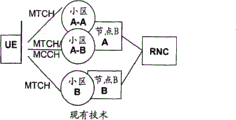
为了增大覆盖范围,位于不同小区之间的UE能够同时从不同小区接收到相同MBMS服务,并且对接收到的信息进行组合,如图11所示。在这种情况下,UE基于特定算法从所选择的小区读取MCCH。In order to increase coverage, UEs located between different cells can simultaneously receive the same MBMS service from different cells and combine the received information, as shown in FIG. 11 . In this case, the UE reads the MCCH from the selected cell based on a specific algorithm.
参照图11,在来自选定小区(例如,小区A-B)的MCCH上,UE接收与该UE感兴趣的服务相关的信息。该信息包含与当前小区和UE可能接收的相邻小区(例如,小区A-A和小区B)的物理信道配置、传输信道配置、RLC配置、PDCP配置等有关的信息。换言之,接收到的信息包含UE所需要的信息,以便对携带有UE所感兴趣的、小区A-A、A-B及B中的服务的MTCH进行接收。Referring to FIG. 11 , on the MCCH from a selected cell (eg, cells A-B), a UE receives information related to services of interest to the UE. The information includes information related to physical channel configuration, transport channel configuration, RLC configuration, PDCP configuration, etc. of the current cell and neighboring cells (eg, cell A-A and cell B) that the UE may receive. In other words, the received information contains the information needed by the UE in order to receive the MTCH carrying the services in cells A-A, A-B and B that the UE is interested in.
当在不同小区上传送同一服务时,UE可能能够组合来自不同小区的服务,也可能不能组合来自不同小区的服务。在可能进行组合的情况下,在不同的等级上执行这种组合:When the same service is transmitted on different cells, the UE may or may not be able to combine services from different cells. Where possible, this combination is performed on different levels:
1)不能组合;1) cannot be combined;
2)在RLC等级的选择性组合;以及2) selective combination at the RLC level; and
3)在物理等级的L1组合。3) L1 combination at physical level.
通过RLC PDU编号来支持针对MBMS点对多点传输的选择性组合。因此,在假设MBMS点对多点传输流之间的不同步(de-synchronization)没有超出UE的RLC重新排序能力的情况下,对提供类似MBMS RB比特率的小区而言,在UE中能够进行选择性组合。因此,在UE侧存在一个RLC实体。Selective combining for MBMS point-to-multipoint transmission is supported through RLC PDU numbering. Therefore, for cells offering MBMS-like RB bit rates, it is possible to perform de-synchronization in the UE under the assumption that de-synchronization between MBMS point-to-multipoint transport streams does not exceed the UE's RLC reordering capability. Selective combination. Therefore, there is one RLC entity on the UE side.
为了进行选择性组合,在CRNC的小区组中,针对利用点对多点传输的每个MBMS服务,都存在一个RLC实体。该小区组中的全部小区都在同一CRNC的控制下。在属于MBMS小区组的多个相邻小区中的MBMS传输之间出现不同步的情况下,CRNC可执行重新同步动作,使得UE能够在这些小区之间执行选择性组合。For selective combining, there exists one RLC entity for each MBMS service utilizing point-to-multipoint transmission in the cell group of the CRNC. All the cells in the cell group are under the control of the same CRNC. In case of desynchronization between MBMS transmissions in multiple neighboring cells belonging to an MBMS cell group, the CRNC may perform re-synchronization actions enabling the UE to perform selective combining between these cells.
对于时分双工(TDD),在节点-B同步时,可使用选择性组合和软组合。对于频分双工(FDD),在节点-B在UE软组合接收窗口内同步时,可使用软组合,并且,软组合后的S-CCPCH的数据字段在各个软组合时刻是相同的。For Time Division Duplex (TDD), selective combining and soft combining can be used when Node-Bs are synchronized. For frequency division duplexing (FDD), soft combining can be used when the Node-B is synchronized within the UE soft combining receiving window, and the data field of the S-CCPCH after soft combining is the same at each soft combining moment.
当可在各个小区之间进行选择性组合或软组合时,UTRAN发送MBMS NEIGHBORING CELL INFORMATION(MBMS相邻小区信息),MBMS NEIGHBORING CELL INFORMATION包含有可用于选择性组合或软组合的各个相邻小区的MTCH配置。当进行部分软组合时,MBMSNEIGHBORING CELL INFORMATION包含L1-组合调度,L1-组合调度指示在UE可将在相邻小区中发送的S-CCPCH与在服务小区中发送的S-CCPCH进行软组合时的各个时刻。利用MBMS NEIGHBORING CELLINFORMATION,UE能够从相邻小区接收MTCH传输,而无需接收这些相邻小区的MCCH。When selective combination or soft combination can be performed between various cells, UTRAN sends MBMS NEIGHBORING CELL INFORMATION (MBMS adjacent cell information), MBMS NEIGHBORING CELL INFORMATION contains the information of each adjacent cell that can be used for selective combination or soft combination MTCH configuration. When performing partial soft combining, MBMS NEIGHBORING CELL INFORMATION includes L1-combining scheduling, L1-combining scheduling indicates when the UE can soft combine the S-CCPCH sent in the neighboring cell and the S-CCPCH sent in the serving cell various moments. With MBMS NEIGHBORING CELL INFORMATION, UEs are able to receive MTCH transmissions from neighboring cells without receiving MCCHs from these neighboring cells.
UE基于阈值(例如,测量得到的CPICH Ec/No)和相邻小区的MBMSNEIGHBORING CELL INFORMATION的存在,来确定适于进行选择性组合或软组合的相邻小区。以信号方式将执行选择性组合或软组合的可能性通知给UE。Based on the threshold (for example, the measured CPICH Ec/No) and the existence of the MBMS NEIGHBORING CELL INFORMATION of the neighboring cell, the UE determines the neighboring cell suitable for selective combining or soft combining. The possibility to perform selective combining or soft combining is signaled to the UE.
对UMTS进行标准化的第三代合作伙伴计划(3GPP)正在讨论UMTS的长期演进(LTE)。3GPP LTE是使得能够进行高速分组通信的技术。针对LTE目标提出的大量方案,包括旨在降低用户和供应商成本、提高服务质量、以及扩展并提高覆盖范围和系统容量的方案。Long Term Evolution (LTE) of UMTS is being discussed by the 3rd Generation Partnership Project (3GPP) that standardizes UMTS. 3GPP LTE is a technology that enables high-speed packet communication. Numerous proposals have been proposed for LTE goals, including those aimed at reducing user and provider costs, improving service quality, and extending and increasing coverage and system capacity.
图12例示了LTE系统的架构。各个aGW 115连接到一个或多个接口网关(aGW)115。aGW115连接到允许接入互联网和/或其它网络(诸如GSM、UMTS及WLAN)的另一节点(未示出)。FIG. 12 illustrates the architecture of an LTE system. Each
3GPP LTE要求降低每比特成本、提高服务可用性,灵活的频带应用、简单的结构、开放的接口、以及适当的终端功耗,作为上层要求。通常,UTRAN 2对应于E-UTRAN(演进-UTRAN)。节点B 5和/或RNC 4对应于LTE系统中的e-节点B(eNB)105。3GPP LTE requires lower cost per bit, improved service availability, flexible frequency band application, simple structure, open interface, and appropriate terminal power consumption as upper layer requirements. In general,
在3GPP LTE系统中,系统信息(SI)将不同的小区及网络特定参数携带给UE,以成功附接到网络。系统信息还辅助进行寻呼,并且允许用户使用不同的网络服务。各个小区持续地在诸如广播控制信道(BCCH)的信道上广播其系统信息。此外,登记到网络的各个UE或执行到特定小区的切换的各个UE首先读取小区特定信息。In 3GPP LTE systems, System Information (SI) carries different cell and network specific parameters to UE to successfully attach to the network. System information also aids in paging and allows users to use different network services. Each cell continuously broadcasts its system information on a channel such as the Broadcast Control Channel (BCCH). Also, each UE registered to the network or each UE performing handover to a specific cell first reads cell specific information.
非连续接收(DRX)是在移动通信中用于节省移动终端的电池寿命的方法。通常,移动终端与网络对进行数据发送的时段进行协商。在其它时段中,移动终端关闭其接收机,并且进入低功耗状态。Discontinuous reception (DRX) is a method used in mobile communications to save battery life of a mobile terminal. Usually, the mobile terminal negotiates with the network on the time period for data transmission. During other periods, the mobile terminal turns off its receiver and enters a low power consumption state.
发明内容 Contents of the invention
本发明涉及用于无线通信系统中在切换过程期间保持数据单元的顺序。The present invention relates to maintaining the order of data units for use in a wireless communication system during a handover procedure.
本发明的其它特征和优点将在下面的描述中阐述,并且从以下描述中部分地变得明显,或者可通过对本发明的实践而得知。本发明的这些目的和其它优点可通过在说明书、权利要求及附图中具体指出的结构来实现和获得。Additional features and advantages of the invention will be set forth in and, in part, will be apparent from the description which follows, or may be learned by practice of the invention. The objectives and other advantages of the invention will be realized and attained by the structure particularly pointed out in the written description, claims and appended drawings.
为了实现这些和其它优点,并且根据本发明的目的,如在此具体实施并广泛描述的,本发明实现为一种用于无线通信系统中在切换过程期间保持接收到的数据单元的次序的方法,该方法包括以下步骤;在切换到目标基站之前根据顺序来从源基站接收多个数据单元,其中,各个数据单元包括顺序号;在切换之后从目标基站接收具有顺序号的至少一个数据单元;以及将在切换之前从该源基站接收到的、并且顺序号比在切换之后从该目标基站接收到的所述至少一个数据单元的顺序号小的全部数据单元,传送到更高层。To achieve these and other advantages, and in accordance with the objects of the present invention, as embodied and broadly described herein, the present invention is implemented as a method for maintaining the order of received data units during a handover procedure in a wireless communication system , the method comprises the steps of: receiving a plurality of data units from the source base station according to order before switching to the target base station, wherein each data unit includes a sequence number; receiving at least one data unit with the sequence number from the target base station after the handover; And all data units received from the source base station before handover and having a sequence number smaller than the sequence number of the at least one data unit received from the target base station after handover are transferred to a higher layer.
优选的是,该方法还包括以下步骤:将在开始切换之前接收到的、在顺序上有效的全部数据单元传送到更高层,其中,在顺序上有效的数据单元是指该数据单元的顺序号直接接续下一有效数据单元的顺序号,或者直接接续在开始切换之后从所述目标基站接收到的所述至少一个数据单元的顺序号。优选的是,在开始切换时开启定时器,其中在该定时器到期时将所述数据单元传送到所述更高层。另选的是,在从所述源基站和所述目标基站中的至少一个基站接收到传送所述数据单元的指示时,将所述数据单元传送到所述更高层。Preferably, the method further comprises the step of: transmitting all sequentially valid data units received before starting the handover to a higher layer, wherein the sequentially valid data units refer to the sequence numbers of the data units directly following the sequence number of the next valid data unit, or directly following the sequence number of the at least one data unit received from the target base station after starting the handover. Preferably, a timer is started at the start of the handover, wherein said data unit is transferred to said higher layer upon expiry of the timer. Alternatively, upon receiving an indication to transmit said data unit from at least one of said source base station and said target base station, said data unit is transmitted to said higher layer.
根据本发明的另一实施方式,提供了一种用于无线通信系统中在切换过程期间保持数据单元的次序的方法,该方法包括以下步骤:在开始切换之前根据顺序来接收多个数据单元,其中,各个数据单元包括顺序号;在开始切换之后接收具有顺序号的至少一个数据单元;以及将在开始切换之前接收到的、并且顺序号比在开始切换之后接收到的所述至少一个数据单元的顺序号小的全部数据单元,传送到更高层。According to another embodiment of the present invention, there is provided a method for maintaining the order of data units during a handover procedure in a wireless communication system, the method comprising the steps of: receiving a plurality of data units according to the order before starting the handover, Wherein, each data unit includes a sequence number; at least one data unit with a sequence number is received after starting the handover; All data units with lower sequence numbers are sent to higher layers.
优选的是,该方法还包括以下步骤:将在开始切换之前接收到的、在顺序上有效的全部数据单元传送到更高层,其中,在顺序上有效的数据单元是指该数据单元顺序号直接接续下一有效数据单元的顺序号,或者直接接续在开始切换之后接收到的所述至少一个数据单元的顺序号。Preferably, the method further comprises the step of: transmitting all sequentially valid data units received before starting the handover to a higher layer, wherein the sequentially valid data units refer to the sequence numbers of the data units directly The sequence number of the next valid data unit is continued, or directly the sequence number of the at least one data unit received after starting the handover.
优选的是,在开始切换时开启定时器,其中,在该定时器到期时将所述数据单元传送到所述更高层。另选的是,在接收到传送所述数据单元的指示时,将所述数据单元传送到所述更高层。Preferably, a timer is started at the start of the handover, wherein said data unit is transferred to said higher layer upon expiry of the timer. Alternatively, upon receiving an indication to transmit said data unit, said data unit is transmitted to said higher layer.
根据本发明的另一实施方式,提供了一种用于无线通信系统中在切换过程期间保持接收到的数据单元的次序的方法,该方法包括以下步骤:在开始切换之前根据顺序来接收多个数据单元,其中,各个数据单元包括顺序号;在开始切换之后接收具有顺序号的至少一个数据单元;在开始切换时开启定时器;在该定时器到期时,将在开始切换之前接收到的、并且顺序号比在开始切换之后接收到的所述至少一个数据单元的顺序号小的全部数据单元,传送到更高层;以及在该定时器到期时,将在开始切换之前接收到的、在顺序上有效的全部数据单元传送到更高层,其中,在顺序上有效的数据单元是指该数据单元的顺序号直接接续下一有效数据单元的顺序号,或者直接接续在开始切换之后接收到的所述至少一个数据单元的顺序号。According to another embodiment of the present invention, there is provided a method for maintaining the order of received data units during a handover procedure in a wireless communication system, the method comprising the steps of: receiving a plurality of A data unit, wherein each data unit includes a sequence number; receiving at least one data unit with a sequence number after starting the handover; starting a timer when starting the handover; , and all data units with a sequence number smaller than the sequence number of the at least one data unit received after starting the handover are transmitted to a higher layer; and when the timer expires, the received before starting the handover, All data units that are valid in sequence are passed to higher layers, where a data unit that is valid in sequence is one whose sequence number directly follows the sequence number of the next valid data unit, or directly follows the sequence number received after starting the handover The sequence number of the at least one data unit.
根据本发明的另一实施方式,提供了一种用于无线通信系统中在切换过程期间保持数据单元的次序的方法,该方法包括以下步骤:在切换到目标基站之前根据顺序来从源基站向移动终端发送多个数据单元,其中,各个数据单元包括顺序号;将之前由该源基站发送的数据单元的最高顺序号,通知给该目标基站;以及在切换之后,从该目标基站向该移动终端发送具有顺序号的至少一个数据单元,其中,针对该源基站之前发送的数据单元的所述最高顺序号,来从该目标基站发送该至少一个数据单元。According to another embodiment of the present invention, there is provided a method for maintaining the order of data units during a handover procedure in a wireless communication system, the method comprising the steps of: reordering data units from a source base station to a target base station according to the order before handover to a target base station The mobile terminal sends a plurality of data units, wherein each data unit includes a sequence number; notifying the target base station of the highest sequence number of the data unit previously sent by the source base station; and after handover, moving from the target base station to the mobile terminal The terminal transmits at least one data unit having a sequence number, wherein the at least one data unit is transmitted from the target base station for said highest sequence number of data units previously transmitted by the source base station.
优选的是,所述目标基站在切换之后,从所述移动终端和所述源基站中的至少一个,来接收关于所述最高顺序号的信息。在本发明的一个方面中,该方法还包括以下步骤:从所述目标基站以比之前由所述源基站发送的数据单元的所述最高顺序号高的顺序号发送所述至少一个数据单元,其中,该至少一个数据单元之前并未发送,其中,该源基站和该目标基站丢弃之前已发送的全部数据单元。Preferably, said target base station receives information about said highest sequence number from at least one of said mobile terminal and said source base station after handover. In an aspect of the invention, the method further comprises the step of: sending said at least one data unit from said target base station with a higher sequence number than said highest sequence number of a data unit previously sent by said source base station, Wherein, the at least one data unit has not been sent before, wherein, the source base station and the target base station discard all previously sent data units.
在本发明的另一方面中,该方法还包括以下步骤:从所述源基站向所述目标基站转发之前由所述源基站发送给所述移动终端的全部未经确认的数据单元;从所述目标基站向所述移动终端发送所转发的数据单元;以及从所述目标基站以比之前由所述源基站发送的数据单元的所述最高顺序号高顺序号发送所述至少一个数据单元,其中,该至少一个数据单元之前并未发送。In another aspect of the present invention, the method further comprises the steps of: forwarding from the source base station to the target base station all unacknowledged data units previously sent by the source base station to the mobile terminal; the target base station sending the forwarded data unit to the mobile terminal; and sending the at least one data unit from the target base station with a higher sequence number than the highest sequence number of the data unit previously sent by the source base station, Wherein, the at least one data unit has not been sent before.
优选的是,所述目标基站按照根据从所述源基站所转发的数据单元的各自顺序号的次序,来接收从所述源基站所转发的数据单元。优选的是,所述目标基站丢弃顺序号对于从所述源基站所转发的数据单元的次序而言无序的数据单元。优选的是,所述目标基站在发送之前并未发送的所述至少一个数据单元之前,向所述移动终端发送之前由所述源基站发送的所转发的数据单元。优选的是,所述目标基站按照根据数据单元的各自的顺序号的升序,来向所述移动终端发送所述数据单元。Preferably, said target base station receives data units forwarded from said source base station in an order according to their respective sequence numbers of data units forwarded from said source base station. Preferably, said target base station discards data units having sequence numbers that are out of order with respect to the order of data units forwarded from said source base station. Preferably, said target base station transmits said forwarded data unit previously transmitted by said source base station to said mobile terminal before transmitting said at least one data unit not previously transmitted. Preferably, said target base station transmits said data units to said mobile terminal in ascending order according to their respective sequence numbers.
在本发明的另一方面中,该方法还包括以下步骤:将之前由所述移动终端接收到的数据单元的最后顺序号,通知给所述目标基站;在所述目标基站中确定以下情况:发往所述移动终端的所转发数据单元的顺序号与由该移动终端之前接收到的数据单元的最后顺序号并不在顺序上对应;以及如果在预定时间过去之前,该目标基站并未接收到与由该移动终端之前接收到的数据单元的最后顺序号在顺序上对应的数据单元,则去除所转发数据单元的顺序号,并且从该目标基站向该移动终端发送无序的所转发数据单元。In another aspect of the present invention, the method further comprises the steps of: notifying the target base station of the last sequence number of the data unit previously received by the mobile terminal; determining the following in the target base station: the sequence number of the forwarded data unit sent to the mobile terminal does not correspond in sequence to the last sequence number of the data unit previously received by the mobile terminal; and if the target base station does not receive the the data unit corresponding in sequence to the last sequence number of the data unit previously received by the mobile terminal, the sequence number of the forwarded data unit is removed and the forwarded data unit is sent out of sequence from the target base station to the mobile terminal .
在本发明的另一方面中,该方法还包括以下步骤:将之前由所述移动终端接收到的数据单元的最后顺序号,通知给所述目标基站;在所述目标基站中确定以下情况:发往所述移动终端的所转发数据单元的顺序号与由该移动终端之前接收到的数据单元的最后顺序号并不在顺序上对应;以及丢弃所转发的数据单元。In another aspect of the present invention, the method further comprises the steps of: notifying the target base station of the last sequence number of the data unit previously received by the mobile terminal; determining the following in the target base station: a sequence number of the forwarded data unit destined for the mobile terminal does not correspond in sequence to a last sequence number of a data unit previously received by the mobile terminal; and discarding the forwarded data unit.
根据本发明的另一实施方式,提供了一种用于无线通信系统中在切换过程期间保持接收到的数据单元的次序的方法,该方法包括以下步骤:在开始切换之前根据顺序来接收多个数据单元,其中,各个数据单元包括顺序号;在开始切换时开启定时器;以及当该定时器到期时,将在开始切换之前接收到的、并且未按照顺序的全部数据单元,传送到更高层。According to another embodiment of the present invention, there is provided a method for maintaining the order of received data units during a handover procedure in a wireless communication system, the method comprising the steps of: receiving a plurality of A data unit, wherein each data unit includes a sequence number; a timer is started when switching is started; and when the timer expires, all data units received before switching and not in sequence are transmitted to a further high level.
根据本发明的另一方面,提供了一种用于在无线通信系统中对接收到的数据单元的次序中的错误进行检测的方法,该方法包括以下步骤:根据顺序来接收多个数据单元,其中,各个数据单元包括顺序号,其中,如果当前接收到的数据单元的顺序号位于从最后接收到的数据单元的顺序号到在该最后接收到的数据单元的顺序号之后的预定顺序号之间的间隔内,则没有发生错误,并且,如果当前接收到的数据单元的顺序号超出从该最后接收到的数据单元的顺序号到在该最后接收到的数据单元的顺序号之后的预定顺序号之间的该间隔,则发生了错误。According to another aspect of the present invention, there is provided a method for detecting errors in the sequence of received data units in a wireless communication system, the method comprising the steps of: receiving a plurality of data units according to the sequence, Wherein, each data unit includes a sequence number, wherein, if the sequence number of the currently received data unit is located between the sequence number of the last received data unit to a predetermined sequence number after the sequence number of the last received data unit In the interval between, no error occurs, and if the sequence number of the currently received data unit exceeds the predetermined sequence from the sequence number of the last received data unit to after the sequence number of the last received data unit An error occurs if the space between the numbers is not specified.
根据本发明的实施方式,提供了一种用于无线通信系统中在切换过程期间保持数据单元的次序的方法,该方法包括以下步骤:根据顺序从源基站向移动终端发送多个数据单元,其中,各个数据单元包括顺序号;从源基站向目标基站发送切换请求;以及从该源基站向该目标基站发送与该目标基站要用于传输的合适顺序号有关的信息,其中,该目标基站利用来自该源基站的该信息,来确定该用于传输的合适顺序号。According to an embodiment of the present invention, there is provided a method for maintaining the order of data units during a handover procedure in a wireless communication system, the method comprising the steps of: sending a plurality of data units from a source base station to a mobile terminal according to an order, wherein , each data unit includes a sequence number; a handover request is sent from the source base station to the target base station; and information on the appropriate sequence number to be used by the target base station for transmission is sent from the source base station to the target base station, wherein the target base station utilizes The information from the source base station is used to determine the appropriate sequence number for transmission.
优选的是,所述信息包括以下中的一项:所述目标基站要用于传输的下一顺序号;所述源基站之前发送的数据单元的最高顺序号;以及时间戳和预期的数据速率/顺序号速率。优选的是,所述合适顺序号比之前由所述源基站发送的数据单元的最高顺序号大。Preferably, said information comprises one of: the next sequence number to be used by said target base station for transmission; the highest sequence number of a data unit previously sent by said source base station; and a timestamp and expected data rate /sequence number rate. Preferably, said suitable sequence number is greater than the highest sequence number of a data unit previously sent by said source base station.
应当理解的是,对本发明的以上概述和以下详述都是示例性和说明性的,并且旨在对所要求保护的本发明提供进一步理解。It is to be understood that both the foregoing general description and the following detailed description are exemplary and explanatory and are intended to provide a further understanding of the invention as it is claimed.
附图说明 Description of drawings
所包含的附图用于提供对本发明的进一步理解,且并入本申请而构成本申请的一部分,附图例示了本发明的实施方式并与本说明书一起用于解释本发明的原理。根据一个或更多个实施方式,由不同附图中的同一附图标记所指示的本发明的特征、元素及方面代表了相同、等同或类似的特征、元素及方面。The accompanying drawings are included to provide a further understanding of the invention and are incorporated in and constitute a part of this application, illustrate embodiments of the invention and together with the specification serve to explain the principle of the invention. Features, elements, and aspects of the invention that are denoted by the same reference numerals in different drawings represent the same, equivalent, or similar features, elements, and aspects in accordance with one or more embodiments.
图1例示了传统UMTS网络。Figure 1 illustrates a conventional UMTS network.
图2例示了UE与UTRAN之间的传统无线接口协议。Figure 2 illustrates a conventional radio interface protocol between UE and UTRAN.
图3例示了逻辑信道结构。Figure 3 illustrates a logical channel structure.
图4例示了从UE的角度的逻辑信道与传输信道之间的可能映射。Fig. 4 illustrates a possible mapping between logical channels and transport channels from the perspective of the UE.
图5例示了从UTRAN的角度的逻辑信道与传输信道之间的可能映射。Figure 5 illustrates a possible mapping between logical channels and transport channels from the perspective of UTRAN.
图6例示了可能的UE状态转换。Figure 6 illustrates possible UE state transitions.
图7例示了典型的计数过程。Figure 7 illustrates a typical counting process.
图8例示了从UE角度观察时的逻辑信道与传输信道之间的映射。FIG. 8 illustrates mapping between logical channels and transport channels when viewed from a UE perspective.
图9例示了从UTRAN角度观察时的逻辑信道与传输信道之间的映射。FIG. 9 illustrates mapping between logical channels and transport channels when viewed from the UTRAN perspective.
图10例示了用于发送MBMS服务信息和无线承载信息的调度。Fig. 10 illustrates a schedule for transmitting MBMS service information and radio bearer information.
图11例示了UE从多个小区接收MBMS服务。FIG. 11 illustrates that a UE receives MBMS services from multiple cells.
图12例示了LTE系统的架构。FIG. 12 illustrates the architecture of an LTE system.
图13例示了根据本发明的一个实施方式的切换过程。Fig. 13 illustrates a handover procedure according to one embodiment of the present invention.
图14例示了根据本发明的一个实施方式的、所接收、所发送及所确认的具有顺序号的数据单元的状态。Figure 14 illustrates the status of received, transmitted and acknowledged data units with sequence numbers according to one embodiment of the present invention.
图15例示了根据本发明的一个实施方式的、用于UE中在切换过程期间保持接收到的数据单元的次序的方法。Fig. 15 illustrates a method for maintaining the order of received data units during a handover procedure in a UE according to one embodiment of the present invention.
图16例示了根据本发明的一个实施方式的移动台(MS)或UE的框图。FIG. 16 illustrates a block diagram of a mobile station (MS) or UE according to one embodiment of the present invention.
具体实施方式 Detailed ways
本发明涉及用于无线通信系统中在切换过程期间保持数据单元的次序。The present invention relates to maintaining the order of data units for use in a wireless communication system during a handover procedure.
现在将具体地说明本发明的优选实施方式,在附图中例示了这些优选实施方式的示例。只要可能,在全部附图中使用相同的附图标记来表示相同或相似的部分。Reference will now be made in detail to the preferred embodiments of the invention, examples of which are illustrated in the accompanying drawings. Wherever possible, the same reference numbers will be used throughout the drawings to refer to the same or like parts.
本发明致力于长期演进(LTE)移动性的原理,更具体来说,涉及确保移动过程中的安全性。根据本发明,对于下行链路传输,诸如用于互联网语音传输协议(VoIP)的无缝切换不同于诸如用于传输控制协议(TCP)的无损切换。The present invention addresses the principles of Long Term Evolution (LTE) mobility, and more specifically, to ensuring security during mobility. According to the present invention, for downlink transmission, seamless handover, such as for Voice over Internet Protocol (VoIP), is different from lossless handover, such as for Transmission Control Protocol (TCP).
根据本发明,在下行链路传输中包括分组数据汇聚协议(PDCP)顺序号,以允许发射机和接收机保持用作针对加密及解密算法的输入的计数器值(COUNT-C)。为了确保位于发射机和接收机处的计数器保持同步,并且也为了追踪已在发射机中计数、但已丢失而未被接收机接收到的PDCP PDU的踪迹,可将诸如PDCP SN的顺序号(SN)添加到DPCP PDU,或者推导得出顺序号(SN)。该顺序号优选地与COUNT-C值的X个最低有效位(X个LSB)相对应。因此,COUNT-C值包括X个LSB,并且剩余Y个最高有效位(Y个MSB)。在PDCP SN达到最大值时,顺序号重新从0开始,这通常被称为顺序号的“回转(wrap-around)”。因此,由Y个MSB所表示的计数器可以认为是“回转计数器”。According to the present invention, a Packet Data Convergence Protocol (PDCP) sequence number is included in the downlink transmission to allow the transmitter and receiver to maintain a counter value (COUNT-C) used as input for the encryption and decryption algorithms. To ensure that the counters at the transmitter and receiver are kept synchronized, and also to keep track of PDCP PDUs that have been counted at the transmitter but have been lost and not received at the receiver, a sequence number such as the PDCP SN ( SN) is added to the DPCP PDU, or the sequence number (SN) is derived. The sequence number preferably corresponds to the X least significant bits (X LSBs) of the COUNT-C value. Therefore, the COUNT-C value includes X LSBs, and Y most significant bits (Y MSBs) remain. When the PDCP SN reaches the maximum value, the sequence number restarts from 0, which is often referred to as "wrap-around" of the sequence number. Therefore, a counter represented by Y MSBs can be considered a "rollover counter".
优选的是,接收机接受按照顺序到达的、携带有顺序号的PDCPPDU,其中,在最大可能顺序号之后的下一顺序号对应于0。因此,当最后接收到的顺序号是最大顺序号、并且接收到的下一PDCP SN并不对应于最后SN加一或并不对应于0时,则认为从最后接收到的顺序号到接收到的下一顺序号之间的全部PDCP PDU已经丢失。Preferably, the receiver accepts PDCP PDUs arriving in sequence, carrying sequence numbers, wherein the next sequence number after the largest possible sequence number corresponds to 0. Therefore, when the last received sequence number is the largest sequence number and the next received PDCP SN does not correspond to the last SN plus one or does not correspond to 0, then the time from the last received sequence number to the received All PDCP PDUs between the next sequence numbers of the PDU have been lost.
根据本发明,当携带有顺序号的两个PDCP PDU无序到达时,接收机可认为已经发生了特定次数的回转,因此,增大接收机中的回转计数器,虽然在发射机中可能并不类似地增大回转计数器。在例如因为循环冗余校验(CRC)未检测到的残余错误而引起顺序号改变时,会出现类似情况。通常,在接收了改变后的顺序号之后,PDCP SN不会按照顺序而被接收,因此在发射机与接收机之间会出现回转以及回转计数器的不同步。According to the present invention, when two PDCP PDUs carrying sequence numbers arrive out of order, the receiver can consider that a certain number of rounds has occurred, therefore, the rounds counter in the receiver is increased, although it may not be in the transmitter. The rollover counter is similarly incremented. A similar situation arises when sequence numbers change, for example due to residual errors not detected by a cyclic redundancy check (CRC). Usually, after receiving the changed sequence number, the PDCP SNs are not received in sequence, so there will be a loopback and a desynchronization of the loopback counter between the transmitter and receiver.
根据本发明,提供了用于检测顺序号错误的机制。该机制包括以下处理:忽略其PDCP SN预计在最后接收到的PDCP SN之后的至少Max_Window个顺序号才接收到的、全部接收到的PDCP PDU。因此,接收机能够检测到无序传送和大部分残余错误,并且因此,在发射机与接收机之间不会发生回转计数器的不同步。Max_Window的参数值可以是固定的,或在无线承载(RB)建立时用信号发送给UE。然而,如果超过Max_Window个具有SN的PDCP PDU丢失,则可以忽略之后全部PDCP PDU,并且,回转计数器不同步。According to the invention, a mechanism for detecting sequence number errors is provided. This mechanism includes the following processing: Ignore all received PDCP PDUs whose PDCP SN is expected to be received at least Max_Window sequence numbers after the last received PDCP SN. Therefore, the receiver is able to detect out-of-order transfers and most residual errors, and therefore, no desynchronization of the slew counter occurs between the transmitter and receiver. The parameter value of Max_Window can be fixed or signaled to the UE when the radio bearer (RB) is established. However, if more than Max_Window PDCP PDUs with SN are lost, all subsequent PDCP PDUs may be ignored and the rollover counters are not synchronized.
图13例示了根据本发明的一个实施方式的切换过程。图14例示了根据本发明的一个实施方式的、所接收、所发送及所确认的具有顺序号的数据单元的状态。Fig. 13 illustrates a handover procedure according to one embodiment of the present invention. Figure 14 illustrates the status of received, transmitted and acknowledged data units with sequence numbers according to one embodiment of the present invention.
根据本发明,当UE接收到并接受了切换命令(如图13中的步骤3所示)时、并且可以在UE已经确认了与目标小区的同步之后,将RLC层中的、有效但是无序的全部完整SDU发送至PDCP层。此外,重置RLC层以及UE中的全部HARQ处理。如图14所示,UE可完整地接收到具有SN的一些PDCP PDU,但是并未确认UE接收到ENodeB已尝试发送的、具有SN的其它PDCP PDU,诸如PDCP SN 4、8、9及10,(参见图14的4)所示。此外,虽然在UE中已经成功地接收到具有SN的一些PDCP PDU,但是ENodeB可能并未从HARQ实体或RLC实体接收到关于成功接收的确认(例如SN为9的PDCP PDU)(参见图14的3))。According to the present invention, when the UE receives and accepts the handover command (as shown in
参照图14,图14示出在切换消息过程中不同时刻的ENodeB和UE中的状态的差别的示例。在1)中,示出当源ENodeB向目标ENodeB发送第一消息、以请求切换并保留必须资源时的源ENodeB。在此,例如在RLC等级或HARQ等级确认UE接收到PDCP SN 1和PDCP SN 3。此外,虽然ENodeB已经开始发送SN为2、4及5的PDCP PDU,但是UE尚未向ENodeB确认接收到这些PDCP PDU。因此,源ENodeB可向目标ENodeB指示用于发送的下一PDCP SN,即,在本示例中的PDCP SN 6。源ENodeB还可向目标ENodeB指示时间戳和预期的数据速率/顺序号速率,使得目标ENodeB能够推导出当针对UE的发送开始时,目标ENodeB可用于进行第一发送的SN。因此,目标ENodeB可确定PDCP_SN_TXed_Max,这对应于已发送的最大PDCP SN。优选的是,目标ENodeB并不使用小于或等于PDCP_SN_TXed_Max的SN来发送之前尚未向UE发送的IP分组,以避免使得回转计数器不同步。Referring to Fig. 14, Fig. 14 shows an example of the difference of states in the ENodeB and UE at different moments during the handover message process. In 1), the source ENodeB when the source ENodeB sends the first message to the target ENodeB to request handover and reserve necessary resources is shown. Here, it is confirmed that the UE receives
在2)和3)中,示出在切换的不同步骤中切换过程期间的源ENodeB的环境如何变化。在4)中,示出UE中接收到的具有SN的PDCP PDU的状态。在此,示出了虽然UE接收到SN为1、2、3、5、6、7及9的PDCP PDU,但是ENodeB仅认为UE接收到SN为1、2、3、5、6、7的PDCP PDU。对于SN为4、8、9及10的PDCP PDU,因为虽然已向UE至少一次发送过这些PDCP PDU,但是并未在RLC和/或H-ARQ等级上对这些PDCP PDU进行确认,因此PDCP PDU并不知道UE是否已经接收到这些PDCP PDU。In 2) and 3) it is shown how the environment of the source ENodeB changes during the handover procedure in different steps of the handover. In 4), the status of the PDCP PDU with SN received in the UE is shown. Here, it is shown that although the UE receives PDCP PDUs with SNs of 1, 2, 3, 5, 6, 7, and 9, the ENodeB only considers that the UE has received PDCP PDUs with SNs of 1, 2, 3, 5, 6, and 7. PDCP PDUs. For PDCP PDUs with
根据本发明的一个实施方式,考虑无缝切换。对于无缝切换的情况,UE PDCP优选地立即向更高层传送全部下行链路(DL)PDCP SDU。随后,UE可在切换完成消息中指示在下行链路中最后接收到的PDCP SN或预计的下一PDCP SN,使得目标ENodeB可在该消息一到达时就使用该消息来开始新接收到的数据的传输。According to one embodiment of the invention, seamless handover is considered. For the case of seamless handover, UE PDCP preferably immediately transmits all downlink (DL) PDCP SDUs to higher layers. The UE can then indicate the last received PDCP SN or the expected next PDCP SN in the downlink in the Handover Complete message so that the target ENodeB can use this message to start newly received data as soon as it arrives. transmission.
另选的是,目标ENodeB可使用与用在下行链路中的最高DPCP SN相关的信息,该信息可在图13的步骤1中从源ENodeB接收到。随后,目标ENodeB例如对该信息应用固定偏移,并且在图13的步骤2中向源ENodeB指示该固定偏移。因此,源ENodeB能够停止超出该固定偏移的传输。此外,目标ENodeB可使用与该固定偏移相对应的顺序号来作为已发送的最大PDCP SN(PDCP_SN_TXed_Max),并且能够使用下一顺序号或更高顺序号来发送尚未安全发起的IP分组,而不会导致使得回转计数器不同步的风险。Alternatively, the target ENodeB may use the information on the highest DPCP SN used in the downlink, which may be received from the source ENodeB in
在源ENodeB确定UE已经执行了切换之后(诸如当源ENodeB接收到切换消息的HARQ确认(ACK)或RLC确认),如图13中的步骤9所示,源ENodeB可将最后使用的PDCP SN通知给目标ENodeB。这在切换后不发送数据时是优选的,以确保目标ENodeB能够在未来切换操作中将最后发送的PDCP SN的准确值,报告给下一目标ENodeB。After the source ENodeB determines that the UE has performed handover (such as when the source ENodeB receives a HARQ acknowledgment (ACK) or RLC acknowledgment of the handover message), as shown in
此后,源ENodeB或目标ENodeB丢弃已尝试发送的全部PDCP SDU。相应地,因为唯一的影响是PDCP的SN中的间隔,所以不需要具体的UE重新排序行为。Thereafter, the source ENodeB or target ENodeB discards all PDCP SDUs that have been attempted to be sent. Accordingly, no specific UE reordering behavior is required since the only impact is the gap in the SN of PDCP.
根据本发明的另一实施方式,考虑无损切换。对于无损切换的情况,源ENodeB优选地向目标ENodeB转发已经发送并分配了SN的全部PDCP PDU/SDU,使得能够将这些PDCP PDU/SDU发送到UE。UE可在切换完成消息中指示位于接收到的最高PDCP SN之后的PDCP SN(PDCP_SN_Miss_max)。随后,目标ENodeB可使用位于PDCP_SN_Miss_max值之前的SN,来作为针对已经发送的最大PDCP SN的值(PDCP_SN_TXed_Max)。According to another embodiment of the invention lossless switching is considered. For the case of lossless handover, the source ENodeB preferably forwards to the target ENodeB all PDCP PDUs/SDUs that have been sent and assigned SNs, enabling these PDCP PDUs/SDUs to be sent to the UE. The UE may indicate the PDCP SNs located after the highest received PDCP SN (PDCP_SN_Miss_max) in the handover complete message. The target ENodeB may then use the SN preceding the PDCP_SN_Miss_max value as the value for the largest PDCP SN that has been transmitted (PDCP_SN_TXed_Max).
与无缝切换类似,在无损切换中,目标ENodeB可使用在图13的步骤1中从源ENodeB接收到的、与用在下行链路中的最高PDCP SN有关的信息。随后,目标ENodeB例如可对该信息应用固定偏移,并且在图13的步骤2中向源ENodeB指示该固定偏移。因此,源ENodeB能够停止超出该固定偏移的传输。此外,目标ENodeB可使用与该固定偏移相对应的顺序号来作为已发送的最大PDCP SN(PDCP_SN_TXed_Max),并且能够使用下一SN或更高SN来发送尚未安全发起的IP分组,而不会导致使得回转计数器不同步的风险。Similar to seamless handover, in lossless handover the target ENodeB may use the information received from the source ENodeB in
还可指示尚未接收到的最后PDCP SN(PDCP_SN_Miss_min)的值,或由目标ENodeB和UE来确定尚未接收到的最后PDCP SN(PDCP_SN_Miss_min)的值,作为PDCP_SN_Miss_max和窗口大小参数HO_Reordering_window_size,该值例如可在RB设置/重新配置时指示、在切换命令中指示或是固定值。可由目标ENodeB将该SN作为PDCP_SN_TXed_Min而存储。The value of the last PDCP SN not yet received (PDCP_SN_Miss_min) may also be indicated or determined by the target ENodeB and the UE as the value of the last PDCP SN not yet received (PDCP_SN_Miss_min) as PDCP_SN_Miss_max and the window size parameter HO_Reordering_window_size, which can be e.g. Indicated when RB is set/reconfigured, indicated in handover command, or fixed value. This SN may be stored by the target ENodeB as PDCP_SN_TXed_Min.
为了不造成回转计数器的不同步,目标ENodeB优选地并不发送已经分配了PDCP SN的IP分组,其中,该SN值不在PDCP_SN_TXed_Min与PDCP_SN_Miss_Max之间(其中,允许值PDCP_SN_TXed_Min和PDCP_SN_Miss_Max)。在目标ENodeB中,经由X2接口转发的、已试图发送的PDCP PDU/SDU优选地按照顺序而到达。如果经由X2接口的传送是无序的,则目标ENodeB可通过对PDCP报头进行解码,或者通过对添加到经转发的PDCP PDU/SDU中的COUNT-C或PDCP SN进行识别,来检测出这种无序传送。因此,目标ENodeB能够丢弃无序的PDCPPDU/SDU,因此,UE将不会接收到其SN不高于之前接收到的PDCP SN的PDCP PDU。In order not to cause desynchronization of the slew counters, the target ENodeB preferably does not send IP packets that have been assigned a PDCP SN value not between PDCP_SN_TXed_Min and PDCP_SN_Miss_Max (where the values PDCP_SN_TXed_Min and PDCP_SN_Miss_Max are allowed). In the target ENodeB, PDCP PDUs/SDUs that have been attempted to be forwarded via the X2 interface arrive preferably in order. If the delivery over the X2 interface is out of order, the target ENodeB can detect this by decoding the PDCP header, or by identifying the COUNT-C or PDCP SN added to the forwarded PDCP PDU/SDU. Out of order delivery. Therefore, the target ENodeB is able to discard out-of-order PDCP PDUs/SDUs, therefore, the UE will not receive PDCP PDUs whose SN is not higher than the previously received PDCP SN.
根据本发明,目标ENodeB优选地在发送从aGW/源ENodeB传送来的、尚未试图发送的PDCP SDU之前,发送包含有来自已经尝试发送的PDCP SDU的数据的PDCP PDU。该操作在以下切换的情况下是优选的,其中,在数据转发中优选的是,要转发到目标ENodeB的一些数据缓存在源ENodeB中(这是因为通常仅当在目标ENodeB中确认了切换时才触发传送开关)。According to the invention, the target ENodeB preferably sends a PDCP PDU containing data from a PDCP SDU that has already been attempted to be sent before sending a PDCP SDU that has not yet been tried to be sent from the aGW/source ENodeB. This operation is preferred in case of a handover, where it is preferred in data forwarding that some data to be forwarded to the target ENodeB is cached in the source ENodeB (this is because usually only when the handover is confirmed in the target ENodeB trigger the transfer switch).
在源ENodeB检测到UE已经执行切换时(诸如当源ENodeB接收到切换消息的HARQ确认ACK或RLC确认时),在图13的步骤9中,源ENodeB优选地将最后使用的PDCP SN报告给目标ENodeB。这在切换后不发送数据时是优选的,以确保目标ENodeB能够将最后发送的PDCP SN的准确值,报告给未来切换操作的下一目标ENodeB,如图13的步骤1一样。When the source ENodeB detects that the UE has performed handover (such as when the source ENodeB receives the HARQ acknowledgment ACK or RLC acknowledgment of the handover message), in
根据本发明,现在描述错误的情况。在错误情况的一个示例中,可能发生经由X2接口的一个PDCP PDU/SDU的丢失。为了解决这种错误,即使尚未接收到全部PDCP SN,UE例如也可将具有小于当前接收到的PDCP SN的PDCP SN的全部PDU/SDU发送到更高层。假设目标ENodeB优选地按照升序来向UE发送具有PDCP SN的PDCP PDU,则UE用于解决这种错误的操作不会是问题。According to the invention, the error case is now described. In one example of an error condition, loss of a PDCP PDU/SDU via the X2 interface may occur. To address such errors, the UE may for example send to higher layers all PDUs/SDUs with a PDCP SN smaller than the currently received PDCP SN, even if not all PDCP SNs have been received. Assuming that the target ENodeB preferably sends PDCP PDUs with PDCP SNs to the UE in ascending order, the operation of the UE to resolve such errors would not be a problem.
在错误情况的另一示例中,已经试图发送的最后PDCP SN并不与UE中最后接收到的PDCP SN相对应。为了解决这种错误,目标ENodeB可进行以下操作,其中,如果在定时器到期前尚未接收到该PDCP PDU,则目标ENodeB可去除该分组的SN并且无序地发送该分组。目标ENodeB在这种具体情况下也可丢弃该PDCP PDU。另选的是,为了解决这种错误,可以从源ENodeB向目标ENodeB系统地发送最高SN。因此,目标ENodeB可获知最高PDCP SN,并且获知是否存在等待接收该最高PDCPSN的理由。In another example of an error condition, the last PDCP SN that has been attempted to transmit does not correspond to the last received PDCP SN in the UE. To address this error, the target ENodeB may proceed, wherein if the PDCP PDU has not been received before the timer expires, the target ENodeB may remove the SN of the packet and send the packet out of order. The target ENodeB may also discard the PDCP PDU in this specific case. Alternatively, to resolve such errors, the highest SN can be systematically sent from the source ENodeB to the target ENodeB. Therefore, the target ENodeB can know the highest PDCP SN and whether there is a reason to wait to receive the highest PDCP SN.
鉴于上文所述,根据本发明可应用以下过程。优选的是,UE中的PDCP层预计包括有顺序号的丢失PDCP PDU按照顺序而到达。例如,在图14的4)中,UE预计首先接收到SN为4的PDCP PDU,接着顺序接收到SN为8的PDCP PDU和SN为10的PDCP PDU。因此,只要接收到大于或等于PDCP_SN_Miss_min的顺序号,PDCP层就考虑尚未传送到更高层的、SN小于所接收到的SN的全部PDCP PDU,并且可将之后的有顺PDCP SN传送到更高层。在图15中示出详细过程。In view of the above, the following procedure can be applied according to the present invention. Preferably, the PDCP layer in the UE expects the missing PDCP PDUs including sequence numbers to arrive in sequence. For example, in 4) in Figure 14, the UE is expected to receive the PDCP PDU with
图15例示了根据本发明的一个实施方式的、针对具有顺序号的下行链路PDCP PDU在切换过程中操作UE的方法。优选的是,当UE接收到切换命令时,UE在切换中发起重新排序过程(1)。随后,UE确定接收到的最高PDCP SN之后的PDCP SN,并且将该值作为PDCP_SN_Miss_max而存储(2)。UE还可确定C,例如作为最小丢失的PDCP SN(PDCP_SN_Miss_min),或者作为PDCP_SN_Miss_max-HO_Reordering_window_size,其中,HO_Reordering_window_size的值可以是固定的,或者可在切换或RB设置中由UE从ENodeB接收到HO_Reordering_window_size的值。FIG. 15 illustrates a method of operating a UE during handover for downlink PDCP PDUs with sequence numbers according to one embodiment of the present invention. Preferably, when the UE receives the handover command, the UE initiates the reordering procedure (1) in the handover. The UE then determines the PDCP SN following the highest received PDCP SN and stores this value as PDCP_SN_Miss_max (2). The UE may also determine C, for example as the minimum missing PDCP SN (PDCP_SN_Miss_min), or as PDCP_SN_Miss_max-HO_Reordering_window_size, where the value of HO_Reordering_window_size may be fixed, or may be received by the UE from the ENodeB during handover or RB setup .
此后,UE从ENodeB接收PDCP PDU(3),并且确定是否应当继续进行重新排序过程(4)。根据本发明,UE可在满足以下标准中的一项时,停止重新排序过程:Thereafter, the UE receives a PDCP PDU from the ENodeB (3) and determines whether the reordering procedure should proceed (4). According to the present invention, the UE may stop the reordering process when one of the following criteria is met:
A)(PDCP_SN_Miss_min≤当前PDCP PDU SN<PDCP_SN_Miss_max)不满足;A) (PDCP_SN_Miss_min≤current PDCP PDU SN<PDCP_SN_Miss_max) is not satisfied;
B)PDCP_SN_Miss_max+偏移≤当前PDCP PDU SN;B) PDCP_SN_Miss_max+offset≤current PDCP PDU SN;
C)在开始重新排序时开启的定时器到期;以及C) The timer started when reordering started expires; and
D)接收到指示停止重新排序处理的PDCP控制PDU或比特。D) A PDCP Control PDU or bit indicating to stop the reordering process is received.
如果所接收到的PDCP PDU已经接收到(5),则丢弃该PDU,并且等待要接收的下一PDCP PDU(6)。对于未丢弃的PDU,UE利用按照顺序接收到的SN来对从PDCP_SN_Miss_min开始的全部PDCP PDU进行标识,而不错过SN。随后,对所标识的PDCP PDU进行处理(例如,报头解压缩),并且将它们的内容传送到更高层。优选的是,因为可由ENodeB接收到已由UE接收到的PDU,所以将PDCP_SN_Miss_min设置为当前接收到的PDCP PDU的SN(7)。If the received PDCP PDU has already been received (5), discard the PDU and wait for the next PDCP PDU to be received (6). For PDUs that are not discarded, the UE uses the SN received in order to identify all PDCP PDUs starting from PDCP_SN_Miss_min without missing the SN. Subsequently, the identified PDCP PDUs are processed (eg, header decompressed) and their contents are passed to higher layers. Preferably, PDCP_SN_Miss_min is set to the SN of the currently received PDCP PDU since a PDU already received by the UE can be received by the ENodeB (7).
独立于来自接收到的PDCP PDU的触发器,可能需要另一触发器来在切换过程中触发停止重新排序过程,诸如,当包含在尚未由源ENodeB发送的PDCP PDU中的IP分组在X2接口上丢失时。因此,优选的是,在开始切换过程时开启定时器。在定时器到期时(8),UE将认为可对到这个时刻为止所接收到的具有SN的全部PDCP PDU进行处理并可将其传送到更高层(9)。在一个实施方式中,每次UE在下行链路中接收到PDCP PDU时,可重启定时器。此后,在切换过程中停止重新排序过程(10)。Independent of the trigger from a received PDCP PDU, another trigger may be needed to trigger the stop of the reordering process during handover, such as when an IP packet contained in a PDCP PDU not yet sent by the source ENodeB is on the X2 interface when lost. Therefore, it is preferable to start a timer when starting the handover procedure. On expiry of the timer (8), the UE shall consider all PDCP PDUs with SN received up to this moment ready for processing and transfer to higher layers (9). In one embodiment, the timer may be restarted each time the UE receives a PDCP PDU in the downlink. Thereafter, the reordering process (10) is stopped during the handover.
例如参照图14,源ENodeB将向UE至少转发SN为4、8、9及10的PDCP PDU。在接收到SN为4的PDCP PDU之后,UE随后传送SN为5、6及7的全部PDCP PDU。此后,在接收到SN为8、9及10的PDCPPDU之后,UE随后对这些PDU进行处理,并将这些PDU的内容发送到更高层。Referring to Figure 14 for example, the source ENodeB will at least forward PDCP PDUs with
图16例示了根据本发明的移动台(MS)或UE 1的框图。UE 1包括处理器(或数字信号处理器)210、RF模块235、功率管理模块205、天线240、电池255、显示器215、键盘220、存储器230、扬声器245及麦克风250。FIG. 16 illustrates a block diagram of a mobile station (MS) or
用户例如通过按压键盘220的按键或者通过利用麦克风250的语音激活,来输入指令信息(诸如电话号码)。微处理器210接收并处理该指令信息,以执行适当功能,诸如拨打电话号码。可从存储模块230获取操作数据以执行该功能。此外,为了用户参考和方便,处理器210可在显示器215上显示该指令信息和操作信息。The user inputs instruction information such as a phone number, for example, by pressing a key of the
处理器210向RF模块235发出指令信息,以发起通信,例如发送包括语音通信数据的无线信号。RF模块235包括接收机和发射机,以接收并发送无线信号。天线240辅助进行无线信号的发送和接收。在接收到无线信号时,RF模块235转发该信号,并且将该信号转换到基带频率,以由处理器210进行处理。处理后的信号被转换成可听或者可读信息(例如经由扬声器245输出)。处理器210还包括执行这里所述的各种处理所需要的协议和功能。
对于本领域技术人员明显的是,可利用例如处理器210或其它数据或数字处理设备,按照单独的方式或与外部支持逻辑相结合,来容易地实现移动台1。虽然本发明是在移动通信的环境下进行描述的,但是本发明还可以在使用移动设备,例如配备有无线通信能力的PDA和笔记本电脑的任何无线通信系统中使用。此外,用来描述本发明的术语的使用并不是要将本发明的范围限制为特定类型的无线通信系统(诸如UMTS)。本发明还适用于使用不同空中接口和/或物理层的其它无线通信系统,例如TDMA、CDMA、FDMA、WCDMA等。It will be apparent to a person skilled in the art that the
优选实施方式可以实现为使用标准编程和/或工程技术的方法、装置或制品来执行以产生软件、固件、硬件或它们的任意组合。这里使用的“制品”一词涉及在硬件逻辑中实现的代码或逻辑(例如,集成电路芯片、现场可编程门阵列(FPGA)、特定用途集成电路(ASIC)等)或计算机可读介质(例如,磁存储介质(例如,硬盘驱动器、软盘、磁带等)、光存储器(CD-ROM、光盘等)、易失性和非易失性存储设备(例如,EEPROM、ROM、PROM、RAM、DRAM、SRAM、固件、可编程逻辑等))。计算机可读介质中的代码可以由处理器访问和运行。The preferred embodiments can be implemented as methods, apparatus or articles of manufacture using standard programming and/or engineering techniques to produce software, firmware, hardware or any combination thereof. As used herein, the term "article of manufacture" refers to code or logic implemented in hardware logic (e.g., integrated circuit chips, field programmable gate arrays (FPGAs), application-specific integrated circuits (ASICs), etc.) or computer-readable media (e.g., , magnetic storage media (e.g., hard disk drive, floppy disk, magnetic tape, etc.), optical storage (CD-ROM, optical disk, etc.), volatile and nonvolatile storage devices (e.g., EEPROM, ROM, PROM, RAM, DRAM, SRAM, firmware, programmable logic, etc.)). Code on the computer readable medium can be accessed and executed by a processor.
还可以通过传输介质或从网络上的文件服务器来得到其中实现了优选实施方式的代码。在这种情况下,其中实现该代码的制品可以包括传输介质,例如网络传输线、无线传输介质、空间信号传播、无线电波、红外信号等。当然,本领域技术人员将认识到,可以在不脱离本发明的范围的情况下对这种配置做出多种修改,并且制品可以包括本领域中已知的任何信息传递介质。The code in which the preferred embodiments are implemented is also available via transmission media or from a file server on a network. In this case, the article of manufacture in which the code is implemented may include transmission media such as network transmission lines, wireless transmission media, space signal propagation, radio waves, infrared signals, and the like. Of course, those skilled in the art will recognize that various modifications may be made in this configuration without departing from the scope of the invention, and that the article of manufacture may comprise any information delivery medium known in the art.
附图所示的逻辑实现按照特定顺序来描述了特定操作。在替换实施方式中,可按照不同顺序来执行特定逻辑操作,并且可进行修改或者删除,并且仍然能够实现本发明的优选实施方式。此外,可在上述逻辑中增加步骤并且仍然符合本发明的实现。上述实施方式和优点仅是示例性的,并且不应当理解为对本发明的限制。本说明可容易地应用于其它类型的装置。本发明的描述旨在是例示性的、但并意图限制权利要求的范围。各种替换、修改及变型对本领域技术人员来说是明显的。在权利要求中,装置加功能的句式(“means-plus-function”)旨在涵盖在此描述的执行所述的功能的结构,并且不仅涵盖结构等同物而且涵盖等同的结构。The logic implementations shown in the figures depict certain operations in a certain order. In alternate implementations, certain logical operations may be performed in a different order, and modifications or deletions may be made, and still implement the preferred embodiments of the present invention. Furthermore, steps may be added to the logic described above and still conform to implementations of the present invention. The above-mentioned embodiments and advantages are merely exemplary, and should not be construed as limiting the present invention. The description can be readily applied to other types of devices. The description of the present invention is intended to be illustrative, but not to limit the scope of the claims. Various alternatives, modifications, and variations will become apparent to those skilled in the art. In the claims, means-plus-function clauses are intended to cover the structures described herein as performing the recited function and not only structural equivalents but also equivalent structures.
Claims (4)
Applications Claiming Priority (5)
| Application Number | Priority Date | Filing Date | Title |
|---|---|---|---|
| US94478307P | 2007-06-18 | 2007-06-18 | |
| US60/944,783 | 2007-06-18 | ||
| US2588108P | 2008-02-04 | 2008-02-04 | |
| US61/025,881 | 2008-02-04 | ||
| PCT/KR2008/003375 WO2008156268A2 (en) | 2007-06-18 | 2008-06-16 | Downlink packet data convergence protocol behavior during handover |
Publications (2)
| Publication Number | Publication Date |
|---|---|
| CN101689922A CN101689922A (en) | 2010-03-31 |
| CN101689922B true CN101689922B (en) | 2013-03-20 |
Family
ID=39885090
Family Applications (1)
| Application Number | Title | Priority Date | Filing Date |
|---|---|---|---|
| CN2008800205714A Active CN101689922B (en) | 2007-06-18 | 2008-06-16 | Downlink packet data convergence protocol behavior during handover |
Country Status (7)
| Country | Link |
|---|---|
| US (1) | US8054836B2 (en) |
| EP (1) | EP2015526B1 (en) |
| JP (1) | JP5080644B2 (en) |
| KR (1) | KR101191491B1 (en) |
| CN (1) | CN101689922B (en) |
| TW (1) | TWI368422B (en) |
| WO (1) | WO2008156268A2 (en) |
Cited By (1)
| Publication number | Priority date | Publication date | Assignee | Title |
|---|---|---|---|---|
| CN109788516A (en) * | 2017-11-13 | 2019-05-21 | 普天信息技术有限公司 | The confirmation method and equipment of downlink data in a kind of LTE handoff procedure |
Families Citing this family (60)
| Publication number | Priority date | Publication date | Assignee | Title |
|---|---|---|---|---|
| US20070293173A1 (en) * | 2006-06-19 | 2007-12-20 | Innovative Sonic Limited | Method and apparatus for data framing in a wireless communications system |
| JP4910657B2 (en) * | 2006-11-27 | 2012-04-04 | 富士通株式会社 | Mobile radio network control method and apparatus |
| US8818375B2 (en) * | 2007-04-25 | 2014-08-26 | Telefonaktiebolaget L M Ericsson (Publ) | Method and apparatus for seamless handover in a wireless communication network |
| US9887813B2 (en) * | 2007-06-13 | 2018-02-06 | Qualcomm Incorporated | Protocol data unit recovery |
| WO2009018318A2 (en) * | 2007-08-02 | 2009-02-05 | Interdigital Patent Holdings, Inc. | Packet data convergence protocol procedures |
| PT2183870E (en) | 2007-08-13 | 2016-03-01 | Qualcomm Inc | OPTIMIZATION OF ORDINATED DATA PACKAGE SUPPLY DURING A WIRELESS COMMUNICATION TRANSFER |
| US8477719B2 (en) * | 2007-10-01 | 2013-07-02 | Qualcomm Incorporated | Systems and methods for in-order delivery in downlink during handover |
| US20090109926A1 (en) * | 2007-10-31 | 2009-04-30 | Qualcomm Incorporated | Methods and systems for in-order delivery during handoff using a timer in mobile communications |
| EP2107848B1 (en) * | 2008-03-31 | 2013-03-13 | Mitsubishi Electric R&D Centre Europe B.V. | Method and device for carrying out a handover between base stations of a mobile telecommunication network for a mobile terminal |
| US8335316B2 (en) * | 2008-04-21 | 2012-12-18 | Broadcom Corporation | Method and apparatus for data privacy in passive optical networks |
| EP2136501B1 (en) | 2008-06-20 | 2019-12-04 | LG Electronics Inc. | Method of delivering a PDCP data unit to an upper layer |
| US20100027524A1 (en) * | 2008-07-31 | 2010-02-04 | Nokia Corporation | Radio layer emulation of real time protocol sequence number and timestamp |
| KR101558304B1 (en) * | 2008-11-20 | 2015-10-07 | 삼성전자주식회사 | Method and apparatus for improving service imbalance at cell boundaries in wireless local area networks |
| US8788079B2 (en) | 2010-11-09 | 2014-07-22 | Vmware, Inc. | Monitoring audio fidelity and audio-video synchronization |
| US9674562B1 (en) * | 2008-12-18 | 2017-06-06 | Vmware, Inc. | Quality evaluation of multimedia delivery in cloud environments |
| US9214004B2 (en) | 2008-12-18 | 2015-12-15 | Vmware, Inc. | Watermarking and scalability techniques for a virtual desktop planning tool |
| KR101521886B1 (en) * | 2009-01-23 | 2015-05-28 | 삼성전자주식회사 | Apparatus and method for processing gtp in mobile communication system |
| US8228871B2 (en) * | 2009-03-19 | 2012-07-24 | Telefonaktiebolaget Lm Ericsson (Publ) | Wireless handover optimization |
| US8213360B2 (en) | 2009-04-29 | 2012-07-03 | Nokia Corporation | Apparatus and method for flexible switching between device-to-device communication mode and cellular communication mode |
| US8989140B2 (en) | 2010-06-28 | 2015-03-24 | Qualcomm Incorporated | System and method for mobility in a multi-point HSDPA communication network |
| US8891356B2 (en) | 2010-06-28 | 2014-11-18 | Qualcomm Incorporated | System and method for multi-point HSDPA communication utilizing a multi-link RLC sublayer |
| US8989004B2 (en) * | 2010-11-08 | 2015-03-24 | Qualcomm Incorporated | System and method for multi-point HSDPA communication utilizing a multi-link PDCP sublayer |
| US9125098B2 (en) | 2011-08-03 | 2015-09-01 | Qualcomm Incorporated | Method and apparatus for flow congestion control in multiflow networks |
| US8737211B2 (en) | 2011-08-03 | 2014-05-27 | Qualcomm Incorporated | Methods and apparatuses for network configuration of user equipment communication modes in multiflow systems |
| CN102271373B (en) * | 2011-08-30 | 2017-09-15 | 中兴通讯股份有限公司 | X2 switching methods and device |
| US20130107860A1 (en) * | 2011-10-27 | 2013-05-02 | Qualcomm Incorporated | REDUCING SERVICE INTERRUPTION OF VOICE OVER INTERNET PROTOCOL (VoIP) CALLS DUE TO INTER-RADIO ACCESS TECHNOLOGY (RAT) HANDOVER |
| US8958422B2 (en) * | 2012-03-17 | 2015-02-17 | Blackberry Limited | Handling packet data convergence protocol data units |
| WO2013167339A1 (en) * | 2012-05-07 | 2013-11-14 | Nokia Siemens Networks Oy | Handling status data units from multiple data streams |
| GB2502954B (en) * | 2012-05-23 | 2014-10-15 | Nvidia Corp | Processing data units |
| GB2503873B (en) * | 2012-05-23 | 2017-05-24 | Nvidia Corp | Processing data units |
| WO2014021610A1 (en) * | 2012-07-30 | 2014-02-06 | Lg Electronics Inc. | Method and apparatus for receiving system information in wireless communication system |
| CN103686708B (en) * | 2012-09-13 | 2018-01-19 | 电信科学技术研究院 | A kind of secret key insulating method and equipment |
| US9906444B2 (en) | 2012-12-12 | 2018-02-27 | Qualcomm Incorporated | Security for packets using a short MAC header |
| CN104067579A (en) * | 2013-01-18 | 2014-09-24 | 华为技术有限公司 | Data transmission method and device |
| US9055488B2 (en) | 2013-03-01 | 2015-06-09 | Apple Inc. | Assisting return to a first network from a second network after performance of a circuit switched fallback procedure |
| CN103200259A (en) * | 2013-03-29 | 2013-07-10 | 深圳市浩科电子有限公司 | Massive information push method of vehicle-mounted terminal and massive information push device of vehicle-mounted terminal |
| CN109348508B (en) * | 2013-11-11 | 2022-04-12 | 华为技术有限公司 | Data transmission method and device |
| KR102170503B1 (en) | 2014-01-13 | 2020-10-28 | 삼성전자주식회사 | Apparatus and method for paging in a mobile communication system |
| DE112015000134T5 (en) * | 2014-04-11 | 2016-08-18 | Hanon Systems | Electric compressor and method for controlling the same |
| KR102265454B1 (en) * | 2014-04-11 | 2021-06-15 | 삼성전자 주식회사 | Apparatus and method for improving communication quality in mobile communication network |
| WO2015163593A1 (en) * | 2014-04-22 | 2015-10-29 | Lg Electronics Inc. | Method for processing received pdcp pdus for d2d communication system and device therefor |
| CN105264830B (en) * | 2014-05-09 | 2020-01-03 | 华为技术有限公司 | Data packet processing method, terminal, base station and system |
| US9398545B2 (en) * | 2014-05-30 | 2016-07-19 | Apple Inc. | Device and method for setting a target power |
| KR102237511B1 (en) | 2015-04-29 | 2021-04-07 | 삼성전자주식회사 | Method and appratus for controlling communication of a portable terminal in an wireless communication system |
| CN106686673B (en) * | 2015-11-11 | 2020-07-17 | 大唐移动通信设备有限公司 | Method and device for processing SN switching failure in UE switching process |
| US10945168B2 (en) | 2016-04-20 | 2021-03-09 | Electronics And Telecommunications Research Institute | Handover method |
| US11044639B2 (en) * | 2016-04-21 | 2021-06-22 | Qualcomm Incorporated | Techniques for transmission control protocol aware handover type determination |
| US10462711B2 (en) * | 2017-01-30 | 2019-10-29 | Futurewei Technologies, Inc. | Controlling TCP data transmission |
| RU2019138317A (en) | 2017-04-28 | 2021-05-28 | Телефонактиеболагет Лм Эрикссон (Пабл) | NETWORK NODE AND PACKED DATA CONVERGENCE PROTOCOL (PDCP) RE-ORDERING METHODS IMPLEMENTED ON IT |
| CN109429269B (en) * | 2017-08-22 | 2022-02-22 | 中国电信股份有限公司 | Dynamic serial number adjusting method, device and base station |
| WO2019095088A1 (en) | 2017-11-14 | 2019-05-23 | 华为技术有限公司 | Method and device for switching |
| CN114747238B (en) * | 2019-12-31 | 2023-06-02 | 华为技术有限公司 | Multicast transmitting and receiving method and device |
| EP4099760B1 (en) * | 2020-03-01 | 2025-08-06 | Huawei Technologies Co., Ltd. | Handover method and communication apparatus |
| EP4173192B1 (en) * | 2020-06-29 | 2025-08-06 | Qualcomm Incorporated | Layered missing packet detection |
| US12207080B2 (en) * | 2020-10-21 | 2025-01-21 | Samsung Electronics Co., Ltd. | Method and device for multicast transmission |
| US20230319630A1 (en) * | 2020-10-27 | 2023-10-05 | Qualcomm Incorporated | Techniques for packet data convergence protocol and radio link control sequence number synchronization |
| US11818609B2 (en) | 2021-12-03 | 2023-11-14 | Nokia Technologies Oy | Mobility in cellular communication networks |
| CN114882982B (en) * | 2022-05-11 | 2025-01-24 | 河南智健医疗科技有限公司 | Communication method and system for health care terminal |
| CN117835340A (en) * | 2022-09-28 | 2024-04-05 | 华为技术有限公司 | Communication method and device |
| US20250113393A1 (en) * | 2023-10-03 | 2025-04-03 | Qualcomm Incorporated | Reconfiguration signaling for seamless roaming |
Citations (1)
| Publication number | Priority date | Publication date | Assignee | Title |
|---|---|---|---|---|
| CN1605168A (en) * | 2001-12-12 | 2005-04-06 | 三星电子株式会社 | Method for performing handover in mobile communication system |
Family Cites Families (18)
| Publication number | Priority date | Publication date | Assignee | Title |
|---|---|---|---|---|
| US5907542A (en) * | 1996-04-15 | 1999-05-25 | Ascom Tech Ag | Dynamic assignment of signalling virtual channels for wireless ATM systems |
| DE10039193A1 (en) * | 2000-08-10 | 2002-02-21 | Siemens Ag | Method and arrangement for performing a handover in mobile data transmission systems with data duplication |
| US7251246B2 (en) * | 2001-09-14 | 2007-07-31 | Snowshore Networks, Inc. | Selective packet processing in a packet based media processor for latency reduction |
| KR100747464B1 (en) * | 2002-01-05 | 2007-08-09 | 엘지전자 주식회사 | Deadlock avoidance method using timer for high speed downlink packet connection (HSDPA) system |
| US20030210714A1 (en) * | 2002-05-10 | 2003-11-13 | Chih-Hsiang Wu | Method for avoiding loss of pdcp pdus in a wireless communications system |
| US6965564B2 (en) * | 2003-02-14 | 2005-11-15 | America Online, Inc. | Wireless datagram transaction protocol system |
| JP2004282652A (en) * | 2003-03-19 | 2004-10-07 | Nec Corp | Mobile communication system, base station control apparatus and data transfer method to be used therefor |
| US8102788B2 (en) * | 2003-11-05 | 2012-01-24 | Interdigital Technology Corporation | Method and wireless transmit/receive unit for supporting an enhanced uplink dedicated channel inter-node-B serving cell change |
| US8018945B2 (en) * | 2004-04-29 | 2011-09-13 | Interdigital Technology Corporation | Method and apparatus for forwarding non-consecutive data blocks in enhanced uplink transmissions |
| US20050276252A1 (en) * | 2004-06-09 | 2005-12-15 | Sizeland Robert L | Medium access control for wireless networks |
| US20060072504A1 (en) * | 2004-09-30 | 2006-04-06 | Lucent Technologies, Inc. | Reordering of data packets during soft hand offs in a wireless system |
| CN1848720B (en) * | 2005-04-05 | 2013-03-27 | 创新音速有限公司 | Method and system for detecting an erroneous sequence number in a status report unit |
| US7920866B2 (en) * | 2005-07-07 | 2011-04-05 | Alcatel-Lucent Usa Inc. | Method of hard handover in a wireless communication system |
| US7761767B2 (en) * | 2005-10-21 | 2010-07-20 | Interdigital Technology Corporation | Method and apparatus for retransmission management for reliable hybrid ARQ process |
| EP1943777B1 (en) * | 2005-10-31 | 2016-07-20 | LG Electronics Inc. | Method for processing control information in a wireless mobile communication system |
| KR101387475B1 (en) * | 2006-03-22 | 2014-04-22 | 엘지전자 주식회사 | method of processing data in mobile communication system having a plurality of network entities |
| ES2627252T3 (en) * | 2006-06-20 | 2017-07-27 | Interdigital Technology Corporation | Recovering a transfer that has not been successful in an LTE system |
| KR100938090B1 (en) * | 2006-10-19 | 2010-01-21 | 삼성전자주식회사 | Method and apparatus for performing handover in mobile communication system |
-
2008
- 2008-06-16 CN CN2008800205714A patent/CN101689922B/en active Active
- 2008-06-16 JP JP2010513099A patent/JP5080644B2/en active Active
- 2008-06-16 WO PCT/KR2008/003375 patent/WO2008156268A2/en not_active Ceased
- 2008-06-16 KR KR1020097025655A patent/KR101191491B1/en active Active
- 2008-06-17 US US12/140,915 patent/US8054836B2/en active Active
- 2008-06-17 EP EP08010983.8A patent/EP2015526B1/en active Active
- 2008-06-18 TW TW097122733A patent/TWI368422B/en active
Patent Citations (1)
| Publication number | Priority date | Publication date | Assignee | Title |
|---|---|---|---|---|
| CN1605168A (en) * | 2001-12-12 | 2005-04-06 | 三星电子株式会社 | Method for performing handover in mobile communication system |
Cited By (2)
| Publication number | Priority date | Publication date | Assignee | Title |
|---|---|---|---|---|
| CN109788516A (en) * | 2017-11-13 | 2019-05-21 | 普天信息技术有限公司 | The confirmation method and equipment of downlink data in a kind of LTE handoff procedure |
| CN109788516B (en) * | 2017-11-13 | 2021-04-16 | 普天信息技术有限公司 | A method and device for confirming downlink data in an LTE handover process |
Also Published As
| Publication number | Publication date |
|---|---|
| KR101191491B1 (en) | 2012-10-15 |
| EP2015526A3 (en) | 2013-04-10 |
| TWI368422B (en) | 2012-07-11 |
| WO2008156268A2 (en) | 2008-12-24 |
| EP2015526A2 (en) | 2009-01-14 |
| JP5080644B2 (en) | 2012-11-21 |
| TW200910841A (en) | 2009-03-01 |
| CN101689922A (en) | 2010-03-31 |
| EP2015526B1 (en) | 2017-11-22 |
| WO2008156268A3 (en) | 2009-03-05 |
| KR20100019491A (en) | 2010-02-18 |
| JP2010530197A (en) | 2010-09-02 |
| US20080310368A1 (en) | 2008-12-18 |
| US8054836B2 (en) | 2011-11-08 |
Similar Documents
| Publication | Publication Date | Title |
|---|---|---|
| CN101689922B (en) | Downlink packet data convergence protocol behavior during handover | |
| CN101663844B (en) | List of graded services | |
| US8254299B2 (en) | Multimedia broadcast/multicast service cells reconfigurations | |
| CN102318232B (en) | Network signaling for point-to-multipoint service over single frequency network mode | |
| US8165166B2 (en) | Discontinuous reception operation for constant data rate service | |
| CN101809936B (en) | Conditional procedure handling in a wireless communication system | |
| EP2127438B1 (en) | Discontinuous reception operation during continuous transmission |
Legal Events
| Date | Code | Title | Description |
|---|---|---|---|
| C06 | Publication | ||
| PB01 | Publication | ||
| C10 | Entry into substantive examination | ||
| SE01 | Entry into force of request for substantive examination | ||
| C14 | Grant of patent or utility model | ||
| GR01 | Patent grant |