CN101688237A - Circular chromosome conformation capture (4C) - Google Patents
Circular chromosome conformation capture (4C) Download PDFInfo
- Publication number
- CN101688237A CN101688237A CN200880008027A CN200880008027A CN101688237A CN 101688237 A CN101688237 A CN 101688237A CN 200880008027 A CN200880008027 A CN 200880008027A CN 200880008027 A CN200880008027 A CN 200880008027A CN 101688237 A CN101688237 A CN 101688237A
- Authority
- CN
- China
- Prior art keywords
- dna
- sequence
- restriction enzyme
- target
- sequences
- Prior art date
- Legal status (The legal status is an assumption and is not a legal conclusion. Google has not performed a legal analysis and makes no representation as to the accuracy of the status listed.)
- Pending
Links
Images


Classifications
-
- C—CHEMISTRY; METALLURGY
- C12—BIOCHEMISTRY; BEER; SPIRITS; WINE; VINEGAR; MICROBIOLOGY; ENZYMOLOGY; MUTATION OR GENETIC ENGINEERING
- C12Q—MEASURING OR TESTING PROCESSES INVOLVING ENZYMES, NUCLEIC ACIDS OR MICROORGANISMS; COMPOSITIONS OR TEST PAPERS THEREFOR; PROCESSES OF PREPARING SUCH COMPOSITIONS; CONDITION-RESPONSIVE CONTROL IN MICROBIOLOGICAL OR ENZYMOLOGICAL PROCESSES
- C12Q1/00—Measuring or testing processes involving enzymes, nucleic acids or microorganisms; Compositions therefor; Processes of preparing such compositions
- C12Q1/68—Measuring or testing processes involving enzymes, nucleic acids or microorganisms; Compositions therefor; Processes of preparing such compositions involving nucleic acids
- C12Q1/6813—Hybridisation assays
- C12Q1/6816—Hybridisation assays characterised by the detection means
- C12Q1/6823—Release of bound markers
Landscapes
- Chemical & Material Sciences (AREA)
- Organic Chemistry (AREA)
- Life Sciences & Earth Sciences (AREA)
- Zoology (AREA)
- Wood Science & Technology (AREA)
- Proteomics, Peptides & Aminoacids (AREA)
- Health & Medical Sciences (AREA)
- Engineering & Computer Science (AREA)
- Microbiology (AREA)
- Immunology (AREA)
- Physics & Mathematics (AREA)
- Molecular Biology (AREA)
- Biotechnology (AREA)
- Biophysics (AREA)
- Analytical Chemistry (AREA)
- Biochemistry (AREA)
- Bioinformatics & Cheminformatics (AREA)
- General Engineering & Computer Science (AREA)
- General Health & Medical Sciences (AREA)
- Genetics & Genomics (AREA)
- Measuring Or Testing Involving Enzymes Or Micro-Organisms (AREA)
Abstract
Description
发明领域field of invention
本发明涉及分析两个或更多个核苷酸序列在核空间中相互作用的频率。利用相互作用的改变作为检测基因组重排的手段用于诊断和预测。The present invention involves analyzing the frequency with which two or more nucleotide sequences interact in nuclear space. Alterations in interactions are used as a means of detecting genomic rearrangements for diagnosis and prediction.
发明背景Background of the invention
对哺乳动物核结构的研究目的在于理解2米长的DNA如何折叠成10μm直径的核,同时允许精确表达指定细胞类型的基因,以及在每个细胞周期中如何如实地增殖。在该领域的进展大多来自于显微镜研究,其揭示了基因组非随机地排列在核空间中。例如,紧密包装的异染色质与更加展开的常染色质分离,染色体在核空间2中占据不同的区域。核定位和转录活性间存在复杂的关系。尽管转录的发生遍及核内部,但在染色体上簇集的活性基因优先位于它们的染色体区域的边界或外侧。如针对相对较大的核界标(如染色体区域、着丝粒或核周缘)所测得的,独立的基因在它们的转录状态改变后可能迁移。而且如最近对β-球蛋白基因座和一些选择的其它基因进行的荧光原位杂交(fluoresence in situ hybridization,FISH)所证实的,在染色体上相距上千万个碱基的活性转录基因可在核中集合到一起。除了转录,基因组组构还与协调复制、重组和基因座转座的可能性(其能导致恶性肿瘤)和外遗传程序(epigenetic program)的设置和重置有关。根据这些观察结果,认为细胞核中DNA结构性组构对基因组功能是关键的贡献因素。The study of mammalian nuclear structure aims to understand how 2-meter-long DNA folds into a 10-μm-diameter nucleus while allowing the precise expression of genes for a given cell type and how they faithfully proliferate during each cell cycle. Much of the progress in this field has come from microscopy studies that have revealed that genomes are non-randomly arranged in nuclear space. For example, tightly packed heterochromatin is segregated from more expanded euchromatin, and chromosomes occupy different regions in
开发出了不同的测定法可以在体内洞察基因组基因座的空间组构。已经开发出了一种称为RNA-TRAP的测定法(Carter等.(2002)Nat.Genet.32,623),其涉及将辣根过氧化物酶(HRP)靶向于新生的RNA转录物,然后定量HRP催化的生物素在附近染色质上的沉积。Different assays have been developed to provide in vivo insight into the spatial organization of genomic loci. An assay called RNA-TRAP has been developed (Carter et al. (2002) Nat. Genet. 32, 623), which involves targeting horseradish peroxidase (HRP) to nascent RNA transcripts , and then quantified the HRP-catalyzed deposition of biotin on nearby chromatin.
另一种已开发出的测定法被称为染色体构象捕获(3C)技术,其提供了一种研究基因组区域的结构性组构的工具。3C技术涉及用定量PCR分析两个给定DNA限制性片段间的交联频率,其能测量它们在核空间中的接近度(参见图1)。该技术原来被开发用来分析酵母中染色体的构象(Dekker等.,2002),已经使该技术适用于研究复杂哺乳动物基因簇中基因表达和染色质折叠间的关系(参见,诸如Tolhuis等.,2002;Palstra等.,2003;和Drissen等.,2004)。简而言之,3C技术涉及在体内用甲醛交联细胞并用限制酶对染色质进行核消化,然后连接交联成一个复合物的DNA片段。然后用PCR定量连接产物。PCR扩增步骤需要知道每个要扩增的DNA片段的序列信息。因此,3C技术提供了对所选DNA片段间相互作用频率的测量。Another developed assay is called chromosome conformation capture (3C) technology, which provides a tool to study the structural organization of genomic regions. The 3C technique involves the analysis of the frequency of crosslinks between two given DNA restriction fragments using quantitative PCR, which measures their proximity in nuclear space (see Figure 1). The technique, originally developed to analyze the conformation of chromosomes in yeast (Dekker et al., 2002), has adapted the technique to study the relationship between gene expression and chromatin folding in complex mammalian gene clusters (see, for example, Tolhuis et al. , 2002; Palstra et al., 2003; and Drissen et al., 2004). Briefly, the 3C technique involves in vivo crosslinking of cells with formaldehyde and nuclear digestion of chromatin with restriction enzymes, followed by ligation of DNA fragments crosslinked into one complex. The ligation products were then quantified by PCR. The PCR amplification step requires knowledge of the sequence information for each DNA fragment to be amplified. Thus, 3C technology provides a measure of the frequency of interactions between selected DNA fragments.
已经开发了3C技术来鉴定基因组的选定部分之间相互作用的元件,两种技术都要求为所分析的限制性片段设计引物。最近,已经开发了新的策略,其允许在整个基因组中以无偏的方式筛选与所选DNA片段物理地相互作用的DNA区段。它们基于3C技术并被合称为“4C技术”。4C技术允许在整个基因组中以不偏好的方式筛选与所选DNA片段物理地相互作用的DNA片段。4C技术基于交联的DNA片段与所选限制性片段(“诱饵”)的选择性连接。在4C技术中,细胞群中所有被诱饵捕获的DNA片段是经由反向PCR同时扩增的,该PCR使用两个从环化的连接产物扩增的诱饵特异性引物。3C techniques have been developed to identify interacting elements between selected parts of the genome, and both techniques require the design of primers for the restriction fragments analyzed. Recently, new strategies have been developed that allow the screening of DNA segments that physically interact with selected DNA fragments in an unbiased manner throughout the genome. They are based on 3C technologies and are collectively referred to as "4C technologies". 4C technology allows screening of DNA fragments that physically interact with selected DNA fragments in an unbiased manner throughout the genome. The 4C technique is based on the selective ligation of cross-linked DNA fragments to selected restriction fragments ("baits"). In the 4C technique, all bait-captured DNA fragments in a cell population are simultaneously amplified via inverse PCR using two bait-specific primers amplified from circularized ligation products.
基本上有两种策略可用以获得这些DNA环。一种策略依赖标准3C连接步骤中环的形成,即在DNA仍交联时(Zhao等,(2006)Nat Genet 38,1341-7)。这里,环的形成要求诱饵片段的两端连接到捕获的限制性片段的两端。如果多个限制性片段交联在一起,环仍可形成,但它们可以包含多于一个捕获的片段,因此将更大。去交联之后,捕获的DNA片段用朝外的诱饵特异性的引物通过反向PCR直接扩增。在这一设计中可以使用识别四个或六个碱基对的限制酶。而在此方法中4-切酶(four-cutters)是优选的,因为它们产生更小的限制性片段(平均大小256bp,相对于6-切酶的~4kb),而对捕获的DNA片段的线性PCR扩增要求平均产物大小是小的。因此本方法实质上包括以下步骤:(a)提供交联DNA的样品;(b)用第一限制酶-例如4bp切酶或5bp切酶消化交联的DNA;(c)连接交联的核苷酸序列;(d)解除交联(reversing the cross linking)和(e)用至少两个寡核苷酸引物扩增一个或多个目的核苷酸序列,其中每个引物与目的核苷酸序列两侧的DNA序列杂交。扩增的序列可以与阵列杂交以辅助确定DNA序列之间相互作用的频率。Basically two strategies are available to obtain these DNA circles. One strategy relies on the formation of loops during the standard 3C ligation step, ie while the DNA is still cross-linked (Zhao et al., (2006) Nat Genet 38, 1341-7). Here, loop formation requires that the two ends of the bait fragment be ligated to the two ends of the captured restriction fragment. Loops can still form if multiple restriction fragments are cross-linked together, but they can contain more than one captured fragment and thus will be larger. After decrosslinking, the captured DNA fragments are directly amplified by inverse PCR with outward facing bait-specific primers. Restriction enzymes that recognize four or six base pairs can be used in this design. In this method, however, 4-cutters are preferred because they generate smaller restriction fragments (average size 256 bp, compared to ~4 kb for 6-cutters) and are less sensitive to captured DNA fragments. Linear PCR amplification requires that the average product size be small. Thus the method essentially comprises the following steps: (a) providing a sample of cross-linked DNA; (b) digesting the cross-linked DNA with a first restriction enzyme - for example 4bp Dicer or 5bp Dicer; (c) ligating the cross-linked nuclei (d) reversing the cross linking (reversing the cross linking) and (e) amplifying one or more target nucleotide sequences with at least two oligonucleotide primers, wherein each primer is compatible with the target nucleotide sequence The DNA sequences flanking the sequence hybridize. Amplified sequences can be hybridized to arrays to aid in determining the frequency of interactions between DNA sequences.
第二种策略依赖如本文中和我们共同待审的申请WO2007/004057中所述的在染色质去交联之后的DNA环的形成。如其中所述,4C技术允许对与所选基因座相互作用的DNA片段进行无偏的基因组范围的搜索。简而言之,3C分析如常进行,但是省略了PCR步骤。3C模板包括连接到许多不同的目的核苷酸序列(代表此基因的基因组环境)的靶序列或“诱饵”(如包含选定基因的所选限制性片段)。此模板由另一个第二限制酶切割然后再连接以形成小DNA环。有益的是,将连接到靶核苷酸序列的一个或多个目的核苷酸序列用至少两个寡核苷酸引物扩增,其中至少一个引物与靶序列杂交。优选地,第二个引物也与靶序列杂交,因而两个引物位于目的核苷酸的侧翼。或者,第二个引物与连接到第二限制性位点的衔接序列(adapter sequence)杂交,因而两个引物位于目的核苷酸的侧翼。这通常产生在独立扩增反应之间高度可重复且对特定组构特异性的PCR片段模式。HindIII和DpnII可用作第一和第二限制酶。接下来,可将扩增的片段标记并任选地与阵列杂交,通常是与包含用相同的限制酶组合消化的基因组DNA的对照样品杂交。3C技术因此得到改进从而使与靶核苷酸序列相互作用的所有目的核苷酸序列得到扩增。在实践中,这意味着不使用针对人们想要分析的片段有特异性的引物进行扩增反应,而是使用与目的核苷酸序列侧翼的DNA序列杂交的寡核苷酸引物进行扩增。有益的是,4C对包含在PCR扩增步骤中的PCR引物的设计没有偏倚,因而能够用以在完整的基因组中搜索相互作用的DNA元件。The second strategy relies on the formation of DNA circles following chromatin decrosslinking as described herein and in our co-pending application WO2007/004057. As described therein, the 4C technique allows an unbiased genome-wide search for DNA fragments that interact with selected loci. Briefly, 3C analysis was performed as usual, but the PCR step was omitted. A 3C template includes a target sequence or "bait" (eg, a selected restriction fragment comprising a selected gene) linked to a number of different nucleotide sequences of interest (representing the genomic context of the gene). This template is cut by another second restriction enzyme and then ligated to form a small DNA circle. Advantageously, the one or more nucleotide sequences of interest linked to the target nucleotide sequence are amplified with at least two oligonucleotide primers, at least one of which hybridizes to the target sequence. Preferably, the second primer also hybridizes to the target sequence so that both primers flank the nucleotide of interest. Alternatively, the second primer hybridizes to an adapter sequence ligated to a second restriction site such that both primers flank the nucleotide of interest. This typically produces PCR fragment patterns that are highly reproducible between independent amplification reactions and specific for a particular tissue. HindIII and DpnII can be used as the first and second restriction enzymes. Next, the amplified fragments can be labeled and optionally hybridized to the array, typically to a control sample comprising genomic DNA digested with the same combination of restriction enzymes. The 3C technique is thus improved so that all nucleotide sequences of interest that interact with the target nucleotide sequence are amplified. In practice, this means that the amplification reaction is not performed with primers specific for the fragment one wishes to analyze, but with oligonucleotide primers that hybridize to the DNA sequence flanking the nucleotide sequence of interest. Beneficially, 4C is unbiased in the design of PCR primers involved in the PCR amplification step and thus can be used to search for interacting DNA elements in the complete genome.
对于这样的高通量技术有重大需求,所述技术能以一种对于核空间中彼此接触的DNA基因座无偏的方式系统地筛选完整基因组。There is a significant need for high-throughput technologies that can systematically screen complete genomes in a manner that is unbiased to DNA loci that touch each other in nuclear space.
而且,存在改善此技术的需求,其允许同时分析基因组中多个序列发生的多个相互作用,并且允许分析基因组中发生在未知位点的和可能与疾病相关的插入、缺失、异位、倒位和重排。Furthermore, there is a need to improve this technique, which allows the simultaneous analysis of multiple interactions occurring at multiple sequences in the genome, and allows the analysis of insertions, deletions, translocations, inversions, which occur at unknown locations in the genome and which may be associated with disease. bits and rearrangements.
本发明寻求提供对3C和4C技术及其相关技术的改善。The present invention seeks to provide improvements over 3C and 4C techniques and related techniques.
发明简述Brief description of the invention
当前所用的3C技术仅能够分析有限数量的所选的DNA-DNA相互作用,这归咎于PCR扩增步骤的局限,其需要知道每个要分析的片段的特定序列信息。而且,选择限制性片段作为长程DNA相互作用的候选物需要对目的基因座大量的现有知识(如超敏感位点的位置),这通常是不可用的。考虑到迄今描述过的许多长距离DNA-DNA相互作用的功能相关性,对DNA元件与目的序列(如基因启动子、增强子、隔离子(insulator)、沉默基因、复制起点或MAR/SAR)或目的基因组区域(如基因密集或基因稀少区或重复元件)成环的随机筛选能力能极大方便对调节网络中所涉及的序列进行作图。Currently used 3C techniques are only able to analyze a limited number of selected DNA-DNA interactions due to limitations of the PCR amplification step, which requires knowledge of specific sequence information for each fragment to be analyzed. Furthermore, the selection of restriction fragments as candidates for long-range DNA interactions requires extensive prior knowledge of the locus of interest (such as the location of hypersensitive sites), which is often not available. Considering the functional relevance of many long-distance DNA-DNA interactions described so far, the interaction between DNA elements and sequences of interest (such as gene promoters, enhancers, insulators, silencers, origins of replication, or MAR/SAR) Or random screening capabilities for looping genomic regions of interest (such as gene-dense or gene-sparse regions or repetitive elements) can greatly facilitate mapping the sequences involved in regulatory networks.
本发明涉及4C技术(即capture and characterise colocalised chromatin(捕获和表征共定位的染色质))及其改进,其提供高通量分析核空间中两个或更多个核苷酸序列相互作用的频率的方法。4C技术既可用于鉴定长程DNA-DNA相互作用(如研究染色体折叠)也可鉴定平衡的和不平衡的基因组重排-例如异位、倒位、缺失、扩增等-可能引起人受试者的性状或疾病。The present invention relates to 4C technology (i.e. capture and characterize colocalized chromatin (capture and characterize colocalized chromatin)) and its improvement, which provide high-throughput analysis of the frequency of interaction of two or more nucleotide sequences in nuclear space Methods. 4C techniques can be used both to identify long-range DNA-DNA interactions (such as studying chromosome folding) and to identify balanced and unbalanced genomic rearrangements - such as translocations, inversions, deletions, amplifications, etc. - that may cause traits or diseases.
通常4C技术涉及用微阵列分析由单一所选靶序列(“诱饵”)捕获的DNA片段(Simonis等,Nature Genetics 2006)。微阵列具有缺点,即由于阵列上存在的探针可能饱和,所以它们提供的动态范围有限,这使信号强度的量化分析更加困难。高通量测序由于其提供无限的动态范围而回避了这一问题。它也是可量化的因为它提供序列的绝对数量。Typically 4C techniques involve microarray analysis of DNA fragments captured by a single selected target sequence ("bait") (Simonis et al., Nature Genetics 2006). Microarrays have the disadvantage that they provide a limited dynamic range due to possible saturation of the probes present on the array, which makes quantitative analysis of signal intensity more difficult. High-throughput sequencing sidesteps this problem by offering unlimited dynamic range. It is also quantifiable because it provides the absolute number of sequences.
另外,优选同时用多个靶序列分析DNA相互作用。对所有基于4C的应用,并且尤其是对于基于4C的基因组重排分析这都属实。4C技术可用作诊断工具以允许以无偏的方式在整个基因组扫描基因组重排的存在。可以使用在每条染色体上共同捕获所有序列(即限制性片段)的一系列靶序列。随后,为了鉴定基因组重排,对哪个“诱饵”捕获的序列进行鉴定。In addition, it is preferred to analyze DNA interactions with multiple target sequences simultaneously. This is true for all 4C-based applications, and especially for 4C-based genomic rearrangement analysis. The 4C technique can be used as a diagnostic tool to allow scanning the entire genome for the presence of genomic rearrangements in an unbiased manner. A series of target sequences that together capture all sequences (ie restriction fragments) on each chromosome can be used. Subsequently, to identify genomic rearrangements, which "bait" captured sequences were identified.
捕获的片段可以分别针对每个靶序列(“诱饵”)测序。但是优选地,同时分析所有靶序列形成的所有连接产物。为此,每次读取都需要定位于连接接头并提供足够的序列信息以明确地鉴定靶序列和捕获的序列。The captured fragments can be sequenced separately for each target sequence ("bait"). Preferably, however, all ligation products formed by all target sequences are analyzed simultaneously. To this end, each read needs to localize to the ligated adapter and provide sufficient sequence information to unambiguously identify the target and captured sequences.
本发明的简要方面Brief Aspects of the Invention
本发明的各方面在所附的权利要求书中提出。Aspects of the invention are set forth in the appended claims.
在第一个方面,提供了分析靶核苷酸序列与一个或多个目的核苷酸序列(如一个或多个基因组基因座)相互作用的频率的方法,其包括以下步骤:(a)提供交联DNA的样品;(b)用第一限制酶消化交联的DNA;(c)连接交联的核苷酸序列;(d)解除交联;(e)任选用第二限制酶消化核苷酸序列;(f)任选将已知核苷酸组成的一个或多个DNA序列与在一个或多个目的核苷酸序列侧翼的可用的一个或多个第二限制酶消化位点连接;(g)利用至少两个寡核苷酸引物扩增一个或多个目的核苷酸序列,其中每个引物与在目的核苷酸序列侧翼的DNA序列杂交;(h)将扩增的一个或多个序列与阵列杂交;和(i)确定DNA序列间相互作用的频率。In a first aspect, there is provided a method of analyzing the frequency with which a target nucleotide sequence interacts with one or more nucleotide sequences of interest (such as one or more genomic loci), comprising the steps of: (a) providing Sample of cross-linked DNA; (b) digestion of cross-linked DNA with a first restriction enzyme; (c) ligation of cross-linked nucleotide sequences; (d) decross-linking; (e) optional digestion with a second restriction enzyme Nucleotide sequence; (f) optionally combining one or more DNA sequences of known nucleotide composition with available one or more second restriction enzyme digestion sites flanking the one or more nucleotide sequences of interest Ligation; (g) utilizing at least two oligonucleotide primers to amplify one or more nucleotide sequences of interest, wherein each primer hybridizes to a DNA sequence flanking the nucleotide sequence of interest; (h) amplifying the amplified hybridizing one or more sequences to the array; and (i) determining the frequency of interactions between the DNA sequences.
在第二个方面,提供了分析靶核苷酸序列与一个或多个核苷酸序列(如一个或多个基因组基因座)相互作用的频率的方法,其包括以下步骤:(a)提供交联DNA的样品;(b)用第一限制酶消化交联的DNA;(c)连接交联的核苷酸序列;(d)解除交联;(e)任选用第二限制酶消化核苷酸序列;(f)环化核苷酸序列;(g)扩增与靶核苷酸序列连接的一个或多个核苷酸序列;(h)任选将扩增的序列与阵列杂交或用高通量测序来分析扩增的序列;和(i)确定DNA序列间相互作用的频率。In a second aspect, there is provided a method of analyzing the frequency with which a target nucleotide sequence interacts with one or more nucleotide sequences (e.g., one or more genomic loci), comprising the steps of: (a) providing an interaction Sample of linked DNA; (b) digestion of cross-linked DNA with first restriction enzyme; (c) ligation of cross-linked nucleotide sequences; (d) decrosslinking; (e) optional digestion of nuclei with second restriction enzyme (f) circularizing the nucleotide sequence; (g) amplifying one or more nucleotide sequences joined to the target nucleotide sequence; (h) optionally hybridizing the amplified sequence to the array or Analyzing the amplified sequences using high-throughput sequencing; and (i) determining the frequency of interactions between DNA sequences.
在第三个方面,提供了鉴定一种或多种指示特定疾病状态的DNA-DNA相互作用的方法,其包括执行根据第一方面的方法的步骤(a)-(i)的步骤,其中步骤(a)中交联DNA的样品由患病和未患病的细胞提供,而且其中来自患病和未患病的细胞的DNA序列间相互作用的频率之间的差异表明染色体模板线性组构的差异(例如基因组重排),其指示特定性状或疾病状态。In a third aspect, there is provided a method of identifying one or more DNA-DNA interactions indicative of a particular disease state, comprising the step of performing steps (a)-(i) of the method according to the first aspect, wherein step The samples of cross-linked DNA in (a) were provided by diseased and non-diseased cells, and the difference between the frequency of interactions between DNA sequences from diseased and non-diseased cells indicated the linear organization of chromosome templates. Differences (eg, genomic rearrangements) that are indicative of a particular trait or disease state.
在第四个方面,提供了诊断或预测由DNA-DNA相互作用中的变化造成的或与DNA-DNA相互作用中的变化相关的疾病或综合征的方法,其包括执行根据第一方面的方法的步骤(a)-(i)的步骤,其中步骤(a)包括提供来自受试者的交联DNA的样品;而且其中步骤(i)包括将DNA序列间相互作用的频率与未受影响的对照的频率进行比较;其中得自对照的值和得自受试者的值之间的差异指示受试者正罹患该疾病或综合征或指示受试者将患上该疾病或综合征。In a fourth aspect there is provided a method of diagnosing or predicting a disease or syndrome caused by or associated with a change in DNA-DNA interaction comprising performing a method according to the first aspect The step of steps (a)-(i), wherein step (a) includes providing a sample of cross-linked DNA from the subject; and wherein step (i) includes comparing the frequency of interactions between DNA sequences with unaffected The frequency of the control is compared; wherein a difference between the value obtained from the control and the value obtained from the subject indicates that the subject is suffering from the disease or syndrome or indicates that the subject will develop the disease or syndrome.
在第五个方面,提供了诊断或预测由DNA-DNA相互作用中的变化造成的或与DNA-DNA相互作用中的变化相关的疾病或综合征的方法,其包括以下步骤:进行依据第一个方面的方法的步骤(a)-(i),其中步骤(a)包括由受试者提供交联DNA的样品;而且其中所述方法包括额外步骤:(j)鉴定一个或多个经历了与疾病相关的基因组重排的基因座。In a fifth aspect, there is provided a method of diagnosing or predicting a disease or syndrome caused by or associated with a change in DNA-DNA interaction, comprising the steps of: performing a Steps (a)-(i) of the method of one aspect, wherein step (a) comprises providing a sample of cross-linked DNA by the subject; and wherein the method comprises the additional step of: (j) identifying one or more undergone Loci of genomic rearrangements associated with disease.
在第六个方面,提供了鉴定一种或多种调节DNA-DNA相互作用的试剂的测定方法,其包括以下步骤:(a)将样品与一种或多种试剂接触;和(b)进行依据第一个方面的方法的步骤(a)至(i),其中步骤(a)包括由样品提供交联的DNA;其中在(i)存在试剂的情况下DNA序列间相互作用的频率和(ii)无试剂的情况下DNA序列间相互作用的频率之间的差异指示该试剂调节DNA-DNA相互作用。In a sixth aspect, there is provided an assay method for identifying one or more agents that modulate DNA-DNA interactions, comprising the steps of: (a) contacting a sample with the one or more agents; and (b) conducting Steps (a) to (i) of the method according to the first aspect, wherein step (a) comprises providing cross-linked DNA from the sample; wherein (i) the frequency of interaction between DNA sequences in the presence of the reagent and ( ii) A difference between the frequencies of interactions between DNA sequences in the absence of an agent indicates that the agent modulates the DNA-DNA interaction.
在第七个方面,提供了检测平衡的和/或不平衡的重排(如易位)的位置的方法,其包括以下步骤:(a)进行依据第一个方面的方法的步骤(a)至(i);和(b)将DNA序列间相互作用的频率与对照的频率进行比较;其中样品中DNA-DNA相互作用频率与对照相比从低至高的转变指示断点的位置。In a seventh aspect, there is provided a method of detecting the position of a balanced and/or unbalanced rearrangement (such as a translocation), comprising the steps of: (a) performing step (a) of the method according to the first aspect to (i); and (b) comparing the frequency of interactions between DNA sequences to the frequency of a control; wherein a transition from low to high frequency of DNA-DNA interactions in the sample compared to the control indicates the location of the breakpoint.
在第八个方面,提供了检测平衡的和/或不平衡的倒位的位置的方法,其包括以下步骤:(a)进行依据第一个方面的方法的步骤(a)至(i);和(b)将DNA序列间相互作用的频率与对照的频率比较;其中样品的DNA-DNA相互作用频率与对照相比呈倒转模式指示倒位。In an eighth aspect there is provided a method of detecting the position of a balanced and/or unbalanced inversion comprising the steps of: (a) performing steps (a) to (i) of the method according to the first aspect; and (b) comparing the frequency of interactions between the DNA sequences to the frequency of a control; wherein the DNA-DNA interaction frequency of the sample compared to the control is in an inverted pattern indicative of an inversion.
在第九个方面,提供了检测缺失位置的方法,其包括以下步骤:(a)进行根据第一个方面的方法的步骤(a)至(i);和(b)将DNA序列间相互作用的频率与对照的比较;其中样品的DNA-DNA相互作用频率与对照比较的降低指示缺失。In a ninth aspect, there is provided a method for detecting the position of a deletion, comprising the steps of: (a) performing steps (a) to (i) of the method according to the first aspect; and (b) analyzing the interaction between DNA sequences The frequency of is compared to the control; wherein a decrease in the frequency of DNA-DNA interactions of the sample compared to the control indicates a deletion.
在第10个方面,提供了检测重复(duplication)的位置的方法,其包括以下步骤:(a)进行依据第一个方面的方法的步骤(a)至(i);和(b)将DNA序列间相互作用的频率与对照的频率比较;其中受试者样品的DNA-DNA相互作用频率与对照相比的增加或减少表明重复或插入。In a tenth aspect, there is provided a method of detecting the position of a duplication, comprising the steps of: (a) performing steps (a) to (i) of the method according to the first aspect; and (b) converting the DNA The frequency of interactions between sequences is compared to the frequency of a control; wherein an increase or decrease in the frequency of DNA-DNA interactions in the subject sample compared to the control indicates a duplication or insertion.
在第11个方面,提供了由或可由本文所述的测定方法得到的试剂。In an eleventh aspect there is provided a reagent obtained or obtainable by an assay method as described herein.
在第12个方面,提供了分析一个或多个靶核苷酸序列与一个或多个目的核苷酸序列(如一个或多个基因组基因座)的相互作用的频率的方法,其包括如下步骤:(a)提供交联DNA样品;(b)用第一限制酶消化所述交联的DNA;(c)连接交联的核苷酸序列;(d)解除交联;和(e)对连接的核苷酸序列测序。In a twelfth aspect, a method of analyzing the frequency of interaction of one or more target nucleotide sequences with one or more target nucleotide sequences (such as one or more genomic loci) is provided, comprising the steps of (a) providing a crosslinked DNA sample; (b) digesting said crosslinked DNA with a first restriction enzyme; (c) ligating crosslinked nucleotide sequences; (d) decrosslinking; Linked nucleotide sequence sequencing.
在第13个方面,提供确定样品中基因组重排存在的方法,其包括如下步骤:(a)提供核酸样品(如基因组DNA),其中所述核酸包含与疑似有基因组重排的位置相邻的已知序列的核苷酸序列;(b)用第一限制酶消化所述DNA,形成多个限制性片段;(c)任选地纯化限制性片段;(d)连接限制性片段以形成环化DNA;(e)任选地纯化环化DNA;(f)用第二限制酶消化环化DNA以形成多个限制性片段;(g)连接限制性片段以形成环化DNA;(h)用一个或多个与已知序列的核苷酸序列杂交的引物扩增疑似的基因组重排;和(i)对疑似的基因组重排测序。In a thirteenth aspect, there is provided a method of determining the presence of a genomic rearrangement in a sample, comprising the steps of: (a) providing a nucleic acid sample (such as genomic DNA), wherein the nucleic acid comprises a gene adjacent to a suspected genomic rearrangement. nucleotide sequence of known sequence; (b) digest the DNA with a first restriction enzyme to form multiple restriction fragments; (c) optionally purify the restriction fragments; (d) ligate the restriction fragments to form a circle (e) optionally purifying the circularized DNA; (f) digesting the circularized DNA with a second restriction enzyme to form multiple restriction fragments; (g) ligating the restriction fragments to form circularized DNA; (h) amplifying the suspected genomic rearrangement with one or more primers that hybridize to a nucleotide sequence of known sequence; and (i) sequencing the suspected genomic rearrangement.
在第14个方面,提供直接位于每个靶序列第一限制酶识别位点或第二限制酶识别位点侧翼或任选包括第一限制酶识别位点或第二限制酶识别位点的约6-50个碱基对的核酸序列的数据库。In a fourteenth aspect, each target sequence directly flanking or optionally including the first restriction enzyme recognition site or the second restriction enzyme recognition site is provided with about A database of nucleic acid sequences of 6-50 base pairs.
在第15个方面,提供了直接位于基因组中所有相关的第一和第二限制酶识别位点侧翼的约12-50碱基对的核酸序列的数据库。In a fifteenth aspect, there is provided a database of nucleic acid sequences of about 12-50 base pairs immediately flanking all relevant first and second restriction enzyme recognition sites in a genome.
在第16个方面,提供了用于确定每个鉴定过的捕获序列的基因组位置的核酸序列的数据库的用途。In a sixteenth aspect, use of a database of nucleic acid sequences for determining the genomic location of each identified capture sequence is provided.
在第17个方面,提供了基本上如本文所述的和参考任意实施例或附图的方法或试剂或数据库或用途。In a seventeenth aspect there is provided a method or reagent or database or use substantially as herein described with reference to any of the examples or figures.
发明的实施方案embodiment of the invention
适宜的是,步骤(c)或(f)中的连接反应导致DNA环的形成。Suitably, the ligation reaction in step (c) or (f) results in the formation of a DNA circle.
适宜的是,步骤(h)包括用测序的方法(例如高通量测序)分析靶序列和目的交联序列间的连接产物。Suitably, step (h) includes analyzing the ligation product between the target sequence and the target cross-linked sequence by a sequencing method (such as high-throughput sequencing).
适宜的是,所述方法用于用一个或多个目的核苷酸序列分析两个或更多个靶核苷酸序列相互作用的频率,包括步骤(g)中多重PCR的使用。Suitably, the method for analyzing the frequency of interaction of two or more target nucleotide sequences with one or more nucleotide sequences of interest comprises the use of multiplex PCR in step (g).
适宜的是,所述方法用于用一个或多个目的核苷酸序列分析两个或更多个靶核苷酸序列相互作用的频率,包括汇集步骤(g)中为每个靶序列得到的PCR产物的部分或全部和随后对它们的DNA相互作用的同时分析。Suitably, the method is used to analyze the frequency of interaction of two or more target nucleotide sequences with one or more nucleotide sequences of interest, comprising pooling the results obtained for each target sequence in step (g). Simultaneous analysis of some or all of the PCR products and their subsequent DNA interactions.
适宜的是,将两个或更多个扩增的序列在通过与阵列杂交进行汇集和分析之前进行不同标记。Suitably, two or more amplified sequences are differentially labeled prior to pooling and analysis by hybridization to an array.
适宜的是,当两个或更多个扩增的序列位于不同染色体上时,将所述序列进行相同的标记并通过与阵列杂交进行分析。Suitably, when two or more amplified sequences are located on different chromosomes, the sequences are identically labeled and analyzed by hybridization to the array.
适宜的是,当两个或更多个扩增的序列位于相同染色体上、其距离足够远以使得DNA-DNA相互作用信号间的重叠最小时,将这些扩增的序列进行相同的标记。Suitably, two or more amplified sequences are labeled identically when they are located on the same chromosome, sufficiently far apart to minimize overlap between DNA-DNA interaction signals.
适宜的是,将高通量测序用于分析靶序列和捕获的目的序列间形成的连接接头。Suitably, high throughput sequencing is used to analyze the junctions formed between the target sequence and the captured sequence of interest.
适宜的是,通过加入测序至扩增序列的末端所需的衔接序列将测序定向于靶序列和捕获的目的序列的连接接头。Conveniently, sequencing is directed to the ligation adapters of the target sequence and the captured sequence of interest by adding adapter sequences required for sequencing to the ends of the amplified sequences.
适宜的是,通过加入测序需要的完整的或部分的衔接序列作为用于扩增一个或多个目的核苷酸序列的寡核苷酸引物的5’突出端,将测序定向于靶序列与捕获的目的序列间形成的连接接头。Conveniently, sequencing is directed against the target sequence and the capture sequence by adding complete or partial adapter sequences required for sequencing as 5' overhangs to the oligonucleotide primers used to amplify one or more nucleotide sequences of interest. The linker formed between the target sequences.
适宜的是,通过将生物素物质或其它部分连接到用于扩增一个或多个目的核苷酸序列的寡核苷酸引物,随后通过链霉抗生物素蛋白或者其它介导的对PCR扩增产物的纯化将测序定向于靶序列与捕获的目的序列间形成的连接接头。Suitably, by linking a biotiny substance or other moiety to an oligonucleotide primer used to amplify one or more nucleotide sequences of interest, followed by streptavidin or other mediated amplification of the PCR Purification of amplification products directs sequencing to the junction formed between the target sequence and the captured sequence of interest.
适宜的是,通过设计用于扩增在距所分析的第一和/或第二限制酶识别位点400、300、200、150、100、90、80 70、60、50、40、30、20、10、9、8、7、6、5、4、3、2、1核苷酸范围内的一个或多个目的核苷酸序列的寡核苷酸引物将测序定向于靶序列与捕获的目的序列之间的连接接头。Suitably, by designing for amplification at a distance of 400, 300, 200, 150, 100, 90, 80, 70, 60, 50, 40, 30, Oligonucleotide primers of one or more target nucleotide sequences within 20, 10, 9, 8, 7, 6, 5, 4, 3, 2, 1 nucleotides will direct the sequencing to the target sequence and capture linker between the target sequences.
适宜的是,通过设计用于扩增一个或多个目的核苷酸序列的寡核苷酸引物因而使它们部分地或完全地与所分析的第一和/或第二限制酶识别位点重叠,将测序定向于靶序列与捕获的目的序列间的连接接头。Suitably, by designing oligonucleotide primers for amplifying one or more nucleotide sequences of interest so that they partially or completely overlap the first and/or second restriction enzyme recognition sites analyzed , to direct sequencing to the linker between the target sequence and the captured sequence of interest.
适宜的是,序列读过连接接头因而当分析多重或汇集的PCR样品时,在连接接头的每一侧获得足够的序列信息(如12个核苷酸或更多)以明确地确定每个靶序列和每个捕获的目的序列。Desirably, the sequence is read across the junction so that when analyzing multiplexed or pooled PCR samples, sufficient sequence information (e.g., 12 nucleotides or more) is obtained on each side of the junction to unambiguously identify each target. sequence and the sequence of interest for each capture.
适宜的是,靶核苷酸序列选自由基因组重排、启动子、增强子、沉默基因、隔离子、基质附着区、基因座控制区、转录单位、复制起点、重组热点、易位断点(translocation breakpoint)、着丝粒、端粒、基因密集区(gene-denseregion)、基因稀少区(gene-poor region)、重复元件和(病毒)整合位点组成的组。Suitably, the target nucleotide sequence is selected from the group consisting of genomic rearrangements, promoters, enhancers, gene silencers, insulators, matrix attachment regions, locus control regions, transcription units, origins of replication, recombination hotspots, translocation breakpoints ( translocation breakpoint), centromeres, telomeres, gene-dense regions, gene-poor regions, repetitive elements and (viral) integration sites.
适宜的是,靶核苷酸序列是与疾病相关的或造成疾病的核苷酸序列,或在线性DNA模板上位于与疾病相关的或造成疾病的基因座相距多至或大于15Mb处。Suitably, the target nucleotide sequence is a disease-associated or disease-causing nucleotide sequence, or is located up to or greater than 15 Mb apart from a disease-associated or disease-causing locus on a linear DNA template.
适宜的是,靶核苷酸序列选自由AML1,MLL,MYC,BCL,BCR,ABL1,IGH,LYL1,TAL1,TAL2,LMO2,TCRα/δ,TCRβ和HOX或其它与疾病相关的基因座组成的组,所述其它与疾病相关的基因座描述于“Catalogue ofUnbalanced Chromosome Aberrations in Man”第2版.Albert Schinzel.柏林:Walter de Gruyter,2001.ISBN 3-11-011607-3中。Suitably, the target nucleotide sequence is selected from the group consisting of AML1, MLL, MYC, BCL, BCR, ABL1, IGH, LYL1, TAL1, TAL2, LMO2, TCRα/δ, TCRβ and HOX or other disease-associated loci group, the other disease-associated loci are described in "Catalogue of Unbalanced Chromosome Aberrations in Man" 2nd Edition. Albert Schinzel. Berlin: Walter de Gruyter, 2001. ISBN 3-11-011607-3.
适宜的是,靶序列沿着线性基因组模板分布因而使相互作用的序列覆盖整个染色体或基因组。Conveniently, the target sequences are distributed along the linear genomic template such that the interacting sequences cover the entire chromosome or genome.
适宜的是,第一限制酶是识别6-8bp识别位点的限制酶。Suitably, the first restriction enzyme is a restriction enzyme that recognizes a 6-8 bp recognition site.
适宜的是,第一限制酶选自由BglII、HindIII、EcoRI、BamHI、SpeI、PstI和NdeI组成的组。Suitably, the first restriction enzyme is selected from the group consisting of BglII, HindIII, EcoRI, BamHI, SpeI, PstI and NdeI.
适宜的是,第一限制酶基于其在重复序列中不存在或不具有代表性(under representation)而被选择。Suitably, the first restriction enzyme is selected based on its absence or under representation in the repeat sequence.
适宜的是,第二限制酶是识别4或5bp核苷酸序列识别位点的限制酶。Suitably, the second restriction enzyme is a restriction enzyme that recognizes a 4 or 5 bp nucleotide sequence recognition site.
适宜的是,第二限制酶识别位点位于与靶核苷酸序列中第一限制酶位点相距大于约350bp处。Suitably, the second restriction enzyme recognition site is located greater than about 350 bp from the first restriction enzyme site in the target nucleotide sequence.
适宜的是,相互作用频率从低至高的转变指示平衡的和/或不平衡的基因重排的位置。Suitably, a transition from low to high interaction frequency indicates the location of balanced and/or unbalanced gene rearrangements.
适宜的是,受试者样品的DNA-DNA相互作用频率与对照的相互作用频率相比呈倒转模式指示平衡的和/或不平衡的倒位。Suitably, the DNA-DNA interaction frequency of the subject sample is in an inverted pattern compared to the interaction frequency of the control indicating balanced and/or unbalanced inversions.
适宜的是,受试者样品的DNA-DNA相互作用频率与对照的相互作用频率相比的降低,与更远区域的DNA-DNA相互作用频率的增加的组合,指示平衡的和/或不平衡的缺失。Suitably, a decrease in the frequency of DNA-DNA interactions in the subject sample compared to the frequency of interactions in the control, in combination with an increase in the frequency of DNA-DNA interactions in more distant regions, is indicative of equilibrium and/or imbalance missing.
适宜的是,受试者样品的DNA-DNA相互作用频率与对照的相互作用频率相比的增加或减少指示平衡的和/或不平衡的重复或插入。Suitably, an increase or decrease in the DNA-DNA interaction frequency of the subject sample compared to the interaction frequency of the control is indicative of balanced and/or unbalanced duplications or insertions.
适宜的是,在进行所述方法前使用光谱核型分析和/或FISH。Suitably, spectroscopic karyotyping and/or FISH are used prior to performing the method.
适宜的是,疾病是遗传疾病。Suitably, the disease is a genetic disease.
适宜的是,疾病是癌症。Suitably, the disease is cancer.
适宜的是,对与两个或更多个靶序列相互作用的核苷酸序列进行扩增。Suitably, amplification is performed on nucleotide sequences that interact with two or more target sequences.
适宜的是,靶序列位于已知与疾病状态相关的基因组基因座或在其附近。Suitably, the target sequence is at or near a genomic locus known to be associated with a disease state.
适宜的是,靶序列在对重排的位置缺乏现有知识的情况下选择并且隔开从而使相互作用的序列覆盖整个染色体或基因组,并且其中鉴定的相互作用序列允许重建线性染色体图和发生在染色体内和染色体间的基因组重排。Suitably, the target sequences are selected and spaced in the absence of prior knowledge of the position of the rearrangement so that the interacting sequences cover the entire chromosome or genome, and wherein the interacting sequences identified allow reconstruction of linear chromosome maps and Genomic rearrangements within and between chromosomes.
适宜的是,扩增的序列是标记的。Suitably, the amplified sequences are labeled.
适宜的是,扩增的序列根据其在基因组中的位置而不同地标记。Suitably, the amplified sequence is labeled differently according to its position in the genome.
适宜的是,本方法是为了检测平衡的和/或不平衡的重排、易位、倒位、缺失、重复或插入。Suitably, the method is for the detection of balanced and/or unbalanced rearrangements, translocations, inversions, deletions, duplications or insertions.
适宜的是,阵列杂交步骤由测序步骤代替。Suitably, the array hybridization step is replaced by a sequencing step.
适宜的是,靶核苷酸序列和目的核苷酸序列都由测序来鉴定。Suitably, both the target nucleotide sequence and the nucleotide sequence of interest are identified by sequencing.
适宜的是,衔接序列连接到PCR产物。Suitably, an adapter sequence is ligated to the PCR product.
适宜的是,与两个或更多个靶序列相互作用的序列每个都在分别的PCR反应中扩增。Suitably, sequences that interact with two or more target sequences are each amplified in separate PCR reactions.
适宜的是,与两个或更多个靶序列相互作用的序列每个都在分别的PCR反应中扩增并随后汇集进行同步分析。Suitably, sequences interacting with two or more target sequences are each amplified in separate PCR reactions and subsequently pooled for simultaneous analysis.
适宜的是,与两个或更多个靶序列相互作用的序列由多重PCR扩增。Suitably, sequences interacting with two or more target sequences are amplified by multiplex PCR.
优点advantage
本发明有许多优点。这些优点将在以下描述中明确。The present invention has many advantages. These advantages will be apparent from the description below.
举例来说,4C技术可以是多重化的(multiplexed),从而使与两个或更多个靶序列的相互作用可以在单个实验中分析,例如在单个阵列上。For example, 4C technology can be multiplexed so that interactions with two or more target sequences can be analyzed in a single experiment, eg, on a single array.
进一步举例来说,多重化的4C技术可用以筛选整个基因组中未知位置上基因组DNA的重排。As a further example, multiplexed 4C technology can be used to screen genomic DNA rearrangements at unknown locations throughout the genome.
进一步举例来说,高通量测序可以用于代替微阵列来分析捕获的DNA片段。多重化和测序的改善甚至可以组合。As a further example, high-throughput sequencing can be used instead of microarrays to analyze captured DNA fragments. Improvements in multiplexing and sequencing can even be combined.
进一步举例来说,代替多重化,由不同靶序列捕获的目的序列可以针对每个靶序列单独地扩增,然后汇集以在微阵列上进行同时分析。As a further example, instead of multiplexing, sequences of interest captured by different target sequences can be amplified separately for each target sequence and then pooled for simultaneous analysis on a microarray.
进一步举例来说,代替多重化,由不同靶序列捕获的目的序列可以为每个靶序列单独地扩增,然后汇集以通过高通量测序进行同时分析。As a further example, instead of multiplexing, sequences of interest captured by different target sequences can be amplified separately for each target sequence and then pooled for simultaneous analysis by high-throughput sequencing.
举例来说,本发明是有益的,这是因为它提供了可商用的核苷酸序列、方法、探针和阵列等。For example, the present invention is beneficial because it provides commercially available nucleotide sequences, methods, probes and arrays, and the like.
进一步举例来说,本发明是有益的,这是因为它提供了以高通量分析核空间中两种或更多种核苷酸序列的相互作用的频率的方法。By way of further example, the present invention is beneficial because it provides a method for high-throughput analysis of the frequency of interactions of two or more nucleotide sequences in nuclear space.
进一步举例来说,本发明有益的,这是因为利用常规的3C技术,每种单一的DNA-DNA相互作用必须通过包括独特引物对的独特PCR反应来分析。因此,只有将PCR自动化,高通量分析才有可能,但是如此多的引物的成本会很高。因此,用常规3C技术进行高通量(基因组广度的)DNA-DNA相互作用分析是不可行的。相反,本发明现在能同时筛选上千个DNA-DNA相互作用。本发明所述的DNA-DNA相互作用的高通量分析将极大增加分析规模和解析度。By way of further example, the present invention is beneficial because using conventional 3C techniques, each single DNA-DNA interaction must be analyzed by a unique PCR reaction involving a unique pair of primers. Therefore, only by automating PCR, high-throughput analysis will be possible, but the cost of so many primers will be high. Therefore, high-throughput (genome-wide) DNA-DNA interaction analysis is not feasible with conventional 3C techniques. In contrast, the present invention can now screen thousands of DNA-DNA interactions simultaneously. The high-throughput analysis of DNA-DNA interactions described in the present invention will greatly increase the analysis scale and resolution.
进一步举例来说,本发明是有益的,这是因为利用常规3C技术,筛选将偏向于那些其寡核苷酸引物经设计、排列和包括在分析中的DNA序列。选择这些寡核苷酸引物通常是基于对据信会与正被研究的核苷酸序列交联的诸如(远处的)增强子和/或其它调节元件/超敏感位点的位置的认识。因此,常规3C偏向于包括在PCR扩增步骤中的PCR引物的设计,而4C是无偏的而且能用于针对完整的基因组搜索相互作用的DNA元件。这是因为在4C中扩增交联的序列不是基于对与正被研究的核苷酸序列交联的序列的预先认识。更确切地,在一个4C的实施方案中,利用与该核苷酸序列杂交的PCR引物可扩增与第一(靶)核苷酸序列交联的序列。因此,本发明能无偏地在基因组广度筛选DNA-DNA相互作用。By way of further example, the present invention is beneficial because, using conventional 3C techniques, screening will be biased towards those DNA sequences whose oligonucleotide primers were designed, aligned and included in the analysis. The selection of these oligonucleotide primers is generally based on knowledge of locations such as (distant) enhancers and/or other regulatory elements/hypersensitive sites that are believed to cross-link with the nucleotide sequence being investigated. Thus, conventional 3C is biased towards the design of PCR primers involved in the PCR amplification step, whereas 4C is unbiased and can be used to search for interacting DNA elements against the complete genome. This is because amplification of cross-linked sequences in 4C is not based on prior knowledge of the sequences cross-linked with the nucleotide sequence being investigated. More specifically, in one 4C embodiment, the sequence cross-linked to the first (target) nucleotide sequence can be amplified using PCR primers that hybridize to the nucleotide sequence. Thus, the present invention enables unbiased genome-wide screening of DNA-DNA interactions.
进一步举例来说,本发明是有益的,这是因为利用常规3C技术仅能选择性扩增单一DNA-DNA相互作用。这在与阵列杂交时是无法提供出信息的。该技术已被改善,从而使所有与第一(靶)核苷酸序列相互作用的片段在现在被扩增出,如选择性地扩增出。By way of further example, the present invention is beneficial because only single DNA-DNA interactions can be selectively amplified using conventional 3C techniques. This is not informative when hybridized to an array. The technique has been improved so that all fragments interacting with the first (target) nucleotide sequence are now amplified, eg selectively amplified.
进一步举例来说,本发明是有益的,这是因为4C技术能用于检测核酸(例如,染色体)中平衡的或不平衡的遗传异常——如所有类型的易位、缺失、倒位、重复和其它基因组重排。4C技术(其测量DNA片段的接近度)甚至能确定受试者获得某些易位、缺失、倒位、重复和其它基因组重排(如平衡的或不平衡的易位、缺失、倒位、重复和其它基因组重排)的倾向性。较当前策略的优势是它无需知道改变的确切位置,因为4C技术的解析度使它即使在‘4C-诱饵’(如由被分析的第一和第二限制酶识别位点所限定的)远离变化(如多至一百万个碱基或甚至更多)时也可用于检测重排。另一个相对于目前策略的优势是其允许同步的、无偏的对平衡的和不平衡的基因组重排进行基因组广度的搜索。另一个优势是4C技术能对变化进行准确作图,这是因为它能用于限定改变发生处之间的两个(第一)限制酶位点。另一个优势是细胞不需要在固定前进行培养。因此,也可分析诸如实体瘤的基因组重排。By way of further example, the present invention is beneficial because 4C techniques can be used to detect balanced or unbalanced genetic abnormalities in nucleic acids (e.g., chromosomes) - such as all types of translocations, deletions, inversions, duplications and other genome rearrangements. The 4C technique (which measures the proximity of DNA segments) can even determine that a subject has acquired certain translocations, deletions, inversions, duplications, and other genomic rearrangements (e.g., balanced or unbalanced translocations, deletions, inversions, duplications and other genome rearrangements). An advantage over the current strategy is that it does not need to know the exact location of the change, as the resolution of the 4C technique enables it to work even when the '4C-bait' (as defined by the first and second restriction enzyme recognition sites being analyzed) is far away. Changes (eg, up to a million bases or even more) can also be used to detect rearrangements. Another advantage over current strategies is that it allows simultaneous, unbiased, genome-wide searches for balanced and unbalanced genome rearrangements. Another advantage is that the 4C technique allows for accurate mapping of changes since it can be used to define two (first) restriction enzyme sites between where the change occurs. Another advantage is that cells do not need to be cultured prior to fixation. Thus, genomic rearrangements such as solid tumors can also be analyzed.
进一步举例来说,本发明是有益的,这是因为4C技术也能在恶变前状态中(即在所有细胞包含这些变化前)检测改变(如重排)。因此,该技术不仅可用于诊断疾病,而且用于疾病的预测。By way of further example, the present invention is beneficial because the 4C technique is also capable of detecting alterations (eg, rearrangements) in the premalignant state (ie, before all cells contain these alterations). Therefore, this technique can be used not only for disease diagnosis but also for disease prediction.
进一步举例来说,本发明所述的阵列设计比现有的基因组嵌合阵列(genomic tiling arrays)(如Nimblegen基因组嵌合阵列)尤其有优势,这是因为该设计能在每个单一阵列中代表大得多的基因组部分。举例来说,对于识别六个核苷酸的序列的限制酶,例如,3个阵列(每个带有约385,000个探针)将足以覆盖完整的人或小鼠基因组。对于识别超过6bp的限制酶,例如,约385,000个探针的单一阵列可用于覆盖例如完整的人或小鼠基因组。阵列设计的优势有:(1)每个探针能提供很多信息,这是因为每个探针分析独立的连接事件,极大方便了结果的解释;和(2)基因组的大代表物可在单一阵列上被发现,其具有成本效率。As a further example, the array design described in the present invention is particularly advantageous over existing genomic tiling arrays (such as the Nimblegen genomic tiling array) because the design can represent in each single array A much larger portion of the genome. For example, for a restriction enzyme that recognizes a sequence of six nucleotides, for example, 3 arrays (each with about 385,000 probes) would be sufficient to cover the entire human or mouse genome. For restriction enzymes recognizing more than 6 bp, for example, a single array of about 385,000 probes can be used to cover, for example, the entire human or mouse genome. The advantages of the array design are: (1) each probe can provide a lot of information, because each probe analyzes independent ligation events, which greatly facilitates the interpretation of the results; and (2) large representations of the genome can be found in are found on a single array, which is cost-effective.
4C技术可有益地用于对最初由细胞遗传学方法(光学显微术、FISH、SKY等)检测到而没有很好表征的重排进行细致作图。The 4C technique can be beneficially used for detailed mapping of poorly characterized rearrangements initially detected by cytogenetic methods (light microscopy, FISH, SKY, etc.).
4C技术可有益地用于在单一阵列上同时筛选发生在多个基因座附近的重排的组合。The 4C technique can be beneficially used to simultaneously screen for combinations of rearrangements occurring near multiple loci on a single array.
附图简述Brief description of the drawings
图1figure 1
3C技术的原理The principle of 3C technology
图2figure 2
(a)4C技术的一个实施方案的原理。如常用诸如HindIII(H)作为限制酶,进行3C分析。解除交联后,DNA混合物将包含第一(靶)核苷酸序列,其连于许多不同的片段。用扩增方法(如反向PCR)利用第一(靶)核苷酸序列特异性引物在诸如DpnII环上扩增并标记这些片段。标记的扩增产物可与本文所述的阵列杂交。以HindIII和DpnII做例子,但也可使用其它限制酶组合(如6或8-和4或5-切割酶)。(b)来自两个独立的胎儿肝(L1,L2)和脑(B1,B2)样品的通过凝胶电泳分离的PCR结果。(c)示意性表示微阵列探针位置。探针被设计在HindIII位点的100bp内。因此,每个探针分析一个可能的连接配体(partner)。(a) Schematic of one embodiment of the 4C technique. 3C analysis is performed as commonly used restriction enzymes such as HindIII(H). After decrosslinking, the DNA mixture will contain the first (target) nucleotide sequence linked to a number of different fragments. These fragments are amplified and labeled using an amplification method (eg inverse PCR) using primers specific for the first (target) nucleotide sequence, eg on the DpnII loop. Labeled amplification products can hybridize to the arrays described herein. HindIII and DpnII are used as examples, but other combinations of restriction enzymes (
图3
4C技术检测Rad23A的基因组环境(染色体8)。显示了未处理过的比率(针对Rad23A的4C信号除以对照样品所得的信号),其针对位于小鼠染色体10、11、12、14、15、7和8(从上至下;显示的区域处于距离每个相应的着丝粒的相同距离处)上~15Mb或更远的基因组区的探针。注意到染色体8(第7行)上(Rad23A)诱饵周围有大簇强信号,其证实了4C技术检测到线性染色体模板附近的基因组片段(符合以下事实,即相互作用频率与基因组位点分隔成反比)。注意到显示高信号强度的诱饵周围顺式相连的区域是大的(>5Mb),这暗示诸如易位甚至能用距离断点超过1MB的诱饵来检测。4C technology detects the genomic environment (chromosome 8) of Rad23A. Shown are untreated ratios (4C signal for Rad23A divided by signal for control sample) for regions located on
图4Figure 4
转录组构(胎儿肝)和非转录组构(胎儿脑)中染色体7(~135Mb)上β-球蛋白的4C相互作用(由连续平均(running mean)法分析而得)。注意到与β-球蛋白的长程相互作用在组构间有差异(可能依赖于基因转录状态)。强4C信号在诱饵周围划分了大区域(>5Mb),而与组织无关。4C interactions of β-globin on chromosome 7 (~135 Mb) in transcriptome (fetal liver) and non-transcriptional (fetal brain) assemblies (analyzed by running mean). Note that long-range interactions with β-globin vary in organization (possibly dependent on gene transcriptional state). A strong 4C signal delineated a large region (>5Mb) around the bait regardless of tissue.
图5Figure 5
在胎儿肝细胞中,Uros和Eraf与β-球蛋白相互作用。4C法揭示两种基因(Eraf和Uros),与位于~30Mb以外的β-球蛋白基因座相互作用超过>30Mb。这两种相互作用以前被不同的技术(荧光原位杂交)所发现,其描述于Osborne等.,Nature Genetics 36,1065(2004)中。该例子显示4C技术检测到的长程相互作用可通过FISH验证并真实地反映了核接近情况。In fetal liver cells, Uros and Eraf interact with β-globin. The 4C approach revealed two genes (Eraf and Uros), interacting with the β-globin locus located ~30Mb away over >30Mb. These two interactions were previously discovered by a different technique (fluorescence in situ hybridization), which is described in Osborne et al.,
图6Figure 6
4C技术准确地鉴定出顺式相连的不相关基因组区域间的转换。对于这些实验,使用转基因小鼠,其包含人β-球蛋白基因座控制区(LCR)表达盒(~20kb),该表达盒(通过同源重组)插入到小鼠染色体8上的Rad23A基因座中。4C技术在转基因小鼠E14.5胚胎肝上进行,该转基因小鼠中就这种插入物而言是纯合的。整合表达盒(HS2)内的HindIII片段被用作‘4C诱饵’。数据显示,4C技术准确地确定了转基因表达盒的两个末端(底下一行:仅人LCR(~20kb)中的探针得到4C信号,而余下~380kb人β-球蛋白序列中的探针不行),清楚地揭示了小鼠染色体8上的整合位置(上排:将染色体8上的信号(对于整合位置,参见箭头)与6个其它小鼠染色体上的信号作比较)(描述了完整染色体)。该例子显示,4C技术可用于检测异位整合的DNA片段(病毒、转基因等)的基因组位置。它显示,顺式相连的不相关基因组区域间的转换能被准确鉴定出,其可用于鉴定基因组断点和易位配偶体。The 4C technique accurately identifies transitions between cis-linked unrelated genomic regions. For these experiments, transgenic mice were used that contained a human β-globin locus control region (LCR) expression cassette (~20 kb) inserted (by homologous recombination) into the Rad23A locus on
图7Figure 7
4C技术产生了可重复的数据,这是因为针对HS2和β-球蛋白的图谱(profile)非常相似。4个生物学独立的4C实验在E14.5胎儿肝上进行,其使用了β-球蛋白基因β-major(上2行)或β-球蛋白HS2(底下2行)作为诱饵。这些诱饵在线性染色体模板上相距~40kb,但以前显示在核空间中接近(Tolhuis等,Molecular Cell 10,1453(2002))。所描述的是小鼠染色体7上的~5Mb区域,其与β-球蛋白基因座相距20-20Mb。数据在独立实验间显示出高度可重复性,证实了在核空间中接近的2个片段共有位于基因组其它地方的相互作用配体。The 4C technique produced reproducible data because the profiles against HS2 and β-globin were very similar. Four biologically independent 4C experiments were performed on E14.5 fetal livers using the β-globin gene β-major (top 2 rows) or β-globin HS2 (bottom 2 rows) as bait. These decoys are ~40 kb apart on the linear chromosomal template, but were previously shown to be close together in nuclear space (Tolhuis et al.,
图8Figure 8
将4C技术用于测量在来自健康人(顶部)和带有易位的患者(A;B)(底部)的细胞中(染色体A上的)序列X的DNA-DNA相互作用频率。代表DNA-DNA相互作用频率的信号强度(Y轴)相对于在线性染色体模板上排列的探针(X轴)进行作图。在正常细胞中,在序列X周围的染色体A上检测到了频繁的DNA-DNA相互作用。在患者细胞中,对于位于断点(BP)另一边的染色体A上的探针,观察到相互作用频率降低50%(将灰色曲线(患者)与黑线(健康人)作比较)。而且,易位使部分染色体B在物理上接近于序列X,而且对于染色体B上的该区域,现在观察到了频繁的DNA-DNA相互作用。该染色体上的相互作用频率从低至高的突然转变标志着其断点的位置。The 4C technique was used to measure the DNA-DNA interaction frequency of sequence X (on chromosome A) in cells from healthy people (top) and patients with translocations (A;B) (bottom). Signal intensity (Y-axis) representing DNA-DNA interaction frequency is plotted against probes arrayed on linear chromosomal templates (X-axis). In normal cells, frequent DNA-DNA interactions were detected on chromosome A around sequence X. In patient cells, a 50% reduction in interaction frequency was observed for probes on chromosome A on the other side of the breakpoint (BP) (compare gray curve (patient) with black line (healthy people)). Furthermore, the translocation brought part of chromosome B physically close to sequence X, and frequent DNA-DNA interactions are now observed for this region on chromosome B. An abrupt transition from low to high interaction frequency on this chromosome marks the location of its breakpoint.
图9Figure 9
4C技术可检测一个或多个(平衡的)倒位。相较于非患病的(点曲线)受试者,在患病的(实曲线)受试者中观察到了DNA-DNA相互作用频率的倒转模式(由4C技术以杂交信号强度测量),这揭示了倒位的存在和大小。The 4C technique detects one or more (balanced) inversions. An inverted pattern of DNA-DNA interaction frequency (measured by the 4C technique as hybridization signal intensity) was observed in diseased (solid curve) subjects compared to non-diseased (dotted curve) subjects, which reveals the presence and size of inversions.
图10Figure 10
由4C技术进行的杂合缺失检测。相比于非患病的(黑曲线)受试者,在患病的(灰曲线)中DNA-DNA相互作用频率降低(由4C技术以杂交信号强度测量)的探针揭示了缺失区域的位置和大小。患病的受试者的缺失区域中的剩余杂交信号来自完整的等位基因(杂合缺失)。缺失通常伴随着直接位于缺失区域外的探针的信号强度的增加(注意到灰曲线在缺失的右边位于黑曲线之上),这是因为这些区域在物理上更接近于4C序列(诱饵)。Deletion of heterozygosity detection by 4C technology. Probes with a reduced frequency of DNA-DNA interactions (measured as hybridization signal intensity by the 4C technique) in diseased (grey curve) subjects compared to non-diseased (black curve) subjects reveal the location of the deleted region and size. The remaining hybridization signal in the deleted region in the affected subject is from the intact allele (heterozygous deletion). Deletions are often accompanied by an increase in signal intensity for probes located directly outside the deleted region (note the gray curve above the black curve to the right of the deletion), as these regions are physically closer to the 4C sequence (decoy).
图11Figure 11
由4C技术检测到的重复。与正常(黑曲线)受试者相比,在患者(灰曲线)中杂交信号增加的探针指明了重复的位置和大小。由4C技术检测到的重复通常伴随着与非患病的受试者相比在患病的受试者中在重复区域之外的探针的杂交信号的降低(重复增加了它们与4C序列的基因组位点分离)。Duplication detected by 4C technology. Probes with increased hybridization signal in patients (grey curve) compared to normal (black curve) subjects indicate the location and size of the repeat. Duplications detected by 4C techniques are usually accompanied by a decrease in the hybridization signal of probes outside of the duplication region in diseased subjects compared to non-diseased subjects (repetitions increase their interaction with 4C sequences). genomic loci).
图12Figure 12
4C技术揭示的与β-球蛋白的长程相互作用。a,4C相对于对照杂交信号的未处理的比率揭示了染色体7内的β-球蛋白HS2与2种无关的染色体(8和14)的相互作用。b-c,针对2种独立的胎儿肝(顶部,红色)和胎儿脑样品(底部,蓝色)的未处理的数据沿着染色体7上2个不同的1-2Mb区域进行绘图。在2个胎儿肝样品(b)或2个脑样品(c)中观察到了高度可重复的相互作用簇。d-e,针对相同区域的连续平均数据。错误发现率被设置在5%(点线)。f,与染色体7上活性的(胎儿肝,顶部)和失活的(胎儿脑,底部)β-球蛋白相互作用的区域的示意图。Long-range interactions with β-globulin revealed by 4C technology. a, The untreated ratio of 4C relative to the control hybridization signal reveals the interaction of the β-globin HS2 within
图13Figure 13
活性的和失活的β-球蛋白分别与活性的和失活的染色体区域相互作用。a,对胎儿肝中β-球蛋白长程相互作用之间作比较(4C连续平均,顶部),在胎儿肝中进行微阵列表达分析(对数坐标,中间)和沿着含基因Uros(距离β-球蛋白~30Mb)的4Mb区域作图的基因位置(底部),表明活性β-球蛋白优先与其它活性转录基因相互作用。b,同样比较胎儿脑中距离球蛋白~38Mb处的OR基因簇的周围,显示失活的β-球蛋白优先与失活的区域相互作用。c,根据基因成分和活性来表征与胎儿肝(左)和脑(右)中β-球蛋白相互作用的区域。Active and inactive β-globulins interact with active and inactive chromosomal regions, respectively. a, Comparison between long-range β-globulin interactions in fetal liver (4C serial average, top), microarray expression analysis in fetal liver (logarithmic scale, middle) and along gene-containing Uros (distance β-globulin Mapped gene positions (bottom) of the 4 Mb region of the globin ~30 Mb), indicating that active β-globin preferentially interacts with other actively transcribed genes. b, Similar comparison of the periphery of the OR gene cluster at ~38 Mb from the globin in the fetal brain shows that inactivated β-globin preferentially interacts with the inactivated region. c, Characterization of regions interacting with β-globin in fetal liver (left) and brain (right) according to gene composition and activity.
图14Figure 14
普遍表达的Rad23A与胎儿肝和脑中非常相似的活性区域相互作用。a,与胎儿肝(顶部,红色)和脑(底部,蓝色)中活性Rad23A相互作用的染色体8上区域的示意图。b,比较Rad23A长程相互作用(4C连续平均)和胎儿肝中微阵列表达分析(对数坐标)作比较(顶部两排),Rad23A长程相互作用(4C连续平均)和胎儿脑中微阵列表达分析(对数坐标)(第3和4排),和沿着染色体8的3Mb区域作图的基因位置(底部一排)。c,根据基因成分和活性来表征与胎儿肝(左)和脑(右)中Rad23A相互作用的区域。Ubiquitously expressed Rad23A interacts with very similar active regions in fetal liver and brain. a, Schematic representation of regions on
图15Figure 15
冷冻FISH(cryo-FISH)确证了4C技术真正能鉴定出相互作用的区域。a,部分的冷冻切片(200nm)的例子显示出超过10个核,其中一些含β-球蛋白基因座(绿色)和/或Uros(红色)。由于切片的缘故,许多核不含针对这两个基因座的信号。b-d,完全(b)和部分(c)重叠信号和接触信号(d)的例子,这些都被评为相互作用阳性。e-g,含非接触性等位基因的核(e-f)和仅含β-球蛋白的核(g)的例子,将其全部评分为相互作用阴性。h-i,冷冻FISH结果的示意图。与β-球蛋白(h)和Rad23A(i)相互作用的百分比在染色体上方标明,用于指示通过4C技术鉴定为阳性(红色箭头)和鉴定为阴性(蓝色箭头)的区域。同一BAC用于两种组构。通过冷冻FISH测量的胎儿肝和脑中两个远离的OR基因簇之间的相互作用频率写在染色体下方。Cryo-FISH (cryo-FISH) confirmed that the 4C technique can indeed identify the interacting regions. a, Example of a partial cryosection (200 nm) showing more than 10 nuclei, some of which contain the β-globin locus (green) and/or Uros (red). Due to sectioning, many nuclei do not contain signals for these two loci. b–d, Examples of fully (b) and partially (c) overlapping signals and contact signals (d), which are all scored positive for interaction. e–g, Examples of nuclei containing noncontact alleles (e–f) and nuclei containing only β-globulin (g), all of which were scored negative for interactions. h–i, Schematic representation of frozen FISH results. Percentages of interactions with β-globin (h) and Rad23A (i) are indicated above the chromosomes to indicate regions identified as positive (red arrows) and negative (blue arrows) by the 4C technique. The same BAC was used for both fabrics. Interaction frequencies between two distant OR gene clusters in fetal liver and brain measured by cryo-FISH are written below the chromosomes.
图16Figure 16
4C分析HS2和β-major,得出高度相似的结果。(a)4个独立E14.5肝样品的未处理的4C数据显示出与HS2的相互作用(顶部)和与β-major的相互作用(底部)之间非常相似的模式。(b)大量重叠存在于在HS-2实验中被评为相互作用阳性的探针和β-major实验中被评为相互作用阳性的探针之间。4C analysis of HS2 and β-major yielded highly similar results. (a)
图17Figure 17
与β-球蛋白相互作用的区域也频繁互相接触。包含活跃转录的基因、并由4C技术鉴定为与胎儿肝中β-球蛋白相互作用的2个区域(几乎相距60Mb),通过冷冻FISH显示共定位频率为5.5%,其显著大于背景共定位频率。Regions that interact with β-globin also frequently touch each other. Two regions (almost 60 Mb apart) containing actively transcribed genes identified by 4C technology as interacting with β-globin in fetal liver showed a colocalization frequency of 5.5% by cryo-FISH, which was significantly greater than the background colocalization frequency .
图18Figure 18
通过使用单个染料标记与多个靶序列相互作用的DNA片段而进行的多重4C来展示杂合缺失的实例。观察到的患者(样品)对健康人(对照)的相互作用频率的比率在右侧描述。Examples of heterozygous deletions are demonstrated by
图19Figure 19
用第一个断点上游(‘左侧’)2Mb(A)或1.3Mb(B)处的靶核苷酸序列,通过4C揭示出现在白血病患者中的缺失的存在。注意,缺失导致缺失区DNA相互作用信号的减弱,但是对最后断点直接下游(‘右侧’)的序列也导致DNA:DNA相互作用频率的增加。当仔细研究与靶核苷酸序列B的相互作用时(参见底部两张图),这一现象特别明显。在缺失区的每一侧根据4C数据设计引物,并通过测序确定断点:常规字体是缺失上游的序列,粗体表示插入的核苷酸,下划线是缺失下游的序列。The presence of deletions occurring in leukemia patients was revealed by 4C with
图20Figure 20
通过使用单个染料以标记与多个靶序列相互作用的DNA片段的多重4C展示的杂合倒位。观察到的患者(样品)对健康人(对照)的相互作用频率的比率在右侧描述。注意,当相对于靶核苷酸序列的断点的位置不同时断点附近的比率可能不同。Multiple 4C-displayed heterozygous inversions by using a single dye to label DNA fragments that interact with multiple target sequences. The ratio of observed interaction frequencies in patients (samples) versus healthy individuals (controls) is depicted on the right. Note that the ratio near the breakpoint may be different when the position of the breakpoint relative to the target nucleotide sequence is different.
图21Figure 21
颜色在相邻靶核苷酸序列之间交替,其允许检测靶核苷酸序列(蓝色)附近的因杂交信号的饱和而不能检测的缺失(红色)。在阵列上的探针量没有饱和的情况下,蓝色信号也会在缺失处减弱。The colors alternate between adjacent target nucleotide sequences, which allow detection of deletions (red) that cannot be detected near the target nucleotide sequence (blue) due to saturation of the hybridization signal. The blue signal is also attenuated at the deletion without saturating the amount of probes on the array.
图22Figure 22
颜色在相邻靶核苷酸序列之间交替,其允许倒位的检测(红色)。观察到的患者(样品)对健康人(对照)的相互作用频率的比率在右侧描述。注意,与单个染料实验相比(参见图2)交替染料的使用有助于重排的检测,例如倒位。另外注意,当相对于靶核苷酸序列的断点的位置不同时断点附近的比率可能不同。Colors alternate between adjacent target nucleotide sequences, which allows detection of inversions (red). The ratio of observed interaction frequencies in patients (samples) versus healthy individuals (controls) is depicted on the right. Note that the use of alternating dyes facilitates the detection of rearrangements, such as inversions, compared to single dye experiments (see Figure 2). Note also that the ratio near the breakpoint may be different when the position of the breakpoint relative to the target nucleotide sequence is different.
图23Figure 23
通过使用不同染料以标记与不同靶序列相互作用的DNA片段来进行的多重4C所揭示的杂合倒位的实例。倒位的断点由患者的红色和绿色信号(对照样品中没有)的位置显示。注意,多个颜色的引入有助于重排的检测(比较例如图4和5)。An example of a heterozygous inversion revealed by
图24Figure 24
平衡易位的检测。每个染色体用两个独特的染料标记从而使线性染色体模板上相邻的靶序列之间染料不同。如果易位是平衡的,两种染色体特异的染料每个都应该在不相关染色体的线性模板上直接彼此相邻的互斥的一组探针上给出强烈的杂交信号。这种不相关的染色体上的断点位于显示正杂交信号的两组探针之间。在断点上和越过断点时亲本染色体的信号将是对照的一半强度(图中未显示)。Detection of balanced translocations. Each chromosome is labeled with two unique dyes so that the dyes differ between adjacent target sequences on the linear chromosome template. If the translocation is balanced, the two chromosome-specific dyes should each give strong hybridization signals on a mutually exclusive set of probes directly adjacent to each other on a linear template on an unrelated chromosome. The breakpoint on this unrelated chromosome is located between the two sets of probes that show positive hybridization signals. On and beyond the breakpoint the signal from the parental chromosome will be half the intensity of the control (not shown).
图25Figure 25
检测平衡易位的原理论证。(R.Burnett等,Blood,Vol 84,No 4(August 15),1994:第1232-1236页)中描述的t(1;7)易位的检测。染色体7上的TCRβ基因座侧翼的靶核苷酸序列,其中红色信号代表与位于TCRβ基因座上游靶序列的DNA:DNA相互作用,而蓝色信号代表与位于TCRβ基因座下游靶序列的DNA:DNA相互作用。描述的是在染色体1上找到的相互作用的DNA信号。顶部一排显示理论信号分布。中下排显示实际信号分布。底部的一排显示染色体模板上并列的单个探针解析度的信号。注意,在平衡易位的情况下,断点侧翼的靶核苷酸序列将显示互斥的一组染色体间DNA相互作用信号,其在易位的配体染色体上的线性染色体模板上直接彼此相邻。测序的断点的位置(在Burnett等,1994中描述)在底部的一排用箭头表示。Proof of principle for detecting balanced translocations. Detection of the t(1;7) translocation as described in (R. Burnett et al., Blood, Vol 84, No 4 (August 15), 1994: pp. 1232-1236). Target nucleotide sequences flanking the TCRβ locus on
图26Figure 26
检测不平衡易位的理论性实例。每个染色体用两个独特的染料标记从而使线性染色体模板上相邻的靶序列之间染料不同。如果易位发生时在断点丢失DNA(即不平衡的易位),两种染色体特异的染料每个都将在不相关的染色体上相互排斥的一组探针上给出强烈的杂交信号,其在不相关的染色体的线性模板上彼此不直接相邻。指示了缺失区。A theoretical example of detecting unbalanced translocations. Each chromosome is labeled with two unique dyes so that the dyes differ between adjacent target sequences on the linear chromosome template. If DNA is lost at the breakpoint when the translocation occurs (i.e., an unbalanced translocation), the two chromosome-specific dyes will each give strong hybridization signals on mutually exclusive sets of probes on unrelated chromosomes, They are not directly adjacent to each other on linear templates of unrelated chromosomes. Deletion regions are indicated.
图27Figure 27
不平衡易位的检测。如(RJ Galjaard等,Am J Med Genet A.2003 Aug30;121(2):168-73)中的描述的t(4;7)易位的检测。靶核苷酸序列位于染色体7;描述的相互作用的DNA信号位于染色体4。使用了位于染色体7上断点上游(5’)和下游(3’)的两个靶序列。指示了位于染色体4上的相互作用的DNA信号(对两个靶序列均为蓝色)。在这个患者中染色体4上相互作用的DNA片段簇之间的区域已经缺失。顶部:完整的染色体4的信号。底部行4C数据:染色体4上断点周围11.5MB区域处的信号。根据这些4C数据,包括易位断点在内的染色体4上的HindIII限制性片段被鉴定并通过测序用其对断点作图。在图的底部提供了序列,其中下划线序列来自染色体4,粗体的在7和4上都存在,而常规字体的序列来自染色体7。Detection of unbalanced translocations. Detection of the t(4;7) translocation as described in (RJ Galjaard et al., Am J Med Genet A. 2003
图28Figure 28
染色体特异的DNA相互作用的标记。染色体3上出现的蓝色信号和染色体1出现的桔色信号揭示易位配体染色体和断点的大体位置。Chromosome-specific markers of DNA interactions. The blue signal on
图29Figure 29
对连接到靶核苷酸序列(红色:家庭地址(home address))的PCR扩增的目的核苷酸序列(蓝色:旅行地址(travel address))的测序。扩增用引物(红色)进行,其中至少一个与靶核苷酸序列互补。任选地,可用不同方法将衔接子(绿色)加至PCR产物的末端,如图所示。Sequencing of the PCR amplified target nucleotide sequence (blue: travel address) ligated to the target nucleotide sequence (red: home address). Amplification is performed with primers (red), at least one of which is complementary to the target nucleotide sequence. Optionally, different methods can be used to add adapters (green) to the ends of the PCR products, as shown.
图30Figure 30
4C精确地检测平衡的易位和倒位(A-B)。4C技术检测平衡的易位t(1;7)。(A)在健康的对照样品中,位于染色体7TCRB基因座相对两侧的靶片段a(红色)和b(蓝色)不捕获染色体1上的区域。(B)在包含平衡易位t(1;7)(p35;q35)的HSB-2细胞系中,每个TCRB靶片段都捕获染色体1的区域。所述捕获的区域为几个兆碱基大小(缩放1),彼此直接相邻(缩放2)并处在以前克隆的断点侧翼(箭头)。其它染色体的结果参见图S1。(C-D)4C检测平衡倒位。(C)在健康的对照样品中,位于染色体7TCRB基因座相对两侧的靶片段a(红色)和b(蓝色)不捕获染色体7上它处的大区域。(D)在T-ALL患者样品中,每个TCRB靶片段捕获染色体7另一端的额外的区域。最5’端的靶片段(a;红色)捕获HOXA基因簇5’方向的区域,最3’端的靶片段(b;蓝色)捕获HOXA基因簇3’方向的区域,证明倒位。捕获的区域是几个兆碱基大小(缩放1)和彼此直接相邻(缩放2),显示倒位是平衡的。靶片段都鉴定HOXA9附近6kb区域内的断点(箭头)。用~60kb的窗口大小将连续平均数据作图。放大(zoom)显示未处理的信号强度。4C accurately detects balanced translocations and inversions (A-B). 4C technology detects balanced translocation t(1;7). (A) Target fragments a (red) and b (blue) on opposite sides of the TCRB locus on
图31Figure 31
4C准确地检测未平衡的重排。(A)从具有先天畸形的未出生儿童的细胞系中4C精确地检测易位t(4;7)(p15.2;q35)与相伴的小缺失(即未平衡的重排)。位于染色体7断点相对两侧的靶片段a(红色)和b(蓝色)均捕获染色体4上延续(spanning)几个兆碱基的片段(其它染色体上的信号,参见图35)。具有高信号的两个捕获的区域不直接彼此相邻,显示易位伴有染色体4上的缺失。(B)一个断点的序列(箭头),染色体7和4的序列分别是小写和大写字母。(C)4C精确地鉴定T-ALL患者样品中的纯合缺失。与对照样品(顶部)相比,位于染色体9上19.3Mb处的靶片段鉴定患者样品(底部)中缺少高信号的区域(箭头之间),显示9p21上的~2Mb的缺失。缺失的3’方向上的信号在患者中比对照高,因为由于缺失这一区域更加接近靶片段。(D)由(C)中的箭头指示的跨越断点的序列,确证了缺失。绘在此图中的是未处理的信号强度。缺失区中罕见的高信号指示这些探针显示非特异性杂交。4C accurately detects unbalanced rearrangements. (A) 4C accurately detects the translocation t(4;7)(p15.2;q35) with a concomitant small deletion (ie, unbalanced rearrangement) in cell lines from unborn children with congenital malformations. The target fragments a (red) and b (blue) located on opposite sides of the
图32Figure 32
4C筛选确定LMO3是TCRB的新的易位配体。用染色体7上TCRB基因座附近的靶片段通过4C筛选了五个未表征的T-ALL患者样品。(A)在一个患者样品中,高信号特异性地出现在染色体12上,揭示了易位t(7;12)(q35;p12.3)。关于所有其它染色体上的信号,参见图S4。缺失出现在染色体12上的易位位点(箭头)的几个兆碱基处(缩放1)。易位位点出现在LMO3基因附近的6kb区域(缩放2)。(B)断点t(7;12)(q35;p12.3)的序列;大写的核苷酸来自12;小写的来自7而斜体的来自未知区域。(C)易位位点t(7;12)(q35;p12.3)的图示。TCRB的增强子位于LMO3基因的下游70kb。用~60kb的窗口大小将连续平均数据作图。放大显示未处理的信号强度。The 4C screen identified LMO3 as a novel translocation ligand for TCRB. Five uncharacterized T-ALL patient samples were screened by 4C with a target fragment near the TCRB locus on
图33Figure 33
健康对照和携带t(1;7)(p35;q35)的样品中跨越所有染色体的4C信号。黑色箭头显示靶序列的位置。红色箭头显示易位位点的位置。用~60kb的窗口大小将连续平均数据作图。Y轴的刻度(绝对单位)对所有染色体都相同。4C signal spanning all chromosomes in healthy controls and samples carrying t(1;7)(p35;q35). Black arrows show the location of the target sequence. Red arrows show the location of the translocation site. Serial mean data were plotted with a window size of -60 kb. The scale (absolute units) of the Y axis is the same for all chromosomes.
图34Figure 34
限制性-片段-配对-末端-测序。(A)限制性-片段-配对-末端-测序的图示。(B)染色体7上TCRB和HOXA之间倒位的断点序列(参见图30)。黑色的序列是用4C技术找到的,其位于HOXA中标记从捕获的向非捕获的片段转化的探针之间的位置。红色的序列是用限制性-片段-配对-末端-测序从黑色的序列中找到的,其位于TCRB-基因座中。Restriction-fragment-pair-end-sequencing. (A) Schematic representation of restriction-fragment-pair-end-sequencing. (B) Breakpoint sequence for inversion between TCRB and HOXA on chromosome 7 (see Figure 30). Sequences in black were found using 4C technology and are located in HOXA between the probes that mark the transition from captured to non-captured fragments. Sequences in red were found from sequences in black using restriction-fragment-paired-end-sequencing, and are located in the TCRB-locus.
图35Figure 35
携带t(4;7)(p15.2;q35)的样品中用两个不同的染色体7靶序列获得的跨越所有染色体的4C信号。黑色的箭头指示靶序列的位置。红色的箭头指示易位位点的位置。用~60kb的窗口大小将连续平均数据作图。Y轴的刻度(绝对单位)对所有染色体都相同。4C signal spanning all chromosomes obtained with two
图36Figure 36
两个T-ALL患者样品中染色体7上TCRB基因座附近的靶序列获得的跨越所有染色体的4C信号,其中一个携带t(7:12)易位。黑色箭头指示靶序列的位置。红色箭头指示易位位点的位置。用~60kb的窗口大小将连续平均数据作图。Y轴的刻度(绝对单位)对所有染色体都相同。4C signal spanning all chromosomes obtained from a target sequence near the TCRB locus on
图37Figure 37
T-ALL患者样品中LMO3的表达。基因表达用affymetrix基因表达阵列测定。LMO3在携带t(7;12)(q35;p12.3)的患者中表达,而不在其它患者中表达。Expression of LMO3 in T-ALL patient samples. Gene expression was determined using the Affymetrix Gene Expression Array. LMO3 is expressed in patients carrying t(7;12)(q35;p12.3), but not in others.
图38Figure 38
要用Solexa测序分析的4C PCR引物和产物。Solexa产生的序列(箭头)首先阅读“DpnII引物”(18个核苷酸,包括GATC(即DpnII识别位点)),随后是捕获的序列。4C PCR primers and products to be analyzed by Solexa sequencing. The Solexa-generated sequence (arrow) reads first the "DpnII primer" (18 nucleotides, including GATC (ie, the DpnII recognition site)), followed by the captured sequence.
图39Figure 39
使用具有Solexa接头序列的5’突出端的引物的PCR结果。作为对比,也显示了用标准引物(道1、5、9从左到右;无突出端)获得的结果。PCR results using primers with a 5' overhang of the Solexa adapter sequence. For comparison, results obtained with standard primers (
图40Figure 40
4C-测序的结果。4C-sequencing results.
图41Figure 41
越过HSB-2 T-ALL细胞系中的断点(在染色体7的~142Mb处,即距诱饵3Mb)引物组3(139Mb)捕获染色体1序列。作为对比,显示了微阵列结果。注意,用于微阵列实验的靶序列(诱饵)距断点更近(<1Mb),解释了为何它在染色体1上更好地在图上定位了(map)断点。Primer set 3 (139 Mb) captured
发明详述Detailed description of the invention
3C技术3C technology
3C方法已经详细描述于Dekker等.(2002),Tolhuis等.(2002),Palstra等.(2003),Splinter等.(2004)和Drissen等.(2004)中。简而言之,3C的进行是通过:用第一限制酶消化交联的DNA,然后以非常低的DNA浓度进行连接。在这些条件下,交联片段的分子内连接大大优于随机片段的分子间连接。然后,解除交联并通过聚合酶链式反应(PCR)利用基因座特异性引物检测和定量各个连接产物。两个特异性基因座的交联频率(X)由定量PCR反应利用对照和交联模板来确定,而且X被表示为用交联模板和用对照模板得到的产物量的比率。The 3C approach has been described in detail in Dekker et al. (2002), Tolhuis et al. (2002), Palstra et al. (2003), Splinter et al. (2004) and Drissen et al. (2004). Briefly, 3C is performed by digesting cross-linked DNA with a first restriction enzyme followed by ligation at very low DNA concentrations. Under these conditions, intramolecular linkage of cross-linked fragments is much better than intermolecular linkage of random fragments. Crosslinks are then released and individual ligation products are detected and quantified by polymerase chain reaction (PCR) using locus-specific primers. The crosslinking frequency (X) of two specific loci was determined from quantitative PCR reactions using the control and crosslinked templates, and X was expressed as the ratio of the amount of product obtained with the crosslinked template and with the control template.
根据本发明,利用Splinter等,(2004)Methods Enzymol.375,493-507所述的方法制备3C模板。(即甲醛固定、(第一)限制酶消化、重连接交联的DNA片段并纯化DNA)。简而言之,样品(如细胞、组构或核)利用交联剂(如甲醛)固定。然后,进行第一限制酶消化,从而在交联的核的范围内消化DNA。然后,以低DNA浓度(例如,约3.7ng/μl)进行分子内连接,其偏好交联的DNA片段间的连接(即分子内连接)胜于非交联的DNA片段间的连接(即分子间或随机连接)。接下来,解除交联并纯化DNA。产生的3C模板包含被连接的限制性片段,这是因为它们原来在核空间中是接近的。According to the present invention, the method described in Splinter et al. (2004) Methods Enzymol. 375, 493-507 is used to prepare 3C template. (ie formaldehyde fixation, (first) restriction enzyme digestion, religation of cross-linked DNA fragments and purification of DNA). Briefly, samples (such as cells, tissues, or nuclei) are fixed using a cross-linking agent (such as formaldehyde). Then, a first restriction enzyme digestion is performed to digest the DNA within the confines of the cross-linked core. Then, intramolecular ligation is performed at a low DNA concentration (eg, about 3.7 ng/μl), which favors ligation between crosslinked DNA fragments (i.e., intramolecular ligation) over ligation between non-crosslinked DNA fragments (i.e., molecular ligation). sporadically or randomly). Next, the crosslinks are broken and the DNA is purified. The resulting 3C template contains linked restriction fragments due to their original proximity in nuclear space.
由于在分子内连接步骤前将第一限制酶用于消化DNA,第一限制酶的酶识别位点将分隔第一(靶)核苷酸序列和已经连接的核苷酸序列。因此,第一识别位点位于第一(靶)核苷酸序列和连接的核苷酸序列(即连接的第二序列)之间。Since the first restriction enzyme is used to digest the DNA prior to the intramolecular ligation step, the enzyme recognition site of the first restriction enzyme will separate the first (target) nucleotide sequence from the already ligated nucleotide sequence. Thus, the first recognition site is located between the first (target) nucleotide sequence and the ligated nucleotide sequence (ie the ligated second sequence).
核苷酸序列Nucleotide sequence
本发明涉及核苷酸序列(如3C模板、4C模板、DNA模板、扩增模板、DNA片段和基因组DNA)的用途,其可从数据库中获得。The present invention relates to the use of nucleotide sequences (such as 3C templates, 4C templates, DNA templates, amplification templates, DNA fragments and genomic DNA), which can be obtained from databases.
核苷酸序列可以是基因组的、合成或重组来源的DNA或RNA,如cDNA。例如,重组核苷酸序列可用PCR克隆技术来制备。这将包括制备在需要克隆的序列区域侧翼的引物对,将引物与得自诸如哺乳动物(如动物或人细胞)或非哺乳动物细胞的mRNA或cDNA接触,在能扩增所需区域的条件下进行聚合酶链式反应(PCR),分离扩增的片段(如通过在琼脂糖凝胶上纯化反应混合物)并回收扩增的DNA。可将引物设计成包含合适的限制酶识别位点,从而使扩增的DNA能被克隆进合适的克隆载体中。The nucleotide sequence may be DNA or RNA, such as cDNA, of genomic, synthetic or recombinant origin. For example, recombinant nucleotide sequences can be prepared using PCR cloning techniques. This would involve preparing primer pairs flanking the region of sequence to be cloned, contacting the primers with mRNA or cDNA obtained, for example, from a mammalian (e.g., animal or human cell) or non-mammalian cell, under conditions that amplify the desired region The polymerase chain reaction (PCR) is carried out, the amplified fragments are separated (eg, by purifying the reaction mixture on an agarose gel) and the amplified DNA is recovered. Primers can be designed to contain suitable restriction enzyme recognition sites so that the amplified DNA can be cloned into a suitable cloning vector.
核苷酸序列可以是双链的或单链的,无论其代表有义或反义链或其组合。A nucleotide sequence can be double-stranded or single-stranded, whether it represents the sense or antisense strand or a combination thereof.
对于一些方面,优选核苷酸序列是单链DNA——如单链引物和探针。For some aspects, it is preferred that the nucleotide sequence is single-stranded DNA - such as single-stranded primers and probes.
对于一些方面,优选核苷酸序列是双链DNA——如双链3C和4C模板。For some aspects, it is preferred that the nucleotide sequence is double-stranded DNA - such as double-stranded 3C and 4C templates.
对于一些方面,优选核苷酸序列是基因组DNA——如一个或多个基因组基因座。For some aspects, it is preferred that the nucleotide sequence is genomic DNA - such as one or more genomic loci.
对于一些方面,优选核苷酸序列是染色体DNA。For some aspects, it is preferred that the nucleotide sequence is chromosomal DNA.
核苷酸序列可包含第一(靶)核苷酸序列和/或第二核苷酸序列。The nucleotide sequence may comprise a first (target) nucleotide sequence and/or a second nucleotide sequence.
第一和第二限制酶识别位点将会互不相同,并通常将在核苷酸序列中只出现一次。The first and second restriction enzyme recognition sites will be distinct from each other, and will generally only occur once in the nucleotide sequence.
在一个方面,提供了环化的核苷酸序列,其包含第一核苷酸序列和(如连接于)第二核苷酸序列,所述第一和第二核苷酸序列由第一和第二限制酶识别位点分隔(如分开或隔开),其中所述第一核苷酸序列是靶核苷酸序列而且所述第二核苷酸序列可由交联基因组DNA(如在体内或体外)而得到。第一和第二限制酶识别位点将会互不相同并通常将在核苷酸序列中仅出现一次。In one aspect, there is provided a circularized nucleotide sequence comprising a first nucleotide sequence and (eg linked to) a second nucleotide sequence formed from the first and A second restriction enzyme recognition site separates (e.g., separates or separates), wherein the first nucleotide sequence is the target nucleotide sequence and the second nucleotide sequence can be obtained by cross-linking genomic DNA (e.g., in vivo or obtained in vitro). The first and second restriction enzyme recognition sites will be distinct from each other and will generally only occur once in the nucleotide sequence.
在另一方面,提供了环化的核苷酸序列,其包含第一核苷酸序列和(如连接于)第二核苷酸序列,所述第一和第二核苷酸序列由第一和第二限制酶识别位点分隔(如分开或隔开),其中所述第一核苷酸序列是靶核苷酸序列,而且其中所述第一和第二核苷酸序列可由以下过程而得,其包括以下步骤:(a)交联基因组DNA(如在体内或体外);(b)用第一限制酶消化交联的DNA;(c)连接交联的核苷酸序列;(d)解除交联;和(e)用第二限制酶消化核苷酸序列来环化核苷酸序列。In another aspect, there is provided a cyclized nucleotide sequence comprising a first nucleotide sequence and (eg linked to) a second nucleotide sequence, the first and second nucleotide sequences formed by the first and a second restriction enzyme recognition site, wherein the first nucleotide sequence is a target nucleotide sequence, and wherein the first and second nucleotide sequences can be determined by the following process (a) cross-linking genomic DNA (such as in vivo or in vitro); (b) digesting the cross-linked DNA with a first restriction enzyme; (c) ligating the cross-linked nucleotide sequences; (d ) decrosslinking; and (e) cyclizing the nucleotide sequence by digesting the nucleotide sequence with a second restriction enzyme.
优选,第二核苷酸序列切分(如对切)第一(靶)核苷酸序列。因此,核苷酸序列包含第二核苷酸序列,其将第一(靶)核苷酸序列分隔成两个部分或片段——如2个大小大致相等的部分或片段。通常该部分或片段的长度将至少为约16个核苷酸。Preferably, the second nucleotide sequence cleaves (eg halves) the first (target) nucleotide sequence. Thus, the nucleotide sequence comprises a second nucleotide sequence which separates the first (target) nucleotide sequence into two parts or fragments -
在另一方面,提供6-50个碱基对的序列的数据库,所述序列直接从侧翼包围并任选包括含有的每个靶序列的第一限制酶识别位点并且能够用于本文描述的方法以鉴定每个靶序列。In another aspect, a database of 6-50 base pair sequences is provided that immediately flanks and optionally includes a first restriction enzyme recognition site for each target sequence contained and can be used in the method to identify each target sequence.
在另一方面,提供12-50个碱基对的序列的数据库,所述序列直接从侧翼包围基因组中所有第一限制酶识别位点并且可用于本文描述的方法以确定鉴定的每个捕获序列的基因组位置。In another aspect, a database of 12-50 base pair sequences is provided that directly flanks all first restriction enzyme recognition sites in the genome and can be used in the methods described herein to determine each capture sequence identified genomic location.
在另一方面,提供6-50个碱基对的序列的数据库,所述序列直接从侧翼包围并任选包括含有的每个靶序列的相关第二限制酶识别位点并且能够用于本文描述的方法以鉴定每个靶序列的位点。In another aspect, a database of 6-50 base pair sequences is provided that directly flanks and optionally includes an associated second restriction enzyme recognition site for each target sequence contained and can be used as described herein method to identify the locus of each target sequence.
在另一方面,提供12-50个碱基对的序列的数据库,所述序列直接从侧翼包围基因组中所有相关第二限制酶识别位点并且可用于本文描述的方法以确定鉴定的每个捕获序列的基因组位置。In another aspect, a database of 12-50 base pair sequences is provided that directly flanks all relevant second restriction enzyme recognition sites in the genome and can be used in the methods described herein to determine the identity of each capture Genomic location of the sequence.
第一核苷酸序列first nucleotide sequence
第一核苷酸序列是靶核苷酸序列。The first nucleotide sequence is the target nucleotide sequence.
本文所用的术语“靶核苷酸序列”指用作诱饵序列的序列,以此鉴定与它交联的一个或多个序列(如一个或多个目的核苷酸序列或核苷酸序列组成未知的一个或多个序列)。As used herein, the term "target nucleotide sequence" refers to a sequence that is used as a bait sequence to identify one or more sequences (such as one or more nucleotide sequences of interest or whose nucleotide sequence composition is unknown) to which it is cross-linked. one or more sequences of ).
靶核苷酸序列的序列已知。The sequence of the target nucleotide sequence is known.
交联表明,靶核苷酸序列和与其交联的序列最初在核空间中接近。通过确定序列相互接近的频率,例如,有可能去理解核空间关系(如在体内或体外)中染色体和染色体区域的构象。而且,例如当增强子或其它转录调节元件与顺式或甚至反式定位的远距离启动子互相联络时,有可能理解基因组中复杂的结构组构。此外,甚至有可能去理解给定的基因组区相对于出现在相同染色体上(顺式)的核苷酸序列以及在其它染色体上(反式)的核苷酸序列的定位。因此,有可能对频繁共有核空间中位点的不同染色体上的核苷酸序列作图。此外,甚至有可能检测平衡的和/或不平衡的遗传异常——如平衡的和/或不平衡的易位、缺失、倒位、重复和其它基因组重排(如一个或多个染色体中的缺失或易位)。在这方面,遗传异常会导致DNA-DNA相互作用在变化发生的位置上发生改变,这是可以被检测的。Cross-linking indicates that the target nucleotide sequence and the sequence cross-linked to it are initially in proximity in the nuclear space. By determining the frequency with which sequences are close to each other, it is possible, for example, to understand the conformation of chromosomes and chromosome regions in nuclear spatial relationships (eg, in vivo or in vitro). Furthermore, it is possible to understand the complex structural organization in the genome when, for example, enhancers or other transcriptional regulatory elements communicate with distant promoters positioned in cis or even trans. Furthermore, it is even possible to understand the location of a given genomic region relative to nucleotide sequences occurring on the same chromosome (cis) as well as nucleotide sequences on other chromosomes (trans). Thus, it is possible to map nucleotide sequences on different chromosomes that frequently share sites in nuclear space. Furthermore, it is even possible to detect balanced and/or unbalanced genetic abnormalities - such as balanced and/or unbalanced translocations, deletions, inversions, duplications and other genomic rearrangements (such as deletion or translocation). In this regard, genetic abnormalities that result in altered DNA-DNA interactions where changes occur can be detected.
根据本发明所述的第一(靶)核苷酸序列可以是任何希望确定其与一个或多个其它序列在核空间中相互作用的频率的序列。The first (target) nucleotide sequence according to the invention may be any sequence for which it is desired to determine the frequency of its interaction with one or more other sequences in nuclear space.
在一个实施方案中,第一(靶)核苷酸序列的长度将大于约350bp,这是因为所选择的第二限制酶在距离第一限制性位点约350bp或更远处切割第一(靶)核苷酸序列。这可使因拓扑学约束而对环形成带来的偏倚最小化(Rippe等.(2001)Trends in Biochem.Sciences 26,733-40)。In one embodiment, the length of the first (target) nucleotide sequence will be greater than about 350 bp because the second restriction enzyme selected cuts the first ( target) nucleotide sequence. This minimizes the bias towards ring formation due to topological constraints (Rippe et al. (2001) Trends in
适宜的是,扩增后的第一(靶)核苷酸序列包含至少约32bp,这是因为用于扩增第二核苷酸序列的至少2个扩增引物的最小长度分别约为16个碱基。Suitably, the amplified first (target) nucleotide sequence comprises at least about 32 bp, since the minimum length of at least 2 amplification primers used to amplify the second nucleotide sequence is about 16 bp each base.
在优选的实施方案中,第一(靶)核苷酸序列可包含完整或部分(如其片段)的如下序列或与其接近(如临近):启动子、增强子、沉默基因、隔离子、基质附着区、基因座控制区、转录单位、复制起点、重组热点、易位断点、着丝粒、端粒、基因密集区、基因稀少区、重复元件、(病毒)整合位点、其缺失和/或突变与某种效应(如疾病、生理学上的、功能性的或结构性的效应——如SNP(单核苷酸多态性))相关的核苷酸序列、或含这样的缺失和/或突变的核苷酸序列、或任何其中需要确定核空间中与其它序列相互作用的频率的序列。In preferred embodiments, the first (target) nucleotide sequence may comprise all or part (e.g. fragments thereof) of, or be close to (e.g. adjacent to) the following sequences: promoter, enhancer, silencer, insulator, matrix attachment Regions, locus control regions, transcription units, origins of replication, recombination hotspots, translocation breakpoints, centromeres, telomeres, gene dense regions, gene sparse regions, repetitive elements, (viral) integration sites, their deletions and/or or mutations in nucleotide sequences associated with certain effects (such as diseases, physiological, functional or structural effects - such as SNPs (single nucleotide polymorphisms)), or containing such deletions and/or or mutated nucleotide sequences, or any sequence where it is desired to determine the frequency of interactions with other sequences in nuclear space.
如上所述,第一(靶)核苷酸序列可包含完整或部分(如片段)的其中遗传异常(如缺失和/或突变)与某种效应(如疾病)相关的核苷酸序列,或与这样的核苷酸序列接近(如临近)。因此根据本发明的这个实施方案,第一(靶核苷酸序列)可以是这样的核苷酸序列(如基因或基因座),该序列与其中的变化与疾病(如遗传或先天疾病)相关或有关的基因组区(在实体的DNA模板上)邻近或处在这样的基因组区中。换句话说,第一(靶)核苷酸序列可以是临床表型或者以其与临床表型的关联性为基础来选择。在优选的实施方案中,变化是在一个或多个染色体中的变化,而且疾病可以是诸如其中一个或多个缺失、一个或多个易位、一个或多个重复、和/或一个或多个倒位等的结果。这些基因/基因座的非限制性例子是AML1、MLL、MYC、BCL、BCR、ABL1、免疫球蛋白基因座、LYL1、TAL1、TAL2、LMO2、TCRα/δ、TCRβ、HOX和其它在各种成淋巴细胞白血病中的基因座。As mentioned above, the first (target) nucleotide sequence may comprise a complete or partial (e.g. fragment) nucleotide sequence in which a genetic abnormality (e.g. deletion and/or mutation) is associated with a certain effect (e.g. a disease), or Proximate to (eg adjacent to) such a nucleotide sequence. Thus according to this embodiment of the invention, the first (target nucleotide sequence) may be a nucleotide sequence (such as a gene or locus) in which changes are associated with a disease (such as a genetic or congenital disease) or the relevant genomic region (on the physical DNA template) is adjacent to or within such a genomic region. In other words, the first (target) nucleotide sequence may be the clinical phenotype or be selected on the basis of its association with the clinical phenotype. In preferred embodiments, the change is in one or more chromosomes, and the disease can be, for example, one or more deletions, one or more translocations, one or more duplications, and/or one or more The result of an inversion etc. Non-limiting examples of such genes/loci are AML1, MLL, MYC, BCL, BCR, ABL1, immunoglobulin loci, LYL1, TAL1, TAL2, LMO2, TCRα/δ, TCRβ, HOX and others in various Gene loci in lymphocytic leukemia.
其它例子在电子数据库中有描述,如:Other examples are described in electronic databases such as:
http://www.ncbi.nlm.nih.gov/entrez/query.fcgi?db=cancerchromosomeshttp://www.ncbi.nlm.nih.gov/entrez/query.fcgi? db = cancer chromosomes
http://cgap.nci.nih.gov/Chromosomes/Mitelmanhttp://cgap.nci.nih.gov/Chromosomes/Mitelman
http://www.progenetix.net/progenetix/P14603437/ideogram.htmlhttp://www.progenetix.net/progenetix/P14603437/ideogram.html
http://www.changbioscience.com/cytogenetics/cyto1.pl?query=47,xyhttp://www.changbioscience.com/cytogenetics/cyto1.pl? query=47,xy
http://www.possum.net.au/http://www.possum.net.au/
http://www.lmdatabases.com/http://www.lmdatabases.com/
http://www.wiley.com/legacy/products/subject/life/borgaonkar/index.htmlhttp://www.wiley.com/legacy/products/subject/life/borgaonkar/index.html
http://www.ncbi.nlm.nih.gov/entrez/query.fcgi?db=OMIMhttp://www.ncbi.nlm.nih.gov/entrez/query.fcgi? db=OMIM
http://www.sanger.ac.uk/PostGenomics/decipher/http://www.sanger.ac.uk/PostGenomics/decipher/
http://agserver01.azn.nl:8080/ecaruca/ecaruca.jsphttp://agserver01.azn.nl:8080/ecaruca/ecaruca.jsp
其它例子描述于“Catalogue of Unbalanced Chromosome Aberrations inMan”第2版.Albert Schinzel.柏林:Walter de Gruyter,2001.ISBN3-11-011607-3中。Further examples are described in "Catalogue of Unbalanced Chromosome Aberrations in Man" 2nd Ed. Albert Schinzel. Berlin: Walter de Gruyter, 2001. ISBN 3-11-011607-3.
在一个实施方案中,术语“邻近”指“直接相邻”,从而使在2个相邻序列间没有插入的核苷酸。In one embodiment, the term "adjacent" means "directly adjacent", such that there are no intervening nucleotides between two adjacent sequences.
在另一个实施方案中,在核酸序列和第一限制酶识别位点的上下文中的术语“邻近”指“直接相邻”,从而使在核酸序列和第一限制酶识别位点间没有插入的核苷酸。In another embodiment, the term "adjacent" in the context of a nucleic acid sequence and a first restriction enzyme recognition site means "directly adjacent" such that there is no intervening Nucleotides.
第二核苷酸序列second nucleotide sequence
第二核苷酸序列是通过交联基因组DNA(如体内或体外)而可以得到的、得到的、鉴定到的、可以鉴定到的。The second nucleotide sequence is obtainable, obtained, identified, identifiable by cross-linking genomic DNA (eg, in vivo or in vitro).
第二核苷酸序列(如目的核苷酸序列)在用交联剂处理样品并消化/连接交联的DNA片段后变成与第一(靶)核苷酸序列连接。该序列与第一(靶)核苷酸序列交联,这是因为它们最初在核空间中接近并连接于第一(靶)核苷酸序列上,因为连接条件相对于随机连接事件而言更倾向于交联DNA片段间的(分子内)连接。The second nucleotide sequence (eg, the nucleotide sequence of interest) becomes linked to the first (target) nucleotide sequence after treating the sample with a cross-linking agent and digesting/ligating the cross-linked DNA fragments. The sequences are cross-linked with the first (target) nucleotide sequence because they are initially approached in the nuclear space and ligated on the first (target) nucleotide sequence because ligation conditions are more favorable than random ligation events. Prefers (intramolecular) junctions between cross-linked DNA fragments.
基于例如易位、缺失、倒位、重复和其它基因组重排的改变的疾病一般由异常的DNA-DNA相互作用造成。4C技术测量出DNA-DNA相互作用的频率,其主要是基因组位点分离的函数,即DNA-DNA相互作用频率与出现在相同实体DNA模板上的2个DNA基因座间的线性距离(以千碱基计)成反比(Dekker等.,2002)。因此,产生新的和/或物理上不同的DNA模板的改变伴随着DNA-DNA相互作用的改变,而且这可通过4C技术来测量。Diseases based on alterations such as translocations, deletions, inversions, duplications and other genomic rearrangements generally result from abnormal DNA-DNA interactions. 4C technology measures the frequency of DNA-DNA interaction, which is mainly a function of the separation of genomic sites, that is, the linear distance between the frequency of DNA-DNA interaction and the two DNA loci appearing on the same physical DNA template (in thousands base count) is inversely proportional (Dekker et al., 2002). Thus, changes to generate new and/or physically distinct DNA templates are accompanied by changes in DNA-DNA interactions, and this can be measured by 4C techniques.
适宜的是,第二核苷酸序列至少有40个碱基对。Suitably, the second nucleotide sequence is at least 40 base pairs.
交联剂(如甲醛)可用于将蛋白质与其它邻近蛋白质和核酸交联。因此,两种或更多种核苷酸序列可以仅通过结合于这些核苷酸序列(之一)的蛋白质来交联。除了甲醛之外的交联剂也可根据本发明所述而使用,包括那些直接交联核苷酸序列的交联剂。交联DNA的试剂的例子包括但不限于紫外光、丝裂霉素C、氮芥、苯丙氨酸氮芥、1,3-丁二烯二环氧化物、顺式二氨基二氯铂(cis diaminedichloroplatinum)(II)和环磷酰胺。Cross-linking agents such as formaldehyde can be used to cross-link proteins to other adjacent proteins and nucleic acids. Thus, two or more nucleotide sequences can be cross-linked only by a protein that binds to (one of) these nucleotide sequences. Cross-linking agents other than formaldehyde may also be used in accordance with the present invention, including those that directly cross-link nucleotide sequences. Examples of reagents that cross-link DNA include, but are not limited to, ultraviolet light, mitomycin C, nitrogen mustard, melphalan, 1,3-butadiene diepoxide, cis-diaminodichloroplatinum ( cis diaminedichloroplatinum) (II) and cyclophosphamide.
适宜的是,交联剂将形成桥接相对短的距离(如约2
交联的进行可以是诸如,于室温在2%甲醛中孵育细胞——如通过在10ml补充了2%甲醛的DMEM-10%FCS中于室温孵育1×10⁷个细胞10分钟。Cross-linking can be performed such as by incubating cells in 2% formaldehyde at room temperature - eg by incubating 1 x 10⁷ cells in 10 ml DMEM-10% FCS supplemented with 2% formaldehyde for 10 minutes at room temperature.
第一限制酶first restriction enzyme
本文所用的术语“第一限制酶”指用于消化交联的DNA的第一限制酶。The term "first restriction enzyme" as used herein refers to the first restriction enzyme used to digest cross-linked DNA.
第一限制酶的选择取决于要分析的靶序列(如基因座)的类型。希望进行预实验以优化消化条件。The choice of the first restriction enzyme depends on the type of target sequence (eg locus) to be analyzed. It is desirable to perform pre-experiments to optimize digestion conditions.
第一限制酶可选自识别至少8bp序列或更多碱基的DNA的限制酶。第一限制酶可选自识别至少7bp序列或更多碱基的DNA的限制酶。第一限制酶可选自识别至少6bp序列或更多碱基的DNA的限制酶。对于一些实施方案,第一限制酶可选自识别4bp和/或5bp序列的DNA的限制酶。The first restriction enzyme may be selected from restriction enzymes recognizing DNA of at least 8 bp sequence or more bases. The first restriction enzyme may be selected from restriction enzymes that recognize DNA of a sequence of at least 7 bp or more. The first restriction enzyme may be selected from restriction enzymes that recognize DNA of a sequence of at least 6 bp or more. For some embodiments, the first restriction enzyme may be selected from restriction enzymes that recognize DNA of 4bp and/or 5bp sequences.
使用不常见的切割酶将增加每个诱饵捕获的(覆盖的)基因组距离。Using uncommon cutting enzymes will increase the genome distance captured (covered) by each bait.
识别6个bp序列DNA的限制酶包括但不限于AclI、HindIII、SspI、BspLU11I、AgeI、MluI、SpeI、BglII、Eco47III、StuI、ScaI、ClaI、AvaIII、VspI、MfeI、PmaCI、PvuII、NdeI、NcoI、SmaI、SacII、AvrII、PvuI、XmaIII、SplI、XhoI、PstI、AflII、EcoRI、AatII、SacI、EcoRV、SphI、NaeI、BsePI、NheI、BamHI、NarI、ApaI、KpnI、SnaI、SalI、ApaLI、HpaI、SnaBI、BspHI、BspMII、NruI、XbaI、BclI、MstI、BalI、Bsp1407I、PsiI、AsuII和AhaIII。Restriction enzymes that recognize 6 bp sequence DNA include but are not limited to Acll, HindIII, SspI, BspLU11I, AgeI, MluI, SpeI, BglII, Eco47III, StuI, ScaI, ClaI, AvaIII, VspI, MfeI, PmaCI, PvuII, NdeI, NcoI , SmaI, SacII, AvrII, PvuI, XmaIII, Spll, XhoI, PstI, AflII, EcoRI, AatII, SacI, EcoRV, SphI, NaeI, BsePI, NheI, BamHI, NarI, ApaI, KpnI, SnaI, SalI, ApaLI, HpaI , SnaBI, BspHI, BspMII, NruI, XbaI, BclI, MstI, BalI, Bsp1407I, PsiI, AsuII, and AhaIII.
识别超过6bp的序列的DNA的限制酶包括但不限于BbvC I、AscI、AsiS I、Fse I、Not I、Pac I、Pme I、Sbf I、SgrA I、Swa I、Sap I、Cci NI、FspA I、Mss I、SgfI、Smi I、SrfI和Sse8387 I。Restriction enzymes that recognize DNA with sequences exceeding 6bp include but are not limited to BbvC I, AscI, AsiS I, Fse I, Not I, Pac I, Pme I, Sbf I, SgrA I, Swa I, Sap I, Cci NI, FspA I, MssI, SgfI, SmiI, SrfI, and Sse8387I.
对于本发明的一些方面,对于识别6bp序列的限制酶来说,优选BglII、HindIII或EcoRI。For some aspects of the invention, BglII, HindIII or EcoRI are preferred for restriction enzymes recognizing 6bp sequences.
识别4或5个bp序列DNA的限制酶包括但不限于TspEI、MaeII、AluI、NlaIII、HpaII、FnuDII、MaeI、DpnI、MboI、HhaI、HaeIII、RsaI、TaqI、CviRI、MseI、Sth132I、AciI、DpnII、Sau3AI和MnlI。在一个实施方案中,第二限制酶是NlaIII和/或DpnII。Restriction enzymes that recognize 4 or 5 bp sequence DNA include but are not limited to TspEI, MaeII, AluI, NlaIII, HpaII, FnuDII, MaeI, DpnI, MboI, HhaI, HaeIII, RsaI, TaqI, CviRI, MseI, Sth132I, AciI, DpnII , Sau3AI and MnlI. In one embodiment, the second restriction enzyme is NlaIII and/or DpnII.
术语“第一限制酶识别位点”指被第一限制酶识别和切割的核苷酸序列中的位点。The term "first restriction enzyme recognition site" refers to a site in a nucleotide sequence recognized and cleaved by a first restriction enzyme.
对于一些实施方案,限制酶不消化重复的DNA或重复的DNA中相对不具代表性的DNA。这可以增加可解读的读取的数量。For some embodiments, the restriction enzyme does not digest repetitive DNA or DNA that is relatively unrepresentative of repetitive DNA. This can increase the number of reads that can be interpreted.
第二限制酶second restriction enzyme
本文所用的术语“第二限制酶”指第一限制酶消化、连接交联的DNA、去交联并(任选)纯化DNA之后任选使用的第二限制酶。在一个实施方案中,第二限制酶被用于为目的核苷酸序列提供确定的DNA末端,从而能将已知核苷酸组成的序列与目的核苷酸序列侧翼的第二限制酶识别位点连接。The term "second restriction enzyme" as used herein refers to a second restriction enzyme optionally used after first restriction enzyme digestion, ligation of crosslinked DNA, decrosslinking and (optionally) purification of the DNA. In one embodiment, a second restriction enzyme is used to provide defined DNA termini for the nucleotide sequence of interest so that a sequence of known nucleotide composition can be aligned with the second restriction enzyme recognition sites flanking the nucleotide sequence of interest. Click to connect.
在一个实施方案中,将已知核苷酸组成的序列与目的核苷酸序列侧翼(如在每一侧或每一端)的第二限制酶识别位点连接,涉及在稀释的条件下连接以促进在靶核苷酸序列侧翼的第二限制酶识别位点和连接的目的核苷酸序列之间的分子内连接。这有效地导致了DNA环的形成,其中已知靶核苷酸序列位于目的未知序列的侧翼。In one embodiment, ligation of a sequence of known nucleotide composition to a second restriction enzyme recognition site flanking (e.g., on each side or each end) the nucleotide sequence of interest involves ligation under dilute conditions to Intramolecular ligation is facilitated between the second restriction enzyme recognition sites flanking the target nucleotide sequence and the ligated nucleotide sequence of interest. This effectively results in the formation of a DNA circle in which the known target nucleotide sequence is flanked by the unknown sequence of interest.
在另一个实施方案中,将已知核苷酸组成的序列连接于在目的核苷酸序列侧翼(如在每一侧或每一端)的第二限制酶识别位点上涉及添加核苷酸组成已知的独特DNA序列,然后在促进在目的核苷酸序列侧翼的第二限制酶识别位点和导入的已知核苷酸组成的独特DNA序列之间的分子间连接的条件下进行连接。In another embodiment, ligation of a sequence of known nucleotide composition to a second restriction enzyme recognition site flanking (e.g., on each side or each end) the nucleotide sequence of interest involves the addition of a nucleotide composition The known unique DNA sequence is then ligated under conditions that promote intermolecular ligation between the second restriction enzyme recognition sites flanking the nucleotide sequence of interest and the introduced unique DNA sequence of known nucleotide composition.
在一个实施方案中,选择第二限制酶从而不使第二限制酶位点在距离第一限制性位点约350bp(如350-400bp)以内处。In one embodiment, the second restriction enzyme is selected such that the second restriction enzyme site is not within about 350 bp (eg, 350-400 bp) of the first restriction site.
在另一个实施方案中,选择第二限制酶从而使同一第二限制酶位点很可能位于连接的核苷酸序列(即连接的交联序列)中。由于第一(靶)核苷酸序列和连接的核苷酸序列的末端可以是匹配的粘(或平)末端,因此所述序列甚至可以连接从而使DNA环化。因此,消化步骤后,在促进分子内相互作用的稀释条件下连接,并任选通过匹配的末端使DNA环化。In another embodiment, the second restriction enzyme is selected such that the same second restriction enzyme site is likely to be located in the linked nucleotide sequence (ie, the linked cross-linking sequence). Since the ends of the first (target) nucleotide sequence and the ligated nucleotide sequence can be matching sticky (or blunt) ends, the sequences can even be ligated so as to circularize the DNA. Thus, following the digestion step, the DNA is ligated under dilute conditions that promote intramolecular interactions, and optionally the DNA is circularized through the matched ends.
优选地,第二限制酶识别位点是4或5bp核苷酸序列识别位点。识别4或5bp序列的DNA的酶包括但不限于TspEI、MaeII、AluI、NlaIII、HpaII、FnuDII、MaeI、DpnI、MboI、HhaI、HaeIII、RsaI、TaqI、CviRI、MseI、Sth132I、AciI、DpnII、Sau3AI和MnlI。Preferably, the second restriction enzyme recognition site is a 4 or 5 bp nucleotide sequence recognition site. Enzymes that recognize DNA of 4 or 5 bp sequence include but are not limited to TspEI, MaeII, AluI, NlaIII, HpaII, FnuDII, MaeI, DpnI, MboI, HhaI, HaeIII, RsaI, TaqI, CviRI, MseI, Sth132I, AciI, DpnII, Sau3AI and MnlI.
在优选的实施方案中,第二限制酶是NlaIII和/或DpnII。In preferred embodiments, the second restriction enzyme is NlaIII and/or DpnII.
术语“第二限制酶识别位点”指核苷酸序列中被第二限制酶识别和切割的位点。The term "second restriction enzyme recognition site" refers to a site in a nucleotide sequence that is recognized and cut by a second restriction enzyme.
用第二限制酶消化后,进行进一步的连接反应。在一个实施方案中,该连接反应将已知核苷酸序列组成的DNA序列与一个或多个与靶核苷酸序列相连的序列上的第二限制酶消化位点连接。After digestion with a second restriction enzyme, a further ligation reaction is performed. In one embodiment, the ligation reaction joins a DNA sequence of known nucleotide sequence composition to one or more second restriction enzyme digestion sites on the sequence joined to the target nucleotide sequence.
对一些实施方案,本方法不包括用第二限制酶消化核苷酸序列的步骤。For some embodiments, the method does not include the step of digesting the nucleotide sequence with a second restriction enzyme.
对一些实施方案,本方法不包括将一个或多个已知核苷酸组成的DNA序列连接到一个或多个目的靶序列侧翼的可用第二限制酶位点。For some embodiments, the method does not include ligating one or more DNA sequences of known nucleotide composition to available second restriction enzyme sites flanking one or more target sequences of interest.
第三限制酶third restriction enzyme
本文所用的术语“第三限制酶”指第二限制酶步骤后为了在扩增前线性化环化的DNA而可任选使用的第三限制酶。The term "third restriction enzyme" as used herein refers to a third restriction enzyme that may optionally be used after the second restriction enzyme step in order to linearize the circularized DNA prior to amplification.
第三限制酶优选是识别6bp或更多的核苷酸识别位点的酶。The third restriction enzyme is preferably an enzyme that recognizes a nucleotide recognition site of 6 bp or more.
第三限制酶优选消化第一和第二限制酶识别位点之间的第一(靶)核苷酸序列。如普通技术人员所能理解的,希望第三限制酶在消化第一(靶)核苷酸序列时不太靠近第一和第二限制酶识别位点,以防使扩增的引物不再杂交。因此,优选第三限制酶识别位点至少与第一和第二限制酶识别位点相距与所用的引物长度相同的距离,从而使一个或多个扩增引物仍能杂交。The third restriction enzyme preferably digests the first (target) nucleotide sequence between the first and second restriction enzyme recognition sites. As will be understood by those of ordinary skill, it is desirable that the third restriction enzyme digest the first (target) nucleotide sequence not too close to the recognition sites of the first and second restriction enzymes to prevent the amplified primers from hybridizing. . Therefore, it is preferred that the third restriction enzyme recognition site is at least as far from the first and second restriction enzyme recognition sites as the length of the primers used so that the one or more amplification primers are still hybridizable.
在优选的实施方案中,第三限制酶是识别6-bp DNA序列的限制酶。In preferred embodiments, the third restriction enzyme is a restriction enzyme that recognizes 6-bp DNA sequences.
术语“第三限制酶识别位点”指核苷酸序列中被第三限制酶识别并切割的位点。The term "third restriction enzyme recognition site" refers to a site in a nucleotide sequence that is recognized and cut by a third restriction enzyme.
识别位点recognition site
限制酶是裂解DNA糖-磷酸骨架的酶。在最实用的配置中,给定的限制酶切割一段仅几个碱基长的双链DNA的两条链。限制酶的底物是被称为识别位点/序列的双链DNA序列。Restriction enzymes are enzymes that cleave the sugar-phosphate backbone of DNA. In the most practical configuration, a given restriction enzyme cleaves both strands of a stretch of double-stranded DNA that is only a few bases long. The substrates for restriction enzymes are double-stranded DNA sequences known as recognition sites/sequences.
限制性识别位点的长度可变化,这取决于所用的限制酶。识别序列的长度控制酶将如何频繁地在DNA序列中进行切割。The length of the restriction recognition site can vary, depending on the restriction enzyme used. The length of the recognition sequence controls how often the enzyme will make cuts in the DNA sequence.
举例来说,许多限制酶识别4bp的DNA序列。序列和识别4bp的DNA序列的酶包括但不限于AATT(TspEI)、ACGT(MaeII)、AGCT(AluI)、CATG(NlaIII)、CCGG(HpaII)、CGCG(FnuDII)、CTAG(MaeI)、GATC(DpnI、DpnII、Sau3AI & MboI)、GCGC(HhaI)、GGCC(HaeIII)、GTAC(RsaI)、TCGA(TaqI)、TGCA(CviRI)、TTAA(MseI)、CCCG(Sth132I)、CCGC(AciI)和CCTC(MnlI)。For example, many restriction enzymes recognize 4 bp DNA sequences. Sequences and enzymes that recognize 4bp DNA sequences include, but are not limited to, AATT (TspEI), ACGT (MaeII), AGCT (AluI), CATG (NlaIII), CCGG (HpaII), CGCG (FnuDII), CTAG (MaeI), GATC ( DpnI, DpnII, Sau3AI & MboI), GCGC (HhaI), GGCC (HaeIII), GTAC (RsaI), TCGA (TaqI), TGCA (CviRI), TTAA (MseI), CCCG (Sth132I), CCGC (AciI) and CCTC (MnlI).
进一步举例来说,许多限制酶识别6bp的DNA序列。序列和识别6个碱基对的DNA序列的酶包括但不限于AACGTT(AclI)、AAGCTT(HindIII)、AATATT(SspI)、ACATGT(BspLU11I)、ACCGGT(AgeI)、ACGCGT(MluI)、ACTAGT(SpeI)、AGATCT(BglII)、AGCGCT(Eco47III)、AGGCCT(StuI)、AGTACT(ScaI)、ATCGAT(ClaI)、ATGCAT(AvaIII)、ATTAAT(VspI)、CAATTG(MfeI)、CACGTG(PmaCI)、CAGCTG(PvuII)、CATATG(NdeI)、CCATGG(NcoI)、CCCGGG(SmaI)、CCGCGG(SacII)、CCTAGG(AvrII)、CGATCG(PvuI)、CGGCCG(XmaIII)、CGTACG(SplI)、CTCGAG(XhoI)、CTGCAG(PstI)、CTTAAG(AflII)、GAATTC(EcoRI)、GACGTC(AatII)、GAGCTC(SacI)、GATATC(EcoRV)、GCATGC(SphI)、GCCGGC(NaeI)、GCGCGC(BsePI)、GCTAGC(NheI)、GGATCC(BamHI)、GGCGCC(NarI)、GGGCCC(ApaI)、GGTACC(KpnI)、GTATAC(SnaI)、GTCGAC(SalI)、GTGCAC(ApaLI)、GTTAAC(HpaI)、TACGTA(SnaBI)、TCATGA(BspHI)、TCCGGA(BspMII)、TCGCGA(NruI)、TCTAGA(XbaI)、TGATCA(BclI)、TGCGCA(MstI)、TGGCCA(BalI)、TGTACA(Bsp 1407I)、TTATAA(PsiI)、TTCGAA(AsuII)和TTTAAA(AhaIII)。As a further example, many restriction enzymes recognize 6 bp DNA sequences. Sequences and enzymes that recognize DNA sequences of 6 base pairs include, but are not limited to, AACGTT (AclI), AAGCTT (HindIII), AATATT (SspI), ACATGT (BspLU11I), ACCGGT (AgeI), ACGCGT (MluI), ACTAGT (SpeI ), AGATCT (BglII), AGCGCT (Eco47III), AGGCCT (StuI), AGTACT (ScaI), ATCGAT (ClaI), ATGCAT (AvaIII), ATTAAT (VspI), CAATTG (MfeI), CACGTG (PmaCI), CAGCTG (PvuII ), CATATG (NdeI), CCATGG (NcoI), CCCGGG (SmaI), CCGCGG (SacII), CCTAGG (AvrII), CGATCG (PvuI), CGGCCG (XmaIII), CGTACG (SplI), CTCGAG (XhoI), CTGCAG (PstI ), CTTAAG (AflII), GAATTC (EcoRI), GACGTC (AatII), GAGCTC (SacI), GATATC (EcoRV), GCATGC (SphI), GCCGGC (NaeI), GCGCGC (BsePI), GCTAGC (NheI), GGATCC (BamHI ), GGCGCC (NarI), GGGCCC (ApaI), GGTACC (KpnI), GTATAC (SnaI), GTCGAC (SalI), GTGCAC (ApaLI), GTTAAC (HpaI), TACGTA (SnaBI), TCATGA (BspHI), TCCGGA (BspMII ), TCGCGA (NruI), TCTAGA (XbaI), TGATCA (BclI), TGCGCA (MstI), TGGCCA (BalI), TGTACA (Bsp 1407I), TTATAA (PsiI), TTCGAA (AsuII) and TTTAAA (AhaIII).
进一步举例来说,许多限制酶识别7bp的DNA序列。序列和识别7bp的DNA序列的酶包括但不限于CCTNAGG(SauI)、GCTNAGC(EspI)、GGTNACC BstEII和TCCNGGA PfoI。As a further example, many restriction enzymes recognize 7 bp DNA sequences. Sequences and enzymes that recognize DNA sequences of 7 bp include, but are not limited to, CCTNAGG (SauI), GCTNAGC (EspI), GGTNACC BstEII, and TCCNGGA PfoI.
进一步举例来说,许多限制酶识别8bp的DNA序列。序列和识别8bp的DNA序列的酶包括但不限于ATTTAAAT(SwaI)、CCTGCAGG(Sse8387I)、CGCCGGCG(Sse232I)、CGTCGACG(SgrDI)、GCCCGGGC(SrfI)、GCGATCGC(SgfI)、GCGGCCGC(NotI)、GGCCGGCC(FseI)、GGCGCGCC(AscI)、GTTTAAAC(PmeI)和TTAATTAA(PacI)。As a further example, many restriction enzymes recognize 8 bp DNA sequences. Sequences and enzymes that recognize 8bp DNA sequences include but are not limited to ATTTAAAT (SwaI), CCTGCAGG (Sse8387I), CGCCGGCG (Sse232I), CGTCGACG (SgrDI), GCCCGGGC (SrfI), GCGATCGC (SgfI), GCGGCCGC (NotI), GGCCGGCC ( FseI), GGCGCGCC (AscI), GTTTAAAC (PmeI) and TTAATTAA (PacI).
许多这些序列包含序列CG,序列CG可在体内甲基化。许多限制酶对这种甲基化敏感,而且将不会切割甲基化的序列,如HpaII不会切割序列CCmGG,而其同裂酶MspI对该修饰不敏感,能切割甲基化的序列。因此,在一些情况下,不使用真核甲基化敏感的酶。Many of these sequences contain the sequence CG, which can be methylated in vivo. Many restriction enzymes are sensitive to this methylation and will not cut the methylated sequence, such as HpaII will not cut the sequence CC m GG, while its isoschizase MspI is not sensitive to this modification and will cut the methylated sequence sequence. Therefore, in some cases, eukaryotic methylation-sensitive enzymes were not used.
在一个实施方案中,识别位点是消化位点。In one embodiment, the recognition site is a digestion site.
在一个实施方案中,限制酶识别位点是限制酶消化位点。In one embodiment, the restriction enzyme recognition site is a restriction enzyme digestion site.
环化Cyclization
根据本发明的一个实施方案,用于4C的材料通过产生DNA环来制备,其中用第二限制酶消化3C模板,然后连接。According to one embodiment of the invention, the material for 4C is prepared by generating DNA circles in which the 3C template is digested with a second restriction enzyme, followed by ligation.
优选地,选择在距离第一限制性位点大于约350bp(如350-400bp)处切割第一(靶)核苷酸序列的第二限制酶。有益的是,这使因拓扑学约束而存在于环形成中的偏倚最小化(Rippe等.(2001)Trends in Biochem.Sciences 26,733-40)。Preferably, a second restriction enzyme is selected that cleaves the first (target) nucleotide sequence at greater than about 350 bp (eg, 350-400 bp) from the first restriction site. Beneficially, this minimizes the bias that exists in ring formation due to topological constraints (Rippe et al. (2001) Trends in
第二限制酶优选是识别4或5bp限制酶识别位点的频繁切割分子。因此可能获得对扩增期间所有连接的片段有相等扩增效率的最小限制性片段。The second restriction enzyme is preferably a frequent cutting molecule that recognizes a 4 or 5 bp restriction enzyme recognition site. It is thus possible to obtain minimal restriction fragments with equal amplification efficiency for all ligated fragments during amplification.
在第二限制酶消化和连接之前,DNA模板将包含第一(靶)核苷酸序列中的一个第二酶识别位点,其与第一限制酶位点相距大于约350-400bp,和另一个第二酶识别位点,其位于已经连接的核苷酸序列中(即在第二核苷酸序列中)。Prior to second restriction enzyme digestion and ligation, the DNA template will contain a second enzyme recognition site in the first (target) nucleotide sequence greater than about 350-400 bp from the first restriction enzyme site, and another A second enzyme recognition site located in the linked nucleotide sequence (ie in the second nucleotide sequence).
第二限制酶消化步骤优选进行1小时以上至过夜,然后使酶热失活。The second restriction enzyme digestion step is preferably performed over 1 hour to overnight, followed by heat inactivation of the enzyme.
该反应混合物中的DNA优选用本领域已知的常规方法/试剂盒来纯化。The DNA in the reaction mixture is preferably purified using conventional methods/kits known in the art.
在第二限制酶消化步骤之后,第二限制酶位点将与第一(靶)核苷酸序列中的第一限制酶位点相距大于350-400bp,而且另一个第二限制酶位点将位于被连接的核苷酸序列(即第二核苷酸序列)中。由于第一(靶)核苷酸序列和被连接的核苷酸序列的末端具有匹配的末端,因此所述序列可连接以使DNA环化。After the second restriction enzyme digestion step, the second restriction enzyme site will be greater than 350-400 bp from the first restriction enzyme site in the first (target) nucleotide sequence, and another second restriction enzyme site will be Located in the linked nucleotide sequence (ie, the second nucleotide sequence). Since the ends of the first (target) nucleotide sequence and the nucleotide sequence being ligated have matching ends, the sequences can be ligated to circularize the DNA.
消化步骤后,在有利于分子内相互作用的稀释的条件下连接,并通过匹配的末端使DNA环化。After the digestion step, ligation is performed under dilute conditions that favor intramolecular interactions, and the DNA is circularized through the matched ends.
连接反应优选以约1-5ng/μl的DNA浓度来进行。The ligation reaction is preferably performed at a DNA concentration of about 1-5 ng/μl.
连接反应优选在约16-25℃进行超过1小时(如2、3、4或更多小时)。The ligation reaction is preferably performed at about 16-25°C for more than 1 hour (eg, 2, 3, 4 or more hours).
因此,连接反应后,可制备环化的DNA。环化的DNA将包含至少第二限制酶或第一和第二限制酶的识别位点。在包含第一(靶)核苷酸序列的环化的DNA中,第一限制酶识别位点和第二限制酶识别位点将限定第一(靶)核苷酸序列和被连接的核苷酸序列(即第二核苷酸序列)的末端。因此,第一限制酶识别位点和第二限制酶识别位点将使第一(靶)核苷酸序列和被连接的核苷酸序列隔开(如分开)。Therefore, after the ligation reaction, circularized DNA can be prepared. The circularized DNA will contain at least a recognition site for the second restriction enzyme or the first and second restriction enzymes. In circularized DNA comprising a first (target) nucleotide sequence, a first restriction enzyme recognition site and a second restriction enzyme recognition site will define the first (target) nucleotide sequence and the nucleosides to be ligated acid sequence (i.e. the end of the second nucleotide sequence). Thus, the first restriction enzyme recognition site and the second restriction enzyme recognition site will separate (eg separate) the first (target) nucleotide sequence and the nucleotide sequence being ligated.
扩增amplify
可进行一个或多个扩增反应以扩增4C DNA模板。One or more amplification reactions can be performed to amplify the 4C DNA template.
可利用许多本领域已知的不同方法来进行DNA扩增。例如,可利用聚合酶链式反应(Saiki等.,1988);连接介导的PCR、Qb复制酶扩增(Cahill,Foster和Mahan,1991;Chetverin和Spirin,1995;Katanaev,Kurnasov和Spirin,1995);连接酶链式反应(LCR)(Landegren等.,1988;Barany,1991);自动维持序列复制系统(Fahy,Kwoh和Gingeras,1991)和链置换扩增(Walker等.,1992)来扩增DNA。DNA amplification can be performed using a number of different methods known in the art. For example, polymerase chain reaction (Saiki et al., 1988); ligation-mediated PCR, Qb replicase amplification (Cahill, Foster and Mahan, 1991; Chetverin and Spirin, 1995; Katanaev, Kurnasov and Spirin, 1995) can be utilized. ); ligase chain reaction (LCR) (Landegren et al., 1988; Barany, 1991); self-sustaining sequence replication system (Fahy, Kwoh and Gingeras, 1991) and strand displacement amplification (Walker et al., 1992) to amplify Increase DNA.
适宜用PCR来扩增DNA。“PCR”指K.B.Mullis的美国专利4,683,195、4,683,202和4,965,188的方法,其描述了一种不进行克隆或纯化而增加基因组DNA混合物中核苷酸序列片段浓度的方法。PCR is suitable for amplifying DNA. "PCR" refers to the method of US Patents 4,683,195, 4,683,202, and 4,965,188 to K.B. Mullis, which describe a method for increasing the concentration of nucleotide sequence fragments in a mixture of genomic DNA without cloning or purification.
在一个实施方案中,使用反向PCR。(Ochman等(1988)Genetics 120(3),621-3所述的)反向PCR(IPCR)是一种用以快速体外扩增已知序列区域侧翼的DNA序列的方法。该方法使用聚合酶链式反应(PCR),但是它具有与常规方向相反方向的引物。反向引物的模板是自身连接成环的限制性片段。反向PCR在分子遗传学中有许多应用,例如,扩增和鉴定在转座元件侧翼的序列。为了增加扩增的有效性和可重复性,优选在扩增之前将DNA环用第三限制酶线性化。优选使用第三限制酶,其是6bp或更多bp的切割分子。第三限制酶优选切割第一和第二限制酶位点之间的第一(靶)核苷酸序列。In one embodiment, inverse PCR is used. Inverse PCR (IPCR) (described in Ochman et al. (1988) Genetics 120(3), 621-3) is a method for rapid in vitro amplification of DNA sequences flanking regions of known sequence. This method uses the polymerase chain reaction (PCR), but it has primers oriented in the opposite direction from normal. The template for the reverse primer is a restriction fragment that ligates itself to form a circle. Inverse PCR has many applications in molecular genetics, for example, to amplify and identify sequences flanking transposable elements. To increase the efficiency and reproducibility of amplification, it is preferred to linearize the DNA circles with a third restriction enzyme prior to amplification. It is preferable to use a third restriction enzyme which is a cleavage molecule of 6 bp or more. The third restriction enzyme preferably cleaves the first (target) nucleotide sequence between the first and second restriction enzyme sites.
用第二限制酶消化3C模板,任选进行环化,连接(如在稀释条件下连接)并任选将含第一(靶)核苷酸序列的环线性化,产生用于扩增的DNA模板(“4CDNA模板”)。Digestion of the 3C template with a second restriction enzyme, optionally circularization, ligation (e.g. ligation under dilute conditions) and optionally linearization of the circle containing the first (target) nucleotide sequence, yields DNA for amplification Template ("4CDNA Template").
对于扩增步骤,使用至少2种寡核苷酸引物,其中每一种引物与在目的核苷酸序列的侧翼的DNA序列杂交。在优选的实施方案中,使用至少2种寡核苷酸引物,其中每一种引物与在目的核苷酸序列的侧翼的靶序列杂交。For the amplification step, at least 2 oligonucleotide primers are used, each of which hybridizes to DNA sequences flanking the nucleotide sequence of interest. In a preferred embodiment, at least 2 oligonucleotide primers are used, wherein each primer hybridizes to the target sequence flanking the nucleotide sequence of interest.
在一个实施方案中,在引物杂交的上下文中的术语“在......侧翼/侧翼包围”指至少一种引物与和目的核苷酸序列的一个末端(如5’末端)相邻的DNA序列杂交,而且至少一种引物与在目的核苷酸序列的另一个末端(如3’末端)上的DNA序列杂交。优选至少一种正向引物与和目的核苷酸序列的一个末端(如5’末端)相邻的DNA序列杂交,而且至少一种反向引物与在目的核苷酸序列的另一个末端(如3’末端)上的DNA序列杂交。In one embodiment, the term "flanked/flanked" in the context of primer hybridization means that at least one primer is adjacent to one end (e.g., the 5' end) of a nucleotide sequence of interest. and at least one primer hybridizes to a DNA sequence at the other end (such as the 3' end) of the nucleotide sequence of interest. Preferably at least one forward primer hybridizes to a DNA sequence adjacent to one end (such as the 5' end) of the nucleotide sequence of interest, and at least one reverse primer hybridizes to the other end (such as the 5' end) of the nucleotide sequence of interest. The DNA sequence on the 3' end) hybridizes.
在优选的实施方案中,在引物杂交的上下文中的术语“在......侧翼/侧翼包围”指至少一种引物与和目的核苷酸序列的一个末端(如5’末端)相邻的靶序列杂交,而且至少一种引物与在目的核苷酸序列的另一个末端(如3’末端)上的靶序列杂交。优选至少一种正向引物与和目的核苷酸序列的一个末端(如5’末端)相邻的靶序列杂交,而且至少一种反向引物与在目的核苷酸序列的另一个末端(如3’末端)上的靶序列杂交。In a preferred embodiment, the term "flanked/flanked" in the context of primer hybridization means that at least one primer is aligned with one end (such as the 5' end) of a nucleotide sequence of interest. The adjacent target sequence hybridizes, and at least one primer hybridizes to the target sequence at the other end (eg, the 3' end) of the nucleotide sequence of interest. Preferably at least one forward primer hybridizes to a target sequence adjacent to one end (such as the 5' end) of the nucleotide sequence of interest, and at least one reverse primer hybridizes to the other end (such as the 5' end) of the nucleotide sequence of interest. 3' end) hybridizes to the target sequence.
本文所用的术语“引物”指寡核苷酸,无论是以纯化的限制性消化物的形式天然存在的还是合成生产的,其都能在置于诱导合成与核酸链互补的引物延伸产物的条件下(即,在核苷酸和诱导剂(如DNA聚合酶)存在时,并且以合适的温度和pH)时用作合成起始点。引物优选是单链的,从而有最大扩增效率,但可以是双链的。如果是双链的,则首先处理引物以分开其链,然后用于制备延伸产物。引物优选是寡脱氧核糖核苷酸。引物必须足够长到能在诱导剂存在的条件下引发延伸产物的合成。引物的确切长度将取决于许多因素,包括温度、引物来源和所用的方法。The term "primer" as used herein refers to an oligonucleotide, whether naturally occurring in the form of a purified restriction digest or produced synthetically, which is capable of being subjected to conditions that induce the synthesis of a primer extension product complementary to a nucleic acid strand. The synthetic starting point is used as the starting point for the synthesis under conditions (ie, in the presence of nucleotides and an inducing agent such as a DNA polymerase, and at an appropriate temperature and pH). Primers are preferably single-stranded for maximum amplification efficiency, but may be double-stranded. If double-stranded, the primer is first treated to separate its strands and then used to prepare extension products. Primers are preferably oligodeoxyribonucleotides. Primers must be long enough to prime the synthesis of extension products in the presence of an inducing agent. The exact length of the primer will depend on many factors including temperature, source of primer and method used.
适宜的是,引物长度将是至少15、优选至少16、17、18、19或20、例如至少25、30或40个核苷酸。优选扩增引物长度为16至30个核苷酸。Suitably, the primer will be at least 15, preferably at least 16, 17, 18, 19 or 20, eg at least 25, 30 or 40 nucleotides in length. Preferably, the amplification primers are 16 to 30 nucleotides in length.
优选将引物设计成尽可能靠近分隔第一(靶)核苷酸序列和第二(捕获的)核苷酸序列的第一和第二限制酶识别位点。可设计引物从而使它们相距第一和第二限制酶识别位点在约100个核苷酸之内——如约90、80、70、60、50、40、30、20、10、9、8、7、6、5、4、3、2或1个核苷酸。Primers are preferably designed as close as possible to the first and second restriction enzyme recognition sites separating the first (target) nucleotide sequence and the second (captured) nucleotide sequence. Primers can be designed so that they are within about 100 nucleotides of the first and second restriction enzyme recognition sites - such as about 90, 80, 70, 60, 50, 40, 30, 20, 10, 9, 8 , 7, 6, 5, 4, 3, 2 or 1 nucleotides.
适宜的是,可设计引物从而使它们部分或完全与第一和第二限制酶识别位点重叠。Suitably, primers are designed so that they partially or completely overlap the first and second restriction enzyme recognition sites.
适宜的是,设计扩增引物以使它们的3’末端向外朝着第二核苷酸序列。Suitably, the amplification primers are designed with their 3' ends facing outwards towards the second nucleotide sequence.
在一个实施方案中,扩增可与向扩增产物的末端附加额外的序列相结合。优选地,这些额外的序列是高通量测序所需的衔接序列。引物适宜包含突出端(如5’突出端)。突出端适宜地附加高通量测序所需的部分或完整的衔接序列。引物适宜地包含附加部分或完整序列的突出端(如5’突出端),该序列在高通量测序中用于引导(priming)测序反应。因此,在一个实施方案中,引物部分或完全地与第一和/或第二限制酶识别位点重叠,衔接子和测序引导序列作为5’突出端附加在引物上。另外,或作为代替,引物包含允许PCR产物随后从基因组4C模板上分离的缀合模块(conjugated moiety)(如生物素)。In one embodiment, amplification can be combined with appending additional sequences to the ends of the amplification products. Preferably, these additional sequences are adapter sequences required for high throughput sequencing. Primers suitably include overhangs (eg, 5' overhangs). The overhangs are suitably appended with partial or complete adapter sequences required for high-throughput sequencing. Primers suitably comprise overhangs (such as 5' overhangs) of additional parts or the entire sequence used in high throughput sequencing for priming sequencing reactions. Thus, in one embodiment, the primer partially or completely overlaps the first and/or second restriction enzyme recognition site, and the adapter and sequencing leader sequence are appended to the primer as 5' overhangs. In addition, or instead, the primers contain a conjugated moiety (such as biotin) that allows subsequent separation of the PCR product from the genomic 4C template.
如果所用的扩增方法是反向PCR,则优选对约100-400ng 4C模板DNA(在每个约50μl PCR反应混合物中)或对重复PCR反应能得到可重复结果(参见图1)并在每个PCR反应中包括最大数量的连接事件的其它量的DNA进行扩增反应。If the amplification method used is inverse PCR, reproducible results are preferably obtained for about 100-400 ng of 4C template DNA (in each about 50 μl PCR reaction mixture) or for repeated PCR reactions (see Figure 1) and in each Other amounts of DNA that include the greatest number of ligation events in each PCR reaction are amplified.
优选根据制造商说明利用缓冲液1,用Expand Long Template PCR系统(扩展长模板PCR系统)(Roche),进行反向PCR扩增反应。Inverse PCR amplification reactions are preferably performed with the Expand Long Template PCR system (Roche) using
样品sample
本文所用的术语“样品”具有其正常的含义。样品可以是任何物理学实体,其包含交联或能交联的DNA。样品可以是或可以源自生物材料。The term "sample" is used herein in its normal meaning. The sample can be any physical entity comprising cross-linked or cross-linkable DNA. A sample may be or may be derived from biological material.
样品可以是或可以源自一个或多个实体——如一个或多个细胞、一个或多个核、或一个或多个组织样品。实体可以是或可以源自其中存在DNA,如染色质的任何实体。样品可以是或可以源自一个或多个分离的细胞或一个或多个分离的组织样品、或一个或多个分离的核。A sample can be or can be derived from one or more entities - such as one or more cells, one or more nuclei, or one or more tissue samples. An entity may be or may be derived from any entity in which DNA is present, such as chromatin. A sample may be or may be derived from one or more isolated cells or one or more isolated tissue samples, or one or more isolated nuclei.
样品可以是或可以源自活细胞和/或死细胞和/或核溶解产物和/或分离的染色质。The sample may be or may be derived from living cells and/or dead cells and/or nuclear lysates and/or isolated chromatin.
样品可以是或可以源自患病和/或没有患病的受试者。A sample may be or may be derived from a diseased and/or non-diseased subject.
样品可以是或可以源自疑似罹患疾病的受试者。A sample may be or may be derived from a subject suspected of having a disease.
样品可以是或可以源自要测试他们将来将患上疾病的可能性的受试者。A sample may be or may originate from a subject to be tested for the likelihood that they will develop a disease in the future.
样品可以是或可以源自活的或非活体的患者材料。A sample may be or may be derived from living or non-living patient material.
Splinter等.,(2004)Methods Enzymol.375,493-507中详细描述了固定细胞和组织用于制备3C模板。The fixation of cells and tissues for the preparation of 3C templates is described in detail in Splinter et al., (2004) Methods Enzymol. 375, 493-507.
标记mark
优选,核苷酸序列(如扩增的4C DNA模板、引物或探针等)是标记的,从而辅助它们的下游应用——如阵列杂交。举例来说,4C DNA模板可利用随机引发或切口平移来标记。Preferably, the nucleotide sequences (such as amplified 4C DNA templates, primers or probes, etc.) are labeled to facilitate their downstream applications - such as array hybridization. For example, 4C DNA templates can be labeled using random priming or nick translation.
可用许多种标记物(如报告分子)来标记本文所述的核苷酸序列,尤其在扩增步骤中。合适的标记包括放射性核素、酶、荧光、化学发光、或显色剂以及底物、辅助因子、抑制剂、磁性颗粒等。教导应用这些标记的专利包括US-A-3817837;US-A-3850752;US-A-3939350;US-A-3996345;US-A-4277437;US-A-4275149和US-A-4366241。A wide variety of labels, such as reporter molecules, can be used to label the nucleotide sequences described herein, especially during the amplification step. Suitable labels include radionuclides, enzymes, fluorescent, chemiluminescent, or chromogenic agents as well as substrates, cofactors, inhibitors, magnetic particles, and the like. Patents that teach the use of these marks include US-A-3817837; US-A-3850752; US-A-3939350; US-A-3996345; US-A-4277437;
其它标记包括而不限于β-半乳糖苷酶、转化酶、绿色荧光蛋白、萤光素酶、氯霉素、乙酰转移酶、β-葡糖醛酸糖苷酶、外切葡聚糖酶和葡糖淀粉酶。也可用荧光标记、以及带有特定化学性质的特异合成的荧光试剂。可用许多种测量荧光的方式。例如,一些荧光标记展示出激发或吸收光谱的变化,一些当其中一种荧光报告分子放出荧光而第二种吸收荧光时展示出共振能量转移,一些展示出荧光丧失(淬灭)或显示荧光,而一些报告旋转运动。Other markers include, but are not limited to, β-galactosidase, invertase, green fluorescent protein, luciferase, chloramphenicol, acetyltransferase, β-glucuronidase, exoglucanase, and dextrose Glucoamylase. Fluorescent labels are also available, as well as specifically synthesized fluorescent reagents with specific chemical properties. There are many ways to measure fluorescence. For example, some fluorescent labels exhibit a change in excitation or absorption spectrum, some exhibit resonance energy transfer when one of the fluorescent reporters fluoresces and the second absorbs fluorescence, some exhibit loss of fluorescence (quenching) or display fluorescence, while some report rotational motion.
为了获得足以进行标记的材料,可汇集多次扩增,而不用增加每个反应中的扩增循环数量。另外,标记的核苷酸可被纳入最后几个扩增反应循环中(如30个循环的PCR(无标记)+10个循环的PCR(有标记))。To obtain sufficient material for labeling, multiple amplifications can be pooled without increasing the number of amplification cycles in each reaction. Alternatively, labeled nucleotides can be incorporated into the last few cycles of the amplification reaction (eg, 30 cycles of PCR (without label) + 10 cycles of PCR (with label)).
阵列array
在特别有益的实施方案中,可将根据本文所述方法制备的4C DNA模板与阵列杂交。因此,可用阵列(如微阵列)技术来鉴定频繁与第一(靶)核苷酸序列共有核位点的核苷酸序列(如基因组片段)。In particularly advantageous embodiments, 4C DNA templates prepared according to the methods described herein can be hybridized to the array. Accordingly, array (eg, microarray) technology can be used to identify nucleotide sequences (eg, genomic fragments) that frequently share nuclear sites with a first (target) nucleotide sequence.
根据本发明,可用现有的阵列,如表达和基因组阵列。可是,本发明还寻求提供如本文所述的新阵列(如DNA阵列)。According to the present invention, existing arrays, such as expression and genomic arrays, can be used. However, the present invention also seeks to provide novel arrays (eg DNA arrays) as described herein.
“阵列”是有意产生的核酸集合,其可通过合成方法或生物合成方法制备,并可以各种不同形式(如,可溶性分子文库;和连在(tether to)树脂珠、硅片、或其它固相支持物上的寡聚物文库)来筛选生物活性。另外,术语“阵列”包括那些通过将基本上为任意长度(如,从1至约1000个核苷酸单体长度)的核酸点样在基质上而制备的核酸的文库。An "array" is an intentionally produced collection of nucleic acids, which can be prepared synthetically or biosynthetically, and which can be used in a variety of different formats (e.g., libraries of soluble molecules; and tethered to resin beads, silicon wafers, or other solid Oligomer library on a support) to screen for biological activity. Additionally, the term "array" includes those libraries of nucleic acids prepared by spotting nucleic acids of substantially any length (eg, from 1 to about 1000 nucleotide monomers in length) onto a substrate.
阵列技术和与其相关的各种技术和应用一般在大量教科书和文献中有描述。这些包括Lemieux等.,1998,Molecular Breeding 4,277-289,Schena和Davis.Parallel Analysis with Biological Chips.摘自PCR MethodsManual(M.Innis,D.Gelfand,J.Sninsky编),Schena和Davis,1999,Genes,Genomes and Chips.摘自DNA Microarrays :A Practical Approach(M.Schena编),Oxford University Press,Oxford,英国,1999),The ChippingForecast(Nature Genetics特刊;1999年1月增刊),Mark Schena(编),Microarray Biochip Technology,(Eaton Publishing Company),Cortes,2000,The Scientist 14[17]:25,Gwynne和Page,Microarray analysis:the nextrevolution in molecular biology,Science,1999年8月6日;和Eakins和Chu,1999,Trends in Biotechnology,17,217-218。Array technology and various techniques and applications related thereto are generally described in numerous textbooks and literature. These include Lemieux et al., 1998,
阵列技术克服了传统分子生物学方法的缺点,传统分子生物学方法一般以“一个实验中一个基因”为基础进行作业,是低通量的并且不能形成基因功能的“全景图”。当前,阵列技术的主要应用包括鉴定序列(基因/基因突变)和确定基因表达水平(丰度)。基因表达谱可运用阵列技术,任选还合并运用蛋白质组技术(Celis等,2000,FEBS Lett,480(1):2-16;Lockhart和Winzeler,2000,Nature 405(6788):827-836;Khan等.,1999,20(2):223-9)。阵列技术的其它应用也是本领域已知的;例如,基因发现、癌症研究(Marx,2000,Science 289:1670-1672;Scherf,等,2000,Nat Genet;24(3):236-44;Ross等,2000,Nat Genet.2000Mar;24(3):227-35)、SNP分析(Wang等,1998,Science,280(5366):1077-82)、药物发现、药物基因组学、疾病诊断(例如,利用微流体学设备:Chemical & Engineering News,1999年2月22日,77(8):27-36)、毒理学(Rockett和Dix(2000),Xenobiotica,30(2):155-77;Afshari等.,1999,Cancer Res1;59(19):4759-60)和毒理基因组学(综合了功能基因组学和分子毒理学的学科)。Array technology overcomes the shortcomings of traditional molecular biology methods. Traditional molecular biology methods generally operate on the basis of "one gene in one experiment", which is low-throughput and cannot form a "panorama" of gene function. Currently, the main applications of array technology include identifying sequences (genes/gene mutations) and determining gene expression levels (abundance). Gene expression profiling can be performed using array technology, optionally combined with proteomic technology (Celis et al., 2000, FEBS Lett, 480(1):2-16; Lockhart and Winzeler, 2000, Nature 405(6788):827-836; Khan et al., 1999, 20(2):223-9). Other applications of array technology are also known in the art; for example, gene discovery, cancer research (Marx, 2000, Science 289:1670-1672; Scherf, et al., 2000, Nat Genet; 24(3):236-44; Ross etc., 2000, Nat Genet.2000Mar; 24(3):227-35), SNP analysis (Wang et al., 1998, Science, 280(5366):1077-82), drug discovery, pharmacogenomics, disease diagnosis (for example , using microfluidics devices: Chemical & Engineering News, February 22, 1999, 77(8):27-36), Toxicology (Rockett and Dix (2000), Xenobiotica, 30(2):155-77; Afshari et al., 1999,
一般而言,任何文库都可通过在空间上分隔文库的成员来以有序方式排列成阵列。合适的阵列文库的例子包括核酸库(包括DNA、cDNA、寡核苷酸等文库)、肽、多肽和蛋白质文库、以及包含任何分子的文库,如配体库,以及其它。In general, any library can be arranged in an array in an ordered fashion by spatially separating the members of the library. Examples of suitable arrayed libraries include nucleic acid libraries (including DNA, cDNA, oligonucleotide, etc. libraries), peptide, polypeptide, and protein libraries, and libraries comprising any molecule, such as ligand libraries, among others.
样品(如,文库的成员)一般被固定或固定化在固相上,优选在固体基质上,由此限制样品的扩散和混合。在优选的实施方案中,可制备结合配体的DNA文库。尤其可将文库固定在基本上平的固相上,包括膜和无孔基质(如塑料和玻璃)上。另外,样品优选以方便标引(即,提供对特定样品的参考或提取)的方式排列。通常样品被用作网格形式中的点。为此可修改普通测试系统。例如,阵列可固定在微量平板表面上,一个孔中有多个样品,或每个孔中有单个样品。此外,固体基质可以是膜,如硝化纤维素或尼龙膜(例如,用于印迹实验中的膜)。其它可选的基质包括基于玻璃或硅的基质。因此,样品可用任何合适的本领域已知的方法来固定,例如,通过电荷相互作用,或通过化学偶联于孔壁上或孔底部、或膜表面上。可用其它排列和固定方法,例如,用吸管点、滴落接触(drop-touch)、压电法、喷墨和喷泡沫技术、静电应用等。对于基于硅的芯片来说,可用光版印刷来将样品排列并固定于芯片上。Samples (eg, members of a library) are typically immobilized or immobilized on a solid phase, preferably a solid matrix, thereby limiting diffusion and mixing of the samples. In a preferred embodiment, a library of DNA that binds the ligand can be prepared. In particular, libraries can be immobilized on substantially flat solid phases, including membranes and non-porous substrates such as plastic and glass. Additionally, the samples are preferably arranged in a manner that facilitates indexing (ie, providing a reference or extraction to a particular sample). Typically samples are used as points in a grid form. The normal test system can be modified for this purpose. For example, arrays can be immobilized on the surface of a microplate with multiple samples in one well, or a single sample in each well. Furthermore, the solid substrate can be a membrane, such as a nitrocellulose or nylon membrane (eg, membranes used in blotting experiments). Other alternative substrates include glass or silicon based substrates. Thus, the sample can be immobilized by any suitable method known in the art, for example, by charge interaction, or by chemical coupling to the walls or bottom of the well, or to the surface of the membrane. Other alignment and fixation methods can be used, for example, spotting with a pipette, drop-touch, piezoelectric methods, ink-jet and spray-foam techniques, electrostatic application, and the like. For silicon-based chips, photolithography can be used to align and fix the samples on the chip.
可以通过“点”在固体基质上来排列样品;这可以手工进行或通过使用机器人技术来点样样品。一般而言,阵列可被描述成大阵列或微阵列,其区别是样品点的大小。大阵列通常含约300微米或更大的大小的样品点并可方便地通过现有的凝胶和印迹扫描仪来成像。微阵列中的样品点直径大小通常小于200微米,而且这些阵列通常含上千个点。因此,微阵列需要专门的机器人技术和成像设备,其可能需要定制。所用的仪器在Cortese,2000,TheScientist 14[11]:26中有一般性的综述。The samples can be arranged by "spotting" on a solid substrate; this can be done manually or by using robotic techniques to spot the samples. In general, arrays can be described as macroarrays or microarrays, the difference being the size of the sample spots. Large arrays typically contain sample spots on the order of 300 microns or greater in size and can be easily imaged by existing gel and blot scanners. Sample spot sizes in microarrays are typically less than 200 microns in diameter, and these arrays often contain thousands of spots. Thus, microarrays require specialized robotics and imaging equipment, which may need to be custom-made. The instruments used are generally reviewed in Cortese, 2000, The Scientist 14[11]:26.
产生固定的DNA分子文库的技术在现有技术中有过描述。一般而言,大多数现有技术方法描述了如何合成单链核酸分子文库,其利用诸如隐蔽技术在固体基质上的各种离散位置处产生各种序列改变。美国专利5,837,832描述了一种基于非常大规模的整合技术的改进方法来产生固定于硅基质上的DNA阵列。具体而言,美国专利5,837,832描述了一种被称为“铺瓦”的策略,在基质上空间确定的位置上合成特定探针组,其可用于产生本发明固定的DNA文库。美国专利5,837,832也提供了对也可使用的较早技术的参考。Techniques for generating immobilized libraries of DNA molecules are described in the prior art. In general, most prior art methods describe how to synthesize libraries of single-stranded nucleic acid molecules using techniques such as cloaking to generate various sequence changes at various discrete locations on a solid substrate. US Patent 5,837,832 describes an improved method based on very large scale integration techniques to generate DNA arrays immobilized on silicon substrates. Specifically, US Patent 5,837,832 describes a strategy known as "tiling" to synthesize specific probe sets at spatially defined locations on a substrate, which can be used to generate immobilized DNA libraries of the invention. US Patent 5,837,832 also provides references to earlier techniques that may also be used.
也可用光沉积化学(photo deposition chemistry)来制造阵列。Arrays can also be fabricated using photo deposition chemistry.
肽(或肽模拟物)阵列也可以在表面上合成,其方式是将每个独特的文库成员(如,独特的肽序列)置于离散的、预先确定的阵列位置上。每个文库成员的身份是由其在阵列中的空间位置确定的。确定阵列中预先确定的分子(如,靶或探针)和反应性文库成员之间发生的结合性相互作用的位置,由此基于空间位置来鉴定反应性文库成员的序列。这些方法描述于美国专利5.143.854;WO90/15070和WO92/10092;Fodor等.(1991)Science,251:767;Dower和Fodor(1991)Ann.Rep.Med.Chem.,26:271中。Peptide (or peptidomimetic) arrays can also be synthesized on surfaces by placing each unique library member (eg, unique peptide sequence) at a discrete, predetermined array position. The identity of each library member is determined by its spatial position in the array. The location of a binding interaction between a predetermined molecule (eg, target or probe) and a reactive library member in the array is determined, thereby identifying the sequence of the reactive library member based on the spatial position. These methods are described in US Patent 5.143.854; WO90/15070 and WO92/10092; Fodor et al. (1991) Science, 251:767; Dower and Fodor (1991) Ann. Rep. Med. Chem., 26:271.
为了帮助检测,通常使用(如上所述的)标记,如任何方便检测的报道分子,例如,荧光、生物发光、磷光、放射性物质等报道分子。这些报道分子、其检测、与靶/探针的偶联等在本文的其它地方有讨论。探针和靶的标记还公开于Shalon等.,1996,Genome Res 6(7):639-45中。To aid detection, a label (as described above) is typically used, such as any reporter molecule that facilitates detection, eg, fluorescent, bioluminescent, phosphorescent, radioactive, etc. reporters. These reporters, their detection, conjugation to targets/probes, etc. are discussed elsewhere herein. Labeling of probes and targets is also disclosed in Shalon et al., 1996, Genome Res 6(7):639-45.
DNA阵列的特定例子如下:Specific examples of DNA arrays are as follows:
I型:利用机器人点样将探针cDNA(500~5,000个碱基长)固定于固体表面(如玻璃),并将其暴露于一组分离或混合的靶。该方法被广泛认为是由斯坦福大学开发的(Ekins和Chu,1999,Trends in BioTechnology,1999,17,217-218)。Type I: Probe cDNA (500–5,000 bases long) is immobilized on a solid surface (eg, glass) using robotic spotting and exposed to a separate or mixed set of targets. The method is widely believed to have been developed by Stanford University (Ekins and Chu, 1999, Trends in BioTechnology, 1999, 17, 217-218).
II型:将寡核苷酸(20-25聚寡聚物,优选是40-60聚寡聚物)或肽核酸(PNA)探针阵列原位(芯片上)合成或常规合成,之后固定在芯片上。将阵列暴露于标记的样品DNA,杂交,并确定互补序列的身份/丰度。该DNA芯片由Affymetrix,Inc.以
一些可商购的微阵列型号的例子在下表1中列出(也可参见Marshall和Hodgson,1998,Nature Biotechnology,16(1),27-31)。Examples of some commercially available microarray models are listed in Table 1 below (see also Marshall and Hodgson, 1998, Nature Biotechnology, 16(1), 27-31).
表1:当前可用的杂交微阵列型号的例子Table 1: Examples of currently available hybridization microarray models
为了从基于阵列的测定中产生数据,检测表明探针和核苷酸序列间存在或缺少杂交的信号。本发明还关注直接和间接标记技术。例如,直接标记将荧光染料直接纳入与同阵列相连的探针杂交的核苷酸序列上(如,在存在标记的核苷酸或PCR引物的情况下通过酶催化合成将染料纳入核苷酸序列)。直接标记方案能产生强杂交信号,其通常利用化学结构和特征相似的荧光染料家族,并易于实现。在优选的包括直接标记核酸的实施方案中,将菁蓝或alexa类似物用于多重荧光比较阵列分析中。在其它实施方案中,间接标记方案可用于在与微阵列探针杂交之前或之后将表位纳入核酸上。一种或多种染色过程和试剂可用于标记杂交的复合物(如,结合表位的荧光分子,由此通过与杂交物种的表位缀合的染料分子提供荧光信号)。To generate data from an array-based assay, a signal indicative of the presence or absence of hybridization between a probe and a nucleotide sequence is detected. The present invention also concerns direct and indirect labeling techniques. For example, direct labeling incorporates fluorescent dyes directly onto nucleotide sequences that hybridize to probes attached to the array (e.g., incorporation of dyes into nucleotide sequences by enzymatic synthesis in the presence of labeled nucleotides or PCR primers ). Direct labeling protocols produce strong hybridization signals, typically utilize families of fluorescent dyes with similar chemical structure and characteristics, and are easy to implement. In preferred embodiments involving direct labeling of nucleic acids, cyanine or alexa analogs are used in multiplex fluorescence comparison array assays. In other embodiments, indirect labeling schemes can be used to incorporate epitopes on nucleic acids either before or after hybridization to microarray probes. One or more staining procedures and reagents can be used to label the hybridized complex (eg, a fluorescent molecule that binds the epitope, thereby providing a fluorescent signal through the dye molecule conjugated to the epitope of the hybridized species).
数据分析也是涉及阵列的实验中的重要部分。阵列实验中得到的未加工的数据通常是图像,其需要转成矩阵——表,其中行代表诸如基因,列代表诸如各种样品(如组构)或实验条件,而且每格中的数字表征诸如特定序列(优选是与第一(靶)核苷酸序列连接的第二序列)在特定样品中的表达。如果要提取出任何有关的潜在生物学过程的知识,这些矩阵必须进一步被分析。数据分析方法(包括有指导的和无指导的数据分析以及生物信息学方法)被公开于Brazma和Vilo J(2000)FEBS Lett 480(1):17-24中。Data analysis is also an important part of experiments involving arrays. The raw data obtained in an array experiment is usually an image, which needs to be converted into a matrix-table, where the rows represent such as genes, the columns represent such as various samples (such as tissues) or experimental conditions, and the numbers in each grid represent Such as the expression of a specific sequence (preferably a second sequence linked to a first (target) nucleotide sequence) in a specific sample. These matrices must be further analyzed if any knowledge about the underlying biological processes is to be extracted. Data analysis methods, including supervised and unsupervised data analysis and bioinformatics methods, are disclosed in Brazma and Vilo J (2000) FEBS Lett 480(1):17-24.
如本文所述,标记的并之后与阵列杂交的一个或多个核苷酸序列(如DNA模板)包含富含带有独特特征的小段序列的核苷酸序列,即横跨在3C过程期间与第一(靶)核苷酸序列相连的第一限制酶识别位点和它们各自相邻的第二限制酶识别位点之间的核苷酸序列。As described herein, the one or more nucleotide sequences (e.g., DNA templates) that are labeled and then hybridized to the array comprise nucleotide sequences that are enriched for small stretches of sequence with unique characteristics, i.e., spanning the The nucleotide sequence between the first restriction enzyme recognition site to which the first (target) nucleotide sequence is linked and their respective adjacent second restriction enzyme recognition site.
单个阵列可包含多种(如两种或更多种)诱饵序列。A single array may contain multiple (eg, two or more) bait sequences.
染色体图chromosome map
本文还描述了涉及由于它们的空间或物理接进度而交联的DNA片段的表征方法,该方法以(重新)建立染色体图(如线性染色体图)和诊断性鉴定这些染色体图中的变化为目的。Also described herein are methods involving the characterization of DNA fragments that are cross-linked due to their spatial or physical proximity, with the aim of (re)creating chromosomal maps (such as linear chromosomal maps) and diagnostically identifying changes in these chromosomal maps .
有益的是,此类技术可依诊断目的而应用-例如重建物理染色体图并鉴定由于基因组重排而在这些图中产生的变化。Advantageously, such techniques can be applied for diagnostic purposes - such as reconstructing physical chromosomal maps and identifying changes in these maps due to genomic rearrangements.
此方法也可用于鉴定不一定与疾病相关但可使受试者易出现某些性状(如精神或行为性状)的(天然的)基因组变异。This method can also be used to identify (natural) genomic variations that are not necessarily associated with a disease, but which may predispose a subject to certain traits, such as mental or behavioral traits.
在一个方面,提供了建立个体的至少一个线性染色体图的方法,其包含以下步骤:(a)提供来自所述个体的核酸样品;(b)交联所述样品内的核酸;(c)用第一限制酶消化核酸;(d)连接交联的核苷酸序列;(e)解除交联;(f)分析连接产物;(g)建立至少一个线性染色体图;和(h)鉴定所述个体线性染色体图上的一个或多个基因组重排。In one aspect, there is provided a method of establishing at least one linear chromosomal map of an individual comprising the steps of: (a) providing a nucleic acid sample from said individual; (b) cross-linking nucleic acids within said sample; (c) using (d) ligating the cross-linked nucleotide sequences; (e) breaking the cross-links; (f) analyzing the ligation products; (g) creating at least one linear chromosome map; and (h) identifying the One or more genomic rearrangements on an individual's linear chromosome map.
在另一方面,提供了诊断疾病或鉴定由染色体上的一个或多个基因组重排而引起的性状的方法,其包括以下步骤:(a)用第一限制酶消化交联DNA的样品;(b)连接交联的核苷酸序列;(c)解除交联;(d)分析连接产物;(e)建立至少一个线性染色体图;(f)鉴定线性染色体图上的一个或多个基因组重排;和(g)将一个或多个染色体重排与疾病或性状相关联。In another aspect, there is provided a method of diagnosing a disease or identifying a trait caused by one or more genomic rearrangements on a chromosome, comprising the steps of: (a) digesting a sample of cross-linked DNA with a first restriction enzyme; ( b) ligate the cross-linked nucleotide sequences; (c) remove the cross-links; (d) analyze the ligation products; (e) create at least one linear chromosome map; (f) identify one or more genomic rearrangements on the linear chromosome map and (g) associating one or more chromosomal rearrangements with a disease or trait.
探针probe
本文所用的术语“探针”指分子(如,寡核苷酸,无论其是以纯化的限制性消化物形式天然产生的还是以合成方法、重组方法或通过PCR扩增而产生的),其能够与另一种目的分子(如,另一种寡核苷酸)杂交。当探针是寡核苷酸时,它们可以是单链或双链的。探针可用于检测、鉴定和分离特定的靶(如,基因序列)。如本文所述,关注的是,本发明所用的探针可以是用标记物标记的,从而可在任何检测系统中检测,其包括但不限于酶(如,ELISA、以及基于酶的组织化学测定法)、荧光、放射性和发光系统。As used herein, the term "probe" refers to a molecule (e.g., an oligonucleotide, whether naturally occurring as a purified restriction digest or produced synthetically, recombinantly, or by PCR amplification) whose Capable of hybridizing to another molecule of interest (eg, another oligonucleotide). When probes are oligonucleotides, they can be single- or double-stranded. Probes can be used to detect, identify and isolate specific targets (eg, gene sequences). As described herein, it is contemplated that the probes used in the present invention may be labeled with a label so as to be detectable in any detection system including, but not limited to, enzymes (e.g., ELISA, and enzyme-based histochemical assays). method), fluorescent, radioactive and luminescent systems.
至于阵列和微阵列,术语“探针”用于指任何为了检测已经与所述探针杂交的核苷酸序列而固定于阵列上的可杂交材料。这些探针优选是25-60聚或更长的。With respect to arrays and microarrays, the term "probe" is used to refer to any hybridizable material immobilized on the array for the purpose of detecting nucleotide sequences to which the probes have hybridized. These probes are preferably 25-60 mer or longer.
探针设计策略被描述于WO95/11995、EP 717,113和WO97/29212中。Probe design strategies are described in WO95/11995, EP 717,113 and WO97/29212.
由于4C能对相互作用进行无偏的基因组广度的搜索,因此其能有益地制备阵列,其中带有的探针能探测基因组中每个可能的(如独特/非重复的)第一限制酶识别位点。因此,阵列设计仅依赖于第一限制酶的选择,而不依赖于实际的第一或第二核苷酸序列。Because 4C enables an unbiased, genome-wide search for interactions, it can be beneficial to prepare arrays with probes that detect every possible (e.g. unique/non-repeated) first restriction enzyme recognition in the genome location. Thus, the array design depends only on the choice of the first restriction enzyme, not on the actual first or second nucleotide sequence.
尽管可根据本发明所述使用现有的阵列,优选使用其它构型。Although existing arrays may be used in accordance with the present invention, other configurations are preferred.
在一种构型中,设计阵列上的一个或多个探针,从而使它们能杂交于由第一限制酶消化的位点附近。一个或多个探针更优选是在第一限制酶识别位点约20bp内。一个或多个探针更优选是在第一限制酶识别位点约50bp内。In one configuration, one or more probes on the array are designed so that they hybridize near the site digested by the first restriction enzyme. The one or more probes are more preferably within about 20 bp of the first restriction enzyme recognition site. The one or more probes are more preferably within about 50 bp of the first restriction enzyme recognition site.
适宜的是,一个或多个探针是在第一限制酶识别位点约100bp(如约0-100bp、约20-100bp)内。Suitably, the one or more probes are within about 100 bp (eg, about 0-100 bp, about 20-100 bp) of the first restriction enzyme recognition site.
在一种优选的构型中,单个、独特的探针被设计在由第一限制酶消化的位点之每一侧的100bp内。In one preferred configuration, a single, unique probe is designed within 100 bp on each side of the site digested by the first restriction enzyme.
在另一种优选的构型中,相对于第一限制酶消化的位点位置的第二限制酶消化的位点位置也纳入考量。在这种构型中,单个、独特的探针仅被设计在第一限制酶消化的位点之每一侧上,其与最接近的第二限制酶识别位点距离大到足够在第一和第二限制酶识别位点间设计给定长度的探针。例如,在这种构型中,没有探针被设计成位于特定第一限制酶识别位点的一侧而该侧的第二限制酶识别位点在10bp之内。In another preferred configuration, the position of the site for digestion with the second restriction enzyme relative to the position of the site for digestion with the first restriction enzyme is also taken into account. In this configuration, a single, unique probe is designed only on each side of the site digested by the first restriction enzyme, which is far enough from the nearest second restriction enzyme recognition site A probe of a given length is designed between the second restriction enzyme recognition site. For example, in this configuration, no probes are designed to flank a particular first restriction enzyme recognition site within 10 bp of the second restriction enzyme recognition site on that side.
在另一种构型中,设计阵列上的探针,从而使它们能与第一限制酶消化的位点之任一侧杂交。适宜的是,可使用第一限制酶识别位点每一侧上的单个探针。In another configuration, the probes on the array are designed so that they hybridize to either side of the site digested by the first restriction enzyme. Conveniently, a single probe on each side of the first restriction enzyme recognition site may be used.
在又一种构型中,两种或更多种(如3、4、5、6、7或8或更多)探针可被设计在第一限制酶识别位点之每一侧上,然后其可用于研究同一连接事件。对于探针相对于每一个第一限制酶识别位点的数量和位置,可考量其相邻的第二限制酶识别位点的确切基因组位置。In yet another configuration, two or more (such as 3, 4, 5, 6, 7 or 8 or more) probes can be designed on each side of the first restriction enzyme recognition site, It can then be used to study the same connection event. For the number and position of probes relative to each first restriction enzyme recognition site, the exact genomic position of its adjacent second restriction enzyme recognition site can be taken into account.
在又一种构造中,两种或更多种(如3、4、5、6、7或8或更多)探针可被设计成位于每个第一限制酶识别位点附近,而不考虑最接近的第二限制酶识别位点。在这种构型中,所有探针应仍旧靠近第一限制酶识别位点(优选在该限制性位点的300bp内)。In yet another configuration, two or more (e.g., 3, 4, 5, 6, 7, or 8 or more) probes can be designed to be located near each first restriction enzyme recognition site without Consider the closest second restriction enzyme recognition site. In this configuration, all probes should still be close to the first restriction enzyme recognition site (preferably within 300 bp of the restriction site).
有益的是,后者的设计,还有每个第一限制酶识别位点(的一边)使用1个探针的设计,都能应用不同的第二限制酶与给定的第一限制酶组合。Advantageously, the latter design, as well as the design using 1 probe per (side of) the first restriction enzyme recognition site, enables the use of different second restriction enzymes in combination with a given first restriction enzyme .
有益的是,每个第一限制酶识别位点应用多个(如2、3、4、5、6、7或8或更多)探针可使由于单个探针的不良表现而得到假阴性结果的问题最小化。而且,它也可增加单个芯片实验中得到的数据的可靠性,并减低得到统计学上可信结论所需的阵列数量。Advantageously, the use of multiple (e.g. 2, 3, 4, 5, 6, 7 or 8 or more) probes per first restriction enzyme recognition site allows false negatives due to poor performance of individual probes The resulting problems are minimized. Furthermore, it can also increase the reliability of data obtained in single-chip experiments and reduce the number of arrays required to draw statistically confident conclusions.
用于阵列中的探针可大于40个核苷酸长而且可以是等温的。Probes for use in the array can be greater than 40 nucleotides in length and can be isothermal.
优选排除含重复DNA序列的探针。Probes containing repetitive DNA sequences are preferably excluded.
用于侦测在第一核苷酸序列紧邻的侧翼或附近的限制酶位点的探针预计能带来非常强的杂交信号,并也可排除在探针设计之外。Probes for detecting restriction enzyme sites immediately flanking or near the first nucleotide sequence are expected to give very strong hybridization signals and may also be excluded from probe design.
阵列可涵盖任何基因组,包括哺乳动物(如人、小鼠(如染色体7))、脊椎动物(如斑马鱼))、或非脊椎动物(如细菌、酵母、真菌或昆虫(如果蝇))基因组。Arrays can cover any genome, including mammalian (eg, human, mouse (eg, chromosome 7)), vertebrate (eg, zebrafish), or invertebrate (eg, bacterial, yeast, fungal, or insect (eg, Drosophila)) genomes .
在进一步优选的实施方案中,阵列含在每个独特的第一限制酶位点周围、而且尽可能地接近限制酶消化位点的2-6个探针。In a further preferred embodiment, the array contains 2-6 probes surrounding each unique first restriction enzyme site and as close as possible to the restriction enzyme digestion site.
距限制酶消化位点的最大距离优选是约300bp。The maximum distance from the restriction enzyme digestion site is preferably about 300 bp.
在本发明进一步优选的实施方案中,提供了针对限制酶(如HindIII、EcoRI、BglII和NotI)的阵列,其涵盖了哺乳动物或非哺乳动物基因组。有益的是,本文所述的阵列设计克服了对每个靶序列重新设计阵列的要求,只要在相同物种中进行分析。In a further preferred embodiment of the present invention there is provided an array against restriction enzymes (such as HindIII, EcoRI, BglII and NotI) covering mammalian or non-mammalian genomes. Advantageously, the array design described herein overcomes the requirement to redesign the array for each target sequence, as long as the analysis is performed in the same species.
探针组Probe set
本文所用的术语“探针组”指探针组合或集合,所述探针与基因组中第一限制酶的每一个第一限制酶识别位点杂交。As used herein, the term "probe set" refers to a combination or collection of probes that hybridize to each of the first restriction enzyme recognition sites of the first restriction enzyme in the genome.
因此,在另一方面,提供了探针组,所述探针在序列上与和基因组DNA中第一限制酶的每一个第一限制酶识别位点相邻的核酸序列互补。Thus, in another aspect, sets of probes are provided that are complementary in sequence to nucleic acid sequences adjacent to each of the first restriction enzyme recognition sites of the first restriction enzyme in the genomic DNA.
适宜的是,探针组在序列上与和基因组DNA中每一个第一限制酶识别位点相邻的最初25-60(如35-60、45-60、或50-60)或更多个核苷酸互补。探针组在序列上可与第一限制酶识别位点之一侧(如任一侧)或两侧互补。因此,探针在序列上可与基因组DNA中每一个第一限制酶识别位点之每一侧相邻的核酸序列互补。Suitably, the probe set is contiguous in sequence with the first 25-60 (e.g., 35-60, 45-60, or 50-60) or more of each first restriction enzyme recognition site in the genomic DNA. Nucleotides are complementary. The probe set may be complementary in sequence to one side (eg, either side) or both sides of the first restriction enzyme recognition site. Thus, the probe may be complementary in sequence to the nucleic acid sequence adjacent to each side of each first restriction enzyme recognition site in the genomic DNA.
也有可能确定在其中设计该组的一个或多个探针的窗口(如距离第一限制酶识别位点300bp或更少,如250bp、200bp、150bp或100bp)。对于确定在其中设计探针的窗口而言重要的因素为:诸如GC-含量、不存在能形成发夹结构的回文序列、单一类型核苷酸区段的最大尺寸。因此,探针组在序列上可与距离基因组DNA中每一个第一限制酶识别位点小于300bp的核酸序列互补。It is also possible to determine the window within which one or more probes of the set are designed (eg 300 bp or less, eg 250 bp, 200 bp, 150 bp or 100 bp from the first restriction enzyme recognition site). Important factors for determining the window in which to design probes are: eg GC-content, absence of palindromic sequences capable of forming hairpin structures, maximum size of a single type of nucleotide stretch. Therefore, the probe set can be complementary in sequence to the nucleic acid sequence that is less than 300 bp away from each first restriction enzyme recognition site in the genomic DNA.
也有可能确定距离第一限制酶识别位点约100bp的窗口以鉴定出在每个限制性位点附近的最优探针。It was also possible to determine a window of about 100 bp from the first restriction enzyme recognition site to identify optimal probes around each restriction site.
在本发明的其它实施方案中,探针组与距离基因组DNA中每一个第一限制酶识别位点小于300bp的序列互补,与距离基因组DNA中每一个第一限制酶识别位点200-300bp的序列互补和/或与距离基因组DNA中每一个第一限制酶识别位点100-200bp的序列互补。In other embodiments of the present invention, the probe set is complementary to a sequence that is less than 300 bp from each first restriction enzyme recognition site in the genomic DNA, and is complementary to a sequence that is 200-300 bp from each first restriction enzyme recognition site in the genomic DNA. The sequence is complementary and/or complementary to a sequence 100-200 bp away from each first restriction enzyme recognition site in the genomic DNA.
在本发明的其它实施方案中,探针组与距离基因组DNA中每一个第一限制酶识别位点0-300bp的序列互补,与距离基因组DNA中每一个第一限制酶识别位点0-200bp的序列互补和/或与距离基因组DNA中每一个第一限制酶识别位点0-100bp的序列互补(如距离基因组DNA中每一个第一限制酶识别位点约10、20、30、40、50、60、70、80或90bp)。In other embodiments of the present invention, the probe set is complementary to a sequence that is 0-300 bp away from each first restriction enzyme recognition site in the genomic DNA, and is complementary to a sequence that is 0-200 bp away from each first restriction enzyme recognition site in the genomic DNA. and/or complementary to the sequence of 0-100bp from each first restriction enzyme recognition site in genomic DNA (such as about 10, 20, 30, 40, 50, 60, 70, 80 or 90 bp).
甚至可设计两种或庚多种能够与和基因组DNA中每个第一限制酶识别位点相邻的序列杂交的探针。It is even possible to design two or more probes capable of hybridizing to sequences adjacent to each first restriction enzyme recognition site in the genomic DNA.
探针可重叠或部分重叠。如果探针重叠,则优选重叠小于10个核苷酸。Probes may overlap or partially overlap. If the probes overlap, preferably the overlap is less than 10 nucleotides.
也可使用代表在每个第一限制酶识别位点侧翼的最初1-300个核苷酸(如1-20、1-40、1-60、1-80、1-100、1-120、1-140、1-160、1-180、1-200、1-220、1-240、1-260或1-280个核苷酸)的PCR片段。Representing the first 1-300 nucleotides flanking each first restriction enzyme recognition site (e.g., 1-20, 1-40, 1-60, 1-80, 1-100, 1-120, A PCR fragment of 1-140, 1-160, 1-180, 1-200, 1-220, 1-240, 1-260 or 1-280 nucleotides).
PCR片段也可用作探针,其严格对应于其两侧分别为第一限制酶识别位点和第一个相邻的第二限制酶识别位点的每个基因组位点。因此,探针序列可对应于每一个第一限制酶识别位点和每一个第一个相邻的第二限制酶识别位点之间的全部或部分序列。PCR fragments can also be used as probes that strictly correspond to each genomic locus flanked by a first restriction enzyme recognition site and a first adjacent second restriction enzyme recognition site. Accordingly, the probe sequence may correspond to all or part of the sequence between each first restriction enzyme recognition site and each first adjacent second restriction enzyme recognition site.
通常,探针、探针阵列或探针组将固定于支持物上。支持物(如固相支持物)可由各种材料制成,如玻璃、硅石(silica)、塑料、尼龙或硝化纤维素。支持物优选是刚性的并具有平坦的表面。支持物通常有约1-10,000,000个离散的可空间编址的区域、或单元。具有约10-1,000,000或约100-100,000或约1000-100,000个单元的支持物是常见的。单元密度通常至少为每平方厘米内约1000、10,000、100,000或1,000,000个单元。在一些支持物中,所有单元都被汇集的探针混合物或探针组占据。在另一些支持物中,一些单元被汇集的探针混合物或探针组占据,而其它单元被至少用合成方法可得的纯度程度的单一类型的寡核苷酸占据。Typically, the probes, probe arrays or probe sets will be immobilized on a support. Supports such as solid supports can be made of various materials such as glass, silica, plastic, nylon or nitrocellulose. The support is preferably rigid and has a flat surface. A support typically has about 1-10,000,000 discrete spatially addressable regions, or cells. Supports having about 10-1,000,000 or about 100-100,000 or about 1000-100,000 units are common. The cell density is generally at least about 1000, 10,000, 100,000, or 1,000,000 cells per square centimeter. In some supports, all cells are occupied by pooled probe mixtures or probe sets. In other supports, some units are occupied by pooled probe mixtures or probe sets, while other units are occupied by a single type of oligonucleotide at least to the degree of purity obtainable by synthetic methods.
本文所述的阵列优选每个第一限制酶识别位点包含超过一种探针,例如在切割6bp的限制酶的情况下,其在每个人或小鼠基因组中出现约750,000次。The arrays described herein preferably comprise more than one probe per first restriction enzyme recognition site, for example in the case of a restriction enzyme that cuts 6 bp, which occurs about 750,000 times per human or mouse genome.
例如对于识别>6bp的识别序列的限制酶,可用约有2x750,000个探针的单个阵列来涵盖完整的人或小鼠基因组,在每个限制性位点的每一侧上有1个探针。For example, for restriction enzymes that recognize >6bp recognition sequences, a single array of approximately 2x750,000 probes can be used to cover the entire human or mouse genome, with 1 probe on each side of each restriction site. Needle.
在优选的阵列设计中,存在于阵列上的给定核苷酸序列的探针分子总数大大超过4C样品中存在的要与该阵列杂交的同源片段。考虑到4C技术的性质,代表与线性染色质模板上要分析的核苷酸序列接近的基因组区域的片段将在4C杂交样品中大大过量(如图2所述)。为了得到有关该丰富片段杂交效率的定量信息,可能必须减少要杂交的样品量和/或增加阵列上给定的寡核苷酸序列探针的分子数。In preferred array designs, the total number of probe molecules of a given nucleotide sequence present on the array greatly exceeds the homologous fragments present in the 4C sample to which the array will hybridize. Given the nature of the 4C technique, fragments representing genomic regions that are close to the nucleotide sequence to be analyzed on the linear chromatin template will be in large excess in 4C hybridization samples (as described in Figure 2). In order to obtain quantitative information on the hybridization efficiency of this abundant fragment, it may be necessary to reduce the amount of sample to be hybridized and/or to increase the number of molecules of a given oligonucleotide sequence probe on the array.
因此,为了检测频繁接触诸如基因启动子元件的DNA调节元件,可能必须使用其中探针仅代表所选的基因组区域(如约0.5-10Mb)的阵列,但其中每个独特探针出现在阵列上多个(如约100、200、1000个)位置处。该设计也可优选用于诊断目的以检测位点(如目的基因)周围局部(如在约10Mb内)的基因组重排(如缺失、倒位、重复等)。Thus, to detect DNA regulatory elements that frequently contact such as gene promoter elements, it may be necessary to use arrays in which probes represent only selected genomic regions (e.g., about 0.5-10 Mb), but where each unique probe appears on the array in multiples. (eg about 100, 200, 1000) positions. This design may also preferably be used for diagnostic purposes to detect genomic rearrangements (eg, deletions, inversions, duplications, etc.) locally (eg, within about 10 Mb) around a locus (eg, a gene of interest).
阵列可包含约3×750,000个探针、4×750,000个探针、5×750,000个探针、或优选6×750,000个探针。阵列更优选包含6×750,000个探针,其中每个限制性位点的每一侧上有2、3、4、5、6、7或8或更多个探针。阵列最优选包含6×750,000个探针,其中每个限制性位点之每一侧有3个探针。The array may contain about 3 x 750,000 probes, 4 x 750,000 probes, 5 x 750,000 probes, or preferably 6 x 750,000 probes. More preferably the array comprises 6 x 750,000 probes with 2, 3, 4, 5, 6, 7 or 8 or more probes on each side of each restriction site. The array most preferably contains 6 x 750,000 probes, with 3 probes on each side of each restriction site.
探针阵列或探针组可在支持物上以按步就班的方式合成,或可以预先合成的形式来附着。一种合成方法是VLSIPS.TM.(如US 5,143,854和EP476,014所述),其必须用光指导寡核苷酸探针在高密度、小型化的阵列中合成。用来设计减少合成循环数的掩蔽物(mask)的算法在US 5,571,639和US.5,593,839中描述。如EP 624,059所述,阵列也可以组合方式通过机械限制的轨道将单体递送到支持物单元来合成。阵列也可通过用喷墨打印机将试剂点样到支持物上来合成(例如参见,EP 728,520)。Probe arrays or sets of probes can be synthesized on a support in a step-by-step manner, or can be attached in pre-synthesized form. One synthesis method is VLSIPS.TM. (as described in US 5,143,854 and EP476,014), which necessitates light-directed synthesis of oligonucleotide probes in high-density, miniaturized arrays. Algorithms for designing masks that reduce the number of synthesis cycles are described in US 5,571,639 and US 5,593,839. Arrays can also be synthesized combinatorially by delivering monomers to support units via mechanically constrained tracks as described in EP 624,059. Arrays can also be synthesized by spotting reagents onto supports with an inkjet printer (see, for example, EP 728,520).
在本发明的内容中,术语“实质上的探针组”、“实质上的探针阵列”指探针组或阵列包括至少约50、60、70、80、90、95、96、97、98或99%的全部或完整的探针组或阵列。探针组或阵列优选是全部或完整的探针组(即100%)。In the context of the present invention, the term "substantial probe set", "substantial probe array" refers to a probe set or array comprising at least about 50, 60, 70, 80, 90, 95, 96, 97, 98 or 99% of all or complete probe sets or arrays. A probe set or array is preferably all or a complete probe set (ie 100%).
在优选的实施方案中,阵列在每个出现于给定基因组的第一限制酶识别位点之每一侧包括单个独特的探针。如果这一探针数超过单个阵列所能包含的探针数,则阵列可优选仍包含给定物种完整基因组的代表,但解析度较低,例如存在于阵列上按序排列在线性染色体模板上的每2、3、4、5、6、7、8、9、10、102、103、104个等探针中有一个。例如在要找易位配体的情况下,这类以次优化解析度涵盖完整的人或其它基因组的阵列可能比涵盖相同基因组的一部分的高解析度阵列更优选。In a preferred embodiment, the array includes a single unique probe on each side of each first restriction enzyme recognition site present in a given genome. If this number of probes exceeds the number of probes that a single array can contain, the array may preferably still contain a representation of the complete genome of a given species, but at a lower resolution, e.g. present on the array sequenced on a linear chromosome template One out of every 2, 3, 4, 5, 6, 7, 8, 9, 10, 10 2 , 10 3 , 10 4 , etc. probes of . Such arrays covering a complete human or other genome at suboptimal resolution may be preferred over high resolution arrays covering a portion of the same genome, for example where translocation ligands are to be found.
较低解析度的给定物种完整基因组的代表优选通过阵列上的探针来获得,所述探针每个代表用第一限制酶消化后得到的单个限制性片段。这优选通过每隔二个、三个、四个、五个、六个、七个、八个、九个、十个、二十个、三十个、四十个、五十个、六十个、七十个、八十个、九十个、或一百个如二个到一百个)等等与相同限制性片段杂交的探针忽略一个而得到。A lower resolution representation of the complete genome of a given species is preferably obtained by probes on the array, each representing a single restriction fragment obtained after digestion with the first restriction enzyme. This is preferably done every second, third, four, five, six, seven, eight, nine, ten, twenty, thirty, forty, fifty, sixty One, seventy, eighty, ninety, or one hundred (such as two to one hundred), etc., are obtained by ignoring one probe that hybridizes to the same restriction fragment.
给定物种完整基因组较低解析度的代表优选包括沿线性染色体模板平均分布的探针。这优选通过忽略那些显示最高探针密度的基因组区域中一个或多个探针来获得。A lower resolution representation of the complete genome of a given species preferably includes probes evenly distributed along the linear chromosomal template. This is preferably obtained by ignoring one or more probes in those genomic regions showing the highest probe density.
杂交hybridize
本文所用的术语“杂交”应当包括“核酸链通过碱基配对与互补链结合的过程”以及在例如聚合酶链式反应(PCR)技术中进行的扩增过程。The term "hybridization" as used herein shall include "the process by which a strand of nucleic acid joins with a complementary strand by base pairing" as well as the process of amplification performed in techniques such as polymerase chain reaction (PCR).
能选择性杂交的核苷酸序列一般将与相应的互补核苷酸序列在至少20、优选至少25或30、例如至少40、60或100或更多个连续核苷酸的区域上是至少75%、优选至少85或90%和更优选至少95%或98%同源的。A selectively hybridizable nucleotide sequence will generally be at least 75 nucleotides from the corresponding complementary nucleotide sequence over a region of at least 20, preferably at least 25 or 30, for example at least 40, 60 or 100 or more contiguous nucleotides. %, preferably at least 85 or 90% and more preferably at least 95% or 98% homologous.
“特异杂交”指在严紧条件(如65℃和0.1xSSC{1xSSC=0.15M NaCl,0.015M柠檬酸钠pH 7.0})下使分子只与特定核苷酸序列结合、二聚(duplex)、或杂交。严紧条件是探针将与其靶序列杂交但不与其它序列杂交的条件。严紧条件是序列依赖性的,而且在不同情况下是不同的。较长的序列在较高的温度时特异杂交。一般而言,在确定的离子强度和pH下,所选的严紧条件低于特定序列的热熔点(Tm)约5℃。Tm是(在确定的离子强度、pH、和核酸浓度的条件下)其中与靶序列互补的探针中50%与靶序列平衡杂交的温度(因为靶序列一般过量存在,在Tm时,50%的探针被平衡占据)。通常,严紧条件包括盐浓度在pH 7.0-8.3时至少为约0.01-1.0M Na(或其它盐)离子浓度,而且对于短探针,温度至少为约30℃。严紧条件也可添加去稳定剂(如甲酰胺或四烷基季铵盐)来获得。"Specific hybridization" means that under stringent conditions (such as 65°C and 0.1xSSC {1xSSC=0.15M NaCl, 0.015M sodium citrate pH 7.0}), the molecule can only bind to a specific nucleotide sequence, dimerize (duplex), or hybridize. Stringent conditions are those under which a probe will hybridize to its target sequence, but to no other sequences. Stringent conditions are sequence-dependent and will be different in different circumstances. Longer sequences hybridize specifically at higher temperatures. Generally, stringent conditions are selected to be about 5°C lower than the thermal melting point (Tm) for the specific sequence at a defined ionic strength and pH. The Tm is the temperature (under defined conditions of ionic strength, pH, and nucleic acid concentration) at which 50% of the probes complementary to the target sequence hybridize to the target sequence in equilibrium (because the target sequence is generally present in excess, at Tm, 50% probes are occupied by the balance). Typically, stringent conditions include a salt concentration of at least about 0.01-1.0 M Na (or other salt) ion concentration at pH 7.0-8.3 and, for short probes, a temperature of at least about 30°C. Stringent conditions can also be achieved with the addition of destabilizing agents such as formamide or tetraalkylammonium salts.
如所属领域技术人员将会理解的,可用最大严紧性的杂交来鉴定或检测相同的核苷酸序列,而可用中等(或低)严紧性的杂交来鉴定或检测相似或相关的多核苷酸序列。As will be understood by those skilled in the art, hybridization of maximum stringency can be used to identify or detect identical nucleotide sequences, while hybridization of intermediate (or low) stringency can be used to identify or detect similar or related polynucleotide sequences .
将探针阵列与标记的或未标记的核苷酸序列杂交的方法也有描述。可控制特定杂交反应条件来改变杂交(如,增加或减少探针/靶结合严紧性)。例如,反应温度、阴离子和阳离子浓度、去污剂的加入等都可改变阵列探针和靶分子的杂交特征。Methods for hybridizing probe arrays to labeled or unlabeled nucleotide sequences are also described. Specific hybridization reaction conditions can be manipulated to alter hybridization (eg, to increase or decrease probe/target binding stringency). For example, reaction temperature, anion and cation concentrations, addition of detergents, etc. can alter the hybridization characteristics of array probes and target molecules.
相互作用频率interaction frequency
对限制性片段连接频率定量可测量它们的交联频率。适宜的是,这可利用如Splinter等.(2004)(见上)所述的常规3C技术中使用的PCR来获得。简而言之,通过在溴化乙锭染色的琼脂糖凝胶上分离、然后用Typhoon 9200成像仪(Molecular Dynamics,Sunnyvale,CA)扫描信号强度来测量PCR产物的形成。适宜的是,也如Splinter等.(2004)(见上)所述,用几个对照来正确解释数据。Quantification of the ligation frequency of restriction fragments measures their crosslinking frequency. Conveniently, this can be achieved using PCR as used in conventional 3C techniques as described by Splinter et al. (2004) (supra). Briefly, PCR product formation was measured by separation on ethidium bromide-stained agarose gels followed by scanning signal intensity with a Typhoon 9200 imager (Molecular Dynamics, Sunnyvale, CA). Appropriately, several controls were used to properly interpret the data, also as described by Splinter et al. (2004) (supra).
由于本文所述的4C技术提供了高通量分析核空间中两个或更多个核苷酸序列相互作用的频率的方法,因此优选利用本文所述的阵列来定量限制性片段的连接频率。Since the 4C techniques described herein provide a method for high-throughput analysis of the frequency with which two or more nucleotide sequences interact in nuclear space, it is preferred to use the arrays described herein to quantify the frequency of ligation of restriction fragments.
为了定量,可以将4C样品中所得的信号相对于对照样品所得的信号来标准化。将4C样品和一个或多个对照样品用不同的且可分辨的标记物(如染料)标记,并将同时与阵列杂交。一个或多个对照样品通常将包含等摩尔量的所有DNA片段(即与第一(靶)核苷酸序列连接了的所有潜在的第二核苷酸序列),并且为了排除杂交效率的偏倚,它们应与一个或多个第二核苷酸序列大小相似。因此,对照模板通常将包含(与用于获得4C模板的基因组DNA具有相同遗传背景的)基因组DNA,其用第一和第二限制酶消化,并用与4C模板相同的方法(如随机引发)来标记。这样的对照模板有可能校正杂交效率中探针-与-探针间的差异。将4C阵列信号相对于对照阵列信号标准化使得以富集方式而不是随机事件方式表述结果成为可能。For quantification, the signal obtained in the 4C sample can be normalized relative to the signal obtained in the control sample. The 4C sample and one or more control samples are labeled with distinct and distinguishable labels (eg, dyes) and will be simultaneously hybridized to the array. The one or more control samples will generally contain equimolar amounts of all DNA fragments (i.e. all potential second nucleotide sequences joined to the first (target) nucleotide sequence), and in order to rule out bias in hybridization efficiency, They should be of similar size to the one or more second nucleotide sequences. Therefore, the control template will generally contain genomic DNA (of the same genetic background as that used to obtain the 4C template) digested with the first and second restriction enzymes and primed with the same method as the 4C template (e.g. random priming). mark. Such control templates have the potential to correct for probe-to-probe differences in hybridization efficiency. Normalizing the 4C array signal relative to the control array signal made it possible to express the results in terms of enrichment rather than random events.
标记的4C模板甚至可以与带有或不带有不同标记的对照样品和带有或不带有一个或多个不同标记的其它4C模板的阵列杂交。其它4C模板可以与该4C模板无关,例如它可以得自不同的组织和/或用不同组的反向PCR引物来获得。例如,第一4C模板可以是患者的材料,而第二4C模板可得自健康的受试者或对照样品。A labeled 4C template can even hybridize to an array of control samples with or without a different label and other 4C templates with or without one or more different labels. The other 4C template may be unrelated to the 4C template, for example it may be obtained from a different tissue and/or with a different set of reverse PCR primers. For example, a first 4C template can be patient material, while a second 4C template can be obtained from a healthy subject or a control sample.
考虑到遗传重排所预计到的惊人的杂交模式,不总是必须将患病的受试者与健康的受试者作比较。因此,多个(如两个或更多个)4C模板(其每一个都可研究来自相同患者或受试者的不同基因座)可与一个(如一个或多个)阵列杂交。Given the striking interbreeding patterns expected from genetic rearrangements, it is not always necessary to compare diseased subjects to healthy subjects. Thus, multiple (eg, two or more) 4C templates, each of which can study a different locus from the same patient or subject, can be hybridized to one (eg, one or more) array.
4C模板可以是不同标记的(如用两种或多种颜色杂交),和/或在该基因座正常情况下位于不同染色体上或在相同染色体上的距离足够远使得DNA-DNA相互作用信号间的重叠最小的情况下,可以是相同标记的。例如,可以处理来自患有T细胞白血病的受试者的材料,以获得针对TCRα/δ(其用一种颜色标记,从而能检测易位)、和MLL、TAL1、HOX11和LMO2(每个用相同的第二种颜色标记从而能检测其它遗传重排)的4C模板。这5种4C模板可与一种阵列杂交,从而能在多个基因座处同时分析与疾病相关的基因组重排。The 4C templates may be differently labeled (e.g., hybridized with two or more colors), and/or the loci are normally located on different chromosomes or sufficiently distant on the same chromosome that DNA-DNA interaction signals are can be identically marked with minimal overlap. For example, material from subjects with T-cell leukemia can be processed to obtain TCRα/δ (which is color-coded to enable detection of translocations), and MLL, TAL1, HOX11, and LMO2 (each labeled with The same second color marks the 4C template to enable detection of other genetic rearrangements). These five 4C templates can be hybridized to an array, enabling simultaneous analysis of disease-associated genomic rearrangements at multiple loci.
为了定量相互作用的频率,也可考量相对于对照样品的绝对信号强度或比率。另外,线性染色体模板上相邻的探针信号可用于鉴定相互作用的染色体区域。该位置信息优选如下分析,通过在线性染色体模板上按序排列探针并通过滑动窗口的方法,使用例如连续平均或连续中位数法,来分析绝对信号强度或相对于对照模板信号的比率。To quantify the frequency of interactions, absolute signal intensities or ratios relative to control samples may also be considered. Additionally, adjacent probe signals on linear chromosomal templates can be used to identify interacting chromosomal regions. This positional information is preferably analyzed by sequentially arranging the probes on the linear chromosomal template and by a sliding window method, using for example a running average or running median, to analyze the absolute signal intensity or the ratio relative to the signal of a control template.
依据本文描述的方法获得的一个或多个靶核苷酸序列与一个或多个目的核苷酸序列(如一个或多个基因组基因座)的相互作用频率可用以重建部分或整个线性染色体图并鉴定染色体内和染色体间发生的平衡的和不平衡的基因组重排,而这种重排指示性状或疾病。The interaction frequencies of one or more target nucleotide sequences and one or more nucleotide sequences of interest (such as one or more genomic loci) obtained according to the methods described herein can be used to reconstruct a partial or entire linear chromosome map and To identify balanced and unbalanced genomic rearrangements that occur within and between chromosomes that are indicative of a trait or disease.
测定方法test methods
在本发明的另一方面,提供了鉴定一种或多种调节DNA-DNA相互作用的试剂的测定方法。In another aspect of the invention, assays for identifying one or more agents that modulate DNA-DNA interactions are provided.
本文所用的术语“调节”指防止、减小、抑制、恢复、抬升、增加或以其它方式影响DNA-DNA相互作用。As used herein, the term "modulate" means to prevent, decrease, inhibit, restore, elevate, increase or otherwise affect DNA-DNA interactions.
在一些情况下,希望评估两种或多种试剂在一起用于调节DNA-DNA相互作用。在这些情况下,测定可通过在第一试剂同时或之后加入这样的一种或多种额外的试剂来方便地修改。In some cases, it is desirable to evaluate two or more agents together for modulating DNA-DNA interactions. In these cases, the assay may be conveniently modified by adding such one or more additional reagents simultaneously with or after the first reagent.
本发明的方法也可以是筛选方法,由此测试许多试剂能否调节DNA-DNA相互作用的活性。The methods of the invention may also be screening methods whereby a number of agents are tested for their ability to modulate the activity of DNA-DNA interactions.
预计本发明的测定方法适于小和大规模筛选试剂以及进行定量测定。The assay methods of the present invention are expected to be suitable for small and large scale screening of reagents as well as for performing quantitative assays.
这些治疗剂的医学应用包括在本发明的范围内,药物开发程序本身和包含这些试剂的药物组合物也包括在其中。例如,药物开发程序可包括取得由或可由本文所述的方法鉴定的试剂,任选修饰它(如修饰它的结构和/或提供包含所述模块的新的组合物)并进行进一步研究(如毒性研究和/或对于活性、结构或功能的研究)。可在非人动物上进行试验并最终在人上进行。这些试验一般会包括确定不同剂量水平的一种或多种效果。药物开发程序可利用计算机来分析由筛选方法鉴定的模块(如预测结构和/或功能,鉴定可能的激动剂或拮抗剂,搜索可能具有相似结构或功能的其它模块等)。The medical use of these therapeutic agents is included within the scope of the present invention, as are the drug discovery programs themselves and pharmaceutical compositions comprising these agents. For example, a drug development program may involve taking a reagent identified or identifiable by the methods described herein, optionally modifying it (such as modifying its structure and/or providing new compositions comprising the moiety) and conducting further studies (such as toxicity studies and/or studies on activity, structure or function). Tests can be performed on non-human animals and eventually humans. These trials will generally include determining one or more effects of different dose levels. Drug development programs can use computers to analyze modules identified by screening methods (eg, predict structure and/or function, identify possible agonists or antagonists, search for other modules that may have similar structure or function, etc.).
诊断测试diagnostic test
当前,各种基因组重排仍难以通过可用的分子-细胞遗传技术来检测。尽管阵列比较基因组杂交技术(阵列-CGH)是新近开发的技术用以以35-300Kb的解析度检测染色体扩增和/或缺失,但是该技术不适于检测平衡的易位和染色体倒位。在另一方面,光谱核型分析(Spectral karyotyping,SKY)或常规核型分析经常在患者材料上进行来检测染色体易位以及数量改变,但是确定易位断点的解析度低,通常分别为10-50Mb和5-10Mb。因此,这两种方法(尤其是SKY)得到的结果将要导致进行费时、费力的验证实验,像荧光原位杂交(FISH)和分子断点克隆策略。Currently, various genomic rearrangements remain difficult to detect with available molecular-cytogenetic techniques. Although array-comparative genomic hybridization (array-CGH) is a recently developed technique to detect chromosomal amplifications and/or deletions at a resolution of 35-300 Kb, this technique is not suitable for detecting balanced translocations and chromosomal inversions. On the other hand, Spectral karyotyping (SKY) or conventional karyotyping is often performed on patient material to detect chromosomal translocations as well as quantitative changes, but the resolution of translocation breakpoints is determined at low resolution, usually 10% respectively -50Mb and 5-10Mb. Therefore, the results obtained by these two methods (especially SKY) will lead to time-consuming and laborious validation experiments like fluorescence in situ hybridization (FISH) and molecular breakpoint cloning strategies.
4C技术包括基于物理连接的DNA序列间相互作用频率的改变可检测任何染色体重排的过程。所以,4C技术可用于为大多数人恶性肿瘤/多种先天畸形或智力迟钝鉴定(复发的)染色体重排。4C技术的重要优势是它能非常准确地将断点作图在仅几千个碱基对的区域上。4C技术的另一个优势是不需要事先知道确切的断点位置,这是因为即使4C-诱饵序列距离断点1-5Mb时也能检测到断点。这也具有相同的诱饵序列可用于检测覆盖大断点区域的特定染色体重排的优势。通过4C技术将基因组重排准确作图将大大方便鉴定涉及疾病或遗传病的一个或多个异常表达的基因,这对于更好地理解基因型-表型的相互关系将发挥重要贡献,帮助做出治疗决定,并增加重要的预测信息。The 4C technique includes the process of detecting any chromosomal rearrangements based on changes in the frequency of interactions between physically linked DNA sequences. Therefore, 4C techniques can be used to identify (recurrent) chromosomal rearrangements for most human malignancies/various congenital malformations or mental retardation. An important advantage of the 4C technique is that it maps breakpoints very accurately to regions of only a few thousand base pairs. Another advantage of the 4C technique is that the exact breakpoint location does not need to be known in advance, because the breakpoint can be detected even when the 4C-bait sequence is 1-5 Mb away from the breakpoint. This also has the advantage that the same bait sequence can be used to detect specific chromosomal rearrangements covering large breakpoint regions. Accurate mapping of genome rearrangements through 4C technology will greatly facilitate the identification of one or more abnormally expressed genes involved in diseases or genetic diseases, which will play an important role in better understanding the relationship between genotype and phenotype, and help to do make treatment decisions and add important predictive information.
在本发明的一个实施方案中,为了提供诊断或预测疾病的基础,要建立受试者的正常或标准值。这通过测试取自正常受试者(如动物或人)的样品来获得。DNA-DNA相互作用的频率可通过将它与一系列稀释度的阳性对照比较来定量。然后,得自正常样品的标准值可与得自受到或潜在受到疾病或病症影响的受试者样品的值来比较。标准和受试者值之间的偏差确立了疾病状态的存在。In one embodiment of the invention, normal or standard values for a subject are established in order to provide a basis for diagnosing or predicting disease. This is obtained by testing samples taken from normal subjects such as animals or humans. The frequency of DNA-DNA interaction can be quantified by comparing it to a serial dilution of a positive control. Standard values obtained from normal samples can then be compared to values obtained from samples from subjects affected or potentially affected by the disease or condition. Deviations between standard and subject values establish the presence of a disease state.
可修改这些诊断测试来评估特定治疗方案的功效并可用于动物研究、临床试验、或用于监测单个患者的治疗。为了提供诊断疾病的基础,可确立DNA-DNA相互作用的正常或标准图谱。得自正常样品的标准值可与得自潜在受到疾病或病症影响的受试者样品的值来比较。标准和受试者值之间的偏差确立了疾病状态的存在。如果确定了疾病,则可给药现有的治疗剂,并可产生治疗图谱或值。最终,有规律地重复该方法来评估该值是否朝正常或标准模式进行或回归正常或标准模式。连续治疗图谱可用于显示几天或几个月的时间内治疗的功效。These diagnostic tests can be modified to assess the efficacy of a particular treatment regimen and can be used in animal studies, clinical trials, or to monitor treatment in individual patients. To provide a basis for diagnosing disease, a normal or standard profile of DNA-DNA interactions can be established. Standard values obtained from normal samples can be compared to values obtained from samples from subjects potentially affected by the disease or condition. Deviations between standard and subject values establish the presence of a disease state. If a disease is identified, existing therapeutic agents can be administered and a therapeutic profile or value can be generated. Finally, the method is repeated regularly to assess whether the value is progressing towards or reverting to a normal or standard pattern. Continuous treatment profiles can be used to show the efficacy of treatments over a period of days or months.
4C技术准确地检测了与要分析的核苷酸序列顺式连接的至少5Mb的基因组DNA(参见图2-3和5)。有益的是,4C技术可用于检测任何伴随着重排序列和所选的4C序列(诱饵)之间基因组位点分离的改变的基因组异常。例如,该改变可以是基因组位点分离的增加或减小,或可以是与4C序列(诱饵)邻近(如距离多至或大于15Mb)的序列的不充分代表(如在缺失中)或过度代表(如在复制中)。通常,该基因组异常或重排是疾病(如癌症(如白血病)和如本文所述的其它遗传或先天疾病)的成因或与之相关。The 4C technique accurately detects at least 5 Mb of genomic DNA linked in cis to the nucleotide sequence to be analyzed (see Figures 2-3 and 5). Beneficially, 4C technology can be used to detect any genomic abnormality accompanied by changes in the separation of genomic loci between rearranged sequences and selected 4C sequences (decoys). For example, the alteration may be an increase or decrease in the separation of genomic loci, or may be an underrepresentation (such as in a deletion) or an overrepresentation of sequences adjacent (such as a distance of up to or greater than 15 Mb) to the 4C sequence (decoy) (as in copying). Typically, the genomic abnormality or rearrangement is the cause of or is associated with a disease, such as cancer (eg, leukemia) and other genetic or congenital diseases as described herein.
基因异常(如基因组或染色体异常——如平衡的和/或不平衡的基因组或染色体异常)包括但不限于核酸(如染色体)的重排、易位、倒位、插入、缺失和其它突变以及丢失或获得部分或完整的染色体。它们是遗传病症或疾病(包括先天疾病和获得性病症,如恶性肿瘤)的主要成因。在许多重排中,涉及2条不同的染色体。用这种方式,基因(或基因片段)从特定染色体的正常生理内容物中被去除,而且定位于受体染色体上,邻近不相关的基因或基因片段(通常是致癌基因或原癌基因)。Genetic abnormalities (such as genomic or chromosomal abnormalities - such as balanced and/or unbalanced genomic or chromosomal abnormalities) including, but not limited to, rearrangements, translocations, inversions, insertions, deletions, and other mutations of nucleic acids (such as chromosomes) and Loss or gain of part or complete chromosomes. They are a major cause of genetic conditions or diseases, including congenital disorders and acquired conditions such as malignancies. In many rearrangements, 2 different chromosomes are involved. In this way, genes (or gene fragments) are removed from the normal physiological content of a particular chromosome and localized on the recipient chromosome, adjacent to unrelated genes or gene fragments (usually oncogenes or proto-oncogenes).
恶性肿瘤可包括急性白血病、恶性淋巴瘤和实体瘤。改变的非限制性实例有:t(14;18),其通常发生在NHL中;t(12;21),其通常在儿童期的前体-B-ALL中找到;和急性白血病中出现的llq23(MLL(髓细胞样-淋巴样白血病或混合谱系的白血病)基因)异常。Malignancies can include acute leukemias, malignant lymphomas, and solid tumors. Non-limiting examples of alterations are: t(14;18), which commonly occurs in NHL; t(12;21), which is commonly found in childhood precursor-B-ALL; and acute leukemia llq23 (MLL (myeloid-lymphoid leukemia or mixed lineage leukemia) gene) abnormality.
染色体区域llq23中的MLL基因涉及ALL和急性髓细胞样白血病(AML)中的几种易位。至今,至少鉴定出了10种配体基因。这些易位中的一些(如t(4;11)(q21;q23)、t(11;19)(q23;p13)和t(1;11)(p32;q23))主要发生在ALL中;而其它的,像t(1;11)(q21;q23)、t(2;11)(p21;q23)、t(6;11)(q27;q23)和t(9;11)(p22;q23),则更常在AML中被观察到。涉及llq23区域的重排非常频繁地发生在婴儿急性白血病中(约60-70%),并发生在儿童和成人白血病中的程度低得多(分别约为5%)。The MLL gene in chromosomal region llq23 is involved in several translocations in ALL and acute myeloid leukemia (AML). So far, at least 10 ligand genes have been identified. Some of these translocations (eg, t(4;11)(q21;q23), t(11;19)(q23;p13), and t(1;11)(p32;q23)) occur predominantly in ALL; And others, like t(1;11)(q21;q23), t(2;11)(p21;q23), t(6;11)(q27;q23) and t(9;11)(p22; q23), are more commonly observed in AML. Rearrangements involving the 11q23 region occur very frequently in infantile acute leukemia (approximately 60-70%) and to a much lesser extent in childhood and adult leukemia (approximately 5% each).
淋巴细胞恶性肿瘤中的重排通常涉及Ig或TCR基因。实例包括三类在Burkitt氏淋巴瘤中发现的易位(t(8;14),t(2;8),和t(8;22)),其中MYC基因分别与Ig重链(IGH)、Igκ(IGK)、或Igλ(IGL)基因片段偶联。此类中的另一种常见类型的易位是t(14;18)(q32;q21),其在约90%的滤泡状淋巴瘤(其为主要NHL类型之一)中被观察到。在该易位中,将BCL2基因重排至JH基因片段内或与之相邻的IGH基因座内的区域。该染色体异常的结果是过量表达BCL2蛋白质,其在生长控制中通过抑制程序性细胞死亡来起存活因子的作用。Rearrangements in lymphocytic malignancies often involve Ig or TCR genes. Examples include three types of translocations (t(8;14), t(2;8), and t(8;22)) found in Burkitt's lymphoma, in which the MYC gene is associated with Ig heavy chain (IGH), Igκ (IGK), or Igλ (IGL) gene fragment coupling. Another common type of translocation in this class is t(14;18)(q32;q21 ), which is observed in approximately 90% of follicular lymphomas, one of the major NHL types. In this translocation, the BCL2 gene is rearranged to a region within the JH gene segment or within the IGH locus adjacent to it. The consequence of this chromosomal abnormality is the overexpression of the BCL2 protein, which functions as a survival factor in growth control by inhibiting programmed cell death.
BCL2基因由三个外显子组成,但这些分散在大区域中。其中最后一个外显子编码大的3′非翻译区域(3′UTR)。该3′UTR是2个其中有许多t(14;18)断点成群聚集的区域之一,并被称为“主要断点区”;另一个涉及t(14;18)易位的断点区域位于BCL2基因座下游20-30kb处,并被称为“次要成群区”。第三个BCL2断点区——VCR(变体成群区)位于BCL2基因座的5′侧,并处于其它涉及变体易位的区域中,这些其它涉及变体易位的区域即t(2;18)和t(18;22),IGK和IGL基因片段是其配偶体基因。The BCL2 gene consists of three exons, but these are scattered over large regions. The last exon encodes a large 3'untranslated region (3'UTR). This 3' UTR is one of two regions in which many t(14;18) breakpoints cluster together and are termed the "major breakpoint region"; the other is involved in t(14;18) translocations The dot region is located 20-30 kb downstream of the BCL2 locus and is referred to as the "minor clustering region". The third BCL2 breakpoint region, the VCR (variant clustering region), is located on the 5' side of the BCL2 locus and is in other regions involved in variant translocation, namely t( 2;18) and t(18;22), IGK and IGL gene fragments are their partner genes.
因此,举例来说,4C技术可用于筛选针对在基因座中或附近的遗传异常的患者材料,这些基因座基于它们与给定的临床表型的频繁相关性而选择。这些基因座的其它非限制性的例子有AML1、MLL、MYC、BCL、BCR、ABL1、免疫球蛋白基因座、LYL1、TAL1、TAL2、LMO2、TCRα/δ、TCRβ、HOX和各种淋巴母细胞白血病中的其它基因座。Thus, for example, 4C techniques can be used to screen patient material for genetic abnormalities in or near loci selected on the basis of their frequent association with a given clinical phenotype. Other non-limiting examples of these loci are AML1, MLL, MYC, BCL, BCR, ABL1, immunoglobulin loci, LYL1, TAL1, TAL2, LMO2, TCRα/δ, TCRβ, HOX, and various lymphoblastoid cells Other loci in leukemia.
有益的是,如果疑似有遗传异常,则4C技术可用作最初和仅有的筛选方法来验证本文所解释的异常的存在并对其作图。Beneficially, if a genetic abnormality is suspected, the 4C technique can be used as the initial and only screening method to verify the presence and map of the abnormality explained herein.
检测基因组重排Detection of Genomic Rearrangements
在本发明特别优选的实施方案中,本文所述的方法可用于检测基因组重排。In particularly preferred embodiments of the invention, the methods described herein can be used to detect genomic rearrangements.
当前,基因组重排(如易位断点)非常难以检测。例如,比较基因组杂交(CGH)微阵列能检测几类重排,但不能检测易位,如果怀疑患者中有易位但不知道染色体配体,则可进行光谱核型分析(SKY)来找出易位配体并粗略估计断点位置。可是,解析度非常低(通常不超过~50Mb),并且通常需要额外的精细作图(其是费时和昂贵的)。这通常利用荧光原位杂交(FISH)来进行,其提供的解析度也是有限的。利用FISH,断点可以最大的解析度定位于+/-50kb的区域中。Genomic rearrangements such as translocation breakpoints are currently very difficult to detect. For example, comparative genomic hybridization (CGH) microarrays can detect several types of rearrangements, but not translocations, and if a translocation is suspected in a patient but the chromosomal ligand is not known, spectral karyotyping (SKY) can be performed to find out Translocate ligands and roughly estimate breakpoint locations. However, the resolution is very low (typically no more than ~50Mb) and additional fine mapping is usually required (which is time consuming and expensive). This is usually performed using fluorescence in situ hybridization (FISH), which also provides limited resolution. Using FISH, breakpoints can be located in regions of +/-50kb with maximum resolution.
DNA-DNA相互作用的频率主要是基因组位点分隔距离(separation)的函数,即DNA-DNA相互作用的频率与出现在相同物理DNA模板上的2个DNA基因座之间的线性距离(以千碱基对计)成反比(Dekker等.,2002)。因此,产生一种或多种新物理DNA模板的易位伴随着断点附近的DNA-DNA相互作用的变化,而且这可通过4C技术来测量。基于易位的疾病通常由异常的DNA-DNA相互作用造成,这是因为易位是断的染色体(DNA)臂物理连接(相互作用)的结果。The frequency of DNA-DNA interactions is primarily a function of the genomic locus separation, which is the linear distance between the frequency of DNA-DNA interactions and the linear distance (in thousands) between 2 DNA loci that occur on the same physical DNA template. base pair count) is inversely proportional (Dekker et al., 2002). Thus, translocations that generate one or more new physical DNA templates are accompanied by changes in DNA-DNA interactions near breakpoints, and this can be measured by 4C techniques. Translocation-based diseases are often caused by abnormal DNA-DNA interactions because translocations are the result of the physical joining (interaction) of broken chromosome (DNA) arms.
因此,为了检测易位。4C技术可用于鉴定那些在患病和未患病受试者间不同的DNA-DNA相互作用。Therefore, in order to detect translocations. The 4C technique can be used to identify those DNA-DNA interactions that differ between diseased and non-diseased subjects.
举例来说,4C技术可用于针对基因座附近的易位筛选患者材料,所述基因座基于它们与如本文所述的给定的临床表型的频繁相关性来选择。For example, 4C techniques can be used to screen patient material for translocations near loci selected based on their frequent association with a given clinical phenotype as described herein.
如果怀疑患者中有易位但不知道染色体配体,则可利用当前可用的方法,像光谱核型分析(SKY),来进行初始作图。这可鉴定易位配体并非常粗略地评估断点位置(通常不优于~50Mb的解析度)。然后可用4C技术,利用该区域中位于例如每2Mb、5Mb、10Mb、20Mb(或如本文所述的其它间隔)处的‘诱饵’-序列来对断点精细作图,并鉴定诸如由于易位而错误表达的一个或多个基因。If a translocation is suspected in a patient but the chromosomal ligand is not known, initial mapping can be performed using currently available methods, like spectral karyotyping (SKY). This allows identification of translocation ligands and very rough assessment of breakpoint positions (typically no better than ~50Mb resolution). 4C techniques can then be used to fine-map breakpoints using 'bait'-sequences located, for example, every 2Mb, 5Mb, 10Mb, 20Mb (or other intervals as described herein) in the region, and identify conditions such as those due to translocations. One or more genes that are misexpressed.
通常,易位鉴定的方法是通过在含4C-诱饵序列的染色体之外的染色体上或在同一染色体上其它地方的相互作用频率从低到高的突然变化来进行。Typically, translocations are identified by a sudden change in frequency of interactions from low to high on chromosomes other than the one containing the 4C-bait sequence or elsewhere on the same chromosome.
在优选的实施方案中,受试者的样品处于恶变前的状态。In preferred embodiments, the subject's sample is in a premalignant state.
在优选的实施方案中,受试者的样品由产前诊断所用的羊膜穿刺术获得的培养的或未培养的羊水细胞组成。In a preferred embodiment, the subject's sample consists of cultured or uncultured amniocytes obtained by amniocentesis for prenatal diagnosis.
在优选的阵列设计中,单个阵列上出现的探针以最大解析度代表给定物种的完整基因组。因此,通过4C技术检测易位等的阵列包含如本文所述的与给定物种(如人)的基因组中每个第一限制酶识别位点之每一侧互补的探针。In a preferred array design, the probes presented on a single array represent with maximum resolution the complete genome of a given species. Thus, arrays for detection of translocations etc. by 4C techniques comprise probes as described herein complementary to each side of every first restriction enzyme recognition site in the genome of a given species (eg, human).
在另一个优选的设计中,单个阵列上出现的探针代表给定物种的完整基因组,但解析度不是最大的。因此,通过4C技术检测易位等的阵列包含如本文所述的仅与给定物种(如人)的基因组中每个第一限制酶识别位点的一侧互补的探针。In another preferred design, the probes presented on a single array represent the complete genome of a given species, but not at maximum resolution. Thus, arrays for detection of translocations etc. by 4C techniques comprise probes as described herein that are complementary to only one side of each first restriction enzyme recognition site in the genome of a given species (eg, human).
在另一个优选的设计中,单个阵列上出现的探针代表给定物种的完整基因组,但解析度不是最大的。因此,通过4C技术检测易位、缺失、倒位、重复和其它基因组重排的阵列包含如本文所述的探针,其与沿给定物种(如人)基因组线性模板排列的每隔一个第一限制酶识别位点的一边互补。In another preferred design, the probes presented on a single array represent the complete genome of a given species, but not at maximum resolution. Accordingly, arrays for detection of translocations, deletions, inversions, duplications and other genomic rearrangements by 4C techniques comprise probes as described herein aligned with every other linear template along the genome of a given species (e.g., human). One side of the restriction enzyme recognition site is complementary.
因此,通过4C技术检测易位、缺失、倒位、重复和其它基因组重排的阵列包含如本文所述的探针,其每一个代表用第一限制酶消化后得到的单一限制性片段。这优选通过在每隔二个、三个、四个、五个、六个、七个、八个、九个、十个、二十个、三十个、四十个、五十个、六十个、七十个、八十个、九十个或一百个等与相同限制性片段杂交的探针中忽略一个来实现。通过4C技术检测易位、缺失、倒位、重复和其它基因组重排的阵列可包含如本文所述的沿着线性染色体模板平均分布的探针。这优选通过忽略那些显示出最高探针密度的基因组区中的一个或多个探针来获得。Thus, arrays for the detection of translocations, deletions, inversions, duplications and other genomic rearrangements by 4C techniques comprise probes as described herein, each representing a single restriction fragment obtained after digestion with a first restriction enzyme. This is preferably done at every second, third, four, five, six, seven, eight, nine, ten, twenty, thirty, forty, fifty, six This is achieved by omitting one of ten, seventy, eighty, ninety, or one hundred, etc. probes that hybridize to the same restriction fragment. Arrays for detection of translocations, deletions, inversions, duplications and other genomic rearrangements by 4C techniques may comprise probes evenly distributed along a linear chromosomal template as described herein. This is preferably obtained by ignoring one or more probes in those genomic regions showing the highest probe density.
在另一个优选的设计中,单个阵列上出现的探针代表给定物种的完整基因组,但不是以最大解析度。因此,通过4C技术检测易位、缺失、倒位、重复和其它基因组重排的阵列包含如本文所述的探针,其与沿着给定物种(如人)基因组线性模板按序排列的每隔三个、四个、五个、六个、七个、八个、九个、十个、二十个、三十个、四十个、五十个、六十个、七十个、八十个、九十个或一百个等第一限制酶识别位点中的一个的一边互补。通过4C技术检测易位、缺失、倒位、重复和其它基因组重排的阵列可包含如本文所述的代表完整的基因组的探针,每十万个碱基一个探针。通过4C技术检测易位、缺失、倒位、重复和其它基因组重排的阵列可包含如本文所述的探针,其代表基因组中可由独特的探针序列代表的每个单个第一限制酶识别位点。In another preferred design, the probes presented on a single array represent the complete genome of a given species, but not at maximum resolution. Accordingly, arrays for the detection of translocations, deletions, inversions, duplications, and other genomic rearrangements by 4C techniques comprise probes as described herein that are sequenced to each of the linear templates along the genome of a given species (e.g., human). Every three, four, five, six, seven, eight, nine, ten, twenty, thirty, forty, fifty, sixty, seventy, eight One side of one of the ten, ninety or one hundred etc. first restriction enzyme recognition sites is complementary. Arrays for detection of translocations, deletions, inversions, duplications, and other genomic rearrangements by 4C techniques may contain probes representing the entire genome, one probe per hundred thousand bases, as described herein. Arrays for the detection of translocations, deletions, inversions, duplications and other genomic rearrangements by 4C techniques may comprise probes as described herein representing every single first restriction enzyme recognition in the genome that can be represented by a unique probe sequence site.
在另一种优选的阵列设计中,如本文所述的在单一阵列上的探针代表已知涉及易位、缺失、倒位、重复和其它基因组重排的所有基因座周围的给定大小——如约50kb、100kb、200kb、300kb、400kb、500kb、1Mb、2Mb、3Mb、4Mb、5Mb、6Mb、7Mb、8Mb、9Mb或10Mb(如约50kb-10Mb)——的基因组区域。In another preferred array design, probes on a single array as described herein represent a given size around all loci known to be involved in translocations, deletions, inversions, duplications and other genomic rearrangements— - such as about 50kb, 100kb, 200kb, 300kb, 400kb, 500kb, 1Mb, 2Mb, 3Mb, 4Mb, 5Mb, 6Mb, 7Mb, 8Mb, 9Mb or 10Mb (such as about 50kb-10Mb) - a genomic region.
在另一种优选的阵列设计中,如本文所述的在单一阵列上的探针代表已知涉及易位、缺失、倒位、重复和其它基因组重排的所选基因座周围的给定大小——如约50kb、100kb、200kb、300kb、400kb、500kb、1Mb、2Mb、3Mb、4Mb、5Mb、6Mb、7Mb、8Mb、9Mb或10Mb(如约50kb-10Mb)——的基因组区域。选择可以按教导的标准来进行,例如它们可仅代表给定的疾病类型中包含的基因座。In another preferred array design, probes on a single array as described herein represent a given size around selected loci known to be involved in translocations, deletions, inversions, duplications, and other genomic rearrangements. - such as about 50kb, 100kb, 200kb, 300kb, 400kb, 500kb, 1Mb, 2Mb, 3Mb, 4Mb, 5Mb, 6Mb, 7Mb, 8Mb, 9Mb or 10Mb (such as about 50kb-10Mb) - a genomic region. Selections may be made on taught criteria, eg they may represent only loci involved in a given disease type.
在另一种优选的阵列设计中,如本文所述的在单一阵列上的探针代表(部分)染色体或多个染色体的例如100kb、200kb、300kb、400kb、500kb、600kb、700kb、800kb、900kb、1Mb、2Mb、3Mb、4Mb、5Mb、6Mb、7Mb、8Mb、9Mb、10Mb、20Mb、30Mb、40Mb、50Mb、60Mb、70Mb、80Mb、90Mb,或100Mb(如100kb-10Mb)感兴趣的基因组区域,其中每个探针被代表多次(如10、100、1000次)从而可以定量测量每个探针序列处的杂交信号强度。In another preferred array design, the probes on a single array as described herein represent (part of) a chromosome or chromosomes, e.g. , 1Mb, 2Mb, 3Mb, 4Mb, 5Mb, 6Mb, 7Mb, 8Mb, 9Mb, 10Mb, 20Mb, 30Mb, 40Mb, 50Mb, 60Mb, 70Mb, 80Mb, 90Mb, or 100Mb (such as 100kb-10Mb) genomic region of interest , wherein each probe is represented multiple times (such as 10, 100, 1000 times) so that the hybridization signal intensity at each probe sequence can be quantitatively measured.
在优选的实验性设计中,4C序列(诱饵)处于距离实际重排序列(即易位情况下的断点)约0kb、10kb、20kb、30kb、40kb、50kb、100kb、200kb、300kb、400kb、500kb、1Mb、2Mb、3Mb、4Mb、5Mb、6Mb、7Mb、8Mb、9Mb、10Mb、11Mb、12Mb、13Mb、14Mb或15Mb(如约0-15Mb)或更远范围之内。In a preferred experimental design, the 4C sequence (bait) is at about 0kb, 10kb, 20kb, 30kb, 40kb, 50kb, 100kb, 200kb, 300kb, 400kb, 500kb, 1Mb, 2Mb, 3Mb, 4Mb, 5Mb, 6Mb, 7Mb, 8Mb, 9Mb, 10Mb, 11Mb, 12Mb, 13Mb, 14Mb or 15Mb (such as about 0-15Mb) or further range.
在优选的杂交中,用来自患病和非患病的受试者的1种序列(4C诱饵)得到的2种区别标记的4C模板与相同的阵列同时杂交。DNA-DNA相互作用中的差异能检测顺式(与4C-诱饵在相同染色体上)和反式(在易位配体上)的断点。In a preferred hybridization, 2 differentially labeled 4C templates using 1 sequence (4C bait) from diseased and non-diseased subjects are hybridized simultaneously to the same array. Differences in DNA-DNA interactions allow detection of breakpoints in cis (on the same chromosome as the 4C-bait) and in trans (on the translocation ligand).
在优选的杂交中,用来自患病和非患病的受试者的1种序列(4C诱饵)得到的多种区别标记的4C模板与相同的阵列同时杂交。DNA-DNA相互作用中的差异能检测顺式(与4C-诱饵在相同染色体上)和反式(在易位配体上)的断点。In a preferred hybridization, multiple differentially labeled 4C templates using 1 sequence (4C bait) from diseased and non-diseased subjects are hybridized simultaneously to the same array. Differences in DNA-DNA interactions allow detection of breakpoints in cis (on the same chromosome as the 4C-bait) and in trans (on the translocation ligand).
有益的是,可用微阵列上的多颜色分析代替双颜色分析来使超过2个样品同时与单个阵列杂交。因此,可在4C技术中使用多颜色杂交。Advantageously, instead of dual-color analysis, multi-color analysis on microarrays can be used to simultaneously hybridize more than 2 samples to a single array. Therefore, multi-color hybridization can be used in 4C technology.
在优选的杂交中,用来自患病的受试者的1种序列(4C诱饵)得到的多种区别标记的4C模板和来自非患病的受试者的1种区别标记的4C模板与相同的阵列同时杂交。DNA-DNA相互作用中的差异能检测顺式(与4C-诱饵在相同染色体上)和反式(在易位配体上)的断点。In a preferred hybridization, multiple differentially labeled 4C templates derived from 1 sequence (4C bait) from a diseased subject and 1 differentially labeled 4C template from a non-diseased subject are identical to the The arrays were hybridized simultaneously. Differences in DNA-DNA interactions allow detection of breakpoints in cis (on the same chromosome as the 4C-bait) and in trans (on the translocation ligand).
在另一种优选的杂交中,用分别代表另一种可能的易位配体的2种不同序列(4C-诱饵)获得的、来自同一非患病的受试者的2种区别标记的4C模板与相同的阵列同时杂交。在与带有目的序列(4C-诱饵)的染色体无关的染色体线性模板上观察到的强杂交信号簇将鉴定出易位配体染色体和在易位配体上的断点。In another preferred cross, 2 differentially labeled 4C from the same non-diseased subject obtained with 2 different sequences (4C-baits) each representing another possible translocation ligand Templates are hybridized simultaneously to the same array. Clusters of strong hybridization signals observed on chromosomal linear templates unrelated to chromosomes bearing the sequence of interest (4C-bait) will identify translocation ligand chromosomes and breakpoints on the translocation ligand.
在另一种优选的杂交中,用分别代表另一种可能的易位配体的多种不同序列(4C-诱饵)获得的、来自相同非患病受试者的多种区别标记的4C模板与相同的阵列同时杂交。在与带有目的序列(4C-诱饵)的染色体无关的染色体线性模板上观察到的强杂交信号簇将鉴定出易位配体染色体和其针对目的序列的断点。In another preferred cross, multiple differentially labeled 4C templates from the same non-diseased subject obtained with multiple different sequences each representing another possible translocation ligand (4C-bait) Simultaneously hybridize to the same array. Clusters of strong hybridization signals observed on chromosomal linear templates unrelated to chromosomes bearing the sequence of interest (4C-bait) will identify the translocation ligand chromosome and its breakpoint for the sequence of interest.
用于通过4C技术检测易位、缺失、倒位、重复和其它基因组重排的材料可通过交联(并如所述的,进一步处理)来自患病和/或非患病的受试者的活细胞和/或死细胞和/或核溶解产物和/或分离(如本文所述)的染色质等来获得。Materials for detection of translocations, deletions, inversions, duplications and other genomic rearrangements by 4C techniques may be obtained from diseased and/or non-diseased subjects by cross-linking (and, as described, further processing) Live cells and/or dead cells and/or nuclear lysates and/or isolated (as described herein) chromatin, etc. are obtained.
检测倒位detection of inversion
倒位(如平衡的倒位)不能通过诸如比较基因组杂交技术的方法来检测,但能通过4C技术来检测,尤其在(平衡的)倒位接近4C序列(诱饵)(如多至约1-15Mb或更多)的时候能检测。Inversions (such as balanced inversions) cannot be detected by methods such as comparative genomic hybridization techniques, but can be detected by 4C techniques, especially when the (balanced) inversion is close to the 4C sequence (bait) (such as up to about 1- 15Mb or more) can be detected.
(平衡的)倒位的检测基于鉴定那些在患病和非患病的受试者之间有差异的DNA-DNA相互作用。倒位将改变重排区域所有(但除外位于最中心的)序列在物理DNA模板上相对于当作4C序列(诱饵)的在相同染色体上的附近序列的相对位置(以千碱基计)。由于DNA-DNA相互作用频率与基因组位点分隔距离成反比,因此患病的受试者与非患病的受试者相比将给出对于所有位于重排基因组区域中的探针呈倒转模式的杂交强度。因此,4C技术能鉴定(平衡的)倒位的位置和大小。Detection of (balanced) inversions is based on identifying those DNA-DNA interactions that differ between diseased and non-diseased subjects. Inversions will change the relative position (in kilobases) of all (but not the most centrally located) sequences in the rearranged region on the physical DNA template relative to nearby sequences on the same chromosome that serve as 4C sequences (bait). Since DNA-DNA interaction frequency is inversely proportional to genomic locus separation distance, diseased subjects compared to non-diseased subjects will give an inverted pattern for all probes located in rearranged genomic regions hybridization strength. Thus, the 4C technique enables the identification of the position and magnitude of (balanced) inversions.
根据本发明的这一方面,优选的专门阵列设计包括在单一阵列上的探针,其代表怀疑有倒位或其它重排的基因座周围给定大小——如约50kb、100kb、200kb、300kb、400kb、500kb、1Mb、2Mb、3Mb、4Mb、5Mb、6Mb、6Mb、7Mb、8Mb、9Mb或10Mb)(如50kb-10Mb)——的基因组区域。According to this aspect of the invention, preferred specialized array designs include probes on a single array representing a given size around loci where inversions or other rearrangements are suspected - such as about 50 kb, 100 kb, 200 kb, 300 kb, 400kb, 500kb, 1Mb, 2Mb, 3Mb, 4Mb, 5Mb, 6Mb, 6Mb, 7Mb, 8Mb, 9Mb or 10Mb) (eg, 50kb-10Mb) - a genomic region.
在另一种优选的专门阵列设计中,在单一阵列上的探针代表怀疑有倒位或其它重排的基因座周围的给定大小(50kb、100kb、200kb、300kb、400kb、500kb、1Mb、2Mb等)的基因组区域。为了可靠地定量分析信号强度,存在于阵列上的探针量通常大大过量于与阵列杂交的关联片段(cognatefragment)的量。所以,可能必须使每种探针在阵列上出现多次(如10、20、50、100、1000次等)。另外,可能必须滴定测量与阵列杂交的模板量。In another preferred specialized array design, the probes on a single array represent a given size (50 kb, 100 kb, 200 kb, 300 kb, 400 kb, 500 kb, 1 Mb, 2Mb, etc.) of the genomic region. For reliable quantification of signal intensity, the amount of probes present on the array is usually in large excess to the amount of cognate fragments that hybridize to the array. Therefore, it may be necessary to have each probe appear multiple times (eg, 10, 20, 50, 100, 1000 times, etc.) on the array. Additionally, titration may be necessary to measure the amount of template hybridized to the array.
检测缺失Missing detection
缺失的检测基于鉴定那些在患病和非患病的受试者之间有差异的DNA-DNA相互作用。缺失将造成与位于缺失区域附近(如约1、2、3、4、5、6、7、8、9、10、11、12、13、14或15Mb或更多)的4C序列(诱饵)的DNA相互作用的缺乏。如果缺失存在于两个等位基因上(纯合),则可造成完全缺乏针对位于重排区域中所有探针的杂交信号,或者如果缺失存在于仅一个等位基因上(杂合),可造成与非患病的受试者相比患病的受试者信号强度减少。缺失使物理DNA模板上更远处的序列与要分析的4C序列(诱饵)更接近,其将导致针对直接位于缺失区旁边的探针更强的杂交信号。Detection of deletions is based on identifying those DNA-DNA interactions that differ between diseased and non-diseased subjects. The deletion will result in an interaction with the 4C sequence (decoy) located near the deleted region (e.g., about 1, 2, 3, 4, 5, 6, 7, 8, 9, 10, 11, 12, 13, 14 or 15 Mb or more). Lack of DNA interactions. If the deletion is present on both alleles (homozygous), it can result in a complete lack of hybridization signal for all probes located in the rearranged region, or if it is present on only one allele (heterozygous), it can This results in a decrease in signal intensity in diseased subjects compared to non-diseased subjects. Deletions bring sequences more distant on the physical DNA template closer to the 4C sequence (bait) to be analyzed, which will result in a stronger hybridization signal for probes located directly next to the deleted region.
检测重复Detect duplicates
重复的检测通常基于鉴定那些在患病和非患病的受试者之间有差异的DNA-DNA相互作用。与来自对照的非患病的受试者的信号相比,在重复区域中的探针将显示出与位于重排区域附近(如约1、2、3、4、5、6、7、8、9、10、11、12、13、14或15Mb或更多)的4C序列(诱饵)的杂交信号增强。重复区旁边的探针更远离于4C序列,因此将比来自对照的非患病的受试者的信号显示出降低的杂交信号。Repeated assays are usually based on identifying those DNA-DNA interactions that differ between diseased and non-diseased subjects. Probes in the repeat region will appear to be located near the rearranged region (e.g., about 1, 2, 3, 4, 5, 6, 7, 8, 9, 10, 11, 12, 13, 14 or 15 Mb or more) of the 4C sequence (bait) has an enhanced hybridization signal. Probes next to the repeat region are further away from the 4C sequence and thus will show a reduced hybridization signal than the signal from a control, non-diseased subject.
受试者样品与对照相比DNA-DNA相互作用频率的增加或降低优选指示重复或插入。An increase or decrease in the frequency of DNA-DNA interactions in a subject sample compared to a control is preferably indicative of a duplication or insertion.
受试者样品与对照相比DNA-DNA相互作用频率的增加和/或针对更远距离区域的DNA-DNA相互作用频率的降低优选指示重复或插入。An increase in the frequency of DNA-DNA interactions in the subject sample compared to a control and/or a decrease in the frequency of DNA-DNA interactions for more distant regions is preferably indicative of a duplication or insertion.
产前诊断prenatal diagnosis
有益的是,4C技术也可用于产前诊断。Beneficially, 4C techniques can also be used for prenatal diagnosis.
利用各种本领域已知的方法可从胎儿获得核酸。举例来说,可用羊膜穿刺来获得羊水,由其提取胎儿细胞悬浮液并培养几天(Mercier &Bresson(1995Ann.Gnt.,38,151-157)。然后从细胞中提取核酸。收集绒毛膜绒毛有可能省却培养步骤并避免收集羊水。这些技术可更早应用(对于收集绒毛膜绒毛,在妊娠的多至7周时间;而对于羊膜穿刺,在13-14周),但微微增加流产的风险。Nucleic acid can be obtained from the fetus using a variety of methods known in the art. For example, amniocentesis can be used to obtain amniotic fluid from which a suspension of fetal cells is extracted and incubated for several days (Mercier & Bresson (1995 Ann. Gnt., 38, 151-157). Nucleic acid is then extracted from the cells. Chorionic villi are collected with Possibly omit the culture step and avoid amniotic fluid collection. These techniques can be applied earlier (up to 7 weeks of gestation for chorionic villus collection and 13-14 weeks for amniocentesis) but slightly increase the risk of miscarriage.
直接在脐带水平收集胎儿血也可用于获得核酸,但这通常需要在该技术上专业化的临床医生团队(Donner等.(1996)Fetal Diagn.Ther.,10,192-199)。Collection of fetal blood directly at the cord level can also be used to obtain nucleic acids, but this usually requires a team of clinicians specialized in this technique (Donner et al. (1996) Fetal Diagn. Ther., 10, 192-199).
有益的是,遗传异常(如基因组或染色体异常)——如染色体和核酸中的重排、易位、倒位、插入、缺失和其它突变——可在该阶段被检测出。Advantageously, genetic abnormalities (eg, genomic or chromosomal abnormalities) - such as rearrangements, translocations, inversions, insertions, deletions and other mutations in chromosomes and nucleic acids - can be detected at this stage.
优选可检测遗传异常(如基因组或染色体异常)——如染色体21、18、13、X或Y中的重排、易位、倒位、插入、缺失和其它突变以及丧失或获得部分或完整染色体21、18、13、X或Y,这是因为这些染色体是大多数胎儿异常发生在其中的染色体。Preferably detects genetic abnormalities (such as genomic or chromosomal abnormalities) - such as rearrangements, translocations, inversions, insertions, deletions and other mutations in
确定基因组整合位点Identify genomic integration sites
当多拷贝被插入在基因组不同位置时,4C技术也能确定病毒和转基因等的基因组整合位点(如图3所述)。When multiple copies are inserted at different positions in the genome, 4C technology can also determine the genomic integration sites of viruses and transgenes (as described in Figure 3).
确定获得某种易位的倾向Determine the propensity to acquire a certain translocation
有益的是,4C技术也可用于非患病的受试者来测量频繁涉及遗传异常的基因座的基因组环境。以这种方式,有可能确定受试者获得某种遗传异常的倾向。Beneficially, 4C techniques can also be used in non-diseased subjects to measure the genomic context of loci frequently implicated in genetic abnormalities. In this way, it is possible to determine the predisposition of a subject to acquire a certain genetic abnormality.
因此,除了本文所述的的医学应用,本发明可用于诊断。Thus, in addition to the medical applications described herein, the present invention may be used in diagnostics.
多重4CMultiple 4Cs
本发明允许同时分析多个靶核苷酸序列与一个或多个目的核苷酸序列的相互作用频率。扩增可用多重PCR获得。此方法允许对平衡的和不平衡的基因组重排(即基因组任意位置已发生的易位、倒位、缺失和重复)的无偏筛选。本方法可用于以非常高解析度鉴定重排的断点,特别是在2万碱基(平均5kb)之内。本方法可用于上述的诊断应用,例如产前诊断、产后诊断和分析肿瘤与其它患病样品以鉴定涉及疾病或预测受试者疾病的基因组重排。扩增的目的核苷酸序列能够在修改的4C微阵列(如上所述)或基因组嵌合微阵列上,或通过本文进一步描述的测序进行分析。The present invention allows simultaneous analysis of the interaction frequency of multiple target nucleotide sequences with one or more nucleotide sequences of interest. Amplification can be obtained by multiplex PCR. This method allows unbiased screening of balanced and unbalanced genomic rearrangements (ie, translocations, inversions, deletions and duplications that have occurred anywhere in the genome). The method can be used to identify rearranged breakpoints at very high resolution, especially within 20,000 bases (average 5 kb). The method can be used in the above-mentioned diagnostic applications, such as prenatal diagnosis, postnatal diagnosis, and analysis of tumor and other diseased samples to identify genomic rearrangements involved in disease or predictive of disease in a subject. Amplified nucleotide sequences of interest can be analyzed on modified 4C microarrays (as described above) or genomic chimeric microarrays, or by sequencing as further described herein.
已知与疾病相关的多个基因座处重排的同时筛选Simultaneous screening of rearrangements at multiple loci known to be associated with disease
对于许多疾病、症状或表型,多个可能成为原因的DNA改变是已知的,需要筛选受试者以鉴定涉及疾病/症状/表型的确切重排。例如,在涉及AML1、MLL、MYC、BCL、BCR、ABL、免疫球蛋白基因座、LYL1、TAL1、TAL2、TCRα/δ、TCRβ、HOX和其它可能的经常涉及该疾病的基因座的成淋巴细胞白血病重排的情况下,4C技术可用以鉴定哪个基因座和重排与患者给定的疾病相关。For many diseases, symptoms or phenotypes, multiple possible causal DNA alterations are known, requiring screening of subjects to identify the exact rearrangement involved in the disease/symptom/phenotype. For example, in lymphocytes involving AML1, MLL, MYC, BCL, BCR, ABL, immunoglobulin loci, LYL1, TAL1, TAL2, TCR α/δ , TCR β, HOX, and possibly other loci frequently involved in the disease In the case of cellular leukemia rearrangements, 4C techniques can be used to identify which loci and rearrangements are associated with a given disease in a patient.
在这个实施方案中,4C技术定向于每个目的基因座。每个基因座能够单独分析,但是多个基因座也能够在单个阵列上同时分析。因此,4C筛选可以包括(反向)PCR扩增与一个或多个靶核苷酸序列相互作用的DNA元件,所述序列靠近需要分析重排的每个基因座。处在或靠近这些基因座的靶序列基于本文提到的准则选择。In this embodiment, the 4C technology is targeted to each locus of interest. Each locus can be analyzed individually, but multiple loci can also be analyzed simultaneously on a single array. Thus, 4C screening may involve (inverse) PCR amplification of DNA elements that interact with one or more target nucleotide sequences near each locus for which rearrangements need to be analyzed. Target sequences at or near these loci were selected based on the criteria mentioned herein.
目的核苷酸序列的扩增能够针对每个靶核苷酸序列单独地进行,或者能够通过多重(反向)PCR在一个反应体积内同时进行。当与不同靶核苷酸序列相互作用的目的核苷酸序列能够相同地标记而不影响分析时,后一种方法在这种情况下优选。这可以是以下这样的情况,例如当基因座处在不同染色体上或当基因座处在同一染色体上足够远的距离从而使DNA-DNA相互作用信号的重叠最小时,或当从不同靶核苷酸序列扩增的DNA-DNA相互作用的重叠不干扰基因组重排的检测时。Amplification of the nucleotide sequence of interest can be performed individually for each target nucleotide sequence, or can be performed simultaneously in one reaction volume by multiplex (inverse) PCR. The latter method is preferred in this case when the nucleotide sequences of interest interacting with different target nucleotide sequences can be labeled identically without affecting the analysis. This may be the case, for example, when the loci are on different chromosomes or when the loci are at a sufficient distance on the same chromosome to minimize overlap of DNA-DNA interaction signals, or when Acid sequence amplification when overlapping of DNA-DNA interactions does not interfere with the detection of genomic rearrangements.
当每个DNA-DNA相互作用组需要不同标记或当反向PCR引物组干扰彼此的扩增效率时,与不同靶核苷酸序列相互作用的目的核苷酸序列的扩增优选单独进行。Amplification of nucleotide sequences of interest interacting with different target nucleotide sequences is preferably performed separately when each DNA-DNA interactome requires a different label or when reverse PCR primer sets interfere with each other's amplification efficiency.
如上所述,将和不同靶核苷酸序列相互作用的不同或相同标记的目的序列与包含代表完整基因组(如高密度阵列或嵌合阵列)或选择的部分基因组的探针的单个或多个微阵列杂交。杂交信号将与那些得自对照样品的信号进行比较,其中测得的受试对对照样品的DNA-DNA相互作用频率的增加或降低指示受试样品中DNA的重排。As described above, different or identically labeled target sequences interacting with different target nucleotide sequences are combined with single or multiple probes containing probes representing the entire genome (such as a high-density array or chimeric array) or selected parts of the genome. Microarray hybridization. Hybridization signals will be compared to those obtained from a control sample, wherein a measured increase or decrease in the frequency of DNA-DNA interactions of the test versus control sample is indicative of a DNA rearrangement in the test sample.
对于在基因组未知位置的重排的无偏基因组广度筛选Unbiased genome-wide screening for rearrangements at unknown positions in the genome
在第二个实施方案中,4C技术用于无偏基因组广度的筛选以鉴定来自患病的(或非患病的)受试者样品的重排,其中所述重排是以前未知的和/或发生在未知的位置。在这个实施方案中,不能选择重排附近的靶序列。因此靶序列未知或未被怀疑与疾病相关。相反,选择它们广泛分布在整个所选的基因组或基因组部分因而提供对要研究的染色质的充分覆盖。优选整个基因组被覆盖。In a second embodiment, 4C technology is used in an unbiased genome-wide screen to identify rearrangements from diseased (or non-diseased) subject samples, wherein the rearrangements are previously unknown and/or or occur in an unknown location. In this embodiment, target sequences near the rearrangement cannot be selected. The target sequence is therefore not known or suspected to be associated with the disease. Instead, they are chosen to be widely distributed throughout the selected genome or genome portion thus providing sufficient coverage of the chromatin to be studied. Preferably the entire genome is covered.
例如,选择靶序列从而使与它们相互作用的目的序列(大部分是直接围绕靶序列的序列,即在距靶序列5、10、15、20、25、30、35、40或45到50Mb之内)覆盖完整的或实质性部分的基因组或染色体或部分染色体。这将允许重建存在于任何受试者或细胞类型的物理染色体图。For example, the target sequences are chosen such that the sequences of interest (mostly sequences directly surrounding the target sequence, i.e. within 5, 10, 15, 20, 25, 30, 35, 40 or 45 to 50 Mb from within) covering a complete or substantial portion of a genome or a chromosome or part of a chromosome. This will allow reconstruction of the physical chromosome map present in any subject or cell type.
为了使线性染色体模板上相邻的两个靶序列具有重叠的相互作用的DNA序列(即重叠的基因组环境),它们需要彼此相距例如5、10、15、20、25、30、35、40、45或50到100Mb。因此,为了以分隔~10Mb的靶序列覆盖完整的基因组(2-3 x 10⁹bp),需要200-300个靶序列。为了以分隔~50Mb的靶序列覆盖完整的基因组,需要40-60个靶序列。在最终的实施方案中,每个染色体仅需要一个靶序列来覆盖完整的基因组。In order for two adjacent target sequences on a linear chromosomal template to have overlapping interacting DNA sequences (i.e., overlapping genomic environments), they need to be at a distance of, for example, 5, 10, 15, 20, 25, 30, 35, 40, 45 or 50 to 100Mb. Thus, to cover the complete genome (2-3 x 10⁹bp) with targets separated by ~10Mb, 200-300 targets are required. To cover the complete genome with targets separated by ~50Mb, 40-60 targets are required. In the final embodiment, only one target sequence is required per chromosome to cover the complete genome.
在4C中与靶序列相互作用的所有目的核苷酸序列都被扩增,或者通过多重(反向)PCR在单个反应混合物(或有限数量的反应混合物)中共同进行,或者在可以随后汇集的单个(反向)PCR反应中进行。当与不同靶核苷酸序列相互作用的目的核苷酸序列能够在不影响分析的情况下相同地标记时,优选多重PCR。当属于给定靶序列的每组DNA-DNA相互作用需要不同标记和/或当反向PCR引物组干扰彼此的扩增效率时,每个靶核苷酸序列的扩增将单独进行。All nucleotide sequences of interest that interact with the target sequence in 4C are amplified, either by multiplex (inverse) PCR together in a single reaction mixture (or a limited number of reaction mixtures), or in a pooled nucleotide sequence that can then be pooled. Performed in a single (reverse) PCR reaction. Multiplex PCR is preferred when the nucleotide sequences of interest interacting with different target nucleotide sequences can be labeled identically without affecting the analysis. Amplification of each target nucleotide sequence will be performed separately when each set of DNA-DNA interactions belonging to a given target sequence requires a different label and/or when sets of reverse PCR primers interfere with each other's amplification efficiency.
染色体内重排如缺失、插入和重复和(平衡的和不平衡的)倒位的鉴定Identification of intrachromosomal rearrangements such as deletions, insertions and duplications and (balanced and unbalanced) inversions
在一个优选的实施方案中,将与来自受试样品(如患者样品)的靶核苷酸组相互作用的所有扩增的DNA序列相同地标记,且将基因组广度的相互作用频率与对照样品(如来自健康的受试者)的这些相互作用频率比较。对照和受试样品可用不同的颜色与同一阵列杂交,或者它们能够与不同阵列杂交和比较。受试样品与对照样品相比DNA-DNA相互作用频率的增加或降低指示受试样品中的重复/插入或缺失。它也可以指示倒位。In a preferred embodiment, all amplified DNA sequences that interact with a target set of nucleotides from a test sample (e.g., a patient sample) are labeled identically, and the genome-wide interaction frequency is compared to that of a control sample. These interaction frequency comparisons (as from healthy subjects). Control and test samples can be hybridized to the same array in different colors, or they can be hybridized and compared to different arrays. An increase or decrease in the frequency of DNA-DNA interactions in the test sample compared to the control sample is indicative of a duplication/insertion or deletion in the test sample. It can also indicate an inversion.
图18和19显示了以这种方式通过4C鉴定的缺失。Figures 18 and 19 show deletions identified by 4C in this way.
在另一个优选的实施方案中,将与来自受试样品(如患者样品)的靶序列组相互作用的扩增的DNA序列以两种颜色标记,在线性染色体模板上相邻的靶序列的颜色相互交替。相邻的靶序列在线性染色体模板上足够靠近从而使它们的相互作用序列重叠。因此相邻的靶序列可以是彼此相距,例如5、10、15、20、25、30、35、40、45到50Mb。这样的实验设计防止由于饱和的杂交信号靠近给定的靶序列而错过重排。将基因组广度的相互作用频率与对照样品(如来自健康受试者)的这些相互作用频率比较。对照和受试样品可以不同地标记并与同一阵列杂交,或者它们能够与不同阵列杂交并比较。受试样品与对照样品相比DNA-DNA相互作用频率的增加或降低指示受试样品中的重复/插入或缺失。它也可指示倒位。In another preferred embodiment, amplified DNA sequences that interact with a set of target sequences from a test sample (such as a patient sample) are marked with two colors, the color of adjacent target sequences on the linear chromosomal template. The colors alternate with each other. Neighboring target sequences are sufficiently close together on the linear chromosomal template that their interacting sequences overlap. Adjacent target sequences may thus be, for example, 5, 10, 15, 20, 25, 30, 35, 40, 45 to 50 Mb apart from each other. Such an experimental design prevents missed rearrangements due to saturated hybridization signals close to a given target sequence. Genome-wide interaction frequencies are compared to these interaction frequencies in a control sample (eg, from healthy subjects). Control and test samples can be labeled differently and hybridized to the same array, or they can be hybridized and compared to different arrays. An increase or decrease in the frequency of DNA-DNA interactions in the test sample compared to the control sample is indicative of a duplication/insertion or deletion in the test sample. It can also indicate an inversion.
随后可进行针对位于基因组重排部分侧翼或内部的靶序列的4C分析以鉴定倒位。与对照样品相比杂交信号的倒转模式鉴定受试样品中的倒位。这在图20中描述。4C analysis for target sequences flanking or within the rearranged portion of the genome can then be performed to identify inversions. The inversion pattern in the hybridization signal compared to the control sample identifies an inversion in the test sample. This is depicted in Figure 20.
在另一个优选的实施方案中,与染色体模板上并列的不同靶序列相互作用的目的核苷酸序列用不同的染料标记。通过患者样品与对照样品相比相互作用的DNA信号的出现或消失来检测重排。这在图21到23中描述。In another preferred embodiment, the nucleotide sequences of interest that interact with different target sequences juxtaposed on the chromosomal template are labeled with different dyes. Rearrangements are detected by the presence or absence of interacting DNA signals in patient samples compared to control samples. This is depicted in Figures 21 to 23.
平衡的和不平衡的易位的鉴定Identification of balanced and unbalanced translocations
在另一个优选的实施方案中,多种染料可用(如48种染料)而每个染色体用两种独特的染料标记从而使线性染色体模板上的相邻靶序列的颜色相交替。所有的DNA片段能够一起与包含代表完整基因组的探针的阵列杂交。发生在受试样品而非对照样品的染色体间DNA-DNA相互作用的鉴定指示易位并鉴定两个重排的染色体。不相关的染色体上从低到高信号的转变鉴定DNA断点附近的第一限制酶识别位点。In another preferred embodiment, multiple dyes are available (eg, 48 dyes) and each chromosome is labeled with two unique dyes to alternate colors of adjacent target sequences on a linear chromosome template. All DNA fragments can be hybridized together to an array containing probes representing the complete genome. Identification of interchromosomal DNA-DNA interactions occurring in the test sample but not in the control sample indicates a translocation and identifies two rearranged chromosomes. Transitions from low to high signal on unrelated chromosomes identify first restriction enzyme recognition sites near DNA breakpoints.
如果易位是平衡的,两个染色体特异的染料每个都应当在不相关染色体的线性模板上彼此直接相邻的互斥探针组上给出强烈的杂交信号。这一不相关染色体上的断点位于显示正杂交信号的两组探针之间。参见图24。If the translocation is balanced, the two chromosome-specific dyes should each give strong hybridization signals on mutually exclusive probe sets that are directly adjacent to each other on linear templates on unrelated chromosomes. The breakpoint on this unrelated chromosome is located between the two sets of probes that show positive hybridization signals. See Figure 24.
当测试包含染色体1:染色体7易位的患者样品时,得到图25所示的结果。在这个特定的实例中阵列上的靶序列代表对位于HindIII位点旁序列的选择(参见上面,靶序列的衍生)。When testing patient samples containing a chromosome 1:
如果易位的发生伴随着断点上DNA的丢失(即不平衡的易位),两种染色体特异的染料中的每一个将在不相关染色体的线性模板上彼此不直接相邻的互斥探针组上给出强烈的杂交信号。位于不相关的染色体上,显示染色体间DNA-DNA相互作用的两组探针之间的探针代表丢失的基因组区域。这一区域最外侧的探针标示不相关染色体上断点附近的限制性位点(参见图26)。If the translocation occurs with loss of DNA at the breakpoint (i.e., an unbalanced translocation), each of the two chromosome-specific dyes will be mutually exclusive probes that are not directly adjacent to each other on the linear template of the unrelated chromosome. A strong hybridization signal is given on the needle set. Probes located on unrelated chromosomes between the two sets of probes showing interchromosomal DNA-DNA interactions represent lost genomic regions. The outermost probes in this region mark restriction sites near breakpoints on unrelated chromosomes (see Figure 26).
当在断点处用未知量的缺失DNA测试包含染色体4:染色体7易位的患者样品时,得到图27所示的结果。在这个特定的样品中,阵列上的靶序列同样代表位于HindIII位点旁的序列的选择。结果显示易位和缺失(约2Mb)都检测到了。When a patient sample containing a chromosome 4:
在另一个优选的实施方案中,多种染料(如24种染料)可用并用以不同地标记每条染色体(图28)。因此,与同一染色体上出现的靶序列相互作用的所有DNA序列都相同地标记并与那些位于其它染色体的不同。发生在受试样品而不是对照样品中的染色体间DNA-DNA相互作用的鉴定指示易位并鉴定两个重组的染色体。In another preferred embodiment, multiple dyes (eg, 24 dyes) are available and used to label each chromosome differently (Figure 28). Thus, all DNA sequences that interact with a target sequence occurring on the same chromosome are identically labeled and distinct from those located on other chromosomes. Identification of interchromosomal DNA-DNA interactions occurring in the test sample but not the control sample indicates a translocation and identifies two recombined chromosomes.
随后特异性针对涉及易位的染色体的4C分析允许鉴定断点。这里,一个或每个染色体用两种独特的染料标记,从而使线性染色体模板上相邻的与靶序列相互作用的DNA片段之间的染料相互交替。Subsequent 4C analysis specific for the chromosome involved in the translocation allowed the identification of breakpoints. Here, one or each chromosome is labeled with two unique dyes such that the dyes alternate between adjacent DNA segments that interact with the target sequence on the linear chromosome template.
如果易位是平衡的,两个染色体特异的染料每个都应当在不相关染色体的线性模板上彼此直接相邻的互斥探针组上给出强烈的杂交信号。这一不相关染色体上的断点位于显示正杂交信号的两组探针之间。If the translocation is balanced, the two chromosome-specific dyes should each give strong hybridization signals on mutually exclusive probe sets that are directly adjacent to each other on linear templates on unrelated chromosomes. The breakpoint on this unrelated chromosome is located between the two sets of probes that show positive hybridization signals.
如果易位的发生伴随着断点上DNA的丢失(即不平衡的易位),两种染色体特异的染料中的每一个将在不相关染色体上的线性模板上彼此不直接相邻的不相关染色体上的互斥探针组上给出强烈的杂交信号。位于不相关的染色体上,显示染色体间DNA-DNA相互作用的两组探针之间的探针代表丢失的基因组区域。这一区域最外侧的探针标示不相关的染色体上断点附近的限制性位点。If the translocation occurs with loss of DNA at the breakpoint (i.e., an unbalanced translocation), each of the two chromosome-specific dyes will be unassociated not directly adjacent to each other on a linear template on an unrelated chromosome Mutually exclusive probe sets on chromosomes give strong hybridization signals. Probes located on unrelated chromosomes between the two sets of probes showing interchromosomal DNA-DNA interactions represent lost genomic regions. The outermost probes in this region mark restriction sites near breakpoints on unrelated chromosomes.
在另一个优选的实施方案中,少于24种染料可用且每种染料独特地用于标记与同一染色体上存在的靶序列相互作用的所有DNA片段。因此,用1、2、3、4、6、8、10、12等种染料可以独特地标记1、2、3、4、6、8、10、12等个染色体。属于这些染色体中每一个的标记的DNA片段能够共同与包含代表完整基因组的探针的阵列杂交。不相关的染色体上代表DNA-DNA相互作用的杂交信号的出现鉴定此染色体为易位配体。随后特异性针对涉及易位的染色体的4C分析允许鉴定断点(如上所述)。In another preferred embodiment, less than 24 dyes are available and each dye is uniquely used to label all DNA fragments that interact with a target sequence present on the same chromosome. Thus, 1, 2, 3, 4, 6, 8, 10, 12, etc. chromosomes can be uniquely labeled with 1, 2, 3, 4, 6, 8, 10, 12, etc. dyes. Labeled DNA fragments belonging to each of these chromosomes can hybridize together to an array containing probes representing the complete genome. The presence of a hybridization signal representing DNA-DNA interactions on an unrelated chromosome identifies this chromosome as the translocation partner. Subsequent 4C analysis specific for the chromosome involved in the translocation allows identification of breakpoints (as described above).
在另一个优选的实施方案中,少于48种染料可用且每个染色体用两种独特的染料标记,从而使与线性染色体模板上相邻的靶序列相互作用的DNA片段之间的染料相交替。因此,用2、4、6、8、10、12、14、16、18、20、22、24等种染料可以独特地标记1、2、3、4、5、6、7、8、9、10、11、12等个染色体。所有的DNA片段能够共同与包含代表完整基因组的探针的阵列杂交。不相关染色体上的杂交信号代表染色体间的DNA-DNA相互作用并鉴定此染色体为易位配体。不相关的染色体上从低到高信号的转变鉴定DNA断点附近的第一限制酶识别位点。In another preferred embodiment, fewer than 48 dyes are available and each chromosome is labeled with two unique dyes, thereby alternating dyes between DNA fragments that interact with adjacent target sequences on a linear chromosome template . Thus, 1, 2, 3, 4, 5, 6, 7, 8, 9 can be uniquely labeled with 2, 4, 6, 8, 10, 12, 14, 16, 18, 20, 22, 24, etc. dyes , 10, 11, 12 and other chromosomes. All DNA fragments are capable of hybridizing together to an array containing probes representing the complete genome. Hybridization signals on unrelated chromosomes represent DNA-DNA interactions between chromosomes and identify this chromosome as a translocation ligand. Transitions from low to high signal on unrelated chromosomes identify first restriction enzyme recognition sites near DNA breakpoints.
在另一个优选的实施方案中,少于48种染料可用且每个染色体用多于两种独特的染料标记,从而使与线性染色体模板上相邻的靶序列相互作用的DNA片段之间的染料相交替。所有的DNA片段能够共同与包含代表完整基因组的探针的阵列杂交。不相关染色体上的杂交信号代表染色体间的DNA-DNA相互作用并鉴定此染色体为易位配体。不相关的染色体上从低到高信号的转变鉴定DNA断点附近的第一限制酶识别位点。In another preferred embodiment, fewer than 48 dyes are available and each chromosome is labeled with more than two unique dyes so that dyes between DNA fragments that interact with adjacent target sequences on a linear chromosome template Alternately. All DNA fragments are capable of hybridizing together to an array containing probes representing the complete genome. Hybridization signals on unrelated chromosomes represent DNA-DNA interactions between chromosomes and identify this chromosome as a translocation ligand. Transitions from low to high signal on unrelated chromosomes identify first restriction enzyme recognition sites near DNA breakpoints.
如何鉴定其它易位断点How to identify other translocation breakpoints
依据上面提到的任一策略在一个染色体上鉴定的断点可以随后用于鉴定易位配体染色体上的断点。这可以例如通过如下方法实现:使用对一个染色体特异的、读入其它染色体序列的引物对经由如下PCR得到的产物进行测序,跨越DNA接头的长程PCR或在经限制酶消化和(未交联的)基因组DNA的再连接而形成的DNA环上进行反向PCR或连接介导的(LM-)PCR。Breakpoints identified on one chromosome according to any of the strategies mentioned above can then be used to identify breakpoints on the chromosome of the translocation ligand. This can be achieved, for example, by sequencing products obtained by PCR using primers specific for one chromosome that read into the sequence of the other chromosome, long-range PCR spanning DNA adapters or after digestion with restriction enzymes and (uncrosslinked ) inverse PCR or ligation-mediated (LM-)PCR on DNA circles formed by religation of genomic DNA.
在一个优选的实施方案中,每个前述的对基因组重排的筛选都随后进行专用的针对候选断点附近靶序列的4C实验以明确地鉴定它们。In a preferred embodiment, each of the aforementioned screens for genomic rearrangements is followed by a dedicated 4C experiment against target sequences near candidate breakpoints to unambiguously identify them.
上述检测不同种类基因组重排的方法的方面可以与同时在基因组筛选它们的发生组合。Aspects of the methods described above for detecting different kinds of genomic rearrangements may be combined with simultaneously screening the genome for their occurrence.
如果使用基因组嵌合阵列而不是4C阵列,在患者样品中观察到,但没有在对照样品中观察到的线性染色体模板上并列的探针信号强度的转变指示与基因组重排有关的断点的位置(而不是DNA断点附近的第一限制酶的识别位点)。Shifts in signal intensity of juxtaposed probes on linear chromosomal templates observed in patient samples but not in control samples indicate the location of breakpoints associated with genomic rearrangements if genomic chimeric arrays are used instead of 4C arrays (rather than the recognition site of the first restriction enzyme near the DNA breakpoint).
测序sequencing
高通量DNA测序一定会成为可负担的和更加量化的微阵列的替代物以分析大的DNA序列集合。高通量测序方法的实例在E.Y.Chan,MutationReseach 573(2005)13-40中进行了列举,其包括但不限于短期(near-term)测序方法例如环延伸方法、聚合酶阅读方法和外切核酶测序、革命性的测序方法例如DNA扫描和毫微孔测序(nanopore sequencing)和直接线性分析。现有的高通量测序方法的实例是454(热)测序(pyro(sequencing))、Solexa基因组分析系统、Agencourt SOLiD测序方法(Applied Biosystems)、MS-PET测序(Ng等,2006,http://nar.oxfordjournals.org/cgi/content/full/34/12/e84)。High-throughput DNA sequencing will certainly become an affordable and more quantitative alternative to microarrays for the analysis of large collections of DNA sequences. Examples of high-throughput sequencing methods are listed in EYChan, MutationReseach 573 (2005) 13-40, which include but are not limited to short-term (near-term) sequencing methods such as loop extension methods, polymerase reading methods and exonucleases Sequencing, revolutionary sequencing methods such as DNA scanning and nanopore sequencing and direct linear analysis. Examples of existing high-throughput sequencing methods are 454 (pyro) sequencing (pyro (sequencing)), Solexa genome analysis system, Agencourt SOLiD sequencing method (Applied Biosystems), MS-PET sequencing (Ng et al., 2006, http:// /nar.oxfordjournals.org/cgi/content/full/34/12/e84 ).
测序在对4C和基于检测基因组相互作用的其它方法的结果进行高通量分析方面能够代替阵列杂交。序列发生的频率指示基因组中结合的频率,并能够如前述分析杂交结果一样进行分析。Sequencing can replace array hybridization for high-throughput analysis of the results of 4C and other methods based on detection of genomic interactions. The frequency of sequence occurrence is indicative of the frequency of binding in the genome and can be analyzed as described above for analysis of hybridization results.
如权利要求1所述、步骤a-g提供的那样,对模板进行测序。或者,测序可以对由Lomvardas等,Cell 126,403-413,July 28,2006或由Ling等,Science 312,14 April 2006,269-272所描述的方法获得的PCR产物进行。The template is sequenced as provided in steps a-g of
测序起始于PCR产物的一个或两个末端。PCR产物的两端由已知核苷酸组成的核苷酸序列组成,其至少一端是靶核苷酸序列,并位于与靶核苷酸序列相互作用并连接到靶核苷酸序列的目的核苷酸序列的侧翼。根据所用的测序方法,衔接子可能需要附加到PCR产物的一端或两端。衔接子可以是目的测序方法所需的寡核苷酸序列,其可能或可能不包含例如允许它们被捕获的模块。衔接子可直接地或在平端化PCR产物的末端之后连接到PCR产物。或者,如步骤g(权利要求1)所使用的那样,PCR引物组可以包含代表衔接序列的突出端或可以含有引入限制酶切割位点的突出端,所述切割位点可用于随后连接对PCR产物的每个末端特异性或非特异性的衔接子。Sequencing starts at one or both ends of the PCR product. The two ends of the PCR product are composed of nucleotide sequences of known nucleotide composition, at least one end of which is the target nucleotide sequence, and is located in the target core that interacts with and connects to the target nucleotide sequence flanking the nucleotide sequence. Depending on the sequencing method used, adapters may need to be attached to one or both ends of the PCR product. Adapters may be oligonucleotide sequences required by the sequencing method of interest, which may or may not contain, for example, modules that allow them to be captured. Adapters can be ligated to the PCR product directly or after blunting the ends of the PCR product. Alternatively, as used in step g (claim 1), the PCR primer set may contain overhangs that represent adapter sequences or may contain overhangs that introduce restriction enzyme cleavage sites for subsequent ligation to the PCR primer set. Specific or non-specific adapters for each end of the product.
在旨在鉴定与单个核苷酸靶序列相互作用的DNA序列的4C实验中,测序需要读过第一连接事件(步骤c)和/或第二连接事件(步骤f)从而获得足够的序列信息以鉴定目的核苷酸序列。通常情况下,这需要测序并鉴定连接接头旁边、进入目的核苷酸序列之内的最少8-30个核苷酸的序列段(stretch)(参见图28)。In 4C experiments aimed at identifying DNA sequences that interact with a single nucleotide target sequence, sequencing requires reading through the first ligation event (step c) and/or the second ligation event (step f) to obtain sufficient sequence information To identify the target nucleotide sequence. Typically, this requires sequencing and identifying a minimum stretch of 8-30 nucleotides next to the ligated adapter, into the nucleotide sequence of interest (see Figure 28).
在多重4C中,测序需要读过第一连接事件(步骤c)和/或第二连接事件(步骤f)从而获得足够的序列信息以鉴定共同形成连接产物的靶核苷酸序列和目的核苷酸序列。通常情况下,这需要在连接接头每侧测序和鉴定8-30个核苷酸的序列段。靶核苷酸序列的鉴定将为每个连接产物提供“家庭地址”。在步骤g使用的与靶核苷酸序列杂交的引物需要位于与第一和第二连接接头足够远从而明确地鉴定此“家庭地址”的距离。根据测序方法,此距离最小可以距离连接接头0、10、20、30、40、50、60、70、80、90或100个核苷酸。In
在单个和多重4C中,当PCR产物的组成为靶核苷酸序列每侧侧翼的目的核苷酸序列时,从PCR产物的一端读过第一连接接头,和从PCR产物的另一端读过第二连接接头提供同样的信息。因此,从PCR产物的一侧获得的序列足以分析DNA-DNA相互作用。从PCR产物的另一侧获得的序列可用于补充或确认数据。参见图29。In single and
实际测序反应的起始可以用相应的高通量筛选平台常规使用的标准引物完成。它也可以由与用以扩增被给定靶序列捕获的序列的反向PCR引物部分或完全重叠的定制测序引物完成。这将防止重复阅读整个反向PCR引物序列并允许阅读捕获片段的更多核苷酸,其因此可以更易被鉴定和绘制至基因组。其后这些定制测序引物也可以部分退火到通常用作测序引物互补DNA链的衔接序列。The initiation of the actual sequencing reaction can be accomplished with standard primers routinely used in the corresponding high-throughput screening platforms. It can also be accomplished with custom sequencing primers that partially or completely overlap the reverse PCR primers used to amplify the sequence captured by a given target sequence. This will prevent double reading of the entire reverse PCR primer sequence and allow reading of more nucleotides of the captured fragment, which can thus be more easily identified and mapped to the genome. These custom sequencing primers can then also partially anneal to adapter sequences that are commonly used as sequencing primers for complementary DNA strands.
在多重设置中,可以同时使用与衔接序列和反向PCR扩增的DNA产物的外端重叠的多个测序引物,从而使分析中包含的每个靶片段都具有它自己的独特测序引物。与反向PCR扩增的DNA产物(即反向PCR引物序列)的外端重叠应当使靶序列仍可为测序提供足够的核苷酸并使每个靶序列(家庭地址)都能明确地鉴定。根据同时分析的靶序列的性质和数量,这意味着在一个实施方案中,测序引物可以与形成靶序列与捕获序列之间接头的限制性位点之外的1到20个核苷酸杂交。也可以用双标记测序来完成每个靶序列和捕获序列的组合的鉴定,其提供每个所分析DNA片段两端的序列信息。In a multiplex setup, multiple sequencing primers that overlap the outer ends of both the adapter sequence and the inverse PCR amplified DNA product can be used simultaneously such that each target fragment included in the analysis has its own unique sequencing primer. Overlaps with the outer ends of the reverse PCR amplified DNA products (i.e. reverse PCR primer sequences) should allow the target sequences to still provide sufficient nucleotides for sequencing and allow each target sequence (home address) to be unambiguously identified . Depending on the nature and number of target sequences analyzed simultaneously, this means that in one embodiment, the sequencing primers can hybridize to 1 to 20 nucleotides beyond the restriction site that forms the junction between the target sequence and the capture sequence. Identification of each target sequence and capture sequence combination, which provides sequence information at both ends of each analyzed DNA fragment, can also be accomplished with dual-labeled sequencing.
在另一个实施方案中,为每个靶序列设计测序引物从而使它们靠近所分析的第一和/或第二限制酶识别位点,并可以部分或完全地与所分析的第一和/或第二限制酶识别位点重叠。In another embodiment, the sequencing primers are designed for each target sequence such that they are close to the first and/or second restriction enzyme recognition sites analyzed and may be partially or completely compatible with the first and/or second restriction enzymes analyzed. The second restriction enzyme recognition site overlaps.
在一个实施方案中,使用的高通量测序技术是Solexa(Illumina)测序。In one embodiment, the high throughput sequencing technology used is Solexa (Illumina) sequencing.
在一个实施方案中,测序可定向于第一限制酶识别位点的侧面。这可以防止读取在第二连接步骤过程中发生的随机连接事件。In one embodiment, sequencing can be directed to flank the first restriction enzyme recognition site. This prevents reading random connection events that occur during the second connection step.
在一个实施方案中,测序可定向于第二限制酶识别位点的侧面。In one embodiment, sequencing can be directed to flank the second restriction enzyme recognition site.
数据分析data analysis
由4C技术分析的连接产物由“家庭地址”(靶核苷酸序列)和相互作用的目的核苷酸序列(“旅行地址”)组成。在单个4C情况下此“家庭地址”已知(为所分析的一个靶核苷酸序列)。The ligation product analyzed by the 4C technique consists of a "home address" (target nucleotide sequence) and an interacting target nucleotide sequence ("travel address"). In the case of a single 4C this "home address" is known (for one target nucleotide sequence analyzed).
在多重4C的情况下,“家庭地址”是通过用电子方法将获得的靶核苷酸序列与含有所有该分析包含的靶核苷酸序列的文库/数据库进行比较而鉴定的。获得的“旅行地址”(即目的核苷酸序列)是通过用电子方法将其序列与含有位于所选第一与第二限制酶识别位点之间的所有基因组DNA片段的文库/数据库进行比较而鉴定的。In the case of multiple 4Cs, the "home address" is identified by electronically comparing the obtained target nucleotide sequences with a library/database containing all target nucleotide sequences included in the analysis. The "travel address" (i.e., the nucleotide sequence of interest) is obtained by electronically comparing its sequence with a library/database containing all genomic DNA fragments located between the selected first and second restriction enzyme recognition sites And identified.
为了使数据可视化并有助于分析,在优选的实施方案中沿着染色体的线性模板将每个测序的连接产物绘制在“旅行地址”(目的核苷酸序列)的基因组位置上。独特的颜色代码揭示每个连接产物的“家庭地址”,并且每个连接产物的检测频率也在图上显示出来。基因组重排可以通过用一个样品(如得自患者的)中测得的每个相互作用频率与其它样品(如来自健康受试者)中测得的那些相互作用频率相除进行检测。这些数值也可以沿着线性的染色体模板绘制。To visualize the data and facilitate analysis, in a preferred embodiment each sequenced ligation product is mapped at the genomic location of a "travel address" (nucleotide sequence of interest) along a linear template along the chromosome. Unique color codes reveal the "home address" of each ligation product, and the frequency of detection of each ligation product is also indicated on the graph. Genomic rearrangements can be detected by dividing each interaction frequency measured in one sample (eg, from a patient) by those measured in the other sample (eg, from a healthy subject). These values can also be plotted along linear chromosome templates.
受试样品中DNA-DNA相互作用频率的降低指示缺失。通常这与从靶序列测得的、在最远断点之外的序列的DNA-DNA相互作用频率的增加同时发生。受试样品中DNA-DNA相互作用频率的增加指示重复。通常这与从靶序列测得的、在最远断点之外的序列的DNA-DNA相互作用频率的降低同时发生。受试样品中DNA-DNA相互作用频率的倒转指示基因组倒位。跨越染色体的DNA-DNA相互作用的检测指示易位。如微阵列分析中所述那样检测断点。A decrease in the frequency of DNA-DNA interactions in the test sample indicates a deletion. Typically this coincides with an increase in the frequency of DNA-DNA interactions measured from the target sequence for sequences outside the furthest breakpoint. An increase in the frequency of DNA-DNA interactions in the tested sample indicates duplication. Typically this coincides with a decrease in the frequency of DNA-DNA interactions measured from the target sequence for sequences outside the furthest breakpoint. An inversion of the frequency of DNA-DNA interactions in a test sample indicates a genomic inversion. Detection of DNA-DNA interactions across chromosomes indicates translocations. Breakpoints were detected as described in Microarray Analysis.
生物标记biomarker
鉴定与疾病相关的重排-例如易位、倒位和缺失允许能够用于诊断疾病的生物标记的鉴定。例如,可以设计检测给定的重排并用于诊断患者疾病的杂交探针或PCR引物。可以根据本领域公知的技术设计PCR探针,从而使怀疑在疾病状态下重排的区域用引物得到扩增;扩增产物的性质将指示疾病的有无。另外,可以设计在有无重排时将排他地杂交的杂交探针或引物。源自重排的融合蛋白可通过如下技术检测,例如使用根据本领域公知的技术设计的抗体的抗体检测或质谱。Identification of disease-associated rearrangements - such as translocations, inversions and deletions allows the identification of biomarkers that can be used to diagnose the disease. For example, hybridization probes or PCR primers that detect a given rearrangement and are used to diagnose the disease in a patient can be designed. PCR probes can be designed according to techniques well known in the art so that regions suspected of being rearranged in a disease state are primed to amplify; the nature of the amplification product will be indicative of the presence or absence of disease. Additionally, hybridization probes or primers can be designed that will hybridize exclusively in the presence or absence of rearrangements. Fusion proteins resulting from rearrangements can be detected by techniques such as antibody detection or mass spectrometry using antibodies designed according to techniques well known in the art.
受试者subjects
术语“受试者”包括哺乳动物——如动物和人。The term "subject" includes mammals - such as animals and humans.
试剂Reagent
试剂可以是有机化合物或其它化学物质。试剂可以是化合物,其可由任何合适的、无论是天然的还是人工的来源获得或产生。试剂可以是氨基酸分子、多肽、或其化学衍生物、或其组合物。试剂甚至可以是多核苷酸分子,其可以是有义或反义分子、或抗体,例如,多克隆抗体、单克隆抗体或单克隆人源化抗体。Reagents can be organic compounds or other chemicals. An agent may be a chemical compound, which may be obtained or produced from any suitable source, whether natural or artificial. The agent can be an amino acid molecule, a polypeptide, or a chemical derivative thereof, or a combination thereof. The reagent may even be a polynucleotide molecule, which may be a sense or antisense molecule, or an antibody, eg, a polyclonal antibody, a monoclonal antibody, or a monoclonal humanized antibody.
已经开发出了各种策略来产生带有人特征的单克隆抗体,其不需要产生抗体的人细胞系。例如,有用的小鼠单克隆抗体通过连接啮齿动物可变区和人恒定区来进行“人源化”(Winter,G.和Milstein,C.(1991)Nature 349,293-299)。这降低了抗体的人抗小鼠免疫原性,但残余的免疫原性仍由外来V区框架而保留。而且,抗原结合特异性主要是鼠供体的。CDR移植和框架操作(EP 0239400)将抗体操作改进并优化到可能产生可在人中进行治疗应用的人源化鼠抗体的程度。人源化抗体可利用本领域公知的方法获得(例如US-A-239400中所述的)。Various strategies have been developed to produce monoclonal antibodies with human characteristics that do not require antibody-producing human cell lines. For example, useful mouse monoclonal antibodies are "humanized" by linking rodent variable regions to human constant regions (Winter, G. and Milstein, C. (1991) Nature 349, 293-299). This reduces the human anti-mouse immunogenicity of the antibody, but residual immunogenicity is still retained by the foreign V region framework. Furthermore, the antigen binding specificity was mainly that of the murine donor. CDR Grafting and Framework Manipulation (EP 0239400) improves and optimizes antibody manipulation to the extent that it is possible to generate humanized murine antibodies that can be used therapeutically in humans. Humanized antibodies can be obtained using methods well known in the art (eg, as described in US-A-239400).
试剂可以通过接头与实体(如有机分子)相连,所述接头可以是可水解类型的双功能接头。Reagents may be linked to entities (eg, organic molecules) via linkers, which may be bifunctional linkers of the hydrolyzable type.
可以设计或由化合物文库中获取实体,所述化合物文库包括肽、以及其他化合物,如小的有机分子。Entities can be designed or derived from compound libraries, including peptides, as well as other compounds, such as small organic molecules.
举例来说,实体可以是天然物质、生物大分子、或由诸如细菌、真菌、或动物(尤其是哺乳动物)细胞或组织中制备的提取物、有机或无机分子、合成剂、半合成剂、结构性或功能性模拟物、肽、肽模拟物、从完整蛋白质中切割的肽、或用合成方法(如,举例来说,利用肽合成仪或通过重组技术或其组合)合成的肽、重组剂、抗体、天然或非天然剂、融合蛋白质或其等价物和突变体、衍生物或其组合。Entities may be, for example, natural substances, biomacromolecules, or extracts prepared from, for example, bacterial, fungal, or animal (especially mammalian) cells or tissues, organic or inorganic molecules, synthetic agents, semi-synthetic agents, Structural or functional mimetics, peptides, peptidomimetics, peptides cleaved from intact proteins, or peptides synthesized synthetically (such as, for example, using a peptide synthesizer or by recombinant techniques or combinations thereof), recombinant Agents, antibodies, natural or unnatural agents, fusion proteins or equivalents and mutants, derivatives or combinations thereof.
实体通常会是有机化合物。对于一些情况来说,有机化合物将包含两种或多种烃基。在本文中,术语“烃基”指基团,其至少包含C和H并任选可包含一种或多种其他合适的取代基。这些取代基的例子可包括卤素、烷氧基、硝基、烷基、环基团等。除了取代基可能是环基团之外,取代基的组合可形成环基团。如果烃基包含超过一个C,则那些碳不必互相连接。例如,至少可通过合适的元素或基团连接2个碳。因此,烃基可包含杂原子。合适的杂原子对于所属领域技术人员来说是显而易见的,例如包括硫、氮和氧。对于一些应用来说,实体优选包含至少一个环基团。环基团可以是多环基团,如非稠合的多环基团。对于一些应用来说,实体至少包含与另一个烃基相连的所述环基团中的一个。Entities will usually be organic compounds. For some cases, the organic compound will contain two or more hydrocarbyl groups. As used herein, the term "hydrocarbyl" refers to a group comprising at least C and H and optionally may comprise one or more other suitable substituents. Examples of such substituents may include halogen, alkoxy, nitro, alkyl, cyclic groups, and the like. Except that substituents may be cyclic groups, combinations of substituents may form cyclic groups. If the hydrocarbyl group contains more than one C, those carbons need not be attached to each other. For example, at least 2 carbons can be linked through a suitable element or group. Thus, hydrocarbyl groups may contain heteroatoms. Suitable heteroatoms will be apparent to those skilled in the art and include, for example, sulfur, nitrogen and oxygen. For some applications, the entity preferably comprises at least one cyclic group. The cyclic group may be a polycyclic group, such as a non-fused polycyclic group. For some applications, the entity comprises at least one of the cyclic groups attached to another hydrocarbyl group.
实体可包含卤素基团——如氟、氯、溴或碘基。Entities may contain halo groups such as fluoro, chloro, bromo or iodo.
实体可包含一种或多种烷基、烷氧基、烯基、亚烷基和亚链烯基(alkenylene)——其可以是直链或支链的。Entities may contain one or more of alkyl, alkoxy, alkenyl, alkylene and alkenylene groups - which may be straight or branched.
疾病disease
本发明的方面可用于治疗和/或预防和/或诊断和/或预测疾病——如列于WO-A-98/09985中的那些。Aspects of the invention may be used in the treatment and/or prevention and/or diagnosis and/or prediction of diseases - such as those listed in WO-A-98/09985.
为了便于参考,现在提供该列表的一部分:巨噬细胞抑制和/或T细胞抑制活性以及由此产生的抗炎症活性;抗免疫活性,即抗细胞和/或体液免疫应答的抑制效应,包括不与炎症相关的应答;与病毒和/或其它细胞内病原体相关的疾病;抑制巨噬细胞和T细胞与细胞外基质成份和纤连蛋白粘附的能力,以及上调T细胞中fas受体表达;抑制不需要的免疫反应和炎症,包括关节炎,包括类风湿性关节炎,与超敏性相关的炎症,过敏反应,哮喘,全身性红斑狼疮,胶原病和其它自身免疫病,与动脉粥样硬化相关的炎症,动脉硬化,动脉粥样硬化心脏病,再灌注损伤,心搏停止,心肌梗塞,血管炎症疾病,呼吸窘迫综合征或其它心肺疾病,与消化性溃疡相关的炎症,溃疡性结肠炎和其它胃肠道疾病,肝纤维化,肝硬化或其它肝病,甲状腺炎或其它腺体疾病,肾小球性肾炎或其它肾和泌尿疾病,耳炎或其它耳鼻喉病,皮炎或其它皮肤病,牙周病或其它牙齿疾病,睾丸炎或附睾睾丸炎(epididimo-orchitis),不孕症,睾丸损伤或其它免疫相关的睾丸疾病,胎盘机能障碍,胎盘机能不全,习惯性流产,子痫,子痫前期和其它免疫和/或炎症相关的妇科病,后眼色素层炎,中间眼色素层炎,前眼色素层炎,结膜炎,脉络膜视网膜炎,眼色素层视网膜炎,视神经炎,眼内炎症,如视网膜炎或囊状黄斑水肿,交感性眼炎,巩膜炎,色素性视网膜炎,退化性眼底疾病(degenerative fondus disease)的免疫和炎症成份,眼损伤的炎症成份,感染造成的眼炎,增殖性玻璃体视网膜病,急性缺血性眼神经病,过度瘢痕,诸如在青光眼滤过手术后的过度瘢痕,抗眼移植物的免疫和/或炎症反应和其它免疫和炎症相关的眼病,与自身免疫病或病况或病症相关的炎症(其中无论在中枢神经系统(CNS)还是在任何其它器官中抑制免疫和/或炎症会是有益的),帕金森氏症,来自帕金森氏症治疗的并发症和/或副作用,AIDS相关性痴呆复合HIV相关性脑病,Devic氏症,Sydenham舞蹈病,阿尔茨海默病和其它CNS退行性疾病、病况或病症,中风的炎症成份,脊髓灰质炎后综合征,精神性疾病的免疫和炎症成份,脊髓炎,脑炎,亚急性硬化性全脑炎,脑脊髓炎,急性神经病,亚急性神经病,慢性神经病,Guillaim-Barre综合征,Sydenham舞蹈病,重症肌无力,脑假瘤,唐氏综合征,亨廷顿氏症,肌萎缩性侧索硬化,CNS压迫或CNS外伤或CNS感染的炎症成份,肌萎缩和肌营养不良的炎症成份,和中枢和外周神经系统的免疫和炎症相关疾病,病况或病症,外伤后的炎症,败血病性休克,传染病,外科手术的炎症并发症或副作用,骨髓移植或其它移植的并发症和/或副作用,例如由于病毒载体感染而造成的基因治疗的炎症和/或免疫并发症和副作用,或与AIDS相关的炎症,从而阻抑或抑制体液和/或细胞免疫应答,通过降低单核细胞或淋巴细胞的量来治疗或改善单核细胞或白细胞增殖性疾病(如白血病),用于在移植天然或人造细胞、组织和器官(如角膜、骨髓、器官、晶状体、起搏器、天然或人工的皮肤组织)的情况下预防和/或治疗移植排斥。特定癌相关性病症包括但不局限于:实体瘤;血液产生的肿瘤,如白血病;肿瘤转移;良性肿瘤,例如血管瘤、听神经瘤、神经纤维瘤、沙眼(trachomas)、和生脓性肉芽肿;类风湿性关节炎;牛皮癣;眼血管生成病,例如糖尿病性视网膜病、早产儿视网膜病变、黄斑变性、角膜移植排斥、新生血管性青光眼、晶状体后纤维组织生成、潮红;Osler-Webber综合征;心肌血管生成;斑块新生血管化(plaqueneovascularization);毛细血管扩张;血友病关节(hemophiliac joints);血管纤维瘤;伤口肉芽形成;冠状侧支;脑侧支;动静脉畸形;缺血性肢体血管形成;新生血管性青光眼;晶状体后纤维形成;糖尿病性新生血管化;幽门螺旋杆菌相关的疾病、骨折、血管发生、造血作用、排卵、月经和胎盘形成。For ease of reference, a portion of this list is now provided: macrophage suppressive and/or T cell suppressive activity and resulting anti-inflammatory activity; antiimmune activity, i.e. suppressive effects against cellular and/or humoral immune responses, including not Responses associated with inflammation; diseases associated with viruses and/or other intracellular pathogens; inhibition of the ability of macrophages and T cells to adhere to extracellular matrix components and fibronectin, and upregulation of fas receptor expression in T cells; Suppresses unwanted immune responses and inflammation, including arthritis, including rheumatoid arthritis, inflammation associated with hypersensitivity, anaphylaxis, asthma, systemic lupus erythematosus, collagen diseases and other autoimmune diseases, and atherosclerosis Inflammation associated with sclerosis, arteriosclerosis, atherosclerotic heart disease, reperfusion injury, cardiac arrest, myocardial infarction, vascular inflammatory disease, respiratory distress syndrome or other cardiopulmonary disease, inflammation associated with peptic ulcer, ulcerative colon Inflammation and other gastrointestinal diseases, liver fibrosis, cirrhosis or other liver diseases, thyroiditis or other glandular diseases, glomerulonephritis or other renal and urinary diseases, otitis or other ENT diseases, dermatitis or other skin diseases periodontal or other dental disease, orchitis or epididimo-orchitis, infertility, testicular damage or other immune-related testicular disease, placental dysfunction, placental insufficiency, habitual abortion, eclampsia , preeclampsia and other immune and/or inflammatory related gynecological diseases, posterior uveitis, intermediate uveitis, anterior uveitis, conjunctivitis, chorioretinitis, uveitis, optic neuritis, Intraocular inflammation, such as retinitis or cystic macular edema, sympathetic ophthalmia, scleritis, retinitis pigmentosa, immune and inflammatory components of degenerative fundus disease, inflammatory component of eye damage, infection Ophthalmia, proliferative vitreoretinopathy, acute ischemic ophthalmic neuropathy, excessive scarring, such as after glaucoma filtration surgery, immune and/or inflammatory responses to ocular grafts and other immune and inflammation-related eye diseases, Inflammation associated with an autoimmune disease or condition or disorder (where suppression of immunity and/or inflammation would be beneficial, whether in the central nervous system (CNS) or any other organ), Parkinson's disease, from Parkinson's disease treatment Complications and/or side effects of AIDS-related dementia combined with HIV-related encephalopathy, Devic's disease, Sydenham chorea, Alzheimer's disease and other CNS degenerative diseases, conditions or disorders, inflammatory component of stroke, polio Posterior syndrome, immune and inflammatory components of psychiatric disorders, myelitis, encephalitis, subacute sclerosing panencephalitis, encephalomyelitis, acute neuropathy, subacute neuropathy, chronic neuropathy, Guillaim-Barre syndrome, Sydenham chorea , myasthenia gravis, pseudotumor brain, Down syndrome, Huntington's disease, amyotrophic lateral sclerosis, CNS compression or inflammation of CNS trauma or CNS infection Components, inflammatory components of muscular atrophy and muscular dystrophy, and immune and inflammatory related diseases, conditions or disorders of the central and peripheral nervous system, post-traumatic inflammation, septic shock, infectious disease, inflammatory complications of surgery or Side effects, complications and/or side effects of bone marrow transplantation or other transplants, such as inflammatory and/or immune complications and side effects of gene therapy due to viral vector infection, or inflammation associated with AIDS, thereby suppressing or suppressing humoral and/or Or cellular immune response, by reducing the amount of monocytes or lymphocytes to treat or improve mononuclear or leukocyte proliferative diseases (such as leukemia), for the transplantation of natural or artificial cells, tissues and organs (such as cornea, bone marrow, prevention and/or treatment of transplant rejection in the case of organ, lens, pacemaker, natural or artificial skin tissue). Specific cancer-associated conditions include, but are not limited to: solid tumors; blood-producing tumors such as leukemias; tumor metastases; benign tumors such as hemangiomas, acoustic neuromas, neurofibromas, trachomas, and pyogenic granulomas ; rheumatoid arthritis; psoriasis; ocular angiogenic disorders such as diabetic retinopathy, retinopathy of prematurity, macular degeneration, corneal graft rejection, neovascular glaucoma, retrolentic fibrogenesis, flushing; Osler-Webber syndrome ; Myocardial angiogenesis; Plaqueneovascularization; Telangiectasia; Hemophiliac joints; Angiofibroma; Wound granulation; Coronary collaterals; Cerebral collaterals; Arteriovenous malformations; Ischemic Limb angiogenesis; neovascular glaucoma; retrolentic fibrogenesis; diabetic neovascularization; H. pylori-associated disease, fractures, angiogenesis, hematopoiesis, ovulation, menstruation, and placenta formation.
疾病优选是癌,如急性淋巴细胞白血病(ALL)、急性髓细胞样白血病(AML)、肾上腺皮质癌、肛门癌、膀胱癌、血癌、骨癌、脑肿瘤、乳腺癌、女性生殖系统癌、男性生殖系统癌、中枢神经系统淋巴瘤、子宫颈癌、儿童横纹肌肉瘤、儿童肉瘤、慢性淋巴细胞白血病(CLL)、慢性髓细胞样白血病(CML)、结肠和直肠癌、结肠癌、子宫内膜癌、子宫内膜肉瘤、食管癌、眼癌、胆囊癌、胃癌、胃肠道癌、毛细胞白血病、头和颈癌、肝细胞癌、霍奇金氏病、咽下部癌、Kaposi氏肉瘤、肾癌、喉癌、白血病、肝癌、肺癌、恶性纤维性组织细胞瘤、恶性胸腺瘤、黑素瘤、间皮瘤、多发性骨髓瘤、骨髓瘤、鼻腔和鼻旁窦癌、鼻咽癌、神经系统癌、成神经细胞瘤、非霍奇金氏淋巴瘤、口腔癌、口咽癌、骨肉瘤、卵巢癌、胰腺癌、甲状旁腺癌、阴茎癌、咽癌、垂体肿瘤、浆细胞瘤、原发性CNS淋巴瘤、前列腺癌、直肠癌、呼吸系统、成视网膜细胞瘤、唾液腺癌、皮肤癌、小肠癌、软组织肉瘤、胃癌、胃癌、睾丸癌、甲状腺癌、泌尿系统癌、子宫肉瘤、阴道癌、血管系统、瓦尔登斯特伦巨球蛋白血症和Wilms氏肿瘤。The disease is preferably cancer, such as acute lymphoblastic leukemia (ALL), acute myeloid leukemia (AML), adrenocortical carcinoma, anal cancer, bladder cancer, blood cancer, bone cancer, brain tumor, breast cancer, female reproductive system cancer, male Reproductive system cancer, central nervous system lymphoma, cervical cancer, childhood rhabdomyosarcoma, childhood sarcoma, chronic lymphocytic leukemia (CLL), chronic myeloid leukemia (CML), colon and rectal cancer, colon cancer, endometrial cancer , Endometrial Sarcoma, Esophageal Cancer, Eye Cancer, Gallbladder Cancer, Gastric Cancer, Gastrointestinal Cancer, Hairy Cell Leukemia, Head and Neck Cancer, Hepatocellular Carcinoma, Hodgkin’s Disease, Hypopharyngeal Cancer, Kaposi’s Sarcoma, Kidney Carcinoma, laryngeal cancer, leukemia, liver cancer, lung cancer, malignant fibrous histiocytoma, malignant thymoma, melanoma, mesothelioma, multiple myeloma, myeloma, nasal cavity and paranasal sinus cancer, nasopharyngeal cancer, nerve Systemic cancer, neuroblastoma, non-Hodgkin's lymphoma, oral cavity cancer, oropharyngeal cancer, osteosarcoma, ovarian cancer, pancreatic cancer, parathyroid cancer, penile cancer, pharyngeal cancer, pituitary tumor, plasmacytoma, Primary CNS lymphoma, prostate cancer, rectal cancer, respiratory system, retinoblastoma, salivary gland cancer, skin cancer, small intestine cancer, soft tissue sarcoma, gastric cancer, gastric cancer, testicular cancer, thyroid cancer, urinary system cancer, uterine sarcoma, Vaginal cancer, vasculature, Waldenstrom's macroglobulinemia, and Wilms' tumor.
试剂盒Reagent test kit
用于本发明方法中的材料是理想地适用于制备试剂盒的。The materials used in the methods of the invention are ideally suitable for use in the preparation of kits.
这样的试剂盒可包括多个容器,各自带有用于本文所述的方法中的各种试剂(通常以浓缩的形式)中的一种或多种,例如包括,第一限制酶、第二限制酶、交联剂、用于连接的酶(如连接酶)和解交联的试剂(如蛋白酶K)。Such kits may include a plurality of containers, each with one or more of the various reagents (usually in concentrated form) for use in the methods described herein, including, for example, a first restriction enzyme, a second restriction enzyme, Enzymes, crosslinkers, enzymes for ligation (eg, ligase), and reagents for decrosslinking (eg, proteinase K).
寡核苷酸也可在容器中被提供,其可以是任意形式的,如冻干或溶液(如,蒸馏水或缓冲溶液)等。Oligonucleotides may also be provided in containers, which may be in any form, such as lyophilized or in solution (eg, distilled water or buffered solution), and the like.
在本发明优选的方面中,提供了试剂盒,其包括如本文所述的探针组、阵列并任选有一种或多种标记。In a preferred aspect of the invention there is provided a kit comprising a probe set, an array as described herein and optionally one or more labels.
通常还包括一套说明书。A set of instructions is also usually included.
应用application
有益的是,为了获得关于核苷酸序列(如基因组基因座)空间组构信息而在体外或体内使用本发明。Advantageously, the invention is used in vitro or in vivo for the purpose of obtaining information about the spatial organization of nucleotide sequences, such as genomic loci.
举例来说,4C技术可用于研究一个或多个基因座的三维组构。该技术尤其可用于研究一种或多种转录因子在一个或多个基因座三维组构中的作用。For example, 4C techniques can be used to study the three-dimensional organization of one or more loci. This technique is particularly useful for studying the role of one or more transcription factors in the three-dimensional organization of one or more loci.
进一步举例来说,4C技术可用于研究反式作用因子和顺式调节DNA元件的作用。As a further example, 4C technology can be used to study the role of trans-acting factors and cis-regulatory DNA elements.
进一步举例来说,4C技术可用于在体外或体内研究长程基因调节。As a further example, 4C technology can be used to study long-range gene regulation in vitro or in vivo.
进一步举例来说,4C技术可用于研究染色体内邻近区域和相互作用。As a further example, 4C technology can be used to study adjacent regions and interactions within chromosomes.
进一步举例来说,4C技术可用于研究染色体间邻近区域和相互作用。As a further example, 4C technology can be used to study interchromosomal proximity and interactions.
进一步举例来说,4C技术可用于鉴定与启动子、增强子、沉默基因、隔离子、基因座控制区、复制起点、MAR、SAR、着丝粒、端粒或任何其它在调节网络中的目的序列一起作用的核苷酸序列。As a further example, 4C technology can be used to identify promoters, enhancers, silencers, insulators, locus control regions, origins of replication, MARs, SARs, centromeres, telomeres, or any other purpose in a regulatory network A sequence of nucleotides that works together.
进一步举例来说,4C技术可用于鉴定在下述情况下造成表型(疾病)的基因,其中突变和/或缺失碰巧影响远距离调节元件并因此对它们作图不能提供这样的信息的情况下。As a further example, 4C techniques can be used to identify genes responsible for phenotypes (diseases) in situations where mutations and/or deletions happen to affect distant regulatory elements and thus mapping them does not provide such information.
进一步举例来说,4C技术可用于最终重建基因座、大基因组区域或甚至完整染色体的空间构象。As a further example, 4C techniques can be used to ultimately reconstruct the spatial conformation of loci, large genomic regions, or even complete chromosomes.
进一步举例来说,4C技术可用于确定在核空间中将某些染色体保持在一起的潜在锚定序列。As a further example, 4C techniques can be used to identify potential anchor sequences that hold certain chromosomes together in nuclear space.
进一步举例来说,4C技术可用于最终以高解析度重建染色体相互间的位置。As a further example, 4C technology can be used to finally reconstruct the position of chromosomes relative to each other in high resolution.
进一步举例来说,4C技术可用于诊断(如产前诊断)以检测或鉴定基因组重排和/或异常,如易位、缺失、倒位、重复。As a further example, 4C technology can be used in diagnosis (such as prenatal diagnosis) to detect or identify genomic rearrangements and/or abnormalities, such as translocations, deletions, inversions, duplications.
一般性的重组DNA方法技术General Recombinant DNA Methods and Techniques
除非另外指定,本发明使用常规化学、分子生物学、微生物学、重组DNA和免疫学技术,其在所属领域普通技术人员的能力范围内。这些技术在文献中有解释。例如参见,J.Sambrook,E.F.Fritsch,和T.Maniatis,1989,Molecular Cloning:A Laboratory Manual,第二版,Books 1-3,Cold SpringHarbor Laboratory Press;Ausubel,F.M.等.(1995和定期补录;CurrentProtocols in Molecular Biology,第9、13、和16章,John Wiley & Sons,NewYork,N.Y);B.Roe,J.Crabtree,和A.Kahn,1996,DNA Isolation andSequencing:Essential Techniques,John Wiley & Sons;M.J.Gait(编者),1984,Oligonucleotide Synthesis:A Practical Approach,Irl Press;和,D.M.J.Lilleyand J.E.Dahlberg,1992,Methods of Enzymology:DNA Structure Part A:Synthesis and Physical Analysis of DNA Methods in Enzymology,AcademicPress。这些普通课本中的每一本都纳入本文参考。Unless otherwise indicated, the present invention employs conventional techniques of chemistry, molecular biology, microbiology, recombinant DNA and immunology, which are within the skill of the art. Such techniques are explained in the literature. See, e.g., J. Sambrook, E.F. Fritsch, and T. Maniatis, 1989, Molecular Cloning: A Laboratory Manual, Second Edition, Books 1-3, Cold Spring Harbor Laboratory Press; Ausubel, F.M. et al. (1995 and periodic additions; Current Protocols in Molecular Biology,
本发明现在将进一步举例来描述,其目的是用于帮助所属领域普通技术人员实施发明,而并不想以任何方式限制本发明的范围。The present invention will now be further described by way of example for the purpose of assisting a person of ordinary skill in the art to practice the invention and is not intended to limit the scope of the invention in any way.
实施例1Example 1
与图2、13、14、15、16、17、19相配的材料与方法部分Materials and methods section matching Figures 2, 13, 14, 15, 16, 17, 19
4C技术4C technology
3C技术过程的初始步骤如前述(Splinter等(2004).Methods Enzymol375,493-507(2004))进行,在HindIII片段间产生连接产物。该HindIII连接的3C模板(~50μg)以100ng/μl用50U第二、频繁切割的限制酶消化过夜,所述酶是DpnII(HS2,Rad23A)或NlaIII(β-major)。为了避免DNA环形成受限制(Rippe等.(1995)Trends Biochem Sci 20,500-6),注意选择第二限制酶,其不在距离划分目的限制性片段(即‘诱饵’)的HindIII限制酶位点约350-400bp内切割。第二限制酶消化后,用苯酚抽提DNA,用乙醇沉淀,然后以低浓度连接(用200U连接酶(Roche)于16℃连接溶于14ml中的50μg样品4小时),从而促进DpnII-或DpnII-环形成。用苯酚抽提连接产物并用乙醇沉淀,将糖原(Roche)用作载体(20μg/ml)。用50U在第一和第二限制酶识别位点间切割诱饵的第三限制酶消化过夜,使目的环线性化;第三限制酶为:SpeI(HS2)、PstI(Rad23A)和PflmI(β-major)。进行该线性化步骤以帮助接下来在第一轮PCR扩增期间进行引物杂交。用QIAquick核苷酸分离(250)柱(Qiagen)纯化消化的产物。The initial steps of the 3C technology process were performed as described previously (Splinter et al. (2004). Methods Enzymol 375, 493-507 (2004)), generating ligation products between HindIII fragments. The HindIII-ligated 3C template (~50 μg) was digested overnight at 100 ng/μl with 50 U of the second, frequently cutting restriction enzyme, DpnII (HS2, Rad23A) or NlaIII (β-major). To avoid restriction of DNA loop formation (Rippe et al. (1995)
用Expand Long Template PCR系统(Roche)进行PCR反应,使用经仔细优化的条件来保证最长1.2kb片段的线性扩增(80%的4C-PCR片段小于600bp)。PCR条件如下:94℃进行2分钟,94℃15秒、55℃1分钟和68℃3分钟进行30个循环,然后最后步骤为68℃进行7分钟。确定仍旧显示线性扩增范围的最大模板量。为此,向PCR反应中加入连续稀释的模板,扩增的DNA材料在琼脂糖凝胶上分离并用ImageQuant软件定量PCR产物。通常,每50μl PCR反应中用100-200ng模板能在线性扩增范围内产生出产物。合并16至32个PCR反应,并用QIAquick核苷酸分离(250)系统(Qiagen)纯化该4C模板。将纯化的4C模板标记并根据标准ChIP-芯片规程(NimblegenSystems of Iceland,LLC)与阵列杂交。区别标记的基因组DNA(其用4C过程中所用的第一和第二酶消化)用作对照模板来校正杂交效率的差异。对于每个实验,用交替的染料定位(orientation)标记2个独立处理的样品。PCR reactions were performed with the Expand Long Template PCR system (Roche), using carefully optimized conditions to ensure linear amplification of fragments up to 1.2 kb (80% of 4C-PCR fragments were less than 600 bp). PCR conditions were as follows: 94°C for 2 minutes, 30 cycles of 94°C for 15 seconds, 55°C for 1 minute and 68°C for 3 minutes, then a final step of 68°C for 7 minutes. Determine the maximum amount of template that still shows the range of linear amplification. For this, serially diluted templates were added to the PCR reaction, the amplified DNA material was separated on an agarose gel and the PCR products were quantified using ImageQuant software. Typically, 100-200ng of template per 50μl PCR reaction can produce products in the linear amplification range. Between 16 and 32 PCR reactions were pooled and the 4C template was purified using the QIAquick Nucleotide Isolation (250) system (Qiagen).
所用的4C-引物序列:4C-primer sequences used:
HS2:5’-ACTTCCTACACATTAACGAGCC-3’,HS2: 5'-ACTTCCTACACATTAACGAGCC-3',
5’-GCTGTTATCCCTTTCTCTTCTAC-3’5'-GCTGTTATTCCCTTTCTCTTCTAC-3'
Rad23A:5’-TCACACGCGAAGTAGGCC-3’,Rad23A: 5'-TCACACGCGAAGTAGGCC-3',
5’-CCTTCCTCCACCATGATGA-3’5'-CCTTCCTCCACCATGATGA-3'
β-major:5’-AACGCATTTGCTCAATCAACTACTG-3’,β-major: 5'-AACGCATTTGCTCAATCAACTACTG-3',
5’-GTTGCTCCTCACATTTGCTTCTGAC-3’5'-GTTGCTCCTCACATTTGCTTCTGAC-3'
4C阵列4C array
阵列和分析基于NCBI建立的m34。探针(60-聚体)选自HindIII位点上和下游100bp处的序列。将CG含量朝50%优化,用于使杂交信号均一化。为了避免交叉杂交,从探针组中去除与高丰度重复序列(RepBase 10.09)3具有任何相似性的探针。另外,在基因组中有超过两个BLAST命中情况的探针也去除出探针组。用MegaBLAST(Zhang等.(2000)J Comput Biol 7,203-14)利用标准设置进行序列比对。命中被定义为有30nt或更长的比对排列(alignment)。Arrays and analyzes were based on m34 established by NCBI. Probes (60-mers) were selected from sequences above and 100 bp downstream of the HindIII site. CG content was optimized towards 50% for normalization of hybridization signals. To avoid cross-hybridization, probes with any similarity to the highly abundant repeat sequence (RepBase 10.09) 3 were removed from the probe set. In addition, probes with more than two BLAST hits in the genome were also removed from the probe set. Sequence alignments were performed with MegaBLAST (Zhang et al. (2000)
4C数据分析4C data analysis
为每个探针计算4C-样品/基因组DNA的信号比率,并用Nimblegen系统提供的SignalMap软件使数据可视化。用R软件包(http://www.r-project.org)、Spotfire和Excel分析数据。未处理的杂交比率显示沿着染色体模板有由20-50个阳性4C-信号组成的簇。为了确定这些簇,应用了连续平均法。使用各种窗口大小,范围从9-39个探针,其都能鉴定同一簇。显示的结果基于29个探针的窗口大小(平均60kb),并与在随机数据上进行的连续平均进行比较。每个阵列分别如此进行。因而,所有测量值都相对于特定阵列的振幅(amplitude)和噪声加以评价。假发现率(FalseDiscovery Rate,FDR)被定义为(假阳性数)/(假阳性数+真阳性数),其以如下公式确定:(随机化组中的阳性数)/(数据中的阳性数)。利用由上到下的方法(top down approach)确立阈值水平,以建立FDR<0.05的最小值。Signal ratios of 4C-sample/genomic DNA were calculated for each probe and the data were visualized with SignalMap software provided by Nimblegen Systems. Data were analyzed with the R package ( http://www.r-project.org ), Spotfire and Excel. Untreated hybridization ratios showed clusters of 20-50 positive 4C-signals along the chromosomal template. In order to identify these clusters, the sequential averaging method was applied. Various window sizes were used, ranging from 9-39 probes, all of which identified the same cluster. Results shown are based on a window size of 29 probes (average 60kb) and compared to a running average performed on random data. Do this for each array separately. Thus, all measurements are evaluated relative to the amplitude and noise of a particular array. The False Discovery Rate (FDR) is defined as (Number of False Positives)/(Number of False Positives + Number of True Positives), which is determined by the following formula: (Number of Positives in the randomized group)/(Number of Positives in the data ). Threshold levels were established using a top down approach to establish a minimum value of FDR < 0.05.
接着对生物学重复实验进行了比较。在两个重复实验中都达到阈值的窗口被认为是阳性的。当比较随机化的数据时,在两个重复实验中都没有高于阈值的窗口。将染色体模板上直接邻接的阳性窗口连接(不允许有缺口),从而产生阳性区域。Biological replicates were then compared. Windows that reached the threshold in both replicates were considered positive. When comparing the randomized data, there were no windows above the threshold in both replicates. Immediately adjacent positive windows on the chromosomal template are joined (gaps are not allowed), resulting in a positive region.
表达分析expression analysis
对于每个组织,根据Affymetrix规程(小鼠430_2阵列)进行了3个独立微阵列操作。用RMA ca-工具(www.bioconductor.org)使数据标准化,并对于每个探针组将3个微阵列的测量值加以平均。另外,当多个探针组代表相同的基因时,也将它们平均。用Mas5calls(Affy库:www.bioconductor.org)确定“存在”、“不存在”和“边缘”访问(call)。在所有3个阵列中都表示为“存在”访问且表达值大于50的基因被称为表达的基因。将“胎儿肝特异性基因”归类为达到我们对在胎儿肝中表达的标准、并且表达值超过胎儿脑5倍的基因。为了测量每个基因周围的整体转录活性,运用连续总值。为此,我们使用了转换成对数的表达值。对于每个基因,我们计算了在基因起点上游100kb处和末端下游100kb处的窗口中发现的所有基因(包括基因本身)的表达总值。将在阳性4C区域中找到的活性基因的结果值(对于肝中的HS2、脑中的Rad23A和肝中的Rad23A,分别为n=124、123和208)与阳性4C区域外活性基因获得的值(分别n=153、301和186,其中n=153对应于染色体7中最着丝粒相互作用区(the most centromeric interacting region)和端粒之间存在的有活性、无相互作用的基因数)作比较;利用单尾Wilcoxon秩和检验来比较这两组。For each tissue, 3 independent microarray runs were performed according to the Affymetrix protocol (Mouse 430_2 array). Data were normalized with the RMA ca-tool (www.bioconductor.org) and measurements from 3 microarrays were averaged for each probe set. Additionally, when multiple probe sets represent the same gene, they are also averaged. "Present", "absent" and "marginal" calls were determined using Mas5calls (Affy library: www.bioconductor.org). Genes that were represented as 'present' access in all 3 arrays and had an expression value greater than 50 were referred to as expressed genes. "Fetal liver-specific genes" were classified as genes meeting our criteria for expression in fetal liver and having expression values 5-fold greater than those in fetal brain. To measure the overall transcriptional activity around each gene, a continuous sum was used. For this, we used expression values transformed into logarithms. For each gene, we calculated the total expression of all genes (including the gene itself) found in a
FISH探针FISH probe
使用以下BAC克隆(BACPAC Resources Centre);针对Hbb-1的RP23-370E12,针对染色体7的80.1Mb处(OR基因簇)的RP23-317H16,针对Uros的RP23-334E9,针对染色体7的118.3Mb处的RP23-32C19,针对染色体7的130.1Mb处的RP23-143F10,针对染色体7的73.1Mb处的RP23-470N5,针对染色体7的135.0Mb处(OR基因簇)的RP23-247L11,针对Rad23A的RP23-136A15,针对染色体8的21.8Mb处的RP23-307P24,和针对染色体8的122.4Mb处的RP23-460F21。对于染色体7的着丝粒特异性探针,我们使用P1克隆5279(Genome Systems Inc.),其与DNA区段D7Mit21退火。用BioPrime Array CGH Genomic Labeling System(Invitrogen)制备随机引物标记的探针。标记前,用DpnII消化DNA并用DNA清洁和浓缩剂-5试剂盒(Zymo research)纯化。消化的DNA(300ng)用SpectrumGreendUTP(Vysis)或Alexa fluor 594 dUTP(Molecular probes)标记,并通过GFX PCRDNA和凝胶条带纯化试剂盒(Amersham Biosciences)纯化,来去除未掺入的核苷酸。在由鼠胚胎干细胞制备的中期涂片上测试标记的探针的特异性。The following BAC clones (BACPAC Resources Centre) were used; RP23-370E12 for Hbb-1, RP23-317H16 for
冷冻FISHFrozen FISH
如前所述进行冷冻FISH5。简而言之,E14.5肝和脑固定于4%多聚甲醛/250mM HEPES(pH 7.5)中20分钟并切成小组构块,然后在8%多聚甲醛中于4℃再固定2小时。固定的组构块于室温浸泡在2.3M蔗糖中20分钟,装在样品座上并在液氮中急速冻结。组构块储存于液氮中,直至进行切片。用带有冷冻附件的Reichert超薄切片器E(Leica)切成约200nm厚的超薄冷冻切片。用充满蔗糖的环,将切片转移至盖玻片上并储存于-20℃。为了进行杂交,用PBS洗切片去除蔗糖,于37℃用溶于2xSSC中的250ng/ml RNA酶处理1小时,在0.1M HCL中孵育10分钟,在连续稀释的乙醇中脱水并在70%甲酰胺/2xSSC(pH 7.5)中于80℃变性8分钟。临进行探针杂交前,再次对切片脱水。500ng标记的探针与5μg小鼠Cot1DNA(Invitrogen)共沉淀并溶解于杂交混合液(50%甲酰胺,10%硫酸葡聚糖,2xSSC,50mM磷酸盐缓冲液,pH 7.5)中。探针于95℃变性5分钟,于37℃重新退火30分钟并于37℃杂交至少40小时。杂交后洗涤之后,用溶于PBS/0.05%吐温-20的20ng/ml DAPI(Sigma)复染核,并在Prolong Gold抗退色试剂(MolecularProbes)中固定。Freeze FISH 5 was performed as previously described. Briefly, E14.5 livers and brains were fixed in 4% paraformaldehyde/250 mM HEPES (pH 7.5) for 20 min and cut into small pieces, then refixed in 8% paraformaldehyde at 4°C for 2 h . Fixed building blocks were soaked in 2.3M sucrose for 20 minutes at room temperature, mounted on sample holders and snap frozen in liquid nitrogen. The building blocks were stored in liquid nitrogen until sectioning. Ultrathin cryosections approximately 200 nm thick were cut with a Reichert ultramicrotome E (Leica) with cryo-accessory. With sucrose-filled rings, sections were transferred to coverslips and stored at -20°C. For hybridization, sections were washed with PBS to remove sucrose, treated with 250 ng/ml RNase in 2xSSC for 1 hour at 37°C, incubated in 0.1M HCL for 10 minutes, dehydrated in serially diluted ethanol and incubated in 70% formazan. Denature in amide/2xSSC (pH 7.5) at 80°C for 8 minutes. The sections were dehydrated again just before probe hybridization. 500 ng of labeled probe was co-precipitated with 5 μg of mouse Cot1 DNA (Invitrogen) and dissolved in hybridization mix (50% formamide, 10% dextran sulfate, 2xSSC, 50 mM phosphate buffer, pH 7.5). Probes were denatured at 95°C for 5 minutes, re-annealed at 37°C for 30 minutes and hybridized at 37°C for at least 40 hours. After post-hybridization washes, nuclei were counterstained with 20 ng/ml DAPI (Sigma) in PBS/0.05% Tween-20 and fixed in Prolong Gold antifade reagent (Molecular Probes).
用装有CCD照相机和Isis FISH成像系统软件(Metasystems)的ZeissAxio Imager Z1落射荧光显微镜(x100倍平面复消色差透镜,1.4倍油物镜)收集图像。最少分析250个β-球蛋白或Rad23A等位基因,并由不知道用于切片的探针组合的人将其评为与位于基因组其它地方的BAC重叠或不重叠。进行重复的吻合度测试(G-统计)6来评估4C-阳性相对于4C阴性区域的测量值之间差异的显著性。表2中提供了结果的总述。Images were collected with a ZeissAxio Imager Z1 epifluorescence microscope (x100x plan apochromat, 1.4x oil objective) equipped with a CCD camera and Isis FISH imaging system software (Metasystems). A minimum of 250 β-globin or Rad23A alleles were analyzed and scored as overlapping or non-overlapping with BACs located elsewhere in the genome by one blinded to the probe combinations used for sectioning. A repeated goodness of fit test (G-statistic) 6 was performed to assess the significance of the difference between the measurements of 4C-positive versus 4C-negative regions. A summary of the results is provided in Table 2.
尽管我们在背景(0.4-3.9%)和真实的(5-20.4%)相互作用频率之间发现了有统计学显著性差异,但是可以清楚的是由冷冻FISH测得的频率比其它人用不同的FISH规程测得的那些频率更低。切片可能分开了一些相互作用的基因座,因此冷冻FISH测量将轻微低估真实的相互作用频率。在另一方面,由于在z-方向上有限的解析度,因此当前的2D-和3D FISH规程将高估这些百分比。将来,改进的显微镜技术与更特异的FISH探针的组合将更好地揭示真实的相互作用频率。Although we found statistically significant differences between background (0.4-3.9%) and true (5-20.4%) interaction frequencies, it is clear that the frequencies measured by cryo-FISH are different than those used by others. Those frequencies measured by the FISH protocol were lower. Sectioning may have separated some interacting loci, so cryo-FISH measurements will slightly underestimate true interaction frequencies. On the other hand, current 2D- and 3D FISH protocols will overestimate these percentages due to limited resolution in the z-direction. In the future, improved microscopy techniques combined with more specific FISH probes will better reveal the true interaction frequencies.
实施例2Example 2
基本如所述的(Splinter等.,(2004)Methods Enzymol.375:493-507)进行3C过程(即用甲醛固定,用(第一)限制酶消化,重新连接交联的DNA片段并进行DNA纯化),产生含限制性片段的DNA混合物(‘3C模板’),这些限制性片段由于它们原来在核空间中接近而被连接。The 3C process (i.e. fixation with formaldehyde, digestion with (first) restriction enzyme, religation of cross-linked DNA fragments and DNA purification), resulting in a DNA mixture ('3C template') containing restriction fragments that were ligated due to their original proximity in the nuclear space.
进行反向PCR来扩增所有与给定的限制性片段(“诱饵”;因为它含启动子、增强子、隔离子、基质附着区、复制起点或任何其它第一(靶)核苷酸序列而被挑选)连接的片段。Inverse PCR is performed to amplify all nucleotide sequences associated with a given restriction fragment ("bait"; as it contains a promoter, enhancer, insulator, matrix attachment region, origin of replication, or any other primary (target) nucleotide sequence while being picked) connected fragments.
为此,通过用第二限制酶(优选识别四个或五个核苷酸的序列的频繁切割的酶)消化3C模板,然后在有利于分子内相互作用的稀释的条件下连接,由此产生DNA环。为了使由于拓扑学限制而造成的在环形成中的偏倚(Rippe等,(2001)Trends in Biochem.Sciences 26,733-40)最小化,应该挑选优选在距离第一限制性位点>350-400bp处切割诱饵的第二限制酶。为了增加反向PCR扩增的效率和可重复性,最好用在诊断性第一和第二限制性位点之间切割诱饵的限制酶(如识别6或更多bp的限制性酶)使环线性化,然后进行PCR扩增。To this end, the 3C template is generated by digesting the 3C template with a second restriction enzyme (preferably one that recognizes frequent cleavage of sequences of four or five nucleotides), followed by ligation under dilute conditions that favor intramolecular interactions. DNA circle. In order to minimize the bias in loop formation due to topological constraints (Rippe et al., (2001) Trends in
用第二限制酶消化3C模板,通过在稀释条件下连接来环化,并使含诱饵的环线性化,这些步骤在这些DNA操作的标准条件下进行,以产生用于进行反向PCR扩增的DNA模板(‘4C模板’)。Digestion of the 3C template with a second restriction enzyme, circularization by ligation under dilute conditions, and linearization of the bait-containing circle were performed under standard conditions for these DNA manipulations to generate DNA template ('4C template').
因此,在100μl中用20U第二限制酶消化10μg 3C模板(过夜),然后使酶热失活并纯化DNA。在10ml中(1ng/μl DNA)用50U T4连接酶进行连接(于16℃4小时,于RT 30分钟),然后进行DNA纯化。最后,在100μl中用20U限制酶使目的环线性化(过夜),然后再次进行DNA纯化。Therefore, 10 μg of the 3C template was digested (overnight) with 20 U of the second restriction enzyme in 100 μl, followed by heat inactivation of the enzyme and purification of the DNA. Ligation was performed with 50 U T4 ligase in 10 ml (1 ng/μl DNA) (4 hours at 16°C, 30 minutes at RT), followed by DNA purification. Finally, the loop of interest was linearized (overnight) with 20 U of restriction enzyme in 100 [mu]l, followed by DNA purification again.
对于反向PCR,设计两个诱饵特异性引物,每个分别尽可能接近第一限制酶识别位点并与第二限制酶识别位点直接相邻,每种的3’末端朝外,从而使延伸立即穿过限制酶位点进入与诱饵相连的片段。优选(每50μl PCR反应混合物中)使用100-400ng DNA的4C模板实施用这些引物进行的反向PCR,从而使每个PCR反应包括了最大数量的连接事件。我们根据制造商的方法利用缓冲液1应用Expand Long Template PCR系统(Roche)进行了反向PCR。For inverse PCR, design two bait-specific primers, each as close as possible to the first restriction enzyme recognition site and directly adjacent to the second restriction enzyme recognition site, each with its 3' end facing outwards so that Extension immediately passes through the restriction enzyme site into the fragment attached to the bait. Inverse PCR with these primers is preferably performed using 100-400 ng DNA of 4C template (per 50 μl PCR reaction mixture), so that each PCR reaction includes the maximum number of ligation events. We performed inverse PCR using the Expand Long Template PCR system (Roche) using
进行了以下PCR循环:The following PCR cycles were performed:
1.94℃2分钟1.94°C for 2 minutes
2.94℃15秒2.94°C for 15 seconds
3.55℃1分钟3.55°C for 1 minute
4.68℃3分钟4.68°C for 3 minutes
5.重复步骤2-4共29次(或25-40次间的任意次数)5. Repeat steps 2-4 for a total of 29 times (or any number of times between 25-40)
6.68℃7分钟6.68°C for 7 minutes
7.结束7. end
进行凝胶电泳来分析各PCR反应间的可重复性。通常应当获得一致的产物模式。Gel electrophoresis was performed to analyze the reproducibility between individual PCR reactions. Generally a consistent product pattern should be obtained.
为了通过随机引发和阵列杂交获得足以进行标记的材料,合并多个PCR反应(每个都是30个循环的PCR后所获得的),(而不是在每个反应中增加PCR循环数)。作为随机引发标记的可选方法,可将标记的核苷酸加入PCR的最后几个循环中(如30个循环(无标记)+10个循环(有标记))。To obtain sufficient material for labeling by random priming and array hybridization, multiple PCR reactions (each obtained after 30 cycles of PCR), were pooled (instead of increasing the number of PCR cycles in each reaction). As an alternative to random priming of labeling, labeled nucleotides can be added in the last few cycles of PCR (eg, 30 cycles (unlabeled) + 10 cycles (labeled)).
实施例3Example 3
利用4C技术检测易位Detecting translocations using 4C techniques
用4C技术测量针对来自健康受试者的细胞中和来自患者的细胞中给定的染色体A上出现的给定的序列X的相互作用频率,所述患者在染色体A和B间带有单一的交互易位,其中断点接近于序列X(如图8所示)。The frequency of interaction against a given sequence X occurring on a given chromosome A in cells from healthy subjects and in cells from patients with a single sequence between chromosomes A and B was measured using the 4C technique Reciprocal translocations in which the breakpoint is close to sequence X (as shown in Figure 8).
在正常细胞中,该分析揭示出针对(几乎)每个位于染色体A上序列X的0.2-10Mb内的探针的杂交信号得到了提高(即与X的频繁相互作用)(显示出强交联信号的染色体区域的实际大小主要依赖于与阵列杂交的样品的复杂性)。在相同染色体A上的其它地方以及在其它染色体上,没有观察到这样带有提高的杂交信号的(在线性DNA模板上)的大的探针区域。In normal cells, this analysis revealed an enhanced hybridization signal (i.e., frequent interaction with X) for (almost) every probe located within 0.2-10 Mb of sequence X on chromosome A (showing strong cross-linking The actual size of the chromosomal region of the signal depends largely on the complexity of the sample hybridized to the array). Elsewhere on the same chromosome A, as well as on other chromosomes, no such large probe regions (on linear DNA templates) with increased hybridization signals were observed.
可是在患者细胞中,用位于断点另一边的所有染色体A探针得到的杂交信号减少了~50%(染色体A的一个拷贝仍旧是完整的,并将产生正常的信号),而对于染色体B上断点边缘的探针,则观察到了提高了的杂交信号的独特集中(即不存在于正常细胞中)。事实上,染色体B上显示从无杂交信号探针到强杂交信号探针的突然转变揭示了染色体B上断点的位置。However, in patient cells, the hybridization signal was reduced by ~50% with all chromosome A probes on the other side of the breakpoint (one copy of chromosome A is still intact and will give a normal signal), whereas for chromosome B A distinct concentration of enhanced hybridization signal (ie, not present in normal cells) was observed for probes on the edge of the breakpoint. The fact that chromosome B shows an abrupt transition from a probe with no hybridization signal to a probe with a strong hybridization signal reveals the location of the breakpoint on chromosome B.
实施例4Example 4
分析4C技术结果
用4C技术表征小鼠β-球蛋白基因座控制区(locus control region,LCR)的基因组环境,关注含其超敏位点2(hypersensitive site2,HS2)的限制性片段。LCR是强红血球特异性转录调节元件,对于高β-球蛋白基因表达水平是必需的。β-球蛋白基因座出现在染色体7上97Mb位置处,其中它位于只在嗅觉神经元中转录的嗅觉受体基因的大的2.9Mb的簇中。分析2种组织中的相互作用:E14.5胎儿肝(其中LCR是有活性的而且β-球蛋白基因高度转录),和E14.5胎儿脑(其中LCR是无活性的而且球蛋白基因是沉默的)。在两种组织中,绝大多数相互作用在染色体7上的序列中被发现,而6个无关的染色体(8、10、11、12、13、14)只检测到很少的LCR相互作用(图12a)。染色体7上的最强的信号在以β-球蛋白染色体位置为中心的周围5-10Mb区域内被发现,符合相互作用频率与物理相连的DNA序列间的距离(以碱基对计)成反比的观点。不可能定量说明该区域中的相互作用。我们的理由是这些邻近的序列太频繁地与β-球蛋白在一起,使得它们在我们的杂交样品中大大地过量表达,使相应探针都饱和了。我们用1∶10和1∶100稀释的样品进行杂交,发现了信号强度对于在外边和边缘的探针都降低了,但在该区域内的探针则没有降低(数据未显示),这确证了这个理由。To characterize the genomic environment of mouse β-globin locus control region (locus control region, LCR) with 4C technology, focusing on the restriction fragment containing its hypersensitive site 2 (hypersensitive site2, HS2). LCRs are strong erythrocyte-specific transcriptional regulatory elements that are required for high β-globin gene expression levels. The β-globin locus occurs at a 97 Mb position on
4C过程成生了高度可重复的数据。图2b-c显示了针对染色体7上两个1.5Mb区域(大约距离β-球蛋白基因25Mb和80Mb)的4C-信号相对于对照杂交信号的未处理的比率。在该解析度水平时,独立处理的样品的结果几乎是相同的。在胎儿肝和脑中,都有阳性信号簇在染色体7上被鉴定出,其通常位于距离β-球蛋白上千万碱基的染色体位置上。这些簇通常由最少20-50个并列排在染色体模板上的探针组成,所述探针的信号比率增加(图12b-c)。每个在阵列上的探针分析独立连接事件。而且,每个细胞仅有2个拷贝的HS2限制性片段,其每一个仅能连接于一个其它限制性片段。因此,检测到与20或更多个邻近限制性片段的独立连接事件强有力地显示了,在多种细胞中,相应基因座与β-球蛋白LCR接触。The 4C process generates highly repeatable data. Figures 2b-c show the untreated ratio of the 4C-signal relative to the control hybridization signal for two 1.5 Mb regions on chromosome 7 (approximately 25 Mb and 80 Mb from the β-globin gene). At this level of resolution, the results for independently processed samples are nearly identical. In both fetal liver and brain, clusters of positive signals were identified on
为了确定这些簇的统计学显著性,各实验的数据按序排列在染色体图谱上并用窗口大小约为60kb的连续平均算法分析。用随机改组的数据的连续平均分布来设定阈值,允许有5%的假发现率。该分析鉴定了胎儿肝中的66个簇和脑中的45个簇,它们在重复的实验中被重复发现(图12d-f)。确实,高解析度的FISH确认了这些簇真实地代表了频繁相互作用的基因座(见下)。In order to determine the statistical significance of these clusters, the data from each experiment were aligned sequentially on the chromosome map and analyzed using a sequential averaging algorithm with a window size of approximately 60 kb. A continuous mean distribution of randomly shuffled data was used to set the threshold, allowing for a 5% false discovery rate. This analysis identified 66 clusters in fetal liver and 45 clusters in brain, which were reproducibly found in repeated experiments (Fig. 12d-f). Indeed, high-resolution FISH confirmed that these clusters truly represented frequently interacting loci (see below).
因此,4C技术通过检测在染色体位置簇集的多个限制性片段的独立连接事件来鉴定长程相互作用基因座。Thus, the 4C technique identifies long-range interacting loci by detecting independent ligation events of multiple restriction fragments clustered at chromosomal locations.
用不同的反向PCR引物组进行一系列完全独立的4C实验,研究β-major基因的基因组环境,β-major基因位于HS2下游~50kb处。在胎儿肝中,β-major基因是高度转录的并与LCR频繁接触。在胎儿肝和脑中,发现与β-major长程相互作用的簇和与HS2的几乎完全相同,进一步证实了这些基因座频繁与β-球蛋白基因座接触(图16)。A series of completely independent 4C experiments with different reverse PCR primer sets was performed to investigate the genomic context of the β-major gene, which is located ~50 kb downstream of HS2. In fetal liver, β-major genes are highly transcribed and have frequent contacts with LCRs. In fetal liver and brain, the cluster of long-range interactions with β-major was found to be nearly identical to that of HS2, further confirming that these loci frequently make contact with the β-globin locus (Fig. 16).
实施例5Example 5
活性和失活的β-球蛋白基因座占据不同的基因组环境。Active and inactive β-globin loci occupy distinct genomic environments.
2种组织间的比较揭示,胎儿肝中活跃转录的β-球蛋白基因座和其脑中转录沉默的对应物相比与完全不同组的基因座相互作用(τ=-0.03;Spearman氏秩相关)(图12f)。这排除了结果受探针序列组成的影响。在胎儿肝中,相互作用的DNA片段位于以β-球蛋白基因座为中心的周围70Mb区域内,其大多数(40/66)朝向染色体7的端粒分布。在胎儿脑中,与胎儿肝相比,相互作用的基因座在距离β-球蛋白相似或甚至更远处被发现,而且最主要的相互作用(43/45)朝向染色体7的端粒分布。这些数据证实了有活性的和无活性的β-球蛋白基因座接触染色体7的不同部分。A comparison between the 2 tissues revealed that the actively transcribed β-globin loci in fetal liver interacted with a completely different set of loci than their transcriptionally silent counterparts in the brain (τ = -0.03; Spearman's rank correlation ) (Fig. 12f). This rules out that the results are influenced by the composition of the probe sequence. In fetal liver, the interacting DNA fragments were located within a surrounding 70 Mb region centered on the β-globin locus, the majority (40/66) of which were distributed towards the telomere of
微阵列上有另外6个染色体(8、10、11、12、13和14)的代表物。这些染色体上的强杂交信号很少,通常显示为在线性DNA模板上呈分离状态,并经常在重复实验中不存在。另外,沿着这些染色体的连续平均水平从未可重复地接近于针对染色体7计分的水平(图17)。因此,我们的数据显示,β-球蛋白基因座大多与同一染色体上其它地方的基因座接触,符合该基因座在其自身染色体区域内部的优选位置。我们注意到,α-球蛋白基因座也出现在阵列上(染色体11),并没有呈现出与β-球蛋白的阳性相互作用,符合近来由FISH的证明结果,即小鼠α-和β-球蛋白在核空间中不频繁相遇(Brown,J.M.等.(2006)J Cell Biol 172,177-87)。Representatives of an additional 6 chromosomes (8, 10, 11, 12, 13 and 14) were on the microarray. Strong hybridization signals on these chromosomes are rare, often appear to segregate on linear DNA templates, and are often absent in replicate experiments. In addition, the running mean levels along these chromosomes never reproducibly approached the levels scored for chromosome 7 (Figure 17). Thus, our data show that the β-globin locus is mostly in contact with loci elsewhere on the same chromosome, consistent with the locus' preferred location within its own chromosomal region. We noted that the α-globin locus was also present on the array (chromosome 11) and did not exhibit a positive interaction with β-globin, consistent with recent results demonstrated by FISH that mouse α- and β- Globulins meet infrequently in the nuclear space (Brown, J.M. et al. (2006) J Cell Biol 172, 177-87).
为了更好地理解染色体7上观察到的长程相互作用的相关性,我们比较了相互作用的基因座与基因的染色体位置。另外,进行Affymetrix表达阵列分析以确定在两种组构中在这些位置上的转录活性。尽管胎儿肝和脑中相互作用区域的平均大小是类似的(分别为183kb和159kb),但是在它们的基因成分和活性上观察到了巨大的差异。在胎儿肝中,80%的β-球蛋白相互作用基因座含一个或多个活跃转录的基因,而在胎儿脑中,大多数(87%)显示没有可检测的基因活性(图14)。因此在两种组构中,β-球蛋白基因座包含在非常不同的基因组环境中。在脑中(其中该基因座是无活性的),它主要接触朝向染色体7着丝粒定位的转录沉默基因座。在胎儿肝中(其中该基因座是有高活性的),它优先与更显著地朝着染色体7端粒侧定位的活跃转录的区域相互作用。重要的是,4C技术能将Uros和Eraf(距离β-球蛋白~30Mb)鉴定为在胎儿肝中与有活性的β-球蛋白基因座相互作用的基因,符合以前由FISH得到的观察结果(Osborne,C.S.等.(2004)Nat Genet 36,1065-71(2004))。有趣的是,观察到在脑中另外两个嗅觉受体基因簇有接触,其存在于染色体7上,各自位于β-球蛋白的两边,并分别距离β-球蛋白17和37Mb。To better understand the relevance of the long-range interactions observed on
在胎儿肝中,并非染色体7上所有的转录区域都与有活性的β-球蛋白基因座相互作用。所以,我们寻找专门由相互作用的基因座共享、而不由胎儿肝中其它活性区域共享的共同特征(denominator)。β-球蛋白基因——Uros和Eraf都是可由相同的转录因子组调节的红细胞特异性基因,而且吸引人的观点是,这些因子协调了它们的靶基因在核空间中的表达。我们比较了来自E14.5胎儿肝的与胎儿脑的Affymetrix表达阵列数据,以鉴定胎儿肝中优先表达(>5倍以上)的基因。由此,染色体7上28%的有活性的基因被归类为“胎儿肝特异性的”,其中25%在共定位区域中被发现。因此,我们发现在共定位区域中“胎儿肝特异性”基因并不丰富。更重要的是,66个相互作用的区域中的49个(74%)不含有“胎儿肝特异性”基因,因此断定我们的数据没有显示核空间中组构特异性基因协调表达的证据。β-球蛋白基因以异常高的速率被转录,而且接下来询问基因座是否优先与其它高转录活性区域相互作用,不管这些区域是高表达的基因抑或带有高密度活性基因的区域。利用Affymetrix计数来测定基因活性,我们进行了连续总和算法(running sumalgorithm)来测量活跃转录的基因周围200kb区域内的总体转录活性。该分析揭示在相互作用的基因周围的转录活性不高于在染色体7上无相互作用活性的基因周围的转录活性(p=0.9867;Wilcoxon秩和)。Not all transcribed regions on
实施例6Example 6
管家基因的基因组环境在组织之间很大程度上是保守的The genomic context of housekeeping genes is largely conserved across tissues
接着研究在两种组织中相似表达的基因是否也转换其基因组环境。Rad23A是普遍表达的基因,其位于染色体8上主要由管家基因组成的基因密集簇中。在E14.5胎儿肝和脑中,该基因和其直接相邻的许多基因都是有活性的。进行4C分析并鉴定了与Rad23A距离长达70Mb处的基因座的许多长程相互作用。重要的是,与Rad23A的相互作用在胎儿肝和脑中高度相关(τ=0.73;Spearman氏秩相关)(图14a)。另外,这些基因座共有的特点是它们含有活性转录的基因。因此,在这两种组织中都约有70%含至少一种有活性的基因(图14b-c)。如连续总和算法所确定的(对两种组织,p<0.001),与染色体其它地方的活性基因相比,相互作用的基因周围的区域显示出统计学上显著更高的基因活性水平。因此,与β-球蛋白基因座不同,位于基因丰富区域中的Rad23A基因优先与其它增加转录活性的染色体区域跨距离相互作用。通过FISH观察到,含Rad23A的染色体区域大多位于其染色体区域的边缘(90%)或外边(10%)(未发表,D.Noordermeer,M.Branco,A.Pombo和W.de Laat)。可是,4C分析仅揭示了染色体内的相互作用,染色体7、10、11、12、13或14上则没有区域可重复地达到我们严格的相互作用标准。因此,Rad23A主要参与在两种非常不同的组织中相似的染色体内相互作用。如果Rad23A在这些不相关的染色体上有优选的邻近基因座,则它们的相互作用的频繁程度还不足以在本文4C技术所用的条件下被检测。We next investigated whether genes that were similarly expressed in the two tissues also switched their genomic environments. Rad23A is a ubiquitously expressed gene located in a dense cluster of genes on
实施例7Example 7
通过高解析度显微镜验证4C技术Validation of 4C technologies through high-resolution microscopy
为了验证4C技术得到的结果,进行了冷冻FISH实验。冷冻FISH是近来开发的显微镜技术,其相对于现有3D-FISH规程的优点在于,它更好地保留核超结构,并通过制备超薄冷冻切片来改善z轴解析度(Branco,M.R.&Pombo,A(2006).PLoS Biol 4,e138)。4C数据的验证是通过在由E14.5肝和脑制备的200nm超薄切片中测量β-球蛋白或Rad23A等位基因(通常n>250)如何频繁地与15个以上的选择的染色体区域共定位而进行的。重要的是,所有通过冷冻FISH测量的相互作用频率完美地符合4C结果(图16)。例如,通过4C技术鉴定为与β-球蛋白有相互作用的远距离区域比未由4C检测到的介于其间的区域更频繁地共定位(分别为7.4%和9.7%,相对于3.6%和3.5%)。另外,由4C技术鉴定出与胎儿脑而不是肝中β-球蛋白相互作用的两个远距离嗅觉受体基因簇在脑中的共定位频率分别被评为12.9%和7%,而肝切片中为3.6%和1.9%。总之,4C技术鉴定为阳性的基因座所测得的共定位频率都显著高于背景基因座所测得的频率(p<0.05;G-检验)。我们断定4C技术如实地鉴定出相互作用的DNA基因座。最后,我们使用冷冻FISH证明被鉴定为与β-球蛋白相互作用的基因座也频繁地相互接触。对于胎儿肝中跨越大染色体距离的2个活性区域来说(图17)以及对于脑中在染色体上相距较远的两个无活性的OR基因簇来说(图16),都是如此。有趣的是,这两个远距离OR基因簇间频繁的接触也在胎儿肝中被发现,在这里它们不与含有活跃转录的β-球蛋白基因座的OR基因簇相互作用。这些数据显示,相距较远的OR基因簇间的核相互作用不是所分析的胎儿脑组构所独有的。这似乎在推测,这种空间接触对许多OR基因间的联系提供了帮助,这种联系对于确保每个嗅觉神经元中仅一个等位基因被转录是必需的(Shykind,B.(2005)Hum Mol Genet 14 Spec No1,R33-9。In order to verify the results obtained by the 4C technique, a frozen FISH experiment was carried out. Cryo-FISH is a recently developed microscopy technique that has advantages over existing 3D-FISH protocols in that it better preserves nuclear ultrastructure and improves z-axis resolution by preparing ultra-thin cryosections (Branco, M.R. & Pombo, A (2006).
实施例8Example 8
有活性和无活性的染色质结构域的核组织Nuclear organization of active and inactive chromatin domains
本文所述的观察结果证实了不仅有活性的、而且无活性的基因组区域也在核空间中形成涉及许多长程接触的独特区域,这有力地提示了每种DNA片段具有其自身优选的相互作用组。我们的数据提示,当β-球蛋白基因座被开启时,它脱离转录沉默基因组环境,并进入有益于与活性结构域相互作用的核区域。预计这种在转录活化后戏剧性的再定位很可能仅为达到了某种表达水平、并且更重要的是在线性染色体模板上与其它活性基因分隔开(如对于β-球蛋白的情况)的组织特异性基因的标志。这提示,在无活性的基因组基因座之间和有活性的基因组基因座之间都鉴定到的长程相互作用的广泛网络,反映出细胞与细胞在染色体构象上的差异,而不是间期的动态移动的结果(Chakalova等.(2005)Nat Rev Genet 6,669-77(2005)。推测起来,细胞分裂后不同程度的去凝聚作用驱使有活性的基因组区域远离无活性的染色质(Gilbert,N.等.(2004)Cell 118,555-66(2004)),并通过染色质结合蛋白质间的亲和性使具有相似染色质组成的远距离基因座间的接触稳定。远距离基因座间的空间相邻可以是功能性的,但也可简单地是染色体展开模式的结果。尽管单个基因座能在有限的核体积中移动,染色体的一般构象将在整个细胞周期内被极大地保持并需要细胞分裂才能被重置。该观点符合活细胞成像研究的结果(其显示带标签的DNA基因座在核内受限地运动(Chubb等.(2002)Curr Biol 12,439-45(2002))),而且很好地符合以下研究结果,即显示了核染色质位置信息在细胞分裂过程中被频繁传递而在细胞群体中并不被保存(Essers,J.等.Mol Biol Cell 16,769-75(2005);Gerlich,D.等.Cell 112,751-64(2003))。The observations described here confirm that not only active but also inactive genomic regions form unique regions in nuclear space involving many long-range contacts, strongly suggesting that each DNA segment has its own preferred interactome . Our data suggest that when the β-globin locus is switched on, it escapes from its transcriptionally silent genomic context and enters a nuclear region that is conducive to interacting with the active domain. It is expected that this dramatic relocalization after transcriptional activation is likely only achieved at a certain level of expression, and more importantly separated from other active genes on a linear chromosomal template (as is the case for β-globin) Signatures of tissue-specific genes. This suggests that the extensive network of long-range interactions identified both between inactive and active genomic loci reflects cell-to-cell differences in chromosome conformation rather than interphase dynamics Movement results (Chakalova et al. (2005)
实施例9Example 9
原理论证:4C技术精确检测患者样品中的缺失(图19)Proof of principle: 4C technology accurately detects deletions in patient samples (Figure 19)
通过距离第一断点上游(左侧)2Mb(A)或1.3Mb(B)的靶核苷酸序列使用4C揭示的白血病患者中出现的缺失的存在。注意,缺失引起缺失区DNA相互作用信号的降低,但是也引起最后断点直接下游(右侧)序列的DNA:DNA相互作用频率的增加。当仔细研究与靶核苷酸序列B的相互作用时(参见底部二图)这尤其明显。基于4C数据在缺失区的每侧都设计引物并通过测序鉴定断点:一般字体是缺失上游的序列,粗体指示插入核苷酸,下划线的是缺失下游的序列。Presence of deletions occurring in leukemia patients revealed using 4C by
实施例10Example 10
原理论证:4C技术精确地检测患者样品中的平衡易位(图25)Proof of principle: 4C technology accurately detects balanced translocations in patient samples (Figure 25)
对平衡易位的检测的原理论证。(R.Burnett等,Blood,Vol 84,No4(August 15),1994:1232-1236页)中描述的t(1;7)易位的检测。染色体7上TCRb基因座侧翼的靶核苷酸序列,红色信号代表与位于TCRb基因座上游的靶序列的DNA:DNA相互作用,而蓝色信号代表与位于TCRb基因座下游的靶序列的DNA:DNA相互作用。描述的是染色体1上找到的相互作用的DNA信号。顶部一排显示理论信号分布。中下一排显示实际信号分布。底部一排显示并列在染色体模板上的单个探针解析度的信号。注意,在平衡易位的情况下,断点侧翼的靶核苷酸序列将显示互斥的染色体间DNA相互作用信号组,其在易位配体染色体的线性染色体模板上彼此直接相邻。测序的断点位置(在Burnett等,1994中描述)在底部一排用箭头指示。Proof of principle for the detection of balanced translocations. Detection of the t(1;7) translocation as described in (R. Burnett et al., Blood, Vol 84, No 4 (August 15), 1994: pp. 1232-1236). Target nucleotide sequences flanking the TCRb locus on
实施例11Example 11
原理论证:4C技术精确地检测患者样品中不平衡的易位(图27)Proof of principle: 4C technology accurately detects unbalanced translocations in patient samples (Figure 27)
不平衡易位的检测。(RJ Galjaard等,Am J Med Genet A.2003 Aug30;121(2):168-73)中描述的t(4;7)易位的检测。定位于染色体7的靶核苷酸序列;描述的相互作用的DNA信号定位于染色体4。使用了位于染色体7上断点上游(5’)和下游(3’)的两个靶序列。指示了位于染色体4上的相互作用的DNA信号(将蓝色用于两个靶序列)。在这个患者中检测到了染色体4上相互作用的DNA片段簇之间的区域。顶部:完整的染色体4的信号。底部一排4C数据:染色体4上断点周围11.5MB区域的信号。基于这些4C数据,鉴定了染色体4上包含易位断点的HindIII限制性片段并将其用于通过测序来将该断点作图。在图的底部提供了序列,其中下划线的序列来自染色体4,粗体能在7和4上找到而一般字体的序列来自染色体7。Detection of unbalanced translocations. Detection of the t(4;7) translocation as described in (RJ Galjaard et al., Am J Med Genet A. 2003
实施例12Example 12
通过4C技术快速高解析度鉴定平衡的基因组重排Rapid high-resolution identification of balanced genome rearrangements by 4C technology
简述brief description
研究遗传变异的现有技术不足以(fail)或不能精确地鉴定频繁发生在人群中并能导致疾病的平衡的染色体重排(倒位、易位)。本文中我们证明4C技术在允许直接对断点进行测序的解析度(~7千碱基)检测平衡的倒位和易位,以及不平衡的易位和缺失。4C技术用于表征涉及先天畸形和白血病的重排。在T细胞急性成淋巴细胞白血病(T-ALL)中LMO3基因被鉴定为T细胞受体β基因(TCRB)的新的易位配体。这些结果确立4C技术为基因组重排的精确分析的强有力的新临床研究工具,对诊断疾病、预测和最终最优的患者护理很重要。Existing techniques for studying genetic variation fail or fail to accurately identify balanced chromosomal rearrangements (inversions, translocations) that occur frequently in human populations and can lead to disease. Here we demonstrate that 4C technology detects balanced inversions and translocations, as well as unbalanced translocations and deletions, at a resolution (~7 kilobases) that allows direct sequencing of breakpoints. The 4C technique is used to characterize rearrangements involved in congenital malformations and leukemias. The LMO3 gene was identified as a novel translocation ligand of the T-cell receptor beta gene (TCRB) in T-cell acute lymphoblastic leukemia (T-ALL). These results establish 4C technology as a powerful new clinical research tool for precise analysis of genomic rearrangements, important for diagnosis of disease, prognosis and ultimately optimal patient care.
介绍introduce
染色体重排(缺失、扩增、倒位、易位)可能是疾病的起因,特别是当它们由于下列原因影响基因表达时:获得或丢失基因、形成融合基因或转录调控DNA元件的重置。种系中出现的重排会增加先天缺陷,体细胞组织中的那些会导致肿瘤形成。人类基因组测序计划完成之后,表征人类基因组中的结构变化已经成为了主要的任务,因为已经越来越清楚基因组多样性在人群中自然发生并与对疾病的易感性相关(1-6)。Chromosomal rearrangements (deletions, amplifications, inversions, translocations) may be the cause of disease, especially when they affect gene expression due to gain or loss of genes, formation of fusion genes, or relocation of transcriptional regulatory DNA elements. Rearrangements arising in the germline increase birth defects, and those in somatic tissues lead to tumor formation. Following the completion of the Human Genome Sequencing Project, characterizing structural variation in the human genome has become a major task, as it has become increasingly clear that genomic diversity occurs naturally in populations and is associated with susceptibility to disease (1-6).
基于微阵列的比较基因组杂交(阵列-CGH)是广泛使用的能够在几千碱基或甚至更小解析度下检测染色体扩增或缺失的高通量基因组方法。CGH依赖于测量DNA拷贝数的变化,例如在缺失或扩增中可见的,因而不足以鉴定没有DNA内容缺失或获得时发生的易位和倒位。此类平衡时间多频繁地发生是未知的但它们预计构成多至20%的所有结构变化(7)。目前它们的检测主要依靠例如染色体核型分析的细胞遗传学方法,其具有缺点:它们遗漏事件(约20%)且提供的解析度有限(最大5-10兆碱基)。这使得鉴定涉及疾病的实际基因异常的其它劳动密集型的分析成为必需。这里,我们证明芯片上的染色质构象捕获(4C)技术(8)在允许直接克隆并测序染色体断点的解析度(~7kb,见下)鉴定平衡的和不平衡的基因组重排。重要的是,此高解析度策略要求使用单个微阵列以筛选整个基因组因而是成本高效的。Microarray-based comparative genomic hybridization (array-CGH) is a widely used high-throughput genomic method capable of detecting chromosomal amplification or deletion at a resolution of several kilobases or even less. CGH relies on measuring changes in DNA copy number, such as seen in deletions or amplifications, and thus is insufficient to identify translocations and inversions that occur without loss or gain of DNA content. How often such equilibration times occur is unknown but they are expected to constitute up to 20% of all structural changes (7). Their detection currently relies mainly on cytogenetic methods such as karyotyping, which have disadvantages: they miss events (about 20%) and provide limited resolution (maximum 5-10 megabases). This necessitates an otherwise labor-intensive analysis to identify the actual genetic abnormality involved in the disease. Here, we demonstrate that on-chip chromatin conformation capture (4C) technology (8) identifies balanced and unbalanced genomic rearrangements at a resolution (~7 kb, see below) that allows direct cloning and sequencing of chromosomal breakpoints. Importantly, this high-resolution strategy requires the use of a single microarray to screen the entire genome and is therefore cost-effective.
我们最初的4C结果显示,不论染色质的折叠和与给定基因座的长距离相互作用,线性染色体模板上靠近的DNA片段总是最高效地被捕获,导致靶序列周围至少5百万-1千万碱基范围内探针上强烈而且经常甚至饱和的杂交信号。这与灵活的染色质纤维上位置靠近的DNA片段将更频繁地相互作用的想法相吻合(9)。本地片段也比频繁地向靶序列卷曲的百万碱基之外的片段更频繁地被捕获(8)。限制性片段的随机捕获是少见的,如位于不相关的染色体上探针的非常低频的信号所证明的那样。因此,4C技术允许重建靶序列周围染色体模板的物理图,并且因此它也应当能够鉴定作为基因组重排结果的这些图中的变化。Our initial 4C results showed that regardless of chromatin folding and long-range interactions with a given locus, DNA fragments that are close together on a linear chromosomal template are always captured most efficiently, resulting in at least 5 million around the target sequence Strong and often saturating hybridization signals on probes in the tens of millions of bases. This is consistent with the idea that closely located DNA segments on flexible chromatin fibers will interact more frequently (9). Native fragments are also captured more frequently than fragments outside the megabase that frequently curl toward the target sequence (8). Random capture of restriction fragments is rare, as evidenced by very low frequency signals from probes located on unrelated chromosomes. Thus, the 4C technique allows the reconstruction of physical maps of the chromosomal template surrounding the target sequence, and thus it should also be able to identify changes in these maps as a result of genomic rearrangements.
材料与方法Materials and Methods
样品制备Sample Preparation
如前所述(Vlierberghe等,Leukemia 20,1245(Jul,2006);Simonis等,NatGenet 38,1348(Nov,2006))处理T-ALL患者样品与健康的对照T细胞样品。对源自PAP患者的EBV-转化细胞系进行培养并如前所述进行处理(Simonis等,Nat Genet 38,1348(Nov,2006);Galjaard等,Am JMed Genet A 121,168(Aug 30,2003)。T-ALL patient samples and healthy control T cell samples were processed as previously described (Vlierberghe et al.,
4C阵列设计4C array design
用前述的标准例如仅选择独特的DNA序列(Simonis等,Nat Genet 38,1348(Nov,2006)),在距离HindIII位点100bp之内设计了60bp的探针。为了能够用装载在Nimblegen微阵列的400.000个探针覆盖整个基因组而进行了选择。首先通过为每个HindIII片段仅保留一个而不是每侧一个探针减少了探针的数量。第二,对探针进行了选择以使探针的间隔在整个基因组中尽可能相等。Using the aforementioned criteria such as only selecting unique DNA sequences (Simonis et al., Nat Genet 38, 1348 (Nov, 2006)), a 60bp probe was designed within 100bp from the HindIII site. Selection was made in order to be able to cover the entire genome with 400.000 probes loaded on the Nimblegen microarray. The number of probes was first reduced by keeping only one probe for each HindIII fragment instead of one on each side. Second, the probes were chosen such that the spacing of the probes was as equal as possible throughout the genome.
4C分析4C Analysis
4C分析如前述(2)进行,使用下列引物4C analysis was performed as described in (2) above, using the following primers
序列:sequence:
TCRB的5’端5' end of TCRB
CATGAAGAAACGAGCACCC CCTTGATGTTTCTCCCTTTACCCATGAAGAAACGAGCACCC CCTTGATGTTTCTCCCTTTACC
TCRB的3’端3' end of TCRB
TGTCAGGCTCTTCTCCTACAC GTCGTCCAGAACACTCACCTGTCAGGCTCTTCTCCTACAC GTCGTCCAGAACACTCACC
着丝粒t(4;7)AATCCAGGGCTACTTCCAG CCGTGATGCTATCTGCCACentromere t(4;7)AATCCAGGGCTACTTCCAG CCGTGATGCTATCTGCCA
端粒t(4;7)TGTTGGAAGACCAGGTGAAG TGTCGTGGAAAGCGAGTGTelomere t(4;7)TGTTGGAAGACCAGGTGAAG TGTCGTGGAAAGCGAGTG
缺失9missing 9
CAATCCCAGATACATTCCTCATACAAATACTTTCCAAGACTGGACCAATCCCAGATACATTCCTCATACAAATACTTTCCAAGACTGGAC
TCRA的3’GAATATGTTATGCTTGATCC TTCCATGAGAGAAGTCTAGTCRA’s 3’GAATATGTTATGCTTGATCCTTCCATGAGAGAAGTCTAG
用SignalMap软件将4C数据可视化。为了生成4C数据的整个染色体视图,用R软件包(http://www.r-project.org)计算29个探针窗口大小的连续平均。4C data were visualized with SignalMap software. To generate a whole-chromosome view of the 4C data, a running average of 29 probe window sizes was calculated with the R package (http://www.r-project.org).
限制性-片段-配对-末端-测序restriction-fragment-pair-end-sequencing
先将10μg基因组DNA在500μl中用10U的识别6碱基的酶(HindIII、BglII或EcoRI)消化(37℃,2小时)。样品通过酚-氯仿提取和乙醇沉淀进行纯化。然后,样品在2ml中用40U的连接酶(Roche)在16℃连接4小时,然后是20℃30分钟。First, 10 μg of genomic DNA was digested with 10 U of an enzyme (HindIII, BglII or EcoRI) recognizing 6 bases in 500 μl (37° C., 2 hours). Samples were purified by phenol-chloroform extraction and ethanol precipitation. Samples were then ligated in 2 ml with 40 U of ligase (Roche) at 16°C for 4 hours, then 20°C for 30 minutes.
连接样品通过酚-氯仿提取和乙醇沉淀进行纯化。Ligated samples were purified by phenol-chloroform extraction and ethanol precipitation.
在与为识别6碱基的酶描述的相同条件下,用识别4碱基的限制酶(如NlaIII或DpnII)进行第二次消化。随后的连接也如上所述。样品通过酚-氯仿提取和乙醇沉淀进行纯化。从50-100ng的DNA中用如下条件进行PCR扩增所选的片段:94℃3分钟,随后是94℃15秒、55℃1分钟和72℃2分钟的30个循环和72℃7分钟的一个最终步骤。Perform a second digestion with a restriction enzyme that recognizes 4 bases (such as NlaIII or DpnII) under the same conditions as described for the enzyme that recognizes 6 bases. Subsequent connections are also as described above. Samples were purified by phenol-chloroform extraction and ethanol precipitation. Selected fragments were amplified by PCR from 50-100 ng of DNA using the following conditions: 94°C for 3 minutes, followed by 30 cycles of 94°C for 15 seconds, 55°C for 1 minute, 72°C for 2 minutes and 72°C for 7 minutes. a final step.
结果result
鉴定易位断点Identification of translocation breakpoints
为了测试此项,4C技术首先应用到HSB-2 T-ALL细胞系,包括在7q35的T细胞受体β基因座(TCRB)与1p35的LCK基因座之间的相互易位t(1;7)(p35;q35)(10)。进行了两个独立的4C实验,每个实验分析与染色体7上位于TCRB基因座中断点任一侧并分别相距462kb和239kb的不同限制性片段的相互作用。在两种情况下,在健康的对照样品和HSB-2样品中观察到了染色体7上TCRB基因座周围的强烈杂交信号。对照样品在所有其它染色体上显示没有信号或显示背景信号(图30A;图33)。相反,HSB-2样品显示额外的非常强烈的信号,特别是在1p35上的百万碱基区域内(图30B)。To test this, the 4C technique was first applied to the HSB-2 T-ALL cell line, involving the reciprocal translocation t(1;7) between the T cell receptor beta locus (TCRB) at 7q35 and the LCK locus at 1p35 )(p35; q35)(10). Two independent 4C experiments were performed, each analyzing the interaction with a different restriction fragment on
这些信号代表被HSB-2中染色体7上的两个片段捕获的染色体1上的限制性片段,显示这些染色体的部分在物理上接近。染色体7上最端粒一侧的TCRB靶序列捕获了染色体1上LCK基因朝向着丝粒一侧的限制性片段。相反地,最着丝粒一侧的TCRB靶序列捕获了LCK朝向端粒一侧的片段。这与t(1;7)易位的方向相吻合。而且,两个实验中染色体1捕获的第一限制性片段直接位于前面鉴定的染色体断点侧翼。因此,4C将易位断点定位于代表从非捕获到捕获的限制性片段的探针对之间的位置。在这种情况下,分析与染色体7靶序列相互作用的两个4C实验每个都将涉及平衡的t(1;7)易位的染色体1上的断点鉴定于27kb之内。These signals represent restricted fragments on
鉴定倒位identification of inversion
接下来,我们测试了4C是否也能够鉴定倒位。我们对小儿(pedriatic)T-ALL患者样品应用了4C技术,基于FISH和微阵列表达研究疑似该患者在染色体7上携带倒位inv(7)(p15q35)。这一异常导致TCRB基因座重排入HOXA基因簇,如前面为其它患者所描述的那样(11,12)。也用上述鉴定t(1;7)易位的相同TCRB靶片段组进行两个实验。两个靶序列高效地捕获仅4个患者样品中染色体7另一侧HOXA基因座周围覆盖百万碱基的许多片段(图30C-D)。而且,每个靶序列捕获了HOXA基因簇周围不同的染色体区域,指示两个片段与染色体7的不同片段连接。最3’的TCRB靶片段捕获最3’的HOXA片段,而最5’的TCRB靶序列捕获最5’的HOXA片段,因而揭示基因座之间的倒位。HOXA周围的两个捕获的区域直接位于彼此侧翼,显示倒位是平衡的且并不伴有(大范围的)HOXA序列的丢失。标示非捕获的和捕获的片段之间转换的两个探针揭示断点的位置,其位于HOXA簇的HOXA9基因附近的6kb区域(图30D)。对这一区域确实携带断点的确证是用限制性-片段-配对-末端测序方法经过测序得到的(图34)。因此,我们得出结论,4C技术是第一个能够检测平衡易位和倒位的高通量基因组方法。4C技术提供的解析度允许立刻克隆断点。4C技术因此是第一个能够以如此高解析度检测平衡的遗传事件的技术。Next, we tested whether 4C could also identify inversions. We applied 4C technology to the sample of pediatric (pedriatic) T-ALL patient, and based on FISH and microarray expression studies, it was suspected that the patient carried an inversion inv(7)(p15q35) on
鉴定非平衡的易位Identification of unbalanced translocations
4C技术的潜力通过将其应用于源自罹患轴后性多指症(PostaxialPolydactyly(PAP))的患者的EBV转化细胞系得到进一步的探索。PAP是通过腓骨指上的多余尺骨表征的常染色体显性遗传疾病。以前通过核型分析和FISH表征患者细胞包含带有小缺失的染色体4和7之间的非平衡易位t(4;7)(p15.2;q35)。但是,FISH的有限解析度阻碍了缺失范围和断点确切位置的确定(13)。进行两个4C实验,每个都分析与位于染色体7重排部分另一侧的靶片段的DNA相互作用,其中一个距最近的断点4百万碱基(见下)。在两个实验中,基因组片段不仅在染色体7上也在染色体4的4p15.2上捕获(图31A;图35)。与平衡易位找到的不同,两个靶序列捕获的染色体4片段不直接彼此相邻。一个断点位于17.28Mb位置(NCBI 36)而另一个在染色体4的20.08Mb位置找到,显示t(4;7)易位伴有染色体4上的2.8Mb缺失。为了确认从捕获的到非捕获的限制性片段的转换确实标记了断点的位置,将4C数据中最不明显的位于20.08Mb的断点克隆并测序(图31B)。这确证了断点的位置在染色体4上20.08Mb处SLIT2基因内部并揭示它与染色体7上、与用于鉴定断点的靶序列相距4Mb的基因间序列重组。这说明即使当断点相距几百万碱基时,4C靶序列也能够捕获DNA片段并鉴定重排。当4C分析定位于基因组断点的两侧时,它能够立刻鉴定易位或倒位是否伴有额外的例如缺失(即不平衡的)的重组。The potential of the 4C technology was further explored by applying it to EBV-transformed cell lines derived from patients with Postaxial Polydactyly (PAP). PAP is an autosomal dominant disorder characterized by an extra ulna on the fibula digits. Patient cells were previously characterized by karyotyping and FISH to contain an unbalanced translocation t(4;7)(p15.2;q35) between
鉴定缺失Identify missing
接下来我们研究了4C技术是否可鉴定不与易位关联的缺失。为此,我们分析了另一个小儿T-ALL患者的样品,基于阵列-CGH数据其包含5染色体9p21上p15/p16因座的同源缺失。缺失的确切大小和实际断点未知。我们确定了位于距离估计的断点之一~2Mb远的靶片段。如希望的那样,观察到了缺少探针信号的区域,界定了缺失区域(图31C)。与健康的对照样品相比,在患者样品中观察到了在紧邻缺失的下游区域杂交信号的增加。这是因为由于缺失,该区域在线性模板上与靶片段更加接近。基于4C数据,设计了~2Mb缺失区域侧翼的PCR引物,其允许扩增越过断点;PCR产物的测序确认了位于缺失侧翼的两个断点的位置(图31D)。我们得出结论4C技术能够鉴定纯合缺失。缺失揭示其自身为包含降低的杂交信号的区域连同显示增加的杂交信号的更多下游序列。We next investigated whether the 4C technique could identify deletions not associated with translocations. To this end, we analyzed another sample from a pediatric T-ALL patient that contained a homologous deletion at the p15/p16 locus on
未表征的患者样品Uncharacterized Patient Samples
将4C技术用于筛选未表征的T-ALL患者样品中与TCRB基因座或T细胞受体α(TCRA)基因座相关的遗传重组。在T-ALL中,染色体易位在TCR基因座尝试VDJ重组时频繁发生。将以前显示没有携带任何与T-ALL相关的反复出现的遗传异常(数据未显示)的来自五个T-ALL患者的样品用靠近TCRB的靶序列和靠近TCRA的靶序列通过4C技术进行了分析。没有一个样品显示了与TCRA基因座的重排(数据未显示),五个患者样品中的四个也显示没有与TCRB重排(图36),其随后被FISH确认。但是一个患者样品显示了TCRB和染色体12的p臂间的易位(图32A;图36)。除此之外,也发现该患者携带染色体12上的大的缺失,其被寡阵列CGH实验所确认(数据未显示)。这一缺失位于距离易位断点~3Mb处,也显示4C靶序列能够在大距离上鉴定重排。易位t(7;12)(q35;p12.3)以前未在T-ALL中描述过。标示捕获的和未捕获的限制性片段之间转换的染色体12上的两个探针相距6kb并正好位于Lim-domainonly基因LMO3的下游。限制性-片段-配对-末端-测序被用来确证这些探针界定了包含断点的区域。出现在两个衍生染色体上的断点的测序证明染色体12没有丢失一个核苷酸而进行了重排,而染色体7中的断裂伴随有近400kb的TCRB序列的缺失(图32B)。这一缺失可能源于与TCRB基因座的尝试性VDJ重组相关的缺失事件。两个断点也包含未知来源的干扰碱基对(相应地为4和18bp),其可能代表通常也在VDJ重组过程中插入的随机核苷酸。有趣的是,易位将TCRB的增强子置于LMO-3基因的70kb下游(图32C),这与其相对于TCRB的正常位置相似。微阵列表达数据显示,尽管LMO3在T-ALL患者样品中通常关闭,而在这个T-ALL样品中高度表达(图37)。以前已经发现,蛋白质家族成员LMO-1和LMO-2,而非LMO3是T-ALL中TCR基因座的致癌基因易位配体。有趣的是,最近发现LMO3在成神经细胞瘤中发挥致癌基因的作用(14)。因此,4C技术应用于筛选未表征患者样品中的遗传异常导致发现以前未检测到的易位并将LMO-3确立为推定的新的T细胞致癌基因。The 4C technique was used to screen for genetic rearrangements associated with the TCRB locus or the T-cell receptor alpha (TCRA) locus in uncharacterized T-ALL patient samples. In T-ALL, chromosomal translocations frequently occur when VDJ recombination is attempted at the TCR locus. Samples from five T-ALL patients previously shown not to carry any recurrent genetic abnormalities associated with T-ALL (data not shown) were analyzed by the 4C technique with a target sequence close to TCRB and a target sequence close to TCRA . None of the samples showed rearrangements to the TCRA locus (data not shown), and four of the five patient samples also showed no rearrangements to TCRB (Figure 36), which were subsequently confirmed by FISH. However, one patient sample showed a translocation between TCRB and the p arm of chromosome 12 (Fig. 32A; Fig. 36). In addition, the patient was also found to carry a large deletion on
结论in conclusion
这些数据将4C技术确立为第一个能够鉴定平衡的遗传异常例如相互易位和倒位的基因组方法。此外,很清楚,4C技术能够鉴定纯合缺失和与易位相关的缺失。4C技术也可以基于捕获DNA拷贝数的变化鉴定杂合的不平衡的事件。4C技术相对于配对-末端测序方法(15)或甚至是全基因组(高通量)测序的主要优点是对平衡重排的鉴定不依赖于捕获携带断点的单个序列片段;取而代之,4C技术基于捕获覆盖经过断点的几百万碱基的许多片段来鉴定平衡的重排。例如,相互易位是基于通过位于另一染色体上的靶序列捕获许多位于一个染色体部分的许多片段来鉴定的。这使该技术比其它方法更加强大。4C技术的解析度高并允许直接克隆和测序遗传断点,如对四个不同重排所证明的那样。甚至能够轻松地鉴定距离几百万碱基远的断点。解析度基本上与限制酶形成片段的平均大小相等。形成更小片段的酶的使用甚至将进一步提高此技术的解析度。只要能够分离(或培养)含有完整DNA的足够的细胞,4C技术可用于所有种类的细胞类型,例如血癌细胞、实体瘤、为产前诊断收集的羊膜细胞等。我们现在从约1千万个细胞开始,但是如果我们杂交源自~50万基因组当量的PCR扩增的连接接头,这一数量能被降低。现在4C技术要求选择靶序列因而特别适合筛选靠近经常涉及疾病(例如T-ALL中的T细胞受体基因或人淋巴癌中B细胞受体(BCR)重和轻链基因座)的基因座的重排。本技术对于未充分表征的重排的精细作图很有用,例如基于染色体核型分析找到的易位或倒位。These data establish the 4C technique as the first genomic approach capable of identifying balanced genetic abnormalities such as reciprocal translocations and inversions. Furthermore, it is clear that the 4C technique is capable of identifying homozygous deletions as well as deletions associated with translocations. 4C technology can also identify heterozygous disequilibrium events based on capturing changes in DNA copy number. A major advantage of 4C technology over paired-end sequencing approaches (15) or even whole-genome (high-throughput) sequencing is that the identification of balanced rearrangements does not rely on capturing individual sequence fragments carrying breakpoints; instead, 4C technology is based on Balanced rearrangements are identified by capturing many fragments covering several million bases across the breakpoint. For example, reciprocal translocations are identified based on the capture of many fragments located on one part of a chromosome by a target sequence located on another chromosome. This makes the technique more powerful than other methods. The resolution of the 4C technology is high and allows direct cloning and sequencing of genetic breakpoints, as demonstrated for four different rearrangements. Even breakpoints located millions of bases away can be easily identified. The resolution is essentially equal to the average size of the fragments formed by the restriction enzymes. The use of enzymes that form smaller fragments will improve the resolution of this technique even further. As long as enough cells with intact DNA can be isolated (or cultured), 4C technology can be used for all kinds of cell types, such as blood cancer cells, solid tumors, amnion cells collected for prenatal diagnosis, etc. We start now with about 10 million cells, but this number can be reduced if we hybridize ligation adapters derived from PCR-amplified equivalents of ~500,000 genomes. The 4C technology now requires the selection of target sequences and is thus particularly well suited for screening near loci frequently involved in disease, such as the T-cell receptor gene in T-ALL or the B-cell receptor (BCR) heavy and light chain loci in human lymphoma. rearrange. This technique is useful for fine-grained mapping of undercharacterized rearrangements, such as translocations or inversions found based on karyotype analysis.
实施例13Example 13
多重4C-测序
实验设计experimental design
本实施例基于几种高通量测序技术中的一种(Solexa),但也可修改以适应其它平台。为了对4C结果的分析使用Solexa(Illumina)测序,测序针对连接接头。因此,对每个靶序列设计反向PCR引物以使它们靠近所分析的第一和第二限制酶识别位点。这里我们设计了短反向PCR引物(18聚体),每个都与所分析的第一(HindIII)和第二(DpnII)限制酶识别位点部分或完全地重叠。将Solexa衔接子和测序引导序列作为5’突出端附加到反向PCR引物上(图38)。This example is based on one of several high-throughput sequencing technologies (Solexa), but can be modified to accommodate other platforms. For the analysis of the 4C results Solexa (Illumina) sequencing was used, the sequencing was against ligated adapters. Therefore, reverse PCR primers were designed for each target sequence such that they were close to the first and second restriction enzyme recognition sites being analyzed. Here we designed short reverse PCR primers (18mers), each partially or completely overlapping the first (HindIII) and second (DpnII) restriction enzyme recognition sites analyzed. Solexa adapters and sequencing guides were appended as 5' overhangs to the reverse PCR primers (Figure 38).
分别在人染色体7上的85、105和139Mb处选择三个靶序列(诱饵)。用于扩增这些诱饵中的每个捕获的片段的引物组如下:Three target sequences (baits) were selected at 85, 105 and 139 Mb on
85Mb:85Mb:
DpnII引物:atgtgactcctctagatcDpnII primer: atgtgactccctctagatc
DpnII引物与衔接子:DpnII primers and adapters:
aatgatacggcgaccaccgaacactctttccctacacgacgctcttccgatct-atgtgactcctctagatcaatgatacggcgaccaccgaacactctttccctacacgacgctcttccgatct-atgtgactcctctagatc
HindIII引物:ccctgaacctcttgaagctHindIII primer: ccctgaacctcttgaagct
HindIII引物与衔接子:caagcagaagacggcatacga-ccctgaacctcttgaagctHindIII primers and adapters: caagcagaagacggcatacga-ccctgaacctcttgaagct
105Mb:105Mb:
DpnII引物:cggcctccaattgtgatcDpnII primer: cggcctccaattgtgatc
DpnII引物与衔接子:DpnII primers and adapters:
aatgatacggcgaccaccgaacactctttccctacacgacgctcttccgatct-cggcctccaattgtgatcaatgatacggcgaccaccgaacactctttccctacacgacgctcttccgatct-cggcctccaattgtgatc
HindIII引物:gaattgcttttggtaagcttHindIII primer: gaattgcttttggtaagctt
HindIII引物与衔接子:caagcagaagacggcatacga-gaattgcttttggtaagcttHindIII primers and adapters: caagcagaagacggcatacga-gaattgcttttggtaagctt
139Mb:139Mb:
DpnII引物:ttttagccctgacagatcDpnII primer: ttttagccctgacagatc
DpnII引物与衔接子:DpnII primers and adapters:
aatgatacggcgaccaccgaacactctttccctacacgacgctcttccgatct-ttttagccctgacagatcaatgatacggcgaccaccgaacactctttccctacacgacgctcttccgatct-ttttagccctgacagatc
HindIII引物:agtcaaacataagcctaagcHindIII primer: agtcaaacataagcctaagc
HindIII引物与衔接子:caagcagaagacggcatacga-agtcaaacataagcctaagcHindIII primers and adapters: caagcagaagacggcatacga-agtcaaacataagcctaagc
每个引物组(与接头)用于单独的PCR反应;在标准条件下(在Simonis等,Nature Methods 2007,vol.4,895-901中描述)进行了3个PCR反应(每个反应使用200ng模板)。4C模板从HSB-2T-ALL细胞系中制备,包括7q35上T细胞受体-β(TCRB)基因座与1p35上LCK基因座之间的相互易位t(1;7)(p35;q35)(Burnett,R.C.,等,Blood 84,1232-6(1994))。图39显示了PCR产物。Each primer set (and linker) was used in a separate PCR reaction; 3 PCR reactions were performed under standard conditions (described in Simonis et al., Nature Methods 2007, vol.4, 895-901) (each using 200ng template). The 4C template was prepared from the HSB-2T-ALL cell line and included the reciprocal translocation t(1;7)(p35;q35) between the T cell receptor-β (TCRB) locus on 7q35 and the LCK locus on 1p35 (Burnett, R.C., et al., Blood 84, 1232-6 (1994)). Figure 39 shows PCR products.
随后,将每个引物组的PCR反应合并并在Amersham清洗柱上纯化。测定DNA浓度并将相等量的每个引物组的扩增物质混合。用Solexa测序分析该混合物。Subsequently, the PCR reactions for each primer set were pooled and purified on Amersham wash columns. The DNA concentration was determined and equal amounts of amplified material from each primer set were mixed. The mixture was analyzed by Solexa sequencing.
Solexa测序结果Solexa sequencing results
读数的总数(一列):4.9*106个序列。Total number of reads (one column): 4.9* 106 sequences.
93%的序列起始于希望的引物序列之一。93% of the sequences started from one of the desired primer sequences.
当分析经过DpnII连接接头的前12个碱基对(bp)并将这12个碱基对与包含基因组中相关的DpnII位点(即那些与HindIII位点直接相邻的)侧翼的所有12bp基因组片段的本地数据库比较时我们发现:37%包含独特的12bp捕获物(catch),35%包含非独特的12bp捕获物,而29%不包含期望的12bp捕获物。When analyzing the first 12 base pairs (bp) past the DpnII junction adapter and aligning these 12 base pairs with all 12 bp of the genome flanking the associated DpnII sites (i.e., those directly adjacent to the HindIII site) in the genome When comparing local databases of fragments we found that: 37% contained unique 12bp catches, 35% contained non-unique 12bp catches, and 29% did not contain the expected 12bp catches.
在所有4.9*106个序列中:35%包含引物+独特捕获物,32%包含引物+非独特捕获物。因此总共66%包含期望的前30bp序列。Of all 4.9*106 sequences: 35% contained primers + unique captures, 32% contained primers + non-unique captures. Thus a total of 66% contained the expected first 30 bp sequence.
每引物组的序列的总数和这些序列的性质如下:The total number of sequences per primer set and the properties of these sequences are as follows:
引物组1(85Mb):Primer set 1 (85Mb):
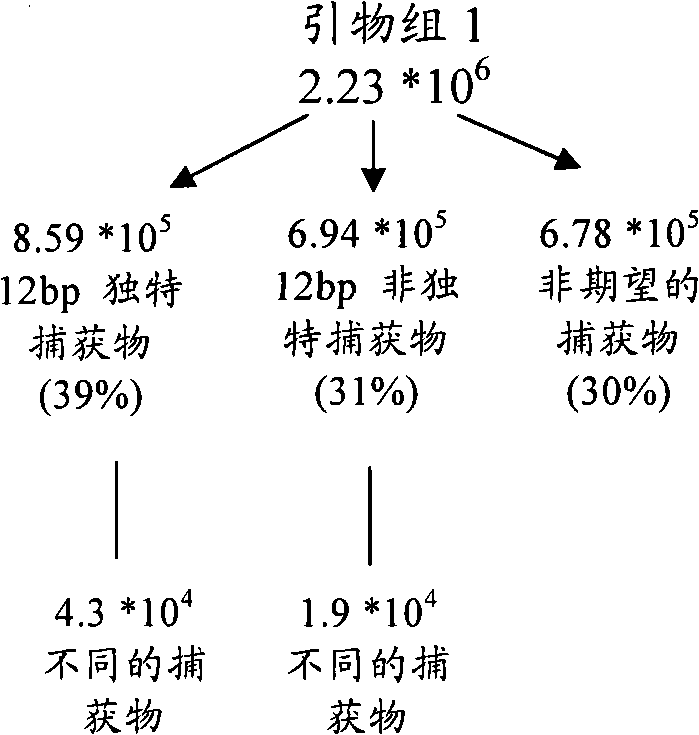
引物组2(105Mb):Primer set 2 (105Mb):

引物组3(139Mb):Primer set 3 (139Mb):
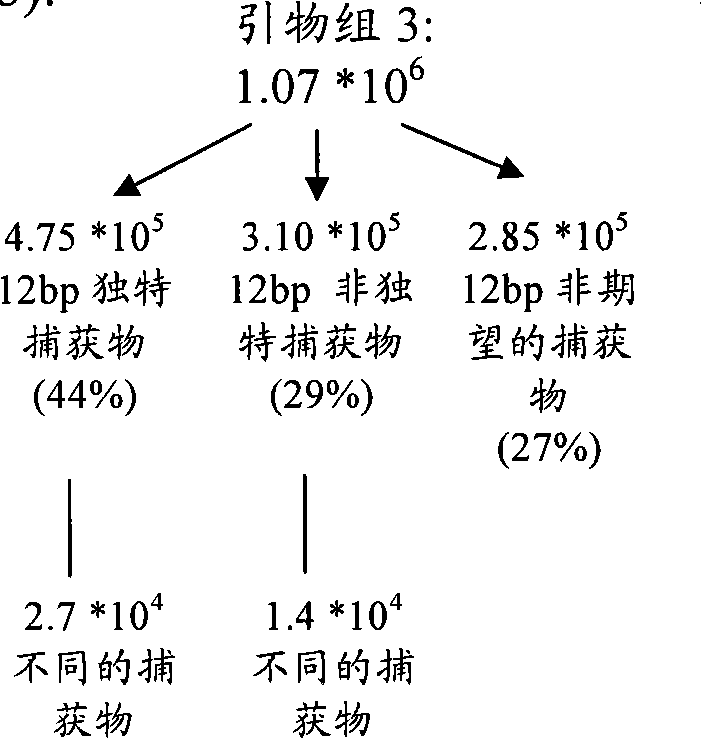
当捕获的序列绘制在它们的染色体位置上时,数据显示在图40和41中。The data are shown in Figures 40 and 41 when the captured sequences were plotted on their chromosomal locations.
简而言之,数据对多重4C测序提供了原理验证。对于每个序列,都可以鉴定诱饵和捕获的序列。本技术可进一步改进:In short, the data provide proof-of-principle for multiplexed 4C sequencing. For each sequence, bait and captured sequences can be identified. This technology can be further improved:
1.测序可以更好地定位于HindIII侧(而不是DpnII侧);这防止读取在第二连接步骤过程中发生的随机连接事件。1. Sequencing can be better positioned on the HindIII side (rather than the DpnII side); this prevents reads from random ligation events that occur during the second ligation step.
2.使用不频繁的切割酶(7-或8-切割酶而不是6-切割酶)将增加由每个诱饵捕获(覆盖)的基因组距离。2. Using infrequent cutters (7- or 8-cuts instead of 6-cuts) will increase the genome distance captured (covered) by each bait.
3.使用不消化重复DNA(或在重复DNA中相对而言不具有代表性)的限制酶将增加可分析的读取的数量。3. The use of restriction enzymes that do not digest repetitive DNA (or are relatively unrepresentative in repetitive DNA) will increase the number of reads that can be analyzed.
其它方面1
1.分析靶核苷酸序列与一个或多个核苷酸序列(如一个或多个基因组基因座)相互作用的频率的方法,其包括使用如本文所述的核苷酸序列或探针阵列或探针组或阵列。1. A method for analyzing the frequency of interaction of a target nucleotide sequence with one or more nucleotide sequences (such as one or more genomic loci), comprising using a nucleotide sequence or probe array as described herein Or probe sets or arrays.
2.鉴定一种或多种指示特定疾病状态或携带者状态的DNA-DNA相互作用的方法,其包括使用如本文所述的核苷酸序列或探针阵列或探针组或阵列。2. A method of identifying one or more DNA-DNA interactions indicative of a particular disease state or carrier state comprising the use of a nucleotide sequence or probe array or probe set or array as described herein.
3.诊断或预测由DNA-DNA改变造成的或与DNA-DNA改变相关的疾病或综合征或携带者状态的方法,其包括使用如本文所述的核苷酸序列或探针阵列或探针组或阵列。3. A method of diagnosing or predicting a disease or syndrome caused by or associated with a DNA-DNA alteration or a carrier state comprising the use of a nucleotide sequence or probe array or probe as described herein group or array.
4.鉴定一种或多种调节DNA-DNA相互作用的试剂的测定方法,其包括使用如本文所述的核苷酸序列或探针阵列或探针组或阵列。4. An assay for identifying one or more agents that modulate DNA-DNA interactions comprising the use of a nucleotide sequence or probe array or probe set or array as described herein.
5.检测断点(如易位)位置的方法,其包括使用如本文所述的核苷酸序列或探针阵列或探针组或阵列。5. A method of detecting the location of a breakpoint, such as a translocation, comprising the use of a nucleotide sequence or probe array or probe set or array as described herein.
6.检测倒位的位置的方法,其包括使用如本文所述的核苷酸序列或探针阵列或探针组或阵列。6. A method of detecting the position of an inversion comprising the use of a nucleotide sequence or probe array or probe set or array as described herein.
7.检测缺失的位置的方法,其包括使用如本文所述的核苷酸序列或探针阵列或探针组或阵列。7. A method of detecting the location of a deletion comprising the use of a nucleotide sequence or probe array or probe set or array as described herein.
8.检测重复的位置的方法,其包括使用如本文所述的核苷酸序列或探针阵列或探针组或阵列。8. A method of detecting the position of a repeat comprising the use of a nucleotide sequence or probe array or probe set or array as described herein.
9.分析靶核苷酸序列与一个或多个目的核苷酸序列(如一个或多个基因组基因座)相互作用的频率的方法,其包括以下步骤:9. A method for analyzing the frequency of interaction of a target nucleotide sequence with one or more nucleotide sequences of interest (such as one or more genomic loci), comprising the steps of:
(a)提供交联DNA的样品;(a) Provide a sample of cross-linked DNA;
(b)用第一限制酶消化交联的DNA;(b) digesting the cross-linked DNA with a first restriction enzyme;
(c)连接交联的核苷酸序列;(c) linking cross-linked nucleotide sequences;
(d)解除交联;(d) decrosslinking;
(e)任选用第二限制酶消化核苷酸序列;(e) optionally digesting the nucleotide sequence with a second restriction enzyme;
(f)任选连接核苷酸序列;(f) optionally linking nucleotide sequences;
(g)利用至少两个寡核苷酸引物扩增一个或多个与靶核苷酸序列相连的目的核苷酸序列,其中每个引物与在目的核苷酸序列的侧翼的已知的DNA序列杂交;(g) using at least two oligonucleotide primers to amplify one or more nucleotide sequences of interest linked to the target nucleotide sequence, wherein each primer is linked to a known DNA sequence flanking the nucleotide sequence of interest sequence hybridization;
(h)将被扩增的一个或多个序列与阵列杂交或对扩增的序列测序;和(h) hybridizing the amplified sequence or sequences to an array or sequencing the amplified sequences; and
(i)确定DNA序列间相互作用的频率。(i) Determining the frequency of interactions between DNA sequences.
其它方面2
本发明又进一步的方面在以下编号的段落中提出。Yet further aspects of the invention are set forth in the following numbered paragraphs.
1.环化的核苷酸序列,其包含由第一限制酶识别位点分隔的第一和第二核苷酸序列,其中所述第一核苷酸序列是靶核苷酸序列而且所述第二核苷酸序列可通过交联基因组DNA而获得。1. A circularized nucleotide sequence comprising first and second nucleotide sequences separated by a first restriction enzyme recognition site, wherein said first nucleotide sequence is a target nucleotide sequence and said The second nucleotide sequence can be obtained by cross-linking genomic DNA.
2.段落1所述的环化的核苷酸序列,其中靶核苷酸序列选自由启动子、增强子、沉默基因、隔离子、基质附着区、基因座控制区、转录单位、复制起点、重组热点、易位断点、着丝粒、端粒、基因密集区、基因稀少区、重复元件和(病毒)整合位点所组成的组。2. The circularized nucleotide sequence of
3.段落1所述的环化的核苷酸序列,其中靶核苷酸序列是与疾病相关的或造成疾病的核苷酸序列,或在线性DNA模板上位于距离与疾病相关的或造成疾病的基因座少于15Mb处。3. The circularized nucleotide sequence of
4.段落1-3之任一段所述的环化的核苷酸序列,其中靶核苷酸序列选自以下组成的组:AML1,MLL,MYC,BCL,BCR,ABL1,IGH,LYL1,TAL1,TAL2,LMO2,TCRα/δ,TCRβ和HOX或其它与疾病相关的基因座,所述其它与疾病相关的基因座如“Catalogue of Unbalanced Chromosome Aberrationsin Man”第2版.Albert Schinzel.柏林:Walter de Gruyter,2001.ISBN3-11-011607-3中所述。4. The circularized nucleotide sequence of any one of paragraphs 1-3, wherein the target nucleotide sequence is selected from the group consisting of: AML1, MLL, MYC, BCL, BCR, ABL1, IGH, LYL1, TAL1 , TAL2, LMO2, TCRα/δ, TCRβ and HOX or other disease-associated loci such as "Catalogue of Unbalanced Chromosome Aberrations in Man" 2nd Edition. Albert Schinzel. Berlin: Walter de Described in Gruyter, 2001. ISBN 3-11-011607-3.
5.段落1-4之任一段所述的环化的核苷酸序列,其中第一限制酶识别位点是6-8bp识别位点,优选选自由BglII、HindIII、EcoRI、BamHI、SpeI、PstI和NdeI所组成的组。5. The circularized nucleotide sequence of any one of paragraphs 1-4, wherein the first restriction enzyme recognition site is a 6-8bp recognition site, preferably selected from BglII, HindIII, EcoRI, BamHI, SpeI, PstI and NdeI group.
6.前述段落之任一段所述的环化的核苷酸序列,其中第二限制酶识别位点是4或5bp核苷酸序列识别位点。6. The circularized nucleotide sequence of any one of the preceding paragraphs, wherein the second restriction enzyme recognition site is a 4 or 5 bp nucleotide sequence recognition site.
7.前述段落之任一段所述的环化的核苷酸序列,其中第二限制酶识别位点位于距离第一限制性位点大于约350bp处。7. The circularized nucleotide sequence of any of the preceding paragraphs, wherein the second restriction enzyme recognition site is located greater than about 350 bp from the first restriction site.
8.前述段落之任一段所述的环化的核苷酸序列,其中核苷酸序列是标记的。8. The circularized nucleotide sequence of any of the preceding paragraphs, wherein the nucleotide sequence is labeled.
9.制备环化的核苷酸序列的方法,其包括以下步骤:9. A method for preparing a circularized nucleotide sequence, comprising the steps of:
(a)提供交联DNA的样品;(a) Provide a sample of cross-linked DNA;
(b)用第一限制酶消化交联的DNA;(b) digesting the cross-linked DNA with a first restriction enzyme;
(c)为环化连接交联的核苷酸序列;(c) is the nucleotide sequence of cyclization connection cross-linking;
10.段落9所述的方法,其中用PCR扩增交联的核苷酸序列。10. The method of
11.段落10所述的方法,其中用反向PCR扩增交联的核苷酸序列。11. The method of
12.段落10或段落11所述的方法,其中使用Expand Long Template PCRSystem(扩展长模板PCR系统)(Roche)。12. The method of
表2Table 2
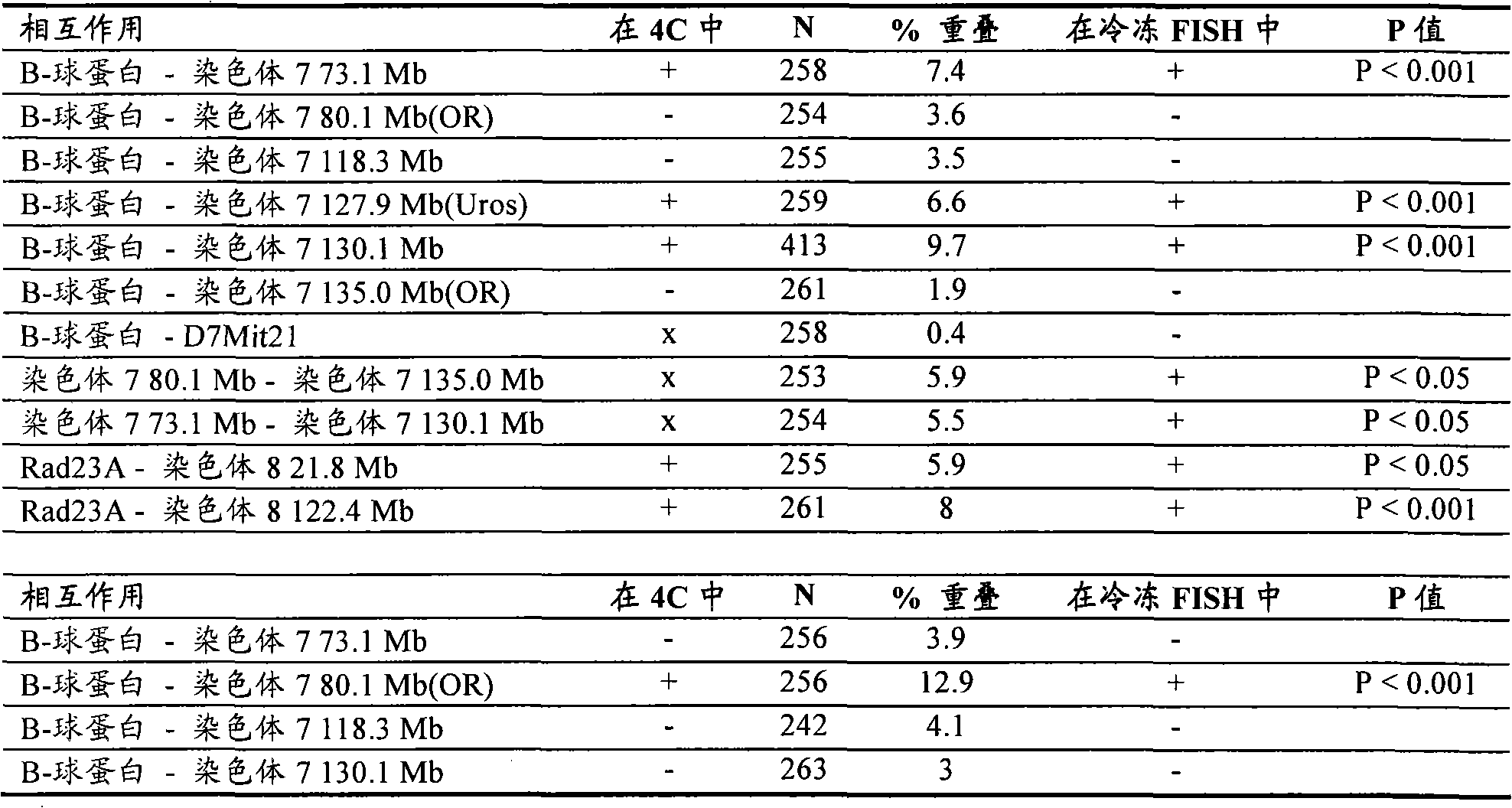

参考文献references
Blanton J,Gaszner M,Schedl P.2003.Protein:protein interactions and thepairing of boundary elements in vivo.Genes Dev 17:664-75.Blanton J, Gaszner M, Schedl P. 2003. Protein: protein interactions and the pairing of boundary elements in vivo. Genes Dev 17: 664-75.
Dekker,J.,Rippe,K.,Dekker,M.,和Kleckner,N.2002.Capturingchromosome conformation.Science 295:1306-11.Dekker, J., Rippe, K., Dekker, M., and Kleckner, N. 2002. Capturing chromosome conformation. Science 295: 1306-11.
Drissen R,Palstra RJ,Gillemans N,Splinter E,Grosveld F,Philipsen S,deLaat W.2004.The active spatial organization of the beta-globin locus requires thetranscription factor EKLF.Genes Dev 18:2485-90.Drissen R, Palstra RJ, Gillemans N, Splinter E, Grosveld F, Philipsen S, deLaat W. 2004. The active spatial organization of the beta-globin locus requires the transcription factor EKLF. Genes Dev 18:2485-90.
Horike S,Cai S,Miyano M,Cheng JF,Kohwi-Shigematsu T.2005.Loss ofsilent-chromatin looping and impaired imprinting of DLX5 in Rett syndrome.NatGenet 37:31-40.Horike S, Cai S, Miyano M, Cheng JF, Kohwi-Shigematsu T. 2005. Loss of silent-chromatin looping and impaired imprinting of DLX5 in Rett syndrome. Nat Genet 37: 31-40.
Murrell A,Heeson S,Reik W.2004.Interaction between differentiallymethylated regions partitions the imprinted genes Igf2 and H19 intoparent-specific chromatin loops.Nat Genet 36:889-93.Murrell A, Heeson S, Reik W. 2004. Interaction between differentially methylated regions partitions the imprinted genes Igf2 and H19 into parent-specific chromatin loops. Nat Genet 36: 889-93.
Palstra,R.J.,Tolhuis,B.,Splinter,E.,Nijmeijer,R.,Grosveld,F.,和de Laat,W.2003.The beta-globin nuclear compartment in development and erythroiddifferentiation.Nat Genet 35:190-4.Palstra, R.J., Tolhuis, B., Splinter, E., Nijmeijer, R., Grosveld, F., and de Laat, W. 2003. The beta-globin nuclear compartment in development and erythroid differentiation. Nat Genet 35:190-4 .
Patrinos,G.P.,de Krom,M.,de Boer,E.,Langeveld,A.,Imam,A.M.A,Strouboulis,J.,de Laat,W.,and Grosveld,F.G.(2004).Multiple interactionsbetween regulatory regions are required to stabilize an active chromatin hub.Genes & Dev.18:1495-1509.Patrinos, G.P., de Krom, M., de Boer, E., Langeveld, A., Imam, A.M.A, Strouboulis, J., de Laat, W., and Grosveld, F.G. (2004). Multiple interactions between regulatory regions are required to stabilize an active chromatin hub. Genes & Dev. 18: 1495-1509.
Spilianakis CG,Flavell RA.2004.Long-range intrachromosomalinteractions in the T helper type 2 cytokine locus.Nat Immunol 5:1017-27.Spilianakis CG, Flavell RA. 2004. Long-range intrachromosomal interactions in the
Tolhuis,B.,Palstra,R.J.,Splinter,E.,Grosveld,F.,和de Laat,W.2002.Looping and interaction between hypersensitive sites in the active beta-globinlocus.Molecular Cell 10:1453-65.Tolhuis, B., Palstra, R.J., Splinter, E., Grosveld, F., and de Laat, W. 2002. Looping and interaction between hypersensitive sites in the active beta-globinlocus. Molecular Cell 10: 1453-65.
Vakoc CR,Letting DL,Gheldof N,Sawado T,Bender MA,Groudine M,Weiss MJ,Dekker J,Blobel GA.2005.Proximity among distant regulatoryelements at the beta-globin locus requires GATA-1 and FOG-1.Mol Cell.17:453-62Vakoc CR, Letting DL, Gheldof N, Sawado T, Bender MA, Groudine M, Weiss MJ, Dekker J, Blobel GA. 2005. Proximity among distant regulatory elements at the beta-globin locus requires GATA-1 and FOG-1.Mol Cell .17:453-62
实施例12的参考文献References for Example 12
1.Nature 447,661(Jun 7,2007).1. Nature 447, 661 (
2.D.F.Easton等,Nature 447,1087(Jun 28,2007).2. D.F. Easton et al., Nature 447, 1087 (Jun 28, 2007).
3.L.Feuk,A.R.Carson,S.W.Scherer,Nat Rev Genet 7,85(Feb,2006).3. L. Feuk, A. R. Carson, S. W. Scherer,
4.A.J.Sharp,Z.Cheng,E.E.Eichler,Annu Rev Genomics Hum Genet 7,407(2006).4. A.J.Sharp, Z.Cheng, E.E.Eichler, Annu Rev
5.A.J.Iafrate等,Nat Genet 36,949(Sep,2004).5.A.J.Iafrate et al.,
6.M.R.Mehan,N.B.Freimer,R.A.Ophoff,Hum Genomics 1,335(Aug,2004).6. M.R. Mehan, N.B. Freimer, R.A. Ophoff,
7.E.E.Eichler等,Nature 447,161(May 10,2007).7. E.E. Eichler et al., Nature 447, 161 (May 10, 2007).
8.M.Simonis等,Nat Genet 38,1348(Nov,2006).8. M. Simonis et al., Nat Genet 38, 1348 (Nov, 2006).
9.K.Rippe,Trends Biochem Sci 26,733(Dec,2001).9. K. Rippe,
10.R.C.Burnett,M.J.Thirman,J.D.Rowley,M.O.Diaz,Blood 84,1232(Aug 15,1994).10. R.C. Burnett, M.J. Thirman, J.D. Rowley, M.O. Diaz, Blood 84, 1232 (
11.F.Speleman等,Leukemia 19,358(Mar,2005).11. F. Speleman et al.,
12.J.Soulier等,Blood 106,274(Jul1,2005).12. J. Soulier et al., Blood 106, 274 (Jul1, 2005).
13.R.J.Galjaard等,Am J Med Genet A 121,168(Aug 30,2003).13. R.J. Galjaard et al., Am J Med Genet A 121, 168 (
14.M.Aoyama等,Cancer Res 65,4587(Jun 1,2005).14. M. Aoyama et al., Cancer Res 65, 4587 (
15.E.Tuzun等,Nat Genet 37,727(Jul,2005).15. E.Tuzun et al., Nat Genet 37, 727 (Jul, 2005).
以上说明书所述的所有公开文献都纳入本文参考。在不偏离本发明范围和精神的情况下,所述的本发明方法和系统的各种修改和变型对于所述领域技术人员来说是显而易见的。尽管本发明联系特别优选的实施方案来描述,但是应当理解,本发明所要求保护的内容不应被不正当地局限于这些特定实施方案中。事实上,所述对分子生物学或相关领域技术人员显而易见的执行本发明的模式的各种修改也要在以下权利要求的范围内。All publications mentioned in the above specification are incorporated herein by reference. Various modifications and variations of the described methods and system of the invention will be apparent to those skilled in the art without departing from the scope and spirit of the invention. Although the invention has been described in connection with particular preferred embodiments, it should be understood that the invention as claimed should not be unduly limited to such particular embodiments. Indeed, various modifications of the described modes for carrying out the invention which are obvious to those skilled in molecular biology or related fields are intended to be within the scope of the following claims.
Claims (56)
Applications Claiming Priority (5)
| Application Number | Priority Date | Filing Date | Title |
|---|---|---|---|
| US99975007P | 2007-01-11 | 2007-01-11 | |
| US60/999,750 | 2007-01-11 | ||
| US97790007P | 2007-10-05 | 2007-10-05 | |
| US60/977,900 | 2007-10-05 | ||
| PCT/IB2008/000625 WO2008084405A2 (en) | 2007-01-11 | 2008-01-10 | Circular chromosome conformation capture (4c) |
Publications (1)
| Publication Number | Publication Date |
|---|---|
| CN101688237A true CN101688237A (en) | 2010-03-31 |
Family
ID=39609120
Family Applications (1)
| Application Number | Title | Priority Date | Filing Date |
|---|---|---|---|
| CN200880008027A Pending CN101688237A (en) | 2007-01-11 | 2008-01-10 | Circular chromosome conformation capture (4C) |
Country Status (10)
| Country | Link |
|---|---|
| US (1) | US8642295B2 (en) |
| EP (1) | EP2121977B1 (en) |
| JP (1) | JP5690068B2 (en) |
| CN (1) | CN101688237A (en) |
| AU (1) | AU2008204338B2 (en) |
| BR (1) | BRPI0806565A2 (en) |
| DK (1) | DK2121977T3 (en) |
| ES (1) | ES2634266T3 (en) |
| PT (1) | PT2121977T (en) |
| WO (1) | WO2008084405A2 (en) |
Cited By (4)
| Publication number | Priority date | Publication date | Assignee | Title |
|---|---|---|---|---|
| CN103180459A (en) * | 2010-07-09 | 2013-06-26 | 赛尔冉迪思股份有限公司 | 3-D Sequencing Strategies for Genomic Regions of Interest |
| CN104169433A (en) * | 2011-02-04 | 2014-11-26 | 宾夕法尼亚大学董事会 | A method for detecting chromosome structure and gene expression simultaneously in single cells |
| CN105658813A (en) * | 2013-09-05 | 2016-06-08 | 巴布拉哈姆研究院 | Chromosome conformation capture method including selection and enrichment steps |
| CN105992825A (en) * | 2013-11-18 | 2016-10-05 | 鹿特丹伊拉斯谟大学医疗中心 | Method for analysing the interaction of nucleotide sequences in a three-dimensional dna structure |
Families Citing this family (79)
| Publication number | Priority date | Publication date | Assignee | Title |
|---|---|---|---|---|
| CA2614118C (en) * | 2005-07-04 | 2013-11-26 | Erasmus University Medical Center | 4c |
| US11111543B2 (en) | 2005-07-29 | 2021-09-07 | Natera, Inc. | System and method for cleaning noisy genetic data and determining chromosome copy number |
| US11111544B2 (en) | 2005-07-29 | 2021-09-07 | Natera, Inc. | System and method for cleaning noisy genetic data and determining chromosome copy number |
| US9424392B2 (en) | 2005-11-26 | 2016-08-23 | Natera, Inc. | System and method for cleaning noisy genetic data from target individuals using genetic data from genetically related individuals |
| US9074244B2 (en) * | 2008-03-11 | 2015-07-07 | Affymetrix, Inc. | Array-based translocation and rearrangement assays |
| US8703652B2 (en) | 2009-11-06 | 2014-04-22 | The Board Of Trustees Of The Leland Stanford Junior University | Non-invasive diagnosis of graft rejection in organ transplant patients |
| US11339429B2 (en) | 2010-05-18 | 2022-05-24 | Natera, Inc. | Methods for non-invasive prenatal ploidy calling |
| US20190010543A1 (en) | 2010-05-18 | 2019-01-10 | Natera, Inc. | Methods for simultaneous amplification of target loci |
| US11408031B2 (en) | 2010-05-18 | 2022-08-09 | Natera, Inc. | Methods for non-invasive prenatal paternity testing |
| CA3207599A1 (en) | 2010-05-18 | 2011-11-24 | Natera, Inc. | Methods for non-invasive prenatal ploidy calling |
| US12221653B2 (en) | 2010-05-18 | 2025-02-11 | Natera, Inc. | Methods for simultaneous amplification of target loci |
| US11326208B2 (en) | 2010-05-18 | 2022-05-10 | Natera, Inc. | Methods for nested PCR amplification of cell-free DNA |
| US11939634B2 (en) | 2010-05-18 | 2024-03-26 | Natera, Inc. | Methods for simultaneous amplification of target loci |
| US11322224B2 (en) | 2010-05-18 | 2022-05-03 | Natera, Inc. | Methods for non-invasive prenatal ploidy calling |
| US11332785B2 (en) | 2010-05-18 | 2022-05-17 | Natera, Inc. | Methods for non-invasive prenatal ploidy calling |
| US11332793B2 (en) | 2010-05-18 | 2022-05-17 | Natera, Inc. | Methods for simultaneous amplification of target loci |
| US12152275B2 (en) | 2010-05-18 | 2024-11-26 | Natera, Inc. | Methods for non-invasive prenatal ploidy calling |
| US9677118B2 (en) | 2014-04-21 | 2017-06-13 | Natera, Inc. | Methods for simultaneous amplification of target loci |
| US10316362B2 (en) | 2010-05-18 | 2019-06-11 | Natera, Inc. | Methods for simultaneous amplification of target loci |
| CA2824387C (en) | 2011-02-09 | 2019-09-24 | Natera, Inc. | Methods for non-invasive prenatal ploidy calling |
| GB2496016B (en) | 2011-09-09 | 2016-03-16 | Univ Leland Stanford Junior | Methods for obtaining a sequence |
| US20140100126A1 (en) | 2012-08-17 | 2014-04-10 | Natera, Inc. | Method for Non-Invasive Prenatal Testing Using Parental Mosaicism Data |
| US9411930B2 (en) | 2013-02-01 | 2016-08-09 | The Regents Of The University Of California | Methods for genome assembly and haplotype phasing |
| CN105121661B (en) | 2013-02-01 | 2018-06-08 | 加利福尼亚大学董事会 | Methods for genome assembly and haplotype phasing |
| US11618923B2 (en) | 2013-03-15 | 2023-04-04 | The Broad Institute, Inc. | Methods of determining multiple interactions between nucleic acids in a cell |
| KR101672531B1 (en) * | 2013-04-18 | 2016-11-17 | 주식회사 젠큐릭스 | Genetic markers for prognosing or predicting early stage breast cancer and uses thereof |
| WO2015048595A1 (en) | 2013-09-27 | 2015-04-02 | Jay Shendure | Methods and systems for large scale scaffolding of genome assemblies |
| EP3134541B1 (en) | 2014-04-21 | 2020-08-19 | Natera, Inc. | Detecting copy number variations (cnv) of chromosomal segments in cancer |
| US20180173846A1 (en) | 2014-06-05 | 2018-06-21 | Natera, Inc. | Systems and Methods for Detection of Aneuploidy |
| WO2016019360A1 (en) | 2014-08-01 | 2016-02-04 | Dovetail Genomics Llc | Tagging nucleic acids for sequence assembly |
| EP3201350B1 (en) | 2014-09-30 | 2020-12-02 | Global Life Sciences Solutions USA LLC | Method for nucleic acid analysis directly from an unpurified biological sample |
| EP3230452B1 (en) | 2014-12-12 | 2025-06-11 | The Broad Institute, Inc. | Dead guides for crispr transcription factors |
| WO2016094874A1 (en) | 2014-12-12 | 2016-06-16 | The Broad Institute Inc. | Escorted and functionalized guides for crispr-cas systems |
| EP3985115A1 (en) | 2014-12-12 | 2022-04-20 | The Broad Institute, Inc. | Protected guide rnas (pgrnas) |
| EP3237615B2 (en) | 2014-12-24 | 2023-07-26 | The Broad Institute, Inc. | Crispr having or associated with destabilization domains |
| KR102721363B1 (en) | 2015-02-17 | 2024-10-23 | 더브테일 제노믹스 엘엘씨 | Nucleic acid sequence assembly |
| US11807896B2 (en) | 2015-03-26 | 2023-11-07 | Dovetail Genomics, Llc | Physical linkage preservation in DNA storage |
| WO2016182893A1 (en) | 2015-05-08 | 2016-11-17 | Teh Broad Institute Inc. | Functional genomics using crispr-cas systems for saturating mutagenesis of non-coding elements, compositions, methods, libraries and applications thereof |
| DK3294906T3 (en) | 2015-05-11 | 2024-08-05 | Natera Inc | Methods for determining ploidy |
| CA3012631A1 (en) | 2015-06-18 | 2016-12-22 | The Broad Institute Inc. | Novel crispr enzymes and systems |
| US9790490B2 (en) | 2015-06-18 | 2017-10-17 | The Broad Institute Inc. | CRISPR enzymes and systems |
| AU2016279062A1 (en) | 2015-06-18 | 2019-03-28 | Omar O. Abudayyeh | Novel CRISPR enzymes and systems |
| JP2018527016A (en) | 2015-06-24 | 2018-09-20 | オックスフォード バイオダイナミックス リミテッド | Chromosome interaction detection |
| US20180282799A1 (en) * | 2015-10-05 | 2018-10-04 | Koninklijke Nederlandse Akademie Van Wetenschappen | Targeted locus amplification using cloning strategies |
| CN108368542B (en) | 2015-10-19 | 2022-04-08 | 多弗泰尔基因组学有限责任公司 | Methods for genome assembly, haplotype phasing, and target-independent nucleic acid detection |
| US11492670B2 (en) | 2015-10-27 | 2022-11-08 | The Broad Institute Inc. | Compositions and methods for targeting cancer-specific sequence variations |
| WO2017106657A1 (en) | 2015-12-18 | 2017-06-22 | The Broad Institute Inc. | Novel crispr enzymes and systems |
| WO2017147279A1 (en) | 2016-02-23 | 2017-08-31 | Dovetail Genomics Llc | Generation of phased read-sets for genome assembly and haplotype phasing |
| US12146195B2 (en) | 2016-04-15 | 2024-11-19 | Natera, Inc. | Methods for lung cancer detection |
| WO2017184786A1 (en) | 2016-04-19 | 2017-10-26 | The Broad Institute Inc. | Cpf1 complexes with reduced indel activity |
| KR20260004568A (en) | 2016-04-19 | 2026-01-08 | 더 브로드 인스티튜트, 인코퍼레이티드 | The novel CRISPR enzyme and system |
| CN109477101B (en) | 2016-05-13 | 2022-11-18 | 多弗泰尔基因组学有限责任公司 | Recovery of long range linkage information from stored samples |
| US20210222164A1 (en) | 2016-06-29 | 2021-07-22 | The Broad Institute, Inc. | Crispr-cas systems having destabilization domain |
| WO2018064208A1 (en) | 2016-09-28 | 2018-04-05 | The Broad Institute, Inc. | Systematic screening and mapping of regulatory elements in non-coding genomic regions, methods, compositions, and applications thereof |
| US11485996B2 (en) | 2016-10-04 | 2022-11-01 | Natera, Inc. | Methods for characterizing copy number variation using proximity-litigation sequencing |
| GB201618485D0 (en) | 2016-11-02 | 2016-12-14 | Ucl Business Plc | Method of detecting tumour recurrence |
| JP2019535295A (en) * | 2016-12-01 | 2019-12-12 | オックスフォード バイオダイナミクス リミテッド | Application of epigenetic chromosome interactions in cancer diagnosis |
| US10011870B2 (en) | 2016-12-07 | 2018-07-03 | Natera, Inc. | Compositions and methods for identifying nucleic acid molecules |
| KR20190117495A (en) | 2016-12-23 | 2019-10-16 | 옥스포드 바이오다이나믹스 리미티드 | Typing method |
| CN107058484B (en) * | 2016-12-26 | 2020-06-16 | 孙涛 | Primer combination and kit applied to high-throughput sequencing and simultaneous detection of T cell and B cell immune repertoire |
| EP3612629A1 (en) | 2017-04-18 | 2020-02-26 | The Broad Institute, Inc. | Compositions for detecting secretion and methods of use |
| AU2018361833B2 (en) * | 2017-11-03 | 2021-04-22 | Oxford BioDynamics PLC | Genetic regulation of immunoresponse by chromosome interactions |
| WO2019104034A1 (en) | 2017-11-21 | 2019-05-31 | Arima Genomics, Inc. | Preserving spatial-proximal contiguity and molecular contiguity in nucleic acid templates |
| WO2019118926A1 (en) | 2017-12-14 | 2019-06-20 | Tai Diagnostics, Inc. | Assessing graft suitability for transplantation |
| EP3746566A1 (en) | 2018-01-31 | 2020-12-09 | Dovetail Genomics, LLC | Sample prep for dna linkage recovery |
| JP7573443B2 (en) | 2018-04-14 | 2024-10-25 | ナテラ, インコーポレイテッド | Methods for cancer detection and monitoring using personalized detection of circulating tumor dna - Patents.com |
| CN109033745A (en) * | 2018-06-08 | 2018-12-18 | 中国农业科学院农业基因组研究所 | A kind of method and application for eliminating three-dimensional genomics technologies noise |
| CN108804872A (en) * | 2018-06-08 | 2018-11-13 | 中国农业科学院农业基因组研究所 | The method for eliminating three-dimensional genomics technologies noise and application are combined using excision enzyme |
| TWI852936B (en) * | 2018-06-29 | 2024-08-21 | 美商格瑞爾有限責任公司 | Nucleic acid rearrangement and integration analysis |
| US12234509B2 (en) | 2018-07-03 | 2025-02-25 | Natera, Inc. | Methods for detection of donor-derived cell-free DNA |
| WO2020041380A1 (en) | 2018-08-20 | 2020-02-27 | The Broad Institute, Inc. | Methods and compositions for optochemical control of crispr-cas9 |
| US11370810B2 (en) | 2018-11-20 | 2022-06-28 | Arima Genomics, Inc. | Methods and compositions for preparing nucleic acids that preserve spatial-proximal contiguity information |
| CN109609611A (en) * | 2018-12-26 | 2019-04-12 | 上海优甲医疗科技有限公司 | A kind of gene quantification sequencing approach based on high throughput sequencing technologies |
| CN114008213A (en) | 2019-05-20 | 2022-02-01 | 阿瑞玛基因组学公司 | Methods and compositions for enhancing genome coverage and maintaining spatially adjacent contiguity |
| US20220235340A1 (en) | 2019-05-20 | 2022-07-28 | The Broad Institute, Inc. | Novel crispr-cas systems and uses thereof |
| US12305235B2 (en) | 2019-06-06 | 2025-05-20 | Natera, Inc. | Methods for detecting immune cell DNA and monitoring immune system |
| CA3174973A1 (en) | 2020-04-23 | 2021-10-28 | Wouter Leonard De Laat | Structural variation detection in chromosomal proximity experiments |
| GB202111194D0 (en) * | 2021-08-03 | 2021-09-15 | Cergentis B V | Method |
| WO2025117544A1 (en) | 2023-11-29 | 2025-06-05 | The Broad Institute, Inc. | Engineered omega guide molecule and iscb compositions, systems, and methods of use thereof |
Citations (1)
| Publication number | Priority date | Publication date | Assignee | Title |
|---|---|---|---|---|
| WO2007004057A2 (en) * | 2005-07-04 | 2007-01-11 | Erasmus University Medical Center | Chromosome conformation capture-on-chip (4c) assay |
Family Cites Families (22)
| Publication number | Priority date | Publication date | Assignee | Title |
|---|---|---|---|---|
| NL154598B (en) * | 1970-11-10 | 1977-09-15 | Organon Nv | PROCEDURE FOR DETERMINING AND DETERMINING LOW MOLECULAR COMPOUNDS AND PROTEINS THAT CAN SPECIFICALLY BIND THESE COMPOUNDS AND TEST PACKAGING. |
| US3817837A (en) * | 1971-05-14 | 1974-06-18 | Syva Corp | Enzyme amplification assay |
| US3939350A (en) * | 1974-04-29 | 1976-02-17 | Board Of Trustees Of The Leland Stanford Junior University | Fluorescent immunoassay employing total reflection for activation |
| US3996345A (en) * | 1974-08-12 | 1976-12-07 | Syva Company | Fluorescence quenching with immunological pairs in immunoassays |
| US4277437A (en) * | 1978-04-05 | 1981-07-07 | Syva Company | Kit for carrying out chemically induced fluorescence immunoassay |
| US4275149A (en) * | 1978-11-24 | 1981-06-23 | Syva Company | Macromolecular environment control in specific receptor assays |
| US4366241A (en) * | 1980-08-07 | 1982-12-28 | Syva Company | Concentrating zone method in heterogeneous immunoassays |
| US4965188A (en) * | 1986-08-22 | 1990-10-23 | Cetus Corporation | Process for amplifying, detecting, and/or cloning nucleic acid sequences using a thermostable enzyme |
| US4683195A (en) * | 1986-01-30 | 1987-07-28 | Cetus Corporation | Process for amplifying, detecting, and/or-cloning nucleic acid sequences |
| US4683202A (en) * | 1985-03-28 | 1987-07-28 | Cetus Corporation | Process for amplifying nucleic acid sequences |
| GB8607679D0 (en) | 1986-03-27 | 1986-04-30 | Winter G P | Recombinant dna product |
| US5143854A (en) * | 1989-06-07 | 1992-09-01 | Affymax Technologies N.V. | Large scale photolithographic solid phase synthesis of polypeptides and receptor binding screening thereof |
| CA2097708A1 (en) | 1990-12-06 | 1992-06-07 | Stephen P. A. Fodor | Very large scale immobilized polymer synthesis |
| EP0916396B1 (en) | 1991-11-22 | 2005-04-13 | Affymetrix, Inc. (a Delaware Corporation) | Combinatorial strategies for polymer synthesis |
| WO1995011995A1 (en) | 1993-10-26 | 1995-05-04 | Affymax Technologies N.V. | Arrays of nucleic acid probes on biological chips |
| US5837832A (en) * | 1993-06-25 | 1998-11-17 | Affymetrix, Inc. | Arrays of nucleic acid probes on biological chips |
| US5571639A (en) * | 1994-05-24 | 1996-11-05 | Affymax Technologies N.V. | Computer-aided engineering system for design of sequence arrays and lithographic masks |
| US5795716A (en) | 1994-10-21 | 1998-08-18 | Chee; Mark S. | Computer-aided visualization and analysis system for sequence evaluation |
| US5599695A (en) | 1995-02-27 | 1997-02-04 | Affymetrix, Inc. | Printing molecular library arrays using deprotection agents solely in the vapor phase |
| AU2189397A (en) | 1996-02-08 | 1997-08-28 | Affymetrix, Inc. | Chip-based speciation and phenotypic characterization of microorganisms |
| US6126939A (en) | 1996-09-03 | 2000-10-03 | Yeda Research And Development Co. Ltd. | Anti-inflammatory dipeptide and pharmaceutical composition thereof |
| US20050130161A1 (en) * | 2002-03-08 | 2005-06-16 | Peter Fraser | Tagging and recovery of elements associated with target molecules |
-
2008
- 2008-01-10 CN CN200880008027A patent/CN101688237A/en active Pending
- 2008-01-10 JP JP2009545253A patent/JP5690068B2/en active Active
- 2008-01-10 DK DK08719319.9T patent/DK2121977T3/en active
- 2008-01-10 EP EP08719319.9A patent/EP2121977B1/en active Active
- 2008-01-10 US US12/522,555 patent/US8642295B2/en active Active
- 2008-01-10 PT PT87193199T patent/PT2121977T/en unknown
- 2008-01-10 AU AU2008204338A patent/AU2008204338B2/en active Active
- 2008-01-10 ES ES08719319.9T patent/ES2634266T3/en active Active
- 2008-01-10 BR BRPI0806565-9A patent/BRPI0806565A2/en not_active Application Discontinuation
- 2008-01-10 WO PCT/IB2008/000625 patent/WO2008084405A2/en not_active Ceased
Patent Citations (1)
| Publication number | Priority date | Publication date | Assignee | Title |
|---|---|---|---|---|
| WO2007004057A2 (en) * | 2005-07-04 | 2007-01-11 | Erasmus University Medical Center | Chromosome conformation capture-on-chip (4c) assay |
Non-Patent Citations (2)
| Title |
|---|
| 孙立军等: "基因差异表达的高通量分析及其在肿瘤研究中的应用", 《癌症》 * |
| 陈文炳等: "应用多重PCR同时检测多种转基因成分", 《检验检疫科学》 * |
Cited By (7)
| Publication number | Priority date | Publication date | Assignee | Title |
|---|---|---|---|---|
| CN103180459A (en) * | 2010-07-09 | 2013-06-26 | 赛尔冉迪思股份有限公司 | 3-D Sequencing Strategies for Genomic Regions of Interest |
| CN103180459B (en) * | 2010-07-09 | 2016-10-19 | 赛尔冉迪思股份有限公司 | 3-D Sequencing Strategies for Genomic Regions of Interest |
| US12006538B2 (en) | 2010-07-09 | 2024-06-11 | Cergentis Bv | 3-D genomic region of interest sequencing strategies |
| CN104169433A (en) * | 2011-02-04 | 2014-11-26 | 宾夕法尼亚大学董事会 | A method for detecting chromosome structure and gene expression simultaneously in single cells |
| CN105658813A (en) * | 2013-09-05 | 2016-06-08 | 巴布拉哈姆研究院 | Chromosome conformation capture method including selection and enrichment steps |
| CN105658813B (en) * | 2013-09-05 | 2021-01-05 | 巴布拉哈姆研究院 | Chromosome conformation capture method comprising selection and enrichment steps |
| CN105992825A (en) * | 2013-11-18 | 2016-10-05 | 鹿特丹伊拉斯谟大学医疗中心 | Method for analysing the interaction of nucleotide sequences in a three-dimensional dna structure |
Also Published As
| Publication number | Publication date |
|---|---|
| JP5690068B2 (en) | 2015-03-25 |
| AU2008204338A1 (en) | 2008-07-17 |
| EP2121977B1 (en) | 2017-06-21 |
| AU2008204338B2 (en) | 2014-03-06 |
| JP2010515449A (en) | 2010-05-13 |
| EP2121977A2 (en) | 2009-11-25 |
| PT2121977T (en) | 2017-08-18 |
| ES2634266T3 (en) | 2017-09-27 |
| DK2121977T3 (en) | 2017-09-18 |
| BRPI0806565A2 (en) | 2014-05-06 |
| WO2008084405A3 (en) | 2009-01-29 |
| WO2008084405A2 (en) | 2008-07-17 |
| AU2008204338A8 (en) | 2009-08-06 |
| US8642295B2 (en) | 2014-02-04 |
| US20100062947A1 (en) | 2010-03-11 |
Similar Documents
| Publication | Publication Date | Title |
|---|---|---|
| JP5690068B2 (en) | Circular chromosome conformation capture (4C) | |
| US20250290122A1 (en) | Typing and Assembling Discontinuous Genomic Elements | |
| RU2478716C2 (en) | Co-localised chromatin trapping and characterising | |
| CN102482719B (en) | Method for analyzing nucleic acid mutations using array comparative genomic hybridization | |
| CA2661640A1 (en) | Mapping of genomic interactions | |
| EP1430153A4 (en) | Methods for detecting genetic mosaicisms using arrays | |
| US20060228714A1 (en) | Nucleic acid representations utilizing type IIB restriction endonuclease cleavage products | |
| CN101238225B (en) | Chromosome conformation chip capture (4C) assay | |
| Class et al. | Patent application title: CIRCULAR CHROMOSOME CONFORMATION CAPTURE (4C) Inventors: Wouter De Laat (Rotterdam, NL) Frank Grosveld (Rotterdam, NL) Assignees: Erasmus University Medical Center | |
| CN101238225A (en) | Chromosome conformation chip capture (4C) assay | |
| HK1118870A (en) | Chromosome conformation capture-on-chip (4c) assay | |
| HK1118870B (en) | Chromosome conformation capture-on-chip (4c) assay | |
| Ikebuchi et al. | A denaturation-free protocol for in situ visualization of short nuclear DNA sequences using padlock probes with rolling-circle amplification |
Legal Events
| Date | Code | Title | Description |
|---|---|---|---|
| C06 | Publication | ||
| PB01 | Publication | ||
| C10 | Entry into substantive examination | ||
| SE01 | Entry into force of request for substantive examination | ||
| C02 | Deemed withdrawal of patent application after publication (patent law 2001) | ||
| WD01 | Invention patent application deemed withdrawn after publication |
Application publication date: 20100331 |