CN101679874B - Synthesis of liquid fuels and chemicals from oxygenated hydrocarbons - Google Patents
Synthesis of liquid fuels and chemicals from oxygenated hydrocarbons Download PDFInfo
- Publication number
- CN101679874B CN101679874B CN2008800075532A CN200880007553A CN101679874B CN 101679874 B CN101679874 B CN 101679874B CN 2008800075532 A CN2008800075532 A CN 2008800075532A CN 200880007553 A CN200880007553 A CN 200880007553A CN 101679874 B CN101679874 B CN 101679874B
- Authority
- CN
- China
- Prior art keywords
- catalyst
- deoxygenation
- pressure
- group
- condensation
- Prior art date
- Legal status (The legal status is an assumption and is not a legal conclusion. Google has not performed a legal analysis and makes no representation as to the accuracy of the status listed.)
- Active
Links
Images


Classifications
-
- C—CHEMISTRY; METALLURGY
- C01—INORGANIC CHEMISTRY
- C01B—NON-METALLIC ELEMENTS; COMPOUNDS THEREOF; METALLOIDS OR COMPOUNDS THEREOF NOT COVERED BY SUBCLASS C01C
- C01B3/00—Hydrogen; Gaseous mixtures containing hydrogen; Separation of hydrogen from mixtures containing it; Purification of hydrogen
- C01B3/02—Production of hydrogen or of gaseous mixtures containing a substantial proportion of hydrogen
- C01B3/32—Production of hydrogen or of gaseous mixtures containing a substantial proportion of hydrogen by reaction of gaseous or liquid organic compounds with gasifying agents, e.g. water, carbon dioxide, air
- C01B3/34—Production of hydrogen or of gaseous mixtures containing a substantial proportion of hydrogen by reaction of gaseous or liquid organic compounds with gasifying agents, e.g. water, carbon dioxide, air by reaction of hydrocarbons with gasifying agents
- C01B3/38—Production of hydrogen or of gaseous mixtures containing a substantial proportion of hydrogen by reaction of gaseous or liquid organic compounds with gasifying agents, e.g. water, carbon dioxide, air by reaction of hydrocarbons with gasifying agents using catalysts
-
- C—CHEMISTRY; METALLURGY
- C10—PETROLEUM, GAS OR COKE INDUSTRIES; TECHNICAL GASES CONTAINING CARBON MONOXIDE; FUELS; LUBRICANTS; PEAT
- C10G—CRACKING HYDROCARBON OILS; PRODUCTION OF LIQUID HYDROCARBON MIXTURES, e.g. BY DESTRUCTIVE HYDROGENATION, OLIGOMERISATION, POLYMERISATION; RECOVERY OF HYDROCARBON OILS FROM OIL-SHALE, OIL-SAND, OR GASES; REFINING MIXTURES MAINLY CONSISTING OF HYDROCARBONS; REFORMING OF NAPHTHA; MINERAL WAXES
- C10G3/00—Production of liquid hydrocarbon mixtures from oxygen-containing organic materials, e.g. fatty oils, fatty acids
-
- C—CHEMISTRY; METALLURGY
- C10—PETROLEUM, GAS OR COKE INDUSTRIES; TECHNICAL GASES CONTAINING CARBON MONOXIDE; FUELS; LUBRICANTS; PEAT
- C10L—FUELS NOT OTHERWISE PROVIDED FOR; NATURAL GAS; SYNTHETIC NATURAL GAS OBTAINED BY PROCESSES NOT COVERED BY SUBCLASSES C10G OR C10K; LIQUIFIED PETROLEUM GAS; USE OF ADDITIVES TO FUELS OR FIRES; FIRE-LIGHTERS
- C10L1/00—Liquid carbonaceous fuels
- C10L1/04—Liquid carbonaceous fuels essentially based on blends of hydrocarbons
- C10L1/06—Liquid carbonaceous fuels essentially based on blends of hydrocarbons for spark ignition
-
- C—CHEMISTRY; METALLURGY
- C07—ORGANIC CHEMISTRY
- C07C—ACYCLIC OR CARBOCYCLIC COMPOUNDS
- C07C2/00—Preparation of hydrocarbons from hydrocarbons containing a smaller number of carbon atoms
- C07C2/86—Preparation of hydrocarbons from hydrocarbons containing a smaller number of carbon atoms by condensation between a hydrocarbon and a non-hydrocarbon
-
- C—CHEMISTRY; METALLURGY
- C07—ORGANIC CHEMISTRY
- C07C—ACYCLIC OR CARBOCYCLIC COMPOUNDS
- C07C29/00—Preparation of compounds having hydroxy or O-metal groups bound to a carbon atom not belonging to a six-membered aromatic ring
- C07C29/60—Preparation of compounds having hydroxy or O-metal groups bound to a carbon atom not belonging to a six-membered aromatic ring by elimination of -OH groups, e.g. by dehydration
-
- C—CHEMISTRY; METALLURGY
- C07—ORGANIC CHEMISTRY
- C07C—ACYCLIC OR CARBOCYCLIC COMPOUNDS
- C07C45/00—Preparation of compounds having >C = O groups bound only to carbon or hydrogen atoms; Preparation of chelates of such compounds
- C07C45/56—Preparation of compounds having >C = O groups bound only to carbon or hydrogen atoms; Preparation of chelates of such compounds from heterocyclic compounds
- C07C45/57—Preparation of compounds having >C = O groups bound only to carbon or hydrogen atoms; Preparation of chelates of such compounds from heterocyclic compounds with oxygen as the only heteroatom
-
- C—CHEMISTRY; METALLURGY
- C07—ORGANIC CHEMISTRY
- C07D—HETEROCYCLIC COMPOUNDS
- C07D307/00—Heterocyclic compounds containing five-membered rings having one oxygen atom as the only ring hetero atom
- C07D307/02—Heterocyclic compounds containing five-membered rings having one oxygen atom as the only ring hetero atom not condensed with other rings
- C07D307/04—Heterocyclic compounds containing five-membered rings having one oxygen atom as the only ring hetero atom not condensed with other rings having no double bonds between ring members or between ring members and non-ring members
- C07D307/06—Heterocyclic compounds containing five-membered rings having one oxygen atom as the only ring hetero atom not condensed with other rings having no double bonds between ring members or between ring members and non-ring members with only hydrogen atoms or radicals containing only hydrogen and carbon atoms, directly attached to ring carbon atoms
- C07D307/08—Preparation of tetrahydrofuran
-
- C—CHEMISTRY; METALLURGY
- C10—PETROLEUM, GAS OR COKE INDUSTRIES; TECHNICAL GASES CONTAINING CARBON MONOXIDE; FUELS; LUBRICANTS; PEAT
- C10G—CRACKING HYDROCARBON OILS; PRODUCTION OF LIQUID HYDROCARBON MIXTURES, e.g. BY DESTRUCTIVE HYDROGENATION, OLIGOMERISATION, POLYMERISATION; RECOVERY OF HYDROCARBON OILS FROM OIL-SHALE, OIL-SAND, OR GASES; REFINING MIXTURES MAINLY CONSISTING OF HYDROCARBONS; REFORMING OF NAPHTHA; MINERAL WAXES
- C10G3/00—Production of liquid hydrocarbon mixtures from oxygen-containing organic materials, e.g. fatty oils, fatty acids
- C10G3/42—Catalytic treatment
- C10G3/44—Catalytic treatment characterised by the catalyst used
-
- C—CHEMISTRY; METALLURGY
- C10—PETROLEUM, GAS OR COKE INDUSTRIES; TECHNICAL GASES CONTAINING CARBON MONOXIDE; FUELS; LUBRICANTS; PEAT
- C10G—CRACKING HYDROCARBON OILS; PRODUCTION OF LIQUID HYDROCARBON MIXTURES, e.g. BY DESTRUCTIVE HYDROGENATION, OLIGOMERISATION, POLYMERISATION; RECOVERY OF HYDROCARBON OILS FROM OIL-SHALE, OIL-SAND, OR GASES; REFINING MIXTURES MAINLY CONSISTING OF HYDROCARBONS; REFORMING OF NAPHTHA; MINERAL WAXES
- C10G3/00—Production of liquid hydrocarbon mixtures from oxygen-containing organic materials, e.g. fatty oils, fatty acids
- C10G3/42—Catalytic treatment
- C10G3/44—Catalytic treatment characterised by the catalyst used
- C10G3/45—Catalytic treatment characterised by the catalyst used containing iron group metals or compounds thereof
-
- C—CHEMISTRY; METALLURGY
- C10—PETROLEUM, GAS OR COKE INDUSTRIES; TECHNICAL GASES CONTAINING CARBON MONOXIDE; FUELS; LUBRICANTS; PEAT
- C10G—CRACKING HYDROCARBON OILS; PRODUCTION OF LIQUID HYDROCARBON MIXTURES, e.g. BY DESTRUCTIVE HYDROGENATION, OLIGOMERISATION, POLYMERISATION; RECOVERY OF HYDROCARBON OILS FROM OIL-SHALE, OIL-SAND, OR GASES; REFINING MIXTURES MAINLY CONSISTING OF HYDROCARBONS; REFORMING OF NAPHTHA; MINERAL WAXES
- C10G3/00—Production of liquid hydrocarbon mixtures from oxygen-containing organic materials, e.g. fatty oils, fatty acids
- C10G3/42—Catalytic treatment
- C10G3/44—Catalytic treatment characterised by the catalyst used
- C10G3/45—Catalytic treatment characterised by the catalyst used containing iron group metals or compounds thereof
- C10G3/46—Catalytic treatment characterised by the catalyst used containing iron group metals or compounds thereof in combination with chromium, molybdenum, tungsten metals or compounds thereof
-
- C—CHEMISTRY; METALLURGY
- C10—PETROLEUM, GAS OR COKE INDUSTRIES; TECHNICAL GASES CONTAINING CARBON MONOXIDE; FUELS; LUBRICANTS; PEAT
- C10G—CRACKING HYDROCARBON OILS; PRODUCTION OF LIQUID HYDROCARBON MIXTURES, e.g. BY DESTRUCTIVE HYDROGENATION, OLIGOMERISATION, POLYMERISATION; RECOVERY OF HYDROCARBON OILS FROM OIL-SHALE, OIL-SAND, OR GASES; REFINING MIXTURES MAINLY CONSISTING OF HYDROCARBONS; REFORMING OF NAPHTHA; MINERAL WAXES
- C10G3/00—Production of liquid hydrocarbon mixtures from oxygen-containing organic materials, e.g. fatty oils, fatty acids
- C10G3/42—Catalytic treatment
- C10G3/44—Catalytic treatment characterised by the catalyst used
- C10G3/47—Catalytic treatment characterised by the catalyst used containing platinum group metals or compounds thereof
-
- C—CHEMISTRY; METALLURGY
- C10—PETROLEUM, GAS OR COKE INDUSTRIES; TECHNICAL GASES CONTAINING CARBON MONOXIDE; FUELS; LUBRICANTS; PEAT
- C10G—CRACKING HYDROCARBON OILS; PRODUCTION OF LIQUID HYDROCARBON MIXTURES, e.g. BY DESTRUCTIVE HYDROGENATION, OLIGOMERISATION, POLYMERISATION; RECOVERY OF HYDROCARBON OILS FROM OIL-SHALE, OIL-SAND, OR GASES; REFINING MIXTURES MAINLY CONSISTING OF HYDROCARBONS; REFORMING OF NAPHTHA; MINERAL WAXES
- C10G3/00—Production of liquid hydrocarbon mixtures from oxygen-containing organic materials, e.g. fatty oils, fatty acids
- C10G3/42—Catalytic treatment
- C10G3/44—Catalytic treatment characterised by the catalyst used
- C10G3/48—Catalytic treatment characterised by the catalyst used further characterised by the catalyst support
-
- C—CHEMISTRY; METALLURGY
- C10—PETROLEUM, GAS OR COKE INDUSTRIES; TECHNICAL GASES CONTAINING CARBON MONOXIDE; FUELS; LUBRICANTS; PEAT
- C10G—CRACKING HYDROCARBON OILS; PRODUCTION OF LIQUID HYDROCARBON MIXTURES, e.g. BY DESTRUCTIVE HYDROGENATION, OLIGOMERISATION, POLYMERISATION; RECOVERY OF HYDROCARBON OILS FROM OIL-SHALE, OIL-SAND, OR GASES; REFINING MIXTURES MAINLY CONSISTING OF HYDROCARBONS; REFORMING OF NAPHTHA; MINERAL WAXES
- C10G3/00—Production of liquid hydrocarbon mixtures from oxygen-containing organic materials, e.g. fatty oils, fatty acids
- C10G3/42—Catalytic treatment
- C10G3/44—Catalytic treatment characterised by the catalyst used
- C10G3/48—Catalytic treatment characterised by the catalyst used further characterised by the catalyst support
- C10G3/49—Catalytic treatment characterised by the catalyst used further characterised by the catalyst support containing crystalline aluminosilicates, e.g. molecular sieves
-
- C—CHEMISTRY; METALLURGY
- C10—PETROLEUM, GAS OR COKE INDUSTRIES; TECHNICAL GASES CONTAINING CARBON MONOXIDE; FUELS; LUBRICANTS; PEAT
- C10G—CRACKING HYDROCARBON OILS; PRODUCTION OF LIQUID HYDROCARBON MIXTURES, e.g. BY DESTRUCTIVE HYDROGENATION, OLIGOMERISATION, POLYMERISATION; RECOVERY OF HYDROCARBON OILS FROM OIL-SHALE, OIL-SAND, OR GASES; REFINING MIXTURES MAINLY CONSISTING OF HYDROCARBONS; REFORMING OF NAPHTHA; MINERAL WAXES
- C10G3/00—Production of liquid hydrocarbon mixtures from oxygen-containing organic materials, e.g. fatty oils, fatty acids
- C10G3/50—Production of liquid hydrocarbon mixtures from oxygen-containing organic materials, e.g. fatty oils, fatty acids in the presence of hydrogen, hydrogen donors or hydrogen generating compounds
-
- C—CHEMISTRY; METALLURGY
- C10—PETROLEUM, GAS OR COKE INDUSTRIES; TECHNICAL GASES CONTAINING CARBON MONOXIDE; FUELS; LUBRICANTS; PEAT
- C10G—CRACKING HYDROCARBON OILS; PRODUCTION OF LIQUID HYDROCARBON MIXTURES, e.g. BY DESTRUCTIVE HYDROGENATION, OLIGOMERISATION, POLYMERISATION; RECOVERY OF HYDROCARBON OILS FROM OIL-SHALE, OIL-SAND, OR GASES; REFINING MIXTURES MAINLY CONSISTING OF HYDROCARBONS; REFORMING OF NAPHTHA; MINERAL WAXES
- C10G3/00—Production of liquid hydrocarbon mixtures from oxygen-containing organic materials, e.g. fatty oils, fatty acids
- C10G3/50—Production of liquid hydrocarbon mixtures from oxygen-containing organic materials, e.g. fatty oils, fatty acids in the presence of hydrogen, hydrogen donors or hydrogen generating compounds
- C10G3/52—Hydrogen in a special composition or from a special source
-
- C—CHEMISTRY; METALLURGY
- C10—PETROLEUM, GAS OR COKE INDUSTRIES; TECHNICAL GASES CONTAINING CARBON MONOXIDE; FUELS; LUBRICANTS; PEAT
- C10G—CRACKING HYDROCARBON OILS; PRODUCTION OF LIQUID HYDROCARBON MIXTURES, e.g. BY DESTRUCTIVE HYDROGENATION, OLIGOMERISATION, POLYMERISATION; RECOVERY OF HYDROCARBON OILS FROM OIL-SHALE, OIL-SAND, OR GASES; REFINING MIXTURES MAINLY CONSISTING OF HYDROCARBONS; REFORMING OF NAPHTHA; MINERAL WAXES
- C10G45/00—Refining of hydrocarbon oils using hydrogen or hydrogen-generating compounds
- C10G45/02—Refining of hydrocarbon oils using hydrogen or hydrogen-generating compounds to eliminate hetero atoms without changing the skeleton of the hydrocarbon involved and without cracking into lower boiling hydrocarbons; Hydrofinishing
- C10G45/04—Refining of hydrocarbon oils using hydrogen or hydrogen-generating compounds to eliminate hetero atoms without changing the skeleton of the hydrocarbon involved and without cracking into lower boiling hydrocarbons; Hydrofinishing characterised by the catalyst used
-
- C—CHEMISTRY; METALLURGY
- C10—PETROLEUM, GAS OR COKE INDUSTRIES; TECHNICAL GASES CONTAINING CARBON MONOXIDE; FUELS; LUBRICANTS; PEAT
- C10G—CRACKING HYDROCARBON OILS; PRODUCTION OF LIQUID HYDROCARBON MIXTURES, e.g. BY DESTRUCTIVE HYDROGENATION, OLIGOMERISATION, POLYMERISATION; RECOVERY OF HYDROCARBON OILS FROM OIL-SHALE, OIL-SAND, OR GASES; REFINING MIXTURES MAINLY CONSISTING OF HYDROCARBONS; REFORMING OF NAPHTHA; MINERAL WAXES
- C10G69/00—Treatment of hydrocarbon oils by at least one hydrotreatment process and at least one other conversion process
- C10G69/02—Treatment of hydrocarbon oils by at least one hydrotreatment process and at least one other conversion process plural serial stages only
- C10G69/04—Treatment of hydrocarbon oils by at least one hydrotreatment process and at least one other conversion process plural serial stages only including at least one step of catalytic cracking in the absence of hydrogen
-
- C—CHEMISTRY; METALLURGY
- C10—PETROLEUM, GAS OR COKE INDUSTRIES; TECHNICAL GASES CONTAINING CARBON MONOXIDE; FUELS; LUBRICANTS; PEAT
- C10L—FUELS NOT OTHERWISE PROVIDED FOR; NATURAL GAS; SYNTHETIC NATURAL GAS OBTAINED BY PROCESSES NOT COVERED BY SUBCLASSES C10G OR C10K; LIQUIFIED PETROLEUM GAS; USE OF ADDITIVES TO FUELS OR FIRES; FIRE-LIGHTERS
- C10L1/00—Liquid carbonaceous fuels
- C10L1/10—Liquid carbonaceous fuels containing additives
- C10L1/14—Organic compounds
- C10L1/18—Organic compounds containing oxygen
- C10L1/182—Organic compounds containing oxygen containing hydroxy groups; Salts thereof
- C10L1/1822—Organic compounds containing oxygen containing hydroxy groups; Salts thereof hydroxy group directly attached to (cyclo)aliphatic carbon atoms
- C10L1/1824—Organic compounds containing oxygen containing hydroxy groups; Salts thereof hydroxy group directly attached to (cyclo)aliphatic carbon atoms mono-hydroxy
-
- C—CHEMISTRY; METALLURGY
- C10—PETROLEUM, GAS OR COKE INDUSTRIES; TECHNICAL GASES CONTAINING CARBON MONOXIDE; FUELS; LUBRICANTS; PEAT
- C10L—FUELS NOT OTHERWISE PROVIDED FOR; NATURAL GAS; SYNTHETIC NATURAL GAS OBTAINED BY PROCESSES NOT COVERED BY SUBCLASSES C10G OR C10K; LIQUIFIED PETROLEUM GAS; USE OF ADDITIVES TO FUELS OR FIRES; FIRE-LIGHTERS
- C10L1/00—Liquid carbonaceous fuels
- C10L1/10—Liquid carbonaceous fuels containing additives
- C10L1/14—Organic compounds
- C10L1/18—Organic compounds containing oxygen
- C10L1/185—Ethers; Acetals; Ketals; Aldehydes; Ketones
- C10L1/1857—Aldehydes; Ketones
-
- C—CHEMISTRY; METALLURGY
- C01—INORGANIC CHEMISTRY
- C01B—NON-METALLIC ELEMENTS; COMPOUNDS THEREOF; METALLOIDS OR COMPOUNDS THEREOF NOT COVERED BY SUBCLASS C01C
- C01B2203/00—Integrated processes for the production of hydrogen or synthesis gas
- C01B2203/02—Processes for making hydrogen or synthesis gas
- C01B2203/0205—Processes for making hydrogen or synthesis gas containing a reforming step
- C01B2203/0211—Processes for making hydrogen or synthesis gas containing a reforming step containing a non-catalytic reforming step
- C01B2203/0216—Processes for making hydrogen or synthesis gas containing a reforming step containing a non-catalytic reforming step containing a non-catalytic steam reforming step
-
- C—CHEMISTRY; METALLURGY
- C01—INORGANIC CHEMISTRY
- C01B—NON-METALLIC ELEMENTS; COMPOUNDS THEREOF; METALLOIDS OR COMPOUNDS THEREOF NOT COVERED BY SUBCLASS C01C
- C01B2203/00—Integrated processes for the production of hydrogen or synthesis gas
- C01B2203/02—Processes for making hydrogen or synthesis gas
- C01B2203/0205—Processes for making hydrogen or synthesis gas containing a reforming step
- C01B2203/0227—Processes for making hydrogen or synthesis gas containing a reforming step containing a catalytic reforming step
- C01B2203/0233—Processes for making hydrogen or synthesis gas containing a reforming step containing a catalytic reforming step the reforming step being a steam reforming step
-
- C—CHEMISTRY; METALLURGY
- C01—INORGANIC CHEMISTRY
- C01B—NON-METALLIC ELEMENTS; COMPOUNDS THEREOF; METALLOIDS OR COMPOUNDS THEREOF NOT COVERED BY SUBCLASS C01C
- C01B2203/00—Integrated processes for the production of hydrogen or synthesis gas
- C01B2203/06—Integration with other chemical processes
- C01B2203/062—Hydrocarbon production, e.g. Fischer-Tropsch process
-
- C—CHEMISTRY; METALLURGY
- C01—INORGANIC CHEMISTRY
- C01B—NON-METALLIC ELEMENTS; COMPOUNDS THEREOF; METALLOIDS OR COMPOUNDS THEREOF NOT COVERED BY SUBCLASS C01C
- C01B2203/00—Integrated processes for the production of hydrogen or synthesis gas
- C01B2203/12—Feeding the process for making hydrogen or synthesis gas
- C01B2203/1205—Composition of the feed
- C01B2203/1211—Organic compounds or organic mixtures used in the process for making hydrogen or synthesis gas
- C01B2203/1217—Alcohols
-
- C—CHEMISTRY; METALLURGY
- C07—ORGANIC CHEMISTRY
- C07C—ACYCLIC OR CARBOCYCLIC COMPOUNDS
- C07C1/00—Preparation of hydrocarbons from one or more compounds, none of them being a hydrocarbon
- C07C1/20—Preparation of hydrocarbons from one or more compounds, none of them being a hydrocarbon starting from organic compounds containing only oxygen atoms as heteroatoms
-
- C—CHEMISTRY; METALLURGY
- C10—PETROLEUM, GAS OR COKE INDUSTRIES; TECHNICAL GASES CONTAINING CARBON MONOXIDE; FUELS; LUBRICANTS; PEAT
- C10G—CRACKING HYDROCARBON OILS; PRODUCTION OF LIQUID HYDROCARBON MIXTURES, e.g. BY DESTRUCTIVE HYDROGENATION, OLIGOMERISATION, POLYMERISATION; RECOVERY OF HYDROCARBON OILS FROM OIL-SHALE, OIL-SAND, OR GASES; REFINING MIXTURES MAINLY CONSISTING OF HYDROCARBONS; REFORMING OF NAPHTHA; MINERAL WAXES
- C10G2300/00—Aspects relating to hydrocarbon processing covered by groups C10G1/00 - C10G99/00
- C10G2300/10—Feedstock materials
- C10G2300/1011—Biomass
-
- C—CHEMISTRY; METALLURGY
- C10—PETROLEUM, GAS OR COKE INDUSTRIES; TECHNICAL GASES CONTAINING CARBON MONOXIDE; FUELS; LUBRICANTS; PEAT
- C10G—CRACKING HYDROCARBON OILS; PRODUCTION OF LIQUID HYDROCARBON MIXTURES, e.g. BY DESTRUCTIVE HYDROGENATION, OLIGOMERISATION, POLYMERISATION; RECOVERY OF HYDROCARBON OILS FROM OIL-SHALE, OIL-SAND, OR GASES; REFINING MIXTURES MAINLY CONSISTING OF HYDROCARBONS; REFORMING OF NAPHTHA; MINERAL WAXES
- C10G2300/00—Aspects relating to hydrocarbon processing covered by groups C10G1/00 - C10G99/00
- C10G2300/10—Feedstock materials
- C10G2300/1011—Biomass
- C10G2300/1014—Biomass of vegetal origin
-
- C—CHEMISTRY; METALLURGY
- C10—PETROLEUM, GAS OR COKE INDUSTRIES; TECHNICAL GASES CONTAINING CARBON MONOXIDE; FUELS; LUBRICANTS; PEAT
- C10G—CRACKING HYDROCARBON OILS; PRODUCTION OF LIQUID HYDROCARBON MIXTURES, e.g. BY DESTRUCTIVE HYDROGENATION, OLIGOMERISATION, POLYMERISATION; RECOVERY OF HYDROCARBON OILS FROM OIL-SHALE, OIL-SAND, OR GASES; REFINING MIXTURES MAINLY CONSISTING OF HYDROCARBONS; REFORMING OF NAPHTHA; MINERAL WAXES
- C10G2300/00—Aspects relating to hydrocarbon processing covered by groups C10G1/00 - C10G99/00
- C10G2300/40—Characteristics of the process deviating from typical ways of processing
- C10G2300/4006—Temperature
-
- C—CHEMISTRY; METALLURGY
- C10—PETROLEUM, GAS OR COKE INDUSTRIES; TECHNICAL GASES CONTAINING CARBON MONOXIDE; FUELS; LUBRICANTS; PEAT
- C10G—CRACKING HYDROCARBON OILS; PRODUCTION OF LIQUID HYDROCARBON MIXTURES, e.g. BY DESTRUCTIVE HYDROGENATION, OLIGOMERISATION, POLYMERISATION; RECOVERY OF HYDROCARBON OILS FROM OIL-SHALE, OIL-SAND, OR GASES; REFINING MIXTURES MAINLY CONSISTING OF HYDROCARBONS; REFORMING OF NAPHTHA; MINERAL WAXES
- C10G2300/00—Aspects relating to hydrocarbon processing covered by groups C10G1/00 - C10G99/00
- C10G2300/40—Characteristics of the process deviating from typical ways of processing
- C10G2300/4012—Pressure
-
- C—CHEMISTRY; METALLURGY
- C10—PETROLEUM, GAS OR COKE INDUSTRIES; TECHNICAL GASES CONTAINING CARBON MONOXIDE; FUELS; LUBRICANTS; PEAT
- C10G—CRACKING HYDROCARBON OILS; PRODUCTION OF LIQUID HYDROCARBON MIXTURES, e.g. BY DESTRUCTIVE HYDROGENATION, OLIGOMERISATION, POLYMERISATION; RECOVERY OF HYDROCARBON OILS FROM OIL-SHALE, OIL-SAND, OR GASES; REFINING MIXTURES MAINLY CONSISTING OF HYDROCARBONS; REFORMING OF NAPHTHA; MINERAL WAXES
- C10G2300/00—Aspects relating to hydrocarbon processing covered by groups C10G1/00 - C10G99/00
- C10G2300/40—Characteristics of the process deviating from typical ways of processing
- C10G2300/4037—In-situ processes
-
- C—CHEMISTRY; METALLURGY
- C10—PETROLEUM, GAS OR COKE INDUSTRIES; TECHNICAL GASES CONTAINING CARBON MONOXIDE; FUELS; LUBRICANTS; PEAT
- C10G—CRACKING HYDROCARBON OILS; PRODUCTION OF LIQUID HYDROCARBON MIXTURES, e.g. BY DESTRUCTIVE HYDROGENATION, OLIGOMERISATION, POLYMERISATION; RECOVERY OF HYDROCARBON OILS FROM OIL-SHALE, OIL-SAND, OR GASES; REFINING MIXTURES MAINLY CONSISTING OF HYDROCARBONS; REFORMING OF NAPHTHA; MINERAL WAXES
- C10G2300/00—Aspects relating to hydrocarbon processing covered by groups C10G1/00 - C10G99/00
- C10G2300/40—Characteristics of the process deviating from typical ways of processing
- C10G2300/42—Hydrogen of special source or of special composition
-
- C—CHEMISTRY; METALLURGY
- C10—PETROLEUM, GAS OR COKE INDUSTRIES; TECHNICAL GASES CONTAINING CARBON MONOXIDE; FUELS; LUBRICANTS; PEAT
- C10G—CRACKING HYDROCARBON OILS; PRODUCTION OF LIQUID HYDROCARBON MIXTURES, e.g. BY DESTRUCTIVE HYDROGENATION, OLIGOMERISATION, POLYMERISATION; RECOVERY OF HYDROCARBON OILS FROM OIL-SHALE, OIL-SAND, OR GASES; REFINING MIXTURES MAINLY CONSISTING OF HYDROCARBONS; REFORMING OF NAPHTHA; MINERAL WAXES
- C10G2300/00—Aspects relating to hydrocarbon processing covered by groups C10G1/00 - C10G99/00
- C10G2300/80—Additives
- C10G2300/805—Water
- C10G2300/807—Steam
-
- C—CHEMISTRY; METALLURGY
- C10—PETROLEUM, GAS OR COKE INDUSTRIES; TECHNICAL GASES CONTAINING CARBON MONOXIDE; FUELS; LUBRICANTS; PEAT
- C10G—CRACKING HYDROCARBON OILS; PRODUCTION OF LIQUID HYDROCARBON MIXTURES, e.g. BY DESTRUCTIVE HYDROGENATION, OLIGOMERISATION, POLYMERISATION; RECOVERY OF HYDROCARBON OILS FROM OIL-SHALE, OIL-SAND, OR GASES; REFINING MIXTURES MAINLY CONSISTING OF HYDROCARBONS; REFORMING OF NAPHTHA; MINERAL WAXES
- C10G2400/00—Products obtained by processes covered by groups C10G9/00 - C10G69/14
- C10G2400/02—Gasoline
-
- C—CHEMISTRY; METALLURGY
- C10—PETROLEUM, GAS OR COKE INDUSTRIES; TECHNICAL GASES CONTAINING CARBON MONOXIDE; FUELS; LUBRICANTS; PEAT
- C10G—CRACKING HYDROCARBON OILS; PRODUCTION OF LIQUID HYDROCARBON MIXTURES, e.g. BY DESTRUCTIVE HYDROGENATION, OLIGOMERISATION, POLYMERISATION; RECOVERY OF HYDROCARBON OILS FROM OIL-SHALE, OIL-SAND, OR GASES; REFINING MIXTURES MAINLY CONSISTING OF HYDROCARBONS; REFORMING OF NAPHTHA; MINERAL WAXES
- C10G2400/00—Products obtained by processes covered by groups C10G9/00 - C10G69/14
- C10G2400/04—Diesel oil
-
- C—CHEMISTRY; METALLURGY
- C10—PETROLEUM, GAS OR COKE INDUSTRIES; TECHNICAL GASES CONTAINING CARBON MONOXIDE; FUELS; LUBRICANTS; PEAT
- C10G—CRACKING HYDROCARBON OILS; PRODUCTION OF LIQUID HYDROCARBON MIXTURES, e.g. BY DESTRUCTIVE HYDROGENATION, OLIGOMERISATION, POLYMERISATION; RECOVERY OF HYDROCARBON OILS FROM OIL-SHALE, OIL-SAND, OR GASES; REFINING MIXTURES MAINLY CONSISTING OF HYDROCARBONS; REFORMING OF NAPHTHA; MINERAL WAXES
- C10G2400/00—Products obtained by processes covered by groups C10G9/00 - C10G69/14
- C10G2400/08—Jet fuel
-
- C—CHEMISTRY; METALLURGY
- C10—PETROLEUM, GAS OR COKE INDUSTRIES; TECHNICAL GASES CONTAINING CARBON MONOXIDE; FUELS; LUBRICANTS; PEAT
- C10G—CRACKING HYDROCARBON OILS; PRODUCTION OF LIQUID HYDROCARBON MIXTURES, e.g. BY DESTRUCTIVE HYDROGENATION, OLIGOMERISATION, POLYMERISATION; RECOVERY OF HYDROCARBON OILS FROM OIL-SHALE, OIL-SAND, OR GASES; REFINING MIXTURES MAINLY CONSISTING OF HYDROCARBONS; REFORMING OF NAPHTHA; MINERAL WAXES
- C10G2400/00—Products obtained by processes covered by groups C10G9/00 - C10G69/14
- C10G2400/10—Lubricating oil
-
- C—CHEMISTRY; METALLURGY
- C10—PETROLEUM, GAS OR COKE INDUSTRIES; TECHNICAL GASES CONTAINING CARBON MONOXIDE; FUELS; LUBRICANTS; PEAT
- C10G—CRACKING HYDROCARBON OILS; PRODUCTION OF LIQUID HYDROCARBON MIXTURES, e.g. BY DESTRUCTIVE HYDROGENATION, OLIGOMERISATION, POLYMERISATION; RECOVERY OF HYDROCARBON OILS FROM OIL-SHALE, OIL-SAND, OR GASES; REFINING MIXTURES MAINLY CONSISTING OF HYDROCARBONS; REFORMING OF NAPHTHA; MINERAL WAXES
- C10G2400/00—Products obtained by processes covered by groups C10G9/00 - C10G69/14
- C10G2400/22—Higher olefins
-
- C—CHEMISTRY; METALLURGY
- C10—PETROLEUM, GAS OR COKE INDUSTRIES; TECHNICAL GASES CONTAINING CARBON MONOXIDE; FUELS; LUBRICANTS; PEAT
- C10G—CRACKING HYDROCARBON OILS; PRODUCTION OF LIQUID HYDROCARBON MIXTURES, e.g. BY DESTRUCTIVE HYDROGENATION, OLIGOMERISATION, POLYMERISATION; RECOVERY OF HYDROCARBON OILS FROM OIL-SHALE, OIL-SAND, OR GASES; REFINING MIXTURES MAINLY CONSISTING OF HYDROCARBONS; REFORMING OF NAPHTHA; MINERAL WAXES
- C10G2400/00—Products obtained by processes covered by groups C10G9/00 - C10G69/14
- C10G2400/30—Aromatics
-
- C—CHEMISTRY; METALLURGY
- C10—PETROLEUM, GAS OR COKE INDUSTRIES; TECHNICAL GASES CONTAINING CARBON MONOXIDE; FUELS; LUBRICANTS; PEAT
- C10L—FUELS NOT OTHERWISE PROVIDED FOR; NATURAL GAS; SYNTHETIC NATURAL GAS OBTAINED BY PROCESSES NOT COVERED BY SUBCLASSES C10G OR C10K; LIQUIFIED PETROLEUM GAS; USE OF ADDITIVES TO FUELS OR FIRES; FIRE-LIGHTERS
- C10L2200/00—Components of fuel compositions
- C10L2200/04—Organic compounds
- C10L2200/0407—Specifically defined hydrocarbon fractions as obtained from, e.g. a distillation column
- C10L2200/0415—Light distillates, e.g. LPG, naphtha
- C10L2200/0423—Gasoline
-
- C—CHEMISTRY; METALLURGY
- C10—PETROLEUM, GAS OR COKE INDUSTRIES; TECHNICAL GASES CONTAINING CARBON MONOXIDE; FUELS; LUBRICANTS; PEAT
- C10L—FUELS NOT OTHERWISE PROVIDED FOR; NATURAL GAS; SYNTHETIC NATURAL GAS OBTAINED BY PROCESSES NOT COVERED BY SUBCLASSES C10G OR C10K; LIQUIFIED PETROLEUM GAS; USE OF ADDITIVES TO FUELS OR FIRES; FIRE-LIGHTERS
- C10L2200/00—Components of fuel compositions
- C10L2200/04—Organic compounds
- C10L2200/0461—Fractions defined by their origin
- C10L2200/0469—Renewables or materials of biological origin
-
- C—CHEMISTRY; METALLURGY
- C10—PETROLEUM, GAS OR COKE INDUSTRIES; TECHNICAL GASES CONTAINING CARBON MONOXIDE; FUELS; LUBRICANTS; PEAT
- C10L—FUELS NOT OTHERWISE PROVIDED FOR; NATURAL GAS; SYNTHETIC NATURAL GAS OBTAINED BY PROCESSES NOT COVERED BY SUBCLASSES C10G OR C10K; LIQUIFIED PETROLEUM GAS; USE OF ADDITIVES TO FUELS OR FIRES; FIRE-LIGHTERS
- C10L2270/00—Specifically adapted fuels
- C10L2270/02—Specifically adapted fuels for internal combustion engines
- C10L2270/023—Specifically adapted fuels for internal combustion engines for gasoline engines
-
- C—CHEMISTRY; METALLURGY
- C10—PETROLEUM, GAS OR COKE INDUSTRIES; TECHNICAL GASES CONTAINING CARBON MONOXIDE; FUELS; LUBRICANTS; PEAT
- C10L—FUELS NOT OTHERWISE PROVIDED FOR; NATURAL GAS; SYNTHETIC NATURAL GAS OBTAINED BY PROCESSES NOT COVERED BY SUBCLASSES C10G OR C10K; LIQUIFIED PETROLEUM GAS; USE OF ADDITIVES TO FUELS OR FIRES; FIRE-LIGHTERS
- C10L2290/00—Fuel preparation or upgrading, processes or apparatus therefore, comprising specific process steps or apparatus units
- C10L2290/54—Specific separation steps for separating fractions, components or impurities during preparation or upgrading of a fuel
- C10L2290/543—Distillation, fractionation or rectification for separating fractions, components or impurities during preparation or upgrading of a fuel
-
- Y—GENERAL TAGGING OF NEW TECHNOLOGICAL DEVELOPMENTS; GENERAL TAGGING OF CROSS-SECTIONAL TECHNOLOGIES SPANNING OVER SEVERAL SECTIONS OF THE IPC; TECHNICAL SUBJECTS COVERED BY FORMER USPC CROSS-REFERENCE ART COLLECTIONS [XRACs] AND DIGESTS
- Y02—TECHNOLOGIES OR APPLICATIONS FOR MITIGATION OR ADAPTATION AGAINST CLIMATE CHANGE
- Y02E—REDUCTION OF GREENHOUSE GAS [GHG] EMISSIONS, RELATED TO ENERGY GENERATION, TRANSMISSION OR DISTRIBUTION
- Y02E50/00—Technologies for the production of fuel of non-fossil origin
- Y02E50/10—Biofuels, e.g. bio-diesel
-
- Y—GENERAL TAGGING OF NEW TECHNOLOGICAL DEVELOPMENTS; GENERAL TAGGING OF CROSS-SECTIONAL TECHNOLOGIES SPANNING OVER SEVERAL SECTIONS OF THE IPC; TECHNICAL SUBJECTS COVERED BY FORMER USPC CROSS-REFERENCE ART COLLECTIONS [XRACs] AND DIGESTS
- Y02—TECHNOLOGIES OR APPLICATIONS FOR MITIGATION OR ADAPTATION AGAINST CLIMATE CHANGE
- Y02P—CLIMATE CHANGE MITIGATION TECHNOLOGIES IN THE PRODUCTION OR PROCESSING OF GOODS
- Y02P20/00—Technologies relating to chemical industry
- Y02P20/50—Improvements relating to the production of bulk chemicals
- Y02P20/52—Improvements relating to the production of bulk chemicals using catalysts, e.g. selective catalysts
-
- Y—GENERAL TAGGING OF NEW TECHNOLOGICAL DEVELOPMENTS; GENERAL TAGGING OF CROSS-SECTIONAL TECHNOLOGIES SPANNING OVER SEVERAL SECTIONS OF THE IPC; TECHNICAL SUBJECTS COVERED BY FORMER USPC CROSS-REFERENCE ART COLLECTIONS [XRACs] AND DIGESTS
- Y02—TECHNOLOGIES OR APPLICATIONS FOR MITIGATION OR ADAPTATION AGAINST CLIMATE CHANGE
- Y02P—CLIMATE CHANGE MITIGATION TECHNOLOGIES IN THE PRODUCTION OR PROCESSING OF GOODS
- Y02P30/00—Technologies relating to oil refining and petrochemical industry
- Y02P30/20—Technologies relating to oil refining and petrochemical industry using bio-feedstock
-
- Y—GENERAL TAGGING OF NEW TECHNOLOGICAL DEVELOPMENTS; GENERAL TAGGING OF CROSS-SECTIONAL TECHNOLOGIES SPANNING OVER SEVERAL SECTIONS OF THE IPC; TECHNICAL SUBJECTS COVERED BY FORMER USPC CROSS-REFERENCE ART COLLECTIONS [XRACs] AND DIGESTS
- Y02—TECHNOLOGIES OR APPLICATIONS FOR MITIGATION OR ADAPTATION AGAINST CLIMATE CHANGE
- Y02P—CLIMATE CHANGE MITIGATION TECHNOLOGIES IN THE PRODUCTION OR PROCESSING OF GOODS
- Y02P30/00—Technologies relating to oil refining and petrochemical industry
- Y02P30/40—Ethylene production
Landscapes
- Chemical & Material Sciences (AREA)
- Oil, Petroleum & Natural Gas (AREA)
- Organic Chemistry (AREA)
- Chemical Kinetics & Catalysis (AREA)
- Engineering & Computer Science (AREA)
- General Chemical & Material Sciences (AREA)
- Health & Medical Sciences (AREA)
- Emergency Medicine (AREA)
- Crystallography & Structural Chemistry (AREA)
- General Health & Medical Sciences (AREA)
- Combustion & Propulsion (AREA)
- Inorganic Chemistry (AREA)
- Organic Low-Molecular-Weight Compounds And Preparation Thereof (AREA)
- Catalysts (AREA)
- Production Of Liquid Hydrocarbon Mixture For Refining Petroleum (AREA)
- Low-Molecular Organic Synthesis Reactions Using Catalysts (AREA)
- Furan Compounds (AREA)
Abstract
Description
相关申请的交叉引用 Cross References to Related Applications
本申请要求于2007年11月5日提交的美国临时申请第60/985,475号、于2007年11月5日提交的美国临时申请第60/985,500号和于2007年3月8日提交的美国临时申请第60/905,703号的权益。 This application claims U.S. Provisional Application No. 60/985,475, filed November 5, 2007, U.S. Provisional Application No. 60/985,500, filed November 5, 2007, and U.S. Provisional Application No. 60/985,500, filed March 8, 2007 Application No. 60/905,703 benefits. the
于2007年5月7日提交的共同拥有的美国非临时申请第11/800,671号公开了相关的主题内容。 Related subject matter is disclosed in commonly owned US nonprovisional application Ser. No. 11/800,671, filed May 7, 2007. the
均于2007年12月20日提交的共同拥有的美国非临时申请第11/961,280号以及PCT/US07/88417公开了相关的主题内容。 Related subject matter is disclosed in commonly-owned US nonprovisional application Ser. No. 11/961,280 and PCT/US07/88417, both filed December 20, 2007. the
技术领域 technical field
本发明涉及C4+化合物及其制备方法。 The present invention relates to C4 + compounds and methods for their preparation.
背景 background
开发从不同于化石燃料的资源提供能量的新技术已得到大量的关注。生物质是显示出作为化石燃料代用品的希望的资源。与化石燃料相反,生物质还是可再生的。 There has been a great deal of attention in developing new technologies to provide energy from resources other than fossil fuels. Biomass is a resource that shows promise as a substitute for fossil fuels. In contrast to fossil fuels, biomass is also renewable. the
一种生物质是植物生物质。由于在高等植物中构成细胞壁的木质纤维素材料,植物生物质是世界上最丰富的碳水化合物源。植物细胞壁分为两部分,初生细胞壁和次生细胞壁。初生细胞壁提供用于扩展细胞的结构并且主要由三种主要的多糖(纤维素、果胶和半纤维素)和一组糖蛋白组成。在细胞完成生长以后产生的次生胞壁也包含多糖并且通过与半纤维素共价交联的聚合的木质素而被加强。半纤维素和果胶通常是丰富的,但纤维素是主要的多糖和最丰富的碳水化合物源。 One type of biomass is plant biomass. Plant biomass is the most abundant source of carbohydrates in the world due to the lignocellulosic material that makes up the cell walls in higher plants. The plant cell wall is divided into two parts, the primary cell wall and the secondary cell wall. The primary cell wall provides the structure for expanding the cell and is mainly composed of three major polysaccharides (cellulose, pectin and hemicellulose) and a set of glycoproteins. The secondary cell wall produced after the cells have completed growth also contains polysaccharides and is strengthened by polymerized lignin covalently cross-linked with hemicellulose. Hemicellulose and pectin are usually abundant, but cellulose is the major polysaccharide and the richest source of carbohydrates. the
大部分运输工具,不管是船、列车、飞机和汽车,需要由内燃机和/或推进发动机提供的高功率密度。这些发动机需要完全燃烧燃料,所述完全燃烧燃料通常是液体形式,或者到更小范围,是压缩气体。液体燃料由于它们的高能量密度及它们被泵送的能力而更便携,所述被泵送的能力使操作更简单。这就是为什么大部分燃料是液体的原因。 Most means of transportation, whether ships, trains, aircraft and automobiles, require high power densities provided by internal combustion engines and/or propulsion engines. These engines require complete combustion of fuel, usually in liquid form or, to a lesser extent, compressed gas. Liquid fuels are more portable due to their high energy density and their ability to be pumped, which makes handling easier. This is why most fuels are liquids. the
目前,生物质提供用于液体运输燃料的唯一的可再生的代用品。不同于核应用和风应用,并对于大部分太阳能资源,生物质能够被转化为液体形式。不幸的是,在开发用于产生液体生物燃料的新技术中的进展是缓慢的,对于适合目前的基础设施的液体燃料产品来说尤其如此。虽然能够从诸如乙醇、甲醇、生物柴油、F-T柴油(Fischer-Tropsch diesel)和诸如氢气和甲烷的气体燃料的生物质资源来生产多种燃料,但是这些燃料需要适于它们的特点的新的分布技术(distribution technology)和/或燃烧技术。这些燃料的生产还倾向于昂贵并且提出了关于它们的净碳节约(net carbonsaving)的问题。 Currently, biomass provides the only renewable alternative for liquid transportation fuels. Unlike nuclear and wind applications, and for most solar resources, biomass can be converted to liquid form. Unfortunately, progress in developing new technologies for producing liquid biofuels has been slow, especially for liquid fuel products that fit within the current infrastructure. Although a variety of fuels can be produced from biomass resources such as ethanol, methanol, biodiesel, F-T diesel (Fischer-Tropsch diesel) and gaseous fuels such as hydrogen and methane, these fuels require new distributions adapted to their characteristics technology (distribution technology) and/or combustion technology. The production of these fuels also tends to be expensive and raises questions about their net carbon saving. the
例如,乙醇是通过将来自生物质的碳水化合物转化为糖、然后所述糖在与酿造啤酒类似的发酵工艺中被转化为乙醇而制成。乙醇是现今最广泛使用的生物燃料,基于诸如谷物的淀粉作物,目前的产量为每年43亿加仑。然而,相对于生产它所需的能量的量,乙醇在其作为燃料的能量值方面具有实质的缺陷。通过发酵生产的乙醇含有大量水,在水/醇发酵产物中通常仅包含约5%体积比的乙醇。这种水的去除是高耗能的,并且经常需要使用天然气作为热源。乙醇还具有比汽油少的能含量,这意味着行进相同的距离需要更多的燃料。乙醇对燃料系统是非常有腐蚀性的并且不能在石油管路中运输。因此,乙醇在液体罐车中沿公路运输,这增加其总成本和能量消耗。当考虑由农用设备、耕作、种植、肥料、杀虫剂、除草剂、基于石油的杀菌剂、灌溉系统、收割、运输至加工厂、发酵、蒸馏、干燥、运输至燃料终端(fuel terminal)和零售泵(retail pump)消耗的总能量以及较低的乙醇燃料能含量时,附加和传递到消费者的净能含量值很小。 For example, ethanol is made by converting carbohydrates from biomass into sugars, which are then converted into ethanol in a fermentation process similar to that used to brew beer. Ethanol is the most widely used biofuel today, based on starchy crops such as grains, with a current production of 4.3 billion gallons per year. However, ethanol has substantial drawbacks in its energy value as a fuel relative to the amount of energy required to produce it. Ethanol produced by fermentation contains large amounts of water, typically only about 5% ethanol by volume in the water/alcoholic fermentation product. This water removal is energy-intensive and often requires the use of natural gas as a heat source. Ethanol also has a lower energy content than gasoline, which means more fuel is needed to travel the same distance. Ethanol is very corrosive to fuel systems and cannot be transported in petroleum pipelines. Therefore, ethanol is transported along roads in liquid tank trucks, which increases its overall cost and energy consumption. When considering farm equipment, tillage, planting, fertilizers, pesticides, herbicides, petroleum-based fungicides, irrigation systems, harvesting, transportation to processing plants, fermentation, distillation, drying, transportation to fuel terminals and The net energy content added and delivered to the consumer is of small value when considering the gross energy consumed by the retail pump and the lower energy content of ethanol fuel. the
生物柴油是另一种潜在能源。生物柴油可由植物油、动物脂肪、废植物油、微藻油(microalgae oil)或回收潲水油(recycled restaurant grease)制成,并且通过以下的工艺生产:其中有机物衍生的油(organically derivedoil)与醇(乙醇或甲醇)在催化剂存在下化合以形成乙酯或甲酯。然后,该生物质衍生的乙酯或甲酯可与常规的柴油机燃料混合或用作纯燃料 (neat fuel)(100%生物柴油)。制造生物柴油也是昂贵的,并且在其使用和燃烧中也造成多种问题。例如,生物柴油不适合在较低温度使用并且在低温下需要特别的处理以避免凝胶化。生物柴油还倾向于提供较高的氧化氮排放,并且不能在石油管路中运输。 Biodiesel is another potential energy source. Biodiesel can be made from vegetable oil, animal fat, waste vegetable oil, microalgae oil, or recycled restaurant grease, and is produced by a process in which organically derived oil is mixed with alcohol (ethanol or methanol) in the presence of a catalyst to form ethyl or methyl esters. This biomass-derived ethyl or methyl ester can then be blended with conventional diesel fuel or used as neat fuel (100% biodiesel). Biodiesel is also expensive to manufacture and poses various problems in its use and combustion. For example, biodiesel is not suitable for use at lower temperatures and requires special handling at low temperatures to avoid gelling. Biodiesel also tends to provide higher NOx emissions and cannot be transported in petroleum pipelines. the
生物质还能被气化以制备主要由氢气和一氧化碳组成的合成气体(synthesis gas),也称为合成气(syngas)或生物合成气(biosyngas)。现今制备的合成气直接用于产生热和功率,但几种类型的生物燃料可衍生自合成气。氢气可以从合成气重新获得,或者可以被可催化地转化为甲醇。气体还可以穿过生物反应器以制备乙醇或使用费-托合成催化剂转化为具有与柴油机燃料类似的性质的液流,被称为F-T柴油。这些工艺是昂贵的并且产生不易于在目前的运输技术中吸收的燃料。由于其在目前的燃料工业中的熟识,能够使用催化剂技术转化生物质的工艺将是特别有利的。 Biomass can also be gasified to produce a synthesis gas consisting mainly of hydrogen and carbon monoxide, also called syngas or biosyngas. Syngas produced today is used directly to generate heat and power, but several types of biofuels can be derived from syngas. Hydrogen can be recovered from synthesis gas, or can be catalytically converted to methanol. The gas can also be passed through a bioreactor to produce ethanol or converted using a Fischer-Tropsch catalyst to a liquid stream with properties similar to diesel fuel, known as F-T diesel. These processes are expensive and produce fuels that are not easily absorbed in current transportation technologies. A process capable of converting biomass using catalyst technology would be particularly advantageous due to its familiarity in the current fuel industry. the
发明概述 Summary of the invention
本发明的一方面是制备C4+化合物的方法,所述方法包括以下步骤或过程:在含水液相和/或汽相中提供水和含有C1+O1+烃的水溶性的氧化烃(oxygenated hydrocarbon),提供H2,在液相和/或汽相中使氧化烃与H2在脱氧催化剂存在下、于脱氧温度和脱氧压力下发生催化反应以制备在反应流中含有C1+O1-3烃的含氧物(oxygenate),和,在液相和/或汽相中使含氧物在缩合催化剂存在下、于缩合温度和缩合压力下发生催化反应以制备C4+化合物,其中C4+化合物包括C4+醇、C4+酮、C4+烷、C4+烯、C5+环烷、C5+环烯、芳基、稠合芳基或其混合物。 One aspect of the invention is a process for the preparation of C4 + compounds comprising the step or process of providing water and a water-soluble oxygenated hydrocarbon comprising C1 + O1 + hydrocarbons in an aqueous liquid and/or vapor phase (oxygenated hydrocarbon), providing H 2 , in the liquid phase and/or vapor phase, the oxygenated hydrocarbon and H 2 are catalytically reacted in the presence of a deoxygenation catalyst, at the deoxygenation temperature and deoxygenation pressure to prepare the reaction stream containing C 1+ Oxygenates of O 1-3 hydrocarbons, and, in the liquid and/or vapor phase, catalytically react oxygenates in the presence of condensation catalysts at condensation temperatures and pressures to produce C 4+ compounds , wherein C 4+ compounds include C 4+ alcohols, C 4+ ketones, C 4+ alkanes, C 4+ alkenes, C 5+ cycloalkanes, C 5+ cycloalkenes, aryl groups, fused aryl groups or mixtures thereof.
在制备C4+化合物的方法的一个示例性实施方案中,H2包括原位产生的H2、外部H2、循环H2或其组合。 In an exemplary embodiment of the method of making a C4 + compound, the H2 comprises in situ generated H2 , external H2 , recycled H2 , or a combination thereof.
在制备C4+化合物的方法的另一个示例性实施方案中,H2包括原位产生的H2,该原位产生的H2通过以下过程产生:在液相和/或汽相中使水和氧化烃的一部分在水相重整催化剂存在下、于重整温度和重整压力下发生催化反应以制备原位产生的H2。 In another exemplary embodiment of the method of preparing a C4 + compound, the H2 comprises in situ generated H2 generated by making water in the liquid and/or vapor phase and a portion of the oxygenated hydrocarbon are catalytically reacted in the presence of an aqueous phase reforming catalyst at reforming temperature and reforming pressure to produce in situ generated H2 .
在制备C4+化合物的方法的另一个示例性实施方案中,氧化烃包括多糖、二糖、单糖、纤维素衍生物、木质素衍生物、半纤维素、糖、糖醇或其混合物。 In another exemplary embodiment of the method of preparing C4 + compounds, the oxygenated hydrocarbon comprises polysaccharides, disaccharides, monosaccharides, cellulose derivatives, lignin derivatives, hemicelluloses, sugars, sugar alcohols, or mixtures thereof.
在制备C4+化合物的方法的另一个示例性实施方案中,氧化烃包括C1-12O1-11烃。 In another exemplary embodiment of the method of making a C 4+ compound, the oxygenated hydrocarbon comprises a C 1-12 O 1-11 hydrocarbon.
在制备C4+化合物的方法的另一个示例性实施方案中,氧化烃包括C1-6O1-6烃。 In another exemplary embodiment of the method of making a C 4+ compound, the oxygenated hydrocarbon comprises a C 1-6 O 1-6 hydrocarbon.
在制备C4+化合物的方法的另一个示例性实施方案中,C1-12O1-11烃包括糖醇、醛醇、纤维素衍生物、木质纤维素衍生物、葡萄糖、果糖、蔗糖、麦芽糖、乳糖、甘露糖、木糖、阿糖醇、赤藓醇、甘油、异麦芽糖(isomalt)、乳糖醇、马里醇、甘露糖醇、山梨醇、木糖醇或其混合物。 In another exemplary embodiment of the method of preparing C4 + compounds, the C1-12O1-11 hydrocarbons include sugar alcohols, aldols, cellulose derivatives, lignocellulose derivatives , glucose, fructose, sucrose, Maltose, lactose, mannose, xylose, arabitol, erythritol, glycerin, isomalt, lactitol, mariitol, mannitol, sorbitol, xylitol, or mixtures thereof.
在制备C4+化合物的方法的另一个示例性实施方案中,氧化烃还包括循环的C1+O1+烃。 In another exemplary embodiment of the method of making C 4+ compounds, the oxygenated hydrocarbons also include recycled C 1+ O 1+ hydrocarbons.
在制备C4+化合物的方法的另一个示例性实施方案中,含氧物包括醇、酮、醛、呋喃、二醇、三醇、羟基羧酸、羧酸或其混合物。 In another exemplary embodiment of the method of making a C4 + compound, the oxygenate comprises an alcohol, a ketone, an aldehyde, a furan, a diol, a triol, a hydroxycarboxylic acid, a carboxylic acid, or a mixture thereof.
在制备C4+化合物的方法的另一个示例性实施方案中,含氧物包括甲醇、乙醇、正丙醇、异丙醇、丁醇、戊醇、己醇、环戊醇、环己醇、2-甲基环戊醇、羟基酮、环酮、丙酮(acetone)、丙酮(propanone)、丁酮、戊酮、己酮、2-甲基-环戊酮、1,2-亚乙基二醇、1,3-丙二醇、丙二醇(propyleneglycol)、丁二醇、戊二醇、己二醇、甲基乙二醛、丁二酮、戊二酮、己二酮(diketohexane)、羟基醛、乙醛、丙醛、丁醛、戊醛、己醛、甲酸、乙酸、丙酸、丁酸、戊酸、己酸、乳酸、甘油、呋喃、四氢呋喃、二氢呋喃、2-呋喃甲醇、2-甲基-四氢呋喃、2,5-二甲基-四氢呋喃、2-乙基-四氢呋喃、2-甲基呋喃、2,5-二甲基呋喃、2-乙基呋喃、羟基甲基糠醛、3-羟基四氢呋喃、四氢-3-呋喃醇(tetrahydro-3-furanol)、5-羟甲基-2(5H)-呋喃酮、二氢-5-(羟甲基)-2(3H)-呋喃酮、四氢-2-糠酸、二氢-5-(羟甲基)-2(3H)-呋喃酮、四氢糠醇、1-(2-呋喃基)乙醇、和羟甲基四氢糠醛、其异构体或其混合物。 In another exemplary embodiment of the method of preparing C4 + compounds, the oxygenates include methanol, ethanol, n-propanol, isopropanol, butanol, pentanol, hexanol, cyclopentanol, cyclohexanol, 2-Methylcyclopentanol, Hydroxyketone, Cycloketone, Acetone, Propanone, Butanone, Pentanone, Hexanone, 2-Methyl-Cyclopentanone, 1,2-Ethylenedi Alcohol, 1,3-propanediol, propylene glycol, butanediol, pentylene glycol, hexanediol, methylglyoxal, diacetyl, pentanedione, diketohexane, hydroxyaldehyde, ethyl Aldehyde, propionaldehyde, butyraldehyde, valeraldehyde, hexanal, formic acid, acetic acid, propionic acid, butyric acid, valeric acid, caproic acid, lactic acid, glycerin, furan, tetrahydrofuran, dihydrofuran, 2-furan methanol, 2-formaldehyde Base-tetrahydrofuran, 2,5-dimethyl-tetrahydrofuran, 2-ethyl-tetrahydrofuran, 2-methylfuran, 2,5-dimethylfuran, 2-ethylfuran, hydroxymethylfurfural, 3-hydroxy Tetrahydrofuran, tetrahydro-3-furanol (tetrahydro-3-furanol), 5-hydroxymethyl-2(5H)-furanone, dihydro-5-(hydroxymethyl)-2(3H)-furanone, Tetrahydro-2-furoic acid, dihydro-5-(hydroxymethyl)-2(3H)-furanone, tetrahydrofurfuryl alcohol, 1-(2-furyl)ethanol, and hydroxymethyltetrahydrofurfural, other isomers or mixtures thereof.
在制备C4+化合物的方法的另一个示例性实施方案中,含氧物进一步包括循环的C1+O1-3烃。 In another exemplary embodiment of the method of making C4 + compounds, the oxygenate further comprises recycled C1 + O1-3 hydrocarbons.
在制备C4+化合物的方法的另一个示例性实施方案中,C4+烷包括支链或直链C4-30烷。 In another exemplary embodiment of the method of making a C4 + compound, the C4 + alkanes include branched or linear C4-30 alkanes.
在制备C4+化合物的方法的另一个示例性实施方案中,C4+烷包括支链或直链烷,例如C4-9、C7-14、C12-24及其混合物。 In another exemplary embodiment of the method of making a C 4+ compound, the C 4+ alkanes include branched or straight chain alkanes, such as C 4-9 , C 7-14 , C 12-24 , and mixtures thereof.
在制备C4+化合物的方法的另一个示例性实施方案中,C4+烯包括支链或直链C4-30烯。 In another exemplary embodiment of the method of making a C4 + compound, the C4 + alkenes include branched or linear C4-30 alkenes.
在制备C4+化合物的方法的另一个示例性实施方案中,C4+烯包括支链或直链烯,例如C4-9、C7-14、C12-24及其混合物。 In another exemplary embodiment of the method of making a C 4+ compound, the C 4+ alkenes include branched or linear alkenes, such as C 4-9 , C 7-14 , C 12-24 , and mixtures thereof.
在制备C4+化合物的方法的另一个示例性实施方案中,C5+环烷包括单取代的或多取代的C5+环烷,并且,至少一个取代基包括支链的C3+烷基、直链的C1+烷基、支链的C3+亚烷基、直链的C1+亚烷基、苯基、或其组合。 In another exemplary embodiment of the method of making a C4 + compound, the C5 + cycloalkane comprises a mono-substituted or polysubstituted C5 + cycloalkane, and at least one substituent comprises a branched C3 + alkane radical, straight chain C 1+ alkyl, branched C 3+ alkylene, straight chain C 1+ alkylene, phenyl, or combinations thereof.
在制备C4+化合物的方法的另一个示例性实施方案中,单取代的或多取代的C5+环烷是用支链的C3-12烷基、直链的C1-12烷基、支链的C3-12亚烷基、直链的C1-12亚烷基、苯基、或其组合取代的。 In another exemplary embodiment of the method for preparing a C 4+ compound, the mono-substituted or multi-substituted C 5+ cycloalkane is a branched C 3-12 alkyl, a straight-chain C 1-12 alkyl , branched C 3-12 alkylene, linear C 1-12 alkylene, phenyl, or a combination thereof.
在制备C4+化合物的方法的另一个示例性实施方案中,取代基是支链的C3-4烷基、直链的C1-4烷基、支链的C3-4亚烷基、直链的C1-4亚烷基、苯基、或其组合。 In another exemplary embodiment of the method of preparing a C4 + compound, the substituent is a branched C3-4 alkyl, a straight-chain C1-4 alkyl, a branched C3-4 alkylene , straight chain C 1-4 alkylene, phenyl, or a combination thereof.
在制备C4+化合物的方法的另一个示例性实施方案中,C5+环烯包括单取代的或多取代的C5+环烯,并且,至少一个取代基是支链的C3+烷基、直链的C1+烷基、支链的C3+亚烷基、直链的C2+亚烷基、苯基、或其组合。 In another exemplary embodiment of the method of preparing C 4+ compounds, the C 5+ cycloalkenes include mono-substituted or polysubstituted C 5+ cycloalkenes, and at least one substituent is a branched C 3+ alkane radical, straight chain C 1+ alkyl, branched C 3+ alkylene, straight chain C 2+ alkylene, phenyl, or combinations thereof.
在制备C4+化合物的方法的另一个示例性实施方案中,单取代的或多取代的C5+环烯是用支链的C3-12烷基、直链的C1-12烷基、支链的C3-12亚烷基、直链的C2-12亚烷基、苯基、或其组合取代的。 In another exemplary embodiment of the method for preparing C 4+ compounds, the mono-substituted or multi-substituted C 5+ cycloalkenes are branched C 3-12 alkyls, linear C 1-12 alkyls , branched C 3-12 alkylene, linear C 2-12 alkylene, phenyl, or a combination thereof.
在制备C4+化合物的方法的另一个示例性实施方案中,取代基是C3-4烷基、直链的C1-4烷基、支链的C3-4亚烷基、直链的C2-4亚烷基、苯基、或其组合。 In another exemplary embodiment of the method of preparing a C4 + compound, the substituent is a C3-4 alkyl, a straight chain C1-4 alkyl, a branched C3-4 alkylene, a straight chain C 2-4 alkylene, phenyl, or a combination thereof.
在制备C4+化合物的方法的另一个示例性实施方案中,芳基包括未取代的芳基。 In another exemplary embodiment of the method of making a C4 + compound, the aryl group comprises an unsubstituted aryl group.
在制备C4+化合物的方法的另一个示例性实施方案中,芳基包括单取代的或多取代的芳基,并且至少一个取代基是支链的C3+烷基、直链的C1+烷基、支链的C3+亚烷基、直链的C2+亚烷基、苯基、或其组合。 In another exemplary embodiment of the method for preparing a C 4+ compound, the aryl group includes a mono-substituted or polysubstituted aryl group, and at least one substituent is a branched C 3+ alkyl, a straight-chain C 1 + alkyl, branched C 3+ alkylene, linear C 2+ alkylene, phenyl, or combinations thereof.
在制备C4+化合物的方法的另一个示例性实施方案中,取代基是支链的C3-12烷基、直链的C1-12烷基、支链的C3-12亚烷基、直链的C2-12亚烷基、苯基、或其组合。 In another exemplary embodiment of the method for preparing a C4 + compound, the substituent is a branched C3-12 alkyl, a straight-chain C1-12 alkyl, a branched C3-12 alkylene , straight chain C 2-12 alkylene, phenyl, or a combination thereof.
在制备C4+化合物的方法的另一个示例性实施方案中,取代基是支链的C3-4烷基、直链的C1-4烷基、支链的C3-4亚烷基、直链的C2-4亚烷基、苯基、或其组合。 In another exemplary embodiment of the method of preparing a C4 + compound, the substituent is a branched C3-4 alkyl, a straight-chain C1-4 alkyl, a branched C3-4 alkylene , straight chain C 2-4 alkylene, phenyl, or a combination thereof.
在制备C4+化合物的方法的另一个示例性实施方案中,稠合芳基包括未取代的稠合芳基。 In another exemplary embodiment of the method of making a C4 + compound, the fused aryl group comprises an unsubstituted fused aryl group.
在制备C4+化合物的方法的另一个示例性实施方案中,稠合芳基包括单取代的或多取代的稠合芳基,并且至少一个取代基是支链的C3+烷基、直链的C1+烷基、支链的C3+亚烷基、直链的C2+亚烷基、苯基、或其组合。 In another exemplary embodiment of the method for preparing a C 4+ compound, the fused aryl group includes a monosubstituted or polysubstituted fused aryl group, and at least one substituent is a branched C 3+ alkyl, straight Chained C 1+ alkyl, branched C 3+ alkylene, linear C 2+ alkylene, phenyl, or combinations thereof.
在制备C4+化合物的方法的另一个示例性实施方案中,取代基是支链的C3-4烷基、直链的C1-4烷基、支链的C3-4亚烷基、直链的C2-4亚烷基、苯基、或其组合。 In another exemplary embodiment of the method of preparing a C4 + compound, the substituent is a branched C3-4 alkyl, a straight-chain C1-4 alkyl, a branched C3-4 alkylene , straight chain C 2-4 alkylene, phenyl, or a combination thereof.
在制备C4+化合物的方法的另一个示例性实施方案中,C4+醇包括与式R1-OH相应的化合物,其中R1是支链的C4+烷基、直链的C4+烷基、支链的C4+亚烷基、直链的C4+亚烷基、取代的C5+环烷基、未取代的C5+环烷基、取代的C5+环烯基、未取代的C5+环烯基、芳基、苯基、或其组合。 In another exemplary embodiment of the method of preparing a C4 + compound, the C4 + alcohol includes a compound corresponding to the formula R1 -OH, wherein R1 is a branched C4 + alkyl, a linear C4 + Alkyl, branched C 4+ alkylene, straight chain C 4+ alkylene, substituted C 5+ cycloalkyl, unsubstituted C 5+ cycloalkyl, substituted C 5+ cycloalkene radical, unsubstituted C 5+ cycloalkenyl, aryl, phenyl, or a combination thereof.
在制备C4+化合物的方法的另一个示例性实施方案中,C4+酮包括与式 
在制备C4+化合物的方法的另一个示例性实施方案中,缩合催化剂包括酸催化剂、碱催化剂或酸碱催化剂。 In another exemplary embodiment of the method of making a C4 + compound, the condensation catalyst comprises an acid catalyst, a base catalyst, or an acid-base catalyst.
在制备C4+化合物的方法的另一个示例性实施方案中,缩合催化剂包括碳化物、氮化物、氧化锆、氧化铝、二氧化硅、硅铝酸盐、磷酸盐、沸石、氧化钛、氧化锌、氧化钒、二氧化铈、氧化镧、氧化钇、氧化钪、氧化镁、氧化钡、氧化钙、氢氧化物、杂多酸、无机酸、酸改性树脂、碱改性树脂、或其组合。 In another exemplary embodiment of the method of preparing C4 + compounds, the condensation catalyst includes carbides, nitrides, zirconia, alumina, silica, aluminosilicates, phosphates, zeolites, titania, oxides Zinc, vanadium oxide, cerium oxide, lanthanum oxide, yttrium oxide, scandium oxide, magnesium oxide, barium oxide, calcium oxide, hydroxide, heteropolyacid, inorganic acid, acid-modified resin, alkali-modified resin, or combination.
在制备C4+化合物的方法的另一个示例性实施方案中,缩合催化剂进一步包括酸催化剂、碱催化剂和酸碱催化剂。 In another exemplary embodiment of the method of preparing C4 + compounds, the condensation catalyst further includes an acid catalyst, a base catalyst, and an acid-base catalyst.
在制备C4+化合物的方法的另一个示例性实施方案中,缩合催化剂进一步包括改性剂,例如Ce、La、Y、Sc、Li、Na、K、Rb、Cs、Mg、Ca、Sr、Ba、P、B、Bi、或其组合。 In another exemplary embodiment of the method of preparing C4 + compounds, the condensation catalyst further comprises a modifier such as Ce, La, Y, Sc, Li, Na, K, Rb, Cs, Mg, Ca, Sr, Ba, P, B, Bi, or combinations thereof.
在制备C4+化合物的方法的另一个示例性实施方案中,缩合催化剂进一步包括金属,例如Cu、Ag、Au、Pt、Ni、Fe、Co、Ru、Zn、Cd、Ga、In、Rh、Pd、Ir、Re、Mn、Cr、Mo、W、Sn、Os、其合金、或其组合。 In another exemplary embodiment of the method of preparing C4 + compounds, the condensation catalyst further comprises a metal such as Cu, Ag, Au, Pt, Ni, Fe, Co, Ru, Zn, Cd, Ga, In, Rh, Pd, Ir, Re, Mn, Cr, Mo, W, Sn, Os, alloys thereof, or combinations thereof.
在制备C4+化合物的方法的另一个示例性实施方案中,酸催化剂包括酸性氧化铝、磷酸铝、磷酸硅铝(silica-alumina phosphate)、无定形硅铝、硅铝酸盐、氧化锆、硫酸化氧化锆、钨酸化氧化锆(tungstated zirconia)、碳化钨、碳化钼、二氧化钛、硫酸化碳(sulfated carbon)、磷酸化碳(phosphated carbon)、磷酸化二氧化硅、磷酸化氧化铝、酸性树脂、杂多酸、无机酸、或其组合。 In another exemplary embodiment of the method of making C4 + compounds, the acid catalyst comprises acidic alumina, aluminum phosphate, silica-alumina phosphate, amorphous silica-alumina, aluminosilicates, zirconia, Sulfated zirconia, tungstated zirconia, tungsten carbide, molybdenum carbide, titanium dioxide, sulfated carbon, phosphated carbon, phosphated silica, phosphated alumina, acidic Resin, heteropoly acid, inorganic acid, or a combination thereof.
在制备C4+化合物的方法的另一个示例性实施方案中,酸催化剂进一步包括改性剂,例如Ce、Y、Sc、La、Li、Na、K、Rb、Cs、Mg、Ca、Sr、Ba、P、B、Bi、或其组合。 In another exemplary embodiment of the method of preparing C4 + compounds, the acid catalyst further comprises modifiers such as Ce, Y, Sc, La, Li, Na, K, Rb, Cs, Mg, Ca, Sr, Ba, P, B, Bi, or combinations thereof.
在制备C4+化合物的方法的另一个示例性实施方案中,酸催化剂进一步包括以下中的任一个的氧化物:Ti、Zr、V、Nb、Ta、Mo、Cr、W、Mn、Re、Al、Ga、In、Fe、Co、Ir、Ni、Si、Cu、Zn、Sn、Cd、P、或其组合。 In another exemplary embodiment of the method of preparing C4 + compounds, the acid catalyst further comprises an oxide of any of the following: Ti, Zr, V, Nb, Ta, Mo, Cr, W, Mn, Re, Al, Ga, In, Fe, Co, Ir, Ni, Si, Cu, Zn, Sn, Cd, P, or combinations thereof.
在制备C4+化合物的方法的另一个示例性实施方案中,酸催化剂进一步包括金属,例如Cu、Ag、Au、Pt、Ni、Fe、Co、Ru、Zn、Cd、Ga、In、Rh、Pd、Ir、Re、Mn、Cr、Mo、W、Sn、Os、其合金、或其组合。 In another exemplary embodiment of the method of preparing C4 + compounds, the acid catalyst further comprises a metal such as Cu, Ag, Au, Pt, Ni, Fe, Co, Ru, Zn, Cd, Ga, In, Rh, Pd, Ir, Re, Mn, Cr, Mo, W, Sn, Os, alloys thereof, or combinations thereof.
在制备C4+化合物的方法的另一个示例性实施方案中,酸催化剂包括硅酸铝沸石。 In another exemplary embodiment of the method of making C4 + compounds, the acid catalyst comprises an aluminum silicate zeolite.
在制备C4+化合物的方法的另一个示例性实施方案中,酸催化剂进一步包括改性剂,例如Ga、In、Zn、Fe、Mo、Ag、Au、Ni、P、Sc、Y、Ta、镧系元素、或其组合。 In another exemplary embodiment of the method for preparing C4 + compounds, the acid catalyst further comprises modifiers such as Ga, In, Zn, Fe, Mo, Ag, Au, Ni, P, Sc, Y, Ta, Lanthanides, or combinations thereof.
在制备C4+化合物的方法的另一个示例性实施方案中,酸催化剂进一步包括金属,例如Cu、Ag、Au、Pt、Ni、Fe、Co、Ru、Zn、Cd、Ga、In、Rh、Pd、Ir、Re、Mn、Cr、Mo、W、Sn、Os、其合金、或其组合。 In another exemplary embodiment of the method of preparing C4 + compounds, the acid catalyst further comprises a metal such as Cu, Ag, Au, Pt, Ni, Fe, Co, Ru, Zn, Cd, Ga, In, Rh, Pd, Ir, Re, Mn, Cr, Mo, W, Sn, Os, alloys thereof, or combinations thereof.
在制备C4+化合物的方法的另一个示例性实施方案中,酸催化剂包括双官能五硅环沸石含环的硅酸铝沸石(bifunctional pentasil ring-containingaluminosilicate zeolite)。 In another exemplary embodiment of the method of making C4 + compounds, the acid catalyst comprises a bifunctional pentasil ring-containingaluminosilicate zeolite.
在制备C4+化合物的方法的另一个示例性实施方案中,酸催化剂进一步包括改性剂,例如Ga、In、Zn、Fe、Mo、Ag、Au、Ni、P、Sc、Y、Ta、镧系元素、及其组合。 In another exemplary embodiment of the method for preparing C4 + compounds, the acid catalyst further comprises modifiers such as Ga, In, Zn, Fe, Mo, Ag, Au, Ni, P, Sc, Y, Ta, Lanthanides, and combinations thereof.
在制备C4+化合物的方法的另一个示例性实施方案中,酸催化剂进一步包括金属,例如Cu、Ag、Au、Pt、Ni、Fe、Co、Ru、Zn、Cd、Ga、In、Rh、Pd、Ir、Re、Mn、Cr、Mo、W、Sn、Os、其合金、或其组合。 In another exemplary embodiment of the method of preparing C4 + compounds, the acid catalyst further comprises a metal such as Cu, Ag, Au, Pt, Ni, Fe, Co, Ru, Zn, Cd, Ga, In, Rh, Pd, Ir, Re, Mn, Cr, Mo, W, Sn, Os, alloys thereof, or combinations thereof.
在制备C4+化合物的方法的另一个示例性实施方案中,碱催化剂包括水滑石、铝酸锌、磷酸盐、Li、Na、K、Cs、B、Rb、Mg、Ca、Sr、Si、Ba、Al、Ce、La、Sc、Y、Zr、Ti、Zn、其合金、或其组合。 In another exemplary embodiment of the method of preparing C4 + compounds, the base catalyst includes hydrotalcite, zinc aluminate, phosphate, Li, Na, K, Cs, B, Rb, Mg, Ca, Sr, Si, Ba, Al, Ce, La, Sc, Y, Zr, Ti, Zn, alloys thereof, or combinations thereof.
在制备C4+化合物的方法的另一个示例性实施方案中,碱催化剂进一步包括以下中的任一个的氧化物:Ti、Zr、V、Nb、Ta、Mo、Cr、W、 Mn、Re、Al、Ga、In、Fe、Co、Mg、Ni、Si、Cu、Zn、Sn、Cd、P、或其组合。 In another exemplary embodiment of the method of preparing C4 + compounds, the base catalyst further comprises an oxide of any of the following: Ti, Zr, V, Nb, Ta, Mo, Cr, W, Mn, Re, Al, Ga, In, Fe, Co, Mg, Ni, Si, Cu, Zn, Sn, Cd, P, or combinations thereof.
在制备C4+化合物的方法的另一个示例性实施方案中,碱催化剂进一步包括金属,例如Cu、Ag、Au、Pt、Ni、Fe、Co、Ru、Zn、Cd、Ga、In、Rh、Pd、Ir、Re、Mn、Cr、Mo、W、Sn、Os、其合金、或其组合。 In another exemplary embodiment of the method of preparing C4 + compounds, the base catalyst further comprises a metal such as Cu, Ag, Au, Pt, Ni, Fe, Co, Ru, Zn, Cd, Ga, In, Rh, Pd, Ir, Re, Mn, Cr, Mo, W, Sn, Os, alloys thereof, or combinations thereof.
在制备C4+化合物的方法的另一个示例性实施方案中,碱催化剂包括以下金属的金属氧化物:Cu、Ni、Zn、V、Zr、或其组合。 In another exemplary embodiment of the method of making C4 + compounds, the base catalyst comprises a metal oxide of Cu, Ni, Zn, V, Zr, or a combination thereof.
在制备C4+化合物的方法的另一个示例性实施方案中,碱催化剂包括铝酸锌和诸如Pd、Pt、Ni、Cu或其组合的金属。 In another exemplary embodiment of the method of making C4 + compounds, the base catalyst includes zinc aluminate and a metal such as Pd, Pt, Ni, Cu, or combinations thereof.
在制备C4+化合物的方法的另一个示例性实施方案中,酸碱催化剂包括水滑石、铝酸锌、磷酸盐、Li、Na、K、Cs、B、Rb、Mg、Ca、Sr、Si、Ba、Al、Ce、La、Sc、Y、Zr、Ti、Zn、Cr、其合金、或其组合。 In another exemplary embodiment of the method of preparing C4 + compounds, the acid-base catalyst comprises hydrotalcite, zinc aluminate, phosphate, Li, Na, K, Cs, B, Rb, Mg, Ca, Sr, Si , Ba, Al, Ce, La, Sc, Y, Zr, Ti, Zn, Cr, alloys thereof, or combinations thereof.
在制备C4+化合物的方法的另一个示例性实施方案中,酸碱催化剂进一步包括以下中的任一个的氧化物:Ti、Zr、V、Nb、Ta、Mo、Cr、W、Mn、Re、Al、Ga、In、Fe、Co、Ir、Ni、Si、Cu、Zn、Sn、Cd、P、或其组合。 In another exemplary embodiment of the method of preparing C4 + compounds, the acid-base catalyst further comprises an oxide of any of the following: Ti, Zr, V, Nb, Ta, Mo, Cr, W, Mn, Re , Al, Ga, In, Fe, Co, Ir, Ni, Si, Cu, Zn, Sn, Cd, P, or combinations thereof.
在制备C4+化合物的方法的另一个示例性实施方案中,酸碱催化剂进一步包括金属,例如Cu、Ag、Au、Pt、Ni、Fe、Co、Ru、Zn、Cd、Ga、In、Rh、Pd、Ir、Re、Mn、Cr、Mo、W、Sn、Os、其合金、或其组合。 In another exemplary embodiment of the method of preparing C4 + compounds, the acid-base catalyst further comprises a metal such as Cu, Ag, Au, Pt, Ni, Fe, Co, Ru, Zn, Cd, Ga, In, Rh , Pd, Ir, Re, Mn, Cr, Mo, W, Sn, Os, alloys thereof, or combinations thereof.
在制备C4+化合物的方法的另一个示例性实施方案中,酸碱催化剂包括二元氧化物,例如MgO与Al2O3的组合、MgO与ZrO2的组合、或ZnO与Al2O3的组合。 In another exemplary embodiment of the method of preparing C4 + compounds, the acid-base catalyst comprises a binary oxide, such as a combination of MgO and Al2O3, a combination of MgO and ZrO2 , or a combination of ZnO and Al2O3 The combination.
在制备C4+化合物的方法的另一个示例性实施方案中,酸碱催化剂进一步包括金属,例如Cu、Pt、Pd、Ni、或其组合。 In another exemplary embodiment of the method of preparing C4 + compounds, the acid-base catalyst further comprises a metal, such as Cu, Pt, Pd, Ni, or a combination thereof.
在制备C4+化合物的方法的另一个示例性实施方案中,脱氧催化剂包括载体和Re、Cu、Fe、Ru、Ir、Co、Rh、Pt、Pd、Ni、W、Os、Mo、Ag、Au、其合金、或其组合。 In another exemplary embodiment of the method of preparing C4 + compounds, the deoxygenation catalyst comprises a support and Re, Cu, Fe, Ru, Ir, Co, Rh, Pt, Pd, Ni, W, Os, Mo, Ag, Au, alloys thereof, or combinations thereof.
在制备C4+化合物的方法的另一个示例性实施方案中,脱氧催化剂进一步包括Mn、Cr、Mo、W、V、Nb、Ta、Ti、Zr、Y、La、Sc、Zn、Cd、Ag、Au、Sn、Ge、P、Al、Ga、In、Tl、或其组合。 In another exemplary embodiment of the method of preparing C4 + compounds, the deoxygenation catalyst further comprises Mn, Cr, Mo, W, V, Nb, Ta, Ti, Zr, Y, La, Sc, Zn, Cd, Ag , Au, Sn, Ge, P, Al, Ga, In, Tl, or combinations thereof.
在制备C4+化合物的方法的另一个示例性实施方案中,载体包括氮化物、碳、二氧化硅、氧化铝、氧化锆、二氧化钛、氧化钒、铈土、氮化硼、杂多酸、硅藻土、羟基磷灰石、氧化锌、氧化铬、或其混合物。 In another exemplary embodiment of the method of preparing C4 + compounds, the support includes nitrides, carbon, silica, alumina, zirconia, titania, vanadium oxide, ceria, boron nitride, heteropolyacids, Diatomaceous earth, hydroxyapatite, zinc oxide, chromium oxide, or mixtures thereof.
在制备C4+化合物的方法的另一个示例性实施方案中,载体包括过氧化氢处理的碳。 In another exemplary embodiment of the method of making a C4 + compound, the support comprises hydroperoxide-treated carbon.
在制备C4+化合物的方法的另一个示例性实施方案中,载体通过用诸如硅烷、碱性化合物、碱土化合物和/或镧系元素的改性剂处理该载体而改性。 In another exemplary embodiment of the method of preparing C4 + compounds, the support is modified by treating the support with a modifier such as a silane, a basic compound, an alkaline earth compound, and/or a lanthanide.
在制备C4+化合物的方法的另一个示例性实施方案中,载体包括碳纳米管、碳富勒烯和/或沸石。 In another exemplary embodiment of the method of preparing C4 + compounds, the support includes carbon nanotubes, carbon fullerenes, and/or zeolites.
在制备C4+化合物的方法的另一个示例性实施方案中,脱氧催化剂和缩合催化剂在原子上是相同的(atomically identical)。 In another exemplary embodiment of the method of making C4 + compounds, the deoxygenation catalyst and the condensation catalyst are atomically identical.
在制备C4+化合物的方法的另一个示例性实施方案中,水相重整催化剂包括载体和Fe、Ru、Os、Ir、Co、Rh、Pt、Pd、Ni、其合金、或其组合。 In another exemplary embodiment of the method of making C4 + compounds, the aqueous phase reforming catalyst includes a support and Fe, Ru, Os, Ir, Co, Rh, Pt, Pd, Ni, alloys thereof, or combinations thereof.
在制备C4+化合物的方法的另一个示例性实施方案中,水相重整催化剂进一步包括Cu、B、Mn、Re、Cr、Mo、Bi、W、V、Nb、Ta、Ti、Zr、Y、La、Sc、Zn、Cd、Ag、Au、Sn、Ge、P、Al、Ga、In、Tl、其合金、或其组合。 In another exemplary embodiment of the method of preparing C4 + compounds, the aqueous phase reforming catalyst further comprises Cu, B, Mn, Re, Cr, Mo, Bi, W, V, Nb, Ta, Ti, Zr, Y, La, Sc, Zn, Cd, Ag, Au, Sn, Ge, P, Al, Ga, In, Tl, alloys thereof, or combinations thereof.
在制备C4+化合物的方法的另一个示例性实施方案中,载体包括以上载体中的任一种。 In another exemplary embodiment of the method of preparing a C4 + compound, the support includes any one of the above supports.
在制备C4+化合物的方法的另一个示例性实施方案中,水相重整催化剂、脱氧催化剂和缩合催化剂中的一种或多种在原子上是相同的。 In another exemplary embodiment of the method of making C4 + compounds, one or more of the aqueous phase reforming catalyst, the deoxygenation catalyst, and the condensation catalyst are atomically identical.
在制备C4+化合物的方法的另一个示例性实施方案中,水相重整催化剂和脱氧催化剂包括与以下成合金或混合的Pt:Ni、Ru、Cu、Fe、Rh、 Re、其合金、或其组合。 In another exemplary embodiment of the method of making C4 + compounds, the aqueous phase reforming catalyst and deoxygenation catalyst comprise Pt alloyed or mixed with: Ni, Ru, Cu, Fe, Rh, Re, alloys thereof, or a combination thereof.
在制备C4+化合物的方法的另一个示例性实施方案中,水相重整催化剂和脱氧催化剂包括与以下成合金或混合的Ru:Ge、Bi、B、Ni、Sn、Cu、Fe、Rh、Pt、其合金、或其组合。 In another exemplary embodiment of the method of making C4 + compounds, the aqueous phase reforming catalyst and deoxygenation catalyst comprise Ru alloyed or mixed with: Ge, Bi, B, Ni, Sn, Cu, Fe, Rh , Pt, alloys thereof, or combinations thereof.
在制备C4+化合物的方法的另一个示例性实施方案中,水相重整催化剂包括与以下成合金或混合的Ni:Sn、Ge、Bi、B、Cu、Re、Ru、Fe、其合金、或其组合。 In another exemplary embodiment of the method of making C4 + compounds, the aqueous phase reforming catalyst comprises Ni alloyed or mixed with: Sn, Ge, Bi, B, Cu, Re, Ru, Fe, alloys thereof , or a combination thereof.
在制备C4+化合物的方法的另一个示例性实施方案中,重整温度在约100℃至约450℃的范围内,并且,重整压力是其中水和氧化烃为气态的压力。 In another exemplary embodiment of the method of making C4 + compounds, the reforming temperature is in the range of about 100°C to about 450°C, and the reforming pressure is a pressure where the water and the oxygenated hydrocarbon are gaseous.
在制备C4+化合物的方法的另一个示例性实施方案中,重整温度在约100℃至约300℃的范围内,并且,重整压力是其中水和氧化烃为气态的压力。 In another exemplary embodiment of the method of making C4 + compounds, the reforming temperature is in the range of about 100°C to about 300°C, and the reforming pressure is a pressure where the water and the oxygenated hydrocarbon are gaseous.
在制备C4+化合物的方法的另一个示例性实施方案中,重整温度在约80℃至400℃的范围内,并且,重整压力是其中水和氧化烃为液态的压力。 In another exemplary embodiment of the method of making C4 + compounds, the reforming temperature is in the range of about 80°C to 400°C, and the reforming pressure is a pressure at which water and oxygenated hydrocarbons are liquid.
在制备C4+化合物的方法的另一个示例性实施方案中,脱氧温度在约100℃至600℃的范围内,并且,脱氧压力为至少0.1大气压。 In another exemplary embodiment of the method of making C4 + compounds, the deoxygenation temperature is in the range of about 100°C to 600°C, and the deoxygenation pressure is at least 0.1 atmospheres.
在制备C4+化合物的方法的另一个示例性实施方案中,脱氧温度在约80℃至约300℃的范围内,并且,脱氧压力是其中水和氧化烃为液态的压力。 In another exemplary embodiment of the method of making C4 + compounds, the deoxygenation temperature is in the range of about 80°C to about 300°C, and the deoxygenation pressure is a pressure at which water and oxygenated hydrocarbons are liquid.
在制备C4+化合物的方法的另一个示例性实施方案中,脱氧温度在约200℃至约280℃的范围内,并且,脱氧压力是其中水和氧化烃为液态的压力。 In another exemplary embodiment of the method of making C4 + compounds, the deoxygenation temperature is in the range of about 200°C to about 280°C, and the deoxygenation pressure is a pressure at which water and oxygenated hydrocarbons are liquid.
在制备C4+化合物的方法的另一个示例性实施方案中,脱氧温度在约100℃至600℃的范围内,并且,脱氧压力是其中水和氧化烃为气态的压力。 In another exemplary embodiment of the method of preparing C4 + compounds, the deoxygenation temperature is in the range of about 100°C to 600°C, and the deoxygenation pressure is a pressure at which water and oxygenated hydrocarbons are gaseous.
在制备C4+化合物的方法的另一个示例性实施方案中,脱氧温度在约200℃至280℃的范围内,并且,脱氧压力是其中水和氧化烃为气态的压力。 In another exemplary embodiment of the method of making C4 + compounds, the deoxygenation temperature is in the range of about 200°C to 280°C, and the deoxygenation pressure is a pressure at which water and oxygenated hydrocarbons are gaseous.
在制备C4+化合物的方法的另一个示例性实施方案中,重整温度和脱氧温度在约100℃至450℃的范围内,并且,重整压力和脱氧压力在约72psig至1300psig的范围内。 In another exemplary embodiment of the method of making C4 + compounds, the reforming temperature and deoxygenation temperature are in the range of about 100°C to 450°C, and the reforming pressure and deoxygenation pressure are in the range of about 72 psig to 1300 psig .
在制备C4+化合物的方法的另一个示例性实施方案中,重整温度和脱氧温度在约120℃至300℃的范围内,并且,重整压力和脱氧压力在约72psig至1200psig的范围内。 In another exemplary embodiment of the method of making C4 + compounds, the reforming temperature and deoxygenation temperature are in the range of about 120°C to 300°C, and the reforming pressure and deoxygenation pressure are in the range of about 72 psig to 1200 psig .
在制备C4+化合物的方法的另一个示例性实施方案中,重整温度和脱氧温度在约200℃至280℃的范围内,并且,重整压力和脱氧压力在约200psig至725psig的范围内。 In another exemplary embodiment of the method of making C4 + compounds, the reforming temperature and deoxygenation temperature are in the range of about 200°C to 280°C, and the reforming pressure and deoxygenation pressure are in the range of about 200 psig to 725 psig .
在制备C4+化合物的方法的另一个示例性实施方案中,缩合温度在约80℃至500℃的范围内,并且,缩合压力在约0psig至1200psig的范围内。 In another exemplary embodiment of the method of making a C4 + compound, the condensation temperature is in the range of about 80°C to 500°C, and the condensation pressure is in the range of about 0 psig to 1200 psig.
在制备C4+化合物的方法的另一个示例性实施方案中,缩合温度在约125℃至450℃的范围内,并且,缩合压力为至少0.1大气压。 In another exemplary embodiment of the method of making a C4 + compound, the condensation temperature is in the range of about 125°C to 450°C, and the condensation pressure is at least 0.1 atmosphere.
在制备C4+化合物的方法的另一个示例性实施方案中,缩合温度在约125℃至250℃的范围内,并且,缩合压力在约0psig至700psig的范围内。 In another exemplary embodiment of the method of making C4 + compounds, the condensation temperature is in the range of about 125°C to 250°C, and the condensation pressure is in the range of about 0 psig to 700 psig.
在制备C4+化合物的方法的另一个示例性实施方案中,缩合温度在约250℃至425℃的范围内。 In another exemplary embodiment of the method of making a C4 + compound, the condensation temperature is in the range of about 250°C to 425°C.
在制备C4+化合物的方法的另一个示例性实施方案中,反应流进一步包括水,并且,所述方法进一步包括以下的步骤或过程:在缩合催化剂存在下使含氧物反应前,使反应流脱水。 In another exemplary embodiment of the method of preparing C4 + compounds, the reaction stream further comprises water, and the method further comprises the step or process of reacting the oxygenate in the presence of a condensation catalyst, Flow dehydration.
在制备C4+化合物的方法的另一个示例性实施方案中,使氧化烃与H2在脱氧催化剂存在下发生催化反应的所述步骤是在不显著有效量的外部H2存在下进行的。 In another exemplary embodiment of the method of making C4 + compounds, said step of catalytically reacting an oxygenated hydrocarbon with H2 in the presence of a deoxygenation catalyst is carried out in the presence of no significant effective amount of external H2 .
在制备C4+化合物的方法的另一个示例性实施方案中,在氧化烃中的全部氧原子与在外部H2中的全部氢原子的摩尔比小于1∶1。 In another exemplary embodiment of the method of making C4 + compounds, the molar ratio of all oxygen atoms in the oxygenated hydrocarbon to all hydrogen atoms in the external H2 is less than 1:1.
在制备C4+化合物的方法的另一个示例性实施方案中,所述方法进一步包括以下的步骤或过程:在液相和/或汽相中使糖、糖醇或多元醇与H2 在氢解催化剂存在下、于氢解温度和氢解压力下发生催化反应以制备氧化烃。 In another exemplary embodiment of the method of preparing a C4 + compound, the method further comprises the step or process of: reacting sugar, sugar alcohol or polyol with H in the liquid phase and/or vapor phase In the presence of a hydrogenolysis catalyst, a catalytic reaction occurs at hydrogenolysis temperature and hydrogenolysis pressure to produce oxygenated hydrocarbons.
在制备C4+化合物的方法的另一个示例性实施方案中,氢解温度为至少110℃,并且,氢解压力在约10psig至2400psig的范围内。 In another exemplary embodiment of the method of making C4 + compounds, the hydrogenolysis temperature is at least 110°C, and the hydrogenolysis pressure is in the range of about 10 psig to 2400 psig.
在制备C4+化合物的方法的另一个示例性实施方案中,氢解温度在约110℃至300℃的范围内。 In another exemplary embodiment of the method of making C4 + compounds, the hydrogenolysis temperature is in the range of about 110°C to 300°C.
在制备C4+化合物的方法的另一个示例性实施方案中,氢解催化剂包括磷酸盐、Cr、Mo、W、Re、Mn、Cu、Cd、Fe、Ru、Os、Ir、Co、Rh、Pt、Pd、Ni、其合金、或其组合。 In another exemplary embodiment of the method of preparing C4 + compounds, the hydrogenolysis catalyst comprises phosphate, Cr, Mo, W, Re, Mn, Cu, Cd, Fe, Ru, Os, Ir, Co, Rh, Pt, Pd, Ni, alloys thereof, or combinations thereof.
在制备C4+化合物的方法的另一个示例性实施方案中,氢解催化剂进一步包括Au、Ag、Zn、Sn、Bi、B、Cr、Mn、O、其合金、及其组合。 In another exemplary embodiment of the method of preparing C4 + compounds, the hydrogenolysis catalyst further comprises Au, Ag, Zn, Sn, Bi, B, Cr, Mn, O, alloys thereof, and combinations thereof.
在制备C4+化合物的方法的另一个示例性实施方案中,氢解催化剂进一步包括碱土金属氧化物。 In another exemplary embodiment of the method of making C4 + compounds, the hydrogenolysis catalyst further comprises an alkaline earth metal oxide.
在制备C4+化合物的方法的另一个示例性实施方案中,氢解催化剂进一步包括以上载体中的任一种。 In another exemplary embodiment of the method of preparing C4 + compounds, the hydrogenolysis catalyst further includes any one of the above supports.
在制备C4+化合物的方法的另一个示例性实施方案中,H2包括原位产生的H2、外部H2、循环H2或其组合。 In another exemplary embodiment of the method of making a C4 + compound, the H2 comprises in situ generated H2 , external H2 , recycled H2, or a combination thereof.
在制备C4+化合物的方法的另一个示例性实施方案中,所述方法进一步包括以下的步骤或过程:在液相和/或汽相中使糖、糠醛、羧酸、酮或呋喃与H2在氢化催化剂存在下、于氢化温度和氢化压力下发生催化反应以制备氧化烃。 In another exemplary embodiment of the method for preparing a C4 + compound, the method further comprises the following step or process: reacting sugar, furfural, carboxylic acid, ketone or furan with H in the liquid phase and/or in the vapor phase 2 A catalytic reaction takes place in the presence of a hydrogenation catalyst at hydrogenation temperature and hydrogenation pressure to produce oxygenated hydrocarbons.
在制备C4+化合物的方法的另一个示例性实施方案中,氢化温度在约80℃至250℃的范围内,并且,氢化压力在约100psig至2000psig的范围内。 In another exemplary embodiment of the method of making C4 + compounds, the hydrogenation temperature is in the range of about 80°C to 250°C, and the hydrogenation pressure is in the range of about 100 psig to 2000 psig.
在制备C4+化合物的方法的另一个示例性实施方案中,氢化催化剂包括载体和Fe、Ru、Os、Ir、Co、Rh、Pt、Pd、Ni、Re、Cu、其合金、或其组合。 In another exemplary embodiment of the method of preparing C4 + compounds, the hydrogenation catalyst comprises a support and Fe, Ru, Os, Ir, Co, Rh, Pt, Pd, Ni, Re, Cu, alloys thereof, or combinations thereof .
在制备C4+化合物的方法的另一个示例性实施方案中,氢化催化剂进一步包括Ag、Au、Cr、Zn、Mn、Sn、Bi、Mo、W、B、P、其合金、或其组合。 In another exemplary embodiment of the method of preparing C4 + compounds, the hydrogenation catalyst further comprises Ag, Au, Cr, Zn, Mn, Sn, Bi, Mo, W, B, P, alloys thereof, or combinations thereof.
在制备C4+化合物的方法的另一个示例性实施方案中,氢化催化剂进一步包括以上载体中的任一种。 In another exemplary embodiment of the method of preparing C4 + compounds, the hydrogenation catalyst further includes any one of the above supports.
在制备C4+化合物的方法的另一个示例性实施方案中,H2包括原位产生的H2、外部H2、循环H2、或其组合。 In another exemplary embodiment of the method of making a C4 + compound, the H2 comprises in situ generated H2 , external H2 , recycled H2 , or a combination thereof.
在制备C4+化合物的方法的另一个示例性实施方案中,所述方法进一步包括,在液相和/或汽相中使C4+化合物在整理催化剂(finishing catalyst)存在下、于整理温度(finishing temperature)和整理压力(finishing pressure)下发生催化反应,其中整理催化剂包括载体和Cu、Ni、Fe、Co、Ru、Pd、Rh、Pt、Ir、Os、其合金、或其组合。 In another exemplary embodiment of the method for preparing a C4 + compound, the method further comprises allowing the C4 + compound in the liquid phase and/or the vapor phase at a finishing temperature in the presence of a finishing catalyst. The catalytic reaction occurs under (finishing temperature) and finishing pressure (finishing pressure), wherein the finishing catalyst includes a support and Cu, Ni, Fe, Co, Ru, Pd, Rh, Pt, Ir, Os, alloys thereof, or combinations thereof.
在制备C4+化合物的方法的另一个示例性实施方案中,整理催化剂进一步包括改性剂,例如Au、Ag、Cr、Zn、Mn、Sn、Cu、Cr、Bi、其合金、及其组合。 In another exemplary embodiment of the method of preparing C4 + compounds, the finishing catalyst further comprises modifiers such as Au, Ag, Cr, Zn, Mn, Sn, Cu, Cr, Bi, alloys thereof, and combinations thereof .
在制备C4+化合物的方法的另一个示例性实施方案中,载体是以上载体中的任一种。 In another exemplary embodiment of the method of preparing a C4 + compound, the support is any one of the above supports.
本发明的另一方面是制备C4+化合物的方法,所述方法包括以下步骤或过程:在含水液相和/或汽相中提供水和含有C1+O1+烃的水溶性的氧化烃,在液相和/或汽相中使水与氧化烃的一部分在水相重整催化剂存在下、于重整温度和重整压力下发生催化反应以制备原位产生的H2,在液相和/或汽相中使氧化烃与原位产生的H2在脱氧催化剂存在下、于脱氧温度和脱氧压力下发生催化反应以制备在反应流中含有C1+O1-3烃的含氧物,和,在液相和/或汽相中使含氧物在缩合催化剂存在下、于缩合温度和缩合压力下发生催化反应以制备C4+化合物,其中C4+化合物包括C4+醇、C4+酮、C4+烷、C4+烯、C5+环烷、C5+环烯、芳基、稠合芳基或其混合物。 Another aspect of the invention is a process for the preparation of C 4+ compounds comprising the step or process of providing water and a water-soluble oxidation of a C 1+ O 1+ -containing hydrocarbon in an aqueous liquid and/or vapor phase Hydrocarbons, in the liquid phase and/or vapor phase, catalyze the reaction of water and a part of the oxygenated hydrocarbons in the presence of a water phase reforming catalyst, at the reforming temperature and reforming pressure to produce H 2 generated in situ, in the liquid Oxygenated hydrocarbons are catalytically reacted with in-situ generated H2 in the presence of a deoxygenation catalyst in the presence of a deoxygenation catalyst, at a deoxygenation temperature and a deoxygenation pressure in the phase and/or vapor phase to produce a C1 + O1-3 hydrocarbon-containing product in the reaction stream. Oxygenates, and, catalytically react oxygenates in the liquid and/or vapor phase in the presence of a condensation catalyst at condensation temperature and condensation pressure to produce C4 + compounds, wherein the C4+ compounds include C4 + Alcohols, C 4+ ketones, C 4+ alkanes, C 4+ alkenes, C 5+ cycloalkanes, C 5+ cycloalkenes, aryl groups, fused aryl groups or mixtures thereof.
在制备C4+化合物的方法的一个示例性实施方案中,所述方法进一步包括以下步骤或过程:提供补充的H2,和,在脱氧催化剂存在下使氧化烃 的一部分与补充的H2发生催化反应以制备含氧物。 In an exemplary embodiment of the method of preparing C4 + compounds, the method further comprises the steps or process of providing supplemental H2 , and generating a portion of the oxygenated hydrocarbon with the supplemental H2 in the presence of a deoxygenation catalyst Catalyzes reactions to produce oxygenates.
在制备C4+化合物的方法的另一个示例性实施方案中,所述方法进一步包括以下步骤或过程:在液相和/或汽相中使糖、糠醛、羧酸、酮或呋喃与H2在氢化催化剂存在下、于氢化温度和氢化压力下发生催化反应以制备氧化烃。 In another exemplary embodiment of the method of preparing a C4 + compound, the method further comprises the step or process of reacting sugar, furfural, carboxylic acid, ketone or furan with H2 in the liquid and/or vapor phase The catalytic reaction takes place in the presence of a hydrogenation catalyst at hydrogenation temperature and hydrogenation pressure to produce oxygenated hydrocarbons.
在制备C4+化合物的方法的另一个示例性实施方案中,所述方法进一步包括以下步骤或过程:在液相和/或汽相中使糖、糖醇或多元醇与H2在氢解催化剂存在下、于氢解温度和氢解压力下发生催化反应以制备氧化烃。 In another exemplary embodiment of the method of preparing C4 + compounds, the method further comprises the step or process of hydrogenolyzing sugars, sugar alcohols or polyols with H in the liquid phase and/or in the vapor phase The catalytic reaction takes place in the presence of a catalyst at hydrogenolysis temperature and hydrogenolysis pressure to produce oxygenated hydrocarbons.
在制备C4+化合物的方法的另一个示例性实施方案中,水溶性的氧化烃包括以上氧化烃中的任一种。 In another exemplary embodiment of the method of making C4 + compounds, the water-soluble oxygenated hydrocarbon comprises any of the above oxygenated hydrocarbons.
在制备C4+化合物的方法的另一个示例性实施方案中,含氧物包括以上含氧物中的任一种。 In another exemplary embodiment of the method of making a C4 + compound, the oxygenate comprises any of the above oxygenates.
在制备C4+化合物的方法的另一个示例性实施方案中,C4+化合物包括以上C4+化合物中的任一种。 In another exemplary embodiment of the method of making a C4 + compound, the C4 + compound comprises any of the above C4 + compounds.
在制备C4+化合物的方法的另一个示例性实施方案中,缩合催化剂包括以上缩合催化剂中的任一种。 In another exemplary embodiment of the method of making a C4 + compound, the condensation catalyst comprises any of the above condensation catalysts.
在制备C4+化合物的方法的另一个示例性实施方案中,脱氧催化剂包括以上脱氧催化剂中的任一种。 In another exemplary embodiment of the method of making C4 + compounds, the deoxygenation catalyst comprises any one of the above deoxygenation catalysts.
在制备C4+化合物的方法的另一个示例性实施方案中,水相重整催化剂包括以上水相重整催化剂中的任一种。 In another exemplary embodiment of the method of preparing C4 + compounds, the aqueous phase reforming catalyst comprises any one of the above aqueous phase reforming catalysts.
在制备C4+化合物的方法的另一个示例性实施方案中,脱氧催化剂、水相重整催化剂和缩合催化剂中的一种或多种在原子上是相同的。 In another exemplary embodiment of the method of making C4 + compounds, one or more of the deoxygenation catalyst, the aqueous phase reforming catalyst, and the condensation catalyst are atomically identical.
在制备C4+化合物的方法的另一个示例性实施方案中,水相重整催化剂和脱氧催化剂包括与以下成合金或混合的Pt:Ni、Ru、Cu、Fe、Rh、Re、其合金、或其组合。 In another exemplary embodiment of the method of making C4 + compounds, the aqueous phase reforming catalyst and the deoxygenation catalyst comprise Pt alloyed or mixed with: Ni, Ru, Cu, Fe, Rh, Re, alloys thereof, or a combination thereof.
在制备C4+化合物的方法的另一个示例性实施方案中,水相重整催化 剂和脱氧催化剂包括与以下成合金或混合的Ru:Ni、Sn、Cu、Fe、Rh、Pt、其合金、或其组合。 In another exemplary embodiment of the method of making C4 + compounds, the aqueous phase reforming catalyst and deoxygenation catalyst comprise Ru alloyed or mixed with: Ni, Sn, Cu, Fe, Rh, Pt, alloys thereof, or a combination thereof.
在制备C4+化合物的方法的另一个示例性实施方案中,水相重整催化剂包括与以下成合金或混合的Ni:Cu、Re、Ru、Fe、其合金、或其组合。 In another exemplary embodiment of the method of making C4 + compounds, the aqueous phase reforming catalyst includes Ni alloyed or mixed with Cu, Re, Ru, Fe, alloys thereof, or combinations thereof.
在制备C4+化合物的方法的另一个示例性实施方案中,氢化催化剂包括以上氢化催化剂中的任一种。 In another exemplary embodiment of the method of making C4 + compounds, the hydrogenation catalyst comprises any one of the above hydrogenation catalysts.
在制备C4+化合物的方法的另一个示例性实施方案中,氢解催化剂包括以上氢解催化剂中的任一种。 In another exemplary embodiment of the method of making C4 + compounds, the hydrogenolysis catalyst comprises any one of the above hydrogenolysis catalysts.
在制备C4+化合物的方法的另一个示例性实施方案中,重整温度在约100℃至约450℃的范围内,并且,重整压力是其中水和氧化烃为气态的压力。 In another exemplary embodiment of the method of making C4 + compounds, the reforming temperature is in the range of about 100°C to about 450°C, and the reforming pressure is a pressure where the water and the oxygenated hydrocarbon are gaseous.
在制备C4+化合物的方法的另一个示例性实施方案中,重整温度在约80℃至400℃的范围内,并且,重整压力是其中水和氧化烃为液态的压力。 In another exemplary embodiment of the method of making C4 + compounds, the reforming temperature is in the range of about 80°C to 400°C, and the reforming pressure is a pressure at which water and oxygenated hydrocarbons are liquid.
在制备C4+化合物的方法的另一个示例性实施方案中,脱氧温度在约100℃至600℃的范围内,并且,脱氧压力为至少0.1大气压。 In another exemplary embodiment of the method of making C4 + compounds, the deoxygenation temperature is in the range of about 100°C to 600°C, and the deoxygenation pressure is at least 0.1 atmospheres.
在制备C4+化合物的方法的另一个示例性实施方案中,重整温度和脱氧温度在约100℃至450℃的范围内,并且,重整压力和脱氧压力在约72psig至1300psig的范围内。 In another exemplary embodiment of the method of making C4 + compounds, the reforming temperature and deoxygenation temperature are in the range of about 100°C to 450°C, and the reforming pressure and deoxygenation pressure are in the range of about 72 psig to 1300 psig .
在制备C4+化合物的方法的另一个示例性实施方案中,缩合温度在约80℃至500℃的范围内,并且,缩合压力为至少0.1大气压。 In another exemplary embodiment of the method of making a C4 + compound, the condensation temperature is in the range of about 80°C to 500°C, and the condensation pressure is at least 0.1 atmosphere.
在制备C4+化合物的方法的另一个示例性实施方案中,反应流进一步包括水,并且,所述方法进一步包括以下步骤或过程:在缩合催化剂存在下使含氧物反应前,使反应流脱水。 In another exemplary embodiment of the method for preparing C4 + compounds, the reaction stream further comprises water, and the method further comprises the step or process of: reacting the reaction stream prior to reacting the oxygenate in the presence of a condensation catalyst dehydration.
在制备C4+化合物的方法的另一个示例性实施方案中,使氧化烃与原位产生的H2在脱氧催化剂存在下发生催化反应的所述步骤是在不显著有效量的外部H2存在下进行的。 In another exemplary embodiment of the method of preparing C4 + compounds, said step of catalytically reacting an oxygenated hydrocarbon with in situ generated H2 in the presence of a deoxygenation catalyst is in the presence of an insignificantly effective amount of external H2 carried out below.
在制备C4+化合物的方法的另一个示例性实施方案中,在氧化烃中的 全部氧原子与在外部H2中的全部氢原子的摩尔比小于1∶1。 In another exemplary embodiment of the method of preparing C + compounds, the molar ratio of all oxygen atoms in the oxygenated hydrocarbon to all hydrogen atoms in the external H is less than 1:1.
在制备C4+化合物的方法的另一个示例性实施方案中,所述方法进一步包括在液相和/或汽相中使C4+化合物在整理催化剂存在下、于整理温度和整理压力下发生催化反应,其中整理催化剂包括载体和Cu、Ni、Fe、Co、Ru、Pd、Rh、Pt、Ir、Os、其合金、或其组合。 In another exemplary embodiment of the method of preparing a C4 + compound, the method further comprises generating the C4 + compound in the liquid and/or vapor phase in the presence of a finishing catalyst at a finishing temperature and a finishing pressure Catalyzed reactions, wherein the finishing catalyst includes a support and Cu, Ni, Fe, Co, Ru, Pd, Rh, Pt, Ir, Os, alloys thereof, or combinations thereof.
在制备C4+化合物的方法的另一个示例性实施方案中,整理催化剂进一步包括改性剂,例如Au、Ag、Cr、Zn、Mn、Sn、Cu、Cr、Bi、其合金、或其组合。 In another exemplary embodiment of the method of preparing C4 + compounds, the finishing catalyst further comprises a modifier, such as Au, Ag, Cr, Zn, Mn, Sn, Cu, Cr, Bi, alloys thereof, or combinations thereof .
在制备C4+化合物的方法的另一个示例性实施方案中,载体包括以上载体中的任一种。 In another exemplary embodiment of the method of preparing a C4 + compound, the support includes any one of the above supports.
在制备C4+化合物的方法的另一个示例性实施方案中,所述方法在包括一个或多个反应容器(reactor vessel)的反应器系统中进行,其中使所述反应器系统适于配置为连续流、间歇式、半间歇式、多系统或其组合。 In another exemplary embodiment of the method of preparing C4 + compounds, the method is carried out in a reactor system comprising one or more reactor vessels, wherein the reactor system is adapted to be configured as Continuous flow, batch, semi-batch, multiple systems or combinations thereof.
在制备C4+化合物的方法的另一个示例性实施方案中,反应器系统进一步包括流化催化床、摇床、固定床、移动床或其组合中的一种或多种,其中使每种床适于被封装在反应容器中。 In another exemplary embodiment of the method for preparing C4 + compounds, the reactor system further comprises one or more of a fluidized catalytic bed, a shaking bed, a fixed bed, a moving bed, or a combination thereof, wherein each The bed is suitable to be enclosed in a reaction vessel.
在制备C4+化合物的方法的另一个示例性实施方案中,所述方法是在连续流反应器系统中于稳态平衡(steady-state equilibrium)下进行的。 In another exemplary embodiment of the method of making C4 + compounds, the method is carried out in a continuous flow reactor system at steady-state equilibrium.
在制备C4+化合物的方法的另一个示例性实施方案中,反应器系统进一步包括适于容纳水相重整催化剂的重整床(reforming bed)、适于容纳脱氧催化剂的脱氧床(deoxygenation bed)、和适于容纳缩合催化剂的缩合床(condensation bed)。 In another exemplary embodiment of the method for producing C4 + compounds, the reactor system further comprises a reforming bed adapted to accommodate an aqueous phase reforming catalyst, a deoxygenation bed adapted to accommodate a deoxygenation catalyst ), and a condensation bed suitable for containing a condensation catalyst.
在制备C4+化合物的方法的另一个示例性实施方案中,重整床和脱氧床以叠置的、并排的或平行的配置被定向,并且,重整床和脱氧床被封装在单个反应容器中。 In another exemplary embodiment of the process for producing C4 + compounds, the reforming bed and deoxygenation bed are oriented in a stacked, side-by-side, or parallel configuration, and the reforming bed and deoxygenation bed are packaged in a single reaction in the container.
在制备C4+化合物的方法的另一个示例性实施方案中,重整床被封装在重整反应容器中,并且,脱氧床被封装在脱氧反应容器中。 In another exemplary embodiment of the method of making C4 + compounds, a reforming bed is enclosed in a reforming reaction vessel, and a deoxygenation bed is enclosed in a deoxygenation reaction vessel.
在制备C4+化合物的方法的另一个示例性实施方案中,缩合床被封装在缩合反应容器中。 In another exemplary embodiment of the method of making C4 + compounds, the condensation bed is enclosed in a condensation reaction vessel.
在制备C4+化合物的方法的另一个示例性实施方案中,使单个反应容器进一步适于封装缩合床。 In another exemplary embodiment of the method of making C4 + compounds, the single reaction vessel is further adapted to enclose the condensation bed.
在制备C4+化合物的方法的另一个示例性实施方案中,重整床、脱氧床和缩合床以叠置的、并排的或平行的配置被定向于单个反应容器中。 In another exemplary embodiment of the method of making C4 + compounds, the reforming bed, deoxygenation bed, and condensation bed are oriented in a single reaction vessel in a stacked, side-by-side, or parallel configuration.
在制备C4+化合物的方法的另一个示例性实施方案中,定向连续流反应器系统以提供平流、直流或斜流。 In another exemplary embodiment of the method of making C4 + compounds, the continuous flow reactor system is oriented to provide flat flow, straight flow or diagonal flow.
在制备C4+化合物的方法的另一个示例性实施方案中,脱氧床被封装在提供上流的脱氧反应容器中,并且,缩合床被封装在提供下流的缩合反应器中。 In another exemplary embodiment of the method of producing C4 + compounds, the deoxygenation bed is housed in a deoxygenation reaction vessel providing upflow, and the condensation bed is housed in a condensation reactor providing downflow.
在制备C4+化合物的方法的另一个示例性实施方案中,每个催化反应均在稳态平衡下发生。 In another exemplary embodiment of the method of making a C4 + compound, each catalytic reaction occurs at a steady state equilibrium.
在制备C4+化合物的方法的另一个示例性实施方案中,氢解温度在约110℃至300℃的范围内。 In another exemplary embodiment of the method of making C4 + compounds, the hydrogenolysis temperature is in the range of about 110°C to 300°C.
在制备C4+化合物的方法的另一个示例性实施方案中,H2包括原位产生的H2、外部H2或循环H2。 In another exemplary embodiment of the method of making a C4 + compound, the H2 comprises in situ generated H2 , external H2 , or recycled H2 .
在制备C4+化合物的方法的另一个示例性实施方案中,氢化温度在约80℃至250℃的范围内,并且,氢化压力在约100psig至2000psig的范围内。 In another exemplary embodiment of the method of making C4 + compounds, the hydrogenation temperature is in the range of about 80°C to 250°C, and the hydrogenation pressure is in the range of about 100 psig to 2000 psig.
本发明的另一方面是制备C4+化合物的方法,所述方法包括以下过程或步骤:提供含有水和糖、糠醛、羧酸、酮、呋喃、或其组合的水溶液;在液相和/或汽相中使所述糖、糠醛、羧酸、酮、呋喃、或组合与H2在氢化催化剂存在下、于氢化温度和氢化压力下发生催化反应以制备含有C1+O1+烃的氧化烃,在液相和/或汽相中使水与氧化烃的一部分在水相重整催化剂存在下、于重整温度和重整压力下发生催化反应以制备原位产生的H2,在液相和/或汽相中使氧化烃与原位产生的H2在脱氧催化剂存在下、于脱氧温度和脱氧压力下发生催化反应以制备含有C1+O1-3烃的含氧物, 和,在液相和/或汽相中使含氧物在缩合催化剂存在下、于缩合温度和缩合压力下发生催化反应以制备C4+化合物,其中C4+化合物包括C4+醇、C4+酮、C4+烷、C4+烯、C5+环烷、C5+环烯、芳基、稠合芳基或其混合物。 Another aspect of the present invention is a method of preparing a C4 + compound, the method comprising the following process or steps: providing an aqueous solution containing water and sugar, furfural, carboxylic acid, ketone, furan, or a combination thereof; in the liquid phase and/or Or make the sugar, furfural, carboxylic acid, ketone, furan, or combination with H in the vapor phase Catalytic reaction occurs in the presence of a hydrogenation catalyst at hydrogenation temperature and hydrogenation pressure to prepare C 1+ O 1+ hydrocarbon containing Oxygenated hydrocarbons, catalytically reacting water with a portion of the oxygenated hydrocarbons in the liquid and/or vapor phase in the presence of an aqueous phase reforming catalyst at reforming temperature and reforming pressure to produce in situ generated H 2 , at Catalytic reaction of oxygenated hydrocarbons with in-situ generated H in the liquid phase and/or vapor phase at the deoxygenation temperature and deoxygenation pressure in the presence of a deoxygenation catalyst to prepare oxygenates containing C 1+ O 1-3 hydrocarbons, and, catalytically react oxygenates in the liquid and/or vapor phase in the presence of a condensation catalyst at condensation temperature and condensation pressure to produce C4 + compounds, wherein the C4+ compounds include C4 + alcohols, C 4+ ketones, C 4+ alkanes, C 4+ alkenes, C 5+ cycloalkanes, C 5+ cycloalkenes, aryls, fused aryls or mixtures thereof.
在制备C4+化合物的方法的一个示例性实施方案中,H2包括原位产生的H2、外部H2、循环H2或其组合。 In an exemplary embodiment of the method of making a C4 + compound, the H2 comprises in situ generated H2 , external H2 , recycled H2, or a combination thereof.
在制备C4+化合物的方法的另一个示例性实施方案中,氧化烃包括以上氧化烃中的任一种,含氧物包括以上含氧物中的任一种,C4+化合物包括以上C4+化合物中的任一种,氢化催化剂包括以上氢化催化剂中的任一种,水相重整催化剂包括以上水相重整催化剂中的任一种,缩合催化剂包括以上缩合催化剂中的任一种,并且,脱氧催化剂包括以上脱氧催化剂中的任一种。 In another exemplary embodiment of the method for preparing a C4 + compound, the oxygenated hydrocarbon includes any of the above oxygenated hydrocarbons, the oxygenate includes any of the above oxygenate, and the C4 + compound includes any of the above C Any of the 4+ compounds, the hydrogenation catalyst includes any of the above hydrogenation catalysts, the aqueous phase reforming catalyst includes any of the above aqueous phase reforming catalysts, and the condensation catalyst includes any of the above condensation catalysts , and, the deoxygenation catalyst includes any one of the above deoxygenation catalysts.
在制备C4+化合物的方法的另一个示例性实施方案中,氢化催化剂、水相重整催化剂、脱氧催化剂和缩合催化剂中的一种或多种在原子上是相同的。 In another exemplary embodiment of the method of making C4 + compounds, one or more of the hydrogenation catalyst, the aqueous phase reforming catalyst, the deoxygenation catalyst, and the condensation catalyst are atomically identical.
本发明的另一方面是制备C4+化合物的方法,所述方法包括以下过程或步骤:提供含有水和多糖、二糖、单糖、多元醇、糖、糖醇、或其组合的水溶液;在液相和/或汽相中使糖、糖醇、多糖、二糖、单糖、多元醇、或组合与H2在氢解催化剂存在下、于氢解温度和氢解压力下发生催化反应以制备含有C1+O1+烃的氧化烃,在液相和/或汽相中使水与氧化烃的一部分在水相重整催化剂存在下、于重整温度和重整压力下发生催化反应以制备原位产生的H2,在液相和/或汽相中使氧化烃与原位产生的H2在脱氧催化剂存在下、于脱氧温度和脱氧压力下发生催化反应以制备含有C1+O1-3烃的含氧物,和,在液相和/或汽相中使含氧物在缩合催化剂存在下、于缩合温度和缩合压力下发生催化反应以制备C4+化合物,其中C4+化合物包括C4+醇、C4+酮、C4+烷、C4+烯、C5+环烷、C5+环烯、芳基、稠合芳基或其混合物。
Another aspect of the present invention is a method of preparing a C4 + compound, the method comprising the following process or step: providing an aqueous solution comprising water and a polysaccharide, disaccharide, monosaccharide, polyol, sugar, sugar alcohol, or a combination thereof; Catalytic reaction of sugars, sugar alcohols, polysaccharides, disaccharides, monosaccharides, polyols, or combinations thereof with H2 in the liquid and/or vapor phase at hydrogenolysis temperature and hydrogenolysis pressure in the presence of a hydrogenolysis catalyst To prepare oxygenated hydrocarbons containing C 1+ O 1+ hydrocarbons, catalyze water and a part of the oxygenated hydrocarbons in the liquid phase and/or vapor phase in the presence of an aqueous phase reforming catalyst at reforming temperature and reforming pressure reaction to produce in situ generated H 2 , catalytically react oxygenated hydrocarbons with in situ generated H 2 in the liquid and/or vapor phase in the presence of a deoxygenation catalyst, at deoxygenation temperature and deoxygenation pressure to produce C 1 -containing Oxygenates of hydrocarbons , and, catalytically reacting oxygenates in the liquid and/or vapor phase in the presence of a condensation catalyst at condensation temperature and pressure to produce C4 + compounds, wherein C 4+ compounds include
在制备C4+化合物的方法的一个示例性实施方案中,H2包括原位产生的H2、外部H2、循环H2或其组合。 In an exemplary embodiment of the method of making a C4 + compound, the H2 comprises in situ generated H2 , external H2 , recycled H2, or a combination thereof.
在制备C4+化合物的方法的另一个示例性实施方案中,氧化烃包括以上氧化烃中的任一种,含氧物包括以上含氧物中的任一种,C4+化合物包括以上C4+化合物中的任一种,氢解催化剂包括以上氢解催化剂中的任一种,水相重整催化剂包括以上水相重整催化剂中的任一种,缩合催化剂包括以上缩合催化剂中的任一种,并且,脱氧催化剂包括以上脱氧催化剂中的任一种。 In another exemplary embodiment of the method for preparing a C4 + compound, the oxygenated hydrocarbon includes any of the above oxygenated hydrocarbons, the oxygenate includes any of the above oxygenate, and the C4 + compound includes any of the above C Any of the 4+ compounds, the hydrogenolysis catalyst includes any of the above hydrogenolysis catalysts, the water phase reforming catalyst includes any of the above water phase reforming catalysts, and the condensation catalyst includes any of the above condensation catalysts One, and, the deoxygenation catalyst includes any one of the above deoxygenation catalysts.
在制备C4+化合物的方法的另一个示例性实施方案中,氢解催化剂、水相重整催化剂、脱氧催化剂和缩合催化剂中的一种或多种在原子上是相同的。 In another exemplary embodiment of the method of making C4 + compounds, one or more of the hydrogenolysis catalyst, the aqueous phase reforming catalyst, the deoxygenation catalyst, and the condensation catalyst are atomically identical.
本发明的另一方面是制备C4+化合物的方法,所述方法包括以下过程或步骤:在含水液相和/或汽相中提供含有C1+O1-3烃的含氧物,和,在液相和/或汽相中使含氧物在缩合催化剂存在下、于缩合温度和缩合压力下发生催化反应以制备C4+化合物,其中C4+化合物包括C4+醇、C4+酮、C4+烷、C4+烯、C5+环烷、C5+环烯、芳基、稠合芳基及其混合物。 Another aspect of the invention is a process for the preparation of C4 + compounds comprising the process or steps of providing an oxygenate comprising a C1 + O1-3 hydrocarbon in an aqueous liquid and/or vapor phase, and , in the liquid phase and/or vapor phase, oxygenates are catalyzed in the presence of condensation catalysts at condensation temperature and condensation pressure to produce C 4+ compounds, wherein C 4+ compounds include C 4+ alcohols, C 4 + Ketones, C 4+ alkanes, C 4+ alkenes, C 5+ cycloalkanes, C 5+ cycloalkenes, aryls, fused aryls and mixtures thereof.
在制备C4+化合物的方法的另一个示例性实施方案中,含氧物包括以上含氧物中的任一种,C4+化合物包括以上C4+化合物中的任一种,缩合催化剂包括以上缩合催化剂中的任一种,并且,脱氧催化剂包括以上脱氧催化剂中的任一种。 In another exemplary embodiment of the method of preparing a C4 + compound, the oxygenate comprises any of the above oxygenates, the C4 + compound comprises any of the above C4+ compounds, and the condensation catalyst comprises Any of the above condensation catalysts, and, the deoxygenation catalyst includes any of the above deoxygenation catalysts.
本发明的另一方面是包括通过以上方法中的任一种制备的一种或多种C4+化合物的组合物。 Another aspect of the invention is a composition comprising one or more C4+ compounds prepared by any of the above methods.
在组合物的一个示例性实施方案中,组合物包括苯、甲苯、二甲苯、乙基苯、对二甲苯、间二甲苯、邻二甲苯、C9芳族化合物、其异构体、或其混合物。 In an exemplary embodiment of the composition, the composition comprises benzene, toluene, xylene, ethylbenzene, p-xylene, m-xylene, ortho -xylene, C aromatics, isomers thereof, or mixture.
示例性实施方案的附图简述 BRIEF DESCRIPTION OF THE DRAWINGS OF EXEMPLARY EMBODIMENTS
图1是说明与本发明相关的多种制备途径的流程图。 Figure 1 is a flow diagram illustrating various preparation routes relevant to the present invention. the
图2说明允许诸如糖的碳水化合物被转化为非氧化烃的可能的化学路径。 Figure 2 illustrates possible chemical pathways that allow carbohydrates such as sugars to be converted to non-oxygenated hydrocarbons. the
图3是对涉及山梨醇脱氧为含氧物和APR氢的多种反应途径的说明。 Figure 3 is an illustration of the various reaction pathways involved in the deoxygenation of sorbitol to oxygenates and APR hydrogens. the
图4是对沿用于在100℃和400℃下将丙酮转化为2-甲基戊烷的反应途径的热力学平衡的说明。 Figure 4 is an illustration of the thermodynamic equilibrium along the reaction pathway for the conversion of acetone to 2-methylpentane at 100°C and 400°C. the
图5是说明与中间反应产物和2摩尔丙酮与3摩尔氢气形成1摩尔2-甲基戊烷和2摩尔水的反应的总转化率相关的平衡常数的图。 Figure 5 is a graph illustrating the equilibrium constants associated with the overall conversion of intermediate reaction products and the reaction of 2 moles of acetone with 3 moles of hydrogen to form 1 mole of 2-methylpentane and 2 moles of water. the
图6是说明被配置为允许氢气、含氧物和氧化烃循环的反应器系统的流程图。 6 is a flow diagram illustrating a reactor system configured to allow the circulation of hydrogen, oxygenates, and oxygenated hydrocarbons. the
图7是说明被配置为允许使用空气或油作为温度控制元件的反应器系统的流程图。 Figure 7 is a flow diagram illustrating a reactor system configured to allow the use of air or oil as a temperature control element. the
图8是说明用于本发明的反应器系统的流程图。 Figure 8 is a flow diagram illustrating a reactor system useful in the present invention. the
图9是说明使用两个反应器的反应器系统的流程图。 Figure 9 is a flow diagram illustrating a reactor system using two reactors. the
图10是说明使用两个原料管线(feedstock line)的反应器系统的流程图。 Figure 10 is a flow diagram illustrating a reactor system using two feedstock lines. the
图11是可用于实施本发明的反应器的说明。 Figure 11 is an illustration of a reactor that may be used in the practice of the invention. the
图12是说明由甘油制备的单含氧物的碳分布的图。 Figure 12 is a graph illustrating the carbon distribution of mono-oxygenates prepared from glycerol. the
图13是说明反应器在用于从氧化烃的原料制备化合物时的轴向温度曲线的图。 Figure 13 is a graph illustrating the axial temperature profile of a reactor as it is used to produce compounds from oxygenated hydrocarbon feedstocks. the
图14是说明作为来自含氧物原料流到C5+化合物的转化的含氧物而离开的进料碳(feed carbon)的百分比随时间的函数的图。 Figure 14 is a graph illustrating the percentage of feed carbon exiting as oxygenates from the conversion of an oxygenate feedstream to C5 + compounds as a function of time.
图15是说明作为来自含氧物原料流的转化的C5+烃而离开的进料碳的百分比随时间的函数的图。 15 is a graph illustrating the percentage of feed carbon exiting as converted C5 + hydrocarbons from an oxygenate feedstream as a function of time.
图16是说明作为来自含氧物原料流的转化的C5+芳烃而离开的进料碳的百分比随时间的函数的图。 Figure 16 is a graph illustrating the percentage of feed carbon exiting as converted C5 + aromatics from an oxygenate feedstream as a function of time.
图17是显示链烷烃和芳香化合物的总重量百分比的图,所述链烷烃和芳香化合物得自蔗糖和木糖的原料流的转化。 Figure 17 is a graph showing the total weight percent of paraffins and aromatic compounds resulting from the conversion of a feedstream of sucrose and xylose. the
图18是说明得自从山梨醇生产汽油的C5+烃的热值作为进料的热值的 百分比的图。 Figure 18 is a graph illustrating the heating value of C5 + hydrocarbons derived from the production of gasoline from sorbitol as a percentage of the heating value of the feed.
图19是说明作为来自从山梨醇生产汽油的芳烃而重新利用的碳的百分比的图,以存在于进料中的碳的百分比显示。 Figure 19 is a graph illustrating the percentage of carbon recycled as aromatics from the production of gasoline from sorbitol, shown as the percentage of carbon present in the feed. the
示例性实施方案的详细描述 Detailed Description of Exemplary Embodiments
存在对新的生物燃料并且尤其是能够用于目前的基础设施而无需特别的改变的生物燃料的需求,所述目前的基础设施即相同的分配系统和相同的发动机。还存在对不依赖于微生物、酶或其他昂贵的和敏感的制造过程的新生物燃料的需求。还存在对将生物质转化为具有比乙醇更大量的能含量的烃燃料且作为制造过程的一部分具有较低的能量损耗的工艺的需求。能够使用催化技术转化生物质的工艺将是特别有利的,这是由于在目前的燃料工业中它的熟悉性。 There is a need for new biofuels and especially biofuels that can be used without special changes in the current infrastructure, ie the same distribution system and the same engines. There is also a need for new biofuels that do not rely on microorganisms, enzymes, or other costly and sensitive manufacturing processes. There is also a need for a process for converting biomass to hydrocarbon fuels with a greater energy content than ethanol and with lower energy losses as part of the manufacturing process. A process capable of converting biomass using catalytic techniques would be particularly advantageous due to its familiarity in the current fuel industry. the
本发明涉及用于从诸如糖、糖醇、纤维素制品、木质纤维素、半纤维素、糖类及类似物的生物质衍生的氧化烃制备烃、酮和醇的方法、反应器系统和催化剂。制备的烃和单氧化烃可用于诸如合成汽油、柴油机燃料和/或喷气式发动机燃料的燃料产品并且可用作化工原料。 The present invention relates to processes, reactor systems and catalysts for the production of hydrocarbons, ketones and alcohols from biomass derived oxygenated hydrocarbons such as sugars, sugar alcohols, cellulosic products, lignocellulose, hemicellulose, sugars and the like . The produced hydrocarbons and monooxygenated hydrocarbons are useful in fuel products such as synthetic gasoline, diesel fuel, and/or jet fuel and as chemical feedstocks. the
本发明涉及用于从氧化烃制备C4+烷、C4+烯、C5+环烷、C5+环烯、芳基、稠合芳基、C4+醇、C4+酮、及其混合物(本文统称为“C4+化合物”)的方法、反应器系统和催化剂。C4+烃具有4至30个碳原子并且可以是支链的或直链的烷或烯、或未取代的、单取代的或多取代的芳族化合物(芳基)或环烷。C4+醇和C4+酮可以是环状的、支链的或直链的,并且具有4至30个碳原子。可分离较轻的馏分(主要是C4-C9)用于汽油的用途。可分离中等的馏分例如C7-C14用于喷气式发动机燃料,而较重的馏分即C12-C24可被分离用于柴油机的用途。最重的馏分可用作润滑剂或被裂化以制备另外的汽油和/或柴油机馏分。C4+化合物还可发现作为诸如二甲苯的化工原料的用途,不管是作为中间体或最终产品。 The present invention relates to methods for preparing C4 + alkanes, C4 + alkenes, C5 + cycloalkanes, C5 + cycloalkenes, aryls, fused aryls, C4+ alcohols, C4 + ketones, and Methods, reactor systems and catalysts for mixtures thereof (collectively referred to herein as "C4 + compounds"). C 4+ hydrocarbons have 4 to 30 carbon atoms and may be branched or linear alkanes or alkenes, or unsubstituted, monosubstituted or polysubstituted aromatics (aryls) or cycloalkanes. C 4+ alcohols and C 4+ ketones may be cyclic, branched or linear and have 4 to 30 carbon atoms. The lighter fractions (mainly C4 - C9 ) can be separated for gasoline use. Medium fractions such as C 7 -C 14 may be separated for jet fuel, while heavier fractions, C 12 -C 24 may be separated for diesel use. The heaviest fractions can be used as lubricants or cracked to make additional gasoline and/or diesel fractions. C4 + compounds may also find use as chemical feedstocks such as xylenes, whether as intermediates or final products.
一般工艺在图1中说明。含有具有一个或多个碳原子的水溶性的氧化烃的原料溶液与氢气经脱氧催化剂发生反应以制备含氧物,且然后所述含 氧物在有效引起制备C4+化合物的缩合反应的温度和压力条件下经缩合催化剂发生反应。氢气可源自任何源,但优选地使用水相重整原位得自或并行得自生物质。氢气和氧化烃还可以用得自所述工艺的循环的氢气和氧化烃补充。氧化烃可以是单糖、二糖、多糖、纤维素、半纤维素、木质素、糖、糖醇或其他多元醇,或可以得自糖、糠醛、羧酸、酮、或呋喃的氢化,或糖、糖醇、多糖、单糖、二糖或多元醇的氢解。 The general process is illustrated in Figure 1. reacting a feedstock solution containing a water-soluble oxygenated hydrocarbon having one or more carbon atoms with hydrogen over a deoxygenation catalyst to produce an oxygenate, and then said oxygenate at a temperature effective to cause a condensation reaction to produce a C4 + compound Reacts with a condensation catalyst under pressure. The hydrogen may be derived from any source, but is preferably obtained in situ or concurrently from biomass using aqueous phase reforming. Hydrogen and oxygenated hydrocarbons may also be supplemented with recycled hydrogen and oxygenated hydrocarbons from the process. The oxygenated hydrocarbon may be a monosaccharide, disaccharide, polysaccharide, cellulose, hemicellulose, lignin, sugar, sugar alcohol, or other polyol, or may be derived from the hydrogenation of sugars, furfurals, carboxylic acids, ketones, or furans, or Hydrogenolysis of sugars, sugar alcohols, polysaccharides, monosaccharides, disaccharides or polyols.
关于本发明的一个独特的方面在于,C4+化合物是使用催化工艺代替微生物、酶、高温气化或酯交换方法而得自生物质。本发明还能够原位产生氢气而避免了依赖外部氢气源,所述外部氢气源例如由天然气的蒸汽重整或水的电解或热分解产生的氢气。本发明还产生水,所述水可被循环并用于上游过程或返回至环境。本发明还能够产生不可凝的燃料气体,目的是在反应器系统中提供热源或为外部过程提供热源。 A unique aspect about the present invention is that the C4 + compounds are derived from biomass using catalytic processes instead of microbial, enzymatic, high temperature gasification or transesterification methods. The present invention also enables the in situ generation of hydrogen avoiding reliance on external sources of hydrogen such as hydrogen produced by steam reforming of natural gas or electrolysis or thermal decomposition of water. The invention also produces water that can be recycled and used in upstream processes or returned to the environment. The present invention is also capable of producing a non-condensable fuel gas for the purpose of providing a heat source in the reactor system or to provide a heat source for an external process.
碳水化合物是地球上最广泛分布的、天然存在的有机化合物。碳水化合物是在光合作用期间产生的,所述光合作用是其中通过将二氧化碳与水结合以形成碳水化合物和氧气而将来自太阳的能量转化为化学能的过程。 Carbohydrates are the most widely distributed, naturally occurring organic compounds on Earth. Carbohydrates are produced during photosynthesis, a process in which energy from the sun is converted into chemical energy by combining carbon dioxide with water to form carbohydrates and oxygen. the

来自太阳光的能量通过该过程被储存为在植物中的碳水化合物的形式的化学能。碳水化合物,尤其是以糖的形式时,是容易被活性物质(livingmaterial)氧化而产生能量、二氧化碳和水的高度反应性的化合物。植物物质将这些碳水化合物储存为糖、淀粉、高分子纤维素、和/或半纤维素。 Energy from sunlight is stored by this process as chemical energy in the form of carbohydrates in plants. Carbohydrates, especially in the form of sugars, are highly reactive compounds that are readily oxidized by living materials to produce energy, carbon dioxide and water. Plant matter stores these carbohydrates as sugars, starches, high molecular weight cellulose, and/or hemicellulose. the
在碳水化合物的分子结构中氧的存在促进生物系统中糖的反应性。乙醇发酵工艺通过在环境温度下形成乙醇而利用了该高度反应性的特性。发酵工艺基本上使高度反应性的糖去官能化(de-functionalize)而产生部分氧化的烃、乙醇。然而,乙醇在其能量值方面具有很多的缺陷,如以上强调的。 The presence of oxygen in the molecular structure of carbohydrates facilitates the reactivity of sugars in biological systems. The ethanol fermentation process takes advantage of this highly reactive property by forming ethanol at ambient temperature. The fermentation process essentially de-functionalizes highly reactive sugars to produce partially oxidized hydrocarbons, ethanol. However, ethanol has many disadvantages in terms of its energy value, as highlighted above. the
图2显示允许诸如糖的碳水化合物被转化为非氧化烃的可能的化学路径。已知水溶性的碳水化合物通过氢化或氢解与氢气在催化剂下反应而生成多元醇。在历史上,氢气是外部地产生,即,从天然气或通过其他工艺 产生,但现在可以按照本发明通过多元醇的水相重整而原位产生或并行产生。 Figure 2 shows possible chemical pathways that allow carbohydrates such as sugars to be converted to non-oxygenated hydrocarbons. It is known that water-soluble carbohydrates react with hydrogen over a catalyst to form polyols by hydrogenation or hydrogenolysis. Historically, hydrogen has been generated externally, i.e., from natural gas or by other processes, but can now be generated in situ or in parallel by aqueous phase reforming of polyols according to the present invention. the
多元醇的水相重整(APR)通过醛的形成(在图2中显示)而进行,其中醛与水在催化剂下反应形成氢气、二氧化碳、和较少的多元醇。该多元醇可进一步通过一系列的脱氧反应与氢气在催化剂下反应形成醇、酮、或醛物种(species),所述物种能够经历缩合反应形成较大碳数的直链化合物、支链化合物、或环状化合物。缩合反应可以是酸催化的、碱催化的、或酸与碱两者催化的。所得化合物可以是烃或含有氧的烃,所述烃中的氧可通过与氢气在催化剂下的反应而除去。所得的缩合产物包括C4+醇、C4+酮、C4+烷、C4+烯、C5+环烷、C5+环烯、芳基、稠合芳基、及其混合物。该混合物可被分馏和混合以制备合适的分子的混合物,所述混合物通常用于汽油、喷气式发动机燃料、或柴油机液体燃料,或用于工业过程。 Aqueous phase reforming (APR) of polyols proceeds through the formation of aldehydes (shown in Figure 2), where the aldehydes react with water over a catalyst to form hydrogen, carbon dioxide, and less polyols. The polyol can be further reacted with hydrogen under a catalyst through a series of deoxygenation reactions to form alcohol, ketone, or aldehyde species (species), which can undergo condensation reactions to form linear compounds, branched compounds, or cyclic compounds. The condensation reaction can be acid catalyzed, base catalyzed, or both acid and base catalyzed. The resulting compound may be a hydrocarbon or a hydrocarbon containing oxygen, the oxygen of which can be removed by reaction with hydrogen over a catalyst. The resulting condensation products include C4 + alcohols, C4 + ketones, C4 + alkanes, C4 + alkenes, C5 + cycloalkanes, C5 + cycloalkenes, aryls, fused aryls, and mixtures thereof. This mixture can be fractionated and mixed to prepare a mixture of suitable molecules commonly used in gasoline, jet fuel, or diesel liquid fuels, or in industrial processes.
去官能化开始于使葡萄糖与氢气以氢化反应或氢解反应而发生反应,以将环状的糖分子转化为其相应的直链的醇、山梨醇、或低级多元醇,例如甘油、丙二醇、1,2-亚乙基二醇、木糖醇以及其他的醇。如上所示,氢气可来自任何源,但氢气优选地是通过水相重整原位产生的氢气或从反应器系统循环的过量氢气。 Defunctionalization begins by reacting glucose with hydrogen in a hydrogenation reaction or hydrogenolysis reaction to convert the cyclic sugar molecule to its corresponding linear alcohol, sorbitol, or lower polyols such as glycerol, propylene glycol, 1,2-ethylene glycol, xylitol and other alcohols. As indicated above, the hydrogen may come from any source, but the hydrogen is preferably hydrogen generated in situ by reforming the aqueous phase or excess hydrogen recycled from the reactor system. the
在水相重整工艺期间,碳水化合物在C-C键或C-O键断裂前首先经历脱氢而提供吸附的中间体。C-C键随后的断裂导致形成CO和H2,且CO然后通过水煤气变换反应与水反应形成CO2和H2。多种APR方法和技术在以下中描述:美国专利第6,699,457号;第6,964,757号和6,964,758号;和美国专利申请第11,234,727号(全部是Cortright等人的,并且标题为“Low-Temperature Hydrogen Production from Oxygenated Hydrocarbons(从氧化烃低温制备氢气)”);和美国专利第6,953,873号(Cortright等人的,并且标题为“Low Temperature Hydrocarbon Production from OxygenatedHydrocarbons(从氧化烃低温制备烃)”);以及共同拥有的在审的国际专利申请第PCT/US2006/048030号(Cortright等人的,并且标题为“Catalyst andMethods for Reforming Oxygenated Compounds(用于重整含氧化合物的催化剂和方法)”),上述全部在此通过引用并入。术语“水相重整”和“APR” 一般表示生成氢气和二氧化碳的氧化烃与水的重整,不管该反应在气相中还是在凝聚液相中发生。“APR H2”一般指通过APR工艺产生的氢气。 During the aqueous phase reforming process, carbohydrates first undergo dehydrogenation to provide adsorbed intermediates before CC or CO bond cleavage. Subsequent cleavage of the CC bond results in the formation of CO and H2 , and CO then reacts with water to form CO2 and H2 via the water-gas shift reaction. Various APR methods and techniques are described in: U.S. Patent Nos. 6,699,457; 6,964,757 and 6,964,758; and U.S. Patent Application No. 11,234,727 (all to Cortright et al. Hydrocarbons (Low Temperature Production of Hydrocarbons from Oxygenated Hydrocarbons)"); and U.S. Patent No. 6,953,873 (Cortright et al., and titled "Low Temperature Hydrocarbon Production from Oxygenated Hydrocarbons (Low Temperature Production of Hydrocarbons from Oxygenated Hydrocarbons)"); and jointly owned at Pending International Patent Application No. PCT/US2006/048030 (Cortright et al., and titled "Catalyst and Methods for Reforming Oxygenated Compounds (for reforming oxygenated compounds catalysts and methods)"), the entirety of which is hereby incorporated by reference incorporated. The terms "aqueous phase reforming" and "APR" generally refer to the reforming of oxygenated hydrocarbons with water to form hydrogen and carbon dioxide, whether the reaction takes place in the gas phase or in the condensed liquid phase. "APR H2 " generally refers to hydrogen produced by the APR process.
所得氧化烃,即山梨醇或甘油、丙二醇、1,2-亚乙基二醇、木糖醇等,通过脱氧反应被进一步去官能化而形成含氧物,例如醇、酮、醛、呋喃、二醇、三醇、羟基羧酸和羧酸,以用于后面的缩合反应。图3说明涉及山梨醇脱氧为含氧物和APR氢气的多种反应途径。通常,不被任何特定的理论所限制,认为脱氧反应涉及多种不同反应途径的组合,导致氧从氧化烃中除去而得到具有通式为C1+O1-3的烃分子,反应途径包括但不限于:加氢脱氧、顺序的脱水-氢化、氢解、氢化和脱水反应。 The resulting oxygenated hydrocarbons, i.e. sorbitol or glycerol, propylene glycol, ethylene glycol, xylitol, etc., are further defunctionalized by deoxygenation reactions to form oxygenates such as alcohols, ketones, aldehydes, furans, Diols, triols, hydroxycarboxylic acids and carboxylic acids for subsequent condensation reactions. Figure 3 illustrates the various reaction pathways involved in the deoxygenation of sorbitol to oxygenates and APR hydrogen. In general, without being bound by any particular theory, it is believed that the deoxygenation reaction involves the combination of a number of different reaction pathways leading to the removal of oxygen from the oxygenated hydrocarbon to yield a hydrocarbon molecule having the general formula C 1+ O 1-3 , the reaction pathways include But not limited to: hydrodeoxygenation, sequential dehydration-hydrogenation, hydrogenolysis, hydrogenation and dehydration reactions.
然后,通过缩合将制备的含氧物转化为C4+化合物。不被任何特定的理论所限制,认为酸性缩合反应通常由一系列步骤组成,包括:(a)含氧物脱水为烯烃;(b)烯烃的低聚反应;(c)裂化反应;(d)较高级烯烃(larger olefin)的环化形成芳族化合物;(e)链烷烃异构化;和(f)氢转移反应形成链烷烃。认为碱性缩合反应通常由一系列步骤组成,包括:(1)羟醛缩合以形成β-羟基酮或β-羟基醛;(2)β-羟基酮或β-羟基醛脱水形成共轭烯酮(conjugated enone);(3)共轭烯酮氢化形成酮或醛,所述酮或醛可以参与进一步的缩合反应或转化形成醇或烃;和(4)羰基氢化为醇,或反之亦然。认为酸碱缩合反应通常包括前述酸性和/或碱性反应步骤中的任一种。 Then, the prepared oxygenates are converted into C4 + compounds by condensation. Without being bound by any particular theory, it is believed that acidic condensation reactions generally consist of a series of steps including: (a) dehydration of oxygenates to olefins; (b) oligomerization of olefins; (c) cracking reactions; (d) Cyclization of larger olefins to form aromatics; (e) isomerization of paraffins; and (f) hydrogen transfer reactions to form paraffins. Basic condensation reactions are thought to generally consist of a series of steps, including: (1) aldol condensation to form β-hydroxy ketones or β-hydroxy aldehydes; (2) dehydration of β-hydroxy ketones or β-hydroxy aldehydes to form conjugated enones (conjugated enone); (3) hydrogenation of conjugated enones to form ketones or aldehydes, which can participate in further condensation reactions or conversions to form alcohols or hydrocarbons; and (4) hydrogenation of carbonyl groups to alcohols, or vice versa. The acid-base condensation reaction is considered to generally involve any of the aforementioned acidic and/or basic reaction steps.
在某些实施方案中,缩合反应在典型的缩合温度和缩合压力下发生。然而,在多个实施方案中,在相较于典型的缩合工艺升高的温度和/或压力条件下进行缩合反应也可能是更有利的。通常,在升高的条件下进行缩合反应导致了限制向缩合产物转化的程度的不利的热力学。本发明揭示,采用缩合催化剂并在下述温度和压力下进行该反应克服了这些限制并且出乎意料地促进了缩合产物向烃、酮和醇的立即转化。依次地,该转化从反应中除去缩合产物,从而克服了系统的热力学限制以允许另外的缩合反应发生。升高的温度和/或压力条件还避免了含氧物直接向它们相应的烃的过度转化。该工艺还具有额外的益处,允许在单反应器中并且在稳态平衡下发生缩合反应、脱氧反应和APR反应。 In certain embodiments, the condensation reaction occurs at typical condensation temperatures and pressures. However, in various embodiments, it may also be advantageous to conduct the condensation reaction at elevated temperature and/or pressure conditions compared to typical condensation processes. Typically, carrying out the condensation reaction at elevated conditions results in unfavorable thermodynamics that limit the extent of conversion to condensation products. The present invention discloses that employing a condensation catalyst and performing the reaction at the temperature and pressure described below overcomes these limitations and unexpectedly facilitates immediate conversion of the condensation products to hydrocarbons, ketones and alcohols. In turn, this transformation removes the condensation product from the reaction, thereby overcoming the thermodynamic limitations of the system to allow additional condensation reactions to occur. The elevated temperature and/or pressure conditions also avoid excessive conversion of oxygenates directly to their corresponding hydrocarbons. This process also has the added benefit of allowing the condensation, deoxygenation and APR reactions to occur in a single reactor and in steady state equilibrium. the
对于任何给定的反应,自由能变化表示正向反应的有利性(favorability)。自由能变得越负,越有利于反应。因此,与自由能高度负的变化相关联的反应通常是有利的并且具有显示向反应产物的高转化率的可能。相反地,与自由能正的变化相关联的反应不是有利的并且固有地在反应物被转化为产物的程度上受限制。作为例证,图4显示与沿用于在100℃和400℃下将丙酮和氢气转化为C6烃(2-甲基戊烷)和水的反应途径的步骤相关联的自由能变化。用实线显示得自该途径中的稳定中间体的已知自由能水平。该反应途径中的第一步是两分子的丙酮形成一分子的双丙酮醇的羟醛缩合。在低温(100℃)下的反应具有-53KJ/摩尔的自由能变化并且是热力学上有利的,然而在较高温度(400℃)下的反应由于-10KJ/摩尔的自由能变化而是较少有利的。这表示对于该步骤,纯的丙酮至双丙酮醇的最大转化率随着温度升高而降低(在100℃于大气压下大于99%理论最大转化率,至在400℃于大气压下仅15%)。因此,热力学平衡极限对可以在给定条件下和不存在其他反应下产生的双丙酮醇的量强加了绝对的限制。这在图5中进一步说明,图5提供与中间反应产物和2摩尔丙酮与3摩尔氢气形成1摩尔2-甲基戊烷和2摩尔水的反应的总转化率相关的平衡常数。可看出,丙酮向双丙酮醇的转化的平衡常数随着温度升高而降低。 For any given reaction, the free energy change indicates the favourability of the forward reaction. The more negative the free energy becomes, the more favorable it is for the reaction. Thus, reactions associated with highly negative changes in free energy are generally favored and have the potential to exhibit high conversions to reaction products. Conversely, reactions associated with positive changes in free energy are not favorable and are inherently limited in the extent to which reactants are converted to products. As an illustration, Figure 4 shows the free energy changes associated with the steps along the reaction pathway for the conversion of acetone and hydrogen to C hydrocarbons (2 - methylpentane) and water at 100°C and 400°C. Known free energy levels from stable intermediates in this pathway are shown with solid lines. The first step in this reaction pathway is the aldol condensation of two molecules of acetone to form one molecule of diacetone alcohol. The reaction at low temperature (100°C) has a free energy change of -53KJ/mole and is thermodynamically favorable, whereas the reaction at higher temperature (400°C) is less due to a free energy change of -10KJ/mole advantageous. This means that for this step the maximum conversion of pure acetone to diacetone alcohol decreases with increasing temperature (greater than 99% theoretical maximum conversion at 100°C at atmospheric pressure to only 15% at 400°C at atmospheric pressure) . Thus, the thermodynamic equilibrium limit imposes an absolute limit on the amount of diacetone alcohol that can be produced under given conditions and in the absence of other reactions. This is further illustrated in Figure 5, which provides the equilibrium constants associated with the intermediate reaction products and the overall conversion of the reaction of 2 moles of acetone with 3 moles of hydrogen to form 1 mole of 2-methylpentane and 2 moles of water. It can be seen that the equilibrium constant for the conversion of acetone to diacetone alcohol decreases with increasing temperature.
本发明通过将缩合产物立即转化为提供更有利反应环境的化合物而排除了这个问题。在以上的情况中,通过经形成异亚丙基丙酮的脱水反应从反应混合物中除去双丙酮醇,可以形成另外的双丙酮醇。具体地,由丙酮提供异亚丙基丙酮和水的缩合与脱水步骤的组合提供了稍微更有利的反应环境。如图5中所说明,丙酮向异亚丙基丙酮和水的转化在较高温度下稍微更有利。 The present invention eliminates this problem by immediately converting the condensation products into compounds that provide a more favorable reaction environment. In the above case, additional diacetone alcohol may be formed by removing diacetone alcohol from the reaction mixture via a dehydration reaction to form mesityl oxide. In particular, the combination of condensation and dehydration steps providing mesityl oxide and water from acetone provides a slightly more favorable reaction environment. As illustrated in Figure 5, the conversion of acetone to mesityl oxide and water is slightly more favorable at higher temperatures. the
总反应系统压力对反应物可形成产物的最大理论程度也具有有益的作用。考虑以上缩合反应实例,用纯的丙酮进料、在大气压下、400℃时丙酮至双丙酮醇的转化率被限制在15%。通过将系统压力增加至600psi表压,平衡转化移动,以便在相同温度下可获得高达76%的转化率。对于相较于反应物的摩尔在产物的摩尔数中显示净增加的反应,系统压力的增加(所有其他条件保持恒定)将对增加平衡产物转化率起作用。对于酮至烃的总转化,相较于反应物的摩尔,产物的摩尔通常存在净增加,因此较高的反应压力将导致较高可能性的平衡转化率。 The total reaction system pressure also has a beneficial effect on the theoretical maximum extent to which reactants can form products. Considering the above condensation reaction example, with pure acetone feed, the conversion of acetone to diacetone alcohol is limited to 15% at 400°C at atmospheric pressure. By increasing the system pressure to 600 psi gauge, the equilibrium conversion shifted so that conversions as high as 76% were achievable at the same temperature. For reactions showing a net increase in moles of product compared to moles of reactants, an increase in system pressure (all other conditions held constant) will act to increase equilibrium product conversion. For the overall conversion of ketones to hydrocarbons, there is usually a net increase in moles of product compared to moles of reactants, so a higher reaction pressure will result in a higher probability of equilibrium conversion.
关于以上的热力学限制,本发明通过用缩合催化剂和在用向其他下游产物的转化率的增加来抵消缩合产物产量的任何降低的温度和压力条件下操作而取得平衡。整个系统的动力学也是更有利的,以便可以连续地并且以更理想的速率制备产物。对于放大生产,在起动后,反应器系统可以被过程控制,并且反应能够在稳态平衡下进行。 With respect to the above thermodynamic constraints, the present invention is balanced by operating with a condensation catalyst and under conditions of temperature and pressure that offset any decrease in condensation product yield with an increase in conversion to other downstream products. The kinetics of the overall system are also more favorable so that the product can be produced continuously and at a more desirable rate. For scale-up, after start-up, the reactor system can be process controlled and the reaction can proceed in steady state equilibrium. the
含氧物 Oxygenates
C4+化合物得自含氧物。如本文使用,“含氧物”一般是指具有1个或多个碳原子和1个与3个之间的氧原子的烃化合物(本文称为C1+O1-3烃),例如醇、酮、醛、呋喃、羟基羧酸、羧酸、二醇和三醇。优选地,含氧物具有1至6个碳原子、或2至6个碳原子、或3至6个碳原子。醇可包括但不限于,伯C1+醇、仲C1+醇、直链的、支链的或环状的C1+醇,例如甲醇、乙醇、正丙醇、异丙醇、丁醇(butyl alcohol)、异丁醇、丁醇(butanol)、戊醇、环戊醇、己醇、环己醇、2-甲基环戊醇(2-methyl-cyclopentanol)、庚醇、辛醇、壬醇、癸醇、十一醇、十二醇、及其异构体。酮可包括但不限于,羟基酮、环酮、二酮、丙酮(acetone)、丙酮(propanone)、2-氧代丙醛、丁酮、丁烷-2,3-二酮、3-羟基丁-2-酮、戊酮、环戊酮、戊烷-2,3-二酮、戊烷-2,4-二酮、己酮、环己酮、2-甲基-环戊酮、庚酮、辛酮、壬酮、癸酮、十一酮、十二酮、甲基乙二醛、丁二酮、戊二酮、己二酮、及其异构体。醛可包括但不限于,羟基醛、乙醛、丙醛、丁醛、戊醛、己醛、庚醛、辛醛、壬醛、癸醛、十一醛、十二醛、及其异构体。羧酸可包括但不限于,甲酸、乙酸、丙酸、丁酸、戊酸、己酸、庚酸、其异构体和衍生物,包括羟基化的衍生物,例如2-羟基丁酸和乳酸。二醇可包括但不限于,1,2-亚乙基二醇、丙二醇、1,3-丙二醇、丁二醇、戊二醇、己二醇、庚二醇、辛二醇、壬二醇、癸二醇、十一烷二醇、十二烷二醇、及其异构体。三醇可包括但不限于,甘油、1,1,1三(羟甲基)-乙烷(1,1,1tris(hydroxymethyl)-ethane)(三羟甲基乙烷)、三羟甲基丙烷、己三醇、及其异构体。呋喃和糠醛包括但不限于,呋喃、四氢呋喃、二氢呋喃、2-呋喃甲醇、2-甲基-四氢呋喃、2,5-二甲基-四氢呋喃、2-甲基-呋喃、2-乙基-四氢呋喃、2-乙基呋喃、羟基甲基糠醛、3-羟基四氢呋喃、四氢-3-呋喃醇、2,5-二甲基呋喃、5-羟甲基-2(5H)-呋喃酮、二氢-5-(羟甲基)-2(3H)-呋喃酮、四氢-2-糠酸、二氢-5-(羟甲基)-2(3H)-呋喃酮、四氢糠醇、1-(2-呋喃基)乙醇、羟甲基四氢糠醛、及其异构体。 C4 + compounds are derived from oxygenates. As used herein, "oxygenate" generally refers to a hydrocarbon compound (referred to herein as a C 1+ O 1-3 hydrocarbon) having 1 or more carbon atoms and between 1 and 3 oxygen atoms, such as an alcohol , ketones, aldehydes, furans, hydroxycarboxylic acids, carboxylic acids, diols and triols. Preferably, the oxygenate has 1 to 6 carbon atoms, or 2 to 6 carbon atoms, or 3 to 6 carbon atoms. Alcohols may include, but are not limited to, primary C1 + alcohols, secondary C1 + alcohols, linear, branched or cyclic C1 + alcohols such as methanol, ethanol, n-propanol, isopropanol, butanol (butyl alcohol), isobutanol, butanol, pentanol, cyclopentanol, hexanol, cyclohexanol, 2-methyl-cyclopentanol, heptanol, octanol, Nonanol, Decyl Alcohol, Undecyl Alcohol, Dodecyl Alcohol, and their isomers. Ketones may include, but are not limited to, hydroxyketones, cyclic ketones, diketones, acetone, propanone, 2-oxopropanal, methyl ethyl ketone, butane-2,3-dione, 3-hydroxybutanol -2-one, pentanone, cyclopentanone, pentane-2,3-dione, pentane-2,4-dione, hexanone, cyclohexanone, 2-methyl-cyclopentanone, heptanone , octanone, nonanone, decanone, undecanone, dodecanone, methylglyoxal, diacetyl, pentanedione, hexanedione, and its isomers. Aldehydes may include, but are not limited to, hydroxyaldehyde, acetaldehyde, propionaldehyde, butyraldehyde, valeraldehyde, hexanal, heptanal, octanal, nonanal, decanal, undecanal, dodecanal, and isomers thereof . Carboxylic acids may include, but are not limited to, formic acid, acetic acid, propionic acid, butyric acid, valeric acid, caproic acid, heptanoic acid, isomers and derivatives thereof, including hydroxylated derivatives such as 2-hydroxybutyric acid and lactic acid . Diols may include, but are not limited to, 1,2-ethylene glycol, propylene glycol, 1,3-propanediol, butanediol, pentanediol, hexanediol, heptanediol, octanediol, nonanediol, Decanediol, undecanediol, dodecanediol, and isomers thereof. Triols may include, but are not limited to, glycerol, 1,1,1 tris(hydroxymethyl)-ethane (1,1,1 tris(hydroxymethyl)-ethane) (trimethylolethane), trimethylolpropane , hexanetriol, and its isomers. Furan and furfural include, but are not limited to, furan, tetrahydrofuran, dihydrofuran, 2-furanmethanol, 2-methyl-tetrahydrofuran, 2,5-dimethyl-tetrahydrofuran, 2-methyl-furan, 2-ethyl- Tetrahydrofuran, 2-ethylfuran, hydroxymethylfurfural, 3-hydroxytetrahydrofuran, tetrahydro-3-furyl alcohol, 2,5-dimethylfuran, 5-hydroxymethyl-2(5H)-furanone, di Hydrogen-5-(hydroxymethyl)-2(3H)-furanone, tetrahydro-2-furoic acid, dihydro-5-(hydroxymethyl)-2(3H)-furanone, tetrahydrofurfuryl alcohol, 1 -(2-furyl)ethanol, hydroxymethyltetrahydrofurfural, and isomers thereof.
含氧物可源自任何源,但优选源自生物质。如本文使用,术语“生物质”是指但不限于,由植物(例如叶、根、种子和茎)产生的有机材料、和微生物与动物的代谢废物。生物质常见的源包括:(1)农业废物,例如玉米杆、麦秆、种子壳、甘蔗残余物、甘蔗渣、坚果壳、和来自家畜、家禽和猪的粪便;(2)木材,例如木或树皮、锯屑、木材枝桠(timber slash)、和工厂废料(mill scrap);(3)城市废物,例如废纸和院子剪报(yardclipping);以及(4)能源作物,例如白杨、柳树、柳枝草(switch grass)、苜蓿、prairie bluestream、玉米、大豆、及类似物。该术语还指以上的基本结构单元,即,糖类、木质素、纤维素、半纤维素和淀粉、及其他。 The oxygenates may be derived from any source, but are preferably derived from biomass. As used herein, the term "biomass" refers to, but is not limited to, organic material produced by plants (eg, leaves, roots, seeds, and stems), and metabolic waste from microorganisms and animals. Common sources of biomass include: (1) agricultural waste such as corn stalks, straw, seed hulls, sugar cane residues, bagasse, nut shells, and manure from livestock, poultry, and pigs; (2) wood such as wood or bark, sawdust, timber slash, and mill scrap; (3) municipal waste such as waste paper and yard clippings; and (4) energy crops such as poplar, willow, Switch grass, alfalfa, prairie bluestream, corn, soybeans, and the like. The term also refers to the basic structural units above, ie, sugars, lignin, cellulose, hemicellulose, and starch, among others. the
来自生物质的含氧物可通过任何已知的方法制备。这样的方法包括使用酶或微生物的发酵工艺、制备C2-10α醇的费-托反应、和从油制备醇的热解技术,及其他。在一个实施方案中,使用催化重整技术制备含氧物,例如由Virent Energy Systems,Inc.(Madison,Wisconsin)开发的BioFormingTM技术。 Oxygenates from biomass can be produced by any known method. Such methods include fermentation processes using enzymes or microorganisms, Fischer-Tropsch reactions to produce C2-10 alpha alcohols, and pyrolysis techniques to produce alcohols from oils, among others. In one embodiment, oxygenates are produced using catalytic reforming technology, such as the BioForming ™ technology developed by Virent Energy Systems, Inc. (Madison, Wisconsin).
氧化烃 Oxygenated hydrocarbons
在一个实施方案中,含氧物得自氧化烃的催化重整。氧化烃可以是具有一个或多个碳原子和至少一个氧原子的任何水溶性的氧化烃(本文称为C1+O1+烃)。优选地,氧化烃具有2至12个碳原子(C1-12O1-11烃),并且更优选2至6个碳原子(C1-6O1-6烃)。氧化烃还可以具有从0.5∶1至1.5∶1的范围的氧与碳的比例,包括0.75∶1.0、1.0∶1.0、1.25∶1.0、1.5∶1.0的比例、以及之间的其他比例。在一个实例中,氧化烃具有1∶1的氧与碳的比例。优选的水溶性的氧化烃的非限制性的实例包括单糖、二糖、多糖、糖、糖醇、醛醇、乙二醇、乙二酮、乙酸、丙醇、丙二醇、丙酸、甘油、甘油醛、二羟基丙酮、乳酸、丙酮酸、丙二酸、丁二醇、丁酸、丁醛糖、酒石酸(tartaricacid)、戊醛糖、己醛糖、丁酮糖、戊酮糖、己酮糖、糖醇、半纤维素、纤维素衍生物、木质纤维素衍生物、淀粉、多元醇及类似物。优选地,氧化烃包括糖、糖醇、糖类和其他多元醇。更优选地,氧化烃是糖,例如葡萄糖、果糖、蔗糖、麦芽糖、乳糖、甘露糖或木糖;或是糖醇,例如阿糖醇、赤藓醇、甘油、异麦芽糖、乳糖醇、马里醇、甘露糖醇、山梨醇、木糖醇、核糖醇或甘醇。 In one embodiment, the oxygenate is obtained from the catalytic reforming of oxygenated hydrocarbons. The oxygenated hydrocarbon may be any water-soluble oxygenated hydrocarbon (referred to herein as a C 1+ O 1+ hydrocarbon) having one or more carbon atoms and at least one oxygen atom. Preferably, the oxygenated hydrocarbon has 2 to 12 carbon atoms (C 1-12 O 1-11 hydrocarbons), and more preferably 2 to 6 carbon atoms (C 1-6 O 1-6 hydrocarbons). The oxygenated hydrocarbon may also have a ratio of oxygen to carbon ranging from 0.5:1 to 1.5:1, including ratios of 0.75:1.0, 1.0:1.0, 1.25:1.0, 1.5:1.0, and other ratios in between. In one example, the oxygenated hydrocarbon has a 1:1 ratio of oxygen to carbon. Non-limiting examples of preferred water-soluble oxygenated hydrocarbons include monosaccharides, disaccharides, polysaccharides, sugars, sugar alcohols, alditols, ethylene glycol, ethylene diketone, acetic acid, propanol, propylene glycol, propionic acid, glycerol, Glyceraldehyde, dihydroxyacetone, lactic acid, pyruvic acid, malonic acid, butylene glycol, butyric acid, aldobuterose, tartaric acid, aldopentose, aldohexose, ketoxetose, ketopentose, hexanone Sugars, sugar alcohols, hemicelluloses, cellulose derivatives, lignocellulose derivatives, starches, polyols and the like. Preferably, the oxygenated hydrocarbons include sugars, sugar alcohols, sugars and other polyols. More preferably, the oxygenated hydrocarbon is a sugar such as glucose, fructose, sucrose, maltose, lactose, mannose or xylose; or a sugar alcohol such as arabitol, erythritol, glycerol, isomaltose, lactitol, mariitol , mannitol, sorbitol, xylitol, ribitol, or glycol.
氧化烃还指并且包括得自前述中的任一种的氢化或氢解的醇。在某些实施方案中,将起始的氧化烃转化为能够更容易地被转化为所需含氧物(例如,伯醇、仲醇、叔醇或多元醇)的另一种氧化烃的形式,可能是优选的。例如,某些糖可能不如它们相应的糖醇衍生物那样有效地转化为含氧物。因此,将诸如糖、糠醛、羧酸、酮或呋喃的起始物料例如通过氢化转化为其相应的醇衍生物、或例如通过氢解转化为较小的醇分子,可能是所期望的。 Oxygenated hydrocarbons also refer to and include alcohols obtained from hydrogenation or hydrogenolysis of any of the foregoing. In certain embodiments, the starting oxygenated hydrocarbon is converted to the form of another oxygenated hydrocarbon that can be more readily converted to the desired oxygenate (e.g., primary, secondary, tertiary, or polyol) , may be preferred. For example, certain sugars may not be converted to oxygenates as efficiently as their corresponding sugar alcohol derivatives. Thus, it may be desirable to convert starting materials such as sugars, furfurals, carboxylic acids, ketones or furans into their corresponding alcohol derivatives, eg by hydrogenation, or into smaller alcohol molecules, eg by hydrogenolysis. the
已知多种工艺用于将糖、糠醛、羧酸、酮和呋喃氢化为其相应的醇形式,包括由以下公开的工艺:B.S.Kwak等人(WO2006/093364A1和WO2005/021475A1),涉及通过氢化在钌催化剂下由单糖制备糖醇(sugaralditol);和Elliot等人(美国专利第6,253,797号和第6,570,043号),公开了使用超过75%金红石型二氧化钛载体上的不含镍和铼的钌催化剂将糖转化为糖醇,全部在此通过引用引入。以下文献描述了其他合适的钌催化剂:Arndt等人,出版的美国专利申请第2006/0009661号(2003年12月3日提交);和Arena,美国专利第4,380,679号(1982年4月12日提交)、第4,380,680号(1982年5月21日提交)、第4,503,274号(1983年8月8日提交)、第4,382,150号(1982年1月19日提交)、和第4,487,980号(1983年4月29日提交),全部在此通过引用并入。氢化催化剂通常包括单独的或连同诸如W、Mo、Au、Ag、Cr、Zn、Mn、Sn、B、P、Bi、及其合金或组合的助催化剂一起的Cu、Re、Ni、Fe、Co、Ru、Pd、Rh、Pt、Os、Ir、及其合金或组合。氢化催化剂还可包括以下进一步描述的载体中的任一种,并且取决于催化剂的所需官能度。其他有效的氢催化剂物 质包括载体上的镍或用铼改性的钌。通常,氢化反应在约80℃至250℃之间的氢化温度和约100psig至2000psig的范围内的氢化压力下进行。用于该反应的氢气可包括原位产生的H2、外部H2、循环H2或其组合。 Various processes are known for the hydrogenation of sugars, furfurals, carboxylic acids, ketones, and furans to their corresponding alcohol forms, including the process disclosed by BSKwak et al. (WO2006/093364A1 and WO2005/021475A1), which involves Preparation of sugaralditols from monosaccharides over catalysts; and Elliot et al. (U.S. Pat. Nos. 6,253,797 and 6,570,043), disclosing the conversion of sugar converted to sugar alcohols, all incorporated herein by reference. Other suitable ruthenium catalysts are described in: Arndt et al., Published U.S. Patent Application No. 2006/0009661 (filed December 3, 2003); and Arena, U.S. Patent No. 4,380,679 (filed April 12, 1982) ), No. 4,380,680 (filed May 21, 1982), No. 4,503,274 (filed August 8, 1983), No. 4,382,150 (filed January 19, 1982), and No. 4,487,980 (filed April 1983) 29), all of which are hereby incorporated by reference. Hydrogenation catalysts typically include Cu, Re, Ni, Fe, Co alone or together with promoters such as W, Mo, Au, Ag, Cr, Zn, Mn, Sn, B, P, Bi, and alloys or combinations thereof , Ru, Pd, Rh, Pt, Os, Ir, and alloys or combinations thereof. The hydrogenation catalyst may also include any of the supports described further below, and depending on the desired functionality of the catalyst. Other effective hydrogen catalyst materials include supported nickel or ruthenium modified with rhenium. Typically, the hydrogenation reaction is carried out at a hydrogenation temperature between about 80°C and 250°C and a hydrogenation pressure in the range of about 100 psig to 2000 psig. The hydrogen used for the reaction can include in situ generated H2 , external H2 , recycled H2, or combinations thereof.
氢化催化剂还可包括载体上的VIII族金属催化剂和诸如海绵镍催化剂的金属海绵材料。活化的海绵镍催化剂(例如,阮内镍)是对多种氢化反应有效的众所周知的材料种类。一种海绵镍催化剂是从Activated Metalsand Chemicals,Inc.,Sevierville,Term可得的A7063型催化剂。A7063型催化剂是钼促进的催化剂,通常含有约1.5%的钼和85%的镍。使用海绵镍催化剂与含有木糖和右旋糖的原料由M.L.Cunningham等人在1999年9月9日提交的、在此通过引用并入的U.S.6,498,248中描述。使用阮内镍催化剂与水解的玉米淀粉还在1986年6月4日提交的并在此通过引用并入的U.S.4,694,113中描述。 Hydrogenation catalysts may also include supported Group VIII metal catalysts and metal sponge materials such as sponge nickel catalysts. Activated sponge nickel catalysts (eg, Raney nickel) are a well-known class of materials effective for a variety of hydrogenation reactions. One sponge nickel catalyst is available as catalyst type A7063 from Activated Metals and Chemicals, Inc., Sevierville, Term. A7063-type catalysts are molybdenum-promoted catalysts, typically containing about 1.5% molybdenum and 85% nickel. The use of sponge nickel catalysts with xylose- and dextrose-containing feedstocks is described in U.S. 6,498,248, filed September 9, 1999 by M.L. Cunningham et al., which is hereby incorporated by reference. The use of Raney nickel catalysts with hydrolyzed corn starch is also described in U.S. 4,694,113, filed June 4, 1986 and incorporated herein by reference. the
制备合适的阮内镍氢化催化剂由A.Yoshino等人在2003年11月7日提交的、在此通过引用并入的出版的美国专利申请第2004/0143024中描述。可以通过用例如含有约25wt.%氢氧化钠的碱性水溶液来处理约为相等重量份的镍和铝的合金而制备阮内镍催化剂。铝被碱性水溶液选择性地溶解,留下具有海绵构造并且主要由镍组成、含有少量铝的颗粒。诸如钼或铬的助催化剂金属也可以以使得约1wt.%-2wt.%保留在海绵镍催化剂中的量被包含在最初的合金中。 The preparation of suitable Raney nickel hydrogenation catalysts is described in published US Patent Application No. 2004/0143024, filed November 7, 2003 by A. Yoshino et al., which is hereby incorporated by reference. Raney nickel catalysts can be prepared by treating approximately equal parts by weight of an alloy of nickel and aluminum with, for example, an aqueous alkaline solution containing about 25 wt. % sodium hydroxide. Aluminum is selectively dissolved by an aqueous alkaline solution, leaving behind particles that have a sponge structure and consist primarily of nickel with a small amount of aluminum. A promoter metal such as molybdenum or chromium may also be included in the initial alloy in an amount such that about 1 wt.% - 2 wt.% remains in the sponge nickel catalyst. the
在另一个实施方案中,通过用亚硝酰硝酸钌(III)、或氯化钌(III)的水溶液浸渍合适的载体材料以形成固体,然后使该固体在旋转球炉(rotary ball oven)中于120℃下干燥13小时(残余水含量按重量计少于1%)来制备氢化催化剂。然后使该固体在旋转球炉中于300℃(未煅烧的)或400℃(煅烧的)下在氢气流中在大气压下还原4小时。在冷却和用氮气使其成惰性后,催化剂可接着通过经过氮气中5%体积的氧气120分钟的时间而被钝化。 In another embodiment, a solid is formed by impregnating a suitable support material with an aqueous solution of ruthenium(III) nitrosyl nitrate, or ruthenium(III) chloride, which is then placed in a rotary ball oven. The hydrogenation catalyst was prepared by drying at 120° C. for 13 hours (residual water content less than 1% by weight). The solid was then reduced in a rotating ball furnace at 300°C (uncalcined) or 400°C (calcined) in a stream of hydrogen at atmospheric pressure for 4 hours. After cooling and making inert with nitrogen, the catalyst can then be passivated by passing over 5% by volume oxygen in nitrogen for a period of 120 minutes. the
在又一个实施方案中,使用含有镍-铼催化剂或钨改性的镍催化剂的催化剂进行氢化反应。合适的氢化催化剂的一个实例是碳载镍-铼催化剂组合物,其由Werpy等人在2003年9月30日提交的并在此通过引用并入的U.S.7,038,094中公开。 In yet another embodiment, the hydrogenation reaction is carried out using a catalyst comprising a nickel-rhenium catalyst or a tungsten modified nickel catalyst. One example of a suitable hydrogenation catalyst is the carbon-supported nickel-rhenium catalyst composition disclosed in U.S. 7,038,094, filed September 30, 2003 by Werpy et al. and incorporated herein by reference. the
在其他实施方案中,将诸如糖、糖醇或其他多元醇的起始氧化烃转化为能够例如通过氢解更容易地被转化为所期望的含氧物的较小的分子,也可能是所期望的。这样的较小的分子可包括具有比起始的(originating)氧化烃更少的碳原子的伯醇、仲醇、叔醇或多元醇。用于这样的氢解反应的多种工艺是已知的,包括由以下公开的工艺:Werpy等人,美国专利第6,479,713号(2001年10月23日提交)、第6,677,385号(2002年8月6日提交)、第6,6841,085号(2001年10月23日提交)和第7,083,094号(2003年9月30日提交),全部在此通过引用并入并且描述了使用含有铼的多金属催化剂将5个和6个碳的糖和糖醇氢解为丙二醇、1,2-亚乙基二醇和甘油。其他系统包括由Arena在美国专利第4,401,823号(1981年5月18提交)中和美国专利第4,496,780号(1983年6月22日提交)中描述的系统,每个在此通过引用并入,美国专利第4,401,823号涉及使用含有过渡金属(例如铬、钼、钨、铼、锰、铜、隔)或VIII族金属(例如铁、钴、镍、铂、钯、铑、钌、铱和锇)的碳质焦化聚合物催化剂以从诸如糖和糖醇的多羟基化合物制备醇、酸、酮和酯,美国专利第4,496,780号涉及使用具有在固体载体上的VIII族贵金属与碱土金属氧化物的催化剂系统从碳水化合物制备甘油、1,2-亚乙基二醇和1,2-丙二醇。另一个系统包括由Dubeck等人在美国专利第4,476,331号(1983年9月6日提交)中描述的系统,其涉及使用硫化物改性的钌催化剂从诸如山梨醇的较高级的多元醇制备1,2-亚乙基二醇和丙二醇,该专利也通过引用并入。其他系统包括由Saxena等人描述的系统,“Effect of Catalyst Constituents on(Ni,MoandCu)/Kieselguhr-Catalyzed Sucrose Hydrogenolysis(催化剂成分对(Ni、Mo和Cu)/硅藻土催化的蔗糖氢解的作用)”,Ind.Eng.Chem.Res.44,1466-1473(2005),所述系统描述了使用在硅藻土载体上的Ni、W和Cu,在此通过引用并入。 In other embodiments, it may also be desirable to convert starting oxygenated hydrocarbons such as sugars, sugar alcohols, or other polyols into smaller molecules that can be more easily converted to the desired oxygenates, for example, by hydrogenolysis. Expected. Such smaller molecules may include primary, secondary, tertiary, or polyols having fewer carbon atoms than the originating oxygenated hydrocarbon. Various processes for such hydrogenolysis reactions are known, including those disclosed by Werpy et al., U.S. Patent No. 6,479,713 (filed October 23, 2001), No. 6), 6,6841,085 (filed October 23, 2001), and 7,083,094 (filed September 30, 2003), all of which are hereby incorporated by reference and describe the use of rhenium-containing Metal catalysts hydrogenolyze 5- and 6-carbon sugars and sugar alcohols to propylene glycol, ethylene glycol, and glycerol. Other systems include those described by Arena in U.S. Pat. Patent No. 4,401,823 relates to the use of a Carbonaceous coking polymer catalysts for the production of alcohols, acids, ketones and esters from polyols such as sugars and sugar alcohols, U.S. Patent No. 4,496,780 relates to the use of catalyst systems having Group VIII noble metals and alkaline earth metal oxides on solid supports Preparation of glycerol, ethylene glycol and 1,2-propanediol from carbohydrates. Another system includes that described by Dubeck et al. in U.S. Patent No. 4,476,331 (filed September 6, 1983), which involves the use of a sulfide-modified ruthenium catalyst to prepare 1 , 2-ethylene glycol and propylene glycol, also incorporated by reference. Other systems include that described by Saxena et al., "Effect of Catalyst Constituents on (Ni, Mo and Cu)/Kieselguhr-Catalyzed Sucrose Hydrogenolysis )", Ind. Eng. Chem. Res. 44, 1466-1473 (2005), a system describing the use of Ni, W and Cu on a diatomaceous earth support, incorporated herein by reference. the
在一个实施方案中,氢解催化剂包括单独的或连同诸如Au、Ag、Cr、Zn、Mn、Sn、Bi、B、O及其合金或组合的助催化剂一起的Cr、Mo、W、Re、Mn、Cu、Cd、Fe、Co、Ni、Pt、Pd、Rh、Ru、Ir、或Os、及其合金 或组合。其他有效的氢解催化剂材料可包括与碱土金属氧化物结合的上述金属,或附着于诸如硅藻土的催化活性的载体或以下进一步描述的载体中的任一种的上述金属。 In one embodiment, the hydrogenolysis catalyst comprises Cr, Mo, W, Re, Alone or together with promoters such as Au, Ag, Cr, Zn, Mn, Sn, Bi, B, O and alloys or combinations thereof, Cr, Mo, W, Re, Mn, Cu, Cd, Fe, Co, Ni, Pt, Pd, Rh, Ru, Ir, or Os, and alloys or combinations thereof. Other effective hydrogenolysis catalyst materials may include the above metals in combination with an alkaline earth metal oxide, or attached to a catalytically active support such as diatomaceous earth, or any of the supports described further below. the
进行氢解反应的工艺条件将依赖于原料和所需产物的种类而变化。通常,氢解反应在至少110℃,或在110℃与300℃之间,或在170℃与240℃之间的温度下进行。该反应还应当在碱性条件下,优选地在pH为约8至约13,或在pH为约10至约12下进行。该反应还应当在约10psig和2400psig之间,或在约250psig和2000psig之间,或在约700psig和1600psig之间的压力下进行。在反应中使用的氢气可包括原位产生的H2、外部H2、循环H2或其组合。 The process conditions for carrying out the hydrogenolysis reaction will vary depending on the nature of the starting materials and desired products. Typically, the hydrogenolysis reaction is carried out at a temperature of at least 110°C, or between 110°C and 300°C, or between 170°C and 240°C. The reaction should also be carried out under basic conditions, preferably at a pH of about 8 to about 13, or at a pH of about 10 to about 12. The reaction should also be run at a pressure between about 10 psig and 2400 psig, or between about 250 psig and 2000 psig, or between about 700 psig and 1600 psig. The hydrogen used in the reaction can include in situ generated H2 , external H2 , recycled H2, or combinations thereof.
含氧物的制备 Preparation of oxygenates
通过使含有水和水溶性氧化烃的原料水溶液与氢气在催化材料下反应以制备所需含氧物来制备含氧物。优选地,氢气是使用水相重整原位产生的(原位产生的H2或APR H2),或是APR H2、外部H2或循环H2的组合,或仅仅为外部H2或循环H2。术语“外部H2”是指并非源自原料溶液而是从外部来源被添加到反应器系统中的氢气。术语“循环H2”是指源自原料溶液且被收集并然后被循环回到反应器系统中以进一步使用的未耗尽的氢气。外部H2和循环H2还可以共同地或单独地被称为“补充的H2”。通常,添加补充的H2可以是为了补充APR氢气的目的,或者替代APR氢气制备步骤的夹杂物,或者增加系统中的反应压力,或者增加氢气与碳和/或氧气的摩尔比以便提高诸如酮和醇的某些反应产物种类的生产收率。 Oxygenates are produced by reacting an aqueous feedstock solution containing water and a water-soluble oxygenated hydrocarbon with hydrogen over a catalytic material to produce the desired oxygenate. Preferably, the hydrogen is generated in situ using aqueous phase reforming (in situ generated H2 or APR H2 ), either a combination of APR H2 , external H2 or recycled H2 , or only external H2 or Cycle H2 . The term "external H2 " refers to hydrogen that does not originate from the feedstock solution but is added to the reactor system from an external source. The term "recycled H2 " refers to undepleted hydrogen originating from the feedstock solution that is collected and then recycled back into the reactor system for further use. External H2 and recycled H2 may also be collectively or individually referred to as "supplemental H2 ". Typically, the addition of supplemental H2 can be for the purpose of supplementing APR hydrogen, or to replace inclusions in the APR hydrogen production step, or to increase the reaction pressure in the system, or to increase the molar ratio of hydrogen to carbon and/or oxygen in order to increase the Production yields of certain reaction product species with alcohols.
在利用APR H2的工艺中,含氧物通过以下过程制备:使含有水和水溶性氧化烃的原料水溶液的一部分在APR催化剂存在下、于重整温度和重整压力下发生催化反应以制备APR H2,和使APR H2(和循环H2和/或外部H2)与原料溶液的一部分在脱氧催化剂存在下、于脱氧温度和脱氧压力下发生催化反应以制备所需含氧物。在利用循环H2或外部H2作为氢源的系统中,含氧物仅通过使循环H2和/或外部H2与原料溶液在脱氧催化剂存在下、于脱氧温度和脱氧压力下发生催化反应而制备。在以上的每一个中,含氧物还可包括循环的含氧物(循环的C1+O1-3烃)。除非另外说明,对 APR催化剂和脱氧催化剂的任何讨论均为合适的催化材料的非限制性的实例。 In the process utilizing APR H2 , oxygenates are produced by catalytically reacting a portion of an aqueous feed solution containing water and water-soluble oxygenated hydrocarbons in the presence of an APR catalyst at reforming temperature and reforming pressure to produce APR H2 , and catalytically reacting APR H2 (and recycled H2 and/or external H2 ) with a portion of the feed solution in the presence of a deoxygenation catalyst at a deoxygenation temperature and a deoxygenation pressure to produce the desired oxygenate. In systems utilizing recycled H2 or external H2 as a source of hydrogen, oxygenates are only catalyzed by the catalytic reaction of recycled H2 and/or external H2 with the feed solution in the presence of a deoxygenation catalyst at deoxygenation temperature and deoxygenation pressure while preparing. In each of the above, oxygenates may also include recycled oxygenates (cyclic C 1+ O 1-3 hydrocarbons). Unless otherwise stated, any discussion of APR catalysts and deoxygenation catalysts are non-limiting examples of suitable catalytic materials.
优选地,脱氧催化剂是具有能够催化氢气与氧化烃之间的反应以从氧化烃中除去氧原子中的一个或多个以制备醇、酮、醛、呋喃、羧酸、羟基羧酸、二醇和三醇的一种或多种材料的多相催化剂。通常,所述材料将附着于载体并且可包括但不限于,Cu、Re、Fe、Ru、Ir、Co、Rh、Pt、Pd、Ni、W、Os、Mo、Ag、Au、其合金及组合。脱氧催化剂可包括单独的这些元素或与以下组合的这些元素:一种或多种Mn、Cr、Mo、W、V、Nb、Ta、Ti、Zr、Y、La、Sc、Zn、Cd、Ag、Au、Sn、Ge、P、Al、Ga、In、Tl及其组合。在一个实施方案中,脱氧催化剂包括Pt、Ru、Cu、Re、Co、Fe、Ni、W或Mo。在又一个实施方案中,脱氧催化剂包括Fe或Re以及选自Ir、Ni、Pd、P、Rh和Ru的至少一种过渡金属。在另一个实施方案中,所述催化剂包括Fe、Re和至少Cu或一种VIIIB族过渡金属。所述载体可以是以下进一步描述的载体中的任一种,包括氮化物、碳、二氧化硅、氧化铝、氧化锆、二氧化钛、氧化钒、铈土、氧化锌、氧化铬、氮化硼、杂多酸、硅藻土、羟基磷灰石、及其混合物。脱氧催化剂还可以与APR催化剂或缩合催化剂在原子上是相同的。 Preferably, the deoxygenation catalyst is a catalyst capable of catalyzing the reaction between hydrogen and oxygenated hydrocarbons to remove one or more of the oxygen atoms from the oxygenated hydrocarbons to produce alcohols, ketones, aldehydes, furans, carboxylic acids, hydroxycarboxylic acids, diols and Heterogeneous catalysts of one or more materials of triols. Typically, the material will be attached to the support and may include, but is not limited to, Cu, Re, Fe, Ru, Ir, Co, Rh, Pt, Pd, Ni, W, Os, Mo, Ag, Au, alloys and combinations thereof . The deoxygenation catalyst may comprise these elements alone or in combination with: one or more of Mn, Cr, Mo, W, V, Nb, Ta, Ti, Zr, Y, La, Sc, Zn, Cd, Ag , Au, Sn, Ge, P, Al, Ga, In, Tl and combinations thereof. In one embodiment, the deoxygenation catalyst comprises Pt, Ru, Cu, Re, Co, Fe, Ni, W or Mo. In yet another embodiment, the deoxygenation catalyst includes Fe or Re and at least one transition metal selected from Ir, Ni, Pd, P, Rh, and Ru. In another embodiment, the catalyst comprises Fe, Re and at least Cu or a Group VIIIB transition metal. The support may be any of the supports further described below, including nitride, carbon, silica, alumina, zirconia, titania, vanadium oxide, ceria, zinc oxide, chromium oxide, boron nitride, Heteropolyacids, diatomaceous earth, hydroxyapatite, and mixtures thereof. The deoxygenation catalyst may also be atomically identical to the APR catalyst or the condensation catalyst. the
脱氧催化剂还可以是双官能催化剂。例如,酸性载体(例如,具有低等电点的载体)能够催化含氧化合物的脱水反应,然后是在H2存在下、在金属催化剂部位上的氢化反应,再次导致不与氧原子键合的碳原子。双官能脱水/氢化途径消耗H2并导致随后形成多种多元醇、二醇、酮、醛、醇和环醚,诸如呋喃和吡喃。催化剂实例包括钨酸化氧化锆、二氧化钛氧化锆、硫酸化氧化锆、酸性氧化铝、二氧化硅-氧化铝、沸石和杂多酸载体。杂多酸是一种固相酸,由如下的物种来示例:H3+xPMo12-xVxO40、H4SiW12O40、H3PW12O40和H6P2W18O62。杂多酸是具有良好界定的局部结构的固相酸,最常见的局部结构是基于钨的Keggin结构。 The deoxygenation catalyst can also be a bifunctional catalyst. For example, an acidic support (e.g., one with a low isoelectric point) is able to catalyze the dehydration reaction of oxygenates, followed by the hydrogenation reaction on the metal catalyst sites in the presence of H2 , again leading to carbon atom. The bifunctional dehydration/hydrogenation pathway consumes H2 and leads to the subsequent formation of a variety of polyols, diols, ketones, aldehydes, alcohols and cyclic ethers, such as furans and pyrans. Examples of catalysts include tungstated zirconia, titania zirconia, sulfated zirconia, acidic alumina, silica-alumina, zeolites, and heteropolyacid supports. A heteropoly acid is a solid phase acid exemplified by the following species: H 3+x PMo 12-x V x O 40 , H 4 SiW 12 O 40 , H 3 PW 12 O 40 and H 6 P2W 18 O 62 . Heteropolyacids are solid-phase acids with well-defined local structures, the most common local structure being the tungsten-based Keggin structure.
第一元素(即,Cu、Re、Fe、Ru、Ir、Co、Rh、Pt、Pd、Ni、W、Os、Mo、Ag、Au、其合金及组合)在碳上的负载在0.25wt%至25wt%的范围内,且其之间以0.10%和0.05%的重量百分比增加,例如1.00%、1.10%、 1.15%、2.00%、2.50%、5.00%、10.00%、12.50%、15.00%与20.00%。第二元素(即,Mn、Cr、Mo、W、V、Nb、Ta、Ti、Zr、Y、La、Sc、Zn、Cd、Ag、Au、Sn、Ge、P、Al、Ga、In、Tl、及其组合)的优选的原子比在0.25比1至10比1的范围内,包括之间的任何比例,例如0.50比1、1.00比1、2.50比1、5.00比1和7.50比1。如果催化剂附着于载体,那么催化剂与载体的组合为主要成分(primary element)的0.25wt%至10wt%。 The loading of the first element (i.e., Cu, Re, Fe, Ru, Ir, Co, Rh, Pt, Pd, Ni, W, Os, Mo, Ag, Au, alloys and combinations thereof) on carbon at 0.25 wt% to 25% by weight, and between them with 0.10% and 0.05% by weight increase, such as 1.00%, 1.10%, 1.15%, 2.00%, 2.50%, 5.00%, 10.00%, 12.50%, 15.00% and 20.00%. The second element (ie, Mn, Cr, Mo, W, V, Nb, Ta, Ti, Zr, Y, La, Sc, Zn, Cd, Ag, Au, Sn, Ge, P, Al, Ga, In, Preferred atomic ratios for T1, and combinations thereof) are in the range of 0.25 to 1 to 10 to 1, including any ratio in between, such as 0.50 to 1, 1.00 to 1, 2.50 to 1, 5.00 to 1, and 7.50 to 1 . If the catalyst is attached to a carrier, the combination of catalyst and carrier is 0.25% to 10% by weight of the primary element. the
为了制备含氧物,氧化烃与水结合以提供具有有效致使所需反应产物形成的浓度的原料水溶液。以摩尔计水与碳的比例优选为约0.5∶1至约100∶1,包括诸如1∶1、2∶1、3∶1、4∶1、5∶1、6∶1、7∶1、8∶1、9∶1、10∶1、15∶1、25∶1、50∶1、75∶1、100∶1的比例以及其间的任何比例。原料溶液还可被表征为具有全部溶液的至少1.0重量百分比(wt%)的氧化烃的溶液。例如,该溶液可包含一种或多种氧化烃,且氧化烃在溶液中的总浓度为按重量计至少约1%、5%、10%、20%、30%、40%、50%、60%、70%、80%或更高,包括之间的任何百分比,并且取决于所使用的氧化烃。在一个实施方案中,原料溶液包括按重量计至少约10%、20%、30%、40%、50%或60%的诸如葡萄糖、果糖、蔗糖或木糖的糖或诸如山梨醇、甘露醇、甘油或木糖醇的糖醇。还包括在上述范围以外的水与碳的比例和百分比。优选地,原料溶液的剩余物(balance)是水。在某些实施方案中,原料溶液主要由水、一种或多种氧化烃和可选择地本文所述的一种或多种原料改性剂组成,原料改性剂例如碱或碱的氢氧化物或碱土盐或酸。原料溶液还可包括从反应器系统中循环的循环的氧化烃。原料溶液还可包括可忽略量的氢气,优选地小于每摩尔原料约1.5摩尔的氢气。在优选的实施方案中,没有将氢气加入到原料溶液中。 To produce oxygenates, oxygenated hydrocarbons are combined with water to provide an aqueous feed solution having a concentration effective to cause formation of the desired reaction product. The molar ratio of water to carbon is preferably from about 0.5:1 to about 100:1, including such as 1:1, 2:1, 3:1, 4:1, 5:1, 6:1, 7:1, 8:1, 9:1, 10:1, 15:1, 25:1, 50:1, 75:1, 100:1 ratios and any ratios in between. The feedstock solution can also be characterized as a solution having at least 1.0 weight percent (wt%) oxygenated hydrocarbon of the total solution. For example, the solution may comprise one or more oxygenated hydrocarbons in a total concentration of the oxygenated hydrocarbons in the solution of at least about 1%, 5%, 10%, 20%, 30%, 40%, 50%, 60%, 70%, 80% or higher, including any percentage in between, and depending on the oxygenated hydrocarbon used. In one embodiment, the stock solution comprises at least about 10%, 20%, 30%, 40%, 50% or 60% by weight of a sugar such as glucose, fructose, sucrose or xylose or a sugar such as sorbitol, mannitol , glycerin or the sugar alcohols xylitol. Also included are ratios and percentages of water to carbon outside the above ranges. Preferably, the balance of the feedstock solution is water. In certain embodiments, the feedstock solution consists essentially of water, one or more oxygenated hydrocarbons, and optionally one or more feedstock modifiers described herein, such as a base or base hydroxide substances or alkaline earth salts or acids. The feedstock solution may also include recycled oxygenated hydrocarbons recycled from the reactor system. The feedstock solution may also include negligible amounts of hydrogen, preferably less than about 1.5 moles of hydrogen per mole of feedstock. In a preferred embodiment, no hydrogen is added to the feed solution. the
使原料溶液与氢气在脱氧催化剂存在下、于脱氧温度和脱氧压力条件下以及有效制备所需含氧物的重时空速下发生反应。所制备的特定含氧物将依赖于多种因素,包括原料溶液、反应温度、反应压力、水浓度、氢气浓度、催化剂的反应性、以及原料溶液的流速(因为原料溶液的流速影响空速(每单位催化剂每单位时间的反应物的质量/体积))、气时空速(GHSV)和重时空速(WHSV)。例如,流速的增加和由此原料暴露于 催化剂的时间的减少将限制可能出现的反应的程度,因此造成较高水平的二醇和三醇的收率增加,而酮和醇的收率降低。 The raw material solution is reacted with hydrogen in the presence of a deoxygenation catalyst, under the conditions of deoxygenation temperature and pressure, and a weight hourly space velocity effective to produce the desired oxygenate. The particular oxygenate produced will depend on a variety of factors, including feed solution, reaction temperature, reaction pressure, water concentration, hydrogen concentration, catalyst reactivity, and feed solution flow rate (since the feed solution flow rate affects the space velocity ( Mass/volume) of reactants per unit catalyst per unit time), gas hourly space velocity (GHSV) and weight hourly space velocity (WHSV). For example, an increase in flow rate and thus a decrease in the time the feedstock is exposed to the catalyst will limit the extent of possible reactions, thus resulting in increased yields of higher levels of diols and triols and decreased yields of ketones and alcohols. the
脱氧温度和脱氧压力优选地被选择以使原料的至少一部分在反应器入口处保持在液相中。然而,公认温度和压力条件还可以被选择以更有利地在汽相中制备所需产物。通常,反应应该在所提出的反应的热力学是有利的工艺条件下进行。例如,使原料的一部分保持在液相中所需的最小压力可能将随着反应温度而变化。温度升高时,如果需要的话,通常将需要较高的压力来使原料保持在液相中。使原料保持在液相(即,汽相)中所需的以上的压力也是合适的操作条件。 The deoxygenation temperature and deoxygenation pressure are preferably selected such that at least a portion of the feedstock remains in the liquid phase at the reactor inlet. However, it is recognized that temperature and pressure conditions may also be selected to more favorably produce the desired product in the vapor phase. In general, the reaction should be carried out under process conditions where the thermodynamics of the proposed reaction are favorable. For example, the minimum pressure required to keep a portion of the feedstock in the liquid phase will likely vary with reaction temperature. As the temperature increases, higher pressures will generally be required to keep the feedstock in the liquid phase, if desired. Pressures above that required to keep the feedstock in the liquid phase (ie, vapor phase) are also suitable operating conditions. the
在凝聚相液态反应中,反应器中的压力必须足以使反应物在反应器入口处保持在凝聚液相中。对于液相反应,反应温度可以是从约80℃至300℃,并且反应压力为从约72psig至1300psig。在一个实施方案中,反应温度在约120℃和300℃之间,或在约200℃和280℃之间,或在约220℃和260℃之间,并且反应压力优选地在约72psig和1200psig之间,或在约145psig和1200psig之间,或在约200psig和725psig之间,或在约365psig和700psig之间,或在约600psig和650psig之间。 In condensed phase liquid reactions, the pressure in the reactor must be sufficient to keep the reactants in the condensed liquid phase at the reactor inlet. For liquid phase reactions, the reaction temperature may be from about 80°C to 300°C, and the reaction pressure may be from about 72 psig to 1300 psig. In one embodiment, the reaction temperature is between about 120°C and 300°C, or between about 200°C and 280°C, or between about 220°C and 260°C, and the reaction pressure is preferably between about 72 psig and 1200 psig Between, or between about 145 psig and 1200 psig, or between about 200 psig and 725 psig, or between about 365 psig and 700 psig, or between about 600 psig and 650 psig. the
对于汽相反应,反应应当在氧化烃的蒸汽压为至少约0.1大气压(并且优选高许多)且该反应的热力学是有利的温度下进行。这个温度将依赖于所使用的特定的氧化烃化合物而变化,但对于汽相反应,通常在从约100℃至600℃的范围内。优选地,反应温度在约120℃和约300℃之间,或在约200℃和约280℃之间,或在约220℃和约260℃之间。 For vapor phase reactions, the reaction should be carried out at a temperature at which the vapor pressure of the oxygenated hydrocarbon is at least about 0.1 atmosphere (and preferably much higher) and the thermodynamics of the reaction are favorable. This temperature will vary depending on the particular oxygenated hydrocarbon compound used, but generally ranges from about 100°C to 600°C for vapor phase reactions. Preferably, the reaction temperature is between about 120°C and about 300°C, or between about 200°C and about 280°C, or between about 220°C and about 260°C. the
在另一个实施方案中,脱氧温度在约100℃和400℃之间,或在约120℃和300℃之间,或在约200℃和280℃之间,并且反应压力优选地在约72psig和1300psig之间,或在约72psig和1200psig之间,或在约200psig和725psig之间,或在约365psig和700psig之间。 In another embodiment, the deoxygenation temperature is between about 100°C and 400°C, or between about 120°C and 300°C, or between about 200°C and 280°C, and the reaction pressure is preferably between about 72 psig and Between 1300 psig, or between about 72 psig and 1200 psig, or between about 200 psig and 725 psig, or between about 365 psig and 700 psig. the
凝聚液相方法还可以使用增加催化剂系统的活性和/或稳定性的改性剂来进行。优选地,水和氧化烃在从约1.0至约10.0的合适的pH(包括在其间以0.1和0.05增加的pH值),并且更优选地在从约4.0至约10.0的pH下反应。通常,以相对于所使用的催化剂系统的总重量的按重量计从约 0.1%至约10%变化的量将改性剂添加到原料溶液中,但在此范围外的量被包括在本发明内。 Condensed liquid phase processes can also be performed using modifiers that increase the activity and/or stability of the catalyst system. Preferably, the water and the oxygenated hydrocarbon react at a suitable pH from about 1.0 to about 10.0 (including pH values in increments of 0.1 and 0.05 therebetween), and more preferably at a pH from about 4.0 to about 10.0. Typically, the modifier is added to the feedstock solution in an amount varying from about 0.1% to about 10% by weight relative to the total weight of the catalyst system employed, although amounts outside this range are encompassed by the present invention Inside. the
通常,反应应当在原料溶液经过催化剂的停留时间适于产生所需的产物的条件下进行。例如,反应的WHSV可为至少约0.1克氧化烃每克催化剂每小时,并且更优选地,WHSV为约0.1g/g h至40g/g h,包括约0.25、0.5、0.75、1.0、1.1、1.2、1.3、1.4、1.5、1.6、1.7、1.8、1.9、2.0、2.1、2.2、2.3、2.4、2.5、2.6、2.7、2.8、2.9、3.0、3.1、3.2、3.3、3.4、3.5、3.6、3.7、3.8、3.9、4.0、4.1、4.2、4.3、4.4、4.5、4.6、4.7、4.8、4.9、5.0、6、7、8、9、10、11、12、13、14、15、20、25、30、35、40g/g h的WHSV。 In general, the reaction should be carried out under conditions such that the residence time of the feed solution over the catalyst is suitable to yield the desired product. For example, the WHSV of the reaction can be at least about 0.1 grams of oxygenated hydrocarbon per gram of catalyst per hour, and more preferably, the WHSV is from about 0.1 g/g h to 40 g/g h, including about 0.25, 0.5, 0.75, 1.0, 1.1, 1.2, 1.3, 1.4, 1.5, 1.6, 1.7, 1.8, 1.9, 2.0, 2.1, 2.2, 2.3, 2.4, 2.5, 2.6, 2.7, 2.8, 2.9, 3.0, 3.1, 3.2, 3.3, 3.4, 3.5, 3.6, 3.7, 3.8, 3.9, 4.0, 4.1, 4.2, 4.3, 4.4, 4.5, 4.6, 4.7, 4.8, 4.9, 5.0, 6, 7, 8, 9, 10, 11, 12, 13, 14, 15, 20, 25, 30, 35, 40g/g h of WHSV. the
用于脱氧反应的氢气优选原位产生的H2,但还可以是外部或循环H2。当存在时,外部H2的量优选地少量提供。最优选地,外部H2的量以提供低于1个氢原子每个氧原子的量而提供,所述氧原子是在接触脱氧催化剂前,在原料流中的全部氧化烃中的氧原子。例如,外部H2与原料溶液中的全部水溶性的氧化烃之间的摩尔比优选地被选择为提供不大于1个氢原子每氧化烃中的氧原子。原料中的氧化烃与引入原料中的外部H2的摩尔比还优选不大于1∶1,或更优选地最多2∶1、3∶1、5∶1、10∶1、20∶1或更多(包括4∶1、6∶1、7∶1、8∶1、9∶1、11∶1、12∶1、13∶1、14∶1、15∶1、16∶1、17∶1、18∶1和19∶1)。引入原料中的外部H2的量(摩尔)为在原料中的氧化烃的总摩尔数的0-100%、0-95%、0-90%、0-85%、0-80%、0-75%、0-70%、0-65%、0-60%、0-55%、0-50%、0-45%、0-40%、0-35%、0-30%、0-25%、0-20%、0-15%、0-10%、0-5%、0-2%、或0-1%之间,包括之间的全部区间。当原料溶液或其任一部分与APR氢气和外部H2反应时,APR氢气与外部H2的摩尔比为至少1∶20、1∶15、1∶10、1∶5、1∶3、1∶2、1∶1、2∶1、3∶1、5∶1、10∶1、15∶1、20∶1及之间的比例(包括4∶1、6∶1、7∶1、8∶1、9∶1、11∶1、12∶1、13∶1、14∶1、15∶1、16∶1、17∶1、18∶1和19∶1,并且反之亦然)。优选地,氧化烃在不显著有效量的外部H2存在下与H2发生反应。 The hydrogen used for the deoxygenation reaction is preferably H2 generated in situ, but can also be external or recycled H2 . When present, the amount of external H2 is preferably provided in small amounts. Most preferably, the amount of external H2 is provided in an amount providing less than 1 hydrogen atom per oxygen atom in all oxygenated hydrocarbons in the feedstream prior to contacting the deoxygenation catalyst. For example, the molar ratio between external H2 and all water-soluble oxygenated hydrocarbons in the feed solution is preferably selected to provide no more than 1 hydrogen atom per oxygen atom in the oxygenated hydrocarbons. The molar ratio of oxygenated hydrocarbons in the feed to external H introduced into the feed is also preferably no greater than 1:1, or more preferably at most 2:1, 3:1, 5:1, 10:1, 20:1 or more Multiple (including 4:1, 6:1, 7:1, 8:1, 9:1, 11:1, 12:1, 13:1, 14:1, 15:1, 16:1, 17:1 , 18:1 and 19:1). The amount (in moles) of external H introduced into the feedstock is 0-100%, 0-95%, 0-90%, 0-85%, 0-80%, 0% of the total moles of oxygenated hydrocarbons in the feedstock -75%, 0-70%, 0-65%, 0-60%, 0-55%, 0-50%, 0-45%, 0-40%, 0-35%, 0-30%, 0 Between -25%, 0-20%, 0-15%, 0-10%, 0-5%, 0-2%, or 0-1%, including all intervals therebetween. When the feedstock solution or any portion thereof is reacted with APR hydrogen and external H , the molar ratio of APR hydrogen to external H is at least 1:20, 1:15, 1:10, 1:5, 1:3, 1: 2. 1:1, 2:1, 3:1, 5:1, 10:1, 15:1, 20:1 and the ratio between them (including 4:1, 6:1, 7:1, 8: 1, 9:1, 11:1, 12:1, 13:1, 14:1, 15:1, 16:1, 17:1, 18:1 and 19:1, and vice versa). Preferably, the oxygenated hydrocarbon is reacted with H2 in the absence of significant effective amounts of external H2 .
所添加的外部H2(或补充的H2)的量可通过考虑原料溶液中的氧化烃的浓度来计算。优选地,所添加的外部H2的量应提供小于或等于1.0的在氧化烃中的氧原子与氢原子的摩尔的摩尔比(即,2个氧原子每H2气体分子)。例如,当原料是由甘油(3个氧原子)组成的水溶液时,添加到原料中的补充的H2的量优选不大于约1.5摩尔H2每摩尔甘油(C3H8O3),并且优选不大于约1.25、1.0、0.75、0.50或0.25。通常,所添加的补充的H2的量小于0.75倍,并且更优选不大于0.67、0.50、0.33、0.30、0.25、0.20、0.15、0.10、0.05、0.01倍将提供氧原子与氢原子1∶1的原子比的全部H2的量(APR H2和外部H2)。 The amount of added external H2 (or make-up H2 ) can be calculated by considering the concentration of oxygenated hydrocarbons in the feed solution. Preferably, the amount of external H added should provide a molar ratio of oxygen atoms to moles of hydrogen atoms in the oxygenated hydrocarbon of less than or equal to 1.0 (ie, 2 oxygen atoms per H gas molecule). For example, when the feedstock is an aqueous solution consisting of glycerol (3 oxygen atoms), the amount of make-up H2 added to the feedstock is preferably no greater than about 1.5 moles of H2 per mole of glycerol ( C3H8O3 ) , and Preferably no greater than about 1.25, 1.0, 0.75, 0.50 or 0.25. Typically, the amount of supplemental H added is less than 0.75 times, and more preferably no more than 0.67, 0.50, 0.33, 0.30, 0.25, 0.20, 0.15, 0.10, 0.05, 0.01 times will provide a 1:1 ratio of oxygen atoms to hydrogen atoms The atomic ratio of the total H 2 amount (APR H 2 and external H 2 ).
在反应器中的APR H2的量可通过任何合适的方法来确定或检测。APRH2可基于作为原料流的组成、催化剂组成和反应条件的函数的产物流的组成来检测,和原料流中出现的实际反应机理无关。APR H2的量可基于催化剂、反应条件(例如,流速、温度、压力等)和原料与反应产物的含量来计算。例如,原料可在不存在脱氧催化剂下与APR催化剂(例如,铂)接触而原位产生APR H2和第一反应产物流。原料还可以与APR催化剂和脱氧催化剂接触而产生第二反应产物流。通过在可比较的反应条件下比较第一反应产物流与第二反应产物流的组成,可以鉴别APR H2的存在和计算所产生的APR H2的量。例如,相比于原料组分,在反应产物中具有较大程度的氢化的含氧化合物的量的增加可以显示APR H2的存在。 The amount of APR H2 in the reactor can be determined or detected by any suitable method. APRH 2 can be detected based on the composition of the product stream as a function of the composition of the feed stream, catalyst composition and reaction conditions, independent of the actual reaction mechanism occurring in the feed stream. The amount of APR H2 can be calculated based on the catalyst, reaction conditions (eg, flow rate, temperature, pressure, etc.) and the content of starting materials and reaction products. For example, the feedstock can be contacted with an APR catalyst (eg, platinum) in the absence of a deoxygenation catalyst to produce APR H2 and a first reaction product stream in situ. The feedstock can also be contacted with the APR catalyst and the deoxygenation catalyst to produce a second reaction product stream. By comparing the composition of the first reaction product stream and the second reaction product stream under comparable reaction conditions, the presence of APR H2 can be identified and the amount of APR H2 produced can be calculated. For example, an increase in the amount of oxygenates having a greater degree of hydrogenation in the reaction product compared to the feedstock components may indicate the presence of APR H 2 .
原位氢气的制备 In situ hydrogen production
本发明的一个优势在于它允许制备和使用原位产生的H2。APR H2是在水相重整条件下使用水相重整催化剂(APR催化剂)从原料制备的。优选地,APR催化剂是能够在下述条件下催化水与氧化烃形成H2的反应的多相催化剂。在一个实施方案中,APR催化剂包括载体和至少一种VIIIB族的金属,Fe、Ru、Os、Ir、Co、Rh、Pt、Pd、Ni、其合金及组合。APR催化剂还可包括来自VIIIB族、VIIB族、VIB族、VB族、IVB族、IIB族、IB族、IVA族或VA族金属的至少一种另外的材料,例如Cu、B、Mn、Re、Cr、Mo、Bi、W、V、Nb、Ta、Ti、Zr、Y、La、Sc、Zn、Cd、Ag、Au、Sn、Ge、P、Al、Ga、In、Tl、其合金及组合。优选的VIIB族金属包括Re、Mn或其组合。优选的VIB族金属包括Cr、Mo、W或其组合。优选的VIIIB族金属包括Pt、Rh、Ru、Pd、Ni或其组合。载体可包括下述 催化剂载体中的任一种,取决于催化剂系统所需的活性。 One advantage of the present invention is that it allows for the preparation and use of H2 generated in situ. APR H2 is prepared from feedstock under aqueous phase reforming conditions using an aqueous phase reforming catalyst (APR catalyst). Preferably, the APR catalyst is a heterogeneous catalyst capable of catalyzing the reaction of water with oxygenated hydrocarbons to form H2 under the conditions described below. In one embodiment, the APR catalyst comprises a support and at least one Group VIIIB metal, Fe, Ru, Os, Ir, Co, Rh, Pt, Pd, Ni, alloys and combinations thereof. The APR catalyst may also include at least one additional material from a Group VIIIB, VIIB, VIB, VB, IVB, IIB, IB, IVA, or VA metal, such as Cu, B, Mn, Re, Cr, Mo, Bi, W, V, Nb, Ta, Ti, Zr, Y, La, Sc, Zn, Cd, Ag, Au, Sn, Ge, P, Al, Ga, In, Tl, their alloys and combinations . Preferred Group VIIB metals include Re, Mn or combinations thereof. Preferred Group VIB metals include Cr, Mo, W or combinations thereof. Preferred Group VIIIB metals include Pt, Rh, Ru, Pd, Ni or combinations thereof. The support may comprise any of the catalyst supports described below, depending on the desired activity of the catalyst system.
APR催化剂还可与脱氧催化剂或缩合催化剂在原子上是相同的。例如,APR催化剂和脱氧催化剂可包括与Ni、Ru、Cu、Fe、Rh、Re、其合金及组合成合金或混合的Pt。APR催化剂和脱氧催化剂还可以包括与Ge、Bi、B、Ni、Sn、Cu、Fe、Rh、Pt、其合金及组合成合金或混合的Ru。APR催化剂还可以包括与Sn、Ge、Bi、B、Cu、Re、Ru、Fe、其合金及组合成合金或混合的Ni。 The APR catalyst may also be atomically identical to the deoxygenation catalyst or condensation catalyst. For example, APR catalysts and deoxygenation catalysts may include Pt alloyed or mixed with Ni, Ru, Cu, Fe, Rh, Re, alloys and combinations thereof. APR catalysts and deoxygenation catalysts may also include Ru alloyed or mixed with Ge, Bi, B, Ni, Sn, Cu, Fe, Rh, Pt, alloys and combinations thereof. The APR catalyst may also include Ni alloyed or mixed with Sn, Ge, Bi, B, Cu, Re, Ru, Fe, alloys and combinations thereof. the
优选的主要的VIIIB族金属在碳上的负载是在0.25wt%至25wt%的范围内,且之间以0.10%和0.05%的重量百分比增加,例如1.00%、1.10%、1.15%、2.00%、2.50%、5.00%、10.00%、12.50%、15.00%和20.00%。第二材料的优选的原子比在0.25比1至10比1的范围内,包括之间的比例,例如0.50比1、1.00比1、2.50比1、5.00比1和7.50比1。 Preferred primary Group VIIIB metal loadings on carbon are in the range of 0.25 wt% to 25 wt% with increments of 0.10% and 0.05% wt in between, e.g. 1.00%, 1.10%, 1.15%, 2.00% , 2.50%, 5.00%, 10.00%, 12.50%, 15.00%, and 20.00%. Preferred atomic ratios of the second material are in the range of 0.25 to 1 to 10 to 1, including ratios in between, such as 0.50 to 1, 1.00 to 1, 2.50 to 1, 5.00 to 1 and 7.50 to 1. the
优选的催化剂组合物进一步通过添加IIIB族的氧化物和有关的稀土金属氧化物而获得。在这种情况下,优选的组分是镧或铈的氧化物。IIIB族化合物与主要的VIIIB族金属的优选的原子比在0.25比1至10比1的范围内,包括之间的比例,例如0.50比1、1.00比1、2.50比1、5.00比1和7.50比1。 Preferred catalyst compositions are further obtained by addition of group IIIB oxides and related rare earth metal oxides. In this case, preferred components are oxides of lanthanum or cerium. Preferred atomic ratios of the Group IIIB compound to the predominant Group VIIIB metal are in the range of 0.25 to 1 to 10 to 1, including ratios in between, such as 0.50 to 1, 1.00 to 1, 2.50 to 1, 5.00 to 1 and 7.50 than 1. the
另一种优选的催化剂组合物是含有铂和铼的组合物。Pt与Re的优选的原子比在0.25比1至10比1的范围内,包括其间的比例,例如0.50比1、1.00比1、2.50比1、5.00比1和7.00比1。优选的Pt的负载在0.25wt%至5.0wt%的范围内,且之间以0.10%和0.05%重量百分比增加,例如0.35%、0.45%、0.75%、1.10%、1.15%、2.00%、2.50%、3.0%和4.0%。 Another preferred catalyst composition is a composition containing platinum and rhenium. Preferred atomic ratios of Pt to Re are in the range of 0.25 to 1 to 10 to 1, inclusive, such as 0.50 to 1, 1.00 to 1, 2.50 to 1, 5.00 to 1 and 7.00 to 1. The preferred loading of Pt is in the range of 0.25wt% to 5.0wt%, with 0.10% and 0.05% weight increase in between, such as 0.35%, 0.45%, 0.75%, 1.10%, 1.15%, 2.00%, 2.50 %, 3.0% and 4.0%. the
优选地,APR催化剂与脱氧催化剂具有相同的原子组成(atomicformulation)。催化剂还可以是不同的组成。在这样的情况下,APR催化剂与脱氧催化剂的优选的原子比在5∶1至1∶5的范围内,例如但不限于,4.5∶1、4.0∶1、3.5∶1、3.0∶1、2.5∶1、2.0∶1、1.5∶1、1∶1、1∶1.5、1∶2.0、1∶2.5、1∶3.0、1∶3.5、1∶4.0、1∶4.5、及之间的任意量。 Preferably, the APR catalyst has the same atomic formulation as the deoxygenation catalyst. The catalysts can also be of different composition. In such cases, the preferred atomic ratio of APR catalyst to deoxygenation catalyst is in the range of 5:1 to 1:5, such as, but not limited to, 4.5:1, 4.0:1, 3.5:1, 3.0:1, 2.5 :1, 2.0:1, 1.5:1, 1:1, 1:1.5, 1:2.0, 1:2.5, 1:3.0, 1:3.5, 1:4.0, 1:4.5, and any amount in between. the
与脱氧反应类似,温度和压力条件优选地被选择以使原料的至少一部 分在反应器入口处保持在液相中。还可以选择重整温度和压力条件以更有利地在汽相中制备所需产物。通常,APR反应应当在热力学是有利的温度下进行。例如,使原料的一部分保持在液相中所需的最小压力将随着反应温度而变化。当温度增加时,通常将需要较高的压力来使原料保持在液相中。使原料保持在液相(即,汽相)中所需的任何以上的压力也是合适的操作压力。对于汽相反应,反应应当在氧化烃化合物的蒸汽压为至少约0.1大气压(并且优选高许多)且反应的热力学是有利的重整温度下进行。温度将依赖于所使用的特定的氧化烃化合物而变化,但对于在汽相中发生的反应,通常在从约100℃至450℃的范围内,或从约100℃至300℃的范围内。对于液相反应,反应温度可以从约80℃至400℃,并且反应压力从约72psig至1300psig。 Similar to the deoxygenation reaction, temperature and pressure conditions are preferably selected such that at least a portion of the feedstock remains in the liquid phase at the reactor inlet. Reforming temperature and pressure conditions can also be selected to more favorably produce the desired product in the vapor phase. In general, the APR reaction should be performed at a thermodynamically favorable temperature. For example, the minimum pressure required to keep a portion of the feedstock in the liquid phase will vary with reaction temperature. As the temperature increases, generally higher pressures will be required to keep the feedstock in the liquid phase. Any pressure above that required to keep the feedstock in the liquid phase (ie, vapor phase) is also a suitable operating pressure. For vapor phase reactions, the reaction should be carried out at the reforming temperature at which the vapor pressure of the oxygenated hydrocarbon compound is at least about 0.1 atmosphere (and preferably much higher) and the thermodynamics of the reaction are favorable. The temperature will vary depending on the particular oxygenated hydrocarbon compound used, but generally ranges from about 100°C to 450°C, or from about 100°C to 300°C for reactions occurring in the vapor phase. For liquid phase reactions, the reaction temperature can be from about 80°C to 400°C, and the reaction pressure from about 72 psig to 1300 psig. the
在一个实施方案中,反应温度在约100℃和400℃之间,或在约120℃和300℃之间,或在约200℃和280℃之间,或在约150℃和270℃之间。反应压力优选地在约72psig和1300psig之间,或在约72psig和1200psig之间,或在约145psig和1200psig之间,或在约200psig和725psig之间,或在约365psig和700psig之间,或在约600psig和650psig之间。 In one embodiment, the reaction temperature is between about 100°C and 400°C, or between about 120°C and 300°C, or between about 200°C and 280°C, or between about 150°C and 270°C . The reaction pressure is preferably between about 72 psig and 1300 psig, or between about 72 psig and 1200 psig, or between about 145 psig and 1200 psig, or between about 200 psig and 725 psig, or between about 365 psig and 700 psig, or between Between about 600psig and 650psig. the
凝聚液相方法还可以使用增加APR催化剂系统的活性和/或稳定性的改性剂来进行。优选地,水和氧化烃在从约1.0至10.0的合适的pH下,或在从约4.0至10.0的pH下反应,包括之间以0.1和0.05增加的pH值。通常,以相对于所使用的催化剂系统的总重量的按重量计从约0.1%至约10%变化的量将改性剂添加到原料溶液中,但在此范围外的量被包括在本发明内。 Condensed liquid phase processes can also be performed using modifiers that increase the activity and/or stability of the APR catalyst system. Preferably, the water and the oxygenated hydrocarbon are reacted at a suitable pH of from about 1.0 to 10.0, or at a pH of from about 4.0 to 10.0, including pH values in increments of 0.1 and 0.05 therebetween. Typically, the modifier is added to the feedstock solution in an amount varying from about 0.1% to about 10% by weight relative to the total weight of the catalyst system employed, although amounts outside this range are included in the present invention Inside. the
还可以将碱盐或碱土盐添加到原料溶液中,以使反应产物中的氢气的比例最优化。合适的水溶性的盐的实例包括选自由碱金属氢氧化物或碱土金属氢氧化物、碳酸盐、硝酸盐或氯化物盐组成的组的一种或多种。例如,添加碱(碱式)盐以提供约pH 4.0至约pH 10.0的pH能够改善重整反应的氢气选择性。 Alkaline or alkaline earth salts can also be added to the starting solution in order to optimize the proportion of hydrogen in the reaction product. Examples of suitable water-soluble salts include one or more selected from the group consisting of alkali metal hydroxides or alkaline earth metal hydroxides, carbonates, nitrates or chloride salts. For example, adding a base (basic) salt to provide a pH of about pH 4.0 to about pH 10.0 can improve the hydrogen selectivity of the reforming reaction. the
在下述氢化反应中,添加酸性化合物也可以提供增加的至所需反应产物的选择性。优选地,水溶性的酸选自由硝酸盐、磷酸盐、硫酸盐、氯化 物盐及其混合物组成的组。如果使用酸性改性剂,优选地,它应当以足以将含水原料流的pH降低至约pH 1.0和约pH 4.0之间的值的量存在。以这种方式降低原料流的pH可以增加含氧物在最终反应产物中的比例。 In the hydrogenation reaction described below, the addition of an acidic compound may also provide increased selectivity to the desired reaction product. Preferably, the water-soluble acid is selected from the group consisting of nitrates, phosphates, sulfates, chloride salts and mixtures thereof. If an acidic modifier is used, it should preferably be present in an amount sufficient to lower the pH of the aqueous feedstream to a value between about pH 1.0 and about pH 4.0. Reducing the pH of the feed stream in this manner can increase the proportion of oxygenates in the final reaction product. the
通常,反应应当在原料溶液经过APR催化剂的停留时间适于产生足以与原料溶液的第二部分在脱氧催化剂下发生反应而提供所需含氧物的量的APR氢气的条件下进行。例如,反应的WHSV可以是至少约0.1克氧化烃每克APR催化剂,并且优选地在约1.0至40.0克氧化烃每克APR催化剂之间,并且更优选地在约0.5至8.0克氧化烃每克APR催化剂之间。对于放大生产,在起动后,APR反应器系统应当被过程控制以便反应在稳态平衡下进行。 In general, the reaction should be carried out under conditions where the residence time of the feed solution over the APR catalyst is suitable to generate APR hydrogen in an amount sufficient to react with the second portion of the feed solution under the deoxygenation catalyst to provide the desired oxygenate. For example, the WHSV of the reaction may be at least about 0.1 grams of oxygenated hydrocarbon per gram of APR catalyst, and preferably between about 1.0 and 40.0 grams of oxygenated hydrocarbon per gram of APR catalyst, and more preferably between about 0.5 and 8.0 grams of oxygenated hydrocarbon per gram of APR catalyst between APR catalysts. For scale-up, after start-up, the APR reactor system should be process controlled so that the reaction proceeds in steady state equilibrium. the
缩合步骤 condensation step
然后通过缩合将制备的含氧物转化为C4+化合物。不被任何特定的理论所限制,认为酸性缩合反应通常由一系列步骤组成,包括:(a)含氧物脱水为烯烃;(b)烯烃的低聚反应;(c)裂化反应;(d)较高级烯烃环化形成芳族化合物;(e)链烷烃异构化;和(f)氢转移反应形成链烷烃。认为碱性缩合反应通常由一系列步骤组成,包括:(1)羟醛缩合以形成β-羟基酮或β-羟基醛;(2)β-羟基酮或β-羟基醛脱水形成共轭烯酮;(3)共轭烯酮氢化形成酮或醛,所述酮或醛可以参与进一步的缩合反应或转化形成醇或烃;和(4)羰基氢化为醇,或反之亦然。认为酸碱缩合反应通常包括前述酸性和/或碱性反应步骤中的任一种。 The prepared oxygenates are then converted to C4 + compounds by condensation. Without being bound by any particular theory, it is believed that acidic condensation reactions generally consist of a series of steps including: (a) dehydration of oxygenates to olefins; (b) oligomerization of olefins; (c) cracking reactions; (d) Cyclization of higher alkenes to form aromatics; (e) isomerization of paraffins; and (f) hydrogen transfer reaction to form paraffins. Basic condensation reactions are thought to generally consist of a series of steps, including: (1) aldol condensation to form β-hydroxy ketones or β-hydroxy aldehydes; (2) dehydration of β-hydroxy ketones or β-hydroxy aldehydes to form conjugated enones ; (3) hydrogenation of conjugated enones to form ketones or aldehydes, which can participate in further condensation reactions or conversions to form alcohols or hydrocarbons; and (4) hydrogenation of carbonyl groups to alcohols, or vice versa. The acid-base condensation reaction is considered to generally involve any of the aforementioned acidic and/or basic reaction steps.
通过在缩合催化剂存在下的含氧物的缩合发生C4+化合物的制备。缩合催化剂将通常是能够通过新的碳-碳键连接两种含氧的物种来形成较长链的化合物并将所得化合物转化为烃、醇或酮的催化剂,例如酸催化剂、碱催化剂或具有酸官能度和碱官能度两者的多官能催化剂。缩合催化剂可包括但不限于,碳化物、氮化物、氧化锆、氧化铝、二氧化硅、硅铝酸盐、磷酸盐、沸石、氧化钛、氧化锌、氧化钒、氧化镧、氧化钇、氧化钪、氧化镁、二氧化铈、氧化钡、氧化钙、氢氧化物、杂多酸、无机酸、酸改性树脂、碱改性树脂、及其组合。缩合催化剂可包括单独的或与改性剂结合的以上的催化剂,所述改性剂例如Ce、La、Y、Sc、P、B、Bi、Li、Na、 K、Rb、Cs、Mg、Ca、Sr、Ba、及其组合。缩合催化剂还可包括诸如以下的金属以提供金属官能度:Cu、Ag、Au、Pt、Ni、Fe、Co、Ru、Zn、Cd、Ga、In、Rh、Pd、Ir、Re、Mn、Cr、Mo、W、Sn、Os、其合金及组合。缩合催化剂还可以与APR催化剂和/或脱氧催化剂在原子上是相同的。 The production of C4 + compounds occurs by condensation of oxygenates in the presence of a condensation catalyst. The condensation catalyst will generally be a catalyst capable of linking two oxygen-containing species through a new carbon-carbon bond to form a longer chain compound and convert the resulting compound into a hydrocarbon, alcohol or ketone, such as an acid catalyst, a base catalyst or a catalyst with an acid Multifunctional catalysts of both functionality and base functionality. Condensation catalysts may include, but are not limited to, carbides, nitrides, zirconia, alumina, silica, aluminosilicates, phosphates, zeolites, titania, zinc oxide, vanadium oxide, lanthanum oxide, yttrium oxide, oxide Scandium, magnesium oxide, cerium oxide, barium oxide, calcium oxide, hydroxide, heteropolyacid, inorganic acid, acid-modified resin, base-modified resin, and combinations thereof. Condensation catalysts may include the above catalysts alone or in combination with modifiers such as Ce, La, Y, Sc, P, B, Bi, Li, Na, K, Rb, Cs, Mg, Ca , Sr, Ba, and combinations thereof. Condensation catalysts may also include metals such as the following to provide metal functionality: Cu, Ag, Au, Pt, Ni, Fe, Co, Ru, Zn, Cd, Ga, In, Rh, Pd, Ir, Re, Mn, Cr , Mo, W, Sn, Os, their alloys and combinations. The condensation catalyst may also be atomically identical to the APR catalyst and/or the deoxygenation catalyst.
缩合催化剂可以是自承的(即,催化剂不需要另一种材料来作为载体),或可以需要适于将催化剂悬浮于反应物流中的单独的载体。一种特别有益的载体是二氧化硅,特别是通过溶胶凝胶合成、沉淀或发烟(fuming)获得的具有高表面积(大于100平方米每克)的二氧化硅。在另一个实施方案中,特别是当缩合催化剂是粉末时,催化剂系统可包括粘合剂以帮助使催化剂形成所需催化剂形状。可应用的形成工艺包括挤出、制粒、滴油(oil dropping)或其他已知的工艺。还可以将氧化锌、氧化铝和胶溶剂混合在一起并挤出以制备成型材料(formed material)。干燥后,将该材料在适于形成催化活性的相的温度下煅烧,这通常需要超过450℃的温度。其他催化剂载体可包括以下进一步详述的那些。 The condensation catalyst may be self-supporting (ie, the catalyst does not require another material as a support), or may require a separate support suitable for suspending the catalyst in the reactant stream. A particularly beneficial support is silica, especially silica having a high surface area (greater than 100 square meters per gram) obtained by sol-gel synthesis, precipitation or fuming. In another embodiment, especially when the condensation catalyst is a powder, the catalyst system may include a binder to help form the catalyst into the desired catalyst shape. Applicable forming processes include extrusion, granulation, oil dropping or other known processes. Zinc oxide, aluminum oxide, and peptizing agent can also be mixed together and extruded to prepare a formed material. After drying, the material is calcined at a temperature suitable for the formation of the catalytically active phase, which typically requires temperatures in excess of 450°C. Other catalyst supports may include those described in further detail below. the
酸催化剂 acid catalyst
使用酸性催化剂(acidic catalyst)进行酸性缩合反应。酸催化剂可包括但不限于,硅铝酸盐(沸石)、磷酸硅铝(SAPO)、磷酸铝(ALPO)、无定形硅铝、氧化锆、硫酸化氧化锆、钨酸化氧化锆、碳化钨、碳化钼、二氧化钛、酸性氧化铝、磷酸化氧化铝、磷酸化二氧化硅、硫酸化碳、磷酸化碳、酸性树脂、杂多酸、无机酸及其组合。在一个实施方案中,所述催化剂还可包括改性剂,例如Ce、Y、Sc、La、P、B、Bi、Li、Na、K、Rb、Cs、Mg、Ca、Sr、Ba及其组合。所述催化剂还可通过添加诸如Cu、Ag、Au、Pt、Ni、Fe、Co、Ru、Zn、Cd、Ga、In、Rh、Pd、Ir、Re、Mn、Cr、Mo、W、Sn、Os、其合金及组合的金属以提供金属官能度和/或添加Ti、Zr、V、Nb、Ta、Mo、Cr、W、Mn、Re、Al、Ga、In、Fe、Co、Ir、Ni、Si、Cu、Zn、Sn、Cd、P及其组合的硫化物和氧化物来改性。还发现镓作为本工艺的助催化剂是特别有益的。酸催化剂可以是均一的、自承的或附着于以下进一步描述的载体中的任一种,包括含有碳、二氧化硅、氧化铝、氧化锆、二氧化钛、氧化钒、铈土、氮化物、氮化硼、杂多酸、其 合金及混合物的载体。 An acidic condensation reaction is carried out using an acidic catalyst. Acid catalysts may include, but are not limited to, aluminosilicates (zeolites), silicoaluminophosphate (SAPO), aluminum phosphate (ALPO), amorphous silicaalumina, zirconia, sulfated zirconia, tungstated zirconia, tungsten carbide, Molybdenum carbide, titanium dioxide, acidic alumina, phosphated alumina, phosphated silica, sulfated carbon, phosphated carbon, acidic resins, heteropolyacids, inorganic acids, and combinations thereof. In one embodiment, the catalyst may also include modifiers such as Ce, Y, Sc, La, P, B, Bi, Li, Na, K, Rb, Cs, Mg, Ca, Sr, Ba, and combination. The catalyst can also be added by adding such as Cu, Ag, Au, Pt, Ni, Fe, Co, Ru, Zn, Cd, Ga, In, Rh, Pd, Ir, Re, Mn, Cr, Mo, W, Sn, Os, its alloys and combined metals to provide metallic functionality and/or add Ti, Zr, V, Nb, Ta, Mo, Cr, W, Mn, Re, Al, Ga, In, Fe, Co, Ir, Ni , Si, Cu, Zn, Sn, Cd, P and their combinations of sulfides and oxides to modify. Gallium has also been found to be particularly beneficial as a promoter for the process. The acid catalyst may be uniform, self-supporting or attached to any of the supports described further below, including those containing carbon, silica, alumina, zirconia, titania, vanadium oxide, ceria, nitride, nitrogen Carriers for boron chloride, heteropolyacids, their alloys and mixtures. the
Ga、In、Zn、Fe、Mo、Ag、Au、Ni、P、Sc、Y、Ta和镧系元素也可以交换到沸石上以提供具有活性的沸石催化剂。本文使用的术语“沸石”不仅指微孔性的晶体硅铝酸盐,而且指微孔性的晶体含金属的硅铝酸盐结构,例如硅铝酸镓(galloaluminosilicate)和硅酸镓(gallosilicate)。可通过诸如Cu、Ag、Au、Pt、Ni、Fe、Co、Ru、Zn、Cd、Ga、In、Rh、Pd、Ir、Re、Mn、Cr、Mo、W、Sn、Os、其合金及组合的金属提供金属官能度。 Ga, In, Zn, Fe, Mo, Ag, Au, Ni, P, Sc, Y, Ta, and lanthanides can also be exchanged onto zeolites to provide active zeolite catalysts. The term "zeolite" as used herein refers not only to microporous crystalline aluminosilicates, but also to microporous crystalline metal-containing aluminosilicate structures such as galloaluminosilicate and gallosilicate . Such as Cu, Ag, Au, Pt, Ni, Fe, Co, Ru, Zn, Cd, Ga, In, Rh, Pd, Ir, Re, Mn, Cr, Mo, W, Sn, Os, their alloys and The combined metals provide metal functionality. the
合适的沸石催化剂的实例包括ZSM-5、ZSM-11、ZSM-12、ZSM-22、ZSM-23、ZSM-35和ZSM-48。沸石ZSM-5及其常规制备描述于:美国专利第3,702,886号;Re.29,948(高度硅质的ZSM-5);第4,100,262号和第4,139,600号,全部在此通过引用并入。沸石ZSM-11及其常规制备描述于美国专利第3,709,979号中,该专利也在此通过引用并入。沸石ZSM-12及其常规制备描述于美国专利第3,832,449号中,该专利在此通过引用并入。沸石ZSM-23及其常规制备描述于美国专利第4,076,842号中,该专利在此通过引用并入。沸石ZSM-35及其常规制备描述于美国专利第4,016,245号中,该专利在此通过引用并入。ZSM-35的另一种制备描述于美国专利第4,107,195号中,该专利的公开内容在此通过引用并入。ZSM-48及其常规制备由美国专利第4,375,573号教导,该专利在此通过引用并入。沸石催化剂的其他实例描述于美国专利第5,019,663号和美国专利第7,022,888号中,所述专利也在此通过引用并入。 Examples of suitable zeolite catalysts include ZSM-5, ZSM-11, ZSM-12, ZSM-22, ZSM-23, ZSM-35, and ZSM-48. Zeolite ZSM-5 and its general preparation are described in: US Patent Nos. 3,702,886; Re. 29,948 (Highly Silicic ZSM-5); Nos. 4,100,262 and 4,139,600, all incorporated herein by reference. Zeolite ZSM-11 and its general preparation are described in US Patent No. 3,709,979, which is also incorporated herein by reference. Zeolite ZSM-12 and its general preparation are described in US Patent No. 3,832,449, which is hereby incorporated by reference. Zeolite ZSM-23 and its general preparation are described in US Patent No. 4,076,842, which is hereby incorporated by reference. Zeolite ZSM-35 and its general preparation are described in US Patent No. 4,016,245, which is hereby incorporated by reference. Another preparation of ZSM-35 is described in US Patent No. 4,107,195, the disclosure of which is incorporated herein by reference. ZSM-48 and its general preparation are taught by US Patent No. 4,375,573, which is hereby incorporated by reference. Other examples of zeolite catalysts are described in US Patent No. 5,019,663 and US Patent No. 7,022,888, which are also incorporated herein by reference. the
如美国专利第7,022,888号中所述,酸催化剂可以是双官能五硅环沸石的沸石催化剂,其包括来自Cu、Ag、Au、Pt、Ni、Fe、Co、Ru、Zn、Cd、Ga、In、Rh、Pd、Ir、Re、Mn、Cr、Mo、W、Sn、Os、其合金及组合的组的至少一种金属元素或来自Ga、In、Zn、Fe、Mo、Au、Ag、Y、Sc、Ni、P、Ta、镧系元素及其组合的组的改性剂。优选地,沸石具有强酸性部位和脱氢部位,并且可以在低于500℃的温度下与含有氧化烃的反应物流一起使用。双官能五硅环沸石的沸石可具有由大量5元氧环(即,五硅环沸石的环)组成的ZSM-5、ZSM-8或ZSM-11型晶体结构。具有 ZSM-5型结构的沸石是特别优选的催化剂。优选地,双官能五硅环沸石的沸石催化剂是Ga和/或In改性的ZSM-5型沸石,例如Ga和/或In浸渍的H-ZSM-5、Ga和/或In交换的H-ZSM-5、ZSM-5型结构的H-硅酸镓和ZSM-5型结构的H-硅铝酸镓。双官能ZSM-5型五硅环沸石的沸石可包含存在于沸石骨架或晶格中的四面体的铝和/或镓以及八面体的镓或铟。优选地,八面体的部位不存在于沸石骨架中但存在于与沸石质子酸部位紧密相邻的沸石通道(zeolite channel)中,所述质子酸部位有助于在沸石中存在四面体的铝和镓。认为四面体的或骨架Al和/或镓是沸石的酸官能的原因,并且认为八面体的或非骨架的Ga和/或In是沸石的脱氢官能的原因。 As described in U.S. Patent No. 7,022,888, the acid catalyst may be a zeolite catalyst of a bifunctional pentasilane zeolite comprising Cu, Ag, Au, Pt, Ni, Fe, Co, Ru, Zn, Cd, Ga, In , Rh, Pd, Ir, Re, Mn, Cr, Mo, W, Sn, Os, their alloys and combinations of at least one metal element or from Ga, In, Zn, Fe, Mo, Au, Ag, Y , Sc, Ni, P, Ta, lanthanides, and combinations thereof. Preferably, the zeolite has strong acid sites and dehydrogenation sites and can be used with reactant streams containing oxygenated hydrocarbons at temperatures below 500°C. The zeolite of the bifunctional pentasil may have a ZSM-5, ZSM-8 or ZSM-11 type crystal structure consisting of a large number of 5-membered oxygen rings (ie, rings of the pentasil). Zeolites having a ZSM-5 type structure are particularly preferred catalysts. Preferably, the zeolite catalyst of the bifunctional pentasil zeolite is Ga and/or In modified ZSM-5 type zeolite, such as Ga and/or In impregnated H-ZSM-5, Ga and/or In exchanged H- ZSM-5, H-gallium silicate with ZSM-5 structure and H-gallium aluminosilicate with ZSM-5 structure. The zeolite of the bifunctional ZSM-5 type pentasil may comprise tetrahedral aluminum and/or gallium and octahedral gallium or indium present in the zeolite framework or lattice. Preferably, the octahedral sites are not present in the zeolite framework but are present in the zeolite channel in close proximity to the zeolite protonic acid sites which contribute to the presence of tetrahedral aluminum and gallium. Tetrahedral or framework Al and/or Gallium are believed to be responsible for the acid functionality of the zeolite, and octahedral or non-framework Ga and/or In are believed to be responsible for the dehydrogenation functionality of the zeolite. the
在一个实施方案中,缩合催化剂可以是ZSM-5型双官能五硅环沸石的沸石H-硅铝酸镓,其具有分别为约10-100和15-150的骨架(四面体)Si/Al和Si/Ga的摩尔比,以及约0.5wt.%-5.0wt.%的非骨架(八面体)Ga。当这些五硅环沸石的H-硅铝酸镓沸石用作缩合催化剂时,强酸部位的密度可通过骨架Al/Si摩尔比来控制:Al/Si的比例越高,强酸部位的密度越高。高度分散的非骨架氧化镓物种可通过用H2和蒸汽预处理的沸石的去镓(degalliation)来获得。优选含有高密度的强酸部位且还在非常接近沸石酸部位处具有高度分散的非骨架氧化镓物种的沸石。催化剂可以可选择地包含诸如氧化铝、二氧化硅或粘土材料的任何粘合剂。催化剂可以不同形状和尺寸的小球、挤出物和颗粒的形式使用。 In one embodiment, the condensation catalyst may be zeolite H-gallium aluminosilicate of the ZSM-5 type bifunctional pentasil zeolite, which has a framework (tetrahedral) Si/Al ratio of about 10-100 and 15-150, respectively. and Si/Ga molar ratio, and about 0.5wt.%-5.0wt.% non-framework (octahedral) Ga. When these pentasilite H-gallium aluminosilicate zeolites are used as condensation catalysts, the density of strong acid sites can be controlled by the framework Al/Si molar ratio: the higher the Al/Si ratio, the higher the density of strong acid sites. Highly dispersed non-framework gallium oxide species can be obtained by degalliation of zeolites pretreated with H2 and steam. Zeolites that contain a high density of strong acid sites and also have highly dispersed non-framework gallium oxide species in close proximity to the zeolite acid sites are preferred. The catalyst may optionally contain any binder such as alumina, silica or clay material. The catalyst can be used in the form of pellets, extrudates and granules of different shapes and sizes.
酸性催化剂可包括一种或多种沸石结构,沸石结构包括二氧化硅-氧化铝的笼状结构。沸石是具有清晰的孔结构的晶体微孔性材料。沸石包含活性部位,通常为酸性部位,它们可在沸石骨架中产生。能够修整活性部位的强度和浓度,用于特定的应用。用于缩合仲醇与烷的合适的沸石的实例可包括可选择地用诸如Ga、In、Zn、Mo的阳离子以及这样的阳离子的混合物改性的硅铝酸盐,如例如在美国专利第3,702,886号中所述,该专利在此通过引用并入。如本领域中所公知,特定的一种或多种沸石的结构可被改变以在产物混合物中提供不同量的多种烃物种。取决于沸石催化剂的结构,产物混合物可包含多种量的芳烃和环烃。 The acidic catalyst may comprise one or more zeolite structures, including silica-alumina cage structures. Zeolites are crystalline microporous materials with a well-defined pore structure. Zeolites contain active sites, usually acidic sites, which can be generated within the zeolite framework. The strength and concentration of active sites can be tailored for specific applications. Examples of suitable zeolites for condensing secondary alcohols with alkanes may include aluminosilicates optionally modified with cations such as Ga, In, Zn, Mo, and mixtures of such cations, as described, for example, in U.S. Patent No. 3,702,886 No., which is hereby incorporated by reference. As is known in the art, the structure of a particular zeolite or zeolites can be altered to provide varying amounts of various hydrocarbon species in the product mixture. Depending on the structure of the zeolite catalyst, the product mixture can contain various amounts of aromatic and cyclic hydrocarbons. the
可选择地,诸如用磷酸盐、氯化物、二氧化硅及其他酸性氧化物改性 的氧化铝的固体酸催化剂能够用于实施本发明。此外,硫酸化氧化锆或钨酸化氧化锆可提供必要的酸度。Re和Pt/Re催化剂也可用于促进含氧物缩合为C5+烃和/或C5+单含氧物。Re具有足够的酸性以促进酸催化的缩合。酸度还可以通过添加硫酸盐或磷酸盐而被加入到活性碳中。 Alternatively, solid acid catalysts such as alumina modified with phosphates, chlorides, silica and other acidic oxides can be used in the practice of the invention. Additionally, sulfated or tungstated zirconia can provide the necessary acidity. Re and Pt/Re catalysts can also be used to promote the condensation of oxygenates to C5 + hydrocarbons and/or C5+ mono-oxygenates. Re is sufficiently acidic to facilitate acid-catalyzed condensation. Acidity can also be added to activated carbon by adding sulfate or phosphate.
碱催化剂 base catalyst
使用碱催化剂进行碱缩合反应。碱催化剂至少包括Li、Na、K、Cs、B、Rb、Mg、Ca、Sr、Si、Ba、Al、Zn、Ce、La、Y、Sc、Y、Zr、Ti、水滑石、铝酸锌、磷酸盐、碱处理的硅酸铝沸石、碱性树脂(basic resin)、碱性氮化物、其合金或组合。碱催化剂还可包括Ti、Zr、V、Nb、Ta、Mo、Cr、W、Mn、Re、Al、Ga、In、Co、Ni、Si、Cu、Zn、Sn、Cd、Mg、P、Fe及其组合的氧化物。在一个实施方案中,缩合催化剂进一步包括金属,例如Cu、Ag、Au、Pt、Ni、Fe、Co、Ru、Zn、Cd、Ga、In、Rh、Pd、Ir、Re、Mn、Cr、Mo、W、Sn、Os、其合金及组合。优选的IA族材料包括Li、Na、K、Cs和Rb。优选的IIA族材料包括Mg、Ca、Sr和Ba。优选的IIB族材料包括Zn和Cd。优选的IIIB族材料包括Y和La。碱性树脂包括显示碱性官能度的树脂,例如Amberlyst。碱催化剂可以是自承的或附着于以下进一步描述的载体中的任一种,所述载体包括含有碳、二氧化硅、氧化铝、氧化锆、二氧化钛、氧化钒、铈土、氮化物、氮化硼、杂多酸、其合金及混合物的载体。 The base condensation reaction is carried out using a base catalyst. The base catalyst includes at least Li, Na, K, Cs, B, Rb, Mg, Ca, Sr, Si, Ba, Al, Zn, Ce, La, Y, Sc, Y, Zr, Ti, hydrotalcite, zinc aluminate , phosphates, alkali-treated aluminosilicate zeolites, basic resins, basic nitrides, alloys or combinations thereof. The base catalyst may also include Ti, Zr, V, Nb, Ta, Mo, Cr, W, Mn, Re, Al, Ga, In, Co, Ni, Si, Cu, Zn, Sn, Cd, Mg, P, Fe and their combined oxides. In one embodiment, the condensation catalyst further comprises a metal such as Cu, Ag, Au, Pt, Ni, Fe, Co, Ru, Zn, Cd, Ga, In, Rh, Pd, Ir, Re, Mn, Cr, Mo , W, Sn, Os, alloys and combinations thereof. Preferred Group IA materials include Li, Na, K, Cs and Rb. Preferred Group IIA materials include Mg, Ca, Sr and Ba. Preferred Group IIB materials include Zn and Cd. Preferred Group IIIB materials include Y and La. Basic resins include resins that exhibit basic functionality, such as Amberlyst. The base catalyst may be self-supporting or attached to any of the supports described further below, including those containing carbon, silica, alumina, zirconia, titania, vanadium oxide, ceria, nitride, nitrogen Carriers of boron chloride, heteropolyacids, their alloys and mixtures. the
碱催化剂还可包括沸石和包含诸如Li、Na、K、Cs和Rb的IA族化合物的其他微孔性载体。优选地,IA族材料以大于中和载体的酸性特性(acidic nature)所需的量的量存在。这些材料可以任何组合使用,并且还可以与氧化铝或二氧化硅组合使用。还可以通过添加VIIIB族金属或Cu、Ga、In、Zn或Sn而提供金属官能。 Base catalysts may also include zeolites and other microporous supports containing Group IA compounds such as Li, Na, K, Cs, and Rb. Preferably, the Group IA material is present in an amount greater than that required to neutralize the acidic nature of the support. These materials may be used in any combination, and may also be used in combination with alumina or silica. Metal functionality can also be provided by addition of Group VIIIB metals or Cu, Ga, In, Zn or Sn. the
在一个实施方案中,缩合催化剂得自形成水滑石材料的MgO与Al2O3的组合。另一种优选的材料包含铝酸锌尖晶石形式的ZnO和Al2O3。又一种优选的材料是ZnO、Al2O3和CuO的组合。这些材料中的每一种还可包含由诸如Pd或Pt的VIIIB族金属提供的另外的金属官能。在一个实施方案中,碱催化剂是含有Cu、Ni、Zn、V、Zr或其混合物的金属氧化物。在 另一个实施方案中,碱催化剂是含有Pt、Pd、Cu、Ni或其混合物的铝酸锌金属。 In one embodiment, the condensation catalyst is obtained from a combination of MgO and AI2O3 forming a hydrotalcite material. Another preferred material comprises ZnO and Al 2 O 3 in the zinc aluminate spinel form. Yet another preferred material is a combination of ZnO, Al2O3 and CuO. Each of these materials may also contain additional metal functionality provided by a Group VIIIB metal such as Pd or Pt. In one embodiment, the base catalyst is a metal oxide containing Cu, Ni, Zn, V, Zr or mixtures thereof. In another embodiment, the base catalyst is zinc aluminate metal containing Pt, Pd, Cu, Ni or mixtures thereof.
优选的主要的金属的负载在0.10wt%至25wt%的范围内,且之间以0.10%和0.05%的重量百分比增加,例如1.00%、1.10%、1.15%、2.00%、2.50%、5.00%、10.00%、12.50%、15.00%和20.00%。第二金属的优选的原子比,如果存在的话,在0.25比1至10比1的范围内,包括其间的比例,例如0.50比1、1.00比1、2.50比1、5.00比1和7.50比1。 Preferred primary metal loadings are in the range of 0.10 wt% to 25 wt%, with increments of 0.10% and 0.05% wt in between, e.g. 1.00%, 1.10%, 1.15%, 2.00%, 2.50%, 5.00% , 10.00%, 12.50%, 15.00%, and 20.00%. Preferred atomic ratios of the second metal, if present, are in the range of 0.25 to 1 to 10 to 1, including ratios therebetween, such as 0.50 to 1, 1.00 to 1, 2.50 to 1, 5.00 to 1 and 7.50 to 1 . the
酸碱催化剂 acid-base catalyst
使用具有酸官能度和碱官能度的多官能催化剂进行酸碱缩合反应。酸碱催化剂可包括水滑石、铝酸锌、磷酸盐、Li、Na、K、Cs、B、Rb、Mg、Si、Ca、Sr、Ba、Al、Ce、La、Sc、Y、Zr、Ti、Zn、Cr及其组合。在进一步的实施方案中,酸碱催化剂还可包括来自Ti、Zr、V、Nb、Ta、Mo、Cr、W、Mn、Re、Al、Ga、In、Fe、Co、Ir、Ni、Si、Cu、Zn、Sn、Cd、P及其组合的组的一种或多种氧化物。酸碱催化剂还可包括由Cu、Ag、Au、Pt、Ni、Fe、Co、Ru、Zn、Cd、Ga、In、Rh、Pd、Ir、Re、Mn、Cr、Mo、W、Sn、Os、其合金或组合提供的金属官能度。在一个实施方案中,所述催化剂进一步包括Zn、Cd或磷酸盐。在一个实施方案中,缩合催化剂是含有Pd、Pt、Cu或Ni的金属氧化物,并且还更优选是含有Mg和Cu、Pt、Pd或Ni的铝酸盐或锆金属氧化物。酸碱催化剂还可包括与以上金属中的任一种或多种结合的羟基磷灰石(HAP)。酸碱催化剂可以是自承的或附着于以下进一步描述的载体中的任一种,所述载体包括含有碳、二氧化硅、氧化铝、氧化锆、二氧化钛、氧化钒、铈土、氮化物、氮化硼、杂多酸、其合金及混合物的载体。 The acid-base condensation reaction is carried out using a polyfunctional catalyst having acid functionality and base functionality. Acid-base catalysts can include hydrotalcite, zinc aluminate, phosphate, Li, Na, K, Cs, B, Rb, Mg, Si, Ca, Sr, Ba, Al, Ce, La, Sc, Y, Zr, Ti , Zn, Cr and their combinations. In a further embodiment, the acid-base catalyst can also include compounds from Ti, Zr, V, Nb, Ta, Mo, Cr, W, Mn, Re, Al, Ga, In, Fe, Co, Ir, Ni, Si, One or more oxides of the group of Cu, Zn, Sn, Cd, P, and combinations thereof. The acid-base catalyst can also include Cu, Ag, Au, Pt, Ni, Fe, Co, Ru, Zn, Cd, Ga, In, Rh, Pd, Ir, Re, Mn, Cr, Mo, W, Sn, Os , metal functionality provided by alloys or combinations thereof. In one embodiment, the catalyst further comprises Zn, Cd or phosphate. In one embodiment, the condensation catalyst is a metal oxide containing Pd, Pt, Cu or Ni, and still more preferably an aluminate or zirconium metal oxide containing Mg and Cu, Pt, Pd or Ni. The acid-base catalyst may also include hydroxyapatite (HAP) in combination with any one or more of the above metals. The acid-base catalyst can be self-supporting or attached to any of the supports described further below, including those containing carbon, silica, alumina, zirconia, titania, vanadium oxide, ceria, nitride, Carriers for boron nitride, heteropolyacids, their alloys and mixtures. the
缩合催化剂还可包括沸石和包含诸如Li、NA、K、Cs和Rb的IA族化合物的其他微孔性载体。优选地,IA族材料以小于中和载体的酸性特性所需的量的量存在。还可以通过添加VIIIB族金属或Cu、Ga、In、Zn或Sn而提供金属官能。 Condensation catalysts may also include zeolites and other microporous supports comprising Group IA compounds such as Li, NA, K, Cs and Rb. Preferably, the Group IA material is present in an amount less than that required to neutralize the acidic character of the support. Metal functionality can also be provided by addition of Group VIIIB metals or Cu, Ga, In, Zn or Sn. the
在一个实施方案中,缩合催化剂得自形成水滑石材料的MgO与Al2O3的组合。另一种优选的材料包含MgO和ZrO2的组合,或ZnO与Al2O3的 组合。这些材料中的每一种还可包含由铜或诸如Ni、Pd、Pt、或前述的组合的VIIIB族金属提供的另外的金属官能。 In one embodiment, the condensation catalyst is obtained from a combination of MgO and AI2O3 forming a hydrotalcite material. Another preferred material comprises a combination of MgO and ZrO2 , or a combination of ZnO and Al2O3 . Each of these materials may also contain additional metal functionality provided by copper or a Group VIIIB metal such as Ni, Pd, Pt, or combinations of the foregoing.
如果包含IIB族、VIB族、VIIB族、VIIIB族、IIA族或IVA族金属,则金属的负载在0.10wt%至10wt%的范围内,且之间以0.10%和0.05%的重量百分比增加,例如1.00%、1.10%、1.15%、2.00%、2.50%、5.00%和7.50%等。如果包含第二金属,则该第二金属的优选的原子比在0.25比1至5比1的范围内,包括其间的比例,例如0.50比1、1.00比1、2.50比1和5.00比1。 If a Group IIB, VIB, VIIB, VIIIB, IIA or IVA metal is included, the loading of the metal is in the range of 0.10 wt% to 10 wt%, with increments between 0.10% and 0.05% by weight, For example, 1.00%, 1.10%, 1.15%, 2.00%, 2.50%, 5.00%, and 7.50%. If a second metal is included, the preferred atomic ratio of the second metal is in the range of 0.25 to 1 to 5:1, inclusive, such as 0.50 to 1, 1.00 to 1, 2.50 to 1 and 5.00 to 1. the
缩合反应 condensation reaction
所制备的特定的C4+化合物将依赖于多种因素,包括但不限于,在反应物流中的含氧物的种类、缩合温度、缩合压力、催化剂的反应性、和反应物流的流速(因为反应物流的流速影响空速)、GHSV和WHSV。优选地,反应物流以适于制备所需烃产物的WHSV与缩合催化剂接触。优选地,WHSV为至少约0.1克反应物流中的含氧物每小时,更优选地,WHSV在约0.1g/g h至40.0g/g h之间,包括约1、2、3、4、5、6、7、8、9、10、11、12、13、14、15、20、25、30、35g/g h的WHSV及其之间增加的WHSV。 The particular C4 + compound produced will depend on a variety of factors including, but not limited to, the type of oxygenate in the reactant stream, the condensation temperature, the condensation pressure, the reactivity of the catalyst, and the flow rate of the reactant stream (because The flow rate of the reactant stream affects the space velocity), GHSV and WHSV. Preferably, the reactant stream is contacted with the condensation catalyst at a WHSV suitable to produce the desired hydrocarbon product. Preferably, the WHSV is at least about 0.1 grams of oxygenate per hour in the reactant stream, more preferably, the WHSV is between about 0.1 g/g h and 40.0 g/g h, including about 1, 2, 3, 4, 5, 6, 7, 8, 9, 10, 11, 12, 13, 14, 15, 20, 25, 30, 35 g/g h of WHSV and increasing WHSV in between.
通常,缩合反应应当在所提出的反应的热力学是有利的温度下进行。对于凝聚相液态反应,反应器中的压力必须足以使反应物的至少一部分在反应器入口处保持在凝聚液相中。对于汽相反应,反应应当在含氧物的蒸汽压为至少约0.1大气压(并且优选高许多)且反应的热力学是有利的温度下进行。缩合温度将依赖于所使用的特定的含氧物而变化,但对于在汽相中发生的反应,通常在从约80℃至500℃的范围内,并且更优选从约125℃至450℃的范围内。对于液相反应,缩合温度可以从约80℃至500℃,并且缩合压力从约0psig至1200psig。优选地,缩合温度在约125℃和300℃之间,或在约125℃与250℃之间,或在约250℃和425℃之间。优选地,反应压力为至少约0.1大气压,或在约0psig和1200psig之间,或在约0psig和1000psig之间,或在约0psig和700psig之间。 In general, the condensation reaction should be carried out at a temperature at which the thermodynamics of the proposed reaction are favorable. For condensed phase liquid reactions, the pressure in the reactor must be sufficient to maintain at least a portion of the reactants in the condensed liquid phase at the reactor inlet. For vapor phase reactions, the reaction should be carried out at a temperature at which the vapor pressure of the oxygenate is at least about 0.1 atmosphere (and preferably much higher) and the thermodynamics of the reaction are favorable. The condensation temperature will vary depending on the particular oxygenate used, but generally ranges from about 80°C to 500°C, and more preferably from about 125°C to 450°C, for reactions occurring in the vapor phase. within range. For liquid phase reactions, the condensation temperature can be from about 80°C to 500°C, and the condensation pressure from about 0 psig to 1200 psig. Preferably, the condensation temperature is between about 125°C and 300°C, or between about 125°C and 250°C, or between about 250°C and 425°C. Preferably, the reaction pressure is at least about 0.1 atmosphere, or between about 0 psig and 1200 psig, or between about 0 psig and 1000 psig, or between about 0 psig and 700 psig. the
改变以上的因素以及其他的因素通常将导致C4+化合物的特定组成和 收率的改变。例如,改变反应系统的温度和/或压力、或特定催化剂组成可导致C4+醇和/或C4+酮的形成,而不是C4+烃的形成。C4+烃产物还可包含多种烯烃以及多种大小的烷(通常为支链的烷)。取决于所使用的缩合催化剂,烃产物还可以包括芳族化合物和环烃化合物。C4+烃产物还可包含不希望有的高水平的烯烃,所述烯烃可导致内燃机中的结焦或沉积、或其他不希望有的烃产物。在这样的情况下,所产生的烃分子可以可选择地被氢化以将酮还原为醇或烃,而醇和不饱和烃可被还原为烷,从而形成具有低水平烯烃、芳族化合物或醇的更期望的烃产物。 Variation of the above factors, as well as others, will generally result in changes in the specific composition and yield of the C4+ compound. For example, changing the temperature and/or pressure of the reaction system, or a particular catalyst composition can result in the formation of C4 + alcohols and/or C4 + ketones rather than C4 + hydrocarbons. The C4 + hydrocarbon product may also comprise various olefins as well as various sizes of alkanes (typically branched chain alkanes). Depending on the condensation catalyst used, the hydrocarbon products may also include aromatic and cyclic hydrocarbon compounds. The C4 + hydrocarbon products may also contain undesirably high levels of olefins that can lead to coking or deposits in internal combustion engines, or other undesired hydrocarbon products. In such cases, the hydrocarbon molecules produced can optionally be hydrogenated to reduce ketones to alcohols or hydrocarbons, while alcohols and unsaturated hydrocarbons can be reduced to alkanes to form olefins, aromatics or alcohols with low levels. more desirable hydrocarbon products.
整理步骤通常为除去剩余的羰基或羟基的氢化反应。在这样的情况下,可使用上述氢化催化剂中的任一种。这样的催化剂可包括单独的或与诸如Au、Ag、Cr、Zn、Mn、Sn、Cu、Bi及其合金的助催化剂一起的以下金属中的任一种或多种:Cu、Ni、Fe、Co、Ru、Pd、Rh、Pt、Ir、Os、其合金或组合,可以在如上所述的载体上从约0.01wt%至约20wt%的范围的多种负载而使用。 The finishing step is usually a hydrogenation reaction to remove remaining carbonyl or hydroxyl groups. In such a case, any of the above hydrogenation catalysts may be used. Such catalysts may include any one or more of the following metals alone or with promoters such as Au, Ag, Cr, Zn, Mn, Sn, Cu, Bi, and alloys thereof: Cu, Ni, Fe, Co, Ru, Pd, Rh, Pt, Ir, Os, alloys or combinations thereof, may be used at various loadings ranging from about 0.01 wt% to about 20 wt% on the support as described above. the
通常,整理步骤在约80℃至250℃之间的整理温度和在约100psig至2000psig范围内的整理压力下进行。整理步骤可以在汽相或液相中进行,并且如果必要,可以使用原位产生的H2、外部H2、循环H2或其组合。 Typically, the finishing step is performed at a finishing temperature between about 80°C and 250°C and a finishing pressure in the range of about 100 psig to 2000 psig. The finishing step can be performed in vapor or liquid phase, and if necessary, can use in situ generated H2 , external H2 , recycled H2, or a combination thereof.
诸如水或不期望有的含氧物的浓度的其他因素也可以影响C4+化合物的组成和收率,以及缩合催化剂的活性和稳定性。在这样的情况下,该工艺可包括在缩合前除去水的一部分的脱水步骤、或用于除去不期望有的含氧物的分离单元。例如,可以在缩合步骤前安装诸如分相器、提取器、提纯器或蒸馏塔的分离器单元(separator unit),以便从含有含氧物的反应物流中除去水的一部分。还可以安装分离单元来除去特定含氧物以允许制备含有特定碳范围内的烃的所期望的产物流,或允许用作最终产品或用于其他系统或工艺。 Other factors such as the concentration of water or undesired oxygenates can also affect the composition and yield of C4 + compounds, as well as the activity and stability of the condensation catalyst. In such cases, the process may include a dehydration step to remove a portion of the water prior to condensation, or a separation unit for removal of undesired oxygenates. For example, a separator unit such as a phase separator, extractor, purifier or distillation column may be installed prior to the condensation step to remove a portion of the water from the oxygenate-containing reactant stream. Separation units may also be installed to remove specific oxygenates to allow the production of a desired product stream containing hydrocarbons in a specific carbon range, or to allow for use as an end product or for use in other systems or processes.
C4+化合物 C 4+ compounds
本发明的实施导致产生C4+烷、C4+烯、C5+环烷、C5+环烯、芳基、稠合芳基、C4+醇、C4+酮及其混合物。C4+烷和C4+烯具有4个至30个碳原子(C4-30烷和C4-30烯)并且可以是支链或直链的烷或烯。C4+烷和C4+烯还可 以分别包括C4-9、C7-14、C12-24的烷和烯的馏分,且C4-9的馏分涉及汽油,C7-14的馏分涉及喷气式发动机燃料,并且C12-24馏分涉及柴油机燃料及其他工业应用。多种C4+烷和C4+烯的实例包括但不限于,丁烷、丁烷、戊烷、戊烯、2-甲基丁烷、己烷、己烷、2-甲基戊烷、3-甲基戊烷、2,2-二甲基丁烷、2,3-二甲基丁烷、庚烷、庚烯、辛烷、辛烯、2,2,4-三甲基戊烷、2,3-二甲基己烷、2,3,4-三甲基戊烷,2,3-二甲基戊烷、壬烷、壬烯、癸烷、癸烯、十一烷、十一烯、十二烷、十二烯、十三烷、十三烯、十四烷、十四烯、十五烷、十五烯、十六烷、十六烷、十七烷(heptyldecane)、十七烯(heptyldecene)、十八烷(octyldecane)、十八烯(octyldecene)、十九烷(nonyldecane)、十九烯(nonyldecene)、二十烷、二十烯、二十一烷(uneicosane)、二十一烯(uneicosene)、二十二烷(doeicosane)、二十二烯(doeicosene)、二十三烷(trieicosane)、二十三烯(trieicosene)、二十四烷(tetraeicosane)、二十四烯(tetraeicosene)及其异构体。 Practice of the present invention results in the production of C4 + alkanes, C4 + alkenes, C5 + cycloalkanes, C5 + cycloalkenes, aryls, fused aryls, C4 + alcohols, C4+ ketones, and mixtures thereof. C 4+ alkanes and C 4+ alkenes have 4 to 30 carbon atoms (C 4-30 alkanes and C 4-30 alkenes) and may be branched or straight chain alkanes or alkenes. C 4+ alkanes and C 4+ alkenes can also include C 4-9 , C 7-14 , C 12-24 alkanes and alkenes fractions respectively, and the C 4-9 fractions relate to gasoline, and the C 7-14 fractions relates to jet fuel and the C 12-24 fraction relates to diesel fuel and other industrial applications. Examples of various C alkanes and C alkenes include, but are not limited to, butane, butane, pentane, pentene, 2-methylbutane, hexane, hexane, 2-methylpentane, 3-methylpentane, 2,2-dimethylbutane, 2,3-dimethylbutane, heptane, heptene, octane, octene, 2,2,4-trimethylpentane , 2,3-dimethylhexane, 2,3,4-trimethylpentane, 2,3-dimethylpentane, nonane, nonene, decane, decene, undecane, ten Monoene, Dodecane, Dodecene, Tridecane, Tridecane, Tetradecane, Tetradecane, Pentadecane, Pentacene, Hexadecane, Hexadecane, Heptyldecane, Heptyldecene, octadecane, octadecene, nonyldecane, nonyldecene, eicosane, eicosane, uneicosane , uneicosene, doeicosane, doeicosene, trieicosane, trieicosene, tetraeicosane, two Tetradecene (tetraeicosene) and its isomers.
C5+环烷和C5+环烯具有5个至30个碳原子并且可以是未取代的、单取代的或多取代的。在单取代的和多取代的化合物的情况下,取代基可包括支链的C3+烷基、直链的C1+烷基、支链的C3+亚烷基、直链的C1+亚烷基、直链的C2+亚烷基、苯基或其组合。在一个实施方案中,取代基中的至少一个包括支链的C3-12烷基、直链的C1-12烷基、支链的C3-12亚烷基、直链的C1-12亚烷基、直链的C2-12亚烷基、苯基或其组合。在又一个实施方案中,取代基中的至少一个包括支链的C3-4烷基、直链的C1-4烷基、支链的C3-4亚烷基、直链的C1-4亚烷基、直链的C2-4亚烷基、苯基或其组合。所期望的C5+环烷和C5+环烯的实例包括但不限于,环戊烷、环戊烯、环己烷、环己烯、甲基-环戊烷、甲基-环戊烯、乙基-环戊烷、乙基-环戊烯、乙基-环己烷、乙基-环己烯及其异构体。 C 5+ cycloalkanes and C 5+ cycloalkenes have 5 to 30 carbon atoms and can be unsubstituted, monosubstituted or polysubstituted. In the case of monosubstituted and polysubstituted compounds, substituents may include branched C3 + alkyl, straight chain C1 + alkyl, branched C3 + alkylene, straight chain C1 + alkylene, linear C2 + alkylene, phenyl, or combinations thereof. In one embodiment, at least one of the substituents includes branched C 3-12 alkyl, straight-chain C 1-12 alkyl, branched C 3-12 alkylene, straight-chain C 1-12 12 alkylene, linear C 2-12 alkylene, phenyl or a combination thereof. In yet another embodiment, at least one of the substituents includes branched C 3-4 alkyl, straight chain C 1-4 alkyl, branched C 3-4 alkylene, straight chain C 1 -4 alkylene, linear C 2-4 alkylene, phenyl, or a combination thereof. Examples of desirable C5 + cycloalkanes and C5 + cycloalkenes include, but are not limited to, cyclopentane, cyclopentene, cyclohexane, cyclohexene, methyl-cyclopentane, methyl-cyclopentene , Ethyl-cyclopentane, ethyl-cyclopentene, ethyl-cyclohexane, ethyl-cyclohexene and its isomers.
芳基通常由未取代的(苯基)、单取代的或多取代的形式的芳烃组成。在单取代的和多取代的化合物的情况下,取代基可包括支链的C3+烷基、直链的C1+烷基、支链的C3+亚烷基、直链的C2+亚烷基、苯基或其组合。在一个实施方案中,取代基中的至少一个包括支链的C3-12烷基、直链的C1-12烷基、支链的C3-12亚烷基、直链的C2-12亚烷基、苯基或其组合。在又一个实施方案中,取代基中的至少一个包括支链的C3-4烷基、直链的C1-4烷基、支链的C3-4亚烷基、直链的C2-4亚烷基、苯基或其组合。多种芳基的实例包括但不限于,苯、甲苯、二甲苯(二甲基苯)、乙基苯、对二甲苯、间二甲苯、邻二甲苯、C9芳族化合物。 Aryl groups generally consist of arenes in unsubstituted (phenyl), mono- or polysubstituted form. In the case of monosubstituted and polysubstituted compounds, substituents may include branched C3 + alkyl, straight chain C1 + alkyl, branched C3 + alkylene, straight chain C2 + Alkylene, phenyl, or combinations thereof. In one embodiment, at least one of the substituents includes branched C 3-12 alkyl, straight-chain C 1-12 alkyl, branched C 3-12 alkylene, straight-chain C 2- 12 Alkylene, phenyl, or combinations thereof. In yet another embodiment, at least one of the substituents includes branched C 3-4 alkyl, straight-chain C 1-4 alkyl, branched C 3-4 alkylene, straight-chain C 2 -4 alkylene, phenyl, or combinations thereof. Examples of various aryl groups include, but are not limited to, benzene, toluene, xylene (dimethylbenzene), ethylbenzene, p-xylene, m-xylene, ortho-xylene, C aromatics.
稠合芳基通常由未取代的、单取代的或多取代的形式的双环的和多环的芳烃组成。在单取代的和多取代的化合物的情况下,取代基可包括支链的C3+烷基、直链的C1+烷基、支链的C3+亚烷基、直链的C2+亚烷基、苯基或其组合。在另一个实施方案中,取代基中的至少一个包括支链的C3-4烷基、直链的C1-4烷基、支链的C3-4亚烷基、直链的C2-4亚烷基、苯基或其组合。多种稠合芳基的实例包括但不限于,萘、蒽、四氢化萘和十氢化萘、1,2-二氢化茚、茚及其异构体。 Fused aryl groups generally consist of bicyclic and polycyclic arenes in unsubstituted, mono- or polysubstituted form. In the case of monosubstituted and polysubstituted compounds, substituents may include branched C3 + alkyl, straight chain C1 + alkyl, branched C3 + alkylene, straight chain C2 + Alkylene, phenyl, or combinations thereof. In another embodiment, at least one of the substituents includes branched C 3-4 alkyl, straight chain C 1-4 alkyl, branched C 3-4 alkylene, straight chain C 2 -4 alkylene, phenyl, or combinations thereof. Examples of various fused aryl groups include, but are not limited to, naphthalene, anthracene, tetrahydronaphthalene, and decahydronaphthalene, indane, indene, and isomers thereof.
C4+醇还可以是环状的、支链的或直链的,并且具有4个至30个碳原子。通常,C4+醇可以是与式R1-OH相应的化合物,其中R1是选自由支链的C4+烷基、直链的C4+烷基、支链的C4+亚烷基、直链的C4+亚烷基、取代的C5+环烷基、未取代的C5+环烷基、取代的C5+环烯基、未取代的C5+环烯基、芳基、苯基及其组合组成的组的成员。所期望的C4+醇的实例包括但不限于,丁醇、戊醇、己醇、庚醇、辛醇、壬醇、癸醇、十一醇、十二醇、十三醇、十四醇、十五醇、十六醇、十七醇、十八醇、十九醇、二十醇、二十一醇(uneicosanol)、二十二醇(doeicosanol)、二十三醇(trieicosanol)、二十四醇(tetraeicosanol)及其异构体。 C 4+ alcohols can also be cyclic, branched or linear and have 4 to 30 carbon atoms. Typically, the C 4+ alcohol may be a compound corresponding to the formula R 1 -OH, wherein R 1 is selected from branched C 4+ alkyl, linear C 4+ alkyl, branched C 4+ alkylene group, straight chain C 4+ alkylene group, substituted C 5+ cycloalkyl group, unsubstituted C 5+ cycloalkyl group, substituted C 5+ cycloalkenyl group, unsubstituted C 5+ cycloalkenyl group, Member of the group consisting of aryl, phenyl and combinations thereof. Examples of desirable C4 + alcohols include, but are not limited to, butanol, pentanol, hexanol, heptanol, octanol, nonanol, decanol, undecanol, dodecanol, tridecanol, tetradecyl alcohol , pentadecyl alcohol, hexadecanol, heptadecanol, stearyl alcohol, nineteen alcohol, eicosanol, uneicosanol, doeicosanol, trieicosanol, two Tetraeicosanol and its isomers.
C4+酮还可以是环状的、支链的或直链的,并且具有4个至30个碳原子。通常,C4+酮可以是与下式相应的化合物: C 4+ ketones can also be cyclic, branched or linear and have 4 to 30 carbon atoms. Typically, a C 4+ ketone can be a compound corresponding to the formula:

其中R3和R4独立地是选自由支链的C3+烷基、直链的C1+烷基、支链的C3+亚烷基、直链的C2+亚烷基、取代的C5+环烷基、未取代的C5+环烷基、取代的C5+环烯基、未取代的C5+环烯基、芳基、苯基及其组合组成的组的成员。所期望的C4+酮的实例包括但不限于,丁酮、戊酮、己酮、庚酮、辛酮、壬酮、癸酮、十一酮、十二酮、十三酮、十四酮、十五酮、十六酮、十七酮、十八酮、十九酮、二十酮、二十一酮、二十二酮、二十三酮、二十四酮及其异构体。 Wherein R 3 and R 4 are independently selected from branched C 3+ alkyl, straight chain C 1+ alkyl, branched C 3+ alkylene, straight chain C 2+ alkylene, substituted Member of the group consisting of C 5+ cycloalkyl, unsubstituted C 5+ cycloalkyl, substituted C 5+ cycloalkenyl, unsubstituted C 5+ cycloalkenyl, aryl, phenyl and combinations thereof . Examples of desirable C ketones include, but are not limited to, methyl ethyl ketone, pentanone, hexanone, heptanone, octanone, nonanone, decanone, undecanone, dodecanone, tridecanone, tetradecone , Pentadecone, Hexadecanone, Heptadecanone, Octadecanone, Nonadecanone, Eicosanone, Hexadecanone, Docosanone, Hexadecanone, Tetracerone and its isomers.
可分离以上的较轻的馏分(主要是C4-C9),用于汽油的用途。可分离中等的馏分例如C7-C14,用于喷气式发动机燃料,而较重的馏分即C12-C24,可被分离用于柴油的用途。最重的馏分可用作润滑剂或被裂化以制备另外的汽油和/或柴油馏分。C4+化合物还可发现作为化工原料的用途,不管是作为中间体还是作为最终产品。例如,芳基甲苯、二甲苯、乙基苯、对二甲苯、间二甲苯、邻二甲苯可发现作为用于塑料产品和其他产品的化学中间体的用途。同时,C9芳族化合物和稠合芳基例如萘、蒽、四氢化萘、和十氢化萘,可发现作为工业工程中的溶剂的用途。 The above lighter fractions (mainly C 4 -C 9 ) can be separated for gasoline use. Medium fractions such as C 7 -C 14 may be separated for jet fuel use, while heavier fractions, C 12 -C 24 , may be separated for diesel use. The heaviest fractions can be used as lubricants or cracked to make additional gasoline and/or diesel fractions. C4 + compounds may also find use as chemical raw materials, either as intermediates or as final products. For example, aryltoluenes, xylenes, ethylbenzenes, para-xylenes, meta-xylenes, ortho-xylenes may find use as chemical intermediates for plastic and other products. Meanwhile, C 9 aromatic compounds and fused aryl groups such as naphthalene, anthracene, tetralin, and decahydronaphthalene, may find use as solvents in industrial engineering.
催化剂载体 Catalyst carrier
在以上的多个实施方案中,催化剂系统包括适于将催化剂悬浮于原料溶液中的载体。载体应当是为选定的催化剂和反应条件提供稳定的平台的载体。载体可采取在选定反应条件下是稳定的并且特别是在含水的原料溶液中是稳定的以在所期望的水平起作用的任何形式。这样的载体包括但不限于,碳、二氧化硅、二氧化硅-氧化铝、氧化铝、氧化锆、二氧化钛、铈土、氧化钒、氮化物、氮化硼、杂多酸、羟基磷灰石、氧化锌、氧化铬及其混合物。还可使用纳米多孔的(nanoporous)载体,例如沸石、碳纳米管或碳富勒烯。 In various embodiments above, the catalyst system includes a support suitable for suspending the catalyst in the feedstock solution. The support should be one that provides a stable platform for the chosen catalyst and reaction conditions. The support can take any form that is stable under the selected reaction conditions, and especially in aqueous feed solutions, to function at the desired level. Such supports include, but are not limited to, carbon, silica, silica-alumina, alumina, zirconia, titania, ceria, vanadia, nitrides, boron nitride, heteropolyacids, hydroxyapatite , zinc oxide, chromium oxide and mixtures thereof. Nanoporous supports such as zeolites, carbon nanotubes or carbon fullerenes may also be used. the
一种特别优选的催化剂载体是碳,特别是具有相对高的表面积(大于100平方米每克)的碳载体。这样的碳包括活性炭(粒状的、粉末状的或制成丸状的)、活性炭布、活性炭毡、或活性炭纤维、碳纳米管或碳纳米角(carbon nanohom)、碳富勒烯、高表面积碳蜂窝(carbon honeycomb)、碳泡沫(网状的碳泡沫)和碳精块。碳可以通过泥煤、木材、褐煤、煤、椰子壳、橄榄核(olive pit)和油基碳的化学活化或蒸汽活化来制备。另一种优选的载体是由椰子制备的粒状的活性炭。在一个实施方案中,APR催化剂系统和脱氧催化剂系统由碳载Pt组成,且Pt与Ni、Ru、Cu、Fe、Rh、 Re、其合金及组合进一步成合金或混合。 A particularly preferred catalyst support is carbon, especially a carbon support having a relatively high surface area (greater than 100 square meters per gram). Such carbons include activated carbon (granular, powdered, or pelletized), activated carbon cloth, activated carbon felt, or activated carbon fibers, carbon nanotubes or carbon nanohoms, carbon fullerenes, high surface area carbons Honeycomb (carbon honeycomb), carbon foam (network carbon foam) and carbon block. Carbon can be produced by chemical activation or steam activation of peat, wood, lignite, coal, coconut shell, olive pit, and oil-based carbons. Another preferred carrier is granulated activated carbon made from coconut. In one embodiment, the APR catalyst system and the deoxygenation catalyst system consist of Pt supported on carbon, and the Pt is further alloyed or mixed with Ni, Ru, Cu, Fe, Rh, Re, alloys and combinations thereof. the
另一种优选的催化剂载体是氧化锆。氧化锆可通过溶胶凝胶工艺或任何其他方法经氢氧化锆从锆盐中的沉淀而制备。优选地,氧化锆以结晶形状存在并且可包括四方晶相或单斜晶相,所述结晶形状是通过在超过400℃的温度下煅烧母体材料获得的。可加入改性剂以改善氧化锆的结构性能或催化性能。这样的改性剂包括但不限于,硫酸盐、钨酸盐(tungstenate)、磷酸盐、二氧化钛、二氧化硅、和IIIB族金属(特别是Ce、La或Y)的氧化物。在一个实施方案中,APR催化剂和脱氧催化剂由主要是四方晶相的二氧化硅改性的氧化锆负载的Pt组成,且Pt与Ni、Ru、Cu、Fe、Rh、Re、其合金及组合进一步成合金或混合。 Another preferred catalyst support is zirconia. Zirconia can be prepared by precipitation of zirconium hydroxide from zirconium salts by sol-gel process or any other method. Preferably, the zirconia is present in a crystalline form obtained by calcining the parent material at temperatures in excess of 400°C and may include a tetragonal or monoclinic phase. Modifiers can be added to improve the structural or catalytic properties of zirconia. Such modifiers include, but are not limited to, sulfates, tungstenates, phosphates, titanium dioxide, silicon dioxide, and oxides of Group IIIB metals (especially Ce, La or Y). In one embodiment, the APR catalyst and the deoxygenation catalyst consist of silica-modified zirconia-supported Pt in a predominantly tetragonal phase, and the Pt is mixed with Ni, Ru, Cu, Fe, Rh, Re, alloys and combinations thereof Further alloying or mixing. the
又一种优选的催化剂载体是二氧化钛。二氧化钛可通过溶胶凝胶工艺或任何其他方法经从钛盐中沉淀而制备。优选地,二氧化钛以结晶形状存在并且可包括锐钛矿晶相和金红石晶相两者。可加入改性剂以改善二氧化钛的结构性能或催化性能。这样的改性剂包括但不限于,硫酸盐、二氧化硅和IIIB族金属(特别是Ce、La或Y)的氧化物。在一个实施方案中,APR催化剂系统和形成含氧物的催化剂系统由主要是金红石晶相的二氧化钛负载的Ru组成,且Ru与Ge、Bi、B、Ni、Sn、Cu、Fe、Re、Rh、Pt、其合金及组合进一步成合金或混合。 Yet another preferred catalyst support is titanium dioxide. Titanium dioxide can be prepared by precipitation from titanium salts by sol-gel process or any other method. Preferably, the titanium dioxide is present in a crystalline form and may include both anatase and rutile crystal phases. Modifiers can be added to improve the structural or catalytic properties of the titanium dioxide. Such modifiers include, but are not limited to, sulfates, silica and oxides of Group IIIB metals (especially Ce, La or Y). In one embodiment, the APR catalyst system and the oxygenate-forming catalyst system consist of Ru supported on titania in predominantly rutile crystalline phase, and Ru is mixed with Ge, Bi, B, Ni, Sn, Cu, Fe, Re, Rh , Pt, alloys and combinations thereof are further alloyed or mixed. the
另一种优选的催化剂载体是二氧化硅。二氧化硅可以可选择地与氧化铝结合以形成二氧化硅-氧化铝材料。在一个实施方案中,APR催化剂系统是二氧化硅-氧化铝或二氧化硅负载的Pt,且Pt与Ni、Ru、Cu、Fe、Rh、Re、其合金及组合进一步成合金或混合。在另一个实施方案中,APR催化剂系统是二氧化硅-氧化铝或二氧化硅负载的Ni,且Ni与Sn、Ge、Bi、Bu、Cu、Re、Ru、Fe、其合金及组合进一步成合金或混合。 Another preferred catalyst support is silica. Silica may optionally be combined with alumina to form a silica-alumina material. In one embodiment, the APR catalyst system is silica-alumina or silica-supported Pt, and the Pt is further alloyed or mixed with Ni, Ru, Cu, Fe, Rh, Re, alloys and combinations thereof. In another embodiment, the APR catalyst system is silica-alumina or Ni on silica, and Ni is further formed with Sn, Ge, Bi, Bu, Cu, Re, Ru, Fe, alloys and combinations thereof. alloy or blend. the
载体还可以被处理或改性以改善其性能。例如,载体可以通过例如表面改性来处理以对诸如氢和羟基的表面部分改性。表面的氢和羟基能够引起影响催化效率的局部pH变化。还可以例如通过用硫酸盐、磷酸盐、钨酸盐、硅烷、镧系元素、碱性化合物或碱土化合物来处理载体而使载体改性。对于碳载体,可以用蒸汽、氧气(来自空气)、无机酸或过氧化氢预 处理碳以提供更多的表面氧部位(surface oxygen site)。优选的预处理是使用氧气或过氧化氢。预处理过的碳还可以通过添加IVB族和VB族的氧化物而改性。优选使用Ti、V、Zr的氧化物及其混合物。 Supports can also be treated or modified to improve their properties. For example, the support can be treated by, for example, surface modification to modify surface moieties such as hydrogen and hydroxyl groups. Hydrogen and hydroxyl groups on the surface can cause local pH changes that affect catalytic efficiency. The support can also be modified, for example by treating the support with sulfates, phosphates, tungstates, silanes, lanthanides, basic compounds or alkaline earth compounds. For carbon supports, the carbon can be pretreated with steam, oxygen (from air), mineral acid, or hydrogen peroxide to provide more surface oxygen sites. Preferred pretreatments are with oxygen or hydrogen peroxide. Pretreated carbon can also be modified by addition of group IVB and VB oxides. Preference is given to using oxides of Ti, V, Zr and mixtures thereof. the
不管是单独的还是混合在一起的催化剂系统可以使用本领域技术人员公知的常规方法来制备。这样的方法包括初湿(incipient wetting)、蒸发浸渍(evaporative impregnation)、化学气相沉积、洗涂法(wash-coating)、磁控溅射技术及类似方法。被选择来制作催化剂的方法对本发明的功能不是特别关键的,条件是不同的催化剂将产生不同的结果,取决于诸如总表面积、孔隙率等考虑因素。 The catalyst systems, whether alone or mixed together, can be prepared using conventional methods well known to those skilled in the art. Such methods include incipient wetting, evaporative impregnation, chemical vapor deposition, wash-coating, magnetron sputtering techniques, and the like. The method chosen to make the catalyst is not particularly critical to the function of the invention, provided that different catalysts will produce different results, depending on considerations such as total surface area, porosity, and the like. the
补充的材料 supplementary material
在工艺的多个阶段可将补充的材料和组合物(“补充物”)添加到原料溶液中,以便增强反应或驱动反应以制备所需反应产物。补充物可包括但不限于,酸、盐和另外的氢气或原料。这样的补充物可在接触相应的催化剂之前或接近接触相应的催化剂时被直接添加至原料流中,或者直接添加至用于合适的反应的反应床。 Supplementary materials and compositions ("supplements") may be added to the feed solution at various stages of the process in order to enhance the reaction or drive the reaction to produce the desired reaction product. Supplements may include, but are not limited to, acids, salts, and additional hydrogen or feedstock. Such supplements may be added directly to the feed stream prior to or close to contacting the respective catalyst, or directly to the reaction bed for the appropriate reaction. the
在一个实施方案中,补充物可包括另外的原料溶液,该另外的原料溶液用于提供用于形成含氧物的另外的氧化烃。原料可包括以上列出的任一种或多种氧化烃,包括任一种或多种糖醇、葡萄糖、多元醇、甘油或糖类。例如,补充的材料可包括甘油。在该实施方案中,粗甘油用于起动反应和用于产生氢气,以便避免被来自粗甘油的污染物污染脱氧催化剂。然后,在将原始的原料溶液放置为与脱氧催化剂接触之前或同时,将纯化的甘油加入原料溶液中以增加可用于加工的氧化烃。预期取决于APR催化剂和脱氧催化剂的特性,可以与用作补充物的粗甘油一起使用相反物(opposite)。 In one embodiment, the supplement may include an additional feed solution for providing additional oxygenated hydrocarbons for the formation of oxygenates. The feedstock may include any one or more of the oxygenated hydrocarbons listed above, including any one or more of sugar alcohols, glucose, polyols, glycerol, or sugars. For example, supplementary materials can include glycerin. In this embodiment, crude glycerol is used to start the reaction and to generate hydrogen in order to avoid contamination of the deoxygenation catalyst with contaminants from the crude glycerol. Purified glycerol is then added to the feed solution to increase the oxygenated hydrocarbons available for processing either before or simultaneously with placing the original feed solution in contact with the deoxygenation catalyst. It is expected that depending on the characteristics of the APR catalyst and the deoxygenation catalyst, the opposite could be used with crude glycerol used as a supplement. the
在另一个实施方案中,补充物可包括用于缩合反应的另外的含氧物。含氧物可包括以上列出的任一种或多种含氧物。例如,补充的材料可包括丙醇。在该实施方案中,可以从甘油原料在并联系统中制备丙醇,且然后该丙醇与通过加工山梨醇原料制备的含氧物混合,以便提供最有效地制备含有C6-12烃的组合的产物的反应物流。 In another embodiment, the supplement may include additional oxygenates for the condensation reaction. Oxygenates may include any one or more of the oxygenates listed above. For example, supplemental materials may include propanol. In this embodiment, propanol can be produced in a parallel system from the glycerol feedstock, and this propanol is then mixed with oxygenates produced by processing the sorbitol feedstock in order to provide the most efficient production of the combination containing C6-12 hydrocarbons. The reactant stream of the product.
在又一个实施方案中,补充的材料可包括循环的含氧物和/或在制备工艺期间未完全反应的氧化烃。含氧物和氧化烃可包括以上列出的含氧物和氧化烃中的任一种或多种。 In yet another embodiment, supplemental materials may include recycled oxygenates and/or oxygenated hydrocarbons that were not fully reacted during the manufacturing process. Oxygenates and oxygenated hydrocarbons may include any one or more of the oxygenates and oxygenated hydrocarbons listed above. the
还在又一个实施方案中,补充的材料可包括被加入工艺中的酸和盐。添加酸性化合物可提供增加的对所需含氧物以及最终C4+化合物的选择性。水溶性的酸可包括但不限于,硝酸盐、磷酸盐、硫酸盐、氯化物盐及其混合物。如果使用可选择的酸性改性剂,那么优选地,酸性改性剂以足以将含水进料流的pH降低至约pH 1.0和约pH 4.0之间的值的量存在。以这种方式在含氧物形成期间降低进料流的pH可增加用于进一步缩合的二醇、多元醇、酮或醇的比例。 In yet another embodiment, supplemental materials may include acids and salts that are added to the process. Addition of acidic compounds can provide increased selectivity to desired oxygenates and ultimately C4 + compounds. Water-soluble acids may include, but are not limited to, nitrates, phosphates, sulfates, chloride salts, and mixtures thereof. If an optional acidic modifier is used, then preferably the acidic modifier is present in an amount sufficient to lower the pH of the aqueous feed stream to a value between about pH 1.0 and about pH 4.0. Lowering the pH of the feed stream during oxygenate formation in this manner increases the proportion of diols, polyols, ketones or alcohols available for further condensation.
反应器系统 Reactor system
本文所述的反应可在适当设计的任何反应器中进行,反应器包括连续流反应器、间歇式反应器、半间歇式反应器或多系统反应器,对于设计、尺寸、几何形状、流速等不进行限制。反应器系统还可使用流化催化床系统、摇床系统、固定床系统、移动床系统或以上的组合。优选地,本发明使用连续流系统在稳态平衡下实施。 The reactions described herein can be carried out in any reactor of suitable design, including continuous flow reactors, batch reactors, semi-batch reactors or multi-system reactors, with regard to design, size, geometry, flow rate, etc. No restrictions are imposed. The reactor system can also use a fluidized catalytic bed system, a shaking bed system, a fixed bed system, a moving bed system or a combination of the above. Preferably, the invention is practiced at steady state equilibrium using a continuous flow system. the
在连续流系统中,反应器系统至少包括重整床、脱氧床和缩合床,所述重整床适于接收含水的原料溶液以制备氢气,所述脱氧床适于从氢气和原料溶液的一部分制备含氧物,所述缩合床适于从含氧物制备C4+化合物。重整床被配置为使汽相或液相中的含水原料溶液与APR催化剂接触以在反应物流中提供氢气。脱氧床被配置为接收反应物流,用于与脱氧催化剂接触并制备所需含氧物。缩合床被配置为接收反应物流,用于与缩合催化剂接触并制备所需C4+化合物。对于不涉及APR氢气制备步骤的系统,可以移除重整床。对于不涉及氢气或含氧物制备步骤的系统,可以移除重整床和脱氧床。因为APR催化剂、脱氧催化剂和缩合催化剂还可以在原子上是相同的,因此催化剂可以作为相同的床存在。对于具有氢化或氢解步骤的系统,可以在脱氧床和/或重整床之前放入另外的反应床。对于具有整理步骤的系统,可以在缩合床之后放入用于进行整理工艺的另外的反应床。 In a continuous flow system, the reactor system includes at least a reforming bed adapted to receive an aqueous feed solution to produce hydrogen, a deoxygenation bed adapted to produce hydrogen from hydrogen and a portion of the feed solution, and a condensation bed Oxygenates are produced from which the condensation bed is suitable for producing C4 + compounds. The reformer bed is configured to contact the aqueous feedstock solution in vapor or liquid phase with the APR catalyst to provide hydrogen in the reactant stream. The deoxygenation bed is configured to receive a reactant stream for contacting the deoxygenation catalyst and producing the desired oxygenate. The condensation bed is configured to receive a reactant stream for contact with the condensation catalyst and produce the desired C4 + compounds. For systems not involving the APR hydrogen production step, the reformer bed can be removed. For systems that do not involve hydrogen or oxygenate production steps, the reforming and deoxygenation beds can be removed. Since the APR catalyst, deoxygenation catalyst and condensation catalyst can also be atomically identical, the catalysts can exist as the same bed. For systems with a hydrogenation or hydrogenolysis step, additional reaction beds may be placed before the deoxygenation and/or reforming beds. For systems with a finishing step, an additional reaction bed for performing the finishing process can be placed after the condensation bed.
在制备氢气和含氧物两者的系统中,缩合床可以与重整床一起被安置在相同的反应容器中,或者被安置在与具有重整床的第一反应容器相通的第二反应容器中。缩合床可以与重整床或脱氧床一起在相同的反应容器中,或者在与具有脱氧床的反应容器相通的单独的反应容器中。优选地,每个反应容器包括适于从反应容器中除去产物流的出口。在包括氢化步骤或氢解步骤的系统中,氢化反应床或氢解反应床可以与重整床或脱氧床一起在相同的反应容器中,或者在与具有重整床和/或脱氧床的反应容器相通的单独的反应容器中。对于具有整理步骤的系统,整理反应床可以与缩合床一起在相同的反应容器中,或者在与具有缩合床的反应容器相通的单独的反应容器中。 In systems producing both hydrogen and oxygenates, the condensation bed may be located in the same reaction vessel as the reforming bed, or in a second reaction vessel in communication with the first reaction vessel with the reforming bed middle. The condensation bed can be in the same reaction vessel with the reforming or deoxygenation bed, or in a separate reaction vessel in communication with the reaction vessel with the deoxygenation bed. Preferably, each reaction vessel comprises an outlet adapted to remove a product stream from the reaction vessel. In a system including a hydrogenation step or a hydrogenolysis step, the hydrogenation reaction bed or hydrogenolysis reaction bed may be in the same reaction vessel as the reforming bed or deoxygenation bed, or in a reaction vessel with a reforming bed and/or deoxygenation bed In a separate reaction vessel connected to the vessel. For systems with a finishing step, the finishing reaction bed can be in the same reaction vessel as the condensation bed, or in a separate reaction vessel in communication with the reaction vessel with the condensation bed. the
反应器系统还可以包括另外的出口以允许除去反应物流的各部分,以使反应进一步进行至或将反应指引至所期望的反应产物,并且允许反应副产物的收集和循环以用于系统的其他部分。反应器系统还可包括另外的入口以允许引入补充的材料,以使反应进一步进行至或将反应指引至所期望的反应产物,并且允许反应副产物的循环以用于重整工艺。例如,系统可被设计成使得经过APR催化剂产生了过量的氢气,且过量的氢气的一部分被移除并被再引入到工艺中的下游以补充含氧物在缩合催化剂下的反应或补充缩合产物的整理而到达所期望的C4+化合物。可选择地,系统可被设计成使得经过APR催化剂产生了过量的氢气,且过量的氢气的一部分被移除并被用于其他上游过程,所述上游过程例如原料预处理过程和氢化反应或氢解反应。 The reactor system may also include additional outlets to allow removal of portions of the reactant streams to further proceed or direct the reaction to the desired reaction product, and to allow collection and recycling of reaction by-products for use elsewhere in the system. part. The reactor system may also include additional inlets to allow the introduction of supplemental materials to further progress or direct the reaction to the desired reaction product, and to allow recycling of reaction by-products for use in the reforming process. For example, the system can be designed such that excess hydrogen is produced over the APR catalyst, and a portion of the excess hydrogen is removed and reintroduced downstream in the process to supplement the reaction of the oxygenates with the condensation catalyst or to supplement the condensation products Arranging to reach the desired C 4+ compound. Alternatively, the system can be designed such that excess hydrogen is produced over the APR catalyst and a portion of the excess hydrogen is removed and used in other upstream processes such as feedstock pretreatment processes and hydrogenation reactions or hydrogen solution reaction.
反应器系统还可以包括允许将反应物流分离为不同的组分的元件,所述不同的组分可在不同的反应方案中发现用途或发现仅促进所期望的反应的用途。例如,可以在缩合步骤前安装诸如分相器、提取器、提纯器或蒸馏塔的分离器单元以从反应物流中除去水,目的是使缩合反应进行而有利于制备烃。还可以安装分离单元来除去特定含氧物以允许制备含有特定碳范围内的烃的所期望的产物流,或允许用作最终产品或用于其他系统或工艺。 The reactor system may also include elements that allow for the separation of reactant streams into different components that may find use in different reaction schemes or find use only in promoting the desired reaction. For example, a separator unit such as a phase separator, extractor, purifier or distillation column may be installed prior to the condensation step to remove water from the reactant stream in order to allow the condensation reaction to proceed in favor of hydrocarbon production. Separation units may also be installed to remove specific oxygenates to allow the production of a desired product stream containing hydrocarbons in a specific carbon range, or to allow for use as an end product or for use in other systems or processes. the
在一个实施方案中,反应系统被配置成使得含水的原料溶液的流向被确定以保证与原位产生的H2的最大相互作用。反应器可被设计成使得反应 物流相对于引力平面(gravitational plane)平流、直流或斜流以便使系统的效率最大化。在反应物流相对于引力平面直流或斜流的系统中,所述流可以逆重力流动(上流系统)、顺重力流动(下流系统)、或两者结合。在一个优选的实施方案中,APR反应容器和/或脱氧反应容器被设计为上流系统,而缩合反应容器被设计为下流系统。在该实施方案中,原料溶液首先与含有APR催化剂的重整床接触以制备原位产生的H2。由于反应器的构型,APR H2能够接着在某些条件下以大于或等于原料溶液的速率渗透过含有脱氧催化剂的第二反应床,以使原料溶液与H2和脱氧催化剂的相互作用最大化。然后使所得反应物流流入用于加工的下流构型的缩合反应器中。 In one embodiment, the reaction system is configured such that the flow direction of the aqueous feed solution is determined to ensure maximum interaction with the in situ generated H2 . The reactor can be designed so that the reactant flow is advective, straight or oblique relative to the gravitational plane in order to maximize the efficiency of the system. In systems where the reactant flow is straight or oblique relative to the gravitational plane, the flow can flow against gravity (upflow systems), flow with gravity (downflow systems), or a combination of both. In a preferred embodiment, the APR reaction vessel and/or the deoxygenation reaction vessel is designed as an upflow system, while the condensation reaction vessel is designed as a downflow system. In this embodiment, the feedstock solution is first contacted with a reforming bed containing an APR catalyst to produce in situ generated H2 . Due to the configuration of the reactor, the APR H2 can then permeate through the second reaction bed containing the deoxygenation catalyst at a rate greater than or equal to the feed solution under certain conditions to maximize the interaction of the feed solution with the H2 and the deoxygenation catalyst change. The resulting reactant stream is then passed to a condensation reactor in a downflow configuration for processing.
如果APR催化剂和脱氧催化剂在单个室中,那么APR催化剂和脱氧催化剂可被放置为堆叠构型,以允许原料溶液首先与APR催化剂接触,并然后与脱氧催化剂接触,或者与一系列脱氧催化剂接触,这取决于所期望的反应产物。取决于所使用的特定的流动机理,一种或多种APR催化剂和脱氧催化剂的反应床还可以被并排放置。在任一种情况下,原料溶液可经一个或多个入口被引入反应容器中,且然后被指引经过用于加工的催化剂。在另一个实施方案中,原料溶液被指引经过APR催化剂以制备APRH2,且然后APR H2和剩余的原料溶液两者被指引经过一种或多种脱氧催化剂以制备所期望的含氧物。在平行构型中,原料溶液可被分离,以将原料溶液的第一部分指引至制备APR H2的重整床,并将第二部分指引至使用原位产生的APR H2制备所期望的含氧物的脱氧床。可选择地,反应器可被配置为提供两种单独的原料溶液的使用,且第一原料溶液被指引至APR反应容器,并且第二原料溶液被指引至脱氧反应容器。在连续构型(sequential configuration)中,反应器可被设计成使得原料溶液流经APR反应容器并流入脱氧反应容器。在使用组合的APR/脱氧催化剂的实施方案中,APR H2和含氧物的产生同时出现。在这些系统中的任一种中,因为APR H2是原位制备的,所以压力是通过泵送机理提供的,所述泵送机理还驱动原料溶液经过反应器室(reactor chamber)。 If the APR catalyst and the deoxygenation catalyst are in a single chamber, the APR catalyst and the deoxygenation catalyst may be placed in a stacked configuration to allow the feedstock solution to be contacted first with the APR catalyst and then with the deoxygenation catalyst, or with a series of deoxygenation catalysts, This depends on the desired reaction product. Reactive beds of one or more APR catalysts and deoxygenation catalysts may also be placed side-by-side, depending on the particular flow mechanism used. In either case, the feedstock solution may be introduced into the reaction vessel through one or more inlets and then directed past the catalyst for processing. In another embodiment, the feed solution is directed over an APR catalyst to produce APRH2 , and then both the APR H2 and the remaining feed solution are directed over one or more deoxygenation catalysts to produce the desired oxygenate. In a parallel configuration, the feed solution can be split to direct a first portion of the feed solution to a reformer bed that produces APR H 2 and a second portion to produce the desired APR H 2 containing Oxygen deoxidation bed. Alternatively, the reactor may be configured to provide for the use of two separate feedstock solutions, with the first feedstock solution directed to the APR reaction vessel and the second feedstock solution directed to the deoxygenation reaction vessel. In a sequential configuration, the reactor can be designed such that the feed solution flows through the APR reaction vessel and into the deoxygenation reaction vessel. In embodiments using a combined APR/deoxygenation catalyst, APR H2 and oxygenate production occur simultaneously. In either of these systems, because the APR H2 is produced in situ, the pressure is provided by a pumping mechanism that also drives the feedstock solution through the reactor chamber.
图6是说明用于实施本发明的一种潜在的反应器系统的工艺图。氧化烃1(有或没有水)的进料流与循环水和循环的含氧物的流在2混合,以 提供含水的原料溶液3。然后原料溶液3在预处理步骤4被氢化以提供更易于转化为所期望的含氧物的原料溶液5。用于氢化步骤的H2可得自外部源22或如以下步骤13-21中所说明的自系统中循环的氢气。原料溶液5在包含APR催化剂和脱氧催化剂的反应容器8中发生反应以制备含有水、H2、二氧化碳、烃和含氧物的产物流7。然后,在8除去产物流7中的水以提供含有含氧物、氢气、二氧化碳和烃的产物流10。然后来自脱水步骤8的水在9和15被循环以在2与氧化烃流混合。然后产物流10通过包含缩合催化剂的反应容器11以制备含有C4+化合物、水、H2和二氧化碳的产物流12。然后产物流12通过三相分离器13,以将不可凝的气体16(即,氢气、二氧化碳、甲烷、乙烷和丙烷)与含有C4+化合物和水15的烃产物流14分离开。来自分离器的水15可以被循环或者从系统中排出。不可凝的气体流16可以通过分离单元17以提供纯化的H2流19和含有二氧化碳、甲烷、乙烷、丙烷和一些氢气的残液流18。然后可以使纯化的H219在20从系统中排出或通过循环压缩机21以提供循环的氢气流23。
Figure 6 is a process diagram illustrating one potential reactor system for practicing the invention. A feed stream of oxygenated hydrocarbons 1 (with or without water) is mixed at 2 with a stream of recycled water and recycled oxygenates to provide an
在图7中说明的另一个优选的反应器系统中,提供用于将所期望的原料溶液转化为C4+化合物的第一反应器系统。将原料溶液储存在罐1中并然后通过进料管线2进入进料泵(charge pump)3。进料泵3将原料溶液的压力增加至所期望的反应压力,例如600psi,并且然后通过管线4将溶液排放至电预热器5中,电预热器5将进料加热至所期望的入口温度。然后加热的溶液6进入基本上具有管中管构型(tube-within-tubeconfiguration)(管7在管8中)的反应器的处理端(process side)。取决于反应器的压力和若干阶段操作的温度,流经反应管7的反应物流将通常基本上始终保持在液相中,但可以由于远侧部分7b的缩合的热量而蒸发,使得经管线15离开反应器的出口端的大部分产物是以蒸汽形式。
In another preferred reactor system illustrated in Figure 7, a first reactor system is provided for converting the desired feedstock solution to C4 + compounds. The feedstock solution is stored in
反应管7的阶段和阶段区包括APR/脱氧催化剂(结合的)和缩合催化剂,每一种均装填在连续的催化床中(即,一种在另一种的顶部)。在该实例中,反应管7在反应管7的近侧部分7a中包含APR/脱氧催化剂并在远侧部分7b包含缩合催化剂。催化剂系统用设置在不锈钢裂缝上的小筛目(small mesh)不锈钢球支撑在底部。不锈钢球还设置在催化剂床的顶 部。为了便于分离废催化剂以循环或再生,通过多孔材料例如玻璃棉分隔催化剂床。反应器还可以在单独的管中被物理隔开,且导管连接所述管以允许连续流动。这样的排列可允许更好的热量管理,允许按照在若干反应器阶段中反应的需要的温度最优化。
The stages and stage zones of
APR反应通常是吸热的,而缩合反应通常是高度放热的。优选地,反应器系统允许在缩合反应中产生的热用于加热APR反应和脱氧反应。一起进行这两种反应的优势在于热量被立即从放热的缩合反应转移至吸热的重整/脱氧反应。 APR reactions are usually endothermic, whereas condensation reactions are usually highly exothermic. Preferably, the reactor system allows the heat generated in the condensation reaction to be used to heat the APR reaction and the deoxygenation reaction. The advantage of performing these two reactions together is that heat is immediately transferred from the exothermic condensation reaction to the endothermic reforming/deoxygenation reaction. the
优选地,工艺管(process tube)7是由导热材料形成的,所述导热材料被配置为将热量从远侧部分7b转移至近侧部分7a。此外,工艺管可以用流过工艺管7和外部管8之间的环形空间的热油或热空气加热。热空气可通过用电热器12加热来自鼓风机10的周围空气而产生并且经管线13被送至反应器。热油也可被使用并通过加热器和泵(未显示)产生并且也经管线13被送至反应器。该系统的流动构型应使得管8中的热空气(或油)逆流至管7中的工艺流体(process fluid)中。因此,优选地,反应管7在底部比在顶部更暖。
Preferably, the
可选择地,工艺管7可被分隔为两个单独的管或区,以便于独立地对APR反应与脱氧反应的反应条件和对缩合反应的反应条件最优化。例如,用于再生的废催化剂的分离可用这种方式来简化。在垂直反应器(verticalreactor)中的双区的第二阶段中,由下部区的缩合产生的热可被允许通过对流移动至上部区以用于重整反应。第二区还可被配置为提供连续的或阶式梯度的混合的重整催化剂和缩合催化剂,且在上端具有更多重整催化剂并且在下端具有更多的缩合催化剂。
Alternatively, the
来自反应管7的流出物15包含气体产物(例如氢气、CO和CO2)以及含水的液体产物和有机液体产物。使用在管式冷凝器16中的水冷管将流出物冷却至环境温度。然后来自冷凝器16的流出物17被指引至三相分离器以分离产物相:不可凝的气体18(上相)、较低密度的有机液相19(中间相)和较高密度的含水液相20(下相)。系统压力通过控制不可凝的气体经管线21的流动来保持。液体水平通过控制水相组分经管线23的 流动来保持。然后将有机液相从水相顶部经管线22撇去。
The effluent 15 from the
水相20经管线23被取出。如果水相20含有显著水平的残余的含氧物(即,不完全重整的产物),则可将水相20经管线23引导回进料源(feedsource)6,在进料源,水相20用作被指引回到反应器的原料。以这种方式,中间过程的碳含量和能量值被重新利用。
The
中间相19包含C5+化合物。通常,该相包含主要从C4至C30的范围的烃和单含氧物。可分离较轻的馏分(主要是C4-C9),用于汽油的用途。可分离中等的馏分即C12-C24,用于喷气式发动机燃料。可分离较重的馏分即C12-C24,用于柴油的用途。最重的馏分可用作润滑剂或被裂化以制备另外的汽油和/或柴油馏分。以上中的每一种还可用于化工原料的应用。
The
汽相18包含氢气和其他APR反应产物,例如一氧化碳、二氧化碳、甲烷、乙烷、丙烷、丁烷、戊烷和/或己烷气体。经管线22将这种气体的一部分从系统中清除以防止轻质烃与CO2在系统中形成。该气体还可用作用于将热量提供至反应器系统的燃料源。对于放大生产,在起动后,反应器系统可以被过程控制,并且反应在稳态平衡下进行。
包括以下的实施例完全是为了提供题述发明的更完全的公开内容。因此,以下实施例用来说明本发明的特性,但不以任何方式限制本文公开的和要求权利的本发明的范围。 The following examples are included solely to provide a more complete disclosure of the subject invention. Accordingly, the following examples serve to illustrate the nature of the invention, but in no way limit the scope of the invention disclosed and claimed herein. the
实施例 Example
示例性反应器系统 Exemplary Reactor System
实施例1 Example 1
图8显示说明用于实施本发明的一种反应器系统的工艺图。原料罐(feedstock tank)1作为用于保存原料溶液的贮存器。从原料罐1将原料溶液通过进料管线2递送至进料泵3,然后在进料泵3中,原料溶液通过排出管线4至预热器5。预热器5可以是通过电阻式加热器加热的热交换器或本领域公知的任何其他热交换器。然后,预热的进料通过管线6,并且在某些情况下,在经管线8进入反应器9之前与氢气7结合。可能的反 应器9的一个例子在图11中陈述并且在以下的实施例4中更完全地描述。
Figure 8 shows a process diagram illustrating a reactor system useful in the practice of the invention. A
反应器9的壁的温度通过模块加热器(block heater)10a、10b、10c、和10d来保持,在这种情况下为电阻式加热器。在离开反应器9时,反应产物进入反应器出口管线(outlet line)11并在反应器产物冷却器(reactorproduct cooler)12中被冷却至接近环境温度,导致可能的三相产物流。从反应器产物冷却器12,反应产物继续通过管线13进入压力调节阀14,如果需要的话,该阀用来控制反应器出口的压力。
The temperature of the walls of the
在阀14之后,产物经管线15进入分相器16,在其中,产物分隔为三个分离的相:(1)主要含有氢气、二氧化碳、甲烷、乙烷和丙烷的不可凝的气体组分17;(2)含有烃和C3-30醇、酮与羧酸的有机液体馏分18;以及(3)主要含有水和诸如乙醇、异丙醇、丙酮、丙醇和乙酸的水溶性含氧化合物的含水层19。不可凝的气体馏分17可以通过气体产物管线20被发送至减压阀21。通过减压阀21保持分离器16的压力。在替代的操作方式中,通过打开或切断阀14,分离器16可保持在与反应器出口几乎相同的压力。在替代的操作方式中,反应器出口压力由此通过减压阀21的作用而被控制。气体流速和组成在经管线22离开系统时测量。
After
有机液体馏分18在进入有机排水阀(organic draw-off valve)24之前经管线23离开。通过调节阀24控制分离器中的有机相的水平。有机馏分的流速和组成在有机馏分经管线25离开系统后被测定。含水的液体馏分19在进入分离器底部的排水阀27之前经管线26离开分离器。通过调节阀27控制分离器中的水相的水平。
Organic
含水的馏分的流速和组成可在含水的馏分经管线28离开系统之后测定。在替代的操作方式中,有机液体馏分18和含水的液体馏分19在用于测量各个相的组成和流速的倾析器中被分离之前经分离器底部的排水阀27和管线28离开系统。
The flow rate and composition of the aqueous fraction can be determined after the aqueous fraction exits the system via
在所有情况下,替代的操作方式不影响所研究的催化工艺。在被视为谨慎时,替代的操作方式可被用来获得最佳的过程控制,这取决于气相17、有机液相18和水相19的相对流速。
In all cases, the alternative modes of operation did not affect the catalytic processes studied. Depending on the relative flow rates of the gaseous 17 ,
在启动进入反应器的进料流之前,除非另外说明,在流动的氢气流中、400℃下还原催化剂,而不管在将催化剂装入反应器之前还原是否完成。 Before starting the feed flow into the reactor, unless otherwise stated, the catalyst was reduced at 400°C in a flowing hydrogen stream, regardless of whether the reduction was complete before the catalyst was loaded into the reactor. the
实施例2 Example 2
图9显示说明用于实施本发明的另一个反应器系统的工艺图。该反应器的配置包括两个分离的反应器,具有连续操作两个反应器或者仅操作第一反应器的能力。此外,该配置允许在第二反应器中的催化剂被脱机取走并原位再生。再生后,第二反应器可恢复服务而不影响第一反应器的操作。 Figure 9 shows a process diagram illustrating another reactor system useful in practicing the invention. The reactor configuration includes two separate reactors, with the ability to operate both reactors continuously or only the first reactor. Additionally, this configuration allows the catalyst in the second reactor to be taken off-line and regenerated in situ. After regeneration, the second reactor can be returned to service without affecting the operation of the first reactor. the
来自反应器产物冷却器12的反应产物能够经管线14被发送至第二反应器或者通过进入管线44被发送以绕过第二反应器,除此之外,反应器与实施例1中的反应器类似。当使用第二反应器时,流将从管线14进入压力调节阀15。压力调节阀15可用于控制第一反应器的出口处的压力。所述流从压力调节阀15进入第二反应器入口隔离阀17并进入管线18。所述流从管线18继续进入管线19并进入第二反应器预热器20。在所说明的实施方案中,预热器20是由电阻式加热器加热的热交换器。
The reaction product from the reactor product cooler 12 can be sent to the second reactor via
然后,被预热的进料通过管线19进入第二反应器22,第二反应器22在实施例4中更全面地描述。反应器22的壁的温度通过模块加热器23a、23b、23c和23d来保持,在这种情况下为电阻式加热器。在离开反应器时,反应产物进入第二反应器出口管线24并且然后在第二反应器产物冷却器25中被冷却。从第二反应器产物冷却器26,工艺流(process flow)可经管线26和管线27被发送至第二反应器出口隔离阀28、进入管线29随后进入管线30并且然后进入产物分离器31。
The preheated feed then passes through
当期望操作第二反应器时,阀17和阀28打开而第二反应器的旁路阀45关闭以防止所述流绕过第二反应器。当期望仅仅操作第一反应器时,或者当第二反应器再生时,阀17和阀28关闭而阀45打开。当第二反应器被绕过时,第一反应器产物直接从管线13流入管线44、流过旁路阀45、流入管线46并流入管线30。在任一种情况下,不管第二反应器在运转或是被绕过,所述流都将从管线30进入产物分离器。
When it is desired to operate the second reactor,
在分相器31中,反应产物被分离为气体馏分32、有机馏分33和含水 的馏分34,如以上实施例1中所述。气体馏分32通过气体产物管线35被发送至减压阀36。通过减压阀36保持分离器31的压力。当第二反应器22在使用时,通过减压阀36的作用控制第二反应器22出口处的压力。当第二反应器被绕过时,通过减压阀36的作用控制第一反应器9的出口处的压力。
In a
气体的流速和组成在经管线37离开系统时测量。有机液体馏分33在进入有机排水阀39之前经管线38离开分离器。通过调节阀39控制分离器中的有机相的水平。有机馏分的流速和组成在有机馏分经管线40离开系统之后测定。含水的液体馏分34在进入分离器底部的排水阀42之前经管线41离开分离器。通过调节阀42控制分离器中水相的水平。含水的馏分的流速和组成在含水的馏分经管线43离开系统之后测定。在替代的操作方式中,有机液体馏分33和含水的液体馏分34在用于测量各个相的组成和流速的倾析器中被分离之前经分离器底部的排水阀42和管线43离开系统。在所有情况下,替代的操作方式不影响所研究的催化工艺。在被视为谨慎时,替代的操作方式可被用来获得最佳的过程控制,这取决于气相35、有机液相33和水相34的相对流速。
The flow rate and composition of the gases are measured as they leave the system via
实施例3 Example 3
图10显示说明用于实施本发明的双进料泵的反应器系统的工艺图。当所期望的进料组分的混合不在单一的液相中存在时,使用双进料泵系统。例如,当50%重量比的2-戊醇和50%重量比的水的混合是所期望的进料时,使用两个进料泵,一个递送2-戊醇且另一个递送水。类似的系统还可以被用来混合得自两种分离的源的原料,例如原始的原料和得自反应器系统自身的流出物流的氧化烃原料。 Figure 10 shows a process diagram illustrating a reactor system with a dual feed pump for practicing the present invention. Dual feed pump systems are used when the desired mix of feed components does not exist in a single liquid phase. For example, when a mixture of 50% by weight 2-pentanol and 50% by weight water is the desired feed, two feed pumps are used, one delivering 2-pentanol and the other water. A similar system may also be used to mix feedstock from two separate sources, such as the original feedstock and an oxygenated hydrocarbon feedstock from the effluent stream of the reactor system itself. the
第一原料罐1用作第一原料溶液的贮存器,而第二原料罐40用作第二原料溶液的贮存器。从第一原料罐1将第一进料经第一进料管线2递送至第一进料泵3。然后,第一进料通过第一进料泵排出管线4,到达总进料管线44。从第二原料罐40将第二进料经第二进料管线41递送至第二进料泵42。然后,第二进料通过第二进料泵排出管线43,到达总进料管线44。总进料从总进料管线44进入预热器5。所有其他的元件与实施例1提 出的相同,除了水相19可被回收至原料罐40以便在其他工艺中进一步处理或使用之外。
The first
实施例4 Example 4
图11显示可用于如实施例1、2和3中所述的反应器系统的一种类型的反应器的示意图。反应管1主要由316不锈钢组成,取决于试验,其内径为8.5mm或内径为21.2mm。提供入口管线(inlet line)2以允许原料或诸如含氧物的中间产物进入反应器。提供出口管线3以从反应器中除去产物。主要由不锈钢组成的入口裂缝(inlet frit)4起到将预热介质床和催化剂床固定在适当的位置的作用。由不锈钢珠组成的预热介质5用作允许热从反应器壁传递的区域,以使得进料在进入催化剂7时是在所期望的温度。可将不锈钢筛(stainless steel screen)置于预热介质5和催化剂7之间以防止材料混合。催化剂7可通过第二不锈钢裂缝8被支撑在适当的位置上。
Figure 11 shows a schematic diagram of one type of reactor that can be used in the reactor systems as described in Examples 1, 2 and 3. The
在某些情况下可安装温度计套管9以允许测量催化剂7和预热区域5中的温度。反应器入口处的温度控制是通过在进料经管线2进入反应器之前使用外部预热器而实现的,并且可以通过控制发生在预热介质中的热传递来进一步调节。在某些情况下,预热介质无需获得所期望的温度曲线。通过使用与反应器的外壁接触的外部加热器而获得对反应器壁温度的控制。如果需要,独立控制的加热区域可用于控制反应器壁的温度。
In some cases a
实施例5-分析技术 Example 5 - Analytical Techniques
来自下述实施例的产物流如下分析。收集有机液相并使用气相色谱与质谱检测或火焰电离检测进行分析。使用具有结合的100%聚二甲基硅氧烷固定相的柱获得组分分离。通过峰值积分并用整个色谱图的峰面积总和去除来估计各个组分的相对浓度。通过对照标准保留时间和/或对照汇编的质谱数据库的质谱来鉴定化合物。对于其他气相组分,通过气相色谱法与热导检测器以及火焰电离或质谱检测器测定气相组成。使用火焰电离检测器在有和没有馏分的有机组分的衍生的情况下通过气相色谱法分析含水的馏分。产物收率通过存在于每种产物馏分中的进料碳来表示。重时空速(WHSV)定义为每重量催化剂每小时引入系统的进料的重量,并且仅基 于氧化烃进料的重量,排除存在于进料中的水。 The product streams from the examples described below were analyzed as follows. The organic liquid phase is collected and analyzed using gas chromatography with mass spectrometry detection or flame ionization detection. Component separation was obtained using a column with a bound 100% polydimethylsiloxane stationary phase. The relative concentrations of the individual components were estimated by peak integration and subtraction by the sum of the peak areas across the chromatogram. Compounds were identified by mass spectra against standard retention times and/or against compiled mass spectral databases. For other gas phase components, gas phase composition was determined by gas chromatography with thermal conductivity detectors and flame ionization or mass spectrometry detectors. The aqueous fractions were analyzed by gas chromatography using a flame ionization detector with and without derivatization of the organic components of the fractions. Product yields are represented by the feed carbon present in each product fraction. Weight hourly space velocity (WHSV) is defined as the weight of feed introduced into the system per weight of catalyst per hour and is based only on the weight of the oxygenated hydrocarbon feed, excluding water present in the feed. the
含氧物的制备 Preparation of oxygenates
实施例6-氢化催化剂 Embodiment 6-hydrogenation catalyst
通过将溶解的亚硝酰硝酸钌的水溶液加入碳催化剂载体(UU碳,Calgon,粒度限制为在通过60目筛后保持在120目筛上的粒度)、达到2.5%钌的目标负载而制备氢化催化剂。加入超过孔体积的水并在真空下蒸发直至催化剂自由流动。然后,催化剂在真空炉中在100℃下干燥过夜。 Hydrogenation was prepared by adding an aqueous solution of dissolved ruthenium nitrosyl nitrate to a carbon catalyst support (UU carbon, Calgon, particle size limited to remain on a 120 mesh screen after passing through a 60 mesh screen) to a target loading of 2.5% ruthenium catalyst. Water was added over the pore volume and evaporated under vacuum until the catalyst was free flowing. Then, the catalyst was dried overnight at 100 °C in a vacuum oven. the
实施例7-APR/脱氧催化剂 Embodiment 7-APR/deoxygenation catalyst
组合的APR催化剂与脱氧催化剂是通过以下方法制备的:将六氯合铂酸(hexachloroplatinic acid)与高铼酸溶于水,并且然后使用初湿技术将该混合物添加到单斜的氧化锆催化剂载体(NorPro Saint-Gobain,产品代码SZ31164,粒度限制为在通过18目筛后保持在60目筛上的粒度),目标为在随后金属母体分解之后在催化剂上1.8%的铂负载和6.3%的铼负载。所述制剂在真空炉中干燥过夜并随后在400℃下、流动的空气流中煅烧。 The combined APR catalyst and deoxygenation catalyst were prepared by dissolving hexachloroplatinic acid and perrhenic acid in water and then adding the mixture to a monoclinic zirconia catalyst support using the incipient wetness technique (NorPro Saint-Gobain, product code SZ31164, particle size limited to that which remains on a 60 mesh screen after passing through an 18 mesh screen), targeting 1.8% platinum loading and 6.3% rhenium on the catalyst after subsequent metal precursor decomposition load. The formulations were dried overnight in a vacuum oven and subsequently calcined at 400°C in a flowing air stream. the
实施例8-蔗糖至含氧物的转化 Example 8 - Conversion of sucrose to oxygenates
就蔗糖向含有含氧物的中间产物的转化,使用实施例1中描述的反应器系统研究实施例6和实施例7中提及的催化剂系统。使用实施例4中所示的21.2mm内径的不锈钢管反应器实施研究,并按照实施例5中所述完成分析。 The catalyst systems mentioned in Example 6 and Example 7 were investigated using the reactor system described in Example 1 for the conversion of sucrose to oxygenate-containing intermediates. The studies were carried out using the 21.2 mm internal diameter stainless steel tube reactor shown in Example 4 and the analysis was done as described in Example 5. the
将来自实施例6的31克氢化催化剂和来自实施例7的76克APR催化剂装入反应器中,氢化催化剂在APR催化剂的上部,用不锈钢筛分隔。在进料进入反应器之前将外部氢气与进料合并。在图8中显示为10a、10b、10c、10d的在反应器外部的加热器保持在以下反应器壁温度;10a-125℃、10b-200℃、10c-265℃、10d-265℃,这使得反应床的温度对于氢化催化剂为约~110℃-150℃,对于APR/脱氧催化剂为150℃-265℃。该范围分别表示在每个催化剂床的入口和出口处的大致反应器壁温度。来自经过39小时运转的试验的结果在表1中显示。WHSV基于APR/脱氧催化剂的重量。全部单含氧物包括醇、酮、四氢呋喃类和环状单含氧物。环状单含氧物包 括其中环不包含氧的化合物,例如环戊酮和环己酮。包含在水相中的未知组分中的进料碳馏分通过由已知的、测量的组分而计算的碳和全部有机碳的差来测定。 31 grams of the hydrogenation catalyst from Example 6 and 76 grams of the APR catalyst from Example 7 were charged into the reactor, the hydrogenation catalyst being on top of the APR catalyst separated by a stainless steel screen. External hydrogen is combined with the feed before the feed enters the reactor. Heaters outside the reactor shown as 10a, 10b, 10c, 10d in Figure 8 are maintained at the following reactor wall temperatures; The temperature of the reaction bed is made to be about ~110°C to 150°C for the hydrogenation catalyst and 150°C to 265°C for the APR/deoxygenation catalyst. This range represents the approximate reactor wall temperature at the inlet and outlet of each catalyst bed, respectively. The results from the test run over 39 hours are shown in Table 1. WHSV is based on the weight of the APR/deoxygenation catalyst. All monooxygenates include alcohols, ketones, tetrahydrofurans and cyclic monooxygenates. Cyclic monooxygenates include compounds in which the ring does not contain oxygen, such as cyclopentanone and cyclohexanone. The fraction of feed carbon contained in unknown components in the aqueous phase was determined by the difference between carbon and total organic carbon calculated from known, measured components. the
表1. Table 1.
通过氢化催化剂和APR催化剂的蔗糖至含氧物的转化 Conversion of sucrose to oxygenates via hydrogenation catalysts and APR catalysts

实施例9-APR/脱氧催化剂 Embodiment 9-APR/deoxygenation catalyst
按照实施例7所述制备催化剂,除了催化剂载体是四方晶系氧化锆(NorPro Saint-Gobain,产品代码SZ61152)、粒度限制为在通过18目筛后保持在60目筛上的粒度之外。 The catalyst was prepared as described in Example 7, except that the catalyst support was tetragonal zirconia (NorPro Saint-Gobain, product code SZ61152) and the particle size was limited to that which would remain on a 60 mesh screen after passing through an 18 mesh screen. the
实施例10-APR/脱氧催化剂 Embodiment 10-APR/deoxidation catalyst
使用初湿技术将溶于水的六氯合铂酸与高铼酸添加到单斜的氧化锆催化剂载体(NorPro Saint-Gobain,产品代码SZ61164,粒度限制为在通过18目筛后保持在60目筛上的粒度),目标为在随后金属母体分解之后在催化剂上1.9%的铂负载和1.8%的铼负载。所述制剂在真空炉中干燥过夜并随后在400℃的流动的空气流中煅烧。 Hexachloroplatinic acid and perrhenic acid dissolved in water were added to a monoclinic zirconia catalyst support (NorPro Saint-Gobain, product code SZ61164, with a particle size limit of 60 mesh after passing through an 18-mesh sieve using the incipient wetness technique. sieve), targeting 1.9% platinum loading and 1.8% rhenium loading on the catalyst after subsequent metal precursor decomposition. The formulations were dried overnight in a vacuum oven and subsequently calcined at 400°C in a flowing air stream. the
实施例11-APR/脱氧催化剂 Embodiment 11-APR/deoxidation catalyst
按照实施例7所述制备催化剂,除了载体是过氧化氢官能化活性炭之外。首先通过将活性炭(Calgon UU 60×120目的碳)缓慢添加至30%过氧化氢溶液中而制备载体,然后将该混合物静置过夜。倾析水相并用去离子水将该碳洗涤三次,然后在100℃下、在真空下干燥。然后,使用初湿技术将六氯合铂酸与高铼酸的水溶液加入所述载体,目标为在随后金属母体分解之后1.8%的铂负载和6.3%的铼负载。所述制剂在100℃下在真空炉中干燥过夜。
The catalyst was prepared as described in Example 7, except that the support was hydrogen peroxide functionalized activated carbon. The support was first prepared by slowly adding activated carbon (
实施例12-山梨醇和甘油的转化 Conversion of embodiment 12-sorbitol and glycerol
就山梨醇或甘油向含有含氧物的中间产物的转化,使用实施例1中描述的反应器配置研究实施例9、实施例10和实施例11中提及的催化剂系统,并按照实施例5中所述完成分析。使用实施例4中显示的8.5mm内径不锈钢管反应器实施研究。在所有情况下,反应器压力保持在625psig。使用如图8中显示为10a、10b、10c、10d的反应器外部的加热器控制反应器入口和出口的温度,如表2所示。这些试验的结果在表2中显示。 The catalyst systems mentioned in Example 9, Example 10 and Example 11 were investigated using the reactor configuration described in Example 1 for the conversion of sorbitol or glycerol to oxygenate-containing intermediates, and according to Example 5 Complete the analysis as described in . The studies were carried out using the 8.5 mm internal diameter stainless steel tube reactor shown in Example 4. In all cases, the reactor pressure was maintained at 625 psig. The temperature at the reactor inlet and outlet was controlled using heaters outside the reactor shown as 10a, 10b, 10c, 10d in FIG. 8 as shown in Table 2. The results of these tests are shown in Table 2. the
表2显示催化剂组成、原料组成和操作条件对转化性能的影响。图12显示在试验D和试验E中产生的单含氧物的碳数分布。这两个试验之间主要的区别是反应温度。对于试验D,含有3个或更少碳原子的单含氧物占绝大多数,而对于试验E,单含氧物的显著的馏分包含4个或更多碳原子,表明缩合反应发生在与氢气产生和脱氧反应相同的反应区域中。WHSV基于APR/脱氧催化剂的重量。产生的净氢是在反应器出口以H2存在的氢,它不包括原位产生的和原位消耗的氢。全部的单含氧物包括醇、酮、四氢呋喃类和环状单含氧物。环状单含氧物包括其中环不包含氧的化合物,例如环戊酮和环己酮。包含在水相中的未知组分中的进料碳馏分通过由已知的、测量的组分而计算的碳和全部有机碳的差来测定。 Table 2 shows the effect of catalyst composition, feedstock composition and operating conditions on conversion performance. Figure 12 shows the carbon number distribution of the mono-oxygenates produced in Run D and Run E. The main difference between the two experiments is the reaction temperature. For Test D, mono-oxygenates containing 3 or fewer carbon atoms predominated, whereas for Test E, a significant fraction of mono-oxygenates contained 4 or more carbon atoms, indicating that condensation reactions occurred between The hydrogen gas is produced in the same reaction zone as the deoxygenation reaction. WHSV is based on the weight of the APR/deoxygenation catalyst. The net hydrogen produced is the hydrogen present as H2 at the reactor outlet, which does not include the hydrogen produced and consumed in situ. All monooxygenates include alcohols, ketones, tetrahydrofurans and cyclic monooxygenates. Cyclic monooxygenates include compounds in which the ring does not contain oxygen, such as cyclopentanone and cyclohexanone. The fraction of feed carbon contained in unknown components in the aqueous phase was determined by the difference between carbon and total organic carbon calculated from known, measured components.
表2. Table 2.
通过APR/脱氧催化剂的多元醇至含氧物的转化 Conversion of polyols to oxygenates via APR/deoxygenation catalysts
使用碱性催化剂的含氧物的缩合 Condensation of oxygenates using basic catalysts
实施例13 Example 13
通过将氧化锌粉末与氧化铝粉末(Dispal 18N4-80,Sasol North America,Houston,Texas)混合达到1.0摩尔ZnO比1摩尔Al2O3的目标比例而制备铝酸锌催化剂载体。然后以1wt%HNO3比氧化铝的水平加入稀硝酸。该混合物的膏团稠度用添加水来调节以形成可操作的膏团,然后使用实验室规模的挤压机挤压该可操作的膏团。挤出物在真空下、100℃下干燥过夜,然后在200℃的流动空气下进一步干燥1小时,并且然后随后在750℃的 流动空气下煅烧4小时。然后将所得材料磨碎和筛分。在通过18目筛后保持在60目筛上的材料被回收。 Zinc aluminate catalyst supports were prepared by mixing zinc oxide powder with alumina powder (Dispal 18N4-80, Sasol North America, Houston, Texas) to achieve a target ratio of 1.0 mole ZnO to 1 mole Al2O3 . Dilute nitric acid was then added at a level of 1 wt% HNO3 to alumina. The paste consistency of the mixture was adjusted with the addition of water to form a workable paste which was then extruded using a laboratory scale extruder. The extrudates were dried under vacuum at 100°C overnight, then further dried under flowing air at 200°C for 1 hour, and then subsequently calcined under flowing air at 750°C for 4 hours. The resulting material was then ground and sieved. Material that remained on the 60 mesh screen after passing through the 18 mesh screen was recovered.
实施例14 Example 14
使用初湿浸渍技术将六氯合铂酸加入实施例13的煅烧过的材料中以得到1.0wt%的目标铂负载。该催化剂在真空下、100℃下干燥过夜并在流动的空气下、400℃下煅烧。 Hexachloroplatinic acid was added to the calcined material of Example 13 using an incipient wetness impregnation technique to achieve a target platinum loading of 1.0 wt%. The catalyst was dried under vacuum at 100°C overnight and calcined at 400°C under flowing air. the
实施例15 Example 15
使用初湿浸渍技术将硝酸钯加入实施例13的煅烧过的材料中以得到0.5wt%的目标钯负载。该催化剂在真空下、100℃下干燥过夜并在流动的空气下、400℃下煅烧。 Palladium nitrate was added to the calcined material of Example 13 using an incipient wetness impregnation technique to achieve a target palladium loading of 0.5 wt%. The catalyst was dried under vacuum at 100°C overnight and calcined at 400°C under flowing air. the
实施例16 Example 16
通过以0.11摩尔CuO和0.9摩尔ZnO比1摩尔Al2O3的目标比例将氧化锌、氧化铜(I)和氧化铝粉末(Dispal 18N4-80)混合而制备铝酸铜锌(copper zinc aluminate)催化剂。然后以1wt%HNO3比氧化铝的水平加入稀硝酸。该混合物的膏团稠度用添加水来调节以形成可操作的膏团,然后使用实验室规模的挤压机挤压该可操作的膏团。挤出物在真空下、100℃下干燥过夜,然后在流动的空气下、200℃下进一步干燥1小时,并随后在流动的空气下、750℃下煅烧4小时。然后将所得材料磨碎和筛分。在通过18目筛后保持在60目筛上的材料被回收。 Copper zinc aluminate was prepared by mixing zinc oxide, copper(I) oxide and alumina powder (Dispal 18N4-80) at a target ratio of 0.11 mole CuO and 0.9 mole ZnO to 1 mole Al2O3 catalyst. Dilute nitric acid was then added at a level of 1 wt% HNO3 to alumina. The paste consistency of the mixture was adjusted with the addition of water to form a workable paste which was then extruded using a laboratory scale extruder. The extrudate was dried under vacuum at 100° C. overnight, then further dried under flowing air at 200° C. for 1 hour, and subsequently calcined under flowing air at 750° C. for 4 hours. The resulting material was then ground and sieved. Material that remained on the 60 mesh screen after passing through the 18 mesh screen was recovered.
实施例17 Example 17
通过将溶解于水中的碳酸铯加入Siralox硅铝催化剂载体(Sasol NorthAmerica,Houston,Texas)而制备铯改性的硅铝催化剂。铯的目标负载是基于最终催化剂重量的25wt%。该材料在真空下、100℃下干燥24小时并在流动的空气下、500℃下煅烧6小时。煅烧后,使用初湿浸渍技术添加铂以得到1wt%的最终铂负载。浸渍后,干燥催化剂并然后在流动的空气下、500℃下煅烧6小时。 Cesium-modified silica-alumina catalysts were prepared by adding cesium carbonate dissolved in water to a Siralox silica-alumina catalyst support (Sasol North America, Houston, Texas). The target loading of cesium was 25 wt% based on the final catalyst weight. The material was dried under vacuum at 100°C for 24 hours and calcined at 500°C for 6 hours under flowing air. After calcination, platinum was added using the incipient wetness impregnation technique to obtain a final platinum loading of 1 wt%. After impregnation, the catalyst was dried and then calcined at 500° C. for 6 hours under flowing air. the
实施例18 Example 18
通过将硝酸铯溶液加入硅胶(Davisil级别636,WR Grace Company)至25wt%CeO2的最终负载而制备铯改性的二氧化硅。然后所得材料在120℃下干燥6小时并在流动的空气下、550℃下进一步煅烧6小时。使用初湿浸渍技术将硝酸钯添加至所述煅烧过的材料以得到0.5wt%的目标钯负载。然后该材料在120℃下干燥6小时并在流动的空气下、550℃下进一步煅烧6小时。 Cesium-modified silica was prepared by adding cesium nitrate solution to silica gel (Davisil grade 636, WR Grace Company) to a final loading of 25 wt% CeO . The resulting material was then dried at 120°C for 6 hours and further calcined at 550°C for 6 hours under flowing air. Palladium nitrate was added to the calcined material using an incipient wetness impregnation technique to achieve a target palladium loading of 0.5 wt%. The material was then dried at 120°C for 6 hours and further calcined at 550°C for 6 hours under flowing air.
实施例19 Example 19
就各种含氧物的汽相缩合,研究在实施例14-18中提及的催化剂系统。使用如实施例4中所述的8.5mm和21.2mm内径尺寸的不锈钢管反应器且在由图8和图10说明的反应器系统中实施所述研究。将15毫升和18毫升之间的催化剂装入较小反应器中,将50毫升和70毫升之间的催化剂装入较大反应器中。在所有情况下,催化剂在使用前均在流动的氢气下、400℃下被还原。 The catalyst systems mentioned in Examples 14-18 were investigated for the vapor phase condensation of various oxygenates. The studies were carried out using stainless steel tube reactors of 8.5 mm and 21.2 mm inner diameter sizes as described in Example 4 and in the reactor system illustrated by FIGS. 8 and 10 . Between 15ml and 18ml of catalyst was charged to the smaller reactor and between 50ml and 70ml of catalyst to the larger reactor. In all cases, the catalysts were reduced under flowing hydrogen at 400°C before use. the
收集有机液相并如实施例5所述进行分析。表3显示有机产物的收率和组成,其作为操作条件、原料组成和添加的用于以上实施例14-18中所述的催化剂的金属组分的函数。所报告的有机相收率大于100%源于在工艺物流(process stream)流速或组成的测量中的试验不确定性。非缩合的组分是无需形成新的碳-碳键以从给定的进料产生的那些组分。为了简便起见,含有5个或更少碳原子的所有化合物均被视为非缩合的组分。全部缩合产物是含有6个或更多碳原子的那些化合物,它们需要形成新的碳-碳键以从给定的原料形成。 The organic liquid phase was collected and analyzed as described in Example 5. Table 3 shows the yield and composition of organic products as a function of operating conditions, feedstock composition, and added metal components for the catalysts described above in Examples 14-18. Reported organic phase yields of greater than 100% were due to experimental uncertainties in the measurement of process stream flow rate or composition. Non-condensing components are those that do not require the formation of new carbon-carbon bonds to be produced from a given feed. For simplicity, all compounds containing 5 or fewer carbon atoms are considered to be non-condensed components. All condensation products are those compounds containing 6 or more carbon atoms that require the formation of new carbon-carbon bonds to form from the given starting materials. the
试验F和试验G说明产物选择性能够受到例如Pt或Pd的氢化官能(hydrogenation function)的选择性的影响。与含有0.5%的钯的催化剂相比较,在含有1%的铂的催化剂上在更大程度上产生链烷烃。含有0.5%的钯的催化剂有利于制备单含氧物,主要是酮。试验H和试验I进一步加强了这个原理。试验H显示,用异丙醇作为进料,能以高收率获得缩合的单含氧物组分,在反应器出口处占>97%的有机产物并含有>90%的总碳。通过增加反应温度和使用铜驱动氢化反应,能够改变选择性以获得显著收率的烯烃(试验I)。试验J、试验K和试验L显示可使用许多其他的非均 相催化剂可以用来促进含氧物的缩合然后促进最初的缩合产物的氢化。试验K和试验L显示,随着温度从300℃降低至250℃,缩合速率下降,从而在所得有机相中的缩合产物的转化从81wt%下降至18wt%。 Experiment F and Experiment G illustrate that product selectivity can be affected by the selectivity of hydrogenation functions such as Pt or Pd. Paraffins were produced to a greater extent on the catalyst containing 1% platinum compared to the catalyst containing 0.5% palladium. Catalysts containing 0.5% palladium favored the preparation of mono-oxygenates, mainly ketones. Experiments H and I further strengthen this principle. Run H shows that, using isopropanol as the feed, the condensed mono-oxygenate component can be obtained in high yield, accounting for >97% of the organic product and containing >90% of the total carbon at the reactor outlet. By increasing the reaction temperature and using copper to drive the hydrogenation, the selectivity can be altered to obtain significant yields of alkenes (Experiment I). Test J, Test K and Test L show that many other heterogeneous catalysts can be used to promote the condensation of oxygenates and then the hydrogenation of the initial condensation products. Experiment K and Experiment L show that as the temperature decreases from 300°C to 250°C, the rate of condensation decreases so that the conversion of the condensation product in the resulting organic phase decreases from 81 wt% to 18 wt%. the

使用酸碱催化剂的含氧物的缩合 Condensation of oxygenates using acid-base catalysts
实施例20 Example 20
从商业可得的水滑石载体(ESM-350,ASM Catalysts,Baton Rouge,LA)通过以下方法制备水滑石催化剂:将该材料研磨并通过渐进的筛以得到大于60目而小于18目的粒度。然后该材料在流动的氮气下、在石英管反应器中、450℃下煅烧6小时。 Hydrotalcite catalysts were prepared from commercially available hydrotalcite supports (ESM-350, ASM Catalysts, Baton Rouge, LA) by grinding the material and passing it through progressive sieves to obtain a particle size greater than 60 mesh and less than 18 mesh. The material was then calcined in a quartz tube reactor at 450° C. for 6 hours under flowing nitrogen. the
实施例21 Example 21
使用初湿浸渍技术将铂添加至实施例20的水滑石催化剂以得到1wt%的最终目标铂负载。含有铂的母体是六氯合铂酸,H2PtCl6。浸渍过的材料在真空下、100℃下干燥过夜并随后在流动的空气下、400℃下煅烧2小时。 Platinum was added to the hydrotalcite catalyst of Example 20 using the incipient wetness impregnation technique to achieve a final target platinum loading of 1 wt%. The platinum-containing precursor is hexachloroplatinic acid, H 2 PtCl 6 . The impregnated material was dried under vacuum at 100°C overnight and then calcined at 400°C for 2 hours under flowing air.
实施例22 Example 22
使用初湿浸渍技术将铂和锡添加至实施例20的水滑石催化剂以得到1wt%Pt和0.2wt%Sn的最终目标负载。含有铂的母体是六氯合铂酸,H2PtCl6,而锡来自氯化锡,SnCl2*2H2O。浸渍过的材料在真空下、100℃下干燥过夜并随后在流动的氮气下、450℃下煅烧8小时。 Platinum and tin were added to the hydrotalcite catalyst of Example 20 using the incipient wetness impregnation technique to obtain a final target loading of 1 wt% Pt and 0.2 wt% Sn. The precursor containing platinum is hexachloroplatinic acid, H 2 PtCl 6 , while the tin comes from tin chloride, SnCl 2 *2H 2 O. The impregnated material was dried under vacuum at 100°C overnight and then calcined at 450°C for 8 hours under flowing nitrogen.
实施例23 Example 23
使用初湿浸渍技术制备粒状的氧化锆上支撑的5%氧化镁催化剂以得到5wt%Mg的最终目标负载。以硝酸镁添加镁并且在真空下、100℃下干燥过夜并随后在流动的空气下、450℃下煅烧8小时。使用初湿浸渍技术将硝酸钯水溶液添加至煅烧过的材料以得到0.5wt%的目标钯负载。将该催化剂第二次干燥并在流动的空气下、400℃下煅烧6小时。
实施例24 Example 24
通过将氧化锌粉末和氧化铝粉末(Dispal 18N4-80,Sasol North America,Houston,Texas)混合为0.85摩尔ZnO与比1摩尔Al2O3的目标比例而制备铝酸锌催化剂载体。然后以1wt%HNO3比全部固体的水平加入稀硝酸。用添加水来调节膏团稠度以形成适于挤压的可操作的膏团,并将该混合物使用实验室规模的挤压机挤压。挤出物在真空下、100℃下干燥过夜,并 随后在流动的空气下、750℃下煅烧8小时。然后将材料筛分为18目至60目(18by 60mesh)。使用初湿浸渍技术将硝酸钯水溶液添加至煅烧过的材料以得到0.5wt%的目标钯负载。然后将该催化剂第二次干燥并在流动的空气下、400℃下煅烧6小时。 Zinc aluminate catalyst supports were prepared by mixing zinc oxide powder and alumina powder (Dispal 18N4-80, Sasol North America, Houston, Texas) at a target ratio of 0.85 mol ZnO to 1 mol Al2O3 . Dilute nitric acid was then added at a level of 1 wt% HNO3 to total solids. The dough consistency was adjusted with the addition of water to form a workable dough suitable for extrusion, and the mixture was extruded using a laboratory scale extruder. The extrudates were dried under vacuum at 100°C overnight and subsequently calcined at 750°C for 8 hours under flowing air. The material was then sieved to 18 mesh to 60 mesh (18 by 60mesh). Aqueous palladium nitrate was added to the calcined material using incipient wetness impregnation technique to achieve a target palladium loading of 0.5 wt%. The catalyst was then dried a second time and calcined at 400° C. for 6 hours under flowing air.
实施例25 Example 25
使用在实施例21-24中提及的催化剂系统实施与各种含氧物的汽相缩合反应。使用如实施例4中所述的8.5mm和21.2mm内径尺寸的不锈钢管反应器并且使用如实施例1与实施例3中说明的反应器系统实施研究。将15毫升和18毫升之间的催化剂装入较小反应器中,将50毫升和70毫升之间的催化剂装入较大反应器中。在所有情况下,催化剂在使用前均在流动的氢气下、400℃下被还原。 Vapor phase condensation reactions with various oxygenates were carried out using the catalyst systems mentioned in Examples 21-24. The studies were conducted using stainless steel tube reactors of 8.5 mm and 21.2 mm inner diameter sizes as described in Example 4 and using the reactor system as described in Examples 1 and 3. Between 15ml and 18ml of catalyst was charged to the smaller reactor and between 50ml and 70ml of catalyst to the larger reactor. In all cases, the catalysts were reduced under flowing hydrogen at 400°C before use. the
收集有机液相并如实施例5所述进行分析。表4显示有机产物的收率和组成,其作为操作条件、原料组成和添加的用于以上实施例21和22中所述的水滑石催化剂的金属组分的函数。来自试验的数据显示,主要的烃产物可在不存在所添加的金属氢化组分的情况下由丙酮和异丙醇形成。在试验M中,有机相产物主要包含9个碳的甲基取代的环己烯,在表4中被分类为其他C6+烃。向该催化剂中添加铂(试验N)有利于形成缩合的单含氧物产物,主要是酮和醇,并且有利于形成作为酮和醇脱氧的结果的某些链烷烃。通过用锡来减少铂并且在较高压力下操作,选择性进一步改变为有利于缩合的单含氧物(试验O)。试验P、试验Q、试验R和试验S说明反应温度对含有戊醇和戊酮的混合进料的缩合的影响。随着反应温度从300℃升高至375℃,产物组成的逐渐变化变得明显,随着温度升高,缩合的单含氧物的选择性降低而缩合的链烷烃的选择性增高。 The organic liquid phase was collected and analyzed as described in Example 5. Table 4 shows the yield and composition of organic products as a function of operating conditions, feed composition and added metal components for the hydrotalcite catalysts described in Examples 21 and 22 above. Data from experiments show that the main hydrocarbon products can be formed from acetone and isopropanol in the absence of added metal hydrogenation components. In run M, the organic phase product mainly comprised methyl-substituted cyclohexenes of 9 carbons, classified as other C6 + hydrocarbons in Table 4. The addition of platinum to the catalyst (Run N) favored the formation of condensed mono-oxygenate products, mainly ketones and alcohols, and some paraffins as a result of the deoxygenation of ketones and alcohols. By reducing the platinum with tin and operating at higher pressures, the selectivity was further altered in favor of condensed mono-oxygenates (run O). Test P, Test Q, Test R and Test S illustrate the effect of reaction temperature on the condensation of mixed feeds containing pentanol and pentanone. As the reaction temperature increased from 300°C to 375°C, a gradual change in product composition became apparent, with a decrease in the selectivity of condensed mono-oxygenates and an increase in the selectivity of condensed paraffins as the temperature increased.
表5显示,对于实施例23和24的催化剂,原料组分和反应温度对有机产物的收率和组成的影响。试验T和试验U比较了2-戊酮和2-甲基四氢呋喃的缩合。总体上,2-戊酮的缩合比2-甲基四氢呋喃的缩合快。但是,在这些条件下,约30%的四氢呋喃被转化为缩合产物。试验10和试验11显示当试验纯的异丙醇进料时反应温度的影响。在300℃(试验V),单含氧的缩合产物占绝大多数,而在400℃(试验W),产物的显著部分是 由烃组成。与表4和表5中列出的其他试验相比较,试验W在有机产物包含较高水平的烯烃方面是值得注意的。将戊酸添加至进料(试验X)抑制总的缩合速率,并且使选择性从链烷烃向主要是取代的芳基化合物的其他烃改变。
Table 5 shows, for the catalysts of Examples 23 and 24, the effect of feed composition and reaction temperature on the yield and composition of organic products. Test T and Test U compare the condensation of 2-pentanone and 2-methyltetrahydrofuran. In general, the condensation of 2-pentanone is faster than that of 2-methyltetrahydrofuran. However, under these conditions about 30% of the tetrahydrofuran was converted to condensation products.
报告的有机相收率大于100%源于在工艺流流速或组成的测量中的试验不确定性。非缩合的组分是无需形成新的碳-碳键以从给定的进料产生的那些组分。为了简便起见,含有5个或更少碳原子的所有化合物均被视为非缩合的组分。全部缩合产物是含有6个或更多碳原子的化合物,它们需要形成新的碳-碳键以从给定的原料形成。 Reported organic phase yields of greater than 100% are due to experimental uncertainties in the measurement of process stream flow rate or composition. Non-condensing components are those that do not require the formation of new carbon-carbon bonds to be produced from a given feed. For simplicity, all compounds containing 5 or fewer carbon atoms are considered to be non-condensed components. All condensation products are compounds containing 6 or more carbon atoms that require the formation of new carbon-carbon bonds to form from the given starting materials. the

含氧物的碱性缩合继之以脱氧 Alkaline condensation of oxygenates followed by deoxygenation
实施例26 Example 26
与实施例13中的方法类似地制备铝酸锌催化剂载体,除了氧化锌的量被减少至0.85摩尔ZnO比1摩尔Al2O3的目标比例之外。 The zinc aluminate catalyst support was prepared similarly to the method in Example 13, except that the amount of zinc oxide was reduced to a target ratio of 0.85 mol ZnO to 1 mol Al2O3 .
实施例27 Example 27
使用初湿浸渍技术将六氯合铂酸添加至实施例26的煅烧过的材料以得到1.0wt%的目标负载。将该催化剂在真空下、100℃下干燥过夜并在流动的空气下、400℃下煅烧。 Hexachloroplatinic acid was added to the calcined material of Example 26 using an incipient wetness impregnation technique to achieve a target loading of 1.0 wt%. The catalyst was dried under vacuum at 100°C overnight and calcined at 400°C under flowing air. the
实施例28 Example 28
就多种含氧物的汽相缩合以及随后转化为烃,对在实施例27和15中提及的催化剂系统进行研究。使用如实施例4中所述的21.2mm内径尺寸的不锈钢管反应器和由实施例2和3说明的反应器系统实施所述研究。将每种催化剂约100毫升装入两个分离的反应器。两个反应器被布置为使得第一反应器的流出物流入第二反应器。第一反应器包含实施例15的催化剂并且第二反应器包含实施例27的催化剂。催化剂在使用前在流动的氢气下、400℃下被还原。在所有情况下,氢气在进入反应器之前与进料合并。 The catalyst systems mentioned in Examples 27 and 15 were investigated for the vapor phase condensation of various oxygenates with subsequent conversion to hydrocarbons. The studies were carried out using a stainless steel tube reactor of 21.2 mm inner diameter size as described in Example 4 and the reactor system illustrated by Examples 2 and 3. Approximately 100 ml of each catalyst was charged to two separate reactors. The two reactors are arranged such that the effluent of the first reactor flows into the second reactor. The first reactor contained the catalyst of Example 15 and the second reactor contained the catalyst of Example 27. The catalyst was reduced under flowing hydrogen at 400°C before use. In all cases, hydrogen was combined with the feed prior to entering the reactor. the
将产物按照实施例5所述分离和分析。表6显示有机产物的收率和组成,其作为操作条件和由连续反应的得到的原料组成的函数。非缩合的组分是无需形成新的碳-碳键以从给定的进料产生的那些组分。为了简便起见,含有5个或更少碳原子的所有化合物均被视为非缩合的组分。全部缩合产物是含有6个或更多碳原子的那些化合物,它们需要形成新的碳-碳键来从给定的原料形成。 The product was isolated and analyzed as described in Example 5. Table 6 shows the yield and composition of organic products as a function of operating conditions and composition of the resulting feedstock from the continuous reaction. Non-condensing components are those that do not require the formation of new carbon-carbon bonds to be produced from a given feed. For simplicity, all compounds containing 5 or fewer carbon atoms are considered to be non-condensed components. All condensation products are those compounds containing 6 or more carbon atoms that require the formation of new carbon-carbon bonds to form from the given starting materials. the
试验AA、试验BB、试验CC和试验DD说明,各种含氧物可用于连续的缩合与脱氧反应以得到主要含有C6+烷的产物。与表3中所示的结果相比较,该产物含有较大的烷馏分和低水平的含氧化合物。这表明,对于从含氧化合物制备烃,使用具有不同官能性的催化剂(即在第一反应器中的碱性+氢化催化剂继之以在第二反应器中的酸性+碱性+氢化催化剂)比 使用仅包含碱性加氢化官能性的催化剂更为有效。在试验EE中,在试验试验AA至试验DD中产生的有机产物通过反应系统被回收。在该处理之后,最终产物主要包含只具有痕量的含氧组分的烷。这样产生的烃对用作诸如汽油、柴油和喷气式发动机燃料的液体燃料是有价值的。 Run AA, Run BB, Run CC and Run DD illustrate that various oxygenates can be used in a sequential condensation and deoxygenation reaction to give products primarily containing C6 + alkanes. Compared to the results shown in Table 3, the product contained a larger alkane cut and low levels of oxygenates. This shows that for the production of hydrocarbons from oxygenates, catalysts with different functionalities are used (i.e. basic + hydrogenation catalyst in the first reactor followed by acidic + basic + hydrogenation catalyst in the second reactor) More effective than using catalysts containing only basic hydrogenation functionality. In Test EE, the organic products generated in Test Tests AA to DD were recovered through the reaction system. After this treatment, the final product mainly comprises alkanes with only traces of oxygen-containing components. The hydrocarbons so produced are valuable for use as liquid fuels such as gasoline, diesel and jet fuel.
表6.含氧物的汽相缩合和脱氧 Table 6. Vapor-phase condensation and deoxygenation of oxygenates

产物分馏 product fractionation
实施例29 Example 29
收集实施例28中的试验EE的材料并使其经受蒸馏步骤。使用简单的单级实验室间歇蒸馏装置(laboratory batch distillation apparatus)在大气压下进行蒸馏。将2.950升液体产物添加至加热的圆底烧瓶中,该圆底烧瓶在试验开始时在再沸器中起作用。根据与沸腾的液体相平衡的汽相的温度,将馏出物冷凝并隔离成单独的样品,且按照实施例5中所述完成馏分的分析。产物馏分的碳数分布在表7中显示。全部馏分主要包含烷。 Material from Test EE in Example 28 was collected and subjected to a distillation step. Distillation was performed at atmospheric pressure using a simple single stage laboratory batch distillation apparatus. 2.950 liters of liquid product were added to the heated round bottom flask which was activated in the reboiler at the beginning of the experiment. Depending on the temperature of the vapor phase in equilibrium with the boiling liquid phase, the distillate was condensed and isolated into individual samples, and analysis of the fractions was done as described in Example 5. The carbon number distribution of the product fractions is shown in Table 7. All fractions mainly contain alkanes. the
沸点低于150℃的、回收的馏分包含主要在C5-10范围的烷并且将适合作为汽油调合组分。较高沸点范围的材料能够潜在地用于并入馏出物燃料、煤油和柴油中。 The recovered fraction, boiling below 150°C, contains alkanes primarily in the C5-10 range and would be suitable as a gasoline blending component. Materials in the higher boiling point range can potentially be used for incorporation into distillate fuels, kerosene and diesel.
实施例30 Example 30
按照ASTM试验法D1655通过商业测试服务(Intertek Testing Services,Illinois)分析在150℃至250℃范围内沸腾的馏出产物作为喷气式发动机燃料的适用性。除了闪点和密度规格(specification)之外,样品通过了所有必需的规格。可能能够通过采用改善的产物蒸馏来满足闪点规格,而低密度可归因于样品中高水平的烷。 The distillate boiling in the range of 150°C to 250°C was analyzed for suitability as a jet fuel by commercial testing services (Intertek Testing Services, Illinois) according to ASTM test method D1655. The samples passed all required specifications except flash point and density specifications. It may be possible to meet the flash point specification by employing improved product distillation, while the low density can be attributed to the high level of alkanes in the sample. the
表7.来自实施例30的产物的蒸馏的结果 Table 7. Results from the distillation of the product of Example 30

使用单催化剂系统从甘油制备C5+化合物 Preparation of C5 + compounds from glycerol using a single catalyst system
实施例31 Example 31
使用初湿技术制备在活性炭(Calgon UU 60×120目的碳)上负载的、含有铂和铼的双金属催化剂系统(5wt%铂,Pt∶Re的摩尔比为1∶2.5)。将 活性炭缓慢添加至30%过氧化氢溶液中。完成碳的添加后,使该混合物静置过夜。倾析水相并用去离子水将该碳洗涤三次,然后将碳在100℃下在真空下干燥。具有与用于待浸渍的碳的初湿体积(incipient wetness volume)相等的体积(10.4mL)并且含有氯铂酸六水合物(dihydrogenhexachloroplatinate(IV)hexahydrate)(Alfa Aesar,39.85%Pt)和高铼酸溶液(Alfa Aesar,76.41%HReO4)的水溶液在搅拌下被逐滴应用于过氧化氢官能化的碳。湿的碳在真空下于100℃下干燥。
A bimetallic catalyst system containing platinum and rhenium (5 wt% platinum, Pt:Re molar ratio 1:2.5) supported on activated carbon (
实施例32 Example 32
按照实施例4和实施例1所述,将104.4克1∶2.5Pt/Re催化剂装入63.5cm长的反应管中,除了温度曲线是通过热空气流的热交换来控制之外,所述热空气流是由如图7中说明的鼓风机和加热器而提供。在液体进料被引入催化剂床之前,催化剂用流动的氢气在350℃下还原2小时。在被预热至182℃之后,含有约20ppm硫酸盐的50wt%甘油(Colgate Palmolive USP级)水溶液以0.97克甘油每克催化剂每小时的重时空速向下流过反应器。热空气在409℃向上流过环形空间。如实施例4所示,催化剂床中心内的轴向温度曲线使用滑动热电偶(sliding thermocouple)来测量,并且在图13中说明。使分离器压力保持在600psig。来自反应器的流出物用水冷冷凝器冷却并在三相分离器中分离。气相产物用允许分析氢气、二氧化碳、甲烷、乙烷、丙烷、丁烷、戊烷和己烷的气相色谱仪分析。将有机相收集、称重并送至Southwest Research Institute(San Antonio,Texas),用于汽油分析。将水相收集并称重,并然后使用GCMS以及GC-FID两者进行分析。在该系统中,存在甘油的完全转化。下表8显示氢气的收率以及含碳的产物化合物的收率。 As described in Example 4 and Example 1, 104.4 grams of 1:2.5 Pt/Re catalyst was loaded into a 63.5 cm long reaction tube, except that the temperature profile was controlled by heat exchange of hot air flow, the heat Air flow is provided by blowers and heaters as illustrated in FIG. 7 . The catalyst was reduced with flowing hydrogen at 350°C for 2 hours before the liquid feed was introduced into the catalyst bed. After being preheated to 182°C, a 50 wt% aqueous solution of glycerol (Colgate Palmolive USP grade) containing about 20 ppm sulfate was passed down the reactor at a weight hourly space velocity of 0.97 grams of glycerol per gram of catalyst per hour. Hot air flows upward through the annulus at 409°C. As shown in Example 4, the axial temperature profile in the center of the catalyst bed was measured using a sliding thermocouple and is illustrated in FIG. 13 . The separator pressure was maintained at 600 psig. The effluent from the reactor was cooled with a water-cooled condenser and separated in a three-phase separator. The gas phase products were analyzed with a gas chromatograph allowing the analysis of hydrogen, carbon dioxide, methane, ethane, propane, butane, pentane and hexane. The organic phase was collected, weighed and sent to Southwest Research Institute (San Antonio, Texas) for gasoline analysis. The aqueous phase was collected and weighed, and then analyzed using both GCMS and GC-FID. In this system, there is complete conversion of glycerol. Table 8 below shows the yield of hydrogen gas as well as the yield of carbon-containing product compounds. the
表8.来自实施例32的甘油的转化的收率 Table 8. Yields from conversion of glycerol from Example 32
the
从糖醇制备C5+化合物 Preparation of C 5+ Compounds from Sugar Alcohols
实施例33 Example 33
用被引入实施例1的反应器系统中的氧化烃的水溶液(例如,50wt%甘油/水混合物或50wt%山梨醇/水混合物)进行试验。通过添加多种浓度(1ppm、20ppm或50ppm)的K2SO4来使原料进一步改性。 Tests were conducted with an aqueous solution of the oxygenated hydrocarbon (eg, a 50 wt% glycerol/water mixture or a 50 wt% sorbitol/water mixture) introduced into the reactor system of Example 1. The feedstock was further modified by adding K2SO4 in various concentrations (1 ppm, 20 ppm or 50 ppm ) .
实施例34 Example 34
将总共10.61克1∶2.5Pt/Re催化剂装入实施例4所述的8.5mm不锈钢反应管中。在液体进料被引入催化剂床之前,催化剂用流动的氢气在350℃下还原2小时。含有约1ppm硫酸盐的50wt%甘油溶液的水溶液以1.24 克甘油每克催化剂每小时的WHSV向下流过反应器。用以K2SO4添加的20ppm和50ppm的硫酸盐进行随后的试验。将模块加热器控制在260℃,并且使分离器压力保持在600psig。 A total of 10.61 grams of 1:2.5 Pt/Re catalyst was charged into an 8.5 mm stainless steel reaction tube as described in Example 4. The catalyst was reduced with flowing hydrogen at 350°C for 2 hours before the liquid feed was introduced into the catalyst bed. An aqueous solution of 50 wt% glycerol solution containing about 1 ppm sulfate was passed down the reactor at a WHSV of 1.24 grams of glycerol per gram of catalyst per hour. Subsequent experiments were performed with 20 ppm and 50 ppm sulfate added as K2SO4 . The block heater was controlled at 260°C and the separator pressure was maintained at 600 psig.
将分离出的有机相收集、称重,并如实施例5所述用GC-MS分析。下表9显示在添加至系统的不同量的硫酸盐的情况下氢气的收率以及含碳的产物化合物的收率。在该系统中,存在甘油的完全转化。该表显示,添加大于20ppm的硫酸盐时产生液体有机相。 The separated organic phase was collected, weighed and analyzed by GC-MS as described in Example 5. Table 9 below shows the yield of hydrogen gas and the yield of carbon-containing product compounds with different amounts of sulfate added to the system. In this system, there is complete conversion of glycerol. The table shows that adding greater than 20 ppm sulfate produces a liquid organic phase. the
表9.来自实施例34的氢气与含碳产物的收率 Table 9. Yields of hydrogen and carbonaceous products from Example 34

实施例35 Example 35
将总共10.61克1∶2.5Pt/Re催化剂装入实施例4所述的8.5mm不锈钢反应管和实施例1中说明的反应器系统中。在液体进料被引入催化剂床之前,催化剂用流动的氢气在350℃下还原2小时。含有1ppm或20ppm硫酸盐的50wt%甘油水溶液以1.24克甘油每克催化剂每小时的WHSV向下流过反应器。模块加热器被控制成使得反应器的第一个10.1cm保持在260℃、反应器的第二个10.1cm在约306℃、反应器的下一个10.1cm在 约355℃、且反应器的最后的10.1cm在400℃。使分离器压力保持在600psig。 A total of 10.61 grams of 1:2.5 Pt/Re catalyst was charged to the 8.5 mm stainless steel reaction tube described in Example 4 and the reactor system described in Example 1 . The catalyst was reduced with flowing hydrogen at 350°C for 2 hours before the liquid feed was introduced into the catalyst bed. A 50 wt% aqueous glycerol solution containing 1 ppm or 20 ppm sulfate was passed down the reactor at a WHSV of 1.24 grams of glycerol per gram of catalyst per hour. The block heaters were controlled such that the first 10.1 cm of the reactor was maintained at 260°C, the second 10.1 cm of the reactor was at about 306°C, the next 10.1 cm of the reactor was at about 355°C, and the last 10.1 cm of the reactor was of 10.1cm at 400°C. The separator pressure was maintained at 600 psig. the
来自反应器的流出物用水冷冷凝器冷却、在三相分离器中分离,并然后按照实施例5中所述进行分析。在该系统中,存在甘油的完全转化。下表10显示氢气的收率以及含碳的产物化合物的收率。 The effluent from the reactor was cooled with a water-cooled condenser, separated in a three-phase separator, and then analyzed as described in Example 5. In this system, there is complete conversion of glycerol. Table 10 below shows the yield of hydrogen gas as well as the yield of carbon-containing product compounds. the
表10.来自实施例35的氢气与含碳产物的收率 Table 10. Yields of hydrogen and carbonaceous products from Example 35
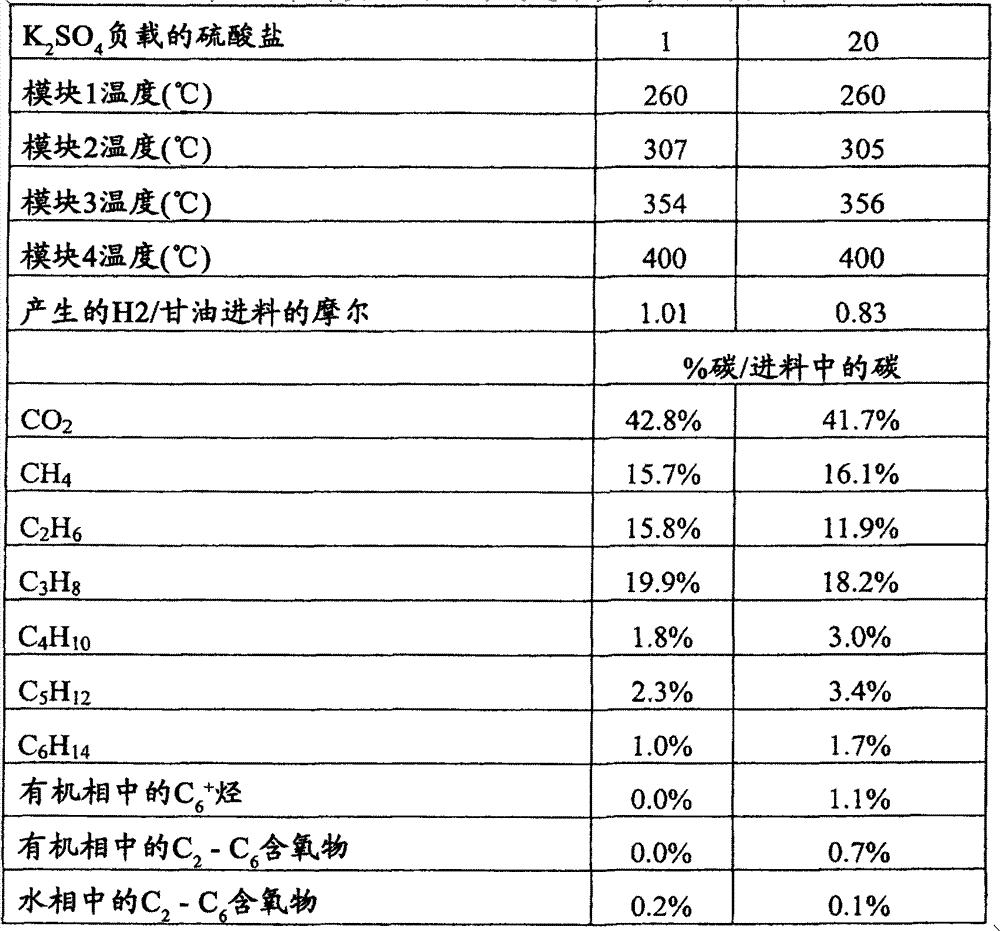
实施例36 Example 36
使用初湿技术制备在活性炭(Calgon UU 60×120目的碳)上负载的、含有铂和铼的双金属催化剂系统(5wt%铂,Pt∶Re的摩尔比为1∶5)。将活性炭缓慢添加至30%过氧化氢溶液中。完成碳的添加后,使该混合物静置过夜。倾析水相并用去离子水将该碳洗涤三次,然后将碳在100℃下在真空下干燥。具有与用于待浸渍的碳的初湿体积相等的体积并且含有氯铂 酸六水合物(Alfa Aesar,39.85%Pt)和高铼酸溶液(Alfa Aesar,76.41%HReO4)的水溶液在搅拌下被逐滴应用于过氧化氢官能化的碳。然后湿的碳在真空下于100℃下干燥。 A bimetallic catalyst system containing platinum and rhenium (5 wt% platinum, Pt:Re molar ratio 1:5) supported on activated carbon (Calgon UU 60 x 120 mesh carbon) was prepared using the incipient wetness technique. Activated charcoal was slowly added to the 30% hydrogen peroxide solution. After the carbon addition was complete, the mixture was allowed to stand overnight. The aqueous phase was decanted and the carbon was washed three times with deionized water, then the carbon was dried at 100°C under vacuum. An aqueous solution having a volume equal to the incipient wetness volume for the carbon to be impregnated and containing chloroplatinic acid hexahydrate (Alfa Aesar, 39.85% Pt) and perrhenic acid solution (Alfa Aesar, 76.41% HReO 4 ) was stirred was applied dropwise to the hydrogen peroxide functionalized carbon. The wet carbon was then dried under vacuum at 100°C.
实施例37 Example 37
将实施例36中描述的11.97克1∶5Pt/Re催化剂装入如实施例4中所述的8.5mm直径的不锈钢管和实施例1中说明的反应器系统中。在液体进料被引入催化剂床之前,将催化剂用流动的氢气在350℃下还原2小时。含有0ppm硫酸盐的57.2wt%山梨醇溶液的水溶液以1.20克山梨醇每克催化剂每小时的WHSV向下流过反应器。模块加热器被控制成使得反应器的第一个10.1cm保持在260℃、反应器的第二个10.1cm在260℃、反应器的下一个10.1cm在360℃、且反应器的最后的10.1cm在410℃。使分离器压力保持在600psig。来自反应器的流出物用水冷冷凝器冷却并在三相分离器中分离。产物馏分按照实施例5中所述进行分析。此外,将有机相收集、分离、并称重,将样品送至Southwest Research Institute(San Antonia,Texas),用于汽油分析。在该系统中,存在甘油的完全转化。下表11显示氢气的收率以及含碳的产物化合物的收率。 11.97 grams of the 1:5 Pt/Re catalyst described in Example 36 were charged into an 8.5 mm diameter stainless steel tube as described in Example 4 and the reactor system described in Example 1 . The catalyst was reduced with flowing hydrogen at 350°C for 2 hours before the liquid feed was introduced into the catalyst bed. An aqueous solution of 57.2 wt% sorbitol solution containing 0 ppm sulfate was passed down the reactor at a WHSV of 1.20 grams of sorbitol per gram of catalyst per hour. The block heaters were controlled such that the first 10.1 cm of the reactor was maintained at 260°C, the second 10.1 cm of the reactor was at 260°C, the next 10.1 cm of the reactor was at 360°C, and the last 10.1 cm of the reactor was at 260°C. cm at 410°C. The separator pressure was maintained at 600 psig. The effluent from the reactor was cooled with a water-cooled condenser and separated in a three-phase separator. Product fractions were analyzed as described in Example 5. In addition, the organic phase was collected, separated, and weighed, and samples were sent to Southwest Research Institute (San Antonia, Texas) for gasoline analysis. In this system, there is complete conversion of glycerol. Table 11 below shows the yield of hydrogen gas as well as the yield of carbon-containing product compounds. the
表11.来自实施例37的氢气和含碳产物的收率 Table 11. Yields of hydrogen and carbonaceous products from Example 37

使用酸性催化剂的含氧物至C5+化合物的转化 Conversion of oxygenates to C5 + compounds using acidic catalysts
实施例38 Example 38
制备1.0摩尔的硝酸镧水溶液并将其添加至H-丝光沸石挤出物(BASF712A-5-2641-1)中,目标为在随后金属母体分解之后在催化剂上3重量%La。所述La溶液与催化剂简单地混合并然后在80℃下浸泡6小时。然后除去过量的液体并用去离子水漂洗催化剂。然后将催化剂在真空炉中干燥并在550℃的空气中煅烧。这之后,研磨催化剂并筛分以将颗粒粒度限制为在通过18目筛后保持在60目筛上的粒度。 A 1.0 molar aqueous solution of lanthanum nitrate was prepared and added to the H-mordenite extrudate (BASF712A-5-2641-1), targeting 3 wt% La on the catalyst after subsequent metal precursor decomposition. The La solution was briefly mixed with the catalyst and then soaked at 80°C for 6 hours. Excess liquid was then removed and the catalyst was rinsed with deionized water. The catalyst was then dried in a vacuum oven and calcined in air at 550 °C. After this, the catalyst was ground and sieved to limit the particle size to that which would remain on the 60 mesh screen after passing through the 18 mesh screen. the
实施例39 Example 39
将去离子水添加至H-丝光沸石挤出物(BASF 712A-5-2641-1,粒度限制为在通过18目筛后保持在60目筛上的粒度)中,直至额外的水覆盖载体。然后将0.36摩尔硝酸镍水溶液添加至湿的载体,目标为在金属母体分解后1重量%Ni。将催化剂简单地混合并使其浸泡48小时。然后将催化剂在真空炉中干燥并在400℃下的空气中煅烧。 Deionized water was added to the H-mordenite extrudate (BASF 712A-5-2641-1, particle size limited to a particle size that remained on a 60 mesh screen after passing through an 18 mesh screen) until additional water covered the support. A 0.36 molar aqueous solution of nickel nitrate was then added to the wet support, targeting 1 wt% Ni after decomposition of the metal precursor. The catalyst was briefly mixed and allowed to soak for 48 hours. The catalyst was then dried in a vacuum oven and calcined in air at 400°C. the
实施例40 Example 40
制备1.0摩尔的氯化铕水溶液并将其添加至H-丝光沸石(BASF712A-5-2641-1,粒度限制为在通过18目筛后保持在60目筛上的粒度),目标为在随后金属母体分解之后在催化剂上3重量%Eu。所述Eu溶液与催化剂简单地混合并然后在80℃下浸泡6小时。然后除去过量的液体并用 去离子水漂洗催化剂。然后将催化剂在真空炉中干燥并在550℃的空气中煅烧。这之后,研磨催化剂并筛分以将粒度限制为在通过18目筛后保持在60目筛上的粒度。 A 1.0 molar aqueous solution of europium chloride was prepared and added to H-mordenite (BASF712A-5-2641-1, particle size limited to remain on 60 mesh after passing through 18 mesh), targeting 3 wt% Eu on catalyst after precursor decomposition. The Eu solution was briefly mixed with the catalyst and then soaked at 80°C for 6 hours. Excess liquid was then removed and the catalyst was rinsed with deionized water. The catalyst was then dried in a vacuum oven and calcined in air at 550 °C. After this, the catalyst was ground and sieved to limit the particle size to that which remained on the 60 mesh screen after passing through the 18 mesh screen. the
实施例41 Example 41
将H-β沸石挤出物(1.6mm直径的挤出物)研磨并筛分以将粒度限制为在通过18目筛后保持在60目筛上的粒度。通过初湿添加硝酸镓水溶液,目标为在金属母体分解之后在催化剂上1.2重量%Ga。然后将催化剂在真空炉中干燥并在400℃的空气中煅烧。 The H-beta zeolite extrudate (1.6 mm diameter extrudate) was ground and sieved to limit the particle size to that which remained on the 60 mesh screen after passing through the 18 mesh screen. Aqueous gallium nitrate was added by incipient wetness, targeting 1.2 wt% Ga on the catalyst after metal precursor decomposition. The catalyst was then dried in a vacuum oven and calcined in air at 400 °C. the
实施例42 Example 42
磷酸用去离子水稀释并通过初湿添加至Davicat SiO2/Al2O3载体(Grace-Davis,粒度限制为在通过18目筛后保持在60目筛上的粒度),目标为在催化剂上5重量%磷。然后将催化剂在真空炉中干燥过夜,并随后在500℃的流动的空气流中煅烧。
Phosphoric acid was diluted with deionized water and added via incipient wetness to a Davicat SiO2 / Al2O3 support (Grace-Davis, particle size limited to a particle size that remains on a 60 mesh screen after passing through an 18 mesh screen), targeting on the
实施例43 Example 43
使用初湿技术将硝酸镍水溶液添加至结合氧化铝的ZSM-5沸石制剂(SiO2∶Al2O3 30∶1,粒度限制为在通过18目筛后保持在60目筛上的粒度),目标为1.0重量%的镍负载。将该制剂在真空炉中干燥过夜,并随后在400℃的流动的空气流中煅烧。 An aqueous solution of nickel nitrate was added to an alumina-bound ZSM-5 zeolite formulation ( Si02 : Al203 30 :1, particle size limited to a particle size that remained on a 60 mesh screen after passing through a 18 mesh screen) using the incipient wetness technique, A nickel loading of 1.0 wt% was targeted. The formulation was dried overnight in a vacuum oven and subsequently calcined at 400°C in a flowing air stream.
实施例44 Example 44
使用初湿技术将硝酸镓水溶液添加至结合氧化铝的ZSM-5沸石制剂(SiO2∶Al2O3 80∶1,粒度限制为在通过18目筛后保持在60目筛上的粒度),目标为1.2重量%的镓负载。将该制剂在真空炉中干燥过夜,并随后在400℃的流动的空气流中煅烧。 An aqueous solution of gallium nitrate was added to an alumina-bound ZSM-5 zeolite formulation ( Si02 : Al203 80 :1, particle size limited to a particle size that remained on a 60 mesh screen after passing through a 18 mesh screen) using the incipient wetness technique, A gallium loading of 1.2 wt% was targeted. The formulation was dried overnight in a vacuum oven and subsequently calcined at 400°C in a flowing air stream.
实施例45 Example 45
就在从325℃至375℃的温度和200psig和625psig之间的总压力以及从1.9至42.8范围内的WHSV下的多种含氧物的汽相缩合,研究使用实施例38至实施例44的方法制备的催化剂系统。在这些研究中,使用两种不 同尺寸的反应器;将15毫升和18毫升的催化剂装入8.5mm内径的不锈钢管反应器中,或者将在50毫升和70毫升之间的催化剂装入21.2mm不锈钢管反应器(实施例4)中。取决于原料,反应工艺流如实施例1或实施例3所述,同时如实施例5所述完成分析。 Vapor phase condensation of various oxygenates at temperatures from 325°C to 375°C and total pressures between 200 psig and 625 psig and WHSV ranging from 1.9 to 42.8 were studied using samples from Examples 38 to 44. Catalyst system prepared by method. In these studies, two different sized reactors were used; 15 mL and 18 mL of catalyst packed into 8.5 mm internal diameter stainless steel tube reactors, or between 50 mL and 70 mL of catalyst packed into 21.2 mm stainless steel tube reactor (Example 4). Depending on the starting material, the reaction process stream was as described in Example 1 or Example 3, while the analysis was done as described in Example 5. the
操作条件和来自这些试验的结果在表12中显示。当进料组成总计小于100%时,剩余物是水。如这些结果显示,多种含氧物(包括醇和酮,3个碳和5个碳)是可经宽范围的条件转化为C5+烃的基质。沸石在这些转化中是特别有用的,如试验FF、GG、HH、II、JJ、LL和MM所示。试验FF、GG、HH、II和JJ显示,经丝光沸石和β沸石的醇转化的主要产物是烯烃的缩合产物。磷浸渍的硅铝催化剂(试验KK)显示出类似的产物选择性分布(product selectivity profile)。与此对比,基于ZSM-5的催化剂(试验LL和MM)制备出显著馏分的芳族组分和链烷烃组分。 The operating conditions and results from these tests are shown in Table 12. When the feed composition amounts to less than 100%, the remainder is water. As these results show, a variety of oxygenates, including alcohols and ketones, 3 carbons and 5 carbons, are substrates that can be converted to C5 + hydrocarbons over a wide range of conditions. Zeolites are particularly useful in these transformations, as shown by runs FF, GG, HH, II, JJ, LL and MM. Experiments FF, GG, HH, II and JJ show that the major products of alcohol conversion via mordenite and beta zeolite are condensation products of olefins. The phosphorus impregnated silica alumina catalyst (run KK) showed a similar product selectivity profile. In contrast, the ZSM-5 based catalysts (runs LL and MM) produced significant fractions of aromatic and paraffinic components.

从氧化烃制备C5+化合物 Preparation of C 5+ compounds from oxygenated hydrocarbons
实施例46 Example 46
按照与实施例44相同的催化剂制备工艺,除了结合氧化铝的ZSM-5材料具有30∶1的SiO2∶Al2O3比例之外。 The same catalyst preparation procedure as in Example 44 was followed, except that the alumina-bound ZSM-5 material had a 30:1 SiO2 : Al2O3 ratio.
实施例47 Example 47
就在375℃和200psig下的含氧物的混合物的汽相缩合,研究使用实施例46的方法制备的催化剂。在这一研究中,将11.3克催化剂装入如实施例4所述的8.5mm内径的不锈钢管反应器中。反应工艺流如实施例3所述。含氧物混合包含(重量比)25%2-戊酮、20%3-戊酮、20%2-戊醇、10%异丙醇、10%戊酸、5%2-甲基四氢呋喃。使用实施例3的反应器系统中的一个泵添加该混合物,而第二泵添加水,以使得全部的总进料包含60重量%水和40重量%混合含氧物。 A catalyst prepared using the method of Example 46 was investigated for vapor phase condensation of a mixture of oxygenates at 375°C and 200 psig. In this study, 11.3 grams of catalyst were charged into an 8.5 mm internal diameter stainless steel tube reactor as described in Example 4. The reaction process flow is as described in Example 3. The oxygenate mix contained (by weight) 25% 2-pentanone, 20% 3-pentanone, 20% 2-pentanol, 10% isopropanol, 10% valeric acid, 5% 2-methyltetrahydrofuran. One pump in the reactor system of Example 3 was used to add this mixture, while a second pump added water, so that the overall total feed contained 60% by weight water and 40% by weight mixed oxygenates. the
监测工艺128小时的时间段,从系统中周期性地除去样品以催化分析工艺性能。按照实施例5所述完成每次分析。图15将以C5+化合物离开反应器系统的进料碳的馏分显示为时间的函数。图16将以芳烃离开反应器系统的进料碳的馏分显示为时间的函数。图14将以含氧物离开反应器系统的进料碳的馏分显示为时间的函数。 The process was monitored for a period of 128 hours and samples were periodically removed from the system to catalytically analyze process performance. Each analysis was performed as described in Example 5. Figure 15 shows the fraction of feed carbon leaving the reactor system as C5 + compounds as a function of time. Figure 16 shows the fraction of feed carbon leaving the reactor system as aromatics as a function of time. Figure 14 shows the fraction of feed carbon leaving the reactor system as oxygenates as a function of time.
如图14、15和16所示,催化剂系统能够对含氧物混合物运行一段延长的时间,所述含氧物混合物包含包括醇、酮、酸和四氢呋喃在内的含氧物的混合物。C5+化合物的制备随时间保持相对稳定,而存在于产物中的芳烃的量下降并且含氧化合物的临界点(breakthrough)增加(图14)。认为催化剂的钝化主要是由于含碳沉积物的积聚限制了反应物向活性部位的可达性。 As shown in Figures 14, 15 and 16, the catalyst system is capable of operating for an extended period of time on an oxygenate mixture comprising a mixture of oxygenates including alcohols, ketones, acids and tetrahydrofuran. The production of C5 + compounds remained relatively stable over time, while the amount of aromatics present in the product decreased and the breakthrough of oxygenates increased (Figure 14). The deactivation of the catalyst is believed to be mainly due to the accumulation of carbonaceous deposits that limit the accessibility of the reactants to the active sites.
实施例48 Example 48
使用初湿技术将六氯合铂酸与高铼酸的水溶液添加至碳催化剂载体(OLC-AW,Calgon,粒度限制为在通过120目筛后保持在50目筛上的粒度),目标为在随后金属母体分解后在催化剂上1.8%的铂负载和6.3%的铼负载。该制剂在真空炉中干燥过夜并随后在400℃下、流动的氢气流中 还原。还原后,催化剂贮存在氮气氛中直至准备使用。 An aqueous solution of hexachloroplatinic acid and perrhenic acid was added to a carbon catalyst support (OLC-AW, Calgon, particle size limited to remain on a 50 mesh screen after passing through a 120 mesh screen) using the incipient wetness technique, targeting at 1.8% platinum loading and 6.3% rhenium loading on the catalyst after subsequent metal precursor decomposition. The formulation was dried overnight in a vacuum oven and then reduced at 400°C in a flowing stream of hydrogen. After reduction, the catalyst was stored under a nitrogen atmosphere until ready for use. the
实施例49 Example 49
按照与实施例44相同的催化剂制备工艺,除了结合氧化铝的ZSM-5材料具有150∶1的SiO2∶Al2O3比例之外。 The same catalyst preparation procedure as in Example 44 was followed, except that the alumina-bound ZSM-5 material had a SiO2 : Al2O3 ratio of 150: 1 .
实施例50 Example 50
使用初湿技术将溶解在水中的六氯合铂酸与高铼酸添加至单斜的氧化锆催化剂载体(NorPro Saint Gobain,产品代码SZ31164,粒度限制为在通过18目筛后保持在60目筛上的粒度),目标为在随后金属母体分解后在催化剂上达到1.8%的铂负载和6.3%的铼负载。该制剂在真空炉中干燥并过夜,并随后在400℃的流动的空气流中煅烧。 Hexachloroplatinic acid and perrhenic acid dissolved in water were added to a monoclinic zirconia catalyst support (NorPro Saint Gobain, product code SZ31164, particle size limited to remain at 60 mesh after passing through an 18 mesh sieve using the incipient wetness technique. Particle size on the catalyst), aiming to achieve a platinum loading of 1.8% and a rhenium loading of 6.3% on the catalyst after subsequent decomposition of the metal precursor. The formulation was dried overnight in a vacuum oven and then calcined at 400°C in a flowing air stream. the
实施例51 Example 51
按照与用于制备实施例50的催化剂相同的方法,除了目标铼负载为1.8%之外。 The same procedure was followed as used to prepare the catalyst of Example 50, except that the target rhenium loading was 1.8%. the
实施例52 Example 52
将80∶1 SiO2∶Al2O3比例的ZSM-5沸石(Zeolyst International,CBV8014)与1∶1摩尔比的ZnO和Al2O3粉末相混合以便合并的ZnO和Al2O3(Dispal 18N4-80,Sasol North America,Houston,Texas)占全部固体的30重量%。将稀硝酸以2重量%的HNO3的水平添加至合并的ZnO和Al2O3。膏团稠度用添加水来调节以形成适于挤压的可操作的膏团,并且使用实验室规模的挤压机挤压该混合物。挤出物在真空下、100℃下干燥过夜,并随后在流动的空气下、600℃下煅烧。 ZSM- 5 zeolite (Zeolyst International, CBV8014) with a ratio of 80: 1 SiO2 : Al2O3 was mixed with ZnO and Al2O3 powders at a molar ratio of 1:1 so that the combined ZnO and Al2O3 (Dispal 18N4-80, Sasol North America, Houston, Texas) at 30% by weight of total solids. Dilute nitric acid was added to the combined ZnO and Al 2 O 3 at a level of 2% by weight of HNO 3 . The dough consistency was adjusted with the addition of water to form a workable dough suitable for extrusion, and the mixture was extruded using a laboratory scale extruder. The extrudates were dried under vacuum at 100°C overnight and subsequently calcined at 600°C under flowing air.
实施例53 Example 53
使用初湿技术将硝酸镓的水溶液添加至实施例52的材料(粒度限制为在通过18目筛后保持在60目筛上的粒度),目标为1.2重量%的镓负载。该制剂在真空炉中干燥过夜,并随后在400℃的流动的氢气流中煅烧。 An aqueous solution of gallium nitrate was added to the Example 52 material using the incipient wetness technique (particle size limited to remain on a 60 mesh screen after passing through an 18 mesh screen), targeting a gallium loading of 1.2 wt%. The formulation was dried overnight in a vacuum oven and then calcined in a flowing hydrogen stream at 400°C. the
实施例54 Example 54
使用初湿技术将硝酸镍的水溶液添加至实施例52的材料(粒度限制 为在通过18目筛后保持在60目筛上的粒度),目标为1.0重量%的镍负载。该制剂在真空炉中干燥过夜,并随后在400℃的流动的氢气流中煅烧。 An aqueous solution of nickel nitrate was added to the Example 52 material using the incipient wetness technique (particle size limited to remain on a 60 mesh screen after passing through an 18 mesh screen), targeting a nickel loading of 1.0 wt%. The formulation was dried overnight in a vacuum oven and then calcined in a flowing hydrogen stream at 400°C. the
实施例55 Example 55
就甘油、山梨醇、蔗糖、和木糖向烃的转化,使用实施例2中描述的反应器配置研究实施例6、实施例46、实施例48、实施例49、实施例51、实施例52和实施例54中提及的催化剂系统。使用实施例4中所示的两个21.2mm内径的不锈钢管反应器实施所述研究,并按照实施例5中所述完成分析。将钨酸化氧化锆(NorPro-Saint Gobain,产品代码SZ61143,粒度限制为在通过18目筛后保持在60目筛上的粒度)置于设置在第二反应器中的缩合催化剂的顶部,以提供在进入缩合催化剂之前用于蒸发第一反应器流出物的区域。 Example 6, Example 46, Example 48, Example 49, Example 51, Example 52 were studied for the conversion of glycerol, sorbitol, sucrose, and xylose to hydrocarbons using the reactor configuration described in Example 2 and the catalyst system mentioned in Example 54. The study was carried out using two 21.2 mm internal diameter stainless steel tube reactors as shown in Example 4 and the analysis was done as described in Example 5. Tungstated zirconia (NorPro-Saint Gobain, product code SZ61143, particle size limited to remain on a 60 mesh screen after passing through an 18 mesh screen) was placed on top of the condensation catalyst disposed in the second reactor to provide Zone for vaporizing the first reactor effluent before entering the condensation catalyst. the
表13显示这些研究的结果。对于试验NN(38%蔗糖+7%木糖),具有等于蔗糖摩尔数的3倍加木糖摩尔数的1.5倍的目标流速的氢气流与进料在进入反应器之前合并。其他试验在没有外部提供的氢气的情况下进行。在图9中显示为10a、10b、10c、10d、23a、23b、23c和23d的反应器外部的加热器用于保持反应器壁温度,如表13所示。这些研究的烃产物(在表13中揭示)被分为C4-馏分和C5+馏分,所述C4-馏分在环境温度和压力下主要存在于气相中,所述C5+馏分通常适于并入液体燃料。结果显示,多种糖和多元醇可通过这里描述的工艺而容易地转化为C5+烃。产物主要包含链烷烃和芳族成分。在该样品中的链烷烃和芳族化合物的分解在图17中显示。 Table 13 shows the results of these studies. For trial NN (38% sucrose + 7% xylose), a hydrogen stream with a target flow rate equal to 3 times the moles of sucrose plus 1.5 times the moles of xylose was combined with the feed before entering the reactor. Other tests were performed without externally supplied hydrogen. Heaters outside the reactor shown as 10a, 10b, 10c, 10d, 23a, 23b, 23c and 23d in FIG. 9 were used to maintain the reactor wall temperature as shown in Table 13. The hydrocarbon products of these studies (revealed in Table 13) were divided into a C4 - fraction, which exists mainly in the gas phase at ambient temperature and pressure, and a C5+ fraction , which is usually Suitable for incorporation into liquid fuels. The results show that a variety of sugars and polyols can be readily converted to C5 + hydrocarbons by the process described here. The product mainly contains paraffinic and aromatic components. The decomposition of paraffins and aromatics in this sample is shown in FIG. 17 .
表13.糖和多元醇至C5+烃的转化 Table 13. Conversion of sugars and polyols to C5+ hydrocarbons

实施例56 Example 56
在实施例55中描述并由表13中的试验QQ例示的工艺运行超过400小时的时间段。在运行一段初始时间之后,向芳香组分的转化和烃的收率下降,在图18和图19中以周期1显示。在图18中,存在于第二反应器出口处的C5+烃的热值显示为进料的热值的百分比。在图19中,以芳烃存在于第二反应器的出口处的碳显示为存在于进料中的碳的百分比。在约120运行小时后,第二反应器被绕过而第一反应器继续运行。然后在第二反应器中进行催化剂的氧化再生。在再生期间,启动氮气和空气流以便在第二反应器入口处的目标氧浓度为1mol%。然后将第二反应器的模块温度升高至500℃并且继续氮气和氧气流直至在第二反应器的出口处不再检测到二氧化碳。然后氧浓度升高至5mol%的目标水平。继续该流直至在第二反应器的出口处不再检测到二氧化碳。此时,停止氧气流而继续氮气流。然后第二反应器模块温度降低至400℃而流经催化剂床的气体的组成改为氢气。然后将第二反应器的模块温度调整为表13中试验QQ所示的温度。然后第二反应器被放回联机状态,目标是表13中试验QQ所示的条件。然后第二反应器经过多个运行和再生周期,对于运行期间的结果在图18和19中显示。如这些结果显示,缩合催化剂的再生使得活性恢复,与以下理论相一致:含碳材料的沉积是催化剂性能随时间下降的主要原因。此外,结果显示,缩合催化剂可多次再生而没有显著的性能损失。
The process described in Example 55 and exemplified by Test QQ in Table 13 was run over a period of 400 hours. After an initial period of operation, the conversion to aromatic components and the yield of hydrocarbons decreased, shown as
Claims (179)

Applications Claiming Priority (13)
| Application Number | Priority Date | Filing Date | Title |
|---|---|---|---|
| US90570307P | 2007-03-08 | 2007-03-08 | |
| US60/905,703 | 2007-03-08 | ||
| US11/800,671 US7767867B2 (en) | 2006-05-08 | 2007-05-07 | Methods and systems for generating polyols |
| US11/800,671 | 2007-05-07 | ||
| US98547507P | 2007-11-05 | 2007-11-05 | |
| US98550007P | 2007-11-05 | 2007-11-05 | |
| US60/985,500 | 2007-11-05 | ||
| US60/985,475 | 2007-11-05 | ||
| US11/961,280 | 2007-12-20 | ||
| USPCT/US2007/088417 | 2007-12-20 | ||
| PCT/US2007/088417 WO2008140617A2 (en) | 2006-12-20 | 2007-12-20 | Reactor system for producing gaseous products |
| US11/961,280 US20100288975A1 (en) | 2006-12-20 | 2007-12-20 | Reactor system for producing gaseous products |
| PCT/US2008/056330 WO2008109877A1 (en) | 2007-03-08 | 2008-03-07 | Synthesis of liquid fuels and chemicals from oxygenated hydrocarbons |
Publications (2)
| Publication Number | Publication Date |
|---|---|
| CN101679874A CN101679874A (en) | 2010-03-24 |
| CN101679874B true CN101679874B (en) | 2013-10-23 |
Family
ID=40568250
Family Applications (1)
| Application Number | Title | Priority Date | Filing Date |
|---|---|---|---|
| CN2008800075532A Active CN101679874B (en) | 2007-03-08 | 2008-03-07 | Synthesis of liquid fuels and chemicals from oxygenated hydrocarbons |
Country Status (12)
| Country | Link |
|---|---|
| EP (2) | EP2698416B1 (en) |
| JP (1) | JP5519296B2 (en) |
| KR (1) | KR101366388B1 (en) |
| CN (1) | CN101679874B (en) |
| AU (1) | AU2008222628B2 (en) |
| CA (1) | CA2677826C (en) |
| CO (1) | CO6231047A2 (en) |
| ES (1) | ES2446542T3 (en) |
| MX (1) | MX316324B (en) |
| NZ (1) | NZ579525A (en) |
| PL (2) | PL2698416T3 (en) |
| WO (1) | WO2008109877A1 (en) |
Cited By (2)
| Publication number | Priority date | Publication date | Assignee | Title |
|---|---|---|---|---|
| CN105646131A (en) * | 2016-03-22 | 2016-06-08 | 天津大学 | Fuel molecule with spirocyclic hydrocarbon structure and preparation method thereof |
| CN109759105A (en) * | 2019-03-08 | 2019-05-17 | 宁夏大学 | A kind of methanol synthesis catalyst |
Families Citing this family (143)
| Publication number | Priority date | Publication date | Assignee | Title |
|---|---|---|---|---|
| US8231857B2 (en) | 2005-12-21 | 2012-07-31 | Virent, Inc. | Catalysts and methods for reforming oxygenated compounds |
| NZ577547A (en) | 2006-12-20 | 2012-05-25 | Virent Inc | Reactor system for producing gaseous products |
| US8017818B2 (en) * | 2007-03-08 | 2011-09-13 | Virent Energy Systems, Inc. | Synthesis of liquid fuels and chemicals from oxygenated hydrocarbons |
| US8158842B2 (en) * | 2007-06-15 | 2012-04-17 | Uop Llc | Production of chemicals from pyrolysis oil |
| WO2009037281A2 (en) * | 2007-09-18 | 2009-03-26 | Basf Se | Method for hydrogenating separation of lignin using transition metal carbides |
| EP2238217A1 (en) | 2008-02-01 | 2010-10-13 | Johnson Matthey PLC | Process for the conversion of fatty acids and derivatives thereof |
| AU2009233957B2 (en) * | 2008-04-06 | 2013-09-26 | Battelle Memorial Institute | Fuel and fuel blending components from biomass derived pyrolysis oil |
| AU2009285699B2 (en) * | 2008-08-27 | 2014-04-10 | Virent, Inc. | Synthesis of liquid fuels from biomass |
| US8697924B2 (en) | 2008-09-05 | 2014-04-15 | Shell Oil Company | Liquid fuel compositions |
| CA2763777C (en) | 2009-06-13 | 2017-10-17 | Rennovia Inc. | Production of adipic acid and derivatives from carbohydrate-containing materials |
| BRPI1013087B1 (en) | 2009-06-13 | 2018-05-15 | Rennovia, Inc. | PROCESS FOR PREPARING A GLUTARIC ACID PRODUCT |
| US8669397B2 (en) | 2009-06-13 | 2014-03-11 | Rennovia, Inc. | Production of adipic acid and derivatives from carbohydrate-containing materials |
| GB0913193D0 (en) | 2009-07-29 | 2009-09-02 | Johnson Matthey Plc | Deoxygenation process |
| US8962896B2 (en) | 2009-09-11 | 2015-02-24 | E I Du Pont De Nemours And Company | Conversion of ethanol to a reaction product comprising 1-butanol using hydroxyapatite catalysts |
| ES2586831T3 (en) | 2009-09-30 | 2016-10-19 | Ts03 Inc. | Sterilization method |
| ES2362248B1 (en) | 2009-12-11 | 2012-05-10 | Universidad Politecnica De Valencia | LIQUID FUEL PRODUCTION (SYLVAN-LIQUID FUELS) FROM 2-METHYLFURAN. |
| BR112012015511A2 (en) * | 2009-12-22 | 2016-05-03 | Conocophillips Co | carbohydrate to hydrocarbon conversion |
| US9447347B2 (en) * | 2009-12-31 | 2016-09-20 | Shell Oil Company | Biofuels via hydrogenolysis-condensation |
| US9303226B2 (en) | 2009-12-31 | 2016-04-05 | Shell Oil Company | Direct aqueous phase reforming of bio-based feedstocks |
| US8669393B2 (en) | 2010-03-05 | 2014-03-11 | Rennovia, Inc. | Adipic acid compositions |
| JP5515114B2 (en) * | 2010-03-31 | 2014-06-11 | 株式会社日本触媒 | Method for producing lactic acid using indium compound |
| WO2011125882A1 (en) * | 2010-03-31 | 2011-10-13 | 株式会社日本触媒 | Method for producing lactic acids from starting materials containing carbohydrates |
| JP5858514B2 (en) * | 2010-03-31 | 2016-02-10 | 株式会社日本触媒 | Method for producing lactic acid using tin-containing compound |
| JP5783549B2 (en) * | 2010-10-29 | 2015-09-24 | 株式会社日本触媒 | Method for producing lactic acid using rhenium compound |
| MY157001A (en) | 2010-03-31 | 2016-04-15 | Nippon Catalytic Chem Ind | Method for producing lactic acids from carbohydrate -containing raw material |
| BR112012028663A2 (en) | 2010-05-12 | 2016-08-16 | Shell Int Research | method and system |
| BR112012028664A2 (en) | 2010-05-12 | 2016-08-16 | Shell Int Research | method and system |
| US9770705B2 (en) | 2010-06-11 | 2017-09-26 | Rennovia Inc. | Oxidation catalysts |
| KR101764924B1 (en) * | 2010-06-14 | 2017-08-04 | 에스케이이노베이션 주식회사 | Catalyst for glycerol aqueous phase reforming and preparation thereof |
| ES2371839B1 (en) | 2010-06-16 | 2012-11-19 | Consejo Superior De Investigaciones Científicas (Csic) | BIOMASS CONVERSION PROCESS IN LIQUID FUEL. |
| CN103201395B (en) | 2010-06-26 | 2016-03-02 | 威尔迪亚有限公司 | Sugar mixtures and methods for their production and use |
| IL206678A0 (en) | 2010-06-28 | 2010-12-30 | Hcl Cleantech Ltd | A method for the production of fermentable sugars |
| IL207329A0 (en) | 2010-08-01 | 2010-12-30 | Robert Jansen | A method for refining a recycle extractant and for processing a lignocellulosic material and for the production of a carbohydrate composition |
| IL207945A0 (en) | 2010-09-02 | 2010-12-30 | Robert Jansen | Method for the production of carbohydrates |
| EP2628781B1 (en) * | 2010-10-11 | 2023-02-22 | SK Innovation Co., Ltd. | Method for producing biodiesel |
| US8993818B2 (en) | 2010-10-14 | 2015-03-31 | Phillips 66 Company | Combination of zeolite upgrading with hydrogenation upgrading to produce renewable gasoline from biomass |
| US8377152B2 (en) * | 2010-10-29 | 2013-02-19 | Kior, Inc. | Production of renewable bio-distillate |
| AU2011348031A1 (en) | 2010-12-24 | 2013-06-27 | Sapphire Energy, Inc. | Production of aromatics from renewable resources |
| US9212316B2 (en) | 2010-12-30 | 2015-12-15 | Virent, Inc. | Serial deconstruction of biomass |
| KR20130132948A (en) * | 2010-12-30 | 2013-12-05 | 바이렌트, 아이엔씨. | Reductive biomass liquefaction |
| US9157030B2 (en) | 2010-12-30 | 2015-10-13 | Virent, Inc. | Solvolysis of biomass and stabilization of biomass hydrolysate |
| US9212315B2 (en) | 2010-12-30 | 2015-12-15 | Virent, Inc. | Methods for biomass deconstruction and purification |
| US9157031B2 (en) | 2010-12-30 | 2015-10-13 | Virent, Inc. | Solvolysis of biomass to produce aqueous and organic products |
| CA2820755C (en) | 2010-12-30 | 2019-01-08 | Virent, Inc. | Solvolysis of biomass using solvent from a bioreforming process |
| KR20130132954A (en) * | 2010-12-30 | 2013-12-05 | 바이렌트, 아이엔씨. | Organo-catalytic biomass deconstruction |
| US9593054B2 (en) | 2011-02-07 | 2017-03-14 | Virent, Inc. | Production of distillate fuels from biomass-derived polyoxygenates |
| US10619106B2 (en) | 2011-02-07 | 2020-04-14 | Virent, Inc. | Method and systems for making distillate fuels from biomass |
| WO2012137201A1 (en) | 2011-04-07 | 2012-10-11 | Hcl Cleantech Ltd. | Lignocellulose conversion processes and products |
| WO2012162403A1 (en) * | 2011-05-23 | 2012-11-29 | Virent, Inc. | Production of chemicals and fuels from biomass |
| CA2834979A1 (en) | 2011-05-27 | 2012-12-06 | The Regents Of The University Of California | Method to convert fermentation mixture into fuels |
| EP2720992B1 (en) | 2011-06-14 | 2015-07-29 | Shell Internationale Research Maatschappij B.V. | Co-production of biofuels and glycols |
| WO2012174087A1 (en) * | 2011-06-14 | 2012-12-20 | Shell Oil Company | Co-production of biofuels and glycols |
| CN102286548B (en) * | 2011-06-21 | 2013-08-21 | 中国科学院青岛生物能源与过程研究所 | Method for preparing dihydric alcohol from lignocellulosic biomass |
| JP5859366B2 (en) * | 2011-09-06 | 2016-02-10 | 三井金属鉱業株式会社 | Exhaust gas purification catalyst and exhaust gas purification catalyst structure |
| KR20150000453A (en) | 2011-09-16 | 2015-01-02 | 마이크로마이다스, 인코포레이티드 | Methods of producing para-xylene and terephthalic acid |
| CN102417824B (en) * | 2011-09-27 | 2015-05-20 | 中国科学院长春应用化学研究所 | Preparation method of hydrocarbon fuel |
| WO2013055785A1 (en) | 2011-10-10 | 2013-04-18 | Virdia Ltd | Sugar compositions |
| CN102417494A (en) * | 2011-12-09 | 2012-04-18 | 宁夏共享集团有限责任公司 | Production method of high-purity furfuryl alcohol |
| CN103170345B (en) * | 2011-12-23 | 2014-12-10 | 中国林业科学研究院木材工业研究所 | Supported catalyst, and preparation method and application thereof |
| CN103173243B (en) * | 2011-12-23 | 2015-02-18 | 中国林业科学研究院木材工业研究所 | Method for hydrofining biomass alcoholysis heavy oil |
| CN103173237B (en) * | 2011-12-23 | 2015-01-21 | 中国林业科学研究院木材工业研究所 | Biomass alcoholysis method and biomass alcoholysis oil preparation method |
| US20130303363A1 (en) | 2012-03-01 | 2013-11-14 | E I Du Pont De Nemours And Company | Conversion of ethanol to a reaction product comprising 1-butanol using hydroxyapatite catalysts |
| JP6182166B2 (en) | 2012-03-07 | 2017-08-16 | リサーチ・トライアングル・インスティチュート | Contact biomass pyrolysis method |
| US10155908B2 (en) | 2012-03-07 | 2018-12-18 | Research Triangle Institute | Catalyst compositions and use thereof in catalytic biomass pyrolysis |
| US8889938B2 (en) | 2012-03-15 | 2014-11-18 | Micromidas, Inc. | Methods of producing para-xylene |
| CN103361101A (en) * | 2012-04-09 | 2013-10-23 | 中国科学院化学研究所 | Catalytic conversion method for obtaining long-chain alkane from glycerin |
| CN102850157B (en) * | 2012-07-30 | 2015-03-18 | 华东理工大学 | Novel technique for preparing long-chain alkane efficiently through multifunctional catalyst in one-step method |
| US8946458B2 (en) | 2012-08-15 | 2015-02-03 | Virent, Inc. | Catalysts for hydrodeoxygenation of oxygenated hydrocarbons |
| US10131604B2 (en) | 2012-08-15 | 2018-11-20 | Virent, Inc. | Catalysts for hydrodeoxygenation of oxygenated hydrocarbons |
| US10392317B2 (en) | 2012-09-14 | 2019-08-27 | Micromidas, Inc. | Methods of producing para-xylene and terephthalic acid |
| US9249080B2 (en) | 2012-10-17 | 2016-02-02 | Anellotech, Inc. | Chemical intermediates by catalytic fast pyrolysis process |
| CN103896730B (en) * | 2012-12-25 | 2015-11-25 | 中国科学院大连化学物理研究所 | A kind of method utilizing lactic acid or lactic acid salt preparing liquid fuel |
| KR101436429B1 (en) | 2013-01-18 | 2014-09-01 | 고려대학교 산학협력단 | The method of cyclic-hydrocarbon production using supported noble metal catalysts from lignin-derivatives |
| WO2014137293A1 (en) * | 2013-03-06 | 2014-09-12 | National University Of Singapore | A method for preparing a highly dispersed supported metal catalyst |
| DK2970775T3 (en) * | 2013-03-14 | 2022-11-21 | Virent Inc | Production of aromatics from di- and poly-oxygenates |
| US20140275688A1 (en) * | 2013-03-14 | 2014-09-18 | Exxonmobil Research And Engineering Company | Methods for producing basestocks from renewable sources using dewaxing catalyst |
| JP6181537B2 (en) * | 2013-03-29 | 2017-08-16 | 出光興産株式会社 | FUEL OIL BASE, FUEL OIL COMPOSITION CONTAINING THE FUEL OIL BASE, AND JET FUEL COMPOSITION |
| CN104119207B (en) * | 2013-04-26 | 2016-08-10 | 中国科学院大连化学物理研究所 | Method for preparing ethylene glycol by catalytic conversion of carbohydrates |
| CN105308015A (en) | 2013-04-26 | 2016-02-03 | 加利福尼亚大学董事会 | fuel manufacturing method |
| CN104232140B (en) * | 2013-06-09 | 2016-05-25 | 中国科学院大连化学物理研究所 | A kind of method of synthesizing high density aviation fuel taking cyclopentanone as raw material |
| CN108043476A (en) * | 2013-06-18 | 2018-05-18 | 株式会社大赛璐 | The manufacturing method of the renovation process of hydrogenation catalyst and the hydride of polyalcohol |
| JP6318479B2 (en) * | 2013-06-21 | 2018-05-09 | 宇部興産株式会社 | Catalyst, catalyst production method, and polyol compound production method using the same |
| CN104560102B (en) * | 2013-10-29 | 2016-05-18 | 中国石油化工股份有限公司 | A kind of method that improves quality of bio-oil |
| RU2544017C1 (en) | 2014-01-28 | 2015-03-10 | Ольга Васильевна Малова | Catalyst and method for aromatisation of c3-c4 gases, light hydrocarbon fractions of aliphatic alcohols, as well as mixtures thereof |
| RU2558955C1 (en) | 2014-08-12 | 2015-08-10 | Общество С Ограниченной Ответственностью "Новые Газовые Технологии-Синтез" | Method of producing aromatic hydrocarbon concentrate from liquid hydrocarbon fractions and apparatus therefor |
| RU2550354C1 (en) | 2014-03-28 | 2015-05-10 | Общество С Ограниченной Ответственностью "Новые Газовые Технологии-Синтез" | Method for producing aromatic hydrocarbon concentrate of light aliphatic hydrocarbons and device for implementing it |
| RU2544241C1 (en) | 2014-01-22 | 2015-03-20 | Общество С Ограниченной Ответственностью "Новые Газовые Технологии-Синтез" | Method of producing aromatic hydrocarbons from natural gas and apparatus therefor |
| BR112016021993A2 (en) | 2014-03-24 | 2017-10-24 | Bp Corp North America Inc | methods for producing cyclic and acyclic ketones |
| WO2015175571A1 (en) * | 2014-05-12 | 2015-11-19 | Virdia, Inc. | Hydrogenation of oxygenated molecules from biomass refining |
| US9714387B2 (en) | 2014-06-05 | 2017-07-25 | Alliance For Sustainable Energy, Llc | Catalysts and methods for converting carbonaceous materials to fuels |
| EP3172184A1 (en) * | 2014-07-25 | 2017-05-31 | SABIC Global Technologies B.V. | Synthesis of diacetone alcohol and mesityl oxide |
| JP6692024B2 (en) * | 2014-07-30 | 2020-05-13 | 出光興産株式会社 | Method for producing pentanol |
| KR101603610B1 (en) * | 2014-08-13 | 2016-03-15 | 한국화학연구원 | Nano-porous sponge or sheet type zeolite catalyst for synthesis of p-xylene from 2.5-dimethylfuran and ethylene |
| BR112017002624B1 (en) | 2014-08-15 | 2021-04-13 | Massachusetts Institute Of Technology | SYSTEMS FOR THE PRODUCTION OF A CHEMICAL PRODUCT |
| EP3212602A1 (en) | 2014-10-29 | 2017-09-06 | The Regents of the University of California | Methods for producing fuels, gasoline additives, and lubricants using amine catalysts |
| US10138193B2 (en) | 2014-10-29 | 2018-11-27 | The Regents Of The University Of California | Methods for producing fuels, gasoline additives, and lubricants using amine catalysts |
| US11078548B2 (en) | 2015-01-07 | 2021-08-03 | Virdia, Llc | Method for producing xylitol by fermentation |
| CN106478386B (en) * | 2015-08-24 | 2019-02-15 | 中国科学院大连化学物理研究所 | A kind of method for preparing 2-pentanone from ethanol |
| CN106478393B (en) * | 2015-08-24 | 2019-03-01 | 中国科学院大连化学物理研究所 | A method of with ethyl alcohol one-step synthesis 2 pentanone |
| CN105148922B (en) * | 2015-09-29 | 2017-08-04 | 河北大学 | NiB amorphous alloy catalyst and preparation method thereof |
| EP3170555A1 (en) * | 2015-11-20 | 2017-05-24 | Reliance Industries Limited | Naphtha reforming catalyst based on gallium- and/or zinc-modified zeolite, preparation thereof, and catalytic reforming process |
| CN106867574B (en) * | 2015-12-14 | 2019-08-13 | 北京化工大学 | A kind of efficient catalytic sorbierite liquid phase is restructured as C6The method of hydrocarbon |
| WO2017155424A1 (en) | 2016-03-09 | 2017-09-14 | Limited Liability Company "New Gas Technologies-Synthesis" (Llc "Ngt-Synthesis") | Method and plant for producing high-octane gasolines |
| WO2017192595A1 (en) | 2016-05-02 | 2017-11-09 | Massachusetts Institute Of Technology | Reconfigurable multi-step chemical synthesis system and related components and methods |
| CN107537516B (en) * | 2016-06-28 | 2020-05-12 | 中国石油化工股份有限公司 | Catalyst for preparing sec-butyl alcohol and preparation method thereof |
| JP6415755B2 (en) * | 2016-07-26 | 2018-10-31 | 昭和シェル石油株式会社 | Gasoline composition |
| CN106190344B (en) * | 2016-08-04 | 2017-11-14 | 浙江大学 | A kind of method and its fuel for preparing the compound hydrocarbon fuel of high energy |
| CN107759444A (en) * | 2016-08-16 | 2018-03-06 | 天津大学 | Do not reduce or application of the molybdenum series catalyst in organic chemistry product is produced by lignin of partial reduction multi-element metal oxide load |
| CN106542949A (en) * | 2016-10-26 | 2017-03-29 | 安徽理工大学 | A kind of preparation method of clean liquid biofuel |
| FI127332B (en) | 2016-12-23 | 2018-03-29 | Neste Oyj | Preparation of Fuel Composition |
| EP3594195A4 (en) | 2017-03-08 | 2021-01-27 | Mitsubishi Chemical Corporation | HYDRATION CATALYST FOR CARBONYL COMPOUNDS AND PROCESS FOR THE PRODUCTION OF ALCOHOLS |
| CN106944113A (en) * | 2017-04-07 | 2017-07-14 | 中国科学技术大学 | A kind of preparation method of hydrogenation catalyst and fatty alcohol |
| CN107383405B (en) * | 2017-08-02 | 2020-06-30 | 湖北工程学院 | A kind of composite proton exchange membrane and preparation method thereof |
| WO2019084657A1 (en) * | 2017-11-06 | 2019-05-09 | The Saskatchewan Research Council | Process for the production of hydrocarbon biofuels |
| CN109897659B (en) * | 2017-12-11 | 2021-02-05 | 中国科学院大连化学物理研究所 | Preparation method of liquid fuel |
| CN110117213B (en) * | 2018-02-06 | 2021-08-10 | 中国科学院大连化学物理研究所 | Method for synthesizing liquid cyclane from 2, 5-hexanedione |
| ES2732747B2 (en) * | 2018-05-25 | 2020-07-02 | Consejo Superior Investigacion | CATALYTIC PROCESS FOR THE PRODUCTION OF HYDROCARBONS AND AROMATIC COMPOUNDS FROM OXYGENATED COMPOUNDS PRESENT IN AQUEOUS MIXTURES |
| DE102018215394A1 (en) | 2018-09-11 | 2020-03-12 | Rheinisch-Westfälische Technische Hochschule Aachen | Process for the chemical conversion of sugars or sugar alcohols to glycols |
| JP7576389B2 (en) * | 2019-02-04 | 2024-10-31 | 千代田化工建設株式会社 | Flow organic synthesis method |
| CN110586152B (en) * | 2019-08-26 | 2022-02-01 | 浙江工业大学 | Preparation of Ni-containing material by thermal decomposition2W3Method for preparing N bimetal nitride composite material |
| US11472700B2 (en) * | 2019-12-27 | 2022-10-18 | Saudi Arabian Oil Company | Catalyst and process for thermo-neutral reforming of petroleum-based liquid hydrocarbons |
| CN111921546B (en) * | 2020-07-30 | 2022-12-02 | 绍兴贝斯美化工股份有限公司 | Surface-hydrophobically-modified ketone alkylation catalyst and preparation method and application thereof |
| GB2602623B (en) * | 2020-12-09 | 2025-05-14 | Calor Gas Ltd | Bio-LPG production process |
| CN112920864A (en) * | 2021-02-07 | 2021-06-08 | 深圳蓝诺清洁能源科技有限公司 | Alcohol-based liquid fuel and preparation method thereof |
| EP4056267A1 (en) * | 2021-03-11 | 2022-09-14 | Heraeus Deutschland GmbH & Co. KG | Method and catalyst for the production of phenolic components from lignine |
| CN113134362B (en) * | 2021-04-28 | 2022-10-04 | 陕西延长石油(集团)有限责任公司 | A kind of heterogeneous catalyst for preparing lactaldehyde by ligand-free hydroformylation of acetaldehyde and synthesis gas and its preparation method and application |
| CN113398911B (en) * | 2021-06-11 | 2022-11-25 | 江苏清泉化学股份有限公司 | With CeO 2 -ZrO 2 -Al 2 O 3 Application of catalyst using composite oxide as carrier |
| WO2023009616A1 (en) * | 2021-07-28 | 2023-02-02 | Battelle Memorial Institute | Catalyst and method embodiments for making para-xylene and ortho-xylene |
| KR102613061B1 (en) * | 2021-08-24 | 2023-12-12 | 한국에너지기술연구원 | Catalyst for Hydrodeoxygenating Oxygenated Compounds and Method for Preparing Bionaphtha from Biomass Using the Same |
| WO2023033692A1 (en) | 2021-08-31 | 2023-03-09 | Swedish Biofuels Ab | Method for producing motor fuel from ethanol |
| AU2022364851A1 (en) | 2021-10-14 | 2024-05-02 | Virent, Inc. | Methods for reforming a heavy aromatic stream |
| CN114345358A (en) * | 2021-12-14 | 2022-04-15 | 湘潭大学 | Bifunctional catalyst for catalyzing condensation-hydrodeoxygenation of cyclopentanone to prepare high-density aviation fuel |
| US11939283B1 (en) * | 2022-09-30 | 2024-03-26 | Uop Llc | Process for the hydrogenation of olefins |
| KR20250138747A (en) | 2023-01-19 | 2025-09-22 | 바이렌트, 아이엔씨. | Method for wet air oxidation regeneration of a biomass hydrogenation catalyst involving switching between oxygen and nitrogen atmospheres, and method for biomass hydrogenation comprising the same |
| US20240278226A1 (en) | 2023-02-20 | 2024-08-22 | Virent, Inc. | Systems and methods for wet air oxidation regeneration of catalysts with ion exchange |
| AR131941A1 (en) | 2023-02-28 | 2025-05-14 | His Majesty The King In Right Of Canada As Represented By The Mini Of Natural Resources | PRODUCTION OF HYDROCARBON FUELS FROM LIGNIN-DERIVED MATERIALS |
| GB2630272B (en) | 2023-05-15 | 2025-07-02 | Johnson Matthey Plc | Ruthenium eggshell catalyst |
| CN117886667A (en) * | 2024-01-08 | 2024-04-16 | 福州大学 | A method for preparing glycol by catalytic conversion of glucose |
| WO2025265068A1 (en) | 2024-06-21 | 2025-12-26 | Johnson Matthey Public Limited Company | Temperature control for acid condensation |
| GB202509851D0 (en) | 2024-06-21 | 2025-08-06 | Johnson Matthey Plc | Reduction of acid condensation catalyst coke yield by selective vaporization of the hydrodeoxygenation heavies stream |
| GB202509853D0 (en) | 2024-06-21 | 2025-08-06 | Johnson Matthey Plc | Recycle of c4- or c6- light hydrocarbon liquids to acid condensation feed |
| US20250387785A1 (en) | 2024-06-21 | 2025-12-25 | Johnson Matthey Public Limited Company | Use of carbon dioxide and oxygen in the regeneration of the acid condensation catalyst |
| US20250388524A1 (en) | 2024-06-21 | 2025-12-25 | Johnson Matthey Public Limited Company | Recovery of c4+ hydrocarbons from acid condensation product |
Citations (4)
| Publication number | Priority date | Publication date | Assignee | Title |
|---|---|---|---|---|
| US3894107A (en) * | 1973-08-09 | 1975-07-08 | Mobil Oil Corp | Conversion of alcohols, mercaptans, sulfides, halides and/or amines |
| US4554260A (en) * | 1984-07-13 | 1985-11-19 | Exxon Research & Engineering Co. | Two stage process for improving the catalyst life of zeolites in the synthesis of lower olefins from alcohols and their ether derivatives |
| CN1668554A (en) * | 2002-05-10 | 2005-09-14 | 威斯康星旧生研究基金会 | Low-temperature hydrocarbon production from oxygenated hydrocarbons |
| EP1724325A1 (en) * | 2005-05-18 | 2006-11-22 | Fraunhofer-Gesellschaft zur Förderung der angewandten Forschung e.V. | Process for continuous or partly continuous conversion of fat- or oil-containing raw and waste materials into mixtures having a high hydrocarbon content, products obtained by this process and their use |
Family Cites Families (22)
| Publication number | Priority date | Publication date | Assignee | Title |
|---|---|---|---|---|
| US2721223A (en) * | 1950-10-28 | 1955-10-18 | Exxon Research Engineering Co | Hydrogenolysis of substituted meta dioxanes |
| CS191916B2 (en) * | 1973-08-09 | 1979-07-31 | Mobil Oil Corp | Method of producing aromatic hydrocarbons |
| GB2075357A (en) * | 1980-05-09 | 1981-11-18 | Coal Industry Patents Ltd | Catalysts for the condensation of oxygenated organic compounds to give hydrocarbons |
| US4433184A (en) * | 1981-04-27 | 1984-02-21 | Hri, Inc. | Multi-stage catalytic conversion of aldoses to alditols |
| US4476331A (en) * | 1982-02-11 | 1984-10-09 | Ethyl Corporation | Two stage hydrogenolysis of carbohydrate to glycols using sulfide modified ruthenium catalyst in second stage |
| CA1201080A (en) * | 1983-12-13 | 1986-02-25 | Le H. Dao | Process for converting biomass into hydrocarbons |
| GB8511587D0 (en) * | 1985-05-08 | 1985-06-12 | Shell Int Research | Producing hydrocarbon-containing liquids |
| JPH01223195A (en) * | 1988-03-03 | 1989-09-06 | Idemitsu Kosan Co Ltd | Production of hydrocarbon oil |
| DE3818198A1 (en) * | 1988-05-28 | 1989-12-21 | Basf Ag | METHOD FOR PRODUCING LESS MORE QUALITY ALCOHOLS |
| US5026927A (en) * | 1989-11-16 | 1991-06-25 | The United States Of America As Represented By The United States Department Of Energy | Hydrocracking of carbohydrates making glycerol, glycols and other polyols |
| DE4138792A1 (en) * | 1991-11-26 | 1993-05-27 | Basf Ag | METHOD FOR PRODUCING 1,2-PROPYLENE GLYCOL |
| US5959167A (en) * | 1997-08-25 | 1999-09-28 | The University Of Utah Research Foundation | Process for conversion of lignin to reformulated hydrocarbon gasoline |
| US6479713B1 (en) * | 2001-10-23 | 2002-11-12 | Battelle Memorial Institute | Hydrogenolysis of 5-carbon sugars, sugar alcohols, and other methods and compositions for reactions involving hydrogen |
| US6841085B2 (en) * | 2001-10-23 | 2005-01-11 | Battelle Memorial Institute | Hydrogenolysis of 6-carbon sugars and other organic compounds |
| CA2467443C (en) * | 2001-11-29 | 2012-01-10 | Wisconsin Alumni Research Foundation | Low-temperature hydrogen production from oxygenated hydrocarbons |
| US7232935B2 (en) * | 2002-09-06 | 2007-06-19 | Fortum Oyj | Process for producing a hydrocarbon component of biological origin |
| GB0325386D0 (en) * | 2003-10-30 | 2003-12-03 | Davy Process Techn Ltd | Process |
| CA2601708A1 (en) * | 2005-03-21 | 2006-09-28 | Ben-Gurion University Of The Negev Research & Development Authority | Production of diesel fuel from vegetable and animal oils |
| US8231857B2 (en) * | 2005-12-21 | 2012-07-31 | Virent, Inc. | Catalysts and methods for reforming oxygenated compounds |
| CA2651770C (en) * | 2006-05-08 | 2014-09-09 | Virent Energy Systems, Inc. | Methods and systems for generating polyols |
| JP2008088140A (en) * | 2006-10-05 | 2008-04-17 | Sangi Co Ltd | Method for synthesizing chemical industry feedstock and fuel composition |
| JP5231786B2 (en) * | 2006-12-05 | 2013-07-10 | 花王株式会社 | Process for producing polyhydric alcohol hydrocracked product |
-
2008
- 2008-03-07 CN CN2008800075532A patent/CN101679874B/en active Active
- 2008-03-07 AU AU2008222628A patent/AU2008222628B2/en active Active
- 2008-03-07 EP EP13192194.2A patent/EP2698416B1/en active Active
- 2008-03-07 EP EP08731758.2A patent/EP2061860B1/en active Active
- 2008-03-07 ES ES08731758.2T patent/ES2446542T3/en active Active
- 2008-03-07 PL PL13192194T patent/PL2698416T3/en unknown
- 2008-03-07 CA CA2677826A patent/CA2677826C/en active Active
- 2008-03-07 KR KR1020097020974A patent/KR101366388B1/en active Active
- 2008-03-07 PL PL08731758T patent/PL2061860T3/en unknown
- 2008-03-07 NZ NZ579525A patent/NZ579525A/en unknown
- 2008-03-07 WO PCT/US2008/056330 patent/WO2008109877A1/en not_active Ceased
- 2008-03-07 JP JP2009552922A patent/JP5519296B2/en active Active
- 2008-03-07 MX MX2009009481A patent/MX316324B/en active IP Right Grant
-
2009
- 2009-10-07 CO CO09111111A patent/CO6231047A2/en not_active Application Discontinuation
Patent Citations (4)
| Publication number | Priority date | Publication date | Assignee | Title |
|---|---|---|---|---|
| US3894107A (en) * | 1973-08-09 | 1975-07-08 | Mobil Oil Corp | Conversion of alcohols, mercaptans, sulfides, halides and/or amines |
| US4554260A (en) * | 1984-07-13 | 1985-11-19 | Exxon Research & Engineering Co. | Two stage process for improving the catalyst life of zeolites in the synthesis of lower olefins from alcohols and their ether derivatives |
| CN1668554A (en) * | 2002-05-10 | 2005-09-14 | 威斯康星旧生研究基金会 | Low-temperature hydrocarbon production from oxygenated hydrocarbons |
| EP1724325A1 (en) * | 2005-05-18 | 2006-11-22 | Fraunhofer-Gesellschaft zur Förderung der angewandten Forschung e.V. | Process for continuous or partly continuous conversion of fat- or oil-containing raw and waste materials into mixtures having a high hydrocarbon content, products obtained by this process and their use |
Cited By (4)
| Publication number | Priority date | Publication date | Assignee | Title |
|---|---|---|---|---|
| CN105646131A (en) * | 2016-03-22 | 2016-06-08 | 天津大学 | Fuel molecule with spirocyclic hydrocarbon structure and preparation method thereof |
| CN105646131B (en) * | 2016-03-22 | 2017-08-25 | 天津大学 | A kind of fuel molecule with loop coil alkane structure and preparation method thereof |
| CN109759105A (en) * | 2019-03-08 | 2019-05-17 | 宁夏大学 | A kind of methanol synthesis catalyst |
| CN109759105B (en) * | 2019-03-08 | 2020-12-08 | 宁夏大学 | A kind of methanol synthesis catalyst |
Also Published As
| Publication number | Publication date |
|---|---|
| KR101366388B1 (en) | 2014-02-24 |
| MX316324B (en) | 2013-12-11 |
| CA2677826C (en) | 2014-09-30 |
| PL2698416T3 (en) | 2021-02-08 |
| EP2061860A1 (en) | 2009-05-27 |
| ES2446542T3 (en) | 2014-03-10 |
| AU2008222628A1 (en) | 2008-09-12 |
| KR20100015425A (en) | 2010-02-12 |
| WO2008109877A1 (en) | 2008-09-12 |
| PL2061860T3 (en) | 2014-06-30 |
| CN101679874A (en) | 2010-03-24 |
| EP2698416A3 (en) | 2014-12-17 |
| NZ579525A (en) | 2011-12-22 |
| EP2698416A2 (en) | 2014-02-19 |
| JP5519296B2 (en) | 2014-06-11 |
| EP2061860B1 (en) | 2013-12-18 |
| MX2009009481A (en) | 2009-09-16 |
| EP2698416B1 (en) | 2020-07-08 |
| CA2677826A1 (en) | 2008-09-12 |
| CO6231047A2 (en) | 2010-12-20 |
| JP2010535703A (en) | 2010-11-25 |
| AU2008222628B2 (en) | 2013-05-23 |
Similar Documents
| Publication | Publication Date | Title |
|---|---|---|
| CN101679874B (en) | Synthesis of liquid fuels and chemicals from oxygenated hydrocarbons | |
| ES2817876T3 (en) | Synthesis of liquid fuels from oxygenated hydrocarbons | |
| CN102203217B (en) | Liquid fuel compositions based on catalytically deoxygenated and condensated oxygenated carbonhydrates | |
| CN102203034A (en) | Synthesis of liquid fuels from biomass | |
| AU2013203267B2 (en) | Synthesis of liquid fuels and chemicals from oxygenated hydrocarbons | |
| BRPI0808306B1 (en) | METHOD FOR PRODUCTION OF A C4+ COMPOUND SUITABLE FOR USE IN LIQUID FUEL |
Legal Events
| Date | Code | Title | Description |
|---|---|---|---|
| C06 | Publication | ||
| PB01 | Publication | ||
| C10 | Entry into substantive examination | ||
| SE01 | Entry into force of request for substantive examination | ||
| C53 | Correction of patent of invention or patent application | ||
| CB02 | Change of applicant information |
Address after: Wisconsin Applicant after: Virent, Inc. Address before: Wisconsin Applicant before: Virent Energy Systems Inc. |
|
| COR | Change of bibliographic data |
Free format text: CORRECT: APPLICANT; FROM: VIRENT ENERGY SYSTEMS INC. TO: WEIRENTE CO. |
|
| C14 | Grant of patent or utility model | ||
| GR01 | Patent grant |