CN101679849B - Fluorescent cell markers - Google Patents
Fluorescent cell markers Download PDFInfo
- Publication number
- CN101679849B CN101679849B CN200780037489.8A CN200780037489A CN101679849B CN 101679849 B CN101679849 B CN 101679849B CN 200780037489 A CN200780037489 A CN 200780037489A CN 101679849 B CN101679849 B CN 101679849B
- Authority
- CN
- China
- Prior art keywords
- cell marker
- fluorescent cell
- fluorescein
- kode
- fluorescent
- Prior art date
- Legal status (The legal status is an assumption and is not a legal conclusion. Google has not performed a legal analysis and makes no representation as to the accuracy of the status listed.)
- Expired - Fee Related
Links
- 0 CCCCCCCCC=CCCCCCCCC(OCC(COP(O)(OCCNC(CCCCC(NCCCCC*C(Nc(cc1)cc(C(O)=O)c1C(c(ccc(O)c1)c1O1)=C(C=C2)C1=CC2=O)=S)=O)=O)=O)OC(CCCCCCCC=CCCCCCCCC)=O)=O Chemical compound CCCCCCCCC=CCCCCCCCC(OCC(COP(O)(OCCNC(CCCCC(NCCCCC*C(Nc(cc1)cc(C(O)=O)c1C(c(ccc(O)c1)c1O1)=C(C=C2)C1=CC2=O)=S)=O)=O)=O)OC(CCCCCCCC=CCCCCCCCC)=O)=O 0.000 description 2
Images


Classifications
-
- C—CHEMISTRY; METALLURGY
- C07—ORGANIC CHEMISTRY
- C07F—ACYCLIC, CARBOCYCLIC OR HETEROCYCLIC COMPOUNDS CONTAINING ELEMENTS OTHER THAN CARBON, HYDROGEN, HALOGEN, OXYGEN, NITROGEN, SULFUR, SELENIUM OR TELLURIUM
- C07F9/00—Compounds containing elements of Groups 5 or 15 of the Periodic Table
- C07F9/02—Phosphorus compounds
- C07F9/547—Heterocyclic compounds, e.g. containing phosphorus as a ring hetero atom
- C07F9/655—Heterocyclic compounds, e.g. containing phosphorus as a ring hetero atom having oxygen atoms, with or without sulfur, selenium, or tellurium atoms, as the only ring hetero atoms
- C07F9/6552—Heterocyclic compounds, e.g. containing phosphorus as a ring hetero atom having oxygen atoms, with or without sulfur, selenium, or tellurium atoms, as the only ring hetero atoms the oxygen atom being part of a six-membered ring
- C07F9/65522—Heterocyclic compounds, e.g. containing phosphorus as a ring hetero atom having oxygen atoms, with or without sulfur, selenium, or tellurium atoms, as the only ring hetero atoms the oxygen atom being part of a six-membered ring condensed with carbocyclic rings or carbocyclic ring systems
-
- G—PHYSICS
- G01—MEASURING; TESTING
- G01N—INVESTIGATING OR ANALYSING MATERIALS BY DETERMINING THEIR CHEMICAL OR PHYSICAL PROPERTIES
- G01N33/00—Investigating or analysing materials by specific methods not covered by groups G01N1/00 - G01N31/00
- G01N33/48—Biological material, e.g. blood, urine; Haemocytometers
- G01N33/50—Chemical analysis of biological material, e.g. blood, urine; Testing involving biospecific ligand binding methods; Immunological testing
- G01N33/80—Chemical analysis of biological material, e.g. blood, urine; Testing involving biospecific ligand binding methods; Immunological testing involving blood groups or blood types or red blood cells
-
- C—CHEMISTRY; METALLURGY
- C07—ORGANIC CHEMISTRY
- C07F—ACYCLIC, CARBOCYCLIC OR HETEROCYCLIC COMPOUNDS CONTAINING ELEMENTS OTHER THAN CARBON, HYDROGEN, HALOGEN, OXYGEN, NITROGEN, SULFUR, SELENIUM OR TELLURIUM
- C07F9/00—Compounds containing elements of Groups 5 or 15 of the Periodic Table
- C07F9/02—Phosphorus compounds
- C07F9/547—Heterocyclic compounds, e.g. containing phosphorus as a ring hetero atom
- C07F9/6561—Heterocyclic compounds, e.g. containing phosphorus as a ring hetero atom containing systems of two or more relevant hetero rings condensed among themselves or condensed with a common carbocyclic ring or ring system, with or without other non-condensed hetero rings
-
- C—CHEMISTRY; METALLURGY
- C07—ORGANIC CHEMISTRY
- C07F—ACYCLIC, CARBOCYCLIC OR HETEROCYCLIC COMPOUNDS CONTAINING ELEMENTS OTHER THAN CARBON, HYDROGEN, HALOGEN, OXYGEN, NITROGEN, SULFUR, SELENIUM OR TELLURIUM
- C07F9/00—Compounds containing elements of Groups 5 or 15 of the Periodic Table
- C07F9/02—Phosphorus compounds
- C07F9/547—Heterocyclic compounds, e.g. containing phosphorus as a ring hetero atom
- C07F9/6596—Heterocyclic compounds, e.g. containing phosphorus as a ring hetero atom having atoms other than oxygen, sulfur, selenium, tellurium, nitrogen or phosphorus as ring hetero atoms
-
- C—CHEMISTRY; METALLURGY
- C09—DYES; PAINTS; POLISHES; NATURAL RESINS; ADHESIVES; COMPOSITIONS NOT OTHERWISE PROVIDED FOR; APPLICATIONS OF MATERIALS NOT OTHERWISE PROVIDED FOR
- C09K—MATERIALS FOR MISCELLANEOUS APPLICATIONS, NOT PROVIDED FOR ELSEWHERE
- C09K11/00—Luminescent, e.g. electroluminescent, chemiluminescent materials
- C09K11/06—Luminescent, e.g. electroluminescent, chemiluminescent materials containing organic luminescent materials
-
- G—PHYSICS
- G01—MEASURING; TESTING
- G01N—INVESTIGATING OR ANALYSING MATERIALS BY DETERMINING THEIR CHEMICAL OR PHYSICAL PROPERTIES
- G01N33/00—Investigating or analysing materials by specific methods not covered by groups G01N1/00 - G01N31/00
- G01N33/48—Biological material, e.g. blood, urine; Haemocytometers
- G01N33/50—Chemical analysis of biological material, e.g. blood, urine; Testing involving biospecific ligand binding methods; Immunological testing
- G01N33/5005—Chemical analysis of biological material, e.g. blood, urine; Testing involving biospecific ligand binding methods; Immunological testing involving human or animal cells
-
- G—PHYSICS
- G01—MEASURING; TESTING
- G01N—INVESTIGATING OR ANALYSING MATERIALS BY DETERMINING THEIR CHEMICAL OR PHYSICAL PROPERTIES
- G01N33/00—Investigating or analysing materials by specific methods not covered by groups G01N1/00 - G01N31/00
- G01N33/48—Biological material, e.g. blood, urine; Haemocytometers
- G01N33/50—Chemical analysis of biological material, e.g. blood, urine; Testing involving biospecific ligand binding methods; Immunological testing
- G01N33/58—Chemical analysis of biological material, e.g. blood, urine; Testing involving biospecific ligand binding methods; Immunological testing involving labelled substances
- G01N33/582—Chemical analysis of biological material, e.g. blood, urine; Testing involving biospecific ligand binding methods; Immunological testing involving labelled substances with fluorescent label
-
- G—PHYSICS
- G01—MEASURING; TESTING
- G01N—INVESTIGATING OR ANALYSING MATERIALS BY DETERMINING THEIR CHEMICAL OR PHYSICAL PROPERTIES
- G01N33/00—Investigating or analysing materials by specific methods not covered by groups G01N1/00 - G01N31/00
- G01N33/48—Biological material, e.g. blood, urine; Haemocytometers
- G01N33/50—Chemical analysis of biological material, e.g. blood, urine; Testing involving biospecific ligand binding methods; Immunological testing
- G01N33/92—Chemical analysis of biological material, e.g. blood, urine; Testing involving biospecific ligand binding methods; Immunological testing involving lipids, e.g. cholesterol, lipoproteins, or their receptors
-
- C—CHEMISTRY; METALLURGY
- C09—DYES; PAINTS; POLISHES; NATURAL RESINS; ADHESIVES; COMPOSITIONS NOT OTHERWISE PROVIDED FOR; APPLICATIONS OF MATERIALS NOT OTHERWISE PROVIDED FOR
- C09K—MATERIALS FOR MISCELLANEOUS APPLICATIONS, NOT PROVIDED FOR ELSEWHERE
- C09K2211/00—Chemical nature of organic luminescent or tenebrescent compounds
- C09K2211/10—Non-macromolecular compounds
- C09K2211/1003—Carbocyclic compounds
- C09K2211/1011—Condensed systems
-
- C—CHEMISTRY; METALLURGY
- C09—DYES; PAINTS; POLISHES; NATURAL RESINS; ADHESIVES; COMPOSITIONS NOT OTHERWISE PROVIDED FOR; APPLICATIONS OF MATERIALS NOT OTHERWISE PROVIDED FOR
- C09K—MATERIALS FOR MISCELLANEOUS APPLICATIONS, NOT PROVIDED FOR ELSEWHERE
- C09K2211/00—Chemical nature of organic luminescent or tenebrescent compounds
- C09K2211/10—Non-macromolecular compounds
- C09K2211/1018—Heterocyclic compounds
- C09K2211/1025—Heterocyclic compounds characterised by ligands
- C09K2211/1029—Heterocyclic compounds characterised by ligands containing one nitrogen atom as the heteroatom
-
- C—CHEMISTRY; METALLURGY
- C09—DYES; PAINTS; POLISHES; NATURAL RESINS; ADHESIVES; COMPOSITIONS NOT OTHERWISE PROVIDED FOR; APPLICATIONS OF MATERIALS NOT OTHERWISE PROVIDED FOR
- C09K—MATERIALS FOR MISCELLANEOUS APPLICATIONS, NOT PROVIDED FOR ELSEWHERE
- C09K2211/00—Chemical nature of organic luminescent or tenebrescent compounds
- C09K2211/10—Non-macromolecular compounds
- C09K2211/1018—Heterocyclic compounds
- C09K2211/1025—Heterocyclic compounds characterised by ligands
- C09K2211/1044—Heterocyclic compounds characterised by ligands containing two nitrogen atoms as heteroatoms
-
- C—CHEMISTRY; METALLURGY
- C09—DYES; PAINTS; POLISHES; NATURAL RESINS; ADHESIVES; COMPOSITIONS NOT OTHERWISE PROVIDED FOR; APPLICATIONS OF MATERIALS NOT OTHERWISE PROVIDED FOR
- C09K—MATERIALS FOR MISCELLANEOUS APPLICATIONS, NOT PROVIDED FOR ELSEWHERE
- C09K2211/00—Chemical nature of organic luminescent or tenebrescent compounds
- C09K2211/10—Non-macromolecular compounds
- C09K2211/1018—Heterocyclic compounds
- C09K2211/1025—Heterocyclic compounds characterised by ligands
- C09K2211/1044—Heterocyclic compounds characterised by ligands containing two nitrogen atoms as heteroatoms
- C09K2211/1048—Heterocyclic compounds characterised by ligands containing two nitrogen atoms as heteroatoms with oxygen
-
- C—CHEMISTRY; METALLURGY
- C09—DYES; PAINTS; POLISHES; NATURAL RESINS; ADHESIVES; COMPOSITIONS NOT OTHERWISE PROVIDED FOR; APPLICATIONS OF MATERIALS NOT OTHERWISE PROVIDED FOR
- C09K—MATERIALS FOR MISCELLANEOUS APPLICATIONS, NOT PROVIDED FOR ELSEWHERE
- C09K2211/00—Chemical nature of organic luminescent or tenebrescent compounds
- C09K2211/10—Non-macromolecular compounds
- C09K2211/1018—Heterocyclic compounds
- C09K2211/1025—Heterocyclic compounds characterised by ligands
- C09K2211/1044—Heterocyclic compounds characterised by ligands containing two nitrogen atoms as heteroatoms
- C09K2211/1055—Heterocyclic compounds characterised by ligands containing two nitrogen atoms as heteroatoms with other heteroatoms
-
- C—CHEMISTRY; METALLURGY
- C09—DYES; PAINTS; POLISHES; NATURAL RESINS; ADHESIVES; COMPOSITIONS NOT OTHERWISE PROVIDED FOR; APPLICATIONS OF MATERIALS NOT OTHERWISE PROVIDED FOR
- C09K—MATERIALS FOR MISCELLANEOUS APPLICATIONS, NOT PROVIDED FOR ELSEWHERE
- C09K2211/00—Chemical nature of organic luminescent or tenebrescent compounds
- C09K2211/10—Non-macromolecular compounds
- C09K2211/1018—Heterocyclic compounds
- C09K2211/1025—Heterocyclic compounds characterised by ligands
- C09K2211/1088—Heterocyclic compounds characterised by ligands containing oxygen as the only heteroatom
-
- G—PHYSICS
- G01—MEASURING; TESTING
- G01N—INVESTIGATING OR ANALYSING MATERIALS BY DETERMINING THEIR CHEMICAL OR PHYSICAL PROPERTIES
- G01N2458/00—Labels used in chemical analysis of biological material
Landscapes
- Health & Medical Sciences (AREA)
- Life Sciences & Earth Sciences (AREA)
- Chemical & Material Sciences (AREA)
- Engineering & Computer Science (AREA)
- Molecular Biology (AREA)
- Hematology (AREA)
- Immunology (AREA)
- Urology & Nephrology (AREA)
- Biomedical Technology (AREA)
- Organic Chemistry (AREA)
- General Health & Medical Sciences (AREA)
- Biochemistry (AREA)
- Analytical Chemistry (AREA)
- General Physics & Mathematics (AREA)
- Cell Biology (AREA)
- Food Science & Technology (AREA)
- Medicinal Chemistry (AREA)
- Physics & Mathematics (AREA)
- Biotechnology (AREA)
- Microbiology (AREA)
- Pathology (AREA)
- Materials Engineering (AREA)
- Biophysics (AREA)
- Endocrinology (AREA)
- Tropical Medicine & Parasitology (AREA)
- Heterocyclic Carbon Compounds Containing A Hetero Ring Having Oxygen Or Sulfur (AREA)
- Investigating Or Analysing Biological Materials (AREA)
- Immobilizing And Processing Of Enzymes And Microorganisms (AREA)
Abstract
The preparation and use of fluorescent cell markers of the structure F-S1-S2-L is described where F is a fluorophore, S1-S2 is a spacer linking F to L, and L is a diacyl lipid.
Description
Technical Field
The present invention relates to fluorescent cell markers. The invention relates in particular to fluorescent cell markers containing the fluorophore of fluorescein, BODIPY or one of their derivatives.
Background
The compounds fluorescein, BODIPY, and their derivatives contain fluorophores.
Fluorescein is water soluble. The use of fluorescein as a cell marker requires its binding to a reactive group, such as an isothiocyanate. The isothiocyanate group of Fluorescein Isothiocyanate (FITC) can react with the amine group of the protein.
FITC is used to label cells by binding to surface-expressed proteins. The labeled cells can be sorted by fluorescence-activated cell sorting (FACS).
The fluorophore of BODIPY has favorable spectral characteristics over that of fluorescein. Derivatives of BODIPY are also used to label cells by binding to surface-expressed proteins.
Cell labeling by fluorophore binding to surface expressed proteins may affect cell function. Furthermore, the mobility of the fluorophore in the two dimensions of the cell membrane is necessarily dependent on the mobility of the bound protein.
There is therefore a need for alternative cell labelling methods which avoid affecting cell function and provide independent mobility of fluorophores in the two dimensions of the cell membrane.
The present invention aims to provide an alternative cell labelling method, or at least to provide a useful alternative.
Disclosure of Invention
The invention provides a fluorescent cell marker in a first aspect, which has the following structure:
F-S1-S2-L
it comprises the substructure:
wherein
F is a fluorophore;
S1-S2is a spacer linking F to L;
l is a lipid selected from diacyl-and dialkyl-glycerides, including glycerophospholipids;
m and n are each 3 to 6;
R1is O or S; and
not H.
Selecting a spacer clique (S)1-S2) To provide a water-soluble cell marker.
Preferably, F is selected from the group consisting of: fluorescein, Oregon green, Pennsylvania green, Tokyo green, eosin, BODIPY TR, Alexa Fluor350, Alexa Fluor405, Alexa Fluor488, Alexa Fluor568, Alexa Fluor594, Texas Red, lucifer yellow, tetramethylrhodamine and their derivatives. Most preferably, F is selected from the group consisting of: fluorophores for fluorescein, BODIPY, and their derivatives.
Preferably, the sum of m and N is 6 to 9, and x is C or N.
Preferably, when F is the fluorophore of fluorescein or one of its derivatives, then S1Is a C selected from 1, 3-diaminopropyl, 1, 4-diaminobutyl or 1, 5-diaminopentyl derivatives3-5Diaminoalkyl derivatives. More preferably, when F is the fluorophore of fluorescein or one of its derivatives,then S1Is C3-5An aminoalkylthioureide group (aminoalkylthioureide). Most preferably, when F is the fluorophore of fluorescein or one of its derivatives, S1Is a 5- ((5-aminopentyl) thioureido group.
Preferably, when F is the fluorophore of fluorescein or one of its derivatives, then S2Selected from the group consisting of: -CO (CH)2)3CO-,-CO(CH2)4CO- (adipate), -CO (CH)2)5CO-, and-CO (CH)2)5NHCO(CH2)5CO-. More preferably, when F is the fluorophore of fluorescein or one of its derivatives, then S2is-CO (CH)2)4CO- (adipate).
Preferably, when F is a fluorophore of fluorescein or one of its derivatives, the structure comprises the substructure:
or
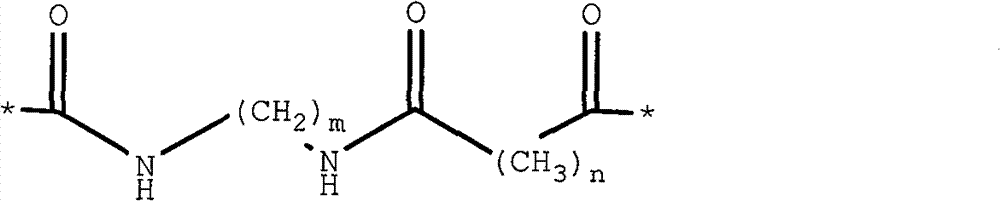
Wherein m and n are each 3 to 5 and x is not H.
Preferably, when F is the fluorophore of BODIPY or one of its derivatives, then S1Is 3-5-alkyldiamine. More preferably, S is the fluorophore of BODIPY or one of its derivatives if F is1Is propionyl ethylenediamine.
Preferably, when F is the fluorophore of BODIPY or one of its derivatives, then S2Selected from:
-CO(CH2)3CO-、-CO(CH2)4CO- (adipate)and-CO (CH)2)5CO-. More preferably, when F is the fluorophore of BODIPY or one of its derivatives, then S2Of (C-CO) (CH)2)4CO- (adipate).
Preferably, when F is the fluorophore of BODIPY or one of its derivatives, the structure comprises the substructure:

wherein p, q and r are each 3 to 5 and x is not H. More preferably, the sum of p, q and r is 8. Most preferably, p is 2, q is 2, and r is 4.
Preferably, L is a lipid selected from diacyl-and dialkyl-glycerides, including glycerophospholipids. More preferably, L is selected from the group consisting of: diacylglycerolipids, phosphatidic esters, phosphatidylcholine, phosphatidylethanolamine, phosphatidylserine, phosphatidylinositol, phosphatidylglycerol and diphosphatidylglycerol derived from one or more of trans-3-hexadecenoic acid, cis-5-hexadecenoic acid, cis-7-hexadecenoic acid, cis-9-hexadecenoic acid, cis-6-octadecenoic acid, cis-9-octadecenoic acid, trans-11-octadecenoic acid, cis-11-eicosenoic acid or cis-13-docosenoic acid. More preferably, the lipid is derived from one or more cis-unsaturated fatty acids. Most preferably, L is selected from the group consisting of: 1, 2-O-dioleoyl-sn-trioxy-3-phosphatidylethanolamine (DOPE), 1, 2-O-distearoyl-sn-trioxy-3-phosphatidylethanolamine (DSPE), and rac-1, 2-dioleoyl glycerol (DOG).
In a first embodiment of the first aspect, the present invention provides a cellular marker having the structure:
it is known as KODE-fluorescein (I).
In a second embodiment of the first aspect, the present invention provides a cellular marker having the structure:
it is called KODE-Oregon Green (II).
In a third embodiment of the first aspect, the present invention provides a cellular marker having the structure:

it is known as KODE-Tokyo Green (III).
In a fourth embodiment of the first aspect, the present invention provides a cellular marker having the structure:

it is known as KODE-Pennsylvania green (IV).
In a fifth embodiment of the first aspect, the present invention provides a cellular marker having the structure:

it is known as KODE-BODIPY (V).
Typically, M is H, but may also be substituted by another monovalent cation such as Na+、K+Or NH4 +And (4) replacing.
In a second aspect the invention provides a method of cell labelling comprising the steps of:
contacting the cell suspension with a cell marker according to the first aspect of the invention.
In a third aspect, the invention provides a cell incorporating a cell marker of the first aspect of the invention.
In a fourth aspect, the invention provides a cell produced by the method of the second aspect of the invention.
In the description and claims:
"BODIPY" refers to the Chemical Abstract Society (CAS) registry number 138026-71-8, CA index name: boron, difluoro [2- [ (2H-pyrrole-2-ylidene-. kappa.N) methyl-1H-pyrrolato-. kappa.N ] -, (T-4) - (9 CI).
"fluorescein" represents the chemical structure of Chemical Abstract Service (CAS) registry number 518-47-8, CA index name: spiro [ isobenzofuran-1 (3H), 9 ' - [9H ] xanthen-3-one, 3 ', 6 ' -dihydroxy-, sodium salt (1: 2).
"fluorophore" means a substructure or portion of a fluorescent molecule having fluorescent properties.
"or one of its derivatives" means a chemical modification of the chemical structure to provide fluorophores with essentially the same physico-chemical properties, as well as altered spectral characteristics.
By "water-soluble" is meant that the cell marker forms a stable single phase system when contacted with water or saline (e.g., PBS) in the absence of organic solvents or detergents, and the term "solution" has the corresponding meaning.
Detailed Description
The specification of International application PCT/NZ2005/000052 (publication WO 2005/090368) describes water-soluble synthetic molecules which are F-S1-S2-an L structure.
In these structures, F is a carbohydrate that spontaneously and stably incorporates a lipid bilayer, which includes a cell membrane.
The preferred structure described in the specification of the international application comprises the substructure:

wherein n is 3 to 5, X is H or C, and X is not H.
Typically, M is H, but may also be substituted by another monovalent cation such as Na+、K+Or NH4 +And (4) replacing.
F is a fluorophore in the structure of the invention, having different physicochemical properties from the carbohydrate. Selecting a spacer clique (S)1-S2) To provide a structure that is readily dispersible in an aqueous vehicle, such as saline.
Without wishing to be bound by theory, it is believed that the cell markers of the present invention may be incorporated into the lipid bilayer of the cell membrane via their diacyllipid tails. The fluorophore moiety is thus expressed on the cell surface. The cell markers of the present invention can be used to label cells without altering the cell surface expressed proteins.
Proteins expressed on the cell surface have a reduced potential to mediate cell functions. Furthermore, the probability of the cell markers being evenly distributed in the two dimensions of the lipid bilayer is increased. The mobility of the fluorophore is not dependent on the mobility of the cell surface expressed protein to which the fluorophore might otherwise bind.
It is expected that additional advantages may arise because cellular markers may allow for the study of cell membrane dynamics independent of protein function and circulation. Cells labeled with the cell markers of the present invention can still be identified by conventional methods and used to establish biological methods, such as Fluorescence Activated Cell Sorting (FACS) systems.
For the preparation of KODE-fluorescein (I), FITC is first combined with a diamine, such as 1, 5-pentanediamine (cadaverine). The conjugated FITC is then reacted with activated lipid (L-A) prepared according to the method described in International application PCT/NZ 2005/000052.
Many fluorescent compounds are commercially available, such as cadaverine derivatives. Cell markers can be prepared in which F is one of the fluorophores shown in table 1.


Table 1 fluorophores (expressed as neutral charged protonated species).
For the preparation of KODE-BODIPY (V), BODIPY can be selectively combined with an alkyldiamine such as 3-propionylethylenediamine (BODIPY FL EDA). The bound BODIPY is then reacted with an activated lipid (L-A) prepared according to the methods described in the specification of International application PCT/NZ 2005/000052.
Exemplary embodiments of the present invention will be described with reference to the accompanying drawings.
Drawings
FIG. 1: red blood cells were visualized with a fluorescence microscope at 470 nm, 250x magnification after exposure to the cell marker (I).
FIG. 2: structure of cell marker KODE-fluorescein (I).
FIG. 3: structure of cell marker KODE-oregon green (II).
FIG. 4: structure of cell marker KODE-tokyo green (III).
FIG. 5: structure of cell marker KODE-Pennsylvania Green (IV).
FIG. 6: structure of cell marker KODE-BODIPY (V).
FIG. 7: 1H-NMR spectrum of the cell marker KODE-BODIPY (V).
Detailed Description
Preparation of activated 1, 2-O-distearoyl-sn-trioxy-3-phosphatidylethanolamine (DSPE) and activated 1, 2-O-dioleoyl-sn-trioxy-3-phosphatidylethanolamine (DOPE) (L-A).
To a solution of bis (N-hydroxysuccinyl) adipate (A) (70 mg, 205. mu. mol) in dry N, N-dimethylformamide (1.5ml) was added DOPE or a solution of DSPE (L) (40. mu. mol) in chloroform (1.5ml), followed by triethylamine (7. mu.L). The mixture was kept at room temperature for 2 hours, then neutralized with acetic acid and partially concentrated in vacuo.
Column chromatography of the residue (Sephadex LH-20, 1: 1 chloroform-methanol, 0.2% acetic acid) gave activated lipid (L-A) as a colorless syrup (37mg, 95%); TLC (chloroform-methanol-water, 6: 3: 0.5) to Rf=0.5(DOPE-A),Rf=0.55(DSPE-A)。
1H NMR(CDCl3/CD3OD,2∶1),δ:
DSPE-A-5.39(m,1H,-OCH2-CHO-CH2O-),4.53(dd,1H,J=3.42,J=11.98,-CCOOHCH-CHO-CH2O-),4.33(dd,1H,J=6.87,J=11.98,-CCOOHCH-CHO-CH2O-),4.23(m,2H,PO-CH2-CH2-NH2),4.15(m,2H,-CH2-OP),3,61(m,2H,PO-CH2-CH2-NH2),3.00(s,4H,ONSuc),2.81(m,2H,-CH2-CO(Ad),2.48(m,4H,2x(-CH2-CO),2.42(m,2H,-CH2-CO(Ad),1.93(m,4H,COCH2CH2CH2CH2CO),1.78(m,4H,2x(COCH2CH2-),1,43,1.47(2b s,40H,20CH2),1.04(m,6H,2CH3).
DOPE-A-5.5(m,4H,2x(-CH=CH-),5.39(m,1H,-OCH2-CHO-CH2O-),4.58(dd,1H,J=3.67,J=11.98,-CCOOHCH-CHO-CH2O-),4.34(dd,1H,J=6.61,J=11.98,-CCOOHCH-CHO-CH2O-),4.26(m,2H,PO-CH2-CH2-NH2),4.18(m,2H,-CH2-OP),3.62(m,2H,PO-CH2-CH2-NH2),3.00(s,4H,ONSuc),2.8(m,2H,-CH2-CO(Ad),2.50(m,4H,2x(-CH2-CO),2.42(m,2H,-CH2-CO(Ad),2.17(m,8H,2x(-CH2-CH=CH-CH2-),1.93(m,4H,COCH2CH2CH2CH2CO),1.78(m,4H,2x(COCH2CH2-),1,43,1.47(2bs,40H,20CH2),1.04(m,6H,2CH3).
Condensation of DOPE-A with 5- ((5-aminopentyl) thiourea) fluorescein (cadaverine fluorescein).
To a solution of activated DOPE (L-A) (5mg, 5.2(μmol)) in N, N-dimethylformamide (0.5ml) were added 3mg (4.6 μmol) of fluorescein cadaverine dihydrobromide salt and 5 μ L of triethylamine, the mixture was kept at room temperature for 2 hours, and then 10 μ L of 3% NH was added3The aqueous solution and the mixture were kept at room temperature for 1 hour.
Mixture column chromatography (Sephadex LH-20, 1: 1 chloroform-methanol followed by silica gel, ethyl acetate-isopropanol-water, 6: 3: 1) gave 4.2mg (67%) of KODE-fluorescein (I), Rf0.5 (ethyl acetate-isopropanol-water, 6: 3: 1).
1H NMR(CDCl3/CD3OD,1∶1),δ:
KODE-fluorescein (I) -8.38(bs, 1H, fluorescein aromatic proton), 8.15(dd, 1H, J ═ 1.7, J ═ 8.3, fluorescein aromatic proton) 7.30(d, 1H, J ═ 8.3, fluorescein aromatic proton), 6.87(m, 4H, fluorescein aromatic proton), 6.72(dd, 2H, J ═ 2.4, J ═ 8.8, fluorescein aromatic proton), 5.50(m, 4H, 2 × (-C)H=CH-),5,38(m,1H,-OCH2-CHO-CH2O-),4.58(dd,1H,J=6.6,Jgem=11.8,HHC-O-C(O)-),4.34(dd,1H,J=3.2,Jgem=11.8,HHC-O-C(O)-),4.14(m,2H,-OCH-CH 2 -O-P-)(4.1(m,2H,-P-O-CH 2 -CH2-NH-)3.80(m,2H,N-CH2(CH2)3-CH 2 NH-C=S)3.39and 3.58(2m,2x2H,N-CH 2 -CH2-O-P-andN-CH 2 -(CH2)3-CH2NH-C=S)2.48(m,4H,2×(-CH 2 -CO),2.39(m,4H,COCH 2 CH2CH2CH 2 CO),2.19(m,8H,2×(-CH 2 CH=CH-CH 2 -),1.84(m,2H,CH 2 Fluorescein cadaverine), 1.8(m, 10H, COCH)2CH 2 CH 2 CH2CO,2×(COCH2CH 2 -,and CH 2 Fluorescein cadaverine), 1.62(m, 2H, C)H 2 Fluorescein cadaverine) 1,42, 1.46(2b s, 40H, 20 CH)2),1.05(m,6H,2CH3).
Binding of KODE-fluorescein (I) to cell membranes
KODE-fluorescein (I) readily binds to the membrane of erythrocytes. Molecular intercalation is observed when molecular dispersions at concentrations greater than 0.1mg/ml are contacted with a suspension of red blood cells.
The medium that causes the cells to fluoresce strongly serves as an indicator of the uniform distribution of molecules across the cell membrane (FIG. 1). When cells are stored in the dark, the binding and distribution appear stable for at least 40 days.
Example 2
Activated 1, 2-O-dioleoyl-sn-trioxy-3-phosphatidylethanolamine (DOPE) (L-A) was prepared as described in example 1.
Condensation of DOPE-A with 4, 4-difluoro-5, 7-dimethyl-4-bora-3 a, 4 a-diaza-s-indacene-3-propionylethylenediamine, hydrochloride salt (BODIPY FL EDA)
To 15mg (15.5. mu. mol) of CH activating DOPE2Cl2(0.5ml) solution 5mg (13.5. mu. mol) of BODIPY FL EDA in N, N-dimethylformamide (0.3ml) and 5. mu.l of triethylamine were added. The mixture was kept at room temperature for 2 hours.
Mixture column chromatography (Sephadex LH-20, 1: 1 chloroform-methanol) gave 14.2mg (75%) of KODE-BODIPY (I), Et3An N-salt; molecular weight 1289.6, Rf0.3 (ethyl acetate-isopropanol-water, 6: 3: 1).
1H NMR(CDCl3/CD3OD, 1: 1): δ 7.40(s, 1H, aromatic proton of BODIPY), 7.12(d, 1H, J ═ 3.8BODIPY, 6.47(d, 1H, J ═ 3.8BODIPY, aromatic proton), 6.32(s, 1H, aromatic proton of BODIPY), 5.50(m, 4H, 2x (-C, aromatic proton of BODIPY), and the likeH=CH-),5.38(m,1H,-OCH2-CHO-CH2O-),4.58(dd,1H,J=3.2,Jgem=11.8,HHC-O-C(O)-),4.33(dd,1H,J=6.6,Jgem=11.8,HHC-O-C(O)-),4.16(t,2H,J=5.6,P-O-CH 2-CH2-NH-),4.1(m,2H,--OCH-CH 2-O-P-),3.60(t,2H,P-O-CH2-CH 2-NH-),3.46,3.42and 2.8(3m,4H,2H,2H,-CH 2-CH 2-C(O)NH(CH 2)2-NH of BODIPY),2.70(s,3H,CH3 of BODIPY),2.48(m,4H,2x(-CH2-CO),2.45(s,3H,CH3 of BODIPY),2.37(m,4H,COCH 2CH2CH2CH 2CO),2.19(m,8H,2x(-CH 2-CH=CH-CH 2-),1.8(m,8H,COCH2CH2CH 2CH 2CO,2x(COCH2CH 2-)),1.46,1.43(2b s,40H,20CH2),1.05(m,6H,2CH3);3.31(q,6H,J=7.4,3xCH2 of Et3N),1.50(t,9H,J=7.4,3xCH3 of Et3N).
Although the present invention has been described by way of exemplary embodiments, it should be understood that variations and modifications may be made without departing from the scope of the invention. Furthermore, if specific features have known equivalents, such equivalents are incorporated in the specification as if specifically mentioned.
Claims (19)


Applications Claiming Priority (5)
| Application Number | Priority Date | Filing Date | Title |
|---|---|---|---|
| NZ54974206 | 2006-09-06 | ||
| NZ549742 | 2006-09-06 | ||
| NZ549740 | 2006-09-07 | ||
| NZ54974006 | 2006-09-07 | ||
| PCT/NZ2007/000256 WO2008030115A2 (en) | 2006-09-06 | 2007-09-06 | Fluorescent cell markers |
Publications (2)
| Publication Number | Publication Date |
|---|---|
| CN101679849A CN101679849A (en) | 2010-03-24 |
| CN101679849B true CN101679849B (en) | 2014-01-01 |
Family
ID=39157692
Family Applications (1)
| Application Number | Title | Priority Date | Filing Date |
|---|---|---|---|
| CN200780037489.8A Expired - Fee Related CN101679849B (en) | 2006-09-06 | 2007-09-06 | Fluorescent cell markers |
Country Status (6)
| Country | Link |
|---|---|
| US (4) | US20100203637A1 (en) |
| EP (1) | EP2069460B1 (en) |
| CN (1) | CN101679849B (en) |
| AU (1) | AU2007293770B2 (en) |
| CA (1) | CA2662624C (en) |
| WO (1) | WO2008030115A2 (en) |
Families Citing this family (6)
| Publication number | Priority date | Publication date | Assignee | Title |
|---|---|---|---|---|
| US20100255487A1 (en) | 2009-03-27 | 2010-10-07 | Life Technologies Corporation | Methods and apparatus for single molecule sequencing using energy transfer detection |
| NZ591047A (en) | 2011-02-09 | 2013-11-29 | Vladimirovich Bovin Nicolai | In vivo methods of monitoring biodistribution |
| AU2014357817B2 (en) | 2013-12-02 | 2019-02-14 | Bovin, Nikolai | Functionalizing nanofibres |
| WO2015081860A1 (en) * | 2013-12-03 | 2015-06-11 | The Hong Kong University Of Science And Technology | Specific detection and quantification of cardiolipin and isolated mitochondria by positively charged aie fluorogens and method of manufacturing thereof |
| DE102014100536B4 (en) * | 2014-01-17 | 2015-09-10 | Bundesrepublik Deutschland, Vertreten Durch Den Bundesminister Für Wirtschaft Und Energie, Dieser Vertreten Durch Den Präsidenten Der Bundesanstalt Für Materialforschung Und -Prüfung (Bam) | Test strips with sterically immobilized dyes for the internally referenced fluorometric determination of anions, in particular of fluoride, from aqueous matrices |
| CN104877127B (en) | 2015-06-23 | 2017-11-10 | 厦门赛诺邦格生物科技股份有限公司 | A kind of eight arms polyethyleneglycol derivative, preparation method and its bio-related substance of modification |
Citations (1)
| Publication number | Priority date | Publication date | Assignee | Title |
|---|---|---|---|---|
| CN1553913A (en) * | 2001-09-11 | 2004-12-08 | �������⻯ѧƷ�ع�����˾ | Direct preparation method of pyrrolo[3,4-c]pyrrole |
Family Cites Families (6)
| Publication number | Priority date | Publication date | Assignee | Title |
|---|---|---|---|---|
| US4783401A (en) * | 1986-10-31 | 1988-11-08 | Smithkline Beckman Corporation | Viable cell labelling |
| WO1989010758A1 (en) * | 1988-05-02 | 1989-11-16 | Zynaxis Technologies, Inc. | Compounds, compositions and method for binding bio-affecting substances to surface membranes of bio-particles |
| CA2410887C (en) * | 2000-06-02 | 2012-07-24 | Bracco Research Usa | Compounds for targeting endothelial cells, compositions containing the same and methods for their use |
| US20020049986A1 (en) * | 2000-10-10 | 2002-04-25 | Steven Farber | High throughput genetic screening of lipid and cholesterol processing using fluorescent compounds |
| WO2003082903A2 (en) * | 2002-03-29 | 2003-10-09 | The University Of Utah Research Foundation | Hybrid phosphoinositide phospholipids: compositions and uses |
| US8013131B2 (en) * | 2004-03-22 | 2011-09-06 | Kode Biotech Limited | Synthetic membrane anchors |
-
2007
- 2007-09-06 CN CN200780037489.8A patent/CN101679849B/en not_active Expired - Fee Related
- 2007-09-06 WO PCT/NZ2007/000256 patent/WO2008030115A2/en not_active Ceased
- 2007-09-06 AU AU2007293770A patent/AU2007293770B2/en not_active Ceased
- 2007-09-06 US US12/310,803 patent/US20100203637A1/en not_active Abandoned
- 2007-09-06 EP EP07834859.6A patent/EP2069460B1/en not_active Not-in-force
- 2007-09-06 CA CA2662624A patent/CA2662624C/en not_active Expired - Fee Related
-
2012
- 2012-01-20 US US13/354,449 patent/US20130018195A1/en not_active Abandoned
-
2014
- 2014-12-08 US US14/563,127 patent/US20150204848A1/en not_active Abandoned
-
2016
- 2016-09-29 US US15/279,652 patent/US20170082642A1/en not_active Abandoned
Patent Citations (1)
| Publication number | Priority date | Publication date | Assignee | Title |
|---|---|---|---|---|
| CN1553913A (en) * | 2001-09-11 | 2004-12-08 | �������⻯ѧƷ�ع�����˾ | Direct preparation method of pyrrolo[3,4-c]pyrrole |
Non-Patent Citations (4)
| Title |
|---|
| Molecular Probes, Inc.Phospholipids.《MOLECULAR PROBES, PRODUCT INFORMATION》.2003, * |
| MolecularProbes Inc.Phospholipids.《MOLECULAR PROBES |
| Piotr W. Rzepecki 等.Synthesis of Hybrid Lipid Probes: Derivatives of Phosphatidylethanolamin-Extended Phosphatidylinositol 4,5-Bisphosphate (Pea-PIP2).《J. Org. Chem.》.2002,第67卷(第16期), * |
| Thomas Haselgrubler 等.Synthesis and Applications of a New Poly(ethylene glycol) derivative for the crosslinking of amines with thiols.《Bioconjugate Chem.》.1995,第6卷(第3期), * |
Also Published As
| Publication number | Publication date |
|---|---|
| WO2008030115A2 (en) | 2008-03-13 |
| CA2662624C (en) | 2016-08-16 |
| US20170082642A1 (en) | 2017-03-23 |
| CA2662624A1 (en) | 2008-03-13 |
| EP2069460B1 (en) | 2013-10-16 |
| EP2069460A4 (en) | 2012-04-25 |
| WO2008030115A3 (en) | 2008-08-28 |
| AU2007293770B2 (en) | 2011-09-29 |
| US20150204848A1 (en) | 2015-07-23 |
| AU2007293770A1 (en) | 2008-03-13 |
| US20100203637A1 (en) | 2010-08-12 |
| EP2069460A2 (en) | 2009-06-17 |
| CN101679849A (en) | 2010-03-24 |
| US20130018195A1 (en) | 2013-01-17 |
Similar Documents
| Publication | Publication Date | Title |
|---|---|---|
| CN101679849B (en) | Fluorescent cell markers | |
| Johnson et al. | Fluorescent membrane probes incorporating dipyrrometheneboron difluoride fluorophores | |
| CN101970460B (en) | Functional lipid constructs | |
| EP0297303B1 (en) | Fluorophores for encapsulation into liposomes | |
| EP1257828B1 (en) | DETECTION OF BINDING OF CHARGED SPECIES USING pH- OR POTENTIAL-SENSITIVE PROBES | |
| AU2001232211A1 (en) | Detection of binding of charged species using pH- or potential-sensitive probes | |
| CA2286177A1 (en) | Composition for gene transfer into cells | |
| US20190169218A1 (en) | Amphipathic compound having novel penta-saccharide hydrophilic group and use thereof | |
| JP2006517382A (en) | Fluorescent substrate capable of membrane transport | |
| AU2011202876B2 (en) | Fluorescent cell markers | |
| CN116097101B (en) | Assay for measuring the binding affinity of biologically active compounds to cardiolipin | |
| US20200247836A1 (en) | Novel amphiphilic compound having dendronic hydrophobic group and application thereof | |
| NZ577912A (en) | Fluorescent cell markers | |
| Schultz et al. | Membrane‐Permeant, Bioactivatable Coumarin Derivatives for In‐Cell Labelling | |
| WO2008127768B1 (en) | A cyanine-based probe\tag-peptide pair for fluorescence protein imaging and fluorescence protein imaging methods | |
| Schmidt | Further photophysical and photochemical characterization of flavins associated with single-shelled vesicles | |
| JP4403278B2 (en) | Method for measuring cholesterol content of cholesterol-containing membrane | |
| KR20090075514A (en) | Phosphoric acid group-selective fluorescent probes, methods for their preparation, and methods for measuring phosphatase activity using the same | |
| WO2025135179A1 (en) | Fluorescence enhancer |
Legal Events
| Date | Code | Title | Description |
|---|---|---|---|
| C06 | Publication | ||
| PB01 | Publication | ||
| C10 | Entry into substantive examination | ||
| SE01 | Entry into force of request for substantive examination | ||
| C14 | Grant of patent or utility model | ||
| GR01 | Patent grant | ||
| CF01 | Termination of patent right due to non-payment of annual fee | ||
| CF01 | Termination of patent right due to non-payment of annual fee |
Granted publication date: 20140101 Termination date: 20200906 |