CN101679754A - Method for producing bitumen compositions - Google Patents
Method for producing bitumen compositions Download PDFInfo
- Publication number
- CN101679754A CN101679754A CN200880020511A CN200880020511A CN101679754A CN 101679754 A CN101679754 A CN 101679754A CN 200880020511 A CN200880020511 A CN 200880020511A CN 200880020511 A CN200880020511 A CN 200880020511A CN 101679754 A CN101679754 A CN 101679754A
- Authority
- CN
- China
- Prior art keywords
- salts
- asphalt
- composition
- emulsion
- bitumen
- Prior art date
- Legal status (The legal status is an assumption and is not a legal conclusion. Google has not performed a legal analysis and makes no representation as to the accuracy of the status listed.)
- Pending
Links
Images


Classifications
-
- C—CHEMISTRY; METALLURGY
- C08—ORGANIC MACROMOLECULAR COMPOUNDS; THEIR PREPARATION OR CHEMICAL WORKING-UP; COMPOSITIONS BASED THEREON
- C08L—COMPOSITIONS OF MACROMOLECULAR COMPOUNDS
- C08L95/00—Compositions of bituminous materials, e.g. asphalt, tar, pitch
- C08L95/005—Aqueous compositions, e.g. emulsions
-
- C—CHEMISTRY; METALLURGY
- C08—ORGANIC MACROMOLECULAR COMPOUNDS; THEIR PREPARATION OR CHEMICAL WORKING-UP; COMPOSITIONS BASED THEREON
- C08K—Use of inorganic or non-macromolecular organic substances as compounding ingredients
- C08K5/00—Use of organic ingredients
- C08K5/16—Nitrogen-containing compounds
- C08K5/17—Amines; Quaternary ammonium compounds
- C08K5/19—Quaternary ammonium compounds
Landscapes
- Chemical & Material Sciences (AREA)
- Health & Medical Sciences (AREA)
- Chemical Kinetics & Catalysis (AREA)
- Medicinal Chemistry (AREA)
- Polymers & Plastics (AREA)
- Organic Chemistry (AREA)
- Engineering & Computer Science (AREA)
- Civil Engineering (AREA)
- Materials Engineering (AREA)
- Structural Engineering (AREA)
- Compositions Of Macromolecular Compounds (AREA)
- Road Paving Structures (AREA)
- Adhesives Or Adhesive Processes (AREA)
Abstract
The present invention relates to bituminous compositions suitable for use in paving applications containing bitumen emulsion of performance-grade bitumen that is substantially free of volatile solvents and made by controlling temperature-dependent interfacial rheology through the use of selected emulsifiers. The invention bituminous paving compositions are suitable for the construction of load-bearing pavements with improved compaction to densities similar or superior to those achieved in the conventional hot mix bituminous paving compositions. Cure rate of the invention bituminous compositions is higher than those of cold mix bitumen emulsion-based paving compositions, and at least equal to those of hot mix bituminous paving compositions. Additionally, the invention bituminous compositions develop adhesive strength and load-bearing strength properties at rates comparable to those of hot mix bituminous paving compositions, and at rates faster than those of cold mix bituminous paving compositions.
Description
This patent application continues for part of co-pending and commonly assigned U.S. application serial No. 11/735,669 filed on 16/4/2007, part of U.S. application serial No. 11/475,931 filed on 17/7/2006, continuation of PCT application No. PCT/US2005/002916 filed on 27/1/2005, claiming priority from U.S. provisional application serial No. 60/545,713 filed on 18/2/2004.
Background
[0001] Cold mix paving compositions are prepared by mixing a bitumen emulsion with aggregate at ambient temperature (i.e., a temperature less than about 40 ℃). However, certain problems are often associated with the use of such compositions in which no solvent is present. For example, when a slow-setting asphalt emulsion is used in constructing load-bearing pavements, the pavements slowly solidify and develop sufficient strength values to support heavy traffic and resist moisture attack. However, the use of fast-setting bitumen emulsions often leads to premature breaking of the emulsion during handling and compaction (which leads to the formation of high air voids).
[0002] Various methods have been used in an attempt to promote the development of strength in cold asphalt mixes prepared from asphalt emulsions. Many of these methods rely primarily on altering the pH of the emulsion or the overall system in order to initiate or promote the breaking and coalescence of the emulsion. U.S. Pat. No. 4,008,096 to Knapp, which is incorporated herein by reference, is exemplary of such a method, which teaches the injection of a pH altering agent in order to initiate emulsion coalescence.
[0003] However, these methods may suffer from a lack of time-limited control over the chemistry that changes pH. During any construction process involving a bitumen emulsion, premature breaking or coalescence of the bitumen emulsion adversely affects performance in preparation, handling, transportation and other end-use application operations. Prematurely broken emulsions often do not adequately coat the aggregate and often result in high viscosity asphalt-aggregate mixtures, which are cumbersome to unload from a truck, may excessively adhere to paving equipment, and may be difficult to compact to a desired pavement density. Thus, failure to effectively control the timing of the pH-altering chemistry often results in premature breakdown of the asphalt emulsion and a cascade of undesirable effects on mixing processing and pavement applications.
[0004] Attempts have been made to control the initiation of pH altering chemistry in bitumen emulsions. Us patent 5,256,195 teaches the use of an emulsion of an anionic water-in-oil emulsion, which contains a breaker in the aqueous phase, and a slowly setting cationic emulsion in the form of a main mixing and coating emulsion. When the compaction machinery acts, the water-in-oil emulsion breaks exposing the basic aqueous phase to the cationic mixed emulsion, thereby changing the pH of the system and initiating demulsification. Those skilled in the art recognize that the use of mineral oil and other solvents (i.e., so-called "cutterstocks") may result in an improvement in compactibility.
[0005] It is generally known to formulate and prepare fast-breaking bitumen emulsions by using fast-setting (or spray grade) or fast-setting emulsifiers, as disclosed in U.S. Pat. No. 4,338,136. However, this method of characterization has two disadvantages, which make them unsuitable for constructing load-bearing asphalt pavements that exhibit complete aggregate coating, compaction in the field to the desired density, and rapid development of strength. First, emulsions that set quickly at ambient temperatures do not adequately coat the dense graded aggregate typically used in constructing dense graded, load bearing pavements because such quickly setting emulsions tend to break immediately upon contact with the mineral aggregate surface. The term "fast setting" is a limiting feature of such emulsions (i.e., they break and release water immediately upon contact with the mineral aggregate). Second, at ambient temperature, the immediate breaking of the fast-setting emulsion produces a mixture with high viscosity. Failure to adequately compact results in a low density pavement that is damaged under traffic pressure due to deformation, decomposition, and/or water pocket formation (due to water entering the subgrade (base) through the low density layer, where the supporting pavement layer deteriorates).
[0006] Us patent 5,743,950 discloses a process for preparing an asphalt composition which comprises adding a stiff asphalt binder (binder) having a penetration of less than 50 to a mixture of aggregate and non-emulsified soft asphalt binder components. A hard binder component is defined as a binder component having a penetration of less than 200, as measured by ASTM D5 at 25 ℃. A soft binder component is defined as a binder component having a penetration of greater than 700 (as measured by ASTM D5 at 25 ℃) or a viscosity of less than 300 mpa.s. To obtain a bituminous composition with the desired workability for load bearing applications, the aggregate must be completely coated (i.e., mixed) with a soft binder, followed by the addition of a hard binder. The asphaltene composition must include a stiff asphalt binder and a soft asphalt binder. First, aggregate is mixed with maltene to ensure complete surface coating by maltene. Hard asphalt is then added to the mixture of aggregate and soft asphalt (i.e., aggregate surface-coated with soft asphalt) in order to impart rigidity and other desired properties for load bearing applications. The hard bitumen may be added to the mixture of soft binder and aggregate in the form of a powder or emulsion, i.e. the aggregate must be pre-treated with the soft binder and then mixed with the hard binder. This method of producing bituminous compositions requires a pre-treatment of the aggregate and soft binder before mixing with the hard binder; the equipment and processes used to produce the bituminous composition must therefore be designed so as to allow for the pre-treatment of the aggregates.
[0007] For similar reasons, fast setting emulsions are not suitable for producing a load-bearing asphalt paving composition at ambient temperatures. The use of large amounts of water, in addition to the water present in the emulsion, to facilitate coating of the aggregate with the fast-setting emulsion is not a viable technique in the manufacture of load-bearing pavements. First, the load bearing pavement is much thicker than the previously mentioned slurry seal coat and micro-surface. Thicker load-bearing pavements must be compacted in order to densify the mixture, since insufficient density may result in rapid deterioration of the load-bearing pavement due to deformation, decomposition and water pocket formation. The large amount of water prevents compaction to the required density in thick load bearing pavements because water is incompressible. In addition, fast setting emulsions develop high viscosities when stressed due to high shear rate events such as compaction. As disclosed in us patent 4,462,840 and 5,085,704, retarders are often required in order to slow the breaking of the fast-setting emulsion system so that the materials can be handled and placed on a predetermined building surface, and then develop such cohesive strength that they do not flow or cannot be spread.
[0008] Slow-setting emulsifiers are commonly used to produce emulsion-based paving compositions for load-bearing pavements at ambient temperatures. The slow-setting emulsifier produces a bitumen emulsion that requires little or no water to achieve complete coating of the aggregate surface. Furthermore, the slow setting nature of the emulsion produces a paving composition with a controlled rate of coalescence such that the paving mixture does not increase in viscosity to a point where it is not suitable for handling, shipping, or compaction. With a highly dense, highly finely divided aggregate gradation, the slow setting emulsion does not break before or during compaction, thereby making the mixture easy to compact at ambient temperatures. However, paving compositions made at ambient temperature using slow-setting asphalt emulsions develop adhesion very slowly and cure to a strength sufficient to withstand heavy shipping stresses.
[0009] Unlike cold mix paving compositions, hot mix paving compositions do not contain a bitumen emulsion, but are prepared by mixing non-emulsified bitumen with aggregate at elevated temperatures (typically in excess of 140 ℃). Two of the most common thermal mixing devices, drum mixing devices and batch devices, heat the aggregate in a rotary furnace to very high temperatures in order to drive off all of the water adsorbed onto the aggregate, as well as all of the water absorbed into the surface pores of the aggregate. Quantitative removal of water is required (1) to ensure complete aggregate coating, and (2) to ensure that the final hot mix of aggregate and bitumen exhibits no moisture sensitivity in the final pavement layer once it is transported, laid and compacted.
[0010] The dry hot aggregate produced in a conventional hot mix operation is mixed with bitumen (which has been previously liquefied by heating to a temperature well above its melting point) to produce what is known in the industry as "hot mix bitumen". Hot mix asphalt must typically be produced, laid and compacted at temperatures in excess of about 160 ℃, since the compactibility of hot mix asphalt is temperature dependent. If the mixture cools, the pitch viscosity increases and the mixture cannot be compacted to the design density (referred to as air void percentage). When the hot asphalt-aggregate mixture is cooled to a temperature below about 85 ℃, handling, placement and compaction of the mixture becomes very difficult and the design density (air voids) cannot be achieved.
[0011] It is therefore an object of the present invention to disclose a method for producing an asphaltene composition.
[0012] It is another object of the present invention to provide an asphaltene composition suitable for use in paving applications that is substantially free of volatile solvents.
[0013] It is another object of the present invention to provide an asphaltic paving composition that exhibits substantially complete aggregate coating and the ability to compact in the field to a desired density.
[0014] It is a further object of the present invention to provide an asphaltene paving composition that develops bond strength and load bearing strength properties at a rate comparable to conventional hot mix paving compositions and at a faster rate than conventional cold mix paving compositions.
[0015] It is a still further object of the present invention to provide an asphaltene composition that can be applied to a paving surface at temperatures below those required for conventional hot mix asphaltene compositions.
[0016] Additional objects, features and advantages of the invention will be set forth in part in the description which follows, and in part will be obvious from the description, or may be learned by practice of the invention.
Summary of The Invention
[0017] The objects of the present invention are met by a method for producing an asphaltene composition suitable for paving applications by controlling temperature-dependent interfacial rheology in a wide range of solvent-free, high-residue performance-grade asphalt-containing asphalt emulsions. The solventless asphalt emulsions used in the paving compositions of the present invention comprise emulsifiers with structural characteristics that impart low interfacial viscosity, low marangoni effect, and high interfacial asphalt solubility at elevated temperatures. The paving composition of the present invention has improved control of interfacial stability and rheology at temperatures higher than ambient cold mix techniques but lower than hot mix techniques; thereby providing improved densification and accelerated strength development in the compacted state when used in load bearing road surfaces.
[0018] The present invention teaches the formulation of solvent-free asphalt emulsions comprised of performance grade asphalt that exhibit controllable, temperature-dependent interfacial rheology and complete aggregate coating. Thus, the bituminous paving compositions of the present invention are suitable for constructing load-bearing pavements with improved compaction densities similar to or superior to those achieved in conventional hot mix bituminous paving compositions. The curing rate of the bituminous compositions of the present invention is higher than compositions based on cold mix bituminous emulsions and at least equal to hot mix bituminous paving compositions. In addition, the present bituminous compositions develop adhesive strength and load-bearing strength properties at a rate that can be faster than hot mix bituminous paving compositions and faster than cold mix bituminous paving compositions.
Drawings
[0019] FIG. 1 shows the shear stress assessment of the solvent-free asphalt emulsion produced in example 1, which contains 0.5% emulsifier (tallow polyalkylene polyamine) (of which 60% of the residue of PG70-22 bitumen) by total weight of asphalt emulsion (bwe);
[0020] FIG. 2 shows the shear stress assessment of the asphalt emulsion produced in example 8, which contains 1.0% bwe of emulsifier (tall oil fatty acid condensate modified with polyethylene polyamine) (with 60% of the residue of PG64-22 asphalt); and
[0021] FIG. 3 shows the shear stress assessment of the asphalt emulsion produced in example 9, which contained 0.75% bwe of emulsifier (a blend of modified and unmodified C16-C18 fatty acid condensates of polyethylene polyamines) (with 60% of the residue of PG70-22 asphalt).
Detailed Description
[0022] The present invention now will be described more fully hereinafter, but not all embodiments of the invention are shown. Indeed, these inventions may be embodied in many different forms and should not be construed as limited to the embodiments set forth herein; rather, these embodiments are provided so that this disclosure will satisfy applicable legal requirements.
[0023] The term "asphalt" or "asphaltenes" in the present invention means naturally occurring asphalt and modified asphalt. These are also known as "asphalt (asphalt)".
[0024] The bituminous composition of the present invention comprises a bitumen emulsion and aggregate, but no bitumen having a penetration of greater than 220dmm is present, as determined at 25 ℃ according to ASTM standard method D5. It should be understood that "aggregate" in the present invention also includes Recycled Asphalt Pavement (RAP). The asphalt emulsion is solvent-free and contains asphalt, water, and an emulsifier or combination of emulsifiers having structural characteristics that impart low interfacial viscosity, low marangoni effect, and high interfacial asphalt solubility at a temperature range of about 60 ℃ to about 120 ℃, thereby improving the interfacial stability and rheology of the emulsion.
[0025] Any bitumen known to meet specifications for performance grade, viscosity grade, or penetration grade may be used in the present invention. Suitable aggregates for use in the present invention have properties that meet the regulations established by appropriate transportation authorities, such as being suitable for use in constructing load bearing pavements.
[0026] The bituminous composition of the present invention does not require an aggregate (aggregation) pre-treatment with maltha (soft bitumen) prior to mixing with the bitumen emulsion.
[0027] In one embodiment of the present invention, the asphaltene paving composition comprises:
(i) a solvent-free bituminous emulsion in an amount of from about 2% to about 10% by total weight of the bituminous composition, wherein the emulsion comprises:
(a) bitumen in an amount of from about 50% to about 75% by total weight of the emulsion,
(b) an emulsifier package in an amount of from about 0.05% to about 2% by weight of the total weight of the emulsion having an interfacial tension between bitumen and water of less than 40 dynes/cm at a temperature of 26 ℃ and an aqueous concentration of less than 0.1 wt%,
(c) water in an amount to complement the emulsion; and
(ii) aggregate and/or reclaimed asphalt pavement in an amount of from about 90% to about 98% by weight of the total weight of the bituminous composition;
wherein the asphaltene composition is absent of bitumen having a penetration greater than 220dmm, as determined at 25 ℃ according to ASTM standard method D5.
[0028] In one embodiment of the present invention, the asphaltene paving composition comprises:
(i) a solvent-free bituminous emulsion in an amount of from about 2% to about 10% by total weight of the bituminous composition, wherein the emulsion comprises:
(a) bitumen in an amount of from about 60% to about 70% by total weight of the emulsion,
(b) an emulsifier package in an amount of from about 0.05% to about 2% by weight of the total weight of the emulsion having an interfacial tension between bitumen and water of less than 40 dynes/cm at a temperature of 26 ℃ and an aqueous concentration of less than 0.1 wt%,
(c) water in an amount to complement the emulsion; and
(ii) aggregate and/or reclaimed asphalt pavement in an amount of from about 90% to about 98% by weight of the total weight of the bituminous composition;
wherein the asphaltene composition is absent of bitumen having a penetration greater than 220dmm, as determined at 25 ℃ according to ASTM standard method D5.
[0029] In one embodiment of the present invention, the asphaltene paving composition comprises:
(i) a solvent-free bituminous emulsion in an amount of from about 2% to about 10% by total weight of the bituminous composition, wherein the emulsion comprises:
(a) bitumen in an amount of from about 50% to about 75% by total weight of the emulsion,
(b) an emulsifier package in an amount of from about 0.08% to about 0.5% by weight of the total weight of the emulsion having an interfacial tension between bitumen and water of less than 40 dynes/cm at a temperature of 26 ℃ and an aqueous concentration of less than 0.1 wt%,
(c) water in an amount to complement the emulsion; and
(ii) aggregate and/or reclaimed asphalt pavement in an amount of from about 90% to about 98% by weight of the total weight of the bituminous composition;
wherein the asphaltene composition is absent of bitumen having a penetration greater than 220dmm, as determined at 25 ℃ according to ASTM standard method D5.
[0030] In one embodiment of the present invention, the asphaltene paving composition comprises:
(i) a solvent-free bituminous emulsion in an amount of from about 2% to about 10% by total weight of the bituminous composition, wherein the emulsion comprises:
(a) bitumen in an amount of from about 50% to about 75% by total weight of the emulsion,
(b) an emulsifier package in an amount of from about 0.1% to about 0.75% by total weight of the emulsion having an interfacial tension between bitumen and water of less than 40 dynes/cm at a temperature of 26 ℃ and an aqueous concentration of less than 0.1 wt%,
(c) water in an amount to complement the emulsion; and
(ii) aggregate and/or reclaimed asphalt pavement in an amount of from about 90% to about 98% by weight of the total weight of the bituminous composition;
wherein the asphaltene composition is absent of bitumen having a penetration greater than 220dmm, as determined at 25 ℃ according to ASTM standard method D5.
[0031] In one embodiment of the invention, the bitumen emulsion comprises at least one bitumen having a penetration of no greater than 220dmm, as determined at 25 ℃ according to ASTM standard method D5.
[0032]Asphalt
[0033] Suitable asphalts for use in the present invention may be asphalt, modified asphalt, and combinations thereof. As used herein, the terms "asphalt" and "modified asphalt" are those that exhibit rheological properties suitable for paving applications under specific climatic conditions, such as those specified for the Structural Highway Research Program (SHRP) paving binder. Additionally, the asphalt may conform to the specifications for viscosity grade and/or penetration grade asphalt.
[0034] Suitable bitumens for use in the present invention include, but are not limited to, naturally occurring bitumens such as lake bitumen, derivatives of lake bitumen, gilsonite (gilsonite), derivatives of gilsonite; bitumen derived from crude oil; petroleum pitch obtained from a cracking process; coal tar; and combinations thereof. In addition, suitable bitumens for use in the present invention may comprise crumb rubber recovered in recycled tires. It should be understood that bitumen or asphaltenes may also be referred to as bitumen.
[0035] Modified asphalts suitable for use in the present invention may include any of the additives known in the art for producing modified asphalts having properties that meet performance grade standards. These additives may include, but are not limited to, natural rubber, synthetic rubber, plastomers, thermoplastic resins, thermosetting resins, elastomers, and combinations thereof. Examples of such additives include, but are not limited to, styrene-butadiene-styrene (SBS), styrene-butadiene-rubber (SBR), polyisoprene, polybutylene, butadiene-styrene rubber, vinyl polymers, ethylene vinyl acetate derivatives, and the like.
[0036] In one embodiment of the invention, the modified asphalt comprises a polymer selected from the group consisting of styrene-butadiene-styrene; styrene-butadiene-rubber; a sulfur-containing crosslinking agent; acid modifiers such as tall oil acid, tall oil pitch, and phosphoric acid derivatives; and combinations thereof. It is well within the ability of the skilled person to prepare modified bitumen containing said additives.
[0037] If desired, the modified asphalt may include other additives commonly used in the production of asphalt emulsions to adjust the characteristics of the final asphaltene paving composition. Such other additives include, but are not limited to, styrene-butadiene rubber latex; a polyisoprene latex; chloroprene rubber; a related thickener; starch; salt; acid modifiers such as polyphosphoric acid, crude tall oil, distilled tall oil acid, tall oil pitch, and derivatives thereof; paraffin modifiers such as montan wax, beeswax and fischer-tropsch wax; and combinations thereof.
[0038]Surface active agent
[0039] The surfactant used in the present invention may be of a cationic type, an amphoteric type, a nonionic type, and a combination thereof.
[0040] The bitumen emulsion is of the oil-in-water type; they consist of a suspension of bituminous particles dispersed in an aqueous phase. These particles have a positive charge in the case of cationic emulsions. The pH of the cationic emulsion is below pH 7.0. Anionic bitumen emulsions are similar to cationic bitumen emulsions except for the charge of the dispersed phase particulate, which is a negative charge. The pH of the anionic emulsion is above pH 7.0. As the term suggests, amphoteric emulsifiers are characterized by the ability to reduce the interfacial tension between dissimilar materials (e.g., bitumen and water) at both pH values above and below 7.0. The charge of the dispersed phase oil droplets in the amphoteric emulsion can be either positive or negative. It is within the ability of those skilled in the art to combine the bitumen and emulsifier taught herein to prepare the solvent-free bitumen emulsion of the present invention.
[0041]Suitable anionic emulsifiers include, but are not limited to: saturated C12-C24 fatty acids; unsaturated C12-C24 fatty acids; unsaturated C12-C24 fatty acids modified with acrylic acid, maleic anhydride, fumaric acid, a diene or a dienophile; rosin acid; abietic acid modified with acrylic acid, maleic anhydride, fumaric acid, diene or dienophile; natural resinous polymers such as A natural resin extracted from pine stumps, commercially available from Hercules Inc; quebracho resins (quebracho resins); tannic acid; lignin polymers such as tall oil, lignin, and the like; polyacrylic acid; a polyacrylate derivative; alkyl sulfonates; alkyl benzyl sulfonate; alkyl sulfates; alkyl phosphonates; alkyl phosphate esters/salts; a phenolic resin; and combinations thereof.
[0042]The term "anionic emulsifier" as used herein includes the above compounds and their derivatives. These include, but are not limited to, polymers made from (i) natural resins selected from the group consisting of polymers such as A natural resin extracted from pine stump is commercially available from Hercules Inc, white nutAt least one component of wood resin, tannic acid, and lignin; a complex, addition product, and condensation product formed by reaction with (ii) at least one member selected from the group consisting of saturated C10-C24 fatty acids, unsaturated C10-C24 fatty acids, and unsaturated C10-C24 fatty acids modified with at least one member selected from the group consisting of acrylic acid, maleic anhydride, fumaric acid, dienes, and dienophiles.
[0043]Sulfate, sulfonate, phosphate, or phosphonate derivatives of the foregoing compounds are suitable for use in the present invention, including, but not limited to, lignin, natural resinous polymers such as A natural resin extracted from pine stumps, those commercially available from Hercules Inc, quebracho, and tannic acid. Also useful in the present invention are compositions comprising (i) at least one member selected from the group consisting of natural resinous polymers, rosin soap (Vinsol) resins, quebracho resins, tannins and lignins; a sulfate, sulfonate, phosphate, or phosphonate derivative of a complex, addition product, and condensation product formed by reaction with (ii) at least one member selected from the group consisting of saturated C10-C24 fatty acids, unsaturated C10-C24 fatty acids, and unsaturated C10-C24 fatty acids modified with at least one member selected from the group consisting of acrylic acid, maleic anhydride, fumaric acid, dienes, and dienophiles.
[0044] The term "amphoteric emulsifier" as used herein includes both mono-amphoteric and polyamphiphatic emulsifiers. Amphoteric emulsifiers suitable for use in the present invention may be the products obtained as follows: (i) modifying at least one member selected from the group consisting of C12-C24 fatty acids and rosin acids with at least one member selected from the group consisting of acrylic acid, maleic anhydride, fumaric acid, dienes, and dienophiles; and then (ii) reacting the obtained modified product with at least one component selected from the group consisting of polyethylene polyamine, C12-C24 alkylamidopropyl halide lithium methylcarboxylate betaine, C12-C24 alkylamidopropyl halide sodium methylcarboxylate betaine, C12-C24 alkylamidopropyl halide potassium methylcarboxylate betaine, C12-C24 alkylamidopropyl halide lithium phosphate betaine, C12-C24 alkylamidopropyl halide sodium phosphate betaine, C12-C24 alkylamidopropyl halide potassium phosphate betaine, C12-C24 alkylamidopropyl halide lithium sulfate betaine, C12-C24 alkylamidopropyl halide sodium sulfate betaine, and C12-C24 alkylamidopropyl halide potassium sulfate betaine.
[0045] Cationic emulsifiers suitable for use in the present invention may include, but are not limited to: fatty imidazolines derived from C12-C24 fatty acids; a fatty amidoiminoamine derived from (i) modifying at least one member selected from the group consisting of C12-C24 fatty acids and rosin acids with at least one member selected from the group consisting of acrylic acid, maleic anhydride, fumaric acid, dienes, and dienophiles, and then (ii) reacting the modified product obtained with a polyalkylene polyamine; fatty amidoamines derived from (i) modification of at least one member selected from the group consisting of C12-C24 fatty acids and rosin acids with at least one component selected from the group consisting of acrylic acid, maleic anhydride, fumaric acid, dienes and dienophiles, and subsequently (ii) reaction of the modified product obtained with at least one component selected from the group consisting of polyalkylene polyamines, saturated C12-C24 alkyl monoamines, unsaturated C12-C24 alkyl monoamines, saturated C12-C24 alkyl polypropylenepolylamine, unsaturated C12-C24 alkyl polypropylenepolylamine; a polyoxyethylene derivative prepared by modifying a saturated C12-C24 alkyl monoamine with at least one member selected from the group consisting of ethylene oxide and propylene oxide; a polyoxyethylene derivative prepared by modifying an unsaturated C12-C24 alkyl monoamine with at least one member selected from the group consisting of ethylene oxide and propylene oxide; a polyoxyethylene derivative obtained by modifying a saturated C12-C24 alkylpolypropylene polyamine with at least one member selected from the group consisting of ethylene oxide and propylene oxide; a polyoxyethylene derivative obtained by modifying an unsaturated C12-C24 alkylpolypropylene polyamine with at least one member selected from the group consisting of ethylene oxide and propylene oxide; saturated C12-C24 alkylaryl monoamines; unsaturated C12-C24 alkylaryl monoamines; saturated C12-C24 alkyl aryl polypropylene polyamine; unsaturated C12-C24 alkyl aryl polypropylene polyamine; saturated C12-C24 quaternary amine; unsaturated C12-C24 quaternary amines; C12-C24 alkyl ether amine; C12-C24 alkyl ether polyamines; C12-C24 alkylpolypropylenepolyamine N-oxide; amine derivatives of tannic acid; amine derivatives of phenolic resins; amine derivatives of lignin; amine-modified polyacrylates; and combinations thereof.
[0046] In one embodiment of the present invention, the cationic emulsifier may include a member selected from the group consisting of saturated C12-C24 alkyl monoamines, unsaturated C12-C24 alkyl monoamines, saturated C12-C24 alkyl polypropylenepolylamine, unsaturated C12-C24 alkyl polypropylenepolylamine, and combinations thereof.
[0047] In one embodiment of the invention, the cationic emulsifier may be a blend of at least one member selected from the group consisting of saturated and unsaturated C12-C24 alkyl monoamines, and at least one member selected from the group consisting of saturated and unsaturated C12-C24 alkyl polypropylenepolylamine.
[0048] The term "cationic emulsifier" as used herein includes the above compounds and their derivatives.
[0049] Nonionic emulsifiers suitable for use in the present invention include, but are not limited to, the following: alkylaryl polyoxyethylene and polyoxypropylene derivatives; polyoxyethylene derivatives of branched, linear and cyclic alkanols, sorbitan esters, mono-and polysaccharide derivatives; polyoxypropylene derivatives of branched alkanols, linear alkanols, cyclic alkanols, sorbitan esters, monosaccharide derivatives and polysaccharide derivatives; protein stabilizers such as casein and albumin; polyethoxylated derivatives of the above anionic, zwitterionic, and cationic emulsifiers; polypropoxylated derivatives of the above anionic, zwitterionic, and cationic emulsifiers; and mechanical stabilizers such as phyllosilicate bentonite and montmorillonite.
[0050] In one embodiment of the present invention, the emulsifier may be a nonionic emulsifier including, but not limited to, alkylpolysaccharide; alkylphenol alkoxylates such as alkylphenol ethoxylates, alkylphenol propoxylates, dialkylphenol ethoxylates, and dialkylphenol propoxylates; fatty alcohol ethoxylates such as saturated or unsaturated fatty acid ethoxylates having linear, branched, or cyclic structures; a propoxylate of a saturated or unsaturated fatty acid having a linear, branched, or cyclic structure; escin oleic acid (escinoleic acid) or ethoxylates of castor oil; escin oleic acid (escinoleic acid) or propoxylates of castor oil.
[0051] In one embodiment of the present invention, the emulsifier may include a nonionic emulsifier including, but not limited to, polyethylene-polypropylene block copolymers; hydroxy poly (oxyethylene) poly (oxypropylene) poly (oxyethylene) block copolymers; 1, 2-propylene glycol ethoxylate; 1, 2-propylene glycol propoxylate; and synthetic block copolymers of ethylene oxide and propylene oxide having a molecular weight greater than 300 g/mol.
[0052] In one embodiment of the invention, the emulsifier may be a non-tallow or non-tall oil based emulsifier including, but not limited to, decyl alcohol ethoxylate; castor oil ethoxylates; palmitol-oleyl alcohol (ceto-oleyl alcohol) ethoxylate; ethoxylated alkanolamides; a fatty alcohol alkoxylate; dinonyl phenol ethoxylate; nonylphenol ethoxylate; sorbitan ester ethoxylates; alkyl ether sulfates; monoalkylsulfosuccinamates (sulfosuccinamates); alkyl phenol ether sulfates; fatty alcohol sulfates; dialkyl sulfosuccinates (sulfosuccinates); alkyl ether phosphate esters; alkyl phenol ether phosphates; alkyl naphthalene sulfonate; an alpha-olefin sulfonate; alkyl benzene sulfonic acids and salts; alkyl ampho (di) acetates; an alkyl betaine; an alkyl polysaccharide; an alkylamine ethoxylate; an amine oxide; and combinations thereof.
[0053] Acrylic acid, alkyl acrylic acids, alkyl esters of acrylic acid, alkyl esters of alkyl acrylic acids, hydroxyalkyl esters of acrylic acid, hydroxyalkyl esters of alkyl acrylic acids, acrylamide, alkylacrylamide, N-alkylacrylamide, N-dialkylacrylamide, N-hydroxyalkylacrylamide, N-dihydroxyalkylacrylamide, styrene, alkylstyrene, ethylene, propylene, higher olefins, dienes, allylic alcohols (allyl alcohol), polyhydroxylated polyolefins, vinyl halides, halopropylenes, and oligomers of haloalkylidene groups, co-oligomers, tri-oligomers, tetra-oligomers, polymers, copolymers, terpolymers, and tetrapolymers are suitable for use as surfactants in the present invention. In addition, lithium, sodium, potassium, magnesium, calcium, ammonium, or alkylammonium salts of the aforementioned polymers can be used as the emulsifier in the present invention. Examples of suitable dienes for use in the present invention include, but are not limited to, butadiene, cyclopentadiene, and isoprene.
[0054] In one embodiment of the invention, the emulsifier may comprise a salt obtained by the reaction of: (i) at least one member selected from the group consisting of hydrogen halides such as hydrogen chloride, carboxylic acids such as acetic acid, propionic acid, butyric acid, oxalic acid, maleic acid, fumaric acid, citric acid, and phosphoric acid; and (ii) at least one member selected from the group consisting of acrylic acid, alkyl esters of alkyl acrylic acid, hydroxyalkyl esters of alkyl acrylic acid, acrylamide, alkylacrylamide, N-alkylacrylamide, N-dialkylacrylamide, N-hydroxyalkylacrylamide, N-dihydroxyalkylacrylamide, styrene, alkylstyrene, ethane, propylene, higher olefins, dienes, hydroxylated propylene, polyhydroxylated polyolefins, halogenated ethylene, halogenated propylene, and halogenated alkylidene oligomers, co-oligomers, tri-oligomers, tetra-oligomers, homopolymers, copolymers, terpolymers, and tetrapolymers. Examples of suitable dienes for use in the present invention include, but are not limited to, butadiene, cyclopentadiene, and isoprene.
[0055] In one embodiment of the invention, the emulsifier may comprise a component selected from the group consisting of oligoethyleneamines, oligopolypropyleneamines, hexamethylenediamine, bis-hexamethylenediamine, polyethylenepolyamines, polypropylenepolyamines, polyethylene/polypropylenepolyamines, and higher polyalkylenepolyamines, such as the distillation residue in the preparation of polyalkylenepolyamines.
[0056] In one embodiment of the invention, the emulsifier may be a salt obtained by the reaction of: i) selected from hydrogen halides such as hydrochloric acid; carboxylic acids such as acetic acid, propionic acid, butyric acid, oxalic acid, maleic acid, fumaric acid, and citric acid; and phosphoric acid; and (ii) at least one member selected from the group consisting of oligoethyleneamines, oligopolypropyleneamines, hexamethylenediamine, bis-hexamethylenediamine, oligoaziridines, polyaziridines, polyethylenepolyamines, polypropylenepolypolyamines, polyethylenepoly/polypropylenepolypolyamines, and higher polyalkylenepolyamines such as distillation residues in the preparation of polyalkylenepolyamines.
[0057] In one embodiment of the present invention, the emulsifier may include mono-, poly-, mono-, and poly-ethoxylated condensates of oligoethyleneamines, oligopropyleneamines, hexamethylenediamines, bis-hexamethylenediamines, oligoaziridines, polyaziridines, polyethylenepolyamines, polypropylenepolyamines, and/or higher polyalkylenepolyamines such as the distillation residue from the preparation of polyalkylenepolyamines.
[0058] In one embodiment of the invention, the emulsifier may be a salt obtained by the reaction of: i) selected from hydrogen halides such as hydrochloric acid; carboxylic acids such as acetic acid, propionic acid, butyric acid, oxalic acid, maleic acid, fumaric acid, and citric acid; and phosphoric acid; and (ii) at least one of mono-, poly-, mono-, and poly (propylated) condensates selected from the group consisting of oligoethyleneamines, oligopropyleneamines, hexamethylenediamines, bis-hexamethylenediamines, polyethylenepolyamines, polypropylenepolyamines, and/or higher polyalkylenepolyamines, such as the distillation residues from the preparation of polyalkylenepolyamines.
[0059] In one embodiment of the present invention, the emulsifier may include a hydroxyalkylamine such as hydroxyethylamine, hydroxyethylpolyamine, hydroxypropylpolyethyleneamine, hydroxypropylamine, hydroxypropylpolypropyleneamine, and combinations thereof.
[0060] In one embodiment of the invention, the emulsifier may comprise a salt obtained by the reaction of: (i) selected from hydrogen halides such as hydrochloric acid; carboxylic acids such as acetic acid, propionic acid, butyric acid, oxalic acid, maleic acid, fumaric acid, and citric acid; and phosphoric acid; and (ii) a hydroxyalkylamine such as hydroxyethylamine, hydroxyethylpolyamine, hydroxypropylpolyethyleneamine, hydroxypropylamine, hydroxypropylpolypropyleneamine, and combinations thereof.
[0061] In one embodiment of the invention, the emulsifier may comprise a C-36 dimer fatty acid or a C-54 trimer fatty acid. In one embodiment of the invention, the emulsifier may comprise a polycondensation product formed by the reaction of a C-36 dimerized fatty acid with at least one member selected from the group consisting of oligoethyleneamines, polyethylenepolyamines, oligopropylamines, polypropylenepolylamines, and higher polyalkylenepolyamines, such as the distillation residue from the preparation of polyalkylenepolyamines.
[0062] In one embodiment of the invention, the emulsifier may comprise a salt obtained by the reaction of: (i) selected from hydrogen halides such as hydrochloric acid; carboxylic acids such as acetic acid, propionic acid, butyric acid, oxalic acid, maleic acid, fumaric acid, and citric acid; and phosphoric acid; and (ii) at least one component selected from the group consisting of polycondensation products formed by reaction of a C-36 dimerized fatty acid with at least one component selected from the group consisting of oligoethyleneamines, polyethylenepolyamines, oligopropylamines, polypropylenepolylamines, and higher polyalkylenepolyamines, such as the distillation residue from the preparation of polyalkylenepolyamines.
[0063] In one embodiment of the invention, the emulsifier may comprise a polycondensation product formed by the reaction of a C-54 trimerized fatty acid and at least one member selected from the group consisting of oligoethyleneamines, polyethylenepolyamines, oligopropylamines, polypropylenepolyamines, and higher polyalkylenepolyamines, such as the distillation residue from the preparation of polyalkylenepolyamines.
[0064] In one embodiment of the invention, the emulsifier may comprise a salt obtained by the reaction of: (i) selected from hydrogen halides such as hydrochloric acid; carboxylic acids such as acetic acid, propionic acid, butyric acid, oxalic acid, maleic acid, fumaric acid, and citric acid; and phosphoric acid; and (ii) C-54 trimeric fatty acid with at least one member selected from the group consisting of oligoethyleneamines, polyethylenepolyamines, oligopropylamines, polypropylenepolylamines, and higher polyalkylenepolyamines, such as the distillation residue from the preparation of polyalkylenepolyamines.
[0065] In one embodiment of the invention, the emulsifier may comprise a member selected from the group consisting of hydroxystearic acid, oligomers of hydroxystearic acid, and polymerized hydroxystearic acid.
[0066] In one embodiment of the invention, the emulsifier may comprise a component selected from the group consisting of polycondensation products formed by the reaction of: (i) at least one member selected from the group consisting of ethylene amines, propylene amines, ethylene/propylene amines, oligoethylene amines, polyethylene polyamines, oligopropylene amines, and higher polyalkylene polyamines such as distillation residues from the preparation of polyalkylene polyamines; and (ii) at least one member selected from the group consisting of hydroxystearic acid, oligomers of hydroxystearic acid, and polymerized hydroxystearic acid.
[0067] In one embodiment of the invention, the emulsifier may include Lewis acid bases such as lithium hydroxide, sodium hydroxide, and potassium hydroxide; and at least one member selected from the group consisting of hydroxystearic acid, oligomers of hydroxystearic acid, and polymerized hydroxystearic acid.
[0068] In one embodiment of the present invention, the emulsifier may comprise an ethoxylated trimethylene amine derivative of a C-12 to C-24 aliphatic amine of structure (I) wherein R is an aliphatic C-12 to C-24 moiety; x and y are together greater than or equal to 2; and a and b are greater than or equal to 0. The aliphatic C-12 to C-24 moieties may be saturated or unsaturated, having a linear, branched, or cyclic structure.
Structure (I)
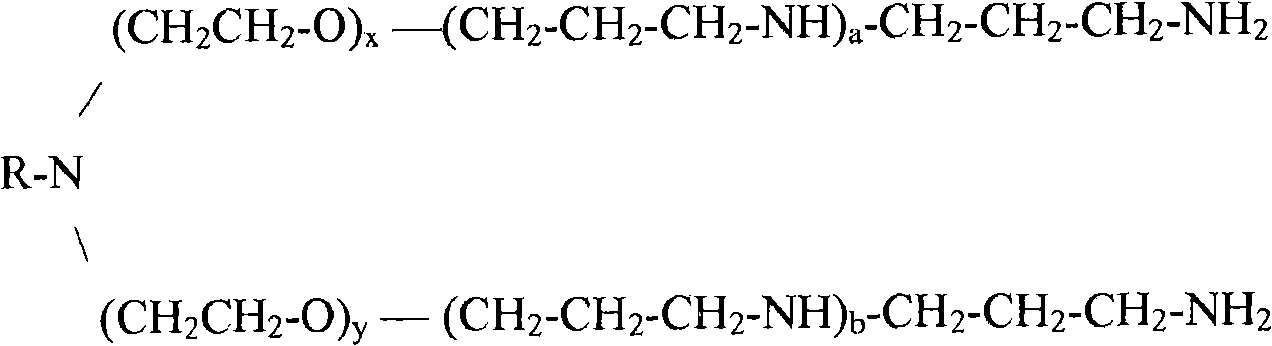
Wherein
R ═ saturated or unsaturated aliphatic C12 to C24 having a linear, branched, or cyclic structure;
x + y is more than or equal to 2; and
a,b≥0
[0069] in one embodiment of the present invention, the emulsifier may comprise a compound selected from the group consisting of (i) a compound selected from the group consisting of hydrogen halides such as hydrochloric acid; carboxylic acids such as acetic acid, propionic acid, butyric acid, oxalic acid, maleic acid, fumaric acid, and citric acid; and phosphoric acid; a component of a salt obtained by reaction with (ii) at least one component selected from the group consisting of ethoxylated trimethylene amine derivatives of C-12 to C-24 fatty amines of structure (I).
[0070] In one embodiment of the present invention, the emulsifier may comprise a propoxylated trimethylene amine derivative of a C-12 to C-24 fatty amine of structure (II) wherein R is an aliphatic C-12 to C-24 moiety; x and y are together greater than or equal to 2; and a and b are greater than or equal to 0. The aliphatic C-12 to C-24 moieties may be saturated or unsaturated, having a linear, branched, or cyclic structure.
Structure (II)
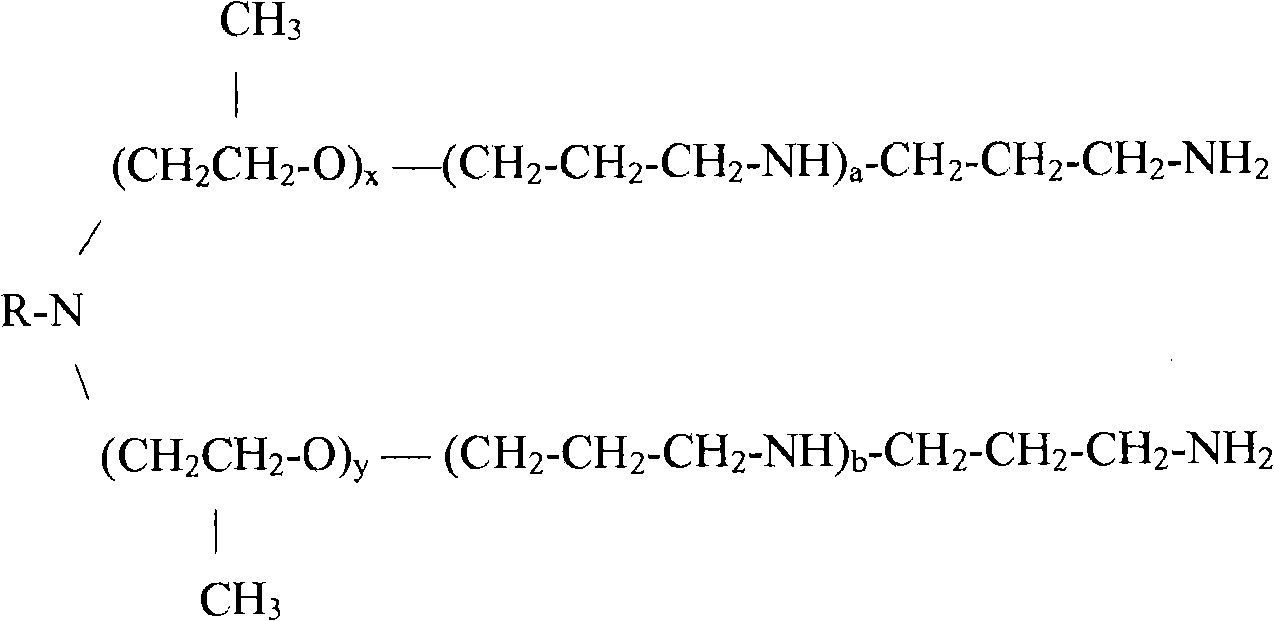
Wherein,
r ═ saturated or unsaturated aliphatic C12 to C24 having a linear, branched, or cyclic structure;
x + y is more than or equal to 2; and
a,b≥0
[0071] in one embodiment of the invention, the emulsifier may comprise a mixture of (i) a compound selected from the group consisting of hydrogen halides such as hydrochloric acid; carboxylic acids such as acetic acid, propionic acid, butyric acid, oxalic acid, maleic acid, fumaric acid, and citric acid; and phosphoric acid; and (II) at least one member selected from the group consisting of propoxylated trimethylene amine derivatives of C-12 to C-24 fatty amines of structure (II).
[0072]In one embodiment of the present invention, the emulsifier may comprise a saturated aliphatic C-12 to C-24 dialkylamine having a linear, branched, or cyclic structure selected from structure (III); and unsaturated aliphatic C-12 to C-24 dialkylamines having a linear, branched, or cyclic structure; wherein R is1、R2May be the same or different; and each may be a saturated or unsaturated aliphatic C-12 to C-24 moiety having a linear, branched, or cyclic structure.
Structure (III)
Wherein
R1,R2Saturated or unsaturated C12 to C24 moieties having linear, branched, or cyclic structures.
[0073] In one embodiment of the invention, the emulsifier may comprise a mixture of (i) a compound selected from the group consisting of hydrogen halides such as hydrochloric acid; carboxylic acids such as acetic acid, propionic acid, butyric acid, oxalic acid, maleic acid, fumaric acid, and citric acid; and phosphoric acid; and (ii) at least one member selected from the group consisting of saturated and unsaturated aliphatic C-12 to C-24 dialkylamines of structure (III).
[0074]In one embodiment of the present invention, the emulsifier may comprise a linear, branched, or cyclic saturated aliphatic C-12 to C-24 alkylamine selected from structure (IV); and at least one constituent of a linear, branched, or cyclic unsaturated aliphatic C-12 to C-24 alkylamine; wherein R is1And R2May be the same or different, saturated and unsaturated, linear, branched, or cyclic aliphatic C-12 to C-24 moieties, and R3And R4May be a methyl moiety or other higher homologs of saturated or unsaturated linear, branched, and cyclic aliphatic moieties.
Structure (IV)
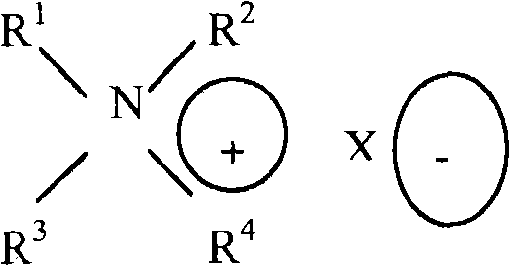
Wherein,
R1,R2saturated or unsaturated aliphatic C12 to C24 moieties having a linear, branched or cyclic structure; and
R3,R4methyl or higher homologues of saturated or unsaturated aliphatic C12-C24 moieties having a linear, branched or cyclic structure.
[0075] In one embodiment of the invention, the emulsifier may comprise a mixture of (i) a compound selected from the group consisting of hydrogen halides such as hydrochloric acid; carboxylic acids such as acetic acid, propionic acid, butyric acid, oxalic acid, maleic acid, fumaric acid, and citric acid; and phosphoric acid; and (ii) at least one member selected from the group consisting of quaternary amine derivatives of saturated or unsaturated aliphatic C-12 to C-24 alkylamines of structure (IV).
[0076]In one embodiment of the present invention, the emulsifier may comprise a linear, branched, or cyclic saturated aliphatic C-12 to C-24 alkylamine selected from structure (V); and quaternary amine derivatives of linear, branched, or cyclic (non) saturated aliphatic C-12 to C-24 alkylamines; wherein R is1And R2May be the same or different, linear, branched, or cyclic saturated or unsaturated aliphatic C-12 to C-24 moieties, and R3And R4Are ethoxy or propoxy moieties and combinations thereof.
Structure (V)
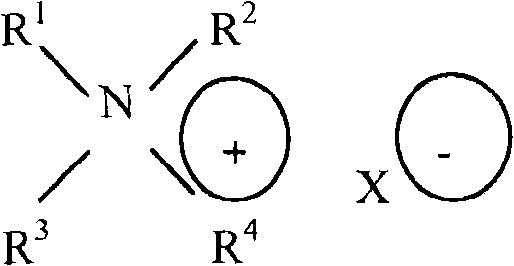
Wherein,
R1,R2has a linear structure,Branched, and cyclic structures of saturated or unsaturated aliphatic C12 to C24 moieties; and
R3,R4an ethoxy moiety, a propoxy moiety, or a combination thereof.
[0077] In one embodiment of the invention, the emulsifier may comprise a mixture of (i) a compound selected from the group consisting of hydrogen halides such as hydrochloric acid; carboxylic acids such as acetic acid, propionic acid, butyric acid, oxalic acid, maleic acid, fumaric acid, and citric acid; and phosphoric acid; and (ii) at least one member selected from the group consisting of quaternary amine derivatives of saturated or unsaturated aliphatic C-12 to C-24 alkylamines of structure (V).
[0078] In one embodiment of the invention, the emulsifier may comprise a bisamide formed by the reaction of: a polyalkylene polyamine, an adduct obtained by modifying at least one member selected from the group consisting of linear, branched, or cyclic saturated aliphatic C-12 to C-24 fatty acids and linear, branched, or cyclic (non) saturated aliphatic C-12 to C-24 fatty acids with at least one member selected from the group consisting of acrylic acid, maleic anhydride, fumaric acid, a diene, and a dienophile.
[0079] In one embodiment of the invention, the emulsifier may comprise a salt obtained by the reaction of: (i) selected from hydrogen halides such as hydrochloric acid; carboxylic acids such as acetic acid, propionic acid, butyric acid, oxalic acid, maleic acid, fumaric acid, and citric acid; and phosphoric acid; with (ii) a bisamide formed by the reaction of: a polyalkylene polyamine, an adduct obtained by modifying at least one member selected from the group consisting of linear, branched, or cyclic saturated aliphatic C-12 to C-24 fatty acids and linear, branched, or cyclic (non) saturated aliphatic C-12 to C-24 fatty acids with at least one member selected from the group consisting of acrylic acid, maleic anhydride, fumaric acid, a diene, and a dienophile.
[0080] In one embodiment of the invention, the emulsifier may comprise a dialkylarylamine. In one embodiment of the invention, the emulsifier may be comprised of a mixture of a dialkyl arylamine and a compound selected from hydrogen halides such as hydrochloric acid; carboxylic acids such as acetic acid, propionic acid, butyric acid, oxalic acid, maleic acid, fumaric acid, and citric acid; and phosphoric acid.
[0081] Suitable emulsifiers for use in the present invention not only have the high temperature shear stability required for mixing and subsequent compaction of the bituminous composition, but also impart high viscosity to the bituminous composition so that no thickener is required for bituminous stability or enhanced thin film coating on aggregate, and reduce the interfacial tension between the bituminous film and aggregate so that strong bonding is maintained and water damage to the pavement is prevented.
[0082] The emulsifier formulation is selected to control emulsion properties such as interfacial viscosity, marangoni effect, and interfacial asphalt solubility at the high temperatures of the present invention and at the same time at low emulsifier dosages. The surfactant dosage is also selected to impart targeted interfacial properties in the final emulsion. Since they are expensive and avoid high emulsifier doses. In addition, high emulsifier dosages contribute to low compressive strength development and increase moisture sensitivity in the final pavement.
[0083] In one embodiment, the emulsifier package used in the asphalt emulsion has an interfacial tension between asphalt and water of less than 40 dynes/cm at a temperature of 26 ℃ and a water concentration of less than 0.1 wt%.
[0084] In one embodiment, the emulsifier package has an interfacial tension between the bitumen and water of less than 30 dynes/cm at a temperature of 26 ℃ and an aqueous concentration of less than 0.1 wt%.
[0085] In one embodiment, the emulsifier package has an interfacial tension between the bitumen and water of less than 20 dynes/cm at a temperature of 26 ℃ and an aqueous concentration of less than 0.1 wt%.
[0086] In one embodiment, the emulsifier package has an interfacial tension between the bitumen and water of less than 10 dynes/cm at a temperature of 26 ℃ and an aqueous concentration of less than 0.1 wt%.
[0087] In one embodiment, the emulsifier package has an interfacial tension between the bitumen and water of less than 5 dynes/cm at a temperature of 26 ℃ and an aqueous concentration of less than 0.1 wt%.
[0088] The emulsions of the present invention may be prepared using a variety of mixing techniques. The emulsion may be prepared using a high shear mixer, typically with a shear rate of greater than 1,200 rpm. In one embodiment, the emulsion is prepared using a high shear mixing process at a shear rate of 4,000 rpm. These mixing processes include, but are not limited to, mixing bitumen and water using the following types of mixing devices: high shear colloid mills, static in-line mixers, high shear mixers, and high shear nozzle devices. Alternatively, the emulsion may be prepared by injecting water directly into the process fluid of the bitumen such that the shear generated in the water injection sufficiently disperses and mixes the water droplets into the bitumen stream and provides the bitumen emulsion. The injection of water into the bitumen process stream may be carried out by a phase inversion (phase inversion) process such as macrovariation or otherwise.
[0089] The bitumen emulsions of the present invention may be solvent-free. Environmental concerns have prompted a reduction, until the elimination of organic solvents in asphalt emulsions for paving. However, for technical reasons, total exclusion has not been achieved in all paving applications before the present invention can be used. The term "solventless" is defined in some regions to include a small portion of organic solvents. For example, "solventless" was once defined in pennsylvania to include up to 4% organic solvents. For the purposes of the present invention, therefore, the water-in-oil emulsion may contain, if desired, at least one solvent (such as naphtha, kerosene, diesel, flux, etc.) at a level lower than that required to favour: 1) mixing the bituminous composition at ambient temperature to make a fully coated aggregate, or 2) compacting the bituminous composition at ambient temperature. In one embodiment, the level of solvent in the water-in-oil bitumen emulsion of the present invention is less than about 1% by weight of the total weight of the emulsion. The term "ambient/room temperature" as used herein means an ambient temperature of less than about 40 ℃.
[0090] Desirably, the asphalt emulsions of the present invention can be stored for extended periods of time at temperatures ranging from about 60 ℃ to about 80 ℃ without adversely affecting the particle size (particle size) distribution of the emulsion.
[0091]Aggregate
[0092] Aggregates for paving and road construction, road repair and road maintenance come from natural and synthetic sources. It should be understood that "aggregate" in the present invention also includes Recycled Asphalt Pavement (RAP). As in any construction method, the aggregate for asphalt paving applications is selected according to a number of criteria, including physical properties, compatibility with the asphalt used in the paving method, accessibility, and the ability to provide a finished pavement that meets the performance specification requirements of a pavement layer for carrying traffic over the design life of the project. Among the properties of aggregates, critical to the successful paving of roads is the gradation of the aggregate, which refers to the percentage of aggregate particles of a certain size. For the most load bearing asphalt pavement, there are generally three gradations: dense graded, discontinuous graded and loose graded. Dense graded aggregate has the largest mineral surface area (per unit of aggregate). Loose-graded aggregates consist primarily of a single large size stone (e.g., about 0.375 inch to 1.0 inch) with a very low content (typically less than about 2% of the total aggregate) of fine stones (less than 0.25 inch material) or fillers (less than 0.075mm mineral material). The discontinuous graded aggregate is between dense grading and loose grading. Recycled Asphalt Pavement (RAP) material generally reflects the grading of the pavement from which it is derived. If the original pavement was a tight-graded mixture, the RAP would also be tight-graded, but it is often observed that the level of RAP filler is below the design limit of the original aggregate specification.
[0093] Any aggregate conventionally used in the preparation of bituminous paving compositions is suitable for use in the present invention. These include, but are not limited to, dense graded aggregate, discontinuous graded aggregate, loose graded aggregate, stone matrix base, Recycled Asphalt Pavement (RAP), recycled linoleum tiles (rootingshingles), and mixtures thereof. Incompletely dried aggregates may also be used in the present invention.
[0094]Asphaltene paving compositions
[0095] In one embodiment of the present invention, the asphaltene paving composition is prepared at a temperature in the range of from about 50 ℃ to about 140 ℃ by a method comprising the steps of mixing:
(i) a solvent-free bituminous emulsion having a temperature of from about 25 ℃ to about 95 ℃ in an amount of from about 2% to about 10% by weight of the total bituminous composition; and
(ii) aggregate at a temperature of from about 60 ℃ to about 140 ℃ in an amount of from about 90% to about 98% by weight of the total weight of the bituminous composition; and
wherein the asphaltene composition is absent of bitumen having a penetration greater than 220dmm, as determined at 25 ℃ according to ASTM standard method D5.
[0096] In another embodiment, the asphaltene composition is prepared by the foregoing method at a temperature in the range of from about 55 ℃ to about 120 ℃.
[0097] In another embodiment, the asphaltene composition is prepared by the foregoing method at a temperature in the range of from about 55 ℃ to about 120 ℃.
[0098] In yet another embodiment, the asphaltene composition is prepared by the foregoing method at a temperature in the range of from about 60 ℃ to about 80 ℃.
[0099] In one embodiment, the asphaltene composition is prepared by the foregoing method by using (i) a bitumen emulsion having a temperature of from about 60 ℃ to about 80 ℃.
[0100] In one embodiment, by the foregoing method by using (ii) an aggregate having a temperature of from about 60 ℃ to about 120 ℃.
[0101] The bituminous composition of the present invention may include additives introduced with the aggregate feed. Examples of such additives include, but are not limited to, mineral additives such as lime and cement; and fiber additives such as cellulose, glass, and polymer fibers. In addition, the recycled asphalt pavement material may be used as an additive.
[0102] In one embodiment, the asphaltene composition of the invention is applied to the surface to be paved at a temperature in the range of from about 0 ℃ to about 120 ℃. In another embodiment, the asphaltene compositions of the invention are applied to the surface to be paved at a temperature in the range of from about 55 ℃ to about 100 ℃. In yet another embodiment, the asphaltene compositions of the invention are applied to the surface to be paved at a temperature in the range of from about 60 ℃ to about 80 ℃. It will be appreciated by those skilled in the art that the bitumen emulsion may be cold mixed (e.g. at ambient temperature) and subsequently heated.
[0103] Once applied to the surface to be paved, any compaction method known in paving applications can be used to compact the asphalt composition of the present invention, if desired.
[0104] In one embodiment, the applied asphalt composition is compacted to an air void content equivalent to a hot mix paving composition having substantially equivalent aggregate gradation and asphalt content produced at temperatures in excess of 140 ℃.
[0105] In one embodiment, the applied asphalt composition is compacted to an air void content that is lower than that of a cold mix paving composition produced at ambient temperature (i.e., a temperature of less than about 40 ℃) and having substantially equivalent aggregate grading and asphalt content.
[0106] In one embodiment, the applied asphalt composition is compacted such that the rate of developing load-bearing strength is equivalent to the rate of developing load-bearing strength of a hot mix paving composition having substantially equivalent aggregate grading and asphalt content made at temperatures in excess of 140 ℃.
[0107] In one embodiment, the applied asphalt composition is compacted to develop load bearing strength at a faster rate than would be the case with a comparable cold mix paving composition made at ambient temperature and having substantially equivalent aggregate grading and asphalt content.
[0108] Strength development in cold mix paving compositions is a function of the development of adhesion between the asphalt and the aggregate. In one embodiment, the applied asphalt composition is compacted to develop adhesion between asphalt and aggregate at a faster rate than would be the case with a comparable cold mix paving composition made at ambient temperature and having substantially equivalent aggregate grading and asphalt content.
[0109] The method of the present invention is suitable for thin lift overlay paving applications. Thin overlay is a maintenance laying technique which traditionally involves the preparation of an asphalt composition at temperatures typically in excess of 165 ℃ according to conventional hot-mix procedures, and laying on-site at the corresponding temperature on the surface of an existing, damaged pavement to complete the placement of a thin layer of the asphalt composition. The current thin layer technology using hot mix asphalt compositions generally has two major drawbacks. First, the hot asphalt composition cools rapidly, making it difficult to spread (i.e., spread) at room temperature over existing pavements that require repair. Rapid cooling of the thin layer of hot bituminous material can cause compaction difficulties. The problems caused by rapid cooling in paving (e.g., spreading, and compacting) are exacerbated by the use of polymer-modified asphalt. The viscosity of the polymer modified asphalt is higher than that of the unmodified asphalt at a certain temperature. Thus, at a certain paving temperature, hot mix asphalt compositions (mixtures containing aggregate) made from polymer modified asphalt are more viscous than equivalent asphalt compositions made from unmodified asphalt. As a result of this increase in viscosity and flow resistance, thin layer asphalt compositions made from polymer modified asphalt can present greater problems in handling and paving because of the rapid cooling of the material.
[0110] If desired, the methods and asphaltene compositions of the invention can be used to prepare asphaltene paving briquettes. In this technique, a water-in-oil bitumen emulsion and aggregate are mixed to form an asphaltene composition, which is poured into a mold, compacted and allowed to solidify. The cured blocks (or bricks) are used for paving.
[0111] In one embodiment, the asphaltene composition of the invention is poured into a mold and compacted at a temperature of from about 50 ℃ to about 120 ℃. In another embodiment, the asphaltene compositions of the invention are poured into a mold and compacted at a temperature of from about 55 ℃ to about 100 ℃. In yet another embodiment, the asphaltene compositions of the invention are poured into a mold and compacted at a temperature of from about 60 ℃ to about 80 ℃.
[0112] Because the bituminous compositions of the present invention exhibit enhanced compactibility (resulting in higher density and greater strength) and accelerated cure rates (resulting in increased manufacturing speeds and improved production economics), the use of the methods and bituminous compositions of the present invention to manufacture these briquettes is superior to the use of conventional cold mix paving compositions.
[0113] In one embodiment, the asphaltene compositions of the invention can be maintained at a temperature in the range of from about 50 ℃ to about 120 ℃ for the period of time between the preparation of the asphaltene compositions and their use in paving applications. In another embodiment, the asphaltene compositions of the invention can be maintained at a temperature in the range of from about 55 ℃ to about 100 ℃. In yet another embodiment, the asphaltene compositions of the invention can be maintained at a temperature in the range of from about 60 ℃ to about 80 ℃. The asphaltene compositions of the invention can be maintained in a closed system (e.g., large stockpile, silo, covered transport, etc.) at these temperatures to prevent evaporation of water.
[0114] Well known methods and apparatus for mixing bitumen emulsions with static or moving aggregates, such as batch, drum, or continuous form mixers, may be used in preparing the bituminous paving compositions of the present invention. The term "mobile" includes, but is not limited to, use with both in situ and in situ operated devices. The blender applies high shear to the emulsion while grinding coarse aggregate and/or RAP, fines, and fillers. In these high shear mixers, the aggregate and/or RAP (which is heated to a prescribed process temperature in a drum or batch mixer) is rolled on an inclined drum while the bitumen emulsion is sprayed onto the hot aggregate and/or RAP, resulting in an emulsion treated aggregate and/or RAP which is poured from the drum mixer. The inner wall of most drum mixers is lined with blades that repeatedly grab the mixture, lift it up, and then fall to the bottom of the drum as the drum rotates. Drum and batch type plants can produce hundreds of tons of paving material per hour. It will be understood that any method of mixing the asphalt emulsion and aggregate conventionally used in the production of paving compositions may be used in the present invention.
[0115] Typically, bitumen emulsions with traditional emulsifier packages are coarsened under mechanical shear imparted by mixing the emulsion with aggregate at elevated temperatures. Thereby reducing the efficiency of the material in aggregate coating and increasing the viscosity of the bituminous composition produced thereby. As the viscosity of the bituminous composition increases, densification of the paving composition decreases during compaction, leading to many paving damage problems such as rutting, water pocket formation, and crumbling. Although this roughening can be mitigated by using high emulsifier levels, such levels can also retard the development of compressive strength and produce undesirable results.
[0116] The rheology of the dispersed phase droplets in the bitumen emulsions of the present invention directly affects the behavior of the emulsion when mixed with heated aggregate at elevated temperatures. The rheology at the oil-water interface is in turn controlled by the structure and chemical nature of the emulsifier. The surfactant structure and chemistry affect the energy required to disperse the emulsifier at the interface. The surfactant structure and chemistry determine the shear stability of oil-water type droplets against coalescence (coalescence) under high temperature shear conditions, such as those exhibited during mixing of emulsions with aggregates at temperatures above ambient. Surfactant structure and fillers affect interfacial fluidity or viscosity. In addition, the proper selection of emulsifier structure affects the degree of impact on interfacial viscosity.
[0117] Some chemical entities were observed to produce the desired effect of rapid early strength formation, while others did not show, further suggesting that the chemical nature of the formulation is also a contributing factor. It was further observed that bitumen emulsions having properties as desired had a higher level of shear stability than those which did not show such properties, indicating that this chemical contribution was due to the emulsifier. The observation that the development of strength in the bituminous compositions of the invention is linked to a better compressibility compared to conventional cold mixing, strongly suggests that the specific physicochemical effect is a change in the rheology of the bitumen droplets in the emulsion. The early strength development exhibited by the bitumen compositions of the present invention, which is more characteristic of hot mixing than cold mixing, also indicates that the rheological response of the bitumen droplets is an interfacial response rather than a bulk response.
[0118] Variations of the above mechanisms consistent with the presently available data and observations of the present invention include the heat-dependent activation of the interfacial solubility of ionic emulsifiers. Interfacial solubility within the scope of the present invention may be defined as the localization of the emulsifier at the interface. No distinction should now be made between: surface adsorption (emulsifier stays in the aqueous phase of the bitumen emulsion with some functional groups penetrating into the bitumen at the interface), interface penetration by emulsifier (it stays in the surface of the bitumen droplet, some functional groups face water, and others face the inside of the bitumen phase of the bitumen emulsion), or stay completely in the bitumen phase of the bitumen emulsion except at the interface (mirror image of surface adsorption).
[0119] The interaction of the emulsifier with the interfacial region of the dispersed bitumen droplet can affect the interfacial rheology of bitumen in two ways. Emulsifiers may provide a lubricating layer or slip surface between and among the droplets or they may disrupt the structure of the asphaltene fraction (asphalene fractions) of the pitch at the interface and middle east. It must be noted that the hardness and flow resistance of bitumen is largely a function of the asphaltene (asphalene) component within a particular bitumen. Bitumen models preferred by those skilled in the art of heavy oil processing include asphaltenes (asphalenes) of different molecular weights which exist in the maltene (maltene) phase of bitumen as dissolved and colloidal entities. Penetration of the associated asphaltenes within the bitumen by a molecule or portion of a molecule will tend to disrupt the surface structure of the bitumen. The concomitant result of this is a decrease in the flow resistance of the surface area of the droplet. By definition, the flow resistance is called viscosity. In order to penetrate the structure formed by the asphaltenes, the foreign molecule or part of the molecule must have a cohesive energy density (cohesive energy density) similar to that of the asphaltenes. From a thermodynamic point of view, this means that if the molecules of two different substances have similar cohesive densities (covalent properties) and are placed in close proximity to each other and in the same state (e.g. temperature, pH, ionic strength, etc.), the molecules of the two substances will be doped at the level of the individual molecules. This is defined as dissolution or dissolution. By convention, the substance present in greater concentration is referred to as the solvent, while the other is referred to as the solute.
[0120] One of the most widely accepted ways to quantitatively describe cohesive energy density is to utilize a parameter called the solubility parameter. This figure is actually the square root of the cohesive energy density. Various models of solubility parameters have been proposed. The most widely cited models are those of Hildebrand and Hansen. As a solubility grade, asphaltenes have a solubility parameter (δ) of 19-24(MPa) 1/2. Thus, a substance having a solubility parameter within this range or slightly above it should in principle dissolve in and destroy the internal structure of the asphaltenes of bitumen (asphal). A little bit relevant to this argument is the fact that: london dispersion forces (London dispersion forces) are a major contributor to the strength and complexity of the asphaltene structure within a given bitumen (asphal). This has to be taken into account when using more complex Hansen solubility parameters instead of the Hildebrand version. Further to this, it is common practice to quantify the asphaltene fraction (asphaltene fraction) of bitumen by precipitating the asphaltenes (asphaltenes) from a sample of asphaltenes (asphaltenes) by adding pentane or heptane. These two hydrocarbons had Hildebrand solubility parameters of 14.3 and 15.1(MPa)1/2, respectively. Thus, a solubility parameter in the range of 19-25(MPa)1/2 or higher will identify molecules or parts of molecules with the ability to disrupt the asphaltene (asphaltene) structure and thus fluidize the bitumen, while molecules or parts of molecules with solubility parameters similar to those of C5-C7 hydrocarbons have the potential to reflocculate (reflocculate) or coagulate (coagulute) already dispersed asphaltenes (asphaltene).
[0121] From a molecular point of view, the cohesive energy density or solubility parameter of a molecule is determined by its chemical composition (composition) or composition (make-up). It is therefore also a function of the raw materials and the manufacturing process used to manufacture the substance, or more simply, the nature of the particular substance. In the case of emulsifiers, the solubility parameter may also be related to the Hydrophilic Lipophilic Balance (HLB) represented by the formula:
[0122] in this work, a series of emulsifiers are shown to demonstrate compressibility and early strength development, which is seen as an advantage of the process of the present invention. It was observed that those emulsifiers had functional groups with a solubility parameter in the range of 24-25(MPa)1/2 and hydrophobic groups (hydrophobes) in the range of 8-16(MPa) 1/2. At low levels of the desired type of functionality and solubility parameters, the most surprising failures were observed with the emulsifier system. The solubility parameter of the entire emulsifier system also falls well within the range of about 40 (the high 30's to low 40's). In addition, model studies show that the available functionality present sterically hinders penetration into the interfacial region of the bitumen/water interface. A preferred embodiment of the invention therefore consists in formulating the bitumen emulsion with an emulsifier comprising functional groups and structures which impart the necessary solubility characteristics (as described above) for temperature-dependent interfacial rheology.
[0123] The following examples are provided to further illustrate the invention and are not to be construed as limiting the invention in any manner.
[0124] In the following examples, the bituminous compositions of the bitumen emulsion and aggregate were mixed using an automatic drum mixer (example 1) or manually (examples 2-14). The mixture of bitumen emulsion and aggregate is compacted while the mixture is at the output temperature after preparation. The asphaltene composition was compacted into briquettes (pill) using a StrateghwayResearprogam (SHRP) gyratory compactor (available from PineInstructions) at an angle of gyration of 1.25 deg., a ram pressure of 600kPa, and 30 revolutions. Immediately after compaction, the asphaltene composition was placed in an oven at 25 ℃ to cure. After curing, the compacts were evaluated for compressive strength (i.e. Marshall (Marshall) stability). The compressive strength value obtained after only four hours of curing at ambient temperature (25 ℃) is referred to herein as "early strength". The compressive strength of the compacted samples was measured using a stability tester (available from PineInstruments). The particle size of each of the pitch emulsions used in the examples below was less than 10 microns.
[0125] The aggregate used in the examples below was pulverized granite that met the grading and performance specifications of a graded 1/2 inch nominal paving mix typically used in the preparation of pavement wear layers. All aggregate samples were oven dried (110 ℃) to remove moisture prior to use. In the comparative cold mix example, the aggregate was cooled to room temperature prior to mixing with the asphalt emulsion. In the comparative hot mix example, the aggregate was heated to a temperature in the range of about 140 ℃ to 160 ℃ prior to mixing with the asphalt heated to an equivalent temperature. The total graded aggregate sample was 1,000 grams.
[0126] The coatings were measured using a variation of the commonly known instrumental illumination method of Deneuvillers et al. The coating values in the following examples are expressed as percentages, indicating the measured percentage of aggregate surface coated with asphalt.
Example 1
[0127] The asphaltene compositions of the invention were prepared by the following procedure. Solvent-free asphalt emulsions were prepared using one of three different alkyl polyamine-based emulsifiers (A, B and C) in a dosage range of 0.3% to 0.5% by total weight of the respective asphalt emulsion. Emulsifier A was 0.4% saturated and unsaturated C16-C18 tallow tripropylene tetramine and 0.1% bwe saturated and unsaturated C16-C18 tallow monoamine, all by weight of the total bitumen emulsion (bwe). Emulsifier B was a blend of saturated and unsaturated C16-C18 tallow polypropylenepolyamine at 0.3% bwe. Emulsifier C is a blend of 0.45% bwe of an alkyl polypropylenetetramine and 0.01% to 0.05% bwe of a mixture of saturated and unsaturated C16-C18 alkyl monoamines, diamines and triamines. The respective emulsifiers were dissolved in warm water and treated with a hydrochloric acid solution in order to reduce the pH to 2.0. An aqueous solution of emulsifier in water (called "soap") was heated to 55 ℃ and added to the Atomix colloid mill.
[0128] The bitumen used in this example was Venezuelan derived and had a performance rating of PG 64-22. The asphalt was heated to 130 ℃ and added to an Atomix colloid mill where the soap solution and asphalt mixture were processed to produce an asphalt emulsion. The finished asphalt emulsion had an asphalt content of about 60-63% bwe. The bitumen emulsion was then diluted with water to 53.3% bitumen content prior to mixing with the aggregate.
[0129] As noted above, the aggregate used was crushed granite, which meets the grading and performance specifications for 1/2 inch nominal wearing course paving aggregate. Such as aggregate from quarries, are dried to remove moisture. The dry aggregate was divided into size-ordered fractions, from granules passing through a 12.5mm sieve to granules passing through a 0.075 micron sieve. The fractions were combined in number to yield an aggregate grade meeting the criteria of 1/2 inch nominal dense-graded aggregate for surface and wear-course pavement. This combination of aggregate anhydrous fractions meeting the 1/2 nominal grading criteria is referred to as graded aggregate.
[0130] For the bituminous composition prepared in this example according to the method of the present invention, the graded aggregate was heated to about 80 ℃ in a furnace while the bitumen emulsion was heated to about 60 ℃. Approximately 1,000 grams of the heated graded aggregate was placed in a 1 gallon stainless steel scoop (bucket) which was placed in an automatic scoop mixer. To 1,000 grams of aggregate at 80 ℃ was added, with stirring, 90 grams of a 60 ℃ bitumen emulsion. Mixing is continued for an additional 60 seconds to produce a bituminous composition comprising about 4.8% bitumen, by total weight of graded aggregate.
[0131] The resulting asphalt composition (having a temperature of about 60 ℃ to about 80 ℃) is added to a 100-mm diameter gyratory compaction mold, which has been preheated to 60 ℃ to 80 ℃. The asphalt composition was then compacted using a 30-turn SHRP Pine gyratory compactor at 600kPa pressure and a gyration angle of 1.25 deg..
[0132] The compacted asphaltene composition was placed in a 25 ℃ oven and allowed to cure for four hours. After four hours of curing, the physical and performance properties of the compacted and cured asphaltene compositions were measured.
[0133] For comparison, a series of cold mix bituminous compositions were prepared having equivalent aggregate gradation and bitumen content. These cold-mixed asphaltene compositions were prepared following the procedure for preparation of the asphaltene compositions of the invention as described above, with the difference that the bitumen emulsion and the graded aggregate were each at ambient room temperature (23 ℃) when mixed in a scoop mixer.
[0134] The resulting cold mix asphalt composition at ambient temperature is added to a 100mm diameter gyratory compaction mold, which is also at ambient temperature. The ambient temperature asphalt composition was then compacted using a 30-turn SHRPPin gyratory compactor at 600kPa pressure and a gyratory angle of 1.25.
[0135] The compacted asphalt composition was placed in a 25 ℃ oven and allowed to cure for four hours. After four hours of curing, the physical and performance properties of the compacted and cured cold mix asphaltene compositions were measured.
[0136] A comparison of the respective asphaltene compositions was made for three key physical and performance properties-coating, densification and strength development. The compacted samples prepared by mixing and compacting the emulsion and aggregate at ambient temperature (i.e. according to the conventional cold mixing method) show physical and handling properties substantially different from those shown for the bituminous compositions prepared by the process of the present invention. These results are shown in table 1.
[0137] As shown in table 1, the bituminous compositions of the present invention had aggregate coating levels of 94% to 99%. Mixing produces a compacted asphaltene composition (pellet) having a height after compaction of 62.2-62.7mm, which is significantly denser than cold-mix pellets. The same compacted asphaltene composition made according to the process of the invention showed a compressive strength (lb-f) value of 3,000-3,2351b-f after four hours storage at 25 ℃ which is significantly stronger than the value shown by the cold mix example. As previously mentioned, such compressive strength values, obtained after only four hours of ambient temperature cure, are referred to herein as "early strength".
TABLE 1
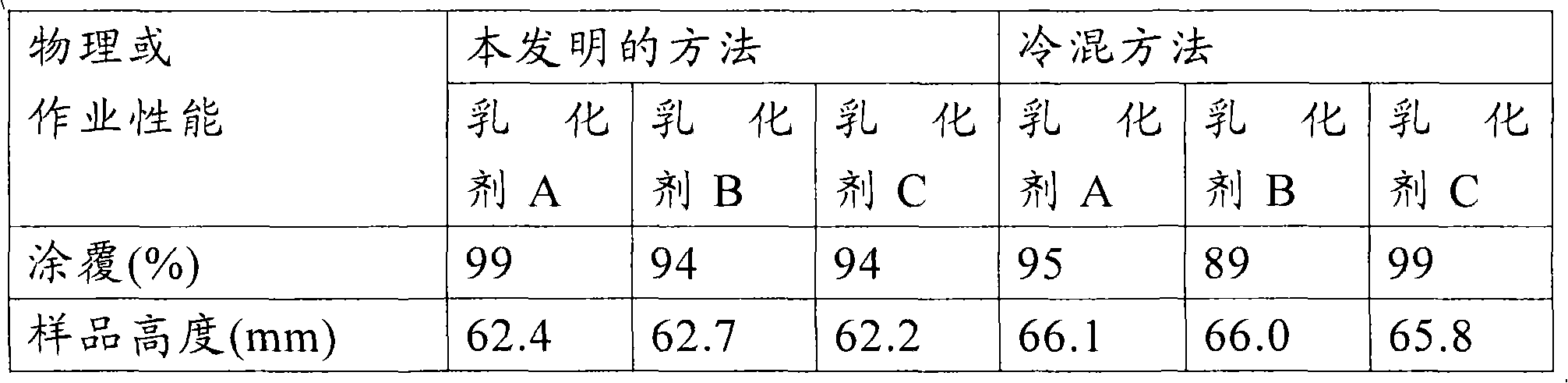

[0138] The emulsion from example 1, shown in figure 1 for evaluation, contained 0.5% emulsifier (tallow polyalkylene polyamine), 60% residue of PG70-22 bitumen, by total weight of bitumen emulsion (bwe). The bitumen emulsions of the present invention exhibit high shear stability at elevated temperatures (i.e., from about 50 ℃ to about 120 ℃). Fig. 1 shows the effect of subjecting a bitumen emulsion (formulated and prepared in accordance with the teachings of the present invention) to increased shear rates at different temperatures using a TA rheometer. In these experiments, the shear rate increased from 0 to 1,000 sec-reciprocal in 120 seconds. The apparatus experiences a torque overload because the high shear induces coalescence of the emulsion at 25 ℃. When the rotor of the rheometer was lifted, black, coalesced pitch was observed, with large coalesced droplet particles visible in the material remaining in the original liquid emulsion. At 80 ℃, the emulsion showed a smooth decrease in viscosity with increasing shear rate.
Example 2
[0139] The physical and performance properties of the bituminous compositions prepared using the method of the present invention were also compared with those of bitumen and aggregate mixtures prepared according to the conventional hot mix bitumen (asphalt) method. The total asphaltene composition in this example contained a commercially available performance grade, PG70-22 bitumen, and was prepared using a bitumen content of 4.8%, by total weight of graded aggregate.
[0140] The asphaltene compositions of the invention were prepared by the following procedure. A solvent-free asphalt emulsion was prepared using 1.0% tallow polyalkylene polyamine emulsifier based on the total weight of the asphalt emulsion (bwe). The emulsifier was dissolved in warm water and treated with hydrochloric acid solution to lower the pH to 2.0. An aqueous solution of emulsifier in water (called "soap") was heated to 55 ℃ and added to the Atomix colloid mill.
[0141] The bitumen used in this example is a commercially available performance grade PG 70-22. The asphalt was heated to 130 ℃ and added to an Atomix colloid mill where the soap solution and asphalt mixture were processed to produce an asphalt emulsion. The finished asphalt emulsion had an asphalt content of about 60-63% bwe. The bitumen emulsion was then diluted with water to 53.3% bitumen content prior to mixing with the aggregate.
[0142] For the bituminous composition prepared in this example according to the method of the present invention, the graded aggregate of example 1 was heated to about 80 ℃ in an oven while the bitumen emulsion was heated to about 60 ℃. About 1,000 grams of the heated graded aggregate was placed in a 1 gallon stainless steel scoop. To 1,000 grams of aggregate at 80 ℃ was added 90g of 60 ℃ bitumen emulsion. The mixture was manually stirred for about 60 seconds to produce a bituminous composition comprising about 4.8% bitumen, by total weight of the graded aggregate.
[0143] The resulting asphalt composition (having a temperature of about 60 ℃ to about 80 ℃) is added to a 100-mm diameter gyratory compaction mold, which has been preheated to 60 ℃ to 80 ℃. The asphalt composition was then compacted using a 30-turn SHRP Pine gyratory compactor at 600kPa pressure and a gyratory angle of 1.25.
[0144] The compacted asphaltene composition was placed in a 25 ℃ oven and allowed to cure for four hours. After four hours of curing, the physical and performance properties of the compacted and cured asphaltene compositions were measured.
[0145] For comparison, hot mix samples with equivalent aggregate gradation and bitumen content were prepared according to standard laboratory methods for preparing hot mix asphaltene compositions. A graded aggregate was prepared as in example 1. About 1,000 grams of graded aggregate heated to 140 c was placed in a 1 gallon stainless steel scoop. To 1,000 grams of heated aggregate was added 48 grams of PG70-22 bitumen, which had been previously heated to 140 ℃. The mixture was stirred by hand for about 30 seconds to distribute the bitumen on the surface of the hot aggregate. The coated aggregate was returned to the oven and heated until the temperature reached 140 ℃. The resulting hot mix asphaltene composition was removed and manually stirred again for 30 seconds and then transferred to a 100mm rotary compaction mould which had previously been heated to 140 ℃. The gyratory compaction molds and asphaltene composition were returned to the 140 ℃ oven for 20 minutes. The hot mix asphalt composition was then compacted using a 30-turn SHRP Pine gyratory compactor at 600kPa pressure and a gyration angle of 1.25 deg..
[0146] The compacted hot-mix asphaltene composition was placed in a 25 ℃ oven and allowed to cure for four hours. After four hours of cure, the physical and performance properties of the compacted and cured hot mix asphaltene compositions were measured.
[0147] A second compacted hot mix asphaltene composition was prepared according to the hot mix procedure described above, except that the temperature for all mixing, heating and compaction steps was 160 ℃ instead of 140 ℃.
[0148] For further comparison, cold mix bituminous compositions were prepared having equivalent aggregate gradation and bitumen content. These cold-mix bituminous compositions were prepared following the procedure for their preparation of the bituminous compositions of the present invention as described above, with the difference that the bituminous emulsion and the graded aggregate were each at ambient room temperature (23 ℃) when mixed in a scoop.
[0149] The resulting cold mix asphalt composition at ambient temperature is added to a 100mm diameter gyratory compaction mold, which is also at ambient temperature. The ambient temperature asphalt composition was then compacted using a 30-turn SHRPPine gyratory compactor at 600kPa pressure and a gyration angle of 1.25 °.
[0150] The compacted asphalt composition was placed in a 25 ℃ oven and allowed to cure for four hours. After four hours of curing, the physical and performance properties of the compacted and cured cold mix asphaltene compositions were measured.
[0151] Standard volumetric procedures were used on the entire mixture (those prepared by the process of the invention, as well as hot and cold mixtures) in order to determine the air voids (Pa). Table 2 shows that the mixtures prepared by the process of the invention compact more efficiently than either the hot or cold mixtures. Table II further illustrates that the bitumen emulsions prepared by the process of the present invention produce air voids (Pa) that are comparable to those of the hot mix samples and significantly improve those of the cold mix samples above. All samples were completely coated (i.e., coating% greater than 99%).
TABLE 2
| Physical and performance characteristics | PG70-22 Cold mix (20-23 deg.C) | PG70-22 Hot mix (140 ℃ C.) | PG70-22 Hot mix (160 ℃ C.) | Method of the invention |
| Average spherulite height (mm) and standard deviation | 64.8+/-0.6 | 63.7+/-0.0 | 63.7+/-0.4 | 62.6+/-0.5 |
| Early curing: compressive Strength (lb-f) after four hours at 25 DEG C | 1050 | 4600 | 4800 | 2450 |
| And (3) complete curing: compressive Strength (lb-f) after 24 hours at 60 DEG C | 4125 | 4650 | 5100 | 4875 |
| Air void% Pa | 10.24 | 8.22 | 8.70 | 6.86 |
Example 3
[0152] The asphaltene compositions of the invention were prepared and compacted using the procedure of example 2. A solvent-free asphalt emulsion was prepared using 0.5% tallow polyalkylene polyamine, based on the total weight of the asphalt emulsion (bwe). The asphalt used in this example was a commercially available performance grade PG64-22 asphalt modified with a styrene-butadiene-styrene (SBS) polymer. The total bituminous composition in this example comprised this modified PG64-22 bitumen, and each was prepared using a bitumen content of 4.8%, by total weight of graded aggregate.
TABLE 3
| Physical and performance characteristics | SBS cold mixing (20-23 deg.C) | SBS hot mix (160 ℃ C.) | Method of the invention |
| Average spherulite height (mm) and standard deviation | 64.8+/-0.1 | 63.8+/-0.4 | 62.6+/-0.5 |
| Early curing: compressive Strength (lb-f) after four hours at 25 DEG C | 1350 | 6400 | 3400 |
| And (3) complete curing: pressure after 24 hours at 60 DEG CShrinkage strength (lb-f) | 4875 | Is not made | 5750 |
| Air void% Pa | 8.86 | Is not made | 4.92 |
[0153] For comparison, using the procedure of example 2, a hot mix asphaltene composition having an aggregate gradation and bitumen content equivalent to those of the above asphaltene composition was prepared and compacted.
[0154] For further comparison, a cold mix asphaltene composition was also prepared, having equivalent aggregate gradation and bitumen content. These cold-mix bituminous compositions were prepared following the procedure for their preparation of the bituminous compositions of the present invention as described above, with the difference that the bituminous emulsion and the graded aggregate were each at ambient room temperature (23 ℃) when mixed in a scoop.
[0155] The physical and performance properties of the respective compacted and cured asphaltene compositions were measured and the results are shown in table 3.
Example 4
[0156] The asphaltene compositions of the invention were prepared and compacted using the procedure of example 2. Solvent-free asphalt emulsions were prepared using an alkyl alkylene polyamine emulsifier in a dosage range of 1.0% to 0.5% by weight of the total asphalt emulsion (bwe). The asphalt used in this example was commercially available performance grade unmodified PG 64-22. The total bituminous composition in this example contained this PG64-22 bitumen, and each was prepared using a bitumen content of 4.8%, by total weight of graded aggregate.
[0157] For comparison, cold mix bituminous compositions were prepared having equivalent aggregate gradation and bitumen content. These cold-mix bituminous compositions were prepared following the procedure for their preparation of the bituminous compositions of the present invention as described above, with the difference that the bituminous emulsion and the graded aggregate were each at ambient room temperature (23 ℃) when mixed in a scoop.
[0158] The physical and performance properties of the respective compacted and cured asphaltene compositions were measured and the results are shown in table 4 below.
[0159] As shown in table 4, pellets prepared using the asphaltene compositions of the invention exhibited compressive strength values after four hours curing at 25 ℃ that were 86% to 163% stronger than the same similarly formulated, emulsion-based, cold mix asphaltene compositions prepared and compacted under ambient laboratory conditions. In addition, the asphaltene compositions of the invention exhibit significantly improved densification when compared to cold mix compositions. Also, the asphaltene compositions of the invention calculated air voids (Pa) 2.76 to 3.72 percent points below the Pa value of a comparable cold-mixed sample (pellet height per mm corresponds to approximately 1.2% of the air content in the sample).
TABLE 4
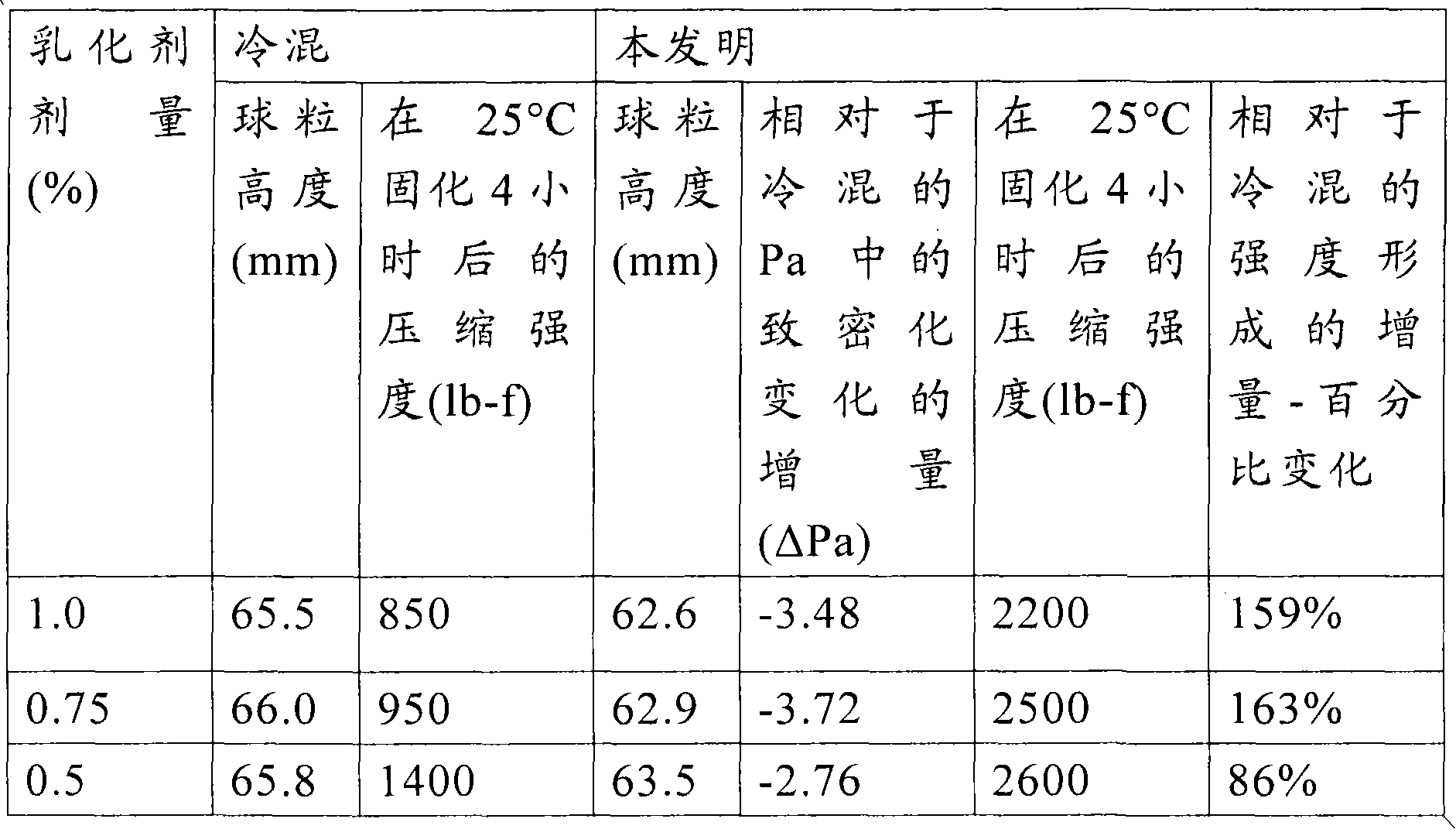
Example 5
[0160] The asphaltene compositions of the invention were prepared and compacted using the procedure of example 2. A solventless bituminous emulsion was prepared using a tallow polyalkylene polyamine emulsifier in a dosage range of 1.0% to 0.5% by weight of the total bituminous emulsion (bwe). The bitumen used in this example is a commercially available performance grade PG 70-22. The total bituminous composition in this example contained this PG70-22 bitumen, and each was prepared using a bitumen content of 4.8%, by total weight of graded aggregate.
[0161] For comparison, cold mix bituminous compositions were prepared having equivalent aggregate gradation and bitumen content. These cold-mix bituminous compositions were prepared following the procedure for their preparation of the bituminous compositions of the present invention as described above, with the difference that the bituminous emulsion and the graded aggregate were each at ambient room temperature (23 ℃) when mixed in a scoop.
[0162] The physical and performance properties of the respective compacted and cured asphaltene compositions were measured and the results are shown in table 5.
TABLE 5
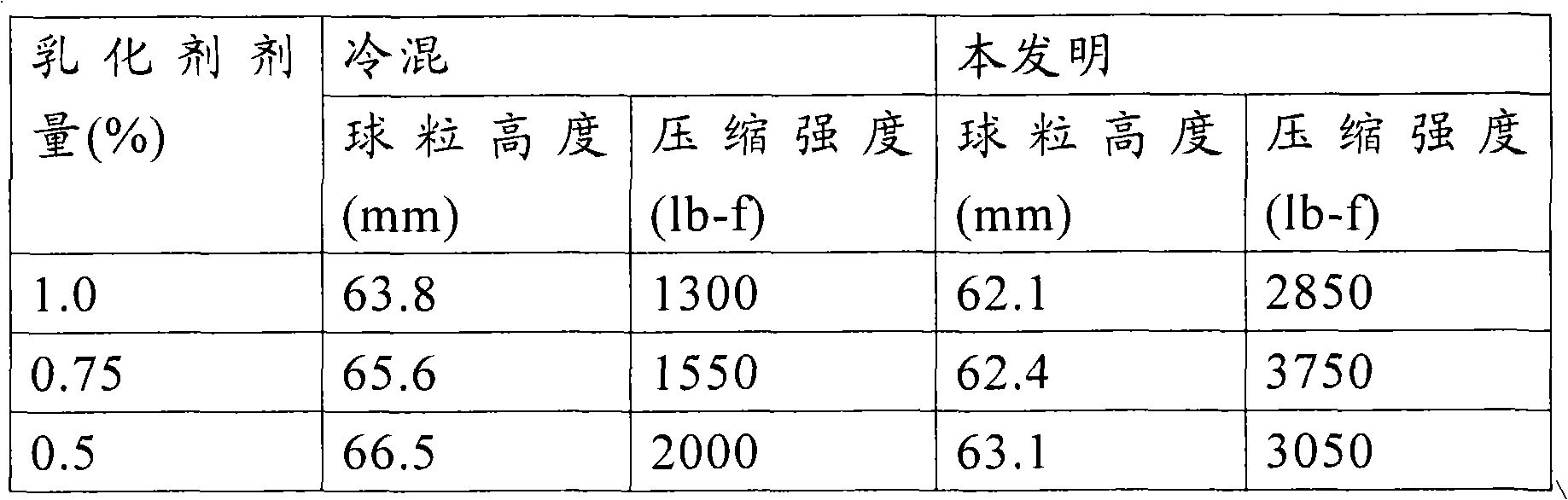
[0163] Pellets prepared using the asphaltene compositions of the invention exhibit compressive strength values after four hours curing at 25 ℃ that are 52% to 142% stronger than the same similarly formulated, emulsion-based, cold mix asphaltene compositions prepared and compacted under ambient laboratory conditions. In addition, the asphaltene compositions of the invention show significantly improved compaction compared to similar cold mix compositions, as measured by the height of the pellet sample.
Example 6
[0164] The asphaltene compositions of the invention were prepared and compacted using the procedure of example 2. A solventless bituminous emulsion was prepared using a tallow polyalkylene polyamine emulsifier in a dosage range of 1.0% to 0.5% by weight of the total bituminous emulsion (bwe). The asphalt used in this example was a commercially available performance grade PG64-22 asphalt modified with a styrene-butadiene-styrene block copolymer. The total bituminous composition in this example comprised this modified PG64-22 bitumen, and each was prepared using a bitumen content of 4.8%, by total weight of graded aggregate.
[0165] For comparison, cold mix bituminous compositions were prepared having equivalent aggregate gradation and bitumen content. These cold-mix bituminous compositions were prepared following the procedure for their preparation of the bituminous compositions of the present invention as described above, with the difference that the bituminous emulsion and the graded aggregate were each at ambient room temperature (23 ℃) when mixed in a scoop.
[0166] The physical and performance properties of the respective compacted and cured asphaltene compositions were measured and the results are shown in table 6.
TABLE 6
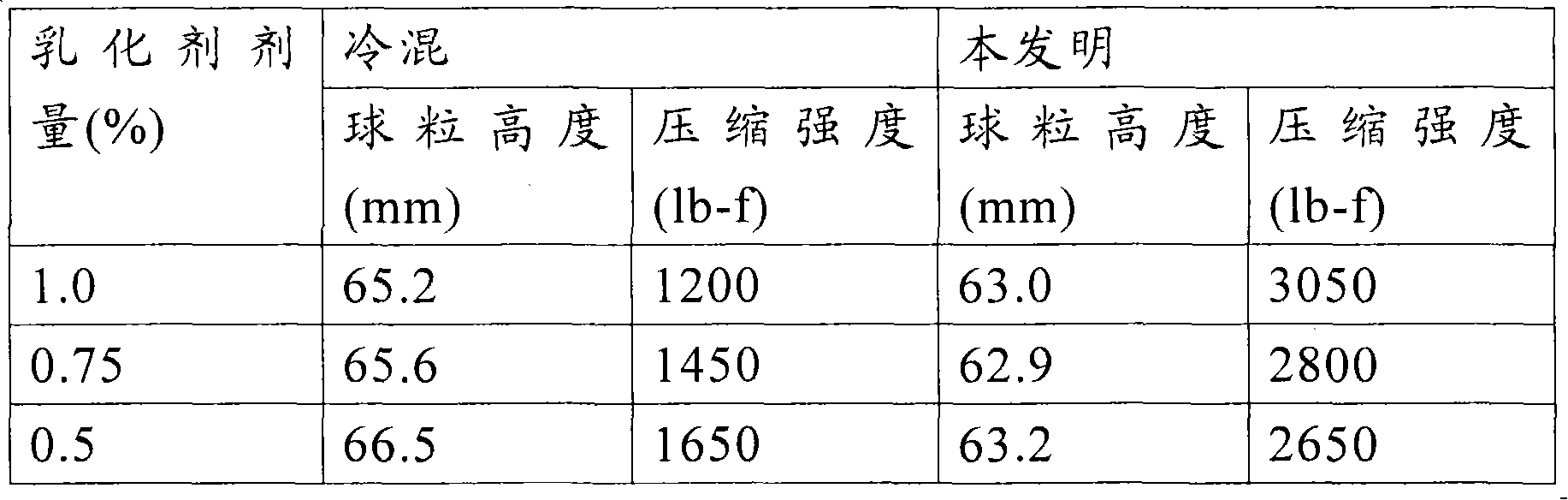
[0167] As shown in table 6, pellets prepared using the asphaltene compositions of the invention exhibited stronger compressive strength values after four hours curing at 25 ℃ than the same similarly formulated, emulsion-based, cold mix asphaltene compositions prepared and compacted under ambient laboratory conditions. In addition, the asphaltene compositions of the invention show significantly improved compaction compared to similar cold mix compositions, as measured by the height of the pellet sample.
Example 7
[0168] The asphaltene compositions of the invention were prepared and compacted using the procedure of example 2. A solvent-free asphalt emulsion was prepared using 0.5% tallow polyalkylene polyamine, based on the total weight of the asphalt emulsion (bwe). The asphalt used in this example was a commercially available performance grade PG64-22 asphalt modified by the addition of styrene-butadiene rubber (SBR). Two levels of asphalt modification were examined: 1% SBR bwe and 3% SBR bwe. The total bituminous composition in this example contained modified PG64-22 bitumen, and each was prepared using a bitumen content of 4.8%, based on the total weight of the graded aggregate.
[0169] For comparison, cold mix bituminous compositions were prepared having equivalent aggregate gradation and bitumen content. These cold-mix bituminous compositions were prepared following the procedure for their preparation of the bituminous compositions of the present invention as described above, with the difference that the bituminous emulsion and the graded aggregate were each at ambient room temperature (23 ℃) when mixed in a scoop.
TABLE 7
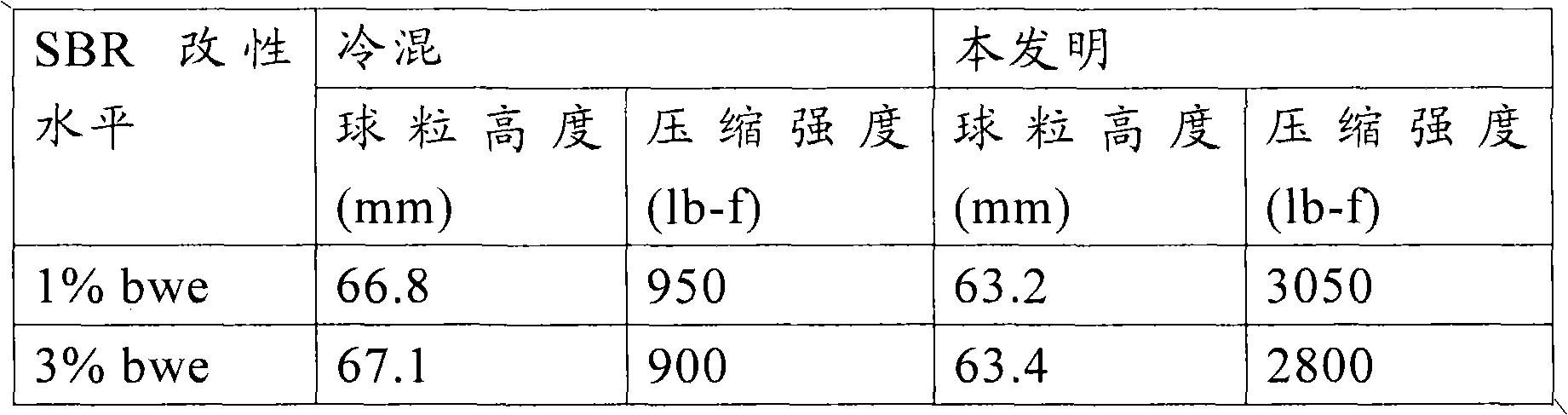
[0170] The physical and performance properties of the respective compacted and cured asphaltene compositions were measured and the results are shown in table 7.
[0171] As shown in table 7, pellets prepared using the asphaltene compositions of the invention prepared with 1% SBR bwe exhibited compressive strength values after four hours curing at 25 ℃ that were over 220% stronger than the same similarly formulated, emulsion-based, cold mix asphaltene composition prepared and compacted under ambient laboratory conditions, while pellets prepared with 3% SBR bwe exhibited a 210% increase in compressive strength compared to the corresponding cold mix pellets. In addition, the asphaltene compositions of the invention show significantly improved compaction compared to similar cold mix compositions, as measured by the height of the pellet sample.
Example 8
[0172] The asphaltene compositions of the invention were prepared and compacted using the procedure of example 2. A solvent-free asphalt emulsion was prepared using a modified tall oil condensate of polyethylene polyamine in a dosage range of 1.0% to 1.5% by total weight of the asphalt emulsion (bwe). Three commercially available performance grade asphalt types were used in this example: PG64-22, PG78-28, and styrene-butadiene-styrene (SBS) modified PG 64-22. Each asphaltene composition was prepared using a bitumen content of 4.8%, based on the total weight of the graded aggregate.
[0173] The asphalt emulsion used for the evaluation is shown in fig. 2, prepared in example 7 below, containing 1.0% bwe of emulsifier (modified tall oil fatty acid condensate of polyethylene polyamine).
[0174] For comparison, cold mix bituminous compositions were prepared having equivalent aggregate gradation and bitumen content. These cold-mix bituminous compositions were prepared following the procedure for their preparation of the bituminous compositions of the present invention as described above, with the difference that the bituminous emulsion and the graded aggregate were each at ambient room temperature (23 ℃) when mixed in a scoop.
[0175] The physical and performance properties of the respective compacted and cured asphaltene compositions were measured and the results are shown in table 8.
TABLE 8
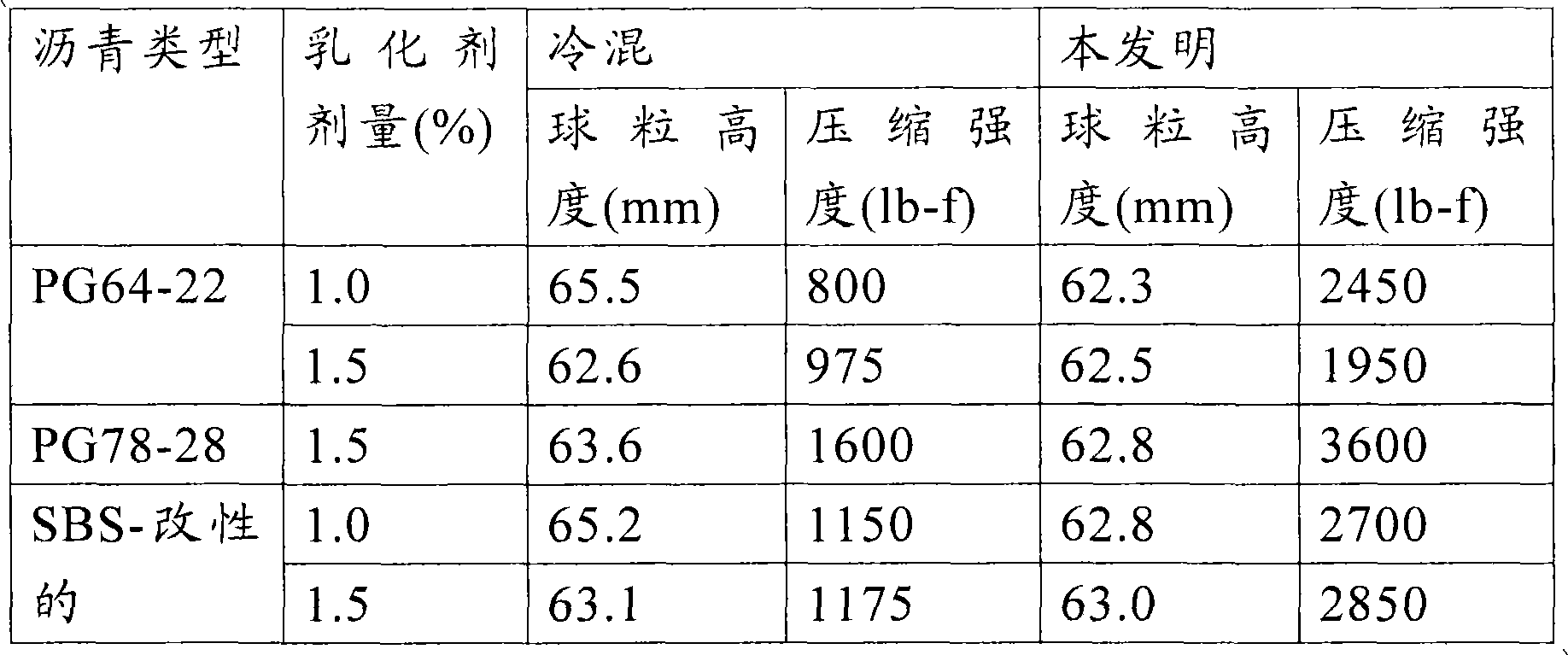
[0176] As shown in table 8, pellets prepared using the asphaltene compositions of the invention exhibited stronger compressive strength values after four hours curing at 25 ℃ than the same similarly formulated, emulsion-based, cold mix asphaltene compositions prepared and compacted under ambient laboratory conditions. In addition, the asphaltene compositions of the invention show improved compaction compared to similar cold mix compositions, as measured by the height of the pellet sample.
[0177] Figure 2 shows comparable results using differently formulated emulsions. The asphalt emulsion used for evaluation shown in fig. 2 contained 1.0% bwe of emulsifier (a modified tall oil fatty acid condensate of polyethylene polyamine), with 60% of the residue of PG64-22 asphalt (performance grade asphalt modified with styrene-butadiene-styrene block copolymer). Furthermore, at 25 ℃, the analysis showed an irregular viscosity with increasing shear rate from 0 to 1,000 sec-to-n. At 60 ℃, viscosity steadily decreases with shear rate (and shear stress increases).
Example 9
[0178] The asphaltene compositions of the invention were prepared and compacted using the procedure of example 2. Solvent-free asphalt emulsions were prepared using modified and unmodified C16-C18 fatty acid condensates of polyethylene polyamines as emulsifiers in a dosage range of 1.0% to 1.5% by weight of the total asphalt emulsion (bwe). Three commercially available performance grade asphalt types were used in this example: PG64-22, PG70-22, and styrene-butadiene-styrene (SBS) modified PG 64-22. Each asphaltene composition was prepared using a bitumen content of 4.8%, based on the total weight of the graded aggregate.
[0179] For comparison, cold mix bituminous compositions were prepared having equivalent aggregate gradation and bitumen content. These cold-mix bituminous compositions were prepared following the procedure for their preparation of the bituminous compositions of the present invention as described above, with the difference that the bituminous emulsion and the graded aggregate were each at ambient room temperature (23 ℃) when mixed in a scoop.
[0180] The physical and performance properties of the respective compacted and cured asphaltene compositions were measured and the results are shown in table 9 below.
TABLE 9

[0181] As shown in table 9, pellets prepared using the asphaltene compositions of the invention exhibited stronger compressive strength values after four hours curing at 25 ℃ than the same similarly formulated, emulsion-based, cold mix asphaltene compositions prepared and compacted under ambient laboratory conditions. In addition, the asphaltene compositions of the invention show significantly improved compaction compared to similar cold mix compositions, as measured by the height of the pellet sample.
[0182] Fig. 3 also shows comparable results in yet another differently formulated asphalt emulsion. The asphalt emulsion used for the evaluation shown in fig. 3 contained 0.75% bwe of emulsifier (modified and unmodified C16-C18 fatty acid condensates of polyethylene polyamines), with 60% of residues of PG70-22 asphalt.
Example 10
[0183] The asphaltene compositions of the invention were prepared and compacted using the procedure of example 2. A solvent-free asphalt emulsion was prepared using 0.75% of an alkyl quaternary amine emulsifier, based on the total weight of the asphalt emulsion (bwe). Three commercially available performance grade asphalt types were used in this example: PG64-22, PG70-22, and styrene-butadiene-styrene (SBS) modified PG 64-22. Each asphaltene composition was prepared using a bitumen content of 4.8%, based on the total weight of the graded aggregate.
[0184] For comparison, cold mix bituminous compositions were prepared having equivalent aggregate gradation and bitumen content. These cold-mix bituminous compositions were prepared following the procedure for their preparation of the bituminous compositions of the present invention as described above, with the difference that the bituminous emulsion and the graded aggregate were each at ambient room temperature (23 ℃) when mixed in a scoop.
[0185] The physical and performance properties of the respective compacted and cured asphaltene compositions were measured and the results are shown in table 10.
[0186] As shown in table 10, pellets prepared using the asphaltene compositions of the invention exhibited stronger compressive strength values after four hours curing at 25 ℃ than the same similarly formulated, emulsion-based, cold mix asphaltene compositions prepared and compacted under ambient laboratory conditions. In addition, the asphaltene compositions of the invention show improved compaction compared to similar cold mix compositions, as measured by the height of the pellet sample.
Example 11
[0187] The asphaltene compositions of the invention were prepared and compacted using the procedure of example 2. A solvent-free asphalt emulsion was prepared using as an emulsifier a blend of 1.5% tallow polyalkylene polyamine (bwe) based on the total weight of the asphalt emulsion and an aminated natural resin known as quebracho resin (from the general classification). Two commercially available performance grade asphalt types were used in this example: PG64-22 and styrene-butadiene-styrene (SBS) modified PG 64-22. Each asphaltene composition was prepared using a bitumen content of 4.8%, based on the total weight of the graded aggregate.
[0188] For comparison, cold mix bituminous compositions were prepared having equivalent aggregate gradation and bitumen content. These cold mix asphaltene compositions were prepared following the procedure for the preparation of the asphaltene compositions of the invention as described above, with the difference that the bitumen emulsion and the graded aggregate were each at ambient room temperature (23 ℃) when mixed in the scoop.
[0189] The physical and performance properties of the respective compacted and cured asphaltene compositions were measured and the results are shown in table 11.
TABLE 11
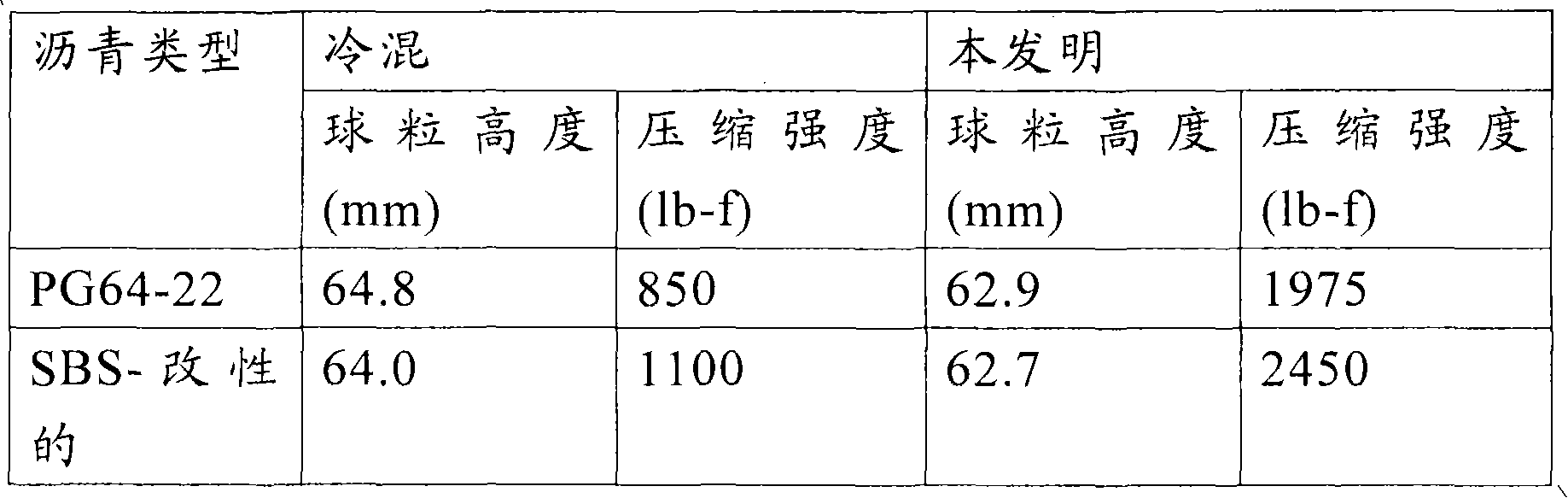
[0190] As shown in table 11, pellets prepared using the asphaltene compositions of the invention exhibited stronger compressive strength values after four hours curing at 25 ℃ than the same similarly formulated, emulsion-based, cold mix asphaltene compositions prepared and compacted under ambient laboratory conditions. In addition, the asphaltene compositions of the invention show improved compaction compared to similar cold mix compositions, as measured by the height of the pellet sample.
Example 12
[0191] The asphaltene compositions of the invention were prepared and compacted using the procedure of example 2. A solvent-free asphalt emulsion was prepared using as the emulsifier a blend of 0.2% tallow polyalkylene polyamine by total weight of the asphalt emulsion (bwe) and 08% bwe of polyethylene polyamine condensate of modified and unmodified fatty acids. The asphalt used in this example was a commercially available performance grade, PG64-22 asphalt. Each of the bituminous compositions in this example comprised PG64-22 bitumen, which was prepared using a bitumen content of 4.8%, by total weight of graded aggregate.
[0192] For comparison, cold mix bituminous compositions were prepared having equivalent aggregate gradation and bitumen content. The procedure for the preparation of the bituminous composition of the present invention, as described above, was followed to prepare a cold mix bituminous composition, with the exception that the bitumen emulsion and the graded aggregate were each at ambient room temperature (23 ℃) when mixed in a scoop.
[0193] The physical and performance properties of the respective compacted and cured asphaltene compositions were measured and the results are shown in table 12.
TABLE 12
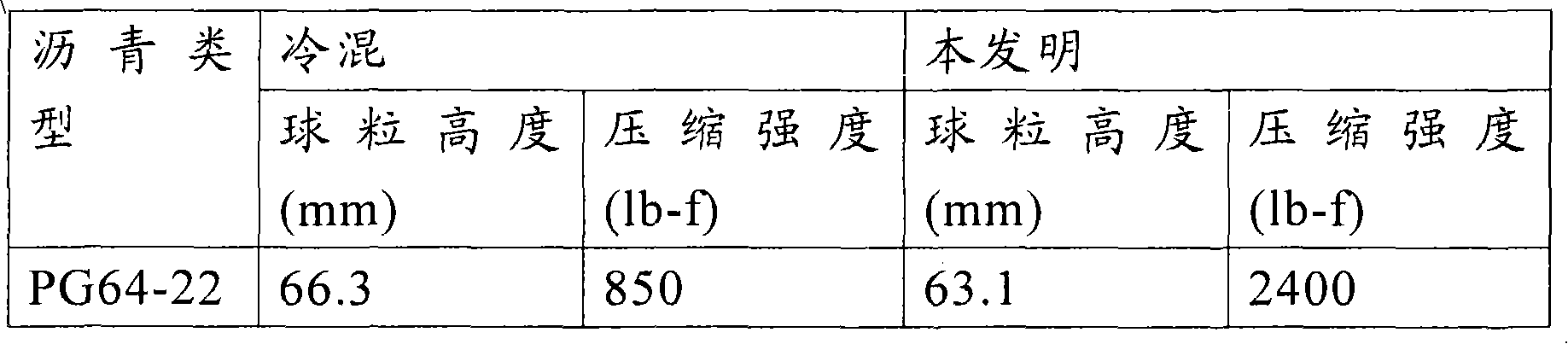
[0194] As shown in table 12, pellets prepared using the asphaltene compositions of the invention exhibited stronger compressive strength values after four hours curing at 25 ℃ than the same similarly formulated, emulsion-based, cold mix asphaltene compositions prepared and compacted under ambient laboratory conditions. In addition, the asphaltene compositions of the invention show improved compaction compared to similar cold mix compositions, as measured by the height of the pellet sample.
Example 13
[0195] The asphaltene compositions of the invention were prepared by the following procedure. A solvent-free asphalt emulsion was prepared using 0.5% tallow polyalkylene polyamine, based on the total weight of the asphalt emulsion (bwe). The emulsifier was dissolved in warm water and treated with hydrochloric acid solution to lower the pH to 2.0. An aqueous solution of emulsifier in water (called "soap") was heated to 55 ℃ and added to the Atomix colloid mill.
[0196] The bitumen used in this example is a commercially available performance grade PG 64-22. The asphalt was heated to 130 ℃ and added to an Atomix colloid mill where the soap solution and asphalt mixture were processed to produce an asphalt emulsion. The finished asphalt emulsion had an asphalt content of about 60-63% bwe. The bitumen emulsion was then diluted with water to 53.3% bitumen content prior to mixing with the aggregate.
[0197] The graded aggregate of example 1 was heated to about 80 c in an oven while the bitumen emulsion was heated to about 60 c. About 1,000 grams of the heated graded aggregate was placed in a 1 gallon stainless steel scoop. To 1,000 grams of aggregate at 80 ℃ was added 90g of 60 ℃ bitumen emulsion. The mixture was manually stirred for about 60 seconds to produce a bituminous composition comprising about 4.8% bitumen, by total weight of the graded aggregate.
[0198] One of the resulting asphalt compositions (having a temperature of about 60 ℃ to about 80 ℃) was added to a 100-mm diameter gyratory compaction mold, which had been preheated to 60 ℃ to 80 ℃. The asphalt composition was then compacted using a 30-turn SHRP Pine gyratory compactor at 600kPa pressure and a gyration angle of 1.25 deg.. The compacted asphaltene composition was then placed in a 25 ℃ oven and allowed to cure for four hours. After four hours of curing, the physical and performance properties of the compacted and cured asphaltene compositions were measured.
[0199] Another resulting bitumen composition (having a temperature of about 60 ℃ to about 80 ℃) was placed in a polyethylene bag and placed in an oven maintained at a temperature of 60 ℃. After three hours, the bitumen composition (temperature about 60 ℃) was removed from the oven and placed in a 100mm diameter gyratory compaction mold, which had been preheated to 60 ℃. The asphalt composition was then compacted using a 30-turn SHRP Pine gyratory compactor at 600kPa pressure and a gyratory angle of 1.25. The compacted asphaltene composition was placed in a 25 ℃ oven and allowed to cure for four hours. After four hours of curing, the physical and performance properties of the compacted and cured asphaltene compositions were measured.
[0200] The physical and performance properties of the respective compacted and cured bituminous compositions were measured and the results showed that storage did not adversely affect the coating, compactibility or early strength of the bituminous compositions. This indicates that the workability of the asphaltene composition is not impaired or reduced by storage.
Example 14
[0201] The asphaltene compositions of the invention were prepared by the following procedure. A solvent-free asphalt emulsion was prepared using 0.5% tallow polyalkylene polyamine emulsifier based on the total weight of the asphalt emulsion (bwe). The emulsifier was dissolved in warm water and treated with hydrochloric acid solution to lower the pH to 2.0. An aqueous solution of emulsifier in water (called "soap") was heated to 55 ℃ and added to the Atomix colloid mill.
[0202] The asphalt used in this example was commercially available performance grade styrene-butadiene-styrene (SBS) modified PG 64-22. The asphalt was heated to 130 ℃ and added to an Atomix colloid mill where the soap solution and asphalt mixture were processed to produce an asphalt emulsion. The finished asphalt emulsion had an asphalt content of about 60-63% bwe. The bitumen emulsion was then diluted with water to 53.3% bitumen content prior to mixing with the aggregate.
[0203] The graded aggregate of example 1 was heated to about 80 c in an oven while the bitumen emulsion was heated to about 60 c. About 1,000 grams of the heated graded aggregate was placed in a 1 gallon stainless steel scoop. To 1,000 grams of aggregate at 80 ℃ was added 90g of 60 ℃ bitumen emulsion. The mixture was manually stirred for about 60 seconds to produce a bituminous composition comprising about 4.8% bitumen, by total weight of the graded aggregate.
[0204] One of the resulting asphalt compositions (having a temperature of about 60 ℃ to about 80 ℃) was added to a 100-mm diameter gyratory compaction mold, which had been preheated to 60 ℃ to 80 ℃. The asphalt composition was then compacted using a 30-turn SHRP Pine gyratory compactor at 600kPa pressure and a gyratory angle of 1.25. The compacted asphaltene composition was then placed in a 25 ℃ oven and allowed to cure for four hours. After four hours of curing, the physical and performance properties of the compacted and cured asphaltene compositions were measured.
[0205] Another resulting bitumen composition (having a temperature of about 60 ℃ to about 80 ℃) was placed in a polyethylene bag and placed in an oven maintained at a temperature of 60 ℃. After 21 hours, the bitumen composition (temperature about 60 ℃) was removed from the oven and placed in a 100mm diameter gyratory compaction mold, which had been preheated to 60 ℃. The asphalt composition was then compacted using a 30-turn SHRP Pine gyratory compactor at 600kPa pressure and a gyration angle of 1.25 deg.. The compacted asphaltene composition was placed in a 25 ℃ oven and allowed to cure for four hours. After four hours of curing, the physical and performance properties of the compacted and cured asphaltene compositions were measured.
[0206] The physical and performance properties of the respective compacted and cured bituminous compositions were measured and the results showed that storage did not adversely affect the coating, compactibility or early strength of the bituminous compositions. This indicates that the workability of the asphaltene composition is not impaired or reduced by storage.
Watch 13
Particle size distribution at elevated temperature
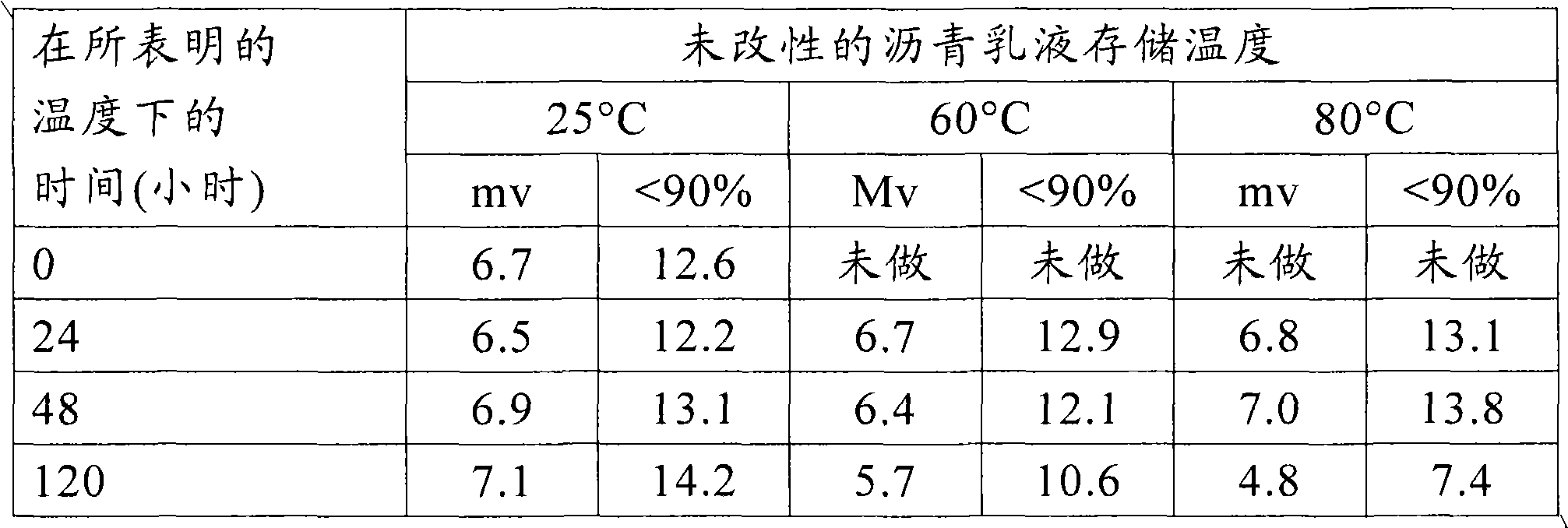
TABLE 14
Particle size distribution at elevated temperature
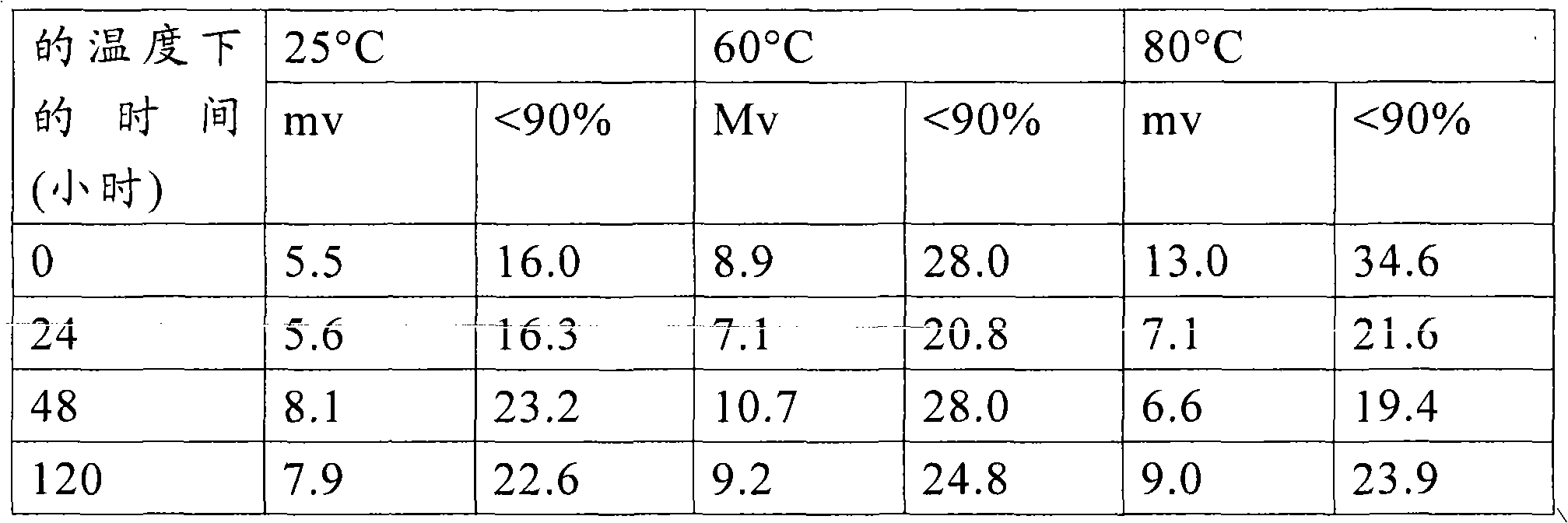
Particle size distribution at elevated temperature

TABLE 16
Particle size distribution at elevated temperature

Example 15
[0207] A solvent-free bitumen emulsion suitable for producing the asphaltene compositions of the invention is prepared by the following procedure. A series of solvent-free asphalt emulsions were prepared using 1.0% tallow polyalkylene polyamine emulsifier based on the total weight of the asphalt emulsion (bwe). The emulsifier was dissolved in warm water and treated with hydrochloric acid solution to lower the pH to 2.0. An aqueous solution of emulsifier in water (called "soap") was heated to 55 ℃ and added to the Atomix colloid mill.
[0208] Four performance grade asphalt types were used in this example to produce a series of asphalt emulsions. Commercially available PG64-22 and commercially available styrene-butadiene-styrene (SBS) modified PG64-22 were used. Also, PG64-22 asphalt modified by the addition of styrene-butadiene-rubber (SBR) at 1% SBR bwe or 3% SBR bwc was used. The respective asphalt was heated to 130 ℃ and added to an Atomix colloid mill where the soap solution and asphalt mixture were processed to produce an asphalt emulsion.
[0209] As indicated in tables 13-16 below, the resulting asphalt emulsions exhibited a significantly unchanged particle size distribution when held at elevated temperatures for a period of time. Table 13 shows that with unmodified bitumen, the starting mean particle size (mv) is lower than for SBS-modified bitumen (table 14), since SBS-modified bitumen gives a relatively high mean particle size as well as a high total particle size distribution (as reflected in the 90% particle size).
[0210] It will be understood that the foregoing description relates to exemplary and merely illustrative embodiments and is not intended to limit the invention thereto. Various changes and modifications may be made herein, which will be apparent to those skilled in the art. Such modifications are considered to be within the scope of the invention as defined by the appended claims.
Claims (25)
1. An asphaltene composition comprising:
(a) a solvent-free bituminous emulsion in an amount of from about 2% to about 10% by total weight of the bituminous composition, wherein the emulsion comprises:
(i) bitumen in an amount of from about 50% to about 75% by weight of the total weight of the bitumen emulsion,
(ii) an emulsifier package in an amount of from about 0.05% to about 2% by weight of the total weight of the asphalt emulsion having an interfacial tension between asphalt and water of less than 40 dynes/cm at a temperature of 26 ℃ and an aqueous concentration of less than 0.1 wt%,
(ii) water in an amount to complement the emulsion; and
(b) aggregate in an amount of from about 90% to about 98% by weight of the total bituminous composition; and
wherein the asphaltene composition is absent of bitumen having a penetration greater than 220dmm, as determined at 25 ℃ according to ASTM standard method D5.
2. The composition of claim 1, wherein the asphalt comprises at least one ingredient selected from the group consisting of: naturally occurring asphalt, asphalt derived from crude oil, asphalt derived from petroleum pitch (petroleum pitch), asphalt derived from coal tar, polymer modified asphalt, rubberized asphalt containing recycled tire material, acid modified asphalt, paraffin modified asphalt, and combinations thereof.
3. The composition of claim 1, wherein the asphalt comprises asphalt modified with at least one compound selected from the group consisting of: natural rubber, synthetic rubber, plastomers, thermoplastic resins, thermosetting resins, elastomers, styrene-butadiene-styrene, styrene-butadiene-rubber, polyisoprene, neoprene, related thickeners, starch, polybutene, butadiene-styrene rubber, vinyl polymers, ethylene vinyl acetate, sulfur containing crosslinkers, salts, acid modifiers, paraffin modifiers, and combinations thereof.
4. The composition of claim 1, wherein the emulsifier package comprises an anionic emulsifier.
5. The composition of claim 4, wherein the anionic emulsifier comprises at least one ingredient selected from the group consisting of: C12-C24 fatty acids; Diels-Alder adducts of C12-C24 fatty acids; rosin acid; Diels-Alder adducts of rosin acids; a natural resinous polymer; quebracho resin; tannic acid; a lignin polymer; polyacrylic acid; a polyacrylate; alkyl sulfonates; alkyl benzyl sulfonate; alkyl sulfates; alkyl phosphonates; alkyl phosphate esters/salts; a phenolic resin; organic sulfates; organic sulfonates; an organic phosphate ester/salt; organic phosphonates and combinations thereof.
6. The composition of claim 1, wherein the emulsifier package comprises an amphoteric emulsifier.
7. The composition of claim 1, wherein the emulsifier package comprises a cationic emulsifier.
8. The composition of claim 7, wherein the cationic emulsifier comprises at least one member selected from the group consisting of: fatty amidoamines, polyoxyethylene monoamines, polyoxypropylene monoamines, polyoxyethylene polyoxypropylene polyamines, polyoxypropylene polypropyleneopolyamines, C12-C24 alkylaryl monoamines, C12-C24 alkylaryl polypropyleneopolyamines, C12-C24 quaternary amines, C12-C24 alkyl ether amines, C12-C24 alkyl ether polyamines, C12-C24 alkyl monoamines, C12-C24 alkyl polypropyleneopolyamines, C12-C24 alkyl polypropyleneopolyamine N-oxides, amine derivatives of tannic acid, amine derivatives of phenolic resins, amine derivatives of lignin, amine modified polyacrylates, and combinations thereof.
9. The composition of claim 1, wherein the emulsifier package comprises a nonionic emulsifier.
10. The composition of claim 9, wherein the non-ionic emulsifier comprises at least one member selected from the group consisting of: alkyl aryl polyethylene oxide derivatives of alkanols; polyoxypropylene derivatives of alkanols; polyoxyethylene derivatives of alkanols; polyoxypropylene derivatives of alkanols; a polyethoxylated emulsifier; a polypropoxylated emulsifier; sorbitan esters; a sugar-type surfactant; a protein stabilizing agent; a mechanical stabilizer; an alkyl polysaccharide; an alkylphenol alkoxylate; a fatty alcohol ethoxylate; a fatty acid propoxylate; ethoxylates of escin oleic acid; ethoxylates of castor oil; propoxylates of escin oleic acid; propoxylates of castor oil; and combinations thereof.
11. The composition of claim 1, wherein the emulsifier package comprises at least one ingredient selected from the group consisting of: a polyethylene-polypropylene block copolymer; hydroxy poly (oxyethylene) poly (oxypropylene) poly (oxyethylene) block copolymers; 1, 2-propylene glycol ethoxylate; 1, 2-propylene glycol propoxylate; a synthetic block copolymer of ethylene oxide and propylene oxide having a molecular weight greater than 300 g/mol; decyl alcohol ethoxylate; castor oil ethoxylates; palmitol-oleyl alcohol (ceto-oleyl alcohol) ethoxylate; ethoxylated alkanolamides; a fatty alcohol alkoxylate; dinonyl phenol ethoxylate; nonylphenol ethoxylate; sorbitan ester ethoxylates; alkyl ether sulfates; monoalkylsulfosuccinamates (sulfosuccinamates); alkyl phenol ether sulfates; fatty alcohol sulfates; dialkyl sulfosuccinates (sulfosuccinates); alkyl ether phosphate esters; alkyl phenol ether phosphates; alkyl naphthalene sulfonate; an alpha-olefin sulfonate; alkyl benzene sulfonic acids and salts; alkyl ampho (di) acetates; an alkyl betaine; an alkyl polysaccharide; an alkylamine ethoxylate; an amine oxide; an oligoethylene amine; an oligomeric polypropyleneamine; hexamethylenediamine; bis-hexamethylenediamine; an oligomeric aziridine; polyaziridine; polyethylene polyamines; a polypropylenepolyamine; polyethylene/polypropylene polyamines; distillation residues from the preparation of polyalkylene polyamines; higher polyalkylene polyamines; homologues of hydroxyalkylamines; c-36 dimer fatty acid; c-54 trimeric fatty acid; c-36 dimer fatty amide; c-36 dimer fatty polyamide; a C-54 trimerized fatty amide polyamide; salts of C-36 dimer fatty acids; salts of C-54 trimeric fatty acids; hydroxy stearic acid; oligomers of hydroxystearic acid; polymerized hydroxystearic acid; polyalkylene amides of hydroxystearic acid; polyalkylene amides of oligomers of hydroxystearic acid; a polyalkylene amide of polymerized hydroxystearic acid; salts of hydroxystearic acid; salts of oligomers of hydroxystearic acid; a salt of polymerized hydroxystearic acid; a dialkylarylamine; salts of dialkylarylamines; bisamides of polyalkylene polyamines; salts of (polyalkylenepolyamine) bisamides; and combinations thereof.
12. The composition of claim 1, wherein the emulsifier package comprises at least one ingredient selected from the group consisting of:
(i) ethoxylated trimethylene amine derivatives of C12-C24 fatty amines of structure (I)

Wherein
R is C12-C24; x + y is more than or equal to 2; and a, b is more than or equal to 0;
(ii) propoxytrimethyleneamine derivatives of C12-C24 fatty amines of structure (II)

Wherein, R is C12-C24; x + y is more than or equal to 2; and a, b is more than or equal to 0;
(iii) aliphatic dialkylamines of structure (III)
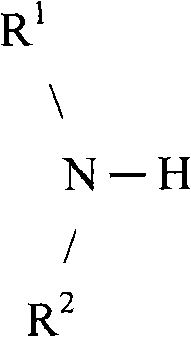
Wherein
R1,R2C12-C24;
(iv) quaternary amines of structure (IV)

Wherein,
R1,R2C12-C24; and
R3,R4methyl or C12-C24 moietyA higher homolog of the molecule;
(v) quaternary amines of structure (V)

Wherein,
R1,R2C12-C24; and
R3,R4an ethoxy moiety, a propoxy moiety, or a combination thereof;
(vi) a polyamide of structure (I);
(vii) a polyamide of structure (II);
(viii) a salt of structure (III);
(ix) a salt of structure (IV); and
(x) A salt of structure (V).
13. The composition of claim 1, wherein the emulsifier package comprises at least one ingredient selected from the group consisting of: oligomers of acrylic acid-based acids; polymers of acrylic acid-based acids; oligomers of acrylic-based esters; polymers based on esters of acrylic acid; oligomers of acrylic acid-based amides; polymers based on amides of acrylic acid; oligomers of styrene-based monomers, polymers of styrene-based monomers; an olefin oligomer; poly (olefins); a diene oligomer; a polydiene; oligomers of hydroxylated propylene; polymers of hydroxylated propylene; oligomers of polyhydroxylated polyolefins; polymers of polyhydroxylated polyolefins; oligomers of vinyl halides; polymers of vinyl halides; oligomers of halogenated olefins; polymers of haloalkylene groups; oligomers of haloalkylenes; a polymer of a haloalkylene group; and combinations thereof.
14. The composition of claim 1, wherein the emulsifier package comprises at least one ingredient selected from the group consisting of: salts of oligomers of acrylic acid-based acids; salts of polymers of acrylic acid-based acids; salts of oligomers of acrylic acid-based esters; salts of polymers based on esters of acrylic acid; salts of oligomers of acrylic acid-based amides; salts of polymers of acrylic acid-based amides; salts of oligomers of styrene-based monomers, salts of polymers of styrene-based monomers; salts of olefin oligomers; salts of poly (olefins); a salt of a diene oligomer; salts of polydienes; salts of oligomers of hydroxylated propylene; salts of polymers of hydroxylated propylene; salts of oligomers of polyhydroxylated polyolefins; salts of polymers of polyhydroxylated polyolefins; salts of oligomers of vinyl halides; salts of polymers of vinyl halides; salts of oligomers of halogenated olefins; salts of polymers of haloalkylene groups; salts of oligomers of haloalkylenes; a polymer of a haloalkylene group; salts of oligoethyleneamines; salts of oligomeric polypropyleneamine; salts of hexamethylenediamine; salts of bis-hexamethylenediamine; salts of oligomeric aziridines; salts of polyethylenimine; salts of polyethylene polyamines; salts of polypropylenepolyamines; salts of polyethylene/polypropylene polyamines; salts of distillation residues in the preparation of polyalkylene polyamines; salts of higher polyalkylene polyamines; and combinations thereof.
15. The composition of claim 1, wherein the emulsifier package comprises at least one ingredient selected from the group consisting of: amides of oligoethyleneamines; amides of oligomeric polypropyleneamine; amides of hexamethylene diamine; amides of bis-hexamethylenediamine; amides of oligomeric aziridines; amides of polyethylenimines; amides of polyethylene polyamines; amides of polypropylenepolyamines; amides of polyethylene/polypropylene polyamines; amides of distillation residues in the preparation of polyalkylene polyamines; amides of higher polyalkylene polyamines; and combinations thereof.
16. The composition of claim 1, wherein the emulsifier package comprises at least one ingredient selected from the group consisting of: amide salts of oligoethyleneamines; amide salts of oligomeric polypropyleneamine; amide salts of hexamethylene diamine; amide salts of bis-hexamethylenediamine; amide salts of oligomeric aziridines; amide salts of polyaziridine; amide salts of polyethylene polyamines; amide salts of polypropylenepolyamines; amide salts of polyethylene/polypropylene polyamines; amide salts of distillation residues in the preparation of polyalkylene polyamines; amide salts of higher polyalkylene polyamines; and combinations thereof.
17. The composition of claim 1, wherein the emulsifier package has an interfacial tension between the bitumen and water of less than 40 dynes/cm at a temperature of 26 ℃ and a water concentration of less than 0.1 wt%.
18. The composition of claim 1, wherein the asphalt emulsion comprises an organic solvent in an amount less than or equal to 4 wt% of the total weight of the emulsion.
19. The composition of claim 1, wherein the aggregate comprises at least one member selected from the group consisting of: dense graded aggregate, discontinuous graded aggregate, loose graded aggregate, stone matrix aggregate, recycled asphalt pavement material, recycled asphalt shingles, and combinations thereof. Combination of Chinese herbs
20. The composition of claim 1, further comprising an additive for enhancing processability or improving performance.
21. The composition of claim 1 characterized in that it is applied to a surface to be paved at a temperature in the range of about 0 ℃ to about 120 ℃.
22. A method of preparing an asphaltene composition, comprising the steps of:
(A) preparing a pitch emulsion comprising:
(i) bitumen in an amount of from about 50% to about 75% by weight of the total weight of the bitumen emulsion,
(ii) an emulsifier package in an amount of from about 0.05% to about 2% by weight of the total weight of the asphalt emulsion having an interfacial tension between asphalt and water of less than 40 dynes/cm at a temperature of 26 ℃ and an aqueous concentration of less than 0.1 wt%,
(ii) water in an amount to complement the emulsion; and
(B) an asphaltene composition having a temperature of from about 50 ℃ to about 140 ℃ is prepared by mixing:
(i) the bituminous emulsion of step (a) having a temperature of from about 25 ℃ to about 95 ℃ in an amount of from about 2% to about 10% by weight of the total bituminous composition; and
(ii) aggregate at a temperature of from about 60 ℃ to about 140 ℃ in an amount of from about 90% to about 98% by weight of the total weight of the bituminous composition;
wherein the asphaltene composition is absent of bitumen having a penetration greater than 220dmm, as determined at 25 ℃ according to ASTM standard method D5.
23. The method of claim 72, wherein the asphalt emulsion is delivered directly after preparation to at least one static or moving asphalt mixing device comprising at least one component selected from the group consisting of: barrel mixers, kneader batch mixers, double mixers and combinations thereof, wherein the moving mixing device comprises equipment for in-situ or in-situ operation.
24. A paved road comprising at least one layer of an asphaltene composition, wherein the asphaltene composition comprises:
(a) a solvent-free bituminous emulsion in an amount of from about 2% to about 10% by total weight of the bituminous composition, wherein the emulsion comprises:
(i) bitumen in an amount of from about 50% to about 75% by weight of the total weight of the bitumen emulsion,
(ii) an emulsifier package in an amount of from about 0.05% to about 2% by weight of the total weight of the asphalt emulsion having an interfacial tension between asphalt and water of less than 40 dynes/cm at a temperature of 26 ℃ and an aqueous concentration of less than 0.1 wt%,
(ii) water in an amount to complement the emulsion; and
(b) aggregate in an amount of from about 90% to about 98% by weight of the total bituminous composition; and
wherein the asphaltene composition is absent of bitumen having a penetration greater than 220dmm, as determined at 25 ℃ according to ASTM standard method D5.
25. The paved road of claim 24, wherein the emulsifier package comprises at least one ingredient selected from the group consisting of: anionic emulsifiers, cationic emulsifiers, amphoteric emulsifiers, nonionic emulsifiers, and combinations thereof.
Applications Claiming Priority (5)
| Application Number | Priority Date | Filing Date | Title |
|---|---|---|---|
| US73566907A | 2007-04-16 | 2007-04-16 | |
| US11/735,669 | 2007-04-16 | ||
| US11/852,696 | 2007-09-10 | ||
| US11/852,696 US7833338B2 (en) | 2004-02-18 | 2007-09-10 | Method for producing bitumen compositions |
| PCT/US2008/058686 WO2008130789A2 (en) | 2007-04-16 | 2008-03-28 | Method for producing bitumen compositions |
Publications (1)
| Publication Number | Publication Date |
|---|---|
| CN101679754A true CN101679754A (en) | 2010-03-24 |
Family
ID=39811521
Family Applications (1)
| Application Number | Title | Priority Date | Filing Date |
|---|---|---|---|
| CN200880020511A Pending CN101679754A (en) | 2007-04-16 | 2008-03-28 | Method for producing bitumen compositions |
Country Status (9)
| Country | Link |
|---|---|
| US (5) | US7833338B2 (en) |
| EP (2) | EP2185650B1 (en) |
| CN (1) | CN101679754A (en) |
| AU (1) | AU2008242350B2 (en) |
| BR (1) | BRPI0810452A2 (en) |
| CA (1) | CA2684495C (en) |
| MX (1) | MX2009011201A (en) |
| WO (1) | WO2008130789A2 (en) |
| ZA (1) | ZA200907053B (en) |
Cited By (18)
| Publication number | Priority date | Publication date | Assignee | Title |
|---|---|---|---|---|
| CN103613941A (en) * | 2013-12-09 | 2014-03-05 | 江苏博特新材料有限公司 | Preparation method of amphoteric ionic warm asphalt mixing agent and application thereof in warm mix asphalt |
| CN103709764A (en) * | 2013-11-01 | 2014-04-09 | 西安近代化学研究所 | Method using high boiling point by-products in ethylenediamine production for preparation of asphalt emulsifier |
| CN104312175A (en) * | 2014-10-16 | 2015-01-28 | 盐城工学院 | Asphalt modifier, modified emulsified asphalt, modified asphalt mixture and respective preparation methods thereof |
| CN104428366A (en) * | 2013-07-05 | 2015-03-18 | Lg化学株式会社 | Asphalt modifier having improved mixing properties, and asphalt composition comprising same |
| CN104419209A (en) * | 2013-08-22 | 2015-03-18 | 中国石油化工股份有限公司 | Anionic asphalt temperature mixed agent and preparation method thereof |
| CN104479379A (en) * | 2014-12-30 | 2015-04-01 | 江苏健神生物农化有限公司 | Preparation method for asphalt mixture for road paving |
| CN104497597A (en) * | 2014-12-11 | 2015-04-08 | 李保集 | Modified road asphalt and preparation method thereof |
| CN104650803A (en) * | 2014-12-30 | 2015-05-27 | 南通福伦利新材料有限公司 | Preparation method for novel asphalt cold-mixing cold-paving adhesive |
| CN108291066A (en) * | 2015-07-23 | 2018-07-17 | 纳幕尔杜邦公司 | Epoxy-functionalized ethylene copolymer pitch reaction product |
| CN109233635A (en) * | 2017-05-17 | 2019-01-18 | 中路高科(北京)公路技术有限公司 | A kind of sponge urban water-through dedicated highly resistance of mating formation is dispersed material and its application |
| CN109486181A (en) * | 2018-11-22 | 2019-03-19 | 江苏利德尔新材料科技有限公司 | A kind of preparation method of antistatic high fire-retardance MC nylon composite materials |
| CN111051474A (en) * | 2017-07-31 | 2020-04-21 | 香港长龙集团有限公司 | A demulsifier for demulsifying asphalt from natural asphalt |
| CN111320551A (en) * | 2019-01-15 | 2020-06-23 | 山东大学 | Secondary amide diamine quaternary ammonium salt amphoteric asphalt emulsifier and preparation method thereof |
| CN111690152A (en) * | 2020-07-08 | 2020-09-22 | 中铁四局集团有限公司 | Rubber modified asphalt latex and preparation method and application thereof |
| CN113136087A (en) * | 2021-05-14 | 2021-07-20 | 常州利尔德通新材料科技有限公司 | High-viscosity-reduction warm mixing agent for warm-mixed asphalt |
| CN113549225A (en) * | 2021-09-03 | 2021-10-26 | 天津康泽威科技有限公司 | Composite spraying quick-setting emulsifier and preparation method thereof, preparation method of anionic emulsified asphalt and waterproof coating |
| CN113698596A (en) * | 2021-09-03 | 2021-11-26 | 天津康泽威科技有限公司 | Cationic asphalt emulsifier and preparation method thereof, and asphalt emulsion preparation method |
| CN116891574A (en) * | 2023-05-29 | 2023-10-17 | 重庆新木公路养护有限公司 | Preparation method of epoxy resin modified emulsifier for asphalt |
Families Citing this family (79)
| Publication number | Priority date | Publication date | Assignee | Title |
|---|---|---|---|---|
| HUE031890T2 (en) * | 2004-02-18 | 2017-08-28 | Ingevity South Carolina Llc | Method for producing bituminous compositions |
| US7833338B2 (en) * | 2004-02-18 | 2010-11-16 | Meadwestvaco Packaging Systems, Llc | Method for producing bitumen compositions |
| US7297204B2 (en) * | 2004-02-18 | 2007-11-20 | Meadwestvaco Corporation | Water-in-oil bituminous dispersions and methods for producing paving compositions from the same |
| US7888445B2 (en) | 2005-07-26 | 2011-02-15 | Knauf Insulation Gmbh | Fibrous products and methods for producing the same |
| US8258084B2 (en) * | 2006-01-18 | 2012-09-04 | Georgia-Pacific Chemicals Llc | Spray dried emulsifier compositions, methods for their preparation, and their use in oil-based drilling fluid compositions |
| DK2125650T3 (en) | 2007-01-25 | 2024-08-05 | Knauf Insulation | MINERAL FIBER BOARD |
| SI2108006T1 (en) | 2007-01-25 | 2021-02-26 | Knauf Insulation Gmbh | Binders and materials made therewith |
| US8501838B2 (en) | 2007-01-25 | 2013-08-06 | Knauf Insulation Sprl | Composite wood board |
| EP2137223B1 (en) | 2007-04-13 | 2019-02-27 | Knauf Insulation GmbH | Composite maillard-resole binders |
| GB0715100D0 (en) | 2007-08-03 | 2007-09-12 | Knauf Insulation Ltd | Binders |
| US7503202B1 (en) * | 2007-08-21 | 2009-03-17 | Senmaterials, L.P. | Design technique for selecting a bituminous mixture for use in a hot in-place recycling process |
| MX2011007428A (en) * | 2009-02-19 | 2011-08-15 | Meadwestvaco Corp | Method for producing bituminous paving compositions. |
| US20100222469A1 (en) * | 2009-02-27 | 2010-09-02 | Semmaterials, L.P. | A crack resistant layer with good binder fracture energy properties and method of selecting same |
| US20100222466A1 (en) * | 2009-02-27 | 2010-09-02 | Semmaterials, L.P. | Crack resistant layer with good beam fatigue properties made from an emulsion of a polymer modified bituminous binder and method of selecting same |
| US20100222468A1 (en) * | 2009-02-27 | 2010-09-02 | Semmaterials, L.P. | Crack resistant layer with good beam fatigue properties and method of selecting same |
| US20100222465A1 (en) * | 2009-02-27 | 2010-09-02 | Semmaterials, L.P. | Crack resistant layer with good mixture fracture energy and method of selecting same |
| US20100222467A1 (en) * | 2009-02-27 | 2010-09-02 | Semmaterials, L.P. | crack resistent layer with good mixture fracture energy made from an emulsion of a polymer modified bituminous binder and method of selecting same |
| US8530365B2 (en) | 2009-04-07 | 2013-09-10 | DSI-Dimona Silica Industries Ltd. | Composition for improving the stability and operational performance and reducing the environmental impact of asphalt mixes |
| WO2011015946A2 (en) | 2009-08-07 | 2011-02-10 | Knauf Insulation | Molasses binder |
| PH12012500985A1 (en) * | 2009-11-25 | 2013-01-07 | Wlodzimierz Myslowski | Method for production of granulated polymer-asphalt binder and sulfur concrete with participation of sulfur polymer obtained in waste sulfur solvent- borne modification |
| US9416499B2 (en) | 2009-12-31 | 2016-08-16 | Heatwurx, Inc. | System and method for sensing and managing pothole location and pothole characteristics |
| US8801325B1 (en) | 2013-02-26 | 2014-08-12 | Heatwurx, Inc. | System and method for controlling an asphalt repair apparatus |
| US20150003910A1 (en) * | 2009-12-31 | 2015-01-01 | Stephen Douglas Garland | Asphalt brick device and method of making same |
| US20130059075A1 (en) * | 2010-05-07 | 2013-03-07 | Knauf Insulation | Carbohydrate polyamine binders and materials made therewith |
| KR101835899B1 (en) * | 2010-05-07 | 2018-03-07 | 크나우프 인설레이션, 인크. | Carbohydrate binders and materials made therewith |
| EP2388296A1 (en) * | 2010-05-18 | 2011-11-23 | Sorigué, S.A. | Composite material for road, process for obtaining it, bituminous mixture contained therein and its use |
| WO2011146735A2 (en) * | 2010-05-19 | 2011-11-24 | Pq Corporation | Mixtures of zeolite and rap/ras |
| WO2011154368A1 (en) | 2010-06-07 | 2011-12-15 | Knauf Insulation | Fiber products having temperature control additives |
| BE1019382A5 (en) * | 2010-06-22 | 2012-06-05 | Imperbel N V Sa | BINDING COMPOSITION. |
| US8722771B2 (en) | 2010-11-03 | 2014-05-13 | Saudi Arabian Oil Company | Sulfur modified asphalt for warm mix applications |
| AU2011357540B2 (en) * | 2011-01-28 | 2015-01-22 | Rhodia (China) Co., Ltd. | Additive for bitumen and bituminous product |
| WO2012152731A1 (en) | 2011-05-07 | 2012-11-15 | Knauf Insulation | Liquid high solids binder composition |
| US9534146B2 (en) * | 2011-06-24 | 2017-01-03 | Akzo Nobel Chemicals International B.V. | Additives for bitumen containing compositions |
| KR101354076B1 (en) * | 2011-10-07 | 2014-01-23 | 주식회사 삼표산업 | Additive For Warm Mix Asphalt |
| US9139733B2 (en) * | 2012-01-27 | 2015-09-22 | Western Emulsions, Inc. | Cold mix asphalt aggregate paving material |
| US8814464B2 (en) * | 2012-01-27 | 2014-08-26 | Western Emulsions, Inc. | Recycled reclaimed asphalt pavement |
| WO2013116637A1 (en) * | 2012-02-02 | 2013-08-08 | Icl Performance Products Lp | Methods and compositions for recycled asphalt shingles material |
| GB201206193D0 (en) | 2012-04-05 | 2012-05-23 | Knauf Insulation Ltd | Binders and associated products |
| ES2425302B1 (en) * | 2012-04-09 | 2014-08-11 | Universidade Da Coruña | Procedure for obtaining a bituminous mixture |
| GB201214734D0 (en) | 2012-08-17 | 2012-10-03 | Knauf Insulation Ltd | Wood board and process for its production |
| EP2928936B1 (en) | 2012-12-05 | 2022-04-13 | Knauf Insulation SPRL | Binder |
| US8927620B2 (en) * | 2013-03-15 | 2015-01-06 | Elmer's Products, Inc. | Color-changing wood filling composition |
| US9376555B2 (en) | 2013-03-15 | 2016-06-28 | Elmer's Products, Inc. | Color-changing wood filler |
| RU2543173C1 (en) * | 2013-07-26 | 2015-02-27 | Федеральное государственное бюджетное образовательное учреждение высшего профессионального образования "Башкирский государственный университет" | Bitumen composition (versions) and production method thereof |
| US20150087753A1 (en) * | 2013-09-23 | 2015-03-26 | Western Emulsions, Inc. | Modified asphalt paving composition |
| WO2015120252A1 (en) | 2014-02-07 | 2015-08-13 | Knauf Insulation, Llc | Uncured articles with improved shelf-life |
| GB201408909D0 (en) | 2014-05-20 | 2014-07-02 | Knauf Insulation Ltd | Binders |
| BR112016029674A2 (en) * | 2014-06-16 | 2017-08-22 | Ingevity South Carolina Llc | composite polymeric materials for modification of adhesive compositions and associated manufacturing methods |
| GB201412709D0 (en) | 2014-07-17 | 2014-09-03 | Knauf Insulation And Knauf Insulation Ltd | Improved binder compositions and uses thereof |
| CA2965697C (en) | 2014-11-03 | 2020-08-18 | Flint Hills Resources, Lp | Asphalt binders containing a glyceride and fatty acid mixture and methods for making and using same |
| US9862861B2 (en) * | 2014-11-11 | 2018-01-09 | Colymer Industries, LLC | Waterproofing compositions and methods |
| BR112017018131B1 (en) | 2015-02-27 | 2022-10-25 | Cargill, Incorporated | REJUVENATING COMPOSITIONS FOR ASPHALT APPLICATIONS AND APPLICATION METHODS THEREOF |
| CA2923039C (en) * | 2015-03-09 | 2023-09-12 | Heritage Research Group | Void reducing asphalt membrane composition, method and apparatus for asphalt paving applications |
| CA2923021C (en) | 2015-03-10 | 2023-08-01 | Heritage Research Group | Apparatus and method for applying asphalt binder compositions including void reducing asphalt membrane compositions for paving applications |
| GB201517867D0 (en) | 2015-10-09 | 2015-11-25 | Knauf Insulation Ltd | Wood particle boards |
| JP6028120B1 (en) * | 2016-06-06 | 2016-11-16 | 光工業株式会社 | Asphalt paving material for room temperature paving |
| GB201610063D0 (en) | 2016-06-09 | 2016-07-27 | Knauf Insulation Ltd | Binders |
| US20170370899A1 (en) * | 2016-06-22 | 2017-12-28 | Arizona Chemical Company, Llc | Methods for Evaluating Asphalt Mix Compositions Containing Reclaimed Asphalt |
| ES2882685T3 (en) * | 2016-08-17 | 2021-12-02 | Continental Reifen Deutschland Gmbh | Crosslinkable rubber mixture with sulfur and vehicle tire |
| WO2018033501A1 (en) * | 2016-08-17 | 2018-02-22 | Continental Reifen Deutschland Gmbh | Sulfur-crosslinkable rubber mixture and vehicle tire |
| CN106915916B (en) * | 2016-12-31 | 2019-10-15 | 山西省交通科学研究院 | Preparation method of warm-mixed anti-rutting agent for asphalt concrete |
| GB201701569D0 (en) | 2017-01-31 | 2017-03-15 | Knauf Insulation Ltd | Improved binder compositions and uses thereof |
| CN109694482B (en) * | 2017-10-23 | 2021-08-10 | 国家能源投资集团有限责任公司 | Modified emulsified asphalt, preparation method thereof and fog sealing layer material |
| GB201804907D0 (en) | 2018-03-27 | 2018-05-09 | Knauf Insulation Ltd | Composite products |
| GB201804908D0 (en) | 2018-03-27 | 2018-05-09 | Knauf Insulation Ltd | Binder compositions and uses thereof |
| CN108426992A (en) * | 2018-04-23 | 2018-08-21 | 中石化石油工程技术服务有限公司 | A kind of method of insoluble high molecular polymerization species solid content in measurement modified pitch |
| AU2019299067A1 (en) * | 2018-07-02 | 2021-01-21 | Heritage Research Group | Composition and method for treating an asphalt pavement with a void-filling asphalt emulsion |
| US10655015B2 (en) | 2018-09-22 | 2020-05-19 | Argopro Group LLC | Tire crumb-based bitumen polymer for producing a lower viscosity asphalt with improved tolerance to high temperatures |
| US11519177B2 (en) | 2019-02-05 | 2022-12-06 | Bmic Llc | Fastener plate for securing an underlayment to a roof surface |
| US11708508B2 (en) | 2019-03-15 | 2023-07-25 | Russell Standard Corp. | High performance tack coat |
| US10851500B2 (en) | 2019-04-23 | 2020-12-01 | Manhole Adjusting Inc. | Recycled asphalt compositions and methods thereof |
| CN110591394B (en) * | 2019-08-19 | 2021-09-03 | 江苏增光新材料科技股份有限公司 | Modified emulsified asphalt for micro surfacing |
| US11428009B2 (en) | 2019-09-30 | 2022-08-30 | Bmic Llc | Self-sealing roof fastener |
| US11085189B2 (en) | 2020-01-13 | 2021-08-10 | Building Materials Investment Corporation | Impact resistant roofing systems and methods |
| US12065580B2 (en) * | 2020-12-15 | 2024-08-20 | Russell Standard Corp. | Void reducing asphalt membrane emulsion |
| EP4383691B1 (en) | 2021-11-10 | 2026-01-21 | Samsung Electronics Co., Ltd. | Electronic device comprising adhesive member |
| CN115572541B (en) * | 2022-01-13 | 2024-06-07 | 广东九象新材料科技有限公司 | Rubber sealing waterproof paint and preparation method thereof |
| CN120303357A (en) * | 2022-12-05 | 2025-07-11 | 巴斯夫欧洲公司 | Non-silicone compositions for car care applications |
| US20250163331A1 (en) * | 2023-11-16 | 2025-05-22 | Hydrocarbon Technology & Innovation, Llc | Methods and systems for mixing dissimilar hydrocarbon feedstock materials to form hydrocarbon feedstock blends for subsequent processing |
Family Cites Families (83)
| Publication number | Priority date | Publication date | Assignee | Title |
|---|---|---|---|---|
| NL52265C (en) | 1938-01-26 | |||
| US2508430A (en) | 1949-02-17 | 1950-05-23 | California Research Corp | Bitumen-treating agent |
| US3520709A (en) | 1966-09-06 | 1970-07-14 | Grefco | Adhesives for porous structures |
| US3728278A (en) | 1968-04-25 | 1973-04-17 | Phillips Petroleum Co | Cationic emulsions |
| US3956002A (en) * | 1974-03-18 | 1976-05-11 | Westvaco Corporation | Anionic bituminous emulsions |
| US4008096A (en) | 1974-08-13 | 1977-02-15 | Shell Oil Company | Asphalt plug emplacement process |
| FR2364952A1 (en) | 1976-09-16 | 1978-04-14 | Azote & Prod Chim | PROCESS FOR THE PREPARATION OF QUICK-BREAKING BITUMINOUS EMULSIONS |
| GB1589216A (en) | 1977-12-06 | 1981-05-07 | Tilcon Ltd | Bitumen-coating of lightweight aggregate materials |
| DE2848145C2 (en) | 1978-11-07 | 1981-01-22 | Munderich, Paul, 6466 Gruendau | Process for processing bituminous mix in road construction or the like. and device for carrying out the method |
| US4523957A (en) | 1980-08-14 | 1985-06-18 | Chevron Research Company | Open-graded asphalt emulsion mixes |
| JPS5885853A (en) | 1981-11-18 | 1983-05-23 | Asahi Chem Ind Co Ltd | Method for producing N-substituted carbamate ester |
| US4464286A (en) | 1982-04-26 | 1984-08-07 | Westvaco Corporation | Cationic bituminous emulsions |
| US4464285A (en) | 1982-05-17 | 1984-08-07 | Westvaco Corporation | Amphoterics as emulsifiers for bituminous emulsions |
| US4447269A (en) | 1982-07-13 | 1984-05-08 | Westvaco Corporation | Cationic aqueous bituminous emulsion-aggregate slurries |
| US4450011A (en) | 1982-09-20 | 1984-05-22 | Westvaco Corporation | Cationic bituminous emulsions |
| US4462840A (en) | 1983-06-20 | 1984-07-31 | Westvaco Corporation | Mixing of asphalt emulsion and aggregate in aqueous bituminous emulsion-aggregate slurries |
| US4478642A (en) | 1983-06-20 | 1984-10-23 | Westvaco Corporation | Amphoterics as emulsifiers for bituminous emulsions |
| US4494992A (en) | 1983-06-20 | 1985-01-22 | Westvaco Corporation | Amphoterics as emulsifiers for bituminous emulsions |
| US4604188A (en) * | 1983-08-11 | 1986-08-05 | Mobil Oil Corporation | Thermal upgrading of residual oil to light product and heavy residual fuel |
| JPS60168759A (en) | 1984-02-13 | 1985-09-02 | Toa Doro Kogyo Kk | W/o bituminous emulsion |
| US4547224A (en) | 1984-09-17 | 1985-10-15 | Westvaco Corporation | Emulsifiers for bituminous emulsions |
| US4561901A (en) | 1984-10-05 | 1985-12-31 | Westvaco Corporation | Emulsifiers for bituminous emulsions |
| US4597799A (en) | 1985-02-21 | 1986-07-01 | Westvaco Corporation | Cationic bituminous emulsions and emulsion aggregate slurries |
| US4676927A (en) | 1985-10-03 | 1987-06-30 | Westvaco Corporation | Rapid and medium setting high float bituminous emulsions |
| US4859362A (en) | 1986-07-25 | 1989-08-22 | Westvaco Corporation | Sulfomethylated lignin amines |
| US4786720A (en) | 1986-07-25 | 1988-11-22 | Westvaco Corporation | Sulfomethylated lignin amines |
| US4859245A (en) | 1986-08-01 | 1989-08-22 | Westvaco Corporation | Viscosifiers for asphalt emulsions |
| US4789402A (en) | 1987-04-10 | 1988-12-06 | The Lubrizol Corporation | Mannich reaction product as asphalt antistripping agent |
| US4957560A (en) | 1988-04-18 | 1990-09-18 | Westvaco Corporation | Cationic aqueous bituminous emulsion-aggregate slurries |
| US5073297A (en) | 1988-04-18 | 1991-12-17 | Westvaco Corporation | Cation-active emulsifier |
| US4861377A (en) | 1988-04-18 | 1989-08-29 | Westvaco Corporation | Cationic aqueous bituminous emulsion-aggregate slurries |
| US4877457A (en) | 1988-05-20 | 1989-10-31 | Westvaco Corporation | Cationic aqueous bituminous emulsion-aggregate slurries preparation |
| US4810299A (en) | 1988-05-20 | 1989-03-07 | Westvaco Corporation | Cationic aqueous bituminous emulsion-aggregate slurries |
| US5008382A (en) | 1988-05-20 | 1991-04-16 | Westvaco Corporation | Cationic aqueous bituminous emulsion-aggregate slurries preparation |
| JPH0659506B2 (en) | 1988-07-05 | 1994-08-10 | 日本スピンドル製造株式会社 | Pipe holding method and device for pipe extending machine |
| US5160453A (en) | 1989-02-21 | 1992-11-03 | Westvaco Corporation | Cationic aqueous bituminous emulsion-aggregate slurries |
| US5096495A (en) | 1989-03-14 | 1992-03-17 | Westvaco Corporation | Accelerators for cationic aqueous bituminous emulsion-aggregate slurries |
| US5085702A (en) | 1989-03-14 | 1992-02-04 | Westvaco Corporation | Accelerators for cationic aqueous bituminous emulsion-aggregate slurries |
| US5096494A (en) | 1989-03-14 | 1992-03-17 | Westvaco Corporation | Accelerators for cationic aqueous bituminous emulsion-aggregate slurries |
| US5085704A (en) | 1989-03-14 | 1992-02-04 | Westvaco Corporation | Accelerators for cationic aqueous bituminous emulsion-aggregate slurries |
| US4976784A (en) | 1989-04-07 | 1990-12-11 | Westvaco Corporation | Cationic slurry seal emulsifiers |
| US4990591A (en) | 1989-04-07 | 1991-02-05 | Westvaco Corporation | Anionic slurry seal emulsifiers |
| US4990592A (en) | 1989-04-07 | 1991-02-05 | Westvaco Corporation | Anionic slurry seal emulsifiers |
| US4990590A (en) | 1989-04-07 | 1991-02-05 | Westvaco Corporation | Anionic slurry seal emulsifiers |
| US4997481A (en) | 1989-04-07 | 1991-03-05 | Westvaco Corporation | Cationic slurry seal emulsifiers |
| US5019168A (en) | 1989-04-07 | 1991-05-28 | Westvaco Corporation | Cationic slurry seal emulsifiers |
| US4995909A (en) | 1989-04-07 | 1991-02-26 | Westvaco Corporation | Cationic slurry seal emulsifiers |
| US5336438A (en) | 1989-05-22 | 1994-08-09 | Westvaco Corporation | Rapid and medium setting high float bituminous emulsions from difficult asphalts |
| US5079362A (en) | 1989-12-06 | 1992-01-07 | Westvaco Corporation | Accelerators for cationic aqueous bituminous emulsion-aggregate slurries |
| US5849070A (en) | 1990-04-18 | 1998-12-15 | Colas S.A. | Compound binder, process for obtaining it and its application in highway surfacings |
| ATE114328T1 (en) | 1990-12-19 | 1994-12-15 | Nynaes Petroleum Ab | TWO-COMPONENT COMPOSITION CONTAINING A BITUMEN EMULSION AND A FILLING AGENT, PROCESS FOR THEIR PREPARATION AND USE OF SAME. |
| GB2255291A (en) | 1991-05-03 | 1992-11-04 | Exxon Research Engineering Co | Bitumen emulsions. |
| US5371121A (en) | 1991-09-30 | 1994-12-06 | Chevron Research And Technology Company | Bitumen compositions containing bitumen, polymer and sulfur |
| US5320671A (en) | 1992-10-15 | 1994-06-14 | Westvaco Corporation | Cationic aqueous bituminous aggregate slurries for hot climates |
| US5328505A (en) | 1992-10-16 | 1994-07-12 | Westvaco Corporation | Cationic aqueous bituminous aggregate slurries for hot climates |
| US5443632A (en) | 1994-02-23 | 1995-08-22 | Westvaco Corporation | Cationic aqueous bituminous emulsion-aggregate slurries |
| US5596032A (en) | 1994-05-27 | 1997-01-21 | Westvaco Corporation | Slow-setting bituminous emulsions |
| US5743950A (en) | 1995-01-12 | 1998-04-28 | Shell Oil Company | Process for preparing an asphalt composition |
| US5776234A (en) | 1996-08-12 | 1998-07-07 | Westvaco Corporation | Anionic bituminous emulsions with improved adhesion |
| US5668197A (en) | 1996-08-12 | 1997-09-16 | Westvaco Corporation | Anionic bituminous emulsions |
| US5667578A (en) | 1996-09-24 | 1997-09-16 | Westvaco Corporation | Adhesion promoters for anionic bituminous emulsions |
| US5670562A (en) | 1996-10-15 | 1997-09-23 | Westvaco Corporation | Adhesion enhancers for anionic bituminous emulsions |
| FR2760461B1 (en) | 1997-03-10 | 1999-05-28 | Colas Sa | BITUMEN EMULSION, PROCESS FOR OBTAINING BITUMEN EMULSION AND PROCESS FOR OBTAINING BITUMINOUS MATERIAL FOR CONSTRUCTION OR MAINTENANCE OF PAVEMENTS |
| US6077888A (en) | 1997-04-11 | 2000-06-20 | Westvaco Corporation | High viscosity cationic slow-set and medium-set emulsions |
| US5772749A (en) | 1997-09-15 | 1998-06-30 | Westvaco Corporation | Anionic bituminous emulsions with improved adhesion |
| US6143812A (en) | 1998-08-25 | 2000-11-07 | Wacker Silicones Corporation | Asphalt release agents and use thereof |
| US6362257B1 (en) | 1999-08-27 | 2002-03-26 | Crafco, Incorporated | Pavement patch material |
| RU2194062C2 (en) | 1999-10-05 | 2002-12-10 | Научно-производственный центр "Инвента" | Inverse-type bitumen emulsion |
| NO311140B1 (en) | 2000-02-25 | 2001-10-15 | Kolo Veidekke As | Process and system for the production of a lukewarm foam asphalt and its use |
| JP3798230B2 (en) | 2000-07-06 | 2006-07-19 | 花王株式会社 | Asphalt emulsifying dispersant |
| US20020058734A1 (en) | 2000-09-01 | 2002-05-16 | Harlan C. Wayne | Asphalt emulsion |
| US6599057B2 (en) | 2001-06-14 | 2003-07-29 | Kmc Enterprises, Inc. | Cold in-place recycling of bituminous material |
| FI20011776A7 (en) | 2001-09-07 | 2003-03-08 | Tieliikelaitos | Method for preparing a structural layer for a traffic route and a composite mass |
| NO20034089L (en) | 2002-09-16 | 2004-03-17 | Shell Int Research | Process for the preparation of asphalt |
| US6902610B2 (en) | 2003-11-12 | 2005-06-07 | Mcconnaughay Technologies, A Division Of Suit-Kote Corporation | Reduced-petroleum-distillate mixing grade emulsions and methods |
| US7455476B2 (en) | 2003-12-18 | 2008-11-25 | Kmc Enterprises, Inc. | Method of reconstructing a bituminous-surfaced pavement |
| HUE031890T2 (en) | 2004-02-18 | 2017-08-28 | Ingevity South Carolina Llc | Method for producing bituminous compositions |
| US7297204B2 (en) * | 2004-02-18 | 2007-11-20 | Meadwestvaco Corporation | Water-in-oil bituminous dispersions and methods for producing paving compositions from the same |
| US7833338B2 (en) * | 2004-02-18 | 2010-11-16 | Meadwestvaco Packaging Systems, Llc | Method for producing bitumen compositions |
| FR2883882B1 (en) | 2005-04-05 | 2007-05-25 | Ceca S A Sa | ADDITIVES FOR BITUMINOUS PRODUCTS, BITUMINOUS PRODUCTS CONTAINING SAME AND USES THEREOF |
| FR2884264B1 (en) | 2005-04-08 | 2015-05-15 | Appia | PROCESS FOR PRODUCING A BITUMINOUS SPRAY |
| US8454740B2 (en) | 2005-09-12 | 2013-06-04 | Alm Holding Co. | Bituminous paving composition and process for bituminous paving |
| US8454739B2 (en) | 2005-09-12 | 2013-06-04 | Alm Holding Co. | Bituminous paving composition and process for bituminous paving |
-
2007
- 2007-09-10 US US11/852,696 patent/US7833338B2/en active Active
-
2008
- 2008-03-28 CA CA2684495A patent/CA2684495C/en active Active
- 2008-03-28 AU AU2008242350A patent/AU2008242350B2/en active Active
- 2008-03-28 MX MX2009011201A patent/MX2009011201A/en active IP Right Grant
- 2008-03-28 CN CN200880020511A patent/CN101679754A/en active Pending
- 2008-03-28 BR BRPI0810452-2A2A patent/BRPI0810452A2/en not_active Application Discontinuation
- 2008-03-28 EP EP08744619.1A patent/EP2185650B1/en not_active Revoked
- 2008-03-28 WO PCT/US2008/058686 patent/WO2008130789A2/en not_active Ceased
- 2008-03-28 EP EP13173174.7A patent/EP2650333A1/en not_active Withdrawn
-
2009
- 2009-10-09 ZA ZA2009/07053A patent/ZA200907053B/en unknown
-
2010
- 2010-10-15 US US12/905,886 patent/US7972429B2/en not_active Expired - Lifetime
-
2011
- 2011-05-26 US US13/116,517 patent/US8088210B2/en not_active Expired - Lifetime
- 2011-12-02 US US13/309,622 patent/US8444760B2/en not_active Expired - Lifetime
-
2013
- 2013-04-19 US US13/866,166 patent/US9260608B2/en not_active Expired - Lifetime
Cited By (23)
| Publication number | Priority date | Publication date | Assignee | Title |
|---|---|---|---|---|
| CN104428366A (en) * | 2013-07-05 | 2015-03-18 | Lg化学株式会社 | Asphalt modifier having improved mixing properties, and asphalt composition comprising same |
| CN104428366B (en) * | 2013-07-05 | 2017-09-19 | Lg化学株式会社 | Asphalt modifier with improved mixed performance and the bituminous composition containing the asphalt modifier |
| CN104419209A (en) * | 2013-08-22 | 2015-03-18 | 中国石油化工股份有限公司 | Anionic asphalt temperature mixed agent and preparation method thereof |
| CN103709764A (en) * | 2013-11-01 | 2014-04-09 | 西安近代化学研究所 | Method using high boiling point by-products in ethylenediamine production for preparation of asphalt emulsifier |
| CN103709764B (en) * | 2013-11-01 | 2015-12-09 | 西安近代化学研究所 | The high boiling point by-products produced method preparing asphalt emulsifier in utilizing ethyleneamines to produce |
| CN103613941A (en) * | 2013-12-09 | 2014-03-05 | 江苏博特新材料有限公司 | Preparation method of amphoteric ionic warm asphalt mixing agent and application thereof in warm mix asphalt |
| CN104312175B (en) * | 2014-10-16 | 2016-08-17 | 盐城工学院 | A kind of asphalt modifier, modified emulsifying asphalt and modified asphalt mixture and each preparation method |
| CN104312175A (en) * | 2014-10-16 | 2015-01-28 | 盐城工学院 | Asphalt modifier, modified emulsified asphalt, modified asphalt mixture and respective preparation methods thereof |
| CN104497597A (en) * | 2014-12-11 | 2015-04-08 | 李保集 | Modified road asphalt and preparation method thereof |
| CN104497597B (en) * | 2014-12-11 | 2016-06-22 | 夏献云 | A kind of modified road asphalt and preparation method thereof |
| CN104479379A (en) * | 2014-12-30 | 2015-04-01 | 江苏健神生物农化有限公司 | Preparation method for asphalt mixture for road paving |
| CN104650803A (en) * | 2014-12-30 | 2015-05-27 | 南通福伦利新材料有限公司 | Preparation method for novel asphalt cold-mixing cold-paving adhesive |
| CN108291066A (en) * | 2015-07-23 | 2018-07-17 | 纳幕尔杜邦公司 | Epoxy-functionalized ethylene copolymer pitch reaction product |
| CN109233635A (en) * | 2017-05-17 | 2019-01-18 | 中路高科(北京)公路技术有限公司 | A kind of sponge urban water-through dedicated highly resistance of mating formation is dispersed material and its application |
| CN111051474A (en) * | 2017-07-31 | 2020-04-21 | 香港长龙集团有限公司 | A demulsifier for demulsifying asphalt from natural asphalt |
| CN109486181A (en) * | 2018-11-22 | 2019-03-19 | 江苏利德尔新材料科技有限公司 | A kind of preparation method of antistatic high fire-retardance MC nylon composite materials |
| CN111320551A (en) * | 2019-01-15 | 2020-06-23 | 山东大学 | Secondary amide diamine quaternary ammonium salt amphoteric asphalt emulsifier and preparation method thereof |
| CN111690152A (en) * | 2020-07-08 | 2020-09-22 | 中铁四局集团有限公司 | Rubber modified asphalt latex and preparation method and application thereof |
| CN111690152B (en) * | 2020-07-08 | 2023-03-24 | 中铁四局集团有限公司 | Rubber modified asphalt latex and preparation method and application thereof |
| CN113136087A (en) * | 2021-05-14 | 2021-07-20 | 常州利尔德通新材料科技有限公司 | High-viscosity-reduction warm mixing agent for warm-mixed asphalt |
| CN113549225A (en) * | 2021-09-03 | 2021-10-26 | 天津康泽威科技有限公司 | Composite spraying quick-setting emulsifier and preparation method thereof, preparation method of anionic emulsified asphalt and waterproof coating |
| CN113698596A (en) * | 2021-09-03 | 2021-11-26 | 天津康泽威科技有限公司 | Cationic asphalt emulsifier and preparation method thereof, and asphalt emulsion preparation method |
| CN116891574A (en) * | 2023-05-29 | 2023-10-17 | 重庆新木公路养护有限公司 | Preparation method of epoxy resin modified emulsifier for asphalt |
Also Published As
| Publication number | Publication date |
|---|---|
| WO2008130789A3 (en) | 2009-03-19 |
| US20120125232A1 (en) | 2012-05-24 |
| EP2650333A1 (en) | 2013-10-16 |
| ZA200907053B (en) | 2011-05-25 |
| US7972429B2 (en) | 2011-07-05 |
| WO2008130789A2 (en) | 2008-10-30 |
| MX2009011201A (en) | 2009-11-02 |
| AU2008242350A1 (en) | 2008-10-30 |
| CA2684495A1 (en) | 2008-10-30 |
| US20080060551A1 (en) | 2008-03-13 |
| CA2684495C (en) | 2012-07-17 |
| US9260608B2 (en) | 2016-02-16 |
| EP2185650B1 (en) | 2015-02-18 |
| US8088210B2 (en) | 2012-01-03 |
| US20110021672A1 (en) | 2011-01-27 |
| EP2185650A2 (en) | 2010-05-19 |
| US8444760B2 (en) | 2013-05-21 |
| US20130228098A1 (en) | 2013-09-05 |
| AU2008242350B2 (en) | 2013-05-09 |
| BRPI0810452A2 (en) | 2014-10-14 |
| US7833338B2 (en) | 2010-11-16 |
| US20110218274A1 (en) | 2011-09-08 |
Similar Documents
| Publication | Publication Date | Title |
|---|---|---|
| US7833338B2 (en) | Method for producing bitumen compositions | |
| CA2702151C (en) | Water-in-oil bitumen dispersions and methods for producing paving compositions from the same | |
| AU2013202839B2 (en) | Water-in-oil bitumen dispersions and methods for producing paving compositions from the same | |
| CA2556765C (en) | Method for producing bituminous compositions |
Legal Events
| Date | Code | Title | Description |
|---|---|---|---|
| C06 | Publication | ||
| PB01 | Publication | ||
| C10 | Entry into substantive examination | ||
| SE01 | Entry into force of request for substantive examination | ||
| C12 | Rejection of a patent application after its publication | ||
| RJ01 | Rejection of invention patent application after publication |
Application publication date: 20100324 |