CN101675168A - Preparation and use of plant embryo explants for transformation - Google Patents
Preparation and use of plant embryo explants for transformation Download PDFInfo
- Publication number
- CN101675168A CN101675168A CN200880007599A CN200880007599A CN101675168A CN 101675168 A CN101675168 A CN 101675168A CN 200880007599 A CN200880007599 A CN 200880007599A CN 200880007599 A CN200880007599 A CN 200880007599A CN 101675168 A CN101675168 A CN 101675168A
- Authority
- CN
- China
- Prior art keywords
- explant
- seed
- explants
- plant
- seeds
- Prior art date
- Legal status (The legal status is an assumption and is not a legal conclusion. Google has not performed a legal analysis and makes no representation as to the accuracy of the status listed.)
- Pending
Links
Images


Classifications
-
- C—CHEMISTRY; METALLURGY
- C12—BIOCHEMISTRY; BEER; SPIRITS; WINE; VINEGAR; MICROBIOLOGY; ENZYMOLOGY; MUTATION OR GENETIC ENGINEERING
- C12N—MICROORGANISMS OR ENZYMES; COMPOSITIONS THEREOF; PROPAGATING, PRESERVING, OR MAINTAINING MICROORGANISMS; MUTATION OR GENETIC ENGINEERING; CULTURE MEDIA
- C12N15/00—Mutation or genetic engineering; DNA or RNA concerning genetic engineering, vectors, e.g. plasmids, or their isolation, preparation or purification; Use of hosts therefor
- C12N15/09—Recombinant DNA-technology
- C12N15/63—Introduction of foreign genetic material using vectors; Vectors; Use of hosts therefor; Regulation of expression
- C12N15/79—Vectors or expression systems specially adapted for eukaryotic hosts
- C12N15/82—Vectors or expression systems specially adapted for eukaryotic hosts for plant cells, e.g. plant artificial chromosomes (PACs)
- C12N15/8201—Methods for introducing genetic material into plant cells, e.g. DNA, RNA, stable or transient incorporation, tissue culture methods adapted for transformation
- C12N15/8209—Selection, visualisation of transformants, reporter constructs, e.g. antibiotic resistance markers
-
- C—CHEMISTRY; METALLURGY
- C12—BIOCHEMISTRY; BEER; SPIRITS; WINE; VINEGAR; MICROBIOLOGY; ENZYMOLOGY; MUTATION OR GENETIC ENGINEERING
- C12N—MICROORGANISMS OR ENZYMES; COMPOSITIONS THEREOF; PROPAGATING, PRESERVING, OR MAINTAINING MICROORGANISMS; MUTATION OR GENETIC ENGINEERING; CULTURE MEDIA
- C12N15/00—Mutation or genetic engineering; DNA or RNA concerning genetic engineering, vectors, e.g. plasmids, or their isolation, preparation or purification; Use of hosts therefor
- C12N15/09—Recombinant DNA-technology
- C12N15/63—Introduction of foreign genetic material using vectors; Vectors; Use of hosts therefor; Regulation of expression
- C12N15/79—Vectors or expression systems specially adapted for eukaryotic hosts
- C12N15/82—Vectors or expression systems specially adapted for eukaryotic hosts for plant cells, e.g. plant artificial chromosomes (PACs)
- C12N15/8201—Methods for introducing genetic material into plant cells, e.g. DNA, RNA, stable or transient incorporation, tissue culture methods adapted for transformation
-
- A—HUMAN NECESSITIES
- A01—AGRICULTURE; FORESTRY; ANIMAL HUSBANDRY; HUNTING; TRAPPING; FISHING
- A01H—NEW PLANTS OR NON-TRANSGENIC PROCESSES FOR OBTAINING THEM; PLANT REPRODUCTION BY TISSUE CULTURE TECHNIQUES
- A01H4/00—Plant reproduction by tissue culture techniques ; Tissue culture techniques therefor
- A01H4/003—Cutting apparatus specially adapted for tissue culture
-
- A—HUMAN NECESSITIES
- A01—AGRICULTURE; FORESTRY; ANIMAL HUSBANDRY; HUNTING; TRAPPING; FISHING
- A01H—NEW PLANTS OR NON-TRANSGENIC PROCESSES FOR OBTAINING THEM; PLANT REPRODUCTION BY TISSUE CULTURE TECHNIQUES
- A01H4/00—Plant reproduction by tissue culture techniques ; Tissue culture techniques therefor
- A01H4/008—Methods for regeneration to complete plants
-
- C—CHEMISTRY; METALLURGY
- C12—BIOCHEMISTRY; BEER; SPIRITS; WINE; VINEGAR; MICROBIOLOGY; ENZYMOLOGY; MUTATION OR GENETIC ENGINEERING
- C12N—MICROORGANISMS OR ENZYMES; COMPOSITIONS THEREOF; PROPAGATING, PRESERVING, OR MAINTAINING MICROORGANISMS; MUTATION OR GENETIC ENGINEERING; CULTURE MEDIA
- C12N15/00—Mutation or genetic engineering; DNA or RNA concerning genetic engineering, vectors, e.g. plasmids, or their isolation, preparation or purification; Use of hosts therefor
- C12N15/09—Recombinant DNA-technology
- C12N15/63—Introduction of foreign genetic material using vectors; Vectors; Use of hosts therefor; Regulation of expression
- C12N15/79—Vectors or expression systems specially adapted for eukaryotic hosts
- C12N15/82—Vectors or expression systems specially adapted for eukaryotic hosts for plant cells, e.g. plant artificial chromosomes (PACs)
- C12N15/8201—Methods for introducing genetic material into plant cells, e.g. DNA, RNA, stable or transient incorporation, tissue culture methods adapted for transformation
- C12N15/8202—Methods for introducing genetic material into plant cells, e.g. DNA, RNA, stable or transient incorporation, tissue culture methods adapted for transformation by biological means, e.g. cell mediated or natural vector
-
- C—CHEMISTRY; METALLURGY
- C12—BIOCHEMISTRY; BEER; SPIRITS; WINE; VINEGAR; MICROBIOLOGY; ENZYMOLOGY; MUTATION OR GENETIC ENGINEERING
- C12N—MICROORGANISMS OR ENZYMES; COMPOSITIONS THEREOF; PROPAGATING, PRESERVING, OR MAINTAINING MICROORGANISMS; MUTATION OR GENETIC ENGINEERING; CULTURE MEDIA
- C12N15/00—Mutation or genetic engineering; DNA or RNA concerning genetic engineering, vectors, e.g. plasmids, or their isolation, preparation or purification; Use of hosts therefor
- C12N15/09—Recombinant DNA-technology
- C12N15/63—Introduction of foreign genetic material using vectors; Vectors; Use of hosts therefor; Regulation of expression
- C12N15/79—Vectors or expression systems specially adapted for eukaryotic hosts
- C12N15/82—Vectors or expression systems specially adapted for eukaryotic hosts for plant cells, e.g. plant artificial chromosomes (PACs)
- C12N15/8201—Methods for introducing genetic material into plant cells, e.g. DNA, RNA, stable or transient incorporation, tissue culture methods adapted for transformation
- C12N15/8202—Methods for introducing genetic material into plant cells, e.g. DNA, RNA, stable or transient incorporation, tissue culture methods adapted for transformation by biological means, e.g. cell mediated or natural vector
- C12N15/8205—Agrobacterium mediated transformation
-
- C—CHEMISTRY; METALLURGY
- C12—BIOCHEMISTRY; BEER; SPIRITS; WINE; VINEGAR; MICROBIOLOGY; ENZYMOLOGY; MUTATION OR GENETIC ENGINEERING
- C12N—MICROORGANISMS OR ENZYMES; COMPOSITIONS THEREOF; PROPAGATING, PRESERVING, OR MAINTAINING MICROORGANISMS; MUTATION OR GENETIC ENGINEERING; CULTURE MEDIA
- C12N15/00—Mutation or genetic engineering; DNA or RNA concerning genetic engineering, vectors, e.g. plasmids, or their isolation, preparation or purification; Use of hosts therefor
- C12N15/09—Recombinant DNA-technology
- C12N15/63—Introduction of foreign genetic material using vectors; Vectors; Use of hosts therefor; Regulation of expression
- C12N15/79—Vectors or expression systems specially adapted for eukaryotic hosts
- C12N15/82—Vectors or expression systems specially adapted for eukaryotic hosts for plant cells, e.g. plant artificial chromosomes (PACs)
- C12N15/8216—Methods for controlling, regulating or enhancing expression of transgenes in plant cells
- C12N15/8221—Transit peptides
-
- C—CHEMISTRY; METALLURGY
- C12—BIOCHEMISTRY; BEER; SPIRITS; WINE; VINEGAR; MICROBIOLOGY; ENZYMOLOGY; MUTATION OR GENETIC ENGINEERING
- C12N—MICROORGANISMS OR ENZYMES; COMPOSITIONS THEREOF; PROPAGATING, PRESERVING, OR MAINTAINING MICROORGANISMS; MUTATION OR GENETIC ENGINEERING; CULTURE MEDIA
- C12N15/00—Mutation or genetic engineering; DNA or RNA concerning genetic engineering, vectors, e.g. plasmids, or their isolation, preparation or purification; Use of hosts therefor
- C12N15/09—Recombinant DNA-technology
- C12N15/63—Introduction of foreign genetic material using vectors; Vectors; Use of hosts therefor; Regulation of expression
- C12N15/79—Vectors or expression systems specially adapted for eukaryotic hosts
- C12N15/82—Vectors or expression systems specially adapted for eukaryotic hosts for plant cells, e.g. plant artificial chromosomes (PACs)
- C12N15/8241—Phenotypically and genetically modified plants via recombinant DNA technology
- C12N15/8261—Phenotypically and genetically modified plants via recombinant DNA technology with agronomic (input) traits, e.g. crop yield
- C12N15/8262—Phenotypically and genetically modified plants via recombinant DNA technology with agronomic (input) traits, e.g. crop yield involving plant development
- C12N15/8265—Transgene containment, e.g. gene dispersal
-
- C—CHEMISTRY; METALLURGY
- C12—BIOCHEMISTRY; BEER; SPIRITS; WINE; VINEGAR; MICROBIOLOGY; ENZYMOLOGY; MUTATION OR GENETIC ENGINEERING
- C12N—MICROORGANISMS OR ENZYMES; COMPOSITIONS THEREOF; PROPAGATING, PRESERVING, OR MAINTAINING MICROORGANISMS; MUTATION OR GENETIC ENGINEERING; CULTURE MEDIA
- C12N15/00—Mutation or genetic engineering; DNA or RNA concerning genetic engineering, vectors, e.g. plasmids, or their isolation, preparation or purification; Use of hosts therefor
- C12N15/09—Recombinant DNA-technology
- C12N15/63—Introduction of foreign genetic material using vectors; Vectors; Use of hosts therefor; Regulation of expression
- C12N15/79—Vectors or expression systems specially adapted for eukaryotic hosts
- C12N15/82—Vectors or expression systems specially adapted for eukaryotic hosts for plant cells, e.g. plant artificial chromosomes (PACs)
- C12N15/8241—Phenotypically and genetically modified plants via recombinant DNA technology
- C12N15/8261—Phenotypically and genetically modified plants via recombinant DNA technology with agronomic (input) traits, e.g. crop yield
- C12N15/8271—Phenotypically and genetically modified plants via recombinant DNA technology with agronomic (input) traits, e.g. crop yield for stress resistance, e.g. heavy metal resistance
-
- C—CHEMISTRY; METALLURGY
- C12—BIOCHEMISTRY; BEER; SPIRITS; WINE; VINEGAR; MICROBIOLOGY; ENZYMOLOGY; MUTATION OR GENETIC ENGINEERING
- C12N—MICROORGANISMS OR ENZYMES; COMPOSITIONS THEREOF; PROPAGATING, PRESERVING, OR MAINTAINING MICROORGANISMS; MUTATION OR GENETIC ENGINEERING; CULTURE MEDIA
- C12N15/00—Mutation or genetic engineering; DNA or RNA concerning genetic engineering, vectors, e.g. plasmids, or their isolation, preparation or purification; Use of hosts therefor
- C12N15/09—Recombinant DNA-technology
- C12N15/63—Introduction of foreign genetic material using vectors; Vectors; Use of hosts therefor; Regulation of expression
- C12N15/79—Vectors or expression systems specially adapted for eukaryotic hosts
- C12N15/82—Vectors or expression systems specially adapted for eukaryotic hosts for plant cells, e.g. plant artificial chromosomes (PACs)
- C12N15/8241—Phenotypically and genetically modified plants via recombinant DNA technology
- C12N15/8261—Phenotypically and genetically modified plants via recombinant DNA technology with agronomic (input) traits, e.g. crop yield
- C12N15/8271—Phenotypically and genetically modified plants via recombinant DNA technology with agronomic (input) traits, e.g. crop yield for stress resistance, e.g. heavy metal resistance
- C12N15/8274—Phenotypically and genetically modified plants via recombinant DNA technology with agronomic (input) traits, e.g. crop yield for stress resistance, e.g. heavy metal resistance for herbicide resistance
-
- C—CHEMISTRY; METALLURGY
- C12—BIOCHEMISTRY; BEER; SPIRITS; WINE; VINEGAR; MICROBIOLOGY; ENZYMOLOGY; MUTATION OR GENETIC ENGINEERING
- C12N—MICROORGANISMS OR ENZYMES; COMPOSITIONS THEREOF; PROPAGATING, PRESERVING, OR MAINTAINING MICROORGANISMS; MUTATION OR GENETIC ENGINEERING; CULTURE MEDIA
- C12N15/00—Mutation or genetic engineering; DNA or RNA concerning genetic engineering, vectors, e.g. plasmids, or their isolation, preparation or purification; Use of hosts therefor
- C12N15/09—Recombinant DNA-technology
- C12N15/63—Introduction of foreign genetic material using vectors; Vectors; Use of hosts therefor; Regulation of expression
- C12N15/79—Vectors or expression systems specially adapted for eukaryotic hosts
- C12N15/82—Vectors or expression systems specially adapted for eukaryotic hosts for plant cells, e.g. plant artificial chromosomes (PACs)
- C12N15/8241—Phenotypically and genetically modified plants via recombinant DNA technology
- C12N15/8261—Phenotypically and genetically modified plants via recombinant DNA technology with agronomic (input) traits, e.g. crop yield
- C12N15/8271—Phenotypically and genetically modified plants via recombinant DNA technology with agronomic (input) traits, e.g. crop yield for stress resistance, e.g. heavy metal resistance
- C12N15/8274—Phenotypically and genetically modified plants via recombinant DNA technology with agronomic (input) traits, e.g. crop yield for stress resistance, e.g. heavy metal resistance for herbicide resistance
- C12N15/8275—Glyphosate
-
- C—CHEMISTRY; METALLURGY
- C12—BIOCHEMISTRY; BEER; SPIRITS; WINE; VINEGAR; MICROBIOLOGY; ENZYMOLOGY; MUTATION OR GENETIC ENGINEERING
- C12N—MICROORGANISMS OR ENZYMES; COMPOSITIONS THEREOF; PROPAGATING, PRESERVING, OR MAINTAINING MICROORGANISMS; MUTATION OR GENETIC ENGINEERING; CULTURE MEDIA
- C12N15/00—Mutation or genetic engineering; DNA or RNA concerning genetic engineering, vectors, e.g. plasmids, or their isolation, preparation or purification; Use of hosts therefor
- C12N15/09—Recombinant DNA-technology
- C12N15/63—Introduction of foreign genetic material using vectors; Vectors; Use of hosts therefor; Regulation of expression
- C12N15/79—Vectors or expression systems specially adapted for eukaryotic hosts
- C12N15/82—Vectors or expression systems specially adapted for eukaryotic hosts for plant cells, e.g. plant artificial chromosomes (PACs)
- C12N15/8241—Phenotypically and genetically modified plants via recombinant DNA technology
- C12N15/8261—Phenotypically and genetically modified plants via recombinant DNA technology with agronomic (input) traits, e.g. crop yield
- C12N15/8271—Phenotypically and genetically modified plants via recombinant DNA technology with agronomic (input) traits, e.g. crop yield for stress resistance, e.g. heavy metal resistance
- C12N15/8274—Phenotypically and genetically modified plants via recombinant DNA technology with agronomic (input) traits, e.g. crop yield for stress resistance, e.g. heavy metal resistance for herbicide resistance
- C12N15/8277—Phosphinotricin
-
- C—CHEMISTRY; METALLURGY
- C12—BIOCHEMISTRY; BEER; SPIRITS; WINE; VINEGAR; MICROBIOLOGY; ENZYMOLOGY; MUTATION OR GENETIC ENGINEERING
- C12N—MICROORGANISMS OR ENZYMES; COMPOSITIONS THEREOF; PROPAGATING, PRESERVING, OR MAINTAINING MICROORGANISMS; MUTATION OR GENETIC ENGINEERING; CULTURE MEDIA
- C12N15/00—Mutation or genetic engineering; DNA or RNA concerning genetic engineering, vectors, e.g. plasmids, or their isolation, preparation or purification; Use of hosts therefor
- C12N15/09—Recombinant DNA-technology
- C12N15/63—Introduction of foreign genetic material using vectors; Vectors; Use of hosts therefor; Regulation of expression
- C12N15/79—Vectors or expression systems specially adapted for eukaryotic hosts
- C12N15/82—Vectors or expression systems specially adapted for eukaryotic hosts for plant cells, e.g. plant artificial chromosomes (PACs)
- C12N15/8241—Phenotypically and genetically modified plants via recombinant DNA technology
- C12N15/8261—Phenotypically and genetically modified plants via recombinant DNA technology with agronomic (input) traits, e.g. crop yield
- C12N15/8271—Phenotypically and genetically modified plants via recombinant DNA technology with agronomic (input) traits, e.g. crop yield for stress resistance, e.g. heavy metal resistance
- C12N15/8279—Phenotypically and genetically modified plants via recombinant DNA technology with agronomic (input) traits, e.g. crop yield for stress resistance, e.g. heavy metal resistance for biotic stress resistance, pathogen resistance, disease resistance
- C12N15/8281—Phenotypically and genetically modified plants via recombinant DNA technology with agronomic (input) traits, e.g. crop yield for stress resistance, e.g. heavy metal resistance for biotic stress resistance, pathogen resistance, disease resistance for bacterial resistance
-
- C—CHEMISTRY; METALLURGY
- C12—BIOCHEMISTRY; BEER; SPIRITS; WINE; VINEGAR; MICROBIOLOGY; ENZYMOLOGY; MUTATION OR GENETIC ENGINEERING
- C12N—MICROORGANISMS OR ENZYMES; COMPOSITIONS THEREOF; PROPAGATING, PRESERVING, OR MAINTAINING MICROORGANISMS; MUTATION OR GENETIC ENGINEERING; CULTURE MEDIA
- C12N5/00—Undifferentiated human, animal or plant cells, e.g. cell lines; Tissues; Cultivation or maintenance thereof; Culture media therefor
- C12N5/0018—Culture media for cell or tissue culture
- C12N5/0025—Culture media for plant cell or plant tissue culture
-
- C—CHEMISTRY; METALLURGY
- C12—BIOCHEMISTRY; BEER; SPIRITS; WINE; VINEGAR; MICROBIOLOGY; ENZYMOLOGY; MUTATION OR GENETIC ENGINEERING
- C12N—MICROORGANISMS OR ENZYMES; COMPOSITIONS THEREOF; PROPAGATING, PRESERVING, OR MAINTAINING MICROORGANISMS; MUTATION OR GENETIC ENGINEERING; CULTURE MEDIA
- C12N5/00—Undifferentiated human, animal or plant cells, e.g. cell lines; Tissues; Cultivation or maintenance thereof; Culture media therefor
- C12N5/04—Plant cells or tissues
-
- C—CHEMISTRY; METALLURGY
- C12—BIOCHEMISTRY; BEER; SPIRITS; WINE; VINEGAR; MICROBIOLOGY; ENZYMOLOGY; MUTATION OR GENETIC ENGINEERING
- C12N—MICROORGANISMS OR ENZYMES; COMPOSITIONS THEREOF; PROPAGATING, PRESERVING, OR MAINTAINING MICROORGANISMS; MUTATION OR GENETIC ENGINEERING; CULTURE MEDIA
- C12N9/00—Enzymes; Proenzymes; Compositions thereof; Processes for preparing, activating, inhibiting, separating or purifying enzymes
- C12N9/10—Transferases (2.)
- C12N9/1025—Acyltransferases (2.3)
- C12N9/1029—Acyltransferases (2.3) transferring groups other than amino-acyl groups (2.3.1)
-
- G—PHYSICS
- G01—MEASURING; TESTING
- G01N—INVESTIGATING OR ANALYSING MATERIALS BY DETERMINING THEIR CHEMICAL OR PHYSICAL PROPERTIES
- G01N33/00—Investigating or analysing materials by specific methods not covered by groups G01N1/00 - G01N31/00
- G01N33/0098—Plants or trees
-
- A—HUMAN NECESSITIES
- A01—AGRICULTURE; FORESTRY; ANIMAL HUSBANDRY; HUNTING; TRAPPING; FISHING
- A01H—NEW PLANTS OR NON-TRANSGENIC PROCESSES FOR OBTAINING THEM; PLANT REPRODUCTION BY TISSUE CULTURE TECHNIQUES
- A01H6/00—Angiosperms, i.e. flowering plants, characterised by their botanic taxonomy
- A01H6/20—Brassicaceae, e.g. canola, broccoli or rucola
- A01H6/202—Brassica napus [canola]
-
- A—HUMAN NECESSITIES
- A01—AGRICULTURE; FORESTRY; ANIMAL HUSBANDRY; HUNTING; TRAPPING; FISHING
- A01H—NEW PLANTS OR NON-TRANSGENIC PROCESSES FOR OBTAINING THEM; PLANT REPRODUCTION BY TISSUE CULTURE TECHNIQUES
- A01H6/00—Angiosperms, i.e. flowering plants, characterised by their botanic taxonomy
- A01H6/46—Gramineae or Poaceae, e.g. ryegrass, rice, wheat or maize
- A01H6/4684—Zea mays [maize]
-
- A—HUMAN NECESSITIES
- A01—AGRICULTURE; FORESTRY; ANIMAL HUSBANDRY; HUNTING; TRAPPING; FISHING
- A01H—NEW PLANTS OR NON-TRANSGENIC PROCESSES FOR OBTAINING THEM; PLANT REPRODUCTION BY TISSUE CULTURE TECHNIQUES
- A01H6/00—Angiosperms, i.e. flowering plants, characterised by their botanic taxonomy
- A01H6/54—Leguminosae or Fabaceae, e.g. soybean, alfalfa or peanut
- A01H6/542—Glycine max [soybean]
-
- A—HUMAN NECESSITIES
- A01—AGRICULTURE; FORESTRY; ANIMAL HUSBANDRY; HUNTING; TRAPPING; FISHING
- A01H—NEW PLANTS OR NON-TRANSGENIC PROCESSES FOR OBTAINING THEM; PLANT REPRODUCTION BY TISSUE CULTURE TECHNIQUES
- A01H6/00—Angiosperms, i.e. flowering plants, characterised by their botanic taxonomy
- A01H6/60—Malvaceae, e.g. cotton or hibiscus
- A01H6/604—Gossypium [cotton]
-
- C—CHEMISTRY; METALLURGY
- C12—BIOCHEMISTRY; BEER; SPIRITS; WINE; VINEGAR; MICROBIOLOGY; ENZYMOLOGY; MUTATION OR GENETIC ENGINEERING
- C12N—MICROORGANISMS OR ENZYMES; COMPOSITIONS THEREOF; PROPAGATING, PRESERVING, OR MAINTAINING MICROORGANISMS; MUTATION OR GENETIC ENGINEERING; CULTURE MEDIA
- C12N1/00—Microorganisms, e.g. protozoa; Compositions thereof; Processes of propagating, maintaining or preserving microorganisms or compositions thereof; Processes of preparing or isolating a composition containing a microorganism; Culture media therefor
- C12N1/20—Bacteria; Culture media therefor
- C12N1/205—Bacterial isolates
-
- C—CHEMISTRY; METALLURGY
- C12—BIOCHEMISTRY; BEER; SPIRITS; WINE; VINEGAR; MICROBIOLOGY; ENZYMOLOGY; MUTATION OR GENETIC ENGINEERING
- C12N—MICROORGANISMS OR ENZYMES; COMPOSITIONS THEREOF; PROPAGATING, PRESERVING, OR MAINTAINING MICROORGANISMS; MUTATION OR GENETIC ENGINEERING; CULTURE MEDIA
- C12N15/00—Mutation or genetic engineering; DNA or RNA concerning genetic engineering, vectors, e.g. plasmids, or their isolation, preparation or purification; Use of hosts therefor
- C12N15/09—Recombinant DNA-technology
- C12N15/63—Introduction of foreign genetic material using vectors; Vectors; Use of hosts therefor; Regulation of expression
- C12N15/79—Vectors or expression systems specially adapted for eukaryotic hosts
- C12N15/82—Vectors or expression systems specially adapted for eukaryotic hosts for plant cells, e.g. plant artificial chromosomes (PACs)
- C12N15/8241—Phenotypically and genetically modified plants via recombinant DNA technology
- C12N15/8261—Phenotypically and genetically modified plants via recombinant DNA technology with agronomic (input) traits, e.g. crop yield
-
- C—CHEMISTRY; METALLURGY
- C12—BIOCHEMISTRY; BEER; SPIRITS; WINE; VINEGAR; MICROBIOLOGY; ENZYMOLOGY; MUTATION OR GENETIC ENGINEERING
- C12R—INDEXING SCHEME ASSOCIATED WITH SUBCLASSES C12C - C12Q, RELATING TO MICROORGANISMS
- C12R2001/00—Microorganisms ; Processes using microorganisms
- C12R2001/01—Bacteria or Actinomycetales ; using bacteria or Actinomycetales
- C12R2001/41—Rhizobium
-
- C—CHEMISTRY; METALLURGY
- C12—BIOCHEMISTRY; BEER; SPIRITS; WINE; VINEGAR; MICROBIOLOGY; ENZYMOLOGY; MUTATION OR GENETIC ENGINEERING
- C12Y—ENZYMES
- C12Y203/00—Acyltransferases (2.3)
- C12Y203/01—Acyltransferases (2.3) transferring groups other than amino-acyl groups (2.3.1)
- C12Y203/01081—Aminoglycoside N3'-acetyltransferase (2.3.1.81)
Landscapes
- Life Sciences & Earth Sciences (AREA)
- Health & Medical Sciences (AREA)
- Genetics & Genomics (AREA)
- Engineering & Computer Science (AREA)
- Biotechnology (AREA)
- Biomedical Technology (AREA)
- Chemical & Material Sciences (AREA)
- Wood Science & Technology (AREA)
- Bioinformatics & Cheminformatics (AREA)
- Organic Chemistry (AREA)
- Zoology (AREA)
- General Engineering & Computer Science (AREA)
- Molecular Biology (AREA)
- General Health & Medical Sciences (AREA)
- Biochemistry (AREA)
- Cell Biology (AREA)
- Microbiology (AREA)
- Physics & Mathematics (AREA)
- Biophysics (AREA)
- Plant Pathology (AREA)
- Developmental Biology & Embryology (AREA)
- Botany (AREA)
- Medicinal Chemistry (AREA)
- Environmental Sciences (AREA)
- Analytical Chemistry (AREA)
- Food Science & Technology (AREA)
- General Physics & Mathematics (AREA)
- Immunology (AREA)
- Pathology (AREA)
- Breeding Of Plants And Reproduction By Means Of Culturing (AREA)
- Micro-Organisms Or Cultivation Processes Thereof (AREA)
- Agricultural Chemicals And Associated Chemicals (AREA)
- Acyclic And Carbocyclic Compounds In Medicinal Compositions (AREA)
Abstract
Description
背景技术 Background technique
本申请要求于2007年3月9日提交的美国临时申请60/894,096和于2007年4月30日提交的60/915,066的优先权,在此引入其全部公开内容作为参考。This application claims priority to US Provisional Applications 60/894,096, filed March 9, 2007, and 60/915,066, filed April 30, 2007, the entire disclosures of which are incorporated herein by reference.
1.发明领域1. Field of invention
本发明主要涉及制备和储存植物胚组织的方法及其在再生和转化中的后续应用。本发明主要涉及直接从干种子制备和储存植物胚组织的方法及其在再生和转化中的后续应用。产生的新外植体可以储存,且在提供适宜的条件时可以发芽和/或转化。The present invention generally relates to methods of preparing and storing plant embryo tissue and its subsequent use in regeneration and transformation. The present invention is primarily concerned with the preparation and storage of plant embryo tissue directly from dry seeds and its subsequent use in regeneration and transformation. The resulting new explants can be stored and can be germinated and/or transformed when suitable conditions are provided.
2.相关技术描述2. Description of related technologies
可以通过直接处理植物胚的分生组织获得转化的植物(例如,美国专利6,384,301)。分生组织包含形成性植物细胞,形成性植物细胞可以分化产生多种植物结构,包括茎、根、叶、种系组织和种子。可以处理和选择或筛选植物胚,以确定这些处理过的胚中哪些已将新的遗传信息引入种系组织中。美国专利第6,384,301号和第7,002,058号和美国公开20060059589描述了直接对大豆胚的分生细胞应用细菌介导的基因转移来遗传转化大豆(Glycine max)的方法。Transformed plants can be obtained by direct treatment of the meristems of plant embryos (eg, US Patent 6,384,301). Meristems contain formative plant cells that can differentiate to give rise to a variety of plant structures, including stems, roots, leaves, germline tissues, and seeds. Plant embryos can be treated and selected or screened to determine which of these treated embryos have introduced new genetic information into germline tissue. US Patent Nos. 6,384,301 and 7,002,058 and US Publication 20060059589 describe methods for genetically transforming soybean (Glycine max) by applying bacterial-mediated gene transfer directly to the meristematic cells of soybean embryos.
在典型的大豆转化操作中,使种子水化/吸水来软化种皮并允许提取外植体组织。水化之后,从种子上切下胚或胚组织。当分生组织用作外植体时,可以除去初生叶组织以暴露大豆胚的分生组织。大量的研究涉及胚的切除、将遗传物质转入胚中和胚的培养。处理可以对外植体组织造成损伤,这会对后续的转化和再生步骤造成负面影响。因此,减少外植体组织损伤是重要的,这种损伤可能导致转化和/或再生的措施施加在非存活组织上。In a typical soybean transformation procedure, the seeds are hydrated/absorbed to soften the seed coat and allow extraction of explant tissue. After hydration, the embryo or embryonic tissue is excised from the seed. When the meristem is used as an explant, primary leaf tissue can be removed to expose the meristem of the soybean embryo. A great deal of research has involved excision of embryos, transfer of genetic material into embryos and culture of embryos. Handling can cause damage to the explant tissue, which can negatively affect subsequent transformation and regeneration steps. Therefore, it is important to reduce explant tissue damage that may lead to transformation and/or regenerative measures imposed on non-viable tissue.
因此植物胚的切除通常是手工操作的。在这一过程中,戴上手套,一次一个地对表面灭菌的种子进行无菌操作。然后小心切下外植体。对于分生组织,仔细地将种子定向,以使用施加的力弹出种皮,然后除去初生分生组织附近的胚叶(子叶),以留下包含分生组织的种胚。但是即使小心处理每个种子,仍导致活胚的回收低于期望,而且甚至使用高质量的种子回收率可能仍低于70%。Excision of plant embryos is therefore usually performed manually. During this procedure, wearing gloves, aseptically work the surface-sterilized seeds one at a time. The explants are then carefully excised. For the meristem, the seed is carefully oriented so that the seed coat is ejected using applied force, and the germ leaf (cotyledon) adjacent to the primary meristem is removed to leave the meristem-containing embryo. But even careful handling of each seed resulted in a lower than desired recovery of live embryos, and even with high quality seeds the recovery may still be below 70%.
切下之后胚的细菌污染也是一个重要的考虑方面。为保持外植体的较高生命力和回收率而增加的处理也增加了破坏性污染的可能性(这将会在后面的操作步骤中表现出来)。这样的污染会导致显著的损失,因为一个污染的外植体会在组织培养过程中污染其它样品。这会导致产率和/或转化频率的降低,最终降低转化效率。而且,手工切除是极其劳动密集和耗费时间的,并且为转化过程的规模放大设置了障碍,在这种放大中许多植物一般必须要经过处理来达到理想的结果。Bacterial contamination of embryos after excision is also an important consideration. Increased handling to maintain high viability and recovery of explants also increases the potential for destructive contamination (which will be manifested in later manipulation steps). Such contamination can lead to significant losses, as one contaminated explant can contaminate other samples during tissue culture. This can lead to a reduction in yield and/or transformation frequency and ultimately transformation efficiency. Furthermore, manual excision is extremely labor-intensive and time-consuming, and presents an obstacle to the scale-up of the transformation process, where many plants typically must be processed to achieve the desired result.
另外,目前的操作是有限制的,因为收获的外植体必须要快速转移到后续转化步骤,否则生命力就会丧失。典型地,一旦收获外植体(如美国专利申请公开20050005321和相应的PCT公开WO2005/000471),就将其放在培养基上,并且在切下后数小时内与转化细菌共培养。因此,无论什么时候进行转化,都必须首先制备所有需要的外植体,所以它们准备好立即转移到孵育或转化操作。这一时间控制可能是非常复杂的和不可变动的,尤其是如果出现突然的需求且外植体不能及时制备时。显然,不能将这样的外植体储存几个小时以上是现有技术的一个主要缺陷。In addition, current manipulations are limited because harvested explants must be quickly transferred to subsequent transformation steps or their viability will be lost. Typically, once the explants are harvested (eg, US Patent Application Publication 20050005321 and corresponding PCT Publication WO2005/000471), they are placed on culture medium and co-cultured with transformed bacteria within hours of excision. Therefore, whenever transformation is performed, all required explants must first be prepared, so they are ready for immediate transfer to incubation or transformation operations. This timing control can be very complex and immutable, especially if a sudden need arises and the explants cannot be prepared in time. Clearly, the inability to store such explants for more than a few hours is a major drawback of the prior art.
迫切需要能够在没有不可接受的总费用增加和/或用于转化的外植体制备时间限制的同时增加可转化胚的有效性的方法。储存切下的分生组织(外植体)以备后续使用的能力是目前特别缺少的。这样的方法将会显著增加可转化胚的可用性,并允许有效的计划和实施大规模的转化研究。这样的方法应该使外植体储存能够满足在繁忙的操作时间或在生产线无意中断和运输外植体的过程中(例如,运往不同地点来维持生产运行)产生的要求。另外,由于现有技术中的常识是用“湿”外植体进行转化,因此使用干燥的胚外植体(人工种子)来进行转化不是现有技术中已知的。There is an urgent need for methods capable of increasing the availability of transformable embryos without unacceptable increases in overall cost and/or time constraints on explant preparation for transformation. The ability to store excised meristems (explants) for later use is currently particularly lacking. Such an approach would significantly increase the availability of transformable embryos and allow efficient planning and implementation of large-scale translational studies. Such an approach should enable explant storage to meet demands arising during busy operating hours or during unintentional interruptions in the production line and transport of explants (eg, to different locations to maintain production runs). Furthermore, the use of dry embryonic explants (artificial seeds) for transformation is not known in the prior art since it is common knowledge in the art to use "wet" explants for transformation.
发明概述Summary of the invention
一方面,本发明提供了具有特定的含水量的种子外植体。在一个实施方案中,外植体可以包含大约3%-大约20%的内部含水量。在一个进一步的实施方案中,可以限定本文提供的外植体为可储存的、基本上完整的胚轴,其包含从具有本文所述的例如大约3%-大约20%的内部含水量的种子中提取的至少一些分生组织。In one aspect, the invention provides seed explants having a specified moisture content. In one embodiment, the explant may contain an internal water content of about 3% to about 20%. In a further embodiment, the explants provided herein can be defined as storable, substantially intact hypocotyls comprising seeds from seeds having an internal moisture content as described herein, e.g., from about 3% to about 20%. Extract at least some of the meristem.
另一方面,本发明包括用来生产获得植物的方法,包括以下步骤:(a)获得干燥的植物种子;和(b)在一定条件下从植物种子制备外植体,在该条件下,外植体不发芽且保持存活并具备发芽和/或遗传转化的能力。植物种子可以是大豆、油菜、玉米、棉花、洋葱、胡椒、番茄、葫芦、水稻或者小麦的种子。In another aspect, the invention includes a method for the production of obtained plants comprising the steps of: (a) obtaining dried plant seeds; and (b) preparing explants from the plant seeds under conditions wherein the explants The implants do not germinate and remain viable and capable of germination and/or genetic transformation. The plant seeds may be soybean, rapeseed, corn, cotton, onion, pepper, tomato, cucurbit, rice or wheat seeds.
在某些实施方案中,外植体包括改良为暴露种子的至少第一可转化细胞的基本完整的种子。在其它实施方案中,制备外植体的方法可以包括在种子上钻至少第一个孔或者在种子上刻痕。种子或者外植体包含分生组织。In certain embodiments, the explant comprises a substantially intact seed modified to expose at least a first transformable cell of the seed. In other embodiments, the method of preparing an explant can include drilling at least a first hole in the seed or scoring the seed. The seeds or explants contain meristems.
在某些实施方案中,该方法可以进一步包括以下步骤:(c)用选择的DNA转化外植体的至少第一细胞,和(d)从所述细胞再生转基因植物,其中用选择的DNA稳定地转化再生的植物。再生可以在最高大约35℃的温度下进行。外植体可以进一步包含分生组织,例如胚分生组织。在一个实施方案中,可以在不使用一种或多种例如改变外植体发育的植物生长调节剂的情况下再生植物。In certain embodiments, the method may further comprise the steps of: (c) transforming at least a first cell of the explant with the selected DNA, and (d) regenerating a transgenic plant from said cells, wherein the selected DNA stabilizes transformed regenerated plants. Regeneration can be performed at temperatures up to about 35°C. The explants may further comprise meristems, such as embryonic meristems. In one embodiment, plants can be regenerated without the use of one or more plant growth regulators, eg, that alter explant development.
在其它实施方案中,该方法可以包括在步骤(c)和(d)之前,在外植体不发芽的条件下储存外植体。在其它的实施方案中,种子或外植体可以在制备外植体之前或之后脱水。通过该方法产生的可转化和可再生的外植体也是本发明的一个方面。In other embodiments, the method may comprise, prior to steps (c) and (d), storing the explants under conditions in which the explants do not germinate. In other embodiments, the seeds or explants can be dehydrated either before or after making the explants. Transformable and regenerable explants produced by this method are also an aspect of the invention.
在某些实施方案中,步骤(a)或(b)中的条件可以包括种子或者外植体的大约3%-大约20%的内部含水量。在特定的实施方案中,步骤(a)或(b)中的条件可以包括种子或者外植体的大约4%-大约16%的含水量。在某些实施方案中,可以限定该方法包括在步骤(c)之前降低植物种子和/或外植体的含水量。在其它实施方案中,可以进一步限定该方法包括在步骤(d)之前、同时和/或之后增加外植体的含水量。In certain embodiments, the conditions in step (a) or (b) may include an internal moisture content of about 3% to about 20% of the seed or explant. In particular embodiments, the conditions in step (a) or (b) may include a moisture content of the seed or explant of about 4% to about 16%. In certain embodiments, it may be defined that the method comprises reducing the water content of the plant seeds and/or explants prior to step (c). In other embodiments, it can be further defined that the method comprises increasing the water content of the explant before, simultaneously with and/or after step (d).
更进一步地,可以限定该方法为步骤(a)和/或(b)在没有液体的情况下进行。或者,可以限定该方法为步骤(a)和/或(b)在存在液体的情况下进行。在其它的实施方案中,可以限定该方法为步骤(a)和(b)在没有液体的情况下进行。步骤(a)或(b)中的条件可以包括大约-80℃-大约60℃的温度。在特定实施方案中,温度可以是从大约-20℃-大约40℃。Furthermore, the method may be defined such that steps (a) and/or (b) are carried out in the absence of liquid. Alternatively, the method may be defined such that steps (a) and/or (b) are performed in the presence of a liquid. In other embodiments, the method may be defined such that steps (a) and (b) are performed in the absence of liquid. Conditions in step (a) or (b) may include a temperature of from about -80°C to about 60°C. In certain embodiments, the temperature may be from about -20°C to about 40°C.
在其它实施方案中,可以限定该方法为:步骤(b)进一步包括从植物种子中获得多个外植体,并根据与转化外植体和/或从外植体再生植物的能力有关的特征从多个外植体中选择外植体。在特定的实施方案中,所述特征选自颜色、大小、形状、密度、近似分析、碳水化物含量、蛋白质含量、脂肪含量、挥发物含量、纤维(灰分)含量、含水量、生命力、种质、完整性、病原体存在和光学特性。In other embodiments, the method may be defined such that step (b) further comprises obtaining a plurality of explants from the seeds of the plant, and according to the characteristics associated with the ability to transform the explants and/or regenerate plants from the explants Select explants from multiple explants. In particular embodiments, the characteristic is selected from the group consisting of color, size, shape, density, approximate analysis, carbohydrate content, protein content, fat content, volatile matter content, fiber (ash) content, water content, vitality, germplasm , integrity, pathogen presence and optical properties.
在某些实施方案中,可以进一步限定该方法包括在步骤(c)之前或同时消毒(sanitizing)植物种子和/或外植体。该方法可以进一步包括通过将种子与水溶液接触来引发(priming)种子。水溶液可以包含如漂白剂和醇的消毒剂。可以进一步限定该方法包括在步骤(c)前消毒植物种子和/或外植体。在某些实施方案中,该方法可以包括消毒外植体,其中消毒包括应用选自漂白剂、醇(如乙醇)、臭氧、氯气、紫外线、-20℃或更低的温度和暴露于高于40℃或50℃的温度的消毒剂。In certain embodiments, it may be further defined that the method comprises sanitizing the plant seeds and/or explants prior to or simultaneously with step (c). The method may further comprise priming the seed by contacting the seed with an aqueous solution. The aqueous solution may contain disinfectants such as bleach and alcohol. It may be further defined that the method comprises sterilizing the plant seeds and/or explants prior to step (c). In certain embodiments, the method may include disinfecting the explants, wherein disinfection includes application of bleach, alcohol (e.g., ethanol), ozone, chlorine, ultraviolet light, temperatures of -20°C or lower, and exposure to temperatures above Disinfectant at a temperature of 40°C or 50°C.
从种子中获得外植体的方法可以是自动化的。在某些实施方案中,该方法包括自动化过程,其中植物种子在通过机械分离器时定向,以提供基本均匀的可再生分生植物组织的输出。该方法可以如图6所示使用反向滚筒产生的力对大批的种子进行,以及如图2-5所示对单个化的(singulated)种子进行。The method of obtaining explants from seeds can be automated. In certain embodiments, the method includes an automated process wherein the plant seeds are oriented as they pass through a mechanical separator to provide a substantially uniform output of regenerable meristem tissue. The method can be performed on bulk seeds as shown in Figure 6 using the force generated by the counter-rollers, and on singulated seeds as shown in Figures 2-5.
在某些实施方案中,可以通过细菌介导的转化,或者通过微粒轰击进行转化方法。可以在外植体消毒之前或之后进行外植体转化。可以通过器官发生或通过直接的分生组织转化和随后的芽生长进行该方法,其中,在不产生愈伤组织培养物的情况下再生转基因植物。In certain embodiments, transformation methods can be performed by bacteria-mediated transformation, or by microprojectile bombardment. Transformation of explants can be performed before or after sterilization of the explants. The method can be performed by organogenesis or by direct meristem transformation followed by shoot growth, wherein transgenic plants are regenerated without the generation of callus cultures.
更进一步地,该方法可以包括在步骤(c)或(d)之前储存外植体大约1小时-大约2年。在某些实施方案中,该方法可以包括储存外植体大约1小时-大约24小时。外植体在储存后可以水化或预培养。Still further, the method may comprise storing the explants for about 1 hour to about 2 years prior to step (c) or (d). In certain embodiments, the method can include storing the explants for about 1 hour to about 24 hours. Explants can be hydrated or pre-cultured after storage.
本发明的另一方面包括用于从单个化的种子制备可转化的植物胚组织的设备,包括:(a)用于单个化的种子的固定器;(b)用于向被固定的种子施加力使得种子分成分离的子叶、种皮和胚组织的装置。该设备还可包括:(c)用于将胚组织与种皮和子叶分离的装置,和(d)用于清洗和/或消毒组织的装置。图2-5显示用于从单个化的种子制备可转化的植物胚组织的设备。如图3所示,设备(1)包括用于单个化的种子(16)的固定器(2)。如图2所示,固定器(2)包括上部和下部种子定位器(3,4);和用于在切力点或平面(5)向种子(16)施加力以使种子(16)分成分离的子叶、种皮和胚组织的装置。固定器可以包括在向种子(16)施加切力时保持种子(16)的位置的真空杯(6)。图4显示固定器(2)的一个替代实施方案,其中锯齿状的有刻痕的杆(7)在施加切力时保持种子(16)的位置。真空杯或锯齿状杆反向转动,产生导致种子(16)在切力点(5)处或附近分离的力。该设备还包括用于从固定器(2)附近除去剪切的单个化种子的成分以使下一个种子可以置于其中的真空生成器(8)或类似装置。Another aspect of the invention includes an apparatus for preparing transformable plant embryo tissue from individualized seeds, comprising: (a) a fixer for the individualized seeds; (b) a device for applying to the fixed seeds The device by which the force separates the seed into separate cotyledon, seed coat and embryo tissues. The apparatus may also include: (c) means for separating embryo tissue from the seed coat and cotyledons, and (d) means for washing and/or disinfecting the tissue. Figures 2-5 show the apparatus used to prepare transformable plant embryo tissue from individualized seeds. As shown in Figure 3, the device (1) comprises a holder (2) for singulated seeds (16). As shown in Figure 2, the holder (2) includes upper and lower seed positioners (3, 4); cotyledons, seed coats and embryo tissues. The holder may include a vacuum cup (6) that maintains the position of the seed (16) when a shear force is applied to the seed (16). Figure 4 shows an alternative embodiment of the holder (2) in which a serrated, scored rod (7) holds the seed (16) in position when a shearing force is applied. The vacuum cup or serrated rod rotates in reverse, creating a force that causes the seeds (16) to separate at or near the shear point (5). The apparatus also includes a vacuum generator (8) or similar device for removing the sheared individualized seed components from the vicinity of the holder (2) so that the next seed can be placed therein.
图6显示用于大量分离胚分生组织与子叶组织和种皮组织的方法。在滚筒间产生剪切。在这个例子中,一个是金属,另一个是弹性体。干燥的种子在适合种子类型设定的缝隙处通过这两个滚筒之间,应用剪切使得种子裂开且种皮和子叶部分可以与需要的包含分生组织的胚轴进一步分离,比如,利用可调节的空气流和适当大小的筛子等。Figure 6 shows a method for mass isolation of embryo meristem from cotyledon and seed coat tissue. Shearing occurs between the rollers. In this example, one is metal and the other is elastomer. The dried seed is passed between these two rollers at a gap set appropriate for the seed type, shear is applied such that the seed is split and the seed coat and cotyledon parts can be further separated from the hypocotyl containing the meristem as desired, e.g. by using Adjustable air flow and properly sized sieve etc.
图7显示用于从子叶、种皮或其它碎屑中分离胚组织和清洗该组织的装置。如图7中的分离器(13)所示,无菌空气流过歧管(9)进入外植体传递和回收室(10)。气流推动包含胚组织的植物材料进入外植体自由飞行区(11),材料在此分离。该设备可以进一步包括防止外植体损失却允许灰尘和气流流出分离器(13)之外的外植体排除室(12),和例如离子发生器(17)的除静电装置。图8显示分离器(13)的一个替代实施方案,包括收集灰尘、霉菌孢子等的带电板(14)。图9显示分离器的另外一个实施方案,进一步包括用于对组织消毒的装置。如图9所示,如杀菌紫外灯(15)的消毒装置可以置于分离器(13)中,例如外植体自由飞行区(11)中,以对外植体组织消毒。Figure 7 shows an apparatus for separating embryo tissue from cotyledons, seed coats or other debris and washing the tissue. Sterile air flows through the manifold (9) into the explant transfer and recovery chamber (10) as shown by the separator (13) in Figure 7. The airflow pushes the plant material containing the embryonic tissue into the explant free flight zone (11), where the material detaches. The apparatus may further comprise an explant exclusion chamber (12) which prevents loss of explants but allows dust and air flow out of the separator (13), and static eliminators such as ionizers (17). Figure 8 shows an alternative embodiment of the separator (13) comprising electrically charged plates (14) to collect dust, mold spores etc. Figure 9 shows another embodiment of a separator, further comprising means for sterilizing tissue. As shown in Fig. 9, a disinfection device such as a germicidal ultraviolet lamp (15) can be placed in the separator (13), such as the explant free flight zone (11), to sterilize the explant tissue.
本发明的另一方面是从单个化的种子制备包含分生组织的可转化和可再生的外植体材料的方法,包括:a)使包括种皮、子叶组织和分生组织的单个化的种子受到足以破裂种子的力;和b)从种皮和任选的子叶组织中分离分生组织,其中,该方法是机械化的方法。通过该方法产生的转基因植物也是本发明的一方面,其中该方法进一步包括转化和再生外植体材料,以产生转基因植物。在某些实施方案中,植物可以是大豆、棉花、洋葱、胡椒、水稻、小麦、葫芦、油菜或玉米植物。Another aspect of the invention is a method of preparing transformable and regenerable explant material comprising meristems from individualized seeds, comprising: a) individualizing the individualized seed coat, cotyledon tissue, and meristems subjecting the seed to a force sufficient to rupture the seed; and b) separating the meristem from the seed coat and optionally cotyledon tissue, wherein the method is a mechanized method. A transgenic plant produced by this method is also an aspect of the invention, wherein the method further comprises transforming and regenerating the explant material to produce a transgenic plant. In certain embodiments, the plant may be a soybean, cotton, onion, pepper, rice, wheat, cucurbit, canola, or corn plant.
附图简述Brief description of the drawings
下面的附图是本说明书的一部分,而且包括在说明书中以进一步证明本发明的某些方面。通过参考附图结合本文提出的具体实施方案的详细描述,可以更好地理解本发明。The following drawings are part of this specification and are included to further demonstrate certain aspects of the invention. The present invention may be better understood by reference to the accompanying drawings in combination with the detailed description of specific embodiments presented herein.
图1:种子进行自动化切除后,分生组织大豆外植体产物。Figure 1: Meristem soybean explant product after automated ablation of seeds.
图2:使用真空杯对单个种子进行高通量外植体切除的设备(图3)的部分透视图。Figure 2: Partial perspective view of the device (Figure 3) for high-throughput explant excision of single seeds using a vacuum cup.
图3:具有用于从单个化种子上切下外植体材料的真空杯的设备的简略图。Figure 3: Schematic diagram of the apparatus with vacuum cups for excising explant material from singulated seeds.
图4:使用锯齿状种子固定器从单个种子高通量切除外植体的设备(图5)的部分透视图。Figure 4: Partial perspective view of the device for high-throughput excision of explants from single seeds using serrated seed holders (Figure 5).
图5:具有用于从单个化种子上切下外植体材料的锯齿状种子固定器的设备的简略图。Figure 5: Schematic diagram of the apparatus with serrated seed holders for cutting explant material from singulated seeds.
图6:显示切除过程的主要步骤的流程图。Figure 6: Flowchart showing the main steps of the excision procedure.
图7:干外植体消毒器实施方案1。Figure 7: Dry explant sterilizer embodiment 1.
图8:干外植体消毒器实施方案2。Figure 8: Dry explant sterilizer embodiment 2.
图9:干外植体消毒器实施方案3。Figure 9: Dry
图10:用于从种子获得外植体组织的“叠置式”设备的实施方案的近视图。Figure 10: Close-up view of an embodiment of a "stacked" device for obtaining explant tissue from seeds.
图11:用于从种子获得外植体组织的“叠置式”设备的实施方案。Figure 11 : Embodiment of a "stacked" device for obtaining explant tissue from seeds.
发明详述Detailed description of the invention
下面是本发明的详述,用以帮助本领域的技术人员实施本发明。本领域的技术人员可以在不背离本发明的精神或范围的情况下,对本文所述的实施方案进行修改和改变。The following is a detailed description of the present invention to help those skilled in the art to implement the present invention. Modifications and changes to the embodiments described herein may be made by those skilled in the art without departing from the spirit or scope of the invention.
本发明提供了制备和回收和储存外植体的方法和组合物,例如,利用机械化和自动化。包括压缩空气、其它气体和液体的流体可以用来移动外植体并在种子和胚组织的机械加工过程中从碎屑中分离需要的外植体。可以进行植物胚的湿切或干切以产生可转化的分生组织,接着立即用于转化方法。或者,湿切或干切的胚随后可以干燥和储存,用于后续的转化或其它用途,干切的胚可以这样储存或在干燥后再储存,这进一步取决于它们在切除时的含水量。The present invention provides methods and compositions for preparing and recovering and storing explants, for example, utilizing mechanization and automation. Fluids including compressed air, other gases, and liquids can be used to move explants and separate desired explants from debris during mechanical processing of seed and embryonic tissue. Wet or dry cutting of plant embryos can be performed to generate transformable meristems, which can then be used immediately in the transformation process. Alternatively, wet-cut or dry-cut embryos can then be dried and stored for subsequent transformation or other use, and dry-cut embryos can be stored as such or after drying, further depending on their moisture content at the time of cutting.
通过重新定义从种子到准备转化的外植体的储存产品增加植物转化方法的灵活性。外植体的制备可以在非高峰时刻和日子进行,并且储存外植体用于后来的用途,这大大提高了总体转化过程的效率。切除、加工、外植体分离和储存和操作的进步,使这一过程更加有生产效率,更加适应高容量、高通量转化的需求。本发明也提供了对种子含水量进行操作以调整种子脱粒特征和后续的种子和外植体的活力和过程产量的方法。由上述方法产生的可转化的胚和分生组织是本发明的进一步的实施方案。Increase the flexibility of plant transformation methods by redefining the storage product from seed to explants ready for transformation. The preparation of explants can be performed at off-peak times and days, and the explants stored for later use, which greatly increases the efficiency of the overall transformation process. Advances in excision, processing, explant isolation, and storage and manipulation have made the process more productive and more amenable to high-volume, high-throughput transformation. The present invention also provides methods of manipulating seed moisture content to adjust seed threshing characteristics and subsequent seed and explant vigor and process yield. Transformable embryos and meristems produced by the methods described above are further embodiments of the invention.
在一个实施方案中,可以限定根据本发明制备的外植体具有大约4-25%的内部含水量,包括大约4、5、6、7、8、9、10、11、12、13、14、16、17、18、19、20、21、22、23、24和25%的内部含水量,而且特别包括在任意两个这样的数值之间的可推导出的所有范围。在特定的实施方案中,可以以预定的适合由此分离可转化的材料的内部水量,收获将要从其制备外植体的种子。在某些非限制性的实施方案中,从其获得外植体的种子可以限定为具有大约3-25%的内部含水量,包括大约3、4、5、6、7、8、9、10、11、12、13、14、16、17、18、19、20、21、22、23、24和25%的内部含水量,而且特别包括在任意两个这样的数值之间的可推导出的所有范围,例如大约4%-大约16%。在某些实施方案中,可以通过控制含水量改变种子的脆性,允许种子的有效分裂和外植体的制备。例如,如3%-7%的内部含水量可能是有利的。种子可以在使用前保持有这样的含水量或任何其它可产生稳定的储存条件(和可转化的外植体)的含水量。在某些实施方案中,种子可以是大豆或棉花种子,也可以是不限于:玉米、油菜、洋葱、胡椒、番茄、葫芦、水稻、菜豆、花生、玉米、小麦或油菜籽种子。In one embodiment, explants prepared according to the present invention may be defined to have an internal moisture content of about 4-25%, including about 4, 5, 6, 7, 8, 9, 10, 11, 12, 13, 14 , 16, 17, 18, 19, 20, 21, 22, 23, 24 and 25% internal moisture content, and specifically includes all derivable ranges between any two such values. In a particular embodiment, the seeds from which the explants are to be prepared may be harvested with a predetermined amount of internal water suitable for the isolation of transformable material therefrom. In certain non-limiting embodiments, the seeds from which explants are obtained can be defined as having an internal moisture content of about 3-25%, including about 3, 4, 5, 6, 7, 8, 9, 10 , 11, 12, 13, 14, 16, 17, 18, 19, 20, 21, 22, 23, 24 and 25% internal moisture content, and especially includes derivable All ranges of , for example about 4% - about 16%. In certain embodiments, the fragility of the seeds can be altered by controlling the water content, allowing efficient division of the seeds and preparation of explants. For example, an internal moisture content such as 3%-7% may be advantageous. Seeds may be maintained at this moisture content or any other moisture content that results in stable storage conditions (and transformable explants) prior to use. In certain embodiments, the seeds may be soybean or cotton seeds, and may be, without limitation, corn, rapeseed, onion, pepper, tomato, gourd, rice, bean, peanut, corn, wheat, or rapeseed seeds.
可以使用已在低含水量条件下从种子上切下的干外植体,而且可以通过在水化/吸水之后从种子上切下外植体,随后脱水并储存外植体,包括脱水和储存的组合,来制备干燥的湿外植体。外植体可以具有不同的年龄。在一个实施方案中,外植体相对“年轻”,因为它们从种子上切下不到一天,如大约1-24小时,例如使用前大约2、3、5、7、10、12、15、20或23小时。在其它实施方案中,外植体可以储存较长时间,包括几天、几周、几个月或甚至几年,这取决于用来维持外植体生命力的储存条件。本领域的技术人员会理解:可以优化储存时间使得转化体的质量和/或产量以及转化过程的效率最大化。这可以为了任何特定的转化流程而进行,例如,如土壤杆菌(Agrobacterium)介导的转化、微粒轰击转化以及其它转化方法。Dried explants that have been excised from seeds under low water content conditions can be used, and can be obtained by excising explants from seeds after hydration/absorption, followed by dehydration and storage of explants, including dehydration and storage combination to prepare dry wet explants. Explants can be of various ages. In one embodiment, the explants are relatively "young" in that they are excised from the seed less than a day, such as about 1-24 hours, for example about 2, 3, 5, 7, 10, 12, 15, 20 or 23 hours. In other embodiments, the explants can be stored for longer periods of time, including days, weeks, months, or even years, depending on the storage conditions used to maintain the viability of the explants. Those skilled in the art will appreciate that storage time can be optimized to maximize the quality and/or yield of transformants and the efficiency of the transformation process. This can be done for any particular transformation protocol such as, for example, Agrobacterium-mediated transformation, microprojectile transformation, and other transformation methods.
在胚切除之前,种子可以经过一个任选的筛选步骤,旨在除去具有高度细菌或真菌污染的种子以及由于任何原因而不可能产生用于本发明的活胚组织的种子。例如,可以根据如种子的大小、颜色或密度的参数或在其它方面不会招致反对的其它物理特征进行筛选,并可以通过切除、灭菌和储存参数的变化,和通过活组织的最终产量和再生和转化效率的测定,根据经验调整筛选。筛选方法的例子可以包括在大小分拣后使用自动定标。适于此目的的光学分拣器是Sortex种子分拣器或者Satake ScanMasterTM II(Satake USA Inc.,Houston,TX)。也可以采用其它筛选技术,包括根据含水量筛选。Prior to embryo excision, the seeds may be subjected to an optional screening step aimed at removing seeds with a high degree of bacterial or fungal contamination and seeds which for any reason are unlikely to produce viable embryonic tissue for use in the present invention. For example, screening can be performed on parameters such as size, color or density of seeds or other physical characteristics that would not otherwise be objectionable, and can be achieved by variation in excision, sterilization and storage parameters, and by final yield of living tissue and For determination of regeneration and transformation efficiencies, screens were adjusted empirically. An example of a screening method could include the use of automatic scaling after size sorting. Optical sorters suitable for this purpose are the Sortex seed sorter or the Satake ScanMaster ™ II (Satake USA Inc., Houston, TX). Other screening techniques may also be used, including screening based on water content.
在本发明的某些实施方案中,回收的干外植体可以在使用前用可以是气体或者液体的流体洗涤。使用气体的例子包括用无菌空气冲洗干外植体同时对外植体进行去离子化处理以去除静电。另外,带电板和紫外杀菌灯尤其可用于除去不需要的颗粒,如污染物和微粉尘。干外植体也可在用异源核酸转化前进行水化(预培养)以增加内部含水量。转化可在引发或发芽之前选择地进行。在该实施方案中,进行种子和/或外植体的消毒,例如,使用氯气,接着通过其它手段破碎或破裂种子的保护性外皮,使液体渗透进土壤杆菌培养基。这个过程可以在消毒和破裂种皮后立即进行或者在连续储存后进行。In certain embodiments of the invention, recovered dry explants may be washed with a fluid, which may be a gas or a liquid, prior to use. Examples of the use of gases include flushing dry explants with sterile air while deionizing the explants to remove static electricity. Additionally, charged panels and germicidal UV lamps are especially useful for removing unwanted particles such as pollutants and fine dust. Dried explants can also be hydrated (pre-cultured) to increase internal water content prior to transformation with heterologous nucleic acid. Transformation can optionally be performed prior to priming or germination. In this embodiment, the seeds and/or explants are sterilized, eg, with chlorine gas, followed by other means of disrupting or breaking the protective coat of the seeds to allow liquid penetration into the Agrobacterium culture medium. This process can be carried out immediately after sterilization and rupture of the seed coat or after continuous storage.
本发明在特定方面可以包括切除之前和/或之后的外植体消毒。消毒可以包括使种子或外植体材料接触用来减少或消除可能以其它方式干扰种子或胚的活力及以后的植物组织培养的活细菌或者真菌污染物的各种流体(例如,液体或气体)。通过应用液体消毒也可以水化或部分水化植物组织,用来引发种子或胚。消毒方法包括但不限于:使用氯气、臭氧、漂白剂或醇的溶液、紫外线、-20℃或更低的温度和暴露于高于40℃的温度。Certain aspects of the invention can include explant sterilization before and/or after excision. Disinfection may include contacting the seed or explant material with various fluids (e.g., liquids or gases) that serve to reduce or eliminate live bacterial or fungal contamination that may otherwise interfere with the viability of the seed or embryo and subsequent plant tissue culture . Plant tissue may also be hydrated or partially hydrated by application of liquid disinfection for priming seeds or embryos. Disinfection methods include, but are not limited to: use of chlorine, ozone, solutions of bleach or alcohol, ultraviolet light, temperatures of -20°C or lower, and exposure to temperatures above 40°C.
为了分离外植体,可以手工或由个人使用各种机械技术来进行种子的分裂以分离外植体。使用如钳子的工具或手工,可以沿子叶轴将种子分成两半。例如,通过沿同一轴向种子施加直接压力,可以沿子叶的轴方向分裂或破碎种子。例如,这可以通过用硬物击打种子,或用如标准冲压机(例如,Dayton 4Z328A或Dayton 4Z329D;Dayton Tool Company,Dayton,OH)的压机来完成。某些种子会分裂,使得外植体可立即分离。其它种子可能沿子叶轴裂开,但可能仍然需要另外的操作以分离外植体。如美国专利公开20050005321所述,也可以通过使种子穿过反方向旋转滚筒并收集产生的种子材料,尝试包含分生组织的水化胚组织的自动化机械切除。To isolate the explants, splitting of the seeds to isolate the explants can be performed manually or by an individual using various mechanical techniques. The seeds can be divided in half along the cotyledon axis using tools such as pliers or by hand. For example, the seed can be split or broken in the axial direction of the cotyledons by applying direct pressure on the seed along the same axis. For example, this can be done by beating the seeds with a hard object, or with a press such as a standard punch (e.g., Dayton 4Z328A or Dayton 4Z329D; Dayton Tool Company, Dayton, OH). Certain seeds will split, allowing immediate detachment of the explants. Other seeds may split along the cotyledon axis, but additional manipulation may still be required to separate the explants. Automated mechanical ablation of hydrated embryonic tissue including meristems can also be attempted by passing the seeds through counter-rotating drums and collecting the resulting seed material, as described in US Patent Publication 20050005321.
在某些实施方案中,干燥的种子或外植体可以首先例如通过吸收如水或灭菌液的液体引发,再干燥,随后用于转化和再生。在其它实施方案中,可以通过以下步骤引发种子或者外植体:提高种子的内部含水量到超过30%,在一时间点保持种子或者外植体,然后在稍后的时间点重新开始吸收。在一个替代实施方案中,可以通过以下步骤引发种子或者外植体:提高内部含水量到高于30%,储存种子或外植体一段预定时期,干燥种子或外植体到内部含水量低于20%,然后重新开始吸收。In certain embodiments, dried seeds or explants can be first primed, for example, by imbibing a liquid such as water or a sterile solution, and then dried and subsequently used for transformation and regeneration. In other embodiments, the seed or explant can be primed by raising the internal moisture content of the seed to over 30%, maintaining the seed or explant at one point in time, and then resuming resorption at a later point in time. In an alternative embodiment, the seed or explant may be primed by raising the internal moisture content to above 30%, storing the seed or explant for a predetermined period of time, drying the seed or explant to an internal moisture content below 20%, and then restart absorption.
在本发明的另一个实施方案中,可通过在种子解体前预先定向种子优化外植体质量产量。通过这种方式,控制种子击打自动机器中的滚筒的相对随机冲击,从而控制种子在半子叶之间的分裂。In another embodiment of the invention, explant mass yield can be optimized by preorienting the seeds prior to seed disintegration. In this way, the relatively random impact of the seed hitting the rollers in the automatic machine is controlled, thereby controlling the splitting of the seed between the semicotyledons.
可以使用任何方法从单个裂开的种子或者裂开的种子的大批产物分离需要的外植体材料(例如,图6所示的过程,或者使用图2-5和图10-11所示的设备),例如通过自动化加工。这样的方法可包括抽吸,其中向包含来自稻谷脱壳机或其它机器的大量产物的第一室应用部分真空。第一室由一系列交互的有角度的侧面组成。当种子材料落入这些侧面并进入收集管中时,室中的通风槽允许较轻的材料被吸入第二室。通过阀门控制气流,并因此控制被抽吸的种子材料的重量。图6描述了用于切除和从种皮和其它组织中分离外植体材料的示例性的自动化过程。切除后,切下的外植体可以在适当的温度和湿度条件下储存以备后用。Any method may be used to isolate the desired explant material from a single dehisced seed or from a bulk product of dehisced seeds (e.g., the process shown in Figure 6, or using the apparatus shown in Figures 2-5 and 10-11 ), for example by automated processing. Such methods may include suction, wherein a partial vacuum is applied to a first chamber containing the bulk product from a paddy huller or other machine. The first chamber consists of a series of interacting angled sides. As seed material falls onto these sides and into the collection tube, ventilation slots in the chamber allow lighter material to be drawn into the second chamber. The air flow, and thus the weight of the seed material being sucked, is controlled by a valve. Figure 6 depicts an exemplary automated process for excision and separation of explant material from seed coats and other tissues. After excision, the excised explants can be stored under appropriate temperature and humidity conditions for later use.
在本发明的另一实施方案中,并非切除大批的种子,而是在外植体切除前将种子分成单个,并对单个化的种子进行切除,例如通过高通量的方法(例如,图2-5)。种子(如大豆种子)可由真空杯系统控制以定位种子,然后置于如一组真空杯或锯齿状表面的固定器之间。在特定的实施方案中,通过使用一股高压空气或其它流体或粒子脉冲或冲击种子的种皮,来去除种皮。然后可以处理种子组织并将其置于合适的容器中以备进一步的操作,如胚切除、筛选、加工、储存和转化。在另一个实施方案中,筛选、选择或其它加工步骤可以在种子单个化之前进行。单个化的种子可以处于预定的水分水平,例如取决于收获种子之后的储存条件。可以对单个化的种子自动成像,用于分析预定的质量,例如,测试生命力、化学和生物性质和在转化或再生过程中的适用性。切下的外植体可以在适当的温度和湿度条件下储存以备后用。用于从单个化的种子高通量地切除可转化的分生组织的设备也是本发明的一个实施方案(例如,图2-5)。In another embodiment of the invention, instead of excising bulk seeds, the seeds are individualized prior to explant excision, and the individualized seeds are excised, for example by a high-throughput method (eg, Figure 2- 5). Seeds, such as soybean seeds, can be controlled by a vacuum cup system to position the seeds and then placed between holders such as a set of vacuum cups or serrated surfaces. In particular embodiments, the seed coat is removed by pulsing or impacting the seed coat with a blast of high pressure air or other fluid or particles. The seed tissue can then be processed and placed in suitable containers for further manipulations such as embryo excision, screening, processing, storage and transformation. In another embodiment, screening, selection or other processing steps may be performed prior to individualization of the seeds. The individualized seeds may be at a predetermined moisture level, eg depending on storage conditions after harvesting the seeds. Individualized seeds can be automatically imaged for analysis of predetermined qualities, for example, testing for viability, chemical and biological properties and suitability in transformation or regeneration processes. Excised explants can be stored under appropriate temperature and humidity conditions for later use. An apparatus for high-throughput excision of transformable meristems from individualized seeds is also an embodiment of the invention (eg, FIGS. 2-5 ).
另一种用于分离外植体材料的方法是手工筛分。从水稻脱壳机或其它机器获得的大批产物通过一系列地质分离筛,使得通过大小排阻法将不需要的大的和小的碎屑从需要的外植体中分离出来。这可以使用美国标准筛(自上而下列出):#7(2.8mm孔)、#10(2.0mm孔)、#16(1.18mm孔),然后使用底部的收集盘,例如用大豆材料有效地完成。大碎片在#7或#10筛上收集,而需要的胚外植体材料在#16筛上保留并收集。不需要的微粒通过到达收集盘。在#16筛上收集的外植体产物可以通过将该产物放入垂直气流分离柱(例如,OREGON SEED BLOWER;Hoffman Manufacturing,Jefferson,OR)中进一步纯化,在该垂直气流分离柱中,空气通过材料,将较轻的不需要的材料向上吹,捕捉后除去。用各种除静电手段对该柱的修饰可以允许从胚表面除去灰尘而且会减少生物污染并去除任何不必要的植物细胞和组织。Another method used to isolate explant material is manual sieving. The bulk product obtained from rice hullers or other machines is passed through a series of geoseparator screens so that unwanted large and small detritus are separated from desired explants by size exclusion. This can be done using US standard sieves (listed from top to bottom): #7 (2.8mm holes), #10 (2.0mm holes), #16 (1.18mm holes) and then use the collection pan at the bottom, e.g. complete. Large fragments were collected on #7 or #10 sieves, while desired explant material was retained and collected on #16 sieves. Unwanted particles pass through to the collection pan. Explant product collected on a #16 sieve can be further purified by placing the product in a vertical airflow separation column (e.g., OREGON SEED BLOWER; Hoffman Manufacturing, Jefferson, OR) where air is passed through material, the lighter unwanted material is blown upwards, captured and removed. Modification of the column with various means of static removal may allow dust to be removed from the embryo surface and will reduce biofouling and remove any unnecessary plant cells and tissues.
也可以利用机械化筛分和气流分离。例如,从水稻脱壳机得到的大批产物被送入利用震动和重力筛选和分离不需要的种子材料与需要的外植体的机器中。作为一个例子,可以使用CLIPPER OFFICETESTER(Clipper Separation Technologies;A.T.Ferrell Company,Bluffton,IN)。该机器有两个用于插入分离筛的槽,利用该分离筛根据大小分离种子材料。此外,该机器使用重复前面提到的垂直气流分离装置的功能的风扇,从而在一个步骤中产生最终纯化的外植体产物(图1)。Mechanized screening and air separation can also be utilized. For example, the bulk product from a rice hulling machine is fed into a machine that uses vibration and gravity to screen and separate unwanted seed material from desirable explants. As an example, the CLIPPER OFFICETESTER (Clipper Separation Technologies; A.T. Ferrell Company, Bluffton, IN) may be used. The machine has two slots for inserting a separating screen with which the seed material is separated according to size. In addition, this machine uses a fan that duplicates the function of the aforementioned vertical airflow separation device, thereby producing a final purified explant product in one step (Figure 1).
在一个实施方案中,将用于分裂种子的机器分离器叠置在用于使材料连续流过且更大自动化的机械分离器上(图10-11)。将种子放置在如GrainmanLaboratory Paddy Rice Sheller(例如,型号#64-115-60-WDC;Grain Machinery Manufacturing Corp.,Miami,FL)的机器上。在切除/分裂过程中,如种皮的许多轻质材料通过抽吸分离出来(例如图2、图6),而较重的种子部分,即,子叶片和外植体,直接落入通过使用振动筛和重力经过大小排阻分离子叶与外植体的机械分离器中。气流在分离过程中用来抽出灰尘和其它轻质种子碎片(例如,图7-9)。In one embodiment, a mechanical separator for splitting the seeds is stacked on top of a mechanical separator for continuous flow of material through and greater automation (Figures 10-11). Place the seed in a Grainman Laboratory Paddy Rice Sheller (eg, Model #64-115-60-WDC; Grain Machinery Manufacturing Corp., Miami, FL) machine. During excision/division, much of the light material such as the seed coat is separated by suction (e.g. Fig. 2, Fig. 6), while the heavier seed parts, i.e., cotyledons and explants, fall directly into the Shakers and gravity in a mechanical separator that separates cotyledons from explants by size exclusion. Airflow is used during separation to extract dust and other light seed debris (eg, Figures 7-9).
可以收获可再生、可转化的外植体,其不包含、包含一些或部分仍然附于胚组织上的每个子叶,例如多达1/4的子叶。这些外植体被认为是基本相似的,因为它们均可产生稳定转化的植物。然而,外植体应该包含胚的分生组织区中的至少一部分,使得外植体一般可在组织培养生长条件开始后的12周内生芽。Regenerable, transformable explants can be harvested that contain none, some, or a portion of each cotyledon, eg, up to 1/4 of the cotyledon, still attached to the embryonic tissue. These explants were considered substantially similar in that they all gave stably transformed plants. However, the explant should contain at least a portion of the meristem region of the embryo such that the explant can typically sprout within 12 weeks of initiation of tissue culture growth conditions.
外植体可以从水化的种子、干燥储存的种子、干燥水化的外植体的部分水化中回收,其中,“水化”定义为任何导致种子和/或外植体的含水量增高的动作,不限于待水化的种子和/或外植体是否已经脱水。外植体可来自“引发的”种子;即,已经开始发芽,但已适当地处于停滞状态,等待有利条件以完成发芽过程的种子。本领域的技术人员能够使用不同的水化方法并且优化转化前的孵育时间长度。产生的新的外植体是可储存的,并且在提供适当的条件时可以发芽和/或被转化。因此,新的、干燥的、可储存的分生组织外植体可称为人工种子。Explants can be recovered from hydrated seeds, dry stored seeds, partial hydration of dry hydrated explants, where "hydration" is defined as any increase in the water content of the seeds and/or explants The action is not limited to whether the seeds and/or explants to be hydrated have been dehydrated. The explants may be from "primed" seeds; that is, seeds that have begun to germinate, but have been suitably arrested, waiting for favorable conditions to complete the germination process. Those skilled in the art will be able to use different hydration methods and optimize the length of incubation time prior to transformation. The resulting new explants are storable and can germinate and/or be transformed when provided with the proper conditions. Therefore, new, dry, storable meristem explants can be called artificial seeds.
这样的水化和引发条件的例子如下文的表4-8所示。例如,表4说明将外植体切下后置于含有5毫升无菌蒸馏水(SDW)的15毫升锥形管中4小时。机器切除的典型方案,如“SOP”处理,可以包括将种子置于200ppm活性氯的漂白溶液中15分钟,然后是不接触液体的2小时,随后在豆类发芽培养基(BGM)或50ppm活性氯的漂白溶液中水化过夜。Examples of such hydration and initiation conditions are shown in Tables 4-8 below. For example, Table 4 illustrates explants excised and placed in 15 ml conical tubes containing 5 ml sterile distilled water (SDW) for 4 hours. A typical protocol for machine excision, such as "SOP" treatment, may involve placing the seeds in a bleach solution of 200 ppm active chlorine for 15 minutes, followed by 2 hours of no contact with the liquid, followed by bean germination medium (BGM) or 50 ppm active chlorine Hydrate overnight in chlorine bleach solution.
切下后,本领域的技术人员可以根据公开的方法在随后的使用前储存外植体。干燥、储存和使种子发芽的方法和参数是本领域中已知的(例如,Senaratna等人,1983;Vertucci和Roos,1990;Chai等人,1998)。需要时可以使用这些储存条件的修改条件储存本发明的切下的分生组织。可以按所需使用任何这样的条件,包括在例如大约-80℃-大约60℃的温度下。尤其发现大约-20℃到室温的温度运行良好,但本发明并不限于这些温度。After excision, one skilled in the art can store the explants prior to subsequent use according to published methods. Methods and parameters for drying, storing and germinating seeds are known in the art (eg, Senaratna et al., 1983; Vertucci and Roos, 1990; Chai et al., 1998). The excised meristems of the present invention can be stored using modifications of these storage conditions as desired. Any such conditions may be used as desired, including at temperatures of, for example, from about -80°C to about 60°C. In particular, temperatures from about -20°C to room temperature have been found to work well, but the invention is not limited to these temperatures.
实施例中所述的数据表明,例如,储存的包括分生组织的种子外植体可以保持存活并且可用于在种子切下后的几周或几个月的时间里进行遗传转化和再生(例如,实施例11和表14)。切除、灭菌、储存、水化、再脱水和转化参数的操作允许开发有效的自动化高通量植物转化方案。The data described in the Examples demonstrate, for example, that stored seed explants including meristems can remain viable and can be used for genetic transformation and regeneration within weeks or months of seed excision (e.g. , Example 11 and Table 14). Manipulation of excision, sterilization, storage, hydration, re-dehydration, and transformation parameters allows the development of efficient automated high-throughput plant transformation protocols.
获取和处理外植体的许多参数可以变化。在一个实施方案中,切除方法可以是手工的;在一个替代实施方案中,通过自动化方法进行切除。在其它实施方案中,可以通过将种子或外植体与液体杀菌剂接触进行灭菌。在一个替代实施方案中,种子或外植体可以与气体杀菌剂接触。在一个替代实施方案中,种子或外植体可以与如紫外线的照射杀菌剂接触。图7-9显示用于这些灭菌方法的设备。在一个替代实施方案中,可以通过将种子或外植体进行短时间高温处理来对种子或外植体灭菌,从而降低种子或外植体表面上如外来细菌和真菌的生物污染物的活力,而不降低种子或外植体的活力。这可以在高于40℃的温度下实现;优选温度是40℃-90℃。温度可以通过例如压力加热空气或水蒸汽提高。这些温度可以由Bry-Air Inc.(Sunbury,Ohio,USA)生产的干燥机提供。在另一个实施方案中,切除时种子的含水量可以变化。在另一个实施方案中,切除时种子的温度可以变化。在其它实施方案中,切除后的储存参数可以变化。例如,在一个实施方案中,外植体储存的相对湿度可以变化。在另一个实施方案中,外植体储存的温度可以变化。在其它的实施方案中,储存外植体的培养基的组成可以变化。可以控制的其它参数包括水化和再水化培养基的组成、孵育温度、时间长度和转化方法等。Many parameters for obtaining and handling explants can vary. In one embodiment, the method of excision may be manual; in an alternative embodiment, the excision is performed by automated methods. In other embodiments, sterilization may be performed by contacting the seeds or explants with a liquid fungicide. In an alternative embodiment, the seeds or explants may be contacted with a gaseous fungicide. In an alternative embodiment, the seeds or explants may be contacted with irradiated fungicides such as ultraviolet light. Figures 7-9 show the equipment used for these sterilization methods. In an alternative embodiment, the seed or explant can be sterilized by subjecting the seed or explant to high temperature for a short period of time to reduce the viability of biological contaminants such as foreign bacteria and fungi on the surface of the seed or explant , without reducing the viability of seeds or explants. This can be achieved at temperatures above 40°C; preferred temperatures are from 40°C to 90°C. The temperature can be increased by, for example, pressurized heating of air or steam. These temperatures can be provided by dryers manufactured by Bry-Air Inc. (Sunbury, Ohio, USA). In another embodiment, the moisture content of the seed at the time of excision can vary. In another embodiment, the temperature of the seeds at the time of excision can be varied. In other embodiments, post-ablation storage parameters may vary. For example, in one embodiment, the relative humidity at which the explants are stored can be varied. In another embodiment, the temperature at which the explants are stored can vary. In other embodiments, the composition of the medium in which the explants are stored can vary. Other parameters that can be controlled include the composition of the hydration and rehydration medium, incubation temperature, length of time, and transformation method, among others.
已开发了各种方法来将基因转移到植物组织中,包括高速微粒轰击、显微注射、电穿孔、DNA直接摄取和细菌介导的转化。已知介导植物细胞转化的细菌包括根瘤菌科(Rhizobiaceae)的许多种,包括但不限于:土壤杆菌(Agrobacterium sp.)、中华根瘤菌(Sinorhizobium sp.)、中慢生根瘤菌(Mesorhizobium sp.)和慢生根瘤菌(Bradyrhizobium sp.)(例如,Broothaerts等人,2005;美国专利申请公开20070271627)。尽管分化的组织也可以用来进行瞬时和稳定的植物转化,但是这些转化的靶标通常是未分化的愈伤组织。Various methods have been developed to transfer genes into plant tissues, including high-velocity particle bombardment, microinjection, electroporation, direct DNA uptake, and bacterial-mediated transformation. Bacteria known to mediate transformation of plant cells include many species of the Rhizobiaceae family, including but not limited to: Agrobacterium sp., Sinorhizobium sp., Mesorhizobium sp. .) and Bradyrhizobium sp. (eg, Broothaerts et al., 2005; US Patent Application Publication 20070271627). The target for these transformations is usually undifferentiated callus, although differentiated tissue can also be used for transient and stable plant transformations.
细菌介导的基因递送(例如,土壤杆菌介导的,美国专利5,563,055、5,591,616、5,693,512、5,824,877、5,981,840)可以向从种子上切下的活分生组织中的细胞内进行,诸如大豆(例如,美国专利6,384,301)。该分生组织区域可以在如除草剂草甘膦的选择剂存在下进行培养。这一步骤的结果是尚未导入外源遗传结构的大部分细胞的终止或至少生长延迟,以及由包括转化的分生细胞在内的一小簇细胞引起的芽生成的同时诱导。分生组织也可以在单独的或组合的其它选择剂的存在下培养,包括但不限于植物生长素样除草剂,如麦草畏或2,4-D、MCPA、草丁膦、乙酰乳酸合酶抑制剂、原卟啉原氧化酶抑制剂、和羟基苯基丙酮酸双加氧酶抑制剂、新霉素、卡那霉素、巴龙霉素、G418、氨基糖苷类、壮观霉素、链霉素、潮霉素B、博莱霉素、腐草霉素、磺胺、链丝霉素、氯霉素、甲氨蝶呤、2-去氧葡萄糖、甜菜醛、S-氨乙基L-半胱氨酸、4-甲基色氨酸、D-木糖、D-甘露糖、苄基腺嘌呤-N-3-葡糖醛酸酶。Miki和McHugh,2004已公开了各种选择性标记和提供对其抗性的基因的例子。在本发明的一个实施方案中,使用赋予壮观霉素和链霉素抗性的选择性标记氨基糖苷腺苷酰转移酶(aadA)的编码区(例如,美国专利5,217,902;或Sandvang,1999)。Bacterial-mediated gene delivery (e.g., Agrobacterium-mediated, U.S. Patents 5,563,055, 5,591,616, 5,693,512, 5,824,877, 5,981,840) can be performed into cells in living meristems excised from seeds, such as soybean (e.g., US Patent 6,384,301). The meristem region can be cultured in the presence of a selection agent such as the herbicide glyphosate. The result of this step is the termination or at least growth retardation of the majority of cells that have not been introduced with the exogenous genetic construct, and the simultaneous induction of budding by a small population of cells including the transformed meristematic cells. Meristems can also be cultured in the presence of other selection agents alone or in combination, including but not limited to auxin-like herbicides such as dicamba or 2,4-D, MCPA, glufosinate, acetolactate synthase Inhibitors, protoporphyrinogen oxidase inhibitors, and hydroxyphenylpyruvate dioxygenase inhibitors, neomycin, kanamycin, paromomycin, G418, aminoglycosides, spectinomycin, strep Hygromycin, hygromycin B, bleomycin, phleomycin, sulfonamide, streptomycin, chloramphenicol, methotrexate, 2-deoxyglucose, betaine aldehyde, S-aminoethyl L- Cysteine, 4-methyltryptophan, D-xylose, D-mannose, benzyladenine-N-3-glucuronidase. Examples of various selectable markers and genes conferring resistance thereto have been disclosed by Miki and McHugh, 2004. In one embodiment of the invention, the coding region of the selectable marker aminoglycosyladenylyltransferase (aadA), which confers resistance to spectinomycin and streptomycin (eg, US Patent 5,217,902; or Sandvang, 1999), is used.
本领域中公知,可以使用其它植物转化方法,如Miki等人,(1993)所述,包括使用微粒轰击(例如,美国专利5,914,451;McCabe等人,1991;美国专利号5,015,580、5,550,318、5,538,880)。Other plant transformation methods are known in the art, as described by Miki et al., (1993), including the use of microparticle bombardment (e.g., U.S. Patent No. 5,914,451; McCabe et al., 1991; U.S. Patent Nos. 5,015,580, 5,550,318, 5,538,880).
提供对一种或多种这些除草剂的耐受性的未修饰的和修饰的蛋白质分子及其相应的核酸分子在本领域中是公知的。下面举例说明,并在本文中引入作为参考:Unmodified and modified protein molecules and their corresponding nucleic acid molecules that confer tolerance to one or more of these herbicides are well known in the art. The following is an example and is incorporated herein by reference:
a)编码草甘膦耐受性的序列包括提供草甘膦耐受性的5-烯醇丙酮酰莽草酸(enolpyruvylshikimate)-3-磷酸合酶(EPSPS;美国专利5,627,061、美国专利RE39,247、美国专利6,040,497、美国专利5,094,945、WO04074443和WO04009761)、草甘膦氧化还原酶(GOX;美国专利5,463,175)、草甘膦脱羧酶(WO05003362和美国专利申请20040177399)和草甘膦-N-乙酰基转移酶(GAT;美国专利申请20030083480);a) Sequences encoding glyphosate tolerance include 5-enolpyruvylshikimate-3-phosphate synthase (EPSPS; US Patent 5,627,061, US Patent RE39,247, US Patent 6,040,497, US Patent 5,094,945, WO04074443 and WO04009761), glyphosate oxidoreductase (GOX; US Patent 5,463,175), glyphosate decarboxylase (WO05003362 and US Patent Application 20040177399) and glyphosate-N-acetyl transfer Enzymes (GAT; US Patent Application 20030083480);
b)麦草畏单加氧酶(DMO,由ddmC编码),其提供对植物生长素样除草剂如麦草畏的耐受性(美国专利申请20030115626、20030135879;Wang等人,1996;Herman等人,2005);b) Dicamba monooxygenase (DMO, encoded by ddmC), which provides tolerance to auxin-like herbicides such as dicamba (US Patent Applications 20030115626, 20030135879; Wang et al., 1996; Herman et al., 2005);
c)膦丝菌素乙酰转移酶(phosphinothricin acetyltransferase)(bar),其提供对膦丝菌素或草丁膦的耐受性(U.S.5,646,024、U.S.5,561,236、EP 275,957、U.S.5,276,268、U.S.5,637,489、U.S.5,273,894);c) phosphinothricin acetyltransferase (bar), which confers tolerance to phosphinothricin or glufosinate (U.S. );
d)2,2-二氯丙酸脱卤素酶,其提供对2,2-二氯丙酸(茅草枯(Dalapon))的耐受性(WO9927116);d) 2,2-dichloropropionate dehalogenase that confers tolerance to 2,2-dichloropropionate (Dalapon) (WO9927116);
e)乙酰羟酸合酶或乙酸乳酸合酶,其提供对如磺酰脲、咪唑啉酮、三唑嘧啶、嘧啶氧苯甲酸酯和2-苯并[c]呋喃酮的乙酰乳酸合酶抑制剂的耐受性(U.S.6,225,105、U.S.5,767,366、U.S.4,761,373、U.S.5,633,437、U.S.6,613,963、U.S.5,013,659、U.S.5,141,870、U.S.5,378,824、U.S.5,605,011);e) acetohydroxyacid synthase or acetolactate synthase which provides acetolactate synthase to e.g. Inhibitor tolerance (U.S.6,225,105, U.S.5,767,366, U.S.4,761,373, U.S.5,633,437, U.S.6,613,963, U.S.5,013,659, U.S.5,141,870, U.S.5,378,824, U.S.5,60)
f)卤代芳基腈水解酶(Bxn),其提供对溴苯腈的耐受(WO8704181A1、U.S.4,810,648、WO8900193A);f) haloaryl nitrilase (Bxn), which confers tolerance to bromoxynil (WO8704181A1, U.S. 4,810,648, WO8900193A);
g)修饰的乙酰辅酶A羧化酶,其提供对环己烯二酮(稀禾定(sethoxydim))和芳氧基苯氧基丙酸酯(吡氟氯禾灵(haloxyfop))的耐受性(U.S.6,414,222);g) Modified acetyl-CoA carboxylases that provide tolerance to cyclohexenediones (sethoxydim) and aryloxyphenoxypropionates (haloxyfop) Sex (U.S. 6,414,222);
h)二氢蝶酸合酶(dihydropteroate synthase)(sulI),其提供对磺胺除草剂的耐受性(U.S.5,597,717、U.S.5,633,444、U.S.5,719,046);h) dihydropteroate synthase (sulI), which provides tolerance to sulfonamide herbicides (U.S. 5,597,717, U.S. 5,633,444, U.S. 5,719,046);
i)32kD光系统II多肽(psbA),其提供对三嗪除草剂的耐受性(Hirschberg等人,1983);i) 32kD photosystem II polypeptide (psbA), which confers tolerance to triazine herbicides (Hirschberg et al., 1983);
j)邻氨基苯甲酸合酶,其提供对5-甲基色氨酸的耐受性(U.S.4,581,847);j) anthranilate synthase, which provides tolerance to 5-methyltryptophan (U.S. 4,581,847);
k)二氢吡啶二羧酸合酶(dapA),其提供对氨乙基半胱氨酸的耐受性(WO8911789);k) dihydrodipicolinate synthase (dapA), which provides tolerance to aminoethylcysteine (WO8911789);
l)八氢番茄红素去饱和酶(crtI),其提供对如氟草敏(norflurazon)的哒嗪酮除草剂的耐受性(JP06343473);l) Phytoene desaturase (crtI), which provides tolerance to pyridazinone herbicides such as norflurazon (JP06343473);
m)羟基-苯基丙酮酸双加氧酶,其提供对如异噁唑草酮的环丙基异噁唑类(cyclopropylisoxazole)除草剂的耐受性(WO 9638567;U.S.6,268,549);m) hydroxy-phenylpyruvate dioxygenases that provide tolerance to cyclopropylisoxazole herbicides such as isoxaflutole (WO 9638567; U.S. 6,268,549);
n)修饰的原卟啉原氧化酶I(protox),其提供对原卟啉原氧化酶抑制剂的耐受性(U.S.5,939,602);和n) modified protox I (protox), which confers resistance to protox inhibitors (U.S. 5,939,602); and
o)芳氧基链烷酸双加氧酶(AAD-1),其提供对含有芳氧基链烷酸部分的除草剂的耐受性(WO05107437)。这样的除草剂的例子包括苯氧基植物生长素(如2,4-D和2,4-滴丙酸(dichlorprop))、吡啶氧基植物生长素(如氟草烟(fluroxypyr)和绿草定(triclopyr))、芳氧基苯氧基丙酸(AOPP)乙酰辅酶A羧化酶(ACCase)抑制剂(如吡氟氯禾灵(haloxyfop)、喹禾灵(quizalofop)和禾草灵(diclofop))和5-取代的苯氧基乙酸原卟啉原氧化酶IX抑制剂(如吡草醚(pyraflufen)和氟烯草酸(flumiclorac))。o) Aryloxyalkanoic acid dioxygenase (AAD-1 ), which confers tolerance to herbicides containing an aryloxyalkanoic acid moiety (WO05107437). Examples of such herbicides include phenoxy auxins (such as 2,4-D and 2,4-dichlorprop), pyridyloxy auxins (such as fluroxypyr and trichlorprop), triclopyr), aryloxyphenoxypropionic acid (AOPP) acetyl coenzyme A carboxylase (ACCase) inhibitors (such as haloxyfop, quizalofop, and diazalofop ( diclofop)) and 5-substituted phenoxyacetic acid protoporphyrinogen oxidase IX inhibitors (such as pyraflufen and flumiclorac).
已知多种组织培养基,当适当补充时,支持植物组织增长和发育,包括从切下的分生组织或胚形成成熟植物。这些组织培养基可以作为商业制剂购买,或者可以由本领域的技术人员定制和修改。这样的培养基的例子包括但不限于下面文献中所述的那些:Murashige和Skoog,(1962);Chu等人,(1975);Linsmaier和Skoog,(1965);Uchimiya和Murashige,(1962);Gamborg等人,(1968);Duncan等人,(1985);McCown和Lloyd,(1981);Nitsch和Nitsch,(1969);以及Schenk和Hildebrandt,(1972),或者相应补充的这些培养基的衍生产品。本领域的技术人员知道培养基和培养基补充物,如用于转化和再生的营养物和生长调节剂,通常为了特定的目标农作物或感兴趣的品种而进行优化。试剂可以商业获得,且可以从多个供应商购买(参见,例如,Sigma Chemical Co.,St.Louis,Mo和PhytotechnologyLaboratories,Shawnee Mission,KS)。A variety of tissue culture media are known, when properly supplemented, to support plant tissue growth and development, including the formation of mature plants from excised meristems or embryos. These tissue culture media can be purchased as commercial preparations, or can be customized and modified by those skilled in the art. Examples of such media include, but are not limited to, those described in Murashige and Skoog, (1962); Chu et al., (1975); Linsmaier and Skoog, (1965); Uchimiya and Murashige, (1962); Gamborg et al., (1968); Duncan et al., (1985); McCown and Lloyd, (1981); Nitsch and Nitsch, (1969); and Schenk and Hildebrandt, (1972), or derivatives of these media supplemented accordingly product. Those skilled in the art know that media and media supplements, such as nutrients and growth regulators for transformation and regeneration, are often optimized for a particular target crop or variety of interest. Reagents are commercially available and can be purchased from a number of suppliers (see, eg, Sigma Chemical Co., St. Louis, Mo. and Phytotechnology Laboratories, Shawnee Mission, KS).
共培养和后续步骤可在黑暗条件下或在光照Percival培养箱中进行,例如16小时光照、8小时黑暗的光周期,2-5天。在一个实施方案中,光强度可以是,例如,至少大约5μE,包括至少大约10μE或25μE,包括大约5μE-大约200μE之间,或允许在大约23-25℃的温度下正常质体发育的其它光照条件,并且可以在最高大约35℃下进行。Co-cultivation and subsequent steps can be performed under dark conditions or in a lighted Percival incubator, eg 16 hours light, 8 hours dark photoperiod, 2-5 days. In one embodiment, the light intensity can be, for example, at least about 5 μE, including at least about 10 μE or 25 μE, including between about 5 μE and about 200 μE, or other that allows normal plastid development at a temperature of about 23-25° C. light conditions, and can be performed at a maximum of approximately 35°C.
实施例 Example
本领域的技术人员可以理解本发明提供的方法和组合物的许多优点。本文包括下面的实施例来证明本发明的优选的实施方案。本领域的技术人员应该理解,下面的实施例中公开的技术代表了本发明人发现的在实施本发明中运用良好的技术,因此可以被认为构成了实施本发明的优选方式。然而,本领域的技术人员根据本公开内容应该理解,在不背离本发明的精神和范围的情况下,可以对公开的具体实施方案进行许多改变,而且仍然获得相同或类似的结果。本文引入在此引用的全部参考文献作为参考,以补充、解释、提供背景或教导在此使用的方法、技术或组合物。Those skilled in the art will appreciate the many advantages of the methods and compositions provided by the present invention. The following examples are included herein to demonstrate preferred embodiments of the invention. It should be appreciated by those of skill in the art that the techniques disclosed in the examples which follow represent techniques discovered by the inventors to function well in the practice of the invention, and thus can be considered to constitute preferred modes for its practice. However, those of skill in the art should, in light of the present disclosure, appreciate that many changes can be made in the specific embodiments which are disclosed and still obtain a like or a similar result without departing from the spirit and scope of the invention. All references cited herein are incorporated by reference herein to supplement, explain, provide a background, or teach the methods, techniques, or compositions used herein.
实施例1Example 1
外植体材料的分离Isolation of explant material
手工处理种子,或者经水稻脱壳机自动切除(例如,GrainmanLaboratory Paddy Rice Sheller,例如,型号#64-115-60-WDC;GrainMachinery Manufacturing Corp.,Miami,FL),或者例如,如美国专利公开20050005321所述处理。为了获得分生外植体材料,处理大豆种子(cv.A3525;Asgrow Seed Company),以从种皮和子叶中分离包含分生组织的胚。起始种子在切除时的内部含水量对该方法的外植体产量的影响如表1所示。Seeds are processed manually, or automatically removed by rice hullers (eg, Grainman Laboratory Paddy Rice Sheller, eg, Model #64-115-60-WDC; Grain Machinery Manufacturing Corp., Miami, FL), or, eg, processed as described in US Patent Publication 20050005321. To obtain meristematic explant material, soybean seeds (cv. A3525; Asgrow Seed Company) were treated to isolate embryos containing meristems from the seed coat and cotyledons. The effect of the internal moisture content of the starting seed at the time of excision on the explant yield of this method is shown in Table 1.
表1:内部含水量对外植体产量的影响Table 1: Effect of Internal Water Content on Explant Yield
在制备外植体材料前种子的温度也影响外植体的产量。表2显示可以在包括从-20℃到室温的不同温度下切下外植体。The temperature of the seeds prior to preparation of the explant material also affects the yield of the explants. Table 2 shows that explants can be excised at different temperatures including from -20°C to room temperature.
表2:种子储存温度对外植体产量的影响Table 2: Effect of seed storage temperature on explant yield
实施例2Example 2
外植体材料的回收Recovery of explant material
表3显示切除过程开始时不同种子含水量的可用外植体组织的产量。较低的种子含水量(大约6.2%)允许按处理的种子重量计较高的外植体材料的产量。这是值得注意的,因为从田地新收获时干燥的大豆种子的内部含水量是大约9-14%,而且理想地保持在大约11%长期储存(1-20年)。较高的含水量让种子在处理时不会破裂和丧失胚的活力。本发明人发现,较高含水量的干燥种子比干燥至较低内部含水量(3-7%)的种子更不易碎。这一发现使种子在对于活力理想的内部含水量(大约9-12%)下处理和储存,而对于干外植体(人造种子)的理想提取,通过将种子干燥至大约3%-7%以达到脆性来处理。这种脆性状态保持胚的活力,而可使种子在子叶之间完全裂开,因此允许高质量和高产量。Table 3 shows the yield of usable explant tissue at different seed water contents at the beginning of the excision process. Lower seed moisture content (approximately 6.2%) allowed higher yields of explant material by weight of treated seeds. This is notable because the internal moisture content of dried soybean seeds when freshly harvested from the field is about 9-14%, and ideally remains at about 11% for long-term storage (1-20 years). The higher water content allows the seeds to be handled without cracking and loss of embryo viability. The inventors have found that seeds dried to a higher moisture content are less friable than seeds dried to a lower internal moisture content (3-7%). This discovery allows seeds to be handled and stored at an internal moisture content ideal for vigor (approx. To achieve brittleness. This friable state maintains the viability of the embryo while allowing complete dehiscence of the seed between the cotyledons, thus allowing high quality and yield.
实现脆性状态因而允许高的加工产量和高转化质量的外植体的最优含水量可随大豆基因型和农作物类型而变化。本实施例说明为给定的种质来源或植物种子类型优化条件所需要的方法。The optimal moisture content of explants to achieve a brittle state, thus allowing high processing yields and high transformation quality, may vary with soybean genotype and crop type. This example illustrates the methods needed to optimize conditions for a given germplasm source or plant seed type.

实施例3Example 3
种子和/或外植体材料的消毒Disinfection of seeds and/or explant material
测试了许多在切除前对种子消毒以及从种子切除后对外植体消毒的技术。以15分钟到16小时的时间间隔,测试在真空干燥室中使用氯气对干外植体的切除后消毒。污染控制随着较长时间暴露于氯气而增加,尽管真菌污染在对氯气的暴露已超过外植体的生存极限的处理中增加。A number of techniques were tested for sterilizing the seeds before excision as well as explants after excision from the seeds. Post-excision disinfection of dry explants using chlorine gas in a vacuum drying chamber was tested at intervals ranging from 15 minutes to 16 hours. Contamination control increased with longer exposure to chlorine, although fungal contamination increased in treatments where chlorine exposure had exceeded the explant's survival limit.
也测试了臭氧气体处理。以1-24小时的各种时间间隔将整个种子(切除前)和干外植体(切除后)都暴露于PLEXIGLAS室(OSR-8臭氧发生器;Ozone Solutions,Sioux Center,IA)中的O3气体。O3以467ppm浓度使用。在种子暴露于臭氧后,切下胚材料并测定外植体的生命力。对大豆种子臭氧处理12小时或更少时间不会影响后来分离的外植体的生命力,但会急剧减少外植体中发现的生物负担。对切下的干外植体臭氧处理短至1-4小时会降低外植体的健康(即,活胚的数量)。Ozone gas treatment was also tested. Both whole seeds (before excision) and dry explants (after excision) were exposed to O in a PLEXIGLAS chamber (OSR-8 ozone generator; Ozone Solutions, Sioux Center, IA) at various time intervals from 1 to 24 hours. 3 gas. O3 was used at a concentration of 467ppm. Following exposure of the seeds to ozone, embryonic material was excised and the viability of the explants was assayed. Ozone treatment of soybean seeds for 12 hours or less did not affect the viability of later isolated explants, but drastically reduced the bioburden found in the explants. Ozone treatment of excised dry explants for as little as 1-4 hours reduced the health of the explants (ie, the number of viable embryos).
使用200ppm活性氯的漂白剂溶液对整个种子的切除前消毒进行另外的测试,随后是在50ppm活性氯的溶液中的过夜水化期(~9小时)。之后将这些种子在机械切除前在层流柜中干燥(典型地为12-48小时)。也测试了50%漂白剂浸泡方案的修改方案,其中种子首先用70%的乙醇溶液漂洗。立即排出乙醇(与乙醇的总接触时间不超过5秒),然后通过在50%的漂白剂中处理种子3-15分钟进行50%的漂白剂浸泡,然后用水漂洗3次,并干燥种子过夜,使得含水量低于8%。也可以采用紫外线对植物材料消毒。An additional test was performed for pre-cutting disinfection of whole seeds using a bleach solution of 200 ppm active chlorine, followed by an overnight hydration period (-9 hours) in a solution of 50 ppm active chlorine. The seeds were then dried in a laminar flow cabinet (typically 12-48 hours) before being mechanically excised. A modification of the 50% bleach soak protocol was also tested, in which the seeds were first rinsed with a 70% ethanol solution. Immediately drain the ethanol (total contact time with ethanol does not exceed 5 seconds), then do a 50% bleach soak by treating the seeds in 50% bleach for 3-15 minutes, then rinse 3 times with water, and dry the seeds overnight, Keep the water content below 8%. Ultraviolet light can also be used to sterilize plant material.
实施例4Example 4
种子和外植体的水化Hydration of seeds and explants
测试了采用新的预培养水化/发芽策略的研究。用于该步骤的培养基的类型包括“豆类发芽培养基”(BGM;培养基表11)、大豆接种培养基(INO;培养基表11)和制备好的土壤杆菌对数期生长培养物(AGRO)。土壤杆菌生长培养物在LB液体培养基(LB,通常也称为Luria-Bertani Broth)中过夜生长至对数期,然后离心并再悬浮至660nm处的最终光密度为0.25-0.6。用于稀释的培养基与大豆接种培养基相同。也以2mg/L(按照生产商在标签上的推荐)的浓度测试了植物防腐剂混合物(PPMTM,产品#P820;PhytotechnologyLaboratories,Shawnee Mission,KS)。在4℃下,将外植体浸泡在该溶液中过夜。在与相应的水化培养基接触过程中,进行其它改变:此接触期间的各种温度和相应的培养基中的饱和程度。测试的接触时间为0-24小时。较长的接触时间(超过4小时)中的温度为室温(~26℃)、23℃或者4℃。4小时或更短的接触时间全都在室温下测试。作为在水化过程中用液体培养基完全浸没或基本上饱和外植体的替代方案,一些处理使用湿润的滤纸(有足够的液体湿润,但没有饱和)。这使用以BGM或者土壤杆菌培养基润湿的滤纸来完成。水化在各种容器中进行,包括但不限于圆锥形离心管、刻度玻璃瓶或者PLANTCON组织培养容器(MP Biomedicals,Irvine,CA)。Studies employing a new preculture hydration/germination strategy were tested. Types of media used for this step include "Bean Germination Medium"(BGM; Media Table 11), Soybean Inoculum Medium (INO; Media Table 11), and prepared Agrobacterium log-phase growth cultures (AGRO). Agrobacterium growth cultures were grown overnight to log phase in LB broth (LB, also commonly referred to as Luria-Bertani Broth), then centrifuged and resuspended to a final optical density at 660 nm of 0.25-0.6. The medium used for dilution is the same as soybean inoculation medium. A botanical preservative mixture (PPM ™ , product #P820; Phytotechnology Laboratories, Shawnee Mission, KS) was also tested at a concentration of 2 mg/L (as recommended by the manufacturer on the label). The explants were soaked in this solution overnight at 4°C. During the contact with the corresponding hydration medium, other changes were made: the various temperatures during this contact and the corresponding degree of saturation in the medium. The exposure time tested was 0-24 hours. Temperatures in longer contact times (over 4 hours) were room temperature (-26°C), 23°C or 4°C. Contact times of 4 hours or less were all tested at room temperature. As an alternative to completely submerging or substantially saturating the explants with liquid medium during hydration, some treatments use moistened filter paper (enough liquid to wet, but not saturate). This is done using filter paper moistened with BGM or Agrobacterium medium. Hydration was performed in a variety of vessels including, but not limited to, conical centrifuge tubes, graduated glass bottles, or PLANTCON tissue culture vessels (MP Biomedicals, Irvine, CA).
本实施例也证明了水化可以在多种包含如葡萄糖(INO)和蔗糖(BGM)等各种类型的碳水化合物的培养基中进行。其它碳水化合物如半乳糖也可以用于水化培养基中。This example also demonstrates that hydration can be performed in a variety of media containing various types of carbohydrates such as glucose (INO) and sucrose (BGM). Other carbohydrates such as galactose can also be used in the hydration medium.
实施例5Example 5
大豆外植体的转化和培养Transformation and Culture of Soybean Explants
如表4-9所示,土壤杆菌介导的转化接着水化步骤。用包含提供草甘膦抗性的CP4EPSPS基因和GUS报道基因的pMON67438转化大豆分生组织外植体。已经在除土壤杆菌培养基之外的培养基(即,大豆接种培养基(INO)或无菌蒸馏水(SDW)、豆类发芽培养基(BGM)或植物防腐剂混合物)中水化的外植体被除去液体,然后用无菌蒸馏水漂洗外植体两次。然后将外植体置于PLANTCON(如果不是已经在其中)中。将制备好的土壤杆菌培养物(如前述)加入到容器中(足够覆盖PLANTCON中的所有外植体)。在土壤杆菌培养物中水化的外植体以保留在该培养物中开始,然后转移到PLANTCON中。然后根据标准流程(美国专利号7002058)将外植体在PLANTCON中超声波创伤20秒。超声波创伤之后,将外植体转移到包含剪成合适大小的滤纸片的新的PLANTCON中。使用2.5mL-5mL的大豆接种培养基润湿滤纸。外植体在23℃下、在黑暗或光照条件下共培养2-4天。共培养后,将外植体置于固体木本植物培养基(WPM;表12)的表面上,并在接种后大约第17天植入到固体木本植物培养基中,持续组织培养实验期的剩余时间。将幼芽转移到用于生根的豆类生根培养基(BRM;表13)中。可以控制各种激素浓度以实现再生。例如,以在WPM中0.04ppm(0.18μM)的浓度使用BAP,以在BRM中大约0.099ppm(0.565μM)的浓度使用IAA。已经常规地利用其它植物生长调节剂和浓度促进转化和再生,例如,如美国专利第6,384,301号所述。As shown in Tables 4-9, Agrobacterium-mediated transformation was followed by a hydration step. Soybean meristem explants were transformed with pMON67438 containing the CP4EPSPS gene conferring glyphosate resistance and the GUS reporter gene. Explants that have been hydrated in a medium other than Agrobacterium medium (i.e., Soybean Inoculum Medium (INO) or sterile distilled water (SDW), Bean Germination Medium (BGM), or a mixture of plant preservatives) The liquid was removed from the explants, and the explants were rinsed twice with sterile distilled water. The explants are then placed in the PLANTCON (if not already in it). The prepared Agrobacterium culture (as described above) was added to the container (enough to cover all explants in the PLANTCON). Explants hydrated in the Agrobacterium culture were initially retained in the culture and then transferred to PLANTCON. The explants were then ultrasonically wounded in PLANTCON for 20 seconds according to standard procedures (US Patent No. 7002058). Following ultrasonic wounding, the explants were transferred to new PLANTCON containing filter paper pieces cut to size. Wet the filter paper with 2.5 mL-5 mL of soybean inoculum medium. The explants were co-cultured for 2-4 days at 23°C in the dark or in the light. After co-cultivation, explants were placed on the surface of solid woody plant medium (WPM; Table 12) and implanted into solid woody plant medium at approximately
在包括超声波处理和共培养期的整个实验期中,已经置于测试孔板中用于初始水化的外植体留在其中。对于这些实验,使用液体培养基替代固体培养基,并在接种后~17天后用新的培养基更换。这证明了外植体适合液体培养以及固体(基于凝胶的)组织培养步骤。Explants that had been placed in the test well plates for initial hydration remained in them throughout the experimental period including the sonication and co-cultivation period. For these experiments, liquid medium was used in place of solid medium and replaced with fresh medium after -17 days post inoculation. This demonstrates that the explants are suitable for liquid culture as well as solid (gel-based) tissue culture procedures.
实施例6Example 6
外植体切除、消毒、储存和水化参数的比较Comparison of Explant Excision, Sterilization, Storage and Hydration Parameters
后续研究测试了各种参数,包括种子储存、切除和消毒方法和条件,外植体储存条件,和当它们影响切下的分生组织材料开始生芽(SF)的能力时的转化条件、是否被转化以及转化频率(TF)。对于种子和外植体材料中的任一种或两种,这些参数包括切除前或切除后的消毒步骤、储存条件和后续组织培养条件,包括存在或不存在选择。Follow-up studies tested various parameters including seed storage, excision and disinfection methods and conditions, explant storage conditions, and transformation conditions as they affected the ability of the excised meristem material to initiate sprouting (SF), whether Converted and Conversion Frequency (TF). For either or both seed and explant material, these parameters include pre- or post-excision sterilization steps, storage conditions, and subsequent tissue culture conditions, including the presence or absence of selection.
在研究SAG_709(表4)中,在切除前通过浸于50%的次氯酸钠(漂白剂)溶液中对整个大豆种子消毒。消毒后,冲洗种子,并干燥至低于8%的含水量。这些步骤后,如实施例1和2中所述,制备并回收外植体。研究的参数包括:外植体材料转化前的储存时间长度、储存温度和水化培养基。结果表明可以在宽范围的储存温度下和多种水化培养基中使用本发明的外植体获得转化的植物。DNA检测结果表明基于样本量的拷贝数为正态分布。In study SAG_709 (Table 4), whole soybean seeds were disinfected by immersion in a 50% sodium hypochlorite (bleach) solution before cutting. After disinfection, the seeds are rinsed and dried to less than 8% moisture content. Following these steps, explants were prepared and recovered as described in Examples 1 and 2. Parameters studied included: length of time explant material was stored prior to transformation, storage temperature and hydration medium. The results show that transformed plants can be obtained using the explants of the invention at a wide range of storage temperatures and in a variety of hydration media. DNA testing results indicated a normal distribution of copy numbers based on sample size.
在研究SAG_712(表5)中,在干切之前用氯气对大豆种子消毒。消毒和干切之后,储存时间长度和水化条件发生变化。这是与美国公开20050005321和美国专利第7,002,058号中描述的湿切方法相比(处理7)。In study SAG_712 (Table 5), soybean seeds were disinfected with chlorine gas prior to dry cutting. After sterilization and dry cutting, the length of storage and hydration conditions change. This is compared to the wet cutting method described in US Publication 20050005321 and US Patent No. 7,002,058 (Process 7).
在研究SAG_714(表6)中,在切除前通过浸于50%的次氯酸钠(漂白剂)溶液中对种子消毒。在消毒、冲洗、干燥和干切后,外植体在转化前在各种温度(如-20℃、4℃和室温)下储存1-3天,而且水化条件也是变化的。以这种方式处理的外植体形成芽的能力(出芽率“SF”)或者形成转化植株的能力(转化频率“TF”),与通过例如美国专利申请公开20050005321中描述的“湿切”法制备、然后干燥并储存(处理7和处理8)的外植体进行比较。In study SAG_714 (Table 6), seeds were sterilized by immersion in a 50% sodium hypochlorite (bleach) solution before excision. After disinfection, rinsing, drying and dry cutting, the explants were stored at various temperatures (eg -20°C, 4°C and room temperature) for 1-3 days before transformation, and the hydration conditions were also varied. The ability of explants treated in this way to form shoots (Sprouting Fraction "SF") or to form transformed plants (Transformation Frequency "TF") was comparable to that obtained by "wet cutting" methods such as described in US Patent Application Publication 20050005321 Explants prepared, then dried and stored (Treatment 7 and Treatment 8) were compared.
在从水化或吸水的种子(在研究SAG 714-表6的处理7和8以及研究SAG_762-表8的处理1和2中被称为“湿切”)回收的外植体中也证明了转化,但在其中,外植体适当脱水。湿切法在美国公开20050005321和美国专利第7002058号中描述。通过这种方法制备外植体的典型过程如下:Also demonstrated in explants recovered from hydrated or water-absorbed seeds (referred to as "wet-cut" in Treatments 7 and 8 of Study SAG 714 - Table 6 and Treatments 1 and 2 of Study SAG_762 - Table 8) Transformation, but in it, the explants are properly dehydrated. Wet cutting methods are described in US Publication 20050005321 and US Patent No. 7002058. A typical procedure for preparing explants by this method is as follows:
1)用无菌水或次氯酸钠溶液(范围从0ppm-~30000ppm的活性氯,包括50ppm和200ppm的活性氯)冲洗干燥种子3-20分钟。然后排出液体。1) Rinse and dry the seeds with sterile water or sodium hypochlorite solution (ranging from 0 ppm to 30000 ppm active chlorine, including 50 ppm and 200 ppm active chlorine) for 3-20 minutes. Then drain the liquid.
2)大约2小时后,施加再水化培养基5-24小时。这种再水化培养基可以是BGM、无菌去离子水、无菌或清洁的自来水,或稀释消毒剂溶液,如活性氯含量为50-1000ppm的次氯酸钠。2) After approximately 2 hours, apply rehydration medium for 5-24 hours. This rehydration medium can be BGM, sterile deionized water, sterile or clean tap water, or a diluted disinfectant solution such as sodium hypochlorite with an active chlorine content of 50-1000 ppm.
3)再水化培养基之后,种子可以立即切除以分离胚外植体(通过机械或手工方法),或者可以进一步用水或其它稀释消毒剂,如活性氯含量为50-1000ppm的次氯酸钠,冲洗15分钟。3) After rehydrating the medium, the seeds can be excised immediately to separate the embryonic explants (by mechanical or manual means), or can be further rinsed with water or other diluted disinfectant, such as sodium hypochlorite with an active chlorine content of 50-1000ppm, for 15 minute.
4)切除和回收之后,外植体通过在空气流下的浅盘里展开而干燥并准备用于储存。这通常在清洁空气组织培养柜中进行。外植体一般允许干燥~18-24小时。4) After excision and recovery, the explants are dried by spreading out in shallow trays under a stream of air and ready for storage. This is usually done in a clean air tissue culture cabinet. Explants are generally allowed to dry for -18-24 hours.
5)将干燥的外植体储存(通常在密封的50毫升锥形管中)。转化开始前的储存期可以是几分钟到几周或几个月。储存期间的温度条件可以是从室温到-80摄氏度。5) Store the dried explants (usually in a sealed 50 ml conical tube). The storage period before transformation begins can range from minutes to weeks or months. Temperature conditions during storage can be from room temperature to -80 degrees Celsius.
6)在需要的储存后,如实施例4中所述水化外植体用于转化。6) After required storage, the explants were hydrated for transformation as described in Example 4.
研究716(表7)测试了干切后的7天储存期对外植体形成芽的能力的影响。Study 716 (Table 7) tested the effect of a 7 day storage period after dry cutting on the ability of the explants to form shoots.
研究762(表8)测试了7周的储存期对切下的外植体材料形成芽的能力的影响。储存多达7周的干切的胚能够产生转基因植物。Study 762 (Table 8) tested the effect of a storage period of 7 weeks on the ability of excised explant material to form shoots. Dry-cut embryos stored for up to 7 weeks were able to generate transgenic plants.
对上面列出的研究的芽形成和转化频率的总体概括如表9所示。结果表明干切以及湿切(并且然后干燥)的大豆外植体保持存活,保留出芽和成株的能力,且可以被异源DNA成功转化,甚至将切下的胚在多种温度下和多种类型的水化培养基中干燥储存长达8周也是如此。干切并储存的外植体或湿切、干燥并储存的外植体的芽形成频率(SF)和转化频率(TF)与根据前述方法(美国公开20050005321)未储存的外植体相比更加有利。也通过Southern分析或通过R0代的INVADER分析(例如,Mein等人,2001)检测了引入的转基因(例如CP4)的拷贝数和存在及载体骨架序列(例如oriV)的存在(表5-9)。R1植物的DNA分析产生了证明稳定的和可遗传的转化的相同结果。A general summary of shoot formation and transformation frequencies for the studies listed above is shown in Table 9. The results showed that dry-cut as well as wet-cut (and then dried) soybean explants remained viable, retained the ability to germinate and grow into plants, and could be successfully transformed with heterologous DNA, even after the excised embryos were exposed to multiple temperatures and conditions. The same is true for dry storage in both types of hydration media for up to 8 weeks. The shoot formation frequency (SF) and transformation frequency (TF) of dry-cut and stored explants or wet-cut, dried and stored explants were higher compared to non-stored explants according to the previous method (US Pub. 20050005321). favorable. The copy number and presence of the introduced transgene (e.g. CP4) and the presence of vector backbone sequences (e.g. oriV) were also detected by Southern analysis or by INVADER analysis of the RO generation (e.g. Mein et al., 2001) (Tables 5-9) . DNA analysis of R1 plants yielded the same results demonstrating stable and heritable transformation.

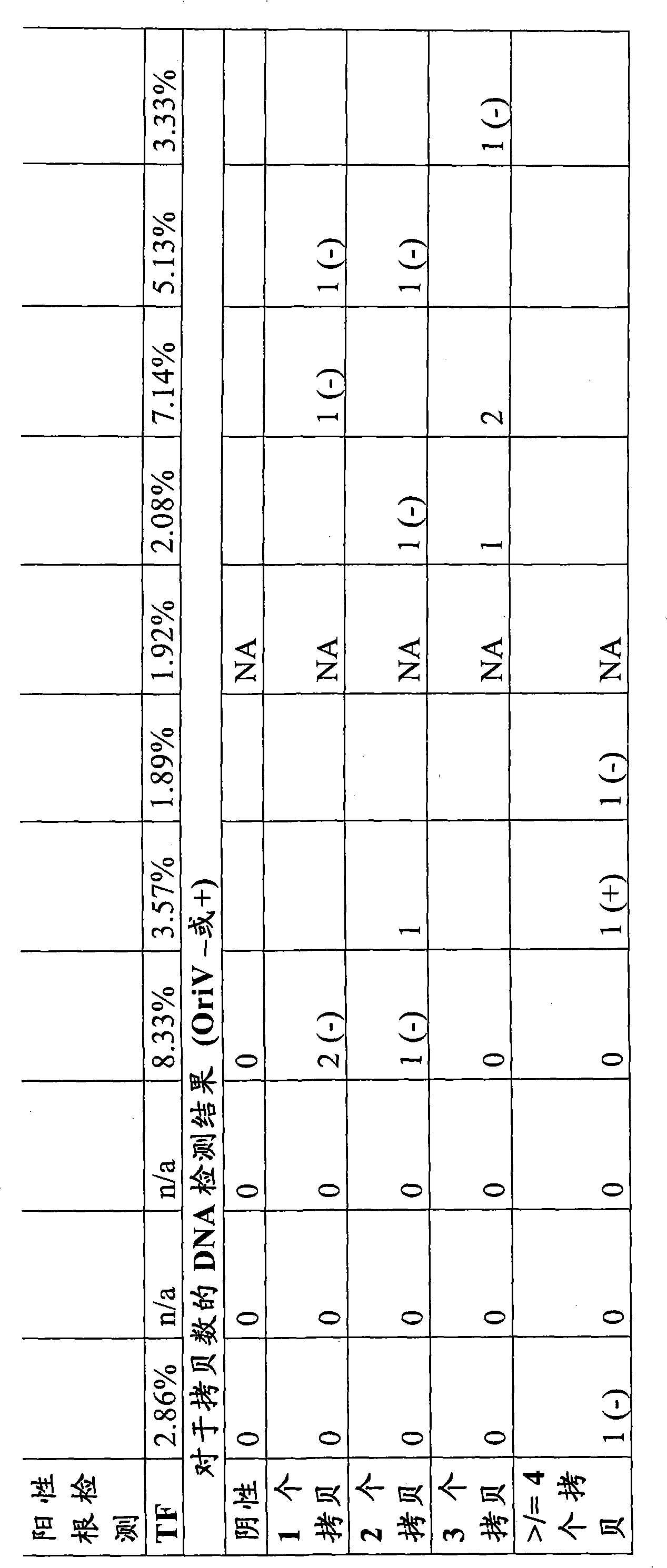
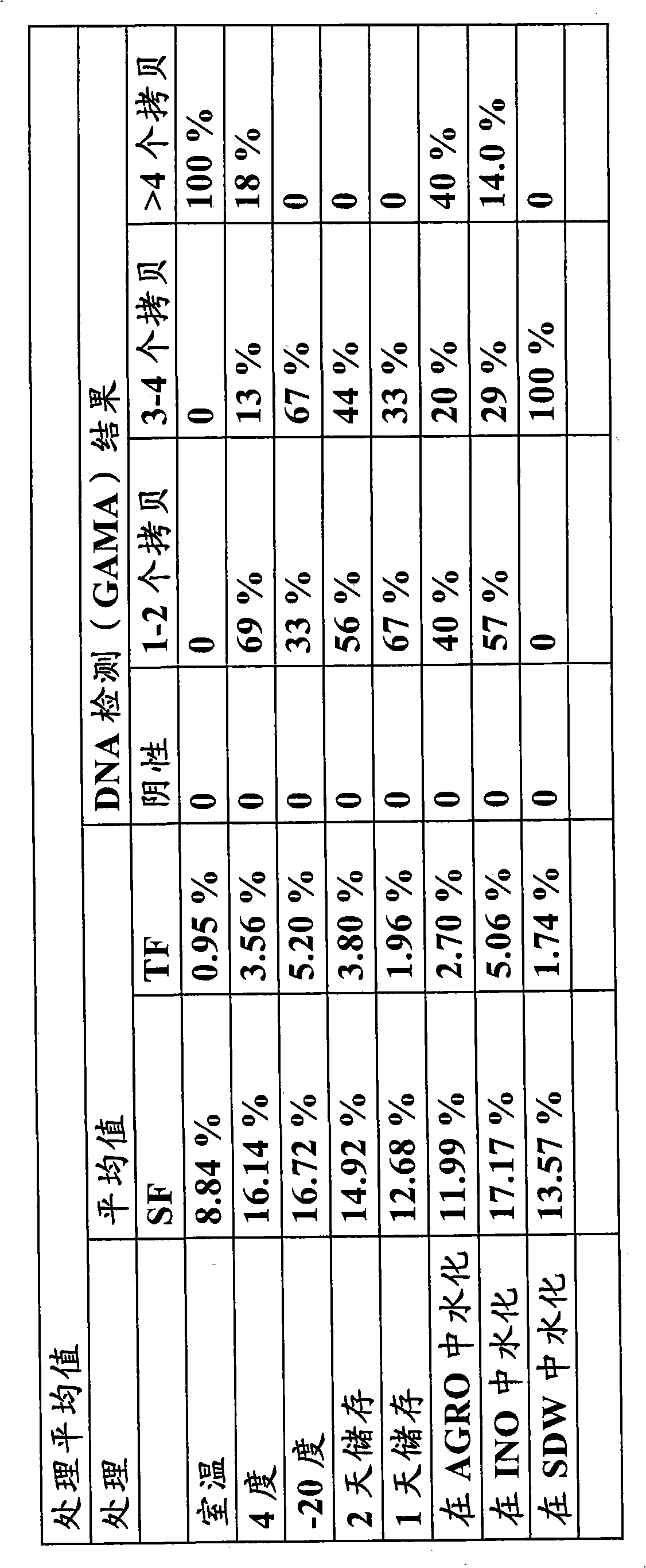


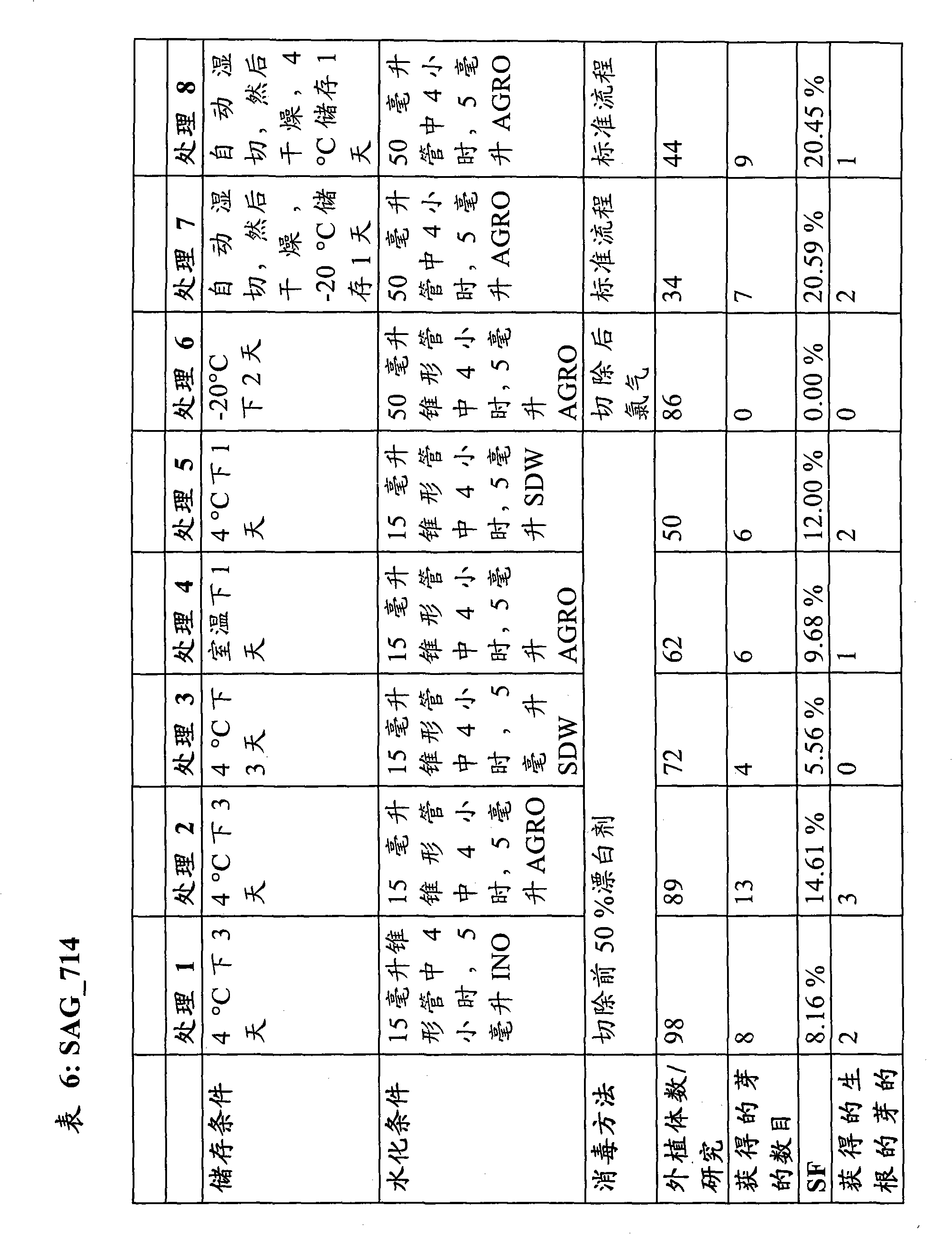


表7.SAG_716Table 7. SAG_716
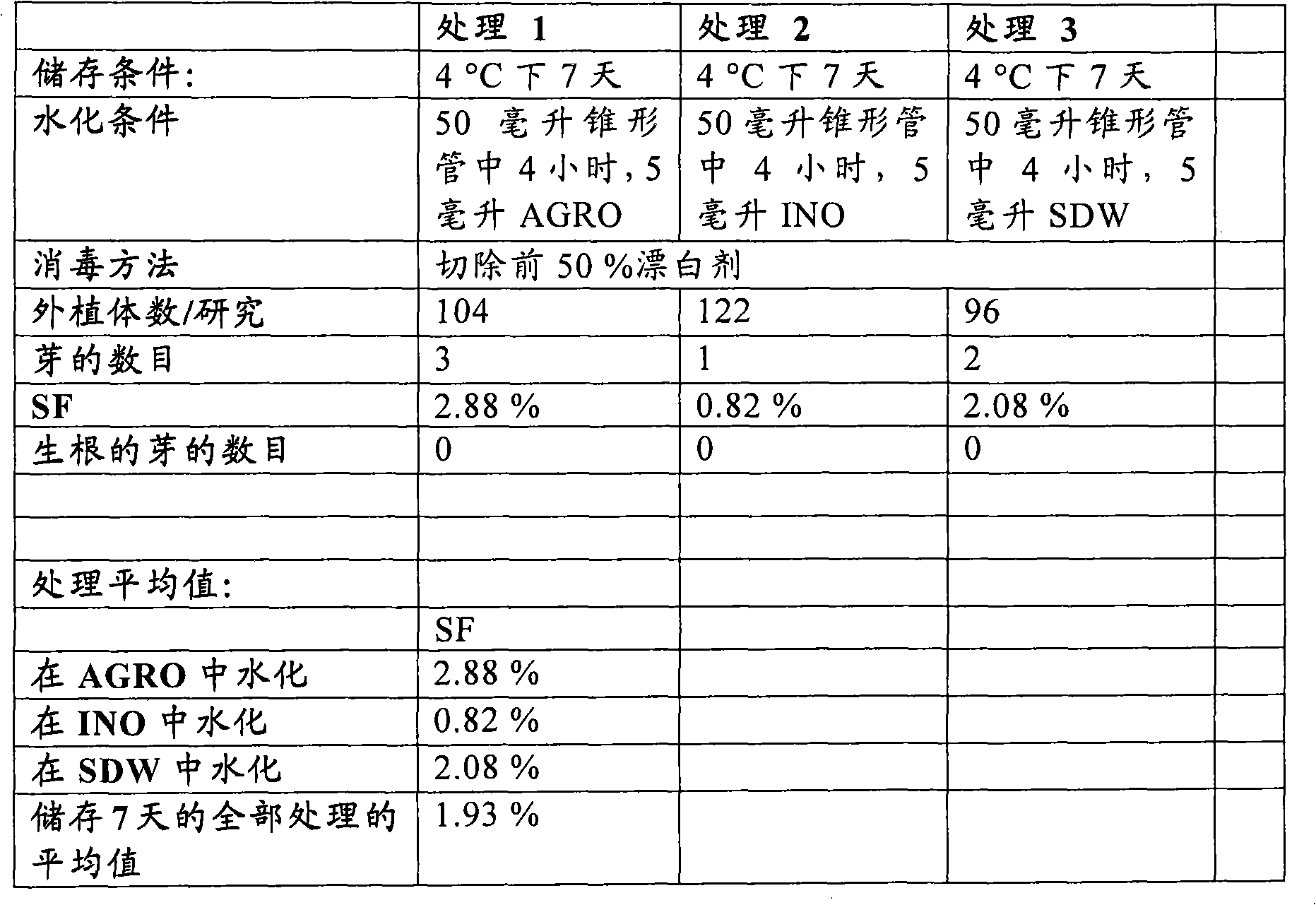
表8.SAG_762Table 8. SAG_762

表9:获得的芽形成和转化频率的概括Table 9: Summary of shoot formation and transformation frequencies obtained

在土壤杆菌介导的转化中变化的另一个参数是土壤杆菌培养基开始时间的变化,和超声波创伤的开始。在一些研究中,不是等待1小时或更长时间进行干外植体水化,而是一经浸入水化培养基后立即开始超声波创伤步骤。可选择地,一些处理接受土壤杆菌培养物孵育开始推迟1-2天。在水化步骤之后并不是立即接种,而是在延缓期将这些外植体放在湿润的滤纸上,然后完成接种和超声处理步骤。在一种不同的处理中,从程序中完全除去超声波创伤步骤,因为外植体正在被土壤杆菌培养物润湿的滤纸上水化。Another parameter that varies in Agrobacterium-mediated transformation is the variation in the start time of the Agrobacterium medium, and the onset of ultrasonic wounding. In some studies, instead of waiting 1 h or more for dry explant hydration, the ultrasonic wounding step was started immediately upon immersion in the hydration medium. Alternatively, some treatments received a 1-2 day delay in initiation of Agrobacterium culture incubation. Instead of inoculating immediately after the hydration step, these explants were placed on moistened filter paper during the lag period before the inoculation and sonication steps were completed. In a different treatment, the ultrasonic wounding step was completely removed from the procedure, as the explants were being hydrated on filter paper wetted with the Agrobacterium culture.
也测试了选择压力(例如,接触草甘膦)开始的延迟。这些研究不是在接种后2-4天将外植体转移到含有选择化合物的固体培养基上,而是接受不含草甘膦的液体WPM另外48小时,或在转移到含有选择化合物的固体WPM上之前放置1周,以终止或至少阻滞非转化细胞的生长。Delays in the onset of selection pressure (eg, exposure to glyphosate) were also tested. Instead of explants being transferred to solid medium containing the selection compound 2–4 days after inoculation, these studies received liquid WPM without glyphosate for an additional 48 hours, or after transfer to solid WPM containing the selection compound Leave for 1 week prior to incubation to terminate or at least arrest the growth of non-transformed cells.
也测试了土壤杆菌介导的转化的替代方案。干切的外植体用豌豆根瘤菌(Rhizobium leguminosarum)菌株RL 2370LBA&RL 2048G,pMON96033接种。根瘤菌(Rhizobium)介导的转化流程与土壤杆菌介导的转化流程相似,除了用根瘤菌代替细菌菌株以外。Alternatives to Agrobacterium-mediated transformation were also tested. Dry-cut explants were inoculated with Rhizobium leguminosarum strains RL 2370LBA & RL 2048G, pMON96033. The Rhizobium-mediated transformation procedure is similar to the Agrobacterium-mediated transformation procedure, except that Rhizobium is used instead of the bacterial strain.
也测试了细胞分裂素6-苄氨基嘌呤(BAP),其作为土壤杆菌培养接种培养基(也称为大豆接种培养基,INO)中的添加剂(例如,McCabe和Martinell,1993)。Cytokinin 6-benzylaminopurine (BAP) was also tested as an additive in Agrobacterium culture inoculation medium (also known as soybean inoculation medium, INO) (eg, McCabe and Martinell, 1993).
实施例7Example 7
棉花外植体的制备和转化Preparation and transformation of cotton explants
在切下后干燥并干燥储存30天或更长时间的切下的棉花(cvSTN 474)分生组织外植体,在再水化并用土壤杆菌共培养转化之后是能存活的。棉花分生组织转化的流程基本上遵循McCabe和Martinell(1993)的方法。按照McCabe&Martinell(1993)切除并制备种子,不同之处是将切下的胚展开,并放在一个开放的容器中直至干燥以外。储存条件和种子预消毒、再水化、土壤杆菌接种、共培养和组织培养程序与对于大豆所述基本相同。与大豆结果一致,在用外源DNA转化分生组织之后在培养的棉花外植体上观察到芽和嫩叶。Severed cotton (cvSTN 474) meristem explants that were dried after cutting and stored dry for 30 days or more were viable after rehydration and transformation with Agrobacterium co-culture. The procedure for cotton meristem transformation basically followed the method of McCabe and Martinell (1993). Seeds were excised and prepared according to McCabe & Martinell (1993), except that the excised embryos were unfolded and kept in an open container until dry. Storage conditions and seed pre-sterilization, rehydration, Agrobacterium inoculation, co-cultivation and tissue culture procedures were essentially the same as described for soybeans. Consistent with the soybean results, shoots and young leaves were observed on cultured cotton explants after transformation of meristems with exogenous DNA.
实施例8Example 8
使用的培养基medium used
表10:豆类消毒培养基(BGM)Table 10: Bean sterilization medium (BGM)
化合物:每升的量Compound: Amount per liter
BT储备液#1 10毫升BT stock solution #1 10ml
BT储备液#2 10毫升BT stock solution #2 10ml
BT储备液#3 3毫升BT
BT储备液#4 3毫升BT stock solution #4 3ml
BT储备液#5 1毫升BT stock solution #5 1ml
蔗糖 25克Sucrose 25 grams
调整到pH 5.8Adjust to pH 5.8
使用前添加: 每1LAdd before use: per 1L
头孢噻肟(50毫克/毫升) 2.5毫升Cefotaxime (50mg/ml) 2.5ml
杀真菌剂储备液 3毫升Fungicide stock solution 3ml
用于豆类发芽培养基的BT储备液BT Stock Solution for Bean Germination Medium
Bt储备液1(1升)Bt stock solution 1 (1 L)
KNO3 50.5克KNO 3 50.5 g
NH4NO3 24.0克NH 4 NO 3 24.0 g
MgSO4*7H2O 49.3克MgSO 4 *7H 2 O 49.3 g
KH2PO4 2.7克KH 2 PO 4 2.7 g
Bt储备液2(1升)Bt stock solution 2 (1 L)
CaCl2*2H2O 17.6克 CaCl2 * 2H2O 17.6g
Bt储备液3(1升)Bt stock solution 3 (1 L)
H3BO3 0.62克H 3 BO 3 0.62 g
MnSO4H2O 1.69克MnSO 4 H 2 O 1.69 g
ZnSO47H2O 0.86克ZnSO 4 7H 2 O 0.86 g
KI 0.083克KI 0.083 g
NaMoO4*2H2O 0.072克NaMoO 4 *2H 2 O 0.072 g
CuSO4*5H2O 0.25毫升1.0毫克/毫升的储备液CuSO 4 *5H 2 O 0.25 mL 1.0 mg/mL stock solution
CoCl4*6H2O 0.25毫升1.0毫克/毫升的储备液CoCl 4 *6H 2 O 0.25 mL 1.0 mg/mL stock solution
Bt储备液4(1升)Bt stock solution 4 (1 L)
Na2EDTA 1.116克 Na2EDTA 1.116 g
FeSO4*7H2O 0.834克FeSO 4 *7H 2 O 0.834 g
Bt储备液5(500毫升)Bt stock solution 5 (500ml)
硫胺-HCl 0.67克Thiamine-HCl 0.67g
烟酸 0.25克Niacin 0.25g
吡哆醇-HCl 0.41克Pyridoxine-HCl 0.41g
杀真菌剂贮备液(100毫升)Fungicide stock solution (100ml)
百菌清杀菌剂(Chlorothalonil)(Bravo)75%WP 1.0克Chlorothalonil (Bravo) 75% WP 1.0g
克菌丹(Captan) 50%WP 1.0克Captan 50% WP 1.0g
添加无菌蒸馏水到100毫升Add sterile distilled water to 100 ml
表11大豆接种培养基(INO)Table 11 Soybean Inoculation Medium (INO)
每升含量content per liter
储备液#1(主要物) 1毫升Stock Solution #1 (Main) 1ml
B5储备液#2(氯化钙) 1毫升B5 Stock Solution #2 (Calcium Chloride) 1ml
B5储备液#3(次要物) 1毫升B5 stock solution #3 (secondary) 1 ml
B5储备液#5(铁) 1毫升B5 Stock Solution #5 (Iron) 1ml
硝酸钾(KNO3) 1克Potassium nitrate (KNO 3 ) 1 g
葡萄糖 30克Glucose 30 grams
MES 3.9克MES 3.9 grams
加水到1LAdd water to 1L
起始pH:用KOH调整到5.4Initial pH: Adjust to 5.4 with KOH
高压灭菌autoclave
B5储备液#4(维生素)(F.S.) 1毫升B5 Stock Solution #4 (Vitamin) (F.S.) 1ml
室温储存Store at room temperature
B5储备液#1 每升含量:B5 stock solution #1 Content per liter:
TC水7 50毫升TC water 7 50ml
硫酸镁 100克Magnesium Sulfate 100g
硫酸铵 53.6克Ammonium sulfate 53.6 grams
无水磷酸二氢钠 60克Anhydrous sodium dihydrogen phosphate 60 grams
搅拌直至完全溶解Stir until completely dissolved
加TC水至1升Add TC water to 1 liter
B5储备液#2 每升含量B5 stock solution #2 content per liter
TC水 750毫升TC water 750ml
氯化钙 60克Calcium chloride 60 grams
搅拌至完全溶解Stir until completely dissolved
用TC水加至1升Make up to 1 L with TC water
B5储备液 #3 每升含量B5
TC水 750毫升TC water 750ml
硼酸 0.3克Boric acid 0.3 g
硫酸锰 1克Manganese sulfate 1 g
七水合硫酸锌 0.2克Zinc sulfate heptahydrate 0.2 g
碘化钾 0.075克Potassium iodide 0.075 g
二水合钼酸钠 0.025克Sodium molybdate dihydrate 0.025 g
硫酸铜(1毫克/毫升) 2.5毫升Copper sulfate (1mg/ml) 2.5ml
氯化钻(1毫克/毫升) 2.5毫升Cobalt Chloride (1mg/ml) 2.5ml
搅拌直至完全溶解Stir until completely dissolved
用TC水加至1升Make up to 1 L with TC water
B5储备液#4 每升含量B5 stock solution #4 content per liter
TC水 750毫升TC water 750ml
肌醇(Myo-Inositol) 10克Inositol (Myo-Inositol) 10 grams
烟酸 0.1克Niacin 0.1g
吡哆醇盐酸盐 0.1克Pyridoxine hydrochloride 0.1g
硫胺盐酸盐 1克Thiamine hydrochloride 1 g
搅拌直至完全溶解Stir until completely dissolved
用TC水加至1升Make up to 1 L with TC water
B5储备液#5 每升含量B5 stock solution #5 content per liter
TC水 750毫升TC water 750ml
维尔烯(Sequestrene) 2.8克Sequestrene 2.8g
搅拌直至完全溶解Stir until completely dissolved
用TC水加至1升Make up to 1 L with TC water
表12木本植物培养基(WPM)Table 12 Woody plant medium (WPM)
用75uM草甘磷作为选择剂Use 75uM glyphosate as selection agent
化合物: 每升含量Compound: content per liter
WPM盐(Phytochem) 2.41克WPM Salt (Phytochem) 2.41g
蔗糖 20.0克Sucrose 20.0g
葡萄糖酸钙(Sigma) 1.29克Calcium Gluconate (Sigma) 1.29 g
Clearys杀真菌剂(Carlin) 0.03克Clearys Fungicide (Carlin) 0.03g
pH 5.6pH 5.6
琼脂凝胶(Sigma) 4.0克Agar gel (Sigma) 4.0 g
高压灭菌autoclave
羧苄西林(40毫克/毫升) 5.0毫升Carbenicillin (40mg/ml) 5.0ml
替卡西林(100毫克/毫升) 1.0毫升Ticarcillin (100mg/ml) 1.0ml
头孢噻肟(50毫克/毫升) 4.0毫升Cefotaxime (50mg/ml) 4.0ml
草甘磷(0.5M FS储备液) 0.15毫升Glyphosate (0.5M FS stock solution) 0.15ml
表13BRM(豆类生根培养基)(4升)Table 13 BRM (Bean Rooting Medium) (4 liters)
MS盐 8.6克MS salt 8.6g
肌醇(Myo-Inositol) 0.40克Inositol (Myo-Inositol) 0.40 g
豆类生根培养基维生素储备液8毫升Bean Rooting Medium Vitamin Stock Solution 8ml
L-半胱氨酸(10毫克/毫升) 40毫升L-cysteine (10mg/ml) 40ml
蔗糖(超纯) 120克Sucrose (ultra pure) 120g
pH 5.8pH 5.8
洗过的琼脂 32克Washed agar 32 grams
高压灭菌后添加:After autoclaving add:
BRM激素储备液 20.0毫升BRM Hormone Reserve Solution 20.0ml
替卡西林/克拉维酸 4.0毫升Ticarcillin/clavulanic acid 4.0ml
(100毫克/毫升替卡西林)(100 mg/ml ticarcillin)
豆类生根培养基维生素储备液(1升)Bean Rooting Medium Vitamin Stock Solution (1 L)
甘氨酸 1.0克Glycine 1.0 g
烟酸 0.25克Niacin 0.25g
吡哆醇盐酸盐 0.25克Pyridoxine hydrochloride 0.25g
硫胺盐酸盐 0.05克Thiamine hydrochloride 0.05g
BRM激素储备液(1升中的量)BRM hormone stock solution (quantity in 1 liter)
6.0毫升IAA(0.033毫克/毫升)6.0ml IAA (0.033mg/ml)
4.0毫升SDW4.0ml SDW
实施例9Example 9
高通量单个种子切除High-throughput single seed excision
也可以通过使用单个化系统提供单个(单个化的)种子用于加工来完成干切过程。在单个化之后,通过真空杯系统操作种子(例如,大豆种子)来定位种子。之后将种子置于一组真空杯之间,种子在杯之间夹紧,通过使用一股高压空气或者类似的手段来脉冲、喷沙或空气冲击种子的种皮,以除去种皮。如图2-3所示,将种子(16)放置在下部的真空杯(6)上,通过降低上部的真空杯(6)来夹紧种子。然后种子和两个真空杯以相反的方向旋转,以沿种子椭圆轴中心产生剪切力点或面(5),从而便于种子在椭圆轴上裂开。一旦裂开,就升起上部的真空杯,和/或打开一个真空生成器(8),允许操作外植体及其与种子其它部分的分离。然后可以移动外植体到需要的位置,如管或孔板。在图4-5中,使用类似的概念,包括用锯齿状的金属表面帮助旋转种子而不滑移。该系统包括真空放置单元和传感器(pickup)单元。尽管外植体除了胚组织还可以包括一些子叶组织,但它包括胚的至少一些分生组织区,使得外植体一般可以在组织培养生长条件开始的12周内生芽。The dry cutting process can also be accomplished by using a singulation system to provide individual (singularized) seeds for processing. After individualization, the seeds (eg, soybean seeds) are manipulated through a vacuum cup system to locate the seeds. The seed is then placed between a set of vacuum cups where the seed is clamped and the seed coat is removed by pulsing, sandblasting or air blasting the seed coat with a blast of high pressure air or similar means. As shown in Figures 2-3, the seeds (16) are placed on the lower vacuum cup (6), and the seeds are clamped by lowering the upper vacuum cup (6). The seed and the two vacuum cups are then rotated in opposite directions to create a shear point or face (5) along the center of the elliptical axis of the seed, thereby facilitating the splitting of the seed on the elliptical axis. Once split, the upper vacuum cup is raised, and/or a vacuum generator (8) is turned on, allowing manipulation of the explant and its separation from the rest of the seed. The explants can then be moved to the desired location, such as a tube or well plate. In Figures 4-5, a similar concept is used, including a serrated metal surface to help rotate the seeds without slipping. The system includes a vacuum placement unit and a pickup unit. Although the explant may include some cotyledon tissue in addition to embryonic tissue, it includes at least some of the meristem region of the embryo such that the explant can typically sprout within 12 weeks of initiation of tissue culture growth conditions.
该方法的目的是在干燥条件下、在单个种子的高速基础上除去种子的分生组织,然后将外植体放置于合适的容器中,用于另外的转化步骤。另外的外植体处理(如消毒、筛选和水化)也可以在从种子中除去外植体和递送到容器这两个步骤之间进行。另外的处理也可以包括对外植体的希望的性状和特征预先成像、消毒和转化处理。另外,种子也可以在单个化和外植体切除步骤前根据生存力和适应力成像和分选。这样的允许高通量外植体切除的方法可以通过平行系统更加有效地进行。The purpose of this method is to remove the meristems of the seeds on a high-velocity basis of individual seeds under dry conditions and then place the explants in suitable containers for an additional transformation step. Additional explant treatments such as disinfection, screening, and hydration can also be performed between the steps of removal of the explants from the seeds and delivery to containers. Additional treatments may also include pre-imaging, sterilization and transformation of the explants for desired traits and characteristics. Alternatively, seeds can also be imaged and sorted for viability and fitness prior to the individualization and explant excision steps. Such a method that allows for high-throughput explant excision can be performed more efficiently with a parallel system.
图2-5和7-9显示用于从种子切除可转化的胚组织的机械分离器和清洁器/灭菌器的实施方案。图2-5显示在施加剪切力时用于固定单个种子的机构,图7-9显示使用例如离子生成器、用于收集霉菌、灰尘等的带电板或紫外线杀菌灯机械清理和消毒外植体材料的实施方案。Figures 2-5 and 7-9 show embodiments of mechanical separators and cleaner/sterilizers for excision of transformable embryo tissue from seeds. Figures 2-5 show the mechanisms used to secure individual seeds when shear forces are applied, and Figures 7-9 show mechanical cleaning and disinfection of explants using e.g. ion generators, charged plates to collect mold, dust, etc. Implementation of bulk materials.
参考图2-5,其主要说明用于从单个化的种子(16)切除胚组织的机械设备的例子,如上所述固定单个化的种子以施加剪切力。在图2-5中,当单个种子相对于它们放置或夹紧时,第一和第二真空杯(6)与第一和第二刻痕杆(7)向相反方向转动,导致单个种子破裂。也可以采用固定单个化种子的其它装置,如允许施加合适的剪切力的滚筒或格栅(gate)。Referring to Figures 2-5, which generally illustrate an example of a mechanical device for excising embryonic tissue from individualized seeds (16), the individualized seeds are immobilized to apply shear forces as described above. In Figures 2-5, when individual seeds are placed or clamped relative to them, the first and second vacuum cups (6) and first and second scoring rods (7) rotate in opposite directions, causing the individual seeds to rupture . Other means of securing the individualized seeds may also be used, such as rollers or gates that allow the application of suitable shear forces.
一旦种子破裂并切下可转化的胚组织,即可以将包括胚组织的外植体(例如,图1)移动到需要的位置或容器中,立即使用或在合适的条件下储存,例如上文的实施例6所述。这种从单个化种子上切除外植体材料的方法允许自动化高通量制备适量的可转化的胚组织。Once the seeds are ruptured and the transformable embryonic tissue excised, the explants (e.g., Figure 1 ) including the embryonic tissue can be moved to a desired location or container and used immediately or stored under suitable conditions, e.g., above Example 6 described. This method of excising explant material from individualized seeds allows automated high-throughput preparation of appropriate quantities of transformable embryonic tissue.
清理、筛选、消毒和选择程序可以应用于大批的非切除的种子,或者在单个化之后,或者它们可以应用于切除后的外植体材料。图7-9显示在外植体材料上进行这些操作的清洁器/消毒器的例子。Cleaning, screening, disinfection and selection procedures can be applied to bulk non-excised seeds, either after individualization, or they can be applied to excised explant material. Figures 7-9 show examples of cleaners/disinfectors for performing these operations on explant material.
实施例10Example 10
高通量外植体制备的叠置式设备Stackable equipment for high-throughput explant preparation
如图10所示,将种子放置在上部的机械设备(例如,Grainman
实施例11Example 11
长时间储存的干切大豆外植体的转化Transformation of dry-cut soybean explants stored for a long time
干切的外植体在-20℃至4℃下储存最长达20个月,然后测试其存活力、可转化性和活力。无论相比对照处理(处理1)的储存条件或者温度如何,外植体的存活力和总活力似乎在所有处理组中均相似。这证明能够储存干切外植体几乎2年而没有损害。在接种4天后测试每种处理的外植体的瞬时GUS表达。表14显示各种处理之间分生组织特异性gus表达的比较,以0-9级打分,0表示没有可见的表达,9表示在胚的所有3个分生组织中都大量表达。这证明了干切的外植体不仅可以在各种条件的长期储存后存活而没有明显的活力丧失,而且保持了对于转化的适应力。因此现在可以在非峰值期间切下大量的外植体以备后用,这代表了在计划和实施转化研究中显著的、可能的费用节约和灵活性。Dry-cut explants were stored at -20°C to 4°C for up to 20 months and then tested for viability, transformability and viability. Viability and overall viability of the explants appeared to be similar in all treatment groups, regardless of storage conditions or temperature compared to the control treatment (Treatment 1). This demonstrates the ability to store dry-cut explants for almost 2 years without damage. The explants of each treatment were tested for transient GUS expression 4 days after inoculation. Table 14 shows the comparison of meristem-specific gus expression between the various treatments, scored on a scale of 0-9, with 0 indicating no visible expression and 9 indicating abundant expression in all three meristems of the embryo. This demonstrates that dry-cut explants not only survive long-term storage in various conditions without significant loss of viability, but also maintain fitness for transformation. Large numbers of explants can therefore now be excised during off-peak periods for later use, which represents a significant and possible cost savings and flexibility in planning and conducting translational research.
表14:储存持续时间和温度对外植体转化的影响Table 14: Effect of storage duration and temperature on explant transformation
实施例12Example 12
合适的预接种培养(“预培养”)组合物和条件的确定Determination of suitable pre-inoculation culture ("pre-culture") composition and conditions
当用土壤杆菌接种用于转化时,干切的外植体很可能仍处于半休眠状态。因此,开发了一种在土壤杆菌接种前刺激干切外植体的代谢活性的方法,用于增强他们的转化能力。即,通过操纵干外植体的生物学,可以使每个外植体中种系阳性事件的百分比增加2-10倍。Dry-cut explants are likely to remain semi-dormant when inoculated with Agrobacterium for transformation. Therefore, a method was developed to stimulate the metabolic activity of dry-cut explants prior to Agrobacterium inoculation to enhance their transformation capacity. That is, by manipulating the biology of the stem explants, it is possible to increase the percentage of germline-positive events per explant by 2-10 fold.
在23℃和/或28℃温度下,以及在1-5天的不同光照/黑暗条件下,测试几种培养基组合物-BGM(表10)、INO(表11)或OR(表15)的增强转化能力的能力。预培养步骤之后,将外植体集中在一起,然后根据实施例5中所述的方法用土壤杆菌培养物接种。在外植体上进行的瞬时GUS表达试验表明在共培养2天和4天后在预培养处理中GUS活性增强。Several media compositions - BGM (Table 10), INO (Table 11) or OR (Table 15) - were tested at a temperature of 23°C and/or 28°C and under different light/dark conditions from 1 to 5 days ability to enhance transformative capacity. After the precultivation step, the explants were pooled together and then inoculated with Agrobacterium culture according to the method described in Example 5. Transient GUS expression assays performed on explants showed enhanced GUS activity in pre-culture treatments after 2 and 4 days of co-culture.
在某些预培养实验中,由于真菌感染导致植物损失,但是与未预培养的干切的外植体相比,在BGM润湿的滤纸上、23℃下、黑暗中预培养5天的干切的外植体的总转化频率似乎是最高的。由于真菌污染导致的损失可以通过在预培养和/或共培养步骤中使用诸如各为大约1%的BRAVO 75和Captan 50的抗真菌剂来减轻。用CP4探针对本实施例中产生的植物进行的Southern印迹和INVADER分析证实了这些植物的转基因性质。In some preculture experiments, plant losses were due to fungal infection, but dry cut explants pre-cultured on BGM-wetted filter paper at 23°C for 5 days in the dark were compared to non-precultured dry-cut explants. The overall transformation frequency appeared to be highest for cut explants. Losses due to fungal contamination can be mitigated by using antifungal agents such as BRAVO 75 and Captan 50 at about 1% each in the pre-cultivation and/or co-cultivation steps. Southern blot and INVADER analysis of the plants produced in this example with the CP4 probe confirmed the transgenic nature of these plants.
表15:大豆器官生成(OR)培养基Table 15: Soybean Organogenesis (OR) Media
化合物: 每4升: Compound: per 4 liters:
MS盐 17.2gMS salt 17.2g
3X次要MS盐 40ml3X Minor MS Salt 40ml
烟酸(1毫克/毫升) 4mlNiacin (1mg/ml) 4ml
吡哆醇盐酸盐(1毫克/毫升)4mlPyridoxine hydrochloride (1mg/ml) 4ml
硫胺盐酸盐(1毫克/毫升) 46.8mlThiamine hydrochloride (1mg/ml) 46.8ml
蔗糖(超纯) 120gSucrose (ultra pure) 120g
肌醇(细胞培养级) 40gInositol (cell culture grade) 40g
pH 5.8pH 5.8
洗过的琼脂 32gWashed agar 32g
高压灭菌后添加:After autoclaving add:
脯氨酸(2.5m储备液) 19.2mlProline (2.5m stock solution) 19.2ml
TSG/OR激素储备液 40.0mlTSG/OR hormone stock solution 40.0ml
表16:预培养对于干外植体的影响;使用pMON10343的转化频率Table 16: Effect of pre-culture on dry explants; transformation frequency using pMON10343

重复研究来比较两个构建体:pMON101343,其包含1个含有提供草甘膦抗性的CP4基因和OriV复制起点的T-DNA;和pMON107350,其包含1个在载体骨架上含有提供草甘膦抗性的CP4基因和OriR复制起点(例如,参见,US20070074314)的T-DNA。如表17所示,与未预培养的干外植体的转化频率相比,干外植体的预培养再次提高了转化频率。The study was repeated to compare two constructs: pMON101343, which contained a T-DNA containing the CP4 gene providing glyphosate resistance and the OriV origin of replication; and pMON107350, which contained a T-DNA containing a glyphosate-providing T-DNA of the resistant CP4 gene and OriR origin of replication (see, eg, US20070074314). As shown in Table 17, pre-cultivation of the stem explants again increased the transformation frequency compared to that of the stem explants that were not pre-cultured.
表17:对于干切外植体的预培养的另外的研究Table 17: Additional studies for pre-cultivation of dry-cut explants

如表18所示,当在使用机器人系统自动除去和添加的液体再生培养基(除琼脂凝胶(AgarGel)外,表12的培养基)中培养外植体时,预培养的干切外植体也产生了较高的转化频率。具有预培养步骤使用液体再生培养基的转化频率似乎甚至更高。液体培养基中的湿切的外植体似乎由于污染而具有低转化频率。As shown in Table 18, when the explants were cultured in a liquid regeneration medium (medium in Table 12 except AgarGel) that was automatically removed and added using a robotic system, pre-cultured dry-cut explants The body also produced a higher conversion frequency. The frequency of transformation appears to be even higher with a pre-cultivation step using liquid regeneration medium. Wet-cut explants in liquid media appeared to have low transformation frequencies due to contamination.
预培养令人惊奇地增加了转化能力并且提高了转化一致性。这样的提高可减少工业规模生产转基因大豆植株的生产过程中的变异性,并且可以在选择剂一般产生较低转化频率的情况下提高转化频率。Pre-incubation surprisingly increases transformation capacity and improves transformation consistency. Such improvements can reduce variability in the production process for producing transgenic soybean plants on an industrial scale, and can increase the frequency of transformation where the selective agent would normally result in a lower transformation frequency.
表18:干切的外植体的预培养;固体和液体培养基的比较Table 18: Preculture of dry-cut explants; comparison of solid and liquid media
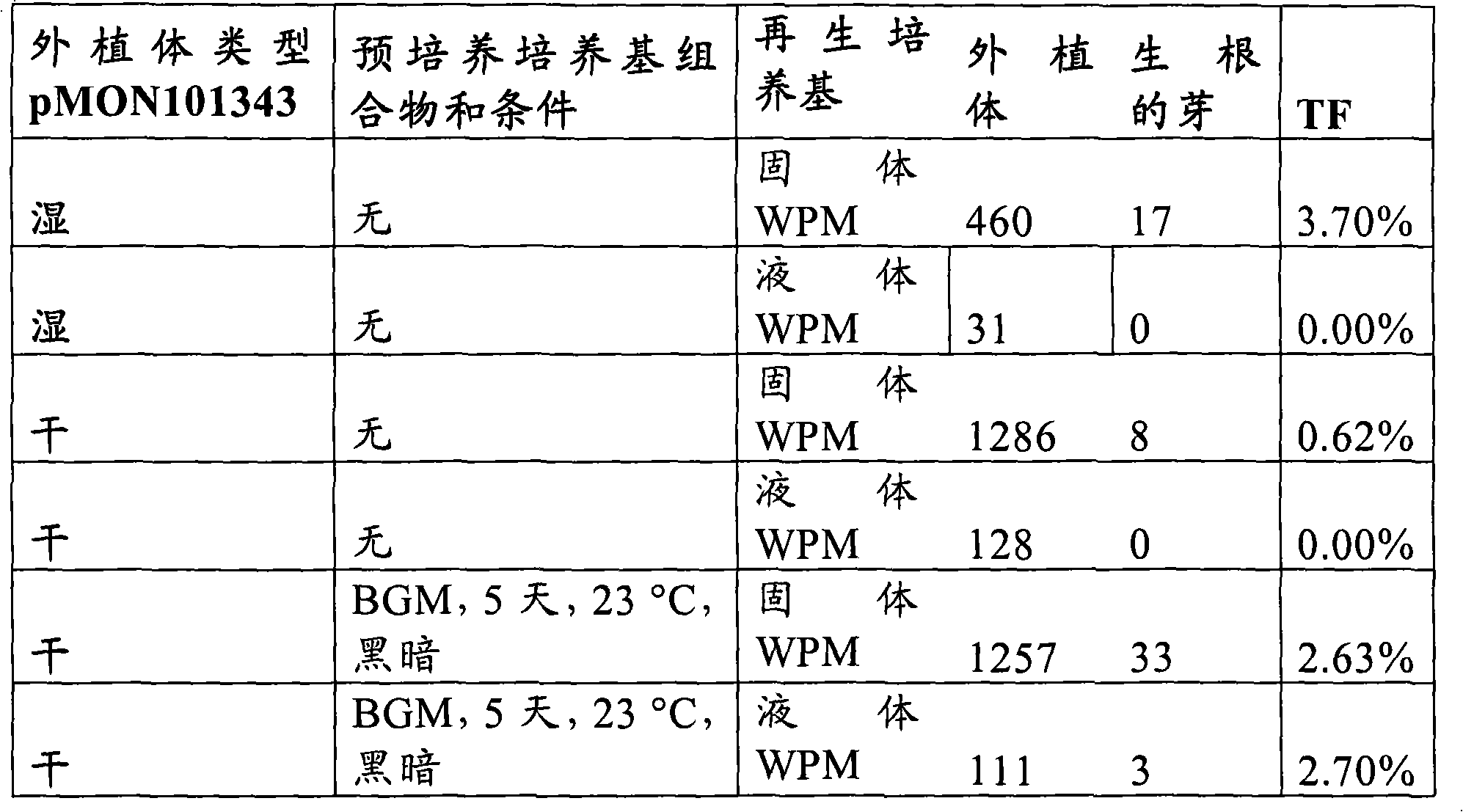
实施例13Example 13
使用干大豆外植体和壮观霉素选择生产转基因大豆植物Production of transgenic soybean plants using dry soybean explants and spectinomycin selection
干的活种子(适当储存的高质量大豆种子包含大约10-12%的内部含水量)用无菌水或次氯酸钠溶液(从0ppm-~30000ppm的活性氯,包括50ppm-200ppm的活性氯)冲洗3-20分钟。然后排出液体。这个过程提高内部含水量到大约16%。在此简短的表面消毒步骤之后,在商业种子干燥器中用除湿空气流(温度控制到大约60-90°F)降低种子的内部含水量到低于8%。Dried live seeds (properly stored high-quality soybean seeds contain approximately 10-12% internal moisture content) are rinsed with sterile water or sodium hypochlorite solution (from 0 ppm to 30,000 ppm active chlorine, including 50 ppm to 200 ppm active chlorine)3 -20 minutes. Then drain the liquid. This process raises the internal moisture content to approximately 16%. Following this brief surface disinfection step, the internal moisture content of the seeds is reduced to less than 8% in a commercial seed dryer with a stream of dehumidified air (temperature controlled to approximately 60-90°F).
在需要的储存后,将外植体水化用于转化。这一步骤中所用的培养基类型可以不同,包括“豆子发芽培养基”(BGM;表10)、大豆接种培养基(INO;表11)和制备的对数期土壤杆菌生长培养物(AGRO)。土壤杆菌生长培养物在LB液体培养基(LB,通常也称为Luria-Bertani Broth)中生长过夜达到对数期,然后离心并再悬浮至在660nm处的最终光密度为0.25-0.6。用于稀释的培养基与大豆接种培养基一样。水化温度和持续时间也可以不同,某些实验中将外植体在4℃下浸泡于这些溶液中的一种中过夜。在接触相应水化培养基的持续时间、接触过程中的温度和相应培养基的饱和程度方面进行其它变化。测试的接触时间为0-24小时。较长接触时间(超过4小时)的水化在室温(~26℃)、23℃或者4℃下进行。4小时或少于4小时的接触时间都在室温下测试。作为在水化过程中用液体培养基完全浸没或基本上饱和外植体的替代,一些处理使用湿润的滤纸(有足够的液体湿润,但没有饱和)。这用以BGM或者土壤杆菌培养基润湿的滤纸来完成。水化在各种容器中进行,包括但不限于锥形离心管、刻度玻璃瓶或者PLANTCON组织培养容器(MPBiomedicals,Irvine,CA)。After required storage, the explants were hydrated for transformation. The type of media used in this step can vary, including "bean germination medium" (BGM; Table 10), soybean inoculum medium (INO; Table 11), and prepared log-phase Agrobacterium growth culture (AGRO) . Agrobacterium growth cultures were grown overnight to log phase in LB broth (LB, also commonly referred to as Luria-Bertani Broth), then centrifuged and resuspended to a final optical density at 660 nm of 0.25-0.6. The medium used for dilution was the same as the soybean inoculation medium. The temperature and duration of hydration can also vary, and in some experiments explants were soaked in one of these solutions overnight at 4°C. Other variations are made in the duration of contact with the corresponding hydration medium, the temperature during contact and the degree of saturation of the corresponding medium. The exposure time tested was 0-24 hours. Hydrations with longer contact times (over 4 hours) were performed at room temperature (-26°C), 23°C or 4°C. Contact times of 4 hours or less were tested at room temperature. As an alternative to completely submerging or substantially saturating the explants with liquid medium during hydration, some treatments used moistened filter paper (sufficiently wetted with liquid, but not saturated). This is done with filter paper moistened with BGM or Agrobacterium medium. Hydration was performed in a variety of vessels including, but not limited to, conical centrifuge tubes, graduated glass bottles, or PLANTCON tissue culture vessels (MP Biomedicals, Irvine, CA).
水化后,在适合的土壤杆菌培养物的存在下,对外植体进行简短的超声处理。共培养和后续步骤在光照Percival培养箱中在大约23-25℃的温度下进行2-5天(16小时光照,8小时黑暗,光强度为至少5μE-200μE),且可以在最高大约35℃下进行。已知光促进基因从土壤杆菌转移到植物细胞中。在水化过程、共培养步骤和/或接下来的共培养过程中,以15毫克/升-1000毫克/升的浓度应用作为选择剂的壮观霉素。After hydration, the explants were briefly sonicated in the presence of a suitable Agrobacterium culture. Co-cultivation and subsequent steps are carried out in a lighted Percival incubator at a temperature of approximately 23-25 °C for 2-5 days (16 hours light, 8 hours dark, light intensity of at least 5 μE-200 μE), and can be heated at a maximum of approximately 35 °C next. It is known that light facilitates the transfer of genes from Agrobacterium into plant cells. Spectinomycin is applied as a selection agent at a concentration of 15 mg/L - 1000 mg/L during the hydration process, the co-cultivation step and/or the subsequent co-cultivation process.
如表19所示,用以下构建体常规回收表型阳性的芽(植物):pMON96999,其包含1个含有addA基因和OriV复制起点的T-DNA;或构建体pMON101343,其包含1个含有CP4基因和OriV复制起点的T-DNA。在存在壮观霉素的情况下,“表型阳性”的意思是芽为绿色且坚实,而表型阴性的芽如果完全伸长,则较弱且变白(白色)。壮观霉素或草甘膦以表19所示的浓度在再生培养基(固体或者液体)中使用。As shown in Table 19, phenotype-positive shoots (plants) were routinely recovered with the following constructs: pMON96999, which contained a T-DNA containing the addA gene and the OriV origin of replication; or construct pMON101343, which contained a T-DNA containing the CP4 Gene and T-DNA of the OriV origin of replication. In the presence of spectinomycin, "phenotype positive" means that the shoots are green and firm, whereas phenotype negative shoots are weaker and blanched (white) if fully elongated. Spectinomycin or glyphosate were used in the regeneration medium (solid or liquid) at the concentrations shown in Table 19.
表19:使用草甘膦或壮观霉素作为选择剂的干大豆外植体的转化频率。Table 19: Transformation frequency of dry soybean explants using glyphosate or spectinomycin as selection agent.

壮观霉素也作为用于干切大豆胚转化的选择剂,使用以下条件:在INO培养基中水化1小时,在INO、150ppm壮观霉素中共培养4天,在固体或液体WPM(表12,加入或不加琼脂)上培养。可以使用23-25或28℃、最高大约35℃的温度。在土壤杆菌接种8-10周后,收获表型阳性的芽,并在含150ppm壮观霉素的固体BRM(表13)上诱导生根。在两个不同的研究中获得25.05%和19.27%的非常高的转化频率。没有用细胞分裂素样的植物生长调节剂(如TDZ或BAP)处理本研究中所用的外植体,因而证明了在缺乏这样的植物生长调节剂的情况下可以获得高转化频率。Spectinomycin was also used as a selection agent for transformation of dry-cut soybean embryos using the following conditions: hydration in INO medium for 1 hour, co-cultivation in INO, 150 ppm spectinomycin for 4 days, in solid or liquid WPM (Table 12 , with or without agar). Temperatures of 23-25 or 28°C, up to about 35°C, may be used. Phenotypically positive shoots were harvested 8-10 weeks after Agrobacterium inoculation and induced rooting on solid BRM (Table 13) containing 150 ppm spectinomycin. Very high conversion frequencies of 25.05% and 19.27% were obtained in two different studies. Explants used in this study were not treated with cytokinin-like plant growth regulators such as TDZ or BAP, thus demonstrating that high transformation frequencies can be obtained in the absence of such plant growth regulators.
实施例14Example 14
用干大豆胚、壮观霉素和液体培养基产生转基因大豆植物Generation of Transgenic Soybean Plants Using Dried Soybean Embryos, Spectinomycin and Liquid Medium
在这些研究中,外植体在开始时水化并最终在上述具有液体覆盖层的WPM固体培养基或WPM液体培养基上再生。在接种6周后将所有外植体转移到含有Oasis
表20:给定水化条件下的转化频率Table 20: Transformation frequency for given hydration conditions
表21:液体覆盖时间安排Table 21: Liquid Coverage Schedule
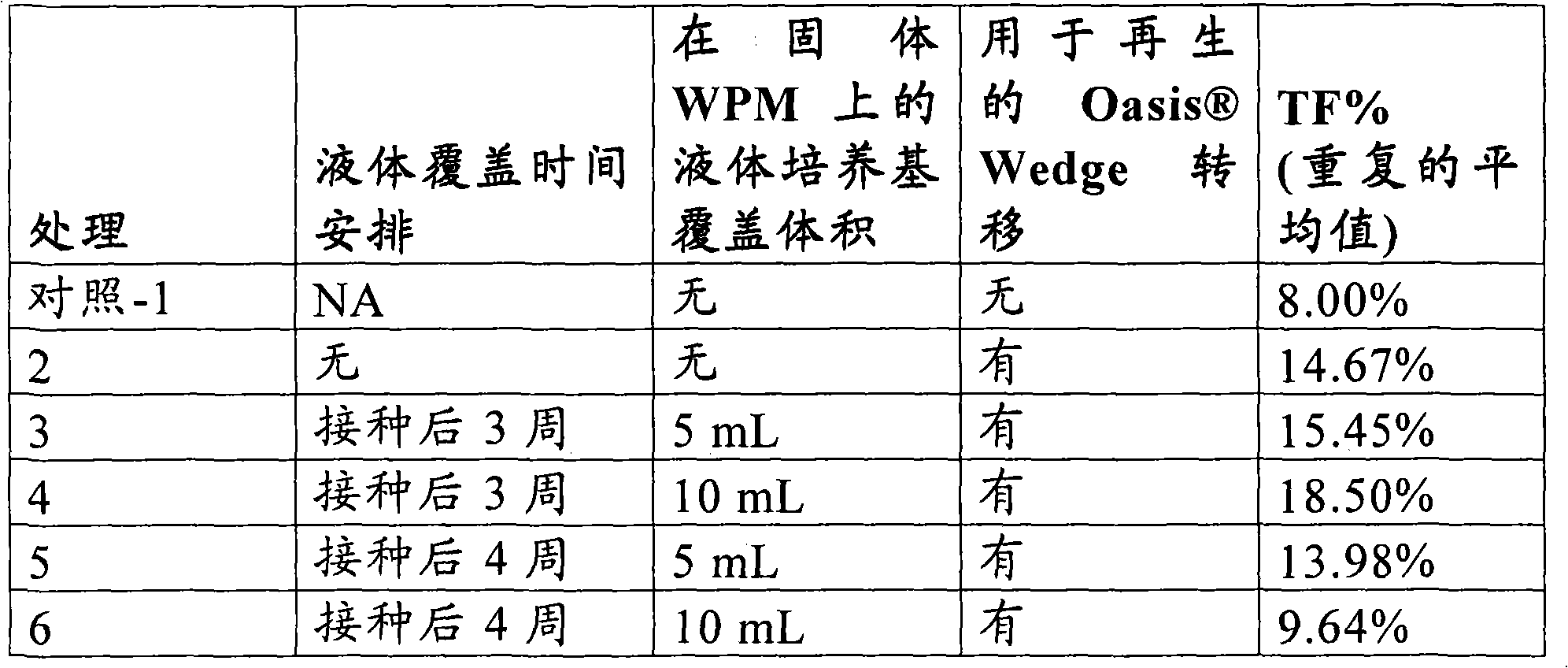
实施例15Example 15
使用预培养步骤、使用干大豆胚、壮观霉素和整个再生外植体转移来生产转基因大豆植物Production of Transgenic Soybean Plants Using a Pre-Cultivation Step Using Dried Soybean Embryos, Spectinomycin and Whole Regenerated Explant Transfer
在这些研究中,如实施例12,使用预培养步骤(5天,23℃,黑暗,在BGM中)。在预培养步骤前,干切的外植体也在INO培养基上进行水化1小时。在共培养期之后,将大约12毫升包含150ppm壮观霉素的液体WPM直接分配到共培养PLANTCON中,4天后将外植体表面接种于包含150ppm壮观霉素的固体WPM上。在本实施例中,在再生的大约第4周鉴别表型阳性的绿芽,并从WPM再生培养基转移到包含Oasis
表22:从整个再生外植体观察到的转化频率和质量Table 22: Transformation frequency and quality observed from whole regenerated explants
实施例16Example 16
使用预培养步骤、用储存的干大豆胚、壮观霉素和整个再生外植体转移生产转基因大豆植物Production of Transgenic Soybean Plants Using a Preculture Step, Transfer with Stored Dried Soybean Embryos, Spectinomycin, and Whole Regenerated Explants
在本实施例中,使用储存3个月的干外植体,且对干切的外植体在INO中进行1小时的水化步骤。预培养在23℃黑暗条件下、在含有50ppm的制霉菌素和10ppm的TBZ(噻苯咪唑)杀真菌剂(通过在纯DMSO中溶解50,000ppm制霉素和10,000ppm TBZ制备制霉菌素和噻苯咪唑储备液,稀释1000倍(1L INO中的1ml储备液))的BGM中进行5天。将TDZ(1.0ppm)和硫辛酸都加到接种物和共培养基(INO)中。构建体pMON107379是包含oriRi和aadA基因的传统2T载体,并进行共培养5天。在共培养后,将外植体表面接种于固体WPM上,然后转移到具有简化液体培养基(含有0.25毫克/升IBA的0.5克/升WPM)的OasisWedge System(Smithers-Oasis USA;Kent,OH)中。如表23所示,预培养干外植体提高了TF。因此,储存3个月的干外植体的表现类似于新切下的干外植体。将溶解在DMSO中的制霉菌素(50ppm)和噻苯咪唑(10ppm)加入到INO共培养基中(1.0ml DMSO/升INO)改善了外植体的健康,这可能是通过控制通常在种子之中和之上发现的酵母和真菌而实现的,因此在进行大量和/或自动化组织培养时是有益的。In this example, dry explants stored for 3 months were used, and a 1 hour hydration step in INO was performed on the dry cut explants. Pre-culture at 23°C in the dark under conditions containing 50 ppm nystatin and 10 ppm TBZ (thiabendazole) fungicide (nystatin and thiabendazole were prepared by dissolving 50,000 ppm nystatin and 10,000 ppm TBZ in pure DMSO Benmidazole stock solution, diluted 1000-fold (1 ml stock solution in 1 L INO)) in BGM for 5 days. Both TDZ (1.0 ppm) and lipoic acid were added to the inoculum and co-culture medium (INO). Construct pMON107379 is a conventional 2T vector containing the oriRi and aadA genes and was co-cultured for 5 days. After co-cultivation, the explants were surface-seeded on solid WPM and then transferred to Oasis with reduced liquid medium (0.5 g/L WPM containing 0.25 mg/L IBA). Wedge System (Smithers-Oasis USA; Kent, OH). As shown in Table 23, pre-incubating the stem explants increased TF. Thus, dry explants stored for 3 months behaved similarly to freshly excised dry explants. The addition of nystatin (50 ppm) and thiabendazole (10 ppm) dissolved in DMSO to the INO co-culture medium (1.0 ml DMSO/liter INO) improved explant health, possibly by controlling This is achieved by neutralizing the yeast and fungi found on it and is therefore beneficial when performing mass and/or automated tissue culture.
表23:预培养对储存的干外植体的TF(%)的影响Table 23: Effect of pre-incubation on TF (%) of stored dry explants
* * ** * *
根据本发明的公开内容,可以在不进行过多实验的情况下,制备和实施本文公开的和要求保护的全部组合物和方法。尽管本发明的组合物和方法已经在上面示例性的实施方案中详述,但是本领域的技术人员应当明白,在不背离本发明的真正概念、精神和范围的情况下,可以对本文所述的组合物、方法和方法的步骤或步骤的次序进行变化、改变、修改和改造。更加特别的是,应当明白,在化学和生理学上相关的某些试剂可以代替在本文所述的试剂,而仍可获得相同或相似的结果。对于本领域的技术人员来说显而易见的所有这些类似的替代和修改都被认为落入由所附权利要求书所限定的本发明的精神、范围和概念之内。All of the compositions and methods disclosed and claimed herein can be made and performed without undue experimentation in light of the present disclosure. Although the compositions and methods of the present invention have been described in detail in the exemplary embodiments above, those skilled in the art will appreciate that modifications and variations described herein can be made without departing from the true concept, spirit and scope of the invention. Compositions, methods and steps or the order of steps of the methods are subject to variation, alteration, modification and adaptation. More particularly, it should be understood that certain chemically and physiologically related reagents may be substituted for those described herein and still obtain the same or similar results. All such similar substitutes and modifications apparent to those skilled in the art are deemed to be within the spirit, scope and concept of the invention as defined by the appended claims.
参考文献references
本文特别引入以下文献作为参考,其提供补充本文所述信息的示例性的程序上的或其它方面的细节。The following documents are specifically incorporated herein by reference to provide exemplary procedural or other details that supplement the information described herein.
美国专利5,217,902US Patent 5,217,902
美国专利5,914,451US Patent 5,914,451
美国专利6,384,301US Patent 6,384,301
美国专利7,002,058US Patent 7,002,058
美国公开20050005321US Open 20050005321
美国公开20060059589US Open 20060059589
美国公开20070271627US Open 20070271627
美国公开20070074314US Open 20070074314
Broothaerts等人,Nature,433:629-633,2005.Broothaerts et al., Nature, 433:629-633, 2005.
Chai等人,Seed Science Research 8(Supplement 1):23-28,1998.Chai et al., Seed Science Research 8 (Supplement 1): 23-28, 1998.
Chu等人,Sci.Sinica 18:659-668,1975.Chu et al., Sci. Sinica 18:659-668, 1975.
Duncan等人,Planta 165:322-332,1985.Duncan et al., Planta 165:322-332, 1985.
Gamborg等人,Exp Cell Res.50:151-8,1968.Gamborg et al., Exp Cell Res. 50:151-8, 1968.
Linsmaier和Skoog,Physiol.Plant.18:100-127,1965.Linsmaier and Skoog, Physiol. Plant. 18:100-127, 1965.
McCabe等人,Bio/Tehnology6:923-926,1988.McCabe et al., Bio/Technology 6:923-926, 1988.
McCabe和Martinell,Bio/Technology 11:596-598,1993.McCabe and Martinell, Bio/Technology 11:596-598, 1993.
Mein等人,Genome Res.10:330-343,2001.Mein et al., Genome Res. 10:330-343, 2001.
Miki等人,“Procedures for Introducing Foreign DNA into Plants”in Methods in Plant Molecular Biology and Biotechnology,Glick B.R.和Thompson,J.E.编著(CRC Press,Inc.,Boca Raton,第67-88页,1993.Miki et al., "Procedures for Introducing Foreign DNA into Plants" in Methods in Plant Molecular Biology and Biotechnology, edited by Glick B.R. and Thompson, J.E. (CRC Press, Inc., Boca Raton, pp. 67-88, 1993.
Miki和McHugh,J.Biotechnol.,107:193-232,2004.Miki and McHugh, J. Biotechnol., 107:193-232, 2004.
Murashige和Skoog,Physiol.Plant.15:473-497,1962.Murashige and Skoog, Physiol. Plant. 15:473-497, 1962.
McCown和Lloyd,Combined Proc.-Int.Plant Propagator′s Soc.,30:421-427,1981.McCown and Lloyd, Combined Proc.-Int. Plant Propagator's Soc., 30:421-427, 1981.
Nitsch和Nitsch,Science 163:85-87 1969.Nitsch and Nitsch, Science 163:85-87 1969.
Sandvang,Antimicrob.Agents Chemotherapy43:3036-3038,1999.Sandvang, Antimicrob. Agents Chemotherapy 43: 3036-3038, 1999.
Schenk和Hildebrandt,Can.J.Bot.50:199-204,1972.Schenk and Hildebrandt, Can. J. Bot. 50:199-204, 1972.
Senaratna等人,Pl.Physiol.72:620-624,1983.Senaratna et al., Pl. Physiol. 72:620-624, 1983.
Uchimiya和Murashige,Plant Physiol.57:424-429,1976.Uchimiya and Murashige, Plant Physiol. 57:424-429, 1976.
Vertucci和Roos,Pl.Physiol.90:1019-1023,1990.Vertucci and Roos, Pl. Physiol. 90:1019-1023, 1990.
Zambre等人,Planta216:580-586,2003.Zambre et al., Planta 216:580-586, 2003.
Claims (45)
Priority Applications (1)
| Application Number | Priority Date | Filing Date | Title |
|---|---|---|---|
| CN201510639568.2A CN105219694A (en) | 2007-03-09 | 2008-03-10 | For the preparation of plant embryo explants that transforms and purposes |
Applications Claiming Priority (5)
| Application Number | Priority Date | Filing Date | Title |
|---|---|---|---|
| US89409607P | 2007-03-09 | 2007-03-09 | |
| US60/894,096 | 2007-03-09 | ||
| US91506607P | 2007-04-30 | 2007-04-30 | |
| US60/915,066 | 2007-04-30 | ||
| PCT/US2008/056400 WO2008112628A2 (en) | 2007-03-09 | 2008-03-10 | Preparation and use of plant embryo explants for transformation |
Related Child Applications (1)
| Application Number | Title | Priority Date | Filing Date |
|---|---|---|---|
| CN201510639568.2A Division CN105219694A (en) | 2007-03-09 | 2008-03-10 | For the preparation of plant embryo explants that transforms and purposes |
Publications (1)
| Publication Number | Publication Date |
|---|---|
| CN101675168A true CN101675168A (en) | 2010-03-17 |
Family
ID=39561923
Family Applications (3)
| Application Number | Title | Priority Date | Filing Date |
|---|---|---|---|
| CN201510320260.1A Pending CN105112438A (en) | 2007-03-09 | 2008-03-10 | Methods for plant transformation using spectinomycin selection |
| CN200880007599A Pending CN101675168A (en) | 2007-03-09 | 2008-03-10 | Preparation and use of plant embryo explants for transformation |
| CN201510639568.2A Pending CN105219694A (en) | 2007-03-09 | 2008-03-10 | For the preparation of plant embryo explants that transforms and purposes |
Family Applications Before (1)
| Application Number | Title | Priority Date | Filing Date |
|---|---|---|---|
| CN201510320260.1A Pending CN105112438A (en) | 2007-03-09 | 2008-03-10 | Methods for plant transformation using spectinomycin selection |
Family Applications After (1)
| Application Number | Title | Priority Date | Filing Date |
|---|---|---|---|
| CN201510639568.2A Pending CN105219694A (en) | 2007-03-09 | 2008-03-10 | For the preparation of plant embryo explants that transforms and purposes |
Country Status (6)
| Country | Link |
|---|---|
| US (25) | US8044260B2 (en) |
| EP (8) | EP2118289B1 (en) |
| CN (3) | CN105112438A (en) |
| AU (2) | AU2008226448B2 (en) |
| BR (4) | BRPI0808715A8 (en) |
| WO (3) | WO2008112645A2 (en) |
Cited By (2)
| Publication number | Priority date | Publication date | Assignee | Title |
|---|---|---|---|---|
| CN106102452A (en) * | 2014-03-07 | 2016-11-09 | 先锋国际良种公司 | Method and system for extracting monocot germ |
| CN108138195A (en) * | 2015-02-04 | 2018-06-08 | 孟山都技术公司 | For the method for plastid transformation |
Families Citing this family (72)
| Publication number | Priority date | Publication date | Assignee | Title |
|---|---|---|---|---|
| US7560611B2 (en) | 2003-08-05 | 2009-07-14 | Monsanto Technology Llc | Method and apparatus for substantially isolating plant tissues |
| US7150993B2 (en) * | 2003-08-05 | 2006-12-19 | Monsanto Technology Llc | Method for excision of plant embryos for transformation |
| US8044260B2 (en) | 2007-03-09 | 2011-10-25 | Monsanto Technology Llc | Method of meristem excision and transformation |
| WO2009114537A1 (en) * | 2008-03-10 | 2009-09-17 | Monsanto Technology Llc | Chimeric promoter molecules for gene expression in prokaryotes |
| CN102816829B (en) | 2008-05-23 | 2015-12-16 | 先正达参股股份有限公司 | For extracting the method and apparatus of plant embryos |
| WO2010002984A1 (en) | 2008-07-01 | 2010-01-07 | Monsanto Technology, Llc | Recombinant dna constructs and methods for modulating expression of a target gene |
| US8153864B2 (en) | 2008-08-11 | 2012-04-10 | Dow Agrosciences Llc | Method for seed devitalization |
| US9873888B2 (en) | 2009-10-23 | 2018-01-23 | Monsanto Technology Llc | Transgenic soybean plants and chromosomes |
| US20110162112A1 (en) * | 2009-12-31 | 2011-06-30 | Pioneer Hi-Bred International, Inc. | Increasing time-efficiency of high-throughput transformation processes |
| EP2519639A1 (en) | 2009-12-31 | 2012-11-07 | Pioneer Hi-Bred International Inc. | Direct and continuous root alone or root/shoot production from transgenic events derived from green regenerative tissues and its applications |
| US8207419B2 (en) * | 2010-03-10 | 2012-06-26 | Monsanto Technology Llc | Cotton variety 09R798B2R2 |
| WO2012021494A1 (en) * | 2010-08-11 | 2012-02-16 | Board Of Trustees Of Michigan State University | Method for gene delivery into grain legumes and in vitro regeneration of same |
| EP2651207B1 (en) | 2010-12-17 | 2017-11-08 | Monsanto Technology LLC | Methods for improving competency of plant cells |
| HUE035893T2 (en) | 2011-03-25 | 2018-05-28 | Monsanto Technology Llc | Plant regulatory elements and their applications |
| ES2743728T3 (en) | 2011-03-30 | 2020-02-20 | Monsanto Technology Llc | GM 88701 GM cotton transgenic event and procedures for its use |
| CN103597082B (en) | 2011-06-06 | 2017-09-15 | 拜尔作物科学公司 | For the ways and means in preselected site modified plant genome |
| US9630472B2 (en) * | 2011-09-23 | 2017-04-25 | LSP Trucking, LLC | System and method of ventilated transport |
| US9138750B2 (en) * | 2011-12-29 | 2015-09-22 | Weyerhaeuser Nr Company | Spray apparatus and method for separating plant embryos |
| US9481889B2 (en) | 2012-03-19 | 2016-11-01 | The Malasian Palm Oil Board | Gene controlling shell phenotype in palm |
| US11807846B2 (en) * | 2012-04-29 | 2023-11-07 | Monsanto Technology Llc | Methods for transforming corn explants |
| WO2014084884A1 (en) | 2012-11-28 | 2014-06-05 | Monsanto Technology Llc | Transgenic plants with enhanced traits |
| UA118661C2 (en) | 2012-12-19 | 2019-02-25 | Монсанто Текнолоджи Ллс | Plant regulatory elements and uses thereof |
| MX2015008107A (en) * | 2012-12-19 | 2015-11-06 | Dow Agrosciences Llc | Improved soybean transformation for efficient and high-throughput transgenic event production. |
| MX370800B (en) | 2013-03-14 | 2020-01-07 | Monsanto Technology Llc | Plant regulatory elements and uses thereof. |
| AU2014278155B2 (en) | 2013-06-14 | 2018-05-17 | Monsanto Technology Llc | Soybean transgenic event MON87751 and methods for detection and use thereof |
| KR20160065932A (en) | 2013-10-04 | 2016-06-09 | 다우 아그로사이언시즈 엘엘씨 | Soybean transformation method |
| WO2015054106A1 (en) | 2013-10-07 | 2015-04-16 | Monsanto Technology Llc | Transgenic plants with enhanced traits |
| US11713465B2 (en) * | 2013-11-21 | 2023-08-01 | Monsanto Technology, Llc | Methods for transforming wheat explants and compositions therefor |
| MX2016011429A (en) * | 2014-03-07 | 2017-05-01 | Pioner Hi-Bred Int Inc | Methods and systems for extracting dicot embryos. |
| UA124487C2 (en) | 2014-03-20 | 2021-09-29 | Монсанто Текнолоджі Елелсі | Transgenic maize event mon 87419 and methods of use thereof |
| SG11201609025TA (en) | 2014-05-02 | 2016-11-29 | Malaysian Palm Oil Board | Mantle phenotype detection in palm |
| KR20170007294A (en) | 2014-05-06 | 2017-01-18 | 다우 아그로사이언시즈 엘엘씨 | System for imaging and orienting seeds and method of use |
| AU2015256250A1 (en) | 2014-05-06 | 2016-11-17 | Dow Agrosciences Llc | System for seed preparation and method of use |
| EP3715363A1 (en) | 2014-10-16 | 2020-09-30 | Monsanto Technology LLC | Novel chimeric insecticidal proteins toxic or inhibitory to lepidopteran pests |
| US10487123B2 (en) | 2014-10-16 | 2019-11-26 | Monsanto Technology Llc | Chimeric insecticidal proteins toxic or inhibitory to lepidopteran pests |
| CN104785315A (en) * | 2015-04-01 | 2015-07-22 | 梁伟 | Seed threshing device |
| EA037469B1 (en) | 2015-08-27 | 2021-03-31 | Монсанто Текнолоджи Ллс | NEW PROTEINS EXHIBITING INHIBITING ACTIVITY AGAINST INSECTS |
| CA2992488A1 (en) | 2015-08-28 | 2017-03-09 | Pioneer Hi-Bred International, Inc. | Ochrobactrum-mediated transformation of plants |
| CN105713923A (en) * | 2016-03-14 | 2016-06-29 | 上海交通大学 | Plant callus genetic transformation method and plant tissue culturing method |
| WO2017192257A2 (en) | 2016-05-06 | 2017-11-09 | Pioneer Hi-Bred International, Inc. | Systems and methods for singulating, orienting, transferring, and/or plating plant embryos |
| US11377662B2 (en) * | 2018-01-10 | 2022-07-05 | Wisconsin Alumni Research Foundation | Agrobacterium-mediated and particle bombardment transformation method for cowpea and dry bean meristem explants |
| US11266086B2 (en) * | 2018-01-10 | 2022-03-08 | Wisconsin Alumni Research Foundation | Efficient plant transformation method |
| US12089608B2 (en) * | 2018-02-09 | 2024-09-17 | Healthy Truth Llc | Method of preparing a food product |
| AU2019275464B2 (en) * | 2018-05-24 | 2025-04-03 | Monsanto Technology Llc | Genome editing in plants |
| CN112203505A (en) * | 2018-05-24 | 2021-01-08 | 孟山都技术公司 | Plant genome editing |
| EP3833747A1 (en) * | 2018-06-28 | 2021-06-16 | Pioneer Hi-Bred International, Inc. | Methods for selecting transformed plants |
| CN110129363A (en) * | 2019-06-11 | 2019-08-16 | 先正达作物保护股份公司 | The method for improving tomato CRISPR/Cas9 gene editing efficiency |
| US12022787B2 (en) * | 2019-06-19 | 2024-07-02 | Wisconsin Alumni Research Foundation | Efficient monocot embryo extraction and preservation methods and novel uses thereof |
| US10915992B1 (en) | 2019-08-07 | 2021-02-09 | Nanotronics Imaging, Inc. | System, method and apparatus for macroscopic inspection of reflective specimens |
| US11593919B2 (en) | 2019-08-07 | 2023-02-28 | Nanotronics Imaging, Inc. | System, method and apparatus for macroscopic inspection of reflective specimens |
| US12139741B2 (en) | 2019-10-25 | 2024-11-12 | Instrumentation Laboratory Company | Biocide compositions compatible with enzyme biosensors and methods of use thereof |
| EP4049036A1 (en) | 2019-10-25 | 2022-08-31 | Instrumentation Laboratory Company | Biocide compositions compatible with enzyme biosensors and methods of use thereof |
| CN110656129A (en) * | 2019-11-05 | 2020-01-07 | 贵州大学 | A kind of Agrobacterium-mediated Coix genetic transformation method |
| US10947552B1 (en) | 2020-09-30 | 2021-03-16 | Alpine Roads, Inc. | Recombinant fusion proteins for producing milk proteins in plants |
| US10894812B1 (en) | 2020-09-30 | 2021-01-19 | Alpine Roads, Inc. | Recombinant milk proteins |
| AU2021353004A1 (en) | 2020-09-30 | 2023-04-13 | Nobell Foods, Inc. | Recombinant milk proteins and food compositions comprising the same |
| EP4262400A4 (en) | 2020-12-21 | 2025-01-08 | Monsanto Technology LLC | NEW INSECT-INHIBITING PROTEINS |
| UY39585A (en) | 2020-12-23 | 2022-07-29 | Monsanto Technology Llc | PROTEINS THAT EXHIBIT INSECT INHIBITOR ACTIVITY AGAINST PESTS OF AGRICULTURAL IMPORTANCE OF CROP PLANTS AND SEEDS |
| PE20240230A1 (en) | 2020-12-31 | 2024-02-16 | Monsanto Technology Llc | NOVEL INSECT INHIBITOR PROTEINS |
| CN118265796A (en) | 2021-09-17 | 2024-06-28 | 弗莱堡大学 | Proteins and related regulatory elements for modulating symbiotic infections |
| US20230143932A1 (en) | 2021-09-20 | 2023-05-11 | University Of Freiburg | Pin6 proteins for the formation of nodule-like structures |
| WO2023049898A1 (en) * | 2021-09-27 | 2023-03-30 | Monsanto Technology Llc | Compositions and methods for transformation of monocot seed excised embryo explants |
| AR127148A1 (en) * | 2021-09-27 | 2023-12-20 | Monsanto Technology Llc | COMPOSITIONS AND METHODS FOR THE TRANSFORMATION OF EXPLANTS OF EMBRYOS REMOVED FROM MONOCOTYLEDON SEEDS |
| US20250113795A1 (en) * | 2022-01-20 | 2025-04-10 | Inari Agriculture Technology, Inc. | Improved soybean explant preparation and transformation |
| EP4526329A1 (en) | 2022-05-19 | 2025-03-26 | Cambridge Enterprise Limited | Proteins for regulation of symbiotic nodule organ identity |
| US20250376691A1 (en) * | 2022-06-23 | 2025-12-11 | Monsanto Technology Llc | Flotation of cultured embryo explants for improved plant regeneration efficiency |
| WO2024015983A1 (en) * | 2022-07-15 | 2024-01-18 | Monsanto Technology Llc | Systems and methods for dry embryo explant purification |
| WO2024074888A2 (en) | 2022-10-03 | 2024-04-11 | The Regents Of The University Of California | Circumventing barriers to hybrid crops from genetically distant crosses |
| GB2628406A (en) * | 2023-03-23 | 2024-09-25 | Green Bioactives Ltd | Methods of using vascular plant stem cells |
| US20240376485A1 (en) * | 2023-05-11 | 2024-11-14 | Wisconsin Alumni Research Foundation | Meristem transformation method using a liquid selection medium |
| WO2024174016A2 (en) | 2023-05-30 | 2024-08-29 | Hapiseeds Pesquisa E Desenvolvimento Ltda. | Plants with agronomic characteristics improved by suppression of aip10/abap1 regulatory network genes |
| US20250075226A1 (en) | 2023-08-29 | 2025-03-06 | University Of Freiburg | Proteins for regulation of symbiotic infection and associated regulatory elements |
Family Cites Families (246)
| Publication number | Priority date | Publication date | Assignee | Title |
|---|---|---|---|---|
| US894A (en) | 1838-08-25 | Machinery for raising heavy bodies | ||
| US550318A (en) * | 1895-11-26 | daniel | ||
| US5273A (en) | 1847-09-04 | George w | ||
| US489A (en) | 1837-11-25 | Improvement in the mode of constructing springs for carriages, wagons | ||
| US3068142A (en) * | 1962-12-11 | Solvent system comprising dimethyl | ||
| US5637A (en) | 1848-06-20 | Improvement in water-wheels | ||
| US1849786A (en) | 1929-09-11 | 1932-03-15 | Victor G Bloede Company | Process of treating seeds to remove the seed coats and to separate out the endosperms |
| GB402848A (en) | 1932-06-14 | 1933-12-14 | Eiji Satake | Method of treating kaoliang |
| GB439399A (en) | 1935-03-29 | 1935-12-05 | Robert Henry Brown | Machine for shelling rice and other hard kernelled grains, seeds and beans |
| US2283449A (en) * | 1939-04-15 | 1942-05-19 | Meneux Charles | Garlic separator |
| GB657644A (en) | 1949-01-14 | 1951-09-26 | Robert Cuthbertson Carter | Improvements in or relating to apparatus for separating and/or extracting stalks and the like from vegetable tissues |
| GB861711A (en) | 1958-03-18 | 1961-02-22 | Istvan Kovasznay | Improvement in the method for peeling and processing soya beans and apparatus therefor |
| US3104692A (en) | 1962-02-26 | 1963-09-24 | Floyd O Davis | Safflower decorticator |
| US3301292A (en) * | 1964-02-06 | 1967-01-31 | Food Engineering International | Sonic grain hulling apparatus and method |
| FR2067956A5 (en) | 1969-11-24 | 1971-08-20 | Sepial | |
| US3667523A (en) | 1969-12-29 | 1972-06-06 | Food Eng Intern Inc | Apparatus and process for the removal of the germ and bran coat from cereal grains |
| SE387622B (en) | 1973-10-01 | 1976-09-13 | Euroc Administration Ab | KIT AND DEVICE FOR WATER REMOVAL OF VERY HETEROGENIC ATMINSTONE PARTIALLY BIO-DEGRADABLE WASTE MATERIAL |
| JPS51145756A (en) | 1975-06-02 | 1976-12-14 | Satake Eng Co Ltd | Transmission of husker |
| JPS5930085B2 (en) | 1977-09-22 | 1984-07-25 | 旭松食品株式会社 | High pressure automatic instant steamer |
| US4220287A (en) | 1978-03-23 | 1980-09-02 | Maple Leaf Mills Limited | Process for the treatment of oats |
| US4301183A (en) | 1978-05-26 | 1981-11-17 | Cereal Enterprises, Inc. | Method and apparatus for degerminating a grain kernel by impelling the kernels along a guide vane into an impact surface |
| US5250313A (en) | 1978-05-26 | 1993-10-05 | Cereal Enterprises, Inc. | Grain milling and degermination process |
| DE3025606A1 (en) | 1980-07-05 | 1982-02-11 | Bayer Ag, 5090 Leverkusen | IMPACT TOOL POLYAMIDE MOLDS |
| US4326358A (en) * | 1980-07-17 | 1982-04-27 | Agrigenetics Research Associates Limited | Hybrids |
| IL64710A0 (en) | 1982-01-05 | 1982-03-31 | Israel Ministry Agriculture | Apparatus for separating pomegranate seeds,scanning apparatus and techniques useful in connection therewith,and storage and packaging techniques for the separated seeds |
| JPS5982063A (en) | 1982-11-02 | 1984-05-11 | Pelican:Kk | Method for separating whole soybean into cotyledon, embryo bud and seed coat |
| JPS5982063U (en) | 1982-11-24 | 1984-06-02 | ダイワゴルフ株式会社 | golf club head |
| US5094945A (en) | 1983-01-05 | 1992-03-10 | Calgene, Inc. | Inhibition resistant 5-enolpyruvyl-3-phosphoshikimate synthase, production and use |
| US5352605A (en) | 1983-01-17 | 1994-10-04 | Monsanto Company | Chimeric genes for transforming plant cells using viral promoters |
| US4761373A (en) | 1984-03-06 | 1988-08-02 | Molecular Genetics, Inc. | Herbicide resistance in plants |
| US4581847A (en) | 1984-09-04 | 1986-04-15 | Molecular Genetics Research And Development | Tryptophan overproducer mutants of cereal crops |
| US6774283B1 (en) | 1985-07-29 | 2004-08-10 | Calgene Llc | Molecular farming |
| US4810648A (en) | 1986-01-08 | 1989-03-07 | Rhone Poulenc Agrochimie | Haloarylnitrile degrading gene, its use, and cells containing the gene |
| EP0290455A4 (en) | 1986-01-08 | 1989-01-18 | Rhone Poulenc Agrochimie | Haloarylnitrile degrading gene, its use, and cells containing the same. |
| ATE57390T1 (en) | 1986-03-11 | 1990-10-15 | Plant Genetic Systems Nv | PLANT CELLS OBTAINED BY GENOLOGICAL TECHNOLOGY AND RESISTANT TO GLUTAMINE SYNTHETASE INHIBITORS. |
| US5024944A (en) * | 1986-08-04 | 1991-06-18 | Lubrizol Genetics, Inc. | Transformation, somatic embryogenesis and whole plant regeneration method for Glycine species |
| US5276268A (en) | 1986-08-23 | 1994-01-04 | Hoechst Aktiengesellschaft | Phosphinothricin-resistance gene, and its use |
| US5637489A (en) | 1986-08-23 | 1997-06-10 | Hoechst Aktiengesellschaft | Phosphinothricin-resistance gene, and its use |
| US5273894A (en) | 1986-08-23 | 1993-12-28 | Hoechst Aktiengesellschaft | Phosphinothricin-resistance gene, and its use |
| US5378824A (en) | 1986-08-26 | 1995-01-03 | E. I. Du Pont De Nemours And Company | Nucleic acid fragment encoding herbicide resistant plant acetolactate synthase |
| US5013659A (en) | 1987-07-27 | 1991-05-07 | E. I. Du Pont De Nemours And Company | Nucleic acid fragment encoding herbicide resistant plant acetolactate synthase |
| US5605011A (en) | 1986-08-26 | 1997-02-25 | E. I. Du Pont De Nemours And Company | Nucleic acid fragment encoding herbicide resistant plant acetolactate synthase |
| US5003045A (en) * | 1986-08-29 | 1991-03-26 | Lubrizol Genetics, Inc. | Modified 7S legume seed storage proteins |
| US5004863B2 (en) | 1986-12-03 | 2000-10-17 | Agracetus | Genetic engineering of cotton plants and lines |
| US5015580A (en) | 1987-07-29 | 1991-05-14 | Agracetus | Particle-mediated transformation of soybean plants and lines |
| US5359142A (en) | 1987-01-13 | 1994-10-25 | Monsanto Company | Method for enhanced expression of a protein |
| US5322938A (en) | 1987-01-13 | 1994-06-21 | Monsanto Company | DNA sequence for enhancing the efficiency of transcription |
| CN87100603A (en) | 1987-01-21 | 1988-08-10 | 昂科公司 | Vaccines against melanoma |
| JPS647107A (en) | 1987-06-30 | 1989-01-11 | Yaskawa Denki Seisakusho Kk | Weaving device for industrial robot |
| JP2580248B2 (en) | 1987-07-07 | 1997-02-12 | 三井石油化学工業株式会社 | Culture device |
| US5238835A (en) | 1987-07-20 | 1993-08-24 | University Of Guelph | Process to induce desiccation tolerance in somatic embryos |
| US5229114A (en) | 1987-08-20 | 1993-07-20 | The United States Of America As Represented By The Secretary Of Agriculture | Approaches useful for the control of root nodulation of leguminous plants |
| AU605690B2 (en) | 1988-04-26 | 1991-01-17 | Satake Engineering Co. Ltd. | Process of and system for flouring grains |
| WO1989012102A1 (en) | 1988-06-01 | 1989-12-14 | The Texas A&M University System | Method for transforming plants via the shoot apex |
| US5258300A (en) | 1988-06-09 | 1993-11-02 | Molecular Genetics Research And Development Limited Partnership | Method of inducing lysine overproduction in plants |
| JPH0621042B2 (en) | 1988-06-21 | 1994-03-23 | 三愛石油株式会社 | Detergent for constant temperature bath |
| US5416011A (en) | 1988-07-22 | 1995-05-16 | Monsanto Company | Method for soybean transformation and regeneration |
| IT8833158V0 (en) | 1988-09-01 | 1988-09-01 | Schiavi Massimo | EUFIBER-FIBRABUONA |
| JPH0659776B2 (en) | 1988-09-29 | 1994-08-10 | 鬼怒川ゴム工業株式会社 | Sealing structure of split window glass |
| US5597718A (en) | 1988-10-04 | 1997-01-28 | Agracetus | Genetically engineering cotton plants for altered fiber |
| GB8825402D0 (en) | 1988-10-31 | 1988-11-30 | Cambridge Advanced Tech | Sulfonamide resistance genes |
| IT1232380B (en) * | 1989-01-25 | 1992-02-17 | Ferro Sergio | CHOPPER OF HAZELNUTS AND TOASTED ALMONDS AND CHOCOLATE INBARRE |
| DE69033816T2 (en) | 1989-02-24 | 2002-08-08 | Monsanto Technology Llc., St. Louis | SYNTHETIC PLANT GENES AND METHOD FOR THEIR PRODUCTION |
| US5106739A (en) | 1989-04-18 | 1992-04-21 | Calgene, Inc. | CaMv 355 enhanced mannopine synthase promoter and method for using same |
| US4986997A (en) * | 1989-04-19 | 1991-01-22 | Kansas State University Research Foundation | Method of separating wheat germ from whole wheat |
| US5217902A (en) | 1989-05-26 | 1993-06-08 | Dna Plant Technology Corporation | Method of introducing spectinomycin resistance into plants |
| US5073675A (en) * | 1989-05-26 | 1991-12-17 | Dna Plant Technology Corporation | Method of introducing spectinomycin resistance into plants |
| US5550318A (en) | 1990-04-17 | 1996-08-27 | Dekalb Genetics Corporation | Methods and compositions for the production of stably transformed, fertile monocot plants and cells thereof |
| US5689041A (en) | 1989-08-10 | 1997-11-18 | Plant Gentic Systems N.V. | Plants modified with barstar for fertility restoration |
| US6051753A (en) | 1989-09-07 | 2000-04-18 | Calgene, Inc. | Figwort mosaic virus promoter and uses |
| EP0426641B1 (en) | 1989-10-31 | 2000-09-13 | Monsanto Company | Promoter for transgenic plants |
| EP0430511B1 (en) * | 1989-11-17 | 2001-02-07 | Monsanto Company | Soybean plants resistant to glutamine synthetase inhibitors |
| US5641876A (en) | 1990-01-05 | 1997-06-24 | Cornell Research Foundation, Inc. | Rice actin gene and promoter |
| US5484956A (en) | 1990-01-22 | 1996-01-16 | Dekalb Genetics Corporation | Fertile transgenic Zea mays plant comprising heterologous DNA encoding Bacillus thuringiensis endotoxin |
| US6426447B1 (en) | 1990-11-14 | 2002-07-30 | Monsanto Technology Llc | Plant seed oils |
| US5837848A (en) | 1990-03-16 | 1998-11-17 | Zeneca Limited | Root-specific promoter |
| US5543576A (en) | 1990-03-23 | 1996-08-06 | Mogen International | Production of enzymes in seeds and their use |
| US5969214A (en) | 1990-06-11 | 1999-10-19 | Calgene, Inc. | Glycogen biosynthetic enzymes in plants |
| ATE212670T1 (en) | 1990-06-18 | 2002-02-15 | Monsanto Technology Llc | INCREASED STARCH CONTENT IN PLANTS |
| US5498830A (en) | 1990-06-18 | 1996-03-12 | Monsanto Company | Decreased oil content in plant seeds |
| WO1992000377A1 (en) | 1990-06-25 | 1992-01-09 | Monsanto Company | Glyphosate tolerant plants |
| US6483008B1 (en) | 1990-08-15 | 2002-11-19 | Calgene Llc | Methods for producing plants with elevated oleic acid content |
| US5639949A (en) * | 1990-08-20 | 1997-06-17 | Ciba-Geigy Corporation | Genes for the synthesis of antipathogenic substances |
| WO1992003041A1 (en) | 1990-08-21 | 1992-03-05 | Florigene Bv | Method for producing transformed chrysanthemum plants |
| US5633435A (en) | 1990-08-31 | 1997-05-27 | Monsanto Company | Glyphosate-tolerant 5-enolpyruvylshikimate-3-phosphate synthases |
| EP0564524A1 (en) | 1990-12-26 | 1993-10-13 | Monsanto Company | Control of fruit ripening and senescence in plants |
| US5767366A (en) | 1991-02-19 | 1998-06-16 | Louisiana State University Board Of Supervisors, A Governing Body Of Louisiana State University Agricultural And Mechanical College | Mutant acetolactate synthase gene from Ararbidopsis thaliana for conferring imidazolinone resistance to crop plants |
| ATE174631T1 (en) | 1991-03-06 | 1999-01-15 | Agracetus | PARTICLE TRIGGERING TRANSFORMATION OF COTTON |
| GB9105095D0 (en) | 1991-03-11 | 1991-04-24 | H & G Process Contracting | Improved clean power generation |
| US5286635A (en) | 1991-09-24 | 1994-02-15 | Freshworld, L.P. | Genetically transformed pea plants and methods for their production |
| US5262316A (en) | 1991-11-22 | 1993-11-16 | Dna Plant Technology Corporation | Genetically transformed pepper plants and methods for their production |
| DK0604662T3 (en) | 1992-07-07 | 2008-10-20 | Japan Tobacco Inc | Method of Transforming Monocotyledon |
| AU670316B2 (en) | 1992-07-27 | 1996-07-11 | Pioneer Hi-Bred International, Inc. | An improved method of (agrobacterium)-mediated transformation of cultured soybean cells |
| US6011199A (en) | 1992-12-15 | 2000-01-04 | Commonwealth Scientific | Method for producing fruiting plants with improved fruit flavour |
| US6414222B1 (en) | 1993-02-05 | 2002-07-02 | Regents Of The University Of Minnesota | Gene combinations for herbicide tolerance in corn |
| CH688849A5 (en) | 1993-02-25 | 1998-04-30 | Buehler Ag | Agitator mill. |
| JP3759628B2 (en) | 1993-06-08 | 2006-03-29 | 麒麟麦酒株式会社 | Production of bleaching herbicide-tolerant plants |
| US5362865A (en) | 1993-09-02 | 1994-11-08 | Monsanto Company | Enhanced expression in plants using non-translated leader sequences |
| US7939328B1 (en) | 1993-09-03 | 2011-05-10 | Japan Tobacco Inc. | Method of transforming monocotyledons using scutella of immature embryos |
| EP0670670A4 (en) | 1993-09-30 | 1996-04-24 | Agracetus | TRANSGENIC COTTON PLANTS PRODUCING HETEROLOGOUS PEROXIDASE. |
| JP3102888B2 (en) | 1993-12-08 | 2000-10-23 | 日本たばこ産業株式会社 | Plant transformation method and vector therefor |
| JPH10501139A (en) | 1994-06-10 | 1998-02-03 | ダニスコ エイ/エス | Guar Transformation |
| US5939602A (en) | 1995-06-06 | 1999-08-17 | Novartis Finance Corporation | DNA molecules encoding plant protoporphyrinogen oxidase and inhibitor-resistant mutants thereof |
| US6828475B1 (en) | 1994-06-23 | 2004-12-07 | Calgene Llc | Nucleic acid sequences encoding a plant cytoplasmic protein involved in fatty acyl-CoA metabolism |
| US6080560A (en) | 1994-07-25 | 2000-06-27 | Monsanto Company | Method for producing antibodies in plant cells |
| US6140075A (en) | 1994-07-25 | 2000-10-31 | Monsanto Company | Method for producing antibodies and protein toxins in plant cells |
| US5750876A (en) | 1994-07-28 | 1998-05-12 | Monsanto Company | Isoamylase gene, compositions containing it, and methods of using isoamylases |
| US5736369A (en) * | 1994-07-29 | 1998-04-07 | Pioneer Hi-Bred International, Inc. | Method for producing transgenic cereal plants |
| US5415085A (en) | 1994-09-01 | 1995-05-16 | Thomson; Kirk | Apparatus for shelling and separating any type of nut or legume |
| AU3689095A (en) | 1994-10-03 | 1996-04-26 | Schouten Industries B.V. | Food and health products |
| US5633437A (en) | 1994-10-11 | 1997-05-27 | Sandoz Ltd. | Gene exhibiting resistance to acetolactate synthase inhibitor herbicides |
| US5716837A (en) | 1995-02-10 | 1998-02-10 | Monsanto Company | Expression of sucrose phosphorylase in plants |
| US5572827A (en) | 1995-05-05 | 1996-11-12 | Ball Horticultural Company | Method for applying hydrogel coatings to embryonic plants |
| FR2734842B1 (en) | 1995-06-02 | 1998-02-27 | Rhone Poulenc Agrochimie | DNA SEQUENCE OF A HYDROXY-PHENYL PYRUVATE DIOXYGENASE GENE AND OBTAINING PLANTS CONTAINING A HYDROXY-PHENYL PYRUVATE DIOXYGENASE GENE, TOLERANT TO CERTAIN HERBICIDES |
| US5965438A (en) * | 1995-06-07 | 1999-10-12 | Phyton, Inc. | Cryopreservation of plant cells |
| US20050158699A1 (en) * | 1995-06-07 | 2005-07-21 | Kadkade Prakash G. | Cryopreservation of plant cells |
| US5846797A (en) * | 1995-10-04 | 1998-12-08 | Calgene, Inc. | Cotton transformation |
| JPH09122510A (en) | 1995-11-02 | 1997-05-13 | Satake Eng Co Ltd | Detachment device |
| US5693512A (en) | 1996-03-01 | 1997-12-02 | The Ohio State Research Foundation | Method for transforming plant tissue by sonication |
| US6091002A (en) | 1996-03-13 | 2000-07-18 | Monsanto Company | Polyhydroxyalkanoates of narrow molecular weight distribution prepared in transgenic plants |
| US6946588B2 (en) | 1996-03-13 | 2005-09-20 | Monsanto Technology Llc | Nucleic acid encoding a modified threonine deaminase and methods of use |
| US5958745A (en) | 1996-03-13 | 1999-09-28 | Monsanto Company | Methods of optimizing substrate pools and biosynthesis of poly-β-hydroxybutyrate-co-poly-β-hydroxyvalerate in bacteria and plants |
| US6166292A (en) | 1996-04-26 | 2000-12-26 | Ajinomoto Co., Inc. | Raffinose synthetase gene, method of producing raffinose and transgenic plant |
| US5985605A (en) | 1996-06-14 | 1999-11-16 | Her Majesty The Queen In Right Of Canada, As Represented By The Dept. Of Agriculture & Agri-Food Canada | DNA sequences encoding phytases of ruminal microorganisms |
| US6145247A (en) | 1996-06-27 | 2000-11-14 | Weyerhaeuser Company | Fluid switch |
| US5998700A (en) | 1996-07-02 | 1999-12-07 | The Board Of Trustees Of Southern Illinois University | Plants containing a bacterial Gdha gene and methods of use thereof |
| AU3495297A (en) | 1996-07-08 | 1998-02-02 | Pioneer Hi-Bred International, Inc. | Transformation of zygote, egg or sperm cells and recovery of transformed plants from isolated embryo sacs |
| US5850019A (en) | 1996-08-06 | 1998-12-15 | University Of Kentucky Research Foundation | Promoter (FLt) for the full-length transcript of peanut chlorotic streak caulimovirus (PCLSV) and expression of chimeric genes in plants |
| US5750848A (en) | 1996-08-13 | 1998-05-12 | Monsanto Company | DNA sequence useful for the production of polyhydroxyalkanoates |
| US6140078A (en) | 1996-09-05 | 2000-10-31 | Unilever Patent Holdings | Salt-inducible promoter derivable from a lactic acid bacterium, and its use in a lactic acid bacterium for production of a desired protein |
| JP2002510961A (en) | 1996-10-29 | 2002-04-09 | カルジーン エル エル シー | Plant cellulose synthase and promoter sequence |
| CA2269666A1 (en) | 1996-11-07 | 1998-05-14 | Zeneca Limited | Herbicide resistant plants |
| WO1998031822A1 (en) | 1997-01-20 | 1998-07-23 | Plant Genetic Systems, N.V. | Pathogen-induced plant promoters |
| US5981840A (en) | 1997-01-24 | 1999-11-09 | Pioneer Hi-Bred International, Inc. | Methods for agrobacterium-mediated transformation |
| US5922564A (en) | 1997-02-24 | 1999-07-13 | Performance Plants, Inc. | Phosphate-deficiency inducible promoter |
| US6040497A (en) | 1997-04-03 | 2000-03-21 | Dekalb Genetics Corporation | Glyphosate resistant maize lines |
| US7105724B2 (en) | 1997-04-04 | 2006-09-12 | Board Of Regents Of University Of Nebraska | Methods and materials for making and using transgenic dicamba-degrading organisms |
| US6171640B1 (en) | 1997-04-04 | 2001-01-09 | Monsanto Company | High beta-conglycinin products and their use |
| US7022896B1 (en) | 1997-04-04 | 2006-04-04 | Board Of Regents Of University Of Nebraska | Methods and materials for making and using transgenic dicamba-degrading organisms |
| JPH10276748A (en) | 1997-04-10 | 1998-10-20 | Suzuyo Kogyo Kk | Machine for removing seed coat and hypocotyl from swollen seed |
| AR013633A1 (en) | 1997-04-11 | 2001-01-10 | Calgene Llc | METHOD FOR THE ALTERATION OF THE COMPOSITION OF AVERAGE CHAIN FAT ACIDS IN VEGETABLE SEEDS THAT EXPRESS A THIOESTERASE THAT PREFERS HETEROLOGICAL VEGETABLE AVERAGE CHAIN. |
| US5972664A (en) | 1997-04-11 | 1999-10-26 | Abbott Laboratories | Methods and compositions for synthesis of long chain poly-unsaturated fatty acids |
| US6380466B1 (en) | 1997-05-08 | 2002-04-30 | Calgene Llc | Production of improved rapeseed exhibiting yellow-seed coat |
| CN1255541C (en) | 1997-06-05 | 2006-05-10 | 卡尔金有限责任公司 | Fatty acyl-CoA: fatty alcohol acyltransferases |
| US6140555A (en) * | 1997-06-06 | 2000-10-31 | Mississippi State University | Methods for maize transformation coupled with adventitious regeneration utilizing nodal section explants and mature zygotic embryos |
| WO1999002267A1 (en) | 1997-07-09 | 1999-01-21 | Maschinen-Und Mühlenbau Wittenberg Gmbh | Method and device for grinding grains |
| AU748210B2 (en) * | 1997-08-07 | 2002-05-30 | Auburn University | Universal chloroplast integration and expression vectors, transformed plants and products thereof |
| US5994624A (en) * | 1997-10-20 | 1999-11-30 | Cotton Incorporated | In planta method for the production of transgenic plants |
| JPH11138024A (en) * | 1997-11-13 | 1999-05-25 | Shizuoka Seiki Co Ltd | Grain polisher |
| IL122270A0 (en) | 1997-11-20 | 1998-04-05 | Yeda Res & Dev | DNA molecules conferring to plants resistance to a herbicide and plants transformed thereby |
| US6072103A (en) | 1997-11-21 | 2000-06-06 | Calgene Llc | Pathogen and stress-responsive promoter for gene expression |
| JPH11164678A (en) | 1997-12-05 | 1999-06-22 | Suzuyo Kogyo Kk | Apparatus for separating seed leaf, hypocotyl and seed coat |
| US6153813A (en) | 1997-12-11 | 2000-11-28 | Mississippi State University | Methods for genotype-independent nuclear and plastid transformation coupled with clonal regeneration utilizing mature zygotic embryos in rice (Oryza sativa) seeds |
| KR100245454B1 (en) | 1997-12-16 | 2000-03-02 | 신명수 | Method of separating an embryo in high purity according to mechanical separation |
| US6653530B1 (en) | 1998-02-13 | 2003-11-25 | Calgene Llc | Methods for producing carotenoid compounds, tocopherol compounds, and specialty oils in plant seeds |
| ATE342985T1 (en) | 1998-02-26 | 2006-11-15 | Pioneer Hi Bred Int | CORN ALPHA-TUBULIN 3-18 PROMOTER |
| CA2315549A1 (en) | 1998-02-26 | 1999-09-02 | Pioneer Hi-Bred International, Inc. | Family of maize pr-1 genes and promoters |
| US5914451A (en) * | 1998-04-06 | 1999-06-22 | Monsanto Company | Efficiency soybean transformation protocol |
| US6635806B1 (en) | 1998-05-14 | 2003-10-21 | Dekalb Genetics Corporation | Methods and compositions for expression of transgenes in plants |
| JP3743599B2 (en) | 1998-05-15 | 2006-02-08 | 株式会社サタケ | Milling method and milling system using the milling method |
| US6307123B1 (en) | 1998-05-18 | 2001-10-23 | Dekalb Genetics Corporation | Methods and compositions for transgene identification |
| US6444876B1 (en) | 1998-06-05 | 2002-09-03 | Calgene Llc | Acyl CoA: cholesterol acyltransferase related nucleic acid sequences |
| PT1086236E (en) | 1998-06-12 | 2007-12-12 | Calgene Llc | Polyunsaturated fatty acids in plants |
| CA2331329C (en) | 1998-07-02 | 2011-08-30 | Calgene Llc | Diacylglycerol acyl transferase proteins |
| CA2333148A1 (en) | 1998-07-10 | 2000-01-20 | Calgene Llc | Expression of eukaryotic peptides in plant plastids |
| JP2000083680A (en) | 1998-07-16 | 2000-03-28 | Nippon Paper Industries Co Ltd | Introduction of gene into plant utilizing adventitious bud redifferentiation gene put under control due to photoinduction type promoter as selection marker gene and vector for transduction of gene into plant used therefor |
| US6476294B1 (en) | 1998-07-24 | 2002-11-05 | Calgene Llc | Plant phosphatidic acid phosphatases |
| US6537750B1 (en) | 1998-08-04 | 2003-03-25 | Cargill Incorporated | Plant fatty acid desaturase promoters |
| US6365802B2 (en) | 1998-08-14 | 2002-04-02 | Calgene Llc | Methods for increasing stearate content in soybean oil |
| US6265638B1 (en) | 1998-10-01 | 2001-07-24 | Pioneer Hi-Bred International, Inc. | Method of plant transformation |
| US6531648B1 (en) | 1998-12-17 | 2003-03-11 | Syngenta Participations Ag | Grain processing method and transgenic plants useful therein |
| CA2359868A1 (en) | 1999-01-14 | 2000-07-20 | Monsanto Company | Soybean transformation method |
| WO2000053783A1 (en) * | 1999-03-10 | 2000-09-14 | Institute Of Molecular Agrobiology | Agrobacterium-mediated transformation of cotton with novel explants |
| CA2370616C (en) | 1999-04-15 | 2013-04-09 | Calgene Llc | Nucleic acid sequences to proteins involved in isoprenoid synthesis |
| US6232526B1 (en) | 1999-05-14 | 2001-05-15 | Dekalb Genetics Corp. | Maize A3 promoter and methods for use thereof |
| US6194636B1 (en) | 1999-05-14 | 2001-02-27 | Dekalb Genetics Corp. | Maize RS324 promoter and methods for use thereof |
| US6429357B1 (en) | 1999-05-14 | 2002-08-06 | Dekalb Genetics Corp. | Rice actin 2 promoter and intron and methods for use thereof |
| US6207879B1 (en) | 1999-05-14 | 2001-03-27 | Dekalb Genetics Corporation | Maize RS81 promoter and methods for use thereof |
| US6489461B1 (en) | 1999-06-08 | 2002-12-03 | Calgene Llc | Nucleic acid sequences encoding proteins involved in fatty acid beta-oxidation and methods of use |
| US6770465B1 (en) | 1999-06-09 | 2004-08-03 | Calgene Llc | Engineering B-ketoacyl ACP synthase for novel substrate specificity |
| EP1194579B1 (en) | 1999-06-11 | 2009-11-25 | Temasek Life Sciences Laboratory Limited | High-efficiency agrobacterium mediated transformation of cotton using petiole explants |
| US6723837B1 (en) | 1999-07-12 | 2004-04-20 | Monsanto Technology Llc | Nucleic acid molecule and encoded protein associated with sterol synthesis and metabolism |
| JP2001017107A (en) | 1999-07-12 | 2001-01-23 | Perikan:Kk | Method for separating round soybean into cotyledon, embryo bud and skin |
| AU778695B2 (en) | 1999-07-20 | 2004-12-16 | Ges. Fur Erwerb Und Verwertung Von Schutzrechten-Gvs Mbh | Novel method for the generation and selection of transgenic linseed/flax plants |
| US6603061B1 (en) * | 1999-07-29 | 2003-08-05 | Monsanto Company | Agrobacterium-mediated plant transformation method |
| JP2005055175A (en) * | 1999-09-07 | 2005-03-03 | National Agriculture & Bio-Oriented Research Organization | Sample preparation method and apparatus |
| AU1090701A (en) * | 1999-10-15 | 2001-04-30 | Calgene Llc | Methods and vectors for site-specific recombination in plant cell plastids |
| WO2001031017A2 (en) | 1999-10-25 | 2001-05-03 | Südwestdeutsche Saatzucht | Plants with a modified flower and seed development |
| ES2248091T3 (en) | 1999-10-28 | 2006-03-16 | Ajinomoto Co., Inc. | FAT MATTER / SOY EMBRYO OIL AND PROCEDURE FOR THE PREPARATION OF SOYBEAN PRODUCTS WITH A HIGH EMBRYO CONCENTRATION. |
| CN101311267B (en) | 1999-12-16 | 2016-08-03 | 孟山都技术有限公司 | Novel plant expression constructs |
| US6613963B1 (en) | 2000-03-10 | 2003-09-02 | Pioneer Hi-Bred International, Inc. | Herbicide tolerant Brassica juncea and method of production |
| JP3461324B2 (en) | 2000-04-12 | 2003-10-27 | 株式会社ヤマダフーズ | How to separate cotyledons from soybean grain |
| NL1015529C2 (en) | 2000-06-26 | 2002-01-08 | Tissue Culture Propagation Int | Method and device for propagating tissue parts. |
| JP2002019886A (en) | 2000-07-06 | 2002-01-23 | Toshiba Electric Appliance Co Ltd | Drink mixing apparatus and drink dispensing apparatus |
| US6706950B2 (en) | 2000-07-25 | 2004-03-16 | Calgene Llc | Nucleic acid sequences encoding β-ketoacyl-ACP synthase and uses thereof |
| US7279336B2 (en) | 2000-09-14 | 2007-10-09 | Gelvin Stanton B | Methods and compositions for enhanced plant cell transformation |
| JP2002119886A (en) | 2000-10-12 | 2002-04-23 | Aqm Kyushu Technos Kk | Separation method and separation device |
| EP1399566A2 (en) | 2000-10-30 | 2004-03-24 | Maxygen, Inc. | Novel glyphosate n-acetyltransferase (gat) genes |
| AR035212A1 (en) | 2000-11-09 | 2004-05-05 | Cargill Inc | ELABORATION METHODS AND PROVISIONS FOR THE PROCESSING OF BEANS OF SOYBEAN, TO PRODUCE SOYBEAN OIL, CONCENTRATES OF SOY GERMEN AND SOYAIR FLOORS, AND PRODUCTION PROCESSES ONLINE TO SEPARATE A CURRENT OF PARTICIPATED SOIL POROTS |
| US7057089B2 (en) * | 2000-11-14 | 2006-06-06 | Pioneer Hi-Bred International, Inc. | Methods for transforming immature maize embryos |
| US6581535B2 (en) | 2000-12-07 | 2003-06-24 | Kinze Manufacturing, Inc. | Agricultural seed meter |
| AU2002245266A1 (en) * | 2001-01-16 | 2002-09-12 | Monsanto Technology Llc | Novel mutilple shoot proliferation and regeneration system for plants |
| KR100402513B1 (en) | 2001-02-16 | 2003-10-22 | 주식회사 싸이젠하베스트 | Efficient method for the development of transgenic plants by gene manipulation |
| CN1149918C (en) | 2001-02-26 | 2004-05-19 | 山西省农业生物技术研究中心 | Method for transferring agrobacterium mediated plant germination seed gene |
| GB0107510D0 (en) * | 2001-03-26 | 2001-05-16 | Univ Bristol | New elongase gene and a process for the production of -9-polyunsaturated fatty acids |
| US6422137B1 (en) * | 2001-06-14 | 2002-07-23 | Mohammad Nakhei-Nejad | Pistachio huller |
| AU2002315526A1 (en) | 2001-07-06 | 2003-01-21 | Monsanto Technology Llc | Methods for enhancing segregation of transgenes in plants and compositions thereof |
| CA2457479A1 (en) | 2001-08-24 | 2003-03-06 | Basf Plant Science Gmbh | In planta transformation by embryo imbibition of agrobacterium |
| EP1451327A4 (en) | 2001-11-07 | 2006-04-05 | Genesis Res & Dev Corp Ltd | COMPOSITIONS FROM GROLES LOLIUM PERENNIUM AND FESTUCA ARUNDINACEA |
| US6936294B2 (en) | 2001-12-04 | 2005-08-30 | Satake Usa, Inc. | Corn degermination process |
| CA2474466A1 (en) * | 2002-01-31 | 2003-08-07 | Yaeta Endo | Germ extract for cell-free protein synthesis and process for producing the same |
| AU2003233650A1 (en) | 2002-05-24 | 2003-12-12 | Monsanto Technology Llc. | Seed coring system and method for arranging seed cores for analysis |
| JP2003339395A (en) | 2002-05-27 | 2003-12-02 | Yaeta Endo | Method for selecting acellular protein-synthesizing germ and method for producing acellular protein-synthesizing germ extract |
| CA2490154A1 (en) | 2002-06-22 | 2003-12-31 | Syngenta Participations Ag | Method of transforming soybean |
| US20040009601A1 (en) * | 2002-07-15 | 2004-01-15 | The Regents Of The University Of California | Methods for the regeneration and transformation of cotton |
| ES2420929T3 (en) * | 2002-07-18 | 2013-08-27 | Monsanto Technology Llc | Procedures for using artificial polynucleotides and their compositions to reduce transgene silencing |
| JP4079216B2 (en) * | 2002-08-05 | 2008-04-23 | 独立行政法人農業・食品産業技術総合研究機構 | Material retention, analysis, sorting equipment, methods and sorts |
| US7141260B2 (en) | 2002-08-29 | 2006-11-28 | Pioneer Hi-Bred International, Inc. | Apparatus and method for removal of seed pericarp |
| TW558420B (en) * | 2002-09-19 | 2003-10-21 | Ming-Yuan Chen | Mechanism for removing and cutting open lotus nut for lotus nut processing machine |
| KR20050054928A (en) | 2002-09-27 | 2005-06-10 | 센트로 데 인제니에리아 제네티카 와이 바이오테크놀로지아 | Vector for production of angiosperm transplastomic plants |
| FR2848064B1 (en) | 2002-12-06 | 2006-01-13 | Bayer Cropscience Sa | FERTILIZED TRANSPLASTOMIC LEGUMINOUS PLANTS |
| AU2003299832B2 (en) | 2002-12-18 | 2009-06-18 | Athenix Corporation | Genes conferring herbicide resistance |
| AU2004213818B2 (en) | 2003-02-18 | 2008-06-05 | Monsanto Technology Llc | Glyphosate resistant class I 5-enolpyruvylshikimate-3-phosphate synthase (EPSPS) |
| CA2517856A1 (en) | 2003-03-03 | 2004-09-16 | Rutgers, The State University Of New Jersey | Removal of plastid sequences by transiently expressed site-specific recombinases |
| WO2005003362A2 (en) | 2003-03-10 | 2005-01-13 | Athenix Corporation | Methods to confer herbicide resistance |
| US20040210958A1 (en) * | 2003-03-19 | 2004-10-21 | Monsanto Technology Llc | A Novel Culture Method for Corn Transformation |
| US7682829B2 (en) | 2003-05-30 | 2010-03-23 | Monsanto Technology Llc | Methods for corn transformation |
| JP3787562B2 (en) | 2003-06-03 | 2006-06-21 | 食品工業発展研究所 | Method and apparatus for separating hypocotyls from beans |
| CA2528876C (en) | 2003-06-16 | 2012-01-10 | Monsanto Technology Llc | Method and apparatus for preparation of genetically transformable plant tissue |
| US7560611B2 (en) | 2003-08-05 | 2009-07-14 | Monsanto Technology Llc | Method and apparatus for substantially isolating plant tissues |
| US7150993B2 (en) * | 2003-08-05 | 2006-12-19 | Monsanto Technology Llc | Method for excision of plant embryos for transformation |
| US8609934B2 (en) | 2004-02-13 | 2013-12-17 | Monsanto Technology Llc | In vivo assembly of transcription units |
| US7229034B2 (en) * | 2004-03-02 | 2007-06-12 | Monsanto Technology Llc | Seed crusher |
| PT1740039E (en) | 2004-04-30 | 2012-08-27 | Dow Agrosciences Llc | Novel herbicide resistance genes |
| WO2005122750A2 (en) * | 2004-06-10 | 2005-12-29 | The University Of Toledo | Novel maize split-seed explant and methods for in vitro regeneration of maize |
| ES2402795T3 (en) | 2004-08-26 | 2013-05-09 | Monsanto Technology Llc | Automated seed sampler and seed sampling and testing procedures |
| CN1597969A (en) * | 2004-09-20 | 2005-03-23 | 扬州大学 | Double T-DNA carrier and its application in cultivating of non selecting sign transgene rice |
| US20060200878A1 (en) | 2004-12-21 | 2006-09-07 | Linda Lutfiyya | Recombinant DNA constructs and methods for controlling gene expression |
| US8993846B2 (en) | 2005-09-06 | 2015-03-31 | Monsanto Technology Llc | Vectors and methods for improved plant transformation efficiency |
| AR058989A1 (en) | 2006-01-11 | 2008-03-05 | Molecular Plant Breeding Nominees Ltd | METHODS TO PRODUCE TRANSGENIC GRAMINEAS CELLS AND PLANTS |
| US7998669B2 (en) | 2006-03-02 | 2011-08-16 | Monsanto Technology Llc | Automated contamination-free seed sampler and methods of sampling, testing and bulking seeds |
| CA2652377C (en) | 2006-05-16 | 2014-04-22 | Monsanto Technology Llc | Use of non-agrobacterium bacterial species for plant transformation |
| US7524522B2 (en) | 2006-08-18 | 2009-04-28 | Mor Technology, Llc | Kernel fractionation system |
| US8044260B2 (en) | 2007-03-09 | 2011-10-25 | Monsanto Technology Llc | Method of meristem excision and transformation |
| BRPI0912495A2 (en) | 2008-08-15 | 2012-11-27 | Crown Iron Works Co | method to fractionate corn grains and method to fractionate corn grains into three high purity fraction streams |
| US20240301435A1 (en) | 2021-09-27 | 2024-09-12 | Monsanto Technology Llc | Compositions and methods for transformation of monocot seed excised embryo explants |
-
2008
- 2008-03-10 US US12/045,502 patent/US8044260B2/en active Active
- 2008-03-10 WO PCT/US2008/056427 patent/WO2008112645A2/en not_active Ceased
- 2008-03-10 CN CN201510320260.1A patent/CN105112438A/en active Pending
- 2008-03-10 BR BRPI0808715A patent/BRPI0808715A8/en not_active Application Discontinuation
- 2008-03-10 CN CN200880007599A patent/CN101675168A/en active Pending
- 2008-03-10 AU AU2008226448A patent/AU2008226448B2/en active Active
- 2008-03-10 WO PCT/US2008/056411 patent/WO2008112633A2/en not_active Ceased
- 2008-03-10 EP EP08731808.5A patent/EP2118289B1/en active Active
- 2008-03-10 AU AU2008226443A patent/AU2008226443B2/en active Active
- 2008-03-10 EP EP08731833.3A patent/EP2126096B1/en active Active
- 2008-03-10 BR BRPI0808665-6A patent/BRPI0808665B1/en active IP Right Grant
- 2008-03-10 EP EP14182684.2A patent/EP2811026B1/en active Active
- 2008-03-10 US US12/045,498 patent/US8362317B2/en active Active
- 2008-03-10 US US12/045,562 patent/US8030544B2/en active Active
- 2008-03-10 BR BR122017015069-3A patent/BR122017015069B1/en active IP Right Grant
- 2008-03-10 WO PCT/US2008/056400 patent/WO2008112628A2/en not_active Ceased
- 2008-03-10 EP EP21180234.3A patent/EP3916097A1/en not_active Withdrawn
- 2008-03-10 EP EP11191760.5A patent/EP2425709B1/en active Active
- 2008-03-10 EP EP17195179.1A patent/EP3290520B1/en active Active
- 2008-03-10 CN CN201510639568.2A patent/CN105219694A/en active Pending
- 2008-03-10 BR BRPI0808716-4A patent/BRPI0808716B1/en active IP Right Grant
- 2008-03-10 EP EP20120153442 patent/EP2450448B1/en not_active Not-in-force
- 2008-03-10 EP EP20080731818 patent/EP2118290B1/en active Active
-
2011
- 2011-08-18 US US13/213,021 patent/US8466345B2/en active Active
- 2011-08-18 US US13/213,015 patent/US8357834B2/en active Active
- 2011-08-24 US US13/217,228 patent/US20120054918A1/en not_active Abandoned
-
2012
- 2012-12-26 US US13/727,575 patent/US8937216B2/en active Active
-
2013
- 2013-01-25 US US13/750,977 patent/US9006513B2/en active Active
- 2013-05-21 US US13/899,452 patent/US8872000B2/en active Active
-
2014
- 2014-10-06 US US14/507,744 patent/US9714428B2/en active Active
- 2014-12-19 US US14/578,112 patent/US9885053B2/en active Active
-
2015
- 2015-03-09 US US14/642,671 patent/US9790512B2/en active Active
-
2017
- 2017-06-29 US US15/638,200 patent/US20180023090A1/en not_active Abandoned
- 2017-09-15 US US15/706,427 patent/US10584345B2/en active Active
- 2017-11-29 US US15/826,540 patent/US10717983B2/en active Active
-
2019
- 2019-04-24 US US16/393,833 patent/US10907167B2/en active Active
- 2019-12-20 US US16/723,853 patent/US10920235B2/en active Active
-
2020
- 2020-06-17 US US16/904,347 patent/US11485980B2/en active Active
- 2020-12-10 US US17/118,539 patent/US11807858B2/en active Active
- 2020-12-16 US US17/124,115 patent/US11542514B2/en active Active
-
2021
- 2021-11-05 US US17/520,352 patent/US11566252B2/en active Active
-
2022
- 2022-10-04 US US17/960,066 patent/US20230105589A1/en not_active Abandoned
- 2022-11-29 US US18/071,348 patent/US20230159942A1/en not_active Abandoned
-
2023
- 2023-10-05 US US18/481,464 patent/US12195736B2/en active Active
-
2024
- 2024-12-17 US US18/983,993 patent/US20250137002A1/en active Pending
Cited By (3)
| Publication number | Priority date | Publication date | Assignee | Title |
|---|---|---|---|---|
| CN106102452A (en) * | 2014-03-07 | 2016-11-09 | 先锋国际良种公司 | Method and system for extracting monocot germ |
| CN106102452B (en) * | 2014-03-07 | 2018-09-28 | 先锋国际良种公司 | Method and system for extracting monocot germ |
| CN108138195A (en) * | 2015-02-04 | 2018-06-08 | 孟山都技术公司 | For the method for plastid transformation |
Also Published As
Similar Documents
| Publication | Publication Date | Title |
|---|---|---|
| US11566252B2 (en) | Preparation and use of plant embryo explants for transformation | |
| US7157620B2 (en) | Enhanced transformation and regeneration of transformed embryogenic pine tissue | |
| AU2002213081A1 (en) | Enhanced transformation and regeneration of transformed embryogenic pine tissue | |
| US20240093222A1 (en) | Methods for transforming corn explants | |
| US20250376691A1 (en) | Flotation of cultured embryo explants for improved plant regeneration efficiency | |
| US20240301435A1 (en) | Compositions and methods for transformation of monocot seed excised embryo explants | |
| US11713465B2 (en) | Methods for transforming wheat explants and compositions therefor | |
| WO2023049901A1 (en) | Compositions and methods for transformation of monocot seed excised embryo explants | |
| WO2023049893A1 (en) | Compositions and methods for transformation of monocot seed excised embryo explants | |
| AU2022349096A1 (en) | Compositions and methods for transformation of monocot seed excised embryo explants | |
| WO2023049903A1 (en) | Compositions and methods for transformation of monocot seed excised embryo explants | |
| WO2023049894A1 (en) | Compositions and methods for transformation of monocot seed excised embryo explants | |
| CN101663400A (en) | Meristem excision and transformation method |
Legal Events
| Date | Code | Title | Description |
|---|---|---|---|
| C06 | Publication | ||
| PB01 | Publication | ||
| C10 | Entry into substantive examination | ||
| SE01 | Entry into force of request for substantive examination | ||
| C12 | Rejection of a patent application after its publication | ||
| RJ01 | Rejection of invention patent application after publication |
Application publication date: 20100317 |