CN101631379B - Method for power distribution and antenna selection of distributed type antenna mobile communication system - Google Patents
Method for power distribution and antenna selection of distributed type antenna mobile communication system Download PDFInfo
- Publication number
- CN101631379B CN101631379B CN200910032753XA CN200910032753A CN101631379B CN 101631379 B CN101631379 B CN 101631379B CN 200910032753X A CN200910032753X A CN 200910032753XA CN 200910032753 A CN200910032753 A CN 200910032753A CN 101631379 B CN101631379 B CN 101631379B
- Authority
- CN
- China
- Prior art keywords
- antenna
- base station
- mobile terminal
- signal strength
- power
- Prior art date
- Legal status (The legal status is an assumption and is not a legal conclusion. Google has not performed a legal analysis and makes no representation as to the accuracy of the status listed.)
- Active
Links
Images


Classifications
-
- Y02B60/50—
Landscapes
- Mobile Radio Communication Systems (AREA)
Abstract
分布式天线系统中功率分配与天线选择方法是一种用于移动通信分布式天线系统的功率和天线资源调配技术,当移动终端在分布式天线系统的无线信号覆盖范围内运动时,基站根据各个天线接收到移动终端的无线信号强度直接通过对信道条件较好的天线进行发送功率配置实现天线快速选择的过程,使系统中基站以简单的方法实现移动终端的切换和提高系统功率效率。分布式天线系统中功率分配与天线选择方法的基本规则是:针对分布式天线系统的无线信号覆盖小区内不同天线的覆盖范围,使移动终端始终与信道条件较好的天线进行通信,从无线信号的测量、判决到发送功率配置的执行,整个天线选择过程均在基站完成,不需要信令传递过程。
The power allocation and antenna selection method in the distributed antenna system is a power and antenna resource allocation technology used in the distributed antenna system of mobile communication. When the mobile terminal moves within the wireless signal coverage of the distributed antenna system, the base station The antenna receives the wireless signal strength of the mobile terminal directly through the transmission power configuration of the antenna with better channel conditions to realize the process of fast antenna selection, so that the base station in the system can realize the switching of the mobile terminal and improve the system power efficiency in a simple way. The basic rules of the power allocation and antenna selection methods in the distributed antenna system are: for the wireless signal of the distributed antenna system to cover the coverage of different antennas in the cell, so that the mobile terminal always communicates with the antenna with better channel conditions, from the wireless signal The entire antenna selection process is completed at the base station from the measurement and judgment to the execution of transmit power configuration, without signaling transfer process.
Description
技术领域technical field
本发明是一种用于移动通信系统中基站发送功率配置和天线资源调配的方法,属于移动通信系统中无线资源管理研究领域。The invention relates to a method for base station transmission power configuration and antenna resource allocation in a mobile communication system, which belongs to the field of wireless resource management research in the mobile communication system.
背景技术Background technique
随着多入多出天线(Multiple Input and Multiple Output,MIMO)技术在移动通信系统中的广泛应用,集中式多天线系统、分布式多天线系统已成为移动通信系统中典型的无线网络结构。为了有效地使用移动通信系统中多天线资源,在系统中的集中式或分布式多天线之间采用协同技术提高系统频谱利用率和功率效率、合理地放置多天线形成中继式天线系统以较高的功率效率提高无线信号覆盖范围等各种新型的无线网络结构和针对天线资源的管理与调度方法也在不断涌现。其中,合理地设计移动通信系统运行过程中高效、低复杂度的天线资源选择方法已成为无线资源管理必然需求。With the wide application of Multiple Input and Multiple Output (MIMO) technology in mobile communication systems, centralized multi-antenna systems and distributed multi-antenna systems have become typical wireless network structures in mobile communication systems. In order to effectively use the multi-antenna resources in the mobile communication system, the collaborative technology is used between the centralized or distributed multi-antennas in the system to improve the system spectrum utilization and power efficiency, and the multi-antennas are placed reasonably to form a repeater antenna system to compare Various new wireless network structures, such as high power efficiency and improved wireless signal coverage, and management and scheduling methods for antenna resources are also emerging. Among them, rationally designing an efficient and low-complexity antenna resource selection method during the operation of the mobile communication system has become an inevitable requirement for radio resource management.
传统的移动通信系统无线资源管理方法中,通常采用切换方法完成基站的天线选择,如基于移动终端接收信号强度测量的硬切换(Hard Handoff)和软切换(Soft Handoff)、站点选择的发送分集切换(Site Selection Diversity Transmit)等,这些切换方法都是以移动终端测量所接收无线信号强度作为切换参数,需要通过上层的信令交互通知基站完成相应的切换任务,移动终端的测量过程和多次信令传递所带来的高复杂度和传输时延切换方法将无法应用于多天线移动通信系统中。In traditional mobile communication system radio resource management methods, handover methods are usually used to complete the antenna selection of the base station, such as hard handoff (Hard Handoff) and soft handoff (Soft Handoff) based on mobile terminal received signal strength measurement, station selection transmit diversity handover (Site Selection Diversity Transmit), etc. These handover methods use the mobile terminal to measure the received wireless signal strength as the handover parameter, and need to inform the base station to complete the corresponding handover task through the signaling interaction of the upper layer. The high complexity and transmission delay switching method brought by order transfer will not be applicable to multi-antenna mobile communication systems.
传统的天线选择方法主要有根据各天线的无线信道状态选择集中式多天线系统中发送和接收天线以减少射频单元的数量和改善空域相关性能等方法,无法应用于由多个天线不同放置方法所构成的移动通信系统无线网络结构中天线选择的需求。The traditional antenna selection methods mainly include selecting the transmitting and receiving antennas in the centralized multi-antenna system according to the wireless channel status of each antenna to reduce the number of radio frequency units and improve the performance of airspace correlation, which cannot be applied to the situation caused by different placement methods of multiple antennas. Antenna selection requirements in the wireless network structure of the mobile communication system.
发明内容Contents of the invention
技术问题:本发明的目的是提供一种能够提高移动通信系统功率效率的分布式天线系统中功率分配与天线选择方法,它能够满足多天线移动通信系统中发送功率分配、天线选择和移动终端切换算法的快速、简单要求。Technical problem: The purpose of the present invention is to provide a method of power allocation and antenna selection in a distributed antenna system that can improve the power efficiency of a mobile communication system, which can meet the requirements of transmission power allocation, antenna selection, and mobile terminal switching in a multi-antenna mobile communication system Fast, simple requirements for algorithms.
技术方案:本发明的分布式天线系统中功率分配与天线选择方法的实现过程包括以下几个步骤:Technical solution: The implementation process of the power allocation and antenna selection method in the distributed antenna system of the present invention includes the following steps:
第一步:基站周期性地测量分布式天线系统内各个射频天线所接收的移动终端信号,得出信号强度参数值,并将测量结果更新基站中针对该移动终端的射频天线表中信号强度参数;Step 1: The base station periodically measures the mobile terminal signal received by each radio frequency antenna in the distributed antenna system, obtains the signal strength parameter value, and updates the measurement result to the signal strength parameter in the radio frequency antenna table of the base station for the mobile terminal ;
第二步:基站对射频天线表中对应各移动终端的一段时间内信号强度参数进行统计平均,并将得出的统计平均值与一个门限值比较;Step 2: the base station performs statistical averaging on the signal strength parameters corresponding to each mobile terminal in the radio frequency antenna table, and compares the statistical average value obtained with a threshold value;
第三步:基站仅针对大于门限值的几个天线进行发送功率分配,实现选择无线信道较好的天线与移动终端通信;Step 3: The base station only allocates transmission power for several antennas greater than the threshold value, so as to realize communication with the mobile terminal by selecting an antenna with a better wireless channel;
每次功率配置和天线快速选择过程是在每个运行周期中重复以上第一到第三步。Each power configuration and antenna quick selection process is to repeat the above first to third steps in each operation cycle.
基站中移动终端的射频天线表是在基站中所建立的针对移动终端和基站天线的存储表格,用于存储基站从各个射频天线所接收移动终端的信号强度参数。The radio frequency antenna table of the mobile terminal in the base station is a storage table established in the base station for the mobile terminal and the base station antenna, and is used to store the signal strength parameters of the mobile terminal received by the base station from each radio frequency antenna.
所述的一个门限值的确定方法是根据不同的移动通信系统空中接口传输技术的接收能力所得出的判决门限。The method for determining a threshold value is a decision threshold obtained according to the receiving capabilities of different mobile communication system air interface transmission technologies.
在每次天线选择过程中,基站都会选择具有最好无线信道的基站天线集与移动终端通信,从而实现移动终端的切换和提高移动通信系统功率效率。In each antenna selection process, the base station will select the base station antenna set with the best wireless channel to communicate with the mobile terminal, so as to realize the handover of the mobile terminal and improve the power efficiency of the mobile communication system.
发送功率配置和天线选择过程是在基站完成,从而具有快速、无信令开销的优点。The process of transmitting power configuration and antenna selection is completed in the base station, so it has the advantages of fast speed and no signaling overhead.
有益效果:本发明的分布式天线系统中功率分配与天线选择方法能够提高移动通信系统功率效率,改善多天线移动通信系统的天线选择方法和切换方法,保障移动通信系统的移动性要求。算法的主要工作是计算来自各天线的信号强度和发送功率配置,并使用更新信号强度表的方法,导致在实际系统运行过程中复杂度较低。Beneficial effects: The power allocation and antenna selection method in the distributed antenna system of the present invention can improve the power efficiency of the mobile communication system, improve the antenna selection method and switching method of the multi-antenna mobile communication system, and ensure the mobility requirements of the mobile communication system. The main work of the algorithm is to calculate the signal strength and transmission power configuration from each antenna, and use the method of updating the signal strength table, resulting in low complexity in the actual system operation.
附图说明Description of drawings
图1是分布式天线系统中功率分配与天线选择方法的运行流程示意图。FIG. 1 is a schematic diagram of the operation flow of the method for power allocation and antenna selection in a distributed antenna system.
图2是分布式天线系统中功率分配与天线选择方法的实现装置示意图,由无线信号测量和信号强度参数存储更新装置、射频天线表中的信号强度参数平均和门限比较装置、发送功率配置和天线选择装置三部分组成。Fig. 2 is a schematic diagram of the realization device of the power distribution and antenna selection method in the distributed antenna system, which consists of the wireless signal measurement and signal strength parameter storage update device, the signal strength parameter averaging and threshold comparison device in the radio frequency antenna table, the transmission power configuration and the antenna The selection device consists of three parts.
图3是基站与移动终端之间的信号传输流程示意图。Fig. 3 is a schematic diagram of a signal transmission process between a base station and a mobile terminal.
具体实施方式Detailed ways
本发明的分布式天线系统中功率分配与天线选择方法,基站根据每个天线测量到来自移动终端无线信号强度确定与移动终端通信的发送功率和天线。In the power allocation and antenna selection method in the distributed antenna system of the present invention, the base station determines the transmission power and antenna for communicating with the mobile terminal according to the strength of the wireless signal from the mobile terminal measured by each antenna.
分布式天线系统中功率分配与天线选择方法的运行流程如图1所示,具体步骤如下:The operation process of the power allocation and antenna selection method in the distributed antenna system is shown in Figure 1, and the specific steps are as follows:
第一步:基站周期性地测量无线信号覆盖范围内各个射频天线所接收的移动终端信号,得出信号强度Sig_Stren参数值;Step 1: The base station periodically measures the mobile terminal signals received by each radio frequency antenna within the wireless signal coverage area, and obtains the signal strength Sig_Stren parameter value;
如信号能量 Sig_Stren=E(t)=X(t)2 [规则1]Such as signal energy Sig_Stren=E(t)=X(t) 2 [Rule 1]
其中,E(t)是接收信号能量,X(t)是接收信号幅度,Among them, E(t) is the received signal energy, X(t) is the received signal amplitude,
或信号干扰噪声比SINRor signal-to-interference-noise ratio SINR
其中,SINR(t)是接收信号噪声干扰比,X(t)是接收信号幅度,N0是高斯白噪声,Yi(t)是接收干扰信号幅度;Among them, SINR(t) is the received signal-to-noise-to-interference ratio, X(t) is the received signal amplitude, N 0 is Gaussian white noise, and Y i (t) is the received interference signal amplitude;
基站依据对各移动终端的测量结果更新基站中针对该移动终端的射频天线表中信号强度参数;The base station updates the signal strength parameters in the radio frequency antenna table for the mobile terminal in the base station according to the measurement results of each mobile terminal;
第二步:基站对射频天线表中对应各移动终端的N时间内信号强度参数按照The second step: the base station compares the signal strength parameters corresponding to each mobile terminal in the radio frequency antenna table in N time according to
其中wj为统计平均的加权系数,进行统计平均,得出下表中所示统计平均值。Where w j is the weighting coefficient of the statistical average, and the statistical average is carried out to obtain the statistical average shown in the table below.
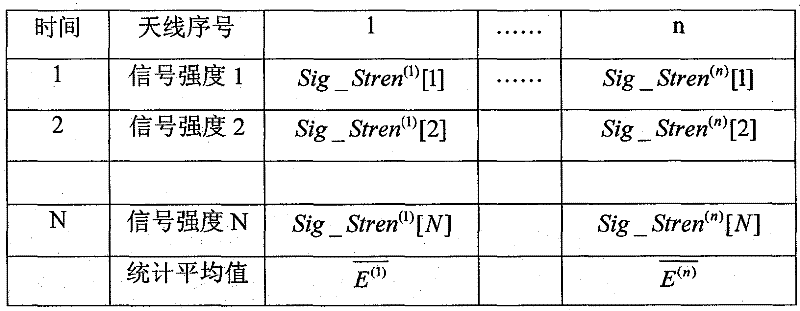
并将得出的统计平均值与一个门限值比较。The resulting statistical average is compared to a threshold value.
其中,门限值Threshhold是根据不同的移动通信系统空中接口传输技术的接收能力所得出的判决门限。Wherein, the threshold value Threshhold is a decision threshold obtained according to the receiving capabilities of different mobile communication system air interface transmission technologies.
第三步:基站仅针对K(K≤n)个大于门限值的几个天线按照平均功率分配规则Step 3: The base station only follows the average power allocation rule for K (K≤n) antennas greater than the threshold value
Ps为发送总功率。P s is the total transmission power.
或大尺度功率分配规则or the large-scale power allocation rule
进行发送功率分配,实现选择无线信道较好的天线与移动终端通信。Sending power allocation is carried out, and the antenna with better wireless channel is selected to communicate with the mobile terminal.
第四步:每次功率配置和天线快速选择过程是在每个运行周期中重复以上第一到第三步。Step 4: The process of each power configuration and antenna quick selection is to repeat the above steps 1 to 3 in each operation cycle.
例一Example one
图2给出了该方法的一种实现装置,由无线信号测量和信号强度参数存储更新装置接收来自各个天线的无线信号,计算无线信号强度的大小,并将无线信号强度参数值存入针对该移动终端的信号强度表;射频天线表中的信号强度参数平均和门限比较装置将一段时间内存储的信号强度参数值进行加权平均和与门限比较;发送功率配置和天线选择装置选择超过门限的天线进行发送功率分配,实现与移动终端通信。Fig. 2 has provided a kind of implementation device of this method, the wireless signal from each antenna is received by the wireless signal measurement and signal strength parameter storage updating device, calculates the size of the wireless signal strength, and stores the wireless signal strength parameter value in the The signal strength table of the mobile terminal; the average signal strength parameter in the radio frequency antenna table and the threshold comparison device carry out weighted average and threshold comparison of the signal strength parameter values stored in a period of time; the transmission power configuration and antenna selection device selects the antenna exceeding the threshold Allocate transmit power to realize communication with mobile terminals.
一个具体的实施例的实现步骤如下:The implementation steps of a specific embodiment are as follows:
设定一个基站无线信号覆盖小区中有m(m>6)个天线,运行周期长度为10ms,如果无线信号测量和信号强度参数存储更新装置仅收到来自5个天线的信号,记作X(1)(t),X(2)(t),…,X(5)(t)。There are m (m>6) antennas in the wireless signal coverage cell of a base station, and the operation cycle length is 10ms. If the wireless signal measurement and signal strength parameter storage update device only receives signals from 5 antennas, denote X ( 1) (t), X (2) (t), ..., X (5) (t).
第一步:基站物理层周期性地测量无线信号覆盖范围内各个射频天线所接收的移动终端信号X(i)(t),通过E(i)(t)=X(i)(t)2计算信号能量得出信号强度参数值,并存入如下的信号强度参数表;Step 1: The physical layer of the base station periodically measures the mobile terminal signal X (i) (t) received by each radio frequency antenna within the coverage of the wireless signal, by E (i) (t) = X (i) (t) 2 Calculate the signal energy to obtain the signal strength parameter value, and store it in the following signal strength parameter table;
第二步:基站物理层依据对各移动终端的测量结果更新基站中针对该移动终端的射频天线表中的信号强度参数,并通过

并将与系统接收门限比较
第三步:基站物理层选择K个
每次功率配置和天线快速选择过程是在每个运行周期10ms中重复以上第一到第三步。Each power configuration and antenna quick selection process is to repeat the above first to third steps in each operation cycle 10ms.
例二Example two
另一个具体的实施例的实现步骤如下:The implementation steps of another specific embodiment are as follows:
设定一个基站无线信号覆盖小区中有m(m>6)个天线,运行周期长度为10ms,如果无线信号测量和信号强度参数存储更新装置仅收到来自5个天线信号的信号干扰噪声比,并记作SINR(1)(t),SINR(2)(t),…,SINR(5)(t)。There are m (m > 6) antennas in the wireless signal coverage of a base station, and the length of the running cycle is 10ms. If the wireless signal measurement and signal strength parameter storage update device only receives the signal-to-interference-noise ratio from 5 antenna signals, And denote as SINR (1) (t), SINR (2) (t), ..., SINR (5) (t).
第一步:基站周期性地测量无线信号覆盖范围内各个射频天线所接收移动终端的信号干扰噪声比SINR(i)(t),并存入如下的信号强度参数表;The first step: the base station periodically measures the SINR (i) (t) of the mobile terminal received by each radio frequency antenna within the coverage of the wireless signal, and stores it in the following signal strength parameter table;
第二步:基站依据对各移动终端的测量结果更新基站中针对该移动终端的射频天线表中的信号干扰噪声比,并通过
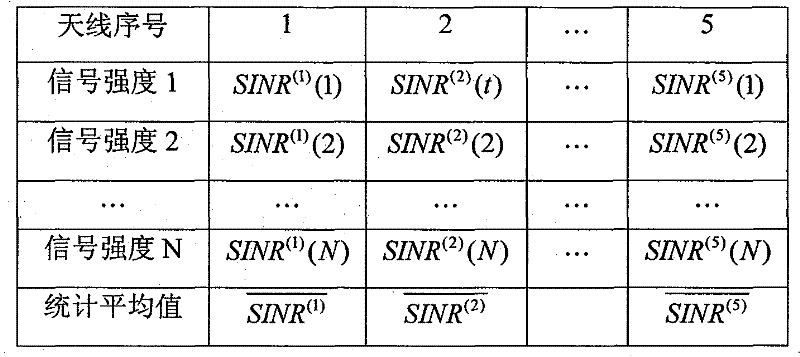
并将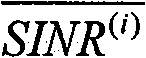
第三步:基站选择K个
每次功率配置和天线快速选择过程是在每个运行周期10ms中重复以上第一到第三步。Each power configuration and antenna quick selection process is to repeat the above first to third steps in each operation cycle 10ms.
以上所述,仅为本发明较佳的具体实施方式,但本发明的保护范围并不局限于此,任何熟悉本技术领域的技术人员在本发明揭露的技术范围内,可轻易想到的变化或替换,都应涵盖在本发明的保护范围之内。因此,本发明的保护范围应该以权利要求的保护范围为准。The above is only a preferred embodiment of the present invention, but the scope of protection of the present invention is not limited thereto. Any person skilled in the art can easily conceive of changes or modifications within the technical scope disclosed in the present invention. Replacement should be covered within the protection scope of the present invention. Therefore, the protection scope of the present invention should be determined by the protection scope of the claims.
Claims (3)
Priority Applications (1)
| Application Number | Priority Date | Filing Date | Title |
|---|---|---|---|
| CN200910032753XA CN101631379B (en) | 2009-06-19 | 2009-06-19 | Method for power distribution and antenna selection of distributed type antenna mobile communication system |
Applications Claiming Priority (1)
| Application Number | Priority Date | Filing Date | Title |
|---|---|---|---|
| CN200910032753XA CN101631379B (en) | 2009-06-19 | 2009-06-19 | Method for power distribution and antenna selection of distributed type antenna mobile communication system |
Publications (2)
| Publication Number | Publication Date |
|---|---|
| CN101631379A CN101631379A (en) | 2010-01-20 |
| CN101631379B true CN101631379B (en) | 2011-06-08 |
Family
ID=41576265
Family Applications (1)
| Application Number | Title | Priority Date | Filing Date |
|---|---|---|---|
| CN200910032753XA Active CN101631379B (en) | 2009-06-19 | 2009-06-19 | Method for power distribution and antenna selection of distributed type antenna mobile communication system |
Country Status (1)
| Country | Link |
|---|---|
| CN (1) | CN101631379B (en) |
Cited By (1)
| Publication number | Priority date | Publication date | Assignee | Title |
|---|---|---|---|---|
| US9769744B2 (en) | 2014-03-28 | 2017-09-19 | Commscope Technologies Llc | Power management for distributed antenna system |
Families Citing this family (18)
| Publication number | Priority date | Publication date | Assignee | Title |
|---|---|---|---|---|
| US8706077B2 (en) * | 2010-08-13 | 2014-04-22 | Intel Corporation | Configurable common reference signal port for reference signal received power in distributed antenna systems |
| CN102655677B (en) | 2011-03-02 | 2015-04-01 | 株式会社日立制作所 | Mobile communication system and far-end radio frequency unit clustering method thereof |
| BR112014004834A8 (en) | 2011-08-29 | 2017-12-26 | Andrew Llc | METHOD FOR DEVELOPING A CONFIGURATION PLAN FOR COMMUNICATION TRANSPORT LINKS OF A DISTRIBUTED ANTENNA SYSTEM, SYSTEM FOR DEVELOPING A CONFIGURATION PLAN FOR A DISTRIBUTED ANTENNA SYSTEM AND DISTRIBUTED ANTENNA SYSTEM |
| CN103517251B (en) * | 2012-06-20 | 2017-04-26 | 华为技术有限公司 | Method and device for acquiring mobility information |
| WO2014022999A1 (en) * | 2012-08-09 | 2014-02-13 | Empire Technology Development Llc | A self-adapted multi-antenna selection method for broadband wireless access for high-speed railway |
| CN102916734B (en) * | 2012-10-30 | 2014-11-26 | 西华大学 | Antenna selection method and antenna selection device of distributed antenna system |
| CN103458455A (en) * | 2013-08-21 | 2013-12-18 | 中国联合网络通信集团有限公司 | Antenna selecting method, base station and user equipment |
| CN104754716B (en) * | 2013-12-26 | 2019-01-08 | 华为技术有限公司 | Antenna assignment method and device |
| CN104779982B (en) * | 2014-01-10 | 2018-09-18 | 启碁科技股份有限公司 | Radio frequency signal processing method and wireless communication device |
| US20150208345A1 (en) * | 2014-01-17 | 2015-07-23 | Qualcomm Incorporated | Reducing power consumption at a transceiver |
| CN103796294B (en) * | 2014-02-24 | 2017-02-08 | 哈尔滨工业大学 | DAS Distributed Antenna System Power Allocation Method |
| CN104506221B (en) * | 2014-12-12 | 2018-11-09 | 福建星网锐捷网络有限公司 | Method of controlling antenna and antenna |
| CN105556410B (en) * | 2014-12-31 | 2018-06-26 | 深圳市大疆创新科技有限公司 | Automatic Alignment Method and System for Moving Object and Its Antenna |
| CN105848277B (en) * | 2016-03-17 | 2019-03-08 | 深圳大学 | A method and system for optimizing energy efficiency of distributed antenna based on broadcast channel |
| CN107124757B (en) * | 2017-03-17 | 2019-10-11 | 东南大学 | A power distribution method for a distributed antenna system powered by hybrid energy |
| CN107333340B (en) * | 2017-07-06 | 2018-12-04 | 上海交通大学 | Multibeam antenna network-building method and device |
| CN107465442B (en) * | 2017-08-01 | 2023-08-22 | 常熟市泓博通讯技术股份有限公司 | Control method and module of multi-antenna device |
| CN110233645B (en) * | 2019-06-11 | 2021-08-31 | Oppo广东移动通信有限公司 | Antenna switching method and apparatus, electronic device, computer-readable storage medium |
-
2009
- 2009-06-19 CN CN200910032753XA patent/CN101631379B/en active Active
Cited By (1)
| Publication number | Priority date | Publication date | Assignee | Title |
|---|---|---|---|---|
| US9769744B2 (en) | 2014-03-28 | 2017-09-19 | Commscope Technologies Llc | Power management for distributed antenna system |
Also Published As
| Publication number | Publication date |
|---|---|
| CN101631379A (en) | 2010-01-20 |
Similar Documents
| Publication | Publication Date | Title |
|---|---|---|
| CN101631379B (en) | Method for power distribution and antenna selection of distributed type antenna mobile communication system | |
| Björnson et al. | Massive MIMO and small cells: Improving energy efficiency by optimal soft-cell coordination | |
| CN101854199B (en) | Method, system and transmitters for adaptive cooperation transmission in wireless communication | |
| Quek et al. | Energy efficiency analysis of two-tier heterogeneous networks | |
| CN106165518B (en) | Mitigate UL to DL interference | |
| CN103152807B (en) | Method for distributing power between multiple base stations and multiple antennae of TDD (Time Division Duplex) cooperative wireless network | |
| CN102231884B (en) | Capacity and coverage combined design method for TD-SCDMA (Time Division-Synchronization Code Division Multiple Access) cluster system | |
| Chaieb et al. | On the optimization of user association and resource allocation in HetNets with mm-wave base stations | |
| CN116033556B (en) | A Resource Allocation Method for Large-Scale URLLC with High Energy Efficiency | |
| CN102158321A (en) | Method for distributing power and choosing antenna in distributed type MIMO (multiple input multiple output) system and capable of increasing power efficiency of mobile communication system | |
| Ge et al. | 5G green cellular networks considering power allocation schemes | |
| CN106506109B (en) | Intensive small cell network user grouping and self-adapting interference suppression method | |
| CN106131855A (en) | The method for channel allocation of virtual subdistrict in a kind of 5G high density network | |
| Li et al. | Antenna selection schemes for energy efficiency in distributed antenna systems | |
| Chen et al. | A novel JT-CoMP scheme in 5G fractal small cell networks | |
| Cohen et al. | Joint scheduling and fast cell selection in OFDMA wireless networks | |
| Mugume et al. | Spectral and energy efficiency analysis of dense small cell networks | |
| CN103139800A (en) | Node adjustment method, device and system of relay cellular network | |
| CN105979589A (en) | Method and system for allocating energy efficient resources of heterogeneous network | |
| Kusaladharma et al. | Performance of SWIPT in cell-free massive MIMO: a stochastic geometry based perspective | |
| CN106413110A (en) | Scheduling method and device and network node | |
| CN101374005B (en) | Method for transmitting down user data and distributed antennae mobile communication system | |
| CN103281695B (en) | A kind of hop relay network frequency spectrum planing method | |
| JP2019533399A (en) | Apparatus and method for allocating radio resources | |
| CN102761379B (en) | Method and device for determining adjacent regions with same frequency |
Legal Events
| Date | Code | Title | Description |
|---|---|---|---|
| C06 | Publication | ||
| PB01 | Publication | ||
| C10 | Entry into substantive examination | ||
| SE01 | Entry into force of request for substantive examination | ||
| C14 | Grant of patent or utility model | ||
| GR01 | Patent grant |