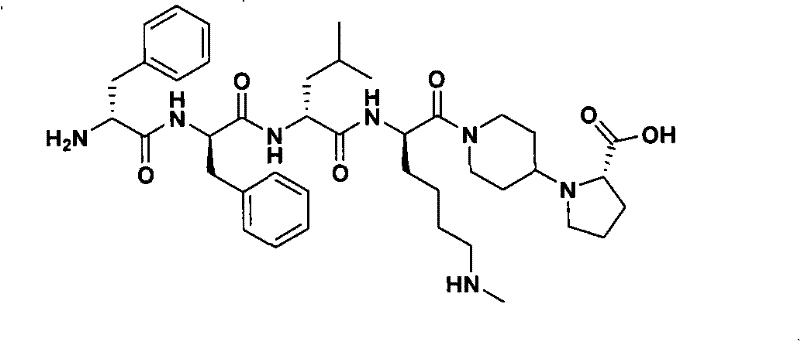
This application claims priority from U.S. provisional application No. 60/858,109, filed on 10.11.2006, and U.S. provisional application No. 60/928,550, filed on 10.5.2007, each of which is hereby incorporated by reference in its entirety.
Detailed Description
The term "synthetic peptide amide" as used throughout the present specification refers to a compound of the present invention corresponding to formula I, or a stereoisomer, a mixture of stereoisomers, a prodrug, a pharmaceutically acceptable salt, a hydrate, a solvate, an acid salt hydrate, an N-oxide or an isomorphic crystalline form thereof. When in the compounds of the present invention, Xaa is indicated1、Xaa2、Xaa3And Xaa4When it is a D-amino acid, the stereoisomers of the compounds of the invention corresponding to formula I are limited to those compounds of formula I having the amino acid in the D-configuration as illustrated herein. Stereoisomers of the invention are included in addition to Xaa1、Xaa2、Xaa3And Xaa4The chiral centers of the four amino acids except the alpha carbon are in D-configuration or L-configuration. A mixture of stereoisomers refers to a mixture of said stereoisomers of the present invention. As used herein, a racemate is meant to be taken in addition to Xaa1、Xaa2、Xaa3And Xaa4Has D configuration and L configuration at one or more chiral centers other than the alpha carbon of (A), and Xaa is not changed1、Xaa2、Xaa3And Xaa4Of the alpha carbon of (a) is a mixture of equal proportions of stereoisomers of the chiral compound.
The nomenclature used herein to define The Peptides is defined in accordance with Schroder and Lubke, The Peptides, Academic Press, 1965, wherein, according to The conventional notation, The N-terminus is on The left and The C-terminus is on The right. Where the amino acid residue has isomeric forms, it is intended to encompass both the L-and D-isomeric forms of the amino acid, unless otherwise indicated. Amino acids are generally identified herein by standard 3-letter codes. The D isomer of an amino acid is designated by the prefix "D-" and for example denotes "D-Phe" for D-phenylalanine (i.e.the D-isomer of phenylalanine). Similarly, the L-isomer is designated by the prefix "L-" such as "L-Phe". Peptides are referred to herein by the usual convention of amino acid sequence from left to right (N-terminal to C-terminal) unless otherwise indicated.
As used herein, D-Arg represents D-arginine, D-Har represents D-homoarginine (which has a side chain one methylene longer than D-Arg), and D-Nar represents D-norarginine (which has a side chain one methylene shorter than D-Arg). Similarly, D-Leu represents D-leucine, D-Nle represents D-norleucine, and D-Hle represents D-homoleucine. D-Ala represents D-alanine, D-Tyr represents D-tyrosine, D-Trp represents D-tryptophan, and D-Tic represents D-1, 2, 3, 4-tetrahydroisoquinoline-3-carboxylic acid. D-Val represents D-valine and D-Met represents D-methionine. D-Pro represents D-proline and Pro-amide represents the D-or L-form of proline amide. D-Pro amide means D-proline which forms an amide at its carboxyl moiety, wherein the amide nitrogen may be substituted with an alkyl group, such as-NRaRbIn which R isaAnd RbEach independently is C1-C6Alkyl, or RaAnd Rbis-H. Gly means glycine, D-Ile means D-isoleucine, D-Ser means D-serine, and D-Thr means D-threonine. (E) D-Ala represents the D-isomer of alanine substituted by substituent (E) at the beta-carbon. Examples of the substituent (E) group include cyclobutyl, cyclopentyl, cyclohexyl, pyridyl, thienyl and thiazolyl. Thus, cyclopentyl-D-Ala represents the D-isomer of alanine substituted on the beta-carbon for cyclopentyl. Similarly, D-Ala (2-thienyl) and (2-thienyl) D-Ala are interchangeable and both refer to the D-isomer of alanine substituted at the β -carbon with a thienyl group attached at the 2-ring position.
D-Nal as used herein denotes the D-isomer of alanine substituted with a naphthyl group at the beta-carbon. D-2Nal represents D-alanine substituted with a naphthyl group in which the bond to the naphthalene is at the 2-position on the ring structure, and D-1Nal represents D-alanine substituted with a naphthyl group in which the bond to the naphthalene is at the 1-position on the ring structure. D-phenylalanine substituted on the phenyl ring with 1 or 2 substituents independently selected from halogen, nitro, methyl, halomethyl (e.g. trifluoromethyl), perhalomethyl, cyano and carboxamide is represented by (a) (a') D-Phe. D-phenylalanine substituted with fluorine at the 4-position of the benzene ring is represented by D- (4-F) Phe. D-phenylalanine substituted with fluorine at the 2-position of the benzene ring is represented by D- (2-F) Phe. D-phenylalanine substituted with chlorine at the 4-position of the phenyl ring is represented by D- (4-Cl) Phe. D-phenylalanine substituted with a methyl group at the alpha carbon is represented by (. alpha. -Me) D-Phe. D-leucine substituted with a methyl group at the alpha carbon is represented by (. alpha. -Me) D-Leu.
Symbol (B)2D-Arg、(B)2D-Nar and (B)2D-Har represents D-arginine, D-norarginine (D-norargenine) and D-homoarginine, respectively, each of which has two substituent (B) groups in the side chain. D-Lys represents D-lysine and D-Hlys represents D-homolysine. ζ - (B) D-Hlys,. epsilon. - (B) D-Lys, and. epsilon. - (B)2-D-Lys represents D-homolysine and D-lysine each substituted with 1 or 2 substituent (B) groups at the side chain amino group, as identified. D-Orn represents D-ornithine and delta- (B) alpha- (B ') D-Orn represents D-ornithine substituted with (B') at the alpha carbon and (B) at the side chain delta-amino group.
D-Dap represents D-2, 3-diaminopropionic acid. D-Dbu represents the D-isomer of α, γ -diaminobutyric acid, and (B)2D-Dbu represents alpha, gamma-diaminobutyric acid substituted at the gamma amino group with 2 substituent (B) groups. Unless otherwise stated, each (B) group of these disubstituted residues is independently selected from H-and C1-C4An alkyl group. D-Amf as used herein denotes D- (NH)2CH2-) Phe, a D-isomer of phenylalanine substituted on its phenyl ring with an aminomethyl group, and D-4Amf represents the particular D-Amf in which the aminomethyl group is attached at the 4-position of the ring. D-Gmf means D-Amf (amidino), D-Amf (amidino) means a compound in which a benzene ring is substituted with-CH2NHC(NH)NH2D-Phe of (1). Amd represents an amidino group, i.e., -C (NH) NH2And the symbol (Amd) D-Amf and D-Amf (Amd) are likewise interchangeable for D-Gmf. The symbols Ily and Ior are used to denote isopropyl Lys and isopropyl Orn, respectively, where the side chain amino is alkylated with isopropyl.
Alkyl refers to an alkyl group which may be straight, branched and cyclic alkyl such as, but not limited to, methyl, ethyl, propyl, isopropyl, cyclopropyl, butyl, tert-butyl, sec-butyl, pentyl, cyclopentyl, hexyl, cyclohexyl, cyclohexylethyl. C1-C8Alkyl refers to alkyl groups having 1 to 8 carbon atoms. Similarly, C1-C6Alkyl refers to alkyl groups having 1 to 6 carbon atoms. Similarly, C1-C4Alkyl refers to alkyl groups having 1 to 4 carbon atoms. Lower alkyl means C1-C6An alkyl group. Me, Et, Pr, Ipr, Bu and Pn are each used interchangeably to denote the commonly used alkyl groups: methyl, ethyl, propyl, isopropyl, butyl and pentyl. While the linking site (linkage) of an alkyl group is typically located at one end of the alkyl chain, the linking site may also be elsewhere in the chain, for example 3-pentyl, which may also be referred to as ethylpropyl or 1-ethylprop-1-yl. Substituted by alkyl radicals, e.g. C1To C6Amidino of alkyl means that the relevant moiety is substituted with one or more alkyl groups.
If the indicated moiety is empty, that moiety is not present, and if such moiety is indicated to be linked to 2 other moieties, the 2 other moieties are linked by a covalent bond. If it is shown here that the linking moiety is attached to the ring at any position of the ring and to 2 other moieties, e.g. R1And R2In the case where the connecting portion is specified as empty, then R is1And R2The moieties may each be independently attached to any position of the ring.
The terms "heterocyclic", "heterocyclic ring" and "heterocyclyl" are used interchangeably herein and refer to a ring or ring moiety having at least one non-carbon ring atom (also referred to as a heteroatom), which may be a nitrogen, sulfur or oxygen atom. If a ring is indicated as having a certain number of elements, that number defines the number of ring atoms, and does not include any substituents or hydrogen atoms bonded to the ring atoms. The heterocyclic (heterocyclic), heterocyclic (heterocyclic ring) and heterocyclyl moiety (heterocyclic moiety) may include multiple heteroatoms independently selected from nitrogen, sulfur or oxygen atoms in the ring. The rings may be substituted at any available position. For example, but not by way of limitation, the 6-and 7-membered rings are typically substituted at the 4-ring position, while the 5-membered ring is typically substituted at the 3-position, wherein the ring is attached to the peptide amide chain at the 1-ring position.
The term "saturated" means that no double or triple bonds are present, and the term is used in conjunction with a ring to describe a ring that does not have a double or triple bond in the ring, but does not exclude the presence of a double or triple bond in a substituent attached to the ring. The term "non-aromatic" in the context of a particular ring means that no aromaticity is present in the ring, but does not exclude the presence of double bonds in the ring (including double bonds that are part of an aromatic ring fused to the ring). The ring atoms of the saturated heterocyclic moiety also do not exclude double bonds with non-ring atoms, such as a ring sulfur atom double bonded with an oxygen atom substituent. Heterocyclic (heterocyclic), heterocyclic (heterocyclic ring) and heterocyclyl moieties (heterocyclic) as used herein also include saturated, partially unsaturated aromatic heterocycles and fused bicyclic structures, unless otherwise indicated. The heterocyclic (heterocyclic), heterocyclic (heterocyclic ring) and heterocyclyl moiety (heterocyclic moiety) may be fused to another ring, which may be saturated, partially unsaturated or aromatic, which may be heterocyclic or carbocyclic. If specified, two substituents may optionally be taken together to form an additional ring. The rings may be substituted at any available position. The heterocyclic (heterocyclic), heterocyclic (heterocyclic ring) and heterocyclyl moieties (heterocyclic moieties), if specified, may optionally be substituted at one or more ring positions with one or more independently selected substituents, for example C1-C6Alkyl radical, C3-C8Cycloalkyl radical, C1-C6Alkoxy, halo C1-C6Alkyl, optionally substituted phenyl, aryl, heterocyclic ringRadical, oxy, -OH, -Cl, -F, -NH2、-NO2CN, -COOH and amidino. Suitable optional substituents for the phenyl substituent include, for example, but are not limited to, those selected from C1-C3Alkyl radical, C1-C3Alkoxy, halo C1-C3Alkyl, oxy, -OH, -Cl, -F, -NH2、-NO2-CN, -COOH and amidino.
D-Phe and substituted D-Phe for the residue Xaa in formula I1Are examples of suitable amino acids. The phenyl ring may be substituted at any of the 2-, 3-and/or 4-positions. Specific examples of permissible substitutions include, for example, chlorine or fluorine at the 2-or 4-position. The alpha-carbon atom may also be methylated. Other equivalent residues representing conservative changes to D-Phe may also be used. These include D-Ala (cyclopentyl), D-Ala (thienyl), D-Tyr and D-Tic. Residue Xaa at the second position2It may also be D-Phe or substituted D-Phe with such substitutions, including substituents at the carbon at the 4-position or both the 3-and 4-positions of the phenyl ring. Alternatively, Xaa2May be D-Trp, D-Tyr or D-alanine substituted with naphthyl. Residue Xaa at the third position3Can be any non-polar amino acid residue, such as D-Nle, D-Leu, (alpha-Me) D-Leu, D-Hle, D-Met or D-Val. However, D-Ala (cyclopropyl, cyclobutyl, cyclopentyl or cyclohexyl) or D-Phe can likewise be used as Xaa3. Residue Xaa at the fourth position4May be any positively charged amino acid residue, for example D-Arg and D-Har optionally substituted with a lower alkyl group such as 1 or 2 ethyl groups. Alternatively, D-Nar and any other equivalent residues may be used, such as D-Lys or D-Orn (either of which may be omega-aminoalkylated, e.g., by methyl or isopropyl, or methylated on the alphacarbon group). Furthermore, D-Dbu, D-4-Amf (which may optionally be substituted with amidino) and D-Hlys are suitable amino acids at this position.
The compounds of the invention contain one or more chiral centers, two of which each have four substituents around the central carbon atomPossible three-dimensional spatial arrangements (configurations). These are known stereoisomers, more particularly enantiomers (all chiral centres inverted) or diastereomers (2 or more chiral centres, at least one chiral centre remaining unchanged). In one embodiment of the invention, Xaa constitutes the tetrapeptide backbone1Xaa2Xaa3Xaa4Is designated as a D-amino acid, i.e., the opposite configuration of amino acids commonly found in mammals. Stereoisomers of the synthetic peptide amides of the invention are contemplated other than the constituent Xaa1~Xaa4A chiral center other than the alpha carbon of the D-amino acid of (1). Accordingly, as an embodiment of the invention (wherein Xaa1~Xaa4Each of which is defined as a D-amino acid) does not include L-amino acids or racemic mixtures of amino acids at these positions. Similarly, the racemates herein refer to the compounds except for the constituent Xaa1~Xaa4A center other than the alpha carbon of the D-amino acid of (1). Chiral centers in the synthetic peptide amides of the invention, whose stereoisomers may adopt the R or S configuration, include binding to Xaa4And Xaa, and1~Xaa4the chiral center in any amino acid side-chain substituent of (a).
The synthetic peptide amides of the invention described herein (also interchangeably referred to as synthetic peptide amide compounds, compounds of the invention, compounds (numbers), or simply "the compounds") can be used or prepared in alternative forms. For example, a variety of amino-containing compounds can be used or prepared as acid salts. Typically such salts improve the isolation and handling properties of the compounds. For example, compounds such as the synthetic peptide amides described herein can be used or prepared as, for example, a hydrochloride or tosylate salt, depending on the reagents and reaction conditions, and the like. Isomorphic crystalline forms, all chiral and racemic forms, N-oxides, hydrates, solvates and acid salt hydrates are also contemplated within the scope of the invention.
Certain acidic or basic synthetic peptide amides of the invention may exist as zwitterions. All forms of these synthetic peptide amide compounds, including free acids, free bases, and zwitterions are contemplated within the scope of the present invention. It is well known in the art that compounds containing both amino and carboxyl groups are generally in equilibrium with their zwitterionic forms. Thus, any compound described herein, for example, as containing both amino and carboxyl groups, should also be understood to include the corresponding zwitterion.
In certain embodiments, the synthetic peptide amides of the invention are according to formula I:
formula I
Xaa in said embodiment1-Xaa2-Xaa3-Xaa4Is a tetrapeptide moiety wherein Xaa1Is an amino acid at the amino terminus which may be (A) (A ') D-Phe, (A) (A ') (α -Me) D-Phe, D-Tyr, D-Tic, D-tert-leucine, D-neopentyl glycine, D-phenylglycine, D-homophenylalanine or β - (E) D-Ala wherein each (A) and each (A ') are independently selected from the group consisting of-H, -F, -Cl, -NO2、-CH3、-CF3-CN and-CONH2And (E) is selected from any one of cyclobutyl, cyclopentyl, cyclohexyl, thienyl, pyridyl or thiazolyl. The second amino acid Xaa in the tetrapeptide chain2Any of (A) (A ') D-Phe, 3, 4-dichloro-D-Phe, (A) (A') (. alpha. -Me) D-Phe, D-1Nal, D-2Nal, D-Tyr, (E) D-Ala or D-Trp may be used. The third amino acid Xaa in the tetrapeptide chain3May be D-Nle, D-Phe, (E) D-Ala, D-Leu, (alpha-Me) D-Leu, D-Hle, D-Val or D-Met. The fourth amino acid Xaa in the tetrapeptide chain4May be any of the following: (B)2D-Arg、(B)2D-Nar、(B)2D-Har、ζ-(B)D-Hlys、D-Dap、ε-(B)D-Lys、ε-(B)2-D-Lys, D-Amf, amidino-D-Amf, gamma- (B)2D-Dbu、δ-(B)2Alpha- (B') D-Orn, D-2-amino-3 (4)-piperidinyl) propionic acid, D-2-amino-3 (2-aminopyrrolidinyl) propionic acid, D-alpha-amino-beta-amidinopropionic acid, alpha-amino-4-piperidineacetic acid, cis-alpha, 4-diaminocyclohexaneacetic acid, trans-alpha, 4-diaminocyclohexaneacetic acid, cis-alpha-amino-4-methylaminocyclohexaneacetic acid, trans-alpha-amino-4-methylamino-cyclohexaneacetic acid, alpha-amino-1-amidino-4-piperidineacetic acid, cis-alpha-amino-4-guanidinocyclohexaneacetic acid or trans-alpha-amino-4-guanidinocyclohexaneacetic acid, wherein each (B) may be independently selected from the group consisting of-H and C.1-C4Alkyl, and (B') may be a-H or (α -Me) group.
In certain embodiments of the present invention, the optional linker group W is absent (i.e., empty), provided that in such instances Y is N. In other embodiments, W is-N- (CH)2)bWherein b is equal to 0, 1, 2, 3,4, 5 or 6. In still other embodiments, W is-N- (CH)2)c-O-, wherein C is equal to 2 or 3, with the proviso that in such embodiments, Y is C.
In certain specific embodiments of the invention, the moiety in formula I
Is an optionally substituted 4-to 8-membered heterocyclic moiety, wherein all ring heteroatoms in the ring moiety are N, and wherein Y and Z are each independently C or N and are non-adjacent ring atoms. In such embodiments, when the heterocyclic moiety is a 6-, 7-or 8-membered ring, ring atoms Y and Z are separated by at least 2 other ring atoms. In such embodiments, when the heterocyclic moiety has a single ring heteroatom that is N, then the ring moiety does not have aromaticity.
In certain particular embodiments of the invention, the linking moiety V is directly bonded to the ring containing Y and Z. V is a group R which may be substituted1And R2C of (A)1-C6An alkyl group. Substituent R1Any of the following substituents may be used: -H, -OH, halogen, -CF3、-NH2、-COOH、C1-C6Alkyl, amidino, substituted by C1-C6Amidino of alkyl, aryl, optionally substituted heterocyclyl, Pro-amide, Pro, Gly, Ala, Val, Leu, Ile, Lys, Arg, Orn, Ser, Thr, -CN, -CONH2、-COR’、-SO2R ', -CONR ' R ', -NHCOR ', OR ' OR-SO2NR 'R'. Said optionally substituted heterocyclyl may be mono-or di-substituted with substituents independently selected from C1-C6Alkyl radical, C1-C6Alkoxy, oxy, -OH, -Cl, -F, -NH2、-NO2CN, -COOH and amidino. The moieties R 'and R' are each independently H, C1-C8Alkyl, aryl or heterocyclyl. Alternatively, R 'and R' may be combined to form a 4-to 8-membered ring which may be optionally mono-or di-substituted with substituents independently selected from C1-C6Alkyl radical, C1-C6Alkoxy, -OH, -Cl, -F, -NH2、-NO2CN, -COOH and amidino. The substituent R2May be-H, amidino, mono-or di-substituted with C1-C6Amidino, -CN, -CONH of alkyl2、-CONR′R″、-NHCOR′、-SO2NR 'R' or-COOH.
In other particular embodiments, V is absent and substituent R is1And R2Directly bonded to the same or different ring atoms in the heterocycle containing Y and Z.
In an alternative aspect of certain embodiments, the moieties R taken together1And R2Is capable of forming an optionally substituted 4-to 9-membered heterocyclic monocyclic or bicyclic moiety, said ring moiety being bonded to a single ring atom of the Y-and Z-containing ring moiety. In a particular embodiment, the moiety R1And R2Capable of forming an optionally substituted 4-to 9-membered heterocyclic monocyclic or bicyclic moiety, said ring moiety being directly bonded to a Y-and Z-containing ring moietyA single ring atom.
In a second alternative aspect of certain embodiments, the moiety R taken together with a single ring atom of the Y and Z containing cyclic moiety1And R2Optionally substituted 4-to 8-membered heterocyclic moieties can be formed to form spiro structures.
In a third alternative aspect of certain embodiments, the moiety R taken together with 2 or more adjacent ring atoms of the Y and Z containing ring moiety1And R2Capable of forming an optionally substituted 4-to 9-membered heterocyclic monocyclic or bicyclic moiety fused to said Y-and Z-containing ring moiety.
In a particular embodiment, R is contained1And R2Each of the optionally substituted 4-, 5-, 6-, 7-, 8-and 9-membered heterocyclic moieties of (a) may be mono-or di-substituted with a substituent independently selected from C1-C6Alkyl radical, C1-C6Alkoxy, optionally substituted phenyl, oxy, -OH, -Cl, -F, -NH2、-NO2CN, -COOH and amidino.
In certain particular embodiments, when the Y and Z containing ring moiety is a 6-or 7-membered ring containing a single ring heteroatom, and when one of Y and Z is C and the other of Y and Z is N, and e is 0, then R is1Not being-OH, and R1And R2Not being simultaneously-H. Further, when the Y and Z containing ring moiety is a 6-membered ring comprising 2 ring heteroatoms, wherein Y and Z are both N and W is empty, then the moiety-Ve(R1)(R2) To a ring atom other than Z. In addition, if e is 0, then R1And R2May not be simultaneously-H. Finally, when Xaa3When D-Nle is true, Xaa4Can not be (B)2D-Arg; and when Xaa3When is D-Leu or (. alpha.Me) D-Leu, then Xaa4Cannot be delta- (B)2α-(B′)D-Orn。
In certain embodiments, the invention also provides synthetic peptide amides having the formula:
or a stereoisomer, racemate, prodrug, pharmaceutically acceptable salt, hydrate, solvate, acid salt hydrate, N-oxide, or isomorphic crystalline form thereof; wherein Xaa1Selected from the group consisting of: (A) (A ') D-Phe, (α -Me) D-Phe, D-Tyr, D-Tic, D-phenylglycine, D-homophenylalanine, and β - (E) D-Ala, wherein (A) and (A') are each a benzene ring substituent independently selected from the group consisting of: -H, -F, -Cl, -NO2、-CH3、-CF3-CN and-CONH2And wherein (E) is selected from the group consisting of: cyclobutyl, cyclopentyl, cyclohexyl, pyridyl, thienyl, and thiazolyl; xaa2Selected from the group consisting of: (A) (A') D-Phe, (α -Me) D-Phe, D-1Nal, D-2Nal, D-Tyr, (E) D-Ala and D-Trp; xaa3Selected from the group consisting of: D-Nle, D-Phe, (E) D-Ala, D-Leu, (alpha-Me) D-Leu, D-Hle, D-Val and D-Met; xaa4Selected from the group consisting of: (B)2D-Arg、(B)2D-nArg、(B)2D-Har、ζ-(B)D-Hlys、D-Dap、ε-(B)D-Lys、ε-(B)2-D-Lys, D-Amf, amidino-D-Amf, gamma- (B)2D-Dbu、δ-(B)2α - (B') D-Orn, D-2-amino-3 (4-piperidinyl) propionic acid, D-2-amino-3 (2-aminopyrrolidinyl) propionic acid, D- α -amino- β -amidinopropionic acid, (R) - α 0-amino-4-piperidineacetic acid, cis- α, 4-diaminocyclohexaneacetic acid, trans- α, 4-diaminocyclohexaneacetic acid, cis- α -amino-4-methylaminocyclohexaneacetic acid, trans- α -amino-4-methylamino-cyclohexaneacetic acid, α -amino-1-amidino-4-piperidineacetic acid, cis- α -amino-4-guanidinocyclohexaneacetic acid and trans- α -amino-4-guanidinocyclohexaneacetic acid, wherein each (B) is independently selected from the group consisting of: h and C1-C4Alkyl, and (B') is H or (. alpha. -Me). The group W is selected from the group consisting of:
null, provided that when W is null, Y is N;
-N-(CH2)bwherein b is equal to 0, 1, 2, 3,4, 5 or 6; and
-N-(CH2)c-O-, wherein C is equal to 2 or 3, with the proviso that Y is C;
and part of
Is an optionally substituted 4-to 8-membered saturated mono-or bi-nitrogen heterocyclic moiety in which the other ring atoms other than Y and Z are not heteroatoms, Y is C or N, Z is C or N, and at least one of Y and Z is N, with the proviso that in the case of a 4-or 5-membered heterocyclic ring, Y or Z is C, and in the case of a bi-nitrogen heterocyclic ring, Y and Z are separated by 2 or more ring carbon atoms;
v is C1-C6Alkyl, and e is 0 or 1, wherein when e is 0, then V is empty, and R is1And R2Directly bonded to the same or different ring atoms;
R1is H, OH, -NH2、-COOH、C1-C6Alkyl, amidino, substituted by C1-C6Alkyl amidino, dihydroimidazole, Pro-amide, Pro, Gly, Ala, Val, Leu, Ile, Lys, Arg, Orn, Ser, Thr, -CN, -CONH2-CONR ' R ", -NHCOR ', -OR ' OR SO2NR 'R', wherein R 'and R' are each independently H or C1-C8Alkyl, or R 'and R' are bonded to form a 4-to 8-membered ring, which ring may be optionally mono-or di-substituted with substituents independently selected from the group consisting of: c1-C6Alkyl radical, C1-C6Alkoxy, -OH, -Cl, -F, -NH2、-NO2CN, -COOH, amidino; and R is2Is H, amidino, monosubstituted or bisSubstituted by C1-C6Amidino, -CN, -CONH of alkyl2、-CONR′R″、-NHCOR′、-SO2NR 'R' or-COOH;
provided that when the ring moiety containing Y and Z is a 6-or 7-membered ring and when one of Y and Z is C and e is 0, then R is1Is not OH, and R1And R2Not H at the same time; provided that when the ring moiety containing Y and Z is a 6 membered ring, Y and Z are both N and W is empty- (V)eR1R2To a ring atom other than Z; and if e is 0, then R1And R2Is not simultaneously-H; and finally, when Xaa3When D-Nle is true, Xaa4Can not be (B)2D-Arg when Xaa3When is D-Leu or (. alpha.Me) D-Leu, then Xaa4Cannot be delta- (B)2α-(B′)D-Orn。
In one embodiment, the invention provides a synthetic peptide amide of formula I, wherein Xaa1Xaa2Is D-Phe-D-Phe, Xaa3Is D-Leu or D-Nle and Xaa4Is selected from (B)2D-Arg、D-Lys、(B)2D-Har、ζ-(B)D-Hlys、D-Dap、ε-(B)D-Lys、ε-(B)2-D-Lys, D-Amf, amidino-D-Amf, gamma- (B)2D-Dbu and delta- (B)2α - (B') D-Orn. In a particular aspect of the above embodiments, Xaa4Selected from D-Lys, (B)2D-Har,. epsilon. - (B) D-Lys and. epsilon. - (B)2-D-Lys。
In another embodiment, the invention provides a synthetic peptide amide of formula I wherein W is null, Y is N and Z is C. In a particular aspect of the above embodiments, the Y and Z containing ring moiety is a 6 membered saturated ring comprising a single ring heteroatom.
In another embodiment, the invention provides a synthetic peptide amide of formula I wherein Y and Z are both N and are the only ring heteroatoms in the Y and Z-containing ring moiety.
In another embodiment, when the Y and Z containing ring moiety is a 6 membered saturated ring containing 2 ring heteroatoms and W is empty, then Z is a carbon atom.
In yet another embodiment, the invention provides synthetic peptide amides of formula I wherein R taken together with 0, 1 or 2 ring atoms of the ring moiety containing Y and Z is1And R2Comprising a monocyclic or bicyclic 4-to 9-membered heterocyclic moiety. In a particular aspect of the above embodiments, R taken together with one ring atom of the ring moiety containing Y and Z1And R2Comprising a 4-to 8-membered heterocyclic moiety which forms a spiro ring structure with the Y-and Z-containing ring moiety and W is empty.
In yet another embodiment, the invention provides a synthetic peptide amide of formula I wherein e is 0 and R is1And R2Directly bonded to the same ring carbon atom.
In a further embodiment, the invention provides synthetic peptide amides of formula I wherein R is1Is H, OH, -NH2、-COOH、-CH2COOH、C1-C3Alkyl, amidino, substituted by C1-C3Amidino, dihydroimidazole, D-Pro amide or CONH of alkyl2And wherein R2Is H, -COOH or C1-C3An alkyl group.
In another embodiment, the invention provides a synthetic peptide amide of formula I, wherein the moiety
Selected from the group consisting of:
in yet another embodiment, the invention provides a synthetic peptide amide of formula I, wherein the moiety
Is neither a proline moiety nor a substituted proline moiety, let alone wherein R1Or R2A proline moiety containing an amide moiety.
In yet another embodiment, the invention provides a synthetic peptide amide of formula I, wherein the provisos are that when W is empty, the Y and Z-containing ring portion is a saturated 5-membered ring having only one ring heteroatom, e is 0, and R is1Or R2When attached to a ring carbon adjacent to Y, then R1Selected from the group consisting of: -H, -OH, halogen, -CF3、-NH2、C1-C6Alkyl, amidino, substituted by C1-C6Amidino, aryl, Pro, Gly, Ala, Val, Leu, Ile, Lys, Arg, Orn, Ser, Thr, CN, -SO, of alkyl2R ', -NHCOR ', -OR ', and-SO2NR 'R'; and R is2Selected from the group consisting of: -H, amidino, mono-or di-substituted with C1-C6Amidino, -CN, -NHCOR' and-SO for alkyl2NR′R″。
In yet another embodiment, the invention provides synthetic peptide amides of formula I having an EC of less than about 500nM for the kappa opioid receptor50. In a particular aspect, the synthetic peptide amides may have an EC of less than about 100nM for the kappa opioid receptor50. In a more particular aspect, the synthetic peptide amides can have an EC of less than about 20nM for the kappa opioid receptor50. In a most particular aspect, the synthetic peptide amides can have an EC of less than about 1nM for the kappa opioid receptor50. The foregoing examplesEC possessed by compound of the mode of administration on mu and delta opioid receptors50Can align the EC possessed by kappa opioid receptor50At least 10-fold greater, preferably at least 100-fold greater and most preferably at least 1000-fold greater (e.g., EC for kappa opioid receptor)50Less than about 1nM and EC for mu opioid and delta opioid receptors50Values greater than about 1000 nM).
In yet another embodiment, the invention provides a synthetic peptide amide of formula I that exhibits P-antagonism at an effective concentration after incubation of the synthetic peptide amide with human liver microsomes at a concentration of 10 μ M for 60 minutes450Any one of CYP1a2, CYP2C9, CYP2C19, or CYP2D6 is inhibited by no more than about 50%.
In yet another embodiment, the invention provides a synthetic peptide amide of formula I that achieves a peak plasma concentration of the synthetic peptide amide that is at least about 5-fold higher than the peak concentration in the brain at a dose of about 3mg/kg in rats. In a particular aspect of the above embodiments, the synthetic peptide amide has an ED for sedative effect in a mouse motor reduction test50ED that is the analgesic effect of the synthetic peptide amide in the writhing test in mice50At least about 10 times.
In yet another embodiment, the invention provides a synthetic peptide amide of formula I having at least about 50% of its maximal potency about 3 hours after administration of a dose of about 3mg/kg of the synthetic peptide amide in rats.
In one embodiment, the invention provides a pharmaceutical composition comprising a synthetic peptide amide of formula I and a pharmaceutically acceptable excipient or carrier.
In another embodiment, the invention provides a method of treating or preventing a kappa opioid receptor associated disease or condition in a mammal, comprising administering to the mammal a composition comprising an effective amount of a synthetic peptide amide of formula I sufficient to treat or prevent the kappa opioid receptor associated disease or condition.
Various assays can be used to test whether the synthetic peptide amides of the invention exhibit high affinity and selectivity for the kappa opioid receptor, long-term in vivo bioactivity, and no CNS side effects. Receptor assays are well known in the art, and like the mu and delta opioid receptors that have been cloned, the kappa opioid receptor has been cloned from several species. The kappa opioid receptor as well as the mu opioid receptor and delta opioid receptor are classical, 7-transmembrane, G-protein coupled receptors. While these cloned receptors can be conveniently used to screen specific candidate compounds, such as peptides or peptide derivatives, screening can also be performed using naturally derived mammalian opioid receptors, as is well known in the art (Dooley CT et al, selected ligands for the mu, delta, and kappa optical receptors identified from a single mixed polypeptide position screening combinatorial library. J.biol.chem.273: 18848-56, 1998). Thus, both kappa and mu opioid receptors (whether of recombinant or natural origin) can be screened simultaneously to determine the selectivity of the synthetic peptide amides of the invention for the kappa opioid receptor (as compared to the selectivity for the mu opioid receptor).
In a particular embodiment, the synthetic peptide amides of the invention are selective kappa opioid receptor agonists. Can be used as a chemical reagent50The concentration at which half of the maximal effect is achieved is expressed to determine the efficacy of the synthetic peptide amides of the invention as agonists for the particular receptor. The efficacy of the synthetic peptide amides of the invention as kappa opioid agonists, expressed as a percentage of the maximum observable effect, can be determined by a variety of methods well known in the art. See, for example, endo T et al, 1999, post anticancer Effects of TRK-820, a Novel kappa-optical ReceptoraAgonit, Life Sci.65(16) 1685-94; and Kumar V et al, Synthesis and evaluation of Novel Periplerally reconstructed κ -optical Receptor Agonists,2005 BioorgMed Chem Letts 15:1091-1095。
The following is given for determining EC50Examples of such testing techniques for values. Various standard test methods for characterizing opioid ligands are well known to those skilled in the art. See, e.g., Waldhoer et al, (2004) ann.rev.biochem.73: 953-: 343-364 and the references cited therein.
In certain particular embodiments, the synthetic peptide amides of the invention are ECs50A kappa opioid receptor agonist of less than about 500 nM. In other embodiments, the synthetic peptide amides have an EC of less than about 100nM as kappa opioid receptor agonists50. In further embodiments, the synthetic peptide amide has an EC of less than about 10nM as a kappa opioid receptor agonist50. In particular embodiments the synthetic peptide amides of the invention have EC as kappa opioid receptor agonists50Less than about 1.0nM, less than about 0.1nM, or even less than about 0.01 nM.
In particular embodiments, the synthetic peptide amides of the invention are highly selective for the kappa opioid receptor over the mu opioid receptor. In certain embodiments, the synthetic peptide amides of the invention have EC for the mu opioid receptor50Value ratio of corresponding EC for kappa opioid receptor50The value is at least about 100 times higher. In particular embodiments, the synthetic peptide amides of the invention have EC for the mu opioid receptor50Value ratio of corresponding EC for kappa opioid receptor50The value is at least about 1000 times higher. Alternatively, selectivity of the synthetic peptide amides of the invention may be expressed as EC for the mu opioid receptor50Alignment of EC for kappa opioid receptors50And higher. Thus, in particular embodiments, the synthetic peptide amides of the invention have EC for the mu opioid receptor50Values greater than about 10 μ M with EC for kappa opioid receptors50A value of less than about 10nM atIn other embodiments less than about 1.0nM, or even less than about 0.01 nM. In another embodiment, a particular synthetic peptide amide may have an EC of less than about 1nM for the kappa opioid receptor50And may have an EC of greater than about 1000nM for the mu opioid receptor or for the delta opioid receptor50。
Another property of the synthetic peptide amides of the invention is their cytochrome P-pairing450Low inhibition of isozyme. Cytochrome P450Isozymes constitute a large superfamily of heme-thiolate proteins responsible for metabolic oxidative inactivation of a variety of therapeutic compounds and other biologically active compounds. Generally, they function as terminal oxidases in a multicomponent electron transport chain, also known as containing cytochrome P450The monooxygenase system of (1).
Over 50 different cytochromes P have been identified450Isoenzymes, and are classified into families grouped by genetic association (assessed by nucleic acid sequence homology). Cytochrome P in human cells450The most abundant of the isozymes are the 1a2 and 3a4 isozymes, although isozymes 2B6, 2C9, 2C19, 2D6, and 2E1 also contribute significantly to oxidative inactivation of the administered therapeutic. To cytochrome P450Inhibition of isozymes can be used to extend the time to maintain an effective concentration of the synthetic peptide amides of the invention after in vivo administration, and can also extend the time to which any cytochrome P receptor is exposed450Persistence of the oxidized co-administered therapeutic compound. This increase in persistence may allow the coadministered treatment to last longer than optimal for treatment, or may allow in vivo concentrations to exceed desired levels or safe tolerance levels. Such an increase in persistence and/or an increase in concentration is difficult to accurately quantify and is preferably avoided. Little or no inhibition of cytochrome P450Therapeutics that do not have this potential problem with the activity of isoenzymes and can be more safely co-administered with other therapeutics without affecting the co-administration of the therapeutic compound by cytochrome P450The risk of the rate of inactivation of the isoenzyme.
Particular embodiments of the synthetic peptide amides of the invention are directed to cytochrome P at therapeutic concentrations of the synthetic peptide amides450Isoenzymes show lower inhibition, while other embodiments treat cytochrome P at therapeutic concentrations450Isoenzymes showed essentially no inhibition. In some embodiments, the synthetic peptide amide is at a concentration of 10 μ M to cytochrome P450The isoenzymes CYP1a2, CYP2C9, CYP2C19, or CYP2D6 showed less than about 50% inhibition. In a particular embodiment, these cytochromes P are treated with a 10. mu.M concentration of synthetic peptide amide450Isoenzymes showed less than about 20% inhibition. In a very particular embodiment, these cytochromes P are coupled with a 10. mu.M concentration of synthetic peptide amide450Any of the isoenzymes showed less than about 10% inhibition.
In another embodiment, an effective concentration of a synthetic peptide amide of the invention versus P is obtained by incubating human liver microsomes with a concentration of 10. mu.M synthetic peptide amide for 60 minutes450Any one of CYP1a2, CYP2C9, CYP2C19, or CYP2D6 showed no more than about 50% inhibition.
The synthetic peptide amides of the invention exhibit low or substantially no penetration of the blood brain barrier when administered to a mammalian or human patient at therapeutically effective concentrations. Kappa opioid receptors (hereinafter also referred to interchangeably as kappa receptors) are distributed in peripheral tissues (including skin and somatic tissues) as well as in internal organs of humans and other mammals. Kappa receptors are also found in the brain. Activation of kappa receptors in peripheral tissues causes inhibition of pain and inflammatory responses, while activation of kappa receptors in the brain causes sedative effects and may also lead to severe dysphoria and hallucinations. In certain embodiments, the synthetic peptide amides of the invention exhibit substantially no penetration of the blood-brain barrier when administered at therapeutically effective concentrations, thereby minimizing or even completely eliminating the sedative, hallucinogenic effects of many other kappa agonists that have some penetration of the blood-brain barrier.
One useful scale of the extent of blood brain barrier penetration of the synthetic peptide amides of the present invention is the ratio of peak plasma concentration to the concentration in brain tissue. In particular embodiments, the synthetic peptide amides of the invention exhibit a synthetic peptide amide concentration in the brain that is at least about 5-fold lower than the concentration in plasma at peak plasma concentrations when administered at a dose of about 3 mg/kg.
Another useful scale of the extent of blood brain barrier penetration of the synthetic peptide amides of the present invention is the ratio of the dose required to achieve a sedative effect to the dose required to achieve an analgesic effect. Analgesic and sedative effects of kappa receptor agonists stimulated by kappa receptors can be determined by standard assays well known to those skilled in the art.
In particular embodiments, the ED of the synthetic peptide amides of the invention for sedative effects50Is ED with analgesic effect50At least about 10 times. In particular embodiments, the ED of the synthetic peptide amides of the invention for sedative effects50Is ED with analgesic effect50At least about 30 times. In another embodiment, the synthetic peptide amides of the invention have an ED for sedative effect50Is ED with analgesic effect50At least about 50 times.
In another embodiment, the synthetic peptide amides of the invention have an ED for sedative effect obtained in a motoricity reduction test on mice50Is the ED of the synthetic peptide amide obtained in writhing test on mice for its analgesic effect50At least about 10 times.
Another useful predictor of the extent of blood-brain barrier penetration of the synthetic peptide amides of the present invention is expected to be provided by the membrane permeability values of the synthetic peptide amides to human cells or other mammalian cells when delivered at therapeutically relevant concentrations. In certain embodiments, therapeutically relevant concentrations of the synthetic peptide amides of the invention exhibit little or no penetration of a monolayer of suitably cultured human or other mammalian cells. This permeability parameter can be expressed as the apparent permeability PappWhich represents the permeability of a particular cell monolayer to the compound of interest. Any of the compounds of interest may be usedWhile certain cell lines are often used for this purpose, the monolayer of mammalian cells is suitably cultured to determine its permeability. For example, the Caco-2 cell line of human colon adenocarcinoma can be used as a monolayer culture test system to determine membrane permeability to the compounds of the present invention. In certain embodiments, the synthetic peptide amides of the invention have less than about 10-6P of cm/secapp. In certain other embodiments, the synthetic peptide amides of the invention have a structure of less than about 10-7P of cm/secapp。
In one embodiment, a dose of about 3mg/kg of a synthetic peptide amide of the invention in rats achieves a peak plasma concentration of the synthetic peptide amide and exhibits a concentration in the brain that is at least about 5-fold lower than said peak plasma concentration.
In another embodiment, the synthetic peptide amides of the invention have at least about 50% of their maximal potency about 3 hours after administration of the synthetic peptide amides of the invention at a dose of about 3mg/kg in rats.
In one embodiment, the synthetic peptide amides of the invention exhibit a prolonged action in a mammal, such as a human. In one aspect, the synthetic peptide amide has a time of action of at least about 50% of the maximal potency at this time, 3 hours after administration of 0.1mg/kg of the synthetic peptide amide. In another aspect, the synthetic peptide amide has a time of action that is at least about 75% of the maximum potency at this time 3 hours after administration of 0.1mg/kg of the synthetic peptide amide. In a particular aspect, the synthetic peptide amide has a time of action of at least about 90% of the maximal potency at this time, 3 hours after administration of 0.1mg/kg of the synthetic peptide amide. In a particular aspect, the synthetic peptide amide has a time of action of at least about 95% of the maximum potency at that time 3 hours after administration of 0.1mg/kg of the synthetic peptide amide.
In another embodiment, the invention provides a pharmaceutical composition comprising a synthetic peptide amide of any of the above embodiments and a pharmaceutically acceptable excipient or carrier. The invention provides methods, compositions, or dosage forms utilizing and/or containing the synthetic peptide amides of the invention selective for the kappa opioid receptor. In particular embodiments, the synthetic peptide amides of the invention exhibit strong affinity for the kappa opioid receptor and have high potency as kappa opioid receptor agonists.
Prodrugs of compounds such as the synthetic peptide amides of the invention include pharmaceutically acceptable derivatives which, upon administration, are capable of being converted to the biologically active form of the compound by metabolic or other processes. Prodrugs are particularly desirable if they have more favorable properties than the active compounds for a particular formulation in terms of bioavailability, stability, or suitability.
A kappa opioid receptor associated disease, condition, or disorder as used herein is any disease, condition, or disorder that can be prevented or treated by activation of the kappa opioid receptor. In one aspect, the synthetic peptide amides of the invention are kappa opioid receptor agonists that activate the kappa opioid receptor. In some embodiments, the particular dose and route of administration of the synthetic peptide amides of the invention may be selected by a physician to completely prevent or cure the disease, condition, or disorder. In other embodiments, the particular dose and route of administration of the synthetic peptide amides of the invention selected by the physician can ameliorate or reduce one or more symptoms of the disease, condition, or disorder.
As used herein, an "effective amount" or "sufficient amount" of a synthetic peptide amide of the invention refers to an amount of a compound described herein that is therapeutically effective to inhibit, prevent or treat the symptoms of a particular disease, disorder, condition or side effect. As used herein, a "reduced dose" of a mu opioid agonist analgesic compound refers to a dose that is: to reduce one or more side effects of the compound, lower doses than are typically provided to a particular patient when used in combination with a kappa opioid agonist (e.g., the synthetic peptide amide of the present invention). The dosage reduction may be selected such that a reduction in the analgesic effect or other therapeutic effect of the compound is acceptable compared to the reduced side effect, wherein said reduction in the analgesic effect or other therapeutic effect of the mu opioid agonist analgesic may be at least partially, most preferably fully, compensated by the analgesic effect or other therapeutic effect of the synthetic peptide amide of the present invention. Co-administration of a mu opioid agonist analgesic compound with a synthetic peptide amide of the present invention that exerts a kappa opioid agonist effect also allows for the introduction of reduced doses of the synthetic peptide amide and/or the mu opioid agonist analgesic compound to achieve the same therapeutic effect as higher doses of the synthetic peptide amide or the mu opioid agonist analgesic compound when administered alone.
As used herein, "pharmaceutically acceptable" refers to compounds, materials, compositions, and/or dosage forms which are, within the scope of sound medical judgment, suitable for contact with the tissues of human beings and animals without serious toxicity, irritation, allergic response, or other complication, commensurate with a reasonable benefit/risk ratio for the medical condition being treated.
As used herein, "dosage unit" refers to a physically discrete unit suitable as a unit dose for a particular individual or condition to be treated. Each unit may contain: a predetermined amount of one or more active synthetic peptide amide compounds calculated to produce the desired therapeutic effect or effects, optionally in combination with a pharmaceutical carrier. The specification for a dosage unit form may be determined by the following factors: (a) the unique characteristics of the one or more active compounds, and the particular therapeutic effect to be achieved, and (b) limitations inherent in the art of compounding the one or more active compounds. Dosage units are generally expressed as the weight of the compound per unit body weight, e.g., in milligrams of the compound per kilogram of the body weight of the subject or patient (mg/kg). Alternatively, in a particular dosage regimen, the dose may be expressed as the amount of compound per unit body weight per unit time (mg/kg/day). In yet another alternative, the dose may be expressed as the amount of compound per unit body surface area (mg/m) corresponding to the amount of compound2) OrThe amount of the compound per unit body surface area per unit time (mg/m)2Day). For topical formulations, the dosage may be expressed in the manner conventional for such formulations, e.g., as a half-inch strip of ointment applied to the eye, with the concentration of the compound in the formulation expressed as a percentage of the formulation.
As used herein, "pharmaceutically acceptable salt" refers to derivatives of such compounds: wherein the parent compound is modified by preparing an acid or base salt of the parent compound. Examples of pharmaceutically acceptable salts include, but are not limited to, inorganic or organic acid salts of basic residues such as amines; for example, alkali metal salts or organic salts of acidic residues such as carboxylic acids, and the like. Pharmaceutically acceptable salts include the conventional non-toxic salts or the quaternary ammonium salts of the parent compound formed, for example, from non-toxic inorganic or organic acids. For example, the conventional non-toxic salts include: salts derived from inorganic acids such as hydrochloric, hydrobromic, sulfuric, sulfamic, phosphoric and nitric acids; and salts prepared from organic acids such as acetic acid, propionic acid, succinic acid, glycolic acid, stearic acid, lactic acid, malic acid, tartaric acid, citric acid, ascorbic acid, pamoic acid, maleic acid, hydroxymaleic acid, phenylacetic acid, glutamic acid, benzoic acid, salicylic acid, sulfanilic acid, 2-acetoxybenzoic acid, fumaric acid, toluenesulfonic acid, methanesulfonic acid, ethane disulfonic acid, oxalic acid, and isethionic acid. These physiologically acceptable salts can be prepared by methods known in the art, for example, by dissolving the free amine base in an excess of acid in an aqueous alcohol, or neutralizing the free carboxylic acid with an alkali metal base such as a hydroxide, or with an amine. Thus, pharmaceutically acceptable salts of synthetic peptide amides can be formed from any of the peptide amides having acidic functionality, basic functionality, or both. For example, in the presence of a pharmaceutically suitable base, a peptide amide having a carboxylic acid group can form a carboxylate anion paired with a cation such as a sodium or potassium cation. Similarly, peptide amides having amine functionality can form salts in the presence of a pharmaceutically suitable acid such as HCl.
An example of a pharmaceutically acceptable solvate of a synthetic peptide amide is the combination of the peptide amide with a solvent molecule, which combination results in a complex of the solvent molecule in association with the peptide amide. Particularly suitable hydrates of the compounds are those which are reasonably active or which can be converted back to the active compound after administration. Pharmaceutically acceptable N-oxides of synthetic peptide amides containing amines are compounds in which the nitrogen atom of the amine is bound to an oxygen atom.
The pharmaceutically acceptable crystalline, isomorphic crystalline or amorphous form of the synthetic peptide amides of the invention can be any crystalline or amorphous form of a pharmaceutically acceptable acid salt, base salt, zwitterionic salt, hydrate or any other suitably stable, physiologically compatible form of the synthetic peptide amides of the invention.
The synthetic peptide amides of the invention may be incorporated into pharmaceutical compositions. The composition may include an effective amount of a synthetic peptide amide in a pharmaceutically acceptable diluent, excipient, or carrier. Conventional excipients, carriers and/or diluents used in pharmaceutical compositions are generally inert and form an integral part of the formulation.
In a particular embodiment, the synthetic peptide amide is a kappa opioid receptor agonist. In another embodiment, the synthetic peptide amide is a selective kappa opioid receptor agonist. The target may be a kappa receptor of a patient or subject in need of such treatment or prevention. Certain synthetic peptide amide kappa opioid receptor agonists of the present invention act peripherally and exhibit little or no CNS effects at therapeutically effective doses.
The pharmaceutical excipient or carrier can be any compatible, non-toxic material suitable as a vehicle for delivery of the synthetic peptide amides of the present invention. Suitable excipients or carriers include, but are not limited to, sterile water (preferably pyrogen-free), saline, Phosphate Buffered Saline (PBS), water/ethanol, water/glycerol, water/sorbitol, water/polyethylene glycol, propylene glycol, cetostearyl alcohol, carboxymethyl cellulose, corn starch, lactose, glucose, microcrystalline cellulose, magnesium stearate, polyvinylpyrrolidone (PVP), citric acid, tartaric acid, oils, fatty substances, waxes or suitable mixtures of any of the foregoing.
The pharmaceutical compositions of the present invention may be formulated as liquid, semi-solid or solid dosage forms. For example, the pharmaceutical composition may be in the form of: solutions for injection, drops, syrups, sprays, suspensions, tablets, patches, capsules, coatings (dressing), suppositories, ointments, creams, lotions, gels, emulsions, aerosols or in particulate form, such as pellets or granules, optionally compressed into tablets or lozenges, encapsulated in capsules or suspended in a liquid. The tablets may contain binders, lubricants, diluents, coloring agents, flavoring agents, humectants and may have an enteric coating to be able to withstand the acidic environment of the stomach while dissolving in the more alkaline conditions of the intestinal lumen. Alternatively, the tablets may have a sugar coating or a film coating coated with a water-soluble film. Pharmaceutically acceptable adjuvants, buffers, dispersants and the like may also be added to the pharmaceutical composition.
Binders include, for example, starch, mucilage, gelatin, and sucrose. Lubricants include talc, lycopodium, magnesium stearate and calcium/stearic acid. Diluents include lactose, sucrose, mannitol, salt, starch and kaolin. Wetting agents include propylene glycol and sorbitan monostearate.
Topical application or administration as used herein refers to the administration of the pharmaceutical composition of the invention to the site where the pain and/or inflammatory condition is present: such as inflamed joints. Such topical applications include intra-articular (intra-articular) applications by injection, such as intra-articular (intra-articular) applications, application through a catheter, or delivery as part of a biocompatible device. Thus, topical application refers to application to a discrete interior region of the body, such as a joint, soft tissue region (e.g., muscle, tendon, ligament, intraocular, or other fleshy interior region), or other interior region of the body. In particular, topical application as used herein refers to applications that do not substantially provide systemic delivery and/or systemic administration of the active agent in the compositions of the present invention. In addition, topical application as used herein is intended to refer to application to discrete areas of the body, i.e., in addition to various large body cavities (e.g., peritoneal and/or pleural cavities).
Topical application, as used herein, refers to application to a body surface such as the skin, eye, mucosa, and lips, which may be in or on any part of the body, including but not limited to the epidermis, any other dermis, or any other body tissue. Topical application or use means that the pharmaceutical composition of the invention is in direct contact with tissue, such as the skin or membranes, in particular the cornea or the mucous membranes of the mouth, vagina or anorectum. Thus, for purposes herein, topical application refers to application to tissues of the body surface that are accessible, such as the skin (integuments or coverings) and mucous membranes (surfaces that produce, secrete, and/or contain mucus). In particular, topical application refers to applications that provide little or no systemic delivery of the active compounds in the compositions of the present invention. Exemplary mucosal surfaces include those of the eye, mouth (e.g., lip, tongue, gum, cheek, sublingual, and palate), larynx, esophagus, bronchi, trachea, nasal passages, vagina, and rectum/anus.
For oral administration, the active ingredient may be administered in solid dosage forms such as capsules, tablets and powders, or in liquid dosage forms such as elixirs, syrups and suspensions. One or more of the active ingredients may be encapsulated with a non-active ingredient and a powdered carrier such as glucose, lactose, sucrose, mannitol, starch, cellulose or cellulose derivatives, magnesium stearate, stearic acid, sodium saccharin, talcum, magnesium carbonate, and the like. Examples of additional inactive ingredients that may be added to provide a desired color, taste, stability, buffering capacity, dispersion or other known desired characteristics are ferric oxide, silica gel, sodium lauryl sulfate, titanium dioxide, and edible white ink (edible white ink), among others. Similar diluents can be used to make compressed tablets. Both tablets and capsules can be made as sustained release products to provide continuous release of the drug over a period of hours. Compressed tablets may be coated with a sugar or film coat to mask any unpleasant taste and protect the tablet from the air, or may be enteric coated to selectively disintegrate in the gastrointestinal tract. Liquid dosage forms for oral administration may contain coloring and flavoring agents to improve patient acceptance. To facilitate drug stability and absorption, the peptides of the invention can be released from the capsule after passage through the harsh proteolytic environment of the stomach. Methods for enhancing the stability and absorption of peptides following oral administration are well known in the art (e.g., Mahato RI. emulsifying trees in organic delivery peptides and protein drivers. critical Reviews in Therapeutic Drug carriers systems.20: 153- "214, 2003).
Dosage forms of the synthetic peptide amide compound of the present invention such as troches, chewable tablets and chewing gums can exert therapeutic effects faster than oral dosage forms, and have significant oral absorbability. Chewing gum formulations are solid, single-dose formulations intended to be chewed but not swallowed, having a base consisting essentially of gum, and containing one or more compounds of the invention, which are released by chewing and are intended for the topical treatment of pain and inflammation in the mouth, or for systemic delivery after absorption through the oral mucosa. See, for example, U.S. patent 6,322,828 to Athanikar and Gubler, entitled Process for manufacturing a pharmaceutical manufacturing gum.
For intranasal administration, the peripherally selective kappa opioid receptor agonist may be formulated as an aerosol. The term "aerosol" includes any airborne suspension of the compound of the invention which can be inhaled into the bronchioles or nasal passages. In particular, aerosols, comprising airborne suspensions of droplets of the compounds of the invention, may be formed in metered dose inhalers or nebulizers, or in nebulizers. Aerosols also include dry powder compositions of the compounds of the invention suspended in air or other carrier gas, which may be delivered, for example, by insufflation from an inhalation device. See Ganderton and Jones, Drug Delivery to the Respiratory track, Ellis Horwood (1987); gonda (1990) Critical Reviews in Therapeutic Drug Carrier Systems 6: 273-313; and Raeburn et al (1992) j.pharmacol.toxicol.methods 27: 143-159.
The pharmaceutical compositions of the present invention may be prepared in formulations suitable for systemic delivery, for example, intravenous, subcutaneous, intramuscular, intraperitoneal, intranasal, transdermal, intravaginal, rectal, intrapulmonary or oral delivery. Alternatively, the pharmaceutical compositions of the invention may be suitably formulated for topical delivery, for example for topical delivery or iontophoresis (ionophoretic) delivery, or for transdermal delivery by means of a patch coated, spread or impregnated with the formulation, and for topical application to the joint, for example by intra-articular injection.
Formulations for parenteral administration include sterile solutions for injection, sterile dry soluble products (including subcutaneous injection tablets) combined with a solvent immediately prior to use, sterile suspensions for injection, sterile dry insoluble products combined with a carrier immediately prior to use, and sterile emulsions. The solutions may be aqueous or non-aqueous and are thus formulated for delivery by injection, infusion or using an implantable pump. For intravenous, subcutaneous and intramuscular administration, useful formulations of the invention include microencapsulated formulations with controlled release properties (r. pwer et al Protein and peptide partial controlled delivery. expert Opin Biol ther.4 (8): 1203-12, 2004) or encapsulated in liposomes, an exemplary form of which is polyethylene coated liposomes, which are known in the art to have extended circulation time in the vasculature (e.g., koppol, t. "Drug delivery technology front on target", Drug discov. dev.6, 49-50, 2003).
For ocular administration, the present invention provides methods of treating glaucoma or ocular pain and inflammation comprising administering to the eye of a patient in need of such treatment a therapeutically effective amount of a synthetic peptide amide of the present invention. The synthetic peptide amides may be administered topically via an ophthalmically compatible pharmaceutical carrier, or non-systemically using contact lenses or intraocular implants, which may optionally contain a polymer that provides sustained release of the synthetic peptide amides. The ophthalmically compatible pharmaceutical carriers can include adjuvants, antimicrobial preservatives, surfactants, and viscosity agents (viscozers), and the like. It is well known in the art that high concentrations of many compounds are irritating to the eye and low concentrations are less irritating; the formulations are therefore generally designed to include the lowest effective concentration of active compound, preservative, surfactant and/or viscosity agent, which preferably has a high surface tension to reduce irritation of the eye while increasing retention of the ophthalmic solution on the ocular surface. This controlled release of the synthetic peptide amides of the invention can last from 6 months to 1 year for implants and a shorter time (3-14 days) for contact lenses. The implant may be an osmotic pump, a biodegradable matrix, or an intraocular sustained release device. Such topical compositions may include buffered saline solution with liposomes or buffered saline solution without liposomes.
Aqueous polymer solutions, aqueous suspensions, ointments and gels may be used for topical formulations of the synthetic peptide amides of the invention for ophthalmic applications. Aqueous formulations may also include liposomes for creating a depot of synthetic peptide amide. Some of the topical formulations are gels that can enhance pre-corneal retention without the inconvenience and damage of vision from ointments. The ophthalmically compatible drug carrier can also comprise a biodegradable synthetic polymer. Biodegradable microsphere compositions approved for human use include polylactide: poly (lactic acid), poly (glycolic acid), and lactic acid-glycolic acid copolymer. Other biodegradable formulations include, but are not limited to: anhydride-imide copolymers, poly (lactic-glycolic acid), poly-ethyl-2-cyanoacrylate, polycaprolactone, polyhydroxybutyrate valerate, polyorthoesters, and polyethylene oxide/polybutylene terephthalate. Intraocular implantation or injection of sustained release compositions comprising the synthetic peptide amides of the present invention can provide long-term control of intraocular pressure (months to years) and thereby avoid or reduce the need for topical formulations. U.S. patent 7,122,579 to Schwartz et al and U.S. patent 7,105,512 to Morizono et al disclose useful methods for dispensing and dispensing ophthalmic drugs. Gulsen and Chauhan, interferometric drug delivery through contact lenses, investigative opthalmology and Visual Science, (2004) 45: 2342-2347 disclose methods for the preparation of ophthalmic drugs for use in contact lenses.
Formulations for Transdermal delivery may be incorporated into devices suitable for such delivery using, for example, iontophoresis (Kalia YN et al Iontophoretic Drug delivery. adv Drug delivery Rev.56: 619-58, 2004) or dermal penetrating surface (dermis penetrating surface) (Prausnitz MR. Microneedles for Transdermal Drug delivery. adv Drug delivery Rev.56: 581-7, 2004), which are well known in the art to be useful for improving Transdermal delivery of drugs. Electrotransport devices and methods of operating the same are disclosed in U.S. patent 6,718,201. Methods for facilitating transdermal delivery of peptides using iontophoresis are disclosed in U.S. patent 6,313,092 and U.S. patent 6,743,432.
The terms "electrotransport", "iontophoresis" and "iontophoretic" as used herein refer to the delivery of one or more pharmaceutically active compounds through a body surface (e.g., skin or mucosa) by means of an electromotive force applied to a reservoir containing the agent. The compound may be delivered by electromigration, electroporation, electroosmosis, or any combination thereof. Electroosmosis is also known as electro-hydrokinesis, electro-convection (electro-convection), and electrically induced osmosis. In general, electroosmosis of a compound into tissue results from migration of the solvent containing the compound due to application of an electromotive force to a reservoir of the therapeutic species, such as solvent flow caused by electromigration of other ionic species. During electrotransport, the skin may undergo some modification or change, such as the formation of temporarily appearing pores in the skin, also known as "electroporation". Any enhancement of the electro-assisted transport of species by modification or change on the body surface (e.g., the formation of pores in the skin) is also encompassed by the term "electrotransport" as used herein. Thus, as applied to the compounds of the present invention, the terms "electrotransport," "iontophoresis," and "iontophoretic" as used herein refer to (1) delivery of a charged agent by electromigration, (2) delivery of an uncharged agent by an electroosmotic process, (3) delivery of a charged or uncharged agent by electroporation, (4) delivery of a charged agent by a combination of electromigration and electroosmotic processes, and/or (5) delivery of a mixture of charged and uncharged agents by a combination of electromigration and electroosmotic processes. Electrotransport devices typically use two electrodes, both of which are placed in intimate electrical contact with portions of the skin of the body. One electrode, called the active or donor electrode, from which the therapeutic agent is delivered into the body. The other electrode, called the counter or return electrode, closes the electrical circuit through the body. In conjunction with the patient's skin, an electrical circuit is completed by connecting the electrodes to a power source (e.g., a battery), and is typically a circuit capable of controlling the flow of current through the device.
Depending on the charge of the compound to be delivered transdermally, either the anode or the cathode may be used as the active or donor electrode. Thus, if the compound to be transported (e.g., as exemplified in example 1 herein) is positively charged, the positive electrode (anode) will be the active electrode and the negative electrode (cathode) will serve as the counter electrode, completing the circuit. However, if the compound to be delivered is negatively charged, the cathode will be the active electrode and the anode will be the counter electrode. Electrotransport devices additionally require a reservoir or source of therapeutic agent to be delivered to the body. These drug reservoirs are connected to the cathode or anode of the electrotransport device to provide a fixed or renewable source of one or more desired species or agents. Each electrode assembly consists of an electronically conductive electrode in ionic communication with an ionically conductive liquid reservoir that is placed in contact with the patient's skin in use. Gel reservoirs, such as those described in Webster (us patent 4,383,529), are a form of reservoir because hydrated gels are easier to handle and manufacture than containers filled with liquids. Water is a liquid solvent that can be used in the reservoir, partly because the salts of the peptide compounds of the invention are water soluble, and partly because water does not have a skin irritating effect, thus allowing long-term contact between the hydrogel reservoir and the skin. For electrotransport, the synthetic peptides of the invention may be formulated with flux enhancers such as ionic surfactants (flux enhancers) or cosolvents other than water (see, e.g., U.S. Pat. No. 4,722,726 and European patent application 278,473, respectively). Alternatively, the outer layer of the skin (i.e., stratum corneum) that is passed over can be mechanically disrupted prior to electrotransport delivery (e.g., as described in U.S. Pat. No. 5,250,023).
Peripherally synthesized peptide amides, which are well suited for electrotransport, can be selected by measuring their electrotransport flux through a body surface (e.g., skin or mucosa), for example, in comparison to standardized test peptides (e.g., thyroid stimulating hormone releasing hormone) (R. Burnette et al, J. pharm. Sci. (1986) 75: 738) or vasopressin (Nair et al, Pharmacol Res.48: 175-182, 2003) which have known electrotransport flux properties. Electrotransport flux. In vitro methods include clamping a sheet of suitable mammalian skin (e.g., human cadaver skin) between a donor compartment and a recipient compartment of an electrotransport flux cell, with the stratum corneum side of the skin sheet opposite the donor compartment. A liquid solution or gel containing the drug to be delivered is placed in contact with the stratum corneum and an electric current is applied to the electrodes, one in each chamber. Transdermal flux is calculated by sampling the amount of drug in the receptor compartment. For example, two successful models for optimizing Transdermal electrotransport drug delivery are the split porcine flap model (Heait MC et al, Transdermal ionotropic peptide delivery: in vitro and in vivo student switching hormone releasing hormone, J.Pharm.Sci.82: 240-243, 1993) and the use of hairless skin isolated from hairless rodents or guinea pigs. See Hadzija BW et al, Effect of free on ionotropic transport skin J. Pharm. Pharmacol.44, 387-. The compounds of the present invention for transdermal iontophoretic delivery may have one or typically two charged nitrogen atoms to facilitate their delivery.
Other useful transdermal delivery devices employ high speed delivery under pressure to achieve skin penetration without the use of needles. As is known in the art, transdermal delivery can be improved by the use of chemical enhancers, sometimes referred to in the art as "permeation enhancers," i.e., compounds that are applied simultaneously with (or in some cases used to pre-treat the skin prior to) the drug to increase the permeability of the stratum corneum, and thus the penetration of the drug through the skin. Chemical permeation enhancers are compounds that are harmless and merely facilitate the diffusion of a drug across the stratum corneum, either by passive diffusion or by energy driven processes such as electrotransport. See, for example, Meidan VM et al, Enhanced ionotropic delivery of buspirone hydrochlorinated human skin using chemical enhancers. int.J.pharm.264: 73-83, 2003.
Pharmaceutical dosage forms for rectal administration include rectal suppositories, capsules and tablets for systemic effect. Rectal suppositories are used herein mean solid bodies intended for insertion into the rectum which melt or soften at body temperature to release one or more pharmacologically or therapeutically active ingredients. Pharmaceutically acceptable materials for use in rectal suppositories include drug bases or carriers and agents that raise the melting point of the suppository. Examples of drug bases include cocoa butter (cocoa butter), glycerol-gelatin, Carbowax (polyoxyethylene glycols) and suitable mixtures of mono-, di-and triglycerides of fatty acids. Combinations of various drug bases may also be used. Agents that increase the melting point of suppositories include spermaceti and wax. Rectal suppositories may be prepared by compression or molding. Rectal suppositories generally weigh from about 2gm to about 3 gm. Tablets and capsules for rectal administration may be made using the same pharmaceutically acceptable substance or substances and the same methods as formulations for oral administration.
Pharmaceutically acceptable carriers for use in parenteral formulations include aqueous vehicles, non-aqueous vehicles, antimicrobial agents, isotonic agents, buffers, antioxidants, local anesthetics, suspension dispersants, emulsifiers, sequestering or chelating agents, and other pharmaceutically acceptable materials.
Examples of aqueous vehicles include sodium chloride injection, ringer's injection, isotonic dextrose injection, sterile water for injection, dextrose, and lactated ringer's injection. Non-aqueous parenteral vehicles include non-volatile oils of vegetable origin, cottonseed, corn, sesame and peanut oils. Antimicrobial agents, either bacteriostatic or fungistatic in concentration, must be added to the parenteral formulations packaged in multi-dose containers, including phenols or cresols, mercurials, benzyl alcohol, chlorobutanol, methyl and propyl parabens, thimerosal, benzalkonium chloride and benzethonium chloride. Isotonic agents include sodium chloride and glucose. Buffers include phosphates and citrates. The antioxidant comprises sodium bisulfite. Local anesthetics include procaine hydrochloride. The suspending and dispersing agent comprises sodium carboxymethyl cellulose, hydroxypropyl methyl cellulose and polyvinylpyrrolidone. The emulsifier comprises polysorbate 80(Tween 80). Sequestering or chelating agents for metal ions such as EDTA may also be added. Pharmaceutical carriers also include ethanol, polyethylene glycol and propylene glycol as water-miscible carriers and the pH can be adjusted to a physiologically compatible pH by the addition of sodium hydroxide, hydrochloric acid, citric acid or lactic acid.
The active ingredients may be administered all at once, or may be divided into a number of smaller doses to be administered at intervals, or as controlled release formulations. The term "controlled release formulation" includes formulations capable of continuously delivering the synthetic peptide amides of the invention to a subject over a period of time (e.g., days to weeks). These formulations can be administered subcutaneously or intramuscularly and release a predetermined amount of the compound in a continuous steady state in the subject over time. Controlled release formulations of synthetic peptide amides can be pharmaceutical dosage forms containing polymeric microcapsules such as those described in U.S. patent nos. 4,677,191 and 4,728,721 (incorporated herein by reference). The concentration of the pharmaceutically active compound is adjusted so that its administration provides an effective amount to produce the desired effect. It is known in the art that the exact dosage depends on the age, weight and condition of the patient or animal. The specific dosage regimen may be adjusted over time to suit the individual needs and the professional judgment of the person administering or supervising the application of the formulation for any particular subject. Thus, the concentration ranges described herein are exemplary only, and are not intended to limit the scope or practice of the invention.
Unit dose parenteral formulations include packaging in ampoules or prepackaged delivery syringes with (or without) needles. All parenteral formulations are generally sterile, as is practiced in the art. For example, intravenous infusion of sterile buffered aqueous solutions containing the active compound is an effective means of administration. In another embodiment, sterile aqueous or oily solutions or suspensions containing the active substance may be injected as required to produce the desired therapeutic effect.
The pharmaceutical compositions of the present invention may be delivered or administered intravenously, transdermally, transmucosally, intranasally, subcutaneously, intramuscularly, orally or topically (e.g., to the eye). The compositions can be administered to prophylactically treat an individual suffering from, or at risk of suffering from, a disease or disorder. For therapeutic use, the pharmaceutical composition is typically administered to a subject suffering from a disease or disorder in an amount sufficient to inhibit, prevent, or ameliorate the disease or disorder. An amount sufficient to achieve these objectives is defined as a "therapeutically effective dose".
For prophylactic or therapeutic purposes, the pharmaceutical compositions of the present invention may be administered to a mammal in any of the formulations and delivery modes described above. The mammal may be any mammal, such as a domestic or non-domestic mammal or even a wild mammal. The mammal may be any primate, ungulate, canine, or feline. For example, but not by way of limitation, the mammal may be: a pet or companion animal (companion animal), such as a dog or cat; high value mammals such as elite horses or performance animals (show animals); farm animals such as cattle, goats, sheep or pigs; or a primate mammal such as an ape, gorilla, orangutan, lemur, monkey or chimpanzee. The mammal suitable for prophylaxis or treatment using the pharmaceutical composition of the present invention is a human.
The pharmaceutical compositions of the invention can be administered to a mammal having a disease or condition that can be treated by activation of the kappa opioid receptor. Alternatively, the pharmaceutical composition may be administered as a prophylactic to a mammal at risk of contracting or developing a disease or condition that can be prevented by activation of the kappa opioid receptor. Diseases or conditions that may be treated or prevented by administration of the pharmaceutical compositions of the invention include, but are not limited to, any condition that can be alleviated by activation of the kappa opioid receptor, including conditions such as pain, inflammation, pruritus, hyponatremia, hypokalemia, congestive heart failure, liver cirrhosis, nephrotic syndrome, hypertension, edema, ileus, cough, and glaucoma.
In one embodiment, the pharmaceutical composition of the invention may be co-administered with, or may comprise, one or more other therapeutic compounds or adjuvants such as, but not limited to, other opioids, cannabinoids, antidepressants, anticonvulsants, neuroleptics, antihistamines, acetaminophen, corticosteroids, ion channel blockers, non-steroidal anti-inflammatory drugs (NSAIDs) and diuretics, many of which are synergistic in effect with the synthetic peptide amides of the invention.
Suitable opioids include, but are not limited to, alfentanil (alfentanil), alfaparidine (alphaprodine), ampicillin (anileridine), bremazocine (bremazone), buprenorphine (buprenone), butorphanol (butorphenol), codeine (codeine), coronaftone (conophone), dextrorphan (dexromazine), dexpropoxyphene (dexoproxyphenne), dezocine (dezocine), diamorphine (diamorphine), dihydrocodeine (dihydrocodeine), dihydromorphine (dihydromorphine), diphenoxylate (diphenoxylate), dipiperidone (dipirodone), polypiperone (doxopine), escin (ethoferazine), ethylzophenone (ethylphenne), levorphanol (diethylketoprofen), levorphanol (ketoprofen), levorphanol (levorphanol), levorphanol (levorphanol), levorphanol (levorphanol), levorpha, Meptazinol (meptazinol), methadone (methadone), morphine (morphine), morphine-6-glucuronide (morphine-6-glucuronide), nalbuphine (nalbuphine), nalorphine (nalorphine), nicomorphine (nicoorphine), oxycodone (oxycodone), oxymorphone (oxymorphone), pentazocine (pentazocine), phenazocine (phenazocine), benperidine (phenoperidine), piperacillin (pirimid), propiram (propiram), propoxyphene (propofol), remifentanil (remifentanil), sufentanil (sudanil), tilidine (tilidate), tonazocine (tonafline) and tramadol (domatridol).
One embodiment of the present invention is the co-formulation and/or co-administration of an opioid (e.g., morphine, fentanyl, oxymorphone, or oxycodone) having substantial agonist activity at the mu opioid receptor with the synthetic peptide amides of the present invention for the effect of mu opioid dose reduction, wherein the mu opioid dose can be reduced to minimize common mu opioid side effects (especially in patients who have not used opioids). Such side effects include constipation, nausea, vomiting, sedation, respiratory depression, pruritus (itch), confusion, disorientation and impaired cognition, urinary retention, cholecystospasm, delirium, myoclonic convulsions (myoclonic jerk) and seizures. The choice of the mu opioid reduced dose requires expert clinical judgment and depends on the unique characteristics of each mu opioid, as well as the patient's characteristics such as pain intensity, patient age, co-existing disease, current drug regimen and potential drug interactions, previous treatment outcomes and patient preferences (patient preference) (McCaffery, m. and passer, c., PainClinical Manual, second edition, Mosby, 1999).
Cannabinoids suitable for administration with or incorporation into the pharmaceutical compositions of the invention include any natural cannabinoid, such as Tetrahydrocannabinol (THC) or THC derivatives, or synthetic cannabinoids (cannabinoids), such as levo-atradol (levonantradol), dronabinol (marinol), cannabirone (nabalone), rimonabant (rimonabant) or savitex (savitex).
Suitable antidepressants that may be co-administered with or incorporated into the pharmaceutical compositions of the invention include: for example tricyclic antidepressants such as imipramine (imipramine), desipramine (desipramine), trimipramine (trimipramine), protriptyline (protriptyline), nortriptyline (nortriptyline), amitriptyline (amitriptyline), doxepin (doxepin) and clomipramine (clomipramine); novel antidepressants, such as amoxapine (amoxapine), maprotiline (maprotiline), trazodone (trazodone), bupropion (bupropion) and venlafaxine (venlafaxine); 5-hydroxytryptamine specific reuptake inhibitors such as fluoxetine (fluooxetine), sertraline (sertraline), paroxetine (parooxetine), citalopram (citalopram) and fluvoxamine (fluvoxamine); norepinephrine-specific reuptake inhibitors, such as reboxetine (reboxetine); or bifunctional antidepressants, such as nefazodone (nefazodone) and mirtazapine (mirtazapine).
Suitable neuroleptics which can be co-administered with or incorporated into the pharmaceutical compositions of the invention include: any antipsychotic agent, for example, a compound having D2 dopamine receptor antagonist activity, such as domperidone (domperidone), metoclopramide (metoclopramide), levosulpiride (levosulpiride), sulpiride (sulpiride), thioethazine (thietylperazine), ziprasidone (ziprasidone), zotepine (zotepine), clozapine (clozapine), chlorpromazine (chlorpromazine), acetophenazine (acetophenazine), carphenazine (carphenazine), tylene (chlorothioxixene), fluphenazine (fluphenazine), loxapine (loxapine), mesoridazine (mesoridazine), molindone (molindone), perphenazine (meperidine), pimazine (pimazine), meperidine (fluphenazine), thifluphenazine (trifloxystrobine), meperidine (fluphenazine), thipridine (fluphenazine), thimeroprazine (fluzine), thifluzine (thimerozine (thiurazine), thifluzine (thifluzine), thifluzine (thifluzine), risperidone (rispirine), olanzapine (olanzapine), sertindole (sertindole), ziprasidone (ziprasidone), amisulpride (amisulpride), prochlorperazine (prochlorperazine), and thiothixene (thiothixene).
Anticonvulsants such as phenobarbital (phenobarbital), phenytoin (phenytoin), primidone (primidone), carbamazepine (carbamazepine), ethosuximide (ethosuximide), lamotrigine (lamotrigine), valproic acid (valproic acid), vigabatrin (vigabatrine), felbamate (felbamate), gabapentin (gabapentin), levetiracetam (levetiracetam), oxcarbazepine (oxcarbamazepine), rimocimide (remacemide), tiagabine (tiagabine) and topiramate (topiramate) may also be used to be added to the pharmaceutical composition of the present invention.
The following may also be added to the pharmaceutical composition of the present invention: muscle relaxants, such as methocarbamol, orthotolylamine (orphenadrine), carisoprodol, meprobamate, chlorpheniramine, diazepam, chlordiazepoxide, and chlorzoxazone; anti-migraine agents, such as sumatriptan (sumatriptan), revitalizers, such as caffeine, methylphenidate, amphetamine and modafinil (modafinil); antihistamines such as chlorotrimexone (chlorpheniramine), cyproheptadine (cyproheptadine), promethazine (promethazine) and pyrilamine (pyrilamine), and corticosteroids such as methylprednisolone (methylprednisolone), betamethasone (betamethasone), hydrocortisone (hydrocortisone), prednisolone (prednisone), cortisone (cortisone), dexamethasone (dexamethasone), prednisone (prednisone), alclomethasone (almetasone), clobetasol (clobetasol), hydrocodone (clocotolone), desonide (desonide), desoximetasone (desoximone), diflorasone (diflorasone), fluocinolone (fluocinolone acetonide), fluocinonide (fluocinolone acetonide), triamcinolone (triamcinolone acetonide), triamcinolone (flusone), triamcinolone (triamcinolone acetonide), triamcinolone (triamcinolone), and triamcinolone (triamcinolone).
Ion channel blockers, such as the sodium channel blocker carbamazepine commonly used in the treatment of tinnitus, arrhythmia, ischemic stroke and epilepsy, may also be co-administered with or added to the pharmaceutical compositions of the present invention. Alternatively, or in addition, it is also possible to use, for example, calcium channel blockers such as escitalopram, ion channel antagonists associated with the NMDA receptor, such as ketamine. There is evidence that at least some of these ion channel blockers potentiate the analgesic effect of kappa agonists and thereby reduce the dose required to effectively relieve pain. See, e.g., Wang et al, 2000, Pain 84: 271-81.
Suitable NSAIDs or other non-opioid compounds having anti-inflammatory and/or analgesic activity that may be co-administered with or added to the pharmaceutical compositions of the present invention include, but are not limited to, one or more of the following: aminoarylcarboxylic acid derivatives such as etofenamate, meclofenamic acid, mefanamic acid, niflumic acid; arylacetic acid derivatives such as acemetacin (acemetacin), amfenac (amfenac), cinnmetacin (cinmetacin), clopidogrel (clopirac), diclofenac (diclofenac), fenclofenac (fenclofenac), fenamic acid (fenclorac), fenclorac (fenclozic acid), fentiac acid (fentiazac), meglumine (glucetacin), isoxepac (isoxepac), lonazolac (lonazolac), methionic acid (methiazoic acid), naproxen (naproxin), oxametacin (oxametacin), proglumicin (proglumetacin), sulindac (sulindac), tiaramide (tiaramide), and tolmetin (tolmetin); aryl butyric acid derivatives such as butenafine (butibufen) and fenbufen; aryl carboxylic acids such as clidanac, ketorolac and tenolidine; arylpropionic acid derivatives, such as bucloxic acid (bucloxic acid), carprofen (carprofen), fenoprofen (fenoprofen), flurbiprofen (fluxaprofen), ibuprofen (ibuprolen), ibuprophen (ibuprolam), oxaprozin (oxaprozin), phenylalkanoic acid derivatives such as flurbiprofen (flurbiprofen), pyroprofen (piketoprofen), pirprofen (pirprolen), pranoprofen (pranoprofen), prothromonic acid (protizic acid), and tiaprofenic acid (tiaprofenic acid); pyran carboxylic acids, such as etodolac (etodolac); pyrazoles such as metronidazole (mepizole); pyrazolones such as clofenazone, feprazone, mofetil, oxyphenbutazone, phenylbutazone, phenylpyrazolidinones, succinazone and thiazolotetrazone; salicylic acid derivatives such as aspirin (aspirin), bromosaligenin (bronopol), diflunisal (diflusinal), fendular (fendosal), glycol salicylate (glycol salicylate), mesalamine (mesalamine), 1-naphthyl salicylate (salt) (1-naphthyl salicylate), magnesium salicylate (magnesium salicylate), olsalazine (olsalazine), and salicylamide (salicylamide), salsalate (salsalate), and sulfasalazine (sulfasalazine); thiazinocarboxamides, such as droxicam (droxicam), isoxicam (isoxicam) and piroxicam (piroxicam), others such as e-acetamidocaproic acid (e-acetamidocaproic acid), acetaminophen (acetaminophen), s-adenosylmethionine (s-adenosylmethionine), 3-amino-4-hydroxybutyric acid (3-amino-4-hydroxybutanoic acid), amitriptyline (amitriptolide), benzydac (ndazac), bucolome (bucolome), carbaarse (carbazone), cromolyn (cromolyn), bipyramid (dipamide), dithiazole (ditazol), hydroxychloroquine (hydroxychlorfenane), indomethacin, ketoprofen (ketoprofen) and its 2-methoxy-naphthyl acetate; guaiazulene (guaiazulene), heterocyclic aminoalkyl esters and derivatives of mycophenolic acid, nabumetone (nabumetone), nimesulide (nimesulide), heparin (orgotein), oxaceprol (oxaceprol), oxazole derivatives (oxazoie derivatives), renitoline (paranyline), piperazime (pivoxime), 2-substituted-4, 6-di-tert-butyl-s-hydroxy-1, 3-pyrimidine, prozoquine (proquat) and tenidap (teidap), and cox-2 (cyclo-oxygenase II) inhibitors, such as celecoxib (celecoxib) or rofecoxib (rofecoxib).
Suitable diuretics that may be co-administered with or added to the pharmaceutical formulations of the present invention include: for example, inhibitors of carbonic anhydrase such as acetazolamide, dichololamine, and mestranilimide; osmotic diuretics such as glycerin, isosorbide esters, mannitol, and urea; na (Na)+-K+-2Cl-Inhibitors of co-transport (loop diuretics or high-potency diuretics), such as furoxanide, bumetanide, ethacrynic acid, torasemide (torsemide), azosemide (axosemide), piretanide and tripamide; na (Na)+-Cl-Co-transport inhibitors (thiazine and thiazine-like diuretics) such as bendroflumethiazide, chlorothiazide, hydrochlorothiazide, hydroflumethiazide, methylchlorothiazide, polythiazide, trichlorthiazide, chlorthalidone, indapamide, metolazone, and quinethazone; in addition, renal epithelial Na+Channel inhibitors, such as amiloride and triamterene, and antagonists of mineralocorticoid receptors (aldosterone antagonists), such as spironolactone, canrenone, potassium canrenoate, and eplerenone, which together are also classified as potassium sparing diuretics. One embodiment is the coformulation and/or coadministration of a loop diuretic or a thiazide diuretic with the synthetic peptide amide of the present invention with the goal of achieving the effect of reducing the dosage of the loop diuretic or thiazide diuretic, wherein the dosage of the loop diuretic or thiazide diuretic may be reduced so as to minimize undesirable water retention, and prevent or reduce hyponatremia (especially in the case of congestive heart failure), as well as other medical conditions in which reducing fluid retention and normalizing sodium balance can provide benefits to patients in need thereof. See R M Reynolds et al, Disorders of sodium balance Brit.Med.J.2006; 332: 702-705.
The kappa opioid receptor-associated hyponatremia may be any disease or condition in which hyponatremia (a low sodium condition) exists, for example, in humans, when the sodium concentration in the plasma is below 135mmol/L, the abnormality may occur alone, or more commonly as a complication of other medical conditions or as a result of the use of drugs that may cause sodium deficiency.
Another embodiment is the co-formulation and/or co-administration of a potassium sparing diuretic, e.g. a mineralocorticoid receptor antagonist such as spironolactone or eplerenone, with the synthetic peptide amide of the present invention, such that the dosage of the potassium sparing diuretic can be reduced, wherein the dosage of the diuretic is reduced to minimize hyperkalemia or metabolic acidosis in, e.g., cirrhosis patients.
In certain embodiments, the synthetic peptide amides of the invention exhibit long lasting action times when administered in vivo at therapeutically relevant doses. For example, in some embodiments, upon administration to a mammal at a dose of 3mg/kg of a synthetic peptide amide of the invention, the synthetic peptide amide retains at least about 50% of its maximum potency in the kappa opioid receptor dependent assay at 3 hours post-administration. In certain other embodiments, upon administration to a mammal at a dose of 0.1mg/kg of a synthetic peptide amide of the invention, the synthetic peptide amide retains at least about 50% of its maximum efficacy at 3 hours post-administration in the kappa opioid receptor dependent assay. The maximum potency is defined in the application as the highest level of potency determined by the specific kappa opioid receptor dependent assay for all agonists tested.
In certain embodiments, the synthetic peptide amides of the invention retain at least about 75% of their maximum efficacy 3 hours after administration when administered to a mammal at a dose of 0.1 mg/kg. In a further embodiment, the synthetic peptide amides of the invention retain at least about 90% of their maximum efficacy 3 hours after administration when administered to a mammal at a dose of 0.1 mg/kg. In certain other embodiments, the synthetic peptide amides of the invention retain at least about 95% of their maximum efficacy 3 hours after administration when administered to a mammal at a dose of 0.1 mg/kg.
The invention further provides a method of treating or preventing a kappa opioid receptor associated disease or condition in a mammal, wherein the method comprises administering to the mammal a composition comprising an effective amount of a synthetic peptide amide of the invention. The mammal may be any mammal, such as a domesticated or domesticated animal, or even a wild animal. Alternatively, the mammal may be any primate, ungulate, canine, or feline. For example, but not by way of limitation, the mammal may be a pet or companion animal, e.g., a high value mammal such as an elite animal or a performance animal; farm animals such as cattle, goats, sheep or pigs; or a primate mammal such as a simian or monkey. In a particular aspect, the mammal is a human.
The effective amount can be determined by one skilled in the art according to conventional methods. For example, an effective amount can be determined as a dosage unit sufficient to prevent or treat a kappa receptor-associated disease or condition in a mammal. Alternatively, an effective amount can be determined to be sufficient to approximate EC in a therapeutically relevant bodily fluid of a mammal50In an amount or in a concentration sufficient to approximate the EC50An amount of 2-fold or 3-fold, or up to about 5-fold or even about 10-fold, of the concentration, e.g., wherein the bodily fluid is in direct contact with a target tissue, e.g., synovial fluid of inflamed joints of a patient suffering from rheumatoid arthritis.
In one embodiment the synthetic peptide amides of the invention are pharmaceutical compositions comprising an effective amount of a synthetic peptide amide of the invention and a pharmaceutically acceptable excipient or carrier. In one aspect, the pharmaceutical composition comprises a synthetic peptide amide of the invention in an amount effective to treat or prevent a kappa opioid receptor associated condition in a mammal (e.g., a human). In another aspect, the kappa opioid receptor associated condition is pain, inflammation, itch, edema, ileus, cough, or glaucoma.
In one embodiment the pharmaceutical composition of the invention further comprises one or more of the following compounds: opioids, cannabinoids, antidepressants, anticonvulsants, tranquilizers, corticosteroids, ion channel blockers or non-steroidal anti-inflammatory drugs (NSAIDs).
Pharmaceutical compositions comprising the synthetic peptide amides of the invention and a pharmaceutically acceptable carrier or vehicle can be used to treat or prevent one or more of a variety of kappa opioid receptor-associated diseases, disorders or conditions.
The kappa opioid receptor-associated disease, disorder or condition that may be prevented or treated with the synthetic peptide amides of the present invention may be any kappa opioid receptor-associated condition, including but not limited to acute or chronic pain, inflammation, itch, hyponatremia, edema, ileus, cough, and glaucoma. For example, the kappa opioid receptor-associated pain may be neuropathic pain, somatic pain, visceral pain, or skin pain. Some diseases, disorders or conditions are associated with more than one form of pain, for example, post-operative pain may be any or all of neuropathic, somatic, visceral or cutaneous pain factors, depending on the type and extent of surgery employed.
The kappa opioid receptor associated inflammation may be any inflammatory disease or condition, including, but not limited to, sinusitis, rheumatoid arthritis tenosynovitis, bursitis, tendonitis, external humeral epicondylitis, adhesive capsulitis, osteomyelitis, osteoarthritis, Inflammatory Bowel Disease (IBD), Irritable Bowel Syndrome (IBS), ocular inflammation, ear inflammation, or autoimmune inflammation.
The kappa opioid receptor-associated pruritus may be any pruritic disease or condition, for example, ocular pruritus such as conjunctivitis-associated ocular pruritus, pruritus associated with end-stage renal disease (where many patients receive renal dialysis), and other forms of cholestasis, including primary biliary cirrhosis, intrahepatic cholestasis of pregnancy, chronic cholesterol liver disease (chronic cholesterol liver disease), uremia, malignant cholestasis, jaundice, and skin conditions such as eczema (dermatitis), including atopic or contact dermatitis, psoriasis, polycythemia vera, lichen planus, lichen simplex chronicus, pediculosis (louse), thyrotoxicosis, tinea pedis (tinea pedis), urticaria, scabies, vaginitis, hemorrhoid-related anal pruritus, and insect and drug induced pruritus such as mu opioid induced pruritus.
The kappa opioid receptor associated edema may be any edematous disease or condition, such as edema caused by congestive heart disease or edema caused by the syndrome of inappropriate secretion of antidiuretic hormone (ADH).
Kappa opioid receptor-associated ileus can be any ileus disease or condition, including but not limited to post-operative ileus or opioid-induced bowel dysfunction.
The kappa opioid receptor associated neuropathic pain may be any neuropathic pain, for example, trigeminal neuralgia, diabetic pain, viral-induced pain such as herpes zoster-associated pain, chemotherapy-induced pain, metastatic cancer pain of the affected nerve, neuropathic pain associated with trauma and surgery, and various headache variants believed to have neuropathological factors such as migraine.
Kappa opioid-related pain also includes ocular pain, for example, ocular pain following photorefractive keratectomy (PRK), ocular laceration, ocular fundus fracture (orbital fracture), chemical burns, corneal epithelial abrasion or irritation, or ocular pain associated with conjunctivitis, corneal ulceration, scleritis, episcleritis, scleral keratitis, ocular herpes zoster, interstitial keratitis, acute iritis, keratoconjunctivitis sicca (keratojunctional sicca), orbital cellulitis, orbital pseudotumors, pemphigus, trachoma, or uveitis.
Kappa opioid-related pain also includes sore throat, particularly associated with inflammatory conditions such as allergic rhinitis, acute bronchitis, the common cold, contact ulcers, herpes simplex virus injury, infectious mononucleosis, influenza, cancer of the throat, acute laryngitis, acute necrotizing ulcerative gingivitis, tonsillitis abscess of the tonsils, pharyngeal burning, pharyngitis, reflux pharyngolaryngitis (reflexyngopharyngiis), acute sinusitis, and tonsillitis.
In addition, the kappa opioid receptor-associated pain may be arthritic pain, kidney stone, urinary tract stone, gall stone and bile duct stone pain, uterine cramps, dysmenorrhea, endometriosis, mastitis, dyspepsia, post-surgical pain (e.g., appendectomy, open colorectal surgery, hernia repair, prostatectomy, colectomy (colonic reselection), gastrectomy, splenectomy, colectomy (colectomy), colostomy, pelvic laparoscopy, tubal ligation, hysterectomy, vasectomy or post-surgical pain resulting from cholecystectomy), post-medical pain (e.g., pain following a colonoscopy, cystoscopy, hysteroscopy or cervical or endometrial resections), otitis pain, breakthrough cancer pain (breakthrough cancer pain), And pain associated with GI disorders such as IBD or IBS or other inflammatory conditions, especially visceral inflammation (e.g. gastroesophageal reflux disease, pancreatitis, acute pyelonephritis (acute polyneuritis), ulcerative colitis, acute pyelonephritis, cholecystitis, cirrhosis (cirrhosis), liver cyst, hepatitis, duodenal or gastric ulcer, esophagitis, gastritis, gastroenteritis, colitis, diverticulitis, intestinal obstruction, ovarian cyst, pelvic inflammatory disease, perforations in ulcers, peritonitis, prostatitis, interstitial cystitis), or pain from contact with toxic agents (e.g. insect toxins, or drugs such as salicylates or NSAIDs).
The invention provides methods of treating or preventing a kappa opioid receptor associated disease or condition in a mammal (e.g., a human), wherein the method comprises administering to the mammal a composition comprising an effective amount of a synthetic peptide amide of the invention. In another embodiment, the kappa opioid receptor-associated condition is pain, inflammation (e.g., rheumatoid arthritis, osteoarthritis, IBD inflammation, IBS inflammation, ocular inflammation, otic inflammation, or autoimmune inflammation), pruritus (e.g., atopic dermatitis, renal dialysis-related pruritus, ocular pruritus, otitis pruritus, insect bite pruritus, or opioid-induced pruritus), edema, ileus, cough, or glaucoma. In one aspect, the pain is neuropathic pain (e.g., trigeminal neuralgia, migraine, diabetic pain, viral pain, chemotherapy-induced pain, or metastatic cancer pain), somatic pain, visceral pain, or skin pain. In another aspect the pain is arthritis pain, kidney stone pain, uterine cramps, dysmenorrhea, endometriosis, dyspepsia, post-surgical pain, post-medical treatment pain, ocular pain, otitis pain, breakthrough cancer pain or pain associated with GI disorders such as IBD or IBS. In another aspect the pain is pain associated with a surgical procedure, wherein the surgical procedure is pelvic laparoscopy, tubal ligation, hysterectomy, and cholecystectomy. Alternatively, the pain may be pain associated with a medical procedure, for example, colonoscopy, cystoscopy, hysteroscopy or endometrial biopsy. In a particular aspect, the atopic dermatitis may be psoriasis, eczema, or contact dermatitis. In another particular aspect, the ileus is post-operative ileus or opioid-induced bowel dysfunction.
Kappa opioid receptor-associated pain includes hyperalgesia, which is believed to be caused by environmental changes in the peripheral sensory terminal that occur following local tissue injury. Tissue damage (e.g., abrasions, burns) and inflammation can produce significant increases in the excitability of polymorphous nociceptors (C fibers) and high-threshold mechanoreceptors (Handwerker et al (1991) proceedings of the VIth World Congress on Pain, Bond et al, eds., Elsevier Science Publishers BV, pp 59-70; Schaible et al (1993) Pain 55: 5-54). This amplified response of increased excitability and sensory afferents is believed to be the basis for hyperalgesia, where the pain response is the result of the amplification of the response to the stimulus. The importance of the hyperalgesic state in the post-injury pain state has been repeatedly demonstrated and appears to be the cause of most post-injury/inflammatory pain states. See, for example, Woold et al (1993) Anesthesia and Analgesia 77: 362-79; dubner et al (1994), in Melzack et al, Textbook of Pain, Churchill-Livingstone, London, pp.225-242.
In another embodiment, the kappa opioid receptor-associated condition is pain, inflammation (e.g., rheumatoid arthritis, osteoarthritis, IBD inflammation, IBS inflammation, ocular inflammation, otic inflammation, or autoimmune inflammation), itch (e.g., atopic dermatitis, kidney dialysis-related itch, ocular itch, otitis itch, insect bite itch, or opioid-induced itch), edema, ileus, cough, or glaucoma. In one aspect, the pain is neuropathic pain (e.g., trigeminal neuralgia, migraine, diabetic pain, viral pain, chemotherapy-induced pain, or metastatic cancer pain), somatic pain, visceral pain, or skin pain. In another aspect the pain is arthritis pain, kidney stone pain, uterine cramps, dysmenorrhea, endometriosis, dyspepsia, post-surgical pain, post-medical treatment pain, ocular pain, otitis pain, breakthrough cancer pain or pain associated with GI disorders such as IBD or IBS. In another aspect the pain is pain associated with a surgical procedure, wherein the surgical procedure is pelvic laparoscopy, tubal ligation, hysterectomy, and cholecystectomy. Alternatively, the pain may be pain associated with a medical procedure, for example, colonoscopy, cystoscopy, hysteroscopy or endometrial biopsy. In a particular aspect, the atopic dermatitis may be psoriasis, eczema, or contact dermatitis. In another particular aspect, the ileus is post-operative ileus or opioid-induced bowel dysfunction.
In another embodiment, the kappa opioid receptor-associated condition is a kappa opioid receptor-associated condition (also referred to as aquaresis) that can be prevented or treated by a sodium-sparing diuretic and a potassium-sparing diuretic. Examples of such kappa opioid receptor-associated conditions that may be prevented or treated by administration of the synthetic peptide amides of the present invention include edema. The edema may be caused by any of a variety of diseases or conditions, such as congestive heart disease or ADH dyssecretive syndrome.
In another embodiment, the kappa opioid receptor-associated condition is hyponatremia or other edematous disease. The kappa opioid receptor associated hyponatremia or edema may be any hyponatremia or edematous disease or condition, for example, hyponatremia and edema associated with congestive heart failure or edema associated with anti-diuretic hormone (ADH) dyssecrecy syndrome, or hyponatremia associated with over-diuretic therapy with thiazide and/or loop diuretics. The synthetic peptide amides of the invention exhibit significant sodium and potassium conserving and drainage promoting effects which are beneficial in the treatment of edema-forming pathologies associated with hyponatremia and/or hypokalemia. Accordingly, the synthetic peptide amides of the invention may also be used in methods of treating or preventing conditions associated with hyponatremia, examples of which are provided below. Hyponatremia-related conditions can be classified according to volume status (e.g., hypervolemia, normovolemia, or hypovolemia).
Hyponatremia with hypervolemia is often caused by an increase in the total body water levels, as can be observed in the case of congestive heart failure, nephrotic syndrome and cirrhosis of the liver.
Hyponatremia with normovolemia is often found in the syndrome of inappropriate secretion of antidiuretic hormone (ADH) and can also be associated with conditions of pneumonia, small cell lung cancer, polydipsia, head injury and organic causes (e.g., the use of certain drugs such as haloperidol) or psychogenic causes.
Hypovolemic hyponatremia is due to a relative reduction in the total body sodium content and may be associated with the use of diuretics, interstitial nephritis or excessive sweating.
These forms of hyponatremia can be further classified according to the sodium concentration in urine (i.e., whether the concentration is greater or less than 30 mmol/L. see: R M Reynolds et al, Disorders of sodium balance, Brit. Med. J.2006; 332: 702-.
Kappa opioid receptor-associated hyponatremia may be any disease or condition in which hyponatremia (a low sodium condition) exists, for example, in humans, abnormalities may occur alone when the concentration of sodium in the plasma is below 135mmol/L, or more commonly as a complication of other medical conditions or as a result of the use of drugs that may cause sodium deficiency.
In addition to these conditions, a variety of other conditions associated with hyponatremia include, but are not limited to: tumor factors that cause excessive ADH secretion, including cancers of the lung, duodenum, pancreas, ovary, bladder, and ureter, thymoma, mesothelioma, bronchial adenoma, carcinoid tumors, ganglioneuroma, and Ewing's sarcoma; infections such as pneumonia (bacterial or viral), abscesses (lung or brain), vacuolization (aspergillosis), tuberculosis (lung or brain), meningitis (bacterial or viral), encephalitis, and AIDS; vascular factors such as: cerebral infarction or hemorrhage and cavernous sinus embolism; neurological factors such as: Guillan-Barre syndrome, multiple sclerosis, tremor delirium, amyotrophic lateral sclerosis, hydrocephalus, psychosis, peripheral neuropathy, head trauma (occlusive and penetrating), CNS tumors or infections and CNS lesions affecting hypothalamic osmoreceptors; congenital malformations include: corpus callosum hypoplasia, cleft lip and palate and other midline defects; metabolic factors such as: acute intermittent porphyria, asthma, pneumothorax (pneurothorax), and positive-pressure respiration (positive-pressure respiration); drugs such as: thiazine diuretics, paracetamol, barbiturates, cholinomimetics, estrogens, oral hypoglycemic agents, vasopressin or desmopressin (desmopressin), high-dose oxytocin, chlorpropamide, vincristine, carbamazepine, nicotine, phenothiazine, cyclophosphamide, tricyclic antidepressants, monoamine oxidase inhibitors and 5-hydroxytryptamine reuptake inhibitors; for example, administration of excess hypotonic fluids during hospitalization, surgery or during or after physical activity (i.e., exercise-related hyponatremia), and the use of low-sodium nutritional supplements in elderly individuals. See, for example, Harrison's Principles of Internal Medicine, 16 th edition (2005), page 2102.
Other conditions associated with hyponatremia include renal failure, nephrotic syndrome (membranous nephropathy and minimal change disease), cachexia, malnutrition, rhabdomyolysis, surgical management, selective cardiac catheterization, blood loss, and hypercalcemia, hypokalemia, and hyperglycemia with the result being diabetes that can lead to osmotic diuresis.
The invention also provides a method of treating or preventing a neurodegenerative disease or condition in a mammal (e.g., a human), wherein the method comprises administering to the mammal a composition as described above containing an effective amount of a synthetic peptide amide. The neurodegenerative disease or condition can be any neurodegenerative disease or condition, for example, ischemia, hypoxia, stroke, brain injury, spinal cord injury, or reperfusion injury. Alternatively, the neurodegenerative disease or condition may be a neurodegenerative disease of the eye. Specific neurodegenerative diseases of the eye that can be treated or prevented by the methods of the invention include glaucoma, macular degeneration, retinal ischemic diseases, and diabetic neuropathy.
In certain embodiments, the invention provides methods of treating or preventing certain neuronal diseases and conditions (e.g., diseases and conditions having neurodegenerative factors). An effective amount of a synthetic peptide amide of the invention can be administered to protect neuronal cells from pathologies or injuries that can lead to neuronal degeneration and/or neuronal cell death of untreated cells. For example, several ocular diseases or conditions having neurodegenerative factors can be prevented or treated by administering an effective amount of the synthetic peptide amides of the invention. Such ocular diseases and conditions include glaucoma, macular degeneration, retinal ischemic diseases, and diabetic neuropathy. The progression of these diseases and conditions is believed to involve neurodegeneration, e.g., by programmed cell death (apoptosis), or neuronal cell death, wherein the neuronal cells are directed to a pathway that would result in cell death, e.g., without intervention. It has been found that the development and progression of these diseases and conditions can be prevented or at least slowed by treatment with kappa opioid receptor agonists. The improved outcome is believed to be due to the neuroprotective effects of kappa opioid receptor agonists. See, for example, Kaushik et al, "Neuroprotection in Glaucoma" (2003) J.Postgraduate Medicine vol.49 (1): pages 90-95.
In the case of glaucoma, it is believed that prevention and treatment by administration of kappa opioid receptor agonists is mediated by at least two distinct activities resulting from activation of the kappa opioid receptor: neuroprotection and intraocular pressure (IOP) reduction. Without wishing to be bound by theory, it is believed that neuroprotection is due, at least in part, to the induction of the anterior chamber natriuretic peptide (ANP) in the eye, which results in protection against oxidative damage and other insults.
Abnormally high intraocular pressure is also believed to be a contributing factor in the development of glaucoma. Elevated intraocular pressure can also be treated or prevented by administration of kappa opioid receptor agonists, which treatment or prevention is triggered by three independent activities triggered by activation of the receptor: reduce aqueous humor secretion, increase aqueous humor outflow and promote aqueous excretion (sodium-sparing diuretics and potassium-sparing diuretics, resulting in water loss).
The invention also provides methods of treating or preventing kappa-receptor associated diseases or conditions of the eye of a mammal, such as high intraocular pressure (IOP). The method comprises administering to the mammal a composition comprising an effective amount of a synthetic peptide amide as described above. In one aspect of the invention, the synthetic peptide amide is topically applied. In another aspect, the synthetic peptide amide is administered as an implant.
In other embodiments, the invention provides methods of preventing or treating certain cardiovascular diseases and conditions that have a cellular degenerative factor. An effective amount of the synthetic peptide amides of the invention can be administered to protect cardiomyocytes from pathologies or injuries that can lead to regression and/or cell death of untreated cells. For example, several cardiovascular diseases or conditions can be prevented or treated by administering an effective amount of a synthetic peptide amide of the invention. Such cardiovascular diseases and conditions include, but are not limited to, coronary heart disease, ischemia, myocardial infarction, reperfusion injury, and cardiac arrhythmia. For example, Wu et al, "diagnosis of diagnosis by Metabolic Inhibition in the RatVentricular Myocyte-invasion of kappa Optic Receptor" (1999) Circulation Res 84: pages 1388-1395. It can also be seen that Yu et al, "Anti-ArrhytmicEffect of kappa Optid Receptor Stimulation in the functionalized Rat Heart: involvement of a cAMP-Dependent Pathway "(1999) volume J Mol Cell Cardiol.31 (10): 1809 pages-1819 pages.
Other tissue and organ diseases and conditions that may be prevented or treated by administering an effective amount of the synthetic peptide amides of the present invention include, but are not limited to: ischemia, hypoxia, stroke, brain or spinal cord injury, and reperfusion injury.
Another form of kappa opioid receptor-associated pain that may be treated or prevented with the synthetic peptide amides of the present invention is hyperalgesia. In one embodiment, the method comprises administering to a mammal having or at risk of developing hyperalgesia an effective amount of a synthetic peptide amide of the present invention, thereby preventing, ameliorating or completely reducing hyperalgesia.
The synthetic peptide amides of the invention can be administered by the methods disclosed herein to treat or prevent any hyperalgesic condition, such as, but not limited to: hyperalgesic conditions associated with allergic dermatitis, contact dermatitis, skin ulcers, inflammation, skin rash, fungal irritation, and hyperalgesic conditions associated with infectious agents, burns, abrasions, contusions (bruises), contusions (contusions), chilblains, rashes, acne, insect bites/bites, skin ulcers, mucositis, gingivitis, bronchitis, laryngitis, sore throat, shingles, fungal irritation, fever blisters (febrile), boils, Plantar warts (Plantar's warts), surgical treatments, or vaginal injury. For example, the synthetic peptide amides of the invention may be topically applied to mucosal surfaces, such as the mouth, esophagus, or larynx, or to the bronchi or nasal passages. Alternatively, the synthetic peptide amides of the invention may be administered topically to the vagina or rectum/anus.
In addition, the synthetic peptide amides of the invention can be administered in the methods disclosed herein to treat or prevent any hyperalgesic condition associated with burns, abrasions, contusions (bruises), abrasions (e.g., corneal epithelial abrasions), contusions (contusions), chilblains, rashes, acne, insect bites/stings, skin ulcers (e.g., diabetic or decubitus ulcers), mucositis, inflammation, gingivitis, bronchitis, laryngitis, sore throat, shingles, fungal irritations (e.g., dermatophytosis or tinea cruris), fever blisters, boils, plantar warts, or vaginal injuries (e.g., vaginal injuries associated with mycoses or sexually transmitted diseases). Contemplated methods of administering the synthetic peptide amides of the invention to treat or prevent hyperalgesia include methods wherein the compound is topically applied externally to the surface of the eye, mouth, throat, esophagus, bronchus, nasal passage, vagina, or rectum/anus.
The prevention or treatment of hyperalgesic conditions associated with post-surgical rehabilitation can also be carried out by administering the synthetic peptide amides of the present invention. The hyperalgesic condition associated with post-surgical rehabilitation may be any hyperalgesic condition associated with post-surgical rehabilitation, such as, for example, radial keratotomy, tooth extraction, partial focal resection, vulvotomy, laparoscopy and arthroscopy.
The prevention or treatment of hyperalgesic conditions associated with inflammation can also be performed by administering the synthetic peptide amides of the present invention. The prevention or treatment of periodontal inflammation, orthodontic inflammation, inflammatory conjunctivitis, hemorrhoids and inflammation caused by sexual intercourse can be carried out by topical or local administration of the synthetic peptide amide of the present invention.
The invention also provides methods of eliciting diuresis in a mammal in need thereof. The method comprises administering to the mammal a composition comprising an effective amount of a synthetic peptide amide of the invention as described above.
The invention further provides a method of causing prolactin secretion in a mammal. The method comprises administering to the mammal a composition comprising an effective amount of a synthetic peptide amide of the invention as described above. The method of causing prolactin secretion is suitable for treating a mammal (e.g., a human) suffering from hypogalactia (inadequate lactation), inadequate lactation (inadequate lactation), sub-optimal lactation (sub-optimal lactation), reduced sperm motility, aging-related disorders, type I diabetes, insomnia, or REM hyposomnia. In a particular aspect, the method comprises co-administering a synthetic peptide amide with a reduced dose of a mu opioid agonist analgesic compound having associated side effects, thereby producing a therapeutic analgesic effect, wherein the reduced dose of the compound has associated side effects that are lower than the dose of the mu opioid agonist analgesic compound required to achieve the therapeutic analgesic effect when administered alone.
The invention also provides a method of binding the kappa opioid receptor of a mammal comprising the step of administering to the mammal a composition comprising an effective amount of a synthetic peptide amide of the invention. The effective amount can be determined by one skilled in the art according to conventional methods. For example, an effective amount may be determined as a dosage unit sufficient to bind to the kappa opioid receptors of a mammal and elicit an analgesic effect, an anti-inflammatory effect, a water excretion promoting effect, or a boosting serum prolactin level or any other kappa opioid receptor response effect. Alternatively, an effective amount may be determined to be sufficient to approximate the EC in a bodily fluid of a mammal50Or an amount sufficient to approximate the EC in a therapeutically relevant bodily fluid of the mammal 502 times or 3 times, or up to about 5 times or even about 10 times.
Synthesis of peptide amides of the invention
The chemical name "tetrapeptide- [ omega (4-amino-piperidine-4-carboxylic acid) ]" as used herein is intended to denote the aminoacyl moiety of the synthetic peptide amides of the invention derived from 4-aminopiperidine-4-carboxylic acid, wherein the nitrogen atom of the piperidine ring is bonded to the C-terminal carbonyl carbon of the tetrapeptide fragment, unless otherwise specified.
FIG. 1 shows a general synthetic scheme used in the preparation of compounds (1), (6), (7), (10) and (11); FIG. 2 shows a general synthetic scheme used in the preparation of compounds (2) to (5), (8), (9) and (12) to (14); FIG. 3 shows a general synthetic scheme used in the preparation of synthetic peptide amides (15) - (24); FIG. 4 shows a scheme used in the preparation of synthetic peptide amides (25) to (37):
compound (1): D-Phe-D-Phe-D-Leu- (. epsilon. -Me) D-Lys- [ 4-amidino homopiperazine amide ] (SEQ ID NO: 1):
compound (2): D-Phe-D-Phe-D-Leu-D-Lys- [ omega (4-aminopiperidine-4-carboxylic acid) ] -OH (SEQ ID NO: 2):
compound (3): D-Phe-D-Phe-D-Leu- (. epsilon. -Me) D-Lys- [ omega (4-aminopiperidine-4-carboxylic acid) ] -OH (SEQ ID NO: 1):
compound (4): D-Phe-D-Phe-D-Leu-D-Lys- [ N- (4-piperidinyl) -L-proline ] -OH (SEQ ID NO: 2):
compound (5): D-Phe-D-Phe-D-Leu-D-Har- [ N- (4-piperidinyl) -L-proline ] -OH (SEQ ID NO: 3):
compound (6): D-Phe-D-Phe-D-Leu- (ε -Me) D-Lys- [ N- (4-piperidinyl) -L-proline ] -OH (SEQ ID NO: 1):
compound (7): D-Phe-D-Phe-D-Leu-D-Arg- [ homopiperazine amide ] (SEQ ID NO: 4):
compound (8): D-Phe-D-Phe-D-Leu-D-Har- [ omega (4-aminopiperidine-4-carboxylic acid) ] -OH (SEQ ID NO: 3):
compound (9): D-Phe-D-Phe-D-Leu- (. epsilon. -iPr) D-Lys- [ omega (4-aminopiperidine-4-carboxylic acid) ] -OH (SEQ ID NO: 5):
compound (10): D-Phe-D-Phe-D-Leu- (. beta. -amidino) D-Dap- [ omega (4-aminopiperidine-4-carboxylic acid) ] -OH (SEQ ID NO: 6):
compound (11): D-Phe-D-Phe-D-Leu-D-Nar- [ omega (4-aminopiperidine-4-carboxylic acid) ] -OH (SEQ ID NO: 7):
compound (12): D-Phe-D-Phe-D-Leu-D-Dbu- [ N- (4-piperidinyl) -L-proline ] -OH (SEQ ID NO: 8):
compound (13): D-Phe-D-Phe-D-Leu-D-Nar- [ N- (4-piperidinyl) -L-proline ] -OH (SEQ ID NO: 7):
compound (14): D-Phe-D-Phe-D-Leu-D-Dap (amidino) - [ N- (4-piperidinyl) -L-proline ] -OH (SEQ ID NO: 6):
compound (15): D-Phe-D-Phe-D-Leu-D-Lys- [ 4-amidino homopiperazine amide ] (SEQ ID NO: 2):
compound (16): D-Phe-D-Phe-D-Leu-D-Har- [ 4-amidino homopiperazine amide ] (SEQ ID NO: 3):
compound (17): D-Phe-D-Phe-D-Leu- (. epsilon. -iPr) D-Lys- [ 4-amidino homopiperazine amide ] (SEQ ID NO: 5):
compound (18): D-Phe-D-Phe-D-Leu- (. beta. -amidino) D-Dap- [ 4-amidino homopiperazine amide ] (SEQ ID NO: 6):
compound (19): D-Phe-D-Phe-D-Nle- (. beta. -amidino) D-Dap- [ 4-amidino homopiperazine amide ] (SEQ ID NO: 6):
compound (20): D-Phe-D-Phe-D-Leu- (. beta. -amidino) D-Dap- [ homopiperazine amide ] (SEQ ID NO: 6):
compound (21): D-Phe-D-Phe-D-Nle- (. beta. -amidino) D-Dap- [ homopiperazine amide ] (SEQ ID NO: 6):
compound (22): D-Phe-D-Phe-D-Leu-D-Dbu- [ 4-amidino homopiperazine amide ] (SEQ ID NO: 8):
compound (23): D-Phe-D-Phe-D-Leu-D-Nar- [ 4-amidino homopiperazine amide ] (SEQ ID NO: 7):
compound (24): D-Phe-D-Phe-D-Leu-D-Arg- [ 4-amidino homopiperazine amide ] (SEQ ID NO: 4):
compound (25): D-Phe-D-Phe-D-Leu-D-Lys- [2, 8-diazaspiro [4, 5] decan-1-one amide ] (SEQ ID NO: 2):
compound (26): D-Phe-D-Phe-D-Leu-D-Lys- [ 2-methyl-2, 8-diazaspiro [4, 5] decan-1-one amide ] (SEQ ID NO: 2):
compound (27): D-Phe-D-Phe-D-Leu-D-Lys- [1, 3, 8-triazaspiro [4, 5] decan-2, 4-dione amide ] (SEQ ID NO: 2):
compound (28): D-Phe-D-Phe-D-Leu-D-Lys- [ 5-chloro-1- (piperidin-4-yl) -1H-benzo [ D ] imidazole-2 (3) H-keto amide ] (SEQ ID NO: 2):
compound (29): D-Phe-D-Phe-D-Leu-D-Lys- [ morpholino (piperidin-4-yl) methanone amide ] (SEQ ID NO: 2):
compound (30): D-Phe-D-Phe-D-Leu-D-Lys- [ 4-phenyl-1- (piperidinyl-1H-imidazol-2 (3H) -one-amide ] (SEQ ID NO: 2):
compound (31): D-Phe-D-Phe-D-Leu-D-Lys- [4- (3, 5-dimethyl-4H-1, 2, 4-triazol-4-yl) piperidineamide ] (SEQ ID NO: 2):
compound (32): D-Phe-D-Phe-D-Leu-D-Lys- [1- (piperidin-4-yl) indol-2-one amide ] (SEQ ID NO: 2):
compound (33): D-Phe-D-Phe-D-Leu-D-Lys- [ 1-phenyl-1, 3, 8-triazaspiro [4.5] decan-4-one amide ] (SEQ ID NO: 2):
compound (34): D-Phe-D-Phe-D-Leu-D-Lys- [ imidazo [1, 2-a ] pyridin-2-ylmethyl amide ] (SEQ ID NO: 2):
the compound (35) D-Phe-D-Phe-D-Leu-D-Lys- [ (5-methylpyrazin-2-yl) methylamide ] (SEQ ID NO: 2):
compound (36): D-Phe-D-Phe-D-Leu-D-Lys- [1- (piperidin-4-yl) -1H-benzo [ D ] imidazol-2 (3H) -one amide ] (SEQ ID NO: 2):
compound (37): D-Phe-D-Phe-D-Leu-D-Lys- [4, 5, 6, 7-tetrahydro-1H-pyrazolo [4, 3-c ] picolinamide ] (SEQ ID NO: 2):
examples
General experimental synthesis methods:
amino acid derivatives and resins were purchased from commercial suppliers (Novabiochem, Bachem, PeptideInternatual and PepTech Corporation). Other chemicals and solvents were purchased from Sigma-Aldrich, Fisher Scientific, and VWR. The compounds herein were synthesized by standard methods of solid phase peptide chemistry using both Fmoc and Boc methodology. All reactions were carried out at room temperature unless otherwise specified.
The following standard references provide guidance on the general experimental set-up and availability of the required raw materials and reagents: kates, s.a., Albericio, f., eds., Solid Phase Synthesis, a practical guide, Marcel Dekker, New York, Basel, (2000); bodanszky, M., Bodanszky, A., eds., The Practice of Peptide Synthesis, Second Edition, Springer-Verlag, (1994); atherton, e., Sheppard, r.c., eds., Solid Phase Peptide Synthesis, approximate Approach, IRL Press at Oxford University Press, (1989); stewart, J.M., Young, J.D., Solid Phase Synthesis, Pierce Chemical Company, (1984); bisello, et al, J.biol.chem.273, 22498-; and Merrifield, R.B., J.Am.chem.Soc.85, 2149-.
Other abbreviations used herein:
ACN: acetonitrile
Aloc: allyloxycarbonyl radical
Boc: tert-butoxycarbonyl group
BOP: benzotriazol-1-yl-oxy-tris (dimethylamino) -phosphonium hexafluorophosphates
Cbz: a benzyloxycarbonyl group.
Cbz-OSu: n alpha- (benzyloxy carbonyl oxygen) succinimide
DBU: 1, 8-diazabicyclo [5.4.0] undec-7-enes
DCM: methylene dichloride
Dde: 1- (4, 4-dimethyl-2, 6-dioxocyclohex-1-ylidene) ethyl
DIC: n, N' -diisopropylcarbodiimide
DIEA: n, N-diisopropylethylamine
DMF: n, N-dimethylformamide
Fmoc: 9-fluorenylmethoxycarbonyl
HATU: 2- (1H-9-Azobenzotriazol-1-yl) -1, 1, 3, 3-tetramethylammonium hexafluorophosphate
HBTU: 2- (1H-benzotriazol-1-yl) -1, 1, 3, 3-tetramethylammonium hexafluorophosphate
HOBt: 1-hydroxybenzotriazoles
HPLC: high performance liquid chromatography
i: different from each other
ivDde: 1- (4, 4-dimethyl-2, 6-dioxocyclohex-1-ylidene) -3-methylbutyl
NMM: 4-methylmorpholinyl
NMP: n-methyl pyrrolidone
An All: allyl radical
o-NBS-Cl: o-nitrobenzenesulfonyl chloride
Pbf: 2, 2, 4,6, 7-pentamethyldihydro-benzofuran-5-sulfonyl
PyBOP: benzotriazole-1-yloxy-tris-pyrrolidinyl-phosphonium hexafluorophosphates
RP: inverse phase
TBTU: 2- (1H-benzotriazol-1-yl) -1, 1, 3, 3-tetramethyluronium tetrafluoroborate
TEAP: phosphoric acid triethyl ammonium salt
TFA: trifluoroacetic acid
And (3) TIS: tri-isopropyl silane
TMOF: trimethyl orthoformate
TMSOTf: trimethylsilyl trifluoromethanesulfonate
Trt: trityl radical
Peptides synthesized by Fmoc methodology as TFA/TIS/H2Cleavage of a mixture of O (95: 2.5 v/v). The cleavage step in the Boc methodology was performed as a mixture of HF/anisole (v/v ═ 9: 1) or as a mixture of TMSOTf/TFA/m-cresol (v/v/v ═ 2: 7: 1).
The coupling reaction in peptide chain extension can be carried out by a coupling reagent mediated manual on a peptide synthesizer in a2 to 4 fold excess of the amino acid derivative. The coupling reagent used in the synthesis of the various compounds of the invention is selected from the following combinations: DIC/HOBt, HATU/DIEA, HBTU/DIEA, TBTU/DIEA, PyBOP/DIEA and BOP/DIEA.
The amino acid at position 4 of the resin-bound peptide (referred to as Xaa in the final synthetic peptide amide product) is achieved in the following manner4) Deprotection of the side chain: peptide Assembly from Xaa4Starting and adding Xaa sequentially3Followed by Xaa2And finally Xaa1. Selective removal of introduction to Xaa in the following manner4Side chain protecting groups of the diamino acid of (1): (i) the N-Dde or N-ivDde group is removed with 2% to 4% hydrazine in DMF. See Chabra, s.r. et al, Tetrahedron lett.39: 1603-1606(1998) and rohweder, b., et al, Tetrahedron lett, 39: 1175 (1998); (ii) N-Aloc: by being in CHCl 33 equivalents in/AcOH/NMM (v/v/v 37: 2: 1) (Ph)3P)4And removing Pd. See Kates, S.A., et al, "Peptides Chemistry, Structure and Biology, Proc.13thIn American Peptide Symposium ", Hodges, R.S. andsmith, J.A, (eds.), ESCOM, Leiden, 113-115 (1994).
When assembling peptides in Boc protection methodology, introduction into Xaa4The side chain protecting group of the diamino acid of (2) is N-Fmoc, which can be removed by 20% to 30% piperidine in DMF.
Xaa located in a resin-bound peptide is achieved in the following manner4Isopropylation of the terminal nitrogen in the amino acid side chain of (1): after deprotection, the compound is reacted with4Resin-bound peptides with free omega-amino function with NaBH (OAc) in TMOF3And acetone to produce a resin-bound N ω -isopropyl peptide.
Xaa of resin-bound peptide4Monomethylation of the terminal nitrogen on the amino acid side chain at (b): to synthesize resin-bound N.omega. -methyl peptides, the free omega-amino functions were first derivatized with o-nitrophenyl-sulfonyl chloride (o-NBS-Cl; Biron, E.; Chatterjee, J.; Kessler, H. optimized selective N-methyl of peptides on soluble support, J. Pep. Sci.12: 213-219 (2006)). The resulting sulfonamide was then reacted with 1, 8-diaza-bicyclo [5.4.0] in NMP]A mixture of undec-7-ene and dimethyl sulfate. Followed by reaction of mercaptoethanol with 1, 8-diaza-bicyclo [5.4.0] in NMP]A mixture of undec-7-enes removes the o-NBS protecting group.
Xaa located in a resin-bound peptide4Ornithine amination of the terminal nitrogen on the amino acid side chain of (1): after deprotection, the resin-bound peptide with free ω -amino functionality at position 4 is reacted with a mixture of 1H-pyrazole-1-carboxamidine hydrochloride in DMF (Bernatowicz, M.S., et al, J.org.chem.57, 2497-2502(1992) and DIEA to give a resin-bound N ω -guanidinyl peptide.
The peptides were purified by preparative HPLC in triethylammonium phosphate (TEAP) or trifluoroacetic acid (TFA) buffers. If desired, the compound can be finally converted to the trifluoroacetate or acetate salt using conventional HPLC methodology. Fractions with a purity of over 97% were pooled and lyophilized. The purity of the synthetic peptide was determined by analytical RP-HPLC.
Analytical RP-HPLC was performed on a Waters 600 multi-solvent delivery system with a Waters 486 tunable absorbance UV detector and a Waters 746 data module. Using Vydac C
18Column (0.46X 25cm, 5 μm particle size,
pore size) HPLC analysis of the peptides was performed at a flow rate of 2.0 ml/min. Solvents A and B are each in H
20.1% TFA in O and at 80% ACN/20% H
20.1% TFA in O. Given retention time (t)
R) In minutes. Completion of preparative RP-HPLC: using Vydac C
18A cartridge (5X 30cm, 15-20 μm particle size,
pore size), flow rate of 100 ml/min,
Waters Prep LC 2000 preparative chromatography system, Waters 486 tunable absorbance UV detector and
servor 120 strip chart recorder. Buffers A and B are each in H
20.1% TFA in O and at 60% ACN/40% H
20.1% TFA in O. Using Phenomenex Synergi MAX-RP C
12Column (2.0X 150mm, 4 μm particle size,
pore size) HPLC analysis of the final compound was performed at 40 ℃ on a Hewlett Packard 1090 liquidchromagraph at a flow rate of 0.3 ml/min. Buffers A and B are each in H
20.01% TFA in O and at 70% ACN/30% H
20.01% TFA in O. The identity of the synthesized peptide amide was confirmed by electrospray mass spectrometry. Mass spectra were recorded on a Finnigan LCQ mass spectrometer with ESI source.
Example 1 synthesis of compound (1):
D-Phe-D-Phe-D-Leu- (. epsilon. -Me) D-Lys- [ 4-amidino homopiperazine amide ] (SEQ ID NO: 1):
see the flow chart shown in fig. 1. The amino acid derivatives used were Bcz-D-Phe-OH, Fmoc-D-Leu-OH and Fmoc-D-Lys (Dde) -OH. Fully protected resin-bound peptides were synthesized manually starting from p-nitrophenyl carbonate Wang resin (5.0g, 4.4 mmol; Novabiochem). Conjugation of homopiperazine to the resin was achieved by mixing the resin with a solution of homopiperazine (8.7g, 87 mmol; Acros Organics) in DCM (100mL) at room temperature overnight. The resin was washed with DMF and DCM and dried in vacuo. The obtained homopiperazine carbamate Wang resin (5.1 g; homopiperazine- [ carbamate Wang resin ]) was divided into several portions and peptide synthesis was continued using one portion of 1.5g (1.3 mmol). DIC/HOBt mediated single coupling was performed with a 3-fold excess of the amino acid derivative. The Fmoc group was removed with 25% piperidine in DMF. At the completion of peptide chain extension, the resin was treated 3 times with 4% hydrazine in DMF for 3 minutes each to remove Dde. The resin was washed with DMF and DCM and dried in vacuo. The resulting peptide resin (2.4 g; Bcz-D-Phe-D-Phe-DLeu-DLys-homopiperazine- [ carbamate Wang resin ]) was again portioned and a 0.6g (0.3mmol) portion was used for the subsequent derivatization (N-methylation).
Is carried out in the following 3 steps at Xaa4Omega-amino-functional methylation of D-Lys: (i) [ o-NBS protection]: the resin bound peptide (0.3mmol) was first treated with a solution of o-NBS-Cl (0.4g, 2mmol) and collidine (0.7ml, 5mmol) in NMP (7ml) at room temperature for 30 min. The resin was then washed with NMP. (ii) [ N-methylation]: the resin-bound o-NBS protected peptide is then coupled to 1, 8-diazabicyclo [5.4.0]]A solution of undec-7-ene (0.5ml, 3mmol) and dimethyl sulfate (1.0ml, 10 mmol; Aldrich) in NMP (7ml) was reacted at room temperature for 5 minutes. The resin was then washed with NMP and the washing process repeated once more. (iii) [ o-NBS deprotection]: mercaptoethanol (0.7ml, 10mmol) and 1, 8-diazabicyclo [5.4.0] at room temperature]The peptide resin was treated with a solution of undec-7-ene (0.8ml, 5mmol) in NMP (7ml) for 5 minutes. The resin was then washed with NMP and the washing process repeated once more.
Obtained for protection at Xaa4The resin-bound methylated peptide was reacted with Bcz-OSu (6mmol) in DMF (7 ml). The resin was washed with DMF and DCM and dried in vacuo. The peptide was subsequently cleaved from the resin by treatment with a solution of TFA/DCM (15ml, 1: 1 v/v) for 2 hours at room temperature. Subsequently filtering the resin andTFA wash. The filtrate was evaporated in vacuo and the crude peptide (0.3 mmol; Bcz-D-Phe-D-Phe-D-Leu-D-Lys (Me, Bcz) - [ homopiperazine amide) was precipitated from ether])。
To guanylate the C-terminal homopiperazine, the peptide (0.3mmol) was treated with a solution of 1H-pyrazole-1-carboxamidine hydrochloride (0.4g, 3.0mmol) and DIEA (0.5ml, 6mmol) in DMF (3ml) at room temperature overnight. Acetic acid and H were added2O to stop the reaction and freeze drying the solution on a lyophilizer to give the desired protected peptide Bcz-Z-D-Phe-D-Phe-D-Leu-D-Lys (Me, Z) - [ 4-amidino homopiperazine amide](0.6g)。
For final deprotection/hydrolysis, the peptide (0.6g) was treated with a mixture of TMSOTf/TFA/m-cresol (10ml, 2: 7: 1 v/v) at rt for 2 h. The mixture was evaporated and the crude peptide (0.6g) was precipitated from ether.
For purification, the crude peptide (0.6g) was dissolved in H20.1% TFA in O (50ml) and the solution was loaded onto an HPLC column and a TFA buffer system was used (buffer a ═ in H)20.1% TFA in O, B ═ at 60% ACN/40% H20.1% TFA in O). The compound was eluted in a linear gradient of buffer B (from 25% B to 75% B over 30 min), tR37% B. Fractions with a purity of over 97% were pooled and freeze-dried on a lyophilizer to yield a white amorphous powder-like purified peptide (153 mg). HPLC analysis: t is tRPurity 99.8% at 14.41 min, gradient from 5% B to 25% B over 20 min; MS (M + H)+): predicted molecular ion mass 692.5, observed was 692.5.
Example 2: synthesis of Compound (2)
D-Phe-D-Phe-D-Leu-D-Lys- [ omega (4-aminopiperidine-4-carboxylic acid) ] -OH (SEQ ID NO: 2)
See the flow chart of FIG. 2 and Biron et al, Optimized selected N-methylation of peptides on solid support.J. peptide Science 12: 213-219(2006). The amino acid derivatives used were Boc-D-Phe-OH, Fmoc-D-Leu-OH, Fmoc-D-Lys (Dde) -OH and N-Boc-amino- (4-N-Fmoc-piperidinyl) carboxylic acid. HPLC and MS analysis were performed in the manner described for the synthesis of compound (1) above.
Fully protected resin-bound peptides were synthesized manually starting from 2-chlorotrityl chloride resin (1.8g, 0.9 mmol; Peptide International). Ligation of N-Boc-amino- (4-N-Fmoc-piperidinyl) carboxylic acid, subsequent peptide chain extension and position at Xaa was performed according to the procedure described for the synthesis of compound (1)4D-Lys (Dde) of (2). See above. The resulting peptide resin (0.9 mmol; Boc-D-Phe-D-Phe-D-Leu-D-Lys- (N-Boc-amino-4-piperidinylcarboxylic) - [2-Cl-Trt resin]) Portions were divided and 0.3mmol portions were used for subsequent cleavage. Followed by TFA/TIS/H at room temperature2A mixture of O (15ml, 95: 2.5 v/v) was treated with the peptide resin (0.3mmol) for 90 minutes. The resin was then filtered and washed with TFA. The filtrate was evaporated in vacuo and the crude peptide (0.3 mmol; D-Phe-D-Phe-D-Leu-D-Lys- [ omega (4-aminopiperidine-4-carboxylic acid)]-OH)。
For purification, the crude peptide (0.3mmol) was dissolved in H2O (50ml) in 2% acetic acid and the solution was loaded onto an HPLC column and purified using a TEAP buffer system pH 5.2 (buffer a ═ TEAP 5.2, B ═ 20% TEAP 5.2 in 80% ACN). The compound was eluted with a linear gradient of buffer B (from 7% B to 37% B over 60 min). Fractions with a purity of over 95% were pooled and the resulting solution was diluted with 2 volumes of water. The diluted solution was then loaded onto an HPLC column for salt exchange with a TFA buffer system (buffer a ═ in H)20.1% TFA in O, B ═ at 80% ACN/20% H20.1% TFA in O) and a linear gradient of buffer B (from 2% B to 75% B over 25 min). Fractions with a purity of over 97% were pooled and lyophilized on a lyophilizer to give the purified peptide as a white amorphous powder (93 mg). HPLC analysis: t is tRPurity 99.2% at 16.43 min, gradient from 5% B to 25% B over 20 min; MS (M + H)+): predicted molecular ion mass 680.4, observed was 680.3.
Compound (2) was also prepared using a reaction scheme similar to that shown in figure 2, using the following amino acid derivatives: Fmoc-D-Phe-OH, Fmoc-D-Leu-OH, Fmoc-D-Lys (Boc) -OH and Boc-4-amino-1-Fmoc- (piperidine) -4-carboxylic acid.
The fully protected resin bound peptide was synthesized manually starting from 2-chlorotrityl chloride resin (PS 1% DVB, 500g, 1 meq/g). The resin was treated with Boc-4-amino-1-Fmoc-4- (piperidine) -4-carboxylic acid (280g, 600mmol) in a mixture of DMF, DCM and DIEA (260 mL each). The mixture was stirred for 4 hours, then the resin was blocked by the addition of MeOH (258mL) and DIEA (258mL) for 1 hour.
The resin was isolated and washed with DMF (3X 3L). The resin containing the first amino acid was treated with piperidine in DMF (3X 3L, 35%), the resin was washed with DMF (9X 3L), and Fmoc-D-Lys (Boc) -OH (472g) was coupled using PyBOP (519g) in the presence of HOBt (153g) and DIEA (516mL) for 2.25 h with stirring in DCM/DMF (500mL/500 mL). The resin-containing dipeptide was isolated and washed with DMF (3X 3.6L). The Fmoc group was removed by treatment with piperidine (3 × 3.6L, 35%) in DMF.
The resin was washed with DMF (9X 3.6L), treated with Fmoc-D-Leu-OH (354g), DIC (157mL) and HOBt (154g) in DCM/DMF (500mL/500mL) and stirred for 1 h. The Fmoc group was then cleaved with DMF (3 × 4.1L), followed by piperidine in DMF (3 × 4.2L, 35%), followed by washing the resin with DMF (9 × 4.2L) to give a resin-bound tripeptide. This material was treated with Fmoc-D-Phe-OH (387g), DIC (157mL) and HOBt (153g) in DCM/DMF (500mL/500mL) and stirred overnight. The resin was isolated, washed with DMF (3X 4.7L), then treated with piperidine in DMF (3X 4.7L, 35%) to cleave the Fmoc group, followed by another wash with DMF (9X 4.7L). The tetrapeptide-loaded resin was treated with Fmoc-D-Phe-OH (389g), DIC (157mL) and HOBt (154g) in DCM/DMF (500mL/500mL) and stirred for 2.25 h. The resin was isolated and washed with DMF (3X 5.2L) followed by treatment with piperidine (3X 5.2L, 35%) in DMF. The resin was separated and washed successively with DMF (9X 5.2L), DCM (5X 5.2L). It was dried to give the resin bound protected peptide in 90.4% yield. The peptide was cleaved from the resin using TFA/water (4.5L, 95/5) which simultaneously acted to remove the Boc protecting group. The mixture was filtered, concentrated (1/3), and then precipitated by the addition of MTBE (42L). The solid was collected by filtration and dried under reduced pressure to give a crude peptide.
For purification, the crude peptide is dissolved in a solvent in H20.1% TFA in O and purified by preparative reverse phase HPLC (C18) using a 0.1% TFA/water-ACN gradient as the mobile phase. Fractions with a purity of over 95% were pooled, concentrated and lyophilized to give pure peptide (> 95.5% purity). Ion exchange: using Dowex ion exchange resin, eluting with water. The aqueous phase was filtered (0.22 μm filter capsules) and lyophilized to give the acetate salt of the peptide (71.3% overall yield, > 99% purity).
Example 3: synthesis of Compound (3)
D-Phe-D-Phe-D-Leu- (. epsilon. -Me) D-Lys- [ omega (4-aminopiperidine-4-carboxylic acid) ] -OH (SEQ ID NO: 1):
from 0.3mmol of peptide resin: Boc-D-Phe-D-Phe-D-Leu-D-Lys- (N-Boc-amino-4-piperidinylcarboxylic acid) - [2-Cl-Trt resin ] the peptide resin was prepared during the synthesis of compound (2) as described below. HPLC and MS analysis were also performed in the same manner as described in the synthesis of compound (2) above.
To align at Xaa4The omega-amino function of D-Lys is methylated following a 3-step procedure described in the synthesis of Compound (1). See description above. Followed by TFA/TIS/H at room temperature2Mixture of O (15ml, v/v/v ═ 95: 2.5) vs resin-bound methylated peptide (Boc-D-Phe-D-Phe-D-Leu- (. epsilon. -Me) D-Lys- (N-Boc-amino-4-piperidinylcarboxylic) - [2-Cl-Trt resin]) The treatment is carried out for 90 minutes. The resin was then filtered and washed with TFA. The filtrate was evaporated in vacuo and the crude peptide (0.3 mmol; D-Phe-D-Phe-D-Leu- (. epsilon. -Me) D-Lys- [ omega- (4-amino-piperidine-4-carboxylic acid) was precipitated from ether]-OH)。
The crude peptide (0.3mmol) was purified by preparative HPLC according to the protocol described in the synthesis of compound (2). See above. Purity of reservoirMore than 97% of the fractions were lyophilized on a lyophilizer to yield purified peptide as a white amorphous powder (185 mg). HPLC analysis: t is tRPurity 99.2% at 16.93 min, gradient from 5% B to 25% B over 20 min; MS (M + H)+): the predicted molecular ion mass of 694.4, observed is 694.4.
Example 4: synthesis of Compound (4)
D-Phe-D-Phe-D-Leu-D-Lys- [ N- (4-piperidinyl) -L-proline ] -OH (SEQ ID NO: 2):
the amino acid derivatives used were Boc-D-Phe-OH, Fmoc-D-Leu-OH, Fmoc-D-Lys (Dde) -OH and N- (1-Fmoc-piperidin-4-yl) -L-proline. HPLC and MS analysis were performed as described in the synthesis of compound (1). See the detailed description above. The scheme followed is essentially as shown in FIG. 2, except that the coupling is mediated by HATU/DIEA rather than DIC.
The fully protected resin bound peptide was synthesized manually starting from 2-chlorotrityl chloride resin (3.2g, 2.4 mmol; NeoMPS). Binding of the first amino acid to the resin was achieved by treatment with a mixture of N- (1-Fmoc-piperidin-4-yl) -L-proline (2.0g, 4.8mmol) and DIEA (3.3ml, 19.2mmol) in DCM (40ml) and DMF (10ml) for 4 hours at room temperature. The resin was washed with 3 XDCM/MeOH/DIEA (v/v/v ═ 17: 2: 1) and 3 XDCM and dried in vacuo. The resulting resin (3.7 g; N- (4-piperidinyl) -L-proline- [2-Cl-Trt resin)]) Divided into portions, and one portion of 1.9g (1.2mmol) was used for continued peptide synthesis. HATU/DIEA mediated mono-coupling was performed with a 3-fold excess of the amino acid derivative. The Fmoc group was removed with 25% piperidine in DMF. At the completion of peptide chain extension, the resin was treated 3 times with 4% hydrazine in DMF, each for 3 minutes to remove Dde. The resin was washed with DMF and DCM and dried in vacuo. The resulting peptide resin (2.1 g; Boc-D-Phe-D-Phe-D-Leu-D-Lys-N- (4-piperidinyl) -L-proline- [2-Cl-Trt resin)]) Portions were again aliquoted and 0.7g (0.4mmol) of one was used for subsequent cleavage. TFA/TIS/H at room temperature2The peptide resin was treated with a mixture of O (15ml, 95: 2.5 v/v) for 90 minutes. The resin was filtered and washed with TFA. TrueThe filtrate was evaporated in vacuo and the crude peptide (220mg, D-Phe-D-Phe-D-Leu-D-Lys- [ N- (4-piperidinyl) -L-proline) was precipitated from ether]-OH)。
For purification, the crude peptide (220mg) was dissolved in H20.1% TFA in O (50ml) and the solution was loaded onto an HPLC column using a TFA buffer system (buffer a ═ in H)20.1% TFA in O, B ═ at 60% ACN/40% H20.1% TFA in O). The compound was eluted in a linear gradient of buffer B (25% B to 75% B over 25 min), tR43% B. Fractions with a purity of over 97% were pooled and lyophilized on a lyophilizer to give the purified peptide as a white amorphous powder (89 mg). HPLC analysis: t is tRPurity 99.5% at 18.22 min, gradient from 5% B to 25% B over 20 min; MS (M + H)+): predicted molecular ion mass 734.5, observed was 734.4.
Example 5: synthesis of Compound (5)
D-Phe-D-Phe-D-Leu-D-Har- [ N- (4-piperidinyl) -L-proline ] -OH (SEQ ID NO: 3):
using the peptide-resin prepared in the above procedure for synthesizing compound (4): Boc-D-Phe-D-Phe-D-Leu-D-Lys-N- (4-piperidinyl) -L-proline- [2-Cl-Trt resin ] as starting material. HPLC and MS analysis were performed in the manner described above for the synthesis of compound (1).
To be located at Xaa4Omega-amino-functional ornithine of D-Lys of (b) peptide resin (0.7g, 0.4mmol) was treated with a mixture of 1H-pyrazole-1-carboxamidine hydrochloride (0.6g, 4.0mmol) and DIEA (0.7ml, 4.0mmol) in DMF (15ml) at room temperature overnight. The resin was washed with DMF and DCM and dried in vacuo. Followed by a subsequent reaction at room temperature with TFA/TIS/H2The peptide was cleaved from the resin by treatment with a mixture of O (15ml, 95: 2.5 v/v) for 90 minutes. The resin was then filtered and washed with TFA. The filtrate was evaporated in vacuo and the crude peptide (170 mg; D-Phe-D-Phe-D-Leu-D-Har- [ N- (4-piperidinyl) -L-proline) was precipitated from ether]-OH)。
For purification, the crude peptide (17) was purified0mg) in H20.1% TFA in O (50ml) and the solution was loaded onto an HPLC column using a TFA buffer system (buffer a ═ in H)20.1% TFA in O, B ═ at 60% ACN/40% H20.1% TFA in O). The compound was eluted in a linear gradient of buffer B (25% B to 75% B over 25 min), tR46% B. Fractions with a purity of over 97% were pooled and lyophilized to give the purified peptide as a white amorphous powder (81 mg). HPLC analysis: t is tR19.42 min, 100% purity, gradient from 5% B to 25% B over 20 min; MS (M + H)+): predicted molecular ion mass 776.5, observed was 776.5.
Example 6: synthesis of Compound (6)
D-Phe-D-Phe-D-Leu- (ε -Me) D-Lys- [ N- (4-piperidinyl) -L-proline ] -OH (SEQ ID NO: 1):
with 0.7g (0.4mmol) of the peptide resin Boc-D-Phe-D-Phe-D-Leu-D-Lys-N- (4-piperidinyl) -L-proline- [2-Cl-Trt resin]The synthesis was started, and the peptide resin was prepared during the synthesis of the above-mentioned compound (4). HPLC and MS analysis were performed as described in the synthesis of compound (1) above. In this case, Xaa1-Xaa4The peptides were pre-synthesized and coupled, unlike the stepwise assembly of the peptides shown in FIG. 2.
To align at Xaa4The omega-amino function of D-Lys is methylated following a 3-step procedure described in the synthesis of compound (1) above. Followed by TFA/TIS/H at room temperature2Mixture of O (15ml, v/v/v ═ 95: 2.5) on resin bound methylated peptide (Boc-D-Phe-D-Phe-D-Leu- (. epsilon. -Me) D-Lys-N- (4-piperidinyl) -L-proline- [2-Cl-Trt resin]) The treatment is carried out for 90 minutes. The resin was then filtered and washed with TFA. The filtrate was evaporated in vacuo and the crude peptide (200 mg; D-Phe-D-Phe-D-Leu- (. epsilon. -Me) D-Lys- [ N- (4-piperidinyl) -L-proline was precipitated from ether]-OH)。
For purification, the crude peptide (200mg) was dissolved in H20.1% TFA in O (50ml) and the solution was loaded onto an HPLC column, buffered with TFALiquid system (buffer a ═ in H)20.1% TFA in O, B ═ at 60% ACN/40% H20.1% TFA in O). The compound was eluted in a linear gradient of 25% B to 75% B in buffer B over 30 min, tR42% B. Fractions with a purity of over 97% were pooled and lyophilized on a lyophilizer to give the purified peptide as a white amorphous powder (41 mg). HPLC analysis: t is tRPurity 98.1% at 18.66 min, gradient from 5% B to 25% B over 20 min; MS (M + H)+): the predicted molecular ion mass was 748.5, and the observed mass was 748.5.
Example 7: synthesis of Compound (7)
D-Phe-D-Phe-D-Leu-D-Arg- [ homopiperazine amide ] (SEQ ID NO: 4):
the amino acid derivatives used were Boc-D-Phe-OH, Fmoc-D-Leu-OH and Fmoc-D-Arg (Pbf) -OH. HPLC and MS analysis were performed as described in the synthesis of compound (1) above. Homopiperazine carbamate Wang resin (0.35 mmol; homopiperazine- [ carbamate Wang resin) prepared from the synthesis of compound (1) on SYMPHONY Multiple Synthesizer (protein technology Inc.)]) The synthesis of fully protected resin-bound peptide was started. HBTU/DIEA mediated mono-coupling was performed with a 4-fold excess of the amino acid derivative. The Fmoc group was removed with 25% piperidine in DMF. Upon completion of the automated synthesis, the peptide resin (Boc-D-Phe-D-Phe-D-Leu-D-Arg (Pbf) - [ homopiperazine amide)]) Transferred to a Manual peptide Synthesis vessel and incubated at room temperature with TFA/TIS/H2A mixture of O (15ml, 95: 2.5 v/v) was treated for 90 minutes. The resin was filtered and washed with TFA. The filtrate was evaporated in vacuo and the crude peptide (380 mg; D-Phe-D-Phe-D-Leu-D-Arg- [ homopiperazine amide)])。
For purification, the crude peptide (380mg) was dissolved in H20.1% TFA in O (50ml) and the solution was loaded onto an HPLC column using a TFA buffer system (buffer a ═ H)20.1% TFA in O, B60% ACN/40% H20.1% TFA in O). Elute with linear gradient of buffer B (25% B to 75% B over 25 min)Compound (I) tR36% B. Fractions with a purity of over 97% were pooled, frozen and lyophilized to give the purified peptide as a white amorphous powder (222 mg). HPLC analysis: t is tR16.75 min, 100% purity, gradient from 2% B to 22% B over 20 min; MS (M + H)+): predicted molecular ion mass 664.4, observed was 664.5.
Example 8: synthesis of Compound (8)
D-Phe-D-Phe-D-Leu-D-Har- [ omega (4-aminopiperidine-4-carboxylic acid ] -OH (SEQ ID NO: 3):
this compound was prepared essentially following the procedure described above for the synthesis of compound (5) except that N-Boc-amino- (4-N-Fmoc-piperidinyl) carboxylic acid was used in place of N- (1-Fmoc-piperidin-4-yl) -L-proline when bound to 2-Cl-Trt resin. Final purified peptide: amorphous powder, 1mmol synthesis scale yield 85 mg. HPLC analysis: t is tR17.87 min, 100% purity, gradient from 5% B to 25% B over 20 min; MS (M + H)+): predicted molecular ion mass 722.4, observed was 722.5.
Example 9: synthesis of Compound (9)
D-Phe-D-Phe-D-Leu- (. epsilon. -iPr) D-Lys- [ omega (4-aminopiperidine-4-carboxylic acid) ] -OH (SEQ ID NO: 5):
synthesis of Boc-D-Phe-D-Phe-D-Leu-D-Lys- (N-Boc-amino-4-piperidinylcarboxylic) - [2-Cl-Trt resin from 0.15mmol of the peptide resin]) Initially, the peptide resin is prepared during synthesis (2) of the above compound. To align at Xaa4Omega-amino-functional isopropylation of D-Lys peptide resin was treated with a mixture of sodium triacetoxyborohydride (3mmol) and acetone (6mmol) in TMOF (10mL) at room temperature for 4 h. The subsequent cleavage and purification steps were performed according to the procedures described in the synthesis of compound (2). Final purified peptide: amorphous powder, yield 67 mg. HPLC analysis: t is tR19.29 min, 98.4% purity, gradient from 5% B to 25% B over 20 min; MS (M + H)+): predicted molecular ion mass 722.5, observed was 722.5.
Example 10: synthesis of Compound (10):
D-Phe-D-Phe-D-Leu- (. beta. -amidino) D-Dap- [ omega (4-aminopiperidine-4-carboxylic acid) ] -OH (SEQ ID NO: 6):
see the flow chart of fig. 3. The amino acid derivatives used were Boc-D-Phe-OH, Boc-D-Leu-OH, Boc-D-dap (Fmoc) -OH and N-Fmoc-amino- (4-N-Boc-piperidinyl) carboxylic acid. HPLC and MS analysis were performed as described in the synthesis of compound (1). The fully protected resin-bound peptide was synthesized manually starting from 4-Fmoc-hydrazinobenzoyl AM Novagel resin (3 mmol; Novabiochem). The Fmoc protecting group on the starting resin was first removed by 25% piperidine in DMF, then the resin was treated with a mixture of N-Fmoc-amino- (4-N-Boc-piperidinyl) carboxylic acid (7.5mmol), PyBOP (7.5mmol) and DIEA (15mmol) in DMF at room temperature overnight. Replacing the Fmoc group on the attached amino acid with o-NBS by the following steps (i) and (ii): (i) fmoc was removed with 25% piperidine in DMF. (ii) O-NBS protection following the procedure described in the synthesis of Compound (1). The obtained peptide resin, N-o-NBS-amino- (4-N-Boc-piperidyl) carboxylic acid- [ hydrazino benzoyl AM Novagel resin]Divided into several portions and one portion of 1mmol was used for continued peptide synthesis. PyBOP/DIEA mediated mono coupling was performed with a 3-fold excess of the amino acid derivative. The Boc group was removed with 30% TFA in DCM. At the completion of peptide chain extension, the resin was treated with 2% DBU in DMF for 2 × 8 min to remove Fmoc, after which the procedure described above for the synthesis of compound (5) was followed to align Xaa4The omega-amino function of D-Dap (A) is ornithine. The final o-NBS deprotection was performed following the procedure described in the synthesis of compound (1).
For oxidative cleavage, the dried peptide resin was reacted with 5% H in DMF2Cu (OAc) in O2A mixture of (1mmol), pyridine (4mmol) and DBU (2mmol) was mixed and air bubbled through the resin at room temperature over 6 hours. The resin was filtered, washed with DMF and the filtrate evaporated in vacuo. To be at H2Treatment of the residue Boc-D-Phe-D-Phe-D-Leu- (. beta. -amidino) D-Dap- [ omega (4-aminopiperidine-4-carboxylic acid) with 95% TFA in O]-OH to remove Boc. The solution was evaporated in vacuo and the crude peptide (1 mmol; D-Phe-D-Phe-D-Leu- (. beta. -amidino) D-Dap- [ omega (4-aminopiperidine-4-carboxylic acid) was precipitated from ether]-OH)。
Purification of the crude peptide described above was achieved according to the protocol described in the synthesis of compound (2). The purified peptide was amorphous powder (16 mg). HPLC analysis: t is tRPurity 99.9% at 16.97 min, gradient from 5% B to 25% B over 20 min; MS (M + H)+): predicted molecular ion mass 680.4, observed was 680.4.
Example 11: synthesis of Compound (11)
D-Phe-D-Phe-D-Leu-D-Nar- [ omega (4-aminopiperidine-4-carboxylic acid) ] -OH (SEQ ID NO: 7):
the compound (10) is prepared according to the procedures described for the synthesis of compound (10) except that it is located at Xaa4The amino acid derivative of (1) is coupled by replacing Boc-D-dap (Fmoc) -OH with Boc-D-Dbu (Fmoc) -OH. Final purified peptide: amorphous powder, 1mmol synthesis scale yield 23 mg. HPLC analysis: t is tRPurity 99.2% at 17.12 min, gradient from 5% B to 25% B over 20 min; MS (M + H)+): predicted molecular ion mass 694.4, observed is 694.5.
Example 12: synthesis of Compound (12)
D-Phe-D-Phe-D-Leu-D-Dbu- [ N- (4-piperidinyl) -L-proline ] -OH (SEQ ID NO: 8):
this compound was prepared according to the procedure described in the synthesis of compound (4), supra. Except that the position is at Xaa4The amino acid derivative of (1) is coupled by replacing Fmoc-D-Lys (Dde) -OH with Fmoc-D-Dbu (ivDde) -OH. Final purified peptide: amorphous powder, 0.4mmol synthesis scale yield 7 mg. HPLC analysis: t is tRPurity 98.9% at 18.15 min, gradient from 5% B to 25% B over 20 min; MS (M + H)+): predicted molecular ion mass 706.4, observed was 706.4.
Example 13: synthesis of Compound (13)
D-Phe-D-Phe-D-Leu-D-Nar- [ N- (4-piperidinyl) -L-proline ] -OH (SEQ ID NO: 7):
synthesis of Boc-D-Phe-D-Phe-D-Leu-D-Dbu-N- (4-piperidinyl) -L-proline- [2-Cl-Trt resin from 0.4mmol of the peptide resin]Initially, the peptide resin is prepared during the synthesis of compound (12). The position of Xaa is achieved according to the procedure described for the synthesis of compound (5) above4Omega-amino-functional ornithine of D-Dbu. The subsequent cleavage and purification steps were performed according to the procedures described in the synthesis of compound (1). Final purified peptide: amorphous powder, yield 7 mg. HPLC analysis: t is tRPurity 97.3% at 18.68 min, gradient from 5% B to 25% B over 20 min; MS (M + H)+): the predicted molecular ion mass was 748.5, and the observed mass was 748.5.
Example 14: synthesis of Compound (14)
D-Phe-D-Phe-D-Leu-D-Dap (amidino) - [ N- (4-piperidinyl) -L-proline ] -OH (SEQ ID NO: 6):
the compound (13) is prepared according to the procedures described for the synthesis of compound (13) except that it is located at Xaa4The amino acid derivative of (1) is coupled by replacing Fmoc-D-Dbu (ivDde) -OH with Fmoc-D-dap (ivDde) -OH. Final purified peptide: amorphous powder, 0.4mmol synthesis scale yield 12 mg. HPLC analysis: t is tR18.55 min, 98.0% purity, gradient from 5% B to 25% B over 20 min; MS (M + H)+): predicted molecular ion mass 734.4, observed is 734.4.
Example 15: synthesis of Compound (15)
D-Phe-D-Phe-D-Leu-D-Lys- [ 4-amidino homopiperazine amide ] (SEQ ID NO: 2):
the compound (1) was prepared according to the procedure described for the synthesis of compound (1) except that the para-position at Xaa was omitted4Methylation of the omega-amino function of D-Lys. Final purified peptide: amorphous powder, 0.3mmol synthesis scale yield 140 mg. HPLCAnd (3) analysis: t is tR14.02 min, 99.3% purity, gradient from 5% B to 25% B over 20 min; MS (M + H)+): predicted molecular ion mass 678.4, observed was 678.5.
Example 16: synthesis of Compound (16)
D-Phe-D-Phe-D-Leu-D-Har- [ 4-amidino homopiperazine amide ] (SEQ ID NO: 3):
the compound (1) is prepared according to the procedure described for its synthesis except that the p-position at Xaa is replaced by an ornithine step4Methylation of the omega-amino function of D-Lys. Ornithine acidification is achieved according to the procedure described in the synthesis of compound (5) above. Final purified peptide: amorphous powder, 0.3mmol synthesis scale yield 173 mg. HPLC analysis: t is tR15.05 min, 98.6% purity, gradient from 5% B to 25% B over 20 min; MS (M + H)+): predicted molecular ion mass 720.5, observed was 720.5.
Example 17: synthesis of Compound (17)
D-Phe-D-Phe-D-Leu- (. epsilon. -iPr) D-Lys- [ 4-amidino homopiperazine amide ] (SEQ ID NO: 5):
this compound is prepared according to the procedure described for the synthesis of compound (1) except that the p-position at Xaa is replaced by an isopropylation step4Methylation of the omega-amino function of D-Lys. Isopropylation was achieved according to the procedure described in the synthesis of compound (9) above. Final purified peptide: amorphous powder, 0.3mmol, synthesis scale yield 233 mg. HPLC analysis: t is tRPurity 94.5% at 16.16 min, gradient from 5% B to 25% B over 20 min; MS (M + H)+): predicted molecular ion mass 720.5, observed was 720.5.
Example 18: synthesis of Compound (18)
D-Phe-D-Phe-D-Leu- (. beta. -amidino) D-Dap- [ 4-amidino homopiperazine amide ] (SEQ ID NO: 6):
according to the synthesis of the compound (16)Said procedure being as described for the preparation of the compound except that it is para to Xaa4The amino acid derivative of (1) is coupled by replacing Fmoc-D-Lys (Dde) -OH with Fmoc-D-dap (ivDde) -OH. Final purified peptide: amorphous powder, synthesis scale yield of 0.3mmol was 155 mg. HPLC analysis: t is tRPurity 99.1% at 14.44 min, gradient from 5% B to 25% B over 20 min; MS (M + H)+): predicted molecular ion mass 678.4, observed was 678.5.
Example 19: synthesis of Compound (19)
D-Phe-D-Phe-D-Nle- (. beta. -amidino) D-Dap- [ 4-amidino homopiperazine amide ] (SEQ ID NO: 6):
this compound is prepared according to the procedure described for the synthesis of compound (18) above, except that it is para to Xaa3The amino acid derivative of (1) is coupled by replacing Fmoc-D-Leu-OH with Fmoc-D-Nle-OH. Final purified peptide: amorphous powder, 0.3mmol synthesis scale yield 190 mg. HPLC analysis: t is tR14.69 min, 98.9% purity, gradient from 5% B to 25% B over 20 min; MS (M + H)+): predicted molecular ion mass 678.2, observed was 678.5.
Example 20: synthesis of Compound (20)
D-Phe-D-Phe-D-Leu- (. beta. -amidino) D-Dap- [ homopiperazine amide ] (SEQ ID NO: 6):
this compound was prepared according to the procedure described in the synthesis of the above compound (18) except that ornithine acidification of homopiperazine at the C-terminal was omitted. Final purified peptide: amorphous powder, 0.3mmol synthesis scale yield 172 mg. HPLC analysis: t is tR13.84 min, 99.1% purity, gradient from 5% B to 25% B over 20 min; MS (M + H)+): predicted molecular ion mass 636.4, observed was 636.5.
Example 21: synthesis of Compound (21)
D-Phe-D-Phe-D-Nle- (. beta. -amidino) D-Dap- [ homopiperazine amide ] (SEQ ID NO: 6):
this compound was prepared according to the procedure described in the synthesis of compound (19) except that ornithine acidification of homopiperazine at the C-terminus was omitted. Final purified peptide: amorphous powder, 0.3mmol synthesis scale yield 149 mg. HPLC analysis: t is tRPurity 98.5% at 14.06 min, gradient from 5% B to 25% B over 20 min; MS (M + H)+): predicted molecular ion mass 636.4, observed was 636.5.
Example 22: synthesis of Compound (22)
D-Phe-D-Phe-D-Leu-D-Dbu- [ 4-amidino homopiperazine amide ] (SEQ ID NO: 8):
this compound is prepared according to the procedure described in the synthesis of compound (15) above, except that it is para-positioned to Xaa4The amino acid derivative of (1) is coupled by replacing Fmoc-D-Lys (Dde) -OH with Fmoc-D-Dbu (ivDde) -OH. Final purified peptide: amorphous powder, 0.3mmol synthesis scale yield 152 mg. HPLC analysis: t is tRPurity 98.1% at 14.03 min, gradient from 5% B to 25% B over 20 min; MS (M + H)+): the predicted molecular ion mass was 650.4, observed to be 650.5.
Example 23: synthesis of Compound (23)
D-Phe-D-Phe-D-Leu-D-Nar- [ 4-amidino homopiperazine amide ] (SEQ ID NO: 7):
this compound is prepared according to the procedure described in the synthesis of compound (16) above, except that it is para to Xaa4The amino acid derivative of (1) is coupled by replacing Fmoc-D-Lys (Dde) -OH with Fmoc-D-Dbu (ivDde) -OH. Final purified peptide: amorphous powder, 0.3mmol synthesis scale yield 227 mg. HPLC analysis: t is tRPurity 99.3% at 14.37 min, gradient from 5% B to 25% B over 20 min; MS (M + H)+): predicted molecular ion mass 664.4, observed was 664.5.
Example 24: synthesis of Compound (24)
D-Phe-D-Phe-D-Leu-D-Arg- [ 4-amidino homopiperazine amide ] (SEQ ID NO: 4):
by para-position Bcz-D-Phe-D-Phe-D-Leu-D-Arg- [ homopiperazine amide]The compound of (4) is prepared by ornithine conversion of the C-terminal homopiperazine of Bcz-D-Phe-D-Phe-D-Leu-D-Arg- [ homopiperazine amide]Was synthesized in the procedure described for the synthesis of the above compound (7). The subsequent cleavage and purification steps were performed according to the procedures described in the synthesis of the above compound (1). Final purified peptide: amorphous powder, synthesis scale yield of 0.3mmol was 102 mg. HPLC analysis: t is tR17.34 min, purity 98.4%, gradient from 2% B to 22% B over 20 min; MS (M + H)+): predicted molecular ion mass 706.5, observed was 706.5.
Example 25 synthesis of compound (25):
D-Phe-D-Phe-D-Leu-D-Lys- [2, 8-diazaspiro [4, 5] decan-1-one amide ] (SEQ ID NO: 2):
these syntheses were carried out according to the flow diagram shown in FIG. 4. The following intermediates correspond to the intermediates shown in figure 4. EDCI (6.33g, 33.0mmol) was added in 4 portions over 20 minutes to a cooled Boc-D-Phe-OH intermediate I-1(7.96g, 30.0mmol), D-Leu-OBn p-TsOH intermediate I-2(11.80g, 30.0mmol), HOBt monohydrate (4.46g, 33.0mmol) and DIEA (8.53g, 66.0mmol) in dry THF (250mL) in an ice-water bath, with 5 min intervals between each addition. The suspension was stirred from an initial temperature of 0 ℃ to room temperature overnight. After evaporation of THF, the residue is dissolved in ethyl acetate and successively saturated with 10% citric acid, NaHCO3And water washing. The organic phase was dried over sodium sulfate and evaporated under reduced pressure. The residue was dissolved in DCM, passed through a silica gel column (silica gel plug) and eluted with 20% ethyl acetate in hexane. The eluate was evaporated to give the pure product Boc-D-Phe-D-Leu-OBn (intermediate I-3) (12.40g, 88%) as a clear oil. LC-MS: m/z is 469(M + H).
Intermediate I-3(12.40g, 26.5mmol) was dissolved in DCM (50 mL). TFA (25mL) was added and the solution was stirred at room temperature for 2 h. After evaporation of DCM and TFAThe residue was azeotroped 2 times with toluene to give the TFA salt of intermediate I-4D-Phe-Leu-OBn. This crude dipeptide was suspended in THF, to which were added Boc-D-Phe-OH (6.36g, 24mmol), HOBt monohydrate (4.04g, 26.4mmol) and DIEA (8.7mL, 50.0mmol) at 0 ℃. EDCI (6.33g, 6.4mmol) was added in 4 portions over 20 minutes, with 5 minutes intervals between each addition. The suspension was stirred from 0 ℃ to room temperature overnight. After evaporation of THF, the residue is dissolved in ethyl acetate and successively saturated with 10% citric acid, NaHCO3And water washing. The organic phase was dried over sodium sulfate and evaporated under reduced pressure. The residue was recrystallized from 400mL of acetone/hexane (1: 3) to give 9.1g of pure product. The mother liquor was evaporated and recrystallized again from acetone/hexane (1: 3) to give 2.0g of the product. The total yield was 11.1g (68% for 2 steps). LC-MS: m/z 616(M + H).
A flask flushed with nitrogen was charged with a wet solution of palladium on carbon (1.8g) and Boc-D-Phe-D-Phe-D-Leu-OBn intermediate I-5(11.1g, 18.05mmol) in methanol (50 mL). The mixture was stirred under a hydrogen balloon overnight. After filtration through celite, the methanol was evaporated under reduced pressure. The residue was dissolved in acetone (20mL) and slowly added to 500mL of water containing 25mL of 1N HCl with vigorous stirring. The pure product Boc-D-Phe-D-Phe-D-Leu-OH (intermediate I-6) was obtained by filtration in 9.4g (99%). LC-MS: 526 parts M/z (M + H).
TBTU (1.56g, 4.88mmol) was added in 3 portions to a solution of intermediate I-6(2.06g, 3.90mmol), D-Lys (Boc) -OAll hydrochloride (1.26g, 3.90mmol) and DIEA (1.7ml, 9.8mmol) in DMF at 0 ℃ over 15 min. Stir from 0 ℃ onset temperature to room temperature overnight before evaporating DMF under high vacuum. The crude reaction mixture was precipitated in 400ml of ice water and filtered to collect the precipitate Boc-D-Phe-D-Phe-D-Leu-D-Lys (Boc) -OAll (intermediate I-7) (2.60g), which was used in the next step without further purification.
To a solution of intermediate I-7(2.60g, 3.3mmol) in MeCN (75mL) at 0 deg.C was added pyrrolidine (1.1mL, 13.3mmol) and tetrakis (triphenylphosphine) palladium (400mg, 0.35 mmol). The reaction mixture was stirred at room temperature for 3 hours and evaporated to dryness. The residue was purified by reverse phase column chromatography at 30% MeCN/water to 90% MeCN/water to give the pure acid (intermediate I-8) (2.0g, 80%) after evaporation of acetonitrile/water. LC-MS: 754(M + H) with M/z.
HBTU (113mg, 3.0mmol) was added to the acid (intermediate I-8) (150mg, 0.20mmol), amine HNR at 0 deg.CaRb2, 8-diazaspiro [4, 5]]Decan-1-one (57mg, 0.30mmol) and DIEA (175. mu.l, 1.0mmol) in DMF (5 mL). After stirring overnight from a starting temperature of 0 ℃ to room temperature, DMF was evaporated under reduced pressure. The residue was stirred with 4N HCl in 1, 4-dioxane (2.0mL) at room temperature for 1 hour. After removal of dioxane, the residue was dissolved in water and purified by reverse phase column chromatography over 30 minutes with a gradient of 10% MeCN/water to 60% MeCN/water to give the pure product compound (25) (108mg, 78% yield over two steps) after evaporation of the solvent. LC-MS: 690(M + H) M/z.
Example 26 synthesis of compound (26):
D-Phe-D-Phe-D-Leu-D-Lys- [ 2-methyl-2, 8-diazaspiro [4, 5] decan-1-one amide ] (SEQ ID NO: 2):
preparation of compound (26) substantially as described in the preparation of compound 25 above, with the difference being the amine (HNR in the scheme of fig. 4) in the final amide coupling stepaRb) Is 2-methyl-2, 8-diazaspiro [4, 5]]Decan-1-ones other than 2, 8-diazaspiro [4, 5]]Decan-1-one. LC-MS: m/z 704(M + H).
Example 27 synthesis of compound (27):
D-Phe-D-Phe-D-Leu-D-Lys- [1, 3, 8-triazaspiro [4, 5] decan-2, 4-dione amide ] (SEQ ID NO: 2):
preparation of compound (27) was substantially as described above for the preparation of compound 25, with the difference that the amine 1, 3, 8-triazaspiro [4, 5] decane-2, 4-dione was used in the final step. LC-MS: m/z 705(M + H).
Example 28 synthesis of compound (28):
D-Phe-D-Phe-D-Leu-D-Lys- [ 5-chloro-1- (piperidin-4-yl) -1H-benzo [ D ] imidazole-2 (3) H-keto amide ] (SEQ ID NO: 2):
preparation of compound (28) substantially as described above for the preparation of compound 25, except that the amine 5-chloro-1- (piperidin-4-yl) -1H-benzo [ d ] imidazol-2 (3) H-ketone is used. LC-MS: and m/z is 394.
Example 29 synthesis of compound (29):
D-Phe-D-Phe-D-Leu-D-Lys- [ morpholino (piperidin-4-yl) methanone amide ] (SEQ ID NO: 2):
preparation of compound (29) substantially as described above for compound 25, with the difference that an amine morpholino (piperidin-4-yl) methanone is used. LC-MS: 366 m/z.
Example 30 synthesis of compound (30):
D-Phe-D-Phe-D-Leu-D-Lys- [ 4-phenyl-1- (piperidin-yl-1H-imidazol-2 (3H) -one-amide ] (SEQ ID NO: 2):
compound (30) was prepared essentially as described for compound 25 above, with the difference that amine 4-phenyl-1- (piperidin-yl-1H-imidazol-2 (3H) -one was used LC-MS: M/z 779(M + H).
Example 31 synthesis of compound (31):
D-Phe-D-Phe-D-Leu-D-Lys- [4- (3, 5-dimethyl-4H-1, 2, 4-triazol-4-yl) piperidineamide ] (SEQ ID NO: 2)
Preparation of compound (31) substantially as described above for the preparation of compound 25, with the difference that the amine 4- (3, 5-dimethyl-4H-1, 2, 4-triazol-4-yl) piperidine is used. LC-MS: m/z 716(M + H).
Example 32 synthesis of compound (32):
D-Phe-D-Phe-D-Leu-D-Lys- [1- (piperidin-4-yl) indol-2-one amide ] (SEQ ID NO: 2)
Preparation of compound (32) substantially as described above for the preparation of compound 25, with the difference that an amine 1- (piperidin-4-yl) indol-2-one is used.
LC-MS:m/z=752(M+H)。
Example 33 Synthesis of Compound (33):
D-Phe-D-Phe-D-Leu-D-Lys- [ 1-phenyl-1, 3, 8-triazaspiro [4.5] decan-4-one amide ] (SEQ ID NO: 2)
Preparation of compound (33) substantially as described above for the preparation of compound 25, except that the amine 1-phenyl-1, 3, 8-triazaspiro [4.5] decan-4-one was used. LC-MS: 767(M + H).
Example 34 synthesis of compound (34):
D-Phe-D-Phe-D-Leu-D-Lys- [ imidazo [1, 2-a ] pyridin-2-ylmethylamide ] (SEQID NO: 2)
Preparation of compound (34) substantially as described above for the preparation of compound 25, with the difference that the amine imidazo [1, 2-a ] pyridin-2-ylmethylamine is used. LC-MS: and M/z 683(M + H).
Example 35 synthesis of compound (35):
D-Phe-D-Phe-D-Leu-D-Lys- [ (5-methylpyrazin-2-yl) methylaminoamide ] (SEQ ID NO: 2):
preparation of compound (35) was substantially as described above for the preparation of compound 25, with the difference that amine (5-methylpyrazin-2-yl) methylamine was used in the final step. LC-MS: m/z 659(M + H).
Example 36 synthesis of compound (36):
D-Phe-D-Phe-D-Leu-D-Lys- [1- (piperidin-4-yl) -1H-benzo [ D ] imidazol-2 (3H) -one amide ] (SEQ ID NO: 2):
preparation of compound (36) substantially as described above for the preparation of compound 25, with the difference that the amine 1- (piperidin-4-yl) -1H-benzo [ d ] imidazol-2 (3H) -one is used. LC-MS: and M/z is 753(M + H).
Example 37 synthesis of compound (37):
D-Phe-D-Phe-D-Leu-D-Lys- [4, 5, 6, 7-tetrahydro-1H-pyrazolo [4, 3-c ] picolinamide ] (SEQ ID NO: 2):
preparation of compound (37) substantially as described above for compound 25, with the difference that the amine 4, 5, 6, 7-tetrahydro-1H-pyrazolo [4, 3-c ] pyridine is used. LC-MS: m/z 659(M + H).
Example 38 confirmation of the Structure of synthetic peptide amides 1 to 24
Table I shows the molecular ion MH of each compound+Calculated molecular weight and actual molecular weight observed by mass spectrometry. The types of synthetic phases used in the synthesis of each compound are also shown: a solid or mixed phase; and the type of resin used in the synthesis, either 2-chlorotrityl "2-Cl-Trt" resin, or hydrazinobenzoyl "hydrazine" resin, or p-nitrophenyl-carbonate (Wang) "carbonate" resin. The last column gives the numbers showing the relevant synthesis schemes for the synthesis of each compound.
Synthesis and Structure confirmation of Compounds (1) to (24) of Table I
| Compound (I) |
MH + is calculated |
Observation MH + |
Synthetic phase |
Resin composition |
Drawing (A) |
|
123456789101112131415161718192021222324 |
692.5680.4694.4734.5776.5748.5664.4722.4722.5680.4694.4706.4748.5734.4678.4720.5720.5678.4678.4636.4636.4650.4692.4706.5 |
692.5680.3694.4734.4776.5748.5664.5722.5722.5680.4694.5706.4748.5734.4678.5720.5720.5678.5678.5636.5636.5650.5692.5706.5 |
Mixed phase solid phase mixed phase |
Carbonate 2-Cl-Trt2-Cl-Trt2-Cl-Trt2-Cl-Trt2-Cl-Trt carbonate 2-Cl-Trt2-Cl-Trt hydrazine 2-Cl-Trt2-Cl-Trt2-Cl-Trt carbonate |
122222122332221111111111 |
Example 39: inhibition of cAMP production by stimulation of endogenous mouse kappa opioid receptors in R1.G1 cells
The potency of synthetic peptide amides as kappa-opioid receptor agonists was determined by measuring the inhibition of forskolin stimulated adenylate cyclase activity. First, r1.g1 cells (mouse thymoma cells expressing only kappa-opioid receptors and not other opioid receptor subtypes) were contacted with forskolin (to induce cAMP) plus a test concentration of synthetic peptide amide. After incubation, cAMP immunoassay (LANCE) based on time-resolved fluorescence resonance energy transfer (TR-FRET) was usedTMPerkinElmer) to determine cAMP levels in stimulated r1.g1 cells. The detailed method is as follows:
mouse R1.G1 cells (ATCC, Manassas, Va.) were cultured in suspension in 10% horse serum and 2% glutaMax (Invitrogen, Carlsbad. CA) without antibiotic additionIn high glucose-DMEM (Dulbecco's Modified Eagle's Medium, Cellgro, Herndon, VA). On the day of the experiment, cells were spun at 1,000rpm for 5 minutes at room temperature, followed by one wash with HBSS (HEPES buffered saline solution, Invitrogen, Carlsbad, Calif.). The cells were then spun again and resuspended IN stimulation buffer (HBSS, containing 0.05% FAF-BSA (fatty acid free bovine serum albumin, Roche Applied Science, Indianapolis, IN), 5mM HEPES) to reach 2 million cells/ml. Will then follow the LANCETMThe antibody supplied by the cAMP immunoassay kit is added to the cells according to the manufacturer's instructions, followed by the addition of 12,000 cells/well to a well containing forskolin to achieve a predetermined fixed final concentration (typically about 2.5. mu.M) and containing a predetermined amount of the synthetic peptide amide to be tested. Synthetic peptide amides were tested at a range of concentrations to determine potency. Cells were incubated with synthetic peptide amide plus forskolin for about 20 minutes at room temperature. After incubation, 12. mu.l of the following LANCE was addedTMThe test mixture supplied by the kit was used to lyse the cells, followed by 1 hour incubation at room temperature. Time resolved fluorescence was read using the following conditions: an excitation filter of 330nm to 380nm, an emission filter of 665nm, a dichroic mirror 380, and Z1 mm. The amount of cAMP present in each plate well is determined by a standard curve of cAMP concentration in the assay. EC was calculated by plotting synthetic peptide amide concentration against cAMP levels in test cells and performing non-linear regression using a 4-parameter curve fitting algorithm50I.e., the concentration of synthetic peptide amide required to produce 50% of the maximum inhibition of cAMP production by synthetic peptide amide. Table II shows the EC obtained in this test with the synthetic peptide amide compounds (1) to (36)50The value is obtained.
Table II kappa opioid agonist activity and potency
TABLE II kappa opioid agonist Activity and potency (continent)
nd-not detected; mKOR and hKOR-mouse and human kappa opioid receptors
Example 40: potency of synthetic peptide amides at the human kappa opioid receptor
Human embryonic kidney cells (HEK-293 cells, ATCC, Manassas, Va.) in 100mm dishes were transfected with the transfection reagent Fugene6(Roche Molecular Biochemicals) and the DNA construct at a ratio of 3.3 to 1. The DNA constructs used in transfection were as follows: (i) an expression vector for the human kappa opioid receptor, (ii) an expression vector for the human chimeric G protein, and (iii) a luciferase reporter construct, wherein luciferase expression is induced by the calcium-sensitive transcription factor NFAT.
An expression vector containing the human kappa opioid receptor was constructed in the following manner: human OPRK1 gene was cloned from human dorsal root ganglion total RNA by PCR and inserted into expression vector pcDNA3(Invitrogen, Carlsbad, Calif.) to construct human OPRK1 mammalian expression vector pcDNA3-hOPRK 1.
To construct a human chimeric G protein expression vector, the chimeric G protein G α qi5 was first constructed by replacing the last 5 amino acids of human G α q with the sequence of the last 5 amino acids of G α i by PCR. A second mutation was introduced into the human ga qi5 gene by site-directed mutagenesis substituting glycine (G) with aspartic acid (D) at amino acid position No. 66. This gene was subsequently subcloned into the mammalian expression vector pcDNA5/FRT (Invitrogen) to yield the human chimeric G protein expression vector pcDNA5/FRT-hGNAq-G66D-i 5.
To prepare a luciferase reporter construct, a synthetic response element comprising 3 copies of TRE (12-O-tetradecanoyl phorbol-13-acetate-response element) and 3 copies of NFAT (nuclear factor of activated T cells) was introduced upstream of the c-fos minimal promoter. This response element and promoter cassette were then inserted into the luciferase reporter vector pGL3-basic (Promega) to construct the luciferase reporter plasmid construct pGL3b-3TRE-3 NFAT-cfos-Luc.
The transfection mixture of cells per dish comprised 6. mu.g of pcDNA3-hOPRK1, 6. mu.g of pcDNA5/FRT-hGNAq-G66D-i5 and 0.6. mu.g of pGL3b-3TRE-3 NFAT-cfos-Luc. After transfection the cells were humidified at 37 ℃ with 5% CO2Incubated for 1 day and plated in opaque 96-well plates: 45,000 cells/well medium in 100 μ L medium. The next day, test and reference compounds are added to cells in different wells. A series of concentrations of a test compound is added to a set of wells, and a similar series of concentrations of a reference compound is added to a set of control wells. The cells were then incubated at 37 ℃ for 5 hours. At the end of the incubation, cells were lysed by adding 100. mu.L of a detection mix containing luciferase substrate (AMP (22ug/ml), ATP (1.1mg/ml), dithiothreitol (3.85mg/ml), HEPES (50mM final concentration), EDTA (0.2mg/ml), Triton N-101 (4. mu.l/ml), phenylacetic acid (45. mu.g/ml), oxalic acid (8.5. mu.g/ml), luciferin (28. mu.g/ml), pH 7.8). The plate was sealed and luminescence read in 30 minutes. The concentration of each compound was plotted against luminescence counts per second (cps) and EC was calculated by non-linear regression of the resulting response curve using a 4-parameter curve fitting algorithm50(concentration of compound required to produce 50% of the maximum increase in luciferase activity) and potency (maximum survival differentiation compared to full induction by any well-known kappa opioid receptor agonist, e.g., asimadoline (EMD-61753: see Joshi et al, 2000, J.Neurosci.20 (15): 5874-9), or U-69593: see Heidbreder et al, 1999, Brain Res.616 (1-2): 335-8).
Table II shows the EC obtained by the method described above from a cAMP inhibition assay using exemplary compounds synthesized according to the invention testing the mouse kappa opioid receptor (mKOR)50Values, and are repeatedly confirmed by results for human kappa opioid receptor (hKOR).
The combinations of the present invention were tested in similar testsPotency of peptide-forming amides at human mu opioid receptors. Each compound tested had an EC of greater than or equal to 1 μ M at the human μ opioid receptor50。
Example 41: membrane permeability of synthetic peptide amides
The Caco-2 cell line is a human colon adenocarcinoma cell line differentiated in culture to mimic the epithelial lining of the human small intestine. The compounds of the invention were tested in a membrane permeability test using a TC7 subclone of Caco-2 in a standard test (Cerep, Seattle, WA). Briefly, the apparent permeability coefficient (P) can be determined in the top-to-bottom (A-B) direction across a monolayer of cells cultured on a 96-well polycarbonate membrane filterapp)。
Compounds were tested at the following concentrations: 10 μ M in 1% DMSO at pH 6.5, and the receiving side was maintained at pH 7.4. The test plates were incubated at 37 ℃ for 60 minutes with gentle shaking. Samples were taken from the supply side at time zero and from both the supply and the receiver side at the end of the incubation process. Samples were analyzed by HPLC-MS/MS. P was then calculated from the incidence of compound in the acceptor sideappValue (denoted as 10)-6cm/sec). P can be calculated by the following equationapp:
Wherein P isappIs apparent permeability; s is the membrane surface area, C0Is the supply side concentration at time 0, and dQ/dt is the amount of drug transported per unit time. Four reference compounds (labetalol, propranolol, ranibixol) were tested simultaneouslyTins and vinblastine) to ensure the validity of the test, asimadoline, which has been demonstrated to be a peripherally acting kappa opioid, was also tested simultaneously. The results are shown in Table III.
TABLE III Membrane Permeability
| Compound (I) |
Average permeability (cm)-6Second) |
|
(1) |
<0.10 |
|
(3) |
<0.02 |
|
(6) |
<0.02 |
| Asimadoline |
37.5 |
| Labetalol |
9.9 |
| Propranolol (Propranolol) |
53.8 |
| Ranitidine |
0.5 |
| Catharanthine |
<0.2 |
Compounds that show low permeability in this type of assay are believed to have lower in vivo blood brain barrier crossing potential because higher Passive permeability appears to be a key feature of CNS-acting drugs (Mahar Doan et al, Passive permeability and P-glycoprotein-mediated effluxdifferential Central Nerve System (CNS) and non-CNS labeled drugs. J Pharmacol Exp Heat.2002; 303: 1029-37).
Example 42: cytochrome P450Inhibition of oxidase
The determination of cytochrome P by the synthetic peptide amide compound of the present invention WAs carried out by the following method using Cerep (Seattle, WA)450Inhibition of oxidase isoenzymes CYP1A, CYP2C9, CYP2C19, CYP2D6 and CYP3a 4:
in cytochrome P450In the CYP1A assay, human liver microsomes (0.2mg/ml protein) were incubated with 10. mu.M test compound, 1. mu.M ethoxy resorufin, 1.3mM NADP, 3.3mM glucose-6-phosphate, and 0.4U/ml glucose-6-phosphate dehydrogenase at 37 ℃ for 15 minutes. In the absence of the test compound, the ethoxy resorufin added as a substrate is oxidized to resorufin, and in the presence of inhibitors of CYP isozymes, the amount of resorufin produced is reduced. Furalatheophylline was used as a reference inhibitor.
Cytochrome P containing human liver microsomes (0.2mg/ml protein)450The CYP2C9 test reaction mixture was incubated with 10. mu.M test compound, 10. mu.M tolbutamide, 1.3mM ADP, 3.3mM glucose-6-phosphate and 0.4U/ml glucose-6-phosphate dehydrogenase for 15 minutes at 37 ℃. In the absence of the test compound, tolbutamide is oxidized to 4-hydroxytolbutamide and in the presence of an inhibitor of the CYP isozyme, the amount of 4-hydroxytolbutamide produced is reduced. Sulfaphenazole (IC)50: 0.35 μ M) as reference inhibitor.
For cytochrome P450CYP2C19 assay, human liver microsomes (0.2mg/ml protein) were incubated with 10. mu.M test compound, 10. mu.M omeprazole, 1.3mM NADP, 3.3mM glucose-6-phosphate, and 0.4U/ml glucose-6-phosphate dehydrogenase at 37 ℃ for 15 minutes. When the test compound is absent, omeprazole is oxidized to 5-hydroxy-omeprazole, and when an inhibitor of the CYP isozyme is present, the amount of 5-hydroxy-omeprazole produced is reduced. Mixing oxybutynin (IC)50: 7.1uM) as reference inhibitor.
Cytochrome P containing human liver microsomes (0.2mg/ml protein)450The CYP2D6 test reaction was incubated with 10. mu.M test compound, 5. mu.M dextromethorphan, 1.3mM NADP, 3.3mM glucose-6-phosphate, and 0.4U/ml glucose-6-phosphate dehydrogenase at 37 ℃ for 15 minutes. Dextromethorphan is oxidized in the absence of the test compound and the amount of oxidation products is reduced in the presence of an inhibitor of the CYP isozyme. Quinidine (IC)50: 0.093 μ M) as reference inhibitor.
For cytochrome P450CYP2C19 assay, human liver microsomes (0.2mg/ml protein) were incubated with 10. mu.M test compound, 5. mu.M midazolam, 1.3mM NADP, 3.3mM glucose-6-phosphate and 0.4U/ml glucose-6-phosphate dehydrogenase at 37 ℃ for 20 minutes. Midazolam is oxidized in the absence of the test compound and the amount of oxidation products is reduced in the presence of an inhibitor of the recombinant isozyme. The oxidation products were determined from the area under the curve after HPLC-MS/MS separation. Ketoconazole (IC)50: 0.55 μ M) as reference inhibitor.
In each test, 100 × (1-amount of product in sample in the presence of test compound)/(amount of product in sample containing untreated isozyme) was taken as the cytochrome P to be measured450CYPP450Percentage inhibition of isozyme. The results of 2 measurements (expressed as a percentage of residual CYP activity) are shown in table IV.
TABLE IV cytochrome P450Percent Activity of CYP isozymes
Example 43: stability of human liver microsomes to Compound (2)
Human liver microsomes (final protein concentration 0.3mg/mL) and NADPH regeneration system (1mM NADP, 5mM glucose-6-phosphate and 1 unit/mL glucose-6-phosphate dehydrogenase) in 0.1M phosphate buffer pH7.4 were preincubated at 37 ℃ before adding substrate compound (2) to give a final substrate concentration of 1. mu.M; and the final methanol concentration was 0.6%. Aliquots were taken at 0 min and 60 min. An equal volume of 50/50 acetonitrile/methanol was added, the sample was centrifuged and the amount of compound remaining in the supernatant was determined via HPLC coupled with tandem mass spectrometry and by comparing the peak areas generated by the 0 min sample and the 60 min sample. 2 assays showed that compound (2) remained at 96% and 118% after 60 minutes incubation with human liver microsomes.
Example 44: pharmacokinetics of Compound (2) in rats
To determine the brain to plasma concentration ratio of compound (2), 3mg/kg of peptide was administered to the jugular vein catheter over a5 minute infusion period to a group of 6 conscious jugular catheterized rats. Blood samples were collected from 2 animals at a time by peripheral cardiac puncture (peripheral heart puncture) and rapid removal of the entire brain 30, 60 and 180 minutes after infusion began. Plasma was separated by centrifugation. Tandem liquid chromatography mass spectrometry (LC-MS/MS) was used to quantify drug concentrations in rat plasma and brain. The results are shown in FIG. 5.
Example 45: pharmacokinetics of Compound (6) in mice and cynomolgus monkeys
ICR mice (n ═ 6, male, body weight 23-37g, Charles River, Wilmington, MA) were administered a single bolus of synthetic peptide amide compound by subcutaneous injection, and plasma samples were collected at 5, 10, 15, 20, 30, 60, 90, 120, and 180 minutes post injection. FIG. 6 shows the results obtained after subcutaneous injection of compound (6) at a dose of 1mg/kg in ICR mice. The "half-life" of this study was defined as the time required for plasma concentration to drop by 50% after the maximum plasma concentration was reached; the elimination half-life calculated from the elimination rate constant of the slowest elimination phase (slowest elimination phase) is expected to be longer. See table V below.
Example 46: pharmacokinetics of synthetic peptide amides in monkeys
The samples were applied to male cynomolgus monkeys (Macaca fascicularis) of 3 to 7 years of age and weighing 3kg to 5kg (SNBL USA, ltd., Everett, WA, purposely bred cynomolgus monkeys, which are close to humans in both germline genetics and physiology). Samples were administered to superficial veins (e.g., brachial or saphenous veins) of the arm or leg in 0.9% saline for injection USP (Baxter Healthcare, Deerfield, il.) as follows: the sample to be tested containing 4mg of the compound (6) of the present invention was prepared in 2ml of 0.9% saline for injection. A2 ml dose was administered to the test animals as a bolus intravenous injection, giving a dose of about 0.4mg/kg to 0.65mg/kg depending on the individual body weight of the animal. Blood samples of 0.6ml were collected from peripheral veins by venipuncture at 2,5, 10, 15 and 30 minutes, and then 1, 2 and 4 hours after administration of the injection. Each sample was placed in a pre-cooled glass tube containing lithium heparin and immediately cooled on ice. Plasma was collected after centrifugation at 2,000g for 15 minutes at 2-8 ℃. The plasma layer of each sample was transferred to a polypropylene tube and stored frozen at or below-60 ℃ until testing.
mu.L of a solution of 400ng/ml of a 0.1% TFA of the appropriate internal standard (in this case a known synthetic peptide amide compound) was spiked into 100. mu.L aliquots of thawed plasma and the protein was precipitated with 100. mu.L of 0.1% TFA in acetonitrile. The samples were centrifuged at 1000 Xg for 5 minutes and the supernatants were analyzed by LC-MS. LC-MS analysis was performed on a Finnigan LCQ Deca mass spectrometer (Thermo Electron Corporation, Waltham, Massachusetts, USA) connected to a Surveyor HPLC system. HPLC analysis was performed on a 2.1X 150mm C18 reverse phase column with a gradient of 0.01% TFA in acetonitrile to 0.01% TFA in water. Mass (Mass) detection was performed in a selected reaction monitoring mode (SRM).
Quantitation was performed relative to a calibration curve of the analyte in a blank cynomolgus monkey plasma using the same internal standard. Data analysis and derivation of pharmacokinetic parameters were performed with the program PK Solutions 2.0(Summit Research Services, Ashland, Ohio, USA). Table V below shows the half-life in ICR mice after subcutaneous injection of compound (6), and the half-life of the compound in cynomolgus monkeys after intravenous bolus administration.
TABLE V in vivo half-Life of synthetic peptide amide Compound (6)
| |
ICR mice |
Macaca fascicularis |
| Route of administration |
Under the skin |
Intravenous administration of drugs |
| Half-life (minutes) |
22.0 |
58.6 |
*The compound (6) is D-Phe-D-Phe-D-Leu- (. epsilon. -Me) D-Lys- [ N- (4-piperidinyl) -L-proline]-OH(SEQ ID NO:1).
Figure 7 shows the Persistence of compound (3) in cynomolgus monkey plasma after intravenous administration of a bolus of 0.56mg/kg (Persistence).
Example 47: acetic acid induced writhing test in mice
This test allows the identification of compounds that may exhibit analgesic activity against visceral pain or pain associated with activation of low pH sensitive nociceptors [ see Barber and Gottschlich (1986) med. res. rev. 12: 525-; ramabadran and Bansinath (1986) pharm. res.3: 263-270]. Intraperitoneal administration of dilute acetic acid solution induced writhing behavior in mice. The definition of writhing is the contraction of the abdominal muscles accompanied by the expansion of the forelimbs and the elongation of the body. The number of writhing observed in the presence and absence of the test compound was counted to determine the analgesic activity of the compound.
Writhing tests were performed once daily, all including a vehicle control group of mice (n-6-8) treated in the same manner as the test group (except that no test compound was administered by injection), and the mean total number of writhing in the vehicle control group was taken as an absolute reference point defining a 0% reduction in pain perception in all other mice receiving test compound on the same day. Specifically, the total number of writhing per mouse receiving test compound was converted to% reduction in pain perception according to the following equation:
wherein WvIs the average number of twists, W, of the vehicle-treated groupscIs the number of writhing in compound-treated mice. Data were analyzed using the 2-parameter Hill's equation (also known as Emax model), where Emax was set to 100% antinociception (i.e., no writhing over 15 minutes after acetic acid administration).
Male ICR mice weighing 23-37g were weighed and placed in a separate observation chamber (typically a 4000ml glass beaker) with a thin layer of SANI-CHIPS rodent pad on the bottom. To determine the activity and potency of the test compounds, different doses of compound solutions or vehicle were injected subcutaneously at the back of the neck 15 minutes or 180 minutes prior to administration of the acetic acid solution. Following administration of the compound or vehicle control, the mice were returned to their individual observation chambers to await peritoneal administration of the acetic acid solution. After 15 minutes or 3 hours, a dose of 0.6% (v/v) acetic acid solution corresponding to 10ml/kg was injected into the lower right quarter of the abdomen, depending on the time interval between compound delivery and acetic acid injection set in each experiment. Immediately after injection, mice were returned to their observation chambers and writhing number recording was started immediately. The number of writhes was counted over 15 minutes from the time of acetic acid injection and data was collected over 3 separate 5 minute periods (0 min to 5 min, 5 min to 10 min, and 10 min to 15 min).
Reporting data as ED50And a Hill coefficient. ED Using t-score50Expressed as mean ± standard mean error (sem) (ED)50+/-sem) or geometric mean, 95% confidence interval (95% CI). Hill coefficient is expressed as the arithmetic mean calculated from the values obtained from the animals ± sem. The results for compound (2) are shown in FIG. 8 (filled circles).
For dose response analysis, the raw data was converted to% maximum possible effect (% MPE) using the following formula: % MPE ═ 100 (test score-score of vehicle treatment)/(score of 0-vehicle treatment). Analyzing the raw data: one-way ANOVA (one-way ANOVA) was used, followed by Dunnett's post-tests (Dunnett's). Linear regression analysis was used to determine the dose (ED) that caused a 50% attenuation of hypersensitivity50). The compounds are administered by intravenous route. Table VI summarizes the results of these experiments.
Table vi. effect of compounds (2) and (5) on acetic acid induced writhing test in mice.
| Compound (I) |
ED50(mg/kg, intravenous, 15 minutes after administration) |
%MPE(ED90Last 180 minutes) |
%MPE(ED90Last 240 minutes) |
%MPE(ED90Last 300 minutes) |
|
(2) |
0.07(0.06-0.1) |
77±5% |
81±4% |
84±4% |
|
(5) |
0.01(0.01-0.02) |
54±10% |
NT |
NT |
NT is not detected
The dose response of compound (2) was generated in an acetic acid-induced writhing model in mice using 0.01, 0.03, 0.1, and 0.3mg/kg administered intravenously as described above. Using the above method, the linear dose response relationship of Compound (2) was determined at doses of 0.01mg/kg to 0.3mg/kg, as shown in FIG. 9.
Example 48: determination of the inhibition of the locomotor Activity of mice by sedation induced by the Compound after subcutaneous injection (reduced locomotor Activity assay)
Compounds that exhibit sedative activity can inhibit spontaneous motility in mice in the test chamber. To determine the potential sedative effect of a test compound, the extent of reduced motility following administration of the test compound or vehicle control can be determined and compared with a specialized device designed for this purpose (Opto-Varimex Activities). At the beginning of each experiment, each mouse was weighed and examined to determine good health. To determine the activity and potency of the compounds, different doses of compound solutions or vehicle were injected subcutaneously 15 or 180 minutes before the start of data collection. The mice were injected subcutaneously on the dorsum of their neck and a "bump" was clipped to allow normal insertion of the needle. After injection, each animal was placed individually in a plexiglass box (43 cm. times.43 cm) inside an Opto-Varimex mobilization apparatus. Before the animals were placed in the apparatus, a thin layer of the SANI-CHIPS rodent sediment was laid on the bottom of the plexiglass box to provide a comfortable environment. Each Opto-variamex activity meter device is then turned on and data collection begins via the ATM3 auto-tracking system. The data were processed and the results expressed in the same manner as described for the torque test data in example 47.
Example 49: analgesic Effect of synthetic peptide amide (3) vs. sedative Effect
Inhibition of writhing by acetic acid by the compounds is an indicator of analgesic effect (also known as antinociceptive effect). Similarly, the decrease in motility caused by administration of the compound can be used as a measure of its general sedative effect.
ED determined in acetic acid induced IRC mouse writhing assay when synthetic peptide amide (3) was delivered subcutaneously as described in example 34 and as shown in FIG. 8 (filled circles)50Was 52. mu.g/kg. ED determined in the motility inhibition test as described in example 35 for the same synthetic peptide amide administered subcutaneously50The value was 2685. mu.g/kg. See fig. 8 (solid square). Therapeutic ratio of analgesic effect to sedative effect is the higher ED required to achieve sedative effect50And ED required to achieve analgesic effect50Multiples of the comparison. Thus, compound (3) showed a (2685/52) -fold ratio, i.e., 51.6-fold. Thus, are combined withThe therapeutic ratio of the compound (3) is about 52 times.
Example 50: spinal Nerve Ligation (SNL) model
The SNL model (Kim and Chung 1992) was used to cause chronic neuropathic pain. Rats were anesthetized with isoflurane, the left L5 transverse process was removed, and the L5 and L6 spinal nerves were tightly ligated with 6-0 silk thread. The wound was then closed with an internal suture (internal wound) and external fabric (external wound). At 14 days after SNL, baseline, post-traumatic and post-treatment values of innocuous mechanical sensitivity were evaluated according to the inversion method (up-down method) (Chaplan et al 1994) using 8 Semmes-Weinstein filaments (Stoelting, Wood Dale, IL, USA) with different stiffness (0.4, 0.7, 1.2, 2.0, 3.6, 5.5, 8.5 and 15 g). Animals were placed on a perforated metal platform and allowed to acclimate to the surrounding environment for at least 30 minutes prior to testing. Mean and mean Standard Error (SEM) were determined for each paw in each treatment group. Since this stimulus is generally considered painless, the significant trauma-induced increase in responsiveness in this test is interpreted as a scale of mechanical allodynia (mechanical allodynia). Dose (ED) causing a 50% attenuation of mechanical hypersensitivity was determined using linear regression analysis50). Compound (2) is administered by intravenous route. The results of these experiments are summarized in fig. 10. ED of Compound (2) calculated in this model50Is 0.38mg/kg (0.31-0.45; 95% confidence interval).
Example 51: ocular analgesia caused by Compounds (2), (3) and (4) of the present invention
Ocular analgesia may be assessed as follows: 5 volumes of test compound (50 μ L each in physiological saline) at the test concentration were instilled over a 20 minute period into native albino New Zealand germline rabbits (
albino New Zealand strain rabbits). 15 minutes after the end of the test compound instillation, 30 μ L of 10mg/ml capsaicin (33mM) was administered to each animal in a single instillation in the treated eyes. Known peppery foodCapsaicin can cause corneal pain. Corneal pain was assessed by measuring eyelid spacing, measured in mm on treated and untreated eyes using a clear ruler. In this animal model, the reduction in the size of the eyelid space after instillation of capsaicin was used as an index of the degree of ocular pain. Thus, any recovery (increase) in eyelid gap size observed after treatment with the test compound is taken as a measure of relief of capsaicin-induced ocular pain.
These evaluations were performed prior to treatment with the test compound (prior to testing), immediately prior to instillation of capsaicin, and subsequently 1, 5, 10, 15, 20, 25, 30, 40, 50, and 60 minutes after instillation of capsaicin. Table VII shows the mean values (expressed as a percentage of control relative to untreated eyes) of the eyelid space measurements averaged over a period of 10 to 30 minutes after instillation of capsaicin in rabbits preimpregnated with the kappa opioid agonist of the present invention and after preimpregnation of a standard concentration of diltiazem, a calcium channel blocker of the benzothiepin class that has a local analgesic effect. See Gonzalez et al, (1993) invest, Ophthalmol, Vis, Sci.34:3329-3335。
TABLE VII Effect of Compounds (2), (3) and (4) in relieving Ocular pain
| Compound (I) |
Time (after instillation of capsaicin) |
Mean value (% control) |
SEM (% control) |
| Wu (salt water) |
10-30 minutes |
61.2 |
6.5 |
| 10mM diltiazem |
10-30 minutes |
74.6 |
5.5 |
| 10mg/ml of (2) |
10-30 minutes |
82.7 |
5.3 |
| 10mg/ml of (3) |
10-30 minutes |
76.0 |
5.2 |
| 10mg/ml of (4) |
10-30 minutes |
56.7 |
8.4 |
The mean is the mean of 5 animals; SEM: mean standard error
Example 52: dose response of Compound (2) in capsaicin-induced ocular pain
Ocular analgesia caused by several concentrations of compound (2) instilled into the right eye of naturally albino new zealand germline rabbits was evaluated in the manner described above. The results were compared to analgesia induced by 10mg/ml morphine (non-selective opioid agonist) as a systemically active control and 10mM diltiazem as a locally active control in the same experiment and under the same conditions. Table VIII below shows the results of the accumulation
TABLE VIII dose response of Compound (2) in capsaicin-induced ocular pain
| Compound (I) |
Time (after instillation of capsaicin) |
Mean value (% control) |
SEM (% control) |
| Morphine 10mg/ml |
10-30 minutes |
74.8 |
11.1 |
| l0mM diltiazem |
10-30 minutes |
77.6 |
7.4 |
| 1mg/ml of (2) |
10-30 minutes |
60.5 |
9.9 |
| 10mg/ml of (2) |
10-30 minutes |
56.6 |
9.3 |
| 25mg/ml of (2) |
10-30 minutes |
75.5 |
7.1 |
| 50mg/ml of (2) |
10-30 minutes |
87.5 |
4.8 |
The mean is the mean of 10 animals; SEM: standard error on mean
Example 53: effect of Compound (2) in rat pancreatitis model
Chronic pancreatitis was induced in rats by: under isoflurane (isoflurane) anesthesia (2-3L/min, 4%/volume until anesthesia, followed by 2.5%/volume throughout) by intravenous administration of a 8mg/kg dose of dibutyltin dichloride (DBTC, Aldrich Milwaukee, WI) in 100% ethanol. Control animals received only the same volume of vehicle (100% ethanol). Pancreatitis pain was assessed by probing the abdomen of rats with a corrected von Frey filenament (4g) to determine abdominal sensitivity. Rats were acclimatized in suspended wire mesh cages for 30 minutes prior to testing. Reactions can be indicated as: severe abdominal contractions, licking the abdominal area, or total body contractions. A single trial was 10 applications of von Frey filaments every 10 seconds, thereby stopping the animal from any reaction and returning to a relatively inactive position. The average incidence of contractile events per test was expressed as the number of reactions to 10 applications. Rats without pancreatitis showed contraction frequencies of typically 0-1 for the probe with von Frey filenamet. Animals were allowed to recover for 6 days following DBTC administration, prior to any pharmacological treatment. Animals that did not exhibit sufficient abdominal hypersensitivity (i.e., rats with a positive response of less than 5 out of 10 possible positive responses) were excluded from this study.
The number of positive reactions (of 10 possibilities) after abdominal probing was recorded at each time point. For each dose group, data are expressed as mean number of contractions (± SEM) at each respective time point. For dose response analysis, the raw data was converted to% maximum possible effect (% MPE) using the following formula: % MPE ═ 100 (test score-post DBTC score)/(pre-DBTC score-post DBTC score). The raw data were analyzed in the following manner: two-way replicate assay ANOVA was used, followed by Bonferroni post-detection. Linear regression analysis was used to determine the dose (ED) that caused a 50% attenuation of hypersensitivity50). The compounds were administered by intraperitoneal route. The results of these experiments are summarized in fig. 11. ED of Compound (2) calculated in this model50Is 0.03mg/kg (0.006-0.14; 95% confidence interval).
To determine whether the potency of compound (2) (1mg/kg) was mediated via activation of the peripheral kappa opioid receptor, a group of 8 rats was pretreated with the selective kappa opioid receptor antagonist nor-BNI (1mg/kg) or the non-selective opioid receptor antagonist naloxone methiodide (10mg/kg) before treatment with compound (2), the naloxone methiodide did not penetrate the blood brain barrier. The results of these studies are summarized in fig. 12.
Example 54: mouse model of pruritus
Groups of 10 (in another case 11) male Swiss Webster mice (25-30 g) were used. Each animal was weighed and allowed to acclimatize for at least 1 hour in a separate rectangular observation box. The tail of the mouse was immersed in warm water for 30 seconds to dilate the tail vein, and then the animals received intravenous injections of vehicle (saline) or compound (2) (0.01, 0.03, 0.10, and 0.30mg of free base/kg). After 15 minutes, GNTI dihydrochloride (Tocris) (0.30 mg/kg; 0.25ml/25g) or Compound 48/80(Sigma) (50. mu.g in 0.10ml saline) was administered subcutaneously to each mouse in the back of the neck. The animals were then observed in pairs (sometimes 3) and the hind leg-to-neck scratching action was counted over 30 minutes. The mean percentage of inhibition of scratching caused by compound (2) was plotted and the dose associated with 50% inhibition was obtained by linear regression analysis (pharmprotols). Table IX summarizes the results of these experiments.
TABLE IX. Effect of Compound (2) on pruritus caused by Compound 48/80 or GNTI in mice
| Compound numbering |
Compound 48/80 model ED50(mg/kg, intravenous, 15 minutes after administration) |
GNTI model ED50(mg/kg, intravenous, 15 minutes after administration) |
|
(2) |
0.08(0.04-0.2) |
0.05(0.02-0.1) |
The text of the specification of each of the U.S. patents and published patent applications referred to in this specification, as well as the references cited in this specification, is incorporated herein by reference in its entirety. To the extent that any definition or description set forth in one or more of these references conflicts with the corresponding definition or description set forth herein, the definition or description set forth herein shall govern.
The examples provided herein are for illustrative purposes only and are not intended to limit the scope of the present invention, which will be readily recognized by those skilled in the art.
Sequence listing
<110> Kara therapeutics GmbH
Schteingart,Claudio D.
Menzaghi,Frederique
Jiang,Guangcheng
Alexander,Roberta V.
Sueiras-Diaz,Javier
Spencer,Robert H.
Chalmers,Derek T.
Luo,Zhiyong
<120> Synthesis of phthalamides
<130>016408-0366471
<140> transfer
<141>2007-11-12
<150>60/858,109
<151>2006-11-10
<150>60/928,550
<151>2007-05-10
<160>8
<170>PatentIn version 3.4
<210>1
<211>4
<212>PRT
<213> Artificial sequence
<220>
<223> description of artificial sequences: d-amino acid sequence
<220>
<221> peptides
<222>(1)..(4)
<223> full D-amino acid sequence
<220>
<221> variants
<222>(4)..(4)
<223> Xaa is D-alpha-methyl-lysine bound to-W- (Y-Z Ring) -VeR1R2
<400>1
Phe Phe Leu Xaa
1
<210>2
<211>4
<212>PRT
<213> Artificial sequence
<220>
<223> description of artificial sequences: d-amino acid sequence
<220>
<221> peptides
<222>(1)..(4)
<223> full D-amino acid sequence.
<220>
<221> variants
<222>(4)..(4)
<223> Xaa is D-lysine bound to-W- (Y-Z Ring) -VeR1R2
<400>2
Phe Phe Leu Xaa
1
<210>3
<211>4
<212>PRT
<213> Artificial sequence
<220>
<223> description of artificial sequences: d-amino acid sequence
<220>
<221> peptides
<222>(1)..(4)
<223> All D-amino acid sequence
<220>
<221> variants
<222>(4)..(4)
<223> Xaa is D-homoarginine bound to-W- (Y-Z Ring) -VeR1R2
<400>3
Phe Phe Leu Xaa
1
<210>4
<211>4
<212>PRT
<213> Artificial sequence
<220>
<223> description of artificial sequences: d-amino acid sequence
<220>
<221> peptides
<222>(1)..(4)
<223> full D-amino acid sequence
<220>
<221> variants
<222>(4)..(4)
<223> Xaa is D-arginine bound to-W- (Y-Z Ring) -VeR1R2
<400>4
Phe Phe Leu Xaa
1
<210>5
<211>4
<212>PRT
<213> Artificial sequence
<220>
<223> description of artificial sequences: d-amino acid sequence
<220>
<221> variants
<222>(1)..(4)
<223> full D-amino acid sequence.
<220>
<221>MOD-RES
<222>(4)..(4)
<223> Xaa is isopropyl-D-lysine bound to-W- (Y-Z Ring) -VeR1R2
<400>5
Phe Phe Leu xaa
1
<210>6
<211>4
<212>PRT
<213> Artificial sequence
<220>
<223> description of artificial sequences: d-amino acid sequence
<220>
<221> variants
<222>(1)..(4)
<223> full D-amino acid sequence.
<220>
<221>MOD-RES
<222>(4)..(4)
<223> Xaa is β -amidino-D-2, 3-diaminopropionic acid bound to-W- (Y-Z Ring) -VeR1R2
<400>6
Phe Phe Leu Xaa
1
<210>7
<211>4
<212>PRT
<213> Artificial sequence
<220>
<223> description of artificial sequences: d-amino acid sequence
<220>
<221> peptides
<222>(1)..(4)
<223> full D-amino acid sequence.
<220>
<221> variants
<222>(4)..(4)
<223> Xaa is D-norarginine bound to-W- (Y-Z Ring) -VeR1R2
<400>7
Phe Phe Leu Xaa
1
<210>8
<211>4
<212>PRT
<213> Artificial sequence
<220>
<223> description of artificial sequences: d-amino acid sequence
<220>
<221> peptides
<222>(1)..(4)
<223> full D-amino acid sequence
<220>
<221> variants
<222>(4)..(4)
<223> Xaa is D-alpha, gamma-diaminobutyric acid bound to-W- (Y-Z ring) -VeR1R2
<400>8
Phe Phe Leu Xaa
1