CN101626893B - Reinforced silicone resin films - Google Patents
Reinforced silicone resin films Download PDFInfo
- Publication number
- CN101626893B CN101626893B CN2008800060185A CN200880006018A CN101626893B CN 101626893 B CN101626893 B CN 101626893B CN 2008800060185 A CN2008800060185 A CN 2008800060185A CN 200880006018 A CN200880006018 A CN 200880006018A CN 101626893 B CN101626893 B CN 101626893B
- Authority
- CN
- China
- Prior art keywords
- silicone resin
- sio
- silicon
- polymer layer
- silicone
- Prior art date
- Legal status (The legal status is an assumption and is not a legal conclusion. Google has not performed a legal analysis and makes no representation as to the accuracy of the status listed.)
- Expired - Fee Related
Links
Classifications
-
- B—PERFORMING OPERATIONS; TRANSPORTING
- B82—NANOTECHNOLOGY
- B82Y—SPECIFIC USES OR APPLICATIONS OF NANOSTRUCTURES; MEASUREMENT OR ANALYSIS OF NANOSTRUCTURES; MANUFACTURE OR TREATMENT OF NANOSTRUCTURES
- B82Y30/00—Nanotechnology for materials or surface science, e.g. nanocomposites
-
- C—CHEMISTRY; METALLURGY
- C09—DYES; PAINTS; POLISHES; NATURAL RESINS; ADHESIVES; COMPOSITIONS NOT OTHERWISE PROVIDED FOR; APPLICATIONS OF MATERIALS NOT OTHERWISE PROVIDED FOR
- C09D—COATING COMPOSITIONS, e.g. PAINTS, VARNISHES OR LACQUERS; FILLING PASTES; CHEMICAL PAINT OR INK REMOVERS; INKS; CORRECTING FLUIDS; WOODSTAINS; PASTES OR SOLIDS FOR COLOURING OR PRINTING; USE OF MATERIALS THEREFOR
- C09D183/00—Coating compositions based on macromolecular compounds obtained by reactions forming in the main chain of the macromolecule a linkage containing silicon, with or without sulfur, nitrogen, oxygen, or carbon only; Coating compositions based on derivatives of such polymers
- C09D183/04—Polysiloxanes
-
- C—CHEMISTRY; METALLURGY
- C08—ORGANIC MACROMOLECULAR COMPOUNDS; THEIR PREPARATION OR CHEMICAL WORKING-UP; COMPOSITIONS BASED THEREON
- C08G—MACROMOLECULAR COMPOUNDS OBTAINED OTHERWISE THAN BY REACTIONS ONLY INVOLVING UNSATURATED CARBON-TO-CARBON BONDS
- C08G77/00—Macromolecular compounds obtained by reactions forming a linkage containing silicon with or without sulfur, nitrogen, oxygen or carbon in the main chain of the macromolecule
- C08G77/04—Polysiloxanes
- C08G77/12—Polysiloxanes containing silicon bound to hydrogen
-
- C—CHEMISTRY; METALLURGY
- C08—ORGANIC MACROMOLECULAR COMPOUNDS; THEIR PREPARATION OR CHEMICAL WORKING-UP; COMPOSITIONS BASED THEREON
- C08G—MACROMOLECULAR COMPOUNDS OBTAINED OTHERWISE THAN BY REACTIONS ONLY INVOLVING UNSATURATED CARBON-TO-CARBON BONDS
- C08G77/00—Macromolecular compounds obtained by reactions forming a linkage containing silicon with or without sulfur, nitrogen, oxygen or carbon in the main chain of the macromolecule
- C08G77/04—Polysiloxanes
- C08G77/20—Polysiloxanes containing silicon bound to unsaturated aliphatic groups
-
- Y—GENERAL TAGGING OF NEW TECHNOLOGICAL DEVELOPMENTS; GENERAL TAGGING OF CROSS-SECTIONAL TECHNOLOGIES SPANNING OVER SEVERAL SECTIONS OF THE IPC; TECHNICAL SUBJECTS COVERED BY FORMER USPC CROSS-REFERENCE ART COLLECTIONS [XRACs] AND DIGESTS
- Y10—TECHNICAL SUBJECTS COVERED BY FORMER USPC
- Y10T—TECHNICAL SUBJECTS COVERED BY FORMER US CLASSIFICATION
- Y10T428/00—Stock material or miscellaneous articles
- Y10T428/24—Structurally defined web or sheet [e.g., overall dimension, etc.]
- Y10T428/24942—Structurally defined web or sheet [e.g., overall dimension, etc.] including components having same physical characteristic in differing degree
- Y10T428/2495—Thickness [relative or absolute]
- Y10T428/24967—Absolute thicknesses specified
-
- Y—GENERAL TAGGING OF NEW TECHNOLOGICAL DEVELOPMENTS; GENERAL TAGGING OF CROSS-SECTIONAL TECHNOLOGIES SPANNING OVER SEVERAL SECTIONS OF THE IPC; TECHNICAL SUBJECTS COVERED BY FORMER USPC CROSS-REFERENCE ART COLLECTIONS [XRACs] AND DIGESTS
- Y10—TECHNICAL SUBJECTS COVERED BY FORMER USPC
- Y10T—TECHNICAL SUBJECTS COVERED BY FORMER US CLASSIFICATION
- Y10T428/00—Stock material or miscellaneous articles
- Y10T428/24—Structurally defined web or sheet [e.g., overall dimension, etc.]
- Y10T428/24942—Structurally defined web or sheet [e.g., overall dimension, etc.] including components having same physical characteristic in differing degree
- Y10T428/2495—Thickness [relative or absolute]
- Y10T428/24967—Absolute thicknesses specified
- Y10T428/24975—No layer or component greater than 5 mils thick
-
- Y—GENERAL TAGGING OF NEW TECHNOLOGICAL DEVELOPMENTS; GENERAL TAGGING OF CROSS-SECTIONAL TECHNOLOGIES SPANNING OVER SEVERAL SECTIONS OF THE IPC; TECHNICAL SUBJECTS COVERED BY FORMER USPC CROSS-REFERENCE ART COLLECTIONS [XRACs] AND DIGESTS
- Y10—TECHNICAL SUBJECTS COVERED BY FORMER USPC
- Y10T—TECHNICAL SUBJECTS COVERED BY FORMER US CLASSIFICATION
- Y10T428/00—Stock material or miscellaneous articles
- Y10T428/25—Web or sheet containing structurally defined element or component and including a second component containing structurally defined particles
-
- Y—GENERAL TAGGING OF NEW TECHNOLOGICAL DEVELOPMENTS; GENERAL TAGGING OF CROSS-SECTIONAL TECHNOLOGIES SPANNING OVER SEVERAL SECTIONS OF THE IPC; TECHNICAL SUBJECTS COVERED BY FORMER USPC CROSS-REFERENCE ART COLLECTIONS [XRACs] AND DIGESTS
- Y10—TECHNICAL SUBJECTS COVERED BY FORMER USPC
- Y10T—TECHNICAL SUBJECTS COVERED BY FORMER US CLASSIFICATION
- Y10T428/00—Stock material or miscellaneous articles
- Y10T428/31504—Composite [nonstructural laminate]
- Y10T428/31652—Of asbestos
- Y10T428/31663—As siloxane, silicone or silane
Landscapes
- Chemical & Material Sciences (AREA)
- Engineering & Computer Science (AREA)
- Nanotechnology (AREA)
- Materials Engineering (AREA)
- Condensed Matter Physics & Semiconductors (AREA)
- Wood Science & Technology (AREA)
- Organic Chemistry (AREA)
- Physics & Mathematics (AREA)
- Composite Materials (AREA)
- Life Sciences & Earth Sciences (AREA)
- General Physics & Mathematics (AREA)
- Crystallography & Structural Chemistry (AREA)
- Chemical Kinetics & Catalysis (AREA)
- Laminated Bodies (AREA)
- Compositions Of Macromolecular Compounds (AREA)
- Reinforced Plastic Materials (AREA)
- Manufacture Of Macromolecular Shaped Articles (AREA)
Abstract
Description
交叉引用的相关申请 Cross-Referenced Related Applications
无 none
技术领域 technical field
本发明涉及增强硅树脂膜,或更具体来讲,涉及包括至少两个聚合物层的增强硅树脂膜,其中至少一个聚合物层包括至少一种硅树脂的固化产物,该硅树脂平均每个分子中含有至少两个与硅原子相连的烯基烯基或与硅相连的氢原子,且至少一个聚合物层含有碳纳米材料。 The present invention relates to reinforced silicone membranes, or more specifically, to reinforced silicone membranes comprising at least two polymer layers, wherein at least one of the polymer layers comprises the cured product of at least one silicone resin having an average of The molecule contains at least two silicon-bonded alkenyl alkenyl groups or silicon-bonded hydrogen atoms, and at least one polymer layer contains carbon nanomaterials. the
背景技术 Background technique
硅树脂因其独特的综合性能如热稳定性、抗潮性、高柔韧性、高抗氧性、低电容率以及高透明度而用途广泛。例如,硅树脂广泛用于自动化、电子化、建筑、电器以及航空航天工业中的保护或介电涂层。 Silicone resins are widely used due to their unique combination of properties such as thermal stability, moisture resistance, high flexibility, high oxygen resistance, low permittivity, and high transparency. For example, silicone resins are widely used in protective or dielectric coatings in the automation, electronics, construction, appliance, and aerospace industries. the
尽管硅树脂涂层可以用来保护、绝缘或连接电路基片,但由于抗撕裂强度低、脆性高、玻璃化转变温度低以及热膨胀系数高,硅树脂膜单独使用受到限制。因此,需要提高机械性能和热性能的独立的硅树脂模。 Although silicone coatings can be used to protect, insulate, or connect circuit substrates, their use alone is limited due to low tear strength, high brittleness, low glass transition temperature, and high coefficient of thermal expansion. Therefore, there is a need for separate silicone molds with enhanced mechanical and thermal properties. the
发明内容 Contents of the invention
本发明所述增强硅树脂膜主要由如下组成: The reinforced silicone resin film of the present invention mainly consists of the following components:
第一聚合物层;以及 the first polymer layer; and
在第一聚合物层上的第二聚合物层;其中至少一个聚合物层包括至少一种硅树脂的固固化产物,该硅树脂平均每个分子中具有至少两个与硅原子相连的烯烯基或与硅原子相连的氢原子,以及至少一个聚合物层包括碳纳米材料,如果两个聚合物层都包括硅树脂的固固化产物时,两个聚合物层都包括选自(i)碳纳米材料,(i i)纤维增强物以及(iii)包括(i)和(ii)的混合物的增强物。 A second polymer layer on the first polymer layer; wherein at least one polymer layer comprises a cured product of at least one silicone resin having an average of at least two enenes per molecule bonded to silicon atoms base or hydrogen atoms connected to silicon atoms, and at least one polymer layer includes carbon nanomaterials, and if both polymer layers include a solidified product of silicone resin, both polymer layers include carbon nanomaterials selected from (i) carbon Nanomaterials, (ii) fiber reinforcements and (iii) reinforcements comprising mixtures of (i) and (ii). the
本发明所述还包括: The present invention also includes:
第一聚合物层; first polymer layer;
在第一聚合物层上的第二聚合物层;以及 a second polymer layer on the first polymer layer; and
至少一个在第二聚合物层上的附加聚合物层;至少一个聚合物层包括至少一种硅树脂的固固化物,该硅树脂平均每个分子中具有至少两个与硅原子相连的烯烯基或与硅原子相连的氢原子,以及至少一个聚合物层包括碳纳米材料。 at least one additional polymer layer on the second polymer layer; at least one polymer layer comprising a solidified product of at least one silicone resin having an average of at least two silicon-attached enenes per molecule radicals or hydrogen atoms bonded to silicon atoms, and at least one polymer layer comprising carbon nanomaterials. the
本发明的增强硅树脂具有低的热膨胀系数,表现出高的抗热致撕裂性。 The reinforced silicone resin of the present invention has a low coefficient of thermal expansion and exhibits high resistance to heat-induced tearing. the
本发明的增强硅树脂可用于要求膜具有高热稳定性、柔韧性、机械强度以及透明度的情形。例如,硅树脂膜可用于柔性显示器的集成元件、太阳能电池、柔性电路板、触摸式屏幕、防火墙纸以及抗冲击窗户。该膜还适用于透明或不透明电极的基片。 The reinforced silicone resins of the present invention are useful in situations where high thermal stability, flexibility, mechanical strength and transparency are required for films. For example, silicone films are used in integrated components of flexible displays, solar cells, flexible circuit boards, touch screens, firewall paper, and impact-resistant windows. The film is also suitable as a substrate for transparent or opaque electrodes. the
附图说明 Description of drawings
无 none
具体实施方式 Detailed ways
这里所说的“不含不饱和脂肪族”的意思是烃基或卤代烃基不含有脂肪族碳-碳双键,或碳-碳三键。此外,所说的“mol%的硅树脂中的R2基团为烯基”的定义为硅树脂中与硅原子相连的烯基的摩尔数与树脂中R2基团的总摩尔数的比值,再乘以100。进一步来讲,所说的“mol%的有机氢聚硅氧烷树脂中的R4基团为有机硅氧烷”的定义为有机氢聚硅氧烷树脂中与硅原子相连的有机硅氧烷摩尔数与树脂中R4基团的总摩尔数的比值,再乘以100。更进一步来讲,所说的“mol%的硅树脂中的R5基团为氢原子”的定义为硅树脂中与硅原子相连的氢原子摩尔数与树脂中R5基团的总摩尔数的比值,再乘以100。 As used herein, "free of unsaturated aliphatic" means that the hydrocarbyl or halogenated hydrocarbyl does not contain aliphatic carbon-carbon double bonds, or carbon-carbon triple bonds. In addition, the so-called "mol% of the R2 groups in the silicone resin are alkenyl groups" is defined as the ratio of the number of moles of alkenyl groups connected to silicon atoms in the silicone resin to the total number of moles of R2 groups in the resin , and multiply by 100. Further, the so-called "mol% of the R group in the organohydrogenpolysiloxane resin is an organosiloxane" is defined as the organosiloxane connected to the silicon atom in the organohydrogenpolysiloxane resin The ratio of the number of moles to the total number of moles of R4 groups in the resin, multiplied by 100. Further speaking, the so-called "mol% of the R5 groups in the silicone resin are hydrogen atoms" is defined as the total number of moles of hydrogen atoms connected to silicon atoms in the silicone resin and the total moles of the R5 groups in the resin ratio, and then multiplied by 100.
本发明的第一增强硅树脂膜主要由下列组成: The first reinforced silicone resin film of the present invention is mainly composed of the following:
第一聚合物层;以及 the first polymer layer; and
在第一聚合物层上的第二聚合物层;其中至少一个聚合物层包括至少一种硅树脂的固固化物,该硅树脂平均每个分子中具有至少两个与硅原子相连的烯烯基或与硅原子相连的氢原子,以及至少一个聚合物层包括碳纳米材料,如果两个聚合物层都包括硅树脂的固固化物时,两个聚合物层都包括选自(i)碳纳米材料,(ii)纤维增强物以及(iii)包括(i)和(ii)的增强物。 A second polymer layer on the first polymer layer; wherein at least one of the polymer layers comprises a cured product of at least one silicone resin having an average of at least two enenes per molecule bonded to silicon atoms or hydrogen atoms bonded to silicon atoms, and at least one polymer layer includes carbon nanomaterials, and if both polymer layers include solidified silicone resins, both polymer layers include carbon nanomaterials selected from (i) Nanomaterials, (ii) fiber reinforcements and (iii) reinforcements including (i) and (ii). the
第一增强硅树脂膜的第一聚合物层通常厚度为0.01至1000μm,或5至500μm,又或10至100μm。 The first polymer layer of the first reinforced silicone film typically has a thickness of 0.01 to 1000 μm, or 5 to 500 μm, or 10 to 100 μm. the
第一增强硅树脂膜的第一聚合物层可以包括热塑性聚合物或热固性聚合物。热塑性聚合物或热固性聚合物可以是均聚物或共聚物。此外,热塑性或热固性聚合物可以是硅聚合物或有机聚合物。如此处和下文中所用到的,“热塑性聚合物”是指在加热时转化为流体(可流动)状态,受冷时变成刚性(不流动)状态的聚合物。另外,“热固性聚合物”是指受热时不变成流体状态的固化聚合物(即交联)。 The first polymer layer of the first reinforced silicone film may comprise a thermoplastic polymer or a thermosetting polymer. Thermoplastic or thermosetting polymers can be homopolymers or copolymers. Furthermore, the thermoplastic or thermosetting polymer may be a silicone polymer or an organic polymer. As used herein and hereinafter, "thermoplastic polymer" refers to a polymer that converts to a fluid (flowable) state when heated and to a rigid (non-flowable) state when cooled. Additionally, "thermoset polymer" refers to a cured polymer that does not become fluid (ie, crosslinked) when heated. the
热塑性聚合物的例子包括(但不限于):热塑性硅聚合物,如聚(二苯基硅氧烷-共聚-苯甲基硅氧烷)以及热塑性有机聚合物如聚烯烃、聚砜、聚丙烯酸酯以及聚醚酰亚胺。 Examples of thermoplastic polymers include (but are not limited to): thermoplastic silicone polymers such as poly(diphenylsiloxane-co-phenylmethylsiloxane) and thermoplastic organic polymers such as polyolefins, polysulfones, polyacrylic acids esters and polyetherimides. the
热固性聚合物的例子包括(但不限于)热固性硅聚合物,如固化固化硅弹性体、硅胶以及固固化硅树脂;以及热固性有机聚合物如固化环氧树脂、固化氨基树脂、固化双马来酰亚胺树脂、固化聚酯以及固化丙烯酸树脂。 Examples of thermosetting polymers include (but are not limited to) thermosetting silicone polymers such as cured silicone elastomers, silicones, and cured silicone resins; and thermoset organic polymers such as cured epoxies, cured amino resins, cured bismaleyl Imine resins, cured polyesters, and cured acrylics. the
除了热塑性或热固性聚合物,第一增强硅树脂膜的第一聚合物层还可以包括选自碳纳米材料、纤维增强物及其混合物的增强物。 In addition to thermoplastic or thermosetting polymers, the first polymer layer of the first reinforced silicone film may comprise reinforcements selected from carbon nanomaterials, fiber reinforcements and mixtures thereof. the
第一增强硅树脂膜的第二聚合物层如第一聚合物层所述。增强硅树脂膜的第一和第二聚合物层至少在若干物理、化学性能方面存在差异,如厚度、聚合物成分、交联密度以及碳纳米材料的浓度或其他增强物等。 The second polymer layer of the first reinforced silicone film is as described for the first polymer layer. The first and second polymer layers of the reinforced silicone film differ in at least several physical and chemical properties, such as thickness, polymer composition, crosslink density, and concentration of carbon nanomaterials or other reinforcements. the
第一增强硅树脂膜的至少一个聚合物层包括至少一种硅树脂的固化物,该硅树脂平均每个分子中具有至少两个与硅原子相连的烯烯基或与硅原子相连的氢原子。如这里用到的“至少一个硅树脂的固化物”是指至少一个硅树脂的交联产物,该产物包括三维网状结构。硅树脂、制备该树脂的方法,以及制备硅树脂固化物的方法在下述制备本发明的第一增强硅树脂膜的方法中有所描述。 The at least one polymer layer of the first reinforced silicone resin film comprises a cured product of at least one silicone resin having an average of at least two silicon-bonded alkenyl groups or silicon-bonded hydrogen atoms per molecule . As used herein, "a cured product of at least one silicone resin" refers to a cross-linked product of at least one silicone resin, which product includes a three-dimensional network structure. The silicone resin, the method for preparing the resin, and the method for preparing a cured product of the silicone resin are described in the following method for preparing the first reinforced silicone resin film of the present invention. the
第一增强硅树脂膜的至少一个聚合物层包括至少一种硅树脂的固化物,该硅树脂平均每个分子中具有至少两个与硅原子相连的烯基或与硅原子相连的氢原子烯基。如这里用到的“至少一个硅树脂的固化物”是指至少一个硅树脂的交联产物,该产物包括三维网状结构。硅树脂、制备该树脂的方法,以及制备硅树脂固化物的方法在下述制备第一增强硅树脂膜的方法中有所描述。 At least one polymer layer of the first reinforced silicone resin film comprises a cured product of at least one silicone resin having, on average, at least two silicon-atom-bonded alkenyl groups or silicon-atom-bonded hydrogen atom alkenes per molecule. base. As used herein, "a cured product of at least one silicone resin" refers to a cross-linked product of at least one silicone resin, which product includes a three-dimensional network structure. A silicone resin, a method of preparing the resin, and a method of preparing a cured product of the silicone resin are described in the following method of preparing a first reinforced silicone resin film. the
第一增强硅树脂膜的至少一个聚合物层包括碳纳米材料。碳纳米材料可以是任何物理尺寸(例如,粒径、纤维直径、层厚度)小于约200nm的碳材料。碳纳米材料的例子包括(但不限于)三维尺寸小于约200nm碳纳米颗粒,例如量子级的颗粒、空球体以及富勒球;两维尺寸小于约200nm的纤维状碳纳米材料,如纳米管(例如单壁纳米管和多壁纳米管)以及纳米纤维(例如,轴向取向的、板状以及人字形或鱼刺形);以及具有一维尺寸小于约200nm的层状碳纳米材料,如碳纳米层(例如,片状石墨以及石墨片)。碳纳米材料可以是导电或半导电的。 At least one polymer layer of the first reinforced silicone film includes carbon nanomaterials. Carbon nanomaterials can be any carbon material having a physical dimension (eg, particle size, fiber diameter, layer thickness) less than about 200 nm. Examples of carbon nanomaterials include (but are not limited to) carbon nanoparticles with a three-dimensional size of less than about 200 nm, such as quantum-scale particles, hollow spheres, and Fuller spheres; fibrous carbon nanomaterials with a two-dimensional size of less than about 200 nm, such as nanotubes ( such as single-walled nanotubes and multi-walled nanotubes) and nanofibers (e.g., axially oriented, plate-like, and herringbone- or fishbone-shaped); and layered carbon nanomaterials having one dimension less than about 200 nm, such as carbon nanofibers layers (for example, graphite flakes and graphite flakes). Carbon nanomaterials can be conductive or semiconductive. the
碳纳米材料还可以是氧化的碳纳米材料,它可以通过使用氧化酸或与酸在高温下混合,将前述的碳纳米材料进行处理得到。例如,碳纳米材料可以通过材料与浓缩的硝酸或硫酸(1∶3 v/v,25mL/g碳)在40-150℃下加热1-3个小时得以氧化。 The carbon nanomaterial can also be an oxidized carbon nanomaterial, which can be obtained by treating the aforementioned carbon nanomaterial with an oxidizing acid or mixing it with an acid at high temperature. For example, carbon nanomaterials can be oxidized by heating the material with concentrated nitric or sulfuric acid (1:3 v/v, 25 mL/g carbon) at 40–150 °C for 1–3 h. the
碳纳米材料可以是单一的碳纳米材料也可以是包括至少两种不同的碳纳米材料的混合物,各自如下文内容所示。 The carbon nanomaterial may be a single carbon nanomaterial or a mixture including at least two different carbon nanomaterials, each as shown below. the
在第一和/或第二聚合物层中的碳纳米材料的浓度通常为聚合物层总重的0.0001至99%(w/w),或0.001至50%(w/w),或0.01至25%(w/w),或0.1至10%(w/w),或1至5%(w/w)。 The concentration of carbon nanomaterials in the first and/or second polymer layer is usually from 0.0001 to 99% (w/w) of the total weight of the polymer layer, or from 0.001 to 50% (w/w), or from 0.01 to 25% (w/w), or 0.1 to 10% (w/w), or 1 to 5% (w/w). the
制备碳纳米材料的方法在本领域中已为人所熟知。例如碳纳米颗粒(例 如富勒球)及纤维状碳纳米材料(例如,纳米管以及纳米纤维)可以通过至少以下一种方法制得:电弧放电、激光切割以及放学催化气相沉积等。在电弧放电法中,根据气体氛围不同,在两个石墨电极之间产生的电弧放电可以生成单壁纳米管、多壁纳米管以及富勒球。在激光切割法中,沉积有金属催化剂的石墨靶通过激光在管状炉中辐照生成单壁和多壁纳米管。在放学催化气相沉积法中,含碳气体或气体混合物引入含有金属催化剂、温度在500-1000℃(不同压力下)的管状炉中,生成碳纳米管和纳米纤维。碳纳米片可以通过石墨插层和分层得到。 Methods of preparing carbon nanomaterials are well known in the art. For example, carbon nanoparticles (such as Fullerer spheres) and fibrous carbon nanomaterials (such as nanotubes and nanofibers) can be prepared by at least one of the following methods: arc discharge, laser cutting, and chemically catalyzed vapor deposition. In the arc discharge method, single-walled nanotubes, multi-walled nanotubes, and Fullerian spheres can be generated by an arc discharge between two graphite electrodes depending on the gas atmosphere. In the laser cutting method, a graphite target deposited with a metal catalyst is irradiated with a laser in a tubular furnace to generate single-walled and multi-walled nanotubes. In the chemical catalytic vapor deposition method, a carbon-containing gas or gas mixture is introduced into a tubular furnace containing a metal catalyst at a temperature of 500-1000°C (at different pressures) to form carbon nanotubes and nanofibers. Carbon nanosheets can be obtained through graphite intercalation and layering. the
当第一增强硅树脂膜的两个聚合物层都包括硅树脂的固化物时,则两个聚合物层都包括选自(i)碳纳米材料,(ii)纤维增强物以及(iii)包括(i)和(ii)的混合物的增强物。碳纳米材料描述如上。聚合物层均可以包括相同或不同的选自(i)、(ii)和(iii)的增强物。 When both polymer layers of the first reinforced silicone resin film include cured silicone resin, both polymer layers include (i) carbon nanomaterials, (ii) fiber reinforcements, and (iii) comprising Reinforcement of a mixture of (i) and (ii). Carbon nanomaterials are described above. The polymer layers may each comprise the same or different reinforcements selected from (i), (ii) and (iii). the
只要增强物具有高模量和高抗张强度,则纤维增强物可以是任何包括纤维的增强物。纤维增强物通常在25℃时具有至少3GPa的杨氏模量。例如,增强物通常的杨氏模量为25℃时,3-1000GPa,或3-200GPa,或10-100GPa。此外,增强物通常在25℃时具有至少50MPa的抗张强度。例如,增强物通常的抗张强度为25℃时,50-10000MPa,或50-1000MPa,或50-500MPa。 The fiber reinforcement may be any reinforcement comprising fibers as long as the reinforcement has high modulus and high tensile strength. Fiber reinforcement typically has a Young's modulus of at least 3 GPa at 25°C. For example, the reinforcement typically has a Young's modulus of 3-1000 GPa, or 3-200 GPa, or 10-100 GPa at 25°C. Furthermore, the reinforcement typically has a tensile strength of at least 50 MPa at 25°C. For example, the reinforcement typically has a tensile strength of 50-10000 MPa, or 50-1000 MPa, or 50-500 MPa at 25°C. the
纤维增强物可以是纤维织物,例如:布;无纺纤维,例如:毡或纱;或松散(独体)纤维。增强物中的纤维通常为圆柱形,直径有1-100μm,或1-20μm,或1-10μm。松散纤维既可以是连续的,即纤维大致不断裂地穿过增强硅树脂膜,也可以是断开的。 The fibrous reinforcement may be a fabric of fibers, such as cloth; non-woven fibers such as felt or yarn; or loose (individual) fibers. The fibers in the reinforcement are generally cylindrical and have a diameter of 1-100 μm, or 1-20 μm, or 1-10 μm. The loose fibers can be either continuous, ie the fibers pass through the reinforcing silicone membrane substantially unbroken, or they can be disconnected. the
纤维增强物通常在使用前进行热处理,以去除有机杂质。例如,纤维增强物通常在空气中加热适宜的时间,如2小时,加热至575℃。 Fiber reinforcements are usually heat-treated before use to remove organic impurities. For example, fiber reinforcement is usually heated to 575°C in air for a suitable period of time, such as 2 hours. the
纤维增强物的例子包括(但不限于):含有玻璃纤维的增强物、石英纤维、石墨纤维、尼龙纤维、聚酯纤维、芳香尼龙纤维如Kevlar 

第一和/或第二聚合物层的纤维增强物的浓度通常为聚合物层总重的0.1-95%(w/w),或5-75%(w/w),或10-40%(w/w)。 The concentration of fibrous reinforcement of the first and/or second polymer layer is typically 0.1-95% (w/w), or 5-75% (w/w), or 10-40% of the total weight of the polymer layer (w/w). the
当第一增强硅树脂膜的一个或两个聚合物层包括碳纳米材料和纤维增强物的混合物时,混合物的浓度通常为聚合物层总重的0.1-96%(w/w),或5-75%(w/w),或10-40%(w/w)。 When one or both polymer layers of the first reinforced silicone film comprise a mixture of carbon nanomaterials and fiber reinforcements, the concentration of the mixture is typically 0.1-96% (w/w) of the total weight of the polymer layers, or 5 -75% (w/w), or 10-40% (w/w). the
第一聚合物层和第二聚合物层可以通过如下所述的制备第一增强硅树脂膜的方法制备。 The first polymer layer and the second polymer layer can be prepared by the method of preparing the first reinforced silicone resin film as described below. the
第一增强硅树脂膜可以通过包括如下内容的方法制备: The first reinforced silicone resin film may be prepared by a method comprising:
在隔离膜上形成第一聚合物层;以及 forming a first polymer layer on the separator; and
在第一聚合物层上形成第二聚合物层;其中至少一个聚合物层包括至少一种硅树脂的固化物,该硅树脂平均每个分子中具有至少两个与硅原子 相连的烯基和与硅原子相连的氢原子烯基,以及至少一个聚合物层包括碳纳米材料,如果两个聚合物层都包括硅树脂的固化物时,两个聚合物层都包括选自(i)碳纳米材料,(ii)纤维增强物以及(iii)包括(i)和(ii)的混合物的增强物。 A second polymer layer is formed on the first polymer layer; wherein at least one polymer layer comprises a cured product of at least one silicone resin having, on average, at least two alkenyl groups connected to silicon atoms per molecule and A hydrogen atom alkenyl group connected to a silicon atom, and at least one polymer layer includes a carbon nanomaterial. If both polymer layers include a cured product of a silicone resin, both polymer layers include a carbon nanomaterial selected from (i) carbon nanomaterials. Materials, (ii) fiber reinforcement and (iii) reinforcement comprising a mixture of (i) and (ii). the
在制备第一增强硅树脂膜的第一步骤中,如上所述,第一聚合物层是在隔离膜上形成的。 In the first step of producing the first reinforced silicone resin film, as described above, the first polymer layer is formed on the release film. the
隔离膜可以是任何能使第一聚合物层从其表面去除而对表面没有损伤的刚性或柔性材料。例子包括(单不限于):硅、石英、熔凝石英、氧化铝、陶瓷、玻璃、金属箔片、聚烯烃如聚乙烯、聚丙烯、聚苯乙烯和聚对苯二甲酸乙二酯;碳氟聚合物如聚四氟乙烯和乙烯聚合氟化物;聚酰胺如尼龙;聚酰亚胺;聚酯如聚(甲基丙烯酸酯);环氧树脂;聚醚;聚碳酸酯;聚砜;以及聚酯砜。隔离膜还可以是表面经过脱模剂,如硅脱模剂,处理的上述材料。 The release film can be any rigid or flexible material that allows the first polymer layer to be removed from its surface without damage to the surface. Examples include, but are not limited to: silicon, quartz, fused quartz, alumina, ceramics, glass, metal foils, polyolefins such as polyethylene, polypropylene, polystyrene, and polyethylene terephthalate; carbon Fluoropolymers such as polytetrafluoroethylene and ethylene polyfluoride; polyamides such as nylon; polyimides; polyesters such as poly(methacrylates); epoxy resins; polyethers; polycarbonates; polysulfones; Polyestersulfone. The isolation film may also be the above-mentioned material whose surface has been treated with a release agent, such as silicon release agent. the
第一聚合物层可以根据聚合物层的成分不同,通过多种方法制得。例如,当第一聚合物层包括热塑性聚合物时,该层可以通过(i)涂布带有液态热塑性聚合物合成物的隔离膜,以及(ii)将涂布的隔离膜上的聚合物转化成固态。 The first polymer layer can be prepared by various methods according to the composition of the polymer layer. For example, when the first polymer layer comprises a thermoplastic polymer, the layer can be obtained by (i) coating a release film with a liquid thermoplastic polymer composition, and (ii) converting the polymer on the coated release film to into a solid state. the
在步骤(i)中,形成第一聚合物层的方法中,上述隔离膜上涂布有包括液态热塑性聚合物的合成物。 In step (i), in the method of forming the first polymer layer, the separator is coated with a composition comprising a liquid thermoplastic polymer. the
包括有热塑性聚合物的合成物可以是任何包含有液态(即液体)热塑性聚合物的合成物。如这里提到的“液态的热塑性聚合物”是指处于熔融态的聚合物或溶解于有机溶剂中的聚合物。例如,合成物可以包括高于聚合物熔点(Tm)或玻璃化转变温度(Tg)处于熔融态的热塑性聚合物,还可以包括热塑性聚合物及有机溶剂。 A composition comprising a thermoplastic polymer may be any composition comprising a liquid (ie liquid) thermoplastic polymer. A "liquid thermoplastic polymer" as referred to herein means a polymer in a molten state or a polymer dissolved in an organic solvent. For example, the composition may include a thermoplastic polymer in a molten state above the polymer's melting point (Tm) or glass transition temperature (Tg), and may also include a thermoplastic polymer and an organic solvent. the
上面提到的合成物的热塑性聚合物可以用来制作增强硅树脂膜。热塑性聚合物可以是单独一种热塑性聚合物也可以是包括两种或两种以上不同热塑性聚合物的混合物(即掺合)。例如,热塑性聚合物可以是聚烯烃混合物。 Thermoplastic polymers of the above mentioned compositions can be used to make reinforced silicone membranes. The thermoplastic polymer may be a single thermoplastic polymer or a mixture (ie, a blend) comprising two or more different thermoplastic polymers. For example, the thermoplastic polymer can be a polyolefin blend. the
有机溶剂可以是任何质子溶剂、疏质子溶剂或与热塑性聚合物不发生反应且易与聚合物混合的偶极疏质子有机溶剂。有机溶剂的例子包括(但不限于):饱和的脂肪族烃,如正戊烷、己烷、正庚烷、异辛烷和十二烷;脂环族烃如环庚烷和环己烷;芳香烃如:苯、甲苯、二甲苯和三甲苯;环醚如四氢呋喃(THF)和二氧杂环乙烷;酮如甲基丁烯酮(MIBK);卤代烷烃如:三氯乙烯;卤代芳香烃如溴苯和氯苯;以及醇如甲醇、乙醇、1-丙醇、2-丙醇、1-丁醇、2-丁醇、2-甲基-1-丁醇、1,1-二甲基-1-乙醇、戊醇、已醇、环己醇、庚醇和辛醇。 The organic solvent can be any protic, aprotic or dipolar aprotic organic solvent that is non-reactive with the thermoplastic polymer and readily miscible with the polymer. Examples of organic solvents include (but are not limited to): saturated aliphatic hydrocarbons such as n-pentane, hexane, n-heptane, isooctane and dodecane; alicyclic hydrocarbons such as cycloheptane and cyclohexane; Aromatic hydrocarbons such as: benzene, toluene, xylene and mesitylene; cyclic ethers such as tetrahydrofuran (THF) and dioxane; ketones such as methyl butenone (MIBK); halogenated alkanes such as: trichloroethylene; Aromatic hydrocarbons such as bromobenzene and chlorobenzene; and alcohols such as methanol, ethanol, 1-propanol, 2-propanol, 1-butanol, 2-butanol, 2-methyl-1-butanol, 1,1- Dimethyl-1-ethanol, pentanol, hexanol, cyclohexanol, heptanol and octanol. the
有机溶剂可以是上面提到的单独一种有机溶剂也可以是两种或两种以上有机溶剂的混合物。 The organic solvent may be a single organic solvent mentioned above or a mixture of two or more organic solvents. the
包含有热塑性聚合物的合成物还可以进一步包括上面提到的碳纳米材料。 Compositions containing thermoplastic polymers may further include the above-mentioned carbon nanomaterials. the
隔离膜上可以通过传统涂布方法涂布有包括热塑性聚合物的液态合成物,涂布方法有旋转涂布法、浸洗法、喷涂法、涂刷法、挤压法或丝网印刷法。合成物的量足够制备厚度为0.01-1000μm的第一聚合物层。 The separator can be coated with a liquid composition including a thermoplastic polymer by conventional coating methods such as spin coating, dipping, spraying, brushing, extrusion or screen printing. The amount of the composition is sufficient to produce a first polymer layer having a thickness of 0.01-1000 μm. the
在步骤(ii)中,隔离膜的热塑性聚合物转化为固态。当用来涂布隔离膜的合成物包括有熔融态的热塑性聚合物时,聚合物冷却至固液转变温度(Tg或Tm),如室温以下,热塑性聚合物可以转化为固态。当用来涂布隔离膜的合成物包括热塑性聚合物和有机溶剂时,热塑性聚合物可以通过去除至少一部分溶剂的手段,转变为固态。有机溶剂可以通过向周围蒸发溶剂或升温至适当温度(如低于聚合物固液转变温度)加热涂层的方法得以去除。 In step (ii), the thermoplastic polymer of the separator is converted into a solid state. When the composition used to coat the separator includes a thermoplastic polymer in a molten state, the thermoplastic polymer can be converted to a solid state when the polymer is cooled to a solid-liquid transition temperature (Tg or Tm), such as below room temperature. When the composition used to coat the release film includes a thermoplastic polymer and an organic solvent, the thermoplastic polymer can be converted to a solid state by removing at least a portion of the solvent. The organic solvent can be removed by evaporating the solvent around or heating the coating to an appropriate temperature (eg, lower than the solid-liquid transition temperature of the polymer). the
制备包括热塑性聚合物的第一聚合物层的方法,还可以在步骤(i)和(ii)后进一步包括:在第一步骤中得到的经涂布的隔离膜上施加第二层隔离膜,形成叠层,并对该叠层进行压缩。该叠层可通过压缩去除过于的成分和/或保留在其中的空气,以减少涂层的厚度。可以对叠层采用传统设备,如不锈钢辊、液压、橡胶辊或层压组合辊。叠层通过在1000Pa至10MPa的压力、室温(约23±2℃)至200℃之间的温度范围内进行压缩。 The method for preparing a first polymer layer comprising a thermoplastic polymer may further comprise, after steps (i) and (ii): applying a second layer of release film on the coated release film obtained in the first step, A stack is formed and the stack is compressed. The laminate can be compressed to remove excess components and/or trapped air to reduce the thickness of the coating. Conventional equipment such as stainless steel rolls, hydraulic pressure, rubber rolls or lamination combination rolls can be used for lamination. The laminate is compressed at a pressure of 1000 Pa to 10 MPa at a temperature range between room temperature (about 23±2°C) and 200°C. the
制备包含有热塑性聚合物的第一聚合物层的方法,如果每个涂层都使用相同的成分,还可以进一步包括重复进行的步骤(i)和(ii),以增加聚合物层的厚度。 The method of preparing a first polymer layer comprising a thermoplastic polymer may further comprise repeating steps (i) and (ii) to increase the thickness of the polymer layer if the same composition is used for each coating. the
当第一聚合物层包括热固性聚合物(即交联)时,该层可以通过(i)用包含有热固性聚合物的固化成分对隔离膜进行涂布,(ii)将涂布的隔离膜上的热固性聚合物进行固化。 When the first polymer layer comprises a thermosetting polymer (i.e., is crosslinked), this layer can be prepared by (i) coating the separator with a curing composition comprising a thermosetting polymer, (ii) applying cured thermosetting polymers. the
在制备第一聚合物层的方法之前紧接着的步骤(i)中,上述的隔离膜涂布有固化成分,该成分包括热固性聚合物。 In the step (i) immediately preceding the method of preparing the first polymer layer, the above-mentioned separator is coated with a curing composition comprising a thermosetting polymer. the
包含有热固性聚合物的可固化合成物可是任何包含有热固性聚合物的可固化的合成物。如这里和下文中所提到的“热固性聚合物”是指具备经过固化(即交联)便永久变形成刚性(不可流动)性能的聚合物。可固化合成物通常包括热固性聚合物和添加成分,如有机溶剂、交联剂和/或催化剂。 The curable composition comprising a thermosetting polymer may be any curable composition comprising a thermosetting polymer. As referred to herein and hereinafter, "thermoset polymer" refers to a polymer that undergoes permanent deformation upon curing (ie, cross-linking) to become rigid (non-flowable). Curable compositions typically include a thermosetting polymer and additional ingredients such as organic solvents, crosslinkers and/or catalysts. the
包含有热固性聚合物的可固化合成物的例子包括(但不限于):可固化硅合成物,如氢化硅烷化-可固化硅合成物、浓缩-可固化硅合成物以及过氧化-可固化硅合成物;可固化聚烯烃合成物如聚乙烯和聚丙烯合成物;可固化聚酰胺合成物;可固化环氧树脂合成物;可固化氨基树脂合成物;可固化聚氨酯合成物;可固化聚酰亚胺合成物;可固化聚酯合成物以及可固化丙烯酸树脂合成物。 Examples of curable compositions containing thermosetting polymers include (but are not limited to): curable silicone compositions such as hydrosilylation-curable silicone compositions, concentrated-curable silicone compositions, and peroxide-curable silicone compositions. Synthetics; Curable polyolefin compositions such as polyethylene and polypropylene compositions; Curable polyamide compositions; Curable epoxy resin compositions; Curable amino resin compositions; Curable polyurethane compositions; Curable polyamide compositions Imine compositions; curable polyester compositions and curable acrylic compositions. the
包括热固性聚合物的可固化合成物还可以是包含有硅树脂的浓缩-可固化硅合成物,且该硅树脂每个分子中包含至少两个与硅原子相连的烯基 或与硅原子相连的氢原子。 The curable composition comprising a thermosetting polymer may also be a condensed-curable silicon composition comprising a silicone resin containing at least two alkenyl groups or silicon-bonded alkenyl groups per molecule. A hydrogen atom. the
硅氢化-可固化硅树脂合成物可以是任何含有硅树脂的氢化硅烷化-可固化硅树脂合成物,其中硅树脂平均每分子中需含至少两个与硅原子相连的烯基或与硅原子相连的氢原子。通常,硅氢化-可固化硅树脂合成物包括前述的硅树脂;足够量的可以固化硅树脂的有机硅化合物,其中有机硅化合物平均每分子中需含至少两个与硅原子相连的烯基或与硅原子相连的氢原子,可以与硅树脂中与硅原子相连的烯基或与硅原子相连的氢原子进行反应;以及起到催化作用量的硅氢化催化剂。 The hydrosilylation-curable silicone resin composition can be any hydrosilylation-curable silicone resin composition containing silicone resin, wherein the silicone resin needs to contain at least two alkenyl groups connected to silicon atoms or linked hydrogen atoms. Generally, the hydrosilation-curable silicone resin composition includes the aforementioned silicone resin; a sufficient amount of an organosilicon compound capable of curing the silicone resin, wherein the organosilicon compound needs to contain at least two alkenyl or silicon-linked alkenyl groups per molecule on average. The hydrogen atom connected to the silicon atom can react with the alkenyl group connected to the silicon atom in the silicone resin or the hydrogen atom connected to the silicon atom; and a hydrosilylation catalyst in a catalytic amount. the
硅氢化-可固化硅树脂合成物的硅树脂通常为含有T单元、T和Q硅氧烷单元或T和/或Q硅氧烷单元与M和/或D硅氧烷单元结合的共聚物。此外,硅树脂可以是橡胶改性的硅树脂,硅氢化-可固化硅树脂合成物的第五和第六实施例对此进行了描述。 The silicone resin of the hydrosilylation-curable silicone resin composition is typically a copolymer comprising T units, T and Q siloxane units, or T and/or Q siloxane units in combination with M and/or D siloxane units. In addition, the silicone resin may be a rubber-modified silicone resin, which is described in the fifth and sixth embodiments of the hydrosilylation-curable silicone resin composition. the
根据第一实施例,硅氢化-可固化硅树脂合成物包括(A)分子式为(R1R2 2SiO1/2)w(R2 2SiO2/2)x(R2SiO3/2)y(SiO4/2)z(I)的硅树脂,其中R1是C1至C10的烃基或C1至C10的卤素取代的烃基,均为不含不饱和脂肪族,R2是R1或烯基,w为0-0.95,x为0-0.95,y为0-1,z为0-0.95,w+x+y+z=1,y+z为0.05-1,w+x为0-0.95,前提是硅树脂平均每个分子中需含至少两个与硅原子相连的烯基;(B)平均每个分子中需含至少两个与硅原子相连的氢原子的有机硅合成物,且足够量固化硅树脂;以及(C)催化量的硅氢化催化剂。 According to a first embodiment, the hydrosilylation-curable silicone resin composition comprises (A) having the formula (R 1 R 2 2 SiO 1/2 ) w (R 2 2 SiO 2/2 ) x (R 2 SiO 3/2 ) y (SiO 4/2 ) z (I) silicone resin, wherein R 1 is a C 1 to C 10 hydrocarbon group or a C 1 to C 10 halogen-substituted hydrocarbon group, all of which do not contain unsaturated aliphatic, R 2 is R 1 or alkenyl, w is 0-0.95, x is 0-0.95, y is 0-1, z is 0-0.95, w+x+y+z=1, y+z is 0.05-1, w +x is 0-0.95, provided that the silicone resin needs to contain at least two alkenyl groups connected to silicon atoms in each molecule on average; (B) on average, each molecule needs to contain at least two hydrogen atoms connected to silicon atoms a silicone composition, and an amount sufficient to cure the silicone resin; and (C) a catalytic amount of a hydrosilylation catalyst.
成分(A)为分子式为(R1R2 2SiO1/2)w(R2 2SiO2/2)x(R2SiO3/2)y(SiO4/2)z(I)的至少一种硅树脂,其中R1是C1至C10的烃基或C1至C10的卤代烃基,均为不含不饱和脂肪族,R2是R1或烯基,w为0-0.95,x为0-0.95,y为0-1,z为0-0.95,w+x+y+z=1,y+z为0.05-1,w+x为0-0.95,前提是硅树脂平均每个分子中需含至少两个与硅原子相连的烯基。 Ingredient ( A ) is at least _ _ _ _ _ _ _ A silicone resin, wherein R 1 is a C 1 to C 10 hydrocarbon group or a C 1 to C 10 halogenated hydrocarbon group, both of which do not contain unsaturated aliphatic, R 2 is R 1 or alkenyl, and w is 0-0.95 , x is 0-0.95, y is 0-1, z is 0-0.95, w+x+y+z=1, y+z is 0.05-1, w+x is 0-0.95, provided that the average silicone resin Each molecule must contain at least two alkenyl groups connected to silicon atoms.
R1代表的烃基和卤代烃基属不含不饱和脂肪族,通常具有1-10个碳原子,或1-6个碳原子。含有至少3个碳原子的丙烯酸烃基和卤代烃基可以是接枝或不接枝的结构。R1代表的烃基的例子包括(但不限于):烷基如甲基、乙基、丙基、1甲基乙基、丁基、1甲基丙基、2甲基丙基、1,1二甲基乙基、戊基、1甲基丁基、1乙基丙基、2甲基丁基、3甲基丁基、1,2二甲基丙基、2,2二甲基丙基、己基、庚基、辛基、壬基和癸基;环烃基如环戊基、环辛基和甲基环辛基;芳基如苯基和萘基;烷芳基如甲苯基和二甲苯基;芳烷基如苄基和苯乙基;烯基如乙烯基、烯丙基和丙烯基;芳烯基如苯乙烯基和苯丙烯基;和炔基如乙炔基和丙炔基。R1所代表的卤代烷基的例子包括(但不限于):3,3,3-三氟丙烷基、3-氯代丙烷基、氯代苯基、二氯代苯基、2,2,2-三氟代乙基、2,2,3,3-四氟代丙基和2,2,3,3,4,4,5,5-辛氟代戊烷基。 The hydrocarbyl and halogenated hydrocarbyl represented by R 1 are unsaturated aliphatic and usually have 1-10 carbon atoms, or 1-6 carbon atoms. The acrylic and halohydrocarbyl groups having at least 3 carbon atoms may be of grafted or non-grafted structure. Examples of hydrocarbon groups represented by R include (but are not limited to): alkyl groups such as methyl, ethyl, propyl, 1 methylethyl, butyl, 1 methylpropyl, 2 methylpropyl, 1,1 Dimethyl ethyl, pentyl, 1 methyl butyl, 1 ethyl propyl, 2 methyl butyl, 3 methyl butyl, 1,2 dimethyl propyl, 2,2 dimethyl propyl , hexyl, heptyl, octyl, nonyl and decyl; cycloalkyl such as cyclopentyl, cyclooctyl and methylcyclooctyl; aryl such as phenyl and naphthyl; alkaryl such as tolyl and xylene aralkyl groups such as benzyl and phenethyl; alkenyl groups such as vinyl, allyl and propenyl; aralkenyl groups such as styryl and phenpropenyl; and alkynyl groups such as ethynyl and propynyl. Examples of haloalkyl represented by R include (but are not limited to): 3,3,3-trifluoropropyl, 3-chloropropyl, chlorophenyl, dichlorophenyl, 2,2,2 - trifluoroethyl, 2,2,3,3-tetrafluoropropyl and 2,2,3,3,4,4,5,5-octfluoropentyl.
相同或不同的R2代表的烯基,通常具有2-10个碳原子,或2-6个碳 原子,例如(但不限于):乙烯基、烯丙基、丁烯基、己烯基和辛烯基。 The alkenyl represented by the same or different R usually has 2-10 carbon atoms, or 2-6 carbon atoms, such as (but not limited to): vinyl, allyl, butenyl, hexenyl and Octenyl.
在硅树脂的分子式(I)中,下标w,x,y和z为摩尔份数。下标w通常为0-0.95,或0.02-0.75,或0.05-0.3;下标x通常为0-0.95,或0-0.7,或0-0.25;下标y通常为0-1,或0.25-0.8,或0.5-0.8;下标z通常为0-0.95,或0-0.7或0-0.15。并且y+z的和通常为0.05-1,或0.5-0.95,或0.65-0.9。此外,w+x的和通常为0-0.95,或0.05-0.5,或0.1-0.35。 In the molecular formula (I) of the silicone resin, the subscripts w, x, y and z are mole fractions. Subscript w is usually 0-0.95, or 0.02-0.75, or 0.05-0.3; subscript x is usually 0-0.95, or 0-0.7, or 0-0.25; subscript y is usually 0-1, or 0.25- 0.8, or 0.5-0.8; the subscript z is usually 0-0.95, or 0-0.7 or 0-0.15. And the sum of y+z is usually 0.05-1, or 0.5-0.95, or 0.65-0.9. In addition, the sum of w+x is usually 0-0.95, or 0.05-0.5, or 0.1-0.35. the
通常,硅树脂中至少50mol%,或至少65mol%,或至少80mol%的R2为烯基。 Typically, at least 50 mol%, or at least 65 mol%, or at least 80 mol% of R2 in the silicone resin is alkenyl.
硅树脂通常数均分子量(Mn)为500-50000,或500-10000,或1000-3000,其中分子量是利用小角激光光散射仪或折光检测仪,及硅树脂(MQ)标准采用凝胶渗透色谱法得到的。 Silicone resin usually has a number-average molecular weight (Mn) of 500-50000, or 500-10000, or 1000-3000, wherein the molecular weight is determined by using a small-angle laser light scattering instrument or a refractometer, and the silicone resin (MQ) standard adopts gel permeation chromatography unobtainable. the
25℃下,硅树脂的粘度通常为0.01-100000Pa.s,或0.1-10000Pa.s,或1-100Pa.s。 At 25°C, the viscosity of silicone resin is usually 0.01-100000Pa.s, or 0.1-10000Pa.s, or 1-100Pa.s. the
通过29Si的核磁共振波普法检测,硅树脂通常含有小于10%(w/w),或小于5%(w/w),或小于2%(w/w)的与硅原子相连的羟基。 Silicone resins typically contain less than 10% (w/w), or less than 5% (w/w), or less than 2% (w/w) of hydroxyl groups attached to silicon atoms as detected by 29 Si NMR-Popper method.
硅树脂包含R2SiO3/2单元(即T单元),R2SiO3/2单元(即T单元)和SiO4/2单元(即Q单元)或R2SiO3/2单元(即T单元)和/或SiO4/2单元(即Q单元)与R1R2 2SiO1/2单元(即M单元)和/或R2 2SiO2/2单元(即D单元),其中R1和R2如上所述。例如,硅树脂可以是T树脂、TQ树脂、DT树脂、MT树脂、MDT树脂、MQ树脂、DQ树脂、MDQ树脂、MTQ树脂、DTQ树脂、或MDTQ树脂。 Silicone resin contains R 2 SiO 3/2 unit (ie T unit), R 2 SiO 3/2 unit (ie T unit) and SiO 4/2 unit (ie Q unit) or R 2 SiO 3/2 unit (ie T unit) and/or SiO 4/2 unit (i.e. Q unit) and R 1 R 2 2 SiO 1/2 unit (i.e. M unit) and/or R 2 2 SiO 2/2 unit (i.e. D unit), where R 1 and R2 as above. For example, the silicone resin may be T resin, TQ resin, DT resin, MT resin, MDT resin, MQ resin, DQ resin, MDQ resin, MTQ resin, DTQ resin, or MDTQ resin.
硅树脂的例子包括(但不限于)具有下列分子式的树脂: Examples of silicone resins include (but are not limited to) resins having the following formula:
(Vi2MeSiO1/2)0.25(PhSiO3/2)0.75、(ViMe2SiO1/2)0.25(PhSiO3/2)0.75、(ViMe2SiO1/2)0.25(MeSiO3/2)0.25(PhSiO3/2)0.50、(ViMe2SiO1/2)0.15(PhSiO3/2)0.75(SiO4/2)0.1、以及(Vi2MeSiO1/2)0.15(ViMe2SiO1/2)0.1(PhSiO3/2)0.75, (Vi 2 MeSiO 1/2 ) 0.25 (PhSiO 3/2 ) 0.75 , (ViMe 2 SiO 1/2 ) 0.25 (PhSiO 3/2 ) 0.75 , (ViMe 2 SiO 1/2 ) 0.25 (MeSiO 3/2 ) 0.25 (PhSiO 3/2 ) 0.50 , (ViMe 2 SiO 1/2 ) 0.15 (PhSiO 3/2 ) 0.75 (SiO 4/2 ) 0.1 , and ( Vi 2 MeSiO 1/2 ) 0.15 (ViMe 2 SiO 1/2 ) 0.1 (PhSiO 3/2 ) 0.75 ,
其中Me为甲基,Vi为乙烯基,Ph为苯基,括号外的下标数字表示摩尔份数。此外,在前面的分子式中,单元的顺序并未定死。 Wherein Me is a methyl group, Vi is a vinyl group, Ph is a phenyl group, and the subscript numbers outside the brackets represent mole fractions. Furthermore, in the preceding formulas, the order of the units is not fixed. the
成分(A)可以是上面提到的单独一种硅树脂,或两种或两种以上不同硅树脂的混合物。 Component (A) may be a single silicone resin mentioned above, or a mixture of two or more different silicone resins. the
制备硅树脂的方法是本领域的公知技术;这些树脂很多都可以买到。硅树脂通常是在有机溶剂(如甲苯)中适当混合氯代硅前体共水解得到的。例如,主要由R1R2 2SiO1/2单元和R2SiO3/2单元组成的硅树脂可以通过与分子式为R1R2 2SiCl的化合物以及分子式为R2SiCl3的化合物在甲苯中共水解制得,其中R1和R2的定义与举例如上所述。分离盐酸水溶液和硅树脂水解产物时,用水冲洗水解产物,去除残留的酸,并在适当的浓缩催化剂存在条件下加热使树脂“塑型”得到所需要的粘度。如果需要,树脂还可以用浓缩催化剂在有机溶剂中进一步处理,减少与硅原子连接的羟基的含量。或者,可以在共水解反应中用作开始材料的含有可水解基团的硅烷除了氯代外,还有溴代、碘代、-OCH3、-OC(O)CH3、-N(CH3)2、NHCOCH3以及-SCH3等基团取 代。树脂产物的性能依赖于硅烷的类型、摩尔比、浓度以及操作条件。 Methods of preparing silicone resins are well known in the art; many of these resins are commercially available. Silicone resins are usually obtained by co-hydrolyzing chlorosilicon precursors in an organic solvent (such as toluene). For example, a silicone resin mainly composed of R 1 R 2 2 SiO 1/2 units and R 2 SiO 3/2 units can be obtained by reacting with a compound of formula R 1 R 2 2 SiCl and a compound of formula R 2 SiCl 3 in toluene Prepared by co-hydrolysis, wherein the definitions and examples of R1 and R2 are as above. When separating the hydrochloric acid aqueous solution from the silicone resin hydrolyzate, the hydrolyzate is rinsed with water to remove residual acid and heated in the presence of a suitable concentrated catalyst to "shape" the resin to obtain the desired viscosity. If desired, the resin can also be further treated with a concentrated catalyst in an organic solvent to reduce the content of hydroxyl groups attached to the silicon atoms. Alternatively, silanes containing hydrolyzable groups that can be used as starting materials in cohydrolysis reactions include bromo, iodo, -OCH 3 , -OC(O)CH 3 , -N(CH 3 ) 2 , NHCOCH 3 and -SCH 3 and other groups are substituted. The properties of the resin product depend on the type of silane, molar ratio, concentration and operating conditions.
成分(B)为至少一种有机硅化合物,它平均每个分子中有至少两个与硅原子相连的氢原子,且量足够固化成分(A)中的硅树脂。 Component (B) is at least one organosilicon compound having an average of at least two hydrogen atoms attached to silicon atoms per molecule in an amount sufficient to cure the silicone resin in component (A). the
有机硅化合物平均每个分子中至少有两个与硅原子相连的氢原子,或至少有三个与硅原子相连的氢原子。通常的理解是,每分子的成分(A)中烯基的平均数与每分子的成分(B)中与硅原子相连的氢原子的平均数大于4时,发生交联。 Organosilicon compounds have an average of at least two hydrogen atoms bonded to silicon atoms, or at least three hydrogen atoms bonded to silicon atoms, per molecule. It is generally understood that crosslinking occurs when the average number of alkenyl groups per molecule of component (A) and the average number of silicon-attached hydrogen atoms per molecule of component (B) are greater than 4. the
有机硅化合物可以是有机氢硅烷或有机氢硅氧烷。有机氢硅烷可以是单硅烷、双硅烷、三硅烷或多硅烷。与此类似,有机氢硅氧烷可以是二硅氧烷、三硅氧烷或多硅氧烷。有机硅化合物可以为线性、接枝、环状或树脂状的。环硅烷和环硅氧烷通常有3-12个硅原子,或3-10个硅原子,或3-4个硅原子。在丙烯酸多硅烷和多硅氧烷中,与硅原子相连的的氢原子可以是位于端部、侧链上或两者均有。 The organosilicon compound may be an organohydrogensilane or an organohydrogensiloxane. The organohydrogensilanes can be monosilanes, disilanes, trisilanes or polysilanes. Similarly, the organohydrogensiloxane can be a disiloxane, trisiloxane or polysiloxane. Organosilicon compounds can be linear, grafted, cyclic or resinous. Cyclosilanes and cyclosiloxanes typically have 3-12 silicon atoms, or 3-10 silicon atoms, or 3-4 silicon atoms. In acrylic polysilanes and polysiloxanes, the hydrogen atoms attached to the silicon atoms can be terminal, side chain, or both. the
有机氢硅烷包括(但不限于):双酚硅烷,2-氯代乙基硅烷、双【(p-双甲基硅烷)苯】醚、1,4-二甲基二硅烷乙烷、1,3,5-三(二甲基硅烷)苯、1,3,5-三硅烷、聚(甲基亚硅烷)亚苯以及聚(甲基亚硅烷)亚甲基。 Organohydrogensilanes include (but are not limited to): bisphenolsilane, 2-chloroethylsilane, bis[(p-bismethylsilyl)phenyl]ether, 1,4-dimethyldisilaneethane, 1, 3,5-tris(dimethylsilane)benzene, 1,3,5-trisilane, poly(methylsilylene)phenylene, and poly(methylsilylene)methylene. the
有机氢硅烷还可以具有分子式HR1 2Si-R3-SiR1 2H,其中R1为C1-C10的烃基或C1-C10的卤代烃基,均为不含不饱和脂肪族,R3为无不饱和脂肪族的亚烃基基团,其分子式选自: Organohydrogensilanes can also have the molecular formula HR 1 2 Si-R 3 -SiR 1 2 H, wherein R 1 is a C 1 -C 10 hydrocarbon group or a C 1 -C 10 halogenated hydrocarbon group, all of which do not contain unsaturated aliphatic , R 3 is an alkylene group without unsaturated aliphatic, and its molecular formula is selected from:
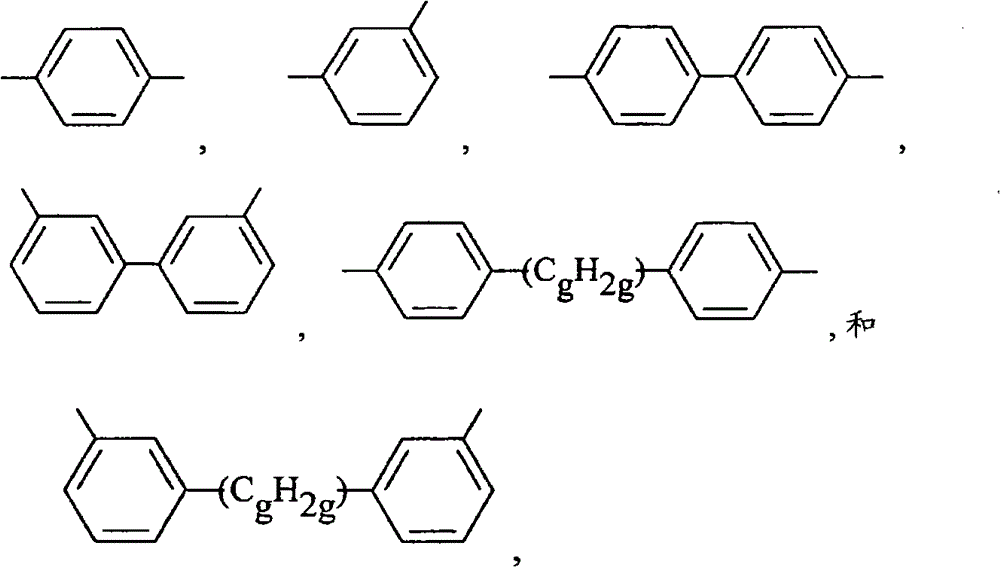
其中,g为1-6。R1表示的烃基和卤代烃基的定义和例子同成分(A)的硅树脂。 Wherein, g is 1-6. The definition and examples of the hydrocarbon group and halogenated hydrocarbon group represented by R1 are the same as those of the silicone resin of component (A).
分子式为HR1 2Si-R3-SiR1 2H有机氢硅烷的例子,其中R1和R3为上文描述和例举的内容包括(但不限于):具有如下分子式的硅烷: Examples of organohydrogensilanes with the molecular formula HR 1 2 Si-R 3 -SiR 1 2 H, wherein R 1 and R 3 are as described and exemplified above include (but are not limited to): silanes with the following molecular formula:

有机氢硅氧烷的例子包括(但不限于):1,1,3,3-四甲基二硅氧烷、1,1,3,3-四苯基二硅氧烷、苯基三(二甲基硅氧烷基)硅烷、1,3,5-三甲基环三硅氧烷、三甲基硅氧烷端基聚(甲基氢硅氧烷)、三甲基硅氧烷端基聚(二甲基硅氧烷基/甲基氢硅氧烷)、二甲基氢硅氧烷端基聚(甲基氢硅氧烷),以及主要由HMe2SiO1/2单元、Me3SiO1/2单元和SiO4/2单元组成的树脂,其中Me为甲基。 Examples of organohydrogensiloxanes include (but are not limited to): 1,1,3,3-tetramethyldisiloxane, 1,1,3,3-tetraphenyldisiloxane, phenyltris( Dimethylsiloxane)silane, 1,3,5-trimethylcyclotrisiloxane, trimethylsiloxane-terminated poly(methylhydrogensiloxane), trimethylsiloxane-terminated based poly(dimethylsiloxane/methylhydrogensiloxane), dimethylhydrogensiloxane-terminated poly(methylhydrogensiloxane), and mainly composed of HMe 2 SiO 1/2 units, Me 3 Resin composed of SiO 1/2 units and SiO 4/2 units, where Me is methyl.
有机氢硅氧烷还可以为分子式为(R1R4 2SiO1/2)w(R4 2SiO2/2)x(R1SiO3/2)y(SiO4/2)z(II)的有机氢聚硅氧烷树脂,其中R1是C1-C10的烃基或C1-C10的卤代烃基,两者均为不含不饱和脂肪族,R4是R1或具有至少一个与硅原子相连的氢原子的有机硅烷基,w是0-0.8,x是0-0.6,y是0-0.99,z是0-0.35,w+x+y+z=1,y+z为0.2-0.99,w+x为0.01-0.8,前提是至少50mol%的R4基团为有机硅烷基。 Organohydrogensiloxane can also have the molecular formula (R 1 R 4 2 SiO 1/2 ) w (R 4 2 SiO 2/2 ) x (R 1 SiO 3/2 ) y (SiO 4/2 ) z (II ) organohydrogenpolysiloxane resin, wherein R 1 is a C 1 -C 10 hydrocarbon group or a C 1 -C 10 halogenated hydrocarbon group, both of which do not contain unsaturated aliphatic, and R 4 is R 1 or has An organosilyl group having at least one hydrogen atom bonded to a silicon atom, w is 0-0.8, x is 0-0.6, y is 0-0.99, z is 0-0.35, w+x+y+z=1, y+ z is 0.2-0.99 and w+x is 0.01-0.8, provided that at least 50 mol% of the R4 groups are organosilyl groups.
R1代表的烃基或卤代烃基如同上文关于成分(A)的硅树脂的描述和例举。R4代表的有机硅烷基的例子包括(但不限于):包括如下分子式的基团: The hydrocarbon group or halogenated hydrocarbon group represented by R1 is as described and exemplified above for the silicone resin of component (A). Examples of organosilyl groups represented by R include (but are not limited to): groups comprising the following molecular formula:
-CH2CH2SiMe2H, -CH2CH2SiMe2H , _
-CH2CH2SiMe2CnH2nSiMe2H, -CH2CH2SiMe2CnH2nSiMe2H , _ _ _ _
-CH2CH2SiMe2CnH2nSiMePhH, -CH2CH2SiMe2CnH2nSiMePhH , _ _ _
-CH2CH2SiMePhH, -CH2CH2SiMePhH ,
-CH2CH2SiPh2H, -CH2CH2SiPh2H , _
-CH2CH2SiMePhCnH2nSiPh2H, -CH 2 CH 2 SiMePhC n H 2n SiPh 2 H,
-CH2CH2SiMePhCnH2nSiMe2H, -CH 2 CH 2 SiMePhC n H 2n SiMe 2 H,
-CH2CH2SiMePhOSiMePhH, -CH 2 CH 2 SiMePhOSiMePhH,
-CH2CH2SiMePhOSiPh(OSiMePhH)2, -CH 2 CH 2 SiMePhOSiPh(OSiMePhH) 2 ,
其中,Me为甲基,Ph为苯基,下标n的值为2-10。 Wherein, Me is a methyl group, Ph is a phenyl group, and the value of the subscript n is 2-10. the
有机氢聚硅氧烷树脂的分子式(II)中,下标w、x、y、z为摩尔份数。下标w通常的值为0-0.8,或0.02-0.75,或0.05-0.3;下标x通常的值为0-0.6,或0-0.45,或0-0.25;下标y通常的值为0-0.99,或0.25-0.8,或0.5-0.8;下标z通常的值为0-0.35,0-0.25,或0-0.15.此外,y+z的和通常为0.2-0.99,或0.5-0.95,或0.65-0.9。此外,w+x的值通常为0.01-0.80,或0.05-0.5,或0.1-0.35。 In the molecular formula (II) of the organohydrogenpolysiloxane resin, the subscripts w, x, y, and z are mole fractions. The usual value of subscript w is 0-0.8, or 0.02-0.75, or 0.05-0.3; the usual value of subscript x is 0-0.6, or 0-0.45, or 0-0.25; the usual value of subscript y is 0 -0.99, or 0.25-0.8, or 0.5-0.8; the subscript z usually has a value of 0-0.35, 0-0.25, or 0-0.15. In addition, the sum of y+z is usually 0.2-0.99, or 0.5-0.95 , or 0.65-0.9. In addition, the value of w+x is usually 0.01-0.80, or 0.05-0.5, or 0.1-0.35. the
通常,有机氢聚硅氧烷中至少50mol%,或至少65mol%,或至少80mol%的R4基团为具有至少一个与硅原子相连的氢原子的有机硅烷基团。 Typically, at least 50 mol%, or at least 65 mol%, or at least 80 mol% of the R4 groups in the organohydrogenpolysiloxane are organosilane groups having at least one hydrogen atom attached to a silicon atom.
有机氢聚硅氧烷树脂通常的数均分子量(Mn)为500-50000,或500-10000,或1000-3000,其中分子量是利用小角度激光散射检测仪或折光检测仪,及硅树脂(MQ)标准由凝胶渗透色谱法得到的。 The usual number-average molecular weight (Mn) of organohydrogenpolysiloxane resin is 500-50000, or 500-10000, or 1000-3000, wherein the molecular weight is determined by using a small-angle laser scattering detector or a refractometer, and silicone resin (MQ ) standards were obtained by gel permeation chromatography. the
如29Si核磁共振法所得到的,有机氢聚硅氧烷树脂通常包括小于10%(w/w),或小于5%(w/w),或小于2%(w/w)的与硅原子连接的羟基。 Organohydrogenpolysiloxane resins generally contain less than 10% (w/w), or less than 5% (w / w), or less than 2% (w/w) Atom-linked hydroxyl groups.
有机氢聚硅氧烷树脂包含R1SiO3/2单元(即T单元)和/或SiO4/2单元(即Q单元)与R1R4 2SiO1/2单元(即M单元)和/或R4 2SiO2/2单元(即D单元)相结合,其中R1和R4如上文所描述和例举。例如,有机氢聚硅氧烷树脂可以是DT树 脂、MT树脂、MDT树脂、DTQ树脂和MTQ树脂,以及MDTQ树脂、DQ树脂、MQ树脂、DTQ树脂、或MTQ树脂或MDQ树脂。 The organohydrogenpolysiloxane resin comprises R 1 SiO 3/2 units (ie T units) and/or SiO 4/2 units (ie Q units) and R 1 R 4 2 SiO 1/2 units (ie M units) and / or a combination of R 4 2 SiO 2/2 units (ie D units), wherein R 1 and R 4 are as described and exemplified above. For example, the organohydrogenpolysiloxane resin may be DT resin, MT resin, MDT resin, DTQ resin, and MTQ resin, as well as MDTQ resin, DQ resin, MQ resin, DTQ resin, or MTQ resin or MDQ resin.
有机氢聚硅氧烷树脂包括(但不限于):具有下述分子式的树脂: Organohydrogenpolysiloxane resins include (but are not limited to): resins with the following molecular formula:
((HMe2SiC6H4SiMe2CH2CH2)2MeSiO1/2)0.12(PhSiO3/2)0.88、 ((HMe 2 SiC 6 H 4 SiMe 2 CH 2 CH 2 ) 2 MeSiO 1/2 ) 0.12 (PhSiO 3/2 ) 0.88 ,
((HMe2SiC6H4SiMe2CH2CH2)2MeSiO1/2)0.17(PhSiO3/2)0.83、 ((HMe 2 SiC 6 H 4 SiMe 2 CH 2 CH 2 ) 2 MeSiO 1/2 ) 0.17 (PhSiO 3/2 ) 0.83 ,
((HMe2SiC6H4SiMe2CH2CH2)2MeSiO1/2)0.17(MeSiO3/2)0.17(PhSiO3/2)0.66、 ((HMe 2 SiC 6 H 4 SiMe 2 CH 2 CH 2 ) 2 MeSiO 1/2 ) 0.17 (MeSiO 3/2 ) 0.17 (PhSiO 3/2 ) 0.66 ,
((HMe2SiC6H4SiMe2CH2CH2)2MeSiO1/2)0.15(PhSiO3/2)0.75(SiO4/2)0.10以及 ((HMe 2 SiC 6 H 4 SiMe 2 CH 2 CH 2 ) 2 MeSiO 1/2 ) 0.15 (PhSiO 3/2 ) 0.75 (SiO 4/2 ) 0.10 and
((HMe2SiC6H4SiMe2CH2CH2)2MeSiO1/2)0.08((HMe2SiC6H4SiMe2CH2CH2)Me2SiO1/2)0.06PhSiO3/2)0.86, ((HMe 2 SiC 6 H 4 SiMe 2 CH 2 CH 2 ) 2 MeSiO 1/2 ) 0.08 ((HMe 2 SiC 6 H 4 SiMe 2 CH 2 CH 2 )Me 2 SiO 1/2 ) 0.06 PhSiO 3/2 ) 0.86 ,
其中Me是甲基、Ph是苯基、C6H4表示对苯基、括号外的数字下标为摩尔份数。此外,在前面的分子式中,单元的顺序并未定死。 Where Me is methyl, Ph is phenyl, C 6 H 4 represents p-phenyl, and the numbers outside the brackets are subscripted as mole fractions. Furthermore, in the preceding formulas, the order of the units is not fixed.
成分(B)可以是上述的单独一种有机硅化合物或两种或两种以上不同的有机硅化合物。例如,成分(B)可以是单独的有机氢硅烷,两种不同有机氢硅烷的混合物,单独的有机氢氧硅烷,两种不同有机氢硅氧烷的混合物,或有机氢硅烷和有机氢硅氧烷的混合物。具体来说,成分(B)可以是以成分(B)总重为基准,包括至少0.5%(w/w),或50%(w/w),或至少75%(w/w)的具有分子式(II)的有机氢聚硅氧烷树脂,也可以是有机氢硅烷和/或有机氢硅氧烷,后者不同于有机氢聚硅氧烷树脂。 Component (B) may be a single organosilicon compound mentioned above or two or more different organosilicon compounds. For example, ingredient (B) can be an organohydrogensilane alone, a mixture of two different organohydrogensilanes, an organohydrogenoxysilane alone, a mixture of two different organohydrogensiloxanes, or an organohydrogensilane and an organohydrogensiloxane a mixture of alkanes. Specifically, component (B) may be based on the total weight of component (B), including at least 0.5% (w/w), or 50% (w/w), or at least 75% (w/w) of The organohydrogenpolysiloxane resin of formula (II) may also be an organohydrogensilane and/or an organohydrogensiloxane, the latter being different from the organohydrogenpolysiloxane resin. the
成分(B)的浓度足够使成分(A)的硅树脂发生固化(交联)。成分(B)确切的量依赖于所要固化的程度,通常它随着成分(B)中与硅连接的氢原子的摩尔数与成分(A)中烯基的摩尔数的比值增加而增加。成分(B)的浓度通常足够为每摩尔的成分(A)提供0.4-2摩尔的与硅原子连接的氢原子,或0.8-1.5摩尔的与硅原子相连的氢原子,或0.8-1.5摩尔的与硅原子相连的氢原子,或0.9-1.1摩尔的与硅原子相连的氢原子。 The concentration of component (B) is sufficient to cure (crosslink) the silicone resin of component (A). The exact amount of ingredient (B) will depend on the degree of cure desired, and generally it will increase as the ratio of moles of silicon-bonded hydrogen atoms in ingredient (B) to moles of alkenyl groups in ingredient (A) increases. The concentration of component (B) is usually sufficient to provide 0.4-2 moles of hydrogen atoms bonded to silicon atoms, or 0.8-1.5 moles of hydrogen atoms bonded to silicon atoms, or 0.8-1.5 moles of hydrogen atoms bonded to silicon atoms, per mole of component (A). Hydrogen atoms bonded to silicon atoms, or 0.9-1.1 moles of hydrogen atoms bonded to silicon atoms. the
制备包含有与硅原子相连的氢原子的有机硅化合物的方法是本领域中熟知的技术。例如,有机氢硅烷可以通过格氏试剂与烷基或芳基卤化物的反应来制备。具体来讲,具有分子式为HR1 2Si-R3-SiR1 2H的有机氢硅烷可以通过利用镁金属处理分子式为R3X2的芳基二卤代物得到对应的格式试剂,之后用分子式为HR1 2SiCl的氯代硅烷处理格氏试剂,其中R1和R3如同上文所描述和例举的内容。 Methods of preparing organosilicon compounds containing hydrogen atoms bonded to silicon atoms are well known in the art. For example, organohydrogensilanes can be prepared by the reaction of Grignard reagents with alkyl or aryl halides. Specifically, organohydrogensilanes with the formula HR 1 2 Si-R 3 -SiR 1 2 H can be obtained by treating aryl dihalides with the formula R 3 X2 with magnesium metal to obtain the corresponding Grignard reagents, followed by the formula Chlorosilane-treated Grignard reagent of HR 1 2 SiCl, wherein R 1 and R 3 are as described and exemplified above.
制备有机氢硅氧烷的方法,如水解和浓缩有机卤代硅烷,也是本领域中熟知的技术。 Methods of preparing organohydrogensiloxanes, such as hydrolysis and concentration of organohalosilanes, are also well known in the art. the
此外,具有分子式(II)的有机氢聚硅氧烷树脂可以通过(a)分子式为(R1R2 2SiO1/2)w(R2 2SiO2/2)x(R1SiO3/2)y(SiO4/2)z的硅树脂与(b)平均每个分子中有2-4个与硅原子相连的氢原子的且分子量小于1000的有机硅化合物,在(c)水解催化剂,和可选择的(d)有机溶剂的存在条件下,进行反应得到。其中R1是C1-C10的烃基或C1-C10的卤代烃基,两者均为非饱和脂肪族,R2为R1或烯基,w是0-0.8,x是0-0.6,y是0-0.99,z是0-0.35,w+x+y+z=1,y+z为0.2-0.99,w+x为0.01-0.8,前提是硅树脂(a)每个分子中,平均至少有2个与硅原子相连的烯基,且与硅相连的氢原子与烯基的摩尔比为 1.5-5。 In addition, the organohydrogenpolysiloxane resin having the molecular formula (II) can be obtained by (a) the molecular formula is (R 1 R 2 2 SiO 1/2 ) w (R 2 2 SiO 2/2 ) x (R 1 SiO 3/ 2 ) y (SiO 4/2 ) z silicone resin and (b) an organosilicon compound with an average of 2-4 hydrogen atoms connected to silicon atoms in each molecule and a molecular weight less than 1000, in (c) hydrolysis catalyst , and optionally (d) in the presence of an organic solvent, the reaction is obtained. Wherein R 1 is C 1 -C 10 hydrocarbon group or C 1 -C 10 halogenated hydrocarbon group, both are unsaturated aliphatic, R 2 is R 1 or alkenyl, w is 0-0.8, x is 0- 0.6, y is 0-0.99, z is 0-0.35, w+x+y+z=1, y+z is 0.2-0.99, w+x is 0.01-0.8, provided that the silicone resin (a) per molecule Among them, there are at least two alkenyl groups connected to silicon atoms on average, and the molar ratio of hydrogen atoms connected to silicon to alkenyl groups is 1.5-5.
有机硅化合物(b)为至少一种平均每分子中具有2-4个与硅原子相连的氢原子的有机硅化合物。或,有机硅化合物平均每分子中具有2-3个与硅原子相连的氢原子。有机硅化合物通常的分子量小于1000,或小于750,或小于500。有机硅化合物中与硅原子相连的有机基团选自:烃基和卤代烃基,两者都为非饱和脂肪族,如上文关于成分(A)的硅树脂的分子式中R1的描述与举例。 The organosilicon compound (b) is at least one organosilicon compound having an average of 2 to 4 hydrogen atoms bonded to silicon atoms per molecule. Alternatively, the organosilicon compound has an average of 2-3 hydrogen atoms attached to silicon atoms per molecule. Organosilicon compounds typically have a molecular weight of less than 1000, or less than 750, or less than 500. The organic group connected to the silicon atom in the organosilicon compound is selected from: hydrocarbon group and halogenated hydrocarbon group, both of which are unsaturated aliphatic, as described and exemplified above for R1 in the molecular formula of the silicone resin of component (A).
有机硅化合物(b)可以是有机氢硅烷或有机氢硅氧烷。有机氢硅烷可以是单硅烷、双硅烷、三硅烷或多硅烷。环硅烷和环硅氧烷通常有3-12个硅原子,或3-10个硅原子,或3-4个硅原子。在丙烯酸多硅烷和多硅氧烷中,与硅原子相连的的氢原子可以是位于端部、侧链上或两者均有。 The organosilicon compound (b) may be an organohydrogensilane or an organohydrogensiloxane. The organohydrogensilanes can be monosilanes, disilanes, trisilanes or polysilanes. Cyclosilanes and cyclosiloxanes typically have 3-12 silicon atoms, or 3-10 silicon atoms, or 3-4 silicon atoms. In acrylic polysilanes and polysiloxanes, the hydrogen atoms attached to the silicon atoms can be terminal, side chain, or both. the
有机氢硅烷包括(但不限于):双酚硅烷,2-氯代乙基硅烷,双【(p-双甲基硅烷)苯】醚,1,4-二甲基二硅烷乙烷,1,3,5-三(二甲基硅烷)苯,1,3,5-三硅烷。有机氢硅烷还可以具有分子式HR1 2Si-R3-SiR12H,其中R1和R3如同上文描述或例举的。 Organohydrogensilanes include (but are not limited to): bisphenolsilane, 2-chloroethylsilane, bis[(p-bismethylsilyl)phenylene]ether, 1,4-dimethyldisilaneethane, 1, 3,5-tris(dimethylsilane)benzene, 1,3,5-trisilane. The organohydrogensilane may also have the formula HR 1 2 Si-R 3 -SiR 1 2H, wherein R 1 and R 3 are as described or exemplified above.
有机氢硅氧烷包括(但不限于):1,1,3,3-四甲基二硅氧烷,1,1,3,3-四苯基二硅氧烷,苯基三(二甲基硅氧烷基)硅烷,1,3,5-三甲基环三硅氧烷。 Organohydrogensiloxanes include (but are not limited to): 1,1,3,3-tetramethyldisiloxane, 1,1,3,3-tetraphenyldisiloxane, phenyltris(dimethyl siloxane) silane, 1,3,5-trimethylcyclotrisiloxane. the
有机硅化合物(b)可以是上述的单独一种有机硅化合物或两种或两种以上的有机硅化合物的混合物。例如成分(B)可以是单独的有机氢硅烷,两种不同有机氢硅烷的混合物,单独的有机氢氧硅烷,两种不同有机氢硅氧烷的混合物,或有机氢硅烷和有机氢硅氧烷的混合物。 The organosilicon compound (b) may be a single organosilicon compound mentioned above or a mixture of two or more organosilicon compounds. For example ingredient (B) can be an organohydrogensilane alone, a mixture of two different organohydrogensilanes, an organohydrogenoxysilane alone, a mixture of two different organohydrogensiloxanes, or an organohydrogensilane and an organohydrogensiloxane mixture. the
制备有机氢硅烷的方法如同上述的格式试剂与卤代烷基或卤代芳基的反应,也是本领域中熟知的技术。与此类似,制备有机氢硅氧烷的方法,如有机卤代硅烷水解和浓缩都是本领域中熟知的技术。 The method for preparing organohydrogensilanes is also well known in the art as the above-mentioned reaction of Grignard reagents with haloalkyl or haloaryl groups. Similarly, methods of preparing organohydrogensiloxanes, such as organohalosilane hydrolysis and concentration, are well known in the art. the
硅氢化催化剂(c)可以是任何熟知的包含铂系金属(即:铂、铑、钌、锇、铱)或包含铂系金属的化合物的硅氢化催化剂。因为在硅氢化反应中反应活性高,所以铂系金属优选铂。 The hydrosilation catalyst (c) may be any well-known hydrosilation catalyst comprising a platinum group metal (ie: platinum, rhodium, ruthenium, osmium, iridium) or a compound comprising a platinum group metal. The platinum group metal is preferably platinum because of its high reactivity in the hydrosilylation reaction. the
硅氢化催化剂包括氢氯铂酸的络合物和在美国专利3419593中由Willing公开的某些含有乙烯基的有机硅氧烷,这里引作参考。此类型的催化剂是氢氯铂酸与1,3二乙烯基-1,1,3,3-四甲基二硅氧烷的反应产物。 Hydrosilation catalysts include complexes of chloroplatinic acid and certain vinyl-containing organosiloxanes disclosed by Willing in US Patent 3,419,593, incorporated herein by reference. A catalyst of this type is the reaction product of hydrochloroplatinic acid and 1,3 divinyl-1,1,3,3-tetramethyldisiloxane. the
硅氢化催化剂包含由铂系金属作为担体的硅氢化催化剂。带有担体的催化剂可以方便地与有机氢聚硅氧烷树脂产品进行分离,例如,通过过滤反应物混合物的方法。带有担体的催化剂包括(但不限于):铂固载碳、钯固载碳、钌固载碳、铑固载碳、铂固载碳、钯固载硅、铂固载氧化铝、钯固载氧化铝以及钌固载氧化铝。 The hydrosilation catalyst includes a hydrosilation catalyst supported by a platinum group metal. The supported catalyst can be conveniently separated from the organohydrogenpolysiloxane resin product, for example, by filtration of the reactant mixture. Catalysts with supports include (but are not limited to): platinum-supported carbon, palladium-supported carbon, ruthenium-supported carbon, rhodium-supported carbon, platinum-supported carbon, palladium-supported silicon, platinum-supported alumina, palladium-supported Supported alumina and ruthenium-supported alumina. the
有机溶剂(d)至少为一种有机的溶剂。有机溶剂可以是任何疏质子型或偶极疏质子型有机溶剂,它不与硅树脂(a)、有机硅树脂(b)或有机氢聚硅氧烷树脂在本方法条件下进行反应,且易混合于成分(a)、(b)和有机氢聚 硅氧烷树脂。 The organic solvent (d) is at least one organic solvent. Organic solvent can be any aprotic or dipolar aprotic organic solvent, it does not react with silicone resin (a), organosilicon resin (b) or organohydrogen polysiloxane resin under the method conditions, and easily Mix in ingredients (a), (b) and organohydrogen polysiloxane resin. the
有机溶剂的例子包括(但不限于):饱和脂肪烃,如正戊烷、己烷、正庚烷、异辛烷和十二烷;脂环族烃如环庚烷和环己烷;芳香烃如:苯、甲苯、二甲苯和三甲苯;环醚如四氢呋喃(THF)和二氧杂环乙烷;酮如甲基丁烯酮(MIBK);卤代烷烃如:三氯乙烯;卤代芳香烃如溴苯和氯苯。有机溶剂(d)可以是上述的单独一种有机溶剂或两种和两种以上有机溶剂的混合物。 Examples of organic solvents include (but are not limited to): saturated aliphatic hydrocarbons such as n-pentane, hexane, n-heptane, isooctane, and dodecane; cycloaliphatic hydrocarbons such as cycloheptane and cyclohexane; aromatic hydrocarbons Such as: benzene, toluene, xylene and mesitylene; cyclic ethers such as tetrahydrofuran (THF) and dioxane; ketones such as methyl butenone (MIBK); halogenated alkanes such as: trichloroethylene; halogenated aromatic hydrocarbons Such as bromobenzene and chlorobenzene. The organic solvent (d) may be a single organic solvent mentioned above or a mixture of two or more organic solvents. the
所述反应可以在任何适宜进行硅氢化反应的标准反应器中进行。适合的反应器包括玻璃和有特富龙衬里的玻璃反应器。优选地,反应器装配有搅动器如搅拌器。还可以优选在无湿的惰性气体环境中进行反应,如氮气或氩气中。 The reaction can be carried out in any standard reactor suitable for hydrosilylation reactions. Suitable reactors include glass and Teflon-lined glass reactors. Preferably, the reactor is equipped with an agitator such as a stirrer. It may also be preferred to carry out the reaction in a moisture-free inert gas environment, such as nitrogen or argon. the
硅树脂、有机硅化合物、硅氢化催化剂和可选择的有机溶剂,可以任何顺序结合。通常,有机硅化合物(b)和硅氢化催化剂(c)先于硅树脂(a)和可选择的有机溶剂(d)进行结合。 The silicone resin, organosilicon compound, hydrosilylation catalyst and optional organic solvent can be combined in any order. Typically, the organosilicon compound (b) and hydrosilylation catalyst (c) are combined prior to the silicone resin (a) and optional organic solvent (d). the
通常反应在0-150℃,或室温(约23±2℃)至115℃进行反应。当温度低于0℃,通常反应速率很低。 Usually the reaction is carried out at 0-150°C, or at room temperature (about 23±2°C) to 115°C. When the temperature is below 0°C, usually the reaction rate is very low. the
反应时长依赖于几个因素,如硅树脂和有机硅化合物的结构以及温度。反应时长通常为1-24小时,温度室温(约23±2℃)至150℃。最佳反应时间可以通过常规实验采用下文中例子部分提到的方法得出。 Reaction times depend on several factors, such as the structure of the silicone and organosilicon compounds, and the temperature. The reaction time is usually 1-24 hours, and the temperature is from room temperature (about 23±2°C) to 150°C. Optimum reaction times can be found by routine experimentation using the methods mentioned in the Examples section below. the
有机硅化合物(b)中与硅相连的氢原子与硅树脂(a)中烯基的摩尔比通常为1.5∶5,或1.75∶3,或2∶2.5。 The molar ratio of silicon-bonded hydrogen atoms in organosilicon compound (b) to alkenyl groups in silicone resin (a) is usually 1.5:5, or 1.75:3, or 2:2.5. the
硅氢化催化剂(c)的浓度足够催化硅树脂(a)与有机硅化合物(b)的加成反应。通常,硅氢化催化剂(c)的浓度足够提供,以硅树脂(a)和有机硅化合物(b)两者的结合重量基础的0.1-1000ppm的铂系金属、或1-500ppm的铂系金属、或5-150ppm的铂系金属。铂系金属在0.1ppm以下时,反应的速度非常慢。使用1000ppm以上的铂系金属不会显著提高反应速度,因而是不经济的。 The concentration of the hydrosilylation catalyst (c) is sufficient to catalyze the addition reaction of the silicone resin (a) with the organosilicon compound (b). Typically, the concentration of the hydrosilylation catalyst (c) is sufficient to provide, based on the combined weight of both silicone resin (a) and organosilicon compound (b), 0.1-1000 ppm platinum group metal, or 1-500 ppm platinum group metal, Or 5-150ppm platinum group metals. When the platinum group metal is below 0.1ppm, the reaction speed is very slow. The use of platinum group metals above 1000 ppm does not significantly increase the reaction rate, and thus is uneconomical. the
有机溶剂(d)的浓度通常为反应混合物总重的0-99%(w/w),或30-80%(w/w),或45-60%(w/w)。 The concentration of the organic solvent (d) is usually 0-99% (w/w), or 30-80% (w/w), or 45-60% (w/w) of the total weight of the reaction mixture. the
在硅氢化-可固化合成物的第一个实施例中,有机氢聚硅氧烷树脂可以无需分离或提纯,或者可以将树脂用传统蒸馏方法从大多数溶剂中进行分离。例如通过在减压的条件下加热反应混合物。此外,如上所述,当用来制备有机氢聚硅氧烷树脂的硅氢化催化剂是带有支撑体的催化剂时,该树脂可以通过过滤反应混合物的方法从硅氢化催化剂中迅速分离树脂。不过,当有机氢聚硅氧烷树脂没有与制备树脂的硅氢化催化剂进行分离时,催化剂可以用作硅氢化-可固化硅合成物的第一个实施例的成分(C)。 In the first embodiment of the hydrosilylation-curable composition, the organohydrogenpolysiloxane resin can be used without isolation or purification, or the resin can be isolated from most solvents by conventional distillation. For example by heating the reaction mixture under reduced pressure. In addition, as described above, when the hydrosilylation catalyst used to prepare the organohydrogenpolysiloxane resin is a supported catalyst, the resin can be rapidly separated from the hydrosilylation catalyst by filtering the reaction mixture. However, when the organohydrogenpolysiloxane resin is not separated from the hydrosilylation catalyst used to prepare the resin, the catalyst can be used as component (C) of the first embodiment of the hydrosilylation-curable silicon composition. the
硅氢化-可固化硅合成物的成分(C)为至少一种提升成分(A)与成分(B)的加成反应的硅氢化催化剂。硅氢化催化剂可以是任何已知的包含有铂系金属的硅氢化催化剂、含有铂系金属的化合物或微胶囊封装的含铂系金属的催化剂。铂系金属包括铂、铑、钌、锇、铱。因为在硅氢化反应中反应活性高,所以铂系金属优选铂。 Component (C) of the hydrosilylation-curable silicon composition is at least one hydrosilylation catalyst that promotes the addition reaction of component (A) and component (B). The hydrosilation catalyst may be any known platinum group metal-containing hydrosilation catalyst, platinum group metal-containing compound, or microencapsulated platinum group metal-containing catalyst. Platinum group metals include platinum, rhodium, ruthenium, osmium, iridium. The platinum group metal is preferably platinum because of its high reactivity in the hydrosilylation reaction. the
硅氢化催化剂包括氢氯铂酸的络合物和在美国专利3419593中由 Willing公开的某些含有乙烯基的有机硅氧烷,这里引作参考。此类型的催化剂是氢氯铂酸与1,3二乙烯基-1,1,3,3-四甲基二硅氧烷的反应产物。 Hydrosilation catalysts include complexes of chloroplatinic acid and certain vinyl-containing organosiloxanes disclosed by Willing in U.S. Patent 3,419,593, incorporated herein by reference. A catalyst of this type is the reaction product of hydrochloroplatinic acid and 1,3 divinyl-1,1,3,3-tetramethyldisiloxane. the
硅氢化催化剂还可以是包含封装在微胶囊中的铂系金属的催化剂,该催化剂包含有封装在热塑性树脂中的铂系金属。含有微胶囊的硅氢化催化剂可以在环境条件下使用较长的时间,通常为几个月或更长的时间,但在热塑性树脂的熔融或软化点以上可以相对快速地进行固化。如同作为参考文献引入的美国专利4766176,以及美国专利5017654中所列举的内容一样,微胶囊封装的硅氢化催化剂及其制备方法也是本领域中的公知技术。 The hydrosilylation catalyst may also be a catalyst comprising a platinum group metal encapsulated in microcapsules, which catalyst comprises a platinum group metal encapsulated in a thermoplastic resin. Hydrosilylation catalysts containing microcapsules can be used at ambient conditions for extended periods of time, typically several months or longer, but cure relatively quickly above the melting or softening point of the thermoplastic resin. Microencapsulated hydrosilylation catalysts and methods for their preparation are well known in the art, as set forth in US Patent No. 4,766,176 and US Patent No. 5,017,654, which are incorporated by reference. the
成分(C)可以是单独的硅氢化催化剂也可以是包括两种或两种以上在结构、形式、铂系金属、络合配位体以及热塑性树脂方面不同的两种或两种以上催化剂的混合物。 Component (C) can be a single hydrosilylation catalyst or a mixture of two or more catalysts that are different in structure, form, platinum group metal, complex ligand and thermoplastic resin . the
成分(C)的浓度足够催化成分(A)和成分(B)的加成反应。通常,硅氢化催化剂(C)的浓度足够提供,以成分(A)和成分(B)两者的结合重量基础的0.1-1000ppm的铂系金属、或1-500ppm的铂系金属、或5-150ppm的铂系金属。铂系金属在0.1ppm以下时,反应的速度非常慢。使用1000ppm以上的铂系金属不会显著提高反应速度,因而是不经济的。 The concentration of ingredient (C) is sufficient to catalyze the addition reaction of ingredient (A) and ingredient (B). Typically, the concentration of the hydrosilylation catalyst (C) is sufficient to provide 0.1-1000 ppm of platinum group metals, or 1-500 ppm of platinum group metals, or 5- 150ppm platinum group metals. When the platinum group metal is below 0.1ppm, the reaction speed is very slow. The use of platinum group metals above 1000 ppm does not significantly increase the reaction rate, and thus is uneconomical. the
按照第二个实施例,硅氢化-可固化硅合成物包括(A’)具有分子式为(R1R5 2SiO1/2)w(R5 2SiO2/2)x(R5SiO3/2)y(SiO4/2)z(III)的硅树脂,其中R1为C1-C10的烃基或C1-C10的卤代烃基,两者均为不含不饱和脂肪族,R5是R1或-H,w为0-0.95,x为0-0.95,y为0-1,z为0-0.95,w+x+y+z=1,y+z为0.05-1,w+x为0-0.95,前提是硅树脂平均每个分子中需含至少两个与硅原子相连的氢原子;(B’)平均每个分子中具有至少两个与硅原子相连的烯基的有机硅化合物,且其量足够固化硅树脂;以及(C)具有催化量的硅氢化催化剂。 According to a second embodiment, the hydrosilylation-curable silicon composition comprises (A') having the formula (R 1 R 5 2 SiO 1/2 ) w (R 5 2 SiO 2/2 ) x (R 5 SiO 3 /2 ) y (SiO 4/2 ) z (III) silicone resin, wherein R 1 is a C 1 -C 10 hydrocarbon group or a C 1 -C 10 halogenated hydrocarbon group, both of which do not contain unsaturated aliphatic , R 5 is R 1 or -H, w is 0-0.95, x is 0-0.95, y is 0-1, z is 0-0.95, w+x+y+z=1, y+z is 0.05- 1, w+x is 0-0.95, provided that the silicone resin needs to contain at least two hydrogen atoms connected to silicon atoms in each molecule on average; (B') has at least two hydrogen atoms connected to silicon atoms in each molecule on average an alkenyl organosilicon compound in an amount sufficient to cure the silicone resin; and (C) a catalytic amount of a hydrosilylation catalyst.
成分(A ’)为至少一种含有分子式为(R1R5 2SiO1/2)w(R5 2SiO2/2)x(R5SiO3/2)y(SiO4/2)z(III)的硅树脂,其中R1为C1-C10的烃基或C1-C10的卤代烃基,两者均为不含不饱和脂肪族,R5是R1或-H,w为0-0.95,x为0-0.95,y为0-1,z为0-0.95,w+x+y+z=1,y+z为0.05-1,w+x为0-0.95,前提是硅树脂平均每个分子中需含至少两个与硅原子相连的氢原子。在分子式(III)中,R1、w、x、y、z、y+z和w+x与对具有分子式(I)的硅树脂的描述和举例相同。 Ingredient (A') is at least one compound with molecular formula (R 1 R 5 2 SiO 1/2 ) w (R 5 2 SiO 2/2 ) x (R 5 SiO 3/2 ) y (SiO 4/2 ) z The silicone resin of (III), wherein R 1 is a C 1 -C 10 hydrocarbon group or a C 1 -C 10 halogenated hydrocarbon group, both of which do not contain unsaturated aliphatic, R 5 is R 1 or -H,w is 0-0.95, x is 0-0.95, y is 0-1, z is 0-0.95, w+x+y+z=1, y+z is 0.05-1, w+x is 0-0.95, the premise On average, each molecule of silicone resin needs to contain at least two hydrogen atoms connected to silicon atoms. In formula (III), R 1 , w, x, y, z, y+z and w+x are the same as described and exemplified for the silicone resin of formula (I).
通常在硅树脂中,至少有50mol%(w/w),或至少65mol%(w/w),或至少80mol%(w/w)的R5基团为氢。 Typically in the silicone resin, at least 50 mol% (w/w), or at least 65 mol% (w/w), or at least 80 mol% (w/w) of the R5 groups are hydrogen.
硅树脂通常数均分子量(Mn)为500-50000,或500-10000,或1000-3000,其中分子量是利用小角激光光散射仪或折光检测仪,及硅树脂(MQ)标准采用凝胶渗透色谱法得到的。 Silicone resin usually has a number-average molecular weight (Mn) of 500-50000, or 500-10000, or 1000-3000, wherein the molecular weight is determined by using a small-angle laser light scattering instrument or a refractometer, and the silicone resin (MQ) standard adopts gel permeation chromatography unobtainable. the
25℃下,硅树脂的粘度通常为0.01-100000Pa.s,或0.1-10000Pa.s,或1-100Pa.s。 At 25°C, the viscosity of silicone resin is usually 0.01-100000Pa.s, or 0.1-10000Pa.s, or 1-100Pa.s. the
通过29Si的核磁共振波普法检测,硅树脂通常含有小于10%(w/w),或小于5%(w/w),或小于2%(w/w)的与硅原子相连的羟基。 Silicone resins typically contain less than 10% (w/w), or less than 5% (w/w), or less than 2% (w/w) of hydroxyl groups attached to silicon atoms as detected by 29 Si NMR-Popper method.
硅树脂包含R5SiO3/2单元(即T单元),R5SiO3/2单元(即T单元)和SiO4/2 单元(即Q单元)或R5SiO3/2单元(即T单元)和/或SiO4/2单元(即Q单元)与R1R5 2SiO1/2单元(即M单元)和/或R5 2SiO2/2单元(即D单元)。例如,硅树脂可以是T树脂、TQ树脂、DT树脂、MT树脂、MDT树脂、MQ树脂、DQ树脂、MDQ树脂、MTQ树脂、DTQ树脂、或MDTQ树脂。 Silicone resin contains R 5 SiO 3/2 unit (ie T unit), R 5 SiO 3/2 unit (ie T unit) and SiO 4/2 unit (ie Q unit) or R 5 SiO 3/2 unit (ie T unit) and/or SiO 4/2 unit (ie Q unit) and R 1 R 5 2 SiO 1/2 unit (ie M unit) and/or R 5 2 SiO 2/2 unit (ie D unit). For example, the silicone resin may be T resin, TQ resin, DT resin, MT resin, MDT resin, MQ resin, DQ resin, MDQ resin, MTQ resin, DTQ resin, or MDTQ resin.
可以作为化合物(A’)的硅树脂包括(但不限于)具有下列分子式的树脂: Silicone resins that can be used as compound (A') include (but are not limited to) resins with the following molecular formula:
(Hme2SiO1/2)0.25(PhSiO3/2)0.75、(HMeSiO2)0.3(PhSiO3/2)0.6(MeSiO3/2)0.1、以及(Me3SiO1/2)0.1(H2SiO2/2)0.1(MeSiO3/2)0.4(PhSiO3/2)0.4, (Hme 2 SiO 1/2 ) 0.25 (PhSiO 3/2 ) 0.75 , (HMeSiO 2 ) 0.3 (PhSiO 3/2 ) 0.6 (MeSiO 3/2 ) 0.1 , and (Me 3 SiO 1/2 ) 0.1 (H 2 SiO 2/2 ) 0.1 (MeSiO 3/2 ) 0.4 (PhSiO 3/2 ) 0.4 ,
其中Me为甲基,Ph为苯基,括号外的下标数字表示摩尔份数。同样地,在前面的分子式中,单元的顺序并未定死。 Wherein Me is a methyl group, Ph is a phenyl group, and the subscript numbers outside the brackets represent mole fractions. Likewise, in the preceding formulas, the order of the units is not rigid. the
成分(A’)可以是上面提到的单独一种硅树脂,或两种或两种以上不同硅树脂的混合物。 Component (A') may be a single silicone resin mentioned above, or a mixture of two or more different silicone resins. the
制备硅树脂的方法是本领域的公知技术;这些树脂很多都可以买到。硅树脂通常是在有机溶剂(如甲苯)中适当混合氯代硅前体共水解得到的。例如,主要由R1R5 2SiO1/2单元和R5SiO3/2单元组成的硅树脂可以通过与分子式为R1R5 2SiCl的化合物以及分子式为R5SiCl3的化合物在甲苯中共水解制得,其中R1和R2的定义与举例如上所述分离盐酸水溶液和硅树脂水解产物时,用水冲洗水解产物,去除残留的酸,并在适当的浓缩催化剂存在条件下加热使树脂“塑型”(即浓缩)得到所需要的粘度。如果需要,树脂还可以用浓缩催化剂在有机溶剂中进一步处理,减少与硅原子连接的羟基的含量。或者,可以在共水解反应中用作开始材料的含有可水解基团的硅烷除了氯代外,还有溴代、碘代、-OCH3、-OC(O)CH3、-N(CH3)2、NHCOCH3以及-SCH3等基团取代。树脂产物的性能依赖于硅烷的类型、摩尔比、浓度以及操作条件。 Methods of preparing silicone resins are well known in the art; many of these resins are commercially available. Silicone resins are usually obtained by co-hydrolyzing chlorosilicon precursors in an organic solvent (such as toluene). For example, a silicone resin mainly composed of R 1 R 5 2 SiO 1/2 units and R 5 SiO 3/2 units can be obtained by reacting with a compound of formula R 1 R 5 2 SiCl and a compound of formula R 5 SiCl 3 in toluene Prepared by co-hydrolysis, where R1 and R2 are defined and exemplified as described above. When separating aqueous hydrochloric acid and silicone resin hydrolyzate, rinse the hydrolyzate with water to remove residual acid, and heat the resin in the presence of a suitable concentrated catalyst. "Moulding" (ie thickening) to obtain the desired viscosity. If desired, the resin can also be further treated with a concentrated catalyst in an organic solvent to reduce the content of hydroxyl groups attached to the silicon atoms. Alternatively, silanes containing hydrolyzable groups that can be used as starting materials in cohydrolysis reactions include bromo, iodo, -OCH 3 , -OC(O)CH 3 , -N(CH 3 ) 2 , NHCOCH 3 and -SCH 3 and other groups are substituted. The properties of the resin product depend on the type of silane, molar ratio, concentration and operating conditions.
成分(B’)为至少一种有机硅化合物,它平均每个分子中有至少两个与硅原子相连的氢原子,且量足够固化成分(A’)中的硅树脂。 Component (B') is at least one organosilicon compound having an average of at least two hydrogen atoms bonded to silicon atoms per molecule in an amount sufficient to cure the silicone resin in component (A'). the
有机硅化合物平均每个分子中至少有两个与硅原子相连的氢原子,或至少有三个与硅原子相连的氢原子。通常的理解是,每分子的成分(A’)中烯基的平均数与每分子的成分(B’)中与硅原子相连的氢原子的平均数大于4时,发生交联。 Organosilicon compounds have an average of at least two hydrogen atoms bonded to silicon atoms, or at least three hydrogen atoms bonded to silicon atoms, per molecule. It is generally understood that crosslinking occurs when the average number of alkenyl groups per molecule of component (A') and the average number of silicon-attached hydrogen atoms per molecule of component (B') is greater than 4. the
有机硅化合物可以是有机氢硅烷或有机氢硅氧烷。有机氢硅烷可以是单硅烷、双硅烷、三硅烷或多硅烷。环硅烷和环硅氧烷通常有3-12个硅原子,或3-10个硅原子,或3-4个硅原子。在丙烯酸多硅烷和多硅氧烷中,与硅原子相连的的氢原子可以是位于端部、侧链上或两者均有。 The organosilicon compound may be an organohydrogensilane or an organohydrogensiloxane. The organohydrogensilanes can be monosilanes, disilanes, trisilanes or polysilanes. Cyclosilanes and cyclosiloxanes typically have 3-12 silicon atoms, or 3-10 silicon atoms, or 3-4 silicon atoms. In acrylic polysilanes and polysiloxanes, the hydrogen atoms attached to the silicon atoms can be terminal, side chain, or both. the
适宜用作成分(B’)的有机硅烷的例子包括(但不限于)具有如下分子式的硅烷: Examples of organosilanes suitable for use as ingredient (B') include, but are not limited to, silanes having the formula:
Vi4Si、PhSiVi3、MeSiVi3、PhMeSiVi2、Ph2SiVi2以及PhSi(CH2CH=CH2)3,其中Me是甲基、Ph是苯基、Vi是乙烯基。 Vi 4 Si, PhSiVi 3 , MeSiVi 3 , PhMeSiVi 2 , Ph 2 SiVi 2 , and PhSi(CH 2 CH=CH 2 ) 3 , wherein Me is methyl, Ph is phenyl, and Vi is vinyl.
适宜用作成分(B’)的有机硅氧烷的例子包括(但不限于):具有如下分子式的硅氧烷: Examples of organosiloxanes suitable for use as ingredient (B') include, but are not limited to: siloxanes having the formula:
PhSi(OSiMe2Vi)3、Si(OSiMe2Vi)4、MeSi(OSiMe2Vi)3以及Ph2Si(OSiMe2Vi)2其中Me是甲基、Ph是苯基、Vi是乙烯基。 PhSi(OSiMe 2 Vi) 3 , Si(OSiMe 2 Vi) 4 , MeSi(OSiMe 2 Vi) 3 and Ph 2 Si(OSiMe 2 Vi) 2 wherein Me is methyl, Ph is phenyl, and Vi is vinyl.
成分(B’)可以是上面所述的单独一种有机硅烷化合物或两种或两种以上有机硅烷化合物的混合物。例如,成分(B’)可以是单独的有机氢硅烷,两种不同有机氢硅烷的混合物,单独的有机氢氧硅烷,两种不同有机氢硅氧烷的混合物,或有机氢硅烷和有机氢硅氧烷的混合物。 Component (B') may be a single organosilane compound described above or a mixture of two or more organosilane compounds. For example, ingredient (B') can be an organohydrogensilane alone, a mixture of two different organohydrogensilanes, an organohydrogenoxysilane alone, a mixture of two different organohydrogensiloxanes, or an organohydrogensilane and an organohydrogensilane Oxygen mixtures. the
成分(B’)的浓度足够使成分(A’)的硅树脂发生固化(交联)。成分(B’)确切的量依赖于所要固化的程度,通常它随着成分(B’)中与硅连接的氢原子的摩尔数与成分(A)中烯基的摩尔数的比值增加而增加。成分(B’)的浓度通常足够为每摩尔的成分(A’)提供0.4-2摩尔的与硅原子连接的氢原子,或0.8-1.5摩尔的与硅原子相连的氢原子,或0.8-1.5摩尔的与硅原子相连的氢原子,或0.9-1.1摩尔的与硅原子相连的氢原子。 The concentration of component (B') is sufficient to cure (crosslink) the silicone resin of component (A'). The exact amount of ingredient (B') depends on the degree of cure desired, and generally it increases as the ratio of moles of silicon-bonded hydrogen atoms in ingredient (B') to moles of alkenyl groups in ingredient (A) increases . The concentration of ingredient (B') is generally sufficient to provide 0.4-2 moles of silicon-bonded hydrogen atoms, or 0.8-1.5 moles of silicon-bonded hydrogen atoms, or 0.8-1.5 Moles of hydrogen atoms bonded to silicon atoms, or 0.9-1.1 moles of hydrogen atoms bonded to silicon atoms. the
含有与硅原子相连的烯基的有机硅烷和有机硅氧烷的制备方法是本领域中熟知的技术;很多这些化合物都可以买到。 The preparation of organosilanes and organosiloxanes containing alkenyl groups attached to silicon atoms is well known in the art; many of these compounds are commercially available. the
硅合成物的第二个实施例的成分(C)同第一个实施例的成分(C)的描述与举例。 The composition (C) of the second embodiment of the silicon composition is the same as the description and examples of the composition (C) of the first embodiment. the
根据第三个实施例,硅氢化-可固化合成物包括(A)分子式(R1R2 2SiO1/2)w(R2 2SiO2/2)x(R2SiO3/2)y(SiO4/2)z(I)的硅树脂;(B)平均每个分子中具有至少两个与硅相连的氢原子的有机硅化合物,且其量足够固化硅树脂;(C)可催化量的硅氢化催化剂;以及(D)具有选自(i)(R1R2 2SiO(R2 2SiO)aSiR2 2R1(IV)和(ii R5R1 2SiO(R1R5SiO)bSiR1 2R5(V)的硅橡胶;其中R1为C1-C10的烃基或C1-C10的卤代烃基,均为不合不饱和脂肪族,R2是R1或烯基,R5是R1或-H,下标a和b的值均为1-4,w为0-0.95,x为0-0.95,y为0-1,z为0-0.95,w+x+y+z=1,y+z为0.05-1,w+x为0-0.95,前提是硅树脂和硅橡胶(D)(i)平均每分子中含至少两个与硅原子相连的烯基,硅橡胶(D)(ii)平均每个分子中含至少两个与硅原子相连的氢原子,且硅橡胶(D)中与硅连接的烯基或与硅连接的氢原子与硅树脂(A)中与硅连接的烯基的摩尔比为0.01∶0.5。 According to a third embodiment, the hydrosilylation-curable composition comprises (A) the formula (R 1 R 2 2 SiO 1/2 ) w (R 2 2 SiO 2/2 ) x (R 2 SiO 3/2 ) y (SiO 4/2 ) z (I) silicone resins; (B) organosilicon compounds having an average of at least two silicon-bonded hydrogen atoms per molecule in an amount sufficient to cure silicone resins; (C) catalyzed and (D) having (i) (R 1 R 2 2 SiO(R 2 2 SiO) a SiR 2 2 R 1 (IV) and (ii R 5 R 1 2 SiO(R 1 R 5 SiO) b SiR 1 2 R 5 (V) silicone rubber; wherein R 1 is a C 1 -C 10 hydrocarbon group or a C 1 -C 10 halogenated hydrocarbon group, all of which are unsaturated aliphatic, and R 2 is R 1 or alkenyl, R 5 is R 1 or -H, the values of subscripts a and b are both 1-4, w is 0-0.95, x is 0-0.95, y is 0-1, z is 0- 0.95, w+x+y+z=1, y+z is 0.05-1, w+x is 0-0.95, provided that the silicone resin and silicone rubber (D)(i) contain at least two and Silicon-linked alkenyl groups, silicone rubber (D) (ii) contains at least two hydrogen atoms linked to silicon atoms in each molecule on average, and the silicon-linked alkenyl groups in silicone rubber (D) or silicon-linked The molar ratio of hydrogen atoms to silicon-linked alkenyl groups in the silicone resin (A) is 0.01:0.5.
硅合成物的第三实施例的成分(A)、(B)和(C)同第一个实施例的描述和举例。 Components (A), (B) and (C) of the third embodiment of the silicon composition are as described and exemplified in the first embodiment. the
成分(B)的浓度足够固化(交联)成分(A)的硅树脂。当成分(D)为(D)(i)时,成分(B)的浓度使得成分(B)中的与硅连接的氢原子的摩尔数与成分(A)和成分(D)(i)中与硅连接的烯基的摩尔数的和的比值通常达到0.4∶2,或0.8∶1.5,或0.9∶1.1。此外,当成分(D)为(D)(ii)时,成分(B)的浓度使得成分(B)中与硅连接的氢原子的摩尔数的和与成分(A)中与硅连接的烯基的摩尔数的比值通常达到0.4∶2,或0.8∶1.5,或0.9∶1.1。 The concentration of ingredient (B) is sufficient to cure (crosslink) the silicone resin of ingredient (A). When ingredient (D) is (D)(i), the concentration of ingredient (B) is such that the number of moles of silicon-bonded hydrogen atoms in ingredient (B) is the same as in ingredient (A) and ingredient (D)(i). The ratio of the sum of moles of silicon-bonded alkenyl groups is usually up to 0.4:2, or 0.8:1.5, or 0.9:1.1. In addition, when ingredient (D) is (D)(ii), the concentration of ingredient (B) is such that the sum of moles of silicon-bonded hydrogen atoms in ingredient (B) is equal to the number of moles of silicon-bonded alkene in ingredient (A) The ratio of the number of moles of radicals is usually up to 0.4:2, or 0.8:1.5, or 0.9:1.1. the
成分(D)为分子式选自(i)(R1R2 2SiO(R2 2SiO)aSiR2 2R1(IV)和(ii)R5R1 2SiO(R1R5SiO)bSiR1 2R5(V)的硅橡胶;其中R1为C1-C10的烃基或C1-C10的卤代烃基,均为不含不饱和脂肪族,R2是R1或烯基,R5是R1或-H,下标a和b的值均为1-4,前提是硅树脂和硅橡胶(D)(i)平均每个分子中含至少两个与硅原子相连的烯基,硅橡胶(D)(ii)平均每个分子中含至少两个与硅原子相连的氢原子。 Component (D) is of formula selected from (i)(R 1 R 2 2 SiO(R 2 2 SiO) a SiR 2 2 R 1 (IV) and (ii) R 5 R 1 2 SiO(R 1 R 5 SiO) b SiR 1 2 R 5 (V) silicone rubber; wherein R 1 is a C 1 -C 10 hydrocarbon group or a C 1 -C 10 halogenated hydrocarbon group, both of which do not contain unsaturated aliphatic, and R 2 is R 1 or Alkenyl, R 5 is R 1 or -H, the values of subscripts a and b are both 1-4, provided that the silicone resin and silicone rubber (D)(i) contain at least two silicon atoms per molecule on average Linked alkenyl, silicone rubber (D)(ii) contains on average at least two hydrogen atoms linked to silicon atoms per molecule.
成分(D)(i)为至少一种分子式为(R1R2 2SiO(R2 2SiO)aSiR2 2R1(IV)的硅橡胶,其中R1和R2同上文所述,下标的值为1-4,前提是硅橡胶(D)(i)平均 每个分子中具有至少两个与硅连接的烯基。或者,下标的值为2-4或2-3。 Component (D)(i) is at least one silicone rubber having the formula (R 1 R 2 2 SiO(R 2 2 SiO) a SiR 2 2 R 1 (IV), wherein R 1 and R 2 are as described above, The value of the subscript is 1-4, provided that the silicone rubber (D)(i) has at least two silicon-bonded alkenyl groups per molecule on average. Alternatively, the value of the subscript is 2-4 or 2-3.
适宜用作成分(D)(i)的硅橡胶的例子包括(但不限于):具有如下分子式的硅橡胶: Examples of silicone rubbers suitable for use as component (D)(i) include, but are not limited to: silicone rubbers having the following molecular formula:
ViMe2SiO(Me2SiO)aSiMe2Vi 、ViMe2SiO(Ph2SiO)aSiMe2Vi、以及ViMe2SiO(PhMeSiO)aSiMe2Vi其中Me为甲基,Ph为苯基,Vi为乙烯基,下标a的值为1-4。 ViMe 2 SiO(Me 2 SiO) a SiMe 2 Vi , ViMe 2 SiO(Ph 2 SiO) a SiMe 2 Vi, and ViMe 2 SiO(PhMeSiO) a SiMe 2 Vi where Me is methyl, Ph is phenyl, Vi is Vinyl, the value of subscript a is 1-4.
成分(D)(i)可以是具有分子式(IV)的单独一种硅橡胶或包括两种或两种以上硅橡胶的混合物。 Ingredient (D)(i) may be a single silicone rubber having the molecular formula (IV) or a mixture comprising two or more silicone rubbers. the
成分(D)(ii)为至少一种分子式为R5R1 2SiO(R1R5SiO)bSiR1 2R5(V)的硅橡胶;其中R1和R5同上文的描述与举例,下标b的值为1-4,前提是硅橡胶(D)(ii)平均每个分子中具有至少两个与硅连接的氢原子。或者,下标的值为2-4或2-3。 Component (D)(ii) is at least one silicone rubber with molecular formula R 5 R 1 2 SiO(R 1 R 5 SiO) b SiR 1 2 R 5 (V); wherein R 1 and R 5 are as described above and For example, the subscript b has a value of 1-4, provided that the silicone rubber (D)(ii) has on average at least two silicon-bonded hydrogen atoms per molecule. Alternatively, the subscript has a value of 2-4 or 2-3.
适宜用作成分(D)(ii)的硅橡胶包括(但不限于)具有如下分子式的硅橡胶: Silicone rubbers suitable for use as component (D)(ii) include, but are not limited to, silicone rubbers having the formula:
HMe2SiO(Me2SiO)bSiMe2H、HMe2SiO(Ph2SiO)bSiMe2H,Hme2SiO(PhMeSiO)bSiMe2H以及HMe2SiO(Ph2SiO) 2(Me2SiO)2SiMe2H, HMe 2 SiO(Me 2 SiO) b SiMe 2 H, HMe 2 SiO(Ph 2 SiO) b SiMe 2 H, Hme 2 SiO(PhMeSiO) b SiMe 2 H and HMe 2 SiO(Ph 2 SiO) 2 (Me 2 SiO ) 2 SiMe 2 H,
其中Me为甲基,Ph为苯基,下标b的值为1-4。 Wherein Me is methyl, Ph is phenyl, and the value of subscript b is 1-4. the
成分(D)(ii)可以是具有分子式(V)的单独一种硅橡胶或包括两种或两种以上硅橡胶的混合物。 Ingredient (D)(ii) may be a single silicone rubber of formula (V) or a mixture comprising two or more silicone rubbers. the
在硅橡胶(D)中与硅连接的烯基或与硅连接的氢原子与硅树脂(A)中与硅连接的烯基的摩尔比通常为0.01∶0.5,或为0.05∶0.4,或为0.1∶0.3。 The molar ratio of the silicon-bonded alkenyl group in the silicone rubber (D) or the silicon-bonded hydrogen atom to the silicon-bonded alkenyl group in the silicone resin (A) is usually 0.01:0.5, or 0.05:0.4, or 0.1:0.3. the
含有与硅连接的烯基或与硅连接的氢原子的硅橡胶的制备方法是本领域中熟知的技术;这些化合物很多都可以买到。 The preparation of silicone rubbers containing silicon-bonded alkenyl groups or silicon-bonded hydrogen atoms is well known in the art; many of these compounds are commercially available. the
根据第四个实施例,硅氢化-可固化硅合成物包括(A’)分子式为(R1R5 2SiO1/2)w(R5 2SiO2/2)x(R5SiO3/2)y(SiO4/2)z(III)的硅树脂;(B’)平均每个分子中具有至少两个与硅连接的烯基的有机硅化合物,且量足够固化硅树脂;(C)足够催化量的硅氢化催化剂;(D)分子式选自(i)(R1R2 2SiO(R2 2SiO)aSiR2 2R1(IV)和(ii)R5R1 2SiO(R1R5SiO)bSiR1 2R5(V)的硅橡胶;其中R1为C1-C10的烃基或C1-C10的卤代烃基,均为不含不饱和脂肪族,R2是R1或烯基,R5是R1或-H,下标a和b的值均为1-4,w为0-0.95,x为0-0.95,y为0-1,z为0-0.95,w+x+y+z=1,y+z为0.05-1,w+x为0-0.95,前提是硅树脂和硅橡胶(D)(ii)平均每分子中含至少两个与硅原子相连的氢原子,硅橡胶(D)(i)平均每个分子中含至少两个与硅原子相连的烯基,且硅橡胶(D)中与硅连接的烯基或与硅连接的氢原子与硅树脂(A’)中与硅连接的烯基的摩尔比为0.01∶0.5。 According to a fourth embodiment, the hydrosilylation-curable silicon composition comprises (A') having the formula (R 1 R 5 2 SiO 1/2 ) w (R 5 2 SiO 2/2 ) x (R 5 SiO 3/ 2 ) silicone resins of y (SiO 4/2 ) z (III); (B') organosilicon compounds having an average of at least two silicon-bonded alkenyl groups per molecule in an amount sufficient to cure the silicone resin; (C ) a sufficient catalytic amount of a hydrosilylation catalyst; (D) a molecular formula selected from (i) (R 1 R 2 2 SiO(R 2 2 SiO) a SiR 2 2 R 1 (IV) and (ii) R 5 R 1 2 SiO (R 1 R 5 SiO) b SiR 1 2 R 5 (V) silicone rubber; where R 1 is a C 1 -C 10 hydrocarbon group or a C 1 -C 10 halogenated hydrocarbon group, all of which do not contain unsaturated aliphatic , R 2 is R 1 or alkenyl, R 5 is R 1 or -H, the values of subscript a and b are both 1-4, w is 0-0.95, x is 0-0.95, y is 0-1, z is 0-0.95, w+x+y+z=1, y+z is 0.05-1, w+x is 0-0.95, provided that the silicone resin and silicone rubber (D)(ii) contain At least two hydrogen atoms connected to silicon atoms, silicone rubber (D) (i) contains at least two alkenyl groups connected to silicon atoms in each molecule on average, and the alkenyl group connected to silicon in silicone rubber (D) or The molar ratio of silicon-bonded hydrogen atoms to silicon-bonded alkenyl groups in the silicone resin (A') is 0.01:0.5.
硅树脂合成物的第四个实施例的成分(A’)(B’)和(C’)同上文关于第二实施例的描述和例举,第四实施例的成分(D)同上文关于第三实施例的描述和例举。 The ingredients (A'), (B') and (C') of the fourth embodiment of the silicone resin composition are the same as those described and exemplified above for the second embodiment, and the ingredients (D) of the fourth embodiment are the same as above for the Description and illustration of the third embodiment. the
成分(B’)的浓度足够固化(交联)成分(A’)的硅树脂。当成分(D)为(D)(i)时,成分(B’)的浓度使得成分(B’)和成分(D)(i)中与硅连接的烯基的摩尔数的和与成分(A’)中与硅连接的氢原子的摩尔数的比值通常达 到0.4∶2,或0.8∶1.5,或0.9∶1.1。此外,当成分(D)为(D)(ii)时,成分(B’)的浓度使得成分(B’)中与硅连接的烯基的摩尔数的和与成分(A’)和成分(D)(ii)中与硅连接的氢原子的摩尔数的比值通常达到0.4∶2,或0.8∶1.5,或0.9∶1.1。 The concentration of ingredient (B') is sufficient to cure (crosslink) the silicone resin of ingredient (A'). When ingredient (D) is (D)(i), the concentration of ingredient (B') is such that the sum of the moles of silicon-bonded alkenyl groups in ingredient (B') and ingredient (D)(i) is equal to ingredient ( The ratio of moles of hydrogen atoms bonded to silicon in A') usually reaches 0.4:2, or 0.8:1.5, or 0.9:1.1. In addition, when ingredient (D) is (D)(ii), the concentration of ingredient (B') is such that the sum of moles of silicon-bonded alkenyl groups in ingredient (B') is equal to ingredient (A') and ingredient ( The ratio of moles of silicon-bonded hydrogen atoms in D) (ii) usually reaches 0.4:2, or 0.8:1.5, or 0.9:1.1. the
在硅树脂橡胶(D)中与硅连接的烯基或与硅连接的氢原子与硅树脂(A’)中与硅原子连接的氢原子的摩尔比通常为0.1∶0.5,或0.05∶0.4,或0.1∶0.3。 The molar ratio of the silicon-bonded alkenyl group or the silicon-bonded hydrogen atom in the silicone resin rubber (D) to the silicon-bonded hydrogen atom in the silicone resin (A') is usually 0.1:0.5, or 0.05:0.4, Or 0.1:0.3. the
根据第五个实施例,硅氢化-可固化硅合成物包括(A”)由分子式为(R1R2 2SiO1/2)w(R2 2SiO2/2)x(R2SiO3/2)y(SiO4/2)z(I)的硅树脂和分子式为R5R1 2SiO(R1R5SiO)cSiR1 2R5(VI)的硅树脂橡胶,在硅氢化催化剂及可选择的有机溶剂存在条件下反应制得可溶性反应产物橡胶改性的硅树脂,其中R1为C1-C10的烃基或C1-C10的卤代烃基,均为不含不饱和脂肪族,R2是R1或烯基,R5是R1或-H,下标c的值为4-1000,w为0-0.95,x为0-0.95,y为0-1,z为0-0.95,w+x+y+z=1,y+z为0.05-1,w+x为0-0.95,前提是硅树脂(I)平均每个分子中含至少两个与硅原子相连的烯基,硅橡胶(D)(i)平均每个分子中含至少两个与硅原子相连的烯基,且硅树脂橡胶(VI)中与硅连接的氢原子与硅树脂(I)中与硅连接的烯基的摩尔比为0.01∶0.5;(B)平均每分子中具有至少两个与硅连接的氢原子的有机硅化合物,且其量足够固化橡胶改性的硅树脂;以及(C)足够催化量的硅氢化催化剂。 According to a fifth embodiment, the hydrosilylation-curable silicon composition comprises (A") having the formula (R 1 R 2 2 SiO 1/2 ) w (R 2 2 SiO 2/2 ) x (R 2 SiO 3 /2 ) y (SiO 4/2 ) z (I) silicone resin and silicone rubber with molecular formula R 5 R 1 2 SiO(R 1 R 5 SiO) c SiR 1 2 R 5 (VI), in hydrosilation A soluble reaction product, rubber-modified silicone resin, is reacted in the presence of a catalyst and an optional organic solvent, wherein R 1 is a C 1 -C 10 hydrocarbon group or a C 1 -C 10 halogenated hydrocarbon group, both of which do not contain Saturated aliphatic, R2 is R1 or alkenyl, R5 is R1 or -H, the value of subscript c is 4-1000, w is 0-0.95, x is 0-0.95, y is 0-1, z is 0-0.95, w+x+y+z=1, y+z is 0.05-1, and w+x is 0-0.95, the premise is that silicone resin (I) contains at least two and silicon in each molecule on average Atom-linked alkenyl groups, silicone rubber (D) (i) contains at least two alkenyl groups linked to silicon atoms in each molecule on average, and the hydrogen atom linked to silicon in silicone resin rubber (VI) is the same as that of silicone resin (I ) in a molar ratio of silicon-bonded alkenyl groups of 0.01:0.5; (B) an organosilicon compound having an average of at least two silicon-bonded hydrogen atoms per molecule in an amount sufficient to cure a rubber-modified silicone resin; and (C) a sufficient catalytic amount of a hydrosilylation catalyst.
硅树脂合成物的第五个实施例的成分(B)和成分(C)同第一个实施例的描述和例举。 Component (B) and component (C) of the fifth embodiment of the silicone resin composition are the same as those described and exemplified in the first embodiment. the
成分(B)的浓度足够固化(交联)橡胶改性的硅树脂。成分(B)的浓度使得成分(B)和硅树脂橡胶(VI)中与硅连接的氢原子的摩尔数与硅树脂(I)中与硅连接的烯基的摩尔数的比值通常达到0.4∶2,或0.8∶1.5,或0.9∶1.1。 The concentration of ingredient (B) is sufficient to cure (crosslink) the rubber-modified silicone resin. The concentration of component (B) is such that the ratio of the number of moles of silicon-bonded hydrogen atoms in component (B) and silicone rubber (VI) to the number of moles of silicon-bonded alkenyl groups in silicone resin (I) is generally 0.4: 2, or 0.8:1.5, or 0.9:1.1. the
成分(A”)是至少一种分子式为(R1R2 2SiO1/2)w(R2 2SiO2/2)x(R2SiO3/2)y(SiO4/2)z(I)的硅树脂和分子式为R5R1 2SiO(R1R5SiO)cSiR1 2R5(VI)的硅树脂橡胶在硅氢化催化剂及可选择的有机溶剂存在条件下反应制得可溶性反应产物橡胶改性的硅树脂,其中R1、R2、R5、w、x、y、z、y+z、w+x同上文的描述与举例,下标c的值为4-1000。 Ingredient (A") is at least one of the formula (R 1 R 2 2 SiO 1/2 ) w (R 2 2 SiO 2/2 ) x (R 2 SiO 3/2 ) y (SiO 4/2 ) z ( I) the silicone resin and the silicone resin rubber with molecular formula R 5 R 1 2 SiO(R 1 R 5 SiO) c SiR 1 2 R 5 (VI) are prepared by reacting in the presence of a hydrosilation catalyst and an optional organic solvent Soluble reaction product rubber-modified silicone resin, wherein R 1 , R 2 , R 5 , w, x, y, z, y+z, w+x are the same as the description and examples above, and the value of subscript c is 4- 1000.
分子式为(I)的硅树脂同硅树脂合成物的第一个实施例的描述与举例。此外,硅氢化催化剂和有机溶剂也与制备分子式为(III)的有机氢聚硅氧烷树脂的方法中的描述和举例相同。这里所提到的“可溶性反应产物”是指当有机溶剂存在条件下,制备成分(A”)的反应产物易与有机溶剂混合,且不形成沉淀和悬浊液。 Description and examples of the first embodiment of the silicone resin of formula (I) and the silicone resin composition. In addition, the hydrosilylation catalyst and the organic solvent are also the same as described and exemplified in the method for preparing the organohydrogenpolysiloxane resin having the molecular formula (III). The "soluble reaction product" mentioned here means that when the organic solvent exists, the reaction product of the preparation component (A") is easy to mix with the organic solvent, and does not form precipitates and suspensions.
在硅树脂橡胶的分子式(VI)中,R1和R5如上文的描述与举例,下标c通常的值为4-1000,或10-500,或10-50。 In the molecular formula (VI) of the silicone rubber, R 1 and R 5 are as described and exemplified above, and the subscript c usually has a value of 4-1000, or 10-500, or 10-50.
具有分子式(VI)的硅树脂橡胶的例子包括(但不限于)具有下列分子式的硅树脂橡胶: Examples of silicone rubbers of formula (VI) include, but are not limited to, silicone rubbers of the following formula:
HMe2SiO(Me2SiO)50SiMe2H,Hme2SiO(Me2SiO)10SiMe2H、HMe2SiO(PhMeSiO)25SiMe2H,以及Me3SiO(MeHSiO)10SiMe3,其中Me为甲基、Ph为苯基、数字下标表明各类型硅氧烷单元的数量。 HMe 2 SiO(Me 2 SiO) 50 SiMe 2 H, Hme 2 SiO(Me 2 SiO) 10 SiMe 2 H, HMe 2 SiO(PhMeSiO) 25 SiMe 2 H, and Me 3 SiO(MeHSiO) 10 SiMe 3 , where Me is methyl, Ph is phenyl, and the number subscript indicates the number of various types of siloxane units.
具有分子式(VI)的硅树脂橡胶可以是带有分子式(VI)的单独一种硅树脂橡胶或两种或两种以上硅树脂橡胶的混合物。 The silicone rubber of formula (VI) may be a single silicone rubber of formula (VI) or a mixture of two or more silicone rubbers. the
制备含有与硅连接的氢原子的硅树脂橡胶的方法是本领域熟知的技术,很多这类化合物都是可以买到的。 Methods of preparing silicone rubbers containing hydrogen atoms bonded to silicon are well known in the art and many such compounds are commercially available. the
硅树脂(I)、硅树脂橡胶(VI)、硅氢化催化剂和有机溶剂可以任意顺序结合。通常,有机硅树脂、硅树脂橡胶和有机溶剂先于硅氢化催化剂结合。 The silicone resin (I), silicone rubber (VI), hydrosilylation catalyst and organic solvent may be combined in any order. Typically, the silicone resin, silicone rubber, and organic solvent are combined prior to the hydrosilation catalyst. the
通常反应温度为室温(约23±2℃)至150℃,或从室温至100℃。 Usually the reaction temperature is from room temperature (about 23±2°C) to 150°C, or from room temperature to 100°C. the
反应时长依赖于几个因素,包括硅树脂和硅树脂橡胶的结构以及温度。通常成分要反应一定时间,足以完成硅氢化反应。这意味着从FTIR检测仪中检测到:硅树脂橡胶中至少95mol%,或至少98mol%,或至少99mol%的原始存在的与硅连接的氢原子已在硅氢化反应中被消耗掉为止。反应时长通常为0.5-24小时,温度室温(约23±2℃)至100℃。最佳反应时间可以通过常规实验采用下文中例子部分提到的方法得出。 Reaction times depend on several factors, including the structure of the silicone and silicone rubber, and temperature. Usually the ingredients are reacted for a time sufficient to complete the hydrosilylation reaction. This means that at least 95 mol %, or at least 98 mol %, or at least 99 mol % of the silicon-bonded hydrogen atoms originally present in the silicone rubber have been consumed in the hydrosilylation reaction as detected by the FTIR detector. The reaction time is usually 0.5-24 hours, and the temperature is from room temperature (about 23±2°C) to 100°C. Optimum reaction times can be found by routine experimentation using the methods mentioned in the Examples section below. the
在硅树脂橡胶(VI)中与硅连接的氢原子与硅树脂(I)中与硅连接的烯基的摩尔比通常为0.01∶0.5,或0.05∶0.4,或0.1∶0.3。 The molar ratio of silicon-bonded hydrogen atoms in the silicone rubber (VI) to silicon-bonded alkenyl groups in the silicone resin (I) is usually 0.01:0.5, or 0.05:0.4, or 0.1:0.3. the
硅氢化催化剂的浓度足够催化硅树脂(I)与硅树脂橡胶(VI)的加成反应。以树脂和橡胶结合的总重为基础,通常硅氢化催化剂的浓度足够提供0.1-1000ppm的铂系金属。 The concentration of the hydrosilylation catalyst is sufficient to catalyze the addition reaction between the silicone resin (I) and the silicone rubber (VI). Typically the concentration of the hydrosilylation catalyst is sufficient to provide 0.1 to 1000 ppm of the platinum group metal based on the total weight of the resin and rubber combination. the
以反应混合物的总重的基准,有机溶剂的浓度通常为0-95%(w/w),或10-75%(w/w),或40-60%(w/w)。 Based on the total weight of the reaction mixture, the concentration of the organic solvent is usually 0-95% (w/w), or 10-75% (w/w), or 40-60% (w/w). the
硅氢化-可固化硅树脂合成物的第五个实施例中所用的橡胶改性的硅树脂可以不进行分离或提纯,或者该树脂也可以用传统的蒸馏方法从大部分溶剂中进行分离。例如,反应物可以在降低压力情况下加热进行。此外,如上所述,当硅氢化催化剂为带有担体催化剂时,橡胶改性的硅树脂可以从硅氢化催化剂中,通过过滤反应物进行分离。不过,当橡胶改性的硅树脂不从制造树脂的硅氢化催化剂中分离时,催化剂可以用作硅氢化-可固化硅树脂合成物的第五个实施例的中的成分(C)。 The rubber-modified silicone resin used in the fifth embodiment of the hydrosilylation-curable silicone resin composition may not be isolated or purified, or the resin may be separated from most solvents by conventional distillation. For example, the reactants can be carried out with heating under reduced pressure. In addition, as mentioned above, when the hydrosilylation catalyst is a supported catalyst, the rubber-modified silicone resin can be separated from the hydrosilylation catalyst by filtering the reactants. However, when the rubber-modified silicone resin is not separated from the hydrosilylation catalyst used to make the resin, the catalyst can be used as component (C) in the fifth embodiment of the hydrosilylation-curable silicone resin composition. the
根据第六个实施例,硅氢化-可固化硅合成物包括(A”’)由分子式为(R1R5 2SiO1/2)w(R5 2SiO2/2)x(R5SiO3/2)y(SiO4/2)z(III)的硅树脂和分子式为(VII)的硅树脂橡胶,在硅氢化催化剂及可选择的有机溶剂存在条件下反应制得可溶性反应产物橡胶改性的硅树脂,其中R1为C1-C10的烃基或C1-C10的卤代烃基,均为不含不饱和脂肪族,R2是R1或烯基,R5是R1或-H,下标c的值均为4-1000,w为0-0.95,x为0-0.95,y为0-1,z为0-0.95,w+x+y+z=1,y+z为0.05-1,w+x为0-0.95,前提是硅树脂(III)平均每分子中含至少两个与硅原子相连的烯基,硅橡胶(VII)平均每个分子中含至少两个与硅原子相连的烯基,且硅树脂橡胶(VII)中与硅连接的烯基与硅树脂(I)中与硅连接的氢原子的摩尔比为0.01-0.5;(B’)平均每分子中具有至少两个与硅连接的氢原子的有机硅化合物,且其量足够固化橡胶改性的硅树脂;以及(C)足够催化量的硅氢化催化剂。 According to a sixth embodiment, the hydrosilylation-curable silicon composition comprises (A"') having the formula (R 1 R 5 2 SiO 1/2 ) w (R 5 2 SiO 2/2 ) x (R 5 SiO 3/2 ) y (SiO 4/2 ) z (III) silicone resin and silicone resin rubber with molecular formula (VII) are reacted in the presence of a hydrosilylation catalyst and an optional organic solvent to obtain a soluble reaction product rubber modified permanent silicone resin, wherein R 1 is a C 1 -C 10 hydrocarbon group or a C 1 -C 10 halogenated hydrocarbon group, both of which do not contain unsaturated aliphatic, R 2 is R 1 or alkenyl, R 5 is R 1 Or -H, the value of subscript c is 4-1000, w is 0-0.95, x is 0-0.95, y is 0-1, z is 0-0.95, w+x+y+z=1, y +z is 0.05-1, and w+x is 0-0.95, provided that the silicone resin (III) contains at least two alkenyl groups connected to silicon atoms on average in each molecule, and the silicone rubber (VII) contains at least two alkenyl groups in each molecule on average. Two alkenyl groups connected to silicon atoms, and the molar ratio of the alkenyl groups connected to silicon in the silicone resin rubber (VII) to the hydrogen atoms connected to silicon in the silicone resin (I) is 0.01-0.5; (B') average an organosilicon compound having at least two silicon-bonded hydrogen atoms per molecule in an amount sufficient to cure the rubber-modified silicone resin; and (C) a catalytically sufficient amount of a hydrosilylation catalyst.
硅树脂合成物的第六个实施例的成分(B’)和成分(C)同第二个实施例的描述和例举。 Component (B') and component (C) of the sixth embodiment of the silicone resin composition are the same as those described and exemplified in the second embodiment. the
成分(B’)的浓度足够固化(交联)橡胶改性的硅树脂。成分(B’)的浓 度使得成分(B’)和硅树脂橡胶(VII)中与硅连接的氢原子的摩尔数与硅树脂(III)中与硅连接的烯基的摩尔数的比值通常达到0.4∶2,或0.8∶1.5,或0.9∶1.1。 The concentration of ingredient (B') is sufficient to cure (crosslink) the rubber-modified silicone resin. The concentration of component (B') is such that the ratio of the number of moles of silicon-bonded hydrogen atoms in component (B') and silicone rubber (VII) to the number of moles of silicon-bonded alkenyl groups in silicone resin (III) is usually Reach 0.4:2, or 0.8:1.5, or 0.9:1.1. the
成分(A”’)是至少一种分子式为(R1R5 2SiO1/2)w(R5 2SiO2/2)x(R5SiO3/2)y(SiO4/2)z(III)的硅树脂和分子式为R1R2 2SiO(R2 2SiO)dSiR2 2R1(VII)的硅树脂橡胶在硅氢化催化剂及可选择的有机溶剂存在条件下反应制得可溶性反应产物橡胶改性的硅树脂,其中R1、R2、R5、w、x、y、z、y+z、w+x同上文的描述与举例,下标c的值为4-1000。 Ingredient (A"') is at least one of the formula (R 1 R 5 2 SiO 1/2 ) w (R 5 2 SiO 2/2 ) x (R 5 SiO 3/2 ) y (SiO 4/2 ) z The silicone resin of (III) and the silicone resin rubber of molecular formula R 1 R 2 2 SiO(R 2 2 SiO) d SiR 2 2 R 1 (VII) are prepared by reacting in the presence of a hydrosilylation catalyst and an optional organic solvent Soluble reaction product rubber-modified silicone resin, wherein R 1 , R 2 , R 5 , w, x, y, z, y+z, w+x are the same as the description and examples above, and the value of subscript c is 4- 1000.
分子式为(III)的硅树脂同硅树脂合成物的第一个实施例的描述与举例。此外,硅氢化催化剂和有机溶剂也与制备分子式为(II)的有机氢聚硅氧烷树脂的方法中的描述和举例相同。这里所提到的“可溶性反应产物”是指当有机溶剂存在条件下,制备成分(A”’)的反应产物易与有机溶剂混合,且不形成沉淀和悬浊液。 Description and examples of the first embodiment of the silicone resin of formula (III) and the silicone resin composition. In addition, the hydrosilylation catalyst and the organic solvent are also the same as described and exemplified in the method for preparing the organohydrogenpolysiloxane resin having the molecular formula (II). The "soluble reaction product" mentioned here means that when the organic solvent exists, the reaction product of the preparation component (A'') is easy to mix with the organic solvent, and does not form precipitation and suspension.
在硅树脂橡胶的分子式(VII)中,R1和R2如上文的描述与举例,下标c通常的值为4-1000,或10-500,或10-50。 In the molecular formula (VII) of the silicone rubber, R 1 and R 2 are as described and exemplified above, and the subscript c usually has a value of 4-1000, or 10-500, or 10-50.
具有分子式(VII)的硅树脂橡胶的例子包括(但不限于)具有下列分子式的硅树脂橡胶: Examples of silicone rubbers of formula (VII) include, but are not limited to, silicone rubbers of the following formula:
ViMe2SiO(Me2SiO)50SiMe2Vi、ViMe2SiO(Me2SiO)10SiMe2Vi,ViMe2SiO(PhMeSiO)25SiMe2Vi、以及Vi2MeSiO(PhMeSiO)25SiMe2Vi, ViMe 2 SiO(Me 2 SiO) 50 SiMe 2 Vi, ViMe 2 SiO(Me 2 SiO) 10 SiMe 2 Vi, ViMe 2 SiO(PhMeSiO) 25 SiMe 2 Vi, and Vi 2 MeSiO(PhMeSiO) 25 SiMe 2 Vi,
其中Me为甲基、Ph为苯基、Vi为乙烯基,数字下标表明各类型硅氧烷单元的数量。 Where Me is methyl, Ph is phenyl, Vi is vinyl, and the number subscripts indicate the number of various types of siloxane units. the
具有分子式(VII)的硅树脂橡胶可以是带有分子式(VII)的单独一种硅树脂橡胶或两种或两种以上硅树脂橡胶的混合物。 The silicone rubber of formula (VII) may be a single silicone rubber of formula (VII) or a mixture of two or more silicone rubbers. the
制备含有与硅连接的氢原子的硅树脂橡胶的方法是本领域熟知的技术,很多这类化合物都是可以买到的。 Methods of preparing silicone rubbers containing hydrogen atoms bonded to silicon are well known in the art and many such compounds are commercially available. the
制备成分(A”’)的反应方式可以按照硅树脂合成物的第五个实施例中制备成分(A”)的反应方式进行,除了具有分子式(I)的硅树脂和具有分子式(VI)的硅树脂橡胶各自由具有分子式(III)的树脂和具有分子式(VII)的橡胶代替。硅树脂橡胶(VII)中的与硅原子连接的西停机与硅树脂(III)中与硅原子连接的氢原子的摩尔比为0.01∶0.5,或0.05∶0.4,或0.1∶0.3。此外,硅树脂和硅树脂橡胶通常反应足够长的时间,使硅氢化反应进行完全。这意味着从FTIR检测仪中检测到:硅树脂橡胶中至少95mol%,或至少98mol%,或至少99mol%的原始存在的与硅连接的烯基已在硅氢化反应中被消耗掉为止。 The reaction method for preparing component (A"') can be carried out according to the reaction method for preparing component (A") in the fifth embodiment of the silicone resin composition, except that the silicone resin having the molecular formula (I) and the silicone resin having the molecular formula (VI) The silicone rubbers are each replaced by a resin of formula (III) and a rubber of formula (VII). The molar ratio of the silicon atoms connected to silicon atoms in the silicone resin rubber (VII) to the hydrogen atoms connected to silicon atoms in the silicone resin (III) is 0.01:0.5, or 0.05:0.4, or 0.1:0.3. In addition, the silicone resin and silicone rubber are usually reacted long enough for the hydrosilylation reaction to proceed to completion. This means that at least 95 mol%, or at least 98 mol%, or at least 99 mol% of the originally present silicon-bonded alkenyl groups in the silicone rubber have been consumed in the hydrosilylation reaction as detected by the FTIR detector. the
本方法中硅氢化-可固化硅树脂合成物可以包括添加剂,前提是该添加剂不会阻碍硅树脂合成物固化形成下文中具有低热膨胀系数、高抗张强度、高模量的固化硅树脂。添加剂的例子包括(但不限于):硅氢化催化剂抑制剂,如3-甲基-3苯基-1-炔、3,5-二甲基-3-己烯-1-炔、3,5-二甲基-1-己炔-3-醇、1-乙炔基-1-环己醇、2-苯基-3-丁炔-2-醇、乙烯基环硅氧烷和三苯基膦;增粘剂,如美国专利4087585和5194649中所示的增粘剂;染料、颜料、抗氧剂、热稳定剂、紫外线稳定剂、 防火剂、流平剂和稀释剂,如有机溶剂和反应稀释剂。 The hydrosilylation-curable silicone composition in the present method may include additives provided that the additive does not prevent the silicone composition from curing to form a cured silicone with a low coefficient of thermal expansion, high tensile strength, high modulus, hereinafter. Examples of additives include (but are not limited to): hydrosilation catalyst inhibitors such as 3-methyl-3-phenyl-1-yne, 3,5-dimethyl-3-hexen-1-yne, 3,5 -Dimethyl-1-hexyn-3-ol, 1-ethynyl-1-cyclohexanol, 2-phenyl-3-butyn-2-ol, vinylcyclosiloxane and triphenylphosphine ; Tackifiers, such as those shown in U.S. Pat. thinner. the
例如,硅氢化-可固化硅树脂合成物可以包括(E)反应稀释剂,其包括(i)每分子中平均具有至少两个于硅连接的烯基,且25℃时粘度为0.001-2Pa.s的有机硅氧烷,其中,(E)(i)的粘度小于硅树脂粘度的20%,例如上文中硅树脂合成物和分子式为(R1R2 2SiO1/2)m(R2 2SiO2/2)n(R1SiO3/2)p(SiO4/2)q的有机硅氧烷中的成分(A)(A’)(A”)或(A”’),其中R1为C1-C10的烃基或C1-C10的卤代烃基,均为不含不饱和脂肪族,R2为R1或烯基,m为0-0.8,n=0-1,p=0-0.25,q=0-0.2,m+n+p+q=1,m+n不等于0,前提是p+q=0时,n不等于0,且烯基不是端基,还包括(ii)平均每个分子中具有至少两个与硅连接的氢原子的有机氢硅氧烷,且25℃时粘度为0.001-2Pa.s,其量足够为每摩尔的(E)(i)中烯基提供(E)(ii)中0.5-3摩尔的与硅连接的氢原子,其中有机氢硅氧烷的分子式为(HR1 2SiO1/2)s(R1SiO3/2)t(SiO4/2)v,其中R1为C1-C10的烃基或C1-C10的卤代烃基均为不含不饱和脂肪族,s为0.25-0.8,t为0-0.5,v为0-0.3,s+t+v=1,t+v不等于0。 For example, a hydrosilylation-curable silicone resin composition may include (E) a reactive diluent comprising (i) an average of at least two alkenyl groups attached to silicon per molecule, and a viscosity of 0.001-2 Pa at 25°C. s organosiloxane, wherein the viscosity of (E)(i) is less than 20% of the silicone resin viscosity, such as the above silicone resin composition and molecular formula is (R 1 R 2 2 SiO 1/2 ) m (R 2 2 SiO 2/2 ) n (R 1 SiO 3/2 ) p (SiO 4/2 ) q organosiloxane (A)(A')(A") or (A"'), where R 1 is a C 1 -C 10 hydrocarbon group or a C 1 -C 10 halogenated hydrocarbon group, both of which do not contain unsaturated aliphatic, R 2 is R 1 or alkenyl, m is 0-0.8, n=0-1 , p=0-0.25, q=0-0.2, m+n+p+q=1, m+n is not equal to 0, the premise is that when p+q=0, n is not equal to 0, and alkenyl is not a terminal group , also includes (ii) an organohydrogensiloxane having an average of at least two silicon-bonded hydrogen atoms per molecule, and a viscosity of 0.001-2 Pa.s at 25° C., in an amount sufficient for each mole of (E) The alkenyl group in (i) provides 0.5-3 moles of silicon-bonded hydrogen atoms in (E)(ii), wherein the molecular formula of the organohydrogensiloxane is (HR 1 2 SiO 1/2 ) s (R 1 SiO 3 /2 ) t (SiO 4/2 ) v , wherein R 1 is a C 1 -C 10 hydrocarbon group or a C 1 -C 10 halogenated hydrocarbon group does not contain unsaturated aliphatic, s is 0.25-0.8, t is 0-0.5, v is 0-0.3, s+t+v=1, t+v is not equal to 0.
成分(E)(i)至少是一种平均每分子中具有至少2个烯基的有机硅氧烷,且25℃时其粘度为0.001-2Pa.s,其中,(E)(i)的粘度小于硅树脂合成物和分子式为(R1R2 2SiO1/2)m(R2 2SiO2/2)n(R1SiO3/2)p(SiO4/2)q的有机硅氧烷的硅树脂粘度的20%,其中,R1为C1-C10的烃基或C1-C10的卤代烃基,均为不含不饱和脂肪族,R2为R1或烯基,m为0-0.8,n=0-1,p=0-0.25,q=0-0.2,m+n+p+q=1,m+n不等于0,前提是p+q=0时,n不等于0,且烯基不全是端基(即有机硅氧烷中不是所有的烯基都在R1R2SiO1/2单元中)。此外,有机硅氧烷(E)(i)具有线性、接枝或环状结构。例如当有机硅氧烷(E)(i)分子式中下标m,p和q分别为0,有机硅氧烷为有机环硅氧烷。 Component (E)(i) is at least one organosiloxane having at least 2 alkenyl groups per molecule on average, and its viscosity is 0.001-2 Pa.s at 25°C, wherein the viscosity of (E)(i) Organosilicones smaller than silicone resin compounds and having the formula (R 1 R 2 2 SiO 1/2 ) m (R 2 2 SiO 2/2 ) n (R 1 SiO 3/2 ) p (SiO 4/2 ) q 20% of the silicone resin viscosity of alkane, wherein, R 1 is a C 1 -C 10 hydrocarbon group or a C 1 -C 10 halogenated hydrocarbon group, both of which do not contain unsaturated aliphatic, R 2 is R 1 or alkenyl, m is 0-0.8, n=0-1, p=0-0.25, q=0-0.2, m+n+p+q=1, m+n is not equal to 0, provided that p+q=0, n is not equal to 0, and not all alkenyl groups are terminal groups (that is, not all alkenyl groups in the organosiloxane are in the R 1 R 2 SiO 1/2 unit). Furthermore, organosiloxanes (E)(i) have linear, grafted or cyclic structures. For example, when the subscripts m, p and q in the molecular formula of the organosiloxane (E)(i) are 0, the organosiloxane is an organocyclosiloxane.
25℃时,有机硅氧烷(E)(i)的粘度通常为0.001-2Pa.s,或0.001-0.1Pa.s,或0.001-0.05Pa.s。此外,有机硅氧烷(E)(i)25℃时的粘度通常小于硅氢化-可固化硅树脂合成物中硅树脂的粘度的20%,或10%,或1%。 At 25°C, the viscosity of organosiloxane (E)(i) is usually 0.001-2 Pa.s, or 0.001-0.1 Pa.s, or 0.001-0.05 Pa.s. Furthermore, the viscosity of the organosiloxane (E)(i) at 25°C is generally less than 20%, or 10%, or 1% of the viscosity of the silicone resin in the hydrosilylation-curable silicone resin composition. the
适宜用作有机硅氧烷(E)(i)的例子包括(但不限于):具有如下分子式的有机硅氧烷: Examples suitable for use as organosiloxane (E)(i) include (but are not limited to): organosiloxanes having the following molecular formula:
(ViMeSiO)3,(ViMeSiO)4,(ViMeSiO)5,(ViMeSiO)6,(ViPhSiO)4、(ViPhSiO)5、(ViPhSiO)6、ViMe2SiO(ViMeSiO)nSiMe2Vi,Me3SiO(ViMeSiO)nSiMe3、以及(ViMe2SiO)4Si,其中Me是甲基、Ph是苯基、Vi是乙烯基,下标n的值使得有机硅氧烷的粘度在25℃时为0.001-2Pa.s。 (ViMeSiO) 3 , (ViMeSiO) 4 , (ViMeSiO) 5 , (ViMeSiO) 6 , (ViPhSiO) 4 , (ViPhSiO) 5 , (ViPhSiO) 6 , ViMe 2 SiO(ViMeSiO) n SiMe 2 Vi, Me 3 SiO( ViMeSiO) n SiMe 3 , and (ViMe 2 SiO) 4 Si, where Me is methyl, Ph is phenyl, Vi is vinyl, and the value of the subscript n is such that the viscosity of the organosiloxane is 0.001- 2Pa.s.
成分(E)(i)可以是上文中提到的单独一种有机硅氧烷或两种或两种以上有机硅氧烷的混合物。制备烯基有机硅氧烷的方法是本领域中熟知的技术。 Component (E)(i) may be a single organosiloxane mentioned above or a mixture of two or more organosiloxanes. Methods of preparing alkenyl organosiloxanes are well known in the art. the
成分(E)(ii)为至少一种平均每分子中具有至少两个与硅连接的氢原子的有机氢硅氧烷,且其粘度在25℃时为0.001-2Pa.s,其量足够提供(E)(ii)中0.5-3摩尔的与硅连接氢原子,和(E)(i)中数摩尔的烯基,其中有机氢气硅氧烷的分子是为(HR1 2SiO1/2)s(R1SiO3/2)t(SiO4/2)v,其中R1为C1-C10 的烃基或C1-C10的卤代烃基,均为不含不饱和脂肪族,s为0.25-0.8,t为0-0.5,v为0-0.3,s+t+v=1,t+v不等于0。 Ingredient (E)(ii) is at least one organohydrogensiloxane having an average of at least two silicon-bonded hydrogen atoms per molecule and having a viscosity of 0.001-2 Pa.s at 25°C in an amount sufficient to provide (E) 0.5-3 moles of hydrogen atoms connected to silicon in (ii), and several moles of alkenyl groups in (E) (i), wherein the molecule of organohydrogen siloxane is (HR 1 2 SiO 1/2 ) s (R 1 SiO 3/2 ) t (SiO 4/2 ) v , wherein R 1 is a C 1 -C 10 hydrocarbon group or a C 1 -C 10 halogenated hydrocarbon group, all of which do not contain unsaturated aliphatic, s is 0.25-0.8, t is 0-0.5, v is 0-0.3, s+t+v=1, t+v is not equal to 0.
有机氢硅氧烷(E)(ii)在25℃时的粘度通常为0.001-2Pa.s,或0.001-0.1Pa.s,或0.001-0.05Pa.s。 The viscosity of organohydrogensiloxane (E)(ii) at 25°C is usually 0.001-2 Pa.s, or 0.001-0.1 Pa.s, or 0.001-0.05 Pa.s. the
适宜用作有机氢硅氧烷(E)(ii)的有机氢硅氧烷的例子包括(但不限于):具有如下分子式的有机氢硅氧烷: Examples of organohydrogensiloxanes suitable for use as organohydrogensiloxane (E)(ii) include, but are not limited to: organohydrogensiloxanes having the formula:
PhSi(OSiMe2H)3、Si(OSiMe2H)4、MeSi(OSiMe2H)3、(HMe2SiO)3SiOSi(OSiMe2H)3以及(HMe2SiO)3SiOSi(OSiMe2H)2,其中Me是甲基、Ph是苯基。 PhSi(OSiMe 2 H) 3 , Si(OSiMe 2 H) 4 , MeSi(OSiMe 2 H) 3 , (HMe 2 SiO) 3 SiOSi(OSiMe 2 H) 3 and (HMe 2 SiO) 3 SiOSi(OSiMe 2 H) 2 , where Me is methyl and Ph is phenyl.
成分(E)(ii)可以是上述提到的单独一种有机氢硅氧烷或两种或两种以上有机氢硅氧烷混合物。制备有机硅氧烷的方法是本领域中熟知的技术。 Component (E)(ii) may be a single organohydrogensiloxane mentioned above or a mixture of two or more organohydrogensiloxanes. Methods of preparing organosiloxanes are well known in the art. the
成分(E)(ii)的浓度足够为对应成分(E)(i)中每摩尔的烯基,提供0.5-3摩尔的与硅连接的氢原子,或0.6-2摩尔的与硅连接的氢原子,或0.9-1.5摩尔的与硅连接的氢原子。 Component (E)(ii) is present in a concentration sufficient to provide 0.5-3 moles of silicon-bonded hydrogen atoms, or 0.6-2 moles of silicon-bonded hydrogen per mole of alkenyl group in component (E)(i) atoms, or 0.9-1.5 moles of hydrogen atoms bonded to silicon. the
在硅氢化-可固化硅树脂合成物中,反应稀释剂(E)、成分(E)(i)和(E)(ii)两者结合的浓度通常为,上文的实施例中硅树脂、成分(A)(A’)(A”)或(A”’)以及有机硅化合物、成分(B)或(B’)总重的0-90%(w/w),或0-50%(w/w),或0-20%(w/w),或0-10%(w/w)。 In hydrosilylation-curable silicone resin compositions, the concentration of the combination of reactive diluent (E), components (E)(i) and (E)(ii) is usually such that, in the above examples, silicone resin, 0-90% (w/w), or 0-50% of the total weight of component (A)(A')(A") or (A"') and organosilicon compound, component (B) or (B') (w/w), or 0-20% (w/w), or 0-10% (w/w). the
包含热固性聚合物的可固化合成物进一步包含上文所述的碳纳米材料。在使用中,碳纳米材料通常浓度为热固性聚合物总重的0.0001-99%(w/w),或0.001-50%(w/w),或0.01-25%(w/w),或0.1-10%(w/w),或1-5%(w/w)。 The curable composition comprising a thermosetting polymer further comprises the carbon nanomaterials described above. In use, the concentration of carbon nanomaterials is usually 0.0001-99% (w/w) of the total weight of the thermosetting polymer, or 0.001-50% (w/w), or 0.01-25% (w/w), or 0.1 -10% (w/w), or 1-5% (w/w). the
隔离膜可由包含有热固性聚合物的可固化的合成物采用传统涂布技术进行涂布,例如旋转涂布法、浸洗法、喷涂法、涂刷法、挤压法或丝网印刷法。合成物的量在下述本方法步骤(ii)聚合物固化之后足够形成厚度为0.01至1000μm的第一聚合物层。 The separator can be coated from a curable composition comprising a thermosetting polymer using conventional coating techniques such as spin coating, dipping, spraying, brushing, extrusion or screen printing. The amount of the composition is sufficient to form a first polymer layer having a thickness of 0.01 to 1000 μm after curing of the polymer in step (ii) of the method described below. the
在制备第一聚合物层的方法之前紧接着的步骤(ii)中,被涂布的隔离膜中热固性聚合物被固化。热固性聚合物可以使用多种方法进行固化,包括讲聚合物暴露于环境温度下、升高的温度下、湿度条件下或辐射条件下,根据用于涂布隔离膜的可固化合成物的不同进行选择。 In step (ii) immediately prior to the method of producing the first polymer layer, the thermosetting polymer in the coated separator is cured. Thermoset polymers can be cured using a variety of methods including exposing the polymer to ambient temperature, elevated temperature, humidity or radiation, depending on the curable composition used to coat the release film choose. the
当用来涂布隔离膜的可固化的合成物为浓缩-固化硅合成物时,且该合成物包括至少一种硅树脂,其每个分子中平均有至少两个与硅原子相连的烯基或与硅原子相连的氢原子,被涂布的隔离膜的硅树脂可以通过在足够固化硅树脂的温度下加热固化。可以在大气环境压力、亚大气环境压力或超大气环境压力下对涂层进行加热。通常加热涂层可以在大气压力下,温度(约23±2℃)到250℃,或从室温到200℃,或从室温到150℃的条件下进行。例如,涂层通常可以在150℃-200℃之间加热0.1-3小时。 When the curable composition used to coat the release film is a concentrate-cure silicon composition comprising at least one silicone resin having an average of at least two alkenyl groups bonded to silicon atoms per molecule Or hydrogen atoms bonded to silicon atoms, the silicone resin of the coated barrier film can be cured by heating at a temperature sufficient to cure the silicone resin. The coating can be heated at atmospheric, sub-atmospheric, or superatmospheric pressure. Generally, the heating coating can be carried out under the conditions of atmospheric pressure, temperature (about 23±2°C) to 250°C, or from room temperature to 200°C, or from room temperature to 150°C. For example, the coating can typically be heated between 150°C-200°C for 0.1-3 hours. the
或者,当用于涂布隔离膜的可固化合成物为平均每分子中含有至少两个与硅连接的烯基或与硅连接的氢原子的硅氢化-可固化硅树脂合成物时,被涂布的隔离膜的硅树脂可以在真空条件下、温度为150℃-200℃且压力为1000-20000Pa下加热0.5-3小时。硅树脂可以在低压下使用传统真空包手段进行固化。在传统方法中,分压剂(如聚酯)用于被涂布的隔离膜 上,吸收剂(如尼龙、聚酯)用在分压剂上,配置有真空嘴的真空包膜(如尼龙)用在吸收剂上,所述叠层用胶带封闭起来,对封闭起来的叠层施加真空压(如1000Pa),被抽真空的叠层可以按上文所述进行加热。 Alternatively, when the curable composition used to coat the release film is a hydrosilylation-curable silicone resin composition containing at least two silicon-bonded alkenyl groups or silicon-bonded hydrogen atoms per molecule on average, the coated The silicone resin of the isolation film of the cloth can be heated for 0.5-3 hours at a temperature of 150°C-200°C and a pressure of 1000-20000Pa under vacuum conditions. Silicones can be cured at low pressure using conventional vacuum bag means. In the traditional method, a pressure dividing agent (such as polyester) is used on the coated isolation film, an absorbent (such as nylon, polyester) is used on the pressure dividing agent, and a vacuum coating (such as nylon, etc.) equipped with a vacuum nozzle is used. ) is used on the absorbent, the laminate is sealed with adhesive tape, and a vacuum pressure (such as 1000 Pa) is applied to the sealed laminate, and the vacuumed laminate can be heated as described above. the
制备第一聚合物层的方法,其中该层包括热固性聚合物,还可以进一步包括,在步骤(i)之后步骤(ii)之前,将第一步得到的涂布的隔离膜上设置第二个隔离膜,形成叠层,并对该叠层进行压制。该叠层可以经压制去除多于的合成物和/或包裹在其中的空气,以及减少涂层的厚度。可以使用传统设备,如不锈钢辊、液压、橡胶辊或层压组合辊进行压制。叠层通常在1000Pa至10MPa的压力、室温(约23±2℃)至50℃之间的温度范围内进行压制。 The method for preparing a first polymer layer, wherein the layer comprises a thermosetting polymer, may further comprise, after step (i) and before step (ii), disposing a second Separating the film, forming a laminate, and pressing the laminate. The laminate can be pressed to remove excess composition and/or entrapped air, as well as to reduce the thickness of the coating. Pressing can be done using conventional equipment such as stainless steel rolls, hydraulic pressure, rubber rolls or laminated combination rolls. The laminate is usually pressed at a pressure of 1000 Pa to 10 MPa, at a temperature range between room temperature (about 23±2°C) and 50°C. the
制备第一聚合层的方法,其中所述层包括热固性聚合物,还包括重复步骤(i)和(ii),以增加聚合物层的厚度,前提是在每个涂布步骤中都采用相同的固化合成物。 A method of preparing a first polymeric layer, wherein said layer comprises a thermosetting polymer, further comprising repeating steps (i) and (ii) to increase the thickness of the polymeric layer, provided that the same Cures the composition. the
当第一聚合物层包括热塑性聚合物和纤维增强物时,聚合物层可以通过(a)在包含有液态热塑性聚合物的合成物中浸渍纤维增强物,(b)将纤维增强物浸渍的热塑性聚合物转化为固态。 When the first polymer layer includes a thermoplastic polymer and fiber reinforcement, the polymer layer can be obtained by (a) impregnating the fiber reinforcement in a composition containing a liquid thermoplastic polymer, (b) a thermoplastic polymer impregnated with the fiber reinforcement. The polymer turns into a solid state. the
在制备第一聚合物层制备方法前紧接的步骤(a)中,纤维增强物在包含有液态热塑性聚合物的合成物中进行浸渍。 In step (a) immediately preceding the preparation of the first polymer layer, the fiber reinforcement is impregnated in a composition comprising a liquid thermoplastic polymer. the
可以采用多种方法在包含有液态热塑性聚合物的合成物中对纤维增强物进行浸渍。例如,按照第一种方法,纤维增强物可以通过(i)将包含有液态热塑性聚合物的合成物施加到隔离膜上,形成膜;(ii)在膜上植入纤维增强物;(iii)将合成物施加到植入的纤维增强物上形成浸渍纤维增强物。 The impregnation of fiber reinforcements in compositions containing liquid thermoplastic polymers can be done in a number of ways. For example, according to the first method, the fiber reinforcement can be obtained by (i) applying a composition comprising a liquid thermoplastic polymer to the separator to form a membrane; (ii) embedding the fiber reinforcement on the membrane; (iii) The composition is applied to the implanted fiber reinforcement to form an impregnated fiber reinforcement. the
在浸渍纤维增强物之前紧接的步骤(i)中,包括液态热塑性聚合物的合成物被施加到隔离膜上形成膜。隔离膜和合成物均如上文所述。可以采用传统涂布方法施加合成物,如旋转涂布法、浸洗法、喷涂法、涂刷法、挤压法或丝网印刷法。所施加的合成物的量足够将下述步骤(ii)的纤维增强物进行植入。 In step (i) immediately before impregnating the fibrous reinforcement, a composition comprising a liquid thermoplastic polymer is applied to the separator to form a membrane. The separator and composition are as described above. The composition can be applied by conventional coating methods such as spin coating, dipping, spraying, brushing, extrusion or screen printing. The amount of composition applied is sufficient to implant the fibrous reinforcement of step (ii) described below. the
在步骤(ii)中,纤维增强物植入到了膜中。纤维增强物如所述。纤维增强物可以简单将增强物置于膜上,使膜的合成物将其浸透。 In step (ii), fiber reinforcement is embedded in the membrane. Fiber reinforcement is as described. Fiber Reinforcement The reinforcement can be simply placed on the membrane, allowing the composition of the membrane to saturate it. the
在步骤(iii)中,包含有液态热塑性聚合物的合成物施加到植入的纤维增强物上,形成浸渍的纤维增强物。可以采用步骤(i)中所述的传统方法将合成物施加到植入的纤维增强物上。 In step (iii), a composition comprising a liquid thermoplastic polymer is applied to the implanted fiber reinforcement to form an impregnated fiber reinforcement. The composite can be applied to the implanted fibrous reinforcement using conventional methods as described in step (i). the
浸渍纤维增强物的第一种方法还可以进一步包括步骤(iv),将第二隔离膜施加到浸渍的纤维增强物上形成叠层;以及步骤(v)压制叠层。此外,第一种方法还可以在步骤(ii)和步骤(iii)之间进一步包括:对植入的纤维增强物进行排气操作和/或在步骤(iii)和步骤(iv)之间,对浸渍的纤维增强物进行排气操作。 The first method of impregnating the fiber reinforcement may further comprise the steps of (iv) applying a second barrier film to the impregnated fiber reinforcement to form a laminate; and step (v) pressing the laminate. In addition, the first method may further include, between step (ii) and step (iii): degassing the implanted fiber reinforcement and/or between step (iii) and step (iv), Degassing of the impregnated fiber reinforcement. the
可以对叠层进行压制排除多余的合成物和/或包裹在其中的空气,以减少浸渍纤维增强物的厚度。可以使用创痛设备如不锈钢辊、液压、橡胶辊或层压组合辊对叠层进行压制。叠层通常在1000Pa至10MPa的压力、室温(约23±2℃)至200℃之间的温度范围内进行压制。 The laminate may be pressed to remove excess composition and/or entrapped air to reduce the thickness of the impregnated fiber reinforcement. Laminates can be pressed using invasive equipment such as stainless steel rollers, hydraulic pressure, rubber rollers, or lamination combination rollers. The laminate is usually pressed at a pressure of 1000 Pa to 10 MPa, at a temperature range between room temperature (about 23±2°C) and 200°C. the
植入的纤维增强物或浸渍的纤维增强物可以在足够保持热塑性聚合物 的流体状态的温度下施加真空进行排气。 Implanted or impregnated fiber reinforcements can be vented by applying a vacuum at a temperature sufficient to maintain the fluid state of the thermoplastic polymer. the
或者,按照第二种方法,纤维增强物可以在包含液态热塑性聚合物的合成物中的浸渍,通过如下步骤进行:(i)将纤维增强物置于隔离膜上;(ii)将纤维增强物植入到包含有液态热塑性聚合物的合成物中;(iii)将合成物施加到植入的纤维增强物上,形成浸渍纤维增强物。第二种方法还可以进一步包括步骤(iv),将第二隔离膜施加到浸渍的纤维增强物上形成叠层;以及(v)压制叠层。在第二种方法中,步骤(iii)至(v)如同在包含液态有热塑性聚合物的合成物中浸渍纤维增强物的第一种方法。此外,第一种方法还可以在步骤(ii)和步骤(iii)之间进一步包括:对植入的纤维增强物进行排气操作和/或在步骤(iii)和步骤(iv)之间,对浸渍的纤维增强物进行排气操作。 Alternatively, according to the second method, the fiber reinforcement may be impregnated in a composition comprising a liquid thermoplastic polymer by: (i) placing the fiber reinforcement on the separator; (ii) planting the fiber reinforcement (iii) applying the composition to the implanted fiber reinforcement to form an impregnated fiber reinforcement. The second method may further comprise the steps of (iv) applying a second separator to the impregnated fiber reinforcement to form a laminate; and (v) pressing the laminate. In the second method, steps (iii) to (v) are as in the first method of impregnating the fiber reinforcement in a composition comprising a liquid thermoplastic polymer. In addition, the first method may further include, between step (ii) and step (iii): degassing the implanted fiber reinforcement and/or between step (iii) and step (iv), Degassing of the impregnated fiber reinforcement. the
在浸渍纤维增强物之前紧接的步骤(ii)中,纤维增强物浸渍在包括液态热塑性聚合物的合成物中。纤维增强物可以通过简单在增强物上覆盖合成物的方式使合成物浸透增强物,从而将纤维增强物植入到合成物中。 In step (ii) immediately prior to impregnating the fibrous reinforcement, the fibrous reinforcement is impregnated in a composition comprising a liquid thermoplastic polymer. Fiber Reinforcements Fiber reinforcement can be embedded in composites by simply covering the reinforcement with a composite and allowing the composite to saturate the reinforcement. the
此外,当纤维增强物为织物或无纺物时,增强物可以穿过包含液态热塑性聚合物的合成物,以达到浸渍的效果。织物或无纺物穿过合成物的速率为1-1000厘米/秒。 Furthermore, when the fibrous reinforcement is a woven or nonwoven, the reinforcement can be passed through a composition comprising a liquid thermoplastic polymer to achieve an impregnated effect. The rate at which the fabric or nonwoven passes through the composition is from 1 to 1000 cm/sec. the
在制备第一聚合物层的方法之前紧接的步骤(b)中,浸渍纤维增强物中的热塑性聚合物变为固态。当用来涂布隔离膜的合成物包括熔融态的热塑性聚合物时,热塑性聚合物可以通过将聚合物冷却至固液转变温度(Tg或Tm)以下,如室温以下,来转变成固态。当用来涂布隔离膜的合成物包括有热塑性聚合物和有机溶剂时,热塑性聚合物可以通过去除至少一部分溶剂来变成固态。有机溶剂可以在环境温度下通过蒸发溶剂的方法或加热涂层至适当温度如聚合物的固液转变温度的手段,来得以去除。 In step (b) immediately preceding the method of producing the first polymer layer, the thermoplastic polymer in the impregnated fiber reinforcement becomes solid. When the composition used to coat the separator includes a thermoplastic polymer in a molten state, the thermoplastic polymer can be converted to a solid state by cooling the polymer below a solid-liquid transition temperature (Tg or Tm), such as below room temperature. When the composition used to coat the release film includes a thermoplastic polymer and an organic solvent, the thermoplastic polymer can be rendered solid by removing at least a portion of the solvent. Organic solvents can be removed at ambient temperature by evaporating the solvent or by heating the coating to a suitable temperature such as the solid-liquid transition temperature of the polymer. the
制备第一聚合物层的方法,其中该层包含流体状态的热塑性树脂的合成物和纤维增强物,还可以进一步包括对步骤(a)和(b)的重复来增加聚合物层的厚度,前提是在每次浸渍中采用相同的合成物。 A method of preparing a first polymer layer, wherein the layer comprises a composition of thermoplastic resin in a fluid state and fiber reinforcement, may further comprise repetitions of steps (a) and (b) to increase the thickness of the polymer layer, provided that The same composition is used in each impregnation. the
当第一聚合物层包括热固性聚合物和纤维增强物时,聚合物可以通过(a’)在包含有热固性聚合物的可固化合成物中浸渍纤维增强物;(b’)对浸渍纤维增强物中的热固性聚合物进行固化。 When the first polymer layer comprises a thermosetting polymer and a fiber reinforcement, the polymer can be obtained by (a') impregnating the fiber reinforcement in a curable composition comprising a thermosetting polymer; (b') impregnating the fiber reinforcement The thermosetting polymer in is cured. the
在制备第一聚合物层的方法之前紧接的步骤(a’)中,纤维增强物浸渍在包含有热固性聚合物的可固化合成物中。纤维增强物和合成物如上文所述。纤维增强物可以利用上文提到的在包含有热塑性聚合物的合成物中浸渍纤维增强物的方法在可固化合成物中进行浸渍。 In a step (a') immediately preceding the method of producing the first polymer layer, the fiber reinforcement is impregnated in a curable composition comprising a thermosetting polymer. Fiber reinforcements and composites are as described above. The fiber reinforcement may be impregnated in the curable composition using the method mentioned above for impregnating fiber reinforcement in a composition comprising a thermoplastic polymer. the
在制备第一聚合物层的方法之前紧接的步骤(b’)中,浸渍纤维增强物中的热固性聚合物进行固化。可以采用多种方法,包括将浸渍纤维增强物暴露在环境温度或升高的温度中、潮湿或辐射条件下,依用来浸渍纤维增强物的可固化合成物的种类选择,对热固性聚合物进行固化。 In a step (b') immediately preceding the method of producing the first polymer layer, the thermosetting polymer in the fiber reinforcement is impregnated for curing. Thermosetting polymers can be treated by various methods including exposing the impregnated fiber reinforcement to ambient or elevated temperature, moisture or radiation, depending on the type of curable composition used to impregnate the fiber reinforcement. solidify. the
举例来讲,当用来浸渍纤维增强物的固化合成物是包含有至少一种平均每分子中具有至少两个与硅连接的烯基或与硅连接的氢原子的硅树脂的硅氢化-可固化硅树脂合成物时,硅树脂可以在大气压力、亚大气压力或超大气压力下,通过加热浸渍的纤维增强物得以固化。浸渍的纤维增强物 通常在室温(约23±2℃)至250℃之间、或室温至200℃之间,或室温至150℃之间的温度范围内进行加热。增强物的加热时间足够长,以保证硅树脂的固化(交联)。例如,浸渍纤维增强物通常在150-200℃之间加热0.1-3小时。 For example, hydrosilylation-can When curing silicone compositions, the silicone can be cured by heating the impregnated fiber reinforcement at atmospheric, subatmospheric or superatmospheric pressure. The impregnated fiber reinforcement is typically heated at a temperature ranging from room temperature (about 23±2°C) to 250°C, or from room temperature to 200°C, or from room temperature to 150°C. The reinforcement is heated long enough to ensure curing (crosslinking) of the silicone. For example, impregnated fiber reinforcement is typically heated between 150-200°C for 0.1-3 hours. the
或者,当用来浸渍纤维增强物的可固化合成物是包含有至少一种平均每分子中具有至少两个与硅连接的烯基或与硅连接的氢原子的硅树脂的硅氢化-可固化硅树脂合成物时,硅树脂可以在真空下,100-200℃之间,压力为1000-20000Pa,加热0.5-3小时。浸渍的纤维增强物可以采用传统的真空包方法,在真空下进行加热。在通常的操作中,分压剂(如聚酯)用于被涂布的隔离膜上,吸收剂(如尼龙、聚酯)用在分压剂上,配置有真空嘴的真空包膜(如尼龙)用在吸收剂上,所述叠层用胶带封闭起来,对封闭起来的叠层施加真空压(如1000Pa),被抽真空的叠层可以按上文所述进行加热。 Alternatively, when the curable composition used to impregnate the fiber reinforcement is a hydrosilylation-curable composition comprising at least one silicone resin having an average of at least two silicon-bonded alkenyl groups or silicon-bonded hydrogen atoms per molecule When the silicone resin is synthesized, the silicone resin can be heated under vacuum at 100-200°C and a pressure of 1000-20000Pa for 0.5-3 hours. The impregnated fiber reinforcement can be heated under vacuum using the traditional vacuum bag method. In normal operations, a pressure dividing agent (such as polyester) is used on the coated isolation film, an absorbent (such as nylon, polyester) is used on the pressure dividing agent, and a vacuum envelope (such as Nylon) is used on the absorbent, the laminate is sealed with adhesive tape, a vacuum pressure (eg 1000 Pa) is applied to the sealed laminate, and the vacuumed laminate can be heated as described above. the
制备第一聚合物层的方法,其中该层包括热固性聚合物和纤维增强物,可以进一步包括对步骤(a’)和(b’)的重复来增加聚合物层的厚度,前提是在每次浸渍中采用相同的可固化合成物。 The method of making a first polymer layer, wherein the layer comprises a thermoset polymer and a fiber reinforcement, may further comprise repetitions of steps (a') and (b') to increase the thickness of the polymer layer, provided that at each The same curable composition is used in impregnation. the
在第一增强硅树脂膜的制备方法的第二步骤中,上述第二聚合物层形成于第一聚合物层上。第二聚合物层可以如上述制备第一聚合物层的方法制备,其中第二聚合物层形成于第一聚合物层上,而非隔离膜上时例外。 In the second step of the production method of the first reinforced silicone resin film, the above-mentioned second polymer layer is formed on the first polymer layer. The second polymer layer can be prepared as described above for the first polymer layer, except that the second polymer layer is formed on the first polymer layer instead of the separator. the
制备第一增强硅树脂膜的方法进一步包括将第一聚合物层于隔离膜进行分离。第一聚合物层可以在第二聚合物层形成之前或之后于隔离膜进行分离。此外,第一聚合物层可以通过机械剥离的方法将其从隔离膜上分离。 The method of preparing the first reinforced silicone resin film further includes separating the first polymer layer from the release film. The first polymer layer may be separated from the separator before or after the second polymer layer is formed. In addition, the first polymer layer can be separated from the separator by mechanical peeling. the
本发明中的第二增强硅树脂膜包括: The second reinforced silicone resin film in the present invention comprises:
第一聚合物层; first polymer layer;
第一聚合物层上的第二聚合物层;以及 a second polymer layer on the first polymer layer; and
至少一个附加的聚合物层,该层至少在第一聚合物层上或第二聚合物层的其中层上;其中至少一个聚合物层包括至少一种硅树脂的固化物,该硅树脂平均每个分子中具有至少两个与硅原子相连的烯基或两个与硅原子相连的氢原子,以及至少一个聚合物层包括碳纳米材料。 at least one additional polymer layer at least on the first polymer layer or on one of the second polymer layers; wherein at least one polymer layer comprises a cured product of at least one silicone resin having an average per Each molecule has at least two alkenyl groups connected to silicon atoms or two hydrogen atoms connected to silicon atoms, and at least one polymer layer includes carbon nanomaterials. the
第二增强硅树脂膜的第一聚合物层的厚度通常为0.01-1000μm,或5-500μm,或10-100μm. The thickness of the first polymer layer of the second reinforced silicone resin film is usually 0.01-1000 μm, or 5-500 μm, or 10-100 μm.
第二增强硅树脂膜的第一聚合物层可以包含热塑或热固聚合层。热塑和热固聚合层如上对第一加强硅树脂膜所述。 The first polymer layer of the second reinforced silicone film may comprise a thermoplastic or thermosetting polymer layer. The thermoplastic and thermoset polymeric layers are as described above for the first reinforced silicone film. the
除了热塑性或热固性聚合物,第二增强硅树脂膜的第一聚合物层可以包括碳纳米材料、纤维增强物或它们的混合物,它们各自如上文所述。 In addition to thermoplastic or thermosetting polymers, the first polymer layer of the second reinforced silicone film may comprise carbon nanomaterials, fiber reinforcements or mixtures thereof, each as described above. the
第二增强硅树脂膜的第二聚合物层和所述附加聚合物层如第一聚合物层相关内容所述。第二增强硅树脂膜的相邻层之至少在一种物理和化学性能上存在差异,包括厚度、聚合度、交联度、碳纳米材料浓度或添加剂的浓度。 The second polymer layer of the second reinforced silicone film and the additional polymer layer are as described in relation to the first polymer layer. Adjacent layers of the second reinforced silicone film differ in at least one physical and chemical property, including thickness, degree of polymerization, degree of cross-linking, concentration of carbon nanomaterials or concentration of additives. the
第二增强硅树脂膜通常包括1-100层附加聚合物层,或1-10层附加聚合物层,或2-5层附加聚合物层。 The second reinforced silicone film typically includes 1-100 additional polymer layers, or 1-10 additional polymer layers, or 2-5 additional polymer layers. the
第二增强硅树脂膜的至少一个聚合物层包括至少一个硅树脂的固化产 物,该硅树脂平均每个分子中具有至少两个与硅原子相连烯基或与硅原子相连的氢原子、。硅树脂、制备该树脂的方法以及制备硅树脂固化产品的方法,与上文所述的关于本发明第一增强硅树脂膜的制备方法相同。 The at least one polymer layer of the second reinforced silicone resin film comprises at least one cured product of a silicone resin having at least two silicon-atom-linked alkenyl groups or silicon-atom-linked hydrogen atoms per molecule on average. The silicone resin, the method for preparing the resin, and the method for preparing a cured product of the silicone resin are the same as those described above for the first reinforced silicone resin film of the present invention. the
第二增强硅树脂膜的至少一层聚合物层包括碳纳米材料。碳纳米材料、碳纳米材料的浓度以及制备碳纳米材料的方法,与上文所述的第一增强硅树脂膜相同。 The at least one polymer layer of the second reinforced silicone film includes carbon nanomaterials. The carbon nanomaterial, the concentration of the carbon nanomaterial and the method for preparing the carbon nanomaterial are the same as the first reinforced silicone resin film described above. the
第一聚合物层、第二聚合物层以及附加聚合物层可以按照本发明中下述第二增强硅树脂膜的制备方法进行制备。 The first polymer layer, the second polymer layer and the additional polymer layer can be prepared according to the preparation method of the second reinforced silicone resin film described below in the present invention. the
第二增强硅树脂膜的制备方法包括: The preparation method of the second reinforced silicone resin film comprises:
在隔离膜上形成第一聚合物层; forming a first polymer layer on the isolation film;
在第一聚合物层上形成第二聚合物层;以及 forming a second polymer layer on the first polymer layer; and
在第一聚合物层上或第二聚合物层的至少其中一层上,形成至少一个附加聚合物层;其中至少一个聚合物层包括至少一种硅树脂的固化物,该硅树脂平均每个分子中具有至少两个与硅原子相连的烯基或与硅原子相连的氢原子,以及至少一个聚合物层包括碳纳米材料。 On at least one of the first polymer layer or on at least one of the second polymer layers, at least one additional polymer layer is formed; wherein at least one polymer layer comprises a cured product of at least one silicone resin having an average per The molecule has at least two alkenyl groups connected to silicon atoms or hydrogen atoms connected to silicon atoms, and at least one polymer layer includes carbon nanomaterials. the
第一聚合物层、第二聚合物层以及附加聚合物层可以按照上文所述的第一增强硅树脂膜的制备方法进行制备。 The first polymer layer, the second polymer layer and the additional polymer layer can be prepared as described above for the first reinforced silicone film. the
本发明的增强硅树脂膜通常包括1-99%(w/w),或1-95%(w/w),或30-95%(w/w),或50-95%(w/w)的固化硅树脂。另外,增强硅树脂膜通常的厚度为1-3000μm,或15至500μm,或15至300μm,或20至150μm,或30至125μm。 The reinforced silicone resin film of the present invention generally comprises 1-99% (w/w), or 1-95% (w/w), or 30-95% (w/w), or 50-95% (w/w ) of cured silicone resin. In addition, the reinforced silicone resin film typically has a thickness of 1-3000 μm, or 15 to 500 μm, or 15 to 300 μm, or 20 to 150 μm, or 30 to 125 μm. the
增强硅树脂膜通常具有柔韧性,可以绕着直径小于或等于3.2毫米的圆筒形钢铁心轴进行弯曲而不折断,这里柔韧性是根据ASTM标准D522-93a,方法B认定的。 Reinforced silicone membranes are generally flexible and can be bent without breaking around a cylindrical steel mandrel with a diameter of 3.2 mm or less, where flexibility is determined in accordance with ASTM Standard D522-93a, Method B. the
增强硅树脂膜具有低的线性热膨胀系数(CTE)、高抗张强度、高模量和高抗热致撕裂性。例如,通常膜的CTE为0-80μm/m℃,或0-20μm/m℃,或2-10μm/m℃,温度从室温(约23±2℃)至200℃。此外,25℃时,通常膜的抗张强度为5-200MPa,或20-200MPa,或50-200MPa。此外,25℃时,增强硅树脂膜通常的杨式模量为0.5-10GPa,或1-6GPa,或3-5GPa。 Reinforced silicone films have a low coefficient of linear thermal expansion (CTE), high tensile strength, high modulus, and high resistance to thermally induced tearing. For example, usually the CTE of the film is 0-80 μm/m°C, or 0-20 μm/m°C, or 2-10 μm/m°C, and the temperature is from room temperature (about 23±2°C) to 200°C. In addition, at 25°C, generally the tensile strength of the film is 5-200MPa, or 20-200MPa, or 50-200MPa. In addition, at 25 °C, the Young's modulus of the reinforced silicone resin film is generally 0.5-10 GPa, or 1-6 GPa, or 3-5 GPa. the
增强硅树脂膜的透光性依赖于一些因素,如固化的硅树脂的组成、膜的厚度以及增强物的类型和浓度。在电磁色谱的可视区域中,增强硅树脂膜通常透光率(%能见度)为至少5%,或至少10%,或至少15%,或至少20%。 The light transmission of reinforced silicone films depends on factors such as the composition of the cured silicone, the thickness of the film, and the type and concentration of reinforcement. The reinforced silicone film typically has a light transmission (% visibility) of at least 5%, or at least 10%, or at least 15%, or at least 20% in the visible region of the electromagnetic spectrum. the
本发明中,增强硅树脂膜具有低的热膨胀系数、高的抗热致撕裂性。 In the present invention, the reinforced silicone resin film has a low coefficient of thermal expansion and high resistance to heat-induced tearing. the
本发明的增强硅树脂膜可应用于要求膜具有高热稳定性、柔韧性、机械强度以及透光性的情况。例如,硅树脂膜可以用作柔性显示器的集成元件、太阳能电池、柔性电路板、触摸式屏幕、防火墙纸以及高强度窗户。该膜还适用于透明或不透明电极的基片。 The reinforced silicone resin film of the present invention can be applied in the case where the film is required to have high thermal stability, flexibility, mechanical strength and light transmission. For example, silicone films can be used as integrated components for flexible displays, solar cells, flexible circuit boards, touch screens, firewall paper, and high-strength windows. The film is also suitable as a substrate for transparent or opaque electrodes. the
例子 example
下列各例子可以更好的说明权利要求书中描述的关于本发明的增强硅树脂膜及其制备方法,但不应认为是对本发明的限制。除另有说明之外, 例子中所有分数及百分数都是按重量计。下列材料用于例子中: The following examples can better illustrate the reinforced silicone resin film of the present invention and its preparation method described in the claims, but should not be considered as limiting the present invention. All parts and percentages in the examples are by weight unless otherwise indicated. The following materials are used in the examples:
机械性能的测量 Measurement of mechanical properties
杨氏模量、抗张强度和张力应变是采用MTSAlliance RT/5测试架,配有100-N的测压元件测量得到的。杨氏模量、抗张强度和张力应变是在室温下(约23±2℃)利用例6和例7中的样本得到的。 Young's modulus, tensile strength, and tensile strain were measured using an MTSAlliance RT/5 test frame equipped with a 100-N load cell. Young's modulus, tensile strength and tensile strain were obtained using the samples in Examples 6 and 7 at room temperature (about 23±2°C). the
将测试样本安装在两个距离为25mm的气动钳之间,以1毫米/分钟的速度进行拉开。不断采集载荷和间距数据。在载荷-间距曲线的初始阶段的最陡处被认为是杨氏模量。杨氏模量(MPa)、抗张强度(MPa)和张力应变(%)分别为来自相同硅树脂膜的不同哑铃形试样经过三次测量的平均值。 Install the test sample between two pneumatic clamps with a distance of 25mm, and pull it apart at a speed of 1 mm/min. Continuously collect load and spacing data. The steepest point at the initial stage of the load-spacing curve is considered to be Young's modulus. Young's modulus (MPa), tensile strength (MPa) and tensile strain (%) are respectively the average value of three measurements of different dumbbell-shaped specimens from the same silicone film. the
根据下列等式用载荷-间距曲线的最高点用来计算抗张强度: The highest point of the load-spacing curve is used to calculate the tensile strength according to the following equation:
σ=F/(wb), σ=F/(wb),
其中 in
σ=抗张强度,MPa σ = tensile strength, MPa
F=最大的力,N F = maximum force, N
w=试样的宽度,mm w = width of sample, mm
b=试样的厚度,mm。 b = thickness of sample, mm. the
断裂处的张力应变按照下式近似为测试前后气动钳的距离差除以最初的间距: The tension and strain at the fracture is approximated by the distance difference between the before and after test divided by the initial spacing:
ε=100(l2-l1)/l1 ε=100(l 2 -l 1 )/l 1
其中, in,
ε=破裂点处的张力应变,% ε = Tensile strain at the rupture point, %
l2=气动钳最终的间距,mm l 2 =The final spacing of pneumatic clamps, mm
l1=气动钳最初的间距,mm。 l 1 = the initial spacing of the pneumatic clamp, mm.
Pyrograf -III,HHT-19级碳纳米纤维,由Pyrograf Products,Inc.(Cedarville,Ohio)出售,它是经热处理(上至3000℃)的碳纳米纤维,直径为100至200nm,长度为30,000至100,000nm。 Pyrograf -III, HHT-19 grade carbon nanofibers, sold by Pyrograf Products, Inc. (Cedarville, Ohio), which are heat-treated (up to 3000°C) carbon nanofibers with a diameter of 100 to 200 nm and a length of 30,000 to 100,000 nm.
硅树脂基体A:含有82%的分子式为(PhSiO3/2)0.75(ViMe2SiO1/2)0.25的硅树脂,其中该树脂的重均分子量约为1700,数均分子量约为1440,且含有1mol%的与硅连接的羟基;以及18%的1,4-二(二甲基甲硅烷基)苯。1,4-二(二甲基甲硅烷基)苯中与硅连接的氢原子与硅树脂中与硅连接的乙烯基的摩尔比为1.1∶1,它是由29Si和13C的核磁共振得到的。 Silicone resin matrix A: containing 82% of a silicone resin with a molecular formula of (PhSiO 3/2 ) 0.75 (ViMe 2 SiO 1/2 ) 0.25 , wherein the weight average molecular weight of the resin is about 1700, and the number average molecular weight is about 1440, and Contains 1 mol% of silicon-bonded hydroxyl groups; and 18% of 1,4-bis(dimethylsilyl)benzene. The molar ratio of the hydrogen atom connected to silicon in 1,4-bis(dimethylsilyl)benzene to the vinyl group connected to silicon in silicone resin is 1.1:1, which is determined by the nuclear magnetic resonance of 29 Si and 13 C owned.
硅树脂基体B含有76%的分子式为(PhSiO3/2)0.75(ViMe2SiO1/2)0.25的硅树脂,其中该树脂的重均分子量约为1700,数均分子量约为1440,且含有1mol%的与硅连接的羟基;9.5%的苯基三(二甲基硅氧烷基)硅烷;以及14.5%的1,1,5,5-四甲基-3,3-二苯基三硅氧烷。苯基三(二甲基硅氧烷基)硅烷中与硅连接的氢原子与硅树脂中与硅连接的乙烯基的摩尔比,以及1,1,5,5-四甲基-3,3-二苯基三硅氧烷中与硅连接的氢原子和与硅连接的乙烯基的比均为0.55∶1。它是由29Si和13C的核磁共振得到的。 Silicone resin matrix B contains 76% of silicone resin with molecular formula (PhSiO 3/2 ) 0.75 (ViMe 2 SiO 1/2 ) 0.25 , wherein the weight average molecular weight of the resin is about 1700, the number average molecular weight is about 1440, and contains 1 mol% of silicon-bonded hydroxyl groups; 9.5% of phenyltris(dimethylsiloxy)silane; and 14.5% of 1,1,5,5-tetramethyl-3,3-diphenyltris silicone. Molar ratio of silicon-bonded hydrogen atoms in phenyltris(dimethylsiloxy)silane to silicon-bonded vinyl groups in silicone resin, and 1,1,5,5-tetramethyl-3,3 - The ratio of silicon-bonded hydrogen atoms to silicon-bonded vinyl groups in diphenyltrisiloxane is both 0.55:1. It was obtained by NMR of 29 Si and 13 C.
SDC MP101晶衣树脂,由SDC Technologies,Inc.(Anaheim,CA)出售,它是含有31%(w/w)硅树脂的溶液,主要由MeSiO3/2单元和SiO4/2单元溶解于甲烷、2丙醇、水和醋酸(约1-2%)混合物中。 SDC MP101 crystal coat resin, sold by SDC Technologies, Inc. (Anaheim, CA), is a solution containing 31% (w/w) silicone resin, mainly composed of MeSiO 3/2 units and SiO 4/2 units dissolved in methane, 2 in a mixture of propanol, water and acetic acid (about 1-2%).
Dupont Teijin Film(Ho酸乙二醇酯(PET)膜,其中一面上经过脱模剂预处理,便于滑动,厚度为125μm。 Dupont Teijin Film (Polyethylene glycol ester (PET) film, one side pre-treated with a release agent for easy sliding, with a thickness of 125 μm.
玻璃织物为经过热处理的玻璃织物,由厚度为37.5μm的106型平织电玻璃织物,在575℃加热6小时制得。未经处理的玻璃织物来自JPS玻璃(Slater,SC)公司。 The glass fabric is heat-treated glass fabric, which is made of 106 flat-woven electric glass fabric with a thickness of 37.5 μm and heated at 575°C for 6 hours. Untreated glass fabric was from JPS Glass (Slater, SC). the
例1 example 1
该例子所示为化学氧化的碳纳米纤维的制备过程。 
例2 Example 2
例1中氧化的碳纳米纤维(0.1克)与硅树脂基体A(9.9克)在玻璃瓶中混合,之后再加入4.0克的庚烷。将瓶子置于超声波清洗器中115分钟。之后把混合物置于离心机中再1500转/分的转速下运行30分钟。浮在上层的物质转移到干净的瓶子中,保持在50℃下的真空(45毫米汞柱)中90分钟,以除去大多数的庚烷。 Oxidized carbon nanofibers (0.1 g) in Example 1 were mixed with silicone resin matrix A (9.9 g) in a glass bottle, after which 4.0 g of heptane was added. Place the bottle in an ultrasonic cleaner for 115 minutes. The mixture was then placed in a centrifuge and run at 1500 rpm for 30 minutes. The supernatant was transferred to a clean bottle and kept under vacuum (45 mm Hg) at 50°C for 90 minutes to remove most of the heptane. the
例3 Example 3
例1中氧化的碳纳米纤维(0.04克)与硅树脂基体B(20.0克)在玻璃瓶中混合,之后再加入8.0克的庚烷。将瓶子置于超声波清洗器中115分钟。之后把混合物置于离心机中再1500转/分的转速下运行30分钟。浮在上层的物质转移到干净的瓶子中,保持在50℃下的真空(45毫米汞柱)中90分钟,以除去大多数的庚烷。 The oxidized carbon nanofibers of Example 1 (0.04 g) were mixed with silicone resin matrix B (20.0 g) in a glass bottle, after which 8.0 g of heptane was added. Place the bottle in an ultrasonic cleaner for 115 minutes. The mixture was then placed in a centrifuge and run at 1500 rpm for 30 minutes. The supernatant was transferred to a clean bottle and kept under vacuum (45 mm Hg) at 50°C for 90 minutes to remove most of the heptane. the
例4 Example 4
例2中的硅树脂合成物(4.0克)与0.05克由1,3-二乙烯基-1,1,3,3四甲基二硅氧烷在甲苯中的铂(0)络合物组成的催化剂(其含有1000ppm的铂)进行混合。得到的合成物(2.0克)施加在Melinex 
例5 Example 5
按照例4的方法,制备增强硅树脂膜,只是例3中的硅树脂合成物被例2中的硅树脂合成物代替。 A reinforced silicone resin film was prepared according to the method of Example 4, except that the silicone resin composition in Example 3 was replaced by the silicone resin composition in Example 2. the
例6 Example 6
根据例4所述方法制备的增强硅树脂以5厘米/秒的速度穿过由等体积的1-丁醇稀释的MP101晶衣树脂得到的硅树脂合成物。涂布的膜垂直吊挂在通风橱中,在室温下干燥,之后在空气流通的烤箱中,按下述步骤循环进行:以1℃/min的速度由室温升至75℃,75℃保持1小时,以1℃/min的速度由75℃升至100℃,在100℃保持1小时,以1℃/min的速度由100℃升至125℃,在125℃保持1小时。三层增强硅树脂膜含有厚度约为40μm的中间层、厚度均为1.5μm的两个外层。该增强树脂膜的机械性能见表1。 Reinforced silicone prepared according to the method described in Example 4 was passed through a silicone composite obtained by diluting an equal volume of MP101 crystal coat resin with 1-butanol at a rate of 5 cm/sec. The coated film is hung vertically in a fume hood, dried at room temperature, and then cycled in an air-circulating oven according to the following steps: from room temperature to 75°C at a speed of 1°C/min, and kept at 75°C For 1 hour, raise from 75°C to 100°C at a speed of 1°C/min, keep at 100°C for 1 hour, raise from 100°C to 125°C at a speed of 1°C/min, and keep at 125°C for 1 hour. The three-layer reinforced silicone membrane consists of a middle layer with a thickness of about 40 μm and two outer layers each with a thickness of 1.5 μm. The mechanical properties of the reinforced resin film are shown in Table 1. the
例7 Example 7
根据例5所述方法制备的增强硅树脂以5厘米/秒的速度穿过由等体积的1-丁醇稀释的MP101晶衣树脂得到的硅树脂合成物。涂布的膜垂直吊挂在通风橱中,在室温下干燥,之后在空气流通的烤箱中,按下述步骤循环进行:以1℃/min的速度由室温升至75℃,75℃保持1小时,以1℃/min的速度由75℃升至100℃,在100℃保持1小时,以1℃/min的速度由100℃升至125℃,在125℃保持1小时。三层增强硅树脂膜含有厚度约为40μm的中间层、厚度均为1.5μm的两个外层。该增强树脂膜的机械性能见表1。 Reinforced silicone prepared according to the method described in Example 5 was passed through a silicone composite obtained by diluting an equal volume of MP101 crystal coat resin with 1-butanol at a rate of 5 cm/sec. The coated film is hung vertically in a fume hood, dried at room temperature, and then cycled in an air-circulating oven according to the following steps: from room temperature to 75°C at a speed of 1°C/min, and kept at 75°C For 1 hour, raise from 75°C to 100°C at a speed of 1°C/min, keep at 100°C for 1 hour, raise from 100°C to 125°C at a speed of 1°C/min, and keep at 125°C for 1 hour. The three-layer reinforced silicone membrane consists of a middle layer with a thickness of about 40 μm and two outer layers each with a thickness of 1.5 μm. The mechanical properties of the reinforced resin film are shown in Table 1. the
表1 Table 1
Claims (16)
Applications Claiming Priority (3)
| Application Number | Priority Date | Filing Date | Title |
|---|---|---|---|
| US90271907P | 2007-02-22 | 2007-02-22 | |
| US60/902,719 | 2007-02-22 | ||
| PCT/US2008/001315 WO2008103228A1 (en) | 2007-02-22 | 2008-01-31 | Reinforced silicone resin films |
Publications (2)
| Publication Number | Publication Date |
|---|---|
| CN101626893A CN101626893A (en) | 2010-01-13 |
| CN101626893B true CN101626893B (en) | 2013-07-03 |
Family
ID=39327410
Family Applications (1)
| Application Number | Title | Priority Date | Filing Date |
|---|---|---|---|
| CN2008800060185A Expired - Fee Related CN101626893B (en) | 2007-02-22 | 2008-01-31 | Reinforced silicone resin films |
Country Status (5)
| Country | Link |
|---|---|
| US (1) | US8283025B2 (en) |
| EP (1) | EP2117836B1 (en) |
| JP (1) | JP5426402B2 (en) |
| CN (1) | CN101626893B (en) |
| WO (1) | WO2008103228A1 (en) |
Families Citing this family (28)
| Publication number | Priority date | Publication date | Assignee | Title |
|---|---|---|---|---|
| JP5241242B2 (en) * | 2005-02-16 | 2013-07-17 | ダウ・コーニング・コーポレイション | Reinforced silicone resin film and method for producing the same |
| US8092910B2 (en) * | 2005-02-16 | 2012-01-10 | Dow Corning Toray Co., Ltd. | Reinforced silicone resin film and method of preparing same |
| EP1910471B1 (en) * | 2005-08-04 | 2012-06-06 | Dow Corning Corporation | Reinforced silicone resin film and method of preparing same |
| US8912268B2 (en) * | 2005-12-21 | 2014-12-16 | Dow Corning Corporation | Silicone resin film, method of preparing same, and nanomaterial-filled silicone composition |
| US8084532B2 (en) * | 2006-01-19 | 2011-12-27 | Dow Corning Corporation | Silicone resin film, method of preparing same, and nanomaterial-filled silicone composition |
| JP5178532B2 (en) * | 2006-02-02 | 2013-04-10 | ダウ・コーニング・コーポレイション | Silicone resin film, preparation method thereof, and nanomaterial-filled silicone composition |
| WO2007097835A2 (en) * | 2006-02-20 | 2007-08-30 | Dow Corning Corporation | Silicone resin film, method of preparing same, and nanomaterial-filled silicone composition |
| JP2010505996A (en) * | 2006-10-05 | 2010-02-25 | ダウ・コーニング・コーポレイション | Silicone resin film and method of preparing the same |
| CN101595166A (en) * | 2007-02-06 | 2009-12-02 | 陶氏康宁公司 | Silicone resin, silicone composition, coated substrate and reinforced silicone resin film |
| CN101626893B (en) | 2007-02-22 | 2013-07-03 | 道康宁公司 | Reinforced silicone resin films |
| US8273448B2 (en) * | 2007-02-22 | 2012-09-25 | Dow Corning Corporation | Reinforced silicone resin films |
| WO2008103419A2 (en) | 2007-02-22 | 2008-08-28 | Dow Corning Corporation | Composite article having excellent fire and impact resistance and method of making the same |
| US20100087581A1 (en) * | 2007-02-22 | 2010-04-08 | Mark Fisher | Reinforced Silicone Resin Film and Method of Preparing Same |
| EP2142589A2 (en) * | 2007-05-01 | 2010-01-13 | Dow Corning Corporation | Reinforced silicone resin film |
| US20090062417A1 (en) * | 2007-08-31 | 2009-03-05 | Momentive Performance Materials Gmbh | Process For The Continuous Manufacturing Of Shaped Articles And Use Of Silicone Rubber Compositions In That Process |
| CN101848960A (en) * | 2007-10-12 | 2010-09-29 | 陶氏康宁公司 | Reinforced silicone resin film and nanofiber-filled silicone composition |
| JP2013516337A (en) * | 2010-01-07 | 2013-05-13 | 東レ・ダウコーニング株式会社 | Gas-barrier cured organopolysiloxane resin film and method for producing the same |
| KR20120082278A (en) * | 2011-01-13 | 2012-07-23 | 삼성전자주식회사 | Surface coating layer and heat exchanger including the surface coating layer |
| ITTO20110699A1 (en) * | 2011-07-29 | 2013-01-30 | Tecnocarbon Ant S R L | COATING WITH CARBON NANOTUBES FOR PHOTOVOLTAIC MODULES AND ITS APPLICATION PROCEDURE |
| CN104137275A (en) | 2011-12-19 | 2014-11-05 | 道康宁公司 | Method of forming a photovoltaic cell module having improved impact resistance |
| JP6626258B2 (en) * | 2014-04-07 | 2019-12-25 | 昭和電工パッケージング株式会社 | Manufacturing method of laminate exterior material |
| WO2015200587A1 (en) * | 2014-06-25 | 2015-12-30 | Dow Corning Corporation | Layered polymer structures and methods |
| US9688011B2 (en) | 2014-07-17 | 2017-06-27 | Titeflex Commercial, Inc. | High pressure gas hose and method of making same |
| US10072613B2 (en) | 2015-02-23 | 2018-09-11 | Orbital Atk, Inc. | Methods of forming flexible structures for a rocket motor assembly, related flexible structures, and related assemblies including the flexible structures |
| DE102016201363A1 (en) * | 2016-01-29 | 2017-08-03 | Wacker Chemie Ag | Silicone Gel Crosslinkable Silicone Composition |
| CN105778103A (en) * | 2016-03-21 | 2016-07-20 | 青岛科技大学 | Vinyl fluorine-silicon resin and preparation method thereof |
| ES2887314B2 (en) * | 2020-06-19 | 2022-11-30 | Mat Product & Tech S L | Procedure for manufacturing a product provided with a cavity, product and system for its manufacture |
| WO2023278813A1 (en) * | 2021-07-01 | 2023-01-05 | Illinois Tool Works Inc. | Solvent based automotive graphene surface treatmentand process for use thereof |
Citations (1)
| Publication number | Priority date | Publication date | Assignee | Title |
|---|---|---|---|---|
| WO2006088646A1 (en) * | 2005-02-16 | 2006-08-24 | Dow Corning Corporation | Reinforced silicone resin film and method of preparing same |
Family Cites Families (151)
| Publication number | Priority date | Publication date | Assignee | Title |
|---|---|---|---|---|
| US736971A (en) * | 1902-07-26 | 1903-08-25 | William R Jenkins | Power-hammer. |
| US2702764A (en) * | 1949-08-20 | 1955-02-22 | Fabric Res Lab Inc | High tear strength resin-coated nylon fabric and method of making the same |
| GB736971A (en) | 1952-08-18 | 1955-09-14 | Rhone Poulenc Sa | New organosilicon resins and their preparation |
| US3031417A (en) * | 1958-04-21 | 1962-04-24 | Du Pont | Preparation of fibrous alumina monohydrate and aquasols thereof |
| US2915475A (en) | 1958-12-29 | 1959-12-01 | Du Pont | Fibrous alumina monohydrate and its production |
| NL131800C (en) | 1965-05-17 | |||
| NL129346C (en) * | 1966-06-23 | |||
| US4087585A (en) * | 1977-05-23 | 1978-05-02 | Dow Corning Corporation | Self-adhering silicone compositions and preparations thereof |
| JPS55120656A (en) * | 1979-03-09 | 1980-09-17 | Toray Silicone Co Ltd | Curable liquid organopolysiloxane composition |
| US4260780A (en) * | 1979-11-27 | 1981-04-07 | The United States Of America As Represented By The Secretary Of The Air Force | Phenylmethylpolysilane polymers and process for their preparation |
| US4276424A (en) * | 1979-12-03 | 1981-06-30 | Petrarch Systems | Methods for the production of organic polysilanes |
| US4332525A (en) * | 1979-12-03 | 1982-06-01 | United Technologies Corporation | Matched stiffness rotor flexbeam and blade system |
| JPS56157464A (en) * | 1980-05-09 | 1981-12-04 | Toshiba Silicone Co Ltd | Coat formation |
| US4314956A (en) * | 1980-07-23 | 1982-02-09 | Dow Corning Corporation | High yield silicon carbide pre-ceramic polymers |
| US4324901A (en) * | 1981-04-29 | 1982-04-13 | Wisconsin Alumni Research Foundation | Soluble polysilastyrene and method for preparation |
| EP0100148B1 (en) | 1982-07-06 | 1986-01-08 | Dow Corning Limited | Medical-surgical dressing and a process for the production thereof |
| JPS5945356A (en) * | 1982-09-08 | 1984-03-14 | Toray Silicone Co Ltd | Electrically conductive silicone rubber composition |
| US4530879A (en) * | 1983-03-04 | 1985-07-23 | Minnesota Mining And Manufacturing Company | Radiation activated addition reaction |
| US4460638A (en) * | 1983-04-06 | 1984-07-17 | Dow Corning Corporation | Fiber reinforced glass matrix composites |
| US4460640A (en) * | 1983-04-06 | 1984-07-17 | Dow Corning Corporation | Fiber reinforced glass matrix composites |
| US4460639A (en) * | 1983-04-06 | 1984-07-17 | Dow Corning Corporation | Fiber reinforced glass matrix composites |
| US4510094A (en) * | 1983-12-06 | 1985-04-09 | Minnesota Mining And Manufacturing Company | Platinum complex |
| FR2564470B1 (en) | 1984-05-18 | 1987-01-02 | Rhone Poulenc Spec Chim | ORGANOSILIC RESIN WITH DISILANIC PATTERNS AND IMPROVED THERMOMECHANICAL PROPERTIES AND IN ADDITION FOR USE IN WATERPROOFING OF THE BUILDING |
| US4537829A (en) * | 1984-09-20 | 1985-08-27 | Dow Corning Corporation | Curable silicone compositions comprising resins |
| US4568566A (en) * | 1984-10-30 | 1986-02-04 | General Electric Company | Acrylic-functional silicone resin compositions |
| JPS62257939A (en) * | 1986-05-02 | 1987-11-10 | Shin Etsu Chem Co Ltd | Method for manufacturing silicone elastomer spherical fine powder |
| JPS63251464A (en) * | 1987-04-08 | 1988-10-18 | Toray Silicone Co Ltd | Electrically conductive silicone rubber particle |
| US4766176A (en) * | 1987-07-20 | 1988-08-23 | Dow Corning Corporation | Storage stable heat curable organosiloxane compositions containing microencapsulated platinum-containing catalysts |
| DE3811567A1 (en) * | 1988-04-07 | 1989-10-19 | Wacker Chemie Gmbh | METHOD FOR PRODUCING ORGANOPOLYSILANES |
| JPH0214244A (en) * | 1988-06-30 | 1990-01-18 | Toray Dow Corning Silicone Co Ltd | Thermosetting organopolysiloxane composition |
| US4916169A (en) * | 1988-09-09 | 1990-04-10 | Minnesota Mining And Manufacturing Company | Visible radiation activated hydrosilation reaction |
| JP2631572B2 (en) * | 1990-04-27 | 1997-07-16 | 東芝シリコーン株式会社 | Conductive silicone rubber composition |
| DE4020828A1 (en) | 1990-06-29 | 1992-01-02 | Wacker Chemie Gmbh | METHOD FOR PRODUCING ORGANOPOLYSILANES |
| JPH0767784B2 (en) | 1990-10-11 | 1995-07-26 | 信越化学工業株式会社 | Silicone rubber laminate and method for producing the same |
| DE4033157A1 (en) | 1990-10-12 | 1992-04-16 | Nuenchritz Chemie Gmbh | METHOD FOR PRODUCING SOLUBLE METHYL ALKOXYPOLY (DISILYL) SILOXANES |
| JP3029680B2 (en) * | 1991-01-29 | 2000-04-04 | 東レ・ダウコーニング・シリコーン株式会社 | Organopentasiloxane and method for producing the same |
| CA2106304A1 (en) | 1991-03-20 | 1992-09-21 | Mieczyslaw H. Mazurek | Radiation curable vinyl/silicone release coating |
| US5371139A (en) | 1991-06-21 | 1994-12-06 | Dow Corning Toray Silicone Co., Ltd. | Silicone rubber microsuspension and method for its preparation |
| US5213868A (en) * | 1991-08-13 | 1993-05-25 | Chomerics, Inc. | Thermally conductive interface materials and methods of using the same |
| US5281455A (en) * | 1991-08-22 | 1994-01-25 | Dow Corning Corporation | Laminate article comprising moisture-curable silicone pressure sensitive adhesive and release liner |
| US5278272A (en) * | 1991-10-15 | 1994-01-11 | The Dow Chemical Company | Elastic substantialy linear olefin polymers |
| JP2511348B2 (en) * | 1991-10-17 | 1996-06-26 | 東レ・ダウコーニング・シリコーン株式会社 | Organopolysiloxane and method for producing the same |
| JP3161786B2 (en) * | 1991-11-20 | 2001-04-25 | 東レ・ダウコーニング・シリコーン株式会社 | Organopolysiloxane and method for producing the same |
| JP2722916B2 (en) | 1992-01-21 | 1998-03-09 | 信越化学工業株式会社 | Double-end reactive polysilane and method for producing the same |
| EP0556551B1 (en) | 1992-02-21 | 1996-10-23 | J.M. Voith GmbH | Roller assembly for applying a coating colour onto a paper web |
| FR2688790B1 (en) | 1992-03-23 | 1994-05-13 | Rhone Poulenc Chimie | COMPOSITIONS BASED ON POLYORGANOSILOXANES WITH CROSSLINKABLE FUNCTIONAL GROUPS AND THEIR USE FOR THE PRODUCTION OF ANTI-ADHESIVE COATINGS. |
| US5312946A (en) | 1992-04-13 | 1994-05-17 | General Electric Company | Siloxane fluid from methylchlorosilane residue waste |
| JP3367964B2 (en) * | 1992-04-21 | 2003-01-20 | 東レ・ダウコーニング・シリコーン株式会社 | Curable resin composition |
| JP3786139B2 (en) | 1992-05-26 | 2006-06-14 | 東レ・ダウコーニング株式会社 | Curable silicone composition |
| DE4414653A1 (en) | 1993-05-13 | 1994-11-17 | Gen Electric | Fast Adhesive Silicone Adhesive Compositions |
| US5861467A (en) * | 1993-05-18 | 1999-01-19 | Dow Corning Corporation | Radiation curable siloxane compositions containing vinyl ether functionality and methods for their preparation |
| JP3406646B2 (en) * | 1993-06-29 | 2003-05-12 | 東レ・ダウコーニング・シリコーン株式会社 | Organopolysiloxane and method for producing the same |
| JP3446703B2 (en) | 1993-10-04 | 2003-09-16 | 信越化学工業株式会社 | Manufacturing method of insulating heat dissipation sheet and insulation heat dissipation sheet |
| US5468826A (en) | 1994-05-10 | 1995-11-21 | Dow Corning Corporation | Adhesion promoting additives and curable organosiloxane compositions containing same |
| US5585147A (en) | 1994-06-28 | 1996-12-17 | Matsushita Electric Works, Ltd. | Process for a surface treatment of a glass fabric |
| DE4423195A1 (en) * | 1994-07-01 | 1996-01-04 | Wacker Chemie Gmbh | Triazenoxide-transition metal complexes as hydrosilylation catalysts |
| JPH0841206A (en) | 1994-07-26 | 1996-02-13 | Toray Dow Corning Silicone Co Ltd | Organosilicon polymer and production thereof |
| US5738976A (en) * | 1995-03-16 | 1998-04-14 | Shin-Etsu Chemical Co., Ltd. | Photo-curable organopolysiloxane composition and a method for producing a (meth) acryloyloxyl group-containing organopolysiloxane used therein |
| US5824761A (en) | 1995-05-18 | 1998-10-20 | Dow Corning Corporation | Radiation curable compositions containing vinyl ether functionality and methods for their preparation |
| JP3730317B2 (en) * | 1996-05-30 | 2006-01-05 | 東レ・ダウコーニング株式会社 | Thermosetting resin composition for artificial marble and artificial marble |
| US5794649A (en) * | 1996-10-01 | 1998-08-18 | O. Ames Co. | Portable hose cart assembly |
| DE19647368A1 (en) | 1996-11-15 | 1998-05-20 | Inst Neue Mat Gemein Gmbh | Composites |
| US5904796A (en) * | 1996-12-05 | 1999-05-18 | Power Devices, Inc. | Adhesive thermal interface and method of making the same |
| US5830950A (en) | 1996-12-31 | 1998-11-03 | Dow Corning Corporation | Method of making rubber-modified rigid silicone resins and composites produced therefrom |
| EP0850998B1 (en) | 1996-12-31 | 2004-04-28 | Dow Corning Corporation | Method for making rubber-modified rigid silicone resins and composites produced therefrom |
| US6884314B2 (en) * | 1997-02-07 | 2005-04-26 | Henkel Corporation | Conducive, silicone-based compositions with improved initial adhesion reduced microvoiding |
| US5801262A (en) * | 1997-06-30 | 1998-09-01 | General Electric Company | Process for preparing polysiloxane microspheres with a narrow size distribution |
| US6432497B2 (en) * | 1997-07-28 | 2002-08-13 | Parker-Hannifin Corporation | Double-side thermally conductive adhesive tape for plastic-packaged electronic components |
| JP4086946B2 (en) * | 1998-01-05 | 2008-05-14 | 日東電工株式会社 | Thermally conductive pressure-sensitive adhesive sheets and methods for fixing electronic components and heat dissipation members using the same |
| US5972512A (en) | 1998-02-16 | 1999-10-26 | Dow Corning Corporation | Silicone resin composites for fire resistance applications and method for fabricating same |
| US6297305B1 (en) | 1998-09-02 | 2001-10-02 | Dow Corning Toray Silicone Company, Ltd. | Curable silicone composition |
| US5989719A (en) | 1998-10-13 | 1999-11-23 | Dow Corning Corporation | Oil resistant liquid silicone rubber compositions |
| JP3641377B2 (en) * | 1998-12-17 | 2005-04-20 | 日本原子力研究所 | Method for producing fiber-reinforced polytetrafluoroethylene composite molded body |
| US7622159B2 (en) * | 1999-01-28 | 2009-11-24 | Loparex, Inc. | Release liners and processes for making the same |
| DE19915378A1 (en) | 1999-04-06 | 2000-10-12 | Inst Neue Mat Gemein Gmbh | Household appliances with a catalytic composition |
| US6150546A (en) | 1999-05-03 | 2000-11-21 | General Electric Company | Irradiation-curable silicone compositions, photo-active platinum (IV) compounds, and method |
| JP3932155B2 (en) * | 1999-06-03 | 2007-06-20 | 信越化学工業株式会社 | Spherical silicone resin fine particles |
| US6310146B1 (en) | 1999-07-01 | 2001-10-30 | Dow Corning Corporation | Silsesquioxane resin with high strength and fracture toughness and method for the preparation thereof |
| US6368535B1 (en) * | 1999-08-06 | 2002-04-09 | Dow Corning Corporation | Condensation reaction curable silsesquioxane resin composition and methods for the synthesis and cure thereof |
| US6644395B1 (en) | 1999-11-17 | 2003-11-11 | Parker-Hannifin Corporation | Thermal interface material having a zone-coated release linear |
| FR2801601B1 (en) * | 1999-11-26 | 2003-04-25 | Rhodia Chimie Sa | THERMALLY CROSS-LINKABLE / ADHESIVE SILICONE COMPLEX WITH INTERFACE HAVING MODULAR PULL-OFF FORCE |
| JP2001291431A (en) | 2000-04-10 | 2001-10-19 | Jsr Corp | Composition for anisotropic conductive sheet, anisotropic conductive sheet, method for producing the same, and contact structure using anisotropic conductive sheet |
| US7658983B2 (en) * | 2000-06-21 | 2010-02-09 | Cogebi Societe Anonyme | Protective barrier |
| US6465550B1 (en) | 2000-08-08 | 2002-10-15 | Dow Corning Corporation | Silicone composition and electrically conductive, cured silicone product |
| US6387487B1 (en) * | 2000-08-11 | 2002-05-14 | General Electric Company | Dual cure, low-solvent silicone pressure sensitive adhesives |
| JP4759122B2 (en) * | 2000-09-12 | 2011-08-31 | ポリマテック株式会社 | Thermally conductive sheet and thermally conductive grease |
| US6407922B1 (en) * | 2000-09-29 | 2002-06-18 | Intel Corporation | Heat spreader, electronic package including the heat spreader, and methods of manufacturing the heat spreader |
| JP2002121404A (en) | 2000-10-19 | 2002-04-23 | Polymatech Co Ltd | Thermal conductive polymer sheet |
| US6617674B2 (en) | 2001-02-20 | 2003-09-09 | Dow Corning Corporation | Semiconductor package and method of preparing same |
| JP4697829B2 (en) * | 2001-03-15 | 2011-06-08 | ポリマテック株式会社 | Carbon nanotube composite molded body and method for producing the same |
| CN1273994C (en) | 2001-04-06 | 2006-09-06 | 世界财产股份有限公司 | Electrically conductive silicones and method of manufacture thereof |
| US7204906B2 (en) | 2001-04-20 | 2007-04-17 | Dofasco Inc. | Method for laminating and forming a composite laminate in a single operation |
| WO2003000407A1 (en) * | 2001-06-22 | 2003-01-03 | Argonide Corporation | Sub-micron filter |
| WO2003013199A2 (en) * | 2001-07-27 | 2003-02-13 | Eikos, Inc. | Conformal coatings comprising carbon nanotubes |
| US6680016B2 (en) * | 2001-08-17 | 2004-01-20 | University Of Dayton | Method of forming conductive polymeric nanocomposite materials |
| US7074481B2 (en) * | 2001-09-17 | 2006-07-11 | Dow Corning Corporation | Adhesives for semiconductor applications efficient processes for producing such devices and the devices per se produced by the efficient processes |
| EP1454962A4 (en) | 2001-09-25 | 2005-01-05 | Hitachi Chemical Co Ltd | THERMOSETTING RESIN COMPOSITION WITH LOW HEAT EXPANSION AND RESIN FILM |
| US7311967B2 (en) * | 2001-10-18 | 2007-12-25 | Intel Corporation | Thermal interface material and electronic assembly having such a thermal interface material |
| JP3903418B2 (en) * | 2001-12-13 | 2007-04-11 | 株式会社タイカ | Thermally conductive sheet |
| US6689859B2 (en) * | 2002-03-05 | 2004-02-10 | Dow Corning Corporation | High fracture toughness hydrosilyation cured silicone resin |
| US6660395B2 (en) | 2002-03-12 | 2003-12-09 | Dow Corning Corporation | Silicone resin based composites interleaved for improved toughness |
| CN1656574A (en) | 2002-04-01 | 2005-08-17 | 环球产权公司 | Electrically conductive polymeric foams and elastomers and methods of manufacture thereof |
| JP2004002653A (en) | 2002-04-22 | 2004-01-08 | Shin Kobe Electric Mach Co Ltd | Prepreg for printed circuit board, method of manufacturing the same, and printed circuit board |
| GB0212324D0 (en) | 2002-05-29 | 2002-07-10 | Dow Corning | Silicon composition |
| WO2003104329A1 (en) | 2002-06-05 | 2003-12-18 | ダウコーニングアジア株式会社 | Polysiloxane film and process for producing the same |
| US7147367B2 (en) | 2002-06-11 | 2006-12-12 | Saint-Gobain Performance Plastics Corporation | Thermal interface material with low melting alloy |
| US6791839B2 (en) | 2002-06-25 | 2004-09-14 | Dow Corning Corporation | Thermal interface materials and methods for their preparation and use |
| DE60306046T2 (en) | 2002-08-22 | 2007-01-18 | E.I. Dupont De Nemours And Co., Wilmington | Process for coating fiber reinforced plastic substrates with a primer |
| US6908682B2 (en) * | 2002-09-12 | 2005-06-21 | 3M Innovative Properties Company | Photocured silicone sealant having improved adhesion to plastic |
| GB0224044D0 (en) | 2002-10-16 | 2002-11-27 | Dow Corning | Silicone resins |
| US6783692B2 (en) * | 2002-10-17 | 2004-08-31 | Dow Corning Corporation | Heat softening thermally conductive compositions and methods for their preparation |
| US6841213B2 (en) * | 2002-12-27 | 2005-01-11 | Scimed Life Systems, Inc | Fiber pattern printing |
| US7037592B2 (en) * | 2003-02-25 | 2006-05-02 | Dow Coming Corporation | Hybrid composite of silicone and organic resins |
| US7132062B1 (en) | 2003-04-15 | 2006-11-07 | Plasticolors, Inc. | Electrically conductive additive system and method of making same |
| JP2004339427A (en) | 2003-05-19 | 2004-12-02 | Fuiisa Kk | Silicone resin composition comprising carbon nanotube and method for producing the same |
| KR100827861B1 (en) | 2003-05-22 | 2008-05-07 | 지벡스 퍼포먼스 머티리얼즈, 엘엘씨 | Nanocomposites and methods thereto |
| US20050059754A1 (en) | 2003-07-31 | 2005-03-17 | Lunt Michael S. | Electrically conductive, flame retardant fillers, method of manufacture, and use thereof |
| US7563515B2 (en) * | 2003-12-22 | 2009-07-21 | Dow Corning Corporation | Silicone compositions and their use in controlling the release or transfer of printed or molded patterns and transferring processes therefore |
| WO2005116757A2 (en) * | 2004-03-23 | 2005-12-08 | Sierracin Corporation | Coatings containing nanotubes, methods of applying the same and transparencies incorporating the same |
| DE102004014216A1 (en) * | 2004-03-23 | 2005-10-13 | Wacker-Chemie Gmbh | Crosslinkable compositions based on organosilicon compounds |
| CN100383213C (en) * | 2004-04-02 | 2008-04-23 | 清华大学 | A kind of thermal interface material and its manufacturing method |
| US20050281997A1 (en) | 2004-06-16 | 2005-12-22 | Sealed Air Corporation (Us) | Pitch modulating laminate |
| JP2006069165A (en) * | 2004-09-06 | 2006-03-16 | Japan Science & Technology Agency | Carbon nanotube composite sheet and manufacturing method thereof |
| JP2006083249A (en) * | 2004-09-15 | 2006-03-30 | National Institute Of Advanced Industrial & Technology | Method for producing nanocarbon-containing rubber composition dispersion solution |
| KR101175948B1 (en) | 2004-10-28 | 2012-08-23 | 다우 코닝 코포레이션 | Conductive curable compositions |
| JP5241242B2 (en) | 2005-02-16 | 2013-07-17 | ダウ・コーニング・コーポレイション | Reinforced silicone resin film and method for producing the same |
| US8092910B2 (en) * | 2005-02-16 | 2012-01-10 | Dow Corning Toray Co., Ltd. | Reinforced silicone resin film and method of preparing same |
| KR101261254B1 (en) * | 2005-06-14 | 2013-05-07 | 다우 코닝 코포레이션 | Reinforced silicone resin film and method of preparing same |
| JPWO2007013135A1 (en) | 2005-07-26 | 2009-02-05 | 日立プラズマディスプレイ株式会社 | Plasma display panel and plasma display device |
| EP1910471B1 (en) | 2005-08-04 | 2012-06-06 | Dow Corning Corporation | Reinforced silicone resin film and method of preparing same |
| JP5079997B2 (en) * | 2005-09-30 | 2012-11-21 | 帝人デュポンフィルム株式会社 | Release film |
| US8912268B2 (en) * | 2005-12-21 | 2014-12-16 | Dow Corning Corporation | Silicone resin film, method of preparing same, and nanomaterial-filled silicone composition |
| US8084532B2 (en) * | 2006-01-19 | 2011-12-27 | Dow Corning Corporation | Silicone resin film, method of preparing same, and nanomaterial-filled silicone composition |
| JP5178532B2 (en) * | 2006-02-02 | 2013-04-10 | ダウ・コーニング・コーポレイション | Silicone resin film, preparation method thereof, and nanomaterial-filled silicone composition |
| WO2007097835A2 (en) * | 2006-02-20 | 2007-08-30 | Dow Corning Corporation | Silicone resin film, method of preparing same, and nanomaterial-filled silicone composition |
| WO2007121006A2 (en) | 2006-04-11 | 2007-10-25 | Dow Corning Corporation | Low thermal distortion silicone composite molds |
| WO2008088570A1 (en) | 2006-04-18 | 2008-07-24 | Itn Energy Systems, Inc. | Reinforcing structures for thin-film photovoltaic device substrates, and associated methods |
| KR20090005184A (en) | 2006-04-18 | 2009-01-12 | 다우 코닝 코포레이션 | Copper indium diselenide-based photovoltaic device and method of manufacturing the same |
| JP5253380B2 (en) * | 2006-04-18 | 2013-07-31 | ダウ・コーニング・コーポレイション | Cadmium telluride based photovoltaic device and method for its preparation |
| KR101440567B1 (en) | 2006-06-05 | 2014-10-07 | 다우 코닝 코포레이션 | A solar cell comprising a silicon resin layer |
| EP2046905A1 (en) | 2006-07-27 | 2009-04-15 | Dow Corning Corporation | Reinforced silicone resin film and method of preparing same |
| CN101490137B (en) | 2006-07-27 | 2014-02-26 | 陶氏康宁公司 | Silicone resin, silicone composition and coated substrate |
| JP2010505996A (en) | 2006-10-05 | 2010-02-25 | ダウ・コーニング・コーポレイション | Silicone resin film and method of preparing the same |
| CN101595166A (en) * | 2007-02-06 | 2009-12-02 | 陶氏康宁公司 | Silicone resin, silicone composition, coated substrate and reinforced silicone resin film |
| CN101626893B (en) | 2007-02-22 | 2013-07-03 | 道康宁公司 | Reinforced silicone resin films |
| CN101627096B (en) * | 2007-02-22 | 2012-11-07 | 道康宁公司 | Reinforced silicone resin film and method of preparing same |
| US20100087581A1 (en) * | 2007-02-22 | 2010-04-08 | Mark Fisher | Reinforced Silicone Resin Film and Method of Preparing Same |
| US8273448B2 (en) * | 2007-02-22 | 2012-09-25 | Dow Corning Corporation | Reinforced silicone resin films |
| WO2008134241A1 (en) * | 2007-05-01 | 2008-11-06 | Dow Corining Corporation | Nanomaterial-filled silicone composition and reinforced silicone resin film |
| EP2142589A2 (en) * | 2007-05-01 | 2010-01-13 | Dow Corning Corporation | Reinforced silicone resin film |
| CN101848960A (en) * | 2007-10-12 | 2010-09-29 | 陶氏康宁公司 | Reinforced silicone resin film and nanofiber-filled silicone composition |
-
2008
- 2008-01-31 CN CN2008800060185A patent/CN101626893B/en not_active Expired - Fee Related
- 2008-01-31 JP JP2009550873A patent/JP5426402B2/en not_active Expired - Fee Related
- 2008-01-31 US US12/527,585 patent/US8283025B2/en not_active Expired - Fee Related
- 2008-01-31 EP EP20080725031 patent/EP2117836B1/en not_active Not-in-force
- 2008-01-31 WO PCT/US2008/001315 patent/WO2008103228A1/en not_active Ceased
Patent Citations (1)
| Publication number | Priority date | Publication date | Assignee | Title |
|---|---|---|---|---|
| WO2006088646A1 (en) * | 2005-02-16 | 2006-08-24 | Dow Corning Corporation | Reinforced silicone resin film and method of preparing same |
Also Published As
| Publication number | Publication date |
|---|---|
| EP2117836A1 (en) | 2009-11-18 |
| JP5426402B2 (en) | 2014-02-26 |
| WO2008103228A1 (en) | 2008-08-28 |
| US8283025B2 (en) | 2012-10-09 |
| CN101626893A (en) | 2010-01-13 |
| US20100086760A1 (en) | 2010-04-08 |
| JP2010519086A (en) | 2010-06-03 |
| EP2117836B1 (en) | 2012-11-07 |
Similar Documents
| Publication | Publication Date | Title |
|---|---|---|
| CN101626893B (en) | Reinforced silicone resin films | |
| JP5184098B2 (en) | Reinforced silicone resin film and method for producing the same | |
| EP2118217B1 (en) | Reinforced silicone resin film and method of preparing same | |
| JP5377334B2 (en) | Reinforced silicone resin film | |
| JP5241242B2 (en) | Reinforced silicone resin film and method for producing the same | |
| CN101631833B (en) | Reinforced silicone resin film and method of preparing same | |
| CN101356237B (en) | Silicone resin film, its preparation method and nanomaterial-filled silicone composition | |
| JP5250025B2 (en) | Reinforced silicone resin film | |
| CN101346417B (en) | Silicone resin film, method of preparing same, and nanomaterial-filled silicone composition | |
| JP2013241597A (en) | Reinforced silicone resin film and method of preparing the same | |
| CN101595166A (en) | Silicone resin, silicone composition, coated substrate and reinforced silicone resin film |
Legal Events
| Date | Code | Title | Description |
|---|---|---|---|
| C06 | Publication | ||
| PB01 | Publication | ||
| C10 | Entry into substantive examination | ||
| SE01 | Entry into force of request for substantive examination | ||
| C14 | Grant of patent or utility model | ||
| GR01 | Patent grant | ||
| CF01 | Termination of patent right due to non-payment of annual fee |
Granted publication date: 20130703 Termination date: 20150131 |
|
| EXPY | Termination of patent right or utility model |