CN101610996A - Histone deacetylase inhibitors and prodrugs thereof - Google Patents
Histone deacetylase inhibitors and prodrugs thereof Download PDFInfo
- Publication number
- CN101610996A CN101610996A CNA2007800515415A CN200780051541A CN101610996A CN 101610996 A CN101610996 A CN 101610996A CN A2007800515415 A CNA2007800515415 A CN A2007800515415A CN 200780051541 A CN200780051541 A CN 200780051541A CN 101610996 A CN101610996 A CN 101610996A
- Authority
- CN
- China
- Prior art keywords
- optional
- alkyl
- replaces
- aryl
- compound
- Prior art date
- Legal status (The legal status is an assumption and is not a legal conclusion. Google has not performed a legal analysis and makes no representation as to the accuracy of the status listed.)
- Pending
Links
Classifications
-
- C—CHEMISTRY; METALLURGY
- C07—ORGANIC CHEMISTRY
- C07C—ACYCLIC OR CARBOCYCLIC COMPOUNDS
- C07C311/00—Amides of sulfonic acids, i.e. compounds having singly-bound oxygen atoms of sulfo groups replaced by nitrogen atoms, not being part of nitro or nitroso groups
- C07C311/15—Sulfonamides having sulfur atoms of sulfonamide groups bound to carbon atoms of six-membered aromatic rings
- C07C311/21—Sulfonamides having sulfur atoms of sulfonamide groups bound to carbon atoms of six-membered aromatic rings having the nitrogen atom of at least one of the sulfonamide groups bound to a carbon atom of a six-membered aromatic ring
-
- A—HUMAN NECESSITIES
- A61—MEDICAL OR VETERINARY SCIENCE; HYGIENE
- A61K—PREPARATIONS FOR MEDICAL, DENTAL OR TOILETRY PURPOSES
- A61K31/00—Medicinal preparations containing organic active ingredients
- A61K31/095—Sulfur, selenium, or tellurium compounds, e.g. thiols
- A61K31/10—Sulfides; Sulfoxides; Sulfones
-
- A—HUMAN NECESSITIES
- A61—MEDICAL OR VETERINARY SCIENCE; HYGIENE
- A61P—SPECIFIC THERAPEUTIC ACTIVITY OF CHEMICAL COMPOUNDS OR MEDICINAL PREPARATIONS
- A61P31/00—Antiinfectives, i.e. antibiotics, antiseptics, chemotherapeutics
- A61P31/10—Antimycotics
-
- A—HUMAN NECESSITIES
- A61—MEDICAL OR VETERINARY SCIENCE; HYGIENE
- A61P—SPECIFIC THERAPEUTIC ACTIVITY OF CHEMICAL COMPOUNDS OR MEDICINAL PREPARATIONS
- A61P35/00—Antineoplastic agents
-
- A—HUMAN NECESSITIES
- A61—MEDICAL OR VETERINARY SCIENCE; HYGIENE
- A61P—SPECIFIC THERAPEUTIC ACTIVITY OF CHEMICAL COMPOUNDS OR MEDICINAL PREPARATIONS
- A61P43/00—Drugs for specific purposes, not provided for in groups A61P1/00-A61P41/00
-
- C—CHEMISTRY; METALLURGY
- C07—ORGANIC CHEMISTRY
- C07C—ACYCLIC OR CARBOCYCLIC COMPOUNDS
- C07C259/00—Compounds containing carboxyl groups, an oxygen atom of a carboxyl group being replaced by a nitrogen atom, this nitrogen atom being further bound to an oxygen atom and not being part of nitro or nitroso groups
- C07C259/04—Compounds containing carboxyl groups, an oxygen atom of a carboxyl group being replaced by a nitrogen atom, this nitrogen atom being further bound to an oxygen atom and not being part of nitro or nitroso groups without replacement of the other oxygen atom of the carboxyl group, e.g. hydroxamic acids
- C07C259/06—Compounds containing carboxyl groups, an oxygen atom of a carboxyl group being replaced by a nitrogen atom, this nitrogen atom being further bound to an oxygen atom and not being part of nitro or nitroso groups without replacement of the other oxygen atom of the carboxyl group, e.g. hydroxamic acids having carbon atoms of hydroxamic groups bound to hydrogen atoms or to acyclic carbon atoms
-
- C—CHEMISTRY; METALLURGY
- C07—ORGANIC CHEMISTRY
- C07C—ACYCLIC OR CARBOCYCLIC COMPOUNDS
- C07C259/00—Compounds containing carboxyl groups, an oxygen atom of a carboxyl group being replaced by a nitrogen atom, this nitrogen atom being further bound to an oxygen atom and not being part of nitro or nitroso groups
- C07C259/04—Compounds containing carboxyl groups, an oxygen atom of a carboxyl group being replaced by a nitrogen atom, this nitrogen atom being further bound to an oxygen atom and not being part of nitro or nitroso groups without replacement of the other oxygen atom of the carboxyl group, e.g. hydroxamic acids
- C07C259/10—Compounds containing carboxyl groups, an oxygen atom of a carboxyl group being replaced by a nitrogen atom, this nitrogen atom being further bound to an oxygen atom and not being part of nitro or nitroso groups without replacement of the other oxygen atom of the carboxyl group, e.g. hydroxamic acids having carbon atoms of hydroxamic groups bound to carbon atoms of six-membered aromatic rings
-
- C—CHEMISTRY; METALLURGY
- C07—ORGANIC CHEMISTRY
- C07C—ACYCLIC OR CARBOCYCLIC COMPOUNDS
- C07C275/00—Derivatives of urea, i.e. compounds containing any of the groups, the nitrogen atoms not being part of nitro or nitroso groups
- C07C275/28—Derivatives of urea, i.e. compounds containing any of the groups, the nitrogen atoms not being part of nitro or nitroso groups having nitrogen atoms of urea groups bound to carbon atoms of six-membered aromatic rings of a carbon skeleton
- C07C275/42—Derivatives of urea, i.e. compounds containing any of the groups, the nitrogen atoms not being part of nitro or nitroso groups having nitrogen atoms of urea groups bound to carbon atoms of six-membered aromatic rings of a carbon skeleton being further substituted by carboxyl groups
-
- C—CHEMISTRY; METALLURGY
- C07—ORGANIC CHEMISTRY
- C07C—ACYCLIC OR CARBOCYCLIC COMPOUNDS
- C07C279/00—Derivatives of guanidine, i.e. compounds containing the group, the singly-bound nitrogen atoms not being part of nitro or nitroso groups
- C07C279/04—Derivatives of guanidine, i.e. compounds containing the group, the singly-bound nitrogen atoms not being part of nitro or nitroso groups having nitrogen atoms of guanidine groups bound to acyclic carbon atoms of a carbon skeleton
- C07C279/14—Derivatives of guanidine, i.e. compounds containing the group, the singly-bound nitrogen atoms not being part of nitro or nitroso groups having nitrogen atoms of guanidine groups bound to acyclic carbon atoms of a carbon skeleton being further substituted by carboxyl groups
-
- C—CHEMISTRY; METALLURGY
- C07—ORGANIC CHEMISTRY
- C07C—ACYCLIC OR CARBOCYCLIC COMPOUNDS
- C07C311/00—Amides of sulfonic acids, i.e. compounds having singly-bound oxygen atoms of sulfo groups replaced by nitrogen atoms, not being part of nitro or nitroso groups
- C07C311/01—Sulfonamides having sulfur atoms of sulfonamide groups bound to acyclic carbon atoms
- C07C311/12—Sulfonamides having sulfur atoms of sulfonamide groups bound to acyclic carbon atoms of an unsaturated carbon skeleton containing rings
- C07C311/13—Sulfonamides having sulfur atoms of sulfonamide groups bound to acyclic carbon atoms of an unsaturated carbon skeleton containing rings the carbon skeleton containing six-membered aromatic rings
-
- C—CHEMISTRY; METALLURGY
- C07—ORGANIC CHEMISTRY
- C07C—ACYCLIC OR CARBOCYCLIC COMPOUNDS
- C07C311/00—Amides of sulfonic acids, i.e. compounds having singly-bound oxygen atoms of sulfo groups replaced by nitrogen atoms, not being part of nitro or nitroso groups
- C07C311/22—Sulfonamides, the carbon skeleton of the acid part being further substituted by singly-bound oxygen atoms
- C07C311/29—Sulfonamides, the carbon skeleton of the acid part being further substituted by singly-bound oxygen atoms having the sulfur atom of at least one of the sulfonamide groups bound to a carbon atom of a six-membered aromatic ring
-
- C—CHEMISTRY; METALLURGY
- C07—ORGANIC CHEMISTRY
- C07C—ACYCLIC OR CARBOCYCLIC COMPOUNDS
- C07C311/00—Amides of sulfonic acids, i.e. compounds having singly-bound oxygen atoms of sulfo groups replaced by nitrogen atoms, not being part of nitro or nitroso groups
- C07C311/30—Sulfonamides, the carbon skeleton of the acid part being further substituted by singly-bound nitrogen atoms, not being part of nitro or nitroso groups
- C07C311/37—Sulfonamides, the carbon skeleton of the acid part being further substituted by singly-bound nitrogen atoms, not being part of nitro or nitroso groups having the sulfur atom of at least one of the sulfonamide groups bound to a carbon atom of a six-membered aromatic ring
- C07C311/38—Sulfonamides, the carbon skeleton of the acid part being further substituted by singly-bound nitrogen atoms, not being part of nitro or nitroso groups having the sulfur atom of at least one of the sulfonamide groups bound to a carbon atom of a six-membered aromatic ring having sulfur atoms of sulfonamide groups and amino groups bound to carbon atoms of six-membered rings of the same carbon skeleton
- C07C311/44—Sulfonamides, the carbon skeleton of the acid part being further substituted by singly-bound nitrogen atoms, not being part of nitro or nitroso groups having the sulfur atom of at least one of the sulfonamide groups bound to a carbon atom of a six-membered aromatic ring having sulfur atoms of sulfonamide groups and amino groups bound to carbon atoms of six-membered rings of the same carbon skeleton having the nitrogen atom of at least one of the sulfonamide groups bound to a carbon atom of a six-membered aromatic ring
-
- C—CHEMISTRY; METALLURGY
- C07—ORGANIC CHEMISTRY
- C07C—ACYCLIC OR CARBOCYCLIC COMPOUNDS
- C07C313/00—Sulfinic acids; Sulfenic acids; Halides, esters or anhydrides thereof; Amides of sulfinic or sulfenic acids, i.e. compounds having singly-bound oxygen atoms of sulfinic or sulfenic groups replaced by nitrogen atoms, not being part of nitro or nitroso groups
- C07C313/02—Sulfinic acids; Derivatives thereof
- C07C313/06—Sulfinamides
-
- C—CHEMISTRY; METALLURGY
- C07—ORGANIC CHEMISTRY
- C07C—ACYCLIC OR CARBOCYCLIC COMPOUNDS
- C07C317/00—Sulfones; Sulfoxides
- C07C317/44—Sulfones; Sulfoxides having sulfone or sulfoxide groups and carboxyl groups bound to the same carbon skeleton
-
- C—CHEMISTRY; METALLURGY
- C07—ORGANIC CHEMISTRY
- C07D—HETEROCYCLIC COMPOUNDS
- C07D213/00—Heterocyclic compounds containing six-membered rings, not condensed with other rings, with one nitrogen atom as the only ring hetero atom and three or more double bonds between ring members or between ring members and non-ring members
- C07D213/02—Heterocyclic compounds containing six-membered rings, not condensed with other rings, with one nitrogen atom as the only ring hetero atom and three or more double bonds between ring members or between ring members and non-ring members having three double bonds between ring members or between ring members and non-ring members
- C07D213/04—Heterocyclic compounds containing six-membered rings, not condensed with other rings, with one nitrogen atom as the only ring hetero atom and three or more double bonds between ring members or between ring members and non-ring members having three double bonds between ring members or between ring members and non-ring members having no bond between the ring nitrogen atom and a non-ring member or having only hydrogen or carbon atoms directly attached to the ring nitrogen atom
- C07D213/24—Heterocyclic compounds containing six-membered rings, not condensed with other rings, with one nitrogen atom as the only ring hetero atom and three or more double bonds between ring members or between ring members and non-ring members having three double bonds between ring members or between ring members and non-ring members having no bond between the ring nitrogen atom and a non-ring member or having only hydrogen or carbon atoms directly attached to the ring nitrogen atom with substituted hydrocarbon radicals attached to ring carbon atoms
- C07D213/28—Radicals substituted by singly-bound oxygen or sulphur atoms
- C07D213/30—Oxygen atoms
-
- C—CHEMISTRY; METALLURGY
- C07—ORGANIC CHEMISTRY
- C07D—HETEROCYCLIC COMPOUNDS
- C07D213/00—Heterocyclic compounds containing six-membered rings, not condensed with other rings, with one nitrogen atom as the only ring hetero atom and three or more double bonds between ring members or between ring members and non-ring members
- C07D213/02—Heterocyclic compounds containing six-membered rings, not condensed with other rings, with one nitrogen atom as the only ring hetero atom and three or more double bonds between ring members or between ring members and non-ring members having three double bonds between ring members or between ring members and non-ring members
- C07D213/04—Heterocyclic compounds containing six-membered rings, not condensed with other rings, with one nitrogen atom as the only ring hetero atom and three or more double bonds between ring members or between ring members and non-ring members having three double bonds between ring members or between ring members and non-ring members having no bond between the ring nitrogen atom and a non-ring member or having only hydrogen or carbon atoms directly attached to the ring nitrogen atom
- C07D213/60—Heterocyclic compounds containing six-membered rings, not condensed with other rings, with one nitrogen atom as the only ring hetero atom and three or more double bonds between ring members or between ring members and non-ring members having three double bonds between ring members or between ring members and non-ring members having no bond between the ring nitrogen atom and a non-ring member or having only hydrogen or carbon atoms directly attached to the ring nitrogen atom with hetero atoms or with carbon atoms having three bonds to hetero atoms with at the most one bond to halogen, e.g. ester or nitrile radicals, directly attached to ring carbon atoms
- C07D213/62—Oxygen or sulfur atoms
- C07D213/70—Sulfur atoms
-
- C—CHEMISTRY; METALLURGY
- C07—ORGANIC CHEMISTRY
- C07D—HETEROCYCLIC COMPOUNDS
- C07D215/00—Heterocyclic compounds containing quinoline or hydrogenated quinoline ring systems
- C07D215/02—Heterocyclic compounds containing quinoline or hydrogenated quinoline ring systems having no bond between the ring nitrogen atom and a non-ring member or having only hydrogen atoms or carbon atoms directly attached to the ring nitrogen atom
- C07D215/16—Heterocyclic compounds containing quinoline or hydrogenated quinoline ring systems having no bond between the ring nitrogen atom and a non-ring member or having only hydrogen atoms or carbon atoms directly attached to the ring nitrogen atom with hetero atoms or with carbon atoms having three bonds to hetero atoms with at the most one bond to halogen, e.g. ester or nitrile radicals, directly attached to ring carbon atoms
- C07D215/20—Oxygen atoms
- C07D215/24—Oxygen atoms attached in position 8
-
- C—CHEMISTRY; METALLURGY
- C07—ORGANIC CHEMISTRY
- C07D—HETEROCYCLIC COMPOUNDS
- C07D235/00—Heterocyclic compounds containing 1,3-diazole or hydrogenated 1,3-diazole rings, condensed with other rings
- C07D235/02—Heterocyclic compounds containing 1,3-diazole or hydrogenated 1,3-diazole rings, condensed with other rings condensed with carbocyclic rings or ring systems
-
- C—CHEMISTRY; METALLURGY
- C07—ORGANIC CHEMISTRY
- C07D—HETEROCYCLIC COMPOUNDS
- C07D271/00—Heterocyclic compounds containing five-membered rings having two nitrogen atoms and one oxygen atom as the only ring hetero atoms
- C07D271/02—Heterocyclic compounds containing five-membered rings having two nitrogen atoms and one oxygen atom as the only ring hetero atoms not condensed with other rings
- C07D271/08—1,2,5-Oxadiazoles; Hydrogenated 1,2,5-oxadiazoles
-
- C—CHEMISTRY; METALLURGY
- C07—ORGANIC CHEMISTRY
- C07D—HETEROCYCLIC COMPOUNDS
- C07D285/00—Heterocyclic compounds containing rings having nitrogen and sulfur atoms as the only ring hetero atoms, not provided for by groups C07D275/00 - C07D283/00
- C07D285/01—Five-membered rings
- C07D285/02—Thiadiazoles; Hydrogenated thiadiazoles
- C07D285/04—Thiadiazoles; Hydrogenated thiadiazoles not condensed with other rings
- C07D285/12—1,3,4-Thiadiazoles; Hydrogenated 1,3,4-thiadiazoles
- C07D285/125—1,3,4-Thiadiazoles; Hydrogenated 1,3,4-thiadiazoles with oxygen, sulfur or nitrogen atoms, directly attached to ring carbon atoms, the nitrogen atoms not forming part of a nitro radical
- C07D285/135—Nitrogen atoms
-
- C—CHEMISTRY; METALLURGY
- C07—ORGANIC CHEMISTRY
- C07D—HETEROCYCLIC COMPOUNDS
- C07D307/00—Heterocyclic compounds containing five-membered rings having one oxygen atom as the only ring hetero atom
- C07D307/02—Heterocyclic compounds containing five-membered rings having one oxygen atom as the only ring hetero atom not condensed with other rings
- C07D307/34—Heterocyclic compounds containing five-membered rings having one oxygen atom as the only ring hetero atom not condensed with other rings having two or three double bonds between ring members or between ring members and non-ring members
- C07D307/38—Heterocyclic compounds containing five-membered rings having one oxygen atom as the only ring hetero atom not condensed with other rings having two or three double bonds between ring members or between ring members and non-ring members with substituted hydrocarbon radicals attached to ring carbon atoms
- C07D307/54—Radicals substituted by carbon atoms having three bonds to hetero atoms with at the most one bond to halogen, e.g. ester or nitrile radicals
-
- C—CHEMISTRY; METALLURGY
- C07—ORGANIC CHEMISTRY
- C07D—HETEROCYCLIC COMPOUNDS
- C07D307/00—Heterocyclic compounds containing five-membered rings having one oxygen atom as the only ring hetero atom
- C07D307/77—Heterocyclic compounds containing five-membered rings having one oxygen atom as the only ring hetero atom ortho- or peri-condensed with carbocyclic rings or ring systems
- C07D307/91—Dibenzofurans; Hydrogenated dibenzofurans
-
- C—CHEMISTRY; METALLURGY
- C07—ORGANIC CHEMISTRY
- C07D—HETEROCYCLIC COMPOUNDS
- C07D309/00—Heterocyclic compounds containing six-membered rings having one oxygen atom as the only ring hetero atom, not condensed with other rings
- C07D309/02—Heterocyclic compounds containing six-membered rings having one oxygen atom as the only ring hetero atom, not condensed with other rings having no double bonds between ring members or between ring members and non-ring members
- C07D309/04—Heterocyclic compounds containing six-membered rings having one oxygen atom as the only ring hetero atom, not condensed with other rings having no double bonds between ring members or between ring members and non-ring members with only hydrogen atoms, hydrocarbon or substituted hydrocarbon radicals, directly attached to ring carbon atoms
- C07D309/06—Radicals substituted by oxygen atoms
-
- C—CHEMISTRY; METALLURGY
- C07—ORGANIC CHEMISTRY
- C07D—HETEROCYCLIC COMPOUNDS
- C07D317/00—Heterocyclic compounds containing five-membered rings having two oxygen atoms as the only ring hetero atoms
- C07D317/08—Heterocyclic compounds containing five-membered rings having two oxygen atoms as the only ring hetero atoms having the hetero atoms in positions 1 and 3
- C07D317/10—Heterocyclic compounds containing five-membered rings having two oxygen atoms as the only ring hetero atoms having the hetero atoms in positions 1 and 3 not condensed with other rings
- C07D317/14—Heterocyclic compounds containing five-membered rings having two oxygen atoms as the only ring hetero atoms having the hetero atoms in positions 1 and 3 not condensed with other rings with substituted hydrocarbon radicals attached to ring carbon atoms
- C07D317/30—Radicals substituted by carbon atoms having three bonds to hetero atoms with at the most one bond to halogen, e.g. ester or nitrile radicals
-
- C—CHEMISTRY; METALLURGY
- C07—ORGANIC CHEMISTRY
- C07D—HETEROCYCLIC COMPOUNDS
- C07D317/00—Heterocyclic compounds containing five-membered rings having two oxygen atoms as the only ring hetero atoms
- C07D317/08—Heterocyclic compounds containing five-membered rings having two oxygen atoms as the only ring hetero atoms having the hetero atoms in positions 1 and 3
- C07D317/44—Heterocyclic compounds containing five-membered rings having two oxygen atoms as the only ring hetero atoms having the hetero atoms in positions 1 and 3 ortho- or peri-condensed with carbocyclic rings or ring systems
- C07D317/46—Heterocyclic compounds containing five-membered rings having two oxygen atoms as the only ring hetero atoms having the hetero atoms in positions 1 and 3 ortho- or peri-condensed with carbocyclic rings or ring systems condensed with one six-membered ring
- C07D317/48—Methylenedioxybenzenes or hydrogenated methylenedioxybenzenes, unsubstituted on the hetero ring
- C07D317/50—Methylenedioxybenzenes or hydrogenated methylenedioxybenzenes, unsubstituted on the hetero ring with only hydrogen atoms, hydrocarbon or substituted hydrocarbon radicals, directly attached to atoms of the carbocyclic ring
- C07D317/60—Radicals substituted by carbon atoms having three bonds to hetero atoms with at the most one bond to halogen, e.g. ester or nitrile radicals
-
- C—CHEMISTRY; METALLURGY
- C07—ORGANIC CHEMISTRY
- C07D—HETEROCYCLIC COMPOUNDS
- C07D333/00—Heterocyclic compounds containing five-membered rings having one sulfur atom as the only ring hetero atom
- C07D333/02—Heterocyclic compounds containing five-membered rings having one sulfur atom as the only ring hetero atom not condensed with other rings
- C07D333/04—Heterocyclic compounds containing five-membered rings having one sulfur atom as the only ring hetero atom not condensed with other rings not substituted on the ring sulphur atom
- C07D333/26—Heterocyclic compounds containing five-membered rings having one sulfur atom as the only ring hetero atom not condensed with other rings not substituted on the ring sulphur atom with hetero atoms or with carbon atoms having three bonds to hetero atoms with at the most one bond to halogen, e.g. ester or nitrile radicals, directly attached to ring carbon atoms
- C07D333/30—Hetero atoms other than halogen
- C07D333/34—Sulfur atoms
-
- C—CHEMISTRY; METALLURGY
- C07—ORGANIC CHEMISTRY
- C07D—HETEROCYCLIC COMPOUNDS
- C07D333/00—Heterocyclic compounds containing five-membered rings having one sulfur atom as the only ring hetero atom
- C07D333/50—Heterocyclic compounds containing five-membered rings having one sulfur atom as the only ring hetero atom condensed with carbocyclic rings or ring systems
- C07D333/52—Benzo[b]thiophenes; Hydrogenated benzo[b]thiophenes
- C07D333/62—Benzo[b]thiophenes; Hydrogenated benzo[b]thiophenes with hetero atoms or with carbon atoms having three bonds to hetero atoms with at the most one bond to halogen, e.g. ester or nitrile radicals, directly attached to carbon atoms of the hetero ring
-
- C—CHEMISTRY; METALLURGY
- C07—ORGANIC CHEMISTRY
- C07D—HETEROCYCLIC COMPOUNDS
- C07D409/00—Heterocyclic compounds containing two or more hetero rings, at least one ring having sulfur atoms as the only ring hetero atoms
- C07D409/02—Heterocyclic compounds containing two or more hetero rings, at least one ring having sulfur atoms as the only ring hetero atoms containing two hetero rings
- C07D409/04—Heterocyclic compounds containing two or more hetero rings, at least one ring having sulfur atoms as the only ring hetero atoms containing two hetero rings directly linked by a ring-member-to-ring-member bond
-
- C—CHEMISTRY; METALLURGY
- C07—ORGANIC CHEMISTRY
- C07C—ACYCLIC OR CARBOCYCLIC COMPOUNDS
- C07C2601/00—Systems containing only non-condensed rings
- C07C2601/02—Systems containing only non-condensed rings with a three-membered ring
-
- C—CHEMISTRY; METALLURGY
- C07—ORGANIC CHEMISTRY
- C07C—ACYCLIC OR CARBOCYCLIC COMPOUNDS
- C07C2601/00—Systems containing only non-condensed rings
- C07C2601/04—Systems containing only non-condensed rings with a four-membered ring
Landscapes
- Chemical & Material Sciences (AREA)
- Organic Chemistry (AREA)
- Health & Medical Sciences (AREA)
- Veterinary Medicine (AREA)
- Public Health (AREA)
- Medicinal Chemistry (AREA)
- Pharmacology & Pharmacy (AREA)
- Life Sciences & Earth Sciences (AREA)
- Animal Behavior & Ethology (AREA)
- General Health & Medical Sciences (AREA)
- Chemical Kinetics & Catalysis (AREA)
- General Chemical & Material Sciences (AREA)
- Nuclear Medicine, Radiotherapy & Molecular Imaging (AREA)
- Oncology (AREA)
- Engineering & Computer Science (AREA)
- Communicable Diseases (AREA)
- Bioinformatics & Cheminformatics (AREA)
- Epidemiology (AREA)
- Pharmaceuticals Containing Other Organic And Inorganic Compounds (AREA)
- Indole Compounds (AREA)
- Heterocyclic Compounds That Contain Two Or More Ring Oxygen Atoms (AREA)
- Heterocyclic Compounds Containing Sulfur Atoms (AREA)
- Quinoline Compounds (AREA)
- Pyridine Compounds (AREA)
- Acyclic And Carbocyclic Compounds In Medicinal Compositions (AREA)
- Organic Low-Molecular-Weight Compounds And Preparation Thereof (AREA)
- Nitrogen- Or Sulfur-Containing Heterocyclic Ring Compounds With Rings Of Six Or More Members (AREA)
- Furan Compounds (AREA)
- Medicines That Contain Protein Lipid Enzymes And Other Medicines (AREA)
Abstract
The present invention relates to the inhibition of histone deacetylases. The present invention provides compounds, prodrugs thereof, and methods of inhibiting the enzymatic activity of histone deacetylases. The invention also provides compositions and methods for treating cell proliferative diseases and disorders.
Description
The cross reference of related application
The application requires in the benefit of priority of the U. S. application 60/870,768 of proposition on December 19th, 2006.
Technical field
The present invention relates to the inhibition of histone deacetylase.More specifically, the present invention relates to the compound and the prodrug thereof of the enzymic activity of inhibition of histone deacetylase.The invention still further relates to the method for inhibition of histone deacetylase enzymic activity.
Background technology
In eukaryotic cell, nuclear DNA combines with histone and forms and be called as chromatinic fine and close mixture.Histone constitutes basic protein family, their high conservatives normally between the eucaryon species.The core histones that is called as H2A, H2B, H3 and H4 is in conjunction with forming protein core.DNA is wrapped in around this protein core, and wherein the negative charge phosphate group of the basic aminoacids of histone and DNA interacts.Twine around about 146 base pair winding protein cores of DNA and formation nucleosome particle, it is chromatinic repeating structure motif.
Csordas, Biochem.J., 286:23-38 (1990) have instructed acetylizing after the translation of epsilon-amino of histone experience N-end lysine residue, and this is a kind of by the catalytic reaction of histone acetyltransferase (HAT1).In the acetylizing and the positive charge of lysine side-chain, and be considered to influence chromatin Structure.Really, to have instructed transcription factor to enter the chromatin template highly acetylated and be enhanced by histone for Taunton etc., Science, 272:408-411 (1996).Taunton etc. have also instructed the enrichment of not deacetylated (underacetylated) histone H 4 to see genomic Transcriptional Silencing district.
Acetylation of histone is that a kind of reversible is modified, and wherein deacetylation is by the enzyme family catalysis that is called as Histidine deacetylase (HDAC).Grozinger etc., Proc.Natl.Acad.Sci.USA, 96:4868-4873 (1999) has instructed HDACs can be divided into two classes, and the first kind is represented that by yeast Rpd3-sample protein second class is represented by yeast Hda1-sample protein.
Histone deacetylase plays an important role in mammiferous generegulation.Gray and Ekstrom, Expr.Cell.Res.
262: 75-83 (2001); Zhou etc., Proc.Natl.Acad.Sci.USA
98: 10572-10577 (2001); J.Biol.Chem. such as Kao
277: J.Biol.Chem.277:25748-25755 (2002) such as 187-193 (2002) and Gao have instructed 11 members that have histone deacetylase (HDAC) family.Another deacetylase family that participates in genetic expression is a Sir2 family.Aforementioned Gray and Ekstrom have instructed and had seven Sir2 family members in the mankind.
I class human histone deacetylase comprises HDAC1, HDAC2, HDAC3 and HDAC8.The I fermentoid is expressed in a lot of tissues and be it was reported and locate in nucleus.II class human histone deacetylase comprises HDAC4, HDAC5, HDAC6, HDAC7, HDAC9 and HDAC10.It is limited that the II fermentoid is described as be in the tissue distribution, and they can shuttle back and forth between nucleus and tenuigenin.The II fermentoid further is divided into IIa class (HDAC4, HDAC5, HDAC7 and HDAC9) and IIb class (HDAC6 and HDAC10).Up-to-date classification belongs to a class with HDAC11 self.
Richon etc., Proc.Natl.Acad.Sci.USA, 95:3003-3007 (1998) discloses the HDAC activity and has been subjected to system mycin A (TSA) inhibition, system drip a mycin A be a kind of from streptomyces hygroscopicus (Streptomyces hygroscopicus) isolating natural product, and the inhibition that is subjected to synthetic compound Vorinostat (SAHA).Yoshida and Beppu, Exper.CellRes., 177:122-131 (1988) have instructed TSA to cause the G of rat fibroblast in the cell cycle
1And G
2Phase stagnates, and HDAC participates in Cycle Regulation (implicateing HDAC in cellcycle regulation).In fact, Finnin etc., Nature, 401:188-193 (1999) have instructed TSA and SAHA cell growth inhibiting, induced end differentiation eventually and prevented that tumour from forming in mouse.
U.S. Patent number RE39850, it is by with reference to incorporating this paper into, disclose suppress the HDAC activity with the compound of getting involved Cycle Regulation with and treatment potentiality on treatment cell proliferative diseases or illness.Yet, the bioavailability that these compound performances are gone on business, thus limited their treatment potentiality.But therefore also expect the analogue of the biological utilisation of this type of active compound of preparation.
Summary of the invention
The invention provides compound, prodrug and by using this type of prodrug treatment by regulating the active disease of improving of HDAC or the method for illness, described disease or illness such as cell breeding disease or fungi infestation.Particularly, the invention provides the prodrug inhibitor of histone deacetylase enzymic activity.These prodrugs are (for example, hydrolyzable) that can cut in mammalian cell, vegetable cell or fungal pathogen somatocyte.Therefore, what also be included in the scope of the present invention is the product of cutting prodrug, and it comprises novel hydroxamate (hydroxamate) based compound.For clarity sake, " prodrug compound " of the present invention or " prodrug " mean as by formula (1), (2) and (3) defined non-cutting compound." cleaved products (split product, the cleavage product) " of prodrug means the therefrom removed prodrug compound of prodrug part.
Therefore in first aspect, the invention provides the prodrug of histone deacetylase inhibitor, described prodrug has formula (1):
Cy-L
1-Ar-Y
1-C(O)-N(R
x)-Z??(1)
And pharmaceutically useful salt, wherein:
Cy is-H, cycloalkyl, aryl, heteroaryl or heterocyclic radical, and any in them can be optional the replacement;
L
1Be-(CH
2)
m-W-, wherein m is 0,1,2,3 or 4, and W be selected from-C (O) NH-,-S (O)
2NH-,-NHC (O)-,-NHS (O)
2-and-NH-C (O)-NH-;
Ar is an arylidene, and wherein said arylidene randomly can be substituted again, and randomly can condense with aromatic ring or hetero-aromatic ring, and perhaps with saturated or partly undersaturated cycloalkyl ring or heterocyclic fused, any in them can be optional the replacement;
Y
1Be the saturated alkylidene group of chemical bond or straight or branched, wherein said alkylidene group can be optional the replacement;
Z is-R
20,-O-R
20,-R
21Or
 Wherein-R
20Be selected from-C (O)-R
10,-C (O) O-R
10,-R
11,-CH (R
12)-O-C (O)-R
10,-C (O)-C[(R
10) (R
10')]
1-4-NH (R
13) ,-S (O
2) R
10,-P (O) (OR
10) (OR
10) ,-C (O)-(CH
2)
n-CH (OH)-CH
2-O-R
10,-C (O)-O-(CH
2)
n-CH (OH)-CH
2-O-R
10With-C (O)-(CH
2)
n-C (O) OR
10,-C (O)-(CH
2)
1-4-C (OH) (COOR
10)-(CH
2)
1-4-COOR
10,-C (O)-[C (R
14) (R
14)]
1-4-P (O) (OH) (OH) ,-C (O)-(CH
2)
1-4-N (R
14)-C[=N (R
10')]-N (R
10') (R
10') ,-C (O)-(CH
2)-CH (OH)-(CH
2)-N (CH
3) (CH
3) ,-C (O)-CH (NH
2)-(CH
2)
1-6-COOH is (preferred-C (O)-CH (NH
2)-(CH
2)-COOH), condition are directly not combine with two O atoms with Z bonded N; And other condition is to be-R as Z
20The time, R then
xBe-OH, and (b) as Z be-OR
20The time, R then
xBe-H;
Wherein-R
20Be selected from-C (O)-R
10,-C (O) O-R
10,-R
11,-CH (R
12)-O-C (O)-R
10,-C (O)-C[(R
10) (R
10')]
1-4-NH (R
13) ,-S (O
2) R
10,-P (O) (OR
10) (OR
10) ,-C (O)-(CH
2)
n-CH (OH)-CH
2-O-R
10,-C (O)-O-(CH
2)
n-CH (OH)-CH
2-O-R
10With-C (O)-(CH
2)
n-C (O) OR
10,-C (O)-(CH
2)
1-4-C (OH) (COOR
10)-(CH
2)
1-4-COOR
10,-C (O)-[C (R
14) (R
14)]
1-4-P (O) (OH) (OH) ,-C (O)-(CH
2)
1-4-N (R
14)-C[=N (R
10')]-N (R
10') (R
10') ,-C (O)-(CH
2)-CH (OH)-(CH
2)-N (CH
3) (CH
3) ,-C (O)-CH (NH
2)-(CH
2)
1-6-COOH is (preferred-C (O)-CH (NH
2)-(CH
2)-COOH), condition are directly not combine with two O atoms with Z bonded N; And other condition is to be-R as Z
20The time, R then
xBe-OH, and (b) as Z be-OR
20The time, R then
xBe-H;
R
xBe H or-OH;
Or
R
xDo not exist, and R
20Form the optional heterocycle that replaces with its N that is connected;
N is 0,1,2,3 or 4, is preferably 1,2,3 or 4;
Each R
10Be independently selected from hydrogen, the optional C that replaces
1-C
20Alkyl, the optional C that replaces
2-C
20Thiazolinyl, the optional C that replaces
2-C
20Alkynyl, the optional C that replaces
1-C
20Carbalkoxy, the optional cycloalkyl that replaces, the optional Heterocyclylalkyl that replaces, the optional aryl that replaces, the optional heteroaryl that replaces, the optional cycloalkylalkyl that replaces, the optional Heterocyclylalkyl alkyl that replaces, the optional arylalkyl that replaces, the optional heteroarylalkyl that replaces, the optional cycloalkyl thiazolinyl that replaces, the optional Heterocyclylalkyl thiazolinyl that replaces, the optional aryl alkenyl that replaces, the optional heteroaryl thiazolinyl that replaces, the optional cycloalkyl alkynyl that replaces, the optional Heterocyclylalkyl alkynyl that replaces, the optional aromatic yl polysulfide yl that replaces, the optional heteroaryl alkynyl that replaces, the optional alkyl-cycloalkyl that replaces, the optional alkyl heterocycle alkyl that replaces, the optional alkylaryl that replaces, the optional miscellaneous alkyl aryl that replaces, the optional thiazolinyl cycloalkyl that replaces, the optional thiazolinyl Heterocyclylalkyl that replaces, the optional alkenyl aryl that replaces, the optional thiazolinyl heteroaryl that replaces, the optional alkynyl cycloalkyl that replaces, the optional alkynyl Heterocyclylalkyl that replaces, the optional alkynyl aryl that replaces, the optional alkynyl heteroaryl that replaces, saccharide residue and amino-acid residue (preferably by amino acid whose carboxyl terminal combination);
Each R
10' be hydrogen or C independently
1-6Alkyl, or
R
10And R
10' form the optional spiro cycloalkyl group that replaces with the carbon atom that they connected;
R
21Be sugar or-amino acid-R
13, R wherein
13With N-end covalent attachment;
R
11Be selected from hydrogen, the optional Heterocyclylalkyl that replaces, the optional aryl that replaces and the optional heteroaryl that replaces;
R
12Be selected from hydrogen or alkyl; And
R
13Be selected from hydrogen ,-C (O)-CH[N (R
10') (R
10')]-C
1-C
6Alkyl ,-C (O)-CH[N (R
10') (R
10')]-C
1-C
6Alkyl-N (R
10') (R
10') ,-C (O)-CH[N (R
10') (R
10')]-C
1-C
6Alkyl-aryl ,-C (O)-CH[N (R
10') (R
10')]-C
1-C
6Alkyl-heteroaryl ,-C (O)-aryl ,-C (O)-heteroaryl, amino protecting group and R
10With
Each R
14Be independently selected from H, C
1-C
6Alkyl and cycloalkyl, or two R
14Form cycloalkyl with the atom that they connected.
In second embodiment, the invention provides the prodrug of histone deacetylase inhibitor, described prodrug has formula (2):
Cy-L
2-Ar-Y
2-C(O)N(R
x)-Z??(2)
And pharmaceutically useful salt, wherein
Cy is H or cycloalkyl, aryl, heteroaryl or heterocyclic radical, and any in them can be optional the replacement; Condition is that Cy is not (spiro cycloalkyl group) heterocyclic radical;
L
2Be C
1-C
6Saturated alkylidene group, C
2-C
6Alkenylene or C
2-C
6Alkynylene, wherein said alkylidene group or alkenylene are optional can be replaced, and optional following heteroatom moiety replacement: the O that independently is selected from of one or two carbon atom of wherein said alkylidene group; NR ', R ' are alkyl, acyl group or hydrogen; S; S (O) or S (O)
2
Ar is an arylidene, and wherein said arylidene randomly can be substituted again, and randomly can condense with aromatic ring or hetero-aromatic ring, and perhaps with saturated or partly undersaturated cycloalkyl ring or heterocyclic fused, any in them can be optional the replacement;
Y
2Be the saturated alkylidene group of chemical bond or straight or branched, it can be optionally substituted, and condition is that this alkylidene group is not replaced by the substituting group of formula-C (O) R, and wherein R comprises α-aminoacyl part;
R
xBe H or-OH;
Z is-R
20,-O-R
20,-R
21Or
 Wherein-R
20Be selected from-C (O)-R
10,-C (O) O-R
10,-R
11,-CH (R
12)-O-C (O)-R
10,-C (O)-C[(R
10) (R
10')]
1-4-NH (R
13) ,-S (O
2) R
10,-P (O) (OR
10) (OR
10) ,-C (O)-(CH
2)
n-CH (OH)-CH
2-O-R
10,-C (O)-(CH
2)
1-4-C (OH) (COOR
10)-(CH
2)
1-4-COOR
10,-C (O)-[C (R
14) (R
14)]
1-4-P (O) (OH) (OH) ,-C (O)-(CH
2)
1-4-N (R
14)-C[=N (R
10')]-N (R
10') (R
10') ,-C (O)-(CH
2)-CH (OH)-(CH
2)-N (CH
3) (CH
3) ,-C (O)-CH (NH
2)-(CH
2)
1-6-COOH is (preferred-C (O)-CH (NH
2)-(CH
2)-COOH) ,-C (O)-O-(CH
2)
n-CH (OH)-CH
2-O-R
10With-C (O)-(CH
2)
n-C (O) OR
10, condition is directly not combine with two O atoms with Z bonded N; And other condition is (a)
20The time, R then
xBe-OH, and (b) as Z be-OR
20The time, R then
xBe-H;
Wherein-R
20Be selected from-C (O)-R
10,-C (O) O-R
10,-R
11,-CH (R
12)-O-C (O)-R
10,-C (O)-C[(R
10) (R
10')]
1-4-NH (R
13) ,-S (O
2) R
10,-P (O) (OR
10) (OR
10) ,-C (O)-(CH
2)
n-CH (OH)-CH
2-O-R
10,-C (O)-(CH
2)
1-4-C (OH) (COOR
10)-(CH
2)
1-4-COOR
10,-C (O)-[C (R
14) (R
14)]
1-4-P (O) (OH) (OH) ,-C (O)-(CH
2)
1-4-N (R
14)-C[=N (R
10')]-N (R
10') (R
10') ,-C (O)-(CH
2)-CH (OH)-(CH
2)-N (CH
3) (CH
3) ,-C (O)-CH (NH
2)-(CH
2)
1-6-COOH is (preferred-C (O)-CH (NH
2)-(CH
2)-COOH) ,-C (O)-O-(CH
2)
n-CH (OH)-CH
2-O-R
10With-C (O)-(CH
2)
n-C (O) OR
10, condition is directly not combine with two O atoms with Z bonded N; And other condition is (a)
20The time, R then
xBe-OH, and (b) as Z be-OR
20The time, R then
xBe-H;
Or
R
xDo not exist, and R
20Form the optional heterocycle that replaces with its N that is connected;
N is 0,1,2,3 or 4, is preferably 1,2,3 or 4;
Each R
10Be independently selected from hydrogen, the optional C that replaces
1-C
20Alkyl, the optional C that replaces
2-C
20Thiazolinyl, the optional C that replaces
2-C
20Alkynyl, the optional C that replaces
1-C
20Carbalkoxy, the optional cycloalkyl that replaces, the optional Heterocyclylalkyl that replaces, the optional aryl that replaces, the optional heteroaryl that replaces, the optional cycloalkylalkyl that replaces, the optional Heterocyclylalkyl alkyl that replaces, the optional arylalkyl that replaces, the optional heteroarylalkyl that replaces, the optional cycloalkyl thiazolinyl that replaces, the optional Heterocyclylalkyl thiazolinyl that replaces, the optional aryl alkenyl that replaces, the optional heteroaryl thiazolinyl that replaces, the optional cycloalkyl alkynyl that replaces, the optional Heterocyclylalkyl alkynyl that replaces, the optional aromatic yl polysulfide yl that replaces, the optional heteroaryl alkynyl that replaces, the optional alkyl-cycloalkyl that replaces, the optional alkyl heterocycle alkyl that replaces, the optional alkylaryl that replaces, the optional miscellaneous alkyl aryl that replaces, the optional thiazolinyl cycloalkyl that replaces, the optional thiazolinyl Heterocyclylalkyl that replaces, the optional alkenyl aryl that replaces, the optional thiazolinyl heteroaryl that replaces, the optional alkynyl cycloalkyl that replaces, the optional alkynyl Heterocyclylalkyl that replaces, the optional alkynyl aryl that replaces, the optional alkynyl heteroaryl that replaces, saccharide residue and amino-acid residue (preferably by amino acid whose carboxyl terminal combination);
Each R
10' be hydrogen or C independently
1-6Alkyl, or
R
10And R
10' form the optional spiro cycloalkyl group that replaces with the carbon atom that they connected;
R
21Be sugar or-amino acid-R
13, R wherein
13With N-end covalent attachment;
R
11Be selected from hydrogen, the optional Heterocyclylalkyl that replaces, the optional aryl that replaces and the optional heteroaryl that replaces;
R
12Be selected from hydrogen or alkyl; And
R
13Be selected from hydrogen ,-C (O)-CH[N (R
10') (R
10')]-C
1-C
6Alkyl ,-C (O)-CH[N (R
10') (R
10')]-C
1-C
6Alkyl-N (R
10') (R
10') ,-C (O)-CH[N (R
10') (R
10')]-C
1-C
6Alkyl-aryl ,-C (O)-CH[N (R
10') (R
10')]-C
1-C
6Alkyl-heteroaryl ,-C (O)-aryl ,-C (O)-heteroaryl, amino protecting group and R
10With
Each R
14Be independently selected from H, C
1-C
6Alkyl and cycloalkyl, perhaps two R
14Form cycloalkyl with the atom that they connected.
In the 3rd embodiment, the invention provides the prodrug of histone deacetylase inhibitor, described prodrug has formula (3):
Cy-L
3-Ar-Y
3-C(O)N(R
x)-Z??(3)
And pharmaceutically useful salt, wherein
Cy is-H, cycloalkyl, aryl, heteroaryl or heterocyclic radical, and any in them can be optional the replacement; Condition is that Cy is not (spiro cycloalkyl group) heterocyclic radical;
L
3Be selected from
(a)-(CH
2)
m-W-, wherein m is 0,1,2,3 or 4, and W be selected from-C (O) NH-,-S (O)
2NH-,-NHC (O)-,-NHS (O)
2-and-NH-C (O)-NH-; With
(b) C
1-C
6Alkylidene group or C
2-C
6Alkenylene, wherein wherein said alkylidene group or alkenylene are optional can be replaced, and a carbon atom of wherein said alkylidene group choose wantonly can be by following replacement: O; NR ', R ' are alkyl, acyl group or hydrogen; S; S (O); Or S (O)
2
Ar is an arylidene, and wherein said arylidene randomly can be substituted again, and randomly can condense with aromatic ring or hetero-aromatic ring, and perhaps with saturated or partly undersaturated cycloalkyl ring or heterocyclic fused, any in them can be optional the replacement; With
Y
3Be C
2Alkenylene or C
2Alkynylene, optional alkyl, aryl, alkaryl or the aralkyl can used of one or two carbon atom of wherein said alkenylene replaces;
R
xBe H or-OH;
Z is-R
20,-O-R
20,-R
21Or
Wherein-R
20Be selected from-C (O)-R
10,-C (O) O-R
10,-R
11,-CH (R
12)-O-C (O)-R
10,-C (O)-C[(R
10) (R
10')]
1-4-NH (R
13) ,-S (O
2) R
10,-P (O) (OR
10) (OR
10) ,-C (O)-(CH
2)
n-CH (OH)-CH
2-O-R
10,-C (O)-(CH
2)
1-4-C (OH) (COOR
10)-(CH
2)
1-4-COOR
10,-C (O)-[C (R
14) (R
14)]
1-4-P (O) (OH) (OH) ,-C (O)-(CH
2)
1-4-N (R
14)-C[=N (R
10')]-N (R
10) (R
10') ,-C (O)-(CH
2)-CH (OH)-(CH
2)-N (CH
3) (CH
3) ,-C (O)-CH (NH
2)-(CH
2)
1-6-COOH is (preferred-C (O)-CH (NH
2)-(CH
2)-COOH) ,-C (O)-O-(CH
2)
n-CH (OH)-CH
2-O-R
10With-C (O)-(CH
2)
n-C (O) OR
10, condition is directly not combine with two O atoms with Z bonded N; And other condition is (a)
20The time, R then
xBe-OH, and (b) as Z be-OR
20The time, R then
xBe-H;
Or
R
xDo not exist, and R
20Form the optional heterocycle that replaces with its N that is connected;
N is 0,1,2 or 4, is preferably 1,2,3 or 4;
Each R
10Be independently selected from hydrogen, the optional C that replaces
1-C
20Alkyl, the optional C that replaces
2-C
20Thiazolinyl, the optional C that replaces
2-C
20Alkynyl, the optional C that replaces
1-C
20Carbalkoxy, the optional cycloalkyl that replaces, the optional Heterocyclylalkyl that replaces, the optional aryl that replaces, the optional heteroaryl that replaces, the optional cycloalkylalkyl that replaces, the optional Heterocyclylalkyl alkyl that replaces, the optional arylalkyl that replaces, the optional heteroarylalkyl that replaces, the optional cycloalkyl thiazolinyl that replaces, the optional Heterocyclylalkyl thiazolinyl that replaces, the optional aryl alkenyl that replaces, the optional heteroaryl thiazolinyl that replaces, the optional cycloalkyl alkynyl that replaces, the optional Heterocyclylalkyl alkynyl that replaces, the optional aromatic yl polysulfide yl that replaces, the optional heteroaryl alkynyl that replaces, the optional alkyl-cycloalkyl that replaces, the optional alkyl heterocycle alkyl that replaces, the optional alkylaryl that replaces, the optional miscellaneous alkyl aryl that replaces, the optional thiazolinyl cycloalkyl that replaces, the optional thiazolinyl Heterocyclylalkyl that replaces, the optional alkenyl aryl that replaces, the optional thiazolinyl heteroaryl that replaces, the optional alkynyl cycloalkyl that replaces, the optional alkynyl Heterocyclylalkyl that replaces, the optional alkynyl aryl that replaces, the optional alkynyl heteroaryl that replaces, saccharide residue and amino-acid residue (preferably by amino acid whose carboxyl terminal combination);
Each R
10' be hydrogen or C independently
1-6Alkyl, or
R
10And R
10' form the optional spiro cycloalkyl group that replaces with the carbon atom that they connected;
R
21Be sugar or-amino acid-R
13, R wherein
13With N-end covalent attachment;
R
11Be selected from hydrogen, the optional Heterocyclylalkyl that replaces, the optional aryl that replaces and the optional heteroaryl that replaces;
R
12Be selected from hydrogen or alkyl; And
R
13Be selected from hydrogen ,-C (O)-CH[N (R
10') (R
10')]-C
1-C
6Alkyl ,-C (O)-CH[N (R
10') (R
10')]-C
1-C
6Alkyl-N (R
10') (R
10') ,-C (O)-CH[N (R
10') (R
10')]-C
1-C
6Alkyl-aryl ,-C (O)-CH[N (R
10') (R
10')]-C
1-C
6Alkyl-heteroaryl ,-C (O)-aryl ,-C (O)-heteroaryl, amino protecting group and R
10With
Each R
14Be independently selected from H, C
1-C
6Alkyl and cycloalkyl, perhaps two R
14Form cycloalkyl with the atom that they connected.
Embodiment
The invention provides prodrug, its cleaved products and the method for inhibition of histone deacetylase enzymic activity.The present invention also provides treatment by regulating the active disease of improving of HDAC or the composition and the method for illness such as cell breeding disease and illness and fungi infestation.Patent mentioned in this article and scientific literature have been set up the knowledge that those skilled in the art can get.Granted patent, application and the reference of quoting at this paper be therefore by with reference to incorporating into, its degree as each piece of writing by specific and individually expression by with reference to introducing.Under the situation of contradiction, be as the criterion with the disclosure.
For the purposes of the present invention, use following definitions:
Unless point out in addition by context, term " histone deacetylase " and " HDAC " mean the arbitrary member who removes the enzyme family of ethanoyl from the epsilon-amino of the Methionin of the N-end of histone.Unless point out in addition by context, term " histone " means any histone protein from any species, comprises H1, H2A, H2B, H3, H4 and H5.Preferred histone deacetylase comprises I class and II fermentoid.Preferably, described histone deacetylase is people HDAC, includes but not limited to HDAC-1, HDAC-2, HDAC-3, HDAC-4, HDAC-5, HDAC-6, HDAC-7, HDAC-8, HDAC-9, HDAC-10 and HDAC-11.At some other preferred embodiment in, histone deacetylase is derived from protozoon source or fungic origin.Preferred fungi includes but not limited to yeast saccharomyces cerevisiae (Saccharomycescerevisiae), Candida various (Candida spp.) is (such as Candida albicans (C.albicans), level and smooth candidiasis (C.glabrata), Oidium tropicale (C.tropicalis), C.parapsilosis, gram Rou Shi candidiasis (C.krusei), Candida lusitaniae (C.lusitaniae), C.dubliniensis, Aspergillus various (Aspergillus spp.) is (such as A.fumigatus, A.flavus, aspergillus niger (A.niger), terreus (A.terreus)), Fusarium various (Fusariumspp.), Paecilomyces lilacinus bacterium (Paecilomyces lilacinus), rhizopus arrhizus (Rhizopusarrhizus) and posadasis spheriforme (Coccidioides immitis).In some preferred implementations, histone deacetylase is fungi HDAC, includes but not limited to Rpd3, Hos1, Hos2, Hda1, Hos3, Sir2, Hst and homologue thereof.In preferred embodiment, the synergistic activity of the cleaved products of prodrug compound of the present invention and anti-mycotic agent performance antagonism fungal species preferably is in the inhibitor concentration nontoxic to Mammals.Preferably, (a large amount of active anti-mycotic agents have the part of pyrroles's functionality as their structures to this antifungal agents based pyrroles's of being anti-mycotic agent; This antifungal agents based being commonly called " antimycotic pyrroles ", " pyrroles's anti-mycotic agent " or " pyrroles ").This type of combination or its composition can be used to selective therapy fungi infestation.
Term " anti-mycotic agent " means the growth that can suppress or prevent the fungal cell, the material of surviving and/or duplicating.Preferred anti-mycotic agent is the anti-mycotic agent of the fungi infestation in those preventions or the treatment animal or plant.Preferred anti-mycotic agent is a broad-spectrum antifungals.Yet anti-mycotic agent also can be specific to one or more specific fungal species.
Preferred anti-mycotic agent is the ergosterol synthetic inhibitor, and it includes but not limited to pyrroles and fenpropimorph (phenpropimorph).Other anti-mycotic agent includes but not limited to Terbinafine (terbinafine).Preferred pyrroles comprises imidazoles and triazole.Further preferred anti-mycotic agent includes but not limited to KETOKONAZOL (ketoconazole), itraconazole (itroconazole), fluconazole (fluconazole), voriconazole (voriconazole), posaconazole (posaconazole), ravuconazole (ravuconazole) and miconazole (miconazole).As the pyrroles, fenpropimorph (phenpropimorph) is the ergosterol synthetic inhibitor, but ergosterol reductase enzyme (ERG24) step of synthesis path is worked.Terbinafine also is the ergosterol inhibitor, but squalene eposidase (ERG1) step is worked.
Term " histone deacetylase inhibitor " or " histone deacetylase inhibitor " are used to identify to have the compound of structure as defined herein, and it can interact with histone deacetylase and suppress its enzymic activity.The enzymic activity of inhibition of histone deacetylase is meant histone deacetylase is removed acetyl group from histone the ability that reduces.Some preferred embodiment in, the active reduction of this kind histone deacetylase is at least about 50%, more preferably at least about 75%, more more preferably at least about 90%.In other preferred implementation, the histone deacetylase activity is lowered at least 95% and more preferably at least 99%.
Preferably, this type of inhibition is specific, and promptly histone deacetylase inhibitor hangs down histone deacetylase is removed ethanoyl from histone ability in the density loss lower than the concentration that produces this required inhibitor of another incoherent biological effect.Preferably, the required inhibitor concentration of histone deacetylase inhibition activity is compared and is produced the low 2-at least of the required concentration of incoherent biological effect doubly, more preferably hangs down 5-times at least, even more preferably low 10-at least doubly, and most preferably low 20-at least times.In the particularly preferred embodiment of the present invention, the cutting of prodrug (for example, hydrolysis) discharges compound (cutting (for example hydrolysis) product), described compound is a histone deacetylase inhibitor, and its specific activity to the fungi histone deacetylase is bigger to the Mammals histone deacetylase.In the particularly preferred embodiment of the present invention, described histone deacetylase inhibitor has specificity to the fungi histone deacetylase.
Term " is treated ", " treatment " etc., as used herein, contain the treatment of morbid state in the animal, and comprise following at least a: (i) the preventing disease state takes place, particularly when the described morbid state of this type of animal easy infection but also during the symptom of this morbid state of development trouble; (ii) suppress morbid state, that is, stop its development partially or completely; The state that (iii) palliates a disease promptly, causes the symptom regression of this morbid state or improves the symptom of this disease; (iv) this morbid state reverses or regression, preferably eliminates or cures this disease.In preferred embodiment, term " is treated ", " treatment " etc. contains the treatment of morbid state in the animal, and comprise above-mentioned (ii), (iii) and at least a (iv).In the preferred embodiment of the present invention, described animal is a Mammals, is preferably primate, more preferably is the people.As known in the art, it may be necessary at whole body the severity of local delivery, age, body weight, general health, sex, diet, administration time, drug interaction and situation being regulated, and to utilize routine test by those skilled in the art be confirmable.
For the sake of simplicity, defined chemical part, and it mainly is being called as unit price chemical part (for example, alkyl, aryl etc.) in full.Yet this type of term also is used to express corresponding multivalence part under the clearly suitable structural environment of ability language technician.For example, although " alkyl " part typically refers to monoradical (CH for example
3-CH
2-), but in some environment, the divalence connection portion can be " alkyl ", it will be understood by those skilled in the art that in this case described alkyl be divalent radical (for example-CH
2-CH
2-), it is equivalent to term " alkylidene group ".(similarly, be essential and be described under the situation of " aryl ", it will be understood by those skilled in the art that term " aryl " refers to corresponding divalent moiety arylidene) in divalent moiety.All atoms are understood that to have the normal valence mumber that is embodied as key (that is, carbon is 4, and N is 3, and O is 2, and S is 2,4 or 6, and this depends on the oxidation state of S).Sometimes part for example can be defined as (A)
a-B-, wherein a is 0 or 1.In this type of situation, when a was 0, described part was B-, and when a was 1, described part was A-B-.
For the sake of simplicity, to " C
n-C
m" heterocyclic radical or " C
n-C
m" referring to of heteroaryl be meant heterocyclic radical or the heteroaryl with " n " to " m " individual annular atoms, wherein " n " and " m " is positive number.Therefore, for example, C
5-C
6-heterocyclic radical is to have at least one heteroatomic 5-or 6-unit ring, and comprises pyrrolidyl (C
5) and piperidyl (C
6); C
6-heteroaryl, it comprises for example pyridyl and pyrimidyl.
Term " alkyl " is meant straight chain, side chain or cyclic alkyl, alkenyl or alkynyl, and each is as defining at this paper." C
0" alkyl is used in reference to covalent linkage.Therefore, " C
0-C
3-alkyl " comprise covalent linkage, methyl, ethyl, vinyl, ethynyl, propyl group, propenyl, proyl and cyclopropyl.
Term " alkyl " means the straight or branched aliphatic group and has 1 to 12 carbon atom, preferred 1-8 carbon atom, more preferably 1-6 carbon atom.Other preferred alkyl has 2 to 12 carbon atoms, preferred 2-8 carbon atom, and more preferably 2-6 carbon atom.Preferred alkyl includes, without being limited to methyl, ethyl, propyl group, sec.-propyl, butyl, isobutyl-, sec-butyl, the tertiary butyl, amyl group and hexyl." C
0" alkyl is (as at " C
0-C
3-alkyl " in) be covalent linkage.
Term " thiazolinyl " means the unsaturated straight or branched aliphatic group with one or more carbon-carbon double bonds, and it has 2 to 12 carbon atoms, preferred 2-8 carbon atom, more preferably 2-6 carbon atom.Preferred thiazolinyl includes, without being limited to vinyl, propenyl, butenyl, pentenyl and hexenyl.
Term " alkynyl " means has the unsaturated straight or branched aliphatic group of one or more carbon carbon triple-linked, and it has 2 to 12 carbon atoms, preferred 2-8 carbon atom, more preferably 2-6 carbon atom.Preferred alkynyl includes, without being limited to ethynyl, proyl, butynyl, pentynyl and hexin base.
Term " alkylidene group ", " alkenylene " or " alkynylene " intention as used herein refer to alkyl, alkenyl or alkynyl respectively, and as hereinbefore defined, it is placed between two other chemical groups and is used to connect described two other chemical groups.Preferred alkylidene group includes, without being limited to methylene radical, ethylidene, propylidene and butylidene.Preferred alkenylene includes, without being limited to vinylidene, propenylidene and crotonylidene.Preferred alkynylene includes, without being limited to ethynylene, inferior proyl and butynelene.
Term " cycloalkyl " mean saturated or unsaturated list-, two-, three-or many-cyclic hydrocarbon radical, it has about 3 to 15 carbon, preferably has 3 to 12 carbon, preferred 3 to 8 carbon, more preferably 3 to 6 carbon.In some preferred implementations, cycloalkyl and aryl, heteroaryl or heterocyclic radical condense.Preferred cycloalkyl includes, without being limited to cyclopentenes-2-ketenes, cyclopentenes-2-enol, hexamethylene-2-ketenes, hexamethylene-2-enol, cyclopropyl, cyclobutyl, cyclopentyl, cyclopentenyl, cyclohexyl, cyclohexenyl, suberyl and ring octyl group.
Term " assorted alkyl " means saturated or unsaturated straight or branched aliphatic group, and the one or more carbon atoms in its medium chain are selected from O, S (O) independently
0-2, N and N (R
33) heteroatoms replace.
That term " aryl " means is single-, two-, three-or encircle C more
6-C
14Aromatic portion preferably includes one to three aromatic ring.Preferably, aryl is C
6-C
10Aryl, more preferably C
6Aryl.Preferred aryl groups includes, without being limited to phenyl, naphthyl, anthryl and fluorenyl.
Term " aralkyl " or " arylalkyl " mean the group that comprises with the covalently bound aryl of alkyl.Aralkyl is described to " the optional replacement ", and it means, aryl and moieties arbitrary or the two can be independently for optional that replace or unsubstituted.Preferably, aralkyl is (C
1-C
6) alkyl (C
6-C
10) aryl, include, without being limited to benzyl, styroyl and menaphthyl.For the sake of simplicity, when being written as " arylalkyl ", this term and relative term intention show that the order of group in compound is " aryl-alkyl ".Similarly, " alkyl-aryl " shows that the order of group in compound is " alkyl-aryl ".
Term " heterocyclic radical ", " heterocyclic radical " or " heterocycle " mean such group, its be have about 3 lists to about 14 atoms-, two-or polynuclear plane, wherein one or more atoms are independently selected from N, O and S.Described ring structure can be saturated, undersaturated or partly undersaturated.In some preferred implementations, heterocyclic radical is non-aromatics.In dicyclo or polynuclear plane, one or more rings can be aromatics; For example, one or two ring of one of bicyclic heterocycle ring or tricyclic heterocyclic can be an aromatics, as indane and 9, and the 10-dihydroanthracene.Preferred heterocyclic radical includes, without being limited to epoxy group(ing), nitrogen heterocyclic propyl group, tetrahydrofuran base, pyrrolidyl, piperidyl, piperazinyl, thiazolidyl, oxazolidinyl, oxazolidine ketone group and morpholinyl.In some preferred implementations, heterocyclic radical and aryl, heteroaryl or Cycloalkylfused.The example of this type of annelated heterocycles includes, without being limited to tetrahydroquinoline and Dihydrobenzofuranes.Especially, being not included in this term scope is wherein to encircle O or S atom and another O or the adjacent compound of S atom.
In some preferred implementations, heterocyclic radical is a heteroaryl.As used herein, that term " heteroaryl " means is single-, two-, three-or many cyclic groups, it has 5 to 14 annular atomses, preferred 5,6,9 or 10 annular atomses; Have 6,10 or 14 πDian Zis of in the ring array, sharing; And except that carbon atom, has the heteroatoms that is selected from N, O and S between one or more.For example, heteroaryl can be pyrimidyl, pyridyl, benzimidazolyl-, thienyl, benzothiazolyl, benzofuryl and indolinyl.Preferred heteroaryl includes, without being limited to thienyl, benzothienyl, furyl, benzofuryl, dibenzofuran group, pyrryl, imidazolyl, pyrazolyl, pyridyl, pyrazinyl, pyrimidyl, indyl, quinolyl, isoquinolyl, quinoxalinyl, tetrazyl, oxazolyl, thiazolyl with isoxazolyl.
Term " arylidene ", " inferior heteroaryl " or " inferior heterocyclic radical " intention refers to aryl, heteroaryl or heterocyclic radical respectively, such as hereinbefore definition, it is placed between two other chemical groups and is used to connect described two other chemical groups.
Preferred heterocyclic radical and heteroaryl include but not limited to acridyl, the azocine base, benzimidazolyl-, benzofuryl, benzimidazole thiophanate is for furyl, benzothienyl benzoxazolyl, benzothiazolyl, the benzotriazole base, the benzo tetrazyl, the benzoisoxazole base, the benzisothiazole base, the benzimidazoline base, carbazyl, the 4aH-carbazyl, carbolinyl, chromanyl, chromenyl, the cinnolines base, the Decahydroisoquinolinpreparation base, 2H, 6H-1,5,2-dithiazine base, dihydro furan [2,3-b] tetrahydrofuran (THF), furyl, furyl, the furazan base, imidazolidyl, imidazolinyl, imidazolyl, the 1H-indazolyl, indoles thiazolinyl (indolenyl), indolinyl, the indolizine base, indyl, the 3H-indyl, isobenzofuran-base, different chromanyl, iso indazolyl, iso-dihydro-indole-group, pseudoindoyl, isoquinolyl, isothiazolyl isoxazolyl, the methylenedioxyphenyl base, morpholinyl, 1, the 5-phthalazinyl, octahydro isoquinolyl oxadiazole base, 1,2,3-oxadiazole base, 1,2,4-oxadiazole base, 1,2,5-oxadiazole base, 1,3,4-oxadiazole base oxazolidinyl oxazolyl oxazolidinyl, pyrimidyl, phenanthridinyl, the phenanthroline base, phenazinyl, phenothiazinyl, fen oxathiin base (phenoxathiinyl) phenoxazinyl, 2, the 3-phthalazinyl, piperazinyl, piperidyl, piperidone base, the 4-piperidone base, piperonyl, pteridyl, purine radicals, pyranyl, pyrazinyl, pyrazolidyl, pyrazolinyl, pyrazolyl, pyridazinyl, Bi Ding Bing oxazole, pyridine-imidazole, the pyrido thiazole, pyridyl (pyridinyl), pyridyl (pyridyl), pyrimidyl, pyrrolidyl, pyrrolinyl, the 2H-pyrryl, pyrryl, quinazolyl, quinolyl, the 4H-quinolizinyl, quinoxalinyl, quinuclidinyl, tetrahydrofuran base, tetrahydro isoquinolyl, tetrahydric quinoline group, tetrazyl, 6H-1,2,5-thiadiazine base, thiadiazolyl group (for example 1,2, the 3-thiadiazolyl group, 1,2, the 4-thiadiazolyl group, 1,2, the 5-thiadiazolyl group, 1,3, the 4-thiadiazolyl group), thianthrenyl, thiazolyl, thienyl, the thieno-thiazolyl, thiophene Bing oxazolyl, the Thienoimidazole base, thiophenyl, triazinyl, triazolyl (for example 1,2, the 3-triazolyl, 1,2, the 4-triazolyl, 1,2, the 5-triazolyl, 1,3, the 4-triazolyl) and xanthenyl.
The many rings of aromatics include but not limited to dicyclo and three ring condensed ring systems, comprise for example naphthyl.
The many rings of non-aromatics include but not limited to dicyclo and three ring condensed ring systems, and wherein each ring can be a 4-9 unit, and each ring can contain 0,1 or a plurality of pairs of keys and/or triple bond.Suitable non-aromatics polycyclic example includes but not limited to naphthalane, decahydro indenes, perhydro benzocyclohepta alkene and perhydro benzo-[f]-Azulene.
Poly-heteroaryl comprises dicyclo and three ring condensed ring systems, wherein each ring can be 5 yuan or 6 yuan and contain one or more heteroatomss, 1,2,3 or 4 heteroatoms for example, it is independently selected from O, N and S, so that the condensed ring system is an aromatics.The example of suitable poly-hetero-aromatic ring system comprises quinoline, isoquinoline 99.9, pyrido-pyrazine, pyrido-pyrazine, pyrrolopyridine, furan pyridine (furopyridine), indoles, cumarone, thionaphthene, benzindole, benzoxazole, pyrroloquinoline etc.
Non-aromatic adoption heterocyclic radical includes but not limited to dicyclo and three ring member ring systems, wherein each ring can be a 4-9 unit, contain one or more heteroatomss, 1,2,3 or 4 heteroatoms that independently is selected from O, N and S for example, and contain 0 or two keys of one or more C-C or triple bond.Non-aromatic adoption heterocyclic suitable example includes but not limited to hexitol, suitable-perhydro-ring heptan [b] pyridyl, decahydro-benzo [f] [1,4] oxaza heptenyl, 2,8-two oxabicyclos [3.3.0] octane, six hydrogen-thieno-[3,2-b] thiophene, perhydro pyrrolo-[3,2-b] pyrroles, perhydro 1,5-naphthyridine, perhydro p-1H-two ring penta [b, e] pyrans.
The poly-heterocyclic group of blended aryl and non--aryl includes but not limited to dicyclo and three ring condensed ring systems, and wherein each ring can be a 4-9 unit, contains one or more heteroatomss that independently are selected from O, N and S, and at least one ring must be an aromatics.Mix the poly-suitable example of heterocyclic of aryl and non--aryl and comprise 2, the 3-indoline, 1,2,3, the 4-tetrahydroquinoline, 5,11-dihydro-10H-dibenzo [b, e] [1,4] diazacyclo heptene, 5H-dibenzo [b, e] [1,4] diazacyclo heptene, 1, the 2-pyrrolin is [3,4-b] [1 also, 5] benzodiazepine suberene, 1,5-dihydro pyrido [2,3-b] [1,4] diazacyclo hepten-4-one, 1,2,3,4,6,11-six hydrogen-benzo [b] pyrido [2,3-e] [1,4] diazacyclo heptene-5-ketone, methylene Kiel oxygen base biphenyl, two-methylene radical dioxy base biphenyl, 1,2,3, the 4-tetraline, dibenzocycloheptane dihydroanthracene and 9H-fluorenes.
As used herein and unless otherwise indicated, when part (for example alkyl, assorted alkyl, cycloalkyl, aryl, heteroaryl, heterocyclic radical etc.) is described to " the optional replacement ", it means that this group is optional and has one to four, preferred one to three, more preferably one or two non-hydrogen substituting group.Suitable substituents includes, without being limited to halogen; hydroxyl; oxo (for example with oxo substituted ring-CH-then be-C (O)-); nitro; the halo alkyl; alkyl; alkyl; cycloalkyl; heterocyclic radical; aryl; heteroaryl; aralkyl; alkoxyl group; aryloxy; amino; amido; alkyl-carbamoyl; aryl-amino-carbonyl; aminoalkyl; acyl group; carboxyl; hydroxyalkyl; alkyl sulphonyl; aryl sulfonyl; alkane sulfonamido (alkanesulfonamido); aromatic hydrocarbons sulfonamido (arenesulfonamido); the aralkyl sulfonamido; alkyl-carbonyl; acyloxy; cyano group and urea groups.The preferred substituents that itself is not further replaced (unless clearly demonstrating in addition) is:
(a) halogen, cyano group, oxo, carboxyl, formyl radical, nitro, amino, amidino groups, guanidine radicals,
(b) C
1-C
5Alkyl or alkenyl or arylalkyl imino-, formamyl, azido-, amide group, sulfydryl, hydroxyl, hydroxyalkyl, alkylaryl, arylalkyl, C
1-C
8Alkyl, C
1-C
8Thiazolinyl C
1-C
8Alkoxyl group, C
1-C
8Carbalkoxy, aryloxy carbonyl, C
2-C
8Acyl group, C
2-C
8Amido, C
1-C
8Alkylthio, arylalkyl sulfo-, aryl sulfo-, C
1-C
8Alkyl sulfenyl, arylalkyl sulfinyl, aryl sulfinyl, C
1-C
8Alkyl sulphonyl, aryl alkylsulfonyl, aryl sulfonyl, C
0-C
6N-alkyl-carbamoyl, C
2-C
15N, N-dialkylamino formyl radical, C
3-C
7Cycloalkyl, aroyl, aryloxy, aryl alkyl ethers, aryl, with cycloalkyl or heterocycle or another aromatic ring condensed aryl, C
3-C
7Heterocycle, C
5-C
15Heteroaryl, perhaps with cycloalkyl, heterocyclic radical or aryl-condensed or any these rings of spiral shell-condensed, wherein above-mentioned each further choosing wantonly with part listed in one or more (a) in the above replaces, and
(c)-(CR
32R
33a)
s-NR
30R
31, wherein s from 0 (in this case, nitrogen directly combines with substituted part) to 6, R
32And R
33aEach is hydrogen, halogen, hydroxyl or C independently
1-C
4Alkyl, and R
30And R
31Each be independently hydrogen, cyano group, oxo, hydroxyl ,-C
1-C
8Alkyl, C
1-C
8Assorted alkyl, C
1-C
8Thiazolinyl, amide group, C
1-C
3Alkyl-amide group, amide group-C
1-C
3Alkyl, amidino groups, C
2-C
8Hydroxyalkyl, C
1-C
3Alkylaryl, aryl-C
1-C
3Alkyl, C
1-C
3Miscellaneous alkyl aryl, heteroaryl-C
1-C
3Alkyl, C
1-C
3Alkyl heterocyclic, heterocyclic radical-C
1-C
3Alkyl C
1-C
3Alkyl-cycloalkyl, cycloalkyl-C
1-C
3Alkyl, C
2-C
8Alkoxyl group, C
2-C
8Alkoxy-C
1-C
4Alkyl, C
1-C
8Carbalkoxy, aryloxy carbonyl, aryl-C
1-C
3Carbalkoxy, assorted aryloxy carbonyl, heteroaryl-C
1-C
3Carbalkoxy, C
1-C
8Acyl group, C
0-C
8Alkyl-carbonyl, aryl-C
0-C
8Alkyl-carbonyl, heteroaryl-C
0-C
8Alkyl-carbonyl, cycloalkyl-C
0-C
8Alkyl-carbonyl, C
0-C
8Alkyl-NH-carbonyl, aryl-C
0-C
8Alkyl-NH-carbonyl, heteroaryl-C
0-C
8Alkyl-NH-carbonyl, cycloalkyl-C
0-C
8Alkyl-NH-carbonyl, C
0-C
8Alkyl-O-carbonyl, aryl-C
0-C
8Alkyl-O-carbonyl, heteroaryl-C
0-C
8Alkyl-O-carbonyl, cycloalkyl-C
0-C
8Alkyl-O-carbonyl, C
1-C
8Alkyl sulphonyl, aryl alkylsulfonyl, aryl sulfonyl, heteroarylalkyl alkylsulfonyl, heteroarylsulfonyl, C
1-C
8Alkyl-NH-alkylsulfonyl, arylalkyl-NH-alkylsulfonyl, aryl-NH-alkylsulfonyl, heteroarylalkyl-NH-alkylsulfonyl, heteroaryl-NH-sulphonyl aroyl, aryl, cycloalkyl, heterocyclic radical, heteroaryl, aryl-C
1-C
3Alkyl-, cycloalkyl-C
1-C
3Alkyl-, heterocyclic radical-C
1-C
3Alkyl-, heteroaryl-C
1-C
3Alkyl-or protecting group, wherein above-mentioned each further choosing wantonly with part listed in one or more (a) in the above replaces; Or
R
30And R
31Form heterocyclic radical or heteroaryl with the N that they connected, wherein each is optional to be selected from above-mentioned (a), protecting group and (X with 1 to 3
30-Y
31-) substituting group replace, wherein said heterocyclic radical also can be (the forming the dicyclo part with methylene radical, ethylidene or propylidene bridge) of bridging; Wherein
X
30Be selected from C
1-C
8Alkyl, C
2-C
8Thiazolinyl-, C
2-C
8Alkynyl-,-C
0-C
3Alkyl-C
2-C
8Thiazolinyl-C
0-C
3Alkyl, C
0-C
3Alkyl-C
2-C
8Alkynyl-C
0-C
3Alkyl, C
0-C
3Alkyl-O-C
0-C
3Alkyl-, HO-C
0-C
3Alkyl-, C
0-C
4Alkyl-N (R
30)-C
0-C
3Alkyl-, N (R
30) (R
31)-C
0-C
3Alkyl-, N (R
30) (R
31)-C
0-C
3Thiazolinyl-, N (R
30) (R
31)-C
0-C
3Alkynyl-, (N (R
30) (R
31))
2-C=N-, C
0-C
3Alkyl-S (O)
0-2-C
0-C
3Alkyl-, CF
3-C
0-C
3Alkyl-, C
1-C
8Assorted alkyl, aryl, cycloalkyl, heterocyclic radical, heteroaryl, aryl-C
1-C
3Alkyl-, cycloalkyl-C
1-C
3Alkyl-, heterocyclic radical-C
1-C
3Alkyl-, heteroaryl-C
1-C
3Alkyl-, N (R
30) (R
31)-heterocyclic radical-C
1-C
3Alkyl-, wherein aryl, cycloalkyl, heteroaryl and heterocyclic radical are optional replaces with 1 to 3 substituting group from (a); And Y
31Be selected from direct key ,-O-,-N (R
30)-,-C (O)-,-O-C (O)-,-C (O)-O-,-N (R
30)-C (O)-,-C (O)-N (R
30)-,-N (R
30)-C (S)-,-C (S)-N (R
30)-,-N (R
30)-C (O)-N (R
31)-,-N (R
30)-C (NR
30)-N (R
31)-,-N (R
30)-C (NR
31)-,-C (NR
31)-N (R
30) ,-N (R
30)-C (S)-N (R
31)-,-N (R
30)-C (O)-O-,-O-C (O)-N (R
31)-,-N (R
30)-C (S)-O-,-O-C (S)-N (R
31)-,-S (O)
0-2-,-SO
2N (R
31)-,-N (R
31)-SO
2-and-N (R
30)-SO
2N (R
31)-.
As non-limiting example, the phenyl of replacement comprises 2-fluorophenyl, 3,4-dichlorophenyl, 3-chloro-4-fluoro-phenyl, 2-fluoro-3-propyl group phenyl.As another non-limiting example, the n-octyl of replacement comprises 2,4-dimethyl-5-ethyl-octyl group and 3-cyclopentyl-octyl group.Be included in this definition is the methylene radical (CH that replaces with oxygen
2-) to form carbonyl-CO-.
When having two during with the optional substituting group of the adjacent atom bonded of ring structure such as phenyl for example, thienyl or pyridyl, described substituting group is together with the optional heterocycle that forms 5-or the first cycloalkyl of 6-or have 1,2 or 3 ring hetero atoms of their institute's bonded atoms.
In preferred embodiment, alkyl, alkyl, thiazolinyl, alkynyl, assorted alkyl, cycloalkyl, heterocyclic radical, aryl, heteroaryl, aromatics encircle more, non-aromatics encircles more, poly-heteroaryl, non-aromatic adoption heterocyclic radical and mix aryl and the poly-heterocyclic group of non--aryl is unsubstituted.
In other preferred implementation, alkyl, alkyl, thiazolinyl, alkynyl, assorted alkyl, cycloalkyl, heterocyclic radical, aryl, heteroaryl, aromatics encircle more, non-aromatics encircles more, poly-heteroaryl, non-aromatic adoption heterocyclic radical and mix aryl and the poly-heterocyclic group of non--aryl is replaced by 1 to 3 independent substituting group of selecting.
Preferred substituents on the alkyl includes but not limited to hydroxyl, halogen (for example single halogenic substituent or a plurality of halogenic substituent; In the situation of back, group is such as CF
3Or alkyl has more than one Cl), cyano group, nitro, alkyl, cycloalkyl, thiazolinyl, cycloalkenyl group, alkynyl, heterocycle, aryl ,-OR
u,-SR
u,-S (=O) R
y,-S (=O)
2R
y,-P (=O)
2R
y,-S (=O)
2OR
y,-P (=O)
2OR
y,-NR
vR
w,-NR
vS (=O)
2R
y,-NR
vP (=O)
2R
y,-S (=O)
2NR
vR
w,-P (=O)
2NR
vR
w,-C (=O) OR
y,-C (=O) R
u,-C (=O) NR
vR
w,-OC (=O) R
u,-OC (=O) NR
vR
w,-NR
vC (=O) OR
y,-NR
XxC (=O) NR
vR
w,-NR
XxS (=O)
2NR
vR
w,-NR
XxP (=O)
2NR
vR
w,-NR
vC (=O) R
uOr-NR
vP (=O)
2R
y, R wherein
uBe hydrogen, alkyl, cycloalkyl, thiazolinyl, cycloalkenyl group, alkynyl, heterocycle or aryl; R
v, R
wAnd R
XxIndependent is hydrogen, alkyl, cycloalkyl, heterocycle or aryl, perhaps described R
vAnd R
wWith the optional heterocycle that forms of they bonded N of institute; And R
yBe alkyl, cycloalkyl, thiazolinyl, cycloalkenyl group, alkynyl, heterocycle or aryl.In above-mentioned exemplary substituting group, group such as alkyl, cycloalkyl, thiazolinyl, alkynyl, cycloalkenyl group, heterocycle and aryl itself can be optional the replacement.
Preferred substituents on thiazolinyl and the alkynyl includes but not limited to alkyl or substituted alkyl, and is narrated as substituent those groups of preferred alkyl.
Preferred substituents on cycloalkyl includes but not limited to nitro, cyano group, alkyl or substituted alkyl, and is narrated as substituent those groups of preferred alkyl.Other preferred substituted includes but not limited to spiral shell-connect or condenses cyclic substituent, preferred spiral shell-shack alkyl, spiral shell-shack thiazolinyl, spiral shell-connection heterocycle (not comprising heteroaryl), fused rings alkyl, fused rings thiazolinyl, annelated heterocycles or fused-aryl, wherein above-mentioned cycloalkyl, cycloalkenyl group, heterocycle and aryl substituent itself can be optional the replacements.
Preferred substituents on the cycloalkenyl group includes but not limited to nitro, cyano group, alkyl or substituted alkyl, and is narrated as substituent those groups of preferred alkyl.Other preferred substituted includes but not limited to spiral shell-connect or condenses the cyclic substituent substituting group, particularly spiral shell-shack alkyl, spiral shell-shack thiazolinyl, spiral shell-connection heterocycle (not comprising heteroaryl), fused rings alkyl, fused rings thiazolinyl, annelated heterocycles or fused-aryl, wherein above-mentioned cycloalkyl, cycloalkenyl group, heterocycle and aryl substituent itself can be optional the replacements.
Preferred substituents on the aryl includes but not limited to nitro, cycloalkyl or substituted cycloalkyl, cycloalkenyl group or substituted cycloalkenyl, cyano group, alkyl or substituted alkyl, and is narrated as substituent those groups of preferred alkyl.Other preferred substituted includes but not limited to condense cyclic substituent, and particularly fused rings alkyl, fused rings thiazolinyl, annelated heterocycles or fused-aryl, wherein above-mentioned cycloalkyl, cycloalkenyl group, heterocycle and aryl substituent itself can be optional the replacements.Other preferred substituted (phenyl is as non-limiting example) that also has on the aryl includes but not limited to that haloalkyl and quilt narration are as substituent those groups of preferred alkyl.
Preferred substituents on the heterocyclic radical include but not limited to cycloalkyl, substituted cycloalkyl, cycloalkenyl group, substituted cycloalkenyl, nitro, oxo (that is ,=O), cyano group, alkyl, substituted alkyl, and by narration as substituent those groups of preferred alkyl.Other preferred substituents on the heterocyclic radical includes but not limited to the spiral shell-connect on any available tie point or a plurality of tie point or condenses cyclic substituent, more preferably spiral shell-shack alkyl, spiral shell-shack thiazolinyl, spiral shell-connection heterocycle (not comprising heteroaryl), fused rings alkyl, fused rings thiazolinyl, annelated heterocycles and fused-aryl, wherein above-mentioned cycloalkyl, cycloalkenyl group, heterocycle and aryl substituent itself can be optional the replacements.
In preferred embodiment, heterocyclic radical is substituted in one or more positions on carbon, nitrogen and/or sulphur.Preferred substituents on the nitrogen includes but not limited to N-oxide compound, alkyl, aryl, aralkyl, alkyl-carbonyl, alkyl sulphonyl, aryl carbonyl, aryl sulfonyl, carbalkoxy or aralkoxycarbonyl.Preferred substituted includes but not limited to oxo and C on the sulphur
1-6Alkyl. in some preferred implementations, nitrogen and sulfur heteroatom can be independently by optional oxidations, and nitrogen heteroatom can be independently by optional quaternized.
Particularly preferred substituting group comprises halogen and hydroxyl on the alkyl.
Particularly preferred substituting group comprises halogen, alkoxyl group and alkyl on cyclic group such as aryl, heteroaryl, cycloalkyl and heterocyclic radical.
Preferred substituents on the many rings of aromatics includes but not limited to oxo, C
1-C
6Alkyl, cycloalkylalkyl (for example cyclopropyl methyl), oxygen base alkyl, halogen, nitro, amino, alkylamino, aminoalkyl, alkyl ketone, nitrile, carboxyalkyl, alkyl sulphonyl, aryl sulfonyl, amino-sulfonyl and OR
Aa, such as alkoxyl group, R wherein
AaBe selected from H, C
1-C
6Alkyl, C
4-C
9Cycloalkyl, C
4-C
9Heterocyclylalkyl, aryl, heteroaryl, arylalkyl, heteroarylalkyl and (CH
2)
0-6Z
aR
Bb, Z wherein
aBe selected from O, NR
Cc, S and S (O), and R
BbBe selected from H, C
1-C
6Alkyl, C
4-C
9Cycloalkyl, C
4-C
9Heterocyclylalkyl, C
4-C
9Heterocyclylalkyl alkyl, aryl, mixing aryl and the many rings of non--aryl, heteroaryl, arylalkyl (for example benzyl) and heteroarylalkyl (for example pyridylmethyl); And R
CcBe selected from H, C
1-C
6Alkyl, C
4-C
9Cycloalkyl, C
4-C
9Heterocyclylalkyl, aryl, heteroaryl, arylalkyl (for example benzyl), heteroarylalkyl (for example pyridylmethyl) and aminoacyl.
Preferred substituents on the many rings of non-aromatics includes but not limited to oxo, C
3-C
9Cycloalkyl such as cyclopropyl, cyclobutyl, cyclopentyl, cyclohexyl etc.Unless otherwise indicated, the many ring substituents of non-aromatics comprise unsubstituted cycloalkyl and the cycloalkyl that is replaced by one or more suitable substituents, and described substituting group comprises C
1-C
6Alkyl, oxo, halogen, hydroxyl, aminoalkyl, oxygen base alkyl, alkylamino and OR
AaSuch as alkoxyl group.The preferred substituents of this type of cycloalkyl comprises halogen, hydroxyl, alkoxyl group, oxygen base alkyl, alkylamino and aminoalkyl.
Preferred substituents on the carbon atom of poly-heteroaryl includes but not limited to the C of the optional replacement of straight chain and side chain
1-C
6Alkyl, degree of unsaturation (that is, having two keys of one or more C-C or triple bond), acyl group, oxo, cycloalkyl, halogen, oxygen base alkyl, alkylamino, aminoalkyl, amido, OR
Aa(for example alkoxyl group) and formula-O-(CH
2CH=CH (CH
3) (CH
2))
1-3The substituting group of H.Suitable straight chain and side chain C
1-C
6The example of alkyl substituent includes but not limited to methyl, ethyl, n-propyl, 2-propyl group, normal-butyl, sec-butyl, the tertiary butyl etc.Preferred substituted comprises halogen, hydroxyl, alkoxyl group, oxygen base alkyl, alkylamino and aminoalkyl.Preferably, the substituting group on nitrogen-atoms comprises for example N-oxide compound or R
CcPreferred substituents on nitrogen-atoms comprises H, C
1-C
4Alkyl, acyl group, aminoacyl and alkylsulfonyl.Preferably, sulphur atom is unsubstituted.Preferred substituents on sulphur atom includes but not limited to oxo and low alkyl group.
Preferred substituents on the carbon atom of non-aromatic adoption heterocyclic radical includes but not limited to straight chain and the optional C that replaces of side chain
1-C
6Alkyl, degree of unsaturation (that is, having two keys of one or more C-C or triple bond), acyl group, oxo, cycloalkyl, halogen, oxygen base alkyl, alkylamino, aminoalkyl, amido and OR
Aa, alkoxyl group for example.Suitable straight chain and side chain C
1-C
6The example of alkyl substituent includes but not limited to methyl, ethyl, n-propyl, 2-propyl group, normal-butyl, sec-butyl, the tertiary butyl etc.Preferred substituted comprises halogen, hydroxyl, alkoxyl group, oxygen base alkyl, alkylamino and aminoalkyl.Preferably, the substituting group on nitrogen-atoms comprises for example N-oxide compound or R
CcPreferred N substituting group comprises H, C
1-C
4Alkyl, acyl group, aminoacyl and alkylsulfonyl.Preferably, sulphur atom is unsubstituted.Preferred S substituting group comprises oxo and low alkyl group.
Include but not limited to nitro in the preferred substituents of mixing on the poly-heterocyclic group of aryl and non--aryl, perhaps top described about the many cyclic groups of non-aromatics.Preferred substituents on carbon atom includes but not limited to-N-OH ,=N-OH, the optional alkyl that replaces, degree of unsaturation (that is, having two keys of one or more C-C or triple bond), oxo, acyl group, cycloalkyl, halogen, oxygen base alkyl, alkylamino, aminoalkyl, amido and OR
Aa, alkoxyl group for example.Preferably, the substituting group on nitrogen-atoms comprises for example N-oxide compound or R
CcPreferred N substituting group comprises H, C
1-4Alkyl, acyl group, aminoacyl and alkylsulfonyl.Preferably, sulphur atom is unsubstituted.Preferred S substituting group comprises oxo and low alkyl group.
" halo alkyl " is one of them hydrocarbyl portion that is replaced by one or more halogens to all hydrogen.
Term " halogen " or " halogen (halogen) " mean chlorine, bromine, fluorine or iodine.As used herein, term " acyl group " is meant alkyl-carbonyl or aryl carbonyl substituting group.Term " amido " is meant that the amide group that connects through nitrogen-atoms (that is, R-CO-NH-).Term " formamyl " is meant amide group (that is NH, that connects through carbonylic carbon atom
2-CO-).The substituent nitrogen-atoms of amido or formamyl can further be chosen replacement wantonly.Term " sulfonamido (sulfonamide) " is meant the sulfonamide substitutions base that connects by sulphur atom or nitrogen-atoms.Term " amino " means and comprises NH
2, alkylamino, arylamino and ring amino.Term " urea groups " is as used herein to be meant replacement or unsubstituted urea part.
Term " base (radical) " means the chemical part that comprises one or more unpaired electrons.
When optional substituting group is selected, should be appreciated that this definition comprises all substituting groups that are selected from one of detailed description group or is selected from two or more substituting group in the detailed description group from " one or more " group.
In addition, the substituting group on loop section (that is, cycloalkyl, heterocyclic radical, aryl, heteroaryl) comprises 5-6 unit monocycle part and 9-14 unit dicyclo part, and its and female loop section condense and form dicyclo or three and encircle the condensed ring systems.Substituting group on loop section also comprises 5-6 unit monocycle part and 9-14 unit dicyclo part, and it forms dicyclo or thick two member ring systems of three rings by being covalently linked to female loop section.For example, the optional phenyl that replaces includes but not limited to following:

" unsubstituted " partly (for example unsubstituted cycloalkyl, unsubstituted heteroaryl etc.) refers to not optional as defined above substituent part.Therefore, for example, " unsubstituted aryl " do not comprise the phenyl that replaces with halogen.
As used herein, " amino protecting group " is meant and generally is used to protect alpha-amino any functional group.Suitable amino protecting group includes but not limited to tertbutyloxycarbonyl, isoamyl oxygen carbonyl, ortho-nitrophenyl sulfenyl (o-nitrophenylsulfenyl), fluorenyl (fluoroenyl) methoxycarbonyl, adjacent nitropyridine base sulfinyl (sulfenyl) and the xenyl third oxygen carbonyl.
" amino-acid residue " is meant any residue of natural or alpha-non-natural amino acid, and its non-limiting example is the residue of L-Ala, arginine, l-asparagine, aspartic acid, halfcystine, homocysteine, glutamine, L-glutamic acid, Isoleucine, nor-leucine, glycine, phenylglycocoll, leucine, Histidine, methionine(Met), Methionin, phenylalanine, hyperphenylalaninemia, ornithine, proline(Pro), Serine, homoserine, Xie Ansuan, norvaline, Threonine, tryptophane, tryptophane, tyrosine etc.Except that glycine, all amino acid can be D, L-or D, the L-form.
Term " base (radical) " means the chemical part that comprises one or more unpaired electrons.
Compounds more of the present invention can have one or more chiral centres and/or rotamerism center (E-and Z-isomer), and should be appreciated that and the present invention includes all optically active isomers, diastereomer and geometrical isomer.The present invention also comprises all tautomeric forms of compound disclosed herein.
All compounds in this application utilize Chemdraw Ultra version 9 or 10 names, and it is from Cambridgesoft.co, 100 Cambridge Park Drive, and Cambridge, MA02140 obtains.
Compound
In first aspect, the invention provides the prodrug of histone deacetylase inhibitor, described prodrug has formula (1):
Cy-L
1-Ar-Y
1-C(O)-N(R
x)-Z??(1)
And pharmaceutically useful salt, wherein
Cy is-and H is H, cycloalkyl, aryl, heteroaryl or heterocyclic radical, and any in them can be optional the replacement;
L
1Be-(CH
2)
m-W-, wherein m is 0,1,2,3 or 4, and W be selected from-C (O) NH-,-S (O)
2NH-,-NHC (O)-,-NHS (O)
2-and-NH-C (O)-NH-;
Ar is an arylidene, and wherein said arylidene randomly can be substituted again, and randomly can condense with aromatic ring or hetero-aromatic ring, and perhaps with saturated or partly undersaturated cycloalkyl ring or heterocyclic fused, any in them can be optional the replacement;
Y
1Be the saturated alkylidene group of chemical bond or straight or branched, wherein said alkylidene group can be optional the replacement;
R
xBe H or-OH;
Z is-R
20,-O-R
20,-R
21Or
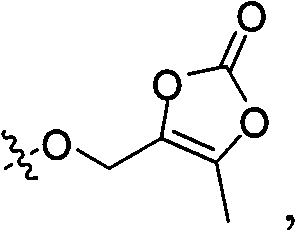 Wherein-R
20Be selected from-C (O)-R
10,-C (O) O-R
10,-R
11,-CH (R
12)-O-C (O)-R
10,-C (O)-C[(R
10) (R
10')]
1-4-NH (R
13) ,-S (O
2) R
10,-P (O) (OR
10) (OR
10) ,-C (O)-(CH
2)
n-CH (OH)-CH
2-O-R
10,-C (O)-(CH
2)
1-4-C (OH) (COOR
10)-(CH
2)
1-4-COOR
10,-C (O)-[C (R
14) (R
14)]
1-4-P (O) (OH) (OH) ,-C (O)-(CH
2)
1-4-N (R
14)-C[=N (R
10')]-N (R
10') (R
10') ,-C (O)-(CH
2)-CH (OH)-(CH
2)-N (CH
3) (CH
3) ,-C (O)-CH (NH
2)-(CH
2)
1-6-COOH is (preferred-C (O)-CH (NH
2)-(CH
2)-COOH) ,-C (O)-O-(CH
2)
n-CH (OH)-CH
2-O-R
10With-C (O)-(CH
2)
n-C (O) OR
10, condition is directly not combine with two O atoms with Z bonded N, and other condition is to be-R as (a) Z
20The time, R then
xBe-OH, and (b) as Z be-OR
20The time, R then
xBe-H; Or
Wherein-R
20Be selected from-C (O)-R
10,-C (O) O-R
10,-R
11,-CH (R
12)-O-C (O)-R
10,-C (O)-C[(R
10) (R
10')]
1-4-NH (R
13) ,-S (O
2) R
10,-P (O) (OR
10) (OR
10) ,-C (O)-(CH
2)
n-CH (OH)-CH
2-O-R
10,-C (O)-(CH
2)
1-4-C (OH) (COOR
10)-(CH
2)
1-4-COOR
10,-C (O)-[C (R
14) (R
14)]
1-4-P (O) (OH) (OH) ,-C (O)-(CH
2)
1-4-N (R
14)-C[=N (R
10')]-N (R
10') (R
10') ,-C (O)-(CH
2)-CH (OH)-(CH
2)-N (CH
3) (CH
3) ,-C (O)-CH (NH
2)-(CH
2)
1-6-COOH is (preferred-C (O)-CH (NH
2)-(CH
2)-COOH) ,-C (O)-O-(CH
2)
n-CH (OH)-CH
2-O-R
10With-C (O)-(CH
2)
n-C (O) OR
10, condition is directly not combine with two O atoms with Z bonded N, and other condition is to be-R as (a) Z
20The time, R then
xBe-OH, and (b) as Z be-OR
20The time, R then
xBe-H; Or
R
xDo not exist, and R
20Form the optional heterocycle that replaces with its N that is connected;
N is 0,1,2,3 or 4, is preferably 1,2,3 or 4;
Each R
10Be independently selected from hydrogen, the optional C that replaces
1-C
20Alkyl, the optional C that replaces
2-C
20Thiazolinyl, the optional C that replaces
2-C
20Alkynyl, the optional C that replaces
1-C
20Carbalkoxy, the optional cycloalkyl that replaces, the optional Heterocyclylalkyl that replaces, the optional aryl that replaces, the optional heteroaryl that replaces, the optional cycloalkylalkyl that replaces, the optional Heterocyclylalkyl alkyl that replaces, the optional arylalkyl that replaces, the optional heteroarylalkyl that replaces, the optional cycloalkyl thiazolinyl that replaces, the optional Heterocyclylalkyl thiazolinyl that replaces, the optional aryl alkenyl that replaces, the optional heteroaryl thiazolinyl that replaces, the optional cycloalkyl alkynyl that replaces, the optional Heterocyclylalkyl alkynyl that replaces, the optional aromatic yl polysulfide yl that replaces, the optional heteroaryl alkynyl that replaces, the optional alkyl-cycloalkyl that replaces, the optional alkyl heterocycle alkyl that replaces, the optional alkylaryl that replaces, the optional miscellaneous alkyl aryl that replaces, the optional thiazolinyl cycloalkyl that replaces, the optional thiazolinyl Heterocyclylalkyl that replaces, the optional alkenyl aryl that replaces, the optional thiazolinyl heteroaryl that replaces, the optional alkynyl cycloalkyl that replaces, the optional alkynyl Heterocyclylalkyl that replaces, the optional alkynyl aryl that replaces, the optional alkynyl heteroaryl that replaces, saccharide residue and amino-acid residue (preferably by amino acid whose carboxyl terminal combination);
Each R
10' be hydrogen or C independently
1-6Alkyl, or
R
10And R
10' form the optional spiro cycloalkyl group that replaces with the carbon atom that they connected;
R
21Be sugar or-amino acid-R
13, R wherein
13With N-end covalent attachment;
R
11Be selected from hydrogen, the optional Heterocyclylalkyl that replaces, the optional aryl that replaces and the optional heteroaryl that replaces;
R
12Be selected from hydrogen or alkyl; And
R
13Be selected from hydrogen ,-C (O)-CH[N (R
10') (R
10')]-C
1-C
6Alkyl ,-C (O)-CH[N (R
10') (R
10')]-C
1-C
6Alkyl-N (R
10') (R
10') ,-C (O)-CH[N (R
10') (R
10')]-C
1-C
6Alkyl-aryl ,-C (O)-CH[N (R
10') (R
10')]-C
1-C
6Alkyl-heteroaryl ,-C (O)-aryl ,-C (O)-heteroaryl, amino protecting group and R
10With
Each R
14Be independently selected from H, C
1-C
6Alkyl and cycloalkyl, perhaps two R
14Form cycloalkyl with the atom that they connected.
In some preferred implementations, Cy is C
6-C
14Aryl is more preferably C
6-C
10Aryl, and most preferably be phenyl or naphthyl, any in them can be optional the replacement; In some other preferred implementations, Cy is a heteroaryl.Some preferred embodiment in, this heteroaryl is selected from thienyl, benzothienyl, furyl, benzofuryl, quinolyl, isoquinolyl and thiazolyl, any in them can be optional the replacement; In some particularly preferred embodiments, Cy is selected from phenyl, naphthyl, thienyl, benzothienyl and quinolyl, and any in them can be optional the replacement; In some other preferred implementations, Cy is phenyl, pyridine or indoles, is more preferably phenyl or indoles.In some preferred implementations, Cy is selected from following substituting group and replaces with one or more: tri haloalkyl (preferred trifluoroalkyl), halogen, CN, amidine, sulfone, alkyl sulfone, amides (imidate) and alkylamino thing.In some preferred implementations, Cy is the phenyl that is selected from following substituting group replacement with one or more: tri haloalkyl (preferred trifluoroalkyl), halogen, CN, amidine, sulfone, alkyl sulfone, amides and alkyl, described substituting group are preferably selected from tri haloalkyl (preferred trifluoroalkyl) and halogen.
L
1Be-(CH
2)
m-W-, wherein m is 0,1,2,3 or 4, and W be selected from-C (O) NH-,-S (O)
2NH-,-NHC (O)-,-NHS (O)
2-and-NH-C (O)-NH-, preferably, m is 0,1 or 2, more preferably 0 or 1.
Preferably, Ar is C
6-C
14Arylidene, more preferably C
6-C
10Arylidene, any can further be substituted in them.In some preferred implementations, Ar is a phenylene, preferred 4-phenylene.Some preferred embodiment in, phenylene and aromatic ring or hetero-aromatic ring condense, perhaps with saturated or partly undersaturated cycloalkyl ring or heterocyclic fused, the arbitrary of these groups also can be optionally substituted.
Y
1Be chemical bond or side chain or branched alkylidene, it can be optionally substituted.Some preferred embodiment in, Y
1Be chemical bond, and group-C (O) NH-Z is connected directly to Ar.At some other preferred embodiment in, Y
1Be alkylidene group, be preferably saturated alkylidene group.Preferably, this saturated alkylidene group is C
1-C
8Alkylidene group, more preferably C
1-C
6Alkylidene group, still C more preferably
1-C
3Alkylidene group, and even C more preferably
1-C
2Alkylidene group, any in them can be optional the replacements; In some particularly preferred embodiments, Y
1It is alkylidene group.
The alkyl, aryl, heterocyclic radical and the heteroaryl that replace have one or more substituting groups, preferably have the substituting group between and about three, more preferably have one or two substituting group, and they are preferably selected from C
1-C
6Alkyl, preferred C
1-C
4Alkyl; Halogen, preferred Cl, Br or F; Haloalkyl, preferred (halogen)
1-5(C
1-C
6) alkyl, more preferably (halogen)
1-5(C
1-C
3) alkyl, and CF most preferably
3C
1-C
6Alkoxyl group, preferred methoxyl group, oxyethyl group or benzyloxy; C
6--C
10Aryloxy, preferred phenoxy group; C
1-C
6Carbalkoxy, preferred C
1-C
3Carbalkoxy, most preferably methoxycarbonyl or ethoxycarbonyl; C
6-C
10Aryl, preferred phenyl; (C
6-C
10) aryl (C
1-C
6) alkyl, preferred (C
6-C
10) aryl (C
1-C
3) alkyl, more preferably benzyl, naphthyl methyl or styroyl; Hydroxyl (C
1-C
6) alkyl, preferred hydroxyl (C
1-C
3) alkyl, more preferably methylol; Amino (C
1-C
6) alkyl, preferred amino (C
1-C
3) alkyl, more preferably aminomethyl; (C
1-C
6) alkylamino, preferred methylamino-, ethylamino or third amino; Two-(C
1-C
6) amino, preferred dimethylamino or diethylin; (C
1-C
6) alkyl-carbamoyl, preferable methyl formamyl, formyl-dimethylamino or benzylamino formyl radical; (C
6-C
10) aryl-amino-carbonyl, preferred phenyl amino formyl radical; (C
1-C
6) alkyl amido, preferred kharophen; (C
6-C
10) the aryl amido, preferred benzoylamino; (C
1-C
6) alkyl sulphonyl, preferred methylsulfonyl; (C
1-C
6) amino-alkyl sulfinyl, the preferable methyl sulfonamido; (C
6-C
10) aryl sulfonyl, preferred benzenesulfonyl or tosyl group; (C
6-C
10) aromatic yl sodium sulfonamido, preferred benzenesulfonyl or tosyl group; (C
6-C
10) aryl (C
1-C
6) amino-alkyl sulfinyl, preferred benzyl sulfonamido; C
1-C
6Alkyl-carbonyl, preferred C
1-C
3Alkyl-carbonyl, more preferably ethanoyl; (C
1-C
6) acyloxy, preferred acetoxyl group; Cyano group; Amino; Carboxyl; Hydroxyl; Urea groups; And nitro.One or more carbon atoms of alkyl, cycloalkyl or heterocyclic radical also can replace with oxo group is optional.
In some particularly preferred embodiments, Cy is phenyl, naphthyl, thienyl, benzothienyl or quinolyl part, and it is unsubstituted or is replaced by one or two substituting group that independently is selected from following radicals: C
1-C
4Alkyl, C
1-C
4Haloalkyl, C
6-C
10Aryl, (C
6-C
10) aryl (C
1-C
6) alkyl, halogen, nitro, hydroxyl, C
1-C
6Alkoxyl group, C
1-C
6Carbalkoxy, carboxyl and amino.
Some preferred embodiment in, Z is-O-C (O)-R
10,-O-C (O)-[C (R
10) (R
10')]
1-4-NH (R
13) or-OR
11
Some preferred embodiment in, amino acid is L-amino acid.
In some preferred implementations, saccharide residue is the sugar that is selected from glucose, semi-lactosi, seminose, gulose, idose, talose, allose, altrose, fructose, rhamnosyl, ribose and wood sugar.
In second embodiment, the invention provides the prodrug of histone deacetylase inhibitor, described prodrug is represented by formula (2):
Cy-L
2-Ar-Y
2-C(O)N(R
x)-Z??(2)
And pharmaceutically useful salt, wherein
Cy is H, cycloalkyl, aryl, heteroaryl or heterocyclic radical, and any in them can be optional the replacement; Condition is that Cy is not (spiro cycloalkyl group) heterocyclic radical;
L
2Be C
1-C
6Saturated alkylidene group or C
2-C
6Alkenylene, wherein alkylidene group or alkenylene are optional can be substituted, and wherein the optional quilt of one or two carbon atom of alkylidene group independently is selected from following heteroatom moiety replacement: O; NR ', R ' are alkyl, acyl group or hydrogen; S; S (O); Or S (O)
2
Ar is an arylidene, and wherein said arylidene randomly can be substituted again, and randomly can condense with aromatic ring or hetero-aromatic ring, and perhaps with saturated or partly undersaturated cycloalkyl ring or heterocyclic fused, any in them can be optional the replacement; With
Y
2Be the saturated alkylidene group of chemical bond or straight or branched, it can be optionally substituted, and condition is that this alkylidene group is not replaced by the substituting group of formula-C (O) R, and wherein R comprises α-aminoacyl part;
R
xBe H or-OH;
Z is-R
20,-O-R
20,-R
21Or
Wherein-R
20Be selected from-C (O)-R
10,-C (O) O-R
10,-R
11,-CH (R
12)-O-C (O)-R
10,-C (O)-C[(R
10) (R
10')]
1-4-NH (R
13) ,-S (O
2) R
10,-P (O) (OR
10) (OR
10) ,-C (O)-(CH
2)
1-4-C (OH) (COOR
10)-(CH
2)
1-4-COOR
10,-C (O)-[C (R
14) (R
14)]
1-4-P (O) (OH) (OH) ,-C (O)-(CH
2)
1-4-N (R
14)-C[=N (R
10')]-N (R
10') (R
10') ,-C (O)-(CH
2)-CH (OH)-(CH
2)-N (CH
3) (CH
3) ,-C (O)-CH (NH
2)-(CH
2)
1-6-COOH is (preferred-C (O)-CH (NH
2)-(CH
2)-COOH) ,-C (O)-(CH
2)
n-CH (OH)-CH
2-O-R
10,-C (O)-O-(CH
2)
n-CH (OH)-CH
2-O-R
10With-C (O)-(CH
2)
n-C (O) OR
10, condition is directly not combine with two O atoms with Z bonded N; And other condition is (a)
20The time, R then
xBe-OH, and (b) as Z be-OR
20The time, R then
xBe-H; Or
R
xDo not exist, and R
20Form the optional heterocycle that replaces with its N that is connected;
N is 0,1,2,3 or 4, is preferably 1,2,3 or 4;
Each R
10Be independently selected from hydrogen, the optional C that replaces
1-C
20Alkyl, the optional C that replaces
2-C
20Thiazolinyl, the optional C that replaces
2-C
20Alkynyl, the optional C that replaces
1-C
20Carbalkoxy, the optional cycloalkyl that replaces, the optional Heterocyclylalkyl that replaces, the optional aryl that replaces, the optional heteroaryl that replaces, the optional cycloalkylalkyl that replaces, the optional Heterocyclylalkyl alkyl that replaces, the optional arylalkyl that replaces, the optional heteroarylalkyl that replaces, the optional cycloalkyl thiazolinyl that replaces, the optional Heterocyclylalkyl thiazolinyl that replaces, the optional aryl alkenyl that replaces, the optional heteroaryl thiazolinyl that replaces, the optional cycloalkyl alkynyl that replaces, the optional Heterocyclylalkyl alkynyl that replaces, the optional aromatic yl polysulfide yl that replaces, the optional heteroaryl alkynyl that replaces, the optional alkyl-cycloalkyl that replaces, the optional alkyl heterocycle alkyl that replaces, the optional alkylaryl that replaces, the optional miscellaneous alkyl aryl that replaces, the optional thiazolinyl cycloalkyl that replaces, the optional thiazolinyl Heterocyclylalkyl that replaces, the optional alkenyl aryl that replaces, the optional thiazolinyl heteroaryl that replaces, the optional alkynyl cycloalkyl that replaces, the optional alkynyl Heterocyclylalkyl that replaces, the optional alkynyl aryl that replaces, the optional alkynyl heteroaryl that replaces, saccharide residue and amino-acid residue (preferably by amino acid whose carboxyl terminal combination);
Each R
10' be hydrogen or C independently
1-6Alkyl, or
R
10And R
10' form the optional spiro cycloalkyl group that replaces with the carbon atom that they connected;
R
21Be sugar or-amino acid-R
13, R wherein
13With N-end covalent attachment;
R
11Be selected from hydrogen, the optional Heterocyclylalkyl that replaces, the optional aryl that replaces and the optional heteroaryl that replaces;
R
12Be selected from hydrogen or alkyl; And
R
13Be selected from hydrogen ,-C (O)-CH[N (R
10') (R
10')]-C
1-C
6Alkyl ,-C (O)-CH[N (R
10') (R
10')]-C
1-C
6Alkyl-N (R
10') (R
10') ,-C (O)-CH[N (R
10') (R
10')]-C
1-C
6Alkyl-aryl ,-C (O)-CH[N (R
10') (R
10')]-C
1-C
6Alkyl-heteroaryl ,-C (O)-aryl ,-C (O)-heteroaryl, amino protecting group and R
10With
Each R
14Be independently selected from H, C
1-C
6Alkyl and cycloalkyl, perhaps two R
14Form cycloalkyl with the atom that they connected.
According to the present invention in this respect preferred substituents Cy, Ar and Z such as toply define about first embodiment.Preferred Y
2Substituting group is as above about Y
1Define.Some preferred embodiment in, L
2Be saturated C
1-C
8Alkylidene group, more preferably C
1-C
6Alkylidene group, still C more preferably
1-C
4Alkylidene group, any in these groups can be optional the replacements.At some other preferred embodiment in, L
2Be C
2-C
8Alkenylene, more preferably C
2-C
6Alkenylene, still C more preferably
2-C
4Alkenylene, any in these groups can be optional the replacements.Alkylidene group or alkenylene can replace with the substituting group that is preferably selected from preferred substituents list listed above at one or more carbon locations.More preferably, L
2In one or two position with independently being selected from C
1-C
6Alkyl, C
6-C
10Aryl, amino, oxo, hydroxyl, C
1-C
4Alkyl and C
6-C
10The substituting group of aryloxy replaces.In some particularly preferred embodiments, alkylidene group or alkenylene replace with one or two oxo or hydroxyl.
Some preferred embodiment in, L
1Be C
1-C
6Saturated alkylidene group, wherein one of carbon atom of saturated alkylidene group is selected from following heteroatom moiety replacement: O; NR ', R ' are alkyl, acyl group or hydrogen; S; S (O); Or S (O)
2Preferably, adjacent with Cy carbon atom is replaced by heteroatom moiety.In some particularly preferred embodiments, L
1Be selected from-S-(CH
2)
2-,-S (O)-(CH
2)
2-,-S (O)
2-(CH
2)
2-,-S-(CH
2)
3-,-S (O)-(CH
2)
3-and-S (O)
2-(CH
2)
3-.
Some preferred embodiment in, Z is-O-C (O)-R
10,-O-C (O)-[C (R
10) (R
10')]
1-4-NH (R
13) or-OR
11Even the embodiment of preferred compound (2) is:
In the 3rd embodiment, the invention provides the prodrug of histone deacetylase inhibitor, described prodrug is represented by formula (3):
Cy-L
3-Ar-Y
3-C(O)N(R
x)-Z??(3)
And pharmaceutically useful salt, wherein
Cy is-H, cycloalkyl, aryl, heteroaryl or heterocyclic radical, and any in them can be optional the replacement; Condition is that Cy is not (spiro cycloalkyl group) heterocyclic radical;
L
3Be selected from
(a)-(CH
2)
m-W-, wherein m is 0,1,2,3 or 4, and W be selected from-C (O) NH-,-S (O)
2NH-,-NHC (O)-,-NHS (O)
2-and-NH-C (O)-NH-; With
(b) C
1-C
6Alkylidene group or C
2-C
6Alkenylene, wherein alkylidene group or alkenylene are optional can be substituted, and wherein a carbon atom of alkylidene group is chosen wantonly by O; NR ', R ' are alkyl, acyl group or hydrogen; S; S (O); Or S (O)
2Replace;
Ar is an arylidene, and wherein said arylidene randomly can be substituted again, and randomly can condense with aromatic ring or hetero-aromatic ring, and perhaps with saturated or partly undersaturated cycloalkyl ring or heterocyclic fused, any in them can be optional the replacement; With
Y
3Be C
2Alkenylene or C
2Alkynylene, wherein optional alkyl, aryl, alkaryl or the aralkyl can used of one or two carbon atom of alkenylene replaces;
R
xBe H or-OH;
Z is-R
20,-O-R
20,-R
21Or
 Wherein-R
20Be selected from-C (O)-R
10,-C (O) O-R
10,-R
11,-CH (R
12)-O-C (O)-R
10,-C (O)-(CH
2)
1-4-C (OH) (COOR
10)-(CH
2)
1-4-COOR
10,-C (O)-[C (R
14) (R
14)]
1-4-P (O) (OH) (OH) ,-C (O)-(CH
2)
1-4-N (R
14)-C[=N (R
10')]-N (R
10') (R
10') ,-C (O)-(CH
2)-CH (OH)-(CH
2)-N (CH
3) (CH
3) ,-C (O)-CH (NH
2)-(CH
2)
1-6-COOH is (preferred-C (O)-CH (NH
2)-(CH
2)-COOH) ,-C (O)-C[(R
10) (R
10')]
1-4-NH (R
13) ,-S (O
2) R
10,-P (O) (OR
10) (OR
10) ,-C (O)-(CH
2)
n-CH (OH)-CH
2-O-R
10,-C (O)-O-(CH
2)
n-CH (OH)-CH
2-O-R
10With-C (O)-(CH
2)
n-C (O) OR
10, condition is directly not combine with two O atoms with Z bonded N; And other condition is to be-R as (a) Z
20The time, R then
xBe-OH, and (b) as Z be-OR
20The time, R then
xBe-H; Or
Wherein-R
20Be selected from-C (O)-R
10,-C (O) O-R
10,-R
11,-CH (R
12)-O-C (O)-R
10,-C (O)-(CH
2)
1-4-C (OH) (COOR
10)-(CH
2)
1-4-COOR
10,-C (O)-[C (R
14) (R
14)]
1-4-P (O) (OH) (OH) ,-C (O)-(CH
2)
1-4-N (R
14)-C[=N (R
10')]-N (R
10') (R
10') ,-C (O)-(CH
2)-CH (OH)-(CH
2)-N (CH
3) (CH
3) ,-C (O)-CH (NH
2)-(CH
2)
1-6-COOH is (preferred-C (O)-CH (NH
2)-(CH
2)-COOH) ,-C (O)-C[(R
10) (R
10')]
1-4-NH (R
13) ,-S (O
2) R
10,-P (O) (OR
10) (OR
10) ,-C (O)-(CH
2)
n-CH (OH)-CH
2-O-R
10,-C (O)-O-(CH
2)
n-CH (OH)-CH
2-O-R
10With-C (O)-(CH
2)
n-C (O) OR
10, condition is directly not combine with two O atoms with Z bonded N; And other condition is to be-R as (a) Z
20The time, R then
xBe-OH, and (b) as Z be-OR
20The time, R then
xBe-H; Or
R
xDo not exist, and R
20Form the optional heterocycle that replaces with its N that is connected;
N is 0,1,2,3 or 4, is preferably 1,2,3 or 4;
Each R
10Be independently selected from hydrogen, the optional C that replaces
1-C
20Alkyl, the optional C that replaces
2-C
20Thiazolinyl, the optional C that replaces
2-C
20Alkynyl, the optional C that replaces
1-C
20Carbalkoxy, the optional cycloalkyl that replaces, the optional Heterocyclylalkyl that replaces, the optional aryl that replaces, the optional heteroaryl that replaces, the optional cycloalkylalkyl that replaces, the optional Heterocyclylalkyl alkyl that replaces, the optional arylalkyl that replaces, the optional heteroarylalkyl that replaces, the optional cycloalkyl thiazolinyl that replaces, the optional Heterocyclylalkyl thiazolinyl that replaces, the optional aryl alkenyl that replaces, the optional heteroaryl thiazolinyl that replaces, the optional cycloalkyl alkynyl that replaces, the optional Heterocyclylalkyl alkynyl that replaces, the optional aromatic yl polysulfide yl that replaces, the optional heteroaryl alkynyl that replaces, the optional alkyl-cycloalkyl that replaces, the optional alkyl heterocycle alkyl that replaces, the optional alkylaryl that replaces, the optional miscellaneous alkyl aryl that replaces, the optional thiazolinyl cycloalkyl that replaces, the optional thiazolinyl Heterocyclylalkyl that replaces, the optional alkenyl aryl that replaces, the optional thiazolinyl heteroaryl that replaces, the optional alkynyl cycloalkyl that replaces, the optional alkynyl Heterocyclylalkyl that replaces, the optional alkynyl aryl that replaces, the optional alkynyl heteroaryl that replaces, saccharide residue and amino-acid residue (preferably by amino acid whose carboxyl terminal combination);
Each R
10' be hydrogen or C independently
1-6Alkyl, or
R
10And R
10' form the optional spiro cycloalkyl group that replaces with the carbon atom that they connected;
R
21Be sugar or-amino acid-R
13, R wherein
13With N-end covalent attachment;
R
11Be selected from hydrogen, the optional Heterocyclylalkyl that replaces, the optional aryl that replaces and the optional heteroaryl that replaces;
R
12Be selected from hydrogen or alkyl; And
R
13Be selected from hydrogen ,-C (O)-CH[N (R
10') (R
10')]-C
1-C
6Alkyl ,-C (O)-CH[N (R
10') (R
10')]-C
1-C
6Alkyl-N (R
10') (R
10') ,-C (O)-CH[N (R
10') (R
10')]-C
1-C
6Alkyl-aryl ,-C (O)-CH[N (R
10') (R
10')]-C
1-C
6Alkyl-heteroaryl ,-C (O)-aryl ,-C (O)-heteroaryl, amino protecting group and R
10With
Each R
14Be independently selected from H, C
1-C
6Alkyl and cycloalkyl, perhaps two R
14Form cycloalkyl with the atom that they connected.
In this respect preferred substituents Cy, Ar as above defines about first embodiment according to the present invention.Preferred substituted L
3As above about L
1Or L
2Define.
Preferably, Y
3Be C
2Alkenylene or C
2Alkynylene, wherein one or two carbon atom of alkenylene is optional can use C
1-C
6Alkyl, C
6-C
10Aryl, (C
1-C
6) alkyl (C
6-C
10) aryl or (C
6-C
10) aryl (C
1-C
6) the alkyl replacement.More preferably, Y
3Be C
2Alkenylene or C
2Alkynylene, wherein one or two carbon atom of alkenylene is optional can use C
1-C
4Alkyl, C
6-C
10Aryl, (C
1-C
4) alkyl (C
6-C
10) aryl or (C
6-C
10) aryl (C
1-C
4) alkyl.Still more preferably, Y
3Be selected from-C ≡ C-,-CH=CH-,-C (CH
3)=CH-and-CH=C (CH
3)-.
In the preferred implementation of the compound of formula (1), (2) and (3), Z is selected from-O-C (O)-(CH
2)
1-4-C (OH) (COOR
10)-(CH
2)
1-4-COOR
10,-O-C (O)-[C (R
14) (R
14)]
1-4-P (O) (OH) (OH) ,-O-C (O)-(CH
2)
1-4-N (R
14)-C[=N (R
10')]-N (R
10') (R
10') ,-O-C (O)-(CH
2)-CH (OH)-(CH
2)-N (CH
3) (CH
3) ,-O-C (O)-CH NH
2)-(CH
2)
1-6-COOH, preferred-O-C (O)-CH (NH
2)-(CH
2)-COOH.
In the preferred implementation of the compound of formula (1), (2) and (3), Z is selected from-O-C (O)-(CH
2)-C (OH) (COOH)-(CH
2)-COOH ,-O-C (O)-CH
2-P (O) (OH) (OH) ,-O-C (O)-(CH
2)-N (CH
3)-C (=NH)-NH
2,-O-C (O)-(CH
2)-CH (OH)-(CH
2)-N (CH
3) (CH
3) ,-O-C (O)-CH (NH
2)-(CH
2)-COOH.
Some preferred embodiment in, Z is-O-C (O)-R
10,-O-C (O)-[C (R
10) (R
10')]
1-4-NH (R
13) or-OR
11
In some preferred implementations of the prodrug of the histone deacetylase inhibitor of formula (1), (2) and (3), Z is-O-R
20, R wherein
20Be-C (O)-CR
10R
10'-NH (R
13), R
13And R
10' be H, and R
10Be C
1-C
6-alkyl or amino acid side chain, perhaps R
10And R
10' form C with the carbon that they connected
3-C
6Cycloalkyl.
The amino acid that natural existence or non-natural exist is used to prepare prodrug of the present invention.Particularly, be suitable as prodrug standard amino acid partly and comprise Xie Ansuan, leucine, Isoleucine, methionine(Met), phenylalanine, l-asparagine, l-asparagine, glutamine, Histidine, Methionin, arginine, aspartic acid, glycine, L-Ala, Serine, Threonine, tyrosine, tryptophane, halfcystine and proline(Pro).Particularly preferably be L-amino acid.Randomly, the amino acid that is included is a-amino acid, beta-amino acids or gamma-amino acid.Equally, naturally occurring non-standard amino acid can be used in the compositions and methods of the invention.For example, except being common in the naturally occurring amino acid of the standard in the protein, naturally occurring amino acid also exemplarily comprises 4-Hydroxyproline, Gla, seleno-cysteine, desmosine (desmosine), the 6-N-methyllysine, ε-N, N, the N-trimethyl lysine, 3-Methyl histidine, the O-phosphoserine, the 5-oxylysine, ε-N-acetyllysine, ω-N-methylarginine, the N-acetylserine, γ-An Jidingsuan, citrulline, ornithine, azaserine, homocysteine, β-Qing Bingansuan and S-adenosylmethionine.The amino acid that non-natural exists comprise phenylglycocoll, m-Tyrosine, p-Aminophenylalanine, 3-(3-pyridyl)-L-L-Ala-, 4-(trifluoromethyl)-D-phenylalanine etc.
In other embodiments, the prodrug of histone deacetylase inhibitor of the present invention comprises those prodrugs of formula (1), (2) and (3) as defined above, except the R of Z
20At US 4,443, be described as comprising-CH (R in 435 (being incorporated herein by reference) with its integral body
130)-X-C (O)-R
131, wherein
X is O, S or NR
132
R
131Be
(a) have straight or branched alkyl, particularly methyl, ethyl, sec.-propyl, the tertiary butyl, amyl group or the hexyl of 1 to 20 carbon atom;
(b) have aryl, particularly phenyl, substituted-phenyl or the naphthalene of 6 to 10 carbon atoms;
(c) have cycloalkyl, particularly cyclopentyl or the cyclohexyl of 3 to 8 carbon atoms;
(d) have the thiazolinyl, particularly C of 2 to 20 carbon atoms
2-6Thiazolinyl such as vinyl, allyl group or butenyl;
(e) have cycloalkenyl group, particularly cyclopentenyl or the cyclohexenyl of 5 to 8 carbon atoms;
(f) have the alkynyl, particularly C of 2 to 20 carbon atoms
2-6Alkynyl, for example ethynyl, proyl or hexin base;
(g) aralkyl, alkaryl, arylalkenyl, sweet-smelling alkynyl, alkenyl aryl or alkynyl aryl, wherein alkyl, aryl, thiazolinyl and alkynyl such as front define;
(h) lower alkoxycarbonyl, particularly C
1-6Carbalkoxy is such as methoxycarbonyl, ethoxycarbonyl, tertbutyloxycarbonyl and ring penta oxygen carbonyl;
(i) carboxyalkyl or alkanoyloxy alkyl, particularly carboxyl-C
1-6Alkyl is such as methanoyl methyl and methanoyl propyl group; Or C
1-6(alkyl carboxyl alkyl) is such as acetoxy-methyl, positive propionyloxy ethyl and penta acyloxy butyl;
(j) saturated or unsaturated single heterocyclic radical or poly-heterocyclic radical, or annelated heterocycles base, its directly with the carbonyl official can in conjunction with or by alkylidene bridge and its bonding, containing 1 to 3 any or a plurality of heteroatoms N, S or O and each this type of ring in its each heterocycle is 3 to 8 yuan of rings; With
(k) the single of above-mentioned group replaces or polysubstituted derivative, and each described substituting group is selected from low alkyl group; Lower alkoxy; Low-grade alkane acidyl; Lower alkanoyloxy; Halogen, particularly bromine, chlorine or fluorine; Junior alkyl halides, particularly fluoro low alkyl group, chloro low alkyl group or bromo low alkyl group are such as trifluoromethyl and 1-chloropropyl; Cyano group; Ethoxycarbonyl (carbethoxy); Low alkyl group sulfo-, particularly C
1-6The low alkyl group sulfo-is such as methylthio group, ethylmercapto group and positive rosickyite base; Nitro; Carboxyl; Amino; Low-grade alkyl amino, particularly C
1-6Alkylamino, for example methylamino-, ethylamino and positive definite amino; Two elementary alkyl amido, particularly two (C
1-6Low alkyl group) amino, such as N, N-dimethylamino, N, N-diethylin and N, N-two is own amino; Formamyl; Elementary alkyl amido methanoyl, particularly C
1-6Alkyl-carbamoyl is such as methylamino formyl radical and ethylamino formyl radical; And R
133-X-C (O)-phenyl-, R wherein
133Be hydrogen or alkyl with 1 to 10 carbon;
R
130Be hydrogen, (b) R
131, low-grade alkane acidyl, cyano group, junior alkyl halides, formamyl, elementary alkyl amido methanoyl or two elementary alkyl amido formyl radical ,-CH
2ONO
2Or-CH
2OCOR
131
R
132Be hydrogen or low alkyl group; And further, R wherein
131And R
130Can form the cyclisation part that is selected from following ring together:

In other embodiments, the prodrug of histone deacetylase inhibitor of the present invention comprises those prodrugs of formula (1), (2) and (3) as defined above, except the R of Z
20At US 6,407,235 (being incorporated herein by reference with its integral body) are described as comprising:
A)-C (O) (CH
2)
mC (O) OR
40, wherein m is 1,2,3 or 4,
B)
 R wherein
41Be-N (R
42) (R
43), and R
42And R
43Be hydrogen or low alkyl group or optional five yuan or hexa-member heterocycle base or the heteroaryl that is replaced by low alkyl group, perhaps
R wherein
41Be-N (R
42) (R
43), and R
42And R
43Be hydrogen or low alkyl group or optional five yuan or hexa-member heterocycle base or the heteroaryl that is replaced by low alkyl group, perhaps
c)-C(O)(CH
2)NHC(O)(CH
2)N(R
42)(R
43)。
In other embodiments, the prodrug of histone deacetylase inhibitor of the present invention comprises those prodrugs of formula (1), (2) and (3) as defined above, except the R of Z
20At US 6,545,131 (being incorporated herein by reference with its integral body) are described as comprising: CO-(CH=CH)
N1-(CH
2)
N2-Ar-NH
2,-CO-(CH
2)
N2-(CH=CH)
N1-Ar-NH
2, CO-(CH
2)
N2-(CH=CH)
N1-CO-NH-Ar-NH
2And CO-(CH=CH)
N1-(CH
2)
N2-CO-NH-Ar-NH
2And their replacement variant, wherein n1 and n2 are 0 to 5, Ar is that replace or unsubstituted aryl.Some preferred embodiment in, Z is CO-(CH
2)
N3-NH
2, wherein n3 is 0 to 15, preferred 3-15, and preferred 6-12.Particularly preferred substituting group is the amino caproyl of 6-, the amino oenanthyl of 7-, the amino capryloyl of 8-, the amino nonanoyl of 9-, the amino decanoyl of 10-, the amino undecanoyl of 11-and the amino lauroyl of 12-in this kind.These substituting groups are synthetic from corresponding amino acid, 6-aminocaprolc acid etc. usually.Amino acid is by for example Boc protection carrying out N-end protection of standard method.N-end protection substituting group and thapsigargin carry out dicyclohexylcarbodiimide (DCCI)-promoted coupling, carry out the standard deprotection reaction afterwards, produce the thapsigargin analogue that contains primary amine.
In other embodiments, the prodrug of histone deacetylase inhibitor of the present invention comprises those prodrugs of formula (1), (2) and (3) as defined above, except the R of Z
20At US 7,115,573 (being incorporated herein by reference with its integral body) are described as comprising:
(1) formula (AA)
n-AA
3-AA
2-AA
1Oligopeptides, wherein: each AA represents amino acid independently, n is 0 or 1, when n is 1, then (AA)
nBe AA
4, it represents arbitrary amino acid, AA
3The expression Isoleucine, AA
2Expression arbitrary amino acid, and AA
1The expression arbitrary amino acid,
(2) stablize group and
(3) randomly, the linking group that can not be cut by trouase, described trouase is such as being TOP (being described in greater detail below).
Wherein, oligopeptides and stable group be in the first connection site Direct Bonding of this oligopeptides, and this oligopeptides and therapeutical agent Direct Bonding or by linking group and this therapeutical agent indirect bonding of second connection site at this oligopeptides,
Wherein stablize group and hinder the enzyme cutting that compound is existed in the whole blood, and
Wherein compound can by with target cell bonded enzyme cutting, with target cell bonded enzyme except that TOP (phorate oligopeptidase).This compound preferably includes the particularly oligopeptides of TOP cutting of anti-trouase, that is to say the cutting of tolerance under physiological conditions.The linking group of the optional existence of being cut by trouase can not cut under physiological condition.
The exemplary orientation order of these parts of prodrug is as follows: (stablizing group)-(oligopeptides)-(optional linking group)-(therapeutical agent).
The two-part Direct Bonding of prodrug is meant that covalent linkage is present between these two portions.Stablize group and oligopeptides therefore in first connection site of this oligopeptides, normally terminal by the covalent chemical bond Direct Bonding at the N-of this oligopeptides.When oligopeptides directly was connected with therapeutical agent, then they were in second connection site of this oligopeptides covalent attachment each other.Second connection site of oligopeptides is usually at the C-of this oligopeptides end, but other position that can be on this oligopeptides.
The two-part indirect bonding of prodrug is meant this two-part each part and linking group covalent attachment.In optional embodiment, prodrug has the indirect key of oligopeptides and therapeutical agent.Therefore, oligopeptides and linking group covalent attachment, linking group again with the therapeutical agent covalent attachment.
In optional embodiment, the direction of prodrug can be reverse, make that stablizing group is connected at the C-end with oligopeptides, and the N-of therapeutical agent and oligopeptides holds direct or indirect bonding.Therefore, in optional embodiment, first connection site of oligopeptides can be that the C-end of oligopeptides and second connection site of oligopeptides can be the N-ends of oligopeptides.Linking group can be present between therapeutical agent and the oligopeptides best.The optional embodiment of prodrug of the present invention works in the mode identical with main embodiment.
Stable group protects prodrug to avoid the proteolytic enzyme that exists in blood, blood plasma and the healthy tissues and the cutting of peptase usually.Especially, because stablize the N-end of group sealing oligopeptides, and therefore be called as N-end-blocking (cap) sometimes or N-blockades (block), so it is used to be protected from the prodrug peptase of susceptible in addition.The stable group that the obstruction oligopeptides is present in the enzyme cutting in the whole blood is selected from following:
(1) non-amino acid, or
(2) amino acid, it is the amino acid of (i) non-genetic coding or (ii) is connected to aspartic acid or the L-glutamic acid that oligopeptides N-holds through the β-carboxyl of aspartic acid or the γ of L-glutamic acid-carboxyl place.
For example, dicarboxylic acid (or high carboxylic acid) or its pharmaceutically useful salt can be used as stable group.Because the chemical group with two above carboxylic acids also is acceptable as the part of prodrug, the end group that therefore has carboxylic acid (or high carboxylic acid) is exemplary N-end-blocking.Therefore the N-end-blocking can be the monoamide derivatives that contains the chemical group of two or more carboxylic acids, and wherein acid amides is connected to the N-terminal of peptide, and remaining carboxylic acid is free and link coupled not.Because this purpose, the N-end-blocking is succsinic acid, hexanodioic acid, pentanedioic acid or phthalic acid preferably, and wherein succsinic acid and hexanodioic acid are most preferred.Useful end capped other example Glyoxylic acid hydrate of N-, fumaric acid, naphthalic acid, Pyroglutamic Acid, acetate, 1-or 2-naphthyl carboxylic acid, 1 in prodrug compound of the present invention, 8-naphthyl dicarboxylic acid, aconitic acid, o-carboxy cinnamic acid, triazole dicarboxylic acid, glyconic acid, 4-carboxyl phenylo boric acid (4-carboxyphenyl boronic acid), (PEG)
n-analogue such as polyvinyl alcohol acid (polyethylene glycolic acid), fourth disulfonic acid, toxilic acid, nipecotic acid and 4-piperidine carboxylic acid (isonipecotic acid).
In addition, the amino acid of non-genetic coding such as one of the following also can be used as stable group: Beta-alanine, thiazolidine-4-carboxylic acid, 2-thienylalanine, 2-naphthyl L-Ala, D-L-Ala, D-leucine, D-methionine(Met), D-phenylalanine, 3-amino-3-phenylpropionic acid, γ-An Jidingsuan, 3-amino-4,4-biphenyl butyric acid, tetrahydroisoquinoline-3-carboxylic acid, 4-Aminomethylbenzoic Acid and aminoisobutyric acid.
Linking group between oligopeptides and therapeutical agent is because such as following former thereby have an advantage: 1. as the spacer (spacer) of three-dimensional consideration aspect, to promote AA
1The enzyme that amino acid or other enzyme activate step discharges.2. in order to provide the suitable chemistry that is connected between therapeutical agent and the oligopeptides.For the synthetic method of improving preparation prodrug conjugate (for example, by before coupling, utilizing linking group to derive (pre-derivitizing) therapeutical agent or oligopeptides in advance to improve yield or specificity.) 4. in order to improve the physical properties of prodrug.5. for other mechanism that discharges in the medicine born of the same parents is provided.
The linker structure is subjected to the control of required functionality.The example of potential linker chemicals is hydrazides, ester, ether and sulfydryl.Hexosamine is the example of two sense linking groups.When hexosamine was used as linking group a part of, it was not regarded as amino acid in the numbering plan of oligopeptides.
Oligopeptides part is at first connection site of this oligopeptides and the stable group bonding that hinders the enzyme cutting that this oligopeptides exists in by whole blood, and at second connection site and the direct or indirect bonding of therapeutical agent of this oligopeptides.The bonding of oligopeptides and therapeutical agent and stable group can carry out successively or carry out simultaneously with any order.But the conjugate that obtains is tested the cutting of TOP.Select the test compounds of anti-TOP cutting.Also can test the stability of conjugate in whole blood that obtains.Be chosen in test compounds stable in the whole blood.
US 7,115, and the oligopeptides in 573, the combination of stablizing group and optional linker are further described in US 2002-0142955, and it also is merged in this paper as a reference.
In other embodiments, the prodrug of histone deacetylase inhibitor of the present invention comprises those prodrugs of formula (1), (2) and (3) as defined above, except the R of Z
20Be described as comprising at US 2004-0019017 A1 (be incorporated herein by reference with its integral body, and it having described the caspase inhibitor prodrugs):
R wherein
51Be 2 to 30, the replacement of saturated or unsaturated, the straight or branched of preferred 2 to 24 carbon atoms or unsubstituted alkyl;
R
52Be H or phosphatide headgroup, preferred chlorine;
X is direct covalent bonds or group C (O) LR
53, wherein L is saturated or unsaturated, straight or branched, replacement or the unsubstituted alkyl with 2 to 15 carbon atoms, its optional ring element element that comprises, and optional by one or more oxygen, sulphur and N (R of being selected from
54) atom interrupt; R
53Be selected from O, S and N (R
54), R wherein
54Be hydrogen H or saturated or unsaturated alkyl with 1 to 6 carbon atom.
In other embodiments, the prodrug of histone deacetylase inhibitor of the present invention comprises those prodrugs of formula (1), (2) and (3) as defined above, except the R of Z
20Be at US 7,115, the Y part of describing in 573 (being incorporated herein by reference) with its integral body.
In other embodiments, the prodrug of histone deacetylase inhibitor of the present invention comprises those prodrugs of formula (1), (2) and (3) as defined above, except the R of Z
20Be described as comprising-X-L-O-P (O) (O at US 2006-0166903 A1 (being incorporated herein by reference) with its integral body
-)-O-CH
2-CH
2-N (CH
3)
3 +, wherein X and L are as described in the US2006-0166903A1.
In other embodiments, the prodrug of histone deacetylase inhibitor of the present invention comprises those prodrugs of formula (1), (2) and (3) as defined above, except Z is a kind of at US 6,855,702, the cut prodrug part described in US 2005-0137141 and the US 2006-0135594, therefore all these be incorporated herein by reference with its integral body.
In other embodiments, the prodrug of histone deacetylase inhibitor of the present invention comprises those prodrugs of formula (1), (2) and (3) as defined above, wherein
Cy is the optional aryl that replaces, the preferred optional phenyl that replaces;
Ar is the optional aryl that replaces, the preferred optional phenyl that replaces;
R
xBe H or OH; With
Z is-O-R
20Or R
21
In other embodiments, the prodrug of histone deacetylase inhibitor of the present invention comprises those prodrugs of formula (1), (2) and (3) as defined above, wherein
Cy is the optional aryl that replaces, the preferred optional phenyl that replaces;
Ar is the optional aryl that replaces, the preferred optional phenyl that replaces;
R
xBe H or OH; With
Z is-O-R
20Or R
21, wherein
R
20Be-C (O)-C[(R
10) (R
10')]
1-4-NH (R
13) or-C (O)-R
10
In the preferred embodiment of the present invention, the prodrug of histone deacetylase inhibitor of the present invention comprises those prodrugs of formula (2) as defined above.
In other embodiments, the prodrug of histone deacetylase inhibitor of the present invention comprises those prodrugs of formula (2) as defined above, wherein
Cy is the optional aryl that replaces, the preferred optional phenyl that replaces;
Ar is the optional aryl that replaces, the preferred optional phenyl that replaces;
R
xBe H or OH; With
Z is-O-R
20Or R
21
In other embodiments, the prodrug of histone deacetylase inhibitor of the present invention comprises those prodrugs of formula (2) as defined above, wherein
Cy is the optional aryl that replaces, the preferred optional phenyl that replaces;
Ar is the optional aryl that replaces, the preferred optional phenyl that replaces;
R
xBe H or OH; With
Z is-O-R
20Or R
21, wherein
R
20Be-C (O)-C[(R
10) (R
10')]
1-4-NH (R
13) or-C (O)-R
10
In other embodiments, the prodrug of histone deacetylase inhibitor of the present invention comprises those prodrugs of formula (2) as defined above, wherein
Cy is the optional aryl that replaces, the preferred optional phenyl that replaces, and wherein said substituting group is preferably selected from-CF
3, halogen, heterocyclic radical and annelated heterocycles base;
L
2Be saturated C
3Alkyl or C
4Alkyl, preferably unsubstituted;
Ar is the optional aryl that replaces, the preferred optional phenyl that replaces;
Y
2Be C
1Alkyl or C
2Alkyl, preferred C
1Alkyl, optional being substituted;
R
xBe H or OH, preferred H;
Z is-O-R
20Or R
21
R
20Be-C (O)-C[(R
10) (R
10')]
1-4-NH (R
13) or-C (O)-R
10
Each R
10Be independently selected from H, the optional alkyl that replaces, optional replace-alkyl phenyl, optional replace-miscellaneous alkyl aryl and the optional heteroaryl that replaces;
Each R
10' be H or alkyl independently; Or
R
10And R
10' form C with the atom that they connected
3Or C
4Spiro cycloalkyl group, preferred C
3Spiro cycloalkyl group;
R
13Be selected from H ,-C (O)-CH[N (R
10) (R
10')]-C
1-C
6Alkyl-N (R
10) (R
10') ,-C (O)-heteroaryl ,-C (O)-aryl ,-C (O)-CH[N (R
10) (R
10')]-C
1-C
6Alkyl ,-C (O)-CH[N (R
10) (R
10')]-C
1-C
6Alkyl-aryl and-C (O)-CH[N (R
10) (R
10')]-C
1-C
6Alkyl-heteroaryl; With
R
21Be amino acid-R
13(preferably, amino acid is Methionin or arginine).
In other embodiments, the prodrug of histone deacetylase inhibitor of the present invention comprises those prodrugs of formula (2) as defined above, wherein
Cy is the optional aryl that replaces, the preferred optional phenyl that replaces, and wherein said substituting group is preferably selected from-CF
3, halogen, heterocyclic radical and annelated heterocycles base;
L
2Be saturated C
3Alkyl or C
4Alkyl does not preferably replace;
Ar is the optional aryl that replaces, the preferred optional phenyl that replaces;
Y
2Be C
1Alkyl or C
2Alkyl, preferred C
1Alkyl, optional being substituted;
R
xBe H or OH, preferred H;
Z is-O-R
20
R
20Be-C (O)-C[(R
10) (R
10')]
1-4-NH (R
13), preferred-C (O)-C[(R
10) (R
10')]
1-2-NH (R
13), more preferably-C (O)-C[(R
10) (R
10')]-NH (R
13);
Each R
10Be independently selected from H, the optional alkyl that replaces and optional replace-alkyl phenyl;
Each R
10' be H or alkyl independently; Or
R
10And R
10' form C with the atom that they connected
3Or C
4Spiro cycloalkyl group, preferred C
3Spiro cycloalkyl group; With
R
13Be H.
In other embodiments, the prodrug of histone deacetylase inhibitor of the present invention comprises those prodrugs of formula (2) as defined above, and wherein Cy is the optional aryl that replaces, the preferred optional phenyl that replaces, and wherein said substituting group is preferably selected from-CF
3, halogen, heterocyclic radical and annelated heterocycles base;
L
2Be saturated C
3Alkyl or C
4Alkyl does not preferably replace;
Ar is the optional aryl that replaces, the preferred optional phenyl that replaces;
Y
2Be C
1Alkyl or C
2Alkyl, preferred C
1Alkyl, optional being substituted;
R
xBe H or OH, preferred H;
Z is R
21
R
21Be amino acid-R
13(preferably, amino acid is Methionin or arginine); With
R
13Be H.
In other embodiments, the prodrug of histone deacetylase inhibitor of the present invention comprises those prodrugs of formula (2) as defined above, wherein
Cy is the optional aryl that replaces, the preferred optional phenyl that replaces, and wherein said substituting group is preferably selected from-CF
3, halogen, heterocyclic radical and annelated heterocycles base;
L
2Be saturated C
3Alkyl or C
4Alkyl does not preferably replace;
Ar is the optional aryl that replaces, the preferred optional phenyl that replaces;
Y
2Be C
1Alkyl or C
2Alkyl, preferred C
1Alkyl, optional being substituted;
R
xBe H or OH, preferred H;
Z is-O-R
20
R
20Be-C (O)-R
10With
R
10Be selected from the optional alkyl that replaces, optional replace-alkyl phenyl, optional replace-miscellaneous alkyl aryl and the optional heteroaryl that replaces.
In other embodiments, the prodrug of histone deacetylase inhibitor of the present invention comprises those prodrugs of formula (2) as defined above, wherein
Cy is the optional aryl that replaces, the preferred optional phenyl that replaces, and wherein said substituting group is preferably selected from-CF
3, halogen, heterocyclic radical and annelated heterocycles base;
L
2Be saturated C
3Alkyl or C
4Alkyl does not preferably replace;
Ar is the optional aryl that replaces, the preferred optional phenyl that replaces;
Y
2Be C
1Alkyl or C
2Alkyl, preferred C
1Alkyl, optional being substituted;
R
xBe H or OH, preferred H;
Z is-O-R
20
R
20Be-C (O)-C[(R
10) (R
10')]-NH (R
13), R wherein
10And R
10' form C with the atom that they connected
3Or C
4Spiro cycloalkyl group, preferred C
3Spiro cycloalkyl group; With
R
13Be selected from H ,-C (O)-CH[N (R
10) (R
10')]-C
1-C
6Alkyl-N (R
10) (R
10') ,-C (O)-heteroaryl ,-C (O)-aryl ,-C (O)-CH[N (R
10) (R
10')]-C
1-C
6Alkyl ,-C (O)-CH[N (R
10) (R
10')]-C
1-C
6Alkyl-aryl and-C (O)-CH[N (R
10) (R
10')]-C
1-C
6Alkyl-heteroaryl, wherein R
10And R
10' each independently is selected from H and C
1-C
6Alkyl, preferred H.
Preferred prodrug of the present invention is included in those in the Table A:
Table A

The preferred prodrug compound of the present invention can be cleaved into (for example, hydrolyzable) compound (split product) Mammals and/or fungal pathogen somatocyte, and the Z in its Chinese style (1), (2) and (3) is-OH.This type of hydrolysate is active histone deacetylase inhibitor.Therefore, according to a further aspect, the invention provides the compound (and pharmaceutically useful salt) of formula (1), (2) and (3) as defined above, remove Z and be-OH outside.Comprise compound in the preferred cutting compound with following structure:

The selective hydrolysis product of prodrug compound of the present invention is included in Z in the Table A.
All compounds of the present invention no matter be that prodrug is corresponding hydrolysate, can be racemic or diastereomer or enantiomorph enrichment.In addition, compound of the present invention no matter be prodrug or corresponding hydrolysate, can be hydrate, solvate, pharmaceutically useful salt and/or complex compound.
Synthetic
L wherein
1Be-S (O)
2The formula Cy-L of NH-
1-Ar-Y
1The compound of-C (O)-NH-O-H preferably can be according to preparing at the described route of synthesis of scheme 1-5.Therefore, in some preferred implementations, mixture I preferably prepares according to the general introduction route of synthesis described in the scheme 1.Therefore, SULPHURYL CHLORIDE (II) is handled with amine (III) under the situation that organic bases such as triethylamine exists in such as methylene dichloride at solvent.Utilizing in such as methyl alcohol alkali such as sodium methylate to handle crude product at alcoholic solvent finishes the cracking (cleavage) of any dialkyl group material and acts on and obtain sulphonamide (IV).The ester official can finish by handling such as lithium hydroxide with hydroxide bases in solvent mixture such as tetrahydrofuran (THF) and methyl alcohol in the hydrolysis in IV, to obtain corresponding acid (V).
Scheme 1
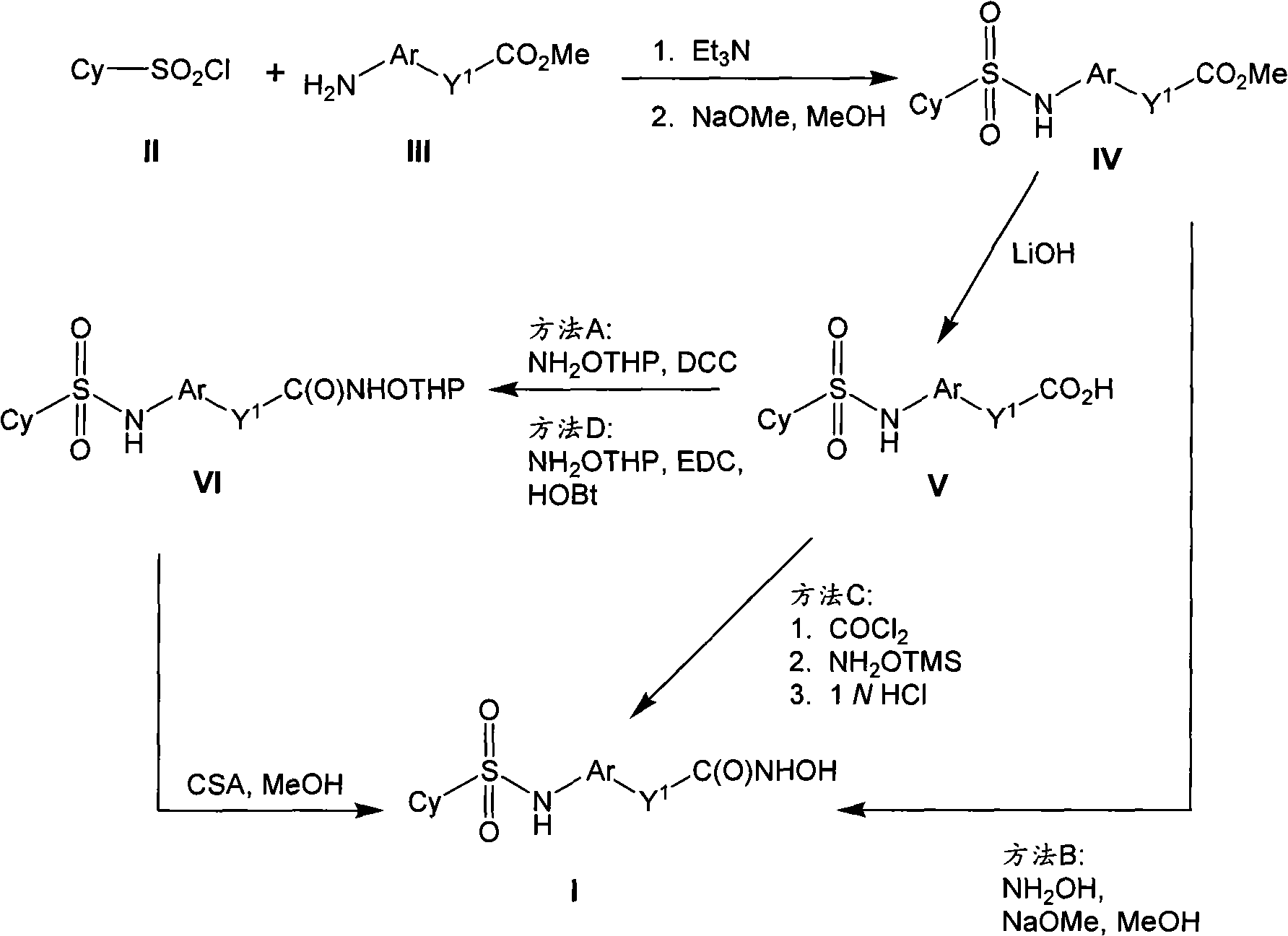
In some embodiments, sour V is converted into hydroxamic acid I and can finishes by following: make V and protected azanol such as THP trtrahydropyranyl azanol (NH
2OTHP) coupling obtains protected hydroxamate VI, and VI carries out acidolysis afterwards, obtains hydroxamic acid I.Linked reaction preferably utilizes coupling agent dicyclohexylcarbodiimide (DCC) to finish in solvent such as methylene dichloride (method A), perhaps utilizes coupling reagent 1-(3-dimethylamino-propyl)-3-ethyl carbodiimide to finish in aprotic solvent such as dimethyl formamide (method D) in the presence of the N-hydroxybenzotriazole.Other coupling reagent is as known in the art, and also can be used to this reaction.The hydrolysis of VI is preferably by finishing such as camphorsulfonic acid with organic acid in such as methyl alcohol at protonic solvent.
Another selection; in some other embodiments; acid V preferably is converted into corresponding acyl chlorides by handling with oxalic acid chlorine (oxalic chloride); be added in afterwards solvent such as the protected azanol in the methylene dichloride such as O-trimethyl silyl azanol, its treated then (workup) obtains azanol I (method C).
In other embodiments, ester IV preferably handles with azanol in the presence of alkali such as sodium methylate in such as methyl alcohol at solvent, directly obtains azanol I (method B).
The compound of formula X and XIV is preferably according to the summarized steps preparation of describing in the scheme 2.Therefore, aminoaryl halogen (aminoaryl halide) (VII) is handled with SULPHURYL CHLORIDE in the presence of alkali such as triethylamine, handles with alkoxide base afterwards, obtains sulphonamide VIII.It will be appreciated by those skilled in the art that reverse sulphonamide analogue can utilize arylamines to handle the halogenated aryl hydrocarbon SULPHURYL CHLORIDE easily by similar step preparation.
Compound VIII palladium catalyst such as four (triphenyl phosphine) palladium (0) in the presence of solvent such as tetramethyleneimine in terminal acetylene or olefin(e) compound coupling, obtain IX.
Formula IX (X=CH
2OH) compound oxidation, the aldehyde that obtains afterwards utilize Wittig type reagent such as ethoxycarbonyl methylene tri phenyl phosphorane to carry out homologization (homologation) at solvent in such as acetonitrile, obtain the compound of formula XI.XI produces sour XII such as carry out basic hydrolysis by utilizing lithium hydroxide to handle in the mixture of THF and water.The hydrogenation of XII can be preferably carried out in such as methyl alcohol at protonic solvent on such as Pd/C at palladium catalyst, obtains saturated acid XIII.The coupling of acid XIII and the protected azanol of O-such as O-THP trtrahydropyranyl azanol is by at N-hydroxybenzotriazole (HOBT) or N; N-dicyclohexylcarbodiimide (DCC) exists down at solvent to be finished with coupling reagent such as 1-(3-dimethylamino-propyl)-3-ethyl carbodiimide processing in such as DMF; deprotection afterwards obtains the compound of general formula X IV.
Wherein the sour IX of X=COOH can with the protected azanol of O-such as the direct coupling of O-THP trtrahydropyranyl azanol, the hydroxyl protecting group deprotection obtains hydroxamic acid X afterwards.
L wherein
1Be-C the formula Cy-L of (O) NH-
1-Ar-Y
1The compound of-C (O)-NH--O-H preferably can be according to being similar in those route of synthesis preparation described in the scheme 1-2, is substituted in SULPHURYL CHLORIDE starting material in those schemes with the chloride of acid starting material.
Scheme 3

Formula Cy-L
2-Ar-Y
2The compound of-C (O)-NH-O-H is preferably according to the synthesis path preparation of summarizing in scheme 3-5.Therefore, in some preferred implementations, formula XIX and XXI (L
2=-C (O)-CH=CH-or-C (O)-CH
2CH
2-) compound preferably according to the path preparation of describing in the scheme 3.Therefore, the aryl methyl phenyl ketone (XV) of replacement is handled with aryl aldehyde (XVI) in the presence of alkali such as sodium methylate in protonic solvent, obtains ketenes XVII.
The sour substituting group of XVII (R=H) and the protected azanol of O-are such as O-THP trtrahydropyranyl azanol (R
1=THP trtrahydropyranyl) coupling, obtain O-protected-N-hydroxybenzamide XVIII.Linked reaction is preferably by handling acid and azanol carry out with dicyclohexylcarbodiimide at solvent in such as methylene dichloride, perhaps in that sour and azanol carries out with 1-(3-dimethylamino-propyl)-3-ethyl carbodiimide processing in such as dimethyl formamide at solvent in the presence of the N-hydroxybenzotriazole.Other coupling reagent is as known in the art, and also can be used to this reaction.The O-deprotection is finished by handling XVIII with acid such as camphorsulfonic acid at solvent in such as methyl alcohol, to obtain hydroxamic acid XIX (L
2=-C (O)-CH=CH-).
Formula XXI (L
2=-C (O)-CH
2CH
2-) saturated compound preferably carry out hydrogenation at solvent in such as methyl alcohol-tetrahydrofuran (THF) at palladium catalyst on such as 10%Pd/C and prepare by XVII (R=Me).The product X IX that obtains utilizes lithium hydroxide to carry out basic hydrolysis, carries out the N-oxyamide afterwards as mentioned above and forms and acidolysis, obtains hydroxamic acid XXI then.
Scheme 4
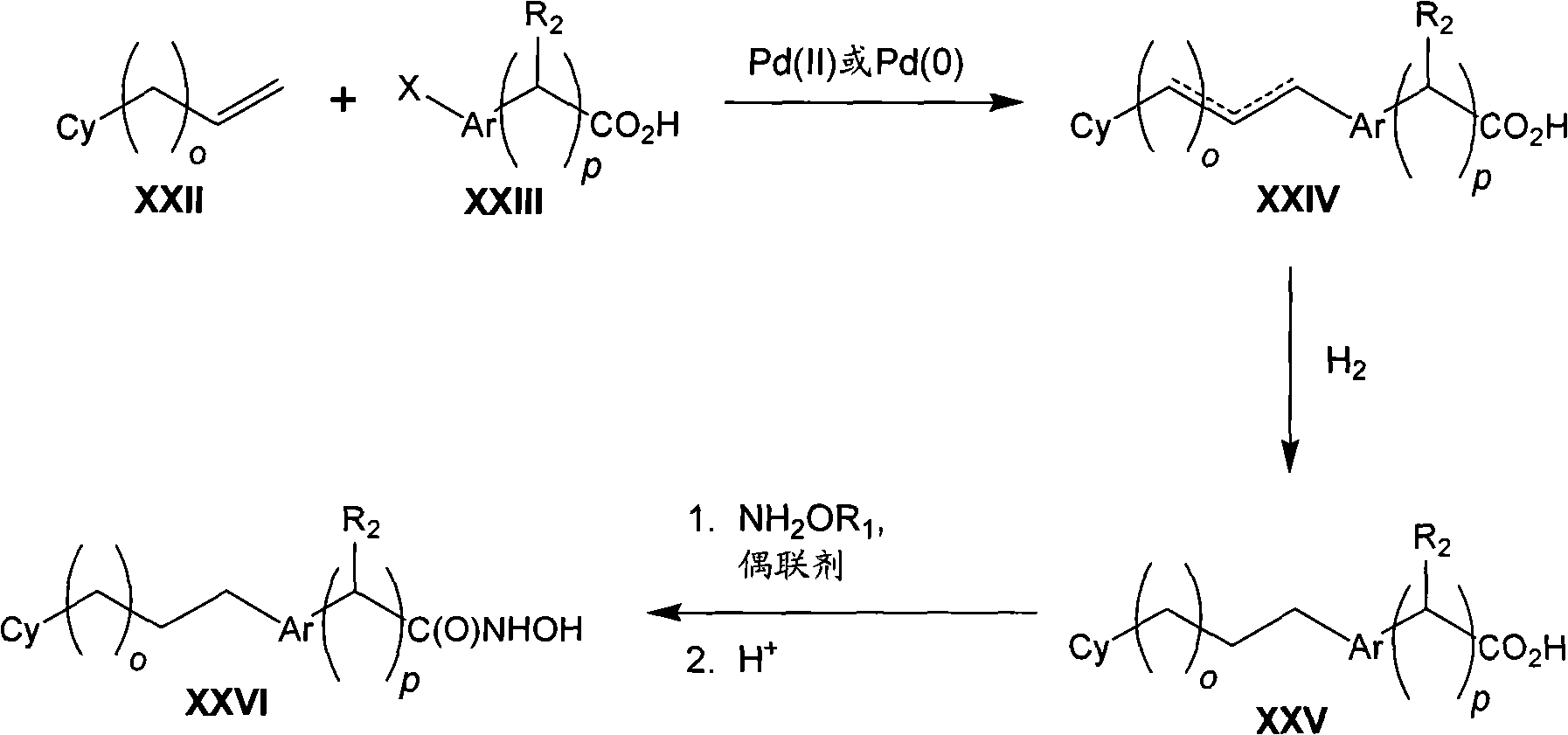
Compound (the L of formula XXVI
2=-(CH
2)
O+2-) preferably prepare by the general step of in scheme 4 and 5, describing.Therefore, in some embodiments, terminal olefine (XXII) palladium source such as acid chloride or three (dibenzalacetone) two palladiums (0), phosphine such as triphenyl phosphine and the alkali of catalytic amount such as triethylamine in the presence of solvent such as acetonitrile in aryl halide (XXIII) coupling, obtain coupled product XXIV.As mentioned above, hydrogenation is carried out the N-oxyamide afterwards and is formed and acidolysis, obtains hydroxamic acid XXVI.
Scheme 5
Alternatively, in some other embodiments, formula XXVII De phosphonium salt is handled with the aryl aldehyde of formula XXVIII in such as tetrahydrofuran (THF) at solvent at alkali such as hexamethyl two silica-based amido lithiums (lithium hexamethyldisilazide), produces compounds X XIV.Hydrogenation is carried out the N-oxyamide afterwards and is formed and acidolysis, then produces compounds X XVI.
Scheme 6
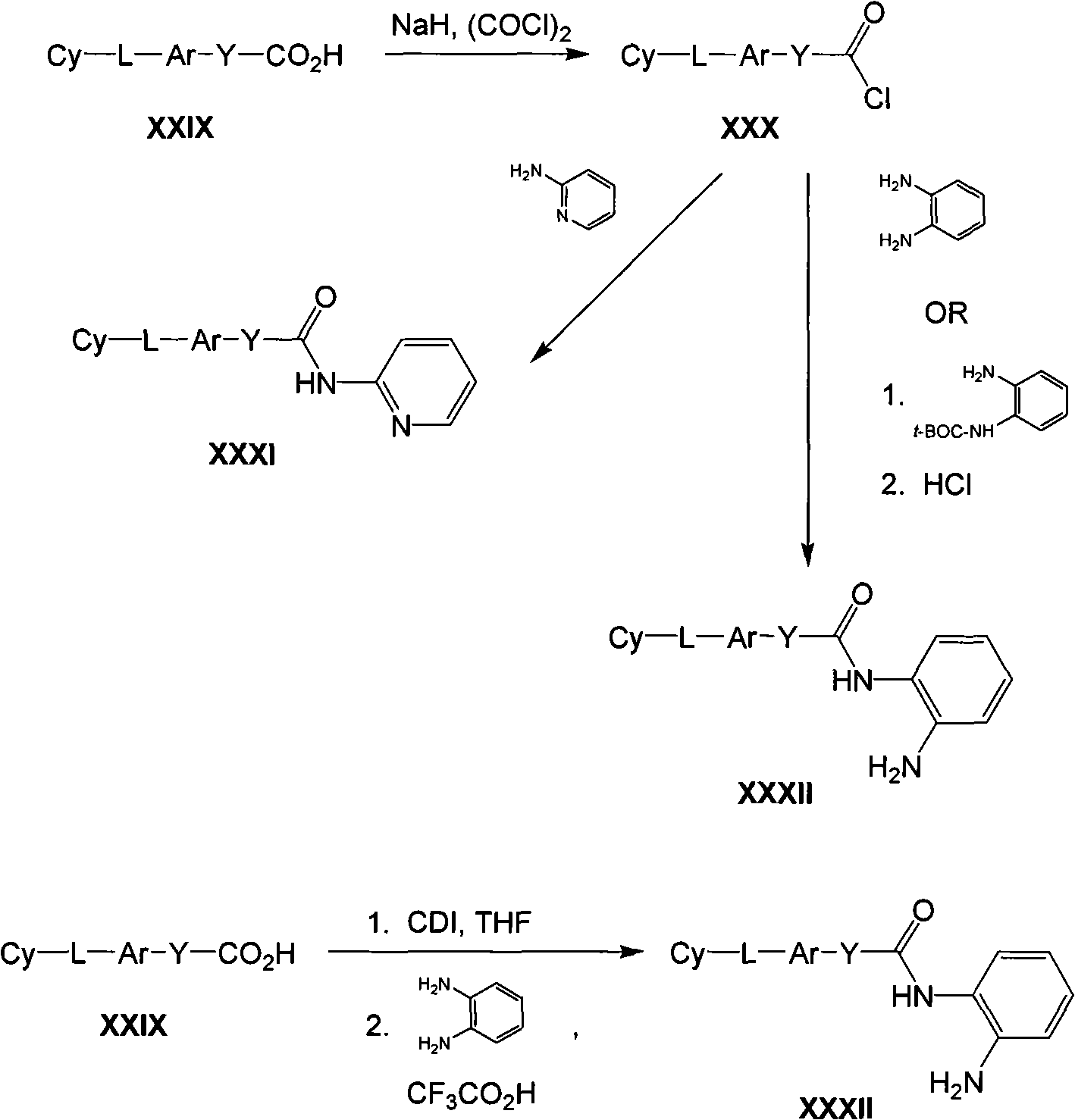
The compound of formula Cy-L-Ar-Y-C (O)-NH-Z, wherein L is L
1Or L
2, Y is Y
1Or Y
2, and Z is anilino or pyridyl, preferably according to the route of synthesis preparation of general introduction in scheme 6.The acid (XXIX) of formula Cy-L-Ar-Y-C (O)-OH by the preparation of one of method of showing among the scheme 1-5 according to standard method for example by being converted into corresponding acyl chlorides XXX with sodium hydride and oxalyl chloride processing.Utilize 2-aminopyridine and tertiary base (tertiary base) such as N-methylmorpholine preferably in methylene dichloride, to handle XXX at low temperatures, then obtain pyridyl acid amides XXXI.In a similar fashion, can be with 1, the 2-phenylenediamine is handled chloride of acid XXX, obtains anilino acid amides XXXII.Alternatively, can use 1 of single protection, 2-phenylenediamine such as 2-(t-BOC-amino) aniline is handled chloride of acid XXX, and deprotection obtains XXXII afterwards.
In another optional step, sour XXIX can activate by handling with carbonyl dimidazoles (CDI), uses 1 afterwards, and 2-phenylenediamine and trifluoroacetic acid are handled, and obtain anilino acid amides XXXII.
Scheme 7

Compound (the L of formula XXXVIII
2=-C (O)-alkylidene group-) preferably prepare according to the general step described in the scheme 7.Therefore, ketone XXXIII (R
1=H or alkyl) obtain adducts XXXV with the aldol condensation of aldehyde XXXIV.Adducts XXXV can be converted into corresponding hydroxamic acid XXXVI, and perhaps volume can at first experience hydrogenation and is converted into hydroxamic acid XXXVIII then to obtain saturated compound XXVII.
Scheme 8

Formula Cy-L
2-Ar-Y
2The compound of-C (O)-NH-O-H, wherein L
2In a carbon atom by S, S (O) or S (O)
2Replace, preferably the general step according to general introduction in the scheme 8 prepares.Therefore, mercaptan XXXIX is added among the alkene XL and produces XLI.Reaction preferably radical initiator such as 2,2 '-Diisopropyl azodicarboxylate (AIBN) or 1,1 '-azo two (cyclohexanenitrile) (VAZO
TM) carry out under existing.Sulfide oxidation preferably by handling with metachloroperbenzoic acid (mCPBA), obtains corresponding sulfone, and it is being separated after being converted into methyl esters with the diazomethane processing easily.The ester hydrolysis obtains sour XLII then, and it is converted into hydroxamic acid XLIII according to above-mentioned arbitrary steps.Sulfide XLI also can be converted into corresponding hydroxamic acid XLIV, and it then can be by for example handling with hydrogen peroxide and tellurium dioxide and being oxidized to sulfoxide by selectivity.
Alternatively, Cy-L
2-Ar-Y
2The compound of-C (O)-NH-O-H can be according to scheme 9 preparations.In scheme 9, halogenated aryl acetate XLVI is for example esterified by handling in the presence of alcohol such as methyl alcohol with the HCl in the dioxane, obtains acetic ester XLVII.Acetic ester XLVII and alkynes XLVIII and for example (Ph
3P)
4Pd carries out the palladium coupling in the presence of CuI in DME and diethylamine, produce XLVIX, and it is subsequently at H
2For example in methyl alcohol, be reduced under the Pd/C, obtain XLVX.Carry out the N-oxyamide as mentioned above and form and acidolysis, produce XLVXI.
Scheme 9
The compound of formula (1)-(3) can be as being prepared described in scheme 10.XLVXI such as EDC in DMF and HOBt, handles with amino acid XLVXII under the standard peptide coupling condition, obtains protected ethanamide XLVXIII, and it produces prodrug XLVXIV subsequently by deprotection.
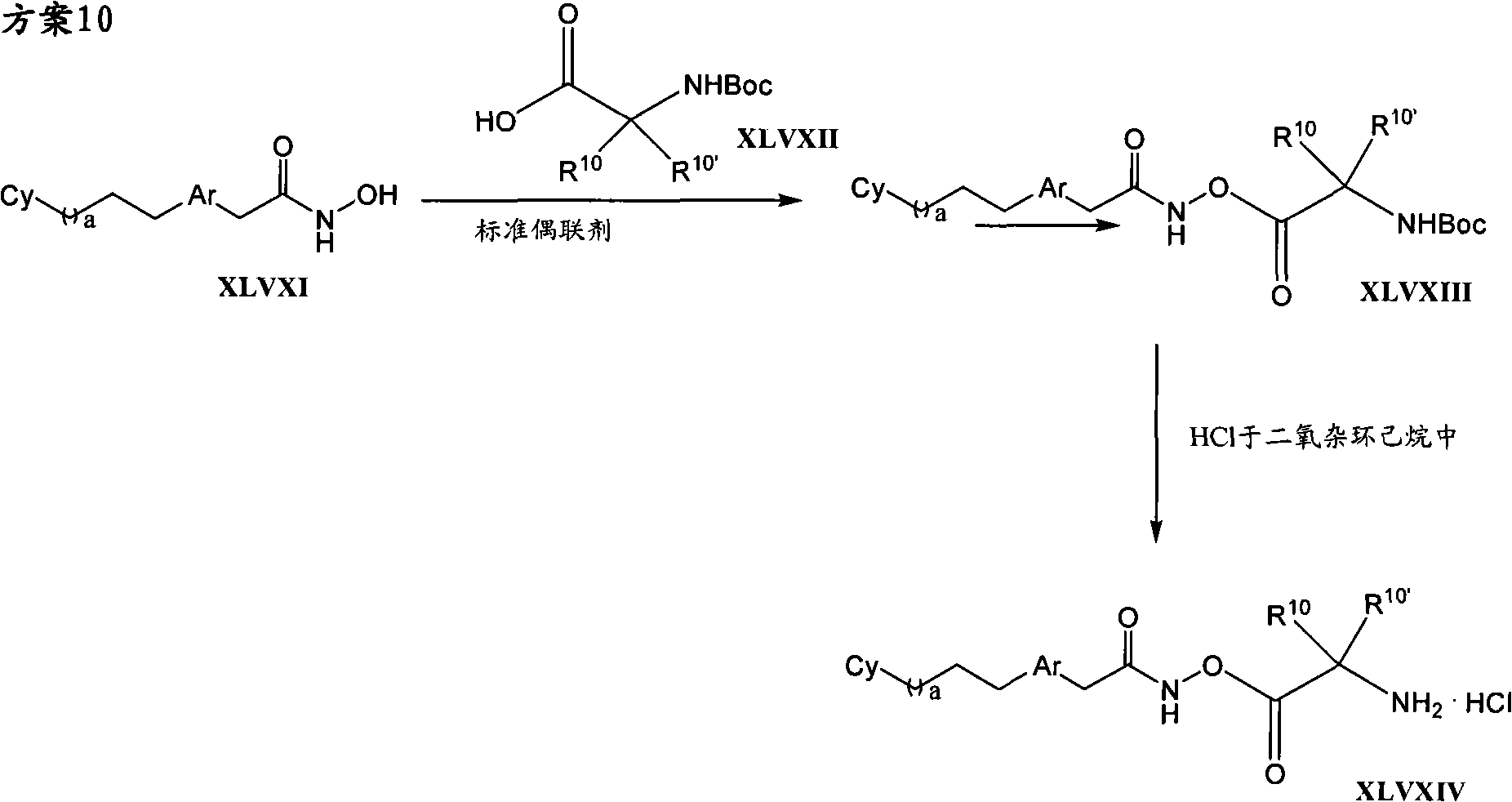
The compound of other formula (1)-(3) can be by those method preparations well known to those skilled in the art.The example of these class methods is found in U.S. Patent number 4,443,435; 6,407,235; 6,545,131; 6,855,702; 7,115,573; Application No. US 2002-0142955, US 2004-0019017, US 2005-0137141, US 2006-0135594, US2006-0166903 and international publication WO 2005/097747, all these incorporate this paper into by reference.
Pharmaceutical composition
In second aspect, the invention provides pharmaceutical composition, it comprises prodrug and pharmaceutically useful carrier, vehicle or thinner by the histone deacetylase inhibitor of formula (1)-(3) any expression.Compound of the present invention (no matter being prodrug or hydrolysate) or its composition can be by any method preparations well known in the art, and can be produced and be used to provide any approach to use, it includes but not limited to parenteral, per os, hypogloeeis, in skin, part, nose, in the tracheae or internal rectum use.In some preferred implementations, compound of the present invention (no matter being prodrug or hydrolysate) or its composition are used by intravenously in hospital device.In some other preferred implementations, use preferably by oral route.
The carrier feature will depend on route of administration.As used herein, term " pharmaceutically useful " is meant non-toxicant, itself and biosystem such as cell, cell culture, tissue or biocompatible, and its bioactive validity of interferon activity composition (one or more) not.Therefore, according to composition of the present invention, except that inhibitor, can contain thinner, filler, salt, buffer reagent, stablizer, expanding material and other material well known in the art.The preparation of pharmaceutically useful preparation is described in for example Remington ' s Pharmaceutical Sciences, 18th Edition, ed.A.Gennaro, Mack Publishing Co., Easton, PA, 1990.
Histone deacetylase inhibitor
In the third aspect, the invention provides the method that suppresses histone deacetylase in the cell, comprise making expectation carry out the histone deacetylase inhibitor prodrug of the arbitrary formula of cells contacting (1)-(3) of histone deacetylase inhibition.
The measurement of the enzymic activity of histone deacetylase can utilize known method to obtain.For example, Yoshida etc., J.Biol.Chem., 265:17174-17179 (1990) have described by detecting acetylated histones in the cell that drips mycin A processing in system and have estimated the histone deacetylase enzymic activity.Taunton etc., Science, 272:408-411 (1996) similarly must describe the method for utilizing endogenous and reorganization HDAC-1 to measure the histone deacetylase enzymic activity.Therefore these two pieces of reference are incorporated herein by reference with its integral body.
Some preferred embodiment in, all histone deacetylases in histone deacetylase inhibitor and the cell interact and also reduce its activity.In according to the present invention's some other preferred implementations aspect this, non-all histone deacetylases interact and reduce its activity in histone deacetylase inhibitor and the cell.In some preferred implementations, described inhibitor and a kind of histone deacetylase (for example HDAC-1) interact and reduce its activity, but do not interact and reduce its activity with other histone deacetylase (for example, HDAC-2, HDAC-3, HDAC-4, HDAC-5, HDAC-6, HDAC-7, HDAC-8, HDAC-9, HDAC-10 and HDAC-11).As discussed below, some particularly preferred histone deacetylase inhibitors are those and the histone deacetylase inhibitor that participates in tumorigenic histone deacetylase interaction and reduce its enzymic activity.Some other preferred histone deacetylase inhibitors and fungi histone deacetylase interact and reduce its enzymic activity.
Preferably, the method according to third aspect present invention causes suppressing the cell proliferation of exposing cell.Phrase " inhibition cell proliferation " is used to represent to compare with the cell that does not contact the ability that cell that the histone deacetylase inhibitor retardance contacts with inhibitor is grown.The evaluation of on cell proliferation can be by utilizing Coulter cell counter (Coulter Cell Counter (Coulter, Miami, FL)) or the cell of hematimeter or the contact of proper method well known by persons skilled in the art (it can depend on the cell type that is counted) counting carry out with the cell that does not contact.When cell is in entity growth (for example, solid tumor or organ), this type of cell proliferation evaluation can by utilize calipers measure growth and relatively exposing cell carry out with the growth size of exposing cell not.
Preferably, the growth of the cell that contacts with the prodrug of inhibitor and the growth phase of exposing cell not are than blocked at least 50%.More preferably, cell proliferation is suppressed (that is, the quantity of exposing cell does not increase) by 100%.Most preferably, phrase " inhibition cell proliferation " comprises with exposing cell not to be compared, and exposing cell reduces on quantity or size.Therefore, can induce exposing cell experience growth retardation, experience cessation of growth cessation, experience apoptosis (that is, apoptose) or experience necrosis (necroticcell death) according to cracking (for example hydrolysis) product of the prodrug of the histone deacetylase inhibitor of the cell proliferation in the inhibition exposing cell of the present invention.
The feasible not enough synchronizations of grown cell group energy simultaneously of the cell tissue inhibition ability of histone deacetylase inhibitor of the present invention.For example, the hydrolysate of the prodrug of histone deacetylase inhibitor of the present invention can be used to stop the G1 of cell cycle or the non-neoplastic cell group of G2 phase growth in vitro.This type of synchronization for example makes it possible to gene and/or the gene product that the G1 that identifies in the cell cycle or G2 express during mutually.This of culturing cell kind of synchronization also can be used to test the effectiveness of new transfection scheme, and wherein transfection efficiency changes and depends on the specific cells cycle for the treatment of transfected cell.The application of the prodrug of histone deacetylase inhibitor of the present invention allows the synchronization cell group, thereby helps to detect the transfection efficiency of raising.
Some preferred embodiment in, exposing cell is a neoplastic cell.Term " neoplastic cell " is used to represent the cell of display abnormality cell growth.Preferably, the abnormal cell growth of neoplastic cell is the enhanced cell growth.Neoplastic cell can be a proliferative cell, a kind of cell that lacks the growth in vitro contact inhibition that demonstrates; Benign tumor cells, it can not shift in vivo; Or cancer cells, it can carry out shifting in the body and it can recur after the removal of trial property.Term " tumour generation " is used to represent to cause the cell proliferation inducing action of tumorigenesis development.In some embodiments, the cleaved products of histone deacetylase inhibitor prodrug of the present invention inducing cell differentiation in exposing cell.Therefore, neoplastic cell can be induced differentiation when contacting with the prodrug of histone deacetylase inhibitor of the present invention, cause producing daughter cell, and it is existing kind to be more high in the growth than exposing cell.In some other preferred implementations, exposing cell is the fungal cell.
Some preferred embodiment in, exposing cell is an animal.Therefore, the invention provides the method for the cell breeding disease that is used for the treatment of animal or illness or treatment fungi infestation, comprise prodrug to the histone deacetylase inhibitor of the present invention of the animal administering therapeutic significant quantity of this type of treatment of needs.Preferably, animal is a Mammals, more preferably domestic Mammals.Most preferably, animal is behaved.
It is any illness of feature that term " cell breeding disease or illness " means by the preferred unusual enhanced cell propagation of abnormal cell growth.The example of this type of cell breeding disease or illness includes but not limited to cancer, restenosis and psoriatic.In particularly preferred embodiments, the invention provides suppress neoplastic cell propagation in the animal method, comprise the prodrug of the histone deacetylase inhibitor of the present invention that has the animal administering therapeutic significant quantity that at least a neoplastic cell exists in the Xiang Qiti.
Some cleaved products of prodrug of the present invention have the activity of inhibition to the histone deacetylase from the protozoon source and are taken into account.Therefore, the present invention also provides the method for treatment or prevention protozoan disease or infection, comprises the prodrug to the histone deacetylase inhibitor of the present invention of the animal administering therapeutic significant quantity of this type of treatment of needs.Preferably, described animal is a Mammals, more preferably is the people.Preferably, the degree that the histone deacetylase inhibitor that uses according to this kind embodiment of the present invention suppresses protozoic histone deacetylase suppresses mammiferous histone deacetylase greater than it, particularly the degree of human histone deacetylase.
The present invention further provides the method for treatment fungal disease or infection, comprise the prodrug for the treatment of the histone deacetylase inhibitor of the present invention of significant quantity to the administration of this type of treatment of needs, preferably, described animal is a Mammals, more preferably is the people.Preferably, the degree that the histone deacetylase inhibitor that uses according to this kind embodiment of the present invention suppresses the histone deacetylase of fungi suppresses mammiferous histone deacetylase greater than it, particularly the degree of human histone deacetylase.
Term " treatment significant quantity " is meant that expression is enough to cause to suppress the active dosage of histone deacetylase in the object cell, perhaps is enough to suppress the cell proliferation in the object or the dosage of inducing cell differentiation.Using can be by any approach, includes but not limited to parenteral, per os, hypogloeeis, in skin, part, nose, in the tracheae or internal rectum.In some particularly preferred embodiments, prodrug of the present invention is used through intravenously in the device of hospital.In some other preferred implementations, using preferably can by oral route.
When systemic administration, the prodrug of histone deacetylase inhibitor preferably uses with enough dosage, to reach following blood inhibitor content: from about 0.01 μ M to about 100 μ M, more preferably from about 0.05 μ M to about 50 μ M, still more preferably from about 0.1 μ M to about 25 μ M, and also more preferably from about 0.5 μ M to about 25 μ M.For topical application, the concentration more much lower than this content can be effectively, and much higher concentration can be tolerance.It will be appreciated by those skilled in the art that producing the essential histone deacetylase inhibitor dosage of result of treatment can change considerably, this depends on waits the tissue, organ or specific animal or the patient that are treated.
In some preferred implementations of third aspect present invention, described method further comprises the antisense oligonucleotide that cells contacting inhibition of histone deacetylase is expressed.The nucleic acid content inhibitor (promptly, antisense oligonucleotide) with the protein content inhibitor (promptly, the histone deacetylase inhibitor enzymic activity) combined utilization causes improved inhibition effect, thereby essential amount is compared to have reduced and obtained the required inhibition dosage of specific inhibition effect when using separately with any.According to the present invention's antisense oligonucleotide in this respect, when relating to Mammals HDAC, with RNA or the complementation of double-stranded DNA district of coding HDAC-1, HDAC-2, HDAC-3, HDAC-4, HDAC-5, HDAC-6, HDAC7, HDAC-8, HDAC-9, HDAC-10 and/or HDAC-11.
For the purposes of the present invention, term " oligonucleotide " comprise two kinds or above dezyribonucleoside, ribonucleoside or '-polymkeric substance of the ribonucleoside residue that O-replaces, or its arbitrary combination.Preferably, this class oligonucleotide has about 6 to about 100 nucleosides residues, and more preferably about 8 to about 50 nucleosides residues, and most preferably about 12 to about 30 nucleosides residues.Nucleosides is residual by any coupling each other in the key (internucleoside linkages) between multiple known nucleosides.Key includes, without being limited to key between thiophosphatephosphorothioate, phosphorodithioate, phosphonate ester, alkyl thio-phosphonate, phosphotriester, phosphoramidate, siloxanes, carbonic ether, carboxyl ester, ethanamide ester (acetamidate), carbamate, thioether, bridging phosphoramidate, bridging methene phosphonate ester, bridging thiophosphatephosphorothioate and sulfone nucleosides between this type of nucleosides.In some preferred implementations, key can be phosphodiester, phosphotriester, thiophosphatephosphorothioate or phosphoramidic acid ester bond between these nucleosides, or their combination.The term oligonucleotide also comprises alkali or the sugar with chemically modified and/or has other substituent this base polymer, includes, without being limited to lipophilic group, intercalating agent, diamines and amantadine.For the purposes of the present invention, term " 2 '-the O-replacement " be meant that 2 ' position of pentose part is with containing 1-6 saturated or unsaturated carbon atom-O-low alkyl group replacement, perhaps with have 2-6 carbon atom-O-aryl or allyl group replace, wherein this type of alkyl, aryl or allyl group can be unsubstituted maybe can be with for example halogen, hydroxyl, trifluoromethyl, cyano group, nitro, acyl group, acyloxy, alkoxyl group, carboxyl, carbalkoxy or amino replacement; Perhaps this type of 2 ' replace and can utilize hydroxyl (to produce ribonucleoside), amino or halogen group to carry out, but can not utilize 2 '-the H group carries out.Term " oligonucleotide " also comprises connection nucleic acid and peptide nucleic acid(PNA).
Of the present invention in this respect in particularly preferred antisense oligonucleotide comprise chimeric oligonucleotide and hybridization oligonucleotide.
For the purposes of the present invention, " chimeric oligonucleotide " is meant the oligonucleotide of key between the nucleosides with more than one types.A preferred embodiment of this kind chimeric oligonucleotide is the chimeric oligonucleotide that comprises thiophosphatephosphorothioate, phosphodiester or phosphorodithioate zone, it preferably comprises about 2 to about 12 Nucleotide and phosphonate ester or alkyl thio-phosphonate zone (referring to for example, U.S. Patent numbers such as Pederson 5,635,377 and 5,366,878).Preferably, this type of chimeric oligonucleotide contains key between at least three successive nucleosides that are selected from phosphodiester and sulphur phosphinylidyne key or its combination.
For the purposes of the present invention, " hybridization oligonucleotide " is meant the oligonucleotide of the nucleosides with more than one types.A preferred embodiment of this type of hybridization oligonucleotide comprise ribonucleotide or 2 '-ribonucleoside acid region that O-replaces, its preferably include about 2 to about 12 2 '-O-substituted nucleotide and dna region territory.Preferably, this type of hybridization oligonucleotide will contain at least three dezyribonucleosides and also will contain ribonucleoside, 2 '-ribonucleoside or its combination (referring to for example Metelev and Agrawal, U.S. Patent number 5,652,355) that O-replaces.
The definite nucleotide sequence and the chemical structure of used in the present invention antisense oligonucleotide can change, as long as this oligonucleotide keeps it to suppress the ability that gene of interest is expressed.This tests specific antisense oligonucleotide by the mRNA by quantitative encoding gene product in following analysis and whether has activity and easily measured: at the western blot analysis of gene product, perhaps at the activation analysis of enzymic activity gene product, perhaps soft agar growth analysis, perhaps reporter gene (reporter gene) construction analysis, perhaps tumor growth in vivo analysis, all these are described in detail in this manual or in (1997) Proc.Natl.Acad.Sci.USA94:684-689 such as Ramchandani.
Used in the present invention antisense oligonucleotide can utilize the chemical process of knowing synthetic easily on suitable solid carrier, described chemical process comprises H-phosphonic acid ester (H-phosphonate) chemistry, phosphoramidite is chemical or the combination (be to be H-phosphonic acid ester chemistry in some cycles, other cycle is the phosphoramidite chemistry) of H-phosphonic acid ester chemistry and phosphoramidite chemistry.Suitable solid carrier comprises and is used for solid phase oligonucleotide synthetic arbitrary standards solid carrier, such as controlled pore glass (CPG) (referring to for example Pon, R.T. (1993) Methods in Molec.Biol.
20: 465-496).
Especially, preferred oligonucleotide has about 13 nucleotide sequences to about 35 Nucleotide, and it comprises the nucleotide sequence that is shown in table 1-3.How particularly preferred oligonucleotide has about 15 nucleotide sequences to about 26 Nucleotide shown in the table 1-3.
Table 1
| ??SEQ?ID?NO. | Sequence | Target ( **) |
| ??1 | ??5′-GAG?ACA?GCA?GCA?CCA?GCG?GG-3′ | ??17-36 |
| ??2 | ??5′-ATG?ACC?GAG?TGG?GAG?ACA?GC-3′ | ??21-49 |
| ??3 | ??5′-GGA?TGA?CCG?AGT?GGG?AGA?CA-3′ | ??31-50 |
| ??4 | ??5′-CAG?GAT?GAC?CGA?GTG?GGA?GA-3′ | ??33-52 |
| ??5 | ??5′-TGT?GTT?CTC?AGG?ATG?ACC?GA-3′ | ??41-60 |
| ??6 | ??5′-GAG?TGA?CAG?AGA?CGC?TCA?GG-3′ | ??62-81 |
| ??7 | ??5′-TTC?TGG?CTT?CTC?CTC?CTT?GG-3′ | ??1504-1523 |
| ??8 | ??5′-CTT?GAC?CTC?CTC?CTT?GAC?CC-3′ | ??1531-1550 |
| ??9 | ??5′-GGA?AGC?CAG?AGC?TGG?AGA?GG-3′ | ??1565-1584 |
| ??10 | ??5′-GAA?ACG?TGA?GGG?ACT?CAG?CA-3′ | ??1585-1604 |
| ??11 | ??5′-CCG?TCG?TAG?TAG?TAA?CAG?ACT?TT-3′ | ??138-160 |
| ??12 | ??5′-TGT?CCA?TAA?TAG?TAA?TTT?CCA?A-3′ | ??166-187 |
| ??13 | ??5′-CAG?CAA?ATT?ATG?AGT?CAT?GCG?GAT?TC-3′ | ??211-236 |
(
*) the target Ref. No. is according to HDAC-1, GenBank accession number U50079.
Table 2
| ??SEQ?ID?NO. | Sequence | Target ( ***) |
| ??14 | ??5′-CTC?CTT?GAC?TGT?ACG?CCA?TG-3′ | ??1-20 |
| ??15 | ??5′-TGC?TGC?TGC?TGC?TGC?TGC?CG-3′ | ??121-141 |
| ??16 | ??5′-CCT?CCT?GCT?GCT?GCT?GCT?GC-3′ | ??132-152 |
| ??17 | ??5′-CCG?TCG?TAG?TAG?TAG?CAG?ACT?TT-3′ | ??138-160 |
| ??18 | ??5′-TGT?CCA?TAA?TAA?TAA?TTT?CCA?A-3′ | ??166-187 |
| ??19 | ??5′-CAG?CAA?GTT?ATG?GGT?CAT?GCG?GAT?TC-3′ | ??211-236 |
| ??20 | ??5′-GGT?TCC?TTT?GGT?ATC?TGT?TT-3′ | ??1605-1625 |
(
* *) the target Ref. No. is according to HDAC-2, GenBank accession number U31814.
Table 3
| ??SEQ?ID?NO. | Sequence | Target ( ***) |
| ??21 | ??5′-GCT?GCC?TGC?CGT?GCC?CAC?CC-3′ | ??514-533 |
(
* *) the target Ref. No. is according to HDAC-4.
Following embodiment is intended to further set forth preferred implementations more of the present invention, and is not that intention limits the scope of the invention.
Embodiment
The preparation of amine
3-aminophenyl methyl acetate (1)

In room temperature to 3-aminophenyl acetate (3g, methyl alcohol 19.85mmol) (50mL) solution add dense HCl (37%, 7.5mL).Mixture was used NaHCO in 6 hours then in stirring at room
3Saturated aqueous solution is handled.Decompression removes solvent, water CH then
2Cl
2Extracted several times.The organic extract that merges is through (MgSO
4) dry and evaporation.Crude mixture is utilized hexane/AcOEt (1: 1) purifying by flash chromatography, produces yellow oil 1 (3.06g, 79%).
1H?NMR:(300MHz,CDCl
3):δ7.10(t,J=8Hz,1H),6.68-6.58(m,3H),3.69-3.65(m,5H),3.53(s,2H)。
4-aminophenyl methyl benzoate (2)

In room temperature to the 4-benzaminic acid (10g, methyl alcohol 72.92mmol) (200mL) solution add dense HCl (37%, 25mL).At 70 ℃ with the solution mixture heated overnight.In case solution clarification (finishing) will be reacted and be used NaHCO
3Saturated aqueous solution and Na
2CO
3Powder is handled, until pH 9.Evaporating solvent under the decompression, and water AcOEt extracted several times then.The organic extract that merges is through (MgSO
4) dry and evaporation.Obtain crude product 2 (9.30g 85%), be light brown solid, it is enough pure, need not to be further purified and uses.
1H NMR:(300MHz, CDCl
3): δ 7.85 (d, J=8Hz, 2H), 6.63 (d, J=8Hz, 2H), 4.04 (s.2H wide), 3.85 (s.3H).

4-aminophenyl methyl acetate (3)
(10g, methyl alcohol 66.2mmol) (150mL) solution adds dense HCl (37%25mL) to 4-aminophenyl acetate in room temperature.Mixture becomes yellow and stirs and spend the night.Reaction mixture is used NaHCO then
3The saturated aqueous solution quencher.Decompression is evaporation methyl alcohol down, water layer AcOEt extracted several times.The organic extract that merges is through (MgSO
4) dry and evaporation.Rough residue utilizes hexane/AcOEt (4: 1) to carry out purifying as solvent mixture by flash chromatography, produces yellow oil 3 (9.44g, 74%).
1H NMR:(300MHz, CDCl
3): δ 7.05 (d, J=10Hz, 2H), 6.65 (d, J=10Hz, 2H), 3.65 (s, 3H), 3.63 (wide s, 2H), 3.51 (s, 2H).
Embodiment 1:
2-[4-benzo [b] thiophene-2-sulfonamido)-phenyl]-N-hydroxyl-ethanamide (4)

Step 1:2-[4-benzo [b] thiophene-2-sulfonamido)-phenyl]-methyl acetate (5)

In room temperature to 3 (500mg, CH 2.56mmol)
2Cl
2(8mL) solution adds Et
3N (712 μ μ L, 5.12mmol), add afterwards 2-thionaphthene SULPHURYL CHLORIDE (712mg, 3.07mmol).Mixture in stirred overnight at room temperature, is used NaHCO then
3The saturated aqueous solution quencher.Separate phase, water layer CH
2Cl
2Extracted several times.The organic extract that merges is through (MgSO
4) dry and evaporation.With the mixture of monoalkylation and two alkylates be dissolved in methyl alcohol (~8mL) in and add NaOMe (691mg, 12.8mmol).60 ℃ with the mixture heating up that obtains 30 minutes, add HCl 1N, up to pH 2.Add NaHCO then
3Saturated aqueous solution is until pH 7-8.Decompression is evaporating solvent, water layer CH then down
2Cl
2Extracted several times.The organic extract that merges is through (MgSO
4) dry and evaporation.Resistates utilizes toluene/AcOEt7 by flash chromatography: 3 utilize CH as solvent mixture and by second flash chromatography
2Cl
2/ acetone 98: 2 carries out purifying as solvent, produces yellow powder shape title compound 5 (487mg, 53%).
1H NMR:(300MHz, CDCl
3): δ 7.80 (d, J=8Hz, 2H), 7.75 (s, 1H), 7.44 (m, 2H), 7.14 (m, 4H), 6.79 (wide s, 1H) 3.67 (s, 3H), 3.56 (s, 2H).
Step 2:2-[4-benzo [b] thiophene-2-sulfonamido)-phenyl]-acetate (6)
In room temperature to from step 15 (451mg is 1.25mmol) at THF (20mL) and H
2Solution adding LiOH in O (20mL) solvent mixture (524mg, 12.5mmol).Mixture stirring at room 2 hours, is used NH then
4The Cl saturated aqueous solution is handled.The solution that obtains AcOEt extracted several times.The organic extract that merges is through (MgSO
4) drying.Rough residue utilizes CH by flash chromatography then
2Cl
2/ MeOH (9: 1) carries out purifying as solvent mixture, is produced as the title compound 6 (404mg, 93%) of white solid.
1H?NMR:(300MHz,DMSO-d
6):δ8.03(d,J=8Hz,1H),7.97(d,J=7Hz,1H),7.92(s,1H),7.50--7.45(m,2H),7.13-7.06(m,4H),3.44(s,2H)。
Step 3:2-[4-benzo [b] thiophene-2-sulfonamido)-phenyl]-N-hydroxyl-ethanamide (4)
Method A:
(150mg is 0.432mmol) at CH to 6 in room temperature
2Cl
2(10mL) and the solution in THF (5mL) solvent mixture add 1, the 3-dicyclohexylcarbodiimide (DCC, 116mg, 0.563mmol).In stirring at room reaction mixture 30 minutes, add NH then
2OTHP (76mg, 0.650mmol) and Dimethylamino pyridine (DMAP, 5mg).Spend the night and the vapourisation under reduced pressure solvent at stirring at room solution.Thick material utilizes CH by flash chromatography
2Cl
2/ MeOH (9: 1) carries out purifying as solvent.With residue be dissolved in MeOH (~10mL) in and add the 10-camphorsulfonic acid (CSA, 100mg, 0.432mmol).In the stirring at room mixture overnight, use NaHCO then
3Saturated aqueous solution is handled.Decompression is evaporating solvent down, water CH
2Cl
2(3X) and AcOEt (3X) extracted several times.The organic extract that merges is through (MgSO
4) dry and evaporation.Crude product utilizes water/CH by the preparation high pressure liquid chromatography on reverse phase silica gel
3CN gradient (10-65%) is carried out purifying, is produced as the title compound 4 (70mg, 45%) of yellow solid.
1H?NMR(300MHz,CD
3OD):δ7.92-7.88(m,2H),7.80(s,1H),7.50-7.45(m,2H),7.23-7.16(m,4H)3.35(s,2H)。
Except that part is described in addition, following compound prepares by the step that is similar to those steps of describing among the embodiment 1, but with the 2-thionaphthene SULPHURYL CHLORIDE in the specified SULPHURYL CHLORIDE replacement step 1.
Embodiment 2:
2-[4-(2-nitrobenzene sulfonyl ammonia base)-phenyl]-N-hydroxyl-ethanamide (7)
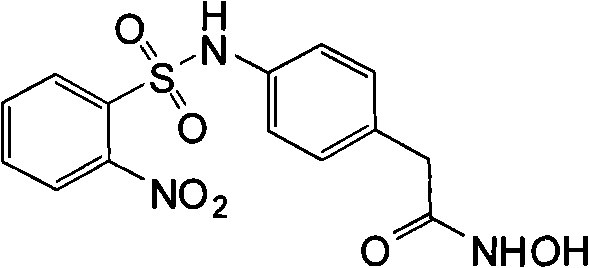
SULPHURYL CHLORIDE: 2-nitrobenzene sulfonyl chloride
Yield: step 1:82%
Yield: step 2:99%
Yield: step 3:19%
1H?NMR(300MHz,DMSO-d
6);δ10.59(s,1H);8.78(s,1H);7.94(s,2H),7.81(s,2H),7.20-7.02(m,4H);3.13(s,2H)。
Embodiment 3:
2-[4-(2.5-dichlorobenzene sulfonamido)-phenyl]-N-hydroxyl-ethanamide (8)

SULPHURYL CHLORIDE: 2.5-two chloro phenylsulfonyl chloride
Yield: step 1:66%
Yield: step 2:96%
Yield: step 3:66%
1H?NMR(300MHz,DMSO-d
6);δ10.68(s,1H),8.88(s,1H),7.95(s,1H),7.67(s,2H);7.13(d,2H,J=8Hz),7.02(d,2H,J=8Hz),3.16(s,2H)。
Embodiment 4:
2-[4-(4-Methyl benzenesulfonyl amino)-phenyl]-N-hydroxyl-ethanamide (9)

SULPHURYL CHLORIDE: 4-Methyl benzenesulfonyl chlorine
Step 1: yield 100%
Step 2:2-[4-(4-Methyl benzenesulfonyl amino)-phenyl]-N-hydroxyl-ethanamide (9)
Method B:
In room temperature to methyl-2-[4-(4-Methyl benzenesulfonyl amino)] the phenylacetic acid ester (and 459mg, add in methyl alcohol 1.44mmol) (10mL) solution oxammonium hydrochloride (200mg, 2.88mmol) add afterwards sodium methylate (389mg, 7.19mmol).The mixture that obtains uses HCl (1N) to handle up to pH 2 60 ℃ of heated overnight then.Decompression is evaporating solvent, water CH then down
2Cl
2Extracted several times.The organic extract that merges is through (MgSO
4) drying evaporates then.Crude mixture is utilized CH by flash chromatography
2Cl
2/ MeOH (9: 1) carries out purifying as solvent mixture, produces title compound 9 (244mg, 53%), is white powder.
1H NMR (300MHz, acetone-d
6); δ 7.68 (d, J=8Hz, 2H); 7.29 (d, J=8Hz, 2H), 7.15 (br.s, 4H), 3.33 (s, 2H, CH
2), 2.33 (s, 3H, CH
3).
Following compound prepares by the step that is similar to those steps of describing in embodiment 1 step 1 and embodiment 4 steps 2 (method B), but replaces 2-thionaphthene SULPHURYL CHLORIDE in the step 1 with specified SULPHURYL CHLORIDE.
Embodiment 5:
2-[4-(3-trifluoromethyl phenylsulfonamido)-phenyl]-N-hydroxyl acetamide (10)
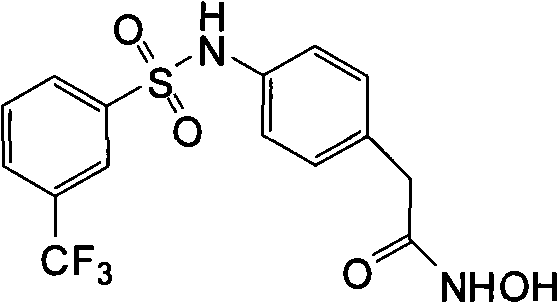
SULPHURYL CHLORIDE: 3-trifluoromethyl benzene sulfonyl chloride
Yield: step 1:70%
Yield: step 2:49%
1H NMR (300MHz, acetone-d
6); δ=8.09 (s, 1H), 8.05 (d, 1H, J=8Hz), 7.95 (d, 1H, J=8Hz); 7.77 (t, 1H, J=8Hz); 7.21 (d, 2H, J=8Hz), 7.13 (d, 2H, J=8Hz); 3.35 (s, 2H, CH
2).
Embodiment 6:
2-[4-(tertiary butyl sulfonamido)-phenyl]-N-hydroxyl-ethanamide (11)

SULPHURYL CHLORIDE: 4-tertiary butyl SULPHURYL CHLORIDE
Yield: step 1:76%
Yield: step 2:40%
1H NMR (300MHz, acetone-d
6); δ 7.75 (d, 2H, J=9Hz), 7.56 (d, 2H, J=9Hz); 7.17 (s, 4H); 3.34 (s, 2H), 1.29 (s, 9H)
Following compound prepares according to those steps that are similar to embodiment 1 step 1-2 description, with the 2-thionaphthene SULPHURYL CHLORIDE in the specified SULPHURYL CHLORIDE replacement step 1, utilizes method C to carry out hydroxamic acid afterwards and forms.
Embodiment 7:
2-[2-(naphthalene sulfonyl amino)-phenyl]-N-hydroxyl-ethanamide (12)
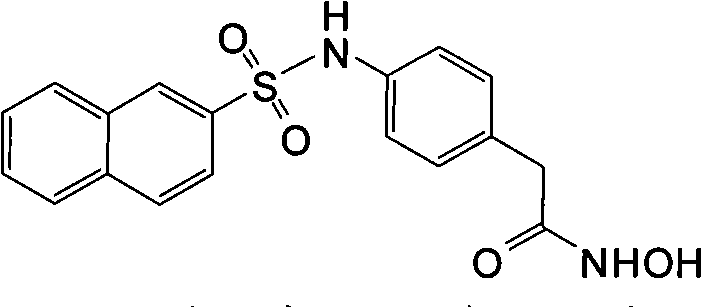
SULPHURYL CHLORIDE: 2-naphthalic sulfonic chloride
Yield: step 1:100%
Yield: step 2:100%
Step 3:2-[2-(naphthalene sulfonyl amino)-phenyl]-N-hydroxyl-ethanamide (12)
Method C:
In room temperature to 2-[2-(naphthalene sulfonyl amino)]-toluylic acid (191mg, CH .563mmol)
2Cl
2(20mL) solution adding DMF (1) is (COCl) afterwards
2(250 μ L, 2.81mmol).The mixture yellowing, and occur solidifying.In stirring at room reaction 90 minutes, add then (COCl)
2, up to no bubbling (~1mL).Vapourisation under reduced pressure solvent then.Rough thing is dissolved in CH
2Cl
2In and in this solution, add TMSONH
2(3mL).Reaction is heat release, and the mixture that obtains in stirring at room 2 hours uses HCl (1N) to handle up to pH 2 then.Separate phase and water layer CH
2Cl
2Extracted several times.The organic extract that merges is through (MgSO
4) drying evaporates then.Crude compound is utilized CH by flash chromatography
2Cl
2/ MeOH (9: 1) carries out purifying three times as solvent mixture, and the utilization of another time purifying prepares high pressure liquid chromatography and utilizes reverse-phase chromatography to make water/CH then
3The gradient of CN (10-70%) produces white powder title compound 12 (29mg, 15%).
1H NMR (300MHz, acetone-d
6); δ 9.13 (s, 1H), 8.42 (s, 1H), 8.08-7.97 (m, 3H), 7.82 (dd, 1H, J=9Hz, 1.5Hz), 7.70-7.63 (m, 2H), 7.21-7.14 (m, 4H), 3.50 (s, 2H).
Following compound prepares according to the step of those steps that are similar to embodiment 1 step 1-2 description, with the 2-thionaphthene SULPHURYL CHLORIDE and 3 in specified SULPHURYL CHLORIDE and the amine replacement step 1, utilizes method D to carry out hydroxamic acid afterwards and forms.
Embodiment 8:
The N-hydroxyl-[4-benzo [b] thiophene 2-sulfonamido)-phenyl]-benzamide (13)

SULPHURYL CHLORIDE: 2-thionaphthene SULPHURYL CHLORIDE
Amine: methyl-4-Aminobenzoate (2)
Yield: step 1:80%
Yield: step 2:69%
Step 3:N-hydroxyl-[4-benzo [b] thiophene 2-sulfonamido)-phenyl]-benzamide (13)
Method D:
In room temperature to 2-[4-benzo [b] thiophene-2-sulfonamido] phenylformic acid (300mg, .90mmol) DMF (20mL) solution adds 1-(3-dimethyl-aminopropyl)-3-ethyl-carbodiimide hydrochloride (EDC, 207mg, 1.08mmol) and I-hydroxybenzotriazole hydrate (HOBT, 182mg, 1.35mmol).With mixture stirring at room 20 minutes.Add NH then
2OTHP (158mg, 1.35mmol).The mixture that obtains is 50 ℃ of heating 24 hours, then stirring at room 24 hours.Decompression is evaporated the DMF solvent down and resistates is dissolved in CH
2Cl
2In, with salt solution or NaHCO
3Saturated aqueous solution washing.The organic extract that merges is through (MgSO
4) drying concentrates then.Crude compound is utilized CH by flash chromatography
2Cl
2/ MeOH (9: 1) carries out purifying as solvent mixture.Resistates is dissolved in the methyl alcohol (20mL) then, add then the 10-camphorsulfonic acid (CSA, 100mg .45mmol).With mixture stirring at room 2 hours, then under the room temperature decompression evaporating solvent to avoid pyrolysis.Rough thing utilizes CH by flash chromatography
2Cl
2/ MeOH (9: 1) carries out purifying as solvent mixture.Purifying utilization for the second time prepares high pressure liquid chromatography makes water/CH
3CN (10-85%) gradient is carried out as solvent, produces yellow solid shape title compound 13 (212mg, 68%).
1H NMR (300MHz, acetone-d
6); δ 10.69 (s, 1H), 9.70 (s, 1H); 8.01-7.97 (m, 3H), 7.77 (d, 2H, J=9Hz); 7.55-7.39 (m, 4H).
Embodiment 9:
2-[3-benzo [b] thiophene-2-sulfonamido)-and phenyl] N-hydroxyl-ethanamide (14)

SULPHURYL CHLORIDE: 2-thionaphthene SULPHURYL CHLORIDE
Amine: methyl-3-aminophenyl acetic ester (1)
Yield: step 1:88%
Yield: step 2:89%
Yield: step 3:32%
1H NMR (300MHz, acetone d
6); δ 10.20 (s, 1H), 8.33 (s, 1H), 7.99-7.95 (m, 3H), 7.53-7.43 (m, 2H), 7.35 (s, 1H), 7.21-7.17 (m, 2H), 7.06-7.03 (m, 1H), 3.38 (s, 2H).
Embodiment 10:
2-[4-(3,4-dioxy phenylsulfonamido)-phenyl]-N-hydroxyl-ethanamide (15)
SULPHURYL CHLORIDE: 3.4-two chloro phenylsulfonyl chloride
Yield: step 1:80%
Yield: step 2:67%
Yield: step 3:81%
1H NMR (300MHz, acetone-d
6); δ 10.12 (s, 1H), 9.15 (s, 1H), 7.92 (s, 1H), 7.74-7.71 (m, 2H), 7.23 (d, 2H, J=9Hz), 7.14 (d, 2H, J=9Hz), 3.36 (s, 2H).
Embodiment 11:
2-[4-(2-thiophene sulfonamido)-phenyl]-N-hydroxyl-ethanamide (16)
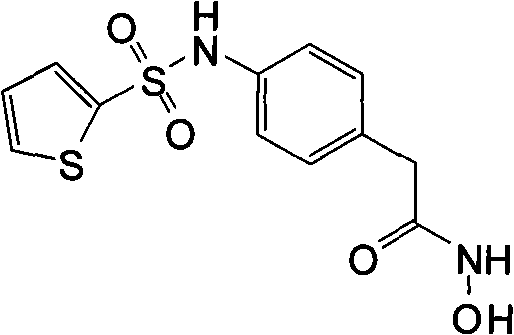
SULPHURYL CHLORIDE: 2-thiophene SULPHURYL CHLORIDE
Yield: step 1:84%
Yield: step 2:83%
Yield: step 3:9%
1H NMR (300MHz, acetone-d
6); δ 7.78 (s, 1H), 7.53 (s, 1H), 7.21 (s, 4H), 7.09 (s, 1H), 3.37 (s, 2H).
Embodiment 12:
2-[4-(3-nitrobenzene sulfonyl ammonia base)-phenyl]-N-hydroxyl-ethanamide (17)

SULPHURYL CHLORIDE: 3-nitrobenzene sulfonyl chloride
Yield: step 1:47%
Yield: step 2:34%
Yield: step 3:16%
1H NMR (300MHz, acetone-d
6); δ 9.31 (s, 1H), 8.59 (s, 1H), 8.45 (d, 1H, J=8Hz), 8.16 (d, 1H, J=8Hz), 7.85 (t, 1H, J=8Hz), 7.20-7.14 (m, 4H), 3.35 (s, 2H).
Embodiment 13:
2-[4-(8-quinoline sulfonamido)-phenyl]-N-hydroxyl-ethanamide (18)

SULPHURYL CHLORIDE: 8-quinoline sulfuryl chloride
Yield: step 1:83%
Yield: step 2:78%
Yield: step 3:42%
1H NMR (300MHz, acetone-d
6); δ 9.17 (s, 1H), 8.50 (d, 1H, J=8Hz), 8.33 (d, 1H, J=8Hz), 8.21 (d, 1H, J=8Hz), 7.71-7.68 (m, 3H), 7.05 (wide s., 4H), 3.22 (s, 2H).
Embodiment 14:
2-[4-(4-bromobenzene sulfonamido)-phenyl]-N-hydroxyl-ethanamide (19)

SULPHURYL CHLORIDE: 4-bromobenzene sulfonyl chloride
Yield: step 1:80%
Yield: step 2:81%
Yield: step 3:48%
1H NMR (300MHz, acetone-d
6); δ 9.17 (s, 1H), 7.72 (s, 4H), 7.19-7.14 (m, 4H), 3.35 (s, 2H).
Embodiment 15:
N-hydroxyl-5-[3-phenylsulfonamido)-phenyl]-valeramide (26)

Step l:3-(phenylsulfonamido)-phenyl-iodide (21)
In room temperature to 3-Iodoaniline (5g, CH 22.8mmol)
2Cl
2(100mL) solution adds Et
3N (6.97mL) adds benzene sulfonyl chloride (5.84mL) afterwards.Mixture was stirred 4 hours, form white precipitate then.Add NaHCO
3Saturated aqueous solution, and separate phase.Water layer CH
2Cl
2Extracted several times, the extract of merging is through (MgSO
4) drying, evaporation then.Be dissolved in crude mixture among the MeOH (100mL) and add NaOMe (6g), with mixture 60 ℃ of heating 1 hour.Solution becomes clarification in time, adds HCl (1N).Decompression is evaporating solvent, water CH then down
2Cl
2Extracted several times.The organic extract that merges is through (MgSO
4) dry and evaporation.Thick material is by flash chromatography utilization (100%CH
2Cl
2) carry out purifying as solvent, produce white solid title compound 21 (7.68g, 94%).
1H NMR:(300MHz, CDCl
3): δ 7.82-7.78 (m, 2H), 7.60-7.55 (m, 1H), 7.50-7.42 (m, 4H), 7.10-7.06 (m, 1H), 6.96 (t, J=8Hz, 1H), 6.87 (wide s, 1H).
Step 2:3-(phenylsulfonamido)-phenyl-propargyl alcohol (22)
(500mg, tetramethyleneimine 1.39mmol) (5mL) solution adds Pd (PPh to 21 in room temperature
3)
4(80mg, 0.069mmol) be afterwards CuI (26mg, 0.139mmol).Stir the mixture up to dissolving fully.(162 μ L are 2.78mmol) and stirring at room 6 hours to add propargyl alcohol.Use NH then
4The saturated aqueous solution treatment soln of Cl, and use the AcOEt extracted several times.The organic extract that merges is through (MgSO
4) drying evaporates then.Resistates utilizes hexane/AcOEt (1: 1) to carry out purifying as solvent mixture by flash chromatography, produces yellow solid shape 22 (395mg, 99%).
1H?NMR:(300MHz,CDCl
3):δ7.79-7.76(m,2H),7.55-7.52(m,1H),7.45(t,J=8Hz,2H),7.19-7.15(m,3H),7.07-7.03(m,1H),4.47(s,2H)。
Step 3:5-[3-(phenylsulfonamido)-phenyl]-4-alkynes-2-pentenoate (pentenoate) (23)
In room temperature to 22 (2.75g, CH 9.58mmol)
3CN (150mL) solution add 4-methylmorpholine N-oxide compound (NMO, 1.68g, 14.37mmol) be afterwards the high ruthenic acid ammonium of tetrapropyl (TPAP, 336mg .958mmol).In stirring at room mixture 3 hours, utilize the sintered glass funnel to filter then through Celite pad.In filtrate, add ethoxycarbonyl methylene tri phenyl-phosphorane (6.66g, 19.16mmol), and with the solution that obtains stirring at room 3 hours.Evaporating solvent and with remnants for being dissolved in CH
2Cl
2In, use NH
4The saturated aqueous solution washing of Cl.Water layer CH
2Cl
2Extracted several times, the organic extract that merges is through (MgSO then
4) and evaporation.Thick material utilizes hexane/AcOEt (1: 1) as the solvent mixture purifying by flash chromatography, produces yellow oil 3 (1.21g, 36%).
1H?NMR:(300MHz,CDCl
3):δ7.81(d,J=8Hz,2H),7.56-7.43(m,3H),7.26-7.21(m,3H),7.13-7.11(m,1H),6.93(d,J=16Hz,1H),6.29(d,J=16Hz,1H),4.24(q,J=7Hz,2H),1.31(t,J=7Hz,3H)。
Step 4:5-[3-(phenylsulfonamido)-phenyl]-4-alkynes-2-pentenoic acid (24)
In room temperature to 23 (888mg, 2.50mmol) solution in THF (10mL) and water (10mL) solvent mixture add LiOH (1.04g, 25.01mmol).The mixture that obtains heated 2 hours down at 60 ℃, and handled up to pH 2 with HCl (1N).Separate phase and water layer AcOEt extracted several times.The organic extract that merges is through (MgSO
4) drying evaporates then.Rough residue utilizes CH by flash chromatography
2Cl
2/ MeOH (9: 1) carries out purifying as solvent mixture, produces 24 (712mg, 88%) of white solid.
1H?NMR:(300MHz,DMSO-d
6):δ7.78-7.76(m,2H),7.75-7.53(m,3H),7.33-7.27(m,1H),7.19-7.16(m,3H),6.89(d,J=16Hz,1H),6.33(d,J=16Hz,1H)。
Step 5:5-[3-(phenylsulfonamido)-phenyl]-valeric acid (25)
(100mg, MeOH .306mmol) (6mL) solution adds the solution of Pd/C (10%, 20mg, 1mL MeOH) to 24 in room temperature.With the reaction mixture degassing, and utilize H
2Gas purges several times under the resulting pressure of 60psi.In stirring at room mixture 2 hours, utilize the sintered glass funnel that the solution that obtains is filtered through silicagel pad then.Evaporating solvent produces 25 (68mg, 96%), and it need not to be further purified and quilt is directly used in next step.
1H NMR:(300MHz, acetone-d
6): δ 7.81-7.78 (m, 2H), 7.56-7.46 (m, 3H), 7.11-7.01 (m, 3H), 6.87 (d, J=8Hz, 1H), 2.49 (wide s, 2H), 2.25 (wide s, 2H), 1.52 (wide s, 4H).
Step 6:N-hydroxyl-5-[3-phenylsulfonamido)-phenyl]-valeramide (26)
In room temperature to 25 (100mg, DMF 300mmol) (10mL) solution add 1-(3-dimethylamino-propyl)-3-ethyl-carbodiimide hydrochloride (EDC, 69mg .320mmol) and the I-hydroxybenzotriazole hydrate (HOBT, 61mg .45mmol).In stirring at room mixture 20 minutes.Add NH then
2OTHP (53mg .45mmol).With the mixture that obtains 50 ℃ of following heated overnight.Decompression is evaporation DMF solvent down, and resistates is dissolved in CH
2Cl
2In, and with salt solution or NaHCO
3The saturated aqueous solution washing.The organic extract that merges is through (MgSO
4) drying evaporates then.Crude compound utilizes hexane/acetone (7: 3) to carry out purifying as solvent mixture by flash chromatography.Then resistates is dissolved in MeOH (20mL), add then the 10-camphorsulfonic acid (CSA, 35mg, 150mmol).In stirring at room mixture 2 hours, then in the room temperature decompression down evaporating solvent to avoid pyrolysis.Crude mixture is utilized CH by flash chromatography
2Cl
2/ MeOH (9: 1) carries out purifying as solvent mixture, obtains 26, is light yellow solid (62mg, 60%).
1H NMR:(300MHz, acetone-d
6): δ=7.80-7.78 (m, 2H), 7.56-7.52 (m, 3H), 7.13-6.89 (m, 4H), 2.52 (wide s, 2H), 2.10 (wide s, 2H), 1.53 (wide s, 4H).
Embodiment 16:
N-hydroxyl-5-[4-(phenylsulfonamido)-phenyl]-4-alkynes-2-valeramide (32)

Step 1:4-(phenylsulfonamido)-phenyl-iodide (28)
Utilize the described step of embodiment 15 steps 1 to prepare compound 28, but replace the 3-Iodoaniline with the 4-Iodoaniline.
Yield: 97%
1H NMR:(300MHz, CDCl
3): δ 9.15 (wide s, 1H), 7.82 (d, J=8Hz, 2H), 7.68-7.51 (m, 5H), 7.05 (d, J=8Hz, 2H).
Step 2:4-(phenylsulfonamido)-phenyl-propargyl alcohol (29)
Utilize the described step of embodiment 15 steps 2 to prepare compound 29, but replace compound 28 with compound 21.
Yield: 61%
1H NMR:(300MHz, acetone-d
6): δ 7.83-7.80 (m, 2H), 7.62-7.51 (m, 3H), 7.30 (d, J=8Hz, 2H), 7.21 (d, J=8Hz, 2H), 4.36 (s, 2H), 2.80 (wide s, 2H).
Step 3:5-[4-(phenylsulfonamido)-phenyl]-4-alkynes-2-pentenoate (30)
Utilize the described step of embodiment 15 steps 3 to prepare compound 30, but replace compound 29 with compound 22.
Yield: 16%
1H?NMR:(300MHz,CDCl
3):δ7.81-7.78(m,2H),7.59-7.43(m,3H),7.34(d,J=8Hz,2H),7.05(d,J=8Hz,2H),6.93(d,J=16Hz,1H),6.26(d,J=16Hz,1H),4.23(q,J=7Hz,2H),1.30(t,J=7Hz,3H)。
Step 4:5-[4-(phenylsulfonamido)-phenyl]-4-alkynes-2-pentenoic acid (31)
Utilize the described step of embodiment 15 steps 4 to prepare compound 31, but replace compound 30 with compound 23.
Yield: 92%
1H NMR:(300MHz, acetone-d
6): δ 7.87-7.84 (m, 2H), 7.62 (m, 3H), 7.42 (d, J=8Hz, 2H), 7.28 (d, J=8Hz, 2H), 6.94 (d, J=16Hz, 1H), 6.29 (d, J=16Hz, 1H).
Step 5:N-hydroxyl-5-[4-(phenylsulfonamido)-phenyl]-4-alkynes-2-valeramide (32)
Utilize the described step of embodiment 15 steps 6 to prepare compound 32, but replace compound 31 with compound 25.
Yield: 78%
1H NMR; (300MHz, acetone-d
6): δ 7.84 (wide s, 2H), 7.60-7.55 (m, 3H), 7.38-7.30 (m, 4H), 6.84 (d, J=16Hz, 1H), 6.40 (d, J=16Hz, 1H).
Embodiment 17:
N-hydroxyl-5-[4-phenylsulfonamido)-phenyl]-valeramide (34)
Step 1:5-[4-(phenylsulfonamido)-phenyl]-valeric acid (33)
Utilize the described step of embodiment 15 steps 5 to prepare compound 33, but replace compound 31 with compound 24.
Yield: 100%
1H NMR; (300MHz, acetone-d
6): δ=7.78-7.75 (m, 2H), 7.56-7.46 (m, 3H), 7.16-7.05 (m, 4H), 2.52 (wide s, 2H), 2.29-2.25 (m, 2H), 1.56 (wide s, 4H).
Step 2:N-hydroxyl-5-[4-phenylsulfonamido)-phenyl]-valeramide (34)
Utilize the described step of embodiment 15 steps 6 to prepare compound 34, but replace compound to replace compound 33 with compound 25.
Yield: 62%
1H NMR:(300MHz, acetone-d
6): δ 7.78-7.75 (m, 2H), 7.59-7.51 (m, 3H), 7.09 (wide s, 4H), 2.85 (wide s, 1H), 2.53 (wide s, 2H), 2.05 (wide s, 2H), 1.56 (wide s, 4H).
Embodiment 18:
N-hydroxyl-3-[4-(phenylsulfonamido)-phenyl]-2-acrylamide (36)
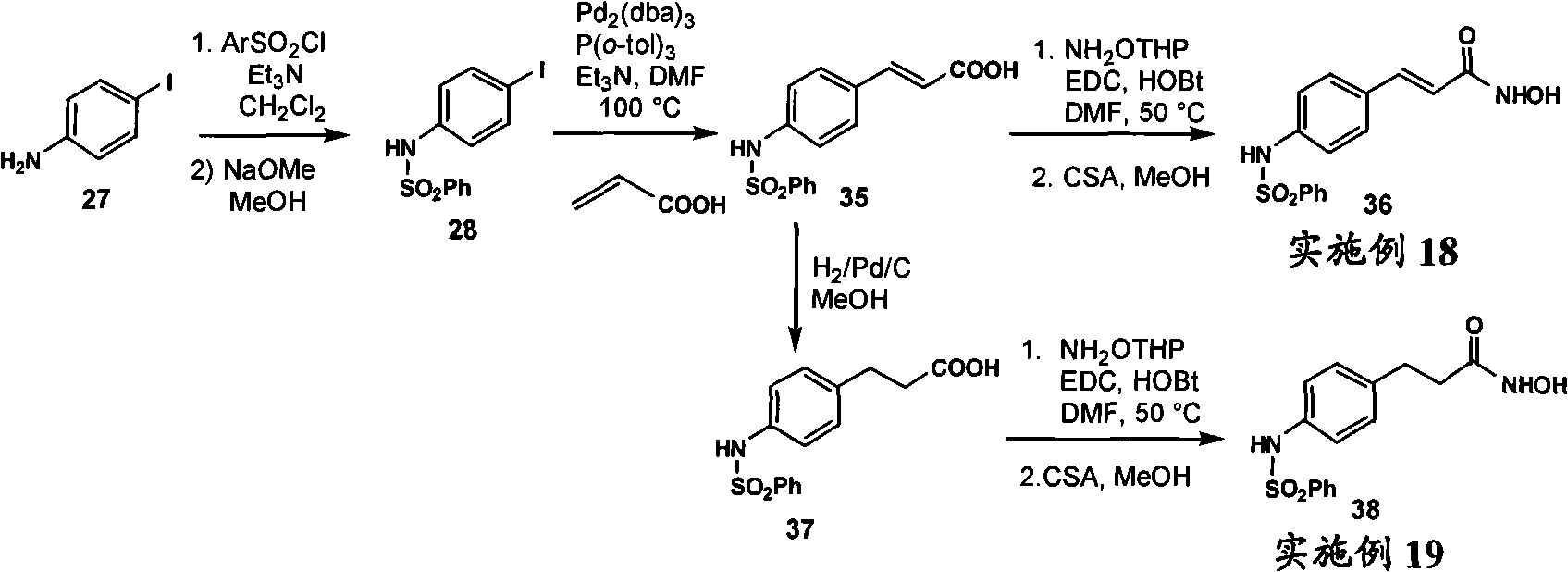
Step 1:3-[4-(phenylsulfonamido)-phenyl]-2-vinylformic acid (35)
(500mg, DMF 1.39mmol) (10mL) solution adds three (dibenzalacetones), two palladiums (0) (Pd to 28 in room temperature
2(dba)
338mg, 1.67mmol), tri-o-tolyl phosphine (P (o-tol)
3, 25mg, 0.83mmol), Et
3N (483 μ μ L, 3.48mmol) and at last add vinylformic acid (84 μ μ L, 1.67mmol).The solution that obtains is outgased, and uses N
2Purge several times, 100 ℃ of heated overnight.Soln using sintered glass funnel filters through Celite pad, then evaporated filtrate.Resistates utilizes CH by flash chromatography
2Cl
2/ MeOH (95: 5) carries out purifying as solvent mixture, and producing title compound 35 (415mg, 99%) is light yellow solid.
1H NMR:(300MHz, acetone-d
6): δ 7.88-7.85 (m, 2H), 7.62-7.55 (m, 6H), 7.29 (d, J=9Hz, 2H), 6.41 (d, J=16Hz, 1H), 2.95 (s, 1H), 2.79 (s, 1H).
Step 2:N-hydroxyl-3-[4-(phenylsulfonamido)-phenyl]-2-acrylamide (36)
In room temperature to 35 (200mg, DMF 0.660mmol) (10mL) solution add 1-(3-dimethylamino-propyl)-3-ethyl-carbodiimide hydrochloride (EDCI, 151mg, 0.79mmol) and the I-hydroxybenzotriazole hydrate (HOBT, 134mg, 0.99mmol).In stirring at room mixture 20 minutes.Add NH then
2OTHP (116mg, 0.99mmol).50 ℃ with the mixture heating up that obtains 24 hours, decompression evaporation DMF solvent and resistates is dissolved in CH down then
2Cl
2, use NaHCO
3The saturated aqueous solution washing.The organic extract that merges is through (MgSO
4) drying concentrates then.Crude compound utilizes hexane/acetone (7: 3) to carry out purifying as solvent mixture by flash chromatography.Then resistates is dissolved in MeOH (10mL), add then the 10-camphorsulfonic acid (CSA, 77mg, 0.33mmol).In stirring at room mixture 2 hours, then in the room temperature decompression down evaporating solvent to avoid pyrolysis.Crude product utilizes CH by flash chromatography
2Cl
2/ MeOH (9: 1) obtains 36 (116mg, 55%) as the solvent mixture purifying, is orange solids.
1H NMR:(300MHz, acetone-d
6): δ 7.85-7.83 (m, 2H), 7.64-7.47 (m, 6H), 7.26 (d, J=8Hz, 2H), 6.48 (m, 1H), 2.82 (s, 1H), 2.79 (s, 1H).
Embodiment 19:
N-hydroxyl-3-[4-(phenylsulfonamido)-phenyl]-2-propionic acid amide (38)
Step 1:3-[4-(phenylsulfonamido)-phenyl]-2-propionic acid (37)
(350mg, MeOH 1.16mmol) (15mL) solution adds the solution of Pd/C 10% (50mg. is in MeOH~3mL) to 35 in room temperature.The solution that obtains is then used H under the resulting pressure of 60psi
2Clean several times.With solution stirring 4 hours, utilize the sintered glass funnel to filter then through Celite pad.Evaporated filtrate, residual compounds 37 is enough pure and be used for next step, need not to be further purified.
1H NMR:(300MHz, acetone-d
6): δ 8.92 (wide s, 1H), 7.79-7.76 (m, 2H), 7.60-7.47 (m, 3H), 7.12 (s, 4H), 3.32 (s, 1H), 2.81 (t, J=8Hz, 2H), 2.53 (t, J=8Hz, 2H).
Step 2:N-hydroxyl-3-[4-(phenylsulfonamido)-phenyl]-2-propionic acid amide (38)
In room temperature to the DMF of 37 (1.16mmol) (10mL) solution add 1-(3-dimethylamino-propyl)-3-ethyl-carbodiimide hydrochloride (EDC, 266mg, 1.39mmol) and the I-hydroxybenzotriazole hydrate (HOBT, 235mg, 1.74mmol).In stirring at room mixture 20 minutes.Add NH then
2OTHP (204mg, 1.74mmol).50 ℃ with the mixture heating up that obtains 24 hours, under reduced pressure concentrate the DMF solvent then, and resistates be dissolved in CH
2Cl
2, use NaHCO
3The saturated aqueous solution washing.The organic extract that merges is through (MgSO
4) drying evaporates then.Crude compound utilizes hexane/acetone (7: 3) to carry out purifying as solvent mixture by flash chromatography.Then resistates is dissolved in MeOH (10mL), add then the 10-camphorsulfonic acid (CSA, 135mg, 0.58mmol).In stirring at room mixture 2 hours, then in the room temperature decompression down evaporating solvent to avoid pyrolysis.Rough thing utilizes CH by flash chromatography
2Cl
2/ MeOH (9: 1) obtains title compound 38 (237mg, 64%, last 3 steps) as the solvent mixture purifying, is yellow solid.
1H NMR:(300MHz, acetone-d
6): δ 8.91 (wide s, 1H), 7.78-7.76 (m, 2H), 7.57-7.51 (m, 3H), 7.10 (wide s, 4H), 2.82 (wide s, 2H), 2.34 (wide s, 2H), 1.07 (s, 1H), 0.85 (s, 1H).
Embodiment 20:
N-hydroxyl-4-[4-(phenylsulfonamido)-phenyl]-butyramide (42)

Step 1: methyl-4-(4-aminophenyl)-butyric ester (40)
(5g, MeOH 27.90mmol) (100mL) solution adds dense HCl (37%15mL) to 4-(4-aminophenyl)-butyric acid in room temperature.The mixture that obtains spends the night 50 ℃ of stirrings, uses NaHCO then
3Saturated aqueous solution and Na
2CO
3Solids treatment is up to pH 9.Decompression is evaporating solvent, water CH then down
2Cl
2Extracted several times.Thick material utilizes CH by flash chromatography
2Cl
2/ MeOH carries out purifying as solvent mixture, produces 40 (4.93g, 91%), is orange solids.
1H NMR:(300MHz, acetone-d
6): δ 6.89 (d, J=8Hz, 2H), 6.59 (d, J=8Hz, 2H), 4.40 (wide s, 1H), 3.60 (s, 3H), 2.48 (t, J=7Hz, 2H), 2.28 (t, J=7Hz, 2H), 1.82 (qt, J=7Hz, 2H).
Step 2:4-[4-(phenylsulfonamido)-phenyl]-butyric acid (41)
In room temperature to 40 (500mg, CH 2.59mmol)
2Cl
2Solution adds Et
3N (901 μ μ L, 6.48mmol) be afterwards benzene sulfonyl chloride (661 μ L, 5.18mmol).Mixture in stirred overnight at room temperature, is used NH then
4The Cl saturated aqueous solution is handled.Separate phase, organic layer CH
2Cl
2Extracted several times.The organic extract that merges is through (MgSO
4) the drying evaporation of reducing pressure down then.Resistates is dissolved in the solvent mixture of THF (25mL) and water (25mL), add then LiOH (1.08g, 25.9mmol).Used HCl (1N) to handle in 1 hour then 50 ℃ of heating in mixture up to pH2.Separate phase and water layer AcOEt extracted several times.The organic extract that merges is through (MgSO
4) drying evaporates then.Rough thing utilizes CH by flash chromatography
2Cl
2/ MeOH (95: 5) carries out purifying as solvent mixture, produces 41 (800mg, 96%), is white solid.
1H NMR:(300MHz, CDCl
3): δ 8.82 (1H, s is wide), 7.77-7.74 (2H, m), 7.55-50 (1H, m), 7.44-7.39 (2H, m), 7.05-6.97 (4H, m), 2.58 (2H, t, J=7Hz), 2.31 (2H, t, J=7Hz), 2.17 (1H, s), 1.94-1.84 (2H, m).
Step 3:N-hydroxyl-4-[4-(phenylsulfonamido)-phenyl]-butyramide (42)
To 41 (800mg, DMF 2.59mmol) (20mL) solution add 1-(3-dimethylamino-propyl)-3-ethyl-carbodiimide hydrochloride (EDC, 593mg, 3.12mmol) and the I-hydroxybenzotriazole hydrate (HOBT, 524mg, 3.89mmol).In stirring at room mixture 20 minutes.Add NH then
2OTHP (455mg, 3.89mmol).50 ℃ with the mixture heating up that obtains 24 hours, decompression evaporation DMF solvent and resistates is dissolved in CH down then
2Cl
2, use NaHCO
3The saturated aqueous solution washing.The organic extract that merges is through (MgSO
4) drying evaporates then.Crude compound utilizes hexane/acetone (7: 3) to come purifying as solvent mixture by flash chromatography.Then resistates is dissolved in MeOH (30mL), add then the 10-camphorsulfonic acid (CSA, 300mg, 1.30mmol).Stirred the mixture under 50 ℃ 2 hours, concentrated solvent was to avoid pyrolysis under room temperature reduced pressure then.Rough thing utilizes CH by flash chromatography
2Cl
2/ MeOH (9: 1) carries out purifying as solvent mixture, obtains title compound 42 (115mg, 13%), is light yellow solid.
1H NMR:(300MHz, CDCl
3): δ 7.79-7.76 (m, 2H), 7.61-7.48 (m, 3H), 7.13-7.05 (m, 4H), 2.83 (wide s, 1H), 2.53 (t, J=7Hz, 2H), 2.14-2.04 (m, 2H), 1.83 (t, J=7Hz, 2H).
Embodiment 21:
N-hydroxyl-4-(3-oxo-3-phenyl propenyl)-benzamide (45)

Step 1:4-(3-oxo-3-phenyl propenyl)-phenylformic acid (43)
In room temperature with sodium methylate (1.8g, 33.3mmol) add the 4-carboxyl benzaldehyde (2.5g, 16.6mmol) and methyl phenyl ketone (2.0g uL is in methyl alcohol 16.6mmol) (50mL) suspension.In stirring at room mixture 16 hours, and remove the methyl alcohol of half volume in decompression.Pour mixture into HCI
Among the 1M (50mL) (up to pH=2), add ethyl acetate.The isolating water layer dry anhydrous (MgSO of ethyl acetate extraction (3x30mL)
4), filter and evaporation.Resistates grinds with methylene dichloride-hexane (1: 1), obtains 3g 43 (72% yield).
1H?NMR(300MHz,CDCl
3);δ7.50-7.87(m,7H),8.04(d,2H,J=8Hz),8.16(d,2H,J=8Hz)。
Step 2:4-(3-oxo-3-phenyl propenyl)-N-(O-THP trtrahydropyranyl)-benzamide (44)
(260mg 1.0mmol) is dissolved in anhydrous CH with carboxylic acid 43
2Cl
2(10mL) and DCC (256mg 1.2mmol) adds NH afterwards
2OTHP (145mg, 1.2mmol).Make mixture stirring at room 2 hours.Add saturated NH
4Cl also extracts with EtOAc.Organic layer is through MgSO
4Drying is filtered evaporating solvent under the vacuum.(utilize 1%MeOH/CH by column chromatography
2Cl
2Carry out purifying, produce the title compound that is directly used in next step.
Step 3:N-hydroxyl-4-(3-oxo-3-phenyl propenyl)-benzamide (45)
With the protection hydroxamic acid 44 (234mg, 0.67mmol) be dissolved in MeOH (7mL) add then CSA (31mg, 0.13mmol).Mixture was stirred 2 hours under refluxing, and was completely up to reaction by inspection perhaps.Add HCl 1N, with the EtOAc extraction, through anhydrous MgSO
4Dry organic layer also filters.Evaporating solvent under the vacuum.Utilize 5%MeOH/CH by column chromatography
2Cl
2Purifying produces title compound.
1H?NMR(300MHz,DMSO-d
6),δ7.53-8.20(m,11H);9.12(br.s,1H);11.35(br.s,1H)。
Embodiment 22:
N-hydroxyl-4-(3-oxo-3-phenyl propyl)-benzamide (50)

Step 1: methyl-4-(3-oxo-3-phenyl propenyl)-phenylformic acid (46)
4-methoxycarbonyl phenyl aldehyde in anhydrous methanol (1.6mL) (79mg, 0.48mmol) and methyl phenyl ketone (56 μ μ L, 0.48mmol) add pure sodium methylate (26mg, 0.48mmol).In the stirring at room mixture overnight, be heated to then and refluxed 1 hour, be cooled to room temperature and add HCl 1N and EtOAc.Separating layer, with organic layer through anhydrous MgSO
4Dry also filtration.Evaporating solvent under the vacuum obtains yellow solid, and it produces light yellow crystalline solid from the acetonitrile/water recrystallization.
1H?NMR(300MHz,CDCl
3);δ3.95(s,3H),7.50-8.12(m,11H)。
Step 2: methyl-4-(3-oxo-3-phenyl propyl)-benzoic ether (47)
(321mg 1.20mmol) is dissolved in anhydrous THF (6mL) and anhydrous MeOH (6ml) with aromatics ketenes 46.Add the Pds 10% of 2 little spoons on activated carbon, place under the nitrogen atmosphere, and make it stirring at room 2 hours.Use nitrogen purge, through diatomite filtration, and by vacuum-evaporation removal solvent.Through the following steps the benzylalcohol reoxidation is become ketone.Rough thing is dissolved in anhydrous CH again
2Cl
2(10mL), utilize
 Molecular sieve, add TPAP (1 spoonful) add afterwards NMO (212mg, 1.8mmol).Filter in stirring at room 30 minutes and through silica gel plug.Evaporating solvent under the vacuum, and utilize the 10%EtOAc/ hexane to carry out purifying by column chromatography.
1H?NMR(300MHz,CDCl
3);δ3.14(t,2H),3.34(t,2H),3.90(s,3H),7.30-7.60(m,6H),7.92-7.99(m,4H)。
Step 3:4-(3-oxo-3-phenyl propyl)-phenylformic acid (48)
In room temperature to methyl esters 47 (195mg, water/THF 0.73mmol) (1: 1,0.07M) solution add LiOH (46mg, 1.1mmol).The solution that obtains is in stirred overnight at room temperature, perhaps up to detecting no starting material by TLC.Add HCI 1N, use the EtOAc extraction solution, and with organic layer through anhydrous MgSO
4Dry.Filter and evaporating solvent under the vacuum, utilize 10%MeOH/CH by column chromatography afterwards
2Cl
2Purifying produces title compound.
1H?NMR(300MHz,CDCl
3);δ3.16(t,2H),3.36(t,2H),7.33-7.60(m,5H),7.93-8.06(m,4H)。
Step 4:N-hydroxyl-4-(3-oxo-3-phenyl propyl)-benzamide (50)
According to the described step of embodiment 21 step 2-3, but replace carboxylic acid 4, obtain title compound with compound 48.
1H?NMR(300MHz,DMSO-d
6);δ2.97(t,2H),3.38(t,2H),7.34(d,2H,J=8Hz),7.45-7.70(m,5H),7.96(dd,2H,J=8Hz,1Hz),11.14(br.s,1H)。
Embodiment 23:
N-hydroxyl-4-(3-oxo-3-phenyl-1-hydroxypropyl)-benzamide (53)

Step 1:4-carboxy-N-(O-THP trtrahydropyranyl)-benzamide (51)
With azanol-O-THP (3.9g, 33.2mmol) add to the 4-carbamoyl benzoate (4.2g, 27.7mmol) and DCC (6.8g is in methylene dichloride 33.2mmol) (200mL) suspension.In the stirring at room mixture overnight, and use the saturated ammonium chloride quencher.Isolating water layer ethyl acetate extraction (3x100ml), the salt water washing of the organic layer of merging, dry (anhydrous MgSO
4), filter and evaporation.Flash chromatography (the CH of resistates
2Cl
2In 10% methyl alcohol) obtain (51).
1H?NMR(300MHz,CDCl
3);δppm.10.04(s,1H),8.95(s,1H),7.99(d,2H,J=7.0Hz),7.93(d,2H,J=7.0Hz),5.1(s,1H),3.60(m,2H),1.60(m,6H)
Step 2:4-(3-oxo-3-phenyl-1-hydroxypropyl)-N-(O-THP trtrahydropyranyl)-benzamide (52)
((337 μ L are 2.4mmol) in 0 ℃ of solution in anhydrous THF (15mL) 2.2mmol) to add to Diisopropylamine for 1.4M/ hexane, 1.6mL with n-BuLi.Stirred 10 minutes at 0 ℃, be cooled to-78 ℃ then.Add methyl phenyl ketone, stirred 30 minutes at-78 ℃ then.(50mg is 2.0mmol) in-78 ℃ of solution in anhydrous THF (10mL) to import aldehyde 9 by sleeve pipe.Stirred 3 hours at-78 ℃, add NH then
4Cl.Rise to room temperature, with the EtOAc extraction, through MgSO
4Drying is filtered and vaporising under vacuum.By HPLC CH
3CN: H
2O: TFA 0.1%; The 10-95% purifying produces title compound 52.
Step 3:N-hydroxyl-4-(3-oxo-3-phenyl-1-hydroxypropyl)-benzamide (53)
According to the described identical step of embodiment 21 steps 3, but with compound 52 substitution compounds 44, obtain title compound.
1H?NMR(300MHz,DMSO-d
6);δ3.20(dd,1H,J=4Hz,J=16Hz),3.42(dd,1H=16Hz,8Hz),5.20(m,1H),7.44-8.18(m,9H),11.15(br.s,1H),11.32(br.s,1H)。
Embodiment 24:
N-hydroxyl-4-(3-phenyl propyl)-benzamide (56)
Step 1:4-(3-phenyl propenyl)-phenylformic acid/4-(3-phenyl-2-propenyl)-phenylformic acid (54)
With allyl benzene (255 μ μ L, 1.9mmol), the 4-bromo-benzoic acid (523mg, 2.6mmol), Et
3N (0.91mL, 6.5mmol), acid chloride (II) (16mg, 0.052mmol), triphenyl phosphine (60mg, 0.21mmol) and acetonitrile (5mL) in round-bottomed flask, under refluxing, stir and spend the night.Add HCl1N, with the EtOAc extraction, at anhydrous MgSO
4Go up dry organic layer, filter evaporating solvent under the vacuum.Utilize 10%MeOH/CH by column chromatography
2Cl
2Purifying produces the mixture 54 of (14%) two kind of regional isomer of 90mg.Then mixture is carried out hydrogenation, need not further sign.
Step 2:4-(3-phenyl propyl)-phenylformic acid (55)
With regional isomerism alkene 54 (100mg, 0.42mmol) and C (10mg) go up the mixture of Pd 10% in methyl alcohol (4mL) at H
2Atmosphere (14psi) is vigorous stirring down.In stirring at room mixture 2 hours,, produce oily matter 55 through diatomite filtration and evaporation.The resistates flash chromatography produces 55 (88mg, 88%).
1H?NMR(300MHz,CDCl
3);δppm?8.10(d,2H,J=8.0Hz),7.35(m,7H),2.73(m,4H),2.00(m,2H)。
Step 3:N-hydroxyl-4-(3-phenyl propyl)-benzamide (56)
According to the described identical step of embodiment 21 step 2-3, but replace compounds 43 with compound 55, obtain title compound, be beige solid.(24mg, 26% yield).
1H?NMR(300MHz,CD
3OD);δ(ppm)7.63(d,2H,J=8.0Hz);7.38-7.05(m,7H),2.63(m,4H),1.91(m,2H)。
Embodiment 25:
N-hydroxyl-4-(4-phenyl butyl)-benzamide (61)

Step 1:4-(1-butylene base-4-phenyl)-phenylformic acid/4-(crotyl-4-phenyl)-phenylformic acid (57/58)
Under nitrogen atmosphere, in the 25mL round-bottomed flask, mix following substances: N, dinethylformamide (7mL, 0.5M (the 568 μ L of the 4-phenyl-1-butylene solution), 3.8mmol), the 4-bromo-benzoic acid (634mg, 3.2mmol), three (dibenzalacetones), two palladiums (0) (87mg, 0.1mmol), tri-o-tolyl phosphine (58mg, 0.2mmol), triethylamine (1.1mL, 7.9mmol).Stirred the mixture 22 hours in 100 ℃.Then, the suspension that obtains is cooled to room temperature, also uses the ethyl acetate rinsing through diatomite filtration.Filtrate is separated phase with 1N HCl acidifying, and the water layer ethyl acetate extraction.The organic layer water, the salt water washing that merge are through MgSO
4Drying is filtered and is concentrated.The solid hexane that obtains: methylene dichloride (9: 1) grinds, and produces 367mg (46%) beige solid 57/58.
1H?NMR(300MHz,(CD
3)
2CO):δ(ppm)2.50-2.60(m,2H),2.80(t,2H,J=9.0Hz),6.40-6.50(m,2H),7.12-7.35(m,5H),7.41(d,2H,J=9.0Hz),7.92(d,2H,J=9.0Hz)。
Step 2:4-(4-phenyl butyl)-phenylformic acid (59)
According to the described step of embodiment 24 steps 2, but replace compound 54, obtain the title compound of 92% yield, be white solid with compound 57/58.
1H?NMR(300MHz,CD
3OD);δ(ppm)1.60-1.75(m,4H),2.65(t,2H,J=9.0Hz),2.72(t,2H,J=9.0Hz),7.12-7.30(m,5H),7.33(d,2H,J=9.0Hz),7.96(d,2H,J=9.0Hz)。
Step 3:4-(4-phenyl butyl)-N-(O-THP trtrahydropyranyl)-benzamide (60)
In room temperature, under nitrogen atmosphere, in the 25mL round-bottomed flask, to 5mL N, 4-(4-phenyl butyl) phenylformic acid 59 (341mg in the dinethylformamide (0.3M solution), 1.3mmol) add 1-(3-dimethylamino-propyl)-3-ethyl-carbodiimide hydrochloride (308mg, 1.6mmol) and the I-hydroxybenzotriazole hydrate (272mg, 2.0mmol).Stirred the mixture 30 minutes, add then 2-(THP trtrahydropyranyl) azanol (235mg, 2.0mmol) and stirred the mixture 4 days.Remove N under the vacuum, dinethylformamide is dissolved in the oily matter that obtains in the ethyl acetate, and water and salt water washing are through MgSO
4Drying is filtered and is concentrated, and produces the rough title compound 60 of 95% yield.
1H?NMR(300MHz,CD
3OD);δ(ppm)1.50-1.75(m,10H),2.65(t,2H,J=9.0Hz),2.72(t,2H,J=9.0Hz),3.51(d,1H,J=15Hz),4.05(t,1H,J=15Hz),5.05(s,1H),7.10-7.35(m,7H),7.75(d,2H,J=9.0Hz),10.60(s,1H)。
Step 4:N-hydroxyl-4-(4-phenyl butyl)-benzamide (61)
Under nitrogen atmosphere, and rough oily matter adding 5mL methyl alcohol (0.3M solution) in the 25mL round-bottomed flask and camphorsulfonic acid (333mg, 1.4mmol).In stirring at room mixture 2 hours.Need not to add heat abstraction methyl alcohol under the vacuum, and the oily matter that obtains carries out purifying by flash chromatography with methyl alcohol and methylene dichloride (1: 19) wash-out.Solid and hexane: methylene dichloride (9: 1) produces 212mg (59%) beige solid 61.
1H NMR (300MHz, (CD
3)
2CO): δ 1.66 (m, 4H), 2.65 (t, 2H, J=7.2Hz), 2.70 (t, 2H, J=7.1Hz), 7.15-7.31 (m, 7H), 7.75 (d, 2H, J=7.8Hz), 8.18 (wide s, 1H), 10.68 (wide s, 1H).
13C?NMR(75.46MHz,(CD
3)
2CO):δ31.6(t),31.8(t),36.1(t),36.2(t),2X?126.4(d),127.8(d),2X?129.1(d),2X?129.2(d),2X?129.3(d),130.6(s),143.3(s),147.3(s),165.9(s)。
Embodiment 26:
N-hydroxyl-3-(3-phenyl propyl)-benzamide (64)
Step 1:3-(3-phenyl propenyl)-phenylformic acid (62)
According to the described identical step of embodiment 24 steps 1, but replace the 4-bromo-benzoic acid with compound 3-bromo-benzoic acid, obtain title compound into alkene mixture.This mixture is sent to next step and need not purifying.
1H NMR (300MHz, CDCl
3); δ (ppm); 3.6 (dd, 2H, CH
2); (6.4 dd, 2H, alkene hydrogen); 7.0-7.5 (m, 8H, CHAr); 8.0 (s, 1H, CHAr).
Step 2:3-(3-phenyl propyl)-phenylformic acid (63)
According to the described identical step of embodiment 24 steps 2, but replace compounds 54 with compound 62, obtain title compound with 52% yield, and it is sent to next step and need not to be further purified.
1H?NMR(300MHz,CDCl
3);δ(ppm);2.0(m,2H,CH
2);2.7(m,4H,2CH
2);7.0-7.4(m,8H,CHAr);8.0(s,1H,CHAr)。
Step 3:N-hydroxyl-3-(3-phenyl propyl)-benzamide (64)
According to the described step of embodiment 25 step 3-4, but replace compound 59, obtain title compound with compound 63.Utilize CH by flash chromatography
2Cl
2: MeOH (9.5: 0.5) purifying produces the compound 64 of 20% yield.
1H?NMR(300MHz,DMSO-d
6);δ1.8(m,2H,CH
2);2.8(m,4H,CH
2);7.0-7.4(m,7H,CHAr);7.6(s,CHAr);9.0(s,NH);11.2(s,OH)。
Embodiment 27:
N-hydroxyl-3-(2-phenylethyl)-benzamide (68)

Step 1:3-(2-phenyl vinyl)-phenylformic acid (65/66)
(3.3mL, 3.3mmol) the 1.0M solution in THF adds to benzyl triphenyl bromide phosphine (1.44g, THF 3.6mmol) (35mL) stirred suspension with two (trimethyl silyl) amine lithiums at 0 ℃.The orange solution that obtains is added the 3-carboxyl benzaldehyde by sleeve pipe, and (500mg, 3.3mmol) (3.3mL is 3.3mmol) in the mixture of THF (10mL) with two (trimethyl silyl) amine lithiums.In the stirring at room mixture overnight.Add 1N HCl solution (75mL) and ethyl acetate (75mL), isolating water layer ethyl acetate extraction (3x50mL), dry (anhydrous MgSO
4), filter and evaporation.Resistates is by HPLC (10: 95CH
3CN: H
2O, TFA 0.1%) purifying, obtain 130mg title compound (17%).
1H NMR (300MHz, CDCl
3); δ (ppm) (1: 1) E: Z mixture 8.22 (s, 1H), 7.98 (s, 1H), 7.90-7.10 (m, 16H), 6.70 (d, 1H, J=15.0Hz), 6.62 (d, 1H, J=15.0Hz).
Step 2:3-(2-phenylethyl)-phenylformic acid (67)
According to the described identical step of embodiment 24 steps 2, but replace compound 54 with compound 65/66, quantitatively obtain title compound.
1H?NMR(300MHz,CDCl
3);δ(ppm)2.98(m,4H);7.30(m,7H);7.99(m,2H)。
Step 3:N-hydroxyl-3-(2-phenylethyl)-benzamide (68)
According to embodiment 25 steps 3 and 4 described identical steps, but replace compounds 59 with compound 67, obtain title compound with 22% yield.
1H?NMR(300MHz,DMSO-d
6);δ(ppm)2.82(s,4H);7.03-7.08(m,8H);7.62(s,1H);8.98(br.s,1H);11.15(br.s,1H)。
Embodiment 28:
N-hydroxyl-4-(2-thiophenyl)-ethylphenyl acid amides (70)

Step 1:4-(2-thiophenyl)-ethyl benzoate (69)
According to the method for having announced (Gareau etc., Tet.Lett., 1994,1837), under nitrogen atmosphere, the 4-vinyl benzoic acid (1.0g in containing 10mL benzene (0.7M), 6.75mmol) the 50mL round-bottomed flask in, add benzenethiol (797 μ L, 7.76 mmoles) and add VAZO afterwards
TM(Aldrich Chemical Company, 495mg, 2.02 mmoles).Stirred the mixture 12 hours under refluxing.The solution that obtains in room temperature cooling, and evaporating solvent in a vacuum.Solid carries out purifying by utilizing hexane and methylene dichloride to grind.Obtain 1.94g (85%) white solid.
1H?NMR(300MHz,CDCl
3):δ3.01(t,2H,J=8.4Hz),3.28(dd,2H,J=7.2,7.8Hz),7.21(tt,1H,J=1.2,7.2Hz),7.34(t,2H,J=8.1Hz),7.38-7.43(m,1H),7.41(d,2H,J=8.4Hz),7.97(d,2H,J=8.1Hz)。
Step 2:N-hydroxyl-4-(2-thiophenyl)-ethyl benzamide (70)
In room temperature, under nitrogen atmosphere, containing 12mL N, 4-in the dinethylformamide (0.2M) (2-thiophenyl)-ethyl benzoate (600mg, 2.32 in 50mL round-bottomed flask mmole), add 1-(3-dimethylamino-propyl)-3-ethyl-carbodiimide hydrochloride (579mg, 3.02 mmoles) and I-hydroxybenzotriazole hydrate (377mg, 2.79 mmoles).Stirred the mixture 30 minutes, and added oxammonium hydrochloride (242mg, 3.48 mmoles) and triethylamine (971 μ L, 6.97 mmoles) then, and stirred the mixture 12 hours at 50 ℃.Remove N under the vacuum, dinethylformamide, and the oily matter that obtains is dissolved in ethyl acetate, water, saturated sodium bicarbonate, water and salt water washing.Organic layer filters and concentrates under vacuum through anhydrous magnesium sulfate drying.Thick solid carries out purifying by utilizing hexane and methylene dichloride to grind, and obtains 450mg (71%) beige solid.
(Hewlett-Packard 1100, post C18 HP 4.6x250mm, flow velocity 1mL/min, 10-95%CH for RP-HPLC
3CN/H
2O in 42 minutes, utilizes 0.1%TFA); Purity: 95.8% (220nm), 93.2% (254nm).
1H NMR (300.072MHz, (CD
3)
2CO): δ 2.98 (t, 2H, J=7.2Hz), 3.26 (dd, 2H, J=6.6,8.4Hz), 7.21 (tt, 1H, J=1.5,6.9Hz), 7.31-7.42 (m, 6H), 7.77 (d, 2H, J=9.3Hz), 8.08 (wide s, 1H), 10.69 (wide s, 1H).
13C?NMR(75.46MHz,(CD
3)
2CO):δ34.8(t),35.9(t),126.7(d),127.9(d),2X?129.6(d),2X?129.7(d),2X?129.9(d),131.3(s),137.3(s),145.0(s)。
Ultimate analysis; C
15H
15O
2NS x 0.1 H
2The calculated value of O: %C=75.31, %H=7.14, %N=5.17.Experimental value: %C=75.2 ± 0.1, %H=7.41 ± 0.07, %N=5.17 ± 0.01.
N-hydroxyl-4-(2-benzenesulfonyl)-ethylphenyl acid amides (73)
Step 1:4-(2-benzenesulfonyl)-ethyl benzoate (72)
At 0 ℃, under nitrogen atmosphere, in the 100mL round-bottomed flask of 4-in containing 20mL methylene dichloride (0.1M) (2-thiophenyl)-ethyl benzoate (69) (600mg, 2.32 mmoles), drip 3-chlorine peroxybenzoic acid (Aldrich Chemical Co., the pure solid of 57-86%, 2g, 6.97 mmoles), as by Nicolaou etc., J.Am.Chem.Soc., 114:8897 (1992) is described.Make mixture reach room temperature and stirred 1 hour.Add methyl-sulfide (5mL), mixture is diluted in methylene dichloride and wash with water 3 times.Organic layer is through anhydrous magnesium sulfate drying, filters, and evaporating solvent in a vacuum, obtain the 3g white solid.The mixture of 4-(2-the benzenesulfonyl)-ethyl benzoate of this 3-chloro-benzoic acid and expectation is placed 25mL Aoron mayer flask, be dissolved in the 30mL methylene dichloride, and handle with the diethyl ether solution (0.35M) of excessive freshly prepd diazomethane.Blast nitrogen removing excessive diazomethane, and the vaporising under vacuum solvent.The solid that obtains is by the flash chromatography purifying, and utilize 20% ethyl acetate: 80% hexane carries out wash-out, obtains the corresponding ester of 341.6mg (48%).The saponification utilization of this ester is carried out with the described identical step of embodiment 1 step 2, obtains 312.4mg (96%) 4-(2-benzenesulfonyl)-ethyl benzoate (72).
1H?NMR(300MHz,CDCl
3):δ3.06-3.11(m,2H),3.56-3.61(m,2H),7.37(d,2H,J=8.4Hz),7.67(tt,2H,J=1.5,7.2Hz),7.76(tt,1H,J=1.2,7.5Hz),7.93(d,2H,J=8.7Hz),7.97(dd,2H,J=1.8,6.9Hz)。
Step 2:N-hydroxyl-4-(2-benzenesulfonyl)-ethyl benzamide (73)
According at N-hydroxyl-4-(2-thiophenyl)-described step of ethyl benzamide, still with 4-(2-benzenesulfonyl)-ethylamino benzonitrile acid substitution 4-(2-thiophenyl)-ethyl benzoate, obtain title compound, be beige solid.
(Hewlett-Packard 1100, post C18 HP 4.6x250mm, flow velocity 1mL/min, 10-95%CH for RP-HPLC
3CN/H
2O in 42 minutes, utilizes 0.1%TFA); Purity: 98.8% (220nm), 97.6% (254nm).
1H NMR (300.072MHz, (CD
3)
2CO): δ 2.98 (t, 2H, J=7.2Hz), 3.26 (dd, 2H, J=6.6,8.4Hz), 7.21 (tt, 1H, J=1.5,6.9Hz), 7.31-7.42 (m, 6H), 7.77 (d, 2H, J=9.3Hz), 8.08 (wide s, 1H), 10.69 (wide s, 1H).
13C?NMR(75.46MHz,(CD
3)
2CO):δ25.2(t),34.3(t),55.6(t),128.0(d),2X?128.8(d),129.4(d),2X?130.2(d),131.1(s),134.5(d),140.7(s),145.5(s),165.8(s)。
N-hydroxyl-4-(2-benzene sulfoxide)-ethylphenyl acid amides (71)
According to passing through Van Der Borght etc., J.Org.Chem., the described step of 65:288 (2000), under nitrogen atmosphere, in the 10mL round-bottomed flask---its contain N-hydroxyl-4-(2-thiophenyl)-ethyl benzamide (70) in 2mL methyl alcohol (0.1M) (50mg, 0.18mmol), add tellurium dioxide (3mg, 0.018mmol), add afterwards 35% aqueous hydrogen peroxide solution (32 μ L, 0.36mmol).Stirred the mixture five days, and added salt solution then.Water layer is with ethyl acetate extraction 3 times, and the organic layer that merges is through anhydrous magnesium sulfate drying, filtration, and the vaporising under vacuum solvent.The solid that obtains (43.3mg) carries out purifying by utilizing acetonitrile to grind, and obtains 10mg (20%) beige solid.
(Hewlett-Packard 1100, post C18 HP 4.6x250mm, flow velocity 1mL/min, 10-95%CH for RP-HPLC
3CN/H
2O utilized 0.1%TFA in 42 minutes); Purity: 98.8% (220nm), 97.9% (254nm).
1H NMR (300.072MHz, (CD
3)
2CO): δ 2.76-2.91 (m, 1H), 3.00-3.29 (m, 3H), 7.34 (d, 2H, J=8.4Hz), 7.55-7.62 (m, 3H), 7.70 (dd, 2H, J=1.5,8.1Hz), 7.76 (d, 2H, J=8.1Hz), 8.08 (wide s, 1H), 10.70 (wide s, 1H).
13C?NMR(75.46MHz,(CD
3)
2CO):δ28.3(t),57.8(t),2?X?124.8(d),128.0(d),2?X?129.6(d),2?X?130.0(d),131.5(d),144.1(s),145.7(s)。
Embodiment 29
N-hydroxyl-3-[4-(3-phenyl propyl)-phenyl]-propionic acid amide (77)

Step 1:3-(4-bromophenyl)-propionic acid (74)
Under nitrogen atmosphere, in the 250mL round-bottomed flask---it contains the N at 45mL, and the 4-bromo-cinnamic acid in the dinethylformamide (0.5M) (5.0g, 22 mmoles) adds benzol sulfohydrazide (7.6g, 44 mmoles).Stirred the mixture 12 hours under refluxing.At the room temperature cooling solution, add saturated aqueous ammonium chloride, and water layer ethyl acetate extraction 3 times.The organic layer water and the salt water washing that merge through anhydrous magnesium sulfate drying, are filtered, and are concentrated under vacuum.The solid that obtains is by the flash chromatography purifying, and utilize 5% methyl alcohol: 95% methylene dichloride wash-out obtains 3.66g (73%) beige solid.
1H?NMR(300MHz,CDCl
3):δ2.66(t,2H,J=7.5Hz),2.91(d,2H,J=7.5Hz),7.08(d,2H,J=8.4Hz),7.41(d,2H,J=8.4Hz)。
Step 2:N-hydroxyl-3-(4-bromophenyl)-propionic acid amide (75)
According to about preparing 70 described steps, obtain 1.54g (39%) title compound.
1H NMR (300MHz, CDCl
3): δ 2.39 (t, 2H, J=7.8Hz), 2.89 (d, 2H, J=7.2Hz), 7.18 (d, 2H, J=8.1Hz), 7.42 (d, 2H, J=8.7Hz), 8.18 (wide s, 1H), 9.98 (wide s, 1H).
Step 3:N-hydroxyl-3-[4-(3-phenyl-1-propenyl)-phenyl]-propionic acid amide and N-hydroxyl-3-[4-(3-phenyl-2-propenyl)-phenyl]-propionic acid amide (76)
According to the similar step of the described step of embodiment 25 steps 1, but with N-hydroxyl-3-(4-bromophenyl)-propionic acid amide (75) (250mg, 1.02mmol) replace the 4-bromo-benzoic acid and with allyl benzene (163 μ L, 1.2mmol) replace 4-phenyl-1-butylene, produce 155.4mg (54%) blended title compound.
1H NMR (300MHz, CDCl
3): δ 2.39 (m, 2H), 2.88 (t, 2H, J=8.4Hz), 3.51 (t, 2H, J=8.1Hz), 6.32-6.53 (m, 2H), 7.14-7.44 (m, 9H), 8.60 (wide s, 1H), 10.04 (wide s, 1H).
Step 4:N-hydroxyl-3[4-(3-phenyl propyl)-phenyl]-propionic acid amide (77)
According to the similar step of the described step of embodiment 24 steps 2, but with N-hydroxyl-3-[4-(3-phenyl-1-propenyl)-phenyl]-propionic acid amide and N-hydroxyl-3-[4-(3-phenyl-2-propenyl)-phenyl]-propionic acid amide (155mg, 0.55mmol) mixture replace alkene 54, obtain 155.4mg (99%) title compound.
RP-HPLC:(Hewlett-Packard 1100, post C18 HP 4.6x250mm, flow velocity 1mL/min, 10-95%CH
3CN/H
2O utilized 0.1%TFA in 42 minutes); Purity: 99.9% (220nm) (2 peaks, but prove same compound by LCMS, 99.9% (254nm).
1H NMR (300.072MHz, (CD
3)
2CO): δ 1.91 (quintet, 2H, J=8.1Hz), 2.38 (t, 2H, J=7.8Hz), 2.61 (q, 4H, J=9.6Hz), 2.87 (t, 2H, J=7.2Hz), 7.12-7.29 (m, 9H), 8.42 (wide s, 1H), 10.01 (wide s, 1H).
13C?NMR(75.46MHz,(CD
3)
2CO):δ26.3(t),28.7(t),29.8(t),30.3(t),30.7(t),121.1(d),3X?123.7(d),3X?123.8(d),133.9(s),133.4(s),137.8(s),164.9(s)。
Ultimate analysis; C
18H
21O
2N x 0.1 H
2The calculated value of O: %C=75.81, %H=7.49, %N=4.91.Experimental value: %C=75.7 ± 0.3, %H=7.54 ± 0.02, %N=4.85+0.03.
Embodiment 30

Step 1:3-(4-nitrophenyl), 2-sec.-propyl ethyl propionate (78)
Under nitrogen, in the pre-cold soln of the THF of Diisopropylamine (34.7mmol) (30mL), drip 1.0M n-butyllithium solution (33.3mmol).The pale yellow solution that obtains surpasses 30 minutes-78 ℃ of stirrings, transfers to by sleeve pipe in THF (50mL) precooling (78 ℃) solution of Ethylisovalerate (34.7mmol).Mixture is surpassed 1 hour-78 ℃ of stirrings, in room temperature THF (20mL) solution of 4-nitrobenzyl bromine (13.9mmol) is dropwise transferred in the enolate solution by sleeve pipe, it becomes scarlet.Mixture was stirred above 15 minutes reaction saturated ammonium chloride (NH
4Cl) aqueous solution quencher.Make mixture in 1 hour, rise to room temperature and it becomes brown after intensification.Be poured into a large amount of saturated NH
4In the Cl solution, and separating layer.Water layer extracted with diethyl ether twice, the salt water washing of the organic layer of merging is through dried over mgso and vacuum concentration.Resistates carries out purifying by flash chromatography on silica gel, use ethyl acetate and hexane (10: 90) as eluent, produces 73% pure title compound 78, is light yellow oil.
Step 2:3-(4-aminophenyl), 2-sec.-propyl ethyl propionate (79):
To the hydrogen flushing (vacuum/H of 1 (1.88mmol) in methyl alcohol (10mL)
2, 3 times) and solution is added in 10% palladium (0.018mmol) on the carbon---and it had before used the methyl alcohol quencher in independent flask.The black heterogeneous mixture that is produced is stirred above 20 hours down in nitrogen atmosphere (1atm) in room temperature.Hydrogen is found time and use air displacement by vacuum.Then, mixture through diatomite filtration, is used methanol wash, guarantee that simultaneously this pad never becomes dry.Filtrate is condensed into red oil.Resistates utilizes ethyl acetate and hexane (30: 70) as eluent by flash chromatography purifying on silica gel, produces 73% pure title compound 79, is light red oily matter.
Step 3-5:(81)
According in the step described in embodiment 1 step 1, in the presence of triethylamine, make compound 79 and benzene sulfonyl chloride coupling, obtain sulphonamide 80.Then, as finish described in the embodiment 28 the ester hydrolysis and with the coupling of azanol, obtain hydroxamic acid 81.
1H NMR:(acetone-d
6) δ (ppm): 9.76 (bs, 1H), 8.83 (bs, 1H), 7.74 (d, J=8.2Hz, 2H), 7.59-7.49 (m, 3H), 7.04 (s, 4H), 2.83-2.73 (m, 3H), 1.83 (sext, J=6.9Hz, 1H), 1.00 (d, J=6.9Hz, 3H), 0.93 (d, J=6.9Hz, 3H).
HRMS:344.1195 (M
+-H
2O) (calculated value); 344.1200 ± 0.0010 (experimental value).
Embodiment 31:

Compound 82 obtains through the palladium catalytic coupling with tert-butyl acrylate from the bromine aminopyridine that commerce can get with good yield.Handle 82 mixtures that obtain sulphonamide 84 and two-sulphonamide 83 with 4-phenyl benzene sulfonyl chloride, it is converted into 84 after alkali formula methanolysis then in chromatographic separation.The acidic cleavage of the tert-butyl ester is realized by handling 84 with aqueous formic acid and tertiary butyl oxonium ion scavenging agent, with the vinylformic acid 85 that obtains quantitative yield.Last 85 with O-Phenylene Diamine coupling in the presence of benzotriazole-1-base oxygen base three (dimethylamino) phosphorus hexafluorophosphate (BOP), obtain N-anilide 86.
86 data:
1H?NMR:(300.07MHz;CD
3OD):δ(ppm):8.23(d,J=1.9,1H);8.03(bd,J=8.5;2H);7.96(dd,J=1.9,9.1;1H);7.76(bd,J=8.5,2H);7.63(dd,J=1.4,8.2);7.53(J=15.5;1H),7.48-7.36(m,3H);7.29(d,J=9.1,1H)7.18(dd,J=1.4,8.0,1H);7.03(dt,J=1.4,7.8,1H);6.86(d,J=1.4,7.9,1H)6.76(d,J=15.6,1H)6.75-6.69(m,1H);4.85(bs,4H)。
13C?NMR:(75.5MHz;CD
3OD)δ(ppm):166.4;154.7;146.9;146.2;143.1;141.1;140.6;138.6;137.9;130.1;129.5;128.8;128.5;128.3;126.7;125.6;125.0;122.1;120.8;119.5;118.6;114.9。
MS:C
26H
22O
3N
4The calculated value of S:470.556; Experimental value: 471.5, [M+H] (low resolution MS).
By with the similar step of described those steps of top embodiment 1-31, synthetic following compounds:

1H NMR:(300MHz, CD
3OD): (1H, m), (4H, m), 7.22 (J=7.5Hz), 7.10 (J=5.1Hz), 6.41 (1H, d is wide, J=14.7Hz) for 1H, t for 2H, d for 7.58-7.48 for d=7.76-7.74.
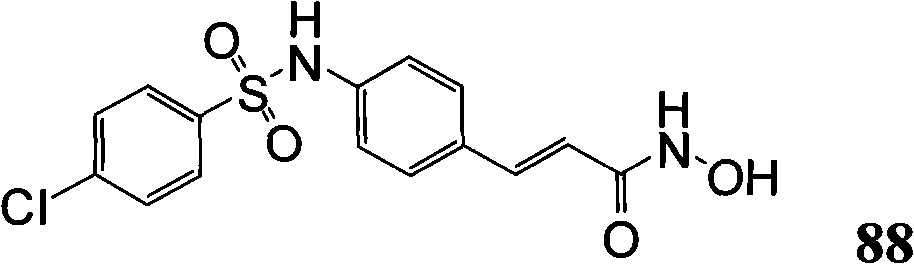
1H?NMR:(300MHz,CD
3OD):d=7.79(2H,d,J=8.1Hz),7.56-7.46(5H,m),7.17(2H,d,J=8.1Hz),6.39(1H,d,J=15.9Hz).
Analyze: C
15H
13N
2O
4SCl X 0.1 H
2O, X 0.3 TFA experimental value: C=48.26%, H=3.58%, N=6.97%, S=7.86%.Calculated value: C=48.19%, H=3.50%, N=7.20%, S=8.25%.

1H?NMR:(300MHz,DMSO?d
6):d=10.85(1H,s?br),10.70(1H,s?br),8.99(1H,s),8.37(2H,d,J=9Hz),8.01(2H,d,J=9Hz),7.44(2H,d,J=8.7Hz),7.33(1H,d,J=15.3Hz),7.12(2H,d,J=8.4Hz),6.31(1H,d,J=15.9Hz)。
Analyze: C
15H
13N
3O
6S X 0.4 H
2O, X 0.3 TFA experimental value: C=46.39%, H=3.49%, N=10.44%, S=7.92%.Calculated value: C=46.29%, H=3.51%, N=10.38%, S=7.92%.

1H?NMR:(300MHz,DMSO?d
6):d=10.70(1H,s?br),10.33(1H,s?br),8.99(1H,s?br),7.44-7.26(5H,m),7.12(2H,d,J=8.7Hz),7.06(1H,d,J=8.4Hz),6.30(1H,d,J=16.2Hz),3.78(3H,s),3.75(3H,s)。
Analyze: C
17H
18N
2O
6S X 0.2 H
2O experimental value: C=53.56%, H=5.03%, N=7.71%, S=8.01%.Calculated value: C=53.45%, H=4.86%, N=7.33%, S=8.39%.
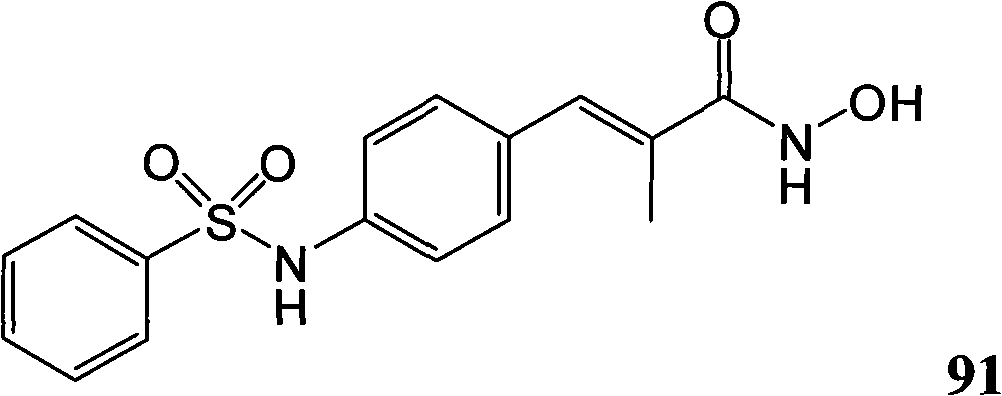
1H?NMR:(CD
3OD)δ(ppm):7.78(d,J=7.1Hz,1H),7.56-7.45(m,3H),7.24(d,J=8.5Hz,2H),7.12(d,J=8.8Hz,2H),7.06(s,1H),2.00(d,J=1.4Hz,3H)。
13C?NMR:(CD
3OD)δ(ppm):135.2,132.9,128.1,127.7,125.5,124.6,124.1,122.3,116.8,115.6,8.4。

1H NMR:(acetone-d
6) δ (ppm): 9.86 (bs, 1H), 8.86 (bs, 1H), 7.83 (bs, 1H), 7.76 (d, J=6.7Hz, 1H), 7.62-7.48 (m, 3H), 7.10-7.03 (m, 4H), 2.87-2.79 (m, 3H), 2.56-2.39 (m, 2H), 1.05 (d, J=6.6Hz, 3H).
HRMS:334.0987 (calculated value); 334.0991 ± 0.0010 (experimental value)

1H NMR:(300MHz, DMSO d
6): d=10.94 (1H, s is wide), 10.65 (1H, s is wide), 8.95 (1H, s is wide), 8.73-8.71 (1H, m), 8.24-8.21 (2H, m), 8.05 (1H, m), 7.74-7.63 (3H, m), 7.33-7.23 (2H, m), 7.06-7.04 (2H, m), 6.24 (1H, d, J=15.3).
Analyze: C
19H
16N
2O
4S X 0.5 H
2O experimental value: C=60.31%, H=4.58%, N=7.43%.Calculated value: C=60.46%, H=4.54%, N=7.42%.

1H NMR:(300MHz, DMSO d
6): δ=10.65 (2H, s is wide), 8.48 (1H, s), 8.15-8.08 (2H, m), 8.00 (1H, d, J=7.5Hz), 7.77 (1H, d, J=9Hz), 7.70-7.62 (2H, m), 7.39 (2H, d, J=8.4Hz), 7.28 (1H, d, J=15.6Hz), 7.15 (2H, d, J=8.4Hz), 6.26 (1H, d, J=15.6Hz).
Analyze: C
19H
16N
2O
4S X 0.2 H
2O, X 0.5 TFA experimental value: C=56.01%, H=3.94%, N=6.60%, S=7.41%.Calculated value: C=55.99%, H=3.97%, N=6.53%, S=7.47%.

1H?NMR:(300MHz,DMSO?d
6):δ=10.91(1H,s),10.69(1H,s?br),8.06-7.98(3H,m),7.57-7.46(4H,m),7.34(1H,d,J=15.9Hz),7.21(2H,d,J=8.4Hz),6.33(1H,d,J=15.9Hz)。
1H?NMR:(300MHz,DMSO?d
6):δ=8.69-8.8(1H,m),8.02-8.01(2H,m),7.61-7.59(1H,m),7.52-7.43(3H,m),7.25(2H,d,J=7.5Hz),6.37(1H,d,J=15.9Hz)。
Analyze: C
14H
13N
3O
4S X 0.9 TFA experimental value: C=45.36%, H=3.51%, N=9.77%, S=7.09%.Calculated value: C=44.97%, H=3.32%, N=9.96%, S=7.60%.

1H?NMR:(300MHz,DMSO?d
6):δ=10.91(1H,s),10.62(1H,s?br),8.45(1H,8.1Hz),8.36(1H,d,J=8.7Hz),8.25(1H,d,J=6.9Hz),7.65-7.59(2H,m),7.37-7.34(2H,m),7.29-7.23(2H,m),7.06(2H,d,J=8.7Hz),6.25(1H,d,J=15.9Hz)2.80(6H,s)。

1H?NMR:(300MHz,DMSO?d
6):δ=10.82(1H,s?br),9.95(1H,s?br),9.12(1H,s?br),7.70(4H,s),7.46(1H,d,J=15.9Hz),6.79(1H,d,J=8.7Hz),6.68(1H,s),6.56-6.51(2H,m),3.65(3H,s),3.62(3H,s)。

1H?NMR:(300MHz,DMSO?d
6):δ=10.63(1H,s),10.36(1H,s?br),9.13-9.12(1H,m),8.93(1H,s?br),8.51(1H,d,J=8.1Hz),8.40(1H,d,J=7.2Hz),8.28(1H,d,J=8.4Hz),7.75-7.70(2H,m),7.30-720(3H,m),7.09(2H,d,J=8.4Hz)6.21(1H,d,J=15.9Hz)。
Analyze: C
18H
15N
3O
4S X 1.1 H
2O experimental value: C=55.72%, H=4.45%, N=10.64%, S=6.93%.Calculated value: C=55.55%, H=4.45%, N=10.80%, S=8.24%.

1H?NMR:(300MHz,DMSO?d
6):δ=10.72(1H,s?br),10.07(1H,s),7.53-7.51(2H,m),7.43-7.34(4H,m),7.26-7.19(4H,m),6.38(1H,d,J=15.6Hz),4.51(2H,s)。
Analyze: C
16H
16N
2O
4S X 0.4 TFA experimental value: C=53.60%, H=4.46%, N=7.36%, S=7.81%.Calculated value: C=53.38%, H=4.37%, N=7.41%, O=20.32%, S=8.48%, F=6.03%.

1H?NMR:(300MHz,DMSO?d
6):δ=10.63(1H,s?br),10.56(1H,s),8.67(1H,s),8.29(1H,d,J=6.9Hz),7.89-7.85(2H,m),7.75(1H,d,J=8.4Hz),7.59(1H,t,J=7.2Hz),7.47-7.38(3H,m),7.27(1H,d,J=15.6Hz),7.15(2H,d,J=8.7Hz),6.25(1H,d,J=15.9Hz)。
1H?NMR:(300MHz,DMSO?d
6):δ=10.72(2H,s),8.98(1H,s?br),7.97(4H,s),7.55(2H,s),7.45(2H,d,J=8.7Hz),7.33(1H,d,J=15.9Hz),7.13(2H,d,J=8.7Hz),6.32(1H,d,J=15.9Hz)。

1H?NMR:(300MHz,DMSO?d
6):δ=10.75(2H,m),7.65-7.64(1H,m),7.53-7.45(4H,m),7.35(1H,d,J=16.2Hz),7.29(1H,d,J=3.9Hz),7.20(2H,d,J=8.7Hz),7.12(1H,t,J=3.6Hz),6.34(1H,d,J=15.6Hz)。
Analyze: C
17H
14N
2O
4S
3X 0.1 H
2O, X 1.0 TFA experimental value: C=43.83%, H=3.26%, N=5.73%, S=18.15%.Calculated value: C=43.69%, H=2.93%, N=5.36%, S=18.42%.
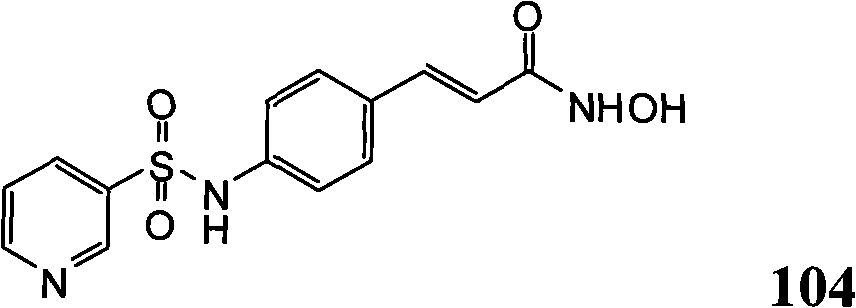
1H?NMR:(300MHz,DMSO?d
6):δ=10.72(1H,s),8.91(1H,d,J=1.8Hz),8.80-8.78(1H,m),8.13(1H,d,J=7.8Hz),7.63-7.59(1H,m),7.46(2H,d,J=8.7Hz),7.33(1H,d,J=15.6Hz),7.14(2H,d,J=8.7Hz),6.32(1H,d,J=15.9Hz)。

1H?NMR:(300MHz,DMSO?d
6):δ=10.54(1H,s),7.73(2H,d,J=8.4Hz),7.58(2H,d,8.4Hz),7.43(2H,d,J=8.4Hz),7.32(1H,d,J=15.6Hz),7.15(2H,d,J=8.4Hz),6.30(1H,d,J=15.9Hz),1.25(9H,s)。
Analyze: C
19H
22N
2O
4S X 0.3 H
2O, 0.6TFA experimental value: C=54.17%, H=5.25%, N=6.32%, S=6.85%.Calculated value: C=54.12%, H=5.22%, N=6.25%, S=7.15%.

1H?NMR:(300MHz,DMSO?d
6):δ=11.02(1H,s),10.70(1H,s),8.99(1H,s?br),8.03(1H,d,J=1.8Hz),7.76-7.67(2H,m),7.45(2H,d,J=8.1Hz),7.33(1H,d,J=15.6Hz),7.13(2H,d,J=8.4Hz),6.31(1H,d,J=16.2Hz)。
Analyze: C
15H
12N
2O
4SCl
2X 0.3 H
2O experimental value: C=45.96%, H=3.11%, N=7.21%, S=8.06%.Calculated value: C=45.89%, H=3.23%, N=7.13%, S=8.17%.
1H NMR:(300MHz, acetone d
6): δ=8.81 (1H, d, J=8.4Hz), 8.34 (2H, d, J=7.2Hz), 8.20 (1H, d, J=8.1Hz), 8.05 (1H, d, J=7.5Hz), 7.75-7.59 (4H, m), 7.53-7.41 (4H, m), 7.23-7.07 (4H, m), 6.89-6.86 (2H, m), 6.75 (1H, d, J=15.3Hz).
Analyze: C
25H
21N
3O
3S X 0.4 H
2O, 0.6TFA experimental value: C=60.68%, H=4.36%, N=8.11%, S=6.15%.Calculated value: C=60.62%, H=4.35%, N=8.09%, S=6.18%.

1H?NMR:(300MHz,DMSO?d
6):δ=10.7(1H,s?br),10.45(1H,s?br),8.96(1H,s?br),7.64(2H,d,J=8.1Hz),7.38(2H,d,J=8.4Hz),7.32-7.29(3H,m),7.09(2H,d,J=8.4Hz),6.29(1H,d,J=16.2Hz),2.30(3H,s)。
Analyze: C
16H
16N
2O
4S X 1.6 H
2O, X 1.6TFA experimental value: C=42.26%, H=3.62%, N=5.45%, S=6.09%.Calculated value: C=42.42%, H=3.86%, N=5.15%, S=5.9%.

1H NMR:(300MHz, DMSO d
6): δ=10.71 (1H, s), 10.67 (1H, s), 9.00 (1H, s br), 7.96 (1H, d, J=2.4Hz), 7.85 (1H, d, J=8.4Hz), 7.69 (1H, dd, J=8.4Hz and 2.1Hz), 7.47 (2H, d, J=8.4Hz) 7.35 (1H, d, J=15.9Hz), 7.13 (2H, d, J=8.7Hz), 6.33 (1H, d, J=15.9Hz).
Analyze: C
15H
12N
2O
4SCl
2X 0.3H
2O, X 0.3 AcOEt experimental value: C=46.30%, H=3.27%, N=6.56%, S=7.57%.Calculated value: C=46.43%, H=3.61%, N=6.68%, S=7.65%.

1H?NMR:(300MHz,DMSO?d
6):δ=1.65(1H,s?br),10.45(1H,s?br),8.96(1H,s?br),7.42(2H,d,J=8.1Hz),7.31(1H,d,J=15.6Hz),7.22(2H,s),7.01(2H,d,J=8.1Hz),6.30(1H,d,J=15.9Hz),4.24-4.16(2H,m),2.93-2.84(1H,m),1.18-1.14(18H,m)。
Analyze: C
24H
32N
2O
4S X 1.10 H
2O experimental value: C=62.14%, H=7.17%, N=6.20%, S=6.71%.Calculated value: C=62.07%, H=7.42%, N=6.03%, S=6.9%.

1H?NMR:(300MHz,DMSO?d
6):δ=11.18(1H,s?br),10.69(2H,m),7.83-7.82(1H,m),7.68(1H,m),7.43(2H,d,J=8.1Hz),7.32(1H,d,J=15.3Hz),7.13(2H,d,J=8.1Hz),6.31(1H,d,J=15.9Hz)。
Analyze: C
15H
12N
2O
5SCl
2X 0.2 H
2O, X 0.2 TFA experimental value: C=43.14%, H=3.04%, N=6.54%, S=7.19%.Calculated value: C=43.05%, H=2.96%, N=6.52%, S=7.46%.

1H?NMR:(300MHz,DMSO?d
6):δ=10.70(1H,s),10.65(1H,s),9.01(1H,s?br),7.91(2H,d,J=8.4Hz),7.56(2H,d,J=8.4Hz),7.45(2H,d,J=8.1Hz),7.33(1H,d,J=15.6Hz),7.13(2H,d,J=8.1Hz),6.31(1H,J=15.6Hz)。
Analyze: C
16H
13N
2O
5SF
3X 0.2 TFA experimental value: C=46.43%, H=3.33%, N=6.22%, S=7.25%.Calculated value: C=46.33%, H=3.13%, N=6.59%, S=7.54%.

1H?NMR:(300MHz,DMSO?d
6):δ=10.66(1H,s?br),10.37(1H,s?br),8.56(1H,s?br),7.69(2H,d,J=8.7Hz),7.39(2H,d,J=8.1Hz),7.30(1H,d,J=16.2Hz),7.10-7.03(4H,m),6.27(1H,d,J=15.9Hz),3.77(3H,s)。
Analyze: C
16H
16N
2O
5S X 0.7 H
2O experimental value: C=53.32%, H=5.05%, N=7.98%, S=7.78%.Calculated value: C=53.24%, H=4.86%, N=7.76%, S=8.88%.

1H?NMR:(300MHz,DMSO?d
6):δ=10.70(1H,s),10.66(1H,s),8.99(1H,s),8.06-7.98(3H,m),7.84-7.79(1H,m),7.45(2H,d,J=8.4Hz),7.33(1H,d,J=15.6Hz),7.12(2H,d,J=8.7Hz),6.32(1H,d,J=15.9Hz)。
Analyze: C
16H
13F
3N
2O
4S experimental value: C=49.64%, H=3.30%, N=7.18%.Calculated value: C=49.74%, H=3.39%, N=7.25%.
1H?NMR:(300MHz,DMSO?d
6):δ=10.69(1H,s,br),10.47(1H,s,br),8.98(1H,s,br),7.62(1H,s),7.58-7.56(1H,m),7.44-7.41(4H,m),7.32(1H,d,J=16.2Hz),7.11(2H,d,J=8.1Hz),6.30(1H,d,J=15.6Hz),2.34(3H,s).
Analyze: C
16H
16N
2O
4S X 0.3 TFA experimental value: C=54.64%, H=4.75%, N=7.92%.Calculated value: C=54.66%, H=4.59%, N=7.82%
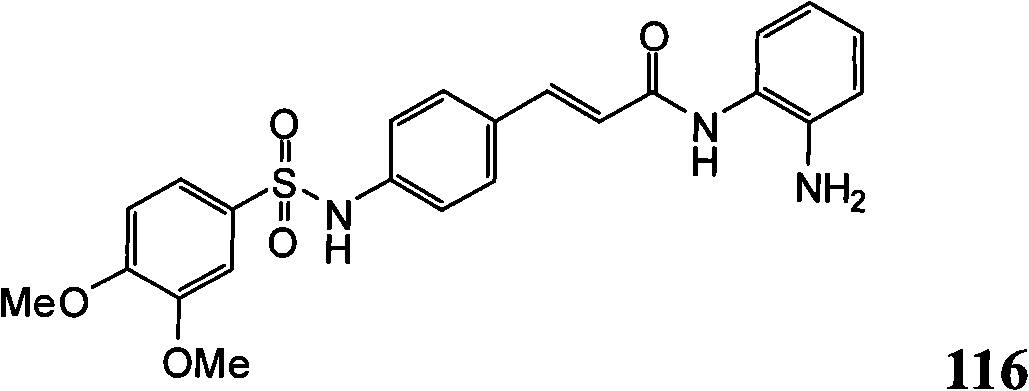
1H NMR:(300MHz, MeOD d
4): 7.62-6.61 (m, 13H); 3.81 (wide s, 3H, OC
H 3), 3.80 (wide s, 3H, OC
H 3), 3.26 (wide s, 4H, N
H).
13C?NMR:(75MHz,MeOD?d
4):167.0(C=O);154.4;150.5;143.1;141.9;141.0;132.5;132.3;129.9;128.2;126.7;125.2;122.4;121.8;120.8;119.6;118.7;111.9;110.9;56.6(2C,OCH
3)。
Combustion analysis: calculated value: 60.91%C, 5.11%H, 9.27%N, 7.07%S.
Experimental value: 60.40%C, 5.21%H, 9.16%N, 6.47%S.
HRMS: calculated value: 453.1358; Experimental value: 453.1351.
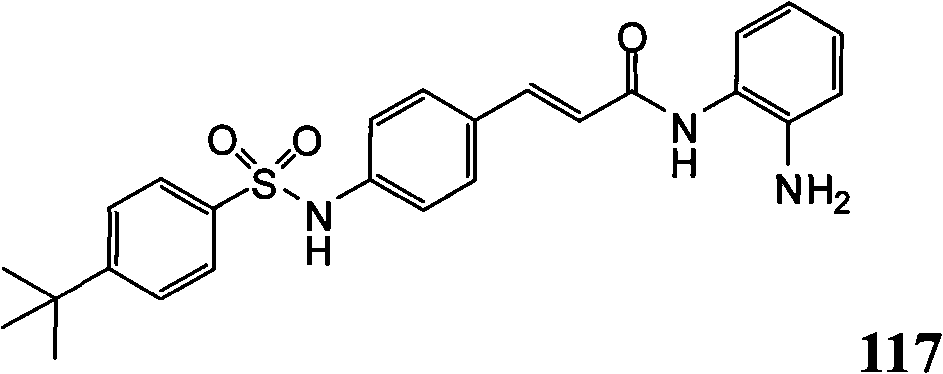
1H NMR:(acetone-d
6): δ (ppm): 9.25 (bs, 1H), 8.77 (bs, 1H), 7.79 (d, J=8.5Hz, 2H), 7.61-7.51 (m, 5H), 7.36-7.28 (m, 3H), 6.99-6.93 (m, 1H), 6.86-6.82 (m, 2H), 6.68-6.62 (m, 1H), 4.63 (bs, 2H).
HRMS:449.1773 (calculated value): 449.1767 ± 0.0013 (experimental values)
1H NMR:(300MHz, MeOD d
4): 8.00-6.56 (m, 13H); 3.77 (wide s, 3H, OC
H 3), 3.74 (wide s, 3H, OC
H 3), 3.33 (wide s, 2H, N
H), 3.00 (wide s, 1H, N
H), 2.88 (wide s, 1H, N
H).
13C?NMR:(75MHz,MeOD?d
4):166.2(
C=O);150.7;148.5;143.2;141.7;140.6;140.5;131.9;129.2;128.9;128.4;126.7;124.9;119.5;118.6;116.4;113.2;108.9;56.6(OCH
3);56.4(OCH
3)。
MS: calculated value: 453.1358: experimental value: 453.1351
1H?NMR:(CD
3OD)δ(ppm):7.68(d,J=8.2Hz,2H),7.55(d,J=15.9Hz,1H),7.47(d,J=8.5Hz,2H),7.30(d,J=8.0Hz,2H),7.19-7.12(m,3H),7.03(t,J=7.1Hz,1H),6.86(d,J=8.0Hz,1H),6.75-6.69(m,2H),2.37(s,3H)。
HRMS:407.1304 (calculated value): 407.1293 ± 0.0012 (experimental values)

1H?NMR:(300MHz,DMSO-d
6)δ10.6(s,OH);9(s,NH);7.1-7.8(m,14H,CH?Ar);6.2(d,1H,J=15Hz)

1H NMR:(300MHz, MeODd
4): 7.31-6.62 (m, 11H); 3.72 (wide s, 3H); 3.70 (wide s, 3H); 2.91 (t, 2H; J=7.1Hz); 2.65 (wide t, 2H, J=7.4Hz).
13C?NMR:(75MHz,MeODd
4):173.9;154.0;150.3;143.4;138.6;137.4;132.6;130.2;128.4;127.4;124.6;123.1;122.3;119.3;118.1;111.7;110.9;56.5(2C);38.8;32.2。
HRMS: calculated value: 455.1515: experimental value: 455.1521.

1H NMR:(300MHz, DMSO d
6): 7.77 (d, 2H, J=8.8Hz); 7.51 (d, 2H, J=8.5Hz); 7.34 (d, 2H, J=8.8Hz); 7.18 (d, 2H, J=8.5Hz); 7.11 (d, 2H, 8.8Hz); 6.94 (t, 1H, J=7.4Hz); 6.77 (wide d, 2H, J=7.9Hz); 6.6 (t, 1H, J=7.4Hz), 4.95 (wide s, 1H), 3.83 (s, 3H).
13C?NMR:(75MHz,DMSO?d
6):162.5;141.5;139.2;138.8;130.9;130.2;128.9;128.6;125.7;124.7;119.4;116.2;115.9;114.5;55.6。
HRMS: calculated value: 423.1253: experimental value: 423.1235.

1H?NMR:(300MHz,DMSO-d
6)δ7.1-7.8(m,14H,CH?Ar);6.8-6.9(m,4H,CH?Ar);6.3(d,1H,J=15Hz)。
Embodiment 32:

By 4-Iodoaniline and benzene sulfonyl chloride condensation prepared sulphonamide 124.Compound 125 by the 124 catalytic linked reactions of Pd-Cu of in basic solvent, carrying out with propargyl alcohol by fixed supply.Primary alconol 125 is oxidized to corresponding carboxylic acid 127 with two steps, comprises Dai Si-Martin's oxygenant (Dess-Martin periodinane) oxidation, obtains aldehyde 126, is handling with Textone in the buffered water medium in the presence of the chlorine scavenger afterwards.By in the presence of the N-hydroxybenzotriazole, in the non-proton medium of alkalescence, to handle with oxammonium hydrochloride and coupling reagent EDC, acid 127 is derived is hydroxamic acid 128.Compound 129 is by acid 130 and O-Phenylene Diamine coupling preparation, as in executing example 31 about as described in the compound 86.
128 data:
1H NMR:(300.07MHz; Acetone-d
6) δ (ppm): 9.4 (bs, 2H); 7.93 (dd, J=1.9,6.6; 2H); 7.82 (dd, J=1.9,6.6; 2H); 7.68 (dd, J=1.4,8.2; 2H); 7.48-741 (m, 5H); 7.35-7.32 (m, 2H); 2.90 (bs, 1H).
13C NMR:(75.5MHz; Acetone-d
6) δ (ppm): 153.5; 147.2; 141.3; 140.3; 139.5; 134.6; 130.1; 129.5; 128.8; 128.6; 128.3; 120.8; 116.5; 87.7; 81.0.
MS:C
21H
16O
4N
2The calculated value of S: 392.438; Experimental value: [M+H] 393.4 (low resolution MS).
129 data:
1H NMR:(300.07MHz; Acetone-d
6)
(ppm): 9.43 (bs, 1H); 8.02 (d, J=8.5Hz; 2H); 7.93 (d, J=8.5Hz; 2H); 7.90 (d, J=8.5Hz; 2H); 7.65 (d, J=8.5Hz; 2H); 7.47-7.34 (m, 7H); 7.21-7.17 (m, 2H); 2.80 (bs, 3H).
13C NMR:(75.5MHz; Acetone-d
6) δ (ppm): 167.2; 158.6; 146.3; 141.3; 140.9; 139.8; 139.5; 134.2; 131.0; 129.9; 129.8; 129.3; 128.7; 128.6; 128.4; 128.0; 126.8; 125.1; 122.7; 122.6; 120.1.
MS:C
27H
21O
3N
3The calculated value of S: 467.552; Experimental value: [M+H] 468.5 (low resolution MS).
Embodiment 33:

Benzylalcohol 130 by 2-furans lithium (2-lithiofuran) and Styrene oxide 98min. addition with 53% yield preparation.After the hydroxyl that obtains being protected with TERT-BUTYL DIMETHYL CHLORO SILANE, the lithiumation kind of compound 131 is handled with DMF, obtain formyl radical derivative 132.Finish Huo Naer-Wordsworth-Ai Mengsi (Wadsworth-Horner-Emmons) olefination by handling 132 with the enolization sodium of trimethyl phosphono acetate (trimethyl-phosphono-acetate); obtain crucial intermediate 133, the total recovery in last three steps is 90%.The saponification of methyl esters and LiOH produces acid 134, by reacting it with oxyamine and then be converted into its hydroxamic acid form 135 after the routine activation that utilizes HOBt/EDC.Silylanizing ether carries out the promoted cracking of fluorochemical and produces alcohol 136 with 67% yield.
136 data:
1H NMR:(300.07MHz; The δ (ppm) of acetone-d6): 9.35 (bs, 1H); 7.40-7.15 (m; 6H); 6.56 (d, J=2.9Hz, 1H); 6.24 (d, J=15.3Hz, 1H); 4.96 (t, J=6.2Hz, 1H); 3.00 (d, J=6.2Hz, 2H).
13C?NMR:(75.5MHz;CD
3OD)δ(ppm):166.6;156.6;151.3;145.2;129.3;128.5;126.9;116.2;114.5;111.0;73.6;39.1。
Embodiment 34:

Unsaturated ketone acid 138 yield with 73% after three consecutive steps obtains from ester 133, and described three consecutive steps comprise saponification (LiOH/H
2O/MeOH/THF), desilylation (TBAF/THF) and utilize benzylalcohol 137 oxidations that Dai Si-Martin's oxygenant carries out.The condensation of the compound 138 of N-anilide 139 by BOP-mediation and O-Phenylene Diamine obtains with 83% yield.
The regioselectivity hydrogenation of the acrylate part in 133 is passed through at NiCl
2Use NaBH under existing
4Handle and finish, obtain the propionic ester 140 of high yield.Ketone acid 142 then with 31% yield by with obtain from 140 from the 133 synthetic 138 identical steps of being followed.Utilize the compound 142 that can get at present, N-anilide 144 obtains (BOP/ O-Phenylene Diamine) as mentioned above.Low yield is because the purge process difficulty.For avoiding oxime to form, hydroxamic acid 143 is synthetic with 73% total recovery from 142 with two steps, described two steps comprise that BOP-mediates and N, the two trimethyl silyl oxyamine (N of O-, O-bistrimethylsilylhydroxylamine) coupling is that the silylanizing group is at acidic conditions (citric acid/MeOH) cracking down afterwards.
139 data:
1H NMR:(300.07MHz; CDCl
3) δ (ppm): 8.02-7.42 (serial multiplet, 7H); 7.34 (bs, 1H); 7.06 (m, 1H); 6.80 (d, J=7.8; 1H); 6.79 (d, J=8.1; 1H); 6.54 (d, J=3.0Hz, 1H); 6.38 (m, 1H); 6.34 (d, J=3.0Hz, 1H); 4.37 (s, 2H); 3.90 (bs, 2H).
13C?NMR:(75.5MHz;CDCl
3)δ(ppm):194.5;164.4;150.9;150.8;150.5;140.5;135.9;133.7;128.7;128.5;126.9;125.0;124.4;119.4;118.0;117.5;115.7;111.3;38.5。
143 data:
1H NMR:(300.07MHz; CDCl
3) δ (ppm): 8.99 (bs, 1H); 8.09-7.42 (serial multiplet, 5H); 6.09 (d, J=3.0Hz, 1H); 6.00 (d, J=3.0Hz, 1H); 4.35 (s, 2H); 2.95 (t, J=6.60Hz, 2H); 2.50 (t, J=3.0Hz, 1H).
13C?NMR:(75.5MHz;CDCl
3)δ(ppm):196.2;162.8;153.2;146.8;134.9;133.7;128.7;128.5;109.3;107.1;38.2;31.7;24.2。
144 data:
1H NMR:(300.07MHz; CDCl
3) δ (ppm): 7.99-7.42 (serial multiplet, 5H); 7.36 (bs, 1H); 7.02 (d, J=7.8,2H); 6.73 (d, J=7.8Hz, 2H); 6.13 (d, J=3.0Hz, 1H); 6.04 (d, J=3.0Hz, 1H); 4.30 (s, 2H); 3.70 (bs, 2H); 3.03 (t, J=6.9Hz, 2H); 2.69 (t, J=6.9Hz, 2H).
13C?NMR:(75.5MHz;CDCl
3)δ(ppm):195.4;170.7;153.6;147.1;140.9;136.1;133.5;128.7;128.5;127.1;125.7;124.0;119.2;117.8;109.1;107.2;38.4;35.7;24.7。
Embodiment 35:
The general synthesis step of carbamide compound
Methylene dichloride (10mL) solution that adds 4-anilino methacrylic ester (1.5mmol) to the solution of isocyanic ester (1.5mmol) in the 15mL anhydrous methylene chloride.In stirring at room mixture 15 hours.Add after the ammonium chloride solution, from the dichloromethane extraction new blend.Merge organic layer, and with ammonium chloride solution, water, salt water washing, through dried over mgso.Rough thing uses CH then on silica gel
2Cl
2: MeOH (9.5: 0.5) carries out quick wash-out as eluent.
Synthesize following compound according to described general step:
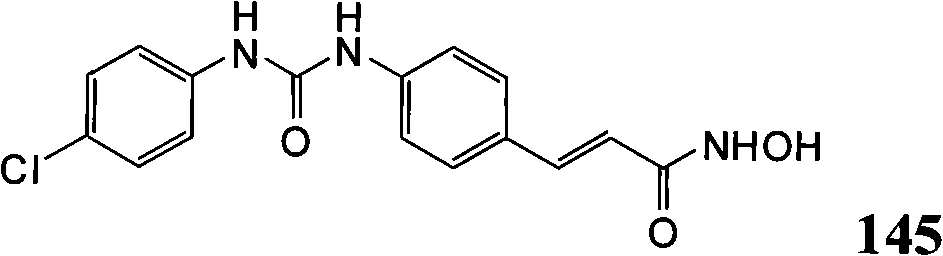
1H?NMR:(300MHz,DMSO-d
6)δ7.5-7.7(m,4H,CH?Ar);7.5(d,2H,J=6.6Hz);7.3(d,2H,J=6.6Hz);6.3(d,1H,J=15Hz)。

1H?NMR:(300MHz,DMSO-d
6)δ7.5-8.2(m,7H,CH?Ar);7.5(d,2H,J=6.6Hz);7.3(d,2H,J=6.6Hz);6.3(d,1H,J=15Hz)。
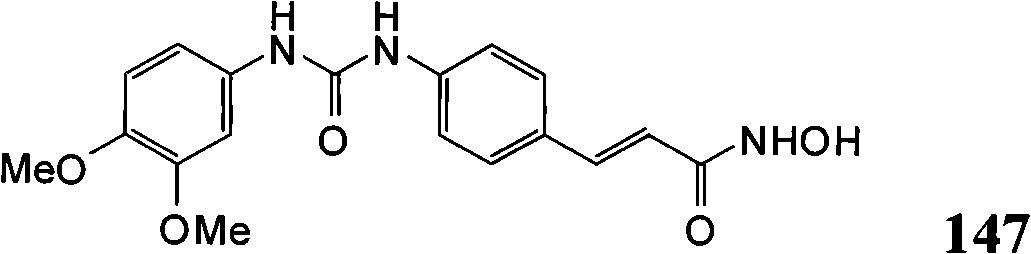
1H?NMR:(300MHz,DMSO-d
6)δ7.5-7.7(m,3H,CH?Ar);7.5(d,2H,J=6.6Hz);7.3(d,2H,J=6.6Hz);6.3(d,1H,J=15Hz)。
Embodiment 36:
By preparing following other compound with the similar step of those steps described in the foregoing description:

1H NMR (300.072MHz, (CD
3)
2CO): δ 1.99 (m, 2H), 2.79 (t, 2H, J=7.2Hz), 3.21 (dd, 2H, J=6.8,7.8Hz), 7.27 (d, 2H, J=8.1Hz), 7.65 (t, 2H, J=7.8Hz), 7.72-7.77 (m, 3H), 7.90 (d, 2H, J=7.2Hz), 10.77 (wide s, 1H).
13C?NMR(75.46MHz,(CD
3)
2CO):δ25.2(t),34.3(t),55.6(t),128.0(d),2X?128.8(d),129.4(d),2X?130.2(d),131.1(s),134.5(d),140.7(s),145.5(s),165.8(s)。

1H NMR (300.072MHz, (CD
3)
2CO): δ 1.66-1.88 (m, 4H), 2.71 (t, 2H, J=6.3Hz), 4.34 (d, 1H, J=303Hz), 4.87 (m, 1H), 7.27 (d, 2H, J=7.8Hz), 7.44-7.48 (m, 2H), 7.52 (dd, 1H, J=1.5,9.4Hz), 7.73 (d, 2H, J=7.8Hz), 7.83 (s, 1H), 7.83-7.88 (m, 3H), 8.16 (wide s, 1H), 10.67 (wide s, 1H).
13C?NMR(75.46MHz,(CD
3)
2CO):δ28.3(t),36.2(t),39.8(t),74.0(d),125.0(d),125.3(d),126.2(d),126.7(d),2X?127.8(d),128.4(d),128.5(d),128.6(d),2X?129.3(d),130.6(s),133.7(s),134.3(s),144.7(s),147.4(s),165.9(s)。

1H?NMR:(300MHz,DMSO-d6)δ11.2(s,OH);9(s,NH);7.6-7.8(m,4H,CH?Ar);7-7.4(m,5H,CH?Ar);2.8(m,4H,CH
2)。

1H?NMR:(300MHz,DMSO-d
6)δ11.2(s,1H);9.0(s,1H);7.7(m,6H);7.34(m,5H)。

1H?NMR:(300MHz,DMSO-d
6)δ11.2(s,OH);9(s,NH);7.6-7.8(m,4H,CH?Ar);7-6.8(m,4H,CH?Ar);2.9(s,6H,2CH
3);2.8(m,4H,CH
2)。

1H NMR (300.072MHz, (CD
3)
2CO): δ 1.38 (quintet, 2H, J=7.5Hz), 1.60-1.72 (m, 4H), 2.60 (t, 2H, J=7.8Hz), 2.67 (t, 2H, J=7.5Hz), 7.15-7.31 (m, 7H), 7.75 (d, 2H, J=8.1Hz), 8.11 (wide s, 1H), 10.68 (wide s, 1H).
13C?NMR(75.46MHz,(CD
3)
2CO):δ31.8(t),32.1(t),36.2(t),36.4(t),126.4(d),127.8(d),2X?129.0(d),2X?129.2(d),2X?129.3(d),143.3(s)。

1H NMR (300.072MHz, (CD
3)
2CO): δ 1.63 (m, 4H, J=4.5Hz), 2.37 (t, 2H, J=7.8Hz), 2.57-2.66 (m, 4H), 2.86 (t, 2H, J=7.5Hz), 7.10-7.28 (m, 9H), 8.01 (wide s, 1H), 9.98 (wide s, 1H).
13C?NMR(75.46MHz,(CD
3)
2CO):δ31.0(t),2X?31.9(t),35.1(t),35.8(t),36.2(t),126.4(d),2X?129.0(d),2X?129.1(d),2X?129.1(d),129.2(d),138.8(s),141.2(s),143.4(s),164.1(s)。

1H NMR (300.072MHz, (CD
3)
2CO): δ 1.83-1.98 (m, 4H), 2.08-2.14 (m, 2H), 2.56-2.67 (m, 6H), 7.12-7.30 (m, 9H), 9.98 (wide s, 1H).

1H NMR (300.072MHz, (CD
3)
2CO): δ 1.60-1.68 (m, 4H), 1.87 (quintet, 2H, J=7.5Hz), 2.03-2.14 (m, 2H), 2.55-2.67 (m, 6H), 7.09-7.28 (m, 9H).

1H NMR (300.072MHz, (CD
3)
2CO): δ 2.37 (t, 2H, J=7.2Hz), 2.78-2.89 (m, 6H), 7.13-7.29 (m, 9H), 7.84 (wide s, 1H), 9.90 (wide s, 1H).
13C?NMR(75.46MHz,(CD
3)
2CO):δ31.6(t),35.1(t),38.2(t),38.6(t),2X?126.6(d),2X?129.1(d),2X?129.2(d),2X?129.3(d),139.4(s),140.4(s),142.8(s),170.1(s)。

1H NMR (300.072MHz, (CD
3)
2CO): δ 1.96 (quintet, 2H, J=6.0Hz), 2.69 (t, 2H, J=8.0Hz), 3.19 (dd, 2H, J=6.0,9.0Hz), 3.38 (s, 2H), 7.09 (d, 2H, J=7.5Hz), 7.21 (d, 2H, J=7.5Hz), 7.66 (t, 2H, J=8.1Hz), 7.747 (t, 1H, J=6.9Hz), 7.90 (d, 2H, J=6.6Hz), 10.08 (wide s, 1H).
13CNMR(75.46MHz,(CD
3)
2CO):δ25.5(t),34.1(t),39.9(t),55.7(t),2X?128.8(d),130.0(d),2X?130.2(d),134.4(s),139.9(s),140.7(s),168.5(s)。
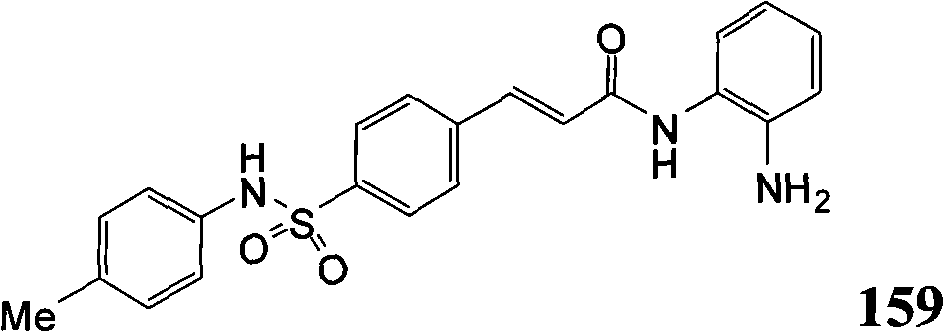
1H NMR:(300MHz, DMSO d
6): δ 7.77 (wide s, 4H); 7.57 (d, 1H, J=15.7Hz); 7.35 (d, 1H, J=6.9Hz); 7.03-6.94 (m, 6H); 6.76 (d, 1H, J=7.1Hz); 6.59 (d, 1H, J=6.9Hz); 4.98 (wide s, 2H); 2.19 (s, 3H).
13C?NMR:(75MHz,DMSO?d
6):δ162.9;141.6;139.8;139.0;137.6;134.8;133.6;129.6;128.1;127.3;125.9;125.4;124.7;123.2;120.7;116.2;115.9;20.3。
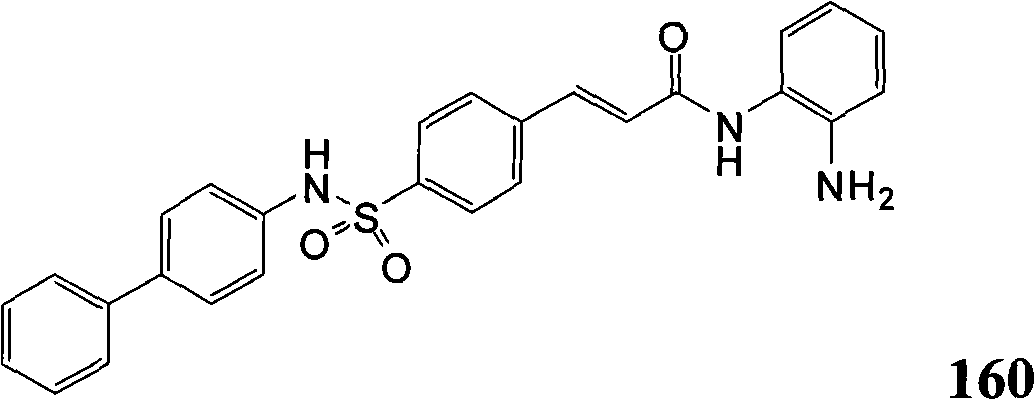
1H NMR:(300MHz, DMSO d
6): δ 7.91-7.81 (m, 4H); 7.63-7.58 (m, 5H); 7.48-7.43 (m, 2H); 7.39-7.33 (m, 2H); 7.24 (d, 2H, J=8.5Hz); 6.97 (dd, 2H, J=9.9,7.1Hz); 6.79 (d, 1H, J=7.7Hz) 6.61 (dd, 1H, J=7.7,7.1Hz); 5.01 (wide s, 2H).
13C?NMR:(75MHz,DMSO?d
6):δ162.9;141.9;141.6;139.8;139.2;137.6;136.9;135.8;128.9;128.3;127.4;127.3;127.2;126.3;126.0;125.5;124.8;123.2;120.4;116.2;115.9。

1H?NMR:(300MHz,MeODd
4):δ7.74-7.54(m,5H);7.07-6.96(m,4H);6.55(d,1H,J=15.7);2.25(s,3H)。
13C?NMR:(75MHz,MeODd
4):δ163.5;141.6;140.4;139.5;136.1;135.9;130.6;129.0;128.8;123.1;121.7;20.8。

1H?NMR:(300MHz,MeODd
4):δ7.83-7.19(m,14H);6.56(d,1H,J=15.7Hz)。
13C?NMR:(75MHz,MeODd
4):δ165.4;141.6;141.4;140.5;139.5;139.0;137.9;129.8;129.2;128.7;128.6;128.2;127.6;122.7;121.7。
Embodiment 37:

(131mg, 0.36mmol) solution at the dried DMF of 6mL adds Et to the carboxylic acid 163 according to the above-mentioned steps preparation
3(190 μ l 1.37mmol), add solid BOP (259mg to N afterwards; 0.59mmol).In stirring at room reaction mixture 10 minutes, add solid 5-amino-1,3 then, 4-thiadiazoles-2-mercaptan (58mg, 0.43mmol).After stirring 12 hours, concentrate with methyl alcohol diluted mixture thing and under vacuum.Use CH
2Cl
2After/MeOH the dilution, 164 (150mg, 87%) crystallization from crude oil takes place.
1H NMR:(300MHz, DMSO d
6): δ 7.85 (wide s, 5H); 7.04-6.58 (m, 4H); 3.69 (s, 3H); 3.67 (s, 3H); 3.38 (wide s, 3H).
13C?NMR:(75MHz,DMSO?d
6):163.3;161.7;158.7;148.7;146.2;142.0;140.7;137.9;130.1;128.7;127.5;121.4;113.7;112.0;106.6;55.5;55.4。
According to this general step, prepare following thiadiazoles derivative from corresponding carboxylic acid:

1H NMR:(300MHz, DMSO-d
6); δ (ppm): 7.89-7.72 (serial multiplet, 7H); 7.50-7.05 (serial multiplet, 6H); 3.32 (wide unimodal, 3H).
13C?NMR:(75MHz,DMSO-d6);d(ppm):162.6;162.3;144.5;138.3;138.3;138.2;132.5;130.1;129.7;129.1;128.6;127.6;127.3;127.1;120.9;118.7;116.8。
The calculated value of MS:M+H: 493.6.The observed value of M+H: 496.3.
1H?NMR:(300MHz,DMSO?d
6):7.87-7.72(m,5H),7.57-7.53(m,4H),7.39(dd,2H,J=6.9,7.7Hz),7.30(d,1H,J=7.1Hz),7.17(d,2H,J=8.5Hz),6.85(d,1H,J=15.9Hz)。
MS: calculated value: 495.61; Experimental value: 496.6.
According to similar step, but with 2-amino-5-Trifluoromethyl-1,3, the 4-thiadiazoles replaces 5-amino-1,3,4, and-thiadiazoles-2-mercaptan prepares following compound:

1H?NMR:(300MHz,DMSO?d
6):
7.96-7.81(m,5H);7.71-7.48(m,4H);7.38(dd,2H,J=7.1,7.41Hz);7.28(d,1H,J=7.1Hz);7.19(d,2H,J=8.5Hz);6.98(d,1H,J=15.7Hz)。
13C?NMR:(75MHz,DMSO?d
6):192.3;163.6;161.6;142.4;140.9;139.2;138.0;136.8;135.9;129.0;128.8;127.4;127.2;126.2;121.2;120.4.
MS: calculated value: 530.55 experimental values: 531.5.
Embodiment 38:

24 (from embodiment 15) obtain N-anilide 168 with phenylenediamine coupling in the presence of benzotriazole-1-base oxygen base three (dimethylin) phosphorus phosphofluoric acid ester (BOP).
By similar step, from the compound of the corresponding para-orientation of 32 (from embodiment 16) preparation.
Embodiment 39:

Step 1:N-methyl-4-iodophenyl benzsulfamide (169)
(500mg 1.39mmol) adds K in room temperature to compound 28 in DMF (10mL) (from embodiment 18)
2CO
3(962mg, 6.96mmol), add afterwards methyl-iodide (395mg, 2.78mmol).The reaction mixture that obtains in stirring at room 16 hours.Remove solvent then and add entry.The mixture ethyl acetate extraction that obtains, the dry and concentrated organic phase that merges.Utilize hexane by flash chromatography: ethyl acetate (8: 2) is carried out purifying, obtains 510mg (98%) title compound, is white solid.
According in embodiment 18, compound 169 being converted into hydroxamic acid 170 about preparation compound 36 described steps.
170 data:
1H?NMR:(300MHz,DMSO?d
6):δ=10.76(1H,s),9.04(1H,s),7.73-7.68(1H,m),7.61-7.51(6H,m),7.43(1H,d,J=15.9Hz),7.15(2H,d,J=8.7Hz),6.43(1H,d,J=16.2Hz),3.15(3H,s)。
Analyze: C
16H
16N
2O
4S X 0.5H
2O experimental value: C=56.36%, H=5.09%, N=8.69%, S=8.33%.Calculated value: C=56.29%, H=5.02%, N=8.21%, S=9.39%.
Embodiment 40:N-hydroxyl-2-(4-(4-phenyl butyl) phenyl) ethanamide (174)
Step 1:2-(4-iodophenyl) methyl acetate

(10g 38.2mmol), will react to stir and spend the night with 2-(4-iodophenyl) acetate among the 4M solution adding MeOH (100mL) of HCl in dioxane (50mL).Decompression is evaporating solvent down.Resistates carries out purifying by silica gel column chromatography with the 0-30%EtOAc wash-out in the hexane, obtains 2-(4-iodophenyl) methyl acetate of 10.42g (99%).LRMS:276.0 (calculated value) 277.1 (experimental value) (MH)
+
Step 2:2-(4-(4-phenyl fourth-1-alkynyl) phenyl) methyl acetate

(0.06equiv, 207mg 1.1mmol) add Pd (Ph with CuI
3P)
4(0.03equiv, 628mg is 0.54mmol) with aromatics iodide (1equiv, 5g, Et 18mmol)
2NH: DME (30mL; 30mL) in the solution, and will react and stir 20 minutes.(3equiv, 7.1g 54mmol), and will react and stir 3 hours to drip 4-phenyl-ethyl acetylene then.Decompression is concentration response down, then at EtOAc (50mL) and H
2Distribute resistates between the O (50mL).Separate organic phase, through Na
2SO
4Drying is filtered and is concentrated.Compound is by silica gel rapid column chromatography purifying: the 20%-100%EtOAc in the hexane obtains 2-(4-(the 4-phenyl fourth-1-alkynyl) phenyl) methyl acetate of 4.95g (98%).LRMS:278.3 (calculated value) 279.2 (experimental value) (MH)
+
Step 3:2-(4-(4-phenyl butyl) phenyl) methyl acetate

(20%w/w, (4.9g is in MeOH 18mmol) (30mL) solution 1g) to add to acetylene with 10%Pd/C.H is used in reaction then
2Clean and stir and spend the night.Evaporating solvent, resistates utilizes the 30%EtOAc wash-out in the hexane to carry out purifying by the silica plug, obtains 2-(4-(4-phenyl butyl) phenyl) methyl acetate of 4.99g (99%).LRMS:282.3 (calculated value) 283.1 (experimental value) (MH)
+
Step 4:N-hydroxyl-2-(4-(4-phenyl butyl) phenyl) ethanamide (174)

23 ℃ with NaOH (6equiv, 4.2g, 106mmol) add methyl esters (1equiv, 4.9g, 18mmol) and NH
2(50equiv, 58g is 884mmol) in the solution of MeOH (100mL) and THF (100mL) for the OH aqueous solution.After stirring reaction spends the night, reaction is adjusted to pH=7.Evaporating solvent, and, obtain 4.66g (93%) N-hydroxyl-2-(4-(4-phenyl butyl) phenyl) ethanamide 174 by grinding the purifying resistates with hexane and water.(dDMSO)δ(ppm)
1H:10.59(s,1H),8.77(s,1H),7.25-7.06(m,9H),3.19(s,2H),2.58-2.53(m,4H),1.54-1.52(m,4H)。LRMS:283.1 (calculated value) 282.0 (MH)
-
Embodiment 41:N-hydroxyl-2-(4-(4-(2,4, the 5-trifluorophenyl) butyl) phenyl) ethanamide (179)
Step 1:2-(4-(3-hydroxyl third-1-alkynyl) phenyl) methyl acetate

Obtain 2-(4-(the 3-hydroxyl third-1-alkynyl) phenyl) methyl acetate of 1.17g (79%) according to the operation of top embodiment 40 steps 2, be deep yellow oily thing.(MeOD-d4)δ(ppm)
1H:7.36(d,J=8.4Hz,2H),7.24(d,J=8.0Hz,2H),4.38(s,2H),3.67(s,3H),3.65(s,2H)。
Step 2:2-(4-(3-hydroxypropyl) phenyl) methyl acetate
Obtain 2-(4-(3-hydroxypropyl) phenyl) methyl acetate of 1.18g (99%) according to the operation of top embodiment 40 steps 3, for clarifying translucent oily matter.(MeOD-d4)δ(ppm)
1H:7.15(d,J=1.6Hz,4H),3.66(s,3H),3.59(s,2H),3.55(t,J=6.4Hz,2H),2.65(t,J=7.6Hz,2H),1.82(m,2H)。
Step 3:2-(4-(3-oxopropyl) phenyl) methyl acetate

With TEMPO (0.02equiv, 6mg, 0.038mmol) CH of adding 2-(4-(3-hydroxypropyl) phenyl) methyl acetate
2Cl
2(5mL) in the solution, and be cooled to 0 ℃.Add then KBr (2.2equiv, 1.6mL, 2.7M) and KHCO
3(5.5equiv, 6.6mL, 1.6M) solution, drip afterwards the 10%NaOCl aqueous solution (1.34equiv, 1.9g, 2.6mmol).In case be added dropwise to complete, will be reflected at 0 ℃ and stirred other 10 minutes.With saturated aqueous sodium thiosulfate (3mL) quencher reaction, then at H
2O (10mL) and CH
2Cl
2Distribute (10mL).Separate organic phase, remaining water extracts with EtOAc (2x2mL).Merge organic layer, through Na
2SO
4Drying is filtered and is under reduced pressure concentrated.The aldehyde that obtains need not to be further purified and directly enters subsequent reaction.LRMS:206.1 (calculated value) 207.2 (experimental value) (MH)
+
Step 4:2-(4-(fourth-3-alkynyl) phenyl) methyl acetate
(1.2equiv, 1.5g 9.1mmol) add to K with dimethyl-2-oxopropyl phosphonic acid ester
2CO
3(3equiv, 3.1g, 23mmol) and p-TsN
3(1.2equiv, 1.8g is in MeCN 9.1mmol) (144mL) suspension.Stirred the mixture then 2 hours.Add 2-(4-(3-oxopropyl) phenyl) methyl acetate (1equiv, 1.56g, MeOH solution 7.6mmol), and will react stirring and spend the night with portion then.Decompression is evaporating solvent down.At Et
2Distribute resistates between O (100mL) and the water (100mL).Water phase separated, and use Et
2O (25mL) extracting twice.Merge organic phase, through Na
2SO
4Drying is filtered and is concentrated.Resistates utilizes the 0-30%EtOAc wash-out in the hexane to carry out purifying by the quick post of silica gel, obtains 2-(4-(fourth-3-alkynyl) phenyl) methyl acetate of 980mg (64%).LRMS:202.5 (calculated value) 225.1 (experimental value) (MNa)
+
Step 5:2-(4-(4-(2,4, the 5-trifluorophenyl) fourth-3-alkynyl) phenyl) methyl acetate
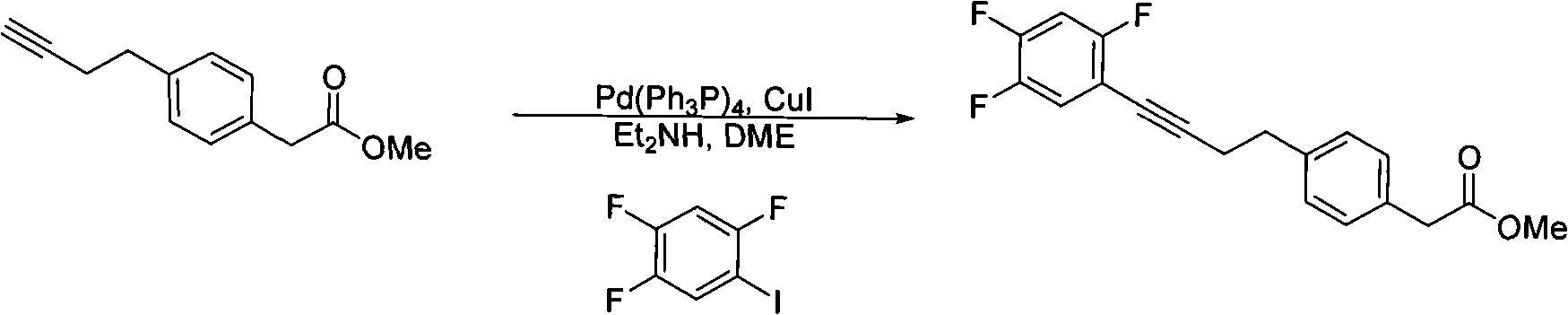
Operation according to top embodiment 40 steps 2 obtains 95mg (39%) 2-(4-(4-(2,4, the 5-trifluorophenyl) fourth-3-alkynyl) phenyl) methyl acetate, is yellow oil.LRMS:332.3 (calculated value) 355.3 (experimental value) (MNa)
+
Step 6:2-(4-(4-(2,4, the 5-trifluorophenyl) butyl) phenyl) methyl acetate

Operation according to top embodiment 40 steps 3 obtains 91mg (95%) 2-(4-(4-(2,4, the 5-trifluorophenyl) butyl) phenyl) methyl acetate, for clarifying translucent oily matter.LRMS:336.3 (calculating) 359.2 (experimental value) (MNa)
+
Step 7:N-hydroxyl-2-(4-(4-(2,4, the 5-trifluorophenyl) butyl) phenyl) ethanamide (179)
Operation according to top embodiment 40 steps 4 obtains 52mg (57%) N-hydroxyl-2-(4-(4-(2,4, the 5-trifluorophenyl) butyl) phenyl) ethanamide 179, is white powder.(MeOD-d4)δ(ppm)
1H:7.15(m,6H),3.35(s,2H),2.61(m,4H),1.60(m,4H)。LRMS:337.3 (calculated value) 338.3 (experimental value) (MH)
+
Embodiment 42:
2-(4-(4-(benzo [c] [1,2,5] oxadiazole-5-yls) fourth-3-alkynyl) phenyl)-N-hydroxyl acetamide (180)

Obtain 8mg (57%) 2-(4-(4-(benzo [c] [1,2,5] oxadiazole-5-yls) fourth-3-alkynyl) phenyl according to the operation of top embodiment 40 steps 4)-N-hydroxyl acetamide 180, be the light yellow orange powder.(MeOD-d4) δ (ppm)
1H:10.62 (s, 1H), 8.79 (s, 1H), 8.07 (s, 1H), 8.03 (d, J=9.2Hz, 1H), 7.40 (d, J=9.6Hz, 1H), 7.24 (d, J=8.4Hz, 2H), 7.18 (d, J=8.0hz, 2H), 3.23 (s, 3H), 2.83 (m, 2H), 2.77 (m, 2H) LRMS:321.1 (calculated value) 320.3 (experimental value) (MH)
-
Embodiment 43:
N-hydroxyl-2-(3-(4-phenyl butyl) phenyl) ethanamide (181)
Step 1:2-(3-(4-hydroxyl fourth-1-alkynyl) phenyl) methyl acetate

Operation according to top embodiment 40 steps 2 obtains 227mg (34%) 2-(3-(4-hydroxyl fourth-1-alkynyl) phenyl) methyl acetate, is yellow oil.LRMS:218.2 (calculated value) 219.1 (experimental value) (MH)
+
Step 2:2-(3-(4-hydroxyl butyl) phenyl) methyl acetate

Operation according to top embodiment 40 steps 3 obtains 181mg (78%) 2-(3-(4-hydroxyl butyl) phenyl) methyl acetate, for clarifying translucent oily matter.LRMS:222.3 (calculating) 223.1 (experimental value) (MH)
+
Step 3:2-(3-(4-oxo butyl) phenyl) methyl acetate

Operation according to top embodiment 41 steps 3 obtains 178mg (99%) 2-(3-(4-oxo butyl) phenyl) methyl acetate, for clarifying translucent oily matter.LRMS:220.3 (calculated value) 221.4 (experimental value) (MH)
+
Step 4:2-(3-(4-hydroxy-4-phenyl butyl) phenyl) methyl acetate

(1equiv, (1equiv, 100mg is in THF 0.45mmol) (2mL) solution 0.45mmol) to drop to 2-(3-(4-oxo butyl) phenyl) methyl acetate with 1.0M PhMgBr solution at 0 ℃.Make then to be reflected at and rise to 23 ℃ in 1 hour.By adding saturated NH
4The Cl aqueous solution (10mL) quencher reaction.Water phase separated and with EtOAc extraction (2x5mL).Merge organic layer then, through Na
2SO
4Drying is filtered, and under reduced pressure concentrates.Crude product carries out purifying by the 0-50%EtOAc wash-out that silica gel column chromatography is beneficial in the hexane, obtains 2-(3-(the 4-hydroxy-4-phenyl butyl) phenyl) methyl acetate of 78mg (58%), for clarifying translucent oily matter.LRMS:298.4 (calculated value) 321.2 (experimental value) (MH)
+
Step 5:2-(3-(4-phenyl butyl) phenyl) methyl acetate
Operation according to top embodiment 40 steps 2 obtains 15mg (20%) 2-(3-(4-phenyl butyl) phenyl) methyl acetate, for clarifying translucent oily matter.LRMS:282.4 (calculating) 283.2 (experimental value) (MH)
+
Step 6:N-hydroxyl-2-(3-(4-phenyl butyl) phenyl) ethanamide (181)

Obtaining 5mg (33%) N-hydroxyl-2-(3-(4-phenyl butyl) phenyl) ethanamide (181) according to the operation of top embodiment 40 steps 4 is white powder.(CD
3OD) δ (ppm) 1H:7.23 (m, 9H), 3.36 (s, 2H), 2.61 (m, 4H), 1.63 (m, 4H) LRMS (ESI): (calculated value) 283.1 (experimental value) 282.2 (MH)
-
Embodiment 44:
By preparing following additional compounds with the similar step of described those steps of embodiment 40-43:
A) N-hydroxyl-2-(4-(4-(4-(trifluoromethyl) phenyl) butyl) phenyl) ethanamide (182)

(CD
3OD)δ(ppm)1H:7.53(d,J=8.4Hz,2H),7.33(d,J=8.0Hz,2H),7.18(d,J=8.0Hz,2H),7.10(d,J=8.0Hz,2H),(s,2H),2.70(t,J=7.2Hz,2H),2.61(t,J=7.2Hz,2H),1.63(m,4H)。LRMS (ESI): (calculated value) 351.14 (experimental value) 350.24 (MH)
-
B) 2-(4-(4-(1H-indoles-5-yl) butyl) phenyl)-N-hydroxyl acetamide (183)

(CD
3OD) d (ppm) 1H:7.29 (m, 1H), 7.24 (d, J=8.8Hz, 1H), 7.18-7.16 (m, 3H), 7.11-7.09 (m, 2H), 6.90 (dd, J=8.4Hz, 1.6Hz, 1H), 6.34 (d, J=4Hz, 1H), 3.35 (s, 2H), 2.68 (t, J=7.2Hz, 2H), 2.61 (t, J=7.2Hz, 2H), 1.64 (m, 4H) LRMS (ESI): (calculated value) 322.17 (experimental value) 323.421 (MH)+.
C) N-hydroxyl-2-(4-(4-(3-(trifluoromethyl) phenyl) butyl) phenyl) ethanamide (184)

(dDMSO)δ(ppm)1H:10.60(s,1H),8.77(s,1H),7.50(m,4H),7.12(d,J=8.0Hz,2H),7.07(d,J=8.0Hz,2H),3.19(s,2H),2.68(t,J=7.2Hz,2H),2.54(t,J=7.2Hz,2H),1.55(m,4H)。LRMS (ESI): (calculated value) 351.1 (experimental value) 350.3 (MH)
-
D) N-hydroxyl-2-(4-(4-(2-(trifluoromethyl) phenyl) butyl) phenyl) ethanamide (185)
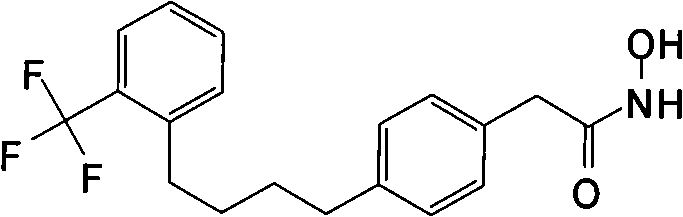
(dDMSO)d(ppm)1H:10.60(s,1H),8.77(s,1H),7.63(d,J=8.0Hz,1H),7.57(t,J=7.2Hz,1H),7.43(d,J=7.6Hz,1H),7.37(t,J=8.0Hz,1H),7.13(d,J=8.0Hz,2H),7.09d,J=8.0Hz,2H),3.20(s,2H),2.73(t,J=7.6Hz,2H),1.58(m,4H)。LRMS (ESI): (calculated value) 351.1 (experimental value) 350.3 (MH)-.
E) N-hydroxyl-2-(4-(4-(imidazo [1,2-a] pyridine-6-yl) butyl) phenyl) ethanamide (186)

(CD
3OD)d(ppm)1H:8.19(s,1H),7.73(s,1H),7.49(s,1H),7.43(d,J=9.2Hz,1H),7.15(m,5H),3.34(s,2H),2.63(m,4H),1.66(m,4H)。LRMS (ESI): (calculated value) 323.1 (experimental value) 324.3 (MH)+.
F) 2-(4-(4-(benzo [d] [1,3] dioxole-5-yl) butyl) phenyl)-N-hydroxyl acetamide (187)

(dDMSO)d(ppm)1H:10.60(s,1H),8.78(s,1H),7.12(d,J=8.0Hz,2H),7.07(d,J=8.0Hz,2H),6.75(m,2H),6.60(d,J=8.0Hz,1H),5.92(s,2H),3.19(s,2H),2.52(m,4H),1.50(m,4H)。LRMS (ESI): (calculated value) 327.1 (experimental value) 326.4 (MH)-.
G) 2-(4-(4-(benzo [d] [1,3] dioxole-5-yl) fourth-3-alkynyl) phenyl)-N-hydroxyl acetamide (188)

(dDMSO)d(ppm)1H:10.61(s,1H),8.78(s,1H),7.20(d,J=8.4Hz,2H),7.16(d,J=8.4Hz,2H),6.85(m,3H),6.01(s,2H),3.22(s,2H),2.77(t,J=7.6Hz,2H),2.61(t,J=6.8Hz,2H)。LRMS (ESI): (calculated value) 323.1 (experimental value) 322.2 (MH)-.
H) 2-(4-(4-(benzo [c] [1,2,5] oxadiazole-5-yls) fourth-3-alkynyl) phenyl)-N-hydroxyl acetamide (189)

(dDMSO)d(ppm)1H:10.60(s,1H),8.78(s,1H),7.12(d,J=8.0Hz,2H),7.07(d,J=8.0Hz,2H),6.75(m,2H),6.60(d,J=8.0Hz,1H),5.92(s,2H),3.19(s,2H),2.52(m,4H),1.50(m,4H)。LRMS (ESI): (calculated value) 327.1 (experimental value) 326.4 (MH)-.
I) N-hydroxyl-2-(4-(2-benzene oxygen oxyethyl group) phenyl) ethanamide (190)
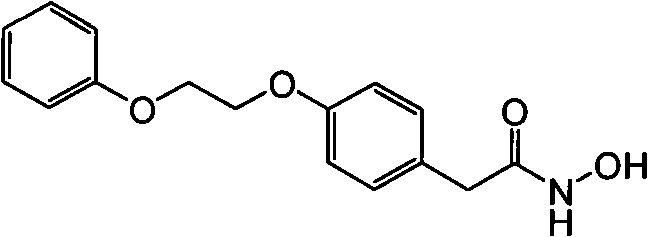
(DMSO)d(ppm)1H:10.58(bs,1H),8.77(bs,1H),7.28(t,J=7.6Hz<2H),7.15(d,J=8.8Hz,2H),6.93(m,5H),4.26(s,4H),3.18(s,2H)。LRMS (ESI): (calculated value) 287.3 (experimental value) 310.0 (MH)+.
J) N-hydroxyl-2-(4-(3-benzene oxygen propyl group) phenyl) ethanamide (191)
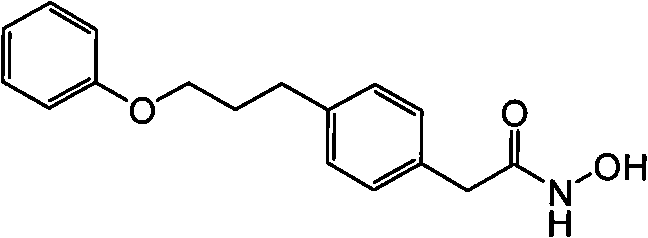
(CD
3OD)d(ppm)1H:7.21(m,6H),6.88(m,6H),3.92(t,J=8Hz,2H),3.35(s,2H),2.77(t,J=7.2Hz,2H),2.04(m,2H)。LRMS (ESI): (calculated value) 285.3 (experimental value) 286.2 (MH)+.
K) 2-(4-butyl phenyl)-N-hydroxyl acetamide (192)

(CD
3OD)d(ppm)1H:7.18(d,J=8Hz,2H),7.11(d,J=8Hz,2H),3.35(s,2H),2.57(T,J=7.6Hz,2H),1.56(m,2H),1.33(m,2H),0.92(t,J=7.2Hz,2H)。LRMS (ESI): (calculated value) 207.2 (experimental value) 208.1 (ES+; Na+).
L) N-hydroxyl-2-(4-(5-phenylpentyl) phenyl) ethanamide (193)

(CD
3OD)d(ppm)1H:7.22-7.08(m,9H),3.34(s,2H),2.56(m,4H),1.61(m,4H),1.34(m,2H)。LRMS (ESI): (calculated value) 297.4 (experimental value) 298.3 (MH)+.
M) N-hydroxyl-2-(4-(4-hydroxyl-4-(pyridin-4-yl) butyl) phenyl) ethanamide (194)
(CD
3OD)d(ppm)1H:8.44(d,J=6.0Hz,2H),7.36(d,J=6.4Hz,2H),7.18(d,J=8.4Hz,2H),7.09(d,J=8.0Hz,2H),4.65(m,1H),3.34s,2H),2.60(m,2H),1.69(m,4H)。LRMS (ESI): (calculated value) 300.3 (experimental value) 301.3 (MH)+.
N) N-hydroxyl-2-(4-(4-hydroxyl-4-(pyridin-3-yl) butyl) phenyl) ethanamide (195)
(CD
3OD)d(ppm)1H:8.46(s,1H),8.41(d,J=4.8Hz,1H),7.78(d,J=8.0Hz,1H),7.39(t,J=5.6Hz,1H),7.18(d,J=8.0Hz,2H),7.09(d,J=8.0Hz,2H),4.69(m,1H),3.34(s,2H),2.61((t,J=6.4Hz,2H),1.79-1.58(m,4H)。LRMS (ESI): (calculated value) 300.5 (experimental value) 301.4 (MH)+.
O) N-hydroxyl-2-(4-(4-hydroxyl-4-(pyridine-2-yl) butyl) phenyl) ethanamide (196)

(CD
3OD)d(ppm)1H:8.42(m,1H),7.81(m,1H),7.51(d,J=7.2Hz,1H),7.26(d,J=4.8Hz,1H),7.16(m,1H),7.08(m,2H),4.69(m,1H),3.34(s,2H),2.59(m,2H),1.76-1.69(m,4H)。LRMS (ESI): (calculated value) 300.3 (experimental value) 301.4 (MH)+.
P) N-hydroxyl-2-(4-(4-(pyridin-4-yl) butyl) phenyl) ethanamide (197)
(CD
3OD)d(ppm)1H:8.37(d,J=6.0Hz,2H),7.24(d,J=5.6Hz,2H),7.18(d,J=8.0Hz,2H),7.10(d,J=8.0Hz,2H),3.35(s,2H),2.67(t,J=6.4Hz,2H),2.62(t,J=7.2Hz,2H),1.65(m,4H)。LRMS (ESI): (calculated value) 284.1 (experimental value) 285.3 (NH)+.
Q) N-hydroxyl-2-(4-(4-(pyridin-3-yl) butyl) phenyl) ethanamide (198)
(CD
3OD)d(ppm)1H:8.24(m,2H),7.65(d,J=8.0Hz,1H),7.33(m,1H),7.18(d,J=7.6Hz,2H),7.10(d,J=7.6Hz,2H),3.35(s,2H),2.64(m,4H),1.64(m,4H)。LRMS (ESI): (calculated value) 284.1 (experimental value) 285.3 (MH)+.
R) N-hydroxyl-2-(4-(4-(pyridine-2-yl) butyl) phenyl) ethanamide (199)

(CD
3OD)d(ppm)1H:8.39(d,J=6.0Hz),7.75(t,J=8.0Hz,1H),7.23(m,4H),7.10(d,J=8.0Hz,2H),3.34(s,2H),2.78(t,J=7.6Hz,2H),2.61(t,J=7.6Hz,2H),1.67(m,4H)。LRMS (ESI): (calculated value) 284.1 (experimental value) 285.4 (MH)+.
S) N-hydroxyl-2-(4-(3-phenyl propyl) phenyl) ethanamide (200)

(CD
3OD)d(ppm):7.24-7.11(m,9H),3.35(s,2H),2.60(t,4H,J=7.6Hz),1.89(m,2H)。LRMS:269.1 (calculated value) 270.1 (experimental value).
T) N-hydroxyl-4-(5-phenyl) benzamide (201)

(CD
3OD)d(ppm)1H:7.64(d,J=7.6Hz,2H),7.22(m,4H),7.12(m,3H),2.63(t,J=7.6Hz,2H),2.57(t,J=7.2Hz,2H),1.63(m,4H),1.35(m,2H)。LRMS (ESI): (calculated value) 283.4 (experimental value) 284.3 (MH)+.
Embodiment 45:
N-(1-amino-cyclopropane ketonic oxygen base)-2-(4-(4-phenyl butyl) phenyl) acetamide hydrochloride (174a)
Step 1: the tertiary butyl-1-((2-(4-(4-phenyl butyl) phenyl) kharophen oxygen base) carbonyl) cyclopropyl carbamate

(1 equivalent, 156mg 0.55mmol) are dissolved in DMF (3mL) with N-hydroxyl-2-(4-(4-phenyl butyl) phenyl) ethanamide 174.Add then 1-(tertbutyloxycarbonyl amido) Cyclopentane carboxylic acid (1.5equiv, 166mg, 0.83mmol), add continuously afterwards HOBt (1equiv, 74mg, 0.55mmol) and EDC (1.5equiv, 158mg, 0.83mmol).Stirring reaction spends the night then.Then at EtOAc (5mL) and H
2Divide reactant ligand between the O (5mL).Separate organic phase, through Na
2SO
4Drying is filtered and is concentrated.Resistates is by using Et
2O grinds and carries out purifying, obtains 166mg (65%) tertiary butyl-1-((2-(4-(4-phenyl butyl) phenyl) kharophen oxygen base) carbonyl) cyclopropyl carbamate.LRMS:466.5 (calculating) 489.3 (MNa)
+
Step 2:N-(1-amino-cyclopropane ketonic oxygen base)-2-(4-(4-phenyl butyl) phenyl) acetamide hydrochloride (174a)

With the 4M solution of HCl in dioxane (3mL) add the tertiary butyl-1-((2-(4-(4-phenyl butyl) phenyl) kharophen oxygen base) carbonyl) cyclopropyl carbamate (166mg, 0.36mmol) in.Stirring reaction 1h hour.Decompression is evaporating solvent down.Compound Et
2O grinds, and obtains N-(1-amino-cyclopropane ketonic oxygen base)-2-(4-(4-phenyl butyl) phenyl) acetamide hydrochloride (174a) of 142mg (99%).(dDMSO)δ(ppm)
1H:12.36(bs,1H),8.82(bs,3H),7.26-7.08(m,9H),3.43(s,2H),2.55(m,4H),1.55-1.49(m,8H)。LRMS:366.1 (calculated value) 365.4 (MH)
-
Embodiment 46:
By with following other compound of the similar step vegetation of those steps described in embodiment 40-43 and 45:
A) (S)-N-(2-amino-3-phenyl propionyloxy)-2-(4-(4-phenyl butyl) phenyl) acetamide hydrochloride (174b)

(DMSO)δ(ppm)1H:12.39(bs,1H),8.47(bs,3H),7.31-6.96(m,1H),4.54(m,1H),3.46(s,2H),3.15(m,2H),2.56(q,J=6.8,13.6Hz,4H),1.54(m,4H)。LRMS (ESI): (calculated value) 430.2 (experimental value) 431.4 (MH)
+
B) (S)-N-(2-amino-3-methylbutyryl oxygen base)-2-(4-(4-phenyl butyl) phenyl) acetamide hydrochloride (174c)
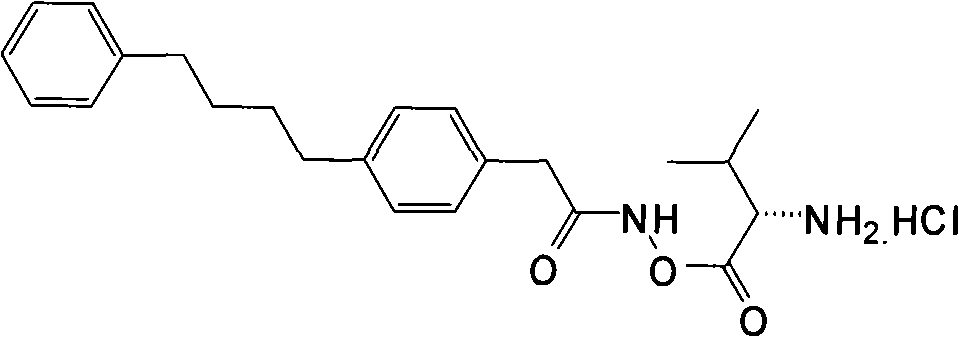
(DMSO)δ(ppm)1H:12.32(bs,1H),8.33(bs,3H),7.24-7.09(m,9H),4.13(m,1H),3.45(s,2H),2.57(m,4H),2.18(m,1H),1.55(m,4H),1.03-0.94(m,6H)。LRMS (ESI): (calculated value) 382.2 (experimental value) 383.1 (MH)
+
C) (S)-N-(2-amino-3,3-dimethyl butyrate acyloxy)-2-(4-(4-phenyl butyl) phenyl) acetamide hydrochloride (174d)
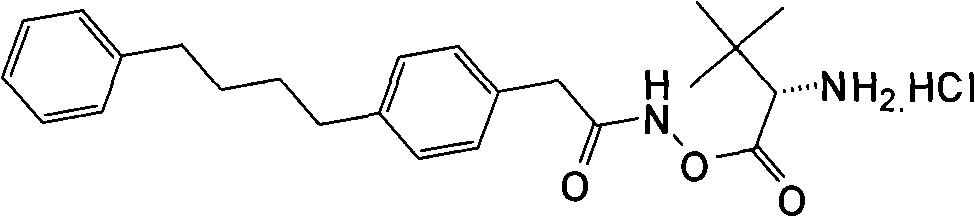
(dDMSO)δ(ppm)1H:12.49(bs,1H),8.59(bs,3H),7.26-7.09(m,9H),3.98(s,1H),3.47(s,2H),2.56(m,4H),1.55(m,4H),1.05(s,9H)。LRMS (ESI): (calculated value) 396.2 (experimental value) 397.5 (MH)
+
D) N-(the amino tetramethylene ketonic oxygen of 1-base)-2-(4-(4-phenyl butyl) phenyl) acetamide hydrochloride (174e)

(dDMSO)δ(ppm)1H:12.52(bs,1H),8.90(bs,1H),7.19(m,9H),3.47(s,2H),2.56(m,6H),2.05(m,2H),1.54(m,4H)。LRMS (ESI): (calculated value) 380.2 (experimental value) 381.4 (MH)
+
E) N-(2-amino-2-methyl propionyloxy)-2-(4-(4-phenyl butyl) phenyl) acetamide hydrochloride (174f)
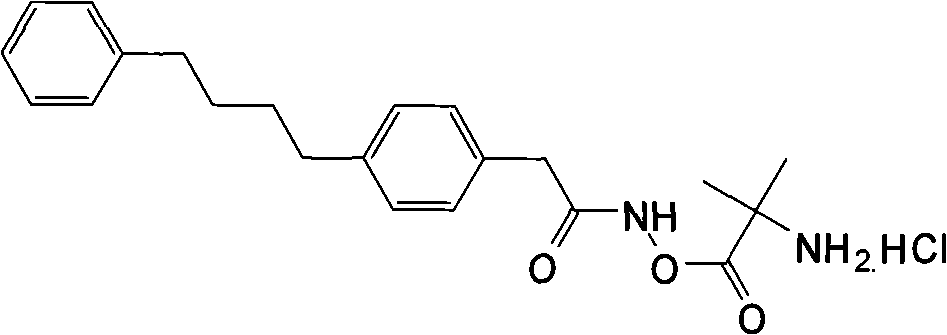
(dDMSO)δ(ppm)1H:12.45(bs,1H),8.77(bs,3H),7.16(m,9H),3.45(s,2H),2.56(m,4H),1.54(m,10H)。LRMS (ESI): (calculated value) 368.2 (experimental value) 369.4 (MH)
+
F) N-(1-(aminomethyl) cyclopropane carbonyl oxygen base)-2-(4-(4-phenyl butyl) phenyl) acetamide hydrochloride (174g)

(dDMSO)δ(ppm)1H:12.17(bs,1H),8.00(bs,3H),7.26-7.08(m,9H),3.42(s,2H),3.05(s,2H),2.55(m,4H),1.54(m,4H),1.35(m,2H),1.26(m,2H)。LRMS (ESI): (calculated value) 380.2 (experimental value) 381.5 (MH)
+
Embodiment 47:
Also prepared following other prodrug according to the present invention.
(S)-N-(2,6-diamino hexylyloxy)-2-(4-(4-phenyl butyl) phenyl) ethanamide

LRMS (ESI): (calculated value) 411.25 (experimental value) 412.509 (MH)+
(DMSO)d(ppm)1H:12.50(s,1H),8.66(s,3H),7.81(s,3H),7.27-7.10(m,9H),4.27-4.21(m,1H),3.48-3.46(m,2H),2.75-2.68(m,2H),2.60-2.52(m,4H),1.88-1.80(m,2H),1.60-1.40(m,8H)。
N-(2-glycoloyl oxygen base)-2-(4-(4-phenyl butyl) phenyl) ethanamide
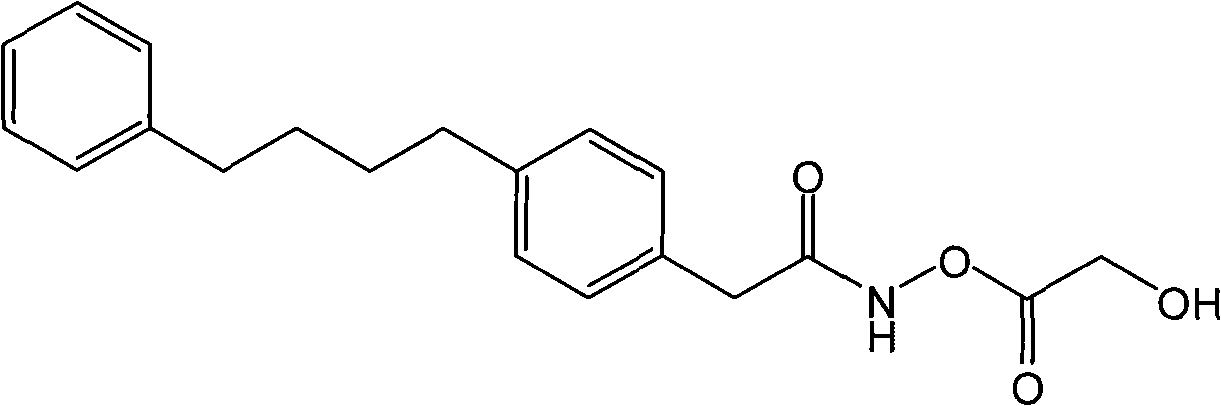
LRMS (ES-): (calculated value) 341.16 (experimental value) 340.466 (MH)+
(DMSO)d(ppm)1H:11.95(s,1H),7.27-7.09(m,9H),5.64(t,J=6.4Hz,1H),4.17(d,J=6.4Hz,2H),3.42(s,2H),2.60-2.52(m,4H),1.58-1.53(m,4H)
(S)-N-(2-amino-5-guanidine radicals penta acyloxy)-2-(4-(4-phenyl butyl) phenyl) ethanamide

LRMS (ESI): (calculated value) 439.26 (experimental value) 440.651 (MH)+
(DMSO)d(ppm)1H:12.60(s,1H),8.77(s,1H),8.43(s,4H),8.00(s,1H),7.85(s,1H),7.37-7.12(m,9H),3.95-3.85(m,1H),3.20-3.10(m,4H),2.60-2.52(m,2H),1.92-1.72(m,4H),1.70-1.45(m,4H)
(S)-2,6-diamino-N-(1-((2-(4-(4-phenyl butyl) phenyl) kharophen oxygen base) carbonyl) cyclopropyl) hexanamide

LRMS (ESI): (calculated value) 494.29 (experimental value) 495.592 (MH)+
(DMSO)d(ppm)1H:12.08(s,1H),9.36(s,1H),8.23(s,3H),7.86(s,3H),7.27-7.08(m,9H),3.75-3.65(m,1H),3.39(s,2H),2.78-2.67(m,2H),2.62-2.52(m,4H),1.80-1.66(m,2H),1.64-1.46(m,8H),1.44-1.28(m,2H),1.38-1.26(m,2H)
N-(1-((2-(4-(4-phenyl butyl) phenyl) kharophen oxygen base) carbonyl) cyclopropyl) niacinamide
LRMS (ESI): (calculated value) 471.22 (experimental value) 472.525 (MH)+
(DMSO)d(ppm)1H:9.45(s,1H),9.00(s,1H),8.72(d,1H,J=4.8Hz),8.19(d,1H,J=8Hz),7.51(dd,1H,J=8Hz,4.8Hz),7.27-7.05(m,9H),2.59-2.53(m,4H),1.60-1.50(m,4H),1.32-1.27(m,2H),1.25-1.21(m,2H)
(S)-2-amino-3-methyl-N-(1-((2-(4-(4-phenyl butyl) phenyl) kharophen oxygen base) carbonyl) cyclopropyl) butyramide

LRMS (ESI): (calculated value) 465.26 (experimental value) 466.695 (MH)+
(DMSO)d(ppm)1H:12.04(s,1H),9.21(s,1H),8.09(s,3H),7.27-7.06(m,9H),3.50-3.45(m,1H),3.40-3.37(m,2H),2.61-2.53(m,4H),2.14-2.04(m,1H),1.62-1.48(m,6H),1.24-1.16(m,2H),0.98-0.90(m,6H)
(S)-2-amino-3-phenyl-N-(1-((2-(4-(4-phenyl butyl) phenyl) kharophen oxygen base) carbonyl) cyclopropyl) propionic acid amide
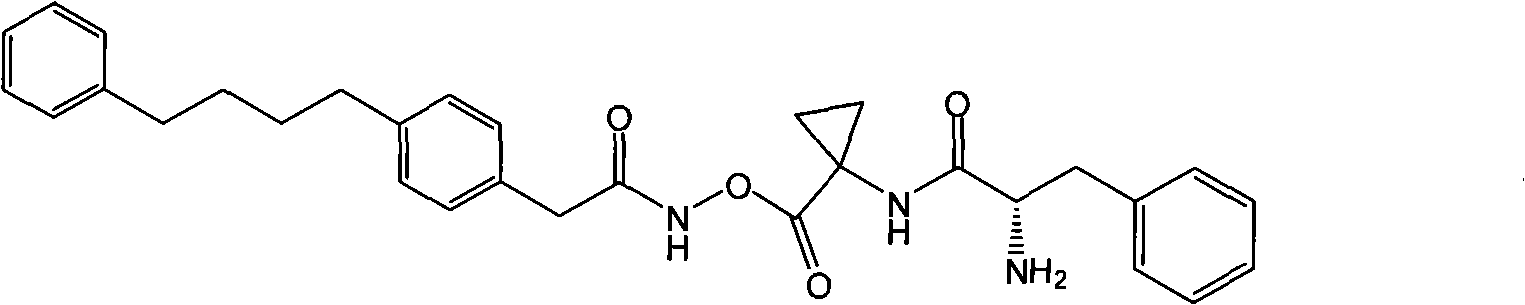
LRMS (ESI): (calculated value) 513.26 (experimental value) 514.675 (MH)+
(DMSO)d(ppm)1H:12.03(s,1H),9.19(s,1H),8.14(s,3H),7.29-7.08(m,14H),3.92-3.85(m,1H),3.40-3.37(m,2H),3.06-2.94(m,2H),2.60-2.53(m,4H),1.57-1.51(m,4H),1.51-1.46(m,2H),1.40-0.80(m,2H)
2-(4-(4-phenyl butyl) phenyl)-N-((2S, 3R, 4S, 5S, 6R)-3,4, and 5-trihydroxy--6-(methylol) tetrahydrochysene-2H-pyrans-2-base oxygen base) ethanamide

LRMS (ESI): (calculated value) 445.2 (experimental value) 446.6 (MH)+
(CD
3OD)d(ppm)1H:7.24-7.10(m,9H),4.50(d,J=8.0Hz,1H),3.90(dd,J=2.4,12.0Hz,1H),3.65(dd,J=6.0,11.6Hz,1H),3.40(s,2H),3.35-3.25(m,3H),2.61(m,4H),1.62(m,4H)
N-(2,3-dihydroxyl propionyloxy)-2-(4-(4-phenyl butyl) phenyl) ethanamide

LRMS (ESI): (calculated value) 371.17 (experimental value) 000.0 (M)-370.478
(CD
3OD)d(ppm)1H:7.25-7.08(m,9H),4.41(t,J=4HZ,1H),3.81(d,J=4Hz,2H),3.51(s,2H),2.64-2.58(m,4H),1.65-1.58(m,4H)
N-hydroxyl-2-(4-(4-(morpholinyl phenyl) butyl) phenyl) ethanamide
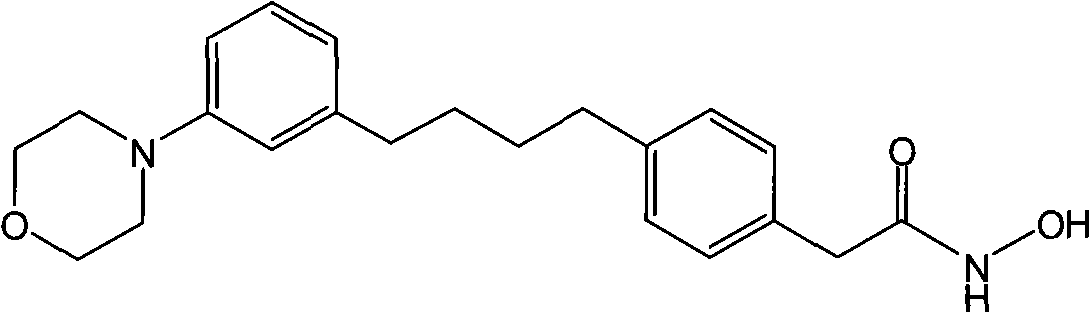
LRMS (ESI): (calculated value) 368.21 (experimental value) 369.571 (MH)+
(DMSO)d(ppm)1H:10.62(s,1H),8.78(s,1H),7.14-7.04(m,5H),6.72-6.68(m,2H),6.60(d,J=7.2Hz,1H),3.70(t,J=4.8Hz,4H),3.20(s,2H),3.04(t,J=4.8Hz,4H),2.56-2.49(m,4H),1.58-1.48(m,4H)
N-hydroxyl-2-phenyl-2-(4-(4-phenyl butyl) phenyl) ethanamide
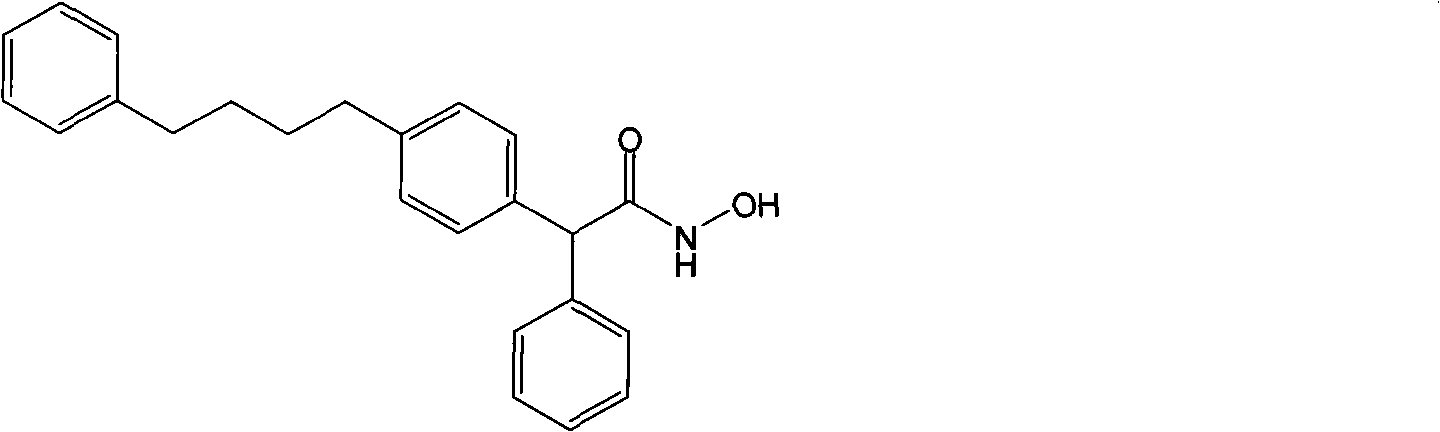
LRMS (ESI): (calculated value) 359.2 (experimental value) 360.4 (MH)+
(CD
3OD)d(ppm)1H:7.30-7.11(m,14H),4.73(s,1H),2.60(m,4H),1.61(m,4H)
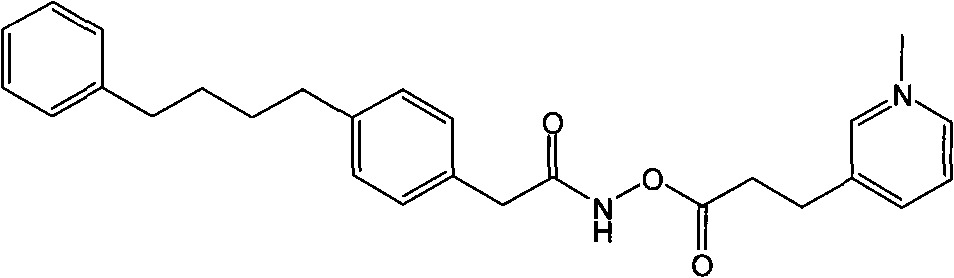
LRMS (ESI): (calculated value) 431.5 (experimental value) 431.5 (M)+
(CD
3OD)d(ppm)1H:8.84(s,1H),8.71(d,J=6.0Hz,1H),8.49(d,J=8.0Hz,1H),7.96(t,J=6.8Hz,1H),7.24-7.10(m,9H),4.30(s,3H),3.47(s,2H),3.22(t,J=7.2Hz,2H),2.97(t,J=6.8Hz,2H),2.61(m,4H),1.62(m,4H)
2-(4-(4-(4-fluorophenyl) butyl) phenyl)-N-hydroxyl acetamide

LRMS (ESI): (calculated value) 301.1 (experimental value) 302.3 (MH)+
(dDMSO)d(ppm)1H:7.19(m,2H),7.11-6.98(m,6H),3.02(s,2H),2.54(m,4H),1.53(m,4H)
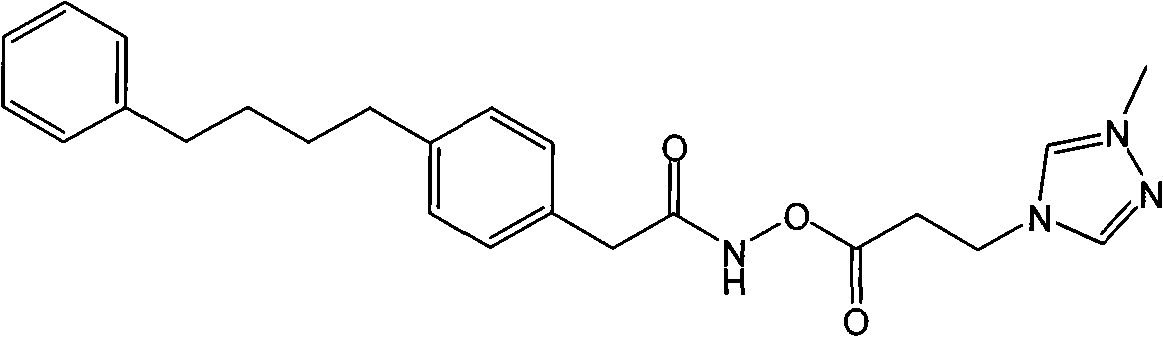
LRMS (ESI): (calculated value) 421.2 (experimental value) 421.5 (MH)+
(CD
3OD)d(ppm)1H:12.13(bs,1H),10.11(s,1H),9.14(s,1H),7.27-7.09(m,9H),4.67(t,J=6.0Hz,2H),3.86(s,3H),3.39(s,2H),3.17(t,J=6.0Hz,2H),2.56(m,4H),1.55(m,4H)
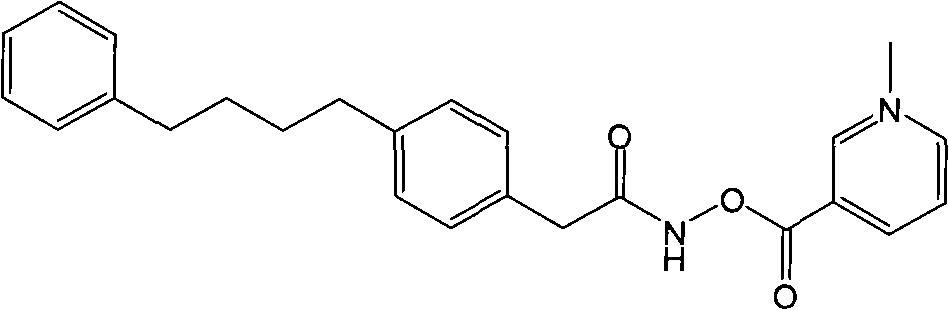
LRMS (ESI): (calculated value) 403.2 (experimental value) 403.4 (M)+
(CD
3OD)d(ppm)1H:9.66(s,1),9.14(m,2),8.25(m,1H),7.26-7.10(m,9H),4.49(s,3H),3.60(s,2H),2.62(m,4H),1.64(m,4H)
Embodiment 48:
Inhibition of histone deacetylase enzymic activity
At the histone deacetylase from the nuclear extract of human small cell lung carcinoma clone H446 (ATTC HTB-171) preparation and at clone's recombinant human (for example HDAC-1) enzyme screening hdac inhibitor from baculovirus insect cell expression system expression and purifying.
For deacetylase test, at 37 ℃ of clones hHDAC-1 incubation 20 of recombinating with the H446 nuclear extract of 30 μ g or equal amount, 000cpm [
3H]-the acetylated histones substrate (M.Yoshida etc., J.Biol.Chem.265 (28): 17174-17179 (1990)) of metabolic marker 10 minutes.By adding acetate (0.04M, final concentration) and HCl (250mM, final concentration) termination reaction.Mixture with ethyl acetate extraction and discharged [
3H]-acetate is by the scintillation counting standard measure.For suppressing research, enzyme uses compound 4 ℃ of preincubation 30 minutes before the beginning enzyme test.The IC of HDAC enzyme inhibitors
50Value is measured by the inhibitor concentration that the maximum of utilizing independent compound to finish dose response curve and mensuration generation 50 percent suppresses.
(table 4a) uses following proposal to measure compound of the present invention alternatively.In this was measured, employed damping fluid was 25mM HEPES, pH 8.0,137mM NaCl, 2.7mM KCl, 1mM MgCl
2, and substrate is Boc-Lys (the Ac)-AMC in the 50mM stock solution among the DMSO.The enzyme stock solution is 4.08 μ g/mL in damping fluid.Compound is in room temperature enzyme (20 μ l, 4.08 μ g/ml) preincubation (2 μ l in DMSO are diluted to 13 μ l, to be transferred to test panel in damping fluid) 10 minutes (35 μ l preincubation volume).With mixture room temperature preincubation 5 minutes.By make temperature reach 37 ℃ and add 16 μ l substrates begin the reaction.Total reaction volume is 50 μ l.Be terminated by adding 50 μ l developers after being reflected at 20 minutes, (the Fluor-de-Lys developer, Cat.#KI-105) guidance is prepared for described developer such as Biomol.At reading (λ
Ex=360nm, λ
Em=470nm, edge filter is at 435nm) before with plate in the dark in room temperature incubation 10 minutes.
Representative data is presented among table 4 and the 4a.In first row of table 4, reported the IC that measures at from the histone deacetylase in the nuclear extract of H446 cell
50Value (HDAC that compiles).What report in the secondary series of table 4 is at recombinant human HDAC-1 enzyme (rHDAC-1). the IC that is measured
50Value.For the less compound of activity, data are represented as the inhibition percentage ratio under normality.
Table 4: the inhibition of histone deacetylase


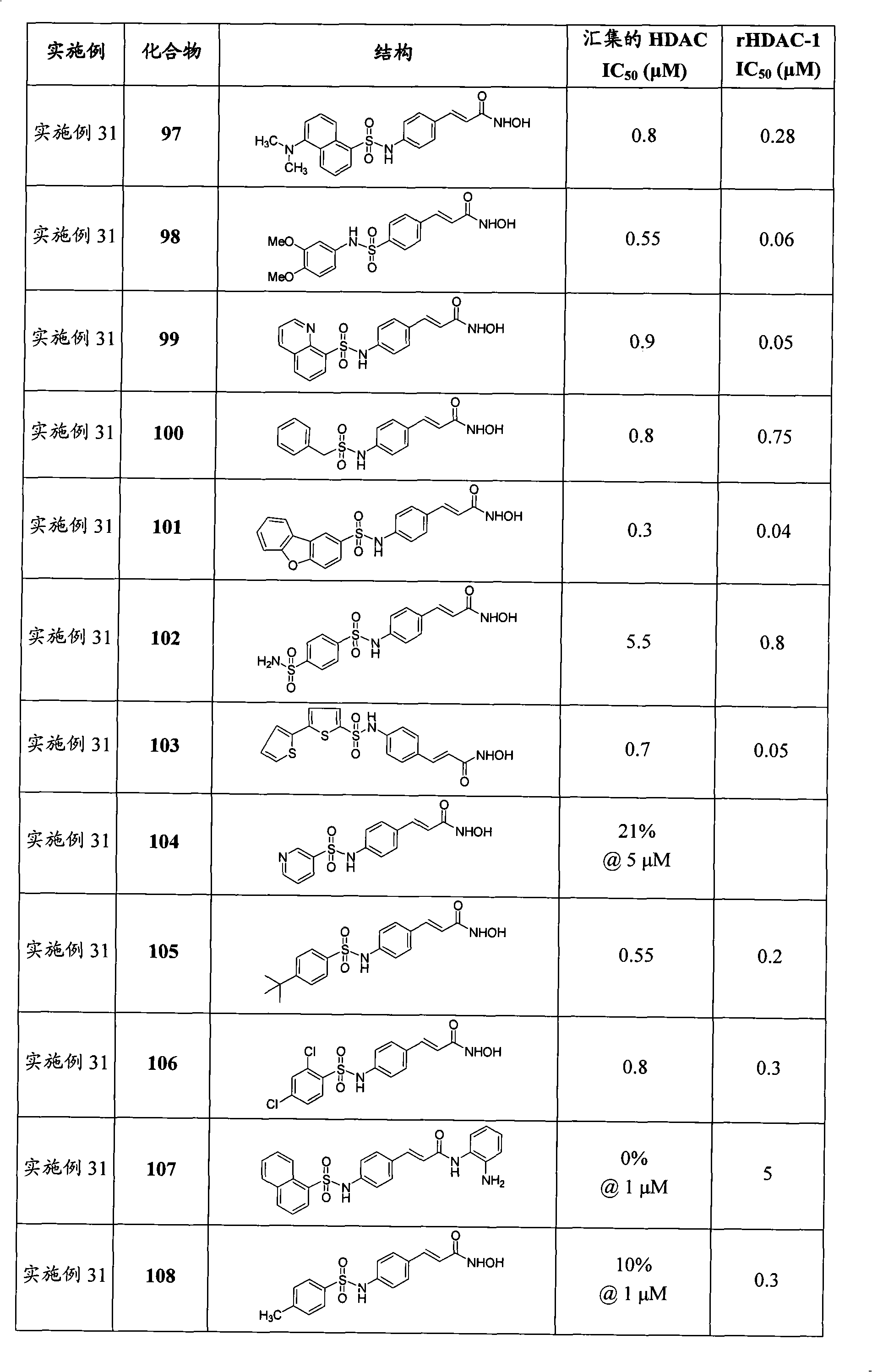


Table 4a

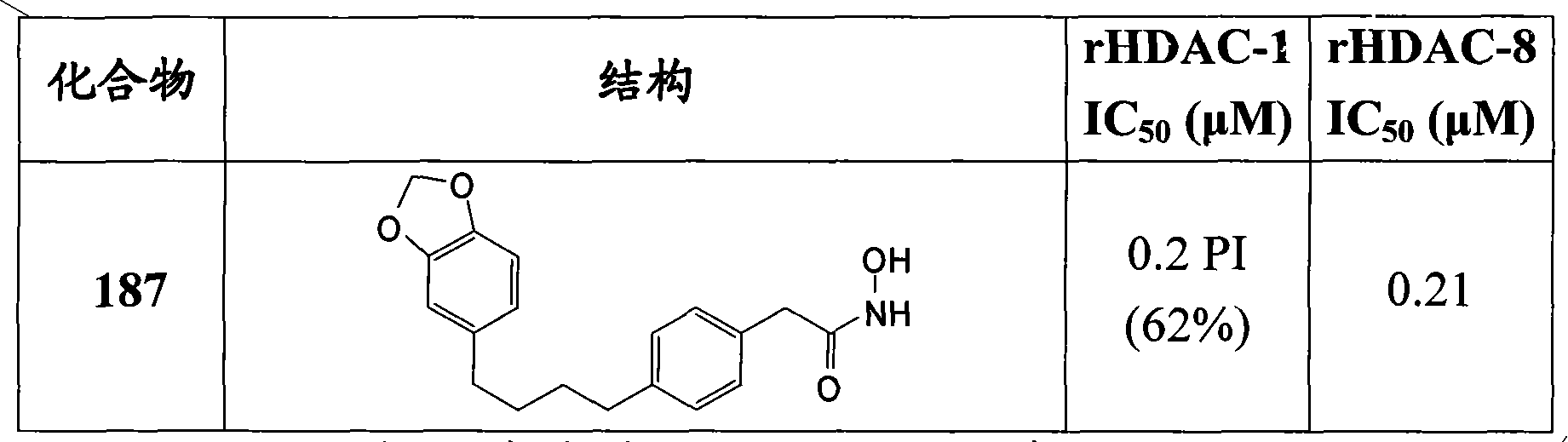
PI=partly suppresses (not reach 100% inhibition-PI value representation IC
50(being in the maximum % that is reached suppresses))
Embodiment 49:
The inhibition of histone deacetylase in the full cell
1. measure the acetylize of histone H 4 in the full cell by immunoblotting
The T24 human bladder cancer cell that will grow in culture uses hdac inhibitor incubation 16 hours.Histone extracts from cell behind the incubation period, as by as described in (J.Biol.Chem.265 (28): 17174-17179 (1990)) such as M.Yoshida.Total histone protein of 20 μ μ g is loaded into SDS/PAGE to be gone up and transfers on the Nitrocellulose film.Film is used specific to the polyclonal antibody of acetylated histones H-4 (Upstate Biotech Inc.) and is carried out probe in detecting, carries out probe in detecting with horseradish peroxidase bonded two anti-(Sigma) afterwards.Utilizing Kodak film (Eastman Kodak) to carry out enhanced chemiluminescence (ECL) (Amersham) detects.By the quantitative acetylize H-4 of optical densitometric method signal.
Select the data of compound to be presented in the table 5.Data are rendered as effective reduction acetylize H-4 signal 50% (EC
50) concentration.
Table 5: the inhibition of acetylation of histone in the cell

2. the acid urea Triton of acetylation of histone (Acid Urea Triton (AUT)) gel analysis.
The human cancer cell of growing in culture (T24,293T or Jurkat cell) is used hdac inhibitor incubation 24 hours.From cell, extract histone, as by as described in (J.Biol.Chem.265 (28): 17174-17179 (1990)) such as M.Yoshida.Acid urea Triton (AUT) gel electrophoresis is used to detect the acetylated histones molecule.With histone (gross proteins of 150 μ μ g) at 80V in moving 16 hours, as by as described in top M.Yoshida etc. in the room temperature electrophoresis.Gel with the development histone, makes its drying with coomassie brilliant blue staining, and by optical densitometric method scanning, with the proteic acetylize of quantized sets.
Embodiment 50:
Anti-knurl effect in the body of histone deacetylase inhibitor to tumour cell
Eight to ten the week ages female BALB/c nude mice (Taconic Labs, Great Barrington, NY) in the flank zone by subcutaneous injection 2x10
6Pretreated A549 human lung carcinoma cell.Finish the pre-treatment of these cells by minimum three continuous tumour transplatations in same nude mice strain.Subsequently, cut the tumor fragment of about 30mg, and under Forene anesthesia at left rib zone subcutaneous transplantation (Geneva, Switzerland, Abbott Labs) in mouse.When tumour reaches 100mm
3Average-volume the time, by be used in suitable carrier such as PBS, DMSO/ water or Tween 80/ water histone deacetylase inhibitor solution with injection predose every day of 10mg/kg to mouse carry out intravenously, subcutaneous or intraperitoneal is handled.The optimal dose of hdac inhibitor is established by the dose response test according to standard scheme.According to every other day calculating gross tumor volume (for example, Meyer etc., Int.J.Cancer 43:851-856 (1989)) behind the standard method infusion.The processing that utilization is carried out according to hdac inhibitor of the present invention, the contrast with respect to only using salt solution (that is, no hdac inhibitor) to handle causes that tumor weight and volume significantly reduce.In addition, the contrast with respect to brine treatment when measuring of the activity of histone deacetylase is expected to significantly be reduced.
Embodiment 51:
Histone deacetylase inhibitor and histone deacetylase antisense oligonucleotide are to the collaborative retarding effect of interior tumor cell
The objective of the invention is to set forth the collaborative ability that suppresses tumor growth in the Mammals of histone deacetylase inhibitor of the present invention and histone deacetylase antisense oligonucleotide.Preferably, antisense oligonucleotide and hdac inhibitor suppress the expression and the activity of same histone deacetylase.
As described in embodiment 10, has the A549 of transplanting tumour (average-volume 100mm
3) mouse with containing the prepared in saline thing every day processing of the about 0.1mg of every kg body weight to about 30mg histone deacetylase antisense oligonucleotide.Second group of mouse is with containing the pharmaceutically useful prepared product every day processing of the about 0.01mg of every kg body weight to about 5mg hdac inhibitor.
Some mouse are accepted antisense oligonucleotide and hdac inhibitor.In these mouse, can accept antisense oligonucleotide and hdac inhibitor by tail vein while intravenously for one group.Another group can be accepted antisense oligonucleotide by the tail vein, and the subcutaneous hdac inhibitor of accepting.And again one group can subcutaneously accept antisense oligonucleotide and hdac inhibitor.The mouse control group similarly determined, its do not receive treatment (for example, only salt solution), only accept the antisense oligonucleotide of mispairing, antisense oligonucleotide and the control compound of accepting the active control compound of inhibition of histone deacetylase not and accepting mispairing.
Measure gross tumor volume with calipers.The processing that utilizes antisense oligonucleotide and histone deacetylase protein inhibitor according to the present invention to carry out causes that with respect to contrast tumor weight and volume significantly reduce.
Embodiment 52
Solubleness
Measure the solubleness of several compounds of the present invention, and the result is presented in the following table.

Although the present invention is described in conjunction with its embodiment, but be to be understood that, it can further be revised and the application is intended to cover and follows the principle of the invention usually and comprise of the present invention any change, purposes or the modification that exists this type of to depart from the disclosure, in the known or conventional practice in this field under the present invention, and it can be applied to essential characteristic mentioned above, and is falling within the scope of the appended claims.
Claims (34)
1. the compound of a following formula:
Cy-L
2-Ar-Y
2-C(O)N(R
x)-Z
And pharmaceutically useful salt, wherein
Cy is-H, cycloalkyl, aryl, heteroaryl or heterocyclic radical, and any in them randomly is substituted or is not substituted, and condition is that Cy is not (spiro cycloalkyl group) heterocyclic radical;
L
2Be C
1-C
6Saturated alkylidene group or C
2-C
6Alkenylene, wherein said alkylidene group or alkenylene randomly are substituted or are not substituted, and optional following heteroatom moiety replacement: the O that independently is selected from of one or two carbon atom of wherein said alkylidene group; NR ', R ' are alkyl, acyl group or hydrogen; S; S (O); Or S (O)
2
Ar is an arylidene, wherein said arylidene randomly is substituted again or no longer is substituted, and randomly with or do not condense with aromatic ring or hetero-aromatic ring, perhaps with or not with saturated or partly undersaturated cycloalkyl ring or heterocyclic fused, any in described aromatic ring or hetero-aromatic ring and described saturated or partly undersaturated cycloalkyl ring or the heterocycle randomly is substituted or is not substituted; With
Y
2Be saturated alkylidene group chemical bond or straight chain or side chain, it randomly is substituted or is not substituted, and condition is the substituting group replacement that this alkylidene group is not had formula-C (O) R, and wherein R comprises the alpha-amino group acyl moiety;
R
xBe H or-OH;
Z is-R
20,-O-R
20,-R
21Or
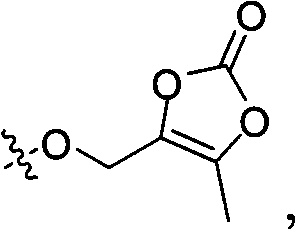 Wherein-R
20Be selected from-C (O)-R
10,-C (O) O-R
10,-R
11,-CH (R
12)-O-C (O)-R
10,-C (O)-C[(R
10) (R
10')]
1-4-NH (R
13) ,-S (O
2) R
10,-P (O) (OR
10) (OR
10) ,-C (O)-(CH
2)
1-4-C (OH) (COOR
10)-(CH
2)
1-4-COOR
10,-C (O)-[C (R
14) (R
14)]
1-4-P (O) (OH) (OH) ,-C (O)-(CH
2)
1-4-N (R
14)-C[=N (R
10')]-N (R
10') (R
10') ,-C (O)-(CH
2)-CH (OH)-(CH
2)-N (CH
3) (CH
3) ,-C (O)-CH (NH
2)-(CH
2)
1-6-COOH is (preferred-C (O)-CH (NH
2)-(CH
2)-COOH) ,-C (O)-(CH
2)
n-CH (OH)-CH
2-O-R
10,-C (O)-O-(CH
2)
n-CH (OH)-CH
2-O-R
10With-C (O)-(CH
2)
n-C (O) OR
10, condition is directly not combine with two O atoms with Z bonded N; And other condition is (a)
20The time, R then
xBe-OH, and (b) as Z be-OR
20The time, R then
xBe-H; Or
Wherein-R
20Be selected from-C (O)-R
10,-C (O) O-R
10,-R
11,-CH (R
12)-O-C (O)-R
10,-C (O)-C[(R
10) (R
10')]
1-4-NH (R
13) ,-S (O
2) R
10,-P (O) (OR
10) (OR
10) ,-C (O)-(CH
2)
1-4-C (OH) (COOR
10)-(CH
2)
1-4-COOR
10,-C (O)-[C (R
14) (R
14)]
1-4-P (O) (OH) (OH) ,-C (O)-(CH
2)
1-4-N (R
14)-C[=N (R
10')]-N (R
10') (R
10') ,-C (O)-(CH
2)-CH (OH)-(CH
2)-N (CH
3) (CH
3) ,-C (O)-CH (NH
2)-(CH
2)
1-6-COOH is (preferred-C (O)-CH (NH
2)-(CH
2)-COOH) ,-C (O)-(CH
2)
n-CH (OH)-CH
2-O-R
10,-C (O)-O-(CH
2)
n-CH (OH)-CH
2-O-R
10With-C (O)-(CH
2)
n-C (O) OR
10, condition is directly not combine with two O atoms with Z bonded N; And other condition is (a)
20The time, R then
xBe-OH, and (b) as Z be-OR
20The time, R then
xBe-H; Or
R
xDo not exist, and R
20Form the optional heterocycle that replaces with its N that is connected;
N is 0-4;
Each R
10Be independently selected from hydrogen, the optional C that replaces
1-C
20Alkyl, the optional C that replaces
2-C
20Thiazolinyl, the optional C that replaces
2-C
20Alkynyl, the optional C that replaces
1-C
20Carbalkoxy, the optional cycloalkyl that replaces, the optional Heterocyclylalkyl that replaces, the optional aryl that replaces, the optional heteroaryl that replaces, the optional cycloalkylalkyl that replaces, the optional Heterocyclylalkyl alkyl that replaces, the optional arylalkyl that replaces, the optional heteroarylalkyl that replaces, the optional cycloalkyl thiazolinyl that replaces, the optional Heterocyclylalkyl thiazolinyl that replaces, the optional aryl alkenyl that replaces, the optional heteroaryl thiazolinyl that replaces, the optional cycloalkyl alkynyl that replaces, the optional Heterocyclylalkyl alkynyl that replaces, the optional aromatic yl polysulfide yl that replaces, the optional heteroaryl alkynyl that replaces, the optional alkyl-cycloalkyl that replaces, the optional alkyl heterocycle alkyl that replaces, the optional alkylaryl that replaces, the optional miscellaneous alkyl aryl that replaces, the optional thiazolinyl cycloalkyl that replaces, the optional thiazolinyl Heterocyclylalkyl that replaces, the optional alkenyl aryl that replaces, the optional thiazolinyl heteroaryl that replaces, the optional alkynyl cycloalkyl that replaces, the optional alkynyl Heterocyclylalkyl that replaces, the optional alkynyl aryl that replaces, the optional alkynyl heteroaryl that replaces, saccharide residue and amino-acid residue (preferably by amino acid whose carboxyl terminal combination);
Each R
10' be hydrogen or C independently
1-6Alkyl, or
R
10And R
10' form the optional spiro cycloalkyl group that replaces with the carbon atom that they connected;
R
21Be sugar or-amino acid-R
13, R wherein
13With N-end covalent attachment;
R
11Be selected from hydrogen, the optional Heterocyclylalkyl that replaces, the optional aryl that replaces and the optional heteroaryl that replaces;
R
12Be selected from hydrogen or alkyl; And
R
13Be selected from hydrogen ,-C (O)-CH[N (R
10') (R
10')]-C
1-C
6Alkyl ,-C (O)-CH[N (R
10') (R
10')]-C
1-C
6Alkyl-N (R
10') (R
10') ,-C (O)-CH[N (R
10') (R
10')]-C
1-C
6Alkyl-aryl ,-C (O)-CH[N (R
10') (R
10')]-C
1-C
6Alkyl-heteroaryl ,-C (O)-aryl ,-C (O)-heteroaryl, amino protecting group and R
10With
Each R
14Be independently selected from H, C
1-C
6Alkyl and cycloalkyl, perhaps two R
14Form cycloalkyl with the atom that they connected.
2. compound as claimed in claim 1, wherein Z is selected from-O-C (O)-R
10,-O-C (O)-[C (R
10) (R
10']
1-4-NH (R
13) and-OR
11
3. compound as claimed in claim 2, it has following formula:

4. compound as claimed in claim 1, wherein Y
2Be C
1-C
2Alkylidene group.
5. compound as claimed in claim 1, wherein Y
2It is methylene radical.
6. compound as claimed in claim 1, wherein Ar is that replace or unsubstituted phenylene, its randomly with or do not condense with aromatic ring or hetero-aromatic ring, perhaps with or not with saturated or partly undersaturated cycloalkyl ring or heterocyclic fused, any in described aromatic ring or hetero-aromatic ring and described saturated or partly undersaturated cycloalkyl ring or the heterocycle randomly is substituted or is not substituted.
7. compound as claimed in claim 6, wherein said phenylene are the 4-phenylenes.
8. compound as claimed in claim 1, wherein Cy be selected from phenyl, pyridine-2-base, pyridin-3-yl, pyridin-4-yl and with heterocyclic fused phenyl, any in them randomly is substituted or is not substituted.
9. compound as claimed in claim 8, wherein said phenyl, pyridine-2-base, pyridin-3-yl, pyridin-4-yl and be unsubstituted or independently be selected from following substituting group by one or two and replace: C with heterocyclic fused phenyl
1-C
4Alkyl, C
1-C
4Haloalkyl, C
6-C
10Aryl, (C
6-C
10) aryl (C
1-C
6) alkyl, halogen, nitro, hydroxyl, trifluoromethyl, C
1-C
6Alkoxyl group, C
1-C
6Carbalkoxy, carboxyl and amino.
10. compound as claimed in claim 1, wherein L
2In one or two saturated carbon replace with independently being selected from following substituting group: C
1-C
6Alkyl, C
6-C
10Aryl, amino, oxo, hydroxyl, C
1-C
4Alkoxyl group and C
6-C
10Aryloxy.
11. inhibitor as claimed in claim 10, wherein said substituting group is a hydroxyl.
12. inhibitor as claimed in claim 1, wherein said alkylidene group L
2Carbon atom all do not replaced by heteroatom moiety.
13. compound as claimed in claim 1, one or two carbon atom quilt-O-of wherein said alkylidene group replaces.
14. compound as claimed in claim 1, wherein
Cy is the optional aryl that replaces;
Ar is the optional aryl that replaces;
R
xBe H or OH; With
Z is-O-R
20Or R
21
15. compound as claimed in claim 1, wherein
Cy is the optional aryl that replaces;
Ar is the optional aryl that replaces;
R
xBe H or OH; With
Z is-O-R
20Or R
21, wherein
R
20Be-C (O)-C[(R
10) (R
10')]
1-4-NH (R
13) or-C (O)-R
10
16. compound as claimed in claim 1, wherein
Cy is the optional aryl that replaces;
Ar is the optional aryl that replaces;
R
xBe H or OH; With
Z is-O-R
20Or R
21
17. compound as claimed in claim 1, wherein
Cy is the optional aryl that replaces;
Ar is the optional aryl that replaces;
R
xBe H or OH; With
Z is-O-R
20Or R
21, wherein
R
20Be-C (O)-C[(R
10) (R
10')]
1-4-NH (R
13) or-C (O)-R
10
18. compound as claimed in claim 1, wherein
Cy is the optional aryl that replaces;
L
2Be saturated C
3Alkyl or C
4Alkyl;
Ar is the optional aryl that replaces;
Y
2Be C
1Alkyl or C
2Alkyl;
R
xBe H or OH;
Z is-O-R
20Or R
21
R
20Be-C (O)-C[(R
10) (R
10')]
1-4-NH (R
13) or-C (O)-R
10
Each R
10Be independently selected from H, the optional alkyl that replaces, optional replace-alkyl phenyl, optional replace-miscellaneous alkyl aryl and the optional heteroaryl that replaces;
Each R
10' be H or alkyl independently; Or
R
10And R
10' form C with the atom that they connected
3Or C
4Spiro cycloalkyl group, preferred C
3Spiro cycloalkyl group;
R
13Be selected from H ,-C (O)-CH[N (R
10) (R
10')]-C
1-C
6Alkyl-N (R
10) (R
10') ,-C (O)-heteroaryl ,-C (O)-aryl ,-C (O)-CH[N (R
10) (R
10')]-C
1-C
6Alkyl ,-C (O)-CH[N (R
10) (R
10')]-C
1-C
6Alkyl-aryl and-C (O)-CH[N (R
10) (R
10')]-C
1-C
6Alkyl-heteroaryl; With
R
21Be amino acid-R
13
19. compound as claimed in claim 1, wherein
Cy is the optional aryl that replaces;
L
2Be saturated C
3Alkyl or C
4Alkyl;
Ar is the optional aryl that replaces;
Y
2Be C
1Alkyl or C
2Alkyl, optional being substituted;
R
xBe H or OH;
Z is-O-R
20
R
20Be-C (O)-C[(R
10) (R
10')]
1-4-NH (R
13);
Each R
10Be independently selected from H, the optional alkyl that replaces and optional replace-alkyl phenyl;
Each R
10' be H or alkyl independently; Or
R
10And R
10' form C with the atom that they connected
3Or C
4Spiro cycloalkyl group, preferred C
3Spiro cycloalkyl group; With
R
13Be H.
20. compound as claimed in claim 1, wherein
Cy is the optional aryl that replaces;
L
2Be saturated C
3Alkyl or C
4Alkyl;
Ar is the optional aryl that replaces;
Y
2Be C
1Alkyl or C
2Alkyl;
R
xBe H or OH;
Z is R
21
R
21Be amino acid-R
13With
R
13Be H.
21. compound as claimed in claim 1, wherein
Cy is the optional aryl that replaces;
L
2Be saturated C
3Alkyl or C
4Alkyl;
Ar is the optional aryl that replaces;
Y
2Be C
1Alkyl or C
2Alkyl;
R
xBe H or OH;
Z is-O-R
20
R
20Be-C (O)-R
10With
R
10Be selected from the optional alkyl that replaces, optional replace-alkyl phenyl, optional replace-miscellaneous alkyl aryl and the optional heteroaryl that replaces.
22. compound as claimed in claim 1, wherein
Cy is the optional aryl that replaces;
L
2Be saturated C
3Alkyl or C
4Alkyl;
Ar is the optional aryl that replaces;
Y
2Be C
1Alkyl or C
2Alkyl;
R
xBe H or OH;
Z is-O-R
20
R
20Be-C (O)-C[(R
10) (R
10')]-NH (R
13), R wherein
10And R
10' form C with the atom that they connected
3Or C
4Spiro cycloalkyl group; With
R
13Be selected from H ,-C (O)-CH[N (R
10) (R
10')]-C
1-C
6Alkyl-N (R
10) (R
10') ,-C (O)-heteroaryl ,-C (O)-aryl ,-C (O)-CH[N (R
10) (R
10')]-C
1-C
6Alkyl ,-C (O)-CH[N (R
10) (R
10')]-C
1-C
6Alkyl-aryl and-C (O)-CH[N (R
10) (R
10')]-C
1-C
6Miscellaneous alkyl aryl, wherein R
10And R
10' each independently is selected from H and C
1-C
6Alkyl, preferred H.
23. a composition, it comprises as each described compound and pharmaceutically useful carrier, vehicle and/or thinner among the claim 1-22.
24. comprising, a method that suppresses the histone deacetylase in the cell, described method will wherein need the cell of inhibition of histone deacetylase to contact with each described compound among the claim 1-22.
25. method as claimed in claim 24, wherein cell proliferation is suppressed in the cell that is contacted.
26. method as claimed in claim 24, wherein said cell is the fungal cell.
27. method as claimed in claim 26, wherein said fungal cell in animal body.
28. method as claimed in claim 26, wherein said fungal cell is the part of fungi infestation.
29. a method for the treatment of cell breeding disease, described method comprise to its compound as claimed in claim 1 of organism administering therapeutic significant quantity of needs.
30. a method for the treatment of fungi infestation, described method comprise to its compound as claimed in claim 1 of organism administering therapeutic significant quantity of needs.
31. method as claimed in claim 24 comprises that also the antisense oligonucleotide that described cell and inhibition of histone deacetylase are expressed contacts.
32. method as claimed in claim 29 wherein is suppressed in cell proliferation in the cell of contact.
33. as each described split product among the claim 1-22.
34. a method that suppresses the histone deacetylase in the cell, described method comprise the cell of wherein wishing the inhibition of histone deacetylase is contacted with split product as each described compound among the claim 1-22.
Applications Claiming Priority (2)
| Application Number | Priority Date | Filing Date | Title |
|---|---|---|---|
| US87076806P | 2006-12-19 | 2006-12-19 | |
| US60/870,768 | 2006-12-19 |
Publications (1)
| Publication Number | Publication Date |
|---|---|
| CN101610996A true CN101610996A (en) | 2009-12-23 |
Family
ID=39535930
Family Applications (1)
| Application Number | Title | Priority Date | Filing Date |
|---|---|---|---|
| CNA2007800515415A Pending CN101610996A (en) | 2006-12-19 | 2007-12-19 | Histone deacetylase inhibitors and prodrugs thereof |
Country Status (8)
| Country | Link |
|---|---|
| EP (2) | EP2573069A3 (en) |
| JP (2) | JP2010513326A (en) |
| KR (1) | KR20090094383A (en) |
| CN (1) | CN101610996A (en) |
| AU (1) | AU2007335216C1 (en) |
| CA (1) | CA2672192A1 (en) |
| MX (1) | MX2009006542A (en) |
| WO (1) | WO2008074132A1 (en) |
Cited By (3)
| Publication number | Priority date | Publication date | Assignee | Title |
|---|---|---|---|---|
| CN104610166A (en) * | 2015-03-10 | 2015-05-13 | 山东大学 | Pyrimidine benzyl hydroxamic acid histone deacetylase inhibitor, and preparation method and application thereof |
| CN105237444A (en) * | 2015-09-24 | 2016-01-13 | 沈阳药科大学 | Hydroxamic acid compound, preparation method and uses thereof |
| CN107011238A (en) * | 2017-03-14 | 2017-08-04 | 北京化工大学 | Class I histone deacetylase inhibitor and its production and use |
Families Citing this family (25)
| Publication number | Priority date | Publication date | Assignee | Title |
|---|---|---|---|---|
| EP2139850B1 (en) | 2007-04-09 | 2018-09-12 | MethylGene Inc. | Inhibitors of histone deacetylase |
| ES2620027T3 (en) | 2008-09-03 | 2017-06-27 | Biomarin Pharmaceutical Inc. | Compositions that include 6-aminohexanoic acid derivatives as HDAC inhibitors |
| US8202866B2 (en) * | 2008-09-17 | 2012-06-19 | Hoffmann-La Roche Inc. | Ortho-aminoanilides for the treatment of cancer |
| WO2012021982A1 (en) * | 2010-08-20 | 2012-02-23 | Methylgene Inc. | Antifungal agents and uses thereof |
| EP2616450B1 (en) * | 2010-09-17 | 2018-05-02 | Kancera AB | Sulfonamide compounds |
| WO2012112447A2 (en) * | 2011-02-14 | 2012-08-23 | Dana-Farber Cancer Institute, Inc. | Histone deacetylase inhibitors and methods of use thereof |
| US10059723B2 (en) | 2011-02-28 | 2018-08-28 | Biomarin Pharmaceutical Inc. | Histone deacetylase inhibitors |
| ES2712803T3 (en) | 2011-02-28 | 2019-05-14 | Biomarin Pharm Inc | Histone deacetylase inhibitors |
| US8957066B2 (en) | 2011-02-28 | 2015-02-17 | Biomarin Pharmaceutical Inc. | Histone deacetylase inhibitors |
| WO2013041407A1 (en) | 2011-09-19 | 2013-03-28 | Cellzome Ag | Hydroxamic acids as hdac6 inhibitors |
| CA2862259A1 (en) * | 2011-12-29 | 2013-07-04 | Pharmacyclics, Inc. | Cinnamic acid hydroxyamides as inhibitors of histone deacetylase 8 |
| US20140081017A1 (en) * | 2012-09-14 | 2014-03-20 | Methylgene Inc. | Histone Deacetylase Inhibitors for Enhancing Activity of Antifungal Agents |
| EP2968232B1 (en) * | 2013-03-14 | 2018-12-05 | CHDI Foundation, Inc. | Histone deacetylase inhibitors and compositions and methods of use thereof |
| EP2970139B1 (en) | 2013-03-15 | 2018-05-30 | BioMarin Pharmaceutical Inc. | Hdac inhibitors |
| WO2014138989A1 (en) * | 2013-03-15 | 2014-09-18 | Methylgene Inc. | Method and intermediates for the synthesis of hydroxamic acid compounds |
| KR101586045B1 (en) | 2013-07-30 | 2016-01-15 | 충북대학교 산학협력단 | Novel Phenylthiazole-Based Hydroxamic Acids and Anti-Cancer Composition Comprising the Same As Active Ingredient |
| US9636298B2 (en) | 2014-01-17 | 2017-05-02 | Methylgene Inc. | Prodrugs of compounds that enhance antifungal activity and compositions of said prodrugs |
| US10357493B2 (en) | 2017-03-10 | 2019-07-23 | Selenity Therapeutics (Bermuda), Ltd. | Metalloenzyme inhibitor compounds |
| RU2748835C1 (en) * | 2017-11-27 | 2021-05-31 | Совет Научных И Прикладных Исследований | Indol(sulfonil)-n-hydroxybenzamide derivatives as selective hdac inhibitors |
| WO2020014409A1 (en) * | 2018-07-11 | 2020-01-16 | Rubedo Life Sciences, Inc. | Senolytic compositions and uses thereof |
| JP2022543106A (en) | 2019-07-30 | 2022-10-07 | エイコニゾ セラピューティクス,インコーポレーテッド | HDAC6 inhibitors and their uses |
| US12091412B2 (en) | 2020-06-16 | 2024-09-17 | Volastra Therapeutics, Inc. | Heterocyclic inhibitors of ENPP1 |
| KR102870919B1 (en) | 2022-05-03 | 2025-10-20 | 충북대학교 산학협력단 | Novel N-hydroxypropenamide compound and pharmaceutical composition for preventing or treating cancer comprising the same as an active ingredient |
| KR102730905B1 (en) | 2022-05-03 | 2024-11-15 | 충북대학교 산학협력단 | Novel N-hydroxypropenamide compound and pharmaceutical composition for preventing or treating cancer comprising the same as an active ingredient |
| CN116283895A (en) * | 2023-01-09 | 2023-06-23 | 怀化宝华生物科技有限公司 | Preparation method of 2- [2- (thienyl) ethyl ] benzoic acid |
Family Cites Families (39)
| Publication number | Priority date | Publication date | Assignee | Title |
|---|---|---|---|---|
| NL6406688A (en) * | 1964-06-05 | 1965-12-06 | ||
| DK172081A (en) | 1980-04-21 | 1981-10-22 | Merck & Co Inc | MERCHANT CONNECTION AND PROCEDURES FOR PRODUCING THEREOF |
| JPS5981643A (en) * | 1982-05-06 | 1984-05-11 | Fuji Photo Film Co Ltd | Precursor of developing agent and silver halide photosensitive material containing it |
| JPS60112764A (en) * | 1983-11-22 | 1985-06-19 | Ishihara Sangyo Kaisha Ltd | N-benoyl-n'-pyridyloxyphenylurea based compound and insecticide containing the same |
| US4757078A (en) * | 1986-11-28 | 1988-07-12 | E. R. Squibb & Sons, Inc. | Cyclic aryl hydroxamic acids, derivatives thereof and method of use as anti-allergy agents |
| US5149797A (en) | 1990-02-15 | 1992-09-22 | The Worcester Foundation For Experimental Biology | Method of site-specific alteration of rna and production of encoded polypeptides |
| US5652355A (en) | 1992-07-23 | 1997-07-29 | Worcester Foundation For Experimental Biology | Hybrid oligonucleotide phosphorothioates |
| US5804601A (en) * | 1995-04-10 | 1998-09-08 | Takeda Chemical Industries, Ltd. | Aromatic hydroxamic acid compounds, their production and use |
| US5891916A (en) * | 1995-06-21 | 1999-04-06 | Takeda Chemical Industries, Ltd. | Aromatic hydroxamix acid compounds, their production and use |
| US6174905B1 (en) * | 1996-09-30 | 2001-01-16 | Mitsui Chemicals, Inc. | Cell differentiation inducer |
| US6545131B1 (en) | 1997-05-19 | 2003-04-08 | The Johns Hopkins University | Tissue specific prodrug |
| US7425541B2 (en) | 1998-12-11 | 2008-09-16 | Medarex, Inc. | Enzyme-cleavable prodrug compounds |
| EP1161226B1 (en) | 1999-02-18 | 2004-05-26 | SuperGen, Inc. | Phosphocholine linked prodrug derivatives |
| EP1233958B1 (en) | 1999-11-23 | 2011-06-29 | MethylGene Inc. | Inhibitors of histone deacetylase |
| US6699899B1 (en) * | 1999-12-21 | 2004-03-02 | Celgene Corporation | Substituted acylhydroxamic acids and method of reducing TNFα levels |
| US7115573B2 (en) * | 2000-06-14 | 2006-10-03 | Medarex, Inc. | Prodrug compounds with an isoleucine |
| PA8525601A1 (en) | 2000-08-21 | 2002-04-25 | Hoffmann La Roche | PROPHARMS OF (3S, 4S) -4-BENCIL-1- [2- (4-HIDROXI-BENCENOSULFONIL) -ETIL] -PIPERIDIN-3-OL |
| US6670344B2 (en) | 2000-09-14 | 2003-12-30 | Bristol-Myers Squibb Company | Combretastatin A-4 phosphate prodrug mono- and di-organic amine salts, mono- and di- amino acid salts, and mono- and di-amino acid ester salts |
| JP2002128769A (en) * | 2000-10-17 | 2002-05-09 | Sumitomo Pharmaceut Co Ltd | Benzothiazin-3-one derivative |
| JP2004359546A (en) * | 2001-03-15 | 2004-12-24 | Ono Pharmaceut Co Ltd | Preventive and / or therapeutic agent for solid cancer, comprising hydroxamic acid derivative, non-toxic salt thereof and prodrug thereof as an active ingredient |
| AU2003211052A1 (en) | 2002-02-11 | 2003-09-04 | Vertex Pharmaceuticals Incorporated | Phospholipids as caspase inhibitor prodrugs |
| WO2003070691A1 (en) * | 2002-02-21 | 2003-08-28 | Osaka Industrial Promotion Organization | N-hydroxycarboxamide derivative |
| AU2004205372B2 (en) * | 2003-01-17 | 2011-02-24 | Topotarget Uk Limited | Hydroxamic acid compounds comprising an ester or ketone linkage as HDAC inhibitors |
| BRPI0408223A (en) * | 2003-03-12 | 2006-03-01 | Celgene Corp | compound, isomers, pharmaceutical composition, and methods of inhibiting pde4 and mmp, modulating tnf-alpha production in a mammal, and treating, preventing or controlling a disease or condition |
| PL1611088T3 (en) * | 2003-04-07 | 2009-11-30 | Pharmacyclics Inc | Hydroxamates as therapeutic agents |
| JP4580932B2 (en) | 2003-06-12 | 2010-11-17 | メルク・シャープ・エンド・ドーム・コーポレイション | Prodrugs of mitotic kinesin inhibitors |
| US20060235012A1 (en) * | 2003-06-16 | 2006-10-19 | Chroma Therapeutics Limited | Carboline and betacarboline derivatives for use as hdac enzyme inhibitors |
| DE602004027932D1 (en) * | 2003-09-22 | 2010-08-12 | S Bio Pte Ltd | Benzimidazole derivatives: Preparation and pharmaceutical applications |
| US20050137141A1 (en) | 2003-10-24 | 2005-06-23 | John Hilfinger | Prodrug composition |
| EP1696898B1 (en) * | 2003-12-02 | 2015-11-18 | The Ohio State University Research Foundation | Zn 2+ -chelating motif-tethered short-chain fatty acids as a novel class of histone deacetylase inhibitors |
| EP1541549A1 (en) * | 2003-12-12 | 2005-06-15 | Exonhit Therapeutics S.A. | Tricyclic hydroxamate and benzaminde derivatives, compositions and methods |
| US8227636B2 (en) * | 2004-04-05 | 2012-07-24 | Merck Hdac Research, Llc | Histone deacetylase inhibitor prodrugs |
| WO2005108367A1 (en) * | 2004-05-03 | 2005-11-17 | Envivo Pharmaceuticals, Inc. | Compounds for treatment of neurodegenerative diseases |
| AU2005271841A1 (en) * | 2004-07-12 | 2006-02-16 | Merck & Co., Inc. | Inhibitors of histone deacetylase |
| WO2006042035A2 (en) * | 2004-10-07 | 2006-04-20 | Pharmacyclics, Inc. | Method of monitoring anti-tumor activity of an hdac inhibitor |
| WO2006075888A1 (en) * | 2005-01-14 | 2006-07-20 | Sk Corporation | Oxazole hydroxamic acid derivatives and use thereof |
| WO2006099416A1 (en) * | 2005-03-11 | 2006-09-21 | Nitromed, Inc. | 2-methyl indole cyclooxygenase-2 selective inhibitors, compositions and methods of use |
| EP1963258A4 (en) * | 2005-12-19 | 2011-06-29 | Methylgene Inc | Histone deacetylase inhibitors for enhancing activity of antifungal agents |
| US20080139673A1 (en) * | 2006-08-11 | 2008-06-12 | Methylgene Inc. | Potentiation of antifungal compounds |
-
2007
- 2007-12-19 CN CNA2007800515415A patent/CN101610996A/en active Pending
- 2007-12-19 EP EP12191995.5A patent/EP2573069A3/en not_active Withdrawn
- 2007-12-19 CA CA002672192A patent/CA2672192A1/en not_active Abandoned
- 2007-12-19 EP EP07855542A patent/EP1973872A4/en not_active Withdrawn
- 2007-12-19 WO PCT/CA2007/002260 patent/WO2008074132A1/en not_active Ceased
- 2007-12-19 MX MX2009006542A patent/MX2009006542A/en not_active Application Discontinuation
- 2007-12-19 JP JP2009541704A patent/JP2010513326A/en active Pending
- 2007-12-19 AU AU2007335216A patent/AU2007335216C1/en not_active Ceased
- 2007-12-19 KR KR1020097015215A patent/KR20090094383A/en not_active Ceased
-
2014
- 2014-01-17 JP JP2014006984A patent/JP2014111615A/en active Pending
Cited By (4)
| Publication number | Priority date | Publication date | Assignee | Title |
|---|---|---|---|---|
| CN104610166A (en) * | 2015-03-10 | 2015-05-13 | 山东大学 | Pyrimidine benzyl hydroxamic acid histone deacetylase inhibitor, and preparation method and application thereof |
| CN105237444A (en) * | 2015-09-24 | 2016-01-13 | 沈阳药科大学 | Hydroxamic acid compound, preparation method and uses thereof |
| CN107011238A (en) * | 2017-03-14 | 2017-08-04 | 北京化工大学 | Class I histone deacetylase inhibitor and its production and use |
| CN107011238B (en) * | 2017-03-14 | 2020-05-01 | 北京化工大学 | Histone deacetylase inhibitor and preparation method and application thereof |
Also Published As
| Publication number | Publication date |
|---|---|
| MX2009006542A (en) | 2009-06-30 |
| EP2573069A2 (en) | 2013-03-27 |
| KR20090094383A (en) | 2009-09-04 |
| EP2573069A3 (en) | 2013-05-22 |
| JP2010513326A (en) | 2010-04-30 |
| EP1973872A1 (en) | 2008-10-01 |
| EP1973872A4 (en) | 2012-05-09 |
| CA2672192A1 (en) | 2008-06-26 |
| AU2007335216A1 (en) | 2008-06-26 |
| JP2014111615A (en) | 2014-06-19 |
| WO2008074132A1 (en) | 2008-06-26 |
| AU2007335216C1 (en) | 2014-07-10 |
| AU2007335216B2 (en) | 2013-08-15 |
Similar Documents
| Publication | Publication Date | Title |
|---|---|---|
| CN101610996A (en) | Histone deacetylase inhibitors and prodrugs thereof | |
| KR101495611B1 (en) | Inhibitors of histone deacetylase | |
| EP1233958B1 (en) | Inhibitors of histone deacetylase | |
| US8796330B2 (en) | Inhibitors of histone deacetylase and prodrugs thereof | |
| JP5127402B2 (en) | Inhibitors of histone deacetylase | |
| JP5746860B2 (en) | Histone deacetylase inhibitor | |
| JP2006503082A (en) | Inhibitors of histone deacetylase | |
| CN101445469B (en) | Inhibitors of histone deacetylase | |
| HK1181746A (en) | Inhibitors of histone deacetylase and prodrugs thereof | |
| ES2368033T3 (en) | HISTONE DEACETILASE INHIBITORS. | |
| HK1095043A (en) | Inhibitors of histone deacetylase | |
| HK1126769B (en) | Benzamide derivatives as inhibitors of histone deacetylase | |
| AU2006200456A1 (en) | Inhibitors of histone deacetylase |
Legal Events
| Date | Code | Title | Description |
|---|---|---|---|
| C06 | Publication | ||
| PB01 | Publication | ||
| C10 | Entry into substantive examination | ||
| SE01 | Entry into force of request for substantive examination | ||
| ASS | Succession or assignment of patent right |
Owner name: CANADA CO., LTD., 7503547 Free format text: FORMER OWNER: 9222-9129 QUEBEC INC. Effective date: 20110111 |
|
| C41 | Transfer of patent application or patent right or utility model | ||
| TA01 | Transfer of patent application right |
Effective date of registration: 20110111 Address after: Quebec Applicant after: 7503547 Canada Company Address before: Quebec Applicant before: 9222-9129 Quebec Corporation |
|
| C02 | Deemed withdrawal of patent application after publication (patent law 2001) | ||
| WD01 | Invention patent application deemed withdrawn after publication |
Application publication date: 20091223 |