CN101602682A - Photo-initiation/halogen-free flame retardant and preparation method and application thereof - Google Patents
Photo-initiation/halogen-free flame retardant and preparation method and application thereof Download PDFInfo
- Publication number
- CN101602682A CN101602682A CNA2009100890089A CN200910089008A CN101602682A CN 101602682 A CN101602682 A CN 101602682A CN A2009100890089 A CNA2009100890089 A CN A2009100890089A CN 200910089008 A CN200910089008 A CN 200910089008A CN 101602682 A CN101602682 A CN 101602682A
- Authority
- CN
- China
- Prior art keywords
- compound
- halogen
- free flame
- molfraction
- mistake
- Prior art date
- Legal status (The legal status is an assumption and is not a legal conclusion. Google has not performed a legal analysis and makes no representation as to the accuracy of the status listed.)
- Granted
Links
Landscapes
- Fireproofing Substances (AREA)
- Compositions Of Macromolecular Compounds (AREA)
Abstract
The invention relates to a photo-initiation/halogen-free flame retardant and a preparation method and application thereof. Firstly, reacting a compound containing hydroxyl with acryloyl chloride to obtain an acrylated compound, then reacting the acrylated compound with primary amine or secondary amine to obtain a compound containing a tertiary amine structure, and then reacting the compound with methyl iodide to obtain a compound containing a quaternary ammonium salt structure, wherein the structure of the compound is shown as a formula or a formula (II). The compound containing the quaternary ammonium salt structure modifies montmorillonite through ion exchange to obtain a halogen-free flame retardant, and the halogen-free flame retardant plays a role of an initiator in a photopolymerization system. The photo-initiation/halogen-free flame retardant can be used as a photo-initiator and a flame retardant to be applied in the fields of photosensitive high polymer materials and nano flame-retardant composite materials. The additive amount is small, the dispersibility is good, the thermal stability of the material can be improved under the condition of not influencing the mechanical property of the material, and the composite material has wide application prospect when being used as a flame retardant of the photo-polymerization nano flame-retardant composite material.
Description
Technical field
The present invention relates to a kind of light-initiated/halogen-free flame retardants, its preparation method, and the application in photosensitive macromolecular material and nano fire-retarding composite material.
Background technology
Traditional halogenated flame retardant is used for the production of fire retardant material in a large number because its flame retarding efficiency is high, but it is when improving the macromolecular material flame retardant resistance, can when burning, produce a large amount of smog and deleterious corrosive gases, hinder rescue and evacuating personnel, cause secondary disaster to take place.Along with the continuous reinforcement of people's awareness of safety and environmental consciousness, halogenated flame retardant is subjected to more restriction, and halogen-free flameproof becomes a kind of inevitable trend.Nanometer inorganic flame retardant can increase substantially the flame retardant properties of material under the less situation of addition, thus give polymkeric substance fire-retardantly provide new approach.
Polynite (MMT) is a kind of layered silicate, its structure lamella is a nanoscale, the sheet interlayer has tradable positively charged ion such as Na, Mg etc., easily and organic cation such as quaternary ammonium salt carry out ion exchange reaction, organic cation is entered between montmorillonite layer, the interlamellar spacing support of silicate lamella is big.The polynite of handling through organic cation is called organo montmorillonite (OMMT), and organic cation makes polynite change lipophilicity into by wetting ability.OMMT easily prepares the polymkeric substance with the certain flame retardant properties/OMMT nano composite material of intercal type structure or exfoliated structure by graft process.Its flame retardant resistance mainly from the physical barrier effect of wherein layered silicate component, becomes charcoal when promptly promoting material combustion, suppress molten drop, reduce the heat release rate of material.
Photopolymerization (claiming photocuring again) technology has a wide range of applications at aspects such as coating, tackiness agent, printing-ink, photoengraving and biomaterials as a kind of novel green technology.This technology is meant that under the effect of light (ultraviolet or visible light) liquid-state oligomers (comprising monomer) forms the process of solid product through crosslinking polymerization.Light trigger (photoinitiator) is a kind of compound that contains photosensitive group, and the energy absorbed radiation energy excites the back to produce the intermediate (free radical or positively charged ion) with initiating activity.Can it be the key components of photopolymerization system, be directly connected to formula system oligopolymer and thinner when rayed and be transformed into solid-state rapidly by liquid state.Photopolymerization has characteristics such as polymerization velocity is fast, solvent-free, it is original position (in-situ) photopolymerization that photopolymerization prepares organic-inorganic/nano composite material method commonly used, exactly the nano-inorganic substance of modification or not process modification is directly filled, is dispersed in the photopolymerization system, prepare matrix material.Utilizing photopolymerization to prepare organic/inorganic composite material in recent years also is widely used.
But have light-initiated active halogen-free flame retardants with graft process preparation, and do not see bibliographical information as yet by the organic/inorganic nano composite flame-proof material that original position photopolymerization preparation has a flame retardant properties.
Summary of the invention
The object of the present invention is to provide a compounds.
The another object of the present invention purpose is to provide the preparation method of this compounds.
Further aim of the present invention provides this compounds and prepares light-initiated/halogen-free flame retardants by the ion-exchanged polynite.
Light-initiated/halogen-free flame retardants application in photosensitive macromolecular material and nano fire-retarding composite material that further object of the present invention provides as light trigger and fire retardant.
The invention discloses as general formula (I) or the compound (II):
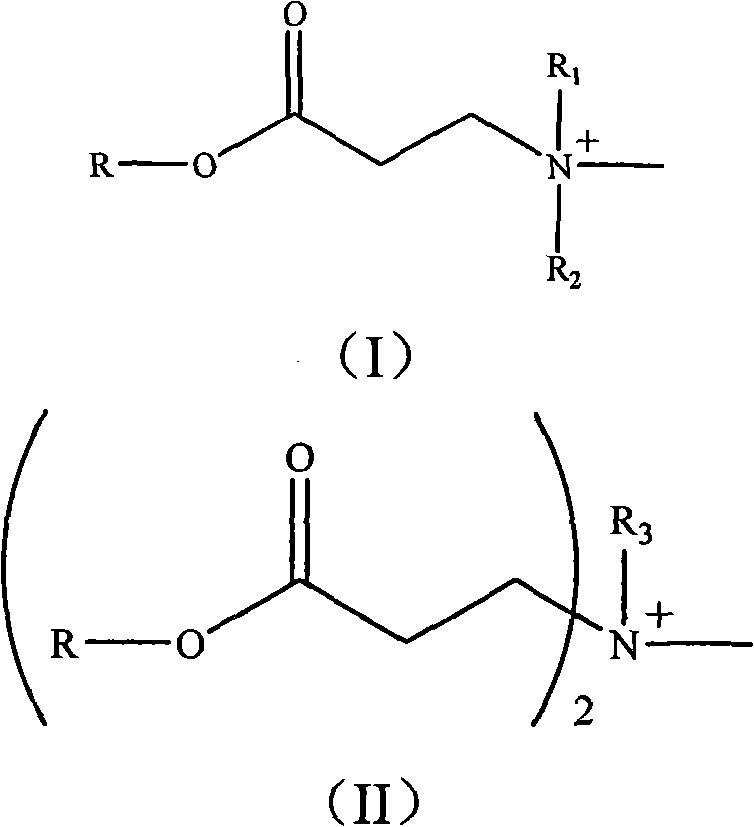
Wherein, R is the residue after the compound of hydroxyl removes hydroxyl, and the compound of hydroxyl is selected from: (2-hydroxy-2-methyl-1-phenyl-acetone, 1-[4-(2-hydroxyl hydroxyethyl)-phenyl]-2-hydroxy-2-methyl-1-propane, 1-hydroxyl-cyclohexyl-phenyl ketone or Viosorb 110; R
1Or R
2Be selected from C
1-6Alkyl; R
3Be selected from C
12-18Alkyl.
The preparation method of The compounds of this invention may further comprise the steps:
(1) triethylamine of the compound of 1 molfraction hydroxyl and 1-1.5 molfraction at room temperature is dissolved in the organic solvent solution A, solution A is placed ice-water bath, make its temperature reduce to 0-5 ℃;
(2) acrylate chloride of 1-1.5 molfraction at room temperature is dissolved in organic solvent and gets solution B, solution B is added drop-wise in the solution A, reacted 12-24 hour, obtain formula (mistake! Do not find Reference source.) expression compound;
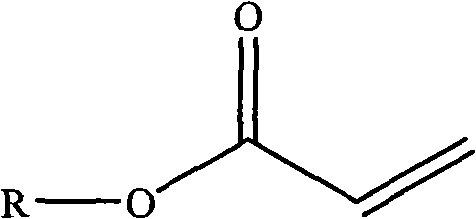
(mistake! Do not find Reference source.)
Wherein, R is the residue after the compound of hydroxyl removes hydroxyl, and the compound of hydroxyl is selected from: (2-hydroxy-2-methyl-1-phenyl-acetone, 1-[4-(2-hydroxyl hydroxyethyl)-phenyl]-2-hydroxy-2-methyl-1-propane, 1-hydroxyl-cyclohexyl-phenyl ketone or Viosorb 110;
(3) with the formula (mistake of 1 molfraction! Do not find Reference source.) compound of expression at room temperature be dissolved in the protonic solvent solution C;
(4) secondary amine of 1 molfraction or the primary amine of 0.5 molfraction at room temperature are dissolved in the protonic solvent, are added drop-wise to then in the solution C, reacted 2-24 hour, remove protonic solvent, obtain formula (mistake! Do not find Reference source.) or the compound represented of formula V;

(mistake! Do not find Reference source.)
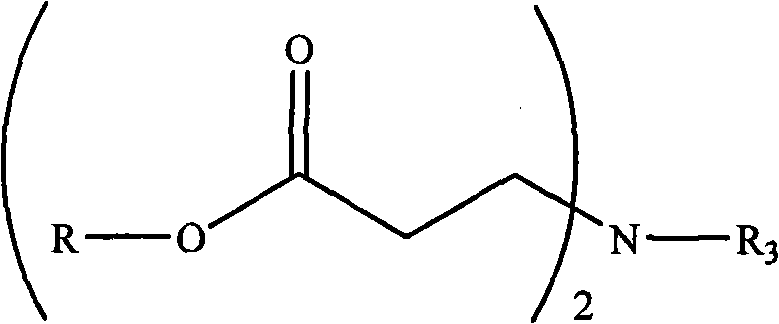
(mistake! Do not find Reference source.)
Wherein, R is same as above, R
1Or R
2Be selected from C
1-6Alkyl; R
3Be selected from C
12-18Alkyl.
(5) with the formula (mistake of 1 molfraction! Do not find Reference source.) or formula (mistake! Do not find Reference source.) compound of expression at room temperature is dissolved in the organic solvent, adds the methyl iodide of 1 molfraction or 0.5 molfraction, react after 10-60 minute, obtains the compound that formula (I) or formula (II) are represented.
Protonic solvent mentioned above is methyl alcohol or ethanol.
Organic solvent mentioned above is methylene dichloride, chloroform, benzene, tetrahydrofuran (THF), toluene or dimethylbenzene.
The secondary amine mentioned above and the structure of primary amine are as follows:

Wherein, R
1, R
2, R
3Same as above.
The compounds of this invention prepares light-initiated/halogen-free flame retardants by the ion-exchanged polynite, may further comprise the steps:
A. the polynite with 1 mass fraction joins in the water of 50-100 volume parts, stirs 2-5 hour down at 30-60 ℃, obtains mixture D;
B. the described compound of plasma exchange capacity claim 1 is dissolved in the ethanol of 50-100 volume parts, this solution is joined in the mixture D, stirred 8-20 hour, obtain mixture E;
C. mixture E is filtered, water and washing with alcohol can not detect till the iodide ion in washings, obtain solid F;
D. solid F ground after 30-50 ℃ of following vacuum-drying 20-40 hour, crossed 300 purpose stainless steel sifts, promptly obtained light-initiated/halogen-free flame retardants.
The invention provides the application in photosensitive macromolecular material and nano fire-retarding composite material of light-initiated/halogen-free flame retardants as light trigger and fire retardant.
Photopolymerizable composition provided by the invention, form by following ingredients:
A.45-70wt% the light reactive resin that contains a unsaturated double-bond at least;
B.27-40wt% contain at least a unsaturated double-bond monomer;
C.3-12wt% of the present invention light-initiated/halogen-free flame retardants;
D.0-3wt% trolamine.
Unsaturated light reactive resin mentioned above is epoxy acrylic resin, epoxy methacrylic resin, polyester acrylic resin, polyester methacrylic resin, polyurethane acrylic resin, urethane methacrylic resin, polyacrylic ester acrylic resin, polyacrylic ester methacrylic resin, polyoxyalkylene acrylate resin or polyethers methacrylic resin.
Monomer mentioned above is simple function group, bifunctional or multi-functional acrylate's monomer or methacrylate monomer.
The present invention is through a series of building-up reactions, synthesized not only contain photosensitive group but also have quaternary ammonium salt structure as general formula (I) or compound (II), this compounds can well carry out cation exchange reaction with polynite, obtain a kind of fire retardant of Halogen, and in the photopolymerization system, play action of evocating.
Of the present invention light-initiated/halogen-free flame retardants can be used as light trigger and fire retardant is used in photosensitive macromolecular material and nano fire-retarding composite material field.Few, the good dispersity of its addition can improve the thermal stability of material under the condition that does not influence material mechanical performance, have broad application prospects as the fire retardant of photopolymerization nano fire-retarding composite material.
Embodiment
One, the preparation of the compound of formula (I) or formula (II) expression
Embodiment 1
(1) 32.8g (0.2mol) 2-hydroxy-2-methyl-1-phenyl-1-acetone (1173) and 20.2g (0.2mol) triethylamine at room temperature are dissolved in the 500mL anhydrous methylene chloride, be placed in the ice-water bath then, stirring makes its temperature reduce to 0-5 ℃, drip the mixed solution of 18.2g (0.2mol) acrylate chloride and 80mL methylene dichloride with constant pressure funnel, after dropwising, continued stirring reaction 18 hours, after removing by filter the triethylamine hydrochloride white solid of generation, and with after twice of the washed with dichloromethane of 10mL, mixed solution is used 200mL 1M hydrochloric acid soln respectively, 200mL 1M sodium hydrogen carbonate solution and 300mL water are successively used anhydrous Na after the washed twice
2SO
4Drying is revolved then to steam and is removed methylene dichloride, obtains 1173 of acroleic acid esterification;
(2) 1173 of the acroleic acid esterification of 21.8g (0.1mol) at room temperature is dissolved in the ethanol of 60mL, then 13.2g 40% dimethylamine agueous solution (0.12mol) at room temperature is dissolved in the ethanol of 20mL, and at room temperature be added drop-wise in 1173 ethanolic solns of acroleic acid esterification of stirring, carry out Michael reaction, after dropwising, continued stirring reaction 3 hours, the second alcohol and water is removed in underpressure distillation, obtains containing 1173 of tertiary amine structure;
(3) 1173 of the tertiary amine structure that contains with 13.2g (0.05mol) at room temperature is dissolved in the tetrahydrofuran (THF) of 80mL, under intense agitation, the methyl iodide that slowly adds 7.2g (0.05mol), after at room temperature reacting 20 minutes, underpressure distillation, recrystallization twice in 40mL acetone then, room temperature vacuum-drying 24 hours, obtain compound 1, its structure is as follows.
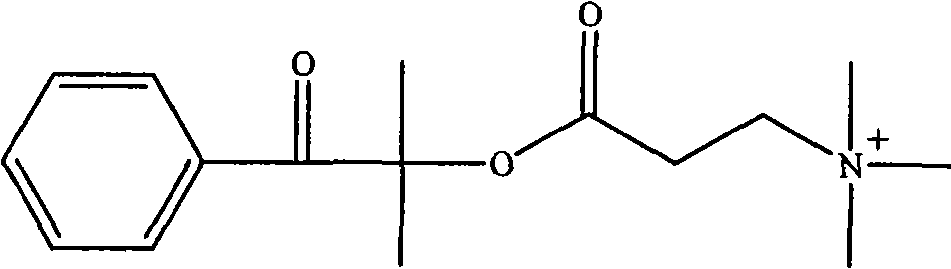
1H-NMR(CDCl
3,600MHz):δ(ppm):3.463(9H,N
+(CH
3)
3),4.326(2H,N
+CH
2),2.422(2H,N
+CCH
2),1.680(6H,C(CH
3)
2),7.343,7.458,7.892(5H,Ar)。
Embodiment 2
With 1173 in equimolar 1-hydroxyl-cyclohexyl-phenyl ketone (184) alternative embodiment 1 (1), other step obtains compound 2 with embodiment 1, and its structure is as follows.
1H-NMR(CDCl
3,600MHz):δ(ppm):3.462(9H,N
+(CH
3)
3),4.323(2H,N
+CH
2),2.420(2H,N
+CCH
2),1.132,1.680,2.126(10H,CH
2),7.341,7.455,7.890(5H,Ar)。
Embodiment 3
Other step obtains compound 3 with embodiment 1 to 1173 in dihydroxy benaophenonel (HBP) alternative embodiment 1 (1) with equimolar, and its structure is as follows.

1H-NMR(CDCl
3,600MHz):δ(ppm):3.460(9H,N
+(CH
3)
3),4.319(2H,N
+CH
2),2.423(2H,N
+CCH
2),7.247,7.485,7.589,7.790,7.859(9H,Ar)。
Embodiment 4
With equimolar 1-[4-(2-hydroxyl hydroxyethyl)-phenyl]-1173 in 2-hydroxy-2-methyl-1-propane (184) alternative embodiment 1 (1), other step obtains compound 4 with embodiment 1, and its structure is as follows.

1H-NMR(CDCl
3,600MHz):δ(ppm):3.465(9H,N
+(CH
3)
3),4.327(2H,N
+CH
2),2.420(2H,N
+CCH
2),4.335(4H,O(CH
2)
2O),7.247,7.790,(4H,Ar),2.003(1H,OH),1.778(6H,C(CH
3)
2)。
Embodiment 5
With the dimethylamine solution in 0.5 mole the amino dodecane alternative embodiment 1 (2), other step obtains compound 5 with embodiment 1, and its structure is as follows.
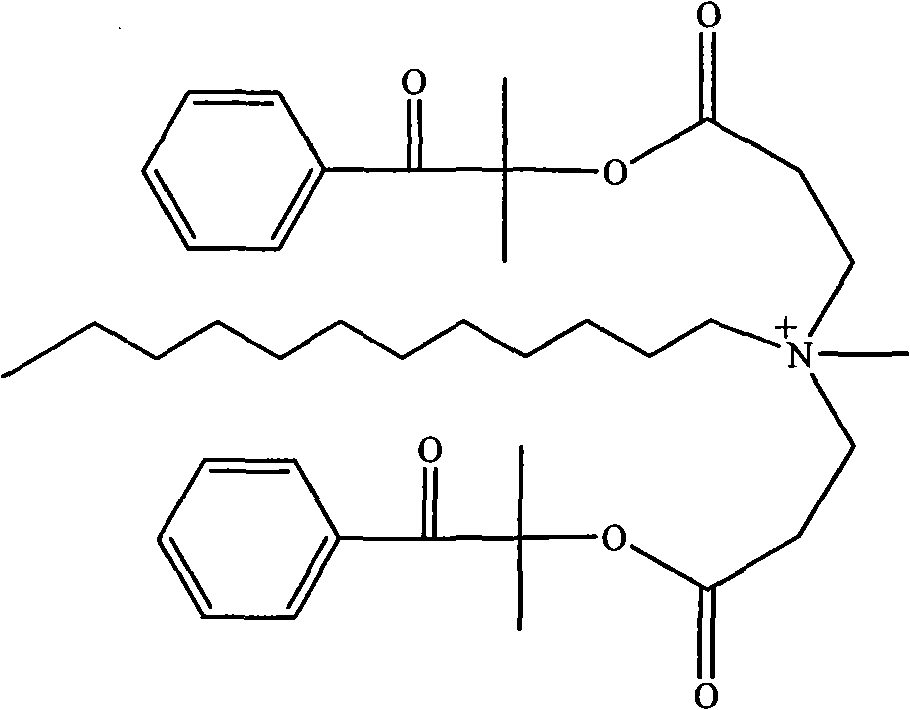
1H-NMR(CDCl
3,600MHz):δ(ppm):3.363(3H,N
+CH
3),4.316(6H,N
+CH
2),2.425(4H,N
+CCH
2),1.670(12H,C(CH
3)
2),7.344,7.456,7.890(10H,Ar),1.308(20H,(CH)
2),0.963(3H,CH
3)。
Embodiment 6
With the dimethylamine solution in 0.5 mole the cetylamine alternative embodiment 1 (2), other step obtains compound 6 with embodiment 1 to 1173 in dihydroxy benaophenonel (HBP) alternative embodiment 1 (1) with equimolar, and its structure is as follows.
1H-NMR(CDCl
3,600MHz):δ(ppm):3.368(3H,N
+CH
3),4.320(6H,N
+CH
2),2.420(4H,N
+CCH
2),7.250,7.482,7.592,7.800,7.853(18H,Ar),1.328(28H,(CH)
2),0.967(3H,CH
3)。
Two, the preparation of light-initiated/halogen-free flame retardants
Embodiment 7
The 3g polynite is joined in the deionized water of 200mL, under 50 ℃ of conditions, stirred 3 hours, then plasma exchange capacity compound 1 is dissolved in the ethanol of 150mL, this solution is joined in the montmorillonite dispersions, stirred 15 hours.The white precipitate suction filtration that forms also repeatedly washs with deionized water and ethanol, till in washings, can not detecting iodide ion with solution, the vacuum-drying under 50 ℃ of conditions of resulting material was ground after 20 hours, crossed 300 purpose stainless steel sifts, obtained light-initiated/halogen-free flame retardants 1.
IR(KBr,cm
-1):2932,2871(C-H),1725(C=O);
XRD (CuKa, λ=0.154nm, 40kV, 50mA): 2 θ=5.2 °, corresponding d=1.68nm.
The characteristic peak that has occurred C-H and C=O among the infrared figure, the cheating engaging layer spacing that XRD characterizes is increased to 1.68nm by the 1.31nm of original soil, shows the interlayer of synthetic compound 1 intercalation to polynite.
Embodiment 8
The 2g polynite is joined in the deionized water of 150mL, under 40 ℃ of conditions, stirred 4 hours, then plasma exchange capacity compound 2 is dissolved in the ethanol of 100mL, this solution is joined in the montmorillonite dispersions, stirred 10 hours.The white precipitate suction filtration that forms also repeatedly washs with deionized water and ethanol, till in washings, can not detecting iodide ion with solution, the vacuum-drying under 40 ℃ of conditions of resulting material was ground after 24 hours, crossed 300 purpose stainless steel sifts, obtained light-initiated/halogen-free flame retardants 2.
IR(KBr,cm
-1):2985,2863(C-H),1728(C=O);
XRD (CuKa, λ=0.154nm, 40kV, 50mA): 2 θ=5.0 °, corresponding d=1.77nm.
The characteristic peak that has occurred C-H and C=O among the infrared figure, the cheating engaging layer spacing that XRD characterizes is increased to 1.77nm by the 1.31nm of original soil, shows the interlayer of synthetic compound 2 intercalations to polynite.
Embodiment 9
The 1g polynite is joined in the deionized water of 100mL, under 60 ℃ of conditions, stirred 3 hours, then plasma exchange capacity compound 3 is dissolved in the ethanol of 80mL, this solution is joined in the montmorillonite dispersions, stirred 15 hours.The white precipitate suction filtration that forms also repeatedly washs with deionized water and ethanol, till in washings, can not detecting iodide ion with solution, the vacuum-drying under 50 ℃ of conditions of resulting material was ground after 12 hours, crossed 300 purpose stainless steel sifts, obtained light-initiated/halogen-free flame retardants 3.
IR(KBr,cm
-1):2917,2850(C-H),1730(C=O);
XRD (CuKa, λ=0.154nm, 40kV, 50mA): 2 θ=4.6 °, corresponding d=1.94nm.
The characteristic peak that has occurred C-H and C=O among the infrared figure, the cheating engaging layer spacing that XRD characterizes is increased to 1.94nm by the 1.31nm of original soil, shows the interlayer of synthetic compound 3 intercalations to polynite.
Embodiment 10
With the compound 2 in compound 4 alternative embodiments 8, other step obtains light-initiated/halogen-free flame retardants 4 with embodiment 8.
IR(KBr,cm
-1):2924,2853(C-H),1724(C=O);
XRD (CuKa, λ=0.154nm, 40kV, 50mA): 2 θ=4.4 °, corresponding d=1.96nm.
The characteristic peak that has occurred C-H and C=O among the infrared figure, the cheating engaging layer spacing that XRD characterizes is increased to 1.96nm by the 1.31nm of original soil, shows the interlayer of synthetic compound 4 intercalations to polynite.
Embodiment 11
With the compound 2 in compound 5 alternative embodiments 8, other step obtains light-initiated/halogen-free flame retardants 5 with embodiment 8.
IR(KBr,cm
-1):2960,2853(C-H),1719(C=O);
XRD (CuKa, λ=0.154nm, 40kV, 50mA): 2 θ=4.2 °, corresponding d=2.07nm.
The characteristic peak that has occurred C-H and C=O among the infrared figure, the cheating engaging layer spacing that XRD characterizes is increased to 2.07nm by the 1.31nm of original soil, shows the interlayer of synthetic compound 5 intercalations to polynite.
Embodiment 12
With the compound 2 in compound 6 alternative embodiments 8, other step obtains light-initiated/halogen-free flame retardants 6 with embodiment 8.
IR(KBr,cm
-1):2925,2851(C-H),1726(C=O);
XRD (CuKa, λ=0.154nm, 40kV, 50mA): 2 θ=4.0 °, corresponding d=2.26nm.
The characteristic peak that has occurred C-H and C=O among the infrared figure, the cheating engaging layer spacing that XRD characterizes is increased to 2.26nm by the 1.31nm of original soil, shows the interlayer of synthetic compound 6 intercalations to polynite.
Three, photopolymerization prepares nano fire-retarding composite material and fire performance exponential mensuration thereof
Embodiment 13
With 62wt% aliphatic urethane acrylate resin CN996 (available from Sartomer company), 30wt% monomer tri (propylene glycol) diacrylate SR306 (available from Sartomer company), 8wt% is light-initiated/halogen-free flame retardants 1, after the mixing and stirring, under the lucifuge condition ultrasonic 10 hours, sample is put into the rectangle sheet rubber mould of 50mm * 35mm * 1.2mm, the mould both sides clamp with slide glass, go up curing continuously 6 times at photo solidification machine (UV-2K), obtain photopolymerisable nano fire-retarding composite material 1.
Embodiment 14
With 52wt% epoxy methacrylic resin CN151 (available from Sartomer company), 38wt% monomer isobornyl acrylate SR506 (available from Sartomer company), 10wt% is light-initiated/halogen-free flame retardants 2, after the mixing and stirring, under the lucifuge condition ultrasonic 10 hours, sample is put into the rectangle sheet rubber mould of 50mm * 35mm * 1.2mm, the mould both sides clamp with slide glass, go up curing continuously 6 times at photo solidification machine (UV-2K), obtain photopolymerisable nano fire-retarding composite material 2.
Embodiment 15
With 56wt% polyester acrylate resin CN710 (available from Sartomer company), 36wt% monomer 2 (2-ethoxy ethoxy) ethyl propylene acid esters SR256 (available from Sartomer company), the 2wt% trolamine, 6wt% is light-initiated/halogen-free flame retardants 3, after the mixing and stirring under the lucifuge condition ultrasonic 10 hours, sample is put into the rectangle sheet rubber mould of 50mm * 35mm * 1.2mm, the mould both sides clamp with slide glass, go up curing continuously 6 times at photo solidification machine (UV-2K), obtain photopolymerisable nano fire-retarding composite material 3.
Embodiment 16
With 68wt% polyether acrylate resin CN550 (available from Sartomer company), 27wt% monomer Viscoat 295 SR351 (available from Sartomer company), 5wt% is light-initiated/halogen-free flame retardants 4, after the mixing and stirring under the lucifuge condition ultrasonic 10 hours, sample is put into the rectangle sheet rubber mould of 50mm * 35mm * 1.2mm, the mould both sides clamp with slide glass, go up continuously at photo solidification machine (UV-2K) and solidify 6 times, obtain photopolymerisable nano fire-retarding composite material 4.
Embodiment 17
With the light-initiated/halogen-free flame retardants 1 in light-initiated/halogen-free flame retardants 5 alternative embodiments 13, other step obtains photopolymerisable nano fire-retarding composite material 5 with embodiment 13.
Embodiment 18
With the light-initiated/halogen-free flame retardants 3 in light-initiated/halogen-free flame retardants 6 alternative embodiments 15, other step obtains photopolymerisable nano fire-retarding composite material 6 with embodiment 15.
Comparative Examples
With the light-initiated/halogen-free flame retardants 1 in the 8wt%1173 alternative embodiment 13, other step obtains photopolymerization material 0 with embodiment 13.
Fire performance index (FPI) is ignitor firing time (TTI) and the ratio of heat release rate peak value (PHRR), i.e. FPI=TTI/PHRR, and FPI is big more, and the fire hazard of material is low more.Photopolymerization material 0 is as shown in table 1 with the fire performance index of nano fire-retarding composite material 1,2,3,4,5,6.
Table 1 fire performance index
| 0 | 1 | 2 | 3 | 4 | 5 | 6 | |
| FPI | 0.064 | 0.143 | 0.136 | 0.115 | 0.131 | 0.148 | 0.135 |
As can be seen from Table 1, when add of the present invention light-initiated/halogen-free flame retardants after, the fire performance index of the nano fire-retarding composite material that obtains by photopolymerization increases, the result shows that its flame retardant effect is improved.
Claims (8)
- General formula (I) or (II) shown in compound:
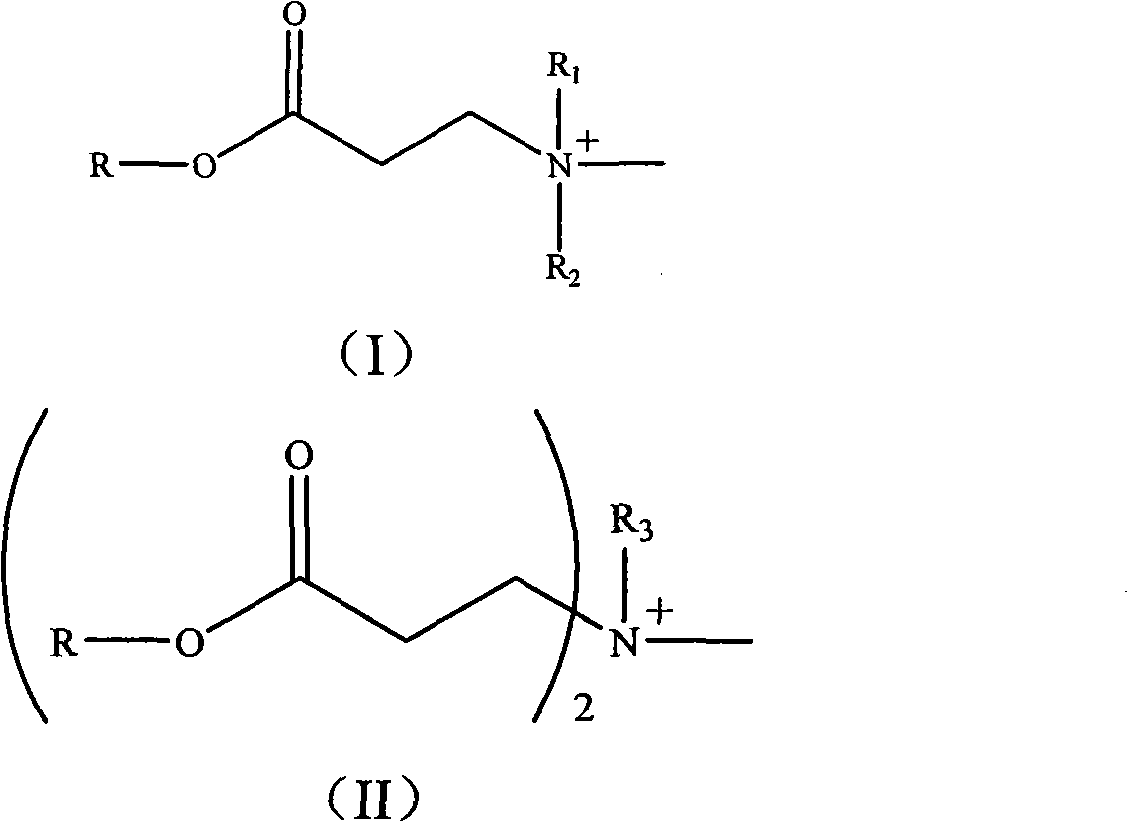 Wherein, R is the residue after the compound of hydroxyl removes hydroxyl, and the compound of hydroxyl is selected from: (2-hydroxy-2-methyl-1-phenyl-acetone, 1-[4-(2-hydroxyl hydroxyethyl)-phenyl]-2-hydroxy-2-methyl-1-propane, 1-hydroxyl-cyclohexyl-phenyl ketone or Viosorb 110; R 1Or R 2Be selected from C 1-6Alkyl; R 3Be selected from C 12-18Alkyl.
 - 2. the preparation method of the described compound of claim 1 is characterized in that may further comprise the steps:(1) triethylamine of the compound of 1 molfraction hydroxyl and 1-1.5 molfraction at room temperature is dissolved in the organic solvent solution A, solution A is placed ice-water bath, make its temperature reduce to 0-5 ℃;(2) acrylate chloride of 1-1.5 molfraction at room temperature is dissolved in organic solvent and gets solution B, solution B is added drop-wise in the solution A, reacted 12-24 hour, obtain formula (mistake! Do not find Reference source.) expression compound,
 (mistake! Do not find Reference source.)Wherein, R is described with claim 1;(3) with the formula (mistake of 1 molfraction! Do not find Reference source.) compound of expression at room temperature be dissolved in the protonic solvent solution C;(4) secondary amine of 1 molfraction or the primary amine of 0.5 molfraction at room temperature are dissolved in the protonic solvent, are added drop-wise to then in the solution C, reacted 2-24 hour, remove protonic solvent, obtain formula (mistake! Do not find Reference source.) or formula (mistake! Do not find Reference source.)The compound of expression,
 (mistake! Do not find Reference source.)
 (mistake! Do not find Reference source.)Wherein, R, R 1, R 2, R 3Described with claim 1;(5) with the formula (mistake of 1 molfraction! Do not find Reference source.) or formula (mistake! Do not find Reference source.) expression compound at room temperature be dissolved in the organic solvent, add the methyl iodide of 1 molfraction or 0.5 molfraction, react after 10-60 minute, obtain the described compound of claim 1.
 - 3. method according to claim 2 is characterized in that: described protonic solvent is methyl alcohol or ethanol.
- 4. the described compound of claim 1 prepares light-initiated/halogen-free flame retardants by the ion-exchanged polynite, it is characterized in that may further comprise the steps:A. the polynite with 1 mass fraction joins in the water of 50-100 volume parts, stirs 2-5 hour down at 30-60 ℃, obtains mixture D;B. the described compound of plasma exchange capacity claim 1 is dissolved in the ethanol of 50-100 volume parts, this solution is joined in the mixture D, stirred 8-20 hour, obtain mixture E;C. mixture E is filtered, water and washing with alcohol can not detect till the iodide ion in washings, obtain solid F;D. solid F ground after 30-50 ℃ of following vacuum-drying 20-40 hour, crossed 300 purpose stainless steel sifts, promptly obtained light-initiated/halogen-free flame retardants.
- Claim 4 described light-initiated/halogen-free flame retardants application in photosensitive macromolecular material and nano fire-retarding composite material as light trigger and fire retardant.
- 6. photopolymerizable composition is characterized in that being made up of following ingredients:A.45-70wt% the light reactive resin that contains a unsaturated double-bond at least;B.27-40wt% contain at least a unsaturated double-bond monomer;C.3-12wt% claim 4 described light-initiated/halogen-free flame retardants;D.0-3wt% trolamine.
- 7. photopolymerizable composition according to claim 6 is characterized in that: described unsaturated light reactive resin is epoxy acrylic resin, epoxy methacrylic resin, polyester acrylic resin, polyester methacrylic resin, polyurethane acrylic resin, urethane methacrylic resin, polyacrylic ester acrylic resin, polyacrylic ester methacrylic resin, polyoxyalkylene acrylate resin or polyethers methacrylic resin.
- 8. photopolymerizable composition according to claim 7 is characterized in that: described monomer is simple function group, bifunctional or multi-functional acrylate's monomer or methacrylate monomer.
Priority Applications (1)
| Application Number | Priority Date | Filing Date | Title |
|---|---|---|---|
| CN 200910089008 CN101602682B (en) | 2009-07-20 | 2009-07-20 | Photoinitiated/halogen-free flame retardant and its preparation method and application |
Applications Claiming Priority (1)
| Application Number | Priority Date | Filing Date | Title |
|---|---|---|---|
| CN 200910089008 CN101602682B (en) | 2009-07-20 | 2009-07-20 | Photoinitiated/halogen-free flame retardant and its preparation method and application |
Related Child Applications (1)
| Application Number | Title | Priority Date | Filing Date |
|---|---|---|---|
| CN201210068740.XA Division CN102617375B (en) | 2009-07-20 | 2009-07-20 | Photo-initiation/halogen-free flame retardant and preparation method and application thereof |
Publications (2)
| Publication Number | Publication Date |
|---|---|
| CN101602682A true CN101602682A (en) | 2009-12-16 |
| CN101602682B CN101602682B (en) | 2013-05-01 |
Family
ID=41468602
Family Applications (1)
| Application Number | Title | Priority Date | Filing Date |
|---|---|---|---|
| CN 200910089008 Expired - Fee Related CN101602682B (en) | 2009-07-20 | 2009-07-20 | Photoinitiated/halogen-free flame retardant and its preparation method and application |
Country Status (1)
| Country | Link |
|---|---|
| CN (1) | CN101602682B (en) |
Cited By (9)
| Publication number | Priority date | Publication date | Assignee | Title |
|---|---|---|---|---|
| CN101863787A (en) * | 2010-03-12 | 2010-10-20 | 北京化工大学 | Organic/inorganic hybrid photocurable moisture-proof material and its preparation |
| CN101967211A (en) * | 2010-09-29 | 2011-02-09 | 北京化工大学 | Preparation method of low molecular weight polyacrylic ester acrylic ester for photo-curing |
| WO2011072199A3 (en) * | 2009-12-10 | 2012-02-02 | Surmodics, Inc. | Water-soluble degradable photo-crosslinker |
| CN104031455A (en) * | 2014-06-25 | 2014-09-10 | 滁州斯迈特复合材料有限公司 | Flame retardant for car paint |
| CN104031454A (en) * | 2014-06-24 | 2014-09-10 | 滁州斯迈特复合材料有限公司 | Flame retardant for household wall paint |
| CN104312234A (en) * | 2014-09-29 | 2015-01-28 | 滁州斯迈特复合材料有限公司 | Flame retardant for computer mainboard |
| US10315987B2 (en) | 2010-12-13 | 2019-06-11 | Surmodics, Inc. | Photo-crosslinker |
| CN113185944A (en) * | 2021-04-24 | 2021-07-30 | 深圳市撒比斯科技有限公司 | UV adhesive and electric control PDLC functional film containing UV adhesive |
| CN120554426A (en) * | 2025-07-23 | 2025-08-29 | 北京大学深圳研究生院 | A photoinitiator and preparation method thereof |
Family Cites Families (2)
| Publication number | Priority date | Publication date | Assignee | Title |
|---|---|---|---|---|
| CN1162470C (en) * | 2001-03-21 | 2004-08-18 | 中国科学院化学研究所 | A preparation method of nanocomposite material containing montmorillonite and products obtained therefrom |
| CN101148527A (en) * | 2006-09-19 | 2008-03-26 | 佛山市顺德区高怡新塑料有限公司 | Nanometer halogen-free anti-flaming polypropylene composite material and preparation method thereof |
-
2009
- 2009-07-20 CN CN 200910089008 patent/CN101602682B/en not_active Expired - Fee Related
Cited By (14)
| Publication number | Priority date | Publication date | Assignee | Title |
|---|---|---|---|---|
| WO2011072199A3 (en) * | 2009-12-10 | 2012-02-02 | Surmodics, Inc. | Water-soluble degradable photo-crosslinker |
| CN101863787B (en) * | 2010-03-12 | 2013-10-30 | 北京化工大学 | Organic/inorganic hybrid photocuring moisture-proof material and preparation thereof |
| CN101863787A (en) * | 2010-03-12 | 2010-10-20 | 北京化工大学 | Organic/inorganic hybrid photocurable moisture-proof material and its preparation |
| CN101967211A (en) * | 2010-09-29 | 2011-02-09 | 北京化工大学 | Preparation method of low molecular weight polyacrylic ester acrylic ester for photo-curing |
| US10315987B2 (en) | 2010-12-13 | 2019-06-11 | Surmodics, Inc. | Photo-crosslinker |
| US10941112B2 (en) | 2010-12-13 | 2021-03-09 | Surmodics, Inc. | Photo-crosslinker |
| CN104031454A (en) * | 2014-06-24 | 2014-09-10 | 滁州斯迈特复合材料有限公司 | Flame retardant for household wall paint |
| CN104031454B (en) * | 2014-06-24 | 2015-11-11 | 滁州斯迈特复合材料有限公司 | Family's wall paint fire retardant |
| CN104031455A (en) * | 2014-06-25 | 2014-09-10 | 滁州斯迈特复合材料有限公司 | Flame retardant for car paint |
| CN104031455B (en) * | 2014-06-25 | 2015-11-11 | 滁州斯迈特复合材料有限公司 | Car paints fire retardant |
| CN104312234A (en) * | 2014-09-29 | 2015-01-28 | 滁州斯迈特复合材料有限公司 | Flame retardant for computer mainboard |
| CN104312234B (en) * | 2014-09-29 | 2016-03-23 | 滁州斯迈特复合材料有限公司 | Flame retardant for computer motherboard |
| CN113185944A (en) * | 2021-04-24 | 2021-07-30 | 深圳市撒比斯科技有限公司 | UV adhesive and electric control PDLC functional film containing UV adhesive |
| CN120554426A (en) * | 2025-07-23 | 2025-08-29 | 北京大学深圳研究生院 | A photoinitiator and preparation method thereof |
Also Published As
| Publication number | Publication date |
|---|---|
| CN101602682B (en) | 2013-05-01 |
Similar Documents
| Publication | Publication Date | Title |
|---|---|---|
| CN101602682A (en) | Photo-initiation/halogen-free flame retardant and preparation method and application thereof | |
| DE69610294T2 (en) | SALES ACTIVATED BY ENERGY WITH FLUOROCANESE | |
| US9428605B2 (en) | Organic-inorganic hybrid material compositions and polymer composites | |
| CN109942629A (en) | A kind of hexaquaternary phosphonium cationic antibacterial agent containing trihydroxy and preparation method thereof | |
| CN107814860B (en) | A kind of polyacrylate fire retardant of phosphorus-nitrogen containing silicon and preparation method thereof | |
| CN113831428B (en) | Thioxanthone-chalcone photoinitiator as well as preparation method and application thereof | |
| US20170327602A1 (en) | Water-based resin dispersion and coating material | |
| CN104844745A (en) | Reaction type phosphorus-containing flame-retardant and preparation method thereof | |
| JP2012042300A (en) | Radioactivity diffusion prevention composition | |
| CN109575076B (en) | Preparation of a kind of phosphorus-containing bismaleimide and its application in flame retardant epoxy resin | |
| JP2016522904A (en) | Bicarbazole compound, photocurable composition, cured product thereof, curable composition for plastic lens, and plastic lens | |
| CN102617375B (en) | Photo-initiation/halogen-free flame retardant and preparation method and application thereof | |
| CN110124637A (en) | A kind of waste water containing thallium adsorbent material and preparation method thereof | |
| CN114395076B (en) | A kind of flame retardant vinyl ester resin, a kind of flame retardant vinyl ester resin cured product and preparation method | |
| CN101550203B (en) | Photoinitiator for ultraviolet light radiation solidification, aromatic ketone compound and method of manufacturing the same | |
| JP2013010913A (en) | Antistatic composition, and molded object, coating material, antistatic coated object and pressure-sensitive adhesive using the same, and method for producing the same | |
| US20130109819A1 (en) | Regulator molecule | |
| JP5406596B2 (en) | Method for producing polymer emulsion | |
| CN103509048B (en) | A kind of preparation method of green amifostine | |
| JP5732362B2 (en) | Polymerizable compound and polymerizable composition | |
| CN109053934A (en) | A kind of rare earth modified photoinitiator and preparation method | |
| CN111196837B (en) | Preparation method of polyprezinc and polyprezinc preparation | |
| CN106349285B (en) | Hydroxyl acylphosphine oxide and its preparation and application | |
| CN105198779B (en) | Oxime ester compound and the optical polymerism composition including the oxime ester compound | |
| CN101863787B (en) | Organic/inorganic hybrid photocuring moisture-proof material and preparation thereof |
Legal Events
| Date | Code | Title | Description |
|---|---|---|---|
| C06 | Publication | ||
| PB01 | Publication | ||
| C10 | Entry into substantive examination | ||
| SE01 | Entry into force of request for substantive examination | ||
| C14 | Grant of patent or utility model | ||
| GR01 | Patent grant | ||
| CF01 | Termination of patent right due to non-payment of annual fee |
Granted publication date: 20130501 Termination date: 20150720 |
|
| EXPY | Termination of patent right or utility model |