CN101595252A - Olefin block compositions for heavy stretch fabrics - Google Patents
Olefin block compositions for heavy stretch fabrics Download PDFInfo
- Publication number
- CN101595252A CN101595252A CNA2007800506952A CN200780050695A CN101595252A CN 101595252 A CN101595252 A CN 101595252A CN A2007800506952 A CNA2007800506952 A CN A2007800506952A CN 200780050695 A CN200780050695 A CN 200780050695A CN 101595252 A CN101595252 A CN 101595252A
- Authority
- CN
- China
- Prior art keywords
- fabric
- polymer
- ethylene
- alpha
- weight
- Prior art date
- Legal status (The legal status is an assumption and is not a legal conclusion. Google has not performed a legal analysis and makes no representation as to the accuracy of the status listed.)
- Pending
Links
Images


Classifications
-
- D—TEXTILES; PAPER
- D03—WEAVING
- D03D—WOVEN FABRICS; METHODS OF WEAVING; LOOMS
- D03D15/00—Woven fabrics characterised by the material, structure or properties of the fibres, filaments, yarns, threads or other warp or weft elements used
-
- C—CHEMISTRY; METALLURGY
- C08—ORGANIC MACROMOLECULAR COMPOUNDS; THEIR PREPARATION OR CHEMICAL WORKING-UP; COMPOSITIONS BASED THEREON
- C08F—MACROMOLECULAR COMPOUNDS OBTAINED BY REACTIONS ONLY INVOLVING CARBON-TO-CARBON UNSATURATED BONDS
- C08F10/00—Homopolymers and copolymers of unsaturated aliphatic hydrocarbons having only one carbon-to-carbon double bond
-
- C—CHEMISTRY; METALLURGY
- C08—ORGANIC MACROMOLECULAR COMPOUNDS; THEIR PREPARATION OR CHEMICAL WORKING-UP; COMPOSITIONS BASED THEREON
- C08F—MACROMOLECULAR COMPOUNDS OBTAINED BY REACTIONS ONLY INVOLVING CARBON-TO-CARBON UNSATURATED BONDS
- C08F210/00—Copolymers of unsaturated aliphatic hydrocarbons having only one carbon-to-carbon double bond
- C08F210/16—Copolymers of ethene with alpha-alkenes, e.g. EP rubbers
-
- C—CHEMISTRY; METALLURGY
- C08—ORGANIC MACROMOLECULAR COMPOUNDS; THEIR PREPARATION OR CHEMICAL WORKING-UP; COMPOSITIONS BASED THEREON
- C08F—MACROMOLECULAR COMPOUNDS OBTAINED BY REACTIONS ONLY INVOLVING CARBON-TO-CARBON UNSATURATED BONDS
- C08F295/00—Macromolecular compounds obtained by polymerisation using successively different catalyst types without deactivating the intermediate polymer
-
- C—CHEMISTRY; METALLURGY
- C08—ORGANIC MACROMOLECULAR COMPOUNDS; THEIR PREPARATION OR CHEMICAL WORKING-UP; COMPOSITIONS BASED THEREON
- C08F—MACROMOLECULAR COMPOUNDS OBTAINED BY REACTIONS ONLY INVOLVING CARBON-TO-CARBON UNSATURATED BONDS
- C08F297/00—Macromolecular compounds obtained by successively polymerising different monomer systems using a catalyst of the ionic or coordination type without deactivating the intermediate polymer
- C08F297/06—Macromolecular compounds obtained by successively polymerising different monomer systems using a catalyst of the ionic or coordination type without deactivating the intermediate polymer using a catalyst of the coordination type
- C08F297/08—Macromolecular compounds obtained by successively polymerising different monomer systems using a catalyst of the ionic or coordination type without deactivating the intermediate polymer using a catalyst of the coordination type polymerising mono-olefins
- C08F297/083—Macromolecular compounds obtained by successively polymerising different monomer systems using a catalyst of the ionic or coordination type without deactivating the intermediate polymer using a catalyst of the coordination type polymerising mono-olefins the monomers being ethylene or propylene
- C08F297/086—Macromolecular compounds obtained by successively polymerising different monomer systems using a catalyst of the ionic or coordination type without deactivating the intermediate polymer using a catalyst of the coordination type polymerising mono-olefins the monomers being ethylene or propylene the block polymer contains at least three blocks
-
- D—TEXTILES; PAPER
- D01—NATURAL OR MAN-MADE THREADS OR FIBRES; SPINNING
- D01F—CHEMICAL FEATURES IN THE MANUFACTURE OF ARTIFICIAL FILAMENTS, THREADS, FIBRES, BRISTLES OR RIBBONS; APPARATUS SPECIALLY ADAPTED FOR THE MANUFACTURE OF CARBON FILAMENTS
- D01F6/00—Monocomponent artificial filaments or the like of synthetic polymers; Manufacture thereof
- D01F6/28—Monocomponent artificial filaments or the like of synthetic polymers; Manufacture thereof from copolymers obtained by reactions only involving carbon-to-carbon unsaturated bonds
- D01F6/30—Monocomponent artificial filaments or the like of synthetic polymers; Manufacture thereof from copolymers obtained by reactions only involving carbon-to-carbon unsaturated bonds comprising olefins as the major constituent
-
- D—TEXTILES; PAPER
- D01—NATURAL OR MAN-MADE THREADS OR FIBRES; SPINNING
- D01F—CHEMICAL FEATURES IN THE MANUFACTURE OF ARTIFICIAL FILAMENTS, THREADS, FIBRES, BRISTLES OR RIBBONS; APPARATUS SPECIALLY ADAPTED FOR THE MANUFACTURE OF CARBON FILAMENTS
- D01F8/00—Conjugated, i.e. bi- or multicomponent, artificial filaments or the like; Manufacture thereof
- D01F8/04—Conjugated, i.e. bi- or multicomponent, artificial filaments or the like; Manufacture thereof from synthetic polymers
- D01F8/06—Conjugated, i.e. bi- or multicomponent, artificial filaments or the like; Manufacture thereof from synthetic polymers with at least one polyolefin as constituent
-
- Y—GENERAL TAGGING OF NEW TECHNOLOGICAL DEVELOPMENTS; GENERAL TAGGING OF CROSS-SECTIONAL TECHNOLOGIES SPANNING OVER SEVERAL SECTIONS OF THE IPC; TECHNICAL SUBJECTS COVERED BY FORMER USPC CROSS-REFERENCE ART COLLECTIONS [XRACs] AND DIGESTS
- Y10—TECHNICAL SUBJECTS COVERED BY FORMER USPC
- Y10T—TECHNICAL SUBJECTS COVERED BY FORMER US CLASSIFICATION
- Y10T442/00—Fabric [woven, knitted, or nonwoven textile or cloth, etc.]
- Y10T442/30—Woven fabric [i.e., woven strand or strip material]
- Y10T442/3008—Woven fabric has an elastic quality
-
- Y—GENERAL TAGGING OF NEW TECHNOLOGICAL DEVELOPMENTS; GENERAL TAGGING OF CROSS-SECTIONAL TECHNOLOGIES SPANNING OVER SEVERAL SECTIONS OF THE IPC; TECHNICAL SUBJECTS COVERED BY FORMER USPC CROSS-REFERENCE ART COLLECTIONS [XRACs] AND DIGESTS
- Y10—TECHNICAL SUBJECTS COVERED BY FORMER USPC
- Y10T—TECHNICAL SUBJECTS COVERED BY FORMER US CLASSIFICATION
- Y10T442/00—Fabric [woven, knitted, or nonwoven textile or cloth, etc.]
- Y10T442/60—Nonwoven fabric [i.e., nonwoven strand or fiber material]
- Y10T442/601—Nonwoven fabric has an elastic quality
- Y10T442/602—Nonwoven fabric comprises an elastic strand or fiber material
Landscapes
- Chemical & Material Sciences (AREA)
- Chemical Kinetics & Catalysis (AREA)
- Organic Chemistry (AREA)
- Health & Medical Sciences (AREA)
- Medicinal Chemistry (AREA)
- Polymers & Plastics (AREA)
- Engineering & Computer Science (AREA)
- Textile Engineering (AREA)
- Inorganic Chemistry (AREA)
- General Chemical & Material Sciences (AREA)
- Addition Polymer Or Copolymer, Post-Treatments, Or Chemical Modifications (AREA)
- Woven Fabrics (AREA)
- Artificial Filaments (AREA)
- Graft Or Block Polymers (AREA)
- Compositions Of Macromolecular Compounds (AREA)
Abstract
Heavy stretch fabrics comprising ethylene/alpha-olefin interpolymers are described. The fabric often has a weight of at least 10 ounces per square yard as measured according to ASTM 3776 and a stretch of at least 10 percent as measured according to ASTM d 3107. These fabrics exhibit excellent chemical resistance (e.g., chlorine or caustic resistance) and durability, i.e., they retain their shape and feel over repeated exposure to processing conditions (e.g., stone washing, dye-stripping, PET-dyeing, etc.) and industrial laundering conditions.
Description
The cross reference of related application
For patent practice, with the U.S. Provisional Application of submitting on November 30th, 2,006 60/868, the full content mode by reference of the PCT application PCT/US2006/09405 of PCT application PCT/US2005/008917 (Dow63558D) (it requires the priority of U.S. Provisional Application 60/553,906 again) that 026, submitted on March 17th, 2005 and submission on May 24th, 2006 is incorporated this paper into.
Technical field
The present invention relates to comprise the heavily fabric of the elastomer of making by ethylene/alpha-olefin interpolymers and blend thereof.
Background technology
The present elastomeric fibre based on polyurethane (Spandex (spandex)) provides acceptable stretching for some application, but unfortunately many weavings processing chemicals is not tolerated and be not durable under industry laundering (laundering) condition.They also often are difficult to be bonded in heavy back heavy fabric such as the denigratory (denim).
But in order to be used for durable fabric, the fiber that constitutes described fabric must be stable especially during dyeing and heat setting process.For making elastic polyolefin fibers stable under dyeing and heat-setting condition, often it is crosslinked by in some distinct methods (for example electron beam irradiation or ultraviolet radiation, silane treatment or azide processing, peroxide etc.) one or more, for the fiber with specific composition, certain methods is better than other method.The polyamide fiber of for example, radiation under inert atmosphere (relative with radiation under air) tends to highly stable during dyeing course (that is, fiber does not melt or fuses together).Add the mixture of hindered phenol stabilizer and hindered amine stabilizer and further stablize this fiber at heat-setting condition (200-210 ℃) usually.
(E.I.du Pont de Nemours Company make segmented polyurethane elastic material) be used at present various can durable stockinette.Yet Lycra is being used for common high heat-set temperature (200-210 ℃) instability of polyethylene terephthalate (PET) fiber.And (and to common uncrosslinked similar based on polyolefinic elastomeric material), the Lycra fabric tends to lose their integrality, shape and elastic property when standing High Operating Temperature as the temperature that runs in washing, dry and flatiron.Thereby,
Can not easily be used for common knitting application with high temperature fiber such as polyester fiber.
Therefore, for many weavings being processed the lasting needs of thick and heavy elastic fibers existence that chemicals have tolerance and can hold out against industrial laundering condition (comprising chemistry and heat treatment).
Summary of the invention
The application provides heavily fabric, and described heavily fabric comprises the fiber that contains ethylene/alpha-olefin interpolymers.Described fabric comprises to be had tolerance and can hold out against the industrial laundering condition heavy weight stretch fabrics of (comprising chemistry and heat treatment) many weaving processing chemicals.Described fabric has one or more in the following character: ratio, chemical resistance and the heat resistance of DIMENSIONAL STABILITY, improved extensibility and secondary creep rate (growth) and industry laundering durability.On the one hand, described fabric weighs at least 6 ounces for frequent every square yard, is preferably at least 8 ounces, and more preferably at least 10 ounces, and have at least about 10% or more extensibility.Advantageously, can make and can be two elastic force, that is, go up stretchable heavily fabric at both direction (that is, warp-wise and broadwise).
On the other hand, the fabric that the application provides has high temperature tolerance, makes described fabric can have DIMENSIONAL STABILITY preferably.The ethylene/alpha-olefin interpolymers fiber that uses in fabric has higher convergent force through the textile finishing temperature of being everlasting (50-90 ℃).This allows that fabric of the present invention (for example, can derive from the XLA of The Dow Chemical Company than the ethene polymers by the crosslinked even branching of standard
TM) fabrics in general of preparation shrinks morely in arrangement during the step, and therefore have higher extensibility and weight.In addition, use ethylene/alpha-olefin interpolymers also to promote processing, because make spinning equipment not have the residue that when using conventional branched ethylene polymer or its mixture, often deposits.
The fabric that the application provides comprises: ethylene/alpha-olefin interpolymers, and wherein said ethylene/alpha-olefin interpolymers has one or more in the following feature:
(1) average block index is greater than 0 and about at the most 1.0 and greater than about 1.3 molecular weight distribution M
w/ M
nOr
(2) at least a when using TREF to carry out classification between 40 ℃ and 130 ℃ the molecule fraction of wash-out, it is characterized in that described fraction has at least 0.5 and about at the most 1 blockiness index (blockindex); Or
(3) about 1.7 to about 3.5 M
w/ M
n, at least one fusing point T
m, in degree centigrade, and density d, in gram/cubic centimetre, T wherein
mWith the numerical value of d corresponding to relation of plane down:
T
m>-2002.9+4538.5 (d)-2422.2 (d)
2Or
(4) about 1.7 to about 3.5 M
w/ M
n, it is characterized in that heat of fusion Δ H, in J/g and in degree centigrade Δ amount (delta quantity), Δ T is defined as the highest DSC peak and the peak-to-peak temperature difference of the highest CRYSTAF, the numerical value of wherein said Δ T and Δ H has following relation:
For Δ H greater than 0 and 130J/g at the most, Δ T>-0.1299 (Δ H)+62.81,
For Δ H greater than 130J/g, Δ T 〉=48 ℃,
Wherein use at least 5% accumulation polymer to determine the CRYSTAF peak, and if be less than 5% polymer and have and can discern the CRYSTAF peak, then the CRYSTAF temperature is 30 ℃; Or
When (5) using the compression moulding film of ethylene/alpha-olefin interpolymers to measure in percentage at 300% the strain and the elastic recovery rate of 1 circulation, Re, and has density d, in gram/cubic centimetre, wherein do not contain the satisfied following relation of numerical value of described Re of crosslinked phase time and d substantially when described ethylene/alpha-olefin interpolymers:
Re>1481-1629 (d); Or
(6) has when using the TREF classification molecule fraction of wash-out between 40 ℃ and 130 ℃, the comonomer molar content that it is characterized in that described fraction compares the comonomer molar content height at least 5% of the fraction of suitable random ethylene interpretation wash-out between uniform temp with it, wherein said suitable with it random ethylene interpretation has identical comonomer, and each character of its melt index (MI), density and comonomer molar content (based on whole polymer) and described ethylene/alpha-olefin interpolymers differ ± 10% in; Or
(7) at 25 ℃ storage modulus G ' (25 ℃) with at 100 ℃ storage modulus G ' (100 ℃), wherein said G ' (25 ℃) is about 1: 1 to about 9: 1 with the ratio of G ' (100 ℃).
Before any significant cross linking, promptly before crosslinked, provide the feature (1) of top ethylene/alpha-olefin interpolymers to (7) about described ethylene/alpha-olefin interpolymers.The character that depends on hope can be crosslinked or not crosslinked with useful in the present invention ethylene/alpha-olefin interpolymers.The feature that use is measured before crosslinked (1) to (7) be not intended to the hint interpretation need carry out crosslinked or do not need to carry out crosslinked-just in the feature that does not have to measure under the situation of significant cross linking about interpretation.Depend on concrete polymer and crosslinking degree, crosslinked can or the change with each change in these character.
Weigh usually at least 10 ounces every square yard of measuring according to ASTM 3776 and have at least 10% the extensibility of measuring according to ASTM D3107 of described fabric.
Usually, the ethylene/alpha-olefin interpolymers in the fabric that the application provides is the form of elastomer.
On the one hand, the fabric that provides of the application can withstand the textile technology of mercerization, bleaching, crease-resistant and/or fire-resistant finiss.In others, described fabric can also withstand multiple high temperature and the high pH that runs into as in for example industry laundering of being everlasting.
The accompanying drawing summary
Fig. 1 illustrates fusing point/density relationship that polymer of the present invention (being represented by rhombus) is compared with traditional random copolymer (being represented by circle) and Z-N (Ziegler-Natta) copolymer (being represented by triangle).
Fig. 2 illustrates the Δ DSC-CRYSTAF of various polymer and the function relation figure of DSC fusion enthalpy.Rhombus is represented random ethylene/octene copolymer; Square expression examples of polymers 1-4; Triangle is represented examples of polymers 5-9; And circle is represented examples of polymers 10-19." X " symbolic representation examples of polymers A*-F*.
Fig. 3 illustrates by interpretation of the present invention (being represented by square and circle) and traditional copolymer and (is represented that by triangle it is various Dow
 Polymer) density of Zhi Bei non-alignment films is to the influence of elastic recovery.Square expression ethylene/butylene copolymers of the present invention; And circle is represented ethylene/octene of the present invention.
Fig. 4 is the octene content graph of a relation of the TREF eluting temperature of fraction therewith of ethene/1-octene copolymer fraction of the TREF classification of embodiment 5 polymer (representing with circle) and comparative polymer E and F (with symbol " X " expression).Rhombus is represented traditional random ethylene/octene copolymer.
Fig. 5 is the octene content graph of a relation of the TREF eluting temperature of fraction therewith of ethene/1-octene copolymer fraction of TREF classification of the polymer (curve 2) of the polymer (curve 1) of embodiment 5 and Comparative Examples F.Square expression embodiment F *; And triangle is represented embodiment 5.
Fig. 6 is contrast ethene/1-octene copolymer (curve 2) and logarithm and the functional relationship of temperature figure of propylene/ethylene-copolymer (curve 3) with the storage modulus of the ethene of the present invention/1-octene block copolymer (curve 1) of two kinds of chain shuttling agents with different amounts (chain shuttling agent) preparation.
Fig. 7 illustrates the TMA (1mm) that some polymer of the present invention (being represented by rhombus) and some known polymers compare and the graph of a relation of flexural modulus.Triangle is represented various Dow VERSIFY
TMPolymer; Circle is represented various random ethylene/styrol copolymers; And the various DowAFFINITY of square expression
TMPolymer.
Fig. 8 represents the electron beam irradiation of olefin block copolymers and the graph of a relation of crosslinked percentage.
The specific embodiment
General Definition
Usually " elasticity " used in this application material is characterized by and is using elasticity (or having draftability) material that bias force (biasing force) has high elasticity answer percentage (that is low percent set) afterwards.In some embodiments, the combination by three kinds of critical natures characterizes elastomeric material, that is, and and (i) low strain stress or load; (ii) low stress or load relaxation percentage, and (iii) low percent set.In other words, should have the stress or the load needs of (i) low described material of stretching, (ii) in case with material extending, zero or low stress relaxation or unloading, and (iii) after stretching, biasing or strain are ended, return back to original dimension fully or highly.
Term " holds out against " when being used for being meant when fabric or goods " hold out against " particular procedure that described fabric all presents the secondary creep rate that is less than regulation percentage on warp-wise and broadwise after carrying out particular procedure.Usually, the amount of regulation is about 25% for being less than, and is preferably to be less than approximately 20%, is preferably and is less than approximately 15%, is preferably and is less than approximately 10%, or most preferably is and is less than about 8%.
Term " secondary creep rate " is meant the permanent elongation rate, or going through given time span applied load and allowing and reply the prolongation amount of fabric afterwards, is expressed as the percentage of initial fabric size.The secondary creep rate can use ASTM D3107 to measure.Usually, it is about 25% that the secondary creep rate of fabric of the present invention is less than, and is preferably to be less than approximately 20%, is preferably and is less than approximately 15%, is preferably and is less than approximately 10%, or most preferably is and is less than about 8%.
Term " processing " comprises any process, for example chemistry or heat treatment, laundering or arrangement step.On the one hand, processing comprises following one or more: a) reach at least 90 minutes period in the liquor natrii hypochloritis of 10 weight % at least 140 temperature exposure; B) reach period of at least 90 minutes in the permanganate solution of 5 weight % at least 140 temperature exposure; C) 50 industry laundering circulations of carrying out at least 65 ℃ of temperature; D) 20 perchloroethylene dry-cleaning circulations of using AATCC method of testing 158; Or e) mercerization reaches 60 seconds or the longer time in carrying out at least about 60 ℃ temperature under causticity condition (28-33Baum or about 20%NaOH or more).Fabric of the present invention can hold out against two or more in the aforementioned processing.This means that the described fabric of a slice can for example hold out against handles a), and other a slice identical fabric can hold out against handle b), c), d) or e).This might not mean that identical a slice fabric will hold out against for example following processing: experience is handled a) and is then experienced and handle b).Yet fabrics more of the present invention can be accomplished this point.
The polymerizable compound that " polymer " expression prepares by monomer or dissimilar monomer polymerizations with same type.General term " polymer " " comprise term " homopolymers ", " copolymer ", " terpolymer " and " interpretation ".
" interpretation " expression is by with at least two kinds of polymer that dissimilar monomer polymerizations prepares.General term " interpretation " comprises term " copolymer " (it is generally used for representing the polymer by two kinds of different monomers preparations) and term " terpolymer " (it is generally used for representing the polymer by three kinds of dissimilar monomers preparations).It also comprises four kinds or more kinds of monomer polymerization and the polymer for preparing.
Term " ethylene/alpha-olefin interpolymers " typically refers to the polymer of the alpha-olefin that contains ethene and have 3 or more a plurality of carbon atoms.Preferably, ethene accounts for most molar fractions of block polymer, that is, ethene account for block polymer at least about 50 moles of %.More preferably, ethene account for block polymer at least about 60 moles of %, at least about 70 moles of %, or at least about 80 moles of %, substantive remainder (substantial remainder) comprises at least a other comonomer, and described other comonomer is preferably the alpha-olefin with 3 or more a plurality of carbon atoms.For many ethylene/octene, the preferred about 10 moles of % that comprise greater than the ethylene contents of about 80 moles of % of block polymer and block polymer of forming are preferably the octene content of about 15 moles of % to about 20 moles of % to about 15 moles of %.In some embodiments, described ethylene/alpha-olefin interpolymers do not comprise low yield or in a small amount or generate as the chemical process accessory substance those.Although can be, be pure basically and often comprise polymerization process product as key component according to the ethylene/alpha-olefin interpolymers of production former state (as produced) with ethylene/alpha-olefin interpolymers and one or more polyblends.
But described ethylene/alpha-olefin interpolymers comprises ethene and one or more copolymerization alpha-olefin comonomer of polymerized form, it is characterized in that a plurality of blocks or the segment of two or more polymeric monomeric units that chemical property or physical property are different.That is, described ethylene/alpha-olefin interpolymers is a block interpolymer, is preferably the interpretation or the copolymer of many-block.Term " interpretation " and " copolymer " are used interchangeably in this application.In some embodiments, many-block copolymer can be represented with following formula:
(AB)
n
Wherein n is at least 1, is preferably more than 1 integer, and for example 2,3,4,5,10,15,20,30,40,50,60,70,80,90,100 or higher, " A " expression hard block or segment and " B " expression soft segment or segment.Preferably, A is connected in the mode of substantial linear with B, and is relative with mode basic branching or fundamental star-shape.In other embodiments, A block and B block are along the polymer chain random.In other words, described block copolymer does not have following structure usually.
AAA-AA-BBB-BB
In other embodiments, block copolymer does not have the third block that contains one or more different copolymer monomers usually.In other embodiments, every kind in block A and the B block has the monomer or the comonomer of basic random in block.In other words, block A does not comprise all that with B block two or more have the Asia-segment of different compositions (or Asia-block), terminal segments (tipsegment) for example, and described terminal segments has the composition different substantially with the block remainder.
Many-block polymer generally includes various amounts " firmly " segment and " soft " segment." firmly " segment is meant such polymerized unit block, and promptly wherein based on the weight of polymer, the amount of ethene is greater than about 95 weight %, and is preferably more than about 98 weight %.In other words, based on the weight of polymer, the co-monomer content in the hard segment (content that is different from the monomer of ethene) is for being less than about 5 weight %, and is preferably and is less than about 2 weight %.In some embodiments, hard segment comprises whole or whole substantially ethene.On the other hand, " soft " segment is meant such polymerized unit block, promptly wherein based on the weight of polymer, co-monomer content (content that is different from the monomer of ethene) is greater than about 5 weight %, be preferably more than about 8 weight %, greater than about 10 weight %, or greater than about 15 weight %.In some embodiments, the co-monomer content in the soft chain segment can be for greater than about 20 weight %, greater than about 25 weight %, greater than about 30 weight %, greater than about 35 weight %, greater than about 40 weight %, greater than about 45 weight %, greater than about 50 weight %, or greater than about 60 weight %.
Gross weight based on block interpolymer, the amount of described soft chain segment in block interpolymer often can for about 1 weight % to about 99 weight %, be preferably about 5 weight % to about 95 weight %, about 10 weight % are to about 90 weight %, about 15 weight % are to about 85 weight %, about 20 weight % are to about 80 weight %, about 25 weight % are to about 75 weight %, about 30 weight % are to about 70 weight %, about 35 weight % are to about 65 weight %, about 40 weight % are to about 60 weight %, or about 45 weight % are to about 55 weight %.On the contrary, hard segment can exist with similar scope.Soft chain segment percetage by weight and hard segment percetage by weight can be calculated based on the data that derive from DSC or NMR.This method and calculating are disclosed in the U.S. Patent application of submitting to simultaneously 11/376,835, act on behalf of case number and be 385063-999558, title is " Ethylene/ α-Olefin Block Interpolymers ", name with people such as Colin L.P.Shan, Lonnie Hazlitt was submitted on March 15th, 2006, and transfer Dow Global TechnologiesInc., incorporate the full content mode by reference of its disclosure into this paper.
If use, term " crystallization " is meant to have first order transition or the crystalline melt point (T that measures as by differential scanning calorimetry (DSC) or equivalent technologies
m) polymer.This term and term " hypocrystalline " can be exchanged use.Term " amorphous " is meant the polymer that does not have as pass through the crystalline melting point of differential scanning calorimetry (DSC) or equivalent technologies measurement.
Term " many-block copolymer " or " block copolymer " be meant contain two or more preferably with the line style mode engage in chemically different zones or the polymer of segment (being called " block "), promptly, be contained in the polymer of chemically different unit, described in chemically different unit for polymerising ethylene functional group, engage in the head and the tail mode, rather than to dangle or the mode of grafting engages.In preferred embodiment, described block is different in the following areas: the amount of the comonomer of combination or type, density, degree of crystallinity, the crystallite dimension that is attributable to have the polymer of this composition, type or degree, degree of regioregularity or regional irregularity degree, branching amount (comprising long chain branching or super-branching), homogeneity or any other chemistry or the physical property of steric regularity (isotaxy or syndiotaxy) in block.Many-block copolymer is characterised in that two kinds of polydispersity indexs (PDI or M of the uniqueness that unique copolymer method is caused
w/ M
n) distribution, block distribution of lengths and/or block number distribute.More specifically, when preparing with continuity method, polymer has 1.7 to 2.9 ideally, is preferably 1.8 to 2.5, and more preferably 1.8 to 2.2, and most preferably be 1.8 to 2.1 PDI.When preparing with batch process or Semi-batch Process, polymer has 1.0 to 2.9, is preferably 1.3 to 2,5, and more preferably 1.4 to 2.0, and most preferably be 1.4 to 1.8 PDI.
In the following description, whether all numerical value that the application discloses all are approximations, no matter be used in combination with word " pact " or " being similar to ".They can change 1%, 2%, 5% or sometimes 10% to 20%.As long as disclosed and had lower limit R
LWith upper limit R
UNumber range, just disclosed any numerical value that drops in this scope clearly.Particularly, disclosed the interior numerical value of following scope: R=R clearly
L+ k* (R
U-R
L), wherein k is from 1% to 100% variable with the change of 1% increment, that is, k is 1%, 2%, 3%, 4%, 5% ..., 50%, 51%, 52% ..., 95%, 96%, 97%, 98%, 99% or 100%.And, also disclosed clearly by two any number ranges as top defined R numerical definiteness.
Ethylene/alpha-olefin interpolymers
Be used for the ethylene/alpha-olefin interpolymers (being also referred to as " interpretation of the present invention " or " polymer of the present invention ") of embodiment of the present invention but comprise the ethene of polymerized form and one or more copolymerization alpha-olefin comonomer, it is characterized in that a plurality of blocks or the segment (block interpolymer) of two or more polymeric monomeric units that chemical property or physical property are different, be preferably many-block copolymer.Described ethylene/alpha-olefin interpolymers is characterised in that one or more aspects as described below.
On the one hand, the ethylene/alpha-olefin interpolymers that is used for embodiment of the present invention has about 1.7 to about 3.5 M
w/ M
nWith at least one fusing point T
m, in degree centigrade and density d, in gram/cubic centimetre, wherein the numerical value of variable is corresponding to following relation:
T
m>-2002.9+4538.5 (d)-2422.2 (d)
2, and be preferably
T
m〉=-6288.1+13141 (d)-6720.3 (d)
2, and more preferably
T
m≥858.91-1825.3(d)+1112.8(d)
2。
This fusing point/density relationship is illustrated in Fig. 1.Do not resemble traditional ethylene/alpha-olefin random copolymer that fusing point reduces with density, interpretation of the present invention (being represented by rhombus) presents the fusing point that is independent of density basically, especially when density extremely all the more so during about 0.95g/cc for about 0.87g/cc.For example, when density changed from 0.875g/cc to about 0.945g/cc, the fusing point of this polymer was about 110 ℃ to about 130 ℃.In some embodiments, when density changed from 0.875g/cc to about 0.945g/cc, the fusing point of this polymer was about 115 ℃ to about 125 ℃.
On the other hand, described ethylene/alpha-olefin interpolymers comprises ethene and one or more alpha-olefins of polymerized form, it is characterized in that in degree centigrade Δ T, the temperature that Δ T is defined as differential scanning calorimetry (" DSC ") top deducts the temperature at crystal analysis classification (" CRYSTAF ") top, with heat of fusion Δ H, in J/g, and Δ T and the satisfied following relation of Δ H:
For the highest 130J/g of Δ H,
Δ T>-0.1299 (Δ H)+62.81, and be preferably
Δ T 〉=-0.1299 (Δ H)+64.38, and more preferably
ΔT≥-0.1299(ΔH)+65.95。And greater than 130J/g, Δ T is equal to or greater than 48 ℃ for Δ H.The accumulation polymer determination CRYSTAF peak of use at least 5% (promptly, at least 5% accumulation polymer must be represented in the peak), if and be less than 5% polymer and have discernible CRYSTAF peak, then the CRYSTAF temperature is 30 ℃, and Δ H is to be the numerical value of the heat of fusion of unit with J/g.More preferably, the highest CRYSTAF peak contains at least 10% accumulation polymer.Fig. 2 illustrates the data that polymer of the present invention and the example that is used to contrast are drawn.Integration peak area and peak temperature calculate with the computer graphics program that apparatus manufacturer provided.To the oblique line shown in the random ethylene octene polymer that is used to contrast corresponding to equation Δ T=-0.1299 (Δ H)+62.81.
Aspect another, described ethylene/alpha-olefin interpolymers has when using temperature rise drip washing classification (Temperature Rising Elution Fractiontion, " TREF ") when carrying out classification between 40 ℃ and 130 ℃ the molecule fraction of wash-out, the comonomer molar content that it is characterized in that described fraction compares the comonomer molar content height of the fraction of suitable random ethylene interpretation wash-out between uniform temp with it, be preferably height at least 5%, more preferably high at least 10%, wherein said suitable with it random ethylene interpretation contains identical comonomer, and the melt index (MI) that is had, each character of density and comonomer molar content (based on whole polymer) and described block interpolymer differs ± 10% in.Preferably, the M of suitable with it interpretation
w/ M
nM with described block interpolymer
w/ M
nAlso differ ± 10% in, and/or total co-monomer content of the total co-monomer content that has of suitable with it interpretation and described block interpolymer differ ± 10 weight % in.
Aspect another, described ethylene/alpha-olefin interpolymers is characterised in that when the compression moulding film that uses ethylene/alpha-olefin interpolymers is measured in percentage at 300% the strain and the elastic recovery rate of 1 circulation, Re, and has density d, in gram/cubic centimetre, wherein do not contain the satisfied following relation of numerical value of described Re of crosslinked phase time and d substantially when described ethylene/alpha-olefin interpolymers:
Re>1481-1629 (d); And be preferably
Re 〉=1491-1629 (d); And more preferably
Re 〉=1501-1629 (d); And even more preferably
Re≥1511-1629(d)。
Fig. 3 illustrates the influence of the density of the non-alignment films that is prepared by some interpretation of the present invention and traditional random copolymer to elastic recovery.For identical density, interpretation of the present invention has obviously higher elastic recovery.
In some embodiments, described ethylene/alpha-olefin interpolymers has the TENSILE STRENGTH greater than 10MPa, be preferably more than the TENSILE STRENGTH that equals 11MPa, more preferably more than or equal to the TENSILE STRENGTH of 13MPa and/or when the crosshead rate of departure of 11 cm per minute at least 600%, more preferably at least 700%, be more preferably at least 800%, and most preferably be at least 900% elongation at break.
In other embodiments, described ethylene/alpha-olefin interpolymers has (1) 1 to 50, is preferably 1 to 20, more preferably 1 to 10 storage modulus ratio G ' (25 ℃)/G ' (100 ℃); And/or (2) be less than 80%, is preferably to be less than 70%, especially for being less than 60%, is less than 50%, or is less than 70 ℃ of compression sets of 40%, and minimum is 0% compression set.
In other embodiments, described ethylene/alpha-olefin interpolymers has and is less than 80%, is less than 70%, is less than 60%, or is less than 70 ℃ of compression sets of 50%.Preferably, 70 ℃ of compression sets of described interpretation are less than 30% for being less than 40%, are less than 20%, and minimumly can drop to about 0%.
In some embodiments, described ethylene/alpha-olefin interpolymers has the heat of fusion that is less than 85J/g and/or is equal to or less than the pellet adhesion intensity (pellet blockingstrength) of 100 pounds per square foots (4800Pa), is preferably and is equal to or less than 50lbs/ft
2Pellet adhesion intensity (2400Pa) is especially for being equal to or less than 5lbs/ft
2Pellet adhesion intensity (240Pa), and be low to moderate 0lbs/ft
2Pellet adhesion intensity (0Pa).
In other embodiments, described ethylene/alpha-olefin interpolymers comprise polymerized form at least 50 moles of % ethene and have and be less than 80%, be preferably and be less than 70% or be less than 60%, most preferably be and be less than 40% to 50%, and be low to moderate and approach 70 ℃ of compression sets of 0%.
In some embodiments, described many-block copolymer has and meets the distribute PDI of (but not Poisson distributes) of Schultz-Flory.Further copolymer is characterized to having polydispersion block distributed and polydispersion block Size Distribution, and have most probable block distribution of lengths.Preferred many-block copolymer is the block copolymer that contains 4 or more a plurality of block or segment (comprising end-blocks).More preferably, described copolymer comprises at least 5,10 or 20 blocks or segment (comprising end-blocks).
Co-monomer content can use any suitable technology to measure, preferably based on the technology of nuclear magnetic resonance (" NMR ") spectral method.And, for polymer or blend polymer, it is desirable at first to use TREF that polymer is classified into the eluting temperature scope and be 10 ℃ or still less fraction with wide relatively TREF curve.That is, each elutriated fraction has 10 ℃ or littler collection temperature window (collection temperature window).Use this technology, described block interpolymer has the corresponding stage branch of at least a with suitable with it interpretation and compares the fraction with higher comonomer molar content.
On the other hand, polymer of the present invention is the olefin interconversion polymers, but preferably contain the ethene of polymerized form and the comonomer of one or more copolymerization, the a plurality of blocks that it is characterized in that two or more polymeric monomeric units that chemistry or physical property are different (promptly, at least two blocks) or segment (block interpolymer), most preferably be many-block copolymer, described block interpolymer has the peak (but being not only a molecule fraction) of wash-out between 40 ℃ and 130 ℃ (but do not collect and/or separate each fraction), the average comonomer molar content that it is characterized in that the described peak estimated by infra-red sepectrometry when using full duration/half maximum (FWHM) area to calculate to launch is higher than in identical eluting temperature and uses full duration/half maximum (FWHM) area to calculate the average comonomer molar content at the suitable with it random ethylene interpretation peak that launches, be preferably height at least 5%, more preferably high at least 10%, wherein said suitable with it random ethylene interpretation has identical comonomer, and the melt index (MI) that is had, each character of density and comonomer molar content (based on whole polymer) and block interpolymer differs ± 10% in.Preferably, the M of suitable with it interpretation
w/ M
nM with block interpolymer
w/ M
nAlso differ ± the 10% total copolymerization content of monomer with total copolymerization content of monomer of interior and/or suitable with it interpretation and described block interpolymer differs ± 10 weight % in.Full duration/half maximum (FWHM) is calculated and is based on the ratio [CH that the methyl that derives from the ATREF infrared detector responds area and methylene response area
3/ CH
2], wherein determine the highest (tallest) (the highest (highest)) peak from baseline, measure the FWHM area then.Distribution for using the ATREF peak to measure is defined as the FWHM area at T
1And T
2Between curve below area, T wherein
1And T
2Be by with peak heights divided by 2, draw a point that intersects with the left half of the line of baseline values and ATREF curve and right half and determine then on left side, ATREF peak and right side.The calibration curve of co-monomer content is drawn by the following method: use the random ethylene/alpha-olefin copolymer, draw the graph of a relation of the FWHM area ratio at the co-monomer content that derives from NMR and TREF peak.For this infrared method, the interested same comonomer type of institute is generated calibration curve.The co-monomer content at polymer TREF of the present invention peak can be used the FWHM methyl at its TREF peak: methylene area ratio [CH by with reference to this calibration curve
3/ CH
2] determine.
Co-monomer content can be used any suitable technical measurement, preferably based on the technology of nuclear magnetic resonance (NMR) spectral method.Use this technology, described block interpolymer is compared with corresponding suitable with it interpretation has higher comonomer molar content.
Preferably, interpretation for ethene and 1-octene, the co-monomer content of described block interpolymer TREF fraction of wash-out between 40 ℃ and 130 ℃ is more than or equal to the amount of (0.2013) T+20.07, more preferably more than or equal to the amount of (0.2013) T+21.07, wherein T is the numerical value of the peak value eluting temperature of the TREF fraction that compares, ℃ being that unit is measured.
Fig. 4 illustrates the embodiment of ethene and 1-octene block interpolymer, and wherein several the suitable with it ethene/co-monomer content of 1-octene interpretation (random copolymer) and the graph of a relation of TREF eluting temperature fit to the line (solid line) of representative (0.2013) T+20.07.With dashed lines describes to represent the line of equation (0.2013) T+21.07.Also described the co-monomer content of the fraction of several block ethene of the present invention/1-octene interpretation (many-block copolymer).Compare with arbitrary line, all block interpolymer fractions have obviously higher 1-octene content in the eluting temperature that equates.This result is the feature of interpretation of the present invention, and be considered to be in the polymer chain exist have simultaneously crystallographic property and amorphous property different block caused.
Fig. 5 illustrates the TREF curve and the co-monomer content of the polymer fractions of the embodiment 5 that discusses below and Comparative Examples F.Two kinds of polymer from 40 ℃ to 130 ℃, are preferably from 60 ℃ of peaks to 95 ℃ of wash-outs and are divided into three parts, and each part is gone through the temperature range wash-out that is less than 10 ℃.Represent the real data of embodiment 5 with triangle.Those skilled in the art can recognize, can make up calibration curve that is fit to and the line that is used as contrast to the interpretation that contains the different copolymer monomer and be consistent with the TREF value that derives from the contrast interpretation (being preferably the random copolymer that uses metallocene or other homogeneous catalysis preparation of compositions) with same monomer.Interpretation of the present invention is characterised in that, the comonomer molar content greater than in identical TREF eluting temperature from the value that calibration curve records, be preferably big at least by 5%, more preferably big at least 10%.
The aspect and character above the application is described, can characterize polymer of the present invention by one or more further features.On the one hand, polymer of the present invention is the olefin interconversion polymers, but preferably contain the ethene of polymerized form and the comonomer of one or more copolymerization, the a plurality of blocks or the segment (block interpolymer) that it is characterized in that two or more polymeric monomeric units that chemistry or physical property are different, most preferably be many-block copolymer, described block interpolymer has the molecule fraction of wash-out between 40 ℃ and 130 ℃ when using TREF increment (TREFincrements) classification, it is characterized in that the comonomer molar content of described fraction is higher than the comonomer molar content of the fraction of suitable with it random ethylene interpretation wash-out between identical eluting temperature, be preferably height at least 5%, more preferably high at least 10%, 15%, 20% or 25%, wherein said suitable with it random ethylene interpretation comprises identical comonomer, be preferably identical comonomer, and the melt index (MI) that is had, each character of density and comonomer molar content (based on whole polymer) and block interpolymer differs ± 10% in.Preferably, the M of suitable with it interpretation
w/ M
nM with block interpolymer
w/ M
nAlso differ ± 10% in, and/or total copolymerization content of monomer of total copolymerization content of monomer of suitable with it interpretation and block interpolymer differ ± 10% in.
Preferably, top interpretation is the interpretation of ethene and at least a alpha-olefin, and especially block polymer density is about 0.855 to about 0.935g/cm
3Those interpretations, and more particularly, for having the polymer that surpasses about 1 mole of % comonomer, the co-monomer content of described block interpolymer TREF fraction of wash-out between 40 ℃ and 130 ℃ is more than or equal to the amount of (0.1356) T+13.89, more preferably more than or equal to the amount of (0.1356) T+14.93, and most preferably be amount more than or equal to (0.2013) T+21.07, wherein T is the numerical value of the peak A TREF eluting temperature of the TREF fraction that compares, ℃ being that unit is measured.
Preferably, for the top ethene and the interpretation of at least a alpha-olefin, especially block polymer density is about 0.855 to about 0.935g/cm
3Those interpretations, and more particularly for having the polymer that surpasses about 1 mole of % comonomer, the co-monomer content of described block interpolymer TREF fraction of wash-out between 40 ℃ and 130 ℃ is more than or equal to the amount of (0.2013) T+20.07, more preferably more than or equal to the amount of (0.2013) T+21.07, wherein T is the numerical value of the peak A TREF eluting temperature of the TREF fraction that compares, ℃ being that unit is measured.
Aspect another, polymer of the present invention is the olefin interconversion polymers, but preferably contain the ethene of polymerized form and the comonomer of one or more copolymerization, the a plurality of blocks or the segment (block interpolymer) that it is characterized in that two or more polymeric monomeric units that chemistry or physical property are different, most preferably be many-block copolymer, described block interpolymer has the molecule fraction of wash-out between 40 ℃ and 130 ℃ when using the classification of TREF increment, it is characterized in that every kind of fraction that co-monomer content is at least about 6 moles of % has greater than about 100 ℃ fusing point.For co-monomer content is about 3 moles of % those fractions to about 6 moles of %, and every kind of fraction has about 110 ℃ or higher DSC fusing point.More preferably, described co-monomer content has DSC fusing point corresponding to following equation for the polymer fractions of at least 1 mole of %:
T
m〉=(5.5926) (mole percent of comonomer in the fraction)+135.90.
Aspect another, polymer of the present invention is the olefin interconversion polymers, but preferably contain the ethene of polymerized form and the comonomer of one or more copolymerization, the a plurality of blocks or the segment (block interpolymer) that it is characterized in that two or more polymeric monomeric units that chemistry or physical property are different, most preferably be many-block copolymer, described block interpolymer has the molecule fraction of wash-out between 40 ℃ and 130 ℃ when using the classification of TREF increment, it is characterized in that the ATREF eluting temperature more than or equal to every kind of about 76 ℃ fraction have corresponding to following equation as fusion enthalpy (heat of fusion) by dsc measurement:
Heat of fusion (J/gm)≤(3.1718) (degree centigrade to be the ATREF eluting temperature of unit)-136.58.
Block interpolymer of the present invention has the molecule fraction of wash-out between 40 ℃ and 130 ℃ when using the classification of TREF increment, it is characterized in that the ATREF eluting temperature 40 ℃ and be less than every kind of fraction between about 76 ℃ have corresponding to following equation as fusion enthalpy (heat of fusion) by dsc measurement:
Heat of fusion (J/gm)≤(1.1312) (degree centigrade to be the ATREF eluting temperature of unit)+22.97.
Measuring ATREF peak comonomer by infrared detector forms
The comonomer at TREF peak form can use can derive from Spain Valencia Polymer Char (
Http:// www.polymerchar.com/) the IR4 infrared detector measure.
" compositional model " of detector is furnished with measurement inductor (CH
2) and form inductor (CH
3), described measurement inductor (CH
2) and form inductor (CH
3) be 2800-3000cm
-1The fixed arrowband infrared-filtered device in zone.Measure the methylene (CH on the inductor detection polymer
2) carbon (it directly relates to the polymer concentration in the solution), and form the methyl (CH that inductor detects polymer
3).Form signal (CH
3) divided by measuring-signal (CH
2) the mathematics ratio to the co-monomer content sensitivity of the measurement polymer in the solution, and its response is proofreaied and correct with known ethylene reference material.
When using with the ATREF instrument, detector provides the concentration (CH of wash-out polymer in the TREF process
2) and form (CH
3) signal response.Polymer specific correction (specific calibration) can be by to having the polymer measurement CH of known co-monomer content (preferably use NMR measure)
3To CH
2Area ratio set up.The co-monomer content at polymer A TREF peak can be by using each CH
3And CH
2(that is area ratio CH, is proofreaied and correct in the reference of response area ratio
3/ CH
2To co-monomer content) estimate.
Can be after using suitable baseline, use full duration/half maximum (FWHM) to calculate peak area is calculated, with will be from each signal response integration of TREF chromatogram.Full duration/half maximum value calculation is based on the ratio [CH of methyl response area that derives from the ATREF infrared detector and methylene response area
3/ CH
2], wherein determine the top according to baseline, measure the FWHM area then.Distribution for using the ATREF peak to measure is defined as the FWHM area at T
1And T
2Between curve below area, T wherein
1And T
2Be by with peak heights divided by 2, draw a point that intersects with the left half of the line of baseline values and ATREF curve and right half and determine then on left side, ATREF peak and right side.
The co-monomer content that in this ATREF-infrared method, infra-red sepectrometry is used to measure polymer with as below with reference to described in the GPC/FTIR system similar substantially: Markovich, Ronald P.; Hazlitt, Lonnie G.; Smith, Linley; " Development of gel-permeationchromatography-Fourier transform infrared spectroscopy for characterization ofethylene-based polyolefin copolymers " .Polymeric Materials Science andEngineering (1991), 65,98-100.; And Deslauriers, PJ.; Rohlfing, D.C.; Shieh, E.T.; " Quantifying short chain branching microstructures in ethylene-1-olefincopolymers using size exclusion chromatography and Fourier transform infraredspectroscopy (SEC-FTIR) ", Polymer (2002), 43,59-170., incorporate the full content mode by reference of the two into this paper.
In other embodiments, ethylene/alpha-olefin interpolymers of the present invention is characterised in that greater than 0 and about at the most 1.0 average block index ABI with greater than about 1.3 molecular weight distribution M
w/ M
nAverage block index ABI is the weight average of the blockiness index (" BI ") of every kind of polymer fractions obtaining with 5 ℃ increment from 20 ℃ to 110 ℃ in preparation TREF:
ABI=∑(w
iBI
i)
BI wherein
iBe the blockiness index of the i fraction of the ethylene/alpha-olefin interpolymers of the present invention that obtains among the TREF in preparation, and W
iIt is the percetage by weight of i fraction.
For each polymer fractions, BI defines with one of following two equations (the two all obtains identical BI value):
T wherein
xBe the preparation ATREF eluting temperature (preferably using K (Kelvin) expression) of i fraction, P
XBe the ethene molar fraction of i fraction, it can be measured by aforesaid NMR or IR.P
ABBe the ethene molar fraction of whole ethylene/alpha-olefin interpolymers (before classification), it also can be measured by NMR or IR.T
AAnd P
ABe the ATREF eluting temperature and the ethene molar fraction of pure " hard segment " (it is meant the crystallization segment of interpretation).If the actual value of " hard segment " can not obtain, then as first approximation, with T
AAnd P
AValue is set at the value of high density polyethylene (HDPE) homopolymers.For the calculating of carrying out in asking in the basis, T
ABe 372 ° of K, P
ABe 1.
T
ABBe to have same composition and have P
ABThe ATREF temperature of random copolymer of ethene molar fraction.T
ABCan calculate from following equation:
Ln P
AB=α/T
AB+β
Wherein α and β are two constants, and it can be proofreaied and correct by the known random ethylene copolymer that uses some and determine.It should be noted that α and β can change with instrument.And people may need to form and create with interested polymer themselves calibration curve in the similar molecular weight ranges of fraction therewith.There is slight molecular weight effect.If calibration curve gets the molecular weight ranges of self similarity, this effect can be ignored basically.In some embodiments, the random ethylene copolymer satisfies following relation:
Ln P=-237.83/T
ATREF+0.639
T
XOBe to have same composition and have P
XThe ATREF temperature of random copolymer of ethene molar fraction.T
XOCan be from LnP
X=α/T
XO+ β calculates.On the contrary, P
XOBe to have same composition and have T
XThe ethene molar fraction of random copolymer of ATREF temperature, it can be from Ln P
XO=α/T
X+ β calculates.
In case obtain the blockiness index (BI) of each preparation TREF fraction, can calculate the weight average blockiness index ABI of block polymer.In some embodiments, ABI is greater than 0 but less than about 0.3, or from about 0.1 to about 0.3.In other embodiments, ABI is greater than about 0.3 and about at the most 1.0.Preferably, ABI should be about 0.4 to about 0.7, about 0.5 to about 0.7, or about 0.6 to about 0.9 scope.In some embodiments, ABI is about 0.3 to about 0.9, about 0.3 to about 0.8, or about 0.3 to about 0.7, about 0.3 to about 0.6, about 0.3 to about 0.5, or about 0.3 to about 0.4 scope.In other embodiments, ABI is about 0.4 to about 1.0, about 0.5 to about 1.0, or about 0.6 to about 1.0, about 0.7 to about 1.0, about 0.8 to about 1.0, or about 0.9 to about 1.0 scope.
Another feature of ethylene/alpha-olefin interpolymers of the present invention be ethylene/alpha-olefin interpolymers of the present invention comprise at least a can be by the polymer fractions that obtains of preparation TREF, wherein said fraction has greater than about 0.1 and is up to about 1.0 blockiness index, reaches the molecular weight distribution (M greater than about 1.3
w/ M
n).In some embodiments, the blockiness index that described polymer fractions has greater than about 0.6 and be up to about 1.0, greater than about 0.7 and be up to about 1.0, greater than about 0.8 and be up to about 1.0, or greater than about 0.9 and be up to about 1.0.In other embodiments, the blockiness index that described polymer fractions has greater than about 0.1 and be up to about 1.0, greater than about 0.2 and be up to about 1.0, greater than about 0.3 and be up to about 1.0, greater than about 0.4 and be up to about 1.0, or greater than about 0.4 and be up to about 1.0.In other embodiment, the blockiness index that described polymer fractions has greater than about 0.1 and be up to about 0.5, greater than about 0.2 and be up to about 0.5, greater than about 0.3 and be up to about 0.5, or greater than about 0.4 and be up to about 0.5.In other embodiment, the blockiness index that described polymer fractions has greater than about 0.2 and be up to about 0.9, greater than about 0.3 and be up to about 0.8, greater than about 0.4 and be up to about 0.7, or greater than about 0.5 and be up to about 0.6.
Copolymer for ethene and alpha-olefin, polymer of the present invention preferably has (1) at least 1.3, more preferably at least 1.5, at least 1.7, or at least 2.0, and most preferably be at least 2.6, be up to 5.0 maximum, more preferably be up to 3.5 maximum, and especially be up to 2.7 peaked PDI; (2) 80J/g or littler heat of fusion; The ethylene contents of (3) at least 50 weight %; (4) be lower than-25 ℃, more preferably be lower than-30 ℃ glass transition temperature T
gAnd/or (5) one and T only
m
In addition, polymer of the present invention can be separately or with the application in any other properties of combination ground of disclosing have storage modulus G ', make log (G ') 100 ℃ temperature for more than or equal to 400kPa, be preferably more than or equal 1.0MPa.And polymer of the present invention has the storage modulus (as shown in Figure 6) of the flat relatively function as temperature in 0 to 100 ℃ of scope, and this is the feature of block copolymer, and for olefin copolymer, especially ethene and one or more C
3-8The copolymer of aliphatic alpha-olefin is unknown up to now.(term in this context " flat relatively " is meant between 50 and 100 ℃, preferably between 0 and 100 ℃ the decline of log G ' (is unit with Pascal) less than an order of magnitude).
Interpretation of the present invention can be further by characterizing to the bending modulus of 13kpsi (90MPa) at the 1mm thermo-mechanical analysis needle penetration of at least 90 ℃ temperature and 3kpsi (20MPa).Selectively, interpretation of the present invention can have 1mm thermo-mechanical analysis needle penetration at least 104 ℃ temperature, and the bending modulus of 3kpsi (20MPa) at least.Interpretation of the present invention can be characterized by and have less than 90mm
3Mar proof (or volume loss).Fig. 7 shows the graph of a relation of TMA (1mm) that polymer of the present invention compares with other known polymer and bending modulus.Polymer of the present invention have than other polymer significantly better flexible-the heat resistance balance.
In addition, the melt index (MI) I of described ethylene/alpha-olefin interpolymers
2Can be 0.01 to 2000g/10 minute, be preferably 0.01 to 1000g/10 minute, more preferably 0.01 to 500g/10 minute, and especially be 0.01 to 100g/10 minute.In some embodiments, the melt index (MI) I of ethylene/alpha-olefin interpolymers
2Be 0.01 to 10g/10 minute, 0.5 to 50g/10 minute, 1 to 30g/10 minute, 1 to 6g/10 minute or 0.3 to 10g/10 minute.In some embodiments, the melt index (MI) of ethylene/alpha-olefin polymer is 1g/10 minute, 3g/10 minute or 5g/10 minute.
The molecular weight M of described polymer
wCan be 1,000g/mole to 5,000,000g/mole is preferably 1000g/mole to 1, and 000,000g/mole, more preferably 10,000g/mole to 500,000g/mole, and especially be 10,000g/mole to 300,000g/mole.The density of polymer of the present invention can be for 0.80 to 0.99g/cm
3, and be preferably 0.85g/cm for the polymer that contains ethene
3To 0.97g/cm
3In some embodiments, the density of ethylene/alpha-olefin polymer is 0.860 to 0.925g/cm
3Or 0.867 to 0.910g/cm
3
The preparation method of these polymer has been disclosed in following patent application: the U.S. Provisional Application 60/553,906 that on March 17th, 2004 submitted to; The U.S. Provisional Application 60/662,937 that on March 17th, 2005 submitted to; The U.S. Provisional Application 60/662,939 that on March 17th, 2005 submitted to; The U.S. Provisional Application 60/5662938 that on March 17th, 2005 submitted to; The PCT application PCT/US2005/008916 that submitted on March 17th, 2005; The PCT application PCT/US2005/008915 that submitted on March 17th, 2005; PCT application PCT/US2005/008917 with submitting on March 17th, 2005 incorporates the full content mode by reference of all these patent applications into this paper.For example, but a kind of such method comprises ethene is contacted with carbon monoxide-olefin polymeric under the addition polymerization condition with one or more optional nonvinylic addition polymerization monomers that described carbon monoxide-olefin polymeric comprises:
Mixture or product that following material mixing is obtained:
(A) have first olefin polymerization catalysis of high comonomer association index,
(B) second olefin polymerization catalysis, its comonomer incorporation index be catalyst (A) comonomer incorporation index less than 90%, be preferably less than 50%, most preferably be less than 5% and
(C) chain shuttling agent.
Representational catalyst and chain shuttling agent are as follows.
Catalyst (Al) is that [N-(2,6-two (1-Methylethyl) phenyl) amido) (2-isopropyl phenyl) (α-naphthalene-2-two bases (6-pyridine-2-two bases) methane)] the dimethyl hafnium, instruction preparation according to WO 03/40195,2003US0204017, USSN 10/429,024 (submission on May 2nd, 2003) and WO 04/24740.

Catalyst (A2) is that [N-(2,6-two (1-Methylethyl) phenyl) (2-aminomethyl phenyl) (1 amido), 2-phenylene-(6-pyridine-2-two bases) methane)] dimethyl hafnium, instruction preparation according to WO 03/40195,2003US0204017, USSN 10/429,024 (submission on May 2nd, 2003) and WO 04/24740.

Catalyst (A3) is two [N, N ' " (2,4,6-three (aminomethyl phenyl) amido) ethylenediamine] dibenzyl hafnium (bis[N, N ' " (2,4,6-tri (methylphenyl) amido) ethylenediamine] hafnium dibenzyl).
Catalyst (A4) is two ((2-oxygen base (oxoyl)-3-(dibenzo-1H-pyrroles-1-yl)-5-(methyl) phenyl)-2-phenoxymethyl) cyclohexanes-1,2-two basic dibenzyl zirconiums (IV), and the instruction according to US-A-2004/0010103 prepares basically.

Catalyst (B1) is 1,2-pair-(3,5-two-tert-butyl group phenylene) (1-(N-(1-Methylethyl) imido grpup) methyl) (2-oxygen base) dibenzyl zirconium

Catalyst (B2) is 1,2-pair-(3,5-two-tert-butyl group phenylene) (1-(N-(2-methylcyclohexyl)-imido grpup) methyl) (2-oxygen base) dibenzyl zirconium

Catalyst (C1) is (tert-butyl group amido) dimethyl (3-N-pyrrole radicals-1,2,3,3a, 7a-η-indenes-1-yl) silane dimethyl titanium, basically according to USP 6,268, and 444 instruction preparation:

Catalyst (C2) is (tert-butyl group amido) two (4-aminomethyl phenyl) (2-methyl isophthalic acid, 2,3,3a, a 7a-η-indenes-1-yl) silane dimethyl titanium, and the instruction according to US-A-2003/004286 prepares basically:
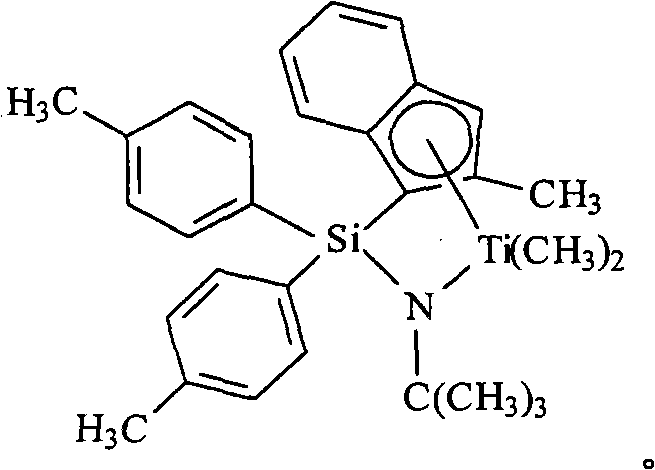
Catalyst (C3) is (tert-butyl group amido) two (4-aminomethyl phenyl) (2-methyl isophthalic acid, 2,3,3a, 8a-η-symmetry-indacene (s-indacen)-1-yl) silane dimethyl titanium, and the instruction according to US-A-2003/004286 prepares basically:

Catalyst (D1) is two (dimethyl disiloxane) (indenes-1-yl) zirconium dichlorides, can derive from Sigma-Aldrich:
The employed shuttling agent of shuttling agent comprises diethyl zinc, two (isobutyl group) zinc, two (n-hexyl) zinc, triethyl aluminum, trioctylaluminum, triethyl-gallium, aluminium isobutyl two (dimethyl (tert-butyl group) siloxanes), two (two (trimethyl silyl) aminate) (i-butylaluminumbis (di (trimethylsilyl) amide)) of aluminium isobutyl, octyl aluminum two (pyridine-2-methoxide) (n-octylaluminumdi (pyridine-2-methoxide)), two (n-octadecane base) aluminium isobutyl, two (two (n-pentyl) aminate) (i-butylaluminum bis (di (n-pentyl) amide)) of aluminium isobutyl, octyl aluminum two (2,6-two-tert-butyl benzene oxide) (n-octylaluminum bis (2,6-di-t-butylphenoxide)), octyl aluminum two (ethyl (1-naphthyl) aminate) (n-octylaluminum di (ethyl (1-naphthyl) amide)), two (tertiary butyl dimethyl Si thing) (ethylaluminum bis (t-butyldimethylsiloxide)) of aluminium ethide, aluminium ethide two (two (trimethyl silyl) aminate) (ethylaluminum di (bis (trimethylsilyl) amide)), aluminium ethide two (2,3,6,7-dibenzo-1-azepan aminate) (ethylaluminumbis (2,3,6,7-dibenzo-1-azacycloheptaneamide)), octyl aluminum two (2,3,6,7-dibenzo-1-azepan aminate) (n-octylaluminumbis (2,3,6,7-dibenzo-1-azacycloheptaneamide)), two (dimethyl (tert-butyl group) Si oxide (the n-octylaluminum bis (dimethyl (t-butyl) siloxide) of octyl aluminum, zinc ethyl (2,6-diphenyl benzene oxide) (ethylzinc (2,6-diphenylphenoxide)) and zinc ethyl (uncle's fourth oxide) (ethylzinc (t-butoxide)).
Preferably, preceding method uses the multiple catalyst that can not transform mutually, takes the form of successive soln method, is used to form two or more monomers (more particularly ethene and C
3-20Alkene or cycloolefin, and the most especially ethene and C
4-20Alpha-olefin) block copolymer, especially segmented copolymer, preferred line style segmented copolymer.That is, described catalyst is chemically different.Under the continuous solution polymerization condition, described method is ideally suited for the high monomer conversion ratio the monomer mixture polymerization.Under these polymerizing conditions, to compare with chain growth, shuttling back and forth from chain shuttling agent to catalyst becomes favourable, and segmented copolymer (particularly line style segmented copolymer) forms with high efficiency.
Interpretation of the present invention can be with different through the physical blending thing and the block copolymer of the random copolymer of the routine of sequential monomer adding, rheology catalyst, anion or the preparation of cation activity polymerization technique, polymer.Particularly, compare with the random copolymer with identical monomer and content of monomer that degree of crystallinity or modulus equate, interpretation of the present invention has preferably that (higher) heat resistance (measuring by fusing point), higher TMA pin are gone into temperature, higher high temperature tensile strength and/or higher high temperature reverses storage modulus (measuring by dynamic mechanical analysis).Compare with the random copolymer that contains identical monomer and content of monomer, interpretation of the present invention has lower compression set (especially at high temperature), lower stress relaxation, higher creep resistance, higher tearing strength, higher resistance to blocking, condense faster (setup) that higher crystallization (curing) temperature causes, higher recovery (especially at high temperature), ABRASION RESISTANCE, higher retraction force and oil and filler acceptance preferably preferably.
Interpretation of the present invention also presents unique crystallization and branching distribution relation.Promptly, interpretation of the present invention has relatively large difference using between the top temperature as the function of heat of fusion of CRYSTAF and dsc measurement, especially the physical blending thing of the polymer that equates with random copolymer that contains same monomer and single level or total body density (for example, high density polymer and blend than low density copolymer) is all the more so when comparing.The character of this uniqueness of interpretation of the present invention be considered to comonomer in polymer backbone in the block unique distribution caused.Particularly, interpretation of the present invention can comprise the block with different copolymer content of monomer (comprising homopolymer block) alternately.Interpretation of the present invention can also comprise the distribution of the quantity and/or the block size of the polymer blocks with different densities or co-monomer content, and it is that the Schultz-Flory type distributes.In addition, interpretation of the present invention also has unique peak value fusing point and crystallization temperature curve, and described curve and density polymer, modulus and form are irrelevant basically.In preferred embodiment, the crystallite preface of polymer (microcrystalline order) has been illustrated the characteristic spherocrystal and the platelet that can differentiate with random copolymer or block copolymer, even be less than 1.7 in the PDI value, or even less than 1.5, minimumly reach that to be less than at 1.3 o'clock also be like this.
And interpretation of the present invention can use the degree that influences block or the technology of level to be prepared.That is, ratio that the amount of comonomers of each polymer blocks or segment and length can be by control catalyst and shuttling agents and type and polymerization temperature and other polymerization variables change.The unexpected benefit of this phenomenon is to find that when block degree (degree of blockness) increased, the optical property of resulting polymers, tearing strength and high-temperature reply character improved.Particularly, when the average block number of polymer increased, mist degree reduced, and transparency, tearing strength and high-temperature reply character improve.By select the to have required chain transfer ability shuttling agent of (under the situation of low chain termination level height shuttle back and forth speed) and the combination of catalyst, the polymer that has suppressed other form effectively stops.Therefore, few (if any) observed β-hydride and eliminated in according to the polymerization of the ethylene/alpha-olefin copolymerized monomer mixture of embodiment of the present invention, and the crystalline blocks of gained is the line style of height (or complete basically), has few or does not have long chain branching.
Polymer with highly crystalline end of the chain can optionally prepare according to embodiment of the present invention.In elastomer was used, the polymer relative quantity that reduces with the amorphous blocks end-blocking can reduce the intermolecular diluting effect to crystal region.This result can obtain by chain shuttling agent and the catalyst of selecting hydrogen or other chain terminating agent to be had suitable response.Particularly, hang down the polymer segment of crystallization (for example by higher comonomer incorporation if produce the catalyst of the polymer of highly crystalline than generation, zone-mistake, perhaps form atactic polymer) catalyst more responsive to chain termination (for example by use hydrogen), the polymer segment of highly crystalline will preferentially occupy the end portion of polymer so.Not only the end-capping group of gained is a crystal, and after stopping, the catalyst site that forms the highly crystalline polymer can be used for again the initiated polymerization thing once more and form.Therefore, the initial polymer that forms is another highly crystalline polymer segment.Therefore, the two ends of the segmented copolymer of gained are preferential highly crystallines.
The ethylene ' alpha '-olefin interpretation that is used for embodiment of the present invention is preferably ethene and at least a C
3-C
20The interpretation of alpha-olefin.Ethene and C
3-C
20The copolymer of alpha-olefin is particularly preferred.Described interpretation may further include C
4-C
18Alkadienes and/or alkenyl benzene.The unsaturated comonomer that is fit to that is used for carrying out with ethene polymerization comprises, for example, and ethylenically unsaturated monomers, conjugation or unconjugated diene, polyenoid, alkenyl benzene etc.The example of this comonomer comprises C
3-C
20Alpha-olefin, for example propylene, isobutene, 1-butylene, 1-hexene, 1-amylene, 4-methyl-1-pentene, 1-heptene, 1-octene, 1-nonene and 1-decene etc.1-butylene and 1-octene are particularly preferred.Other monomer that is fit to comprises styrene, the vinyl benzo cyclobutane, 1 of styrene, halogenated styrenes or alkyl-replacement, 4-hexadiene, 1,7-octadiene and cycloolefin (for example, cyclopentene, cyclohexene and cyclo-octene).
Although ethylene/alpha-olefin interpolymers is preferred polymer, also can use other ethylene/olefin polymer.The employed alkene of the application is meant the compound family based on unsaturated hydrocarbons with at least one carbon-to-carbon double bond.Depend on selection of catalysts, any alkene can be used for embodiment of the present invention.Preferably, the alkene of Shi Heing is the C that contains vinyl degree of unsaturation (vinylic unsaturation)
3-C
20Aliphatic series and aromatic compounds, and cyclic compound, for example, cyclobutane, cyclopentene, bicyclopentadiene and ENB are including, but not limited to being substituted with C at 5 and 6
1-C
20The ENB of alkyl or cyclic hydrocarbon radical.The mixture and this type of alkene and the C that also comprise this type of alkene
4-C
40The mixture of diolefin compound.
The example of olefinic monomer includes but not limited to propylene, isobutene, 1-butylene, 1-amylene, 1-hexene, 1-heptene, 1-octene, 1-nonene, 1-decene, and 1-laurylene, 1-tetradecylene, 1-hexadecylene, 1-octadecylene, 1-icosa alkene, 3-methyl-1-butene, 3-Methyl-1-pentene, 4-methyl-1-pentene, 4,6-dimethyl-1-heptene, 4 vinyl cyclohexene, vinyl cyclohexane, norbornadiene, ethylidene norbornene, cyclopentene, cyclohexene, bicyclopentadiene, cyclo-octene, C
4-C
40Diene includes but not limited to 1,3-butadiene, 1,3-pentadiene, 1,4-hexadiene, 1,5-hexadiene, 1,7-octadiene, 1,9-decadinene, other C
4-C
40Alpha-olefin etc.In some embodiments, alpha-olefin is propylene, 1-butylene, 1-amylene, 1-hexene, 1-octene or their combination.Although any hydrocarbon that contains vinyl all can be used in the embodiments of the present invention potentially, but actual problem (for example, monomer availability, cost and the ability of from the polymer of gained, removing unreacted monomer easily) the molecule quantitative change of monomer too Gao Shihui become more serious.
The described polymerization of the application is highly suitable for producing the olefin polymer that comprises monovinylidene aromatic monomer, and described monovinylidene aromatic monomer comprises styrene, neighbour-methyl styrene, p-methylstyrene and t-butyl styrene etc.Particularly, containing ethene and cinnamic interpretation can prepare by the instruction of following the application.Randomly, can prepare the interpretation with improved character, it comprises ethene, styrene and C
3-C
20Alpha-olefin randomly comprises C
4-C
20Diene.
The non-conjugated diene monomers that is fit to can be the hydrocarbon diene of straight chain, side chain or ring-type with 6 to 15 carbon atoms.The example of the non-conjugated diene that is fit to is including, but not limited to straight chain non-annularity diene, for example, 1,4-hexadiene, 1,6-octadiene, 1,7-octadiene, 1,9-decadinene; Side chain non-annularity diene, for example, 5-methyl isophthalic acid, 4-hexadiene, 3,7-dimethyl-1,6-octadiene, 3,7-dimethyl-1, the mixed isomers of 7-octadiene and dihydromyrcene (dihydromyricene) and dihydro ocimenum (dihydroocinene); The alicyclic diene of monocycle, for example, 1,3-cyclopentadiene, 1,4-cyclohexadiene, 1,5-cyclo-octadiene and 1,5-encircle 12 carbon diene; And encircle alicyclic condensing and the bridged ring diene more, and for example, tetrahydroindene, methyl tetrahydroindene, bicyclopentadiene, two ring-(2,2,1)-heptan-2,5-diene; The ENB of thiazolinyl, alkylidene, cycloalkenyl group and cycloalkylidene, for example, 5-methylene-2-ENB (MNB), 5-propenyl-2-ENB, 5-isopropylidene-2-ENB, 5-(4-cyclopentenyl)-2-ENB, 5-cyclohexylidene-2-ENB, 5-vinyl-2-ENB and norbornadiene.Be generally used for preparing in the diene of EPDM, particularly preferred diene is 1,4-hexadiene (HD), 5-ethylidene-2-ENB (ENB), 5-ethenylidene-2-ENB (VNB), 5-methylene-2-ENB (MNB) and bicyclopentadiene (DCPD).Particularly preferred diene is 5-ethylidene-2-ENB (ENB) and 1,4-hexadiene (HD).
Can be ethene, C according to the desirable polymer of a class of embodiment of the present invention preparation
3-C
20The elastocopolymer of alpha-olefin (especially propylene) and optional one or more diene monomers.Use formula CH
2=CHR* represents to be used for the preferred alpha-olefin of this embodiment of the present invention, and wherein R* has the line style of 1 to 12 carbon atom or the alkyl of branching.The example of the alpha-olefin that is fit to includes but not limited to propylene, isobutene, 1-butylene, 1-amylene, 1-hexene, 4-methyl-1-pentene and 1-octene.Particularly preferred alpha-olefin is a propylene.Polymer based on propylene is commonly referred to as EP or EPDM polymer in the art.The suitable diene that is used to prepare these polymer (particularly many blocks EPDM type polymer) comprises the conjugation that contains 4 to 20 carbon atoms or unconjugated, straight or branched, ring-type or polycyclic diene.Preferred diene comprises 1,4-pentadiene, 1,4-hexadiene, 5-ethylidene-2-ENB, bicyclopentadiene, cyclohexadiene and 5-butylidene-2-ENB.Particularly preferred diene is 5-ethylidene-2-ENB.
Because contain the polymer of diene comprise alternately contain relatively large or the diene (comprise and not containing) in a small amount and the segment or the block of alpha-olefin (comprise and not containing), so can be in the total amount reduction of not losing under the situation of polymer property subsequently with diene and alpha-olefin.That is, because diene and 'alpha '-olefin monomers preferentially are combined in one type the polymer blocks, and non-homogeneous or spread all over whole polymer randomly, therefore, can be utilized more efficiently, and the crosslink density of controlling polymers better thereafter.This crosslinkable elastomeric and cured product have favorable properties, comprise higher draw tensile strength and elastic recovery preferably.
In some embodiments, the block weight rate that forms thus that has 95: 5 to 5: 95 with two kinds of interpretations of the present invention in conjunction with the Preparation of Catalyst of the comonomer of different amounts.It is desirable to, based on the gross weight of polymer, elastomer polymer has 20 to 90% ethylene contents, 0.1 to 10% diene content and 10 to 80% alpha-olefin content.More preferably, based on the gross weight of polymer, many-block elastomer polymer has 60 to 90% ethylene contents, 0.1 to 10% diene content and 10 to 40% alpha-olefin content.Preferred polymer is a heavy polymer, and it has 10,000 to about 2,500,000, is preferably 20,000 to 500,000, more preferably 20,000 to 350,000 weight average molecular weight (M
w) and be less than 3.5, more preferably be less than 3.0 polydispersity and 1 to 250 Mooney viscosity (125 ℃ of ML (1+4)).More preferably, this polymer has 65 to 75% ethylene contents, 0 to 6% diene content and 20 to 35% alpha-olefin content.
Ethylene/alpha-olefin interpolymers can be by functionalized in conjunction with at least a functional group in its polymer architecture.Exemplary functional groups for example can comprise the unsaturated list of ethylenic-and two-functional carboxylic acid, the unsaturated list of ethylenic-and two-functional carboxylic acid acid anhydride, their salt and their ester.This type of functional group can graft on the ethylene/alpha-olefin interpolymers, perhaps it can with ethene and optional other comonomer copolymerization to form the interpretation of ethene, sense comonomer and optional other one or more comonomers.Functional group is grafted to poly method be described in for example United States Patent (USP) 4,762,890,4,927,888 and 4,950,541, incorporate the full content mode by reference of these Patent publish into this paper.A kind of useful especially functional group is the apple acid anhydrides.
The amount that is present in the functional group in the functionality interpretation can change.The amount of functional group in the copolymer type functionalized interpolymer can be at least about 1.0 weight % usually, be preferably at least about 5 weight %, and more preferably at least about 7 weight %.The amount of functional group in the copolymer type functionalized interpolymer will be less than about 40 weight % usually, be preferably to be less than about 30 weight %, and more preferably be less than about 25 weight %.
Heavily fabric
The application that the amount of the ethylene/alpha-olefin interpolymers that uses in described fabric depends on hope is with performance and different.Usually, employed interpretation is many more, and fabric just will have high more draftability.In one embodiment, described ethylene/alpha-olefin interpolymers account for usually fabric at least about 0.5 weight %, 1 weight %, 2 weight %, 3 weight %, 4 weight %, 5 weight %, 6 weight %, 7 weight %, 8 weight %, 9 weight %, 10 weight %, or 14 weight %, to the highest about 11 weight %, 12 weight %, 13 weight %, 14 weight %, 15 weight %, 16 weight % or 18 weight %.Preferably, described ethylene/alpha-olefin interpolymers account for fabric at least about 1 weight % to about 15 weight %, be preferably at least about 1 weight % to about 10 weight %, more preferably about 1 weight % is to about 3 weight %.The secondary creep rate often is such, promptly make the ratio of secondary creep rate and extensibility be generally less than 0.5, be preferably less than 0.4, be preferably less than 0.35, be preferably, be preferably less than 0.25 less than 0.3, be preferably less than 0.2, be preferably less than 0.15, be preferably, be preferably less than 0.05 less than 0.1.
As the alternative (or except that it) of ethylene/alpha-olefin interpolymers, described elastomer can comprise polyolefin blends, and described polyolefin blends has the total melt index (MI) (I less than 2.5g/10min before crosslinked
2), and density range is about 0.865 to 0.885g/cm
3This polyolefin blends can comprise that density is about 0.855 to about 0.88g/cm
3First polyolefin and in the time of 80 ℃ residual crystallinity (residual crystallinity) greater than 9% second polyolefin.Similarly, polyolefin blends can have about 0.855 to about 0.88g/cm
3Density; The residual crystallinity 80 ℃ time the greater than 9%; Or have about 0.855 simultaneously to about 0.88g/cm
3Density and greater than 9% the residual crystallinity 80 ℃ the time.Therefore, in essence, described fabric comprises first polyolefin, second polyolefin or first polyolefin and second polyolefin, and described polyolefin contains the polyethylene of even branching.Yet, have been found that as fruit fiber not comprise at least some ethylene/alpha-olefin interpolymers, some processing difficulties may take place occasionally, for example the deposition on spinning equipment.
The weight of described heavily fabric will depend on the performance of the final use of hope and/or hope and difference.The heavily fabric that the application provides has usually at least about the weight of 10 ounce per square yard (measuring according to ASTM D3776).In some embodiments, the heavily fabric that provides of the application has at least about 10 ounce per square yard, 10.5 ounce per square yard, 11 ounce per square yard, 11.5 ounce per square yard, 12 ounce per square yard, 12.5 ounce per square yard, 13 ounce per square yard or even the weight (measuring according to ASTM D3776) of 15 ounce per square yard or more ounce per square yard nearly.Although do not wish to be subject to any particular theory, the fabric that contains ethylene/alpha-olefin interpolymers be considered to many other fabrics as
Compare because the peculiar property (for example fusing point) of ethylene/alpha-olefin interpolymers can be made to construct more closely.Therefore the fabric of gained can be made higher weight.Fabric of the present invention often presents good chemical resistance (for example chlorine resistance or anti-causticity (caustic resistance)) and durability, that is, they are gone through repeated exposure and keep their shape and feel in processing conditions (for example stone mill washing, dyestuff-decolouring (dye-stripping) and PET-dye etc.) and operating condition (for example washing, drying etc.).
Can make the heavily fabric that contains elastomer, make it present the amount of the extensibility of hope.Although depending on, this uses and difference, but the amount of extensibility is generally at least about 5%, is preferably at least about 8, is preferably at least about 9, be preferably at least about 10, be preferably at least about 11, be preferably, be preferably at least about 13 at least about 12, be preferably at least about 14, be preferably at least about 18, be preferably, reach 25% or more to the highest at least about 20.Advantageously, described fabric has good permanent deformation, and therefore can be back to the value of the original dimension that approaches it after removing tensile force according to ASTM D3107.
The heavily fabric that the application provides often can hold out against chemistry and/or the heat treated industrial laundering condition of comprising.In some embodiments, chemistry and/or heat treatment are included at least 140 temperature exposure and reach at least 90 minutes period in the liquor natrii hypochloritis of 10 weight %; Reach at least 90 minutes period in the permanganate solution of 5 weight % at least 140 temperature exposure; 50 industry laundering circulations of carrying out at least about 65 ℃ of temperature; 20 perchloroethylene dry-cleaning circulations; Or mercerization.Because can experiencing such as the textile technology of mercerization, bleaching and/or crease-resistant and flame-proof treatment, some heavily fabrics that aforementioned ability, the application provide do not have significant secondary creep.
In some embodiments, the fiber that can be used for the application also comprises crosslinked elastomer.In some embodiments, described crosslinked elastomer is characterised in that fiber by the composition manufacturing that contains polyolefin blends, and described polyolefin blends has the total melt index (MI) (I that is less than or equal to 2.5g/10min
2), and have 0.865 to 0.885g/cm
3Gross density in the scope (measuring) according to ASTM D-792.
In some embodiments, fiber used in this application also comprises other polymer, for example, the random ethylene copolymer as
 Or
Or
 Conventional polyethylene such as HDPE, LLDPE, ULDPE, LDPE and based on the polymer of propylene such as homopolymerization PP, random copolymerization PP or based on plastic body/elastomer of PP, the styrene block copolymer (being also referred to as the catalytic modification polymer) or their combination of hydrogenation fully.Ethene polymers comprises ethene polymers and ethene-styrene interpolymers even branching and even branching substantial linear.The amount of this other polymer depends on that desirable elasticity is with different with the compatibility of employed special ethylene/alpha-olefin interpolymers.
The heavily fabric that the application provides often also comprises another kind of material, and described another kind of material often comprises fiber (comprising any known natural and synthetic fiber), particularly non-elastic fiber.The typical case of these other fibers is cellulose fibre, cotton fiber, flax (flax) fiber, Limonene flax fibre, rayon fiber, nylon fiber, viscose, hemp, wool (wool) fiber, silk (silk) fiber, imitative flax (linen) fiber, bamboo (bamboo) fiber, day silk (tencel) fiber, mohair fiber, polyester fiber, polyamide fiber, polypropylene fibre, polyamide fiber, other cellulose fibre, protein fibre or synthetic fiber, and their mixture.Described other fiber accounts for about 1% to about 99% of heavily fabric that the application provides usually.In one embodiment, other material or fiber account for described fabric less than about 99%, 98%, 97%, 96%, 95%, 94%, 93%, 92%, 90%, 88%, 85%.In another embodiment, other material or fiber account for about 95%, 92% or 90% of described fabric.
If wish, except ethylene/alpha-olefin interpolymers, can also use other expanded material.For example, the ethylene/alpha-olefin interpolymers fiber can be used for warp-wise or broadwise, and second expanded material is used to remain direction.The other expanded material that is fit to can comprise and contains the elastomer that is selected from following polymer: polybutylene terephthalate (PBT), Spandex, polyethylene terephthalate, poly terephthalic acid trimethylene ester or their mixture.This mixture comprises polyethylene terephthalate/poly terephthalic acid trimethylene ester bicomponent fiber (for example, T-400
TMFiber).Although the material that elasticity and performance depend on fabric with structure and different, may be desirable through upwards using the ethylene/alpha-olefin interpolymers fiber and use other expanded material on broadwise.
In some embodiments, ethylene/alpha-olefin interpolymers is the form of fiber, and the gel content that has is about 10% to about 75% (by weight).In some embodiments, ethylene/alpha-olefin interpolymers is the form of fiber, and the gel content that has is about 10%, 20%, 30%, 40%, 50%, 60% or about 75% (by weight).In some embodiments, ethylene/alpha-olefin interpolymers is the form of fiber, and the gel content that has is at least about 10% (by weight).These fibers (no matter in yarn be pure or use with other material in yarn) can use separately, perhaps use with other yarn, to make the heavily fabric that the application provides.The fabric that the application provides can according to known preparation method such as woven (wherein elastomer can through upwards, on the broadwise or simultaneously through upwards and on the broadwise) or knitting the manufacturing.
Depend on the application of hope, fiber can be made the size and the cross sectional shape of any hope.For many application, the cross section of sub-circular is desirable, because reduce friction like this.Yet, also can use other shape, for example trilobal or flat (that is, as " band ") shape.DENIER is the weaving term, and it is defined as the per 9000 meters gram numbers that length had of fiber.Preferred sizes comprises at least about 1 DENIER, is preferably at least about 20 DENIER, is preferably at least about 50 DENIER, to maximum about 180 DENIER, is preferably about 150 DENIER at most, is preferably about 100 DENIER at most, is preferably about 80 DENIER at most.
Described fiber is normally flexible and normally crosslinked.Described fiber comprises the product of ethylene/alpha-olefin interpolymers and any suitable crosslinking agent, that is, and and crosslinked ethylene/alpha-olefin interpolymers." crosslinking agent " used in this application is that one or more are preferably most crosslinked any methods of fiber.Therefore, crosslinking agent can be a compound, but is not to be compound.Crosslinking agent used in this application also comprises electron beam irradiation, β radiation, γ radiation, corona radiation (corona irradiation), silane, peroxide, allyl compound and ultraviolet radiation, and has crosslinking catalyst or do not have crosslinking catalyst.United States Patent (USP) 6,803,014 and 6,667,351 have disclosed the electron beam irradiation method that can be used in the embodiment of the present invention.In some embodiments, the percentage of cross-linked polymer is at least 10 weight %, is preferably at least about 20 weight %, more preferably at least about 25 weight %, to maximum about 75 weight %, be preferably about 50 weight % (percetage by weight by formed gel is measured) at most.
Depend on application, described fiber can be taked any suitable form, comprises staple fibre or binder fibre (binder fiber).Typical example can comprise continuous filament yarn, homofil or bicomponent fiber.In the situation of bicomponent fiber, it can have skin-core structure; Island structure; The block form structure; Matrix-fibrillar structure; Or sectional type pie structure (segmented pie structure).Expediently, the conventional fibre forming method can be used to make aforementioned fibers.This method comprises and is disclosed in for example United States Patent (USP) 4,340,563; 4,663,220; 4,668,566; 4,322,027; With 4,413, the method in 110.
The fiber that can be used among the present invention promotes processing in many aspects.At first, fiber of the present invention than conventional fibre preferably from the bobbin unwinding.General fibre is because its base polymer stress relaxation exceedingly, so often can not provide gratifying backing-off performance when its rounded cross section.The survival time (age) of this stress relaxation and bobbin is proportional, and can cause that being positioned at the most surperficial long filament of bobbin loses clamping from the teeth outwards and become loose endless tow.Then, when the bobbin that this is contained conventional fibre places the active yarn-feed machine (that is, on spool Memminger-IRO), and when beginning to rotate to industrial speed (promptly 100 to 300 rev/mins), loose fibres is got rid of to the side of spool surface, and final edge landing from bobbin.This fault is known as derailing, and its expression conventional fibre is from the shoulder of packing or the trend of edge landing, and this trend has upset unwinding technology and caused that finally machine shuts down.Fiber of the present invention shows the obviously more derailing of low degree, and this has allowed higher output.
Preferred fabric of the present invention is the fabric of denigratory shape, because a lot of present technology that is used to handle denigratory (for example, stone mill washing or bleaching) is too harsh for existing elastic fabric.
The preparation of exemplary heavily fabric
The elastomer that contains ethylene/alpha-olefin interpolymers that is used for the fabric that the application provides can form by many methods known in the art.In one embodiment, make the ethylene/alpha-olefin interpolymers fiber, and then be cross-linked to about 10% to 75% gel.
Prepare cladded yarn (core spun yarn) then, described cladded yarn comprises that ethylene/alpha-olefin interpolymers is as yarn core, with other staple fibre or filament fiber as clad material, described other staple fibre or filament fiber can comprise cellulose, aromatic polyamides, right-aromatic polyamides (para-aramids), polyester, wool, silk etc. and their blend.Usually (but not necessarily), each end of yarn comprises one or more elastomers, described elastomer can comprise ethylene/alpha-olefin interpolymers.The number scope of cladded yarn is generally 2 to 50Ne.In one embodiment, the number scope of cladded yarn is 2 to 45Ne, is preferably 5 to 40Ne, is preferably 6 to 40Ne, is preferably 7 to 40Ne, is preferably 10 to 40Ne, is preferably 20 to 40Ne, is preferably 2 to 30Ne, and more preferably 5 to 30Ne.In one embodiment, cladded yarn is used for broadwise.In one embodiment, also can be that 6 to 40Ne the cladded yarn that contains ethylene/alpha-olefin interpolymers is used for warp thread to make two stockinettes (bi-stretch fabric) with the number scope.
The embedding heart yarn (core yarn) that contains ethylene/alpha-olefin interpolymers can be by any known method preparation in this area.For example, can with staple fibre the embedding heart yarn be coated by several methods, described method includes but not limited to utilize the RING SPINNING silk of yarn core annex (core attachments), two yarn to spin sth. made by twisting, jet spinning, De Leifu spinning and rotor spinning.Also can coat by the yarn that individual layer coating, double-coated or jet coating will contain ethylene/alpha-olefin interpolymers with filament yarn.In one aspect, by doubling or partnership process with two strands or more multiply embedding heart yarn combine.When with two strands or more the multistrand yarn toe-in is fashionable, one comprises the ethylene/alpha-olefin interpolymers yarn core, and other strand can comprise ethylene/alpha-olefin interpolymers and have the total melt index (MI) (I that is less than or equal to about 2.5g/10min
2), and have 0.865 to 0.885g/cm
3The polyolefin blends of the gross density in the scope.The embedding heart yarn can also comprise other polymer that the application discusses.In one embodiment, fiber spins twisting by core spinning or two yarn and makes.In one aspect, the yarn count range that is used for weft yarn is about 7 to about 15Ne or about 5 to about 40Ne.
In one embodiment, the fabric construction that is used for the fabric that the application provides is 2/1,3/1 twill-weave or plain weave.On the other hand, also can use fabric organization chart such as basket, multi-arm jacquard weave (dobby), jacquard weave (jacquard), stria (oxford), satin weave, canvas weavy grain (canvas).Usually fabric is weaved in this wise,, but also they can be weaved in this wise, then do not contain the elastomer yarn core even it contains other yarn of elastomer yarn core every one yarn even its per share weft yarn all contains the elastomer yarn core.In some embodiments, fabric is made in this wise,, but also can be made its warp thread comprise yarn with different yarns number even the number of its per share warp thread is all identical.
In one embodiment, picks per inch is 20 to 70, is preferably 30 to 60 or more preferably 40 to 50.A kind of preferred embodiment in, picks per inch is 40 to 50.
The textile finishing step is through comprising other step.During the example of typical case's arrangement step may further comprise the steps one or more: singeing, washing, drying, soft finish, shrunk finish, mercerization, clothes washing (stone mill washing, bleaching, decolouring, neutralization or rinsing, enzyme bleaching (enzyme bleach), moire brighten processing (marble white finishing), decontamination, noniron finish, anti-crease finishing, flame-proof treatment etc.).Preferably, textile finishing comprise singe, wash, drying and preshrunk.Fabric shrink is launched (and therefore stretching) needed critical-temperature and during the washing step of being everlasting, realized, and sometimes in the scope of 40 to 140 ℃ or 60 to 125 ℃.In another embodiment, preferably putting step in order comprises and singes, washing, soft finish, drying and shrunk finish, compacting, uses decontamination, crease-resistant or flame-proof treatment.In some embodiments, also can after being become clothing, fabric sewing carry out clothes washing.
In one aspect, the fabric that provides of the application is a denigratory.Traditionally, denigratory is often to contain cotton textiles, and wherein weft yarn is through being everlasting two strands (two " two ") or multiply process below yarn fiber more, thereby forms some oblique crest line at the back side of fabric.It is too harsh for existing stockinette that the method for denigratory is handled in many present being used to.Therefore, the denigratory of the stockinette manufacturing that is provided by the application can hold out against present processing.In one embodiment, the fabric that provides of the application can be then used in and make clothing and/or decoration (upholstery).Can comprise uniform (uniform) by the example of described textile clothing, particularly be subject to the taxi uniform of industry laundering.
Method of testing
In the following example, used following analytical technology:
The GPC method that is used for sample 1-4 and A-C
The automatic fluid processing machine arm that use is furnished with the hot pin that is set at 160 ℃ with enough with 300ppm Ionol stable 1,2, the 4-trichloro-benzenes is added into each dry polymer samples, to obtain the ultimate density of 30 mg/ml.Little glass stirring rod is placed in each pipe, and sample is heated to 160 ℃ and lasting 2 hours on the heating rail mounted shaking table with the 250rpm rotation.Then, use automatic fluid processing machine arm and the hot pin that is set at 160 ℃ to be diluted to 1 mg/ml the polymer solution that concentrates.
The molecular weight data that Symyx Rapid GPC system is used to measure each sample.With Gilson 350 pumps that are set at 2.0 ml/min flow velocitys be used for that pumping helium purged with 300ppm Ionol stable 1, the 2-dichloro-benzenes is as flowing phase, place by series connection and be heated to 10 microns (μ m) Mixed B of three Plgel 300mm * 7.5mm post of 160 ℃.Use Polymer Labs ELS 1000 detectors, evaporimeter is set at 250 ℃, sprayer is set at 165 ℃, and nitrogen flow rate is set at 1.8SLM (N
2Pressure is 60-80psi (400-600kPa)).Polymer samples is heated to 160 ℃, and uses liquid handling machine arm and hot pin that each sample is injected in the 250 μ l loops.Use two conversion loops and overlapping injection to carry out the continuous analysis of polymer samples.Sample data is collected and is used SymyxEpoch
TMSoftware is analyzed.With the manual integration in peak, and the molecular weight information of being reported does not contrast the polystyrene standard calibration curve and revises.
Standard C RYSTAF method
It is to use CRYSTAF 200 Instrument measurings that can be commercially available from the PolymerChar of Spain Valencia by crystal analysis classification (CRYSTAF) that branching distributes.With sample be dissolved in 160 ℃ 1,2,4-trichloro-benzenes (0.66 mg/ml) 1 hour, and stablized 45 minutes at 95 ℃.Probe temperature with the cooldown rate of 0.2 ℃/min from 95 ℃ of changes to 30 ℃.Infrared detector is used to measure polymer solution concentration.When temperature decline polymer crystallization, measure accumulation DDGS concentration.The short-chain branched distribution of the analysis derivative reflection polymer of accumulation curve.
Determine CRYSTAF peak temperature and area by the peak analysis module that is included in the CRYSTAF software (version 2 001.b., the PolymerChar of Spain Valencia).CRYSTAF peak discovery procedure identifies as the peaked peak temperature in the dW/dT curve, and the area between the maximum positive flex point of the both sides at the peak that identifies in derivative curve.Be to calculate the CRYSTAF curve, preferred processing parameter is that temperature extremes is that 70 ℃ and smooth parameter (smoothing parameters) are for being higher than temperature extremes 0.1 and being lower than temperature extremes 0.3.
DSC standard method (getting rid of sample 1-4 and A-C)
Difference formula scanning calorimetry result is to use the TAI model Q1000 DSC that is furnished with RCS cooling attachment and automatic sampler to determine.Use the nitrogen flow of purge gas of 50 ml/min.Sample is pressed into film and in about 175 ℃ of fusions, air is cooled to room temperature (25 ℃) then in press.Then, the material of 3-10 milligram is cut into the disk of 6mm diameter, weighs exactly, place in the light aluminum pot (about 50 milligrams), then, (crimped shut) closed in crimping.Thermal behavior with following Temperature Distribution study sample.Sample is quickly heated up to 180 ℃ and constant temperature kept 3 minutes, to remove any previous thermal history.Sample is cooled to-40 ℃ and reach 3 minutes with the cooldown rate of 10 ℃/min then-40 ℃ of maintenances.Thereafter the rate of heat addition with 10 ℃/min is heated to 150 ℃ with sample.The record cooling and second heating curves.
Linear baseline with respect to drawing between-30 ℃ and fusing stop melts peak value with DSC and measures according to the maximum in the heat flow rate (W/g).Use linear baseline, the area under the melting curve between heat of fusion is stopped according to-30 ℃ and fusing is measured.
GPC method (getting rid of sample 1-4 and A-C)
The gel permeation chromatography system is made of Polymer Laboratories model PL-210 or PolymerLaboratories model PL-220 instrument.Make post and conveyer belt compartment 140 ℃ of operations.Use 3 Polymer Laboratories 10-micron Mixed-B posts.Solvent is 1,2, the 4-trichloro-benzenes.With sample with the prepared at concentrations of 0.1 gram polymer in 50 milliliters of solvents that contain 200ppm Yoshinox BHT (BHT).By preparing sample in 2 hours 160 ℃ of gentle agitation.Used injection volume is 100 microlitres, and flow velocity is 1.0 ml/min.
With molecular weight is 580 to 8,400, and 21 Narrow Molecular Weight Distribution polystyrene standards of 000 are carried out the correction of GPC column assembly, with the arranged in form of 6 kinds of " cocktail " mixtures, and being spaced apart between each molecular weight at least ten times (decade) wherein.Described reference material available from Polymer Laboratories (Shropshire, UK).Be equal to or greater than 1,000 for molecular weight, 000 0.025 restrain to be equipped with polystyrene standards in 50 milliliters of solvents, and less than 1,00,000 0.05 to restrain and be equipped with polystyrene standards in 50 milliliters of solvents for molecular weight.80 ℃ of gentle agitation 30 minutes polystyrene standards is dissolved.At first test narrow reference material mixture, and the order of successively decreasing by the highest weight component, so that minimum degradation.Equation below utilizing (as Williams and Ward,
J.Polym.Sci., Polym.Let., described in 6,621 (1968)) and polystyrene standard peak molecular weight is converted into molecular weight of polyethylene: M
Polyethylene=0.431 (M
Polystyrene).
Using Viscotek TriSEC software version 3.0 to carry out the polyethylene equivalent weight calculates.
Compression set
Compression set is to measure according to ASTM D 395.Sample prepares by the following method: pile up 3.2mm, 2.0mm and the thick 25.4mm diameter disk of 0.25mm, until the gross thickness that reaches 12.7mm.Cutting disc on the compression moulding print of 12.7 centimetres of 12.7 cm x of using the hot press molding under the following condition: continue 3 minutes at 190 ℃ with 0 pressure, continue 2 minutes at 190 ℃ with 86MPa then, cool off in press inside with cold flow water at 86MPa then.
Density
Preparation is used for the sample of density measure according to ASTM D1928.In 1 hour of sample compacting, utilize ASTM D792 method B to measure.
Flexural modulus/secant modulus/storage modulus
Use 1928 pairs of samples of ASTM D to carry out compression moulding.Measure flexural modulus and 2% secant modulus according to ASTM D-790.Measure storage modulus according to ASTM D 5026-01 or equivalent technologies.
Optical property
Use hot press (the Carver model #4095-4PR1001R) film that compression moulding 0.4mm is thick.Pellet is placed between the teflon plate, heated 3 minutes in 55psi (380kPa), reach 3 minutes in 1.3MPa again, reach 3 minutes in 2.6MPa then at 190 ℃.Then, this film was cooled off in press 1 minute with the cold water that flows at 1.3MPa.The compression moulding film is used for optical measurement, stretch behavior, recovery and stress relaxation.
Use BYK Gardner Haze-gard such as ASTM D 1746 defineds to measure transparency.
Use 45 ° of BYK Gardner Glossmeter Microgloss as 45 ° of glossiness of ASTM D-2457 defined measurement.
Based on ASTM D 1003 process A, use BYK Gardner Haze-gard to measure interior mist degree.Mineral oil is applied to the film surface to remove surperficial scratch.
Engineering properties: stretch, lag behind and tear
Use the stress-strain behavior in ASTM D 1708 little tensile samples measurement uniaxial tensions.With Instron with 500%min
-1At 21 ℃ of stretching samples.Mean value report TENSILE STRENGTH and elongation at break according to 5 samples.
Use Instron
TMInstrument uses ASTMD 1708 little tensile samples to be loaded on 100% and 300% strain and to measure 100% and 300% hysteresis from cyclicity.21 ℃ with sample with 267% minute
-1Load and unload 3 circulations.The cyclicity experiment at 300% and 80 ℃ is carried out in environment for use chamber (environmental chamber).In 80 ℃ of experiments, before test, make sample probe temperature balance 45 minutes.In the cyclicity experiment of 21 ℃ and 300% strain, the back stress of 150% strain of the record first unloading circulation.The answer percentage of all experiments is calculated in strain when first unloading recycles load and is back to baseline.To reply percentage is defined as:
Wherein, ε
fBe the strain that cyclicity loads, and ε
sBe first strain of unloading when cycle period, load was back to baseline.
Use is furnished with the Instron of environmental chamber
TMInstrument was measured stress relaxation 12 hours 50% strain and 37 ℃.Measuring device (gauge) geometry is 76mm * 25mm * 0.4mm.In environmental chamber 37 ℃ of balances after 45 minutes, with sample with 333% minute
-1Be stretched to 50% strain.The function of stress as the time write down 12 hours.Stress relaxation percentage after 12 hours uses following formula to calculate:

Wherein, L
0Be to be the load of 0 o'clock 50% strain the time, and L
12Be the load of 50% strain after 12 hours.
On sample, use Instron with 0.88g/cc or density still less
TMStretch tongue tear experiment of instrument.Geometry is made up of the metering section of 76mm * 13mm * 0.4mm, and has the 2mm otch in the incision sample at half place of specimen length.With sample at 21 ℃ with 508mm minute
-1Be stretched to fracture.Area under the strain when being up to maximum load with stress-extension curve calculates tearing energy.The mean value of at least 3 samples of report.
TMA
Carry out thermo-mechanical analysis (pin is gone into temperature) on the thick compression moulding disk of 30mm diameter * 3.3mm, described compression moulding disk is to carry out 5 minutes at 180 ℃ and 10MPa moulding pressure, and is air quenched then and form.Used instrument is the brand TMA 7 that can derive from Perkin-Elmer.In this test, the probe that will have 1.5mm radius tip (P/N N519-0416) is applied to the surface of sample disk with the power of 1N.With 5 ℃/min from 25 ℃ of intensifications.The probe pin is gone into distance to be measured as the function of temperature.When the probe pin is gone in the sample 1mm, finish experiment.
DMA
Measure dynamic mechanical analysis (DMA) on the compression moulding disk, described compression moulding disk is to carry out 5 minutes under 180 ℃ and 10MPa pressure in hot press, forms with 90 ℃/min water-cooled in press then.Use is furnished with the controlled strain rheometer of ARES (TAInstruments) of two cantilever fixtures of using of test moment of torsion and tests.
Compacting 1.5mm sheet material also is cut into the strip that is of a size of 32 * 12mm.The sample two ends are clipped between the fixture of separating 10mm (spacing jig Δ L), and apply-100 ℃ to 200 ℃ continuous temperature rank (every rank are 5 ℃).When each temperature, measure torsion modulus G ' with the angular frequency of 10rad/s, between strain amplitude remains on 0.1% and 4% to guarantee that moment of torsion is enough and to measure remaining on linear condition.
The initial static(al) (stretch mode automatically) that keeps 10g, lax when preventing thermal expansion in the sample.Therefore, spacing jig Δ L is along with temperature improves, and is all the more so when particularly temperature is on the fusing point of polymer samples or softening point.In maximum temperature or when the spacing between the fixture reaches 65mm, stop test.
Melt index (MI)
According to ASTM D 1238, condition is measured melt index (MI) or I for 190 ℃/2.16 kilograms
2Also according to ASTM D 1238, condition is measured melt index (MI) or I for 190 ℃/10 kilograms
10
ATREF
According to United States Patent (USP) 4,798,081 and Wilde, L.; Ryle, T.R.; Knobeloch, D.C.; Peat, I.R.; Determination of Branching Distributions in Polyethylene and EthyleneCoplymers, J.Polym.Sci., 20, method described in the 441-455 (1982) is analyzed with temperature rise drip washing classification (ATREF) and is analyzed, and incorporates their full content mode by reference into this paper.Composition to be analyzed is dissolved in the trichloro-benzenes, and makes its crystallization in the post that comprises inert carrier (stainless shot) by temperature slowly being reduced to 20 ℃ with 0.1 ℃/minute cooldown rate.This post is furnished with infrared detector.Come wash-out crystalline polymer sample from post by the temperature of eluting solvent (trichloro-benzenes) slowly being risen to 120 ℃ from 20 ℃ then, thereby produce the ATREF chromatographic curve with the speed of 1.5 ℃/min.
13C NMR analyzes
Add 3 gram tetrachloroethanes-d by the 0.4g sample in 10mm NMR pipe
2/ o-dichlorohenzene 50/50 mixture prepares sample.By being heated to 150 ℃, NMR pipe and content thereof make sample dissolution and homogenizing.Corresponding 100.5MHz's
13The C resonant frequency uses JEOL Eclipse
TM400MHz spectrometer or Varian Unity Plus
TMThe 400MHz spectrometer is collected data.Use 4000 transitions/data file,, obtain data with 6 pulse per second (PPS) duplicate delays.For quantitative analysis,, a plurality of data files are added to together in order to realize minimum signal to noise ratio.Spectrum width is 25000Hz, and minimum file size is the 32K data point.At 130 ℃ with 10mm broad band probe analysis sample.Use tlv triple method (Randall, the J.C. of Randall; JMS-Rev.Macromol.Chem.Phys., C29,201-317 (1989)) measure comonomer incorporation, incorporate its full content mode by reference into this paper.
Polymer classification by TREF
15-20 was restrained polymer in 4 hours and be dissolved in 2 liter 1,2 by stirring, 4-trichloro-benzenes (TCB) and carry out extensive TREF classification at 160 ℃.By 15psig (100kPa) nitrogen polymer solution is placed on 3 inches * 4 feet (12 centimetres of 7.6 cm x) steel columns, described steel column is filled with the spherical technical quality glass beads of 30-40 order (600-425 μ m) (can derive from Potters Industries, HC 30Box 20.Brownwood, TX, 76801) and stainless 0.028 " (0.7mm) 60: 40 of the steel wire cut pill of diameter (cut wireshot) (can derive from Pellets; Inc.63Industlrial Drive; North Tonawanda; NY, 14120) (v: v) mixture.This post is dipped in the thermal control oil jacket that is initially set to 160 ℃.At first tubing string ballistic (ballistically) is cooled to 125 ℃, then, slowly cools to 20 ℃ with 0.04 ℃/minute, and kept 1 hour.Fresh TCB is introduced with about 65 ml/min, make temperature simultaneously with 0.167 ℃ of/minute rising.
To be collected in 16 station thermal levels from about 2000 milliliters part eluent of preparation property TREF post divides in the gatherer (16station heated fraction collector).Use Rotary Evaporators that the polymer in each fraction is concentrated, until about 50 to 100ml the polymer solution of residue.With this concentrated solution standing over night, add excessive methyl alcohol then, filter and drip washing (methyl alcohol that comprises the last about 300-500ml of drip washing).Filtration step is to utilize 5.0 μ m teflon-coating filter paper (can derive from Osmonics Inc., Cat#Z50WP04750) carry out on 3 position vacuum aided filter stations.With filter fraction dried overnight in 60 ℃ vacuum drying oven, and weighing on analytical balance is used for further test then.
Melt strength
Melt strength (MS) is to use the capillary rheometer of 20: 1 die heads being furnished with the 2.1mm diameter to measure with about 45 degree of inlet angle.Make sample after 190 ℃ of balances 10 minutes, with the speed operation piston of 1 inch per minute clock (2.54 cm per minute).The standard testing temperature is 190 ℃.With sample with 2.4 mm/second
2The acceleration uniaxial tension quicken folder (accelerating nips) to being positioned at one group of the following 100mm of die head.With the function record of required tensile force as the winding speed of nip rolls.The maximum stretching force that will obtain in test is defined as melt strength.Present at polymer melt under the situation of draw resonance, the tensile force before draw resonance is begun is considered as melt strength.With melt strength with centinewton (" cN ") record.
Catalyst
If use, term " spends the night " and is meant about 16-18 hour time, and term " room temperature " is meant 20-25 ℃ temperature, and term " mixed alkanes " be meant can be from ExxonMobil ChemicalCompany with trade name Isopar
 The C that is commercially available
6-9The aliphatic hydrocarbon mixture.If the compound title among the application and its structural representation are not inconsistent, then should be as the criterion with structural representation.The preparations synthetic and all screening experiments of all metal complexs all are to use the drying box technology to carry out in dry nitrogen atmosphere.All used solvents be the HPLC level and before using, carry out drying.
The C that is commercially available
6-9The aliphatic hydrocarbon mixture.If the compound title among the application and its structural representation are not inconsistent, then should be as the criterion with structural representation.The preparations synthetic and all screening experiments of all metal complexs all are to use the drying box technology to carry out in dry nitrogen atmosphere.All used solvents be the HPLC level and before using, carry out drying.
MMAO is meant the methylaluminoxane of modification, the methylaluminoxane of the triisobutyl aluminium modification that can be commercially available from Akzo-Nobel Corporation.
Being prepared as follows of catalyst (B1) carried out.
A)
Preparation (1-Methylethyl) (2-hydroxyl-3,5-two (tert-butyl group) phenyl) methylene imine
Add 3 to the 10mL isopropylamine, 5-two-tert-butyl group salicylide (3.00g).Solution becomes glassy yellow fast.After environment temperature stirred 3 hours, removing volatiles under vacuum obtained jonquilleous crystalline solid (productive rate 97%).
B)
Preparation 1,2-pair-(3,5-two-tert-butyl group phenylene) (1-(N-(1-Methylethyl) imido grpup) methyl) (2- The oxygen base) dibenzyl zirconium
The solution of (1-Methylethyl) (2-hydroxyl-3,5-two (tert-butyl group) phenyl) imines (605mg, 2.2 mMs) in 5mL toluene is slowly added to Zr (CH
2Ph)
4(500mg, 1.1 mMs) solution in 50mL toluene.The deep yellow solution of gained was stirred 30 minutes.Decompression removes down and desolvates, and obtains target product, is the solid of rufous.
Being prepared as follows of catalyst (B2) carried out.
A) preparation
(1-(2-methylcyclohexyl) ethyl) (2-oxygen base-3,5-two (tert-butyl group) phenyl) imines
2-methylcyclohexyl amine (8.44mL, 64.0 mMs) is dissolved in the methyl alcohol (90mL), and adds two-tert-butyl group salicylide (10.00g, 42.67 mMs).Reactant mixture was stirred 3 hours, be cooled to-25 ℃ then and reach 12 hours.The yellow solid precipitation of gained is collected by filtering, and (2 * 15mL) wash, then drying under reduced pressure with cold methanol.Obtain the 11.17g yellow solid.
1H NMR is consistent with target product (isomer mixture).
B)
Preparation two-(1-(2-methylcyclohexyl) ethyl) (2-oxygen base-3,5-two (tert-butyl group) phenyl) imido grpup) The dibenzyl zirconium
The solution of (1-(2-methylcyclohexyl) ethyl) (2-oxygen base-3,5-two (tert-butyl group) phenyl) imines (7.63g, 23.2 mMs) in 200mL toluene slowly is added into Zr (CH
2Ph)
4In (5.28g, 11.6 mMs) solution in 600mL toluene.The deep yellow solution of gained was stirred 1 hour at 25 ℃.Further dilute this solution with 680mL toluene, obtain the solution that concentration is 0.00783M.
Co-catalyst 1 methyl two (C
14-18Alkyl) mixture of four of ammonium salt (pentafluorophenyl group) boride (after this being called aliphatic long-chain ammonium boride (armeenium borate)), it is basically as USP 5,919, and 9883 embodiment 2 is disclosed, by long-chain trialkylamine (Armeen
TMM2HT can derive from Akzo-Nobel, Inc.), HCl and Li[B (C
6F
5)
4] reaction and prepare.
Co-catalyst 2 mixed C
14-18Two (three (pentafluorophenyl group)-aluminium alkane)-2-undecyl imidazole things (imidazolide) of alkyl dimethyl ammonium salt, according to USP 6,395,671 embodiment 16 preparations.
The employed shuttling agent of shuttling agent comprises diethyl zinc (DEZ, SA1), two (isobutyl group) zinc (SA2), two (n-hexyl) zinc (SA3), triethyl aluminum (TEA, SA4), trioctylaluminum (SA5), triethyl-gallium (SA6), aluminium isobutyl two (dimethyl (tert-butyl group) siloxanes) (SA7), aluminium isobutyl two (two (trimethyl silyl) aminate) (SA8), octyl aluminum two (pyridine-2-methoxide) (SA9), two (n-octadecane base) aluminium isobutyl (SA10), aluminium isobutyl two (two (n-pentyl) aminate) (SA11), octyl aluminum two (2,6-two-tert-butyl benzene oxide) (SA12), octyl aluminum two (ethyl (1-naphthyl) aminate) (SA13), two (tertiary butyl dimethyl Si the thing) (ethylaluminum bis (t-butyldimehtylsiloxide of aluminium ethide, SA14), aluminium ethide two (two (trimethyl silyl) aminate) (SA15), aluminium ethide two (2,3,6,7-dibenzo-1-azepan aminate) (SA16), octyl aluminum two (2,3,6,7-dibenzo-1-azepan aminate) (SA17), two (dimethyl (tert-butyl group) Si oxides (SA18) of octyl aluminum, zinc ethyl (2,6-diphenyl benzene oxide) (SA19) and zinc ethyl (uncle's fourth oxide) (SA20).
Embodiment 1-4, comparative example A-C
General high yield parallel polymerization condition
Use can derive from Symyx technologies, and the high yield parallel polymerization reactor (PPR) of Inc. carries out polymerization, and basically according to United States Patent (USP) 6,248,540,6,030,917,6,362,309,6,306,658 and 6,316,663 operate.Use co-catalyst 1 (being 1.1 equivalents when MMAO exists) to carry out the ethylene copolymerization reaction at 130 ℃ and 200psi (1.4MPa) (existing under the situation of needed ethene) in used total catalyst 1.2 equivalents.In the parallel pressure reactor (PPR) that contains 6 * 8 48 separate reactors unit (being furnished with preweighted glass tube) of arranging, carry out a series of polymerizations.Working volume in each reactor unit is 6000 μ L.Provide under the condition of stirring at independent paddle, each unit is carried out temperature and pressure control.Monomer gas and cancellation gas are directly sent in (plumbed) PPR unit, and controlled by automatic valve.In each reactor unit, add liquid reagent automatically by syringe, and the deposit solvent is a mixed alkanes.Interpolation is mixed alkanes solvent (4ml), ethene, 1-octene copolymer monomer (1ml), co-catalyst 1 or co-catalyst 1/MMAO mixture, shuttling agent and catalyst or catalyst mixture in proper order.When the mixture that uses co-catalyst 1 and MMAO or two kinds of mixture of catalysts,, add in the reactor immediately then these reagent premix in bottle.When in experiment, having omitted reagent, keep above-mentioned other interpolation order.Polymerization was carried out about 1-2 minute, until reaching predetermined ethene consumption.After with the CO quencher, cooling reactor also unloads glass tube.These pipes are transferred in centrifugal/vacuumize unit, and 60 ℃ of dryings 12 hours.The pipe that will contain dry polymer is weighed, and the difference between this weight and the tare weight has provided the clean yield of polymer.The results are shown in Table 1.In other place of table 1 and the application, control compounds illustrates with asterisk (*).
Embodiment 1-4 illustrates by the present invention and synthesized line-type block polymer, and this is confirmed by following: forming very narrow MWD when having DEZ, is Monomodal copolymer basically; When not having DEZ, form the product (mixture of polymers of making respectively) of bimodal bread molecular weight distribution.Because known catalysts (A1) makes more octene combination than catalyst (B1), so the different blocks of the copolymer of the present invention of gained or segment can be distinguished according to the degree of branching or density.
Table 1
The catalyst agent helps catalysis
ImplementThe MMAO shuttling agent
(A1) (B1) agent
Output (g) M n M
w/ M
n Hexyl 1
(μmol)
(μmol)
Example
(μmol) (μmol) (μmol)
A* 0.06 - 0.066 0.3 - 0.1363 300502 3.32 -
B* - 0.1 0.110 0.5 - 0.1581 36957 1.22 2.5
C* 0.06 0.1 0.176 0.8 - 0.2038 45526 5.30
2 5.5
DEZ
1 0.06 0.1 0.192 - 0.1974 28715 1.19 4.8
(8.0)
DEZ
2 0.06 0.1 0.192 - 0.1468 2161 1.12 14.4
(80.0)
TEA
3 0.06 0.1 0.192 - 0.208 22675 1.71 4.6
(80.0)
TEA
4 0.06 0.1 0.192 - 0.1879 3338 1.54 9.4
1The C of per 1000 carbon
6Perhaps more senior chain content
2Bimodal molecular weight distribution
As can be seen, and at the polymer phase ratio that does not have to prepare under the shuttling agent condition, polymer prepared in accordance with the present invention has narrow relatively polydispersity (M
w/ M
n) and bigger block-copolymer content (trimer, tetramer or bigger).
Measured the further characterization data of table 1 polymer by reference diagram.More specifically, DSC and ATREF result show below:
The DSC curve of the polymer of embodiment 1 shows 115.7 ℃ fusing point (T
m), and have the heat of fusion of 158.1J/g.Corresponding C RYSTAF curve shows the top at 34.5 ℃, and has 52.9% peak area.DSC T
mAnd T
CrystafBetween difference be 81.2 ℃.
The DSC curve of the polymer of embodiment 2 shows to have 109.7 ℃ of fusing point (T
m) the peak, and have the heat of fusion of 214.0J/g.Corresponding C RYSTAF curve shows the top at 46.2 ℃, and has 57.0% peak area.DSC T
mAnd T
CrystafBetween difference be 63.5 ℃.
The DSC curve of the polymer of embodiment 3 shows to have 120.7 ℃ of fusing point (T
m) the peak, and have the heat of fusion of 160.1J/g.Corresponding C RYSTAF curve shows the top at 66.1 ℃, and has 71.8% peak area.DSC T
mAnd T
CrystafBetween difference be 54.6 ℃.
The DSC curve of the polymer of embodiment 4 shows to have 104.5 ℃ of fusing point (T
m) the peak, and have the heat of fusion of 170.7J/g.Corresponding C RYSTAF curve shows the top at 30 ℃, and has 18.2% peak area.DSC T
mAnd T
CrystafBetween difference be 74.5 ℃.
Comparative example A's DSC curve shows 90.0 ℃ fusing point (T
m), and have the heat of fusion of 86.7J/g.Corresponding C RYSTAF curve shows the top at 48.5 ℃, and has 29.4% peak area.These values are all consistent with low-density resin.DSC T
mAnd T
CrystafBetween difference be 41.8 ℃.
The DSC curve of Comparative Examples B shows 129.8 ℃ fusing point (T
m), and have the heat of fusion of 237.0J/g.Corresponding C RYSTAF curve shows the top at 82.4 ℃, and has 83.7% peak area.These values are all consistent with highdensity resin.DSC T
mAnd T
CrystafBetween difference be 47.4 ℃.
The DSC curve of Comparative Examples C shows 125.3 ℃ fusing point (T
m), and have the heat of fusion of 143.0J/g.Corresponding C RYSTAF curve shows the top at 81.8 ℃, and has 34.7% peak area, and 52.4 ℃ of peak crystallization that demonstration is lower.Two peak-to-peak intervals are consistent with the existence of high crystallization and low-crystalline polymer.DSC T
mAnd T
CrystafBetween difference be 43.5 ℃.
Embodiment 5-19, Comparative Examples D-F, continuous solution polymerization, catalyst A 1/B2+DEZ
In being furnished with the computer-controlled autoclave reactor of internal stirrers, carry out continuous solution polymerization.Be used for controlling the chuck of temperature and the 3.8L reactor of internal heat galvanic couple being furnished with, adding, the mixed alkanes solvent of purifying (can derive from the Isopar of ExxonMobil Chemical Company
TMThe ethene of E), 2.70 Pounds Per Hours (1.22 kilograms/hour), 1-octene and hydrogen (if use).Enter the solvent feed of reactor by the mass flow controller measurement.The control of speed change membrane pump enters the solvent flow rate and the pressure of reactor.When pump discharges, get the flushing flow that effluent is provided for catalyst and co-catalyst injection pipeline and reactor agitator.These flow by the Micro-Motion mass flow meter measurement, and control by control valve or by the manual adjustment of needle-valve.Remaining solvent and 1-octene, ethene and hydrogen (if use) are merged, and be conducted in the reactor.The service property (quality) flow controller carries hydrogen to reactor on demand.Before entering reactor, use the temperature of heat exchanger control solvent/monomer solution.This flows to the bottom into reactor.Use pump and mass flowmenter metered catalyst component solution, and itself and catalyst rinse solvent are merged, and introduce the bottom of reactor.Under intense agitation, reactor is moved at the full liquid (liquid-full) of 500psig (3.45MPa).Discharge pipe by reactor head removes product.All discharge pipes of reactor are all with Steam Heating and adiabatic.Be added in discharge pipe with any stabilizing agent or other additive low amounts of water and make this mixture by static mixer, stop polymerization thus.Product stream was heated by heat exchanger before devolatilization.Use vented extruder and water-cooled comminutor to extrude, thereby reclaim polymeric articles.Process detail and the results are shown in the table 2.The character of the polymer of selecting is listed in table 3.

As preceding embodiment, with the polymer of DSC and ATREF test gained.The result is as follows:
The DSC curve of the polymer of embodiment 5 shows to have 119.6 ℃ of fusing point (T
m) the peak, and have the heat of fusion of 60.0J/g.Corresponding CRYSTAF curve shows the top at 47.6 ℃, and has 59.5% peak area.DSC T
mAnd T
CrystafBetween difference be 72.0 ℃.
The DSC curve of the polymer of embodiment 6 shows to have 115.2 ℃ of fusing point (T
m) the peak, and have the heat of fusion of 60.4J/g.Corresponding CRYSTAF curve shows the top at 44.2 ℃, and has 62.7% peak area.DSC T
mAnd T
CrystafBetween difference be 71.0 ℃.
The DSC curve of the polymer of embodiment 7 shows to have 121.3 ℃ of fusing point (T
m) the peak, and have the heat of fusion of 69.1J/g.Corresponding CRYSTAF curve shows the top at 49.2 ℃, and has 29.4% peak area.DSC T
mAnd T
CrystafBetween difference be 72.1 ℃.
The DSC curve of the polymer of embodiment 8 shows to have 123.5 ℃ of fusing point (T
m) the peak, and have the heat of fusion of 67.9J/g.Corresponding CRYSTAF curve shows the top at 80.1 ℃, and has 12.7% peak area.DSC T
mAnd T
CrystafBetween difference be 43.4 ℃.
The DSC curve of the polymer of embodiment 9 shows that there are 124.6 ℃ of fusing point (T in the county
m) the peak, and have the heat of fusion of 73.5J/g.Corresponding CRYSTAF curve shows the top at 80.8 ℃, and has 16.0% peak area.DSC T
mAnd T
CrystafDifference be 43.8 ℃.
The DSC curve of the polymer of embodiment 10 shows to have 115.6 ℃ of fusing point (T
m) the peak, and have the heat of fusion of 60.7J/g.Corresponding CRYSTAF curve shows the top at 40.9 ℃, and has 52.4% peak area.DSC T
mAnd T
CrystafBetween difference be 74.7 ℃.
The DSC curve of the polymer of embodiment 11 shows to have 113.6 ℃ of fusing point (T
m) the peak, and have the heat of fusion of 70.4J/g.Corresponding CRYSTAF curve shows the top at 39.6 ℃, and has 25.2% peak area.DSC T
mAnd T
CrystafBetween difference be 74.1 ℃.
The DSC curve of the polymer of embodiment 12 shows to have 113.2 ℃ of fusing point (T
m) the peak, and have the heat of fusion of 48.9J/g.Corresponding CRYSTAF curve shows that nothing is equal to or higher than 30 ℃ peak.(be further to calculate, with T
CrystafBe set at 30 ℃).DSC T
mAnd T
CrystafDifference be 83.2 ℃.
The DSC curve of the polymer of embodiment 13 shows to have 114.4 ℃ of fusing point (T
m) the peak, and have the heat of fusion of 49.4J/g.Corresponding CRYSTAF curve shows the top at 33.8 ℃, and has 7.7% peak area.DSC T
mAnd T
CrystafBetween difference be 84.4 ℃.
The DSC curve of the polymer of embodiment 14 shows to have 120.8 ℃ of fusing point (T
m) the peak, and have the heat of fusion of 127.9J/g.Corresponding CRYSTAF curve shows the top at 72.9 ℃, and has 92.2% peak area.DSC T
mAnd T
CrystafDifference be 47.9 ℃.
The DSC curve of the polymer of embodiment 15 shows to have 114.3 ℃ of fusing point (T
m) the peak, and have the heat of fusion of 36.2J/g.Corresponding CRYSTAF curve shows the top at 32.3 ℃, and has 9.8% peak area.DSC T
mAnd T
CrystafBetween difference be 82.0 ℃.
The DSC curve of the polymer of embodiment 16 shows to have 116.6 ℃ of fusing point (T
m) the peak, and have the heat of fusion of 44.9J/g.Corresponding CRYSTAF curve shows the top at 48.0 ℃, and has 65.0% peak area.DSC T
mAnd T
CrystafBetween difference be 68.6 ℃.
The DSC curve of the polymer of embodiment 17 shows to have 116.0 ℃ of fusing point (T
m) the peak, and have the heat of fusion of 47.0J/g.Corresponding CRYSTAF curve shows the top at 43.1 ℃, and has 56.8% peak area.DSC T
mAnd T
CrystafBetween difference be 72.9 ℃.
The DSC curve of the polymer of embodiment 18 shows to have 120.5 ℃ of fusing point (T
m) the peak, and have the heat of fusion of 141.8J/g.Corresponding CRYSTAF curve shows the top at 70.0 ℃, and has 94.0% peak area.DSC T
mAnd T
CrystafDifference be 50.5 ℃.
The DSC curve of the polymer of embodiment 19 shows to have 124.8 ℃ of fusing point (T
m) the peak, and have the heat of fusion of 174.8J/g.Corresponding CRYSTAF curve shows the top at 79.9 ℃, and has 87.9% peak area.DSC T
mAnd T
CrystafBetween difference be 45.0 ℃.
The DSC curve of the polymer of Comparative Examples D shows to have 37.3 ℃ of fusing point (T
m) the peak, and have the heat of fusion of 31.6J/g.Corresponding CRYSTAF curve shows that nothing is equal to or higher than 30 ℃ peak.These numerical value are all consistent with low-density resin.DSC T
mAnd T
CrystafBetween difference be 7.3 ℃.
The DSC curve of the polymer of Comparative Examples E shows to have 124.0 ℃ of fusing point (T
m) the peak, and have the heat of fusion of 179.3J/g.Corresponding CRYSTAF curve shows the top at 79.3 ℃, and has 94.6% peak area.These numerical value are all consistent with highdensity resin.DSC T
mWith T
CrystafBetween difference be 44.6 ℃.
The DSC curve of the polymer of Comparative Examples F demonstrates the fusing point (T with 124.8 ℃
m) the peak, and have the heat of fusion of 90.4J/g.Corresponding CRYSTAF curve shows the top at 77.6 ℃, and has 19.5% peak area.This two peak-to-peak interval is consistent with the existence of high crystallization and low-crystalline polymer.DSC T
mWith T
CrystafBetween difference be 47.2 ℃.
The physical property test
The physical property of assessment polymer samples, for example high temperature resistant character (confirming with the TMA temperature test), pellet adhesion intensity, high-temperature reply, high temperature compressed set and storage modulus ratio (G ' (25 ℃)/G ' (100 ℃)).In test, comprise the polymer that several are available commercially: Comparative Examples G* and be substantial linear ethene/1-octene copolymer (
 Can derive from The Dow ChemicalCompany), Comparative Examples H* be elastomeric substantial linear ethene/1-octene copolymer (
 EG8100 can derive from The Dow Chemical Company), Comparative Examples I be substantial linear ethene/1-octene copolymer (
 PL1840 can derive from The Dow Chemical Company), Comparative Examples J is the triblock copolymer (KRATON of the styrene/butadiene/styrene of hydrogenation
TMG1652 can derive from KRATON Polymers), Comparative Examples K is TPV (TPV contains the polyolefin blends of dispersion cross-linked elastomer within it).The results are shown in table 4.
PL1840 can derive from The Dow Chemical Company), Comparative Examples J is the triblock copolymer (KRATON of the styrene/butadiene/styrene of hydrogenation
TMG1652 can derive from KRATON Polymers), Comparative Examples K is TPV (TPV contains the polyolefin blends of dispersion cross-linked elastomer within it).The results are shown in table 4.
Table 4: high-temperature machinery character
| Embodiment | The TMA-1mm pin go into (℃) | Pellet adhesion intensity lb/ft 2(kPa) | G′(25℃)/ G′(100℃) | 300% strain response rate (80 ℃) (%) | Compression set (70 ℃) (%) |
| D* | 51 | - | 9 | Failure | - |
| E* | 130 | - | 18 | - | - |
| F* | 70 | 141(6.8) | 9 | |
100 |
| 5 | 104 | 0(0) | 6 | 81 | 49 |
| 6 | 110 | - | 5 | - | 52 |
| 7 | 113 | - | 4 | 84 | 43 |
| 8 | 111 | - | 4 | Failure | 41 |
| 9 | 97 | - | 4 | - | 66 |
| 10 | 108 | - | 5 | 81 | 55 |
| 11 | 100 | - | 8 | - | 68 |
| 12 | 88 | - | 8 | - | 79 |
| 13 | 95 | - | 6 | 84 | 71 |
| 14 | 125 | - | 7 | - | - |
| 15 | 96 | - | 5 | - | 58 |
| 16 | 113 | - | 4 | - | 42 |
| 17 | 108 | 0(0) | 4 | 82 | 47 |
| 18 | 125 | - | 10 | - | - |
| 19 | 133 | - | 9 | - | - |
| G* | 75 | 463(22.2) | 89 | Failure | 100 |
| H* | 70 | 213(10.2) | 29 | Failure | 100 |
| I* | 111 | - | 11 | - | - |
| J* | 107 | - | 5 | Failure | 100 |
| K* | 152 | - | 3 | - | 40 |
In table 4, it is about 70 ℃ that the 1mm pin of Comparative Examples F (it is the physical blending thing that uses two kinds of polymer that catalyst A 1 and B1 polymerization obtain simultaneously) is gone into temperature, and the 1mm pin of embodiment 5-9 to go into temperature be 100 ℃ or higher.In addition, the 1mm pin of embodiment 10-19 is gone into temperature and all is higher than 85 ℃, and wherein most 1mm TMA temperature is higher than 90 ℃ or even be higher than 100 ℃.This shows that comparing new polymers with the physical blending thing has DIMENSIONAL STABILITY preferably in higher temperature.Comparative Examples J (commercial SEBS) has about 107 ℃ good 1mm TMA temperature, but it has about 100% extreme difference (70 ℃ of high temperature) compression set, and also replys (sample breakage) between 300% strain return period at high temperature (80 ℃).Therefore, this exemplary polymer has unique properties of combination, even these unique properties of combination also can not obtain in the high-performance thermoplastic elastomer that some can be buied.
Similarly, table 4 is for polymer demonstration 6 of the present invention or lower low (well) storage modulus ratio G ' (25 ℃)/G ' (100 ℃), and physical blending thing (Comparative Examples F) has 9 storage modulus ratio, and the random ethylene/octene copolymer of similar density (Comparative Examples G) has the storage modulus ratio (89) of a high order of magnitude.It is desirable to, the storage modulus ratio of polymer is as far as possible near 1.These polymer phases are to temperature influence more not, and can use effectively in wide temperature range from the goods of these polymers.This low storage modulus ratio and not the feature of temperature influence in elastomer is used, for example particularly useful in the pressure-sensitive adhesive agent formulation.
Data in the table 4 are also illustrated polymer of the present invention and are had improved pellet adhesion intensity.Particularly, the pellet adhesion intensity of embodiment 5 is 0MPa, and it is free-pouring to this meaning under test condition, and as a comparison, Comparative Examples F and G demonstrate suitable adhesion effect.Adhesion intensity is important, and this is because the large quantities of transportations with polymer of big adhesion intensity can cause when storage or transportation the product caking or stick together, thereby obtains the operability of difference.
The high temperature of polymer of the present invention (70 ℃) compression set is normally good, this means to be less than approximately 80% usually, is preferably and is less than approximately 70%, and is in particular and is less than about 60%.On the contrary, Comparative Examples F, G, H and J all have 70 ℃ of compression sets (maximum possible value, expression does not have answer) of 100%.Good high-temperature compression set (low numerical value) is special needs for for example application of pad, window frame and o ring etc.
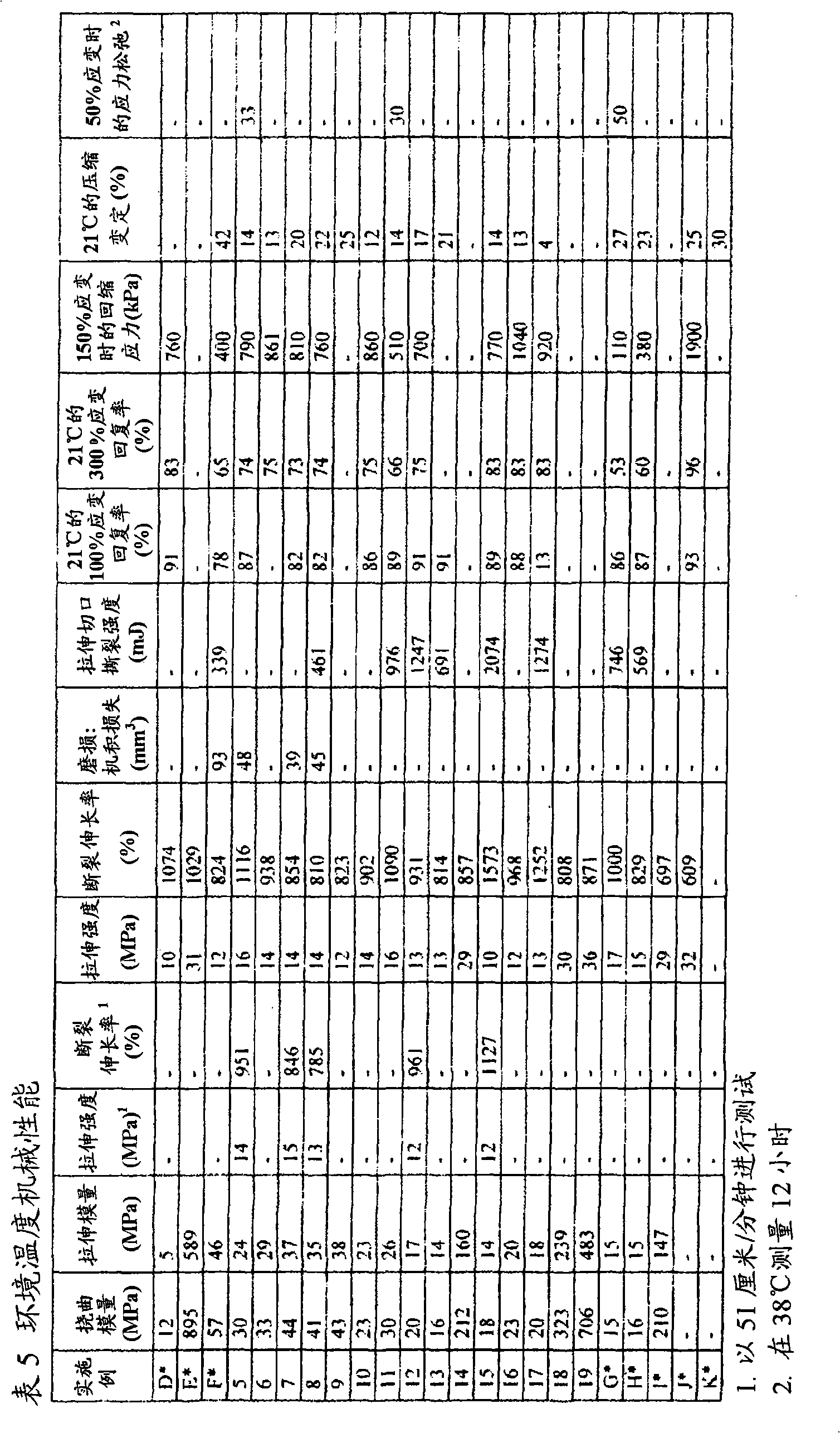
Table 5 demonstration new polymers and various comparative polymer are in the engineering properties result of environment temperature.Can find out that polymer of the present invention has excellent abrasive resistance when foundation ISO 4649 tests, generally be to show to be less than 90mm
3, be preferably and be less than about 80mm
3, and particularly be less than about 50mm
3Volume loss.In this test, loss is lower with ABRASION RESISTANCE thereby high value is represented higher volumes.
The tearing strength of passing through stretching tongue tear ionization meter of polymer of the present invention generally is 1000mJ or higher, and is as shown in table 5.The tearing strength of polymer of the present invention can be up to 3000mJ, or even up to 5000mJ.Comparative polymer generally has the tearing strength that is not higher than 750mJ.
Table 5 shows that also polymer of the present invention has than some comparative sample better at the back stress (being proved by higher back stress value) of 150% strain.Comparative Examples F, G and H have 400kPa or back stress value still less when 150% strain, and polymer of the present invention has 500kPa (embodiment 11) to the back stress value up to about 1100kPa (embodiment 17) when 150% strain.For flexible application, for example elastomer and fabric, particularly non-woven fabric, it is quite useful having the polymer that is higher than 150% back stress value.Other application comprises the waistband application of diaper, amenities and medical clothing, for example, overhangs band (tabs) and elastic webbing.
Table 5 shows that also with respect to for example Comparative Examples G, polymer of the present invention also has (lower) stress relaxation (when 50% strain) of improvement.Lower stress relaxation means that this polymer keeps its power preferably in application, for example diaper and when body temperature long-term other clothing that keeps elastic property of expectation.
Optic test
Table 6 polymer optical property
| Embodiment | Interior mist degree (%) | Transparency (%) | 45 ° of glossiness (%) |
| F* | 84 | 22 | 49 |
| G* | 5 | 73 | 56 |
| 5 | 13 | 72 | 60 |
| 6 | 33 | 69 | 53 |
| 7 | 28 | 57 | 59 |
| 8 | 20 | 65 | 62 |
| 9 | 61 | 38 | 49 |
| 10 | 15 | 73 | 67 |
| 11 | 13 | 69 | 67 |
| 12 | 8 | 75 | 72 |
| 13 | 7 | 74 | 69 |
| 14 | 59 | 15 | 62 |
| 15 | 11 | 74 | 66 |
| 16 | 39 | 70 | 65 |
| 17 | 29 | 73 | 66 |
| 18 | 61 | 22 | 60 |
| 19 | 74 | 11 | 52 |
| G* | 5 | 73 | 56 |
| H* | 12 | 76 | 59 |
| I* | 20 | 75 | 59 |
The optical property of report is based on the moulded section film of basic shortage orientation in the table 6.The crystal size that causes owing to the chain shuttling agent quantitative changeization of using in polymerization changes, and the optical property of polymer can change in broad range.
The extraction of segmented copolymer
Carry out the extraction research of the polymer of embodiment 5,7 and Comparative Examples E.In experiment, polymer samples is taken by weighing to glass sintering extraction sleeve pipe, and be assembled in the Kumagawa type extractor.Have the extractor of sample with nitrogen purging, and with 350 milliliters diethyl ether, the 500 milliliters of round-bottomed flasks of packing into.Then, flask is assembled to extractor.With ether heating and stirring simultaneously.Writing time when ether begins to be condensate in the sleeve pipe, and under nitrogen, extracted 24 hours.At this moment, stop heating, and make the solution cooling.Remaining any ether in the extractor is back to flask.Ether under vacuum in environment temperature evaporation flask, and with nitrogen that the solid purging of gained is dry.Use the hexane continuous wash, all residues are transferred in the bottle of having weighed.Then, with another nitrogen purging the hexane that mixes is cleaned the thing evaporation, and residue is spent the night 40 ℃ of vacuumizes.Purge all the remaining ethers in the extractor dry with nitrogen.
Then, second clean round-bottomed flask that 350 milliliters of hexanes are housed is connected with extractor.Under agitation hexane is heated to backflow, and notices to keep after hexane is condensed in the sleeve pipe for the first time and refluxed 24 hours.Then, stop heating, and make the flask cooling.Flask is got back in remaining all hexanes transfers in the extractor.By under vacuum, hexane being removed, and use continuous hexane to clean remaining all residues in the flask are transferred in the bottle of having weighed in environment temperature evaporation.By nitrogen purging the hexane in the flask is evaporated, and residue is spent the night 40 ℃ of vacuumizes.
The polymer samples of staying after the extraction in the sleeve pipe is transferred in the bottle of having weighed from sleeve pipe, and spends the night 40 ℃ of vacuumizes.The results are shown in table 7.
Table 7
| Sample | Weight (g) | Ether DDGS (g) | Ether DDGS (%) | C 8 mol% 1 | Hexane DDGS (g) | Hexane DDGS (%) | C 8 mol% 1 | Remaining C 8 mol% 1 |
| Comparative Examples F* | 1.097 | 0.063 | 5.69 | 12.2 | 0.245 | 22.35 | 13.6 | 6.5 |
| |
1.006 | 0.041 | 4.08 | - | 0.040 | 3.98 | 14.2 | 11.6 |
| Embodiment 7 | 1.092 | 0.017 | 1.59 | 13.3 | 0.012 | 1.10 | 11.7 | 9.9 |
1By
13C NMR measures
Other polymer embodiment 19A-J, continuous solution polymerization, catalyst A 1/B2+DEZ
For embodiment 19A-I
In computer-controlled abundant mixing reactor, carry out the continuous solution polymerization reaction.Mixed alkanes solvent (Isopar with purifying
TME can derive from Exxon Mobil Inc.), ethene, 1-octene and hydrogen (if use) mixes and is supplied to 27 gallons reactor.Enter the charging of reactor by the mass flow controller measurement.Before entering reactor by making the temperature of spent glycol (glycol) cooling heat exchanger control incoming flow.Use pump and mass flowmenter metered catalyst component solution.Move reactor at about 550psig pressure with full liquid.When leaving reactor, in water and additive injection of polymer solution.Water is with the catalyst hydrolysis and stop polymerisation.With the heating of post-reactor solution, be that two-stage devolatilization is prepared then.In the devolatilization process, solvent and unreacted monomer are removed.Polymer melt is pumped to die head, is used for pellet cutting under water.
For embodiment 19J
In being furnished with the computer-controlled autoclave reactor of internal stirrers, carry out continuous solution polymerization.Mixed alkanes solvent (Isopar with purifying
TME can derive from ExxonMobil ChemicalCompany), ethene, 1-octene and the hydrogen of 2.70 Pounds Per Hours (1.22 kilograms/hour) (if use) is supplied to be furnished with and is used to control the sleeve pipe of temperature and 3.8 liters of reactors of internal heat galvanic couple.Enter the solvent feed of reactor by the mass flow controller measurement.The control of speed change membrane pump enters the solvent flow rate and the pressure of reactor.When pump discharges, get the flushing flow that effluent is provided for catalyst and co-catalyst injection pipeline and reactor agitator.These flow by the Micro-Motion mass flow meter measurement, and control by control valve or by the manual adjustment of needle-valve.Remaining solvent and 1-octene, ethene and hydrogen (if use) are merged, and be conducted in the reactor.The service property (quality) flow controller carries hydrogen to reactor on demand.Before entering reactor, use the temperature of heat exchanger control solvent/monomer solution.This flows to the bottom into reactor.Use pump and mass flowmenter metered catalyst component solution, and itself and catalyst rinse solvent are merged, and introduce the bottom of reactor.Under intense agitation, reactor is moved at the full liquid of 500psig (3.45MPa).Discharge pipe by reactor head removes product.All discharge pipes of reactor are all with Steam Heating and adiabatic.Be added in discharge pipe with any stabilizing agent or other additive low amounts of water and make this mixture by static mixer, stop polymerization thus.Product stream was heated by heat exchanger before devolatilization.Use vented extruder and water-cooled comminutor to extrude, thereby reclaim polymeric articles.
The details of method and the results are shown in table 8.Table 9A-C provide selected polymer property.
In table 9B, embodiment of the invention 19F and 19G demonstrate the low instantaneous permanent deformation of about 65-70% strain after elongation 500%.


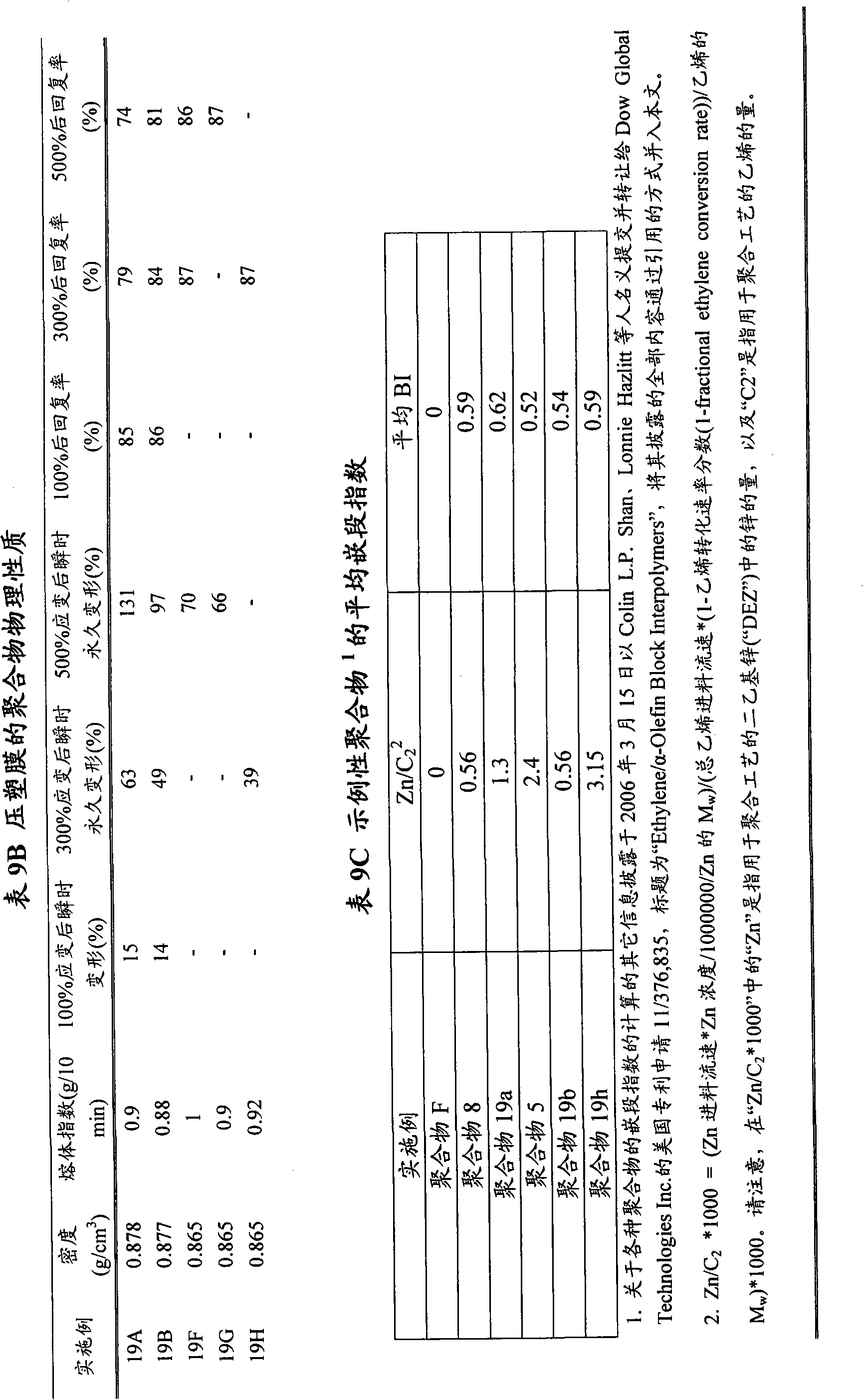
The ethylene/alpha-olefin interpolymers of embodiment 20,21 and 21A with to the similar substantially mode of top embodiment 19A-I, with the preparation of the polymerizing condition shown in the following table 11.The character that these polymer show is shown among table 10 and the 10A.Table 10 and 10A also show any additives that these polymer use.
Character and the additive of table 10-embodiment 20-21

Character and the additive of table 10A-embodiment 21A

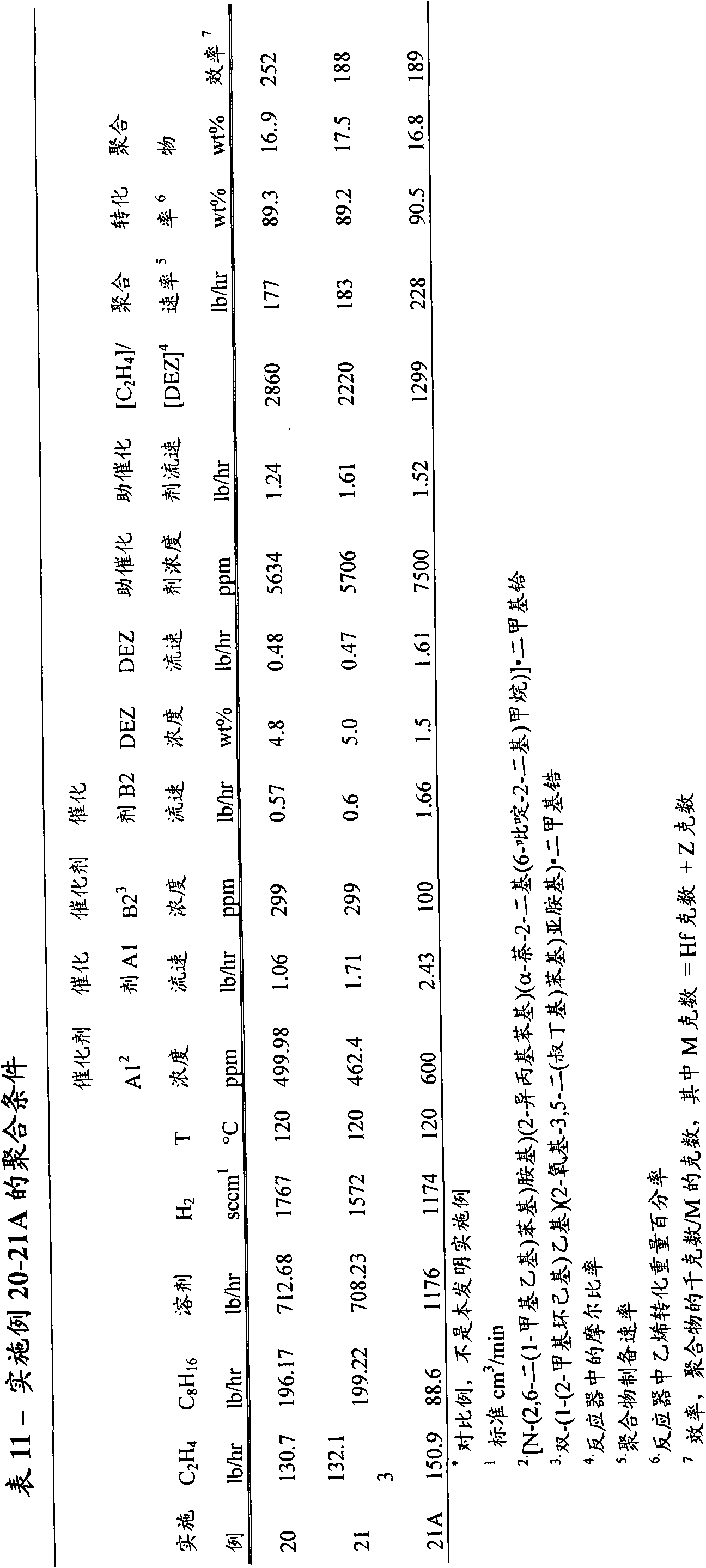
Embodiment 22-elasticity ethylene/alpha-olefin interpolymers fiber
Use the elasticity ethylene/alpha-olefin interpolymers of embodiment 20 to make fiber.Before making fiber, add following additive to polymer: 7000ppm PDMSO (dimethyl silicone polymer), 3000ppmCYANOX 1790 (1,3,5-three-(the 4-tert-butyl group-3-hydroxyl-2, the 6-dimethyl benzyl)-1,3,5-triazines-2,4,6-(1H, 3H, 5H)-triketone) and 3000ppm CHIMASORB 944 (poly--[[6-(1,1,3, the 3-tetramethyl butyl) amido]-sym-triazine-2,4-two bases] [2,2,6,6-tetramethyl-4-piperidyl) imido grpup] hexa-methylene [(2,2,6,6-tetramethyl-4-piperidyl) imido grpup]]) and the talcum of 0.5 weight %.Use following condition to make fiber: shape of the mouth as one speaks section (die profile) is 5: 1 rectangle as width and ratio highly, spinning temperature is 270 ℃, up-coiler speed is 500 meters/minute, spinning oil (spin finish) is 1%, cold stretch rate (cold draw) is 2%, and ball of string weight (spool weight) is 300g.
During the melt-spun of fiber, used special quench air system design (quench air systemdesign), make there are two quench air cooled regions that it is long that each zone is about 2000mm.Usually quench air flow rate is controlled to be 0.25m/s ± 10%, makes it pass through described chamber back and forth with this speed.With the quench air temperature maintenance in two zones between 16 and 18 ℃.Quench air flow direction in upper area is for from left to right, and the quench air flow direction in bottom section is for from right to left.This quench air flow to be provided with by balance preferably the physical force that acts in each shock chamber on 12 single fibers and the amount that bowing (bowing) or monfil are out of shape in shock chamber has been minimized.Then, use the 166.4kGy radiation fiber is crosslinked, keep ball of string temperature simultaneously and be lower than about 30 ℃ as crosslinking agent.
The fiber of embodiment 23-elasticity ethylene/alpha-olefin interpolymers
Use the elasticity ethylene/alpha-olefin interpolymers of embodiment 20 to make fiber.Before making fiber, add following additive to polymer: 7000ppm PDMSO (dimethyl silicone polymer), 3000ppmCYANOX 1790 (1,3,5-three-(the 4-tert-butyl group-3-hydroxyl-2, the 6-dimethyl benzyl)-1,3,5-triazines-2,4,6-(1H, 3H, 5H)-triketone) and 3000ppm CHIMASORB 944 (poly--[[6-(1,1,3, the 3-tetramethyl butyl) amido]-sym-triazine-2,4-two bases] [2,2,6,6-tetramethyl-4-piperidyl) imido grpup] hexa-methylene [(2,2,6,6-tetramethyl-4-piperidyl) imido grpup]]) and the talcum of 0.5 weight %.Use following condition to make fiber: shape of the mouth as one speaks section is 3: 1 a rectangle as the ratio of width and height, and spinning temperature is 270 ℃, and up-coiler speed is 500 meters/minute, and spinning oil is 1%, and the cold stretch rate is 2%, and ball of string weight is 300g.Then, use the 166.4kGy radiation fiber is crosslinked, keep ball of string temperature simultaneously and be lower than about 30 ℃ as crosslinking agent.
The fiber of embodiment 24-blend
The ENGAGE ENR7467.01 of 63.83 weight % (can be derived from The Dow ChemicalCompany, for having (190 ℃ of 1.2g/10min melt index (MI)s, 2.16kg) and the ethylene-butene copolymer of 0.862g/cc density and contain 100ppm Irganox 1076 and the 3000ppm talcum) (can derive from The Dow Chemical Company with the AFFINITY PL1880 of 34.37 weight %, for have the 1.0g/10min. melt index (MI) (190 ℃, 2.16kg) and the ethylene-octene copolymer of 0.902g/cc density and contain 1000ppm Irgafos 168,200ppm Irganox 1010 and 250ppm Irganox 1076), 0.7 the PDMSO of weight %, 0.3 the Cyanox 1790 of weight %, 0.3 the talcum of the CH944 of weight % and 0.5 weight % carries out blend.
Use following condition to make fiber: shape of the mouth as one speaks section is 5: 1 a rectangle as the ratio of width and height, and spinning temperature is 299 ℃, and up-coiler speed is 325 meters/minute, and spinning oil is 1%, and the cold stretch rate is 5%, and ball of string weight is 300g.Then, use the 166.4kGy radiation fiber is crosslinked, keep ball of string temperature simultaneously and be lower than about 30 ℃ as crosslinking agent.
The fiber of embodiment 25-random ethylene copolymer
Use has common name AFFINITY
TMThe random copolymer manufacturing of KC8852G (can derive from The Dow ChemicalCompany) has the 140 Denier monofilament fibers in approximate rectangular cross section.AFFINITY
TMKC8852G is characterised in that melt index (MI), the 0.875g/cm with 3g/10min.
3Density and be similar to the additive of embodiment 21.Before making fiber, add following additive to polymer: 7000ppm PDMSO (dimethyl silicone polymer), 3000ppm CYANOX1790 (1,3,5-three-(the 4-tert-butyl group-3-hydroxyl-2, the 6-dimethyl benzyl)-1,3,5-triazines-2,4,6-(1H, 3H, 5H)-triketone) and 3000ppm CHIMASORB 944 (poly--[[6-(1,1,3, the 3-tetramethyl butyl) amido]-sym-triazine-2,4-two bases] [2,2,6,6-tetramethyl-4-piperidyl) imido grpup] hexa-methylene [(2,2,6,6-tetramethyl-4-piperidyl) imido grpup]]), 0.5 the TiO of the talcum of weight % and 0.2 weight %
2Use following condition to make fiber: shape of the mouth as one speaks section is 3: 1 a rectangle as the ratio of width and height, and spinning temperature is 295 ℃, and up-coiler speed is 500 meters/minute, and spinning oil is 1%, and the cold stretch rate is 18%, and ball of string weight is 300g.Then, use the 176.4kGy radiation fiber is crosslinked, keep ball of string temperature simultaneously and be lower than about 30 ℃ as crosslinking agent.
The typical heavily fabric of embodiment 26-
Use embodiment 22,23,24 to make four kinds of different tentative fabrics with 25 fiber, every kind of fabric has following structure:
| Through yarn count: | 9Ne, 100% cotton |
| The weft yarn number: | 8.9Ne |
| On the loom through density: | 25 |
| Weft density on the loom: | 18 |
| Reed width (cm): | 178cm |
| The highest wash temperature | 95℃ |
| Drying cylinder | 115℃ |
| Singe | Be that condition is T=83 ℃ of a 18mBar/90m/min/ fabric maximum temperature |
| Soft finish+drying | Be |
| Preshrunk | Be |
Four kinds of fabrics are carried out the test shown in the following table.The digital simulation clothes washing of use after 3 family's launderings is because this is typical industrial practice.The wash conditions of 3 family's launderings is followed AATCC method 135-1999 and is used for the use option V of wash conditions.
The fabric test method comprises:
Measure stretching percentage, secondary creep percentage and reply percentage according to ASTM D3107;
Measure the fabric tearing strength according to ASTM D1424;
Measure fabric tension intensity or grab strength according to ASTM D5034;
According to 65 ℃ of wash temperature measurement sizes of AATCC 135 usefulness stability;
Use test method ASTM 3776 measures fabric weight.
| Pattern | Fiber type | Weight oz/yd after 3 family's launderings 2(ounce per square yard) | Shrinkage in width percentage (width %shk) | Stretching percentage after 3 family's launderings | The secondary creep percentage | Secondary creep percentage: stretching percentage |
| Test fabric 1 | Embodiment 22 | ~13 | 2.4 | 14 | 4 | 0.3 |
| |
Embodiment 23 | ~13 | 2.6 | 12.4 | 3 | 0.2 |
| |
Embodiment 24 | ~13 | 3.8 | 14 | 3 | 0.21 |
| |
|
~13 | 1 | 8 | 2.8 | 0.4 |
The fabric (test fabric 1 and test fabric 2) that contains the ethylene/alpha-olefin interpretation has high temperature tolerance, this makes fabric can have DIMENSIONAL STABILITY, has high convergent force in textile finishing temperature (50-90 ℃), thereby allow that fabric shrinks manyly during the arrangement step, therefore, fabric has than ethene polymers such as XLA by the crosslinked even branching of standard
TMThe higher elastic force of making of fabric.Described fabric has outstanding chemical resistance and has stability in for example temperature up to 200 ℃.
The crosslinked amount of the fiber that embodiment 27-is different
The monfil that the elasticity ethylene/alpha-olefin interpolymers of embodiment 20 is used to make 40 DENIER with subcircular cross section.Before making fiber, add following additive: 7000ppmPDMSO (dimethyl silicone polymer), 3000ppm CYANOX 1790 (1,3 to polymer, 5-three-(the 4-tert-butyl group-3-hydroxyl-2, the 6-dimethyl benzyl)-1,3,5-triazines-2,4,6-(1H, 3H, 5H)-triketone) and 3000ppmCHIMASORB 944 (poly--[[6-(1,1,3, the 3-tetramethyl butyl) amido]-sym-triazine-2,4-two bases] [2,2,6,6-tetramethyl-4-piperidyl) imido grpup] hexa-methylene [(2,2,6,6-tetramethyl-4-piperidyl) imido grpup]]) and the TiO of 0.5% weight
2Use following condition to make fiber: shape of the mouth as one speaks section has circular 0.8mm diameter, and spinning temperature is 299 ℃, and up-coiler speed is 650 meters/minute, and spinning oil is 2%, and the cold stretch rate is 6%, and ball of string weight is 150g.Then, use the electron beam irradiation of different amounts fiber is crosslinked as crosslinking agent.
Gel content-amount of radiation relation is shown in Fig. 8.Determine gel content by measuring about 25mg fiber sample (keeping 4 position effective digitals).Then this sample is combined with 7ml dimethylbenzene in 2-dram (dram) bottle of adding a cover.Should heat 90 minutes at 125 ℃ to 135 ℃ by bottle, and reversing in per 15 minutes mixes (being about to the bottle flip-top to the below) to extract all uncrosslinked polymer.In case this bottle is cooled to about 25 ℃, just dimethylbenzene is gone out from the gel decantation.And with a small amount of fresh dimethylbenzene this gel of rinsing in bottle.The gel of rinsing is transferred in the aluminum weighing plate of a taring.The dish of taring that will have a gel 125 ℃ of vacuumizes 30 minutes to remove removal xylene by evaporation.The dish that will have dry gel is weighed on analytical balance.Content based on gel weight of extracting and original fibre weight calculated for gel.Fig. 8 shows that when electron-beam dose increases crosslinked amount (gel content) also increases.It will be understood by those skilled in the art that the exact relationship between crosslinked amount and the electron-beam dose can be subjected to the influence of the character of given polymer (for example molecular weight or melt index (MI)).
The fiber of the ethylene/alpha-olefin interpolymers of embodiment 28-embodiment 21A
The elasticity ethylene/alpha-olefin interpolymers of embodiment 21A is used for fiber.Before making fiber, add following additive to polymer: 7000ppm PDMSO (dimethyl silicone polymer), 3000ppmCYANOX 1790 (1,3,5-three-(the 4-tert-butyl group-3-hydroxyl-2, the 6-dimethyl benzyl)-1,3,5-triazines-2,4,6-(1H, 3H, 5H)-triketone) and 3000ppm CHIMASORB 944 (poly--[[6-(1,1,3, the 3-tetramethyl butyl) amido]-sym-triazine-2,4-two bases] [2,2,6,6-tetramethyl-4-piperidyl) imido grpup] hexa-methylene [(2,2,6,6-tetramethyl-4-piperidyl) imido grpup]]).Use following condition to make fiber: have the circular port type profile of 0.8mm diameter, spinning temperature is 280 ℃, and up-coiler speed is 930 meters/minute, and spinning oil is 1%, and ball of string weight is 365g.Then, use the 117.6kGy radiation fiber is crosslinked, keep ball of string temperature simultaneously and be lower than about 30 ℃ as crosslinking agent.
The two elastic force denigratory fabrics of embodiment 29-
Made 3/1 pair of elastic force denigratory of twill fabric, wherein warp thread has 100% ring ingot cladded yarn (ring core-spun yarn).Yam count through making progress is 9Ne.Described ring ingot cladded yarn has as 100% cotton of hard fibre crust and the fiber of the embodiment in the yarn core 28.The dawn number of the elastomeric yarn core fibre in the warp thread is 75 DENIER.Weft yarn is made up of (brilliant) of the light of the circle of 100% polybutylene terephthalate (PBT) (PBT) and the fiber of distortion (model 527W, Trevira makes).Number number that is used for weft yarn is 600 dtexs, and per share yarn has 128 monofilament.On the loom is 24.8ends/cm (every centimetre through number) through density, and weft yarn is arranged to 16.3picks/cm (every centimetre of latitude number).Described fabric is that 179cm is wide on loom, and is that 171cm is wide at the grey cloth state.After dyeing and arrangement, described fabric presents following character:
Through density (ASTM D3775-03): 30.8ends/cm
Weft density (ASTM D3775-03): 18.1picks/cm
Width (ASTM D3774-96 option b): 145cm
Weight (ASTM D3776-96 option c): 390gr/sq.m
The fabric of putting in order is washed and dry three times according to standard ISO 6330:2000 operation 5A, and drying is carried out in whizzer.After three laundering circulations, described fabric presents following character:
Through density (ASTM D3775-03): 33.1ends/cm
Weft density (ASTM D3775-03): 20.2picks/cm
Width (ASTM D3774-96 option b): 136cm
Weight (ASTM D3776-96 option c): 450gr/sq.m
Warp thread percentage elongation (ASTM D3107): 18%
Warp thread secondary creep rate (ASTM D3107): 0.5%
Weft yarn percentage elongation (ASTM D3107): 14%
Weft yarn secondary creep rate (ASTM D3107): 3.9%.
The two elastic force denigratory fabrics of embodiment 30-
Made 3/1 pair of elastic force denigratory of twill fabric, wherein warp thread and weft yarn have 100% ring ingot cladded yarn.Yam count in the warp thread is 9Ne.Yam count in the weft yarn is 10Ne.Described ring ingot cladded yarn has as 100% cotton of hard fibre crust and the fiber of the embodiment in the yarn core 28.The dawn number of the elastomeric yarn core fibre in warp thread and weft yarn is 75 DENIER.On the loom is 24.8ends/cm through density, and weft yarn is arranged to 17picks/cm.Described fabric is wide and be that 173cm is wide at the grey cloth state for 180cm on loom.After dyeing and arrangement, described fabric presents following character:
Through density (ASTM D3775-03): 28ends/cm
Weft density (ASTM D3775-03): 17.9picks/cm
Width (ASTM D3774-96 option b): 154cm
Weight (ASTM D3776-96 option c): 303.3gr/sq.m
The fabric of putting in order is washed and dry three times according to standard ISO 6330:2000 operation 2A, and drying is carried out in whizzer.After three laundering circulations, described fabric presents following character:
Through density (ASTM D3775-03): 30ends/cm
Weft density (ASTM D3775-03): 19.8picks/cm
Width (ASTM D3774-96 option b): 143.2cm
Weight (ASTM D3776-96 option c): 399.7gr/sq.m
Warp thread extensibility (ASTM D3107): 16.2%
Warp thread secondary creep rate (ASTM D3107): 8.2%
Weft yarn extensibility (ASTM D3107): 18%
Weft yarn secondary creep rate (ASTM D3107): 8.2%.
Claims (25)
1. heavy weight stretch fabrics that contains one or more elastomers, wherein said fabric has to measure at least about the weight of 10 ounce per square yard with according to ASTM D3107 according to ASTM 3776 measures extensibility at least about 10%, and wherein said elastomer comprises the product of at least a ethylene/alpha-olefin interpolymers and at least a crosslinking agent, and wherein said uncrosslinked ethylene/alpha-olefin interpolymers is characterised in that one or more in the following feature:
(a) has about 1.7 to about 3.5 M
w/ M
n, at least one fusing point T
m, in degree centigrade and density d, in gram/cubic centimetre, wherein said T
mWith the numerical value of d corresponding to following relation:
T
m>-2002.9+4538.5 (d)-2422.2 (d)
2, or
(b) has about 1.7 to about 3.5 M
w/ M
n, it is characterized in that heat of fusion Δ H, in J/g and in degree centigrade the Δ amount, Δ T is defined as the highest DSC peak and the peak-to-peak temperature difference of the highest CRYSTAF, the numerical value of wherein said Δ T and Δ H has following relation:
For Δ H greater than 0 and maximum 130J/g, Δ T>-0.1299 (Δ H)+62.81,
For Δ H greater than 130J/g, Δ T 〉=48 ℃,
Wherein said CRYSTAF peak uses at least 5% accumulation polymer to determine, and if be less than 5% polymer and have and can discern the CRYSTAF peak, then the CRYSTAF temperature is 30 ℃; Or
(c) be characterised in that when the compression moulding film that uses ethylene/alpha-olefin interpolymers is measured in percentage at 300% the strain and the elastic recovery rate of 1 circulation, Re, and has density d, in gram/cubic centimetre, wherein do not contain the satisfied following relation of numerical value of described Re of crosslinked phase time and d substantially when described ethylene/alpha-olefin interpolymers:
Re>1481-1629 (d); Or
(d) has when using the TREF classification molecule fraction of wash-out between 40 ℃ and 130 ℃, the comonomer molar content that it is characterized in that described fraction compares the comonomer molar content height at least 5% of the fraction of suitable random ethylene interpretation wash-out between uniform temp with it, wherein said suitable with it random ethylene interpretation has identical comonomer, and each character of its melt index (MI), density and comonomer molar content (based on whole polymer) and described ethylene/alpha-olefin interpolymers differ ± 10% in; Or
(e) be characterised in that at 25 ℃ storage modulus G ' (25 ℃) and at 100 ℃ storage modulus G ' (100 ℃), wherein said G ' (25 ℃) is about 1: 1 to about 10: 1 with the ratio of G ' (100 ℃); Or
(f) at least a when using TREF to carry out classification between 40 ℃ and 130 ℃ the molecule fraction of wash-out, it is characterized in that described fraction has at least 0.5 and about at the most 1 blockiness index and greater than about 1.3 molecular weight distribution M
w/ M
n, or
(g) greater than 0 and about at the most 1.0 average block index with greater than about 1.3 molecular weight distribution M
w/ M
n
2. fabric as claimed in claim 1, wherein said fabric can hold out against and be selected from following processing: i) at least 140 °F. temperature exposure reach at least 90 minutes period in the liquor natrii hypochloritis of 10 weight %; Ii) at least 140 °F. temperature exposure reach at least 90 minutes period in the permanganate solution of 5 weight %; Iii) 50 at least about 65 ℃. the industry laundering circulation that temperature is carried out; Iv) 20 perchloroethylene dry-cleaning circulations; Or v) mercerization; And wherein hold out against and mean that after described processing described fabric presents that measurement is less than 20% secondary creep rate according to ASTM D3107.
3. fabric as claimed in claim 2, wherein said fabric present after described processing that measurement is less than about 10% secondary creep rate according to ASTM D3107.
4. fabric as claimed in claim 2, it can hold out against in the described processing two or more.
5. as any described fabric in claim 1 or 2, wherein said fiber comprises the gel content of about 10 weight % to about 75 weight %.
6. as any described fabric in claim 1 or 2, wherein said ethylene/alpha-olefin interpolymers accounts for about 1 weight % of described fabric to maximum about 15 weight %.
7. fabric as claimed in claim 2, at least heavily about 11 ounce per square yard of wherein said fabric.
8. as any described fabric in claim 1 or 2, wherein said fabric has the extensibility at least about 14%.
9. as any described fabric in claim 1 or 2, wherein said fabric comprises at least a other the following material that is selected from: cellulose, cotton, flax, Limonene fiber crops, artificial silk, viscose, hemp, wool, silk, imitative flax, bamboo fibre, tencel fiber, mohair, polyester, polyolefin, polyamide and their mixture.
10. as any described fabric in claim 1 or 2, it comprises and contains the elastomer that is selected from following polymer: polybutylene terephthalate (PBT), Spandex, polyethylene terephthalate, poly terephthalic acid trimethylene ester and their mixture.
11. as any described fabric in claim 1 or 2, wherein said elastomer also comprises polyolefin blends, described polyolefin blends has the total melt index (MI) (I less than 2.5g/10min before crosslinked
2), and have about 0.865 to 0.885g/cm
3Density in the scope.
12. as any described fabric in claim 1 or 2, wherein said elastomer also comprises polyolefin blends, wherein said polyolefin blends comprises that density is about 0.855 to about 0.88g/cm
3First polyolefin and 80 ℃ of residual crystallinity greater than 9% second polyolefin.
13. as any described fabric in claim 1 or 2, wherein said elastomer also comprises polyolefin blends, wherein said polyolefin blends has about 0.855 to about 0.88g/cm
3Density or at 80 ℃ greater than 9% residual crystallinity; Perhaps have about 0.855 simultaneously to about 0.88g/cm
3Density and at 80 ℃ greater than 9% residual crystallinity.
14. as any described fabric in claim 1 or 2, wherein said elastomer also comprises polyolefin blends, wherein said polyolefin blends comprises that density is about 0.855 to about 0.88g/cm
3First polyolefin and 80 ℃ of residual crystallinity greater than 9% second polyolefin, and wherein said first polyolefin or second polyolefin comprise even branched polyethylene.
15. as any described fabric in claim 1 or 2, wherein said elastomer also comprises at least a other polymer.
16. as any described fabric in claim 1 or 2, wherein said elastomer also comprises at least a other polymer, and wherein said other polymer comprises ethylene copolymer, polyethylene, propylene copolymer, polypropylene or their mixture.
17. as any described fabric in claim 1 or 2, the ratio of wherein said secondary creep rate and extensibility is about 0.05 to about 0.4.
18. heavy weight stretch fabrics that contains elastomer, the weight of wherein said fabric is about 0.05 to about 0.4 according to the ratio that ASTM3776 is measured as at least about 10 ounce per square yard and secondary creep rate and extensibility, and wherein said elastomer comprises the product of at least a ethylene/alpha-olefin interpolymers and at least a crosslinking agent, and wherein said uncrosslinked ethylene/alpha-olefin interpolymers is characterised in that one or more in the following feature:
(a) has about 1.7 to about 3.5 M
w/ M
n, at least one fusing point T
m, in degree centigrade and density d, in gram/cubic centimetre, wherein said T
mWith the numerical value of d corresponding to following relation:
T
m>-2002.9+4538.5 (d)-2422.2 (d)
2, or
(b) has about 1.7 to about 3.5 M
w/ M
n, it is characterized in that heat of fusion Δ H, in J/g and in degree centigrade the Δ amount, Δ T is defined as the highest DSC peak and the peak-to-peak temperature difference of the highest CRYSTAF, the numerical value of wherein said Δ T and Δ H has following relation:
For Δ H greater than 0 and maximum 130J/g, Δ T>-0.1299 (Δ H)+62.81,
For Δ H greater than 130J/g, Δ T 〉=48 ℃,
Wherein said CRYSTAF peak uses at least 5% accumulation polymer to determine, and if be less than 5% polymer and have and can discern the CRYSTAF peak, then described CRYSTAF temperature is 30 ℃; Or
(c) be characterised in that when the compression moulding film that uses ethylene/alpha-olefin interpolymers is measured in percentage at 300% the strain and the elastic recovery rate of 1 circulation, Re, and has density d, in gram/cubic centimetre, wherein do not contain the satisfied following relation of numerical value of described Re of crosslinked phase time and d substantially when described ethylene/alpha-olefin interpolymers:
Re>1481-1629 (d); Or
(d) has when using the TREF classification molecule fraction of wash-out between 40 ℃ and 130 ℃, the comonomer molar content that it is characterized in that described fraction compares the comonomer molar content height at least 5% of the fraction of suitable random ethylene interpretation wash-out between uniform temp with it, wherein said suitable with it random ethylene interpretation has identical comonomer, and each character of its melt index (MI), density and comonomer molar content (based on whole polymer) and described ethylene/alpha-olefin interpolymers differ ± 10% in; Or
(e) be characterised in that at 25 ℃ storage modulus G ' (25 ℃) and at 100 ℃ storage modulus G ' (100 ℃), wherein said G ' (25 ℃) is about 1: 1 to about 10: 1 with the ratio of G ' (100 ℃); Or
(f) at least a when using TREF to carry out classification between 40 ℃ and 130 ℃ the molecule fraction of wash-out, it is characterized in that described fraction has at least 0.5 and about at the most 1 blockiness index and greater than about 1.3 molecular weight distribution M
w/ M
n, or
(g) greater than 0 and about at the most 1.0 average block index with greater than about 1.3 molecular weight distribution M
w/ M
n
Be selected from following processing 19. fabric as claimed in claim 18, wherein said fabric can hold out against: i) at least 140 °F. temperature exposure reach at least 90 minutes period in the liquor natrii hypochloritis of 10 weight %; Ii) at least 140 °F. temperature exposure reach at least 90 minutes period in the permanganate solution of 5 weight %; Iii) 50 at least about 65 ℃. the industry laundering circulation that temperature is carried out; Iv) 20 perchloroethylene dry-cleaning circulations; Or v) mercerization; And wherein hold out against and mean that after described processing described fabric presents that measurement is less than 20% secondary creep rate according to ASTM D3107.
20. by as any described textile clothing in the claim 1,2,18 or 19.
21. by as any described textile clothing in the claim 1,2,18 or 19, wherein said fabric is a denigratory.
22. by as any described textile clothing in the claim 1,2,18 or 19, wherein said clothing is a uniform.
23. as any described fabric in the claim 1,2,18 or 19, wherein said fabric is the stone mill washing.
24. as any described fabric in the claim 1,2,18 or 19, wherein said fabric is two stockinettes.
25. as any described fabric in the claim 1,2,18 or 19, wherein said fabric is two stockinettes and comprises and contain the elastomer that is selected from following polymer: polybutylene terephthalate (PBT), Spandex, polyethylene terephthalate, poly terephthalic acid trimethylene ester and their mixture.
Applications Claiming Priority (2)
| Application Number | Priority Date | Filing Date | Title |
|---|---|---|---|
| US86802606P | 2006-11-30 | 2006-11-30 | |
| US60/868,026 | 2006-11-30 |
Publications (1)
| Publication Number | Publication Date |
|---|---|
| CN101595252A true CN101595252A (en) | 2009-12-02 |
Family
ID=39154053
Family Applications (1)
| Application Number | Title | Priority Date | Filing Date |
|---|---|---|---|
| CNA2007800506952A Pending CN101595252A (en) | 2006-11-30 | 2007-11-30 | Olefin block compositions for heavy stretch fabrics |
Country Status (9)
| Country | Link |
|---|---|
| US (1) | US7928022B2 (en) |
| EP (1) | EP2084313A1 (en) |
| JP (1) | JP2010511801A (en) |
| KR (1) | KR20090086422A (en) |
| CN (1) | CN101595252A (en) |
| AU (1) | AU2007325009A1 (en) |
| CA (1) | CA2671256A1 (en) |
| TW (1) | TW200902780A (en) |
| WO (1) | WO2008067539A1 (en) |
Cited By (1)
| Publication number | Priority date | Publication date | Assignee | Title |
|---|---|---|---|---|
| CN109023705A (en) * | 2018-10-04 | 2018-12-18 | 广东竹康材料科技有限公司 | A kind of bamboo fiber filler material of heat preservation and preparation method thereof |
Families Citing this family (50)
| Publication number | Priority date | Publication date | Assignee | Title |
|---|---|---|---|---|
| EP2357203B1 (en) * | 2004-03-17 | 2017-05-24 | Dow Global Technologies LLC | Catalyst composition comprising shuttling agent for higher olefin multi-block copolymer formation |
| US8273838B2 (en) * | 2004-03-17 | 2012-09-25 | Dow Global Technologies Llc | Propylene/α-olefins block interpolymers |
| US7714071B2 (en) * | 2004-03-17 | 2010-05-11 | Dow Global Technologies Inc. | Polymer blends from interpolymers of ethylene/α-olefins and flexible molded articles made therefrom |
| US7795321B2 (en) * | 2004-03-17 | 2010-09-14 | Dow Global Technologies Inc. | Rheology modification of interpolymers of ethylene/α-olefins and articles made therefrom |
| US7622529B2 (en) * | 2004-03-17 | 2009-11-24 | Dow Global Technologies Inc. | Polymer blends from interpolymers of ethylene/alpha-olefin with improved compatibility |
| US7897689B2 (en) * | 2004-03-17 | 2011-03-01 | Dow Global Technologies Inc. | Functionalized ethylene/α-olefin interpolymer compositions |
| AR053693A1 (en) | 2004-03-17 | 2007-05-16 | Dow Global Technologies Inc | COMPOSITIONS OF ETHYLENE / ALFA-OLEFINE INTERPOLIMERO MULTIBLOCK SUITABLE FOR FILMS |
| US7741397B2 (en) * | 2004-03-17 | 2010-06-22 | Dow Global Technologies, Inc. | Filled polymer compositions made from interpolymers of ethylene/α-olefins and uses thereof |
| US7687442B2 (en) * | 2004-03-17 | 2010-03-30 | Dow Global Technologies Inc. | Low molecular weight ethylene/α-olefin interpolymer as base lubricant oils |
| US7582716B2 (en) * | 2004-03-17 | 2009-09-01 | Dow Global Technologies Inc. | Compositions of ethylene/α-olefin multi-block interpolymer for blown films with high hot tack |
| US7355089B2 (en) * | 2004-03-17 | 2008-04-08 | Dow Global Technologies Inc. | Compositions of ethylene/α-olefin multi-block interpolymer for elastic films and laminates |
| US7671131B2 (en) | 2004-03-17 | 2010-03-02 | Dow Global Technologies Inc. | Interpolymers of ethylene/α-olefins blends and profiles and gaskets made therefrom |
| US7622179B2 (en) * | 2004-03-17 | 2009-11-24 | Dow Global Technologies Inc. | Three dimensional random looped structures made from interpolymers of ethylene/α-olefins and uses thereof |
| CN1976965B (en) | 2004-03-17 | 2012-10-10 | 陶氏环球技术有限责任公司 | Catalyst composition comprising shuttling agent for ethylene multi-block copolymer formation |
| US7863379B2 (en) * | 2004-03-17 | 2011-01-04 | Dow Global Technologies Inc. | Impact modification of thermoplastics with ethylene/alpha-olefin interpolymers |
| US7803728B2 (en) * | 2004-03-17 | 2010-09-28 | Dow Global Technologies Inc. | Fibers made from copolymers of ethylene/α-olefins |
| US7608668B2 (en) * | 2004-03-17 | 2009-10-27 | Dow Global Technologies Inc. | Ethylene/α-olefins block interpolymers |
| US7662881B2 (en) * | 2004-03-17 | 2010-02-16 | Dow Global Technologies Inc. | Viscosity index improver for lubricant compositions |
| US7579408B2 (en) * | 2004-03-17 | 2009-08-25 | Dow Global Technologies Inc. | Thermoplastic vulcanizate comprising interpolymers of ethylene/α-olefins |
| US7666918B2 (en) * | 2004-03-17 | 2010-02-23 | Dow Global Technologies, Inc. | Foams made from interpolymers of ethylene/α-olefins |
| US7671106B2 (en) * | 2004-03-17 | 2010-03-02 | Dow Global Technologies Inc. | Cap liners, closures and gaskets from multi-block polymers |
| AR053697A1 (en) | 2005-03-17 | 2007-05-16 | Dow Global Technologies Inc | COMPOSITIONS OF ETHYLENE INTERPOLYMERS / (ALPHA) - MULTIPLE BLOCK OIL FOR FILMS AND ELASTIC LAMINATES |
| US8084537B2 (en) * | 2005-03-17 | 2011-12-27 | Dow Global Technologies Llc | Polymer blends from interpolymers of ethylene/α-olefin with improved compatibility |
| US7989543B2 (en) * | 2005-03-17 | 2011-08-02 | Dow Global Technologies Llc | Adhesive and marking compositions made from interpolymers of ethylene/α-olefins |
| CN101346498B (en) * | 2005-03-17 | 2013-04-17 | 陶氏环球技术有限责任公司 | Fibers made from ethylene/α-olefin interpolymers |
| KR20080055838A (en) | 2005-09-15 | 2008-06-19 | 다우 글로벌 테크놀로지스 인크. | Control of Polymer Composition and Molecular Weight Distribution with Multi-core Shuttles |
| ES2526056T3 (en) * | 2005-09-15 | 2015-01-05 | Dow Global Technologies Llc | Block copolymers of catalytic olefins by means of polymerizable transport agent |
| RU2008127854A (en) | 2005-12-09 | 2010-01-20 | Дау Глобал Текнолоджиз Инк. (Us) | METHODS FOR REGULATING MOLECULAR MASS DISTRIBUTION IN ETHYLENE / ALPHA-OLEPHIN COMPOSITIONS |
| US8153243B2 (en) * | 2005-12-09 | 2012-04-10 | Dow Global Technologies Llc | Interpolymers suitable for multilayer films |
| KR20090086420A (en) | 2006-11-30 | 2009-08-12 | 다우 글로벌 테크놀로지스 인크. | Stretchy fabrics and garments |
| US7776770B2 (en) | 2006-11-30 | 2010-08-17 | Dow Global Technologies Inc. | Molded fabric articles of olefin block interpolymers |
| CN101595252A (en) | 2006-11-30 | 2009-12-02 | 陶氏环球技术公司 | Olefin block compositions for heavy stretch fabrics |
| AU2008206336A1 (en) * | 2007-01-16 | 2008-07-24 | Dow Global Technologies Inc. | Colorfast fabrics and garments of olefin block compositions |
| WO2008089224A1 (en) * | 2007-01-16 | 2008-07-24 | Dow Global Technologies Inc. | Cone dyed yarns of olefin block compositions |
| US8569422B2 (en) * | 2007-07-13 | 2013-10-29 | Dow Global Technologies, Llc | Catalytic olefin block copolymers with controlled block sequence distribution and at least one low crystallinity hard block |
| WO2009042602A1 (en) * | 2007-09-28 | 2009-04-02 | Dow Global Technologies Inc | Thermoplastic olefin composition with improved heat distortion temperature |
| EP2052857A1 (en) | 2007-10-22 | 2009-04-29 | Dow Global Technologies Inc. | Multilayer films |
| US10161063B2 (en) | 2008-09-30 | 2018-12-25 | Exxonmobil Chemical Patents Inc. | Polyolefin-based elastic meltblown fabrics |
| US9168718B2 (en) | 2009-04-21 | 2015-10-27 | Exxonmobil Chemical Patents Inc. | Method for producing temperature resistant nonwovens |
| US8664129B2 (en) | 2008-11-14 | 2014-03-04 | Exxonmobil Chemical Patents Inc. | Extensible nonwoven facing layer for elastic multilayer fabrics |
| US9498932B2 (en) | 2008-09-30 | 2016-11-22 | Exxonmobil Chemical Patents Inc. | Multi-layered meltblown composite and methods for making same |
| ES2546088T4 (en) | 2009-02-27 | 2015-10-15 | Exxonmobil Chemical Patents Inc. | Biaxially elastic nonwoven laminates with inelastic zones |
| US20090272478A1 (en) * | 2009-03-31 | 2009-11-05 | Kim Inkyun | Method of durably grafting a decorated fabric to a clothing |
| US8668975B2 (en) | 2009-11-24 | 2014-03-11 | Exxonmobil Chemical Patents Inc. | Fabric with discrete elastic and plastic regions and method for making same |
| US9706804B1 (en) | 2011-07-26 | 2017-07-18 | Milliken & Company | Flame resistant fabric having intermingled flame resistant yarns |
| CN103243457A (en) * | 2013-05-22 | 2013-08-14 | 南通鑫平制衣有限公司 | Elastic fiber fabric |
| EP3121318B1 (en) * | 2015-07-22 | 2022-01-12 | Sanko Tekstil Isletmeleri San. Ve Tic. A.S. | Garment and process of preparation |
| BR112021012732A2 (en) * | 2018-12-28 | 2021-09-08 | Sanko Tekstil Isletmeleri San. Ve Tic. A.S. | STRETCH CLOTHING AND METHOD TO MANUFACTURE A ONE SIZE GARMENT |
| EP4484459A4 (en) * | 2022-11-02 | 2025-08-27 | Lg Chemical Ltd | POLYOLEFIN AND FILM WITH IT |
| EP4484458A4 (en) * | 2022-11-02 | 2025-08-27 | Lg Chemical Ltd | POLYOLEFIN AND FILM WITH IT |
Family Cites Families (93)
| Publication number | Priority date | Publication date | Assignee | Title |
|---|---|---|---|---|
| US2973344A (en) * | 1957-12-11 | 1961-02-28 | Exxon Research Engineering Co | Modified polymers |
| US2997432A (en) * | 1958-08-14 | 1961-08-22 | Phillips Petroleum Co | Dyeing of 1-olefin polymers |
| US4146492A (en) * | 1976-04-02 | 1979-03-27 | Texaco Inc. | Lubricant compositions which exhibit low degree of haze and methods of preparing same |
| US4299931A (en) * | 1980-03-10 | 1981-11-10 | Monsanto Company | Compatibilized polymer blends |
| US4340563A (en) * | 1980-05-05 | 1982-07-20 | Kimberly-Clark Corporation | Method for forming nonwoven webs |
| JPS5734145A (en) * | 1980-08-07 | 1982-02-24 | Mitsui Petrochem Ind Ltd | Ethylene-alpha-olefin copolymer composition |
| US4322027A (en) * | 1980-10-02 | 1982-03-30 | Crown Zellerbach Corporation | Filament draw nozzle |
| US4413110A (en) * | 1981-04-30 | 1983-11-01 | Allied Corporation | High tenacity, high modulus polyethylene and polypropylene fibers and intermediates therefore |
| JPS5975929A (en) * | 1982-10-25 | 1984-04-28 | Sekisui Chem Co Ltd | Production of polyolefin foam |
| CA1264880A (en) * | 1984-07-06 | 1990-01-23 | John Brooke Gardiner | Viscosity index improver - dispersant additive useful in oil compositions |
| US4762890A (en) * | 1986-09-05 | 1988-08-09 | The Dow Chemical Company | Method of grafting maleic anhydride to polymers |
| US4927888A (en) * | 1986-09-05 | 1990-05-22 | The Dow Chemical Company | Maleic anhydride graft copolymers having low yellowness index and films containing the same |
| US4950541A (en) * | 1984-08-15 | 1990-08-21 | The Dow Chemical Company | Maleic anhydride grafts of olefin polymers |
| US4663220A (en) * | 1985-07-30 | 1987-05-05 | Kimberly-Clark Corporation | Polyolefin-containing extrudable compositions and methods for their formation into elastomeric products including microfibers |
| US4668566A (en) * | 1985-10-07 | 1987-05-26 | Kimberly-Clark Corporation | Multilayer nonwoven fabric made with poly-propylene and polyethylene |
| US4798081A (en) * | 1985-11-27 | 1989-01-17 | The Dow Chemical Company | High temperature continuous viscometry coupled with analytic temperature rising elution fractionation for evaluating crystalline and semi-crystalline polymers |
| US5391629A (en) * | 1987-01-30 | 1995-02-21 | Exxon Chemical Patents Inc. | Block copolymers from ionic catalysts |
| US5266626A (en) * | 1989-02-22 | 1993-11-30 | Norsolor | Thermoplastic elastomer based on an ethylene/α-olefin copolymer and on polynorbornene |
| US6025448A (en) * | 1989-08-31 | 2000-02-15 | The Dow Chemical Company | Gas phase polymerization of olefins |
| US5068047A (en) * | 1989-10-12 | 1991-11-26 | Exxon Chemical Patents, Inc. | Visosity index improver |
| US5783638A (en) * | 1991-10-15 | 1998-07-21 | The Dow Chemical Company | Elastic substantially linear ethylene polymers |
| DE69211569T2 (en) * | 1991-12-30 | 1997-01-23 | Dow Chemical Co | ETHYLENE INTERPOLYMER POLYMERIZATION |
| TW272985B (en) * | 1992-09-11 | 1996-03-21 | Hoechst Ag | |
| EP0877050B1 (en) | 1992-09-15 | 2008-05-21 | Dow Global Technologies Inc. | Impact modification of thermoplastics |
| US5322728A (en) * | 1992-11-24 | 1994-06-21 | Exxon Chemical Patents, Inc. | Fibers of polyolefin polymers |
| TW275076B (en) * | 1992-12-02 | 1996-05-01 | Hoechst Ag | |
| ES2178648T3 (en) * | 1993-02-05 | 2003-01-01 | Idemitsu Kosan Co | POLYETHYLENE, COMPOSITION OF THERMOPLASTIC RESIN CONTAINING IT, AND POLYETHYLENE PRODUCTION PROCEDURE. |
| JP3031142B2 (en) * | 1993-11-01 | 2000-04-10 | 住友化学工業株式会社 | Polypropylene resin composition |
| US6030917A (en) * | 1996-07-23 | 2000-02-29 | Symyx Technologies, Inc. | Combinatorial synthesis and analysis of organometallic compounds and catalysts |
| AR006240A1 (en) * | 1996-03-14 | 1999-08-11 | Fuller H B Licensing Financ | HOT MELTING ADHESIVE INCLUDING INTERPOLYMERS, NON-WOVEN ARTICLE THAT UNDERSTANDS IT, POLYMERIZATION PROCEDURE FOR PREPARATION AND BOX, CONTAINER, TRAY AND BOOK UNITED WITH SUCH ADHESIVE |
| DE69701971D1 (en) * | 1996-03-15 | 2000-06-15 | Amoco Corp | Rigid, tough and solid glass fiber reinforced olefin polymer |
| KR20000005029A (en) * | 1996-03-27 | 2000-01-25 | 그레이스 스티븐 에스. | Polymerization method of aryl containing metal complex and olefine |
| WO1998006727A1 (en) * | 1996-08-08 | 1998-02-19 | The Dow Chemical Company | 3-heteroatom substituted cyclopentadienyl-containing metal complexes and olefin polymerization process |
| US6362252B1 (en) * | 1996-12-23 | 2002-03-26 | Vladimir Prutkin | Highly filled polymer composition with improved properties |
| EP0958314B1 (en) * | 1997-02-07 | 2002-11-06 | ExxonMobil Chemical Patents Inc. | Propylene polymers incorporating polyethylene macromers |
| US5783531A (en) * | 1997-03-28 | 1998-07-21 | Exxon Research And Engineering Company | Manufacturing method for the production of polyalphaolefin based synthetic greases (LAW500) |
| TR200000363T2 (en) * | 1997-08-08 | 2000-06-21 | The Dow Chemical Company | Sheet material, suitable for use as a floor, wall or ceiling covering material, and methods and intermediates for doing the same. |
| US6096668A (en) * | 1997-09-15 | 2000-08-01 | Kimberly-Clark Worldwide, Inc. | Elastic film laminates |
| BR9812478A (en) * | 1997-09-19 | 2000-09-26 | Dow Chemical Co | "compositionally optimized ethylene interpolymer composition, with a narrow molecular weight distribution, production process and articles manufactured with the same" |
| US6197404B1 (en) * | 1997-10-31 | 2001-03-06 | Kimberly-Clark Worldwide, Inc. | Creped nonwoven materials |
| AR018359A1 (en) * | 1998-05-18 | 2001-11-14 | Dow Global Technologies Inc | HEAT RESISTANT ARTICLE, CONFIGURED, IRRADIATED AND RETICULATED, FREE FROM A SILANAN RETICULATION AGENT |
| US6815023B1 (en) * | 1998-07-07 | 2004-11-09 | Curwood, Inc. | Puncture resistant polymeric films, blends and process |
| US6306658B1 (en) * | 1998-08-13 | 2001-10-23 | Symyx Technologies | Parallel reactor with internal sensing |
| US6316663B1 (en) * | 1998-09-02 | 2001-11-13 | Symyx Technologies, Inc. | Catalyst ligands, catalytic metal complexes and processes using and methods of making the same |
| KR100565151B1 (en) | 1999-02-04 | 2006-03-30 | 미쓰이 가가쿠 가부시키가이샤 | Polypropylene block-copolymer resin and process for producing it |
| US6680265B1 (en) * | 1999-02-22 | 2004-01-20 | Kimberly-Clark Worldwide, Inc. | Laminates of elastomeric and non-elastomeric polyolefin blend materials |
| AU4186500A (en) * | 1999-04-01 | 2000-10-23 | Symyx Technologies, Inc. | Polymerization catalyst ligands, catalytic metal complexes and compositions and processes using and methods of making same |
| US6825295B2 (en) * | 1999-12-10 | 2004-11-30 | Dow Global Technologies Inc. | Alkaryl-substituted group 4 metal complexes, catalysts and olefin polymerization process |
| US6537472B2 (en) * | 2000-02-29 | 2003-03-25 | Asahi Kasei Kabushiki Kaisha | Process for producing a cushioning article |
| US6160029A (en) * | 2000-03-08 | 2000-12-12 | The Dow Chemical Company | Olefin polymer and α-olefin/vinyl or α-olefin/vinylidene interpolymer blend foams |
| US6455638B2 (en) * | 2000-05-11 | 2002-09-24 | Dupont Dow Elastomers L.L.C. | Ethylene/α-olefin polymer blends comprising components with differing ethylene contents |
| CN1300244C (en) * | 2000-05-11 | 2007-02-14 | 陶氏环球技术公司 | Method of making elastic articles having improved heat-resistance |
| CA2410483C (en) * | 2000-05-26 | 2009-08-11 | Dow Global Technologies Inc. | Polyethylene rich/polypropylene blends and their uses |
| JP4377587B2 (en) * | 2001-03-29 | 2009-12-02 | 出光興産株式会社 | Propylene polymer composition, molded product, and polyolefin copolymer |
| SG120869A1 (en) | 2001-05-31 | 2006-04-26 | Mitsui Chemicals Inc | Olefin block copolymer, viscosity index improver for lubricating oils and lubricating oil composition |
| DE10127926A1 (en) * | 2001-06-08 | 2002-12-12 | Bayer Ag | 1,3-disubstituted indene complexes |
| JP2005508415A (en) * | 2001-11-06 | 2005-03-31 | ダウ グローバル テクノロジーズ インコーポレイティド | Isotactic propylene copolymers, their production and use |
| US6960635B2 (en) | 2001-11-06 | 2005-11-01 | Dow Global Technologies Inc. | Isotactic propylene copolymers, their preparation and use |
| EP1454931B1 (en) * | 2001-11-09 | 2018-01-24 | Japan Polypropylene Corporation | Propylene block copolymer |
| US7005395B2 (en) * | 2002-12-12 | 2006-02-28 | Invista North America S.A.R.L. | Stretchable composite sheets and processes for making |
| US6992049B2 (en) * | 2002-01-31 | 2006-01-31 | Exxonmobil Research And Engineering Company | Lubricating oil compositions |
| US6869904B2 (en) * | 2002-04-24 | 2005-03-22 | Symyx Technologies, Inc. | Bridged bi-aromatic ligands, catalysts, processes for polymerizing and polymers therefrom |
| US7102006B2 (en) | 2002-09-12 | 2006-09-05 | Dow Global Technologies Inc. | Preparation of metal complexes |
| EP1549712B1 (en) * | 2002-10-02 | 2012-11-28 | Dow Global Technologies LLC | Polymer compositions comprising a low viscosity, homogeneously branched ethylene/alpha-olefin extender |
| JP2004204058A (en) | 2002-12-25 | 2004-07-22 | Mitsui Chemicals Inc | Olefin-based block copolymer |
| US6953764B2 (en) * | 2003-05-02 | 2005-10-11 | Dow Global Technologies Inc. | High activity olefin polymerization catalyst and process |
| US7795321B2 (en) * | 2004-03-17 | 2010-09-14 | Dow Global Technologies Inc. | Rheology modification of interpolymers of ethylene/α-olefins and articles made therefrom |
| US7863379B2 (en) * | 2004-03-17 | 2011-01-04 | Dow Global Technologies Inc. | Impact modification of thermoplastics with ethylene/alpha-olefin interpolymers |
| US7671106B2 (en) * | 2004-03-17 | 2010-03-02 | Dow Global Technologies Inc. | Cap liners, closures and gaskets from multi-block polymers |
| EP2357203B1 (en) | 2004-03-17 | 2017-05-24 | Dow Global Technologies LLC | Catalyst composition comprising shuttling agent for higher olefin multi-block copolymer formation |
| US7579408B2 (en) * | 2004-03-17 | 2009-08-25 | Dow Global Technologies Inc. | Thermoplastic vulcanizate comprising interpolymers of ethylene/α-olefins |
| US7608668B2 (en) * | 2004-03-17 | 2009-10-27 | Dow Global Technologies Inc. | Ethylene/α-olefins block interpolymers |
| RU2359979C2 (en) | 2004-03-17 | 2009-06-27 | Дау Глобал Текнолоджиз Инк. | Catalyst composition containing chain shuttle transfer agent for forming ethylene copolymer |
| US7557147B2 (en) * | 2004-03-17 | 2009-07-07 | Dow Global Technologies Inc. | Soft foams made from interpolymers of ethylene/alpha-olefins |
| US7504347B2 (en) * | 2004-03-17 | 2009-03-17 | Dow Global Technologies Inc. | Fibers made from copolymers of propylene/α-olefins |
| US7666918B2 (en) * | 2004-03-17 | 2010-02-23 | Dow Global Technologies, Inc. | Foams made from interpolymers of ethylene/α-olefins |
| CN1976965B (en) | 2004-03-17 | 2012-10-10 | 陶氏环球技术有限责任公司 | Catalyst composition comprising shuttling agent for ethylene multi-block copolymer formation |
| US7662881B2 (en) * | 2004-03-17 | 2010-02-16 | Dow Global Technologies Inc. | Viscosity index improver for lubricant compositions |
| AR053693A1 (en) * | 2004-03-17 | 2007-05-16 | Dow Global Technologies Inc | COMPOSITIONS OF ETHYLENE / ALFA-OLEFINE INTERPOLIMERO MULTIBLOCK SUITABLE FOR FILMS |
| US7355089B2 (en) * | 2004-03-17 | 2008-04-08 | Dow Global Technologies Inc. | Compositions of ethylene/α-olefin multi-block interpolymer for elastic films and laminates |
| US7671131B2 (en) * | 2004-03-17 | 2010-03-02 | Dow Global Technologies Inc. | Interpolymers of ethylene/α-olefins blends and profiles and gaskets made therefrom |
| US7803728B2 (en) * | 2004-03-17 | 2010-09-28 | Dow Global Technologies Inc. | Fibers made from copolymers of ethylene/α-olefins |
| US7741397B2 (en) * | 2004-03-17 | 2010-06-22 | Dow Global Technologies, Inc. | Filled polymer compositions made from interpolymers of ethylene/α-olefins and uses thereof |
| US7514517B2 (en) * | 2004-03-17 | 2009-04-07 | Dow Global Technologies Inc. | Anti-blocking compositions comprising interpolymers of ethylene/α-olefins |
| US7687442B2 (en) * | 2004-03-17 | 2010-03-30 | Dow Global Technologies Inc. | Low molecular weight ethylene/α-olefin interpolymer as base lubricant oils |
| US7622179B2 (en) * | 2004-03-17 | 2009-11-24 | Dow Global Technologies Inc. | Three dimensional random looped structures made from interpolymers of ethylene/α-olefins and uses thereof |
| US7714071B2 (en) * | 2004-03-17 | 2010-05-11 | Dow Global Technologies Inc. | Polymer blends from interpolymers of ethylene/α-olefins and flexible molded articles made therefrom |
| US7582716B2 (en) * | 2004-03-17 | 2009-09-01 | Dow Global Technologies Inc. | Compositions of ethylene/α-olefin multi-block interpolymer for blown films with high hot tack |
| US7897689B2 (en) * | 2004-03-17 | 2011-03-01 | Dow Global Technologies Inc. | Functionalized ethylene/α-olefin interpolymer compositions |
| US7622529B2 (en) * | 2004-03-17 | 2009-11-24 | Dow Global Technologies Inc. | Polymer blends from interpolymers of ethylene/alpha-olefin with improved compatibility |
| US7524911B2 (en) * | 2004-03-17 | 2009-04-28 | Dow Global Technologies Inc. | Adhesive and marking compositions made from interpolymers of ethylene/α-olefins |
| CN101346498B (en) * | 2005-03-17 | 2013-04-17 | 陶氏环球技术有限责任公司 | Fibers made from ethylene/α-olefin interpolymers |
| CN101595252A (en) | 2006-11-30 | 2009-12-02 | 陶氏环球技术公司 | Olefin block compositions for heavy stretch fabrics |
-
2007
- 2007-11-30 CN CNA2007800506952A patent/CN101595252A/en active Pending
- 2007-11-30 EP EP20070865009 patent/EP2084313A1/en not_active Withdrawn
- 2007-11-30 TW TW96145641A patent/TW200902780A/en unknown
- 2007-11-30 US US11/948,713 patent/US7928022B2/en not_active Expired - Fee Related
- 2007-11-30 WO PCT/US2007/086105 patent/WO2008067539A1/en not_active Ceased
- 2007-11-30 AU AU2007325009A patent/AU2007325009A1/en not_active Abandoned
- 2007-11-30 JP JP2009539515A patent/JP2010511801A/en not_active Withdrawn
- 2007-11-30 CA CA 2671256 patent/CA2671256A1/en not_active Abandoned
- 2007-11-30 KR KR1020097011280A patent/KR20090086422A/en not_active Ceased
Cited By (1)
| Publication number | Priority date | Publication date | Assignee | Title |
|---|---|---|---|---|
| CN109023705A (en) * | 2018-10-04 | 2018-12-18 | 广东竹康材料科技有限公司 | A kind of bamboo fiber filler material of heat preservation and preparation method thereof |
Also Published As
| Publication number | Publication date |
|---|---|
| KR20090086422A (en) | 2009-08-12 |
| US20080299857A1 (en) | 2008-12-04 |
| JP2010511801A (en) | 2010-04-15 |
| AU2007325009A1 (en) | 2008-06-05 |
| EP2084313A1 (en) | 2009-08-05 |
| TW200902780A (en) | 2009-01-16 |
| WO2008067539A1 (en) | 2008-06-05 |
| CA2671256A1 (en) | 2008-06-05 |
| US7928022B2 (en) | 2011-04-19 |
Similar Documents
| Publication | Publication Date | Title |
|---|---|---|
| CN101595252A (en) | Olefin block compositions for heavy stretch fabrics | |
| CN101636530B (en) | Elastic fiber fabric comprising crosslinked ethylene polymer | |
| CN101346498B (en) | Fibers made from ethylene/α-olefin interpolymers | |
| US7842627B2 (en) | Olefin block compositions for stretch fabrics with wrinkle resistance | |
| KR101373926B1 (en) | Stretch fabrics and garments of olefin block polymers | |
| CN101663424A (en) | Fibers made from ethylene/alpha-olefin copolymers | |
| KR20090053848A (en) | Knit Fabrics Containing Olefin Block Interpolymers | |
| US20080171167A1 (en) | Cone dyed yarns of olefin block compositions | |
| CN101595253A (en) | The colour-fast fabric and the clothing of olefin block compositions | |
| KR20100041818A (en) | Olefin Block Interpolymer Composition Suitable for Fiber |
Legal Events
| Date | Code | Title | Description |
|---|---|---|---|
| C06 | Publication | ||
| PB01 | Publication | ||
| C10 | Entry into substantive examination | ||
| SE01 | Entry into force of request for substantive examination | ||
| C02 | Deemed withdrawal of patent application after publication (patent law 2001) | ||
| WD01 | Invention patent application deemed withdrawn after publication |
Open date: 20091202 |