CN101583664A - Ethylene/alpha-olefin multi-block interpolymer compositions for elastic films and laminates - Google Patents
Ethylene/alpha-olefin multi-block interpolymer compositions for elastic films and laminates Download PDFInfo
- Publication number
- CN101583664A CN101583664A CNA2007800430101A CN200780043010A CN101583664A CN 101583664 A CN101583664 A CN 101583664A CN A2007800430101 A CNA2007800430101 A CN A2007800430101A CN 200780043010 A CN200780043010 A CN 200780043010A CN 101583664 A CN101583664 A CN 101583664A
- Authority
- CN
- China
- Prior art keywords
- ethylene
- composition
- laminate
- polymkeric substance
- olefin interpolymer
- Prior art date
- Legal status (The legal status is an assumption and is not a legal conclusion. Google has not performed a legal analysis and makes no representation as to the accuracy of the status listed.)
- Pending
Links
Images


Classifications
-
- B—PERFORMING OPERATIONS; TRANSPORTING
- B32—LAYERED PRODUCTS
- B32B—LAYERED PRODUCTS, i.e. PRODUCTS BUILT-UP OF STRATA OF FLAT OR NON-FLAT, e.g. CELLULAR OR HONEYCOMB, FORM
- B32B27/00—Layered products comprising a layer of synthetic resin
- B32B27/32—Layered products comprising a layer of synthetic resin comprising polyolefins
-
- C—CHEMISTRY; METALLURGY
- C08—ORGANIC MACROMOLECULAR COMPOUNDS; THEIR PREPARATION OR CHEMICAL WORKING-UP; COMPOSITIONS BASED THEREON
- C08L—COMPOSITIONS OF MACROMOLECULAR COMPOUNDS
- C08L23/00—Compositions of homopolymers or copolymers of unsaturated aliphatic hydrocarbons having only one carbon-to-carbon double bond; Compositions of derivatives of such polymers
- C08L23/02—Compositions of homopolymers or copolymers of unsaturated aliphatic hydrocarbons having only one carbon-to-carbon double bond; Compositions of derivatives of such polymers not modified by chemical after-treatment
- C08L23/04—Homopolymers or copolymers of ethene
-
- B—PERFORMING OPERATIONS; TRANSPORTING
- B32—LAYERED PRODUCTS
- B32B—LAYERED PRODUCTS, i.e. PRODUCTS BUILT-UP OF STRATA OF FLAT OR NON-FLAT, e.g. CELLULAR OR HONEYCOMB, FORM
- B32B27/00—Layered products comprising a layer of synthetic resin
- B32B27/12—Layered products comprising a layer of synthetic resin next to a fibrous or filamentary layer
-
- B—PERFORMING OPERATIONS; TRANSPORTING
- B32—LAYERED PRODUCTS
- B32B—LAYERED PRODUCTS, i.e. PRODUCTS BUILT-UP OF STRATA OF FLAT OR NON-FLAT, e.g. CELLULAR OR HONEYCOMB, FORM
- B32B27/00—Layered products comprising a layer of synthetic resin
- B32B27/30—Layered products comprising a layer of synthetic resin comprising vinyl (co)polymers; comprising acrylic (co)polymers
-
- B—PERFORMING OPERATIONS; TRANSPORTING
- B32—LAYERED PRODUCTS
- B32B—LAYERED PRODUCTS, i.e. PRODUCTS BUILT-UP OF STRATA OF FLAT OR NON-FLAT, e.g. CELLULAR OR HONEYCOMB, FORM
- B32B37/00—Methods or apparatus for laminating, e.g. by curing or by ultrasonic bonding
- B32B37/14—Methods or apparatus for laminating, e.g. by curing or by ultrasonic bonding characterised by the properties of the layers
- B32B37/15—Methods or apparatus for laminating, e.g. by curing or by ultrasonic bonding characterised by the properties of the layers with at least one layer being manufactured and immediately laminated before reaching its stable state, e.g. in which a layer is extruded and laminated while in semi-molten state
- B32B37/153—Methods or apparatus for laminating, e.g. by curing or by ultrasonic bonding characterised by the properties of the layers with at least one layer being manufactured and immediately laminated before reaching its stable state, e.g. in which a layer is extruded and laminated while in semi-molten state at least one layer is extruded and immediately laminated while in semi-molten state
-
- B—PERFORMING OPERATIONS; TRANSPORTING
- B32—LAYERED PRODUCTS
- B32B—LAYERED PRODUCTS, i.e. PRODUCTS BUILT-UP OF STRATA OF FLAT OR NON-FLAT, e.g. CELLULAR OR HONEYCOMB, FORM
- B32B5/00—Layered products characterised by the non- homogeneity or physical structure, i.e. comprising a fibrous, filamentary, particulate or foam layer; Layered products characterised by having a layer differing constitutionally or physically in different parts
- B32B5/02—Layered products characterised by the non- homogeneity or physical structure, i.e. comprising a fibrous, filamentary, particulate or foam layer; Layered products characterised by having a layer differing constitutionally or physically in different parts characterised by structural features of a fibrous or filamentary layer
- B32B5/022—Non-woven fabric
-
- C—CHEMISTRY; METALLURGY
- C08—ORGANIC MACROMOLECULAR COMPOUNDS; THEIR PREPARATION OR CHEMICAL WORKING-UP; COMPOSITIONS BASED THEREON
- C08F—MACROMOLECULAR COMPOUNDS OBTAINED BY REACTIONS ONLY INVOLVING CARBON-TO-CARBON UNSATURATED BONDS
- C08F210/00—Copolymers of unsaturated aliphatic hydrocarbons having only one carbon-to-carbon double bond
- C08F210/16—Copolymers of ethene with alpha-alkenes, e.g. EP rubbers
-
- C—CHEMISTRY; METALLURGY
- C08—ORGANIC MACROMOLECULAR COMPOUNDS; THEIR PREPARATION OR CHEMICAL WORKING-UP; COMPOSITIONS BASED THEREON
- C08F—MACROMOLECULAR COMPOUNDS OBTAINED BY REACTIONS ONLY INVOLVING CARBON-TO-CARBON UNSATURATED BONDS
- C08F297/00—Macromolecular compounds obtained by successively polymerising different monomer systems using a catalyst of the ionic or coordination type without deactivating the intermediate polymer
- C08F297/02—Macromolecular compounds obtained by successively polymerising different monomer systems using a catalyst of the ionic or coordination type without deactivating the intermediate polymer using a catalyst of the anionic type
-
- C—CHEMISTRY; METALLURGY
- C08—ORGANIC MACROMOLECULAR COMPOUNDS; THEIR PREPARATION OR CHEMICAL WORKING-UP; COMPOSITIONS BASED THEREON
- C08F—MACROMOLECULAR COMPOUNDS OBTAINED BY REACTIONS ONLY INVOLVING CARBON-TO-CARBON UNSATURATED BONDS
- C08F297/00—Macromolecular compounds obtained by successively polymerising different monomer systems using a catalyst of the ionic or coordination type without deactivating the intermediate polymer
- C08F297/02—Macromolecular compounds obtained by successively polymerising different monomer systems using a catalyst of the ionic or coordination type without deactivating the intermediate polymer using a catalyst of the anionic type
- C08F297/04—Macromolecular compounds obtained by successively polymerising different monomer systems using a catalyst of the ionic or coordination type without deactivating the intermediate polymer using a catalyst of the anionic type polymerising vinyl aromatic monomers and conjugated dienes
-
- C—CHEMISTRY; METALLURGY
- C08—ORGANIC MACROMOLECULAR COMPOUNDS; THEIR PREPARATION OR CHEMICAL WORKING-UP; COMPOSITIONS BASED THEREON
- C08J—WORKING-UP; GENERAL PROCESSES OF COMPOUNDING; AFTER-TREATMENT NOT COVERED BY SUBCLASSES C08B, C08C, C08F, C08G or C08H
- C08J5/00—Manufacture of articles or shaped materials containing macromolecular substances
- C08J5/18—Manufacture of films or sheets
-
- C—CHEMISTRY; METALLURGY
- C08—ORGANIC MACROMOLECULAR COMPOUNDS; THEIR PREPARATION OR CHEMICAL WORKING-UP; COMPOSITIONS BASED THEREON
- C08L—COMPOSITIONS OF MACROMOLECULAR COMPOUNDS
- C08L23/00—Compositions of homopolymers or copolymers of unsaturated aliphatic hydrocarbons having only one carbon-to-carbon double bond; Compositions of derivatives of such polymers
- C08L23/02—Compositions of homopolymers or copolymers of unsaturated aliphatic hydrocarbons having only one carbon-to-carbon double bond; Compositions of derivatives of such polymers not modified by chemical after-treatment
- C08L23/04—Homopolymers or copolymers of ethene
- C08L23/08—Copolymers of ethene
- C08L23/0807—Copolymers of ethene with unsaturated hydrocarbons only containing four or more carbon atoms
- C08L23/0815—Copolymers of ethene with unsaturated hydrocarbons only containing four or more carbon atoms with aliphatic 1-olefins containing one carbon-to-carbon double bond
-
- C—CHEMISTRY; METALLURGY
- C08—ORGANIC MACROMOLECULAR COMPOUNDS; THEIR PREPARATION OR CHEMICAL WORKING-UP; COMPOSITIONS BASED THEREON
- C08L—COMPOSITIONS OF MACROMOLECULAR COMPOUNDS
- C08L25/00—Compositions of, homopolymers or copolymers of compounds having one or more unsaturated aliphatic radicals, each having only one carbon-to-carbon double bond, and at least one being terminated by an aromatic carbocyclic ring; Compositions of derivatives of such polymers
- C08L25/02—Homopolymers or copolymers of hydrocarbons
- C08L25/04—Homopolymers or copolymers of styrene
-
- C—CHEMISTRY; METALLURGY
- C08—ORGANIC MACROMOLECULAR COMPOUNDS; THEIR PREPARATION OR CHEMICAL WORKING-UP; COMPOSITIONS BASED THEREON
- C08L—COMPOSITIONS OF MACROMOLECULAR COMPOUNDS
- C08L53/00—Compositions of block copolymers containing at least one sequence of a polymer obtained by reactions only involving carbon-to-carbon unsaturated bonds; Compositions of derivatives of such polymers
-
- C—CHEMISTRY; METALLURGY
- C08—ORGANIC MACROMOLECULAR COMPOUNDS; THEIR PREPARATION OR CHEMICAL WORKING-UP; COMPOSITIONS BASED THEREON
- C08L—COMPOSITIONS OF MACROMOLECULAR COMPOUNDS
- C08L53/00—Compositions of block copolymers containing at least one sequence of a polymer obtained by reactions only involving carbon-to-carbon unsaturated bonds; Compositions of derivatives of such polymers
- C08L53/02—Compositions of block copolymers containing at least one sequence of a polymer obtained by reactions only involving carbon-to-carbon unsaturated bonds; Compositions of derivatives of such polymers of vinyl-aromatic monomers and conjugated dienes
-
- C—CHEMISTRY; METALLURGY
- C08—ORGANIC MACROMOLECULAR COMPOUNDS; THEIR PREPARATION OR CHEMICAL WORKING-UP; COMPOSITIONS BASED THEREON
- C08L—COMPOSITIONS OF MACROMOLECULAR COMPOUNDS
- C08L53/00—Compositions of block copolymers containing at least one sequence of a polymer obtained by reactions only involving carbon-to-carbon unsaturated bonds; Compositions of derivatives of such polymers
- C08L53/02—Compositions of block copolymers containing at least one sequence of a polymer obtained by reactions only involving carbon-to-carbon unsaturated bonds; Compositions of derivatives of such polymers of vinyl-aromatic monomers and conjugated dienes
- C08L53/025—Compositions of block copolymers containing at least one sequence of a polymer obtained by reactions only involving carbon-to-carbon unsaturated bonds; Compositions of derivatives of such polymers of vinyl-aromatic monomers and conjugated dienes modified
-
- C—CHEMISTRY; METALLURGY
- C09—DYES; PAINTS; POLISHES; NATURAL RESINS; ADHESIVES; COMPOSITIONS NOT OTHERWISE PROVIDED FOR; APPLICATIONS OF MATERIALS NOT OTHERWISE PROVIDED FOR
- C09J—ADHESIVES; NON-MECHANICAL ASPECTS OF ADHESIVE PROCESSES IN GENERAL; ADHESIVE PROCESSES NOT PROVIDED FOR ELSEWHERE; USE OF MATERIALS AS ADHESIVES
- C09J153/00—Adhesives based on block copolymers containing at least one sequence of a polymer obtained by reactions only involving carbon-to-carbon unsaturated bonds; Adhesives based on derivatives of such polymers
-
- C—CHEMISTRY; METALLURGY
- C09—DYES; PAINTS; POLISHES; NATURAL RESINS; ADHESIVES; COMPOSITIONS NOT OTHERWISE PROVIDED FOR; APPLICATIONS OF MATERIALS NOT OTHERWISE PROVIDED FOR
- C09J—ADHESIVES; NON-MECHANICAL ASPECTS OF ADHESIVE PROCESSES IN GENERAL; ADHESIVE PROCESSES NOT PROVIDED FOR ELSEWHERE; USE OF MATERIALS AS ADHESIVES
- C09J153/00—Adhesives based on block copolymers containing at least one sequence of a polymer obtained by reactions only involving carbon-to-carbon unsaturated bonds; Adhesives based on derivatives of such polymers
- C09J153/02—Vinyl aromatic monomers and conjugated dienes
-
- C—CHEMISTRY; METALLURGY
- C09—DYES; PAINTS; POLISHES; NATURAL RESINS; ADHESIVES; COMPOSITIONS NOT OTHERWISE PROVIDED FOR; APPLICATIONS OF MATERIALS NOT OTHERWISE PROVIDED FOR
- C09J—ADHESIVES; NON-MECHANICAL ASPECTS OF ADHESIVE PROCESSES IN GENERAL; ADHESIVE PROCESSES NOT PROVIDED FOR ELSEWHERE; USE OF MATERIALS AS ADHESIVES
- C09J153/00—Adhesives based on block copolymers containing at least one sequence of a polymer obtained by reactions only involving carbon-to-carbon unsaturated bonds; Adhesives based on derivatives of such polymers
- C09J153/02—Vinyl aromatic monomers and conjugated dienes
- C09J153/025—Vinyl aromatic monomers and conjugated dienes modified
-
- B—PERFORMING OPERATIONS; TRANSPORTING
- B32—LAYERED PRODUCTS
- B32B—LAYERED PRODUCTS, i.e. PRODUCTS BUILT-UP OF STRATA OF FLAT OR NON-FLAT, e.g. CELLULAR OR HONEYCOMB, FORM
- B32B2307/00—Properties of the layers or laminate
- B32B2307/70—Other properties
- B32B2307/72—Density
-
- B—PERFORMING OPERATIONS; TRANSPORTING
- B32—LAYERED PRODUCTS
- B32B—LAYERED PRODUCTS, i.e. PRODUCTS BUILT-UP OF STRATA OF FLAT OR NON-FLAT, e.g. CELLULAR OR HONEYCOMB, FORM
- B32B2432/00—Cleaning articles, e.g. mops or wipes
-
- B—PERFORMING OPERATIONS; TRANSPORTING
- B32—LAYERED PRODUCTS
- B32B—LAYERED PRODUCTS, i.e. PRODUCTS BUILT-UP OF STRATA OF FLAT OR NON-FLAT, e.g. CELLULAR OR HONEYCOMB, FORM
- B32B2437/00—Clothing
-
- B—PERFORMING OPERATIONS; TRANSPORTING
- B32—LAYERED PRODUCTS
- B32B—LAYERED PRODUCTS, i.e. PRODUCTS BUILT-UP OF STRATA OF FLAT OR NON-FLAT, e.g. CELLULAR OR HONEYCOMB, FORM
- B32B2535/00—Medical equipment, e.g. bandage, prostheses or catheter
-
- B—PERFORMING OPERATIONS; TRANSPORTING
- B32—LAYERED PRODUCTS
- B32B—LAYERED PRODUCTS, i.e. PRODUCTS BUILT-UP OF STRATA OF FLAT OR NON-FLAT, e.g. CELLULAR OR HONEYCOMB, FORM
- B32B2555/00—Personal care
- B32B2555/02—Diapers or napkins
-
- C—CHEMISTRY; METALLURGY
- C08—ORGANIC MACROMOLECULAR COMPOUNDS; THEIR PREPARATION OR CHEMICAL WORKING-UP; COMPOSITIONS BASED THEREON
- C08L—COMPOSITIONS OF MACROMOLECULAR COMPOUNDS
- C08L2666/00—Composition of polymers characterized by a further compound in the blend, being organic macromolecular compounds, natural resins, waxes or and bituminous materials, non-macromolecular organic substances, inorganic substances or characterized by their function in the composition
- C08L2666/02—Organic macromolecular compounds, natural resins, waxes or and bituminous materials
-
- Y—GENERAL TAGGING OF NEW TECHNOLOGICAL DEVELOPMENTS; GENERAL TAGGING OF CROSS-SECTIONAL TECHNOLOGIES SPANNING OVER SEVERAL SECTIONS OF THE IPC; TECHNICAL SUBJECTS COVERED BY FORMER USPC CROSS-REFERENCE ART COLLECTIONS [XRACs] AND DIGESTS
- Y10—TECHNICAL SUBJECTS COVERED BY FORMER USPC
- Y10T—TECHNICAL SUBJECTS COVERED BY FORMER US CLASSIFICATION
- Y10T428/00—Stock material or miscellaneous articles
- Y10T428/31504—Composite [nonstructural laminate]
- Y10T428/31855—Of addition polymer from unsaturated monomers
-
- Y—GENERAL TAGGING OF NEW TECHNOLOGICAL DEVELOPMENTS; GENERAL TAGGING OF CROSS-SECTIONAL TECHNOLOGIES SPANNING OVER SEVERAL SECTIONS OF THE IPC; TECHNICAL SUBJECTS COVERED BY FORMER USPC CROSS-REFERENCE ART COLLECTIONS [XRACs] AND DIGESTS
- Y10—TECHNICAL SUBJECTS COVERED BY FORMER USPC
- Y10T—TECHNICAL SUBJECTS COVERED BY FORMER US CLASSIFICATION
- Y10T428/00—Stock material or miscellaneous articles
- Y10T428/31504—Composite [nonstructural laminate]
- Y10T428/31855—Of addition polymer from unsaturated monomers
- Y10T428/31909—Next to second addition polymer from unsaturated monomers
-
- Y—GENERAL TAGGING OF NEW TECHNOLOGICAL DEVELOPMENTS; GENERAL TAGGING OF CROSS-SECTIONAL TECHNOLOGIES SPANNING OVER SEVERAL SECTIONS OF THE IPC; TECHNICAL SUBJECTS COVERED BY FORMER USPC CROSS-REFERENCE ART COLLECTIONS [XRACs] AND DIGESTS
- Y10—TECHNICAL SUBJECTS COVERED BY FORMER USPC
- Y10T—TECHNICAL SUBJECTS COVERED BY FORMER US CLASSIFICATION
- Y10T428/00—Stock material or miscellaneous articles
- Y10T428/31504—Composite [nonstructural laminate]
- Y10T428/31855—Of addition polymer from unsaturated monomers
- Y10T428/31931—Polyene monomer-containing
-
- Y—GENERAL TAGGING OF NEW TECHNOLOGICAL DEVELOPMENTS; GENERAL TAGGING OF CROSS-SECTIONAL TECHNOLOGIES SPANNING OVER SEVERAL SECTIONS OF THE IPC; TECHNICAL SUBJECTS COVERED BY FORMER USPC CROSS-REFERENCE ART COLLECTIONS [XRACs] AND DIGESTS
- Y10—TECHNICAL SUBJECTS COVERED BY FORMER USPC
- Y10T—TECHNICAL SUBJECTS COVERED BY FORMER US CLASSIFICATION
- Y10T428/00—Stock material or miscellaneous articles
- Y10T428/31504—Composite [nonstructural laminate]
- Y10T428/31855—Of addition polymer from unsaturated monomers
- Y10T428/31935—Ester, halide or nitrile of addition polymer
-
- Y—GENERAL TAGGING OF NEW TECHNOLOGICAL DEVELOPMENTS; GENERAL TAGGING OF CROSS-SECTIONAL TECHNOLOGIES SPANNING OVER SEVERAL SECTIONS OF THE IPC; TECHNICAL SUBJECTS COVERED BY FORMER USPC CROSS-REFERENCE ART COLLECTIONS [XRACs] AND DIGESTS
- Y10—TECHNICAL SUBJECTS COVERED BY FORMER USPC
- Y10T—TECHNICAL SUBJECTS COVERED BY FORMER US CLASSIFICATION
- Y10T428/00—Stock material or miscellaneous articles
- Y10T428/31504—Composite [nonstructural laminate]
- Y10T428/31855—Of addition polymer from unsaturated monomers
- Y10T428/31938—Polymer of monoethylenically unsaturated hydrocarbon
Landscapes
- Chemical & Material Sciences (AREA)
- Chemical Kinetics & Catalysis (AREA)
- Organic Chemistry (AREA)
- Medicinal Chemistry (AREA)
- Polymers & Plastics (AREA)
- Health & Medical Sciences (AREA)
- Inorganic Chemistry (AREA)
- Engineering & Computer Science (AREA)
- Manufacturing & Machinery (AREA)
- Textile Engineering (AREA)
- Materials Engineering (AREA)
- Compositions Of Macromolecular Compounds (AREA)
- Laminated Bodies (AREA)
- Addition Polymer Or Copolymer, Post-Treatments, Or Chemical Modifications (AREA)
- Manufacture Of Macromolecular Shaped Articles (AREA)
- Graft Or Block Polymers (AREA)
- Absorbent Articles And Supports Therefor (AREA)
Abstract
The present invention relates to polyolefin compositions. More particularly, the present invention relates to elastomeric polymer compositions that can be more easily processed on cast film lines, extrusion lamination or coating lines. The composition of the present invention preferably comprises an elastic polyolefin resin and a high pressure low density type resin.
Description
The cross reference of related application
The application is the part continuation application of U. S. application sequence number of submitting on March 15th, 2,006 11/376956 and the U. S. application sequence number of submitting on March 15th, 2,006 11/377333.According to 35USC § 120, the application also requires the right of priority of the U. S. application sequence number 11/376835 of submission on March 15th, 2006.For patent practice, the content whole of above-mentioned application is incorporated this paper into as a reference.
Invention field
The present invention relates to the blend of many block interpolymer compositions of ethylene/alpha-olefin and styrenic block copolymer, it has suitable elastic component and improved workability.On the one hand, the present invention relates to film by the preparation of the blend of many block interpolymers of ethylene/alpha-olefin component and styrenic block copolymer.On the other hand, the present invention relates to long filament and fiber by the preparation of the blend of many block interpolymers of ethylene/alpha-olefin component and styrenic block copolymer.Another aspect the present invention relates to comprise the laminate of long filament, fiber, film or its combination, and described long filament, fiber, film or its combination are by the blend preparation of many block interpolymer compositions of ethylene/alpha-olefin and styrenic block copolymer.Again on the one hand, the present invention relates to the goods that utilize film, fiber, long filament, laminate or its combination to make, described film, fiber, long filament, laminate or its combination are to use the blend preparation of many block interpolymers of ethylene/alpha-olefin component and styrenic block copolymer.Described composition has elastic performance, improved thermotolerance and other desired characteristics.
Background of invention and content
Styrenic block copolymer, SEBS (polystyrene-saturated polyhutadiene-polystyrene) for example, SBS (polystyrene-poly divinyl-polystyrene), SEPS (polystyrene-saturated polyisoprene-polystyrene), SIS (polystyrene-poly isoprene-polystyrene) and SEPSEP are known in the art.They show excellent physical properties, for example elasticity and flexible.Yet, do not have under flow promotor and other processing aid they usually can not polyolefine processing units in routine on processing easily.When with the preparation of this type of material, end-use character for example tensile strength and thermotolerance can be impaired.In addition, they can be subjected to the influence of thermolability for example crosslinked (being SBS) and fracture (being SIS).
Many block interpolymers of ethylene/alpha-olefin component is easy to utilize conventional polyolefine processing units to process.They have desired end-use character for example high thermal resistance and high tensile.Yet if use when high strain (promptly>100%), the flexible and elasticity of many block interpolymers of ethylene/alpha-olefin component is usually not as the most elastic styrenic block copolymer.
Expectation has such composition for thermoplastic elastomer, and it has for example elasticity and flexible of excellent physical properties, is easy to use conventional polyolefine processing units to process simultaneously.
Found that elastic component is specially adapted to elastica and fiber.They can use separately, but more commonly are used for the laminate structures that base material is a non-woven fabrics.Described elastica or fiber are given the laminate of nonwoven with elasticity.Found that this type of elastomeric nonwoven laminate material can be used for health and medical market, be specially adapted to for example flank of elastic diaper tab, training pants, leg trousers Zhe (leg gathers), feminine hygiene articles, swimming trunks, the incontinence clothing, veterinary products, vest, bandage, the health care product are surgery apparel, medical valance, sterilising packaging paper (sterilization wrap) for example, wipes away paper etc.Can find that also these materials are used for other nonwoven applications, include but not limited to: strainer (gas and liquid), automobile and boats and ships shield cap, the family expenses furnishings is bedclothes for example, carpet lining, wall covering, ground covering, curtain, yarn curtain etc.
Elastica can be by the preparation of the several different methods known to those of ordinary skills.Can be individual layer or plurality of resilient membranes.These methods can comprise that film bubble extrudes (bubble extrusion) and diaxial orientation method, and the frame method that stretches tight.In order to promote elasticity, described elastica is used separately usually or is used as one deck under the multilayer film situation.Since many elastic components often viscosity therefore be difficult to processing or feel poor, at least a non-sticky/not sticking material can be used for constituting the film surface of at least a portion to alleviate this effect.As selection, also can use various additives and properties-correcting agent (for example slip(ping)agent, anti etc.).
Spandex fiber or long filament can be by the preparations of the several different methods known to those of ordinary skills.Monofilament known to those of ordinary skills, two-pack, polycomponent, island, crescent, parallel type and other configuration all are applicable to composition of the present invention.Similar with film, spandex fiber also often viscosity therefore be difficult to processing or feel poor.The sticking material of at least a non-sticky/not can be used for constituting the surface of the film of at least a portion or fiber to alleviate this effect.As selection, also can use above-mentioned various additive and properties-correcting agent (for example slip(ping)agent, anti etc.).
Chang Yinqi withdrawal force and use elastic component.They often use with the various forms that comprises fiber, film, laminate and cloth.When being used for goods, this elastomeric withdrawal force provides " confining force " of structure.For example, for example in baby diaper, training pants and the adult-incontinence articles, described elastomerics often uses with laminate structure at healthy and sanitary product.These laminate structure help to keep the fit of these goods.As time goes by, body heat can cause the decline (with stress-relax and measure) of elastomeric confining force, and this can be converted into the lax and last sagging of goods and cause fit reduction.The styrenic block copolymer and the formulation thereof that are used for these structures can be subjected to excessive stress-lax infringement, and then the final goods that use these material preparations in end-use sagging unacceptably.Therefore, expectation reduces elastomeric stress-lax amount (increase thermotolerance).This phenomenon is known problem, and describes to some extent in the art.This type of technology includes but not limited to WO9829248A1, WO0058541A1, US20020052585A1, US20040127128A1, US6916750B2, US6547915B2, US6323389B1, US6207237B1, US6187425B1, US5332613A, US5288791A, US5260126A, US5169706A, GB2335427A and WO2004037141A1.
The composition that is applicable to elastica and laminate comprises a kind of blend polymer, and described blend polymer comprises at least a ethylene/alpha-olefin interpolymers, wherein said ethylene/alpha-olefin interpolymers:
(a) (Mw represents weight-average molecular weight to have about 1.7 to about 3.5 Mw/Mn; Mn represents number-average molecular weight), at least one in degree centigrade fusing point Tm, and in the density d of gram/cubic centimetre, wherein the numerical value of Tm and d meets following relational expression:
Tm>-2002.9+4538.5 (d)-2422.2 (d)
2Perhaps
(b) has about 1.7 to about 3.5 Mw/Mn, and the relational expression below the numerical value that it is characterized in that temperature increment Δ T and melting heat Δ H satisfies, wherein Δ H is the melting heat in J/g, and Δ T is defined as with the highest DSC peak of degree centigrade expression and the peak-to-peak temperature contrast of the highest CRYSTAF:
When Δ H greater than 0 and Δ T>-0.1299 (Δ H)+62.81 during 130J/g at the most,
As Δ H Δ T during 〉=48 ℃ greater than 130J/g,
Wherein said CRYSTAF peak is to utilize at least 5% accumulation polymkeric substance to determine that if having discernible CRYSTAF peak less than 5% polymkeric substance, then the CRYSTAF temperature is 30 ℃; Perhaps
(c) it is characterized in that being substantially free of crosslinked phase time when ethylene/alpha-olefin interpolymers, relational expression below the numerical value of Re and d satisfies, wherein Re is the elastic recovery rate percentage ratio that records at the compression moulding film of ethylene/alpha-olefin interpolymers under 300% strain and 1 cycle, and d is the density in gram/cubic centimetre:
Re>1481-1629 (d); Perhaps
(d) when utilizing TREF to carry out fractionation, molecule cut with wash-out between 40 ℃ and 130 ℃, it is characterized in that mole co-monomer content that this cut has is than the mole co-monomer content height at least 5% at the equal random ethylene interpretation cut of the interval wash-out of uniform temp, wherein this equal random ethylene interpretation has the comonomer identical with described ethylene/alpha-olefin interpolymers, and its melt index, density and all drop on based on the mole co-monomer content of whole polymkeric substance in 10% the scope of described ethylene/alpha-olefin interpolymers; Perhaps
(e) have storage modulus G ' (25 ℃) and the storage modulus G ' in the time of 100 ℃ (100 ℃) in the time of 25 ℃, wherein G ' (25 ℃) is about 1: 1 to about 9: 1 with the ratio of G ' (100 ℃);
And, at least a styrene block copolymer;
The density of wherein said ethylene/alpha-olefin interpolymers is about 0.855 to about 0.878g/cc, melt index (I
2) be that about 0.5 gram restrained/10 minutes in/10 minutes extremely about 20.
Description of drawings
Fig. 1 shows the fusing point/density relationship of polymkeric substance of the present invention (representing with rhombus) and conventional random copolymers (representing with circle) as a comparison and Ziegler-Natta multipolymer (representing with trilateral).
Fig. 2 shows the curve of the Δ DSC-CRYSTAF of various polymkeric substance as the function of DSC fusion enthalpy.Rhombus is represented random ethylene/octene copolymer; Square expression polymkeric substance embodiment 1-4; Trilateral is represented polymkeric substance embodiment 5-9; Circle is represented polymkeric substance embodiment 10-19.Symbol " X " expression polymkeric substance comparative example A *-F*.
Fig. 3 has shown that density is to (representing that with trilateral it is various by interpretation of the present invention (representing with square and circle) and conventional multipolymer
 Polymkeric substance) influence of the elastic recovery rate of Zhi Bei non-oriented film.Square expression ethylene/butylene copolymers of the present invention; And circle is represented ethylene/octene of the present invention.
Fig. 4 is that the octene content of the fractionated ethene of TREF/1-octene copolymer cut of the polymkeric substance (representing with circle) of embodiment 5 and polymkeric substance Comparative Examples E* and F* (with symbol " X " expression) is to the graphic representation of the TREF eluting temperature of cut.Rhombus is represented conventional random ethylene/octene copolymer.
Fig. 5 is that the octene content of the fractionated ethene of TREF/1-octene copolymer cut of the polymkeric substance (curve 1) of embodiment 5 and polymkeric substance Comparative Examples F* (curve 2) is to the graphic representation of the TREF eluting temperature of cut.Square expression polymkeric substance Comparative Examples F*; And trilateral is represented embodiment 5.
Fig. 6 be as a comparison ethene/1-octene copolymer (curve 2) and propylene/ethylene copolymer (curve 3) and with the logarithm of the storage modulus of the two kinds of ethene of the present invention/1-octene segmented copolymer (curve 1) of chain shuttling agent (the chain shuttling agent) preparation of different amounts figure as the function of temperature.
Fig. 7 shows the graphic representation of the TMA (1mm) of some polymkeric substance of the present invention (representing with rhombus) and some known polymers as a comparison to modulus in flexure.Trilateral is represented various
 Polymkeric substance; Circle is represented various random ethylene/styrol copolymers; The square expression is various
 Polymkeric substance.
Fig. 8 is that the natural logarithm of ethene molar fraction of random ethylene/alpha-olefin multipolymer is as the function of the inverse of DSC peak melt temperature or ATREF peak temperature.Filled squares is illustrated in the data point of the ethylene/alpha-olefin copolymer that obtains random even branching (homogeneously branched) among the ATREF; Open squares is illustrated in the data point of the ethylene/alpha-olefin copolymer that obtains random even branching among the DSC." P " is the ethene molar fraction; " T " is the temperature with Kelvinometer.
Fig. 9 is the copolymer based figure that does in the Flory equation of random ethylene/alpha-olefin, is used for the definition of explanation " blockiness index (block index) ".The complete desirable random copolymers of " A " expression expression; Pure " hard segment " of " B " expression; The complete desirable segmented copolymer that " C " expression has the co-monomer content identical with " A ".A, B and C define most of TREF cuts will fall into wherein delta-shaped region.
Figure 10 represents the normal DSC curve of polymkeric substance of the present invention.
Figure 11 is by transforming the weighting DSC curve that Figure 14 obtains.
Figure 12 is polymkeric substance 19A
13C NMR spectrum.
Figure 13 demonstration comprises component A (that is,
 G1652, a kind of SEBS) and B component is (that is,
 EG8100 or polymkeric substance 19a of the present invention, 19b or 19i) the recovery stretch of two blend of components.Circle is represented to comprise
 G1652 and
 EG8100 (that is, contains 0%, 25%, 50%, 75% and 100% respectively
The Comparative Examples Y1-Y5 of EG8100) blend.Rhombus is represented to comprise
EG8100 (that is, contains 0%, 25%, 50%, 75% and 100% respectively
The Comparative Examples Y1-Y5 of EG8100) blend.Rhombus is represented to comprise
 The blend of G1652 and polymkeric substance 19a of the present invention (that is the embodiment 34-37 that, contains 25%, 50%, 75% and 100% polymkeric substance 19a respectively).Trilateral is represented to comprise
 The blend of G1652 and polymkeric substance 19b of the present invention (that is the embodiment 38-41 that, contains 25%, 50%, 75% and 100% polymkeric substance 19b respectively).The square expression comprises
 The blend of G1652 and polymkeric substance 19i of the present invention (that is the embodiment 42-45 that, contains 25%, 50%, 75% and 100% polymkeric substance 19i respectively).
Figure 14 demonstration comprises component A (that is,
 G1652, a kind of SEBS) and B component is (that is,
 EG8100 or polymkeric substance 19a of the present invention, 19b or 19i) the heating resistance property (that is TMA temperature) of two blend of components.Circle is represented to comprise
 G1652 and
 EG8100 (that is, contains 0%, 25%, 50%, 75% and 100% respectively
 The Comparative Examples Y1-Y5 of EG8100) blend.Rhombus is represented to comprise
 The blend of G1652 and polymkeric substance 19a of the present invention (that is the embodiment 34-37 that, contains 25%, 50%, 75% and 100% polymkeric substance 19a respectively).Trilateral is represented to comprise
 The blend of G1652 and polymkeric substance 19b of the present invention (that is the embodiment 38-41 that, contains 25%, 50%, 75% and 100% polymkeric substance 19b respectively).The square expression comprises
 The blend of G1652 and polymkeric substance 19i of the present invention (that is the embodiment 42-45 that, contains 25%, 50%, 75% and 100% polymkeric substance 19i respectively).
Figure 15 show utilize 300% lag behind test after 300% distortion component to the influence of permanent strain.
Figure 16 show utilize 300% lag behind test after 300% distortion component to the influence of permanent strain.
Embodiment
Total definition
For the present invention, following term should have following given implication:
" necking down " is meant the reduction of film web width (web width) when film is extruded from die head, this is to be caused by the combination of swelling and surface tension effects when material leaves die head.Necking down is measured as a kind of distance, the fabric width when promptly the fabric width of extrudate when die head is deviate from deducts extrudate and batched.
" polymkeric substance " is meant by the polymerization polymerizable compound no matter monomer identical or dissimilar types prepares.Term " homopolymer ", " multipolymer (copolymer) ", " terpolymer (terpolymer) " and " interpretation (interpolymer) " are contained in common name " polymkeric substance ".
" interpretation " is meant the polymkeric substance for preparing by at least two kinds of dissimilar monomers of polymerization.Common name " interpretation " comprises term " multipolymer " (it usually is used in reference to the polymkeric substance by two kinds of different monomers preparations) and term " terpolymer " (it usually is used in reference to the polymkeric substance by three kinds of different monomers preparations).It also comprises the polymkeric substance that the monomer by four kinds of polymerizations or more kinds of types prepares.
Term " ethylene/alpha-olefin interpolymers " typically refers to the polymkeric substance of the alpha-olefin that comprises ethene and have 3 or more a plurality of carbon atoms.Preferably, ethene constitutes the main molar fraction of whole polymkeric substance, promptly ethene constitute whole polymkeric substance at least about 50mol%.More preferably ethene constitute whole polymkeric substance at least about 60mol%, at least about 70mol% or at least about 80mol%, basically remaining whole polymkeric substance comprises at least a other comonomer, and described comonomer is preferably the alpha-olefin that contains 3 or more a plurality of carbon atoms.For many kinds of ethylene/octene, comprise account for the above ethylene content of the about 80mol% of whole polymkeric substance and account for whole polymkeric substance about 10 to about 15mol% preferably about octene content of 15 to about 20mol% preferred the composition.In some embodiments, described ethylene/alpha-olefin interpolymers does not comprise that those are with low-yield or with material a small amount of or that produce as the by product of chemical process.Although described ethylene/alpha-olefin interpolymers can with one or more polymer blendings, so the ethylene/alpha-olefin interpolymers of preparation is pure basically and often comprises the main ingredient of the reaction product of polymerization process.
But described ethylene/alpha-olefin interpolymers comprises the ethene of polymerized form and the alpha-olefin comonomer of one or more copolymerization, is characterised in that a plurality of blocks or the segment of polymeric monomeric units different on two or more chemistry or the physical properties.That is, described ethylene/alpha-olefin interpolymers is block interpolymer or " olefin block copolymers ", preferred many block interpolymers or multipolymer.At this paper term " interpretation (interpolymer) " and multipolymer (copolymer) " be used interchangeably.In some embodiments, described segmented copolymer can be represented by the formula:
(AB)
n
Wherein n is at least 1, is preferably greater than 1 integer, for example 2,3,4,5,10,15,20,30,40,50,60,70,80,90,100 or higher; " A " expression hard block or segment; " B " expression soft segment or segment.Preferably, A and B line style basically are connected, and are different from branching or radial basically (radial) basically.In other embodiments, A block and B block random distribution in polymer chain.In other words, described segmented copolymer does not have following structure usually.
AAA-AA-BBB-BB
In the other embodiment, described segmented copolymer does not contain usually and comprises monomeric the third type block of different copolymer.In the other embodiment, block A and B block have random basically monomer or the comonomer that is distributed in the block separately.In other words, block A or B block all do not comprise two or more different inferior segments of forming (or inferior block), the terminal segments of for example different basically with the remainder of block compositions.
Described multi-block polymer comprises various amounts usually " firmly " and " soft " segment.The amount that " firmly " segment is meant therein ethylene by the weight of polymkeric substance greater than about 95wt% and be preferably greater than the block of the polymerized unit of about 98wt%.In other words, in described hard segment co-monomer content (the monomeric content outside the ethene) by the weight of polymkeric substance less than about 5wt% and preferably less than about 2wt%.In some embodiments, described hard segment is formed or is made up of ethene basically by ethene.On the other hand, " soft " segment be meant co-monomer content (the monomeric content outside the ethene) wherein by the weight of polymkeric substance greater than about 5wt%, be preferably greater than about 8wt%, greater than about 10wt%, or greater than the block of the polymerized unit of about 15wt%.In some embodiments, co-monomer content can be greater than about 20wt% in described soft chain segment, greater than about 25wt%, and greater than about 30wt%, greater than about 35wt%, greater than about 40wt%, greater than about 45wt%, greater than about 50wt%, or greater than about 60wt%.
It usually is to account for about 1wt% of gross weight of block interpolymer to about 99wt% that described soft chain segment is present in amount in the block interpolymer, the about 5wt% of gross weight that preferably accounts for block interpolymer is to about 95wt%, about 10wt% is to about 90wt%, about 15wt% is to about 85wt%, and about 20wt% is to about 80wt%, and about 25wt% is to about 75wt%, about 30wt% is to about 70wt%, about 35wt% is to about 65wt%, and about 40wt% is to about 60wt%, and perhaps about 45wt% is to about 55wt%.On the contrary, hard segment can similar scope exist.Can be based on the wt% of the data computation soft chain segment that obtains from DSC or NMR and the wt% of hard segment.This class methods and calculate be disclosed in submitted on March 15th, 2006 with Colin L.P.Shan, people's such as Lonnie Hazlitt name is also assigned to the U.S. Patent Application Publication 2006-0199930A1 of Dow Global Technologies Inc., title is " Ethylene/ α-Olefin Block Interpolymers ", and its disclosure is incorporated this paper by reference into its integral body.
Term " crystallization " is meant that measuring polymkeric substance by differential scanning calorimetry (DSC) or suitable method has first step transformation or crystalline melting point (Tm) if you are using.This term can exchange with term " hypocrystalline " and use.Term " amorphous " is meant that measuring polymkeric substance by differential scanning calorimetry (DSC) or suitable method does not have crystalline melting point.
" elasticity " is meant that material will be replied its original shape basically after stretching.In order to limit elastic and then to be applicable to the material of first component, adopted the 1-circulation to lag behind test to 80% strain.For this test, then sample (6 inches long 1 inch wide) vertically is written into the Sintech type mechanical test instrument of the pneumatic line contact anchor clamps that assemble initial gap with 4 inches.Then sample is stretched to 80% strain with 500 mm/min, is back to 0% strain with identical speed again.Strain when withdrawing under 10g load is considered as permanent set (set).When instantaneous and subsequently stretching, permanent set strain (setstrain) appears being regarded as in positive tensile.Hysteresis loss is defined as at the energy that stretches and withdraw between the circulation.Withdrawal force when load down is 50% strain.In all scenario, measure without slaking or not aged sample.Strain is defined as the percent change of sample length divided by the primary sample length (22.25mm) that equals initial spacing jig.It is long-pending divided by initial cross-section that stress is defined as power.
Term " segmented copolymer " or " segmented copolymer " are meant and comprise two or more chemically different zones or segment (being called " the block ") polymkeric substance that preferred line style connects, that is to say, polymkeric substance comprises the chemically different unit that with tail tail is connected for the polymerizable alkenyl functionality, rather than suspension or grafting mode connect.In an embodiment preferred, the difference of each block be to incorporate into amount or type, density, the degree of crystallinity of comonomer wherein, the crystallite size that belongs to the polymkeric substance of such composition, upright structure type or degree (isotactic or a rule), regioregular or regional irregularity, comprise long chain branching or hyperbranched branching amount, homogeneity or any other chemistry or physical properties.Because the peculiar methods of preparation multipolymer, described segmented copolymer is characterised in that the unique distribution that polydispersity index (PDI or Mw/Mn), block length distribution and/or block number distribute.More specifically, when preparing with continuous processing, the PDI of described polymkeric substance is suitably 1.7 to 2.9, and is preferred 1.8 to 2.5, and more preferably 1.8 to 2.2, most preferably 1.8 to 2.1.When with intermittently or Semi-batch Process when preparing, the PDI of polymkeric substance is 1.0 to 2.9, and is preferred 1.3 to 2.5, more preferably 1.4 to 2.0, most preferably 1.4 to 1.8.
Whether in the following description, all disclosed numerical value are approximations, no matter speech " pact " or " approximately " with its coupling.The context that depends on the description that wherein provides these numerical value, unless and spell out in addition, these values can change 1%, 2%, 5%, perhaps sometimes 10 to 20%.Whenever disclosing the numerical range with lower limit RL and upper limit RU, any numerical value that falls into this scope is then specifically disclosed.More specifically, following numerical value in this scope: R=RL+k* (RU-RL) is specifically disclosed, wherein k is with the variable of 1% increment in 1% to 100% scope, that is, k be 1%, 2%, 3%, 4%, 5% ..., 50%, 51%, 52% ..., 95%, 96%, 97%, 98%, 99% or 100%.In addition, also specifically disclose by two any numerical ranges of defining of R numerical value as defined above.
For the present invention, have less than 40% permanent strain then it has been generally acknowledged that film is " elastic ": 1 inch wide 6 inches long samples vertically are written into the Sintech mechanical test instrument of pneumatic line contact anchor clamps that assembling has 4 inches initial gap if measure it according to following method.Then sample is stretched to 80% strain with 500 mm/min, is back to 0% strain with identical speed again.Permanent strain is regarded in strain when 0.05MPa (MPa) has just withdrawn down as.
" density " tests according to ASTM D792.
" melt index (I
2) " measure 190 ℃ the time for to comprise the polymkeric substance of ethene as the polymkeric substance main component be the load that utilizes 2.16kg according to ASTM D1238.
" melt flow rate (MFR) (MFR) " measures 230 ℃ the time for to comprise the polymkeric substance of propylene as the polymkeric substance main component be the load that utilizes 2.16kg according to ASTM D1238.
" molecular weight distribution " or MWD are according to Williams, T.; Ward, I.M.Journal ofPolymer Science, Polymer Letters Edition (1968), 6 (9), the described method of 621-624 is by conventional gpc measurement.Coefficient B is 1.Coefficient A is 0.4316.
Term " high pressure low density type resin " be defined as be meant in autoclave or tube-type reactor the pressure that is higher than 14500psi (100MPa) use radical initiator for example superoxide (referring to for example US4599392, by with reference to incorporating this paper into) and the polymkeric substance of homopolymerization or copolymerization partially or completely, and comprise " LDPE " (it also can be described as " high pressure ethylene polymer " or " highly branched polyethylene ").Utilize light scattering measurement, (cumulativedetector fraction is CDF) greater than about 0.02 greater than the accumulation detector mark of these materials of 1000000g/mol for molecular weight.CDF can measure described in WO2005/023912A2, incorporates the instruction of its relevant CDF into this paper by reference.
Term " high pressure low density type resin " also comprises the polypropylene material (homopolymer and multipolymer) of branching.For the present invention, " polypropylene material of branching " is meant the branched p 0 lypropylene material of those disclosed type among the WO2003/082971, incorporates this paper by reference into its integral body.
Ethylene/alpha-olefin interpolymers
The ethylene/alpha-olefin interpolymers that is used for embodiment of the present invention (is also referred to as " interpretation of the present invention ", " polymkeric substance of the present invention " or " olefin block copolymers ") but the ethene of polymerized form and the alpha-olefin comonomer of one or more copolymerization comprised, be characterised in that a plurality of blocks or the segment of polymeric monomeric unit different on two or more chemistry or the physical properties (block interpolymer), preferred segmented copolymer.Described ethylene/alpha-olefin interpolymers is characterised in that one or more aspects as described below.
On the one hand, the ethylene/alpha-olefin interpolymers that is used for embodiment of the present invention has about 1.7 to about 3.5 M
w/ M
nWith at least one in degree centigrade fusing point Tm and in the density d of gram/cubic centimetre, wherein the numerical value of these variablees is corresponding to the following relationship formula:
T
m>-2002.9+4538.5 (d)-2422.2 (d)
2, preferred
T
m〉=-6288.1+13141 (d)-6720.3 (d)
2, more preferably
T
m≥858.91-1825.3(d)+1112.8(d)
2。
These fusing point/density relationship are illustrated among Fig. 1.The conventional random copolymers of the ethylene/alpha-olefin that reduces with the reduction of density with fusing point is different, and the fusing point of interpretation of the present invention (representing with rhombus) is independent of density basically, especially when density is between about 0.87g/cc and about 0.95g/cc.For example, when density when 0.875g/cc is to about 0.945g/cc scope, the fusing point of this base polymer is in about 110~130 ℃ of scopes.In some embodiments, when density when 0.875g/cc is to about 0.945g/cc scope, the fusing point of this base polymer is in about 115~125 ℃ of scopes.
On the other hand, described ethylene/alpha-olefin interpolymers comprises ethene and one or more alpha-olefins of polymerized form, and it is characterized in that deducting the Δ T of the temperature at the highest crystal analysis fractionation (" CRYSTAF ") peak in the temperature that degree centigrade is defined as the highest differential scanning calorimetry (" DSC ") peak, with melting heat in J/g, the relational expression below Δ H and Δ T and Δ H satisfy:
Δ T>-0.1299 (Δ H)+62.81, preferred
Δ T 〉=-0.1299 (Δ H)+64.38, more preferably
ΔT≥-0.1299(ΔH)+65.95,
As Δ H at the most during 130J/g.In addition, when Δ H during greater than 130J/g Δ T be equal to or greater than 48 ℃.The CRYSTAF peak be utilize at least 5% accumulation polymer determination (promptly, at least 5% accumulation polymkeric substance must be represented in this peak), if and have discernible CRYSTAF peak less than 5% polymkeric substance, so described CRYSTAF temperature is 30 ℃, and wherein Δ H is the numerical value in the melting heat of J/g.More specifically, the highest CRYSTAF peak comprises at least 10% accumulation polymkeric substance.Fig. 2 shows that the figure of polymkeric substance of the present invention and Comparative Examples paints data.Integration peak area and peak temperature calculate by the computerize cartographic programme of apparatus manufacturer supply.The corresponding equation DELTA T=-0.1299 (Δ H)+62.81 of the oblique line of expression random ethylene/octene polymer as a comparison.
Aspect another, when utilize temperature rising elution fractionation (" TREF ") when carrying out fractionation described ethylene/alpha-olefin interpolymers have the molecule cut of wash-out between 40 ℃ and 130 ℃, it is characterized in that mole co-monomer content that described cut has is than the mole co-monomer content height at the equal random ethylene interpretation cut of the interval wash-out of uniform temp, be preferably up to few 5%, be more preferably up to few 10%, wherein said equal random ethylene interpretation comprises same comonomer, and the melt index that is had, density and mole co-monomer content (based on whole polymkeric substance) drop on the melt index of described block interpolymer, in 10% scope of density and mole co-monomer content.Preferably, the Mw/Mn of described suitable interpretation also drops in 10% scope of Mw/Mn of described block interpolymer, and/or total co-monomer content of described suitable interpretation drops in 10% scope of total co-monomer content of described block interpolymer.
Aspect another, described ethylene/alpha-olefin interpolymers is characterised in that the elastic recovery rate Re that measures in % on the compression moulding film at ethylene/alpha-olefin interpolymers under 300% strain and 1 periodic condition, and have a density d in gram/cubic centimetre, wherein there be the relational expression of the numerical value of crosslinked phase time Re and d below satisfying basically when ethylene/alpha-olefin interpolymers:
Re>1481-1629 (d); Preferably
Re 〉=1491-1629 (d); More preferably
Re 〉=1501-1629 (d); Most preferably
Re≥1511-1629(d)。
Fig. 3 has shown that density is to the influence by the elastic recovery rate of the non-oriented film of some interpretations of the present invention and the preparation of conventional random copolymers.For equal densities, interpretation of the present invention has higher elastic recovery rate basically.
In some embodiments, utilize little stretching ASTM-1708 geometric method to measure with the pinblock velocity of separation of 11 cm per minute, the tensile strength of described ethylene/alpha-olefin interpolymers is higher than 1MPa, preferred tensile strength 〉=2MPa, more preferably tensile strength 〉=3MPa, and/or elongation at break is at least 100%, more preferably at least 250%, highly preferably at least 500%, topnotch preferably at least 750%.
In the other embodiment, less than 98%,, be more preferably less than 93% preferably less than 95% according to the compressed residual deformation (compression set) of the described ethylene/alpha-olefin interpolymers of ASTM D-3574 70 ℃ the time.
In some embodiments, the melting heat of described ethylene/alpha-olefin interpolymers is equal to or less than 100 pounds per square foots (4800Pa) less than 85J/g and/or pellet adhesion intensity (pellet blocking strength), preferably be equal to or less than 50 pounds per square foots (2400Pa), specifically be equal to or less than 5 pounds per square foots (240Pa), and be low to moderate 0 pounds per square foot (0Pa).
In other embodiments, described ethylene/alpha-olefin interpolymers comprises the ethene of 50mol% polymerized form at least, and the compressed residual deformation in the time of 70 ℃ is less than 80%, preferably less than 70% or less than 60%, most preferably less than 40~50%, and be low to moderate near 0%.
In some embodiments, described segmented copolymer has the PDI that meets the Schultz-Flory distribution and do not meet the Poisson distribution.In addition, described multipolymer is characterised in that distribution with polydisperse block distributed and polydisperse block size and the most probable distribution with block length.Described segmented copolymer preferably includes end-blocks and comprises 4 or more a plurality of block or those segmented copolymers of segmental interior.More specifically, described multipolymer comprises that end-blocks comprises at least 5,10 or 20 blocks or segment.
Co-monomer content can utilize any suitable method to measure, and wherein is preferably based on the method for nucleus magnetic resonance (" NMR ") spectrum.In addition, for the polymkeric substance with broad TREF curve or the blend of polymkeric substance, preferably at first utilize TREF to be fractionated in polymkeric substance to have separately the cut of 10 ℃ or littler eluting temperature scope.That is to say that the collection temperature window of each eluting fraction is 10 ℃ or littler.Use this method, described block interpolymer has at least one such cut, and this cut has the mole co-monomer content higher than the corresponding cut of suitable interpretation.
On the other hand, polymkeric substance of the present invention is the olefin interconversion polymers, but preferably comprise the ethene of polymerized form and the comonomer of one or more copolymerization, the a plurality of blocks that it is characterized in that polymeric monomeric units different on two or more chemistry or the physical properties (promptly, at least two blocks) or segment (block interpolymer), segmented copolymer most preferably, described block interpolymer have 40 ℃ with 130 ℃ between the peak (just molecule cut) of wash-out (but need not to collect and/or separate independent cut), it is characterized in that described peak has the co-monomer content that the unfolded infrared spectra is estimated by utilizing full width at half maximum (FWHM) (FWHM) area to calculate, the molar average co-monomer content ratio of described segmented copolymer is under identical eluting temperature and utilize full width at half maximum (FWHM) (FWHM) area to calculate and the molar average co-monomer content height at the equal random ethylene interpretation of unfolded peak, be preferably up to few 5%, be more preferably up to few 10%, wherein said equal random ethylene interpretation comprises same comonomer, and the melt index that is had, density and mole co-monomer content (based on whole polymkeric substance) drop on the melt index of described block interpolymer, in 10% scope of density and mole co-monomer content.Preferably, the Mw/Mn of described suitable interpretation also drops in 10% scope of Mw/Mn of described block interpolymer, and/or total co-monomer content of described suitable interpretation drops in 10% scope of total co-monomer content of described block interpolymer.Described full width at half maximum (FWHM) (FWHM) is calculated and is based on from the methyl of ATREF infrared detector and the ratio [CH of the pairing area of methylene radical
3/ CH
2], wherein determine the climax according to baseline, determine the FWHM area again.For the distribution that utilizes the ATREF peak to measure, the FWHM area is defined as at T
1And T
2Between area under a curve, T wherein
1And T
2Be the point of determining on the left side at ATREF peak and right side by following method: peak height is halved, drawn a straight line with baseline values again, the left side of this straight line and ATREF curve and right side are crossing.The working curve of co-monomer content utilizes the random ethylene/alpha-olefin multipolymer to make, and will map to the FWHM area ratio at TREF peak from the co-monomer content of NMR.In this infrared method, form the working curve of the relevant comonomer of same type.The co-monomer content at the TREF peak of polymkeric substance of the present invention can be utilized the FWHM methyl at its TREF peak: the methylene radical area is than [CH
3/ CH
2] by determining with reference to this working curve.
Co-monomer content can utilize any suitable method to measure, and wherein is preferably based on the method for nucleus magnetic resonance (" NMR ") spectrum.Utilize this method, described block interpolymer has the mole co-monomer content higher than the suitable interpretation of correspondence.
Preferably, interpretation for ethene and 1-octene, the co-monomer content of described block interpolymer TREF cut of wash-out between 40 and 130 ℃ is more than or equal to quantity (0.2013) T+20.07, more preferably greater than or equal quantity (0.2013) T+21.07, wherein T is the numerical value of the peak eluting temperature of as a comparison TREF cut (in ℃).
Fig. 4 illustrates the embodiment of the block interpolymer of ethene and 1-octene, and the co-monomer content of wherein several suitable ethene/1-octene interpretations (random copolymers) fits to the line (solid wire) that usefulness (0.2013) T+20.07 represents to TREF eluting temperature graphic representation.The line of equation (0.2013) T+21.07 is shown in broken lines.Also show the co-monomer content of the cut of several block ethene of the present invention/1-octene interpretation (segmented copolymer).The 1-octene content of all block interpolymer cuts is all significantly than the arbitrary line height when the suitable eluting temperature.This result is that interpretation of the present invention is peculiar, it is believed that it is that these blocks have crystal and amorphous property owing to there is the block of differentiation in polymer chain.
Fig. 5 illustrates below the TREF curve and the co-monomer content of the polymer fraction of the embodiment 5 that will discuss and Comparative Examples F.This two polymkeric substance from 40 ℃ to 130 ℃, preferably is divided into 3 parts from 60 ℃ of peaks to 95 ℃ of wash-outs, and every part eluting temperature scope is less than 10 ℃.The real data of embodiment 5 is represented with trilateral.Those skilled in the art will appreciate that for containing the monomeric interpretation of different copolymer can make up suitable working curve, and the TREF value that obtained by the suitable interpretation of same monomer (preferably utilizing the random copolymers of metallocenes or other homogeneous catalyst component preparation) of match and the line that obtains as a comparison.Interpretation of the present invention is characterised in that the value that the working curve when mole co-monomer content is higher than from identical TREF eluting temperature is determined, preferably is higher than 5%r at least, more preferably is higher than at least 10%.
Except above-mentioned aspect and character, the feature of polymkeric substance of the present invention also is one or more other characteristics.On the one hand, polymkeric substance of the present invention is the olefin interconversion polymers, but preferably comprise the ethene of polymerized form and the comonomer of one or more copolymerization, the a plurality of blocks or the segment (block interpolymer) that it is characterized in that polymeric monomeric units different on two or more chemistry or the physical properties, segmented copolymer most preferably, described block interpolymer has the molecule cut of wash-out between 40 ℃ and 130 ℃ when utilizing the TREF increment to carry out fractionation, it is characterized in that the mole co-monomer content height of the mole co-monomer content ratio of described cut at the equal random ethylene interpretation cut of the interval wash-out of uniform temp, be preferably up to few 5%, be more preferably up to few 10%, 15%, 20% or 25%, wherein said equal random ethylene interpretation comprises identical comonomer, preferably it is identical comonomer, and melt index, density and mole co-monomer content (based on whole polymkeric substance) drop on the melt index of described block interpolymer, in 10% scope of density and mole co-monomer content.Preferably, the Mw/Mn of described suitable interpretation also drops in 10% scope of Mw/Mn of described block interpolymer, and/or total co-monomer content of described suitable interpretation drops in 10% scope of total co-monomer content of described block interpolymer.
Preferably, above-mentioned interpretation is the multipolymer of ethene and at least a alpha-olefin, specifically is that those have about 0.855~0.935g/cm
3The multipolymer of block polymer density, it more specifically is the polymkeric substance that contains greater than about 1mol% comonomer, the co-monomer content of described block interpolymer TREF cut of wash-out between 40 ℃ and 130 ℃ is more than or equal to quantity (0.1356) T+13.89, more preferably greater than or equal quantity (0.1356) T+14.93, most preferably be greater than or equal to quantity (0.2013) T+21.07, wherein T is the numerical value of the peak ATREF eluting temperature of as a comparison TREF cut (in ℃).
Preferably, for the above-mentioned ethene and the interpretation of at least a alpha-olefin, specifically has about 0.855~0.935g/cm for those
3The interpretation of block polymer density, more specifically for the polymkeric substance that contains greater than about 1mol% comonomer, the co-monomer content of described block interpolymer TREF cut of wash-out between 40 ℃ and 130 ℃ is more than or equal to quantity (0.2013) T+20.07, more preferably greater than or equal quantity (0.2013) T+21.07, wherein T is the numerical value of the peak eluting temperature of as a comparison TREF cut (in ℃).
Aspect another, polymkeric substance of the present invention is the olefin interconversion polymers, but preferably comprise the ethene of polymerized form and the comonomer of one or more copolymerization, the a plurality of blocks or the segment (block interpolymer) that it is characterized in that polymeric monomeric units different on two or more chemistry or the physical properties, segmented copolymer most preferably, described block interpolymer has the molecule cut of wash-out between 40 ℃ and 130 ℃ when utilizing the TREF increment to carry out fractionation, each cut that it is characterized in that having at least about the co-monomer content of 6mol% has greater than about 100 ℃ fusing point.Have the cut of the co-monomer content of about 3mol%~6mol% for those, each cut has about 110 ℃ or higher DSC fusing point.More specifically, contain the described polymer fraction of 1mol% comonomer at least and have DSC fusing point corresponding to following formula:
Tm 〉=(5.5926) (the comonomer mol% in this cut)+135.90.
Aspect another, polymkeric substance of the present invention is the olefin interconversion polymers, but preferably comprise the ethene of polymerized form and the comonomer of one or more copolymerization, the a plurality of blocks or the segment (block interpolymer) that it is characterized in that polymeric monomeric units different on two or more chemistry or the physical properties, segmented copolymer most preferably, described block interpolymer has the molecule cut of wash-out between 40 ℃ and 130 ℃ when utilizing the TREF increment to carry out fractionation, it is characterized in that having more than or equal to each cut of about 76 ℃ ATREF eluting temperature having fusion enthalpy (melting heat) corresponding to following formula by dsc measurement:
Melting heat (J/gm)≤(3.1718) (in degree centigrade the ATREF eluting temperature)-136.58.
Block interpolymer of the present invention has the molecule cut of wash-out between 40 ℃ and 130 ℃ when utilizing the TREF increment to carry out fractionation, it is characterized in that having more than or equal to 40 ℃ and have fusion enthalpy (melting heat) corresponding to following formula less than each cut of about 76 ℃ ATREF eluting temperature by dsc measurement:
Melting heat (J/gm)≤(1.1312) (in degree centigrade the ATREF eluting temperature)+22.97.
Measure ATREF peak comonomer component by infrared detector
The comonomer component at TREF peak can be utilized the Char from Polymer, Valencia, Spain (
Http: //www.polymerchar.com/) the IR4 infrared detector that obtains measures.
" the component pattern " of this detector is equipped with survey sensor (CH
2) and component sensor (CH
3), described transmitter is at district 2800-3000cm
-1The fixed narrow Infrared filter.Survey sensor detects the methylene radical (CH on the polymkeric substance
2) carbon (it directly relates to the concentration of polymkeric substance in solution), and component sensor detects the methyl (CH of polymkeric substance
3) group.Constituent signals (CH
3) divided by measurement signal (CH
2) mathematics comparison solution in the co-monomer content sensitivity of tested polymkeric substance, and its response is calibrated with known ethylene standard substance.
Detector uses the concentration (CH of the polymkeric substance that wash-out is provided with the ATREF instrument in the TREF process
2) and component (CH
3) signal response.The concrete calibration of polymkeric substance can have the CH of the polymkeric substance of known co-monomer content (preferably measuring by NMR) by measurement
3To CH
2Area recently produce.The co-monomer content at the ATREF peak of polymkeric substance can be passed through independent CH
3And CH
2The area of response (is that area compares CH than using with reference to calibration
3/ CH
2To co-monomer content) estimate.
Using after suitable baseline comes the independent signal response of TREF stratographic carried out integration, peak area can utilize full width at half maximum (FWHM) (FWHM) algorithm to calculate.The full width at half maximum (FWHM) algorithm is based on from the methyl of ATREF infrared detector the response area of methylene radical than [CH
3/ CH
2], wherein determine the definite again FWHM area in climax by baseline.For the distribution that utilizes the ATREF peak to measure, the FWHM area is defined as at T
1And T
2Between area under a curve, T wherein
1And T
2Be the point of determining on the left side at ATREF peak and right side by following method: peak height is halved, drawn a straight line with baseline values again, the left side of this straight line and ATREF curve and right side are crossing.
Using infrared spectra in this ATREF-infrared method measures the co-monomer content of polymkeric substance and is similar to the GPC/FTIR system described in the following reference: Markovich, Ronald P. in principle; Hazlitt, Lonnie G.; Smith, Linley; " Development of gel-permeationchromatography-Fourier transform infrared spectroscopy for characterization ofethylene-based polyolefin copolymers ", PolymericMaterials Science andEngineering (1991), 65,98-100; And Deslauriers, P.J.; Rohlfing, D.C.; Shieh, E.T.; " Quantifying short chain branching microstructures in ethylene-1-olefincopolymers using size exclusion chromatography and Fourier transform infraredspectroscopy (SEC-FTIR) ", Polymer (2002), 43,59-170, both all incorporate this paper by reference into its integral body.
The feature of described ethylene/alpha-olefin interpolymers also can be greater than 0 and about at the most 1.0 average block index ABI and greater than about 1.3 molecular weight distribution M
w/ M
nDescribed average block index ABI be from 20 ℃ to 110 ℃ and with 5 ℃ increment (although also can use other temperature increment, for example 1 ℃, 2 ℃, 10 ℃) preparation type TREF (promptly, the weighted average of the blockiness index (block index, " BI ") of each polymer fraction that obtains the polymer fraction that obtains by temperature rising elution fractionation):
ABI=∑(w
iBI
i)
BI wherein
iBe the blockiness index of the i cut of the ethylene/alpha-olefin interpolymers of the present invention that in preparation type TREF, obtains, and w
iBe the wt% of described i cut.Similarly, will be called second moment weight average blockiness index near the square root of the second moment of mean value hereinafter, it can be defined as follows:
The second moment weight average
Wherein N is defined as and has BI
iThe number of cut greater than 0.With reference to figure 9, for each polymer fraction, BI defines (both provide identical BI value) by one of following two equatioies:
T wherein
XIt is ATREF (that is, the analyzing TREF) eluting temperature (preferably representing) of i cut with Kelvin; P
XBe the ethene molar fraction of i cut, it can be measured by NMR as described below or IR.P
ABBe the ethene molar fraction of whole ethylene/alpha-olefin interpolymers (before fractionation), it also can be measured by NMR or IR.T
AAnd P
AFor pure " hard segment " (its be meant interpretation the crystallization segment) ATREF eluting temperature and ethene molar fraction.As approximate or for the polymkeric substance of " hard segment " component the unknown, with T
AAnd P
AValue is set at those values corresponding to the high density polyethylene(HDPE) homopolymer.For the calculating that this paper carries out, T
ABe 372K, P
ABe 1.
T
AB(has P for having the component identical with multipolymer of the present invention
ABThe ethene molar fraction) and the ATREF eluting temperature of the random copolymers of molecular weight.T
ABCan utilize equation to calculate by the molar fraction of ethene (measuring) by NMR:
Ln P
AB=α/T
AB+β
Wherein α and β are that the random ethylene multipolymer of a large amount of preparation type TREF cuts that clearly characterize of random copolymers that can be by utilizing wide composition and/or the narrow composition that clearly characterizes is calibrated two constants of determining.Should notice that α and β can be different because of instrument.In addition, may form the appropriate calibration curve, utilize the suitable molecular weight ranges and the comonomer type of preparation type TREF cut and/or used random copolymers to produce calibration by relevant polymeric constituent.There is little molecular weight effect.If working curve is to be obtained by similar molecular weight ranges, such effect can be ignored basically.In some embodiments shown in Fig. 8, relational expression below the preparation type TREF cut of random ethylene multipolymer and/or random copolymers satisfies:
Ln P=-237.83/T
ATREF+0.639
Above the calibration equation make molar fraction, P and the analysis TREF eluting temperature T of ethene of preparation type TREF cut of the random copolymers of the random copolymers of narrow composition and/or wide composition
ATREFRelevant.T
XOFor same composition (that is, same comonomer type and content) and same molecular amount and ethene molar fraction are P
XThe ATREF temperature of random copolymers.T
XOCan be from the P that records
XMolar fraction is by LnP
X=α/T
XO+ β calculates.On the contrary, P
XOFor same composition (that is, same comonomer type and content) and same molecular amount and ATREF temperature are T
XThe ethene molar fraction of random copolymers, it can be from T
XObserved value by Ln P
XO=α/T
X+ β calculates.
In case obtain the blockiness index (BI) of each preparation type TREF cut, can calculate weight average blockiness index ABI for whole polymkeric substance.In some embodiments, ABI is greater than 0 but less than about 0.4 or about 0.1 to about 0.3.In other embodiments, ABI is greater than about 0.4 and about at the most 1.0.Preferably, ABI should be about 0.4~0.7, and is about 0.5~0.7, in perhaps about 0.6~0.9 the scope.In some embodiments, ABI is about 0.3~0.9, and is about 0.3~0.8, about 0.3~0.7, about 0.3~0.6, about 0.3~0.5, in perhaps about 0.3~0.4 the scope.In other embodiments, ABI is about 0.4~1.0, and is about 0.5~1.0, about 0.6~1.0, about 0.7~1.0, about 0.8~1.0, in perhaps about 0.9~1.0 the scope.
Another feature of ethylene/alpha-olefin interpolymers of the present invention is that ethylene/alpha-olefin interpolymers of the present invention comprises the polymer fraction that at least one can obtain by preparation type TREF, and wherein said cut has greater than about 0.1 and about at the most 1.0 blockiness index and this polymkeric substance and has molecular weight distribution M greater than about 1.3
w/ M
nIn some embodiments, the blockiness index of described polymer fraction is greater than about 0.6 and about at the most 1.0, greater than about 0.7 and about at the most 1.0, greater than about 0.8 and about at the most 1.0, perhaps greater than about 0.9 and about at the most 1.0.In other embodiments, the blockiness index of described polymer fraction is greater than about 0.1 and about at the most 1.0, greater than about 0.2 and about at the most 1.0, greater than about 0.3 and about at the most 1.0, greater than about 0.4 and about at the most 1.0, perhaps greater than about 0.4 and about at the most 1.0.In the other embodiment, the blockiness index of described polymer fraction is greater than about 0.1 and about at the most 0.5, greater than about 0.2 and about at the most 0.5, greater than about 0.3 and about at the most 0.5, perhaps greater than about 0.4 and about at the most 0.5.In the other embodiment, the blockiness index of described polymer fraction is greater than about 0.2 and about at the most 0.9, greater than about 0.3 and about at the most 0.8, greater than about 0.4 and about at the most 0.7, perhaps greater than about 0.5 and about at the most 0.6.
Except average block index and independent cut blockiness index, the feature of described ethylene/alpha-olefin interpolymers also is one or more character as described below.
For the multipolymer of ethene and alpha-olefin, polymkeric substance of the present invention preferably has: (1) PDI at least 1.3, more preferably at least 1.5, at least 1.7, or at least 2.0 and most preferably at least 2.6, maximum value 5.0 at the most, more preferably maximum value 3.5 at the most, also maximum value 2.7 at the most more specifically; (2) melting heat 80J/g or littler; (3) ethylene content 50wt% at least; (4) second-order transition temperature T
gLess than-25 ℃, be more preferably less than-30 ℃, and/or (5) one and have only a T
m
In addition, polymkeric substance of the present invention can have storage modulus G ' (separately or with any other properties of combination as herein described) makes when 100 ℃ of temperature log (G ') more than or equal to 400kPa, is preferably greater than or equals 1.0MPa.In addition, polymkeric substance of the present invention has the storage modulus (as shown in Figure 6) of the flat relatively function as temperature in 0~100 ℃ of scope, and this is the characteristic of block interpolymer, and for olefin interconversion polymers (concrete ethene and one or more C
3-8The multipolymer of aliphatic alpha-olefin) before is unknown.Term in this context " flat relatively " be meant between 50 and 100 ℃ preferably between 0 and 100 ℃ the decline of log G ' (with the Paasche calorimeter) less than an order of magnitude.
The feature of interpretation of the present invention can be that also the thermomechanical analysis (TMA) of 1mm when at least 90 ℃ temperature thrusts the modulus in flexure (ASTM D790A) of the degree of depth and 3kpsi (20MPa)~13kpsi (90MPa).As selection, the degree of depth and the modulus in flexure of 3kpsi (20MPa) are at least thrust in the thermomechanical analysis that interpretation of the present invention can have a 1mm when at least 104 ℃ temperature.They can be characterized by has less than 90mm
3Resistance to abrasion (or VOLUME LOSS).Fig. 7 shown with to the modulus in flexure of other known polymer phase than TMA (1mm) and polymkeric substance of the present invention.Polymkeric substance of the present invention has the flexible-thermotolerance balance that significantly is better than other polymkeric substance.
In addition, the melt index I of described ethylene/alpha-olefin interpolymers
2Can be 0.01~2000 gram/10 minutes, preferred 0.01~1000 gram/10 minutes, more preferably 0.01~500 gram is/10 minutes, concrete 0.01~100 gram/10 minutes.In certain embodiments, the melt index I of described ethylene/alpha-olefin interpolymers
2Be 0.01~10 gram/10 minutes, 0.5~50 gram/10 minutes, 1~30 gram/10 minutes, 1~6 gram/10 minutes or 0.3~10 gram/10 minutes.In certain embodiments, the melt index of described ethylene/alpha-olefin polymer is 1 gram/10 minutes, 5 grams/10 minutes, 10 grams/10 minutes, 15 grams/10 minutes, 20 grams/10 minutes or 24 grams/10 minutes.
The molecular weight M of described polymkeric substance
wCan be 1000g/mol~5000000g/mol, preferred 1000g/mol~1000000g/mol, more preferably 10000g/mol~500000g/mol, specifically 10000g/mol~300000g/mol.The density of polymkeric substance of the present invention can be 0.80~0.99g/cm
3, and for the preferred 0.85g/cm of the polymkeric substance that contains ethene
3~0.97g/cm
3In certain embodiments, the density of described ethylene/alpha-olefin polymer is 0.860~0.925g/cm
3Perhaps 0.867~0.910g/cm
3In certain embodiments, the density of described ethylene/alpha-olefin polymer is about 0.860~0.900g/cm
3, preferred about 0.860~0.885g/cm
3, 0.860~0.883g/cm more preferably from about
3, 0.863~0.880g/cm most preferably from about
3
The preparation method of these polymkeric substance has been described in the following patent application: the U.S. Provisional Application 60/553906 that on March 17th, 2004 submitted to; The U.S. Provisional Application 60/662937 that on March 17th, 2005 submitted to; The U.S. Provisional Application 60/662939 that on March 17th, 2005 submitted to; The U.S. Provisional Application 60/5662938 that on March 17th, 2005 submitted to; The PCT application PCT/US2005/008916 that submitted on March 17th, 2005; The PCT application PCT/US2005/008915 that submitted on March 17th, 2005; And the PCT application PCT/US2005/008917 of submission on March 17th, 2005, all these patent applications all are incorporated herein with its integral body by reference.For example, but a kind of such method comprises the addition polymerization monomer that makes ethene and one or more be different from ethene by the catalyst composition that comprises the mixture that produces by mixing following material or reaction product contacts under the addition polymerization condition:
(A) have high comonomer and incorporate exponential first olefin polymerization catalysis into,
(B) comonomer is incorporated index into and is incorporated exponential 90%, preferred 50%, most preferably 5% second olefin polymerization catalysis into less than the comonomer of catalyzer (A), and
(C) chain shuttling agent.
Typical catalyzer and chain shuttling agent are as follows.
Catalyzer (A1) is that [N-(2,6-two (1-methylethyl) phenyl) amino) (2-isopropyl phenyl) (α-naphthalene-2-two bases (6-pyridine-2-two bases) methane)] the dimethyl hafnium, according to the instruction preparation of WO03/40195, the 2003US0204017, USSN 10/429024 and the WO 04/24740 that submitted on May 2nd, 2003.
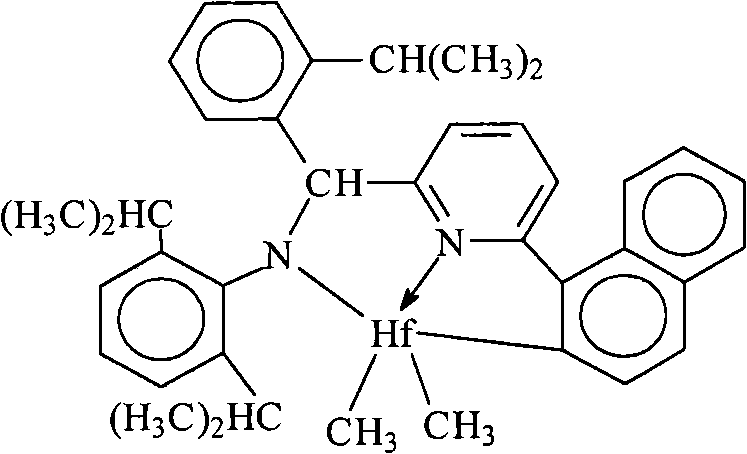
Catalyzer (A2) is that [N-(2,6-two (1-methylethyl) phenyl) (2-aminomethyl phenyl) (1 amino), 2-phenylene-(6-pyridine-2-two bases) methane)] dimethyl hafnium, instruction preparation according to WO03/40195, the 2003US0204017, USSN 10/429024 and the WO 04/24740 that submitted on May 2nd, 2003.

Catalyzer (A3) is two [N, N " '-(2,4,6-three (aminomethyl phenyl) amino) ethylene diamine] dibenzyl hafnium.

Catalyzer (A4) is two ((2-oxygen base (oxoyl)-3-(dibenzo-1H-pyrroles-1-yl)-5-(methyl) phenyl)-2-phenoxymethyl) hexanaphthene-1,2-two basic dibenzyl zirconiums (IV), and it prepares according to the instruction of US-A-2004/0010103 basically.

Catalyzer (B1) is 1,2-two-(3,5-two-tertiary butyl phenylene) (1-(N-(1-methylethyl) imino-) methyl) (2-oxygen base) dibenzyl zirconium

Catalyzer (B2) is 1,2-two-(3,5-two-tertiary butyl phenylene) (1-(N-(2-methylcyclohexyl)-imino-) methyl) (2-oxygen base) dibenzyl zirconium

Catalyzer (C1) is (tertiary butyl amino) dimethyl (3-N-pyrryl-1,2,3,3a, 7a-η-indenes-1-yl) silane dimethyl titanium, and it prepares according to the instruction of USP 6268444 basically:

Catalyzer (C2) is (tertiary butyl amido) two (4-aminomethyl phenyl) (2-methyl isophthalic acid, 2,3,3a, a 7a-η-indenes-1-yl) silane dimethyl titanium, and it prepares according to the instruction of US-A-2003/004286 basically:
Catalyzer (C3) is (tertiary butyl amido) two (4-aminomethyl phenyl) (2-methyl isophthalic acid, 2,3,3a, 8a-η-symmetrical indacene (s-indacen)-1-yl) silane dimethyl titanium, and it prepares according to the instruction of US-A-2003/004286 basically:
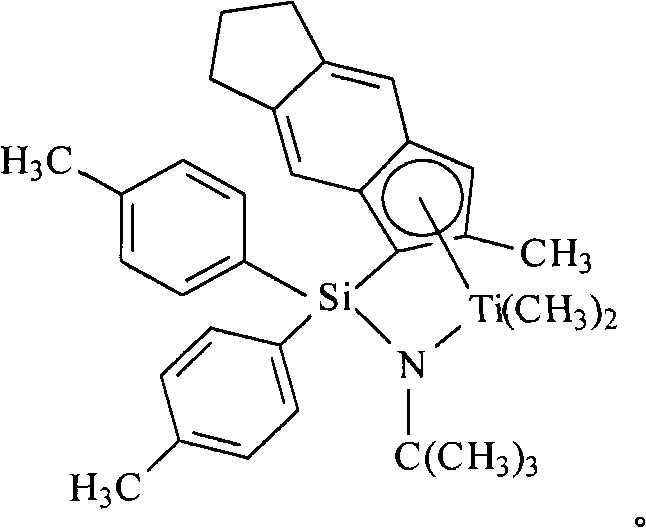
Catalyzer (D1) is two (dimethyl sily oxide) (indenes-1-yl) zirconium dichloride that can obtain from Sigma-Aldrich:
Shuttling agent (Shuttling Agent)
Used shuttling agent comprises zinc ethyl, two (isobutyl-) zinc, two (n-hexyl) zinc, triethyl aluminum, trioctylaluminum, triethyl-gallium, two (dimethyl (tertiary butyl) siloxanes) aluminium isobutyl, two (two (trimethyl silyl) amino) aluminium isobutyl, two (pyridine-2-methoxyl group) octyl aluminum, two (Octadecane base) aluminium isobutyl, two (two (n-pentyl) amino) aluminium isobutyl, two (2,6-two-tertiary butyl phenoxy group octyl aluminum, two (ethyl (1-naphthyl) amino) octyl aluminum, two (tertiary butyl dimethyl Si) aluminium triethyl, two (two (trimethyl silyl) amino) aluminium triethyl, two (2,3,6,7-dibenzo-1-azepan amino) aluminium triethyl, two (2,3,6,7-dibenzo-1-azepan amino) octyl aluminum, two (dimethyl (tertiary butyl) silica) octyl aluminum, (2,6-phenylbenzene phenoxy group) zinc ethyl and (tert.-butoxy) zinc ethyl.
Preferably, aforesaid method adopts the form of successive soln technology to form block interpolymer, specifically is segmented copolymer, and preferably two or more monomers (more specifically are ethene and C
3-20Alkene or cycloolefin are specially ethene and C most
4-20Alpha-olefin) line style segmented copolymer wherein adopts a plurality of catalyzer that can not change.That is to say that these catalyzer are chemically different.Under the continuous solution polymerization condition, this method is ideally suited for the be converted mixture of polymerization single polymerization monomer of high monomer.Under these polymerizing conditions, it is favourable comparing with chain growth that shuttle from the chain shuttling agent to catalyzer moves, and to form segmented copolymer efficiently specifically be the line style segmented copolymer.
Interpretation of the present invention can be different from following polymkeric substance: conventional random copolymers, and the physical blending thing of polymkeric substance, and through the segmented copolymer of catalyzer, negatively charged ion or the preparation of cation activity polymerization of sequential monomer addition, rheology.More specifically, the monomer identical with being in having of equal degree of crystallinity or modulus compared with the random copolymers of monomer content, it better is higher thermotolerance (measuring by fusing point) that interpretation of the present invention has, higher TMA pin is gone into temperature, higher high temperature tensile strength, and/or higher high temperature reverses storage modulus (measuring by dynamic mechanical analysis).Compare with the random copolymers that comprises identical monomer and monomer content, interpretation of the present invention has lower compressed residual deformation (especially when high temperature), lower stress relaxation, higher creep resistance, higher tear strength, higher resistance to blocking, because of higher crystallization (solidifying) temperature is condensed (setup) faster, higher response rate (especially when high temperature), resistance to abrasion preferably, higher withdrawal force, and oily preferably and filler acceptability.
Interpretation of the present invention also shows unique crystallization and branch's distribution relation.That is to say, interpretation of the present invention has relative big difference between the climax temperature of utilizing CRYSTAF to record and the climax temperature of utilizing dsc measurement as the function of melting heat, especially compare with random copolymers that comprises identical monomer and single level or polymer physics blend (for example having the high density polymer of suitable total body density and the blend of more low-density multipolymer).This specific character that it is believed that interpretation of the present invention is the unique distribution owing to comonomer in the block in main polymer chain.More specifically, interpretation of the present invention can comprise the alternately block of different copolymer monomer content (comprising homopolymer block).Interpretation of the present invention also can have the quantity of polymer blocks of different density or co-monomer content and/or the distribution of block size, and it is the Schultz-Flory type distribution.In addition, interpretation of the present invention also has unique peak fusing point and is independent of the Tc curve of density polymer, modulus and form basically.In an embodiment preferred, the crystallite order of described polymkeric substance (microcrystalline order) has shown distinctive spherolite and thin slice, this is different from random or segmented copolymer, in addition the PDI value less than 1.7 or even less than 1.5, be low to moderate less than 1.3 o'clock.
In addition, by merging ethylene-olefin and styrenic block copolymer, it is relevant with use styrenic block copolymer formulation unfavorable to alleviate.For example, some styrenic block copolymer has thermolability.An example is styrene-isoprene-phenylethene (SIS).If in too high temperature processing, splitting of chain takes place in known SIS.This can cause the remarkable reduction of viscosity and the loss of mechanical properties.Another example is styrene-butadiene-styrene (SBS).If in too high temperature processing, known SBS takes place crosslinked.This can cause enlarging markedly of viscosity and form gel.As a result, the limitation as these can cause unfavorable performance.Prepare with ethylene-olefin and can alleviate that these are unfavorable.
In addition, can use the degree that influences block or the method for level to prepare interpretation of the present invention.That is to say that ratio that the amount of comonomer and each polymer blocks or segmental length can be by control catalyst and shuttling agents and type and polymerization temperature and other polymerization variables change.The unexpected benefit of this phenomenon is to find that resulting polymers optical property, tear strength and high-temperature reply character improve along with increasing of block degree.More specifically, mist degree reduces, and clarity, tear strength and high-temperature reply character improve along with the increase of block mean number in the polymkeric substance.By selecting to have the shuttling agent and the catalyst combination of desired chain transfer ability (the high speed shuttle moves, low-level chain termination), other form of polymerization terminated is effectively suppressed.Therefore, β-hydrogen of observing in the polymerization of ethylene/alpha-olefin copolymerized monomer mixture according to embodiment of the present invention is seldom eliminated (if any), and the crystalline blocks of gained is height or complete line style basically, has seldom or do not have long chain branches.
Polymkeric substance with chain end of highly crystalline can prepare according to embodiment of the present invention selectivity.In elastomerics is used, reduce relative quantity with the end capped polymkeric substance of amorphous blocks and reduced intermolecular diluting effect (dilutive effect) crystallizing field.This result can realize by chain shuttling agent and the catalyzer selecting hydrogen or other end capping agent to be had appropriate response.Particularly, if producing the catalyzer of the polymkeric substance of highly crystalline (for example incorporates into by higher comonomer than producing low crystalline polymer segment, zone-mistake, perhaps form nonstereospecific polymer) catalyzer more be subject to the influence of chain termination (for example by use hydrogen), the polymer segment of highly crystalline will preferably occupy the terminal portions of this polymkeric substance so.Not only the capping group of gained is a crystal type, and during end-blocking, the catalyst site that forms the highly crystalline polymkeric substance can be used for restarting the formation polymkeric substance once more.Therefore, the initial polymkeric substance that forms is the polymer segment of another kind of highly crystalline.Therefore, the equal highly crystalline preferably in the two ends of the segmented copolymer of gained.
The ethylene ' alpha '-olefin interpretation that is used for embodiment of the present invention is ethene and at least a C preferably
3-C
20The multipolymer of alpha-olefin.Concrete optimal ethylene and C
3-C
20The multipolymer of alpha-olefin.Described multipolymer also can comprise C
4-C
18Diolefine and/or alkenyl benzene.Be applicable to that the unsaturation comonomer with vinyl polymerization comprises, for example, ethylenically unsaturated monomers, conjugation or unconjugated diene, polyenoid, alkenyl benzene etc.The example of this type of comonomer comprises C
3-C
20Alpha-olefin, for example propylene, iso-butylene, 1-butylene, 1-hexene, 1-amylene, 4-methyl-1-pentene, 1-heptene, 1-octene, 1-nonene, 1-decene etc.Concrete preferred 1-butylene and 1-octene.Other suitable monomers comprises vinylbenzene, the vinyl benzo tetramethylene, 1 that vinylbenzene, halo or alkyl replace, 4-hexadiene, 1,7-octadiene and cycloolefin (naphthenics, for example cyclopentenes, tetrahydrobenzene and cyclooctene).
Although ethylene/alpha-olefin interpolymers is preferred polymkeric substance, also can use other ethylene/olefin polymkeric substance.The class that is meant alkene used herein contains the unsaturated hydrocarbons compounds of at least one carbon-to-carbon double bond.Depend on selection of catalysts, any alkene can be used for embodiment of the present invention.Preferably, suitable alkene is for containing the undersaturated C of ethene
3-C
20Aliphatic series and aromatic substance, and ring compound, cyclobutene for example, cyclopentenes, dicyclopentadiene, and norbornylene includes but not limited at 5 and 6 by C
1-C
20The norbornylene that alkyl or cyclic hydrocarbon radical replace.The mixture and this type of alkene and the C that also comprise this type of alkene
4-C
40The mixture of diolefin compound.
The example of olefinic monomer includes but not limited to propylene, iso-butylene, 1-butylene, 1-amylene, 1-hexene, the 1-heptene, 1-octene, 1-nonene, 1-decene, and 1-dodecylene, tetradecene, cetene, 1-vaccenic acid, 1-eicosylene, 3-methyl-1-butene, the 3-Methyl-1-pentene, 4-methyl-1-pentene, 4,6-dimethyl-1-heptene, 4 vinyl cyclohexene, vinyl cyclohexane, norbornadiene, ethylidene norbornene, cyclopentenes, tetrahydrobenzene, dicyclopentadiene, cyclooctene, C
4-C
40Diene includes but not limited to 1,3-butadiene, 1,3-pentadiene, 1,4-hexadiene, 1,5-hexadiene, 1,7-octadiene, 1,9-decadiene, other C
4-C
40Alpha-olefin etc.In certain embodiments, described alpha-olefin is a propylene, 1-butylene, 1-amylene, 1-hexene, 1-octene or its combination.Although any hydrocarbon that contains vinyl can be used in embodiment of the present invention potentially, but when monomeric molecular weight was too high, practical problems is monomer validity, cost and can remove the unreacted monomer trouble that can become more easily from resulting polymers for example.
Polymerization process as herein described is highly suitable for producing the olefin polymer that comprises single vinylidene aromatic monomer, and described single vinylidene aromatic monomer comprises vinylbenzene, o-vinyl toluene, p-vinyl toluene, t-butyl styrene etc.More specifically, comprising ethene and cinnamic multipolymer can prepare by the instruction according to this paper.Optional is, can prepare have improved character comprise ethene, vinylbenzene and C
3-C
20Alpha-olefin (the optional C that comprises
4-C
20Diene) multipolymer.
Suitable unconjugated diene monomers can be straight chain, side chain or the cyclic hydrocarbon diene that contains 6 to 15 carbon atoms.The example of suitable unconjugated diene includes but not limited to the straight chain acyclic dienes, for example 1, and 4-hexadiene, 1,6-octadiene, 1,7-octadiene, 1,9-decadiene; The side chain acyclic dienes, 5-methyl isophthalic acid for example, 4-hexadiene, 3,7-dimethyl-1,6-octadiene, 3,7-dimethyl-1, the mixed isomers of 7-octadiene and dihydromyrcene (myricene) and dihydro ocimene (ocinene); The alicyclic diene of monocycle, for example 1,1,1,5-cyclooctadiene and 1,5-encircle 12 carbon diene; Condense and the bridge joint cyclic diolefine for example tetrahydroindene, methyl tetrahydroindene, dicyclopentadiene, two ring-(2,2,1)-heptan-2,5-diene with many rings are alicyclic; Alkenyl, alkylidene, cycloalkenyl group and cycloalkanes fork norbornylene, for example 5-methylene-2-norbornene (MNB), 5-propenyl-2-norbornylene, 5-isopropylidene-2-norbornylene, 5-(4-cyclopentenyl)-2-norbornylene, 5-cyclohexylidene-2-norbornylene, 5-vinyl-2-norbornylene and norbornadiene.Be generally used for preparing in the diene of EPDM, concrete preferred diene has 1,4-hexadiene (HD), 5-ethylidene-2-norbornylene (ENB), 5-vinylidene-2-norbornylene (VNB), 5-methylene-2-norbornene (MNB), and dicyclopentadiene (DCPD).Especially preferred diene is 5-ethylidene-2-norbornylene (ENB) and 1,4-hexadiene (HD).
Can suitable polymkeric substance be ethene, C according to a class of embodiment of the present invention preparation
3-C
20The elastocopolymer of alpha-olefin (specifically being propylene) and optional one or more diene monomers.The preferred alpha-olefin through type CH that is used for this embodiment of the present invention
2=CHR* represents that wherein R* is the line style or the branched-chain alkyl of 1~12 carbon atom.Suitable alpha-olefin includes but not limited to propylene, iso-butylene, 1-butylene, 1-amylene, 1-hexene, 4-methyl-1-pentene and 1-octene.Concrete preferred alpha-olefin is a propylene.Acronal typically refers to EP or EPDM polymkeric substance in the art.Be applicable to diene that this base polymer of preparation is specially many blocks EPDM type polymer comprise the conjugation that contains 4~20 carbon or non-conjugated, straight chain or side chain-, ring-type-or many ring-diene.Preferred diene comprises 1,4-pentadiene, 1,4-hexadiene, 5-ethylidene-2-norbornylene, dicyclopentadiene, cyclohexadiene and 5-fourth fork-2-norbornylene.Concrete preferred diene is 5-ethylidene-2-norbornylene.
Replace segment or contain more or more a spot of diene (comprising nothing) and the block of alpha-olefin (comprising nothing) owing to the polymkeric substance that contains diene comprises, therefore can under the condition of not losing polymer property subsequently, reduce the total amount of diene and alpha-olefin.That is to say that because diene and 'alpha '-olefin monomers preferably incorporate in a kind of block of polymkeric substance rather than evenly or randomly incorporate in the whole polymkeric substance, so they have obtained more efficient use, have secondly controlled the cross-linking density of polymkeric substance better.This type of crosslinkable elastomeric and solidifying product have favorable properties, comprise higher draw tensile strength and elastic recovery rate preferably.
In some embodiments, having in view of the above with two kinds of Preparation of Catalyst and interpretation of the present invention that incorporate the comonomer of different amounts into, the weight ratio of the block of formation is 95: 5 to 5: 95.Described elastomeric polymer preferably has 20~90% ethylene content, 0.1~10% diene content and 10~80% alpha-olefin content, based on the gross weight of polymkeric substance.Also preferred, described many blocks elastomeric polymer has 60~90% ethylene content, 0.1~10% diene content and 10~40% alpha-olefin content, based on the gross weight of polymkeric substance.Preferred polymkeric substance is a high-molecular weight polymer, it has 10000 to about 2500000, preferred 20000 to 500000, more preferably 20000 to 350000 weight-average molecular weight (Mw), with less than 3.5, be more preferably less than 3.0 polymolecularity, and 1 to 250 Mooney viscosity (125 ℃ of ML (1+4)).More specifically, this base polymer has 65 to 75% ethylene content, 0 to 6% diene content and 20 to 35% alpha-olefin content.
Ethylene/alpha-olefin interpolymers can be undertaken functionalized by incorporate at least a functional group in its polymer architecture.Exemplary functional group can comprise, for example, and the unsaturated list of ethylenic-and two-functional carboxylic acid, the unsaturated list of ethylenic-and two-functional carboxylic acid acid anhydride, its salt and its ester.This type of functional group can graft on the ethylene/alpha-olefin interpolymers, perhaps it can with ethene and optional other comonomer copolymerization to form the multipolymer of ethene, sense comonomer and optional other comonomer.Functional group is grafted to poly method for example be described in the United States Patent (USP) 4762890,4927888 and 4950541, the disclosure of these patents is by with reference to incorporating this paper into its integral body.A kind of functional group that is particularly useful is the apple acid anhydrides.
The amount of the functional group that exists in the function interpretation can change.The amount that described functional group exists in the functionalized interpretation of copolymer type is normally at least about 1.0wt%, preferably at least about 5wt%, more preferably at least about 7wt%.The amount that described functional group exists in the functionalized interpretation of copolymer type preferably less than about 30wt%, is more preferably less than about 25wt% normally less than about 40wt%.
The amount of ethylene/alpha-olefin interpolymers in blend polymer disclosed herein can be about 5~95wt% of blend polymer gross weight, about 10~90wt%, about 20~80wt%, about 30~70wt%, about 10~50wt%, about 50~90wt%, about 60~90wt%, perhaps about 70~90wt%.
Further specifying of relevant blockiness index
Relational expression below random copolymers satisfies.Referring to P.J.Flory, Trans.Faraday Soc., 51,848 (1955), it incorporates this paper by reference into its integral body.
In equation 1, the melt temperature T of crystallizable monomeric molar fraction P and multipolymer
mMelt temperature T with pure crystallizable homopolymer
m 0Relevant.This equation is similar to the natural logarithm of ethene molar fraction of various as shown in Figure 8 homogeneously branched ethene and olefin interconversion polymers as the relation of the function of the inverse of ATREF eluting temperature (° K).
As shown in Figure 8, the ethene molar fraction of various homogeneously branched multipolymers is similar to the Flory equation to the relation object of ATREF peak eluting temperature and DSC melt temperature.Similarly, the preparation type TREF cut of nearly all random copolymers and random copolymers blend also drops on this line, except the small molecular weight effect.
According to Flory, if ethene molar fraction P equal an ethylene unit will prior to or follow the conditional probability of another ethylene unit, this polymkeric substance is random so.On the other hand, if the conditional probability that any 2 ethylene unit occur continuously greater than P, this polymkeric substance is a segmented copolymer so.Remaining conditional probability produces alternating copolymer less than the situation of P.
Ethene molar fraction in the random copolymers has fundamentally determined the ethene segmental specifically to distribute, ethene segmental crystallization behavior and then be subjected to the control of minimum balance crystalline thickness when giving fixed temperature.Therefore, the multipolymer fusion of block interpolymer of the present invention is relevant with the size of random relation in the slip chart 8 with the TREF Tc, and this to depart from be " block " degree and the relevant process useful of its random multipolymer of equal value (perhaps random TREF cut of equal value) that quantizes given TREF cut.Term " block " is meant that concrete polymer fraction or polymkeric substance comprise the degree of the block of polymerization single polymerization monomer or comonomer.There are two kinds of random Equivalents, a kind of a kind of corresponding to constant ethene molar fraction corresponding to constant temperature.These have formed the limit of right-angle triangle as shown in Figure 9, and it has illustrated the definition of blockiness index.
In Fig. 9, point (T
X, P
X) expression preparation type TREF cut, wherein ATREF eluting temperature T
XWith NMR ethene molar fraction P
XBe observed value.The ethene molar fraction P of whole polymkeric substance
ABAlso measure by NMR.Can estimate the eluting temperature and the molar fraction (T of " hard segment "
A, P
A), perhaps it is set to the value of Alathon for ethylene copolymer.T
ABValue is corresponding to the P based on measurement
ABThe random copolymers that calculates ATREF eluting temperature of equal value.By the ATREF eluting temperature T that measures
XAlso can calculate corresponding random ethylene molar fraction P
XOBlockiness index square be defined as (P
X, T
X) trilateral and (T
A, P
AB) ratio of leg-of-mutton area.Because these right-angle triangles are similar, area is than also being (T
A, P
AB) and (T
X, P
X) to the duplicate ratio of the distance of not having gage line.In addition, the similarity of these right-angle triangles be meant the length that can use arbitrary corresponding sides than and without the area ratio.
It should be noted that the most perfect block distributed will be corresponding at point (T
A, P
AB) locate to have the whole polymkeric substance of single eluting fraction, this is because such polymkeric substance will keep ethene segment distribution in " hard segment ", still comprise all available octenes (general with by the soft chain segment Preparation of Catalyst those much at one mode turn round).Under most of situations, " soft chain segment " be crystallization in ATREF (or preparation type TREF) not.
Composition of the present invention
The composition of content of the present invention comprises aforesaid ethylene/alpha-olefin interpolymers and styrenic block copolymer.Although can use the ethylene/alpha-olefin interpolymers of any density, common described density is low more, and the elasticity of polymkeric substance is high more.About 0.85~the 0.900g/cm of density of concrete preferred described multipolymer
3, preferred about 0.855~0.885g/cm
3, 0.860~0.883g/cm more preferably from about
3, 0.863~0.880g/cm most preferably from about
3
Styrenic block copolymer
The case description that is applicable to styrenic block copolymer of the present invention in but be not restricted to EP0712892B1; WO204041538A1; US 6582829B1; US 2004/0087235A1; US 2004/0122408A1; US 2004/0122409A1; US 4789699; US 5093422; US5332613; US 6916750B2; US 2002/0052585A1; US 6323389B1; And US5169706, it is incorporated into by reference for the instruction of its relevant styrenic block copolymer.
Usually, be suitable for styrenic block copolymer of the present invention and have two kinds of mono alkenyl arene blocks, preferably have two kinds of polystyrene blocks, these two kinds of blocks are separated less than 20% saturated conjugated diene block, preferred saturated polybutadiene block by remaining olefinic degree of unsaturation.Preferred styrenic block copolymer has linear structure, although branching or radial polymers or functionalized segmented copolymer are formed with the compound of usefulness.
Usually, (S is a vinylbenzene to polystyrene-saturated polyhutadiene-polystyrene (S-EB-S), E is an ethene, and B is a butylene) and polystyrene-saturated polyisoprene-polystyrene (S-EP-S) (P is a propylene) segmented copolymer comprise polystyrene end blocks and have the saturated polyhutadiene or the saturated polyisoprene mid-block of 20000~170000 number-average molecular weight with number-average molecular weight of 5000~35000.Described saturated polybutadiene block preferably have 35%~55% 1, the 2-configuration, described saturated polyisoprene blocks preferably have greater than 85% 1, the 4-configuration.
If multipolymer has linear structure, total number-average molecular weight preferred 30000~250000 of styrenic block copolymer so.Such segmented copolymer has the average polystyrene content of 10wt%~35wt% usually.
Being useful on concrete preferred S-EB-S segmented copolymer on the one hand of the present invention can be from KRATONPolymers LLC (Houston, TX) obtain, and have the number-average molecular weight of 50000 gram/moles and number-average molecular weight that polystyrene end blocks has 7200 gram/moles separately and the polystyrene of content 30wt%.
Styrenic block copolymer can prepare by the known method of those of ordinary skills.For example, described styrenic block copolymer can utilize free radical, positively charged ion and anionic initiator or polymerizing catalyst to prepare.These polymkeric substance can utilize body, solution or emulsion method preparation.In any case, it is unsaturated that described styrenic block copolymer comprises minimum olefinic, and reclaim with solid such as particle, powder, pellet etc. usually.
Usually, when using solution negatively charged ion method, the multipolymer of conjugated diene polymer and conjugated diene and alkenyl aromatic hydrocarbon by in suitable solvent in 150 ℃~300 ℃ of temperature, be preferable over temperature and make for 0 ℃~100 ℃ and treat that polymerization single polymerization monomer simultaneously or contact with organic alkali metal compound in succession and prepare.Concrete effectively anionic polymerization initiator is the organolithium compound with following general formula: RLi
nWherein R is the hydrocarbon free radical of the aromatics that replaces of the aliphatic series that contains 1~20 carbon atom, alicyclic, aromatics or alkyl; N is 1~4 integer.
Except being used to obtain the method in succession of three blocks, four blocks and higher repeating structure, the anionic initiator of minimum quantity also can be used for preparation has reactivity (" activity ") terminated vinylbenzene-polydiene on diene block diblock, and reactive (" the activity ") end of the chain can for example generate (S-I) by the coupling reagent react
xY or (S-B)
xThe Y structure, wherein x is 2 to 30 integer; Y is coupling reagent; I is an isoprene; B is a divinyl; And S-I greater than 65% or S-B diblock link to each other with described coupling reagent chemistry.Y usually has the molecular weight lower than polymkeric substance to be prepared, and can be in the big quantity of material as known in the art any, and it comprises: halogenated organic compounds; Haloalkyl silane; Organoalkoxysilane; Various esters are phenylformic acid alkyl ester and phenylformic acid aryl ester for example, and dual functional aliphatic ester is hexanodioic acid dialkyl etc. for example; Multifunctional reagent is the low-molecular weight polymer of Vinylstyrene (DVB) and DVB for example.Depend on selected coupling reagent, last polymkeric substance can be coupled line style triblock polymer (x=2), i.e. SIYIS wholly or in part; Or branching, radial or star configuration.Since be low-molecular-weight, the character of the final polymkeric substance of coupling not remarkably influenced of reagent.The DVB oligopolymer is generally used for forming star polymer, and wherein the number of diene side chain can be 7~20 or even higher.
To need not all be identical in all diblock unit in described coupling polymkeric substance.In fact, can the diblock unit be introduced together with different " activity " in coupling reaction, thus produce various unsymmetrical structures, that is, the order block length of total diblock chain length and vinylbenzene and diene can be different.
Preferably with styrenic block copolymer hydrogenation to improve weathering resistance and oxidative stability.Usually, the hydrogenation of polymkeric substance or select hydrogenation can utilize in several method for hydrogenation as known in the art any to finish.For example, hydrogenation can utilize for example United States Patent (USP) 3494942; 3634594; 3670054; 3700633; Finish with those methods of being instructed among the Re.27145, they incorporate this paper with the hydrogenation of styrenic block copolymer with by the relevant instruction of the polymkeric substance of its generation into by reference.As known in the artly be used for the method that hydrogenation contains olefinic unsaturated polymer and hydrogenation or select hydrogenation to contain aromatics and olefinic unsaturated polymer and relate to the use appropriate catalyst, specifically be catalyzer or the catalyst precursor that comprises iron family metal atom (specifically being nickel or cobalt), and appropriate reductant aluminum alkyls for example.
Usually, hydrogenation is at 20 ℃~100 ℃ of temperature and 7atm (10
5Pa)~340atm (10
5Pa) preferred 7atm (10
5Pa)~70atm (10
5Pa) in suitable solvent, finish under the hydrogen partial pressure conditions.Catalyst concn is generally the iron family metal to 500ppm (wt) based on total solution 10ppm (wt).Contact continues 60~240 minutes time usually under hydrogenation conditions.After hydrogenation is finished, generally from polymkeric substance, isolate hydrogenation catalyst and catalyst residue.
Cast aside theoretical restriction, it is believed that, the consistency of described saturated conjugated diolefine and described interpretation helps new property that composition exhibiting this paper of the present invention is proposed.This is consistent with other embodiment of the present invention.For example, in a specific embodiments of the present invention, composition comprises interpretation, SIS and thinks the SEBS compatible with SIS with described interpretation on a small quantity.In another embodiment of the present invention, composition comprises interpretation, SBS and thinks the SEBS compatible with SBS with described interpretation on a small quantity.
Melt index of the present invention
Preferred multipolymer melt index (I
2) be generally at least about 0.5, preferably restrain/10 minutes at least about 0.75.Accordingly, preferred multipolymer melt index (I
2) restrain/10 minutes less than about 30 usually, preferably restrain/10 minutes sometimes less than about 24.Yet preferred melt index can usually depend on for example blown film of desired conversion process, casting films and extrusion laminate etc.
Blown film
For blown film technology, multipolymer melt index (I
2) be generally at least about 0.5, preferably restrain/10 minutes at least about 0.75.Multipolymer melt index (I
2) be generally about at the most 5, preferably about at the most 3 grams/10 minutes.In addition, Chang Youxuan prepares ethylene/alpha-olefin interpolymers with zinc ethyl chain shuttling agent, and wherein zinc is about 0.03 * 10 to the mol ratio of ethene
-3To about 1.5 * 10
-3
Casting films and extrusion laminate
For casting films and extrusion laminate body technology, multipolymer melt index (I
2) be generally at least about 0.5, preferably at least about 0.75,, even more preferably restrain/10 minutes at least about 4 more preferably at least about 3.Multipolymer melt index (I
2) be generally about at the most 20, preferably about at the most 17, more preferably about at the most 12, even more preferably about at the most 5 grams/10 minutes.
In addition, Chang Youxuan prepares ethylene/alpha-olefin interpolymers with zinc ethyl chain shuttling agent, and wherein zinc is about 0.03 * 10 to the ratio of ethene
-3To about 1.5 * 10
-3
Described composition can comprise other component, for example other polyolefins plastomer and/or elastomerics.Polyolefins elastomerics and plastomer/polymkeric substance comprise ethene and at least a other alpha-olefin (C
3-C
22) multipolymer, and propylene and at least a other alpha-olefin (C
2, C
4-C
22) multipolymer.In a kind of concrete embodiment preferred, used second component that comprises high pressure low density type resin.May comprise LDPE (homopolymer) as the material of other component; The multipolymer of ethene and one or more alpha-olefins (for example propylene or butylene); And ethene and at least a α, the multipolymer of β-ethylenic unsaturated comonomer (for example vinylformic acid, methacrylic acid, methyl methacrylate and vinyl acetate); The polypropylene of branching and blend thereof.The method that is suitable for preparing useful high-pressure ethylene copolymer compositions is described in the United States Patent (USP) 4599392, and its content is by with reference to incorporating this paper into.
In another embodiment of the invention, can use the terpolymer component to improve other characteristic between consistency, miscibility, dispersiveness or the polymeric constituent generally known in the art.
For other attribute, any of polymeric constituent can carry out functionalized or modification in any stage.Example includes but not limited to grafting, crosslinked or other functionizing method.
The rete that comprises composition of the present invention in the time of 100 °F under the situation of 75% strain and at least 10 hours, often can stress relaxation about at the most 60%, preferably about at the most 40%, more preferably about at the most 28%.
Meltblown fibers
Meltblown fibers is the fiber that forms by following method: molten thermoplastic material is extruded with fusion yarn or long filament through the numerous thin normally circular kapillary of meltblown beam, the long filament of the molten thermoplastic material that enters and extrude or yarn equidirectional mobile gas are (for example, air) in the stream, thereby long filament or the yarn extruded are attenuated, that is, stretching or elongation are to reduce its diameter.
Described yarn or long filament can taper to the primitive fiber diameter, and the primitive fiber diameter is meant that the mean diameter of this yarn or long filament is not more than about 75 microns, are generally about 0.5 micron to about 50 microns, more specifically are about 2 microns to about 40 microns., with high velocity air transport meltblown fibers, and it is deposited in the surperficial fibre web of going up with the meltblown fibers that forms random distribution of collection thereafter.Meltblown is well-known and is described in various patents and the publication, comprises the NRLReport 4364 of B.A.Wendt, E.L.Boone and D.D Fluharty, " Manufacture of super-Fine Organic Fibers "; The NRL Report:5265 of K.D Lawrence, R.T.Lukas and J.A.Young, " An Improved Device for theFormation of Super-Fine Thermoplastic Fibers "; The United States Patent (USP) 3676242 of Prentice; United States Patent (USP) 3849241 with people such as Buntin.Aforesaid reference is incorporated this paper by reference into its integral body.Meltblown fibers is can continuous or discrete primitive fiber, mean diameter is usually less than 10 microns, and normally is clamminess when go up on the surface when being deposited in to collect.
The preparation of blend
Blend can comprise rotary drum dried mix, decide heavily to feed in raw material (weigh feeding), solvent blend, extrude and melt blending etc. through compounding or side arm by any appropriate method preparation as known in the art, and their combination.
Each component of blend of the present invention can form chemical and/or modification physically be used to prepare composition of the present invention.These modifications can be finished by any known method, for example by ionomerization and extruding graft.
Also can comprise in the ethene polymers extrusion compositions of the present invention additive for example antioxidant (for example, Hinered phenols provides as Ciba Geigy
 1010 or
 1076), phosphite (ester) (is that Ciba Geigy provides for example, equally
 168), and cementitious additives (for example, PIB), Standostab PEPQ
TM(Sandoz provides), pigment, tinting material, filler etc.By or the goods that utilize composition of the present invention to make also can comprise the additive that is used to improve antiblocking and frictional coefficient characteristic, described additive comprises but is not limited to, untreated and handled silicon-dioxide, talcum, lime carbonate and clay, and primary, the secondary and fatty acid amide that replaces, antiseized chill roll agent, organosilicon coating etc.Also can add other additive and improve for example fog dispersal characteristic of transparent cast film, for example, described in the United States Patent (USP) 4486552, its disclosure is incorporated this paper into by reference.Also can add other additive, for example independent quaternary ammonium compound or quaternary ammonium compound be with ethylene-acrylic acid (EAA) multipolymer or other functional polymer, with the static resistance that improves coating of the present invention, section bar and film with allow for example packing or the manufacturing of electric sensitive articles.Also can add other functional polymer for example the polyethylene of maleic anhydride graft improve adhesion, especially to the adhesion of polar substrates.
168), and cementitious additives (for example, PIB), Standostab PEPQ
TM(Sandoz provides), pigment, tinting material, filler etc.By or the goods that utilize composition of the present invention to make also can comprise the additive that is used to improve antiblocking and frictional coefficient characteristic, described additive comprises but is not limited to, untreated and handled silicon-dioxide, talcum, lime carbonate and clay, and primary, the secondary and fatty acid amide that replaces, antiseized chill roll agent, organosilicon coating etc.Also can add other additive and improve for example fog dispersal characteristic of transparent cast film, for example, described in the United States Patent (USP) 4486552, its disclosure is incorporated this paper into by reference.Also can add other additive, for example independent quaternary ammonium compound or quaternary ammonium compound be with ethylene-acrylic acid (EAA) multipolymer or other functional polymer, with the static resistance that improves coating of the present invention, section bar and film with allow for example packing or the manufacturing of electric sensitive articles.Also can add other functional polymer for example the polyethylene of maleic anhydride graft improve adhesion, especially to the adhesion of polar substrates.
As selection, polymkeric substance and non-polymeric ingredients can utilize the step of the combination that comprises solution blending (being also referred to as the solvent blend) or fusion and solution methods to mix.Solution blending process includes but not limited to the reactor of a plurality of series, parallel or their combinations.Because solution methods can cause the better dispersion of each component sometimes, expects that second component has higher effect.Benefit can be included under the situation that keeps permanent set strain that higher elastic property for example reduces and less hysteresis and use the second less component.
The single or multiple lift elastica and the laminate that comprise composition of the present invention can also comprise those following methods by comprising blowing embrane method, coetrusion, laminated method etc. and being combined in interior any means preparation.When composition of the present invention was used for multilayered structure, base material or adjacent materials layer can be polar or nonpolar, for example included but not limited to paper product, metal, pottery, glass and various polymkeric substance (specifically other polyolefine), and combination.If the use polymeric substrate, it can take various forms so, includes but not limited to forms such as net, foams, fabric, non-woven fabric, film.Concrete preferred laminate usually comprises the non-woven fabrics that is selected from down group: melts and sprays, and spunbond, carded staple dimension, spunlaced staple fibre, and the non-woven fabrics of air-laid staple fibre.Described cloth can comprise the different fiber of two kinds or more of compositions.For example, described cloth can comprise the multicomponent polymeric fiber, and wherein at least a polymeric constituent constitutes at least a portion on the surface of fiber.These non-woven fabric and fibers that comprise them can come combination with the known the whole bag of tricks of those of ordinary skills.These methods include but not limited to calendering, ultra-sonic welded, chemical adhesion, tamanori combination, high-power electron beam and/or laser etc.
The goods that comprise composition of the present invention can be selected from down group: adult-incontinence articles, feminine hygiene articles, child care products, surgery apparel, medical valance, household cleaning product, inflatable Food cover and personal-care supplies.
Can benefit from and use composition of the present invention and applicable processing of the present invention, manufacturing and examples of articles include but not limited to EP0575509B1, EP0575509B1, EP0707106B1, EP0707106B1, EP472942B1, EP472942B1, US3833973, US3860003, US4116892, US4422892, US4525407, US4573986, US4636207, US4662875, US4695278, US4704116, US4713069, US4720415, US4795454, US4798603, US4808178, US4846815, US4888231, US4900317, US4909803, US4938753, US4938757, US4940464, US4963140, US4965122, US4981747, US5019065, US5032122, US5061259, US5085654, US5114781, US5116662, US5137537, US5147343, US5149335, US5151092, US5156793, US5167897, US5169706, US5226992, US5246433, US5286543, US5318555, US5336545, US5360420, US5364382, US5415644, US5429629, US5490846, US5492751, US5496298, US5509915, US5514470, US5518801, US5522810, US5562646, US5562650, US5569234, US5591155, US5599338, US5601542, US5643588, US5650214, US5674216, US5685874, US5691035, US5772825, US5779831, US5836932, US5837352, US5843056, US5843057, US5858515, US5879341, US5882769, US5891544, US5916663, US5931827, US5968025, US5993433, US6027483, US6075179, US6107537, US6118041, US6153209, US6297424, US6307119, US6318555, US6428526, US6491165, US6605172, US6627786, US6635797, US6642427, US6645190, US6689932, US6763944, US6849067, WO9003258A1, WO9003464A2, US 4116892 and US5156793.
Composition of the present invention can be used for making in a kind of method of composite elastic material of the net that comprises at least a the gathering (gatherable) that links to each other with at least a elastic network(s), for example be disclosed among the US 4720415, incorporate it into this paper with its integral body by reference.This method comprises: (a) tension elastic network(s) (it can comprise for example nonwoven web of spandex fiber such as meltblown elastomeric fibers of fibrous reticulum) is so that its elongation; (b) making to the elastic network(s) remollescent condition of small part elastic network(s) combine (bond), with formation bonded complex network with at least a net of gathering with elongation; Thereby (c) complex network is relaxed the net that can gather is gathered, to form composite elastic material.Composition of the present invention can be elastic network(s) or the net that can gather.The others of this method provide and make the fibre-bearing elastic network(s) keep stretched state in cohesive process, and at least about 25% elongation, preferred about 25% to surpassing 500% in cohesive process, for example, and about elongation of 25% to 550%.
This method also can comprise and applies by stack elastic network(s) and the net that can gather and to the net that these stack that heat and pressure make the elastic network(s) of elongation and the anastomose that can gather closes, for example, by the junction on the elastic network(s) being heated to temperature, preferably at least about 70 ℃ to about 90 ℃ at least about 65 ℃ to about 120 ℃.
A kind of elastic composite that comprises with at least a net bonded elastic network(s) of gathering also can be provided according to the present invention, the described net of gathering can extend and shrink with described elastic network(s) when stretching and relaxing this matrix material, described elastic composite prepares by aforesaid method, and wherein said elastic composite comprises composition of the present invention.
According to a further aspect in the invention, with repeat pattern elastic network(s) and the anastomose that can gather are closed in the isolating position of a plurality of compartments, and the described net of gathering is gathered between binding site.
The elastic network(s) that another aspect of the present invention provides can comprise the nonwoven web of spandex fiber (preferred elastomeric primitive fiber), for example, and the elastic non-woven net or the elastica of meltblown elastomeric fibers.
Another aspect of the present invention comprise arbitrary combination following one or more: elastic network(s) is (for example, fibrous elastic network(s)) with repeat pattern elastic network(s) and the anastomose that can gather are closed in the isolating position of a plurality of compartments, and the described net of gathering is gathered between binding site; Described elastic network(s) preferably has low ground mass, and described ground mass is about 5~300, preferred about 5~200 gram/square metre (gm/m
2), for example about 5~100 grams/square metre, although its ground mass can be much higher; And the described net of gathering is the non-elastic material of nonwoven, preferably the fiber that is formed by the material that is selected from down group certainly constitutes, described group comprises for example poly-(ethylene glycol terephthalate) fiber of trevira, polyolein fiber, tynex is nylon fiber for example, cellulosic fibre is cotton fibre for example, and composition thereof.A concrete aspect of the present invention is to use the non-woven fabric of elasticity and/or lower modulus, and described non-woven fabric comprises those of propylene copolymer.This fibrid can comprise the multipolymer of propylene and ethene.The resin that is suitable for making this fibrid includes but not limited to VERSIFY
TM(can obtain) and VISTAMAXX from The Dow Chemical Company
TM(can obtain) from ExxonMobil Corporation.In another aspect of this invention, described polyolein fiber comprises olefin block copolymers, for example usually at described in the application and WO2005/090427 and the US 2006-0199930A1 those.Cast aside theoretical restriction, think that the non-woven fabric that comprises than low modulus and/or tensile and/or elastic fiber can make one-piece construction have bigger compliance and elasticity.In another embodiment, this structure comprises non-woven fabric, and described non-woven fabric comprises the mixture of two or more fiber types of arbitrary combination in the possible group of conventional fiber, the fiber than low modulus, tensile fiber and elastic fiber.As selection, the described net of gathering can be a woven cloths arbitrarily.Each fiber can the known various ways preparation of those of ordinary skills in the above-mentioned embodiment.These forms include but not limited to monofilament, two-pack, polycomponent, parallel type, coaxial, island etc.
Composition of the present invention also can be used for preparing in the method for composite elastic necking down bond material.Described material comprises one or more layers the necking down material that is connected with one or more layers elastic sheet material, and as disclosed in United States Patent (USP) 5226992 and 5336545, it is by with reference to incorporating this paper into its integral body.This method comprises: but the material of at least a necking down is applied pulling force so that this neck of material; And the necking down material that will strain is connected at two places with at least a elastic sheet material at least.But composition of the present invention can be used for the material, elastic sheet material of necking down or the two.Described necking down bond material can comprise the laminate that contains composition of the present invention.Described necking down bond material can also be a foraminous.
As the necking down material of the component of composite elastic necking down bond material is but that material by necking down forms.If this material is stretchable, it can be by stretching and necking down usually and on the desired vertical direction of necking down direction.But but the material of described necking down can be any necking down and the material that is connected with elastic sheet material.But the material of this type of necking down comprises braiding and loose woven cloths, bonded-carded web, spunbond net or meltblown web.Described meltblown web can comprise melt-blown micro-fiber.But the material of described necking down also can have a plurality of layers, for example, and a plurality of spunbond layers and/or a plurality of meltblown layer.But the material of described necking down can be made by polymkeric substance (for example, polyolefine).Exemplary polyolefine comprises polypropylene, polyethylene, ethylene copolymer and propylene copolymer.More specifically, described polyolefine can comprise olefin block copolymers, for example usually in this application and in WO2005/090427 and US 2006-0199930A1, describe those.
Composition of the present invention also can be used for stretching bond material, vertically active material (activatedmaterial), the horizontal laminate of active material and vertical and horizontal active material.
Described elastic sheet material can be the pressure sensitive elastomeric bonding coat.If described elastic sheet material is the nonwoven web or the pressure sensitive elastomeric binder fibre of spandex fiber, this fiber can be a meltblown fibers so.More specifically, this meltblown fibers can be a melt-blown micro-fiber.
Elastic sheet material and reversible necking down material can be by superposeing these materials and apply heat and/or pressure is connected to the material that these stack.As selection, layer can other combining method such as tamanori, pressure-sensitive cement, ultra-sonic welded, high-power electron beam and/or laser be connected with material by for example utilizing for these.On the one hand, described elastic sheet material for example can utilize that method such as meltblown and film extrusion molding directly forms on the necking down material.
Others of the present invention provide the pressure sensitive elastomeric adhesive sheet can need not to apply heat with the necking down material and the method that is connected, for example, connect by pressurized adhesion device (pressure bonder arrangement) or by tensioning coiling method.
When utilizing the film extrusion molding directly to form elastic sheet material on the necking down material, method of the present invention can comprise following step: the necking down material that 1) continuous progressive tensioning is provided; 2) extrude the film of molten elastomer basically by die end; 3) make and extrude elastica and be deposited on the necking down material of tensioning in about 0.1~1 second leaving die end, to form multilayer material; With 4) exert pressure so that the necking down material of tensioning combines with elastica to this multilayer material immediately, described in United States Patent (USP) 5514470, it incorporates this paper by reference into its integral body.
Generally speaking, the necking down material of described tensioning can be through pre-necking down and handle the material (for example, reversible necking down material) keep its necking down state but or apply drawing force by material this neck of material provided at least a necking down.
According to the present invention, elastomeric film can be deposited on the necking down material of tensioning in about 0.25~0.5 second leaving die end.For example, elastomeric film is deposited on the necking down material of tensioning in about 0.3~0.45 second leaving die end.
According to an aspect of the present invention, elastomeric film can be extruded for about 180~285 ℃ in temperature.For example, elastomeric film can be extruded for about 195~250 ℃ in temperature.Preferably, elastomeric film can be extruded for about 200~220 ℃ in temperature.
Can exert pressure the necking down material is combined with elastica.This pressure for example can utilize, and the pressure roll device applies.This pressure roll device can comprise first roller and second roller at least, and being configured in of they provides the gap between roller.Generally speaking, first roller and the setting of the gap between second roller at the pressure roll device are enough big, the required power of extension gained composite elastic material during so that stretch for the first time, the needed power of same compound resilient material that makes in uniform pressure roller arrangement (it has the pressure roll of basic connection contact) than extending is little of 25%, for example, the gap that can be provided with between the pressure roll is that about 15 mils (about 0.381mm)~125 mils (about 3.175mm) are implemented method of the present invention.As another example, the gap that can be provided with between the pressure roll is that about 30~100 mils are implemented method of the present invention.Preferably, the gap that is provided with between the pressure roll is that about 40~65 mils are implemented method of the present invention.
As selecting and/or replenishing, applied pressure can be by when elastica provisional configuration drawing force on the necking down material in tensioning between the necking down material layer of tensioning and roller or surface (for example, the giving prominence to roller or protuberate) time is produced with extruding that elastica combines to be used to make the necking down material.
Described elastica can be the film of elasticity pressure sensitive elastomeric tamanori.This elasticity pressure sensitive elastomeric tamanori can be formed by the blend that comprises elastomeric polymer of the present invention and tackifying resin.
The composite elastic material by method for preparing is also contained in the present invention.
According to an aspect of the present invention, the method that preparation comprises the composite elastic necking down bond material of one or more layers necking down material that is connected with one or more layers elastic sheet material comprises following step: 1) continuous progressive first and second sheet materials are provided, and each sheet material is made up of the necking down material of at least a tensioning and each sheet material advances to form the zone of action with crossing relation; 2) between the sheet material of the necking down material of the described first and second continuous progressive tensionings, extrude the film of molten elastomer basically by die end, thereby make and extrude elastica and be deposited in the described zone of action in about 0.1~1 second leaving die end, to form multilayer material; With 3) exert pressure so that the necking down material of each tensioning combines with elastica to this multilayer material immediately.
Generally speaking, the sheet material of the necking down material of the described first and second continuous progressive tensionings can be through pre-necking down and handle the material (for example, reversible necking down material) keep its necking down state but or apply drawing force by material this neck of material provided at least a necking down.
According to the present invention, elastomeric film can be deposited on the necking down material of tensioning in about 0.25~1 second leaving die end.For example, elastomeric film can be deposited on the necking down material of tensioning in about 0.3~0.45 second leaving die end.
In one aspect of the invention, described elastomeric film can be extruded for about 180~285 ℃ in temperature.For example, elastomeric film can be extruded for about 195~250 ℃ in temperature.Preferably, elastomeric film can be extruded for about 200~220 ℃ in temperature.
Others of the present invention provide the pressure sensitive elastomeric adhesive sheet can need not to apply heat with the necking down material and the method that is connected, for example, connect by the pressurized adhesion device or by tensioning coiling method.
The present invention also comprises the continuously feeding spunbond layer zoarium that comprises composition of the present invention, it has the elastic property of improvement when body temperature, those disclosed in WO1999/017926 and the United States Patent (USP) 6323389 for example, these patents are by with reference to incorporating this paper into its integral body.In an embodiment preferred, described laminate comprises the filament layer that forms by continuous filament yarn technology, and described filament layer combines with layer of meltblown fibers.Then this matrix material is stretched and be sandwiched between the two-layer spun-bonded fibre in the sandwich mode again.The layer of gained is passed through between a pair of nip rolls, make the laminate of gained lax again, roll up then to the winding roller of 4:1.
Preferred use composition of the present invention in filament layer.Styrenic block copolymer is preferably three block polystyrene-poly (ethylene/propene)-polystyrene (" SEPS ") multipolymers or poly-(ethylene/butylene)-polystyrene (" the SEBS ") multipolymer of polystyrene, and number-average molecular weight separately is about 81000g/mol.Cinnamic wt% is about 18%, and the wt% of ethylene/propene is about 82%.Conventional triblock polymer is usually in the 61000g/mol scope.Make the molecular weight increase of polymer mid-block that the molecular weight of styrene block is remained unchanged, this has increased entanglement density, the lasting length of polymer chain (persistence length) and time of relaxation.Because anti-sagging when body temperature, described laminate especially can be used as the flank material of training pants.
In addition, the not multilayer elastic laminate of sticking microtexturedization that the present invention relates to describe in EP500590B1 for example and United States Patent (USP) 5501679 and 5691034, these patents are by with reference to incorporating this paper into its integral body.Laminate of the present invention comprises to laminate provides the elastomeric polymer sandwich layer of elastic property and the polymeric skin of one or more layers energy microtexturedization.This microtextured has improved the comfort level of resilient material, and this frictional coefficient and modulus by remarkable reduction laminate realizes.In a preferred embodiment of the invention, this cortex also can play a part following: allow the elastomeric controlled release or the answer of elongation, change the Young's modulus of elastic layer zoarium and/or the shape (that is, by controlling further necking down) of stable elastic layer zoarium.Described laminate can be applied on one or more layers established cortex by the coextrusion of selected polymkeric substance or with one or more layers elastomer layer and prepare.Preferred coextrusion.The novel not laminate of sticking microtexturedization is by the tensile layer zoarium its elastic limit that surpasses exodermis to be obtained.This laminate is replied then, its can be moment, secular (this is that cortex is controlled) or by the heating (this also is that cortex is controlled).
The stretching of laminate can be uniaxial, the order twin shaft or while twin shaft.This method and tensile degree allow the effective control to the surface of the microtexturedization of gained.
Described elastomerics comprises composition of the present invention.And, preferred, elastomerics of the present invention distortion and lax after will only keep little permanentset, the permanent set of this permanentset when 500% (strain) is preferably 20~200% of former length, more preferably 20~100% of former length.Elastomerics of the present invention should be stretched to the degree of the metastable tension set that causes non-resilient relatively cortex.This can be to be low to moderate 50% elongation.Preferably, described elastomerics can bear 300~1200% elongation at the most when room temperature, most preferably 600~800% elongation at the most when room temperature.
One concrete aspect in, composition of the present invention constitutes the layer in the multilayered structure, has used at least a cortex in the described multilayered structure.One concrete aspect in, described cortex can by than sandwich layer the more any hypocrystalline or the amorphous polymer of low elasticity (for example higher permanent strain) form, and will bear tension set during with the elongation that bears at the elastic layer zoarium.Therefore, the micro-elasticity compound can be separately or with the form of blend as cortex, described micro-elasticity compound for example some olefin elastomers (as the ethylene-propylene copolymer elastomerics, other olefin block copolymers or ethylene-propylene-diene terpolymer elastomerics), perhaps ethylene copolymer (for example, ethylene-vinyl acetate).Yet, described cortex is generally polyolefine for example polyethylene, polypropylene, polybutene or polyethylene-polypropylene multipolymer, when also can all or part ofly being for example nylon of polymeric amide, polyester is polyethylene terephthalate for example, poly-inclined to one side 1,1-difluoroethylene, polyacrylic ester for example poly-(methyl methacrylate) (only with blend) etc., with and blend.One concrete aspect, described cortex comprises alpha-olefin.On the other hand, described cortex comprises olefin block copolymers, for example is described among the application and among WO2005/090427 and the US2006-0199930A1 those usually.Described cortical material can be subjected to the influence of selected elastomeric type.If elastic layer directly contacts with cortex, thereby this cortex should have that it will be not easy to delamination to the competent adhesive power of core layer so.Found that skin follows three kinds of patterns to the contact of core: the first, contact fully between the skin of core and microtexturedization; The second, at the folding cohesive failure of core down of microtextured; And the 3rd, at the adhesion failure of the folding hypodermis of microtextured, wherein contact at folding paddy place skin/core intermittently to core.Yet when the high-modulus elastic layer uses with softer polymeric skin, adhesion can be acceptable, but may not form the surface of microtexturedization.
Described cortex is united use with elastic layer, and can be skin or internal layer (for example, in the sandwich mode between two elastic layers).When cortex is used as skin or internal layer, cortex will change the elastic property of elastic layer zoarium.
The additive that can be used for cortex comprises but the mineral oil extender, static inhibitor, pigment, dyestuff, the antiblocking agent that are not limited to provide with less than about 15% amount, those stablizers that are used for core layer that are used for the starch of degradation property and metal-salt and for example stated.
Between sandwich layer and skin, can increase other layer for example tack coat to improve the combination of layer.Tack coat can be formed or mixed with following material by following material, the compound that is usually used in this comprises: ethylene copolymer, propylene copolymer, propylene-ethylene copolymers, olefin block copolymers, maleic anhydride modified elastomerics, ethyl vinyl acetate and alkene, polyacrylic acid imide, butyl acrylate, superoxide is peroxide polymkeric substance such as peroxide alkene for example, silane is peroxy-silane for example, active polystyrene, chlorating polyethylene, acrylic acid modified polyolefine and contain the ethyl vinyl acetate etc. of acetic ester and acid anhydride functional group, they also can blend or the expanding material form be used for one or more layers cortex or sandwich layer.When the bonding force between skin and the core was low, tack coat was particularly useful.The situation of polyethylene sheath usually is like this, and this is because its low surface tension has stoped bonding.Yet, the microstructure that the layer of any increase must not remarkably influenced cortex.
More specifically, described tack coat can comprise olefin block copolymers, for example is described among the application and WO2005/090427 and the US 2006-0199930A1 those usually.
A unique property of this aspect of the present invention is shrinking back of the key-course zoarium system of answering a pager's call according to the relative thickness of person's character, laminate film tensile mode and the elastomer layer and the cortex of the person's character of filming condition, elastic layer, cortex.Laminate film can be designed to instant answer, answer consuming time or heat shock answer by controlling these variablees.
The invention still further relates to laminate, for example above-mentioned those, wherein one or more layers polymeric skin can be along the regional microtexturedization of laminate length in regulation, and described in United States Patent (USP) 5344691, it incorporates this paper into by reference.The zone of described microtexturedization will be corresponding to being the laminate part of elasticity form from non-resilient form activation.In a preferred embodiment of the invention, described cortex also can play a part following: allow the elastomeric controlled answer of tensile, change the modulus behavior of elastic layer zoarium and/or the shape of stable elastic layer zoarium (for example, by the control necking down).The novel not laminate of sticking microtexturedization is by the tensile layer zoarium its elastic limit that surpasses the prospective region of cortex to be obtained.This is called selectivity or preferred activation.This laminate is replied in these predetermined zone then, its can be moment, secular (this is that cortex is controlled) or by the heating (this also is that cortex is controlled).
This selectivity or preferred activation are to produce less than the modulus value that is close to cross section by the relative resilient modulus value of controlling selected laminate cross section.When being subjected to stress, controlledly will preferentially surrender to have the zone that reduces modulus.This will cause the preferential elastification of designation area or the laminate with the perfect elasticityization in improved strain zone, and it depends on the position and the stretching mode in low modulus zone.As selection, can handle to improve or to concentrate on the stress in selected zone laminate.This will produce and provide the low modulus zone substantially the same result.By arbitrary structure, described laminate can be with the lower stretch ratio activation of the stretch ratio more required than the whole laminate of common activation in selected zone.
Modulus can be by providing low relatively and the high-modulus zone is controlled to one or more layers of laminate.This can by selectively changing one or more layers the physics in zone or chemical property or finish by making layer have the zone that different chemical forms.Regional stress strengthens and can for example cause by ablation, indentation, corona treatment etc. by layer is carried out physical or chemical treatment.
Also can be with viscosity reduction polymkeric substance and softening agent and elastomerics low molecular weight polyethylene and polyacrylic polymer and multipolymer or tackifying resin Wingtack for example for example
TM(but the aliphatic hydrocarbon tackifier that Goodyear Chemical Company obtains) blend.Tackifier also can be used for increasing the bonding of elastic layer and cortex.The example of tackifier comprises aliphatic series or aromatic hydrocarbon liquid tackifiers, Polyterpenes tackifier resin and hydrogenated tackifier resin.The preferred fat hydrocarbon resin.
Additive is dyestuff, pigment, antioxidant, static inhibitor, bonding agent, antiblocking agent for example, and slip(ping)agent thermo-stabilizer, photostabilizer, whipping agent, glass envelope, the starch that is used for degradation property and metal-salt or primitive fiber also can be used for core layer.Suitable antistatic auxiliary agent comprises ethoxylated amine or quaternary amine, those described in the United States Patent (USP) 4386125 for example, and it has also described suitable antiblocking agent, slip(ping)agent and lubricant.Tenderizer, tackifier or lubricant for example are disclosed in the United States Patent (USP) 4813947, and comprise coumarone-indene resin, terpene resin, hydrocarbon resin etc.These reagent also can play the viscosity reduction auxiliary agent.Conventional thermo-stabilizer comprises the zinc salt of organophosphate (salt), trihydroxy-butyrophenone or dithiocarbonic acid alkyl ester.Suitable antioxidant comprises hindered phenol compound and may contain thio-2 acid or the amine of aromatic phosphate acid ester or tertiary butyl cresols.Suitable additive and percentage consumption also can be referring to United States Patent (USP)s 4476180.
Belt (tape) backing and belt prepared therefrom that the multilayer elastic of the microtexturedization that composition of the present invention also cannot not can be used for stickingly is laminated, for example at described in the United States Patent (USP) 5354597 those, this patent is by with reference to incorporating this paper into its integral body.Laminated belt backing of the present invention is made up of one or more layers polymeric skin of elastomeric polymer sandwich layer that elastic property is provided to laminate and energy microtexturedization.This microtextured provides natural low adhesive reverse gluing (backsize) character to belt, improves the printing ink ability to accept, plays bonding primer effect, and the frictional coefficient and the modulus that reduce laminate.In a preferred embodiment of the invention, described cortex also can play a part following: allow the elastomeric controlled release or the answer of elongation, change the Young's modulus of elastic belt and/or the shape of stable elastic belt.Described laminated belt backing can be by selected polymkeric substance coextrusion or be applied to one or more layers elastomer layer on one or more layers established cortex or opposite approach prepares.Preferred coextrusion.Pressuresensitive Adhesive (following is tackiness agent) can apply by any ordinary method that comprises coextrusion.The laminated belt of novel microtexturedization and/or belt backing are by the tensile layer zoarium its elastic limit that surpasses cortex to be obtained.This laminate is replied then, its can be moment, secular (this is that cortex is controlled) or by the heating (this also is that cortex is controlled).The stretching of laminated belt and/or belt backing can be uniaxial, the order twin shaft or while twin shaft.
The laminate that can shrink immediately is that the elastic layer zoarium of elongation in 1 second will be replied the laminate above 15%.The laminate that can regularly shrink is to reach 15% response rate above 1 second after stretching, preferably surpasses 5 seconds, most preferably surpasses 20 seconds laminate.Laminate that can thermal contraction is the laminate that takes place in after stretching first 20 seconds less than 15% contraction response rate.Replying percentage is that shrinkage accounts for the percentage ratio that the back length that stretches deducts the difference of initial length.For thermal contraction, existence will start the regressive activation temperature of significant hot activation.The activation temperature that is used for thermal contraction is generally the total possible response rate (T that will produce 50%
A-50) temperature, and preferably this temperature is defined as generation 90% (T
A-90) the temperature of total possible response rate.Total possible response rate comprises the shrinkage before the activation.
Usually, when the cortex of laminated belt backing be relative thin the time, laminate will often shrink or reply immediately.When skin thickness is increased to enough when big, laminate becomes heat-shrinkable.Even elastic layer is still this phenomenon can take place by what material that can not thermal contraction formed.In addition, by conscientiously selecting the thickness of elastic layer and cortex, laminate is replied the Controllable Temperature of set amount in the scope of setting.This is called cortex control and replys (skin controlled recovery), general by changing the thickness or the composition of cortex, but significance degree ground improves the activation temperature of flexible core, improves usually to surpass at least 10 °F (5.6 ℃), preferably improves more than 15 °F (8.3 ℃).Although can use effective arbitrarily skin thickness, too thick cortex can cause this laminate permanent permanent set that keeps when being stretched.Usually, when the individual layer cortex less than 30% of laminate, this phenomenon can not occur.For most of heat or timing shrink-down material, the elastomerics after the stretching must cool off so that the energy that discharges in drawing process does not cause thermal activation answer immediately.Can realize shrinking back the meticulous adjusting of the system of answering a pager's call (mechanism) by amount of tension.This can be a kind of extremely important advantage to shrinking back the Comprehensive Control of making of answering a pager's call, for example when non-activated belt is used for manufacturing process.The answer mechanism that this control allows to adjust elastic layer crossed belt to be adapting to the requirement of manufacturing process, rather than needs to adjust the mechanism that manufacturing process adapts to elastomerics itself.
Cortex control answer also can be used for control and slowly or regularly shrinks answer (time shrink) mechanism, as thermal contraction mechanism.This intermediate state that is made as between instant contraction answer and the thermal contraction answer of answering a pager's call that shrinks back takes place.It can be in thermal contraction mechanism mode that cortex and stretch ratio control are replied, and it also has with either direction change contractile mechanism (that is ability that fades to heat or shrink elastic layer crossed belt immediately.
Regularly shrinking regressive laminated belt also will show some thermal contraction character, and vice versa.For example, regularly shrinkage layer crossed belt can be replied in advance by being heated, for example, and before back 20 seconds of stretching.
Shrink answer and some low activation temperature thermal contractions answer laminaties for most of timings, reply also and can start by mechanical deformation or activation.When this situation, laminated belt is carried out indentation, folding, wrinkleization etc. causing the local stress fracture of cortex, the local stress of the described cortex part that causes cortex of rupturing folds in advance, has quickened the formation of restorative microtextured laminate.Mechanical activation can be undertaken by any suitable method, for example by utilizing textured roller, tracing wheel, mechanical deformation etc.
Laminated belt backing of the present invention can be by any routine the form layers method for example with laminated together, layer is carried out coextrusion or layer is progressively extruded formation, yet coextrusion is a preferable methods.Coextrusion itself is known and for example is described in the United States Patent (USP) 3557265 and 3479425.Tubulose coextrusion or two bubble are extruded also and are fine.Layer goes out by special die head and/or feed coextrusion head usually, and described die head and/or feed head will make different materials contact in the form layers zoarium.
No matter described laminated backing whether by coating, laminated, order is extruded, coextrusion or its combined preparation, the laminate of formation and layer thereof will preferably have substantially the same thickness in whole laminated backing.Preferred described layer extends on the width of laminate and length simultaneously.Under such structure, microtextured is uniform basically on the fit surface of elastic layer.So the laminate for preparing of mode has uniform elastic property usually, and the fringing effect of minimum degree is for example curled, modulus change, wearing and tearing etc.In addition, when being wound in winding, this will make and form hard band, winding problem, roll up and collapse (roll telescoping) etc. and minimize.
Laminated backing of the present invention to possible width without limits, described width only is subject to makes the machine-wide restriction.This allows to make the microtextured elastic belt that is used for potential use widely.
Behind the sub-backing of form layers crossed belt, it can be stretched and be out of shape with the elastic limit that surpasses cortex.Then as previously mentioned, laminated belt backing reply immediately, answer consuming time or reply by heating.Reply for heat, activation temperature at first depends on the fit used material of form layers.For any concrete laminate, activation temperature (T
A-50Or T
A-90) can regulate by the skin/core ratio, adjusting stretching percentage or the total laminate thickness that change laminate.The activation temperature that is used for the thermal contraction laminate is generally at least 80 °F (26.7 ℃), and preferably at least 90 °F (32.2 ℃) most preferably surpass 100 °F (37.8 ℃).When by thermal activation, make the quenching on cold roller of tensile layer zoarium, this heat of having avoided being produced by elongation is to the regressive activation of laminate.Described cold roller is lower than activation temperature.
Composition of the present invention also can be used in the multilayer elastic laminate of improved not sticking microtexturedization, for example is described in United States Patent (USP) 5422178 and 5376430 those, and this two patent is incorporated this paper by reference into its integral body.Laminate of the present invention is made up of the elastomeric polymer sandwich layer that elastic property is provided to laminate and one or more layers polymeric skin.Described laminate can be by being used for cortex and sandwich layer the coextrusion or one or more layers elastomer layer is applied on one or more layers established cortex of selected polymkeric substance prepare.The novel not laminate of sticking microtexturedization is to obtain by such method: the tensile layer zoarium makes its elastic limit that surpasses cortex, and the elasticity selectivity inactivation that makes laminate in the tensile layer zoarium in predetermined zone.This laminate is replied in non-inactivation zone then, its can be moment, secular (this is that cortex is controlled) or by the heating (this also is that cortex is controlled).
Selectivity inactivation zone provides high-intensity inelastic region.Zone after the answer can be microtexturedization or have an isolating cortex.
These laminaties also can be used for pressure sensitive adhesive backing belt.
In addition, can use laminate described in United States Patent (USP) 5462708, this patent is incorporated this paper by reference into its integral body.More specifically, stretch and the selectivity inactivation after, the answer a pager's call relative thickness of person's character, laminate film tensile mode and elastomer layer and the cortex of making the person's character that depends on filming condition, elastic layer, cortex of the shrinking back of laminate.Laminate film can be designed to instant answer, answer consuming time or heat shock answer by controlling these variablees.Usually, the ratio of core-right-single skin will be at least 3, preferably at least 5 and, most preferably at least 5 to about 75 less than about 100.Total laminate thickness will be at least 1 mil, and preferred at least 2 mils are although be in cost and performance is considered preferably less than 10 mils.Less than 3 o'clock, laminate was not often replied after stretching at the ratio of core-right-cortex.The laminate that can shrink immediately behind stretching and the selectivity inactivation is that the laminate above 15% will be replied in the non-inactivation zone of the elongation of elastic layer zoarium in 1 second.The laminate that can regularly shrink is to reach 15% response rate above 1 second after stretching, preferably surpasses 5 seconds, most preferably surpasses 20 seconds laminate.Laminate that can thermal contraction is to take place less than 15% contraction response rate in after stretching first 20 seconds and will keep the laminate in several weeks of thermal contraction ability after it is stretched.Reply percentage and be shrinkage and account for the percentage ratio that length after the stretching of activating area deducts the difference of initial length.For the thermal contraction laminate, existence will start the regressive activation temperature of significant hot activation.The activation temperature that is used for the thermal contraction laminate is generally the total possible response rate (T that will produce 50%
A-50) temperature, and preferably this temperature is defined as generation 90% (T
A-90) the temperature of total possible response rate.Total possible response rate comprises the shrinkage before the activation.
Also described in United States Patent (USP) 5468428 (this patent is incorporated this paper into by reference), selectivity or preferred activation are to produce less than the modulus value that is close to cross section by the relative resilient modulus value of controlling selected laminate cross section.When being subjected to stress, controlledly will preferentially surrender to have the zone that reduces modulus.This will cause the preferential elastification of designation area or the laminate with the perfect elasticityization in improved strain zone, and it depends on the position and the stretching mode in low modulus zone.As selection, can handle to improve or to concentrate on the stress in selected zone laminate.This will produce and provide the low modulus zone substantially the same result.By arbitrary structure, described laminate can be with the lower stretch ratio activation of the stretch ratio more required than the whole laminate of common activation in selected zone.
Modulus can be by providing low relatively and the high-modulus zone is controlled to one or more layers of laminate.This can by selectively changing one or more layers the physics in zone or chemical property or finish by making layer have the zone that different chemical forms.Regional stress strengthens and can for example cause by ablation, indentation, corona treatment etc. by layer is carried out physical or chemical treatment.
Composition of the present invention also can be used for improvedly sticking becoming elastic non-elastic material when stretching, described in United States Patent (USP) 5429856.Such material comprises the non-resilient matrix of at least one flexible core and outsourcing, preferably prepares by coextrusion.Material of the present invention can be used for elastomeric polymer core zone, it provides elastic property to described material and polymeric matrix, and it can become microtexturedization in the zone of regulation.The zone of described microtexturedization will be the part of elasticity form from non-resilient form activation corresponding to this material.In a preferred embodiment of the invention, described body material also can play a part following: allow the elastomeric controlled answer of tensile, change the Young's modulus of resilient material and/or the shape (for example, by controlling further necking down) of stable resilient material.Described material preferably prepares by coextrusion selected matrix and elastomeric polymer.The novel not sticking microtextured form of material is by this material that stretches it to be surpassed in the predetermined elastic limit that comprises the matrix polymer in the elastic zone to obtain.This laminate is replied in these predetermined zone then, and this answer can be instantaneous, (but it is body material control) time-delay, also can carry out this answer by heating, but this answer also is body material control.
In some structure, can form complicated periodicity macrostructure (macrostructure) at selectivity elastification interregional according to the method for stretch activation and direction.This can form with elastic material in a small amount has the elastic of quite big loose density (degree of bulk).This especially makes us expecting in clothes for many application.
Another purposes of composition of the present invention is the rete zoarium described in United States Patent (USP) 5620780, and this patent is incorporated this paper by reference into its integral body.More specifically, described composition can be used for the rete zoarium, as fastening tab according to for example elastic diaper of United States Patent (USP) 3800796.When non-resilient end is provided, one or more flexible core can be placed the position of expectation.For most conventional belt tab structure, preferred 10mm to 50mm is wide for described elastica.This provides enough tension force and need not to stretch belt very far away on front diaper part.This tab can be to cut from the pleurodiaphragmatic in terspace material that comprises one or more flexible ties.Tackiness agent or mechanical fastener (for example, hook or ring) element can be applied to then on one or more of non-resilient end.Yet, be used for front diaper part can unfoldedly link to each other with (perhaps comprising mechanical fastener) of pressure sensitive adhesive coating, the end can be that 8~15mm is wide, and the end that forever links to each other with the diaper limit is fully widened, described in United States Patent (USP) 5399219.
The present invention also can be used for being designed to adhering to the extending elastic sheet at the edge of goods, it forms with the coextrusion elastica, described coextrusion elastica comprises one deck elastic layer and the second layer of one deck at least on this elastic layer first surface at least at least, for example described in the United States Patent (USP) 6159584, this patent is incorporated this paper into by reference.A surface attachment of this coextrusion elastica is on the non-woven layer that one deck can partly extend at least.But the non-woven layer that this part can be expanded or extend has at least one first part and at least one second section not extending on first direction at limited elongation on the first direction.When described extending elastic sheet is stretched to the elongation limit value of one or more first parts on described first direction, the elastic recovery of described extending elastic sheet is at least 1.0cm, preferably be at least 2cm, provide Useful Stretch Ratio (such as in the example of US 6159584 definition) be at least 30% elastic sheet.Described Useful Stretch Ratio comprises the part of elastic-restoring force greater than the elastic recovery length of 20 gram per centimeter power, but is lower than given elongation (it typically is elongation limit value 90%).In addition, the increase drawing force of the described elastic sheet in the Useful Stretch Ratio zone is preferably less than about 300 gram per centimeters.The described coextrusion elastica second layer is preferably relative non-elastic material or blend, and provides on the two sides of the described elastic layer of one deck at least.
The present invention also can be used for the belt of pressure sensitive adhesive lining, the belt described in the United States Patent (USP) 5800903 for example, and this patent is by with reference to incorporating this paper into its integral body.
Composition of the present invention also can be used for the multilayer elastic film of cross directional stretch, and for example described in the United States Patent (USP) 6472084, this patent is incorporated this paper into by reference.Described elastica contains the first layer, the second layer and sandwich layer.This film has region of activation and region of activation not.Described region of activation has at least 200% the elasticity of being enough to stretch and keeps permanent strain percentage ratio to be no more than 5% simultaneously.Described not region of activation has at least 200% the non-resilient permanent strain % at the most 5% that keeps simultaneously of being enough to stretch.The region of activation has the tear strength (measuring by the Elmendorf tear test) of 30g, and the region of activation does not have the tear strength of 50g (measuring by the Elmendorf tear test) at least.Described elastica is particularly useful for for example elastic waist belt of product, flank etc., and be used for product for example absorption agent, can abandon product.The superior tear strength of described film has been avoided the more durable applications of tearing and promoted film in the film use.In addition, the superior tear strength of described film has avoided existing the diffusion of crack in whole film.
The high-performance elastic behavior by 300% elongation back draft permanent set less than about 50% and power relaxation (force relaxation) define less than about 20%.The method of the hysteresis of measure sample is as follows:
1. prepare film or laminate (6 inches long and 1 inch wide band) sample with the length on the direction of intention use.Sample is vertically placed the chuck (separating 4 inches) of stretching testing machine.
2. the speed 20 inch per minute clocks first time (elongation of the 1st cycle) sample is stretched to desired elongation (for example, 200%).
3. the power when record reaches desired the elongation.
4. after this power of record, sample was remained on desired elongation 30 seconds.
5. instrument is returned back to its starting position (zero elongation).
6. sample was remained on relaxed state 30 seconds.
7. the speed 20 inch per minute clocks second time (elongation of the 2nd cycle) sample is stretched to desired elongation.The amount of movement of record Elongation test machine grip holder before film applies any power.
8. sample is remained on desired elongation 30 seconds, lax then.
The stretching permanent set is measuring as the result's of initial elongation, maintenance and relaxation cycle sample tension set.Particularly, the stretching permanent set is that the elongation that records in second cycle is divided by initial sample length (2 inches).
When blend of the present invention is used for multilayered structure for example during those described in US 6472084 B1, utilize the Elmendorf tear test to measure total structure according to ASTM D 1922 (title is Standard Test Methodfor Propagation Tear Resistance of Plastic Film and Thin Sheeting by PendulumMethod).
Provide embodiment below embodiments of the present invention are described.All numerical value is proximate.When providing numerical range, the embodiment that should understand outside described scope still can fall into protection scope of the present invention.Should not be construed as essential features of the present invention in the detail described in each embodiment.
Embodiment
Test method
In following embodiment, the analytical procedure below having adopted:
The GPC method that is used for sample 1-4 and A-C
The automatic operating liquid robot that equipment is set at 160 ℃ hot pin be used for to each dry polymer sample add enough with the 300ppm ionol stable 1,2, the 4-trichlorobenzene, thus obtain final concn 30mg/mL.Little glass stirring rod is placed each pipe, on the heating rail mounted shaking table that rotates with 250rpm, sample was heated to 160 ℃ of temperature 2 hours.Utilize automatic operating liquid robot then and be set at 160 ℃ hot pin, spissated polymers soln is diluted to 1mg/ml.
Symyx Rapid GPC system is used to measure molecular weight data data for each sample of each sample.Gilson 350 pumps that are set at flow velocity 2.0ml/min be used for that pumping helium cleaned with the 300ppm ionol stable 1, the 2-dichlorobenzene is as moving phase, by three series connection and be heated to 10 microns (μ m) Mixed B of Plgel 300mm * 7.5mm chromatographic column of 160 ℃.Used Polymer Labs ELS1000 detector, wherein vaporizer is set at 250 ℃, and atomizer is set at 165 ℃, and nitrogen flow rate is set at the N at pressure 60-80psi (400-600kPa)
2The time 1.8SLM.Polymer samples is heated to 160 ℃, and utilizes operating liquid robot and hot pin that each sample is injected 250 μ l coils.Utilize two reset coils and overlapping injection to carry out the successive analysis of polymer samples.Utilize Symyx Epoch
TMSoftware Collection and analysis sample data.The peak carries out manual integration, reports with not correction form with respect to polystyrene standard working curve molecular weight information.
Standard C RYSTAF method
It is that utilization can be from Polymer Char that branch distributes, Valencia, and CRYSTAF Unit 200 that Spain commerce can get are measured by crystal analysis fractionation (CRYSTAF).With sample 160 ℃ in 1,2, dissolving is 1 hour in the 4-trichlorobenzene (0.66mg/mL), and 95 ℃ of stabilizations 45 minutes.Under the speed of cooling of 0.2 ℃/min, the probe temperature scope is 95~30 ℃.Utilize infrared detector to measure the concentration of polymers soln.In temperature reduction, polymer crystallization, measure accumulation solvend concentration.The analysis derivative (derivative) of summation curve has reflected the short-chain branched distribution of this polymkeric substance.
By CRYSTAF software (Version 2001.b, PolymerChar, Valencia, Spain) in included peak analysis module, determine CRYSTAF peak temperature and area.CRYSTAF peak-seeking program is defined as peak temperature with the maximum value in the dW/dT curve, and the area between the maximum positive flex point (inflection) of the both sides at the peak that should determine in definite derivative curve.In order to calculate the CRYSTAF curve, preferred processing parameter (processing parameter) has 70 ℃ temperature limitation, and smoothing parameter (smoothingparameter) is higher than described temperature limitation 0.1 and be lower than described temperature limitation 0.3.
DSC standard law (not comprising embodiment 1-4 and A-C)
The differential scanning calorimetry result utilizes the TAI model Q1000DSC of equipment RCS cooling attachment and automatic sampler to measure.Adopted the nitrogen purging air-flow of 50ml/min.Sample is pressed into film and in about 175 ℃ of fusions, air cooling is to room temperature (25 ℃) then in press.Then the material with 3~10mg is cut into the 6mm diameter disk, and accurately weighing places light aluminium dish (about 50mg), then crimping sealing (crimped shut).The thermal behavior of temperature curve study sample below utilizing.Sample is quickly heated up to 180 ℃ and kept isothermal 3 minutes, to remove any previous thermal history.Sample is cooled to-40 ℃ and kept 3 minutes with 10 ℃/min speed of cooling then at-40 ℃.Thereafter the rate of heating with 10 ℃/min is heated to 150 ℃ with sample.The record cooling and second heating curve.
With respect to the linear baseline of drawing between the end-30 ℃ and fusing, the DSC melting peak is measured as the maximum value of heat flow rate (W/g).Utilize linear baseline, melting heat is measured as the area under-30 ℃ and the melting curve of fusing between the end.
GPC method (except sample 1-4 and A-C)
The gel permeation chromatography system is made of Polymer Laboratories model PL-210 or PolymerLaboratories model PL-220 equipment.Post and travelling belt compartment are 140 ℃ of operations.Use 3 Polymer Laboratories 10-micron Mixed-B posts.Solvent is 1,2, the 4-trichlorobenzene.With the prepared at concentrations sample of 0.1 gram polymkeric substance in 50 milliliters of solvents that contain 200ppm Yoshinox BHT (BHT).By preparing sample in 2 hours 160 ℃ of gentle agitation.Used injection rate is 100 microlitres, and flow velocity is 1.0 ml/min.
With molecular weight is that 21 narrow molecular weight distributions polystyrene standards of 580 to 8400000 are carried out the calibration of GPC column assembly, and they are distributed in 6 kinds of " cocktail " mixtures, differ ten at least between the wherein various molecular weight.Described standard substance available from Polymer Laboratories (Shropshire, UK).For molecular weight be equal to or greater than 1000000 with 0.025 the gram in 50 milliliters of solvents, for molecular weight less than 1000000 with 0.05 the gram in 50 milliliters of solvents, prepare polystyrene standards.Made the polystyrene standards dissolving at 80 ℃ in 30 minutes by mild stirring.At first test narrow standard substance mixture, thereby and make minimum degradation by the order that reduces the highest weight component.Utilize equation (as Williams and Ward,
J.Polym.Sci., Polym.Let., described in 6,621 (1968)) and polystyrene standard peak molecular weight is converted into molecular weight of polyethylene: M
Polyethylene=0.431 (M
Polystyrene).
Utilizing Viscotek TriSEC software version 3.0 to carry out the polyethylene equivalent weight calculates.
Compressed residual deformation
Measure compressed residual deformation according to ASTM D 395.Prepare sample by piling up 3.2mm, 2.0mm and the thick 25.4mm diameter disk of 0.25mm, until the total thickness that reaches 12.7mm.Under following condition, downcut these disks from 12.7cm * 12.7cm holoplast with the thermocompressor molding: 190 ℃ in 0 pressure 3 minutes, reach 2 minutes at 190 ℃ in 86MPa then, again in 86MPa with cold flow water at the press internal cooling.
Density
Preparation is used for the sample of density measurement according to ASTM D1928.In 1 hour of sample compacting, utilize ASTM D792 method B to measure.
Deflection/secant modulus/storage modulus
Utilize 1928 pairs of samples of ASTM D to carry out compression moulding.Measure modulus in flexure and 2% secant modulus according to ASTM D-790.Storage modulus is to measure according to ASTM D 5026-01 or suitable method.
Optical property
Utilize thermocompressor (the Carver model #4095-4PR1001R) film that compression moulding 0.4mm is thick.Pellet is placed between the teflon plate, heated 3 minutes in 55psi (380kPa), reach 3 minutes in 1.3MPa again, reach 3 minutes in 2.6MPa then at 190 ℃.Then, this film was cooled off 1 minute with the water coolant that flows at 1.3MPa.The compression moulding film is used for opticmeasurement, stretch behavior, recovery and stress relaxation.
Clarity utilizes BYK Gardner Haze-gard such as ASTM D 1746 defineds to measure.
45 ° of glossiness utilize 45 ° of BYK Gardner Glossmeter Microgloss to measure as the ASTMD-2457 defined.
Interior optical haze degree utilizes BYK Gardner Haze-gard to measure based on ASTM D 1003 method A.The film surface is applied mineral oil to remove surface scratch.
Mechanical properties: stretch, lag behind and tear
Stress-strain behavior in the uniaxial extension utilizes ASTM D 1708 little tension specimens to measure.With Instron with 500%min
-1At 21 ℃ of stretching samples.Mean value record tensile strength and elongation at break with 5 samples.
Under the envrionment conditions 300% lags behind and tension test
Prepare the composition of the present invention and Comparative Examples (table 19,20,21,22) by each component of weighing.Then they are caused the Haake mixing machine that is preheated to 190 ℃ and is set at the 40rpm rotating speed.Reach stable state (common 3 to 5 minutes) in torque and afterwards, sample is shifted out and makes its cooling.Then blend is carried out molding with following method.
The compression moulding test plate (panel) is to fill 9 inches long * 6 inch wide * 0.5 mm thick mould by the material that weighs up necessary amount to prepare.Described material and mould be with Mylar film lining, and place between the tinsel that is coated with chromium, again this system is placed the laminated press model of the PHI that is preheated to 190 ℃ PW-L425 (Cityof Industry, California) in.Make the fusion 5 minutes under minimum pressure of described material.Apply 10000 pounds power 5 minutes then.Then, exerting all one's strength increases to 20000 pounds, bears 1 minute.This system placed between 25 ℃ of water-cooled platens, cooled off 5 minutes thereafter.Test plate (panel) with molding shifts out from mould then, and tests in aging at least 24 hours down in envrionment conditions (about 20 ℃, 50% relative humidity) again.
300% test that lags behind under envrionment conditions is to utilize equipment pneumatic clamping and the unitary Instron of installation 2kN pound tension load under about 20 ℃ and 50% relative humidity condition
TM5564 (Canton Massachusetts) carries out.Prepare the compression moulding test plate (panel) according to aforementioned compression moulding method.Little tension specimen (ASTMD1708) is to utilize NAEF (Bolton Landing, New York) B-36 stamping machine to take out from the compression moulding test plate (panel).After suitable calibration load unit, make the sense of displacement parallel orientation of little stretching (ASTM 1708) sample and pinblock, utilize spacing jig 22.25mm to carry out clamping again.This spacing 22.25mm also is identified as the specification length of sample.Then with sample with speed 500%min
-1(111.25 mm/min) is stretched to 300% strain.Make the upset of pinblock direction then immediately, more equally with 500%min
-1(111.25 mm/min) gets back to initial spacing jig.Thereby then make the upset of pinblock direction then make sample once more with 500%min
-1(111.25 mm/min) elongation.In this load step, be regarded as permanent strain corresponding to the strain of tensile stress 0.05MPa (MPa).
Tension test is carried out under about 20 ℃ and 50% relative humidity condition under envrionment conditions.Prepare sample according to above-mentioned compression moulding method.Used the equipment pneumatic clamping and the unitary Instron of 2kN pound tension load has been installed
TM5564 (Canton, Massachusetts).Little tension specimen (ASTM D 1708) is to utilize NAEF (Bolton Landing, New York) B-36 stamping machine to take out from the compression moulding test plate (panel).After suitable calibration load unit, make the sense of displacement parallel orientation of little stretching (ASTM 1708) sample and pinblock, utilize spacing jig 22.25mm to carry out clamping again.This spacing 22.25mm also is identified as the specification length of sample.Then with sample with speed 500%min
-1(111.25 mm/min) stretches until sample fracture.The peak tensile stress is regarded as the tensile strength of material.Corresponding strain is regarded as extension at break.
Strain-gauging is a percentage ratio, is defined as the pinblock displacement and multiply by 100 again divided by original spacing jig 22.25mm.Stress is defined as the sectional area of power divided by the narrow part of the measure portion of the little tension specimen of ASTM D1708 before distortion.
The inaccuracy of stretching strength measurement is estimated as approximately less than 20% of observed value.
The inaccuracy that extension at break is measured is estimated as approximately less than 20% of observed value.
The inaccuracy of 2% secant modulus is estimated as approximately less than 30% of observed value.
The inaccuracy that permanent strain is measured is estimated as pact ± 5% strain.
TMA
Thermomechanical analysis (pin is gone into temperature) is that mold pressing formed on the air quenched thicker compression moulding disk of 30mm diameter * 3.3mm and carries out in 5 minutes under 180 ℃ and 10MPa condition.Used instrument is Perkin-Elmer TMA 7.In this test, the probe with 1.5mm radius tip (P/N N519-0416) puts on the surface of sample disk with the power of 1N.Heat up from 25 ℃ with 5 ℃/min.Probe thrusts the function that range observation is a temperature.When probe thrusts in the sample 1mm, finish experiment.
TMA
Measure dynamic mechanical analysis (DMA) on the compression moulding disk, described compression moulding disk by forming with 90 ℃/min water cooling in this press under 180 ℃ and 10MPa pressure condition in thermocompressor in 5 minutes again.The controlled strain rheometer of ARES (TA Instruments) of two cantilever stationary installations that use Equipment Test moment of torsion is used is tested.
Compacting 1.5mm test plate (panel) also is cut into the strip that is of a size of 32 * 12mm.The sample two ends are clipped between the stationary installation of separating 10mm (spacing jig Δ L), and carry out the continuous heating step of-100 ℃ to 200 ℃ (5 ℃/step).When each temperature, measure torsion modulus G ' with the radian frequency of 10rad/s, between remaining on 0.1% and 4%, strain amplitude remains on linear condition to guarantee to reverse enough and to measure.
The initial static(al) (since stretch pattern) that keeps 10g, sample is lax when preventing thermal expansion.Therefore, spacing jig Δ L is along with temperature improves, particularly on the fusing point or softening temperature of polymer samples.When top temperature or when the spacing between the stationary installation reaches 65mm, stop test.
Melt index
Melt index or I
2Measure down according to 190 ℃/2.16kg of ASTM D 1238 conditions.Melt index or I
10Measure down according to 190 ℃/10kg of ASTM D 1238 conditions.
Melt flow rate (MFR)
Melt flow rate (MFR) or MFR measure down according to 230 ℃/2.16kg of ASTM D 1238 conditions.
ATREF
According to USP 4798081 and Wilde, L.; Ryle, T.R.; Knobeloch, D.C.; Peat, I.R.; Determination of Branching Distributions in Polyethylene and EthyleneCoplymers, J.Polym.Sci., 20, method described in the 441-455 (1982) is analyzed intensification elution fractionation (ATREF) analysis, and they are incorporated herein with its integral body by reference.Composition to be analyzed is dissolved in the trichlorobenzene, and makes its crystallization in the post that comprises inert support (stainless shot) by temperature slowly being reduced to 20 ℃ with 0.1 ℃/minute speed of cooling.This post is furnished with infrared detector.Come wash-out crystalline polymer sample from post by the temperature of eluting solvent (trichlorobenzene) slowly being risen to 120 ℃ from 20 ℃ then, thereby produce the ATREF chromatographic curve with the speed of 1.5 ℃/min.
13C NMR analyzes
Add 3 gram tetrachloroethane-d by the 0.4g sample in 10mm NMR pipe
2/ orthodichlorobenzene 50/50 mixture prepares sample.℃ make sample dissolution and homogenizing by heating NMR pipe and content to 150 thereof.Corresponding 100.5MHz's
13The C resonant frequency utilizes JFOL Eclipse
TM400MHz spectrometer or Varian Unity Plus
TMThe 400MHz spectrometer is collected data.Utilize 4000 transitions/data file,, obtain data with 6 pulse per second (PPS) duplicate delays.For quantitative analysis,, a plurality of data files are added to together in order to realize minimum signal to noise ratio.Spectrum width is 25000Hz, and minimum file size is the 32K data point.In the probe of transition broadband in 130 ℃ of analytic samples.Utilize ternary (triad) method (Randall, the J.C. of Randall; JMS-Rev.Macromol.Chem.Phys., C29,201-317 (1989) measure comonomer and incorporate into, and the document is incorporated this paper by reference into its integral body.
Polymkeric substance fractionation by TREF
Be dissolved in 2 liter 1,2 by 15-20 being restrained polymkeric substance in 4 hours 160 ℃ of stirrings, 4-trichlorobenzene (TCB) carries out extensive TREF fractionation.Make polymers soln by force by (v: v) spherical technical qualities granulated glass sphere (can be from PottersIndustries for blended 30-40 order (600-425 μ m) with 60: 40 by 15psig (100kPa) nitrogen, HC 30Box 20, Brownwood, TX, 76801 obtain) and stainless steel 0.028 " (0.7mm) 3 inches * 4 feet of loading of diameter wire shot (deriving from Pellets, Inc.63Industrial Drive, NorthTonawanda; NY, the 14120) (steel column of 7.6cm * 12cm).This post is dipped in the controlled oil jacket of heat, is initially set to 160 ℃.At first this column impact (ballistically) is cooled to 125 ℃, slowly cools to 20 ℃ and kept 1 hour with 0.04 ℃/minute again.Fresh TCB is introduced with about 65 ml/min, make temperature simultaneously with 0.167 ℃ of/minute rising.
In 16 heating run tanks, collect about 2000ml elutriant part from preparation type TREF post.In each cut, utilize Rotary Evaporators that polymkeric substance is concentrated until the polymers soln that remains about 50~100ml.This concentrated solution is spent the night, add excessive methyl alcohol again, filter and drip washing (methyl alcohol that comprises the last about 300-500ml of drip washing).Filtration step is that the filter paper (can be from Osmonics Inc., Cat#Z50WP04750 obtains) that utilizes the coating of 5.0 μ m tetrafluoroethylene carries out on 3 vacuum aided filter stations.In 60 ℃ vacuum drying oven, make filter the cut dried overnight, weighing is used further to further test on analytical balance.
Melt strength
Melt strength (MS) is to utilize the capillary rheometer of equipment 2.1mm diameter 20:1 die head to measure with about 45 degree of inlet angle.Make sample after 190 ℃ of balances 10 minutes, with speed 1 inch per minute clock (2.54 cm per minute) operation piston.The standard test temperature is 190 ℃.With 2.4 mm/second
2Acceleration the sample uniaxial extension is quickened folder (acceleratingnip) to one group that is positioned at 100mm under the die head.Required drawing force is designated as the function of speed of drawing of nip rolls.The maximum stretching force that reaches in test is defined as melt strength.Melt strength is recorded as centinewton (" cN ").
The preparation of olefin block copolymers and character
Catalyzer
If use term " to spend the night ", it is meant about 16-18 hour time.Term " room temperature " is meant 20-25 ℃ temperature, term " mixed alkanes " be meant with
The C of trade(brand)name from buying from ExxonMobilChemical Company
6-9Fat hydrocarbon mixture.If the compound title in the literary composition and its structural representation are not inconsistent, then answer structural representation be as the criterion (control).The preparations synthetic and all screening experiments of all metal complexs all utilize the loft drier technology to carry out in dry nitrogen atmosphere.All used solvents be the HPLC level and before it uses, carried out drying.
MMAO is meant the methylaluminoxane of modification, the methylaluminoxane of triisobutyl aluminium modification, and it can be purchased from Akzo-Nobel.
The following preparation of carrying out catalyzer (B1).
A)
Preparation (1-methylethyl) (2-hydroxyl-3,5-two (tertiary butyl) phenyl) methylene imine
Add 3 to the 10mL isopropylamine, 5-two-tertiary butyl salicylic aldehyde (3.00g).Solution becomes glassy yellow fast.After when envrionment temperature, stirring 3 hours, under vacuum, remove volatile component, obtain jonquilleous crystalline solid (productive rate 97%).
B)
Preparation 1,2-two-(3,5-two-tertiary butyl phenylene) (1-(N-(1-methylethyl) imino-) first Base) (2-oxygen base) dibenzyl zirconium
(1-methylethyl) (2-hydroxyl-3,5-two (tertiary butyl) phenyl) imines (605mg, 2.2 mmoles) is slowly added to Zr (CH in the solution of 5mL toluene
2Ph)
4(500mg, 1.1 mmoles) are in the solution of 50mL toluene.The deep yellow solution of gained was stirred 30 minutes.Add to depress and remove solvent, obtain desired product with the solid of reddish-brown.
The following preparation of carrying out catalyzer (B2).
A) preparation
(1-(2-methylcyclohexyl) ethyl) (2-oxygen base-3,5-two (tertiary butyl) phenyl) imines
2-methylcyclohexyl amine (8.44mL, 64.0 mmoles) is dissolved in the methyl alcohol (90mL), adds two-tertiary butyl salicylic aldehyde (salicaldehyde) of 10.00g (42.67 mmole) again.Reaction mixture was stirred 3 hours, be cooled to-25 ℃ again and reach 12 hours.Filter the yellow solid precipitation of collecting gained, and (2 * 15mL) wash, again drying under reduced pressure with cold methanol.Obtain the 11.17g yellow solid.
1H NMR is consistent with desired product (isomer mixture).
B)
Preparation two-(1-(2-methylcyclohexyl) ethyl) (2-oxygen base-3,5-two (tertiary butyl) phenyl) imido Base) dibenzyl zirconium
(1-(2-methylcyclohexyl) ethyl) (2-oxygen base-3,5-two (tertiary butyl) phenyl) imines (7.63g, 23.2 mmoles) is slowly added to Zr (CH in the solution of 200mL toluene
2Ph)
4(5.28g, 11.6 mmoles) are in the solution of 600mL toluene.25 ℃ of deep yellow solutions that stir gained 1 hour.Further dilute this solution with 680mL toluene, obtain the solution that concentration is 0.00783M.
Promotor 1: disclosed among the embodiment 2 as USP 59199883 basically, by long-chain trialkylamine (Armeen
TMM2HT is available from Akzo-Nobel), HCl and Li[B (C
6F
5)
4] the boratory methyl two (C of four (pentafluorophenyl groups) that make of reaction
14-18Alkyl) mixture of ammonium salt (hereinafter referred to as boric acid armeenium).
Promotor 2: the mixed C of two (three (pentafluorophenyl group)-aluminium alkane (alumane))-2-undecyl imidazole alkane (imidazolide) of making according to USP 6395671 embodiment 16
14-18The alkyl dimethyl ammonium salt.
Shuttling agent: the shuttling agent of employing comprises zinc ethyl (DEZ, SA1), two (isobutyl-) zinc (SA2), two (n-hexyl) zinc (SA3), triethyl aluminum (TEA, SA4), trioctylaluminum (SA5), triethyl-gallium (SA6), two (dimethyl (tertiary butyl) siloxanes) aluminium isobutyl (SA7), two (two (trimethyl silyl) amino) aluminium isobutyl (SA8), two (pyridine-2-methoxyl group) octyl aluminum (SA9), two (Octadecane base) aluminium isobutyl (SA10), two (two (n-pentyl) amino) aluminium isobutyl (SA11), two (2,6-two-tert-butyl phenol oxygen) octyl aluminum (SA12), two (ethyl (1-naphthyl) amino) octyl aluminum (SA13), two (tertiary butyl dimethyl Si) aluminium triethyl (SA14), two (two (trimethyl silyl) amino) aluminium triethyl (SA15), two (2,3,6,7-dibenzo-1-azepan amino) aluminium triethyl (SA16), two (2,3,6,7-dibenzo-1-azepan amino) octyl aluminum (SA17), two (dimethyl (tertiary butyl) silica octyl aluminum (SA18), (2,6-phenylbenzene phenol oxygen) zinc ethyl (SA19), and (uncle's fourth oxygen) zinc ethyl (SA20).
Embodiment 1-4, comparative example A-C
General high productivity parallel polymerization condition
Use is from Symyx Technologies, and Inc. also carries out polymerization according to USP 6248540,6030917,6362309,6306658 and the 6316663 high productivity parallel polymerization reactors of operating (PPR) substantially.1.2 equivalents (1.1 equivalents when having MMAO) are counted in use with used total catalyst promotor 1 carries out ethylene copolymerization with required ethene under 130 ℃ and 200psi (1.4MPa) condition.In the parallel pressure reactor (PPR) that comprises 6 * 8 48 separate reactors unit (being furnished with preweighted Glass tubing) of arranging, carry out a series of polymerizations.Working volume in each reactor unit is 6000 μ L.With the stirring that independent stirring rake provides each unit is carried out temperature and pressure control.Monomer gas and quenching gas are directly pumped in the PPR unit and by self-acting valve to be controlled.In each reactor unit, add liquid reagent automatically by syringe, and the deposit solvent is a mixed alkanes.Interpolation is mixed alkanes solvent (4ml), ethene, 1-octene copolymer monomer (1ml), promotor 1 or promotor 1/MMAO mixture, shuttling agent and catalyzer or catalyst mixture in proper order.When the mixture that uses promotor 1 and MMAO or two kinds of mixture of catalysts, these reagent of premix add in the reactor more immediately in bottle earlier.When not using a reagent in an experiment, the others of top interpolation order still keep.Polymerization was carried out about 1-2 minute, until reaching predetermined ethene consumption.After with the CO quencher, cooling reactor also unloads Glass tubing.These pipes are transferred in centrifugal/vacuum-drying unit, and 60 ℃ of dryings 12 hours.The pipe that will comprise dry polymer is weighed, and the difference between this weight and the tare weight has provided the net production of polymkeric substance.The results are shown in Table 1.In other place of table 1 and the application, control compounds illustrates with asterisk (*).
Embodiment 1-4 illustrates by the present invention and has synthesized line-type block polymer, and this is confirmed by following: form very narrow MWD when having DEZ, basically Monomodal copolymer; When not having DEZ, form the product (mixture of polymers of making separately) of bimodal wide molecular weight distribution.Because known catalysts (A1) incorporates more octene into than catalyzer (B1), the different blocks of the interpretation of the present invention of gained or segment can be distinguished according to the degree of branching or density.
Table 1

1The C of per 1000 carbon
6Perhaps more senior chain content
2Bimodal molecular weight distribution
Can find out: with at the polymer phase ratio that does not have to prepare under the shuttling agent condition, olefin block copolymers prepared in accordance with the present invention has narrow relatively polymolecularity (Mw/Mn) and bigger block-multipolymer content (trimer, tetramer or bigger).
Measured the further characterization data of table 1 polymkeric substance by reference drawing.More specifically, DSC and ATREF result show below:
115.7 ℃ of DSC curve display fusing points (Tm) of the polymkeric substance of embodiment 1 and melting heat 158.1J/g.Corresponding C RYSTAF curve display climax is at 34.5 ℃ and peak area 52.9%.Difference is 81.2 ℃ between the Tm of DSC and the Tcrystaf.
The DSC curve display of the polymkeric substance of embodiment 2 has the peak of 109.7 ℃ of fusing points (Tm) and melting heat 214.0J/g.Corresponding C RYSTAF curve display climax is at 46.2 ℃ and peak area 57.0%.Difference is 63.5 ℃ between the Tm of DSC and the Tcrystaf.
The DSC curve display of the polymkeric substance of embodiment 3 has the peak of 120.7 ℃ of fusing points (Tm) and melting heat 160.1J/g.Corresponding C RYSTAF curve display climax is at 66.1 ℃ and peak area 71.8%.Difference is 54.6 ℃ between the Tm of DSC and the Tcrystaf.
The DSC curve display of the polymkeric substance of embodiment 4 has the peak of 104.5 ℃ of fusing points (Tm) and melting heat 170.7J/g.Corresponding C RYSTAF curve display climax is at 30 ℃ and peak area 18.2%.Difference is 74.5 ℃ between the Tm of DSC and the Tcrystaf.
Comparative example A's DSC curve display fusing point 90.0 ℃ of (Tm) and melting heat 86.7J/g.Corresponding C RYSTAF curve display climax is at 48.5 ℃ and peak area 29.4%.These values are all consistent with low-density resin.Difference is 41.8 ℃ between the Tm of DSC and the Tcrystaf.
129.8 ℃ of the DSC curve display fusing points of Comparative Examples B and melting heat 237.0J/g.Corresponding C RYSTAF curve display climax is at 82.4 ℃ and peak area 83.7%.These values are all consistent with highdensity resin.Difference is 47.4 ℃ between the Tm of DSC and the Tcrystaf.
125.3 ℃ of the DSC curve display fusing points of Comparative Examples C and melting heat 143.0J/g.Corresponding C RYSTAF curve display climax is at 81.8 ℃ and peak area 34.7%a and 52.4 ℃ lower peak crystallization.Two peak-to-peak spacings are consistent with the existence of high crystallization and low-crystalline polymer.Difference is 43.5 ℃ between the Tm of DSC and the Tcrystaf.
Embodiment 5-19, Comparative Examples D-F, continuous solution polymerization, catalyst A 1/B2+DEZ
In the autoclave reactor of the computer control of being furnished with internal stirrers, carry out continuous solution polymerization.Be furnished with chuck with controlled temperature and be furnished with in the 3.8L reactor of internal heat galvanic couple, the mixed alkanes solvent that adds purifying is (from the Isopar of ExxonMobil Chemical Company
TMThe ethene of E), 2.70 Pounds Per Hours (1.22 kilograms/hour), 1-octene, and hydrogen (if you are using).Enter the solvent feed of reactor by the mass flow controller measurement.The control of speed change surge pump enters the solvent flow rate and the pressure of reactor.In the discharging current of pump, get effluent so that provide flushing flow for catalyzer and promotor 1 injection pipeline and reactor agitator.These flow by the Micro-Motion mass flow meter measurement, and control by control valve or by the manual adjustment of needle-valve.Remaining solvent and 1-octene, ethene and hydrogen (if you are using) are merged, and be conducted in the reactor.The functional quality flow director carries hydrogen to reactor on demand.Before entering reactor, use the temperature of heat exchanger control solvent/monomer solution.This flows to the bottom into reactor.Use pump and mass flowmeter metered catalyst component solution, and itself and catalyzer rinse solvent are merged the bottom of introducing reactor again.Reactor is full liquid (liquid-full) operation under 500psig (3.45MPa) and intense agitation.Discharge line by reactor head takes out product.All discharge lines of reactor are all with steam tracing and adiabatic.In discharge line, add less water and make this mixture flow through static mixer, stop polymerization thus with any stablizer or other additive.Product flow was heated by heat exchanger before devolatilization.Utilize vented extruder and water-cooled tablets press to extrude, thereby reclaim polymeric articles.Process detail and the results are shown in the table 2.Table 3 provides selected polymer property.


As preceding embodiment, with the polymkeric substance of DSC and ATREF test gained.The result is as follows:
The DSC curve display of the polymkeric substance of embodiment 5 has the peak of 119.6 ℃ of fusing points (Tm) and melting heat 60.0J/g.Corresponding C RYSTAF curve display climax is at 47.6 ℃ and peak area 59.5%.Difference is 72.0 ℃ between the Tm of DSC and the Tcrystaf.
The DSC curve display of the polymkeric substance of embodiment 6 has the peak of 115.2 ℃ of fusing points (Tm) and melting heat 60.4J/g.Corresponding C RYSTAF curve display climax difference between the Tm of 44.2 ℃ and peak area 62.7%.DSC and Tcrystaf is 71.0 ℃.
The DSC curve display of the polymkeric substance of embodiment 7 has the peak of 121.3 ℃ of fusing points and melting heat 69.1J/g.Corresponding C RYSTAF curve display climax is at 49.2 ℃ and peak area 29.4%.Difference is 72.1 ℃ between the Tm of DSC and the Tcrystaf.
The DSC curve display of the polymkeric substance of embodiment 8 has the peak of 123.5 ℃ of fusing points (Tm) and melting heat 67.9J/g.Corresponding C RYSTAF curve display climax is at 80.1 ℃ and peak area 12.7%.Difference is 43.4 ℃ between the Tm of DSC and the Tcrystaf.
The DSC curve display of the polymkeric substance of embodiment 9 has the peak of 124.6 ℃ of fusing points (Tm) and melting heat 73.5J/g.Corresponding C RYSTAF curve display climax is at 80.8 ℃ and peak area 16.0%.Difference is 43.8 ℃ between the Tm of DSC and the Tcrystaf.
The DSC curve display of the polymkeric substance of embodiment 10 has the peak of 115.6 ℃ of fusing points (Tm) and melting heat 60.7J/g.Corresponding C RYSTAF curve display climax is at 40.9 ℃ and peak area 52.4%.Difference is 74.7 ℃ between the Tm of DSC and the Tcrystaf.
The DSC curve display of the polymkeric substance of embodiment 11 has the peak of 113.6 ℃ of fusing points (Tm) and melting heat 70.4J/g.Corresponding C RYSTAF curve display climax is at 39.6 ℃ and peak area 25.2%.Difference is 74.1 ℃ between the Tm of DSC and the Tcrystaf.
The DSC curve display of the polymkeric substance of embodiment 12 has the peak of 113.2 ℃ of fusing points (Tm) and melting heat 48.9J/g.Corresponding C RYSTAF curve display does not have the peak more than 30 ℃.(therefore just further calculate Tcrystaf and be set at 30 ℃).Difference is 83.2 ℃ between the Tm of DSC and the Tcrystaf.
The DSC curve display of the polymkeric substance of embodiment 13 has the peak of 114.4 ℃ of fusing points (Tm) and melting heat 49.4J/g.Corresponding C RYSTAF curve display climax is at 33.8 ℃ and peak area 7.7%.Difference is 84.4 ℃ between the Tm of DSC and the Tcrystaf.
The DSC curve display of the polymkeric substance of embodiment 14 has the peak of 120.8 ℃ of fusing points (Tm) and melting heat 127.9J/g.Corresponding C RYSTAF curve display climax is at 72.9 ℃ and peak area 92.2%.Difference is 47.9 ℃ between the Tm of DSC and the Tcrystaf.
The DSC curve display of the polymkeric substance of embodiment 15 has the peak of 114.3 ℃ of fusing points (Tm) and melting heat 36.2J/g.Corresponding C RYSTAF curve display climax is at 32.3 ℃ and peak area 9.8%.Difference is 82.0 ℃ between the Tm of DSC and the Tcrystaf.
The DSC curve display of the polymkeric substance of embodiment 16 has the peak of 116.6 ℃ of fusing points (Tm) and melting heat 44.9J/g.Corresponding C RYSTAF curve display climax difference between the Tm of 48.0 ℃ and peak area 65.0%.DSC and Tcrystaf is 68.6 ℃.
The DSC curve display of the polymkeric substance of embodiment 17 has the peak of 116.0 ℃ of fusing points (Tm) and melting heat 47.0J/g.Corresponding C RYSTAF curve display climax is at 43.1 ℃ and peak area 56.8%.Difference is 72.9 ℃ between the Tm of DSC and the Tcrystaf.
The DSC curve display of the polymkeric substance of embodiment 18 has the peak of 120.5 ℃ of fusing points (Tm) and melting heat 141.8J/g.Corresponding C RYSTAF curve display climax is at 70.0 ℃ and peak area 94.0%.Difference is 50.5 ℃ between the Tm of DSC and the Tcrystaf.
The DSC curve display of the polymkeric substance of embodiment 19 has the peak of 124.8 ℃ of fusing points (Tm) and melting heat 174.8J/g.Corresponding C RYSTAF curve display climax is at 79.9 ℃ and peak area 87.9%.Difference is 45.0 ℃ between the Tm of DSC and the Tcrystaf.
The DSC curve display of the polymkeric substance of Comparative Examples D has the peak of 37.3 ℃ of fusing points (Tm) and melting heat 31.6J/g.Corresponding C RYSTAF curve display does not have the peak more than 30 ℃.These values are all consistent with low-density resin.Difference is 7.3 ℃ between the Tm of DSC and the Tcrystaf.
The DSC curve display of the polymkeric substance of Comparative Examples E has the peak of 124.0 ℃ of fusing points (Tm) and melting heat 179.3J/g.Corresponding C RYSTAF curve display climax is at 79.3 ℃ and peak area 94.6%.These values are all consistent with highdensity resin.Difference is 44.6 ℃ between the Tm of DSC and the Tcrystaf.
The DSC curve display of the polymkeric substance of Comparative Examples F has the peak of 124.8 ℃ of fusing points (Tm) and melting heat 90.4J/g.Corresponding C RYSTAF curve display climax is at 77.6 ℃ and peak area 19.5%.Two peak-to-peak spacings are consistent with the existence of high crystallization and low-crystalline polymer.Difference is 47.2 ℃ between the Tm of DSC and the Tcrystaf.
The physical properties test
Estimated the physical properties of polymer samples, the high thermal resistance shown in the TMA temperature test for example, pellet adhesion intensity, high-temperature reply, high temperature compressed permanent set and storage modulus are than G ' (25 ℃)/G ' (100 ℃).Comprise in the test polymkeric substance that several commerce can get: Comparative Examples G* for the ethene of line style/1-octene copolymer basically (
 Can obtain from The Dow Chemical Company), Comparative Examples H* be elastic linear ethylene basically/1-octene copolymer (
 EG8100 can obtain from The Dow Chemical Company), Comparative Examples I for linear ethylene/1-octene copolymer basically (
 PL1840 can obtain from The Dow ChemicalCompany), Comparative Examples J is hydrogenant styrene/butadiene/styrene triblock copolymer (KRATON
TMG1652 can obtain from KRATON Polymers LLC), Comparative Examples K is Thermoplastic Vulcanizate (TPV comprises cross-linked elastomer and is scattered in wherein polyolefin blends).The results are shown in table 4.
PL1840 can obtain from The Dow ChemicalCompany), Comparative Examples J is hydrogenant styrene/butadiene/styrene triblock copolymer (KRATON
TMG1652 can obtain from KRATON Polymers LLC), Comparative Examples K is Thermoplastic Vulcanizate (TPV comprises cross-linked elastomer and is scattered in wherein polyolefin blends).The results are shown in table 4.
Table 4: high-temperature machinery character
| Embodiment | The TMA-1mm pin go into (℃) | Pellet adhesion intensity lb/ft 2(kPa) | G’(25℃)/ G’(100℃) | 300% strain response rate (80 ℃) (%) | Compressed residual deformation (70 ℃) (%) |
| D* | 51 | - | 9 | Failure | - |
| E* | 130 | - | 18 | - | - |
| F* | 70 | 141(6.8) | 9 | |
100 |
| 5 | 104 | 0(0) | 6 | 81 | 49 |
| 6 | 110 | - | 5 | - | 52 |
| 7 | 113 | - | 4 | 84 | 43 |
| 8 | 111 | - | 4 | Failure | 41 |
| 9 | 97 | - | 4 | - | 66 |
| 10 | 108 | - | 5 | 81 | 55 |
| 11 | 100 | - | 8 | - | 68 |
| 12 | 88 | - | 8 | - | 79 |
| 13 | 95 | - | 6 | 84 | 71 |
| 14 | 125 | - | 7 | - | - |
| 15 | 96 | - | 5 | - | 58 |
| 16 | 113 | - | 4 | - | 42 |
| 17 | 108 | 0(0) | 4 | 82 | 47 |
| 18 | 125 | - | 10 | - | - |
| 19 | 133 | - | 9 | - | - |
| G* | 75 | 463(22.2) | 89 | Failure | 100 |
| H* | 70 | 213(10.2) | 29 | Failure | 100 |
| I* | 111 | - | 11 | - | - |
| J* | 107 | - | 5 | Failure | 100 |
| K* | 152 | - | 3 | - | 40 |
In table 4, it is about 70 ℃ that the 1mm pin of Comparative Examples F (it is the physical blending thing that utilizes two kinds of polymkeric substance that catalyst A 1 and B1 polymerization simultaneously produces) is gone into temperature, and the 1mm pin of embodiment 5-9 to go into temperature be more than 100 ℃.In addition, the 1mm pin of embodiment 10-19 is gone into temperature all greater than 85 ℃, and wherein most 1mm TMA temperature is greater than 90 ℃ or even greater than 100 ℃.This shows that comparing novel olefin block copolymers of the present invention with the physical blending thing of the monomeric homopolymer of copolymerization has better dimensional stability when higher temperature.Comparative Examples J (commercial SEBS) has good 1mm TMA temperature (about 107 ℃), but it has non-constant (70 ℃ of high temperature) compressed residual deformation (about 100%), and it also fails to reply (sample breakage) in the strain Recovery Process of high temperature (80 ℃) 300%.Therefore, the unique combination of the olefin block copolymers of the example character that has even in the high-performance thermoplastic elastomerics that some commerce can get, also do not possess.
Similarly, table 4 shows: olefin block copolymers of the present invention has low (good) storage modulus than G ' (25 ℃)/G ' (100 ℃), and it is below 6; And the storage modulus ratio of physical blending thing (Comparative Examples F) is 9; The storage modulus of the random ethylene/octene copolymer of similar density (Comparative Examples G) is than (89) for the higher order of magnitude.The storage modulus ratio of expectation polymkeric substance is as far as possible near 1.Such polymkeric substance is incited somebody to action relatively not temperature influence, and can effectively used in the temperature range widely by the goods of such polymer manufacture.This low storage modulus than and be particularly useful for during elastomerics uses with the characteristic of the independence of temperature, for example in the pressure sensitive adhesive formulation.
Data in the table 4 illustrate that also olefin block copolymers of the present invention has improved pellet adhesion intensity.More specifically, the pellet adhesion intensity of embodiment 5 is 0MPa, and it is free-pouring to this meaning under test conditions, and Comparative Examples F and G show suitable adhesion effect as a comparison.Adhesion intensity is important, and this is because the large quantities of transportations with polymkeric substance of big adhesion intensity can cause when storage or transportation the product caking or stick together, thereby obtains the operability of difference.
The high temperature of olefin block copolymers of the present invention (70 ℃) compressed residual deformation is normally good, this means usually less than about 80%, preferably less than about 70%, specifically less than about 60%.As a comparison, 70 ℃ of compressed residual deformation of Comparative Examples F, G, H and J are 100% (the maximum possible value does not illustrate and replys).Especially need good high temperature compressed permanent set (low numerical value) for application such as application examples such as packing ring (gasket), window frame (window profile), O shape rings.
Table 5: envrionment temperature mechanical properties
| Embodiment | Modulus in flexure (MPa) | Tensile modulus (MPa) | Tensile strength (MPa) 1 | Extension at break 1 (%) | Tensile strength (MPa) | Extension at break (%) | Wearing and tearing: VOLUME LOSS (mm 3) | Stretching breach tear strength (mJ) | 100 21 ℃ of % strain response rates (%) | 300 21 ℃ of % strain response rates (%) | Back stress during 150% strain (kPa) | 21 ℃ of compressed residual deformation (%) | Stress relaxation during 50% strain 2 |
| D* | 12 | 5 | - | - | 10 | 1074 | - | - | 91 | 83 | 760 | - | - |
| E* | 895 | 589 | - | - | 31 | 1029 | - | - | - | - | - | - | - |
| F* | 57 | 46 | - | - | 12 | 824 | 93 | 339 | 78 | 65 | 400 | 42 | - |
| 5 | 30 | 24 | 14 | 951 | 16 | 1116 | 48 | - | 87 | 74 | 790 | 14 | 33 |
| 6 | 33 | 29 | - | - | 14 | 938 | - | - | - | 75 | 861 | 13 | - |
| 7 | 44 | 37 | 15 | 846 | 14 | 854 | 39 | - | 82 | 73 | 810 | 20 | - |
| 8 | 41 | 35 | 13 | 785 | 14 | 810 | 45 | 461 | 82 | 74 | 760 | 22 | - |
| 9 | 43 | 38 | - | - | 12 | 823 | - | - | - | - | - | 25 | - |
| 10 | 23 | 23 | - | - | 14 | 902 | - | - | 86 | 75 | 860 | 12 | - |
| 11 | 30 | 26 | - | - | 16 | 1090 | - | 976 | 89 | 66 | 510 | 14 | 30 |
| 12 | 20 | 17 | 12 | 961 | 13 | 931 | - | 1247 | 91 | 75 | 700 | 17 | - |
| 13 | 16 | 14 | - | - | 13 | 814 | - | 691 | 91 | - | - | 21 | - |
| 14 | 212 | 160 | - | - | 29 | 857 | - | - | - | - | - | - | - |
| 15 | 18 | 14 | 12 | 1127 | 10 | 1573 | - | 2074 | 89 | 83 | 770 | 14 | - |
| 16 | 23 | 20 | - | - | 12 | 968 | - | - | 88 | 83 | 1040 | 13 | - |
| 17 | 20 | 18 | - | - | 13 | 1252 | - | 1274 | 13 | 83 | 920 | 4 | - |
| 18 | 323 | 239 | - | - | 30 | 808 | - | - | - | - | - | - | - |
| 19 | 706 | 483 | - | - | 36 | 871 | - | - | - | - | - | - | - |
| G* | 15 | 15 | - | - | 17 | 1000 | - | 746 | 86 | 53 | 110 | 27 | 50 |
| H* | 16 | 15 | - | - | 15 | 829 | - | 569 | 87 | 60 | 380 | 23 | - |
| I* | 210 | 147 | - | - | 29 | 697 | - | - | - | - | - | - | - |
| J* | - | - | - | - | 32 | 609 | - | - | 93 | 96 | 1900 | 25 | - |
| K* | - | - | - | - | - | - | - | - | - | - | - | 30 | - |
1.Test with 51 cm per minute
2.Measured 12 hours at 38 ℃
Table 5 shows novel olefin block copolymers and the mechanical properties of various comparative polymer when envrionment temperature.Can find out that polymkeric substance of the present invention has extraordinary resistance to abrasion when testing according to ISO 4649, show that usually VOLUME LOSS is less than about 90mm
3, preferably less than about 80mm
3, specifically less than about 50mm
3In this test, thus higher VOLUME LOSS and the lower wear resistance of higher numeral explanation.
Measure by stretching breach tear strength, the tear strength of polymkeric substance of the present invention is generally 1000mJ or higher, and is as shown in table 5.The tear strength of polymkeric substance of the present invention can be up to 3000mJ, perhaps even up to 5000mJ.The tear strength of comparative polymer is not higher than 750mJ usually.
Table 5 shows that also polymkeric substance of the present invention comparison has better back stress (by higher back stress value explanation) when 150% strain than in the sample some.Comparative Examples F, G and the H back stress value when 150% strain is 400kPa or littler, and the back stress value of polymkeric substance of the present invention when 150% strain is that 500kPa (embodiment 11) is extremely up to about 1100kPa (embodiment 17).Polymkeric substance with 150% higher back stress value is highly suitable for flexible application, and for example spandex fiber and cloth are specially non-woven fabrics.Other application comprises diaper, health and the application of medical clothing waistband, for example thin slice (tab) and elastic ribbon.
Table 5 also shows: with respect to for example Comparative Examples G, polymkeric substance of the present invention also has (lower) stress relaxation (when 50% strain) of improvement.Lower stress relaxation means that this polymkeric substance keeps its power preferably in application, for example diaper and when body temperature long-term other clothing that keeps elastic property of expectation.
Optical test
Table 6 polymkeric substance optical property
| Embodiment | Interior optical haze degree (%) | Clarity (%) | 45 ° of glossiness (%) |
| F* | 84 | 22 | 49 |
| G* | 5 | 73 | 56 |
| 5 | 13 | 72 | 60 |
| 6 | 33 | 69 | 53 |
| 7 | 28 | 57 | 59 |
| 8 | 20 | 65 | 62 |
| 9 | 61 | 38 | 49 |
| 10 | 15 | 73 | 67 |
| 11 | 13 | 69 | 67 |
| 12 | 8 | 75 | 72 |
| 13 | 7 | 74 | 69 |
| 14 | 59 | 15 | 62 |
| 15 | 11 | 74 | 66 |
| 16 | 39 | 70 | 65 |
| 17 | 29 | 73 | 66 |
| 18 | 61 | 22 | 60 |
| 19 | 74 | 11 | 52 |
| G* | 5 | 73 | 56 |
| H* | 12 | 76 | 59 |
| I* | 20 | 75 | 59 |
The optical property of record is based in the table 6 does not have directed compression moulding film basically.The optical property of polymkeric substance can change in wide region, owing to the crystallite dimension difference, causes the difference of the amount of used chain shuttling agent in the polymerization.
The extraction of segmented copolymer
Carried out the extraction research of the polymkeric substance of embodiment 5,7 and Comparative Examples E.In this experiment, take by weighing polymer samples and add in the glass sintering extraction sleeve pipe (thimble), and be assembled to Kumagawa type extractor.Contain the extractor of sample with nitrogen purge, in the 500mL round-bottomed flask, add the 350mL diethyl ether.This flask is mounted on the extractor.Heat described ether when stirring.When this ether begins to record the time when condensation enters sleeve pipe, make to be extracted in to carry out under the nitrogen 24 hours.At this moment, stop heating and make the solution cooling.In any remaining ether add-back flask in the extractor.Ether when envrionment temperature in the vacuum-evaporation flask, and with the dry gained solid of nitrogen purging.Utilizing hexane to wash continuously is transferred to any residue in the bottle of weighing.Make total hexane washing fluid evaporation with another nitrogen purging then, residue vacuum-drying in the time of 40 ℃ is spent the night.Mention any remaining ether in the device with the nitrogen purging drying.
In second clean round-bottomed flask, add the 350mL hexane, link to each other with extractor again.The heating hexane makes backflow under stirring, and is noticing that the hexane condensation keeps backflow 24 hours after entering in the sleeve pipe for the first time.Stop heating then and make the flask cooling.In any remaining hexane add-back flask in the extractor.Remove hexane by vacuum-evaporation when the envrionment temperature, and utilize hexane continuously flushing any residue in the flask is transferred in the bottle of weighing.By nitrogen purging the hexane in the bottle is evaporated, residue vacuum-drying in the time of 40 ℃ is spent the night.
The polymer samples that still remains in after extracting in the sleeve pipe is transferred to from this sleeve pipe in the bottle of having weighed, and spends the night 40 ℃ of vacuum-dryings.The results are shown in the table 7.
Table 7
| Sample | Weight (g) | Ether dissolving (g) | Ether dissolving (%) | C 8 mol% 1 | Hexane dissolving (g) | Hexane dissolving (%) | C 8 mol% 1 | Remaining C 8 mol% 1 |
| Comparative Examples F* | 1.097 | 0.063 | 5.69 | 12.2 | 0.245 | 22.35 | 13.6 | 6.5 |
| |
1.006 | 0.041 | 4.08 | - | 0.040 | 3.98 | 14.2 | 11.6 |
| Embodiment 7 | 1.092 | 0.017 | 1.59 | 13.3 | 0.012 | 1.10 | 11.7 | 9.9 |
1By
13C NMR measures
Other polymkeric substance embodiment 19A-J, continuous solution polymerization, catalyst A 1/B2+DEZ
For embodiment 19A-I
In the well-mixed reactor of computer control, carry out continuous solution polymerization.With the mixed alkanes solvent of purifying (from the Isopar of ExxonMobil Chemical Company
TME), ethene, the 1-octene, and hydrogen (if you are using) merge and to add to again in 27 gal reactor.Enter the charging of reactor by the mass flow controller measurement.Before entering reactor by making the temperature of spent glycol cool-heat-exchanger control incoming flow.Use pump and mass flowmeter metered catalyst component solution.Reactor is approximately being expired the liquid operation under the 550psig pressure condition.When leaving reactor, in water and additive injection of polymer solution.The water hydrolyst also stops polyreaction.Heating post-reactor solution then, is that two stage devolatilizations are prepared.In the devolatilization process, remove and desolvate and unreacted monomer.Polymer melt is pumped to die head, is used for pellet shearing under water.
For embodiment 19J
In the autoclave reactor of the computer control of being furnished with internal stirrers, carry out continuous solution polymerization.Be furnished with chuck with controlled temperature and be furnished with in the 3.8L reactor of internal heat galvanic couple, the mixed alkanes solvent that adds purifying is (from the Isopar of ExxonMobil Chemical Company
TMThe ethene of E), 2.70 Pounds Per Hours (1.22 kilograms/hour), 1-octene, and hydrogen (if you are using).Enter the solvent feed of reactor by the mass flow controller measurement.The control of speed change surge pump enters the solvent flow rate and the pressure of reactor.In the discharging current of pump, get effluent so that provide flushing flow for catalyzer and promotor injection pipeline and reactor agitator.These flow by the Micro-Motion mass flow meter measurement, and control by control valve or by the manual adjustment of needle-valve.Remaining solvent and 1-octene, ethene and hydrogen (if you are using) are merged, and be conducted in the reactor.The functional quality flow director carries hydrogen to reactor on demand.Before entering reactor, use the temperature of heat exchanger control solvent/monomer solution.This flows to the bottom into reactor.Use pump and mass flowmeter metered catalyst component solution, and itself and catalyzer rinse solvent are merged the bottom of introducing reactor again.Reactor is full liquid operation under 500psig (3.45MPa) and intense agitation.Discharge line by reactor head takes out product.All discharge lines of reactor are all with steam tracing and adiabatic.In discharge line, add less water and make this mixture flow through static mixer, stop polymerization thus with any stablizer or other additive.Product flow was heated by heat exchanger before devolatilization.Utilize vented extruder and water-cooled tablets press to extrude, thereby reclaim polymeric articles.
Process detail and the results are shown in the table 8.Table 9A-C provide selected polymer property.
In table 9B, embodiments of the invention 19F and 19G show low instantaneous permanentset, about 65-70% strain in 500% elongation back.

Table 9A: polymer physics character

Table 9B: the polymer physics character of compression moulding film
Table 9C: exemplary polymer
1Average block index
| Embodiment | Zn/C 2 2 | Average BI |
| |
0 | 0 |
| |
0.56 | 0.59 |
| Polymkeric substance 19a | 1.3 | 0.62 |
| |
2.4 | 0.52 |
| Polymkeric substance 19b | 0.56 | 0.54 |
| Polymkeric substance 19h | 3.15 | 0.59 |
1. the calculating about the blockiness index of various polymkeric substance is disclosed in the U.S. Patent application 11/376835 of on March 15th, 2006 submitting and transferred the possession of Dow Global Technologies Inc. with people such as Colin L.P.Shan, Lonnie Hazlitt name to, title is " Ethylene/ α-Olefin Block Interpolymers ", and its disclosure is incorporated this paper by reference into its integral body.
2.Zn/C
2* 1000=(Mw of Zn incoming flow * Zn concentration/1000000/Zn)/(Mw of total ethylene feed stream * (1-conversion of ethylene rate fraction)/ethene) * 1000.Attention is at " Zn/C
2* " Zn " 1000 " is meant the amount of the zinc of the zinc ethyl (" DEZ ") that is used for polymerization technique, and " C
2" be meant the amount of the ethene that is used for polymerization technique.
The measurement of hard segment and soft chain segment Wt%
As discussed above, described segmented copolymer comprises hard segment and soft chain segment.The amount of soft chain segment accounts for about 1wt% of gross weight of segmented copolymer to about 99wt% in segmented copolymer, preferred about 5wt% is to about 95wt%, about 10wt% is to about 90wt%, about 15wt% is to about 85wt%, and about 20wt% is to about 80wt%, and about 25wt% is to about 75wt%, about 30wt% is to about 70wt%, about 35wt% is to about 65wt%, and about 40wt% is to about 60wt%, and perhaps about 45wt% is to about 55wt%.On the contrary, described hard segment with top similar scope in exist.Soft chain segment wt% (thereby hard segment wt%) can measure by DSC or NMR.
By dsc measurement hard segment weight fraction
For block polymer with hard segment and soft chain segment, the density p of total block polymer
AlwaysRelational expression below satisfying:
ρ wherein
FirmlyAnd ρ
SoftBe respectively the theoretical density of hard segment and soft chain segment.χ
FirmlyAnd χ
SoftBe respectively the weight fraction of hard segment and soft chain segment, and they are added up and equal 1.Suppose ρ
FirmlyThe density that equals Alathon is 0.96g/cc, and equation above the substitution can obtain the equation of hard segment weight fraction:
In the above in the equation, ρ
AlwaysCan measure from block polymer.Therefore, if ρ
SoftKnown, then can calculate the hard segment weight fraction thus.Usually, soft chain segment density in a certain scope with melt temperature (can the pass through dsc measurement) linear dependence of soft chain segment:
ρ
Soft=A*T
m+ B
Wherein A and B are constant, T
mFor in degree centigrade the soft chain segment melt temperature.A and B can measure by various multipolymer operation DSC with known density are obtained working curve.The preferred soft chain segment working curve that generates the scope that contains the component (comonomer type and content) that exists in the segmented copolymer.In some embodiments, relational expression below described working curve satisfies:
ρ
Soft=0.00049*T
m+ 0.84990
Therefore, if known in degree centigrade T
m, available top equation calculates soft chain segment density.
For certain block copolymers, in DSC, there is appraisable peak, its fusion with soft chain segment is relevant.When this situation, measure the T of soft chain segment
mSimple relatively.In case from DSC measured in degree centigrade T
m, can calculate soft chain segment density, thereby calculate the hard segment weight fraction.
For other segmented copolymer, the peak relevant with the fusion of soft chain segment be the little hump (or heaving) on baseline or be to can't see sometimes, as shown in Figure 10.Can overcome this difficulty by the weighting DSC curve that normal DSC curve is converted into as shown in Figure 11.Adopt in the following method normal DSC curve is converted into weighting DSC curve.
In DSC, heat flow is depended in the quantity of material of a certain temperature fusing and the specific heat capacity of temperature correlation.The temperature dependency of specific heat capacity causes melting heat to increase along with the reduction of co-monomer content in the fusion scheme of LLDPE.That is to say, so calorific value reduces gradually because degree of crystallinity reduces fusing along with the increase of co-monomer content.Referring to Wild, L.Chang, S.; Shankernarayanan, MJ. " Improved method for compositional analysis of polyolefins by DSC. " Polym.Prep 1990; 31:270-1, it incorporates this paper by reference into its integral body.
For point given in the DSC curve (by its in the heat flow of watt/gram and in degree centigrade temperature define), melting heat by adopting the expection linear copolymers is to temperature correlation melting heat (ratio of Δ H (T)), and the DSC curve can be converted into the distribution curve with changes in weight.
Temperature correlation melting heat curve can calculate from the total heat mobile summation between two consecutive numbers strong points, carries out total expression by accumulation enthalpy curve again.
By melting heat to the expection relational expression between the melting heat of the curve display of melt temperature linear ethylene/octene copolymer when giving fixed temperature.Utilize random ethylene/octene copolymer, can obtain following relational expression:
Fusion enthalpy (J/g)=0.0072*T
m 2(℃)+0.3138*T
m(℃)+8.9767
For each integration data point (integrated data point), under given temperature, adopt the enthalpy of accumulation enthalpy curve and the ratio of the expection melting heat of linear copolymer under this temperature, the weight fraction assignment can be given each point of DSC curve.
It should be noted that in aforesaid method, calculate weighting DSC in the scope from 0 ℃ to the fusion end.This method not only is applicable to ethylene/octene but also can be used for other polymkeric substance.
Aforesaid method is used for various polymkeric substance, calculates the wt% of hard segment and soft chain segment, they are listed in the table 10.It should be noted and expect sometimes 0.94g/cc is used as theoretical hard segment density, rather than utilize the density of ceridust that this is because hard segment can comprise minor amounts of comonomers.
Table 10: the calculating wt% of the hard segment of various polymkeric substance and soft chain segment
From the calculating of the calculating of weighted calculation
Polymkeric substance
The soft chain soft chain segment hard segment soft chain segment of total density D SC
Embodiment
Section T
m(℃) density wt% wt%
F* 0.8895 20.3 0.860 32% 68%
5 0.8786 13.8 0.857 23% 77%
6 0.8785 13.5 0.857 23% 77%
7 0.8825 16.5 0.858 26% 74%
8 0.8828 17.3 0.858 26% 74%
9 0.8836 17.0 0.858 27% 73%
10 0.878 15.0 0.857 22% 78%
11 0.882 16.5 0.858 25% 75%
12 0.870 19.5 0.859 12% 88%
13 0.872 23.0 0.861 12% 88%
14 0.912 21.8 0.861 54% 46%
15 0.8719 0.5 0.850 22% 78%
16 0.8758 0.3 0.850 26% 74%
18 0.9192 - - - -
19 0.9344 38.0 0.869 74% 26%
17 0.8757 2.8 0.851 25% 75%
19A 0.8777 11.5 0.856 23% 77%
19B 0.8772 14.3 0.857 22% 78%
19J 0.8995 4.8 0.852 47% 53%
Measure the Wt% of hard segment by NMR
13CNMR spectrum is that this area is used to measure comonomer and incorporates one of known several different methods of polymkeric substance into.A case description of this method is for measuring the co-monomer content of ethylene/alpha-olefin copolymer, referring to Randall (Journal of Macromolecular Science, Reviews in MacromolecularChemistry and Physics, C29 (2﹠amp; 3), 201-317 (1989)), it incorporates this paper by reference into its integral body.The basic skills of measuring the co-monomer content of ethylene/olefin interpretation relates under such condition and obtaining
13C NMR spectrum: wherein directly be directly proportional with the sum of the nuclear that works in the sample corresponding to the intensity at the peak of different carbon in the sample.The method of guaranteeing this proportionality is as known in the art, and allows grace time to be used for relaxation, use gated decoupling technology, relaxation agent etc. after being included in pulse.In practice, the relative intensity at peak or group peak is to obtain from the integration that its computer generates.In the acquisition spectrum with after, point out these peaks relevant with comonomer to the peak integration.This is pointed out and can perhaps pass through synthetic and analytical model compound, perhaps by using isotope-labeled comonomer to carry out by with reference to known spectrogram or document.As described above described in the reference of Randall, can be by corresponding to the integration of the mole number of comonomer and the molecular fraction of measuring comonomer corresponding to the ratio of the integration of all monomeric mole numbers in the multipolymer.
Because hard segment has the comonomer less than about 2.0wt% usually, its main contribution to spectrogram only is the integration at about 30ppm place.Suppose that hard segment is insignificant for the contribution at the peak of 30ppm not with regard to analysis.Therefore for point of beginning, suppose that not the integration at the peak of 30ppm only comes from soft chain segment.Utilize linear least-squares minimization,, (that is, behind octene, embed the probability P of octene thereby produce fitting parameter with the one-level Markovian statistical model of these integration matches to multipolymer
OoWith the probability P that behind ethene, embeds octene
Eo), these parameters are used to calculate the contribution of soft chain segment to the 30ppm peak.Be exactly total record 30ppm peak integration and the soft chain segment integration of calculating to the contribution of the difference of 30ppm peak contribution from hard segment.Therefore, the experiment spectrogram has now deconvoluted two integral sequences describing soft chain segment and hard segment respectively.The calculating of hard segment wt% be simple directly, the integration sum by the hard segment spectrogram is to the calculating recently of the integration sum of whole spectrogram.
From the soft chain segment integral sequence that deconvolutes, can calculate comonomer according to the method for for example Randall and form.Form and the comonomer of soft chain segment is formed by the comonomer of total spectrogram, but the functional quality balance is calculated the comonomer composition of hard segment.Comonomer by hard segment is formed, and the distribution of using Bernoullian to add up to calculate hard segment is to the contribution of the integration at non-30ppm peak.In hard segment, usually exist seldom octene (about usually 0~1mol%) so that the Bernoullian statistics is effective and strong approximate.Then these contributions are deducted from the experiment integration at non-30ppm peak.Then as described in the epimere, with the non-30ppm peak integration match of gained one-level Markovian statistical model to multipolymer.Carry out iterative step in following mode: the non-30ppm peak that match is total, calculate the contribution of soft chain segment to the 30ppm peak again; Calculate soft/hard segment then and split branch, calculate the contribution of hard segment again non-30ppm peak; Then proofread and correct the contribution of hard segment to non-30ppm peak, and the non-30ppm peak of match gained.Repeating this step splits branch until soft/hard segment and converges to smallest error function.Writing down the last comonomer of each segmental forms.
By the analysis of several in-situ polymerization blends being finished the affirmation of measurement.By design polymerization and catalyst concn, the NMR that splits branch and record that expects is split score value compare.Soft/hard catalyst concn is defined as 74%/26%.The observed value that soft/hard segment splits branch is 78%/22%.Pointing out of the chemical shift of table 11 demonstration ethylene octen polymers.
Table 11: the pointing out of the chemical shift of ethylene/octene
| 41-40.6ppm | OOOE/EOOOααCH2 |
| 40.5-40.0ppm | EOOEααCH2 |
| 38.9-37.9ppm | EOE CH |
| 36.2-35.7ppm | OOE center C H |
| 35.6-34.7ppm | OEO α γ, OOO center 6B, OOEE α δ+, OOE center 6B CH2 |
| 34.7-34.1ppm | EOEαδ+,EOE 6B CH2 |
| 33.9-33.5ppm | OOO center C H |
| 32.5-32.1ppm | 3B CH2 |
| 31.5-30.8ppm | OEEOγγCH2 |
| 30.8-30.3ppm | OEγδ+CH2 |
| 30.3-29.0ppm | 4B,EEEδ+δ+CH2 |
| 28.0-26.5ppm | OEβδ+5B |
| 25.1-23.9ppm | OEOββ |
| 23.0-22.6ppm | 2B |
| 14.5-14.0ppm | 1B |
Experimental procedure below having adopted.Prepare sample by the deposit solvent that in 10mm NMR pipe, adds 0.25g sample and 2.5mL.Described deposit solvent is by 1g is perdeuterated 1, and the 4-dichlorobenzene is dissolved in the 30mL orthodichlorobenzene preparation that contains 0.025M chromium acetylacetonate (relaxation agent).Go out by the oxygen blow that will manage headspace with the pure nitrogen gas displacement.Heated sample pipe in being set to 150 ℃ heat block then.Make repeatedly the sample hose whirling motion and the heating, until solution from the top of solution post consistent flow to the bottom.Then sample hose was stayed in this heat block at least 24 hours, thereby obtained best sample homogeneity.
Utilizing wherein, probe temperature is set to 125 ℃ Varian Inova Unity 400MHz systematic collection
13C NMR data.Excite the center of bandwidth to be arranged on 32.5ppm, wherein spectrum width is arranged on 250ppm.Optimize collection parameter and be used for quantitatively, comprise 90 ° of pulses, reverse gate
1H uncouples, 1.3 seconds collection time, 6 second time of lag and be used for data average 8192 scanning.Before data gathering, conscientious shimming is carried out in magnetic field, with the full width at half maximum (FWHM) that produces solvent peak thread shape less than 1Hz.Handle raw data file (from Acorn NMR, Inc., Livermore, CA acquisition) and produce integral sequence with the NUTS process software.
Soft/hard segment of having analyzed polymkeric substance 19A of the present invention splits branch and soft/hard comonomer composition.Be the integral sequence of this polymkeric substance below.The NMR spectrum of polymkeric substance 19A is shown among Figure 12.
The integration boundaries integrated value
41.0-40.6ppm 1.067
40.5-40.0ppm 6.247
38.9-37.9ppm 82.343
36.2-35.7ppm 14.775
35.6-34.7ppm 65.563
34.7-34.1ppm 215.518
33.9-33.5ppm 0.807
32.5-32.1ppm 99.612
31.5-30.8ppm 14.691
30.8-30.3ppm 115.246
30.3-29.0ppm 1177.893
28.0-26.5ppm 258.294
25.1-23.9ppm 19.707
23.0-22.6ppm 100
14.5-14.0ppm 99.895
Utilize the ternary method of Randall, octene wt% total in this sample is determined as 34.6%.The above-mentioned integration of utilization all except the 30.3-29.0ppm integration comes match one-level Markovian statistical model, and the pH-value determination pH of Poo and Peo is respectively 0.08389 and 0.2051.Utilize this two parameter, soft chain segment is 602.586 to the calculating integral contribution at 30ppm peak.From observed 30ppm peak total mark 1177.893, deduct 602.586, obtain the contribution 576.307 of hard segment the 30ppm peak.With 576.307 integrations as hard segment, the wt% of hard segment is determined as 26%.Therefore, the wt% of soft chain segment is 100-26=74%.P above utilizing
OoAnd P
EoValue, the octene wt% of soft chain segment is determined as 47%.Utilize the octene wt% of total octene wt% and soft chain segment and the wt% of soft chain segment, the octene wt% in the hard segment is calculated as-2wt%.This value is in the measuring error scope.Therefore need not iteration gets back to the calculating of hard segment to the contribution at non-30ppm peak.Table 12 has been summed up the calculation result of polymkeric substance 19A, B, F and G.
Table 12: the hard and soft chain segment data of polymkeric substance 19A, B, F and G
| Embodiment | Soft chain segment wt% | Hard segment wt% | Octene wt% in the soft chain segment |
| 19A | 74 | 26 | 47 |
| 19B | 74 | 26 | 48 |
| 19F | 86 | 14 | 49 |
| 19G | 84 | 16 | 49 |
Comparative Examples L-P
Comparative example L is f-PVC (that is, flexible pvc, from Wofoo Plastics, Hong Kong, China obtains).Comparative example M is SBS multipolymer (VECTOR
TM7400, from DexcoPolymers, Houston, TX obtains).Comparative example N is partial cross-linked TPV (VYRAM
TMTPV 9271-65, from Advanced Elastomer Systems, Akron, Ohio obtains).Comparative example O be the SEBS multipolymer (
 G2705, from KRATON Polymers LLC, Houston, TX obtains).Comparative example P be the SBS multipolymer (
G3202, from KRATON Polymers LLC, Houston, TX obtains).
G2705, from KRATON Polymers LLC, Houston, TX obtains).Comparative example P be the SBS multipolymer (
G3202, from KRATON Polymers LLC, Houston, TX obtains).
Embodiment 20-26
Comparative Examples Q-X
Comparative example Q is similar to embodiment 21, different is with polyolefin elastomer (
 ENR 7380, and from DuPont Dow Elastomers, Wilmington DE) has replaced embodiment 19f.Comparative example R is similar to embodiment 24, and different is to use
 ENR 7380 has replaced embodiment 19f.Comparative example S is similar to
 embodiment 20, different is with polyolefin elastomer (
 8407, from DuPont Dow Elastomers, Wilmington, DE) having replaced embodiment 19f and sample is that 30 mils (0.762mm) are thick.Comparative example T is similar to
 embodiment 20, different is with polyolefin elastomer (
 8967, from DuPont Dow Elastomers, Wilmington DE) has replaced embodiment 19f.Comparative example U is similar to embodiment 24, different is with propylene-ethylene copolymers (
 DE3300, from The Dow ChemicalCompany, Midland MI) has replaced embodiment 19f.Comparative Example V is similar to embodiment 24, different is with propylene-ethylene copolymers (
 DE3400, from The Dow ChemicalCompany, Midland MI) has replaced embodiment 19f.Comparative example W is similar to embodiment 22, and different is to use
 DE3300 has replaced embodiment 19f.Comparative Examples embodiment X is similar to embodiment 322, and different is to use
DE3400 has replaced embodiment 19f.
DE3300 has replaced embodiment 19f.Comparative Examples embodiment X is similar to embodiment 322, and different is to use
DE3400 has replaced embodiment 19f.
Embodiment 27-33
Embodiment 27 is 56% embodiment 19f, 16% H700-12 and 28%
 The mixture of 625 (from Renkert Oil Elversony, the oil of PA).Embodiment 28 is similar to embodiment 27, and different is that this mixture is 33% embodiment 19f, 17% H700-12 and 50%of
 625.Embodiment 29 is similar to embodiment 27, and different is that this mixture is 56% embodiment 19f, 16% DMDA-8007 and 28%
625.
625.Embodiment 29 is similar to embodiment 27, and different is that this mixture is 56% embodiment 19f, 16% DMDA-8007 and 28%
625.Embodiment 30 is similar to embodiment 27, and different is that this mixture is 33% embodiment 19f, 17% DMDA-8007 and 50%
 625.Embodiment 31 is similar to embodiment 27, different is that this mixture is 17% embodiment 19f, 16% H700-12,16%
G2705 and 50%
625.Embodiment 31 is similar to embodiment 27, different is that this mixture is 17% embodiment 19f, 16% H700-12,16%
G2705 and 50%
 625.Embodiment 32 is similar to
 embodiment 20, and different is 1%
 10090 (from Ampacet Corporation, Tarrytown, the erucicamide enriched material of NY) add as increasing cunning/anti.Embodiment 33 is similar to embodiment 32, and different is 5%
 10090 as increasing the interpolation of cunning/anti.
Machinery and physical properties are measured
Heat machinery (TMA) character, hardness, compressed residual deformation character, modulus in flexure, the gull wing (gull wing) tear strength of Comparative Examples L-X and embodiment 20-33 have been measured, Vicat softening point, adhesive, scratch resistance, ultimate elongation, 100% modulus, 300% modulus, ultimate tensile strength, and yield strength, the results are shown in following table 13 and 14.
Thermomechanical analysis (pin is gone into temperature) is that mold pressing formed on the air quenched thicker compression moulding disk of 30mm diameter * 3.3mm and carries out in 5 minutes under 180 ℃ and 10MPa condition.Used instrument is Perkin-Elmer TMA 7.In this test, the probe with 1.5mm radius tip (P/N N519-0416) puts on the surface of sample disk with the power of 1N.Heat up from 25 ℃ with 5 ℃/min.Probe thrusts the function that range observation is a temperature.When probe thrusts in the sample 0.1mm and 1mm respectively, finish experiment.The 0.1mm of each embodiment and 1mm pin are gone into temperature and are listed in the table below 13.
The Shore D hardness of each sample is measured according to ASTM D 2240, and this standard is incorporated this paper into by reference.
Each sample is measured according to ASTM D 4703 in the compressed residual deformation character of 23 ℃ and 70 ℃, and this standard is by with reference to incorporating this paper into.
The modulus in flexure of each sample is measured according to method described in the ASTM D 790, and this standard is incorporated this paper into by reference.
The gull wing tear strength of each sample is measured according to method described in the ASTM D 1004, and this standard is incorporated this paper into by reference.
The Vicat softening point of each sample is measured according to method described in the ASTM D1525, and this standard is incorporated this paper into by reference.
The adhesive of each sample is to measure by such method: pile up 6 and respectively do for oneself 4 " * 4 ' * 0.125 " the injection moulding test plate (panel), make these test plate (panel)s following 24 hours in envrionment conditions (73F), unload test plate (panel) then.The adhesive grade is between 1 and 5, and wherein 5 are unacceptable (wherein 6 test plate (panel)s are inter-adhesive very doughtily, so that manual can not separate any test plate (panel)) for excellent (all test plate (panel)s all are easy to unload) to 1.
The scratch resistance of each sample is to measure by following method: manual standardized individual from the turning to the turning on 4 * 4 * 0.125 inch test plate (panel) with circle plastics pin.The scratch resistance grade is between 1 and 5, and wherein 5 is unacceptable (wherein X highly-visible, and can not wipe) for excellent (wherein not observing the sign of X) and 1.
100% modulus of each sample, 300% modulus, ultimate tensile strength, ultimate elongation and yield strength are measured according to ASTM D 412, and this standard is incorporated this paper into by reference.
Table 13

Table 14
| |
100% modulus (psi) | 300% modulus (psi) | Ultimate tensile strength (psi) | Ultimate elongation (%) | Yield strength (psi) |
| Comparative Examples L | 1934 | 0 | 2522 | 224 | 607 |
| Comparative Examples M | 198 | 140 | 549 | 505 | 45 |
| Comparative Examples N | 336 | 175 | 604 | 459 | 122 |
| Comparative Examples O | 213 | 118 | 1038 | 656 | 82 |
| Comparative Examples P | 613 | 0 | 563 | 97 | 253 |
| |
333 | 130 | 672 | 1039 | 162 |
| Embodiment 21 | 795 | 258 | 1430 | 1007 | 652 |
| Embodiment 22 | 589 | 198 | 1062 | 1026 | 443 |
Comparative Examples L, M, N, O and P are the commercial flexible molding commercial resin (commercialflexible molded goods resins) of non-olefinic class.Embodiment 20-26 is the various embodiments of olefin block copolymers (as base resin or as the blend of base resin and PP and/or HDPE), illustration the improvement balance of low modulus and high upper limit working temperature.Comparative Examples Q to X is the commercial flexible molding commercial resin of olefines.Q to X compares with Comparative Examples, embodiment 20-26 illustration the improvement balance of low modulus and high upper limit working temperature.
SEBS/ interpretation blend of the present invention
The blend of ethylene/alpha-olefin hydrocarbon block copolymer and hydrogenated styrene based block copolymer (OBC/SEBS) utilizes the preparation of Haake Rheomix 300 rheometers.The temperature of sample cylinder (bowl) is set at 190 ℃, and rotating speed is 40rpm.After adding all components, continue to mix about 5 minutes or until reaching stable moment of torsion.Under 190 ℃ of power conditions, will be used for the further sample compression moulding of testing and estimating 3 minutes with the Garver mouldenpress at 44.45kN.Utilize electronics cryostat (electroniccooling bath) balance to the press of room temperature to make the melting material quenching subsequently.
Comparative Examples Y1-Y5
Comparative example Y1 is 100%
 G1652 (styrene-ethylene/butadiene-styrene block copolymer can derive from KRATON Polymers LLC, Houston, TX).Comparative example Y1 is same as comparative example J*.Comparative example Y2 is 75%
 G1652 and 25%
 The blend of EG8100.Comparative example Y3 is 50%
 G1652 and 50%
 The blend of EG8100.Comparative example Y4 is 25%
 G1652 and 75%
 The blend of EG8100.Comparative example Y5 is 100%
 EG8100.Comparative example Y5 is same as comparative example H*.
Embodiment 34-45
Embodiment 34 is 75%
 The blend of G1652 and 25% embodiment 19a.Embodiment 35 is 50%
 The blend of G1652 and 50% embodiment 19a.Embodiment 36 is 25%
 The blend of G1652 and 75% embodiment 19a.Embodiment 37 is same as embodiment 19a.Embodiment 38 is 75%
 The blend of G1652 and 25% embodiment 19b.Embodiment 39 is 50%
The blend of G1652 and 50%
The blend of G1652 and 25% embodiment 19b.Embodiment 39 is 50%
The blend of G1652 and 50% embodiment 19b.Embodiment 40 is 25%
 The blend of G1652 and 75% embodiment 19b.Embodiment 41 is same as embodiment 19b.Embodiment 42 is 75%
The blend of G1652 and 25% polymkeric substance 19i.Polymkeric substance 19i is the multipolymer that is substantially similar to embodiment 1-19 and embodiment 19a-19h preparation.Those skilled in the art can know how to handle processing condition for example shuttling agent ratio, hydrogen stream, monomer concentration etc., utilize the specifically described processing condition of this application has to prepare subject polymer.Embodiment 43 is 50%
The blend of G1652 and 75% embodiment 19b.Embodiment 41 is same as embodiment 19b.Embodiment 42 is 75%
The blend of G1652 and 25% polymkeric substance 19i.Polymkeric substance 19i is the multipolymer that is substantially similar to embodiment 1-19 and embodiment 19a-19h preparation.Those skilled in the art can know how to handle processing condition for example shuttling agent ratio, hydrogen stream, monomer concentration etc., utilize the specifically described processing condition of this application has to prepare subject polymer.Embodiment 43 is 50%
 The blend of G1652 and 50% polymkeric substance 19i.Embodiment 44 is 25%
 The blend of G1652 and 75% polymkeric substance 19i.Embodiment 45 is polymkeric substance 19i of 100%.
Measurement mechanical and physical properties
Elastic recovery rate, extension at break, tensile strength and Elmendorf tear strength the results are shown in following table 15 when heat machinery (TMA) character, 300% strain of having measured Comparative Examples Y1-Y5 and embodiment 34-45 by as herein described and method known to those skilled in the art.
Table 15: the composition and the character of the SEBS blend of embodiment 34-45 and Comparative Examples Y1-Y5
The B component B component
2The fracture of TMA temperature elastic recovery rate is stretched the strong Elmendorf that stretches and is torn
Content % (℃)
1@300% should split (gram/mil) by elongated rate (%) degree (MPa)
Comparative Examples Y1 0
 97 92 589.8 21.2 70.2
EG8100
3
Comparative Examples Y2 25
 86 90 675.8 23.82 81.04
EG8100
Comparative Examples Y3 50
 71 82 664.3 17.08 47.57
EG8100
Comparative Examples Y4 75
 63.3 73 746.5 17.44 43.16
EG8100
Comparative Examples Y5 100
60.2 61.7 777.4 13.52 55.6
EG8100
Embodiment 34 25 19a
4100 92 742.4 28.46 50.71
Embodiment 35 50 19a 103 89 763.3 18.75 51.02
Embodiment 36 75 19a 106 83.7 827.9 17.77 56.89
Embodiment 37 100 19a 107.2 78.3 986.4 13.63 204.3
Embodiment 38 25 19b
599.5 92.7 693.6 24.45 41.27
Embodiment 39 50 19b 101 90 770.8 21.13 6.05
Embodiment 41 100 19b 106 80 931.5 13.93 67.76
Embodiment 42 25 19i
6100 93.3 672 22.13 47.11
Embodiment 43 50 19i 102.5 91 704.1 15.62 34.76
Embodiment 44 75 19i 103.7 88 1,059 18.42 20.85
Embodiment 45 100 19i 108 80.2 1,518 13.3 39.5
Annotate:
1) the TMA temperature under 1N power with 5 ℃/min of rate of heating in the fashionable measurement of 1mm pin.
2) residue is component A, and it is
 G1652, a kind of SEBS can obtain from KRATON PolymersLLC.
3)
 EG8100 is linear ethylene/1-octene copolymer basically, its I
2Be/10 minutes (ASTMD-1238) of 1 gram, density is 0.870g/cc (ASTM D-792).
EG8100 is linear ethylene/1-octene copolymer basically, its I
2Be/10 minutes (ASTMD-1238) of 1 gram, density is 0.870g/cc (ASTM D-792).
4) 19a is an ethylene/octene of the present invention, its I
2Be 1 gram/10 minutes, density is 0.878g/cc.
5) 19b is an ethylene/octene of the present invention, its I
2Be 1 gram/10 minutes, density is 0.875g/cc.
6) 19i is an ethylene/butylene copolymers of the present invention, its I
2Be 1 gram/10 minutes, density is 0.876g/cc.
SEBS (promptly in the blend
 G1652) different exemplary blend (being embodiment 34-45) and the elastic recovery character of Comparative Examples Y1-Y5 of content is shown in Figure 13.Different exemplary blend of SEBS content and the TMA temperature of Comparative Examples Y1-Y5 are shown in Figure 14 in the blend.Can find out with Figure 13-14 from table 15: compare with corresponding Comparative Examples Y1-Y5, example blend (being embodiment 34-45) has improved thermotolerance and elastic recovery character.
Other embodiment
Embodiment 46-49
Embodiment 46-49 prepares with the similar mode of top embodiment 19A-J.Table 16 has provided the polymerizing condition for preparing these embodiment, and table 17 has provided the physical properties of these polymkeric substance, and table 18 has provided the hard and soft chain segment data of these polymkeric substance.

Table 17: polymer physics character

N/a: expression non-availability.
Table 18: the hard and soft chain segment data of polymkeric substance 46-49
| Embodiment | Soft chain segment wt% | Hard segment wt% | Octene wt% in the soft chain segment |
| 46 | 0.855 | 15 | 85 |
| 47 | 0.855 | 15 | 85 |
| 48 | 0.855 | 15 | 85 |
| 49 | 0.853 | 30 | 70 |
Embodiment 50-109
Table 19 and 20 has provided the physical message of styrenic block copolymer used among the embodiment 50-109, and they are examples of blend composition of the present invention.The composition and the tensile property of these blends provide in table 21.
Table 19: styrenic block copolymer

[a] 2w0wt% toluene solution is at 25 ℃
[b] is in the routine value of the polymkeric substance of about 150 ℃ (300) compression moulding
[c] tension test (illustrating in referring to literary composition) under envrionment conditions
[d] 300% hysteresis test (illustrating in referring to literary composition) under envrionment conditions
Table 20: other styrenic block copolymer
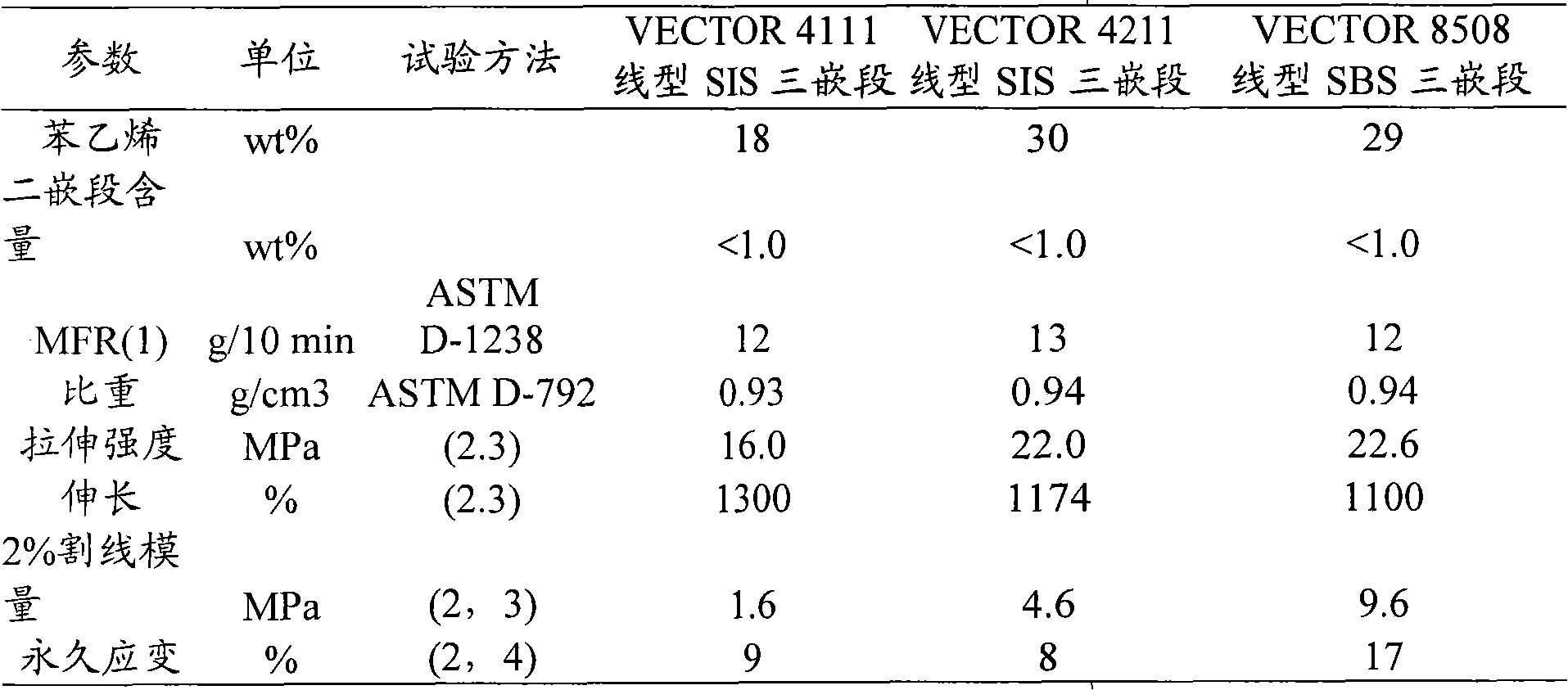
(1) condition G (200 ℃, 5kg)
(2) the routine value of compression moulding test plate (panel)
(3) tension test under envrionment conditions (illustrating in referring to literary composition)
(4) 300% hysteresis test (illustrating in referring to literary composition) under envrionment conditions
Table 21: the blend of the present composition and the measurement that stretches


Annotate: a) Vector 4111, from Dexco Polymers LP
B) Vector4211 is from Dexco Polymers LP
C) Vector 8508, from Dexco Polymers LP
D) KRATON G1657 is from KRATON Polymers LLC
E) KRATON G1652 is from KRATON Polymers LLC
(i) tension test under envrionment conditions (illustrating in referring to literary composition)
(ii) 300% hysteresis test (illustrating in referring to literary composition) under envrionment conditions
Table 22 shows the composition and the measurement that stretches of the ternary blends of olefin block copolymers (line style SIS triblock polymer Vector 4111, line style SEBS triblock polymer KRATON G1657 and type SBS triblock polymer Vector 8508).
Table 22: ternary blends
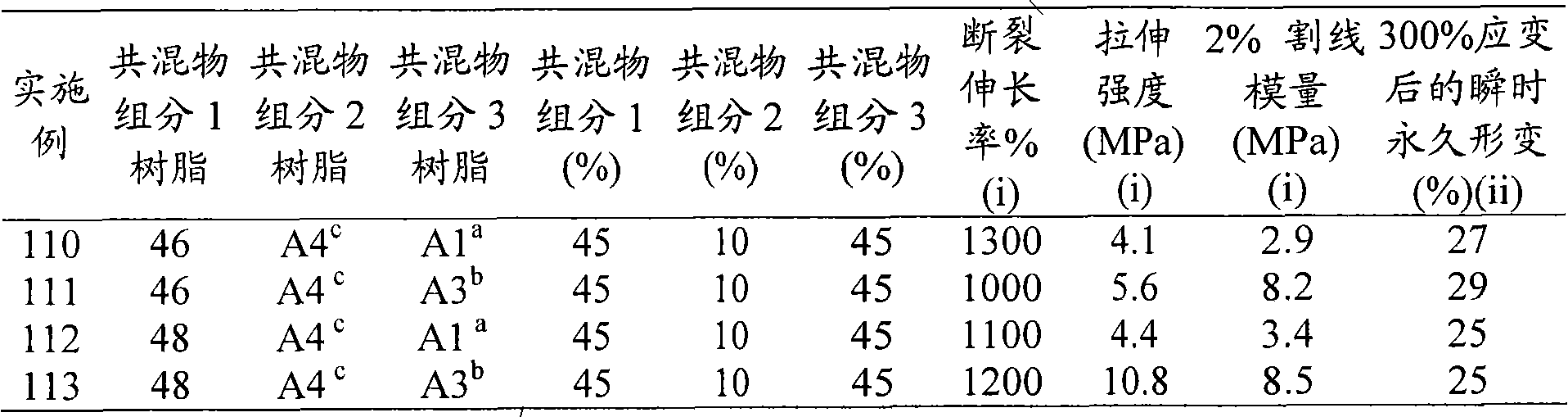
Annotate:
A) Vector 4111, from Dexco Polymers LP
B) Vector 8508, from Dexco Polymers LP
C) KRATON G1657 is from KRATON Polymers LLC
(i) tension test under envrionment conditions (illustrating in referring to literary composition)
(ii) 300% hysteresis test (illustrating in referring to literary composition) under envrionment conditions
Figure 14 shows the elastic recovery rate of the embodiment of the invention and the Comparative Examples (referring to table 15) that comprise SEBS.When similar SEBS level, composition of the present invention has the response rate higher than Comparative Examples.Higher response rate be considered to usually elasticity bigger help performance.
Figure 15 has compared the elasticity of measuring by the permanent strain of the embodiment that comprises ethylene ' alpha '-olefin and SIS.Embodiment 54 and 57 shows 37 and 32% permanent strain respectively.Embodiment 110 and 112 has the ratio of identical ethylene ' alpha '-olefin to SIS, and contains 10% SEBS in the whole composition.These embodiment have and embodiment 90 and 93 similar permanent strains, and embodiment 90 and 93 comprises ethylene ' alpha '-olefin and SEBS but do not have SIS.This result has shown the effectiveness of ternary blends.Although be not intended to be limited by theory, think that consistency is improved in ternary blends.
Although set forth the present invention with the embodiment of limited quantity, the concrete feature of an embodiment should not be added on other embodiment of the present invention.There are not single embodiment representative all aspects of the present invention.In some embodiments, composition or method can comprise NM compound of many this paper or step.In other embodiments, composition or method do not comprise or do not have basically compound or the step that this paper does not enumerate.There are the variant and the modification of described embodiment.At last, any numerical value disclosed herein should be interpreted as being meant approximation, no matter " pact " or " be similar to " whether to be used to describe this numerical value.Appended claim is intended to cover all that drops in protection scope of the present invention and revises and variant.
Claims (42)
Applications Claiming Priority (2)
| Application Number | Priority Date | Filing Date | Title |
|---|---|---|---|
| US11/524,121 US7737215B2 (en) | 2005-03-17 | 2006-09-20 | Compositions of ethylene/α-olefin multi-block interpolymer for elastic films and laminates |
| US11/524,121 | 2006-09-20 |
Related Child Applications (1)
| Application Number | Title | Priority Date | Filing Date |
|---|---|---|---|
| CN2012101564360A Division CN102689482A (en) | 2006-09-20 | 2007-09-18 | Compositions of ethylene/alpha-olefin multi-block interpolymer for elastic films and laminates |
Publications (1)
| Publication Number | Publication Date |
|---|---|
| CN101583664A true CN101583664A (en) | 2009-11-18 |
Family
ID=38951383
Family Applications (2)
| Application Number | Title | Priority Date | Filing Date |
|---|---|---|---|
| CN2012101564360A Pending CN102689482A (en) | 2006-09-20 | 2007-09-18 | Compositions of ethylene/alpha-olefin multi-block interpolymer for elastic films and laminates |
| CNA2007800430101A Pending CN101583664A (en) | 2006-09-20 | 2007-09-18 | Ethylene/alpha-olefin multi-block interpolymer compositions for elastic films and laminates |
Family Applications Before (1)
| Application Number | Title | Priority Date | Filing Date |
|---|---|---|---|
| CN2012101564360A Pending CN102689482A (en) | 2006-09-20 | 2007-09-18 | Compositions of ethylene/alpha-olefin multi-block interpolymer for elastic films and laminates |
Country Status (8)
| Country | Link |
|---|---|
| US (1) | US7737215B2 (en) |
| EP (1) | EP2066748B1 (en) |
| JP (2) | JP5913784B2 (en) |
| KR (1) | KR101425244B1 (en) |
| CN (2) | CN102689482A (en) |
| BR (1) | BRPI0715144B1 (en) |
| MX (1) | MX2009003099A (en) |
| WO (1) | WO2008036631A1 (en) |
Cited By (8)
| Publication number | Priority date | Publication date | Assignee | Title |
|---|---|---|---|---|
| CN104804358A (en) * | 2015-04-24 | 2015-07-29 | 茂泰(福建)鞋材有限公司 | Light-weight anti-aging shoe sole and preparation method thereof |
| CN105263969A (en) * | 2013-04-11 | 2016-01-20 | 埃克森美孚化学专利公司 | Process of producing polyolefins using metallocene polymerization catalysts and copolymers therefrom |
| CN107148349A (en) * | 2014-09-25 | 2017-09-08 | 陶氏环球技术有限责任公司 | Elastic membrane structure, layered product and its method based on polyolefin |
| CN111770944A (en) * | 2018-03-30 | 2020-10-13 | Lg化学株式会社 | block copolymer composition |
| CN113039315A (en) * | 2018-09-18 | 2021-06-25 | 埃克森美孚化学专利公司 | Bicomponent fibers and nonwovens produced therefrom |
| CN113613890A (en) * | 2019-03-29 | 2021-11-05 | 东丽薄膜先端加工股份有限公司 | Laminated film |
| CN115556448A (en) * | 2022-09-08 | 2023-01-03 | 上海乐纯生物技术有限公司 | Multilayer film for bioprocess bag and application thereof |
| CN117343226A (en) * | 2023-12-04 | 2024-01-05 | 万华化学集团股份有限公司 | An ethylene/α-olefin copolymer and its application |
Families Citing this family (77)
| Publication number | Priority date | Publication date | Assignee | Title |
|---|---|---|---|---|
| US7582716B2 (en) * | 2004-03-17 | 2009-09-01 | Dow Global Technologies Inc. | Compositions of ethylene/α-olefin multi-block interpolymer for blown films with high hot tack |
| AR053693A1 (en) | 2004-03-17 | 2007-05-16 | Dow Global Technologies Inc | COMPOSITIONS OF ETHYLENE / ALFA-OLEFINE INTERPOLIMERO MULTIBLOCK SUITABLE FOR FILMS |
| US7714071B2 (en) * | 2004-03-17 | 2010-05-11 | Dow Global Technologies Inc. | Polymer blends from interpolymers of ethylene/α-olefins and flexible molded articles made therefrom |
| CN1976965B (en) * | 2004-03-17 | 2012-10-10 | 陶氏环球技术有限责任公司 | Catalyst composition comprising shuttling agent for ethylene multi-block copolymer formation |
| US7737215B2 (en) * | 2005-03-17 | 2010-06-15 | Dow Global Technologies Inc. | Compositions of ethylene/α-olefin multi-block interpolymer for elastic films and laminates |
| US7910658B2 (en) * | 2005-03-17 | 2011-03-22 | Dow Global Technologies Llc | Compositions of ethylene/α-olefin multi-block interpolymer for elastic films and laminates |
| US8916640B2 (en) | 2006-07-06 | 2014-12-23 | Dow Global Technologies Llc | Blended polyolefin dispersions |
| US8476326B2 (en) * | 2006-09-22 | 2013-07-02 | Dow Global Technologies Llc | Fibrillated polyolefin foam |
| KR20090086420A (en) * | 2006-11-30 | 2009-08-12 | 다우 글로벌 테크놀로지스 인크. | Stretchy fabrics and garments |
| KR20100017382A (en) * | 2007-04-27 | 2010-02-16 | 다우 글로벌 테크놀로지스 인크. | Α Microporous Films from Commercialized Polymer Blends |
| ITMI20070878A1 (en) * | 2007-05-02 | 2008-11-03 | Dow Global Technologies Inc | PROCESS FOR POLYMERIZZAINE OF TACTICAL POLYMERS USING CHIRAL CATALYSTS |
| US8569422B2 (en) * | 2007-07-13 | 2013-10-29 | Dow Global Technologies, Llc | Catalytic olefin block copolymers with controlled block sequence distribution and at least one low crystallinity hard block |
| US20090088037A1 (en) * | 2007-09-28 | 2009-04-02 | Invista North America S.Ar.L. | Laminated fabric construction with polyolefin compositions |
| EP2225098B1 (en) * | 2007-12-21 | 2020-09-30 | Dow Global Technologies LLC | Carpet comprising an olefin block copolymer adhesive backing |
| WO2009105938A1 (en) * | 2008-02-29 | 2009-09-03 | Dow Global Technologies Inc. | Oriented films comprising ethylene/α-olefin block interpolymer |
| US9498932B2 (en) * | 2008-09-30 | 2016-11-22 | Exxonmobil Chemical Patents Inc. | Multi-layered meltblown composite and methods for making same |
| US8664129B2 (en) * | 2008-11-14 | 2014-03-04 | Exxonmobil Chemical Patents Inc. | Extensible nonwoven facing layer for elastic multilayer fabrics |
| US10161063B2 (en) * | 2008-09-30 | 2018-12-25 | Exxonmobil Chemical Patents Inc. | Polyolefin-based elastic meltblown fabrics |
| US9168718B2 (en) | 2009-04-21 | 2015-10-27 | Exxonmobil Chemical Patents Inc. | Method for producing temperature resistant nonwovens |
| BRPI0913808B1 (en) * | 2008-10-03 | 2020-05-05 | Dow Global Technologies Llc | impact modified composition comprising ethylene / a-olefin interpolymers |
| ES2546088T4 (en) * | 2009-02-27 | 2015-10-15 | Exxonmobil Chemical Patents Inc. | Biaxially elastic nonwoven laminates with inelastic zones |
| US9885149B2 (en) * | 2009-07-08 | 2018-02-06 | Dow Global Technologies Llc | Carpet and carpet backing |
| KR101793891B1 (en) * | 2009-09-18 | 2017-11-06 | 다우 글로벌 테크놀로지스 엘엘씨 | Powdered thermoplastic polyolefin elastomer composition for slush molding processes |
| US8668975B2 (en) * | 2009-11-24 | 2014-03-11 | Exxonmobil Chemical Patents Inc. | Fabric with discrete elastic and plastic regions and method for making same |
| CA2784279C (en) | 2009-12-18 | 2016-11-15 | Dow Global Technologies Llc | Halogen-free flame retardant compositions |
| BR112012016262B1 (en) | 2009-12-31 | 2022-05-10 | Dow Global Technologies Llc | Halogen-free flame retardant polymer composition and wire or cable coating |
| EP2576688B1 (en) * | 2010-05-27 | 2017-01-18 | Dow Global Technologies LLC | Polymer compositions, methods of making the same, and articles prepared from the same |
| ES2538976T3 (en) * | 2010-06-14 | 2015-06-25 | Dow Global Technologies Llc | Copolymer composition of low adhesion olefin blocks |
| FR2961517B1 (en) * | 2010-06-18 | 2014-04-11 | Thermoplastiques Cousin Tessier | RETICULATED ELASTOMERIC COMPOSITION AND PRODUCT COMPRISING SUCH A COMPOSITION |
| JP5569310B2 (en) * | 2010-09-30 | 2014-08-13 | 日本ゼオン株式会社 | Method for producing polymer composition |
| JP5711998B2 (en) * | 2011-02-24 | 2015-05-07 | リケンテクノス株式会社 | Thermoplastic elastomer composition |
| ES2592530T3 (en) | 2011-06-17 | 2016-11-30 | Fiberweb, Llc | Multi-layer vapor permeable article, substantially waterproof |
| EP2720582A4 (en) | 2011-06-17 | 2014-12-24 | Berry Plastics Corp | INSULATED SLEEVE FOR CUP |
| ES2503890B2 (en) | 2011-06-17 | 2015-09-28 | Berry Plastics Corporation | INSULATING GLASS |
| US8715449B2 (en) | 2011-06-17 | 2014-05-06 | Berry Plastics Corporation | Process for forming an insulated container having artwork |
| WO2012174422A2 (en) | 2011-06-17 | 2012-12-20 | Berry Plastics Corporation | Insulated container with molded brim |
| WO2012178027A2 (en) | 2011-06-23 | 2012-12-27 | Fiberweb, Inc. | Vapor-permeable, substantially water-impermeable multilayer article |
| WO2012177996A2 (en) | 2011-06-23 | 2012-12-27 | Fiberweb, Inc. | Vapor permeable, substantially water impermeable multilayer article |
| US9765459B2 (en) | 2011-06-24 | 2017-09-19 | Fiberweb, Llc | Vapor-permeable, substantially water-impermeable multilayer article |
| JP2013028653A (en) * | 2011-07-26 | 2013-02-07 | Riken Technos Corp | Thermoplastic elastomer composition |
| JP6071175B2 (en) * | 2011-07-26 | 2017-02-01 | リケンテクノス株式会社 | Thermoplastic elastomer composition |
| WO2013032552A1 (en) | 2011-08-31 | 2013-03-07 | Berry Plastics Corporation | Polymeric material for an insulated container |
| CN103958548B (en) | 2011-12-02 | 2016-05-18 | 住友化学株式会社 | Use the manufacture method of the olefin block polymers of multiple transition-metal catalyst |
| CN104602895A (en) | 2012-08-07 | 2015-05-06 | 比瑞塑料公司 | Cup-forming process and machine |
| SG11201503336VA (en) | 2012-10-26 | 2015-06-29 | Berry Plastics Corp | Polymeric material for an insulated container |
| AR093943A1 (en) | 2012-12-14 | 2015-07-01 | Berry Plastics Corp | EDGE OF A THERMAL PACK |
| US9840049B2 (en) | 2012-12-14 | 2017-12-12 | Berry Plastics Corporation | Cellular polymeric material |
| AR093944A1 (en) | 2012-12-14 | 2015-07-01 | Berry Plastics Corp | PUNCHED FOR PACKAGING |
| JP6385364B2 (en) * | 2012-12-28 | 2018-09-05 | ダウ グローバル テクノロジーズ エルエルシー | Multilayer film containing functional ethylene-based polymer composition |
| US9957365B2 (en) | 2013-03-13 | 2018-05-01 | Berry Plastics Corporation | Cellular polymeric material |
| TW201505928A (en) | 2013-03-14 | 2015-02-16 | Berry Plastics Corp | container |
| US9562140B2 (en) | 2013-08-16 | 2017-02-07 | Berry Plastics Corporation | Polymeric material for an insulated container |
| CN105452354B (en) | 2013-08-26 | 2019-06-14 | 比瑞塑料公司 | Polymer Materials for Containers |
| US9802392B2 (en) | 2014-03-31 | 2017-10-31 | Kimberly-Clark Worldwide, Inc. | Microtextured multilayered elastic laminates with enhanced strength and elasticity and methods of making thereof |
| US9428638B2 (en) | 2013-12-19 | 2016-08-30 | Kimberly-Clark Worldwide, Inc. | Strong polyolefin-based thermoplastic elastomeric films and methods of making |
| US10213990B2 (en) | 2013-12-31 | 2019-02-26 | Kimberly-Clark Worldwide, Inc. | Methods to make stretchable elastic laminates |
| US9358759B2 (en) | 2013-12-19 | 2016-06-07 | Kimberly-Clark Worldwide, Inc. | Multilayered elastic laminates with enhanced strength and elasticity and methods of making thereof |
| US9714306B2 (en) | 2014-03-28 | 2017-07-25 | Mitsui Chemicals, Inc. | Olefin resin and method for producing same |
| US9758655B2 (en) | 2014-09-18 | 2017-09-12 | Berry Plastics Corporation | Cellular polymeric material |
| KR20160068469A (en) * | 2014-12-05 | 2016-06-15 | 주식회사 불스원 | Composition of gel cushion and gel cushion manufactured by the same |
| ES2784518T3 (en) | 2014-12-09 | 2020-09-28 | Mitsui Chemicals Inc | Propylene-based resin composition |
| US20160168345A1 (en) | 2014-12-12 | 2016-06-16 | Clopay Plastic Products Company, Inc. | Elastomeric compositions for blown-film extrusion |
| US10239295B2 (en) | 2015-01-09 | 2019-03-26 | Berry Film Products Company, Inc. | Elastomeric films having increased tear resistance |
| WO2016118838A1 (en) | 2015-01-23 | 2016-07-28 | Berry Plastics Corporation | Polymeric material for an insulated container |
| WO2016141179A1 (en) | 2015-03-04 | 2016-09-09 | Berry Plastics Corporation | Polymeric material for container |
| CN104844939B (en) * | 2015-06-05 | 2017-07-07 | 苏州艾兴无纺布制品有限公司 | Non-sticky great friction coefficient macromolecular material, non-woven fabric composite material and its application |
| CN104875460B (en) * | 2015-06-05 | 2017-04-05 | 苏州艾兴无纺布制品有限公司 | A kind of non-sticky great friction coefficient composite and its application |
| WO2017057050A1 (en) * | 2015-09-30 | 2017-04-06 | 日本ゼオン株式会社 | Block copolymer composition and adhesive composition |
| JP6997713B2 (en) * | 2016-02-23 | 2022-02-04 | ダウ グローバル テクノロジーズ エルエルシー | Ethylene-based polymer and method for producing it |
| US11214429B2 (en) | 2017-08-08 | 2022-01-04 | Berry Global, Inc. | Insulated multi-layer sheet and method of making the same |
| TWI781221B (en) * | 2017-09-22 | 2022-10-21 | 美商陶氏全球科技有限責任公司 | Compositions and multilayer films for reclosable packaging |
| KR102065164B1 (en) * | 2017-12-26 | 2020-01-13 | 주식회사 엘지화학 | Olefin based polymer |
| AR118013A1 (en) * | 2019-02-15 | 2021-09-08 | Dow Global Technologies Llc | METHOD FOR FORMING ELASTIC FIBERS AND STRETCHABLE ARTICLES CONTAINING SUCH FIBERS |
| WO2020212905A1 (en) | 2019-04-17 | 2020-10-22 | Nitto Denko Corporation | Multilayer co-extruded films and article containing same |
| MX2022012287A (en) * | 2020-04-01 | 2023-01-05 | Kimberly Clark Co | Elastomeric laminate. |
| CN113237794B (en) * | 2021-05-11 | 2022-07-01 | 西南石油大学 | Method for evaluating influence of salinity on expansion viscoelasticity of foam liquid film |
| KR20240121845A (en) * | 2021-12-20 | 2024-08-09 | 다우 글로벌 테크놀로지스 엘엘씨 | Olefin-based copolymer and adhesive composition |
Family Cites Families (80)
| Publication number | Priority date | Publication date | Assignee | Title |
|---|---|---|---|---|
| US3873642A (en) | 1961-02-20 | 1975-03-25 | Avisun Corp | Crystalline olefin block polymers and their preparation |
| JPS6088016A (en) | 1983-10-21 | 1985-05-17 | Mitsui Petrochem Ind Ltd | Ethylene copolymer |
| US4720415A (en) | 1985-07-30 | 1988-01-19 | Kimberly-Clark Corporation | Composite elastomeric material and process for making the same |
| US4789699A (en) | 1986-10-15 | 1988-12-06 | Kimberly-Clark Corporation | Ambient temperature bondable elastomeric nonwoven web |
| DE3784235T2 (en) | 1986-12-26 | 1993-09-09 | Mitsubishi Petrochemical Co | METHOD FOR PRODUCING CROSSLINKED BLOCK COPOLYMERS OF OLEFINS. |
| US5226992A (en) | 1988-09-23 | 1993-07-13 | Kimberly-Clark Corporation | Process for forming a composite elastic necked-bonded material |
| US5514470A (en) | 1988-09-23 | 1996-05-07 | Kimberly-Clark Corporation | Composite elastic necked-bonded material |
| US5501679A (en) | 1989-11-17 | 1996-03-26 | Minnesota Mining And Manufacturing Company | Elastomeric laminates with microtextured skin layers |
| ES2074172T3 (en) | 1989-11-17 | 1995-09-01 | Minnesota Mining & Mfg | ELASTOMER LAMINATES WITH MICROTEXTURED LEATHER LAYERS. |
| GB2241244B (en) | 1990-02-22 | 1994-07-06 | James C W Chien | Thermoplastic elastomers |
| US5344691A (en) | 1990-03-30 | 1994-09-06 | Minnesota Mining And Manufacturing Company | Spatially modified elastic laminates |
| US5429856A (en) | 1990-03-30 | 1995-07-04 | Minnesota Mining And Manufacturing Company | Composite materials and process |
| US5354597A (en) | 1990-03-30 | 1994-10-11 | Minnesota Mining And Manufacturing Company | Elastomeric tapes with microtextured skin layers |
| US5093422A (en) | 1990-04-23 | 1992-03-03 | Shell Oil Company | Low stress relaxation extrudable elastomeric composition |
| US5376430A (en) | 1992-06-19 | 1994-12-27 | Minnesota Mining And Manufacturing Company | Elastic film laminate |
| US5336554A (en) | 1993-05-14 | 1994-08-09 | David Knight | Stretchable tear resistant porous elastomeric film elements and processes |
| US5332613A (en) | 1993-06-09 | 1994-07-26 | Kimberly-Clark Corporation | High performance elastomeric nonwoven fibrous webs |
| JPH0790035A (en) | 1993-07-27 | 1995-04-04 | Ube Ind Ltd | Method for producing propylene block copolymer |
| US5594080A (en) | 1994-03-24 | 1997-01-14 | Leland Stanford, Jr. University | Thermoplastic elastomeric olefin polymers, method of production and catalysts therefor |
| CN1070201C (en) | 1994-04-06 | 2001-08-29 | 埃克森化学专利公司 | Ethylene alpha-olefin block copolymers and methods for production thereof |
| ES2125612T3 (en) | 1994-04-06 | 1999-03-01 | Exxon Chemical Patents Inc | COPOLYMERS OF BLOCKS OF ETHYLENE AND ALPHA-OLEPHINE AND METHODS FOR ITS PRODUCTION. |
| US6218470B1 (en) | 1994-06-01 | 2001-04-17 | The Dow Chemical Company | Thermoplastic elastomeric blends |
| DE4425408A1 (en) | 1994-07-13 | 1996-01-18 | Hoechst Ag | cycloolefin |
| US5635275A (en) | 1994-08-05 | 1997-06-03 | Tredegar Industries, Inc. | Lamination of non-apertured three-dimensional films to apertured three-dimensional films and articles produced therefrom |
| US5945196A (en) | 1994-09-15 | 1999-08-31 | Tredegar Industries, Inc. | Method of manufacturing screen and films produced therewith |
| EP0712892B1 (en) | 1994-11-17 | 2002-03-20 | KRATON Polymers Research B.V. | Blends of block copolymers and metallocene polyolefins |
| TR199900793T2 (en) | 1996-10-10 | 2001-11-21 | Tredegar Film Products Corporation | Air permeable elastic polymeric film laminates |
| US5733628A (en) | 1996-10-10 | 1998-03-31 | Tredegar Industries, Inc. | Breathable elastic polymeric film laminates |
| AU5384498A (en) | 1996-12-27 | 1998-07-31 | Kimberly-Clark Worldwide, Inc. | Elastomeric film including metallocene catalyzed polyethylene elastomer and method for making the same |
| US6015764A (en) | 1996-12-27 | 2000-01-18 | Kimberly-Clark Worldwide, Inc. | Microporous elastomeric film/nonwoven breathable laminate and method for making the same |
| US6114457A (en) | 1997-02-07 | 2000-09-05 | Exxon Chemical Patents Inc. | High melt strength polyethylene compositions |
| EP0958314B1 (en) | 1997-02-07 | 2002-11-06 | ExxonMobil Chemical Patents Inc. | Propylene polymers incorporating polyethylene macromers |
| US6160064A (en) | 1997-06-14 | 2000-12-12 | The Board Of Trustees Of The Leland Stanford Junior University | Ethylene enhancement of processes for synthesis of high melting theromoplastic elastomeric α-olefin polymers (PRE/EPE effects) |
| BR9806292A (en) | 1997-10-03 | 2001-09-18 | Kimberly Clark Co | Highly improved elastic composite materials made of thermoplastic triblock elastomers |
| WO1999035171A1 (en) | 1998-01-09 | 1999-07-15 | The Board Of Trustees Of The Leland Stanford Jr. University | High-melting polyolefin copolymer elastomers, catalysts and methods of synthesis |
| US6159584A (en) | 1998-03-27 | 2000-12-12 | 3M Innovative Properties Company | Elastic tab laminate |
| MXPA00013015A (en) | 1998-06-30 | 2002-11-07 | Fuller H B Licensing Financ | Hot melt adhesive composition comprising homogeneous ethylene interpolymer and block copolymer. |
| DE19949235A1 (en) | 1998-10-16 | 2000-05-11 | Chisso Corp | Propylene-ethylene-alpha-olefin terpolymer, useful for the production of molded articles and film, contains 85-99.99 mol per cent propylene and has specific elution characteristics in o-dichlorobenzene |
| JP2000135762A (en) | 1998-10-30 | 2000-05-16 | Asahi Chem Ind Co Ltd | Film for stretch packing |
| JP2000159944A (en) | 1998-11-30 | 2000-06-13 | Aron Kasei Co Ltd | Resin composition and airbag cover using the same |
| CN1234739C (en) | 1998-12-21 | 2006-01-04 | 埃克森化学专利公司 | Branched semi-crystalline ethylene-propylene compositions |
| JP4437344B2 (en) | 1998-12-25 | 2010-03-24 | 日東電工株式会社 | Release liner and pressure sensitive adhesive sheet |
| US7625829B1 (en) | 1999-08-30 | 2009-12-01 | Tredegar Film Products Corporation | Tear resistant elastic laminate and method of forming |
| US6255236B1 (en) | 2000-01-24 | 2001-07-03 | Tredegar Film Products Corporation | Stiffened lane elastic laminate and method of forming |
| US6472084B1 (en) | 2000-02-15 | 2002-10-29 | Tredegar Film Products Corporation | Tear-resistant low set elastic film and method of making |
| JP2002206007A (en) | 2000-11-08 | 2002-07-26 | National Institute Of Advanced Industrial & Technology | Production method of olefin block copolymer |
| EP1373367A2 (en) | 2001-01-10 | 2004-01-02 | Basell Poliolefine Italia S.p.A. | Block copolymers and process for their preparation |
| JP4377587B2 (en) | 2001-03-29 | 2009-12-02 | 出光興産株式会社 | Propylene polymer composition, molded product, and polyolefin copolymer |
| SG120869A1 (en) | 2001-05-31 | 2006-04-26 | Mitsui Chemicals Inc | Olefin block copolymer, viscosity index improver for lubricating oils and lubricating oil composition |
| US7022766B2 (en) | 2001-05-31 | 2006-04-04 | Mitsui Chemicals, Inc. | Olefin block copolymer, viscosity index improver for lubricating oils and lubricating oil composition |
| JP2003011142A (en) | 2001-06-29 | 2003-01-15 | Mitsuboshi Belting Ltd | Method for producing composite epidermis and composite epidermis |
| JP2003019778A (en) | 2001-07-09 | 2003-01-21 | Asahi Kasei Corp | Polypropylene-based multilayer wrap film |
| US7087686B2 (en) | 2001-08-06 | 2006-08-08 | Bp Chemicals Limited | Chain growth reaction process |
| JP2005508415A (en) | 2001-11-06 | 2005-03-31 | ダウ グローバル テクノロジーズ インコーポレイティド | Isotactic propylene copolymers, their production and use |
| CN100393293C (en) | 2001-12-03 | 2008-06-11 | 屈德加薄膜产品股份有限公司 | Nonwoven breathable composite padding and method of making the same |
| US8034440B2 (en) | 2002-10-31 | 2011-10-11 | Kimberly-Clark Worldwide, Inc. | Elastomeric film and laminates thereof |
| JP2004154228A (en) | 2002-11-05 | 2004-06-03 | Sumitomo Rubber Ind Ltd | Grip for golf club |
| US20040122409A1 (en) | 2002-12-23 | 2004-06-24 | Thomas Oomman Painumoottil | Enhanced elastomer blend |
| US20040122408A1 (en) | 2002-12-24 | 2004-06-24 | Potnis Prasad S. | Dry-blend elastomer for elastic laminates |
| JP2004204058A (en) | 2002-12-25 | 2004-07-22 | Mitsui Chemicals Inc | Olefin-based block copolymer |
| US20050158513A1 (en) | 2003-04-15 | 2005-07-21 | Tredegar Film Products Corporation | Breathable elastic web |
| US20050003152A1 (en) | 2003-07-02 | 2005-01-06 | Tredegar Film Products Corporation | Flexible form fitting web |
| BRPI0413819B1 (en) | 2003-08-22 | 2016-12-13 | Kimberly Clark Co | method for forming a breathable, elastic, film/unwoven layer laminate and laminate obtained thereby |
| US7220478B2 (en) | 2003-08-22 | 2007-05-22 | Kimberly-Clark Worldwide, Inc. | Microporous breathable elastic films, methods of making same, and limited use or disposable product applications |
| US7863379B2 (en) * | 2004-03-17 | 2011-01-04 | Dow Global Technologies Inc. | Impact modification of thermoplastics with ethylene/alpha-olefin interpolymers |
| US7622529B2 (en) * | 2004-03-17 | 2009-11-24 | Dow Global Technologies Inc. | Polymer blends from interpolymers of ethylene/alpha-olefin with improved compatibility |
| US7608668B2 (en) | 2004-03-17 | 2009-10-27 | Dow Global Technologies Inc. | Ethylene/α-olefins block interpolymers |
| US7714071B2 (en) * | 2004-03-17 | 2010-05-11 | Dow Global Technologies Inc. | Polymer blends from interpolymers of ethylene/α-olefins and flexible molded articles made therefrom |
| RU2359979C2 (en) | 2004-03-17 | 2009-06-27 | Дау Глобал Текнолоджиз Инк. | Catalyst composition containing chain shuttle transfer agent for forming ethylene copolymer |
| US7355089B2 (en) * | 2004-03-17 | 2008-04-08 | Dow Global Technologies Inc. | Compositions of ethylene/α-olefin multi-block interpolymer for elastic films and laminates |
| CN1976965B (en) | 2004-03-17 | 2012-10-10 | 陶氏环球技术有限责任公司 | Catalyst composition comprising shuttling agent for ethylene multi-block copolymer formation |
| US7741397B2 (en) * | 2004-03-17 | 2010-06-22 | Dow Global Technologies, Inc. | Filled polymer compositions made from interpolymers of ethylene/α-olefins and uses thereof |
| EP2357203B1 (en) | 2004-03-17 | 2017-05-24 | Dow Global Technologies LLC | Catalyst composition comprising shuttling agent for higher olefin multi-block copolymer formation |
| US7351297B2 (en) | 2004-09-21 | 2008-04-01 | Tredegar Film Products Corp. | Composite elastic web |
| US7737215B2 (en) * | 2005-03-17 | 2010-06-15 | Dow Global Technologies Inc. | Compositions of ethylene/α-olefin multi-block interpolymer for elastic films and laminates |
| AR053697A1 (en) * | 2005-03-17 | 2007-05-16 | Dow Global Technologies Inc | COMPOSITIONS OF ETHYLENE INTERPOLYMERS / (ALPHA) - MULTIPLE BLOCK OIL FOR FILMS AND ELASTIC LAMINATES |
| US7910658B2 (en) * | 2005-03-17 | 2011-03-22 | Dow Global Technologies Llc | Compositions of ethylene/α-olefin multi-block interpolymer for elastic films and laminates |
| EP1871816B1 (en) | 2005-03-17 | 2014-02-26 | Dow Global Technologies LLC | Polymer blends from interpolymers of ethylene/alpha-olefins and flexible molded articles made therefrom |
| US7906587B2 (en) * | 2005-09-16 | 2011-03-15 | Dow Global Technologies Llc | Polymer blends from interpolymer of ethylene/α olefin with improved compatibility |
| BRPI0621108B1 (en) | 2005-12-22 | 2018-03-13 | Dow Global Technologies Inc. | PROPYLENE-ALPHA-OLEFINE COPOLYMER COMPOSITION |
-
2006
- 2006-09-20 US US11/524,121 patent/US7737215B2/en active Active
-
2007
- 2007-09-18 CN CN2012101564360A patent/CN102689482A/en active Pending
- 2007-09-18 EP EP20070842670 patent/EP2066748B1/en active Active
- 2007-09-18 KR KR1020097007899A patent/KR101425244B1/en active Active
- 2007-09-18 CN CNA2007800430101A patent/CN101583664A/en active Pending
- 2007-09-18 JP JP2009529338A patent/JP5913784B2/en active Active
- 2007-09-18 BR BRPI0715144-6A patent/BRPI0715144B1/en active IP Right Grant
- 2007-09-18 MX MX2009003099A patent/MX2009003099A/en unknown
- 2007-09-18 WO PCT/US2007/078730 patent/WO2008036631A1/en not_active Ceased
-
2014
- 2014-11-14 JP JP2014231655A patent/JP6066979B2/en active Active
Cited By (15)
| Publication number | Priority date | Publication date | Assignee | Title |
|---|---|---|---|---|
| CN105263969A (en) * | 2013-04-11 | 2016-01-20 | 埃克森美孚化学专利公司 | Process of producing polyolefins using metallocene polymerization catalysts and copolymers therefrom |
| US9611348B2 (en) | 2013-04-11 | 2017-04-04 | Exxonmobil Chemical Patents Inc. | Process of producing polyolefins using metallocene polymerization catalysts and copolymers therefrom |
| CN105263969B (en) * | 2013-04-11 | 2017-04-05 | 埃克森美孚化学专利公司 | Using metallocene polymerization catalyst preparation polyolefin and the method for copolymer |
| CN107148349A (en) * | 2014-09-25 | 2017-09-08 | 陶氏环球技术有限责任公司 | Elastic membrane structure, layered product and its method based on polyolefin |
| CN104804358A (en) * | 2015-04-24 | 2015-07-29 | 茂泰(福建)鞋材有限公司 | Light-weight anti-aging shoe sole and preparation method thereof |
| CN104804358B (en) * | 2015-04-24 | 2018-03-30 | 茂泰(福建)鞋材有限公司 | A kind of ageing-resistant thermoplasticity sole of light weight and preparation method thereof |
| CN111770944A (en) * | 2018-03-30 | 2020-10-13 | Lg化学株式会社 | block copolymer composition |
| CN111770944B (en) * | 2018-03-30 | 2023-05-05 | Lg化学株式会社 | Block copolymer composition |
| CN113039315A (en) * | 2018-09-18 | 2021-06-25 | 埃克森美孚化学专利公司 | Bicomponent fibers and nonwovens produced therefrom |
| CN113613890A (en) * | 2019-03-29 | 2021-11-05 | 东丽薄膜先端加工股份有限公司 | Laminated film |
| CN113613890B (en) * | 2019-03-29 | 2023-10-24 | 东丽薄膜先端加工股份有限公司 | laminated film |
| CN115556448A (en) * | 2022-09-08 | 2023-01-03 | 上海乐纯生物技术有限公司 | Multilayer film for bioprocess bag and application thereof |
| CN115556448B (en) * | 2022-09-08 | 2024-05-24 | 上海乐纯生物技术股份有限公司 | Multilayer film for bioprocess bag and application thereof |
| CN117343226A (en) * | 2023-12-04 | 2024-01-05 | 万华化学集团股份有限公司 | An ethylene/α-olefin copolymer and its application |
| CN117343226B (en) * | 2023-12-04 | 2024-04-09 | 万华化学集团股份有限公司 | Ethylene/α-olefin copolymer and its application |
Also Published As
| Publication number | Publication date |
|---|---|
| BRPI0715144A2 (en) | 2013-06-11 |
| US20070078222A1 (en) | 2007-04-05 |
| JP2010504407A (en) | 2010-02-12 |
| MX2009003099A (en) | 2009-05-27 |
| EP2066748A1 (en) | 2009-06-10 |
| KR20090053963A (en) | 2009-05-28 |
| CN102689482A (en) | 2012-09-26 |
| JP5913784B2 (en) | 2016-04-27 |
| JP2015071775A (en) | 2015-04-16 |
| WO2008036631A1 (en) | 2008-03-27 |
| EP2066748B1 (en) | 2014-03-05 |
| JP6066979B2 (en) | 2017-01-25 |
| US7737215B2 (en) | 2010-06-15 |
| KR101425244B1 (en) | 2014-08-01 |
| BRPI0715144B1 (en) | 2019-03-26 |
Similar Documents
| Publication | Publication Date | Title |
|---|---|---|
| CN101583664A (en) | Ethylene/alpha-olefin multi-block interpolymer compositions for elastic films and laminates | |
| CN101341021B (en) | Multilayer, Elastic Products | |
| US7910658B2 (en) | Compositions of ethylene/α-olefin multi-block interpolymer for elastic films and laminates | |
| JP5697997B2 (en) | Fibers and fabrics made from ethylene / α-olefin interpolymers | |
| TWI374151B (en) | Compositions of ethylene/alpha-olefin multi-block interpolymer for elastic films and laminates | |
| CN101346498B (en) | Fibers made from ethylene/α-olefin interpolymers | |
| US7732052B2 (en) | Compositions of ethylene/alpha-olefin multi-block interpolymer for elastic films and laminates | |
| CN101305026B (en) | Compositions of ethylene/α-olefin multi-block interpolymers for high hot tack blown films | |
| CN101277987A (en) | Polymer blends prepared from ethylene/α-olefin interpolymers and flexible molded articles prepared therefrom | |
| CN101688031A (en) | Microporous films from compatibilized polymeric blends | |
| CN101305027A (en) | Three-dimensional random looped structures made from interpolymers of ethylene/alpha-olefins and uses thereof | |
| CN101553512A (en) | Anti-blocking compositions comprising interpolymers of ethylene/alpha-olefins |
Legal Events
| Date | Code | Title | Description |
|---|---|---|---|
| C06 | Publication | ||
| PB01 | Publication | ||
| C10 | Entry into substantive examination | ||
| SE01 | Entry into force of request for substantive examination | ||
| RJ01 | Rejection of invention patent application after publication |
Application publication date: 20091118 |
|
| RJ01 | Rejection of invention patent application after publication |