CN101583045B - OBMC-based error concealment method between SVC layers - Google Patents
OBMC-based error concealment method between SVC layers Download PDFInfo
- Publication number
- CN101583045B CN101583045B CN 200910150017 CN200910150017A CN101583045B CN 101583045 B CN101583045 B CN 101583045B CN 200910150017 CN200910150017 CN 200910150017 CN 200910150017 A CN200910150017 A CN 200910150017A CN 101583045 B CN101583045 B CN 101583045B
- Authority
- CN
- China
- Prior art keywords
- base layer
- layer
- motion vector
- block
- enhancement layer
- Prior art date
- Legal status (The legal status is an assumption and is not a legal conclusion. Google has not performed a legal analysis and makes no representation as to the accuracy of the status listed.)
- Expired - Fee Related
Links
Images


Landscapes
- Compression Or Coding Systems Of Tv Signals (AREA)
Abstract
Description
技术领域technical field
本发明涉及视频编码技术领域,特别涉及一种差错控制方法。The invention relates to the technical field of video coding, in particular to an error control method.
背景技术Background technique
近年来,随着面向互联网及无线视频服务的快速增长,视频编码的目标由单纯的追求高压缩率转向了使视频流能够更好地适应各种不同的网络环境和用户终端,并且具有一定的容错性和可伸缩性。针对这一目标,最优的解决方法是可伸缩性视频编码(Scalable Video Coding,SVC)。In recent years, with the rapid growth of Internet-oriented and wireless video services, the goal of video coding has shifted from simply pursuing high compression rates to making video streams better adapt to various network environments and user terminals, and has a certain Fault tolerance and scalability. For this goal, the optimal solution is scalable video coding (Scalable Video Coding, SVC).
SVC能够提供一个单独的码流,从这个码流中可抽取子码流。子码流能够满足网络传输效率以及终端用户对视频在空间、时间和信噪比等方面的需求。在SVC中,最低质量层被称为基本层,增强空间分辨率、时间分辨率或者信噪比强度的层被称为增强层。其中,为实现空间可伸缩性,采用分层编码方法,利用层间的运动、纹理和残差信息;为实现时间可伸缩性,采用分级双向预测帧编码技术;为实现信噪比的可伸缩性,使用粗粒度可伸缩性和中粒度可伸缩性两种方法,它们采用与空间可伸缩性相似的层间预测方法。SVC can provide a single code stream from which sub-code streams can be extracted. The sub-stream can meet the transmission efficiency of the network and the requirements of end users for video in terms of space, time and signal-to-noise ratio. In SVC, the lowest quality layer is called the base layer, and the layer that enhances the spatial resolution, temporal resolution, or signal-to-noise ratio strength is called the enhancement layer. Among them, in order to achieve spatial scalability, a layered coding method is used to utilize inter-layer motion, texture and residual information; in order to achieve temporal scalability, hierarchical bidirectional predictive frame coding technology is used; in order to achieve scalable signal-to-noise ratio scalability, using two approaches, coarse-grained scalability and medium-grained scalability, which employ inter-layer prediction methods similar to spatial scalability.
尽管视频编码算法充分利用了空间、时间和层间的冗余,最大限度地提高了编码效率,但是在易错环境中,如无线通信网,某一段码流的传输错误很容易影响到当前帧、时间后续帧及后续层帧,从而使视频质量大大降低。现有的差错控制方法包括错误弹性方法和错误隐藏方法。错误弹性方法是在编码端加入一定的冗余,使解码器在丢包情况下,在一定程度上尽量减少视频质量损失,提高视频总体质量。错误隐藏方法是在解码端利用空间、时间和层间正确接收的信息对丢失部分进行重建。Although the video coding algorithm makes full use of the redundancy of space, time and layers to maximize the coding efficiency, but in an error-prone environment, such as a wireless communication network, the transmission error of a certain code stream can easily affect the current frame. , time subsequent frames and subsequent layer frames, so that the video quality is greatly reduced. Existing error control methods include error resilience methods and error concealment methods. The error resilience method is to add a certain amount of redundancy at the encoding end, so that the decoder can minimize the loss of video quality to a certain extent and improve the overall quality of the video in the case of packet loss. The error concealment method is to reconstruct the lost part by using the information received correctly in space, time and layers at the decoder.
在SVC中,由于分层技术的使用,可最大限度的利用层间相关性进行错误隐藏。现有的SVC的错误隐藏方法包括:帧拷贝(Frame Copy,FC)、时间直接运动量生成(Temporal Direct motion vector generation,TD)、基本层跳过(Base Layer Skip,BLSkip)和基本层重建的上采样(Reconstructionbase layer Upsampling,RU)。其中,FC是一种直接采用同一层的最近前向参考帧重建值替换当前帧重建值的方法,通过它可重建基本层或增强层;TD是一种通过把每个宏块作为时间Direct模式恢复出错帧的方法,通过它可重建基本层或增强帧丢失的双向预测的B帧;BLSkip使用可能上采样的基本层残差和可能尺度放大的基本层运动向量,并且利用继承基本层的宏块分割方式和参考帧索引,重建增强层帧;RU利用基本层的重建直接或者上采样后,近似替代增强层重建。在SVC传输中,可通过非平等错误保护(Unequal Error Protection,UEP)对基本层帧进行额外保护,例如,可通过较可靠信道传输基本层,因此,在一般情况下,丢失数据主要发生在增强层,BLSkip错误隐藏方法成为研究的热点。In SVC, due to the use of layered technology, the correlation between layers can be utilized to the greatest extent for error concealment. Existing SVC error concealment methods include: frame copy (Frame Copy, FC), temporal direct motion vector generation (Temporal Direct motion vector generation, TD), base layer skip (Base Layer Skip, BLSkip) and base layer reconstruction Sampling (Reconstruction base layer Upsampling, RU). Among them, FC is a method that directly replaces the current frame reconstruction value with the latest forward reference frame reconstruction value of the same layer, through which the base layer or enhancement layer can be reconstructed; TD is a method that uses each macroblock as a temporal Direct mode A method for recovering erroneous frames by which a base-layer or bi-predictive B-frame with loss of enhanced frames can be reconstructed; BLSkip uses base-layer residuals that may be upsampled and base-layer motion vectors that may be upscaled, and leverages inherited base-layer macros The block segmentation method and the reference frame index reconstruct the enhancement layer frame; RU uses the reconstruction of the base layer directly or after upsampling to approximately replace the reconstruction of the enhancement layer. In SVC transmission, the base layer frame can be additionally protected by Unequal Error Protection (UEP), for example, the base layer can be transmitted through a more reliable channel, so in general, the lost data mainly occurs in the enhancement layers, the BLSkip error concealment method has become a research hotspot.
现有的BLSkip错误隐藏方法的缺点是,增强层一个块的重建仅仅使用基本层对应位置的信息,但由于基本层和增强层的空间分辨率和量化参数(Quantization Parameter,QP)可能不同,因而编码端选择的运动向量、分割方式等存在差异,使用BLSkip错误隐藏方法会带来一定的块效应。基本层和增强层的量化参数的差别越大,则带来的块效应越严重。因此,需要一种方法解决上述问题。The disadvantage of the existing BLSkip error concealment method is that the reconstruction of a block in the enhancement layer only uses the information of the corresponding position of the base layer, but because the spatial resolution and quantization parameter (Quantization Parameter, QP) of the base layer and the enhancement layer may be different, so There are differences in the motion vectors and segmentation methods selected by the encoder, and the use of the BLSkip error concealment method will bring certain block effects. The greater the difference between the quantization parameters of the base layer and the enhancement layer, the more serious the blocking effect will be. Therefore, a method is needed to solve the above problems.
发明内容Contents of the invention
本发明的目的旨在解决至少上述技术缺陷之一,特别是解决仅仅使用基本层对应位置的信息而带来的块效应的问题。The purpose of the present invention is to solve at least one of the above-mentioned technical defects, especially to solve the problem of block effect caused by only using the information of the corresponding position of the base layer.
为达到上述问题,本发明提出一种基于OBMC(Overlapped BlockMotion Compensation,重叠块运动补偿)的SVC层间错误隐藏方法,对于某一丢失帧,包括在解码端的以下步骤:根据增强层和基本层的空间分辨率比率,判断是否需要将所述基本层的运动向量进行尺度放大和放大倍数,以及是否需要对所述基本层的残差数据进行上采样滤波;对所述基本层的运动向量进行尺度放大及模式映射,得所述增强层对应位置的运动向量和模式;使用所述增强层的运动向量和模式对丢失帧进行重建,其中所述使用所述增强层的运动向量和模式对丢失帧进行重建,包括:如果所述基本层对应位置的当前块以及邻域块是Inter编码块,则解码重建公式为:



作为本发明的一个实施例,所述根据增强层和基本层的空间分辨率比率判断是否需要将所述基本层的运动向量放大,包括:如果所述增强层和基本层的空间分辨率比率为1,则无需将所述基本层的运动向量放大;如果所述增强层和基本层的空间分辨率比率为大于1的二进比例值2α,其中,α为自然数,则需要将所述基本层的运动向量放大,放大倍数为所述二进比例值2α;如果所述增强层和基本层的空间分辨率比率为大于1的非二进比例值β,则需要将所述基本层的运动向量放大,放大倍数为所述非二进比例值β。As an embodiment of the present invention, the judging whether the motion vector of the base layer needs to be amplified according to the spatial resolution ratio of the enhancement layer and the base layer includes: if the spatial resolution ratio of the enhancement layer and the base layer is 1, there is no need to amplify the motion vector of the base layer; if the spatial resolution ratio of the enhancement layer and the base layer is a
作为本发明的一个实施例,所述加权系数可为固定的或自适应调节的,其中,所述自适应调节的加权系数的训练方法包括:使用解码端的正确重建数据来训练当前帧的加权系数或通过离线方法对一定数量的视频序列进行训练,找出较优的加权系数。As an embodiment of the present invention, the weighting coefficients may be fixed or adaptively adjusted, wherein the training method of the adaptively adjusted weighting coefficients includes: using correct reconstruction data at the decoding end to train the weighting coefficients of the current frame Or train a certain number of video sequences through an offline method to find out better weighting coefficients.
作为本发明的进一步实施例,通过使得期望


本发明通过在使用基本层的运动向量之前根据增强层和基本层的空间分辨率比率判断是否进行尺度放大,在找出若干补偿块进行OBMC加权之后,对基本层的残差数据采取可能的上采样滤波,加到OBMC方法的重建值上,避免了使用单一运动向量做运动补偿所带来的块效应问题。The present invention judges whether to scale up according to the spatial resolution ratio of the enhancement layer and the base layer before using the motion vector of the base layer. Sampling filtering, added to the reconstruction value of the OBMC method, avoids the block effect problem caused by using a single motion vector for motion compensation.
本发明附加的方面和优点将在下面的描述中部分给出,部分将从下面的描述中变得明显,或通过本发明的实践了解到。Additional aspects and advantages of the invention will be set forth in part in the description which follows, and in part will be obvious from the description, or may be learned by practice of the invention.
附图说明Description of drawings
本发明上述的和/或附加的方面和优点从下面结合附图对实施例的描述中将变得明显和容易理解,其中:The above and/or additional aspects and advantages of the present invention will become apparent and easy to understand from the following description of the embodiments in conjunction with the accompanying drawings, wherein:
图1为本发明实施例的基于OBMC的SVC层间错误隐藏方法的流程图;Fig. 1 is the flowchart of the error concealment method between the SVC layers based on OBMC of the embodiment of the present invention;
图2为本发明实施例的增强层的当前块和上下左右相邻4个块对应的运动向量的示意图;2 is a schematic diagram of motion vectors corresponding to a current block of an enhancement layer and four adjacent blocks up, down, left, and right according to an embodiment of the present invention;
图3为本发明实施例的加权矩阵的示意图;FIG. 3 is a schematic diagram of a weighting matrix according to an embodiment of the present invention;
图4为对应于Bus序列,本发明实施例的方法相对于原方法的峰值信噪比增益的结果示意图;4 is a schematic diagram of the results of the peak signal-to-noise ratio gain of the method of the embodiment of the present invention relative to the original method corresponding to the Bus sequence;
图5为对应于Foreman序列,本发明实施例的方法相对于原方法的峰值信噪比增益的结果示意图;FIG. 5 is a schematic diagram of the results of the peak signal-to-noise ratio gain of the method of the embodiment of the present invention relative to the original method corresponding to the Foreman sequence;
图6为对应于Mobile序列,本发明实施例的方法相对于原方法的峰值信噪比增益的结果示意图;6 is a schematic diagram of the results of the peak signal-to-noise ratio gain of the method of the embodiment of the present invention relative to the original method corresponding to the Mobile sequence;
图7为增强层量化参数QP1=32和丢包率PLR1=20%时,对应于Bus序列,本发明实施例的方法相对于原方法每帧的峰值信噪比的结果示意图;Fig. 7 is a schematic diagram of the result of the peak signal-to-noise ratio of each frame of the method of the embodiment of the present invention relative to the original method when the enhancement layer quantization parameter QP1=32 and the packet loss rate PLR1=20%, corresponding to the Bus sequence;
图8为增强层量化参数QP1=32和丢包率PLR1=20%时,对应于Foreman序列,本发明实施例的方法相对于原方法每帧的峰值信噪比的结果示意图;Fig. 8 is a schematic diagram of the result of the peak signal-to-noise ratio of each frame of the method of the embodiment of the present invention relative to the original method when the enhancement layer quantization parameter QP1=32 and the packet loss rate PLR1=20%, corresponding to the Foreman sequence;
图9为增强层量化参数QP1=32和丢包率PLR1=20%时,对应于Mobile序列,本发明实施例的方法相对于原方法每帧的峰值信噪比的结果示意图。FIG. 9 is a schematic diagram of the peak signal-to-noise ratio results of each frame of the method of the embodiment of the present invention relative to the original method when the enhancement layer quantization parameter QP1=32 and the packet loss rate PLR1=20%, corresponding to the Mobile sequence.
具体实施方式Detailed ways
下面详细描述本发明的实施例,所述实施例的示例在附图中示出,其中自始至终相同或类似的标号表示相同或类似的元件或具有相同或类似功能的元件。下面通过参考附图描述的实施例是示例性的,仅用于解释本发明,而不能解释为对本发明的限制。Embodiments of the present invention are described in detail below, examples of which are shown in the drawings, wherein the same or similar reference numerals designate the same or similar elements or elements having the same or similar functions throughout. The embodiments described below by referring to the figures are exemplary only for explaining the present invention and should not be construed as limiting the present invention.
由现有的BLSkip错误隐藏方法的模式选择可知,当基本层和增强层具有相同的空间分辨率时,基本层和增强层的最小分块方式都是4×4。当基本层和增强层的空间分辨率不同时,增强层的最小分块方式将大于4×4,例如,当基本层是四分之一通用中间格式(Quarter Common IntermediateFormat,QCIF),增强层是通用中间格式(Common Intermediate Format,CIF)时,增强层的最小分块方式是8×8。为了简化,本发明实施例仅以基本层为QCIF,增强层为CIF的情况为例进行说明,此时,增强层的最小分块是8×8,恰好是H.263标准中OBMC的最小分块方式。对于增强层的最小分块不是8×8的情况,本领域的普通技术人员也可根据下述方案进行相应的修改或变化,当然这些修改或变化均应包含在本发明的包含范围之内。According to the mode selection of the existing BLSkip error concealment method, when the base layer and the enhancement layer have the same spatial resolution, the minimum block method of the base layer and the enhancement layer is 4×4. When the spatial resolutions of the base layer and the enhancement layer are different, the minimum block method of the enhancement layer will be greater than 4×4. For example, when the base layer is a quarter common intermediate format (Quarter Common Intermediate Format, QCIF), the enhancement layer is In the common intermediate format (Common Intermediate Format, CIF), the minimum block method of the enhancement layer is 8×8. For simplicity, this embodiment of the present invention only uses the case where the base layer is QCIF and the enhancement layer is CIF for illustration. At this time, the minimum block of the enhancement layer is 8×8, which is exactly the minimum block size of OBMC in the H.263 standard. block way. For the case that the smallest block of the enhancement layer is not 8×8, those skilled in the art can make corresponding modifications or changes according to the following solutions, and of course these modifications or changes should be included within the scope of the present invention.
如图1所示,为本发明实施例的基于OBMC的SVC层间错误隐藏方法的流程图,包括以下步骤:As shown in Figure 1, it is a flow chart of the OBMC-based SVC interlayer error concealment method of the embodiment of the present invention, comprising the following steps:
步骤S101,根据增强层和基本层的空间分辨率的比率,判断是否需要将基本层的运动向量进行放大,以及是否需要对基本层的残差数据进行上采样滤波。Step S101 , according to the ratio of the spatial resolutions of the enhancement layer and the base layer, it is judged whether it is necessary to amplify the motion vector of the base layer, and whether it is necessary to perform upsampling filtering on the residual data of the base layer.
在本发明实施例中,基本层为QCIF,增强层为CIF,则二者的空间分辨率的比率为二进比例,即增强层图像的宽度与基本层图像的宽度比为2,并且增强层图像的高度与基本层图像的高度比为2,因此,需要将基本层的运动向量放大2倍。并且,由于增强层和基本层的空间分辨率不同,因此需要对基本层的残差数据进行上采样滤波。In the embodiment of the present invention, the base layer is QCIF, and the enhancement layer is CIF, then the ratio of the spatial resolution of the two is a binary ratio, that is, the ratio of the width of the enhancement layer image to the width of the base layer image is 2, and the enhancement layer The ratio of the height of the image to the height of the base layer image is 2, therefore, the motion vector of the base layer needs to be enlarged by a factor of 2. Moreover, since the spatial resolutions of the enhancement layer and the base layer are different, it is necessary to perform upsampling filtering on the residual data of the base layer.
步骤S102,将基本层的运动向量尺度放大,并将模式进行相应的映射,得增强层对应位置的运动向量,并且对基本层的残差数据进行上采样滤波。In step S102, the scale of the motion vector of the base layer is enlarged, and the mode is mapped accordingly to obtain the motion vector of the corresponding position of the enhancement layer, and the residual data of the base layer is up-sampled and filtered.
在本发明实施例中,假设第l-1层第n帧正确接收,第l层第n帧丢失。应注意,第l-1层为基本层,第l层为增强层。将基本层l-1层的运动向量放大2倍,同时,基本层的模式也进行相应的映射,例如,4×4的块映射成8×8的块,8×4的块映射成16×8的块,但是,在本发明实施例中,统一用最小块8×8进行处理而并不影响处理结果。In the embodiment of the present invention, it is assumed that the nth frame of layer l-1 is received correctly, and the nth frame of layer l is lost. It should be noted that layer l-1 is the base layer, and layer l is the enhancement layer. The motion vector of the base layer l-1 layer is amplified by 2 times. At the same time, the mode of the base layer is also mapped accordingly. For example, a 4×4 block is mapped to an 8×8 block, and an 8×4 block is mapped to a 16× 8 blocks, however, in the embodiment of the present invention, the smallest block 8×8 is uniformly used for processing without affecting the processing result.
如图2所示,为本发明实施例的增强层的某个8×8块和上下左右相邻四个8×8块对应的运动向量的示意图。在图中,当前块的运动向量为

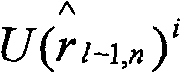
在本发明实施例中,对基本层的残差数据使用2抽头滤波器进行上采样滤波。滤波后所得的残差重建值为其中,U(·)为上采样滤波过程,
步骤S103,使用增强层的运动向量和模式,对丢失帧进行重建。Step S103, using the motion vector and mode of the enhancement layer to reconstruct the lost frame.
如果基本层对应位置的当前块以及邻域块是Inter编码块,则使用在增强层的当前块的运动向量和上下左右4个相邻块的运动向量,即

其中,


如果基本层对应位置的当前块或者邻域块是Intra编码块,则上述方法将不再适用,可按照下面的方式进行处理:If the current block or neighboring block at the corresponding position of the base layer is an Intra coded block, the above method will no longer apply, and it can be processed in the following manner:
如果基本层对应位置的当前块是Intra编码块,则解码重建值

如果基本层对应位置的某一邻域块是Intra编码块,也就是说该邻域块和当前块不是同一区域,有可能是运动突变的部分,因此,将解码重建公式中相应邻域的运动向量用当前运动向量块
在本发明实施例中,加权系数可为固定的,也可为自适应调节加权系数。固定的加权系数可由H.263标准提供,如图3所示,为本发明实施例的加权矩阵的示意图。自适应调节加权系数可使用以前已经解码的数据训练得到,核心思想是使得期望最小化,其中,


下面通过将本发明实施例的算法和原解码算法集成到SVC的参考软件JSVM(Joint Scalable Video Model,联合可伸缩性视频编码模型)中,在一定实验环境下进行模拟仿真。通过比较仿真结果,本发明上述的和/或附加的方面和优点将变得更加明显和容易理解。Next, by integrating the algorithm of the embodiment of the present invention and the original decoding algorithm into the reference software JSVM (Joint Scalable Video Model, Joint Scalable Video Model) of SVC, the simulation is carried out in a certain experimental environment. The above and/or additional aspects and advantages of the present invention will become more apparent and understandable by comparing the simulation results.
在本发明实施例中,采用的实验环境为:序列为Bus、Foreman和Mobile;基本层为QCIF@30Hz、增强层为CIF@30Hz;基本层的量化参数(Quantization Parameter,QP)为QP0=32、增强层的量化参数为QP1=20、24、28、32;图像组结构为IPPP;Intra帧周期为30;编解码4000帧;基本层完全正确接收、增强层的丢包率(Packet Lost Rate,PLR)分别为3%、5%、10%、20%;丢包文件由国际标准组织ITU-T的技术提案——VCEG-Q15-I-16r1给出,一帧为一个包。In the embodiment of the present invention, the experimental environment adopted is: the sequence is Bus, Foreman and Mobile; the base layer is QCIF@30Hz, and the enhancement layer is CIF@30Hz; the quantization parameter (Quantization Parameter, QP) of the base layer is QP0=32 1. The quantization parameters of the enhancement layer are QP1=20, 24, 28, 32; the group of pictures structure is IPPP; the Intra frame period is 30; the codec is 4000 frames; , PLR) are 3%, 5%, 10%, and 20% respectively; the packet loss file is given by the technical proposal of the International Standard Organization ITU-T—VCEG-Q15-I-16r1, and one frame is one packet.
如图4~6所示,分别为对应于Bus、Foreman和Mobile序列,本发明实施例的方法相对于原方法的峰值信噪比增益结果的示意图。从图中可看出,对应于各种序列,本发明实施例的方法相对于原方法均有一定的提高。在一定的增量层量化参数QP1和丢包率PLR1下,增益最高可达0.5dB。从图中还可看出,在增量层量化参数相同的情况下,丢包率越高,则峰值信噪比增益越大,这说明本发明实施例的方法在高丢包率环境下具有较好的恢复功能。而在丢包率相同的情况下,增量层量化参数越小,则峰值信噪比增益越大。As shown in FIGS. 4 to 6 , they are respectively corresponding to Bus, Foreman and Mobile sequences, schematic diagrams of the peak signal-to-noise ratio gain results of the method of the embodiment of the present invention relative to the original method. It can be seen from the figure that corresponding to various sequences, the method of the embodiment of the present invention has a certain improvement compared with the original method. Under a certain incremental layer quantization parameter QP1 and packet loss rate PLR1, the gain can reach up to 0.5dB. It can also be seen from the figure that when the quantization parameters of the incremental layer are the same, the higher the packet loss rate, the greater the peak signal-to-noise ratio gain. Better recovery function. In the case of the same packet loss rate, the smaller the quantization parameter of the incremental layer is, the larger the peak signal-to-noise ratio gain will be.
如图7~9所示,为增强层量化参数QP1=32和丢包率PLR1=20%时,分别对应于Bus、Foreman和Mobile序列,本发明实施例的方法相对于原方法每帧的峰值信噪比结果的示意图。从图中可看出,对于每帧,本发明实施例的方法均比原方法有一定的提高,部分帧提高接近1dB。As shown in Figures 7 to 9, when the enhancement layer quantization parameter QP1=32 and packet loss rate PLR1=20%, corresponding to Bus, Foreman and Mobile sequences respectively, the method of the embodiment of the present invention is relative to the peak value of each frame of the original method Schematic representation of the signal-to-noise ratio results. It can be seen from the figure that, for each frame, the method of the embodiment of the present invention has a certain improvement over the original method, and the improvement of some frames is close to 1dB.
本发明通过在使用基本层的运动向量之前根据增强层和基本层的空间分辨率比率判断是否进行尺度放大,在找出若干补偿块进行OBMC加权之后,对基本层的残差数据采取可能的上采样滤波,加到OBMC方法的重建值上,避免了使用单一运动向量做运动补偿所带来的块效应问题。The present invention judges whether to scale up according to the spatial resolution ratio of the enhancement layer and the base layer before using the motion vector of the base layer. Sampling filtering, added to the reconstruction value of the OBMC method, avoids the block effect problem caused by using a single motion vector for motion compensation.
尽管已经示出和描述了本发明的实施例,对于本领域的普通技术人员而言,可以理解在不脱离本发明的原理和精神的情况下可以对这些实施例进行多种变化、修改、替换和变型,本发明的范围由所附权利要求及其等同限定。Although the embodiments of the present invention have been shown and described, those skilled in the art can understand that various changes, modifications and substitutions can be made to these embodiments without departing from the principle and spirit of the present invention. and modifications, the scope of the invention is defined by the appended claims and their equivalents.
Claims (4)


Priority Applications (1)
| Application Number | Priority Date | Filing Date | Title |
|---|---|---|---|
| CN 200910150017 CN101583045B (en) | 2009-06-18 | 2009-06-18 | OBMC-based error concealment method between SVC layers |
Applications Claiming Priority (1)
| Application Number | Priority Date | Filing Date | Title |
|---|---|---|---|
| CN 200910150017 CN101583045B (en) | 2009-06-18 | 2009-06-18 | OBMC-based error concealment method between SVC layers |
Publications (2)
| Publication Number | Publication Date |
|---|---|
| CN101583045A CN101583045A (en) | 2009-11-18 |
| CN101583045B true CN101583045B (en) | 2011-01-19 |
Family
ID=41364957
Family Applications (1)
| Application Number | Title | Priority Date | Filing Date |
|---|---|---|---|
| CN 200910150017 Expired - Fee Related CN101583045B (en) | 2009-06-18 | 2009-06-18 | OBMC-based error concealment method between SVC layers |
Country Status (1)
| Country | Link |
|---|---|
| CN (1) | CN101583045B (en) |
Families Citing this family (3)
| Publication number | Priority date | Publication date | Assignee | Title |
|---|---|---|---|---|
| FR2982447A1 (en) | 2011-11-07 | 2013-05-10 | France Telecom | METHOD FOR ENCODING AND DECODING IMAGES, CORRESPONDING ENCODING AND DECODING DEVICE AND COMPUTER PROGRAMS |
| FR2982446A1 (en) * | 2011-11-07 | 2013-05-10 | France Telecom | METHOD FOR ENCODING AND DECODING IMAGES, CORRESPONDING ENCODING AND DECODING DEVICE AND COMPUTER PROGRAMS |
| CN103702128B (en) * | 2013-12-24 | 2016-11-16 | 浙江工商大学 | An Interpolation Frame Generation Method Applied to Video Frame Rate Up-conversion |
-
2009
- 2009-06-18 CN CN 200910150017 patent/CN101583045B/en not_active Expired - Fee Related
Also Published As
| Publication number | Publication date |
|---|---|
| CN101583045A (en) | 2009-11-18 |
Similar Documents
| Publication | Publication Date | Title |
|---|---|---|
| KR100888963B1 (en) | Method for scalably encoding and decoding video signal | |
| JP4999340B2 (en) | Moving picture encoding apparatus, moving picture decoding apparatus, moving picture encoding method, and moving picture decoding method | |
| CN101366283B (en) | Video coding with fine granularity spatial scalability | |
| KR100888962B1 (en) | Method for encoding and decoding video signal | |
| KR101003435B1 (en) | How to decode video blocks | |
| CN101312529B (en) | Method, system and device for generating up-down sampling filter and implementing coding | |
| CN102595135B (en) | Method and device for scalable video coding | |
| KR100913088B1 (en) | Method and apparatus for encoding/decoding video signal using prediction information of intra-mode macro blocks of base layer | |
| CN110493596B (en) | Video coding system and method based on neural network | |
| KR100763194B1 (en) | Intra base prediction method satisfying single loop decoding condition, video coding method and apparatus using the prediction method | |
| KR100703788B1 (en) | Multi-layered Video Encoding Method Using Smooth Prediction, Decoding Method, Video Encoder and Video Decoder | |
| KR20060043115A (en) | Method and apparatus for encoding / decoding video signal using base layer | |
| CN102217314A (en) | Method and device for video image deletion | |
| US20130195169A1 (en) | Techniques for multiview video coding | |
| JP2014523695A (en) | Scalable video coding techniques | |
| KR20060063613A (en) | Scalable encoding and decoding method of video signal | |
| CN101583045B (en) | OBMC-based error concealment method between SVC layers | |
| KR20150092089A (en) | Video encoding and decoding method and device using said method | |
| CN101860759B (en) | Encoding method and encoding device | |
| CN114051137B (en) | Spatial scalable video coding method and decoding method | |
| KR20150056679A (en) | Apparatus and method for construction of inter-layer reference picture in multi-layer video coding | |
| CN1202673C (en) | Enhanced type fineness extensible video coding structure | |
| KR100938553B1 (en) | Boundary processing method and device using neighboring block information in scalable video encoder / decoder | |
| KR20060101847A (en) | Scalable encoding and decoding method of video signal | |
| KR20140127405A (en) | Method for encoding and decoding image, and apparatus thereof |
Legal Events
| Date | Code | Title | Description |
|---|---|---|---|
| C06 | Publication | ||
| PB01 | Publication | ||
| C10 | Entry into substantive examination | ||
| SE01 | Entry into force of request for substantive examination | ||
| C14 | Grant of patent or utility model | ||
| GR01 | Patent grant | ||
| CF01 | Termination of patent right due to non-payment of annual fee | ||
| CF01 | Termination of patent right due to non-payment of annual fee |
Granted publication date: 20110119 Termination date: 20160618 |