CN101572607B - Method for processing authentication request message in social network and device thereof - Google Patents
Method for processing authentication request message in social network and device thereof Download PDFInfo
- Publication number
- CN101572607B CN101572607B CN2009101472526A CN200910147252A CN101572607B CN 101572607 B CN101572607 B CN 101572607B CN 2009101472526 A CN2009101472526 A CN 2009101472526A CN 200910147252 A CN200910147252 A CN 200910147252A CN 101572607 B CN101572607 B CN 101572607B
- Authority
- CN
- China
- Prior art keywords
- client
- social
- attribute information
- identification information
- information
- Prior art date
- Legal status (The legal status is an assumption and is not a legal conclusion. Google has not performed a legal analysis and makes no representation as to the accuracy of the status listed.)
- Expired - Fee Related
Links
Images


Classifications
-
- H—ELECTRICITY
- H04—ELECTRIC COMMUNICATION TECHNIQUE
- H04L—TRANSMISSION OF DIGITAL INFORMATION, e.g. TELEGRAPHIC COMMUNICATION
- H04L63/00—Network architectures or network communication protocols for network security
- H04L63/08—Network architectures or network communication protocols for network security for authentication of entities
-
- G—PHYSICS
- G06—COMPUTING OR CALCULATING; COUNTING
- G06Q—INFORMATION AND COMMUNICATION TECHNOLOGY [ICT] SPECIALLY ADAPTED FOR ADMINISTRATIVE, COMMERCIAL, FINANCIAL, MANAGERIAL OR SUPERVISORY PURPOSES; SYSTEMS OR METHODS SPECIALLY ADAPTED FOR ADMINISTRATIVE, COMMERCIAL, FINANCIAL, MANAGERIAL OR SUPERVISORY PURPOSES, NOT OTHERWISE PROVIDED FOR
- G06Q10/00—Administration; Management
- G06Q10/10—Office automation; Time management
-
- G06Q10/40—
-
- H—ELECTRICITY
- H04—ELECTRIC COMMUNICATION TECHNIQUE
- H04L—TRANSMISSION OF DIGITAL INFORMATION, e.g. TELEGRAPHIC COMMUNICATION
- H04L51/00—User-to-user messaging in packet-switching networks, transmitted according to store-and-forward or real-time protocols, e.g. e-mail
- H04L51/52—User-to-user messaging in packet-switching networks, transmitted according to store-and-forward or real-time protocols, e.g. e-mail for supporting social networking services
-
- H—ELECTRICITY
- H04—ELECTRIC COMMUNICATION TECHNIQUE
- H04L—TRANSMISSION OF DIGITAL INFORMATION, e.g. TELEGRAPHIC COMMUNICATION
- H04L63/00—Network architectures or network communication protocols for network security
- H04L63/10—Network architectures or network communication protocols for network security for controlling access to devices or network resources
-
- H—ELECTRICITY
- H04—ELECTRIC COMMUNICATION TECHNIQUE
- H04L—TRANSMISSION OF DIGITAL INFORMATION, e.g. TELEGRAPHIC COMMUNICATION
- H04L67/00—Network arrangements or protocols for supporting network services or applications
- H04L67/2866—Architectures; Arrangements
- H04L67/30—Profiles
- H04L67/306—User profiles
Landscapes
- Engineering & Computer Science (AREA)
- Business, Economics & Management (AREA)
- Computing Systems (AREA)
- Computer Networks & Wireless Communication (AREA)
- Signal Processing (AREA)
- Strategic Management (AREA)
- Human Resources & Organizations (AREA)
- Entrepreneurship & Innovation (AREA)
- Computer Hardware Design (AREA)
- Computer Security & Cryptography (AREA)
- General Engineering & Computer Science (AREA)
- Economics (AREA)
- General Business, Economics & Management (AREA)
- Marketing (AREA)
- Theoretical Computer Science (AREA)
- General Physics & Mathematics (AREA)
- Tourism & Hospitality (AREA)
- Physics & Mathematics (AREA)
- Quality & Reliability (AREA)
- Data Mining & Analysis (AREA)
- Operations Research (AREA)
- Information Transfer Between Computers (AREA)
- Health & Medical Sciences (AREA)
- General Health & Medical Sciences (AREA)
- Primary Health Care (AREA)
Abstract
本申请公开了一种社会化网络中处理认证请求消息的方法及装置,为了解决用户验证与其建立社会化关系的请求时,效率低下且所依据的参数信息较少的问题,本申请公开的方法包括:社会化网络服务器获知第一客户端向第二客户端发送与第二客户端建立社会化关系的认证请求消息后,获取第一客户端和第二客户端共同的社会化属性信息;社会化网络服务器向第二客户端转发认证请求消息,并发送获取的社会化属性信息,所述社会化属性信息用于第二客户端对所述认证请求消息进行认证处理。
This application discloses a method and device for processing authentication request messages in a social network. In order to solve the problem of inefficiency and less parameter information on which a user verifies a request to establish a social relationship with the user, the method disclosed in this application Including: after the social network server learns that the first client sends an authentication request message to the second client to establish a social relationship with the second client, it obtains the common social attribute information of the first client and the second client; The network server forwards the authentication request message to the second client, and sends the acquired social attribute information, where the social attribute information is used by the second client to perform authentication processing on the authentication request message.
Description
技术领域 technical field
本申请属于互联网技术领域,特别涉及一种社会化网络中处理认证请求消息的方法及装置。The present application belongs to the technical field of the Internet, and in particular relates to a method and device for processing authentication request messages in a social network.
背景技术 Background technique
现有的互联网中,在线网民形成的社会化网络不再仅仅是单个用户与单个用户的关系,而是单对多以及多对多的关系。社会化网络包含了在线用户及其关系网络,如即时通信服务(IM)系统和基于WEB2.0的互联网SNS(社会化网络服务social network service)社区,以IM工具为例,不同的用户通过IM客户端实现信息交互进行沟通,在彼此进行沟通前,一般IM软件都要求用户之间在沟通开始前先建立一定的双向社会化网络关系,以加速沟通对象的定位,并防止不必要的用户发送无用信息和不必要的骚扰。在目前的IM软件技术中,如果用户甲向不在其社会化关系列表中的用户乙发起沟通,即用户甲请求与用户乙建立一定的社会化关系,用户甲一般需要向用户乙发送一个认证请求消息,申请成为与用户乙具有一定社会化关系的用户。只有在用户乙验证通过了甲的请求后,用户甲才可以在其社会化关系列表中找到乙,并发起沟通和聊天。In the existing Internet, the social network formed by online netizens is no longer just a relationship between a single user and a single user, but a one-to-many and many-to-many relationship. Social networks include online users and their relationship networks, such as instant messaging service (IM) systems and Internet SNS (social network service) communities based on WEB2.0. Taking IM tools as an example, different users use IM The client realizes information interaction for communication. Before communicating with each other, general IM software requires users to establish a certain two-way social network relationship before the communication starts, so as to speed up the positioning of communication objects and prevent unnecessary users from sending messages. Useless information and unnecessary harassment. In the current IM software technology, if user A initiates communication with user B who is not in its social relationship list, that is, user A requests to establish a certain social relationship with user B, user A generally needs to send an authentication request to user B message, and apply to become a user who has a certain social relationship with user B. Only after user B has passed the verification of A's request, can user A find B in his social relationship list and initiate communication and chat.
用户甲在申请与用户乙成为具有一定社会化关系的用户时,用户乙只能通过用户甲手工输入的认证请求消息获知用户甲的身份信息或其他信息,来判断是否和用户甲建立社会化关系,可见现有技术中的认证请求消息完全依赖用户甲的手工输入,系统无法自动获取用户甲的身份信息及用户甲与用户乙之间的社会化关系信息,使得一方面降低了用户甲乙之间建立社会化关系的效率,另一方面,无法为用户乙验证用户甲的认证请求消息提供足够的参数信息。When user A applies to become a user with a certain social relationship with user B, user B can only know user A's identity information or other information through the authentication request message manually input by user A to determine whether to establish a social relationship with user A , it can be seen that the authentication request message in the prior art completely depends on the manual input of user A, and the system cannot automatically obtain the identity information of user A and the social relationship information between user A and user B, which reduces the relationship between user A and B on the one hand. The efficiency of establishing social relationships, on the other hand, cannot provide sufficient parameter information for user B to verify user A's authentication request message.
发明内容 Contents of the invention
为了解决现有技术中用户验证与其建立社会化关系的请求时效率低以及所依据的参数信息较少的问题,本申请实施例提供了一种社会化网络中处理认证请求消息的方法,包括:In order to solve the problem in the prior art that the user verifies the request to establish a social relationship with it inefficiently and based on less parameter information, an embodiment of the present application provides a method for processing an authentication request message in a social network, including:
社会化网络服务器获知第一客户端向第二客户端发送与第二客户端建立社会化关系的认证请求消息后,获取第一客户端和第二客户端共同的社会化属性信息,社会化属性信息用于表示社会化网络用户在社会化网络中所具有的属性;After the social network server learns that the first client sends an authentication request message to the second client to establish a social relationship with the second client, it obtains social attribute information shared by the first client and the second client, and the social attribute The information is used to represent the attributes of social network users in the social network;
社会化网络服务器向第二客户端转发认证请求消息,并发送获取的社会化属性信息,所述社会化属性信息用于第二客户端对所述认证请求消息进行认证处理,其中,若获取的第一客户端和第二客户端共同的社会化属性信息个数大于设定阈值,则自动建立第一客户端与第二客户端的社会化关系。The social network server forwards the authentication request message to the second client, and sends the acquired social attribute information, where the social attribute information is used by the second client to perform authentication processing on the authentication request message, wherein, if the acquired If the number of social attribute information shared by the first client and the second client is greater than the set threshold, then the social relationship between the first client and the second client is automatically established.
同时本申请实施例还提供一种社会化网络中处理认证请求消息的装置,包括:At the same time, the embodiment of the present application also provides an apparatus for processing authentication request messages in a social network, including:
获取模块:用于获知第一客户端向第二客户端发送与第二客户端建立社会化关系的认证请求消息后,获取第一客户端和第二客户端共同的社会化属性信息,社会化属性信息用于表示社会化网络用户在社会化网络中所具有的属性;Obtaining module: used to obtain the common social attribute information of the first client and the second client after the first client sends the authentication request message to the second client to establish a social relationship with the second client, and socialize The attribute information is used to represent the attributes of the social network user in the social network;
发送模块:用于向第二客户端转发认证请求消息,并发送获取的社会化属性信息,所述社会化属性信息用于第二客户端对所述认证请求消息进行认证处理,其中,若获取的第一客户端和第二客户端共同的社会化属性信息个数大于设定阈值,则自动建立第一客户端与第二客户端的社会化关系。Sending module: used to forward the authentication request message to the second client, and send the obtained social attribute information, the social attribute information is used for the second client to perform authentication processing on the authentication request message, wherein, if the obtained If the number of social attribute information shared by the first client and the second client is greater than the set threshold, the social relationship between the first client and the second client is automatically established.
由上述本申请提供的具体实施方案可以看出,社会化网络服务器在获知第一客户端向第二客户端发送与第二客户端建立社会化关系的认证请求消息后,自动获取第一客户端和第二客户端共同的社会化属性信息,并展示给第二客户端。增加了第二客户端验证第一客户端的认证请求消息时所依据的参数信息,并提高了第一客户端和第二客户端之间建立社会化网络关系的效率。It can be seen from the specific implementation scheme provided by the above-mentioned application that the social network server automatically obtains the authentication request message of the first client to establish a social relationship with the second client after learning that the first client sends an authentication request message to the second client. Shared social attribute information with the second client and displayed to the second client. The parameter information on which the second client verifies the authentication request message of the first client is added, and the efficiency of establishing a social network relationship between the first client and the second client is improved.
附图说明 Description of drawings
图1为本申请提供的第一实施例网络拓扑图;Fig. 1 is the network topology diagram of the first embodiment provided by the present application;
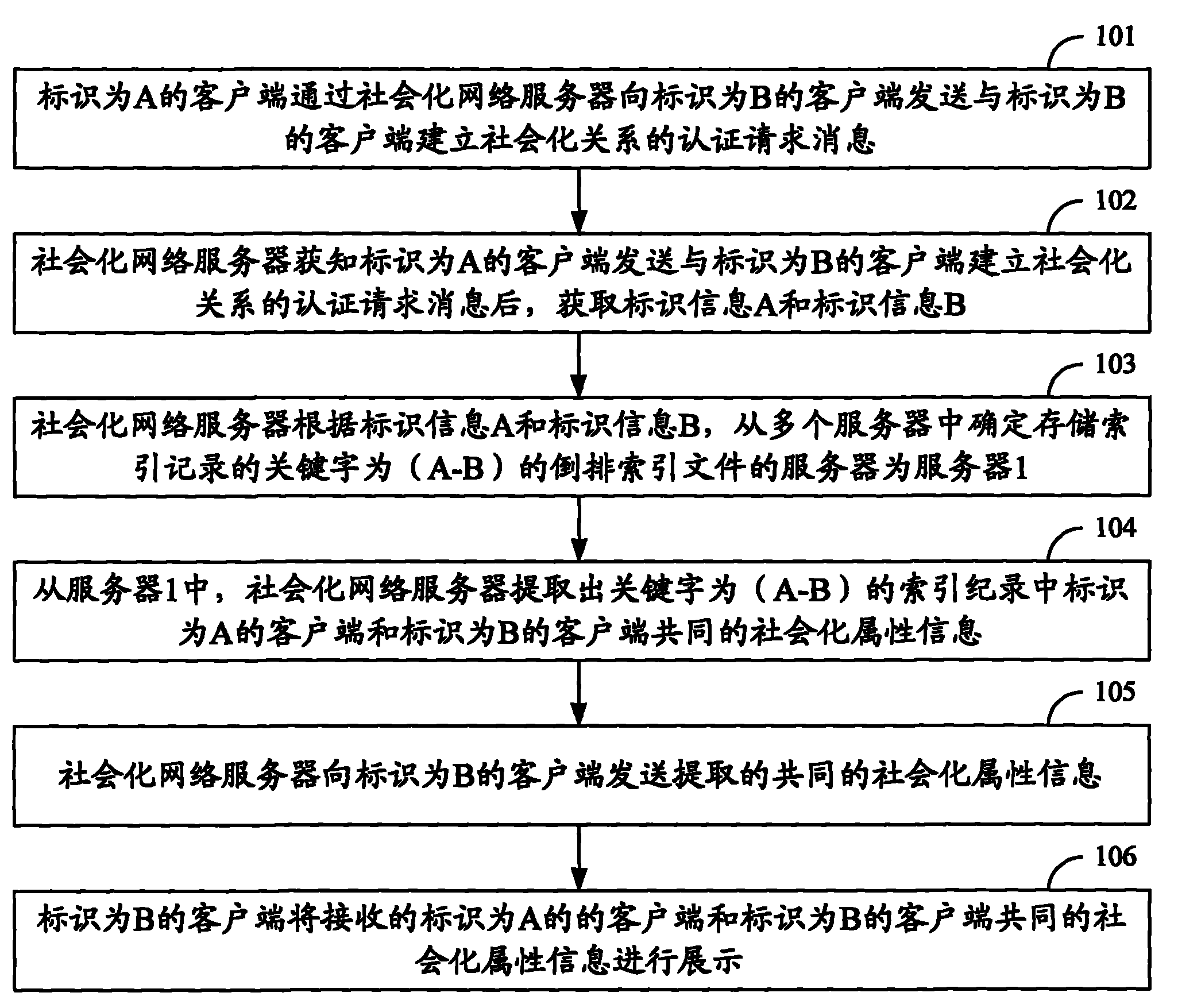
图2为本申请提供的第一实施例方法流程图;Fig. 2 is the flow chart of the method of the first embodiment provided by the present application;
图3为本申请提供的社会化网络关系链示意图;FIG. 3 is a schematic diagram of a social network relationship chain provided by this application;
图4为本申请提供的第二实施例方法流程图;Fig. 4 is the flow chart of the method of the second embodiment provided by the present application;
图5为本申请提供的第三实施例装置结构图。FIG. 5 is a structural diagram of a device according to a third embodiment of the present application.
具体实施方式 Detailed ways
本申请提供的第一实施例是一种社会化网络中处理认证请求消息的方法,在如图1所示的网络拓扑中实施,该网络包括:社会化网络服务器,和多个客户端,方法流程如图2所示,包括:The first embodiment provided by this application is a method for processing an authentication request message in a social network, implemented in the network topology shown in Figure 1, the network includes: a social network server, and multiple clients, the method The process is shown in Figure 2, including:
步骤101:标识为A的客户端通过社会化网络服务器向标识为B的客户端发送与标识为B的客户端建立社会化关系的认证请求消息。Step 101: The client identified as A sends an authentication request message for establishing a social relationship with the client identified as B to the client identified as B through the social network server.
步骤102:社会化网络服务器获知标识为A的客户端发送的请求与标识为B的客户端建立社会化关系的认证请求消息后,获取标识信息A和标识信息B。Step 102: After learning the authentication request message sent by the client identified as A requesting to establish a social relationship with the client identified as B, the social network server acquires identification information A and identification information B.
步骤103:社会化网络服务器根据标识信息A和标识信息B,从多个或1个服务器中确定存储索引记录的关键字为(A-B)或为“AB”以及“(AB)”等的倒排索引文件的服务器为服务器1。Step 103: According to the identification information A and the identification information B, the social network server determines from multiple or one server that the keywords of the stored index records are (A-B) or the inversion of "AB" and "(AB)", etc. The server of the index file is Server 1.
步骤104:从服务器1中,社会化网络服务器提取出关键字为(A-B)的索引记录,并从中提取标识为A的的客户端和标识为B的客户端共同的社会化属性信息,或者从中提取标识为A的客户端和标识为B的客户端之间的关系链信息。Step 104: From the server 1, the social network server extracts the index record whose keyword is (A-B), and extracts the common social attribute information of the client identified as A and the client identified as B, or from it The relationship chain information between the client identified as A and the client identified as B is extracted.
步骤105:社会化网络服务器向标识为B的客户端发送提取的共同的社会化属性信息,或发送提取的共同的关系链信息。Step 105: The social network server sends the extracted common social attribute information or the extracted common relationship chain information to the client identified as B.
步骤106:标识为B的客户端将接收的标识为A的客户端和标识为B的客户端共同的社会化属性信息或提取的共同的关系链信息进行展示。Step 106: The client identified as B presents the received common social attribute information or extracted common relationship chain information of the client identified as A and the client identified as B.
其中步骤101中,标识为B的客户端本地存储有1个或多个社会化关系列表,如社会化关系列表1中有5个客户端标识和对应的社会化关系类别,表示标识为C、D、E、F、G的客户端与标识为B的客户端的社会化关系类别为1。社会化关系列表2中有3个客户端标识和对应的社会化关系类别,社会化关系类别为2。表1用于保存社会化关系类别为1的客户端标识,表2保存社会化关系类别为2的客户端标识。Wherein in
表1Table 1
表2Table 2
标识为A的客户端通过社会化网络服务器向标识为B的客户端发送加入表1的认证请求消息,客户端A发送的认证请求消息中携带客户端A的标识信息A。The client identified as A sends an authentication request message added to Table 1 to the client identified as B through the social network server, and the authentication request message sent by client A carries the identification information A of client A.
社会化网络服务器可以安装于社会化网络中的任意一台服务器,比如可以是社会化网络中的服务器1、服务器2或服务器3。The social network server can be installed on any server in the social network, such as server 1, server 2 or server 3 in the social network.
其中步骤102中,社会化网络服务器收到标识为A的客户端发送的认证请求消息后,对认证请求消息进行分析,从认证请求消息中提取出标识信息A和标识信息B。进一步,社会化网络服务器确定与客户端A和客户端B具有直接社会化网络关系的客户端有客户端C和客户端D,社会化网络服务器收到客户端A发送的认证请求消息后,对认证请求消息进行分析,从认证请求消息中提取出接收客户端的标识信息B,在社会化网络服务器的数据库中存储有与表1内容相同的表1’,根据存储于社会化网络服务器中与表1相同的表1’,确定与客户端B具有直接社会化网络关系的客户端有客户端C和客户端D。在本步骤中,社会化网络服务器可以通过查询得到与客户端B具有直接社会化网络关系的客户端有客户端包括C和客户端D,社会化网络服务器收到客户端A发送的认证请求消息后,对认证请求消息进行分析,从认证请求消息中提取出发送客户端的标识信息A,并根据与客户端B类似的方法,确定与客户端A具有直接社会化网络关系的客户端也包括有客户端C和客户端D,作为优选方案客户端C和客户端D,与客户端A有直接社会化网络关系,同时客户端D和客户端C,与客户端B也有直接社会化网络关系。当然也可以是客户端D和客户端C,与客户端B有直接社会化网络关系,同时客户端D和客户端C,与客户端A具有社会化网络关系,但不是直接社会化网络关系。根据预定规则从客户端C、客户端D中选取出客户端C,并获取客户端C的标识信息C。预定规则可以是社会化网络服务器自动计算客户端A和客户端B之间的熟悉度之和最高的一条社会化网络关系链,如客户端A->客户端C->客户端B的熟悉度为Y1+X1;另外一条社会化网络关系链客户端A->客户端D>客户端B的熟悉度为:Y2+X2.若Y1+X1>Y2+X2那么,从客户端D、客户端C中选取出客户端C,并获取客户端C的标识信息C。否则选取出客户端D,本实施例中采用选取出客户端C作为优选方案。本步骤中是通过熟悉度选取出客户端D或客户端C,当然也可以不依据于熟悉度,从客户端D和客户端C之中任选其一。或者社会化网络服务器根据客户端D社会化网络关系列表和客户端C的社会化网络关系列表中客户端标识的数量,从客户端D和客户端C之中选择其一,例如客户端C的社会化网络关系列表中客户端标识的数量为10个,客户端D的社会化网络关系列表中客户端标识的数量为100个,由于客户端C的社会化网络关系列表中的客户端标识数量少于客户端D,说明客户端C可能更加慎重的选择自己的社会化网络关系对象,因此,选择客户端C,当然也可以是客户端B占客户端C的社会化网络关系列表中客户端的比例是1/10,客户端B占客户端D的社会化网络关系列表中客户端的比例是1/100,则选择客户端C。当然也可以通过设定一个阈值,如1/20,由于客户端B占客户端C的社会化网络关系列表中客户端的比例是1/10,大于阈值1/20,而客户端B占客户端D的社会化网络关系列表中客户端的比例是1/100,小于阈值1/20,因此,选择客户端C。In
或者社会化网络服务器自动选择客户端C和客户端D中,与客户端B熟悉度最高的:如果X1>X2,那么社会化网络服务器就选择客户端C;否则选择客户端D。本实施例中采用选取出客户端C作为优选方案。Or the social network server automatically selects the one with the highest familiarity with client B among client C and client D: if X1>X2, then the social network server selects client C; otherwise, selects client D. In this embodiment, the client C is selected as the preferred solution.
当然除了采用采用预定规则选取出客户端C外,还可以采用,社会化网络服务器将客户端D、客户端C的标识D和C发送到客户端A,若客户端A选择C则社会化网络服务器根据客户端A的选择选取出客户端C,否则,若客户端A选择D则社会化网络服务器根据客户端A的选择选取出客户端D。Of course, in addition to using predetermined rules to select client C, it can also be used. The social network server sends client D, the identity D and C of client C to client A. If client A chooses C, the social network The server selects the client C according to the selection of the client A, otherwise, if the client A selects D, the social network server selects the client D according to the selection of the client A.
熟悉度可以通过如下的方式获得,假设两个客户端之间具有社会化网络关系的时间(如30天)为N,单位时间(如1天)对应的熟悉度值为M,那么熟悉度的时间权重值为N×M;并假设两个客户端之间在单位时间内进行一次信息交互对应的熟悉度值为P,那么单位时间内两个客户端进行信息交互对应的熟悉度值最大为Pmax,Pmax<P*Y(Y为两个客户端之间在单位时间内进行信息交互的最大次数,如假设单位时间为1天,进行了90次信息交互,那么Pmax=90P),这样就可以计算出两个客户端之间之间的熟悉度了,为:X1=N1*M1+Min(Y*P,Pmax)。Familiarity can be obtained in the following way. Assuming that the time (such as 30 days) between two clients with social network relationship is N, and the familiarity value corresponding to unit time (such as 1 day) is M, then the familiarity The time weight value is N×M; and assuming that the familiarity value corresponding to an information exchange between two clients within a unit time is P, then the maximum familiarity value corresponding to an information exchange between two clients per unit time is Pmax, Pmax<P*Y (Y is the maximum number of information interactions between two clients per unit time, if the unit time is 1 day, and 90 information interactions have been carried out, then Pmax=90P), so The familiarity between two clients can be calculated as: X1=N1*M1+Min(Y*P, Pmax).
其中步骤103中,由于社会化网络中的用户众多数量在百万级别,因此本实施例中采用分布式服务器预先存储倒排索引文件(Inverted index),当然预先存储倒排索引文件只是一个优选方案,在本实施例不限定倒排索引文件建立的时间,也可以是提取了标识信息A和B后再建立倒排索引文件,倒排索引也常被称为反向索引、置入档案或反向档案,是一种索引方法,一般被用来存储在全文搜索下某个单词(作为索引的关键字Key)在一个文档或者一组文档中的存储位置(索引的字段值VALUE)的映射。本实施例中仅以图3中的社会化网络为例进行说明,倒排索引文件中以相互绑定的标识信息A和标识信息B(采用(A-B)表示相互绑定的标识信息A和标识信息B)作为索引的Key,如Key为(A-B),以标识为A的客户端和标识为B的客户端共同的社会化属性信息作为索引的VALUE,其中社会化属性信息表示与一个客户端绑定的社会化网络用户在社会化网络中所具有的属性,这些社会化属性信息可以是用户在加入社会化网络时注册的,如注册时填写的所在地为:杭州,公司为甲公司,还可以是在社会化网络中的进行活动时产生的信息:属于某个魔兽世界群。这些社会化属性信息可以从如用户日志中获得,或者通过从用于存储用户注册信息的数据库中获得,之后从不同用户的社会化属性信息中提取出共同的社会化属性信息。如索引的VALUE为{“所在地”=>“杭州”,“公司”=>“甲公司”,“姓别”=>”男”,“行业”=>”五金电子”,“游戏名称”=>”魔兽世界”},服务器1中存储的倒排索引文件如表3所示。Wherein in
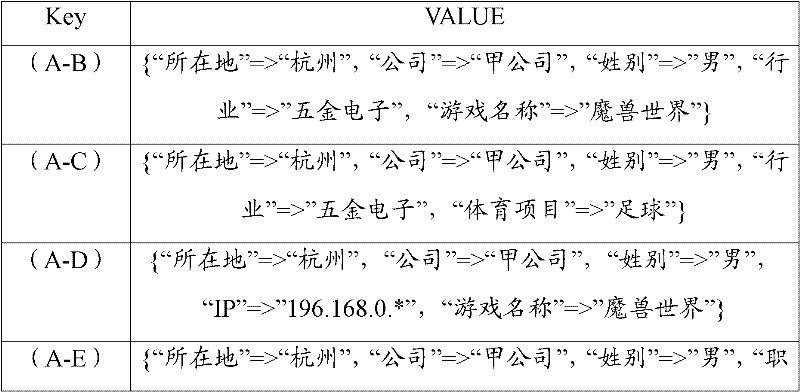

表3table 3
社会化网络服务器根据从认证请求消息中提取出标识信息A和标识信息B,得到(A-B),从存储倒排索引文件的服务器1、服务器2、服务器3中确定存储索引记录的关键字为(A-B)的倒排索引文件的服务器为服务器1。The social networking server obtains (A-B) according to extracting the identification information A and the identification information B from the authentication request message, and determines that the keyword for storing the index record is ( The server of the inverted index file of A-B) is server 1.
其中步骤104中,社会化网络服务器从表3中提取出关键字为(A-B)的索引记录,并从中提取对应的VALUE(标识为A的客户端和标识为B的客户端共同的社会化属性信息){“所在地”=>“杭州”,“公司”=>“甲公司”,“姓别”=>”男”,“行业”=>”五金电子”,“游戏名称”=>”魔兽世界”}。Wherein in
社会化网络服务器提取出关键字为(A-B)的索引记录,从中提取标识为A的客户端和标识为B的客户端之间的关系链信息。以客户端A和客户端B之间的关系链信息作为索引的VALUE,关系链信息用于表示两客户端相互之间具有间接的社会化网络关系,如标识为A的客户端和标识为D的客户端具有一定的社会化关系,关系类型为2,客户端D和客户端B具有一定的社会化关系,关系类型为1,Key为(A-B)的索引的VALUE为{(A-D,关系类型2),(D-B,关系类型1)},有如客户端A和客户端C具有一定的社会化关系,关系类型为2,客户端C和客户端B具有一定的社会化关系,关系类型为1,Key为(A-B)的另一个索引的VALUE为{(A-C,关系类型2),(C-B,关系类型1)},服务器1中存储的倒排索引文件如表4所示。The social network server extracts the index records whose keywords are (A-B), and extracts the relationship chain information between the client identified as A and the client identified as B. The VALUE indexed by the relationship chain information between client A and client B. The relationship chain information is used to indicate that the two clients have an indirect social network relationship with each other, such as a client identified as A and a client identified as D The client has a certain social relationship, the relationship type is 2, client D and client B have a certain social relationship, the relationship type is 1, and the VALUE of the index whose Key is (A-B) is {(A-D, relationship type 2), (D-B, relationship type 1)}, for example, client A and client C have a certain social relationship, and the relationship type is 2, and client C and client B have a certain social relationship, and the relationship type is 1 , the VALUE of another index whose Key is (A-B) is {(A-C, relation type 2), (C-B, relation type 1)}, and the inverted index files stored in server 1 are shown in Table 4.
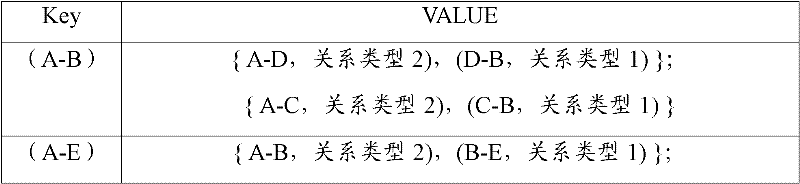
表4Table 4
其中步骤105中,社会化网络服务器将提取出的{“所在地”=>“杭州”,“公司”=>“甲公司”,“姓别”=>”男”,“行业”=>”五金电子”,“游戏名称”=>”魔兽世界”},发送给标识为B的客户端。通过{“所在地”=>“杭州”,“公司”=>“甲公司”,“姓别”=>”男”,“行业”=>”五金电子”,“游戏名称”=>”魔兽世界”}表示与标识为A的客户端绑定的用户和标识为B的客户端绑定的用户在社会化网络中所具有的共同的属性。Wherein in
同时,社会化网络服务器向标识为B的客户端转发认证请求消息,在认证请求消息中携带上述共同的社会化属性信息{“所在地”=>“杭州”,“公司”=>“甲公司”,“姓别”=>”男”,“行业”=>”五金电子”,“游戏名称”=>”魔兽世界”}。当然社会化网络服务器也可以分别向标识为B的客户端发送认证请求消息和上述共同的社会化属性信息,在认证请求消息和/或共同的社会化属性信息中携带说明彼此绑定的信息。这样标识为B的客户端就可以知道收到的共同的社会化属性信息对应哪个认证请求消息,并据此共同的社会化属性信息对认证请求消息进行认证处理。At the same time, the social network server forwards the authentication request message to the client identified as B, and the authentication request message carries the above-mentioned common social attribute information {"Location" => "Hangzhou", "Company" => "Company A" , "Sex" => "Male", "Industry" => "Hardware Electronics", "Game Name" => "World of Warcraft"}. Of course, the social network server may also send an authentication request message and the above-mentioned common social attribute information to the client identified as B, and carry information indicating mutual binding in the authentication request message and/or the common social attribute information. In this way, the client identified as B can know which authentication request message the received common social attribute information corresponds to, and perform authentication processing on the authentication request message according to the common social attribute information.
或者,社会化网络服务器将提取出的{A-D,关系类型2),(D-B,关系类型1)}或{A-C,关系类型2),(C-B,关系类型1)},发送给标识为B的客户端。通过{A-D,关系类型2),(D-B,关系类型1)}或{A-C,关系类型2),(C-B,关系类型1)}表示客户端A和客户端B之间的关系链信息。对于共同的关系链信息,社会化网络服务器向标识为B的客户端转发认证请求消息时,在认证请求消息中携带共同的关系链信息,当然社会化网络服务器也可以分别向标识为B的客户端发送认证请求消息和客户端A和客户端B之间的关系链信息,在认证请求消息和/或“客户端A和客户端B之间的关系链信息”中携带说明彼此绑定的信息。这样标识为B的客户端就可以知道收到的关系链信息对应哪个认证请求消息,并据此关系链信息对认证请求消息进行认证处理。Or, the social network server sends the extracted {A-D, relationship type 2), (D-B, relationship type 1)} or {A-C, relationship type 2), (C-B, relationship type 1)} to the identified as B client. The relationship chain information between client A and client B is represented by {A-D, relationship type 2), (D-B, relationship type 1)} or {A-C, relationship type 2), (C-B, relationship type 1)}. For the common relationship chain information, when the social network server forwards the authentication request message to the client identified as B, the authentication request message carries the common relationship chain information. The client sends an authentication request message and the relationship chain information between client A and client B, and carries information indicating mutual binding in the authentication request message and/or "relationship chain information between client A and client B" . In this way, the client identified as B can know which authentication request message the received relationship chain information corresponds to, and perform authentication processing on the authentication request message based on the relationship chain information.
进一步,若步骤103中,社会化网络服务器从与客户端A和客户端B具有直接社会化网络关系的客户端中,根据预定规则选取出客户端C,则社会化网络服务器将客户端A发送的认证请求消息中携带的标识信息A修改为标识信息C,社会化网络服务器收到客户端A发送的认证请求消息后,查找到该认证请求消息中的标识信息A并修改为标识信息C,修改后的认证请求消息包括:标识信息C和一些修改后的文字说明,标识信息C用于标识修改后的认证请求消息的发送客户端,修改后的文字说明可以是:“客户端A请求加入社会化关系列表1”。因此,修改后的认证请求消息为:发送客户端标识:C,文字内容“客户端A请求加入社会化关系列表1”。向客户端B发送修改标识信息后的认证请求消息。包括标识信息C和一些原客户端A发送的认证请求消息中包括的用于表示请求客户端B将客户端A加入社会化关系列表1的文字说明。如通过上述预定规则选择客户端C后,可以将修改标识信息后的认证请求消息先发送给客户端C,社会化网络服务器在收到客户端C响应的OK确认信息后,再向客户端B发送修改标识信息后的认证请求消息,否则不向客户端B发送修改标识信息后的认证请求消息。Further, if in
其中步骤106中,标识为B的客户端会以社会关系验证消息框的形式,接收标识为A的客户端发送的与其建立社会化关系的认证请求消息,并在该社会关系验证消息框中显示{“所在地”=>“杭州”,“公司”=>“甲公司”,“姓别”=>”男”,“行业”=>”五金电子”,“游戏名称”=>”魔兽世界”}。Wherein in
本申请提供的第二实施例是一种社会化网络中处理认证请求消息的方法,方法流程如图4所示,包括:The second embodiment provided by this application is a method for processing an authentication request message in a social network. The method flow is shown in FIG. 4 , including:
步骤201:标识为A的客户端通过社会化网络服务器向标识为B的客户端发送请求与标识为B的客户端建立社会化关系的认证请求消息。Step 201: The client identified as A sends an authentication request message requesting to establish a social relationship with the client identified as B to the client identified as B through the social network server.
步骤202:社会化网络服务器获知标识为A的客户端发送请求与标识为B的客户端建立社会化关系的认证请求消息后,获取标识为A的客户端的标识信息A和标识为B的客户端的标识信息B。Step 202: After learning that the client identified as A sends an authentication request message requesting to establish a social relationship with the client identified as B, the social network server obtains the identification information A of the client identified as A and the information of the client identified as B. Identification information B.
步骤203:社会化网络服务器根据标识信息A和标识信息B,从存储倒排索引文件的多个服务器中确定索引记录的关键字为A的服务器1和关键字为B的服务器2。当然如果倒排索引文件只是存储于1个服务器中,则无需本步骤,例如所有的索引记录都存储于社会化网络服务器1中,则无论关键字为A还是B的索引记录都直接从社会化网络服务器1中提取。Step 203: According to the identification information A and identification information B, the social network server determines the server 1 with the keyword A and the server 2 with the keyword B in the index record from the multiple servers storing the inverted index file. Of course, if the inverted index file is only stored in one server, this step is unnecessary. For example, all index records are stored in the social network server 1, and no matter the index records with keywords A or B are directly from the social network Extracted from web server 1.
步骤204:从服务器1中,社会化网络服务器提取出关键字为A的索引记录中标识为A的客户端的社会化属性信息,从服务器2中提取出标识为B的客户端的社会化属性信息。Step 204: From the server 1, the social network server extracts the social attribute information of the client identified as A in the index record with the keyword A, and extracts the social attribute information of the client identified as B from the server 2.
步骤205:从标识为A的客户端的社会化属性信息和标识为B的客户端的社会化属性信息中提取出共同的社会化属性信息。Step 205: Extract common social attribute information from the social attribute information of the client identified as A and the social attribute information of the client identified as B.
步骤206:社会化网络服务器向标识为B的客户端发送提取的共同的社会化属性信息。Step 206: The social network server sends the extracted common social attribute information to the client identified as B.
步骤207:标识为B的客户端将接收的标识为A的的客户端和标识为B的客户端共同的社会化属性信息进行展示。Step 207: The client identified as B displays the received social attribute information shared by the client identified as A and the client identified as B.
本实施例预存的倒排索引文件中,以各个标识信息作为索引的Key,以不同标识的客户端社会化属性信息作为对应的索引VALUE,如以标识信息A作为Key,以标识为A的客户端社会化属性信息作为对应的索引VALUE,以标识信息B作为Key,以标识为B的客户端的社会化属性信息作为对应的索引VALUE,标识信息A作为Key对应的索引的VALUE为{“所在地”=>“杭州”,“公司”=>“甲公司”,“姓别”=>”男”,“行业”=>”五金电子”,“游戏名称”=>”魔兽世界”,“体育项目”=>”足球”,职业”=>”销售”等},标识信息B作为Key对应的索引的VALUE为{“所在地”=>“杭州”,“公司”=>“甲公司”,“姓别”=>”男”,“行业”=>”五金电子”,“游戏名称”=>”魔兽世界”,“体育项目”=>”乒乓球球”,职业”=>”财务人员”等}。社会化网络服务器从上面的2个VALUE中找出共同的部分{“所在地”=>“杭州”,“公司”=>“甲公司”,“姓别”=>”男”,“行业”=>”五金电子”,“游戏名称”=>”魔兽世界”}。In the inverted index file pre-stored in this embodiment, each identification information is used as the key of the index, and the social attribute information of the client with different identifications is used as the corresponding index VALUE. For example, the identification information A is used as the key, and the customer identified as A Client social attribute information is used as the corresponding index VALUE, identification information B is used as the key, social attribute information of the client identified as B is used as the corresponding index VALUE, identification information A is used as the corresponding index VALUE is {"location" => "Hangzhou", "Company" => "Company A", "Sex" => "Male", "Industry" => "Hardware Electronics", "Game Name" => "World of Warcraft", "Sports "=>" football", occupation" => "sales", etc.}, the VALUE of the index corresponding to the identification information B as Key is {"Location" => "Hangzhou", "Company" => "Company A", "surname Other" => "Male", "Industry" => "Hardware Electronics", "Game Name" => "World of Warcraft", "Sports" => "Table Tennis", Occupation => "Financial Staff", etc. }. The social networking server finds the common part from the above 2 VALUEs {"location"=>"Hangzhou", "company"=>"Company A", "surname"=>"male", "industry"= > "Hardware Electronics", "Game Name" => "World of Warcraft"}.
当然步骤205后,还可以是由系统自动判断提取出共同的社会化属性信息的条数,如果条数为10条,正好超过设定的第一阈值9条,则系统会自动把用户A加入到用户B的社会化网络关系列表1中,如果条数为5条,正好超过设定的第二阈值4条,则系统会自动把用户A加入到用户B的社会化网络关系列表2中。Of course, after
本申请提供的第三实施例是一种社会化网络中处理认证请求消息的装置,其结构如图5所示,包括:The third embodiment provided by this application is an apparatus for processing an authentication request message in a social network, the structure of which is shown in Figure 5, including:
获取模块301:用于获知第一客户端向第二客户端发送与第二客户端建立社会化关系的认证请求消息后,获取第一客户端和第二客户端共同的社会化属性信息,社会化属性信息用于表示社会化网络用户在社会化网络中所具有的属性;Obtaining module 301: used to obtain the common social attribute information of the first client and the second client after the first client sends the authentication request message to the second client to establish a social relationship with the second client. The attribute information is used to indicate the attribute of the social network user in the social network;
发送模块302:用于向向第二客户端转发认证请求消息,并发送获取的社会化属性信息,所述社会化属性信息用于第二客户端对所述认证请求消息进行认证处理。Sending module 302: configured to forward the authentication request message to the second client, and send the acquired social attribute information, where the social attribute information is used by the second client to perform authentication processing on the authentication request message.
进一步,获取模块301:还用于根据第一客户端的标识信息,以及客户端标识信息和客户端社会化属性信息的对应关系,获取第一客户端的社会化属性信息,根据第二客户端的标识信息,以及客户端标识信息和客户端社会化属性信息的对应关系,获取第二客户端的社会化属性信息,从获取的第一客户端的社会化属性信息和第二客户端的社会化属性信息中选出第一客户端和第二客户端共同的社会化属性信息。Further, the acquisition module 301 is also configured to acquire the social attribute information of the first client according to the identification information of the first client and the corresponding relationship between the identification information of the client and the social attribute information of the client, and acquire the social attribute information of the first client according to the identification information of the second client. , and the corresponding relationship between the client identification information and the client social attribute information, obtain the social attribute information of the second client, and select from the acquired social attribute information of the first client and the social attribute information of the second client Social attribute information shared by the first client and the second client.
进一步,获取模块301:还用于查找倒排索引文件关键词,定位倒排索引文件中关键词为第一客户端的标识信息的索引记录和关键词为第二客户端的标识信息的索引记录,从定位的索引记录中获取第一客户端的社会化属性信息和第二客户端的社会化属性信息,所述倒排索引以客户端标识信息作为索引记录的关键字,以客户端社会化属性信息作为索引记录的字段值。Further, the acquisition module 301: is also used to search for keywords in the inverted index file, and locate the index record whose keyword is the identification information of the first client and the index record whose keyword is the identification information of the second client in the inverted index file, from Obtain the socialization attribute information of the first client and the socialization attribute information of the second client from the index record located, the inverted index uses the client identification information as the key of the index record, and uses the client's socialization attribute information as the index The record's field value.
进一步,获取模块301:还用于根据相互绑定的第一客户端的标识信息和第二客户端的标识信息,以及相互绑定的两个客户端标识信息和两个客户端共同的社会化属性信息的对应关系,确定第一客户端和第二客户端共同的社会化属性信息。Further, the acquisition module 301: is further configured to use the identification information of the first client and the identification information of the second client that are bound to each other, as well as the identification information of the two clients that are bound to each other and the social attribute information common to the two clients The corresponding relationship between the first client and the second client is determined to determine the common socialization attribute information.
进一步,获取模块301:还用于查找倒排索引文件关键词,定位倒排索引文件中关键词为相互绑定的第一客户端的标识信息和第二客户端的标识信息的索引记录,从定位的索引记录中获取第一客户端和第二客户端共同的社会化属性信息,所述倒排索引以相互绑定的两个客户端标识信息作为索引记录的关键字,以两个客户端共同的社会化属性信息作为索引记录的字段值。Further, the acquisition module 301: is also used to search for keywords in the inverted index file, and locate index records in which the keyword in the inverted index file is the identification information of the first client and the identification information of the second client that are bound to each other, from the located The social attribute information common to the first client and the second client is obtained from the index record, and the inverted index uses the identification information of the two clients bound to each other as the key of the index record, and uses the common social attribute information of the two clients The social attribute information is used as the field value of the index record.
进一步,还包括:Further, it also includes:
确定模块303:用于根据第一客户端的标识信息和第二客户端的标识信息,从多个存储客户端标识信息和客户端社会化属性信息的对应关系的服务器中,确定存储第一客户端标识信息和其对应的客户端社会化属性信息的服务器,以及存储第二客户端标识信息和其对应的客户端社会化属性信息的服务器;Determining module 303: configured to determine and store the first client identifier from a plurality of servers storing the corresponding relationship between the client identifier information and the client social attribute information according to the first client identifier information and the second client identifier information A server for information and its corresponding client socialization attribute information, and a server for storing the second client identification information and its corresponding client socialization attribute information;
获取模块301:还用于从确定的服务器中获取第一客户端和第二客户端共同的社会化属性信息。Obtaining module 301: further configured to obtain social attribute information common to the first client and the second client from the determined server.
显然,本领域的技术人员可以对本申请进行各种改动和变型而不脱离本申请的精神和范围。这样,倘若本申请的这些修改和变型属于本申请权利要求及其等同技术的范围之内,则本申请也意图包含这些改动和变型在内。Obviously, those skilled in the art can make various changes and modifications to the application without departing from the spirit and scope of the application. In this way, if these modifications and variations of the present application fall within the scope of the claims of the present application and their equivalent technologies, the present application is also intended to include these modifications and variations.
Claims (13)
Priority Applications (8)
| Application Number | Priority Date | Filing Date | Title |
|---|---|---|---|
| CN2009101472526A CN101572607B (en) | 2009-06-12 | 2009-06-12 | Method for processing authentication request message in social network and device thereof |
| HK10104354.0A HK1136722B (en) | 2010-05-04 | Method for processing authentication request message in social network and apparatus thereof | |
| US12/867,874 US9009232B2 (en) | 2009-06-12 | 2010-05-12 | Method and apparatus for processing authentication request message in a social network |
| EP10786549.5A EP2441029A4 (en) | 2009-06-12 | 2010-05-12 | METHOD AND APPARATUS FOR PROCESSING AUTHENTICATION REQUEST MESSAGE IN A SOCIAL NETWORK |
| JP2012514968A JP5575886B2 (en) | 2009-06-12 | 2010-05-12 | Method and apparatus for processing an authentication request message in a social network |
| PCT/US2010/034509 WO2010144207A2 (en) | 2009-06-12 | 2010-05-12 | Method and apparatus for processing authentication request message in a social network |
| US14/605,827 US9432352B2 (en) | 2009-06-12 | 2015-01-26 | Method and apparatus for processing authentication request message in a social network |
| US15/222,927 US9699166B2 (en) | 2009-06-12 | 2016-07-28 | Method and apparatus for processing authentication request message in a social network |
Applications Claiming Priority (1)
| Application Number | Priority Date | Filing Date | Title |
|---|---|---|---|
| CN2009101472526A CN101572607B (en) | 2009-06-12 | 2009-06-12 | Method for processing authentication request message in social network and device thereof |
Publications (2)
| Publication Number | Publication Date |
|---|---|
| CN101572607A CN101572607A (en) | 2009-11-04 |
| CN101572607B true CN101572607B (en) | 2011-11-09 |
Family
ID=41231848
Family Applications (1)
| Application Number | Title | Priority Date | Filing Date |
|---|---|---|---|
| CN2009101472526A Expired - Fee Related CN101572607B (en) | 2009-06-12 | 2009-06-12 | Method for processing authentication request message in social network and device thereof |
Country Status (5)
| Country | Link |
|---|---|
| US (3) | US9009232B2 (en) |
| EP (1) | EP2441029A4 (en) |
| JP (1) | JP5575886B2 (en) |
| CN (1) | CN101572607B (en) |
| WO (1) | WO2010144207A2 (en) |
Families Citing this family (35)
| Publication number | Priority date | Publication date | Assignee | Title |
|---|---|---|---|---|
| US9819561B2 (en) | 2000-10-26 | 2017-11-14 | Liveperson, Inc. | System and methods for facilitating object assignments |
| US8868448B2 (en) | 2000-10-26 | 2014-10-21 | Liveperson, Inc. | Systems and methods to facilitate selling of products and services |
| US9432468B2 (en) | 2005-09-14 | 2016-08-30 | Liveperson, Inc. | System and method for design and dynamic generation of a web page |
| US8738732B2 (en) | 2005-09-14 | 2014-05-27 | Liveperson, Inc. | System and method for performing follow up based on user interactions |
| US8762313B2 (en) | 2008-07-25 | 2014-06-24 | Liveperson, Inc. | Method and system for creating a predictive model for targeting web-page to a surfer |
| US8260846B2 (en) | 2008-07-25 | 2012-09-04 | Liveperson, Inc. | Method and system for providing targeted content to a surfer |
| US8805844B2 (en) | 2008-08-04 | 2014-08-12 | Liveperson, Inc. | Expert search |
| US9892417B2 (en) | 2008-10-29 | 2018-02-13 | Liveperson, Inc. | System and method for applying tracing tools for network locations |
| CN101572607B (en) | 2009-06-12 | 2011-11-09 | 阿里巴巴集团控股有限公司 | Method for processing authentication request message in social network and device thereof |
| WO2011127049A1 (en) | 2010-04-07 | 2011-10-13 | Liveperson, Inc. | System and method for dynamically enabling customized web content and applications |
| US8499048B2 (en) * | 2010-10-27 | 2013-07-30 | Facebook, Inc. | Indexing and organizing messages in a messaging system using social network information |
| US9203796B2 (en) | 2010-11-12 | 2015-12-01 | Facebook, Inc. | Messaging system with multiple messaging channels |
| US8918465B2 (en) * | 2010-12-14 | 2014-12-23 | Liveperson, Inc. | Authentication of service requests initiated from a social networking site |
| US9350598B2 (en) | 2010-12-14 | 2016-05-24 | Liveperson, Inc. | Authentication of service requests using a communications initiation feature |
| CN102253953A (en) * | 2011-01-20 | 2011-11-23 | 北京开心人信息技术有限公司 | Method and system for realizing binding between external website and social network site |
| US8966602B2 (en) | 2011-11-07 | 2015-02-24 | Facebook, Inc. | Identity verification and authentication |
| CN102404252B (en) * | 2011-12-26 | 2014-05-21 | 重庆新媒农信科技有限公司 | Instant messaging processing method and system for realizing judgment processing business |
| US8943002B2 (en) | 2012-02-10 | 2015-01-27 | Liveperson, Inc. | Analytics driven engagement |
| US8805941B2 (en) | 2012-03-06 | 2014-08-12 | Liveperson, Inc. | Occasionally-connected computing interface |
| US9563336B2 (en) | 2012-04-26 | 2017-02-07 | Liveperson, Inc. | Dynamic user interface customization |
| US9672196B2 (en) | 2012-05-15 | 2017-06-06 | Liveperson, Inc. | Methods and systems for presenting specialized content using campaign metrics |
| CN102779192B (en) * | 2012-07-04 | 2015-11-25 | 小米科技有限责任公司 | A kind of method and apparatus of associated user |
| US8935271B2 (en) * | 2012-12-21 | 2015-01-13 | Facebook, Inc. | Extract operator |
| WO2014176736A1 (en) | 2013-04-28 | 2014-11-06 | Tencent Technology (Shenzhen) Company Limited | Method and apparatus for establishing chat group |
| US9094389B2 (en) | 2013-09-04 | 2015-07-28 | Facebook, Inc. | Systems and methods for authenticating nodes |
| CN104811428B (en) * | 2014-01-28 | 2019-04-12 | 阿里巴巴集团控股有限公司 | Utilize the method, apparatus and system of social networks data verification client identity |
| US11386442B2 (en) | 2014-03-31 | 2022-07-12 | Liveperson, Inc. | Online behavioral predictor |
| KR102284841B1 (en) * | 2014-12-26 | 2021-08-03 | 엘지디스플레이 주식회사 | Autostereoscopic 3d display device |
| AU2016270937B2 (en) | 2015-06-02 | 2021-07-29 | Liveperson, Inc. | Dynamic communication routing based on consistency weighting and routing rules |
| US10757104B1 (en) | 2015-06-29 | 2020-08-25 | Veritas Technologies Llc | System and method for authentication in a computing system |
| US10278065B2 (en) | 2016-08-14 | 2019-04-30 | Liveperson, Inc. | Systems and methods for real-time remote control of mobile applications |
| GB2581504A (en) * | 2019-02-20 | 2020-08-26 | Smartpipe Tech Ltd | Processing data in a network |
| US11062809B1 (en) * | 2020-09-29 | 2021-07-13 | Textline, Inc. | Secure messaging system with constrained user actions for ensured compliant transmission of sensitive information |
| US11792611B2 (en) | 2020-09-29 | 2023-10-17 | Textline, Inc. | Secure messaging system with constrained user actions, including override, for ensured compliant transmission of sensitive information |
| CN114827227B (en) * | 2022-06-09 | 2024-04-26 | 深圳福恋智能信息科技有限公司 | Family virtual image social contact method, device, equipment and readable storage medium |
Citations (4)
| Publication number | Priority date | Publication date | Assignee | Title |
|---|---|---|---|---|
| CN101079790A (en) * | 2007-02-13 | 2007-11-28 | 腾讯科技(深圳)有限公司 | Method and system for adding friends in entertainment platform |
| CN101175051A (en) * | 2007-12-05 | 2008-05-07 | 腾讯科技(深圳)有限公司 | Instant communication system, method and apparatus |
| CN101237426A (en) * | 2008-03-06 | 2008-08-06 | 腾讯科技(深圳)有限公司 | Friend addition device and method |
| US7412231B1 (en) * | 1999-10-18 | 2008-08-12 | Cellco Partnership | Method and apparatus for cellular instant messaging |
Family Cites Families (32)
| Publication number | Priority date | Publication date | Assignee | Title |
|---|---|---|---|---|
| US7082407B1 (en) * | 1999-04-09 | 2006-07-25 | Amazon.Com, Inc. | Purchase notification service for assisting users in selecting items from an electronic catalog |
| US7433832B1 (en) * | 1999-11-19 | 2008-10-07 | Amazon.Com, Inc. | Methods and systems for distributing information within a dynamically defined community |
| US7472110B2 (en) * | 2003-01-29 | 2008-12-30 | Microsoft Corporation | System and method for employing social networks for information discovery |
| US7069308B2 (en) * | 2003-06-16 | 2006-06-27 | Friendster, Inc. | System, method and apparatus for connecting users in an online computer system based on their relationships within social networks |
| US7493294B2 (en) * | 2003-11-28 | 2009-02-17 | Manyworlds Inc. | Mutually adaptive systems |
| US7680770B1 (en) * | 2004-01-21 | 2010-03-16 | Google Inc. | Automatic generation and recommendation of communities in a social network |
| US7610627B1 (en) * | 2004-01-23 | 2009-10-27 | Acxiom Corporation | Secure data exchange technique |
| US7310676B2 (en) | 2004-02-09 | 2007-12-18 | Proxpro, Inc. | Method and computer system for matching mobile device users for business and social networking |
| US7730010B2 (en) | 2004-09-20 | 2010-06-01 | Microsoft Corporation | Method, system, and apparatus for maintaining user privacy in a knowledge interchange system |
| US20060190536A1 (en) * | 2005-02-23 | 2006-08-24 | International Business Machines Corporation | Method, system and program product for building social networks |
| KR100690021B1 (en) * | 2005-03-15 | 2007-03-08 | 엔에이치엔(주) | On-line human network management system and method for facilitating multi-faceted relationship establishment |
| US20080215623A1 (en) * | 2005-09-14 | 2008-09-04 | Jorey Ramer | Mobile communication facility usage and social network creation |
| JP2009520276A (en) | 2005-12-14 | 2009-05-21 | フェイスブック,インク. | System and method for social mapping |
| US20080115192A1 (en) * | 2006-11-07 | 2008-05-15 | Rajandra Laxman Kulkarni | Customizable authentication for service provisioning |
| JP5194856B2 (en) | 2007-02-07 | 2013-05-08 | 富士通株式会社 | Efficient indexing using compact decision diagrams |
| US20080270038A1 (en) * | 2007-04-24 | 2008-10-30 | Hadi Partovi | System, apparatus and method for determining compatibility between members of a social network |
| US20080281622A1 (en) * | 2007-05-10 | 2008-11-13 | Mary Kay Hoal | Social Networking System |
| JP2009054054A (en) * | 2007-08-28 | 2009-03-12 | Mekiki:Kk | Common attribute information retrieval system, common attribute information retrieval method, and common attribute information retrieval program |
| US20090076887A1 (en) * | 2007-09-16 | 2009-03-19 | Nova Spivack | System And Method Of Collecting Market-Related Data Via A Web-Based Networking Environment |
| US8271260B2 (en) * | 2007-12-05 | 2012-09-18 | Facebook, Inc. | Community translation on a social network |
| US8744976B2 (en) * | 2008-04-28 | 2014-06-03 | Yahoo! Inc. | Discovery of friends using social network graph properties |
| US7865592B2 (en) * | 2008-06-26 | 2011-01-04 | International Business Machines Corporation | Using semantic networks to develop a social network |
| US8646103B2 (en) * | 2008-06-30 | 2014-02-04 | Gabriel Jakobson | Method and system for securing online identities |
| US7930255B2 (en) * | 2008-07-02 | 2011-04-19 | International Business Machines Corporation | Social profile assessment |
| JP4992854B2 (en) * | 2008-08-06 | 2012-08-08 | 日本電気株式会社 | Community management system and community management method |
| US8010602B2 (en) * | 2008-08-28 | 2011-08-30 | Microsoft Corporation | Leveraging communications to identify social network friends |
| US20100280904A1 (en) * | 2009-05-01 | 2010-11-04 | Sumit Pradeep Ahuja | Social marketing and networking tool with user matching and content broadcasting / receiving capabilities |
| CN101572607B (en) | 2009-06-12 | 2011-11-09 | 阿里巴巴集团控股有限公司 | Method for processing authentication request message in social network and device thereof |
| US8214301B2 (en) * | 2009-09-25 | 2012-07-03 | Microsoft Corporation | Social network mapping |
| US8316056B2 (en) * | 2009-12-08 | 2012-11-20 | Facebook, Inc. | Second-order connection search in a social networking system |
| WO2011080549A1 (en) * | 2009-12-28 | 2011-07-07 | Telefonaktiebolaget Lm Ericsson (Publ) | A social web of objects |
| EP2487925A3 (en) * | 2011-02-10 | 2012-09-19 | LG Electronics Inc. | Multi-functional display device and method for displaying content on the same |
-
2009
- 2009-06-12 CN CN2009101472526A patent/CN101572607B/en not_active Expired - Fee Related
-
2010
- 2010-05-12 EP EP10786549.5A patent/EP2441029A4/en not_active Withdrawn
- 2010-05-12 WO PCT/US2010/034509 patent/WO2010144207A2/en not_active Ceased
- 2010-05-12 US US12/867,874 patent/US9009232B2/en active Active
- 2010-05-12 JP JP2012514968A patent/JP5575886B2/en not_active Expired - Fee Related
-
2015
- 2015-01-26 US US14/605,827 patent/US9432352B2/en active Active
-
2016
- 2016-07-28 US US15/222,927 patent/US9699166B2/en active Active
Patent Citations (4)
| Publication number | Priority date | Publication date | Assignee | Title |
|---|---|---|---|---|
| US7412231B1 (en) * | 1999-10-18 | 2008-08-12 | Cellco Partnership | Method and apparatus for cellular instant messaging |
| CN101079790A (en) * | 2007-02-13 | 2007-11-28 | 腾讯科技(深圳)有限公司 | Method and system for adding friends in entertainment platform |
| CN101175051A (en) * | 2007-12-05 | 2008-05-07 | 腾讯科技(深圳)有限公司 | Instant communication system, method and apparatus |
| CN101237426A (en) * | 2008-03-06 | 2008-08-06 | 腾讯科技(深圳)有限公司 | Friend addition device and method |
Also Published As
| Publication number | Publication date |
|---|---|
| EP2441029A4 (en) | 2016-10-26 |
| US20160337331A1 (en) | 2016-11-17 |
| JP2012532359A (en) | 2012-12-13 |
| WO2010144207A3 (en) | 2014-03-20 |
| HK1136722A1 (en) | 2010-07-02 |
| US9432352B2 (en) | 2016-08-30 |
| US20150237030A1 (en) | 2015-08-20 |
| US9699166B2 (en) | 2017-07-04 |
| WO2010144207A2 (en) | 2010-12-16 |
| US9009232B2 (en) | 2015-04-14 |
| EP2441029A2 (en) | 2012-04-18 |
| JP5575886B2 (en) | 2014-08-20 |
| US20110113101A1 (en) | 2011-05-12 |
| CN101572607A (en) | 2009-11-04 |
Similar Documents
| Publication | Publication Date | Title |
|---|---|---|
| CN101572607B (en) | Method for processing authentication request message in social network and device thereof | |
| CN101572606B (en) | Method for sending authentication request message in social network and device thereof | |
| US10419565B2 (en) | Method, device and system for pushing information | |
| CN101572614B (en) | Method for processing authentication request message in social network and device thereof | |
| CN102955781B (en) | A kind of personage's searching method and device | |
| TWI483602B (en) | Method and apparatus for processing authentication request messages in socialized networks | |
| TWI479873B (en) | Method and apparatus for processing authentication request message in social network | |
| TWI524711B (en) | The authentication request message sending method and device in the socialized network | |
| HK1136722B (en) | Method for processing authentication request message in social network and apparatus thereof | |
| HK1137092B (en) | Method for processing authentication request message in social network and device thereof | |
| HK1136721B (en) | Method for sending authentication request message in social network and device thereof | |
| CN105373569A (en) | Method and device for retrieving contact |
Legal Events
| Date | Code | Title | Description |
|---|---|---|---|
| C06 | Publication | ||
| PB01 | Publication | ||
| C10 | Entry into substantive examination | ||
| SE01 | Entry into force of request for substantive examination | ||
| REG | Reference to a national code |
Ref country code: HK Ref legal event code: DE Ref document number: 1136722 Country of ref document: HK |
|
| C14 | Grant of patent or utility model | ||
| GR01 | Patent grant | ||
| REG | Reference to a national code |
Ref country code: HK Ref legal event code: GR Ref document number: 1136722 Country of ref document: HK |
|
| CF01 | Termination of patent right due to non-payment of annual fee |
Granted publication date: 20111109 |
|
| CF01 | Termination of patent right due to non-payment of annual fee |