CN101541974A - Hybridization probe assay and array - Google Patents
Hybridization probe assay and array Download PDFInfo
- Publication number
- CN101541974A CN101541974A CNA2007800097058A CN200780009705A CN101541974A CN 101541974 A CN101541974 A CN 101541974A CN A2007800097058 A CNA2007800097058 A CN A2007800097058A CN 200780009705 A CN200780009705 A CN 200780009705A CN 101541974 A CN101541974 A CN 101541974A
- Authority
- CN
- China
- Prior art keywords
- probe
- target
- spacer
- specific
- coupling
- Prior art date
- Legal status (The legal status is an assumption and is not a legal conclusion. Google has not performed a legal analysis and makes no representation as to the accuracy of the status listed.)
- Granted
Links
Images


Classifications
-
- C—CHEMISTRY; METALLURGY
- C12—BIOCHEMISTRY; BEER; SPIRITS; WINE; VINEGAR; MICROBIOLOGY; ENZYMOLOGY; MUTATION OR GENETIC ENGINEERING
- C12Q—MEASURING OR TESTING PROCESSES INVOLVING ENZYMES, NUCLEIC ACIDS OR MICROORGANISMS; COMPOSITIONS OR TEST PAPERS THEREFOR; PROCESSES OF PREPARING SUCH COMPOSITIONS; CONDITION-RESPONSIVE CONTROL IN MICROBIOLOGICAL OR ENZYMOLOGICAL PROCESSES
- C12Q1/00—Measuring or testing processes involving enzymes, nucleic acids or microorganisms; Compositions therefor; Processes of preparing such compositions
- C12Q1/68—Measuring or testing processes involving enzymes, nucleic acids or microorganisms; Compositions therefor; Processes of preparing such compositions involving nucleic acids
- C12Q1/6813—Hybridisation assays
- C12Q1/6834—Enzymatic or biochemical coupling of nucleic acids to a solid phase
-
- C—CHEMISTRY; METALLURGY
- C12—BIOCHEMISTRY; BEER; SPIRITS; WINE; VINEGAR; MICROBIOLOGY; ENZYMOLOGY; MUTATION OR GENETIC ENGINEERING
- C12N—MICROORGANISMS OR ENZYMES; COMPOSITIONS THEREOF; PROPAGATING, PRESERVING, OR MAINTAINING MICROORGANISMS; MUTATION OR GENETIC ENGINEERING; CULTURE MEDIA
- C12N15/00—Mutation or genetic engineering; DNA or RNA concerning genetic engineering, vectors, e.g. plasmids, or their isolation, preparation or purification; Use of hosts therefor
- C12N15/09—Recombinant DNA-technology
- C12N15/10—Processes for the isolation, preparation or purification of DNA or RNA
-
- C—CHEMISTRY; METALLURGY
- C12—BIOCHEMISTRY; BEER; SPIRITS; WINE; VINEGAR; MICROBIOLOGY; ENZYMOLOGY; MUTATION OR GENETIC ENGINEERING
- C12Q—MEASURING OR TESTING PROCESSES INVOLVING ENZYMES, NUCLEIC ACIDS OR MICROORGANISMS; COMPOSITIONS OR TEST PAPERS THEREFOR; PROCESSES OF PREPARING SUCH COMPOSITIONS; CONDITION-RESPONSIVE CONTROL IN MICROBIOLOGICAL OR ENZYMOLOGICAL PROCESSES
- C12Q1/00—Measuring or testing processes involving enzymes, nucleic acids or microorganisms; Compositions therefor; Processes of preparing such compositions
- C12Q1/68—Measuring or testing processes involving enzymes, nucleic acids or microorganisms; Compositions therefor; Processes of preparing such compositions involving nucleic acids
- C12Q1/6876—Nucleic acid products used in the analysis of nucleic acids, e.g. primers or probes
-
- C—CHEMISTRY; METALLURGY
- C12—BIOCHEMISTRY; BEER; SPIRITS; WINE; VINEGAR; MICROBIOLOGY; ENZYMOLOGY; MUTATION OR GENETIC ENGINEERING
- C12Q—MEASURING OR TESTING PROCESSES INVOLVING ENZYMES, NUCLEIC ACIDS OR MICROORGANISMS; COMPOSITIONS OR TEST PAPERS THEREFOR; PROCESSES OF PREPARING SUCH COMPOSITIONS; CONDITION-RESPONSIVE CONTROL IN MICROBIOLOGICAL OR ENZYMOLOGICAL PROCESSES
- C12Q2525/00—Reactions involving modified oligonucleotides, nucleic acids, or nucleotides
- C12Q2525/10—Modifications characterised by
- C12Q2525/173—Modifications characterised by incorporating a polynucleotide run, e.g. polyAs, polyTs
-
- C—CHEMISTRY; METALLURGY
- C12—BIOCHEMISTRY; BEER; SPIRITS; WINE; VINEGAR; MICROBIOLOGY; ENZYMOLOGY; MUTATION OR GENETIC ENGINEERING
- C12Q—MEASURING OR TESTING PROCESSES INVOLVING ENZYMES, NUCLEIC ACIDS OR MICROORGANISMS; COMPOSITIONS OR TEST PAPERS THEREFOR; PROCESSES OF PREPARING SUCH COMPOSITIONS; CONDITION-RESPONSIVE CONTROL IN MICROBIOLOGICAL OR ENZYMOLOGICAL PROCESSES
- C12Q2525/00—Reactions involving modified oligonucleotides, nucleic acids, or nucleotides
- C12Q2525/10—Modifications characterised by
- C12Q2525/197—Modifications characterised by incorporating a spacer/coupling moiety
Landscapes
- Chemical & Material Sciences (AREA)
- Life Sciences & Earth Sciences (AREA)
- Organic Chemistry (AREA)
- Health & Medical Sciences (AREA)
- Engineering & Computer Science (AREA)
- Wood Science & Technology (AREA)
- Zoology (AREA)
- Proteomics, Peptides & Aminoacids (AREA)
- Genetics & Genomics (AREA)
- General Engineering & Computer Science (AREA)
- Biotechnology (AREA)
- Bioinformatics & Cheminformatics (AREA)
- General Health & Medical Sciences (AREA)
- Analytical Chemistry (AREA)
- Physics & Mathematics (AREA)
- Microbiology (AREA)
- Biochemistry (AREA)
- Molecular Biology (AREA)
- Biophysics (AREA)
- Immunology (AREA)
- Biomedical Technology (AREA)
- Crystallography & Structural Chemistry (AREA)
- Plant Pathology (AREA)
- Measuring Or Testing Involving Enzymes Or Micro-Organisms (AREA)
- Investigating Or Analysing Materials By The Use Of Chemical Reactions (AREA)
Abstract
A probe suitable for coupling with a particulate support such as a microbead, the probe comprising: a) a coupling group which permits coupling of the probe to the surface of the particulate support; b) a spacer; and c) a target-specific oligonucleotide probe sequence, wherein the spacer comprises: i) an oligonucleotide spacer of at least 15 nucleotides between the target specific probe sequence and the support coupling group; and optionally ii) a carbon spacer of between 3 and 50 carbon units between the target specific probe sequence and the support coupling group.
Description
The present invention relates to interactional analysis between the molecule.
Background of invention
It is the diversified major reason of biological function that single nucleotide polymorphism (SNP) is construed to.Although SNP can have important effect, most genetic diversity is to observe in the noncoding DNA sequence.SNP is except the importance in human genetics, and SNP detects also most important in the transmissible disease field.Genotyping is the important indicator that human papillomavirus (HPV) infects.Now, HPV family comprises the genotype above 100 kinds, and described genotype can be divided into (de Villiers etc., 2004) not on the same group that comprise important human pathogen.Especially, known high-risk HPV type is induced cervical cancer.Therefore, discerning these high-risk-types needs strong diagnostic tool, to implement only treatment.
Nucleic acid determination is based on the detection of specific DNA or RNA sequence.Detection probes by mark can recognition objective nucleic acid, the target nucleic acid that for example obtains from clinical sample.The specificity of described assay method depends on the specificity of hybridizing method between target and the probe.Yet the detection of SNP needs the specificity of top.In addition, at present a lot of technology can be used for detecting SNP (for example hybridize, order-checking and mass spectroscopy), but they none can unite high-throughput and highdensity SNP screening effectively.Yet, but day by day strong to the demand of this instrument.
The use of pearl (or microballon) (for example being also referred to as the spherical bead of microballon in this article) in multiple analysis is before at for example Dunbar SA. (Applications of Luminex
TM(R) xMAPtrade mark technology for rapid, high-throughput multiplexednucleic acid detection (Luminex
TM(R) xMAP (trade mark) technology is applied to the detection of fast high-flux multiple nucleic acid).
Clin Chim Acta.2005 Aug 15); [Epub ahead of print],
Clin Chim Acta.2006 Jan; 363 (1-2): description is arranged, among the 71-82. referring to http://www.ncbi.nlm.nih.gov/entrez/query.fcgi? cmd=Retrieve﹠amp; Db=pubmed﹠amp; Dopt=Abstract﹠amp; List_uids=16102740﹠amp; Query_hl=1) and Luminex
TMProduct information and website (
Www.Luminex TM Corp.com).Luminex
TMSystem is based on multiple (array) technology of pearl, and described technology has been proved to be for analyzing very effective force (Dunbar etc., 2005) of multiple parameter in the sample or analyte.It is presented to the result on many biological assay forms, comprises nucleic acid determination, receptor-ligand mensuration, immunoassay and enzymatic determination.
Liquid pearl microarray is applied in Wallace J etc. in HPV detects, (Facile, comprehensive, high-throughput genotyping of human genitalpapillomaviruses using spectrally addressable liquid bead microarrays. " (using the addressable liquid pearl microarray of spectrum that people's reproduction papilloma virus is carried out convenience, extensive, high-throughout genotyping) J Mol Diagn.2005 Feb; 7 (1): describe 72-80.).
Though Luminex
TMThe scheme of type system and material be known and be disclosed, and provide on the Luminex website, need be improved this class technology and material but still have.For example, we have found that some standard schemes that use liquid pearl microarray are not that always the system in a plurality of point mutation of probe intermediary is ineffective for having perhaps for SNP different in the little target.The common employed TMAC system of Luminex is also advised fixed probe length in given multiple reaction.In addition, TMAX is toxic and unstable under comparatively high temps.
The present invention has satisfied improvement and has been applicable to the probe of the analytical system (for example Luminex) based on pearl and the requirement of conceptual design.
Summary of the invention
The present invention relates to be used for any interactional method between detection probes and the target nucleic acid, said method comprising the steps of:
I makes any double-stranded target polynucleotide (polynucleic) sex change that exists in the sample;
Ii makes the target and the probe hybridization of sex change under the condition that allows generation specific hybrid between probe and the target;
The optional washing of carrying out strictness of iii;
Iv adds reporter molecules and incubation therewith, cause can detection probes-target in conjunction with situation;
The v optionally washing; And
Vi detection probes-target in conjunction with situation,
Wherein said method comprises one or more in the following additional step:
A keeps hybridization temperature after the probe and the hybridization step between the target of step after (ii);
B dilutes-washing step after (ii) immediately at hybridization step;
C keeps hybridization temperature during step any strict washing (iii);
D shakes or mixes under the heating in (ii) in step, for example by step (ii) in the hot mixing tank of use;
E step (iv) and the reporter molecules incubation period between keep hybridization temperature;
On the one hand, (ii) begin holding temperature, up to finishing with the reaction of reporter molecules in (iv) in step from step.
On the one hand, carry out step a and c, that is after the hybridization step between probe and target and during step strict washing step (iii), keep hybridization temperature.
Another aspect is with probe and for example pearl coupling of granular support.
The present invention also relates to be applicable to and granular support pearl link coupled probe for example that described probe comprises:
A) coupling base (NH for example
2Base), it allows probe and the surface coupling (for example covalent coupling) of granular support;
B) spacer (spacer); And
C) target specific oligonucleotide probe sequence,
Wherein said spacer comprises:
I) the oligonucleotide spacer of at least 15 Nucleotide between target specific probe sequence and coupling base, for example thymus pyrimidine recurrence interval thing or comprise the spacer of TTG repeating unit; With optional
Ii) the carbon spacer of 3-50 between target specific probe sequence and coupling base or 13-50 carbon unit is preferably C
18Spacer.
On the one hand, described spacer is at 3 ' end of target specific probe sequence.
On the other hand, described spacer is at 5 ' end of target specific probe sequence.
The present invention also relates to probe groups described herein, it comprises and two kinds of different target specific probe sequence of different granular support link coupled at least, the granular support of described difference can be distinguished each other, and for example for example fluorescent mark or barcode (barcode) are distinguished by different marks.
The present invention also relates to the different target specific probe of one group of 2-1000 kind (for example 2-50 kind), each probe comprises:
A) allow probe and solid support link coupled coupling base;
B) spacer; And
C) target specific oligonucleotide probe sequence,
Wherein said spacer comprises one of following or both:
I) the carbon spacer of 13-50 carbon unit between target specific probe sequence and support coupling base; And
Ii) at the oligonucleotide spacer of marking at least 15 Nucleotide between specific probe sequence and the support coupling base, described oligonucleotide spacer is not hybridized with the proximity of target or target.
The present invention also relates in this article as the defined spacer sequence in any aspect of the present invention itself.
The present invention also relates to test kit, it comprises for example pearl of spacer molecule of the present invention and granular support.
The present invention also relates to test kit, its comprise spacer molecule of the present invention and about with granular support pearl link coupled specification sheets for example.
The present invention also relates to and the pearl for example of the granular support of defined probe link coupled herein.
The present invention also relates to test kit, it comprises and the granular support of spacer molecule link coupled of the present invention for example pearl and the specification sheets that uses in detecting target molecule.
The present invention also relates to test kit, it comprises and the granular support of probe link coupled of the present invention for example pearl and the specification sheets that uses in detecting target molecule.
The present invention also relates to comprise the test kit of probe, described probe comprises:
A) allow probe and granular support surface link coupled coupling base;
B) spacer; And
C) target specific oligonucleotide probe sequence,
Wherein said spacer comprises one of following or both:
I) the carbon spacer of 13-50 carbon unit between target specific probe sequence and support coupling base; And
The ii) oligonucleotide spacer of at least 15 Nucleotide between target specific probe sequence and support coupling base;
And granular support polystyrene bead for example.
The present invention also relates to comprise the test kit of probe, described probe comprises:
A) allow probe and granular support surface link coupled coupling base;
B) spacer; And
C) target specific oligonucleotide probe sequence,
Wherein said spacer comprises one of following or both:
I) the carbon spacer of 13-50 carbon unit between target specific probe sequence and support coupling base; And
The ii) oligonucleotide spacer of at least 15 Nucleotide between target specific probe sequence and support coupling base;
And about with granular support polystyrene bead link coupled specification sheets for example.
Accompanying drawing
Fig. 1 a and 1b provide the overall pattern general introduction of probe and spacer design.
Fig. 1 c has done relevant further specifying.
Fig. 2 provides about the general introduction based on the mensuration scheme of the detection system of pearl.
Detailed Description Of The Invention
In the present invention, the standard suspended beads that detects nucleic acid is measured (for example based on LuminexTMDetermination method in) scheme and reagent made improvement.
The granular support that uses among the present invention specifically comprises pearl, and described pearl comprises for example spherical bead or cylindrical pearl. Pearl also can be called microballon, or the pearl of using in microarray. The explanation relevant with pearl also is applicable to other used in the present invention granular supports among the present invention.
Use in the present invention and comprise the pearl of microballon described herein, be preferably the pearl that is adapted at using in the Flow Cytometry Analysis. Pearl suitable can and the probe coupling with the interaction between detector probe and the target. On the one hand, with unique fluorescence molecule or the incompatible marker beads of group of molecules. Suiting at the mark on the pearl or in pearl can be by identifying with the one or more of fluorescent dyes in the laser excitation pearl. On the one hand, pearl is polystyrene bead. On the other hand, pearl is bead.
For example, Luminex xMAP system has introduced polystyrene microbeads with 5.6 μ m of the different inner dyeing of fluorescent dye of two kinds of spectrum (referring to above Dunbar etc.). These pearls are fit to use in the present invention.
The pearl mark system of other that use in the present invention comprises bar code or digital hologram element (digital holographic element), for example cylindrical pearl through bar code label of Illumina Inc.. Bar code or digital hologram element can be used as fluorescently-labeled substitute.
For example Illumina VeraCode system has introduced the cylindrical glass microballon of high 240 μ m, diameter 28 μ m, and described microballon wherein is embedded with the digital hologram element, to produce unique pearl type. When using laser excitation, each VeraCode pearl all sends the code image of the uniqueness that can be arrived by specific detection.
One aspect of the present invention, described pearl also can have magnetic or paramagnetism.
In general, described pearl is applicable to multiplicated system, to detect simultaneously multiple possible target and any interaction between the multiple probe.
Embodiment has herein used HPV (HPV) target and probe, but the principle of developing goes for detecting the polynucleotide in any source in principle.
Standard molecular biological technique has description in (Molecular cloning a laboratory manual, Cold Spring Harbour Press, third edition) such as Sambrook. For example about the principle of hybridizing between probe and the target and the detailed content of parameter, and the detailed content of target polynucleotide amplification has description in EP1012348, and above-mentioned document is hereby incorporated by reference.
Probe
Probe comprises usually: (1) coupling base (NH for example2Base), it allows probe and bead surface (being preferably covalently) coupling, (2) sept, it is used for producing spacing between bead surface and specific probe sequence, and (3) target specific oligonucleotide probe sequence (it also can be called the target specific probe sequence in this article).
On the one hand, probe has the primary amino radical of the carboxyl coupling on suitable and pearl or other supports.
On the one hand, the present invention relates to contain the probe of target specificity HPV probe sequence, the SPF10 probe groups of for example having announced (referring to EP1012348, it is hereby incorporated by reference) is for example for HPV; Describe in any probe or the probe combinations, particularly embodiment 13 of perhaps describing in this article, it is chosen wantonly and repeats to be connected with many carbon (polycarbon).
On the one hand, the present invention is applicable to identify the SNP that exists in the short-movie section of target nucleic acid, described short-movie section is normally from the dna fragmentation of sample amplification, and for example length is 20-50 base, a for example 20-30 base, the fragment of 20,21,22,23,24,25,26,27,28,29,30,31,32,33,34,35,36,37,38,39,40,41,42,43,44,45,46,47,48,49 or 50 bases for example.
On the other hand, the present invention can distinguish the mispairing that is in the position except in the middle of the probe. On the one hand, the present invention can be used for distinguishing with probe core at a distance of 1,2,3,4,5,6,7,8,9,10 or even farther mispairing. On the one hand, the present invention can be used for distinguishing with one of probe end at a distance of 1,2,3,4,5,6,7,8,9,10 base or even the mispairing of farther (being preferably 3-10 base).
Probe of the present invention allows to pick out target from the non-target on the close position of probe end, and this makes it possible to survey whether have multiple different SNP in the short target fragment.
Unite based on the sept of carbon with few sept
An aspect of of the present present invention, described probe comprises 3-50 between target specific probe sequence and coupling base or the carbon sept of 13-50 carbon unit, the sept that comprises on the one hand C20-C50, C20-C40 sept for example, perhaps C20-C30 sept for example. Can use any suitable sept, for example C13,14,15,16,17,18,19,20,21,22,23,24,25,26,27,28,29,30,31,32,33,34,35,36,37,38,39,40,41,42,43,44,45,46,47,48,49 or the C50 sept. Can be according to the impact on binding specificity and signal strength signal intensity, the Application standard technology is selected suitable sept, to obtain optimum.
An aspect of of the present present invention, described probe is except comprising the carbon sept, also comprise the oligonucleotides sept, described oligonucleotides sept has at least 15 nucleotides or at least 20 nucleotides, for example 15-150 is individual or 20-150 nucleotides, for example 25-100 nucleotides, a 30-75 nucleotides comprise 15-20,20-25,25-30,30-35,35-40,40-45 and 45-50 nucleotides. The oligonucleotides sept can be for example homopolymer or heteropolymer. On the one hand, the oligonucleotides sept is poly-thymidine (poly T) sept, or the sept that comprises other suitable repetition nucleotide units (TTG) repetitive for example, or poly
A (poly-adenine) sept, or poly G sept, or poly C sept. The assorted poly-sept of suitable other comprises the repetition of TTTG, AAG, AAC, AAAG or AAAC. Can test different septs with conventional method known in the art, to optimize the interaction of probe-target.
Therefore, on the one hand, the present invention generally provides the probe that comprises carbon sept and oligonucleotides sept.
On the one hand, described oligonucleotides sept is between carbon sept and specific probe sequence. In this case, described carbon sept can be shorter than the length of 13 carbon units, for example C12 or even shorter.
On the one hand, described oligonucleotides sept causes it not hybridize with the adjacent region of target sequence or target sequence through selecting. On the one hand, described oligonucleotides sept, is not hybridized with the adjacent area of target sequence or target sequence when using in the method that causes it to describe in this article through selecting.
On the one hand, the oligonucleotides sept causes the spacer region of target specific probe flank (flanking) not hybridized with the adjacent region of target nucleic acid or target sequence through selecting. This illustrates in Fig. 1 c.
Many carbon sept is open in following document: (the Transfer of a Mycobacterium tuberculosis genotyping method such as Cowan, Spoligotyping, from a reverse line-blot hybridization, membrane-based assay to the Luminex multianalyte profiling system.J Clin Microbiol (mycobacterium tuberculosis classifying method-Spoligotyping genotyping, from reverse line dot blot-based on the determination method of film, transfer to Luminex multiple analyte order type analysis system) .2004 Jan; 42 (1): 474-7.) and (the Taylor JD such as Taylor, Briley D, Nguyen Q, Long K, Iannone MA, Li MS, Ye F, Afshari A, Lai E, Wagner M, Chen J, Weiner MP.Flow cytometric platform for high-throughput single nucleotide polymorphism analysis. (being used for the flow cytometry platform that high-throughput single nucleotide polymorphism is analyzed) Biotechniques.2001 Mar; 30 (3): 661-6,668-9).
The carbon sept is preferably (CH2) n sept.
The oligonucleotides sept
Therefore, on the one hand, the invention provides the probe (namely not having the carbon sept) that only comprises the oligonucleotides sept between pearl coupling base and target specific probe sequence.
On the one hand, this sept has at least 15 nucleotides or at least 20 nucleotides. On the one hand, this sept has 15-150 or 20-150 nucleotides, 25-100 nucleotides for example, and 30-75 nucleotides comprises 15-20,20-25,25-30,30-35,35-40, a 40-45 and 45-50 nucleotides.
The oligonucleotides sept can be for example homopolymer or heteropolymer. On the one hand, described oligonucleotides sept is poly-thymidine (poly T) sept, or comprise the sept of other suitable repetition nucleotide units, (TTG) repetitive sept for example, or poly A (poly-adenine) sept, or poly G sept, or poly C sept. The assorted poly-sept of suitable other comprises the repetition of TTTG, AAG, AAC, AAAG or AAAC. Can test different septs with conventional method known in the art, to optimize the interaction of probe-target.
Therefore, on the one hand, the invention provides the probe that comprises the oligonucleotides sept between pearl coupling base and target specific probe sequence, wherein said oligonucleotides sept is poly-thymidine (poly T) sept.
Therefore, on the one hand, the invention provides the probe that comprises the oligonucleotides sept between pearl coupling base and target specific probe sequence, wherein said oligonucleotides sept is TTG recurrence interval thing or polyA sept.
On the one hand, described sept (or carbon sept+oligonucleotides sept, or independent oligonucleotides sept) is positioned at 3 ' end of target specific probe sequence. On the other hand, described sept is positioned at 5 ' end of target specific probe sequence.
On the one hand, described oligonucleotides sept does not hybridize it through selecting with the adjacent region of target sequence or target sequence. On the one hand, the oligonucleotides sept, is not hybridized with the adjacent region of target sequence or target sequence when it is used in method described herein through selecting.
On the one hand, described oligonucleotides sept does not hybridize the spacer region of target specific probe flank through selecting with the adjacent region of target sequence or target sequence. This illustrates in Fig. 1 c.
Another aspect, the present invention relates to comprise the probe groups of at least 2 kinds of probes, suitably comprise any probe of the present invention, wherein at least a probe and pearl or sept be by 5 ' the terminal connection of probe, and wherein at least a probe and pearl or sept 3 ' end by probe is connected.
The sept sequence
The present invention also relates to the suitable sept sequence of using with the detection system based on pearl of liquid state. Sept of the present invention can be any sept as herein described. Sept can comprise the many carbon that for example are coupled at together and repeat (C for example12-C
30) and oligonucleotides repeat (polyT or the poly (TTG) or polyA) of length between 15-150 or 20-150 nucleotides for example, or consisting of, and be applicable to be connected with the target specific probe sequence.
Sept of the present invention also can comprise the long oligonucleotides for 15-150 or 20-150 or 150 nucleotides of 25-of total degree to be repeated, perhaps consisting of.
Sept is suitable to be comprised and is suitable for the coupling base that is connected with pearl, for example primary amino radical.
The present invention also relates to the sept molecule of the present invention with the pearl coupling.
The present invention also relates to the coupling of target specific probe sequence, randomly also with the sept molecule of the present invention of pearl coupling.
Kit
The present invention also relates to kit, it comprises for example pearl of sept molecule of the present invention and granular support.
The present invention also relates to kit, its comprise sept molecule of the present invention and about with the granular support specification of pearl coupling for example.
The present invention also relates to kit, it comprises and the granular support sept molecule of the present invention of pearl coupling for example, and about with the specification of target specific probe sequence coupling.
The present invention also relates to kit, it comprises and granular support for example probe of the present invention and the specification about using in detecting target molecule of pearl coupling.
Method
The present invention also relates to being used for by using technology some method improvement that the existing program of detector probe-objectives interation is made on nucleic acid level based on pearl.
Based on the technology of pearl for example the Luminex technology sufficient description is arranged in this area and document. Pearl is also referred to as microballon, is preferably the polystyrene bead of describing in Dunbar etc. and central list of references, more than all documents be hereby incorporated by reference.
Group method of the present invention is for detection of any interactional standard scheme between probe (being preferably probe as defined herein) and the target nucleic acid. Described method should may further comprise the steps:
I makes any target polynucleotide sex change that exists in sample;
Ii makes target and Probe Hybridization under the condition that allows generation specific hybrid between probe and the target;
Iii is optional to carry out strict washing basically to remove all unconjugated materials;
Iv adds reporter molecules and incubation therewith, so as can detection probes-target in conjunction with situation;
V is optional to be washed; And
Vi detection probes-target in conjunction with situation,
Provide among the embodiment that the detailed example of this scheme is comprised in this article.
These general steps are preferably coherent, but on the one hand, some step can be carried out together, and for example, probe and target and reporter molecules react simultaneously.
The specific hybrid of probe and target nucleic acid is commonly referred to as: under the employed test conditions, and described probe and part target area or form duplex with whole target area; And under those conditions, described probe does not form duplexs with other districts of the polynucleotide that exists in institute's analytic sample.
Strict wash conditions is known in the art, for example comprises at 50 ℃ of following 3X SSC, 0.1%Sarkosyl, and those conditions of in this paper embodiment, describing.
Step (carry out under any appropriate condition known in the art, so that for example can remove unnecessary reporter molecules by washing v).An aspect of of the present present invention, washing is carried out under the SSC (for example be essentially 2xSSC, 1.5xSSC, perhaps be essentially 1xSSC) than used concentration lower concentration in described washing step exists.
Can detect by any suitable method, an aspect of of the present present invention, use the flow cytometry analysis to detect, to detect the interaction of target-probe based on the fluorescent characteristic of pearl (for example Luminex pearl system that Dunbar (above) describes).Especially, above-mentioned paper shows: for example Luminex xMAP system has introduced with two kinds of inner painted 5.6 μ m polystyrene microspheres of fluorescence dye that spectrum is different.Use each in these fluorescence dyes of accurately measuring, produce the array of forming by different microballoon groups with special spectrum address.Each microballoon group can have different reactants on its surface.Because the microballoon group can distinguish by its spectrum address,, in single reactor, check simultaneously for example to allow 100 kinds or more kinds of different analyte so can make their associatings.The bio-molecular interaction that can be have quantitatively taken place at microsphere surface with reporter molecules link coupled the 3rd fluorescence dye.When microballoon exists
 100
TMDuring through two laser apparatus that separate, they are being inquired in the liquid flow flowing fast individually in the analyser.The red diode laser of 635-nm 10-mW excites two kinds of fluorescence dyes that are included in the microballoon, and 532-nm, 13-mW yttrium aluminum garnet (YAG) laser apparatus then excite and microsphere surface bonded report fluorescence dye (R-phycoerythrin, Alex 532 or Cy3).High-speed digital signal is handled and based on the spectrum address of microballon it is classified, and quantitative lip-deep reaction.The microballoon that per second is thousands of inquired, thus cause analytical system can each sample only with for example 100 or the more a plurality of different reaction that can analyze and report several seconds in the single reactor.
100
TMDuring through two laser apparatus that separate, they are being inquired in the liquid flow flowing fast individually in the analyser.The red diode laser of 635-nm 10-mW excites two kinds of fluorescence dyes that are included in the microballoon, and 532-nm, 13-mW yttrium aluminum garnet (YAG) laser apparatus then excite and microsphere surface bonded report fluorescence dye (R-phycoerythrin, Alex 532 or Cy3).High-speed digital signal is handled and based on the spectrum address of microballon it is classified, and quantitative lip-deep reaction.The microballoon that per second is thousands of inquired, thus cause analytical system can each sample only with for example 100 or the more a plurality of different reaction that can analyze and report several seconds in the single reactor.
An aspect of of the present present invention, described pearl can be paramagnetic beads.On the one hand, can use mechanically mixing that pearl is mixed with target and/or report thing based on the magnetic of pearl.
On the one hand, method of the present invention is included in the probe of step after (ii) and keeps afterwards hybridization temperature with the target hybridization step.On the one hand, keep hybridization temperature, at least up to step strictness washing (iii).On the one hand, method of the present invention be included in step (iv) and the reporter molecules incubation period between keep hybridization temperature.
Like this, the present invention relates to as mentioned that institute is generalized to be used for interactional method between detection probes and the target nucleic acid, wherein keep the temperature of hybridization between target and the probe, up to finishing basically with the reaction of reporter molecules.
On the one hand, method of the present invention is also included within the step that hybridization step (ii) uses the dilution washing afterwards at once.As if this step has increased the volume that reacts between target and probe, reduced the possibility of non-specific hybridization.The lavation buffer solution that use is used for removing any unconjugated material of present method step I i dilutes.
On the one hand, method of the present invention is included in heating and the time shakes or mix, for example by (ii) using hot mixing tank in step.Hot mixing tank normally provides any device of biased sample under the temperature that can preset.At this, mix suiting under hybridization temperature, be generally 50 ℃ or higher, for example 50-55 ℃, for example 50 ℃, 52 ℃, 54 ℃ and 55 ℃
On the one hand, method of the present invention is included in step and (washs final probe-target mixture vi) before the signal detection in 1XSSC.This washing can at room temperature be carried out.
On the one hand, method of the present invention is included in step and (shook final probe-target mixture vi) before signal detection.
Another aspect, described method comprise before in step (i) makes pearl and the another step of probe link coupled.Like this, being reflected in the solid support between target and the probe carried out.
Another aspect the present invention relates to generalized method as mentioned, and wherein said probe is connected with pearl (being preferably the polystyrene bead that has fluorescence dye).
Another aspect, the method that the present invention relates to as mentioned to be summarized wherein uses at least 2 kinds of probes to detect different targets simultaneously.Such reaction is commonly referred to multiple reaction (multiplexreation).On the one hand, of the present invention have the specific probe of different target and be connected with pearl, and every kind of pearl has specificity to every type specific probe.
Another aspect the present invention relates to comprise the multiple reaction of 2 types specific probe, and wherein said probe and pearl (being preferably the pearl with different fluorochrome labels) connect, and the probe length difference of different probe in described multiple reaction wherein.For example, when polynucleotide (for example DNA) fragment that limits will be surveyed with the specific probe of number of different types simultaneously, then on the one hand, the present invention did not need the length of all probes to equate, and on the other hand, probe is the length difference really.
Another aspect, the hybridization between probe and the target is carried out in the presence of Trisodium Citrate (SSC) or equivalent (for example 2x to 4x SSC or 3x SSC), and ionic environment suitably is provided for probe-target is interactional.
The present invention is illustrated in following embodiment, and described embodiment does not limit the present invention.
Materials and methods:
The standard hybridizing method (progressively) of Wallace etc. (seeing above) is as follows:
1. the microballoon group of oligonucleotide of having selected suitable coupling.
By about 20 seconds of vortex and supersound process with resuspended microballoon.
3. pass through at 1.5x TMAC (1x TMAC=2mol/l TMAC/0.15%Sarkosyl/75mmol/l Tris, 6mmol/l EDTA) will be diluted to every group of 150 microballoons/μ l through link coupled microballoon storing solution in the hybridization buffer, preparation work mixture of microspheres (WorkingMicrosphere Mixture) (is noted: the work mixture of microspheres of each reaction needed 33 μ l).
4. by about 20 minutes of vortex and ultrasonication, hybrid working mixture of microspheres.
5. 33 μ l work mixture of microspheres is added in each sample or this bottom outlet.
6. add 17 μ l dH
2O is to each this bottom outlet.
7. with the biotinylation DNA and the dH that increase
2O add in each sample well to cumulative volume be 17 μ l (note: 7 μ l PCR reaction solutions are used for detecting).
8. blow and beat several times up and down with pipettor, with hybrid reaction hole gently.
9. 99 ℃ of following incubations 5 minutes, make biotinylation DNA sex change in thermal cycler of amplification.
10. descended the incubation reaction plate 15 minutes at hybridization temperature (55 ℃).
11. between incubation period, by washing twice with ice-cold 1x TMAC to prepare filter plate.Subsequently, each hole that ice-cold 1x TMAC is added filter plate.
12. between incubation period, Streptomycin sulphate antibiotin-R-phycoerythrin is diluted to 2 μ g/ml in 1x TMAC hybridization buffer, (note: each reaction needed 75 μ l report thing mixture), and it is placed in the thermostat container (Oven) or water-bath under hybridization temperature to prepare fresh report thing mixture.
13. by the entire reaction thing being transferred in the filter plate that contains ice-cold wash buffer to stop hybridization.
14. after shifting,, use ice-cold 1x TMAC lavation buffer solution strictly to wash filter plate twice by getting involved vacuum filtration.
15. every hole adds 75 μ l report thing mixture, and by blowing and beating several times up and down with pipettor gently to mix.
16. allow whole plate reach room temperature about 30 minutes.
17. the incubation reaction plate is 30 minutes under hybridization temperature.
18. stop incubation by vacuum filtration.
19. by getting involved vacuum filtration, with 1x TMAC lavation buffer solution washed twice.
20. by getting involved vacuum filtration, with 1x TMAC lavation buffer solution solubilizing reaction thing.
21. under room temperature at Luminex
TMService manual according to this system on 100 analysers is analyzed.
[referring to Fig. 2. the overall diagram general introduction of the workflow of describing as (2005) such as Wallace]
The sensitivity of check and specificity are based on the specific hybrid between probe and the target nucleic acid sequence.Therefore, in described method as if hybridization and washing and with the PE incubation be key step.By optimizing different parameters, for example temperature and kinetics of diffusion have carried out revising to optimize the sensitivity and the specificity of reaction to scheme.These are modified in shows (vide infra) in the crossing scheme of optimization.
Material
A. damping fluid
0.1M MES pH 4.5 (coupling buffer)
| Reagent | The products catalogue numbering | Final concentration | Content/250ml |
| MES (the 2[N-morpholino] ethyl sulfonic acid) | Sigma?M-2933 | 0.1M | 4.88g |
| ?dH 2O | - | - | To 250ml |
| ?5N?NaOH | Fisher?SS256-500 | ------ | ~5 |
Strainer (45 μ m) degerming is also preserved under 4 ℃
0.02% tween (lavation buffer solution I)
| Reagent | The products catalogue numbering | Final concentration | Content/250ml |
| Polysorbas20 (the smooth mono-laurate of polyoxyethylene sorb) | Sigma?P-9416 | 0.02% | 50μl |
| ?dH 2O | ------ | ------ | 250ml |
Strainer (45 μ m) degerming is also at room temperature preserved
20%Sarkosyl
| Reagent | The products catalogue numbering | Final concentration | Content/250ml |
| Sarkosyl (N-dodecanoyl sarkosine) | Sigma?L-9150 | 20% | 50g |
| dH 2O | ------ | ------ | (adjusting to) 250ml |
Strainer (45 μ m) degerming is also at room temperature preserved
TE pH 8.0 (diluents)
| Reagent | The products catalogue numbering | Final concentration | Content/250ml |
| Tris edta buffer liquid pH 8.0100X | Sigma?T-9285 | 1X | 2.5ml |
| dH 2O | ------ | ------ | 247.5ml |
Strainer (45 μ m) degerming is also at room temperature preserved
4.5x SSC/0.15%Sarkosyl hybridization buffer (microballoon thinner)
| Reagent | The products catalogue numbering | Final concentration | Content/50ml |
| 20x SSC (3M sodium-chlor, 0.3M dewater Trisodium Citrate, pH 7.0) | Cambrex?US51232 | 4.5x | 11.25ml |
| 20%Sarkosyl | ------ | 0.15% | 0.375ml |
| dH 2O | ------ | ------ | 38.375ml |
Strainer (45 μ m) degerming is also at room temperature preserved
The strict lavation buffer solution of 3x SSC/0.1%Sarkosyl/1mg/ml casein
| Reagent | The products catalogue numbering | Final concentration | Content/50ml |
| 20x?SSC | Cambrex?US51232 | 3x | 7.5ml |
| 20%Sarkosyl | ------ | 0.1% | 0.250ml |
| 50mg/ml casein (pH7.2) | VWR BDHA440203H | ------ | 1ml |
| dH 2O | ------ | ------ | 41.25ml |
Strainer (45 μ m) degerming is also preserved under 4 ℃
1xSSC/0.1%Sarkosyl/1mg/ml casein lavation buffer solution
| Reagent | The products catalogue numbering | Final concentration | Content/50ml |
| 20x?SSC | Cambrex?US51232 | 1x | 2.5ml |
| 20%Sarkosyl | ------ | 0.1% | 0.250ml |
| 50mg/ml casein (pH7.2) | VWR BDHA440203H | ------ | 1ml |
| dH 2O | ------ | ------ | 46.25ml |
Strainer (45 μ m) degerming is also preserved under 4 ℃
B. pearl
1. employed pearl type is L100-C123-01 to L100-C172-01 (Luminex
TMCorp., Austin, TX).
C. probe (seeing embodiment)
1. probe is provided by Eurogentec (Seraing, Belgium)
D. equipment
| Equipment | Model |
| Thermal cycler (Thermocycler) | ?ABI?GeneAmp?PCR?system?9700 |
| Hot mixing tank (Thermo mixer) | ?Eppendorf?Thermomixer?comfort |
| Water bath (Waterbath) | ?GFL?1001 |
| Incubation thermostat container (Incubation Oven) | ?Memmert?U25U |
| ?Luminex TM | ?Luminex TM?X100 |
Method and scheme:
I. probe coupling
1.-20 ℃ of exsiccant Pierce EDC that make fresh equal portions are that hydrochloric acid [1-ethyl-3-[dimethylamine propyl] carbodiimide powder temperature is to room temperature.
2. the oligonucleotide that resuspended described amine replaces (" probe " or " catching " oligonucleotide (" " capture " oligo)) 0.2mM (0.2nmol/ μ l) is in dH
2Among the O.
3. the microballoon of about 20 seconds resuspended deposits of vortex and supersound process.
4. with 5.0x10
6The deposit microballoon be transferred to USA Scientific centrifuge tube.
Microcentrifugation (〉=8000xg) 1-2 minute, make deposit microballoon precipitation.
6. remove supernatant liquor, and the 0.1M MES that made sedimentary microballoon be resuspended in 50 μ l in about 20 seconds by vortex and supersound process, among the pH 4.5.
7. the dH for preparing the 0.2mM capture oligo
21: 10 diluent of O solution (0.02nmol/ μ l).
8. the capture oligo that dilutes at 1: 10 with 2 μ l (0.04nmol) adds in resuspended microballoon, and handles mixing by vortex.
9. the dH for preparing fresh 20mg/ml EDC
2O solution.Maximum before use 1 minute, 10mg EDC is dissolved in 500 μ l dH
2Among the O.The 10mg EDC (powder) of equal portions and silica gel packaging together in-80 ℃ kept dry.
10. for each reaction, the 20mg/mlEDC with 2.5 μ l prepared fresh adds in the microballoon one by one, and handles mixing (note: the EDC powder of equal portions should abandon this moment) by vortex.
11. incubation 30 minutes in dark at room temperature.
12. prepare the dH of second fresh 20mg/ml EDC
2O solution.
13. for each reaction, the 20mg/mlEDC with 2.5 μ l prepared fresh joins in the microballoon one by one, and mixes (note: the EDC powder of equal portions should abandon this moment) by vortex.
14. incubation 30 minutes in dark at room temperature.
15. 0.02% tween 20 of 1.0ml is joined in the link coupled microballoon.
16. by microcentrifugation (〉=8000xg) made link coupled microballoon precipitation in 1-2 minute.
17. remove supernatant liquor, and handle by vortex and to make that the link coupled microballoon is resuspended among the 0.1%SDS of 1.0ml.
18. by microcentrifugation (〉=8000xg) made link coupled microballoon precipitation in 1-2 minute.
19. remove supernatant liquor, and made by vortex and supersound process that the link coupled microballoon is resuspended in 100 μ l ofTE in about 20 seconds, among the pH 8.0.
20. by microcentrifugation (〉=8000xg) made link coupled microballoon precipitation in 1-2 minute.
21. remove supernatant liquor, and made by vortex and supersound process that the link coupled microballoon is resuspended in 100 μ l ofTE in about 20 seconds, among the pH 8.0.
22. count link coupled microballoon by hematimeter:
A. use dH
2O was with 1: 100 resuspended coupling microballoon of dilution.
B. handle thoroughly by vortex and mix.
C. 10 μ l are transferred in the hematimeter.
D. in 4 big lattice of hematimeter grid microballoon quantity of falling into a trap.
E. microballoon/μ l=(microballoon sum in 4 big lattice) x2.5x100 (dilution factor).
(note: maximum 50,000 microballoons/μ l.)
23. with coupling microballoon stored under refrigeration in 2-10 ℃ of dark.
II. hybridization of You Huaing and washing scheme
1. the microballoon group of oligonucleotide of having selected suitable coupling.
2. by vortex and about 20 seconds resuspended microballoons of supersound process.
3. by diluting coupling microballon storing solution with the 4.5xTMAC/0.15%Sarkosyl hybridization buffer to every group of 150 microballons/μ l, the preparation work mixture of microspheres (is noted: the work microballon mixture of each reaction needed 33 μ l).
4. by about 20 minutes of vortex and supersound process, hybrid working microballon mixture.
5. 33 μ l work microballon mixture is joined in each sample or this bottom outlet.
6. with 17 μ l TE, pH 8 adds to each this bottom outlet.
7. with the biotinylation DNA and the TE of amplification, pH 8.0 adds to each sample well, to cumulative volume be 17 μ l (noting: get 4 μ l in the effective PCR reaction solution of 50 μ l and enough be used for usually detecting).
8. blow and beat several times up and down by pipettor, with hybrid reaction hole gently.
9. 99-100 ℃ of following incubation 5 minutes, make biotinylation DNA sex change in thermal cycler of amplification.
In thermal cycler in 60 ℃ of following incubation reaction plates 3 minutes.
11. Sptting plate is transferred to the hot mixing tank (noting: can use 8 road pipettors that reaction solution is transferred in 8 holes simultaneously) of preheating under hybridization temperature.
12. under hybridization temperature and with 500rpm incubation reaction plate 15 minutes.
13. between incubation period, use distilled water flushing to prepare the Millipore filter plate.Subsequently, under hybridization temperature, 200 μ l 3xSSC/0.1%Sarkosyl/1mg/ml casein lavation buffer solutions are added to each hole of filter plate, and put it under the hybridization temperature thermostat container.
14. between incubation period, make Streptomycin sulphate antibiotin-R-phycoerythrin in 3xSSC/0.1%Sarkosyl/1mg/ml casein lavation buffer solution, be diluted to 2 μ g/ml, (note: the report thing mixture of each reaction needed 75 μ l), and place it in the thermostatted or water-bath under hybridization temperature to prepare fresh report thing mixture.
15. by stopping hybridization in the filter plate of the entire reaction thing being transferred to the lavation buffer solution that contains hybridization temperature.
16. after shifting,, use the strict lavation buffer solution of 100 μ l3xSSC/0.1%Sarkosyl/1mg/ml caseins of hybridization temperature to wash filter plate twice by getting involved vacuum filtration.
17. every hole adds 75 μ l report thing mixture, and by blowing and beating several times up and down with pipettor gently to mix.
18. the incubation reaction plate is 15 minutes under hybridization temperature.
19. by the vacuum filtration termination reaction.
20., use 100 μ l 1xSSC/0.1%Sarkosyl/1mg/ml casein lavation buffer solutions of hybridization temperature to wash filter plate twice by getting involved vacuum filtration.
21. at room temperature with reactants dissolved in 100 μ l 1xSSC/0.1%Sarkosyl/1mg/ml casein lavation buffer solutions.
22. under room temperature at Luminex
TMGetting 50 μ l according to the service manual of this system on 100 analysers analyzes.
III. read
1. use Luminex
TM100 IS version 2 .3 software sense datas.
2. during measuring, use following parameter:
A. sample volume: 50 μ l
B. sample overtime (Sample timeout): 60sec.
The c.XY heater temperature (℃): 35
D. dual discriminator gate (Doublet Discriminator Gate):
I. lower limit: 8000
Ii. the upper limit: 18500
E. statistical value: intermediate value
IV. data processing
1. save the data in and contain by Luminex
TMIn the original csv file of whole standard output valves that 100 IS2.3 softwares are provided (the * .csv that comma separates).
2. the med signal that obtains is transferred in the Excel file, calculated target and probe ratio and signal to noise ratio (also referring to design and calculation result).
The present invention proposes Luminex
TMThe different clauses and subclauses of method comprise probe design optimization and testing scheme optimization.
Hereinafter, will with Fig. 2 the order of generalized workflow present data.
Fig. 2. the overall diagram of the workflow of revising is summarized
Results expression among the embodiment (design and calculation result):
Relevant embodiment and claim are also explained as detailed below.The result mainly represents with tabulated form, and described form contains raw data (MFI=intermediate value fluorescence intensity), variable (for example temperature), probe and analyzed target, calculation result and note.Calculation result comprises that target and probe are than (% target/probe) and signal to noise ratio (signal/noise).
Target is calculated with every kind of probe with the probe ratio, and each signal is showed recently that with the percentage of positive control wherein positive control is set at 100% (also referring to embodiment table 12).
Signal to noise ratio is also calculated with every kind of probe.Each signal value is divided by the intermediate value (also referring to embodiment table 13) of all signals that obtained.
Target has provided relevant strength of signal and specific good overall indication with probe ratio and signal to noise ratio.
Some embodiment used describe among the EP1012348 from the probe of SPF10 primer and the probe of probe groups, above-mentioned document is all incorporated by reference at this.This patent provides technical background for technology used in the patent application of the present invention.
The SPF10 primer sets produces only 65bp and have the little amplified material in district (interprimer region) between the primer of 22 Nucleotide of length.This has seriously limited the possibility of coming position probe according to the different mispairing between all HPV genotype.
Purpose:
Whether hybridization temperature is kept in check after hybridization step have significant favourable influence to signal specificity.
Brief introduction:
In probe on being fixed in pearl and the solution after the target sequence of the sex change hybridization, with report agent Streptomycin sulphate antibiotin-R-phycoerythrin (PE) incubation before, unconjugated material need be washed off.(MSBVN12 Millipore) realizes, wherein makes free molecular separation in pearl and all link molecule and the solution by using filter plate for this.Because reaction volume is little, so in its environment, be subject to the vertiginous influence of temperature.We have checked influence of temperature variation after hybridization temperature.
Materials and methods:
Use SPF
10Model system, research is being lower than under the temperature of hybridization incubation to Luminex
TMThe influence of signal.
Used the Luminex that carries HPV 31 probes (probe 31SLPr31 is referring to table 1a)
TMPearl.This probe can be identified specifically and use SPF
10HPV 31 sequences of primer sets amplification.In order to estimate cross reactivity, used the amplified material of HPV44 and HPV16.The target sequence of HPV31 is different on 1 position with the target sequence of HPV 44, and the target sequence of HPV 31 different on 4 positions with the target sequence of HPV 16 (table 1b).
Under 50 ℃, hybridize, and measure and carry out in couples.Subsequently, handle a wherein group reaction thing, exist side by side to be engraved on and in filter plate, wash pearl under 4 ℃ according to standard scheme.Before beginning the same standard washing under 4 ℃, at first multiple one group reaction thing was descended incubation 1 minute in room temperature (RT).Compare with Wallace etc. (2005), with sample transfer after filter plate, add lavation buffer solution (also referring to embodiment 2).
The result:
The result shows in table 1c.It is as shown in the table, and after the hybridization and before the strictness washing, only incubation just caused signal to strengthen in 1 minute under room temperature, but had also reduced specificity (the stronger this point that shows of the signal of observed HPV44).This can be used in the hybridization back and because the severity that the decline of of short duration temperature is caused reduces explain.
Conclusion
After hybridization step, should keep temperature of reaction.After the hybridization, should not be in without any postponing to be eager to wash pearl under the situation that stops any temperature to descend.
Embodiment 2
Purpose:
Whether check dilution washing at once after hybridization step has significant favourable influence to signal specificity.
Brief introduction:
If after hybridization step, do not wash at once, standard Luminex then
TMAssay method has the risk (also referring to embodiment 1) of introducing non-specific binding.Checked the situation of dilute sample at once after the hybridization, so that this risk minimization.
Materials and methods:
In order to study this effect, two kinds of Luminex have been used
TMThe mixture of pearl, a kind of pearl carry the probe (title: 31SLPr31 is referring to table 2a) of HPV 31, and another kind of pearl is carried HPV51 (title: 51SLPr2 is referring to table 2a).These probes can be identified specifically respectively and use SPF
10HPV 31 sequences and HPV 51 sequences of primer sets amplification.In order to observe the possible cross reactivity with 31SLPr31, used the amplified material of HPV44 and HPV16.The target sequence of HPV 31 and HPV 44 and 16 target sequence respectively on 1 and 4 positions different (Fig. 2 b).In order to observe the possible cross reactivity with 51SLPr2, used the amplified material of HPV33 and HPV16.The target sequence of HPV 51 and HPV 44 and 16 each comfortable 4 position of target sequence on different (Fig. 2 c).
The scheme of use standard is hybridized under 50 ℃.
Subsequently, under the situation of no any other washing, at once the first group reaction thing is washed in filter plate under 4 ℃.Compare with (2005) such as Wallace, with sample transfer after filter plate, add lavation buffer solution again.
Carry out the effect of other direct and indirect dilution washing methods after the following research hybridization step at once.For direct and round-about way, lavation buffer solution (the 3xSSC/0.1%Sarkosyl/1mg/ml casein under having used 50 ℃.This is strict lavation buffer solution).
Wash second group of pearl by direct method.Described
DirectlyMethod comprises: in thermal cycler under the hybridization temperature with 200 μ l lavation buffer solutions dilutions hybridization mixture (50 μ l), subsequently with the sample transfer after the whole dilution to filter plate.
Wash the 3rd group of hybridization thing by indirect method.Described
IndirectlyMethod comprises: by 50 μ l hybridization mixtures are transferred in the filter plate of the 200 μ l lavation buffer solutions that hybridization temperature is housed in advance, dilute.(also referring to Wallace etc., 2005).
The result:
The result shows in table 2d.Compare with standard method, two kinds of other washing methodss cause that all absolute signal reduces, but the specificity of synchronous signal significantly improves.Directly and indirectly there is not significant difference between the washing methods.In fact, directly the practicality of dilution washing is lower in thermal cycler, the therefore preferred washing methods of dilution indirectly.
Conclusion:
The hybridization back uses extra dilution washing step that the specificity of signal is had significant favourable influence.For putting into practice reason, the preferred washing methods of dilution indirectly.
Purpose:
Check with Streptomycin sulphate antibiotin-R-phycoerythrin incubation before during strictness washing, keep hybridization temperature and whether signal specificity had significant favourable influence.
Brief introduction:
As described above, the strict temperature of washing itself of negative effect hint that temperature descends after strictness is hybridized also can exert an influence.Therefore, research has also been made in the influence of the strict wash temperature under 50 ℃, RT or 4 ℃.
Materials and methods:
Use SPF
10Model system, to Streptomycin sulphate antibiotin-R-phycoerythrin incubation before after hybridization step the influence of the differing temps of strict lavation buffer solution carry out following research.
(title: 31SLPr31 is referring to Fig. 3 Luminex a) to have used the probe that carries HPV 31
TMPearl is studied this influence.This probe can be identified specifically and use SPF
10HPV 31 sequences that primer sets increased.In order to observe the possible cross reactivity with 31SLPr31, used the amplified material of HPV44 and HPV16.The target sequence of HPV 31 and HPV 44 and 16 target sequence respectively on 1 position and 4 positions different (table 3b).
Under 50 ℃, hybridize.Subsequently, respectively each group reaction thing is transferred to respectively in the filter plate of the lavation buffer solution that contains 50 ℃, RT or 4 ℃.
The result:
The result shows in table 3c.The abswolute level of positive control signal there is no difference between 50 ℃ and RT, then reduce a little later on 4 ℃ of washings.Yet, 50 ℃ down washing cause signal specificity to significantly improve, and RT or 4 ℃ down washing cause signal specificity to reduce.Therefore, the preferred indirect dilution washing methods under 50 ℃ hybridization temperature.
Conclusion:
With Streptomycin sulphate antibiotin-R-phycoerythrin incubation before, keeping hybridization temperature during strictness washing has remarkable influence to signal specificity.
Embodiment 4
Purpose:
Check uses hot mixing tank whether strength of signal to be had significant favourable influence.
Brief introduction:
By blending ingredients during reaction, can influence the kinetics of hybridization.
Therefore, we have studied the influence of using hot mixing tank during hybridizing.
Materials and methods:
Use the MPF model system, following to during hybridizing, using hot mixing tank that the influence of kinetics of diffusion is studied.
Two kinds of Luminex that carry HPV18 probe (title: 18MLPr7 is referring to table 4a) or HPV51 probe (title: 51MLPr2 is referring to table 4a) have been used
TMPearl.These probes can be identified HPV18 sequence and HPV 51 sequences with the amplification of MPF primer sets specifically.Make these two kinds of pearls mix and hybridize with the MPF amplified production of HPV 18 and HPV 51.The target sequence of HPV 18 different on 7 positions with the target sequence of HPV 51 (table 4b and c).With double reactant is detected.
A reactant is not having under the situation of jolting in thermal cycler sex change and is hybridizing.(also referring to Wallace etc., 2005)
The copy reactant is being used for the thermal cycler sex change of sex change, and is transferred to the hot mixing tank that is used to hybridize at once.Under 50 ℃, hybridize.Subsequently, use hybridization and the washing scheme optimized, in 50 ℃ filter plate, pearl is washed at once.
The result: the result shows in table 4d.Use hot mixing tank to strengthen the absolute signal of positive control significantly, and background is still uninfluenced.This causes the overall raising of signal specificity.
These results show, will improve (improvement) strength of signal by using hot mixing tank.
Conclusion:
The use of hot mixing tank produces significant favourable influence to the intensity and the specificity of signal.
Target:
Whether check has significant favourable influence to strength of signal with Streptomycin sulphate antibiotin-R-phycoerythrin incubation under hybridization temperature.
Brief introduction:
In general, the kinetics of any reaction of temperature effect comprises with report agent PE and detects the hybridization product.Therefore, studied the influence of temperature to PE incubation and washing subsequently.
Materials and methods:
Used the Luminex that carries HPV51 probe (title: 51SLPr2 sees Table 5a)
TMPearl.This probe can be identified specifically and use SPF
10HPV 51 sequences of primer sets amplification.In order to observe the possible cross reactivity of probe therewith, used the SPF10 amplified material of HPV33 and HPV16.The target sequence of the target sequence of HPV 51 and HPV 33 and HPV 16 is in 4 positions different (table 5b).
Use this paper the hybridization and the washing scheme of generalized optimization, hybridize under 50 ℃ with two parts of repetitions.After strict washing, a group reaction thing 50 ℃ down with PE incubation (also referring to Wallace etc., 2005), and another is organized under RT and the PE incubation.Under 50 ℃, in filter plate, wash pearl subsequently.
In another experiment, use hybridization and the washing scheme optimized, hybridize under 50 ℃ with two parts of repetitions.After strict washing, the total overall reaction thing all at 50 ℃ down and PE incubation (also referring to Wallace etc., 2005).Through after 50 ℃ of following PE incubations, a group reaction thing is 50 ℃ of washings down (also referring to Wallace etc., 2005), and another group is washed under RT.
The result:
As show to show among the 5C, carrying out the PE incubation under different temperature has remarkable influence.Compare with under RT, carrying out the PE incubation, under 50 ℃ hybridization temperature, carry out the PE incubation and cause absolute signal stronger.Yet the specificity of signal there is no remarkable difference.
Therefore, preferably under hybridization temperature, carry out incubation with Streptomycin sulphate antibiotin-R-phycoerythrin.By contrast, wash under RT or hybridization temperature after the incubation and do not produce remarkably influenced, even now may have more practicality in some cases.
Temperature is not remarkable to the influence of the washing step after the PE incubation.As if absolute signal and specificity both there is no the influence that is subjected to wash temperature.
Conclusion:
And Streptomycin sulphate antibiotin-R-phycoerythrin incubation period between keep hybridization temperature strength of signal produced remarkable influence, but signal specificity is not made significant difference.
Wash temperature after the PE incubation does not have remarkable influence.
Embodiment 6
Purpose:
The usefulness of upchecking
1x SSCLast washing whether can prevent Luminex
TMThe obstruction of sample probe.
Brief introduction:
In our hybridization and washing scheme of optimization, hybridization is carried out in 3x SSC.Under this concentration, SSC seriously stops up Luminex really
TMSample probe, thus sample preparation hindered.The influence of low SSC concentration when therefore, having studied last the washing.
The result:
Originally, we manage to keep the SSC concentration of hybridization.Yet,, cause Luminex owing to wash at last with 3xSSC
TMSample probe seriously stops up, and can not produce significant data thereby cause.Only carry out this washing step, can produce significant data with 1xSSC.Therefore, owing to lack data, so the comparison on can't produce data.Other SSC concentration is not made research.
Conclusion:
With
1x SSCLast washing prevented Luminex
TMThe obstruction of sample probe.
Embodiment 7
Purpose:
Check is stored under 4 ℃ whether signal to be produced any remarkable influence at least 4 days through the sample that will can be used for measuring after the last washing.
Brief introduction:
In order to improve the handiness of work point, we use Luminex
TMSystem has analyzed the some steps about the direct cross verification scheme.A method of special test is to store between two steps of direct cross method.Therefore, we have studied the influence that stores down at 4 ℃.
Materials and methods:
Use the SPF10 model system, following research is carried out in the influence that is stored in after last washing step under 4 ℃.
Carry the HPV51 probe (title: 51SLPr2 is referring to Fig. 7 Luminex a) in order to study this influence, to have used
TMPearl.This probe can be identified specifically and use SPF
10HPV 51 sequences of primer sets amplification.In order to observe the possible cross reactivity with 51SLPr2, used the amplified material of HPV31.The target sequence of HPV 51 different on 4 positions with the target sequence of HPV 31 (table 7b).
After last washing step, each group reaction thing is stored 0,4,24 and 96 hour respectively in 4 ℃.Subsequently, under RT, measure these reactant groups.
The result:
The result shows in table 7c.It is as shown in the table, stores later at last washing step, do not influence the intensity or the specificity of signal.Yet as if storage causes past original signal intensity in time that very slight enhancing is arranged with this understanding.Therefore, if necessary, can after last washing step, store maximum 4 days to keep original signal.
Conclusion:
The storage after the washing step does not in the end have remarkable influence to strength of signal and signal specificity, but has improved the handiness of work point.
Probe (spacer) design-introduction
Luminex
TMThe key principle of system is that specific oligonucleotide probe is fixed on the surface of microballon, and described microballon plays a part unique tag because of the color composition of each microballon type.
On molecular size, described pearl is more a lot of greatly than specificity probe.Therefore, the location of specific probe sequence is very near Luminex
TMThe surface of pearl.Because steric hindrance and various bead surface effect be surface hydrophobicity for example, for the hybridization kinetics between the target molecule in probe that is fixed and the solution, this probe location may not be the best.
Following examples have been described and have been changed the many methods that probe navigated to bead surface, to optimize the hybridization kinetics between probe and the target.
Tested the variant of following probe design:
1. use the carbon spacer of all lengths
2. use the extra oligonucleotide spacer of all lengths
3. use the oligonucleotide spacer of various compositions
Described probe has three not same districts that function is different:
1. coupling base, for example
The NH2 base, it allows probe and bead surface covalent coupling;
2.
Spacer, its can be used for (a) between bead surface and specific probe sequence, produce spacing and/or (b) make specific probe be in hydrophilic environment more; With
3. real target specificity
ProbeSequence.For this part of probe, used the canonical parameter of this area, for example probe is formed and probe length.
Embodiment 8
Purpose:
The influence of the carbon spacer of different lengths is used in check.
Materials and methods:
Used to carry and contained C
12The HPV51 probe of spacer (title: 51SLPr2, referring to table 8a) or contain C
18HPV51 probe (the title: 51SLPr2C of spacer
18, referring to the table 8a) Luminex
TMPearl.These probes can be identified specifically and use SPF
10The HPV51 sequence of primer sets amplification.In order to observe the possible cross reactivity with these probes, used the amplified material of HPV33.The target sequence of HPV 51 different on 4 positions with the target sequence of HPV 33 (table 8b).
The result: the result shows in table 8c.Compare with the C12 probe, the C18 spacer causes absolute signal to weaken, but specificity is stronger.This phenomenon is not only at 51SLPr2C
18In can see, and containing C
18Other probes of spacer (33SLPr21 C for example
18: table 8a, c and d) in also can see.
Conclusion:
Use different carbon internode length that signal specificity is had remarkable influence.With regard to 51SLPr2 for example, best probe contains C
18The carbon spacer.
Embodiment 9
Purpose:
The influence of the oligonucleotide spacer of check different lengths.
Materials and methods
Used the Luminex that carries the HPV51 probe (title: 51SLPr2,51SLPr2T10,51SLPr2T20,51SLPr2T30,51SLPr2T40 are referring to table 9a) that contains 0,10,20,30 or 40 thymus pyrimidine
TMPearl.Every kind of pearl type is carried different probe variants.These probes can be identified specifically and use SPF
10HPV 51 sequences of primer sets amplification.In order to observe the possible cross reactivity with these probes, used the amplified material of HPV33.The target sequence of HPV 51 different on 4 positions with the target sequence of HPV 33 (table 9c).
Except using the SPF10 model system, also used the MPF model system to come this influence of following research.Used the Luminex that carries the HPV52 probe (title: 52MLPr2,52MLPr2T20,5MLPr2T30,52MLPr2T40 are referring to table 9b) that contains 0,20,30 or 40 thymus pyrimidine
TMPearl.Every kind of pearl type is carried different probe variants.These probes can be identified HPV 52 sequences with the amplification of MPF primer sets specifically.In order to observe the possible cross reactivity with these probes, used the amplified material of HPV16.The target sequence of HPV 52 different on 2 positions with the target sequence of HPV16 (table 9d).
The result
The result shows in table 9e and 9f.Prolong the level that spacer has strengthened absolute signal with the thymus pyrimidine tract.Compare with the spacer of the thymus pyrimidine spacer that does not contain interpolation, specificity also strengthens significantly.The spacer that has compared different lengths, producing optimum signal needs at least 20 thymus pyrimidines (for example 51SLPr2).Generally speaking, when probe contains the spacer of 40 Nucleotide (for example 51SLPr2 and 52MLPr2), it is put up the best performance.Therefore preferred this spacer length.
Conclusion:
Use different spacers not only strength of signal to be had remarkably influenced, and specificity is produced remarkable influence.With regard to 51SLPr2T
n, good probe contains the spacer of at least 20 thymus pyrimidines, but this enhancing signal intensity and specificity.In general, the internode length of at least 40 Nucleotide is put up the best performance.
Embodiment 10
Purpose:
Check uses modification type poly (T) spacer whether can prevent false-positive reactivity.Brief introduction:
As everyone knows, many Taq archaeal dna polymerases can add additional A Nucleotide to 3 ' end of synthetic chain.Still do not know a plurality of A and whether can add 3 ' end to yet, and be created in the molecule subgroup that 3 ' end is with the oligi-A tail.Though these molecules will only be represented a little of PCR product total amount, for the reason of the height sensitivity of detection method, these molecules can cause false negative result.This is owing to take place between poly (T) spacer of this section oligi-A sequence on the PCR product and probe due to this fact of hybridization.
This PCR illusion product (PCR artifact) is present in some sample, and reappears on the PCR level being difficult to.As if this depend on the very small fluctuation in the reaction conditions.On detection level, background is that circulation ratio is very high, and the PCR product that promptly produces background also will be that circulation ratio is very high.
This PCR illusion product also can (line probe assay LiPA) causes false positive results in the system, because this system also comprises T tail probe at linear probe assay.In LiPA measured, no matter the specific sequence of probe how, this all caused using all probes all to produce same faint (background) signal.At Luminex
TMAlso observed this faint background signal reading in the system.Therefore, research has been made in the influence of modification type spacer.
Materials and methods:
Used and carried HPV18 probe (title: 18MLPr7T40 and the 18MLPr7 (TTG) that contains the T40 spacer or contain modification type (TTG) 13 spacers
13, referring to the table 10a) Luminex
TMPearl.These probes can be identified the HPV18 sequence with the amplification of MPF primer sets specifically.Selected (TTG) triplet as alternative spacer, because it shows one of the poorest theory and combining effect to poly (A).
In order to observe and 18MLPr7T40 and 18MLPr7 (TTG)
13Possible cross reactivity, used amplified material (being called nc8) from the sample that shows this false positive background.
The result:
The result shows in table 10b.
The spacer of 13 " TTG " nucleotide triplets can be eliminated background signal significantly fully, and described background signal can be observed under the situation of T40 spacer.
Conclusion:
Use alternative spacer (for example (TTG) based on T
13) specificity of signal is produced significantly influence, thus the false positive signal that the PCR illusion product by rich A causes eliminated.
Embodiment 11
Purpose:
Check will place 5 ' or 3 ' terminal whether the inhibition and the combining of the rich A target area of probe-target binding site flank of probe based on the spacer of thymus pyrimidine.
Brief introduction:
Known probe/target intermediary mispairing having the greatest impact to its bound energy.Mispairing near the land side more is difficult to distinguish.Combine with the rich A tract position of probe/target land flank, this can cause damage to the selectivity intensity of probe.Therefore, we have studied the influence of spacer position, so that spacer is reduced to minimum with the combining of rich A target area of probe-target binding site flank.
Materials and methods:
Use the MPF model system, following to having made research in the influence of 5 ' or 3 ' of probe terminal spacer position, described spacer is in Luminex
TMBetween pearl and the specific probe sequence.
In order to study described influence, used and carried the Luminex that contains based on the HPV18 of the spacer of thymus pyrimidine and the probe of HPV45 (title: 18MLPr7T40N5,18MLPr7T40N3,45MLPr8T40N5 and 45MLPr8T40N3 are referring to table 11a)
TMPearl.These probes can be distinguished HPV18 and the HPV45 sequence of identifying specifically with the amplification of MPF primer sets.In order to observe possible and 18MLPr7T40
nCross reactivity, used the amplified material of HPV39.The target sequence of HPV 18 different on 2 positions with the target sequence of HPV39 (table 11b).In order to observe possible and 45MLPr8T40
nCross reactivity, used HPV13,39 and 40 amplified material.The target sequence of HPV45 and HPV13,39 and 40 target sequence different on 3,2 and 1 positions respectively (table 11c).
The result
The result shows in table 11d.It is as shown in the table, is positioned at probe 3 ' terminal but not 5 ' terminal spacer and weakened itself and the combining of the rich A target area of probe-target binding site flank, and influence bound energy (dG) and melting temperature(Tm) (Tms).The eliminating of these non-specific signals can be interpreted as target and combine with spacer and probe.These results suggest, the specificity that can hinder probe that combines of target and spacer should stop its generation.On principle, use " TTG " nucleotide triplet spacer also can involve same mechanism.Therefore, when the spacer that uses based on thymus pyrimidine, can be by the faint cross hybridization between the sequence of spacer and specificity target area flank, improve probe: the stability of target crossbred, described faint cross hybridization can cause the false positive signal, and it should be paid attention to for probe design.
Conclusion:
Combination for the rich A target area of probe-target binding site flank can produce remarkable influence in 5 ' or 3 ' of probe terminal position based on the spacer of thymus pyrimidine.
Embodiment 12
Be suitable for the HPV probe that the method (for example based on Luminex method) based on pearl is used:
Table 14
| Title | Probe sequence |
| 16MLP4T40N3 | GAGCACAGGGCCAC(T) 40 |
| 18MLPr7T40N3 | TTACATAAGGCACAGG(T) 40 |
| 26MLP7T40N3 | GTTACAACGTGCACAG(T) 40 |
| 31MLPr6T40N3 | GGATGCAACGTGCTC(T) 40 |
| 33MLPr4T40N5 | (T) 40CATATTGGCTACAACGT |
| 35MLPr6T40N3 | GTGCACAAGGCCATA(T) 40 |
| 39MLPr4T40N5 | (T) 40GCCTTATTGGCTACATAA |
| 45MLPr6T40N5 | (T) 40ggtGTTACATAAGGCCCAG |
| 45MLPr8T40N3 | CCAGGGCCATAACAAg(T) 40 |
| 51MLPr2T40N5 | (T) 40TTATTGGCTCCACCGT |
| 52MLPr2T40N5 | (T) 40CCGTACTGGTTACAACGa |
| 53MLPr6T40N5 | (T) 40ATATTGGCTGCAACGT |
| 56MLPr4T40N5 | (T) 40GGCCCAAGGCCATAATAA |
| 58MLPr1T40N5 | (T) 40CTTATTGGCTACAGCGT |
| 58MLPr5T40N3 | ACAGCGTGCACAAGG(T) 40 |
| 59MLPr3T40N5 | (T) 40CAAGGCTCAGGGTTTAA |
| 66MLPr6T40N3 | TGCACAGGGCCATA(T) 40 |
| 66MLPr7T40N3 | TGCAACGTGCACAG(T) 40 |
| 68MLPr8T40N5 | (T) 40CTGCACAAGGCACAG |
| 68MLPr10T40N3 | GCACAAGGCACAGG(T) 40 |
| 70MLPr4T40N5 | (T) 40CCTATTGGTTGCATAAGG |
| 82MLPr3T40N3 | ATTGGTTGCATCGCG(T) 40 |
An aspect of of the present present invention, any 1,2,3,4,5,6,7,8,9,10,11,12,13,14,15,16,17,18,19,20,21 kind or whole 22 kinds of multiple reactions based on pearl that can be used under the identical conditions in all above probes are with any HPV target dna that exists in the while test sample.The group of these pearls is adapted at using in the reaction scheme of above generalized optimization.Can mix extra many carbon spacer.Therefore, the present invention relates to comprise 2,3,4,5,6,7,8,9,10,11,12,13,14,15,16,17,18,19,20 in all above probes, 21 kind or complete any probe groups of planting.
Introduction
We infer that sterically hindered and hydrophobic repulsion causes inferior good (sub-optimal) mispairing identification of crossbred end.In addition, think this sterically hindered can reducing sensitivity because target time combines with probe goodly.Therefore, in probe design, introduce spacer and shown and prevented sterically hinderedly, and eliminated cross hybridization thus and improved sensitivity.We find, this causes specificity and sensitivity higher really.
Although this spacer has strengthened the performance of probe significantly, but still observe some cross reactions.We find that major part has single mispairing in these cross reactions near the end of probe (target land).Sometimes observing described cross reaction is associated with the rich A district of the probe land flank of target.Therefore, we infer that this rich A district can combine with the part of spacer T tract, and have therefore strengthened cross reactivity.So our initial design contain the probe of spacer at the other end (3 ' but not 5 ').Yet, consider the sequence of probe land flank, the redesign spacer may be a kind of replacement scheme.
We observe, and produce sometimes to be tending towards and all probe bonded illusion products (artificial product) in PCR.This product may contain many A residues (this is the known activity of some Taq polysaccharases) at 3 ' end, therefore the avidity based on the T spacer is strengthened.A-T hybridization can cause cross reactivity to strengthen, and causes the false positive results of hybridization.
In order further to understand this phenomenon, we have designed some kinds and have had the TTG of containing triplet (for example (TTG)
13) the probe of spacer.We estimate, particularly this triplet will tool repellency, and weaken segmental combination of rich A of illusion PCR product and probe target area flank.We observe, and have weakened the overall non-specific binding of this illusion PCR based on the spacer of TTG.Also can weaken and the combining of probe side pterion based on the spacer of TTG, and improve its specificity.
Blanket:
● sterically hindered and hydrophobic repulsion causes the inferior good mispairing of crossbred end to be distinguished
● introduce spacer and prevented sterically hinderedly in probe design, and therefore eliminated cross hybridization, this causes higher specificity and sensitivity.
● the rich A district of the probe land flank of target can combine with the T tract of spacer, thereby has strengthened cross reactivity.
● be created in the illusion product that 3 ' end contains the A tract sometimes in PCR, it is tending towards combining with all probes.
● therefore this product is rich in A, strengthens for the avidity based on the spacer of T.
● this phenomenon can by weaken with the non-specific binding in probe side pterion based on
The spacer of TTG reduces, and improves its specificity.
Reference:
Cowan LS, Diem L, Brake MC, the Crawford JT.Related Articles paper .Transfer of a Mycobacterium tuberculosis genotyping method that is correlated with, from a reverse line-blot hybridization, membrane-based assay to theLuminex multianalyte profiling system (Mycobacterium tuberculosis genotyping method-interval oligonucleotide genotyping, from reverse line dot blot-, transfer to Luminex multiple analyte preface type analysis system based on the assay method of film) .J Clin Microbiol.2004Jan; 42 (1): 474-7.
Dunbar SA.Applications of Luminex
TM(R) xMAPtrade marktechnology for rapid, high-throughput multiplexed nucleic acid detection (uses Luminex
TM(R) xMAP (trade mark) technology is carried out the detection of fast high-flux multiple nucleic acid) .Clin Chim Acta.2005 Aug 12; [Epub ahead of print]
Taylor JD, Briley D, Nguyen Q, Long K, Iannone MA, Li MS, Ye F, Afshari A, Lai E, Wagner M, Chen J, Weiner MP.Flow cytometricplatform for high-throughput single nucleotide polymorphism analysis.Biotechniques (being used for the flow cytometry platform that high-throughput single nucleotide polymorphism is analyzed) .2001 Mar; 30 (3): 661-6,668-9.
De Villiers EM, Fauquet C, Broker TR, Bernard HU, zur Hausen H.Classification of papillomaviruses (papilloma virus classification) .Virology.2004 Jun20; 324 (1): the 17-27. summary.
Wallace J, Woda BA, Pihan G.Facile, comprehensive, high-throughput genotyping of human genital papillomaviruses usingspectrally addressable liquid bead microarrays (using the addressable liquid pearl microarray of spectrum that people's reproduction papilloma virus is carried out convenience, extensive, high-throughout genotyping) .J Mol Diagn.2005 Feb; 7 (1): 72-80

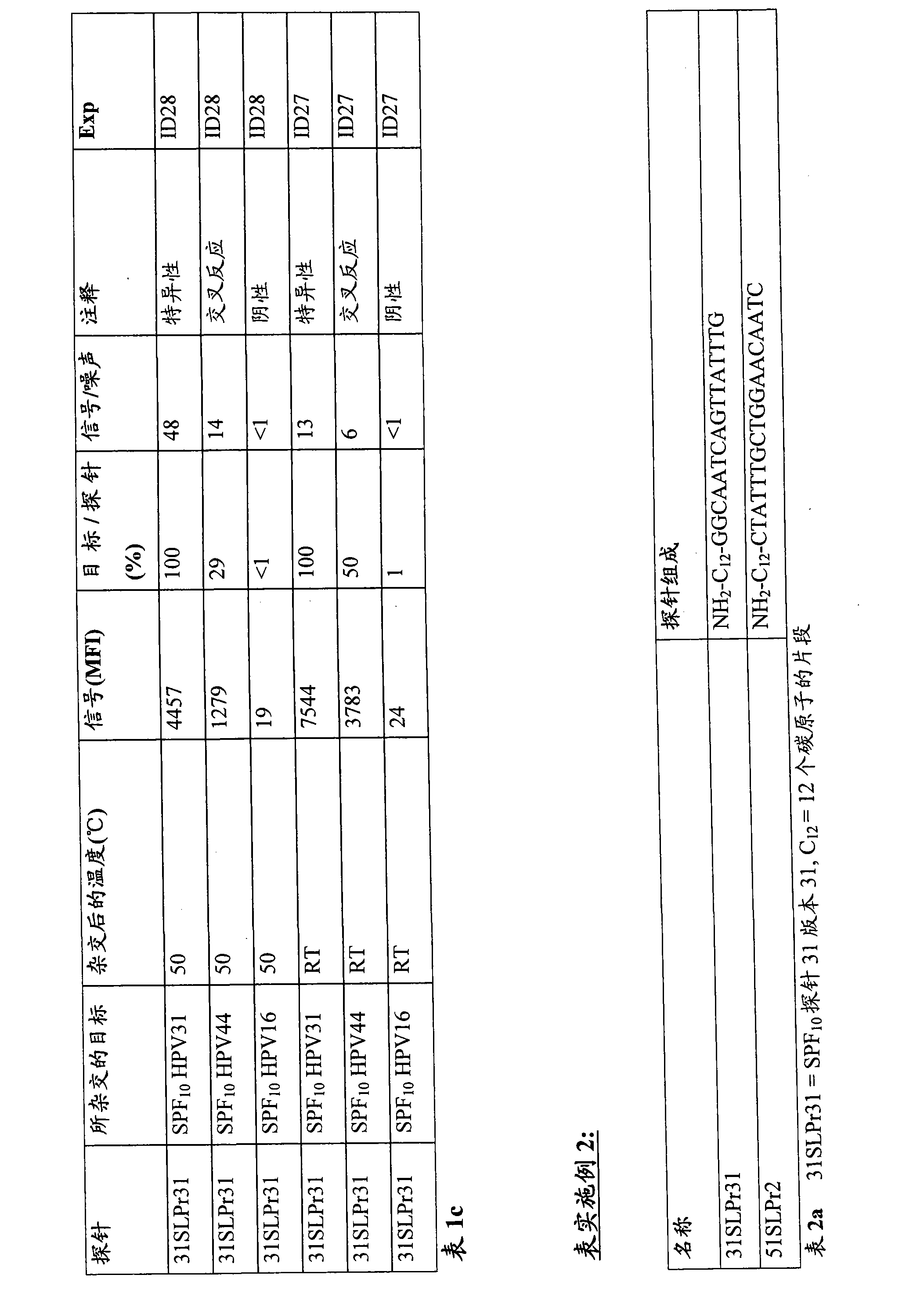


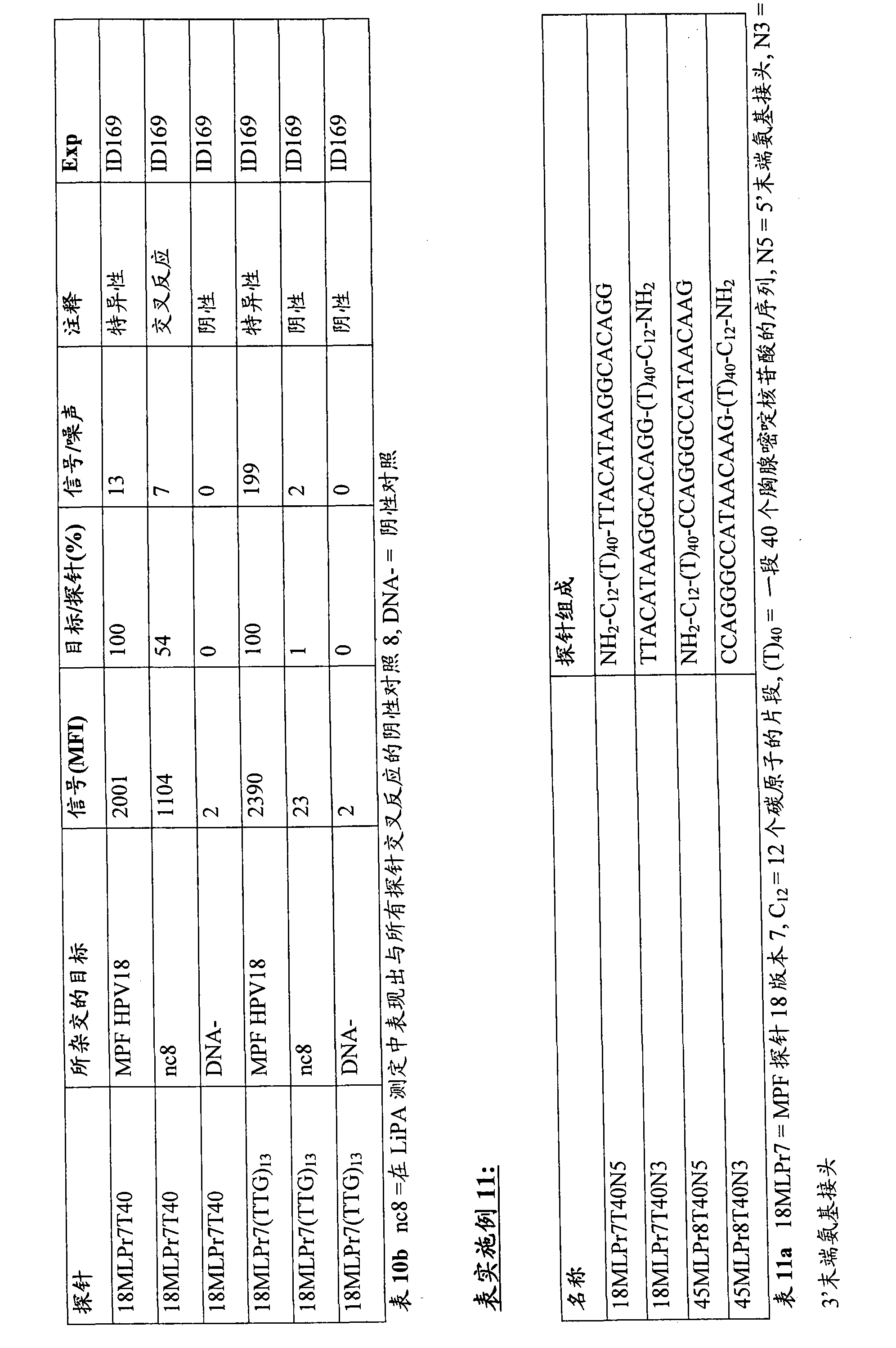


Claims (22)
Applications Claiming Priority (3)
| Application Number | Priority Date | Filing Date | Title |
|---|---|---|---|
| GBGB0600927.8A GB0600927D0 (en) | 2006-01-17 | 2006-01-17 | Assay and materials therefor |
| GB0600927.8 | 2006-01-17 | ||
| PCT/EP2007/050380 WO2007082881A2 (en) | 2006-01-17 | 2007-01-16 | Hybridization probe assay and array |
Publications (2)
| Publication Number | Publication Date |
|---|---|
| CN101541974A true CN101541974A (en) | 2009-09-23 |
| CN101541974B CN101541974B (en) | 2013-06-12 |
Family
ID=35998186
Family Applications (1)
| Application Number | Title | Priority Date | Filing Date |
|---|---|---|---|
| CN2007800097058A Expired - Fee Related CN101541974B (en) | 2006-01-17 | 2007-01-16 | Hybridization probe assay and array |
Country Status (10)
| Country | Link |
|---|---|
| US (1) | US20100184022A1 (en) |
| EP (1) | EP1977012A2 (en) |
| JP (2) | JP2009523416A (en) |
| KR (1) | KR20080094911A (en) |
| CN (1) | CN101541974B (en) |
| BR (1) | BRPI0707155A2 (en) |
| CA (1) | CA2636872A1 (en) |
| GB (1) | GB0600927D0 (en) |
| RU (1) | RU2461626C2 (en) |
| WO (1) | WO2007082881A2 (en) |
Cited By (9)
| Publication number | Priority date | Publication date | Assignee | Title |
|---|---|---|---|---|
| CN104820092A (en) * | 2010-03-01 | 2015-08-05 | 匡特里克斯公司 | Ultra-sensitive detection of molecules or particles using beads or other capture objects |
| US9551663B2 (en) | 2010-03-01 | 2017-01-24 | Quanterix Corporation | Methods and systems for extending dynamic range in assays for the detection of molecules or particles |
| US9809838B2 (en) | 2007-08-30 | 2017-11-07 | Trustees Of Tufts College | Methods for determining the concentration of an analyte in solution |
| US9846155B2 (en) | 2010-03-01 | 2017-12-19 | Quanterix Corporation | Methods and systems for extending dynamic range in assays for the detection of molecules or particles |
| US9932626B2 (en) | 2013-01-15 | 2018-04-03 | Quanterix Corporation | Detection of DNA or RNA using single molecule arrays and other techniques |
| US9952237B2 (en) | 2011-01-28 | 2018-04-24 | Quanterix Corporation | Systems, devices, and methods for ultra-sensitive detection of molecules or particles |
| US10261089B2 (en) | 2006-02-21 | 2019-04-16 | Trustees Of Tufts College | Methods and arrays for target analyte detection and determination of target analyte concentration in solution |
| US10393759B2 (en) | 2011-04-12 | 2019-08-27 | Quanterix Corporation | Methods of determining a treatment protocol for and/or a prognosis of a patient's recovery from a brain injury |
| US11237171B2 (en) | 2006-02-21 | 2022-02-01 | Trustees Of Tufts College | Methods and arrays for target analyte detection and determination of target analyte concentration in solution |
Families Citing this family (8)
| Publication number | Priority date | Publication date | Assignee | Title |
|---|---|---|---|---|
| US20090163366A1 (en) * | 2007-12-24 | 2009-06-25 | Helicos Biosciences Corporation | Two-primer sequencing for high-throughput expression analysis |
| GB0820822D0 (en) | 2008-11-13 | 2008-12-24 | Inst Catala D Oncologia | Novel product and processes |
| DE102012107651A1 (en) * | 2012-08-21 | 2014-02-27 | Astrium Gmbh | Method for carrying out a biochemical analysis, in particular in space |
| US20140235456A1 (en) * | 2012-12-17 | 2014-08-21 | Virginia Tech Intellectual Properties, Inc. | Methods and Compositions for Identifying Global Microsatellite Instability and for Characterizing Informative Microsatellite Loci |
| IL258248B (en) * | 2015-09-24 | 2022-07-01 | Abvitro Llc | Affinity-oligonucleotide conjugates and uses thereof |
| US11542498B2 (en) * | 2015-12-28 | 2023-01-03 | Pathogendx, Inc. | Microarray based multiplex pathogen analysis and uses thereof |
| US10612075B2 (en) * | 2015-12-28 | 2020-04-07 | PathogenDX Inc | Microarray based multiplex pathogen analysis and uses thereof |
| SG11202105276TA (en) | 2018-12-03 | 2021-06-29 | Univ Texas | Oligo-benzamide analogs and their use in cancer treatment |
Family Cites Families (7)
| Publication number | Priority date | Publication date | Assignee | Title |
|---|---|---|---|---|
| FR2629458B2 (en) * | 1987-07-31 | 1991-08-09 | Ire Celltarg Sa | NEW NUCLEIC ACID PROBES SPECIFIC TO DIFFERENT TYPES OF HUMAN PAPILLOMA VIRUS |
| RU2077593C1 (en) * | 1991-12-28 | 1997-04-20 | Научно-исследовательский институт вирусологии им.Д.И.Ивановского РАМН | Method of preparing molecular probe for molecular hybridization (variants) |
| US5808036A (en) * | 1993-09-01 | 1998-09-15 | Research Corporation Technologies Inc. | Stem-loop oligonucleotides containing parallel and antiparallel binding domains |
| AU2001267191A1 (en) * | 2000-06-06 | 2001-12-17 | Tm Bioscience Corporation | Capture moieties for nucleic acids and uses thereof |
| US20030180776A1 (en) * | 2002-02-21 | 2003-09-25 | Ming Wu | Detection by sliding template amplification |
| US20040157238A1 (en) * | 2002-09-20 | 2004-08-12 | Quinn John J. | Method for detection of multiple nucleic acid sequence variations |
| CN100390297C (en) * | 2003-11-27 | 2008-05-28 | 刘玉玲 | Human papilomavirus HPV gene chip |
-
2006
- 2006-01-17 GB GBGB0600927.8A patent/GB0600927D0/en not_active Ceased
-
2007
- 2007-01-16 US US12/161,179 patent/US20100184022A1/en not_active Abandoned
- 2007-01-16 CN CN2007800097058A patent/CN101541974B/en not_active Expired - Fee Related
- 2007-01-16 CA CA002636872A patent/CA2636872A1/en not_active Abandoned
- 2007-01-16 WO PCT/EP2007/050380 patent/WO2007082881A2/en not_active Ceased
- 2007-01-16 RU RU2008129127/10A patent/RU2461626C2/en not_active IP Right Cessation
- 2007-01-16 KR KR1020087019857A patent/KR20080094911A/en not_active Ceased
- 2007-01-16 EP EP07703895A patent/EP1977012A2/en not_active Withdrawn
- 2007-01-16 JP JP2008549889A patent/JP2009523416A/en active Pending
- 2007-01-16 BR BRPI0707155-8A patent/BRPI0707155A2/en not_active IP Right Cessation
-
2013
- 2013-07-19 JP JP2013150256A patent/JP2013240342A/en active Pending
Cited By (20)
| Publication number | Priority date | Publication date | Assignee | Title |
|---|---|---|---|---|
| US10261089B2 (en) | 2006-02-21 | 2019-04-16 | Trustees Of Tufts College | Methods and arrays for target analyte detection and determination of target analyte concentration in solution |
| US11874279B2 (en) | 2006-02-21 | 2024-01-16 | Trustees Of Tufts College | Methods and arrays for target analyte detection and determination of target analyte concentration in solution |
| US11237171B2 (en) | 2006-02-21 | 2022-02-01 | Trustees Of Tufts College | Methods and arrays for target analyte detection and determination of target analyte concentration in solution |
| US9809838B2 (en) | 2007-08-30 | 2017-11-07 | Trustees Of Tufts College | Methods for determining the concentration of an analyte in solution |
| US10725032B2 (en) | 2010-03-01 | 2020-07-28 | Quanterix Corporation | Ultra-sensitive detection of molecules or particles using beads or other capture objects |
| US9551663B2 (en) | 2010-03-01 | 2017-01-24 | Quanterix Corporation | Methods and systems for extending dynamic range in assays for the detection of molecules or particles |
| US12235267B2 (en) | 2010-03-01 | 2025-02-25 | Quanterix Corporation | Ultra-sensitive detection of molecules or particles using beads or other capture objects |
| US9846155B2 (en) | 2010-03-01 | 2017-12-19 | Quanterix Corporation | Methods and systems for extending dynamic range in assays for the detection of molecules or particles |
| US12019072B2 (en) | 2010-03-01 | 2024-06-25 | Quanterix Corporation | Methods and systems for extending dynamic range in assays for the detection of molecules or particles |
| US9482662B2 (en) | 2010-03-01 | 2016-11-01 | Quanterix Corporation | Ultra-sensitive detection of molecules or particles using beads or other capture objects |
| CN104820092A (en) * | 2010-03-01 | 2015-08-05 | 匡特里克斯公司 | Ultra-sensitive detection of molecules or particles using beads or other capture objects |
| US11619631B2 (en) | 2010-03-01 | 2023-04-04 | Quanterix Corporation | Ultra-sensitive detection of molecules or particles using beads or other capture objects |
| US11112415B2 (en) | 2011-01-28 | 2021-09-07 | Quanterix Corporation | Systems, devices, and methods for ultra-sensitive detection of molecules or particles |
| US11977087B2 (en) | 2011-01-28 | 2024-05-07 | Quanterix Corporation | Systems, devices, and methods for ultra-sensitive detection of molecules or particles |
| US9952237B2 (en) | 2011-01-28 | 2018-04-24 | Quanterix Corporation | Systems, devices, and methods for ultra-sensitive detection of molecules or particles |
| US11275092B2 (en) | 2011-04-12 | 2022-03-15 | Quanterix Corporation | Methods of determining a treatment protocol for and/or a prognosis of a patient's recovery from a brain injury |
| US10393759B2 (en) | 2011-04-12 | 2019-08-27 | Quanterix Corporation | Methods of determining a treatment protocol for and/or a prognosis of a patient's recovery from a brain injury |
| US12540950B2 (en) | 2011-04-12 | 2026-02-03 | Quanterix Corporation | Methods of assaying phosphorylated tau protein in a sample |
| US9932626B2 (en) | 2013-01-15 | 2018-04-03 | Quanterix Corporation | Detection of DNA or RNA using single molecule arrays and other techniques |
| US10640814B2 (en) | 2013-01-15 | 2020-05-05 | Quanterix Corporation | Detection of DNA or RNA using single molecule arrays and other techniques |
Also Published As
| Publication number | Publication date |
|---|---|
| RU2461626C2 (en) | 2012-09-20 |
| WO2007082881A2 (en) | 2007-07-26 |
| JP2009523416A (en) | 2009-06-25 |
| GB0600927D0 (en) | 2006-02-22 |
| WO2007082881A3 (en) | 2007-09-07 |
| JP2013240342A (en) | 2013-12-05 |
| CA2636872A1 (en) | 2007-07-26 |
| US20100184022A1 (en) | 2010-07-22 |
| CN101541974B (en) | 2013-06-12 |
| RU2008129127A (en) | 2010-02-27 |
| KR20080094911A (en) | 2008-10-27 |
| WO2007082881A8 (en) | 2008-01-03 |
| BRPI0707155A2 (en) | 2011-04-26 |
| EP1977012A2 (en) | 2008-10-08 |
Similar Documents
| Publication | Publication Date | Title |
|---|---|---|
| CN101541974A (en) | Hybridization probe assay and array | |
| JP5166666B2 (en) | For detecting nucleic acid by type-specific hybrid capture method | |
| US9115410B2 (en) | Detection of nucleic acids by target-specific hybrid capture method | |
| EP1880206B1 (en) | Multiplex capture of nucleic acids | |
| US20030105320A1 (en) | Affinity-shifted probes for quantifying analyte polynucleotides | |
| US20060246475A1 (en) | Compositions and methods for increased dynamic range detection of nucleic acids | |
| EP1880025A2 (en) | Multiplex branched-chain dna assays | |
| US20180171391A1 (en) | Methods and Compositions For Sorting and/or Determining Organisms | |
| JP4662578B2 (en) | Methods and kits for identifying antibiotic-resistant microorganisms | |
| JP2006525809A5 (en) | ||
| WO2012036111A1 (en) | Primer, probe, and method for multi-specimen analysis | |
| JP4286243B2 (en) | Method for designing probe set, microarray having substrate on which probe designed thereby is fixed, and computer-readable recording medium recording the method as computer-executable program | |
| AU2002323515B2 (en) | Affinity-shifted probes for quantifying analyte polynucleotides | |
| Diaz | Bead suspension arrays for identifying fungal pathogens | |
| Lievens | Development of a DNA array for multiplex detection and quantification of plant pathogens | |
| JP2003125800A (en) | Method for detecting nucleic acid |
Legal Events
| Date | Code | Title | Description |
|---|---|---|---|
| C06 | Publication | ||
| PB01 | Publication | ||
| C10 | Entry into substantive examination | ||
| SE01 | Entry into force of request for substantive examination | ||
| C14 | Grant of patent or utility model | ||
| GR01 | Patent grant | ||
| CF01 | Termination of patent right due to non-payment of annual fee |
Granted publication date: 20130612 Termination date: 20150116 |
|
| EXPY | Termination of patent right or utility model |