CN101535450A - granular solid wax particles - Google Patents
granular solid wax particles Download PDFInfo
- Publication number
- CN101535450A CN101535450A CNA2006800137099A CN200680013709A CN101535450A CN 101535450 A CN101535450 A CN 101535450A CN A2006800137099 A CNA2006800137099 A CN A2006800137099A CN 200680013709 A CN200680013709 A CN 200680013709A CN 101535450 A CN101535450 A CN 101535450A
- Authority
- CN
- China
- Prior art keywords
- wax
- solid wax
- granular solid
- particles
- particle
- Prior art date
- Legal status (The legal status is an assumption and is not a legal conclusion. Google has not performed a legal analysis and makes no representation as to the accuracy of the status listed.)
- Granted
Links
Classifications
-
- C—CHEMISTRY; METALLURGY
- C10—PETROLEUM, GAS OR COKE INDUSTRIES; TECHNICAL GASES CONTAINING CARBON MONOXIDE; FUELS; LUBRICANTS; PEAT
- C10G—CRACKING HYDROCARBON OILS; PRODUCTION OF LIQUID HYDROCARBON MIXTURES, e.g. BY DESTRUCTIVE HYDROGENATION, OLIGOMERISATION, POLYMERISATION; RECOVERY OF HYDROCARBON OILS FROM OIL-SHALE, OIL-SAND, OR GASES; REFINING MIXTURES MAINLY CONSISTING OF HYDROCARBONS; REFORMING OF NAPHTHA; MINERAL WAXES
- C10G73/00—Recovery or refining of mineral waxes, e.g. montan wax
- C10G73/40—Physical treatment of waxes or modified waxes, e.g. granulation, dispersion, emulsion, irradiation
-
- B—PERFORMING OPERATIONS; TRANSPORTING
- B32—LAYERED PRODUCTS
- B32B—LAYERED PRODUCTS, i.e. PRODUCTS BUILT-UP OF STRATA OF FLAT OR NON-FLAT, e.g. CELLULAR OR HONEYCOMB, FORM
- B32B9/00—Layered products comprising a layer of a particular substance not covered by groups B32B11/00 - B32B29/00
-
- C—CHEMISTRY; METALLURGY
- C10—PETROLEUM, GAS OR COKE INDUSTRIES; TECHNICAL GASES CONTAINING CARBON MONOXIDE; FUELS; LUBRICANTS; PEAT
- C10M—LUBRICATING COMPOSITIONS; USE OF CHEMICAL SUBSTANCES EITHER ALONE OR AS LUBRICATING INGREDIENTS IN A LUBRICATING COMPOSITION
- C10M125/00—Lubricating compositions characterised by the additive being an inorganic material
- C10M125/10—Metal oxides, hydroxides, carbonates or bicarbonates
-
- C—CHEMISTRY; METALLURGY
- C10—PETROLEUM, GAS OR COKE INDUSTRIES; TECHNICAL GASES CONTAINING CARBON MONOXIDE; FUELS; LUBRICANTS; PEAT
- C10M—LUBRICATING COMPOSITIONS; USE OF CHEMICAL SUBSTANCES EITHER ALONE OR AS LUBRICATING INGREDIENTS IN A LUBRICATING COMPOSITION
- C10M159/00—Lubricating compositions characterised by the additive being of unknown or incompletely defined constitution
- C10M159/02—Natural products
- C10M159/06—Waxes, e.g. ozocerite, ceresine, petrolatum, slack-wax
-
- C—CHEMISTRY; METALLURGY
- C10—PETROLEUM, GAS OR COKE INDUSTRIES; TECHNICAL GASES CONTAINING CARBON MONOXIDE; FUELS; LUBRICANTS; PEAT
- C10M—LUBRICATING COMPOSITIONS; USE OF CHEMICAL SUBSTANCES EITHER ALONE OR AS LUBRICATING INGREDIENTS IN A LUBRICATING COMPOSITION
- C10M171/00—Lubricating compositions characterised by purely physical criteria, e.g. containing as base-material, thickener or additive, ingredients which are characterised exclusively by their numerically specified physical properties, i.e. containing ingredients which are physically well-defined but for which the chemical nature is either unspecified or only very vaguely indicated
- C10M171/06—Particles of special shape or size
-
- C—CHEMISTRY; METALLURGY
- C10—PETROLEUM, GAS OR COKE INDUSTRIES; TECHNICAL GASES CONTAINING CARBON MONOXIDE; FUELS; LUBRICANTS; PEAT
- C10M—LUBRICATING COMPOSITIONS; USE OF CHEMICAL SUBSTANCES EITHER ALONE OR AS LUBRICATING INGREDIENTS IN A LUBRICATING COMPOSITION
- C10M177/00—Special methods of preparation of lubricating compositions; Chemical modification by after-treatment of components or of the whole of a lubricating composition, not covered by other classes
-
- B—PERFORMING OPERATIONS; TRANSPORTING
- B32—LAYERED PRODUCTS
- B32B—LAYERED PRODUCTS, i.e. PRODUCTS BUILT-UP OF STRATA OF FLAT OR NON-FLAT, e.g. CELLULAR OR HONEYCOMB, FORM
- B32B2307/00—Properties of the layers or laminate
- B32B2307/30—Properties of the layers or laminate having particular thermal properties
-
- B—PERFORMING OPERATIONS; TRANSPORTING
- B32—LAYERED PRODUCTS
- B32B—LAYERED PRODUCTS, i.e. PRODUCTS BUILT-UP OF STRATA OF FLAT OR NON-FLAT, e.g. CELLULAR OR HONEYCOMB, FORM
- B32B2391/00—Waxes
-
- C—CHEMISTRY; METALLURGY
- C10—PETROLEUM, GAS OR COKE INDUSTRIES; TECHNICAL GASES CONTAINING CARBON MONOXIDE; FUELS; LUBRICANTS; PEAT
- C10G—CRACKING HYDROCARBON OILS; PRODUCTION OF LIQUID HYDROCARBON MIXTURES, e.g. BY DESTRUCTIVE HYDROGENATION, OLIGOMERISATION, POLYMERISATION; RECOVERY OF HYDROCARBON OILS FROM OIL-SHALE, OIL-SAND, OR GASES; REFINING MIXTURES MAINLY CONSISTING OF HYDROCARBONS; REFORMING OF NAPHTHA; MINERAL WAXES
- C10G2300/00—Aspects relating to hydrocarbon processing covered by groups C10G1/00 - C10G99/00
- C10G2300/10—Feedstock materials
- C10G2300/1022—Fischer-Tropsch products
-
- C—CHEMISTRY; METALLURGY
- C10—PETROLEUM, GAS OR COKE INDUSTRIES; TECHNICAL GASES CONTAINING CARBON MONOXIDE; FUELS; LUBRICANTS; PEAT
- C10G—CRACKING HYDROCARBON OILS; PRODUCTION OF LIQUID HYDROCARBON MIXTURES, e.g. BY DESTRUCTIVE HYDROGENATION, OLIGOMERISATION, POLYMERISATION; RECOVERY OF HYDROCARBON OILS FROM OIL-SHALE, OIL-SAND, OR GASES; REFINING MIXTURES MAINLY CONSISTING OF HYDROCARBONS; REFORMING OF NAPHTHA; MINERAL WAXES
- C10G2300/00—Aspects relating to hydrocarbon processing covered by groups C10G1/00 - C10G99/00
- C10G2300/10—Feedstock materials
- C10G2300/1081—Alkanes
- C10G2300/1085—Solid paraffins
-
- C—CHEMISTRY; METALLURGY
- C10—PETROLEUM, GAS OR COKE INDUSTRIES; TECHNICAL GASES CONTAINING CARBON MONOXIDE; FUELS; LUBRICANTS; PEAT
- C10G—CRACKING HYDROCARBON OILS; PRODUCTION OF LIQUID HYDROCARBON MIXTURES, e.g. BY DESTRUCTIVE HYDROGENATION, OLIGOMERISATION, POLYMERISATION; RECOVERY OF HYDROCARBON OILS FROM OIL-SHALE, OIL-SAND, OR GASES; REFINING MIXTURES MAINLY CONSISTING OF HYDROCARBONS; REFORMING OF NAPHTHA; MINERAL WAXES
- C10G2300/00—Aspects relating to hydrocarbon processing covered by groups C10G1/00 - C10G99/00
- C10G2300/20—Characteristics of the feedstock or the products
- C10G2300/30—Physical properties of feedstocks or products
- C10G2300/301—Boiling range
-
- C—CHEMISTRY; METALLURGY
- C10—PETROLEUM, GAS OR COKE INDUSTRIES; TECHNICAL GASES CONTAINING CARBON MONOXIDE; FUELS; LUBRICANTS; PEAT
- C10G—CRACKING HYDROCARBON OILS; PRODUCTION OF LIQUID HYDROCARBON MIXTURES, e.g. BY DESTRUCTIVE HYDROGENATION, OLIGOMERISATION, POLYMERISATION; RECOVERY OF HYDROCARBON OILS FROM OIL-SHALE, OIL-SAND, OR GASES; REFINING MIXTURES MAINLY CONSISTING OF HYDROCARBONS; REFORMING OF NAPHTHA; MINERAL WAXES
- C10G2300/00—Aspects relating to hydrocarbon processing covered by groups C10G1/00 - C10G99/00
- C10G2300/40—Characteristics of the process deviating from typical ways of processing
- C10G2300/4062—Geographical aspects, e.g. different process units form a combination process at different geographical locations
-
- C—CHEMISTRY; METALLURGY
- C10—PETROLEUM, GAS OR COKE INDUSTRIES; TECHNICAL GASES CONTAINING CARBON MONOXIDE; FUELS; LUBRICANTS; PEAT
- C10G—CRACKING HYDROCARBON OILS; PRODUCTION OF LIQUID HYDROCARBON MIXTURES, e.g. BY DESTRUCTIVE HYDROGENATION, OLIGOMERISATION, POLYMERISATION; RECOVERY OF HYDROCARBON OILS FROM OIL-SHALE, OIL-SAND, OR GASES; REFINING MIXTURES MAINLY CONSISTING OF HYDROCARBONS; REFORMING OF NAPHTHA; MINERAL WAXES
- C10G2300/00—Aspects relating to hydrocarbon processing covered by groups C10G1/00 - C10G99/00
- C10G2300/40—Characteristics of the process deviating from typical ways of processing
- C10G2300/4068—Moveable devices or units, e.g. on trucks, barges
-
- C—CHEMISTRY; METALLURGY
- C10—PETROLEUM, GAS OR COKE INDUSTRIES; TECHNICAL GASES CONTAINING CARBON MONOXIDE; FUELS; LUBRICANTS; PEAT
- C10G—CRACKING HYDROCARBON OILS; PRODUCTION OF LIQUID HYDROCARBON MIXTURES, e.g. BY DESTRUCTIVE HYDROGENATION, OLIGOMERISATION, POLYMERISATION; RECOVERY OF HYDROCARBON OILS FROM OIL-SHALE, OIL-SAND, OR GASES; REFINING MIXTURES MAINLY CONSISTING OF HYDROCARBONS; REFORMING OF NAPHTHA; MINERAL WAXES
- C10G2400/00—Products obtained by processes covered by groups C10G9/00 - C10G69/14
- C10G2400/10—Lubricating oil
-
- C—CHEMISTRY; METALLURGY
- C10—PETROLEUM, GAS OR COKE INDUSTRIES; TECHNICAL GASES CONTAINING CARBON MONOXIDE; FUELS; LUBRICANTS; PEAT
- C10M—LUBRICATING COMPOSITIONS; USE OF CHEMICAL SUBSTANCES EITHER ALONE OR AS LUBRICATING INGREDIENTS IN A LUBRICATING COMPOSITION
- C10M2201/00—Inorganic compounds or elements as ingredients in lubricant compositions
- C10M2201/06—Metal compounds
- C10M2201/062—Oxides; Hydroxides; Carbonates or bicarbonates
-
- C—CHEMISTRY; METALLURGY
- C10—PETROLEUM, GAS OR COKE INDUSTRIES; TECHNICAL GASES CONTAINING CARBON MONOXIDE; FUELS; LUBRICANTS; PEAT
- C10M—LUBRICATING COMPOSITIONS; USE OF CHEMICAL SUBSTANCES EITHER ALONE OR AS LUBRICATING INGREDIENTS IN A LUBRICATING COMPOSITION
- C10M2201/00—Inorganic compounds or elements as ingredients in lubricant compositions
- C10M2201/085—Phosphorus oxides, acids or salts
-
- C—CHEMISTRY; METALLURGY
- C10—PETROLEUM, GAS OR COKE INDUSTRIES; TECHNICAL GASES CONTAINING CARBON MONOXIDE; FUELS; LUBRICANTS; PEAT
- C10M—LUBRICATING COMPOSITIONS; USE OF CHEMICAL SUBSTANCES EITHER ALONE OR AS LUBRICATING INGREDIENTS IN A LUBRICATING COMPOSITION
- C10M2201/00—Inorganic compounds or elements as ingredients in lubricant compositions
- C10M2201/10—Compounds containing silicon
- C10M2201/102—Silicates
-
- C—CHEMISTRY; METALLURGY
- C10—PETROLEUM, GAS OR COKE INDUSTRIES; TECHNICAL GASES CONTAINING CARBON MONOXIDE; FUELS; LUBRICANTS; PEAT
- C10M—LUBRICATING COMPOSITIONS; USE OF CHEMICAL SUBSTANCES EITHER ALONE OR AS LUBRICATING INGREDIENTS IN A LUBRICATING COMPOSITION
- C10M2205/00—Organic macromolecular hydrocarbon compounds or fractions, whether or not modified by oxidation as ingredients in lubricant compositions
- C10M2205/16—Paraffin waxes; Petrolatum, e.g. slack wax
- C10M2205/163—Paraffin waxes; Petrolatum, e.g. slack wax used as base material
-
- C—CHEMISTRY; METALLURGY
- C10—PETROLEUM, GAS OR COKE INDUSTRIES; TECHNICAL GASES CONTAINING CARBON MONOXIDE; FUELS; LUBRICANTS; PEAT
- C10M—LUBRICATING COMPOSITIONS; USE OF CHEMICAL SUBSTANCES EITHER ALONE OR AS LUBRICATING INGREDIENTS IN A LUBRICATING COMPOSITION
- C10M2205/00—Organic macromolecular hydrocarbon compounds or fractions, whether or not modified by oxidation as ingredients in lubricant compositions
- C10M2205/17—Fisher Tropsch reaction products
- C10M2205/173—Fisher Tropsch reaction products used as base material
-
- C—CHEMISTRY; METALLURGY
- C10—PETROLEUM, GAS OR COKE INDUSTRIES; TECHNICAL GASES CONTAINING CARBON MONOXIDE; FUELS; LUBRICANTS; PEAT
- C10N—INDEXING SCHEME ASSOCIATED WITH SUBCLASS C10M RELATING TO LUBRICATING COMPOSITIONS
- C10N2010/00—Metal present as such or in compounds
- C10N2010/06—Groups 3 or 13
-
- C—CHEMISTRY; METALLURGY
- C10—PETROLEUM, GAS OR COKE INDUSTRIES; TECHNICAL GASES CONTAINING CARBON MONOXIDE; FUELS; LUBRICANTS; PEAT
- C10N—INDEXING SCHEME ASSOCIATED WITH SUBCLASS C10M RELATING TO LUBRICATING COMPOSITIONS
- C10N2010/00—Metal present as such or in compounds
- C10N2010/08—Groups 4 or 14
-
- C—CHEMISTRY; METALLURGY
- C10—PETROLEUM, GAS OR COKE INDUSTRIES; TECHNICAL GASES CONTAINING CARBON MONOXIDE; FUELS; LUBRICANTS; PEAT
- C10N—INDEXING SCHEME ASSOCIATED WITH SUBCLASS C10M RELATING TO LUBRICATING COMPOSITIONS
- C10N2020/00—Specified physical or chemical properties or characteristics, i.e. function, of component of lubricating compositions
- C10N2020/01—Physico-chemical properties
- C10N2020/015—Distillation range
-
- C—CHEMISTRY; METALLURGY
- C10—PETROLEUM, GAS OR COKE INDUSTRIES; TECHNICAL GASES CONTAINING CARBON MONOXIDE; FUELS; LUBRICANTS; PEAT
- C10N—INDEXING SCHEME ASSOCIATED WITH SUBCLASS C10M RELATING TO LUBRICATING COMPOSITIONS
- C10N2020/00—Specified physical or chemical properties or characteristics, i.e. function, of component of lubricating compositions
- C10N2020/01—Physico-chemical properties
- C10N2020/055—Particles related characteristics
- C10N2020/06—Particles of special shape or size
-
- Y—GENERAL TAGGING OF NEW TECHNOLOGICAL DEVELOPMENTS; GENERAL TAGGING OF CROSS-SECTIONAL TECHNOLOGIES SPANNING OVER SEVERAL SECTIONS OF THE IPC; TECHNICAL SUBJECTS COVERED BY FORMER USPC CROSS-REFERENCE ART COLLECTIONS [XRACs] AND DIGESTS
- Y10—TECHNICAL SUBJECTS COVERED BY FORMER USPC
- Y10T—TECHNICAL SUBJECTS COVERED BY FORMER US CLASSIFICATION
- Y10T428/00—Stock material or miscellaneous articles
- Y10T428/29—Coated or structually defined flake, particle, cell, strand, strand portion, rod, filament, macroscopic fiber or mass thereof
- Y10T428/2982—Particulate matter [e.g., sphere, flake, etc.]
- Y10T428/2991—Coated
Landscapes
- Chemical & Material Sciences (AREA)
- Oil, Petroleum & Natural Gas (AREA)
- Chemical Kinetics & Catalysis (AREA)
- General Chemical & Material Sciences (AREA)
- Organic Chemistry (AREA)
- Engineering & Computer Science (AREA)
- Dispersion Chemistry (AREA)
- Inorganic Chemistry (AREA)
- Compositions Of Macromolecular Compounds (AREA)
- Processes Of Treating Macromolecular Substances (AREA)
- Lubricants (AREA)
- Glanulating (AREA)
- Paints Or Removers (AREA)
- Manufacturing Of Micro-Capsules (AREA)
- Inorganic Compounds Of Heavy Metals (AREA)
- Compounds Of Alkaline-Earth Elements, Aluminum Or Rare-Earth Metals (AREA)
- Fats And Perfumes (AREA)
- Coating Of Shaped Articles Made Of Macromolecular Substances (AREA)
- Production Of Liquid Hydrocarbon Mixture For Refining Petroleum (AREA)
Abstract
A granular solid wax particle comprising a highly paraffinic wax having a T10 boiling point less than 427 ℃ and an inorganic powder coating; optionally a layer of higher boiling wax over the highly paraffinic wax having a low T10 boiling point, and an inorganic powder over the layer of higher boiling wax. In separate embodiments, a highly paraffinic wax having a T10 boiling point less than 427 ℃ or a highly paraffinic wax having a needle penetration at 25 ℃ greater than 3mm/10 is coated with a powder that adsorbs the wax without being encapsulated by the wax in the hot drop wax test. Also, a process for transporting highly paraffinic wax having a boiling point of T10 below 427 ℃ as granular solid wax particles. And, a process for making a base oil from granular solid wax particles transported from a remote location.
Description
Invention field
The present invention relates to the granular solid wax particle composition that is suitable in large transport ship, transporting, the method for transportation granular solid wax particle and make the method for base oil to transport the solid wax particle that comes.
Background of invention
By various method of refining manufacturing height paraffin wax.It can further be enhanced quality becomes other desirable hydrocarbon product, for example fuel, lubricant and chemical.The costliness because the quality improvement device fabrication of wax is got up, and have the device of the quality of improving wax in the refinery of many current existence wishes locally to produce wax and the wax shipping is used for further improving quality to So Far Away at one usually.Problem is that wax is difficult to carrying, particularly is difficult to a large amount of carryings.
Other people are by following mode shipping wax: transport, select the high boiling fraction of wax and be made into hard solid globules, make the solid wax bead and be suspended in it in other hydrocarbon liquid and form the emulsion of wax in water with the wax fusion and with its molten state.In the U.S. Patent application of submitting on September 28th, 2,004 10/950662, many early stage shipping methods have been described.In some cases, to compare with shipping molten state wax or slurry be preferred to shipping granulous wax.A kind of situation is to have when being used to carry the facility of granular solids when accepting site already.
Other people are shipping solid particulate wax also; Yet the boiling point of these waxes is much higher than 800 ℉ so that these waxes are hard and ability is squeezed.When selecting high boiling fraction, there is the waste loss for the more lower boiling wax that can improve quality.Usually these solid wax particles are contained in the chest on the pallet (pallets) or the interior shipping of sack, each pallet only can load about 2000lbs there.The a large amount of penetration degree of early stage solid wax particle under 25 ℃ is low.Perhaps their penetration degree is lower than 2mm/10 under 25 ℃, and perhaps they are limited in shipping in the small vessels, so that they can not lump broken or each other under their weight.
Wish that granular solid wax particle has more lower boiling cut or has the high penetration degree of surveying with ASTM D1321, it can be in the cargo hold of large transport ship shipping in enormous quantities and can not lump each other or broken.Special hope uses the boats and ships (for example crude oil tanker) with big cargo hold to come the shipping granular solid wax particle.
Summary of the invention
We have found that granular solid wax particle, it comprises height paraffin wax and inorganic powder coating that the T10 boiling point is lower than 427 ℃ (800 ℉).This granular solid wax particle is easy to transportation in enormous quantities in the cargo hold of large transport ship.
In another embodiment, we have found that granular solid wax particle, its comprise with ASTM D1321 measure under 25 ℃ greater than the wax of the penetration degree of 3mm/10 and in the hot drop wax test absorption wax and the inorganic powder coating of not sealed by wax.
In independent embodiment, we have found that granular solid wax particle, it comprises: a) the T10 boiling point is lower than first kind of height paraffin wax of 427 ℃ (800 ℉), b) place the T10 boiling point of first kind of height on the paraffin wax to be higher than second kind of height paraffin wax layer of 510 ℃ (950 ℉) and c) be coated on the inorganic powder in second kind of height paraffin wax outside.
We have also had been found that granular solid wax particle, and it comprises that the T10 boiling point is lower than the wax of 427 ℃ (800 ℉) and absorption wax and the powder coating do not sealed by wax in hot drop wax test.
In addition, we have also found the method for transportation wax, it comprises the following steps: a) to produce granular solid wax particle by following method: i) select the T10 boiling point to be lower than the height paraffin wax of 427 ℃ (800 ℉), ii) make this wax form that diameter is the solid particulate of 0.1-50mm on the length direction, iii) coat these Wax particles with inorganic powder; B) this granular solid wax particle is packed in the transport-ship; C) the transport point granular solid wax particle of packing into; And d) unloads the granular solid wax particle of being packed into.
In independent embodiment, we have found that the method for preparing base oil by the wax that comes from remote place transportation, this method comprises: the granular solid wax particle that a) the transport-ship inner height is higher than 7.5m is transported to remote place, and wherein this granular solid wax particle is lower than the height paraffin wax of 427 ℃ (800 ℉) by the T10 boiling point or makes greater than height paraffin wax and the inorganic powder coating of 3mm/10 25 ℃ of following penetration degrees with ASTM D1321 measurement; And b) this granular solid wax particle of hydrotreatment is to produce one or more base oils.
Detailed Description Of The Invention
Although compare with the shipping liquid hydrocarbon, the shipping granular solid particles can be relatively costly, many usual productions this method shipping.Example with the product of granular solid particles economy ground shipping is cereal, hydrotreating catalyst, coal and granular washing composition.As long as solid particulate is not broken or caking each other, they can be easy to use several different methods to come to transport with granular solids.
Sasol, Shell and other wax manufacturer, current sale granular solid wax bead, thin slice, particle or lozenge.They sell and transport with small packages to prevent that weight because of product from causing breaking or solid particulate lumps each other.In addition, by the present invention, the T10 boiling point of the granular solid wax particle of being sold is greater than 800 ℉.Some examples of the Fischer-tropsch derived granular solid wax particle of height paraffinic hydrocarbons are as follows.
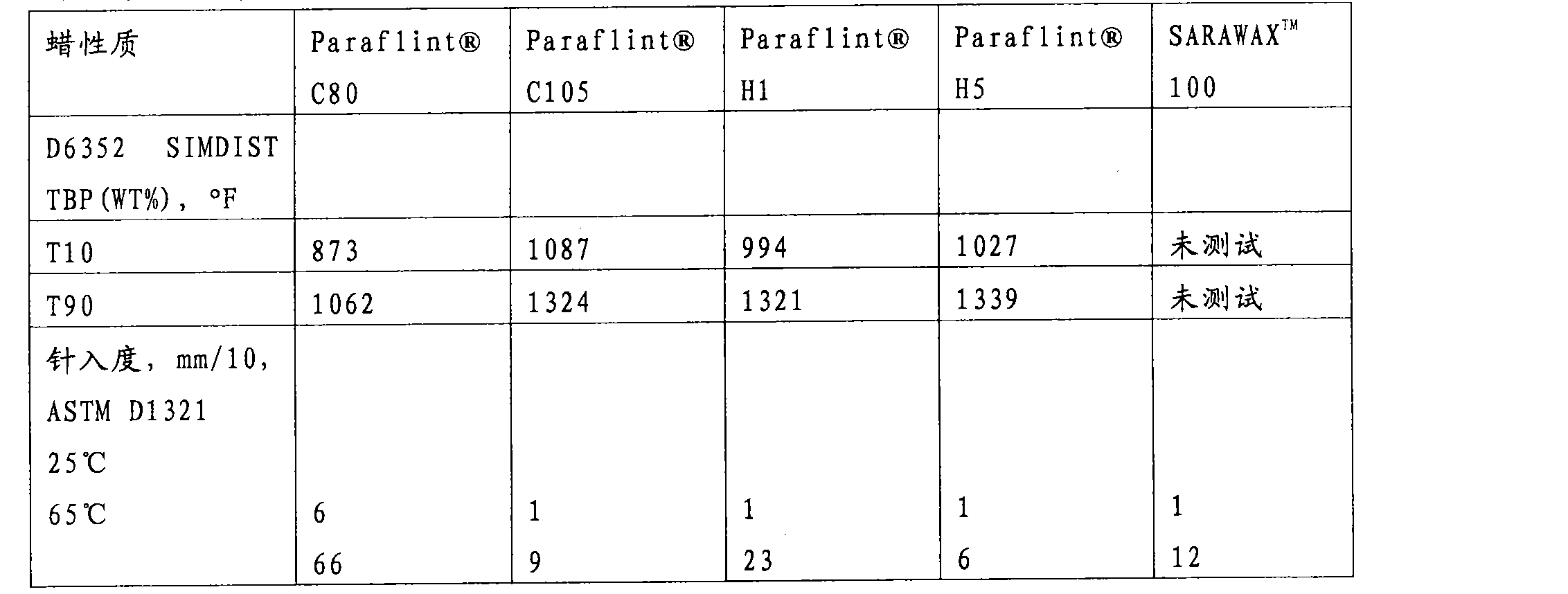
SARAWAX
TMIt is the trade mark of Shell.
 It is the registered trademark of SASOL.
In context of the present disclosure, granular solid wax particle is free-pouring solid." unrestricted flow " is meant: can flow continuously or move.Other free-pouring solid example comprises cereal, hydrotreating catalyst, coal and granular washing composition.The particle size of granular solid wax particle of the present invention on the longest direction is greater than 0.1mm.Preferred their particle sizes on the longest direction are diameter 0.3-50mm, and more preferably the particle size on the longest direction is diameter 1-30mm.The shape of the most useful granular solid wax particle is selected from one of following shape in the present invention: ingot body, sheet, spheroid, right cylinder, spheroid, egg shape and proximate spheroid.Proximate spheroid is meant that length-to-diameter ratio is lower than about 1.3 the circular shape that is generally.The employed length-to-diameter ratio of this paper is a geometric terms, and it is defined as: particulate maximal projection value is divided by the particulate width value." maximal projection " is meant the particle projection of maximum possible.This is called maximum calipers size sometimes and is the overall dimension of particulate maximum cross section.Particulate " width " is meant perpendicular to maximal projection particulate particle projection and is perpendicular to the particulate overall dimension of maximal projection.If determine length-to-diameter ratio with the particulate sample, can be by measuring some representational particulate length-to-diameter ratios and the result being averaged.Representative particle should be taken a sample by ASTMD5680-95a (calendar year 2001 is ratified again).Can make wax form solid particulate by many methods, comprise moulding, granulating, the caking that rolls, pushes, rolls, extrude, shaped by fluid pressure and rotoforming.For example, Sandvik Process Systems (Shanghai) has developed large-scale rotary forming equipment, is used for producing the ingot body that can be used for free-pouring paraffin wax of the present invention.
In context of the present disclosure, the height paraffin wax is the wax with high-load normal paraffin (n-paraffin).The height paraffin wax of using in the practice of processing scheme of the present invention comprises the n-paraffin of 40wt% at least usually, preferably more than the n-paraffin of 50wt% with more preferably more than the n-paraffin of 75wt%.Generally determine the weight percent of n-paraffin by vapor-phase chromatography, for example described in detail in the U.S. Patent application of submitting on July 22nd, 2,004 10/897906.
The example that can be used for height paraffin wax of the present invention comprises wax, Microcrystalline Wax, the Fischer-tropsch derived wax of the petroleum derivation of the slack wax of slack wax, de-oiling, the foots oil of refining, waxy lubricant raffinate, n-paraffin wax, NAO wax, the wax that produces, de-oiling in the chemical devices process, and their mixture.The pour point of the height paraffin wax of using in practice of the present invention is usually above about 50 ℃ and usually above about 60 ℃.Term " Fischer-tropsch derived " is meant product, cut or stems from or result from the charging in some stages of fischer-tropsch process.The raw material that is used for fischer-tropsch process can come from multiple hydrocarbon resource, comprises Sweet natural gas, coal, shale oil, oil, Municipal waste, these derivative and their composition.
The height paraffin wax of using in the granular solid wax particle composition of the present invention has low T10 boiling point.Before the present invention, the granular solid wax with so low T10 boiling point can be too soft, and they can lump under pressure each other in the bulk transport process.In preferred embodiments, granular solid wax particle of the present invention also has wide boiling point.The granular solid wax particle of wide boiling point is desirable, and for example, because boiling point is wide more, the resistance to crushing of granular solid wax particle is good more, and the scope of the finished product that can be produced by its is wide more, preferably includes the base oil of one or more grades.Unless otherwise stated, use simulation distil total boiling point (SIMDIST TBP) standard method of analysis ASTM D6352 or its Equivalent are measured all boiling Range Distribution Analysis and the boiling point in the disclosure.Used herein and analytical procedure ASTM D6352 equivalence is meant any analytical procedure that can provide with the essentially identical result of this standard method.The T10 boiling point is the temperature in wax when boiling of 10wt%.The T90 boiling point is the temperature in wax when boiling of 90wt%.The T10 boiling point that is applicable to height paraffin wax of the present invention is lower than 427 ℃ (800 ℉).Preferably, the T10 boiling point of this height paraffin wax is lower than 343 ℃ (650 ℉).In addition, the T90 boiling point that is applicable to height paraffin wax of the present invention preferably is higher than 538 ℃ (1000 ℉).Preferably, the final boiling point of this height paraffin wax will be higher than about 620 ℃ (about 1150 ℉).Height paraffin wax less than about 10wt% will preferably be lower than about 260 ℃ (about 500 ℉) boiling down.Because the boiling range of this height paraffin wax is wide, the difference between T10 boiling point and the T90 boiling point will be preferably greater than about 275 ℃ (about 500 ℉).
In another embodiment, the height paraffin wax of using in the granular solid wax particle composition of the present invention has high penetration degree under 25 ℃.Penetration degree is measured by ASTM D1321-04.This penetration degree is higher than 3mm/10 under 25 ℃, preferably is higher than 5.Before the present invention, to such an extent as to have the wax of so high penetration degree too soft can not be in large transport ship shipping and caking each other.
Granular solid wax particle of the present invention comprises above-mentioned height paraffin wax and inorganic powder coating.It is solid-state, non-suction that the inorganic powder compound that the present invention uses at room temperature is necessary for, and can be crushed to the meticulous micron or the powder of submicron-scale via the particle manufacture technology of routine.Useful inorganic powder compound includes but not limited to the combination of oxide compound, oxyhydroxide, carbonate, phosphoric acid salt, silicate and above-claimed cpd of the element of periodictable (IUPAC 1997) the 1st, 2,3,4,5,6,7,8,9,10,11,12,13 and/or 14 families.In the art the preferred mineral compound of Shi Yonging should be obtain easily and cheaply.They include but not limited to aluminum oxide, aluminum phosphate, magnesium oxide, lime carbonate, calcium hydroxide, calcium oxide, ferric oxide, silicon-dioxide, silicate and various clay and mineral for example kaolin, attapulgite, spiolite, talcum, feldspar, peridotites, rhombspar, phosphatic rock etc.Yet the cost of powder coating and availability are important, and the most preferred that is used for present technique is absorption wax and the material of those powdered of not sealed by wax in hot drop wax test.
We have found that simple test, be called " hot drop wax test " here, wherein the fused wax of the heat under 80 ℃ is dripped (from the eye drip medicine bottle) drip to flat heap be heated to the synthermal powder of wax phase on.For the most useful powder, wax can be adsorbed by this powder immediately, and the powder coating of generation does not show moistening, and after the cooling, by for example between finger rubbing this be full of the powder of wax, this powder that is full of wax can be easy to launch and disperse.For less preferred powder, fused wax drips and can stop from the teeth outwards several seconds, slowly infiltrates then in this powder and produces and seem significantly moistening zone.After cooling off this less preferred powder that is full of wax, adsorbed wax can form " button " with this powder, shows that wax seals this less preferred powder.Some the most useful powder that adsorb wax and do not sealed by wax in the hot drop wax test include but not limited to gama-alumina, Alpha-alumina, titanium dioxide and their mixture.Absorption occurs in when a kind of material and is contained in when interior by another kind of material by physical bond, rather than with another kind of material Chemical bond (this is absorption).
This particles of powder size is always significantly less than the height paraffin wax particulate size of using them.Therefore, the particle size of this powder coating should and be more preferably less than 10 micron diameters less than 100 micron diameters.Particle size and surface impurity can influence this hot drop wax test.Therefore, it is important this powder coating material being ground to the size that is implemented on acceptably in this hot drop wax test.
Surface and the ratio of volume and the sticking coefficient of powder coating and Wax particles that obviously will depend on Wax particles in the amount of the powder of the per-cent of total Wax particles.Yet, because cost and handling problem, wish this powder coating account for whole coatings Wax particles be lower than 8wt%.More preferably, the weight of powder account for whole coatings Wax particles 0.1-5wt% and even more preferably 0.1-3wt% or 0.5-3wt%, with powder that q.s is arranged on the surface of guaranteeing Wax particles to prevent this particle and in transportation, bond or caking each other.
Powder coating is to can be applicable to the outside surface of solid wax particle and the exsiccant coating that need not solvent or volatile vehicle.The example that can be used to apply the equipment of this this powder coating is a spray gun, roll bulging mixing tank and vibratory conveyors.
The height of the wax in the cargo hold of transport-ship is high more, and it is high more that possibility broken or caking takes place.Under heavy lift, granular solid wax particle of the present invention can not lump each other or be broken.Generally, they can bear greater than 450g/cm
2Load, more preferably greater than 600g/cm
2, and even more preferably greater than 650g/cm
2690g/cm
2Load be equivalent to from about 12 meters solid wax particle and depress the power of coming.When granular solid wax particle of the present invention is filled in transport-ship when being higher than 7.5 meters height, preferably be filled to when being higher than 12 meters height, can in transport-ship, they be transported to So Far Away.
Be lower than at the T10 boiling point between the height paraffin wax and powder coating of 427 ℃ (800 ℉), the embodiment of granular solid wax particle of the present invention has the layer of harder wax.The T10 boiling point of the wax that this is harder is higher than 510 ℃ (950 ℉), so that give this particle higher anti-extruding.The layer that can apply this harder wax by icing or other coating method of dipping, spraying, spraying, standard.
Can use multiple bulk solid haulage equipment that this granular solid wax particle is packed in the transport-ship, comprise travelling belt, worm conveyor, pneumatic conveyor, tubing system, shovel loading machine, gas blower, vacuum-pressure charging system and bucket loader.Because the dust that produces when transporting and transporting this Wax particles, the fine grain method that is necessary by the sea or uses one or more traps air to carry secretly on the ship, for example air filter, cyclonic separator, electrostatic precipitator or any other method known in the art.Because granular solid wax particle of the present invention is difficult for crushing and bonded to one another, they can be handled relatively easily by the equipment of routine.Preferably they are installed to and are higher than 7.5 meters height, preferably be higher than 12 meters, so as in the cargo hold of large transport ship transportation in enormous quantities they.Preferred transport-ship is a crude oil tanker.
In preferred embodiments, the loading transport-ship that is loaded with granular solid wax particle is transported to So Far Away, unloads this granular solid wax particle there and is used for further processing.Can use with the similar method of freighting to transport-ship and unload this granular solid wax particle from transport-ship.Also be friction, be necessary to provide the equipment of trap dust, for example particulate filter, cyclonic separator, electrostatic precipitator etc. owing to powder coating.Alternatively, can be just before unloading, prepare the slurry of granular solid wax particle aboard ship, so that this wax is come out with the pumping from the ship of the form of liquid slurry.Described the slurry process that is suitable for using at the U.S. Patent application 10/950653,10/950654 and 10/950662 that on September 28th, 2004 submitted to, and these patents have been incorporated herein.The liquid that is used to generate liquid/wax slurry comprises water, alcohol, light distillment, middle grade distillment, vacuum gas oil and/or other refiner streams or their combination.Sulphur impurity at wax becomes under the occasion of key issue, preferred doctor negative liquid.Perhaps, be admitted in some refineries of conventional hydrocracking reactor or lubricant hydrocracking reactor at resulting product, can with liquid hydrocarbons feedstocks for example vacuum gas oil be pumped in the cargo hold of transport-ship, come to shift out wax from transport-ship with the form of slurry.
In one embodiment, available pneumatic system unloads this solid wax particle from transport-ship.Use cyclonic separator to reclaim wax, and wax is put into oil phase be used for further processing.The condition that cyclonic separator is set is so that this described powder of at least a portion separates with described solid wax particle.Can in the air filtering system (cloth bag chamber) of routine, this powder be captured from air, also may use electrostatic precipitator.Randomly, the powder that at least a portion reclaimed can be turned back to the production site of this granular solid wax particle.
In the context of the present invention, So Far Away is at least 10 miles far away place, and it is at least 100 miles far away place preferably.This So Far Away can be a refinery, or more specifically is base oil production plant.Further processing can comprise fusion, remove powder coating, vacuum distilling, hydrotreatment, solvent dewaxing, clay treatment and mediation from this granular solid wax particle.
Powder coating can influence the subsequent disposal of wax, can be removed by following one or more methods: friction, air purge, washing, pickling or more preferably by this wax of fusion powder coating is removed.During this wax of fusion, in most of the cases the closeer powder coating of matter can be deposited to the bottom of groove or container simply, can or handle and turn back to the production site of this granular solid wax particle simply again with its collection and sale there.For very thin powder coating, be necessary to add finings or additive, or use hydrocyclone that this inorganic composition is separated with fused wax.Perhaps, can or distill this fused wax of purifying by filtration.
Particularly preferred further option of operation and the operation that makes lower boiling height paraffin wax have excellent character are that this granular solid wax particle of hydrotreatment is to produce one or more base oils.The hydrotreatment option comprises hydrotreatment, hydrocracking, hydroisomerization and hydrofining.Lighter product, for example diesel oil and petroleum naphtha, also can be used as this lower boiling height paraffin wax hydrotreatment byproduct and produce.Be applicable to that the example that lower boiling height paraffin wax is carried out the step of hydrotreatment states in the U.S. Patent application of submitting on December 23rd, 2,003 10/744870, and it is incorporated herein fully.
In one embodiment, if described hydrotreatment is to carry out under the upwelling hydroprocessing condition, might after this wax of hydrotreatment, this powder be removed.The preferable methods that is used for upwelling hydrotreatment wax is at United States Patent (USP) 6,359, states in 018, and is introduced into this paper.The example that can be used for removing the method for this powder from hydrotreatment products liquid is filtration, distillation, centrifugation and their combination.Under some occasions, from hydrotreatment products liquid, remove this powder and remove from granular solid wax particle than before hydrotreatment that they are easier.
The following examples will be used for further illustrating the present invention, but not mean the restriction as scope of the present invention.
Embodiment
Embodiment 1
Sample to the Fischer-Tropsch wax that uses the co-based fischer-tropsch Preparation of Catalyst is analyzed, and finds that it has character as shown in Table I.
Table I: Fischer-Tropsch wax
| Wax character | |
| Nitrogen, ppm | 7.6 |
| D6352?SIMDIST?TBP(WT%),℉ T0.5 T5 T10 T20 T30 T40 T50 T60 T70 T80 T90 T95 T99 | 427 573 625 692 736 789 825 874 926 986 1061 1124 1221 |
| Penetration degree, mm/10,25 ℃ 43 ℃ 65 ℃ of ASTM D1321 | 5.1 15.8 55.2 |
Embodiment 2
Be essentially the spheric particle by what make in brass die that the fused was moulding makes that the described wax of embodiment 1 forms the about 10mm of diameter.15 these Wax particles of gram are placed on 2 " in the brass of diameter/bronze material grain pressing element single layer.Slowly apply 690g/cm to this Wax particles
2Load, and on the piston of this material grain pressing element, place big weight equably.The density of supposing wax is 0.936g/cm
3And the gap accounts for 40%, 690g/cm
2Load be equivalent to from the solid wax particle of about 12 meters (40 feet) and depress the power of coming.Under 20 ℃ this particle is being stored under this load.After one week, remove load, and the piston on carefully and lentamente mobile this material grain pressing element is to release this Wax particles.Observe the Wax particles that does not coat and be stuck together into single solid piece.When the wax stone of this compression is placed on when tilting then on the Petri dish, this wax still adheres to each other becomes a bulk.This show not the wax that coats can not be in the cargo hold of large transport ship shipping because, from cargo hold, shift out very difficulty and/or of a high price of this wax in the terminal of journey.
Embodiment 3
The Wax particles of embodiment 2 described 10mm diameters is placed in the plastics bag shakes the titanium dioxide (JT Baker) that coats this Wax particles: 1.8wt%, the gama-alumina (0.05 micron) of 0.7wt%, the lime carbonate (JT Baker) of 2.8wt%, the white whole meal flour (Gold Medal) of 1.0wt%, the sugar (C﹠amp of 1.0wt% powdered from Buehler with one of following powder; H), or the 0.1wt% gac (Darco KB-B, Aldrich).Then every type coated pellet of 15 grams are put into 2 respectively " brass of diameter/bronze material pressing element and under 20 ℃ the Wax particles to this coating apply 690g/cm
2One week of load.Remove the load that is applied, then this Wax particles is carefully released in material grain pressing element.The Wax particles that will coat is placed on the Petri dish then, and how should coiling then flows to observe particle if tilting about 30 °.Embodiment 2 and 3 observations are summarized in down in the Table II:
Table II: after the week to the observations of the Wax particles that coats
| Coating | Concentration | Observe | Effect |
| Titanium dioxide | 1.8wt% | All particle unrestricted flows, no agglomerate | Fabulous |
| Gama-alumina | 0.7wt% | Only two particles are bonded to one another | Fabulous-good |
| Lime carbonate | 2.8wt% | Some particle cakings | Generally-good |
| Light flour | 1.0wt% | Some particle cakings | Generally-good |
| The sugar of powdered | 1.0wt% | A large amount of particle cakings | Generally |
| Gac | 0.1wt% | A large amount of particle cakings | Difference-general |
| No coating | 0wt% | Single | Utter failure |
Titanium dioxide and gama-alumina powder powder coating have prevented that thoroughly Wax particles from luming each other under the load that is applied.Load hour still may work if the effect of lime carbonate coating is poor slightly.Activated carbon coating is that effect is the poorest in each coating.Yet, obviously, do not have coating even if disappointing powder coating also surpasses at all.
Embodiment 4
In order from the effective powder coating of those times, to distinguish highly effectively powder coating, we find, how drip by the fused wax of observing heat and to interact, might predict the performance of the powder coating in embodiment 2 and 3 employed applied voltage tests with the test powders that is heated to uniform temp.Therefore, the Fischer-Tropsch wax that of being heated to 80 ℃ is come from embodiment 1 be placed on about 3g with the smooth mistake of spatula and also be heated on 80 ℃ the test powders.Then wax and test powders are cooled to 20 ℃.In the time of 80 ℃ and after being cooled to 20 ℃, observe.Observations is summarized in down Table III.
Table III: hot wax drips the observations of test
| Coating | Observations under 80 ℃ | Under 20 ℃ |
| Titanium dioxide | Absorption immediately | The powder that is full of wax is easy to separate-not seal between finger |
| Gama-alumina | Absorption immediately | The powder that is full of wax is easy to separate-not seal between finger |
| Lime carbonate | Fischer-Tropsch wax drops in the surface and goes up the stop several seconds | Wax has been sealed powder, forms " button " |
| Gac | Fischer-Tropsch wax drops in the surface and goes up the stop several seconds | Wax has been sealed powder, forms " button " |
These results show that for example titanium dioxide is very difficult and Fischer-Tropsch wax interacts for some powder coating, makes it not sealed with wax, and does not therefore form solid " button ".Obviously, when two were lower than Wax particles that the height paraffin wax of 800 ℉ forms and are stood to be equivalent to 12 meters the pressure of wax by the T10 boiling point, point of contact can surface deformation.Powder coating help to stop wax from a particle to the mutual diffusion of next particulate phase.Therefore, particle is easy to separately.The powder that can be sealed with wax is effective not as those powder that seem to adsorb easily wax.The titanium dioxide granule that is full of wax is almost the same with pure parent material to flow and scatters.This is different from the situation of other powder of our test, for example lime carbonate and gac, and they at room temperature form " button ".
These results show, comprise the solid wax particle that the T10 boiling point that coats with powder (for example titania powder) is lower than the height paraffin wax of 800 ℉, will be used in the cargo hold of large transport ship (for example crude oil tanker) long apart from the ground shipping ideally.
Claims (30)
Applications Claiming Priority (3)
| Application Number | Priority Date | Filing Date | Title |
|---|---|---|---|
| US11/097,072 US7501019B2 (en) | 2005-03-31 | 2005-03-31 | Granular solid wax particles |
| US11/097,072 | 2005-03-31 | ||
| PCT/US2006/009369 WO2006107552A2 (en) | 2005-03-31 | 2006-03-01 | Granular solid wax particle |
Publications (2)
| Publication Number | Publication Date |
|---|---|
| CN101535450A true CN101535450A (en) | 2009-09-16 |
| CN101535450B CN101535450B (en) | 2012-06-27 |
Family
ID=37073929
Family Applications (1)
| Application Number | Title | Priority Date | Filing Date |
|---|---|---|---|
| CN2006800137099A Expired - Fee Related CN101535450B (en) | 2005-03-31 | 2006-03-01 | granular solid wax particles |
Country Status (10)
| Country | Link |
|---|---|
| US (3) | US7501019B2 (en) |
| JP (3) | JP5039023B2 (en) |
| KR (1) | KR20070116953A (en) |
| CN (1) | CN101535450B (en) |
| AU (2) | AU2006232936B2 (en) |
| BR (1) | BRPI0609488A2 (en) |
| GB (1) | GB2445638B (en) |
| NL (1) | NL1031392C2 (en) |
| WO (1) | WO2006107552A2 (en) |
| ZA (1) | ZA200709242B (en) |
Cited By (3)
| Publication number | Priority date | Publication date | Assignee | Title |
|---|---|---|---|---|
| CN102505607A (en) * | 2011-11-13 | 2012-06-20 | 初慧民 | Manufacturing method for paraffin skating rink |
| CN109135826A (en) * | 2018-08-13 | 2019-01-04 | 武汉轻工大学 | A kind of preparation method of powdery Fischer-Tropsch wax |
| CN111787999A (en) * | 2017-12-21 | 2020-10-16 | Ifp 新能源公司 | Pretreatment method for improved filling of chambers with solid particles |
Families Citing this family (8)
| Publication number | Priority date | Publication date | Assignee | Title |
|---|---|---|---|---|
| US7479216B2 (en) * | 2004-09-28 | 2009-01-20 | Chevron U.S.A. Inc. | Fischer-Tropsch wax composition and method of transport |
| US7501019B2 (en) * | 2005-03-31 | 2009-03-10 | Chevron U.S.A., Inc. | Granular solid wax particles |
| US20060222828A1 (en) * | 2005-04-01 | 2006-10-05 | John Boyle & Company, Inc. | Recyclable display media |
| JP4980704B2 (en) * | 2006-12-22 | 2012-07-18 | 一方社油脂工業株式会社 | Aldehydes collector |
| EP2078743A1 (en) * | 2008-01-10 | 2009-07-15 | Shell Internationale Researchmaatschappij B.V. | Fuel composition |
| DE102008021005A1 (en) * | 2008-04-25 | 2009-10-29 | Byk-Chemie Gmbh | Particular wax composites with core / shell structure and process for their preparation and their use |
| US9006738B2 (en) * | 2008-08-25 | 2015-04-14 | Nxp, B.V. | Reducing capacitive charging in electronic devices |
| AU2018225296A1 (en) * | 2017-02-23 | 2019-09-19 | Lam Nguyen | Improved coatings for pelletized thermoplastic pavement marking compositions |
Family Cites Families (36)
| Publication number | Priority date | Publication date | Assignee | Title |
|---|---|---|---|---|
| US2329878A (en) * | 1941-03-14 | 1943-09-21 | Graphite Frees Company | Drilling fluid and the method of drilling and lubricating wells |
| US2667224A (en) * | 1949-06-29 | 1954-01-26 | Stanolind Oil & Gas Co | Well completion process |
| US2912380A (en) * | 1953-07-17 | 1959-11-10 | American Viscose Corp | Drilling fluids and method of preventing loss thereof from well holes |
| US2817693A (en) * | 1954-03-29 | 1957-12-24 | Shell Dev | Production of oils from waxes |
| US3385789A (en) * | 1964-03-05 | 1968-05-28 | Charles M. King | Composition and method for shale control |
| DE1620782C3 (en) * | 1966-03-15 | 1979-11-15 | Deutsche Texaco Ag, 2000 Hamburg | Free-flowing light protection waxes |
| US3444276A (en) * | 1966-04-04 | 1969-05-13 | Dow Chemical Co | Method for producing carbon-bonded graphite structures |
| US3807961A (en) * | 1970-02-24 | 1974-04-30 | Superior Graphite Co | Apparatus for high-temperature treatment of petroleum coke |
| US3645941A (en) * | 1970-04-01 | 1972-02-29 | Eastman Kodak Co | Method of preparing 2-p-dioxanone polymers |
| US4002706A (en) * | 1974-02-25 | 1977-01-11 | Dirk Jacobus Pretorius | Wax and wax blends |
| CA1091895A (en) * | 1975-07-01 | 1980-12-23 | William M. Goldberger | Method and apparatus for heat treating carbonaceous material in a fluidized bed |
| US4088583A (en) * | 1976-12-02 | 1978-05-09 | Union Oil Company Of California | Composition and method for drilling high temperature reservoirs |
| US4531594A (en) * | 1982-10-25 | 1985-07-30 | Venture Chemicals, Inc. | Method and compositions for fluid loss and seepage loss control |
| US4501329A (en) * | 1983-04-18 | 1985-02-26 | Chevron Research Company | Non-abrasive particulate material for permeability alteration in subsurface formations |
| JPS6136388A (en) * | 1984-07-27 | 1986-02-21 | Seikou Kagaku Kk | Granule for rubber blending, preventing solidification, and its production |
| US4766166A (en) * | 1987-02-13 | 1988-08-23 | Moore And Munger Marketing And Refining, Inc. | Compositions having the properties of low viscosity polyethylenes |
| GB8712168D0 (en) * | 1987-05-22 | 1987-06-24 | Foseco Int | Metallurgical treatment agents |
| US4957174A (en) * | 1989-06-29 | 1990-09-18 | Conoco Inc. | Method of controlling lost circulation in well drilling |
| ZA929373B (en) * | 1991-12-06 | 1993-06-02 | Chem Services | Drilling mud additive. |
| US5211250A (en) * | 1992-01-21 | 1993-05-18 | Conoco Inc. | Method for stabilizing boreholes |
| JPH08283581A (en) * | 1995-04-14 | 1996-10-29 | Mitsubishi Oil Co Ltd | Granular synthetic asphalt |
| JP3585065B2 (en) * | 1995-09-29 | 2004-11-04 | 恒和化学工業株式会社 | Petroleum resin spherical particles and pavement method |
| EG21132A (en) * | 1995-12-15 | 2000-11-29 | Super Graphite Co | Drilling fluid loss prevention and lubrication additive |
| US5839520A (en) * | 1996-10-03 | 1998-11-24 | Maillet; Bonnie Blue | Method of drilling well bores |
| US6284806B1 (en) * | 1997-09-12 | 2001-09-04 | Exxon Research And Engineering Company | Water emulsions of Fischer-Tropsch waxes |
| FR2769919B1 (en) * | 1997-10-16 | 1999-12-24 | Inst Francais Du Petrole | PROCESS FOR IMPROVING THE FLOW POINT OF PARAFFINIC LOADS WITH A ZEOLITHE IM-5 BASED CATALYST |
| NZ504988A (en) * | 1997-12-30 | 2001-08-31 | Shell Int Research | Cobalt and titania based fisher-tropsch catalyst |
| US6284606B1 (en) * | 2000-01-18 | 2001-09-04 | Chartered Semiconductor Manufacturing Ltd | Process to achieve uniform groove depth in a silicon substrate |
| JP3905277B2 (en) * | 2000-01-28 | 2007-04-18 | 花王株式会社 | Oily solid cosmetic |
| US20060122070A1 (en) * | 2003-04-07 | 2006-06-08 | Baker Hughes Incorporated | Drilling fluid systems comprising sized graphite particles |
| JP4423000B2 (en) | 2003-09-29 | 2010-03-03 | 株式会社神戸製鋼所 | Lubricant for powder metallurgy and mixed powder for powder metallurgy |
| JP2005126501A (en) * | 2003-10-22 | 2005-05-19 | Air Water Chemical Inc | Granular aromatic hydrocarbon resin excellent in anti-caking property and anti-caking agent adhesion method |
| JP4596887B2 (en) * | 2003-11-06 | 2010-12-15 | キヤノン株式会社 | Color toner and two-component developer |
| US7402236B2 (en) * | 2004-07-22 | 2008-07-22 | Chevron Usa | Process to make white oil from waxy feed using highly selective and active wax hydroisomerization catalyst |
| BRPI0607830A2 (en) * | 2005-02-25 | 2009-10-06 | Superior Graphite Co | graphite coating of particulate materials |
| US7501019B2 (en) * | 2005-03-31 | 2009-03-10 | Chevron U.S.A., Inc. | Granular solid wax particles |
-
2005
- 2005-03-31 US US11/097,072 patent/US7501019B2/en not_active Expired - Fee Related
-
2006
- 2006-03-01 AU AU2006232936A patent/AU2006232936B2/en not_active Ceased
- 2006-03-01 ZA ZA200709242A patent/ZA200709242B/en unknown
- 2006-03-01 KR KR1020077025133A patent/KR20070116953A/en not_active Abandoned
- 2006-03-01 GB GB0721085A patent/GB2445638B/en not_active Expired - Fee Related
- 2006-03-01 CN CN2006800137099A patent/CN101535450B/en not_active Expired - Fee Related
- 2006-03-01 WO PCT/US2006/009369 patent/WO2006107552A2/en not_active Ceased
- 2006-03-01 JP JP2008504104A patent/JP5039023B2/en not_active Expired - Fee Related
- 2006-03-01 BR BRPI0609488-0A patent/BRPI0609488A2/en not_active IP Right Cessation
- 2006-03-16 NL NL1031392A patent/NL1031392C2/en active IP Right Maintenance
-
2008
- 2008-02-13 US US12/030,673 patent/US7754065B2/en not_active Expired - Fee Related
- 2008-02-13 US US12/030,688 patent/US7754066B2/en not_active Expired - Fee Related
-
2011
- 2011-02-22 AU AU2011200748A patent/AU2011200748A1/en not_active Abandoned
-
2012
- 2012-05-28 JP JP2012120469A patent/JP2012162745A/en active Pending
- 2012-05-28 JP JP2012120470A patent/JP2012162746A/en active Pending
Cited By (5)
| Publication number | Priority date | Publication date | Assignee | Title |
|---|---|---|---|---|
| CN102505607A (en) * | 2011-11-13 | 2012-06-20 | 初慧民 | Manufacturing method for paraffin skating rink |
| CN111787999A (en) * | 2017-12-21 | 2020-10-16 | Ifp 新能源公司 | Pretreatment method for improved filling of chambers with solid particles |
| CN111787999B (en) * | 2017-12-21 | 2023-08-11 | Ifp 新能源公司 | Pretreatment method for improved filling of chambers with solid particles |
| CN109135826A (en) * | 2018-08-13 | 2019-01-04 | 武汉轻工大学 | A kind of preparation method of powdery Fischer-Tropsch wax |
| CN109135826B (en) * | 2018-08-13 | 2020-07-17 | 武汉轻工大学 | Preparation method of powdery Fischer-Tropsch wax |
Also Published As
| Publication number | Publication date |
|---|---|
| JP5039023B2 (en) | 2012-10-03 |
| NL1031392C2 (en) | 2007-06-12 |
| US7754065B2 (en) | 2010-07-13 |
| CN101535450B (en) | 2012-06-27 |
| US20070243381A1 (en) | 2007-10-18 |
| JP2012162746A (en) | 2012-08-30 |
| AU2006232936A1 (en) | 2006-10-12 |
| NL1031392A1 (en) | 2006-10-03 |
| AU2011200748A1 (en) | 2011-03-10 |
| WO2006107552A2 (en) | 2006-10-12 |
| US20080128321A1 (en) | 2008-06-05 |
| JP2008538125A (en) | 2008-10-09 |
| ZA200709242B (en) | 2009-08-26 |
| GB2445638B (en) | 2009-06-17 |
| KR20070116953A (en) | 2007-12-11 |
| JP2012162745A (en) | 2012-08-30 |
| GB0721085D0 (en) | 2007-12-05 |
| GB2445638A (en) | 2008-07-16 |
| AU2006232936B2 (en) | 2011-03-17 |
| US7754066B2 (en) | 2010-07-13 |
| US7501019B2 (en) | 2009-03-10 |
| US20080132745A1 (en) | 2008-06-05 |
| WO2006107552A3 (en) | 2009-06-04 |
| BRPI0609488A2 (en) | 2011-10-11 |
Similar Documents
| Publication | Publication Date | Title |
|---|---|---|
| US7754066B2 (en) | Method of making base oil from transported wax | |
| US7862893B2 (en) | Paraffinic wax particle coated with a powder coating | |
| Walton et al. | Spray dried products—characterization of particle morphology | |
| US4826728A (en) | Rapid dissolving polymer compositions and uses therefor | |
| CN115557277B (en) | Method and pellets for transporting bituminous materials in dry bulk, method for obtaining bituminous pellets and transport container | |
| AU2005289806B2 (en) | Fischer-Tropsch wax composition and method of transport | |
| WO1987003516A1 (en) | Rapid dissolving polymer compositions and uses therefor | |
| SA516371067B1 (en) | Method for preparing a sorbent | |
| US5320992A (en) | Disposable oxide carrier for scavenging hydrogen sulfide | |
| KR102511851B1 (en) | Method for preparing sorbent | |
| WO2007057262A1 (en) | Dry liquids, processes and apparatus for their preparation | |
| CA1039249A (en) | Process for filling a reactor with solid particles | |
| JP5082818B2 (en) | Method for treating chlorine compound-containing powder | |
| CN110753746A (en) | Agglomeration of Ultrafine Coal Particles | |
| US20060289827A1 (en) | Absorbent with multiple granule sizes | |
| Holuszko | The effect of surface properties of fine coal on the bulk coal handleability | |
| Cherednichenko et al. | Control over wetting of potassium chloride by water-soluble polymers | |
| MXPA98006730A (en) | Non-aqueous liquids for wetting an oxide carrier vehicle in the demercaptanization of azu | |
| Lu | A study of the properties of coal agglomerates and their effect on bulk density | |
| Benson et al. | 15.-DISTRIBUTION OF INORGANICS | |
| Holuszko | MA Sc., The University of British Columbia, Mining and Mineral Process Engineering, Vancouver, Canada, 1991 | |
| EP3897966A1 (en) | Composition based on sodium bicarbonate and on fatty acids | |
| BR102019017920A2 (en) | PROPANTS PRODUCTION PROCESS FROM NICKEL FLOTATION WASTE | |
| MX2012010022A (en) | Continuous process for the solidification of liquid sulphur and resulting product. | |
| PL97725B1 (en) | METHOD OF MAKING A SUSPENSION FIT FOR TRANSPORT FROM THE MIXED HYDROCARBONS |
Legal Events
| Date | Code | Title | Description |
|---|---|---|---|
| C06 | Publication | ||
| PB01 | Publication | ||
| C10 | Entry into substantive examination | ||
| SE01 | Entry into force of request for substantive examination | ||
| C14 | Grant of patent or utility model | ||
| GR01 | Patent grant | ||
| C17 | Cessation of patent right | ||
| CF01 | Termination of patent right due to non-payment of annual fee |
Granted publication date: 20120627 Termination date: 20140301 |