CN101523761B - Multi input multi output (MIMO) orthogonal frequency division multiple access (OFDMA) communication system - Google Patents
Multi input multi output (MIMO) orthogonal frequency division multiple access (OFDMA) communication system Download PDFInfo
- Publication number
- CN101523761B CN101523761B CN200780018871.4A CN200780018871A CN101523761B CN 101523761 B CN101523761 B CN 101523761B CN 200780018871 A CN200780018871 A CN 200780018871A CN 101523761 B CN101523761 B CN 101523761B
- Authority
- CN
- China
- Prior art keywords
- signal
- csi
- transmitter diversity
- signals
- antenna
- Prior art date
- Legal status (The legal status is an assumption and is not a legal conclusion. Google has not performed a legal analysis and makes no representation as to the accuracy of the status listed.)
- Active
Links
Images


Classifications
-
- H—ELECTRICITY
- H04—ELECTRIC COMMUNICATION TECHNIQUE
- H04L—TRANSMISSION OF DIGITAL INFORMATION, e.g. TELEGRAPHIC COMMUNICATION
- H04L1/00—Arrangements for detecting or preventing errors in the information received
- H04L1/0001—Systems modifying transmission characteristics according to link quality, e.g. power backoff
- H04L1/0015—Systems modifying transmission characteristics according to link quality, e.g. power backoff characterised by the adaptation strategy
-
- H—ELECTRICITY
- H04—ELECTRIC COMMUNICATION TECHNIQUE
- H04B—TRANSMISSION
- H04B7/00—Radio transmission systems, i.e. using radiation field
- H04B7/02—Diversity systems; Multi-antenna system, i.e. transmission or reception using multiple antennas
- H04B7/04—Diversity systems; Multi-antenna system, i.e. transmission or reception using multiple antennas using two or more spaced independent antennas
- H04B7/0413—MIMO systems
- H04B7/0417—Feedback systems
-
- H—ELECTRICITY
- H04—ELECTRIC COMMUNICATION TECHNIQUE
- H04B—TRANSMISSION
- H04B7/00—Radio transmission systems, i.e. using radiation field
- H04B7/02—Diversity systems; Multi-antenna system, i.e. transmission or reception using multiple antennas
- H04B7/04—Diversity systems; Multi-antenna system, i.e. transmission or reception using multiple antennas using two or more spaced independent antennas
- H04B7/06—Diversity systems; Multi-antenna system, i.e. transmission or reception using multiple antennas using two or more spaced independent antennas at the transmitting station
- H04B7/0602—Diversity systems; Multi-antenna system, i.e. transmission or reception using multiple antennas using two or more spaced independent antennas at the transmitting station using antenna switching
- H04B7/0608—Antenna selection according to transmission parameters
-
- H—ELECTRICITY
- H04—ELECTRIC COMMUNICATION TECHNIQUE
- H04B—TRANSMISSION
- H04B7/00—Radio transmission systems, i.e. using radiation field
- H04B7/02—Diversity systems; Multi-antenna system, i.e. transmission or reception using multiple antennas
- H04B7/04—Diversity systems; Multi-antenna system, i.e. transmission or reception using multiple antennas using two or more spaced independent antennas
- H04B7/06—Diversity systems; Multi-antenna system, i.e. transmission or reception using multiple antennas using two or more spaced independent antennas at the transmitting station
- H04B7/0613—Diversity systems; Multi-antenna system, i.e. transmission or reception using multiple antennas using two or more spaced independent antennas at the transmitting station using simultaneous transmission
- H04B7/0615—Diversity systems; Multi-antenna system, i.e. transmission or reception using multiple antennas using two or more spaced independent antennas at the transmitting station using simultaneous transmission of weighted versions of same signal
- H04B7/0619—Diversity systems; Multi-antenna system, i.e. transmission or reception using multiple antennas using two or more spaced independent antennas at the transmitting station using simultaneous transmission of weighted versions of same signal using feedback from receiving side
- H04B7/0621—Feedback content
- H04B7/0626—Channel coefficients, e.g. channel state information [CSI]
-
- H—ELECTRICITY
- H04—ELECTRIC COMMUNICATION TECHNIQUE
- H04B—TRANSMISSION
- H04B7/00—Radio transmission systems, i.e. using radiation field
- H04B7/02—Diversity systems; Multi-antenna system, i.e. transmission or reception using multiple antennas
- H04B7/04—Diversity systems; Multi-antenna system, i.e. transmission or reception using multiple antennas using two or more spaced independent antennas
- H04B7/06—Diversity systems; Multi-antenna system, i.e. transmission or reception using multiple antennas using two or more spaced independent antennas at the transmitting station
- H04B7/0686—Hybrid systems, i.e. switching and simultaneous transmission
- H04B7/0689—Hybrid systems, i.e. switching and simultaneous transmission using different transmission schemes, at least one of them being a diversity transmission scheme
-
- H—ELECTRICITY
- H04—ELECTRIC COMMUNICATION TECHNIQUE
- H04B—TRANSMISSION
- H04B7/00—Radio transmission systems, i.e. using radiation field
- H04B7/02—Diversity systems; Multi-antenna system, i.e. transmission or reception using multiple antennas
- H04B7/04—Diversity systems; Multi-antenna system, i.e. transmission or reception using multiple antennas using two or more spaced independent antennas
- H04B7/08—Diversity systems; Multi-antenna system, i.e. transmission or reception using multiple antennas using two or more spaced independent antennas at the receiving station
- H04B7/0802—Diversity systems; Multi-antenna system, i.e. transmission or reception using multiple antennas using two or more spaced independent antennas at the receiving station using antenna selection
- H04B7/0805—Diversity systems; Multi-antenna system, i.e. transmission or reception using multiple antennas using two or more spaced independent antennas at the receiving station using antenna selection with single receiver and antenna switching
- H04B7/0814—Diversity systems; Multi-antenna system, i.e. transmission or reception using multiple antennas using two or more spaced independent antennas at the receiving station using antenna selection with single receiver and antenna switching based on current reception conditions, e.g. switching to different antenna when signal level is below threshold
-
- H—ELECTRICITY
- H04—ELECTRIC COMMUNICATION TECHNIQUE
- H04B—TRANSMISSION
- H04B7/00—Radio transmission systems, i.e. using radiation field
- H04B7/02—Diversity systems; Multi-antenna system, i.e. transmission or reception using multiple antennas
- H04B7/04—Diversity systems; Multi-antenna system, i.e. transmission or reception using multiple antennas using two or more spaced independent antennas
- H04B7/08—Diversity systems; Multi-antenna system, i.e. transmission or reception using multiple antennas using two or more spaced independent antennas at the receiving station
- H04B7/0868—Hybrid systems, i.e. switching and combining
- H04B7/0871—Hybrid systems, i.e. switching and combining using different reception schemes, at least one of them being a diversity reception scheme
-
- H—ELECTRICITY
- H04—ELECTRIC COMMUNICATION TECHNIQUE
- H04L—TRANSMISSION OF DIGITAL INFORMATION, e.g. TELEGRAPHIC COMMUNICATION
- H04L1/00—Arrangements for detecting or preventing errors in the information received
- H04L1/0001—Systems modifying transmission characteristics according to link quality, e.g. power backoff
-
- H—ELECTRICITY
- H04—ELECTRIC COMMUNICATION TECHNIQUE
- H04L—TRANSMISSION OF DIGITAL INFORMATION, e.g. TELEGRAPHIC COMMUNICATION
- H04L1/00—Arrangements for detecting or preventing errors in the information received
- H04L1/02—Arrangements for detecting or preventing errors in the information received by diversity reception
- H04L1/06—Arrangements for detecting or preventing errors in the information received by diversity reception using space diversity
-
- H—ELECTRICITY
- H04—ELECTRIC COMMUNICATION TECHNIQUE
- H04L—TRANSMISSION OF DIGITAL INFORMATION, e.g. TELEGRAPHIC COMMUNICATION
- H04L25/00—Baseband systems
- H04L25/02—Details ; arrangements for supplying electrical power along data transmission lines
- H04L25/0202—Channel estimation
- H04L25/0204—Channel estimation of multiple channels
-
- H—ELECTRICITY
- H04—ELECTRIC COMMUNICATION TECHNIQUE
- H04L—TRANSMISSION OF DIGITAL INFORMATION, e.g. TELEGRAPHIC COMMUNICATION
- H04L27/00—Modulated-carrier systems
- H04L27/01—Equalisers
-
- H—ELECTRICITY
- H04—ELECTRIC COMMUNICATION TECHNIQUE
- H04L—TRANSMISSION OF DIGITAL INFORMATION, e.g. TELEGRAPHIC COMMUNICATION
- H04L5/00—Arrangements affording multiple use of the transmission path
- H04L5/003—Arrangements for allocating sub-channels of the transmission path
- H04L5/0044—Allocation of payload; Allocation of data channels, e.g. PDSCH or PUSCH
Landscapes
- Engineering & Computer Science (AREA)
- Signal Processing (AREA)
- Computer Networks & Wireless Communication (AREA)
- Quality & Reliability (AREA)
- Power Engineering (AREA)
- Radio Transmission System (AREA)
- Mobile Radio Communication Systems (AREA)
Abstract
Description
背景 background
发明领域 field of invention
本发明的实施例涉及通信领域,尤其涉及MIMO OFDMA通信系统。 Embodiments of the present invention relate to the communication field, and in particular to MIMO OFDMA communication systems. the
相关技术描述 Related technical description
MIMO OFDMA系统作为下一代有线及无线或移动通信的关键技术正在变热。电气和电子工程师协会(IEEE)已经为使用MIMO OFDMA的固定及移动宽带无线接入(BWA)系统提供了若干支持空中接口的标准,诸如用于移动BWA系统的IEEE 802.16e。 As the key technology of next-generation wired and wireless or mobile communication, MIMO OFDMA system is becoming hot. The Institute of Electrical and Electronics Engineers (IEEE) has provided several standards supporting air interfaces for fixed and mobile broadband wireless access (BWA) systems using MIMO OFDMA, such as IEEE 802.16e for mobile BWA systems. the
MIMO OFDMA系统设计所面对的挑战之一是发射机分集。现有的提供发射机分集的技术很众多缺陷。一种技术使用空时编码(STC)方案。STC方案利用空间和时间分集以及编码增益。该技术在诸如加性高斯白噪声(AWGN)信道等无多径信道中遭受性能的退化,要求支持STC方案的特殊标准,并且可能限制最大服务范围。另一种技术使用针对基于波束成形的系统使用等功率联合最大比组合法。该技术较为复杂,要求复杂的权重向量求解和复杂的校准过程。还推出了许多其他技术,但这些技术要求诸如时域处理、交互处理、基站(BS)与移动站(MS)之间的握手或协作等复杂过程。 One of the challenges in MIMO OFDMA system design is transmitter diversity. Existing techniques for providing transmitter diversity suffer from numerous drawbacks. One technique uses a space-time coding (STC) scheme. The STC scheme exploits space and time diversity and coding gain. This technique suffers from performance degradation in non-multipath channels such as Additive White Gaussian Noise (AWGN) channels, requires special standards to support STC schemes, and may limit the maximum service range. Another technique uses equal power joint maximum ratio combining for beamforming based systems. The technique is complex, requiring complex weight vector solutions and complex calibration procedures. Many other techniques have been introduced, but these techniques require complex procedures such as time domain processing, interaction processing, handshaking or cooperation between base station (BS) and mobile station (MS). the
附图简述 Brief description of the drawings
通过参照被用来示出本发明的实施例的以下描述和附图能够最佳地理解本发明的各实施例。在附图中: Embodiments of the present invention are best understood by referring to the following description and accompanying drawings, which are used to illustrate embodiments of the invention. In the attached picture:
图1是示出可在其中实践本发明的一个实施例的系统的示图。 Figure 1 is a diagram illustrating a system in which one embodiment of the invention may be practiced. the
图2是示出根据本发明的一个实施例的2x2 MIMO OFDMA系统的示图。 FIG. 2 is a diagram illustrating a 2x2 MIMO OFDMA system according to one embodiment of the present invention. the
图3是示出根据本发明的一个实施例的通信单元的示图。 FIG. 3 is a diagram illustrating a communication unit according to one embodiment of the present invention. the
图4是示出根据本发明的一个实施例的接收机处理单元的示图。 FIG. 4 is a diagram illustrating a receiver processing unit according to one embodiment of the present invention.
图5是示出根据本发明的一个实施例的接收信号处理单元的示图。 FIG. 5 is a diagram illustrating a received signal processing unit according to one embodiment of the present invention. the
图6是示出根据本发明的一个实施例的发射机处理单元的示图。 FIG. 6 is a diagram illustrating a transmitter processing unit according to one embodiment of the present invention. the
图7是示出根据本发明的一个实施例的UL分配的示图。 FIG. 7 is a diagram illustrating UL allocation according to one embodiment of the present invention. the
图8是示出根据本发明的一个实施例的CSI和MIMO控制器的示图。 FIG. 8 is a diagram illustrating a CSI and MIMO controller according to one embodiment of the present invention. the
图9是示出根据本发明的一个实施例的发射信号处理单元的示图。 FIG. 9 is a diagram illustrating a transmission signal processing unit according to one embodiment of the present invention. the
描述 describe
本发明的实施例是一种用以处理通信系统中的信号的技术。在一个实施例中,多个信号处理单元处理接收自多个天线的信号。信号处理器单元是由操作模式控制信号来控制的。信道估计器使用根据操作模式经处理的信号来估计信道响应。均衡器和组合器使用收到信号和估计出的信道响应生成经均衡和组合的信号。载波干扰噪声比(CINR)估计器根据经均衡和组合的信号来估计CINR。估计出的CINR被用来生成操作模式控制信号。在另一实施例中,副载波分配控制器使用分配基生成副载波分配信号。信道状态信息(CSI)及多输入多输出(MIMO)控制器使用副载波分配信号、信道估计器提供的估计信道响应、以及CINR估计器提供的估计CINR来生成副载波CIS信号和操作模式控制信号。操作模式控制信号选择与多个天线相关联的多条天线路径中的一条。发射机分集处理器根据至少经映射的信号Mk、副载波CSI信号、和操作模式控制信号生成发射机分集信号。 An embodiment of the invention is a technique for processing signals in a communication system. In one embodiment, multiple signal processing units process signals received from multiple antennas. The signal processor unit is controlled by operating mode control signals. A channel estimator estimates a channel response using the signal processed according to the mode of operation. An equalizer and combiner uses the received signal and the estimated channel response to generate an equalized and combined signal. A carrier to interference and noise ratio (CINR) estimator estimates the CINR from the equalized and combined signal. The estimated CINR is used to generate an operating mode control signal. In another embodiment, the subcarrier allocation controller generates the subcarrier allocation signal using the allocation base. The channel state information (CSI) and multiple-input multiple-output (MIMO) controller uses the subcarrier allocation signal, the estimated channel response provided by the channel estimator, and the estimated CINR provided by the CINR estimator to generate the subcarrier CIS signal and the operation mode control signal . The operating mode control signal selects one of a plurality of antenna paths associated with the plurality of antennas. The transmitter diversity processor generates a transmitter diversity signal from at least the mapped signal M k , the subcarrier CSI signal, and the operating mode control signal.
在以下描述中,阐述了许多具体细节。然而,应该理解本发明的实施例可在没有这些具体细节的情况下实践。在其它情形中,未示出公知的电路、结构、和技术以避免模糊对本描述的理解。 In the following description, numerous specific details are set forth. However, it is understood that embodiments of the invention may be practiced without these specific details. In other instances, well-known circuits, structures and techniques have not been shown in order to avoid obscuring the understanding of this description. the
本发明的一个实施例可以是作为常被描绘为流程图、流图、结构图、或框图的过程来描述的。尽管流程图会把诸操作描述为顺序过程,但是这些操作中有许多可并行或并发执行。流程图中的循环或迭代可能用单次迭代来描述。应该理解循环(诸)索引或(诸)计数被维护用以更新相关联的计数器或指针。另外,这些操作的次序可被重新编排。过程在其操作完成时终止。过程可对应于方法、程序、工序等。框图可包含描述要素、项目、组件、器件、单元、子 单元、结构、方法、过程、函数、操作、功能集、或任务等的框或模块。功能集或操作可自动或手动地执行。 An embodiment of the present invention may be described as a process that is often depicted as a flowchart, flow diagram, structure diagram, or block diagram. Although a flowchart may describe operations as a sequential process, many of these operations may be performed in parallel or concurrently. Cycles or iterations in a flowchart may be described by a single iteration. It should be understood that loop index(s) or count(s) are maintained to update associated counters or pointers. Additionally, the order of these operations may be rearranged. A process terminates when its operations are complete. A process may correspond to a method, procedure, procedure, and the like. A block diagram may contain blocks or modules describing elements, items, components, devices, units, subunits, structures, methods, procedures, functions, operations, functional sets, or tasks, etc. A set of functions or operations can be performed automatically or manually. the
本发明的实施例包括基于MIMO OFDMA技术进行有线和无线通信的发射机处理单元和接收机处理单元。接收机处理单元将信道响应和CINR的估计提供给发射机处理单元。发射机处理单元通过使用估计出的信道响应和CINR选择发射机天线路径来提供发射机分集。发射机分集是通过选择对于给定束包具有比其它发射机天线路径更佳的CSI的发射机天线路径来实现的。束包是副载波索引集。该技术具有若干优势,包括结构简单、性能良好、功耗降低、以及不需要特殊标准规范等。 Embodiments of the present invention include a transmitter processing unit and a receiver processing unit for wired and wireless communication based on MIMO OFDMA technology. The receiver processing unit provides estimates of the channel response and CINR to the transmitter processing unit. The transmitter processing unit provides transmitter diversity by using the estimated channel response and CINR to select transmitter antenna paths. Transmitter diversity is achieved by selecting a transmitter antenna path that has better CSI than other transmitter antenna paths for a given bundle. A bundle is a set of subcarrier indices. This technology has several advantages, including simple structure, good performance, reduced power consumption, and no need for special standard specifications. the
图1是示出可在其中实践本发明的一个实施例的系统100的示图。系统100包括基站(BS)110和数个移动站。出于说明的目的,仅示出两个移动站120和130。如本领域的技术人员公知的,可使用任意数目的移动站。 FIG. 1 is a diagram illustrating a system 100 in which one embodiment of the invention may be practiced. System 100 includes a base station (BS) 110 and a number of mobile stations. For illustration purposes, only two mobile stations 120 and 130 are shown. Any number of mobile stations may be used, as known to those skilled in the art. the
基站110具有数个天线1150到115I-1。移动站(MS)120具有数个天线1250到125L-1。M130具有数个天线1350到135M-1。I、L、和M是任意正整数。MS 120或130表示诸如蜂窝电话、移动个人数字助理(PDA)、移动手持设备或计算机等任意移动单元或子系统。在一个实施例中,BS 110以及MS 120和130与诸如IEEE 802.16e等MIMO OFDMA标准兼容。
Base station 110 has several antennas 115 0 to 115 I-1 . A mobile station (MS) 120 has a number of
MS 120包括用户接口140、输入录入设备145、显示部件150、通信单元160、以及控制器170。用户接口140向用户提供接口。其可包括图形用户界面(GUI)、菜单、图标等。输入录入设备145可包括诸如键盘、定点设备(例如,指示笔)、鼠标等允许用户键入数据或命令的输入录入设备。显示部件150提供显示器。其可以是适用于移动设备的任何类型的显示器,诸如薄膜晶体管(TFT)液晶显示器(LCD)、彩色超扭曲向列相(CSTN)、双层超扭曲向列相(DSTN)、高性能寻址(HPA)、或任何其它有源或无源矩阵显示器。通信单元160经由天线1250到125L-1来接收和传送数据。通信单元160使用信道响应和CINR的估计提供发射机分集并从数条天线路径中选择天线路径。控制器170控制MS 120的操作,包括处理接收和传送数据、控制输入录入设备145和/或显示部件150、以及执行其它内务工作任务。其可包括处理器、数字信号处理器、微控制器等、以及相关联的存储器和外围设备。
The MS 120 includes a user interface 140 , an input entry device 145 , a display part 150 , a
图2是示出根据本发明的一个实施例的2x2 MIMO OFDMA系统200的示图。系统200包括BS 110和MS 120。系统200是说明性系统,其中BS 110和MS 120中的每一个具有两个天线。可以预想到,BS 110和MS 120中的每一个可具有任意数目的如图1中所示的天线。 FIG. 2 is a diagram illustrating a 2x2 MIMO OFDMA system 200 according to one embodiment of the present invention. System 200 includes BS 110 and MS 120. System 200 is an illustrative system where each of BS 110 and MS 120 has two antennas. It is contemplated that each of BS 110 and MS 120 may have any number of antennas as shown in FIG. 1 . the
BS 110具有分别与BS天线0和1相对应的两个天线1150和1151。MS120具有分别与MS天线0和1相对应的两个天线1250和1251。MS 120包含如图1所示的通信单元160。为了简明起见,未示出所有部件或组件。
BS 110 has two antennas 1150 and 1151 corresponding to
BS 110可根据BS操作模式激活天线1150和1151两者或其中的一个天线。类似地,MS 120可根据MS操作模式激活天线1250和1251两者或其中的一个天线。这取决于标准基或非标准基的系统操作模式来决定将在BS 110或MS120中使用多少被激活的天线。 BS 110 may activate either or both antennas 1150 and 1151 depending on the BS operating mode. Similarly, MS 120 may activate either or both antennas 1250 and 1251 depending on the MS mode of operation. It depends on the standard or non-standard based system operation mode to decide how many activated antennas will be used in BS 110 or MS 120 .
BS 10与MS 120之间的通信可通过四个信道来实现:天线1150与1250之间的H00,天线1150与1251之间的H01,天线1151与1250之间的H10,以及天线1151与1251之间的H11。天线1150、1151、1250和1251的状态的任何配置都是可能的。
The communication between BS 10 and MS 120 can be realized through four channels: H 00 between
表1 示出根据天线1150、1151、1250和1251的状态的所有可能的系统配置。天线的状态可以是活跃或非活跃的。活跃状态对应其中天线活跃地接收或发射信号的状态。非活跃状态对应其中天线未活跃地接收或发射信号或处于断电或省电模式的状态。
Table 1 shows all possible system configurations according to the state of the
表1 Table 1
图3是示出根据本发明的一个实施例的图1中所示的通信单元160的示图。通信单元160包括接收机处理单元310、发射机处理单元320、以及媒体接入控制(MAC)处理器330。术语“接收机”和“发射机”的指定主要是出于简明目的。接收机处理单元310中的部件可属于发射机处理单元320,或者反之。
FIG. 3 is a diagram illustrating the
接收机处理单元310处理经由下行链路(DL)接收路径接收自天线1250和1251的RF信号。其将经解码的信号或基带数据流提供给MAC处理器330。其还将CINR估计和估计出的信道响应提供给发射机处理单元320。
发射机处理单元320从MAC处理器330接收发射数据、发射机分集模式和分配基以生成经由上行链路(UL)传输路径去往天线1250和1251的RF发射信号。发射机处理单元320提供操作模式控制信号以经由发射机分集技术选择天线之一进行发射。
MAC处理器330对来自接收机处理单元310的已解码信号和将被发送给发射机处理单元320的发射数据执行数据处理。其还提供用以为发射机分集选择模式的发射机分集模式。另外,其还为发射机处理单元320提供分配基。
The
图4是示出根据本发明的一个实施例的图3中所示的接收机处理单元310的示图。接收机处理单元310包括接收信号处理单元410和420、信道估计器430、均衡器和组合器440、CINR估计器450、解映射器460、以及解码器470。
FIG. 4 is a diagram illustrating the
信号处理单元410和420被分别连接至天线1250和1251。它们定义与天线1250和1251相关联的天线路径。信号处理单元410和420中的每一个在由发射机处理单元320提供的操作模式控制信号P0和P1的控制下处理接收自相应天线的信号。操作模式控制信号可任意组合地将天线1250和1251以及信号处理单元410和420设置为活跃或非活跃模式。在活跃模式下,天线1250和1251以及信号处理单元410和420处于正常操作状态。在非活跃模式下,天线1250和1251以及信号处理单元410和420可能处于省电或断电状态。信号处理单元410和420分别生成频域信号R0,k和R1,k。
信道估计器430使用来自信号处理单元410和420的根据操作模式经处理的信号R0,k和R1,k来估计信道响应。信道估计器根据下式计算估计信道响应: 若定义了Hij,则Hij,k=Hij的估计,(1)
The
否则, =0 Otherwise, = 0
其中Hij是与天线i和天线j相关联的信道ij的估计;i,j=0,1,且k=-N/2,...,N/2-1。N是对应信号处理单元410和420中使用的副载波点的总数的正整数。
where H ij is an estimate of channel ij associated with antenna i and antenna j; i, j = 0, 1, and k = -N/2, . . . , N/2-1. N is a positive integer corresponding to the total number of subcarrier points used in the
例如,假设系统配置是1x 2MIMO系统,且MIMO操作模式对应活跃BS天线1150、非活跃BS天线1151、活跃MS天线1250、和活跃MS天线1251。如表1中所示,这种操作模式对应两个可用信道H00和H01。在这种情况下,根据上式(1),估计信道响应H00,k和H01,k可具有特定有效值,而估计信道响应H10,k和H11,k具有0值。
For example, assume that the system configuration is a 1x2 MIMO system, and the MIMO operation mode corresponds to active BS antenna 115 0 , inactive BS antenna 115 1 ,
均衡器和组合器440使用经处理的信号R0,k和R1,k以及由信道估计器430提供的估计信道响应Hij,k来生成经均衡和组合的信号。它也受MIMO操作模式控制。例如,在2x2 MIMO的情形下,均衡器和组合器440使用估计信道响应H00,k、H01,k、H10,k和H11,k来均衡和组合R0,k和R1,k信号。在1x1 MIMO的情况下,均衡器和组合器440仅使用估计信道响应H00,k来简单地均衡R0,k。
An equalizer and
CINR估计器450根据经均衡和组合的信号估计CINR。估计CINR被用于在发射机处理单元320中生成操作模式控制信号。
解映射器460将经均衡和组合的信号解映射。解码器470将经解映射的信号解码。经解码的信号随后由MAC处理器330进行处理。
图5是示出根据本发明的一个实施例的图4中所示接收信号处理单元410/420的示图。接收信号处理单元410/420包括RF前端处理器510、保护移除器520、以及频域处理器530。
FIG. 5 is a diagram illustrating the received
RF前端处理器510对相应的收到RF信号执行RF函数。RF函数可包括RF信号调理、滤波、下变频、以及模数转换。保护移除器520从收到信号移除保护间隔。 RF front-end processor 510 performs RF functions on corresponding received RF signals. RF functions may include RF signal conditioning, filtering, frequency downconversion, and analog-to-digital conversion. Guard remover 520 removes the guard interval from the received signal. the
频域处理器530将收到信号转换成具有N个数据点的频域信号。该频域信道对应已处理信号Ri,k,其中i=0,1。它们被发送给均衡器及组合器430以及信道估计器440。在一个实施例中,频域处理器530计算相应收到数据流的快速傅立叶变换(FFT),其中FFT大小为N。
The frequency domain processor 530 converts the received signal into a frequency domain signal having N data points. The frequency domain channel corresponds to the processed signal R i,k , where i=0,1. They are sent to an equalizer and
图6是示出根据本发明的一个实施例的图3中所示发射机处理单元320的示图。发射机处理单元320包括副载波分配控制器610、编码器620、映射器630、信道状态信息(CSI)及多输入多输出(MIMO)控制器640、发射分集处理器650、以及发射信号处理单元660和670。
FIG. 6 is a diagram illustrating the
副载波分配控制器610使用来自MAC处理器330的分配基生成副载波分配信号。副载波分配信号包括分配信息信号Salloc和分集单元Bunit。分配信息信号包含关于分集单元的信息。分集单元Bunit是突发、隙、和分配单元中的一者。分配基在图7中进一步讨论。
The
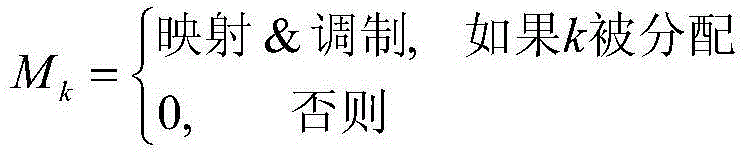
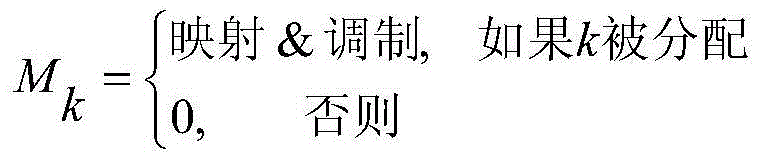
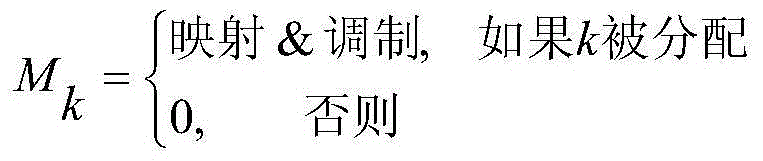
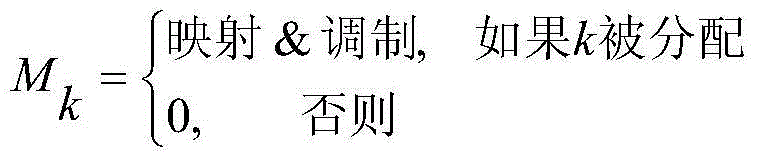
编码器620将MAC处理器330提供的发射数据编码。映射器630根据下式针对基于分配信息信号的副载波索引映射和调制已编码发射数据以提供经映射的信号Mk:

其中k=-N/2,...,N/2-1 where k=-N/2,...,N/2-1
对于2x2 MIMO,CSI及MIMO控制器640使用副载波分配信号、信道估计器440提供的估计信道响应、以及CINR估计器470提供的估计CINR来生成分别对应天线1250和1251的副载波CSI信号C0,k和C1,k以及操作模式控制信号P0和P1。操作模式控制信号P0和P1选择与天线1250和1251相关联的天线路径中的一条。天线路径对应发射信号处理单元660和670。操作模式控制信号P0和P1可假定两种值:活跃或非活跃,以指示天线1250或1251为活跃还是非活跃。副载波CSI信号C0,k和C1,k以及操作模式控制信号P0和P1的计算细节在图8中示出。
For 2x2 MIMO, the CSI and
发射机分集处理器650根据至少经映射的信号Mk、副载波CSI信号、和操作模式控制信号生成发射机分集信号。发射机分集处理器650根据对应于是否使用相位对准的发射机分集模式生成发射机分集信号。发射机分集模式由MAC处理器330提供。
对于2x2 MIMO,发射机分集处理器650根据发射机分集模式(TxD)生成分别对应第一和第二天线路径的第一发射机分集信号T0,k和第二发射机
For 2x2 MIMO, the
分集信号T1,k。当TxD指示使用相位对准时,根据下式来确定T0,k和t1,k: Diversity signal T 1,k . When TxD indicates the use of phase alignment, T 0,k and t 1,k are determined according to the following equations:
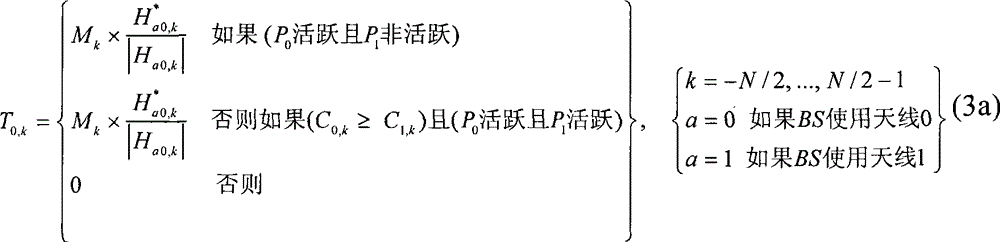
其中k=-N/2,...,N/2-1;若使用第一天线1250则a=0,而若使用第二天线1251则a=1。H* ij,k指示Hij,k的复共轭,而|Hij,k|是Hij,k的幅值。Hij,k是根据上式(1)确定的。
Where k=-N/2, . . . , N/2-1; a=0 if the
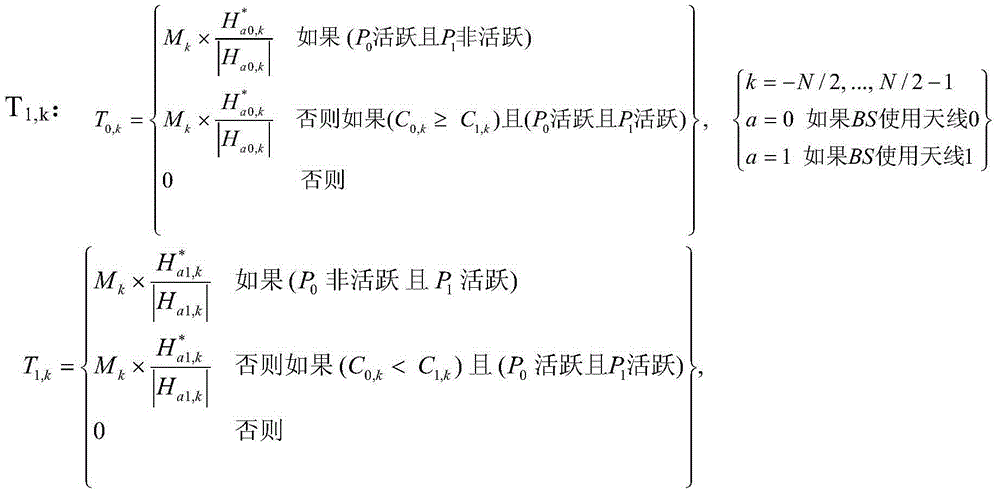
当TxD指示不使用相位对准时,根据下式来确定T0,k和T1,k: When TxD indicates that no phase alignment is used, T 0,k and T 1,k are determined according to the following equations:

其中k=-N/2,...,N/2-1。 where k=-N/2, . . . , N/2-1. the
发射信号处理单元660和670对应传输的天线路径。发射机信号处理单元660与天线1250相关联并使用第一操作模式控制信号P0处理发射机分集信号的第一发射机分集信号T0,k。发射机信号处理单元670与天线1251相关联并使用第二操作模式控制信号P1处理发射机分集信号的第二发射机分集信号T1,k。
The transmit
图7是示出根据本发明的一个实施例的UL分配的示图。UL分配指示系统中使用的分配基。 FIG. 7 is a diagram illustrating UL allocation according to one embodiment of the present invention. The UL allocation indicates the allocation base used in the system. the
根据IEEE 802.16e标准,帧结构具有数个帧。第n帧包括DL子帧、UL子帧、发射-接收转换间隙(TTG)、以及接收-发射转换间隙(RTG)。DL 子帧包括前同步码、帧控制报头(FCH)、DL映射、和若干DL突发。UL子帧包括测距子信道和若干UL突发。 According to the IEEE 802.16e standard, the frame structure has several frames. The nth frame includes a DL subframe, a UL subframe, a transmit-receive transition gap (TTG), and a receive-transmit transition gap (RTG). A DL subframe includes a preamble, a frame control header (FCH), a DL map, and several DL bursts. A UL subframe includes ranging subchannels and several UL bursts. the
DL和UL突发分别被定义在由副载波轴(或子信道轴)和OFDMA码元轴定义的二维平面中。第i个UL突发710包括一个或一个以上的隙720j。每个隙720j包括若干个具有相同结构的分配单元730k。有三种不同的作为基本分配单元的UL分配单元:子信道部分使用(PUSC)740、任选PUSC 750、和AMC分配760。
DL and UL bursts are defined in a two-dimensional plane defined by the subcarrier axis (or subchannel axis) and the OFDMA symbol axis, respectively. The ith UL burst 710 includes one or more slots 72Oj . Each slot 72Oj includes several allocation units 73Ok having the same structure. There are three different UL allocation units as basic allocation units: partial usage of subchannels (PUSC) 740 , optional PUSC 750 , and
PUSC分配单元包括4个副载波和3个码元。瓦片(tile)(4x3)中存在4个导频副载波P和8个数据副载波。在UL PUSC置换方法中,隙由6个瓦片(4x3)构造而成。任选PUSC分配单元包括3个副载波和3个码元。瓦片(3x3)中存在1个导频副载波P和8个数据副载波。在UL任选PUSC置换方法中,隙由6个瓦片(3x3)构造而成。UL AMC分配单元包括9个副载波和1个码元。槽(9x1)中存在1个导频副载波P和8个数据副载波。在UL AMC置换方法中,隙由1x6(副载波轴x码元轴)个槽(9x1)、2x3个槽(9x1)、3x2个槽(9x1)、或沿分配区域的连续6个槽(9x1)构造而成。 A PUSC allocation unit includes 4 subcarriers and 3 symbols. There are 4 pilot subcarriers P and 8 data subcarriers in a tile (4x3). In the UL PUSC permutation method, slots are constructed from 6 tiles (4x3). An optional PUSC allocation unit includes 3 subcarriers and 3 symbols. There is 1 pilot subcarrier P and 8 data subcarriers in a tile (3x3). In the UL optional PUSC permutation method, a slot is constructed from 6 tiles (3x3). A UL AMC allocation unit includes 9 subcarriers and 1 symbol. There are 1 pilot subcarrier P and 8 data subcarriers in the slot (9x1). In the UL AMC permutation method, slots consist of 1x6 (subcarrier axis x symbol axis) slots (9x1), 2x3 slots (9x1), 3x2 slots (9x1), or 6 consecutive slots along the allocated area (9x1 ) is constructed. the
图8是示出根据本发明的一个实施例的图6中所示的CSI及MIMO控制器640的示图。CSI及MIMO控制器640包括束包CSI生成器810、副载波CSI信道生成器820、总CSI生成器830、以及操作模式控制器840。
FIG. 8 is a diagram illustrating the CSI and
束包CSI生成器810使用估计信道响应基于束包b生成束包CSI信号。束包CSI生成器810根据下式生成分别对应于与第一和第二天线相关联的第一和第二天线路径的第一束包CSI信号BC0,b和第二束包CSI信号BC1,b。
The
其中,H00,xb(l)、H01,xb(l)、H10,xb(l)、和H11,xb(l)对应估计信道响应,以及Xb={xb(1),...,xb(l),...,xb(L)}是副载波索引集,xb(l)是第b个束包的第l个元素且具有表示副载波索引的大于或等于-N/2且小于N/2的整数值,N为正整数;L是束包b的元素的数目;而B表示束包的总数且由副载波分配信号提供。 Wherein, H 00,xb(l) , H 01,xb(l) , H 10,xb(l) , and H 11,xb(l) correspond to the estimated channel response, and X b ={x b (1), ..., x b (l), ..., x b (L)} is the subcarrier index set, x b (l) is the lth element of the bth bundle and has a subcarrier index greater than or an integer value equal to -N/2 and less than N/2, where N is a positive integer; L is the number of elements of the bundle b; and B represents the total number of bundles and is provided by the subcarrier allocation signal.
副载波CSI生成器820使用束包CSI信号生成副载波CSI信号C0,k和C1,k。副载波CSI生成器820根据下式生成分别对应于第一和第二天线路径的第一副载波CSI信号C0,k和第二副载波CSI信号C1,k:
The

总CSI生成器830使用副载波CSI信号C0,k和C1,k生成总CSI信号。总CSI生成器830根据下式生成分别对应于第一和第二天线路径的第一总CSI信号PC0和第二总CSI信号PC1:
The
操作模式控制器840使用总CSI信号和阈值THRCINR生成操作模式控制信号。阈值THRCINR可根据信道状态或调制类型来选择。操作模式生成器840根据下式生成分别对应于第一和第二天线路径的第一操作模式信号P0和第二操作模式信号P1:
The
其中CINR是由CINR估计器470提供的估计CINR。
where CINR is the estimated CINR provided by
操作模式控制信号P0和P1可被用来使用估计CINR和CSI调节天线路径的数目。因此,通信单元160的功耗可被将降低或最小化。这对于手持式移动无线设备特别有用。
The operation mode control signals P 0 and P 1 may be used to adjust the number of antenna paths using the estimated CINR and CSI. Accordingly, power consumption of the
图9是示出根据本发明的一个实施例的发射信号处理单元660/670的示图。发射信号处理单元660/670包括逆频域处理器910、保护插入器920、以及RF前端理器930。
FIG. 9 is a diagram illustrating a transmit
逆频域处理器910将第一和第二发射机分集信号转换成发射信号。在一个实施例中,逆频域处理器910使用大小为N的逆FFT来计算该发射分集信号的逆FFT。保护插入器920向发射信号插入保护频带。
The inverse
RF前端处理器930对发射信号执行RF函数。RF函数可包括数模转换、RF信号调理、滤波、以及上变频。
The RF front-
如上讨论的,本发明中使用的发射机分集方案可应用于任何系统而无需改变标准规范(例如,IEEE 802.16e)。换言之,任何遵循该标准的接收机可接收、解映射、解调、和解码该发射信号。另外,通信单元160并不限于两个天线。以上讨论可扩展到任意数目的天线。通信单元160的结构可作相应的修改。
As discussed above, the transmitter diversity scheme used in the present invention can be applied to any system without changing the standard specification (eg, IEEE 802.16e). In other words, any receiver compliant with the standard can receive, demap, demodulate, and decode the transmitted signal. In addition, the
本发明的实施例的元素可通过硬件、固件、软件或其任意组合来实现。术语硬件一般表示具有诸如电子、电磁、光学、电光、机械、电机部件、组件、或器件等的元件。术语软件一般表示逻辑结构、方法、工序、程序、例程、过程、算法、方程、函数、表达式等。术语固件一般表示实现或嵌入在硬件结构(例如,闪存)中的逻辑结构、方法、工序、程序、例程、过程、算法、方程、函数、表达式等。固件的示例包括微代码、可写控制存储、微编程结构。当以软件或固件实现时,本发明的实施例的元件基本是用以执行必要任务的代码段。软件/固件可包括执行本发明的一个实施例中所述的操作的实际代码、或者模拟或仿真这些操作的代码。程序或代码段可被存储在处理器或机器可访问介质中,或者可在传输介质上通过体现在载波中的计算机数据信号或由载波调制的信号被传送。“处理器可读或可访问介质”或“机器可读或可访问介质”可包括能存储、发射、或传送信息的任何介质。处理器可读或机器可访问介质的示例包括电子电路、半导体存储器件、只读存储器(ROM)、闪存、可擦除ROM(EROM)、可擦除可编程ROM(EPROM)、软盘、压缩盘(CD)ROM、光盘、硬盘、光纤介质、射频(RF)链路等。计算机数据信号可包括可在诸如电子网络信道、光纤、空气、电磁、RF链路等传输介质上传播的任何信号。代码段可经由诸如因特网、内联网等计算机网络来下载。机器可访问介质可以制品来体现。机器可访问介质可包括在由机器执行时致使机器执行上述操作的数据。机器可访问介质还可包括嵌入在其中的程序代码。程序代码可包括用以 执行上述操作的机器可读代码。术语“数据”在这里表示可出于机器可读目的而被编码的任何类型的信息。因此,其可包括程序、代码、数据、文件等。 Elements of embodiments of the invention may be implemented by hardware, firmware, software or any combination thereof. The term hardware generally means having elements such as electronic, electromagnetic, optical, electro-optical, mechanical, electromechanical parts, assemblies, or devices. The term software generally denotes a logical structure, method, procedure, program, routine, process, algorithm, equation, function, expression, or the like. The term firmware generally refers to logical structures, methods, procedures, programs, routines, procedures, algorithms, equations, functions, expressions, etc. implemented or embedded in hardware structures (eg, flash memory). Examples of firmware include microcode, writable control storage, microprogrammed structures. When implemented in software or firmware, the elements of the embodiments of the invention are basically the code segments to perform the necessary tasks. The software/firmware may include the actual code that performs the operations described in one embodiment of the invention, or code that simulates or emulates these operations. Programs or code segments may be stored in a processor or machine-accessible medium, or may be transmitted over a transmission medium by a computer data signal embodied in or modulated by a carrier wave. A "processor-readable or accessible medium" or "machine-readable or accessible medium" may include any medium that can store, transmit, or convey information. Examples of processor-readable or machine-accessible media include electronic circuits, semiconductor memory devices, read only memory (ROM), flash memory, erasable ROM (EROM), erasable programmable ROM (EPROM), floppy disks, compact disks (CD) ROM, optical disc, hard disk, fiber optic media, radio frequency (RF) link, etc. A computer data signal may include any signal that can travel over a transmission medium such as an electronic network channel, fiber optics, air, electromagnetic, RF links, or the like. Code segments may be downloaded via computer networks such as the Internet, Intranet, and the like. A machine-accessible medium can be embodied in an article of manufacture. A machine-accessible medium may include data that, when executed by a machine, causes the machine to perform the operations described above. A machine-accessible medium may also include program code embedded therein. The program code may include machine-readable codes for performing the operations described above. The term "data" herein means any type of information that may be encoded for machine-readable purposes. Accordingly, it may include programs, codes, data, files, and the like. the
本发明的实施例的所有或部分可通过硬件、软件、或固件、或其任意组合来实现。硬件、软件、或固件元件可具有若干彼此相互耦合的模块。硬件模块通过机械、电、光、电磁或任何物理连接被耦合到另一模块。软件模块通过函数、程序、方法、子程序、或子例程调用、跳跃、链接、参数、变量、以及参变量传递、函数返回等被耦合至另一模块。软件模块被耦合至另一模块以接收变量、参数、参变量、指针等和/或生成或传递结果、经更新的变量、指针等。固件模块通过以上硬件和软件耦合方法的任何组合被耦合至另一模块。硬件、软件、或固件模块可被耦合至另一硬件、软件、或固件模块中的任意一者。模块还可以是与在平台上运行的操作系统交互的软件驱动器或接口。模块还可以是配置、设置、初始化、向/从硬件设备发送/接收数据的硬件驱动器。装置可包括硬件、软件、和固件模块的任意组合。 All or part of the embodiments of the present invention may be implemented by hardware, software, or firmware, or any combination thereof. A hardware, software, or firmware element may have several modules coupled to each other. A hardware module is coupled to another module through mechanical, electrical, optical, electromagnetic or any physical connection. A software module is coupled to another module through function, procedure, method, subroutine, or subroutine calls, jumps, links, parameters, variables, and argument passing, function returns, and the like. A software module is coupled to another module to receive variables, parameters, arguments, pointers, etc. and/or to generate or communicate results, updated variables, pointers, etc. A firmware module is coupled to another module by any combination of the above hardware and software coupling methods. A hardware, software, or firmware module may be coupled to any one of another hardware, software, or firmware module. A module may also be a software driver or interface that interacts with an operating system running on the platform. A module can also be a hardware driver that configures, sets up, initializes, sends/receives data to/from a hardware device. A device may include any combination of hardware, software, and firmware modules. the
尽管就若干实施例对本发明进行了描述,但本领域的普通技术人员将认识到本发明并不限于所述实施例,而是也能在经过所附权利要求的精神实质和范围内的变形和更改的情况下实践。因此该描述应被理解为说明性而非限制性。 Although the invention has been described in terms of several embodiments, those skilled in the art will recognize that the invention is not limited to the embodiments described, but is capable of modification and modification within the spirit and scope of the appended claims. Practice with changes. The description is therefore to be regarded as illustrative rather than restrictive.
Claims (53)





Applications Claiming Priority (3)
| Application Number | Priority Date | Filing Date | Title |
|---|---|---|---|
| US11/440,829 US7974360B2 (en) | 2006-05-24 | 2006-05-24 | Multi input multi output (MIMO) orthogonal frequency division multiple access (OFDMA) communication system |
| US11/440,829 | 2006-05-24 | ||
| PCT/US2007/012401 WO2007142858A2 (en) | 2006-05-24 | 2007-05-24 | Multi input multi output (mimo) orthogonal frequency division multiple access (ofdma) communication system |
Publications (2)
| Publication Number | Publication Date |
|---|---|
| CN101523761A CN101523761A (en) | 2009-09-02 |
| CN101523761B true CN101523761B (en) | 2014-03-12 |
Family
ID=38749476
Family Applications (1)
| Application Number | Title | Priority Date | Filing Date |
|---|---|---|---|
| CN200780018871.4A Active CN101523761B (en) | 2006-05-24 | 2007-05-24 | Multi input multi output (MIMO) orthogonal frequency division multiple access (OFDMA) communication system |
Country Status (9)
| Country | Link |
|---|---|
| US (2) | US7974360B2 (en) |
| EP (1) | EP2020096B1 (en) |
| JP (2) | JP2009538570A (en) |
| KR (1) | KR101076563B1 (en) |
| CN (1) | CN101523761B (en) |
| BR (1) | BRPI0712108A2 (en) |
| CA (1) | CA2650633C (en) |
| RU (1) | RU2419977C2 (en) |
| WO (1) | WO2007142858A2 (en) |
Families Citing this family (18)
| Publication number | Priority date | Publication date | Assignee | Title |
|---|---|---|---|---|
| US7974360B2 (en) | 2006-05-24 | 2011-07-05 | Qualcomm Incorporated | Multi input multi output (MIMO) orthogonal frequency division multiple access (OFDMA) communication system |
| US8472448B2 (en) | 2006-07-21 | 2013-06-25 | Intel Corporation | Wireless adaptive packet control message apparatus, systems, and methods |
| US7680027B2 (en) * | 2007-05-04 | 2010-03-16 | Beceem Communications Inc. | Methods and systems for channel estimation in a collaborative multi input multiple output (MIMO) communication system |
| EP2204024A1 (en) * | 2007-10-15 | 2010-07-07 | Telefonaktiebolaget LM Ericsson (PUBL) | Pre-coding for frequency selective radio communication channels |
| US20100278061A1 (en) * | 2008-01-07 | 2010-11-04 | Runcom Technologies Ltd. | Cinr formula for spatial multiplexing |
| KR101603649B1 (en) * | 2008-04-21 | 2016-03-15 | 엘지전자 주식회사 | A method of designing a multiplexing structure for resource allocation to support legacy system |
| US8340605B2 (en) * | 2008-08-06 | 2012-12-25 | Qualcomm Incorporated | Coordinated transmissions between cells of a base station in a wireless communications system |
| WO2010138921A2 (en) * | 2009-05-29 | 2010-12-02 | Zte U.S.A., Inc. | Signal transmission with fixed subcarrier spacing within ofdma communication systems |
| CN102035768B (en) * | 2009-09-24 | 2013-10-16 | 中兴通讯股份有限公司 | Method and device for measuring carrier to interference and noise ratio |
| WO2011087162A1 (en) * | 2010-01-12 | 2011-07-21 | Pantech Co., Ltd. | Base station, terminal and method in multi-user multiple-input multiple-output |
| GB2500382B (en) * | 2012-03-19 | 2014-11-26 | Broadcom Corp | Methods, apparatus and computer programs for configuring user equipment |
| GB2510583B (en) * | 2013-02-07 | 2015-02-25 | Nec Corp | Wireless reception device and wireless reception method |
| CN103997364A (en) * | 2013-02-18 | 2014-08-20 | 展讯通信(上海)有限公司 | Method and apparatus for combining multipath signals in multi-antenna receiver |
| CN104301267B (en) * | 2014-11-11 | 2017-07-04 | 山东大学 | The multistage iteration detection method and device of a kind of mimo wireless communication receiver |
| CN107210790A (en) * | 2015-02-16 | 2017-09-26 | 富士通株式会社 | Signal transmission method, device and communication system |
| TWI602399B (en) * | 2015-12-16 | 2017-10-11 | 財團法人工業技術研究院 | Receiver device applied to mimo system and the control method using the same |
| FR3052615B1 (en) * | 2016-06-09 | 2019-11-01 | B-Com | METHOD OF DEMODULATING A RECEIVED SIGNAL, COMPUTER PROGRAM PRODUCT AND CORRESPONDING DEVICE |
| WO2018174798A1 (en) * | 2017-03-24 | 2018-09-27 | Telefonaktiebolaget Lm Ericsson (Publ) | Methods for multi-antenna transmission in vehicular communications |
Citations (3)
| Publication number | Priority date | Publication date | Assignee | Title |
|---|---|---|---|---|
| CN1498474A (en) * | 2001-01-19 | 2004-05-19 | ˹���ķ��Ź�˾ | Multi-carrier communication with time division multiplexing and carrier selective loading |
| CN1674572A (en) * | 2003-11-12 | 2005-09-28 | 三星电子株式会社 | Apparatus and method for sub-carrier allocation in orthogonal frequency division multiplexing (OFDM) communication system |
| WO2005122515A1 (en) * | 2004-06-07 | 2005-12-22 | Intel Corporation | Multicarrier communication system and methods for link adaptation using uniform bit loading and subcarrier puncturing |
Family Cites Families (36)
| Publication number | Priority date | Publication date | Assignee | Title |
|---|---|---|---|---|
| RU2110159C1 (en) | 1989-06-20 | 1998-04-27 | Алькатель Н.В. | Method for assessing through-put capacity of virtual communication channels and device which implements said method |
| US6185258B1 (en) * | 1997-09-16 | 2001-02-06 | At&T Wireless Services Inc. | Transmitter diversity technique for wireless communications |
| DE19747369A1 (en) | 1997-10-27 | 1999-05-06 | Siemens Ag | Transmission channel estimation in telecommunication systems with wireless telecommunication |
| KR20000002504A (en) * | 1998-06-20 | 2000-01-15 | 윤종용 | Selective transmitting diversity device of mobile communication system and method thereof |
| US20030105037A1 (en) * | 2001-10-06 | 2003-06-05 | Isis Pharmaceuticals Inc. | Antisense modulation of inhibitor-kappa B kinase-gamma expression |
| US6473393B1 (en) * | 1998-12-18 | 2002-10-29 | At&T Corp. | Channel estimation for OFDM systems with transmitter diversity |
| CN1196277C (en) * | 1999-05-19 | 2005-04-06 | 诺基亚网络有限公司 | Transmit diversity method and system |
| DE69900645T2 (en) * | 1999-05-26 | 2002-09-12 | Motorola, Inc. | Transmit diversity method and system with phase control for radio transmission systems |
| US6473467B1 (en) * | 2000-03-22 | 2002-10-29 | Qualcomm Incorporated | Method and apparatus for measuring reporting channel state information in a high efficiency, high performance communications system |
| US20020154705A1 (en) * | 2000-03-22 | 2002-10-24 | Walton Jay R. | High efficiency high performance communications system employing multi-carrier modulation |
| US6795392B1 (en) * | 2000-03-27 | 2004-09-21 | At&T Corp. | Clustered OFDM with channel estimation |
| US20020164968A1 (en) * | 2001-03-06 | 2002-11-07 | Magis Networks, Inc. | Probing scheme for diversity antenna branch selection |
| US6771706B2 (en) * | 2001-03-23 | 2004-08-03 | Qualcomm Incorporated | Method and apparatus for utilizing channel state information in a wireless communication system |
| KR100401801B1 (en) * | 2001-03-27 | 2003-10-17 | (주)텔레시스테크놀로지 | Orthogonal frequency division multiplexing/modulation communication system for improving ability of data transmission and method thereof |
| US6862271B2 (en) * | 2002-02-26 | 2005-03-01 | Qualcomm Incorporated | Multiple-input, multiple-output (MIMO) systems with multiple transmission modes |
| US6785520B2 (en) * | 2002-03-01 | 2004-08-31 | Cognio, Inc. | System and method for antenna diversity using equal power joint maximal ratio combining |
| US6873651B2 (en) * | 2002-03-01 | 2005-03-29 | Cognio, Inc. | System and method for joint maximal ratio combining using time-domain signal processing |
| US7197084B2 (en) | 2002-03-27 | 2007-03-27 | Qualcomm Incorporated | Precoding for a multipath channel in a MIMO system |
| JP4602641B2 (en) * | 2002-10-18 | 2010-12-22 | 株式会社エヌ・ティ・ティ・ドコモ | Signal transmission system, signal transmission method and transmitter |
| JP2004274603A (en) * | 2003-03-11 | 2004-09-30 | Sony Corp | OFDM receiver |
| US7545765B2 (en) * | 2003-04-11 | 2009-06-09 | Telefonaktiebolaget Lm Ericsson (Publ) | Multi-user diversity forwarding |
| US7382840B2 (en) * | 2003-07-29 | 2008-06-03 | Mitsubishi Electric Research Laboratories, Inc. | RF signal processing in multi-antenna systems |
| US7065144B2 (en) * | 2003-08-27 | 2006-06-20 | Qualcomm Incorporated | Frequency-independent spatial processing for wideband MISO and MIMO systems |
| US7075906B2 (en) * | 2003-09-30 | 2006-07-11 | Cisco Technology, Inc. | Method and apparatus for cell identification in wireless data networks |
| US7348378B2 (en) | 2003-12-18 | 2008-03-25 | 3M Innovative Properties Company | Adhesive |
| JP2007518346A (en) | 2004-01-20 | 2007-07-05 | エルジー エレクトロニクス インコーポレイティド | Signal transmission / reception method in MIMO system |
| GB2411556B (en) * | 2004-02-27 | 2006-03-29 | Toshiba Res Europ Ltd | Communications system, method and device |
| KR100800795B1 (en) * | 2004-05-31 | 2008-02-04 | 삼성전자주식회사 | Method and apparatus for transmitting / receiving uplink response information in communication system |
| JP4583090B2 (en) | 2004-06-29 | 2010-11-17 | 京セラ株式会社 | Communication apparatus and communication multiplexing method |
| US8385296B2 (en) * | 2004-07-22 | 2013-02-26 | Industry Academic Cooperation Foundation Of Kyunghee University | Multi-carrier CDMA transmitting device and method using block-based multi-carrier spreading |
| JP4756506B2 (en) * | 2004-08-13 | 2011-08-24 | エージェンシー フォー サイエンス, テクノロジー アンド リサーチ | Digital signal equalization method and equalizer |
| EP1790088B1 (en) * | 2004-08-17 | 2015-09-30 | LG Electronics Inc. | A method for establishing fast feedback channel and transmitting information in a wireless communication system |
| WO2006022372A1 (en) | 2004-08-26 | 2006-03-02 | Sharp Kabushiki Kaisha | Wireless transmitter and wireless receiver |
| US7593493B2 (en) * | 2004-10-06 | 2009-09-22 | Broadcom Corporation | Method and system for pre-equalization in a single weight (SW) single channel (SC) multiple-input multiple-output (MIMO) system |
| EP1802017A1 (en) * | 2004-11-04 | 2007-06-27 | Matsushita Electric Industrial Co., Ltd. | Link-adaptation system in mimo-ofdm system, and method therefor |
| US7974360B2 (en) | 2006-05-24 | 2011-07-05 | Qualcomm Incorporated | Multi input multi output (MIMO) orthogonal frequency division multiple access (OFDMA) communication system |
-
2006
- 2006-05-24 US US11/440,829 patent/US7974360B2/en active Active
-
2007
- 2007-05-24 JP JP2009512153A patent/JP2009538570A/en not_active Withdrawn
- 2007-05-24 RU RU2008151157/09A patent/RU2419977C2/en not_active IP Right Cessation
- 2007-05-24 EP EP07809176.6A patent/EP2020096B1/en not_active Not-in-force
- 2007-05-24 WO PCT/US2007/012401 patent/WO2007142858A2/en not_active Ceased
- 2007-05-24 BR BRPI0712108-3A patent/BRPI0712108A2/en not_active Application Discontinuation
- 2007-05-24 CA CA2650633A patent/CA2650633C/en not_active Expired - Fee Related
- 2007-05-24 CN CN200780018871.4A patent/CN101523761B/en active Active
- 2007-05-24 KR KR1020087031290A patent/KR101076563B1/en not_active Expired - Fee Related
-
2011
- 2011-06-29 US US13/172,369 patent/US8406335B2/en active Active
-
2012
- 2012-03-01 JP JP2012045246A patent/JP5479516B2/en not_active Expired - Fee Related
Patent Citations (3)
| Publication number | Priority date | Publication date | Assignee | Title |
|---|---|---|---|---|
| CN1498474A (en) * | 2001-01-19 | 2004-05-19 | ˹���ķ��Ź�˾ | Multi-carrier communication with time division multiplexing and carrier selective loading |
| CN1674572A (en) * | 2003-11-12 | 2005-09-28 | 三星电子株式会社 | Apparatus and method for sub-carrier allocation in orthogonal frequency division multiplexing (OFDM) communication system |
| WO2005122515A1 (en) * | 2004-06-07 | 2005-12-22 | Intel Corporation | Multicarrier communication system and methods for link adaptation using uniform bit loading and subcarrier puncturing |
Also Published As
| Publication number | Publication date |
|---|---|
| KR20090016487A (en) | 2009-02-13 |
| CA2650633C (en) | 2012-08-07 |
| WO2007142858A3 (en) | 2008-03-20 |
| CN101523761A (en) | 2009-09-02 |
| EP2020096B1 (en) | 2018-08-08 |
| EP2020096A4 (en) | 2014-07-02 |
| CA2650633A1 (en) | 2007-12-13 |
| JP2009538570A (en) | 2009-11-05 |
| KR101076563B1 (en) | 2011-10-24 |
| US8406335B2 (en) | 2013-03-26 |
| BRPI0712108A2 (en) | 2012-01-31 |
| US20070274409A1 (en) | 2007-11-29 |
| RU2008151157A (en) | 2010-06-27 |
| JP5479516B2 (en) | 2014-04-23 |
| RU2419977C2 (en) | 2011-05-27 |
| US7974360B2 (en) | 2011-07-05 |
| US20120163306A1 (en) | 2012-06-28 |
| EP2020096A2 (en) | 2009-02-04 |
| WO2007142858A2 (en) | 2007-12-13 |
| JP2012157017A (en) | 2012-08-16 |
Similar Documents
| Publication | Publication Date | Title |
|---|---|---|
| CN101523761B (en) | Multi input multi output (MIMO) orthogonal frequency division multiple access (OFDMA) communication system | |
| Gholam et al. | Beamforming design for simplified analog antenna combining architectures | |
| EP1538772A1 (en) | Apparatus and method for transmitting data using eigenvector selection in MIMO mobile communication systems | |
| CN102150402B (en) | MMSE MIMO decoder using QR decomposition | |
| EP2481167A2 (en) | Non-unitary precoding scheme for wireless communications | |
| US20130163691A1 (en) | Method for Transmitting a Data Signal in a MIMO System | |
| US20050254461A1 (en) | Apparatus and method for data transmission/reception using channel state information in wireless communication system | |
| CN104365030A (en) | Adaptive mode-switching spatial modulation for MIMO wireless communication system | |
| US8477874B2 (en) | Method, device and system of wireless communication | |
| CN1977486B (en) | System and method for maximum likelihood decoding in a multiple output wireless communication system | |
| EP2611044B1 (en) | Adaptive transmit beamforming | |
| EP2323275A1 (en) | Method and device for uplink signals transmission and channel estimation in wireless access network | |
| JP5129389B2 (en) | Method and system for hybrid MIMO scheme in OFDM / A system | |
| JP4504431B2 (en) | Method and system for estimating phase error noise | |
| CN102215498A (en) | Relay node and antenna selection device and selection method | |
| KR20080052900A (en) | Method and system for data transmission in communication system | |
| Das et al. | Beamforming and combining strategies for MIMO-OFDM over doubly selective channels | |
| Haustein et al. | From theory to practice: MIMO real-time experiments of adaptive bit-loading with linear and non-linear transmission and detection schemes | |
| Deng et al. | Performance of open-loop transmit diversity with intra-subframe frequency hopping and iterative decision-feedback channel estimation for DFT-precoded OFDMA | |
| Luo et al. | MIMO quadrature-OFDMA systems | |
| Yan et al. | A low complexity VBLAST OFDM detection algorithm | |
| Remlein et al. | Space Time Turbo Coded OFDM with Joint Transmit and Receive Antenna Selection |
Legal Events
| Date | Code | Title | Description |
|---|---|---|---|
| C06 | Publication | ||
| PB01 | Publication | ||
| C10 | Entry into substantive examination | ||
| SE01 | Entry into force of request for substantive examination | ||
| GR01 | Patent grant | ||
| GR01 | Patent grant |