CN101519682B - Method for detecting cat source components in food and fodder and kit - Google Patents
Method for detecting cat source components in food and fodder and kit Download PDFInfo
- Publication number
- CN101519682B CN101519682B CN2009100482234A CN200910048223A CN101519682B CN 101519682 B CN101519682 B CN 101519682B CN 2009100482234 A CN2009100482234 A CN 2009100482234A CN 200910048223 A CN200910048223 A CN 200910048223A CN 101519682 B CN101519682 B CN 101519682B
- Authority
- CN
- China
- Prior art keywords
- cat
- seq
- derived component
- derived
- primer
- Prior art date
- Legal status (The legal status is an assumption and is not a legal conclusion. Google has not performed a legal analysis and makes no representation as to the accuracy of the status listed.)
- Expired - Fee Related
Links
- 241000282326 Felis catus Species 0.000 title claims abstract description 128
- 238000000034 method Methods 0.000 title claims abstract description 27
- 235000013305 food Nutrition 0.000 title abstract description 18
- 239000000523 sample Substances 0.000 claims abstract description 75
- 230000003321 amplification Effects 0.000 claims description 30
- 238000003199 nucleic acid amplification method Methods 0.000 claims description 30
- 108090000623 proteins and genes Proteins 0.000 claims description 29
- 241000282324 Felis Species 0.000 claims description 25
- 239000002773 nucleotide Substances 0.000 claims description 24
- 125000003729 nucleotide group Chemical group 0.000 claims description 24
- 108700036248 MT-RNR1 Proteins 0.000 claims description 20
- 230000002438 mitochondrial effect Effects 0.000 claims description 16
- 150000007523 nucleic acids Chemical class 0.000 claims description 15
- 108020004707 nucleic acids Proteins 0.000 claims description 11
- 102000039446 nucleic acids Human genes 0.000 claims description 11
- 238000003752 polymerase chain reaction Methods 0.000 claims description 10
- FWMNVWWHGCHHJJ-SKKKGAJSSA-N 4-amino-1-[(2r)-6-amino-2-[[(2r)-2-[[(2r)-2-[[(2r)-2-amino-3-phenylpropanoyl]amino]-3-phenylpropanoyl]amino]-4-methylpentanoyl]amino]hexanoyl]piperidine-4-carboxylic acid Chemical compound C([C@H](C(=O)N[C@H](CC(C)C)C(=O)N[C@H](CCCCN)C(=O)N1CCC(N)(CC1)C(O)=O)NC(=O)[C@H](N)CC=1C=CC=CC=1)C1=CC=CC=C1 FWMNVWWHGCHHJJ-SKKKGAJSSA-N 0.000 claims description 8
- 238000012360 testing method Methods 0.000 claims description 7
- 125000003275 alpha amino acid group Chemical group 0.000 claims description 6
- 239000003153 chemical reaction reagent Substances 0.000 claims description 3
- 108090000765 processed proteins & peptides Proteins 0.000 claims description 3
- 229920001184 polypeptide Polymers 0.000 claims description 2
- 102000004196 processed proteins & peptides Human genes 0.000 claims description 2
- 108020004414 DNA Proteins 0.000 description 44
- 238000001514 detection method Methods 0.000 description 41
- 235000013372 meat Nutrition 0.000 description 25
- 239000004615 ingredient Substances 0.000 description 20
- 241001465754 Metazoa Species 0.000 description 19
- 239000002994 raw material Substances 0.000 description 11
- 241000196324 Embryophyta Species 0.000 description 10
- 201000010099 disease Diseases 0.000 description 8
- 208000037265 diseases, disorders, signs and symptoms Diseases 0.000 description 8
- 230000035945 sensitivity Effects 0.000 description 8
- 239000000843 powder Substances 0.000 description 7
- 241000283690 Bos taurus Species 0.000 description 6
- 241000209140 Triticum Species 0.000 description 5
- 235000021307 Triticum Nutrition 0.000 description 5
- 238000007400 DNA extraction Methods 0.000 description 4
- 241000124008 Mammalia Species 0.000 description 4
- 108091028043 Nucleic acid sequence Proteins 0.000 description 4
- 241000282849 Ruminantia Species 0.000 description 4
- 230000008901 benefit Effects 0.000 description 4
- 238000005516 engineering process Methods 0.000 description 4
- 238000003753 real-time PCR Methods 0.000 description 4
- 239000000126 substance Substances 0.000 description 4
- KFZMGEQAYNKOFK-UHFFFAOYSA-N Isopropanol Chemical compound CC(C)O KFZMGEQAYNKOFK-UHFFFAOYSA-N 0.000 description 3
- 238000003556 assay Methods 0.000 description 3
- 239000008280 blood Substances 0.000 description 3
- 210000004369 blood Anatomy 0.000 description 3
- 238000013461 design Methods 0.000 description 3
- 238000001917 fluorescence detection Methods 0.000 description 3
- 230000036541 health Effects 0.000 description 3
- 239000000463 material Substances 0.000 description 3
- 238000002360 preparation method Methods 0.000 description 3
- 230000008569 process Effects 0.000 description 3
- 238000000746 purification Methods 0.000 description 3
- 239000000243 solution Substances 0.000 description 3
- 241000894007 species Species 0.000 description 3
- IJGRMHOSHXDMSA-UHFFFAOYSA-N Atomic nitrogen Chemical compound N#N IJGRMHOSHXDMSA-UHFFFAOYSA-N 0.000 description 2
- 102000053602 DNA Human genes 0.000 description 2
- LFQSCWFLJHTTHZ-UHFFFAOYSA-N Ethanol Chemical compound CCO LFQSCWFLJHTTHZ-UHFFFAOYSA-N 0.000 description 2
- 235000019733 Fish meal Nutrition 0.000 description 2
- 238000012408 PCR amplification Methods 0.000 description 2
- 241001494479 Pecora Species 0.000 description 2
- 238000004458 analytical method Methods 0.000 description 2
- 230000005540 biological transmission Effects 0.000 description 2
- 238000001962 electrophoresis Methods 0.000 description 2
- 238000002474 experimental method Methods 0.000 description 2
- 239000000284 extract Substances 0.000 description 2
- 238000000605 extraction Methods 0.000 description 2
- 239000004467 fishmeal Substances 0.000 description 2
- 235000013312 flour Nutrition 0.000 description 2
- 238000009396 hybridization Methods 0.000 description 2
- 238000007689 inspection Methods 0.000 description 2
- 244000144972 livestock Species 0.000 description 2
- 235000013622 meat product Nutrition 0.000 description 2
- 239000013642 negative control Substances 0.000 description 2
- 235000015277 pork Nutrition 0.000 description 2
- 238000012545 processing Methods 0.000 description 2
- 102000004169 proteins and genes Human genes 0.000 description 2
- 238000004445 quantitative analysis Methods 0.000 description 2
- 238000011160 research Methods 0.000 description 2
- 238000003757 reverse transcription PCR Methods 0.000 description 2
- 240000002930 Alternanthera sessilis Species 0.000 description 1
- 235000015579 Alternanthera sessilis Nutrition 0.000 description 1
- 208000031295 Animal disease Diseases 0.000 description 1
- 241000282836 Camelus dromedarius Species 0.000 description 1
- 241000283707 Capra Species 0.000 description 1
- 241000283007 Cervus nippon Species 0.000 description 1
- 241000272201 Columbiformes Species 0.000 description 1
- 229920000742 Cotton Polymers 0.000 description 1
- 241000252230 Ctenopharyngodon idella Species 0.000 description 1
- 235000016936 Dendrocalamus strictus Nutrition 0.000 description 1
- 101100453790 Drosophila melanogaster Kebab gene Proteins 0.000 description 1
- 108090000790 Enzymes Proteins 0.000 description 1
- 102000004190 Enzymes Human genes 0.000 description 1
- 241000283074 Equus asinus Species 0.000 description 1
- 241000287828 Gallus gallus Species 0.000 description 1
- 241000237858 Gastropoda Species 0.000 description 1
- 244000068988 Glycine max Species 0.000 description 1
- 235000010469 Glycine max Nutrition 0.000 description 1
- 241000219146 Gossypium Species 0.000 description 1
- 240000005979 Hordeum vulgare Species 0.000 description 1
- 235000007340 Hordeum vulgare Nutrition 0.000 description 1
- 235000006439 Lemna minor Nutrition 0.000 description 1
- 244000242291 Lemna paucicostata Species 0.000 description 1
- 235000007688 Lycopersicon esculentum Nutrition 0.000 description 1
- 235000019735 Meat-and-bone meal Nutrition 0.000 description 1
- 241000237536 Mytilus edulis Species 0.000 description 1
- 240000007594 Oryza sativa Species 0.000 description 1
- 235000007164 Oryza sativa Nutrition 0.000 description 1
- 241000237502 Ostreidae Species 0.000 description 1
- 241000241034 Palaemon pugio Species 0.000 description 1
- 241000286209 Phasianidae Species 0.000 description 1
- 240000004713 Pisum sativum Species 0.000 description 1
- 235000010582 Pisum sativum Nutrition 0.000 description 1
- 206010037742 Rabies Diseases 0.000 description 1
- 241000270934 Rana catesbeiana Species 0.000 description 1
- 241000270295 Serpentes Species 0.000 description 1
- 240000003768 Solanum lycopersicum Species 0.000 description 1
- 244000061456 Solanum tuberosum Species 0.000 description 1
- 235000002595 Solanum tuberosum Nutrition 0.000 description 1
- 241000282898 Sus scrofa Species 0.000 description 1
- 239000007984 Tris EDTA buffer Substances 0.000 description 1
- 240000008042 Zea mays Species 0.000 description 1
- 235000005824 Zea mays ssp. parviglumis Nutrition 0.000 description 1
- 235000002017 Zea mays subsp mays Nutrition 0.000 description 1
- 239000003674 animal food additive Substances 0.000 description 1
- 238000000137 annealing Methods 0.000 description 1
- 239000011324 bead Substances 0.000 description 1
- 235000015278 beef Nutrition 0.000 description 1
- 230000000711 cancerogenic effect Effects 0.000 description 1
- 231100000357 carcinogen Toxicity 0.000 description 1
- 239000003183 carcinogenic agent Substances 0.000 description 1
- 235000013330 chicken meat Nutrition 0.000 description 1
- 238000011109 contamination Methods 0.000 description 1
- 235000005822 corn Nutrition 0.000 description 1
- 230000001351 cycling effect Effects 0.000 description 1
- 235000013364 duck meat Nutrition 0.000 description 1
- 230000000694 effects Effects 0.000 description 1
- 238000003912 environmental pollution Methods 0.000 description 1
- ZMMJGEGLRURXTF-UHFFFAOYSA-N ethidium bromide Chemical compound [Br-].C12=CC(N)=CC=C2C2=CC=C(N)C=C2[N+](CC)=C1C1=CC=CC=C1 ZMMJGEGLRURXTF-UHFFFAOYSA-N 0.000 description 1
- 229960005542 ethidium bromide Drugs 0.000 description 1
- 230000003631 expected effect Effects 0.000 description 1
- 239000000796 flavoring agent Substances 0.000 description 1
- 235000019634 flavors Nutrition 0.000 description 1
- 239000007850 fluorescent dye Substances 0.000 description 1
- 238000004108 freeze drying Methods 0.000 description 1
- 238000007710 freezing Methods 0.000 description 1
- 230000008014 freezing Effects 0.000 description 1
- 235000015275 goose meat Nutrition 0.000 description 1
- 238000000227 grinding Methods 0.000 description 1
- 235000015231 kebab Nutrition 0.000 description 1
- 238000012417 linear regression Methods 0.000 description 1
- 239000007788 liquid Substances 0.000 description 1
- 239000003550 marker Substances 0.000 description 1
- 239000011159 matrix material Substances 0.000 description 1
- 239000011259 mixed solution Substances 0.000 description 1
- 239000000203 mixture Substances 0.000 description 1
- 238000012986 modification Methods 0.000 description 1
- 230000004048 modification Effects 0.000 description 1
- 238000010369 molecular cloning Methods 0.000 description 1
- 235000020638 mussel Nutrition 0.000 description 1
- 229910052757 nitrogen Inorganic materials 0.000 description 1
- 235000020636 oyster Nutrition 0.000 description 1
- 244000144977 poultry Species 0.000 description 1
- 235000013594 poultry meat Nutrition 0.000 description 1
- 230000000171 quenching effect Effects 0.000 description 1
- 239000012925 reference material Substances 0.000 description 1
- 230000001105 regulatory effect Effects 0.000 description 1
- 235000009566 rice Nutrition 0.000 description 1
- 238000004904 shortening Methods 0.000 description 1
- 238000001228 spectrum Methods 0.000 description 1
- 108010068698 spleen exonuclease Proteins 0.000 description 1
- 230000007480 spreading Effects 0.000 description 1
- 238000003892 spreading Methods 0.000 description 1
- 210000001519 tissue Anatomy 0.000 description 1
- 229910021642 ultra pure water Inorganic materials 0.000 description 1
- 239000012498 ultrapure water Substances 0.000 description 1
- 238000011144 upstream manufacturing Methods 0.000 description 1
- 235000013311 vegetables Nutrition 0.000 description 1
Images


Landscapes
- Measuring Or Testing Involving Enzymes Or Micro-Organisms (AREA)
Abstract
The invention discloses a method for detecting cat source components in food and fodder and a kit. Specifically, the invention discloses a method for quickly detecting cat source components, wherein apolymerase chain reaction is carried out in a polymerase reaction system which contains specific primer pairs of the expanded cat source components and cat source component specific probes. The inven tion also provides a corresponding kit. The method can quickly and conveniently detect and identify the cat source components.
Description
Technical Field
The invention relates to the technical field of molecular biology and nucleic acid detection. More particularly, it relates to a method and a kit for rapidly detecting cat-derived components.
Background
In animal product raw materials and processed products, adulteration and unintentional contamination of animal ingredients often occur. Artificial adulteration is mainly a fraudulent act of reducing costs or increasing quality by illegal means in order to earn enormous economic benefits, while in the processing of food and feed, low-priced raw materials are substituted for or incorporated into high-priced raw materials. The fraudulent conduct of adulteration and counterfeiting is prohibited by a plurality of laws and regulations in China.
The adulteration and adulteration act affects the economy of China, and the other one mainly affects the human health and the safety of livestock and poultry. The occurrence and spread of mad cow disease bring great loss to the economy of countries in the world such as European Union, and the transmission path of the mad cow disease is mainly to feed ruminants with mammal-derived feed.
At present, legislation is enacted in various countries such as the European Union, the United states, Japan, etc., and the ruminant is prohibited from being fed with the feed of mammal origin, so as to prevent the occurrence and spread of mad cow disease. In order to completely cut off the transmission path of mad cow disease and prevent the mad cow disease from occurring in China, the Ministry of agriculture in 2002 publishes 'notice about banning the addition and use of animal feed in ruminant feed', and 'methods for managing the safety and health of animal-derived feed products' promulgated and implemented in 2004, and bans the use of mammal-derived ingredients in ruminant feed. Cats are a very large number of animals/pets, a kind of mammal, a kind of human being. If not strictly regulated, the tissue of a dead cat may be used in the processing of animal feed. If animal feed is mixed with animal ingredients of feline origin, the biological risk of an animal's disease outbreak epidemic may be present.
Cats are animals that are not commonly eaten by people, carry common diseases of people and livestock such as rabies, and have the risk of spreading the diseases. If the cat meat which is not eaten frequently is eaten, diseases can be transmitted.
At present, no corresponding method for detecting cat-derived components in food and feed exists in China. That is, the detection of cat-derived ingredients in food and feed is still blank. The establishment of the method for detecting the cat-derived ingredients in the food and the feed has very important significance for fighting against counterfeit and shoddy food and feed, ensuring the rights and benefits of consumers and body health, protecting the safety and economic benefits of animal husbandry in China, avoiding international trade disputes and the like, and is an imminent food safety problem and inspection and quarantine problem to be solved.
In view of the above, there is no detection technology for rapidly and easily detecting and identifying cat-derived components, and there is a strong need in the art to develop a new technology for rapidly and easily detecting and identifying cat-derived components.
Disclosure of Invention
The invention aims to provide a technology for quickly and simply detecting and identifying whether cat-derived ingredients exist in food or feed.
In a first aspect of the present invention, there is provided a polymerase chain reaction method comprising the steps of:
performing polymerase chain reaction in a polymerase reaction system, wherein the reaction system contains a specific primer pair for amplifying cat-derived components and a cat-derived component specific probe, and an amplification product amplified by the primer has a sequence shown as SEQ ID NO: 5, and the cat-derived component specific probe is combined with a nucleotide sequence of a cat mitochondrial 12S rRNA gene shown as SEQ ID NO: 5, the nucleotide sequence of the cat mitochondrial 12S rRNA gene.
In another preferred class, the feline-derived component-specific probe has the amino acid sequence of SEQ ID NO: 3.
In another class of preferred embodiments, the pair of primers specific for amplification of feline-derived components is selected from the group consisting of:
primer 1: 5'-agcacgaaag taactttaac acctcc-3', SEQ ID NO: 1;
primer 2: 5'-tgctagtagt tctctggcgg atag-3', SEQ ID NO: 2.
in another preferred class, the feline-derived component-specific probe is a Taqman probe (particularly a Taqman MGB probe).
In another class of preferred embodiments, the probe sequences are as follows:
5’-actacacgac agctaaga-MGB-3’,SEQID NO:3。
in another class of preferred embodiments, the method further comprises the steps of: detecting the fluorescent signal emitted by the feline-derived component-specific probe during or after the polymerase chain reaction.
In a second aspect of the present invention, there is provided a test kit comprising the following reagents:
(a) and amplifying a cat-derived component by using a specific primer pair, wherein an amplification product amplified by using the primer pair has a nucleotide sequence shown as SEQ ID NO: 5, the nucleotide sequence of the cat mitochondrial 12S rRNA gene; and
(b) a feline-derived component-specific probe, and the feline-derived component-specific probe binds to a peptide set forth in SEQ ID NO: 5, the nucleotide sequence of the cat mitochondrial 12S rRNA gene.
In another preferred class, the feline-derived component-specific probe has the amino acid sequence of SEQ ID NO: 3.
In another class of preferred embodiments, the pair of primers specific for amplification of feline-derived components is selected from the group consisting of:
primer 1: 5'-agcacgaaag taactttaac acctcc-3', SEQ ID NO: 1
Primer 2: 5'-tgctagtagt tctctggcgg atag-3', SEQ ID NO: 2.
in another preferred class, the feline-derived component-specific probe is a Taqman MGB probe.
In a third aspect of the present invention, there is provided a method for detecting whether a sample to be detected contains a feline-derived component, comprising the steps of:
(a) extracting nucleic acid components from a sample to be detected;
(b) and carrying out polymerase chain reaction on the extracted nucleic acid components in a polymerase reaction system, wherein the reaction system contains a specific primer pair for amplifying the cat-derived component and a cat-derived component specific probe, and an amplification product amplified by the primers has a nucleotide sequence shown in SEQ ID NO: 5, and the cat-derived component specific probe is combined with a nucleotide sequence of a cat mitochondrial 12S rRNA gene shown as SEQ ID NO: 5, the nucleotide sequence of the cat mitochondrial 12S rRNA gene;
wherein, if a nucleic acid corresponding to the amino acid sequence as set forth in SEQ ID NO: 5, the amplification product of the nucleotide sequence of the cat mitochondrial 12S rRNA gene indicates that the sample to be detected contains cat-derived components.
In another class of preferred embodiments, the nucleic acid sequence corresponding to the amino acid sequence as set forth in SEQ ID NO: 5, the amplification product of the nucleotide sequence of the cat mitochondrial 12S rRNA gene indicates that the sample to be detected does not contain cat-derived components, or the content of the cat-derived components is lower than the lower limit of the detection sensitivity (e.g., 0.0001%).
In another preferred class, the polymerase chain reaction is fluorescent real-time PCR.
In another class of preferred embodiments, the pair of primers specific for amplification of a feline-derived component is selected from the group consisting of:
primer 1: 5'-agcacgaaag taactttaac acctcc-3', SEQ ID NO: 1
Primer 2: 5'-tgctagtagt tctctggcgg atag-3', SEQ ID NO: 2.
in another preferred class, the sample to be tested is a food or feed.
In a fourth aspect of the invention, there is provided a polypeptide having a sequence as set forth in SEQ ID NO: 5 or a primer pair capable of specifically amplifying the nucleic acid molecule, and is used for preparing a kit for detecting cat-derived ingredients.
In another class of preferred embodiments, the primer pair is selected from the group consisting of:
primer 1: 5'-agcacgaaag taactttaac acctcc-3', SEQ ID NO: 1
Primer 2: 5'-tgctagtagt tctctggcgg atag-3', SEQ ID NO: 2.
in another preferred class, the kit further comprises a nucleic acid sequence shown in SEQ ID NO: 3, and (b) a probe shown in (3).
It is to be understood that within the scope of the present invention, the above-described technical features of the present invention and the technical features specifically described below (e.g., examples) may be combined with each other to constitute a new or preferred technical solution. Not to be reiterated herein, but to the extent of space.
Drawings
FIG. 1 shows the feline 12S rRNA gene and the nucleic acid sequences upstream and downstream thereof (SEQ ID NO: 4) as well as the sequences of specific primers and probes.
FIG. 2 shows a real-time fluorescence PCR detection profile using specificity of cat-derived primer probes in one embodiment of the invention.
FIG. 3 shows a graph of the sensitivity of real-time fluorescent PCR detection using cat-derived primer probes in an embodiment of the invention. Wherein,
a: detecting specificity, and amplifying cat DNA; b: and (3) detecting the sensitivity, wherein the amplification curves from left to right are respectively: 10% cat DNA, 1% cat DNA, 0.1% cat DNA, 0.01% cat DNA, 0.001% cat DNA, 0.0001% cat DNA.
FIG. 4 shows a linear relationship between Ct value and template amount.
FIG. 5 shows a spectrum of real-time fluorescent PCR detection of cat-derived components for meat products in an embodiment of the present invention.
FIG. 6 shows a graph of real-time fluorescent PCR detection of feline-derived components in a plant feed in an embodiment of the present invention.
Detailed Description
The present inventors have conducted extensive and intensive studies on various gene sequences of cat-derived ingredients, and have considered that the nucleotide sequences shown in SEQ ID NO: 5 is particularly suitable for detecting and identifying cat-derived components. Aiming at the region, not only primers for amplifying cat-derived components with extremely high specificity can be designed, but also cat-derived component probes with extremely high specificity can be designed. Thus, cat-derived components can be identified quickly and easily by detecting the fluorescent signal of TaqMan MGB probe in one PCR reaction.
As used herein, the term "feline-derived component-specific probe" refers to a primer (pair) that amplifies an amplification product having the sequence as set forth in SEQ ID NO: 5, the nucleotide sequence of the cat mitochondrial 12S rRNA gene. A preferred primer pair has the sequence of SEQ ID NO: 1 and 2.
As used herein, the term "feline-derived component-specific probe" refers to a probe that is capable of binding to an amplification product of a feline-derived component, but not to amplification products of other species (e.g., swine, cattle, sheep, etc.). More preferably, the cat-derived component specific probe specifically binds to a cat-derived component as shown in SEQ ID NO: 5, the nucleotide sequence of the cat mitochondrial 12S rRNA gene. One preferred probe has the sequence of SEQ id no: 3, and (b) is the sequence shown in the specification.
Real-time fluorescence PCR is a closed amplification detection method, amplification and detection can be carried out after an amplification system finishes sample adding, and analysis is carried out after amplification is not needed; not only reduces the possibility of environmental pollution, but also has higher specificity than common PCR because of the co-hybridization of the primer pair and the probe.
The TaqMan polymerase chain reaction technology utilizes Taq enzyme 5 '→ 3' exonuclease activity to cut off a hybridization probe in the extension process and eliminate the quenching effect of a fluorescent group at the 3 'end of the probe on a signal of a marker reporter fluorescent group at the 5' end. The intensity of the fluorescence signal is in direct proportion to the quantity of the PCR products, and the detection system can predict the quantity of the PCR products by detecting fluorescence.
Preferred amplification regions in the methods of the invention are those of feline-derived components, such as SEQ ID NO: 5 (corresponding to the 374-507 sequence in SEQ ID NO: 4), which is specific to the feline-derived component, can be used for detecting the feline-derived component.
In light of the teachings of the present invention, one skilled in the art will be able to design and synthesize primers and cat-derived component specific probes and use them in fluorescent real-time PCR qualitative and quantitative detection techniques.
In the present invention, the conditions for the steps such as total extraction of DNA from a sample, PCR amplification, and fluorescence detection are the same as those in the prior art except that the target sequence to be detected is different from those in the prior art, and it is well within the ordinary skill of the art to perform the above-mentioned various steps using conventional conditions.
In a preferred embodiment of the invention, the electrophoresis results show that primers specific for amplification of feline-derived components can amplify nucleic acids of feline-derived components. The real-time fluorescence detection result shows that the kit only shows positive performance in the sample containing the cat-derived component, and the expected effect is achieved. This indicates that the cat-derived component specific probes selected by the rational selection are extremely efficient and specific.
When real-time fluorescence detection is performed by using a quantitative PCR instrument, detection can be performed at wavelengths of 530nm or 640nm and the like according to the difference of fluorescent markers (FAM, TET).
The main advantages of the invention are:
(1) can simply, conveniently and quickly detect and identify the cat-derived ingredients.
(2) Based on the nucleotide sequence as shown in SEQ ID NO: 5 can effectively and specifically amplify the nucleic acid sequence of the cat-derived component, and the cat-derived component specific probe can more specifically distinguish the cat-derived component.
(3) The detection result has good linearity and can be used for quantitative analysis.
(4) The real-time fluorescence PCR amplification process can detect the amplification product without an electrophoresis detection process, thereby shortening the detection time and being safe to the environment and personnel because no ethidium bromide carcinogen is adopted. In addition, the detection result can be directly confirmed because the specific probe is added.
The invention will be further illustrated with reference to the following specific examples. It should be understood that these examples are for illustrative purposes only and are not intended to limit the scope of the present invention. Experimental procedures without specific conditions noted in the following examples, generally followed by conventional conditions, such as Sambrook et al, molecular cloning: the conditions described in the Laboratory Manual (New York: Cold Spring Harbor Laboratory Press, 1989), or according to the manufacturer's recommendations.
Example 1
Experimental materials and methods
1.1 materials
Animal species: 29 animals, such as cat meat, cat blood, dog meat, beef, pork, goat meat, sheep meat, sika deer meat, camel meat, horse meat, donkey meat, rabbit meat, wild pork, racoon dog meat, chicken, duck meat, goose meat, turkey, pigeon, quail, snake meat, bullfrog, frog meat, grass shrimp, crab, grass carp, oyster, mussel, snail and the like, are purchased from Shanghai markets.
Plant species: soybean, corn, barley, wheat, rice, potato, tomato, pea, cotton, rape and other 10 kinds of common plant material.
1.2 reagents
(1) Primer and TaqMan MGB fluorescent probe sequence:
12Scat-1:5’-AGCACGAAAGTAACTTTAACACCTCC-3’(SEQ ID NO:1)
12Scat-2:5’-TGCTAGTAGTTCTCTGGCGGATAG-3’(SEQ ID NO:2)
12Scat-P:5’-ACTACACGACAGCTAAGA-MGB-3’(SEQ ID NO:3)
(2) liquid nitrogen;
(3) magnetic DNA Purification system for Food, Magnetic bead method DNA extraction kit, Promega corporation CAT. # FF 3750;
(4) genomic DNA Purification Kit, DNA extraction Kit, Promega corporation CAT. # A1250;
(5) isopropyl alcohol;
(6) 70% ethanol;
(7) TE buffer, pH8.0
(8)ABI TaqMan Universal PCR Master Mix(Part Number 4304437)
(9) Ultrapure water (ddH)2O)。
1.3 instrumentation
(1) ABI 7300 real-time fluorescence PCR instrument
(2) Balance with a movable handle
(3) Liquid-transfering gun
(4) Centrifugal machine
(5) Constant temperature incubator
(6) Freezing mill
(7) DNA freeze drying centrifuge
(8) Nucleic acid protein concentration analyzer
(9) Eppendorf centrifuging tube
(10) PCR reaction tube
1.4 preparation of samples
1.4.1 grinding of samples
The meat samples were ground to a powder using a freeze grinder (SPEX 6850).
1.4.2 sample preparation
Mutton and wheat were ground into powder using a refrigerated grinder and dried at 120 ℃ for 6 hours. Mutton powder and wheat flour are respectively used for preparing mixed samples with the content of the cat meat powder of 0.01 percent (W/W).
1.5 extraction of DNA
According to The DNA extraction kit for Magnetic DNA Purification system for Food (Promega corporation CAT. # FF3750) extracts the above sample DNA. By using
 Genomic DNAPuration Kit (Promega corporation CAT. # A1250) DNA extraction Kit extracts CAT blood DNA.
1.6DNA concentration determination and preparation
The concentration of the extracted sample DNA was determined using a nucleic acid protein analyzer of the Eppendorf Biophorometer type, Germany.
The extracted cat blood DNA solution (concentration: 100 ng/. mu.L) was diluted with wheat DNA solution (concentration: 100 ng/. mu.L) to a mixed solution of 10 ng/. mu.L, 1 ng/. mu.L, 0.1 ng/. mu.L, 0.01 ng/. mu.L, 0.001 ng/. mu.L, 0.0001 ng/. mu.L, and 0.00001 ng/. mu.L, which contained 10%, 1%, 0.1%, 0.01%, 0.001%, 0.0001%, and 0.00001% of the relative DNA content.
1.7PCR assay
1.7.1PCR reaction System
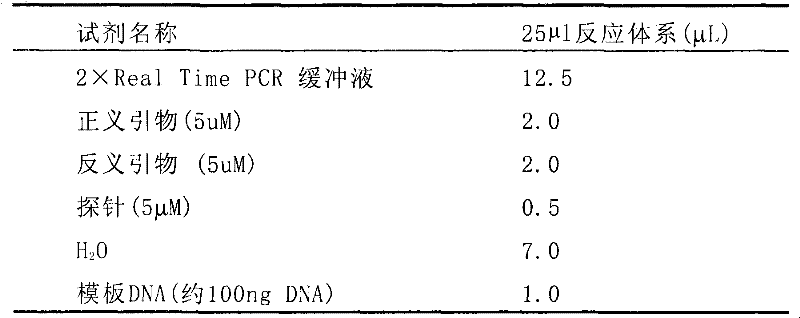
The reaction system for real-time fluorescent PCR detection is shown in Table 1.
TABLE 1 reaction System for real-time fluorescent PCR detection
1.7.3PCR reaction cycling parameters
Real-time fluorescent PCR reaction cycle parameters: at 50 ℃ for 2 min; at 95 ℃ for 10 min; circulating for 40 times at 95 deg.C for 15s and 60 deg.C for 1 min.
1.8 sensitivity test
LOD is the lowest sample concentration that can be detected with a probability of detection of more than 95%. LOD can be determined by establishing a series of samples at different concentrations and performing a sufficient number of repeated tests, or by repeatedly testing a series of reference materials for different amounts of the gene template of interest.
The expression of LOD may be the copy number of the DNA molecule, the relative percentage of the DNA molecule, or the mass of the DNA. The experiment is expressed in terms of the relative percentage of DNA molecules and the mass of DNA as a sensitivity test.
2 results and analysis
2.1 design of primer probes for endogenous genes in cats
According to 12S rRNA gene and nucleotide sequence (936bp-1895bp) at the upper and lower streams of the gene in cat mitochondrial genome (GenBank numbering: U20753) (shown as SEQ ID NO: 4), the design of the primer fully considers the factors such as the consistency of the annealing temperature of the detection primer and the probe of the cat 12S rRNA gene and the similarity of GC content, the primers and the probe for detecting cat-derived components are designed by adopting DNMAN 8.0 software, and the nucleotide sequence and the primer probe sequence at the upper and lower streams of the cat 12S rRNA gene are shown in figure 1. The homology of the primer probe is searched through the Blast function of GenBank, the gene has high specificity, and the homology of other genes and the gene is very small.
Primers and probes
12Scat-1:5’-AGCACGAAAGTAACTTTAACACCTCC-3’(SEQ ID NO:1)
12Scat-2:5’-TGCTAGTAGTTCTCTGGCGGATAG-3’(SEQ ID NO:2)
12Scat-P:5’-ACTACACGACAGCTAAGA-MGB-3’(SEQ ID NO:3)
The sequence of the PCR product obtained by the amplification of the primer pair (SEQ ID NO: 1 and 2) is shown as SEQ ID NO: 5, corresponding to SEQ ID NO: 374 and 507 in 4.
2.2 Cat-derived component real-time fluorescence PCR species specificity detection results
The results of the detection of cat DNA and other test animal and plant sample DNA using cat-derived detection primers are shown in fig. 2, where amplification occurred only in cat DNA (fig. 2).
2.3 real-time fluorescence PCR sensitivity detection results of Cat-derived ingredients
The assay was performed on 100 ng/. mu.L (100%), 10 ng/. mu.L (10%), 1 ng/. mu.L (1%), 0.1 ng/. mu.L (0.1%), 0.01 ng/. mu.L (0.01%), 0.001 ng/. mu.L (0.001%), 0.0001 ng/. mu.L (0.0001%), 0.00001 ng/. mu.L (0.00001%) of cat DNA.
The results are shown in FIG. 3. In fig. 3, a: detecting specificity, and amplifying cat DNA; b: and (3) detecting the sensitivity, wherein the amplification curves from left to right are respectively: 10 ng/. mu.L (10%) cat DNA, 1 ng/. mu.L (1%) cat DNA, 0.1 ng/. mu.L (0.1%) cat DNA, 0.01n g/. mu.L (0.01%) cat DNA, 0.001 ng/. mu.L (0.001%) cat DNA, 0.0001 ng/. mu.L (0.0001%) cat DNA.
Amplification occurred in all cat DNA at > 0.0001 ng/. mu.L (0.0001%) (FIG. 3). This indicates that the cat-derived detection primer is species-specific and the detection sensitivity is 0.0001 ng/. mu.L (0.0001%) of cat DNA. Taking logarithm (x) of DNA template quantity and Ct value (y) as standard curveAnd obtaining a linear regression equation (figure 4); the linear relationship between Ct value and template quantity is good, R2Is 0.9976. The results show that the method can carry out quantitative analysis on the DNA concentration (relative content) of the cat.
2.4 detection of Cat-derived ingredients in meat products (animal products)
The detection research of cat-derived ingredients in animal raw material products is carried out by adding cat meat ingredient positive substances. The cat meat powder sample is added into a mutton powder matrix which takes animals without cat ingredients as raw materials to prepare a 0.01 percent added sample. The method is applied to detection to simulate the detection of cat-derived ingredients in animal products.
The experimental result shows that the PCR negative control result has no amplification curve, the reaction result is normal, and the reaction system has no pollution. The results of detecting the cat-derived components in the animal raw material products show that the method can detect 0.01 percent of cat-derived component substances in the animal raw material products (figure 5).
2.5 detection of Cat-derived ingredients in vegetable feeds (plant products)
The cat meat positive substances are added to perform detection research on cat-derived ingredients in plant raw material products. The cat meat powder sample was added to a wheat flour base made of a plant containing no cat component to prepare a 0.01% added sample. The method is applied to detection to simulate the detection of cat-derived ingredients in plant products.
The experimental result shows that the PCR negative control result has no amplification curve, the reaction result is normal, and the reaction system has no pollution. The results of detecting the cat-derived components in the plant raw material products show that the method can detect 0.01 percent of cat-derived component substances in the plant raw material products (figure 6).
3 conclusion
The real-time fluorescent PCR detection primer probe which is developed by the invention and aims at detecting the 12S rRNA gene of the cat is suitable for detecting the cat-derived components in raw materials (cat meat) and processed products (food, feed and the like), and can be applied to daily inspection and quarantine work.
Example 2
Detection of food and feed
Primers (SEQ ID NOS: 1 and 2) were used to bind to the amino acid sequence of SEQ ID NO: and 3, respectively carrying out real-time fluorescence RT-PCR detection on cat-derived ingredients by the probe through real-time fluorescence RT-PCR on 15 batches of food and feed samples purchased from the market, and detecting the cat-derived ingredients from 4 batches of food.
In addition, the nucleotide sequence of the amplification product of the detected sample is determined by a sequencer, and the result shows that the amplified cat-derived component is shown as SEQ ID NO: 5, the nucleotide sequence region of the feline mitochondrial 12S rRNA gene.
TABLE 2 fluorescent real-time RT-PCR assay results for different batches of samples
| Batches of | Sample name | Source ground | The result of the |
| 1 | Cat meat | Shanghai province | Positive for |
| 2 | Kebab | Shanghai province | Positive for |
| 3 | Unknown meat block | Guangzhou restaurant with certain wild flavor | Positive for |
| 4 | Meat block | Another wild store of Guangzhou | Positive for |
| 5 | Meat block | Shanghai restaurant | Negative of |
| 6 | Meat block | Shanghai restaurant | Negative of |
| 7 | Spiced meat block | Shanghai restaurant | Negative of |
| 8 | Meat and bone meal | Australia | Negative of |
| 9 | Fish meal | Peru (Peru) | Negative of |
| 10 | Fish meal | United states of America | Negative of |
| 11 | Feed additive | United states of America | Negative of |
| 12 | Feed stuff | Shanghai province | Negative of |
| 13 | Feed stuff | Jiangsu | Negative of |
| 14 | Feed stuff | Guangzhou province | Negative of |
| 15 | Feed stuff | Guangzhou province | Negative of |
All documents referred to herein are incorporated by reference into this application as if each were individually incorporated by reference. Furthermore, it should be understood that various changes and modifications of the present invention can be made by those skilled in the art after reading the above teachings of the present invention, and these equivalents also fall within the scope of the present invention as defined by the appended claims.
Sequence listing
<110> Zhang, Shuya
<120> detection method and kit for cat-derived components in food and feed
<130>090785
<160>5
<170>PatentIn version 3.5
<210>1
<211>26
<212>DNA
<213> Artificial sequence
<220>
<221>misc feature
<223> primer
<400>1
agcacgaaag taactttaac acctcc 26
<210>2
<211>24
<212>DNA
<213> Artificial sequence
<220>
<221>misc feature
<223> primer
<400>2
tgctagtagt tctctggcgg atag 24
<210>3
<211>18
<212>DNA
<213> Artificial sequence
<220>
<221>misc feature
<223> Probe
<400>3
<210>4
<211>960
<212>DNA
<213> Cat (Felis cat)
<400>4
caaaggtttg gtcctggcct ttccattagt tattaataag attacacatg caagcctccg 60
catcccggtg aaaatgccct ctaagtcacc cagtgaccta aaggagctgg tatcaagcac 120
acaaccacag tagctcataa caccttgctc agccacaccc ccacgggata cagcagtgat 180
aaaaattaag ccatgaatga aagttcgact aagctatatt aaacaagggt tggtaaattt 240
cgtgccagcc accgcggcca tacgattaac ccaaactaat agacccacgg cgtaaagcgt 300
gttacagaga aaaaaatata ctaaagttaa attttaacta ggccgtagaa agctacagtt 360
aacataaaaa tacagcacga aagtaacttt aacacctccg actacacgac agctaagacc 420
caaactggga ttagataccc tactatgctt agccctaaac ttagatagtt accctaaaca 480
aaactatccg ccagagaact actagcaata gcttaaaact caaaggactt ggcggtgctt 540
tacatccctc tagaggagcc tgttctataa tcgataaacc ccgatatacc tcaccatctc 600
ttgctaattc agcctatata ccgccatctt cagcaaaccc taaaaaggaa gaaaagtaag 660
cacaagtatc ttaacataaa aaagttaggt caaggtgtag ctcatgagat gggaagcaat 720
gggctacatt ttctaaaatt agaacaccca cgaagatcct tacgaaacta agtattaaag 780
gaggatttag tagtaaattt gagaatagag agctcaattg aatcgggcca tgaagcacgc 840
acacaccgcc cgtcaccctc ctcaagtggt aactcccaaa aaaacctatt taaattatca 900
cacccacaag aggagataag tcgtaacaag gtaagcatac tggaaagtgt gcttggataa 960
<210>5
<211>134
<212>DNA
<213> Cat (Felis cat)
<400>5
agcacgaaag taactttaac acctccgact acacgacagc taagacccaa actgggatta 60
gataccctac tatgcttagc cctaaactta gatagttacc ctaaacaaaa ctatccgcca 120
gagaactact agca 134
Claims (7)
1. A method of polymerase chain reaction comprising the steps of:
performing polymerase chain reaction in a polymerase reaction system, wherein the reaction system contains a specific primer pair for amplifying the cat-derived component and a cat-derived component specific probe, and an amplification product amplified by the primer is a nucleotide sequence shown as SEQ ID NO: 5 of a nucleotide sequence of a cat mitochondrial 12S rRNA gene,
wherein the nucleotide sequence of the cat-derived component specific probe is shown as SEQ ID NO: 3, the specific primer pair for amplifying the cat-derived component is as follows:
primer 1: 5'-agcacgaaag taactttaac acctcc-3', SEQ ID NO: 1 and
primer 2: 5'-tgctagtagt tctctggcgg atag-3', SEQ ID NO: 2.
2. the method of claim 1, wherein said feline-derived component-specific probe is a Taqman MGB probe.
3. The method of claim 2, wherein the method further comprises the steps of: detecting the fluorescent signal emitted by the feline-derived component-specific probe during or after the polymerase chain reaction.
4. A test kit, comprising the following reagents:
(a) a specific primer pair for amplifying cat-derived components, wherein an amplification product amplified by the primer pair is a primer set shown as SEQ ID NO: 5, the nucleotide sequence of the cat mitochondrial 12S rRNA gene; and
(b) the cat-derived component specific probe, and the nucleotide sequence of the cat-derived component specific probe is shown as SEQ ID NO: 3 is shown in the specification; the specific primer pair for amplifying the cat-derived component is as follows:
primer 1: 5'-agcacgaaag taactttaac acctcc-3', SEQ ID NO: 1 and
primer 2: 5'-tgctagtagt tctctggcgg atag-3', SEQ ID NO: 2.
5. the kit of claim 4, wherein the cat-derived component specific probe is a Taqman MGB probe.
6. A method for detecting whether a sample to be detected contains a cat-derived component is characterized by comprising the following steps:
(a) extracting nucleic acid components from a sample to be detected;
(b) and carrying out polymerase chain reaction on the extracted nucleic acid components in a polymerase reaction system, wherein the reaction system contains a specific primer pair for amplifying the cat-derived component and a cat-derived component specific probe, and an amplification product amplified by the primers is shown as SEQ ID NO: 5, and the nucleotide sequence of the cat mitochondrial 12S rRNA gene is shown as SEQ ID NO: 3 is shown in the specification;
wherein, if a nucleic acid corresponding to the amino acid sequence as set forth in SEQ ID NO: 5, the amplification product of the nucleotide sequence of the cat mitochondrial 12S rRNA gene indicates that the sample to be detected contains cat-derived components;
wherein the specific primer pair for amplifying the cat-derived component is as follows:
primer 1: 5'-agcacgaaag taactttaac acctcc-3', SEQ ID NO: 1 and
primer 2: 5'-tgctagtagt tctctggcgg atag-3', SEQ ID NO: 2.
7. a polypeptide with a sequence shown as SEQ ID NO: 5 or a primer pair of SEQ ID NO: 1 and SEQ ID NO: 2, and is characterized by being used for preparing a kit for detecting cat-derived components.
Priority Applications (1)
| Application Number | Priority Date | Filing Date | Title |
|---|---|---|---|
| CN2009100482234A CN101519682B (en) | 2009-03-26 | 2009-03-26 | Method for detecting cat source components in food and fodder and kit |
Applications Claiming Priority (1)
| Application Number | Priority Date | Filing Date | Title |
|---|---|---|---|
| CN2009100482234A CN101519682B (en) | 2009-03-26 | 2009-03-26 | Method for detecting cat source components in food and fodder and kit |
Publications (2)
| Publication Number | Publication Date |
|---|---|
| CN101519682A CN101519682A (en) | 2009-09-02 |
| CN101519682B true CN101519682B (en) | 2012-01-11 |
Family
ID=41080480
Family Applications (1)
| Application Number | Title | Priority Date | Filing Date |
|---|---|---|---|
| CN2009100482234A Expired - Fee Related CN101519682B (en) | 2009-03-26 | 2009-03-26 | Method for detecting cat source components in food and fodder and kit |
Country Status (1)
| Country | Link |
|---|---|
| CN (1) | CN101519682B (en) |
Families Citing this family (3)
| Publication number | Priority date | Publication date | Assignee | Title |
|---|---|---|---|---|
| CN105039540B (en) * | 2015-07-14 | 2018-07-03 | 山东省兽药质量检验所 | A kind of LAMP detection method for differentiating cat meat in beef and mutton using mitochondrial DNA |
| CN108676853A (en) * | 2017-12-01 | 2018-10-19 | 苏州百源基因技术有限公司 | A kind of real-time fluorescence quantitative PCR kit for mouse detection |
| CN113957172B (en) * | 2021-11-16 | 2022-11-15 | 广州蔚捷生物医药科技有限公司 | Kit for simultaneously detecting various cat pathogens and detection method and application thereof |
Citations (2)
| Publication number | Priority date | Publication date | Assignee | Title |
|---|---|---|---|---|
| CN1779441A (en) * | 2004-11-19 | 2006-05-31 | 潘良文 | Real-time fluorescent inspection and reagent kit for Norwalk virus in mussel |
| CN101381767A (en) * | 2008-10-24 | 2009-03-11 | 东北农业大学 | Universal real-time fluorescent PCR detection method for Trichinella spiralis |
-
2009
- 2009-03-26 CN CN2009100482234A patent/CN101519682B/en not_active Expired - Fee Related
Patent Citations (2)
| Publication number | Priority date | Publication date | Assignee | Title |
|---|---|---|---|---|
| CN1779441A (en) * | 2004-11-19 | 2006-05-31 | 潘良文 | Real-time fluorescent inspection and reagent kit for Norwalk virus in mussel |
| CN101381767A (en) * | 2008-10-24 | 2009-03-11 | 东北农业大学 | Universal real-time fluorescent PCR detection method for Trichinella spiralis |
Non-Patent Citations (2)
| Title |
|---|
| I. Martin 等.Technical Note: Detection of cat, dog, and rat or mouse tissues in food and animal feed using species-specific polymerase chain reaction.《Journal of Animal Science》.2007,第85卷2734-2739. * |
| 张慧霞等.应用PCR技术检测禽类源性成分.《中国畜牧杂志》.2008,第44卷(第11期),第46-49页. * |
Also Published As
| Publication number | Publication date |
|---|---|
| CN101519682A (en) | 2009-09-02 |
Similar Documents
| Publication | Publication Date | Title |
|---|---|---|
| Meyer et al. | PCR-based DNA analysis for the identification and characterization of food components | |
| KR101318311B1 (en) | A method for identifying a pork content in a food | |
| Wolf et al. | Quantitative competitive (QC) PCR for quantification of porcine DNA | |
| KR101209786B1 (en) | PCR or real-time PCR primers for identification of animal species, the kit comprising the primers, and the method for identifying animal species using the primers or kits | |
| CN108330168B (en) | Primer combination for synchronously detecting 14 animal-derived components in meat or meat product and application thereof | |
| Wang et al. | Multiplex PCR assay for identification and quantification of bovine and equine in minced meats using novel specific nuclear DNA sequences | |
| CN114561476B (en) | Primer set and method for multiplex PCR detection for simultaneously identifying 12 meat-derived foods | |
| Mostafa et al. | Food adulteration with genetically modified soybeans and maize, meat of animal species and ractopamine residues in different food products | |
| CN111334585B (en) | Primer and kit for simultaneously detecting 8 animal components, detection method and application | |
| CN101519682B (en) | Method for detecting cat source components in food and fodder and kit | |
| Kušec et al. | Efficiency of PCR-RFLP and Species-specific PCR for the Identification of Meat Origin in Dry Sausages. | |
| CN114686600B (en) | Primer sets and methods for meat detection based on seven-plex PCR technology | |
| CN102643912A (en) | Amplification primer for detecting mink derived ingredients | |
| Heers et al. | Loop-mediated isothermal amplification (LAMP) assay—A rapid detection tool for identifying red fox (Vulpes vulpes) DNA in the carcasses of harbour porpoises (Phocoena phocoena) | |
| CN113897425B (en) | Animal-derived ingredient detection method based on high-throughput sequencing technology and its application | |
| Nesic et al. | Detection of meat and bone meal in cattle feed and ruminal fluid–comparison and combining of microscopy and polymerase chain reaction | |
| CN102433382B (en) | Real-time fluorescent polymerase chain reaction (PCR) detection method for turkey ingredient in foods and feeds | |
| CN114196745B (en) | Kits and methods for rapid identification of bovine-derived components in fish meal | |
| Kuo et al. | Identification of ingredient in mullet roe products by the real-time PCR method | |
| CN107012247B (en) | Real-time fluorescence PCR detection method for detecting goat-derived ingredients in food and feed by using single-copy nuclear gene | |
| JP4357541B2 (en) | Animal group DNA detection method | |
| CN112795665A (en) | A LAMP detection method for bovine-derived components | |
| Lyzu et al. | Tracing the pig and cattle origin in processed food and feed products targeting mitochondrial 12S rRNA gene | |
| LU102712B1 (en) | Primer, kit, and detection method for simultaneous detection of eight animal-derived ingredient and use thereof | |
| Golinelli et al. | Detection of animal products in ruminant feeds by microscopy and Real time PCR. |
Legal Events
| Date | Code | Title | Description |
|---|---|---|---|
| C06 | Publication | ||
| PB01 | Publication | ||
| C10 | Entry into substantive examination | ||
| SE01 | Entry into force of request for substantive examination | ||
| C14 | Grant of patent or utility model | ||
| GR01 | Patent grant | ||
| CF01 | Termination of patent right due to non-payment of annual fee | ||
| CF01 | Termination of patent right due to non-payment of annual fee |
Granted publication date: 20120111 |