CN101511429A - Indulines derivatives and gpr119 agonists - Google Patents
Indulines derivatives and gpr119 agonists Download PDFInfo
- Publication number
- CN101511429A CN101511429A CNA2007800336627A CN200780033662A CN101511429A CN 101511429 A CN101511429 A CN 101511429A CN A2007800336627 A CNA2007800336627 A CN A2007800336627A CN 200780033662 A CN200780033662 A CN 200780033662A CN 101511429 A CN101511429 A CN 101511429A
- Authority
- CN
- China
- Prior art keywords
- dihydro
- phenyl
- pyrimidine
- alkyl
- pyrrolo
- Prior art date
- Legal status (The legal status is an assumption and is not a legal conclusion. Google has not performed a legal analysis and makes no representation as to the accuracy of the status listed.)
- Pending
Links
Images


Classifications
-
- C—CHEMISTRY; METALLURGY
- C07—ORGANIC CHEMISTRY
- C07D—HETEROCYCLIC COMPOUNDS
- C07D487/00—Heterocyclic compounds containing nitrogen atoms as the only ring hetero atoms in the condensed system, not provided for by groups C07D451/00 - C07D477/00
- C07D487/02—Heterocyclic compounds containing nitrogen atoms as the only ring hetero atoms in the condensed system, not provided for by groups C07D451/00 - C07D477/00 in which the condensed system contains two hetero rings
- C07D487/04—Ortho-condensed systems
-
- A—HUMAN NECESSITIES
- A61—MEDICAL OR VETERINARY SCIENCE; HYGIENE
- A61K—PREPARATIONS FOR MEDICAL, DENTAL OR TOILETRY PURPOSES
- A61K31/00—Medicinal preparations containing organic active ingredients
- A61K31/33—Heterocyclic compounds
- A61K31/395—Heterocyclic compounds having nitrogen as a ring hetero atom, e.g. guanethidine or rifamycins
- A61K31/40—Heterocyclic compounds having nitrogen as a ring hetero atom, e.g. guanethidine or rifamycins having five-membered rings with one nitrogen as the only ring hetero atom, e.g. sulpiride, succinimide, tolmetin, buflomedil
- A61K31/403—Heterocyclic compounds having nitrogen as a ring hetero atom, e.g. guanethidine or rifamycins having five-membered rings with one nitrogen as the only ring hetero atom, e.g. sulpiride, succinimide, tolmetin, buflomedil condensed with carbocyclic rings, e.g. carbazole
- A61K31/404—Indoles, e.g. pindolol
-
- A—HUMAN NECESSITIES
- A61—MEDICAL OR VETERINARY SCIENCE; HYGIENE
- A61K—PREPARATIONS FOR MEDICAL, DENTAL OR TOILETRY PURPOSES
- A61K31/00—Medicinal preparations containing organic active ingredients
- A61K31/33—Heterocyclic compounds
- A61K31/395—Heterocyclic compounds having nitrogen as a ring hetero atom, e.g. guanethidine or rifamycins
- A61K31/495—Heterocyclic compounds having nitrogen as a ring hetero atom, e.g. guanethidine or rifamycins having six-membered rings with two or more nitrogen atoms as the only ring heteroatoms, e.g. piperazine or tetrazines
-
- A—HUMAN NECESSITIES
- A61—MEDICAL OR VETERINARY SCIENCE; HYGIENE
- A61K—PREPARATIONS FOR MEDICAL, DENTAL OR TOILETRY PURPOSES
- A61K31/00—Medicinal preparations containing organic active ingredients
- A61K31/33—Heterocyclic compounds
- A61K31/395—Heterocyclic compounds having nitrogen as a ring hetero atom, e.g. guanethidine or rifamycins
- A61K31/495—Heterocyclic compounds having nitrogen as a ring hetero atom, e.g. guanethidine or rifamycins having six-membered rings with two or more nitrogen atoms as the only ring heteroatoms, e.g. piperazine or tetrazines
- A61K31/505—Pyrimidines; Hydrogenated pyrimidines, e.g. trimethoprim
- A61K31/519—Pyrimidines; Hydrogenated pyrimidines, e.g. trimethoprim ortho- or peri-condensed with heterocyclic rings
-
- A—HUMAN NECESSITIES
- A61—MEDICAL OR VETERINARY SCIENCE; HYGIENE
- A61P—SPECIFIC THERAPEUTIC ACTIVITY OF CHEMICAL COMPOUNDS OR MEDICINAL PREPARATIONS
- A61P3/00—Drugs for disorders of the metabolism
-
- A—HUMAN NECESSITIES
- A61—MEDICAL OR VETERINARY SCIENCE; HYGIENE
- A61P—SPECIFIC THERAPEUTIC ACTIVITY OF CHEMICAL COMPOUNDS OR MEDICINAL PREPARATIONS
- A61P3/00—Drugs for disorders of the metabolism
- A61P3/04—Anorexiants; Antiobesity agents
-
- A—HUMAN NECESSITIES
- A61—MEDICAL OR VETERINARY SCIENCE; HYGIENE
- A61P—SPECIFIC THERAPEUTIC ACTIVITY OF CHEMICAL COMPOUNDS OR MEDICINAL PREPARATIONS
- A61P3/00—Drugs for disorders of the metabolism
- A61P3/06—Antihyperlipidemics
-
- A—HUMAN NECESSITIES
- A61—MEDICAL OR VETERINARY SCIENCE; HYGIENE
- A61P—SPECIFIC THERAPEUTIC ACTIVITY OF CHEMICAL COMPOUNDS OR MEDICINAL PREPARATIONS
- A61P3/00—Drugs for disorders of the metabolism
- A61P3/08—Drugs for disorders of the metabolism for glucose homeostasis
- A61P3/10—Drugs for disorders of the metabolism for glucose homeostasis for hyperglycaemia, e.g. antidiabetics
-
- A—HUMAN NECESSITIES
- A61—MEDICAL OR VETERINARY SCIENCE; HYGIENE
- A61P—SPECIFIC THERAPEUTIC ACTIVITY OF CHEMICAL COMPOUNDS OR MEDICINAL PREPARATIONS
- A61P43/00—Drugs for specific purposes, not provided for in groups A61P1/00-A61P41/00
-
- A—HUMAN NECESSITIES
- A61—MEDICAL OR VETERINARY SCIENCE; HYGIENE
- A61P—SPECIFIC THERAPEUTIC ACTIVITY OF CHEMICAL COMPOUNDS OR MEDICINAL PREPARATIONS
- A61P9/00—Drugs for disorders of the cardiovascular system
- A61P9/10—Drugs for disorders of the cardiovascular system for treating ischaemic or atherosclerotic diseases, e.g. antianginal drugs, coronary vasodilators, drugs for myocardial infarction, retinopathy, cerebrovascula insufficiency, renal arteriosclerosis
-
- C—CHEMISTRY; METALLURGY
- C07—ORGANIC CHEMISTRY
- C07D—HETEROCYCLIC COMPOUNDS
- C07D401/00—Heterocyclic compounds containing two or more hetero rings, having nitrogen atoms as the only ring hetero atoms, at least one ring being a six-membered ring with only one nitrogen atom
- C07D401/02—Heterocyclic compounds containing two or more hetero rings, having nitrogen atoms as the only ring hetero atoms, at least one ring being a six-membered ring with only one nitrogen atom containing two hetero rings
- C07D401/12—Heterocyclic compounds containing two or more hetero rings, having nitrogen atoms as the only ring hetero atoms, at least one ring being a six-membered ring with only one nitrogen atom containing two hetero rings linked by a chain containing hetero atoms as chain links
-
- C—CHEMISTRY; METALLURGY
- C07—ORGANIC CHEMISTRY
- C07D—HETEROCYCLIC COMPOUNDS
- C07D401/00—Heterocyclic compounds containing two or more hetero rings, having nitrogen atoms as the only ring hetero atoms, at least one ring being a six-membered ring with only one nitrogen atom
- C07D401/14—Heterocyclic compounds containing two or more hetero rings, having nitrogen atoms as the only ring hetero atoms, at least one ring being a six-membered ring with only one nitrogen atom containing three or more hetero rings
-
- C—CHEMISTRY; METALLURGY
- C07—ORGANIC CHEMISTRY
- C07D—HETEROCYCLIC COMPOUNDS
- C07D413/00—Heterocyclic compounds containing two or more hetero rings, at least one ring having nitrogen and oxygen atoms as the only ring hetero atoms
- C07D413/14—Heterocyclic compounds containing two or more hetero rings, at least one ring having nitrogen and oxygen atoms as the only ring hetero atoms containing three or more hetero rings
-
- C—CHEMISTRY; METALLURGY
- C07—ORGANIC CHEMISTRY
- C07D—HETEROCYCLIC COMPOUNDS
- C07D417/00—Heterocyclic compounds containing two or more hetero rings, at least one ring having nitrogen and sulfur atoms as the only ring hetero atoms, not provided for by group C07D415/00
- C07D417/14—Heterocyclic compounds containing two or more hetero rings, at least one ring having nitrogen and sulfur atoms as the only ring hetero atoms, not provided for by group C07D415/00 containing three or more hetero rings
-
- C—CHEMISTRY; METALLURGY
- C07—ORGANIC CHEMISTRY
- C07F—ACYCLIC, CARBOCYCLIC OR HETEROCYCLIC COMPOUNDS CONTAINING ELEMENTS OTHER THAN CARBON, HYDROGEN, HALOGEN, OXYGEN, NITROGEN, SULFUR, SELENIUM OR TELLURIUM
- C07F9/00—Compounds containing elements of Groups 5 or 15 of the Periodic Table
- C07F9/02—Phosphorus compounds
- C07F9/547—Heterocyclic compounds, e.g. containing phosphorus as a ring hetero atom
- C07F9/6558—Heterocyclic compounds, e.g. containing phosphorus as a ring hetero atom containing at least two different or differently substituted hetero rings neither condensed among themselves nor condensed with a common carbocyclic ring or ring system
- C07F9/65583—Heterocyclic compounds, e.g. containing phosphorus as a ring hetero atom containing at least two different or differently substituted hetero rings neither condensed among themselves nor condensed with a common carbocyclic ring or ring system each of the hetero rings containing nitrogen as ring hetero atom
Landscapes
- Chemical & Material Sciences (AREA)
- Health & Medical Sciences (AREA)
- Organic Chemistry (AREA)
- General Health & Medical Sciences (AREA)
- Life Sciences & Earth Sciences (AREA)
- Veterinary Medicine (AREA)
- Public Health (AREA)
- Medicinal Chemistry (AREA)
- Pharmacology & Pharmacy (AREA)
- Animal Behavior & Ethology (AREA)
- Bioinformatics & Cheminformatics (AREA)
- Engineering & Computer Science (AREA)
- Nuclear Medicine, Radiotherapy & Molecular Imaging (AREA)
- General Chemical & Material Sciences (AREA)
- Chemical Kinetics & Catalysis (AREA)
- Diabetes (AREA)
- Epidemiology (AREA)
- Hematology (AREA)
- Obesity (AREA)
- Molecular Biology (AREA)
- Biochemistry (AREA)
- Vascular Medicine (AREA)
- Cardiology (AREA)
- Heart & Thoracic Surgery (AREA)
- Urology & Nephrology (AREA)
- Child & Adolescent Psychology (AREA)
- Endocrinology (AREA)
- Emergency Medicine (AREA)
- Pharmaceuticals Containing Other Organic And Inorganic Compounds (AREA)
- Plural Heterocyclic Compounds (AREA)
- Nitrogen Condensed Heterocyclic Rings (AREA)
Abstract
Description
发明领域 field of invention
本发明涉及用于治疗和预防代谢性疾病的新化合物,包括糖尿病(I型和II型)、肥胖和相关疾病,本发明还包括制备该化合物的方法、含有该化合物的药物组合物以及该化合物的治疗用途。The present invention relates to novel compounds useful in the treatment and prevention of metabolic diseases, including diabetes (type I and type II), obesity and related diseases, the invention also includes processes for the preparation of the compounds, pharmaceutical compositions containing the compounds and the compounds therapeutic use.
发明背景Background of the invention
糖尿病日益威胁人类健康。例如,在美国目前估计约有一千六百万人患有糖尿病。Diabetes is an increasing threat to human health. For example, it is currently estimated that about 16 million people in the United States have diabetes.
I型糖尿病,也称为胰岛素依赖型糖尿病(IDDM),由产生胰岛素的胰岛β-细胞的自身免疫破坏引起,并且必须有规律地给予外源性胰岛素。没有胰岛素,细胞不能吸收必须产生能量的糖(葡萄糖)。I型糖尿病的症状通常在儿童期或青少年期出现。因为高血糖(高血糖症)的突发症状而患严重疾病,人们经常寻求医学帮助。Type I diabetes, also known as insulin-dependent diabetes mellitus (IDDM), results from autoimmune destruction of the insulin-producing pancreatic islet β-cells and requires regular administration of exogenous insulin. Without insulin, cells cannot absorb the sugar (glucose) that must be produced for energy. Symptoms of
II型糖尿病,也称为非胰岛素依赖型糖尿病(NIDDM),表现为不能充分调节血糖水平。II型糖尿病的特征可为:胰岛素分泌缺陷或胰岛素抵抗,即那些患有II型糖尿病的病人具有非常少的胰岛素或不能有效利用胰岛素。胰岛素抵抗是指机体组织不能恰当响应内源性胰岛素。多种原因(包括遗传、肥胖、年龄增大和长期的高血糖)可引发胰岛素抵抗。II型糖尿病,有时称为成熟或成人型糖尿病,可在任何年龄发生,一般在成人期变明显。然而,儿童中II型糖尿病的发病率正在上升。Type II diabetes, also known as non-insulin-dependent diabetes mellitus (NIDDM), is characterized by an inability to adequately regulate blood sugar levels.
在糖尿病患者中,葡萄糖水平在血和尿中的增加导致过度排尿、口渴、饥饿和脂肪和蛋白质的代谢问题。如果不予治疗,糖尿病可引起危及生命的并发症,包括失明、肾衰竭和心脏疾病。In diabetics, increased glucose levels in the blood and urine lead to excessive urination, thirst, hunger and problems with fat and protein metabolism. If left untreated, diabetes can cause life-threatening complications, including blindness, kidney failure and heart disease.
II型糖尿病约占糖尿病患者的90-95%,每年导致193,000美国居民死亡。II型糖尿病是导致所有死亡的第七大原因。在西方社会,目前II型糖尿病以预计每年6%的速率增长影响着全世界6%的成人人口。虽然某些遗传特性使特定个体易患II型糖尿病,但是目前此疾病发病率增加的驱动力是现在发达国家盛行的越来越多的久坐不动的生活方式、节食和肥胖。约80%的患有II型糖尿病的糖尿病患者明显超重。如上所述,越来越多的年轻人正患此疾病。现在II型糖尿病是国际公认的21世纪人类健康的主要威胁之一。Type II diabetes accounts for approximately 90-95% of people with diabetes and kills 193,000 US residents each year.
目前II型糖尿病在几个水平上治疗。治疗的第一水平为单独利用饮食和/或锻炼治疗,或者结合治疗药剂一起治疗。这些药剂可包括胰岛素或降低血糖水平的药物制剂。约49%的患有II型糖尿病的个体需要口服治疗,约40%的个体需要胰岛素注射或需要胰岛素注射与口服治疗的结合,和约10%的个体可仅利用饮食和锻炼。
目前用于糖尿病的治疗包括:胰岛素;胰岛素促分泌剂,如增加胰岛β-细胞分泌胰岛素的磺酰脲类;降糖药,如降低肝脏葡萄糖生成的二甲双胍;过氧化物酶体增殖物激活受体-γ(PPAR-γ)的活化剂,如增强胰岛素作用的噻唑烷二酮类;和干扰肠道葡萄糖生成的α-葡萄糖苷酶抑制剂。然而,与目前可应用的治疗有关的缺陷包括低血糖症发作、体重增加、长期治疗后对治疗反应下降、胃肠道问题和水肿。Current treatments for diabetes include: insulin; insulin secretagogues, such as sulfonylureas, which increase insulin secretion from pancreatic β-cells; hypoglycemic agents, such as metformin, which reduce hepatic glucose production; peroxisome proliferator-activated receptors activators of body-γ (PPAR-γ), such as thiazolidinediones, which enhance insulin action; and α-glucosidase inhibitors, which interfere with intestinal glucose production. However, drawbacks associated with currently available treatments include episodes of hypoglycemia, weight gain, decreased response to treatment after long-term treatment, gastrointestinal problems, and edema.
为了给市场带来新的、更有效的治疗,研究目标集中在数个领域。例如,正在进行的研究包括探索减少过量肝葡萄糖生成、促进胰岛素将信号转导至细胞以便吸收葡萄糖的通路、促进葡萄糖-刺激的胰岛β-细胞的胰岛素分泌,和靶向肥胖症以及与脂肪代谢和蓄积有关的问题。In order to bring new and more effective treatments to the market, research targets are focused on several areas. For example, ongoing research includes exploring pathways that reduce excess hepatic glucose production, promote insulin signaling to cells for glucose uptake, promote glucose-stimulated insulin secretion from pancreatic β-cells, and target obesity and fat metabolism Questions about savings.
GIP和GLP-1,被称为肠促胰岛素,是响应于营养物质的摄取而分别由肠内分泌细胞K和L分泌的具有各种生理效应的肽,这在过去二十年的众多文献中有描述。参见,例如Bojanowska,E.等,Med.Sci.Monit.,2005,Aug 11(8):RA271-8;Perry,T.等,Curr.Alzheimer Res.,2005,July 2(3):377-85;和Meier,J.J.等,Diabetes Metab.Res.Rev.,2005,Mar-Apr;21(2);91-117(关于肠促胰岛素的背景理解各自通过引用结合在文中)。而且,虽然调节GLP-1分泌的机制尚不清楚,但是餐后GLP-1的最初快速升高可能是涉及GIP神经传入的激素刺激的结果。参见,例如J.N.Roberge和P.L.Brubaker,Endocrinology 133(1993),第233-240页(关于该技术各自通过引用结合在文中)。此外,GLP-1的后期增加可能与远端小肠和结肠中营养物质引起的L-细胞直接活化有关。GIP和GLP-1为机体应答血糖水平升高而产生胰岛素的高效刺激物。GIP and GLP-1, known as incretins, are peptides with various physiological effects secreted by enteroendocrine cells K and L, respectively, in response to nutrient uptake, which have been described in numerous literatures over the past two decades describe. See, for example Bojanowska, E. et al., Med.Sci.Monit., 2005, Aug 11(8):RA271-8; Perry, T. et al., Curr.Alzheimer Res., 2005, July 2(3):377- 85; and Meier, J.J. et al., Diabetes Metab. Res. Rev., 2005, Mar-Apr; 21(2); 91-117 (background understanding of incretins each incorporated herein by reference). Moreover, although the mechanism regulating GLP-1 secretion is unknown, the initial rapid rise of GLP-1 after a meal may be the result of hormonal stimulation involving GIP neuroaffeters. See, eg, J.N. Roberge and P.L. Brubaker, Endocrinology 133 (1993), pp. 233-240 (each incorporated herein by reference for this technique). In addition, the late increase in GLP-1 may be related to direct activation of L-cells by nutrients in the distal small intestine and colon. GIP and GLP-1 are potent stimulators of insulin production by the body in response to elevated blood glucose levels.
在II型糖尿病中,虽然GLP-1自身分泌减少了,但其对β-细胞的作用仍然保持。因此,最近,众多研究集中在GLP-1上。研究表明,除能刺激葡萄糖依赖性胰岛素分泌外,GLP-1降低葡萄糖的作用还包括但不限于抑制餐后激素胰高血糖素的释放,降低营养物质吸收至血液的速度,和减少食物摄取。因此研究表明增加GLP-1的治疗可用于各种病症和疾病,包括但不限于代谢性疾病、胃肠道疾病、炎性疾病、心身疾病、抑郁症、和包括但不限于糖尿病(I和II型)的神经精神疾病、代谢综合征、肥胖症、食欲控制和饱腹感、体重减轻、应激(stress)、炎症、心肌缺血/再灌注损伤、阿尔茨海默病以及其他中枢神经系统疾病。在II型糖尿病中,就其刺激胰岛素分泌能力而言,患者表现出对GIP而不是GLP-1反应降低。由于II型糖尿病患者对GIP的推注给药保持敏感但对连续输注不敏感(Meier等,2004 Diabetes 53S220-S224),因此对GIP反应降低的机制仍不清楚。而且,最近对长效GIP脂肪酸衍生物的研究表明,在处理14天后ob/ob小鼠对糖稳态具有利作用(Irwin N.等(2006)J.Med.Chem.49,1047-1054)。In type II diabetes, although GLP-1 self-secretion is reduced, its effect on β-cells is maintained. Therefore, recently, numerous studies have focused on GLP-1. Studies have shown that in addition to stimulating glucose-dependent insulin secretion, the glucose-lowering effects of GLP-1 include, but are not limited to, inhibiting the release of the postprandial hormone glucagon, reducing the rate at which nutrients are absorbed into the blood, and reducing food intake. Studies therefore suggest that treatments that increase GLP-1 may be useful in a variety of conditions and diseases, including but not limited to metabolic diseases, gastrointestinal diseases, inflammatory diseases, psychosomatic diseases, depression, and including but not limited to diabetes (I and II neuropsychiatric disorders), metabolic syndrome, obesity, appetite control and satiety, weight loss, stress, inflammation, myocardial ischemia/reperfusion injury, Alzheimer's disease, and other CNS disease. In type II diabetes, patients show a reduced response to GIP but not GLP-1 in terms of its ability to stimulate insulin secretion. As patients with type II diabetes remain sensitive to bolus administration of GIP but not to continuous infusion (Meier et al., 2004 Diabetes 53S220-S224), the mechanism for the reduced response to GIP remains unclear. Moreover, a recent study on long-acting GIP fatty acid derivatives showed a beneficial effect on glucose homeostasis in ob/ob mice after 14 days of treatment (Irwin N. et al. (2006) J. Med. Chem. 49, 1047-1054) .
但是由于外源性GLP-1被蛋白酶DPP-IV快速降解,使其在临床治疗中的使用严重受限。在文献中报导了研发出的用于II型糖尿病的多种GLP-1模拟物,所有这些均为修饰过的肽,其较内源性GLP-1具有更长的半衰期。例如,以商品名

一个特殊的靶点为GPR119。GPR119为G-蛋白偶合受体的视紫红质家族的成员。除“GPR119”标识符(identifier)外,还存在数种其他标识符,包括但不限于RUP 3、Snorf 25、19 AJ、GPR116(被认为是不正确的)、AXOR 20和PS1。GPR119在人胃肠道区域和人胰岛内表达。已证明GPR119的活化将刺激细胞内cAMP并导致葡萄糖依赖性GLP-1和胰岛素的分泌。参见T.Soga等,Biochemical and BiophysicalResearch Communications 326(2005)744-751,其关于GPR119的背景理解通过引用结合在本文中。A particular target is GPR119. GPR119 is a member of the rhodopsin family of G-protein coupled receptors. In addition to the "GPR119" identifier, several other identifiers exist, including but not limited to
GPR119的激动剂具有糖尿病及相关病症的治疗价值,特别是II型糖尿病、肥胖症、葡萄糖耐受不良、胰岛素抵抗、代谢综合征X、高脂血症、高胆固醇血症和动脉粥样硬化。Agonists of GPR119 have therapeutic value in diabetes and related disorders, especially type II diabetes, obesity, glucose intolerance, insulin resistance, metabolic syndrome X, hyperlipidemia, hypercholesterolemia and atherosclerosis.
发明概述Summary of the invention
本发明确定了GPR119激动剂,其部分地通过提高GIP和GLP-1并促进葡萄糖刺激的胰岛素分泌来增加葡萄糖利用。研究还表明,如本发明化合物的GPR119激动剂可不依赖于循环血糖水平增加GLP-1和GIP,而且,研究表明GPR119激动剂提高了胰岛素刺激的葡萄糖利用,因此增加了整个机体的胰岛素敏感性。The present invention identifies GPR119 agonists that increase glucose utilization, in part, by increasing GIP and GLP-1 and promoting glucose-stimulated insulin secretion. Studies have also shown that GPR119 agonists such as the compounds of the present invention can increase GLP-1 and GIP independent of circulating blood glucose levels. Moreover, studies have shown that GPR119 agonists increase insulin-stimulated glucose utilization, thereby increasing insulin sensitivity throughout the body.
本发明包括式(I)化合物:The present invention includes compounds of formula (I):
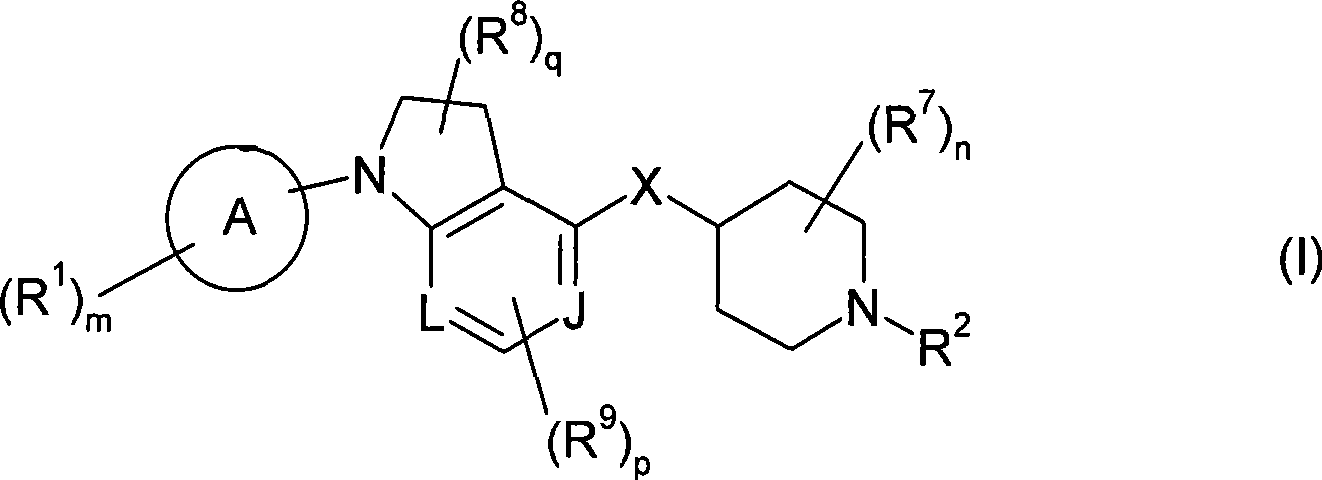
或其盐、溶剂合物或前药,其中or its salt, solvate or prodrug, wherein
环A为芳基或杂芳基;Ring A is aryl or heteroaryl;
m为1、2或3;m is 1, 2 or 3;
各R1独立为酰基;酰基氨磺酰基;酰氧基;C2-C6链烯基;C1-C6烷氧基;C1-C6烷氧基羰基;C1-C6烷基;C1-C6烷基氨基;C1-C6烷基氨基甲酰基;C1-C6烷硫基氨基甲酰基;C2-C6炔基;C1-C6烷氧基磷酰基;C1-C6烷基氨磺酰基;C1-C6烷基亚磺酰基;C1-C6烷基磺酰基;C1-C6烷硫基;C1-C6烷基硫脲基(thioureyl);C1-C6烷基脲基;氨基;芳基;被一个或多个以下基团取代的芳基:C1-C6烷基、C1-C6烷氧基、氰基、卤素或C1-C6卤代烷基;氨基亚氨代甲酰基;氨基甲酰基;羧基;氰基;C3-C7环烷基;被一个或多个以下基团取代的C3-C7环烷基:C1-C6烷基、C1-C6烷氧基、氰基、卤素或C1-C6卤代烷基;二(C1-C6烷基)氨基;二(C1-C6烷基)氨基甲酰基;二(C1-C6烷氧基)磷酰基;二(C1-C6烷基)氨磺酰基;二(C1-C6烷硫基)氨基甲酰基;C1-C6卤代烷氧基;C1-C6卤代烷基;C1-C6卤代烷基亚磺酰基;C1-C6卤代烷基磺酰基;C1-C6卤代烷硫基;卤素;杂环基;被一个或多个以下基团取代的杂环基:C1-C6烷基、C1-C6烷氧基、氰基、卤素或C1-C6卤代烷基;杂芳基;被一个或多个以下基团取代的杂芳基:C1-C6烷基、C1-C6烷氧基、氰基、卤素或C1-C6卤代烷基;羟基;硝基;氨磺酰基;或巯基;Each R 1 is independently acyl; acylsulfamoyl; acyloxy; C 2 -C 6 alkenyl; C 1 -C 6 alkoxy; C 1 -C 6 alkoxycarbonyl; C 1 -C 6 alkylamino; C 1 -C 6 alkylcarbamoyl; C 1 -C 6 alkylthiocarbamoyl; C 2 -C 6 alkynyl; C 1 -C 6 alkoxy Phosphoryl; C 1 -C 6 alkylsulfamoyl; C 1 -C 6 alkylsulfinyl; C 1 -C 6 alkylsulfonyl; C 1 -C 6 alkylthio; C 1 -C 6 alkane C 1 -C 6 alkyl ureido; amino; aryl; aryl substituted by one or more of: C 1 -C 6 alkyl, C 1 -C 6 alkane Oxy, cyano, halogen or C 1 -C 6 haloalkyl; aminoimidoformyl; carbamoyl; carboxy; cyano; C 3 -C 7 cycloalkyl; substituted by one or more of the following groups C 3 -C 7 cycloalkyl: C 1 -C 6 alkyl, C 1 -C 6 alkoxy, cyano, halogen or C 1 -C 6 haloalkyl; di(C 1 -C 6 alkyl) Amino; bis(C 1 -C 6 alkyl)carbamoyl; bis(C 1 -C 6 alkoxy)phosphoryl; bis(C 1 -C 6 alkyl)sulfamoyl; bis(C 1 -C 6 alkylthio) carbamoyl; C 1 -C 6 haloalkoxy; C 1 -C 6 haloalkyl; C 1 -C 6 haloalkylsulfinyl; C 1 -C 6 haloalkylsulfonyl; C 1 - C 6 haloalkylthio; halogen; heterocyclyl; heterocyclyl substituted by one or more of: C 1 -C 6 alkyl, C 1 -C 6 alkoxy, cyano, halogen or C 1 -C 6 haloalkyl; heteroaryl; heteroaryl substituted by one or more of the following groups: C 1 -C 6 alkyl, C 1 -C 6 alkoxy, cyano, halogen or C 1 -C 6 haloalkyl; hydroxyl; nitro; sulfamoyl; or mercapto;
L和J各自独立为CH或N;L and J are each independently CH or N;
n为0、1、2、3或4;n is 0, 1, 2, 3 or 4;
各R7独立为C1-C6烷基;each R 7 is independently C 1 -C 6 alkyl;
q为0、1或2;q is 0, 1 or 2;
各R8独立为C1-C6烷基、氨基、C1-C6烷基氨基、二(C1-C6烷基)氨基、卤素或C1-C6卤代烷基;Each R 8 is independently C 1 -C 6 alkyl, amino, C 1 -C 6 alkylamino, di(C 1 -C 6 alkyl) amino, halogen or C 1 -C 6 haloalkyl;
p为0、1或2;p is 0, 1 or 2;
当p为1或2,则R9取代在所述环的碳原子上;When p is 1 or 2, then R 9 is substituted on the carbon atom of the ring;
各R9独立为C1-C6烷基、C1-C6烷氧基、氨基、C1-C6烷基氨基、二(C1-C6烷基)氨基、卤素、C1-C6卤代烷基或氰基;Each R 9 is independently C 1 -C 6 alkyl, C 1 -C 6 alkoxy, amino, C 1 -C 6 alkylamino, di(C 1 -C 6 alkyl) amino, halogen, C 1 - C 6 haloalkyl or cyano;
X为-NR4-、-O-、-S-、-S(O)-或-S(O)2-;X is -NR 4 -, -O-, -S-, -S(O)- or -S(O) 2 -;
其中R4为H或C1-C6烷基;Wherein R 4 is H or C 1 -C 6 alkyl;
R2为-Yt-R5;R 2 is -Y t -R 5 ;
其中Y为-C(O)-、-C(O)O-、-C(S)-、-C(S)S-、-C(S)O-或-C(O)S-;Wherein Y is -C(O)-, -C(O)O-, -C(S)-, -C(S)S-, -C(S)O- or -C(O)S-;
t为0或1;和t is 0 or 1; and
R5为氢;酰基亚烷基;被一个或多个以下基团取代的酰基亚烷基:C1-C6烷基、C1-C6烷氧基、芳基、芳烷基、氰基、卤素、C1-C6卤代烷基、杂芳基或杂芳烷基;C2-C6链烯基;C1-C6烷氧基亚烷基;C1-C6烷基;C1-C6烷基氨基;C2-C6炔基;C1-C6烷基氨基甲酰基亚烷基;C1-C6烷基亚磺酰基;C1-C6烷基磺酰基;C1-C6烷基氨磺酰基;C1-C6烷基亚氨代磺酰基(sulfoximine);C1-C6烷硫基;氨基;芳基;被一个或多个以下基团取代的芳基:C1-C6烷基、C1-C6烷氧基、芳基、芳烷基、氰基、卤素、C1-C6卤代烷基、杂芳基或杂芳烷基;芳烷基;被一个或多个以下基团取代的芳烷基:C1-C6烷基、C1-C6烷氧基、芳基、芳烷基、氰基、卤素、C1-C6卤代烷基、杂芳基或杂芳烷基;芳烷基氨基甲酰基亚烷基;被一个或多个以下基团取代的芳烷基氨基甲酰基亚烷基:C1-C6烷基、C1-C6烷氧基、芳基、芳烷基、氰基、卤素、C1-C6卤代烷基、杂芳基或杂芳烷基;芳基氨基;被一个或多个以下基团取代的芳基氨基:C1-C6烷基、C1-C6烷氧基、芳基、芳烷基、氰基、卤素、C1-C6卤代烷基、杂芳基或杂芳烷基;氨基亚氨代甲酰基;氰基;C3-C7环烷基;被一个或多个以下基团取代的C3-C7环烷基:C1-C6烷基、C1-C6烷氧基、芳基、芳烷基、氰基、卤素、C1-C6卤代烷基、杂芳基或杂芳烷基;C1-C6环烷基亚烷基;被一个或多个以下基团取代的C1-C6环烷基亚烷基:C1-C6烷基、C1-C6烷氧基、芳基、芳烷基、氰基、卤素、C1-C6卤代烷基、杂芳基或杂芳烷基;二(C1-C6烷基)氨基;二芳基氨基;二(C1-C6烷基)氨基甲酰基亚烷基;二(C1-C6烷基)氨磺酰基;C1-C6卤代烷氧基;C1-C6卤代烷基;C1-C6卤代烷基亚磺酰基;C1-C6卤代烷基磺酰基;C1-C6卤代烷硫基;卤素;杂环基;被一个或多个以下基团取代的杂环基:C1-C6烷基、C1-C6烷氧基、芳基、芳烷基、氰基、卤素、C1-C6卤代烷基、杂芳基或杂芳烷基;杂芳基;被一个或多个以下基团取代的杂芳基:C1-C6烷基、C1-C6烷氧基、芳基、被一个或多个以下基团取代的芳基:C1-C6烷基、C1-C6烷氧基、芳基、芳烷基、氰基、卤素、C1-C6卤代烷基、杂芳基或杂芳烷基、芳烷基、氰基、卤素、C1-C6卤代烷基、杂芳基或杂芳烷基;杂芳烷基;被一个或多个以下基团取代的杂芳烷基:C1-C6烷基、C1-C6烷氧基、芳基、芳烷基、氰基、卤素、C1-C6卤代烷基、杂芳基或杂芳烷基;杂芳基氨基;羟基;或硝基。R 5 is hydrogen; acylalkylene; acylalkylene substituted by one or more of the following groups: C 1 -C 6 alkyl, C 1 -C 6 alkoxy, aryl, aralkyl, cyano C 1 -C 6 haloalkyl, heteroaryl or heteroaralkyl; C 2 -C 6 alkenyl; C 1 -C 6 alkoxyalkylene; C 1 -C 6 alkyl; C 1 -C 6 alkylamino; C 2 -C 6 alkynyl; C 1 -C 6 alkylcarbamoylalkylene; C 1 -C 6 alkylsulfinyl; C 1 -C 6 alkylsulfonyl Acyl; C 1 -C 6 alkylsulfamoyl; C 1 -C 6 alkylsulfoximine; C 1 -C 6 alkylthio; amino; aryl; Group substituted aryl: C 1 -C 6 alkyl, C 1 -C 6 alkoxy, aryl, aralkyl, cyano, halogen, C 1 -C 6 haloalkyl, heteroaryl or heteroaryl aralkyl; aralkyl substituted by one or more of the following groups: C 1 -C 6 alkyl, C 1 -C 6 alkoxy, aryl, aralkyl, cyano, halogen, C 1 -C 6 haloalkyl, heteroaryl or heteroaralkyl; aralkylcarbamoylalkylene; aralkylcarbamoylalkylene substituted by one or more of: C 1 -C 6 alkyl, C 1 -C 6 alkoxy, aryl, aralkyl, cyano, halogen, C 1 -C 6 haloalkyl, heteroaryl or heteroaralkyl; arylamino; by one or more Arylamino substituted by two of the following groups: C 1 -C 6 alkyl, C 1 -C 6 alkoxy, aryl, aralkyl, cyano, halogen, C 1 -C 6 haloalkyl, heteroaryl or heteroaralkyl; aminoformiminoyl; cyano; C 3 -C 7 cycloalkyl; C 3 -C 7 cycloalkyl substituted by one or more of: C 1 -C 6 alkane C 1 -C 6 alkoxy, aryl, aralkyl, cyano, halogen, C 1 -C 6 haloalkyl, heteroaryl or heteroaralkyl; C 1 -C 6 cycloalkylalkylene C 1 -C 6 cycloalkylalkylene substituted by one or more of the following groups: C 1 -C 6 alkyl, C 1 -C 6 alkoxy, aryl, aralkyl, cyano , halogen, C 1 -C 6 haloalkyl, heteroaryl or heteroaralkyl; di(C 1 -C 6 alkyl)amino; diarylamino; di(C 1 -C 6 alkyl)carbamoyl Alkylene; Di(C 1 -C 6 alkyl)sulfamoyl; C 1 -C 6 haloalkoxy; C 1 -C 6 haloalkyl; C 1 -C 6 haloalkylsulfinyl; C 1 -C 6 haloalkylsulfonyl; C 1 -C 6 haloalkylthio; halogen; heterocyclyl; heterocyclyl substituted by one or more of the following groups: C 1 -C 6 alkyl, C 1 -C 6 alkoxy radical, aryl, aralkyl, cyano, halogen, C 1 - C 6 haloalkyl, heteroaryl or heteroaralkyl; heteroaryl; heteroaryl substituted by one or more of the following groups: C 1 -C 6 alkyl, C 1 -C 6 alkoxy, aryl radical, aryl substituted by one or more of the following groups: C 1 -C 6 alkyl, C 1 -C 6 alkoxy, aryl, aralkyl, cyano, halogen, C 1 -C 6 haloalkane radical, heteroaryl or heteroaralkyl, aralkyl, cyano, halogen, C 1 -C 6 haloalkyl, heteroaryl or heteroaralkyl; heteroaralkyl; by one or more of Substituted heteroaralkyl: C 1 -C 6 alkyl, C 1 -C 6 alkoxy, aryl, aralkyl, cyano, halogen, C 1 -C 6 haloalkyl, heteroaryl or heteroaryl Alkyl; heteroarylamino; hydroxy; or nitro.
优选当A为芳基时,则A为苯基;且当A为杂芳基时,则A为吡啶基或嘧啶基。Preferably, when A is aryl, then A is phenyl; and when A is heteroaryl, then A is pyridyl or pyrimidinyl.
优选m为1或2。优选R1为C1-C6烷基磺酰基、氰基、卤素或杂芳基。在一个实施方案中,m为1和R1为C1-C3烷基磺酰基。在一个实施方案中,m为2且一个R1为C1-C3烷基磺酰基且另一个R1为卤素。优选一个R1为甲磺酰基且一个R1为氟。优选甲磺酰基位于指定氮原子的对位和氟位于指定氮原子的邻位。在一个实施方案中,m为2且一个R1为氰基和另一个R1为卤素。Preferably m is 1 or 2. Preferably R 1 is C 1 -C 6 alkylsulfonyl, cyano, halogen or heteroaryl. In one embodiment, m is 1 and R 1 is C 1 -C 3 alkylsulfonyl. In one embodiment, m is 2 and one R 1 is C 1 -C 3 alkylsulfonyl and the other R 1 is halogen. Preferably one R 1 is methanesulfonyl and one R 1 is fluorine. Preferably, the methylsulfonyl group is in the para position to the designated nitrogen atom and the fluorine is in the ortho position to the designated nitrogen atom. In one embodiment, m is 2 and one R 1 is cyano and the other R 1 is halo.
在一个实施方案中,L和J相同。优选L和J均为N。In one embodiment, L and J are the same. Preferably both L and J are N.
在一个实施方案中,p为0或1。In one embodiment, p is 0 or 1.
在一个实施方案中,q为0。In one embodiment, q is zero.
在一个实施方案中,X为-O-。In one embodiment, X is -O-.
在一个实施方案中,t为0。优选R5为杂芳基或被一个或多个C1-C6烷基、C1-C6烷氧基、芳基、C1-C6芳烷基、氰基、卤素或C1-C6卤代烷基取代的杂芳基。优选所述杂芳基为嘧啶基或噁二唑基。In one embodiment, t is zero. Preferably R 5 is heteroaryl or replaced by one or more C 1 -C 6 alkyl, C 1 -C 6 alkoxy, aryl, C 1 -C 6 aralkyl, cyano, halogen or C 1 - C 6 haloalkyl substituted heteroaryl. Preferably the heteroaryl is pyrimidinyl or oxadiazolyl.
在一个实施方案中,t为1。优选Y为C(O)O。优选R5为C1-C6烷基;芳基;被一个或多个C1-C6烷基、C1-C6烷氧基、芳基、C1-C6芳烷基、氰基、卤素或C1-C6卤代烷基取代的芳基;C3-C7环烷基。优选R5为C1-C6烷基。In one embodiment, t is 1. Preferably Y is C(O)O. Preferably R 5 is C 1 -C 6 alkyl; aryl; replaced by one or more C 1 -C 6 alkyl, C 1 -C 6 alkoxy, aryl, C 1 -C 6 aralkyl, cyano radical, halogen or C 1 -C 6 haloalkyl substituted aryl; C 3 -C 7 cycloalkyl. Preferably R 5 is C 1 -C 6 alkyl.
本发明的一个实施方案包括式(II)化合物:One embodiment of the invention includes compounds of formula (II):
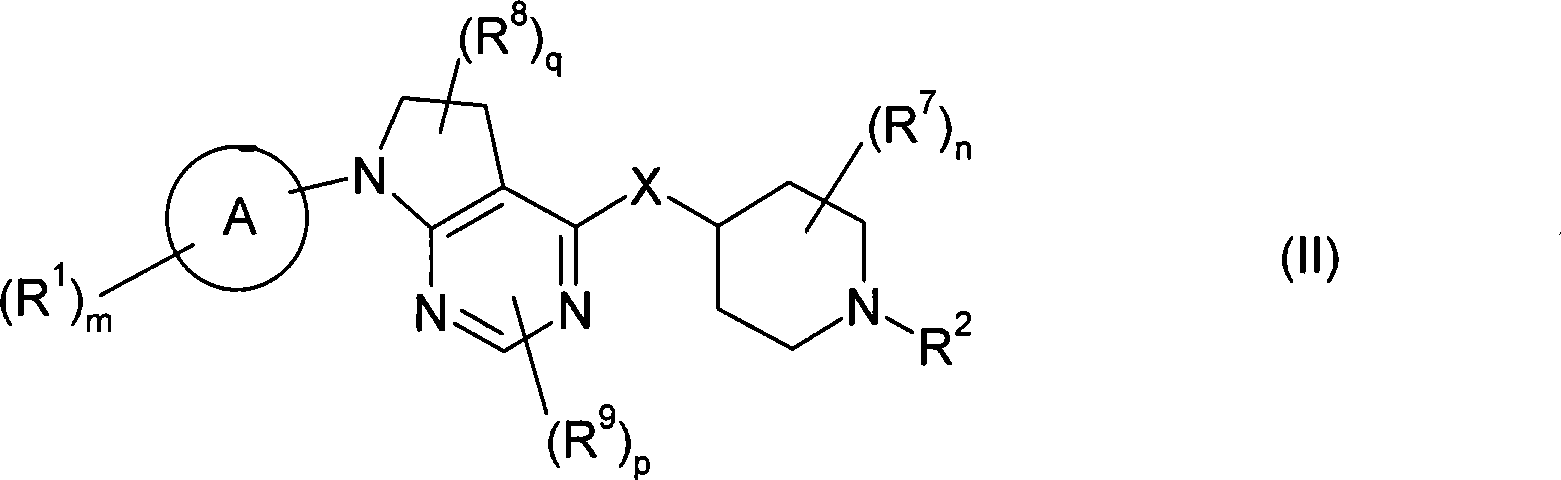
或其盐、溶剂合物或前药,其中or its salt, solvate or prodrug, wherein
环A为芳基或杂芳基;Ring A is aryl or heteroaryl;
m为1、2或3;m is 1, 2 or 3;
各R1独立为酰基;酰基氨磺酰基;酰氧基;C2-C6链烯基;C1-C6烷氧基;C1-C6烷氧基羰基;C1-C6烷基;C1-C6烷基氨基;C1-C6烷基氨基甲酰基;C1-C6烷硫基氨基甲酰基;C2-C6炔基;C1-C6烷氧基磷酰基;C1-C6烷基氨磺酰基;C1-C6烷基亚磺酰基;C1-C6烷基磺酰基;C1-C6烷硫基;C1-C6烷基硫脲基;C1-C6烷基脲基;氨基;芳基;被一个或多个以下基团取代的芳基:C1-C6烷基、C1-C6烷氧基、氰基、卤素或C1-C6卤代烷基;氨基亚氨代甲酰基;氨基甲酰基;羧基;氰基;C3-C7环烷基;被一个或多个以下基团取代的C3-C7环烷基:C1-C6烷基、C1-C6烷氧基、氰基、卤素或C1-C6卤代烷基;二(C1-C6烷基)氨基;二(C1-C6烷基)氨基甲酰基;二(C1-C6烷氧基)磷酰基;二(C1-C6烷基)氨磺酰基;二(C1-C6烷硫基)氨基甲酰基;C1-C6卤代烷氧基;C1-C6卤代烷基;C1-C6卤代烷基亚磺酰基;C1-C6卤代烷基磺酰基;C1-C6卤代烷硫基;卤素;杂环基;被一个或多个以下基团取代的杂环基:C1-C6烷基、C1-C6烷氧基、氰基、卤素或C1-C6卤代烷基;杂芳基;被一个或多个以下基团取代的杂芳基:C1-C6烷基、C1-C6烷氧基、氰基、卤素或C1-C6卤代烷基;羟基;硝基;氨磺酰基;或巯基;Each R 1 is independently acyl; acylsulfamoyl; acyloxy; C 2 -C 6 alkenyl; C 1 -C 6 alkoxy; C 1 -C 6 alkoxycarbonyl; C 1 -C 6 alkylamino; C 1 -C 6 alkylcarbamoyl; C 1 -C 6 alkylthiocarbamoyl; C 2 -C 6 alkynyl; C 1 -C 6 alkoxy Phosphoryl; C 1 -C 6 alkylsulfamoyl; C 1 -C 6 alkylsulfinyl; C 1 -C 6 alkylsulfonyl; C 1 -C 6 alkylthio; C 1 -C 6 alkane C 1 -C 6 alkyl ureido; amino; aryl; aryl substituted by one or more of the following groups: C 1 -C 6 alkyl, C 1 -C 6 alkoxy, Cyano, halogen or C 1 -C 6 haloalkyl; aminoformimido; carbamoyl; carboxy; cyano; C 3 -C 7 cycloalkyl; C 3 substituted by one or more of the following groups -C 7 cycloalkyl: C 1 -C 6 alkyl, C 1 -C 6 alkoxy, cyano, halogen or C 1 -C 6 haloalkyl; di(C 1 -C 6 alkyl)amino; di (C 1 -C 6 Alkyl)carbamoyl; Di(C 1 -C 6 Alkoxy)phosphoryl; Di(C 1 -C 6 Alkyl)sulfamoyl; Di(C 1 -C 6 Alkylthio) C 1 -C 6 haloalkoxy; C 1 -C 6 haloalkyl; C 1 -C 6 haloalkylsulfinyl; C 1 -C 6 haloalkylsulfonyl; C 1 -C 6 haloalkane Thio; Halogen; Heterocyclyl; Heterocyclyl substituted by one or more of: C 1 -C 6 alkyl, C 1 -C 6 alkoxy, cyano, halogen or C 1 -C 6 Haloalkyl; heteroaryl; heteroaryl substituted by one or more of: C 1 -C 6 alkyl, C 1 -C 6 alkoxy, cyano, halogen or C 1 -C 6 haloalkyl ; hydroxyl; nitro; sulfamoyl; or mercapto;
n为0、1、2、3或4;n is 0, 1, 2, 3 or 4;
各R7独立为C1-C6烷基;each R 7 is independently C 1 -C 6 alkyl;
q为0、1或2;q is 0, 1 or 2;
各R8独立为C1-C6烷基、氨基、C1-C6烷基氨基、二(C1-C6烷基)氨基、卤素或C1-C6卤代烷基;Each R 8 is independently C 1 -C 6 alkyl, amino, C 1 -C 6 alkylamino, di(C 1 -C 6 alkyl)amino, halogen or C 1 -C 6 haloalkyl;
p为0、1或2;p is 0, 1 or 2;
当p为1或2时,则R9取代在所述环的碳原子上;When p is 1 or 2, then R 9 is substituted on the carbon atom of the ring;
各R9独立为C1-C6烷基、C1-C6烷氧基、氨基、C1-C6烷基氨基、二(C1-C6烷基)氨基、卤素、C1-C6卤代烷基或氰基;Each R 9 is independently C 1 -C 6 alkyl, C 1 -C 6 alkoxy, amino, C 1 -C 6 alkylamino, di(C 1 -C 6 alkyl) amino, halogen, C 1 - C 6 haloalkyl or cyano;
X为-NR4-、-O-、-S-、-S(O)-或-S(O)2-;X is -NR 4 -, -O-, -S-, -S(O)- or -S(O) 2 -;
其中R4为H或C1-C6烷基;Wherein R 4 is H or C 1 -C 6 alkyl;
R2为-Yt-R5;R 2 is -Y t -R 5 ;
其中Y为-C(O)-、-C(O)O-、-C(S)-、-C(S)S-、-C(S)O-或-C(O)S;Wherein Y is -C(O)-, -C(O)O-, -C(S)-, -C(S)S-, -C(S)O- or -C(O)S;
t为0或1;和t is 0 or 1; and
R5为氢;酰基亚烷基;被一个或多个以下基团取代的酰基亚烷基:C1-C6烷基、C1-C6烷氧基、芳基、芳烷基、氰基、卤素、C1-C6卤代烷基、杂芳基或杂芳烷基;C2-C6链烯基;C1-C6烷氧基亚烷基;C1-C6烷基;C1-C6烷基氨基;C2-C6炔基;C1-C6烷基氨基甲酰基亚烷基;C1-C6烷基亚磺酰基;C1-C6烷基磺酰基;C1-C6烷基氨磺酰基;C1-C6烷基亚氨代磺酰基;C1-C6烷硫基;氨基;芳基;被一个或多个以下基团取代的芳基:C1-C6烷基、C1-C6烷氧基、芳基、芳烷基、氰基、卤素、C1-C6卤代烷基、杂芳基或杂芳烷基;芳烷基;被一个或多个以下基团取代的芳烷基:C1-C6烷基、C1-C6烷氧基、芳基、芳烷基、氰基、卤素、C1-C6卤代烷基、杂芳基或杂芳烷基;芳烷基氨基甲酰基亚烷基;被一个或多个以下基团取代的芳烷基氨基甲酰基亚烷基:C1-C6烷基、C1-C6烷氧基、芳基、芳烷基、氰基、卤素、C1-C6卤代烷基、杂芳基或杂芳烷基;芳基氨基;被一个或多个以下基团取代的芳基氨基:C1-C6烷基、C1-C6烷氧基、芳基、芳烷基、氰基、卤素、C1-C6卤代烷基、杂芳基或杂芳烷基;氨基亚氨代甲酰基;氰基;C3-C7环烷基;被一个或多个以下基团取代的C3-C7环烷基:C1-C6烷基、C1-C6烷氧基、芳基、芳烷基、氰基、卤素、C1-C6卤代烷基、杂芳基或杂芳烷基;C1-C6环烷基亚烷基;被一个或多个以下基团取代的C1-C6环烷基亚烷基:C1-C6烷基、C1-C6烷氧基、芳基、芳烷基、氰基、卤素、C1-C6卤代烷基、杂芳基或杂芳烷基;二(C1-C6烷基)氨基;二芳基氨基;二(C1-C6烷基)氨基甲酰基亚烷基;二(C1-C6烷基)氨磺酰基;C1-C6卤代烷氧基;C1-C6卤代烷基;C1-C6卤代烷基亚磺酰基;C1-C6卤代烷基磺酰基;C1-C6卤代烷硫基;卤素;杂环基;被一个或多个以下基团取代的杂环基:C1-C6烷基、C1-C6烷氧基、芳基、芳烷基、氰基、卤素、C1-C6卤代烷基、杂芳基或杂芳烷基;杂芳基;被一个或多个以下基团取代的杂芳基:C1-C6烷基、C1-C6烷氧基、芳基、被一个或多个C1-C6烷基、C1-C6烷氧基、芳基、芳烷基、氰基、卤素、C1-C6卤代烷基、杂芳基或杂芳烷基取代的芳基、芳烷基、氰基、卤素、C1-C6卤代烷基、杂芳基或杂芳烷基;杂芳烷基;被一个或多个以下基团取代的杂芳烷基:C1-C6烷基、C1-C6烷氧基、芳基、芳烷基、氰基、卤素、C1-C6卤代烷基、杂芳基或杂芳烷基;杂芳基氨基;羟基;或硝基。R 5 is hydrogen; acylalkylene; acylalkylene substituted by one or more of the following groups: C 1 -C 6 alkyl, C 1 -C 6 alkoxy, aryl, aralkyl, cyano C 1 -C 6 haloalkyl, heteroaryl or heteroaralkyl; C 2 -C 6 alkenyl; C 1 -C 6 alkoxyalkylene; C 1 -C 6 alkyl; C 1 -C 6 alkylamino; C 2 -C 6 alkynyl; C 1 -C 6 alkylcarbamoylalkylene; C 1 -C 6 alkylsulfinyl; C 1 -C 6 alkylsulfonyl Acyl; C 1 -C 6 alkylsulfamoyl; C 1 -C 6 alkyliminosulfonyl; C 1 -C 6 alkylthio; amino; aryl; substituted by one or more of the following groups Aryl: C 1 -C 6 alkyl, C 1 -C 6 alkoxy, aryl, aralkyl, cyano, halogen, C 1 -C 6 haloalkyl, heteroaryl or heteroaralkyl; aryl Alkyl; aralkyl substituted by one or more of the following groups: C 1 -C 6 alkyl, C 1 -C 6 alkoxy, aryl, aralkyl, cyano, halogen, C 1 -C 6 Haloalkyl, heteroaryl or heteroaralkyl; aralkylcarbamoylalkylene; aralkylcarbamoylalkylene substituted by one or more of: C 1 -C 6 alkyl , C 1 -C 6 alkoxy, aryl, aralkyl, cyano, halogen, C 1 -C 6 haloalkyl, heteroaryl or heteroaralkyl; arylamino; by one or more of the following Group substituted arylamino: C 1 -C 6 alkyl, C 1 -C 6 alkoxy, aryl, aralkyl, cyano, halogen, C 1 -C 6 haloalkyl, heteroaryl or heteroaryl Alkyl; Aminoformimoyl; Cyano; C 3 -C 7 Cycloalkyl; C 3 -C 7 Cycloalkyl substituted by one or more of: C 1 -C 6 Alkyl, C 1 -C 6 alkoxy, aryl, aralkyl, cyano, halogen, C 1 -C 6 haloalkyl, heteroaryl or heteroaralkyl; C 1 -C 6 cycloalkylene; C 1 -C 6 cycloalkylalkylene substituted by one or more of the following groups: C 1 -C 6 alkyl, C 1 -C 6 alkoxy, aryl, aralkyl, cyano, halogen, C 1 -C 6 haloalkyl, heteroaryl or heteroaralkyl; di(C 1 -C 6 alkyl)amino; diarylamino; di(C 1 -C 6 alkyl)carbamoylalkylene ; Di(C 1 -C 6 alkyl)sulfamoyl; C 1 -C 6 haloalkoxy; C 1 -C 6 haloalkyl; C 1 -C 6 haloalkylsulfinyl; C 1 -C 6 haloalkyl Sulfonyl; C 1 -C 6 haloalkylthio; Halogen; Heterocyclyl; Heterocyclyl substituted by one or more of the following groups: C 1 -C 6 alkyl, C 1 -C 6 alkoxy, aryl radical, aralkyl, cyano, halogen, C 1 -C 6 haloalkyl, heteroaryl or hetero Aralkyl; heteroaryl; heteroaryl substituted by one or more of the following groups: C 1 -C 6 alkyl, C 1 -C 6 alkoxy, aryl, substituted by one or more C 1 - C 6 alkyl, C 1 -C 6 alkoxy, aryl, aralkyl, cyano, halogen, C 1 -C 6 haloalkyl, heteroaryl or heteroaralkyl substituted aryl, aralkyl , cyano, halogen, C 1 -C 6 haloalkyl, heteroaryl or heteroaralkyl; heteroaralkyl; heteroaralkyl substituted by one or more of: C 1 -C 6 alkyl , C 1 -C 6 alkoxy, aryl, aralkyl, cyano, halogen, C 1 -C 6 haloalkyl, heteroaryl or heteroaralkyl; heteroarylamino; hydroxy; or nitro.
本发明的一个实施方案包括式(III)化合物:One embodiment of the invention includes compounds of formula (III):

或其盐、溶剂合物或前药,其中or its salt, solvate or prodrug, wherein
环A为芳基或杂芳基;Ring A is aryl or heteroaryl;
m为1、2或3;m is 1, 2 or 3;
各R1独立为酰基;酰基氨磺酰基;酰氧基;C2-C6链烯基;C1-C6烷氧基;C1-C6烷氧基羰基;C1-C6烷基;C1-C6烷基氨基;C1-C6烷基氨基甲酰基;C1-C6烷硫基氨基甲酰基;C2-C6炔基;C1-C6烷氧基磷酰基;C1-C6烷基氨磺酰基;C1-C6烷基亚磺酰基;C1-C6烷基磺酰基;C1-C6烷硫基;C1-C6烷基硫脲基;C1-C6烷基脲基;氨基;芳基;被一个或多个以下基团取代的芳基:C1-C6烷基、C1-C6烷氧基、氰基、卤素或C1-C6卤代烷基;氨基亚氨代甲酰基;氨基甲酰基;羧基;氰基;C3-C7环烷基;被一个或多个以下基团取代的C3-C7环烷基:C1-C6烷基、C1-C6烷氧基、氰基、卤素或C1-C6卤代烷基;二(C1-C6烷基)氨基;二(C1-C6烷基)氨基甲酰基;二(C1-C6烷氧基)磷酰基;二(C1-C6烷基)氨磺酰基;二(C1-C6烷基)硫代氨基甲酰基;C1-C6卤代烷氧基;C1-C6卤代烷基;C1-C6卤代烷基亚磺酰基;C1-C6卤代烷基磺酰基;C1-C6卤代烷基硫基;卤素;杂环基;被一个或多个以下基团取代的杂环基:C1-C6烷基、C1-C6烷氧基、氰基、卤素或C1-C6卤代烷基;杂芳基;被一个或多个以下基团取代的杂芳基:C1-C6烷基、C1-C6烷氧基、氰基、卤素或C1-C6卤代烷基;羟基;硝基;氨磺酰基;或巯基;Each R 1 is independently acyl; acylsulfamoyl; acyloxy; C 2 -C 6 alkenyl; C 1 -C 6 alkoxy; C 1 -C 6 alkoxycarbonyl; C 1 -C 6 alkylamino; C 1 -C 6 alkylcarbamoyl; C 1 -C 6 alkylthiocarbamoyl; C 2 -C 6 alkynyl; C 1 -C 6 alkoxy Phosphoryl; C 1 -C 6 alkylsulfamoyl; C 1 -C 6 alkylsulfinyl; C 1 -C 6 alkylsulfonyl; C 1 -C 6 alkylthio; C 1 -C 6 alkane C 1 -C 6 alkyl ureido; amino; aryl; aryl substituted by one or more of the following groups: C 1 -C 6 alkyl, C 1 -C 6 alkoxy, Cyano, halogen or C 1 -C 6 haloalkyl; aminoformimido; carbamoyl; carboxy; cyano; C 3 -C 7 cycloalkyl; C 3 substituted by one or more of the following groups -C 7 cycloalkyl: C 1 -C 6 alkyl, C 1 -C 6 alkoxy, cyano, halogen or C 1 -C 6 haloalkyl; di(C 1 -C 6 alkyl)amino; di (C 1 -C 6 Alkyl)carbamoyl; Di(C 1 -C 6 Alkoxy)phosphoryl; Di(C 1 -C 6 Alkyl)sulfamoyl; Di(C 1 -C 6 Alkyl) ) thiocarbamoyl; C 1 -C 6 haloalkoxy; C 1 -C 6 haloalkyl; C 1 -C 6 haloalkylsulfinyl; C 1 -C 6 haloalkylsulfonyl; C 1 -C 6 Haloalkylthio; Halogen; Heterocyclyl; Heterocyclyl substituted by one or more of the following groups: C 1 -C 6 alkyl, C 1 -C 6 alkoxy, cyano, halogen or C 1 - C 6 haloalkyl; heteroaryl; heteroaryl substituted by one or more of: C 1 -C 6 alkyl, C 1 -C 6 alkoxy, cyano, halogen or C 1 -C 6 Haloalkyl; hydroxy; nitro; sulfamoyl; or mercapto;
X为-NR4-、-O-、-S-、-S(O)-或-S(O)2-;X is -NR 4 -, -O-, -S-, -S(O)- or -S(O) 2 -;
其中R4为H或C1-C6烷基;Wherein R 4 is H or C 1 -C 6 alkyl;
R2为-Yt-R5;R 2 is -Y t -R 5 ;
其中Y为-C(O)-、-C(O)O-、-C(S)-、-C(S)S-、-C(S)O-或-C(O)S-;Wherein Y is -C(O)-, -C(O)O-, -C(S)-, -C(S)S-, -C(S)O- or -C(O)S-;
t为0或1;和t is 0 or 1; and
R5为氢;酰基亚烷基;被一个或多个以下基团取代的酰基亚烷基:C1-C6烷基、C1-C6烷氧基、芳基、芳烷基、氰基、卤素、C1-C6卤代烷基、杂芳基或杂芳烷基;C2-C6链烯基;C1-C6烷氧基亚烷基;C1-C6烷基;C1-C6烷基氨基;C2-C6炔基;C1-C6烷基氨基甲酰基亚烷基;C1-C6烷基亚磺酰基;C1-C6烷基磺酰基;C1-C6烷基氨磺酰基;C1-C6烷基亚氨代磺酰基;C1-C6烷硫基;氨基;芳基;被一个或多个以下基团取代的芳基:C1-C6烷基、C1-C6烷氧基、芳基、芳烷基、氰基、卤素、C1-C6卤代烷基、杂芳基或杂芳烷基;芳烷基;被一个或多个以下基团取代的芳烷基:C1-C6烷基、C1-C6烷氧基、芳基、芳烷基、氰基、卤素、C1-C6卤代烷基、杂芳基或杂芳烷基;芳烷基氨基甲酰基亚烷基;被一个或多个以下基团取代的芳烷基氨基甲酰基亚烷基:C1-C6烷基、C1-C6烷氧基、芳基、芳烷基、氰基、卤素、C1-C6卤代烷基、杂芳基或杂芳烷基;芳基氨基;被一个或多个以下基团取代的芳基氨基:C1-C6烷基、C1-C6烷氧基、芳基、芳烷基、氰基、卤素、C1-C6卤代烷基、杂芳基或杂芳烷基;氨基亚氨代甲酰基;氰基;C3-C7环烷基;被一个或多个以下基团取代的C3-C7环烷基:C1-C6烷基、C1-C6烷氧基、芳基、芳烷基、氰基、卤素、C1-C6卤代烷基、杂芳基或杂芳烷基;C1-C6环烷基亚烷基;被一个或多个以下基团取代的C1-C6环烷基亚烷基:C1-C6烷基、C1-C6烷氧基、芳基、芳烷基、氰基、卤素、C1-C6卤代烷基、杂芳基或杂芳烷基;二(C1-C6烷基)氨基;二芳基氨基;二(C1-C6烷基)氨基甲酰基亚烷基;二(C1-C6烷基)氨磺酰基;C1-C6卤代烷氧基;C1-C6卤代烷基;C1-C6卤代烷基亚磺酰基;C1-C6卤代烷基磺酰基;C1-C6卤代烷硫基;卤素;杂环基;被一个或多个以下基团取代的杂环基:C1-C6烷基、C1-C6烷氧基、芳基、芳烷基、氰基、卤素、C1-C6卤代烷基、杂芳基或杂芳烷基;杂芳基;被一个或多个以下基团取代的杂芳基:C1-C6烷基、C1-C6烷氧基、芳基;被一个或多个以下基团取代的芳基:C1-C6烷基、C1-C6烷氧基、芳基、芳烷基、氰基、卤素、C1-C6卤代烷基、杂芳基或杂芳烷基、芳烷基、氰基、卤素、C1-C6卤代烷基、杂芳基或杂芳烷基;杂芳烷基;被一个或多个以下基团取代的杂芳烷基:C1-C6烷基、C1-C6烷氧基、芳基、芳烷基、氰基、卤素、C1-C6卤代烷基、杂芳基或杂芳烷基;杂芳基氨基;羟基;或硝基。R 5 is hydrogen; acylalkylene; acylalkylene substituted by one or more of the following groups: C 1 -C 6 alkyl, C 1 -C 6 alkoxy, aryl, aralkyl, cyano C 1 -C 6 haloalkyl, heteroaryl or heteroaralkyl; C 2 -C 6 alkenyl; C 1 -C 6 alkoxyalkylene; C 1 -C 6 alkyl; C 1 -C 6 alkylamino; C 2 -C 6 alkynyl; C 1 -C 6 alkylcarbamoylalkylene; C 1 -C 6 alkylsulfinyl; C 1 -C 6 alkylsulfonyl Acyl; C 1 -C 6 alkylsulfamoyl; C 1 -C 6 alkyliminosulfonyl; C 1 -C 6 alkylthio; amino; aryl; substituted by one or more of the following groups Aryl: C 1 -C 6 alkyl, C 1 -C 6 alkoxy, aryl, aralkyl, cyano, halogen, C 1 -C 6 haloalkyl, heteroaryl or heteroaralkyl; aryl Alkyl; aralkyl substituted by one or more of the following groups: C 1 -C 6 alkyl, C 1 -C 6 alkoxy, aryl, aralkyl, cyano, halogen, C 1 -C 6 Haloalkyl, heteroaryl or heteroaralkyl; aralkylcarbamoylalkylene; aralkylcarbamoylalkylene substituted by one or more of: C 1 -C 6 alkyl , C 1 -C 6 alkoxy, aryl, aralkyl, cyano, halogen, C 1 -C 6 haloalkyl, heteroaryl or heteroaralkyl; arylamino; by one or more of the following Group substituted arylamino: C 1 -C 6 alkyl, C 1 -C 6 alkoxy, aryl, aralkyl, cyano, halogen, C 1 -C 6 haloalkyl, heteroaryl or heteroaryl Alkyl; Aminoformimoyl; Cyano; C 3 -C 7 Cycloalkyl; C 3 -C 7 Cycloalkyl substituted by one or more of: C 1 -C 6 Alkyl, C 1 -C 6 alkoxy, aryl, aralkyl, cyano, halogen, C 1 -C 6 haloalkyl, heteroaryl or heteroaralkyl; C 1 -C 6 cycloalkylene; C 1 -C 6 cycloalkylalkylene substituted by one or more of the following groups: C 1 -C 6 alkyl, C 1 -C 6 alkoxy, aryl, aralkyl, cyano, halogen, C 1 -C 6 haloalkyl, heteroaryl or heteroaralkyl; di(C 1 -C 6 alkyl)amino; diarylamino; di(C 1 -C 6 alkyl)carbamoylalkylene ; Di(C 1 -C 6 alkyl)sulfamoyl; C 1 -C 6 haloalkoxy; C 1 -C 6 haloalkyl; C 1 -C 6 haloalkylsulfinyl; C 1 -C 6 haloalkyl Sulfonyl; C 1 -C 6 haloalkylthio; Halogen; Heterocyclyl; Heterocyclyl substituted by one or more of the following groups: C 1 -C 6 alkyl, C 1 -C 6 alkoxy, aryl radical, aralkyl, cyano, halogen, C 1 -C 6 haloalkyl, heteroaryl or hetero Aralkyl; heteroaryl; heteroaryl substituted by one or more of: C 1 -C 6 alkyl, C 1 -C 6 alkoxy, aryl; by one or more of Substituted aryl: C 1 -C 6 alkyl, C 1 -C 6 alkoxy, aryl, aralkyl, cyano, halogen, C 1 -C 6 haloalkyl, heteroaryl or heteroaralkyl , aralkyl, cyano, halogen, C 1 -C 6 haloalkyl, heteroaryl or heteroaralkyl; heteroaralkyl; heteroaralkyl substituted by one or more of the following groups: C 1 - C 6 alkyl, C 1 -C 6 alkoxy, aryl, aralkyl, cyano, halogen, C 1 -C 6 haloalkyl, heteroaryl or heteroaralkyl; heteroarylamino; hydroxy; or nitro.
本发明的一个实施方案包括选自以下的化合物:One embodiment of the invention includes compounds selected from the group consisting of:
1. 4-({7-[2-氟-4-(甲磺酰基)苯基]-6,7-二氢-5H-吡咯并[2,3-d]嘧啶-4-基}氧基)-1-哌啶甲酸1-甲基乙酯;1. 4-({7-[2-fluoro-4-(methylsulfonyl)phenyl]-6,7-dihydro-5H-pyrrolo[2,3-d]pyrimidin-4-yl}oxy )-1-methylethyl-1-piperidinecarboxylate;
2. 4-({7-[2-氟-4-(甲磺酰基)苯基]-6,7-二氢-5H-吡咯并[2,3-d]嘧啶-4-基}氧基)-1-哌啶甲酸1,1-二甲基乙酯;2. 4-({7-[2-fluoro-4-(methylsulfonyl)phenyl]-6,7-dihydro-5H-pyrrolo[2,3-d]pyrimidin-4-yl}oxy )-1,1-dimethylethyl-1-piperidinecarboxylate;
3. 4-({7-[2-氟-4-(甲磺酰基)苯基]-6,7-二氢-5H-吡咯并[2,3-d]嘧啶-4-基}氧基)-1-哌啶甲酸2-甲基丙酯;3. 4-({7-[2-fluoro-4-(methylsulfonyl)phenyl]-6,7-dihydro-5H-pyrrolo[2,3-d]pyrimidin-4-yl}oxy )-1-piperidinecarboxylic acid 2-methylpropyl ester;
4. 4-({7-[2-氟-4-(甲磺酰基)苯基]-6,7-二氢-5H-吡咯并[2,3-d]嘧啶-4-基}氧基)-1-哌啶甲酸2,2-二甲基丙酯;4. 4-({7-[2-fluoro-4-(methylsulfonyl)phenyl]-6,7-dihydro-5H-pyrrolo[2,3-d]pyrimidin-4-yl}oxy )-1-
5. 4-{[1-(5-溴-2-嘧啶基)-4-哌啶基]氧基}-7-[2-氟-4-(甲磺酰基)苯基]-6,7-二氢-5H-吡咯并[2,3-d]嘧啶;5. 4-{[1-(5-bromo-2-pyrimidinyl)-4-piperidinyl]oxy}-7-[2-fluoro-4-(methylsulfonyl)phenyl]-6,7 - dihydro-5H-pyrrolo[2,3-d]pyrimidine;
6. 7-[2-氟-4-(甲磺酰基)苯基]-4-({1-[5-(2-甲基丙基)-2-嘧啶基]-4-哌啶基}氧基)-6,7-二氢-5H-吡咯并[2,3-d]嘧啶;6. 7-[2-fluoro-4-(methylsulfonyl)phenyl]-4-({1-[5-(2-methylpropyl)-2-pyrimidinyl]-4-piperidinyl} Oxy)-6,7-dihydro-5H-pyrrolo[2,3-d]pyrimidine;
7. 7-[2-氟-4-(甲磺酰基)苯基]-4-{[1-(2-嘧啶基)-4-哌啶基]氧基}-6,7-二氢-5H-吡咯并[2,3-d]嘧啶;7. 7-[2-fluoro-4-(methylsulfonyl)phenyl]-4-{[1-(2-pyrimidinyl)-4-piperidinyl]oxy}-6,7-dihydro- 5H-pyrrolo[2,3-d]pyrimidine;
8. 4-{[1-(5-乙基-2-嘧啶基)-4-哌啶基]氧基}-7-[2-氟-4-(甲磺酰基)苯基]-6,7-二氢-5H-吡咯并[2,3-d]嘧啶;8. 4-{[1-(5-Ethyl-2-pyrimidinyl)-4-piperidinyl]oxy}-7-[2-fluoro-4-(methylsulfonyl)phenyl]-6, 7-dihydro-5H-pyrrolo[2,3-d]pyrimidine;
9. 7-[2-氟-4-(甲磺酰基)苯基]-4-{[1-(5-氟-2-嘧啶基)-4-哌啶基]氧基}-6,7-二氢-5H-吡咯并[2,3-d]嘧啶;9. 7-[2-fluoro-4-(methylsulfonyl)phenyl]-4-{[1-(5-fluoro-2-pyrimidinyl)-4-piperidinyl]oxy}-6,7 - dihydro-5H-pyrrolo[2,3-d]pyrimidine;
10. 4-{[7-(4-氰基-2-氟苯基)-6,7-二氢-5H-吡咯并[2,3-d]嘧啶-4-基]氧基}-1-哌啶甲酸1-甲基乙酯;10. 4-{[7-(4-cyano-2-fluorophenyl)-6,7-dihydro-5H-pyrrolo[2,3-d]pyrimidin-4-yl]oxy}-1 - 1-methylethyl piperidinecarboxylate;
11. 4-({7-[2-氟-4-(1,3-噻唑-2-基)苯基]-6,7-二氢-5H-吡咯并[2,3-d]嘧啶-4-基}氧基)-1-哌啶甲酸1-甲基乙酯;11. 4-({7-[2-fluoro-4-(1,3-thiazol-2-yl)phenyl]-6,7-dihydro-5H-pyrrolo[2,3-d]pyrimidine- 1-methylethyl 4-yl}oxy)-1-piperidinecarboxylate;
12. 4-({7-[4-(甲磺酰基)苯基]-6,7-二氢-5H-吡咯并[2,3-d]嘧啶-4-基}硫基)-1-哌啶甲酸1-甲基乙酯;12. 4-({7-[4-(methylsulfonyl)phenyl]-6,7-dihydro-5H-pyrrolo[2,3-d]pyrimidin-4-yl}thio)-1- 1-methylethyl piperidinecarboxylate;
13. 4-({7-[2-氟-4-(甲磺酰基)苯基]-6,7-二氢-5H-吡咯并[2,3-d]嘧啶-4-基}磺酰基)-1-哌啶甲酸1-甲基乙酯;13. 4-({7-[2-fluoro-4-(methylsulfonyl)phenyl]-6,7-dihydro-5H-pyrrolo[2,3-d]pyrimidin-4-yl}sulfonyl )-1-methylethyl-1-piperidinecarboxylate;
14. 4-({7-[2-氟-4-(甲磺酰基)苯基]-2-甲基-6,7-二氢-5H-吡咯并[2,3-d]嘧啶-4-基}氧基)-1-哌啶甲酸1,1-二甲基乙酯;14. 4-({7-[2-fluoro-4-(methylsulfonyl)phenyl]-2-methyl-6,7-dihydro-5H-pyrrolo[2,3-d]pyrimidine-4 -yl}oxy)-1,1-dimethylethyl-1-piperidinecarboxylate;
15. 4-({7-[2-氟-4-(甲磺酰基)苯基]-2-甲基-6,7-二氢-5H-吡咯并[2,3-d]嘧啶-4-基}氧基)-1-哌啶甲酸1-甲基乙酯;15. 4-({7-[2-fluoro-4-(methylsulfonyl)phenyl]-2-methyl-6,7-dihydro-5H-pyrrolo[2,3-d]pyrimidine-4 -yl}oxy)-1-methylethyl-1-piperidinecarboxylate;
16. 7-[2-氟-4-(甲磺酰基)苯基]-2-甲基-4-({1-[3-(1-甲基乙基)-1,2,4-噁二唑-5-基]-4-哌啶基}氧基)-6,7-二氢-5H-吡咯并[2,3-d]嘧啶;16. 7-[2-fluoro-4-(methylsulfonyl)phenyl]-2-methyl-4-({1-[3-(1-methylethyl)-1,2,4-oxa Oxadiazol-5-yl]-4-piperidinyl}oxy)-6,7-dihydro-5H-pyrrolo[2,3-d]pyrimidine;
17. 2,5-二氟-4-[4-({1-[3-(1-甲基乙基)-1,2,4-噁二唑-5-基]-4-哌啶基}氧基)-5,6-二氢-7H-吡咯并[2,3-d]嘧啶-7-基]苄腈;17. 2,5-difluoro-4-[4-({1-[3-(1-methylethyl)-1,2,4-oxadiazol-5-yl]-4-piperidinyl }oxy)-5,6-dihydro-7H-pyrrolo[2,3-d]pyrimidin-7-yl]benzonitrile;
18. 7-[2-氟-4-(甲磺酰基)苯基]-4-({1-[3-(1-甲基乙基)-1,2,4-噁二唑-5-基]-4-哌啶基}氧基)-6,7-二氢-5H-吡咯并[2,3-d]嘧啶;18. 7-[2-fluoro-4-(methylsulfonyl)phenyl]-4-({1-[3-(1-methylethyl)-1,2,4-oxadiazole-5- Base]-4-piperidinyl}oxy)-6,7-dihydro-5H-pyrrolo[2,3-d]pyrimidine;
19. 7-(4-溴-2,5-二氟苯基)-4-({1-[3-(1-甲基乙基)-1,2,4-噁二唑-5-基]-4-哌啶基}氧基)-6,7-二氢-5H-吡咯并[2,3-d]嘧啶;19. 7-(4-bromo-2,5-difluorophenyl)-4-({1-[3-(1-methylethyl)-1,2,4-oxadiazol-5-yl ]-4-piperidinyl}oxy)-6,7-dihydro-5H-pyrrolo[2,3-d]pyrimidine;
20. 4-{[7-(4-溴-2,5-二氟苯基)-6,7-二氢-5H-吡咯并[2,3-d]嘧啶-4-基]氧基}-1-哌啶甲酸1,1-二甲基乙酯;20. 4-{[7-(4-bromo-2,5-difluorophenyl)-6,7-dihydro-5H-pyrrolo[2,3-d]pyrimidin-4-yl]oxy} -1,1-Dimethylethyl 1-piperidinecarboxylate;
21. 4-({1-[4-(甲磺酰基)苯基]-2,3-二氢-1H-吲哚-4-基}氧基)-1-哌啶甲酸1,1-二甲基乙酯;21. 4-({1-[4-(methylsulfonyl)phenyl]-2,3-dihydro-1H-indol-4-yl}oxy)-1-
22. 4-({1-[4-(甲磺酰基)苯基]-2,3-二氢-1H-吲哚-4-基}氧基)-1-哌啶甲酸1-甲基乙酯;22. 4-({1-[4-(methylsulfonyl)phenyl]-2,3-dihydro-1H-indol-4-yl}oxy)-1-piperidinecarboxylic acid 1-methylethyl ester;
23. 4-{[1-(4-氰基苯基)-2,3-二氢-1H-吲哚-4-基]氧基}-1-哌啶甲酸1-甲基乙酯;23. 1-methylethyl 4-{[1-(4-cyanophenyl)-2,3-dihydro-1H-indol-4-yl]oxy}-1-piperidinecarboxylate;
24. 4-({1-[4-(1,3-噻唑-2-基)苯基]-2,3-二氢-1H-吲哚-4-基}氧基)-1-哌啶甲酸1-甲基乙酯;24. 4-({1-[4-(1,3-thiazol-2-yl)phenyl]-2,3-dihydro-1H-indol-4-yl}oxy)-1-piperidine 1-methylethyl formate;
25. 4-({1-[5-(甲磺酰基)-2-嘧啶基]-2,3-二氢-1H-吲哚-4-基}氧基)-1-哌啶甲酸1,1-二甲基乙酯;25. 4-({1-[5-(methylsulfonyl)-2-pyrimidinyl]-2,3-dihydro-1H-indol-4-yl}oxy)-1-
26. 4-({1-[5-(甲磺酰基)-2-嘧啶基]-2,3-二氢-1H-吲哚-4-基}氧基)-1-哌啶甲酸1-甲基乙酯;26. 4-({1-[5-(methylsulfonyl)-2-pyrimidinyl]-2,3-dihydro-1H-indol-4-yl}oxy)-1-piperidinecarboxylic acid 1- methyl ethyl ester;
27. 4-[(1-{4-[双(丁氧基)磷酰基]苯基}-2,3-二氢-1H-吲哚-4-基)氧基]-1-哌啶甲酸1-甲基乙酯;27. 4-[(1-{4-[bis(butoxy)phosphoryl]phenyl}-2,3-dihydro-1H-indol-4-yl)oxy]-1-piperidinecarboxylic acid 1-Methyl ethyl ester;
28. 4-({1-[4-(甲磺酰基)苯基]-2,3-二氢-1H-吲哚-4-基}氧基)-1-哌啶甲酸4-氟苯酯;28. 4-({1-[4-(methylsulfonyl)phenyl]-2,3-dihydro-1H-indol-4-yl}oxy)-1-piperidinecarboxylic acid 4-fluorophenyl ester ;
29. 4-({1-[2-氟-4-(甲磺酰基)苯基]-2,3-二氢-1H-吲哚-4-基}氧基)-1-哌啶甲酸1,1-二甲基乙酯;29. 4-({1-[2-fluoro-4-(methylsulfonyl)phenyl]-2,3-dihydro-1H-indol-4-yl}oxy)-1-
30. 4-({1-[2-氟-4-(甲磺酰基)苯基]-2,3-二氢-1H-吲哚-4-基}氧基)-1-哌啶甲酸1-甲基乙酯;30. 4-({1-[2-fluoro-4-(methylsulfonyl)phenyl]-2,3-dihydro-1H-indol-4-yl}oxy)-1-piperidinecarboxylic acid 1 - methyl ethyl ester;
31. (±)-4-({1-[4-(甲基亚磺酰基)苯基]-2,3-二氢-1H-吲哚-4-基}氧基)-1-哌啶甲酸1,1-二甲基乙酯;31. (±)-4-({1-[4-(methylsulfinyl)phenyl]-2,3-dihydro-1H-indol-4-yl}oxy)-1-
32. (+)-4-({1-[4-(甲基亚磺酰基)苯基]-2,3-二氢-1H-吲哚-4-基}氧基)-1-哌啶甲酸1,1-二甲基乙酯;32. (+)-4-({1-[4-(methylsulfinyl)phenyl]-2,3-dihydro-1H-indol-4-yl}oxy)-1-
33. (-)-4-({1-[4-(甲基亚磺酰基)苯基]-2,3-二氢-1H-吲哚-4-基}氧基)-1-哌啶甲酸1,1-二甲基乙酯;33. (-)-4-({1-[4-(methylsulfinyl)phenyl]-2,3-dihydro-1H-indol-4-yl}oxy)-1-
34. 4-[(1-{4-[(乙氧基)羰基]苯基}-2,3-二氢-1H-吲哚-4-基)氧基]-1-哌啶甲酸1,1-二甲基乙酯;34. 4-[(1-{4-[(ethoxy)carbonyl]phenyl}-2,3-dihydro-1H-indol-4-yl)oxy]-1-
35. 4-{4-[(1-{[(1,1-二甲基乙基)氧基]羰基}-4-哌啶基)氧基]-2,3-二氢-1H-吲哚-1-基}苯甲酸;35. 4-{4-[(1-{[(1,1-dimethylethyl)oxy]carbonyl}-4-piperidinyl)oxy]-2,3-dihydro-1H-ind Indol-1-yl}benzoic acid;
36. 4-({1-[4-({[2-(甲氧基)乙基]氨基}羰基)苯基]-2,3-二氢-1H-吲哚-4-基}氧基)-1-哌啶甲酸1,1-二甲基乙酯;36. 4-({1-[4-({[2-(methoxy)ethyl]amino}carbonyl)phenyl]-2,3-dihydro-1H-indol-4-yl}oxy )-1,1-dimethylethyl-1-piperidinecarboxylate;
37. 4-[(1-{4-[(甲基氨基)羰基]苯基}-2,3-二氢-1H-吲哚-4-基)氧基]-1-哌啶甲酸1,1-二甲基乙酯;37. 4-[(1-{4-[(methylamino)carbonyl]phenyl}-2,3-dihydro-1H-indol-4-yl)oxy]-1-
38. 4-{[1-(4-{[(3-羟基丙基)氨基]羰基}苯基)-2,3-二氢-1H-吲哚-4-基]氧基}-1-哌啶甲酸1,1-二甲基乙酯;38. 4-{[1-(4-{[(3-hydroxypropyl)amino]carbonyl}phenyl)-2,3-dihydro-1H-indol-4-yl]oxy}-1- 1,1-Dimethylethyl piperidinecarboxylic acid;
39. 4-{[1-(4-氰基苯基)-2,3-二氢-1H-吲哚-4-基]氧基}-1-哌啶甲酸1,1-二甲基乙酯;39. 4-{[1-(4-cyanophenyl)-2,3-dihydro-1H-indol-4-yl]oxy}-1-
40. 4-{[1-(4-甲酰基苯基)-2,3-二氢-1H-吲哚-4-基]氧基}-1-哌啶甲酸1,1-二甲基乙酯;40. 4-{[1-(4-formylphenyl)-2,3-dihydro-1H-indol-4-yl]oxy}-1-
41. 1-[2-氟-4-(甲磺酰基)苯基]-4-{[1-(2-嘧啶基)-4-哌啶基]氧基}-2,3-二氢-1H-吲哚;41. 1-[2-fluoro-4-(methylsulfonyl)phenyl]-4-{[1-(2-pyrimidinyl)-4-piperidinyl]oxy}-2,3-dihydro- 1H-indole;
42. 4-{[1-(5-氟-2-嘧啶基)-4-哌啶基]氧基}-1-[4-(甲磺酰基)苯基]-2,3-二氢-1H-吲哚;42. 4-{[1-(5-fluoro-2-pyrimidinyl)-4-piperidinyl]oxy}-1-[4-(methylsulfonyl)phenyl]-2,3-dihydro- 1H-indole;
43. 1-[4-(甲磺酰基)苯基]-4-{[1-(5-丙基-2-嘧啶基)-4-哌啶基]氧基}-2,3-二氢-1H-吲哚;43. 1-[4-(methylsulfonyl)phenyl]-4-{[1-(5-propyl-2-pyrimidinyl)-4-piperidinyl]oxy}-2,3-dihydro -1H-indole;
44. 1-[4-(甲磺酰基)苯基]-4-({1-[5-(苯基甲基)-2-嘧啶基]-4-哌啶基}氧基)-2,3-二氢-1H-吲哚;44. 1-[4-(methylsulfonyl)phenyl]-4-({1-[5-(phenylmethyl)-2-pyrimidinyl]-4-piperidinyl}oxy)-2, 3-dihydro-1H-indole;
45. 1-[4-(甲磺酰基)苯基]-4-{[1-(5-苯基-2-嘧啶基)-4-哌啶基]氧基}-2,3-二氢-1H-吲哚;45. 1-[4-(methylsulfonyl)phenyl]-4-{[1-(5-phenyl-2-pyrimidinyl)-4-piperidinyl]oxy}-2,3-dihydro -1H-indole;
46. 4-{[1-(5-溴-2-嘧啶基)-4-哌啶基]氧基}-1-[4-(甲磺酰基)苯基]-2,3-二氢-1H-吲哚;46. 4-{[1-(5-bromo-2-pyrimidinyl)-4-piperidinyl]oxy}-1-[4-(methylsulfonyl)phenyl]-2,3-dihydro- 1H-indole;
47. 2-[4-({1-[4-(甲磺酰基)苯基]-2,3-二氢-1H-吲哚-4-基}氧基)-1-哌啶基]-5-嘧啶甲腈;47. 2-[4-({1-[4-(methylsulfonyl)phenyl]-2,3-dihydro-1H-indol-4-yl}oxy)-1-piperidinyl]- 5-pyrimidinecarbonitrile;
48. 4-{[1-(环戊基乙酰基)-4-哌啶基]氧基}-1-[4-(甲磺酰基)苯基]-2,3-二氢-1H-吲哚;48. 4-{[1-(cyclopentylacetyl)-4-piperidinyl]oxy}-1-[4-(methylsulfonyl)phenyl]-2,3-dihydro-1H-ind Indole;
49. 4-({1-[3-(1-甲基乙基)-1,2,4-噁二唑-5-基]-4-哌啶基}氧基)-1-[4-(甲磺酰基)苯基]-2,3-二氢-1H-吲哚;49. 4-({1-[3-(1-methylethyl)-1,2,4-oxadiazol-5-yl]-4-piperidinyl}oxy)-1-[4- (methylsulfonyl)phenyl]-2,3-dihydro-1H-indole;
50. 4-({1-[4-(3,5-二甲基-4-异噁唑基)苯基]-2,3-二氢-1H-吲哚-4-基}氧基)-1-哌啶甲酸1-甲基乙酯;50. 4-({1-[4-(3,5-dimethyl-4-isoxazolyl)phenyl]-2,3-dihydro-1H-indol-4-yl}oxy) - 1-methylethyl 1-piperidinecarboxylate;
51. 4-({1-[4-(3-呋喃基)苯基]-2,3-二氢-1H-吲哚-4-基}氧基)-1-哌啶甲酸1-甲基乙酯;51. 4-({1-[4-(3-furyl)phenyl]-2,3-dihydro-1H-indol-4-yl}oxy)-1-piperidinecarboxylic acid 1-methyl ethyl ester;
52. 4-({1-[4-(1-甲基-1H-吡唑-4-基)苯基]-2,3-二氢-1H-吲哚-4-基}氧基)-1-哌啶甲酸1-甲基乙酯;52. 4-({1-[4-(1-methyl-1H-pyrazol-4-yl)phenyl]-2,3-dihydro-1H-indol-4-yl}oxyl)- 1-Methylethyl 1-piperidinecarboxylate;
53. (1R,2S,5R)-4-({7-[2-氟-4-(甲磺酰基)苯基]-6,7-二氢-5H-吡咯并[2,3-d]嘧啶-4-基}氧基)-1-哌啶甲酸5-甲基-2-(1-甲基乙基)环己酯;53. (1R, 2S, 5R)-4-({7-[2-fluoro-4-(methylsulfonyl)phenyl]-6,7-dihydro-5H-pyrrolo[2,3-d] Pyrimidin-4-yl}oxy)-1-piperidinecarboxylic acid 5-methyl-2-(1-methylethyl)cyclohexyl ester;
54. 4-({7-[4-(甲磺酰基)苯基]-6,7-二氢-5H-吡咯并[2,3-d]嘧啶-4-基}氧基)-1-哌啶甲酸1-甲基乙酯;54. 4-({7-[4-(methylsulfonyl)phenyl]-6,7-dihydro-5H-pyrrolo[2,3-d]pyrimidin-4-yl}oxy)-1- 1-methylethyl piperidinecarboxylate;
55. 4-{[7-(4-氰基苯基)-6,7-二氢-5H-吡咯并[2,3-d]嘧啶-4-基]氧基}-1-哌啶甲酸1-甲基乙酯;55. 4-{[7-(4-cyanophenyl)-6,7-dihydro-5H-pyrrolo[2,3-d]pyrimidin-4-yl]oxy}-1-piperidinecarboxylic acid 1-Methyl ethyl ester;
56. 4-({7-[2-氟-4-(1-甲基-1H-吡咯-2-基)苯基]-6,7-二氢-5H-吡咯并[2,3-d]嘧啶-4-基}氧基)-1-哌啶甲酸1-甲基乙酯;56. 4-({7-[2-fluoro-4-(1-methyl-1H-pyrrol-2-yl)phenyl]-6,7-dihydro-5H-pyrrolo[2,3-d ]pyrimidin-4-yl}oxy)-1-piperidinecarboxylic acid 1-methylethyl ester;
57. (±)-4-({7-[2-氟-4-(甲磺酰基)苯基]-6-甲基-6,7-二氢-5H-吡咯并[2,3-d]嘧啶-4-基}氧基)-1-哌啶甲酸1-甲基乙酯;57. (±)-4-({7-[2-fluoro-4-(methylsulfonyl)phenyl]-6-methyl-6,7-dihydro-5H-pyrrolo[2,3-d ]pyrimidin-4-yl}oxy)-1-piperidinecarboxylic acid 1-methylethyl ester;
58. (+)-4-({7-[2-氟-4-(甲磺酰基)苯基]-6-甲基-6,7-二氢-5H-吡咯并[2,3-d]嘧啶-4-基}氧基)-1-哌啶甲酸1-甲基乙酯;58. (+)-4-({7-[2-fluoro-4-(methylsulfonyl)phenyl]-6-methyl-6,7-dihydro-5H-pyrrolo[2,3-d ]pyrimidin-4-yl}oxy)-1-piperidinecarboxylic acid 1-methylethyl ester;
59. (-)-4-({7-[2-氟-4-(甲磺酰基)苯基]-6-甲基-6,7-二氢-5H-吡咯并[2,3-d]嘧啶-4-基}氧基)-1-哌啶甲酸1-甲基乙酯;59. (-)-4-({7-[2-fluoro-4-(methylsulfonyl)phenyl]-6-methyl-6,7-dihydro-5H-pyrrolo[2,3-d ]pyrimidin-4-yl}oxy)-1-piperidinecarboxylic acid 1-methylethyl ester;
60. 4-({7-[2-氟-4-(甲磺酰基)苯基]-6,7-二氢-5H-吡咯并[2,3-d]嘧啶-4-基}氧基)-1-哌啶甲酸甲酯;60. 4-({7-[2-fluoro-4-(methylsulfonyl)phenyl]-6,7-dihydro-5H-pyrrolo[2,3-d]pyrimidin-4-yl}oxy )-1-piperidinecarboxylic acid methyl ester;
61. 4-({7-[2-氟-4-(甲磺酰基)苯基]-6,7-二氢-5H-吡咯并[2,3-d]嘧啶-4-基}氧基)-1-哌啶甲酸乙酯;61. 4-({7-[2-fluoro-4-(methylsulfonyl)phenyl]-6,7-dihydro-5H-pyrrolo[2,3-d]pyrimidin-4-yl}oxy )-1-piperidinecarboxylic acid ethyl ester;
62. 4-({7-[2-氟-4-(甲磺酰基)苯基]-6,7-二氢-5H-吡咯并[2,3-d]嘧啶-4-基}氧基)-1-哌啶甲酸丙酯;62. 4-({7-[2-fluoro-4-(methylsulfonyl)phenyl]-6,7-dihydro-5H-pyrrolo[2,3-d]pyrimidin-4-yl}oxy )-1-Propyl piperidinecarboxylate;
63. 4-({7-[2-氟-4-(甲磺酰基)苯基]-6,7-二氢-5H-吡咯并[2,3-d]嘧啶-4-基}氧基)-1-哌啶甲酸正丁酯;63. 4-({7-[2-fluoro-4-(methylsulfonyl)phenyl]-6,7-dihydro-5H-pyrrolo[2,3-d]pyrimidin-4-yl}oxy )-1-piperidinecarboxylic acid n-butyl ester;
64. 4-({7-[2-氟-4-(甲磺酰基)苯基]-6,7-二氢-5H-吡咯并[2,3-d]嘧啶-4-基}氧基)-1-哌啶甲酸2-氟乙酯;64. 4-({7-[2-fluoro-4-(methylsulfonyl)phenyl]-6,7-dihydro-5H-pyrrolo[2,3-d]pyrimidin-4-yl}oxy )-1-piperidinecarboxylic acid 2-fluoroethyl ester;
65. 4-({7-[2-氟-4-(甲磺酰基)苯基]-6,7-二氢-5H-吡咯并[2,3-d]嘧啶-4-基}氧基)-1-哌啶甲酸3-氯丙酯;65. 4-({7-[2-fluoro-4-(methylsulfonyl)phenyl]-6,7-dihydro-5H-pyrrolo[2,3-d]pyrimidin-4-yl}oxy )-1-piperidinecarboxylic acid 3-chloropropyl ester;
66. 4-({7-[2-氟-4-(甲磺酰基)苯基]-6,7-二氢-5H-吡咯并[2,3-d]嘧啶-4-基}氧基)-1-哌啶甲酸2-(甲氧基)乙酯;66. 4-({7-[2-fluoro-4-(methylsulfonyl)phenyl]-6,7-dihydro-5H-pyrrolo[2,3-d]pyrimidin-4-yl}oxy )-2-(methoxy)ethyl-1-piperidinecarboxylate;
67. 4-({7-[2-氟-4-(甲磺酰基)苯基]-6,7-二氢-5H-吡咯并[2,3-d]嘧啶-4-基}氧基)-1-哌啶甲酸2-丙烯-1-基酯;67. 4-({7-[2-fluoro-4-(methylsulfonyl)phenyl]-6,7-dihydro-5H-pyrrolo[2,3-d]pyrimidin-4-yl}oxy )-1-piperidinecarboxylic acid 2-propen-1-yl ester;
68. 4-({7-[2-氟-4-(甲磺酰基)苯基]-6,7-二氢-5H-吡咯并[2,3-d]嘧啶-4-基}氧基)-1-哌啶甲酸3-丁烯-1-基酯;68. 4-({7-[2-fluoro-4-(methylsulfonyl)phenyl]-6,7-dihydro-5H-pyrrolo[2,3-d]pyrimidin-4-yl}oxy )-1-piperidinecarboxylic acid 3-buten-1-yl ester;
69. 4-({7-[2-氟-4-(甲磺酰基)苯基]-6,7-二氢-5H-吡咯并[2,3-d]嘧啶-4-基}氧基)-1-哌啶甲酸2-丁炔-1-基酯;69. 4-({7-[2-fluoro-4-(methylsulfonyl)phenyl]-6,7-dihydro-5H-pyrrolo[2,3-d]pyrimidin-4-yl}oxy )-1-piperidinecarboxylic acid 2-butyn-1-yl ester;
70. 4-({7-[2-氟-4-(甲磺酰基)苯基]-6,7-二氢-5H-吡咯并[2,3-d]嘧啶-4-基}氧基)-1-哌啶甲酸戊酯;70. 4-({7-[2-fluoro-4-(methylsulfonyl)phenyl]-6,7-dihydro-5H-pyrrolo[2,3-d]pyrimidin-4-yl}oxy )-1-pentyl piperidinecarboxylate;
71. 4-({7-[2-氟-4-(甲磺酰基)苯基]-6,7-二氢-5H-吡咯并[2,3-d]嘧啶-4-基}氧基)-1-哌啶甲酸己酯;71. 4-({7-[2-fluoro-4-(methylsulfonyl)phenyl]-6,7-dihydro-5H-pyrrolo[2,3-d]pyrimidin-4-yl}oxy )-1-hexyl piperidinecarboxylate;
72. 4-{[7-(2-甲基-3-吡啶基)-6,7-二氢-5H-吡咯并[2,3-d]嘧啶-4-基]氧基}-1-哌啶甲酸1-甲基乙酯;72. 4-{[7-(2-Methyl-3-pyridyl)-6,7-dihydro-5H-pyrrolo[2,3-d]pyrimidin-4-yl]oxy}-1- 1-methylethyl piperidinecarboxylate;
73. 4-{[7-(4-氰基-3-氟苯基)-6,7-二氢-5H-吡咯并[2,3-d]嘧啶-4-基]氧基}-1-哌啶甲酸1-甲基乙酯;73. 4-{[7-(4-cyano-3-fluorophenyl)-6,7-dihydro-5H-pyrrolo[2,3-d]pyrimidin-4-yl]oxy}-1 - 1-methylethyl piperidinecarboxylate;
74. 4-({7-[2-氟-4-(甲磺酰基)苯基]-6,7-二氢-5H-吡咯并[2,3-d]嘧啶-4-基}氧基)-1-哌啶硫代甲酸S-乙酯;74. 4-({7-[2-fluoro-4-(methylsulfonyl)phenyl]-6,7-dihydro-5H-pyrrolo[2,3-d]pyrimidin-4-yl}oxy )-1-piperidinethiocarboxylate S-ethyl ester;
75. 4-({7-[2-氟-4-(甲磺酰基)苯基]-6,7-二氢-5H-吡咯并[2,3-d]嘧啶-4-基}氧基)-1-哌啶硫代甲酸S-甲酯;75. 4-({7-[2-fluoro-4-(methylsulfonyl)phenyl]-6,7-dihydro-5H-pyrrolo[2,3-d]pyrimidin-4-yl}oxy )-1-piperidinethioformic acid S-methyl ester;
76. 4-({7-[2-氟-4-(甲磺酰基)苯基]-6,7-二氢-5H-吡咯并[2,3-d]嘧啶-4-基}氧基)-1-哌啶硫代甲酸S-(1-甲基乙基)酯;76. 4-({7-[2-fluoro-4-(methylsulfonyl)phenyl]-6,7-dihydro-5H-pyrrolo[2,3-d]pyrimidin-4-yl}oxy )-1-piperidinethiocarboxylate S-(1-methylethyl) ester;
77. 4-({7-[2-氟-4-(甲磺酰基)苯基]-6,7-二氢-5H-吡咯并[2,3-d]嘧啶-4-基}氧基)-1-哌啶硫代甲酸S-(2-甲基丙基)酯;77. 4-({7-[2-fluoro-4-(methylsulfonyl)phenyl]-6,7-dihydro-5H-pyrrolo[2,3-d]pyrimidin-4-yl}oxy )-1-piperidinethiocarboxylate S-(2-methylpropyl) ester;
78. (±)-4-({7-[2-氟-4-(甲磺酰基)苯基]-6,7-二氢-5H-吡咯并[2,3-d]嘧啶-4-基}氧基)-1-哌啶硫代甲酸S-(1,2-二甲基丙基)酯;78. (±)-4-({7-[2-fluoro-4-(methylsulfonyl)phenyl]-6,7-dihydro-5H-pyrrolo[2,3-d]pyrimidine-4- Base}oxy)-1-piperidinethiocarboxylate S-(1,2-dimethylpropyl)ester;
79. (±)-4-({7-[2-氟-4-(甲磺酰基)苯基]-6,7-二氢-5H-吡咯并[2,3-d]嘧啶-4-基}氧基)-1-哌啶硫代甲酸S-(1-甲基丙基)酯;79. (±)-4-({7-[2-fluoro-4-(methylsulfonyl)phenyl]-6,7-dihydro-5H-pyrrolo[2,3-d]pyrimidine-4- S-(1-methylpropyl)-1-piperidinethiocarboxylate;
80. 4-({7-[2-氟-4-(甲磺酰基)苯基]-6,7-二氢-5H-吡咯并[2,3-d]嘧啶-4-基}氧基)-1-哌啶硫代甲酸S-(1,1-二甲基丙基)酯;80. 4-({7-[2-fluoro-4-(methylsulfonyl)phenyl]-6,7-dihydro-5H-pyrrolo[2,3-d]pyrimidin-4-yl}oxy )-1-piperidinethiocarboxylate S-(1,1-dimethylpropyl) ester;
81. (±)-4-({7-[2-氟-4-(甲磺酰基)苯基]-6,7-二氢-5H-吡咯并[2,3-d]嘧啶-4-基}氧基)-1-哌啶硫代甲酸S-(2-甲基丁基)酯;81. (±)-4-({7-[2-fluoro-4-(methylsulfonyl)phenyl]-6,7-dihydro-5H-pyrrolo[2,3-d]pyrimidine-4- Base}oxy)-1-piperidinethiocarboxylate S-(2-methylbutyl) ester;
82. 4-({7-[2-氟-4-(甲磺酰基)苯基]-6,7-二氢-5H-吡咯并[2,3-d]嘧啶-4-基}氧基)-1-哌啶硫代甲酸S-2-丙烯-1-基酯;82. 4-({7-[2-fluoro-4-(methylsulfonyl)phenyl]-6,7-dihydro-5H-pyrrolo[2,3-d]pyrimidin-4-yl}oxy )-1-piperidinethiocarboxylate S-2-propen-1-yl ester;
83. 4-({7-[2-氟-4-(甲磺酰基)苯基]-6,7-二氢-5H-吡咯并[2,3-d]嘧啶-4-基}氧基)-1-哌啶硫代甲酸S-(3-氯丙基)酯;83. 4-({7-[2-fluoro-4-(methylsulfonyl)phenyl]-6,7-dihydro-5H-pyrrolo[2,3-d]pyrimidin-4-yl}oxy )-1-piperidinethiocarboxylate S-(3-chloropropyl) ester;
84. 4-({7-[2-氟-4-(甲磺酰基)苯基]-6,7-二氢-5H-吡咯并[2,3-d]嘧啶-4-基}氧基)-1-哌啶硫代甲酸S-环戊酯;84. 4-({7-[2-fluoro-4-(methylsulfonyl)phenyl]-6,7-dihydro-5H-pyrrolo[2,3-d]pyrimidin-4-yl}oxy )-1-piperidinethioformic acid S-cyclopentyl ester;
85. 4-({7-[2-氟-4-(甲磺酰基)苯基]-6,7-二氢-5H-吡咯并[2,3-d]嘧啶-4-基}氧基)-1-哌啶硫代甲酸S-环己酯;85. 4-({7-[2-fluoro-4-(methylsulfonyl)phenyl]-6,7-dihydro-5H-pyrrolo[2,3-d]pyrimidin-4-yl}oxy )-1-piperidinethiocarboxylate S-cyclohexyl;
86. 4-({7-[2-氟-4-(甲磺酰基)苯基]-6,7-二氢-5H-吡咯并[2,3-d]嘧啶-4-基}氧基)-1-哌啶硫代甲酸S-(2,4-二氟苯基)酯;86. 4-({7-[2-fluoro-4-(methylsulfonyl)phenyl]-6,7-dihydro-5H-pyrrolo[2,3-d]pyrimidin-4-yl}oxy )-1-piperidinethiocarboxylate S-(2,4-difluorophenyl) ester;
87. 4-({7-[2-氟-4-(甲磺酰基)苯基]-6,7-二氢-5H-吡咯并[2,3-d]嘧啶-4-基}氧基)-1-哌啶二硫代甲酸1-甲基乙酯;87. 4-({7-[2-fluoro-4-(methylsulfonyl)phenyl]-6,7-dihydro-5H-pyrrolo[2,3-d]pyrimidin-4-yl}oxy )-1-methylethyl-1-piperidinedithiocarbamate;
88. 4-({7-[2-氟-4-(甲磺酰基)苯基]-6,7-二氢-5H-吡咯并[2,3-d]嘧啶-4-基}氧基)-1-哌啶二硫代甲酸2-甲基丙酯;88. 4-({7-[2-fluoro-4-(methylsulfonyl)phenyl]-6,7-dihydro-5H-pyrrolo[2,3-d]pyrimidin-4-yl}oxy )-1-piperidine dithiocarboxylate 2-methylpropyl ester;
89. 4-({7-[2-氟-4-(甲磺酰基)苯基]-6,7-二氢-5H-吡咯并[2,3-d]嘧啶-4-基}氧基)-1-哌啶二硫代甲酸苯酯;89. 4-({7-[2-fluoro-4-(methylsulfonyl)phenyl]-6,7-dihydro-5H-pyrrolo[2,3-d]pyrimidin-4-yl}oxy )-1-piperidinedithiocarboxylate;
90. 7-[2-氟-4-(甲磺酰基)苯基]-4-{[1-(2-吡啶基甲基)-4-哌啶基]氧基}-6,7-二氢-5H-吡咯并[2,3-d]嘧啶三氟乙酸盐;90. 7-[2-fluoro-4-(methylsulfonyl)phenyl]-4-{[1-(2-pyridylmethyl)-4-piperidinyl]oxy}-6,7-di Hydrogen-5H-pyrrolo[2,3-d]pyrimidine trifluoroacetate;
91. N-(1,1-二甲基乙基)-2-[4-({7-[2-氟-4-(甲磺酰基)苯基]-6,7-二氢-5H-吡咯并[2,3-d]嘧啶-4-基}氧基)-1-哌啶基]乙酰胺·三氟乙酸盐;91. N-(1,1-Dimethylethyl)-2-[4-({7-[2-fluoro-4-(methylsulfonyl)phenyl]-6,7-dihydro-5H- Pyrrolo[2,3-d]pyrimidin-4-yl}oxy)-1-piperidinyl]acetamide trifluoroacetate;
92. 2-[4-({7-[2-氟-4-(甲磺酰基)苯基]-6,7-二氢-5H-吡咯并[2,3-d]嘧啶-4-基}氧基)-1-哌啶基]-1-[5-(2-吡啶基)-2-噻吩基]乙酮·三氟乙酸盐;92. 2-[4-({7-[2-fluoro-4-(methylsulfonyl)phenyl]-6,7-dihydro-5H-pyrrolo[2,3-d]pyrimidin-4-yl }Oxy)-1-piperidinyl]-1-[5-(2-pyridyl)-2-thienyl]ethanone trifluoroacetate;
93. 4-{[1-(乙基磺酰基)-4-哌啶基]氧基}-7-[2-氟-4-(甲磺酰基)苯基]-6,7-二氢-5H-吡咯并[2,3-d]嘧啶;93. 4-{[1-(ethylsulfonyl)-4-piperidinyl]oxy}-7-[2-fluoro-4-(methylsulfonyl)phenyl]-6,7-dihydro- 5H-pyrrolo[2,3-d]pyrimidine;
94. 7-[2-氟-4-(甲磺酰基)苯基]-4-({1-[(1-甲基乙基)磺酰基]-4-哌啶基}氧基)-6,7-二氢-5H-吡咯并[2,3-d]嘧啶;94. 7-[2-fluoro-4-(methylsulfonyl)phenyl]-4-({1-[(1-methylethyl)sulfonyl]-4-piperidinyl}oxy)-6 , 7-dihydro-5H-pyrrolo[2,3-d]pyrimidine;
95. 4-({7-[2-氟-4-(甲磺酰基)苯基]-6,7-二氢-5H-吡咯并[2,3-d]嘧啶-4-基}氧基)-N,N-二甲基-1-哌啶磺酰胺;95. 4-({7-[2-fluoro-4-(methylsulfonyl)phenyl]-6,7-dihydro-5H-pyrrolo[2,3-d]pyrimidin-4-yl}oxy )-N,N-dimethyl-1-piperidinesulfonamide;
96. N,N-二乙基-2-[4-({7-[2-氟-4-(甲磺酰基)苯基]-6,7-二氢-5H-吡咯并[2,3-d]嘧啶-4-基}氧基)-1-哌啶基]乙酰胺·三氟乙酸盐;96. N, N-diethyl-2-[4-({7-[2-fluoro-4-(methylsulfonyl)phenyl]-6,7-dihydro-5H-pyrrolo[2,3 -d]pyrimidin-4-yl}oxy)-1-piperidinyl]acetamide trifluoroacetate;
97. 2-[4-({7-[2-氟-4-(甲磺酰基)苯基]-6,7-二氢-5H-吡咯并[2,3-d]嘧啶-4-基}氧基)-1-哌啶基]-N-(苯基甲基)乙酰胺;97. 2-[4-({7-[2-fluoro-4-(methylsulfonyl)phenyl]-6,7-dihydro-5H-pyrrolo[2,3-d]pyrimidin-4-yl }oxy)-1-piperidinyl]-N-(phenylmethyl)acetamide;
98. 2-[4-({7-[2-氟-4-(甲磺酰基)苯基]-6,7-二氢-5H-吡咯并[2,3-d]嘧啶-4-基}氧基)-1-哌啶基]-1-(5-甲基-2-噻吩基)乙酮;98. 2-[4-({7-[2-fluoro-4-(methylsulfonyl)phenyl]-6,7-dihydro-5H-pyrrolo[2,3-d]pyrimidin-4-yl }oxy)-1-piperidinyl]-1-(5-methyl-2-thienyl)ethanone;
99. 1-(5-乙基-2-噻吩基)-2-[4-({7-[2-氟-4-(甲磺酰基)苯基]-6,7-二氢-5H-吡咯并[2,3-d]嘧啶-4-基}氧基)-1-哌啶基]乙酮·三氟乙酸盐;99. 1-(5-Ethyl-2-thienyl)-2-[4-({7-[2-fluoro-4-(methylsulfonyl)phenyl]-6,7-dihydro-5H- Pyrrolo[2,3-d]pyrimidin-4-yl}oxy)-1-piperidinyl]ethanone trifluoroacetate;
100. 1-(5-氯-2-噻吩基)-2-[4-({7-[2-氟-4-(甲磺酰基)苯基]-6,7-二氢-5H-吡咯并[2,3-d]嘧啶-4-基}氧基)-1-哌啶基]乙酮·三氟乙酸盐;100. 1-(5-chloro-2-thienyl)-2-[4-({7-[2-fluoro-4-(methylsulfonyl)phenyl]-6,7-dihydro-5H-pyrrole And[2,3-d]pyrimidin-4-yl}oxy)-1-piperidinyl]ethanone trifluoroacetate;
101. 7-[2-氟-4-(甲磺酰基)苯基]-4-{[1-({5-[4-(甲氧基)苯基]-1,2,4-噁二唑-3-基}甲基)-4-哌啶基]氧基}-6,7-二氢-5H-吡咯并[2,3-d]嘧啶;101. 7-[2-fluoro-4-(methylsulfonyl)phenyl]-4-{[1-({5-[4-(methoxy)phenyl]-1,2,4-oxadi Azol-3-yl}methyl)-4-piperidinyl]oxy}-6,7-dihydro-5H-pyrrolo[2,3-d]pyrimidine;
102. 2-[4-({7-[2-氟-4-(甲磺酰基)苯基]-6,7-二氢-5H-吡咯并[2,3-d]嘧啶-4-基}氧基)-1-哌啶基]-1-(1-甲基-1H-吡咯-2-基)乙酮;102. 2-[4-({7-[2-fluoro-4-(methylsulfonyl)phenyl]-6,7-dihydro-5H-pyrrolo[2,3-d]pyrimidin-4-yl }oxyl)-1-piperidinyl]-1-(1-methyl-1H-pyrrol-2-yl)ethanone;
103. 2-[4-({7-[2-氟-4-(甲磺酰基)苯基]-6,7-二氢-5H-吡咯并[2,3-d]嘧啶-4-基}氧基)-1-哌啶基]-1-(5-苯基-2-噻吩基)乙酮;103. 2-[4-({7-[2-fluoro-4-(methylsulfonyl)phenyl]-6,7-dihydro-5H-pyrrolo[2,3-d]pyrimidin-4-yl }oxy)-1-piperidinyl]-1-(5-phenyl-2-thienyl)ethanone;
104. 7-[2-氟-4-(甲磺酰基)苯基]-4-({1-[5-(1-甲基乙基)-1,2,4-噁二唑-3-基]-4-哌啶基}氧基)-6,7-二氢-5H-吡咯并[2,3-d]嘧啶;104. 7-[2-fluoro-4-(methylsulfonyl)phenyl]-4-({1-[5-(1-methylethyl)-1,2,4-oxadiazole-3- Base]-4-piperidinyl}oxy)-6,7-dihydro-5H-pyrrolo[2,3-d]pyrimidine;
105. 7-[2-氟-4-(甲磺酰基)苯基]-4-{[1-(1,4,5,6-四氢-2-嘧啶基)-4-哌啶基]氧基}-6,7-二氢-5H-吡咯并[2,3-d]嘧啶;105. 7-[2-fluoro-4-(methylsulfonyl)phenyl]-4-{[1-(1,4,5,6-tetrahydro-2-pyrimidinyl)-4-piperidinyl] Oxy}-6,7-dihydro-5H-pyrrolo[2,3-d]pyrimidine;
106. 4-[(7-{4-[(二甲基氨基)磺酰基]苯基}-6,7-二氢-5H-吡咯并[2,3-d]嘧啶-4-基)氧基]-1-哌啶甲酸1-甲基乙酯;106. 4-[(7-{4-[(Dimethylamino)sulfonyl]phenyl}-6,7-dihydro-5H-pyrrolo[2,3-d]pyrimidin-4-yl)oxy Base] -1-piperidinecarboxylic acid 1-methyl ethyl ester;
107. 4-{[7-(5-氰基-2-吡啶基)-6,7-二氢-5H-吡咯并[2,3-d]嘧啶-4-基]氧基}-1-哌啶甲酸1-甲基乙酯;107. 4-{[7-(5-cyano-2-pyridyl)-6,7-dihydro-5H-pyrrolo[2,3-d]pyrimidin-4-yl]oxy}-1- 1-methylethyl piperidinecarboxylate;
108. 4-{[7-(5-氟-2-吡啶基)-6,7-二氢-5H-吡咯并[2,3-d]嘧啶-4-基]氧基}-1-哌啶甲酸1-甲基乙酯;108. 4-{[7-(5-fluoro-2-pyridyl)-6,7-dihydro-5H-pyrrolo[2,3-d]pyrimidin-4-yl]oxy}-1-piper 1-Methyl ethyl glycoside;
109. 4-({7-[2-氟-4-(甲磺酰基)苯基]-6,7-二氢-5H-吡咯并[2,3-d]嘧啶-4-基}氨基)-1-哌啶甲酸1,1-二甲基乙酯·三氟乙酸盐;109. 4-({7-[2-fluoro-4-(methylsulfonyl)phenyl]-6,7-dihydro-5H-pyrrolo[2,3-d]pyrimidin-4-yl}amino) -1,1-Dimethylethyl 1-piperidinecarboxylate Trifluoroacetate;
110. 4-({7-[2-氟-4-(甲磺酰基)苯基]-6,7-二氢-5H-吡咯并[2,3-d]嘧啶-4-基}氨基)-1-哌啶甲酸1-甲基乙酯·三氟乙酸盐;110. 4-({7-[2-fluoro-4-(methylsulfonyl)phenyl]-6,7-dihydro-5H-pyrrolo[2,3-d]pyrimidin-4-yl}amino) - 1-methylethyl 1-piperidinecarboxylate trifluoroacetate;
111. 4-[{7-[2-氟-4-(甲磺酰基)苯基]-6,7-二氢-5H-吡咯并[2,3-d]嘧啶-4-基}(甲基)氨基]-1-哌啶甲酸1-甲基乙酯·三氟乙酸盐;111. 4-[{7-[2-fluoro-4-(methylsulfonyl)phenyl]-6,7-dihydro-5H-pyrrolo[2,3-d]pyrimidin-4-yl}(methyl Base) amino]-1-piperidinecarboxylic acid 1-methylethyl ester trifluoroacetate;
112. 7-[2-氟-4-(甲磺酰基)苯基]-N-[1-(2-氟-5-嘧啶基)-4-哌啶基]-6,7-二氢-5H-吡咯并[2,3-d]嘧啶-4-胺·三氟乙酸盐;112. 7-[2-fluoro-4-(methylsulfonyl)phenyl]-N-[1-(2-fluoro-5-pyrimidinyl)-4-piperidinyl]-6,7-dihydro- 5H-pyrrolo[2,3-d]pyrimidin-4-amine trifluoroacetate;
113. 7-[2-氟-4-(甲磺酰基)苯基]-4-{[1-(甲磺酰基)-4-哌啶基]氧基}-6,7-二氢-5H-吡咯并[2,3-d]嘧啶·三氟乙酸盐;113. 7-[2-fluoro-4-(methylsulfonyl)phenyl]-4-{[1-(methylsulfonyl)-4-piperidinyl]oxy}-6,7-dihydro-5H -pyrrolo[2,3-d]pyrimidine trifluoroacetate;
114. (±)-4-({7-[5-(甲基亚磺酰基)-2-吡啶基]-6,7-二氢-5H-吡咯并[2,3-d]嘧啶-4-基}氧基)-1-哌啶甲酸1-甲基乙酯·盐酸盐;114. (±)-4-({7-[5-(methylsulfinyl)-2-pyridyl]-6,7-dihydro-5H-pyrrolo[2,3-d]pyrimidine-4 -yl}oxy)-1-piperidinecarboxylic acid 1-methylethyl ester hydrochloride;
115. 4-({7-[5-(甲磺酰基)-2-吡啶基]-6,7-二氢-5H-吡咯并[2,3-d]嘧啶-4-基}氧基)-1-哌啶甲酸1-甲基乙酯·盐酸盐;115. 4-({7-[5-(methylsulfonyl)-2-pyridyl]-6,7-dihydro-5H-pyrrolo[2,3-d]pyrimidin-4-yl}oxy) - 1-methylethyl 1-piperidinecarboxylate hydrochloride;
116. 4-({7-[6-(甲硫基)-3-吡啶基]-6,7-二氢-5H-吡咯并[2,3-d]嘧啶-4-基}氧基)-1-哌啶甲酸1-甲基乙酯;116. 4-({7-[6-(methylthio)-3-pyridyl]-6,7-dihydro-5H-pyrrolo[2,3-d]pyrimidin-4-yl}oxy) - 1-methylethyl 1-piperidinecarboxylate;
117. (±)-4-({7-[6-(甲基亚磺酰基)-3-吡啶基]-6,7-二氢-5H-吡咯并[2,3-d]嘧啶-4-基}氧基)-1-哌啶甲酸1-甲基乙酯·盐酸盐;117. (±)-4-({7-[6-(methylsulfinyl)-3-pyridyl]-6,7-dihydro-5H-pyrrolo[2,3-d]pyrimidine-4 -yl}oxy)-1-piperidinecarboxylic acid 1-methylethyl ester hydrochloride;
118. 4-({7-[6-(甲磺酰基)-3-吡啶基]-6,7-二氢-5H-吡咯并[2,3-d]嘧啶-4-基}氧基)-1-哌啶甲酸1-甲基乙酯·盐酸盐;118. 4-({7-[6-(methylsulfonyl)-3-pyridyl]-6,7-dihydro-5H-pyrrolo[2,3-d]pyrimidin-4-yl}oxy) - 1-methylethyl 1-piperidinecarboxylate hydrochloride;
119. 4-({7-[2-氟-4-(甲硫基)苯基]-6,7-二氢-5H-吡咯并[2,3-d]嘧啶-4-基}氧基)-1-哌啶甲酸1-甲基乙酯;119. 4-({7-[2-fluoro-4-(methylthio)phenyl]-6,7-dihydro-5H-pyrrolo[2,3-d]pyrimidin-4-yl}oxy )-1-methylethyl-1-piperidinecarboxylate;
120. (±)-4-({7-[2-氟-4-(甲基亚磺酰基)苯基]-6,7-二氢-5H-吡咯并[2,3-d]嘧啶-4-基}氧基)-1-哌啶甲酸1-甲基乙酯;120. (±)-4-({7-[2-fluoro-4-(methylsulfinyl)phenyl]-6,7-dihydro-5H-pyrrolo[2,3-d]pyrimidine- 1-methylethyl 4-yl}oxy)-1-piperidinecarboxylate;
121. (R)-4-({7-[2-氟-4-(甲基亚磺酰基)苯基]-6,7-二氢-5H-吡咯并[2,3-d]嘧啶-4-基}氧基)-1-哌啶甲酸1-甲基乙酯;121. (R)-4-({7-[2-fluoro-4-(methylsulfinyl)phenyl]-6,7-dihydro-5H-pyrrolo[2,3-d]pyrimidine- 1-methylethyl 4-yl}oxy)-1-piperidinecarboxylate;
122. (S)-4-({7-[2-氟-4-(甲基亚磺酰基)苯基]-6,7-二氢-5H-吡咯并[2,3-d]嘧啶-4-基}氧基)-1-哌啶甲酸1-甲基乙酯;122. (S)-4-({7-[2-fluoro-4-(methylsulfinyl)phenyl]-6,7-dihydro-5H-pyrrolo[2,3-d]pyrimidine- 1-methylethyl 4-yl}oxy)-1-piperidinecarboxylate;
123. 7-[2-氟-4-(甲硫基)苯基]-4-{[1-(5-氟-2-嘧啶基)-4-哌啶基]氧基}-6,7-二氢-5H-吡咯并[2,3-d]嘧啶;123. 7-[2-fluoro-4-(methylthio)phenyl]-4-{[1-(5-fluoro-2-pyrimidinyl)-4-piperidinyl]oxy}-6,7 - dihydro-5H-pyrrolo[2,3-d]pyrimidine;
124. (±)-7-[2-氟-4-(甲基亚磺酰基)苯基]-4-{[1-(5-氟-2-嘧啶基)-4-哌啶基]氧基}-6,7-二氢-5H-吡咯并[2,3-d]嘧啶;124. (±)-7-[2-fluoro-4-(methylsulfinyl)phenyl]-4-{[1-(5-fluoro-2-pyrimidinyl)-4-piperidinyl]oxy Base}-6,7-dihydro-5H-pyrrolo[2,3-d]pyrimidine;
125. (R)-7-[2-氟-4-(甲基亚磺酰基)苯基]-4-{[1-(5-氟-2-嘧啶基)-4-哌啶基]氧基}-6,7-二氢-5H-吡咯并[2,3-d]嘧啶;125. (R)-7-[2-fluoro-4-(methylsulfinyl)phenyl]-4-{[1-(5-fluoro-2-pyrimidinyl)-4-piperidinyl]oxy Base}-6,7-dihydro-5H-pyrrolo[2,3-d]pyrimidine;
126. (S)-7-[2-氟-4-(甲基亚磺酰基)苯基]-4-{[1-(5-氟-2-嘧啶基)-4-哌啶基]氧基}-6,7-二氢-5H-吡咯并[2,3-d]嘧啶;126. (S)-7-[2-fluoro-4-(methylsulfinyl)phenyl]-4-{[1-(5-fluoro-2-pyrimidinyl)-4-piperidinyl]oxy Base}-6,7-dihydro-5H-pyrrolo[2,3-d]pyrimidine;
127. 7-[2-氟-4-(甲硫基)苯基]-4-({1-[3-(1-甲基乙基)-1,2,4-噁二唑-5-基]-4-哌啶基}氧基)-6,7-二氢-5H-吡咯并[2,3-d]嘧啶;127. 7-[2-fluoro-4-(methylthio)phenyl]-4-({1-[3-(1-methylethyl)-1,2,4-oxadiazole-5- Base]-4-piperidinyl}oxy)-6,7-dihydro-5H-pyrrolo[2,3-d]pyrimidine;
128. (±)-7-[2-氟-4-(甲基亚磺酰基)苯基]-4-({1-[3-(1-甲基乙基)-1,2,4-噁二唑-5-基]-4-哌啶基}氧基)-6,7-二氢-5H-吡咯并[2,3-d]嘧啶;128. (±)-7-[2-fluoro-4-(methylsulfinyl)phenyl]-4-({1-[3-(1-methylethyl)-1,2,4- Oxadiazol-5-yl]-4-piperidinyl}oxy)-6,7-dihydro-5H-pyrrolo[2,3-d]pyrimidine;
129. (R)-7-[2-氟-4-(甲基亚磺酰基)苯基]-4-({1-[3-(1-甲基乙基)-1,2,4-噁二唑-5-基]-4-哌啶基}氧基)-6,7-二氢-5H-吡咯并[2,3-d]嘧啶;129. (R)-7-[2-fluoro-4-(methylsulfinyl)phenyl]-4-({1-[3-(1-methylethyl)-1,2,4- Oxadiazol-5-yl]-4-piperidinyl}oxy)-6,7-dihydro-5H-pyrrolo[2,3-d]pyrimidine;
130. (S)-7-[2-氟-4-(甲基亚磺酰基)苯基]-4-({1-[3-(1-甲基乙基)-1,2,4-噁二唑-5-基]-4-哌啶基}氧基)-6,7-二氢-5H-吡咯并[2,3-d]嘧啶;130. (S)-7-[2-fluoro-4-(methylsulfinyl)phenyl]-4-({1-[3-(1-methylethyl)-1,2,4- Oxadiazol-5-yl]-4-piperidinyl}oxy)-6,7-dihydro-5H-pyrrolo[2,3-d]pyrimidine;
131. 4-({7-[4-(甲硫基)苯基]-6,7-二氢-5H-吡咯并[2,3-d]嘧啶-4-基}氧基)-1-哌啶甲酸1-甲基乙酯;131. 4-({7-[4-(methylthio)phenyl]-6,7-dihydro-5H-pyrrolo[2,3-d]pyrimidin-4-yl}oxy)-1- 1-methylethyl piperidinecarboxylate;
132. (±)-4-({7-[4-(甲基亚磺酰基)苯基]-6,7-二氢-5H-吡咯并[2,3-d]嘧啶-4-基}氧基)-1-哌啶甲酸1-甲基乙酯;132. (±)-4-({7-[4-(methylsulfinyl)phenyl]-6,7-dihydro-5H-pyrrolo[2,3-d]pyrimidin-4-yl} Oxy)-1-methylethyl-1-piperidinecarboxylate;
133. (+)-4-({7-[4-(甲基亚磺酰基)苯基]-6,7-二氢-5H-吡咯并[2,3-d]嘧啶-4-基}氧基)-1-哌啶甲酸1-甲基乙酯;133. (+)-4-({7-[4-(methylsulfinyl)phenyl]-6,7-dihydro-5H-pyrrolo[2,3-d]pyrimidin-4-yl} Oxy)-1-methylethyl-1-piperidinecarboxylate;
134. (-)-4-({7-[4-(甲基亚磺酰基)苯基]-6,7-二氢-5H-吡咯并[2,3-d]嘧啶-4-基}氧基)-1-哌啶甲酸1-甲基乙酯;134. (-)-4-({7-[4-(methylsulfinyl)phenyl]-6,7-dihydro-5H-pyrrolo[2,3-d]pyrimidin-4-yl} Oxy)-1-methylethyl-1-piperidinecarboxylate;
135. 4-({2-氨基-7-[2-氟-4-(甲磺酰基)苯基]-6,7-二氢-5H-吡咯并[2,3-d]嘧啶-4-基}氧基)-1-哌啶甲酸1-甲基乙酯;135. 4-({2-amino-7-[2-fluoro-4-(methylsulfonyl)phenyl]-6,7-dihydro-5H-pyrrolo[2,3-d]pyrimidine-4- Base}oxy)-1-methylethyl-1-piperidinecarboxylate;
136. 4-{[7-[2-氟-4-(甲磺酰基)苯基]-2-(甲基氨基)-6,7-二氢-5H-吡咯并[2,3-d]嘧啶-4-基]氧基}-1-哌啶甲酸1-甲基乙酯;136. 4-{[7-[2-fluoro-4-(methylsulfonyl)phenyl]-2-(methylamino)-6,7-dihydro-5H-pyrrolo[2,3-d] Pyrimidin-4-yl]oxy}-1-piperidinecarboxylic acid 1-methyl ethyl ester;
137. 7-(4-溴-2-氟苯基)-4-{[1-(5-氟-2-嘧啶基)-4-哌啶基]氧基}-6,7-二氢-5H-吡咯并[2,3-d]嘧啶;137. 7-(4-bromo-2-fluorophenyl)-4-{[1-(5-fluoro-2-pyrimidinyl)-4-piperidinyl]oxy}-6,7-dihydro- 5H-pyrrolo[2,3-d]pyrimidine;
138. 3-氟-4-(4-{[1-(5-氟-2-嘧啶基)-4-哌啶基]氧基}-5,6-二氢-7H-吡咯并[2,3-d]嘧啶-7-基)苄腈;138. 3-fluoro-4-(4-{[1-(5-fluoro-2-pyrimidinyl)-4-piperidinyl]oxyl}-5,6-dihydro-7H-pyrrolo[2, 3-d]pyrimidin-7-yl)benzonitrile;
139. 3-氟-4-[4-({1-[3-(1-甲基乙基)-1,2,4-噁二唑-5-基]-4-哌啶基}氧基)-5,6-二氢-7H-吡咯并[2,3-d]嘧啶-7-基]苄腈;139. 3-fluoro-4-[4-({1-[3-(1-methylethyl)-1,2,4-oxadiazol-5-yl]-4-piperidinyl}oxy )-5,6-dihydro-7H-pyrrolo[2,3-d]pyrimidin-7-yl]benzonitrile;
140. 4-[4-({1-[3-(1-甲基乙基)-1,2,4-噁二唑-5-基]-4-哌啶基}氧基)-5,6-二氢-7H-吡咯并[2,3-d]嘧啶-7-基]苄腈;140. 4-[4-({1-[3-(1-methylethyl)-1,2,4-oxadiazol-5-yl]-4-piperidinyl}oxyl)-5, 6-dihydro-7H-pyrrolo[2,3-d]pyrimidin-7-yl]benzonitrile;
141. 4-(4-{[1-(5-氟-2-嘧啶基)-4-哌啶基]氧基}-5,6-二氢-7H-吡咯并[2,3-d]嘧啶-7-基)苄腈;141. 4-(4-{[1-(5-fluoro-2-pyrimidinyl)-4-piperidinyl]oxy}-5,6-dihydro-7H-pyrrolo[2,3-d] pyrimidin-7-yl)benzonitrile;
142. 4-{[1-(5-氟-2-嘧啶基)-4-哌啶基]氧基}-7-[4-(甲磺酰基)苯基]-6,7-二氢-5H-吡咯并[2,3-d]嘧啶;142. 4-{[1-(5-fluoro-2-pyrimidinyl)-4-piperidinyl]oxy}-7-[4-(methylsulfonyl)phenyl]-6,7-dihydro- 5H-pyrrolo[2,3-d]pyrimidine;
143. 4-({1-[3-(1-甲基乙基)-1,2,4-噁二唑-5-基]-4-哌啶基}氧基)-7-[4-(甲磺酰基)苯基]-6,7-二氢-5H-吡咯并[2,3-d]嘧啶;143. 4-({1-[3-(1-methylethyl)-1,2,4-oxadiazol-5-yl]-4-piperidinyl}oxy)-7-[4- (methylsulfonyl)phenyl]-6,7-dihydro-5H-pyrrolo[2,3-d]pyrimidine;
144. 4-({1-[3-(1-甲基乙基)-1,2,4-噁二唑-5-基]-4-哌啶基}氧基)-7-[4-(甲基亚磺酰基)苯基]-6,7-二氢-5H-吡咯并[2,3-d]嘧啶;144. 4-({1-[3-(1-methylethyl)-1,2,4-oxadiazol-5-yl]-4-piperidinyl}oxy)-7-[4- (Methylsulfinyl)phenyl]-6,7-dihydro-5H-pyrrolo[2,3-d]pyrimidine;
145. (R)-4-({1-[3-(1-甲基乙基)-1,2,4-噁二唑-5-基]-4-哌啶基}氧基)-7-[4-(甲基亚磺酰基)苯基]-6,7-二氢-5H-吡咯并[2,3-d]嘧啶;145. (R)-4-({1-[3-(1-methylethyl)-1,2,4-oxadiazol-5-yl]-4-piperidinyl}oxy)-7 -[4-(methylsulfinyl)phenyl]-6,7-dihydro-5H-pyrrolo[2,3-d]pyrimidine;
146. (S)-4-({1-[3-(1-甲基乙基)-1,2,4-噁二唑-5-基]-4-哌啶基}氧基)-7-[4-(甲基亚磺酰基)苯基]-6,7-二氢-5H-吡咯并[2,3-d]嘧啶;146. (S)-4-({1-[3-(1-methylethyl)-1,2,4-oxadiazol-5-yl]-4-piperidinyl}oxy)-7 -[4-(methylsulfinyl)phenyl]-6,7-dihydro-5H-pyrrolo[2,3-d]pyrimidine;
147. 4-{[1-(5-氟-2-嘧啶基)-4-哌啶基]氧基}-7-[4-(甲基亚磺酰基)苯基]-6,7-二氢-5H-吡咯并[2,3-d]嘧啶;147. 4-{[1-(5-fluoro-2-pyrimidinyl)-4-piperidinyl]oxy}-7-[4-(methylsulfinyl)phenyl]-6,7-di Hydrogen-5H-pyrrolo[2,3-d]pyrimidine;
148. (R)-4-{[1-(5-氟-2-嘧啶基)-4-哌啶基]氧基}-7-[4-(甲基亚磺酰基)苯基]-6,7-二氢-5H-吡咯并[2,3-d]嘧啶;148. (R)-4-{[1-(5-fluoro-2-pyrimidinyl)-4-piperidinyl]oxy}-7-[4-(methylsulfinyl)phenyl]-6 , 7-dihydro-5H-pyrrolo[2,3-d]pyrimidine;
149. (S)-4-{[1-(5-氟-2-嘧啶基)-4-哌啶基]氧基}-7-[4-(甲基亚磺酰基)苯基]-6,7-二氢-5H-吡咯并[2,3-d]嘧啶;149. (S)-4-{[1-(5-fluoro-2-pyrimidinyl)-4-piperidinyl]oxy}-7-[4-(methylsulfinyl)phenyl]-6 , 7-dihydro-5H-pyrrolo[2,3-d]pyrimidine;
150. 4-({7-[2-氟-4-(甲基亚磺酰基)苯基]-6,7-二氢-5H-吡咯并[2,3-d]嘧啶-4-基}氧基)-1-哌啶硫代甲酸S-乙酯;150. 4-({7-[2-fluoro-4-(methylsulfinyl)phenyl]-6,7-dihydro-5H-pyrrolo[2,3-d]pyrimidin-4-yl} Oxy)-1-piperidinethiocarboxylate S-ethyl ester;
151. (R)-4-({7-[2-氟-4-(甲基亚磺酰基)苯基]-6,7-二氢-5H-吡咯并[2,3-d]嘧啶-4-基}氧基)-1-哌啶硫代甲酸S-乙酯;151. (R)-4-({7-[2-fluoro-4-(methylsulfinyl)phenyl]-6,7-dihydro-5H-pyrrolo[2,3-d]pyrimidine- 4-yl}oxy)-1-piperidinethiocarboxylate S-ethyl ester;
152. (S)-4-({7-[2-氟-4-(甲基亚磺酰基)苯基]-6,7-二氢-5H-吡咯并[2,3-d]嘧啶-4-基}氧基)-1-哌啶硫代甲酸S-乙酯;152. (S)-4-({7-[2-fluoro-4-(methylsulfinyl)phenyl]-6,7-dihydro-5H-pyrrolo[2,3-d]pyrimidine- 4-yl}oxy)-1-piperidinethiocarboxylate S-ethyl ester;
153. 4-({7-[2-氟-4-(S-甲基亚氨代磺酰基)苯基]-6,7-二氢-5H-吡咯并[2,3-d]嘧啶-4-基}氧基)-1-哌啶甲酸1-甲基乙酯;153. 4-({7-[2-fluoro-4-(S-methylsulfonyl)phenyl]-6,7-dihydro-5H-pyrrolo[2,3-d]pyrimidine- 1-methylethyl 4-yl}oxy)-1-piperidinecarboxylate;
154. (R)-4-({7-[2-氟-4-(S-甲基亚氨代磺酰基)苯基]-6,7-二氢-5H-吡咯并[2,3-d]嘧啶-4-基}氧基)-1-哌啶甲酸1-甲基乙酯;154. (R)-4-({7-[2-fluoro-4-(S-methylsulfonyl)phenyl]-6,7-dihydro-5H-pyrrolo[2,3- d] pyrimidin-4-yl}oxy)-1-piperidinecarboxylic acid 1-methylethyl ester;
155. (S)-4-({7-[2-氟-4-(S-甲基亚氨代磺酰基)苯基]-6,7-二氢-5H-吡咯并[2,3-d]嘧啶-4-基}氧基)-1-哌啶甲酸1-甲基乙酯;155. (S)-4-({7-[2-fluoro-4-(S-methylsulfonyl)phenyl]-6,7-dihydro-5H-pyrrolo[2,3- d] pyrimidin-4-yl}oxy)-1-piperidinecarboxylic acid 1-methylethyl ester;
156. 4-({7-[4-(S-甲基亚氨代磺酰基)苯基]-6,7-二氢-5H-吡咯并[2,3-d]嘧啶-4-基}氧基)-1-哌啶甲酸1-甲基乙酯;156. 4-({7-[4-(S-methylsulfonyl)phenyl]-6,7-dihydro-5H-pyrrolo[2,3-d]pyrimidin-4-yl} Oxy)-1-methylethyl-1-piperidinecarboxylate;
157. (R)-4-({7-[4-(S-甲基亚氨代磺酰基)苯基]-6,7-二氢-5H-吡咯并[2,3-d]嘧啶-4-基}氧基)-1-哌啶甲酸1-甲基乙酯;157. (R)-4-({7-[4-(S-methylsulfonyl)phenyl]-6,7-dihydro-5H-pyrrolo[2,3-d]pyrimidine- 1-methylethyl 4-yl}oxy)-1-piperidinecarboxylate;
158. (S)-4-({7-[4-(S-甲基亚氨代磺酰基)苯基]-6,7-二氢-5H-吡咯并[2,3-d]嘧啶-4-基}氧基)-1-哌啶甲酸1-甲基乙酯;158. (S)-4-({7-[4-(S-methylsulfonyl)phenyl]-6,7-dihydro-5H-pyrrolo[2,3-d]pyrimidine- 1-methylethyl 4-yl}oxy)-1-piperidinecarboxylate;
159. (R)-4-({7-[2,5-二氟-4-(甲基亚磺酰基)苯基]-6,7-二氢-5H-吡咯并[2,3-d]嘧啶-4-基}氧基)-1-哌啶甲酸1-甲基乙酯;159. (R)-4-({7-[2,5-difluoro-4-(methylsulfinyl)phenyl]-6,7-dihydro-5H-pyrrolo[2,3-d ]pyrimidin-4-yl}oxy)-1-piperidinecarboxylic acid 1-methylethyl ester;
160. (S)-4-({7-[2,5-二氟-4-(甲基亚磺酰基)苯基]-6,7-二氢-5H-吡咯并[2,3-d]嘧啶-4-基}氧基)-1-哌啶甲酸1-甲基乙酯;160. (S)-4-({7-[2,5-difluoro-4-(methylsulfinyl)phenyl]-6,7-dihydro-5H-pyrrolo[2,3-d ]pyrimidin-4-yl}oxy)-1-piperidinecarboxylic acid 1-methylethyl ester;
或其盐、溶剂合物或前药。or a salt, solvate or prodrug thereof.
本发明的一个实施方案包括药物组合物,所述组合物包括文中所述的本发明化合物。本发明的一个实施方案包括文中所述的本发明化合物作为活性治疗物质的用途。One embodiment of the invention includes pharmaceutical compositions comprising a compound of the invention as described herein. One embodiment of the invention includes the use of a compound of the invention as described herein as an active therapeutic substance.
本发明的一个实施方案包括文中所述的本发明化合物在治疗或预防由GPR119介导的疾病和病症中的用途。One embodiment of the invention includes the use of compounds of the invention as described herein for the treatment or prevention of diseases and disorders mediated by GPR119.
本发明的一个实施方案包括用于治疗或预防代谢性疾病和病症的文中所述的本发明化合物。优选所述病症或疾病为糖尿病或肥胖症。One embodiment of the invention includes compounds of the invention described herein for use in the treatment or prevention of metabolic diseases and disorders. Preferably the condition or disease is diabetes or obesity.
本发明的一个实施方案包括本发明化合物在制备用于治疗或预防代谢性疾病和病症的药物中的用途。优选所述疾病或病症为糖尿病或肥胖症。One embodiment of the invention includes the use of a compound of the invention for the manufacture of a medicament for the treatment or prevention of metabolic diseases and disorders. Preferably the disease or condition is diabetes or obesity.
本发明的一个实施方案包括用于治疗或预防代谢性疾病和病症的方法,所述方法包括给予如文中所述的本发明化合物。优选所述病症或疾病为糖尿病或肥胖症。One embodiment of the invention includes a method for the treatment or prevention of metabolic diseases and disorders comprising administering a compound of the invention as described herein. Preferably the condition or disease is diabetes or obesity.
本发明覆盖了所有文中所述实施方案、具体陈述以及优选基团的组合。The present invention covers all combinations of embodiments, specific statements and preferred groups described herein.
优选实施方案的详述DETAILED DESCRIPTION OF THE PREFERRED EMBODIMENT
本发明用本领域技术人员已知并且理解的术语描述。为了便于参考,下文定义了某些术语。但是某些术语进行限定的事实不应当被认为被限定的术语以与其通常含义不一致的的方式使用,或者,任何未进行限定的术语是不明确的或者不在通常和可接受含义的范围内使用。The present invention is described in terms that are known and understood by those skilled in the art. For ease of reference, certain terms are defined below. However, the fact that certain terms are qualified should not be deemed to be that the defined term is used in a manner inconsistent with its ordinary meaning, or that any unqualified term is ambiguous or not used within the usual and accepted meaning.
相反,文中所用所有术语被认为是描述本发明使得普通技术人员能理解本发明的范围。以下定义旨在阐明但非限制被定义的术语。Rather, all terms used herein are considered to describe the invention such that one of ordinary skill can understand the scope of the invention. The following definitions are intended to clarify, but not limit, the defined terms.
文中所用术语“烷基”是指直链或支链的烃基,优选具有1-12个碳原子。文中所用“烷基”的实例包括但不限于甲基、乙基、丙基、异丙基、异丁基、正丁基、叔丁基、异戊基、正戊基等。The term "alkyl" as used herein refers to a straight or branched chain hydrocarbon group, preferably having 1 to 12 carbon atoms. Examples of "alkyl" as used herein include, but are not limited to, methyl, ethyl, propyl, isopropyl, isobutyl, n-butyl, t-butyl, isopentyl, n-pentyl, and the like.
在整个申请文件中,优选的原子数(如碳原子数)例如用短语“Cx-Cy烷基”表示,其是指含特定碳原子数目的如文中定义的烷基。同样的命名法将应用于其他优选术语以及范围。Throughout the application, preferred numbers of atoms (eg, carbon atoms) are indicated, for example, by the phrase " Cx - Cyalkyl", which refers to an alkyl group as defined herein containing the specified number of carbon atoms. The same nomenclature will apply to other preferred terms and ranges.
文中所用术语“链烯基”是指含一个或多个碳碳双键的直链或支链的脂肪烃基。实例包括但不限于乙烯基、烯丙基等。The term "alkenyl" as used herein refers to a straight or branched chain aliphatic hydrocarbon group containing one or more carbon-carbon double bonds. Examples include, but are not limited to, vinyl, allyl, and the like.
文中所用术语“炔基”是指含一个或多个碳碳三键的直链或支链的脂肪烃基。实例包括但不限于乙炔基等。The term "alkynyl" as used herein refers to a straight or branched chain aliphatic hydrocarbon group containing one or more carbon-carbon triple bonds. Examples include, but are not limited to, ethynyl, and the like.
文中所用术语“亚烷基”是指直链或支链的二价烃基,优选具有1-10个碳原子。文中所用“亚烷基”的实例包括但不限于亚甲基、亚乙基、1,3-亚丙基、1,4-亚丁基等。当文中所用术语“亚烷基”以后缀的形式出现在指定的取代基上时,意欲描述二价烃连接键。作为非限定实例,“烷基氨基甲酰基亚烷基”是指通过亚烷基连接键连接的烷基氨基甲酰基或-C(O)NHR,即-(CH2)nC(O)NHR。当在文中使用时,术语C1-C6是指取代基团而非连接键。因此,C1-C6烷基氨基甲酰基亚烷基是指-(CH2)nC(O)NHR,其中R为C1-C6烷基。对于上文所指,n优选为1-10的整数。The term "alkylene" as used herein refers to a linear or branched divalent hydrocarbon group, preferably having 1 to 10 carbon atoms. Examples of "alkylene" as used herein include, but are not limited to, methylene, ethylene, 1,3-propylene, 1,4-butylene, and the like. As used herein, when the term "alkylene" appears as a suffix on a designated substituent, it is intended to describe a divalent hydrocarbon linkage. As a non-limiting example, "alkylcarbamoylalkylene" refers to an alkylcarbamoyl group or -C(O)NHR attached through an alkylene linkage, ie -( CH2 ) nC (O)NHR . When used herein, the terms C 1 -C 6 refer to substituent groups rather than linkages. Thus, C 1 -C 6 alkylcarbamoylalkylene refers to -(CH 2 ) n C(O)NHR, wherein R is C 1 -C 6 alkyl. As indicated above, n is preferably an integer of 1-10.
文中所用术语“环烷基”是指非芳族环状烃环。示例性的“环烷基”包括但不限于环丙基、环丁基、环戊基、环己基和环庚基。文中所用术语“环烷基”包括稠合的环系,其中例如环烷基环(如环戊基环)与芳族环(文中“芳基”环如苯环)稠合形成例如基团如茚满。The term "cycloalkyl" as used herein refers to a non-aromatic cyclic hydrocarbon ring. Exemplary "cycloalkyl" include, but are not limited to, cyclopropyl, cyclobutyl, cyclopentyl, cyclohexyl, and cycloheptyl. The term "cycloalkyl" as used herein includes fused ring systems in which, for example, a cycloalkyl ring (such as a cyclopentyl ring) is fused to an aromatic ring (herein an "aryl" ring such as a benzene ring) to form, for example, a group such as indane.
文中所用术语“杂环”或“杂环基”是指可含一个或多个不饱和基团并还含一个或多个杂原子的单-或多环非芳族环系。优选的杂原子包括N、O、和/或S,包括氮氧化物、硫氧化物和二氧化物。优选所述环为3至12元且完全饱和或具有一个或多个不饱和度的环。这些环可任选与一个或多个其他“杂环状”环或环烷基环稠合。而且,该术语包括稠合的环系,其中例如饱和的杂环(如吡咯烷环)与芳族环(文中“芳基”环如苯环)稠合形成的基团如二氢吲哚。其他“杂环”基团的实例包括但不限于四氢呋喃、吡喃、1,4-二噁烷、1,3-二噁烷、哌啶、吡咯烷、吗啉、四氢硫基吡喃和四氢噻吩。The term "heterocycle" or "heterocyclyl" as used herein refers to a mono- or polycyclic non-aromatic ring system which may contain one or more unsaturated groups and also contain one or more heteroatoms. Preferred heteroatoms include N, O, and/or S, including nitrogen oxides, sulfur oxides, and dioxides. Preferably the ring is 3 to 12 membered and fully saturated or has one or more degrees of unsaturation. These rings may optionally be fused with one or more other "heterocyclic" rings or cycloalkyl rings. Furthermore, the term includes fused ring systems wherein, for example, a saturated heterocyclic ring (such as a pyrrolidine ring) is fused with an aromatic ring (herein an "aryl" ring such as a benzene ring) to form a group such as indoline. Examples of other "heterocyclic" groups include, but are not limited to, tetrahydrofuran, pyran, 1,4-dioxane, 1,3-dioxane, piperidine, pyrrolidine, morpholine, mercaptopyran, and Tetrahydrothiophene.
文中所用术语“芳基”是指苯环或稠合的苯环系,例如蒽、菲或萘环系。“芳基”的实例包括但不限于苯基、2-萘基、1-萘基等。The term "aryl" as used herein refers to a benzene ring or a fused benzene ring system, such as an anthracene, phenanthrene or naphthalene ring system. Examples of "aryl" include, but are not limited to, phenyl, 2-naphthyl, 1-naphthyl, and the like.
文中所用术语“杂芳基”是指单环5-7元芳环或含两个这样的芳环的稠合二环芳环系,杂芳基包含一个或多个氮、硫和/或氧原子,其中氮氧化物、硫氧化物和二氧化物为允许的杂原子取代基。文中所用“杂芳基”的实例包括但不应限于呋喃、噻吩、吡咯、咪唑、吡唑、三唑、四唑、噻唑、噁唑、异噁唑、噁二唑、噻二唑、异噻唑、吡啶、哒嗪、吡嗪、嘧啶、喹啉、异喹啉、苯并呋喃、苯并噻吩、吲哚、吲唑、苯并咪唑基、咪唑并吡啶基、吡唑并吡啶基、吡唑并嘧啶基等。The term "heteroaryl" as used herein refers to a monocyclic 5-7 membered aromatic ring or a fused bicyclic aromatic ring system containing two such aromatic rings, the heteroaryl group comprising one or more nitrogen, sulfur and/or oxygen atoms, with nitrogen oxides, sulfur oxides, and dioxides as permissible heteroatom substituents. Examples of "heteroaryl" as used herein include, but should not be limited to, furan, thiophene, pyrrole, imidazole, pyrazole, triazole, tetrazole, thiazole, oxazole, isoxazole, oxadiazole, thiadiazole, isothiazole , pyridine, pyridazine, pyrazine, pyrimidine, quinoline, isoquinoline, benzofuran, benzothiophene, indole, indazole, benzimidazolyl, imidazopyridyl, pyrazolopyridyl, pyrazole And pyrimidinyl, etc.
文中所用术语“酰基”是指基团-C(O)Ra,其中Ra为氢、烷基、环烷基、芳基、杂芳基或杂环基,各自如文中定义。例如,术语“酰基”包括杂芳基羰基,如-C(O)-Het,其中“Het”是指如文中定义的杂芳基。文中所用短语“取代的酰基”是指如文中定义的基团,其中Ra能被取代,即为烷基、环烷基、芳基、杂芳基或杂环基但不为氢。例如短语“被一个或多个杂芳基取代的酰基”包括取代的杂芳基羰基,即-C(O)Het-Het,其中各“Het”是指如文中定义的杂芳基。The term "acyl" as used herein refers to the group -C(O) Ra , where Ra is hydrogen, alkyl, cycloalkyl, aryl, heteroaryl, or heterocyclyl, each as defined herein. For example, the term "acyl" includes heteroarylcarbonyl groups such as -C(O)-Het, wherein "Het" refers to heteroaryl as defined herein. The phrase "substituted acyl" as used herein refers to a group as defined herein wherein R a can be substituted, ie is alkyl, cycloalkyl, aryl, heteroaryl or heterocyclyl but is not hydrogen. For example, the phrase "acyl substituted with one or more heteroaryl groups" includes substituted heteroarylcarbonyl groups, ie, -C(O)Het-Het, wherein each "Het" refers to a heteroaryl group as defined herein.
文中所用术语“酰基氨磺酰基”是指基团-S(O)2NHC(O)Ra,其中Ra为烷基、环烷基、芳基、杂芳基或杂环基,各自如文中定义。The term "acylsulfamoyl" as used herein refers to the group -S(O) 2 NHC(O)R a , wherein R a is alkyl, cycloalkyl, aryl, heteroaryl or heterocyclyl, each such as defined in the text.
文中所用术语“酰基氧基”是指基团-OC(O)Ra,其中Ra为烷基、环烷基、芳基、杂芳基或杂环基,各自如文中定义。The term "acyloxy" as used herein refers to the group -OC(O) Ra , where Ra is alkyl, cycloalkyl, aryl, heteroaryl, or heterocyclyl, each as defined herein.
文中所用术语“烷氧基”是指基团-ORa,其中Ra为如文中定义的烷基。The term "alkoxy" as used herein refers to the group -OR a , wherein R a is alkyl as defined herein.
文中所用术语“烷基氨基”是指基团-NHRa,其中Ra为烷基或取代的烷基,其中所述烷基被如文中定义的烷氧基或羟基取代。The term "alkylamino" as used herein refers to the group -NHR a , where R a is alkyl or substituted alkyl, wherein the alkyl is substituted with alkoxy or hydroxy as defined herein.
文中所用术语“烷基氨基甲酰基”是指基团-C(O)NHRa或作为另一种选择的-NHC(O)Ra,其中各Ra独立为烷基或取代的烷基,其中所述烷基被如文中定义的烷氧基或羟基取代。因此术语包括基团如烷氧基烷基氨基甲酰基(-C(O)-NH-(CH2)x-O-Ra)和羟基烷基氨基甲酰基(-C(O)-NH-(CH2)x-OH)。The term "alkylcarbamoyl" as used herein refers to the group -C(O)NHR a or alternatively -NHC(O)R a , wherein each R a is independently alkyl or substituted alkyl, wherein said alkyl is substituted by alkoxy or hydroxy as defined herein. The term thus includes groups such as alkoxyalkylcarbamoyl (-C(O)-NH-(CH 2 ) x -OR a ) and hydroxyalkylcarbamoyl (-C(O)-NH-(CH 2 ) x -OH).
文中所用“烷氧基羰基”是指基团-C(O)ORa,其中Ra为如文中定义的烷基。"Alkoxycarbonyl" as used herein refers to the group -C(O)OR a , where R a is alkyl as defined herein.
文中所用术语“烷氧基磷酰基”是指基团-P(O)(ORa)(ORa),其中各Ra独立为氢、烷基或取代的烷基,其中所述烷基被如文中定义的烷氧基或羟基取代。The term "alkoxyphosphoryl" as used herein refers to the group -P(O)(OR a )(OR a ), wherein each R a is independently hydrogen, alkyl, or substituted alkyl, wherein the alkyl is replaced by Alkoxy or hydroxy substitution as defined herein.
文中所用术语“烷基硫代氨基甲酰基”是指基团-C(S)NHRa或作为另一种选择的-NHC(S)Ra,其中各Ra独立为烷基或取代的烷基,其中所述烷基被如文中定义的烷氧基或羟基取代。The term "alkylthiocarbamoyl" as used herein refers to the group -C(S)NHR a or alternatively -NHC(S)R a , wherein each R a is independently an alkyl or substituted alkyl wherein the alkyl group is substituted by an alkoxy group or a hydroxyl group as defined herein.
文中所用术语“烷基氨基磺酰基”是指基团-S(O)2NHRa或作为另一种选择的-NRaS(O)2,其中各Ra独立为烷基或取代的烷基,且其中烷基被如文中定义的烷氧基或羟基取代。The term "alkylaminosulfonyl" as used herein refers to the group -S(O) 2 NHR a or alternatively -NR a S(O) 2 , wherein each R a is independently an alkyl or substituted alkyl and wherein alkyl is substituted by alkoxy or hydroxy as defined herein.
文中所用术语“烷基亚磺酰基”是指基团-S(O)Ra,其中Ra为如文中定义的烷基。The term "alkylsulfinyl" as used herein refers to the group -S(O) Ra , wherein Ra is alkyl as defined herein.
文中所用术语“烷基磺酰基”是指基团-S(O)2Ra,其中Ra为如文中定义的烷基。The term "alkylsulfonyl" as used herein refers to the group -S(O) 2Ra , wherein Ra is alkyl as defined herein.
文中所用术语“烷基亚氨代磺酰基(su1foximine)”是指基团-S(NH)(O)Ra,其中Ra为如文中定义的烷基。The term "alkylsulfonyl (su1foximine)" as used herein refers to the group -S(NH)(O) Ra , wherein Ra is alkyl as defined herein.
文中所用术语“烷硫基”是指基团-SRa,其中Ra为如文中定义的烷基。The term "alkylthio" as used herein refers to the group -SR a , wherein R a is alkyl as defined herein.
文中所用术语“烷基硫脲基(thiourey1)”是指基团-N(Ra)C(S)N(Ra)(Ra),其中各Ra独立为氢或如文中定义的烷基。The term "alkylthioureido" as used herein refers to the group -N(R a )C(S)N(R a )(R a ), wherein each R a is independently hydrogen or an alkane as defined herein base.
文中所用术语“烷基脲基”是指基团-N(Ra)C(O)N(Ra)(Ra),其中各Ra独立为氢或如文中定义的烷基。The term "alkylureido" as used herein refers to the group -N(R a )C(O)N(R a )(R a ), wherein each R a is independently hydrogen or alkyl as defined herein.
文中所用术语“氨基”是指基团-NH2。The term "amino" as used herein refers to the group -NH2 .
文中所用术语“芳烷基”是指基团-RbRa,其中Rb为亚烷基和Ra为芳基,各自如文中定义。优选所述亚烷基具有1-10个碳原子,优选1-6个碳原子,且优选为亚甲基、-CH2-。The term "aralkyl" as used herein refers to the group -RbRa , wherein Rb is alkylene and Ra is aryl, each as defined herein. Preferably the alkylene group has 1-10 carbon atoms, preferably 1-6 carbon atoms, and is preferably methylene, -CH 2 -.
文中所用术语“氨基亚氨代甲酰基(carbamimidoyl)”是指基团-C(=NH)N(Ra)(Ra),其中各Ra独立为氢或如文中定义的烷基。The term "carbamimidoyl" as used herein refers to the group -C(=NH)N(R a )(R a ), wherein each R a is independently hydrogen or alkyl as defined herein.
文中所用“羧基”是指基团-C(O)OH。"Carboxy" as used herein refers to the group -C(O)OH.
文中所用术语“氨基甲酰基”是指基团-C(O)NH2。The term "carbamoyl" as used herein refers to the group -C(O) NH2 .
文中所用术语“氰基”是指基团-CN。The term "cyano" as used herein refers to the group -CN.
文中所用术语“环烷基亚烷基”是指基团-RbRa,其中Rb为亚烷基和Ra为环烷基,各自如文中定义。文中所用“C1-C6环烷基亚烷基”是指通过C1-C6亚烷基连接的环烷基。The term "cycloalkylalkylene" as used herein refers to the group -RbRa , wherein Rb is alkylene and Ra is cycloalkyl, each as defined herein. As used herein, "C 1 -C 6 cycloalkylalkylene" refers to a cycloalkyl group linked through a C 1 -C 6 alkylene group.
文中所用术语“二烷基氨基”是指基团-N(Ra)(Ra),其中各Ra独立为烷基或取代的烷基,其中所述烷基被如文中定义的烷氧基或羟基取代。C1-C6独立地修饰各烷基。因此,二(C1-C6烷基)氨基是指基团-N(Ra)(Ra),其中各Ra独立为如文中定义的C1-C6烷基。The term "dialkylamino" as used herein refers to the group -N(R a )(R a ), wherein each R a is independently alkyl or substituted alkyl, wherein the alkyl group is alkoxy as defined herein group or hydroxyl substitution. C 1 -C 6 independently modify each alkyl group. Thus, di(C 1 -C 6 alkyl)amino refers to the group —N(R a )(R a ), wherein each R a is independently C 1 -C 6 alkyl as defined herein.
文中所用术语“二烷基氨基甲酰基”是指基团-C(O)N(Ra)(Ra),其中各Ra独立为烷基或取代的烷基,其中所述烷基被如文中定义的烷氧基或羟基取代。The term "dialkylcarbamoyl" as used herein refers to the group -C(O)N(R a )(R a ), wherein each R a is independently an alkyl or substituted alkyl, wherein the alkyl is replaced by Alkoxy or hydroxy substitution as defined herein.
文中所用术语“二烷氧基磷酰基”是指基团-P(O)(ORa)(ORa),其中各Ra独立为烷基或取代的烷基,其中所述烷基被如文中定义的烷氧基或羟基取代。The term "dialkoxyphosphoryl" as used herein refers to the group -P(O)(OR a )(OR a ), wherein each R a is independently an alkyl or substituted alkyl, wherein the alkyl is replaced by, for example, Alkoxy or hydroxy substitution as defined herein.
文中所用术语“二烷基氨基磺酰基”是指基团-S(O)2N(Ra)(Ra),其中各Ra独立为烷基或取代的烷基,其中所述烷基被如文中定义的烷氧基或羟基取代。The term "dialkylaminosulfonyl" as used herein refers to the group -S(O) 2 N(R a )(R a ), wherein each R a is independently an alkyl or substituted alkyl, wherein the alkyl Substituted by alkoxy or hydroxy as defined herein.
文中所用术语“二烷基硫代氨基甲酰基”是指基团-C(S)N(Ra)(Ra),其中各Ra独立为烷基或取代的烷基,其中所述烷基被如文中定义的烷氧基或羟基取代。The term "dialkylthiocarbamoyl" as used herein refers to the group -C(S)N(R a )(R a ), wherein each R a is independently an alkyl or substituted alkyl, wherein the alkyl The radical is substituted with an alkoxy or hydroxy group as defined herein.
文中所用“卤代烷氧基”是指基团-ORa,其中Ra为如文中定义的卤代烷基。"Haloalkoxy" as used herein refers to the group -OR a , wherein R a is haloalkyl as defined herein.
文中所用术语“卤素”是指氟、氯、溴和碘。The term "halogen" as used herein refers to fluorine, chlorine, bromine and iodine.
文中所用术语“卤代烷基”是指被至少一个卤素取代的如文中定义的烷基。在本发明中有用的支链或直链的“卤代烷基”的实例包括但不限于独立地被一个或多个卤素例如氟、氯、溴和碘取代的甲基、乙基、丙基、异丙基、正丁基和叔丁基。术语“卤代烷基”应解释为包括取代基如五氟烷基等。The term "haloalkyl" as used herein refers to an alkyl group as defined herein substituted with at least one halogen. Examples of branched or straight chain "haloalkyl" useful in the present invention include, but are not limited to, methyl, ethyl, propyl, iso Propyl, n-butyl and tert-butyl. The term "haloalkyl" should be construed to include substituents such as pentafluoroalkyl and the like.
文中所用术语“卤代烷基磺酰基”是指基团-S(O)2Ra,其中Ra为如文中定义的卤代烷基。The term "haloalkylsulfonyl" as used herein refers to the group -S(O) 2Ra , wherein Ra is haloalkyl as defined herein.
文中所用术语“卤代烷硫基”是指基团-SRa,其中Ra为如文中定义的卤代烷基。The term "haloalkylthio" as used herein refers to the group -SR a , wherein R a is haloalkyl as defined herein.
文中所用术语“杂芳烷基”是指基团-RbRa,其中Rb为亚烷基和Ra为杂芳基,各自如文中定义。优选所述亚烷基具有1-10个碳原子,优选1-6个碳原子,且优选亚甲基、-CH2-。The term "heteroaralkyl" as used herein refers to the group -RbRa , wherein Rb is alkylene and Ra is heteroaryl, each as defined herein. Preferably the alkylene group has 1-10 carbon atoms, preferably 1-6 carbon atoms, and is preferably methylene, -CH 2 -.
文中所用术语“羟基”是指基团-OH。The term "hydroxy" as used herein refers to the group -OH.
文中所用术语“硝基”是指基团-NO2。The term "nitro" as used herein refers to the group -NO2 .
文中所用术语“氨基磺酰基”是指基团-S(O)2NH2或作为另一种选择的-NHS(O)2。The term "aminosulfonyl" as used herein refers to the group -S(O) 2NH2 or alternatively -NHS(O) 2 .
文中所用术语“巯基”是指基团-SH。The term "mercapto" as used herein refers to the group -SH.
式(I)化合物可以多于一种的形式结晶,即被称作多晶现象的特性,且多晶形式(“多晶形”)在式(I)范围内。多晶现象的出现通常取决于温度、压力的变化或两者的变化。多晶现象还可由在结晶过程中的变化产生。多晶型物可通过本领域已知的各种物理特征(如X-射线衍射图、溶解度和熔点)来鉴别。Compounds of formula (I) may crystallize in more than one form, a property known as polymorphism, and polymorphic forms ("polymorphs") are within the scope of formula (I). The appearance of polycrystallization is usually dependent on changes in temperature, pressure, or both. Polymorphism can also result from changes in the crystallization process. Polymorphs can be identified by various physical characteristics known in the art, such as X-ray diffraction patterns, solubility and melting point.
文中所述某些化合物可以立体异构体形式存在。本发明范围包括立体异构体的混合物以及纯化或对映异构体富集的混合物。本发明范围还包括式(I)所代表的化合物的各异构体,以及其任何完全或者部分平衡的混合物。某些式(I)化合物含手性中心。因此,具体地讲,本发明范围应解释包括式(I)化合物的外消旋化合物、纯化的对映异构体以及对映异构体富集的混合物。作为实例,本发明化合物包括消旋的和手性的砜和亚砜。Certain compounds described herein may exist in stereoisomeric forms. Included within the scope of the present invention are mixtures of stereoisomers as well as purified or enantiomerically enriched mixtures. The scope of the present invention also includes each isomer of the compound represented by formula (I), and any fully or partially equilibrated mixture thereof. Certain compounds of formula (I) contain chiral centers. In particular, therefore, the scope of the present invention is to be construed to include racemates, purified enantiomers and enantiomerically enriched mixtures of compounds of formula (I). Compounds of the invention include, by way of example, racemic and chiral sulfones and sulfoxides.
通常,但非绝对地,本发明的盐为药学上可接受的盐。在“药学上可接受的盐”中包括的盐是指本发明化合物的非毒性盐。本发明化合物的盐可包括酸性加成盐。代表性的盐包括乙酸盐、苯磺酸盐、苯甲酸盐、碳酸氢盐、硫酸氢盐、酒石酸氢盐、硼酸盐、乙二酸四乙酸钙盐、樟磺酸盐、碳酸盐、克拉维酸盐、柠檬酸盐、二盐酸盐、乙二磺酸盐、依托酸盐、乙磺酸盐、富马酸盐、葡庚糖酸盐、葡萄糖酸盐、谷氨酸盐、乙醇酰基砒酸盐、己基间苯二酚(resorcinate)、海巴明、氢溴酸盐、盐酸盐、羟萘甲酸盐、碘化物、羟乙基磺酸、乳酸盐、乳糖酸盐、月桂酸盐、苹果酸盐、马来酸盐、扁桃酸盐、杏仁酸盐、甲磺酸盐、甲基硫酸盐、马来酸单钾盐、粘酸盐,萘磺酸盐、硝酸盐、N-甲基葡萄糖胺、草酸盐、扑酸盐(双羟萘酸盐)、棕榈酸盐、泛酸盐、磷酸盐/磷酸氢盐、聚半乳糖醛酸盐、钾盐、水杨酸盐、钠盐、硬脂酸盐、碱式乙酸盐、琥珀酸盐、硫酸盐、鞣酸盐,单宁酸盐、酒石酸盐、茶氯酸盐、甲苯磺酸盐、triethiodide、三甲基铵盐和戊酸盐。药学上不可接受的其他盐可用于制备本发明的化合物且应考虑这些形成本发明的另一方面。Typically, but not exclusively, the salts of the present invention are pharmaceutically acceptable salts. Salts included in "pharmaceutically acceptable salts" refer to non-toxic salts of the compounds of the present invention. Salts of compounds of the present invention may include acid addition salts. Representative salts include acetate, benzenesulfonate, benzoate, bicarbonate, hydrogensulfate, bitartrate, borate, oxalate calcium salt, camphorate, carbonate Salt, clavulanate, citrate, dihydrochloride, edisylate, ettoate, esylate, fumarate, glucoheptonate, gluconate, glutamate , Glycoloyl arsenate, Hexyl resorcinate, Hybaramine, Hydrobromide, Hydrochloride, Xinafoate, Iodide, Isethionate, Lactate, Lactobionic acid Salt, laurate, malate, maleate, mandelate, mandelate, methanesulfonate, methylsulfate, monopotassium maleate, mucate, naphthalenesulfonate, nitric acid Salt, N-Methylglucamine, Oxalate, Pamoate (Pamoate), Palmitate, Pantothenate, Phosphate/Hydrophosphate, Polygalacturonate, Potassium Salt, Water sylate, sodium salt, stearate, basic acetate, succinate, sulfate, tannate, tannin, tartrate, theanate, tosylate, triethiodide, triethiodide Methylammonium and valerate. Other salts which are not pharmaceutically acceptable may be used in the preparation of the compounds of the invention and these are considered to form a further aspect of the invention.
文中所用术语“溶剂合物”是指由溶质(在该发明中,式I化合物或其盐或其生理学上功能衍生物)和溶剂形成的可变化学计量的复合物。就本发明的目的而言,这些溶剂不应干扰溶质的生物活性。合适的溶剂合物的实例包括但不限于水、甲醇、乙醇和乙酸。优选所用溶剂为药学上可接受的溶剂。合适的药学上可接受的溶剂非限定性的实例包括水、乙醇和乙酸。最优选使用的溶剂为水。The term "solvate" as used herein refers to a complex of variable stoichiometry formed by a solute (in this invention, a compound of formula I or a salt thereof or a physiologically functional derivative thereof) and a solvent. For the purposes of the present invention, these solvents should not interfere with the biological activity of the solute. Examples of suitable solvates include, but are not limited to, water, methanol, ethanol and acetic acid. Preferably the solvent used is a pharmaceutically acceptable solvent. Non-limiting examples of suitable pharmaceutically acceptable solvents include water, ethanol and acetic acid. The most preferably used solvent is water.
文中所用术语“前药”是指本发明化合物的任何药学上可接受的衍生物在给予动物后能提供(直接或间接)本发明化合物或其活性代谢物。这类衍生物,例如酯和酰胺,对于本领域技术人员是显而易见的而不需要过多实验。请参考以下文献中的教导:Burger’s MedicinalChemistry And Drug Discovery,第5版,第1卷:Principles andPractice,其关于前药的部分通过引用结合到本文中。The term "prodrug" as used herein refers to any pharmaceutically acceptable derivative of a compound of the invention which, when administered to an animal, provides (directly or indirectly) a compound of the invention or an active metabolite thereof. Such derivatives, such as esters and amides, will be apparent to those skilled in the art without undue experimentation. Reference is made to the teachings in Burger's Medicinal Chemistry And Drug Discovery, 5th Edition, Volume 1: Principles and Practice, the section on prodrugs of which is incorporated herein by reference.
文中所用术语“有效量”是指将产生例如由研究人员或临床医生所寻求的组织、系统、动物或人生物或医疗效应的药物或药用物质的量。术语“治疗有效量”是指与未获得这些量的相应受试者相比产生改善的治疗、康复、预防或缓解疾病、病症或副作用降低疾病或病症发展速度的任何量。该术语还包括有效促进正常生理功能的量。对于在治疗中的使用,式(I)化合物的治疗有效量及其盐、溶剂合物和生理学功能衍生物可以原料化学品施行给予。此外,活性组分可以药物组合物形式给予。The term "effective amount" as used herein refers to the amount of drug or pharmaceutical substance that will produce the tissue, system, animal or human biological or medical effect sought, eg, by a researcher or clinician. The term "therapeutically effective amount" refers to any amount that results in improved treatment, rehabilitation, prevention or alleviation of a disease, disorder or side effect reducing the rate of progression of a disease or disorder compared to a corresponding subject who does not obtain such amount. The term also includes amounts effective to promote normal physiological function. For use in therapy, therapeutically effective amounts of compounds of formula (I) and their salts, solvates and physiologically functional derivatives can be administered as raw chemicals. Furthermore, the active ingredient can be administered in the form of a pharmaceutical composition.
因此,本发明还提供了药物组合物,所述组合物包括有效量的式(I)化合物及其盐、溶剂合物和生理学功能衍生物和一种或多种药学上可接受的载体、稀释剂或赋形剂。如文中所述。与剂型中的其他组分相容并对药物组合物的使用者无害的载体、稀释剂或赋形剂是可接受的。Therefore, the present invention also provides a pharmaceutical composition, which comprises an effective amount of the compound of formula (I) and its salt, solvate and physiological function derivatives and one or more pharmaceutically acceptable carriers, diluents agents or excipients. as described in the text. Carriers, diluents or excipients are acceptable which are compatible with the other ingredients of the dosage form and not deleterious to the user of the pharmaceutical composition.
本发明的其他方面,提供了一种制备制剂的方法,所述方法包括将式(I)化合物及其盐、溶剂合物和生理学功能衍生物和一种或多种药学上可接受的载体、稀释剂或赋形剂混合。In other aspects of the present invention, a method for preparing preparations is provided, the method comprising formula (I) compound and its salt, solvate and physiological function derivatives and one or more pharmaceutically acceptable carriers, Diluents or excipients are mixed.
本发明化合物的治疗有效量将取决于众多因素。例如,受试者的种类、年龄和体重;需要治疗的确切情况及其严重程度;制剂的特性和给药途径为所有待考虑的因素。最终治疗有效量将为主治医师或兽医所考虑。无论如何,用于治疗患有代谢性疾病如糖尿病和肥胖症的人的有效量的式(I)化合物通常为0.1-100mg/kg受试者体重(哺乳动物)/天。更通常地,有效量为0.1-10mg/kg体重/天。因此,对于体重为70kg的成年哺乳动物,实际量/天通常为7-700mg。该量可以单剂量/天或以多个(如2、3、4、5或更多个)分剂量/天这样总日剂量相同。其盐、溶剂合物和生理学功能衍生物的有效量可以根据有效量的式(I)化合物本身的比例来确定。类似的剂量应适合用于治疗文中所指的其他病症。A therapeutically effective amount of a compound of the invention will depend on a number of factors. For example, the type, age and weight of the subject; the exact condition requiring treatment and its severity; the nature of the formulation and the route of administration are all factors to be considered. The ultimate therapeutically effective amount will be at the discretion of the attending physician or veterinarian. In any event, an effective amount of a compound of formula (I) for the treatment of humans suffering from metabolic diseases such as diabetes and obesity is generally 0.1-100 mg/kg body weight of the subject (mammal)/day. More typically, the effective amount will be 0.1-10 mg/kg body weight/day. Thus, for an adult mammal weighing 70 kg, the actual amount/day is usually 7-700 mg. This amount may be given in a single dose/day or in multiple (
药物制剂可以单位剂量形式存在,每单位剂量形式包含每单位剂量预定量的活性组分。作为非限定性实例,这些单位可含0.5mg-1g式(I)化合物,这取决于所治疾病、给药途径和患者的年龄、体重和病症。优选的单位剂量制剂为包含日剂量或分剂量(如上文所述或其适合的分数)的活性成分的那些。这些药物制剂可经药学领域所熟知的任何方法制备。Pharmaceutical formulations may be presented in unit dosage form, each unit dosage form containing a predetermined amount of active ingredient per unit dosage. As a non-limiting example, these units may contain from 0.5 mg to 1 g of a compound of formula (I), depending on the disease to be treated, the route of administration and the age, weight and condition of the patient. Preferred unit dosage formulations are those containing a daily dose or divided doses, as herein above recited or an appropriate fraction thereof, of the active ingredient. These pharmaceutical preparations may be prepared by any methods well known in the art of pharmacy.
药物剂型可采用任何合适的途径给予,例如经口(包括颊内或舌下)、直肠、鼻、局部(包括颊内、舌下或经皮)、阴道或胃肠道外(包括皮下、肌内、静脉内或皮内)途径。这些剂型可通过药学领域已知的任何方法制备,例如通过将活性成分与一种或多种载体或赋形剂结合。出于示例但非限定本发明,就某些病症和疾病而言,认为本发明的化合物优选以某些途径使用会优于其他途径。The pharmaceutical dosage form may be administered by any suitable route, such as orally (including buccal or sublingual), rectal, nasal, topical (including buccal, sublingual or transdermal), vaginal or parenteral (including subcutaneous, intramuscular , intravenous or intradermal) route. These dosage forms can be prepared by any methods known in the art of pharmacy, for example by bringing the active ingredient into association with one or more carriers or excipients. By way of illustration, but not limitation, of the invention, for certain conditions and diseases it is believed that certain routes of use of the compounds of the invention are preferred over others.
适合于口服给药的剂型可制成离散单位如胶囊剂或片剂;散剂或颗粒剂;溶液剂或混悬剂,各自为水性或非水性液体;可食用的泡沫或whips;或水包油液体乳剂或油包水液体乳剂。例如,对于用于口服给药的片剂或胶囊剂,活性药物组分可与口服、非毒性药学上可接受的惰性载体如乙醇、丙三醇、水等混合。一般而言,通过将化合物研细成合适的细微大小并与适当的药学载体如可食用的碳水化合物,例如,淀粉或甘露醇混合来制备散剂。还可存在矫味剂、防腐剂、分散剂和着色剂。Dosage forms suitable for oral administration can be presented as discrete units such as capsules or tablets; powders or granules; solutions or suspensions, respectively, aqueous or non-aqueous liquids; edible foams or whips; or oil-in-water Liquid emulsion or water-in-oil liquid emulsion. For example, for tablets or capsules for oral administration, the active pharmaceutical ingredient can be mixed with an oral, non-toxic pharmaceutically acceptable inert carrier such as ethanol, glycerol, water and the like. Generally, powders are prepared by comminuting the compound to a suitable fine size and mixing with a suitable pharmaceutical carrier such as an edible carbohydrate, for example, starch or mannitol. Flavoring, preservative, dispersing and coloring agents may also be present.
胶囊剂如下制备:将散剂、液体或悬浮体混合并用明胶或一些其他合适的壳材料装胶囊。在装胶囊前可往该混合物中加入助流剂和润滑剂如硅胶、滑石粉、硬脂酸镁、硬脂酸钙或固体聚乙二醇。当摄入胶囊剂时,还可加入崩解剂或增溶剂如琼脂、碳酸钙或碳酸钠来改善药物的利用度。而且,当需要或必要时,也可将合适的粘合剂、润滑剂、崩解剂和着色剂掺合在该混合物中。合适的粘合剂的实例包括淀粉、明胶、天然糖如葡萄糖或β-乳糖、玉米增甜剂、天然和合成胶如阿拉伯胶、西黄蓍胶或海藻酸钠、羧甲基纤维素、聚乙二醇、蜡类等。在这些剂型中使用的润滑剂包括,例如,油酸钠、硬脂酸钠、硬脂酸镁、苯甲酸钠、乙酸钠、氯化钠等。崩解剂包括但不限于淀粉、甲基纤维素、琼脂、膨润土、黄原胶等。Capsules are prepared by mixing a powder, liquid or suspension and encapsulating with gelatin or some other suitable shell material. Glidants and lubricants such as silica gel, talc, magnesium stearate, calcium stearate or solid polyethylene glycol may be added to the mixture prior to encapsulation. When capsules are ingested, disintegrating or solubilizing agents such as agar-agar, calcium carbonate or sodium carbonate may also be added to improve the availability of the drug. Also, when desired or necessary, suitable binders, lubricants, disintegrants and colorants may also be blended in the mixture. Examples of suitable binders include starch, gelatin, natural sugars such as glucose or beta-lactose, corn sweeteners, natural and synthetic gums such as acacia, tragacanth or sodium alginate, carboxymethylcellulose, poly Ethylene glycol, waxes, etc. Lubricants used in these dosage forms include, for example, sodium oleate, sodium stearate, magnesium stearate, sodium benzoate, sodium acetate, sodium chloride, and the like. Disintegrants include, but are not limited to, starch, methylcellulose, agar, bentonite, xanthan gum, and the like.
片剂如下制备:例如通过制备粉末混合物、制粒或预压,添加润滑剂和崩解剂并压制成片剂。粉末状混合物可通过适当粉碎的化合物与如上所述的稀释剂或基质混合来制备。任选的成分包括粘合剂如羧甲基纤维素、aliginates、明胶或聚乙烯吡咯烷酮、溶解延缓剂如石蜡、再吸收加速剂如四价盐和/或吸收剂如膨润土、白陶土或磷酸钙。粉末状混合物可用粘合剂如糖浆剂、淀粉浆、acadia mucilage或纤维素类或聚合物材料溶液,并过筛来湿法制粒。作为另一种备选的制粒方法,粉末状混合物可通过压片机随后将得到的未完全形成的预压片打碎成颗粒。通过加入硬脂酸、硬脂酸盐、滑石粉或矿物油可使颗粒润滑以防止粘冲。随后将加有润滑剂的混合物压制成片。本发明化合物还可与自由流动的惰性载体混合并且无需制粒或预压步骤直接压制成片。可提供透明或不透明包衣(由虫胶的sealing coat、糖或聚合材料的包衣和蜂蜡的抛光包衣构成)。可往这些包衣料中加入染料来区别不同的单位剂量。Tablets are prepared, for example, by preparing a powder mixture, granulating or pre-compressing, adding lubricants and disintegrants and compressing into tablets. Powder mixtures can be prepared by mixing the suitably finely divided compound with a diluent or base as previously described. Optional ingredients include binders such as carboxymethylcellulose, aliginates, gelatin or polyvinylpyrrolidone, dissolution retardants such as paraffin, resorption accelerators such as quaternary salts and/or absorbents such as bentonite, kaolin or calcium phosphate . The powder mixture can be wet granulated with a binder such as syrup, starch slurry, acadia mucilage or a solution of cellulosic or polymeric material and sieved. As an alternative to granulation, the powdered mixture can be passed through a tablet machine followed by breaking the resulting incompletely formed pre-tablets into granules. The granules can be lubricated by the addition of stearic acid, stearates, talc or mineral oil to prevent sticking. The lubricated mixture is then compressed into tablets. The compounds of the present invention may also be mixed with a free-flowing inert carrier and compressed directly into tablets without a granulation or pre-compression step. Transparent or opaque coatings (consisting of sealing coats of shellac, coatings of sugar or polymeric materials and polishing coatings of beeswax) are available. Dyestuffs may be added to these coatings to distinguish different unit doses.
口服液体如溶剂,糖浆剂和酏剂可制备成剂量单位形式,这样的话,给定的量含预定量的化合物。糖浆剂可例如通过将化合物溶解在合适的经矫味的水性溶液中来制备,而酏剂通过使用非毒性含醇赋形剂、媒介物来制备。通常通过将化合物分散在非毒性赋形剂、媒介物中可制备混悬剂。还可加入增溶剂和乳化剂如乙氧基化异硬脂醇和聚氧乙烯缩水山梨糖醇醚、防腐剂;香料添加剂如薄荷油或天然增甜剂、糖精或其他人工增甜剂;等。Oral fluids such as solvents, syrups and elixirs can be prepared in dosage unit form so that a given quantity contains a predetermined amount of the compound. Syrups can be prepared, for example, by dissolving the compound in a suitable flavored aqueous solution, while elixirs are prepared through the use of a non-toxic alcoholic vehicle, vehicle. Suspensions are usually prepared by dispersing the compound in a nontoxic excipient, vehicle. Solubilizers and emulsifiers such as ethoxylated isostearyl alcohol and polyoxyethylene sorbitan ether, preservatives; flavoring additives such as peppermint oil or natural sweeteners, saccharin or other artificial sweeteners; etc. may also be added.
其中可将适合于口服给药的剂量单位制剂微囊化。例如通过包衣或将微粒包埋在聚合物、蜡或诸如此类中来制备制剂以便延长或维持释放。Dosage unit formulations suitable for oral administration can be microencapsulated therein. Formulations are prepared for prolonged or sustained release, for example by coating or embedding the microparticles in polymers, waxes or the like.
式(I)化合物及其盐、溶剂合物和生理学功能衍生物还可以脂质体传递系统给予,如小单层脂质体、大单层脂质体和多层脂质体。脂质体可由各种磷脂如胆固醇、硬脂酰胺或phosphatidylcholines形成。Compounds of formula (I) and their salts, solvates and physiologically functional derivatives can also be administered in liposomal delivery systems, such as small unilamellar liposomes, large unilamellar liposomes and multilamellar liposomes. Liposomes can be formed from a variety of phospholipids, such as cholesterol, stearylamide or phosphatidylcholines.
式(I)化合物及其盐、溶剂合物和生理学功能衍生物还可使用单克隆抗体作为与化合物分子偶合的个体载体来传递。Compounds of formula (I) and their salts, solvates and physiologically functional derivatives can also be delivered using monoclonal antibodies as individual carriers to which the compounds are molecularly coupled.
该化合物还可与作为可靶向药物载体的可溶性聚合物偶合。这些聚合物可包括聚乙烯吡咯烷酮(PVP)、吡喃共聚物、聚羟基丙基甲基丙烯酰胺-苯酚、聚羟基乙基-aspart酰胺苯酚或被棕榈酰残基取代的聚氧乙烯聚赖氨酸。此外,该化合物可与用于获得药物控释放的一类生物可降解聚合物偶合,例如聚乳酸、聚ε己内酰胺、聚羟基丁酸、polyorthoesters、聚缩醛、聚二氢吡喃、聚氰基丙烯酸酯和水凝胶的交联或两性嵌段共聚物。The compounds can also be coupled with soluble polymers as targetable drug carriers. These polymers may include polyvinylpyrrolidone (PVP), pyran copolymer, polyhydroxypropylmethacrylamide-phenol, polyhydroxyethyl-aspartamidephenol, or polyoxyethylenepolylysine substituted with palmitoyl residues acid. In addition, this compound can be coupled with a class of biodegradable polymers used to obtain controlled drug release, such as polylactic acid, polyεcaprolactam, polyhydroxybutyric acid, polyorthoesters, polyacetals, polydihydropyrans, polycyano Cross-linked or amphiphilic block copolymers of acrylates and hydrogels.
适合于经皮给药的药物制剂可以分离的贴剂给予,意欲直接长时间接触受试者真皮。例如,可经离子电渗疗法由贴剂释放活性组分,通常如Pharmaceutical Research,3(6),318(1986)中所述,关于这些传递系统其通过引用结合在本文中。Pharmaceutical formulations adapted for transdermal administration may be administered as discrete patches intended for direct, prolonged contact with the dermis of a subject. For example, the active ingredient may be delivered from the patch via iontophoresis, generally as described in Pharmaceutical Research, 3(6), 318 (1986), which is incorporated herein by reference with respect to these delivery systems.
适合于局部给药的药物制剂可制成软膏剂、乳膏剂、混悬剂、洗剂、散剂、溶液剂、凝胶剂、喷雾剂、气雾剂或油剂。Pharmaceutical formulations adapted for topical administration can be presented as ointments, creams, suspensions, lotions, powders, solutions, gels, sprays, aerosols or oils.
对于治疗眼或其他外部组织,例如嘴和皮肤,可使用制剂如局部用软膏或乳膏剂。当配制成软膏时,活性组分可与凡士林或水可混合软膏基质使用。或者,活性组分可配制成水包油型乳膏剂或油包水型乳膏剂。For treatment of the eye or other external tissues, such as the mouth and skin, formulations such as topical ointments or creams may be used. When formulated in an ointment, the active ingredients may be employed with petrolatum or a water-miscible ointment base. Alternatively, the active ingredients may be formulated to formulate an oil-in-water cream or a water-in-oil cream.
适合于眼局部给药的药物制剂包括滴眼剂,其中将活性成分溶解或悬浮在合适的载体中,特别是水性溶剂中。Pharmaceutical formulations suitable for topical administration to the eye include eye drops wherein the active ingredient is dissolved or suspended in a suitable carrier, especially an aqueous solvent.
适合于嘴局部给药的药物制剂包括锭剂、锭剂(pastilles)和漱口剂。Pharmaceutical formulations suitable for topical administration in the mouth include lozenges, pastilles and mouthwashes.
适合于鼻给药的药物制剂,其中载体为固体,包括例如20-500微米粒子大小的粗粉。该散剂以吸入的方式给予,即将装有散剂的容器靠近鼻通过鼻腔快速吸入。适合于鼻喷雾剂或鼻滴剂的制剂,其中载体为液体包括活性组分的水溶液或油性溶液。Pharmaceutical formulations suitable for nasal administration wherein the carrier is a solid include, for example, coarse powders with a particle size of 20-500 microns. The powder is administered by inhalation, that is, the container containing the powder is inhaled quickly through the nasal cavity close to the nose. Suitable formulations are nasal sprays or nasal drops, wherein the carrier is a liquid containing an aqueous or oily solution of the active ingredient.
适合于吸入给药的药物制剂包括细微的颗粒尘状物或细雾,其可通过各种经计量的加压气雾剂、喷雾器或吸入器装置产生。Pharmaceutical formulations suitable for administration by inhalation include finely divided particulate dusts or mists which may be produced by various metered, pressurized aerosol, nebulizer or inhaler devices.
适合于直肠给药的药物制剂可为栓剂或灌肠剂。Pharmaceutical formulations adapted for rectal administration may be suppositories or enemas.
适合于阴道给药的药物制剂可为阴道栓剂、棉球(tampon)、乳膏剂、凝胶剂、糊剂、泡沫剂或喷雾剂。Pharmaceutical formulations adapted for vaginal administration can be given as pessaries, tampons, creams, gels, pastes, foams or sprays.
适合于非胃肠道给药的药物制剂包括水和非水无菌注射溶液,其可含抗氧剂、缓冲剂、抑菌剂和使得该制剂与目标接受者的血液等张的溶质;和水和非水无菌混悬剂,其可包括助悬剂和增稠剂。该制剂可存在于单位剂量或多单位剂量容器,例如密封安瓿和玻璃小瓶,并可在冷冻-干燥(冻干)条件下保存仅需在临使用前加入无菌液体载体(例如注射用水)。临时用注射溶液和混悬剂可由无菌粉末、颗粒和片剂制备。Pharmaceutical formulations suitable for parenteral administration include aqueous and non-aqueous sterile injection solutions, which may contain antioxidants, buffers, bacteriostats, and solutes that render the formulation isotonic with the blood of the intended recipient; and Aqueous and non-aqueous sterile suspensions, which may include suspending agents and thickening agents. The formulations can be presented in unit-dose or multi-unit-dose containers, such as sealed ampoules and glass vials, and can be stored in a freeze-dried (lyophilized) condition requiring only the addition of the sterile liquid carrier (eg, water for injection) just before use. Extemporaneous injection solutions and suspensions can be prepared from sterile powders, granules and tablets.
除以上具体提及的组分外,制剂可根据所需的制剂类型包括其他本领域常规的物质。例如,适合于口服给药的制剂可包括矫味剂和着色剂。In addition to the components specifically mentioned above, the formulations may include other materials conventional in the art depending on the type of formulation desired. For example, formulations suitable for oral administration may include flavoring and coloring agents.
本发明化合物、其盐、溶剂合物及其生理学上功能衍生物,可单独使用或与其他治疗药联合使用。式(I)化合物和其他药物活性物质可一起或分开给予,且当分开给予时可同时或以任何顺序序贯给予。为获得所需的组合治疗效果可选择式(I)化合物的量和其他药物活性物质和给予的相对时间。式(I)化合物及其盐、溶剂合物或生理学上功能衍生物与其他治疗药物的联合给予可通过以下方式联合给予(1)单一药物组合物包括所用化合物;或(2)分开的药物组合物,各自包括化合物中的一种。或者,该组合可以序贯的方式分开给予,其中首先给予一种治疗药后给予其他第二种或反之亦然。这些序贯给予可时间上很接近或间隔长时间。The compounds of the present invention, their salts, solvates and their physiologically functional derivatives can be used alone or in combination with other therapeutic drugs. The compound of formula (I) and the other pharmaceutically active substance may be administered together or separately, and when administered separately may be administered simultaneously or sequentially in any order. The amount of compound of formula (I) and other pharmaceutically active substances and the relative timing of administration may be selected to achieve the desired combined therapeutic effect. The combined administration of compounds of formula (I) and their salts, solvates or physiologically functional derivatives with other therapeutic agents may be administered in combination in the following manner (1) a single pharmaceutical composition comprising the compound used; or (2) separate pharmaceutical combinations substances, each comprising one of the compounds. Alternatively, the combination may be administered separately in a sequential manner, wherein one therapeutic agent is administered first followed by the other second or vice versa. These sequential administrations can be closely spaced in time or separated by long periods of time.
本发明化合物可用于治疗不同的疾病和病症。因此,本发明化合物可与各种其他用于治疗或预防其他疾病或病症的治疗药联用。本发明化合物可与以下组合使用:饮食、锻炼、胰岛素、胰岛素敏感性增强剂、葡萄糖吸收抑制剂、双胍、胰岛素分泌增强剂、SGLT2抑制剂、胰岛素或胰岛素类似物、高血糖素受体拮抗剂、胰岛素受体激酶刺激剂、三肽基肽酶II抑制剂、二肽基肽酶IV抑制剂、蛋白酪氨酸磷酸酶-1B抑制剂、糖原磷酸化酶抑制剂、AXOR 109激动剂、葡萄糖-6-磷酸酶抑制剂、果糖-二磷酸酶抑制剂、丙酮酸脱氢酶抑制剂、肝糖异生抑制剂、D-chiroinsitol、糖原合成酶激酶-3抑制剂、高血糖素-样肽-1、高血糖素-样肽-1类似物、高血糖素-样肽-1激动剂、胰淀素、胰淀素类似物、胰淀素激动剂、醛糖还原酶抑制剂、晚期糖基化终末产物形成抑制剂、蛋白激酶C抑制剂、γ-氨基丁酸受体拮抗剂、钠离子通道拮抗剂、transcript factorNF-κB抑制剂、脂质过氧化物酶抑制剂、N-乙酰化-α-linked-酸-二肽酶抑制剂、胰岛素-样生长因子-I、血小板衍生生长因子、血小板衍生生长因子类似物、表皮生长因子、神经生长因子、肉毒碱衍生物、尿苷、5-羟基-1-甲基hidantoin、EGB-761、氯吡哌醇、舒洛地希、Y-128、antidiarrhoics、导泻剂、羟甲基戊二酸单酰辅酶A还原酶抑制剂、纤维酸衍生物、β3-肾上腺受体激动剂、酰基-辅酶A胆固醇酰基转移酶抑制剂、普罗布考、甲状腺激素受体激动剂、胆固醇吸收抑制剂、脂酶抑制剂、微粒体甘油三脂转运蛋白抑制剂、脂氧合酶抑制剂、肉毒碱棕榈酰转移酶抑制剂、鲨烯合酶抑制剂、低密度脂蛋白受体增强剂、烟酸衍生物、胆酸螯合剂、sodium/bileacid cotransporter抑制剂、胆固醇酯转移蛋白抑制剂、食欲抑制剂、血管紧张素转化酶抑制剂、中性内肽酶抑制剂、血管紧张素II受体拮抗剂、内皮素转化酶抑制剂、内皮素受体拮抗剂、利尿剂、钙离子拮抗剂、血管舒张抗高血压药、交感神经阻断剂、中枢作用抗高血压药、α2-肾上腺受体激动剂、抗血小板剂、尿酸合成抑制剂、促尿酸尿药和尿碱化剂。The compounds of the present invention are useful in the treatment of various diseases and conditions. Accordingly, the compounds of the present invention may be used in combination with various other therapeutic agents for the treatment or prevention of other diseases or conditions. The compounds of the present invention may be used in combination with diet, exercise, insulin, insulin sensitivity enhancers, glucose absorption inhibitors, biguanides, insulin secretion enhancers, SGLT2 inhibitors, insulin or insulin analogs, glucagon receptor antagonists , insulin receptor kinase stimulator, tripeptidyl peptidase II inhibitor, dipeptidyl peptidase IV inhibitor, protein tyrosine phosphatase-1B inhibitor, glycogen phosphorylase inhibitor, AXOR 109 agonist, Glucose-6-phosphatase inhibitors, fructose-bisphosphatase inhibitors, pyruvate dehydrogenase inhibitors, hepatic gluconeogenesis inhibitors, D-chiroinsitol, glycogen synthase kinase-3 inhibitors, glucagon- Glucagon-like peptide-1 analogs, glucagon-like peptide-1 agonists, amylin, amylin analogs, amylin agonists, aldose reductase inhibitors, Advanced glycation end product formation inhibitors, protein kinase C inhibitors, GABA receptor antagonists, sodium ion channel antagonists, transcript factor NF-κB inhibitors, lipid peroxidase inhibitors, N -Acetylated-alpha-linked-acid-dipeptidase inhibitors, insulin-like growth factor-I, platelet-derived growth factor, platelet-derived growth factor analogs, epidermal growth factor, nerve growth factor, carnitine derivatives, Uridine, 5-hydroxy-1-methylhidantoin, EGB-761, clopiperidol, sulodexil, Y-128, antidiarrhoics, cathartics, hydroxymethylglutaryl-CoA reductase inhibitor agents, fibric acid derivatives, β3-adrenoceptor agonists, acyl-CoA cholesterol acyltransferase inhibitors, probucol, thyroid hormone receptor agonists, cholesterol absorption inhibitors, lipase inhibitors, microsomal glycerol Trilipid transfer protein inhibitors, lipoxygenase inhibitors, carnitine palmitoyltransferase inhibitors, squalene synthase inhibitors, low-density lipoprotein receptor enhancers, niacin derivatives, bile acid sequestrants, Sodium/bileacid cotransporter inhibitors, cholesteryl ester transfer protein inhibitors, appetite suppressants, angiotensin converting enzyme inhibitors, neutral endopeptidase inhibitors, angiotensin II receptor antagonists, endothelin converting enzyme inhibitors, Endothelin receptor antagonists, diuretics, calcium antagonists, vasodilator antihypertensives, sympathetic blockers, centrally acting antihypertensives, α2 -adrenoceptor agonists, antiplatelet agents, uric acid synthesis Inhibitors, uricosurics, and urine alkalizers.
下文描述了示例性化合物,但是本发明范围内的组合不应限于该具体描述。应当考虑在本领域技术人员预料范围内任何组合。此外,该示例性的化合物的列举包括游离化合物、及其盐、溶剂化物和生理学上功能衍生物。Exemplary compounds are described below, but combinations within the scope of the present invention should not be limited to this specific description. Any combination within the purview of those skilled in the art should be considered. Furthermore, the repertoire of exemplary compounds includes free compounds, and salts, solvates, and physiologically functional derivatives thereof.
关于胰岛素敏感增强剂,可列举过氧化物酶体增殖因子活化受体-γ激动剂如曲格列酮、吡格列酮、罗格列酮、达格列酮、GI-262570、isaglitazone、LG-100641、NC-2100、T-174、DRF-2189、CLX-0921、CS-011、GW-1929、环格列酮、恩格列酮和NIP-221;过氧化物酶体增殖因子活化受体-α激动剂如GW-9578和BM-170744;过氧化物酶体增殖因子活化受体-α/γ激动剂如GW-409544、KRP-297、NN-622、CLX-0940、LR-90、SB-219994、DRF-4158和DRF-DX8;维甲酸X受体激动剂如ALRT-268、AGN-4204、MX-6054、AGN-194204、LG-100754和贝沙罗汀;以及其他胰岛素敏感性增强剂如reglixane、ONO-5816、MBX-102、CRE-1625、FK-614、CLX-0901、CRE-1633、NN-2344、BM-13125、BM-501050、HQL-975、CLX-0900、MBX-668、MBX-675、S-15261、GW-544、AZ-242、LY-510929、AR-H049020和GW-501516。胰岛素敏感性增强剂可用于糖尿病、糖耐量受损、糖尿病并发症、肥胖症、高胰岛素血症、高血脂症、高胆固醇血症、高甘油三酯血症、脂质代谢性疾病或动脉粥样硬化,且优选用于糖尿病、糖耐量受损或高胰岛素血症。这些化合物被认为改善外周组织中胰岛素信号转导紊乱并促进葡萄糖从血液中摄取进组织中,导致血液葡萄糖水平降低。Regarding insulin sensitivity enhancers, peroxisome proliferator-activated receptor-γ agonists such as troglitazone, pioglitazone, rosiglitazone, daglitazone, GI-262570, isaglitazone, LG-100641, NC-2100, T-174, DRF-2189, CLX-0921, CS-011, GW-1929, ciglitazone, englitazone, and NIP-221; peroxisome proliferator-activated receptor-alpha Agonists such as GW-9578 and BM-170744; peroxisome proliferator-activated receptor-α/γ agonists such as GW-409544, KRP-297, NN-622, CLX-0940, LR-90, SB- 219994, DRF-4158, and DRF-DX8; retinoic acid X receptor agonists such as ALRT-268, AGN-4204, MX-6054, AGN-194204, LG-100754, and bexarotene; and other insulin sensitivity enhancers Such as reglixane, ONO-5816, MBX-102, CRE-1625, FK-614, CLX-0901, CRE-1633, NN-2344, BM-13125, BM-501050, HQL-975, CLX-0900, MBX-668 , MBX-675, S-15261, GW-544, AZ-242, LY-510929, AR-H049020 and GW-501516. Insulin sensitivity enhancers can be used for diabetes, impaired glucose tolerance, diabetic complications, obesity, hyperinsulinemia, hyperlipidemia, hypercholesterolemia, hypertriglyceridemia, lipid metabolism disease or atherosclerosis sclerosis and is preferably used in diabetes mellitus, impaired glucose tolerance or hyperinsulinemia. These compounds are believed to improve insulin signaling disturbances in peripheral tissues and promote the uptake of glucose from the blood into tissues, resulting in decreased blood glucose levels.
关于葡萄糖吸收抑制剂,可列举例如,葡糖苷酶抑制剂如阿卡波糖、伏格列波糖、米格列醇、CKD-711、乙格列酯、MDL-25,637、卡格列波糖和MDL-73,945;α-淀粉酶抑制剂如AZM-127。葡萄糖吸收抑制剂可用于糖尿病、糖耐量受损、糖尿病并发症、肥胖症或高胰岛素血症,且优选用于糖耐量受损。这些化合物被认为抑制胃肠道酶消化食物中所含碳水化合物,并抑制和/或延缓葡萄糖吸收至体内。Regarding glucose absorption inhibitors, for example, glucosidase inhibitors such as acarbose, voglibose, miglitol, CKD-711, emigretate, MDL-25,637, canagliflozin Wave sugar and MDL-73,945; alpha-amylase inhibitors such as AZM-127. Glucose absorption inhibitors can be used in diabetes, impaired glucose tolerance, diabetic complications, obesity or hyperinsulinemia, and are preferably used in impaired glucose tolerance. These compounds are thought to inhibit gastrointestinal enzymes from digesting carbohydrates contained in food and inhibit and/or delay the absorption of glucose into the body.
关于双胍,可列举苯乙双胍、丁福明、二甲双胍或诸如此类。双胍可用于糖尿病、糖耐量受损、糖尿病并发症或高胰岛素血症,且优选用于糖尿病、糖耐量受损或高胰岛素血症。这些化合物化合物被认为通过肝糖原异生的抑制作用、组织中厌氧菌糖酵解的加速作用或外周组织中抗胰岛素性的改善作用来降低血浆葡萄糖水平。As biguanides, phenformin, buformin, metformin or the like can be cited. Biguanides can be used in diabetes, impaired glucose tolerance, diabetic complications or hyperinsulinemia, and are preferably used in diabetes, impaired glucose tolerance or hyperinsulinemia. These compounds are considered to lower plasma glucose levels through the inhibitory action of hepatic gluconeogenesis, the accelerating action of anaerobic glycolysis in tissues, or the improving action of insulin resistance in peripheral tissues.
关于胰岛素分泌增强剂,可列举甲苯磺丁脲、氯磺丙脲、妥拉磺脲、醋酸己脲、格列吡脲、格列本脲(格列本脲)、格列齐特、1-丁基-3-间氨基苯磺酰基-尿素、氨磺丁脲、格列波脲、格列吡嗪、格列喹酮、格列派特、格列噻唑、格列丁唑、格列己脲、格列嘧啶钠、格列平脲、苯磺丁脲、甲磺环己脲、格列美脲、那格列奈、米格列奈钙水合物、瑞格列奈或诸如此类。此外,胰岛素分泌增强剂包括葡萄糖激酶活化剂如RO-28-1675。胰岛素分泌增强剂可用于糖尿病、糖耐量受损或糖尿病并发症,且优选用于糖尿病或糖耐量受损。这些化合物被认为通过作用在胰腺β-细胞上来降低葡萄糖水平并促进胰岛素分泌。Regarding insulin secretion enhancers, tolbutamide, chlorpropamide, tolazamide, hexylamide acetate, glipizide, glibenclamide (glibenclamide), gliclazide, 1- Butyl-3-m-aminobenzenesulfonyl-urea, sulfabutamide, glibouride, glipizide, gliquidone, glipipide, glithiazole, glipizole, gliphex Urea, glipizide sodium, glibenclamide, bebutamide, cyclohexamide, glimepiride, nateglinide, mitiglinide calcium hydrate, repaglinide, or the like. In addition, insulin secretion enhancers include glucokinase activators such as RO-28-1675. The insulin secretion enhancer can be used in diabetes, impaired glucose tolerance or diabetic complications, and is preferably used in diabetes or impaired glucose tolerance. These compounds are thought to lower glucose levels and promote insulin secretion by acting on pancreatic β-cells.
关于SGLT2抑制剂,可列举在日本专利公开Nos.Hei 10-237089和2001-288178,和国际公开Nos.WO01/16147、WO01/27128、WO01/68660、WO01/74834、WO01/74835、WO02/28872、WO02/36602、WO02/44192、WO02/53573和WO03/99836中描述的化合物。此外,还可列举确定为抑制剂的dapaglifiozin、GW869682和/或GSK189075。SGLT2抑制剂可用于糖尿病、糖耐量受损、糖尿病并发症、肥胖症或高胰岛素血症,且优选用于糖尿病、糖耐量受损、肥胖症或高胰岛素血症。这些化合物被认为通过抑制葡萄糖在肾近端小管的重吸收来降低血液葡萄糖水平。Regarding SGLT2 inhibitors, Japanese Patent Publication Nos.Hei 10-237089 and 2001-288178, and International Publication Nos.WO01/16147, WO01/27128, WO01/68660, WO01/74834, WO01/74835, WO02/28872 can be cited. , WO02/36602, WO02/44192, WO02/53573 and WO03/99836. In addition, dapaglifiozin, GW869682 and/or GSK189075 identified as inhibitors may also be cited. SGLT2 inhibitors are useful in diabetes, impaired glucose tolerance, diabetic complications, obesity or hyperinsulinemia, and are preferably used in diabetes, impaired glucose tolerance, obesity or hyperinsulinemia. These compounds are thought to lower blood glucose levels by inhibiting glucose reabsorption in the renal proximal tubules.
关于胰岛素或胰岛素类似物,可列举人胰岛素、动物源胰岛素、人或动物源胰岛素类似物或诸如此类。这些制剂可用于糖尿病、糖耐量受损或糖尿病并发症,且优选用于糖尿病或糖耐量受损。As insulin or an insulin analogue, human insulin, animal-derived insulin, human or animal-derived insulin analogues, or the like can be cited. These preparations can be used in diabetes, impaired glucose tolerance or complications of diabetes, and are preferably used in diabetes or impaired glucose tolerance.
AXOR 109,也称为TGR5、BG37、M-BAR或hGPCR19,为主要在单核细胞/巨噬细胞、肺、脾和肠道中表达的胆酸G-蛋白偶合受体。AXOR109激动剂可用于糖尿病、stress、肥胖症、食欲控制和饱涨感、阿尔海默茨病Alzheimers、炎症和中枢系统疾病。AXOR109激动剂被认为通过刺激GLP-1从肠内分泌细胞中释放来缓和适度血液葡萄糖水平。AXOR 109, also known as TGR5, BG37, M-BAR or hGPCR19, is a bile acid G-protein coupled receptor expressed primarily in monocytes/macrophages, lung, spleen and gut. AXOR109 agonists can be used in diabetes, stress, obesity, appetite control and satiety, Alzheimers disease Alzheimers, inflammation and central system diseases. AXOR109 agonists are thought to moderate blood glucose levels by stimulating GLP-1 release from enteroendocrine cells.
关于高血糖素受体拮抗剂,可列举BAY-27-9955、NNC-92-1687或诸如此类;关于胰岛素受体激酶刺激剂,可列举TER-17411、L-783281、KRX-613或诸如此类;关于三肽基肽酶II抑制剂,可列举UCL-1397或诸如此类;关于二肽基肽酶IV抑制剂,可列举vildagliptin、sitigliptin、denagliptin、saxagliptin、TSL-225、P-32/98或诸如此类;关于蛋白酪氨酸磷酸酶1B抑制剂,可列举PTP-112、℃-86839、PNU-177496或诸如此类;关于糖原磷酸化酶抑制剂,可列举NN-4201、CP-368296或诸如此类;关于果糖-二磷酸酶抑制剂,可列举R-132917或诸如此类;关于丙酮酸脱氢酶抑制剂,可列举AZD-7545或诸如此类;关于肝糖异生抑制剂,可列举FR-225659或诸如此类;关于高血糖素-样肽-1类似物,可列举exendin-4、CJC-1131或诸如此类;关于高血糖素-样肽1激动剂,可列举AZM-134、LY-315902或诸如此类;和关于胰淀素、胰淀素类似物或胰淀素激动剂,可列举醋酸普兰林肽或诸如此类。这些药物,葡萄糖-6-磷酸酶抑制剂、D-chiroinsitol、糖原合成酶激酶-3抑制剂和高血糖素-样肽-1可用于糖尿病、糖耐量受损、糖尿病并发症或高胰岛素血症,且优选用于糖尿病或糖耐量受损。Regarding glucagon receptor antagonists, BAY-27-9955, NNC-92-1687 or the like can be cited; regarding insulin receptor kinase stimulators, TER-17411, L-783281, KRX-613 or the like can be cited; Tripeptidyl peptidase II inhibitors, UCL-1397 or the like can be cited; dipeptidyl peptidase IV inhibitors can be mentioned vildagliptin, sitigliptin, denagliptin, saxagliptin, TSL-225, P-32/98 or the like; Protein tyrosine phosphatase 1B inhibitors include PTP-112, ℃-86839, PNU-177496 or the like; glycogen phosphorylase inhibitors include NN-4201, CP-368296 or the like; Biphosphatase inhibitors include R-132917 or the like; pyruvate dehydrogenase inhibitors include AZD-7545 or the like; hepatic gluconeogenesis inhibitors include FR-225659 or the like; hyperglycemia Glucagon-like peptide-1 analogs, exendin-4, CJC-1131 or the like can be exemplified; about glucagon-
关于醛糖还原酶抑制剂,可列举ascorbyl gamolenate、托瑞司他、依帕司他、ADN-138、BAL-ARI8、ZD-5522、ADN-311、GP-1447、IDD-598、非达司他、索比尼尔、泊那司他、利沙司他、折那司他、米那司他、甲索比尼尔、AL-1567、咪瑞司他、M-16209、TAT、AD-5467、唑泊司他、AS-3201、NZ-314、SG-210、JTT-811、lindolrestat或诸如此类。醛糖还原酶抑制剂可用于糖尿病并发症。这些化合物被认为抑制醛糖还原酶且降低过量的细胞内山梨醇在多元醇通道中的蓄积,这种蓄积在糖尿病并发症的持续的高血糖病症中被加速。As for aldose reductase inhibitors, ascorbyl gamolenate, torristat, epalrestat, ADN-138, BAL-ARI8, ZD-5522, ADN-311, GP-1447, IDD-598, fidastat He, Sobinil, Bonastat, Lixastat, Genastat, Minastat, Sobinil, AL-1567, Mirisstat, M-16209, TAT, AD-5467 , zopolrestat, AS-3201, NZ-314, SG-210, JTT-811, lindolrestat or the like. Aldose reductase inhibitors can be used for diabetic complications. These compounds are believed to inhibit aldose reductase and reduce the accumulation of excess intracellular sorbitol in polyol channels, which accumulation is accelerated in the persistent hyperglycemic condition of diabetic complications.
关于晚期糖基化终末产物形成抑制剂,可列举吡多胺、OPB-9195、ALT-946、ALT-711、盐酸匹马吉定或诸如此类。晚期糖基化终末产物形成抑制剂可用于糖尿病并发症。这些化合物认为可抑制晚期糖基化终产物(advanced glycation end products)形成并减缓细胞损伤,在糖尿病的持续高血糖病症中所述终产物的形成会被加速。As the advanced glycation end product formation inhibitor, pyridoxamine, OPB-9195, ALT-946, ALT-711, pimagidine hydrochloride or the like are exemplified. Inhibitors of advanced glycation end product formation can be used for diabetic complications. These compounds are believed to inhibit the formation of advanced glycation end products, which is accelerated in the persistent hyperglycemic condition of diabetes, and slow cell damage.
关于蛋白激酶C抑制剂,可列举LY-333531、米哚妥林或诸如此类。蛋白激酶C抑制剂可用于糖尿病并发症。这些化合物被认为抑制蛋白激酶C活性,该激酶加速糖尿病患者所患持续的高血糖病症。As the protein kinase C inhibitor, LY-333531, midostaurin or the like can be cited. Protein kinase C inhibitors can be used for diabetic complications. These compounds are believed to inhibit the activity of protein kinase C, which accelerates the persistent hyperglycemic condition seen in diabetic patients.
关于γ-氨基丁酸受体拮抗剂,可列举托吡酯或诸如此类;关于钠离子通道拮抗剂,可列举盐酸美西律、奥卡西平或诸如此类;关于transcrit factor NF-κB抑制剂,可列举dexlipotam或诸如此类;关于脂质过氧化物酶抑制剂,可列举甲磺酸替拉扎特或诸如此类;关于N-乙酰化α-键合-酸-二肽酶抑制剂,可列举GPI-5693或诸如此类;和关于肉毒碱衍生物,可列举肉毒碱、盐酸levacecamine、左肉毒碱氯化物、左肉毒碱、ST-261或诸如此类。这些药物,胰岛素-样生长因子-I、血小板衍生生长因子、血小板衍生生长因子类似物、表皮生长因子、神经生长因子、尿苷、5-羟基-1-甲基-hidantoin、EGB-761、氯吡哌醇、舒洛地希和Y-128可用于糖尿病并发症。As for γ-aminobutyric acid receptor antagonists, topiramate or the like can be cited; as for sodium ion channel antagonists, mexiletine hydrochloride, oxcarbazepine or the like can be cited; as for transcrit factor NF-κB inhibitors, dexlipotam or the like can be cited. and the like; for lipid peroxidase inhibitors, tilazate mesylate or the like can be cited; for N-acetylated α-linked-acid-dipeptidase inhibitors, GPI-5693 or the like can be mentioned; And as carnitine derivatives, carnitine, levacecamine hydrochloride, levocarnitine chloride, levocarnitine, ST-261 or the like can be cited. These drugs, insulin-like growth factor-I, platelet-derived growth factor, platelet-derived growth factor analogs, epidermal growth factor, nerve growth factor, uridine, 5-hydroxy-1-methyl-hidantoin, EGB-761, chloride Piperidol, sulodexil and Y-128 can be used for diabetic complications.
关于antidiarrhoics或导泻剂,可列举聚卡波非钙、单宁酸铝、次硝酸铋或诸如此类。这些药物可用于可伴随糖尿病或其他代谢性疾病的腹泻、便秘或类似症状。As antidiarrhoics or cathartics, polycarbophil calcium, aluminum tannate, bismuth subnitrate or the like can be cited. These drugs are used for diarrhea, constipation, or similar symptoms that can accompany diabetes or other metabolic diseases.
关于羟甲基戊二酸单酰辅酶A还原酶抑制剂,可列举西立伐他汀钠、普伐他汀钠、洛伐他汀、辛伐他汀、氟伐他汀钠、阿托伐他汀钙水合物、SC-45355、SQ-33600、CP-83101、BB-476、L-669262、S-2468、DMP-565、U-20685、BAY-x-2678、BAY-10-2987、匹伐他汀钙、罗苏伐他汀钙、考来酮、达伐他汀、阿昔替酯、美伐他汀、克伐他汀、BMS-180431、BMY-21950、格仑伐地汀、carvastatin、BMY-22089、柏伐他汀或诸如此类。羟甲基戊二酸单酰辅酶A还原酶抑制剂可用于高血脂症、高胆固醇血症、高甘油三酯血症、脂质代谢性疾病或动脉粥样硬化,且优选用于高血脂症、高胆固醇血症或动脉粥样硬化。这些化合物被认为通过抑制羟甲基戊二酸单酰辅酶A还原酶来降低血胆固醇水平。Examples of hydroxymethylglutaryl-CoA reductase inhibitors include cerivastatin sodium, pravastatin sodium, lovastatin, simvastatin, fluvastatin sodium, atorvastatin calcium hydrate, SC-45355, SQ-33600, CP-83101, BB-476, L-669262, S-2468, DMP-565, U-20685, BAY-x-2678, BAY-10-2987, pitavastatin calcium, Luo Suvastatin calcium, cholestin, davastatin, acixitilate, mevastatin, kevastatin, BMS-180431, BMY-21950, glenvastatin, carvastatin, BMY-22089, pravastatin, or and so on. Hydroxymethylglutaryl-CoA reductase inhibitors are useful in hyperlipidemia, hypercholesterolemia, hypertriglyceridemia, lipid metabolism disease or atherosclerosis, and are preferably used in hyperlipidemia , hypercholesterolemia, or atherosclerosis. These compounds are thought to lower blood cholesterol levels by inhibiting hydroxymethylglutaryl-CoA reductase.
关于纤维酸衍生物,可列举苯扎贝特、苄氯贝特、比尼贝特、环丙贝特、克利贝特、氯贝丁酯、氯贝酸铝、氯贝酸、依托贝特、非诺贝特、吉非贝齐、尼可贝特、吡贝特、氯烟贝特、双贝特、theofibrate、AHL-157或诸如此类。纤维酸衍生物可用于高胰岛素血症、高血脂症、高胆固醇血症、高甘油三酯血症、脂质代谢性疾病或动脉粥样硬化,且优选用于高血脂症、高甘油三酯血症或动脉粥样硬化。这些化合物被认为活化肝脂蛋白脂酶并促进脂肪酸氧化,导致血甘油三酯水平降低。Examples of fibric acid derivatives include bezafibrate, benzofibrate, benifibrate, ciprofibrate, clifibrate, clofibrate, aluminum clofibrate, clofibrate, etofibrate, Fenofibrate, gemfibrozil, nicofibrate, piribibrate, clofibrate, bifibrate, theofibrate, AHL-157, or the like. Fibrous acid derivatives can be used for hyperinsulinemia, hyperlipidemia, hypercholesterolemia, hypertriglyceridemia, lipid metabolism disease or atherosclerosis, and preferably for hyperlipidemia, hypertriglyceridemia Hyperemia or atherosclerosis. These compounds are thought to activate hepatic lipoprotein lipase and promote fatty acid oxidation, resulting in lower blood triglyceride levels.
关于β3-肾上腺素受体激动剂,可列举BRL-28410、SR-58611A、ICI-198157、ZD-2079、BMS-194449、BRL-37344、CP-331679、CP-114271、L-750355、BMS-187413、SR-59062A、BMS-210285、LY-377604、SWR-0342SA、AZ-40140、SB-226552、D-7114、BRL-35135、FR-149175、BRL-26830A、CL-316243、AJ-9677、GW-427353(solabegron)、N-5984、GW-2696、YM178或诸如此类。β3-肾上腺素受体激动剂可用于糖尿病、肥胖症、高胰岛素血症、高血脂症、高胆固醇血症、高甘油三酯血症、脂质代谢性疾病、尿失禁和IBS。Regarding β 3 -adrenoceptor agonists, BRL-28410, SR-58611A, ICI-198157, ZD-2079, BMS-194449, BRL-37344, CP-331679, CP-114271, L-750355, BMS -187413, SR-59062A, BMS-210285, LY-377604, SWR-0342SA, AZ-40140, SB-226552, D-7114, BRL-35135, FR-149175, BRL-26830A, CL-316243, AJ-9677 , GW-427353 (solabegron), N-5984, GW-2696, YM178 or the like. β3-adrenergic receptor agonists can be used for diabetes, obesity, hyperinsulinemia, hyperlipidemia, hypercholesterolemia, hypertriglyceridemia, lipid metabolism disorders, urinary incontinence and IBS.
关于酰基-辅酶A胆固醇酰基转移酶抑制剂,可列举NTE-122、MCC-147、PD-132301-2、DUP-129、U-73482、U-76807、RP-70676、P-06139、CP-113818、RP-73163、FR-129169、FY-038、EAB-309、KY-455、LS-3115、FR-145237、T-2591、J-104127、R-755、FCE-28654、YIC-C8-434、阿伐麦布、CI-976、RP-64477、F-1394、依达麦布、CS-505、CL-283546、YM-17E、来西贝特、447C88、YM-750、E-5324、KW-3033、HL-004、eflucimibe或诸如此类。酰基-辅酶A胆固醇酰基转移酶抑制剂可用于高血脂症、高胆固醇血症、高甘油三酯血症或脂质代谢性疾病,且优选用于高血脂症或高胆固醇血症。这些化合物被认为通过抑制酰基-辅酶A胆固醇酰基转移酶来降低血胆固醇水平。Regarding acyl-CoA cholesterol acyltransferase inhibitors, NTE-122, MCC-147, PD-132301-2, DUP-129, U-73482, U-76807, RP-70676, P-06139, CP- 113818, RP-73163, FR-129169, FY-038, EAB-309, KY-455, LS-3115, FR-145237, T-2591, J-104127, R-755, FCE-28654, YIC-C8- 434, Avasimibe, CI-976, RP-64477, F-1394, Idamibe, CS-505, CL-283546, YM-17E, Lycibet, 447C88, YM-750, E-5324 , KW-3033, HL-004, eflucimibe or the like. Acyl-CoA cholesterol acyltransferase inhibitors can be used for hyperlipidemia, hypercholesterolemia, hypertriglyceridemia or lipid metabolism disease, and are preferably used for hyperlipidemia or hypercholesterolemia. These compounds are thought to lower blood cholesterol levels by inhibiting acyl-CoA cholesterol acyltransferase.
关于甲状腺激素受体激动剂,可列举碘塞罗宁钠、左甲状腺素钠、KB-2611或诸如此类;关于胆固醇吸收抑制剂,可列举依泽替米贝、SCH-48461或诸如此类;关于脂酶抑制剂,可列举奥利司他、ATL-962、AZM-131、RED-103004或诸如此类;关于肉毒碱棕榈酰转移酶抑制剂,可列举乙莫克舍或诸如此类;关于鲨烯合酶抑制剂,可列举SDZ-268-198、BMS-188494、A-87049、RPR-101821、ZD-9720、RPR-107393、ER-27856或诸如此类;关于烟酸衍生物,可列举烟酸、烟酰胺、尼可莫尔、戊四烟酯、阿昔莫司、尼可地尔或诸如此类;关于胆酸螯合剂,可列举考来烯胺、考来替兰、盐酸考来维仑、GT-102-279或诸如此类;关于钠/胆汁酸协同运转蛋白抑制剂,可列举264W94、S-8921、SD-5613或诸如此类;和关于胆固醇酯转移蛋白抑制剂,可列举PNU-107368E、SC-795、JTT-705、CP-529414或诸如此类。普罗布考、微粒体甘油三脂转运蛋白抑制剂、脂氧合酶抑制剂和低密度脂蛋白受体增强剂可用于高血脂症、高胆固醇血症、高甘油三酯血症或脂质代谢性疾病。As for thyroid hormone receptor agonists, liothyronine sodium, levothyroxine sodium, KB-2611 or the like are exemplified; as for cholesterol absorption inhibitors, ezetimibe, SCH-48461 or the like are exemplified; as for lipase Inhibitors include orlistat, ATL-962, AZM-131, RED-103004, or the like; about carnitine palmitoyltransferase inhibitors, emoxicil or the like; about squalene synthase inhibition As for niacin derivatives, niacin, niacinamide, Nicomol, penetrol, acipimox, nicorandil, or the like; for bile acid sequestrants, cholestyramine, colestiline, colesevelam hydrochloride, GT-102- 279 or the like; for sodium/bile acid cooperatin inhibitors, 264W94, S-8921, SD-5613 or the like; and for cholesteryl ester transfer protein inhibitors, PNU-107368E, SC-795, JTT- 705, CP-529414 or something like that. Probucol, microsomal triglyceride transfer protein inhibitors, lipoxygenase inhibitors, and LDL receptor enhancers may be used in hyperlipidemia, hypercholesterolemia, hypertriglyceridemia, or lipid metabolism disease.
关于食欲抑制剂,可列举单胺重吸收抑制剂、5-羟色胺重吸收抑制剂、5-羟色胺释放刺激剂、5-羟色胺激动剂(特别是5HT2c-激动剂)、去甲肾上腺素重吸收抑制剂、去甲肾上腺素释放刺激剂、α1-肾上腺素受体激动剂、β2-肾上腺素受体激动剂、多巴胺激动剂、大麻素受体拮抗剂、γ-氨基丁酸受体拮抗剂、H3-组胺拮抗剂、L-组氨酸、来普汀、来普汀类似物、来普汀受体激动剂、黑皮质素受体激动剂(尤其是,MC3-R激动剂、MC4-R激动剂)、α-促黑素细胞激素、可卡因-和苯丙胺-调节的转录体、mahogany蛋白、肠抑素激动剂、降钙素、降钙素-基因相关肽、蛙皮素、缩胆囊素激动剂(特别是CCK-A激动剂)、促肾上腺皮质释放激素、促皮质素-释放激素类似物、促肾上皮质激素释放激素激动剂、尿皮质醇、生长抑素、生长抑素类似物、生长抑素受体激动剂、脑垂体腺苷酸环化酶激活肽、脑源性神经营养因子、睫状神经营养因子、促甲状腺素释放激素、神经降压素、蛙皮降压肽、神经肽Y拮抗剂、类鸦片肽拮抗剂、促生长激素神经肽拮抗剂、黑色素聚集激素拮抗剂、野灰蛋白相关蛋白抑制剂和食欲肽受体拮抗剂。关于单胺重吸收抑制剂,可列举马吲哚或诸如此类;关于5-羟色胺重吸收抑制剂,可列举盐酸右芬氟拉明、芬氟拉明、盐酸西布曲明、马来酸氟伏沙明、盐酸舍曲林或诸如此类;关于5-羟色胺激动剂,可列举inotriptan、(+)-nor芬氟拉明或诸如此类;关于去甲肾上腺素重吸收抑制剂,可列举安非他酮、GW-320659或诸如此类;关于去甲肾上腺素释放刺激剂,可列举咯利普兰、YM-992或诸如此类;关于β2-肾上腺素受体激动剂,可列举苯丙胺、右旋苯丙胺、芬特明、苄非他明、甲基苯丙胺、苯甲曲秦、芬美曲秦、安非拉酮、苯丙醇胺、氯苄雷司或诸如此类;关于多巴胺激动剂,可列举ER-230、doprexin、甲磺酸溴隐亭或诸如此类;关于大麻素受体拮抗剂,可列举利莫那班或诸如此类;关于γ-氨基丁酸受体拮抗剂,可列举托吡酯或诸如此类;关于H3-组胺拮抗剂,可列举GT-2394或诸如此类;关于来普汀、来普汀类似物或来普汀受体激动剂,可列举LY-355101或诸如此类;关于缩胆囊素激动剂(特别是CCK-A激动剂),可列举SR-146131、SSR-125180、BP-3.200、A-71623、FPL-15849、GI-248573、GW-7178、GI-181771、GW-7854、A-71378或诸如此类;和关于神经肽Y拮抗剂,可列举SR-120819-A、PD-160170、NGD-95-1、BIBP-3226、1229-U-91、CGP-71683、BIBO-3304、CP-671906-01、J-115814或诸如此类。As regards appetite suppressants, there may be mentioned monoamine reuptake inhibitors, serotonin reuptake inhibitors, serotonin release stimulators, serotonin agonists (especially 5HT 2c -agonists), norepinephrine reuptake Inhibitors, norepinephrine release stimulators, α1-adrenoceptor agonists, β2 -adrenoceptor agonists, dopamine agonists, cannabinoid receptor antagonists, GABA receptor antagonists , H 3 -histamine antagonists, L-histidine, leptin, leptin analogues, leptin receptor agonists, melanocortin receptor agonists (especially, MC3-R agonists, MC4-R agonist), α-melanostimulating hormone, cocaine- and amphetamine-regulated transcripts, mahogany protein, enterostatin agonist, calcitonin, calcitonin-gene-related peptide, bombesin, Cholecystokinin agonists (especially CCK-A agonists), corticotropin-releasing hormone, corticotropin-releasing hormone analogs, corticotropin-releasing hormone agonists, urinary cortisol, somatostatin, somatostatin hormone analogs, somatostatin receptor agonists, pituitary adenylate cyclase-activating peptide, brain-derived neurotrophic factor, ciliary neurotrophic factor, thyrotropin-releasing hormone, neurotensin, Inhibitory peptides, neuropeptide Y antagonists, opioid peptide antagonists, growth hormone neuropeptide antagonists, melanin aggregating hormone antagonists, greylin-related protein inhibitors, and orexin receptor antagonists. As monoamine reuptake inhibitors, mazindol or the like can be cited; as serotonin reuptake inhibitors, dexfenfluramine hydrochloride, fenfluramine, sibutramine hydrochloride, fluvomaleate Salamine, sertraline hydrochloride, or the like; for serotonin agonists, inotriptan, (+)-nor fenfluramine, or the like; for norepinephrine reuptake inhibitors, bupropion, GW-320659 or the like; for norepinephrine release stimulators, rolipram, YM-992 or the like; for β2-adrenoceptor agonists, amphetamine, dexamphetamine, phentermine, benzyl Afetamine, methamphetamine, phenmetrazine, phenmetrazine, amfepramone, phenylpropanolamine, clobenzylex, or the like; for dopamine agonists, ER-230, doprexin, mesylate bromocriptine or the like; as the cannabinoid receptor antagonist, rimonabant or the like; as the GABA receptor antagonist, topiramate or the like; as the H3 -histamine antagonist, GT-2394 or the like can be mentioned; for leptin, leptin analogs or leptin receptor agonists, LY-355101 or the like can be mentioned; for cholecystokinin agonists (especially CCK-A agonists) , may be exemplified by SR-146131, SSR-125180, BP-3.200, A-71623, FPL-15849, GI-248573, GW-7178, GI-181771, GW-7854, A-71378 or the like; and regarding neuropeptide Y Antagonists include SR-120819-A, PD-160170, NGD-95-1, BIBP-3226, 1229-U-91, CGP-71683, BIBO-3304, CP-671906-01, J-115814 or the like .
关于血管紧张素转化酶抑制剂,可列举卡托普利、马来酸依那普利、阿拉普利、盐酸地拉普利、雷米普利、赖诺普利、盐酸咪达普利、盐酸贝那普利、西罗普利一水合物、西拉普利、福辛普利钠、培哚普利、特丁胺、莫维普利钙、盐酸喹那普利、盐酸螺普利、盐酸替莫普利、群多普利、佐芬普利钙、盐酸莫昔普利、伦唑普利或诸如此类。血管紧张素转化酶抑制剂可用于糖尿病并发症或高血压。Examples of angiotensin-converting enzyme inhibitors include captopril, enalapril maleate, alazapril, delapril hydrochloride, ramipril, lisinopril, imidapril hydrochloride, Benazepril Hydrochloride, Cilopril Monohydrate, Cilazapril, Fosinopril Sodium, Perindopril, Terbumine, Movipril Calcium, Quinapril Hydrochloride, Spiropril Hydrochloride, Temopril hydrochloride, trandolapril, zofenopril calcium, moexipril hydrochloride, lenzopril or the like. ACE inhibitors may be used for complications of diabetes or high blood pressure.
关于中性内肽酶抑制剂,可列举奥马曲拉、MDL-100240、法西多曲、山帕曲拉、GW-660511X、mixanpril、SA-7060、E-4030、SLV-306、依卡曲尔或诸如此类。中性内肽酶抑制剂可用于糖尿病并发症或高血压。As for neutral endopeptidase inhibitors, omapatril, MDL-100240, facidotril, sampatril, GW-660511X, mixanpril, SA-7060, E-4030, SLV-306, ecaridril are listed. or something like that. Neutral endopeptidase inhibitors can be used for diabetic complications or hypertension.
关于血管紧张素ii受体拮抗剂,可列举坎地沙坦环庚塞、坎地沙坦环庚塞/氢氯噻嗪、氯沙坦钾、甲磺酰依普罗沙坦基、缬沙坦、替米沙坦、厄贝沙坦、EXP-3174、L-158809、EXP-3312、奥美沙坦、他索沙坦、KT-3-671、GA-0113、RU-64276、EMD-90423、BR-9701或诸如此类。血管紧张素ii受体拮抗剂可用于糖尿病并发症或高血压。Angiotensin II receptor antagonists include candesartan cyprosartan, candesartan cyprosartan/hydrochlorothiazide, losartan potassium, mesyl eprosartan, valsartan, tilmet Sartan, Irbesartan, EXP-3174, L-158809, EXP-3312, Olmesartan, Tasosartan, KT-3-671, GA-0113, RU-64276, EMD-90423, BR-9701 or something like that. Angiotensin II receptor antagonists can be used for diabetic complications or high blood pressure.
关于内皮素转化酶抑制剂,可列举CGS-31447、CGS-35066、SM-19712或诸如此类;关于内皮素受体拮抗剂,可列举L-749805、TBC-3214、BMS-182874、BQ-610、TA-0201、SB-215355、PD-180988、西他生坦钠、BMS-193884、达卢生坦、TBC-3711、波生坦、替唑生坦钠、J-104132、YM-598、S-0139、SB-234551、RPR-118031A、ATZ-1993、RO-61-1790、ABT-546、恩拉生坦、BMS-207940或诸如此类。这些药物可用于糖尿病并发症或高血压,且优选用于高血压。As for endothelin converting enzyme inhibitors, CGS-31447, CGS-35066, SM-19712 or the like can be cited; as for endothelin receptor antagonists, L-749805, TBC-3214, BMS-182874, BQ-610, TA-0201, SB-215355, PD-180988, sitaxsentan sodium, BMS-193884, darusentan, TBC-3711, bosentan, tezosentan sodium, J-104132, YM-598, S -0139, SB-234551, RPR-118031A, ATZ-1993, RO-61-1790, ABT-546, Enrasentan, BMS-207940 or the like. These drugs can be used for diabetic complications or high blood pressure, and are preferably used for high blood pressure.
利尿剂,可列举氯噻酮、美托拉宗、环戊噻嗪、三氯噻嗪、氢氯噻嗪、氢氟噻嗪、苄氢氯噻嗪、戊氟噻嗪、甲氯噻嗪、吲达帕胺、曲帕胺、美夫西特、阿佐寒米、依他尼酸、托拉塞米、吡咯他尼、呋塞米、布美他尼、美替克仑、坎利酸钾、螺内酯、氨苯蝶啶、氨茶碱、盐酸西氯他宁、LLU-γ、PNU-80873A、异山梨醇、D-甘露醇、D-山梨醇、果糖、甘油、乙酰唑胺、醋甲唑胺、FR-179544、OPC-31260、利希普坦、盐酸考尼伐坦或诸如此类。利尿药可用于糖尿病并发症、高血压、充血性心力衰竭或水肿,且更优选高血压、充血性心力衰竭或水肿。这些化合物被认为通过增加尿排泄来降低血压或改善水肿。Diuretics, such as chlorthalidone, metolazone, cyclopenthiazide, trichlorothiazide, hydrochlorothiazide, hydrofluorothiazide, benzylhydrochlorothiazide, penfluthiazide, methylchlorothiazide, indapamide, trichlorothiazide Pamidine, mefucide, azocamide, ethacrynic acid, torasemide, piretanide, furosemide, bumetanide, meticlan, potassium canrenoate, spironolactone, triamterene Pyridine, aminophylline, cclotanine hydrochloride, LLU-γ, PNU-80873A, isosorbide, D-mannitol, D-sorbitol, fructose, glycerin, acetazolamide, methazolamide, FR-179544 , OPC-31260, lixiptan, conivaptan hydrochloride, or the like. Diuretics may be used for diabetic complications, hypertension, congestive heart failure or edema, and more preferably for hypertension, congestive heart failure or edema. These compounds are thought to lower blood pressure or improve edema by increasing urinary excretion.
钙离子拮抗剂,可列举阿雷地平、盐酸依福地平、盐酸尼卡地平、盐酸巴尼地平、盐酸贝尼地平、盐酸马尼地平、西尼地平、尼索地平、尼群地平、硝苯地平、尼伐地平、非洛地平、苯磺酸氨氯地平、普拉地平、盐酸乐卡地平、伊拉地平、依高地平、阿折地平、拉西地平、盐酸伐尼地平、来米地平、盐酸地尔硫卓、马来酸克仑硫卓、盐酸维拉帕米、S-维拉帕米、盐酸法舒地尔、盐酸苄普地尔、盐酸戈洛帕米或诸如此类;关于血管舒张剂抗高血压药,可列举吲达帕胺、盐酸托屈嗪、盐酸肼屈嗪、卡屈嗪、布屈嗪或诸如此类;关于交感神经阻滞药,可列举盐酸氨磺洛尔、盐酸特拉唑嗪、盐酸布那唑嗪、盐酸哌唑嗪、甲磺酸多沙唑嗪、盐酸普萘洛尔、阿替洛尔、美托洛尔酒石酸盐、卡维地洛、尼普地洛、盐酸塞利洛尔、奈必洛尔、盐酸倍他洛尔、吲哚洛尔、盐酸特他洛尔、盐酸贝凡洛尔、噻吗洛尔马来酸盐、盐酸卡替洛尔、比索洛尔半富马酸盐、丙二酸波吲洛尔、尼普地洛、硫酸喷布洛尔、盐酸醋丁洛尔、盐酸替利洛尔、纳多洛尔、乌拉地尔、吲哚拉明或诸如此类;关于中枢作用抗高血压药,可列举利舍平或诸如此类;和α2-肾上腺素受体激动剂,可列举盐酸可乐定、甲基多巴、CHF-1035、醋酸胍那苄、盐酸胍法辛、莫索尼定、洛非西定、盐酸他利克索或诸如此类。这些药物可用于高血压。Calcium ion antagonists, such as areredipine, efodipine hydrochloride, nicardipine hydrochloride, barnidipine hydrochloride, benidipine hydrochloride, manidipine hydrochloride, cilnidipine, nisoldipine, nitrendipine, nifedipine Dipine, Nilvadipine, Felodipine, Amlodipine Besylate, Pradipine, Lercanidipine Hydrochloride, Isradipine, Egodipine, Azeldipine, Lacidipine, Vanidipine Hydrochloride, Lemidipine , diltiazem hydrochloride, clentiazem maleate, verapamil hydrochloride, S-verapamil hydrochloride, fasudil hydrochloride, bepridil hydrochloride, golopamil hydrochloride or the like; Hypertensive drugs include indapamide, todralazine hydrochloride, hydralazine hydrochloride, cadralazine, butronazine, or the like; sympatholytics include amisulolol hydrochloride, terazole hydrochloride Oxazine, Bunazosin Hydrochloride, Prazosin Hydrochloride, Doxazosin Mesylate, Propranolol Hydrochloride, Atenolol, Metoprolol Tartrate, Carvedilol, Nipradilol, Hydrochloric Acid Celipolol, Nebivolol, Betaxolol Hydrochloride, Pindolol, Tertalol Hydrochloride, Bevanolol Hydrochloride, Timolol Maleate, Carteolol Hydrochloride, Bisoprolol Diol semifumarate, poindolol malonate, nipradilol, penburolol sulfate, acebutolol hydrochloride, tirirolol hydrochloride, nadolol, urapidil, indola and the like; for centrally acting antihypertensives, reserpine or the like; and α 2 -adrenoceptor agonists, clonidine hydrochloride, methyldopa, CHF-1035, guanabenzyl acetate , guanfacine hydrochloride, moxonidine, lofexidine, tarexol hydrochloride, or the like. These medicines are used for high blood pressure.
抗血小板药物,可列举盐酸噻氯匹定、双嘧达莫、西洛他唑、二十碳五烯酸乙酯、盐酸沙格雷酯、二盐酸地拉齐普、曲匹地尔、贝前列素钠、阿司匹林或诸如此类。抗血小板药物可用于动脉粥样硬化或充血性心力衰竭。Antiplatelet drugs, such as ticlopidine hydrochloride, dipyridamole, cilostazol, ethyl eicosapentaenoate, sargrelate hydrochloride, delazipr dihydrochloride, tripidil, and betroprost Sodium sodium, aspirin, or the like. Antiplatelet drugs may be used for atherosclerosis or congestive heart failure.
尿酸合成抑制剂,可列举别嘌醇、奥昔嘌醇或诸如此类;关于排尿酸剂,可列举苯溴马隆、丙磺舒或诸如此类;和关于尿碱化剂,可列举碳酸氢钠、柠檬酸钾、柠檬酸钠或诸如此类。这些药物可用于高尿酸血症或痛风。As the uric acid synthesis inhibitor, allopurinol, oxypurinol, or the like can be exemplified; as the uricosuric agent, benzbromarone, probenecid, or the like can be exemplified; and as the urine alkalinizing agent, sodium bicarbonate, lemon potassium citrate, sodium citrate, or the like. These medicines are used for hyperuricemia or gout.
如上所述,本发明化合物可单独使用或与其他医学治疗合并使用来治疗和/或预防各种疾病和病症。更具体地讲,所述疾病和病症代谢性疾病,如糖尿病、包括但不限于I和II型糖尿病、肥胖症、葡萄糖不耐受、胰岛素耐性、代谢综合征X、高血脂症、高胆固醇血症、动脉粥样硬化、神经变性疾病和其他适应症如中风。As noted above, the compounds of the present invention may be used alone or in combination with other medical treatments to treat and/or prevent various diseases and conditions. More specifically, the diseases and conditions metabolic diseases, such as diabetes, including but not limited to type I and II diabetes, obesity, glucose intolerance, insulin resistance, metabolic syndrome X, hyperlipidemia, hypercholesterolemia disease, atherosclerosis, neurodegenerative diseases and other indications such as stroke.
本发明化合物可用各种方法制备。下面列出示例性的通用合成方法,随后描述在实施例中列出的本发明具体化合物的示例性合成。The compounds of the present invention can be prepared in a variety of ways. Exemplary general synthetic methods are listed below, followed by descriptions of exemplary syntheses for specific compounds of the invention listed in the Examples.
在下述实例中,如根据合成化学的一般原则所必须的,对敏感或反应基团使用保护基团。根据有机合成的标准方法处理保护基团(T.W.Green and P.G.M.Wuts(1991)Protective Groups in OrganicSynthesis,John Wiley & Sons,在保护基团方面的内容通过引用结合到本文中)。使用对本领域技术人员非常显而易见的方法在化合物合成方便的阶段脱除这些基团。这些方法的选择以及反应条件和完成顺序的选择应与式(I)化合物的制备一致。In the following examples, protecting groups are used for sensitive or reactive groups as necessary in accordance with general principles of synthetic chemistry. Protecting groups are treated according to standard methods of organic synthesis (T.W. Green and P.G.M. Wuts (1991) Protective Groups in Organic Synthesis, John Wiley & Sons, incorporated herein by reference with respect to protecting groups). These groups are removed at a convenient stage of compound synthesis using methods readily apparent to those skilled in the art. The choice of these methods as well as the choice of reaction conditions and sequence of completion should be consistent with the preparation of compounds of formula (I).
本领域技术人员将意识到式(I)化合物中是否存在的立体中心。因此,本发明包括所用的立体异构体不仅仅包括消旋化合物还包括各对映异构体。当所需化合物为单一对映体时,这些对映体可通过立体特异性合成得到,通过拆分最终产物或任何常规中间体或通过本领域已知的手性色谱方法。任何合适的本领域已知的方法可用于拆分最终产物、中间体或起始物质。参见,例如E.L.Eliel,S.H.Wilen和L.N.Mander,Stereochemistry of Organic compounds(Wiley-Interscience,1994),在立体化学方面的内容通过引用结合到本文中。Those skilled in the art will be aware of the presence or absence of stereogenic centers in compounds of formula (I). Thus, the present invention includes the use of stereoisomers not only the racemates but also the individual enantiomers. When the desired compound is a single enantiomer, these may be obtained by stereospecific synthesis, by resolution of the final products or any conventional intermediates or by chiral chromatographic methods known in the art. Any suitable method known in the art may be used to resolve final products, intermediates or starting materials. See, e.g., E.L. Eliel, S.H. Wilen and L.N. Mander, Stereochemistry of Organic compounds (Wiley-Interscience, 1994), incorporated herein by reference for its stereochemistry.
本发明化合物可通过各种方法(包括熟知的标准合成方法)制备。本发明的新化合物不应受限于文中所述的任何具体方法。The compounds of the present invention can be prepared by a variety of methods including well known standard synthetic methods. The novel compounds of the invention should not be limited to any particular method described herein.
实验部分Experimental part
在以下方法、流程和实例中使用的符号和规则(convention)与当代科学文献,例如the Journal of the American Chemical Society或theJournal of Biological Chemistry中所用的那些一致。The symbols and conventions used in the following methods, procedures, and examples are consistent with those used in contemporary scientific literature, such as the Journal of the American Chemical Society or the Journal of Biological Chemistry.
除非另有说明,否则所用温度以℃(摄氏度)表示。除非另有说明,否则所有反应在室温下进行。All temperatures used are in °C (degrees Celsius) unless otherwise indicated. All reactions were performed at room temperature unless otherwise stated.
用Varian VXR-300、Varian Unity-300、Varian Unity-400仪器或General Electric QE-300记录1H-NMR谱。化学位移以ppm(百万分之一单位)表达。偶合常数单位为赫兹(Hz)。分裂图案描述明显的多重峰特性,并称为(单峰)、d(双峰)、t(三峰)、q(四峰)、m(多重峰)或br(宽峰)。 1 H-NMR spectra were recorded with a Varian VXR-300, Varian Unity-300, Varian Unity-400 instrument or a General Electric QE-300. Chemical shifts are expressed in ppm (parts per million). Coupling constants are in Hertz (Hz). The splitting pattern describes a distinctly multiplet character and is called (singlet), d (doublet), t (triplet), q (quadruplet), m (multiplet), or br (broad).
在Micromass Platform或ZMD质谱仪(得自Micromass Ltd.,Altricham,UK)上使用Atmospheric Chemical Ionization(APCI)或Electrospray Ionization(ESI)得到质谱。Mass spectra were obtained using Atmospheric Chemical Ionization (APCI) or Electrospray Ionization (ESI) on a Micromass Platform or ZMD mass spectrometer (from Micromass Ltd., Altricham, UK).
使用本领域已知的标准臭氧分解仪器(Ozonology,Inc.)由氧气产生臭氧。Ozone was generated from oxygen using standard ozonolysis apparatus known in the art (Ozonology, Inc.).
使用EmrysTM Optimizer/SmithSynthesizer(得自Biotage)使用本领域已知的标准方法进行微波反应。Microwave reactions were performed using Emrys ™ Optimizer/SmithSynthesizer (from Biotage) using standard methods known in the art.
使用ab initio Vibrational Circular Dichroism(VCD)光谱法测定手性对映异构纯亚砜的绝对立体化学。实验详情如下:Ab initio Vibrational Circular Dichroism (VCD) spectroscopy was used to determine the absolute stereochemistry of chiral enantiomerically pure sulfoxides. Experiment details are as follows:
·光谱仪:装有双光弹性调制器(PEM)的BioTools Chiral IRTMVCD光谱仪并以4cm-1的分辨率工作。• Spectrometer: BioTools Chiral IR ™ VCD spectrometer equipped with dual photoelastic modulators (PEM) and working at a resolution of 4 cm −1 .
·频率范围:2000-800cm-1 ·Frequency range: 2000-800cm -1
·PEM校正:双PEM在1400cm-1下校正。· PEM correction: double PEM correction at 1400cm -1 .
·PEM驰豫设置:PEM1=0.250λ;PEM2=0.275λPEM relaxation setting: PEM1=0.250λ; PEM2=0.275λ
·扫描方法:每个对映体单次5分钟DC扫描+单次75分钟AC扫描。• Scanning method: single 5 min DC scan + single 75 min AC scan for each enantiomer.
·溶剂:CDCl3 Solvent: CDCl 3
·浓度:约4mg/100μlConcentration: about 4mg/100μl
绝对构型通过比较实验VCD谱图在954cm-1处的强VCD谱带与参考谱图的相应谱带的符号(+/-)来指定。VCD标记谱带的符号(+/-)被认为是芳族甲基亚磺酰基的绝对构型的高诊断性信号。相关工作参见:(1)Stephens,P.J.等J.Org.Chem.,2001,66,3671;(2)F.J.Devlinand Stephens P.J.等Chirality,2002,14,400.The absolute configuration was assigned by comparing the sign (+/-) of the strong VCD band at 954 cm −1 of the experimental VCD spectrum with the corresponding band of the reference spectrum. The sign (+/-) of the VCD marker band is considered a highly diagnostic signal for the absolute configuration of the aromatic methylsulfinyl group. For related work, see: (1) Stephens, PJ et al. J.Org.Chem., 2001, 66, 3671; (2) FJDevlinand Stephens PJ et al. Chirality, 2002, 14, 400.
合成流程Synthesis process
流程1
基于二氢吲哚的配体的通用合成Universal Synthesis of Indoline-Based Ligands
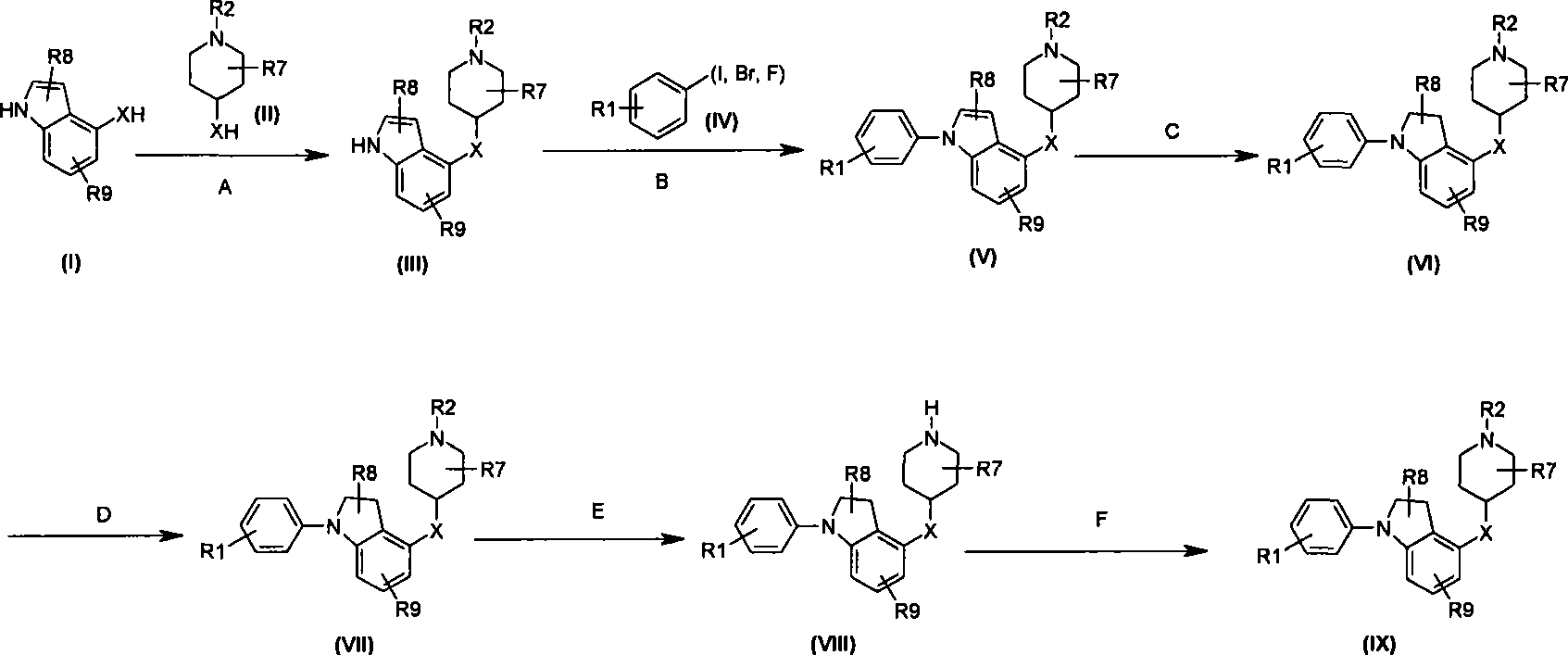
试剂和条件:A)Ph3P,DIAD,THF,室温;B)CuI,K3PO4,甲苯,回流或37% KF-Al2O3,18-冠-6,DMSO,回流;C)NaCNBH3,AcOH,室温;D)(a)CuI,L-脯氨酸,NaOH,CH3SO2Na,DMSO,110℃,或(b)CuCN,NMP,150℃或(c)HP(O)(OR)2,CuI,Cs2CO3,甲苯,回流或(d)PdCl2(PPh3)2或Pd(Ph3P)4,硼酸,2NNa2CO3,THF,回流或(e)Sn(Bu)3R,Pd催化剂,THF,回流;E)(a)TFA,CH2Cl2,室温或(b)浓HCl;F)(a)R2OCOCl,Et3N,CH2Cl2,室温或(b)取代的嘧啶,DIPEA,ACN,回流或(c)R2COCl,Et3N,CH2Cl2,室温或(d)i.NaHCO3,H2O,ii.CNBr,Na2CO3,iii.RC(NH2)NOH,1N在Et2O中的ZnCl2,iv.EtOAc,H3O+,EtOH,回流。Reagents and conditions: A) Ph 3 P, DIAD, THF, room temperature; B) CuI, K 3 PO 4 , toluene, reflux or 37% KF-Al 2 O 3 , 18-crown-6, DMSO, reflux; C) NaCNBH 3 , AcOH, room temperature; D) (a) CuI, L-proline, NaOH, CH 3 SO 2 Na, DMSO, 110°C, or (b) CuCN, NMP, 150°C or (c) HP(O )(OR) 2 , CuI, Cs 2 CO 3 , toluene, reflux or (d) PdCl 2 (PPh 3 ) 2 or Pd(Ph 3 P) 4 , boric acid, 2NNa 2 CO 3 , THF, reflux or (e) Sn(Bu) 3 R, Pd catalyst, THF, reflux; E) (a) TFA, CH 2 Cl 2 , room temperature or (b) concentrated HCl; F) (a) R 2 OCOCl, Et 3 N, CH 2 Cl 2 , room temperature or (b) substituted pyrimidine, DIPEA, ACN, reflux or (c) R 2 COCl, Et 3 N, CH 2 Cl 2 , room temperature or (d) i.NaHCO 3 , H 2 O, ii.CNBr , Na 2 CO 3 , iii. RC(NH 2 )NOH, 1 N ZnCl 2 in Et 2 O, iv. EtOAc, H 3 O + , EtOH, reflux.
基于二氢吲哚的配体可按照通用合成流程1制备。取代吲哚I和4-OH哌啶衍生物II间的Mitsunobu反应可提供式III化合物。对于Mitsunobu反应条件,参见Mitsunobu,Synthesis,1981,1,并且对于Mitsunobu反应综述参见D.L.Hughes Organic Reactions 42,335,关于这些合成各自通过引用结合在本文中。使用标准反应条件用各种取代的芳基卤化物使化合物III N-芳基化,得到化合物V。对于N-芳基方法,参见S.L.Buchwald等J.Org.Chem.,2004,69,5578和W.J.Smith等Tetrahedron Lett.,1996,37,299,关于这些合成各自通过引用结合在本文中。化合物V用在AcOH或CF3CO2H中的NaCNBH3还原可得到式VI的二氢吲哚。反应条件参见G.W.Gribble等Synthesis 1977,859并还参见G.W.Gribble Chem.Soc.Rev.,1998,27,395,关于这些合成各自通过引用结合在本文中。中间体VI(其中R2优选BOC)可用作制备各种类似物的起始原料。在式VI的R2处的不同官能团的展露可通过涉及适合保护基团的脱保护的一系列步骤实现,用酸(如在二噁烷中的TFA或4NHCl)使例如BOC基团脱保护,得到化合物如VIII。化合物VIII与不同的亲电子试剂反应将得到化合物IX,其中R2代表氨基甲酸酯部分、尿素或嘧啶部分。反应条件参见Fyfe,M.,等的WO 2006/067531A1和WO2006/067532A1,关于这些合成各自通过引用结合在本文中。亲电子试剂的实例包括氯代甲酸酯、异氰酸酯和卤代嘧啶,分别得到氨基甲酸酯、尿素和哌啶子基嘧啶。在本领域一般技术人员已知的条件下在合适的溶剂如二氯甲烷、四氢呋喃或乙腈中可进行与亲电子试剂的反应。Indoline-based ligands can be prepared following the general
如果R1为Br或I,则VI磺化可提供二氢吲哚VII(R1为SO2R,其中R为烷基或芳基)。对于将芳基卤化物转化为相应的砜,参见D.Ma.,等,J.Org.Chem.2005,70,2696,关于这些合成的内容通过引用结合在本文中。金属催化碳碳键形成反应如与硼酸或硼酸盐的Suzuki反应或与三烷基锡的Stille反应可提供了相应的二氢吲哚衍生物VII。对于Suzuki偶合反应的反应条件,参见N,Miyaura,A.Suzuki,Chem.Rev.1995,95,2457-2483;A.Suzuki,A,J.Organometallic Chem.1999,576,147-168;和A.Suzuki,in Metal-catalyzed Cross-coupling Reactions,F.Diederich.,和P.J.Stang.,Eds.;Wiley-VCH:New York,1998,49-97,关于这些方法各自通过引用结合在本文中。在Rosunmund-von Braun条件下,化合物VI(其中R1为Br或I)可得到相应的腈化合物VII(R1为CN)。对于相关的反应条件,参见C.Liangzhen等,SyntheticCommun.2004,34,1215,关于这些合成的内容通过引用结合在本文中。在R1转化后,化合物VII也可用酸如TFA或浓HCl处理,得到式VIII化合物。If R1 is Br or I, sulfonation of VI can provide indoline VII ( R1 is SO2R , where R is alkyl or aryl). For the conversion of aryl halides to the corresponding sulfones, see D. Ma., et al., J. Org. Chem. 2005, 70, 2696, the contents of which are incorporated herein by reference. Metal-catalyzed carbon-carbon bond formation reactions such as Suzuki reactions with boronic acids or borates or Stille reactions with trialkyltins provide the corresponding indoline derivatives VII. For the reaction conditions of the Suzuki coupling reaction, see N, Miyaura, A. Suzuki, Chem. Rev. 1995, 95, 2457-2483; A. Suzuki, A, J. Organometallic Chem. 1999, 576, 147-168; and A . Suzuki, in Metal-catalyzed Cross-coupling Reactions, F. Diederich., and PJ Stang., Eds.; Wiley-VCH: New York, 1998, 49-97, each of which is incorporated herein by reference. Under Rosunmund-von Braun conditions, compound VI (where R 1 is Br or I) can give the corresponding nitrile compound VII (R 1 is CN). For relevant reaction conditions, see C.Liangzhen et al., Synthetic Commun. 2004, 34, 1215, the contents of these syntheses are incorporated herein by reference. After transformation of R1 , compound VII can also be treated with an acid such as TFA or conc. HCl to give a compound of formula VIII.
使用本领域技术人员可理解的标准反应条件,化合物VII的腈可得到甲酸。甲酸可用作制备几种酰胺的母体。按照不同的合成策略还可得到甲酸或亚砜,其中用适合的芳基卤化物将II N-芳基化,可得到吲哚V(其中R1为-CO2R、-SR)。VII化合物(其中R1为CN)还可被进一步修饰得到1,3-噻唑衍生物,从而得到活性配体。反应条件参见R.Olsson等J.Med.Chem。2005,48,7517,关于这些合成的内容通过引用结合在本文中。使用本领域技术人员所熟知的文献方法,化合物VII(其中R1为-(O)P(OR)2)可由化合物VI(其中R1为I)制备。化合物VII(其中R1为Br或I)也可转化为化合物VII(其中R1=HOP(O)(OR))。反应条件参见S.L.Buchwald等Org.Lett.,2003,5,2315和S.Gul等Biochem.J.2003,376,813,关于这些合成的内容通过引用结合在本文中。例如如果在化合物VI中R1为卤素,则烷基或芳硫基化(arylthiolation),可得到化合物VII(其中R1为SR),其随后可被氧化得到亚砜VII(其中R1为SOR)。对于将芳基或烷基卤化物转化为相应的硫醚,参见N.Taniguchi等J.Org.Chem.,2004,69,6904,关于这些合成的内容通过引用结合在本文中。可用氧化剂如30%在六氟异丙醇中的H2O2水溶液处理化合物VI,得到外消旋的亚砜VII(其中R1为SOR)。反应条件参见K.S.Ravikumar等Eur.J.Chem.1998,2937,关于这些合成的内容通过引用结合在本文中。外消旋亚砜可使用手性HPLC分析来分离得到纯的或浓缩的(R和S)对映异构体。按照本领域理解的标准反应条件,化合物IX可进一步衍生得到活性化合物(文中也称为生理学上功能衍生物)。The nitrile of compound VII yields formic acid using standard reaction conditions understood by those skilled in the art. Formic acid can be used as a precursor for the preparation of several amides. Formic acid or sulfoxide can also be obtained according to different synthetic strategies, wherein N-arylation of II with a suitable aryl halide can give indole V (where R 1 is -CO 2 R, -SR). Compound VII (wherein R 1 is CN) can be further modified to obtain 1,3-thiazole derivatives, thereby obtaining active ligands. For reaction conditions see R. Olsson et al. J. Med. Chem. 2005, 48, 7517, is hereby incorporated by reference with respect to these syntheses. Compounds VII, wherein R 1 is -(O)P(OR) 2 , can be prepared from compounds VI, wherein R 1 is I, using literature methods well known to those skilled in the art. Compound VII (wherein R 1 is Br or I) can also be transformed into compound VII (wherein R 1 =HOP(O)(OR)). For reaction conditions see SL Buchwald et al. Org. Lett., 2003, 5, 2315 and S. Gul et al. Biochem. J. 2003, 376, 813, the content of these syntheses is incorporated herein by reference. For example, if R in compound VI is halogen, alkyl or arylthiolation can give compound VII (wherein R is SR), which can then be oxidized to give sulfoxide VII (wherein R is SOR ). For the conversion of aryl or alkyl halides to the corresponding thioethers, see N. Taniguchi et al. J. Org. Chem., 2004, 69, 6904, the contents of which are incorporated herein by reference. Compound VI can be treated with an oxidizing agent such as 30% aqueous H2O2 in hexafluoroisopropanol to give racemic sulfoxide VII (where R1 is SOR). See KSRavikumar et al. Eur. J. Chem. 1998, 2937 for reaction conditions, incorporated herein by reference for these syntheses. The racemic sulfoxide can be isolated using chiral HPLC analysis to give the pure or concentrated (R and S) enantiomers. Compound IX can be further derivatized to give active compounds (also referred to herein as physiologically functional derivatives) according to standard reaction conditions understood in the art.
例如,通过改变所述哌啶N原子上的取代基可进一步衍生化合物VIII。通过用CF3CO2H处理化合物VII(其中R2为BOC)得到的化合物VIII(其中R2为H)可用于制备各种类似物。例如使用本领域技术人员所理解的方法,在碱性条件下,通过与各种2-氯5-取代的嘧啶反应可将化合物VIII转化为嘧啶衍生物。相关反应条件参见Fyfe,M.等,WO2006/067532A1,关于这些方法通过引用结合在本文中。使用本领域技术人员熟知的碱性条件,化合物VIII还可用于合成N-酰基或N-烷基衍生物。For example, compound VIII can be further derivatized by changing the substituent on the N atom of the piperidine. Compound VIII (wherein R2 is H ) obtained by treating compound VII (wherein R2 is BOC) with CF3CO2H can be used to prepare various analogs. Compound VIII can be converted to pyrimidine derivatives, for example, by reaction with various 2-chloro5-substituted pyrimidines under basic conditions using methods understood by those skilled in the art. For relevant reaction conditions see Fyfe, M. et al., WO2006/067532A1, incorporated herein by reference for these methods. Compound VIII can also be used for the synthesis of N-acyl or N-alkyl derivatives using basic conditions well known to those skilled in the art.
化合物VIII还可用于制备各种氨基甲酸酯。化合物VIII可用作用于制备杂环(包括噁二唑)的母体。反应条件参见R.M.Jones等WO2005/121121A2,关于这些合成的内容通过引用结合在本文中。化合物VIII可与溴化氰反应得到N-CN衍生物,随后可将其转化为杂环IX,包括但不限于噁二唑。Compound VIII is also useful in the preparation of various carbamates. Compound VIII is useful as a precursor for the preparation of heterocycles, including oxadiazoles. See R.M. Jones et al. WO2005/121121A2 for reaction conditions, the content of these syntheses is incorporated herein by reference. Compound VIII can be reacted with cyanogen bromide to give N-CN derivatives, which can then be converted to heterocycles IX, including but not limited to oxadiazoles.
或者,还可按照合成流程2制备基于二氢吲哚的配体。使用NaCNBH3/AcOH还原方法可将化合物III转化成二氢吲哚X。经本领域已知的N-芳化方法可将二氢吲哚X转化为化合物VI。化合物VI可用于制备数种如上所述基于二氢吲哚配体衍生物的中间体。Alternatively, indoline-based ligands can also be prepared according to
流程2
合成基于二氢吲哚的配体Synthesis of Indoline-Based Ligands
试剂和条件:A)NaCNBH3,AcOH,室温;B)ArX(其中X为I,Br),CuI,K3PO4,甲苯或DMF,回流;C)CuI,L-脯氨酸,NaOH,CH3SO2Na,DMSO,110℃。Reagents and conditions: A) NaCNBH 3 , AcOH, room temperature; B) ArX (where X is I, Br), CuI, K 3 PO 4 , toluene or DMF, reflux; C) CuI, L-proline, NaOH, CH3SO2Na , DMSO, 110°C.
流程3
合成基于二氢吡咯并嘧啶的配体Synthesis of Dihydropyrrolopyrimidine-Based Ligands
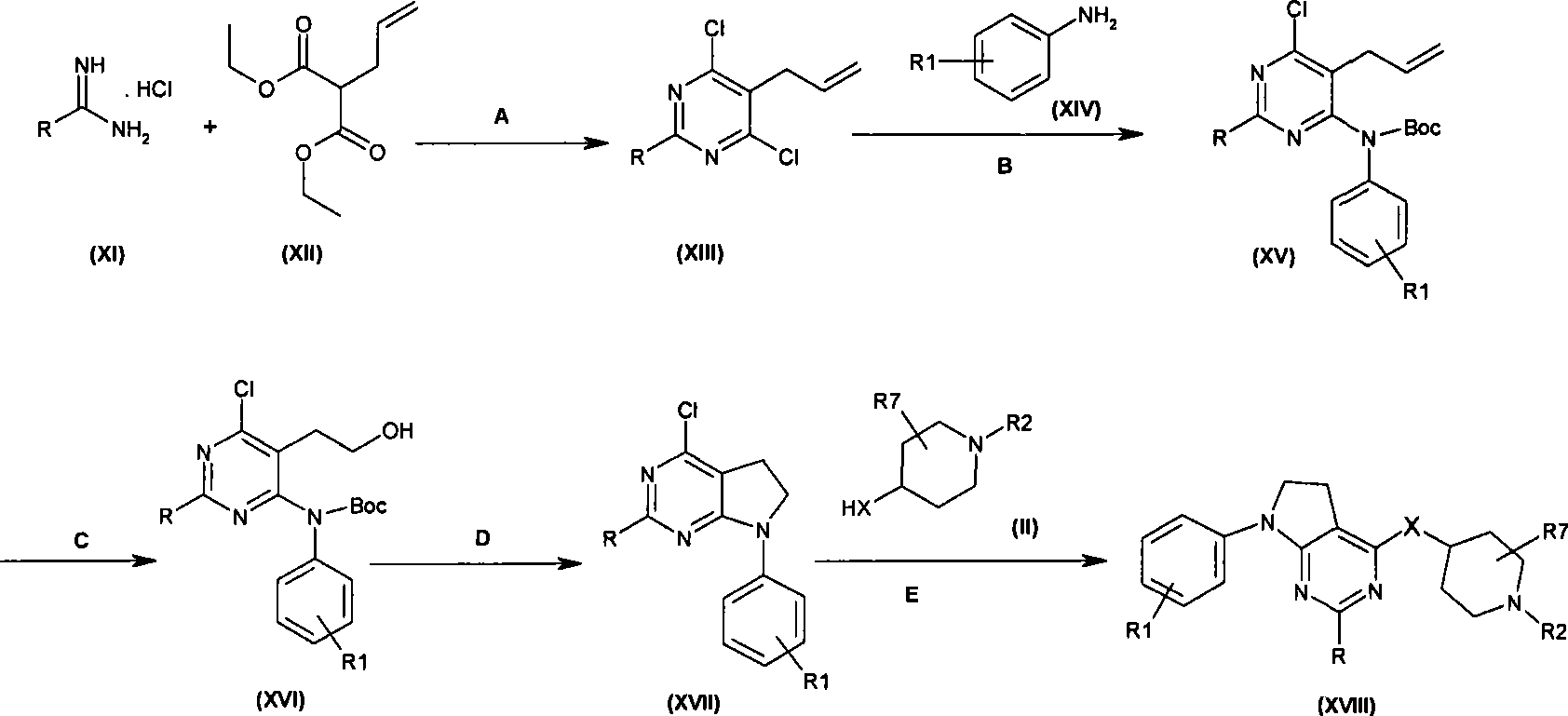
试剂和条件:A)(a)NaOMe,MeOH,室温,(b)POCl3,回流;B)(a)NaH,THF,回流,(b)(BOC)2O,DMAP(催化),CH2Cl2,室温;C)(a)O3,-78℃,CH2Cl2/MeOH,(b)NaBH4,-78℃至室温;D)(a)CH3SO2Cl或(CH3SO2)2O,Et3N,CH2Cl2,5℃至室温,(b)CF3CO2H,CH2Cl2,室温,(c)Et3N,CH2Cl2,室温;E)(a)NaH,THF,回流或K2CO3,溶剂,(b)CuI,L-脯氨酸,NaOH,CH3SO2Na,DMSO,110℃,加热;或(c)CuCN,NMP;150℃;或(d)HP(O)(OR)2,CuI,Cs2CO3,甲苯,回流或(e)PdCl2(PPh3)2或Pd(Ph3P)4,硼酸或硼酸酯,2N Na2CO3,THF,回流;或(f)Sn(Bu)3R,Pd催化剂,THF,回流。Reagents and conditions: A) (a) NaOMe, MeOH, room temperature, (b) POCl 3 , reflux; B) (a) NaH, THF, reflux, (b) (BOC) 2 O, DMAP (catalytic), CH 2 Cl 2 , room temperature; C) (a) O 3 , -78°C, CH 2 Cl 2 /MeOH, (b) NaBH 4 , -78°C to room temperature; D) (a) CH 3 SO 2 Cl or (CH 3 SO 2 ) 2 O, Et 3 N, CH 2 Cl 2 , 5°C to room temperature, (b) CF 3 CO 2 H, CH 2 Cl 2 , room temperature, (c) Et 3 N, CH 2 Cl 2 , room temperature; E) (a) NaH, THF, reflux or K 2 CO 3 , solvent, (b) CuI, L-proline, NaOH, CH 3 SO 2 Na, DMSO, 110°C, heating; or (c) CuCN, NMP; 150°C; or (d) HP(O)(OR) 2 , CuI, Cs 2 CO 3 , toluene, reflux or (e) PdCl 2 (PPh 3 ) 2 or Pd(Ph 3 P) 4 , boric acid or Borate, 2N Na 2 CO 3 , THF, reflux; or (f) Sn(Bu) 3 R, Pd catalyst, THF, reflux.
基于二氢吡咯并嘧啶的配体XVIII可按照一般流程3制备。取代的嘧啶XIII可由XI与XII反应得到。化合物XI可与XII反应得到4,6-二羟基嘧啶衍生物。中间体4,6-二羟基嘧啶衍生物可用POCl3处理,处理后得到化合物XIII。化合物XIII和各种取代的苯胺XIV间的亲核取代反应可得到中间体XV,其通过在催化量DMAP/二氯甲烷的存在下,用(BOC)2O处理可得到化合物XV。通过臭氧分解将化合物XV氧化,随后用NaBH4还原,可得到醇XVI。化合物XVI经甲磺酰化可得到甲磺酰化的衍生物XVI。甲磺酰化的衍生物XVI随后经过两个步骤:用TFA脱除BOC,随后用碱如Et3N或NaH处理,可得到式XVII的二环化合物。对于这些类型转化的反应条件,参见D.F.Romanao等的WO 2002/100863A1,关于这些合成的内容通过引用结合在本文中。Dihydropyrrolopyrimidine-based ligands XVIII can be prepared according to
化合物XVII可用作制备各种类似物的中间体。在碱和溶剂存在下,化合物XVII可与化合物II反应得到化合物XVIII。使用标准有机反应条件可进一步将化合物XVIII衍生。例如,如果R1为Br或I,则通过磺化可得到化合物XVIII(其中R1为SO2R)。与烷基或芳基二硫化物反应可得到化合物XVIII(其中R1为SR),随后使用H2O2或臭氧可将硫醚氧化成相应的亚砜。反应条件参见如文中所述的流程1。使用手性HPLC分析可拆分外消旋亚砜XIX(其中R1为SOR)并可分离各对映异构体或富对应异构体的混合物,这点如本领域技术人员所理解。化合物XVIII可与烷基膦酸酯反应得到其中R为P(O)(OR)2的化合物,随后经本领域技术人员理解的已知的合成转化将该化合物转化成其中R为HOP(O)(OR)的化合物。反应条件参见S.L.Buchwald等的Org.Lett.,2003,5,2315和S.Gul等的Biochem.J.2003,376,813,关于这些合成各自通过引用结合在本文中。化合物XVIII可用于通过本领域理解的已知合成有机转化制备各种类似物的反应物。例如,其中R为CN的化合物XVIII可进一步修饰得到1,3-噻唑衍生物,由此得到活性配体。对于相关反应条件,参见R.Olsson等的J.Med.Chem2005,48,7517,关于这些方法通过引用结合在本文中。Compound XVII is useful as an intermediate in the preparation of various analogs. In the presence of a base and a solvent, compound XVII can react with compound II to obtain compound XVIII. Compound XVIII can be further derivatized using standard organic reaction conditions. For example, if R1 is Br or I, compound XVIII (where R1 is SO2R ) can be obtained by sulfonation. Reaction with alkyl or aryl disulfides can afford compounds XVIII (where R 1 is SR), followed by oxidation of the thioethers to the corresponding sulfoxides using H 2 O 2 or ozone. For reaction conditions see
化合物XVIII中的“R”基团可作为“工具(handle)”来在该位置产生各种取代基。例如,当R为卤素(优选Cl、Br或I)或SO2R时,与烷基、芳基或杂芳基硼酸的Suzuki反应可在该位置得到不同的取代基。同样,如果R为NH2,则伯胺的N-烷化可得到XVIII的其他类似物。如果R为烷基如CH3,则氧化可得到羧酸,随后其可用于制备化合物XVIII的其他活性类似物。对于相关反应条件,参见Culshaw,A.J.等的J.Med.Chem.2006,49,471,关于这些方法通过引用结合在本文中。The "R" group in compound XVIII can serve as a "handle" to create various substituents at that position. For example, when R is a halogen (preferably Cl, Br or I) or SO2R , Suzuki reactions with alkyl, aryl or heteroaryl boronic acids can give different substituents at this position. Likewise, N-alkylation of primary amines can give other analogs of XVIII if R is NH2 . If R is an alkyl group such as CH3 , oxidation can afford the carboxylic acid, which can then be used to prepare other active analogs of compound XVIII. For relevant reaction conditions see Culshaw, AJ et al. J. Med. Chem. 2006, 49, 471, incorporated herein by reference for these methods.
或者,可使用流程4所描绘的合成方法制备二环化合物XVII。化合物XIX可置于臭氧分解条件并将得到的产物用NaBH4还原得到化合物XX。对于臭氧分解条件,参见Montgomery,J.A.等的J.Med.Chem.1967,10,665;关于这些方法通过引用结合在本文中。在碱性条件下该化合物XX,经中间体甲磺酰酯,可分子内环化,得到二环化合物XVII。对于反应条件参见先前对流程3的描述。Alternatively, bicyclic compounds XVII can be prepared using the synthetic method depicted in Scheme 4. Compound XIX can be subjected to ozonolysis conditions and the resulting product reduced with NaBH4 to afford compound XX. For ozonolysis conditions, see Montgomery, JA et al., J. Med. Chem. 1967, 10, 665; incorporated herein by reference for these methods. Under basic conditions, the compound XX can undergo intramolecular cyclization through the intermediate mesyl ester to obtain the bicyclic compound XVII. See previous description for
流程4Process 4
合成二环二氢吡咯并嘧啶Synthesis of Bicyclic Dihydropyrrolopyrimidines

试剂和条件:A)NaH,THF,室温至回流;B)(a)O3,-78℃,CH2Cl2/MeOH,(b)NaBH4,-78℃至室温,C)(a)CH3SO2Cl或(CH3SO2)2O,Et3N,CH2Cl2,5℃至室温。Reagents and conditions: A) NaH, THF, room temperature to reflux; B) (a) O 3 , -78 °C, CH 2 Cl 2 /MeOH, (b) NaBH 4 , -78 °C to room temperature, C) (a) CH 3 SO 2 Cl or (CH 3 SO 2 ) 2 O, Et 3 N, CH 2 Cl 2 , 5° C. to room temperature.
流程5
合成基于二氢吡咯并嘧啶的配体Synthesis of Dihydropyrrolopyrimidine-Based Ligands
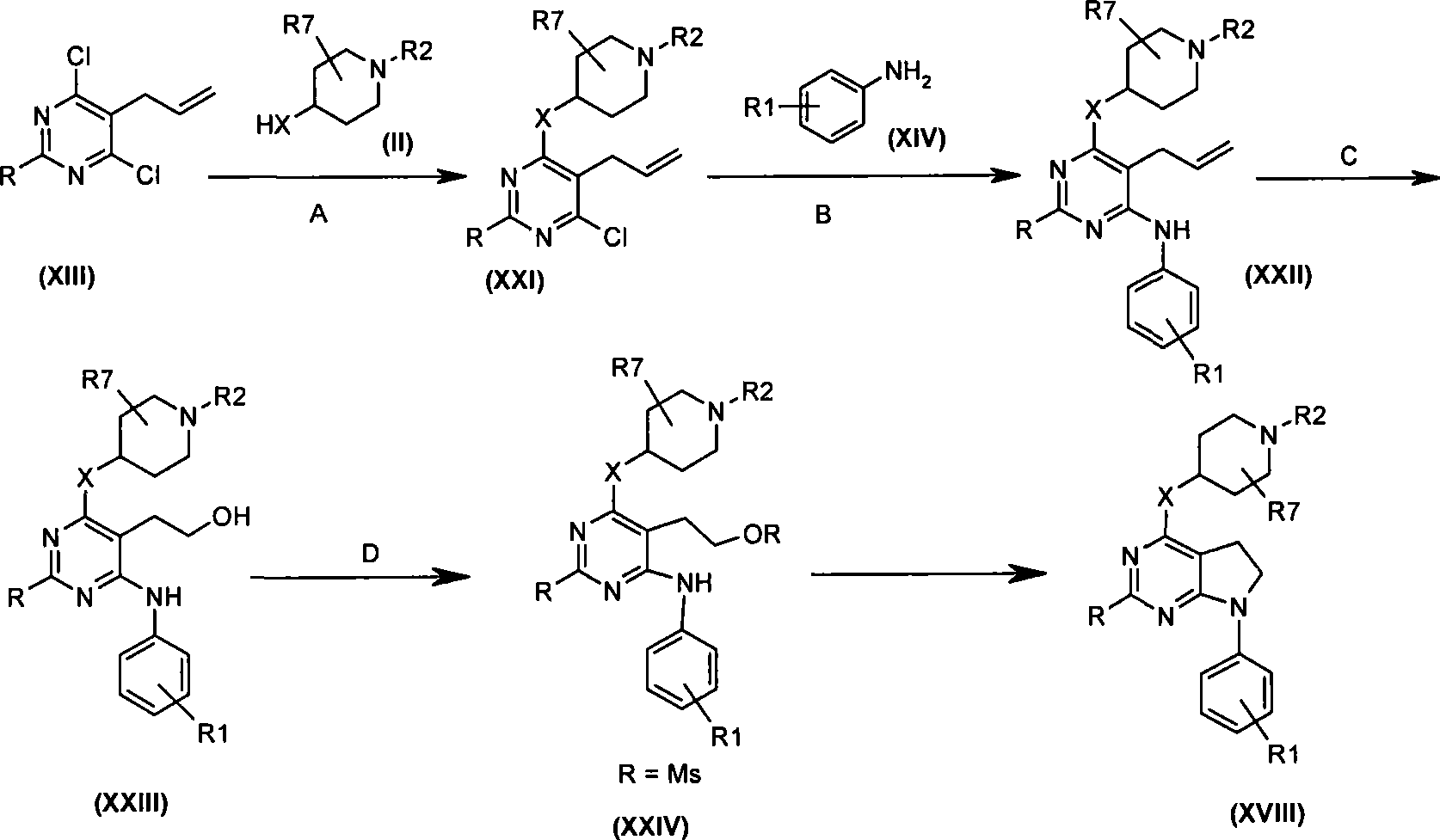
试剂和条件:A)NaH,THF,室温至回流;B)NaH,THF,回流;C)(a)O3,CH2Cl2,-70℃,(b)NaBH4,MeOH,-70℃至室温,iv)Et3N,(CH3SO2)2O,CH2Cl2,室温;D)CH3SO2Cl或(CH3SO2)2O,Et3N,CH2Cl2,5℃至室温。Reagents and conditions: A) NaH, THF, room temperature to reflux; B) NaH, THF, reflux; C) (a) O 3 , CH 2 Cl 2 , -70°C, (b) NaBH 4 , MeOH, -70°C to room temperature, iv) Et 3 N, (CH 3 SO 2 ) 2 O, CH 2 Cl 2 , room temperature; D) CH 3 SO 2 Cl or (CH 3 SO 2 ) 2 O, Et 3 N, CH 2 Cl 2 , 5°C to room temperature.
在另一方法中,在碱性/酸性条件下使用取代的哌啶衍生物II可将化合物XIII转化为XXI从而得到化合物XXI。对于相关反应条件参见Jones,R.M.等的WO2005/5007647A1和WO2005/121121A2,关于这些合成的内容通过引用结合在本文中。在所描述的用于流程3的条件下,化合物XXI可与各种取代的苯胺XIV反应得到化合物XXII。将XXII臭氧分解,随后用NaBH4还原,可得到醇XXIII。经中间体甲磺酰酯XXIV(其中R为Ms)可将式XXIII化合物分子内环化,得到式XVIII化合物。对于反应条件和相关参考文献,参见上文流程3。In another method, compound XIII can be converted to XXI using substituted piperidine derivatives II under basic/acidic conditions to give compound XXI. For relevant reaction conditions see WO2005/5007647A1 and WO2005/121121A2 by Jones, RM et al, the contents of these syntheses are incorporated herein by reference. Compound XXI can be reacted with various substituted anilines XIV under the conditions described for
流程6
中间体的合成流程Synthetic process of intermediates
试剂和条件:A)NaH,THF,ArNH2,THF,回流;B)OsO4,溶剂室温;C)Et3N,(CH3SO2)2O,CH2Cl2,5℃至室温;D)(a)O3,-78℃,CH2Cl2;(b)RMgX,THF,室温;NaBH4,-78℃至室温;E)ArNH2,NaH,DMF,0℃至室温;F)(a)O3,-78℃,CH2Cl2/MeOH,(b)NaBH4,-78℃至室温;G)(a)O3,-78℃,CHC2l2/MeOH,Me2S(b)ArNH2,NaCNBH3,AcOH,室温;H)CF3CO2H,室温;I)A,m-CPBA,CH2Cl2,5℃至室温;J)BF3·Et2O,CH2Cl2,5℃至室温;K)RX,碱,溶剂。Reagents and conditions: A) NaH, THF, ArNH 2 , THF, reflux; B) OsO 4 , solvent room temperature; C) Et 3 N, (CH 3 SO 2 ) 2 O, CH 2 Cl 2 , 5°C to room temperature; D) (a) O 3 , -78°C, CH 2 Cl 2 ; (b) RMgX, THF, room temperature; NaBH 4 , -78°C to room temperature; E) ArNH 2 , NaH, DMF, 0°C to room temperature; F )(a) O 3 , -78°C, CH 2 Cl 2 /MeOH, (b) NaBH 4 , -78°C to room temperature; G) (a) O 3 , -78°C, CHC 2 l 2 /MeOH, Me 2S (b) ArNH 2 , NaCNBH 3 , AcOH, room temperature; H) CF 3 CO 2 H, room temperature; I) A, m-CPBA, CH 2 Cl 2 , 5°C to room temperature; J) BF 3 ·Et 2 O, CH 2 Cl 2 , 5°C to room temperature; K) RX, base, solvent.
可使用流程6中描绘的任一顺序制备中间体XXVII和XXVIII。使用在非质子溶剂如THF或DMF中的NaH,用取代的苯胺经亲核取代反应可将化合物XIII转化为XIX。化合物XIX经二羟化反应可得到二羟基化合物XXVII。反应条件参见Sharpless,K.B.等的J.Org.Chem.,1992,57,2768.,关于这些合成的内容通过引用结合在本文中。可将化合物XXVIIA环化得到化合物XXVIII。Intermediates XXVII and XXVIII can be prepared using either sequence depicted in
将化合物XIII臭氧分解,随后用NaBH4还原可得到化合物XXV。使用与上文描述相同的甲磺酰化条件可将化合物XXV转化,得到二环化合物XXVII。Ozonolysis of compound XIII followed by reduction with NaBH4 affords compound XXV. Compound XXV can be transformed using the same mesylation conditions as described above to give bicyclic compound XXVII.
或者,经流程6中所描述的还原胺化也可得到化合物XXVII。通过臭氧分解氧化化合物XIII产生的醛可与取代的苯胺/取代的吡啶胺偶合形成亚胺,随后可用NaCNBH3还原,得到胺化合物XXXI。在酸性条件下,该胺用TFA处理可形成二环化合物XXVII。对于相关反应条件,参见R.O.Hutchins等的In Comprehensive OrganicSynthesis;B.M.Trost等编辑;Pergamon:Oxford,1991;第8卷,第25页;和Hudlicky,M.Reductions in Organic Chemistry,第2版;ACSMonograph 188,1996;第187页,关于这些合成各自通过引用结合在本文中。Alternatively, compound XXVII can also be obtained via reductive amination as described in
使用在丙酮水溶液中的K2OsO4·2H2O/NaIO4也可产生得自烯烃X111的醛。在Na(OAc)3BH存在下,由此得到的醛用在TFA或乙酸中的取代的苯胺或取代的吡啶胺处理,经由式XXXI的中间体得到二环化合物XXVII。对于相关反应条件,参见Kempson,J.等的Bioorg.Med.Chem.2005,15,1829,关于这些转化通过引用结合在本文中。Aldehydes from alkenes X111 can also be generated using K 2 OsO 4 ·2H 2 O/NaIO 4 in aqueous acetone. Treatment of the thus obtained aldehydes with substituted anilines or substituted pyridinamines in TFA or acetic acid in the presence of Na(OAc) 3BH affords bicyclic compounds XXVII via intermediates of formula XXXI. For relevant reaction conditions see Kempson, J. et al. Bioorg. Med. Chem. 2005, 15, 1829, incorporated herein by reference for these transformations.
经流程6中描绘出的顺序,化合物XIII还可用于制备6-取代的化合物XXVIII。化合物XIII用m-CPBA处理,可得到环氧化物XXXII。在Lewis酸催化条件下环氧化物XXXII可分子内开环,得到化合物XXXIII。通过使用本领域技术人员熟知的反应可将描述的化合物XXXIII的伯醇转化成功能基团。Compound XIII can also be used to prepare 6-substituted compounds XXVIII via the sequence depicted in
其他方法可如流程7中所示用于合成二氢吡咯并嘧啶配体。Other methods can be used to synthesize dihydropyrrolopyrimidine ligands as shown in
流程7
合成基于二氢吡咯并嘧啶的配体Synthesis of Dihydropyrrolopyrimidine-Based Ligands
试剂和条件:A)CuI,K3PO4,甲苯,回流;B)(a)O3,-78℃,CH2Cl2;(b)Me2S,H+;C)NaH,THF,回流;D)Pd/C,H2,ROH或EtOAc,高压釜。Reagents and conditions: A) CuI, K 3 PO 4 , toluene, reflux; B) (a) O 3 , -78°C, CH 2 Cl 2 ; (b) Me 2 S, H + ; C) NaH, THF, Reflux; D) Pd/C, H2 , ROH or EtOAc, autoclave.
化合物XXXV可通过以下方法合成:使用化合物XXXIV N-芳基化方法或通过臭氧分解氧化化合物XIX,随后通过涉及中间体氨基醇的分子内环化。对于反应条件,参考上文流程4。使用上文所述用于流程3的反应条件,可将化合物XXXV转化为中间体XXXVI。在高压釜条件下,将化合物XXXVI氢化可得到化合物XVIII。反应条件参见S,Senda.的Jpn.Kokai Tokkyo Koho(1972),2页,JP 4702519219721019;JP 71-14817 19710317,关于这些合成的内容通过引用结合在本文中。Compound XXXV can be synthesized by oxidation of compound XIX using the N-arylation method of compound XXXIV or by ozonolysis followed by intramolecular cyclization involving intermediate aminoalcohols. For reaction conditions, refer to Scheme 4 above. Using the reaction conditions described above for
通过使用化合物XVIII按照本领域技术人员熟知的反应条件可制备各种二氢吡咯并嘧啶。Various dihydropyrrolopyrimidines can be prepared by using compound XVIII following reaction conditions well known to those skilled in the art.
流程8
制备基于二氢吡咯并嘧啶的配体Preparation of Dihydropyrrolopyrimidine-Based Ligands

试剂和条件:A)ArNH2,室温;B).MeOH,H2SO4(催化),回流;C)P2S5或Lawesson试剂,THF,回流;D)(a)R-C(NH2)=NH,碱,溶剂,回流;(b)POCl3,回流;E)RC(NH2)=CH-CO2R,POCl3,回流;F)NaOMe,MeOH,回流,H+;G)II,NaH,THF,回流;H)II,Mitsunobu条件,上文流程1,A.Reagents and conditions: A) ArNH 2 , room temperature; B).MeOH, H 2 SO 4 (catalytic), reflux; C) P 2 S 5 or Lawesson's reagent, THF, reflux; D) (a) RC(NH 2 ) =NH, base, solvent, reflux; (b) POCl 3 , reflux; E) RC(NH 2 )=CH-CO 2 R, POCl 3 , reflux; F) NaOMe, MeOH, reflux, H + ; G) II , NaH, THF, reflux; H) II, Mitsunobu conditions,
在流程8中描述了用于制备式XVIII和XLIV配体的备选合成方法。环丙基化合物XXXVI可用各种取代的苯胺处理,得到2-氧代-1-芳基-3-吡咯烷甲酸,其使用Fisher酯化方案酯化可得到化合物XXXVIII。对于反应条件,参见Organic Syntheses,Coll,第7卷,第411页(1990);第60卷,第66页(1981)和Fischer-Speier esterificationprotocol Vogel’s Textbook of Practical Organic Chemistry(Vogel’s有机化学实践教科书中的Fischer-Speier酯化方案)5th Ed,1989,第700页,关于这些方法各自通过引用结合在本文中。使用P2S5或Lawesson试剂将XXXVIII硫化可得到化合物XXXIX。对于相关反应条件和文献,参见J.B.Charles等的US 1994/5302722,关于这些合成的内容通过引用结合在本文中。采用流程8中所示的反应条件化合物XVII或XL可分别得到化合物XVIII或XLIV。Alternative synthetic methods for the preparation of ligands of formula XVIII and XLIV are described in
或者,使用流程8中所述试剂和条件可将化合物XXXVIII转化成式XLI化合物。在碱性条件下经分子内环化,化合物XLI可得到化合物XLII。对于相关的反应顺序和反应条件,参见A.Daniele等的WO 2004/094420A1,关于这些合成的内容通过引用结合在本文中。使用POCl3可将羟基化合物XXXX和XLII各自转化为相应的氯衍生物XVII和XLIII。使用碱性或Mitsunobu反应条件可将二环化合物XVII或XL转化成所需产物XVIII。同样地,还可将XLII或XLIII转化为所需化合物XLIV。Alternatively, compound XXXVIII can be converted to a compound of formula XLI using the reagents and conditions described in
使用流程9中所示方法还可合成中间体XXXVIII。在一种方法中,(γ-丁内酯XLIV可与各种取代的苯胺反应,随后使用碳酸二甲酯进行甲氧羰基化步骤,得到酮酯XXXVIII。对于反应条件和参考文献,参见Lizuka Hajime的EP 95/0668275A1,关于这些合成的内容通过引用结合在本文中。或者,化合物XXXVIII还可由2-吡咯烷酮经取代的苯胺的N-芳基化,随后在碱性条件下进行甲氧羰基化得到。反应条件参见Deng,W.,等的Tetrahedron Lett.,2004,45,2311,关于这些合成的内容通过引用结合在本文中。Intermediate XXXVIII can also be synthesized using the method shown in Scheme 9. In one approach, (γ-butyrolactone XLIV can be reacted with various substituted anilines, followed by a methoxycarbonylation step using dimethyl carbonate to give the ketoester XXXVIII. For reaction conditions and references, see
流程9Process 9
二环化合物的合成Synthesis of bicyclic compounds
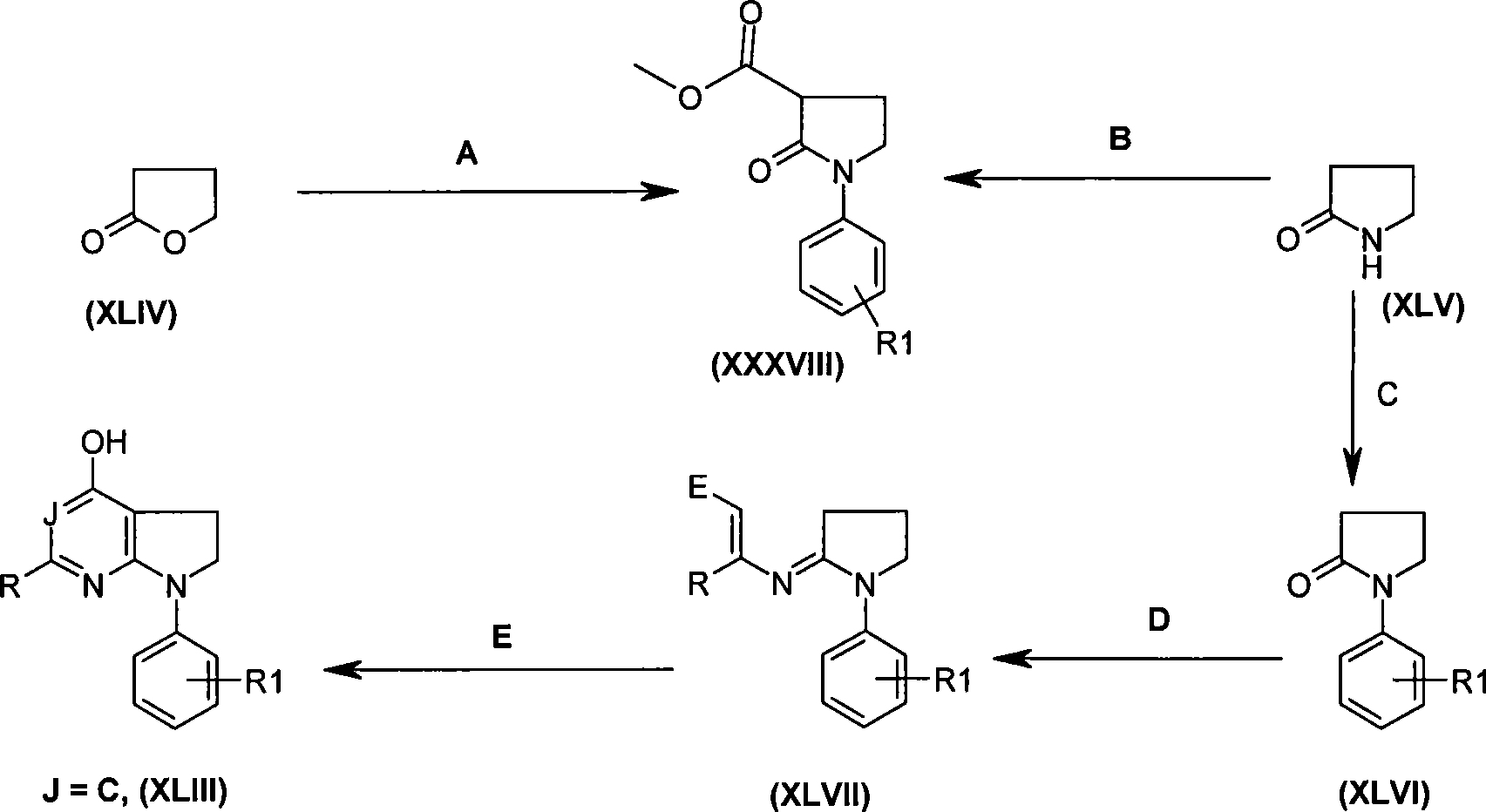
试剂和条件:A)(a)ArNH2,加热,(b)NaH,CO(OMe)2,THF;B)(a)CuI,K3PO4,ArX,甲苯,(b)NaH,CO(OMe)2,THF;C)B的步骤(a)的条件;D)RC(NH2)=NH,POCl3,回流;E)t-BuOK,t-BuOH或NaOMe,MeOH,回流,H+。Reagents and conditions: A) (a) ArNH 2 , heating, (b) NaH, CO(OMe) 2 , THF; B) (a) CuI, K 3 PO 4 , ArX, toluene, (b) NaH, CO( OMe) 2 , THF; C) Conditions of step (a) of B; D) RC(NH 2 )=NH, POCl 3 , reflux; E) t-BuOK, t-BuOH or NaOMe, MeOH, reflux, H + .
使用流程9中所示合成策略还可制备配体XLIII。中间体XLVI可按照本领域技术人员了解的方法,使用合适的芳基卤化物,由2-吡咯烷酮制备。反应条件参见上文流程7。使用脱水剂如POCl3可将化合物XLVI转化为化合物XLVII。使用碱性条件可将化合物XLVII转化成中间体XLIII。对于反应条件以及参考文献,参考上文流程8。Ligand XLIII can also be prepared using the synthetic strategy shown in Scheme 9. Intermediates XLVI can be prepared from 2-pyrrolidones using the appropriate aryl halides by methods known to those skilled in the art. See
流程10
各种取代的R2类似物合成的一般流程General scheme for the synthesis of various substituted R2 analogs

试剂和条件:A)CF3CO2H,CH2Cl2,室温,B)Et3N,ClCO2R或烷基或芳基卤化物,CH2Cl2,室温,C)i.Im2CO或Im2CS,CH2Cl2,室温,ii.MeI,CH2Cl2/CH3CN,室温,D)ArSH或RSH,Et3N,CH2Cl2,室温,E)ArOH或ROH,Et3N,CH2Cl2,室温Reagents and conditions: A) CF 3 CO 2 H, CH 2 Cl 2 , room temperature, B) Et 3 N, ClCO 2 R or alkyl or aryl halides, CH 2 Cl 2 , room temperature, C) i.Im 2 CO or Im 2 CS, CH 2 Cl 2 , room temperature, ii.MeI, CH 2 Cl 2 /CH 3 CN, room temperature, D) ArSH or RSH, Et 3 N, CH 2 Cl 2 , room temperature, E) ArOH or ROH , Et3N , CH2Cl2 , room temperature
通式中的R2取代基可如下改变:通过用在CH2Cl2中的TFA处理XLVIII,随后在碱和溶剂存在下中间体XLIX与合适的酰化或烷化或芳化剂反应得到式L化合物(流程10)。使用式LI的氨基甲酰基咪唑嗡盐和合适的亲核试剂可完成氨基甲酸酯LII和硫代氨基甲酸酯LIII的合成。反应条件参见Batey,R.A.,Tetrahedron Lett.,1999,40,2669,关于这些方法通过引用结合在本文中。The R2 substituents in the general formula can be modified by treatment of XLVIII with TFA in CH2Cl2 , followed by reaction of intermediate XLIX with a suitable acylating or alkylating or arylating agent in the presence of base and solvent to give formula L Compound (Scheme 10). The synthesis of carbamates LII and thiocarbamates LIII can be accomplished using carbamoyl imidazolium salts of formula LI and suitable nucleophiles. For reaction conditions see Batey, RA, Tetrahedron Lett., 1999, 40, 2669, incorporated herein by reference for these methods.
流程11Process 11
硫醚、亚砜、亚氨代磺酰化合物(sulfoximine)和亚氨代亚磺酰化合物(SuIfilimines)的通用合成General synthesis of thioethers, sulfoxides, sulfoximines and SuIfilimines
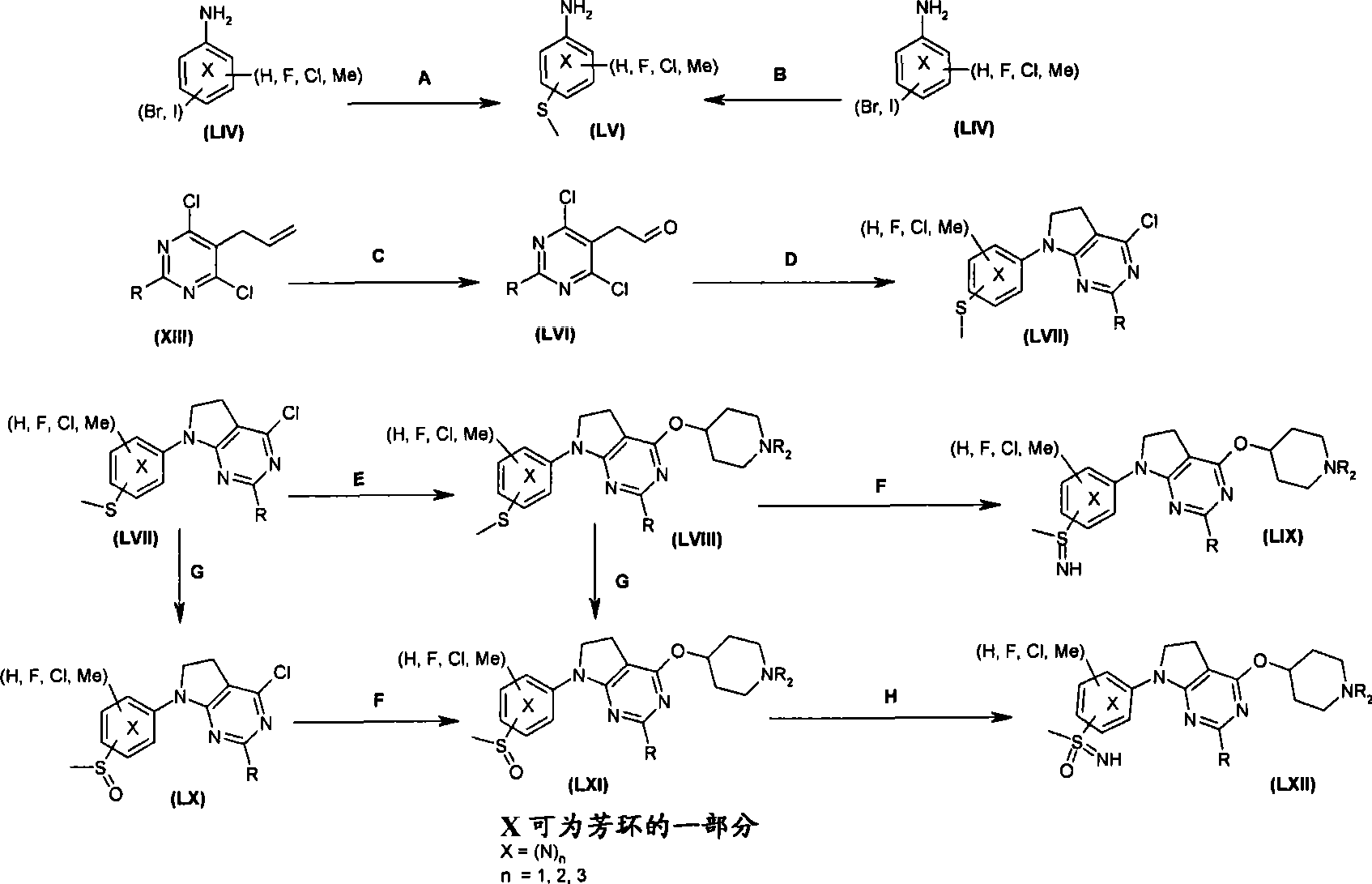
试剂和条件:A)NiBr2,Zn,bpy,(MeS)2,DMF,110℃,B)MesNa,Cu,MeOH,加热,C)K2OsO4·2H2O或OsO4/NMO,NaIO4,丙酮水溶液,室温,D)LV Na(OAc)3BH,TFA或CH3CO2H,-15℃至室温,E)II,NaH,THF,回流,F)MSH,CH2Cl2,室温,G)i.H2O2,HFIP,室温或ii不对称磺酰化法(Asymmetric sulfoxidation),Ti(OiPr)4,D或L-酒石酸二乙酯,tBuOOH,甲苯或本领域已知的任何方法,H)MSH,CH2Cl2,室温或外消旋的LXI,(S)-(+)或(R)-(-)-樟脑磺酸,丙酮。Reagents and conditions: A) NiBr 2 , Zn, bpy, (MeS) 2 , DMF, 110°C, B) MesNa, Cu, MeOH, heating, C) K 2 OsO 4 ·2H 2 O or OsO 4 /NMO, NaIO 4 , acetone in water, room temperature, D) LV Na(OAc) 3 BH, TFA or CH 3 CO 2 H, -15°C to room temperature, E) II, NaH, THF, reflux, F) MSH, CH 2 Cl 2 , Room temperature, G) iH 2 O 2 , HFIP, room temperature or ii asymmetric sulfonylation (Asymmetric sulfoxidation), Ti(OiPr) 4 , D or L-diethyl tartrate, tBuOOH, toluene or any known in the art Method, H) MSH, CH2Cl2 , room temperature or racemic LXI, (S)-(+) or ( R)-(-)-camphorsulfonic acid, acetone.
用LIV表示的化合物可包括至多三个杂原子,优选N。式LVIII的硫醚、式LXI的亚砜、式LIX的亚氨代亚磺酰化合物和式LXII的亚氨代磺酰化合物的合成可按照流程11中所绘出的合成路径合成。所需取代的硫醚LV可按照本领域技术人员已知的方法制备,对于相关反应条件,参见Taniguchi,N.J.Org.Chem.2004,69,6904(路径A),Wade,P.C.等US 4221796A(路线B),关于这些方法通过引用结合在本文中。醛LVI可通过臭氧分解或通过与K2OsO4·2H2O和NaIO4反应来制备。在Na(OAc)3BH存在下,使用酸性条件,苯胺LV和醛LVI之间的还原胺化可得到二环核LVII。对于相关反应条件,参见Kempson,J,等的Bioorg.Chem.Lett.2005,15,1829,关于这些方法通过引用结合在本文中。在碱和溶剂存在下,化合物LVII与化合物II反应得到式LVIII的硫化物。可用作制备各种类似物(例如亚氨代磺酰亚胺LX)的起始反应物的硫醚LVIII可使用本领域报道的条件制备。反应条件参见Tamura,Y.等的Tetrahedron Lett.1972,4137和Bolm,C.等的Org.Lett.2006,8,2349,关于这些方法通过引用结合在本文中。使用不对称磺酰化法可使式LVII和LVIII的硫醚氧化得到对映异构纯的亚砜。一般而言,可使用任一已知的方法制备对映异构纯手性亚砜:a)外消旋混合物的拆分,b)不对称合成。对于对映异构纯亚砜合成的详情和相关参考文献,参见Bolm,C.等在Adv.Synth.Catal.2005,347,19-31中的综述。Compounds denoted by LIV may include up to three heteroatoms, preferably N. The synthesis of thioethers of formula LVIII, sulfoxides of formula LXI, sulfoximine compounds of formula LIX and sulfoximine compounds of formula LXII can be synthesized according to the synthetic route drawn in Scheme 11. The desired substituted thioether LV can be prepared according to methods known to those skilled in the art. For relevant reaction conditions, refer to Taniguchi, NJOrg.Chem.2004, 69, 6904 (route A), Wade, PC et al. ), which are incorporated herein by reference with respect to these methods. Aldehyde LVI can be prepared by ozonolysis or by reaction with K 2 OsO 4 ·2H 2 O and NaIO 4 . Reductive amination between aniline LV and aldehyde LVI in the presence of Na(OAc) 3BH using acidic conditions affords bicyclic core LVII. For relevant reaction conditions see Kempson, J, et al. Bioorg. Chem. Lett. 2005, 15, 1829, incorporated herein by reference for these methods. Compound LVII is reacted with compound II in the presence of a base and a solvent to give a sulfide of formula LVIII. Thioethers LVIII, useful as starting reagents for the preparation of various analogs (eg, iminosulfonimides LX), can be prepared using conditions reported in the art. For reaction conditions see Tamura, Y. et al. Tetrahedron Lett. 1972, 4137 and Bolm, C. et al. Org. Lett. 2006, 8, 2349, incorporated herein by reference for these methods. Oxidation of thioethers of formula LVII and LVIII using asymmetric sulfonylation provides enantiomerically pure sulfoxides. In general, enantiomeric chiral sulfoxides can be prepared using any of the known methods: a) resolution of racemic mixtures, b) asymmetric synthesis. For details and relevant references on the synthesis of enantiomerically pure sulfoxides, see the review by Bolm, C. et al. in Adv. Synth. Catal. 2005, 347, 19-31.
式LX和LXI的对映异构纯亚砜可制备如下:使用H2O2和六氟异丙醇(HFIP)选择性氧化前手性亚砜LVII和LVIII,随后经手性HPLC分析,得到对映异构纯或富对映体R和S亚砜。对映异构纯亚砜的绝对立体化学可用VCD光谱测定。对于相关分析,参见Stephens,P.J.等的J.Org.Chem.2001,66,3671,关于这些分析通过引用结合在本文中。使用化合物II、碱和溶剂,亚砜LX可进一步转化为亚砜LXI。对映异构纯的亚氨代磺酰化合物可使用对映异构纯的式LXI的亚砜,按照本领域报道的方法,使用o-米基磺酰基羟基胺(MSH)制备,或通过拆分外消旋的亚氨代磺酰化合物来制备。反应条件参见Johnson,C.R.等的J.Org.Chem.1974,39,2458;和Gaillard,S.等Tetrahedron 2005,61,8138;和Brandt,J.等Tetrahedron:Asymmetry1997,8,909;Gaillard,S.等Tetrahedron 2005,61,8138,关于这些方法通过引用结合在本文中。Enantiomerically pure sulfoxides of formula LX and LXI can be prepared by selective oxidation of prochiral sulfoxides LVII and LVIII using H2O2 and hexafluoroisopropanol (HFIP), followed by chiral HPLC analysis to give the corresponding Enantiomerically pure or enantiomerically enriched R and S sulfoxides. The absolute stereochemistry of the enantiomerically pure sulfoxide can be determined by VCD spectroscopy. For related analyses, see J. Org. Chem. 2001, 66, 3671 by Stephens, PJ et al., incorporated herein by reference for these analyses. Using compound II, base and solvent, sulfoxide LX can be further converted to sulfoxide LXI. Enantiomerically pure sulfonyl imino compounds can be prepared using enantiomerically pure sulfoxides of formula LXI, using o-mildylsulfonylhydroxylamine (MSH) according to methods reported in the art, or by resolution Separate racemic iminosulfonyl compounds to prepare. For reaction conditions see Johnson, CR et al. J.Org.Chem.1974, 39, 2458; and Gaillard, S. et al. Tetrahedron 2005, 61, 8138; and Brandt, J. et al. Tetrahedron:
实施例 Example
以下具体实施例仅作为举例说明,而不解释为对本发明范围的限制。The following specific examples are for illustration only, and are not construed as limiting the scope of the present invention.
实施例1(10)Example 1 ( 10 )

步骤1:6-羟基-5-(2-丙烯-1-基)-4(1H)-嘧啶酮(1)Step 1: 6-Hydroxy-5-(2-propen-1-yl)-4(1H)-pyrimidinone ( 1 )
在环境温度、N2下,往甲醇钠(0.5M,在MeOH中,1.89L,0.95mol)的溶液中加入甲脒·盐酸盐(39.0g,0.48mol)。在室温下将该混合物搅拌1小时。往以上混合物中加入烯丙基丙二酸二乙酯(91.5mL,0.46mol)并在室温下将得到的反应混合物搅拌36小时。将反应混合物过滤并将滤液减压浓缩,得到粗制固体物质。将该粗品溶解在H2O(1000mL)中并用浓HCl酸化。将该固体过滤并干燥,得到62.8g(90%)白色固体状的标题化合物1。To a solution of sodium methoxide (0.5 M in MeOH, 1.89 L, 0.95 mol) was added formamidine·hydrochloride (39.0 g, 0.48 mol) at ambient temperature under N2 . The mixture was stirred at room temperature for 1 hour. To the above mixture was added diethyl allylmalonate (91.5 mL, 0.46 mol) and the resulting reaction mixture was stirred at room temperature for 36 hours. The reaction mixture was filtered and the filtrate was concentrated under reduced pressure to obtain a crude solid material. The crude product was dissolved in H2O (1000 mL) and acidified with cone. HCl. The solid was filtered and dried to afford 62.8 g (90%) of the
1H NMR(400MHz,DMSO-d6):δ 11.65(br s,2H),7.90(s,1H),5.79-5.71(m,1H),4.94-4.90(app.dd,J1=17.2Hz,J2=2.0Hz,2H),2.96(d,J=6.0Hz,2H);LCMS(ESI):m/z 153(M+H)+. 1 H NMR (400MHz, DMSO-d 6 ): δ 11.65 (br s, 2H), 7.90 (s, 1H), 5.79-5.71 (m, 1H), 4.94-4.90 (app.dd, J 1 = 17.2Hz , J 2 =2.0Hz, 2H), 2.96 (d, J=6.0Hz, 2H); LCMS (ESI): m/z 153 (M+H) + .
步骤2:4,6-二氯-5-(2-丙烯-1-基)嘧啶(2)Step 2: 4,6-Dichloro-5-(2-propen-1-yl)pyrimidine ( 2 )
在N2下,往圆底烧瓶中装入6-羟基-5-(2-丙烯-1-基)-4(1H)-嘧啶酮(1)(19.0g,125.0mmol)和磷酰氯(200mL)。将该混合物回流4小时,随后冷却至室温。在剧烈搅拌下将反应混合物非常缓慢地倾入冰冷却(5℃)的水(2000mL)中。产物用CH2Cl2(4 x 250mL)萃取。合并的有机层用饱和的NaHCO3(1 x 100mL)、盐水(1 x 50mL)洗涤,经Na2SO4干燥,过滤,随后将滤液减压浓缩,得到22.70g(96%)浅黄色油状的标题化合物2。Under N 2 , a round bottom flask was charged with 6-hydroxy-5-(2-propen-1-yl)-4(1H)-pyrimidinone ( 1 ) (19.0 g, 125.0 mmol) and phosphorus oxychloride (200 mL ). The mixture was refluxed for 4 hours, then cooled to room temperature. The reaction mixture was poured very slowly into ice-cooled (5 °C) water (2000 mL) with vigorous stirring. The product was extracted with CH2Cl2 (4 x 250 mL). The combined organic layers were washed with saturated NaHCO 3 (1 x 100 mL), brine (1 x 50 mL), dried over Na 2 SO 4 , filtered, and the filtrate was concentrated under reduced pressure to give 22.70 g (96%) of
1H NMR(400MHz,DMSO-d6):δ 8.08(s,1H),5.90-5.80(m,1H),5.17-5.09(app.m,2H),3.65(app.d,J=6.4Hz,2H));LCMS(ESI):m/z 190(M+H)+. 1 H NMR (400MHz, DMSO-d 6 ): δ 8.08(s, 1H), 5.90-5.80(m, 1H), 5.17-5.09(app.m, 2H), 3.65(app.d, J=6.4Hz , 2H)); LCMS (ESI): m/z 190 (M+H) + .
步骤3:2-氟-4-(甲基磺酰基)苯胺(3)Step 3: 2-Fluoro-4-(methylsulfonyl)aniline (3)
如上文所述,以下实施例为将芳基卤化物转化为相应的砜衍生物的代表性方法。As noted above, the following examples are representative procedures for the conversion of aryl halides to the corresponding sulfone derivatives.
在95℃下、在密封管(压力管)中,将4-溴-2-氟苯胺(9.5g,50.0mmol)、甲烷亚磺酸钠(6.13g,60.0mmol)、碘化铜(0.95g,5.0mmol)、L-脯氨酸(1.15g,10.0mmol)、NaOH(0.40g,10.0mmol)和DMSO(60mL)的混合物搅拌60小时。将该反应物冷却至室温,随后将其在EtOAc和水(1:1,1000mL)间分配。将层分离,随后水相进一步用EtOAc(2 x300mL)萃取。合并的有机层用盐水(1 x 100mL)洗涤,经Na2SO4干燥,过滤,随后将滤液减压浓缩,得到粗品。产物经SiO2快速柱层析纯化,得到7.41g(78%)灰白色固体状的标题产物3。In a sealed tube (pressure tube) at 95°C, 4-bromo-2-fluoroaniline (9.5g, 50.0mmol), sodium methanesulfinate (6.13g, 60.0mmol), copper iodide (0.95g , 5.0 mmol), L-proline (1.15 g, 10.0 mmol), NaOH (0.40 g, 10.0 mmol) and DMSO (60 mL) was stirred for 60 hours. The reaction was cooled to room temperature, then partitioned between EtOAc and water (1:1, 1000 mL). The layers were separated and the aqueous phase was further extracted with EtOAc (2 x 300 mL). The combined organic layers were washed with brine (1 x 100 mL), dried over Na2SO4 , filtered, and the filtrate was concentrated under reduced pressure to give the crude product. The product was purified by flash column chromatography on SiO2 to afford 7.41 g (78%) of the
1H NMR(400MHz,DMSO-d6):δ 7.47和7.44(dd,J1=11.2Hz,J2=2.0Hz,1H),7.40和7.37(dd,J1=8.8Hz,J2=2.0Hz,1H),6.84(app.t,J=6.8Hz,1H),6.17(s,2H),3.07(s,3H);LCMS(ESI):m/z 190(M+H)+. 1 H NMR (400 MHz, DMSO-d 6 ): δ 7.47 and 7.44 (dd, J 1 =11.2 Hz, J 2 =2.0 Hz, 1H), 7.40 and 7.37 (dd, J 1 =8.8 Hz, J 2 =2.0 Hz, 1H), 6.84 (app.t, J=6.8Hz, 1H), 6.17 (s, 2H), 3.07 (s, 3H); LCMS (ESI): m/z 190 (M+H) + .
步骤4:6-氯-N-[2-氟-4-(甲基磺酰基)苯基]-5-(2-丙烯-1-基)-4-嘧啶胺(4)Step 4: 6-Chloro-N-[2-fluoro-4-(methylsulfonyl)phenyl]-5-(2-propen-1-yl)-4-pyrimidinamine ( 4 )
在室温、N2下,往NaH(7.94g,60%分散在矿物油中,用无水甲苯洗涤)和无水THF(50mL)的混合物中加入在THF(150mL)中的2-氟-4-(甲基磺酰基)苯胺(3)(12.51g,66.12mmol)。在室温下将该混合物搅拌1小时并随后加入在THF(50mL)中的化合物2(12.50g,66.12mmol)。将得到的反应混合物回流3小时。该混合物让冷却至室温,随后将其缓慢倾入H2O(600mL)中,该混合物用EtOAc(4 x 300mL)萃取。合并的有机层用盐水(1 x 50mL)洗涤,经Na2SO4干燥,过滤,随后将滤液减压浓缩。粗品用EtOAc结晶,得到10.3g固体物质。将母液浓缩并经SiO2快速柱层析纯化,另得到9.35g产物。得到19.65g(总产率87%)灰白色固体状的标题化合物4。To a mixture of NaH (7.94 g, 60% dispersion in mineral oil, washed with anhydrous toluene) and anhydrous THF (50 mL) was added 2-fluoro-4 in THF (150 mL) at room temperature under N2 -(Methylsulfonyl)aniline ( 3 ) (12.51 g, 66.12 mmol). The mixture was stirred at room temperature for 1 hour and then compound 2 (12.50 g, 66.12 mmol) in THF (50 mL) was added. The resulting reaction mixture was refluxed for 3 hours. The mixture was allowed to cool to room temperature, then it was slowly poured into H2O (600 mL), and the mixture was extracted with EtOAc (4 x 300 mL). The combined organic layers were washed with brine ( 1 x 50 mL), dried over Na2SO4 , filtered, and the filtrate was concentrated under reduced pressure. The crude product was crystallized from EtOAc to afford 10.3 g of solid material. The mother liquor was concentrated and purified by SiO2 flash column chromatography to give another 9.35 g of product. This afforded 19.65 g (87% overall yield) of the title compound 4 as an off-white solid.
1H NMR(400MHz,DMSO-d6):δ 9.10(s,1H),8.29(s,1H),7.84-7.82(dd,J1=9.2Hz,J2=1.6Hz,1H),7.78-7.72(m,2H),5.96-5.86(m,1H),5.11和5.09(dd,J1=10.4Hz,J2=1.2Hz,1H),5.07和5.03(dd,J1=16.0Hz,J2=1.6Hz,1H),3.58(d,J=5.6Hz,2H),3.27(s,3H);LCMS(ESI):m/z 342(M+H)+. 1 H NMR (400MHz, DMSO-d 6 ): δ 9.10(s, 1H), 8.29(s, 1H), 7.84-7.82(dd, J 1 =9.2Hz, J 2 =1.6Hz, 1H), 7.78- 7.72 (m, 2H), 5.96-5.86 (m, 1H), 5.11 and 5.09 (dd, J 1 =10.4Hz, J 2 =1.2Hz, 1H), 5.07 and 5.03 (dd, J 1 =16.0Hz, J 2 =1.6Hz, 1H), 3.58(d, J=5.6Hz, 2H), 3.27(s, 3H); LCMS (ESI): m/z 342(M+H) + .
步骤5:[6-氯-5-(2-丙烯-1-基)-4-嘧啶基][2-氟-4-(甲基磺酰基)苯基]氨基甲酸1,1-二甲基乙酯(5)Step 5: 1,1-Dimethyl [6-Chloro-5-(2-propen-1-yl)-4-pyrimidinyl][2-fluoro-4-(methylsulfonyl)phenyl]carbamate ethyl ester ( 5 )
往化合物4(9.0g,26.3mmol)和CH2Cl2(200mL)的溶液中加入催化量的DMAP(0.32g,2.63mmol)。往以上混合物中缓慢加入二碳酸二(1,1-二甲基乙基)酯(8.61g,39.5mmol)并在室温下将得到的混合物搅拌15小时。该混合物用CH2Cl2(250mL)稀释,用H2O(2 x 40mL)、盐水(1 x 30mL)洗涤,经Na2SO4干燥,随后过滤。将滤液减压浓缩,得到粗品,其经SiO2快速柱层析纯化,得到10.46g(90%)灰白色固体状的标题产物5。To a solution of compound 4 (9.0 g, 26.3 mmol) and CH2Cl2 (200 mL) was added a catalytic amount of DMAP (0.32 g, 2.63 mmol ). To the above mixture was slowly added bis(1,1-dimethylethyl)dicarbonate (8.61 g, 39.5 mmol) and the resulting mixture was stirred at room temperature for 15 hours. The mixture was diluted with CH2Cl2 (250 mL ), washed with H2O (2 x 40 mL), brine (1 x 30 mL), dried over Na2SO4 , and filtered. The filtrate was concentrated under reduced pressure to give the crude product, which was purified by flash column chromatography on SiO2 to afford 10.46 g (90%) of the
1H NMR(400MHz,DMSO-d6):δ 8.84(s,1H),7.96和7.94(dd,J1=10.0Hz,J2=2.0Hz,1H),7.74和7.72(dd,J1=8.4Hz,J2=2.0Hz,1H),7.48(app.t,J=8.0Hz,1H),5.84-5.74(m,1H),5.07(app.d,J=11.2Hz,1H),4.97(app.d,J=17.2Hz,1H),3.47(app.d,J=5.6Hz,2H),3.29(s,3H),1.39(s,9H);LCMS(ESI):m/z442(M+H)+. 1 H NMR (400 MHz, DMSO-d 6 ): δ 8.84 (s, 1H), 7.96 and 7.94 (dd, J 1 =10.0 Hz, J 2 =2.0 Hz, 1H), 7.74 and 7.72 (dd, J 1 = 8.4Hz, J 2 =2.0Hz, 1H), 7.48(app.t, J=8.0Hz, 1H), 5.84-5.74(m, 1H), 5.07(app.d, J=11.2Hz, 1H), 4.97 (app.d, J=17.2Hz, 1H), 3.47(app.d, J=5.6Hz, 2H), 3.29(s, 3H), 1.39(s, 9H); LCMS (ESI): m/z 442 ( M+H) + .
步骤6:[6-氯-5-(2-羟基乙基)-4-嘧啶基][2-氟-4-(甲基磺酰基)苯基]氨基甲酸1,1-二甲基乙酯(6)Step 6: 1,1-Dimethylethyl [6-chloro-5-(2-hydroxyethyl)-4-pyrimidinyl][2-fluoro-4-(methylsulfonyl)phenyl]carbamate ( 6 )
将5(10.35g,23.42mmol)和CH2Cl2(300mL)的溶液冷却至-70℃并用臭氧发生器产生的臭氧气流处理2.5小时。反应一旦完成反应混合物成浅蓝色。往冷却的反应混合物中加入甲醇(30mL)和NaBH4(3.54g,93.68mmol)。在-70℃下将该混合物搅拌1小时并在室温下搅拌2小时。将反应混合物倾入H2O(1000mL)中,随后分离层。水相用进一步CH2Cl2(4 x 250mL)萃取。合并的有机层用盐水(1 x 50mL)洗涤,经Na2SO4干燥,随后减压浓缩,得到粗品,其经SiO2快速柱层析纯化,得到3.32g(32%)白色固体状的标题化合物6。A solution of 5 (10.35 g, 23.42 mmol) and CH2Cl2 (300 mL) was cooled to -70 °C and treated with a stream of ozone gas from an ozone generator for 2.5 hours. Once the reaction was complete the reaction mixture turned light blue. To the cooled reaction mixture was added methanol (30 mL) and NaBH4 (3.54 g, 93.68 mmol). The mixture was stirred at -70°C for 1 hour and at room temperature for 2 hours. The reaction mixture was poured into H2O (1000 mL), and the layers were separated. The aqueous phase was extracted with further CH2Cl2 (4 x 250 mL). The combined organic layers were washed with brine (1 x 50 mL), dried over Na2SO4 , and concentrated under reduced pressure to give the crude product, which was purified by flash column chromatography on SiO2 to yield 3.32 g (32%) of the title as a white
1H NMR(400MHz,DMSO-d6):δ 8.75(s,1H),7.97和7.95(dd,J1=9.6Hz,J2=2.0Hz,1H),7.75和7.73(dd,J1=8.0Hz,J2=1.6Hz,1H),7.67和7.65(app.t,J=7.6Hz,1H),4.99(t,J=5.6Hz,1H),3.68(q,J=6.0Hz,2H),3.31(s,3H),2.89(t,J=6.4Hz,2H),1.38(s,9H);LCMS(ESI):m/z 446(M+H)+. 1 H NMR (400 MHz, DMSO-d 6 ): δ 8.75 (s, 1H), 7.97 and 7.95 (dd, J 1 =9.6 Hz, J 2 =2.0 Hz, 1H), 7.75 and 7.73 (dd, J 1 = 8.0Hz, J2 = 1.6Hz, 1H), 7.67 and 7.65 (app.t, J = 7.6Hz, 1H), 4.99 (t, J = 5.6Hz, 1H), 3.68 (q, J = 6.0Hz, 2H ), 3.31(s, 3H), 2.89(t, J=6.4Hz, 2H), 1.38(s, 9H); LCMS (ESI): m/z 446(M+H) + .
步骤7:甲磺酸2-(4-氯-6-{{[(1,1-二甲基乙基)氧基]羰基}[2-氟-4-(甲基磺酰基)苯基]氨基}-5-嘧啶基)乙酯(7)Step 7: Methanesulfonic acid 2-(4-chloro-6-{{[(1,1-dimethylethyl)oxy]carbonyl}[2-fluoro-4-(methylsulfonyl)phenyl] Amino}-5-pyrimidinyl) ethyl ester ( 7 )
往6(3.22g,7.22mmol)和CH2Cl2(50mL)的溶液中加入Et3N(3.0mL,21.66mmol)和DMAP(88mg,0.72mmol)。将该溶液冷却至5℃,随后分批加入甲磺酸酐(1.89g,10.83mmol)。在室温、N2下,将反应混合物搅拌15小时。该混合物用CH2Cl2(150mL)稀释,随后用水(2 x 30mL)、盐水(1 x 30mL)洗涤,经Na2SO4干燥,随后过滤。将滤液减压浓缩,得到粗品,其经SiO2快速柱层析纯化,得到3.56g(97%)白色固体状的标题产物7。该物质无需进一步定性用于下一步骤。To a solution of 6 (3.22 g, 7.22 mmol) and CH2Cl2 (50 mL) was added Et3N (3.0 mL, 21.66 mmol) and DMAP (88 mg, 0.72 mmol ). The solution was cooled to 5°C, followed by the addition of methanesulfonic anhydride (1.89 g, 10.83 mmol) in portions. The reaction mixture was stirred at room temperature under N2 for 15 h. The mixture was diluted with CH2Cl2 (150 mL), then washed with water (2 x 30 mL),
步骤8:4-氯-7-[2-氟-4-(甲基磺酰基)苯基]-6,7-二氢-5H-吡咯并[2,3-d]嘧啶(8)Step 8: 4-Chloro-7-[2-fluoro-4-(methylsulfonyl)phenyl]-6,7-dihydro-5H-pyrrolo[2,3-d]pyrimidine ( 8 )
在室温、N2下,往7(3.55g,7.02mmol)和CH2Cl2(38mL)的溶液中加入CF3COOH(12mL)。在室温下将反应混合物搅拌3小时,随后减压浓缩,得到粗制反应混合物。该混合物重新溶解在CH2Cl2(50mL)中,随后在室温下用Et3N(5mL)处理2小时。将反应混合物减压浓缩,随后经SiO2柱层析纯化,得到2.05g(89%)浅黄色固体状的标题产物8。To a solution of 7 (3.55 g, 7.02 mmol) and CH2Cl2 (38 mL) was added CF3COOH (12 mL) at room temperature under N2 . The reaction mixture was stirred at room temperature for 3 hours, then concentrated under reduced pressure to obtain a crude reaction mixture. The mixture was redissolved in CH2Cl2 ( 50 mL), then treated with Et3N (5 mL) at room temperature for 2 h. The reaction mixture was concentrated under reduced pressure followed by purification by SiO2 column chromatography to afford 2.05 g (89%) of the
1H NMR(400MHz,DMSO-d6):δ 8.29(s,1H),7.94(app.t,J=7.6Hz,1H),7.91和7.88(dd,J1=15.6Hz,J2=1.6Hz,1H),7.80-7.78,(dd,J1=8.4Hz,J2=2.0Hz,1H),4.20(t,J=8.4Hz,2H),3.27(s,3H),3.23(t,J=8.8Hz,2H);LCMS(ESI):m/z 328(M+H)+. 1 H NMR (400MHz, DMSO-d 6 ): δ 8.29 (s, 1H), 7.94 (app.t, J=7.6Hz, 1H), 7.91 and 7.88 (dd, J 1 =15.6Hz, J 2 =1.6 Hz, 1H), 7.80-7.78, (dd, J 1 =8.4Hz, J 2 =2.0Hz, 1H), 4.20(t, J=8.4Hz, 2H), 3.27(s, 3H), 3.23(t, J=8.8Hz, 2H); LCMS (ESI): m/z 328 (M+H) + .
通过采用上文流程4中所述合成方法,以优良的产率同样制备二环化合物8。The
步骤9:4-羟基-1-哌啶甲酸1-甲基乙酯(9)Step 9: 1-methylethyl 4-hydroxy-1-piperidinecarboxylate ( 9 )
在N2下,往冷却(5℃)的4-羟基哌啶(40.46g,0.40mol)和CH2Cl2(500mL)的溶液中加入二异丙基乙基胺(140mL,0.80mol)。经4小时滴加1M在甲苯中的氯甲酸异丙酯溶液(500mL,0.50mol)。将在室温下得到的反应混合物搅拌48小时。反应混合物用水(2 x 100mL)和盐水(1 x 100mL)洗涤,经Na2SO4干燥,过滤,随后减压浓缩。粗品经快速柱层析纯化,得到64.60g(86%)无色油状的标题产物9。To a cooled (5°C) solution of 4-hydroxypiperidine (40.46 g, 0.40 mol) and CH2Cl2 (500 mL) was added diisopropylethylamine (140 mL, 0.80 mol ) under N2 . A 1 M solution of isopropyl chloroformate in toluene (500 mL, 0.50 mol) was added dropwise over 4 hours. The resulting reaction mixture was stirred at room temperature for 48 hours. The reaction mixture was washed with water (2 x 100 mL) and brine (1 x 100 mL), dried over Na 2 SO 4 , filtered, and concentrated under reduced pressure. The crude product was purified by flash column chromatography to afford 64.60 g (86%) of the title product 9 as a colorless oil.
1HNMR(400MHz,DMSO-d6):δ 4.72(m,1H),3.68-3.62(m,2H),3.60(七重峰,J=4.4Hz,1H),2.96(br m,2H),1.68-1.62(m,2H),1.26-1.18(m,2H),1.14(d,J=6.4Hz,6H). 1 HNMR (400MHz, DMSO-d 6 ): δ 4.72 (m, 1H), 3.68-3.62 (m, 2H), 3.60 (septet, J=4.4Hz, 1H), 2.96 (br m, 2H), 1.68 -1.62(m, 2H), 1.26-1.18(m, 2H), 1.14(d, J=6.4Hz, 6H).
步骤10:4-({7-[2-氟-4-(甲基磺酰基)苯基]-6,7-二氢-5H-吡咯并[2,3-d]嘧啶-4-基}氧基)-1-哌啶甲酸1-甲基乙酯(10)Step 10: 4-({7-[2-fluoro-4-(methylsulfonyl)phenyl]-6,7-dihydro-5H-pyrrolo[2,3-d]pyrimidin-4-yl} Oxy)-1-piperidinecarboxylic acid 1-methylethyl ester ( 10 )
往搅拌的NaH(0.73g,60%分散在矿物油中,用无水甲苯洗涤)和无水THF(15mL)溶液中加入在THF(15mL)中的9(1.09g,5.80mmol)。将该混合物回流0.5小时,随后冷却至室温。加入在THF(30mL)中的化合物8(2.0g,mmol)并将该反应回流1.5小时。将反应混合物冷却至室温,倾入H2O(150mL)中,随后用CH2Cl2(4 x 60mL)萃取。合并的有机层经Na2SO4干燥,过滤,随后减压浓缩。粗品经快速SiO2柱层析纯化(使用CHCl3:MeOH(100:0至98:02)作为洗脱液),得到1.96g(71%)白色固体状的标题产物10。To a stirred solution of NaH (0.73 g, 60% dispersion in mineral oil, washed with anhydrous toluene) and anhydrous THF (15 mL) was added 9 (1.09 g, 5.80 mmol) in THF (15 mL). The mixture was refluxed for 0.5 h, then cooled to room temperature. Compound 8 (2.0 g, mmol) in THF (30 mL) was added and the reaction was refluxed for 1.5 hours. The reaction mixture was cooled to room temperature, poured into H2O (150 mL), and extracted with CH2Cl2 (4 x 60 mL). The combined organic layers were dried over Na2SO4 , filtered, and concentrated under reduced pressure . The crude product was purified by flash SiO2 column chromatography using CHCl3 :MeOH (100:0 to 98:02) as eluent to afford 1.96 g (71%) of the
1H NMR(400MHz,DMSO-d6):δ8.22(s,1H),7.96(app.t,J=8.4Hz,1H),7.85和7.82(dd,J1=11.2Hz,J2=2.0Hz,1H),7.75-7.73(dd,J1=8.4Hz,J2=2.0Hz,1H),5.30-5.24(m,1H),4.76(七重峰,J=6.0Hz,1H),4.14(t,J=8.4Hz,2H),3.70-3.64(m,2H),3.25(s,3H),3.40-3.21(m,2H),3.05(t,J=8.8Hz,2H),1.95-1.90(m,2H),1.67-1.51(m,2H),1.17(d,J=6.0Hz,6H);LCMS(ESI):m/z 479(M+H)+. 1 H NMR (400MHz, DMSO-d 6 ): δ8.22 (s, 1H), 7.96 (app.t, J=8.4Hz, 1H), 7.85 and 7.82 (dd, J 1 =11.2Hz, J 2 = 2.0Hz, 1H), 7.75-7.73 (dd, J1 = 8.4Hz, J2 = 2.0Hz, 1H), 5.30-5.24 (m, 1H), 4.76 (septet, J = 6.0Hz, 1H), 4.14 (t, J=8.4Hz, 2H), 3.70-3.64(m, 2H), 3.25(s, 3H), 3.40-3.21(m, 2H), 3.05(t, J=8.8Hz, 2H), 1.95- 1.90 (m, 2H), 1.67-1.51 (m, 2H), 1.17 (d, J=6.0Hz, 6H); LCMS (ESI): m/z 479 (M+H) + .
实施例2(11)Example 2 ( 11 )
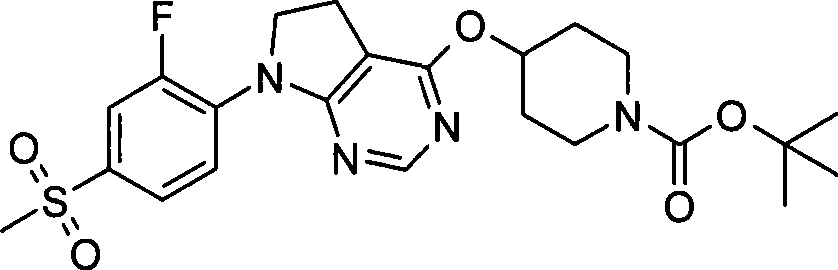
4-({7-[2-氟-4-(甲基磺酰基)苯基]-6,7-二氢-5H-吡咯并[2,3-d]嘧啶-4-基}氧基)-1-哌啶甲酸1,1-二甲基乙酯(11)4-({7-[2-fluoro-4-(methylsulfonyl)phenyl]-6,7-dihydro-5H-pyrrolo[2,3-d]pyrimidin-4-yl}oxy) -1,1-Dimethylethyl 1-piperidinecarboxylate ( 11 )
采用所述用于制备10的方法,使用4-羟基-1-哌啶甲酸1,1-二甲基乙酯(O.816g,4.1mmol)、NaH(O.51g,60%分散在矿物油中,12.8mmol)和化合物8(1.40g,4.27mmol)。水后处理,随后纯化,得到1.45g(73%)浅黄色固体状的标题产物11。Following the procedure described for the preparation of 10 , 1,1-dimethylethyl 4-hydroxy-1-piperidinecarboxylate (0.816 g, 4.1 mmol), NaH (0.51 g, 60% dispersed in mineral oil , 12.8mmol) and compound 8 (1.40g, 4.27mmol). Aqueous workup followed by purification afforded 1.45 g (73%) of the title product 11 as a pale yellow solid.
1H NMR(400MHz,DMSO-d6):δ 8.22(s,1H),7.96(app.t,J=7.6Hz,1H),7.85和7.82(dd,J1=11.2Hz,J2=2.0Hz,1H),7.75和7.73(dd,J1=8.4Hz,J2=2.0Hz,1H),5.26(m,1H),4.14(t,J=8.0Hz,2H),3.68-3.62(m,2H),3.25(s,3H),3.18-3.16(m,2H),3.05(t,J=9.2Hz,2H),1.94-1.89(m,2H),1.59-1.53(m,2H),1.39(s,9H);LCMS(ESI):m/z 493(M+H)+. 1 H NMR (400MHz, DMSO-d 6 ): δ 8.22 (s, 1H), 7.96 (app.t, J=7.6Hz, 1H), 7.85 and 7.82 (dd, J 1 =11.2Hz, J 2 =2.0 Hz, 1H), 7.75 and 7.73 (dd, J1 = 8.4Hz, J2 = 2.0Hz, 1H), 5.26 (m, 1H), 4.14 (t, J = 8.0Hz, 2H), 3.68-3.62 (m , 2H), 3.25(s, 3H), 3.18-3.16(m, 2H), 3.05(t, J=9.2Hz, 2H), 1.94-1.89(m, 2H), 1.59-1.53(m, 2H), 1.39 (s, 9H); LCMS (ESI): m/z 493 (M+H) + .
实施例3(13)Example 3 ( 13 )
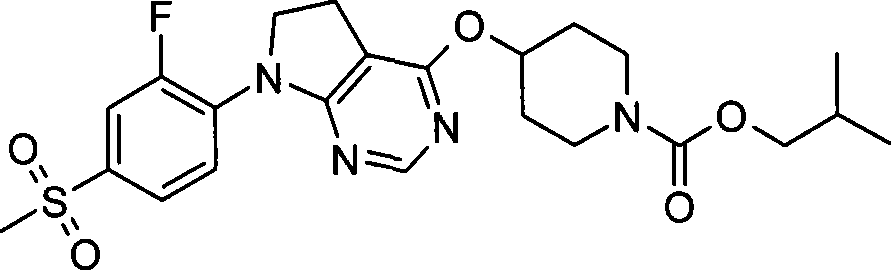
步骤1:4-羟基-1-哌啶甲酸2-甲基丙酯(12)Step 1: 2-methylpropyl 4-hydroxy-1-piperidinecarboxylate ( 12 )
采用所述用于制备9的方法,使用4-羟基哌啶(10.2g,100mmol)、二异丙基乙基胺(35mL,200mmol)和氯甲酸异丁酯(17.1g,125mmol)。标准水后处理,随后纯化,得到18.45g(92%)无色油状的标题产物12。Following the procedure described for the preparation of 9 , 4-hydroxypiperidine (10.2 g, 100 mmol), diisopropylethylamine (35 mL, 200 mmol) and isobutyl chloroformate (17.1 g, 125 mmol) were used. Standard aqueous workup followed by purification afforded 18.45 g (92%) of the title product 12 as a colorless oil.
1H NMR(400MHz,DMSO-d6):δ 4.70(d,J=4.0Hz,1H),3.74(d,J=6.4Hz,2H),3.69-3.65(m,2H),3.61(m,1H),3.00(br s,2H),1.83(app.七重峰,J=6.8Hz,1H),1.69-1.65(m,2H),1.26-1.21(m,2H),0.85(d,J=6.4Hz,6H). 1 H NMR (400MHz, DMSO-d 6 ): δ 4.70(d, J=4.0Hz, 1H), 3.74(d, J=6.4Hz, 2H), 3.69-3.65(m, 2H), 3.61(m, 1H), 3.00(br s, 2H), 1.83(app. septet, J=6.8Hz, 1H), 1.69-1.65(m, 2H), 1.26-1.21(m, 2H), 0.85(d, J= 6.4Hz, 6H).
步骤2:4-({7-[2-氟-4-(甲基磺酰基)苯基]-6,7-二氢-5H-吡咯并[2,3-d]嘧啶-4-基}氧基)-1-哌啶甲酸2-甲基丙酯(13)Step 2: 4-({7-[2-fluoro-4-(methylsulfonyl)phenyl]-6,7-dihydro-5H-pyrrolo[2,3-d]pyrimidin-4-yl} Oxy)-1-piperidinecarboxylic acid 2-methylpropyl ester ( 13 )
采用所述用于制备10的方法,使用化合物8(100mg,0.31mmol)、NaH(35mg,60%分散在矿物油中,0.87mmol)、化合物12(59mg,0.29mmol)和THF(10mL)。标准水后处理,随后纯化,得到118mg(83%)白色固体状的标题产物13。产物用乙腈冻干,得到白色物质。Following the procedure described for the preparation of 10 , compound 8 (100 mg, 0.31 mmol), NaH (35 mg, 60% dispersion in mineral oil, 0.87 mmol), compound 12 (59 mg, 0.29 mmol) and THF (10 mL) were used. Standard aqueous workup followed by purification afforded 118 mg (83%) of the title product 13 as a white solid. The product was lyophilized with acetonitrile to obtain a white substance.
1H NMR(400MHz,DMSO-d6):δ 8.22(s,1H),7.96(app.t,J=8.0Hz,1H),7.85和7.82(dd,J1=10.8Hz,J2=1.6Hz,1H),7.75和7.73(dd,J1=8.8Hz,J2=2.0Hz,1H),5.28(m,1H),4.14(t,J=8.0Hz,2H),3.78(d,J=6.8Hz,2H),3.71-3.68(m,2H),3.25(s,3H),3.30-3.27(m,2H),3.05(t,J=8.8Hz,2H),1.97-1.91(m,2H),1.88-1.80(m,1H),1.63-1.54(m,2H),0.87(d,J=6.8Hz,6H);LCMS(ESI):m/z 493(M+H)+. 1 H NMR (400MHz, DMSO-d 6 ): δ 8.22 (s, 1H), 7.96 (app.t, J=8.0Hz, 1H), 7.85 and 7.82 (dd, J 1 =10.8Hz, J 2 =1.6 Hz, 1H), 7.75 and 7.73 (dd, J1 = 8.8Hz, J2 = 2.0Hz, 1H), 5.28 (m, 1H), 4.14 (t, J = 8.0Hz, 2H), 3.78 (d, J =6.8Hz, 2H), 3.71-3.68(m, 2H), 3.25(s, 3H), 3.30-3.27(m, 2H), 3.05(t, J=8.8Hz, 2H), 1.97-1.91(m, 2H), 1.88-1.80(m, 1H), 1.63-1.54(m, 2H), 0.87(d, J=6.8Hz, 6H); LCMS (ESI): m/z 493(M+H) + .
实施例4(15)Example 4 ( 15 )

步骤1:4-羟基-1-哌啶甲酸2,2-二甲基丙基酯(14)Step 1: 2,2-dimethylpropyl 4-hydroxy-1-piperidinecarboxylate ( 14 )
采用所述用于制备9的方法,使用4-羟基哌啶(3.32g,32.8mmol)、二异丙基乙基胺(13.6g,98.5mmol)和氯甲酸新戊酯(5mL,32.84mmol)。后处理,随后纯化,得到5.85g(83%)白色固体状的标题产物14。Following the procedure described for the preparation of 9 , 4-hydroxypiperidine (3.32 g, 32.8 mmol), diisopropylethylamine (13.6 g, 98.5 mmol) and neopentyl chloroformate (5 mL, 32.84 mmol) were used . Workup followed by purification afforded 5.85 g (83%) of the title product 14 as a white solid.
1H NMR(400MHz,DMSO-d6):δ 4.71(app.d,J=4.4Hz,1H),3.65(s,2H),3.70-3.57(m,3H),3.0(br s,2H),1.69-1.65(m,2H),1.28-1.20(m,2H),0.87(s,9H). 1 H NMR (400MHz, DMSO-d 6 ): δ 4.71 (app.d, J=4.4Hz, 1H), 3.65 (s, 2H), 3.70-3.57 (m, 3H), 3.0 (br s, 2H) , 1.69-1.65(m, 2H), 1.28-1.20(m, 2H), 0.87(s, 9H).
步骤2:4-({7-[2-氟-4-(甲基磺酰基)苯基]-6,7-二氢-5H-吡咯并[2,3-d]嘧啶-4-基}氧基)-1-哌啶甲酸2,2-二甲基丙酯(15)Step 2: 4-({7-[2-fluoro-4-(methylsulfonyl)phenyl]-6,7-dihydro-5H-pyrrolo[2,3-d]pyrimidin-4-yl} Oxy)-1-
采用所述用于制备10的方法,使用化合物14(33mg,0.145mmol)、NaH(19mg,0.46mmol)和8(50mg,0.153mmol)。水后处理,随后经快速SiO2柱层析纯化,得到53mg(72%)白色固体状的标题产物15。Following the procedure described for the preparation of 10 , compound 14 (33 mg, 0.145 mmol), NaH (19 mg, 0.46 mmol) and 8 (50 mg, 0.153 mmol) were used. Aqueous workup followed by flash SiO2 column chromatography afforded 53 mg (72%) of the
1H NMR(400MHz,DMSO-d6):δ 8.23(s,1H),7.96(app.t,J=8.0Hz,1H),7.85和7.82(dd,J1=10.8Hz,J2=1.6Hz,1H),7.75和7.73(dd,J1=8.8Hz,J2=2.0Hz,1H),5.29(m,1H),4.14(t,J=8.4Hz,2H),3.70(s,2H),3.73-3.64(m,2H),3.25(s,3H),3.30-3.27(m,2H),3.06(t,J=8.8Hz,2H),1.97-1.90(m,2H),1.62-1.52(m,2H),0.89(s,9H);LCMS(ESI):m/z 507(M+H)+. 1 H NMR (400MHz, DMSO-d 6 ): δ 8.23 (s, 1H), 7.96 (app.t, J=8.0Hz, 1H), 7.85 and 7.82 (dd, J 1 =10.8Hz, J 2 =1.6 Hz, 1H), 7.75 and 7.73 (dd, J1 = 8.8Hz, J2 = 2.0Hz, 1H), 5.29 (m, 1H), 4.14 (t, J = 8.4Hz, 2H), 3.70 (s, 2H ), 3.73-3.64(m, 2H), 3.25(s, 3H), 3.30-3.27(m, 2H), 3.06(t, J=8.8Hz, 2H), 1.97-1.90(m, 2H), 1.62- 1.52(m, 2H), 0.89(s, 9H); LCMS(ESI): m/z 507(M+H) + .
实施例5(17)Example 5 ( 17 )
步骤1:1-(5-溴-2-嘧啶基)-4-哌啶醇(16)Step 1: 1-(5-Bromo-2-pyrimidinyl)-4-piperidinol ( 16 )
在N2下往圆底烧瓶中装入4-羟基哌啶(1.93g,10mmol)、二异丙基乙基胺(5.22mL,30mmol)、5-溴-2-氯嘧啶(1.01g,10mmol)和乙腈(50mL)。将该混合物回流15小时,随后减压浓缩。将粗品重新溶解在CH2Cl2(150ml)中,用H2O(2 x 20mL)、盐水(1 x 20mL)洗涤,经Na2SO4干燥,随后过滤。将滤液减压浓缩,粗制物质经快速SiO2柱层析纯化,得到2.55g(99%)白色固体状的标题化合物16。A round bottom flask was charged under N2 with 4-hydroxypiperidine (1.93 g, 10 mmol), diisopropylethylamine (5.22 mL, 30 mmol), 5-bromo-2-chloropyrimidine (1.01 g, 10 mmol ) and acetonitrile (50 mL). The mixture was refluxed for 15 hours, then concentrated under reduced pressure. The crude product was redissolved in CH2Cl2 ( 150ml ), washed with H2O (2 x 20mL), brine (1 x 20mL), dried over Na2SO4 and filtered. The filtrate was concentrated under reduced pressure and the crude material was purified by flash SiO2 column chromatography to afford 2.55 g (99%) of the title compound 16 as a white solid.
1H NMR(400MHz,DMSO-d6):δ 8.34(s,2H),4.73(d,J=4.0Hz,1H),4.17-4.12(m,2H),3.74-3.68(m,1H),3.28-3.22(m,2H),1.76-1.70(m,2H),1.33-1.25(m,2H);LCMS(ESI):m/z 260(M+H)+. 1 H NMR (400MHz, DMSO-d 6 ): δ 8.34(s, 2H), 4.73(d, J=4.0Hz, 1H), 4.17-4.12(m, 2H), 3.74-3.68(m, 1H), 3.28-3.22(m, 2H), 1.76-1.70(m, 2H), 1.33-1.25(m, 2H); LCMS(ESI): m/z 260(M+H) + .
步骤2:4-{[1-(5-溴-2-嘧啶基)-4-哌啶基]氧基}-7-[2-氟-4-(甲基磺酰基)苯基]-6,7-二氢-5H-吡咯并[2,3-d]嘧啶(17)Step 2: 4-{[1-(5-Bromo-2-pyrimidinyl)-4-piperidinyl]oxy}-7-[2-fluoro-4-(methylsulfonyl)phenyl]-6 , 7-dihydro-5H-pyrrolo[2,3-d]pyrimidine ( 17 )
使用所述用于制备10的方法。在N2下、NaH(360mg,9.0mmol)和THF(40mL)存在下,让1-(5-溴-2-嘧啶基)-4-哌啶醇16(0.968g,3.75mmol)与8(0.98g,3mmol)反应。水后处理,随后纯化,得到0.724g(44%)白色固体状的标题产物17。The method described for the preparation of 10 was used. 1-(5-Bromo-2-pyrimidinyl)-4 - piperidinol 16 (0.968 g, 3.75 mmol) was mixed with 8 ( 0.98g, 3mmol) reaction. Aqueous workup followed by purification afforded 0.724 g (44%) of the title product 17 as a white solid.
1H NMR(400MHz,DMSO-d6):δ 8.45(s,2H),8.24(s,1H),7.96(app.t,J=7.2Hz,1H),7.85和7.82(dd,J1=10.8Hz,J2=2.0Hz,1H),7.75和7.73(dd,J1=8.4Hz,J2=2.0Hz,1H),5.37(m,1H),4.16-4.09(m,4H),3.25(s,3H),3.06(t,J=8.8Hz,2H),2.03-1.97(m,2H),1.65(m,2H);LCMS(ESI):m/z 550(M+H)+. 1 H NMR (400 MHz, DMSO-d 6 ): δ 8.45 (s, 2H), 8.24 (s, 1H), 7.96 (app.t, J=7.2Hz, 1H), 7.85 and 7.82 (dd, J 1 = 10.8Hz, J 2 =2.0Hz, 1H), 7.75 and 7.73 (dd, J 1 =8.4Hz, J 2 =2.0Hz, 1H), 5.37(m, 1H), 4.16-4.09(m, 4H), 3.25 (s, 3H), 3.06 (t, J=8.8Hz, 2H), 2.03-1.97 (m, 2H), 1.65 (m, 2H); LCMS (ESI): m/z 550 (M+H) + .
实施例6(18)Example 6 ( 18 )
7-[2-氟-4-(甲基磺酰基)苯基]-4-({1-[5-(2-甲基丙基)-2-嘧啶基]-4-哌啶基}氧基)-6,7-二氢-5H-吡咯并[2,3-d]嘧啶(18)7-[2-fluoro-4-(methylsulfonyl)phenyl]-4-({1-[5-(2-methylpropyl)-2-pyrimidinyl]-4-piperidinyl}oxygen base)-6,7-dihydro-5H-pyrrolo[2,3-d]pyrimidine ( 18 )
往圆底烧瓶中装入17(60mg,0.11mmol)、PdCl2(dppf)·CH2Cl2(8.8mg,0.01mmol)、K2CO3(75mg,0.55mmol)、(2-甲基丙基)硼酸(34mg,0.33mmol)、THF(4mL)和H2O(1mL)并将该混合物回流15小时。将反应混合物冷却至室温,用H2O(15mL)稀释,随后用EtOAc(4 x 20mL)萃取。合并的有机层用盐水(1 x 10mL)洗涤,经Na2SO4干燥,过滤,随后将滤液减压浓缩,得到粗品,其经SiO2快速柱层析纯化来分离出接近等比例的两种产物。极性较弱的化合物18(5mg)被确定为所需产物18。A round bottom flask was charged with 17 (60 mg, 0.11 mmol), PdCl 2 (dppf) CH 2 Cl 2 (8.8 mg, 0.01 mmol), K 2 CO 3 (75 mg, 0.55 mmol), (2-methylpropane base) boronic acid (34 mg, 0.33 mmol), THF (4 mL) and H 2 O (1 mL) and the mixture was refluxed for 15 hours. The reaction mixture was cooled to room temperature, diluted with H2O (15 mL), and extracted with EtOAc (4 x 20 mL). The combined organic layers were washed with brine (1 x 10 mL), dried over Na2SO4 , filtered, and the filtrate was concentrated under reduced pressure to give the crude product, which was purified by SiO2 flash column chromatography to isolate nearly equal proportions of the two product. The less polar compound 18 (5 mg) was identified as the desired product 18 .
1H NMR(400MHz,DMSO-d6):δ 8.24(s,2H),8.18(s,2H),7.96(app.t,J=8.0Hz,1H),7.85和7.82(dd,J1=10.8Hz,J2=2.8Hz,1H),7.75和7.73(dd,J1=8.4Hz,J2=1.6Hz,1H),5.35(m,1H),4.20-4.16(m,4H),4.14(app.t,J=8.4Hz,2H),3.49(m,2H),3.25(s,3H),3.05(t,J=8.4Hz,2H),2.26(d,J=7.2Hz,2H),1.72(m,1H),1.63(m,2H),0.83(d,J=6.4Hz,6H);LCMS(ESI):m/z 527(M+H)+. 1 H NMR (400MHz, DMSO-d 6 ): δ 8.24 (s, 2H), 8.18 (s, 2H), 7.96 (app.t, J=8.0Hz, 1H), 7.85 and 7.82 (dd, J 1 = 10.8Hz, J 2 =2.8Hz, 1H), 7.75 and 7.73 (dd, J 1 =8.4Hz, J 2 =1.6Hz, 1H), 5.35(m, 1H), 4.20-4.16(m, 4H), 4.14 (app.t, J=8.4Hz, 2H), 3.49(m, 2H), 3.25(s, 3H), 3.05(t, J=8.4Hz, 2H), 2.26(d, J=7.2Hz, 2H) , 1.72 (m, 1H), 1.63 (m, 2H), 0.83 (d, J=6.4Hz, 6H); LCMS (ESI): m/z 527 (M+H) + .
实施例7(19)Example 7 ( 19 )
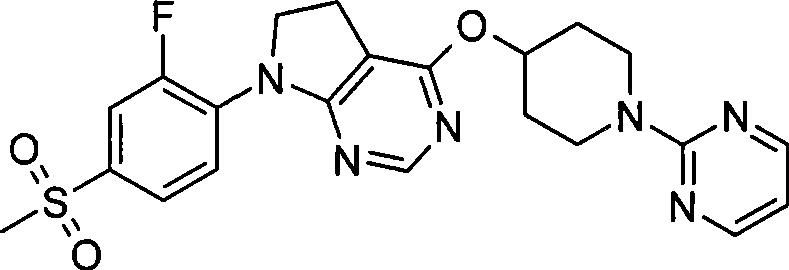
7-[2-氟-4-(甲基磺酰基)苯基]-4-{[1-(2-嘧啶基)-4-哌啶基]氧基}-6,7-二氢-5H-吡咯并[2,3-d]嘧啶(19)7-[2-fluoro-4-(methylsulfonyl)phenyl]-4-{[1-(2-pyrimidinyl)-4-piperidinyl]oxy}-6,7-dihydro-5H -pyrrolo[2,3-d]pyrimidine ( 19 )
如上所述(实施例6)得到的较强极性的化合物19(5mg)被确定为起始原料脱溴得到的化合物。The relatively polar compound 19 (5 mg) obtained as described above (Example 6) was identified as the compound obtained by debromination of the starting material.
1HNMR(400MHz,DMSO-d6):δ 8.35(d,J=4.8Hz,2H),8.24(s,1H),7.96(app.t,J=8.0Hz,1H),7.85和7.82(dd,J1=10.8Hz,J2=2.0Hz,1H),7.75和7.73(dd,J1=8.4Hz,J2=2.0Hz,1H),6.61(t,J=4.8Hz,1H),5.37(m,1H),4.23-4.18(m,1H),4.14(t,J=8.4Hz,2H),3.56-3.49(m,2H),3.31-3.28(m,2H),3.25(s,3H),3.06(t,J=8.4Hz,2H),2.03-1.98(m,2H);LCMS(ESI):m/z 471(M+H)+. 1 HNMR (400MHz, DMSO-d 6 ): δ 8.35(d, J=4.8Hz, 2H), 8.24(s, 1H), 7.96(app.t, J=8.0Hz, 1H), 7.85 and 7.82(dd , J 1 =10.8Hz, J 2 =2.0Hz, 1H), 7.75 and 7.73 (dd, J 1 =8.4Hz, J 2 =2.0Hz, 1H), 6.61 (t, J=4.8Hz, 1H), 5.37 (m, 1H), 4.23-4.18(m, 1H), 4.14(t, J=8.4Hz, 2H), 3.56-3.49(m, 2H), 3.31-3.28(m, 2H), 3.25(s, 3H ), 3.06 (t, J=8.4Hz, 2H), 2.03-1.98 (m, 2H); LCMS (ESI): m/z 471 (M+H) + .
实施例8(22)Example 8 ( 22 )
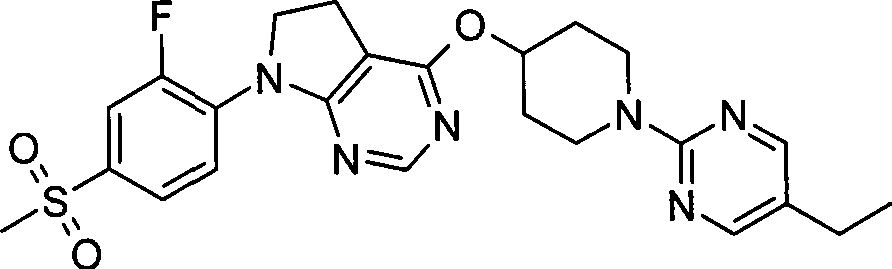
步骤1:1-(5-乙基-2-嘧啶基)-4-哌啶醇(21)Step 1: 1-(5-Ethyl-2-pyrimidinyl)-4-piperidinol ( 21 )
采用所述用于制备16的方法,在N2下使用4-羟基哌啶(5.0g,35.1mmol)、二异丙基乙基胺(19mL,105.2mmol)、5-乙基-2-氯嘧啶(3.56g,35.1mmol)和乙腈(100mL)。将反应混合物回流36小时,减压浓缩。产物经SiO2快速柱层析纯化,得到7.05g(97%)油状的标题化合物21产物。Using the procedure described for the preparation of 16 , 4-hydroxypiperidine (5.0 g, 35.1 mmol), diisopropylethylamine (19 mL, 105.2 mmol ) , 5-ethyl-2-chloro Pyrimidine (3.56 g, 35.1 mmol) and acetonitrile (100 mL). The reaction mixture was refluxed for 36 hours and concentrated under reduced pressure. The product was purified by SiO2 flash column chromatography to afford 7.05 g (97%) of the title compound 21 product as an oil.
1H NMR(400MHz,DMSO-d6):δ 8.19(s,1H),4.67(br s,1H),4.24-4.18(m,2H),3.68(m,2H),3.19-3.12(m,2H),2.38(q,J=7.6Hz,2H),1.75-1.69(m,2H),1.31-1.22(m,2H),1.09(t,J=7.2Hz,3H);LCMS(ESI):m/z 207(M+H)+. 1 H NMR (400MHz, DMSO-d 6 ): δ 8.19(s, 1H), 4.67(br s, 1H), 4.24-4.18(m, 2H), 3.68(m, 2H), 3.19-3.12(m, 2H), 2.38(q, J=7.6Hz, 2H), 1.75-1.69(m, 2H), 1.31-1.22(m, 2H), 1.09(t, J=7.2Hz, 3H); LCMS (ESI): m/z 207(M+H) + .
步骤2:4-{[1-(5-乙基-2-嘧啶基)-4-哌啶基]氧基}-7-[2-氟-4-(甲基磺酰基)苯基]-6,7-二氢-5H-吡咯并[2,3-d]嘧啶(22)Step 2: 4-{[1-(5-Ethyl-2-pyrimidinyl)-4-piperidinyl]oxy}-7-[2-fluoro-4-(methylsulfonyl)phenyl]- 6,7-dihydro-5H-pyrrolo[2,3-d]pyrimidine ( 22 )
采用所述用于制备10的方法,使用8(0.190g,0.58mmol)、NaH(70mg,1.74mmol)、21(114mg,0.55mmol)和THF(10mL)。水后处理,随后纯化,得到0.136g(50%)白色固体状的标题产物22。Following the procedure described for the preparation of 10 , 8 (0.190 g, 0.58 mmol), NaH (70 mg, 1.74 mmol), 21 (114 mg, 0.55 mmol) and THF (10 mL) were used. Aqueous workup followed by purification afforded 0.136 g (50%) of the title product 22 as a white solid.
1HNMR(400MHz,DMSO-d6):δ 8.24(s,3H),7.96(app.t,J=8.4Hz,1H),7.85和7.82(dd,J1=10.8Hz,J2=2.0Hz,1H),7.75和7.73(dd,J1=8.4Hz,J2=2.0Hz,1H),5.36(m,1H),4.20-4.18(m,2H),4.14(t,J=8.4Hz,2H),3.51-3.45(m,2H),3.25(s,3H),3.05(t,J=8.8Hz,2H),2.41(q,J=7.6Hz,2H),2.01-1.97(m,2H),1.65-1.48(m,2H),1.11(t,J=7.6Hz,3H);LCMS(ESI):m/z 499(M+H)+. 1 H NMR (400MHz, DMSO-d 6 ): δ 8.24 (s, 3H), 7.96 (app.t, J=8.4Hz, 1H), 7.85 and 7.82 (dd, J 1 =10.8Hz, J 2 =2.0Hz , 1H), 7.75 and 7.73 (dd, J 1 =8.4Hz, J 2 =2.0Hz, 1H), 5.36 (m, 1H), 4.20-4.18 (m, 2H), 4.14 (t, J = 8.4Hz, 2H), 3.51-3.45(m, 2H), 3.25(s, 3H), 3.05(t, J=8.8Hz, 2H), 2.41(q, J=7.6Hz, 2H), 2.01-1.97(m, 2H ), 1.65-1.48 (m, 2H), 1.11 (t, J=7.6Hz, 3H); LCMS (ESI): m/z 499 (M+H) + .
实施例9(24)Example 9 ( 24 )
步骤1:1-(5-氟-2-嘧啶基)-4-哌啶醇(23)Step 1: 1-(5-fluoro-2-pyrimidinyl)-4-piperidinol ( 23 )
采用所述用于制备16的方法,在N2下使用4-羟基哌啶(1.53g,15.1mmol)、二异丙基乙基胺(7.9mL,45.3mmol)、5-氟-2-氯嘧啶(2.0g,15.1mmol)和乙腈(50mL)。将反应混合物回流10小时,随后减压浓缩。粗品经SiO2快速柱层析纯化,得到2.46g(83%)白色固体状的标题产物23。Following the procedure described for the preparation of 16 , 4-hydroxypiperidine (1.53 g, 15.1 mmol), diisopropylethylamine (7.9 mL, 45.3 mmol ) , 5-fluoro-2-chloro Pyrimidine (2.0 g, 15.1 mmol) and acetonitrile (50 mL). The reaction mixture was refluxed for 10 hours, then concentrated under reduced pressure. The crude product was purified by SiO2 flash column chromatography to afford 2.46 g (83%) of the title product 23 as a white solid.
1H NMR(400MHz,DMSO-d6):δ 8.18(s,2H),4.37-4.31(m,2H),3.97-3.91(m,1H),3.32-3.25(m,2H),1.98-1.92(m,2H),1.77(br s,1H),1.57-1.48(m,2H);LCMS(ESI):m/z 198(M+H)+. 1 H NMR (400MHz, DMSO-d 6 ): δ 8.18(s, 2H), 4.37-4.31(m, 2H), 3.97-3.91(m, 1H), 3.32-3.25(m, 2H), 1.98-1.92 (m, 2H), 1.77 (br s, 1H), 1.57-1.48 (m, 2H); LCMS (ESI): m/z 198 (M+H) + .
步骤2:7-[2-氟-4-(甲基磺酰基)苯基]-4-{[1-(5-氟-2-嘧啶基)-4-哌啶基]氧基}-6,7-二氢-5H-吡咯并[2,3-d]嘧啶(24)Step 2: 7-[2-Fluoro-4-(methylsulfonyl)phenyl]-4-{[1-(5-fluoro-2-pyrimidinyl)-4-piperidinyl]oxy}-6 , 7-dihydro-5H-pyrrolo[2,3-d]pyrimidine ( 24 )
采用所述用于制备10的方法,使用8(358mg,1.09mmol)、NaH(131mg,3.28mmol)和23(215mg,1.09mmol)。后处理,随后纯化,得到210mg(39%)白色固体状的标题产物24。Following the procedure described for the preparation of 10 , 8 (358 mg, 1.09 mmol), NaH (131 mg, 3.28 mmol) and 23 (215 mg, 1.09 mmol) were used. Workup followed by purification afforded 210 mg (39%) of the title product 24 as a white solid.
1H NMR(400MHz,DMSO-d6):δ 8.44(s,2H),8.24(s,1H),7.96(app.t,J=7.6Hz,1H),7.85和7.82(dd,J1=10.8Hz,J2=2.0Hz,1H),7.75和7.73(dd,J1=8.4Hz,J2=1.6Hz,1H),5.36(m,1H),4.16-4.10(m,2H),4.14(t,J=8.4Hz,2H),3.55-3.44(m,2H),3.25(s,3H),3.05(t,J=8.8Hz,2H),2.03-1.98(m,2H),1.66-1.60(m,2H);LCMS(ESI):m/z489(M+H)+. 1 H NMR (400 MHz, DMSO-d 6 ): δ 8.44 (s, 2H), 8.24 (s, 1H), 7.96 (app.t, J=7.6Hz, 1H), 7.85 and 7.82 (dd, J 1 = 10.8Hz, J 2 =2.0Hz, 1H), 7.75 and 7.73 (dd, J 1 =8.4Hz, J 2 =1.6Hz, 1H), 5.36(m, 1H), 4.16-4.10(m, 2H), 4.14 (t, J=8.4Hz, 2H), 3.55-3.44(m, 2H), 3.25(s, 3H), 3.05(t, J=8.8Hz, 2H), 2.03-1.98(m, 2H), 1.66- 1.60 (m, 2H); LCMS (ESI): m/z 489 (M+H) + .
实施例10(31)Example 10 ( 31 )

步骤1:N-(4-溴-2-氟苯基)-6-氯-5-(2-丙烯-1-基)-4-嘧啶胺(25)Step 1: N-(4-bromo-2-fluorophenyl)-6-chloro-5-(2-propen-1-yl)-4-pyrimidinamine ( 25 )
使用所述用于制备10(实施例1,步骤4)的方法。在THF中的NaH(2.98g,74.6mmol)存在下将化合物2(4.7g,24.9mmol)与4-溴-2-氟苯胺(4.49g,23.6mmol)反应,得到6.21g(73%)白色固体状的标题化合物25。The procedure described for the preparation of 10 (Example 1, step 4) was used. Compound 2 (4.7g, 24.9mmol) was reacted with 4-bromo-2-fluoroaniline (4.49g, 23.6mmol) in the presence of NaH in THF (2.98g, 74.6mmol) to afford 6.21g (73%) of
1H NMR(400MHz,CDCl3):δ 8.40(s,1H),8.31(app.t,J=8.4Hz,1H),7.31-7.26(m,2H),7.02(br s,1H),5.94-5.84(m,1H),5.34-5.29(m,2H),3.60(app.d,J=6.4Hz,2H);LCMS(ESI):m/z 343(M+H)+. 1 H NMR (400MHz, CDCl 3 ): δ 8.40(s, 1H), 8.31(app.t, J=8.4Hz, 1H), 7.31-7.26(m, 2H), 7.02(br s, 1H), 5.94 -5.84(m, 1H), 5.34-5.29(m, 2H), 3.60(app.d, J=6.4Hz, 2H); LCMS(ESI): m/z 343(M+H) + .
步骤2:(4-溴-2-氟苯基)[6-氯-5-(2-丙烯-1-基)-4-嘧啶基]氨基甲酸1,1-二甲基乙酯(26)Step 2: 1,1-dimethylethyl (4-bromo-2-fluorophenyl)[6-chloro-5-(2-propen-1-yl)-4-pyrimidinyl]carbamate ( 26 )
采用所述用于制备化合物10(实施例1,步骤5)的方法,在室温下、CH2Cl2(100mL)中的催化量的DMAP(214mg,1.75mmol)存在下,将化合物25(6.0g,17.5mmol)用(BOC)2O(9.56g,43.8mmol)处理,得到6.56g(85%)白色固体状的标题化合物26。Using the procedure described for the preparation of compound 10 (Example 1 , Step 5 ), compound 25 (6.0 g, 17.5 mmol) was treated with (BOC) 2O (9.56 g, 43.8 mmol) to afford 6.56 g (85%) of the title compound 26 as a white solid.
1H NMR(400MHz,DMSO-d6):δ 8.81(s,1H),7.73和7.71(dd,J1=10.0Hz,J2=2.0Hz,1H),7.40和7.38(dd,J1=8.8Hz,J2=2.0Hz,1H),7.16(app.t,J=8.4Hz,1H),5.82-5.75(m,1H),5.09-5.06(app.dd,J1=10.0Hz,J2=1.6Hz,1H),4.98和4.94(app.dd,J1=17.2Hz,J2=1.2Hz,1H),3.47(app.d,J=6.0Hz,2H),1.36(s,9H);LCMS(ESI):m/z 443(M+H)+. 1 H NMR (400 MHz, DMSO-d 6 ): δ 8.81 (s, 1H), 7.73 and 7.71 (dd, J 1 =10.0 Hz, J 2 =2.0 Hz, 1H), 7.40 and 7.38 (dd, J 1 = 8.8Hz, J2 = 2.0Hz, 1H), 7.16 (app.t, J = 8.4Hz, 1H), 5.82-5.75 (m, 1H), 5.09-5.06 (app.dd, J1 = 10.0Hz, J 2 = 1.6Hz, 1H), 4.98 and 4.94 (app.dd, J1 = 17.2Hz, J2 = 1.2Hz, 1H), 3.47 (app.d, J = 6.0Hz, 2H), 1.36 (s, 9H ); LCMS (ESI): m/z 443 (M+H) + .
步骤3:(4-溴-2-氟苯基)[6-氯-5-(2-羟基乙基)-4-嘧啶基]氨基甲酸1,1-二甲基乙酯(27)Step 3: 1,1-dimethylethyl (4-bromo-2-fluorophenyl)[6-chloro-5-(2-hydroxyethyl)-4-pyrimidinyl]carbamate ( 27 )
采用所述用于制备10(实施例1,步骤6)的方法,将化合物26(3.15g,7.12mmol)溶解在CH2Cl2(100mL)中。往冷却的(-70℃)混合物中鼓泡通入臭氧2小时。得到的混合物用NaBH4(1.08g,28.5mmol)处理并往反应混合物中加入MeOH(10mL)。水后处理,随后纯化,得到1.40g(44%)白色固体状的标题产物27。Using the procedure described for the preparation of 10 (Example 1, Step 6), compound 26 (3.15 g, 7.12 mmol) was dissolved in CH2Cl2 (100 mL ). Ozone was bubbled through the cooled (-70°C) mixture for 2 hours. The resulting mixture was treated with NaBH4 (1.08 g, 28.5 mmol) and MeOH (10 mL) was added to the reaction mixture. Aqueous workup followed by purification afforded 1.40 g (44%) of the title product 27 as a white solid.
1H NMR(400MHz,DMSO-d6):δ 8.81(s,1H),7.74和7.71(dd,J1=9.6Hz,J2=2.4Hz,1H),7.42和7.33(m,2H),4.97(app.t,J=5.2Hz,1H),3.66(q,J=4.8Hz,2H),2.88(app.t,J=6.4Hz,2H),1.37(s,9H);LCMS(ESI):m/z 469(M+Na)+. 1 H NMR (400MHz, DMSO-d 6 ): δ 8.81 (s, 1H), 7.74 and 7.71 (dd, J 1 =9.6Hz, J 2 =2.4Hz, 1H), 7.42 and 7.33 (m, 2H), 4.97(app.t, J=5.2Hz, 1H), 3.66(q, J=4.8Hz, 2H), 2.88(app.t, J=6.4Hz, 2H), 1.37(s, 9H); LCMS(ESI ): m/z 469(M+Na) + .
步骤4:甲磺酸2-[4-((4-溴-2-氟苯基){[(1,1-二甲基乙基)氧基]羰基}氨基)-6-氯-5-嘧啶基]乙酯(28)Step 4: 2-[4-((4-bromo-2-fluorophenyl){[(1,1-dimethylethyl)oxy]carbonyl}amino)-6-chloro-5-methanesulfonic acid Pyrimidinyl] ethyl ester ( 28 )
采用所述用于制备化合物10(实施例1,步骤7)的方法,在CH2Cl2(30mL)中的Et3N(1.25mL,9.07mmol)和催化量的DMAP(37mg,0.302mmol)存在下使化合物27(1.35g,3.02mmol)用甲磺酸酐(0.79g,4.53mmol)处理,得到1.46g(92%)白色固体状的标题化合物28。LCMS(ESI):m/z 521(M+H)+.Using the procedure described for the preparation of compound 10 (Example 1, Step 7), Et3N (1.25 mL, 9.07 mmol) and a catalytic amount of DMAP (37 mg, 0.302 mmol) in CH2Cl2 (30 mL) Compound 27 (1.35 g, 3.02 mmol) was treated with methanesulfonic anhydride (0.79 g, 4.53 mmol) in the presence to afford 1.46 g (92%) of the title compound 28 as a white solid. LCMS (ESI): m/z 521 (M+H) + .
步骤5:7-(4-溴-2-氟苯基)-4-氯-6,7-二氢-5H-吡咯并[2,3-d]嘧啶(29)Step 5: 7-(4-Bromo-2-fluorophenyl)-4-chloro-6,7-dihydro-5H-pyrrolo[2,3-d]pyrimidine ( 29 )
采用所述用于制备化合物10(实施例1,步骤8)的方法。在室温下,往27(1.45g,2.76mmol)和CH2Cl2(19mL)的溶液中加入CF3COOH(6mL)。搅拌该混合物并减压浓缩,得到粗品。将粗品重新溶解在CH2Cl2(40mL)中,随后用Et3N(10mL)处理2小时。后处理该混合物,得到0.75g(80%)灰白色固体状的标题产物29。The procedure described for the preparation of compound 10 (Example 1, Step 8) was employed. To a solution of 27 (1.45 g, 2.76 mmol) and CH2Cl2 (19 mL) was added CF3COOH (6 mL) at room temperature. The mixture was stirred and concentrated under reduced pressure to give crude product. The crude product was redissolved in CH2Cl2 (40 mL), then treated with Et3N (10 mL) for 2 h . Workup of the mixture afforded 0.75 g (80%) of the title product 29 as an off-white solid.
1H NMR(400MHz,DMSO-d6):δ 8.20(s,1H),7.70-7.68(dd,J1=10.4Hz,J2=2.4Hz,1H),7.57(app.t,J=8.4Hz,1H),7.48和7.46(dd,J1=8.4Hz,J2=2.0Hz,1H),4.09(t,J=8.4Hz,2H),3.19(t,J=8.4Hz,2H);LCMS(ESI):m/z329(M+H)+. 1 H NMR (400MHz, DMSO-d 6 ): δ 8.20 (s, 1H), 7.70-7.68 (dd, J 1 =10.4Hz, J 2 =2.4Hz, 1H), 7.57 (app.t, J = 8.4 Hz, 1H), 7.48 and 7.46 (dd, J1 = 8.4Hz, J2 = 2.0Hz, 1H), 4.09 (t, J = 8.4Hz, 2H), 3.19 (t, J = 8.4Hz, 2H); LCMS(ESI): m/z329(M+H) + .
步骤6:4-{[7-(4-溴-2-氟苯基)-6,7-二氢-5H-吡咯并[2,3-d]嘧啶-4-基]氧基}-1-哌啶甲酸1-甲基乙酯(30)Step 6: 4-{[7-(4-Bromo-2-fluorophenyl)-6,7-dihydro-5H-pyrrolo[2,3-d]pyrimidin-4-yl]oxy}-1 - 1-methylethyl piperidinecarboxylate ( 30 )
采用所述用于制备10(实施例1,步骤10)的方法。在THF(10mL)中的NaH(110mg,2.74mmol)存在下将化合物29(300mg,0.913mmol)与化合物9(162mg,0.87mmol)反应。水后处理,随后纯化,得到410g(94%)灰白色固体状的标题产物30。The procedure described for the preparation of 10 (Example 1, step 10) was followed. Compound 29 (300 mg, 0.913 mmol) was reacted with compound 9 (162 mg, 0.87 mmol) in the presence of NaH (110 mg, 2.74 mmol) in THF (10 mL). Aqueous workup followed by purification afforded 410 g (94%) of the
1H NMR(400MHz,DMSO-d6):δ 8.13(s,1H),7.64-7.61(dd,J1=10.8Hz,J2=2.0Hz,1H),7.56(app.t,J=8.4Hz,1H),7.43和7.40(dd,J1=8.8Hz,J2=2.0Hz,1H),5.25(m,1H),4.75(七重峰,J=6.4Hz,1H),4.00(t,J=9.2Hz,2H),3.72-3.68(m,2H),3.22(m,2H),3.02(t,J=8.8Hz,2H),1.94-1.89(m,2H),1.60-1.55(m,2H),1.17(d,J=6.4Hz,6H);LCMS(ESI):m/z 481(M+H)+. 1 H NMR (400MHz, DMSO-d 6 ): δ 8.13 (s, 1H), 7.64-7.61 (dd, J 1 =10.8Hz, J 2 =2.0Hz, 1H), 7.56 (app.t, J = 8.4 Hz, 1H), 7.43 and 7.40 (dd, J1 = 8.8Hz, J2 = 2.0Hz, 1H), 5.25 (m, 1H), 4.75 (septet, J = 6.4Hz, 1H), 4.00 (t, J=9.2Hz, 2H), 3.72-3.68(m, 2H), 3.22(m, 2H), 3.02(t, J=8.8Hz, 2H), 1.94-1.89(m, 2H), 1.60-1.55(m , 2H), 1.17 (d, J=6.4Hz, 6H); LCMS (ESI): m/z 481 (M+H) + .
步骤7:4-{[7-(4-氰基-2-氟苯基)-6,7-二氢-5H-吡咯并[2,3-d]嘧啶-4-基]氧基}-1-哌啶甲酸1-甲基乙酯(31)Step 7: 4-{[7-(4-cyano-2-fluorophenyl)-6,7-dihydro-5H-pyrrolo[2,3-d]pyrimidin-4-yl]oxy}- 1-Methylethyl 1-piperidinecarboxylate ( 31 )
在N2下往圆底烧瓶中装入化合物30(100mg,0.209mmol)、CuCN(42mg,0.47mmol)和NMP(2mL)。将得到的混合物加热至150℃并保持15小时。该混合物冷却至室温,将其倾入H2O(25mL)中,该混合物用EtOAc(4 x 25mL)萃取。合并的有机层用盐水(1 x 10mL)洗涤,经Na2SO4干燥,过滤并将滤液减压浓缩。粗品经快速SiO2柱层析纯化,得到76mg(85%)白色固体状的标题化合物31。A round bottom flask was charged with compound 30 (100 mg, 0.209 mmol), CuCN (42 mg, 0.47 mmol) and NMP (2 mL) under N 2 . The resulting mixture was heated to 150°C for 15 hours. The mixture was cooled to room temperature, poured into H2O (25 mL), and the mixture was extracted with EtOAc (4 x 25 mL). The combined organic layers were washed with brine (1 x 10 mL), dried over Na2SO4 , filtered and the filtrate was concentrated under reduced pressure. The crude product was purified by flash SiO2 column chromatography to afford 76 mg (85%) of the title compound 31 as a white solid.
1HNMR(400MHz,DMSO-d6):δ 8.23(s,2H),7.95-7.89(m,2H),7.69和7.67(dd,J1=8.0Hz,J2=2.0Hz,1H),5.27(m,J=4.0Hz,1H),4.76(七重峰,J=6.4Hz,1H),4.14(t,J=8.0Hz,2H),3.70-3.64(m,2H),3.25-3.21(m,2H),3.04(t,J=8.4Hz,2H),1.95-1.90(m,2H),1.61-1.53(m,2H),1.17(d,J=6.0Hz,6H);LCMS(ESI):m/z 426(M+H)+. 1 HNMR (400MHz, DMSO-d 6 ): δ 8.23 (s, 2H), 7.95-7.89 (m, 2H), 7.69 and 7.67 (dd, J 1 =8.0Hz, J 2 =2.0Hz, 1H), 5.27 (m, J=4.0Hz, 1H), 4.76 (septet, J=6.4Hz, 1H), 4.14(t, J=8.0Hz, 2H), 3.70-3.64(m, 2H), 3.25-3.21(m , 2H), 3.04(t, J=8.4Hz, 2H), 1.95-1.90(m, 2H), 1.61-1.53(m, 2H), 1.17(d, J=6.0Hz, 6H); LCMS(ESI) : m/z 426(M+H) + .
实施例11(32)Example 11 ( 32 )
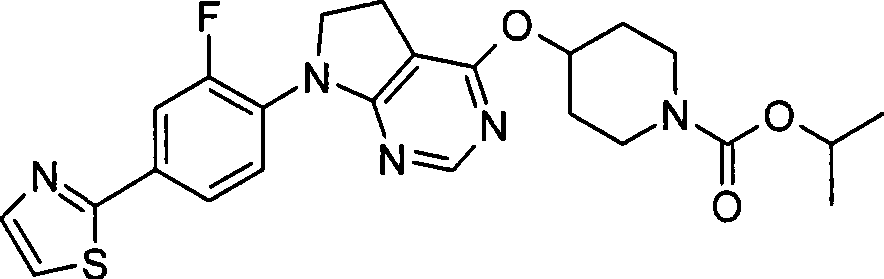
4-({7-[2-氟-4-(1,3-噻唑-2-基)苯基]-6,7-二氢-5H-吡咯并[2,3-d]嘧啶-4-基}氧基)-1-哌啶甲酸1-甲基乙酯(32)4-({7-[2-fluoro-4-(1,3-thiazol-2-yl)phenyl]-6,7-dihydro-5H-pyrrolo[2,3-d]pyrimidine-4- Base}oxy)-1-piperidinecarboxylic acid 1-methylethyl ester ( 32 )
在N2下往圆底烧瓶中装入化合物30(108mg,0.23mmol)、PdCl2(Ph3P)2(16mg,0.023mmol)、2-(三丁基甲锡烷基)-1,3-噻唑(85mg,0.23mmol)和THF(4mL)。将反应混合物回流12小时。水后处理,随后纯化,得到66mg(61%)灰白色固体状的标题产物32。A round bottom flask was charged with compound 30 (108mg, 0.23mmol), PdCl2 ( Ph3P ) 2 (16mg, 0.023mmol), 2-(tributylstannyl)-1,3-thiazole under N2 (85 mg, 0.23 mmol) and THF (4 mL). The reaction mixture was refluxed for 12 hours. Aqueous workup followed by purification afforded 66 mg (61%) of the title product 32 as an off-white solid.
1H NMR(400MHz,DMSO-d6):δ 8.18(s,1H),7.92(d,J=3.2Hz,1H),7.84-7.79(m,2H),7.78-7.74(m,2H),5.26(m,1H),4.76(七重峰,J=6.0Hz,1H),4.10(t,J=8.8Hz,1H),3.71-3.65(m,2H),3.25-3.21(m,2H),3.05(t,J=8.8Hz,2H),1.95-1.91(m,2H),1.61-1.53(m,2H),1.17(d,J=6.4Hz,6H);LCMS(ESI):m/z 484(M+H)+. 1 H NMR (400MHz, DMSO-d 6 ): δ 8.18(s, 1H), 7.92(d, J=3.2Hz, 1H), 7.84-7.79(m, 2H), 7.78-7.74(m, 2H), 5.26(m, 1H), 4.76(septet, J=6.0Hz, 1H), 4.10(t, J=8.8Hz, 1H), 3.71-3.65(m, 2H), 3.25-3.21(m, 2H), 3.05(t, J=8.8Hz, 2H), 1.95-1.91(m, 2H), 1.61-1.53(m, 2H), 1.17(d, J=6.4Hz, 6H); LCMS(ESI): m/z 484(M+H) + .
实施例12(36)Example 12 ( 36 )
步骤1:4-溴-1-哌啶甲酸1-甲基乙酯(33)Step 1: 1-methylethyl 4-bromo-1-piperidinecarboxylate ( 33 )
在0℃、N2下,4-溴哌啶·盐酸盐(5.0g,20.4mmol)在二氯甲烷(100mL)中的溶液用二异丙基乙基胺(7.8mL,44.9mmol)处理,随后滴加氯甲酸异丙酯在甲苯(20.4mL,1.0M溶液)中的溶液。搅拌该混合物并经3小时让其升温至25℃。通过加入1N HCl使反应物猝灭并用乙酸乙酯稀释。水层用乙酸乙酯(3次)萃取,合并的有机萃取液用饱和的NaHCO3水溶液和盐水洗涤,干燥(MgSO4)并浓缩,得到无色油状物33,其无需进一步纯化使用。A solution of 4-bromopiperidine hydrochloride (5.0 g, 20.4 mmol) in dichloromethane (100 mL) was treated with diisopropylethylamine (7.8 mL, 44.9 mmol) at 0 °C under N2 , followed by the dropwise addition of a solution of isopropyl chloroformate in toluene (20.4 mL, 1.0 M solution). The mixture was stirred and allowed to warm to 25°C over 3 hours. The reaction was quenched by addition of 1N HCl and diluted with ethyl acetate. The aqueous layer was extracted with ethyl acetate (3 times) and the combined organic extracts were washed with saturated aqueous NaHCO 3 and brine, dried (MgSO 4 ) and concentrated to give 33 as a colorless oil which was used without further purification.
1H NMR(400MHz,CDCl3):δ 4.91(七重峰,J=6.2Hz,1H),4.35(m,J=3.8Hz,1H),3.71(m,2H),3.36(m,2H),2.09(m,2H),1.93(m,2H),1.24(d,J=6.2Hz,6H). 1 H NMR (400MHz, CDCl 3 ): δ 4.91 (septet, J=6.2Hz, 1H), 4.35(m, J=3.8Hz, 1H), 3.71(m, 2H), 3.36(m, 2H), 2.09(m, 2H), 1.93(m, 2H), 1.24(d, J=6.2Hz, 6H).
步骤2:4-(乙酰硫基)-1-哌啶甲酸1-甲基乙酯(34)Step 2: 1-methylethyl 4-(acetylthio)-1-piperidinecarboxylate ( 34 )
在25℃、N2下,4-溴-1-哌啶甲酸1-甲基乙酯(4.0g,16mmol)在DMF(40mL)中的溶液用硫代乙酸钾(3.4g,29.8mmol)处理并搅拌该混合物,在100℃下加热3.5小时。让反应混合物冷却至25℃并通过加入水使其猝灭,用乙酸乙酯稀释。水层用乙酸乙酯萃取(3次),合并的有机萃取液依次用水、饱和的NaHCO3水溶液和盐水洗涤,干燥(Na2SO4)并浓缩成深棕色油状物。经快速层析纯化(80g硅胶柱,10→20%EtOAc/己烷),得到棕色油状的4-(乙酰硫基)-1-哌啶甲酸1-甲基乙酯(34)(2.3g,59%)。A solution of 1-methylethyl 4-bromo-1-piperidinecarboxylate (4.0 g, 16 mmol) in DMF (40 mL) was treated with potassium thioacetate (3.4 g, 29.8 mmol) at 25 °C under N2 The mixture was stirred and heated at 100° C. for 3.5 hours. The reaction mixture was cooled to 25°C and quenched by addition of water, diluted with ethyl acetate. The aqueous layer was extracted with ethyl acetate (3 times) and the combined organic extracts were washed sequentially with water, saturated aqueous NaHCO3 and brine, dried ( Na2SO4 ) and concentrated to a dark brown oil. Purification by flash chromatography (80 g silica gel column, 10→20% EtOAc/hexanes) gave 1-methylethyl 4-(acetylthio)-1-piperidinecarboxylate ( 34 ) (2.3 g, 59%).
1H NMR(400MHz,CDCl3):δ 4.91(七重峰,J=6.2Hz,1H),4.35(m,J=3.8Hz,1H),3.71(m,2H),3.36(m,2H),2.09(m,2H),1.93(m,2H),1.24(d,J=6.2Hz,6H). 1 H NMR (400MHz, CDCl 3 ): δ 4.91 (septet, J=6.2Hz, 1H), 4.35(m, J=3.8Hz, 1H), 3.71(m, 2H), 3.36(m, 2H), 2.09(m, 2H), 1.93(m, 2H), 1.24(d, J=6.2Hz, 6H).
步骤3:4-巯基-1-哌啶甲酸1-甲基乙酯(35)Step 3: 1-methylethyl 4-mercapto-1-piperidinecarboxylate ( 35 )
在0℃、N2下,4-(乙酰硫基)-1-哌啶甲酸1-甲基乙酯(2.3g,9.4mmol)在THF:水(1:1,50mL)中的溶液用1N NaOH(11.2mL,11.2mmol)处理并在0℃下将该混合物搅拌2小时。反应混合物通过加入柠檬酸水溶液猝灭,水层用乙酸乙酯萃取(4次)。合并的有机萃取液用饱和的NaHCO3水溶液和盐水洗涤;随后干燥(MgSO4)并浓缩,得到棕色油状物。经快速层析纯化(40g硅胶柱,10→25%EtOAc/己烷),得到琥珀色油状的标题产物35(1.6g,89%)。At 0°C under N 2 , a solution of 1-methylethyl 4-(acetylthio)-1-piperidinecarboxylate (2.3 g, 9.4 mmol) in THF:water (1:1, 50 mL) was washed with 1 N NaOH (11.2 mL, 11.2 mmol) was treated and the mixture was stirred at 0 °C for 2 h. The reaction mixture was quenched by adding aqueous citric acid, and the aqueous layer was extracted with ethyl acetate (4 times). The combined organic extracts were washed with saturated aqueous NaHCO 3 and brine; then dried (MgSO 4 ) and concentrated to give a brown oil. Purification by flash chromatography (40 g silica gel column, 10→25% EtOAc/hexanes) afforded the title product 35 (1.6 g, 89%) as an amber oil.
1H NMR(400MHz,DMSO-d6):δ 4.72(七重峰,J=6.4Hz,1H),3.80(重叠br.s,2H),2.96-2.79(br m,3H),2.64(d,J=7.1Hz,1H),1.90-1.82(m,2H),1.38-1.27(m,2H),1.15(d,J=6.4Hz,6H). 1 H NMR (400MHz, DMSO-d 6 ): δ 4.72 (septet, J=6.4Hz, 1H), 3.80 (overlapping br.s, 2H), 2.96-2.79 (br m, 3H), 2.64(d, J=7.1Hz, 1H), 1.90-1.82(m, 2H), 1.38-1.27(m, 2H), 1.15(d, J=6.4Hz, 6H).
步骤4:4-({7-[4-(甲基磺酰基)苯基]-6,7-二氢-5H-吡咯并[2,3-d]嘧啶-4-基}硫基)-1-哌啶甲酸1-甲基乙酯(36)Step 4: 4-({7-[4-(Methylsulfonyl)phenyl]-6,7-dihydro-5H-pyrrolo[2,3-d]pyrimidin-4-yl}thio)- 1-Methylethyl 1-piperidinecarboxylate ( 36 )
在25℃、N2下,4-巯基-1-哌啶甲酸1-甲基乙酯(35)(82mg,0.43mmol)在丙酮(2mL)中的溶液用化合物8(参考以上实施例1,步骤8,140mg,0.43mmol)处理,随后用K2CO3(89mg,0.64mmol)处理并搅拌该混合物,随后在60℃、密封管中加热62小时。让反应混合物冷却至25℃并浓缩至约1/3体积并经快速层析纯化(12g硅胶柱,10→60%EtOAc/己烷,35分钟梯度洗脱),得到白色固体状的标题产物36(150mg,71%)。A solution of 1-methylethyl 4-mercapto-1-piperidinecarboxylate ( 35 ) (82 mg, 0.43 mmol) in acetone (2 mL) at 25 °C under N2 was treated with compound 8 (refer to Example 1 above,
1H NMR(400MHz,DMSO-d6):δ 8.35(s,1H),7.96(t,J=8.1Hz,1H),7.85(d,J=11.2Hz,1H),7.75(d,J=8.5Hz,1H),4.74(七重峰,J=6.2Hz,1H),4.15(app.t,J=8.5Hz,2H),4.11(模糊m,1H),3.82(br d,J=12.7Hz,2H),3.25(s,3H),3.07(br m,2H),2.99(app.t,J=8.5Hz,2H),2.01(br d,J=12.7Hz,2H),1.52(m,2H),1.16(d,J=6.2Hz,6H);LCMS(ESI):m/z 495(M+H)+. 1 H NMR (400MHz, DMSO-d 6 ): δ 8.35(s, 1H), 7.96(t, J=8.1Hz, 1H), 7.85(d, J=11.2Hz, 1H), 7.75(d, J= 8.5Hz, 1H), 4.74 (septet, J=6.2Hz, 1H), 4.15 (app.t, J=8.5Hz, 2H), 4.11 (fuzzy m, 1H), 3.82 (br d, J=12.7Hz , 2H), 3.25(s, 3H), 3.07(br m, 2H), 2.99(app.t, J=8.5Hz, 2H), 2.01(br d, J=12.7Hz, 2H), 1.52(m, 2H), 1.16 (d, J=6.2Hz, 6H); LCMS (ESI): m/z 495 (M+H) + .
实施例13(37)Example 13 ( 37 )
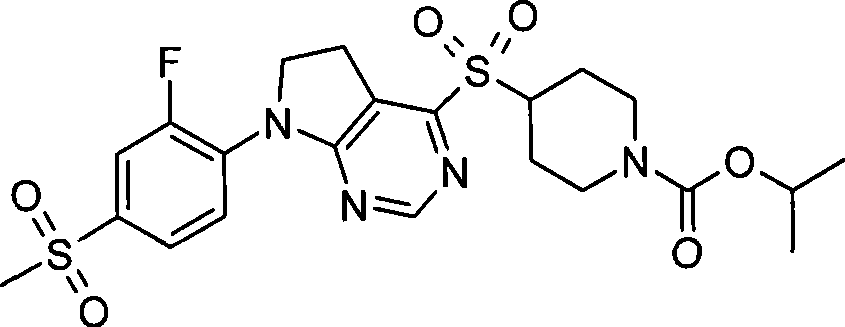
4-({7-[2-氟-4-(甲基磺酰基)苯基]-6,7-二氢-5H-吡咯并[2,3-d]嘧啶-4-基}磺酰基)-1-哌啶甲酸1-甲基乙酯(37)4-({7-[2-fluoro-4-(methylsulfonyl)phenyl]-6,7-dihydro-5H-pyrrolo[2,3-d]pyrimidin-4-yl}sulfonyl) -1-methylethyl 1-piperidinecarboxylate ( 37 )
在0℃、N2下,4-({7-[4-(甲基磺酰基)苯基]-6,7-二氢-5H-吡咯并[2,3-d]嘧啶-4-基}硫基)-1-哌啶甲酸1-甲基乙酯(36)(145mg,0.29mmol)在CH2Cl2(5mL)中的溶液用m-CPBA(最大值为77%重量,105mg,0.47mmol)处理并在0℃下将该混合物搅拌1.5小时。反应混合物通过加入甲醇猝灭,浓缩至约1/3体积,并经反相HPLC纯化(10→100%CH3CN/H2O+0.5%三氟乙酸,10分钟梯度洗脱,C18柱),在冻干后得到白色固体状的标题产物37(28mg,18%)。At 0°C under N 2 , 4-({7-[4-(methylsulfonyl)phenyl]-6,7-dihydro-5H-pyrrolo[2,3-d]pyrimidin-4-yl }thio)-1-piperidinecarboxylic acid 1-methylethyl ester ( 36 ) (145 mg, 0.29 mmol) in CH 2 Cl 2 (5 mL) was treated with m-CPBA (maximum 77% by weight, 105 mg, 0.47 mmol) and the mixture was stirred at 0°C for 1.5 hours. The reaction mixture was quenched by adding methanol, concentrated to about 1/3 volume, and purified by reverse phase HPLC (10→100% CH3CN / H2O +0.5% TFA, 10 min gradient, C18 column) , the title product 37 (28 mg, 18%) was obtained as a white solid after lyophilization.
1H NMR(400MHz,DMSO-d6):δ 8.57(s,1H),8.02-7.97(重叠m,2H),7.88(d,J=8.2Hz,1H),4.79(七重峰,J=6.0Hz,1H),4.26(app.t,J=8.0Hz,2H),4.08(brm,2H),3.84(br m,2H),3.55(app.t,J=8.0Hz,2H),3.34(s,3H),2.89(br m,2H),1.95(br d,J=11.4Hz,2H),1.54(m,2H),1.20(d,J=6.0Hz,6H);LCMS(ESI):m/z527(M+H)+. 1 H NMR (400MHz, DMSO-d 6 ): δ 8.57 (s, 1H), 8.02-7.97 (overlap m, 2H), 7.88 (d, J=8.2Hz, 1H), 4.79 (septet, J=6.0 Hz, 1H), 4.26(app.t, J=8.0Hz, 2H), 4.08(brm, 2H), 3.84(brm, 2H), 3.55(app.t, J=8.0Hz, 2H), 3.34( s, 3H), 2.89 (br m, 2H), 1.95 (br d, J = 11.4Hz, 2H), 1.54 (m, 2H), 1.20 (d, J = 6.0Hz, 6H); LCMS (ESI): m/z527(M+H) + .
实施例14(45)Example 14 ( 45 )

步骤1:6-羟基-2-甲基-5-(2-丙烯-1-基)-4(1H)-嘧啶酮(38)Step 1: 6-Hydroxy-2-methyl-5-(2-propen-1-yl)-4(1H)-pyrimidinone ( 38 )
将乙脒·盐酸盐(25.0g,0.27mol)溶解在0.5M甲醇钠/甲醇(1.1L,0.52mol)中并在环境温度下搅拌1小时。随后往以上溶液中滴加2-丙烯-1-基丙二酸二乙酯(50.0g,0.253mol)并在室温下将得到的混合物搅拌15小时。随后将反应混合物减压浓缩并将粗制残余物溶解在500mL冷水中。该溶液用4N HCl水溶液酸化并形成白色沉淀。经过滤除去沉淀并在滤板上风干48小时,得到32.6g(78%)白色固体状的标题化合物38。Acetamidine·hydrochloride (25.0 g, 0.27 mol) was dissolved in 0.5M sodium methoxide/methanol (1.1 L, 0.52 mol) and stirred at ambient temperature for 1 hour. Diethyl 2-propen-1-ylmalonate (50.0 g, 0.253 mol) was then added dropwise to the above solution and the resulting mixture was stirred at room temperature for 15 hours. The reaction mixture was then concentrated under reduced pressure and the crude residue was dissolved in 500 mL of cold water. The solution was acidified with 4N aqueous HCl and a white precipitate formed. The precipitate was removed by filtration and air dried on a filter plate for 48 hours to afford 32.6 g (78%) of the title compound 38 as a white solid.
1HNMR(400MHz,DMSO-d6):δ 11.60(s,2H),5.61-5.86(m,1H),4.73-4.97(m,2H),2.92(d,J=6.1Hz,2H),2.20(s,3H). 1 HNMR (400MHz, DMSO-d 6 ): δ 11.60(s, 2H), 5.61-5.86(m, 1H), 4.73-4.97(m, 2H), 2.92(d, J=6.1Hz, 2H), 2.20 (s, 3H).
步骤2:4,6-二氯-2-甲基-5-(2-丙烯-1-基)嘧啶(39)Step 2: 4,6-Dichloro-2-methyl-5-(2-propen-1-yl)pyrimidine ( 39 )
将化合物38(6.0g,36.1mmol)与60mL磷酰氯混合并将该混合物加热至回流并保持4小时。随后将该反应物冷却至室温并将其非常缓慢地倾入500mL冰水中。随后该反应物用乙酸乙酯萃取三次(每次250mL)。合并的有机液用300mL饱和的NaHCO3水溶液、随后300mL盐水洗涤。有机液经无水硫酸镁干燥,过滤,随后将溶剂减压除去,得到6.1g(85%)棕色油状的标题化合物39,其无需进一步纯化使用。Compound 38 (6.0 g, 36.1 mmol) was mixed with 60 mL of phosphorus oxychloride and the mixture was heated to reflux for 4 hours. The reaction was then cooled to room temperature and poured very slowly into 500 mL of ice water. The reaction was then extracted three times with ethyl acetate (250 mL each). The combined organics were washed with 300 mL of saturated aqueous NaHCO 3 , followed by 300 mL of brine. The organics were dried over anhydrous magnesium sulfate, filtered, and the solvent was removed under reduced pressure to afford 6.1 g (85%) of the title compound 39 as a brown oil, which was used without further purification.
1H NMR(400MHz,CDCl3):δ5.72-5.90(m,1H),4.89-5.22(m,2H),3.54(d,J=6.1Hz,2H),2.63(s,3H). 1 H NMR (400MHz, CDCl 3 ): δ5.72-5.90(m, 1H), 4.89-5.22(m, 2H), 3.54(d, J=6.1Hz, 2H), 2.63(s, 3H).
步骤3:6-氯-N-[2-氟-4-(甲基磺酰基)苯基]-2-甲基-5-(2-丙烯-1-基)-4-嘧啶胺(40)Step 3: 6-Chloro-N-[2-fluoro-4-(methylsulfonyl)phenyl]-2-methyl-5-(2-propen-1-yl)-4-pyrimidinamine ( 40 )
往装有5mL无水甲苯的100mL圆底烧瓶中加入NaH(60%分散在油中,936mg,23.4mmol)。将该悬浮液搅拌10分钟,并将甲苯倾出。随后经数分钟往无水NaH中滴加在20mL无水THF中的2-氟-4-(甲基磺酰基)苯胺(2.2g,11.7mmol)。在环境温度下得到的混合物搅拌15分钟,随后经数分钟缓慢加入在30mL无水THF中的化合物39(2.5g,12.3mmol)。随后该混合物加热至回流并保持2小时,将其冷却至室温并用100水mL稀释。将该反应物用乙酸乙酯萃取三次(每次100mL),有机液经无水硫酸镁干燥。经过滤除去固体并将溶剂减压除去,得到4.4g(97%)标题化合物40,其无需进一步纯化使用。To a 100 mL round bottom flask containing 5 mL of anhydrous toluene was added NaH (60% in oil, 936 mg, 23.4 mmol). The suspension was stirred for 10 minutes and the toluene was poured off. 2-Fluoro-4-(methylsulfonyl)aniline (2.2 g, 11.7 mmol) in 20 mL of dry THF was then added dropwise to dry NaH over several minutes. The resulting mixture was stirred at ambient temperature for 15 minutes, followed by the slow addition of compound 39 (2.5 g, 12.3 mmol) in 30 mL of anhydrous THF over several minutes. The mixture was then heated to reflux for 2 hours, cooled to room temperature and diluted with 100 mL of water. The reactant was extracted three times with ethyl acetate (100 mL each time), and the organic liquid was dried over anhydrous magnesium sulfate. The solids were removed by filtration and the solvent was removed under reduced pressure to afford 4.4 g (97%) of the
1H NMR(400MHz,CDCl3):δ 2.60(s,3H),3.09(s,3H),3.61(d,J=6.1Hz,2H),5.22-5.42(m,2H),5.79-5.98(m,1H),7.31-7.41(m,1H),7.64-7.73(m,1H),7.74-7.81(m,1H),7.64-7.73(m,1H),8.83(t,J=7.6Hz,1H). 1 H NMR (400MHz, CDCl 3 ): δ 2.60(s, 3H), 3.09(s, 3H), 3.61(d, J=6.1Hz, 2H), 5.22-5.42(m, 2H), 5.79-5.98( m, 1H), 7.31-7.41(m, 1H), 7.64-7.73(m, 1H), 7.74-7.81(m, 1H), 7.64-7.73(m, 1H), 8.83(t, J=7.6Hz, 1H).
步骤4:[6-氯-2-甲基-5-(2-丙烯-1-基)-4-嘧啶基][2-氟-4-(甲基磺酰基)苯基]氨基甲酸1,1-二甲基乙酯(41)Step 4: [6-Chloro-2-methyl-5-(2-propen-1-yl)-4-pyrimidinyl][2-fluoro-4-(methylsulfonyl)phenyl]
将化合物40(4.4g,13.2mmol)溶解在二氯甲烷(40mL)中并用(BOC)2O(5.7g,26.5mmol)和催化量的DMAP(约50mg)处理。在环境温度下将得到的溶液搅拌18小时。随后该反应物用50mL水稀释并分离相,水相用乙酸乙酯萃取三次(每次100mL)。随后合并有机液,经无水硫酸镁干燥。经过滤除去固体并将粗制反应物浓缩至干。随后粗制反应物经快速柱层析纯化(120g硅胶,10→50%乙酸乙酯/己烷),得到3.0g(50%)白色固体状的标题化合物41。Compound 40 (4.4 g, 13.2 mmol) was dissolved in dichloromethane (40 mL) and treated with (BOC) 2 O (5.7 g, 26.5 mmol) and a catalytic amount of DMAP (about 50 mg). The resulting solution was stirred at ambient temperature for 18 hours. The reaction was then diluted with 50 mL of water and the phases were separated and the aqueous phase was extracted three times with ethyl acetate (100 mL each). The organic liquids were then combined and dried over anhydrous magnesium sulfate. The solids were removed by filtration and the crude reaction was concentrated to dryness. The crude reaction was then purified by flash column chromatography (120 g silica gel, 10→50% ethyl acetate/hexanes) to afford 3.0 g (50%) of the title compound 41 as a white solid.
1H NMR(400MHz,CDCl3):δ 1.47(s,9H),2.61(s,3H),3.10(s,3H)3.43(d,J=6.1Hz,2H),4.89-5.10(m,2H),5.62-5.83(m,1H),7.36-7.49(m,1H),7.60-7.77(m,2H). 1 H NMR (400MHz, CDCl 3 ): δ 1.47(s, 9H), 2.61(s, 3H), 3.10(s, 3H) 3.43(d, J=6.1Hz, 2H), 4.89-5.10(m, 2H ), 5.62-5.83(m, 1H), 7.36-7.49(m, 1H), 7.60-7.77(m, 2H).
步骤5:[6-氯-5-(2-羟基乙基)-2-甲基-4-嘧啶基][2-氟-4-(甲基磺酰基)苯基]氨基甲酸1,1-二甲基乙酯(42)Step 5: [6-Chloro-5-(2-hydroxyethyl)-2-methyl-4-pyrimidinyl][2-fluoro-4-(methylsulfonyl)phenyl]
将化合物41(3.0g,6.5mmol)溶解在二氯甲烷(200mL)和甲醇(14mL)的混合物中并将得到的溶液冷却至-78℃。往该反应中鼓泡通入臭氧直至保持蓝色。随后该反应物用氧气冲扫,随后氮气冲扫直至蓝色消失。让该反应升温至-15℃,这时加入硼氢化钠固体(962mg,26.0mmol)。将该反应物搅拌5小时,同时升至室温。该反应物用50mL水稀释并分离相。水相用二氯甲烷(2 x 50mL)萃取,合并有机层,随后经无水硫酸镁干燥。经过滤除去固体,将粗制反应物浓缩至干,得到2.4g(82%)白色固体状的标题化合物42。Compound 41 (3.0 g, 6.5 mmol) was dissolved in a mixture of dichloromethane (200 mL) and methanol (14 mL) and the resulting solution was cooled to -78 °C. Ozone was bubbled through the reaction until the blue color remained. The reaction was then flushed with oxygen followed by nitrogen until the blue color disappeared. The reaction was allowed to warm to -15°C at which time solid sodium borohydride (962 mg, 26.0 mmol) was added. The reaction was stirred for 5 hours while warming to room temperature. The reaction was diluted with 50 mL of water and the phases were separated. The aqueous phase was extracted with dichloromethane (2 x 50 mL), and the combined organic layers were then dried over anhydrous magnesium sulfate. The solids were removed by filtration and the crude reaction was concentrated to dryness to afford 2.4 g (82%) of the title compound 42 as a white solid.
1H NMR(400MHz,CDCl3):δ 1.46(s,9H),2.58(s,3H),3.01(t,J=6.1Hz,2H),3.10(s,3H),3.86-3.99(m,2H),7.54-7.83(m,3H). 1 H NMR (400MHz, CDCl 3 ): δ 1.46(s, 9H), 2.58(s, 3H), 3.01(t, J=6.1Hz, 2H), 3.10(s, 3H), 3.86-3.99(m, 2H), 7.54-7.83(m, 3H).
步骤6:甲磺酸2-(4-氯-6-{{[(1,1-二甲基乙基)氧基]羰基}[2-氟-4-(甲基磺酰基)苯基]氨基}-2-甲基-5-嘧啶基)乙酯(43)Step 6: Methanesulfonic acid 2-(4-chloro-6-{{[(1,1-dimethylethyl)oxy]carbonyl}[2-fluoro-4-(methylsulfonyl)phenyl] Amino}-2-methyl-5-pyrimidinyl) ethyl ester ( 43 )
将化合物42(2.4g,5.22mmol)溶解在二氯甲烷(40mL)中并用DIPEA(2.7mL,15.6mmol)处理,随后用甲磺酰氯(804μL,10.45mmol)处理。在环境温度下将该溶液搅拌4小时。随后该反应物用50mL水稀释并分离相,随后水相用二氯甲烷萃取三次(每次40mL)。随后将有机相合并,随后经无水硫酸镁干燥。经过滤除去固体,将粗制反应物浓缩至干,得到3.1g标题产物43,其无需进一步纯化使用。Compound 42 (2.4 g, 5.22 mmol) was dissolved in dichloromethane (40 mL) and treated with DIPEA (2.7 mL, 15.6 mmol) followed by methanesulfonyl chloride (804 μL, 10.45 mmol). The solution was stirred at ambient temperature for 4 hours. The reaction was then diluted with 50 mL of water and the phases were separated, then the aqueous phase was extracted three times with dichloromethane (40 mL each). The organic phases were then combined and then dried over anhydrous magnesium sulfate. The solids were removed by filtration and the crude reaction was concentrated to dryness to afford 3.1 g of the title product 43 which was used without further purification.
1H NMR(400MHz,DMSO-d6):δ1.38(s,9H),2.50(s,3H),3.10(t,J=6.1Hz,2H),3.16(s,3H),3.29(s,3H),3.42(t,J=6.1Hz,2H),7.60(t,J=7.8Hz,1H),7.67-7.78(m,1H),7.92-8.01(m,1H). 1 H NMR (400MHz, DMSO-d 6 ): δ1.38(s, 9H), 2.50(s, 3H), 3.10(t, J=6.1Hz, 2H), 3.16(s, 3H), 3.29(s , 3H), 3.42(t, J=6.1Hz, 2H), 7.60(t, J=7.8Hz, 1H), 7.67-7.78(m, 1H), 7.92-8.01(m, 1H).
步骤7:4-氯-7-[2-氟-4-(甲基磺酰基)苯基]-2-甲基-6,7-二氢-5H-吡咯并[2,3-d]嘧啶(44)Step 7: 4-Chloro-7-[2-fluoro-4-(methylsulfonyl)phenyl]-2-methyl-6,7-dihydro-5H-pyrrolo[2,3-d]pyrimidine ( 44 )
化合物43(500mg,0.93mmol)用25mL在二氯甲烷中的20%TFA溶液(体积/体积)处理。在室温下将该溶液搅拌3小时,随后减压浓缩。将残余物重新溶解在20mL二氯甲烷中并加入Et3N(450μL,2.53mmol)。在室温下将该混合物搅拌18小时,将溶剂除去,粗制反应物经快速柱层析纯化(40g硅胶,10→50%乙酸乙酯/己烷),得到298mg(94%)白色固体状的标题化合物44。Compound 43 (500 mg, 0.93 mmol) was treated with 25 mL of 20% TFA in dichloromethane (vol/vol). The solution was stirred at room temperature for 3 hours, then concentrated under reduced pressure. The residue was redissolved in 20 mL of dichloromethane and Et3N (450 μL, 2.53 mmol) was added. The mixture was stirred at room temperature for 18 hours, the solvent was removed and the crude reaction was purified by flash column chromatography (40 g silica gel, 10→50% ethyl acetate/hexanes) to afford 298 mg (94%) of Title compound 44 .
1H NMR(400MHz,CDCl3):δ 2.48(s,3H),3.10(s,3H),3.24(t,J=7.3Hz,2H),4.24(t,J=7.3Hz,2H),7.57-7.84(m,2H),7.91-8.20(m,1H);LCMS(ESI):m/z 342(M+H)+. 1 H NMR (400MHz, CDCl 3 ): δ 2.48(s, 3H), 3.10(s, 3H), 3.24(t, J=7.3Hz, 2H), 4.24(t, J=7.3Hz, 2H), 7.57 -7.84 (m, 2H), 7.91-8.20 (m, 1H); LCMS (ESI): m/z 342 (M+H) + .
步骤8:4-({7-[2-氟-4-(甲基磺酰基)苯基]-2-甲基-6,7-二氢-5H-吡咯并[2,3-d]嘧啶-4-基}氧基)-1-哌啶甲酸1,1-二甲基乙酯(45)Step 8: 4-({7-[2-fluoro-4-(methylsulfonyl)phenyl]-2-methyl-6,7-dihydro-5H-pyrrolo[2,3-d]pyrimidine -4-yl}oxy)-1-
将4-羟基-1-哌啶甲酸1,1-二甲基乙酯(122mg,0.609mmol)溶解在5mL无水THF中。往该溶液中加入NaH(60%分散在油中,70mg,1.74mmol)并在室温下将该混合物搅拌0.5小时。将化合物44(198mg,0.581mmol)溶解在5mL THF中并将其滴加至以上溶液中。随后将该混合物回流3小时。移去热浴并在室温下将该反应物搅拌过夜。随后该反应物用5mL 1M HCl水溶液处理,随后用20mL水处理。随后粗制反应用二氯甲烷萃取三次(每次20mL),有机液经无水硫酸镁干燥,过滤,随后将粗制反应物浓缩至干。该反应物经快速柱层析纯化(25g硅胶,0→50%乙酸乙酯/己烷梯度洗脱),得到170mg(60%)白色固体状的标题化合物45。1,1-Dimethylethyl 4-hydroxy-1-piperidinecarboxylate (122 mg, 0.609 mmol) was dissolved in 5 mL of anhydrous THF. To this solution was added NaH (60% in oil, 70 mg, 1.74 mmol) and the mixture was stirred at room temperature for 0.5 h. Compound 44 (198 mg, 0.581 mmol) was dissolved in 5 mL THF and added dropwise to the above solution. The mixture was then refluxed for 3 hours. The heat bath was removed and the reaction was stirred overnight at room temperature. The reaction was then treated with 5 mL of 1M aqueous HCl followed by 20 mL of water. The crude reaction was then extracted three times with dichloromethane (20 mL each), the organic liquid was dried over anhydrous magnesium sulfate, filtered, and the crude reaction was then concentrated to dryness. The reaction was purified by flash column chromatography (25 g silica gel, 0→50% ethyl acetate/hexanes gradient) to afford 170 mg (60%) of the title compound 45 as a white solid.
1H NMR(400MHz,CDCl3):δ 1.46(s,9H),1.62-1.83(m,2H),1.86-2.11(m,2H),2.48(s,3H),2.86-3.18(m,5H),3.21-3.44(m,2H),3.57-3.87(m,2H),4.25(t,J=7.3Hz,2H),5.30-5.47(m,1H),7.59-7.78(m,2H),7.06-8.22(m,1H);LCMS(ESI):m/z 507(M+H)+. 1 H NMR (400MHz, CDCl 3 ): δ 1.46(s, 9H), 1.62-1.83(m, 2H), 1.86-2.11(m, 2H), 2.48(s, 3H), 2.86-3.18(m, 5H ), 3.21-3.44(m, 2H), 3.57-3.87(m, 2H), 4.25(t, J=7.3Hz, 2H), 5.30-5.47(m, 1H), 7.59-7.78(m, 2H), 7.06-8.22 (m, 1H); LCMS (ESI): m/z 507 (M+H) + .
实施例15(47)Example 15 ( 47 )
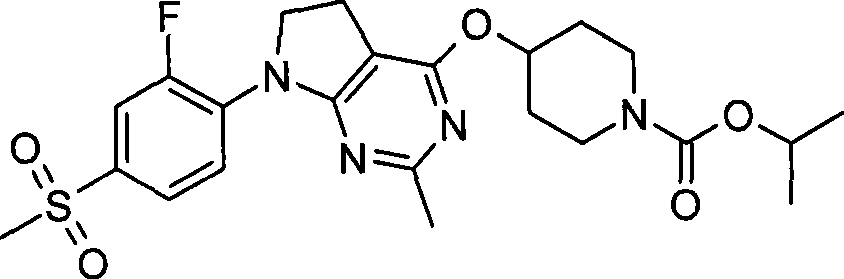
步骤1:7-[2-氟-4-(甲基磺酰基)苯基]-2-甲基-4-(4-哌啶基氧基)-6,7-二氢-5H-吡咯并[2,3-d]嘧啶·三氟乙酸盐(46)Step 1: 7-[2-Fluoro-4-(methylsulfonyl)phenyl]-2-methyl-4-(4-piperidinyloxy)-6,7-dihydro-5H-pyrrolo [2,3-d]pyrimidine trifluoroacetate ( 46 )
化合物45(101mg,0.19mmol)用10mL 20%TFA在二氯甲烷中的溶液(体积/体积)处理。在室温下将该溶液搅拌3小时。随后将溶剂减压除去并将粗制残余物置于高真空泵下0.5小时,得到100mg粗制的TFA盐形式的46,其无需纯化使用。Compound 45 (101 mg, 0.19 mmol) was treated with 10 mL of 20% TFA in dichloromethane (v/v). The solution was stirred at room temperature for 3 hours. The solvent was then removed under reduced pressure and the crude residue was placed under high vacuum pump for 0.5 h to afford 100 mg of crude 46 as the TFA salt which was used without purification.
步骤2:4-({7-[2-氟-4-(甲基磺酰基)苯基]-2-甲基-6,7-二氢-5H-吡咯并[2,3-d]嘧啶-4-基}氧基)-1-哌啶甲酸1-甲基乙酯(47)Step 2: 4-({7-[2-fluoro-4-(methylsulfonyl)phenyl]-2-methyl-6,7-dihydro-5H-pyrrolo[2,3-d]pyrimidine -4-yl}oxy)-1-piperidinecarboxylic acid 1-methylethyl ester ( 47 )
将化合物46(50mg,0.10mmol)溶解在二氯甲烷(5mL)中。往以上溶液中加入1M氯甲酸异丙酯在甲苯中的溶液(96μL,0.10mmol),随后加入二异丙基乙基胺(61μL,0.35mmol),在室温下将反应混合物搅拌18小时。随后将溶剂减压除去,粗制反应物经快速柱层析纯化(15→50%乙酸乙酯/己烷),得到48mg(98%)白色固体状的标题化合物47。Compound 46 (50 mg, 0.10 mmol) was dissolved in dichloromethane (5 mL). To the above solution was added 1M isopropyl chloroformate in toluene (96 μL, 0.10 mmol), followed by diisopropylethylamine (61 μL, 0.35 mmol), and the reaction mixture was stirred at room temperature for 18 hours. The solvent was then removed under reduced pressure and the crude reaction was purified by flash column chromatography (15→50% ethyl acetate/hexanes) to afford 48 mg (98%) of the title compound 47 as a white solid.
1H NMR(400MHz,CDCl3):δ 1.17(d,J=6.8Hz,6H),1.60-1.82(m,2H),1.89-2.01(m,2H),2.47(s,3H),2.94-3.15(m,5H),3.25-3.46(m,2H),3.63-3.87(m,2H),4.19(t,J=7.3Hz,2H),4.83-5.02(m,1H),5.30-5.47(m,1H),7.59-7.78(m,2H),7.06-8.22(m,1H);LCMS(ESI):m/z 493(M+H)+. 1 H NMR (400MHz, CDCl 3 ): δ 1.17 (d, J=6.8Hz, 6H), 1.60-1.82 (m, 2H), 1.89-2.01 (m, 2H), 2.47 (s, 3H), 2.94- 3.15(m, 5H), 3.25-3.46(m, 2H), 3.63-3.87(m, 2H), 4.19(t, J=7.3Hz, 2H), 4.83-5.02(m, 1H), 5.30-5.47( m, 1H), 7.59-7.78 (m, 2H), 7.06-8.22 (m, 1H); LCMS (ESI): m/z 493 (M+H) + .
实施例16(50)Example 16 ( 50 )
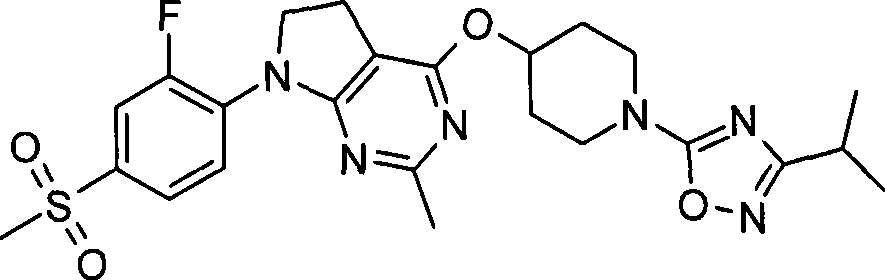
步骤1:4-羟基-1-哌啶甲腈(48)Step 1: 4-Hydroxy-1-piperidinecarbonitrile ( 48 )
将NaHCO3(41g,0.494mol)与20mL水混合并在冰浴上冷却至0℃。在剧烈搅拌下往以上溶液中加入在75mL二氯甲烷中的4-羟基哌啶(25g,0.25mol)。随后加入在25mL二氯甲烷中的溴化氰(28g,0.27mol)并移去冰浴。随后在环境温度下将该混合物搅拌18小时。随后加入Na2CO3(75g)直至pH约为7,随后加入MgSO4(25g)来除去水。NaHCO 3 (41 g, 0.494 mol) was mixed with 20 mL of water and cooled to 0° C. on an ice bath. To the above solution was added 4-hydroxypiperidine (25 g, 0.25 mol) in 75 mL of dichloromethane with vigorous stirring. Cyanogen bromide (28 g, 0.27 mol) in 25 mL of dichloromethane was then added and the ice bath removed. The mixture was then stirred at ambient temperature for 18 hours. Na 2 CO 3 (75 g) was then added until the pH was about 7, followed by MgSO 4 (25 g) to remove the water.
经过滤移出固体,该固体用二氯甲烷洗涤数次。随后将滤液减压除去,标题产物48(24.8g)无需纯化使用。The solid was removed by filtration and washed several times with dichloromethane. The filtrate was then removed under reduced pressure and the title product 48 (24.8 g) was used without purification.
步骤2:1-[3-(1-甲基乙基)-1,2,4-噁二唑-5-基]-4-哌啶醇(49)Step 2: 1-[3-(1-methylethyl)-1,2,4-oxadiazol-5-yl]-4-piperidinol ( 49 )
化合物48(12.9g,0.102mol)和化合物106(参见实施例48,步骤1)(12.8g,0.125mol)在乙酸乙酯(500mL)和乙醚(100mL)混合物中的溶液用1N ZnCl2(120mL,0.120mol)在乙醚中的溶液处理。将该混合物搅拌15分钟并将上清液倾出。残余物用250mL乙醚洗涤两次,其在每次洗涤后倾出。随后将残余物溶解在4N HCl(50mL)和EtOH(100mL)的混合物中。将得到的溶液回流1小时并将溶剂减压减少至约25mL并加入25gNa2CO3和100mL二氯甲烷。经过滤除去固体并分离相。有机相经MgSO4干燥,过滤,随后浓缩至干,得到16g褐色油状的所需化合物49并且该物质无需纯化使用。A solution of compound 48 (12.9 g, 0.102 mol) and compound 106 (see Example 48, step 1) (12.8 g, 0.125 mol) in a mixture of ethyl acetate (500 mL) and diethyl ether (100 mL) was washed with 1 N ZnCl 2 (120 mL , 0.120mol) solution in ether. The mixture was stirred for 15 minutes and the supernatant was decanted. The residue was washed twice with 250 mL of ether, which was decanted after each wash. The residue was then dissolved in a mixture of 4N HCl (50 mL) and EtOH (100 mL). The resulting solution was refluxed for 1 hour and the solvent was reduced to about 25 mL under reduced pressure and 25 g Na 2 CO 3 and 100 mL dichloromethane were added. The solids were removed by filtration and the phases were separated. The organic phase was dried over MgSO4 , filtered and concentrated to dryness to give 16 g of the desired compound 49 as a brown oil and this material was used without purification.
1H NMR(400MHz,CDCl3):δ 1.13-1.38(m,6H),1.49-1.74(m,2H),1.80-2.05(m,2H),2.78(m,1H),3.20-3.44(m,2H),3.74-4.04(m,3H). 1 H NMR (400MHz, CDCl 3 ): δ 1.13-1.38(m, 6H), 1.49-1.74(m, 2H), 1.80-2.05(m, 2H), 2.78(m, 1H), 3.20-3.44(m , 2H), 3.74-4.04(m, 3H).
步骤3:7-[2-氟-4-(甲基磺酰基)苯基]-2-甲基-4-({1-[3-(1-甲基乙基)-1,2,4-噁二唑-5-基]-4-哌啶基}氧基)-6,7-二氢-5H-吡咯并[2,3-d]嘧啶(50)Step 3: 7-[2-Fluoro-4-(methylsulfonyl)phenyl]-2-methyl-4-({1-[3-(1-methylethyl)-1,2,4 -Oxadiazol-5-yl]-4-piperidinyl}oxy)-6,7-dihydro-5H-pyrrolo[2,3-d]pyrimidine ( 50 )
将化合物49(100mg,0.292mmol)溶解在5mL无水THF中。往该溶液中加入NaH(60%分散在油状中,35mg,0.876mmol)并在室温下将该混合物搅拌0.5小时。将化合物44(55mg,0.262mmol)溶解在5mLTHF中并将其加至以上溶液中。随后将该混合物回流3小时。随后将粗制反应混合物真空浓缩,得到的残余物经Gilson半制备HPLC纯化(Sunfire C18,5微米,30/50mm,使用10-100%CH3CN/H2O/0.1%TFA梯度洗脱),得到76mg(56%)白色固体状的标题化合物50。Compound 49 (100 mg, 0.292 mmol) was dissolved in 5 mL of anhydrous THF. To this solution was added NaH (60% in oil, 35 mg, 0.876 mmol) and the mixture was stirred at room temperature for 0.5 h. Compound 44 (55 mg, 0.262 mmol) was dissolved in 5 mL THF and added to the above solution. The mixture was then refluxed for 3 hours. The crude reaction mixture was then concentrated in vacuo and the resulting residue was purified by Gilson semi-preparative HPLC (Sunfire C18, 5 microns, 30/50 mm, eluting with a 10-100% CH3CN / H2O /0.1% TFA gradient) , affording 76 mg (56%) of the
1H NMR(400MHz,CDCl3):δ 1.27(d,J=6.8Hz,6H),1.81-1.97(m,2H),2.01-2.13(m,2H),2.49(s,3H),2.80-2.95(m,1H),2.99-3.14(m,5H),3.54-3.66(m,2H),3.79-3.92(m,2H),4.19(t,J=7.3Hz,2H),5.39-5.54(m,1H),7.62-7.79(m,2H),7.92-8.13(m,1H);LCMS(ESI):m/z 517(M+H)+. 1 H NMR (400MHz, CDCl 3 ): δ 1.27(d, J=6.8Hz, 6H), 1.81-1.97(m, 2H), 2.01-2.13(m, 2H), 2.49(s, 3H), 2.80- 2.95(m, 1H), 2.99-3.14(m, 5H), 3.54-3.66(m, 2H), 3.79-3.92(m, 2H), 4.19(t, J=7.3Hz, 2H), 5.39-5.54( m, 1H), 7.62-7.79 (m, 2H), 7.92-8.13 (m, 1H); LCMS (ESI): m/z 517 (M+H) + .
实施例17(56)Example 17 ( 56 )
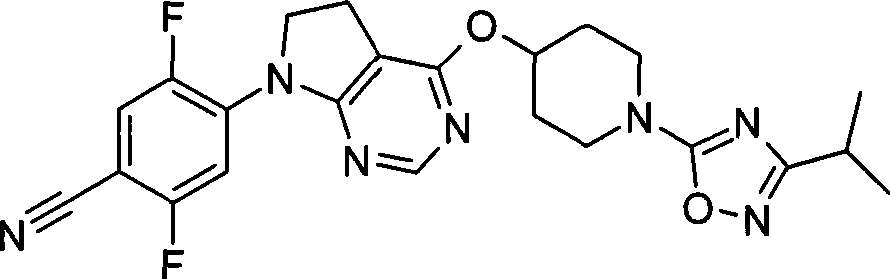
步骤1:4-{[6-氯-5-(2-丙烯-1-基)-4-嘧啶基]氨基}-2,5-二氟苄腈(51)Step 1: 4-{[6-Chloro-5-(2-propen-1-yl)-4-pyrimidinyl]amino}-2,5-difluorobenzonitrile ( 51 )
往装有5mL无水甲苯的100mL圆底烧瓶中加入NaH(60%分散在油中,967mg,24.2mmol)。将悬浮液搅拌10分钟并将甲苯倾出。随后经数分钟往NaH浆状物中滴加在40mL无水THF中的4-氨基-2,5-二氟苄腈(1.9g,12.2mmol)。在环境温度下将得到的混合物搅拌15分钟,同时经数分钟缓慢加入在10mL无水THF中的化合物2(2.4g,12.7mmol)。随后将该混合物加热至回流并保持2小时。随后将该反应物冷却至室温并用100mL水稀释,随后经过滤移出形成的白色沉淀(1.62g)并减压干燥。随后将滤液转移至分液漏斗并用二氯甲烷(3x100mL)萃取。随后合并的有机萃取液经无水硫酸镁干燥,过滤,随后浓缩至干。随后粗制残余物用MeOH重结晶,另得到白色固体状的0.57g所需产物51;总计2.19g(51%)。To a 100 mL round bottom flask containing 5 mL of anhydrous toluene was added NaH (60% in oil, 967 mg, 24.2 mmol). The suspension was stirred for 10 minutes and the toluene was poured off. To the NaH slurry was then added 4-amino-2,5-difluorobenzonitrile (1.9 g, 12.2 mmol) in 40 mL of anhydrous THF dropwise over several minutes. The resulting mixture was stirred at ambient temperature for 15 minutes while compound 2 (2.4 g, 12.7 mmol) in 10 mL of anhydrous THF was added slowly over several minutes. The mixture was then heated to reflux for 2 hours. The reaction was then cooled to room temperature and diluted with 100 mL of water before the white precipitate formed (1.62 g) was removed by filtration and dried under reduced pressure. The filtrate was then transferred to a separatory funnel and extracted with dichloromethane (3x100 mL). The combined organic extracts were then dried over anhydrous magnesium sulfate, filtered, and concentrated to dryness. Subsequent recrystallization of the crude residue from MeOH afforded an additional 0.57 g of the desired product 51 as a white solid; total 2.19 g (51%).
1H NMR(400MHz,CDCl3):δ 3.67(d,J=6.0Hz,2H),5.21-5.50(m,2H),5.77-6.02(m,1H),7.29-7.41(m,1H),7.41-7.53(s,1H),8.50(s,1H),8.67-8.85(m,1H). 1 H NMR (400MHz, CDCl 3 ): δ 3.67 (d, J=6.0Hz, 2H), 5.21-5.50 (m, 2H), 5.77-6.02 (m, 1H), 7.29-7.41 (m, 1H), 7.41-7.53(s, 1H), 8.50(s, 1H), 8.67-8.85(m, 1H).
步骤2:[6-氯-5-(2-丙烯-1-基)-4-嘧啶基](4-氰基-2,5-二氟苯基)氨基甲酸1,1-二甲基乙酯(52)Step 2: [6-Chloro-5-(2-propen-1-yl)-4-pyrimidinyl](4-cyano-2,5-difluorophenyl)
将化合物51(2.2g,6.8mmol)溶解在二氯甲烷(40mL)中并用(BOC)2O(3.0g,13.6mmol)和催化量的DMAP处理。在环境温度下将得到的溶液搅拌18小时。随后将该反应物用50mL水稀释,水相用二氯甲烷萃取三次(每次50mL)。随后将有机层合并,经无水硫酸镁干燥。经过滤除去固体并将粗制反应物浓缩至干。随后粗制反应物经快速柱层析纯化(120g硅胶,10→50%乙酸乙酯/己烷),得到2.4g(83%)白色固体状的所需化合物52。Compound 51 (2.2 g, 6.8 mmol) was dissolved in dichloromethane (40 mL) and treated with (BOC) 2 O (3.0 g, 13.6 mmol) and a catalytic amount of DMAP. The resulting solution was stirred at ambient temperature for 18 hours. The reaction was then diluted with 50 mL of water and the aqueous phase was extracted three times with 50 mL each of dichloromethane. The organic layers were then combined and dried over anhydrous magnesium sulfate. The solids were removed by filtration and the crude reaction was concentrated to dryness. The crude reaction was then purified by flash column chromatography (120 g silica gel, 10→50% ethyl acetate/hexanes) to afford 2.4 g (83%) of the desired compound 52 as a white solid.
1H NMR(400MHz,CDCl3):δ 1.44(s,9H),3.52(d,J=6.1Hz,2H),4.89-5.21(m,2H),5.63-5.98(m,1H),7.06-7.20(m,1H),7.32-7.52(m,1H),8.70(s,1H). 1 H NMR (400MHz, CDCl 3 ): δ 1.44(s, 9H), 3.52(d, J=6.1Hz, 2H), 4.89-5.21(m, 2H), 5.63-5.98(m, 1H), 7.06- 7.20(m, 1H), 7.32-7.52(m, 1H), 8.70(s, 1H).
步骤3:[6-氯-5-(2-羟基乙基)-4-嘧啶基](4-氰基-2,5-二氟苯基)氨基甲酸1,1-二甲基乙酯(53)Step 3: 1,1-dimethylethyl [6-chloro-5-(2-hydroxyethyl)-4-pyrimidinyl](4-cyano-2,5-difluorophenyl)carbamate ( 53 )
将化合物52(2.4g,5.69mmol)溶解在二氯甲烷(200mL)和甲醇(10mL)的混合物中并将得到的溶液冷却至-78℃。随后往该溶液中鼓泡通入臭氧直至保持蓝色。随后该反应物用氧气冲扫,随后氮气直至蓝色消失。随后将该反应升温至-15℃,与此同时加入硼氢化钠(841mg,22.74mmol)。让该反应物搅拌5小时同时升至室温。随后将该反应物用50mL水稀释,水相用二氯甲烷萃取两次(每次50mL)。随后合并有机液并经无水硫酸镁干燥。经过滤除去固体,随后将粗制反应物浓缩至干。随后该反应物经快速柱层析纯化(20→50%乙酸乙酯/己烷),得到810mg(33%)所需化合物53。Compound 52 (2.4 g, 5.69 mmol) was dissolved in a mixture of dichloromethane (200 mL) and methanol (10 mL) and the resulting solution was cooled to -78 °C. Ozone was then bubbled through the solution until the blue color remained. The reaction was then flushed with oxygen followed by nitrogen until the blue color disappeared. The reaction was then warmed to -15°C while sodium borohydride (841 mg, 22.74 mmol) was added. The reaction was allowed to stir for 5 hours while warming to room temperature. The reaction was then diluted with 50 mL of water, and the aqueous phase was extracted twice with dichloromethane (50 mL each). The organic liquids were then combined and dried over anhydrous magnesium sulfate. The solids were removed by filtration and the crude reaction was concentrated to dryness. The reaction was then purified by flash column chromatography (20→50% ethyl acetate/hexanes) to afford 810 mg (33%) of the desired compound 53 .
1H NMR(400MHz,CDCl3):δ 1.49(s,9H),3.08(t,J=7.3Hz,2H),3.98(t,J=7.3Hz,2H),7.29-7.46(m,2H),8.50(s,1H). 1 H NMR (400MHz, CDCl 3 ): δ 1.49(s, 9H), 3.08(t, J=7.3Hz, 2H), 3.98(t, J=7.3Hz, 2H), 7.29-7.46(m, 2H) , 8.50(s, 1H).
步骤4:甲磺酸2-[4-氯-6-((4-氰基-2,5-二氟苯基){[(1,1-二甲基乙基)氧基]羰基}氨基)-5-嘧啶基]乙酯(54).Step 4: 2-[4-Chloro-6-((4-cyano-2,5-difluorophenyl){[(1,1-dimethylethyl)oxy]carbonyl}amino methanesulfonate )-5-pyrimidinyl] ethyl ester ( 54 ).
将化合物53(810mg,1.90mmol)溶解在二氯甲烷(20mL)中并用DIPEA(1.0mL,5.7mmol)处理,随后用甲磺酰氯(433mg,3.8mmol)处理。在环境温度下将该溶液搅拌4小时。随后将该反应物用50mL水稀释,水相用二氯甲烷萃取三次(每次40mL)。随后合并有机液,经无水硫酸镁干燥。经过滤除去固体,随后将粗制反应物浓缩至干,得到1.0g粗制的标题产物54,其无需进一步纯化使用。Compound 53 (810 mg, 1.90 mmol) was dissolved in dichloromethane (20 mL) and treated with DIPEA (1.0 mL, 5.7 mmol) followed by methanesulfonyl chloride (433 mg, 3.8 mmol). The solution was stirred at ambient temperature for 4 hours. The reaction was then diluted with 50 mL of water, and the aqueous phase was extracted three times with dichloromethane (40 mL each). The organic liquids were then combined and dried over anhydrous magnesium sulfate. Solids were removed by filtration and the crude reaction was concentrated to dryness to afford 1.0 g of crude title product 54 which was used without further purification.
1H NMR(400MHz,CDCl3):δ 1.40(s,9H),2.89(s,3H),3.25(t,J=7.3Hz,2H),4.50(t,J=7.3Hz,2H),7.29-7.46(m,2H),8.63(s,1H). 1 H NMR (400MHz, CDCl 3 ): δ 1.40(s, 9H), 2.89(s, 3H), 3.25(t, J=7.3Hz, 2H), 4.50(t, J=7.3Hz, 2H), 7.29 -7.46(m, 2H), 8.63(s, 1H).
步骤5:4-(4-氯-5,6-二氢-7H-吡咯并[2,3-d]嘧啶-7-基)-2,5-二氟苄腈(55)Step 5: 4-(4-Chloro-5,6-dihydro-7H-pyrrolo[2,3-d]pyrimidin-7-yl)-2,5-difluorobenzonitrile ( 55 )
化合物54(1.0g,2.05mmol)用10mL 20%(体积/体积)TFA在二氯甲烷中的溶液处理。在室温下将该溶液搅拌3小时。随后将溶剂真空除去并将粗制残余物置于高度真空泵下0.5小时。随后将残余物重新溶解在10mL二氯甲烷中并往该溶液中加入TEA(3mL,16.8mmol)。在室温下将该混合物搅拌18小时。除去溶剂,得到594mg(98%)标题化合物55,其无需进一步纯化使用。Compound 54 (1.0 g, 2.05 mmol) was treated with 10 mL of 20% (vol/vol) TFA in dichloromethane. The solution was stirred at room temperature for 3 hours. The solvent was then removed in vacuo and the crude residue was placed under high vacuum pump for 0.5 h. The residue was then redissolved in 10 mL of dichloromethane and to this solution was added TEA (3 mL, 16.8 mmol). The mixture was stirred at room temperature for 18 hours. Removal of the solvent afforded 594 mg (98%) of the title compound 55 which was used without further purification.
1H NMR(400MHz,CDCl3):δ 3.35(t,J=7.3Hz,2H),4.35(t,J=7.3Hz,2H),7.32-7.51(m,1H),7.89-8.13(m,1H),8.44(s,1H). 1 H NMR (400MHz, CDCl 3 ): δ 3.35(t, J=7.3Hz, 2H), 4.35(t, J=7.3Hz, 2H), 7.32-7.51(m, 1H), 7.89-8.13(m, 1H), 8.44(s, 1H).
步骤6:2,5-二氟-4-[4-({1-[3-(1-甲基乙基)-1,2,4-噁二唑-5-基]-4-哌啶基}氧基)-5,6-二氢-7H-吡咯并[2,3-d]嘧啶-7-基]苄腈(56)Step 6: 2,5-Difluoro-4-[4-({1-[3-(1-methylethyl)-1,2,4-oxadiazol-5-yl]-4-piperidine Base}oxy)-5,6-dihydro-7H-pyrrolo[2,3-d]pyrimidin-7-yl]benzonitrile ( 56 )
将化合物49(162mg,0.770mmol)溶解在5mL无水THF中。往该溶液中加入NaH(60%分散在油中,102mg,2.57mmol),在室温下将该混合物搅拌0.5小时。将化合物55(250mg,0.856mmol)溶解在5mLTHF中并将其加至以上溶液中。随后将该混合物回流3小时。随后将粗制反应混合物真空浓缩,得到的残余物经快速柱层析纯化(10→50%乙酸乙酯/己烷),得到50mg(13%)白色固体状的标题化合物56。Compound 49 (162 mg, 0.770 mmol) was dissolved in 5 mL of anhydrous THF. To this solution was added NaH (60% in oil, 102 mg, 2.57 mmol), and the mixture was stirred at room temperature for 0.5 h. Compound 55 (250 mg, 0.856 mmol) was dissolved in 5 mL THF and added to the above solution. The mixture was then refluxed for 3 hours. The crude reaction mixture was then concentrated in vacuo and the resulting residue was purified by flash column chromatography (10→50% ethyl acetate/hexanes) to afford 50 mg (13%) of the title compound 56 as a white solid.
1H NMR(400MHz,CDCl3):δ 1.29(d,J=6.8Hz,6H),1.82-1.97(m,2H),2.06-2.17(m,2H),2.81-2.97(m,1H),3.09(t,J=7.3Hz,2H),3.47-3.62(m,2H),3.79-3.95(m,2H),4.25(t,J=7.3Hz,2H),5.33-5.52(m,1H),7.27-7.40(m,1H),8.00-8.19(m,1H),8.31(s,1H);LC);LCMS(ESI):m/z 468(M+H)+. 1 H NMR (400MHz, CDCl 3 ): δ 1.29 (d, J=6.8Hz, 6H), 1.82-1.97 (m, 2H), 2.06-2.17 (m, 2H), 2.81-2.97 (m, 1H), 3.09(t, J=7.3Hz, 2H), 3.47-3.62(m, 2H), 3.79-3.95(m, 2H), 4.25(t, J=7.3Hz, 2H), 5.33-5.52(m, 1H) , 7.27-7.40(m, 1H), 8.00-8.19(m, 1H), 8.31(s, 1H); LC); LCMS(ESI): m/z 468(M+H) + .
实施例18(57)Example 18 ( 57 )
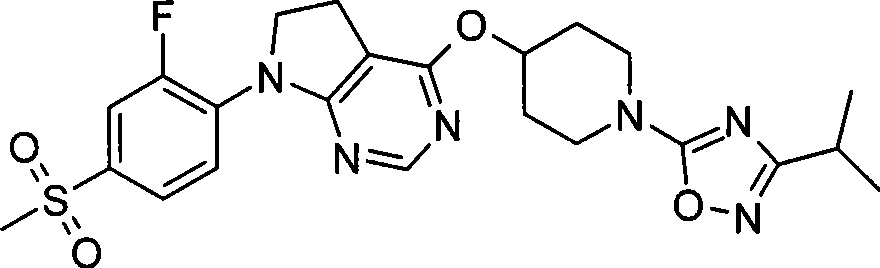
7-[2-氟-4-(甲基磺酰基)苯基1-4-({1-[3-(1-甲基乙基)-1,2,4-噁二唑-5-基]-4-哌啶基}氧基)-6,7-二氢-5H-吡咯并[2,3-d]嘧啶(57)7-[2-fluoro-4-(methylsulfonyl)phenyl 1-4-({1-[3-(1-methylethyl)-1,2,4-oxadiazol-5-yl ]-4-piperidinyl}oxy)-6,7-dihydro-5H-pyrrolo[2,3-d]pyrimidine ( 57 )
采用所述用于制备10(实施例1,步骤10)的方案。在NaH(60%分散在油中,200mg,4.94mmol)和THF(20mL)存在下,将化合物8(540mg,1.65mmol)与化合物49(332mg,1.57mmol)反应2.5小时。后处理,随后经纯化,得到460mg(55%)白色固体状的标题产物57。The protocol described for the preparation of 10 (Example 1, step 10) was followed. Compound 8 (540 mg, 1.65 mmol) was reacted with compound 49 (332 mg, 1.57 mmol) in the presence of NaH (60% in oil, 200 mg, 4.94 mmol) and THF (20 mL) for 2.5 hours. Workup followed by purification afforded 460 mg (55%) of the title product 57 as a white solid.
1H NMR(400MHz,DMSO-d6):δ 8.27(s,1H),7.99(app.t,J=7.6Hz,1H),7.87(app.br d,J=10.8Hz,1H),7.78(app.br t,J=8.4Hz,1H),5.36(br m,1H),4.18(t,J=8.8Hz,2H),3.82-3.78(m,2H),3.56-3.50(m,2H),3.28(s,3H),3.10(t,J=8.4Hz,2H),2.83(七重峰,J=6.8Hz,1H),2.09(m,2H),1.78(m,2H),1.20(d,J=6.8Hz,6H);LCMS(ESI):m/z 503(M+H)+. 1 H NMR (400MHz, DMSO-d 6 ): δ 8.27 (s, 1H), 7.99 (app.t, J=7.6Hz, 1H), 7.87 (app.br d, J=10.8Hz, 1H), 7.78 (app.br t, J=8.4Hz, 1H), 5.36(br m, 1H), 4.18(t, J=8.8Hz, 2H), 3.82-3.78(m, 2H), 3.56-3.50(m, 2H ), 3.28(s, 3H), 3.10(t, J=8.4Hz, 2H), 2.83(septet, J=6.8Hz, 1H), 2.09(m, 2H), 1.78(m, 2H), 1.20( d, J=6.8Hz, 6H); LCMS (ESI): m/z 503 (M+H) + .
实施例19(62)Example 19 ( 62 )
步骤1:(4-溴-N-[2-(4,6-二氯-5-嘧啶基)乙基]-2,5-二氟苯胺(58)Step 1: (4-Bromo-N-[2-(4,6-dichloro-5-pyrimidinyl)ethyl]-2,5-difluoroaniline ( 58 )
将化合物2(1.71g,9.0mmol)溶解在二氯甲烷(200mL)和甲醇(10mL)中并将得到的溶液冷却至-78℃。随后往该溶液中鼓泡通入臭氧直至保持蓝色。随后该反应物用氧气、随后氮气冲扫直至蓝色消失。随后将该反应物用二甲基硫化物(589mg,9.5mmol)处理,将该混合物搅拌1.5小时同时升温至室温。随后将该反应物浓缩至干。随后往粗制残余物中加入4-溴-2,5-二氟苯胺(1.79g,8.6mmol)并将该混合物溶解在50mL二氯甲烷中。随后往以上溶液中加入MeOH(10mL)和1mL冰乙酸。随后将得到的溶液搅拌1小时,与此同时加入硼氢化钠固体(1.6g,25.8mmol)。随后在室温下将该反应物搅拌18小时。随后将该反应物用50mL水稀释,水相用二氯甲烷(每次50mL)萃取三次。随后合并有机液并经无水硫酸镁干燥。经过滤除去固体并将粗制反应物浓缩至干。随后将该反应物用MeOH处理并让其静置48小时。形成黄色沉淀,其经过滤除去,得到510mg(16%)标题化合物58。Compound 2 (1.71 g, 9.0 mmol) was dissolved in dichloromethane (200 mL) and methanol (10 mL) and the resulting solution was cooled to -78°C. Ozone was then bubbled through the solution until the blue color remained. The reaction was then flushed with oxygen, then nitrogen until the blue color disappeared. The reaction was then treated with dimethylsulfide (589mg, 9.5mmol) and the mixture was stirred for 1.5 hours while warming to room temperature. The reaction was then concentrated to dryness. 4-Bromo-2,5-difluoroaniline (1.79 g, 8.6 mmol) was then added to the crude residue and the mixture was dissolved in 50 mL of dichloromethane. MeOH (10 mL) and 1 mL of glacial acetic acid were then added to the above solution. The resulting solution was then stirred for 1 hour at which time solid sodium borohydride (1.6 g, 25.8 mmol) was added. The reaction was then stirred at room temperature for 18 hours. The reaction was then diluted with 50 mL of water and the aqueous phase was extracted three times with dichloromethane (50 mL each). The organic liquids were then combined and dried over anhydrous magnesium sulfate. The solids were removed by filtration and the crude reaction was concentrated to dryness. The reaction was then treated with MeOH and allowed to stand for 48 hours. A yellow precipitate formed which was removed by filtration to yield 510 mg (16%) of the title compound 58 .
1H NMR(400MHz,CDCl3):δ 3.23(t,J=6.8Hz,2H),3.54(t,J=6.8Hz,2H),4.11-4.37(br,1H),6.39-6.68(m,1H),7.00-7.18(m,1H),8.64(s,1H). 1 H NMR (400MHz, CDCl 3 ): δ 3.23(t, J=6.8Hz, 2H), 3.54(t, J=6.8Hz, 2H), 4.11-4.37(br, 1H), 6.39-6.68(m, 1H), 7.00-7.18(m, 1H), 8.64(s, 1H).
步骤2:7-(4-溴-2,5-二氟苯基)-4-氯-6,7-二氢-5H-吡咯并[2,3-d]嘧啶(59)Step 2: 7-(4-Bromo-2,5-difluorophenyl)-4-chloro-6,7-dihydro-5H-pyrrolo[2,3-d]pyrimidine ( 59 )
将化合物58(367mg)溶解在10mL二氯甲烷中并缓慢加入1mLTFA。在室温下将得到的溶液搅拌17小时。随后将该反应物用10mL饱和的NaHCO3溶液稀释,水相用二氯甲烷萃取两次。随后合并有机液并经无水硫酸镁干燥。经过滤除去固体,随后将粗制反应物浓缩至干,得到310mg(94%)粗品59,其无需进一步纯化使用。Compound 58 (367 mg) was dissolved in 10 mL of dichloromethane and 1 mL of TFA was added slowly. The resulting solution was stirred at room temperature for 17 hours. The reaction was then diluted with 10 mL of saturated NaHCO 3 solution and the aqueous phase was extracted twice with dichloromethane. The organic liquids were then combined and dried over anhydrous magnesium sulfate. The solids were removed by filtration and the crude reaction was concentrated to dryness to afford 310 mg (94%) of crude 59 which was used without further purification.
1H NMR(400MHz,CDCl3):δ 3.26(t,J=6.8Hz,2H),4.21(t,J=6.8Hz,2H),7.30-7.44(m,1H),7.47-7.66(m,1H),8.36(s,1H). 1 H NMR (400MHz, CDCl 3 ): δ 3.26(t, J=6.8Hz, 2H), 4.21(t, J=6.8Hz, 2H), 7.30-7.44(m, 1H), 7.47-7.66(m, 1H), 8.36(s, 1H).
步骤3:7-(4-溴-2,5-二氟苯基)-4-({1-[3-(1-甲基乙基)-1,2,4-噁二唑-5-基]-4-哌啶基}氧基)-6,7-二氢-5H-吡咯并[2,3-d]嘧啶(60)Step 3: 7-(4-Bromo-2,5-difluorophenyl)-4-({1-[3-(1-methylethyl)-1,2,4-oxadiazole-5- Base]-4-piperidinyl}oxy)-6,7-dihydro-5H-pyrrolo[2,3-d]pyrimidine ( 60 )
将化合物49(54mg,0.26mmol)溶解在5mL无水THF中。往该溶液中加入NaH(60%分散在油中,34mg,0.87mmol)并在室温下将该混合物搅拌0.5小时。将化合物59(100mg,0.29mmol)溶解在5mL THF中并将其滴加至以上溶液中。随后将该混合物回流3小时。随后粗制反应混合物用10mL水稀释并用10mL二氯甲烷萃取三次。合并的有机萃取液经无水硫酸镁干燥,过滤,随后浓缩至干。得到的残余物经快速柱层析纯化(10→50%乙酸乙酯/己烷),得到100mg(66%)白色固体状的标题化合物60。Compound 49 (54 mg, 0.26 mmol) was dissolved in 5 mL of anhydrous THF. To this solution was added NaH (60% in oil, 34 mg, 0.87 mmol) and the mixture was stirred at room temperature for 0.5 h. Compound 59 (100 mg, 0.29 mmol) was dissolved in 5 mL THF and added dropwise to the above solution. The mixture was then refluxed for 3 hours. The crude reaction mixture was then diluted with 10 mL of water and extracted three times with 10 mL of dichloromethane. The combined organic extracts were dried over anhydrous magnesium sulfate, filtered, and concentrated to dryness. The resulting residue was purified by flash column chromatography (10→50% ethyl acetate/hexanes) to afford 100 mg (66%) of the
1H NMR(400MHz,CDCl3):δ 1.21-1.38(m,6H),1.83-1.99(m,2H),2.02-2.19(m,2H),2.79-2.97(m,1H),3.10(t,J=9.0Hz,2H),3.51-3.73(m,2H),3.78-3.99(m,2H),4.09(t,J=9.0Hz,2H),5.25-5.52(m,1H),7.27-7.39(m,1H),7.44-7.66(m,1H),8.21(s,1H);LCMS(ESI):m/z 522(M+H)+. 1 H NMR (400MHz, CDCl 3 ): δ 1.21-1.38(m, 6H), 1.83-1.99(m, 2H), 2.02-2.19(m, 2H), 2.79-2.97(m, 1H), 3.10(t , J=9.0Hz, 2H), 3.51-3.73(m, 2H), 3.78-3.99(m, 2H), 4.09(t, J=9.0Hz, 2H), 5.25-5.52(m, 1H), 7.27- 7.39(m, 1H), 7.44-7.66(m, 1H), 8.21(s, 1H); LCMS(ESI): m/z 522(M+H) + .
实施例20(61)Example 20 ( 61 )
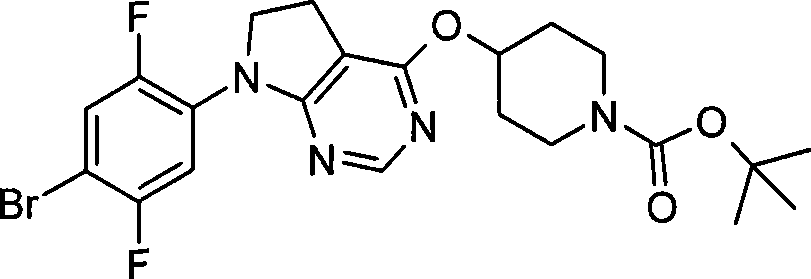
4-{[7-(4-溴-2,5-二氟苯基)-6,7-二氢-5H-吡咯并[2,3-d]嘧啶-4-基]氧基}-1-哌啶甲酸1,1-二甲基乙酯(62)4-{[7-(4-bromo-2,5-difluorophenyl)-6,7-dihydro-5H-pyrrolo[2,3-d]pyrimidin-4-yl]oxy}-1 - 1,1-dimethylethyl piperidinecarboxylic acid ( 62 )
将4-羟基-1-哌啶甲酸1,1-二甲基乙酯(109mg,0.546mmol)溶解在5mL无水THF中。往该溶液中加入NaH(60%分散在油中,72mg,1.8mmol)并在室温下将该混合物搅拌0.5小时。将化合物59(210mg,0.607mmol)溶解在5mL THF中并将其滴加至以上溶液中。随后将该混合物回流3小时。粗制反应混合物随后用10mL水稀释并用10mL二氯甲烷萃取三次。合并的有机萃取液经无水硫酸镁干燥,过滤,随后浓缩至干。得到的残余物经快速柱层析纯化(10→50%乙酸乙酯/己烷),得到176mg(60%)白色固体状的标题化合物62。1,1-Dimethylethyl 4-hydroxy-1-piperidinecarboxylate (109 mg, 0.546 mmol) was dissolved in 5 mL of anhydrous THF. To this solution was added NaH (60% in oil, 72 mg, 1.8 mmol) and the mixture was stirred at room temperature for 0.5 h. Compound 59 (210 mg, 0.607 mmol) was dissolved in 5 mL THF and added dropwise to the above solution. The mixture was then refluxed for 3 hours. The crude reaction mixture was then diluted with 10 mL of water and extracted three times with 10 mL of dichloromethane. The combined organic extracts were dried over anhydrous magnesium sulfate, filtered, and concentrated to dryness. The resulting residue was purified by flash column chromatography (10→50% ethyl acetate/hexanes) to afford 176 mg (60%) of the title compound 62 as a white solid.
1H NMR(400MHz,CDCl3):δ 1.46(s,9H),1.65-1.80(m,2H),1.90-2.03(m,2H),3.11(t,J=8.8Hz,2H),3.21-3.35(m,2H),3.68-3.82(m,2H),4.10(t,J=8.3Hz,2H),5.23-5.37(m,1H),7.28-7.37(m,1H),7.54-7.68(m,1H),8.19(s,1H);LCMS(ESI):m/z 512(M+H)+. 1 H NMR (400MHz, CDCl 3 ): δ 1.46(s, 9H), 1.65-1.80(m, 2H), 1.90-2.03(m, 2H), 3.11(t, J=8.8Hz, 2H), 3.21- 3.35(m, 2H), 3.68-3.82(m, 2H), 4.10(t, J=8.3Hz, 2H), 5.23-5.37(m, 1H), 7.28-7.37(m, 1H), 7.54-7.68( m, 1H), 8.19 (s, 1H); LCMS (ESI): m/z 512 (M+H) + .
实施例21(66)Example 21 ( 66 )
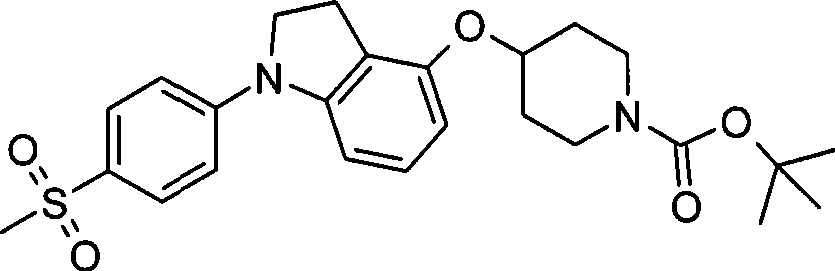
步骤1:4-(1H-吲哚-4-基氧基)-1-哌啶甲酸1,1-二甲基乙酯(63)Step 1: 1,1-dimethylethyl 4-(1H-indol-4-yloxy)-1-piperidinecarboxylate ( 63 )
在室温、N2下,往4-羟基吲哚(9.98g,75mmol)、Ph3P(39.4g,150mmol),4-羟基哌啶(22.25g,113mmol)和THF(600mL)的溶液中滴加偶氮二甲酸二异丙酯(26.0mL,135mmol)。在室温下将反应混合物搅拌15小时并浓缩,得到粗品。粗品经SiO2快速层析纯化(0→20%乙酸乙酯/己烷),得到17.6g(74%)白色固体状的标题化合物63。At room temperature under N 2 , drop into a solution of 4-oxindole (9.98g, 75mmol), Ph 3 P (39.4g, 150mmol), 4-hydroxypiperidine (22.25g, 113mmol) and THF (600mL) Add diisopropyl azodicarboxylate (26.0 mL, 135 mmol). The reaction mixture was stirred at room temperature for 15 hours and concentrated to give crude product. The crude product was purified by flash chromatography on SiO2 (0→20% ethyl acetate/hexanes) to afford 17.6 g (74%) of the title compound 63 as a white solid.
1H NMR(400MHz,DMSO-d6):δ 11.03(br s,1H),7.19(t,J=2.8Hz,1H),6.99-6.93(m,2H),6.54和6.53(dd,J1=7.2Hz,J2=1.2Hz,1H),6.41(app.t,J=2.4Hz,1H),4.63(m,1H),3.67-3.61(m,2H),3.26-3.21(m,2H),1.94-1.87(m,2H),1.64-1.52(m,2H),1.40(s,9H);LCMS(ESI):m/z 339(M+Na)+. 1 H NMR (400MHz, DMSO-d 6 ): δ 11.03 (br s, 1H), 7.19 (t, J=2.8Hz, 1H), 6.99-6.93 (m, 2H), 6.54 and 6.53 (dd, J 1 =7.2Hz, J 2 =1.2Hz, 1H), 6.41(app.t, J=2.4Hz, 1H), 4.63(m, 1H), 3.67-3.61(m, 2H), 3.26-3.21(m, 2H ), 1.94-1.87 (m, 2H), 1.64-1.52 (m, 2H), 1.40 (s, 9H); LCMS (ESI): m/z 339 (M+Na) + .
步骤2:4-{[1-(4-碘苯基)-1H-吲哚-4-基]氧基}-1-哌啶甲酸1,1-二甲基乙酯(64)Step 2: 1,1-dimethylethyl 4-{[1-(4-iodophenyl)-1H-indol-4-yl]oxy}-1-piperidinecarboxylate ( 64 )
在室温、N2下,往圆底烧瓶中装入化合物63(4.20g,13.3mmol)、CuI(253mg,1.3mmol)、K3PO4(5.92g,27.9mmol)、1,4-二碘苯(5.47g,16.6mmol)、反式-N,N′-二甲基-1,2-环己烷二胺(378mg,2.7mmol)和无水DMF(15mL)。在140℃下将反应混合物搅拌36小时。反应混合物用EtOAc(50mL)稀释并经Celite硅藻土垫过滤(用EtOAc洗涤)。将滤液减压浓缩,得到粗品。产物经快速柱层析纯化(0→20%乙酸乙酯/己烷),得到4.72g(69%)灰白色固体状的标题产物64。At room temperature, under N 2 , charge compound 63 (4.20 g, 13.3 mmol), CuI (253 mg, 1.3 mmol), K 3 PO 4 (5.92 g, 27.9 mmol), 1,4-diiodo Benzene (5.47 g, 16.6 mmol), trans-N,N'-dimethyl-1,2-cyclohexanediamine (378 mg, 2.7 mmol) and dry DMF (15 mL). The reaction mixture was stirred at 140°C for 36 hours. The reaction mixture was diluted with EtOAc (50 mL) and filtered through a pad of Celite (washing with EtOAc). The filtrate was concentrated under reduced pressure to obtain a crude product. The product was purified by flash column chromatography (0→20% ethyl acetate/hexanes) to afford 4.72 g (69%) of the title product 64 as an off-white solid.
1HNMR(400MHz,DMSO-d6):δ 7.88(t,J=8.8Hz,2H),7.51(d,J=3.2Hz,1H),7.39(d,J=8.8Hz,2H),7.12(t,J=5.6Hz,1H),7.09(t,J=8.0Hz,1H),6.72(d,J=7.2Hz,1H),6.70(d,J=3.2Hz,1H),4.70(m,1H),3.66-3.60(m,2H),3.28-3.24(m,2H),1.94-1.89(m,2H),1.66-1.58(m,2H),1.39(s,9H);LCMS(ESI):m/z 518(M+H)+. 1 HNMR (400MHz, DMSO-d 6 ): δ 7.88(t, J=8.8Hz, 2H), 7.51(d, J=3.2Hz, 1H), 7.39(d, J=8.8Hz, 2H), 7.12( t, J=5.6Hz, 1H), 7.09(t, J=8.0Hz, 1H), 6.72(d, J=7.2Hz, 1H), 6.70(d, J=3.2Hz, 1H), 4.70(m, 1H), 3.66-3.60(m, 2H), 3.28-3.24(m, 2H), 1.94-1.89(m, 2H), 1.66-1.58(m, 2H), 1.39(s, 9H); LCMS(ESI) : m/z 518(M+H) + .
步骤3:4-{[1-(4-碘苯基)-2,3-二氢-1H-吲哚-4-基]氧基}-1-哌啶甲酸1,1-二甲基乙酯(65)Step 3: 4-{[1-(4-Iodophenyl)-2,3-dihydro-1H-indol-4-yl]oxy}-1-
在室温下往64(330mg,0.64mmol)在乙酸(10mL)中的溶液中加入NaCNBH3(322mg,5.12mmol)。在室温下将该混合物搅拌15小时,随后将其缓慢倾入H2O(40mL)中并搅拌10分钟。过滤该固体并干燥,得到310mg(93%)灰白色固体状的标题产物65。To a solution of 64 (330 mg, 0.64 mmol) in acetic acid (10 mL) was added NaCNBH3 (322 mg, 5.12 mmol) at room temperature. The mixture was stirred at room temperature for 15 hours, then it was slowly poured into H2O (40 mL) and stirred for 10 minutes. The solid was filtered and dried to afford 310 mg (93%) of the title product 65 as an off-white solid.
1H NMR(400MHz,DMSO-d6):δ 7.59(t,J=8.4Hz,2H),7.02(d,J=8.8Hz,2H),6.99(app.t,J=8.0Hz,1H),6.71(d,J=8.0Hz,1H),6.49(d,J=8.4Hz,1H),4.54(m,1H),3.88(t,J=8.4Hz,2H),3.59-3.46(m,2H),3.24-3.19(m,2H),2.96(t,J=8.4Hz,2H),1.87-1.82(m,2H),1.57-1.49(m,2H),1.38(s,9H);LCMS(ESI):m/z 521(M+H)+. 1 H NMR (400MHz, DMSO-d 6 ): δ 7.59 (t, J=8.4Hz, 2H), 7.02 (d, J=8.8Hz, 2H), 6.99 (app.t, J=8.0Hz, 1H) , 6.71(d, J=8.0Hz, 1H), 6.49(d, J=8.4Hz, 1H), 4.54(m, 1H), 3.88(t, J=8.4Hz, 2H), 3.59-3.46(m, 2H), 3.24-3.19(m, 2H), 2.96(t, J=8.4Hz, 2H), 1.87-1.82(m, 2H), 1.57-1.49(m, 2H), 1.38(s, 9H); LCMS (ESI): m/z 521(M+H) + .
步骤4:4-({1-[4-(甲基磺酰基)苯基]-2,3-二氢-1H-吲哚-4-基}氧基)-1-哌啶甲酸1,1-二甲基乙酯(66)Step 4: 4-({1-[4-(Methylsulfonyl)phenyl]-2,3-dihydro-1H-indol-4-yl}oxy)-1-
往10mL玻璃管中装入65(260mg,0.50mmol)、MeSO2Na(102mg,1.0mmol)、L-脯氨酸(12mg,0.104mmol)、NaOH(5mg,0.104mmol)和DMSO(3mL)。将该管密封,随后在120℃下搅拌18小时。将反应混合物冷却,随后将管打开,随后将管中的内容物倾入H2O(40mL)中。该混合物搅拌10分钟,将固体物质过滤,随后经快速SiO2柱层析纯化并干燥,得到222mg(94%)灰白色固体状的标题产物66。A 10 mL glass tube was charged with 65 (260 mg, 0.50 mmol), MeSO 2 Na (102 mg, 1.0 mmol), L-proline (12 mg, 0.104 mmol), NaOH (5 mg, 0.104 mmol) and DMSO (3 mL). The tube was sealed, followed by stirring at 120°C for 18 hours. The reaction mixture was cooled, then the tube was opened and the contents of the tube were poured into H2O (40 mL). The mixture was stirred for 10 minutes and the solid material was filtered, then purified by flash SiO2 column chromatography and dried to afford 222 mg (94%) of the title product 66 as an off-white solid.
1H NMR(400MHz,DMSO-d6):δ 7.79(t,J=8.8Hz,2H),7.35(d,J=8.8Hz,2H),7.08(app.t,J=8.4Hz,1H),6.93(d,J=8.0Hz,1H),6.60(d,J=8.0Hz,1H),4.60-4.52(m,1H),4.01(t,J=8.8Hz,2H),3.61-3.55(m,2H),3.30-3.21(m,2H),3.13(s,3H),3.01(t,J=8.4Hz,2H),1.89-1.84(m,2H),1.39(s,9H);LCMS(ESI):m/z 495(M+Na)+. 1 H NMR (400MHz, DMSO-d 6 ): δ 7.79(t, J=8.8Hz, 2H), 7.35(d, J=8.8Hz, 2H), 7.08(app.t, J=8.4Hz, 1H) , 6.93(d, J=8.0Hz, 1H), 6.60(d, J=8.0Hz, 1H), 4.60-4.52(m, 1H), 4.01(t, J=8.8Hz, 2H), 3.61-3.55( m, 2H), 3.30-3.21(m, 2H), 3.13(s, 3H), 3.01(t, J=8.4Hz, 2H), 1.89-1.84(m, 2H), 1.39(s, 9H); LCMS (ESI): m/z 495(M+Na) + .
实施例22(69)Example 22 ( 69 )
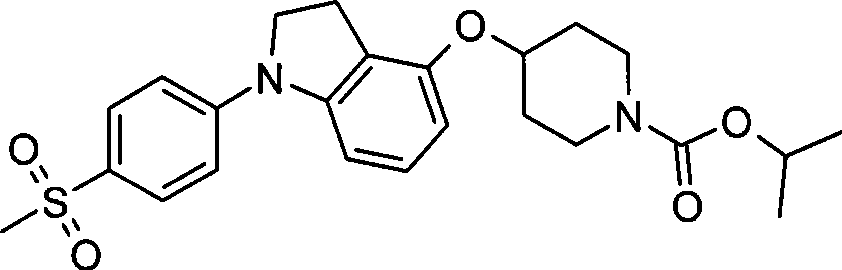
步骤1:4-{[1-(4-碘苯基)-1H-吲哚-4-基]氧基}-1-哌啶甲酸1-甲基乙酯(67)Step 1: 1-methylethyl 4-{[1-(4-iodophenyl)-1H-indol-4-yl]oxy}-1-piperidinecarboxylate ( 67 )
在室温、N2下,往64(3.150g,6.08mmol)在CH2Cl2(20mL)中的溶液中加入CF3CO2H(5mL)。在室温下将反应混合物搅拌2.5小时,随后减压浓缩,得到粗品。将粗品重新溶解在CH2Cl2(100mL)中并冷却至5℃。往以上混合物中依次加入DIPEA(3.2mL,18.2mmol)、DMAP(74mg,0.61mmol)和1M氯甲酸异丙酯在甲苯中的溶液(12.2mL,12.16mmol)。在室温下将该混合物搅拌15小时。反应混合物用CH2Cl2(150mL)稀释,随后用水(2 x 20mL)、盐水(1 x 20mL)洗涤,经Na2SO4干燥,过滤,随后将滤液减压浓缩,得到粗品。产物经SiO2柱层析纯化(0→20%乙酸乙酯/己烷),得到2.56g(83%)白色固体状的标题产物67。To a solution of 64 (3.150 g, 6.08 mmol) in CH2Cl2 (20 mL) was added CF3CO2H (5 mL) at room temperature under N2 . The reaction mixture was stirred at room temperature for 2.5 hours, then concentrated under reduced pressure to give the crude product. The crude product was redissolved in CH2Cl2 (100 mL ) and cooled to 5 °C. To the above mixture was added DIPEA (3.2 mL, 18.2 mmol), DMAP (74 mg, 0.61 mmol) and 1M solution of isopropyl chloroformate in toluene (12.2 mL, 12.16 mmol). The mixture was stirred at room temperature for 15 hours. The reaction mixture was diluted with CH 2 Cl 2 (150 mL), then washed with water (2 x 20 mL), brine (1 x 20 mL), dried over Na 2 SO 4 , filtered, and the filtrate was concentrated under reduced pressure to give the crude product. The product was purified by SiO2 column chromatography (0→20% ethyl acetate/hexanes) to afford 2.56 g (83%) of the title product 67 as a white solid.
1H NMR(400MHz,DMSO-d6):δ 7.88(d,J=8.8Hz,2H),7.51(d,J=3.2Hz,1H),7.39(d,J=8.4Hz,2H),7.12(app.t,J=8.0Hz,1H),7.10(app.t,J=8.0Hz,1H),6.72(d,J=7.2Hz,1H),6.70(d,J=3.2Hz,1H),4.76(七重峰,J=6.4Hz,1H),4.72(m,1H),3.69-3.63(m,2H),3.33-3.29(m,2H),1.99-1.90(m,2H),1.68-1.60(m,2H),1.18(d,J=6.4Hz,6H);LCMS(ESI):m/z 505(M+Na)+. 1 H NMR (400MHz, DMSO-d 6 ): δ 7.88 (d, J=8.8Hz, 2H), 7.51 (d, J=3.2Hz, 1H), 7.39 (d, J=8.4Hz, 2H), 7.12 (app.t, J=8.0Hz, 1H), 7.10(app.t, J=8.0Hz, 1H), 6.72(d, J=7.2Hz, 1H), 6.70(d, J=3.2Hz, 1H) , 4.76 (septet, J=6.4Hz, 1H), 4.72 (m, 1H), 3.69-3.63 (m, 2H), 3.33-3.29 (m, 2H), 1.99-1.90 (m, 2H), 1.68- 1.60 (m, 2H), 1.18 (d, J=6.4Hz, 6H); LCMS (ESI): m/z 505 (M+Na) + .
步骤2:4-{[1-(4-碘苯基)-2,3-二氢-1H-吲哚-4-基]氧基}-1-哌啶甲酸1-甲基乙酯(68)Step 2: 1-methylethyl 4-{[1-(4-iodophenyl)-2,3-dihydro-1H-indol-4-yl]oxy}-1-piperidinecarboxylate ( 68 )
在室温下往67(2.41g,4.78mmol)和乙酸(40mL)的溶液中加入NaCNBH3(3.00mg,47.8mmol)。在室温下将该混合物搅拌15小时,随后加入H2O(150mL)。该混合物用EtOAc(4 x 125mL)萃取。合并的有机层用盐水(1 x 50mL)洗涤,经Na2SO4干燥,过滤,随后将滤液减压浓缩。粗品经快速SiO2柱层析纯化(使用0→20%乙酸乙酯/己烷洗脱),得到2.31mg(95%)白色固体状的标题产物68。To a solution of 67 (2.41 g, 4.78 mmol) and acetic acid (40 mL) was added NaCNBH3 (3.00 mg, 47.8 mmol) at room temperature. The mixture was stirred at room temperature for 15 hours, then H2O (150 mL) was added. The mixture was extracted with EtOAc (4 x 125 mL). The combined organic layers were washed with brine ( 1 x 50 mL), dried over Na2SO4 , filtered, and the filtrate was concentrated under reduced pressure. The crude product was purified by flash SiO2 column chromatography (eluting with 0→20% ethyl acetate/hexanes) to afford 2.31 mg (95%) of the title product 68 as a white solid.
1H NMR(400MHz,DMSO-d6):δ 7.59(t,J=8.4Hz,2H),7.02(d,J=8.8Hz,2H),6.99(app.t,J=8.0Hz,1H),6.71(d,J=8.0Hz,1H),6.49(d,J=8.4Hz,1H),4.75(七重峰,J=5.6Hz,1H),4.56(m,1H),3.88(t,J=8.4Hz,2H),3.62-3.57(m,2H),3.31-3.20(m,2H),2.95(t,J=8.8Hz,2H),1.88-1.83(m,2H),1.58-1.50(m,2H),1.17(d,J=6.4Hz,6H);LCMS(ESI):m/z 507(M+H)+. 1 H NMR (400MHz, DMSO-d 6 ): δ 7.59 (t, J=8.4Hz, 2H), 7.02 (d, J=8.8Hz, 2H), 6.99 (app.t, J=8.0Hz, 1H) , 6.71(d, J=8.0Hz, 1H), 6.49(d, J=8.4Hz, 1H), 4.75(septet, J=5.6Hz, 1H), 4.56(m, 1H), 3.88(t, J =8.4Hz, 2H), 3.62-3.57(m, 2H), 3.31-3.20(m, 2H), 2.95(t, J=8.8Hz, 2H), 1.88-1.83(m, 2H), 1.58-1.50( m, 2H), 1.17 (d, J=6.4Hz, 6H); LCMS (ESI): m/z 507 (M+H) + .
步骤3:4-({1-[4-(甲基磺酰基)苯基]-2,3-二氢-1H-吲哚-4-基}氧基)-1-哌啶甲酸1-甲基乙酯(69)Step 3: 4-({1-[4-(Methylsulfonyl)phenyl]-2,3-dihydro-1H-indol-4-yl}oxy)-1-piperidinecarboxylic acid 1-methyl Ethyl ester ( 69 )
采用所述用于制备3的方法。往10mL玻璃管中加入68(720mg,1.42mmol)、MeSO2Na(290mg,2.84mmol)、L-脯氨酸(33mg,0.284mmol)、NaOH(12mg,0.284mmol)和DMSO(5mL)。将该管密封,随后加热至120℃并搅拌24小时。将反应混合物冷却,打开,随后将其倾入H2O中。将该混合物搅拌10分钟,将该固体物质过滤并经快速SiO2柱层析纯化,得到632mg(97%)灰白色固体状的标题产物69。The procedure described for
1H NMR(400MHz,DMSO-d6):δ 7.79(t,J=8.8Hz,2H),7.35(d,J=8.8Hz,2H),7.08(app.t,J=8.4Hz,1H),6.93(d,J=8.0Hz,1H),6.60(d,J=8.4Hz,1H),4.75(七重峰,J=6.0Hz,1H),4.60(m,1H),4.01(t,J=8.8Hz,2H),3.60-3.55(m,2H),3.28-3.26(m,2H),3.13(s,3H),3.01(t,J=8.4Hz,2H),1.89-1.60(m,2H),1.59-1.52(m,2H),1.17(d,J=6.4Hz,6H);LCMS(ESI):m/z 458(M+H)+. 1 H NMR (400MHz, DMSO-d 6 ): δ 7.79(t, J=8.8Hz, 2H), 7.35(d, J=8.8Hz, 2H), 7.08(app.t, J=8.4Hz, 1H) , 6.93(d, J=8.0Hz, 1H), 6.60(d, J=8.4Hz, 1H), 4.75(septet, J=6.0Hz, 1H), 4.60(m, 1H), 4.01(t, J =8.8Hz, 2H), 3.60-3.55(m, 2H), 3.28-3.26(m, 2H), 3.13(s, 3H), 3.01(t, J=8.4Hz, 2H), 1.89-1.60(m, 2H), 1.59-1.52 (m, 2H), 1.17 (d, J=6.4Hz, 6H); LCMS (ESI): m/z 458 (M+H) + .
实施例23(70)Example 23 ( 70 )
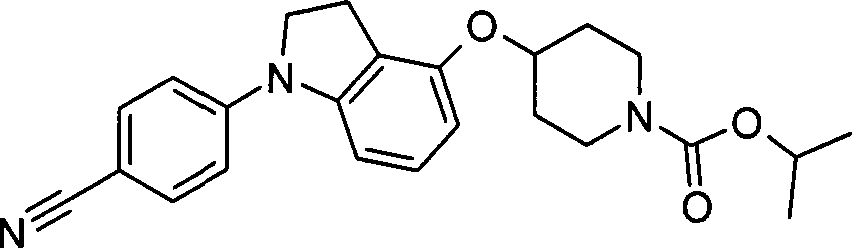
4-{[1-(4-氰基苯基)-2,3-二氢-1H-吲哚-4-基]氧基}-1-哌啶甲酸1-甲基乙酯(70)1-methylethyl 4-{[1-(4-cyanophenyl)-2,3-dihydro-1H-indol-4-yl]oxy}-1-piperidinecarboxylate ( 70 )
采用所述用于制备31(实施例10,步骤7)的方法,使用在NMP(10mL)中68(507mg,1mmol)和CuCN(202mg,2.25mmol)于150℃下加热15小时。该混合物经SiO2快速柱层析纯化,得到388mg(96%)白色固体状的标题产物70。Following the procedure described for the preparation of 31 (Example 10, Step 7), 68 (507 mg, 1 mmol) and CuCN (202 mg, 2.25 mmol) in NMP (10 mL) were heated at 150 °C for 15 h. The mixture was purified by SiO2 flash column chromatography to afford 388 mg (96%) of the
1H NMR(400MHz,DMSO-d6):δ 7.70(t,J=8.8Hz,2H),7.28(d,J=8.8Hz,2H),7.08(app.t,J=8.4Hz,1H),6.91(d,J=8.0Hz,1H),6.61(d,J=8.4Hz,1H),4.75(七重峰,J=6.4Hz,1H),4.59(m,1H),3.99(t,J=8.4Hz,2H),3.60-3.57(m,2H),3.30-3.26(m,2H),3.00(t,J=8.8Hz,2H),1.89-1.84(m,2H),1.60-1.50(m,2H),1.38(d,J=6.4Hz,6H);LCMS(ESI):m/z 406(M+H)+. 1 H NMR (400MHz, DMSO-d 6 ): δ 7.70(t, J=8.8Hz, 2H), 7.28(d, J=8.8Hz, 2H), 7.08(app.t, J=8.4Hz, 1H) , 6.91(d, J=8.0Hz, 1H), 6.61(d, J=8.4Hz, 1H), 4.75(septet, J=6.4Hz, 1H), 4.59(m, 1H), 3.99(t, J =8.4Hz, 2H), 3.60-3.57(m, 2H), 3.30-3.26(m, 2H), 3.00(t, J=8.8Hz, 2H), 1.89-1.84(m, 2H), 1.60-1.50( m, 2H), 1.38 (d, J=6.4Hz, 6H); LCMS (ESI): m/z 406 (M+H) + .
实施例24(71)Example 24 ( 71 )
4-({1-[4-(1,3-噻唑-2-基)苯基]-2,3-二氢-1H-吲哚-4-基}氧基)-1-哌啶甲酸1-甲基乙酯(71)4-({1-[4-(1,3-thiazol-2-yl)phenyl]-2,3-dihydro-1H-indol-4-yl}oxy)-1-piperidinecarboxylic acid 1 -Methyl ethyl ester ( 71 )
采用所述用于制备32(实施例11)的方法。在室温、N2下,往圆底烧瓶中装入68(100mg,0.20mmol)、PdCl2(Ph3P)2(7mg,0.001mmol)、2-(三丁基甲锡烷基)-1,3-噻唑(110mg,0.296mmol)和THF(3mL)。将反应混合物回流15小时。将反应混合物冷却至室温,随后层析,得到52mg(57%)白色固体状的标题产物71。The procedure described for the preparation of 32 (Example 11) was followed. At room temperature, under N 2 , charge 68 (100 mg, 0.20 mmol), PdCl 2 (Ph 3 P) 2 (7 mg, 0.001 mmol), 2-(tributylstannyl)-1,3 - Thiazole (110 mg, 0.296 mmol) and THF (3 mL). The reaction mixture was refluxed for 15 hours. The reaction mixture was cooled to room temperature and then chromatographed to afford 52 mg (57%) of the title product 71 as a white solid.
1H NMR(400MHz,DMSO-d6):δ 7.88(t,J=8.8Hz,2H),7.83(d,J=3.2Hz,2H),7.65(app.t,J=3.2Hz,1H),7.28(d,J=8.8Hz,1H),7.05(d,J=8.0Hz,1H),6.86(d,J=8.4Hz,1H),7.05(t,J=8.4Hz,1H),6.86(d,J=8.4Hz,1H),6.54(d,J=8.4Hz,1H),4.76(七重峰,J=6.4Hz,1H),4.58(m,1H),3.99(t,J=8.8Hz,2H),3.64-3.58(m,2H),3.29-3.25(m,2H),3.00(t,J=8.8Hz,2H),1.89-1.85(m,2H),1.59-1.50(m,2H),1.17(d,J=6.4Hz,6H);LCMS(ESI):m/z 464(M+H)+. 1 H NMR (400MHz, DMSO-d 6 ): δ 7.88 (t, J=8.8Hz, 2H), 7.83 (d, J=3.2Hz, 2H), 7.65 (app.t, J=3.2Hz, 1H) , 7.28(d, J=8.8Hz, 1H), 7.05(d, J=8.0Hz, 1H), 6.86(d, J=8.4Hz, 1H), 7.05(t, J=8.4Hz, 1H), 6.86 (d, J = 8.4Hz, 1H), 6.54 (d, J = 8.4Hz, 1H), 4.76 (septet, J = 6.4Hz, 1H), 4.58 (m, 1H), 3.99 (t, J = 8.8 Hz, 2H), 3.64-3.58(m, 2H), 3.29-3.25(m, 2H), 3.00(t, J=8.8Hz, 2H), 1.89-1.85(m, 2H), 1.59-1.50(m, 2H), 1.17 (d, J=6.4Hz, 6H); LCMS (ESI): m/z 464 (M+H) + .
实施例25(74)Example 25 ( 74 )
步骤1:4-(2,3-二氢-1H-吲哚-4-基氧基)-1-哌啶甲酸1,1-二甲基乙酯(72)Step 1: 1,1-dimethylethyl 4-(2,3-dihydro-1H-indol-4-yloxy)-1-piperidinecarboxylate ( 72 )
采用所述用于制备65(实施例21,步骤3)的还原方法,在环境温度下使用化合物63(1.30g,4.11mmol)、NaCNBH3(2.58g,41.0mmol)和AcOH(40mL)。水后处理,随后纯化,得到0.84g(64%)灰白色固体状的标题产物72。LCMS(ESI):m/z 319(M+H)+。Following the reduction procedure described for the preparation of 65 (Example 21, Step 3), compound 63 (1.30 g, 4.11 mmol), NaCNBH3 (2.58 g, 41.0 mmol) and AcOH (40 mL) were used at ambient temperature. Aqueous workup followed by purification afforded 0.84 g (64%) of the title product 72 as an off-white solid. LCMS (ESI): m/z 319 (M+H) + .
步骤2:4-{[1-(5-溴-2-嘧啶基)-2,3-二氢-1H-吲哚-4-基]氧基}-1-哌啶甲酸1,1-二甲基乙酯(73)Step 2: 4-{[1-(5-Bromo-2-pyrimidinyl)-2,3-dihydro-1H-indol-4-yl]oxy}-1-
在环境温度、N2下,往72(637mg,2mmol)在乙腈(40mL)中的溶液中加入DIPEA(1.1mL)和5-溴-2-氯嘧啶(483mg,2.5mmol)。将该混合物回流15小时,随后减压浓缩。粗品经SiO2快速柱层析纯化,得到60mg(6%)白色固体状的标题产物73。To a solution of 72 (637 mg, 2 mmol) in acetonitrile (40 mL) was added DIPEA (1.1 mL) and 5-bromo-2-chloropyrimidine (483 mg, 2.5 mmol) at ambient temperature under N2 . The mixture was refluxed for 15 hours, then concentrated under reduced pressure. The crude product was purified by flash column chromatography on SiO2 to afford 60 mg (6%) of the title product 73 as a white solid.
1H NMR(400MHz,DMSO-d6):δ 8.67(s,2H),7.84(d,J=8.0Hz,1H),7.13(t,J=8.4Hz,1H),6.68(d,J=8.4Hz,1 1 H NMR (400MHz, DMSO-d 6 ): δ 8.67(s, 2H), 7.84(d, J=8.0Hz, 1H), 7.13(t, J=8.4Hz, 1H), 6.68(d, J= 8.4Hz, 1
H),4.58(m,1H),4.13(t,J=8.8Hz,2H),3.60-3.54(m,2H),3.30-3.19(m,2H),3.04(t,J=8.8Hz,2H),1.89-1.80(m,2H),1.60-1.51(m,2H),1.38(s,9H);LCMS(ESI):m/z 498(M+Na)+.H), 4.58(m, 1H), 4.13(t, J=8.8Hz, 2H), 3.60-3.54(m, 2H), 3.30-3.19(m, 2H), 3.04(t, J=8.8Hz, 2H ), 1.89-1.80 (m, 2H), 1.60-1.51 (m, 2H), 1.38 (s, 9H); LCMS (ESI): m/z 498 (M+Na) + .
步骤3:4-({1-[5-(甲基磺酰基)-2-嘧啶基]-2,3-二氢-1H-吲哚-4-基}氧基)-1-哌啶甲酸1,1-二甲基乙酯(74)Step 3: 4-({1-[5-(Methylsulfonyl)-2-pyrimidinyl]-2,3-dihydro-1H-indol-4-yl}oxy)-1-
采用所述用于制备3(实施例1,步骤3)的方法,使用73(45mg,0.095mmol)、CuI(2mg,0.01mmol)、L-脯氨酸(3mg,0.02mmol)、NaOH(1mg,0.02mmol)、CH3SO2Na(20mg,0.19mmol)和DMSO(2mL)。将该混合物加热至110℃并保持24小时,随后将其倾入H2O(20mL)中。将该固体过滤并干燥,得到44mg(98%)浅黄色固体状的标题产物74。Using the method described for the preparation of 3 (Example 1, Step 3), 73 (45 mg, 0.095 mmol), CuI (2 mg, 0.01 mmol), L-proline (3 mg, 0.02 mmol), NaOH (1 mg , 0.02 mmol), CH 3 SO 2 Na (20 mg, 0.19 mmol) and DMSO (2 mL). The mixture was heated to 110° C. for 24 h, then poured into H 2 O (20 mL). The solid was filtered and dried to afford 44 mg (98%) of the title product 74 as a pale yellow solid.
1H NMR(400MHz,DMSO-d6):δ 8.91(s,2H),7.97(d,J=8.4Hz,1H),7.19(t,J=8.4Hz,1H),6.78(d,J=8.0Hz,1H),4.62(m,1H),4.25(t,J=8.4Hz,2H),3.62-3.53(m,2H),3.28(s,3H),3.27-3.23(m,2H),3.08(t,J=8.8Hz,2H),3.89-3.82(m,2H),1.60-1.52(m,2H),1.39(s,9H);LCMS(ESI):m/z 497(M+Na)+. 1 H NMR (400MHz, DMSO-d 6 ): δ 8.91(s, 2H), 7.97(d, J=8.4Hz, 1H), 7.19(t, J=8.4Hz, 1H), 6.78(d, J= 8.0Hz, 1H), 4.62(m, 1H), 4.25(t, J=8.4Hz, 2H), 3.62-3.53(m, 2H), 3.28(s, 3H), 3.27-3.23(m, 2H), 3.08 (t, J=8.8Hz, 2H), 3.89-3.82 (m, 2H), 1.60-1.52 (m, 2H), 1.39 (s, 9H); LCMS (ESI): m/z 497 (M+Na ) + .
实施例26(75)Example 26 ( 75 )
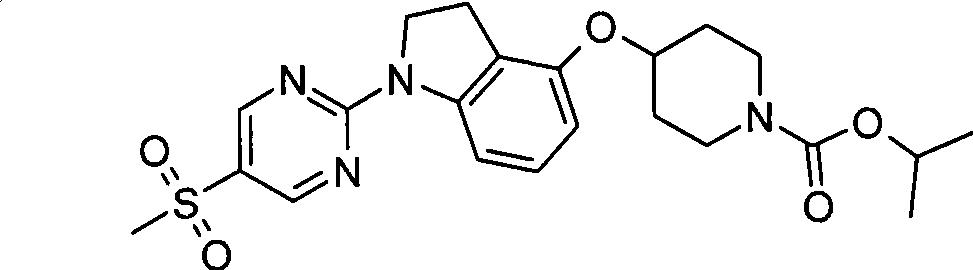
4-({1-[5-(甲基磺酰基)-2-嘧啶基]-2,3-二氢-1H-吲哚-4-基}氧基)-1-哌啶甲酸1-甲基乙酯(75)4-({1-[5-(methylsulfonyl)-2-pyrimidinyl]-2,3-dihydro-1H-indol-4-yl}oxy)-1-piperidinecarboxylic acid 1-methyl Ethyl ester ( 75 )
往74(30mg,0.063mmol)和CH2Cl2(8mL)的混合物中加入CF3COOH(2mL)。在室温、N2下,将该混合物搅拌2小时,随后减压浓缩。将粗制物质重新溶解在CH2Cl2(4mL)中并依次加入DIPEA(50μL,0.38mmol)、DMAP(8mg,0.006mmol)和1M在甲苯中的氯甲酸异丙酯溶液(250μL,0.252mmol)。在室温下将该混合物搅拌15小时。标准后处理,随后纯化,得到28mg(96%)白色固体状的标题产物75。To a mixture of 74 (30 mg, 0.063 mmol) and CH2Cl2 (8 mL) was added CF3COOH (2 mL). The mixture was stirred at room temperature under N2 for 2 h, then concentrated under reduced pressure. The crude material was redissolved in CH 2 Cl 2 (4 mL) and DIPEA (50 μL, 0.38 mmol), DMAP (8 mg, 0.006 mmol) and 1M isopropyl chloroformate in toluene (250 μL, 0.252 mmol) were added sequentially. ). The mixture was stirred at room temperature for 15 hours. Standard workup followed by purification afforded 28 mg (96%) of the title product 75 as a white solid.
1H NMR(400MHz,DMSO-d6):δ 8.91(s,2H),7.97(d,J=8.4Hz,1H),7.20(t,J=8.0Hz,1H),6.78(d,J=8.4Hz,1H),4.76(七重峰,J=6.4Hz,1H),4.63(m,1H),4.25(t,J=8.8Hz,2H),3.65-3.56(m,2H),3.29-3.23(m,2H),3.28(s,3H),3.08(t,J=8.4Hz,2H),1.92-1.84(m,2H),1.60-1.52(m,2H),1.17(d,J=6.0Hz,6H);LCMS(ESI):m/z 461(M+H)+. 1 H NMR (400MHz, DMSO-d 6 ): δ 8.91(s, 2H), 7.97(d, J=8.4Hz, 1H), 7.20(t, J=8.0Hz, 1H), 6.78(d, J= 8.4Hz, 1H), 4.76(septet, J=6.4Hz, 1H), 4.63(m, 1H), 4.25(t, J=8.8Hz, 2H), 3.65-3.56(m, 2H), 3.29-3.23 (m, 2H), 3.28(s, 3H), 3.08(t, J=8.4Hz, 2H), 1.92-1.84(m, 2H), 1.60-1.52(m, 2H), 1.17(d, J=6.0 Hz, 6H); LCMS (ESI): m/z 461 (M+H) + .
实施例27(76)Example 27 ( 76 )

4-[(1-{4-[双(丁基氧基)磷酰基]苯基}-2,3-二氢-1H-吲哚-4-基)氧基]-1-哌啶甲酸1-甲基乙酯(76)4-[(1-{4-[bis(butyloxy)phosphoryl]phenyl}-2,3-dihydro-1H-indol-4-yl)oxy]-1-piperidinecarboxylic acid 1 -Methyl ethyl ester ( 76 )
将烘箱干燥的10mL圆底烧瓶抽真空并充入N2,装入CuI(4mg,0.02mmol),随后装入无水甲苯(3mL)、膦酸二丁酯(48mg,0.248mmol)、N,N-二甲基乙二胺(4μL,0.04mmol)和化合物68(100mg,0.197mmol)。在110℃下将密封管搅拌24小时。将得到的悬浮液冷却至室温,用H2O稀释,随后该混合物用EtOAC萃取。将合并的有机萃取液干燥,随后减压浓缩。产物经SiO2快速柱层析纯化,得到78mg(69%)白色固体状的标题产物76。An oven-dried 10 mL round bottom flask was evacuated and filled with N2 , charged with CuI (4 mg, 0.02 mmol), followed by anhydrous toluene (3 mL), dibutyl phosphonate (48 mg, 0.248 mmol), N, N-Dimethylethylenediamine (4 μL, 0.04 mmol) and compound 68 (100 mg, 0.197 mmol). The sealed tube was stirred at 110°C for 24 hours. The resulting suspension was cooled to room temperature, diluted with H2O , and the mixture was extracted with EtOAC. The combined organic extracts were dried and concentrated under reduced pressure. The product was purified by SiO2 flash column chromatography to afford 78 mg (69%) of the title product 76 as a white solid.
1H NMR(400MHz,DMSO-d6):δ 7.61(d,J=8.4Hz,1H),7.58(d,J=8.8Hz,1H),7.30(d,J=3.2Hz,1H),7.27(d,J=3.2Hz,1H),7.06(app.t,J=8.0Hz,1H),6.89(d,J=8.0Hz,1H),6.57(d,J=8.0Hz,1H),4.75(m,1H),4.58(m,1H),3.98(t,J=8.8Hz,2H),3.93-3.85(m,4H),3.62-3.57(m,2H),3.30-3.25(m,2H),2.99(t,J=8.4Hz,2H),1.89-1.84(m,2H),1.58-1.51(m,6H),1.31(m,J=7.6Hz,4H),1.17(d,J=6.0Hz,6H),0.84(t,J=7.6Hz,6H);LCMS(ESI):m/z 573(M+H)+. 1 H NMR (400MHz, DMSO-d 6 ): δ 7.61 (d, J=8.4Hz, 1H), 7.58 (d, J=8.8Hz, 1H), 7.30 (d, J=3.2Hz, 1H), 7.27 (d, J=3.2Hz, 1H), 7.06 (app.t, J=8.0Hz, 1H), 6.89 (d, J=8.0Hz, 1H), 6.57 (d, J=8.0Hz, 1H), 4.75 (m, 1H), 4.58(m, 1H), 3.98(t, J=8.8Hz, 2H), 3.93-3.85(m, 4H), 3.62-3.57(m, 2H), 3.30-3.25(m, 2H ), 2.99(t, J=8.4Hz, 2H), 1.89-1.84(m, 2H), 1.58-1.51(m, 6H), 1.31(m, J=7.6Hz, 4H), 1.17(d, J= 6.0Hz, 6H), 0.84 (t, J=7.6Hz, 6H); LCMS (ESI): m/z 573 (M+H) + .
实施例28(77)Example 28 ( 77 )
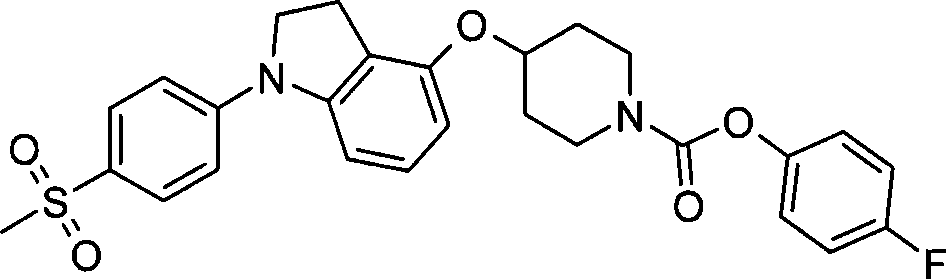
4-({1-[4-(甲基磺酰基)苯基]-2,3-二氢-1H-吲哚-4-基}氧基)-1-哌啶甲酸4-氟苯酯(77)4-({1-[4-(methylsulfonyl)phenyl]-2,3-dihydro-1H-indol-4-yl}oxy)-1-piperidinecarboxylic acid 4-fluorophenyl ester ( 77 )
化合物66(42mg,0.089mmol)用浓HCl(5mL)处理并在室温下搅拌5小时。将该混合物倾入26%NH4OH水溶液(25mL)中并将该混合物用EtOAC(4 x 20mL)萃取。合并的有机层用盐水(1 x 12mL)洗涤,经Na2SO4干燥,过滤,随后将滤液减压浓缩。将粗品溶解在CH2Cl2中,随后依次加入DIPEA(47μL,0.27mmol)和氯甲酸4-氟苯酯(88mg,0.45mmol)。在室温下将该混合物搅拌15小时。水后处理,随后纯化,得到29mg(64%)白色固体状的标题产物77。Compound 66 (42 mg, 0.089 mmol) was treated with concentrated HCl (5 mL) and stirred at room temperature for 5 hours. The mixture was poured into 26% aqueous NH4OH (25 mL) and the mixture was extracted with EtOAC (4 x 20 mL). The combined organic layers were washed with brine ( 1 x 12 mL), dried over Na2SO4 , filtered, and the filtrate was concentrated under reduced pressure. The crude product was dissolved in CH2Cl2 , followed by the addition of DIPEA (47 μL, 0.27 mmol) followed by 4 - fluorophenyl chloroformate (88 mg, 0.45 mmol). The mixture was stirred at room temperature for 15 hours. Aqueous workup followed by purification afforded 29 mg (64%) of the title product 77 as a white solid.
1HNMR(400MHz,DMSO-d6):δ 7.80(d,J=8.8Hz,2H),7.36(d,J=9.2Hz,2H),7.22-7.14(m,4H),7.10(t,J=8.0Hz,1H),6.94(d,J=8.0Hz,1H),6.64(d,J=8.4Hz,1H),4.68(m,1H),4.03(t,J=8.4Hz,2H),3.79(app.br s,1H),3.65(app.br s,1H),3.54(app.br s,1H),3.40(app.br s,1H),3.13(s,3H),3.05(t,J=8.4Hz,2H),1.96(app.br s,2H),1.71(app.br s,2H);LCMS(ESI):m/z 511(M+H)+. 1 HNMR (400MHz, DMSO-d 6 ): δ 7.80 (d, J = 8.8Hz, 2H), 7.36 (d, J = 9.2Hz, 2H), 7.22-7.14 (m, 4H), 7.10 (t, J =8.0Hz, 1H), 6.94(d, J=8.0Hz, 1H), 6.64(d, J=8.4Hz, 1H), 4.68(m, 1H), 4.03(t, J=8.4Hz, 2H), 3.79(app.br s, 1H), 3.65(app.br s, 1H), 3.54(app.br s, 1H), 3.40(app.br s, 1H), 3.13(s, 3H), 3.05(t , J=8.4Hz, 2H), 1.96 (app.br s, 2H), 1.71 (app.br s, 2H); LCMS (ESI): m/z 511 (M+H) + .
实施例29(80)Example 29 ( 80 )
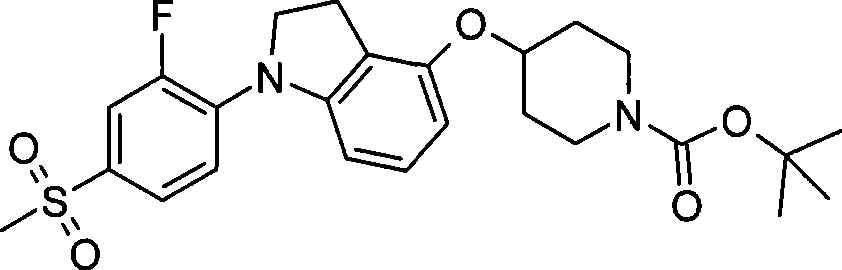
步骤1:4-{[1-(4-溴-2-氟苯基)-1H-吲哚-4-基]氧基}-1-哌啶甲酸1,1-二甲基乙酯(78)Step 1: 1,1-dimethylethyl 4-{[1-(4-bromo-2-fluorophenyl)-1H-indol-4-yl]oxy}-1-piperidinecarboxylate ( 78 )
在N2下往圆底烧瓶中装入化合物63(1.90g,6.0mmol)、CuI(171mg,0.9mmol)、K2CO3(1.66g,12mmol)、4-溴-2-氟-1-碘苯(3.61g,12mmol)和无水DMSO(20mL)。在110℃下将反应混合物搅拌60小时。该混合物冷却至室温,用EtOAC稀释,过滤并将滤液减压浓缩,得到粗品,其经快速柱层析纯化,得到1.96g(75%)两种产物的混合的标题产物78。该物质无需纯化直接用于下一步骤。A round bottom flask was charged with compound 63 (1.90 g, 6.0 mmol), CuI (171 mg, 0.9 mmol), K 2 CO 3 (1.66 g, 12 mmol), 4-bromo-2-fluoro-1- Iodobenzene (3.61 g, 12 mmol) and anhydrous DMSO (20 mL). The reaction mixture was stirred at 110°C for 60 hours. The mixture was cooled to room temperature, diluted with EtOAc, filtered and the filtrate was concentrated under reduced pressure to give a crude product which was purified by flash column chromatography to give 1.96 g (75%) of the title product 78 as a mixture of the two products. This material was used directly in the next step without purification.
步骤2:4-({1-[2-氟-4-(甲基磺酰基)苯基]-1H-吲哚-4-基}氧基)-1-哌啶甲酸1,1-二甲基乙酯(79)Step 2: 4-({1-[2-fluoro-4-(methylsulfonyl)phenyl]-1H-indol-4-yl}oxy)-1-
采用所述用于制备3(实施例1,步骤3)的方法,使用78(1.34g,3.08mmol)、CuI(58mg,0.30mmol)、L-脯氨酸(71mg,0.60mmol),NaOH(24mg,0.60mmol)、CH3SO2Na(471mg,4.6mmol)和DMSO(4mL)。水后处理,随后纯化,得到630mg(42%)白色固体状的标题产物79。Using the method described for the preparation of 3 (Example 1, Step 3), 78 (1.34 g, 3.08 mmol), CuI (58 mg, 0.30 mmol), L-proline (71 mg, 0.60 mmol), NaOH ( 24 mg, 0.60 mmol), CH3SO2Na (471 mg, 4.6 mmol) and DMSO (4 mL) . Aqueous workup followed by purification afforded 630 mg (42%) of the title product 79 as a white solid.
1H NMR(400MHz,DMSO-d6):δ 8.10(app.d,J=10.8Hz,1H),7.92(m,2H),7.51(app.t,J=2.0Hz,1H),7.12(app.t,J=8.0Hz,1H),6.92and6.90(dd,J1=8.0Hz,J2=2.4Hz,1H),6.78-6.76(m,2H),4.72(m,1H),3.67-3.62(m,2H),3.45(s,3H),3.30-3.22(m,2H),1.97-1.91(m,2H),1.67-1.60(m,2H),1.40(s,9H);LCMS(ESI):m/z 511(M+Na)+. 1 H NMR (400MHz, DMSO-d 6 ): δ 8.10 (app.d, J=10.8Hz, 1H), 7.92 (m, 2H), 7.51 (app.t, J=2.0Hz, 1H), 7.12( app.t, J=8.0Hz, 1H), 6.92and6.90(dd, J1 =8.0Hz, J2 =2.4Hz, 1H), 6.78-6.76(m, 2H), 4.72(m, 1H), 3.67-3.62(m, 2H), 3.45(s, 3H), 3.30-3.22(m, 2H), 1.97-1.91(m, 2H), 1.67-1.60(m, 2H), 1.40(s, 9H); LCMS (ESI): m/z 511 (M+Na) + .
步骤3:4-({1-[2-氟-4-(甲基磺酰基)苯基]-2,3-二氢-1H-吲哚-4-基}氧基)-1-哌啶甲酸1,1-二甲基乙酯(80)Step 3: 4-({1-[2-Fluoro-4-(methylsulfonyl)phenyl]-2,3-dihydro-1H-indol-4-yl}oxy)-1-
采用所述用于制备65(实施例21,步骤3)的方法,使用79(70mg,0.14mmol)、NaCNBH3(45mg,0.72mmol)和乙酸(2mL)。水后处理,得到粗制混合物,其为产物与原料的3:1混合物(约50mg)。在室温下将18mg部分该混合物用在AcOH(3mL)中的NaCNBH3(37mg)再处理48小时。水后处理,随后经二氧化硅快速柱层析纯化,得到13mg白色固体状的标题产物80。Following the procedure described for the preparation of 65 (Example 21, Step 3), 79 (70 mg, 0.14 mmol), NaCNBH3 (45 mg, 0.72 mmol) and acetic acid (2 mL) were used. Aqueous workup gave the crude mixture as a 3:1 mixture of product and starting material (ca. 50 mg). An 18 mg portion of this mixture was treated with NaCNBH3 (37 mg) in AcOH (3 mL) for an additional 48 hours at room temperature. Aqueous workup followed by silica flash column chromatography afforded 13 mg of the
1H NMR(400MHz,DMSO-d6):δ 7.81和7.78(dd,J1=11.6Hz,J2=2.4Hz,1H),7.69和7.67(dd,J1=8.4Hz,J2=2.0Hz,1H),7.59(app.t,J=8.4Hz,1H),7.03(app.t,J=8.4Hz,1H),6.56(d,J=8.4Hz,1H),6.37和6.35(dd,J1=7.6Hz,J2=4.4Hz,1H),4.60-4.52(m,1H),4.0(t,J=8.0Hz,2H),3.62-3.53(m,2H),3.22(s,3H),3.29-3.19(m,2H),3.02(t,J=8.4Hz,3H),1.89-1.84(m,2H),1.56-1.50(m,2H),1.51(s,9H);LCMS(ESI):m/z 513(M+Na)+. 1 H NMR (400 MHz, DMSO-d 6 ): δ 7.81 and 7.78 (dd, J 1 =11.6 Hz, J 2 =2.4 Hz, 1H), 7.69 and 7.67 (dd, J 1 =8.4 Hz, J 2 =2.0 Hz, 1H), 7.59(app.t, J=8.4Hz, 1H), 7.03(app.t, J=8.4Hz, 1H), 6.56(d, J=8.4Hz, 1H), 6.37 and 6.35(dd , J 1 =7.6Hz, J 2 =4.4Hz, 1H), 4.60-4.52(m, 1H), 4.0(t, J=8.0Hz, 2H), 3.62-3.53(m, 2H), 3.22(s, 3H), 3.29-3.19(m, 2H), 3.02(t, J=8.4Hz, 3H), 1.89-1.84(m, 2H), 1.56-1.50(m, 2H), 1.51(s, 9H); LCMS (ESI): m/z 513(M+Na) + .
实施例30(82)Example 30 ( 82 )

步骤1:4-({1-[2-氟-4-(甲基磺酰基)苯基]-1H-吲哚-4-基}氧基)-1-哌啶甲酸1-甲基乙酯(81)Step 1: 1-methylethyl 4-({1-[2-fluoro-4-(methylsulfonyl)phenyl]-1H-indol-4-yl}oxy)-1-piperidinecarboxylate ( 81 )
在室温、N2下,往79(200mg,0.409mmol)在CH2Cl2(20mL)中的溶液中加入CF3COOH(5mL)并将得到的反应混合物搅拌2小时。将该混合物减压浓缩并干燥。将粗制物质重新溶解在CH2Cl2中并冷却至5℃。往以上混合物中加入DIPEA(213μL,1.22mmol)和1M氯甲酸异丙酯(约1mL)在甲苯中的混合物。在室温下将该混合物搅拌l小时。标准后处理,随后纯化,得到155mg(80%)白色固体状的标题产物81。To a solution of 79 (200 mg, 0.409 mmol) in CH2Cl2 (20 mL) was added CF3COOH (5 mL) at room temperature under N2 and the resulting reaction mixture was stirred for 2 h. The mixture was concentrated under reduced pressure and dried. The crude material was redissolved in CH2Cl2 and cooled to 5 °C. To the above mixture was added a mixture of DIPEA (213 μL, 1.22 mmol) and 1 M isopropyl chloroformate (ca. 1 mL) in toluene. The mixture was stirred at room temperature for 1 hour. Standard workup followed by purification afforded 155 mg (80%) of the title product 81 as a white solid.
1H NMR(400MHz,DMSO-d6):δ 8.10(app.d,J=10.8Hz,1H),7.93-7.92(m,2H),7.51(t,J=2.0Hz,1H),7.12(t,J=8.0Hz,1H),6.93和6.91(dd,J1=8.4Hz,J2=2.4Hz,1H),6.78-6.76(m,2H),4.80-4.70(m,2H),3.70-3.65(m,2H),3.35(s,3H),3.32-3.29(br m,2H),1.97-1.92(m,2H),1.69-1.61(m,2H),1.18(d,J=6.0Hz,2H);LCMS(ESI):m/z 475(M+H)+. 1 H NMR (400MHz, DMSO-d 6 ): δ 8.10 (app.d, J=10.8Hz, 1H), 7.93-7.92 (m, 2H), 7.51 (t, J=2.0Hz, 1H), 7.12( t, J=8.0Hz, 1H), 6.93 and 6.91 (dd, J1 =8.4Hz, J2 =2.4Hz, 1H), 6.78-6.76(m, 2H), 4.80-4.70(m, 2H), 3.70 -3.65(m, 2H), 3.35(s, 3H), 3.32-3.29(br m, 2H), 1.97-1.92(m, 2H), 1.69-1.61(m, 2H), 1.18(d, J=6.0 Hz, 2H); LCMS (ESI): m/z 475 (M+H) + .
步骤2:4-({1-[2-氟-4-(甲基磺酰基)苯基]-2,3-二氢-1H-吲哚-4-基}氧基)-1-哌啶甲酸1-甲基乙酯(82)Step 2: 4-({1-[2-Fluoro-4-(methylsulfonyl)phenyl]-2,3-dihydro-1H-indol-4-yl}oxy)-1-piperidine 1-methylethyl formate ( 82 )
采用所述用于制备65(实施例21,步骤3)的方法,使用81(110mg,0.23mmol)、NaCNBH3(300mg,4.8mmol)和AcOH(12mL)。该混合物搅拌60小时。水后处理,得到有利于所需产物的产物和起始原料混合物(3:1,约110mg)。在室温下,以上得到的110mg该混合物样品再用在CF3CO2H(10mL)中的NaCNBH3(291mg,4.6mmol)处理15小时。水后处理,随后纯化,得到43mg(39%)白色固体状的标题产物82。Following the procedure described for the preparation of 65 (Example 21, Step 3), 81 (110 mg, 0.23 mmol), NaCNBH3 (300 mg, 4.8 mmol) and AcOH (12 mL) were used. The mixture was stirred for 60 hours. Aqueous workup afforded a mixture of product and starting material in favor of the desired product (3:1, ca. 110 mg). A 110 mg sample of this mixture obtained above was treated with NaCNBH3 (291 mg , 4.6 mmol) in CF3CO2H (10 mL) for 15 hours at room temperature. Aqueous workup followed by purification afforded 43 mg (39%) of the title product 82 as a white solid.
1H NMR(400MHz,DMSO-d6):δ 7.81和7.78(dd,J1=11.6Hz,J2=2.0Hz,1H),7.69和7.67(dd,J1=8.4Hz,J2=2.0Hz,1H),7.59(app.t,J=8.4Hz,1H),7.03(t,J=8.0Hz,1H),6.56(d,J=8.4Hz,2H),6.37-6.35(dd,J1=7.6Hz,J2=4.4Hz,1H),4.76(七重峰,J=6.4Hz,1H),4.58(m,1H),4.0(t,J=8.4Hz,1H),3.68-3.57(m,2H),3.30-3.21(m,2H),3.22(s,3H),3.02(t,J=8.8Hz,2H),1.92-1.82(m,2H),1.61-1.52(m,2H),1.17(d,J=6.4Hz,6H);LCMS(ESI):m/z 477(M+H)+. 1 H NMR (400 MHz, DMSO-d 6 ): δ 7.81 and 7.78 (dd, J 1 =11.6 Hz, J 2 =2.0 Hz, 1H), 7.69 and 7.67 (dd, J 1 =8.4 Hz, J 2 =2.0 Hz, 1H), 7.59(app.t, J=8.4Hz, 1H), 7.03(t, J=8.0Hz, 1H), 6.56(d, J=8.4Hz, 2H), 6.37-6.35(dd, J 1 = 7.6Hz, J 2 = 4.4Hz, 1H), 4.76 (septet, J = 6.4Hz, 1H), 4.58 (m, 1H), 4.0 (t, J = 8.4Hz, 1H), 3.68-3.57 ( m, 2H), 3.30-3.21(m, 2H), 3.22(s, 3H), 3.02(t, J=8.8Hz, 2H), 1.92-1.82(m, 2H), 1.61-1.52(m, 2H) , 1.17 (d, J=6.4Hz, 6H); LCMS (ESI): m/z 477 (M+H) + .
实施例31(85)Example 31 ( 85 )
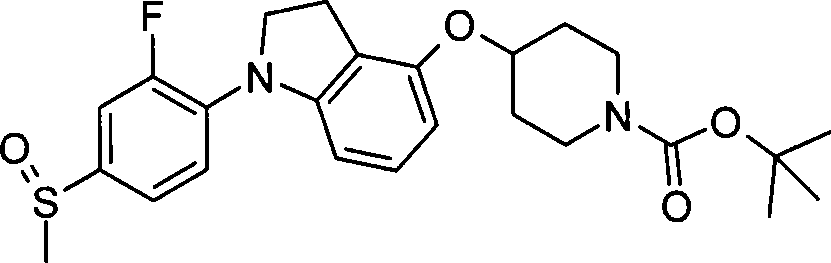
步骤1:4-({1-[4-(甲硫基)苯基]-1H-吲哚-4-基}氧基)-1-哌啶甲酸1,1-二甲基乙酯(83)Step 1: 1,1-dimethylethyl 4-({1-[4-(methylthio)phenyl]-1H-indol-4-yl}oxy)-1-piperidinecarboxylate ( 83 )
采用所述用于制备64(实施例21,步骤2)的N-芳基化方法,使用化合物63(3.40g,10.8mmol)、CuI(204mg,1.1mmol)、K3PO4(3.42g,16.1mmol)、1-碘-4-(甲硫基)苯(4.03g,16.1mmol)、反式-N,N′-二甲基-1,2-环己烷二胺(323μL,2.7mmol)和无水1,4-二噁烷(25mL)。在110℃下将反应混合物搅拌48小时。标准后处理,随后纯化,得到2.56g(54%)灰白色固体状的标题产物83。Following the N-arylation procedure described for the preparation of 64 (Example 21, Step 2), compound 63 (3.40 g, 10.8 mmol), CuI (204 mg, 1.1 mmol), K 3 PO 4 (3.42 g, 16.1mmol), 1-iodo-4-(methylthio)benzene (4.03g, 16.1mmol), trans-N, N'-dimethyl-1,2-cyclohexanediamine (323μL, 2.7mmol ) and
1H NMR(400MHz,DMSO-d6):δ7.50-7.47(m,3H),7.43-7.41(m,2H),7.09-7.07(m,2H),6.71和6.69(dd,J1=6.0Hz,J2=2.4Hz,1H),6.67(d,J=3.2Hz,1H),4.70(m,1H),3.67-3.61(m,2H),3.28-3.24(m,2H),2.52(s,3H),1.95-1.90(m,2H),1.66-1.58(m,2H),1.39(s,9H);LCMS(ESI):m/z 439(M+H)+. 1 H NMR (400 MHz, DMSO-d 6 ): δ7.50-7.47 (m, 3H), 7.43-7.41 (m, 2H), 7.09-7.07 (m, 2H), 6.71 and 6.69 (dd, J 1 = 6.0Hz, J 2 =2.4Hz, 1H), 6.67(d, J=3.2Hz, 1H), 4.70(m, 1H), 3.67-3.61(m, 2H), 3.28-3.24(m, 2H), 2.52 (s, 3H), 1.95-1.90 (m, 2H), 1.66-1.58 (m, 2H), 1.39 (s, 9H); LCMS (ESI): m/z 439 (M+H) + .
步骤2:4-({1-[4-(甲硫基)苯基]-2,3-二氢-1H-吲哚-4-基}氧基)-1-哌啶甲酸1,1-二甲基乙酯(84)Step 2: 4-({1-[4-(methylthio)phenyl]-2,3-dihydro-1H-indol-4-yl}oxy)-1-
采用所述用于制备65(实施例21,步骤3)的还原方法,使用化合物83(600mg,1.37mmol)、NaCNBH3(515mg,8.20mmol)和乙酸(10mL)。水后处理,随后经柱层析纯化,得到528mg(88%)白色固体状的标题产物84。Following the reduction procedure described for the preparation of 65 (Example 21, Step 3), compound 83 (600 mg, 1.37 mmol), NaCNBH3 (515 mg, 8.20 mmol) and acetic acid (10 mL) were used. Aqueous workup followed by column chromatography afforded 528 mg (88%) of the title product 84 as a white solid.
1H NMR(400MHz,DMSO-d6):δ7.26(t,J=8.8Hz,2H),7.15(d,J=8.8Hz,2H),6.98(app.t,J=8.0Hz,1H),6.65(d,J=7.6Hz,1H),6.45(d,J=8.0Hz,1H),4.53(七重峰,J=3.2Hz,1H),3.88(t,J=8.4Hz,2H),3.60-3.54(m,2H),3.24-3.20(m,2H),2.95(t,J=8.8Hz,2H),2.42(s,3H),1.87-1.82(m,2H),1.57-1.49(m,2H),1.38(s,9H);LCMS(ESI):m/z 441(M+H)+. 1 H NMR (400MHz, DMSO-d 6 ): δ7.26(t, J=8.8Hz, 2H), 7.15(d, J=8.8Hz, 2H), 6.98(app.t, J=8.0Hz, 1H ), 6.65(d, J=7.6Hz, 1H), 6.45(d, J=8.0Hz, 1H), 4.53(septet, J=3.2Hz, 1H), 3.88(t, J=8.4Hz, 2H) , 3.60-3.54(m, 2H), 3.24-3.20(m, 2H), 2.95(t, J=8.8Hz, 2H), 2.42(s, 3H), 1.87-1.82(m, 2H), 1.57-1.49 (m, 2H), 1.38 (s, 9H); LCMS (ESI): m/z 441 (M+H) + .
步骤3:(±)-4-({1-[4-(甲基亚磺酰基)苯基]-2,3-二氢-1H-吲哚-4-基}氧基)-1-哌啶甲酸1,1-二甲基乙酯(85)Step 3: (±)-4-({1-[4-(Methylsulfinyl)phenyl]-2,3-dihydro-1H-indol-4-yl}oxy)-1-
往84(200mg,0.454mmol)和六氟异丙醇(2.5mL)的溶液中加入30%H2O2水溶液(100μL)。在室温下将该混合物搅拌0.5小时。往以上混合物中加入饱和的硫化钠溶液(8mL)并搅拌5分钟。分离层,有机层经柱层析纯化(0→20%乙酸乙酯/己烷),得到178mg(86%)灰白色固体状的标题产物85。To a solution of 84 (200 mg, 0.454 mmol) and hexafluoroisopropanol (2.5 mL) was added 30% aqueous H2O2 (100 μL). The mixture was stirred at room temperature for 0.5 hours. Saturated sodium sulfide solution (8 mL) was added to the above mixture and stirred for 5 minutes. The layers were separated and the organic layer was purified by column chromatography (0→20% ethyl acetate/hexanes) to afford 178 mg (86%) of the
1H NMR(400MHz,DMSO-d6):δ 7.61(t,J=8.8Hz,2H),7.34(d,J=8.8Hz,2H),7.04(app.t,J=8.0Hz,1H),6.83(d,J=8.0Hz,1H),6.54(d,J=8.4Hz,1H),4.56(七重峰,J=3.2Hz,1H),3.98(t,J=8.8Hz,2H),3.60-3.55(m,2H),3.25-3.22(m,2H),2.99(t,J=8.4Hz,2H),2.69(s,3H),1.88-1.83(m,2H),1.58-1.49(m,2H),1.39(s,9H);LCMS(ESI):m/z 457(M+H)+. 1 H NMR (400MHz, DMSO-d 6 ): δ 7.61(t, J=8.8Hz, 2H), 7.34(d, J=8.8Hz, 2H), 7.04(app.t, J=8.0Hz, 1H) , 6.83(d, J=8.0Hz, 1H), 6.54(d, J=8.4Hz, 1H), 4.56(septet, J=3.2Hz, 1H), 3.98(t, J=8.8Hz, 2H), 3.60-3.55(m, 2H), 3.25-3.22(m, 2H), 2.99(t, J=8.4Hz, 2H), 2.69(s, 3H), 1.88-1.83(m, 2H), 1.58-1.49( m, 2H), 1.39 (s, 9H); LCMS (ESI): m/z 457 (M+H) + .
实施例32Example 32
消旋的亚砜85(150mg)经手性HPLC[柱:Chiralpak AS(分析用),Chiralpak(制备用),流动相:78%CO2:22%MeOH(14mL/分钟),压力140巴,温度40℃,240nm)]分析,随后分离成两种(R和S)型对映异构体。未指定绝对立体化学。Racemic sulfoxide 85 (150 mg) was subjected to chiral HPLC [column: Chiralpak AS (analytical), Chiralpak (preparative), mobile phase: 78% CO 2 : 22% MeOH (14 mL/min),
实施例32A:(86)Example 32A: ( 86 )
Tr(保留时间)为11.57分钟,33mg(%对映体过量>98%),并且光谱数据基本与实施例31(85)相同。Tr (retention time) was 11.57 min, 33 mg (% enantiomeric excess >98%), and the spectral data were essentially the same as Example 31 ( 85 ).
实施例32B:(87)Example 32B: ( 87 )
Tr为14.04分钟,38mg(%对映体过量>97%),并且光谱数据基本与实施例31(85)相同。Tr was 14.04 min, 38 mg (% enantiomeric excess >97%), and spectral data were essentially identical to Example 31 ( 85 ).
实施例33(89)Example 33 ( 89 )
步骤1:4-[(1-{4-[(乙基氧基)羰基]苯基}-1H-吲哚-4-基)氧基]-1-哌啶甲酸1,1-二甲基乙酯(88)Step 1: 4-[(1-{4-[(Ethyloxy)carbonyl]phenyl}-1H-indol-4-yl)oxy]-1-
在130℃下、Biotage Initiator微波器中,将4-(1H-吲哚-4-基氧基)-1-哌啶甲酸1,1-二甲基乙酯(63)(1.00g,3.16mmol)、4-氟苯甲酸乙酯(3.00g,17.84mmol)、18-冠-6(0.33g,1.23mmol)、KF/Al2O3(2.86g,19.69mmol)和DMSO(30mL)的混合物加热7小时。该反应物用各150mL的水和EtOAc稀释。EtOAc部分用水(150mL)和盐水(150mL)洗涤,干燥(Na2SO4)并浓缩,得到黄色油状物。粗品经硅胶柱层析纯化(用15%EtOAc/己烷洗脱),得到560mg(38%)白色泡沫状的化合物88。1,1-Dimethylethyl 4-(1H-indol-4-yloxy)-1-piperidinecarboxylate ( 63 ) (1.00g, 3.16mmol ), ethyl 4-fluorobenzoate (3.00g, 17.84mmol), 18-crown-6 (0.33g, 1.23mmol), a mixture of KF/Al 2 O 3 (2.86g, 19.69mmol) and DMSO (30mL) Heat for 7 hours. The reaction was diluted with 150 mL each of water and EtOAc. The EtOAc fraction was washed with water (150 mL ) and brine (150 mL), dried ( Na2SO4 ) and concentrated to give a yellow oil. The crude product was purified by silica gel column chromatography (eluting with 15% EtOAc/hexanes) to afford 560 mg (38%) of compound 88 as a white foam.
1H NMR(400MHz,DMSO-d6):δ 1.33(t,J=7.1Hz,3H),1.39(s,9H),1.60-1.66(m,2H),1.91-1.95(m,2H),3.27-3.31(m,2H),3.62-3.66(m,2H),4.35(q,J=7.1Hz,2H),4.70-4.72(m,1H),6.75(s,1H),6.77(d,J=5.2Hz,1H),7.13(t,J=8.0Hz,1H),7.25(d,J=8.4Hz,1H),7.62(d,J=3.3Hz,1H),7.73(d,J=8.5Hz,2H),8.11(d,J=8.5Hz,2H);LCMS(ESI):m/z 487(M+Na)+. 1 H NMR (400MHz, DMSO-d 6 ): δ 1.33(t, J=7.1Hz, 3H), 1.39(s, 9H), 1.60-1.66(m, 2H), 1.91-1.95(m, 2H), 3.27-3.31(m, 2H), 3.62-3.66(m, 2H), 4.35(q, J=7.1Hz, 2H), 4.70-4.72(m, 1H), 6.75(s, 1H), 6.77(d, J=5.2Hz, 1H), 7.13(t, J=8.0Hz, 1H), 7.25(d, J=8.4Hz, 1H), 7.62(d, J=3.3Hz, 1H), 7.73(d, J= 8.5Hz, 2H), 8.11 (d, J=8.5Hz, 2H); LCMS (ESI): m/z 487 (M+Na) + .
步骤2:4-[(1-{4-[(乙氧基)羰基]苯基}-2,3-二氢-1H-吲哚-4-基)氧基]-1-哌啶甲酸1,1-二甲基乙酯(89)Step 2: 4-[(1-{4-[(Ethoxy)carbonyl]phenyl}-2,3-dihydro-1H-indol-4-yl)oxy]-1-
往搅拌的化合物88(0.11g,0.24mmol)在冰AcOH(3mL)中的溶液中一次性加入NaCNBH3(0.15g,2.40mmol)。经约5分钟观察到产生气体且该反应由浅黄色变为无色。在22小时后,该反应物用各50mL的饱和的NaHCO3水溶液和EtOAc稀释。EtOAc层用饱和的NaHCO3水溶液(50mL)和盐水(50mL)洗涤,干燥(Na2SO4)并浓缩成浅黄色油状物。粗品经硅胶柱层析纯化(用10%EtOAc/己烷洗脱),得到84mg(75%)无色油状的标题化合物89。To a stirred solution of compound 88 (0.11 g, 0.24 mmol) in glacial AcOH (3 mL) was added NaCNBH3 (0.15 g, 2.40 mmol) in one portion. Gas evolution was observed over about 5 minutes and the reaction turned from light yellow to colorless. After 22 h, the reaction was diluted with 50 mL each of saturated aqueous NaHCO 3 and EtOAc. The EtOAc layer was washed with saturated aqueous NaHCO 3 (50 mL) and brine (50 mL), dried (Na 2 SO 4 ) and concentrated to a pale yellow oil. The crude product was purified by silica gel column chromatography (eluting with 10% EtOAc/hexanes) to afford 84 mg (75%) of the title compound 89 as a colorless oil.
1H NMR(400MHz,DMSO-d6):δ 1.28(t,J=7.1Hz,3H),1.39(s,9H),1.51-1.57(m,2H),1.82-1.88(m,2H),3.00(t,J=8.5Hz,2H),3.21-3.26(m,2H),3.54-3.60(m,2H),3.99(t,J=8.5Hz,2H),4.25(q,J=7.1Hz,2H),4.55-4.59(m,1H),6.58(d,J=8.3Hz,1H),6.91(d,J=8.0Hz,1H),7.06(t,J=8.1Hz,1H),7.25(d,J=8.9Hz,2H),7.88(d,J=8.8Hz,2H);LCMS(ESI):m/z 467(M+H)+,m/z 489(M+Na)+. 1 H NMR (400MHz, DMSO-d 6 ): δ 1.28(t, J=7.1Hz, 3H), 1.39(s, 9H), 1.51-1.57(m, 2H), 1.82-1.88(m, 2H), 3.00(t, J=8.5Hz, 2H), 3.21-3.26(m, 2H), 3.54-3.60(m, 2H), 3.99(t, J=8.5Hz, 2H), 4.25(q, J=7.1Hz , 2H), 4.55-4.59(m, 1H), 6.58(d, J=8.3Hz, 1H), 6.91(d, J=8.0Hz, 1H), 7.06(t, J=8.1Hz, 1H), 7.25 (d, J=8.9Hz, 2H), 7.88 (d, J=8.8Hz, 2H); LCMS (ESI): m/z 467(M+H) + , m/z 489(M+Na) + .
实施例34(90)Example 34 ( 90 )
4-{4-[(1-{[(1,1-二甲基乙基)氧基]羰基}-4-哌啶基)氧基]-2,3-二氢-1H-吲哚-1-基}苯甲酸(90)4-{4-[(1-{[(1,1-Dimethylethyl)oxy]carbonyl}-4-piperidinyl)oxy]-2,3-dihydro-1H-indole- 1-yl}benzoic acid ( 90 )
往搅拌的化合物88(84mg,0.18mmol)在10mL 1:1(体积/体积)THF/EtOH中的溶液中加入2.8mL 1N NaOH水溶液并在回流下将无色溶液加热。在4小时后,将该反应物倾入30mL 1N HCl水溶液(30mL)中,随后将其倾入EtOAc(50mL)中。EtOAc层用盐水(30mL)洗涤,干燥(Na2SO4)并浓缩成白色固体。该固体用25mL己烷(25mL)研磨,过滤并风干,得到73mg(93%)白色固体状的标题化合物90。To a stirred solution of compound 88 (84 mg, 0.18 mmol) in 10 mL of 1:1 (v/v) THF/EtOH was added 2.8 mL of 1N aqueous NaOH and the colorless solution was heated at reflux. After 4 hours, the reaction was poured into 30 mL of 1N aqueous HCl (30 mL) followed by EtOAc (50 mL). The EtOAc layer was washed with brine (30 mL), dried ( Na2SO4 ) and concentrated to a white solid. The solid was triturated with 25 mL of hexane (25 mL), filtered and air dried to afford 73 mg (93%) of the
1HNMR(400MHz,DMSO-d6):δ 1.39(s,9H),1.50-1.58(m,2H),1.83-1.88(m,2H),3.00(t,J=8.4Hz,2H),3.21-3.25(m,2H),3.55-3.60(m,2H),3.99(t,J=8.4Hz,2H),4.55-4.58(m,1H),6.56(d,J=8.2Hz,1H),6.90(d,J=8.0Hz,1H),7.06(t,J=8.2Hz,1H),7.23(d,J=8.9Hz,2H),7.87(d,J=8.8Hz,2H),12.46(br s,1H);LCMS(APCI):m/z 439(M+H)+,m/z 437(M-H)-. 1 HNMR (400MHz, DMSO-d 6 ): δ 1.39(s, 9H), 1.50-1.58(m, 2H), 1.83-1.88(m, 2H), 3.00(t, J=8.4Hz, 2H), 3.21 -3.25(m, 2H), 3.55-3.60(m, 2H), 3.99(t, J=8.4Hz, 2H), 4.55-4.58(m, 1H), 6.56(d, J=8.2Hz, 1H), 6.90(d, J=8.0Hz, 1H), 7.06(t, J=8.2Hz, 1H), 7.23(d, J=8.9Hz, 2H), 7.87(d, J=8.8Hz, 2H), 12.46( br s, 1H); LCMS (APCI): m/z 439 (M+H) + , m/z 437 (MH) - .
如文中所述,将酰胺形成的一般方法应用于本发明的化合物。以下提供了用于以下实施例的合成说明。具体的实施例提供了适当的特征数据。As described herein, general methods of amide formation are applied to compounds of the invention. Synthetic instructions for the following examples are provided below. Specific embodiments provide appropriate characterization data.
往4-{4-[(1-{[(1,1-二甲基乙基)氧基]羰基}-4-哌啶基)氧基]-2,3-二氢-1H-吲哚-1-基}苯甲酸(90,75mg,0.17mmol)和DIEA(78mg,0.60mmol)在DMF(2mL)中的溶液中加入伯或仲胺(0.60mmol),在这些实施例的启示下该选择对本领域普通技术人员而言是显而易见的,随后加入HATU(91mg,0.24mmol)在DMF(0.5mL)中的溶液。在室温下将得到的溶液搅拌过夜。在48小时后,该反应物用各30mL的EtOAc和1N HCl水溶液稀释。EOAc层用饱和的NaHCO3水溶液(25mL)和盐水(25mL)洗涤,干燥(Na2SO4)并浓缩成粗品,其随后用数毫升EtOAc研磨。To 4-{4-[(1-{[(1,1-dimethylethyl)oxy]carbonyl}-4-piperidinyl)oxy]-2,3-dihydro-1H-indole To a solution of -1-yl}benzoic acid ( 90 , 75 mg, 0.17 mmol) and DIEA (78 mg, 0.60 mmol) in DMF (2 mL) was added a primary or secondary amine (0.60 mmol), in the light of these examples the The choice will be apparent to one of ordinary skill in the art, followed by the addition of a solution of HATU (91 mg, 0.24 mmol) in DMF (0.5 mL). The resulting solution was stirred overnight at room temperature. After 48 hours, the reaction was diluted with 30 mL each of EtOAc and 1N aqueous HCl. The EOAc layer was washed with saturated aqueous NaHCO 3 (25 mL) and brine (25 mL), dried (Na 2 SO 4 ) and concentrated to a crude product which was then triturated with a few mL of EtOAc.
实施例35(91)Example 35 ( 91 )
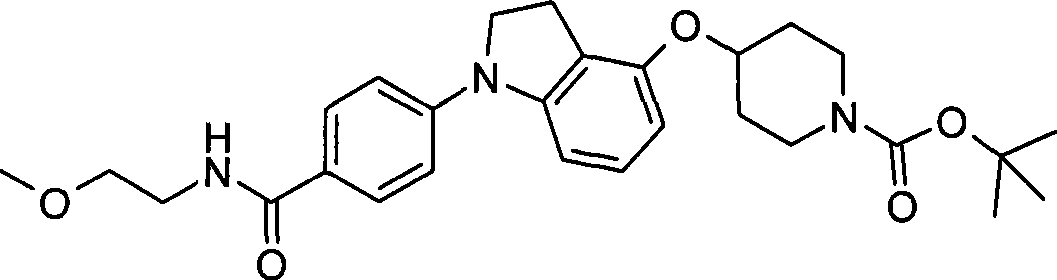
4-({1-[4-({[2-(甲氧基)乙基]氨基}羰基)苯基]-2,3-二氢-1H-吲哚-4-基}氧基)-1-哌啶甲酸1,1-二甲基乙酯(91)4-({1-[4-({[2-(methoxy)ethyl]amino}carbonyl)phenyl]-2,3-dihydro-1H-indol-4-yl}oxy)- 1,1-Dimethylethyl 1-piperidinecarboxylate ( 91 )
用EtOAc研磨,得到白色固体,其经硅胶柱层析进一步纯化(用50%EtOAc/己烷洗脱)。分离得到白色固体状的标题化合物91(15mg,25%)。Trituration with EtOAc gave a white solid which was further purified by silica gel column chromatography (eluting with 50% EtOAc/hexanes). The title compound 91 (15 mg, 25%) was isolated as a white solid.
1H NMR(400MHz,DMSO-d6):δ 1.38(s,9H),1.50-1.58(m,2H),1.64(五重峰,J=6.7Hz,2H),1.83-1.88(m,2H),2.98(t,J=8.2Hz,2H),3.21-3.25(m,2H),3.24(s,3H),3.26-3.45(m,4H),3.55-3.58(m,2H),3.96(t,J=8.4Hz,2H),4.54-4.57(m,1H),6.53(d,J=8.4Hz,1H),6.84(d,J=8.1Hz,1H),7.03(t,J=8.1Hz,1H),7.20(d,J=8.8Hz,2H),7.83(d,J=8.8Hz,2H),8.33(t,J=4.8Hz,1H);LCMS(ESI):m/z 496(M+H)+,m/z 518(M+Na)+. 1 H NMR (400MHz, DMSO-d 6 ): δ 1.38(s, 9H), 1.50-1.58(m, 2H), 1.64 (quintet, J=6.7Hz, 2H), 1.83-1.88(m, 2H ), 2.98(t, J=8.2Hz, 2H), 3.21-3.25(m, 2H), 3.24(s, 3H), 3.26-3.45(m, 4H), 3.55-3.58(m, 2H), 3.96( t, J=8.4Hz, 2H), 4.54-4.57(m, 1H), 6.53(d, J=8.4Hz, 1H), 6.84(d, J=8.1Hz, 1H), 7.03(t, J=8.1 Hz, 1H), 7.20(d, J=8.8Hz, 2H), 7.83(d, J=8.8Hz, 2H), 8.33(t, J=4.8Hz, 1H); LCMS (ESI): m/z 496 (M+H) + , m/z 518(M+Na) + .
实施例36(92)Example 36 ( 92 )
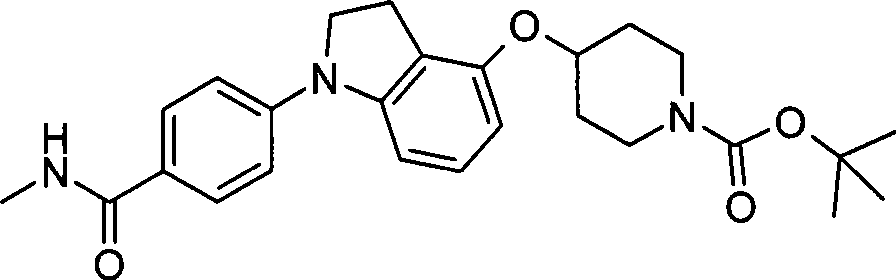
4-[(1-{4-[(甲基氨基)羰基]苯基}-2,3-二氢-1H-吲哚-4-基)氧基]-1-哌啶甲酸1,1-二甲基乙酯(92)4-[(1-{4-[(methylamino)carbonyl]phenyl}-2,3-dihydro-1H-indol-4-yl)oxy]-1-
用EtOAc研磨,得到35mg(46%)白色固体状的标题化合物92。1H NMR(400MHz,DMSO-d6):δ 1.39(s,9H),1.50-1.58(m,2H),1.83-1.88(m,2H),2.75(d,J=4.6Hz,3H),2.99(t,J=8.4Hz,2H),3.23-3.31(m,2H),3.56-3.60(m,2H),3.97(t,J=8.3Hz,2H),4.54-4.57(m,1H),6.53(d,J=8.2Hz,1H),6.84(d,J=8.1Hz,1H),7.04(t,J=8.2Hz,1H),7.21(d,J=8.8Hz,2H),7.80(d,J=8.7Hz,2H),8.24(br q,J=4.5Hz,1H);LCMS(ESI):m/z 452(M+H)+,m/z 474(M+Na)+.Trituration with EtOAc afforded 35 mg (46%) of the title compound 92 as a white solid. 1 H NMR (400MHz, DMSO-d 6 ): δ 1.39(s, 9H), 1.50-1.58(m, 2H), 1.83-1.88(m, 2H), 2.75(d, J=4.6Hz, 3H), 2.99(t, J=8.4Hz, 2H), 3.23-3.31(m, 2H), 3.56-3.60(m, 2H), 3.97(t, J=8.3Hz, 2H), 4.54-4.57(m, 1H) , 6.53(d, J=8.2Hz, 1H), 6.84(d, J=8.1Hz, 1H), 7.04(t, J=8.2Hz, 1H), 7.21(d, J=8.8Hz, 2H), 7.80 (d, J=8.7Hz, 2H), 8.24 (br q, J=4.5Hz, 1H); LCMS (ESI): m/z 452(M+H) + , m/z 474(M+Na) + .
实施例37(93)Example 37 ( 93 )

4-{[1-(4-{[(3-羟基丙基)氨基]羰基}苯基)-2,3-二氢-1H-吲哚-4-基]氧基}-1-哌啶甲酸1,1-二甲基乙酯(93)4-{[1-(4-{[(3-Hydroxypropyl)amino]carbonyl}phenyl)-2,3-dihydro-1H-indol-4-yl]oxy}-1-
用EtOAc研磨,得到32mg(38%)浅黄色固体状的标题化合物93。Trituration with EtOAc afforded 32 mg (38%) of the title compound 93 as a pale yellow solid.
1H NMR(400MHz,DMSO-d6):δ 1.38(s,9H),1.52-1.58(m,2H),1.64(五重峰,J=6.7Hz,2H),1.83-1.87(m,2H),2.98(t,J=8.4Hz,2H),2.99(t,J=8.4Hz,2H),3.23-3.30(m,2H),3.27(m,2H),3.43(t,J=6.2Hz,2H),3.55-3.58(m,2H),3.96(t,J=8.6Hz,2H),4.46(t,J=5.1Hz,2H),4.54-4.57(m,1H),6.52(d,J=8.5Hz,1H),6.83(d,J=7.9Hz,1H),7.03(t,J=8.2Hz,1H),7.20(d,J=8.8Hz,2H),7.80(d,J=8.7Hz,2H),8.25(t,J=4.5Hz,1H);LCMS(ESI):m/z 496(M+H)+,m/z518(M+Na)+. 1 H NMR (400MHz, DMSO-d 6 ): δ 1.38(s, 9H), 1.52-1.58(m, 2H), 1.64 (quintet, J=6.7Hz, 2H), 1.83-1.87(m, 2H ), 2.98(t, J=8.4Hz, 2H), 2.99(t, J=8.4Hz, 2H), 3.23-3.30(m, 2H), 3.27(m, 2H), 3.43(t, J=6.2Hz , 2H), 3.55-3.58(m, 2H), 3.96(t, J=8.6Hz, 2H), 4.46(t, J=5.1Hz, 2H), 4.54-4.57(m, 1H), 6.52(d, J=8.5Hz, 1H), 6.83(d, J=7.9Hz, 1H), 7.03(t, J=8.2Hz, 1H), 7.20(d, J=8.8Hz, 2H), 7.80(d, J= 8.7Hz, 2H), 8.25(t, J=4.5Hz, 1H); LCMS (ESI): m/z 496(M+H) + , m/z 518(M+Na) + .
实施例38(95)Example 38 ( 95 )
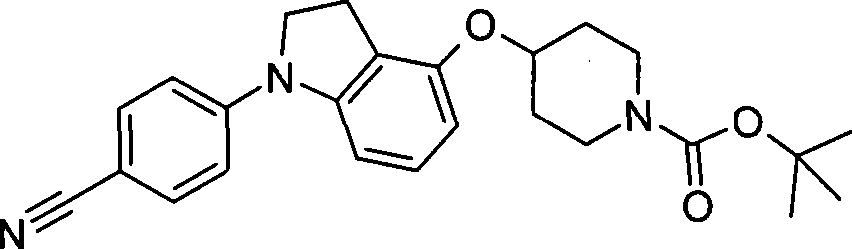
步骤1:4-{[1-(4-氰基苯基)-1H-吲哚-4-基]氧基}-1-哌啶甲酸1,1-二甲基乙酯(94)Step 1: 1,1-dimethylethyl 4-{[1-(4-cyanophenyl)-1H-indol-4-yl]oxy}-1-piperidinecarboxylate ( 94 )
在130℃下、Biotage Initiator微波中,将4-(1H-吲哚-4-基氧基)-1-哌啶甲酸1,1-二甲基乙酯(63,1.00g,3.16mmol)、4-氟苄腈(1.72g,14.14mmol)、18-冠-6(0.32g,1.34mmol)、KF/Al2O3(2.86g,19.70mmol)和DMSO(25mL)的混合物加热7小时。该反应物用各150mL的水和EtOAc稀释。加入盐水(100mL)分散乳剂,EtOAc部分用水(1 x 150mL)和盐水(1 x 150mL)洗涤,干燥(Na2SO4),随后浓缩成浅黄色、粘稠状油状物。粗品经硅胶柱层析纯化(用10→20%EtOAc/己烷梯度洗脱)。分离产物,得到夹杂约20%起始吲哚63的白色固体(1.14g)。白色固体用220mL EtOAc:己烷(10:1 体积/体积)重结晶,得到720mg(55%)标题化合物94,其为白色晶状固体。At 130°C, in a Biotage Initiator microwave, 1,1-dimethylethyl 4-(1H-indol-4-yloxy)-1-piperidinecarboxylate ( 63 , 1.00g, 3.16mmol), A mixture of 4-fluorobenzonitrile (1.72 g, 14.14 mmol), 18-crown-6 (0.32 g, 1.34 mmol ), KF/ Al2O3 (2.86 g, 19.70 mmol) and DMSO (25 mL) was heated for 7 hours. The reaction was diluted with 150 mL each of water and EtOAc. Brine (100 mL) was added to disperse the emulsion and the EtOAc fraction was washed with water (1 x 150 mL) and brine (1 x 150 mL), dried ( Na2SO4 ) and concentrated to a light yellow , viscous oil. The crude product was purified by silica gel column chromatography (eluting with a 10→20% EtOAc/hexanes gradient). The product was isolated as a white solid (1.14 g) encrusted with about 20% of the starting indole 63 . The white solid was recrystallized from 220 mL of EtOAc:hexanes (10:1 v/v) to afford 720 mg (55%) of the title compound 94 as a white crystalline solid.
1H NMR(400MHz,DMSO-d6):δ 1.39(s,9H),1.61-1.67(m,2H),1.90-1.95(m,2H),3.24-3.29(m,2H),3.60-3.66(m,2H),4.69-4.74(m,1H),6.76(s,1H),6.77(d,J=4.9Hz,1H),7.14(t,J=8.1Hz,1H),7.25(d,J=8.3Hz,1H),7.65(d,J=3.4Hz,1H),7.80(d,J=8.5Hz,2H),8.01(d,J=8.7Hz,2H);LCMS(ESI):m/z 440(M+Na)+. 1 H NMR (400MHz, DMSO-d 6 ): δ 1.39(s, 9H), 1.61-1.67(m, 2H), 1.90-1.95(m, 2H), 3.24-3.29(m, 2H), 3.60-3.66 (m, 2H), 4.69-4.74(m, 1H), 6.76(s, 1H), 6.77(d, J=4.9Hz, 1H), 7.14(t, J=8.1Hz, 1H), 7.25(d, J=8.3Hz, 1H), 7.65(d, J=3.4Hz, 1H), 7.80(d, J=8.5Hz, 2H), 8.01(d, J=8.7Hz, 2H); LCMS(ESI): m /z 440(M+Na) + .
步骤2:4-{[1-(4-氰基苯基)-2,3-二氢-1H-吲哚-4-基]氧基}-1-哌啶甲酸1,1-二甲基乙酯(95)Step 2: 4-{[1-(4-cyanophenyl)-2,3-dihydro-1H-indol-4-yl]oxy}-1-
往搅拌的4-{[1-(4-氰基苯基)-1H-吲哚-4-基]氧基}-1-哌啶甲酸1,1-二甲基乙酯(94,0.59g,1.41mmol)和冰AcOH(20mL)溶液中一次性加入NaCNBH3(2.67g,42.45mmol)。经5分钟观察到气体产生且该反应物由无色变为浅黄色。在72小时后,将该反应物小心倾至各150mL的饱和NaHCO3水溶液和EtOAc中。EtOAc层用盐水(150mL)洗涤,干燥(Na2SO4),随后浓缩成淡红色油状物。粗品经硅胶柱层析纯化(用15%EtOAc/己烷洗脱),得到430mg(73%)白色固体状的化合物95。To the stirred 4-{[1-(4-cyanophenyl)-1H-indol-4-yl]oxyl}-1-
1H NMR(400MHz,DMSO-d6):δ 1.38(s,9H),1.50-1.58(m,2H),1.83-1.88(m,2H),3.00(t,J=8.4Hz,2H),3.21-3.25(m,2H),3.54-3.60(m,2H),3.99(t,J=8.4Hz,2H),4.56-4.60(m,1H),6.61(d,J=8.2Hz,1H),6.91(d,J=7.9Hz,1H),7.08(t,J=8.1Hz,1H),7.25(d,J=8.7Hz,2H),7.70(d,J=8.7Hz,2H);LCMS(ESI):m/z 442(M+Na)+. 1 H NMR (400MHz, DMSO-d 6 ): δ 1.38(s, 9H), 1.50-1.58(m, 2H), 1.83-1.88(m, 2H), 3.00(t, J=8.4Hz, 2H), 3.21-3.25(m, 2H), 3.54-3.60(m, 2H), 3.99(t, J=8.4Hz, 2H), 4.56-4.60(m, 1H), 6.61(d, J=8.2Hz, 1H) , 6.91(d, J=7.9Hz, 1H), 7.08(t, J=8.1Hz, 1H), 7.25(d, J=8.7Hz, 2H), 7.70(d, J=8.7Hz, 2H); LCMS (ESI): m/z 442(M+Na) + .
实施例39(96)Example 39 ( 96 )
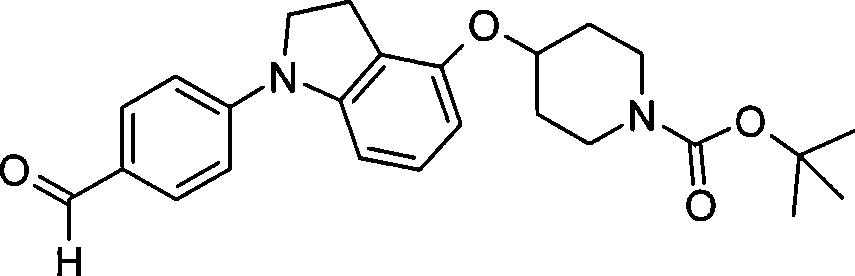
4-{[1-(4-甲酰基苯基)-2,3-二氢-1H-吲哚-4-基]氧基}-1-哌啶甲酸1,1-二甲基乙酯(96)4-{[1-(4-formylphenyl)-2,3-dihydro-1H-indol-4-yl]oxy}-1-
将搅拌的4-{[1-(4-氰基苯基)-2,3-二氢-1H-吲哚-4-基]氧基}-1-哌啶甲酸1,1-二甲基乙酯(95,0.41g,0.98mmol)在无水甲苯(15mL)中的溶液冷却至-78℃,并经注射器加入DIBAL-H(1.5M,在甲苯中)。让该反应物缓慢升温至0℃。在3小时后,澄清的黄色反应物通过加入MeOH(3mL)随后加入1N HCl(10mL)猝灭,随后搅拌2小时,同时从0℃缓慢升温至室温。该反应物用EtOAc(100mL)稀释,有机部分用盐水(2 x 50mL)洗涤,干燥(Na2SO4),随后浓缩成粘稠状的黄色油状物。粗品经硅胶层析纯化(用15%EtOAc/己烷洗脱),得到320mg(78%)黄色固体状的标题化合物96。The stirred 4-{[1-(4-cyanophenyl)-2,3-dihydro-1H-indol-4-yl]oxy}-1-
1HNMR(400MHz,DMSO-d6):δ 1.39(s,9H),1.51-1.59(m,2H),1.84-1.89(m,2H),3.02(t,J=8.4Hz,2H),3.21-3.28(m,2H),3.55-3.61(m,2H),4.04(t,J=8.4Hz,2H),4.56-4.63(m,1H),6.62(d,J=8.2Hz,1H),6.97(d,J=8.0Hz,1H),7.09(t,J=8.1Hz,1H),7.32(d,J=8.8Hz,2H),7.82(d,J=8.8Hz,2H),9.79(s,1H);LCMS(ESI):m/z 445(M+Na)+. 1 HNMR (400MHz, DMSO-d 6 ): δ 1.39(s, 9H), 1.51-1.59(m, 2H), 1.84-1.89(m, 2H), 3.02(t, J=8.4Hz, 2H), 3.21 -3.28(m, 2H), 3.55-3.61(m, 2H), 4.04(t, J=8.4Hz, 2H), 4.56-4.63(m, 1H), 6.62(d, J=8.2Hz, 1H), 6.97(d, J=8.0Hz, 1H), 7.09(t, J=8.1Hz, 1H), 7.32(d, J=8.8Hz, 2H), 7.82(d, J=8.8Hz, 2H), 9.79( s, 1H); LCMS (ESI): m/z 445 (M+Na) + .
实施例40(98)Example 40 ( 98 )

步骤1:1-[4-(甲基磺酰基)苯基]-4-(4-哌啶基氧基)-2,3-二氢-1H-吲哚·盐酸盐(97)Step 1: 1-[4-(Methylsulfonyl)phenyl]-4-(4-piperidinyloxy)-2,3-dihydro-1H-indole·hydrochloride ( 97 )
将化合物66(3.2g,6.7mmol,使用上文的实施例21的步骤1-4的方法分批制备)溶解在25mL4N在二噁烷中的HCl溶液中。随后在环境温度下将得到的溶液搅拌2小时。随后将溶剂减压除去且该物质经高度真空干燥,得到2.6g盐酸盐形式的97,其无需纯化使用。Compound 66 (3.2 g, 6.7 mmol, prepared in batches using the method of Steps 1-4 of Example 21 above) was dissolved in 25 mL of 4N HCl in dioxane. The resulting solution was then stirred at ambient temperature for 2 hours. The solvent was then removed under reduced pressure and the material was dried under high vacuum to yield 2.6 g of 97 as the hydrochloride salt which was used without purification.
步骤2:1-[2-氟-4-(甲基磺酰基)苯基]-4-{[1-(2-嘧啶基)-4-哌啶基]氧基}-2,3-二氢-1H-吲哚(98)Step 2: 1-[2-Fluoro-4-(methylsulfonyl)phenyl]-4-{[1-(2-pyrimidinyl)-4-piperidinyl]oxy}-2,3-bis Hydrogen-1H-indole ( 98 )
将化合物97(50mg,0.12mmol)溶解在5mL二氯甲烷中并用2mLDIPEA处理,随后用2-氯嘧啶(100mg,0.88mmol)处理。随后将该反应物于40℃下加热48小时并搅拌。将该反应物冷却至室温并将所有溶剂减压除去。随后粗制反应物经反相层析纯化(C18,10-100%CH3CN/H2O/0.05%TFA),得到26mg白色固体状的所需产物98(48%)。Compound 97 (50 mg, 0.12 mmol) was dissolved in 5 mL of dichloromethane and treated with 2 mL of DIPEA followed by 2-chloropyrimidine (100 mg, 0.88 mmol). The reaction was then heated at 40°C for 48 hours with stirring. The reaction was cooled to room temperature and all solvent was removed under reduced pressure. The crude reaction was then purified by reverse phase chromatography (C18, 10-100% CH3CN / H2O /0.05% TFA) to afford 26 mg of the desired product 98 (48%) as a white solid.
1H NMR(400MHz,CDCl3):δ 1.78-1.94(m,2H),1.94-2.04(m,2H),3.02(s,3H),3.15(t,J=8.0Hz,2H),3.70-3.88(m,2H),3.95-4.19(m,4H),4.54-4.74(m,1H),6.42-6.59(m,2H),6.90(d,J=8.0Hz,1H),7.15(t,J=8.0Hz,1H),7.25(d,J=9.0Hz,2H),7.82(d,J=9.0Hz,2H),8.30(d,J=4.0Hz,2H);LCMS(ESI):m/z 451(M+H)+. 1 H NMR (400MHz, CDCl 3 ): δ 1.78-1.94(m, 2H), 1.94-2.04(m, 2H), 3.02(s, 3H), 3.15(t, J=8.0Hz, 2H), 3.70- 3.88(m, 2H), 3.95-4.19(m, 4H), 4.54-4.74(m, 1H), 6.42-6.59(m, 2H), 6.90(d, J=8.0Hz, 1H), 7.15(t, J=8.0Hz, 1H), 7.25(d, J=9.0Hz, 2H), 7.82(d, J=9.0Hz, 2H), 8.30(d, J=4.0Hz, 2H); LCMS (ESI): m /z 451(M+H) + .
实施例41(99)Example 41 ( 99 )

4-{[1-(5-氟-2-嘧啶基)-4-哌啶基]氧基}-1-[4-(甲基磺酰基)苯基]-2,3-二氢-1H-吲哚(99)4-{[1-(5-fluoro-2-pyrimidinyl)-4-piperidinyl]oxy}-1-[4-(methylsulfonyl)phenyl]-2,3-dihydro-1H -Indole ( 99 )
将化合物97(50mg,0.12mmol)溶解在5mL二氯甲烷中并用2mLDIPEA处理,随后用2-氯-5-氟嘧啶(100mg,0.76mmol)处理。随后将该反应物于40℃下加热48小时并搅拌。将该反应物冷却至室温并将所有溶剂减压除去。随后粗制反应物经反相层析纯化(C18,10-100%CH3CN/H2O/0.05%TFA),得到35mg(61%)白色固体状的标题产物99。Compound 97 (50 mg, 0.12 mmol) was dissolved in 5 mL of dichloromethane and treated with 2 mL of DIPEA followed by 2-chloro-5-fluoropyrimidine (100 mg, 0.76 mmol). The reaction was then heated at 40°C for 48 hours with stirring. The reaction was cooled to room temperature and all solvent was removed under reduced pressure. The crude reaction was then purified by reverse phase chromatography (C18, 10-100% CH3CN / H2O /0.05% TFA) to afford 35 mg (61%) of the title product 99 as a white solid.
1HNMR(400MHz,CDCl3):δ 1.77-1.93(m,2H),1.94-2.07(m,2H),3.01(s,3H),3.15(t,J=8.0Hz,2H),3.65-3.83(m,2H),3.95-4.19(m,4H),4.54-4.74(m,1H),6.50(d,J=8.0Hz,2H),6.90(d,J=8.0Hz,1H),7.11(t,J=8.0Hz,1H),7.25(d,J=9.0Hz,2H),7.82(d,J=9.0Hz,2H),8.16(s,2H);LCMS(ESI):m/z 469(M+H)+. 1 HNMR (400MHz, CDCl 3 ): δ 1.77-1.93(m, 2H), 1.94-2.07(m, 2H), 3.01(s, 3H), 3.15(t, J=8.0Hz, 2H), 3.65-3.83 (m, 2H), 3.95-4.19(m, 4H), 4.54-4.74(m, 1H), 6.50(d, J=8.0Hz, 2H), 6.90(d, J=8.0Hz, 1H), 7.11( t, J=8.0Hz, 1H), 7.25(d, J=9.0Hz, 2H), 7.82(d, J=9.0Hz, 2H), 8.16(s, 2H); LCMS (ESI): m/z 469 (M+H) + .
实施例42(100)Example 42 ( 100 )
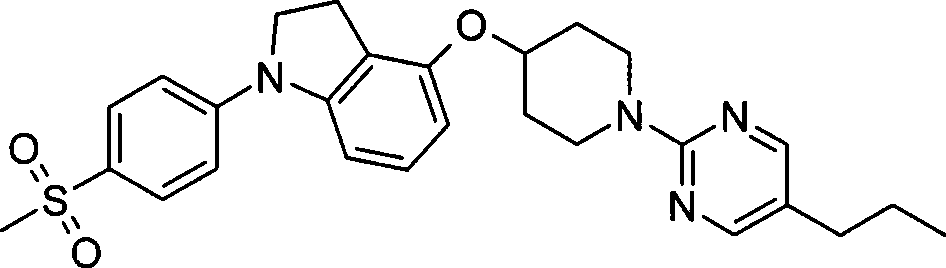
1-[4-(甲基磺酰基)苯基]-4-{[1-(5-丙基-2-嘧啶基)-4-哌啶基]氧基}-2,3-二氢-1H-吲哚(100)1-[4-(methylsulfonyl)phenyl]-4-{[1-(5-propyl-2-pyrimidinyl)-4-piperidinyl]oxy}-2,3-dihydro- 1H-indole ( 100 )
将化合物97)50mg,0.12mmol)溶解在5mL二氯甲烷中并用5mLDIPEA处理,随后用2-氯-5-丙基嘧啶(100mg,0.64mmol)处理。随后将该反应物于40℃下加热48小时并搅拌。将该反应物冷却至室温并将所有溶剂减压除去。随后粗制反应物经反相层析纯化(C18,10-100%CH3CN/H2O/0.05%TFA),得到9mg(15%)白色固体状的标题产物100。Compound 97 ) 50 mg, 0.12 mmol) was dissolved in 5 mL of dichloromethane and treated with 5 mL of DIPEA followed by 2-chloro-5-propylpyrimidine (100 mg, 0.64 mmol). The reaction was then heated at 40°C for 48 hours with stirring. The reaction was cooled to room temperature and all solvent was removed under reduced pressure. The crude reaction was then purified by reverse phase chromatography (C18, 10-100% CH3CN / H2O /0.05% TFA) to afford 9 mg (15%) of the
1HNMR(400MHz,CDCl3):δ 0.87-1.01(t,J=7.0Hz,3H),1.43-1.55(m,2H),1.86-1.94(m,2H),1.98-2.14(m,2H),2.38-2.51(t,J=7.0Hz,2H),3.13(s,3H),3.18(t,J=8.0Hz,2H),3.70-3.88(m,2H),3.98-4.10(m,4H),4.61-4.69(m,1H),6.50(d,J=8.0Hz,1H),6.91(d,J=9.0Hz,1H),7.10(t,J=8.0Hz,1H),7.29(d,J=9.0Hz,2H),7.82(d,J=9.0Hz,2H),8.20(s,2H);LCMS(ESI):m/z 493(M+H)+. 1 HNMR (400MHz, CDCl 3 ): δ 0.87-1.01(t, J=7.0Hz, 3H), 1.43-1.55(m, 2H), 1.86-1.94(m, 2H), 1.98-2.14(m, 2H) , 2.38-2.51(t, J=7.0Hz, 2H), 3.13(s, 3H), 3.18(t, J=8.0Hz, 2H), 3.70-3.88(m, 2H), 3.98-4.10(m, 4H ), 4.61-4.69(m, 1H), 6.50(d, J=8.0Hz, 1H), 6.91(d, J=9.0Hz, 1H), 7.10(t, J=8.0Hz, 1H), 7.29(d , J=9.0Hz, 2H), 7.82(d, J=9.0Hz, 2H), 8.20(s, 2H); LCMS (ESI): m/z 493(M+H) + .
实施例43(101)Example 43 ( 101 )
1-[4-(甲基磺酰基)苯基]-4-({1-[5-(苯基甲基)-2-嘧啶基]-4-哌啶基}氧基)-2,3-二氢-1H-吲哚(101)1-[4-(methylsulfonyl)phenyl]-4-({1-[5-(phenylmethyl)-2-pyrimidinyl]-4-piperidinyl}oxy)-2,3 -Dihydro-1H-indole ( 101 )
将化合物97(50mg,0.12mmol)溶解在2mL二氯甲烷中并用2mLDIPEA处理,随后用2-氯-5-(苯基甲基)嘧啶(100mg,0.49mmol)处理。随后将该反应物于50℃下加热48小时同时搅拌。将该反应物冷却至室温并将所有溶剂减压除去。随后粗制反应物经柱层析纯化(5→50%乙酸乙酯/己烷),得到10mg(15%)白色固体状的标题产物101(15%)。Compound 97 (50 mg, 0.12 mmol) was dissolved in 2 mL of dichloromethane and treated with 2 mL of DIPEA followed by 2-chloro-5-(phenylmethyl)pyrimidine (100 mg, 0.49 mmol). The reaction was then heated at 50°C for 48 hours with stirring. The reaction was cooled to room temperature and all solvent was removed under reduced pressure. The crude reaction was then purified by column chromatography (5→50% ethyl acetate/hexanes) to afford 10 mg (15%) of the title product 101 (15%) as a white solid.
1H NMR(400MHz,CDCl3):δ 1.88-1.93(m,2H),1.97-2.12(m,2H),3.07(s,3H),3.18(t,J=8.0Hz,2H),3.67-3.83(m,4H),3.96-4.10(m,4H),4.50-4.69(m,1H),6.51(d,J=8.0Hz,1H),6.91(d,J=8.0Hz,1H),7.06-7.35(m,8H),7.83(d,J=9.0Hz,2H),8.19(s,2H);LCMS(ESI):m/z 541(M+H)+. 1 H NMR (400MHz, CDCl 3 ): δ 1.88-1.93(m, 2H), 1.97-2.12(m, 2H), 3.07(s, 3H), 3.18(t, J=8.0Hz, 2H), 3.67- 3.83(m, 4H), 3.96-4.10(m, 4H), 4.50-4.69(m, 1H), 6.51(d, J=8.0Hz, 1H), 6.91(d, J=8.0Hz, 1H), 7.06 -7.35(m, 8H), 7.83(d, J=9.0Hz, 2H), 8.19(s, 2H); LCMS(ESI): m/z 541(M+H) + .
实施例44(102)Example 44 ( 102 )
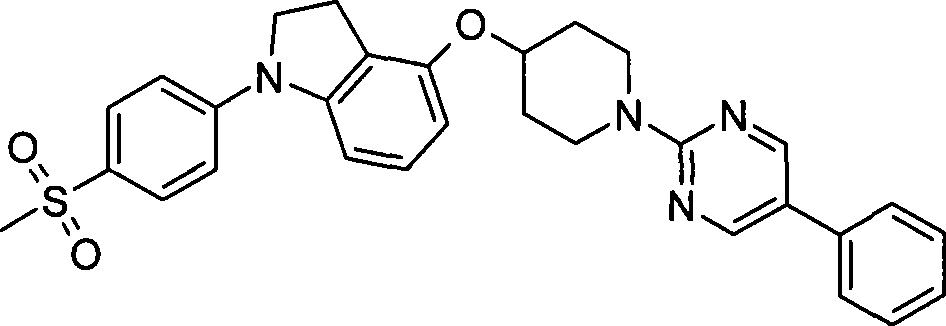
1-[4-(甲基磺酰基)苯基]-4-{[1-(5-苯基-2-嘧啶基)-4-哌啶基]氧基}-2,3-二氢-1H-吲哚(102)1-[4-(methylsulfonyl)phenyl]-4-{[1-(5-phenyl-2-pyrimidinyl)-4-piperidinyl]oxy}-2,3-dihydro- 1H-indole ( 102 )
将化合物97(50mg,0.12mmol)溶解在2mL二氯甲烷中并用2mLDIPEA处理,随后用2-氯-5-苯基嘧啶(100mg,0.53mmol)处理。随后将该反应物于50℃下加热48小时并搅拌。将该反应物冷却至室温并将所有溶剂减压除去。随后粗制反应物经柱层析纯化(5→50%乙酸乙酯/己烷),得到30mg(45%)白色固体状的标题产物102。Compound 97 (50 mg, 0.12 mmol) was dissolved in 2 mL of dichloromethane and treated with 2 mL of DIPEA followed by 2-chloro-5-phenylpyrimidine (100 mg, 0.53 mmol). The reaction was then heated at 50°C for 48 hours with stirring. The reaction was cooled to room temperature and all solvent was removed under reduced pressure. The crude reaction was then purified by column chromatography (5→50% ethyl acetate/hexanes) to afford 30 mg (45%) of the title product 102 as a white solid.
1H NMR(400MHz,DMSO-d6):δ 1.79-1.92(m,2H),1.92-2.03(m,2H),3.05(s,3H),3.18(t,J=8.0Hz,2H),3.72-3.87(m,2H),3.96-4.10(m,4H),4.50-4.69(m,1H),6.51(d,J=8.0Hz,1H),6.91(d,J=8.0Hz,1H),7.06-7.35(m,8H),7.83(d,J=9.0Hz,2H),8.19(s,2H);LCMS(ESI):m/z 527(M+H)+. 1 H NMR (400MHz, DMSO-d 6 ): δ 1.79-1.92(m, 2H), 1.92-2.03(m, 2H), 3.05(s, 3H), 3.18(t, J=8.0Hz, 2H), 3.72-3.87(m, 2H), 3.96-4.10(m, 4H), 4.50-4.69(m, 1H), 6.51(d, J=8.0Hz, 1H), 6.91(d, J=8.0Hz, 1H) , 7.06-7.35 (m, 8H), 7.83 (d, J=9.0Hz, 2H), 8.19 (s, 2H); LCMS (ESI): m/z 527 (M+H) + .
实施例45(103)Example 45 ( 103 )

4-{[1-(5-溴-2-嘧啶基)-4-哌啶基]氧基}-1-[4-(甲基磺酰基)苯基]-2,3-二氢-1H-吲哚(103)4-{[1-(5-Bromo-2-pyrimidinyl)-4-piperidinyl]oxy}-1-[4-(methylsulfonyl)phenyl]-2,3-dihydro-1H -Indole ( 103 )
将化合物97(500mg,1.23mmol)溶解在10mL CH3CN中并用DIPEA(655μL,3.69mmol)处理,随后用5-溴-2-氯嘧啶(260mg,1.35mmol)处理。随后将该反应物于80℃下加热48小时并搅拌。将该反应物冷却至室温并用2mL MeOH处理。经过滤除去形成的白色固体并在滤板上干燥过夜,得到627mg(96%)白色固体状的标题产物103。Compound 97 (500 mg, 1.23 mmol) was dissolved in 10 mL CH3CN and treated with DIPEA (655 μL, 3.69 mmol) followed by 5-bromo-2-chloropyrimidine (260 mg, 1.35 mmol). The reaction was then heated at 80°C for 48 hours with stirring. The reaction was cooled to room temperature and treated with 2 mL of MeOH. The white solid formed was removed by filtration and dried on a filter pad overnight to afford 627 mg (96%) of the title product 103 as a white solid.
1H NMR(400MHz,DMSO-d6):δ 1.57-1.76(m,2H),1.83-2.03(m,2H),3.00(t,J=8.0Hz,2H),3.12(s,3H),3.58-3.82(m,2H),3.90-4.19(m,4H),4.60-4.81(m,1H),6.60(d,J=8.0Hz,1H),6.91(d,J=8.0Hz,1H),7.18(t,J=8.0Hz,1H),7.35(d,J=9.0Hz,2H),7.76(d,J=9.0Hz,2H),8.43(s,2H);LCMS(ESI):m/z 530(M+H)+. 1 H NMR (400MHz, DMSO-d 6 ): δ 1.57-1.76(m, 2H), 1.83-2.03(m, 2H), 3.00(t, J=8.0Hz, 2H), 3.12(s, 3H), 3.58-3.82(m, 2H), 3.90-4.19(m, 4H), 4.60-4.81(m, 1H), 6.60(d, J=8.0Hz, 1H), 6.91(d, J=8.0Hz, 1H) , 7.18(t, J=8.0Hz, 1H), 7.35(d, J=9.0Hz, 2H), 7.76(d, J=9.0Hz, 2H), 8.43(s, 2H); LCMS (ESI): m /z 530(M+H) + .
实施例46(104)Example 46 ( 104 )

2-[4-({1-[4-(甲基磺酰基)苯基]-2,3-二氢-1H-吲哚-4-基}氧基)-1-哌啶基]-5-嘧啶甲腈(104)2-[4-({1-[4-(methylsulfonyl)phenyl]-2,3-dihydro-1H-indol-4-yl}oxy)-1-piperidinyl]-5 -pyrimidinecarbonitrile ( 104 )
将化合物103(100mg,O.19mmol)溶解在5mL DMF中并用CuCN(100mg,1.12mmol)处理。随后将该反应物于150℃下加热18小时并搅拌。将该反应物冷却至室温并用2mL水处理。经过滤除去形成的白色固体并在滤板上干燥。将该固体溶解在氯仿中,经过滤除去固体。随后将溶剂减压除去,得到61mg(68%)白色固体状的标题产物104。Compound 103 (100 mg, 0.19 mmol) was dissolved in 5 mL DMF and treated with CuCN (100 mg, 1.12 mmol). The reaction was then heated at 150°C for 18 hours with stirring. The reaction was cooled to room temperature and treated with 2 mL of water. The white solid formed was removed by filtration and dried on a filter pad. The solid was dissolved in chloroform and the solid was removed by filtration. The solvent was then removed under reduced pressure to afford 61 mg (68%) of the title product 104 as a white solid.
1H NMR(400MHz,CDCl3):δ 1.79-1.93(m,2H),1.93-2.13(m,2H),3.05(s,3H),3.12(t,J=8.0Hz,2H),3.73-3.88(m,2H),3.96-4.10(m,4H),4.56-4.70(m,1H),6.54(d,J=8.0Hz,1H),6.91(d,J=8.0Hz,1H),7.10(t,J=8.0Hz,1H),7.28(d,J=9.0Hz,2H),7.84(d,J=9.0Hz,2H),8.29(s,2H);LCMS(ESI):m/z 476(M+H)+. 1 H NMR (400MHz, CDCl 3 ): δ 1.79-1.93(m, 2H), 1.93-2.13(m, 2H), 3.05(s, 3H), 3.12(t, J=8.0Hz, 2H), 3.73- 3.88(m, 2H), 3.96-4.10(m, 4H), 4.56-4.70(m, 1H), 6.54(d, J=8.0Hz, 1H), 6.91(d, J=8.0Hz, 1H), 7.10 (t, J=8.0Hz, 1H), 7.28(d, J=9.0Hz, 2H), 7.84(d, J=9.0Hz, 2H), 8.29(s, 2H); LCMS (ESI): m/z 476(M+H) + .
实施例47(105)Example 47 ( 105 )
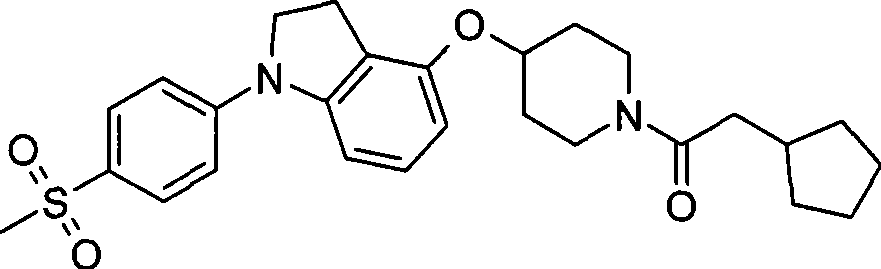
4-{[1-(环戊基乙酰基)-4-哌啶基]氧基}-1-[4-(甲基磺酰基)苯基]-2,3-二氢-1H-吲哚(105)4-{[1-(cyclopentylacetyl)-4-piperidinyl]oxy}-1-[4-(methylsulfonyl)phenyl]-2,3-dihydro-1H-indole ( 105 )
将化合物97(50mg,0.12mmol)溶解在2mL CH2Cl2中并用2mLDIPEA处理,随后用环戊基乙酰氯(100mg,0.68mmol)处理。随后在室温下将该反应物搅拌18小时。减压除去所有溶剂,随后粗制反应物经反相层析纯化(C18,10-100%CH3CN/H2O/0.05%TFA),得到12mg(20%)白色固体状的标题产物105。Compound 97 (50 mg, 0.12 mmol) was dissolved in 2 mL CH2Cl2 and treated with 2 mL DIPEA followed by cyclopentylacetyl chloride (100 mg, 0.68 mmol). The reaction was then stirred at room temperature for 18 hours. All solvent was removed under reduced pressure and the crude reaction was purified by reverse phase chromatography (C18, 10-100% CH3CN / H2O /0.05% TFA) to afford 12 mg (20%) of the
1H NMR(400MHz,CDCl3):δ 1.04-1.27(m,2H),1.42-1.69(m,4H),1.72-2.04(m,6H),2.18-2.30(m,1H),2.41(d,J=7.0Hz,2H),3.02(s,3H),3.14(t,J=8.0Hz,2H),3.38-3.52(m,1H),3.59-3.83(m,3H),4.01(t,J=8.0Hz,2H),4.53-4.66(m,1H),6.49(d,J=8.0Hz,1H),6.94(d,J=8.0Hz,1H),7.14(t,J=8.0Hz,1H),7.27(d,J=9.0Hz,2H),7.80(d,J=9.0Hz,2H);LCMS(ESI):m/z 483(M+H)+. 1 H NMR (400MHz, CDCl 3 ): δ 1.04-1.27(m, 2H), 1.42-1.69(m, 4H), 1.72-2.04(m, 6H), 2.18-2.30(m, 1H), 2.41(d , J=7.0Hz, 2H), 3.02(s, 3H), 3.14(t, J=8.0Hz, 2H), 3.38-3.52(m, 1H), 3.59-3.83(m, 3H), 4.01(t, J=8.0Hz, 2H), 4.53-4.66(m, 1H), 6.49(d, J=8.0Hz, 1H), 6.94(d, J=8.0Hz, 1H), 7.14(t, J=8.0Hz, 1H), 7.27(d, J=9.0Hz, 2H), 7.80(d, J=9.0Hz, 2H); LCMS (ESI): m/z 483(M+H) + .
实施例48(108)Example 48 ( 108 )

步骤1:N-羟基-2-甲基丙脒(106)Step 1: N-Hydroxy-2-methylpropionamidine ( 106 )
将2-甲基丙腈(25g,0.362mol)与100mL羟胺混合并将该混合物回流5小时。随后将溶剂减压除去并与甲苯共沸除去残余溶剂。随后将残余物溶解在50mL二氯甲烷中,经无水MgSO4干燥。随后将溶剂真空除去,得到26g澄清油状的标题产物106,其无需纯化使用。2-Methylpropionitrile (25 g, 0.362 mol) was mixed with 100 mL of hydroxylamine and the mixture was refluxed for 5 hours. The solvent was then removed under reduced pressure and the residual solvent was azeotroped with toluene. The residue was then dissolved in 50 mL of dichloromethane and dried over anhydrous MgSO 4 . The solvent was then removed in vacuo to afford 26 g of the title product 106 as a clear oil which was used without purification.
1H NMR(400MHz,DMSO-d6):δ0.79-1.10(m,6H),2.02-2.35(m,1H),5.36(s,2H),8.82(s,1H). 1 H NMR (400MHz, DMSO-d 6 ): δ0.79-1.10(m, 6H), 2.02-2.35(m, 1H), 5.36(s, 2H), 8.82(s, 1H).
步骤2:4-({1-[4-(甲基磺酰基)苯基]-2,3-二氢-1H-吲哚-4-基}氧基)-1-哌啶甲腈(107)Step 2: 4-({1-[4-(Methylsulfonyl)phenyl]-2,3-dihydro-1H-indol-4-yl}oxy)-1-piperidinecarbonitrile ( 107 )
将NaHCO3(309mg,3.68mmol)与1mL水混合并在冰浴中冷却至0℃。往以上剧烈搅拌的溶液中加入在2.5mL二氯甲烷中的化合物97(500mg,1.22mmol)。随后加入在2.5mL二氯甲烷中的溴化氰(142mg,1.34mmol)并移去冰浴。在环境温度下将该混合物搅拌18小时。随后加入Na2CO3(1.5g)直至pH约为7,随后加入MgSO4(1g)来除去水。经过滤将固体除去,随后该固体用二氯甲烷洗涤数次。随后将溶剂减压除去,该物质107.无需纯化使用。NaHCO 3 (309 mg, 3.68 mmol) was mixed with 1 mL of water and cooled to 0° C. in an ice bath. To the above vigorously stirred solution was added compound 97 (500 mg, 1.22 mmol) in 2.5 mL of dichloromethane. Cyanogen bromide (142 mg, 1.34 mmol) in 2.5 mL of dichloromethane was then added and the ice bath removed. The mixture was stirred at ambient temperature for 18 hours. Na 2 CO 3 (1.5 g) was then added until the pH was about 7, followed by MgSO 4 (1 g) to remove water. The solid was removed by filtration, and the solid was washed several times with dichloromethane. The solvent was then removed under reduced pressure and the material 107. was used without purification.
步骤3:4-({1-[3-(1-甲基乙基)-1,2,4-噁二唑-5-基]-4-哌啶基}氧基)-1-[4-(甲基磺酰基)苯基]-2,3-二氢-1H-吲哚(108)Step 3: 4-({1-[3-(1-methylethyl)-1,2,4-oxadiazol-5-yl]-4-piperidinyl}oxy)-1-[4 -(methylsulfonyl)phenyl]-2,3-dihydro-1H-indole ( 108 )
将化合物107(500mg,1.26mmol)与化合物106(500mg,4.90mmol)在乙酸乙酯(9mL)和乙醚(1mL)的混合物中混合并往该溶液中加入固体ZnCl2(800mg,5.88mmol)。将该混合物搅拌15分钟并倾出上清液。残余物用10mL乙酸乙酯洗涤两次,在每次洗涤后将乙酸乙酯倾出。随后将残余物溶解在4N HCl(5mL)和EtOH(15mL)的混合物中。随后将得到的溶液回流1小时。将溶剂真空除去并加入500mg Na2CO3和10mL二氯甲烷。经过滤将固体除去并分离相。有机相经MgSO4干燥,过滤,随后浓缩至干,得到31mg白色固体状的标题化合物108。Compound 107 (500 mg, 1.26 mmol) was mixed with compound 106 (500 mg, 4.90 mmol) in a mixture of ethyl acetate (9 mL) and diethyl ether (1 mL) and to the solution was added solid ZnCl2 (800 mg, 5.88 mmol). The mixture was stirred for 15 minutes and the supernatant was decanted. The residue was washed twice with 10 mL of ethyl acetate, decanting the ethyl acetate after each wash. The residue was then dissolved in a mixture of 4N HCl (5 mL) and EtOH (15 mL). The resulting solution was then refluxed for 1 hour. The solvent was removed in vacuo and 500 mg Na 2 CO 3 and 10 mL dichloromethane were added. The solids were removed by filtration and the phases were separated. The organic phase was dried over MgSO4 , filtered and concentrated to dryness to afford 31 mg of the title compound 108 as a white solid.
1H NMR(400MHz,CDCl3):δ 1.10-1.43(m,6H),1.89-2.18(m,4H),2.80-2.98(m,1H),3.04(s,3H),3.12(t,J=8.0Hz,2H),3.57-3.85(m,4H),4.02(t,J=8.0Hz,2H),4.51-4.72(m,1H),6.45(d,J=8.0Hz,1H),6.91(d,J=8.0Hz,1H),7.10(t,J=8.0Hz,1H),7.28(d,J=9.0Hz,2H),7.86(d,J=9.0Hz,2H);LCMS(ESI):m/z 483(M+H)+. 1 H NMR (400MHz, CDCl 3 ): δ 1.10-1.43(m, 6H), 1.89-2.18(m, 4H), 2.80-2.98(m, 1H), 3.04(s, 3H), 3.12(t, J =8.0Hz, 2H), 3.57-3.85(m, 4H), 4.02(t, J=8.0Hz, 2H), 4.51-4.72(m, 1H), 6.45(d, J=8.0Hz, 1H), 6.91 (d, J=8.0Hz, 1H), 7.10(t, J=8.0Hz, 1H), 7.28(d, J=9.0Hz, 2H), 7.86(d, J=9.0Hz, 2H); LCMS (ESI ): m/z 483(M+H) + .
实施例49(109)Example 49 ( 109 )

4-({1-[4-(3,5-二甲基-4-异噁唑基)苯基]-2,3-二氢-1H-吲哚-4-基}氧基)-1-哌啶甲酸1-甲基乙酯(109)4-({1-[4-(3,5-Dimethyl-4-isoxazolyl)phenyl]-2,3-dihydro-1H-indol-4-yl}oxy)-1 - 1-methylethyl piperidinecarboxylate ( 109 )
往圆底烧瓶中装入68(51mg,0.1mmol)、PdCl2(PPh3)2(7mg,0.01mmol)、(3,5-二甲基-4-异噁唑基)硼酸(28mg,0.2mmol)、2NNa2CO3水溶液(250μL,0.5mmol)和THF(3mL)。在N2下,将得到的混合物回流3小时。将反应混合物冷却至室温,用EtOAc(40mL)稀释,随后该混合物用H2O(1 x 10mL)、盐水(1 x 10mL)洗涤,经Na2SO4干燥,随后减压浓缩,得到粗制物质。产物经SiO2快速柱层析纯化,得到30mg(63%)灰白色固体状的标题产物109。 68 (51 mg, 0.1 mmol), PdCl 2 (PPh 3 ) 2 (7 mg, 0.01 mmol), (3,5-dimethyl-4-isoxazolyl)boronic acid (28 mg, 0.2 mmol), 2NNa2CO3 in water (250 μL, 0.5 mmol) , and THF (3 mL). The resulting mixture was refluxed for 3 h under N2 . The reaction mixture was cooled to room temperature, diluted with EtOAc (40 mL), then the mixture was washed with H 2 O (1 x 10 mL), brine (1 x 10 mL), dried over Na 2 SO 4 , and concentrated under reduced pressure to give crude substance. The product was purified by flash column chromatography on SiO2 to afford 30 mg (63%) of the title product 109 as an off-white solid.
1H NMR(400MHz,DMSO-d6):δ 7.32(d,J=8.4Hz,2H),7.27(d,J=8.4Hz,2H),7.01(app.t,J=8.0Hz,1H),6.78(d,J=8.0Hz,1H),6.49(d,J=8.4Hz,1H),4.76(七重峰,J=7.0Hz,1H),3.96(t,J=8.4Hz,2H),3.61(br m,2H),3.30(br m,2H),2.99(t,J=8.4Hz,2H),2.38(s,3H),2.21(s,3H),1.86(br m,2H),1.56(m,2H),1.17(d,J=6.0Hz,6H);LCMS(ESI):m/z 476(M+H)+. 1 H NMR (400MHz, DMSO-d 6 ): δ 7.32 (d, J=8.4Hz, 2H), 7.27 (d, J=8.4Hz, 2H), 7.01 (app.t, J=8.0Hz, 1H) , 6.78(d, J=8.0Hz, 1H), 6.49(d, J=8.4Hz, 1H), 4.76(septet, J=7.0Hz, 1H), 3.96(t, J=8.4Hz, 2H), 3.61(br m, 2H), 3.30(br m, 2H), 2.99(t, J=8.4Hz, 2H), 2.38(s, 3H), 2.21(s, 3H), 1.86(br m, 2H), 1.56 (m, 2H), 1.17 (d, J=6.0Hz, 6H); LCMS (ESI): m/z 476 (M+H) + .
实施例50(110)Example 50 ( 110 )
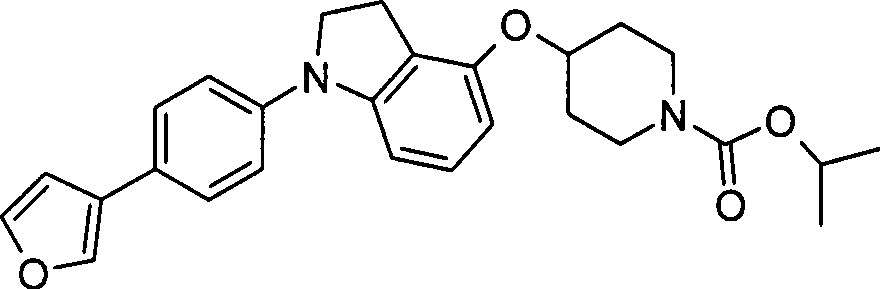
4-({1-[4-(3-呋喃基)苯基]-2,3-二氢-1H-吲哚-4-基}氧基)-1-哌啶甲酸1-甲基乙酯(111)1-methylethyl 4-({1-[4-(3-furyl)phenyl]-2,3-dihydro-1H-indol-4-yl}oxy)-1-piperidinecarboxylate ( 111 )
采用所述用于制备109的Suzuki方法,使用68(66mg,0.13mmol)、PdCl2(PPh3)2(9mg,0.013mmol)、3-呋喃基硼酸(29mg,0.26mmol)、2N Na2CO3水溶液(325μL,0.65mmol)和THF(3mL)。后处理,随后经纯化,得到22mg(38%)白色固体状的标题产物111。Following the Suzuki method described for the preparation of 109 using 68 (66 mg, 0.13 mmol), PdCl2 ( PPh3 ) 2 (9 mg, 0.013 mmol), 3-furylboronic acid (29 mg, 0.26 mmol), 2N Na2CO 3 in water (325 μL, 0.65 mmol) and THF (3 mL). Workup followed by purification afforded 22 mg (38%) of the title product 111 as a white solid.
1HNMR(400MHz,DMSO-d6):δ 8.08(s,1H),7.69(t,J=1.6Hz,1H),7.55(d,J=8.4Hz,2H),7.20(d,J=8.8Hz,2H),6.99(t,J=8.0Hz,1H),6.90(d,J=1.2Hz,1H),6.72(d,J=8.0Hz,1H),6.47(d,J=8.0Hz,1H),4.76(七重峰,J=6.4Hz,1H),4.56(m,1H),3.93(t,J=8.8Hz,2H),3.64-3.58(m,2H),3.30-3.26(m,2H),2.98(t,J=8.4Hz,2H),1.90-1.84(m,2H),1.60-1.52(m,2H),1.17(d,J=6.0Hz,6H);LCMS(ESI):m/z447(M+H)+. 1 HNMR (400MHz, DMSO-d 6 ): δ 8.08(s, 1H), 7.69(t, J=1.6Hz, 1H), 7.55(d, J=8.4Hz, 2H), 7.20(d, J=8.8 Hz, 2H), 6.99(t, J=8.0Hz, 1H), 6.90(d, J=1.2Hz, 1H), 6.72(d, J=8.0Hz, 1H), 6.47(d, J=8.0Hz, 1H), 4.76(septet, J=6.4Hz, 1H), 4.56(m, 1H), 3.93(t, J=8.8Hz, 2H), 3.64-3.58(m, 2H), 3.30-3.26(m, 2H), 2.98(t, J=8.4Hz, 2H), 1.90-1.84(m, 2H), 1.60-1.52(m, 2H), 1.17(d, J=6.0Hz, 6H); LCMS (ESI): m/z447(M+H) + .
实施例51(112)Example 51 ( 112 )
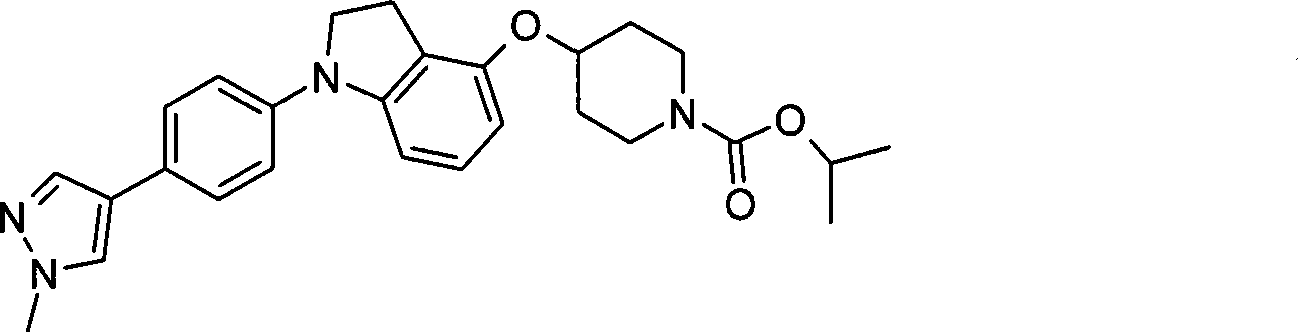
4-({1-[4-(1-甲基-1H-吡唑-4-基)苯基]-2,3-二氢-1H-吲哚-4-基}氧基)-1-哌啶甲酸1-甲基乙酯(112)4-({1-[4-(1-methyl-1H-pyrazol-4-yl)phenyl]-2,3-dihydro-1H-indol-4-yl}oxy)-1- 1-methylethyl piperidinecarboxylate ( 112 )
采用所述用于制备109的Suzuki偶合方法,往圆底烧瓶中装入化合物68(51mg,0.1mmol)、PdCl2(PPh3)2(7mg,0.01mmol)、1-甲基-4-(4,4,5,5-四甲基-1,3,2-二氧杂硼杂环戊烷-2-基)-1H-吡唑(42mg,0.20mmol)、2N Na2CO3水溶液(250μL,0.5mmol)和THF(3mL)。将该混合物回流3小时。后处理,随后经纯化,得到12mg(25%)灰白色固体状的标题产物112。Using the Suzuki coupling procedure described for the preparation of 109 , a round bottom flask was charged with compound 68 (51 mg, 0.1 mmol), PdCl 2 (PPh 3 ) 2 (7 mg, 0.01 mmol), 1-methyl-4-( 4,4,5,5-Tetramethyl-1,3,2-dioxaborolan-2-yl)-1H-pyrazole (42 mg, 0.20 mmol), 2N Na 2 CO 3 aqueous solution ( 250 μL, 0.5 mmol) and THF (3 mL). The mixture was refluxed for 3 hours. Workup followed by purification afforded 12 mg (25%) of the title product 112 as an off-white solid.
1H NMR(400MHz,DMSO-d6):δ 8.02(s,1H),7.77(s,1H),7.49(d,J=8.8Hz,1H),7.17(d,J=8.8Hz,1H),6.98(app.t,J=8.0Hz,1H),6.68(d,J=8.0Hz,1H),6.45(d,J=8.4Hz,1H),4.75(七重峰,J=6.4Hz,1H),4.56(m,1H),3.92(t,J=8.4Hz,2H),3.83(s,3H),3.62-3.56(m,2H),3.29-3.25(m,2H),2.97(t,J=8.4Hz,2H),1.88-1.84(m,2H),1.59-1.52(m,2H),1.67(d,J=6.0Hz,6H);LCMS(ESI):m/z 461(M+H)+. 1 H NMR (400MHz, DMSO-d 6 ): δ 8.02(s, 1H), 7.77(s, 1H), 7.49(d, J=8.8Hz, 1H), 7.17(d, J=8.8Hz, 1H) , 6.98(app.t, J=8.0Hz, 1H), 6.68(d, J=8.0Hz, 1H), 6.45(d, J=8.4Hz, 1H), 4.75(septet, J=6.4Hz, 1H ), 4.56(m, 1H), 3.92(t, J=8.4Hz, 2H), 3.83(s, 3H), 3.62-3.56(m, 2H), 3.29-3.25(m, 2H), 2.97(t, J=8.4Hz, 2H), 1.88-1.84(m, 2H), 1.59-1.52(m, 2H), 1.67(d, J=6.0Hz, 6H); LCMS (ESI): m/z 461 (M+ H) + .
实施例52(113)Example 52 ( 113 )

(1R,2S,5R)-4-({7-[2-氟-4-(甲基磺酰基)苯基]-6,7-二氢-5H-吡咯并[2,3-d]嘧啶-4-基}氧基)-1-哌啶甲酸5-甲基-2-(1-甲基乙基)环己酯(113)(1R, 2S, 5R)-4-({7-[2-fluoro-4-(methylsulfonyl)phenyl]-6,7-dihydro-5H-pyrrolo[2,3-d]pyrimidine -4-yl}oxy)-1-piperidinecarboxylic acid 5-methyl-2-(1-methylethyl)cyclohexyl ester ( 113 )
使用所述用于制备67的两步骤。将产物126(参见下文,用在CH2Cl2(125mg,纯度约80%)中的TFA处理化合物11得到)溶解在CH2Cl2(25mL)中并用Et3N(132μL,1mmol)、DMAP(4mg,0.032mmol)和(1R,2S,5R)-氯代甲酸5-甲基-2-(1-甲基乙基)环己酯(136μL,0.64mmol)处理。在室温下将该混合物搅拌15小时。后处理,随后经纯化,得到44mg(24%)灰白色固体状的标题产物113。The two steps described for the preparation of 67 were used. The product 126 (see below, obtained by treating compound 11 with TFA in CH2Cl2 ( 125 mg, ~80% purity)) was dissolved in CH2Cl2 (25 mL ) and washed with Et3N (132 μL, 1 mmol), DMAP (4 mg, 0.032 mmol) and (1R,2S,5R)-5-methyl-2-(1-methylethyl)cyclohexyl chloroformate (136 μL, 0.64 mmol). The mixture was stirred at room temperature for 15 hours. Workup followed by purification afforded 44 mg (24%) of the title product 113 as an off-white solid.
1H NMR(400MHz,DMSO-d6):δ 8.22(s,1H),7.96(t,J=7.6Hz,1H),7.85和7.82(dd,J1=10.8Hz,J2=1.6Hz,1H),7.75和7.73(dd,J1=8.4Hz,J2=2.0Hz,1H),5.28(m,1H),4.43(m,1H),4.14(t,J=8.4Hz,2H),3.71-3.67(m,2H),3.25(s,3H),3.29-3.21(m,2H),3.05(t,J=8.8Hz,2H),1.94-1.86(br m,3H),1.86-1.81(m,1H),1.63-1.51(m,4H),1.44-1.40(m,1H),1.41-1.30(m,1H),1.07-0.91(m,2H),0.86(d,J=6.4Hz,6H),0.73(s,J=6.8Hz,3H);LCMS(ESI):m/z 575(M+H)+. 1 H NMR (400MHz, DMSO-d 6 ): δ 8.22 (s, 1H), 7.96 (t, J=7.6Hz, 1H), 7.85 and 7.82 (dd, J 1 =10.8Hz, J 2 =1.6Hz, 1H), 7.75 and 7.73 (dd, J1 = 8.4Hz, J2 = 2.0Hz, 1H), 5.28 (m, 1H), 4.43 (m, 1H), 4.14 (t, J = 8.4Hz, 2H), 3.71-3.67(m, 2H), 3.25(s, 3H), 3.29-3.21(m, 2H), 3.05(t, J=8.8Hz, 2H), 1.94-1.86(br m, 3H), 1.86-1.81 (m, 1H), 1.63-1.51(m, 4H), 1.44-1.40(m, 1H), 1.41-1.30(m, 1H), 1.07-0.91(m, 2H), 0.86(d, J=6.4Hz , 6H), 0.73 (s, J=6.8Hz, 3H); LCMS (ESI): m/z 575 (M+H) + .
实施例53(118)Example 53 ( 118 )
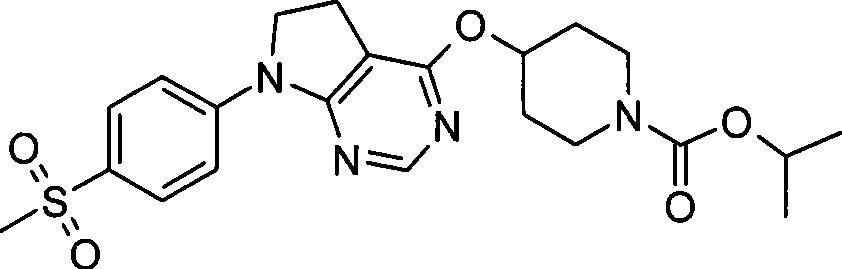
步骤1:N-(4-溴苯基)-6-氯-5-(2-丙烯-1-基)-4-嘧啶胺(114)Step 1: N-(4-bromophenyl)-6-chloro-5-(2-propen-1-yl)-4-pyrimidinamine ( 114 )
使用所述用于制备4的方法。在室温、N2下,往NaH(3.60g,60%分散在矿物油中,用无水甲苯洗涤)和无水THF(50mL)的混合物中加入在THF(100mL)中的4-溴苯胺(5.16g,30mmol)。在室温下将该混合物搅拌1小时,随后加入在THF(50mL)中的化合物2(5.67g,30mmol)。将得到的反应混合物回流4小时。水后处理,随后经SiO2快速柱层析纯化,得到6.81g(约85%纯度)产物114。该物质无需进一步纯化用于下一步骤。The method described for Preparation 4 was used. To a mixture of NaH (3.60 g, 60% dispersion in mineral oil, washed with anhydrous toluene) and anhydrous THF (50 mL) was added 4-bromoaniline ( 5.16 g, 30 mmol). The mixture was stirred at room temperature for 1 hour, then compound 2 (5.67 g, 30 mmol) in THF (50 mL) was added. The resulting reaction mixture was refluxed for 4 hours. Aqueous work-up followed by purification by flash column chromatography on SiO2 afforded 6.81 g (approximately 85% purity) of product 114 . This material was used in the next step without further purification.
1H NMR(400MHz,DMSO-d6):δ 8.83(s,1H),8.29(s,1H),7.55(d,J=11.6Hz,2H),7.49(d,J=8.8Hz,2H),5.92-5.84(m,1H),5.07-5.00(m,2H),3.56(d,J=5.2Hz,2H);LCMS(ESI):m/z 325(M+H)+. 1 H NMR (400MHz, DMSO-d 6 ): δ 8.83(s, 1H), 8.29(s, 1H), 7.55(d, J=11.6Hz, 2H), 7.49(d, J=8.8Hz, 2H) , 5.92-5.84 (m, 1H), 5.07-5.00 (m, 2H), 3.56 (d, J=5.2Hz, 2H); LCMS (ESI): m/z 325 (M+H) + .
步骤2:2-{4-[(4-溴苯基)氨基]-6-氯-5-嘧啶基}乙醇(115)Step 2: 2-{4-[(4-Bromophenyl)amino]-6-chloro-5-pyrimidinyl}ethanol ( 115 )
采用所述用于制备6的臭氧分解方法,在-70℃至室温下使用114(5.80g,17.87mmol)、CH2Cl2(300mL)、MeOH(50mL)和NaBH4(2.70g,71.47mmol)。水后处理,随后纯化,得到3.120(约90%纯度)标题产物115。Using the ozonolysis procedure described for the preparation of 6 , 114 (5.80 g, 17.87 mmol), CH2Cl2 (300 mL), MeOH (50 mL) and NaBH4 (2.70 g, 71.47 mmol) were used at -70 °C to room temperature. ). Aqueous workup followed by purification afforded 3.120 (ca. 90% purity) of the title product 115 .
1H NMR(400MHz,DMSO-d6):δ 9.10(s,1H),8.29(s,1H),7.56-7.48(m,4H),5.13(t,J=5.2Hz,1H),3.65(q,J=5.6Hz,2H),2.97(t,J=6.4Hz,2H);LCMS(ESI):m/z 329(M+H)+. 1 H NMR (400MHz, DMSO-d 6 ): δ 9.10(s, 1H), 8.29(s, 1H), 7.56-7.48(m, 4H), 5.13(t, J=5.2Hz, 1H), 3.65( q, J=5.6Hz, 2H), 2.97(t, J=6.4Hz, 2H); LCMS (ESI): m/z 329(M+H) + .
步骤3:7-(4-溴苯基)-4-氯-6,7-二氢-5H-吡咯并[2,3-d]嘧啶(116)Step 3: 7-(4-Bromophenyl)-4-chloro-6,7-dihydro-5H-pyrrolo[2,3-d]pyrimidine ( 116 )
在5℃下,往115(2.72g,8.28mmol)在CH2Cl2(150mL)中的溶液中加入Et3N(6.87mL,49.7mmol),随后加入甲磺酸酐(2.16g,12.42mmol)。在室温下将得到的混合物搅拌24小时。反应混合物用CH2Cl2(200mL)稀释并用H2O(2 x 50mL)、盐水(1 x 25mL)洗涤,经Na2SO4干燥并浓缩,得到粗制物质。将该物质重新溶解在CH2Cl2(50mL)中,随后用Et3N(10mL)处理。在室温下将该混合物搅拌24小时,随后在室温下保持过夜。分离晶体并干燥,得到1.76g白色固体。将母液浓缩,得到粗品,其经SiO2柱层析纯化,另得到450mg产物。得到总计2.21g白色固体状的标题产物116。To a solution of 115 (2.72 g, 8.28 mmol) in CH2Cl2 (150 mL) was added Et3N (6.87 mL, 49.7 mmol) followed by methanesulfonic anhydride (2.16 g, 12.42 mmol ) at 5 °C . The resulting mixture was stirred at room temperature for 24 hours. The reaction mixture was diluted with CH2Cl2 (200 mL) and washed with H2O (2 x 50 mL), brine (1 x 25 mL), dried over Na2SO4 and concentrated to give crude material . This material was redissolved in CH2Cl2 (50 mL), then treated with Et3N (10 mL). The mixture was stirred at room temperature for 24 hours, then at room temperature overnight. The crystals were separated and dried to give 1.76 g of a white solid. The mother liquor was concentrated to give the crude product, which was purified by SiO2 column chromatography to give another 450 mg of product. A total of 2.21 g of the title product 116 was obtained as a white solid.
1H NMR(400MHz,DMSO-d6):δ 8.38(s,1H),7.65(d,J=9.2Hz,2H),7.49(d,J=8.8Hz,2H),4.12(t,J=8.8Hz,2H),3.20(t,J=8.4Hz,2H);LCMS(ESI):m/z 311(M+H)+. 1 H NMR (400MHz, DMSO-d 6 ): δ 8.38(s, 1H), 7.65(d, J=9.2Hz, 2H), 7.49(d, J=8.8Hz, 2H), 4.12(t, J= 8.8Hz, 2H), 3.20 (t, J=8.4Hz, 2H); LCMS (ESI): m/z 311 (M+H) + .
步骤4:4-{[7-(4-溴苯基)-6,7-二氢-5H-吡咯并[2,3-d]嘧啶-4-基]氧基}-1-哌啶甲酸1-甲基乙酯(117)Step 4: 4-{[7-(4-Bromophenyl)-6,7-dihydro-5H-pyrrolo[2,3-d]pyrimidin-4-yl]oxy}-1-piperidinecarboxylic acid 1-Methyl ethyl ester ( 117 )
采用所述用于制备10(实施例1,步骤10)的方法,在65℃、在THF(40mL)中的NaH(60%分散在油中,360mg,9mmol)存在下将化合物116(932g,3mmol)与化合物9(562mg,3mmol)反应2小时。水后处理,随后经SiO2快速柱层析纯化,得到966mg(70%)白色固体状的标题产物117。Using the procedure described for the preparation of 10 (Example 1, Step 10), compound 116 (932 g, 3mmol) was reacted with compound 9 (562mg, 3mmol) for 2 hours. Aqueous workup followed by flash column chromatography on SiO2 afforded 966 mg (70%) of the title product 117 as a white solid.
1H NMR(400MHz,DMSO-d6):δ 8.32(s,1H),7.63(d,J=9.2Hz,2H),7.47(d,J=8.8Hz,2H),5.36(m,1H),4.92(七重峰,J=6.0Hz,1H),4.07(t,J=9.2Hz,2H),3.79(br s,2H),3.36-3.30(m,2H),3.07(t,J=8.8Hz,2H),2.02-1.97(m,2H),1.77-1.68(m,2H),1.25(d,J=6.4Hz,6H);LCMS(ESI):m/z463(M+H)+. 1 H NMR (400MHz, DMSO-d 6 ): δ 8.32(s, 1H), 7.63(d, J=9.2Hz, 2H), 7.47(d, J=8.8Hz, 2H), 5.36(m, 1H) , 4.92(septet, J=6.0Hz, 1H), 4.07(t, J=9.2Hz, 2H), 3.79(br s, 2H), 3.36-3.30(m, 2H), 3.07(t, J=8.8 Hz, 2H), 2.02-1.97(m, 2H), 1.77-1.68(m, 2H), 1.25(d, J=6.4Hz, 6H); LCMS (ESI): m/z463(M+H) + .
步骤5:4-({7-[4-(甲基磺酰基)苯基]-6,7-二氢-5H-吡咯并[2,3-d]嘧啶-4-基}氧基)-1-哌啶甲酸1-甲基乙酯(118)Step 5: 4-({7-[4-(Methylsulfonyl)phenyl]-6,7-dihydro-5H-pyrrolo[2,3-d]pyrimidin-4-yl}oxy)- 1-Methylethyl 1-piperidinecarboxylate ( 118 )
采用所述用于制备3的代表性方法,往10mL玻璃管中装入化合物117(500mg,1.08mmol)、甲烷亚磺酸钠(221mg,2.17mmol)、碘化铜(21mg,0.11mmol)、L-脯氨酸(25mg,0.22mmol)、NaOH(9mg,0.22mmol)和DMSO(4mL)。在120℃下将密封压力管搅拌15小时。水后处理,随后经纯化,得到315mg(63%)灰白色固体状的标题产物118。Using the representative procedure described for the preparation of 3, a 10 mL glass tube was filled with compound 117 (500 mg, 1.08 mmol), sodium methanesulfinate (221 mg, 2.17 mmol), copper iodide (21 mg, 0.11 mmol), L-Proline (25 mg, 0.22 mmol), NaOH (9 mg, 0.22 mmol) and DMSO (4 mL). The sealed pressure tube was stirred at 120°C for 15 hours. Aqueous workup followed by purification afforded 315 mg (63%) of the title product 118 as an off-white solid.
1H NMR(400MHz,CDCl3):δ 8.39(s,1H),7.98-7.90(m,4H),5.38(m,1H),4.93(七重峰,J=6.4Hz,1H),4.15(t,J=8.8Hz,2H),3.83(br m,2H),3.37-3.30(m,2H),3.12(t,J=8.8Hz,2H),3.04(s,3H),2.12-1.96(m,2H),1.80-1.69(m,2H),1.25(d,J=6.4Hz,6H);LCMS(ESI):m/z 461(M+H)+. 1 H NMR (400MHz, CDCl 3 ): δ 8.39(s, 1H), 7.98-7.90(m, 4H), 5.38(m, 1H), 4.93(septet, J=6.4Hz, 1H), 4.15(t , J=8.8Hz, 2H), 3.83(br m, 2H), 3.37-3.30(m, 2H), 3.12(t, J=8.8Hz, 2H), 3.04(s, 3H), 2.12-1.96(m , 2H), 1.80-1.69 (m, 2H), 1.25 (d, J=6.4Hz, 6H); LCMS (ESI): m/z 461 (M+H) + .
实施例54(119)Example 54 ( 119 )
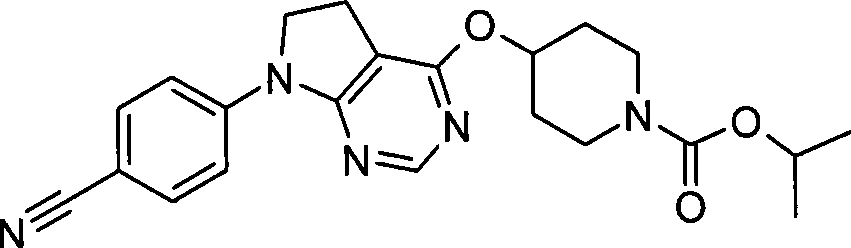
4-{[7-(4-氰基苯基)-6,7-二氢-5H-吡咯并[2,3-d]嘧啶-4-基]氧基}-1-哌啶甲酸1-甲基乙酯(119)4-{[7-(4-cyanophenyl)-6,7-dihydro-5H-pyrrolo[2,3-d]pyrimidin-4-yl]oxy}-1-piperidinecarboxylic acid 1- Methyl ethyl ester ( 119 )
采用所述用于制备31(实施例10,步骤7)的方法,在150℃下将117(202mg,0.44mmol)、CuCN(99mg,1.1mmol)和NMP(4mL)的混合物搅拌36小时。用水后处理,随后纯化,得到110mg(61%)白色固体状的标题产物119。Following the procedure described for the preparation of 31 (Example 10, Step 7), a mixture of 117 (202 mg, 0.44 mmol), CuCN (99 mg, 1.1 mmol) and NMP (4 mL) was stirred at 150 °C for 36 h. Workup with water followed by purification afforded 110 mg (61%) of the title product 119 as a white solid.
1H NMR(400MHz,DMSO-d6):δ 8.38(s,1H),8.0(d,J=8.8Hz,2H),7.78(d,J=8.8Hz,2H),5.28(m,2H),4.75(七重峰,J=6.4Hz,1H),4.10(t,J=9.2Hz,2H),3.69-3.64(m,2H),3.26-3.21(br m,2H),3.02(t,J=8.8Hz,2H),1.95-1.90(m,2H),1.62-1.52(m,2H),1.17(d,J=6.4Hz,6H);LCMS(ESI):m/z 408(M+H)+. 1 H NMR (400MHz, DMSO-d 6 ): δ 8.38(s, 1H), 8.0(d, J=8.8Hz, 2H), 7.78(d, J=8.8Hz, 2H), 5.28(m, 2H) , 4.75 (septet, J=6.4Hz, 1H), 4.10(t, J=9.2Hz, 2H), 3.69-3.64(m, 2H), 3.26-3.21(br m, 2H), 3.02(t, J =8.8Hz, 2H), 1.95-1.90(m, 2H), 1.62-1.52(m, 2H), 1.17(d, J=6.4Hz, 6H); LCMS (ESI): m/z 408 (M+H ) + .
实施例55(120)Example 55 ( 120 )
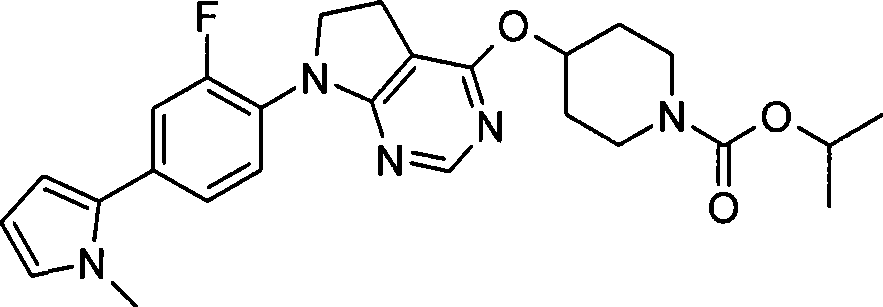
4-({7-[2-氟-4-(1-甲基-1H-吡咯-2-基)苯基]-6,7-二氢-5H-吡咯并[2,3-d]嘧啶-4-基}氧基)-1-哌啶甲酸1-甲基乙酯(120)4-({7-[2-fluoro-4-(1-methyl-1H-pyrrol-2-yl)phenyl]-6,7-dihydro-5H-pyrrolo[2,3-d]pyrimidine -4-yl}oxy)-1-piperidinecarboxylic acid 1-methylethyl ester ( 120 )
在N2下,往5mL玻璃管中装入30(100mg,0.2mmol)、PdCl2(Ph3P)2(15mg,0.02mmol)、1-甲基-2-(三丁基甲锡烷基)-1H-吡咯(70mg,0.20mmol)和THF(3mL)。将该管密封,随后在100℃下将该混合物置于微波条件下40分钟。将反应混合物冷却至室温,随后经SiO2快速柱层析纯化,得到11mg(12%)白色固体状的标题产物。Under N 2 , 30 (100mg, 0.2mmol), PdCl 2 (Ph 3 P) 2 (15mg, 0.02mmol), 1-methyl-2-(tributylstannyl)- 1H-Pyrrole (70 mg, 0.20 mmol) and THF (3 mL). The tube was sealed and the mixture was then placed under microwave conditions at 100°C for 40 minutes. The reaction mixture was cooled to room temperature and purified by flash column chromatography on SiO2 to afford 11 mg (12%) of the title product as a white solid.
1H NMR(400MHz,DMSO-d6):δ 8.12(s,1H),7.58(t,J=8.4Hz,1H),7.37 and 7.34(dd,J1=12.4Hz,J2=2.0Hz,1H),7.28 and 7.26(dd,J1=8.4Hz,J2=1.6Hz,1H),6.84(t,J=2.0Hz,1H),6.23 and 6.22(dd,J1=3.6Hz,J2=2.0Hz,1H),6.04(t,J=3.2Hz,1H),5.28-5.22(m,1H),4.76(七重峰,J=6.0Hz,1H),4.04(t,J=9.2Hz,2H),3.67(s,3H),3.71-3.65(m,2H),3.23(app.br,t,J=10Hz,2H),3.04(t,J=9.2Hz,2H),1.95-1.90(m,2H),1.61-1.52(m,2H),1.17(d,J=6.0Hz,6H);LCMS(ESI):m/z 480(M+H)+. 1 H NMR (400MHz, DMSO-d 6 ): δ 8.12(s, 1H), 7.58(t, J=8.4Hz, 1H), 7.37 and 7.34(dd, J 1 =12.4Hz, J 2 =2.0Hz, 1H), 7.28 and 7.26 (dd, J1 = 8.4Hz, J2 = 1.6Hz, 1H), 6.84 (t, J = 2.0Hz, 1H), 6.23 and 6.22 (dd, J1 = 3.6Hz, J2 =2.0Hz, 1H), 6.04(t, J=3.2Hz, 1H), 5.28-5.22(m, 1H), 4.76(septet, J=6.0Hz, 1H), 4.04(t, J=9.2Hz, 2H), 3.67(s, 3H), 3.71-3.65(m, 2H), 3.23(app.br, t, J=10Hz, 2H), 3.04(t, J=9.2Hz, 2H), 1.95-1.90( m, 2H), 1.61-1.52 (m, 2H), 1.17 (d, J=6.0Hz, 6H); LCMS (ESI): m/z 480 (M+H) + .
实施例56(125)Example 56 ( 125 )
步骤1:[6-氯-5-(2-氧代乙基)-4-嘧啶基][2-氟-4-(甲基磺酰基)苯基]氨基甲酸1,1-二甲基乙酯(121)Step 1: 1,1-Dimethylethyl [6-chloro-5-(2-oxoethyl)-4-pyrimidinyl][2-fluoro-4-(methylsulfonyl)phenyl]carbamate Esters ( 121 )
采用所述用于制备209的方法(参见实施例117,步骤1)。往化合物5(3.42g,10mmol)在3:2丙酮-H2O(250mL)中的溶液中加入K2OsO4·2H2O(147mg,0.4mmol)。分批加入NaIO4固体(8.56g,40mmol)并将该反应物搅拌4小时。后处理,得到5.0g(约100%)灰白色固体状的标题产物121。The procedure described for the preparation of 209 was followed (see Example 117, step 1). To a solution of compound 5 (3.42 g, 10 mmol) in 3:2 acetone-H 2 O (250 mL) was added K 2 OsO 4 ·2H 2 O (147 mg, 0.4 mmol). Solid NaIO4 (8.56 g, 40 mmol) was added portionwise and the reaction was stirred for 4 hours. Workup afforded 5.0 g (ca. 100%) of the title product 121 as an off-white solid.
1H NMR(400MHz,DMSO-d6):δ 9.63(s,1H),8.82(s,1H),7.96-7.94(dd,J1=9.6Hz,J2=2.0Hz,1H),7.78-7.76(dd,J1=8.4Hz,J2=1.6Hz,1H),7.59(app.t,J=7.6Hz,1H),3.93(s,2H),3.30(s,3H),1.38(s,9H). 1 H NMR (400MHz, DMSO-d 6 ): δ 9.63 (s, 1H), 8.82 (s, 1H), 7.96-7.94 (dd, J 1 =9.6Hz, J 2 =2.0Hz, 1H), 7.78- 7.76(dd, J1 =8.4Hz, J2 =1.6Hz, 1H), 7.59(app.t, J=7.6Hz, 1H), 3.93(s, 2H), 3.30(s, 3H), 1.38(s , 9H).
步骤2:(±)-[6-氯-5-(2-羟基丙基)-4-嘧啶基][2-氟-4-(甲基磺酰基)苯基]氨基甲酸1,1-二甲基乙酯(122)Step 2: (±)-[6-Chloro-5-(2-hydroxypropyl)-4-pyrimidinyl][2-fluoro-4-(methylsulfonyl)phenyl]
在室温、N2下,往搅拌的在无水THF(50mL)中的醛121(2.0g,4.51mmol)中加入1.4M甲基镁(6.5mL,9.01mmol)在THF中的溶液。在室温下将得到的混合物搅拌3小时。反应混合物倾入10%HCl水溶液(200mL)中,该混合物用EtOAc(4 x 75mL)萃取。合并的有机层用盐水(1 x 30mL)洗涤,经Na2SO4干燥,随后减压浓缩,得到粗品,其经柱层析纯化,得到0.815g(39%)白色固体状的标题醇(carbinol)122。1H NMR(400MHz,DMSO-d6):δ 9.15(s,1H),8.28(s,1H),7.85 and 7.82(dd,J1=9.6Hz,J2=2.0Hz,1H),7.80-7.68(m,2H),5.06-4.99(m,1H),3.28(s,3H),3.14-3.10(m,1H),3.05-3.02(m,1H),1.33(d,J=6.2Hz,3H),1.25(s,9H);LCMS(ESI):m/z 460(M+H)+.To stirred aldehyde 121 (2.0 g, 4.51 mmol) in anhydrous THF (50 mL) was added a 1.4M solution of methylmagnesium (6.5 mL, 9.01 mmol) in THF at room temperature under N2 . The resulting mixture was stirred at room temperature for 3 hours. The reaction mixture was poured into 10% aqueous HCl (200 mL), and the mixture was extracted with EtOAc (4 x 75 mL). The combined organic layers were washed with brine (1 x 30 mL), dried over Na2SO4 , and concentrated under reduced pressure to give the crude product, which was purified by column chromatography to yield 0.815 g (39%) of the title alcohol (carbinol) as a white solid. ) 122 . 1 H NMR (400MHz, DMSO-d 6 ): δ 9.15(s, 1H), 8.28(s, 1H), 7.85 and 7.82 (dd, J 1 =9.6Hz, J 2 =2.0Hz, 1H), 7.80- 7.68(m, 2H), 5.06-4.99(m, 1H), 3.28(s, 3H), 3.14-3.10(m, 1H), 3.05-3.02(m, 1H), 1.33(d, J=6.2Hz, 3H), 1.25(s, 9H); LCMS (ESI): m/z 460 (M+H) + .
步骤3:(±)-1-(4-氯-6-{[2-氟-4-(甲基磺酰基)苯基]氨基}-5-嘧啶基)-2-丙醇(123)Step 3: (±)-1-(4-Chloro-6-{[2-fluoro-4-(methylsulfonyl)phenyl]amino}-5-pyrimidinyl)-2-propanol ( 123 )
在室温、N2下,往醇(carbinol)122(800mg,1.74mmol)在CH2Cl2(20mL)中的溶液中加入TFA(5mL)。在室温下将反应混合物搅拌3小时,随后减压浓缩,得到标题产物123,其无需进一步纯化用于下一步骤。To a solution of carbinol 122 (800 mg, 1.74 mmol) in CH2Cl2 (20 mL) was added TFA (5 mL) at room temperature under N2 . The reaction mixture was stirred at room temperature for 3 hours, then concentrated under reduced pressure to afford the title product 123 , which was used in the next step without further purification.
1H NMR(400MHz,DMSO-d6):δ 9.84(s,1H),8.42(s,1H),8.16(app,t,J=8.0Hz,1H),7.83和7.80(dd,J1=10.4Hz,J2=2.0Hz,1H),7.74和7.72(dd,J1=8.8Hz,J2=1.6Hz,1H),5.87(d,J=2.8Hz,1H),4.07(app.br.s,1H),3.24(s,3H),2.94-2.83(m,2H),1.20(d,J=6.4Hz,3H);LCMS(ESI):m/z 360(M+H)+. 1 H NMR (400 MHz, DMSO-d 6 ): δ 9.84 (s, 1H), 8.42 (s, 1H), 8.16 (app, t, J = 8.0 Hz, 1H), 7.83 and 7.80 (dd, J 1 = 10.4Hz, J2 = 2.0Hz, 1H), 7.74 and 7.72 (dd, J1 = 8.8Hz, J2 = 1.6Hz, 1H), 5.87 (d, J = 2.8Hz, 1H), 4.07 (app.br .s, 1H), 3.24(s, 3H), 2.94-2.83(m, 2H), 1.20(d, J=6.4Hz, 3H); LCMS (ESI): m/z 360(M+H) + .
步骤4:(±)-4-氯-7-[2-氟-4-(甲基磺酰基)苯基]-6-甲基-6,7-二氢-5H-吡咯并[2,3-d]嘧啶(124)Step 4: (±)-4-Chloro-7-[2-fluoro-4-(methylsulfonyl)phenyl]-6-methyl-6,7-dihydro-5H-pyrrolo[2,3 -d]pyrimidine ( 124 )
采用所述用于制备化合物7(实施例1,步骤7)的方法,往化合物123在CH2Cl2(30mL)中的溶液中加入Et3N(0.722mL,5.22mmol),随后加入甲磺酸酐(0.606g,3.48mmol)并在室温下保持24小时。后处理,随后经层析纯化,得到0.272g(47%,对于两个步骤)灰白色固体状的二环化合物124。Following the procedure described for the preparation of compound 7 (Example 1, Step 7), to a solution of compound 123 in CH2Cl2 (30 mL) was added Et3N (0.722 mL, 5.22 mmol) followed by methanesulfonate anhydride (0.606 g, 3.48 mmol) and kept at room temperature for 24 hours. Workup followed by chromatographic purification afforded 0.272 g (47% for two steps) of the bicyclic compound 124 as an off-white solid.
1H NMR(400MHz,DMSO-d6):δ 8.23(s,1H),7.94和7.92(app,dd,J1=10.8Hz,J2=1.2Hz,1H),7.87-7.81(m,2H),4.80-4.72(m,1H),3.47-3.42(dd,J1=17.2Hz,J2=9.6Hz,1H),3.30(s,3H),2.89-2.85(dd,J1=17.2Hz,J2=7.2Hz,1H),1.21(d,J=6.0Hz,3H);LCMS(ESI):m/z 342(M+H)+. 1 H NMR (400MHz, DMSO-d 6 ): δ 8.23 (s, 1H), 7.94 and 7.92 (app, dd, J 1 =10.8Hz, J 2 =1.2Hz, 1H), 7.87-7.81 (m, 2H ), 4.80-4.72 (m, 1H), 3.47-3.42 (dd, J 1 =17.2Hz, J 2 =9.6Hz, 1H), 3.30 (s, 3H), 2.89-2.85 (dd, J 1 =17.2Hz , J 2 =7.2Hz, 1H), 1.21 (d, J=6.0Hz, 3H); LCMS (ESI): m/z 342 (M+H) + .
步骤5:(±)-4-({7-[2-氟-4-(甲基磺酰基)苯基]-6-甲基-6,7-二氢-5H-吡咯并[2,3-d]嘧啶-4-基}氧基)-1-哌啶甲酸1-甲基乙酯(125)Step 5: (±)-4-({7-[2-fluoro-4-(methylsulfonyl)phenyl]-6-methyl-6,7-dihydro-5H-pyrrolo[2,3 -d]pyrimidin-4-yl}oxy)-1-piperidinecarboxylic acid 1-methylethyl ester ( 125 )
采用所述用于制备10的方法,往NaH(60%,84mg,2.1mmol)在THF(2mL)中的悬浮液中加入在THF(2mL)中的化合物9(128mg,0.68mmol)。将反应混合物回流15分钟并加入在THF(2mL)中的化合物124(245mg,2.16mmol),随后将得到的混合物回流2小时。后处理,随后经层析纯化,得到276mg(82%)白色固体状的标题化合物125。Using the procedure described for the preparation of 10 , to a suspension of NaH (60%, 84 mg, 2.1 mmol) in THF (2 mL) was added compound 9 (128 mg, 0.68 mmol) in THF (2 mL). The reaction mixture was refluxed for 15 minutes and compound 124 (245 mg, 2.16 mmol) in THF (2 mL) was added, then the resulting mixture was refluxed for 2 hours. Workup followed by chromatographic purification afforded 276 mg (82%) of the title compound 125 as a white solid.
1H NMR(400MHz,DMSO-d6):δ 8.16(s,1H),7.87(app.br,d,J=10.4Hz,1H),7.83-7.81(app.br,d,J=7.6Hz,1H),7.78-7.76(dd,J1=8.4Hz,J2=1.6Hz,1H),5.30-5.22(m,1H),4.78-4.66(m,2H),3.68-3.64(m,2H),3.32-3.28(m,1H),3.28(s,3H),3.28-3.22(m,2H),2.70和2.66(app.dd,J1=16.0Hz,J2=7.2Hz,1H),1.96-186(m,2H),1.62-1.50(m,2H),1.19(app.d,J=5.6Hz,3H),1.17(d,J=6.0Hz,6H);LCMS(ESI):m/z 493(M+H)+. 1 H NMR (400MHz, DMSO-d 6 ): δ 8.16 (s, 1H), 7.87 (app.br, d, J=10.4Hz, 1H), 7.83-7.81 (app.br, d, J=7.6Hz , 1H), 7.78-7.76(dd, J 1 =8.4Hz, J 2 =1.6Hz, 1H), 5.30-5.22(m, 1H), 4.78-4.66(m, 2H), 3.68-3.64(m, 2H ), 3.32-3.28 (m, 1H), 3.28 (s, 3H), 3.28-3.22 (m, 2H), 2.70 and 2.66 (app.dd, J1 = 16.0Hz, J2 = 7.2Hz, 1H), 1.96-186(m, 2H), 1.62-1.50(m, 2H), 1.19(app.d, J=5.6Hz, 3H), 1.17(d, J=6.0Hz, 6H); LCMS(ESI): m /z 493(M+H) + .
实施例57Example 57
消旋混合物125(200mg)经ChiralHPLC[柱:Chiralpak OJ(分析用),Chiralpak OJ(制备用),流动相:95%CO2:5%MeOH:CHCl3(90:1);2mL/分钟;压力140巴,温度30℃,215nm和280nm)]分析,随后分离出两种(R和S)对映异构体。未指定绝对立体化学。The racemic mixture 125 (200 mg) was subjected to ChiralHPLC [column: Chiralpak OJ (for analysis), Chiralpak OJ (for preparation), mobile phase: 95% CO 2 : 5% MeOH:CHCl 3 (90:1); 2 mL/min;
对映异构体I,57A(125A):Tr:19.96分钟,46mg(%对映体过量>98%);光谱数据基本与实施例56(125)相同。Enantiomer I, 57A ( 125A ): Tr: 19.96 min, 46 mg (% enantiomeric excess >98%); spectral data essentially identical to Example 56 ( 125 ).
对映异构体II,57B(125B):Tr:21.0分钟,66mg(%对映体过量>98%);光谱数据基本与实施例56(125)相同。Enantiomer II, 57B ( 125B ): Tr: 21.0 min, 66 mg (% enantiomeric excess >98%); spectral data essentially identical to Example 56 ( 125 ).
实施例58(127)Example 58 ( 127 )

步骤1:7-[2-氟-4-(甲基磺酰基)苯基]-4-(4-哌啶基氧基)-6,7-二氢-5H-吡咯并[2,3-d]嘧啶·三氟乙酸盐(126)Step 1: 7-[2-Fluoro-4-(methylsulfonyl)phenyl]-4-(4-piperidinyloxy)-6,7-dihydro-5H-pyrrolo[2,3- d] pyrimidine trifluoroacetate ( 126 )
在室温下,11(实施例2,1.0g,2.03mmol)在CH2Cl2(40mL)中的溶液用TFA(10mL)处理2小时。在室温下将反应混合物搅拌2小时,随后浓缩,得到粗品126,将其干燥并重新溶解在20mL CH2Cl2和Et3N(1.7mL,约6当量)中,用于下一步。A solution of 11 (Example 2, 1.0 g, 2.03 mmol) in CH2Cl2 (40 mL) was treated with
步骤2:4-({7-[2-氟-4-(甲基磺酰基)苯基]-6,7-二氢-5H-吡咯并[2,3-d]嘧啶-4-基}氧基)-1-哌啶甲酸甲酯(127)Step 2: 4-({7-[2-fluoro-4-(methylsulfonyl)phenyl]-6,7-dihydro-5H-pyrrolo[2,3-d]pyrimidin-4-yl} Oxy)-1-piperidinecarboxylic acid methyl ester ( 127 )
在室温下126的溶液(2.2mL,得自步骤1)用氯代甲酸甲酯(200μL)处理18小时。反应混合物用CH2Cl2(30mL)稀释,随后用H2O(1 x10mL)、盐水(1 x 10mL)洗涤,经Na2SO4干燥,随后减压浓缩,得到粗品,其经柱层析纯化,得到76mg白色固体状的标题产物127。A solution of 126 (2.2 mL, from step 1) was treated with methyl chloroformate (200 μL) for 18 hours at room temperature. The reaction mixture was diluted with CH 2 Cl 2 (30 mL), then washed with H 2 O (1 x 10 mL), brine (1 x 10 mL), dried over Na 2 SO 4 , and concentrated under reduced pressure to give the crude product, which was subjected to column chromatography Purification afforded 76 mg of the title product 127 as a white solid.
1H NMR(400MHz,DMSO-d6):δ 8.22(s,1H),7.96(t,J=8.0Hz,1H),7.85和7.82(dd,J1=11.2Hz,J2=2.0Hz,1H),7.74和7.72(dd,J1=8.4Hz,J2=2.4Hz,1H),5.30-5.22(m,1H),4.14(t,J=8.4Hz,2H),3.58(s,3H),3.70-3.64(m,2H),3.28-3.24(app.br,m,2H),3.25(s,3H),3.05(t,J=8.8Hz,2H),1.96-1.91(m,2H),1.64-1.54(m,2H);LCMS(ESI):m/z 451(M+H)+. 1 H NMR (400MHz, DMSO-d 6 ): δ 8.22 (s, 1H), 7.96 (t, J=8.0Hz, 1H), 7.85 and 7.82 (dd, J 1 =11.2Hz, J 2 =2.0Hz, 1H), 7.74 and 7.72(dd, J 1 =8.4Hz, J 2 =2.4Hz, 1H), 5.30-5.22(m, 1H), 4.14(t, J=8.4Hz, 2H), 3.58(s, 3H ), 3.70-3.64(m, 2H), 3.28-3.24(app.br, m, 2H), 3.25(s, 3H), 3.05(t, J=8.8Hz, 2H), 1.96-1.91(m, 2H ), 1.64-1.54 (m, 2H); LCMS (ESI): m/z 451 (M+H) + .
实施例59(128)Example 59 ( 128 )

4-({7-[2-氟-4-(甲基磺酰基)苯基]-6,7-二氢-5H-吡咯并[2,3-d]嘧啶-4-基}氧基)-1-哌啶甲酸乙酯(128)4-({7-[2-fluoro-4-(methylsulfonyl)phenyl]-6,7-dihydro-5H-pyrrolo[2,3-d]pyrimidin-4-yl}oxy) -Ethyl 1-piperidinecarboxylate ( 128 )
采用所述用于制备化合物127的一般方法,在室温下126的溶液(2.2mL)用氯代甲酸乙酯(100μL)处理18小时。后处理,随后经层析纯化,得到85mg白色固体状的标题产物128。Using the general procedure described for the preparation of compound 127 , a solution of 126 (2.2 mL) was treated with ethyl chloroformate (100 μL) for 18 hours at room temperature. Workup followed by chromatographic purification afforded 85 mg of the title product 128 as a white solid.
1H NMR(400MHz,DMSO-d6):δ 8.22(s,1H),7.96(t,J=7.6Hz,1H),7.84和7.82(dd,J1=11.2Hz,J2=2.0Hz,1H),7.75和7.72(dd,J1=8.4Hz,J2=2.0Hz,1H),5.28-5.24(m,1H),4.14(t,J=8.4Hz,2H),4.02(q,J=7.2Hz,2H),3.71-3.65(m,2H),3.26-3.24(br.s,2H),3.25(s,3H),3.05(t,J=8.8Hz,2H),1.96-1.90(br,m,2H),1.62-1.54(m,2H),1.17(t,J=6.8Hz,3H);LCMS(ESI):m/z 465(M+H)+. 1 H NMR (400MHz, DMSO-d 6 ): δ 8.22 (s, 1H), 7.96 (t, J=7.6Hz, 1H), 7.84 and 7.82 (dd, J 1 =11.2Hz, J 2 =2.0Hz, 1H), 7.75 and 7.72 (dd, J1 = 8.4Hz, J2 = 2.0Hz, 1H), 5.28-5.24 (m, 1H), 4.14 (t, J = 8.4Hz, 2H), 4.02 (q, J =7.2Hz, 2H), 3.71-3.65(m, 2H), 3.26-3.24(br.s, 2H), 3.25(s, 3H), 3.05(t, J=8.8Hz, 2H), 1.96-1.90( br, m, 2H), 1.62-1.54 (m, 2H), 1.17 (t, J=6.8Hz, 3H); LCMS (ESI): m/z 465 (M+H) + .
实施例60(129)Example 60 ( 129 )

4-({7-[2-氟-4-(甲基磺酰基)苯基]-6,7-二氢-5H-吡咯并[2,3-d]嘧啶-4-基}氧基)-1-哌啶甲酸丙酯(129)4-({7-[2-fluoro-4-(methylsulfonyl)phenyl]-6,7-dihydro-5H-pyrrolo[2,3-d]pyrimidin-4-yl}oxy) -Propyl 1-piperidinecarboxylate ( 129 )
采用所述用于制备化合物127的一般方法,在室温下往126(100mg,0.198mmol,获自不同的批次)在CH2Cl2(4mL)中的溶液中加入Et3N(137μL,1mmol),随后加入氯代甲酸丙酯(100μL)并将该混合物搅拌18小时。后处理,随后经层析纯化,得到72mg(75%)白色固体状的标题产物129。Using the general procedure described for the preparation of compound 127 , to a solution of 126 (100 mg, 0.198 mmol, obtained from a different batch) in CH 2 Cl 2 (4 mL) was added Et 3 N (137 μL, 1 mmol) at room temperature. ), followed by the addition of propyl chloroformate (100 μL) and the mixture was stirred for 18 hours. Workup followed by chromatographic purification afforded 72 mg (75%) of the title product 129 as a white solid.
1H NMR(400MHz,DMSO-d6):δ 8.22(s,1H),7.96(t,J=8.0Hz,1H),7.85和7.82(dd,J1=10.8Hz,J2=2.0Hz,1H),7.75和7.72(dd,J1=8.4Hz,J2=2.4Hz,1H),5.30-5.24(m,1H),4.14(t,J=8.4Hz,2H),3.94(t,J=6.8Hz,2H),3.72-3.66(m,2H),3.30-3.24(br,m,2H),3.05(t,J=8.4Hz,2H),1.98-1.88(m,2H),1.62-1.52(m,4H),0.87(t,J=7.2Hz,2H);LCMS(ESI):m/z 479(M+H)+. 1 H NMR (400MHz, DMSO-d 6 ): δ 8.22 (s, 1H), 7.96 (t, J=8.0Hz, 1H), 7.85 and 7.82 (dd, J 1 =10.8Hz, J 2 =2.0Hz, 1H), 7.75 and 7.72 (dd, J1 = 8.4Hz, J2 = 2.4Hz, 1H), 5.30-5.24 (m, 1H), 4.14 (t, J = 8.4Hz, 2H), 3.94 (t, J =6.8Hz, 2H), 3.72-3.66(m, 2H), 3.30-3.24(br, m, 2H), 3.05(t, J=8.4Hz, 2H), 1.98-1.88(m, 2H), 1.62- 1.52 (m, 4H), 0.87 (t, J=7.2Hz, 2H); LCMS (ESI): m/z 479 (M+H) + .
实施例61(130)Example 61 ( 130 )
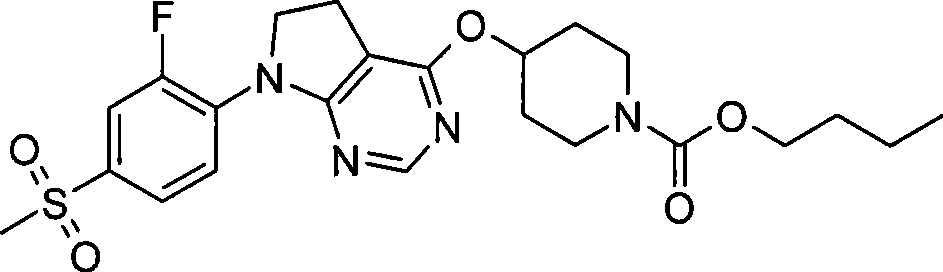
4-({7-[2-氟-4-(甲基磺酰基)苯基]-6,7-二氢-5H-吡咯并[2,3-d]嘧啶-4-基}氧基)-1-哌啶甲酸正丁酯(130)4-({7-[2-fluoro-4-(methylsulfonyl)phenyl]-6,7-dihydro-5H-pyrrolo[2,3-d]pyrimidin-4-yl}oxy) -1-Butyl piperidinecarboxylate ( 130 )
采用所述用于制备化合物127的一般方法,在室温下往126((100mg,0.198mmol),获自不同的批次)在CH2Cl2(4mL)中的溶液中加入Et3N(137μL,1mmol),随后加入氯代甲酸丁酯(100μL),随后搅拌18小时。后处理,随后经层析纯化,得到76mg(77%)白色固体状的标题产物130。Using the general procedure described for the preparation of compound 127 , to a solution of 126 ((100 mg, 0.198 mmol), obtained from a different batch) in CH 2 Cl 2 (4 mL) was added Et 3 N (137 μL , 1 mmol), followed by addition of butyl chloroformate (100 μL), followed by stirring for 18 hours. Workup followed by chromatographic purification afforded 76 mg (77%) of the
1H NMR(400MHz,DMSO-d6):δ 8.22(s,1H),7.96(t,J=8.0Hz,1H),7.85和7.82(dd,J1=10.8Hz,J2=2.0Hz,1H),7.75和7.73(dd,J1=8.4Hz,J2=2.4Hz,1H),5.30-5.24(m,1H),4.14(t,J=8.0Hz,2H),3.98(t,J=6.4Hz,2H),3.71-3.66(m,2H),3.26-3.24(br,s,2H),3.25(s,3H),3.05(t,J=8.8Hz,2H),1.96-1.90(m,2H),1.62-1.49(m,4H),1.36-1.26(m,2H),0.88(t,J=7.6Hz,3H);LCMS(ESI):m/z493(M+H)+. 1 H NMR (400MHz, DMSO-d 6 ): δ 8.22 (s, 1H), 7.96 (t, J=8.0Hz, 1H), 7.85 and 7.82 (dd, J 1 =10.8Hz, J 2 =2.0Hz, 1H), 7.75 and 7.73 (dd, J1 = 8.4Hz, J2 = 2.4Hz, 1H), 5.30-5.24 (m, 1H), 4.14 (t, J = 8.0Hz, 2H), 3.98 (t, J =6.4Hz, 2H), 3.71-3.66(m, 2H), 3.26-3.24(br, s, 2H), 3.25(s, 3H), 3.05(t, J=8.8Hz, 2H), 1.96-1.90( m, 2H), 1.62-1.49 (m, 4H), 1.36-1.26 (m, 2H), 0.88 (t, J=7.6Hz, 3H); LCMS (ESI): m/z 493 (M+H) + .
实施例62(131)Example 62 ( 131 )
4-({7-[2-氟-4-(甲基磺酰基)苯基]-6,7-二氢-5H-吡咯并[2,3-d]嘧啶-4-基}氧基)-1-哌啶甲酸2-氟乙酯(131)4-({7-[2-fluoro-4-(methylsulfonyl)phenyl]-6,7-dihydro-5H-pyrrolo[2,3-d]pyrimidin-4-yl}oxy) -2-fluoroethyl 1-piperidinecarboxylate ( 131 )
采用所述用于制备化合物127的一般方法,在室温下往126(100mg,0.198mmol,获自不同的批号)在CH2Cl2(4mL)中的溶液中加入Et3N(137μL,1mmol),随后加入氯代甲酸2-氟乙酯(100μL),随后搅拌18小时。后处理,随后层析,得到56mg(58%)白色固体状的标题产物131。Using the general procedure described for the preparation of compound 127 , to a solution of 126 (100 mg, 0.198 mmol, obtained from a different lot) in CH2Cl2 (4 mL) was added Et3N (137 μL, 1 mmol) at room temperature , then 2-fluoroethyl chloroformate (100 μL) was added, followed by stirring for 18 hours. Workup followed by chromatography afforded 56 mg (58%) of the title product 131 as a white solid.
1H NMR(400MHz,DMSO-d6):δ 8.23(s,1H),7.96(t,J=8.0Hz,1H),7.85和7.82(dd,J1=10.8Hz,J2=2.4Hz,1H),7.75和7.73(dd,J1=8.8Hz,J2=2.0Hz,1H),5.31-5.25(m,1H),4.65(app.t,J=4.0Hz,1H),4.53(app.t,J=3.6Hz,1H),4.27(app.t,J=4.0Hz,1H),4.19(app.t,J=4.0Hz,1H),4.14(t,J=8.0Hz,2H),3.70(app.m,2H),3.28-3.25(br,s,2H),3,25(s,3H),3.06(t,J=8.8Hz,2H),1.98-1.90(m,2H),1.65-1.56(m,2H);LCMS(ESI):m/z 483(M+H)+. 1 H NMR (400MHz, DMSO-d 6 ): δ 8.23 (s, 1H), 7.96 (t, J=8.0Hz, 1H), 7.85 and 7.82 (dd, J 1 =10.8Hz, J 2 =2.4Hz, 1H), 7.75 and 7.73 (dd, J1 = 8.8Hz, J2 = 2.0Hz, 1H), 5.31-5.25 (m, 1H), 4.65 (app.t, J = 4.0Hz, 1H), 4.53 (app .t, J=3.6Hz, 1H), 4.27(app.t, J=4.0Hz, 1H), 4.19(app.t, J=4.0Hz, 1H), 4.14(t, J=8.0Hz, 2H) , 3.70(app.m, 2H), 3.28-3.25(br, s, 2H), 3, 25(s, 3H), 3.06(t, J=8.8Hz, 2H), 1.98-1.90(m, 2H) , 1.65-1.56 (m, 2H); LCMS (ESI): m/z 483 (M+H) + .
实施例63(132)Example 63 ( 132 )
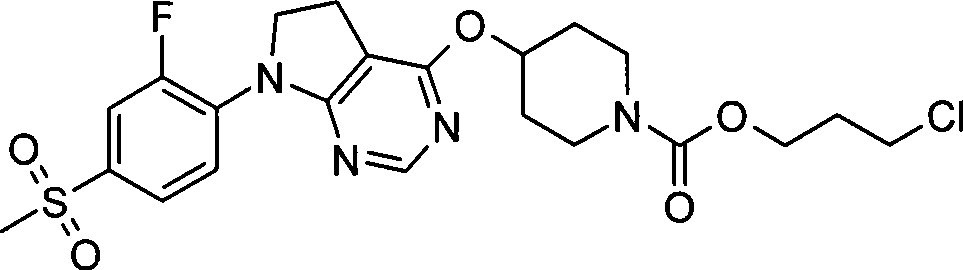
4-({7-[2-氟-4-(甲基磺酰基)苯基]-6,7-二氢-5H-吡咯并[2,3-d]嘧啶-4-基}氧基)-1-哌啶甲酸3-氯丙酯(132)4-({7-[2-fluoro-4-(methylsulfonyl)phenyl]-6,7-dihydro-5H-pyrrolo[2,3-d]pyrimidin-4-yl}oxy) -3-Chloropropyl 1-piperidinecarboxylate ( 132 )
采用所述用于制备化合物127的一般方法,在室温下往2.2mL126在CH2Cl2和Et3N中的溶液中加入氯代甲酸3-氯丙酯(200μL)并将反应混合物搅拌18小时。后处理,随后层析,得到42mg白色固体状的标题产物132。Using the general procedure described for the preparation of compound 127 , to a solution of 2.2 mL of 126 in CH2Cl2 and Et3N was added 3-chloropropyl chloroformate (200 μL) at room temperature and the reaction mixture was stirred for 18 Hour. Workup followed by chromatography afforded 42 mg of the title product 132 as a white solid.
1H NMR(400MHz,DMSO-d6):δ 8.22(s,1H),7.96(t,J=8.0Hz,1H),7.86和7.82(dd,J1=10.8Hz,J2=2.0Hz,1H),7.76和7.72(dd,J1=8.8Hz,J2=2.0Hz,1H),5.31-5.24(m,1H),4.14(app.t,J=8.4Hz,2H),4.10(t,J=6.4Hz,2H),3.70(t,J=6.4Hz,2H),3.25(s,3H),3.30-3.24(br.s,2H),3.05(t,J=8.8Hz,2H),2.02(app.(五重峰,J=12.4Hz,2H),1.96-1.82(m,2H),1.64-1.54(m,2H);LCMS(ESI):m/z 513(M+H)+. 1 H NMR (400MHz, DMSO-d 6 ): δ 8.22 (s, 1H), 7.96 (t, J=8.0Hz, 1H), 7.86 and 7.82 (dd, J 1 =10.8Hz, J 2 =2.0Hz, 1H), 7.76 and 7.72 (dd, J1 = 8.8Hz, J2 = 2.0Hz, 1H), 5.31-5.24 (m, 1H), 4.14 (app.t, J = 8.4Hz, 2H), 4.10 (t , J=6.4Hz, 2H), 3.70(t, J=6.4Hz, 2H), 3.25(s, 3H), 3.30-3.24(br.s, 2H), 3.05(t, J=8.8Hz, 2H) , 2.02 (app. (quintet, J=12.4Hz, 2H), 1.96-1.82 (m, 2H), 1.64-1.54 (m, 2H); LCMS (ESI): m/z 513 (M+H) + .
实施例64(133)Example 64 ( 133 )
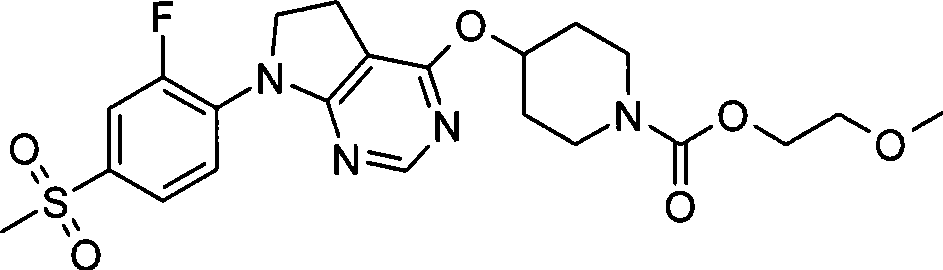
4-({7-[2-氟-4-(甲基磺酰基)苯基]-6,7-二氢-5H-吡咯并[2,3-d]嘧啶-4-基}氧基)-1-哌啶甲酸2-(甲氧基)乙酯(133)4-({7-[2-fluoro-4-(methylsulfonyl)phenyl]-6,7-dihydro-5H-pyrrolo[2,3-d]pyrimidin-4-yl}oxy) -2-(methoxy)ethyl 1-piperidinecarboxylate ( 133 )
采用所述用于制备化合物127的一般方法,在室温下往126(100mg,0.198mmol,获自不同的批号)在CH2Cl2(4mL)中的溶液中加入Et3N(137μL,1mmol),随后加入氯代甲酸2-(甲氧基)乙酯(100μL)并将该混合物搅拌18小时。后处理,随后层析,得到64mg(65%)白色固体状的标题产物129。Using the general procedure described for the preparation of compound 127 , to a solution of 126 (100 mg, 0.198 mmol, obtained from a different lot) in CH2Cl2 (4 mL) was added Et3N (137 μL, 1 mmol) at room temperature , followed by the addition of 2-(methoxy)ethyl chloroformate (100 μL) and the mixture was stirred for 18 hours. Workup followed by chromatography afforded 64 mg (65%) of the title product 129 as a white solid.
1H NMR(400MHz,DMSO-d6):δ 8.22(s,1H),7.96(t,J=7.6Hz,1H),7.85和7.82(dd,J1=11.2Hz,J2=2.0Hz,1H),7.75和7.72(dd,J1=8.4Hz,J2=2.0Hz,1H),5.30-5.26(m,1H),4.16-4.09(m,2H),3.72-3.66(m,2H),3.50(t,J=4.4Hz,2H),3.24(s,3H),3.28-3.24(br.s,2H),3.05(t,J=8.8Hz,2H),5.30-5.26(m,1H),4.16-4.09(m,2H),3.72-3.66(m,2H),3.50(t,J=4.4Hz,2H),3.28-3.24(br.s,2H),3.24(s,6H),3.05(t,J=8.8Hz,2H),1.98-1.90(m,2H),1.63-1.54(m,2H);LCMS(ESI):m/z 495(M+H)+. 1 H NMR (400MHz, DMSO-d 6 ): δ 8.22 (s, 1H), 7.96 (t, J=7.6Hz, 1H), 7.85 and 7.82 (dd, J 1 =11.2Hz, J 2 =2.0Hz, 1H), 7.75 and 7.72 (dd, J 1 =8.4Hz, J 2 =2.0Hz, 1H), 5.30-5.26(m, 1H), 4.16-4.09(m, 2H), 3.72-3.66(m, 2H) , 3.50(t, J=4.4Hz, 2H), 3.24(s, 3H), 3.28-3.24(br.s, 2H), 3.05(t, J=8.8Hz, 2H), 5.30-5.26(m, 1H ), 4.16-4.09(m, 2H), 3.72-3.66(m, 2H), 3.50(t, J=4.4Hz, 2H), 3.28-3.24(br.s, 2H), 3.24(s, 6H), 3.05(t, J=8.8Hz, 2H), 1.98-1.90(m, 2H), 1.63-1.54(m, 2H); LCMS(ESI): m/z 495(M+H) + .
实施例65(134)Example 65 ( 134 )
4-({7-[2-氟-4-(甲基磺酰基)苯基]-6,7-二氢-5H-吡咯并[2,3-d]嘧啶-4-基}氧基)-1-哌啶甲酸2-丙烯-1-基酯(134)4-({7-[2-fluoro-4-(methylsulfonyl)phenyl]-6,7-dihydro-5H-pyrrolo[2,3-d]pyrimidin-4-yl}oxy) -2-propen-1-yl-1-piperidinecarboxylate ( 134 )
采用所述用于制备化合物127的一般方法,在室温下往126(100mg,0.198mmol,获自不同的批号)在CH2Cl2(4mL)中的溶液中加入Et3N(137μL,1mmol),随后加入氯代甲酸2-丙烯-1-基酯(100μL)并将该混合物搅拌18小时。后处理,随后层析,得到56mg(59%)白色固体状的标题产物134。Using the general procedure described for the preparation of compound 127 , to a solution of 126 (100 mg, 0.198 mmol, obtained from a different lot) in CH2Cl2 (4 mL) was added Et3N (137 μL, 1 mmol) at room temperature , followed by the addition of 2-propen-1-yl chloroformate (100 μL) and the mixture was stirred for 18 hours. Workup followed by chromatography afforded 56 mg (59%) of the title product 134 as a white solid.
1H NMR(400MHz,DMSO-d6):δ 8.22(s,1H),7.96(t,J=7.6Hz,1H),7.85和7.82(dd,J1=10.8Hz,J2=2.4Hz,1H),7.74和7.72(dd,J1=8.4Hz,J2=2.0Hz,1H),5.96-5.87(m,1H),5.30-5.24(m,2H),5.18-5.16(dd,J1=10.8Hz,J2=1.2Hz,1H),4.52(d,J=5.2Hz,2H),4.14(t,J=8.4Hz,2H),3.74-3.68(m,2H),3.30-3.24(br.s,2H),3.06(t,J=8.8Hz,2H),3.06(t,J=8.8Hz,2H),1.98-1.92(m,2H),1.64-1.54(m,2H);LCMS(ESI):m/z 477(M+H)+. 1 H NMR (400MHz, DMSO-d 6 ): δ 8.22 (s, 1H), 7.96 (t, J=7.6Hz, 1H), 7.85 and 7.82 (dd, J 1 =10.8Hz, J 2 =2.4Hz, 1H), 7.74 and 7.72 (dd, J 1 =8.4Hz, J 2 =2.0Hz, 1H), 5.96-5.87 (m, 1H), 5.30-5.24 (m, 2H), 5.18-5.16 (dd, J 1 =10.8Hz, J 2 =1.2Hz, 1H), 4.52(d, J=5.2Hz, 2H), 4.14(t, J=8.4Hz, 2H), 3.74-3.68(m, 2H), 3.30-3.24( br.s, 2H), 3.06(t, J=8.8Hz, 2H), 3.06(t, J=8.8Hz, 2H), 1.98-1.92(m, 2H), 1.64-1.54(m, 2H); LCMS (ESI): m/z 477(M+H) + .
实施例66(135)Example 66 ( 135 )
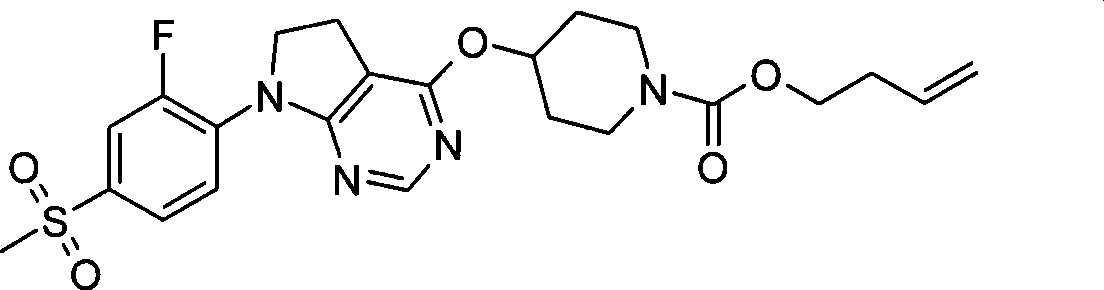
4-({7-[2-氟-4-(甲基磺酰基)苯基]-6,7-二氢-5H-吡咯并[2,3-d]嘧啶-4-基}氧基)-1-哌啶甲酸3-丁烯-1-基酯(134)4-({7-[2-fluoro-4-(methylsulfonyl)phenyl]-6,7-dihydro-5H-pyrrolo[2,3-d]pyrimidin-4-yl}oxy) -1-piperidinecarboxylic acid 3-buten-1-yl ester ( 134 )
采用所述用于制备化合物127的一般方法,在室温下,126(2.2mL,获自实施例58的步骤1)在CH2Cl2中的溶液用Et3N(1.7mL,6当量)处理,随后用氯代甲酸3-丁烯-1-基酯(200μL)处理18小时。后处理,随后层析,得到66mg白色固体状的标题产物135。Using the general procedure described for the preparation of compound 127 , a solution of 126 (2.2 mL, from
1H NMR(400MHz,DMSO-d6):δ 8.22(s,1H),7.96(t,J=8.0Hz,1H),7.86和7.82(dd,J1=10.8Hz,J2=2.0Hz,1H),7.76和7.74(dd,J1=8.4Hz,J2=2.0Hz,1H),5.84-5.74(m,1H),5.30-5.24(m,1H),5.11-5.08(dd,J1=17.2Hz,J2=2.0Hz,1H),5.06和5.02(app.br.d,J=10.4Hz,1H),4.14(app.t,J=8.4Hz,2H),4.04(t,J=6.8Hz,2H),3.72-3.64(m,2H),3.28-3.20(br,s,2H),3.25(s,3H),3.06(t,J=8.8Hz,2H),2.32(app.q,J=6.8Hz,2H),1.96-1.90(m,2H),1.62-1.54(m,2H);LCMS(ESI):m/z 491(M+H)+. 1 H NMR (400MHz, DMSO-d 6 ): δ 8.22 (s, 1H), 7.96 (t, J=8.0Hz, 1H), 7.86 and 7.82 (dd, J 1 =10.8Hz, J 2 =2.0Hz, 1H), 7.76 and 7.74 (dd, J 1 =8.4Hz, J 2 =2.0Hz, 1H), 5.84-5.74 (m, 1H), 5.30-5.24 (m, 1H), 5.11-5.08 (dd, J 1 = 17.2Hz, J2 = 2.0Hz, 1H), 5.06 and 5.02 (app.br.d, J = 10.4Hz, 1H), 4.14 (app.t, J = 8.4Hz, 2H), 4.04 (t, J =6.8Hz, 2H), 3.72-3.64(m, 2H), 3.28-3.20(br, s, 2H), 3.25(s, 3H), 3.06(t, J=8.8Hz, 2H), 2.32(app. q, J=6.8Hz, 2H), 1.96-1.90 (m, 2H), 1.62-1.54 (m, 2H); LCMS (ESI): m/z 491 (M+H) + .
实施例67(136)Example 67 ( 136 )
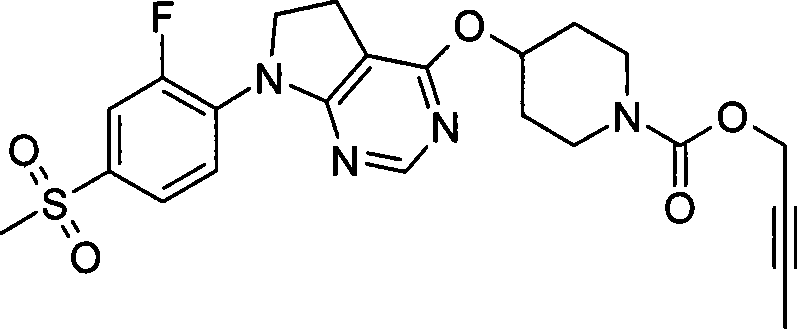
4-({7-[2-氟-4-(甲基磺酰基)苯基]-6,7-二氢-5H-吡咯并[2,3-d]嘧啶-4-基}氧基)-1-哌啶甲酸2-丁炔-1-基酯(136)4-({7-[2-fluoro-4-(methylsulfonyl)phenyl]-6,7-dihydro-5H-pyrrolo[2,3-d]pyrimidin-4-yl}oxy) -1-piperidinecarboxylic acid 2-butyn-1-yl ester ( 136 )
采用所述用于制备化合物127的一般方法,在室温下,126(2.2mL,获自实施例58的步骤1)在CH2Cl2中的溶液用Et3N(1.7mL,6当量)处理,随后用氯代甲酸2-丁炔-1-基酯(200μL)处理18小时。后处理,随后层析,得到70mg白色固体状的标题产物136。Using the general procedure described for the preparation of compound 127 , a solution of 126 (2.2 mL, from
1H NMR(400MHz,DMSO-d6):δ 8.22(s,1H),7.96(t,J=8.0Hz,1H),7.84和7.82(dd,J1=10.8Hz,J2=2.0Hz,1H),7.74和7.72(dd,J1=8.4Hz,J2=2.0Hz,1H),5.30-5.24(m,1H),4.62(app.d,J=2.4Hz,2H),4.14(t,J=8.4Hz,2H),3.70-3.64(m,2H),3.28-3.24(掩蔽br.s,2H),3.25(s,3H),3.06(t,J=8.8Hz,2H),1.97-1.91(m,2H),1.81(app.t,J=2.4Hz,3H),1.64-1.56(m,2H);LCMS(ESI):m/z 489(M+H)+. 1 H NMR (400MHz, DMSO-d 6 ): δ 8.22 (s, 1H), 7.96 (t, J=8.0Hz, 1H), 7.84 and 7.82 (dd, J 1 =10.8Hz, J 2 =2.0Hz, 1H), 7.74 and 7.72 (dd, J1 = 8.4Hz, J2 = 2.0Hz, 1H), 5.30-5.24 (m, 1H), 4.62 (app.d, J = 2.4Hz, 2H), 4.14 (t , J=8.4Hz, 2H), 3.70-3.64(m, 2H), 3.28-3.24(masked br.s, 2H), 3.25(s, 3H), 3.06(t, J=8.8Hz, 2H), 1.97 -1.91 (m, 2H), 1.81 (app.t, J=2.4Hz, 3H), 1.64-1.56 (m, 2H); LCMS (ESI): m/z 489 (M+H) + .
实施例68(137)Example 68 ( 137 )
4-({7-[2-氟-4-(甲基磺酰基)苯基]-6,7-二氢-5H-吡咯并[2,3-d]嘧啶-4-基}氧基)-1-哌啶甲酸戊酯(137)4-({7-[2-fluoro-4-(methylsulfonyl)phenyl]-6,7-dihydro-5H-pyrrolo[2,3-d]pyrimidin-4-yl}oxy) -1-Piperidinecarboxylic acid pentyl ester ( 137 )
采用所述用于制备化合物127的一般方法,在室温下往126(70mg,0.142mmol,获自不同的批号)在CH2Cl2(5mL)中的溶液中加入Et3N(120μL,0.85mmol),随后加入氯代甲酸戊酯(100μL)并将该混合物搅拌18小时。后处理,随后层析,得到64mg(89%)白色固体状的标题产物137。Using the general procedure described for the preparation of compound 127 , to a solution of 126 (70 mg, 0.142 mmol, obtained from a different lot) in CH2Cl2 (5 mL) was added Et3N (120 μL, 0.85 mmol) at room temperature. ), followed by the addition of amyl chloroformate (100 μL) and the mixture was stirred for 18 hours. Workup followed by chromatography afforded 64 mg (89%) of the title product 137 as a white solid.
1H NMR(400MHz,DMSO-d6):δ 8.22(s,1H),7.96(t,J=8.0Hz,1H),7.84和7.82(dd,J1=11.2Hz,J2=2.0Hz,1H),7.74和7.72(dd,J1=8.4Hz,J2=2.0Hz,1H),5.30-5.24(m,1H),4.14(t,J=8.4Hz,2H),3.98(t,J=6.8Hz,2H),3.71-3.65(m,2H),3.28-3.22(br,s,2H),3.25(s,3H),3.05(t,J=8.8Hz,2H),1.96-1.88(m,2H),1.62-1.50(m,4H),1.31-1.26(m,4H),0.86(app.t,J=7.2Hz,3H);LCMS(ESI):m/z 507(M+H)+. 1 H NMR (400MHz, DMSO-d 6 ): δ 8.22 (s, 1H), 7.96 (t, J=8.0Hz, 1H), 7.84 and 7.82 (dd, J 1 =11.2Hz, J 2 =2.0Hz, 1H), 7.74 and 7.72 (dd, J1 = 8.4Hz, J2 = 2.0Hz, 1H), 5.30-5.24 (m, 1H), 4.14 (t, J = 8.4Hz, 2H), 3.98 (t, J =6.8Hz, 2H), 3.71-3.65(m, 2H), 3.28-3.22(br, s, 2H), 3.25(s, 3H), 3.05(t, J=8.8Hz, 2H), 1.96-1.88( m, 2H), 1.62-1.50 (m, 4H), 1.31-1.26 (m, 4H), 0.86 (app.t, J=7.2Hz, 3H); LCMS (ESI): m/z 507 (M+H ) + .
实施例69(138)Example 69 ( 138 )

4-({7-[2-氟-4-(甲基磺酰基)苯基]-6,7-二氢-5H-吡咯并[2,3-d]嘧啶-4-基}氧基)-1-哌啶甲酸己酯(138)4-({7-[2-fluoro-4-(methylsulfonyl)phenyl]-6,7-dihydro-5H-pyrrolo[2,3-d]pyrimidin-4-yl}oxy) -1-Hexyl piperidinecarboxylate ( 138 )
采用所述用于制备化合物127的一般方法,在室温下往126(100mg,0.198mmol,获自不同的批号)在CH2Cl2(4mL)中的溶液中加入Et3N(137μL,1mmol),随后加入氯代甲酸己酯(100μL)并将该混合物搅拌18小时。后处理,随后层析,得到72mg(69%)白色固体状的标题产物138。Using the general procedure described for the preparation of compound 127 , to a solution of 126 (100 mg, 0.198 mmol, obtained from a different lot) in CH2Cl2 (4 mL) was added Et3N (137 μL, 1 mmol) at room temperature , followed by the addition of hexyl chloroformate (100 μL) and the mixture was stirred for 18 hours. Workup followed by chromatography afforded 72 mg (69%) of the title product 138 as a white solid.
1H NMR(400MHz,DMSO-d6):δ 8.22(s,1H),7.96(t,J=8.0Hz,1H),7.84和7.82(dd,J1=10.8Hz,J2=2.0Hz,1H),7.75和7.72(dd,J1=8.4Hz,J2=2.0Hz,1H),5.32-5.24(m,1H),4.14(t,J=8.0Hz,2H),3.98(t,J=6.4Hz,2H),3.72-3.66(m,2H),3.28-3.20(掩蔽br,s,2H),3.25(s,3H),3.05(t,J=6.8Hz,2H),1.96-1.91(m,2H),1.62-1.50(m,4H),1.31-1.21(m,6H),0.84(app.t,J=6.8Hz,3H);LCMS(ESI):m/z 521(M+H)+. 1 H NMR (400MHz, DMSO-d 6 ): δ 8.22 (s, 1H), 7.96 (t, J=8.0Hz, 1H), 7.84 and 7.82 (dd, J 1 =10.8Hz, J 2 =2.0Hz, 1H), 7.75 and 7.72 (dd, J1 = 8.4Hz, J2 = 2.0Hz, 1H), 5.32-5.24 (m, 1H), 4.14 (t, J = 8.0Hz, 2H), 3.98 (t, J =6.4Hz, 2H), 3.72-3.66(m, 2H), 3.28-3.20(masking br, s, 2H), 3.25(s, 3H), 3.05(t, J=6.8Hz, 2H), 1.96-1.91 (m, 2H), 1.62-1.50 (m, 4H), 1.31-1.21 (m, 6H), 0.84 (app.t, J=6.8Hz, 3H); LCMS (ESI): m/z 521 (M+ H) + .
实施例70(140)Example 70 ( 140 )
步骤1:4-氯-7-(2-甲基-3-吡啶基)-6,7-二氢-5H-吡咯并[2,3-d]嘧啶(139)Step 1: 4-Chloro-7-(2-methyl-3-pyridyl)-6,7-dihydro-5H-pyrrolo[2,3-d]pyrimidine ( 139 )
往圆底烧瓶中装入2-甲基-3-吡啶胺(5.20g,47mmol),随后冷却至-15℃。往以上冷却的吡啶胺中加入三氟乙酸(100mL),同时将内容物搅拌0.5小时。往以上混合物中分批加入Na(OAc)3BH(32.5g,48mmol)并继续搅拌0.5小时。往以上混合物中加入在CH2Cl2(25mL)中的醛209(参见实施例117,步骤1,7.4g,48mmol)。将得到的混合物升温至环境温度并搅拌18小时。将反应混合物减压浓缩并将残余物倾入饱和的NaHCO3溶液(250mL)中,随后该混合物用CH2Cl2(3 x250mL)萃取。合并的有机层用盐水(1 x 100mL)洗涤,经饱和Na2SO4干燥,随后减压浓缩,得到约11.5g(约100%)粗品。未得到所需二环产物,但分离得到为主要产物的未环化N-[2-(4,6-二氯-5-嘧啶基)乙基]-2-甲基-3-吡啶胺。A round bottom flask was charged with 2-methyl-3-pyridinamine (5.20 g, 47 mmol), then cooled to -15°C. To the above cooled pyridinium was added trifluoroacetic acid (100 mL) while the contents were stirred for 0.5 hours. To the above mixture was added Na(OAc) 3BH (32.5 g, 48 mmol) in portions and stirring was continued for 0.5 h. To the above mixture was added aldehyde 209 (see Example 117,
1H NMR(400MHz,DMSO-d6):δ8.81(s,1H),7.95-7.94(m,1H),7.71-7.66(m,2H),6.63(app.t,J=5.6Hz,1H),3.59(app.q,J=6.0Hz,2H),3.08(t,J=6.4Hz,2H),2.40(s,3H),LCMS(ESI):m/z 285(M+H)+. 1 H NMR (400MHz, DMSO-d 6 ): δ8.81(s, 1H), 7.95-7.94(m, 1H), 7.71-7.66(m, 2H), 6.63(app.t, J=5.6Hz, 1H), 3.59(app.q, J=6.0Hz, 2H), 3.08(t, J=6.4Hz, 2H), 2.40(s, 3H), LCMS(ESI): m/z 285(M+H) + .
在室温、N2下,往圆底烧瓶中装入以上得到的产物(约11.0g)、PdCl2(Ph3P)2(1.36g,2mmol)、叔丁醇钾(8.72g,77.7mmoI)、K2CO3(10.74g,77.7mmol)和甲苯(200mL)。将反应混合物回流18小时。反应混合物冷却至室温,随后经celite硅藻土垫过滤。将滤液减压浓缩,得到粗品,其经快速柱层析纯化,得到0.850g标题产物139(87%纯度)。At room temperature under N 2 , charge the product obtained above (about 11.0 g), PdCl 2 (Ph 3 P) 2 (1.36 g, 2 mmol), potassium tert-butoxide (8.72 g, 77.7 mmol) into a round bottom flask , K 2 CO 3 (10.74 g, 77.7 mmol) and toluene (200 mL). The reaction mixture was refluxed for 18 hours. The reaction mixture was cooled to room temperature, then filtered through a pad of celite. The filtrate was concentrated under reduced pressure to give the crude product, which was purified by flash column chromatography to afford 0.850 g of the title product 139 (87% purity).
1H NMR(400MHz,DMSO-d6):δ 8.42和8.40(dd,J1=4.8Hz,J2=1.2Hz,1H),8.11(s,1H),7.76-7.74(dd,J1=8.0Hz,J2=1.6Hz,1H),7.32和7.30(dd,J1=8.0Hz,J2=4.8Hz,1H),4.03(t,J=8.8Hz,2H),3.20(t,J=8.4Hz,2H),2.34(s,3H),LCMS(ESI):m/z 247(M+H)+. 1 H NMR (400 MHz, DMSO-d 6 ): δ 8.42 and 8.40 (dd, J 1 =4.8 Hz, J 2 =1.2 Hz, 1H), 8.11 (s, 1H), 7.76-7.74 (dd, J 1 = 8.0Hz, J2 = 1.6Hz, 1H), 7.32 and 7.30 (dd, J1 = 8.0Hz, J2 = 4.8Hz, 1H), 4.03 (t, J = 8.8Hz, 2H), 3.20 (t, J =8.4Hz, 2H), 2.34(s, 3H), LCMS (ESI): m/z 247 (M+H) + .
步骤2:4-{[7-(2-甲基-3-吡啶基)-6,7-二氢-5H-吡咯并[2,3-d]嘧啶-4-基]氧基}-1-哌啶甲酸1-甲基乙酯(140)Step 2: 4-{[7-(2-Methyl-3-pyridyl)-6,7-dihydro-5H-pyrrolo[2,3-d]pyrimidin-4-yl]oxy}-1 - 1-methylethyl piperidinecarboxylate ( 140 )
采用所述用于制备10(实施例1,步骤10)的方法,在回流温度下使用在THF中的化合物9(266mg,1.42mmol)、NaH(170mg,60%分散在矿物油中,4.26mmol)、化合物139(350mg,1.42mmol)保持2小时。标准后处理,随后纯化,得到310mg(55%)白色固体状的标题产物140。Following the procedure described for the preparation of 10 (Example 1, Step 10), compound 9 (266 mg, 1.42 mmol), NaH (170 mg, 60% dispersion in mineral oil, 4.26 mmol) in THF was used at reflux temperature. ), compound 139 (350 mg, 1.42 mmol) for 2 hours. Standard workup followed by purification afforded 310 mg (55%) of the
1H NMR(400MHz,DMSO-d6):δ 8.36和8.35(dd,J1=4.8Hz,J2=1.2Hz,1H),8.05(s,1H),7.70-7.68(dd,J1=8.0Hz,J2=1.6Hz,1H),7.27和7.25(dd,J1=8.0Hz,J2=4.8Hz,1H),5.27-5.20(m,1H),4.27(七重峰,J=6.4Hz,1H),3.94(t,J=8.8Hz,2H),3.71-3.66(m,2H),3.21(app.br.t,J=10.0Hz,2H),3.04(t,J=9.2Hz,2H),2.35(s,3H),1.95-1.89(m,2H),1.60-1.50(m,2H),1.17(d,J=6.0Hz,6H);LCMS(ESI):m/z 398(M+H)+. 1 H NMR (400 MHz, DMSO-d 6 ): δ 8.36 and 8.35 (dd, J 1 =4.8 Hz, J 2 =1.2 Hz, 1H), 8.05 (s, 1H), 7.70-7.68 (dd, J 1 = 8.0Hz, J 2 =1.6Hz, 1H), 7.27 and 7.25 (dd, J 1 =8.0Hz, J 2 =4.8Hz, 1H), 5.27-5.20 (m, 1H), 4.27 (septet, J=6.4 Hz, 1H), 3.94(t, J=8.8Hz, 2H), 3.71-3.66(m, 2H), 3.21(app.br.t, J=10.0Hz, 2H), 3.04(t, J=9.2Hz , 2H), 2.35(s, 3H), 1.95-1.89(m, 2H), 1.60-1.50(m, 2H), 1.17(d, J=6.0Hz, 6H); LCMS (ESI): m/z 398 (M+H) + .
实施例71(143)Example 71 ( 143 )
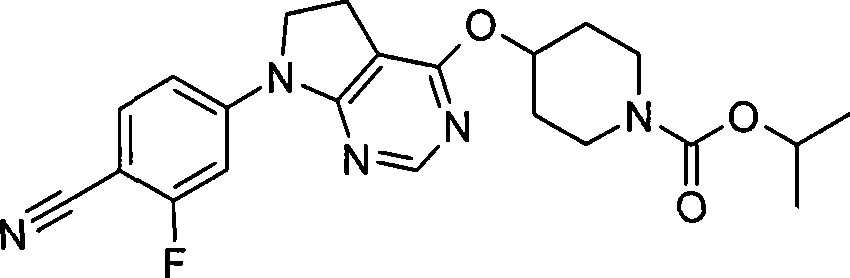
步骤1:7-(4-溴-3-氟苯基)-4-氯-6,7-二氢-5H-吡咯并[2,3-d]嘧啶(141)Step 1: 7-(4-Bromo-3-fluorophenyl)-4-chloro-6,7-dihydro-5H-pyrrolo[2,3-d]pyrimidine ( 141 )
往圆底烧瓶中装入4-溴-3-氟苯胺(10.0g,52.5mmol),随后冷却至-15℃。往以上冷却的苯胺中加入三氟乙酸(50mL)同时将内容物搅拌0.5小时。往以上混合物中分批加入Na(OAc)3BH(15.9g,50mmol)并继续搅拌0.5小时。往以上混合物中加入在CH2Cl2(15mL)中的醛209(参见实施例118,步骤1,7.85g,75mmol)。将得到的混合物升温至环境温度并搅拌24小时。将反应混合物减压浓缩并将残余物倾入饱和的NaHCO3溶液(250mL)中,随后该混合物用CH2Cl2(3x250mL)萃取。合并的有机层用盐水(1x100mL)洗涤,经饱和的Na2SO4干燥,随后减压浓缩,得到粗品,其用CH2Cl2和MeOH重结晶,得到8.65g(53%)灰白色固体状的标题产物141。A round bottom flask was charged with 4-bromo-3-fluoroaniline (10.0 g, 52.5 mmol), followed by cooling to -15°C. To the above cooled aniline was added trifluoroacetic acid (50 mL) while stirring the contents for 0.5 hours. To the above mixture was added Na(OAc) 3BH (15.9 g, 50 mmol) in portions and stirring was continued for 0.5 h. To the above mixture was added aldehyde 209 (see Example 118,
1H NMR(400MHz,DMSO-d6):δ8.42(s,1H),7.88和7.86(dd,J1=11.2Hz,J2=2.8Hz,2H),7.51(t,J=8.0Hz,1H),7.36和7.34(dd,J1=9.2Hz,J2=2.4Hz,1H),4.11(t,J=8.8Hz,2H),3.22(t,J=8.4Hz,2H);LCMS(ESI):m/z329(M+H)+. 1 H NMR (400MHz, DMSO-d 6 ): δ8.42(s, 1H), 7.88 and 7.86(dd, J 1 = 11.2Hz, J 2 = 2.8Hz, 2H), 7.51(t, J = 8.0Hz , 1H), 7.36 and 7.34 (dd, J 1 =9.2Hz, J 2 =2.4Hz, 1H), 4.11 (t, J = 8.8Hz, 2H), 3.22 (t, J = 8.4Hz, 2H); LCMS (ESI): m/z329(M+H) + .
步骤2:4-{[7-(4-溴-3-氟苯基)-6,7-二氢-5H-吡咯并[2,3-d]嘧啶-4-基]氧基}-1-哌啶甲酸1-甲基乙酯(142)Step 2: 4-{[7-(4-Bromo-3-fluorophenyl)-6,7-dihydro-5H-pyrrolo[2,3-d]pyrimidin-4-yl]oxy}-1 - 1-methylethyl piperidinecarboxylate ( 142 )
采用所述用于制备10(实施例1,步骤10)的方法,使用在THF中的化合物9(1.79g,9.5mmol)、NaH(1.20g,60%分散在矿物油中,30mmol)、化合物141(3.30mg,10mmol)于回流温度下加热2小时。标准后处理,随后纯化,得到3.46mg(72%)白色固体状的标题产物142。Following the procedure described for the preparation of 10 (Example 1, Step 10), using compound 9 (1.79 g, 9.5 mmol), NaH (1.20 g, 60% dispersion in mineral oil, 30 mmol), compound 141 (3.30 mg, 10 mmol) was heated at reflux temperature for 2 hours. Standard workup followed by purification afforded 3.46 mg (72%) of the title product 142 as a white solid.
1H NMR(400MHz,CDCl3):δ8.33(s,1H),7.86和7.82(dd,J1=12.0Hz,J2=2.4Hz,1Hs,1H),7.47(t,J=8.0Hz,1H),7.35-7.32(dd,J1=8.8Hz,J2=2.8Hz,1H),5.37-5.32(m,1H),4.93(七重峰,J=6.0Hz,1H),4.04(t,J=8.8Hz,2H),3.82-3.76(br,m,2H),3.36-3.30(m,2H),3.07(t,J=8.8Hz,2H),2.02-1.95(m,2H),1.77-1.69(m,2H),1.25(d,J=6.4Hz,6H);LCMS(ESI):m/z481(M+H)+. 1 H NMR (400MHz, CDCl 3 ): δ8.33(s, 1H), 7.86 and 7.82(dd, J 1 = 12.0Hz, J 2 = 2.4Hz, 1Hs, 1H), 7.47(t, J = 8.0Hz , 1H), 7.35-7.32(dd, J 1 =8.8Hz, J 2 =2.8Hz, 1H), 5.37-5.32(m, 1H), 4.93 (septet, J=6.0Hz, 1H), 4.04(t , J=8.8Hz, 2H), 3.82-3.76(br, m, 2H), 3.36-3.30(m, 2H), 3.07(t, J=8.8Hz, 2H), 2.02-1.95(m, 2H), 1.77-1.69 (m, 2H), 1.25 (d, J=6.4Hz, 6H); LCMS (ESI): m/z 481 (M+H) + .
步骤3:4-{[7-(4-氰基-3-氟苯基)-6,7-二氢-5H-吡咯并[2,3-d]嘧啶-4-基]氧基}-1-哌啶甲酸1-甲基乙酯(143)Step 3: 4-{[7-(4-cyano-3-fluorophenyl)-6,7-dihydro-5H-pyrrolo[2,3-d]pyrimidin-4-yl]oxy}- 1-Methylethyl 1-piperidinecarboxylate ( 143 )
采用所述用于制备31(实施例10,步骤7)的方法,使用在NMP中的化合物142(400mg,0.834mmol)、CuCN(150mg,1.67mmol)于150℃下加热18小时。标准后处理,随后纯化,得到66mg(19%)白色固体状的标题产物143。Following the procedure described for the preparation of 31 (Example 10, Step 7), compound 142 (400 mg, 0.834 mmol), CuCN (150 mg, 1.67 mmol) in NMP was heated at 150 °C for 18 hours. Standard workup followed by purification afforded 66 mg (19%) of the title product 143 as a white solid.
1H NMR(400MHz,DMSO-d6):δ 8.42(s,1H),8.13-8.09(dd,J1=13.6Hz,J2=1.6Hz,1H),7.84(app.t,J=8.0Hz,1H),7.75-7.72(dd,J1=8.8Hz,J2=2.0Hz,1H),5.32-5.25(m,1H),4.75(七重峰,J=6.4Hz,1H),4.10(t,J=8.8Hz,2H),3.70-3.64(m,2H),3.24(app.J=9.6Hz,2H),3.03(t,J=8.8Hz,2H),1.96-1.89(m,2H),1.61-1.53(m,2H),1.16(d,J=6.0Hz,6H);LCMS(ESI):m/z 426(M+H)+. 1 H NMR (400MHz, DMSO-d 6 ): δ 8.42 (s, 1H), 8.13-8.09 (dd, J 1 =13.6Hz, J 2 =1.6Hz, 1H), 7.84 (app.t, J = 8.0 Hz, 1H), 7.75-7.72 (dd, J 1 =8.8Hz, J 2 =2.0Hz, 1H), 5.32-5.25 (m, 1H), 4.75 (septet, J = 6.4Hz, 1H), 4.10 ( t, J=8.8Hz, 2H), 3.70-3.64(m, 2H), 3.24(app.J=9.6Hz, 2H), 3.03(t, J=8.8Hz, 2H), 1.96-1.89(m, 2H ), 1.61-1.53 (m, 2H), 1.16 (d, J=6.0Hz, 6H); LCMS (ESI): m/z 426 (M+H) + .
实施例72(144)Example 72 ( 144 )
4-({7-[2-氟-4-(甲基磺酰基)苯基]-6,7-二氢-5H-吡咯并[2,3-d]嘧啶-4-基}氧基)-1-哌啶硫代甲酸S-乙酯(144)4-({7-[2-fluoro-4-(methylsulfonyl)phenyl]-6,7-dihydro-5H-pyrrolo[2,3-d]pyrimidin-4-yl}oxy) -S-Ethyl 1-piperidinethiocarbamate ( 144 )
采用所述用于制备化合物127的方法,在室温下在CH2Cl2(15mL)中的化合物11(实施例2,493mg,1mmol)用TFA(2.5mL)处理1小时。将反应混合物减压浓缩,得到粗品126并将产物完全干燥,随后将其重新溶解在CH2Cl2(15mL)中。在室温、N2下往以上混合物中缓慢加入Et3N(1mL,7.22mmol),随后加入氯代硫代甲酸乙酯(208μL,2mmol)。在室温下将反应混合物搅拌18小时。反应混合物用CH2Cl2(50mL)稀释,用H2O(2 x 15mL)、盐水(1 x 10mL)洗涤,经Na2SO4干燥,随后减压浓缩,得到粗品,其经快速柱层析纯化,得到416mg(87%)白色固体状的标题产物144。Using the procedure described for the preparation of compound 127 , compound 11 (Example 2 , 493 mg, 1 mmol) in CH2Cl2 (15 mL) was treated with TFA (2.5 mL) at room temperature for 1 h. The reaction mixture was concentrated under reduced pressure to give crude 126 and the product was completely dried and then redissolved in CH2Cl2 ( 15 mL). To the above mixture was slowly added Et3N (1 mL, 7.22 mmol) at room temperature under N2 , followed by ethyl chlorothioformate (208 μL, 2 mmol). The reaction mixture was stirred at room temperature for 18 hours. The reaction mixture was diluted with CH 2 Cl 2 (50 mL), washed with H 2 O (2 x 15 mL), brine (1 x 10 mL), dried over Na 2 SO 4 , and concentrated under reduced pressure to give the crude product, which was purified by flash column chromatography , affording 416 mg (87%) of the title product 144 as a white solid.
1H NMR(400MHz,DMSO-d6):δ 8.23(s,1H),7.96(t,J=8.0Hz,1H),7.85和7.82dd,J1=11.2Hz,J2=2.0Hz,1H),7.75和7.73(dd,J1=8.4Hz,J2=2.0Hz,1H),5.36-5.29(m,1H),4.14(t,J=8.4Hz,2H),3.76(app.br.s,2H),3.41-3.36(m,2H),3.25(s,3H),3.06(t,J=8.8Hz,2H),2.81(q,J=7.2Hz,2H),1.96(br.s,2H),1.62(br.s,2H),1.18(t,J=7.6Hz,2H);LCMS(ESI):m/z 481(M+H)+. 1 H NMR (400MHz, DMSO-d 6 ): δ 8.23(s, 1H), 7.96(t, J=8.0Hz, 1H), 7.85 and 7.82dd, J 1 =11.2Hz, J 2 =2.0Hz, 1H ), 7.75 and 7.73 (dd, J 1 =8.4Hz, J 2 =2.0Hz, 1H), 5.36-5.29 (m, 1H), 4.14 (t, J = 8.4Hz, 2H), 3.76 (app.br. s, 2H), 3.41-3.36(m, 2H), 3.25(s, 3H), 3.06(t, J=8.8Hz, 2H), 2.81(q, J=7.2Hz, 2H), 1.96(br.s , 2H), 1.62 (br.s, 2H), 1.18 (t, J=7.6Hz, 2H); LCMS (ESI): m/z 481 (M+H) + .
实施例73(145)Example 73 ( 145 )

4-({7-[2-氟-4-(甲基磺酰基)苯基]-6,7-二氢-5H-吡咯并[2,3-d]嘧啶4-基}氧基)-1-哌啶硫代甲酸S-甲酯(145)4-({7-[2-fluoro-4-(methylsulfonyl)phenyl]-6,7-dihydro-5H-pyrrolo[2,3-d]pyrimidin 4-yl}oxyl)- S-methyl 1-piperidinethiocarbamate ( 145 )
采用所述用于制备化合物127的方法,在室温下在CH2Cl2(2mL)中的化合物126(70mg,0.142mmol)用TFA(0.5mL)处理2小时。将反应混合物减压浓缩,得到粗品并将产物完全干燥,随后将其重新溶解在CH2Cl2(5mL)中。在室温、N2下往以上混合物中缓慢加入Et3N(120μL,0.852mmol),随后加入氯代硫代甲酸甲酯(37μL,0.43mmol)。后处理,层析纯化,得到56mg(85%)白色固体状的标题产物145。Using the procedure described for the preparation of compound 127 , compound 126 (70 mg, 0.142 mmol) in CH2Cl2 (2 mL) at room temperature was treated with TFA (0.5 mL) for 2 h. The reaction mixture was concentrated under reduced pressure to give the crude product and the product was completely dried, which was then redissolved in CH2Cl2 ( 5 mL). To the above mixture was slowly added Et3N (120 μL, 0.852 mmol) followed by methyl chlorothioformate (37 μL, 0.43 mmol) at room temperature under N2 . Workup and purification by chromatography afforded 56 mg (85%) of the title product 145 as a white solid.
1H NMR(400MHz,DMSO-d6):δ 8.22(s,1H),7.96(app.t,J=8.4Hz,1H),7.86-7.82(dd,J1=10.8Hz,J2=2.0Hz,1H),7.76和7.72(dd,J1=8.4Hz,J2=2.0Hz,1H),5.36-5.28(m,2H),4.14(t,J=8.0Hz,2H),3.74(br,s,2H),3.42-3.34(m,2H),3.25(s,3H),3.06(t,J=8.8Hz,2H),2.24(s,3H),1.96(app.br.s,2H),1.62(app,br,m,2H);LCMS(ESI):m/z 467(M+H)+. 1 H NMR (400MHz, DMSO-d 6 ): δ 8.22 (s, 1H), 7.96 (app.t, J=8.4Hz, 1H), 7.86-7.82 (dd, J 1 =10.8Hz, J 2 =2.0 Hz, 1H), 7.76 and 7.72 (dd, J 1 =8.4Hz, J 2 =2.0Hz, 1H), 5.36-5.28 (m, 2H), 4.14 (t, J = 8.0Hz, 2H), 3.74 (br , s, 2H), 3.42-3.34 (m, 2H), 3.25 (s, 3H), 3.06 (t, J=8.8Hz, 2H), 2.24 (s, 3H), 1.96 (app.br.s, 2H ), 1.62 (app, br, m, 2H); LCMS (ESI): m/z 467 (M+H) + .
实施例74(148)Example 74 ( 148 )
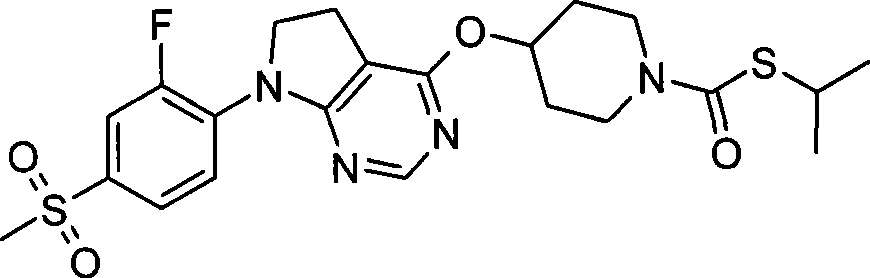
步骤1:7-[2-氟-4-(甲基磺酰基)苯基]-4-{[1-(1H-咪唑-1-基羰基)-4-哌啶基]氧基}-6,7-二氢-5H-吡咯并[2,3-d]嘧啶(146)Step 1: 7-[2-Fluoro-4-(methylsulfonyl)phenyl]-4-{[1-(1H-imidazol-1-ylcarbonyl)-4-piperidinyl]oxy}-6 , 7-dihydro-5H-pyrrolo[2,3-d]pyrimidine ( 146 )
采用所述用于制备126(实施例58,步骤1)的方法,在室温下化合物11(实施例2,20g,4.06mmol)用在CH2Cl2(50mL)中的20%TFA处理3小时。将反应混合物减压浓缩,得到粗品。在5℃下,往由以上得到的在CH2Cl2(150mL)中的产物的溶液中加入1,1′-(氧代甲烷二基)二-1H-咪唑(725mg,4.47mmol)。将反应混合物升温至环境温度并搅拌24小时。反应混合物用CH2Cl2(200mL)稀释,该混合物用H2O(2x 40mL)洗涤。有机层经Na2SO4干燥,随后减压浓缩,得到粗品,其用CH2Cl2重结晶,得到1.91g(97%)白色固体状的标题产物146。Using the procedure described for the preparation of 126 (Example 58, Step 1), compound 11 (Example 2, 20 g, 4.06 mmol) was treated with 20% TFA in CH2Cl2 (50 mL) for 3 hours at room temperature . The reaction mixture was concentrated under reduced pressure to obtain a crude product. To a solution of the product obtained above in CH2Cl2 (150 mL ) was added 1,1'-(oxomethanediyl)di-1H-imidazole (725 mg, 4.47 mmol) at 5 °C. The reaction mixture was warmed to ambient temperature and stirred for 24 hours. The reaction mixture was diluted with CH2Cl2 (200 mL), and the mixture was washed with H2O (2 x 40 mL). The organic layer was dried over Na2SO4 and concentrated under reduced pressure to give the crude product which was recrystallized from CH2Cl2 to give 1.91 g (97%) of the title product 146 as a white solid.
1H NMR(400MHz,DMSO-d6):δ8.24(s,1H),8.02(s,1H),7.96(app.t,J=8.0Hz,1H),7.85和7.83(dd,J1=11.2Hz,J2=2.4Hz,1H),7.75-7.73(dd,J1=8.4Hz,J2=2.0Hz,1H),7.47(s,1H),7.02(s,1H),5.40-5.28(m,1H),4.15(t,J=8.4Hz,2H),3.71(m,2H),3.48-3.42(m,2H),3.25(s,3H),3.07(t,J=9.2Hz,2H),2.10-2.02(m,2H),1.83-1.75(m,2H);LCMS(ESI):m/z 487(M+H)+. 1 H NMR (400MHz, DMSO-d 6 ): δ8.24 (s, 1H), 8.02 (s, 1H), 7.96 (app.t, J=8.0Hz, 1H), 7.85 and 7.83 (dd, J 1 =11.2Hz, J 2 =2.4Hz, 1H), 7.75-7.73 (dd, J 1 =8.4Hz, J 2 =2.0Hz, 1H), 7.47(s, 1H), 7.02(s, 1H), 5.40- 5.28(m, 1H), 4.15(t, J=8.4Hz, 2H), 3.71(m, 2H), 3.48-3.42(m, 2H), 3.25(s, 3H), 3.07(t, J=9.2Hz , 2H), 2.10-2.02 (m, 2H), 1.83-1.75 (m, 2H); LCMS (ESI): m/z 487 (M+H) + .
步骤2:碘化1-{[4-({7-[2-氟-4-(甲基磺酰基)苯基]-6,7-二氢-5H-吡咯并[2,3-d]嘧啶-4-基}氧基)-1-哌啶基]羰基}-3-甲基-1H-咪唑-3-鎓(147)Step 2: Iodination of 1-{[4-({7-[2-fluoro-4-(methylsulfonyl)phenyl]-6,7-dihydro-5H-pyrrolo[2,3-d] Pyrimidin-4-yl}oxy)-1-piperidinyl]carbonyl}-3-methyl-1H-imidazol-3-ium ( 147 )
在室温、N2下,往搅拌的146(1.9g,3.90mmol)在CH3CN(30mL)和CH2Cl2(30mL)的溶液中加入甲基碘(1.46mL,23.46mmol)。在室温下将反应混合物搅拌24小时,随后减压浓缩,得到2.46g(100%)灰白色固体状的标题产物147。To a stirred solution of 146 (1.9 g, 3.90 mmol) in CH3CN (30 mL) and CH2Cl2 (30 mL ) was added methyl iodide (1.46 mL, 23.46 mmol) at room temperature under N2 . The reaction mixture was stirred at room temperature for 24 hours, then concentrated under reduced pressure to afford 2.46 g (100%) of the title product 147 as an off-white solid.
1H NMR(400MHz,DMSO-d6):δ9.55(s,1H),8.24(s,1H),8.03(app.t,J=3.6Hz,1H),7.96(t,J=8.0Hz,1H),7.86-7.82(m,2H),7.76和7.74(dd,J1=8.4Hz,J2=2.0Hz,1H),(app.t,J=8.0Hz,1H),5.42(m,1H),4.16(t,J=8.4Hz,2H),3.90(s,3H),3.71(br,s,2H),3.50(br,s,2H),3.25(s,3H),3.07(t,J=9.2Hz,2H),2.12-2.04(br.m,2H),1.88-1.80(m,2H). 1 H NMR (400MHz, DMSO-d 6 ): δ9.55(s, 1H), 8.24(s, 1H), 8.03(app.t, J=3.6Hz, 1H), 7.96(t, J=8.0Hz , 1H), 7.86-7.82(m, 2H), 7.76 and 7.74(dd, J 1 =8.4Hz, J 2 =2.0Hz, 1H), (app.t, J=8.0Hz, 1H), 5.42(m , 1H), 4.16(t, J=8.4Hz, 2H), 3.90(s, 3H), 3.71(br, s, 2H), 3.50(br, s, 2H), 3.25(s, 3H), 3.07( t, J=9.2Hz, 2H), 2.12-2.04(br.m, 2H), 1.88-1.80(m, 2H).
步骤3:4-({7-[2-氟-4-(甲基磺酰基)苯基]-6,7-二氢-5H-吡咯并[2,3-d]嘧啶-4-基}氧基)-1-哌啶硫代甲酸S-(1-甲基乙基)酯(148)Step 3: 4-({7-[2-fluoro-4-(methylsulfonyl)phenyl]-6,7-dihydro-5H-pyrrolo[2,3-d]pyrimidin-4-yl} Oxy)-1-piperidinethiocarboxylate S-(1-methylethyl)ester ( 148 )
在室温、N2下往化合物147(315mg,0.5mmol)在CH2Cl2(3mL)中的悬浮液中加入Et3N(70μL,0.5mmol)和异丙硫醇(38mg,0.5mmol)。在室温下将反应混合物搅拌18小时。后处理,随后柱层析,得到156mg(63%)白色固体状的标题产物148。To a suspension of compound 147 (315 mg, 0.5 mmol) in CH 2 Cl 2 (3 mL) was added Et 3 N (70 μL, 0.5 mmol) and isopropylthiol (38 mg, 0.5 mmol) at room temperature under N 2 . The reaction mixture was stirred at room temperature for 18 hours. Workup followed by column chromatography afforded 156 mg (63%) of the title product 148 as a white solid.
1H NMR(400MHz,DMSO-d6):δ 8.23(s,1H),7.96(app.t,J=8.0Hz,1H),7.85和7.82(app.br.d,J=10.8Hz,1H),7.74(app.br.d,J=6.8Hz,1H),5.30-5.28(m,1H),4.14(t,J=8.4Hz,2H),3.46(m,1H),3.37-3.30(app.br.m,2H),3.25(s,3H),3.06(t,J=8.4Hz,2H),1.94(app,br.s,2H),1.61(app.br.s,2H),1.26(d,J=6.4Hz,6H);LCMS(ESI):m/z 495(M+H)+. 1 H NMR (400MHz, DMSO-d 6 ): δ 8.23 (s, 1H), 7.96 (app.t, J=8.0Hz, 1H), 7.85 and 7.82 (app.br.d, J=10.8Hz, 1H ), 7.74(app.br.d, J=6.8Hz, 1H), 5.30-5.28(m, 1H), 4.14(t, J=8.4Hz, 2H), 3.46(m, 1H), 3.37-3.30( app.br.m, 2H), 3.25(s, 3H), 3.06(t, J=8.4Hz, 2H), 1.94(app, br.s, 2H), 1.61(app.br.s, 2H), 1.26 (d, J=6.4Hz, 6H); LCMS (ESI): m/z 495 (M+H) + .
实施例75(149)Example 75 ( 149 )

4-({7-[2-氟-4-(甲基磺酰基)苯基]-6,7-二氢-5H-吡咯并[2,3-d]嘧啶-4-基}氧基)-1-哌啶硫代甲酸S-(2-甲基丙基)酯(149)4-({7-[2-fluoro-4-(methylsulfonyl)phenyl]-6,7-dihydro-5H-pyrrolo[2,3-d]pyrimidin-4-yl}oxy) -1-piperidinethiocarboxylate S-(2-methylpropyl) ester ( 149 )
采用所述用于制备化合物148的方法,往咪唑盐147(115mg,0.183mmol)在CH2Cl2(5mL)中的溶液中加入Et3N(76μL,0.55mmol)和异丁硫醇(100μL)。将该反应物搅拌15小时。后处理,随后层析,得到52mg(56%)白色固体状的标题产物149。Using the procedure described for the preparation of compound 148 , to a solution of imidazolium salt 147 (115 mg, 0.183 mmol) in CH 2 Cl 2 (5 mL) was added Et 3 N (76 μL, 0.55 mmol) and isobutylthiol (100 μL ). The reaction was stirred for 15 hours. Workup followed by chromatography afforded 52 mg (56%) of the title product 149 as a white solid.
1H NMR(400MHz,DMSO-d6):δ 8.22(s,1H),7.96(t,J=7.2Hz,1H),7.84(br,d,J=11.2Hz,1H),7.73(br,d,J=8.4Hz,1H),5.32(app.br,s,1H),4.14(t,J=8.8Hz,2H),3.75(br,s,2H),3.42-3.37(m,2H),3.25(s,3H),3.06(t,J=8.8Hz,2H),2.75(d,J=6.8Hz,2H),1.96(app,br.s,2H),1.78-1.68(m,1H),1.62(app,br.s,2H),0.91(d,J=5.2Hz,6H);LCMS(ESI):m/z 509(M+H)+. 1 H NMR (400MHz, DMSO-d 6 ): δ 8.22(s, 1H), 7.96(t, J=7.2Hz, 1H), 7.84(br, d, J=11.2Hz, 1H), 7.73(br, d, J=8.4Hz, 1H), 5.32(app.br, s, 1H), 4.14(t, J=8.8Hz, 2H), 3.75(br, s, 2H), 3.42-3.37(m, 2H) , 3.25(s, 3H), 3.06(t, J=8.8Hz, 2H), 2.75(d, J=6.8Hz, 2H), 1.96(app, br.s, 2H), 1.78-1.68(m, 1H ), 1.62 (app, br.s, 2H), 0.91 (d, J=5.2Hz, 6H); LCMS (ESI): m/z 509 (M+H) + .
实施例76(150)Example 76 ( 150 )
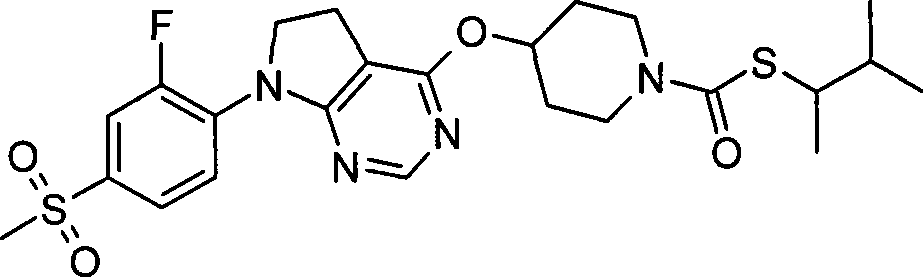
(±)-4-({7-[2-氟-4-(甲基磺酰基)苯基]-6,7-二氢-5H-吡咯并[2,3-d]嘧啶-4-基}氧基)-1-哌啶硫代甲酸S-(1,2-二甲基丙基)酯(150)(±)-4-({7-[2-fluoro-4-(methylsulfonyl)phenyl]-6,7-dihydro-5H-pyrrolo[2,3-d]pyrimidin-4-yl }oxy)-1-piperidinethiocarboxylate S-(1,2-dimethylpropyl)ester ( 150 )
采用所述用于制备化合物148的方法,往咪唑盐147(115mg,0.183mmol)在CH2Cl2(5mL)中的溶液中加入Et3N(76μL,0.55mmol)和3-甲基-2-丁硫醇(100μL)。将该反应物搅拌15小时。后处理,随后层析,得到65mg(68%)白色固体状的标题产物150。Using the procedure described for the preparation of compound 148 , to a solution of imidazolium salt 147 (115 mg, 0.183 mmol) in CH 2 Cl 2 (5 mL) was added Et 3 N (76 μL, 0.55 mmol) and 3-methyl-2 - Butanethiol (100 μL). The reaction was stirred for 15 hours. Workup followed by chromatography afforded 65 mg (68%) of the
1H NMR(400MHz,DMSO-d6):δ 8.22(s,1H),7.96(t,J=7.2Hz,1H),7.85-7.82(dd,J1=10.8Hz,J2=2.0Hz,1H),7.75和7.73(dd,J1=8.4Hz,J2=2.0Hz,1H),5.35-5.29(m,1H),4.14(t,J=7.6Hz,2H),3.73(app.br,s,2H),3.44-3.35(m,3H),3.25(s,3H),3.06(t,J=7.2Hz,2H),1.98-1.96(app.br,s,2H),1.89-1.82(m,2H),1.64-1.58(m,2H),1.21(d,J=9.2Hz,3H),0.90(d,J=6.8Hz,6H);LCMS(ESI):m/z 523(M+H)+. 1 H NMR (400MHz, DMSO-d 6 ): δ 8.22(s, 1H), 7.96(t, J=7.2Hz, 1H), 7.85-7.82(dd, J 1 =10.8Hz, J 2 =2.0Hz, 1H), 7.75 and 7.73 (dd, J1 = 8.4Hz, J2 = 2.0Hz, 1H), 5.35-5.29 (m, 1H), 4.14 (t, J = 7.6Hz, 2H), 3.73 (app.br , s, 2H), 3.44-3.35 (m, 3H), 3.25 (s, 3H), 3.06 (t, J=7.2Hz, 2H), 1.98-1.96 (app.br, s, 2H), 1.89-1.82 (m, 2H), 1.64-1.58 (m, 2H), 1.21 (d, J=9.2Hz, 3H), 0.90 (d, J=6.8Hz, 6H); LCMS (ESI): m/z 523 (M +H) + .
实施例77(151)Example 77 ( 151 )
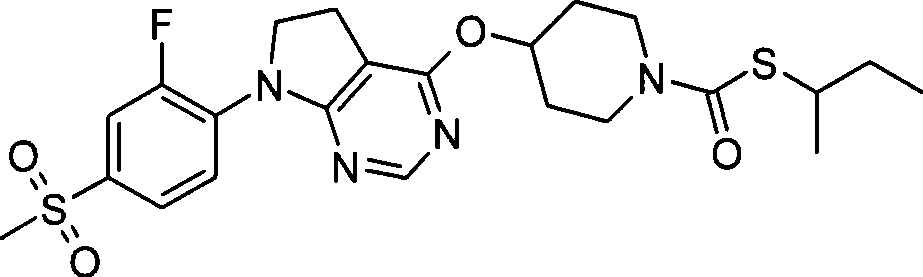
(±)-4-({7-[2-氟-4-(甲基磺酰基)苯基]-6,7-二氢-5H-吡咯并[2,3-d]嘧啶-4-基}氧基)-1-哌啶硫代甲酸S-(1-甲基丙基)酯(151)(±)-4-({7-[2-fluoro-4-(methylsulfonyl)phenyl]-6,7-dihydro-5H-pyrrolo[2,3-d]pyrimidin-4-yl }oxy)-1-piperidinethiocarboxylate S-(1-methylpropyl)ester ( 151 )
采用所述用于制备化合物148的方法,往咪唑盐147(115mg,0.183mmol)在CH2Cl2(5mL)中的溶液中加入Et3N(76μL,0.55mmol)和2-丁硫醇(100μL)。将该反应物搅拌15小时。后处理,随后层析,得到58mg(62%)白色固体状的标题产物151。Using the procedure described for the preparation of compound 148 , to a solution of imidazolium salt 147 (115 mg, 0.183 mmol) in CH2Cl2 (5 mL) was added Et3N (76 μL, 0.55 mmol) and 2-butanethiol ( 100 μL). The reaction was stirred for 15 hours. Workup followed by chromatography afforded 58 mg (62%) of the title product 151 as a white solid.
1H NMR(400MHz,DMSO-d6):δ8.22(s,1H),7.96(t,J=8.0Hz,1H),7.85-7.82(dd,J1=10.8Hz,J2=2.0Hz,1H),7.75和7.72(dd,J1=8.4Hz,J2=2.0Hz,1H),5.34-5.28(m,1H),4.14(t,J=8.4Hz,2H),3.40-3.30(m,3H),3.25(s,3H),3.06(t,J=8.8Hz,2H),1.97-1.95(app.br.m,2H),1.65-1.52(m,4H),1.25(d,J=6.8Hz,3H),0.90(t,J=7.2Hz,3H);LCMS(ESI):m/z 509(M+H)+. 1 H NMR (400MHz, DMSO-d 6 ): δ8.22(s, 1H), 7.96(t, J=8.0Hz, 1H), 7.85-7.82(dd, J 1 =10.8Hz, J 2 =2.0Hz , 1H), 7.75 and 7.72 (dd, J 1 =8.4Hz, J 2 =2.0Hz, 1H), 5.34-5.28 (m, 1H), 4.14 (t, J = 8.4Hz, 2H), 3.40-3.30 ( m, 3H), 3.25(s, 3H), 3.06(t, J=8.8Hz, 2H), 1.97-1.95(app.br.m, 2H), 1.65-1.52(m, 4H), 1.25(d, J=6.8Hz, 3H), 0.90(t, J=7.2Hz, 3H); LCMS (ESI): m/z 509(M+H) + .
实施例78(152)Example 78 ( 152 )
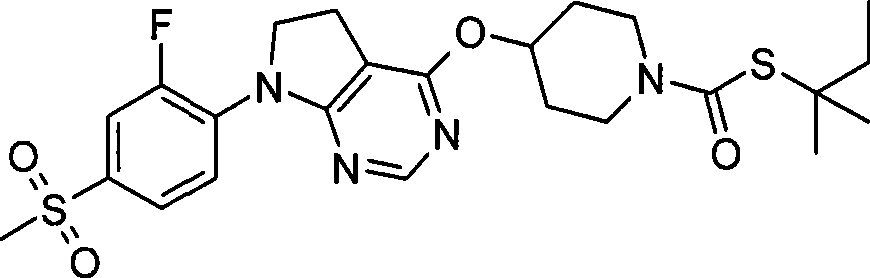
4-({7-[2-氟-4-(甲基磺酰基)苯基]-6,7-二氢-5H-吡咯并[2,3-d]嘧啶-4-基}氧基)-1-哌啶硫代甲酸S-(1,1-二甲基丙基)酯(152)4-({7-[2-fluoro-4-(methylsulfonyl)phenyl]-6,7-dihydro-5H-pyrrolo[2,3-d]pyrimidin-4-yl}oxy) -1-piperidinethiocarboxylate S-(1,1-dimethylpropyl) ester ( 152 )
采用所述用于制备化合物148的方法,往咪唑盐147(115mg,0.183mmol)在CH2Cl2(5mL)中的溶液中加入Et3N(76μL,0.55mmol)和2-甲基-2-丁硫醇(100μL)。将该反应物搅拌15小时。后处理,随后层析,得到56mg(58%)白色固体状的标题产物152。Using the procedure described for the preparation of compound 148 , to a solution of imidazolium salt 147 (115 mg, 0.183 mmol) in CH 2 Cl 2 (5 mL) was added Et 3 N (76 μL, 0.55 mmol) and 2-methyl-2 - Butanethiol (100 μL). The reaction was stirred for 15 hours. Workup followed by chromatography afforded 56 mg (58%) of the title product 152 as a white solid.
1H NMR(400MHz,DMSO-d6):δ 8.22(s,1H),7.96(t,J=8.0Hz,1H),7.85-7.82(dd,J1=10.8Hz,J2=2.0Hz,1H),7.75和7.72(dd,J1=8.8Hz,J2=2.0Hz,1H),5.33-5.27(m,1H),4.14(t,J=8.4Hz,2H),3.71(app.br.m,2H),1.76(q,J=7.2Hz,2H),1.63-1.56(m,2H),1.38(s,6H),0.87(t,J=7.2Hz,3H);LCMS(ESI):m/z 523(M+H)+. 1 H NMR (400MHz, DMSO-d 6 ): δ 8.22(s, 1H), 7.96(t, J=8.0Hz, 1H), 7.85-7.82(dd, J 1 =10.8Hz, J 2 =2.0Hz, 1H), 7.75 and 7.72 (dd, J1 = 8.8Hz, J2 = 2.0Hz, 1H), 5.33-5.27 (m, 1H), 4.14 (t, J = 8.4Hz, 2H), 3.71 (app.br .m, 2H), 1.76(q, J=7.2Hz, 2H), 1.63-1.56(m, 2H), 1.38(s, 6H), 0.87(t, J=7.2Hz, 3H); LCMS(ESI) : m/z 523(M+H) + .
实施例79(153)Example 79 ( 153 )

(±)-4-({7-[2-氟-4-(甲基磺酰基)苯基]-6,7-二氢-5H-吡咯并[2,3-d]嘧啶-4-基}氧基)-1-哌啶硫代甲酸S-(2-甲基丁基)酯(153)(±)-4-({7-[2-fluoro-4-(methylsulfonyl)phenyl]-6,7-dihydro-5H-pyrrolo[2,3-d]pyrimidin-4-yl }Oxy)-1-piperidinethiocarboxylate S-(2-methylbutyl)ester ( 153 )
采用所述用于制备化合物148的方法,往咪唑盐147(115mg,0.183mmol)在CH2Cl2(5mL)中的溶液中加入Et3N(76μL,0.55mmol)和2-甲基-1-丁硫醇(100μL)。将该反应物搅拌15小时。后处理,随后层析,得到62mg(65%)白色固体状的标题产物153。Using the procedure described for the preparation of compound 148 , to a solution of imidazolium salt 147 (115 mg, 0.183 mmol) in CH2Cl2 (5 mL) was added Et3N (76 μL, 0.55 mmol) and 2-methyl-1 - Butanethiol (100 μL). The reaction was stirred for 15 hours. Workup followed by chromatography afforded 62 mg (65%) of the title product 153 as a white solid.
1H NMR(400MHz,DMSO-d6):δ 8.22(s,1H),7.96(t,J=8.0Hz,1H),7.85-77.82(dd,J1=11.2Hz,J2=2.0Hz,1H),7.75和7.72(dd,J1=8.8Hz,J2=2.0Hz,1H),5.33-5.30(m,1H),4.14(t,J=8.4Hz,2H),3.75(app.br.s,2H),3.43-3.36(m,2H),3.25(s,3H),3.06(t,J=8.8Hz,2H),2.90和2.87(dd,J1=13.2Hz,J2=5.6Hz,1H),1.96(app.br,s,2H),1.62(app.br.s,2H),1.56-1.48(m,1H),1.44-1.33(m,1H),1.21-1.10(m,1H),0.89-0.82(m,6H);LCMS(ESI):m/z 523(M+H)+. 1 H NMR (400MHz, DMSO-d 6 ): δ 8.22 (s, 1H), 7.96 (t, J=8.0Hz, 1H), 7.85-77.82 (dd, J 1 =11.2Hz, J 2 =2.0Hz, 1H), 7.75 and 7.72 (dd, J1 = 8.8Hz, J2 = 2.0Hz, 1H), 5.33-5.30 (m, 1H), 4.14 (t, J = 8.4Hz, 2H), 3.75 (app.br .s, 2H), 3.43-3.36 (m, 2H), 3.25 (s, 3H), 3.06 (t, J=8.8Hz, 2H), 2.90 and 2.87 (dd, J 1 =13.2Hz, J 2 =5.6 Hz, 1H), 1.96(app.br, s, 2H), 1.62(app.br.s, 2H), 1.56-1.48(m, 1H), 1.44-1.33(m, 1H), 1.21-1.10(m , 1H), 0.89-0.82 (m, 6H); LCMS (ESI): m/z 523 (M+H) + .
实施例80(154)Example 80 ( 154 )
4-({7-[2-氟-4-(甲基磺酰基)苯基]-6,7-二氢-5H-吡咯并[2,3-d]嘧啶-4-基}氧基)-1-哌啶硫代甲酸S-2-丙烯-1-基酯(154)4-({7-[2-fluoro-4-(methylsulfonyl)phenyl]-6,7-dihydro-5H-pyrrolo[2,3-d]pyrimidin-4-yl}oxy) -1-piperidinethiocarboxylate S-2-propen-1-yl ester ( 154 )
采用所述用于制备化合物148的方法,往咪唑盐147(115mg,0.183mmol)在CH2Cl2(5mL)中的溶液中加入Et3N(76μL,0.55mmol)和2-丙烯-1-硫醇(100μL)。将该反应物搅拌15小时。后处理,随后层析,得到32mg(36%)白色固体状的标题产物154。Using the procedure described for the preparation of compound 148 , to a solution of imidazolium salt 147 (115 mg, 0.183 mmol) in CH 2 Cl 2 (5 mL) was added Et 3 N (76 μL, 0.55 mmol) and 2-propene-1- Thiol (100 μL). The reaction was stirred for 15 hours. Workup followed by chromatography afforded 32 mg (36%) of the title product 154 as a white solid.
1H NMR(400MHz,DMSO-d6):δ 8.22(s,1H),7.96(t,J=8.0Hz,1H),7.85-7.82(dd,J1=11.2Hz,J2=2.0Hz,1H),7.75和7.72(dd,J1=8.8Hz,J2=2.0Hz,1H),5.86-5.75(m,1H),5.35-5.30(m,1H),5.23和5.19(dd,J1=16.8Hz,J2=1.6Hz,1H),5.05(app.br.d,J=10.0Hz,1H),4.14(t,J=8.4Hz,2H),3.72(app.br.s,2H),3.52(app.d,J=6.8Hz,2H),3.42-3.36(m,2H),3.25(s,3H),3.06(t,J=8.8Hz,2H),2.02-1.92(br.m,2H),1.68-1.56(br.m,2H);LCMS(ESI):m/z 493(M+H)+. 1 H NMR (400MHz, DMSO-d 6 ): δ 8.22(s, 1H), 7.96(t, J=8.0Hz, 1H), 7.85-7.82(dd, J 1 =11.2Hz, J 2 =2.0Hz, 1H), 7.75 and 7.72 (dd, J 1 =8.8Hz, J 2 =2.0Hz, 1H), 5.86-5.75 (m, 1H), 5.35-5.30 (m, 1H), 5.23 and 5.19 (dd, J 1 =16.8Hz, J 2 =1.6Hz, 1H), 5.05(app.br.d, J=10.0Hz, 1H), 4.14(t, J=8.4Hz, 2H), 3.72(app.br.s, 2H ), 3.52(app.d, J=6.8Hz, 2H), 3.42-3.36(m, 2H), 3.25(s, 3H), 3.06(t, J=8.8Hz, 2H), 2.02-1.92(br. m, 2H), 1.68-1.56 (br.m, 2H); LCMS (ESI): m/z 493 (M+H) + .
实施例81(155)Example 81 ( 155 )

4-({7-[2-氟-4-(甲基磺酰基)苯基]-6,7-二氢-5H-吡咯并[2,3-d]嘧啶-4-基}氧基)-1-哌啶硫代甲酸S-(3-氯丙基)酯(155)4-({7-[2-fluoro-4-(methylsulfonyl)phenyl]-6,7-dihydro-5H-pyrrolo[2,3-d]pyrimidin-4-yl}oxy) -1-piperidinethiocarboxylate S-(3-chloropropyl)ester (155)
采用所述用于制备化合物148的方法,往咪唑盐147(115mg,0.183mmol)在CH2Cl2(5mL)中的溶液中加入Et3N(76μL,0.55mmol)和3-氯-1-丙硫醇(100μL)。将该反应物搅拌15小时。后处理,随后层析,得到71mg(73%)白色固体状的标题产物155。Using the procedure described for the preparation of compound 148 , to a solution of imidazolium salt 147 (115 mg, 0.183 mmol) in CH 2 Cl 2 (5 mL) was added Et 3 N (76 μL, 0.55 mmol) and 3-chloro-1- Propanthiol (100 μL). The reaction was stirred for 15 hours. Workup followed by chromatography afforded 71 mg (73%) of the title product 155 as a white solid.
1H NMR(400MHz,DMSO-d6):δ 8.22(s,1H),7.96(t,J=8.0Hz,1H),7.85-7.82(dd,J1=11.2Hz,J2=2.0Hz,1H),7.75和7.72(dd,J1=8.8Hz,J2=2.0Hz,1H),5.35-5.30(m,1H),4.14(t,J=8.4Hz,2H),3.65(br,s,2H),3.67(t,J=6.4Hz,2H),3.40-3.36(m,2H),3.25(s,3H),3.06(t,J=9.2Hz,2H),2.99(t,J=7.2Hz,2H),2.00-1.94(m,4H),1.68-1.58(m,2H);LCMS(ESI):m/z 530(M+H)+. 1 H NMR (400MHz, DMSO-d 6 ): δ 8.22(s, 1H), 7.96(t, J=8.0Hz, 1H), 7.85-7.82(dd, J 1 =11.2Hz, J 2 =2.0Hz, 1H), 7.75 and 7.72 (dd, J1 = 8.8Hz, J2 = 2.0Hz, 1H), 5.35-5.30 (m, 1H), 4.14 (t, J = 8.4Hz, 2H), 3.65 (br, s , 2H), 3.67(t, J=6.4Hz, 2H), 3.40-3.36(m, 2H), 3.25(s, 3H), 3.06(t, J=9.2Hz, 2H), 2.99(t, J= 7.2Hz, 2H), 2.00-1.94(m, 4H), 1.68-1.58(m, 2H); LCMS(ESI): m/z 530(M+H) + .
实施例82(156)Example 82 ( 156 )
4-({7-[2-氟-4-(甲基磺酰基)苯基]-6,7-二氢-5H-吡咯并[2,3-d]嘧啶-4-基}氧基)-1-哌啶硫代甲酸S-环戊酯(156)4-({7-[2-fluoro-4-(methylsulfonyl)phenyl]-6,7-dihydro-5H-pyrrolo[2,3-d]pyrimidin-4-yl}oxy) -1-S-cyclopentyl piperidinethiocarbamate ( 156 )
采用所述用于制备化合物148的方法,往咪唑盐147(115mg,0.183mmol)在CH2Cl2(5mL)中的溶液中加入Et3N(76μL,0.55mmol)和环丙烷硫醇(100μL)。将该反应物搅拌15小时。后处理,随后层析,得到74mg(78%)白色固体状的标题产物156。Using the procedure described for the preparation of compound 148 , to a solution of imidazolium salt 147 (115 mg, 0.183 mmol) in CH 2 Cl 2 (5 mL) was added Et 3 N (76 μL, 0.55 mmol) and cyclopropanethiol (100 μL ). The reaction was stirred for 15 hours. Workup followed by chromatography afforded 74 mg (78%) of the title product 156 as a white solid.
1H NMR(400MHz,DMSO-d6):δ 8.22(s,1H),7.96(t,J=8.0Hz,1H),7.85-7.82(dd,J1=11.2Hz,J2=2.0Hz,1H),7.75和7.72(dd,J1=8.8Hz,J2=2.0Hz,1H),5.34-5.28(m,1H),4.14(t,J=8.4Hz,2H),3.70(br.s,2H),3.56(m,1H),3.38-3.31(m,3H),3.25(s,3H),3.06(t,J=8.4Hz,2H),2.06-1.90(m,4H),1.67-1.44(m,8H);LCMS(ESI):m/z 521(M+H)+. 1 H NMR (400MHz, DMSO-d 6 ): δ 8.22(s, 1H), 7.96(t, J=8.0Hz, 1H), 7.85-7.82(dd, J 1 =11.2Hz, J 2 =2.0Hz, 1H), 7.75 and 7.72 (dd, J1 = 8.8Hz, J2 = 2.0Hz, 1H), 5.34-5.28 (m, 1H), 4.14 (t, J = 8.4Hz, 2H), 3.70 (br.s , 2H), 3.56(m, 1H), 3.38-3.31(m, 3H), 3.25(s, 3H), 3.06(t, J=8.4Hz, 2H), 2.06-1.90(m, 4H), 1.67- 1.44 (m, 8H); LCMS (ESI): m/z 521 (M+H) + .
实施例83(157)Example 83 ( 157 )
4-({7-[2-氟-4-(甲基磺酰基)苯基]-6,7-二氢-5H-吡咯并[2,3-d]嘧啶-4-基}氧基)-1-哌啶硫代甲酸S-环己酯(157)4-({7-[2-fluoro-4-(methylsulfonyl)phenyl]-6,7-dihydro-5H-pyrrolo[2,3-d]pyrimidin-4-yl}oxy) -S-cyclohexyl 1-piperidinethiocarbamate ( 157 )
采用所述用于制备化合物148的方法,往咪唑盐147(115mg,0.183mmol)在CH2Cl2(5mL)中的溶液中加入Et3N(76μL,0.55mmol)和环己烷硫醇(100μL)。将该反应物搅拌15小时。后处理,随后层析,得到69mg(70%)白色固体状的标题产物157。Using the procedure described for the preparation of compound 148 , to a solution of imidazolium salt 147 (115 mg, 0.183 mmol) in CH2Cl2 (5 mL) was added Et3N (76 μL, 0.55 mmol) and cyclohexanethiol ( 100 μL). The reaction was stirred for 15 hours. Workup followed by chromatography afforded 69 mg (70%) of the title product 157 as a white solid.
1H NMR(400MHz,DMSO-d6):δ 8.22(s,1H),7.95(t,J=8.0Hz,1H),7.85-7.82(dd,J1=11.2Hz,J2=2.0Hz,1H),7.75和7.72(dd,J1=8.8Hz,J2=2.0Hz,1H),5.35-5.28(m,1H),4.14(t,J=8.4Hz,2H),3.70(br,s,2H),3.39-3.31(m,4H),3.25(s,3H),3.06(t,J=8.8Hz,2H),1.97-1.87(m,4H),1.64-1.58(m,4H),1.41-1.29(m,4H),1.26-1.21(m,1H);LCMS(ESI):m/z 535(M+H)+. 1 H NMR (400MHz, DMSO-d 6 ): δ 8.22(s, 1H), 7.95(t, J=8.0Hz, 1H), 7.85-7.82(dd, J 1 =11.2Hz, J 2 =2.0Hz, 1H), 7.75 and 7.72 (dd, J1 = 8.8Hz, J2 = 2.0Hz, 1H), 5.35-5.28 (m, 1H), 4.14 (t, J = 8.4Hz, 2H), 3.70 (br, s , 2H), 3.39-3.31(m, 4H), 3.25(s, 3H), 3.06(t, J=8.8Hz, 2H), 1.97-1.87(m, 4H), 1.64-1.58(m, 4H), 1.41-1.29 (m, 4H), 1.26-1.21 (m, 1H); LCMS (ESI): m/z 535 (M+H) + .
实施例84(158)Example 84 ( 158 )
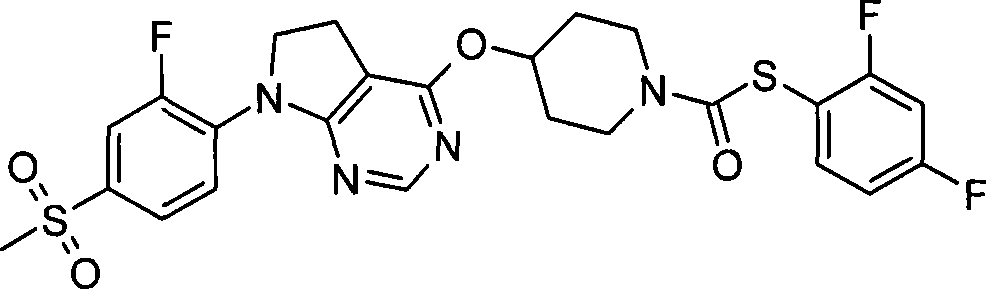
4-({7-[2-氟-4-(甲基磺酰基)苯基]-6,7-二氢-5H-吡咯并[2,3-d]嘧啶-4-基}氧基)-1-哌啶硫代甲酸S-(2,4-二氟苯基)酯(158)4-({7-[2-fluoro-4-(methylsulfonyl)phenyl]-6,7-dihydro-5H-pyrrolo[2,3-d]pyrimidin-4-yl}oxy) -S-(2,4-difluorophenyl)-1-piperidinethiocarboxylate ( 158 )
采用所述用于制备化合物148的方法,往咪唑盐147(115mg,0.183mmol)在CH2Cl2(5mL)中的溶液中加入Et3N(76μL,0.55mmol)和2,4-二氟苯硫醇(100μL)。将该反应物搅拌15小时。后处理,随后层析,得到76mg(73%)白色固体状的标题产物158。Using the procedure described for the preparation of compound 148 , to a solution of imidazolium salt 147 (115 mg, 0.183 mmol) in CH2Cl2 (5 mL) was added Et3N (76 μL, 0.55 mmol) and 2,4-difluoro Benzenethiol (100 μL). The reaction was stirred for 15 hours. Workup followed by chromatography afforded 76 mg (73%) of the title product 158 as a white solid.
1H NMR(400MHz,DMSO-d6):δ 8.24(s,1H),7.96(t,J=8.0Hz,1H),7.85-7.82(dd,J1=10.8Hz,J2=2.0Hz,1H),7.75和7.72(dd,J1=8.8Hz,J2=2.0Hz,1H),7.62-7.56(m,1H),7.44-7.38(m,1H),7.18-7.13(m,1H),5.39-5.33(m,1H),4.15(t,J=8.4Hz,2H),3.78-3.74(m,2H),3.47(br.s,2H),3.25(s,3H),3.08(t,J=8.8Hz,2H),2.02(br.s,2H),1.70(br.s,2H);LCMS(ESI):m/z 565(M+H)+. 1 H NMR (400MHz, DMSO-d 6 ): δ 8.24 (s, 1H), 7.96 (t, J=8.0Hz, 1H), 7.85-7.82 (dd, J 1 =10.8Hz, J 2 =2.0Hz, 1H), 7.75 and 7.72 (dd, J 1 =8.8Hz, J 2 =2.0Hz, 1H), 7.62-7.56(m, 1H), 7.44-7.38(m, 1H), 7.18-7.13(m, 1H) , 5.39-5.33(m, 1H), 4.15(t, J=8.4Hz, 2H), 3.78-3.74(m, 2H), 3.47(br.s, 2H), 3.25(s, 3H), 3.08(t , J=8.8Hz, 2H), 2.02 (br.s, 2H), 1.70 (br.s, 2H); LCMS (ESI): m/z 565 (M+H) + .
实施例85(161)Example 85 ( 161 )

步骤1:7-[2-氟-4-(甲基磺酰基)苯基]-4-{[1-(1H-咪唑-1-基硫代甲酰基)-4-哌啶基]氧基}-6,7-二氢-5H-吡咯并[2,3-d]嘧啶(159)Step 1: 7-[2-Fluoro-4-(methylsulfonyl)phenyl]-4-{[1-(1H-imidazol-1-ylthioformyl)-4-piperidinyl]oxy }-6,7-dihydro-5H-pyrrolo[2,3-d]pyrimidine ( 159 )
采用所述用于制备126(实施例58,步骤1)的方法,在室温下化合物11(实施例2,1.14g,2.31mmol)用在CH2Cl2(25mL)中的20%TFA处理2小时。将反应混合物减压浓缩,得到粗品。在5℃下,往由此得到的产物在CH2Cl2(100mL)中的溶液中加入1,1′-(硫代甲烷二基)二-1H-咪唑(453mg,2.54mmol)。将反应混合物升温至环境温度并搅拌24小时。使用所述用于146的处理方法分离出1.12g(95%)白色固体状的标题产物159(95%)。Using the procedure described for the preparation of 126 (Example 58 , Step 1), compound 11 (Example 2, 1.14 g, 2.31 mmol) was treated with 20% TFA in CH2Cl2 (25 mL) at
1H NMR(400MHz,DMSO-d6):δ 8.24(s,1H),8.03(s,1H),7.96(t,J=8.0Hz,1H),7.86和7.83(dd,J1=10.8Hz,J2=2.0Hz,1H),7.76和7.73(dd,J1=8.4Hz,J2=2.4Hz,1H),7.51(s,1H),7.02(s,1H),5.47-5.41(m,1H),4.16(t,J=8.4Hz,2H),3.25(s,3H),3.07(t,J=8.8Hz,2H),2.12(app.br.s,2H),1.89(app.br.s,2H);LCMS(ESI):m/z 503(M+H)+. 1 H NMR (400 MHz, DMSO-d 6 ): δ 8.24 (s, 1H), 8.03 (s, 1H), 7.96 (t, J=8.0Hz, 1H), 7.86 and 7.83 (dd, J 1 =10.8Hz , J 2 =2.0Hz, 1H), 7.76 and 7.73 (dd, J 1 =8.4Hz, J 2 =2.4Hz, 1H), 7.51(s, 1H), 7.02(s, 1H), 5.47-5.41(m , 1H), 4.16(t, J=8.4Hz, 2H), 3.25(s, 3H), 3.07(t, J=8.8Hz, 2H), 2.12(app.br.s, 2H), 1.89(app. br.s, 2H); LCMS (ESI): m/z 503 (M+H) + .
步骤2:碘化1-{[4-({7-[2-氟-4-(甲基磺酰基)苯基]-6,7-二氢-5H-吡咯并[2,3-d]嘧啶-4-基}氧基)-1-哌啶基]硫代甲酰基}-3-甲基-1H-咪唑-3-鎓(160)Step 2: Iodination of 1-{[4-({7-[2-fluoro-4-(methylsulfonyl)phenyl]-6,7-dihydro-5H-pyrrolo[2,3-d] Pyrimidin-4-yl}oxy)-1-piperidinyl]thioformyl}-3-methyl-1H-imidazol-3-ium ( 160 )
采用所述用于制备147的方法,在室温下使用化合物159(1.0g,2mmol)、MeI(750μL,12mmol)、CH2Cl2(20mL)和CH3CN(20mL)。将反应混合物减压浓缩,得到1.30g(约100%)黄色固体状的标题盐160。Following the procedure described for the preparation of 147 , compound 159 (1.0 g, 2 mmol), MeI (750 μL, 12 mmol), CH2Cl2 (20 mL) and CH3CN (20 mL) were used at room temperature . The reaction mixture was concentrated under reduced pressure to afford 1.30 g (ca. 100%) of the
1H NMR(400MHz,DMSO-d6):δ 9.62(s,1H),8.24(s,1H),8.10(m,1H),7.96(t,J=7.6Hz,1H),7.86和7.84(m,2H),7.76和7.74(dd,J1=8.8Hz,J2=4.0Hz,1H),5.50-5.46(m,1H),4.32(br,s,1H),4.19-4.10(br,s,4H),3.89(s,3H),3.76(br,s,1H),3.64(br,s,1H),3.25(s,3H),3.08(t,J=8.4Hz,2H),2.22和2.10(br,s,2H),1.96-1.90(br.s,1H),(app.br.s,2H),1.89(app.br.s,2H). 1 H NMR (400MHz, DMSO-d 6 ): δ 9.62(s, 1H), 8.24(s, 1H), 8.10(m, 1H), 7.96(t, J=7.6Hz, 1H), 7.86 and 7.84( m, 2H), 7.76 and 7.74 (dd, J1 = 8.8Hz, J2 = 4.0Hz, 1H), 5.50-5.46 (m, 1H), 4.32 (br, s, 1H), 4.19-4.10 (br, s, 4H), 3.89 (s, 3H), 3.76 (br, s, 1H), 3.64 (br, s, 1H), 3.25 (s, 3H), 3.08 (t, J=8.4Hz, 2H), 2.22 and 2.10(br,s,2H), 1.96-1.90(br.s,1H), (app.br.s,2H), 1.89(app.br.s,2H).
步骤3:4-({7-[2-氟-4-(甲基磺酰基)苯基]-6,7-二氢-5H-吡咯并[2,3-d]嘧啶-4-基}氧基)-1-哌啶二硫代甲酸1-甲基乙酯(161)Step 3: 4-({7-[2-fluoro-4-(methylsulfonyl)phenyl]-6,7-dihydro-5H-pyrrolo[2,3-d]pyrimidin-4-yl} Oxy)-1-piperidine dithiocarboxylate 1-methylethyl ester ( 161 )
采用所述用于制备148(实施例74,步骤3)的方法,使用化合物160(323g,0.5mmol)、Et3N(70μL,0.5mmol)、2-丙硫醇(38mg,0.5mmol)和CH2Cl2(3mL)。后处理,随后纯化,得到132mg(52%)灰白色固体状的标题产物161。Following the procedure described for the preparation of 148 (Example 74, Step 3), compound 160 (323 g, 0.5 mmol), Et 3 N (70 μL, 0.5 mmol), 2-propanethiol (38 mg, 0.5 mmol) and CH2Cl2 ( 3 mL). Workup followed by purification afforded 132 mg (52%) of the title product 161 as an off-white solid.
1H NMR(400MHz,DMSO-d6):δ 8.24(s,1H),7.96(t,J=8.0Hz,1H),7.85和7.82(dd,J1=11.2Hz,J2=2.0Hz,1H),7.76和7.73(dd,J1=8.8Hz,J2=2.0Hz,1H),7.51(s,1H),7.02(s,1H),5.44-5.39(m,1H),4.47(app.br,s,1H),4.21(app.br.s,1H),4.15(t,J=8.8Hz,2H),4.14-4.06(app,br.m,2H),3.92-3.84(m,1H),3.25(s,3H),3.07(t,J=8.4Hz,2H),2.06-2.00(m,2H),1.74-1.68(m,2H),1.35(d,J=6.8Hz,6H);LCMS(ESI):m/z 511(M+H)+. 1 H NMR (400MHz, DMSO-d 6 ): δ 8.24 (s, 1H), 7.96 (t, J=8.0Hz, 1H), 7.85 and 7.82 (dd, J 1 =11.2Hz, J 2 =2.0Hz, 1H), 7.76 and 7.73 (dd, J 1 =8.8Hz, J 2 =2.0Hz, 1H), 7.51 (s, 1H), 7.02 (s, 1H), 5.44-5.39 (m, 1H), 4.47 (app .br, s, 1H), 4.21 (app.br.s, 1H), 4.15 (t, J=8.8Hz, 2H), 4.14-4.06 (app, br.m, 2H), 3.92-3.84 (m, 1H), 3.25(s, 3H), 3.07(t, J=8.4Hz, 2H), 2.06-2.00(m, 2H), 1.74-1.68(m, 2H), 1.35(d, J=6.8Hz, 6H ); LCMS (ESI): m/z 511 (M+H) + .
实施例86(162)Example 86 ( 162 )
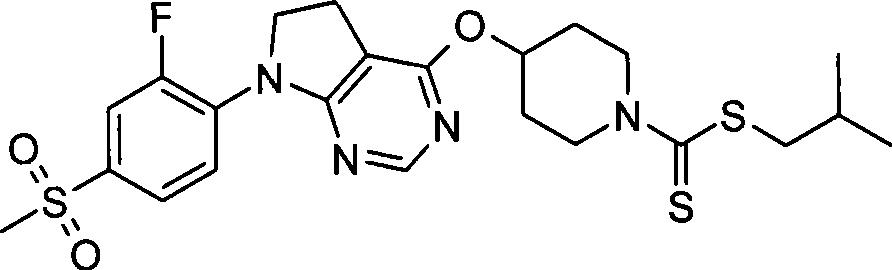
4-({7-[2-氟-4-(甲基磺酰基)苯基]-6,7-二氢-5H-吡咯并[2,3-d]嘧啶-4-基}氧基)-1-哌啶二硫代甲酸2-甲基丙酯(162)4-({7-[2-fluoro-4-(methylsulfonyl)phenyl]-6,7-dihydro-5H-pyrrolo[2,3-d]pyrimidin-4-yl}oxy) -2-Methylpropyl 1-piperidine dithiocarbamate ( 162 )
采用所述用于制备148(实施例74,步骤3)的方法,使用化合物160(120g,0.19mmol)、Et3N(76μL,0.56mmol)、2-甲基-1-丙硫醇(34mg,0.37mL)和CH2Cl2(5mL)。后处理,随后纯化,得到58mg(60%)灰白色固体状的标题产物162。Following the procedure described for the preparation of 148 (Example 74, Step 3), compound 160 (120 g, 0.19 mmol), Et 3 N (76 μL, 0.56 mmol), 2-methyl-1-propanethiol (34 mg , 0.37 mL) and CH 2 Cl 2 (5 mL). Workup followed by purification afforded 58 mg (60%) of the title product 162 as an off-white solid.
1H NMR(400MHz,DMSO-d6):δ 8.24(s,1H),7.96(t,J=8.0Hz,1H),7.85和7.82(dd,J1=10.8Hz,J2=2.0Hz,1H),7.75和7.73(dd,J1=8.4Hz,J2=2.0Hz,1H),5.45-5.40(m,1H),4.49(br.s,1H),4.22(br.s,1H),4.14(app.br.s,1H),4.15(t,J=8.0Hz,2H),3.95(br,s,1H),3.25(s,3H),3.15(d,J=7.2Hz,2H),3.08(t,J=9.2Hz,2H),2.04(br,s,2H),1.98-1.84(m,1H),1.75(m,2H),0.95(d,J=6.8Hz,6H);LCMS(ESI):m/z 525(M+H)+. 1 H NMR (400MHz, DMSO-d 6 ): δ 8.24 (s, 1H), 7.96 (t, J=8.0Hz, 1H), 7.85 and 7.82 (dd, J 1 =10.8Hz, J 2 =2.0Hz, 1H), 7.75 and 7.73 (dd, J1 = 8.4Hz, J2 = 2.0Hz, 1H), 5.45-5.40 (m, 1H), 4.49 (br.s, 1H), 4.22 (br.s, 1H) , 4.14(app.br.s, 1H), 4.15(t, J=8.0Hz, 2H), 3.95(br,s, 1H), 3.25(s, 3H), 3.15(d, J=7.2Hz, 2H ), 3.08(t, J=9.2Hz, 2H), 2.04(br, s, 2H), 1.98-1.84(m, 1H), 1.75(m, 2H), 0.95(d, J=6.8Hz, 6H) ; LCMS (ESI): m/z 525 (M+H) + .
实施例87(163)Example 87 ( 163 )
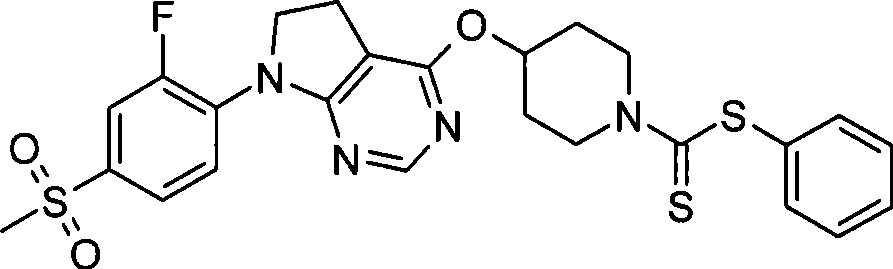
4-({7-[2-氟-4-(甲基磺酰基)苯基]-6,7-二氢-5H-吡咯并[2,3-d]嘧啶-4-基}氧基)-1-哌啶二硫代甲酸苯酯(163)4-({7-[2-fluoro-4-(methylsulfonyl)phenyl]-6,7-dihydro-5H-pyrrolo[2,3-d]pyrimidin-4-yl}oxy) -1-Piperidine dithiocarboxylate ( 163 )
在室温下,搅拌的11溶液(实施例2,175mg,0.355mmol)用20%在CH2Cl2(5mL)中的TFA处理2小时。反应混合物减压浓缩,得到粗品126,将其干燥,随后溶解在CH2Cl2中。依次加入Et3N(280μL,2.01mmol)和氯代二硫代甲酸苯酯(167mg,0.89mmol)并在室温下将反应混合物搅拌15小时。后处理,随后纯化,得到106mg(55%)白色固体状的标题产物163。A stirred solution of 11 (Example 2, 175 mg, 0.355 mmol) was treated with 20% TFA in CH2Cl2 (5 mL) for 2 hours at room temperature. The reaction mixture was concentrated under reduced pressure to afford crude 126 which was dried and dissolved in CH2Cl2 . Et3N (280 μL, 2.01 mmol) and phenyl chlorodithioformate (167 mg, 0.89 mmol) were added sequentially and the reaction mixture was stirred at room temperature for 15 hours. Workup followed by purification afforded 106 mg (55%) of the title product 163 as a white solid.
1HNMR(400MHz,DMSO-d6):δ 8.25(s,1H),7.96(t,J=8.0Hz,1H),7.86和7.84(dd,J1=11.2Hz,J2=2.0Hz,1H),7.76和7.74(dd,J1=8.4Hz,J2=1.6Hz,1H),7.48-7.40(m,5H),5.48-5.42(m,1H),4.46(app.br.s,1H),4.22(br.s,2H),4.16(t,J=8.4Hz,2H),4.06(br.s,2H),3.26(s,3H),3.09(t,J=8.8Hz,2H),2.20-2.06(br.s,2H),1.92-1.72(br.s,2H);LCMS(ESI):m/z 525(M+H)+. 1 H NMR (400MHz, DMSO-d 6 ): δ 8.25 (s, 1H), 7.96 (t, J=8.0Hz, 1H), 7.86 and 7.84 (dd, J 1 =11.2Hz, J 2 =2.0Hz, 1H ), 7.76 and 7.74 (dd, J 1 =8.4Hz, J 2 =1.6Hz, 1H), 7.48-7.40 (m, 5H), 5.48-5.42 (m, 1H), 4.46 (app.br.s, 1H ), 4.22(br.s, 2H), 4.16(t, J=8.4Hz, 2H), 4.06(br.s, 2H), 3.26(s, 3H), 3.09(t, J=8.8Hz, 2H) , 2.20-2.06 (br.s, 2H), 1.92-1.72 (br.s, 2H); LCMS (ESI): m/z 525 (M+H) + .
实施例88(164)Example 88 ( 164 )

步骤1:7-[2-氟-4-(甲基磺酰基)苯基]-4-(4-哌啶基氧基)-6,7-二氢-5H-吡咯并[2,3-d]嘧啶·三氟乙酸盐(126)Step 1: 7-[2-Fluoro-4-(methylsulfonyl)phenyl]-4-(4-piperidinyloxy)-6,7-dihydro-5H-pyrrolo[2,3- d] pyrimidine trifluoroacetate ( 126 )
将4-({7-[2-氟-4-(甲基磺酰基)苯基]-6,7-二氢-5H-吡咯并[2,3-d]嘧啶-4-基}氧基)-1-哌啶甲酸1,1-二甲基乙酯(11)(550mg,1.12mmol)溶解在CH2Cl2(15mL)和三氟乙酸(2mL)中。在室温下将得到的溶液搅拌1小时。随后减压除去所有溶剂,得到560mg澄清油状的所需化合物126,其无需进一步纯化使用。4-({7-[2-fluoro-4-(methylsulfonyl)phenyl]-6,7-dihydro-5H-pyrrolo[2,3-d]pyrimidin-4-yl}oxy )-1,1-Dimethylethyl 1-piperidinecarboxylate ( 11 ) (550 mg, 1.12 mmol) was dissolved in CH 2 Cl 2 (15 mL) and trifluoroacetic acid (2 mL). The resulting solution was stirred at room temperature for 1 hour. Subsequent removal of all solvents under reduced pressure afforded 560 mg of the desired compound 126 as a clear oil which was used without further purification.
1H NMR(400MHz,DMSO-d6):δ 8.67-8.34(m,2H),8.21(s,1H),7.95(app.t,J=8.5Hz,1H),7.85(dd,J1=10.9,J2=2.2Hz,1H),7.79(dd,J1=8.5,J2=2.2Hz,1H),5.41-5.30(m,1H),4.18(t,J=8.5Hz,2H),3.38-3.33(m,5H),3.19-3.0(m,4H),2.19-2.06(m,2H)1.93-1.76(m,2H);LCMS(ESI):m/z 393(M+H)+. 1 H NMR (400 MHz, DMSO-d 6 ): δ 8.67-8.34 (m, 2H), 8.21 (s, 1H), 7.95 (app.t, J=8.5Hz, 1H), 7.85 (dd, J 1 = 10.9, J2 = 2.2Hz, 1H), 7.79 (dd, J1 = 8.5, J2 = 2.2Hz, 1H), 5.41-5.30 (m, 1H), 4.18 (t, J = 8.5Hz, 2H), 3.38-3.33(m, 5H), 3.19-3.0(m, 4H), 2.19-2.06(m, 2H), 1.93-1.76(m, 2H); LCMS(ESI): m/z 393(M+H) + .
步骤2:7-[2-氟-4-(甲基磺酰基)苯基]-4-{[1-(2-吡啶基甲基)-4-哌啶基]氧基}-6,7-二氢-5H-吡咯并[2,3-d]嘧啶·三氟乙酸盐(164)Step 2: 7-[2-Fluoro-4-(methylsulfonyl)phenyl]-4-{[1-(2-pyridylmethyl)-4-piperidinyl]oxy}-6,7 -Dihydro-5H-pyrrolo[2,3-d]pyrimidine trifluoroacetate ( 164 )
将化合物126(50mg,0.100mmol)和三乙胺(50μL,0.535mmol)在10mL二氯甲烷中混合。在室温下将该混合物搅拌15分钟。随后往该溶液中加入2-吡啶基苯甲醛(50mg,0.467mmol)随后加入大孔硼氢化氰树脂(100mg,47.6mmol)。在室温下将得到的混合物搅拌18小时。随后将粗制反应物过滤并浓缩至干,随后经反相层析纯化(使用5-95%乙腈/水(添加0.1%三氟乙酸)梯度洗脱),得到21mg(36%)三氟乙酸盐形式的所需化合物164。Compound 126 (50 mg, 0.100 mmol) and triethylamine (50 μL, 0.535 mmol) were mixed in 10 mL of dichloromethane. The mixture was stirred at room temperature for 15 minutes. To this solution was then added 2-pyridylbenzaldehyde (50 mg, 0.467 mmol) followed by macroporous cyanoborohydride resin (100 mg, 47.6 mmol). The resulting mixture was stirred at room temperature for 18 hours. The crude reaction was then filtered and concentrated to dryness, followed by reverse phase chromatography (eluting with a gradient of 5-95% acetonitrile/water with addition of 0.1% trifluoroacetic acid) to yield 21 mg (36%) of trifluoroethane The desired compound 164 in the form of an acid salt.
1H NMR(400MHz,CDCl3):δ 8.71-8.53(m,1H),8.23(s,1H),8.10(app.t,J=8.5Hz,1H),7.95-7.87(m,2H),7.57(d,J=8.5Hz,2H),7.53-7.35(m,2H),5.52-5.36(m,1H),4.48(s,2H),4.22(t,J=8.5Hz 2H),3.56-3.30(m,4H),3.17(t,J=8.5Hz 2H),3.05(s,3H),2.41-2.29(m,2H),2.29-2.18(m,2H);LCMS(ESI):m/z 568(M+H)+. 1 H NMR (400MHz, CDCl 3 ): δ 8.71-8.53 (m, 1H), 8.23 (s, 1H), 8.10 (app.t, J=8.5Hz, 1H), 7.95-7.87 (m, 2H), 7.57(d, J=8.5Hz, 2H), 7.53-7.35(m, 2H), 5.52-5.36(m, 1H), 4.48(s, 2H), 4.22(t, J=8.5Hz 2H), 3.56- 3.30(m, 4H), 3.17(t, J=8.5Hz 2H), 3.05(s, 3H), 2.41-2.29(m, 2H), 2.29-2.18(m, 2H); LCMS(ESI): m/ z 568(M+H) + .
实施例89(165)Example 89 ( 165 )

N-(1,1-二甲基乙基)-2-[4-({7-[2-氟-4-(甲基磺酰基)苯基]-6,7-二氢-5H-吡咯并[2,3-d]嘧啶-4-基}氧基)-1-哌啶基]乙酰胺·三氟乙酸盐(165)N-(1,1-Dimethylethyl)-2-[4-({7-[2-fluoro-4-(methylsulfonyl)phenyl]-6,7-dihydro-5H-pyrrole And[2,3-d]pyrimidin-4-yl}oxy)-1-piperidinyl]acetamide trifluoroacetate ( 165 )
采用与所述用于制备实施例88(步骤2)类似的方法制备标题化合物,使用化合物126(50mg,0.098mmol)、大孔碳酸酯树脂(100mg,36.2mmol)、催化量的碘化钠和2-氯-N-(1-叔丁基)乙酰胺(50mg,0.336mmol),在纯化后得到5mg(8%)三氟乙酸盐。The title compound was prepared in a manner similar to that described for the preparation of Example 88 (step 2), using compound 126 (50 mg, 0.098 mmol), macroporous carbonate resin (100 mg, 36.2 mmol), catalytic amounts of sodium iodide and 2-Chloro-N-(1-tert-butyl)acetamide (50 mg, 0.336 mmol), after purification afforded 5 mg (8%) of the trifluoroacetate salt.
1H NMR(400MHz,CDCl3):δ 8.26(s,1H),7.96(app.t,J=8.5Hz,1H),7.84-7.66(m,2H),5.61-5.37(m,1H),4.29(t,J=8.5Hz,2H),3.74(s,2H),3.61-3.33(m,4H),3.19(t,J=8.5Hz,2H),3.00(s,3H),2.55-2.12(m,4H),1.85(s,9H);LCMS(ESI):m/z 505(M+H)+. 1 H NMR (400MHz, CDCl 3 ): δ 8.26 (s, 1H), 7.96 (app.t, J=8.5Hz, 1H), 7.84-7.66 (m, 2H), 5.61-5.37 (m, 1H), 4.29(t, J=8.5Hz, 2H), 3.74(s, 2H), 3.61-3.33(m, 4H), 3.19(t, J=8.5Hz, 2H), 3.00(s, 3H), 2.55-2.12 (m, 4H), 1.85 (s, 9H); LCMS (ESI): m/z 505 (M+H) + .
实施例90(166)Example 90 ( 166 )
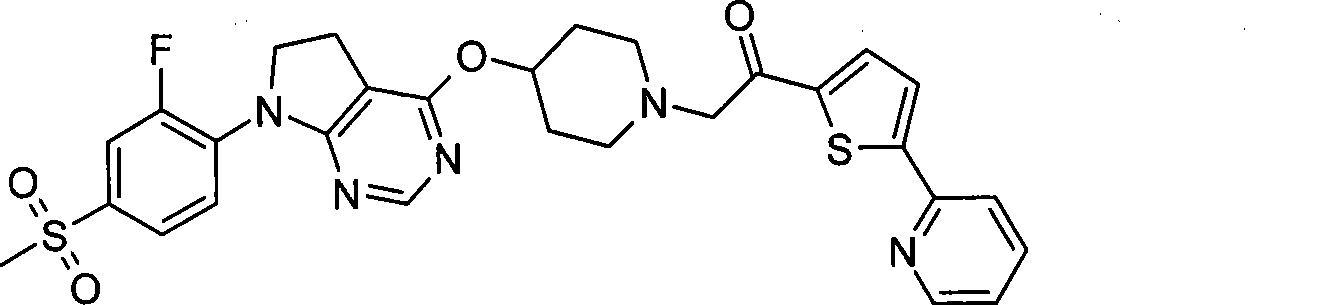
2-[4-({7-[2-氟-4-(甲基磺酰基)苯基]-6,7-二氢-5H-吡咯并[2,3-d]嘧啶-4-基}氧基)-1-哌啶基]-1-[5-(2-吡啶基)-2-噻吩基]乙酮·三氟乙酸盐(166)2-[4-({7-[2-fluoro-4-(methylsulfonyl)phenyl]-6,7-dihydro-5H-pyrrolo[2,3-d]pyrimidin-4-yl} Oxy)-1-piperidinyl]-1-[5-(2-pyridyl)-2-thienyl]ethanone trifluoroacetate ( 166 )
采用与所述用于制备实施例88(步骤2)类似的方法制备标题化合物,使用化合物126(50mg,0.098mmol)、大孔碳酸酯(100mg,36.2mmol)、催化量的碘化钠和2-溴-1-[5-(2-吡啶基)-2-噻吩基]乙酮(50mg,0.177mmol),在纯化后得到9mg(13%)三氟乙酸盐形式的标题产物166。The title compound was prepared in a manner similar to that described for the preparation of Example 88 (Step 2), using compound 126 (50 mg, 0.098 mmol), macroporous carbonate (100 mg, 36.2 mmol), catalytic amounts of sodium iodide and 2 -Bromo-1-[5-(2-pyridyl)-2-thienyl]ethanone (50 mg, 0.177 mmol) afforded 9 mg (13%) of the title product 166 as the trifluoroacetate salt after purification.
1H NMR(400MHz,CDCl3):δ 8.68-8.58(m,2H),8.27(s,1H),8.05(app.t,J=8.5Hz,1H),7.92(d,J=4.2Hz,1H),7.82-7.65(m,3H),7.60(d,J=4.2Hz,1H),5.35-5.11(m,1H),4.26(t,J=8.5Hz,2H),3.73(s,2H),3.61-3.33(m,2H),3.19(t,J=8.5Hz,2H),3.01(s,3H),2.96-2.81(m,2H),2.67-2.44(m,2H),2.19-2.06(m,2H),2.04-1.85(m,2H);LCMS(ESI):m/z 594(M+H)+. 1 H NMR (400MHz, CDCl 3 ): δ 8.68-8.58(m, 2H), 8.27(s, 1H), 8.05(app.t, J=8.5Hz, 1H), 7.92(d, J=4.2Hz, 1H), 7.82-7.65(m, 3H), 7.60(d, J=4.2Hz, 1H), 5.35-5.11(m, 1H), 4.26(t, J=8.5Hz, 2H), 3.73(s, 2H ), 3.61-3.33(m, 2H), 3.19(t, J=8.5Hz, 2H), 3.01(s, 3H), 2.96-2.81(m, 2H), 2.67-2.44(m, 2H), 2.19- 2.06 (m, 2H), 2.04-1.85 (m, 2H); LCMS (ESI): m/z 594 (M+H) + .
实施例91(167)Example 91 ( 167 )
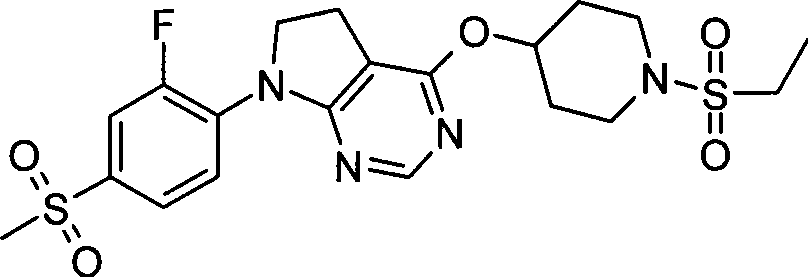
4-{[1-(乙基磺酰基)-4-哌啶基]氧基}-7-[2-氟-4-(甲基磺酰基)苯基]-6,7-二氢-5H-吡咯并[2,3-d]嘧啶(167)4-{[1-(ethylsulfonyl)-4-piperidinyl]oxy}-7-[2-fluoro-4-(methylsulfonyl)phenyl]-6,7-dihydro-5H -pyrrolo[2,3-d]pyrimidine ( 167 )
将化合物126(70mg,0.138mmol)与二异丙基乙基胺(1mL,7.72mmol)在5mL二氯甲烷中混合。在室温下将该混合物搅拌30分钟。随后往该溶液中加入乙磺酰氯(50mg,0.467mmol)。在室温下将得到的混合物搅拌18小时。随后将粗制反应物浓缩至干,随后经反相层析纯化(使用5-90%乙腈(含0.5%TFA)/水梯度洗脱),得到46mg(70%)褐色固体状的所需化合物167。Compound 126 (70 mg, 0.138 mmol) was mixed with diisopropylethylamine (1 mL, 7.72 mmol) in 5 mL of dichloromethane. The mixture was stirred at room temperature for 30 minutes. To this solution was then added ethanesulfonyl chloride (50 mg, 0.467 mmol). The resulting mixture was stirred at room temperature for 18 hours. The crude reaction was then concentrated to dryness and purified by reverse phase chromatography (eluting with a 5-90% acetonitrile (with 0.5% TFA)/water gradient) to afford 46 mg (70%) of the desired compound as a tan solid 167 .
1H NMR(400MHz,CDCl3):δ 8.27(s,1H),7.86(app.t,J=8.5Hz,1H),7.78-7.68(m,2H),5.42-5.25(m,1H),4.26(t,J=8.5Hz 2H),3.69-3.52(m,2H),3.35-3.23(m,2H),3.19(t,J=8.5Hz,2H),3.06(s,3H),2.99(q,J=7.8Hz,2H),2.20-2.05(m,2H),1.98-1.81(m,2H),1.38(t,J=8.5Hz 3H);LCMS(ESI):m/z 485(M+H)+. 1 H NMR (400MHz, CDCl 3 ): δ 8.27(s, 1H), 7.86(app.t, J=8.5Hz, 1H), 7.78-7.68(m, 2H), 5.42-5.25(m, 1H), 4.26(t, J=8.5Hz 2H), 3.69-3.52(m, 2H), 3.35-3.23(m, 2H), 3.19(t, J=8.5Hz, 2H), 3.06(s, 3H), 2.99( q, J=7.8Hz, 2H), 2.20-2.05(m, 2H), 1.98-1.81(m, 2H), 1.38(t, J=8.5Hz 3H); LCMS (ESI): m/z 485(M +H) + .
实施例92(168)Example 92 ( 168 )
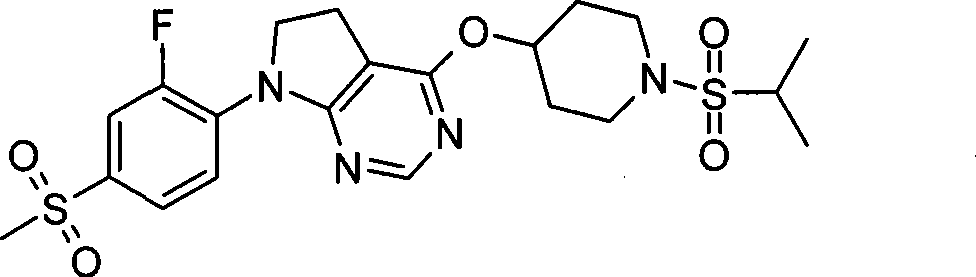
7-[2-氟-4-(甲基磺酰基)苯基]-4-({1-[(1-甲基乙基)磺酰基]-4-哌啶基}氧基)-6,7-二氢-5H-吡咯并[2,3-d]嘧啶(168)7-[2-fluoro-4-(methylsulfonyl)phenyl]-4-({1-[(1-methylethyl)sulfonyl]-4-piperidinyl}oxyl)-6, 7-dihydro-5H-pyrrolo[2,3-d]pyrimidine ( 168 )
采用与所述用于制备实施例91类似的方法制备标题化合物,使用化合物126(70mg,0.138mmol)、二异丙基乙基胺(1mL,7.72mmol)和2-丙烷磺酰氯(70mg,0.492mmol),在纯化后得到37mg(54%)标题产物168。The title compound was prepared in a manner similar to that described for the preparation of Example 91 using compound 126 (70 mg, 0.138 mmol), diisopropylethylamine (1 mL, 7.72 mmol) and 2-propanesulfonyl chloride (70 mg, 0.492 mmol), 37 mg (54%) of the title product 168 were obtained after purification.
1H NMR(400MHz,CDCl3):δ 8.31(s,1H),7.91(app.t,J=8.5Hz,1H),7.87-7.60(m,2H),5.49-5.20(m,1H),4.31(t,J=8.5Hz,2H),3.80-3.52(m,2H),3.42-3.26(m,2H),3.24-3.12(m,4H),2.23-1.99(m,2H),1.98-1.81(m,2H),1.97-1.75(m,2H),1.32(d,J=6.8Hz,6H);LCMS(ESI):m/z 499(M+H)+. 1 H NMR (400MHz, CDCl 3 ): δ 8.31(s, 1H), 7.91(app.t, J=8.5Hz, 1H), 7.87-7.60(m, 2H), 5.49-5.20(m, 1H), 4.31(t, J=8.5Hz, 2H), 3.80-3.52(m, 2H), 3.42-3.26(m, 2H), 3.24-3.12(m, 4H), 2.23-1.99(m, 2H), 1.98- 1.81 (m, 2H), 1.97-1.75 (m, 2H), 1.32 (d, J=6.8Hz, 6H); LCMS (ESI): m/z 499 (M+H) + .
实施例93(169)Example 93 ( 169 )
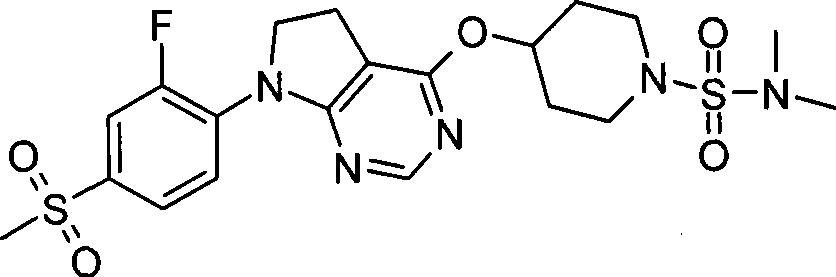
4-({7-[2-氟-4-(甲基磺酰基)苯基]-6,7-二氢-5H-吡咯并[2,3-d]嘧啶-4-基}氧基)-NN-二甲基-1-哌啶磺酰胺(169)4-({7-[2-fluoro-4-(methylsulfonyl)phenyl]-6,7-dihydro-5H-pyrrolo[2,3-d]pyrimidin-4-yl}oxy) -NN-Dimethyl-1-piperidinesulfonamide ( 169 )
采用与所述用于制备实施例91类似的方法制备标题化合物,使用化合物126(70mg,0.138mmol)、二异丙基乙基胺(1mL,7.72mmol)和二甲基氨磺酰氯(70mg,0.489mmol),纯化后得到10mg(14%)标题产物169。The title compound was prepared in a manner similar to that described for the preparation of Example 91 using compound 126 (70 mg, 0.138 mmol), diisopropylethylamine (1 mL, 7.72 mmol) and dimethylsulfamoyl chloride (70 mg, 0.489 mmol), after purification afforded 10 mg (14%) of the title product 169 .
1H NMR(400MHz,CDCl3):δ 8.28(s,1H),8.00(app.t,J=8.5Hz,1H),7.76-7.67(m,2H),5.38-5.29(m,1H),4.19(t,J=8.5Hz,2H),3.57-3.48(m,2H),3.29-3.20(m,2H),3.13(t,J=8.5Hz,2H),3.04(s,3H),2.84(s,6H),2.13-2.02(m,2H),1.96-1.85(m,2H);LCMS(ESI):m/z 500(M+H)+. 1 H NMR (400MHz, CDCl 3 ): δ 8.28(s, 1H), 8.00(app.t, J=8.5Hz, 1H), 7.76-7.67(m, 2H), 5.38-5.29(m, 1H), 4.19(t, J=8.5Hz, 2H), 3.57-3.48(m, 2H), 3.29-3.20(m, 2H), 3.13(t, J=8.5Hz, 2H), 3.04(s, 3H), 2.84 (s, 6H), 2.13-2.02 (m, 2H), 1.96-1.85 (m, 2H); LCMS (ESI): m/z 500 (M+H) + .
实施例94(170)Example 94 ( 170 )
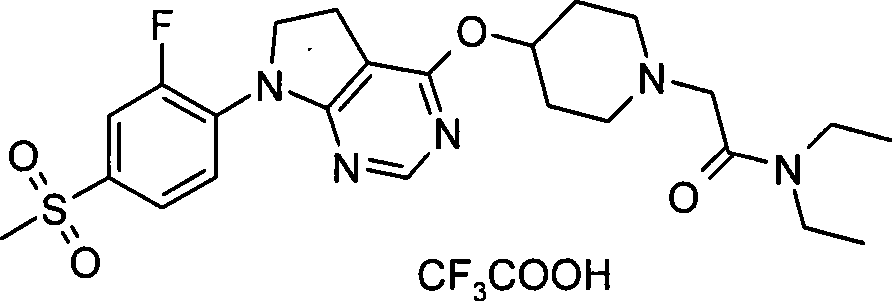
N,N-二乙基-2-[4-({7-[2-氟-4-(甲基磺酰基)苯基]-6,7-二氢-5H-吡咯并[2,3-d]嘧啶-4-基}氧基)-1-哌啶基]乙酰胺·三氟乙酸盐(170)N, N-diethyl-2-[4-({7-[2-fluoro-4-(methylsulfonyl)phenyl]-6,7-dihydro-5H-pyrrolo[2,3- d] pyrimidin-4-yl}oxyl)-1-piperidinyl]acetamide trifluoroacetate ( 170 )
采用与所述用于制备实施例88(步骤2)类似的方法制备标题化合物,使用化合物126(75mg,0.148mmol)、二异丙基乙基胺(92μL,0.518mmol)、催化量的碘化钠和2-氯-N,N-二乙基乙酰胺(24mg,0.163mmol),纯化后得到23mg(37%)三氟乙酸盐形式的产物170。The title compound was prepared in a manner similar to that described for the preparation of Example 88 (Step 2), using compound 126 (75 mg, 0.148 mmol), diisopropylethylamine (92 μL, 0.518 mmol), catalytic amounts of iodide Sodium and 2-chloro-N,N-diethylacetamide (24 mg, 0.163 mmol) gave 23 mg (37%) of product 170 as the trifluoroacetate salt after purification.
1H NMR(400MHz,CDCl3):δ 8.28(s,1H),7.96(app.t,J=8.5Hz,1H),7.76-7.73(m,2H),5.58-5.39(m,1H),4.22(t,J=8.5Hz,2H),4.08(s,2H),3.74-3.58(m,2H),3.56-3.43(m,2H),3.41-3.16(m,6H),3.06(s,3H),2.43-2.30(m,2H),2.29-2.17(m,2H),1.18-1.12(m,6H);LCMS(ESI):m/z 506(M+H)+. 1 H NMR (400MHz, CDCl 3 ): δ 8.28 (s, 1H), 7.96 (app.t, J=8.5Hz, 1H), 7.76-7.73 (m, 2H), 5.58-5.39 (m, 1H), 4.22(t, J=8.5Hz, 2H), 4.08(s, 2H), 3.74-3.58(m, 2H), 3.56-3.43(m, 2H), 3.41-3.16(m, 6H), 3.06(s, 3H), 2.43-2.30(m, 2H), 2.29-2.17(m, 2H), 1.18-1.12(m, 6H); LCMS(ESI): m/z 506(M+H) + .
实施例95(171)Example 95 ( 171 )
2-[4-({7-[2-氟-4-(甲基磺酰基)苯基]-6,7-二氢-5H-吡咯并[2,3-d]嘧啶-4-基}氧基)-1-哌啶基]-N-(苯基甲基)乙酰胺(171)2-[4-({7-[2-fluoro-4-(methylsulfonyl)phenyl]-6,7-dihydro-5H-pyrrolo[2,3-d]pyrimidin-4-yl} Oxygen)-1-piperidinyl]-N-(phenylmethyl)acetamide ( 171 )
采用与所述用于制备实施例88(步骤2)类似的方法制备标题化合物,使用化合物126(75mg,0.148mmol)、二异丙基乙基胺(92μL,0.518mmol)、催化量的碘化钠和2-氯-N-(苯基甲基)乙酰胺(27mg,0.148mmol),纯化后得到18mg(28%)产物171。The title compound was prepared in a manner similar to that described for the preparation of Example 88 (Step 2), using compound 126 (75 mg, 0.148 mmol), diisopropylethylamine (92 μL, 0.518 mmol), catalytic amounts of iodide Sodium and 2-chloro-N-(phenylmethyl)acetamide (27 mg, 0.148 mmol) afforded 18 mg (28%) of product 171 after purification.
1H NMR(400MHz,CD3OD):δ 8.15(s,1H),7.97(app.t,J=8.5Hz,1H),7.80-7.75(m,2H),7.33-7.22(m,5H),5.21-5.17(m,1H),4.42(s,2H),4.17(t,J=8.5Hz,2H),3.30(s,2H),3.15-3.09(m,5H),2.80-2.74(m,2H),2.71-2.60(m,2H),2.10-2.02(m,2H),1.89-1.80(m,2H);LCMS(ESI):m/z 540(M+H)+. 1 H NMR (400MHz, CD 3 OD): δ 8.15(s, 1H), 7.97(app.t, J=8.5Hz, 1H), 7.80-7.75(m, 2H), 7.33-7.22(m, 5H) , 5.21-5.17(m, 1H), 4.42(s, 2H), 4.17(t, J=8.5Hz, 2H), 3.30(s, 2H), 3.15-3.09(m, 5H), 2.80-2.74(m , 2H), 2.71-2.60(m, 2H), 2.10-2.02(m, 2H), 1.89-1.80(m, 2H); LCMS (ESI): m/z 540(M+H) + .
实施例96(172)Example 96 ( 172 )
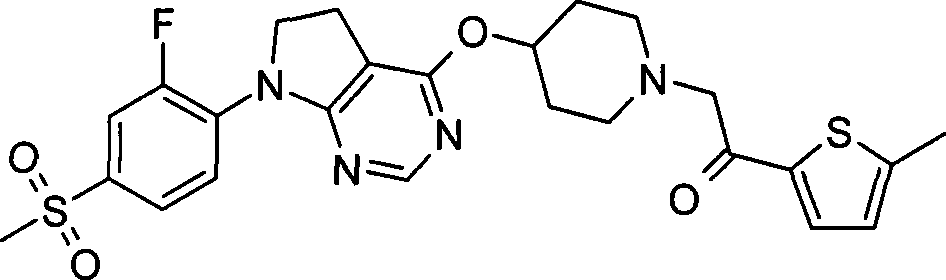
2-[4-({7-[2-氟-4-(甲基磺酰基)苯基]-6,7-二氢-5H-吡咯并[2,3-d]嘧啶-4-基}氧基)-1-哌啶基]-1-(5-甲基-2-噻吩基)乙酮(172)2-[4-({7-[2-fluoro-4-(methylsulfonyl)phenyl]-6,7-dihydro-5H-pyrrolo[2,3-d]pyrimidin-4-yl} Oxy)-1-piperidinyl]-1-(5-methyl-2-thienyl)ethanone ( 172 )
采用与所述用于制备实施例88(步骤2)类似的方法制备标题化合物,使用化合物126(100mg,0.197mmol)、二异丙基乙基胺(70μL,0.395mmol)和2-氯-1-(5-甲基-2-噻吩基)乙酮(34mg,0.197mmol),纯化后得到21mg(17%)产物172。The title compound was prepared in a manner similar to that described for the preparation of Example 88 (Step 2), using compound 126 (100 mg, 0.197 mmol), diisopropylethylamine (70 μL, 0.395 mmol) and 2-chloro-1 -(5-Methyl-2-thienyl)ethanone (34 mg, 0.197 mmol) afforded 21 mg (17%) of product 172 after purification.
1H NMR(400MHz,CDCl3):δ 8.26(s,1H),8.02(app.t,J=8.5Hz,1H),7.76-7.68(m,3H),6.79(d,J=3.4Hz,1H),5.22-5.10(m,1H),4.19(t,J=8.5Hz,2H),3.63(s,2H),3.14-2.87(m,5H),2.86-2.80(m,2H),2.71-2.60(m,5H),2.16-2.01(m,2H),1.93-1.80(m,2H);LCMS(ESI):m/z531(M+H)+. 1 H NMR (400MHz, CDCl 3 ): δ 8.26(s, 1H), 8.02(app.t, J=8.5Hz, 1H), 7.76-7.68(m, 3H), 6.79(d, J=3.4Hz, 1H), 5.22-5.10(m, 1H), 4.19(t, J=8.5Hz, 2H), 3.63(s, 2H), 3.14-2.87(m, 5H), 2.86-2.80(m, 2H), 2.71 -2.60(m, 5H), 2.16-2.01(m, 2H), 1.93-1.80(m, 2H); LCMS(ESI): m/z531(M+H) + .
实施例97(173)Example 97 ( 173 )

1-(5-乙基-2-噻吩基)-2-[4-({7-[2-氟-4-(甲基磺酰基)苯基]-6,7-二氢-5H-吡咯并[2,3-d]嘧啶-4-基}氧基)-1-哌啶基]乙酮·三氟乙酸盐(173)1-(5-Ethyl-2-thienyl)-2-[4-({7-[2-fluoro-4-(methylsulfonyl)phenyl]-6,7-dihydro-5H-pyrrole And[2,3-d]pyrimidin-4-yl}oxy)-1-piperidinyl]ethanone trifluoroacetate ( 173 )
采用与所述用于制备实施例88(步骤2)类似的方法制备标题化合物,使用在5mL乙腈中的化合物126(100mg,0.197mmol)、二异丙基乙基胺(70uL,0.395mmol)和2-氯-1-(5-乙基-2-噻吩基)乙酮(37mg,0.197mmol),纯化后得到13mg(10%)三氟乙酸盐形式的产物173。The title compound was prepared in a manner similar to that described for the preparation of Example 88 (Step 2), using compound 126 (100 mg, 0.197 mmol), diisopropylethylamine (70 uL, 0.395 mmol) and 2-Chloro-1-(5-ethyl-2-thienyl)ethanone (37 mg, 0.197 mmol) afforded 13 mg (10%) of the product 173 as the trifluoroacetate salt after purification.
1H NMR(400MHz,CDCl3):δ 8.26(s,1H),7.99(app.t,J=8.5Hz,1H),7.75-7.68(m,2H),7.63(d,J=3.6Hz,1H),6.90(d,J=3.6Hz,1H),5.51-5.45(m,1H),4.57(s,2H),4.26(t,J=8.5Hz,2H),3.82-3.69(m,2H),3.58-3.42(m,2H),3.28-3.09(m,2H),3.06(s,3H),2.91(q,J=7.6Hz,2H),2.46-2.38(m,2H),2.30-2.18(m,2H),1.34(t,J=7.3Hz,3H);LCMS(ESI):m/z 545(M+H)+. 1 H NMR (400MHz, CDCl 3 ): δ 8.26(s, 1H), 7.99(app.t, J=8.5Hz, 1H), 7.75-7.68(m, 2H), 7.63(d, J=3.6Hz, 1H), 6.90(d, J=3.6Hz, 1H), 5.51-5.45(m, 1H), 4.57(s, 2H), 4.26(t, J=8.5Hz, 2H), 3.82-3.69(m, 2H ), 3.58-3.42(m, 2H), 3.28-3.09(m, 2H), 3.06(s, 3H), 2.91(q, J=7.6Hz, 2H), 2.46-2.38(m, 2H), 2.30- 2.18 (m, 2H), 1.34 (t, J=7.3Hz, 3H); LCMS (ESI): m/z 545 (M+H) + .
实施例98(174)Example 98 ( 174 )
1-(5-氯-2-噻吩基)-2-[4-({7-[2-氟-4-(甲基磺酰基)苯基]-6,7-二氢-5H-吡咯并[2,3-d]嘧啶-4-基}氧基)-1-哌啶基]乙酮·三氟乙酸盐(175)1-(5-Chloro-2-thienyl)-2-[4-({7-[2-fluoro-4-(methylsulfonyl)phenyl]-6,7-dihydro-5H-pyrrolo [2,3-d]pyrimidin-4-yl}oxy)-1-piperidinyl]ethanone trifluoroacetate ( 175 )
采用与所述用于制备实施例88(步骤2)类似的方法制备标题化合物,使用在5mL乙腈中的化合物126(100mg,0.197mmol)、二异丙基乙基胺(70μL,0.395mmol)和2-溴-1-(5-氯-2-噻吩基)乙酮(47mg,0.197mmol),纯化后得到2mg(1%)三氟乙酸盐形式的产物174。The title compound was prepared in a manner similar to that described for the preparation of Example 88 (Step 2), using compound 126 (100 mg, 0.197 mmol), diisopropylethylamine (70 μL, 0.395 mmol) and 2-Bromo-1-(5-chloro-2-thienyl)ethanone (47 mg, 0.197 mmol) afforded 2 mg (1%) of the product 174 as the trifluoroacetate salt after purification.
1H NMR(400MHz,CDCl3):δ 8.27(s,1H),8.00(app.t,J=8.5Hz,1H),7.98-7.71(m,2H),7.60(d,J=3.4Hz,1H),6.79(d,J=3.4Hz,1H),5.53-5.40(m,1H),4.59(s,2H),4.24(t,J=8.5Hz,2H),3.89-3.71(m,2H),3.58-3.41(m,2H),3.28-3.19(m,2H),3.06(s,3H),2.43-2.21(m,4H);LCMS(ESI):m/z 552(M+H)+. 1 H NMR (400MHz, CDCl 3 ): δ 8.27(s, 1H), 8.00(app.t, J=8.5Hz, 1H), 7.98-7.71(m, 2H), 7.60(d, J=3.4Hz, 1H), 6.79(d, J=3.4Hz, 1H), 5.53-5.40(m, 1H), 4.59(s, 2H), 4.24(t, J=8.5Hz, 2H), 3.89-3.71(m, 2H ), 3.58-3.41(m, 2H), 3.28-3.19(m, 2H), 3.06(s, 3H), 2.43-2.21(m, 4H); LCMS(ESI): m/z 552(M+H) + .
实施例99(175)Example 99 ( 175 )
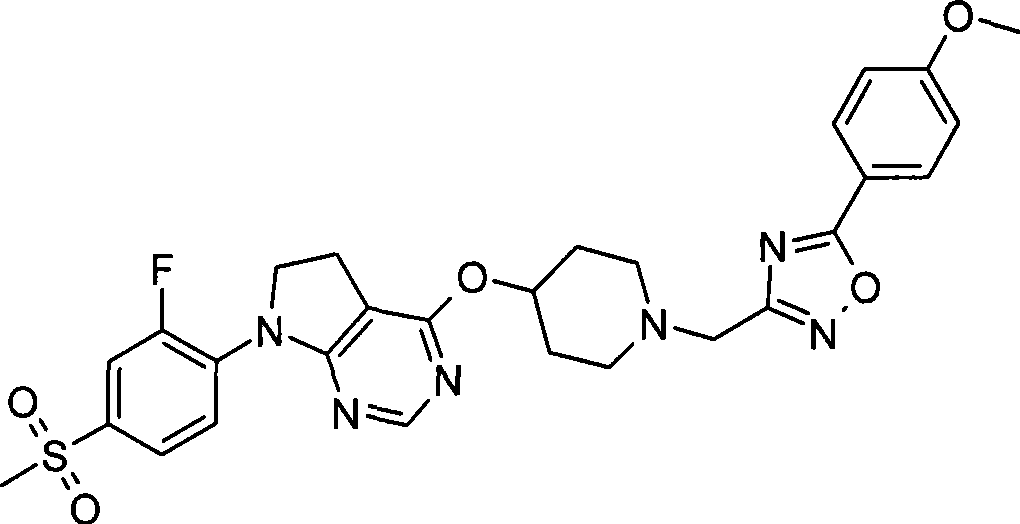
7-[2-氟-4-(甲基磺酰基)苯基]-4-{[1-({5-[4-(甲氧基)苯基]-1,2,4-噁二唑-3-基}甲基)-4-哌啶基]氧基}-6,7-二氢-5H-吡咯并[2,3-d]嘧啶(175)7-[2-fluoro-4-(methylsulfonyl)phenyl]-4-{[1-({5-[4-(methoxy)phenyl]-1,2,4-oxadiazole -3-yl}methyl)-4-piperidinyl]oxy}-6,7-dihydro-5H-pyrrolo[2,3-d]pyrimidine ( 175 )
采用与所述用于制备实施例88(步骤2)类似的方法制备标题化合物,使用在5mL乙腈中的化合物126(100mg,0.197mmol)、二异丙基乙基胺(70uL,0.395mmol)和3-(氯甲基)-5-[4-(甲氧基)苯基]-1,2,4-噁二唑(44mg,0.20mmol),经快速柱层析纯化(使用0-1.5%甲醇/二氯甲烷洗脱)后,得到38mg(28%)标题化合物175。The title compound was prepared in a manner similar to that described for the preparation of Example 88 (Step 2), using compound 126 (100 mg, 0.197 mmol), diisopropylethylamine (70 uL, 0.395 mmol) and 3-(Chloromethyl)-5-[4-(methoxy)phenyl]-1,2,4-oxadiazole (44mg, 0.20mmol), purified by flash column chromatography (using 0-1.5% After eluting with methanol/dichloromethane), 38 mg (28%) of the title compound 175 were obtained.
1H NMR(400MHz,CDCl3):δ 8.26(s,1H),8.17-7.96(m,3H),7.78-7.60(m,2H),7.00(d,J=9.0Hz,2H),5.27-5.02(m,1H),4.19(t,J=8.5Hz,2H),3.87(s,3H),3.76(s,2H),3.16-2.98(m,5H),2.97-2.80(m,2H),2.63-2.46(m,2H),2.14-2.00(m,2H),1.97-1.82(m,2H);LCMS(ESI):m/z 580(M+H)+. 1 H NMR (400MHz, CDCl 3 ): δ 8.26(s, 1H), 8.17-7.96(m, 3H), 7.78-7.60(m, 2H), 7.00(d, J=9.0Hz, 2H), 5.27- 5.02(m, 1H), 4.19(t, J=8.5Hz, 2H), 3.87(s, 3H), 3.76(s, 2H), 3.16-2.98(m, 5H), 2.97-2.80(m, 2H) , 2.63-2.46(m, 2H), 2.14-2.00(m, 2H), 1.97-1.82(m, 2H); LCMS(ESI): m/z 580(M+H) + .
实施例100(176)Example 100 ( 176 )
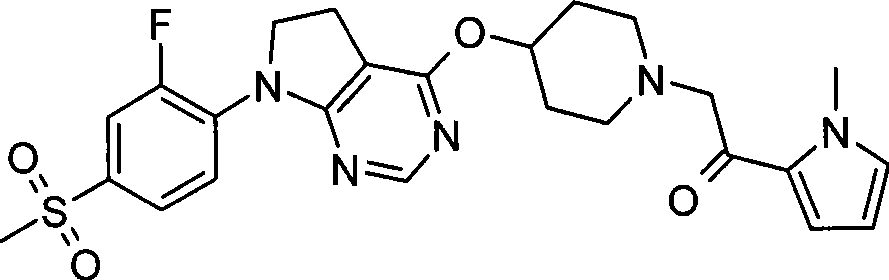
2-[4-({7-[2-氟-4-(甲基磺酰基)苯基]-6,7-二氢-5H-吡咯并[2,3-d]嘧啶-4-基}氧基)-1-哌啶基]-1-(1-甲基-1H-吡咯-2-基)乙酮(176)2-[4-({7-[2-fluoro-4-(methylsulfonyl)phenyl]-6,7-dihydro-5H-pyrrolo[2,3-d]pyrimidin-4-yl} Oxy)-1-piperidinyl]-1-(1-methyl-1H-pyrrol-2-yl)ethanone ( 176 )
采用与所述用于制备实施例88(步骤2)类似的方法制备标题化合物,使用在5mL乙腈中的化合物126(100mg,0.197mmol)、二异丙基乙基胺(87μL,0.492mmol)和2-氯-1-(1-甲基-1H-吡咯-2-基)乙酮(31mg,0.197mmol),经快速柱层析纯化(使用1%甲醇/二氯甲烷洗脱)后得到62mg(61%)标题化合物176。The title compound was prepared in a manner similar to that described for the preparation of Example 88 (Step 2), using compound 126 (100 mg, 0.197 mmol), diisopropylethylamine (87 μL, 0.492 mmol) and 2-Chloro-1-(1-methyl-1H-pyrrol-2-yl)ethanone (31mg, 0.197mmol) yielded 62mg after purification by flash column chromatography (eluting with 1% methanol/dichloromethane) (61%) The title compound 176 .
1H NMR(400MHz,CDCl3):δ 8.26(s,1H),8.05(app.t,J=8.5Hz,1H),7.77-7.62(m,2H),7.05(dd,J=1.3Hz;J=4.0Hz,1H),6.80(m,1H),6.11(dd,J=2.4Hz;J=4.0Hz,1H),5.27-5.12(m,1H),4.19(t,J=8.5Hz,2H),3.94(s,3H),3.64(s,2H),3.16-2.98(m,5H),2.94-2.78(m,2H),2.56-2.41(m,2H),2.15-2.03(m,2H),2.01-1.79(m,2H);LCMS(ESI):m/z 514(M+H)+. 1 H NMR (400MHz, CDCl 3 ): δ 8.26(s, 1H), 8.05(app.t, J=8.5Hz, 1H), 7.77-7.62(m, 2H), 7.05(dd, J=1.3Hz; J=4.0Hz, 1H), 6.80(m, 1H), 6.11(dd, J=2.4Hz; J=4.0Hz, 1H), 5.27-5.12(m, 1H), 4.19(t, J=8.5Hz, 2H), 3.94(s, 3H), 3.64(s, 2H), 3.16-2.98(m, 5H), 2.94-2.78(m, 2H), 2.56-2.41(m, 2H), 2.15-2.03(m, 2H), 2.01-1.79 (m, 2H); LCMS (ESI): m/z 514 (M+H) + .
实施例101(177):Example 101 ( 177 ):
2-[4-({7-[2-氟-4-(甲基磺酰基)苯基]-6,7-二氢-5H-吡咯并[2,3-d]嘧啶-4-基}氧基)-1-哌啶基]-1-(5-苯基-2-噻吩基)乙酮(177)2-[4-({7-[2-fluoro-4-(methylsulfonyl)phenyl]-6,7-dihydro-5H-pyrrolo[2,3-d]pyrimidin-4-yl} Oxy)-1-piperidinyl]-1-(5-phenyl-2-thienyl)ethanone ( 177 )
采用与所述用于制备实施例88类似的方法制备标题化合物,使用在5mL乙腈中的化合物126(100mg,0.197mmol)、二异丙基乙基胺(87μL,0.492mmol)和2-氯-1-(5-苯基-2-噻吩基)乙酮(55mg,0.197mmol),经快速柱层析纯化(使用0-1.5%甲醇/二氯甲烷洗脱)后,得到62mg(61%)标题化合物177。The title compound was prepared in a manner similar to that described for the preparation of Example 88, using compound 126 (100 mg, 0.197 mmol), diisopropylethylamine (87 μL, 0.492 mmol) and 2-chloro- 1-(5-Phenyl-2-thienyl)ethanone (55 mg, 0.197 mmol), after purification by flash column chromatography (eluting with 0-1.5% methanol/dichloromethane), gave 62 mg (61%) Title compound 177 .
1H NMR(400MHz,CDCl3):δ 8.27(s,1H),8.06(app.t,J=8.5Hz,1H),7.92(d,J=4.2Hz,1H),7.74-7.62(m,3H),7.49-7.28(m,5H),5.30-5.15(m,1H),4.20(t,J=8.5Hz,2H),3.70(s,2H),3.15(t,J=8.5Hz,2H),3.04(s,3H),3.00-2.88(m,2H),2.67-2.51(m,2H),2.20-2.06(m,2H),2.02-1.90(m,2H);LCMS(ESI):m/z 593(M+H)+. 1 H NMR (400MHz, CDCl 3 ): δ 8.27(s, 1H), 8.06(app.t, J=8.5Hz, 1H), 7.92(d, J=4.2Hz, 1H), 7.74-7.62(m, 3H), 7.49-7.28(m, 5H), 5.30-5.15(m, 1H), 4.20(t, J=8.5Hz, 2H), 3.70(s, 2H), 3.15(t, J=8.5Hz, 2H ), 3.04(s, 3H), 3.00-2.88(m, 2H), 2.67-2.51(m, 2H), 2.20-2.06(m, 2H), 2.02-1.90(m, 2H); LCMS(ESI): m/z 593(M+H) + .
实施例102(178)Example 102 ( 178 )
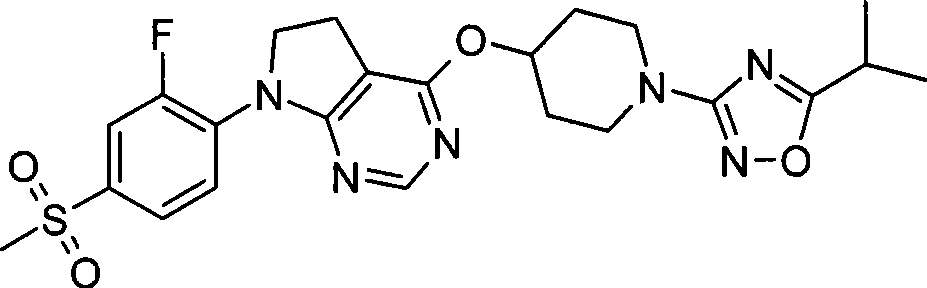
步骤1:4-({7-[2-氟-4-(甲基磺酰基)苯基]-6,7-二氢-5H-吡咯并[2,3-d]嘧啶-4-基}氧基)-N-羟基-1-哌啶甲脒(178)Step 1: 4-({7-[2-fluoro-4-(methylsulfonyl)phenyl]-6,7-dihydro-5H-pyrrolo[2,3-d]pyrimidin-4-yl} Oxy)-N-hydroxy-1-piperidinecarboxamidine ( 178 )
在0℃下将化合物126(得自不同的批号,500mg,0.99mmol)与溴化氰(560μL,1.68mmol)和二异丙基乙基胺(526μL,2.96mmol)在10mL二氯甲烷中混合。将该反应升温至室温,同时搅拌18小时。随后粗制反应混合物经快速柱层析纯化(用1%甲醇/二氯甲烷洗脱),得到142mg(34%)白色固体状的4-({7-[2-氟-4-(甲基磺酰基)苯基]-6,7-二氢-5H-吡咯并[2,3-d]嘧啶-4-基}氧基)-1-哌啶甲腈(178A)。Compound 126 (from a different batch, 500 mg, 0.99 mmol) was mixed with cyanogen bromide (560 μL, 1.68 mmol) and diisopropylethylamine (526 μL, 2.96 mmol) in 10 mL of dichloromethane at 0 °C . The reaction was allowed to warm to room temperature while stirring for 18 hours. The crude reaction mixture was then purified by flash column chromatography (eluting with 1% methanol/dichloromethane) to afford 142 mg (34%) of 4-({7-[2-fluoro-4-(methyl Sulfonyl)phenyl]-6,7-dihydro-5H-pyrrolo[2,3-d]pyrimidin-4-yl}oxy)-1-piperidinecarbonitrile (178A).
1H NMR(400MHz,CDCl3):δ8.27(s,1H),8.03(app.t,J=8.5Hz,1H),7.76-7.62(m,2H),5.39-5.25(m,1H),4.22(t,J=8.5Hz,2H),3.57-3.43(m,2H),3.29-3.19(m,2H),3.13(t,J=8.4Hz,2H),3.05(s,3H),2.16-2.03(m,2H),1.98-1.83(m,2H);LCMS(ESI):m/z 418(M+H)+. 1 H NMR (400MHz, CDCl 3 ): δ8.27(s, 1H), 8.03(app.t, J=8.5Hz, 1H), 7.76-7.62(m, 2H), 5.39-5.25(m, 1H) , 4.22(t, J=8.5Hz, 2H), 3.57-3.43(m, 2H), 3.29-3.19(m, 2H), 3.13(t, J=8.4Hz, 2H), 3.05(s, 3H), 2.16-2.03 (m, 2H), 1.98-1.83 (m, 2H); LCMS (ESI): m/z 418 (M+H) + .
将化合物178A(130mg,0.310mmol)与羟胺·盐酸盐(64mg,0.930mmol)和碳酸钠(131mg,1.24mmol)在20mL乙醇中混合,加热至回流并保持2小时。经过滤除去固体且该物质178无需纯化使用(143mg);LCMS(ESI):m/z 451(M+H)+.Compound 178A ( 130 mg, 0.310 mmol) was mixed with hydroxylamine·hydrochloride (64 mg, 0.930 mmol) and sodium carbonate (131 mg, 1.24 mmol) in 20 mL of ethanol, heated to reflux for 2 hours. The solids were removed by filtration and the material 178 was used without purification (143 mg); LCMS (ESI): m/z 451 (M+H) + .
步骤2:7-[2-氟-4-(甲基磺酰基)苯基]-4-({1-[5-(1-甲基乙基)-1,2,4-噁二唑-3-基]-4-哌啶基}氧基)-6,7-二氢-5H-吡咯并[2,3-d]嘧啶(179)Step 2: 7-[2-Fluoro-4-(methylsulfonyl)phenyl]-4-({1-[5-(1-methylethyl)-1,2,4-oxadiazole- 3-yl]-4-piperidinyl}oxy)-6,7-dihydro-5H-pyrrolo[2,3-d]pyrimidine ( 179 )
将2-甲基丙酸(19μL,0.310mmol)与HATU[六氟磷酸O-(7-氮杂苯并三唑-1-基)-1,1,3,3-四甲基脲鎓,129mg,0.340mmol]和二异丙基乙基胺(129mg,0.340mmol)在N,N-二甲基甲酰胺(10mL)中混合并在室温下将该溶液搅拌15分钟。随后加入化合物178(140mg,0.310mmol)并在室温下将该混合物搅拌30分钟。随后将该反应加热至100℃并保持1小时。随后该反应物用水稀释并用乙醚萃取三次。合并的有机萃取液用水洗涤三次,有机层经无水硫酸镁干燥,过滤并减压浓缩至干。随后粗制反应物经反相层析纯化(使用50-100%乙腈/水(添加0.1%三氟乙酸)梯度洗脱),得到15mg(9%)褐色固体状的标题化合物179。2-Methylpropionic acid (19 μL, 0.310 mmol) was mixed with HATU[hexafluorophosphate O-(7-azabenzotriazol-1-yl)-1,1,3,3-tetramethyluronium, 129 mg, 0.340 mmol] and diisopropylethylamine (129 mg, 0.340 mmol) were mixed in N,N-dimethylformamide (10 mL) and the solution was stirred at room temperature for 15 minutes. Compound 178 (140 mg, 0.310 mmol) was then added and the mixture was stirred at room temperature for 30 minutes. The reaction was then heated to 100°C for 1 hour. The reaction was then diluted with water and extracted three times with ether. The combined organic extracts were washed three times with water, the organic layer was dried over anhydrous magnesium sulfate, filtered and concentrated to dryness under reduced pressure. The crude reaction was then purified by reverse phase chromatography using a gradient of 50-100% acetonitrile/water (0.1% trifluoroacetic acid added) to afford 15 mg (9%) of the title compound 179 as a tan solid.
1H NMR(400MHz,CDCl3):δ 8.28(s,1H),7.98(app.t,J=8.5Hz,1H),7.82-7.67(m,2H),5.45-5.34(m,1H),4.21(t,J=8.5Hz,2H),3.87-3.68(m,2H),3.46-3.27(m,2H),3.20-2.97(m,5H),2.15-2.02(m,2H),1.94-1.79(m,2H)1.2(d,J=7.1Hz,6H);LCMS(ESI):m/z 503(M+H)+. 1 H NMR (400MHz, CDCl 3 ): δ 8.28(s, 1H), 7.98(app.t, J=8.5Hz, 1H), 7.82-7.67(m, 2H), 5.45-5.34(m, 1H), 4.21(t, J=8.5Hz, 2H), 3.87-3.68(m, 2H), 3.46-3.27(m, 2H), 3.20-2.97(m, 5H), 2.15-2.02(m, 2H), 1.94- 1.79 (m, 2H) 1.2 (d, J=7.1Hz, 6H); LCMS (ESI): m/z 503 (M+H) + .
实施例103(182)Example 103 ( 182 )

步骤1:1-(2-嘧啶基)-4-哌啶醇(180)Step 1: 1-(2-pyrimidinyl)-4-piperidinol ( 180 )
将4-羟基哌啶(1.5g,14.7mmol)与2-氯嘧啶(1.5g,13.4mmol)和二异丙基乙基胺(6mL,33.5mmol)在50mL乙腈中混合。在80℃下将该混合物加热18小时。随后将反应混合物浓缩至干,随后粗制残余物经快速柱层析纯化(使用0-60%乙酸乙酯/己烷梯度洗脱),得到2.1g(81%)白色固体状的所需化合物180。4-Hydroxypiperidine (1.5 g, 14.7 mmol) was mixed with 2-chloropyrimidine (1.5 g, 13.4 mmol) and diisopropylethylamine (6 mL, 33.5 mmol) in 50 mL of acetonitrile. The mixture was heated at 80°C for 18 hours. The reaction mixture was then concentrated to dryness and the crude residue was purified by flash column chromatography (eluting with a gradient of 0-60% ethyl acetate/hexanes) to afford 2.1 g (81%) of the desired compound as a white solid 180 .
1H NMR(400MHz,CDCl3):δ 8.28(d,J=4.6Hz 2H),6.49(t,J=4.8Hz,1H),4.49-4.33(m,2H),4.01-3.88(m,1H),3.37-3.21(m,2H),2.02-1.90(m,2H),1.60-1.45(m,2H);LCMS(ESI):m/z 180(M+H)+. 1 H NMR (400MHz, CDCl 3 ): δ 8.28(d, J=4.6Hz 2H), 6.49(t, J=4.8Hz, 1H), 4.49-4.33(m, 2H), 4.01-3.88(m, 1H ), 3.37-3.21(m, 2H), 2.02-1.90(m, 2H), 1.60-1.45(m, 2H); LCMS(ESI): m/z 180(M+H) + .
步骤2:1-(1,4,5,6-四氢-2-嘧啶基)-4-哌啶醇(181)Step 2: 1-(1,4,5,6-tetrahydro-2-pyrimidinyl)-4-piperidinol ( 181 )
将化合物180(300mg,1.67mmol)与10%钯/碳(Degussa型)(100mg,催化剂)和浓盐酸(500μL)在10mL乙酸中混合。在室温下将该混合物氢化18小时。随后将反应混合物过滤,将溶剂减压除去,得到304mg(84%)所需化合物181。Compound 180 (300 mg, 1.67 mmol) was mixed with 10% palladium on carbon (Degussa type) (100 mg, catalyst) and concentrated hydrochloric acid (500 μL) in 10 mL of acetic acid. The mixture was hydrogenated at room temperature for 18 hours. The reaction mixture was then filtered and the solvent was removed under reduced pressure to afford 304 mg (84%) of the desired compound 181 .
1H NMR(400MHz,DMSO-d6):δ 8.25(m,2H),4.03-3.41(m,3H),2.95-2.86(m,4H),2.09-1.55(m,6H),1.55-1.18(m,2H). 1 H NMR (400MHz, DMSO-d 6 ): δ 8.25(m, 2H), 4.03-3.41(m, 3H), 2.95-2.86(m, 4H), 2.09-1.55(m, 6H), 1.55-1.18 (m, 2H).
步骤3:7-[2-氟-4-(甲基磺酰基)苯基]-4-{[1-(1,4,5,6-四氢-2-嘧啶基)-4-哌啶基]氧基}-6,7-二氢-5H-吡咯并[2,3-d]嘧啶(182)Step 3: 7-[2-Fluoro-4-(methylsulfonyl)phenyl]-4-{[1-(1,4,5,6-tetrahydro-2-pyrimidinyl)-4-piperidine Base]oxy}-6,7-dihydro-5H-pyrrolo[2,3-d]pyrimidine ( 182 )
化合物181(300mg,1.38mmol)溶解在5mL无水DMF中并用氢化钠(294mg,7.3mmol)处理。在室温下将该混合物搅拌15分钟。随后往搅拌的溶液中滴加在5mL DMF中的4-氯-7-[2-氟-4-(甲基磺酰基)苯基]-6,7-二氢-5H-吡咯并[2,3-d]嘧啶8。随后在室温下将该混合物搅拌18小时。随后将该反应物用水猝灭。随后将粗制反应物减压浓缩至干,随后粗制残余物经C18反相层析纯化(使用5-95%乙腈/水(添加0.5%三氟乙酸)梯度洗脱),得到56mg(6%)白色固体状的标题化合物182。Compound 181 (300 mg, 1.38 mmol) was dissolved in 5 mL of anhydrous DMF and treated with sodium hydride (294 mg, 7.3 mmol). The mixture was stirred at room temperature for 15 minutes. To the stirred solution was then added dropwise 4-chloro-7-[2-fluoro-4-(methylsulfonyl)phenyl]-6,7-dihydro-5H-pyrrolo[2, 3-d]
1HNMR(400MHz,CD3OD):δ 8.46(s,1H),8.17(s,1H),7.95(app.t,J=8.5Hz,1H),7.88-7.66(m,2H),5.54-5.37(m,1H),4.20(t,J=8.5Hz,2H),3.75-3.57(m,2H),3.49-3.33(m,6H),3.19-3.07(m,5H),2.21-2.06(m,2H),2.01-1.76(m,4H);LCMS(ESI):m/z 475(M+H)+. 1 HNMR (400MHz, CD 3 OD): δ 8.46(s, 1H), 8.17(s, 1H), 7.95(app.t, J=8.5Hz, 1H), 7.88-7.66(m, 2H), 5.54- 5.37(m, 1H), 4.20(t, J=8.5Hz, 2H), 3.75-3.57(m, 2H), 3.49-3.33(m, 6H), 3.19-3.07(m, 5H), 2.21-2.06( m, 2H), 2.01-1.76 (m, 4H); LCMS (ESI): m/z 475 (M+H) + .
实施例104(184)Example 104 ( 184 )

步骤1:4-(4-氯-5,6-二氢-7H-吡咯并[2,3-d]嘧啶-7-基)-N,N-二甲基苯磺酰胺(183)Step 1: 4-(4-Chloro-5,6-dihydro-7H-pyrrolo[2,3-d]pyrimidin-7-yl)-N,N-dimethylbenzenesulfonamide ( 183 )
采用所述用于制备141(实施例71,步骤1)的方法,往圆底烧瓶中装入N1,N1-二甲基对氨基苯磺酰胺(0.19g,0.95mmol)并冷却至-15℃。加入三氟乙酸(0.9mL,11.7mmol)并在-15℃下将该溶液搅拌10分钟。往反应混合物中加入Na(OAc)3BH(0.32g,1.51mmol)并搅拌10分钟。滴加醛209(0.2g,1.05mmol)在CH2Cl2(1.2mL)中的溶液并在-15℃下将反应混合物搅拌30分钟,随后在室温下搅拌15小时。将该混合物减压浓缩,用10%NaHCO3稀释,用CH2Cl2(3 x 10mL)萃取,经MgSO4干燥,过滤,随后减压浓缩,得到粗制物质,其经SiO2快速柱层析纯化,得到0.17g(47%)白色固体状的标题化合物183。Using the procedure described for the preparation of 141 (Example 71, step 1), a round bottom flask was charged with N1,N1-dimethyl-p-sulfanilamide (0.19 g, 0.95 mmol) and cooled to -15 °C . Trifluoroacetic acid (0.9 mL, 11.7 mmol) was added and the solution was stirred at -15°C for 10 minutes. Na(OAc) 3BH (0.32 g, 1.51 mmol) was added to the reaction mixture and stirred for 10 minutes. A solution of aldehyde 209 (0.2 g, 1.05 mmol) in CH2Cl2 (1.2 mL ) was added dropwise and the reaction mixture was stirred at -15 °C for 30 min, then at room temperature for 15 h. The mixture was concentrated under reduced pressure, diluted with 10% NaHCO 3 , extracted with CH 2 Cl 2 (3 x 10 mL), dried over MgSO 4 , filtered, and concentrated under reduced pressure to give crude material which was flash columned on SiO 2 Purification by chromatography afforded 0.17 g (47%) of the title compound 183 as a white solid.
1H NMR(400MHz,CDCl3):δ 8.51(s,1H),8.00(d,J=9.28Hz,2H),7.83(d,J=9.10Hz,2H),4.11-4.36(m,2H),3.19-3.37(m,2H),2.73(s,1H);LCMS(APCI):m/z 339(M+H)+. 1 H NMR (400MHz, CDCl 3 ): δ 8.51(s, 1H), 8.00(d, J=9.28Hz, 2H), 7.83(d, J=9.10Hz, 2H), 4.11-4.36(m, 2H) , 3.19-3.37(m, 2H), 2.73(s, 1H); LCMS(APCI): m/z 339(M+H) + .
步骤2:4-[(7-{4-[(二甲基氨基)磺酰基]苯基}-6,7-二氢-5H-吡咯并[2,3-d]嘧啶-4-基)氧基]-1-哌啶甲酸1-甲基乙酯(184)Step 2: 4-[(7-{4-[(Dimethylamino)sulfonyl]phenyl}-6,7-dihydro-5H-pyrrolo[2,3-d]pyrimidin-4-yl) Oxy]-1-piperidinecarboxylic acid 1-methylethyl ester ( 184 )
采用所述用于制备实施例1(步骤10)的一般方法,往装有NaH(0.027g,95%,1.12mmol)的圆底烧瓶中加入9(0.15g,0.8mmol)和THF(1.5mL)的溶液并将得到的溶液加热至50℃并搅拌35分钟。加入183(0.109g,0.32mmol)和THF(1.5mL)的溶液并将得到的混合物回流16小时。将反应混合物冷却至室温,将其倾入H2O(10mL)中,随后用乙酸乙酯萃取。合并的有机层经MgSO4干燥,过滤,随后减压浓缩。粗品用甲醇重结晶,得到0.026g(17%)白色固体状的标题产物184。Using the general procedure described for the preparation of Example 1 (step 10), to a round bottom flask containing NaH (0.027 g, 95%, 1.12 mmol) was added 9 (0.15 g, 0.8 mmol) and THF (1.5 mL ) and the resulting solution was heated to 50°C and stirred for 35 minutes. A solution of 183 (0.109 g, 0.32 mmol) and THF (1.5 mL) was added and the resulting mixture was refluxed for 16 hours. The reaction mixture was cooled to room temperature, poured into H2O (10 mL), followed by extraction with ethyl acetate. The combined organic layers were dried over MgSO 4 , filtered, and concentrated under reduced pressure. The crude product was recrystallized from methanol to afford 0.026 g (17%) of the title product 184 as a white solid.
1H NMR(400MHz,CDCl3):δ 8.38(s,1H),7.96(d,J=9.0Hz,2H),7.77(d,J=8.8Hz,2H),5.30-5.42(m,1H),4.86-4.99(m,1H),4.14(t,J=8.8Hz,2H),3.75-3.91(m,2H),3.27-3.41(m,2H),3.12(t,J=8.8Hz,2H),2.70(s,6H),1.92-2.09(m,2H),1.66-1.83(m,2H),1.26(d,J=6.24Hz,6H);LCMS(ESI):m/z 491(M+H)+. 1 H NMR (400MHz, CDCl 3 ): δ 8.38(s, 1H), 7.96(d, J=9.0Hz, 2H), 7.77(d, J=8.8Hz, 2H), 5.30-5.42(m, 1H) , 4.86-4.99(m, 1H), 4.14(t, J=8.8Hz, 2H), 3.75-3.91(m, 2H), 3.27-3.41(m, 2H), 3.12(t, J=8.8Hz, 2H ), 2.70 (s, 6H), 1.92-2.09 (m, 2H), 1.66-1.83 (m, 2H), 1.26 (d, J=6.24Hz, 6H); LCMS (ESI): m/z 491 (M +H) + .
实施例105(186)Example 105 ( 186 )
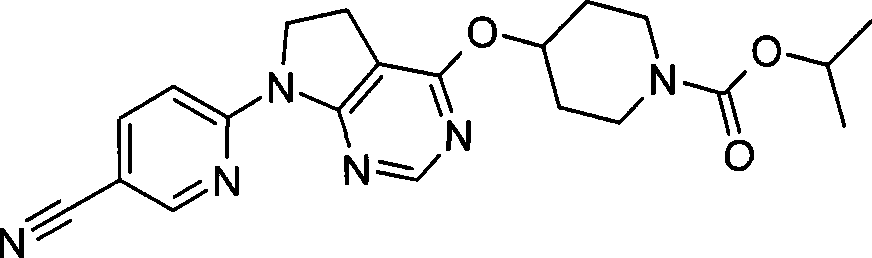
步骤1:6-(4-氯-5,6-二氢-7H-吡咯并[2,3-d]嘧啶-7-基)-3-吡啶甲腈(185)Step 1: 6-(4-Chloro-5,6-dihydro-7H-pyrrolo[2,3-d]pyrimidin-7-yl)-3-pyridinecarbonitrile ( 185 )
往圆底烧瓶中装入2-氨基-5-氰基吡啶(0.26g,2.18mmol)并冷却至-15℃。加入乙酸(1.52mL,26.8mmol)并在-15℃下将该溶液搅拌10分钟。往反应混合物中加入Na(OAc)3BH(0.742g,3.5mmol)并搅拌5分钟。滴加醛209(0.5g,2.62mmol)在CH2Cl2(1.6mL)中的溶液并在-15℃下将反应混合物搅拌30分钟,随后在室温下搅拌15小时。混合物用H2O稀释,用CH2Cl2萃取,经MgSO4干燥,过滤,随后减压浓缩,得到粗制物质,其经SiO2快速柱层析纯化,得到以未分离混合物形式存在的0.16g标题化合物185和6-{[2-(4,6-二氯-5-嘧啶基)乙基]氨基}-3-吡啶甲腈。A round bottom flask was charged with 2-amino-5-cyanopyridine (0.26 g, 2.18 mmol) and cooled to -15°C. Acetic acid (1.52 mL, 26.8 mmol) was added and the solution was stirred at -15°C for 10 minutes. Na(OAc) 3BH (0.742 g, 3.5 mmol) was added to the reaction mixture and stirred for 5 minutes. A solution of aldehyde 209 (0.5 g, 2.62 mmol) in CH2Cl2 (1.6 mL ) was added dropwise and the reaction mixture was stirred at -15 °C for 30 min, then at room temperature for 15 h. The mixture was diluted with H2O , extracted with CH2Cl2 , dried over MgSO4 , filtered and concentrated under reduced pressure to give crude material which was purified by flash column chromatography on SiO2 to give 0.16 g Title compound 185 and 6-{[2-(4,6-dichloro-5-pyrimidinyl)ethyl]amino}-3-pyridinecarbonitrile.
1H NMR(400MHz,CD3OD):δ 8.66(s,1H),8.19-8.27(m,1H),7.52-7.61(m,1H),6.42-6.52(m,1H),3.83(t,J=6.87Hz,3H),3.19(t,J=6.87Hz,3H);LCMS(APCI):m/z 258(M+H)+. 1 H NMR (400MHz, CD 3 OD): δ 8.66(s, 1H), 8.19-8.27(m, 1H), 7.52-7.61(m, 1H), 6.42-6.52(m, 1H), 3.83(t, J=6.87Hz, 3H), 3.19(t, J=6.87Hz, 3H); LCMS (APCI): m/z 258(M+H) + .
步骤2:4-{[7-(5-氰基-2-吡啶基)-6,7-二氢-5H-吡咯并[2,3-d]嘧啶-4-基]氧基}-1-哌啶甲酸1-甲基乙酯(186)Step 2: 4-{[7-(5-cyano-2-pyridyl)-6,7-dihydro-5H-pyrrolo[2,3-d]pyrimidin-4-yl]oxy}-1 - 1-methylethyl piperidinecarboxylate ( 186 )
往搅拌的9(0.252g,1.35mmol)和THF(2mL)的溶液中加入NaH(0.045g,95%,1.89mmol),加热至50℃并保持30分钟。滴加185(0.139g,0.54mmol)在THF(3mL)中的溶液并将得到的混合物回流16小时。将反应混合物冷却至室温,将其倾入H2O中,随后用乙酸乙酯萃取。合并的有机层经MgSO4干燥,过滤,随后减压浓缩。粗品用甲醇重结晶来纯化,得到0.012g(5%)白色固体状的标题产物186。To a stirred solution of 9 (0.252 g, 1.35 mmol) and THF (2 mL) was added NaH (0.045 g, 95%, 1.89 mmol) and heated to 50 °C for 30 min. A solution of 185 (0.139 g, 0.54 mmol) in THF (3 mL) was added dropwise and the resulting mixture was refluxed for 16 hours. The reaction mixture was cooled to room temperature, poured into H2O , and extracted with ethyl acetate. The combined organic layers were dried over MgSO 4 , filtered, and concentrated under reduced pressure. The crude product was purified by recrystallization from methanol to afford 0.012 g (5%) of the title product 186 as a white solid.
1H NMR(400MHz,CDCl3):δ 8.85-8.90(m,1H),8.57-8.61(m,1H),8.42(s,1H),7.82-7.87(m,1H),5.33-5.42(m,1H),4.90-4.99(m,1H),4.35(t,J=8.61Hz,2H),3.74-3.89(m,2H),3.29-3.42(m,2H),3.07(t,J=8.06Hz,2H),1.94-2.08(m,2H),1.70-1.83(m,2H),1.27(d,J=6.23Hz,6H);LCMS(ESI):m/z 409(M+H)+. 1 H NMR (400MHz, CDCl 3 ): δ 8.85-8.90(m, 1H), 8.57-8.61(m, 1H), 8.42(s, 1H), 7.82-7.87(m, 1H), 5.33-5.42(m , 1H), 4.90-4.99(m, 1H), 4.35(t, J=8.61Hz, 2H), 3.74-3.89(m, 2H), 3.29-3.42(m, 2H), 3.07(t, J=8.06 Hz, 2H), 1.94-2.08(m, 2H), 1.70-1.83(m, 2H), 1.27(d, J=6.23Hz, 6H); LCMS (ESI): m/z 409(M+H) + .
实施例106(188)Example 106 ( 188 )

步骤1:N-[2-(4,6-二氯-5-嘧啶基)乙基]-5-氟-2-吡啶胺(187)Step 1: N-[2-(4,6-dichloro-5-pyrimidinyl)ethyl]-5-fluoro-2-pyridinamine ( 187 )
往圆底烧瓶中装入2-氨基-5-氟吡啶(0.323g,2.88mmol)并冷却至-15℃。加入三氟乙酸(2.5mL,32.2mmol)并在-15℃下将该溶液搅拌10分钟。往反应混合物中加入Na(OAc)3BH(0.89g,4.2mmol)并搅拌10分钟。滴加209(0.5g,2.62mmol)在CH2Cl2(2.0mL)中的溶液并在-15℃下将反应混合物搅拌30分钟,随后在室温下搅拌15小时。将混合物减压浓缩,用10%NaHCO3稀释,用CH2Cl2(3 x 10mL)萃取,经MgSO4干燥,过滤,随后减压浓缩,得到粗制物质,其经SiO2快速柱层析纯化,得到以未分离混合物形式的0.17g标题化合物187和4-氯-7-(5-氟-2-吡啶基)-6,7-二氢-5H-吡咯并[2,3-d]嘧啶。A round bottom flask was charged with 2-amino-5-fluoropyridine (0.323 g, 2.88 mmol) and cooled to -15°C. Trifluoroacetic acid (2.5 mL, 32.2 mmol) was added and the solution was stirred at -15°C for 10 minutes. Na(OAc) 3BH (0.89 g, 4.2 mmol) was added to the reaction mixture and stirred for 10 minutes. A solution of 209 (0.5 g, 2.62 mmol) in CH2Cl2 ( 2.0 mL) was added dropwise and the reaction mixture was stirred at -15 °C for 30 min, then at room temperature for 15 h. The mixture was concentrated under reduced pressure, diluted with 10% NaHCO 3 , extracted with CH 2 Cl 2 (3 x 10 mL), dried over MgSO 4 , filtered, and concentrated under reduced pressure to give crude material which was subjected to flash column chromatography on SiO 2 Purification afforded 0.17 g of the title compound 187 and 4-chloro-7-(5-fluoro-2-pyridyl)-6,7-dihydro-5H-pyrrolo[2,3-d] as an unseparated mixture pyrimidine.
1H NMR(400MHz,CDCl3):δ 8.62(s,1H),7.92(d,J=2.68Hz,1H),7.14-7.23(m,1H),6.37(dd,J1=9.10Hz,J2=3.39Hz,1H),4.60(br.s,1H),6.67(q,J=6.54Hz,2H),3.24(t,J=6.87Hz,2H);LCMS(APCI):m/z 287(M+H)+. 1 H NMR (400MHz, CDCl 3 ): δ 8.62(s, 1H), 7.92(d, J=2.68Hz, 1H), 7.14-7.23(m, 1H), 6.37(dd, J 1 =9.10Hz, J 2 = 3.39Hz, 1H), 4.60 (br.s, 1H), 6.67 (q, J = 6.54Hz, 2H), 3.24 (t, J = 6.87Hz, 2H); LCMS (APCI): m/z 287 (M+H) + .
步骤2:4-{[7-(5-氟-2-吡啶基)-6,7-二氢-5H-吡咯并[2,3-d]嘧啶-4-基]氧基}-1-哌啶甲酸1-甲基乙酯(188)Step 2: 4-{[7-(5-Fluoro-2-pyridyl)-6,7-dihydro-5H-pyrrolo[2,3-d]pyrimidin-4-yl]oxy}-1- 1-methylethyl piperidinecarboxylate ( 188 )
采用所述用于制备10的方法,使用9(0.166g,0.88mmol)、NaH(0.037g,1.54mmol)和化合物187(0.11g,0.44mmol)。水后处理,随后用甲醇重结晶,得到0.027g(15%)白色固体状的标题化合物188。Following the procedure described for the preparation of 10 , 9 (0.166 g, 0.88 mmol), NaH (0.037 g, 1.54 mmol) and compound 187 (0.11 g, 0.44 mmol) were used. Aqueous workup followed by recrystallization from methanol afforded 0.027 g (15%) of the title compound 188 as a white solid.
1H NMR(400MHz,CDCl3):δ 8.66(dd,J1=9.34Hz,J2=4.03Hz,1H),8.35(s,1H),8.17(d,J=3.11Hz,1H),7.40-7.47(m,1H),5.30-5.41(m,1H),4.89-5.00(m,1H),4.30(t,J=8.61Hz,2H),3.73-3.89(m,2H),3.30-3.42(m,2H),3.04(t,J=8.61Hz,2H),1.93-2.07(m,2H),1.67-1.84(m,2H),1.26(d,J=6.23Hz,6H);LCMS(ESI):m/z 402(M+H)+. 1 H NMR (400MHz, CDCl 3 ): δ 8.66 (dd, J 1 =9.34Hz, J 2 =4.03Hz, 1H), 8.35(s, 1H), 8.17 (d, J = 3.11Hz, 1H), 7.40 -7.47(m, 1H), 5.30-5.41(m, 1H), 4.89-5.00(m, 1H), 4.30(t, J=8.61Hz, 2H), 3.73-3.89(m, 2H), 3.30-3.42 (m, 2H), 3.04(t, J=8.61Hz, 2H), 1.93-2.07(m, 2H), 1.67-1.84(m, 2H), 1.26(d, J=6.23Hz, 6H); ESI): m/z 402(M+H) + .
实施例107(189)Example 107( 189 )

4-({7-[2-氟-4-(甲基磺酰基)苯基]-6,7-二氢-5H-吡咯并[2,3-d]嘧啶-4-基}氨基)-1-哌啶甲酸1,1-二甲基乙酯·三氟乙酸盐(189)4-({7-[2-fluoro-4-(methylsulfonyl)phenyl]-6,7-dihydro-5H-pyrrolo[2,3-d]pyrimidin-4-yl}amino)- 1,1-Dimethylethyl 1-piperidinecarboxylate Trifluoroacetate ( 189 )
往8(50mg,0.153mmol)在DMF(1.5mL)中的溶液中加入4-氨基-1-哌啶甲酸1,1-二甲基乙酯(62mg,0.306mmol)和K2CO3(42mg,0.306mmol)。将反应混合物密封并在150℃、微波中加热15分钟。在LCMS示踪表明大多为8。在200℃下、微波中将反应混合物继续加热20分钟。LCMS示踪再表明存在8。因此,在175℃下、微波中将反应混合物再加热20分钟。随后反应混合物用水(2mL)稀释并用EtOAc(3 x 5mL)萃取。合并的有机层经MgSO4干燥,过滤,随后减压浓缩。粗品经制备HPLC纯化两次(用水/乙腈洗脱),得到4mg(4%)浅褐色固体状的标题产物189。LCMS(ESI):m/z 492(M+H)+.To a solution of 8 (50 mg, 0.153 mmol) in DMF (1.5 mL) was added 1,1-dimethylethyl 4-amino-1-piperidinecarboxylate (62 mg, 0.306 mmol) and K 2 CO 3 (42 mg , 0.306 mmol). The reaction mixture was sealed and heated at 150°C in the microwave for 15 minutes. The LCMS trace showed mostly 8 . The reaction mixture was heated for an additional 20 minutes at 200°C in the microwave. LCMS trace again indicated the presence of 8 . Therefore, the reaction mixture was heated for an additional 20 minutes at 175°C in the microwave. Then the reaction mixture was diluted with water (2 mL) and extracted with EtOAc (3 x 5 mL). The combined organic layers were dried over MgSO 4 , filtered, and concentrated under reduced pressure. The crude product was purified twice by preparative HPLC (eluting with water/acetonitrile) to afford 4 mg (4%) of the title product 189 as a beige solid. LCMS (ESI): m/z 492 (M+H) + .
实施例108(191)Example 108 ( 191 )

步骤1:4-({[(1,1-二甲基乙基)氧基]羰基}氨基)-1-哌啶甲酸1-甲基乙酯(190)Step 1: 1-methylethyl 4-({[(1,1-dimethylethyl)oxy]carbonyl}amino)-1-piperidinecarboxylate ( 190 )
在室温下,经加液漏斗往搅拌的4-哌啶基氨基甲酸1,1-二甲基乙酯(512mg,2.56mmol)和Et3N(0.714mL,5.12mmol)在CH2Cl2(25mL)中的溶液滴加氯甲酸异丙酯(1.0M在甲苯中,2.8mL,2.81mmol)。在室温下将反应混合物搅拌17小时,随后用水(1 x 15mL)洗涤,经MgSO4干燥,过滤,随后减压浓缩,得到585mg(80%)无色油状的标题产物190。Stirred 1,1-dimethylethyl 4-piperidinylcarbamate (512 mg, 2.56 mmol) and Et 3 N (0.714 mL, 5.12 mmol) in CH 2 Cl 2 ( 25 mL) was added isopropyl chloroformate (1.0 M in toluene, 2.8 mL, 2.81 mmol) dropwise. The reaction mixture was stirred at room temperature for 17 h, then washed with water (1 x 15 mL), dried over MgSO 4 , filtered, and concentrated under reduced pressure to afford 585 mg (80%) of the
1H NMR(400MHz,CDCl3):δ 4.85(七重峰,J=6.4Hz,1H),4.63-4.48(m,1H),4.13-3.89(m,2H),3.55(br s,1H),2.82(t,J=11.7Hz,2H),1.88-1.85(m,2H),1.39(s,9H),1.29-1.22(m,2H),1.19(d,J=6.1Hz,6H). 1 H NMR (400MHz, CDCl 3 ): δ 4.85 (septet, J=6.4Hz, 1H), 4.63-4.48(m, 1H), 4.13-3.89(m, 2H), 3.55(br s, 1H), 2.82(t, J=11.7Hz, 2H), 1.88-1.85(m, 2H), 1.39(s, 9H), 1.29-1.22(m, 2H), 1.19(d, J=6.1Hz, 6H).
步骤2:4-({7-[2-氟-4-(甲基磺酰基)苯基]-6,7-二氢-5H-吡咯并[2,3-d]嘧啶-4-基}氨基)-1-哌啶甲酸1-甲基乙酯·三氟乙酸盐(191)Step 2: 4-({7-[2-fluoro-4-(methylsulfonyl)phenyl]-6,7-dihydro-5H-pyrrolo[2,3-d]pyrimidin-4-yl} Amino)-1-piperidinecarboxylic acid 1-methylethyl ester trifluoroacetate ( 191 )
往8(50mg,0.153mmol)在DMF(1.5mL)中的溶液中加入190(87mg,0.305mmol)和K2CO3(42mg,0.305mmol)。将反应混合物密封并在200℃下、微波中加热20分钟。在LCMS示踪后表明大多为8,在220℃下、微波中将反应混合物继续加热60分钟。随后反应混合物用水(2mL)稀释并用EtOAc(3 x 5mL)萃取。合并的有机层经MgSO4干燥,过滤,随后减压浓缩。粗品经制备HPLC纯化(用水/乙腈洗脱),得到11mg(12%)黄色固体状的标题产物191。To a solution of 8 (50 mg, 0.153 mmol) in DMF (1.5 mL) was added 190 (87 mg, 0.305 mmol) and K2CO3 ( 42 mg, 0.305 mmol). The reaction mixture was sealed and heated at 200 °C in the microwave for 20 minutes. Mostly 8 after LCMS trace, the reaction mixture was heated at 220°C for an additional 60 minutes in the microwave. Then the reaction mixture was diluted with water (2 mL) and extracted with EtOAc (3 x 5 mL). The combined organic layers were dried over MgSO 4 , filtered, and concentrated under reduced pressure. The crude product was purified by preparative HPLC (eluting with water/acetonitrile) to afford 11 mg (12%) of the title product 191 as a yellow solid.
1H NMR(400MHz,CDCl3):δ8.09(s,1H),7.81-7.77(m,2H),7.72-7.69(m,1H),4.91(七重峰,J=6.4Hz,1H),4.29(t,J=9.0Hz,2H),4.23-4.12(m,2H),3.79-3.68(m,1H),3.43-3.38(m,2H),3.09(s,3H),2.96-2.86(m,2H),1.97-1.93(m,2H),1.77-1.67(m,2H),1.25(d,J=6.4Hz,6H);LCMS(ESI):m/z 478(M+H)+. 1 H NMR (400MHz, CDCl 3 ): δ8.09(s, 1H), 7.81-7.77(m, 2H), 7.72-7.69(m, 1H), 4.91 (septet, J=6.4Hz, 1H), 4.29(t, J=9.0Hz, 2H), 4.23-4.12(m, 2H), 3.79-3.68(m, 1H), 3.43-3.38(m, 2H), 3.09(s, 3H), 2.96-2.86( m, 2H), 1.97-1.93 (m, 2H), 1.77-1.67 (m, 2H), 1.25 (d, J=6.4Hz, 6H); LCMS (ESI): m/z 478 (M+H) + .
实施例109(193)Example 109 ( 193 )
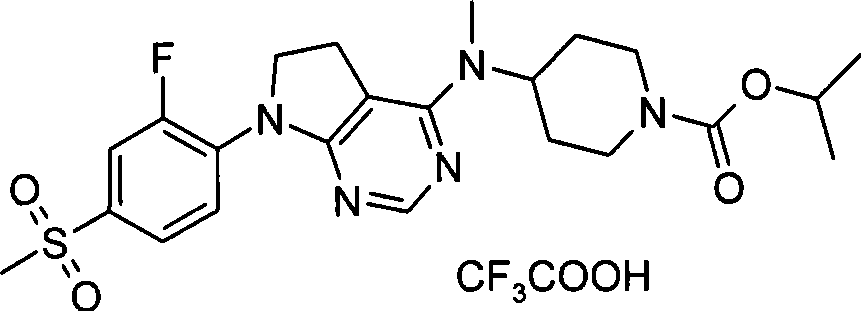
步骤1:4-[{[(1,1-二甲基乙基)氧基]羰基}(甲基)氨基]-1-哌啶甲酸1-甲基乙酯(192)Step 1: 1-methylethyl 4-[{[(1,1-dimethylethyl)oxy]carbonyl}(methyl)amino]-1-piperidinecarboxylate ( 192 )
在室温下经加液漏斗往搅拌的甲基(4-哌啶基)氨基甲酸1,1-二甲基乙酯(500mg,2.33mmol)和Et3N(0.65mL,4.66mmol)在CH2Cl2(23mL)中的溶液中滴加氯甲酸异丙酯(1.0M,在甲苯中,2.6mL,2.57mmol)。在室温下将反应混合物搅拌17小时,随后用水(1 x 15mL)洗涤,经MgSO4干燥,过滤,随后减压浓缩,得到608mg(87%)无色油状的标题产物192。1,1-Dimethylethyl methyl(4-piperidinyl)carbamate (500 mg, 2.33 mmol) and Et3N (0.65 mL, 4.66 mmol) in CH2 were stirred at room temperature via addition funnel To a solution in Cl2 (23 mL) was added isopropyl chloroformate (1.0 M in toluene, 2.6 mL, 2.57 mmol) dropwise. The reaction mixture was stirred at room temperature for 17 h, then washed with water (1 x 15 mL), dried over MgSO 4 , filtered, and concentrated under reduced pressure to afford 608 mg (87%) of the title product 192 as a colorless oil.
1H NMR(400MHz,CDCl3):δ 4.88(七重峰,J=6.4Hz,1H),4.28-4.16(m,3H),2.77-2.71(m,2H),2.68(s,3H),1.62-1.57(m,2H),1.55-1.50(m,2H),1.44(s,9H),1.21(d,J=6.4Hz,6H). 1 H NMR (400MHz, CDCl 3 ): δ 4.88 (septet, J=6.4Hz, 1H), 4.28-4.16(m, 3H), 2.77-2.71(m, 2H), 2.68(s, 3H), 1.62 -1.57(m, 2H), 1.55-1.50(m, 2H), 1.44(s, 9H), 1.21(d, J=6.4Hz, 6H).
步骤2:4-[{7-[2-氟-4-(甲基磺酰基)苯基]-6,7-二氢-5H-吡咯并[2,3-d]嘧啶-4-基}(甲基)氨基]-1-哌啶甲酸1-甲基乙酯·三氟乙酸盐(193)Step 2: 4-[{7-[2-fluoro-4-(methylsulfonyl)phenyl]-6,7-dihydro-5H-pyrrolo[2,3-d]pyrimidin-4-yl} (Methyl)amino]-1-piperidinecarboxylic acid 1-methylethyl ester trifluoroacetate ( 193 )
往8(50mg,0.153mmol)在DMF(1.5mL)中的溶液中加入192(92mg,0.305mmol)和K2CO3(42mg,0.305mmol)。将反应混合物密封并在220℃下、微波中加热1小时。随后反应混合物用水(2mL)稀释并用EtOAc(3 x 5mL)萃取。合并的有机层经MgSO4干燥,过滤,随后减压浓缩。粗品经制备HPLC纯化(用水/乙腈洗脱),得到8mg(9%)黄色固体状的标题产物193。LCMS(ESI):m/z 492(M+H)+.To a solution of 8 (50 mg, 0.153 mmol) in DMF (1.5 mL) was added 192 (92 mg, 0.305 mmol) and K2CO3 ( 42 mg, 0.305 mmol). The reaction mixture was sealed and heated in the microwave at 220 °C for 1 hour. Then the reaction mixture was diluted with water (2 mL) and extracted with EtOAc (3 x 5 mL). The combined organic layers were dried over MgSO 4 , filtered, and concentrated under reduced pressure. The crude product was purified by preparative HPLC (eluting with water/acetonitrile) to afford 8 mg (9%) of the title product 193 as a yellow solid. LCMS (ESI): m/z 492 (M+H) + .
实施例110(195)Example 110 ( 195 )
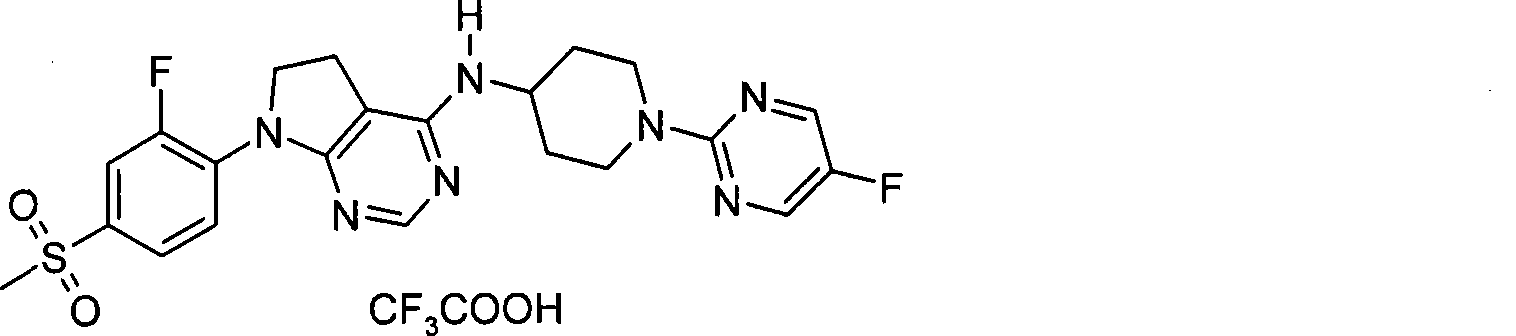
步骤1:[1-(2-氟-5-嘧啶基)-4-哌啶基]氨基甲酸1,1-二甲基乙酯(194)Step 1: 1,1-Dimethylethyl [1-(2-fluoro-5-pyrimidinyl)-4-piperidinyl]carbamate ( 194 )
在室温下经注射器往搅拌的4-哌啶基氨基甲酸1,1-二甲基乙酯(500mg,2.50mmol)和二异丙基乙基胺(0.871mL,5.0mmol)在乙腈(25mL)中的溶液中加入2-氯-5-氟嘧啶(0.34mL,2.75mmol)。反应混合物将加热至回流并保持19小时,随后冷却至室温,随后减压浓缩。粗制油状物经SiO2快速层析纯化(20%-50%EtOAc/己烷),得到495mg(67%)粘稠油状的标题产物194。1,1-Dimethylethyl 4-piperidinylcarbamate (500 mg, 2.50 mmol) and diisopropylethylamine (0.871 mL, 5.0 mmol) in acetonitrile (25 mL) were stirred via syringe at room temperature To the solution in was added 2-chloro-5-fluoropyrimidine (0.34 mL, 2.75 mmol). The reaction mixture was heated to reflux for 19 hours, then cooled to room temperature, then concentrated under reduced pressure. The crude oil was purified by flash chromatography on SiO2 (20%-50% EtOAc/hexanes) to afford 495 mg (67%) of the title product 194 as a viscous oil.
1H NMR(400MHz,CDCl3):δ 8.17(s,2H),4.56-4.52(m,2H),4.47-4.41(m,1H),3.70(br s,1H),3.07-3.00(m,2H),2.02-1.98(m,2H),1.44(s,9H),1.39-1.28(m,2H). 1 H NMR (400MHz, CDCl 3 ): δ 8.17(s, 2H), 4.56-4.52(m, 2H), 4.47-4.41(m, 1H), 3.70(br s, 1H), 3.07-3.00(m, 2H), 2.02-1.98(m, 2H), 1.44(s, 9H), 1.39-1.28(m, 2H).
步骤2:7-[2-氟-4-(甲基磺酰基)苯基]-N-[1-(2-氟-5-嘧啶基)-4-哌啶基]-6,7-二氢-5H-吡咯并[2,3-d]嘧啶-4-胺·三氟乙酸盐(195)Step 2: 7-[2-Fluoro-4-(methylsulfonyl)phenyl]-N-[1-(2-fluoro-5-pyrimidinyl)-4-piperidinyl]-6,7-bis Hydrogen-5H-pyrrolo[2,3-d]pyrimidin-4-amine Trifluoroacetate ( 195 )
往8(57mg,0.174mmol)在DMF(1.7mL)中的溶液中加入194(103mg,0.348mmol)和K2CO3(48mg,0.348mmol)。反应混合物密封并在220℃下、微波中加热1小时。在LCMS示踪表明可估计量的8,在220℃下、微波中将反应混合物继续加热60分钟。随后反应混合物用水(2mL)稀释并用EtOAc(3 x 5mL)萃取。合并的有机层经MgSO4干燥,过滤,随后减压浓缩。粗品经制备HPLC纯化(用水/乙腈洗脱),得到3mg(3%)黄色固体状的标题产物195。LCMS(ESI):m/z488(M+H)+.To a solution of 8 (57 mg, 0.174 mmol) in DMF (1.7 mL) was added 194 (103 mg, 0.348 mmol) and K2CO3 ( 48 mg, 0.348 mmol). The reaction mixture was sealed and heated in microwave at 220°C for 1 hour. After the LCMS trace indicated an appreciable amount of 8, the reaction mixture was heated for an additional 60 min at 220 °C in the microwave. Then the reaction mixture was diluted with water (2 mL) and extracted with EtOAc (3 x 5 mL). The combined organic layers were dried over MgSO 4 , filtered, and concentrated under reduced pressure. The crude product was purified by preparative HPLC (eluting with water/acetonitrile) to afford 3 mg (3%) of the title product 195 as a yellow solid. LCMS (ESI): m/z 488 (M+H) + .
实施例111(198)Example 111 ( 198 )
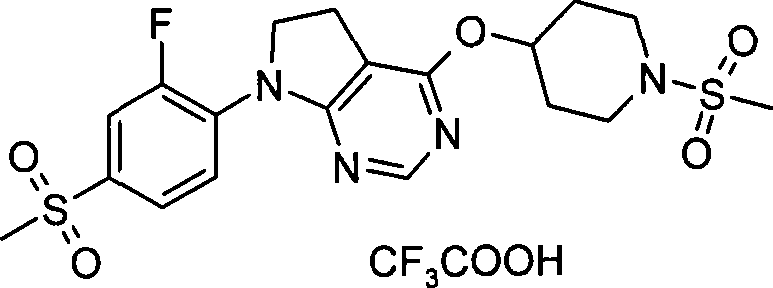
步骤1:4-(乙酰基氧基)-1-哌啶甲酸1,1-二甲基乙酯(196)Step 1: 1,1-dimethylethyl 4-(acetyloxy)-1-piperidinecarboxylate ( 196 )
在室温下经注射器往搅拌的4-羟基-1-哌啶甲酸1,1-二甲基乙酯(4.0g,19.9mmol)在CH2Cl2(50mL)中的溶液中依次加入Et3N(8.3mL,59.6mmol)和乙酸酐(5.6mL,59.6mmol)。在室温下将反应混合物搅拌5小时。随后反应混合物用水(1 x 25mL)洗涤,经MgSO4干燥,过滤,随后减压浓缩。粗制油状物在高度真空下干燥过夜,得到5.83g(120%;在样品中存在一些乙酸酐)浅棕色油状的标题产物196,其无需进一步纯化使用。To a stirred solution of 1,1-dimethylethyl 4-hydroxy-1-piperidinecarboxylate (4.0 g, 19.9 mmol) in CH 2 Cl 2 (50 mL) was added Et 3 N successively via syringe at room temperature (8.3 mL, 59.6 mmol) and acetic anhydride (5.6 mL, 59.6 mmol). The reaction mixture was stirred at room temperature for 5 hours. The reaction mixture was then washed with water (1 x 25 mL), dried over MgSO 4 , filtered, and concentrated under reduced pressure. The crude oil was dried under high vacuum overnight to afford 5.83 g (120%; some acetic anhydride in the sample) of the title product 196 as a light brown oil which was used without further purification.
1H NMR(400MHz,CDCl3):δ 4.88(七重峰,J=3.9Hz,1H),3.74-3.67(m,2H),3.20-3.14(m,2H),2.04(s,3H),1.86-1.79(m,2H),1.61-1.52(m,2H),1.44(s,9H). 1 H NMR (400MHz, CDCl 3 ): δ 4.88 (septet, J=3.9Hz, 1H), 3.74-3.67(m, 2H), 3.20-3.14(m, 2H), 2.04(s, 3H), 1.86 -1.79(m, 2H), 1.61-1.52(m, 2H), 1.44(s, 9H).
步骤2:1-(甲基磺酰基)-4-哌啶醇(197)Step 2: 1-(methylsulfonyl)-4-piperidinol ( 197 )
在室温下经注射器往搅拌的196(5.83g,得自以上反应)在CH2Cl2(100mL)中的溶液中加入TFA(18.5mL,239.6mmol)。在室温下将反应混合物搅拌3小时,此时,减压浓缩并在高度真空下干燥来尽可能除去过量的TFA。随后将粗制黄色油状物溶解在CH2Cl2(150mL)中并搅拌。在室温下经注射器往该溶液中加入Et3N(54mL,389mmol),随后将反应混合物冷却至0℃。在0℃下经加液漏斗滴加甲磺酰氯(9.0mL,116.4mmol)。随后将反应混合物升温至室温并搅拌15小时。反应混合物用水(1 x 50mL)洗涤,经MgSO4干燥,过滤,减压浓缩,随后在高度真空下干燥1小时来除去过量的Et3N。随后将粗制油状物溶解在二噁烷(100mL)中并搅拌。往该溶液中加入NaOH(2.5M,在水中,100mL)并在室温下将反应混合物搅拌5小时,在此期间其转变为棕色。反应混合物用浓HCl酸化至pH约7,随后用EtOAc(3 x 100mL)萃取。合并的有机层经MgSO4干燥,过滤,随后减压浓缩,得到1.99g(56%,由步骤1中的起始原料)浅棕色固体状的标题产物197。To a stirred solution of 196 (5.83 g, from the above reaction) in CH2Cl2 (100 mL ) was added TFA (18.5 mL, 239.6 mmol) via syringe at room temperature. The reaction mixture was stirred at room temperature for 3 hours at which time it was concentrated under reduced pressure and dried under high vacuum to remove as much excess TFA as possible. The crude yellow oil was then dissolved in CH2Cl2 ( 150 mL) and stirred. To this solution was added Et3N (54 mL, 389 mmol) via syringe at room temperature, and the reaction mixture was cooled to 0 °C. Methanesulfonyl chloride (9.0 mL, 116.4 mmol) was added dropwise via addition funnel at 0°C. The reaction mixture was then warmed to room temperature and stirred for 15 hours. The reaction mixture was washed with water (1 x 50 mL), dried over MgSO 4 , filtered, concentrated under reduced pressure, then dried under high vacuum for 1 h to remove excess Et 3 N. The crude oil was then dissolved in dioxane (100 mL) and stirred. To this solution was added NaOH (2.5M in water, 100 mL) and the reaction mixture was stirred at room temperature for 5 hours, during which time it turned brown. The reaction mixture was acidified with concentrated HCl to pH ~7, then extracted with EtOAc (3 x 100 mL). The combined organic layers were dried over MgSO4 , filtered and concentrated under reduced pressure to afford 1.99 g (56% from starting material in Step 1) of the title product 197 as a light brown solid.
1H NMR(400MHz,CDCl3):δ 3.93(七重峰,J=3.7Hz,1H),3.70(s,1H),3.49-3.43(m,2H),3.15-3.09(m,2H),2.78(s,3H),1.99-1.93(m,2H),1.74-1.66(m,2H). 1 H NMR (400MHz, CDCl 3 ): δ 3.93 (septet, J=3.7Hz, 1H), 3.70(s, 1H), 3.49-3.43(m, 2H), 3.15-3.09(m, 2H), 2.78 (s, 3H), 1.99-1.93 (m, 2H), 1.74-1.66 (m, 2H).
步骤3:7-[2-氟-4-(甲基磺酰基)苯基]-4-{[1-(甲基磺酰基)-4-哌啶基]氧基}-6,7-二氢-5H-吡咯并[2,3-d]嘧啶·三氟乙酸盐(198)Step 3: 7-[2-Fluoro-4-(methylsulfonyl)phenyl]-4-{[1-(methylsulfonyl)-4-piperidinyl]oxy}-6,7-di Hydrogen-5H-pyrrolo[2,3-d]pyrimidine trifluoroacetate ( 198 )
在室温下往搅拌的8(50mg,0.153mmol)和197(41mg,0.229mmol)在THF(2.0mL)中的溶液中一次性加入NaH(60%分散在矿物油中,25mg,0.612mmol)。将反应混合物加热至回流并保持18小时,冷却至室温,随后用水(2mL)猝灭。该混合物用EtOAc(3 x 5mL)萃取,经MgSO4干燥,过滤,随后减压浓缩。粗制油状物经制备HPLC纯化(用水/乙腈洗脱),得到15mg(17%)白色固体状的标题产物198。To a stirred solution of 8 (50 mg, 0.153 mmol) and 197 (41 mg, 0.229 mmol) in THF (2.0 mL) was added NaH (60% in mineral oil, 25 mg, 0.612 mmol) in one portion at room temperature. The reaction mixture was heated to reflux for 18 hours, cooled to room temperature and quenched with water (2 mL). The mixture was extracted with EtOAc (3 x 5 mL), dried over MgSO 4 , filtered, and concentrated under reduced pressure. The crude oil was purified by preparative HPLC (eluting with water/acetonitrile) to afford 15 mg (17%) of the title product 198 as a white solid.
1H NMR(400MHz,CDCl3):δ 8.32(s,1H),7.83-7.74(m,3H),5.35(七重峰,J=3.9Hz,1H),4.23(t,J=9.3Hz,2H),3.59-3.54(m,2H),3.24-3.18(m,4H),3.07(s,3H),2.83(s,3H),2.19-2.11(m,2H),2.00-1.91(m,2H);LCMS(ESI):m/z 471(M+H)+. 1 H NMR (400MHz, CDCl 3 ): δ 8.32(s, 1H), 7.83-7.74(m, 3H), 5.35(septet, J=3.9Hz, 1H), 4.23(t, J=9.3Hz, 2H ), 3.59-3.54(m, 2H), 3.24-3.18(m, 4H), 3.07(s, 3H), 2.83(s, 3H), 2.19-2.11(m, 2H), 2.00-1.91(m, 2H ); LCMS (ESI): m/z 471 (M+H) + .
实施例112(202)Example 112 ( 202 )
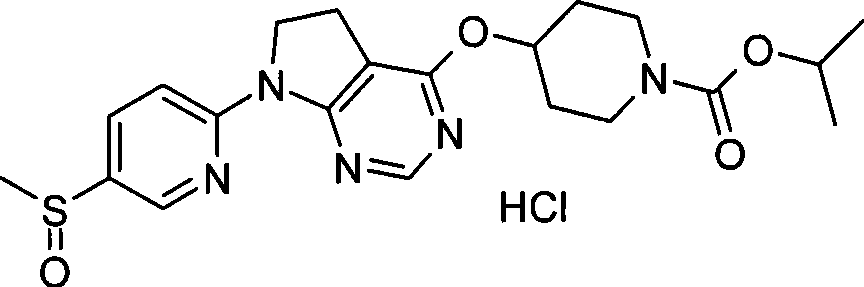
步骤1:5-(甲硫基)-2-吡啶胺(129)Step 1: 5-(methylthio)-2-pyridinamine ( 129 )
在室温下往搅拌的2-氨基-5-碘吡啶(11.6g,52.6mmol)在MeOH(250mL)中的溶液中加入甲硫醇钠(5.16g,73.6mmol)和铜粉(1.07g,16.8mmol)。在120下、密封管中将反应混合物加热68小时。随后将反应混合物冷却至室温并经Celite硅藻土垫过滤。Celite硅藻土垫用MeOH洗涤并将合并的有机液减压浓缩,随后重新溶解在EtOAc中。有机层用水(1 x 50mL)洗涤,水层用EtOAc(2 x 100mL)萃取。合并的有机层经MgSO4干燥,过滤,随后减压浓缩,得到6.23g(84%)灰白色固体状的标题产物199。To a stirred solution of 2-amino-5-iodopyridine (11.6 g, 52.6 mmol) in MeOH (250 mL) was added sodium methylthiolate (5.16 g, 73.6 mmol) and copper powder (1.07 g, 16.8 mmol). The reaction mixture was heated at 120 °C in a sealed tube for 68 hours. The reaction mixture was then cooled to room temperature and filtered through a pad of Celite. The pad of Celite was washed with MeOH and the combined organics were concentrated under reduced pressure then redissolved in EtOAc. The organic layer was washed with water (1 x 50 mL), and the aqueous layer was extracted with EtOAc (2 x 100 mL). The combined organic layers were dried over MgSO4 , filtered, and concentrated under reduced pressure to afford 6.23 g (84%) of the title product 199 as an off-white solid.
1H NMR(400MHz,CDCl3):δ 8.09(s,1H),7.51-7.48(m,1H),6.48-6.45(m,1H),4.35(br s,2H),2.38(s,3H). 1 H NMR (400MHz, CDCl 3 ): δ 8.09(s, 1H), 7.51-7.48(m, 1H), 6.48-6.45(m, 1H), 4.35(br s, 2H), 2.38(s, 3H) .
步骤2:4-氯-7-[5-(甲硫基)-2-吡啶基]-6,7-二氢-5H-吡咯并[2,3-d]嘧啶(200)Step 2: 4-Chloro-7-[5-(methylthio)-2-pyridyl]-6,7-dihydro-5H-pyrrolo[2,3-d]pyrimidine ( 200 )
在室温下往搅拌的(4,6-二氯-5-嘧啶基)乙醛209(参见实施例116,步骤1,3.41g,17.8mmol)在MeOH(180mL)中的溶液中加入199(3.0g,21.4mmol)。用冰/甲醇浴将反应混合物冷却至-15℃并加入冰乙酸(3.1mL,53.4mmol)和NaBH3CN(3.35g,53.4mmol)。在-15℃下将反应混合物搅拌15分钟,随后将其升温至室温并搅拌19小时。随后反应混合物用水(50mL)稀释并用CH2Cl2(3 x 100mL)萃取。合并的有机层经MgSO4干燥,过滤,随后减压浓缩成黄色油状物。将粗制油状物溶解在THF(500mL)中并搅拌,随后在室温下一次性加入t-BuOK(5.99g,53.4mmol)。反应混合物立即转为棕色并在室温下搅拌22小时。反应混合物用水(50mL)猝灭,减压浓缩,随后将其溶解在EtOAc(200mL)中。有机层用水(1 x 50mL)洗涤,水层用EtOAc(2 x100mL)萃取。合并的有机层经MgSO4干燥,过滤,随后减压浓缩成棕色油状物。粗制油状物经SiO2快速层析纯化(20%-40%EtOAc/己烷;在319nm处检测),得到550mg(11%)无色油状的标题产物200。To a stirred solution of (4,6-dichloro-5-pyrimidinyl)acetaldehyde 209 (see Example 116,
1H NMR(400MHz,CDCl3):δ 8.57(d,J=9.0Hz,1H),8.43(s,1H),8.29(d,J=2.4Hz,1H),7.68 and 7.66(dd,J1=8.8Hz,J2=2.4Hz,1H),4.37-4.33(m,2H),3.16(t,J=8.8Hz,2H),2.47(s,3H). 1 H NMR (400MHz, CDCl 3 ): δ 8.57(d, J=9.0Hz, 1H), 8.43(s, 1H), 8.29(d, J=2.4Hz, 1H), 7.68 and 7.66(dd, J 1 =8.8Hz, J 2 =2.4Hz, 1H), 4.37-4.33(m, 2H), 3.16(t, J=8.8Hz, 2H), 2.47(s, 3H).
步骤3:4-({7-[5-(甲硫基)-2-吡啶基]-6,7-二氢-5H-吡咯并[2,3-d]嘧啶-4-基}氧基)-1-哌啶甲酸1-甲基乙酯(201)Step 3: 4-({7-[5-(methylthio)-2-pyridyl]-6,7-dihydro-5H-pyrrolo[2,3-d]pyrimidin-4-yl}oxy )-1-piperidinecarboxylic acid 1-methylethyl ester ( 201 )
在室温下往搅拌的200(652mg,2.35mmol)和4-羟基-1-哌啶甲酸1-甲基乙酯9(526mg,2.81mmol)在THF(24mL)中的溶液中一次性加入NaH(60%分散在矿物油中,282mg,7.05mmol)。将反应混合物加热至回流并保持18小时,冷却至室温并用水(20mL)猝灭。该混合物用EtOAc(3 x 50mL)萃取,经MgSO4干燥,过滤,随后减压浓缩。粗制油状物经SiO2快速层析纯化(40%EtOAc/己烷),得到373mg(37%)无色油状的标题产物201。To a stirred solution of 200 (652 mg, 2.35 mmol) and 1-methylethyl 4-hydroxy-1-piperidinecarboxylate 9 (526 mg, 2.81 mmol) in THF (24 mL) was added NaH in one portion at room temperature ( 60% dispersed in mineral oil, 282 mg, 7.05 mmol). The reaction mixture was heated to reflux for 18 hours, cooled to room temperature and quenched with water (20 mL). The mixture was extracted with EtOAc (3 x 50 mL), dried over MgSO 4 , filtered, and concentrated under reduced pressure. The crude oil was purified by flash chromatography on SiO2 (40% EtOAc/hexanes) to afford 373 mg (37%) of the title product 201 as a colorless oil.
1H NMR(400MHz,CDCl3):δ 8.73-8.66(m,1H),8.42-8.39(m,1H),8.30(d,J=2.4Hz,1H),8.77-8.70(m,1H),5.39-5.32(m,1H),4.92(七重峰,J=6.1Hz,1H),4.46-4.36(m,2H),3.85-3.76(m,2H),3.36-3.30(m,2H),3.12-3.05(m,2H),2.48(s,3H),2.03-1.95(m,2H),1.79-1.70(m,2H),1.25(d,J=6.4Hz,6H);LCMS(ESI):m/z 430(M+H)+. 1 H NMR (400MHz, CDCl 3 ): δ 8.73-8.66(m, 1H), 8.42-8.39(m, 1H), 8.30(d, J=2.4Hz, 1H), 8.77-8.70(m, 1H), 5.39-5.32 (m, 1H), 4.92 (septet, J=6.1Hz, 1H), 4.46-4.36 (m, 2H), 3.85-3.76 (m, 2H), 3.36-3.30 (m, 2H), 3.12 -3.05(m, 2H), 2.48(s, 3H), 2.03-1.95(m, 2H), 1.79-1.70(m, 2H), 1.25(d, J=6.4Hz, 6H); LCMS(ESI): m/z 430(M+H) + .
步骤4:(±)-4-({7-[5-(甲基亚磺酰基)-2-吡啶基]-6,7-二氢-5H-吡咯并[2,3-d]嘧啶-4-基}氧基)-1-哌啶甲酸1-甲基乙酯·盐酸盐(202)Step 4: (±)-4-({7-[5-(Methylsulfinyl)-2-pyridyl]-6,7-dihydro-5H-pyrrolo[2,3-d]pyrimidine- 4-yl}oxy)-1-piperidinecarboxylic acid 1-methylethyl ester hydrochloride ( 202 )
在0℃下经注射器往搅拌的201(180mg,0.419mmol)在六氟异丙醇(4.0mL)中的溶液中加入H2O2(30%重量水溶液,95mg,0.839mmol)。让反应混合物升温至室温并搅拌30分钟。反应混合物用水(5mL)稀释并用CH2Cl2(3 x 20mL)萃取。合并的有机层经MgSO4干燥,过滤,随后减压浓缩。使用热枪将得到的无色油状物溶解在1:1丙酮:Et2O的混合物(15mL)中并搅拌。往该溶液中加入HCl(1.0M,在Et2O中,1.5mL)并立刻沉淀出白色固体。将溶剂减压除去,随后该物质用Et2O研磨,过滤,随后高度真空干燥,得到169mg(84%)白色固体状的标题产物202。To a stirred solution of 201 (180 mg, 0.419 mmol) in hexafluoroisopropanol (4.0 mL) was added H2O2 (30% by weight in water , 95 mg, 0.839 mmol) via syringe at 0 °C. The reaction mixture was allowed to warm to room temperature and stirred for 30 minutes. The reaction mixture was diluted with water (5 mL) and extracted with CH2Cl2 (3 x 20 mL). The combined organic layers were dried over MgSO 4 , filtered, and concentrated under reduced pressure. The resulting colorless oil was dissolved in a 1:1 mixture of acetone: Et2O (15 mL) using a heat gun and stirred. To this solution was added HCl (1.0 M in Et2O , 1.5 mL) and a white solid precipitated out immediately. The solvent was removed under reduced pressure and the material was triturated with Et2O , filtered and dried under high vacuum to afford 169 mg (84%) of the title product 202 as a white solid.
1H NMR(400MHz,CDCl3):δ8.67-8.63(m,1H),8.60(s,1H),8.52(s,1H),8.09-8.05(m,1H),5.42-5.36(m,1H),4.91(七重峰,J=6.1Hz,1H),4.41-4.37(m,2H),3.86-3.77(m,2H),3.35-3.29(m,2H),3.13-3.09(m,2H),2.78(s,3H),2.04-1.96(m,2H),1.78-1.70(m,2H),1.24(d,J=6.1Hz,6H);LCMS(ESI):m/z 446(M+H)+. 1 H NMR (400MHz, CDCl 3 ): δ8.67-8.63(m, 1H), 8.60(s, 1H), 8.52(s, 1H), 8.09-8.05(m, 1H), 5.42-5.36(m, 1H), 4.91 (septet, J=6.1Hz, 1H), 4.41-4.37(m, 2H), 3.86-3.77(m, 2H), 3.35-3.29(m, 2H), 3.13-3.09(m, 2H ), 2.78 (s, 3H), 2.04-1.96 (m, 2H), 1.78-1.70 (m, 2H), 1.24 (d, J=6.1Hz, 6H); LCMS (ESI): m/z 446 (M +H) + .
实施例113(203)Example 113 ( 203 )

4-({7-[5-(甲基磺酰基)-2-吡啶基]-6,7-二氢-5H-吡咯并[2,3-d]嘧啶-4-基}氧基)-1-哌啶甲酸1-甲基乙酯.盐酸盐(203)4-({7-[5-(methylsulfonyl)-2-pyridyl]-6,7-dihydro-5H-pyrrolo[2,3-d]pyrimidin-4-yl}oxyl)- 1-Methylethyl 1-piperidinecarboxylate. Hydrochloride ( 203 )
在室温下用移液管往搅拌的201(186mg,0.433mmol)在MeOH(4mL)和丙酮(3mL)中的溶液中加入臭氧(798mg,1.3mmol)在水(4mL)中的溶液。立刻沉淀出白色固体并在室温下将反应混合物搅拌1小时。反应混合物用饱和Na2SO3水溶液猝灭并用CH2Cl2(3 x 10mL)萃取。合并的有机层经MgSO4干燥,过滤,随后减压浓缩。使用热枪将得到的固体溶解在Et2O(8mL)和丙酮(3mL)的混合物中并搅拌。往该溶液中加入HCl(1.0M,在Et2O中,0.88mL)并立刻沉淀出白色固体。将该物质过滤,用Et2O洗涤,随后高度真空干燥,得到190mg(81%)白色固体状的标题产物203。To a stirred solution of 201 (186 mg, 0.433 mmol) in MeOH (4 mL) and acetone (3 mL) was added a solution of ozone (798 mg, 1.3 mmol) in water (4 mL) by pipette at room temperature. A white solid precipitated out immediately and the reaction mixture was stirred at room temperature for 1 hour. The reaction mixture was quenched with saturated aqueous Na2SO3 and extracted with CH2Cl2 (3 x 10 mL). The combined organic layers were dried over MgSO 4 , filtered, and concentrated under reduced pressure. The resulting solid was dissolved in a mixture of Et2O (8 mL) and acetone (3 mL) using a heat gun and stirred. To this solution was added HCl (1.0M in Et2O , 0.88 mL) and a white solid precipitated out immediately. The material was filtered, washed with Et2O , and dried under high vacuum to afford 190 mg (81%) of the title product 203 as a white solid.
1H NMR(400MHz,CDCl3):δ 9.01(d,J=2.4Hz,1H),8.83(s,1H),8.19和8.16(dd,J1=8.8Hz,J2=2.2Hz,1H),7.70(d,J=8.8Hz,1H),5.56(七重峰,J=4.2Hz,1H),4.93(app.(五重峰,J=6.4Hz,1H),4.57(t,J=8.8Hz,2H),3.89-3.83(m,2H),3.38-3.29(m,4H),3.05(s,3H),2.10-2.04(m,2H),1.84-1.76(m,2H),1.26(d,J=6.4Hz,6H);LCMS(ESI):m/z 462(M+H)+. 1 H NMR (400MHz, CDCl 3 ): δ 9.01 (d, J=2.4Hz, 1H), 8.83(s, 1H), 8.19 and 8.16 (dd, J 1 =8.8Hz, J 2 =2.2Hz, 1H) , 7.70(d, J=8.8Hz, 1H), 5.56(septet, J=4.2Hz, 1H), 4.93(app.(quintet, J=6.4Hz, 1H), 4.57(t, J=8.8 Hz, 2H), 3.89-3.83(m, 2H), 3.38-3.29(m, 4H), 3.05(s, 3H), 2.10-2.04(m, 2H), 1.84-1.76(m, 2H), 1.26( d, J=6.4Hz, 6H); LCMS (ESI): m/z 462 (M+H) + .
实施例114(206)Example 114 ( 206 )
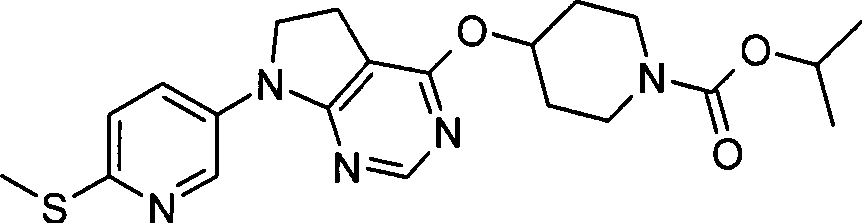
步骤1:6-(甲硫基)-3-吡啶胺(204)Step 1: 6-(methylthio)-3-pyridinamine ( 204 )
在室温下往搅拌的5-氨基-2-溴吡啶(9.97g,57.63mmol)在MeOH(250mL)中的溶液中加入甲硫醇钠(5.65g,80.68mmol)和铜粉(1.17g,18.44mmol)。在120℃、密封管中将反应混合物加热64小时。随后将反应混合物冷却至室温并经Celite硅藻土垫过滤。
1H NMR(400MHz,CDCl3):
步骤2:4-氯-7-[6-(甲硫基)-3-吡啶基]-6,7-二氢-5H-吡咯并[2,3-d]嘧啶(205)Step 2: 4-Chloro-7-[6-(methylthio)-3-pyridyl]-6,7-dihydro-5H-pyrrolo[2,3-d]pyrimidine ( 205 )
在室温下往搅拌的(4,6-二氯-5-嘧啶基)乙醛209(2.36g,12.36mmol)在MeOH(120mL)中的溶液中加入204(2.08g,14.8mmol)。用冰/甲醇浴使反应混合物冷却至-15℃,随后加入冰乙酸(2.12mL,37.08mmol)和NaBH3CN(2.33g,37.08mmol)。在-15℃下将反应混合物搅拌15分钟随后让其升温至室温并搅拌18小时。随后反应混合物用水(50mL)稀释并用CH2Cl2(3 x 100mL)萃取。合并的有机层经MgSO4干燥,过滤,随后减压浓缩成黄色油状物。将粗制油状物溶解在THF(350mL)中并搅拌,随后在室温下一次性加入t-BuOK(4.16g,37.08mmol)。反应混合物立即变为棕色并在室温下搅拌17小时。反应混合物用水(50mL)猝灭,减压浓缩,随后重新溶解在EtOAc(200mL)中。有机层用水(1 x 50mL)洗涤,水层用EtOAc(2 x 100mL)萃取。合并的有机层经MgSO4干燥,过滤,随后减压浓缩成棕色油状物。粗制油状物经SiO2快速层析纯化(20%-40%EtOAc/己烷;在319nm处检测),得到1.31g(38%)无色油状的标题产物205。To a stirred solution of (4,6-dichloro-5-pyrimidinyl)acetaldehyde 209 (2.36 g, 12.36 mmol) in MeOH (120 mL) was added 204 (2.08 g, 14.8 mmol) at room temperature. The reaction mixture was cooled to -15 °C with an ice/methanol bath, then glacial acetic acid (2.12 mL, 37.08 mmol) and NaBH3CN (2.33 g, 37.08 mmol) were added. The reaction mixture was stirred at -15°C for 15 minutes then allowed to warm to room temperature and stirred for 18 hours. Then the reaction mixture was diluted with water (50 mL) and extracted with CH2Cl2 (3 x 100 mL). The combined organic layers were dried over MgSO4 , filtered and concentrated under reduced pressure to a yellow oil. The crude oil was dissolved in THF (350 mL) and stirred, then t-BuOK (4.16 g, 37.08 mmol) was added in one portion at room temperature. The reaction mixture turned brown immediately and was stirred at room temperature for 17 hours. The reaction mixture was quenched with water (50 mL), concentrated under reduced pressure, then redissolved in EtOAc (200 mL). The organic layer was washed with water (1 x 50 mL), and the aqueous layer was extracted with EtOAc (2 x 100 mL). The combined organic layers were dried over MgSO4 , filtered and concentrated under reduced pressure to a brown oil. The crude oil was purified by flash chromatography on SiO2 (20%-40% EtOAc/hexanes; detection at 319 nm) to afford 1.31 g (38%) of the title product 205 as a colorless oil.
1H NMR(400MHz,CDCl3): 8.63 and 8.62(dd,J1=2.9Hz,J2=0.7Hz,1H),8.36-8.35(m,1H),8.28-8.24(m,1H),7.21-7.19(m,1H),4.15-4.11(m,2H),3.25-3.20(m,2H),2.56(s,3H). 1 H NMR (400MHz, CDCl 3 ): 8.63 and 8.62(dd, J 1 =2.9Hz, J 2 =0.7Hz, 1H), 8.36-8.35(m, 1H), 8.28-8.24(m, 1H), 7.21-7.19(m, 1H), 4.15- 4.11(m, 2H), 3.25-3.20(m, 2H), 2.56(s, 3H).
步骤3:4-({7-[6-(甲硫基)-3-吡啶基]-6,7-二氢-5H-吡咯并[2,3-d]嘧啶-4-基}氧基)-1-哌啶甲酸1-甲基乙酯(206)Step 3: 4-({7-[6-(methylthio)-3-pyridyl]-6,7-dihydro-5H-pyrrolo[2,3-d]pyrimidin-4-yl}oxy )-1-piperidinecarboxylic acid 1-methylethyl ester ( 206 )
在室温下往搅拌的205(1.31g,4.71mmol)和4-羟基-1-哌啶甲酸l-甲基乙酯9(1.06g,5.65mmol)在THF(47mL)中的溶液中一次性加入NaH(60%分散在矿物油中,565mg,14.13mmol)。反应混合物将加热至回流并保持18小时,冷却至室温,并用水(10mL)猝灭。该混合物用EtOAc(3 x 75mL)萃取,经MgSO4干燥,过滤,随后减压浓缩。粗制油状物经SiO2快速层析纯化(40%EtOAc/己烷),得到500mg(25%)无色油状的标题产物206。To a stirred solution of 205 (1.31 g, 4.71 mmol) and l-methylethyl 4-hydroxy-1-piperidinecarboxylate 9 (1.06 g, 5.65 mmol) in THF (47 mL) was added in one portion at room temperature NaH (60% dispersion in mineral oil, 565 mg, 14.13 mmol). The reaction mixture was heated to reflux for 18 hours, cooled to room temperature, and quenched with water (10 mL). The mixture was extracted with EtOAc (3 x 75 mL), dried over MgSO 4 , filtered, and concentrated under reduced pressure. The crude oil was purified by flash chromatography on SiO2 (40% EtOAc/hexanes) to afford 500 mg (25%) of the title product 206 as a colorless oil.
1H NMR(400MHz,CDCl3):δ 8.58(d,J=2.7Hz,1H),8.41-8.37(m,1H),8.27(s,1H),7.21(d,J=8.8Hz,1H),5.32(七重峰,J=3.9Hz,1H),4.91(app.五重峰,J=6.1Hz,1H),4.05(t,J=8.8Hz,2H),3.82-3.75(m,2H),3.35-3.28(m,2H),3.08(t,J=8.8Hz,2H),2.59(s,3H),2.00-1.93(m,2H),1.75-1.67(m,2H),1.24(d,J=6.8Hz,6H);LCMS(ESI):m/z 430(M+H)+. 1 H NMR (400MHz, CDCl 3 ): δ 8.58(d, J=2.7Hz, 1H), 8.41-8.37(m, 1H), 8.27(s, 1H), 7.21(d, J=8.8Hz, 1H) , 5.32(septet, J=3.9Hz, 1H), 4.91(app. quintet, J=6.1Hz, 1H), 4.05(t, J=8.8Hz, 2H), 3.82-3.75(m, 2H) , 3.35-3.28(m, 2H), 3.08(t, J=8.8Hz, 2H), 2.59(s, 3H), 2.00-1.93(m, 2H), 1.75-1.67(m, 2H), 1.24(d , J=6.8Hz, 6H); LCMS (ESI): m/z 430 (M+H) + .
实施例115(207)Example 115 ( 207 )

(±)-4-({7-[6-(甲基亚磺酰基)-3-吡啶基]-6,7-二氢-5H-吡咯并[2,3-d]嘧啶-4-基}氧基)-1-哌啶甲酸1-甲基乙酯·盐酸盐(207)(±)-4-({7-[6-(methylsulfinyl)-3-pyridyl]-6,7-dihydro-5H-pyrrolo[2,3-d]pyrimidin-4-yl }Oxy)-1-piperidinecarboxylic acid 1-methylethyl ester hydrochloride ( 207 )
在0℃下经注射器往搅拌的206(198mg,0.460mmol)在六氟异丙醇(4.0mL)中的溶液中加入H2O2(30%重量水溶液,104mg,0.920mmol)。将反应混合物升温至室温并搅拌30分钟。反应混合物用水(5mL)稀释并用CH2Cl2(3 x 20mL)萃取。合并的有机层经MgSO4干燥,过滤,随后减压浓缩。使用热枪将得到的无色油状物溶解在1:1 丙酮:Et2O的混合物(15mL)中并搅拌。往该溶液中加入HCl(1.0M在Et2O中,1.7mL)并立即沉淀出白色固体。将溶剂减压除去,该物质用Et2O研磨,过滤,随后高度真空干燥,得到151mg(68%)浅黄色固体状的标题产物207。To a stirred solution of 206 (198 mg, 0.460 mmol) in hexafluoroisopropanol (4.0 mL) was added H2O2 (30% by weight in water , 104 mg, 0.920 mmol) via syringe at 0 °C. The reaction mixture was warmed to room temperature and stirred for 30 minutes. The reaction mixture was diluted with water (5 mL) and extracted with CH2Cl2 (3 x 20 mL). The combined organic layers were dried over MgSO 4 , filtered, and concentrated under reduced pressure. The resulting colorless oil was dissolved in a 1:1 mixture of acetone: Et2O (15 mL) using a heat gun and stirred. To this solution was added HCl (1.0 M in Et2O , 1.7 mL) and a white solid immediately precipitated. The solvent was removed under reduced pressure and the material was triturated with Et2O , filtered and dried under high vacuum to afford 151 mg (68%) of the title product 207 as a pale yellow solid.
1H NMR(400MHz,CDCl3):δ 9.12(d,J=1.5Hz,1H),8.55(s,1H),8.46 and 8.43(dd,J1=9.0Hz,J2=2.2Hz,1H),8.15(d,J=8.6Hz,1H),5.64(七重峰,J=4.1Hz,1H),4.91(app.五重峰,J=6.4Hz,1H),4.33(t,J=8.6Hz,2H),3.93-3.87(m,2H),3.36-3.24(m,4H),2.96(s,3H),2.14-2.08(m,2H),1.78-1.69(m,2H),1.23(d,J=6.1Hz,6H);LCMS(ESI):m/z 446(M+H)+. 1 H NMR (400MHz, CDCl 3 ): δ 9.12 (d, J = 1.5Hz, 1H), 8.55 (s, 1H), 8.46 and 8.43 (dd, J 1 = 9.0Hz, J 2 = 2.2Hz, 1H) , 8.15(d, J=8.6Hz, 1H), 5.64(septet, J=4.1Hz, 1H), 4.91(app. quintet, J=6.4Hz, 1H), 4.33(t, J=8.6Hz , 2H), 3.93-3.87(m, 2H), 3.36-3.24(m, 4H), 2.96(s, 3H), 2.14-2.08(m, 2H), 1.78-1.69(m, 2H), 1.23(d , J=6.1Hz, 6H); LCMS (ESI): m/z 446 (M+H) + .
实施例116(208)Example 116 ( 208 )

4-({7-[6-(甲基磺酰基)-3-吡啶基]-6,7-二氢-5H-吡咯并[2,3-d]嘧啶-4-基}氧基)-1-哌啶甲酸1-甲基乙酯·盐酸盐(208)4-({7-[6-(methylsulfonyl)-3-pyridyl]-6,7-dihydro-5H-pyrrolo[2,3-d]pyrimidin-4-yl}oxyl)- 1-Methylethyl 1-piperidinecarboxylate·hydrochloride ( 208 )
在室温下经移液管往搅拌的206(302mg,0.70mmol)在MeOH(5mL)和丙酮(5mL)中的溶液中加入臭氧(1.30g,2.11mmol)在水(5mL)中的溶液。立即沉淀出白色固体,在室温下将反应混合物搅拌1小时。反应混合物用饱和Na2SO3水溶液猝灭并用CH2Cl2(3 x 10mL)萃取。合并的有机层经MgSO4干燥,过滤,随后减压浓缩。使用热枪将得到的固体溶解在Et2O(10mL)和丙酮(5mL)的混合物中并搅拌。往该溶液中加入HCl(1.0M,在Et2O中,1.2mL)并立即沉淀出白色固体。将该物质过滤,用Et2O洗涤,随后高度真空干燥,得到260mg(75%)白色固体状的标题产物208。To a stirred solution of 206 (302 mg, 0.70 mmol) in MeOH (5 mL) and acetone (5 mL) was added a solution of ozone (1.30 g, 2.11 mmol) in water (5 mL) via pipette at room temperature. Immediately a white solid precipitated out and the reaction mixture was stirred at room temperature for 1 hour. The reaction mixture was quenched with saturated aqueous Na2SO3 and extracted with CH2Cl2 (3 x 10 mL). The combined organic layers were dried over MgSO 4 , filtered, and concentrated under reduced pressure. The resulting solid was dissolved in a mixture of Et2O (10 mL) and acetone (5 mL) using a heat gun and stirred. To this solution was added HCl (1.0M in Et2O , 1.2 mL) and a white solid immediately precipitated. The material was filtered, washed with Et2O , and dried under high vacuum to afford 260 mg (75%) of the title product 208 as a white solid.
1H NMR(400MHz,CDCl3):δ 9.02(d,J=2.4Hz,1H),8.58和8.56(dd,J1=8.8Hz,J2=2.7Hz,1H),8.37(s,1H),8.04(d,J=8.8Hz,1H),5.36(七重峰,J=3.9Hz,1H),4.91(app.五重峰,J=6.4Hz,1H),4.14(t,J=8.8Hz,2H),3.84-3.76(m,2H),3.35-3.28(m,2H),3.18(s,3H),3.15(t,J=8.8Hz,2H),2.02-1.95(m,2H),1.77-1.68(m,2H),1.24(d,J=6.4Hz,6H);LCMS(ESI):m/z 462(M+H)+. 1 H NMR (400MHz, CDCl 3 ): δ 9.02 (d, J=2.4Hz, 1H), 8.58 and 8.56 (dd, J 1 =8.8Hz, J 2 =2.7Hz, 1H), 8.37(s, 1H) , 8.04(d, J=8.8Hz, 1H), 5.36(septet, J=3.9Hz, 1H), 4.91(app. quintet, J=6.4Hz, 1H), 4.14(t, J=8.8Hz , 2H), 3.84-3.76(m, 2H), 3.35-3.28(m, 2H), 3.18(s, 3H), 3.15(t, J=8.8Hz, 2H), 2.02-1.95(m, 2H), 1.77-1.68 (m, 2H), 1.24 (d, J=6.4Hz, 6H); LCMS (ESI): m/z 462 (M+H) + .
实施例117(112)Example 117 ( 112 )

步骤1:(4,6-二氯-5-嘧啶基)乙醛(209)Step 1: (4,6-Dichloro-5-pyrimidinyl)acetaldehyde ( 209 )
往搅拌的4,6-二氯-5-(2-丙烯-1-基)嘧啶(2,274g,1.45mol)在1:1丙酮-H2O(7.6L)中的溶液中加入K2OsO4·2H2O(18g,0.0493mol)。经1小时分批加入固体NaIO4(1.24kg,5.8mol);反应温度不超过40℃。当该反应物冷却至室温时将得到的悬浮液搅拌1小时。将该混合物过滤并将滤液浓缩来除去丙酮。水层用CH2Cl2(5 x 1L)萃取。合并的萃取液用10%Na2S2O3溶液(2 x 3.5L)洗涤,用盐水洗涤,经无水Na2SO4干燥,过滤,并浓缩,得到204g(74%)有光泽的琥珀色固体状的产物209。To a stirred solution of 4,6-dichloro-5-(2-propen-1-yl)pyrimidine (2,274 g, 1.45 mol) in 1:1 acetone-H 2 O (7.6 L) was added K 2 OsO 4 ·2H 2 O (18 g, 0.0493 mol). Solid NaIO4 (1.24 kg, 5.8 mol) was added in portions over 1 hour; the reaction temperature did not exceed 40 °C. The resulting suspension was stirred for 1 hour as the reaction cooled to room temperature. The mixture was filtered and the filtrate was concentrated to remove acetone. The aqueous layer was extracted with CH2Cl2 (5 x 1L). The combined extracts were washed with 10% Na2S2O3 solution (2 x 3.5 L), washed with brine, dried over anhydrous Na2SO4 , filtered, and concentrated to afford 204 g (74%) of shiny amber Product 209 as a colored solid.
1H NMR(400MHz,DMSO-d6):δ 9.72(s,1H),8.86(s,1H),4.21(s,2H). 1 H NMR (400MHz, DMSO-d 6 ): δ 9.72(s, 1H), 8.86(s, 1H), 4.21(s, 2H).
步骤2:[2-氟-4-(甲硫基)苯基]胺(210)Step 2: [2-Fluoro-4-(methylthio)phenyl]amine ( 210 )
在N2下往溴化镍(II)(9.12g,42mmol)、2,2’-联吡啶(6.56g,42mmol)、锌粉(55g,844mmol)和无水DMF(300mL)的混合物中加入2-氟-4-碘苯胺(100g,0.422g,mmol)和二甲基硫醚(96mL,1.06mol)。在75℃下将得到的混合物搅拌1.5小时。将反应混合物减压浓缩得到粗制残余物,将其溶解在Et2O(500mL)中并经Celite硅藻土垫过滤(用Et2O洗涤)。将滤液减压浓缩,得到粗制物质。粗制物质经快速柱层析纯化,得到48.70g(73%)棕色液体状标题产物210。To a mixture of nickel(II) bromide (9.12 g, 42 mmol), 2,2'-bipyridine (6.56 g, 42 mmol), zinc powder (55 g, 844 mmol) and anhydrous DMF (300 mL) was added under N 2-Fluoro-4-iodoaniline (100 g, 0.422 g, mmol) and dimethylsulfide (96 mL, 1.06 mol). The resulting mixture was stirred at 75°C for 1.5 hours. The reaction mixture was concentrated under reduced pressure to give a crude residue which was dissolved in Et2O (500 mL) and filtered through a pad of Celite (washing with Et2O ). The filtrate was concentrated under reduced pressure to obtain crude material. The crude material was purified by flash column chromatography to afford 48.70 g (73%) of the title product 210 as a brown liquid.
1H NMR(400MHz,DMSO-d6):δ 7.02和6.98(dd,J1=11.2Hz,J2=2.0Hz,1H),6.94和6.92(dd,J1=8.4Hz,J2=4.0Hz,1H),6.70(t,J=8.8Hz,1H),3.69(br,s,2H),2.40(s,3H),9.72(s,1H),8.86(s,1H),4.21(s,2H);LCMS(ESI):m/z 158(M+H)+. 1 H NMR (400 MHz, DMSO-d 6 ): δ 7.02 and 6.98 (dd, J 1 =11.2 Hz, J 2 =2.0 Hz, 1H), 6.94 and 6.92 (dd, J 1 =8.4 Hz, J 2 =4.0 Hz, 1H), 6.70(t, J=8.8Hz, 1H), 3.69(br, s, 2H), 2.40(s, 3H), 9.72(s, 1H), 8.86(s, 1H), 4.21(s , 2H); LCMS (ESI): m/z 158 (M+H) + .
步骤3:4-氟-7-[2-氟-4-(甲硫基)苯基]-6,7-二氢-5H-吡咯并[2,3-d]嘧啶(211)Step 3: 4-fluoro-7-[2-fluoro-4-(methylthio)phenyl]-6,7-dihydro-5H-pyrrolo[2,3-d]pyrimidine ( 211 )
往圆底烧瓶中装入苯胺210(7.86g,50mmol),随后冷却至-15℃。往以上冷却的苯胺210中加入三氟乙酸(50mL)同时将内容物搅拌0.5小时。往以上混合物中分批加入Na(OAc)3BH并继续搅拌0.5小时。往以上混合物中加入在CH2Cl2(20mL)中的醛209(9.17g48mmol)。将得到的混合物升温至环境温度并搅拌15小时。将反应混合物减压浓缩,将残余物倾入饱和NaHCO3溶液(300mL)中,随后该混合物用CH2Cl2(4 x 250mL)萃取。合并的有机层用盐水(1 x 100mL)洗涤,经饱和Na2SO4干燥,随后减压浓缩,得到粗制物质。粗制物质用CH2Cl2和MeOH重结晶,得到6.26g(44%)灰白色固体状的标题产物211 A round bottom flask was charged with aniline 210 (7.86 g, 50 mmol), then cooled to -15 °C. To the above cooled aniline 210 was added trifluoroacetic acid (50 mL) while stirring the contents for 0.5 hours. Na(OAc) 3BH was added portionwise to the above mixture and stirring was continued for 0.5 h. To the above mixture was added aldehyde 209 (9.17 g 48 mmol) in CH2Cl2 (20 mL ). The resulting mixture was warmed to ambient temperature and stirred for 15 hours. The reaction mixture was concentrated under reduced pressure, the residue was poured into saturated NaHCO 3 solution (300 mL), then the mixture was extracted with CH 2 Cl 2 (4 x 250 mL). The combined organic layers were washed with brine (1 x 100 mL), dried over saturated Na2SO4 , and concentrated under reduced pressure to give crude material. The crude material was recrystallized from CH2Cl2 and MeOH to afford 6.26 g (44%) of the title product 211 as an off-white solid
1H NMR(400MHz,DMSO-d6):δ 8.16(s,1H),7.48(t,J=8.0Hz,1H),7.26和7.22(dd,J1=11.6Hz,J2=2.0Hz,1H),7.14和7.11(dd,J1=8.0Hz,J2=2.4Hz,1H),4.05(t,J=8.8Hz,1H),3.18(t,J=8.4Hz,2H),2.49(s,3H);LCMS(ESI):m/z 296(M+H)+. 1 H NMR (400MHz, DMSO-d 6 ): δ 8.16 (s, 1H), 7.48 (t, J=8.0Hz, 1H), 7.26 and 7.22 (dd, J 1 =11.6Hz, J 2 =2.0Hz, 1H), 7.14 and 7.11 (dd, J1 = 8.0Hz, J2 = 2.4Hz, 1H), 4.05 (t, J = 8.8Hz, 1H), 3.18 (t, J = 8.4Hz, 2H), 2.49 ( s, 3H); LCMS (ESI): m/z 296 (M+H) + .
步骤4:4-({7-[2-氟-4-(甲硫基)苯基]-6,7-二氢-5H-吡咯并[2,3-d]嘧啶-4-基}氧基)-1-哌啶甲酸1-甲基乙酯(212)Step 4: 4-({7-[2-fluoro-4-(methylthio)phenyl]-6,7-dihydro-5H-pyrrolo[2,3-d]pyrimidin-4-yl}oxy Base) -1-piperidinecarboxylic acid 1-methylethyl ester ( 212 )
采用所述用于制备10(实施例1,步骤10)的方法,将反应物9(3.07g,16.4mmol)、NaH(2.08g,52mmol)和化合物211(5.11g,17.3mmol)回流2.5小时。常规后处理,随后层析,得到5.72g(78%)灰白色固体状的标题产物212。Using the procedure described for the preparation of 10 (Example 1, Step 10), reactant 9 (3.07 g, 16.4 mmol), NaH (2.08 g, 52 mmol) and compound 211 (5.11 g, 17.3 mmol) were refluxed for 2.5 hours . Conventional workup followed by chromatography afforded 5.72 g (78%) of the title product 212 as an off-white solid.
1H NMR(400MHz,DMSO-d6):δ 8.10(s,1H),7.46(t,J=8.4Hz,1H),7.22和7.19(dd,J1=12.0Hz,J2=2.0Hz,1H),7.10和7.08(dd,J1=8.0Hz,J2=2.0Hz,1H),5.26-5.20(m,1H),4.75(七重峰,J=6.4Hz,1H),3.96(t,J=8.8Hz,2H),3.70-3.64(m,2H),3.22(app.t,J=9.6Hz,2H),3.01(t,J=8.8Hz,2H),1.94-1.88(m,2H),1.59-1.50(m,2H),1.17(d,J=6.4Hz,6H);LCMS(ESI):m/z 447(M+H)+. 1 H NMR (400MHz, DMSO-d 6 ): δ 8.10 (s, 1H), 7.46 (t, J=8.4Hz, 1H), 7.22 and 7.19 (dd, J 1 =12.0Hz, J 2 =2.0Hz, 1H), 7.10 and 7.08 (dd, J 1 =8.0Hz, J 2 =2.0Hz, 1H), 5.26-5.20 (m, 1H), 4.75 (septet, J = 6.4Hz, 1H), 3.96 (t, J=8.8Hz, 2H), 3.70-3.64(m, 2H), 3.22(app.t, J=9.6Hz, 2H), 3.01(t, J=8.8Hz, 2H), 1.94-1.88(m, 2H ), 1.59-1.50 (m, 2H), 1.17 (d, J=6.4Hz, 6H); LCMS (ESI): m/z 447 (M+H) + .
实施例118(213)Example 118 ( 213 )
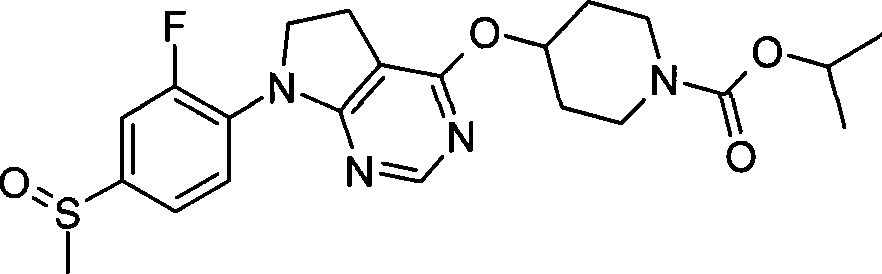
(±)-4-({7-[2-氟-4-(甲基亚磺酰基)苯基]-6,7-二氢-5H-吡咯并[2,3-d]嘧啶-4-基}氧基)-1-哌啶甲酸1-甲基乙酯(213)(±)-4-({7-[2-fluoro-4-(methylsulfinyl)phenyl]-6,7-dihydro-5H-pyrrolo[2,3-d]pyrimidine-4- Base}oxy)-1-piperidinecarboxylic acid 1-methylethyl ester ( 213 )
采用所述用于制备85(实施例32,步骤3)的氧化反应方法,在室温下硫醚212(1.8g,4.03mmol)用35%重量在HFIP(20mL)中的H2O2(800μL,8.06mmol)处理,在处理后得到1.85g(约100%)白色固体状的所需亚砜213。Using the oxidation reaction procedure described for the preparation of 85 (Example 32, Step 3), thioether 212 (1.8 g, 4.03 mmol) was treated with 35% by weight H 2 O 2 (800 μL) in HFIP (20 mL) at room temperature , 8.06 mmol) afforded 1.85 g (ca. 100%) of the desired sulfoxide 213 as a white solid after work-up.
1H NMR(400MHz,DMSO-d6):δ 8.16(s,1H),7.82(app.t,J=8.0Hz,1H),7.64和7.60(dd,J1=10.8Hz,J2=2.0Hz,1H),7.52和7.50(dd,J1=8.4Hz,J2=2.0Hz,1H),5.28-5.22(m,1H),4.76(七重峰,J=6.4Hz,1H),4.08(t,J=8.4Hz,2H),3.70-3.64(m,2H),3.22(app.br.t,J=9.6Hz,2H),3.04(t,J=8.8Hz,2H),2.77(s,3H),1.94-1.90(m,2H),1.60-1.52(m,2H),1.17(d,J=6.0Hz,6H);LCMS(ESI):m/z463(M+H)+. 1 H NMR (400MHz, DMSO-d 6 ): δ 8.16 (s, 1H), 7.82 (app.t, J=8.0Hz, 1H), 7.64 and 7.60 (dd, J 1 =10.8Hz, J 2 =2.0 Hz, 1H), 7.52 and 7.50 (dd, J 1 =8.4Hz, J 2 =2.0Hz, 1H), 5.28-5.22 (m, 1H), 4.76 (septet, J = 6.4Hz, 1H), 4.08 ( t, J=8.4Hz, 2H), 3.70-3.64(m, 2H), 3.22(app.br.t, J=9.6Hz, 2H), 3.04(t, J=8.8Hz, 2H), 2.77(s , 3H), 1.94-1.90 (m, 2H), 1.60-1.52 (m, 2H), 1.17 (d, J=6.0Hz, 6H); LCMS (ESI): m/z 463 (M+H) + .
实施例119Example 119
外消旋的亚砜213(2.60g)经手性HPLC[柱:Chiralpak AS-H,流动相:80%CO2:20%MeOH(2mL/分钟),压力140巴,温度40℃,240nm)]分析,随后分离成两种(R和S)对映异构体。基于VCD光谱法测定绝对立体化学。Racemic sulfoxide 213 (2.60 g) was subjected to chiral HPLC [column: Chiralpak AS-H, mobile phase: 80% CO2 : 20% MeOH (2 mL/min),
对映异构体I,119A(213A)Enantiomer I, 119A (213A)
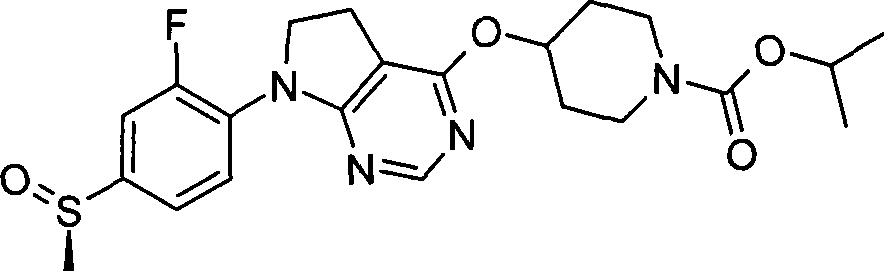
(R)-4-({7-[2-氟-4-(甲基亚磺酰基)苯基]-6,7-二氢-5H-吡咯并[2,3-d]嘧啶-4-基}氧基)-1-哌啶甲酸1-甲基乙酯(213A)(R)-4-({7-[2-fluoro-4-(methylsulfinyl)phenyl]-6,7-dihydro-5H-pyrrolo[2,3-d]pyrimidine-4- Base}oxy)-1-piperidinecarboxylic acid 1-methylethyl ester ( 213A )
Tr:8.30分钟,1.150g(%对映体过量>98%);光谱数据基本与实施例118(213)相同。Tr: 8.30 min, 1.150 g (% enantiomeric excess >98%); spectral data essentially identical to Example 118 ( 213 ).
对映异构体II,119B(213B)Enantiomer II, 119B ( 213B )

(S)-4-({7-[2-氟-4-(甲基亚磺酰基)苯基]-6,7-二氢-5H-吡咯并[2,3-d]嘧啶-4-基}氧基)-1-哌啶甲酸1-甲基乙酯(213B)(S)-4-({7-[2-fluoro-4-(methylsulfinyl)phenyl]-6,7-dihydro-5H-pyrrolo[2,3-d]pyrimidine-4- Base}oxy)-1-piperidinecarboxylic acid 1-methylethyl ester ( 213B )
Tr:10.4分钟,1.0g(%对映体过量,>98%),光谱数据基本与实施例118(213)相同。Tr: 10.4 min, 1.0 g (% enantiomeric excess, >98%), spectral data essentially the same as Example 118 ( 213 ).
实施例120(218)Example 120 ( 218 )
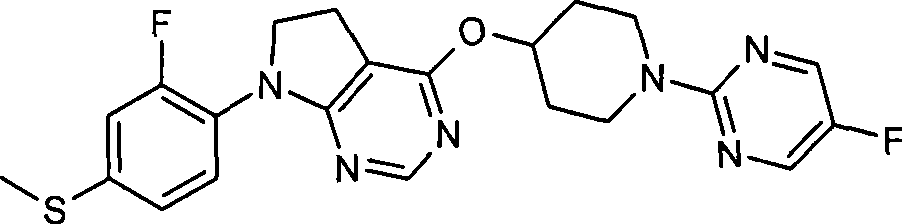
7-[2-氟-4-(甲硫基)苯基]-4-{[1-(5-氟-2-嘧啶基)-4-哌啶基]氧基}-6,7-二氢-5H-吡咯并[2,3-d]嘧啶(214)7-[2-fluoro-4-(methylthio)phenyl]-4-{[1-(5-fluoro-2-pyrimidinyl)-4-piperidinyl]oxy}-6,7-di Hydrogen-5H-pyrrolo[2,3-d]pyrimidine ( 214 )
采用所述用于制备10(实施例1,步骤10)的方法,将反应物23(0.641g,3.25mmol)、NaH(0.39g,9.8mmol)和化合物211(0.96g,3.25mmol)回流5小时。常规后处理,随后层析,得到1.145g(77%)白色固体状的标题产物214。Using the procedure described for the preparation of 10 (Example 1, Step 10), reactant 23 (0.641 g, 3.25 mmol), NaH (0.39 g, 9.8 mmol) and compound 211 (0.96 g, 3.25 mmol) were refluxed for 5 Hour. Conventional workup followed by chromatography afforded 1.145 g (77%) of the title product 214 as a white solid.
1H NMR(400MHz,DMSO-d6):δ 8.43(s,2H),8.11(s,1H),7.47(t,J=8.4Hz,1H),7.22和7.20(dd,J1=12.0Hz,J2=2.0Hz,1H),7.10和7.08(dd,J1=8.4Hz,J2=2.0Hz,1H),5.36-5.20(m,1H),4.16-4.10(m,2H),3.96(t,J=8.8Hz,2H),3.53-3.47(m,2H),3.0(t,J=8.8Hz,2H),2.48(s,3H),2.01-1.96(m,2H),1.66-1.58(m,2H);LCMS(ESI):m/z 457(M+H)+. 1 H NMR (400MHz, DMSO-d 6 ): δ 8.43 (s, 2H), 8.11 (s, 1H), 7.47 (t, J = 8.4Hz, 1H), 7.22 and 7.20 (dd, J 1 = 12.0Hz , J 2 =2.0Hz, 1H), 7.10 and 7.08 (dd, J 1 =8.4Hz, J 2 =2.0Hz, 1H), 5.36-5.20(m, 1H), 4.16-4.10(m, 2H), 3.96 (t, J=8.8Hz, 2H), 3.53-3.47(m, 2H), 3.0(t, J=8.8Hz, 2H), 2.48(s, 3H), 2.01-1.96(m, 2H), 1.66- 1.58 (m, 2H); LCMS (ESI): m/z 457 (M+H) + .
实施例121(215)Example 121 ( 215 )
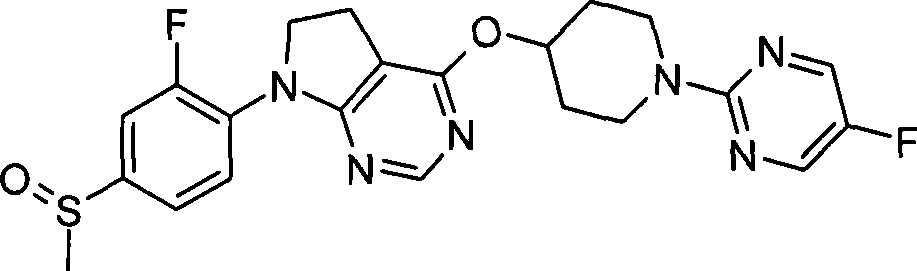
(±)-7-[2-氟-4-(甲基亚磺酰基)苯基]-4-{[1-(5-氟-2-嘧啶基)-4-哌啶基]氧基}-6,7-二氢-5H-吡咯并[2,3-d]嘧啶(215)(±)-7-[2-fluoro-4-(methylsulfinyl)phenyl]-4-{[1-(5-fluoro-2-pyrimidinyl)-4-piperidinyl]oxy} -6,7-dihydro-5H-pyrrolo[2,3-d]pyrimidine ( 215 )
采用所述用于制备85(实施例32,步骤3)的氧化反应方法,在室温下硫醚214(1.07g,2.34mmol)用35%重量在HFIP(15mL)中的H2O2(460μL,4.7mmol)处理,在用EtOAc/正己烷重结晶后得到1.10g(99%)白色固体状的所需亚砜215。Using the oxidation reaction procedure described for the preparation of 85 (Example 32, Step 3), thioether 214 (1.07 g, 2.34 mmol) was treated with 35% by weight H 2 O 2 (460 μL) in HFIP (15 mL) at room temperature , 4.7 mmol) afforded 1.10 g (99%) of the desired sulfoxide 215 as a white solid after recrystallization from EtOAc/n-hexane.
1H NMR(400MHz,DMSO-d6):δ 8.44(s,2H),8.18(s,1H),7.82(t,J=8.0Hz,1H),7.62(app.br.d,J=10.8Hz,1H),7.52(app.br.d,J=8.4Hz,1H),5.36-5.30(m,1H),4.164.10(m,2H),4.08(t,J=8.8Hz,2H),3.51(app.t,J=9.6Hz,2H),3.04(t,J=8.8Hz,2H),2.78(s,3H),2.04-1.96(m,2H),1.68-1.58(m,2H);LCMS(ESI):m/z 473(M+H)+. 1 H NMR (400MHz, DMSO-d 6 ): δ 8.44(s, 2H), 8.18(s, 1H), 7.82(t, J=8.0Hz, 1H), 7.62(app.br.d, J=10.8 Hz, 1H), 7.52(app.br.d, J=8.4Hz, 1H), 5.36-5.30(m, 1H), 4.164.10(m, 2H), 4.08(t, J=8.8Hz, 2H) , 3.51(app.t, J=9.6Hz, 2H), 3.04(t, J=8.8Hz, 2H), 2.78(s, 3H), 2.04-1.96(m, 2H), 1.68-1.58(m, 2H ); LCMS (ESI): m/z 473 (M+H) + .
实施例122Example 122
外消旋亚砜215(545mg)经手性HPLC[柱:Chiralpak AS-H(分析用),Chiralpak AS-H(制备用),流动相:75%CO2:25%MeOH(2mL/分钟),压力140巴,温度40℃,230nm)]分析,随后分离成两种(R和S)对映异构体。基于VCD光谱法测定绝对立体化学。Racemic sulfoxide 215 (545 mg) was subjected to chiral HPLC [column: Chiralpak AS-H (for analysis), Chiralpak AS-H (for preparation), mobile phase: 75% CO 2 : 25% MeOH (2 mL/min),
对映异构体I,122A(215A)Enantiomer I, 122A ( 215A )
(R)-7-[2-氟-4-(甲基亚磺酰基)苯基]-4-{[1-(5-氟-2-嘧啶基)-4-哌啶基]氧基}-6,7-二氢-5H-吡咯并[2,3-d]嘧啶(215A)(R)-7-[2-fluoro-4-(methylsulfinyl)phenyl]-4-{[1-(5-fluoro-2-pyrimidinyl)-4-piperidinyl]oxy} -6,7-dihydro-5H-pyrrolo[2,3-d]pyrimidine ( 215A )
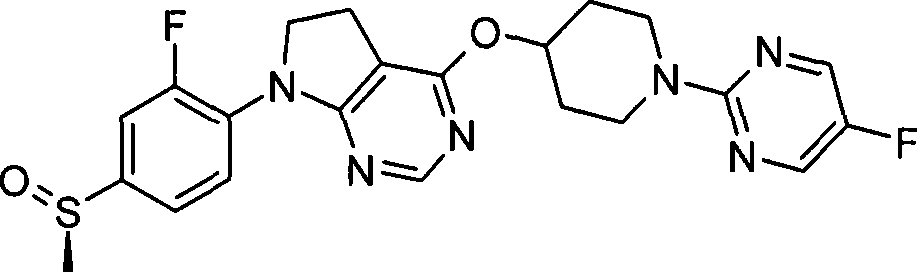
Tr:12.4分钟,172mg(%对映体过量>99%),光谱数据基本与实施例121(125A)相同。Tr: 12.4 minutes, 172 mg (% enantiomeric excess >99%), the spectral data is basically the same as Example 121 ( 125A ).
对映异构体II,122B(215B)Enantiomer II, 122B ( 215B )
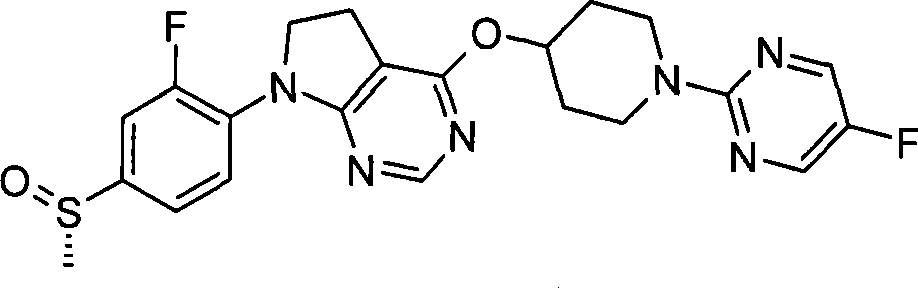
(S)-7-[2-氟-4-(甲基亚磺酰基)苯基]-4-{[1-(5-氟-2-嘧啶基)-4-哌啶基]氧基}-6,7-二氢-5H-吡咯并[2,3-d]嘧啶(215B)(S)-7-[2-fluoro-4-(methylsulfinyl)phenyl]-4-{[1-(5-fluoro-2-pyrimidinyl)-4-piperidinyl]oxy} -6,7-dihydro-5H-pyrrolo[2,3-d]pyrimidine ( 215B )
Tr:17.4分钟,181mg(%对映体过量>97%),光谱数据基本与实施例121(215)相同。Tr: 17.4 min, 181 mg (% enantiomeric excess >97%), spectral data essentially the same as Example 121 ( 215 ).
实施例123(216)Example 123 ( 216 )

7-[2-氟-4-(甲硫基)苯基]-4-({1-[3-(1-甲基乙基)-1,2,4-噁二唑-5-基]-4-哌啶基}氧基)-6,7-二氢-5H-吡咯并[2,3-d]嘧啶(216)7-[2-fluoro-4-(methylthio)phenyl]-4-({1-[3-(1-methylethyl)-1,2,4-oxadiazol-5-yl] -4-piperidinyl}oxy)-6,7-dihydro-5H-pyrrolo[2,3-d]pyrimidine ( 216 )
采用所述用于制备10(实施例1,步骤10)的方法,将反应物49(0.678g,3.21mmol)、NaH(0.406g,3.21mmol)和化合物211(1.0g,3.38mmol)回流2.5小时。常规后处理,随后层析,得到1.140g(76%)白色固体状的标题产物216。Using the procedure described for the preparation of 10 (Example 1, Step 10), reactant 49 (0.678 g, 3.21 mmol), NaH (0.406 g, 3.21 mmol) and compound 211 (1.0 g, 3.38 mmol) were refluxed for 2.5 Hour. Conventional workup followed by chromatography afforded 1.140 g (76%) of the title product 216 as a white solid.
1H NMR(400MHz,DMSO-d6):δ 8.11(s,1H),7.47(t,J=8.4Hz,1H),7.22和7.20(dd,J1=12.0Hz,J2=2.0Hz,1H),7.10和7.08(dd,J1=8.4Hz,J2=2.0Hz,1H),5.32-5.28(m,1H),3.98(t,J=8.8Hz,2H),3.79-3.73(m,2H),3.52-3.45(m,2H),3.03(1,J=8.8Hz,2H),2.80(七重峰,J=6.8Hz,1H),2.48(s,3H),2.05-2.00(m,2H),1.76-1.68(m,2H),1.17(d,J=6.8Hz,6H);LCMS(ESI):m/z 471(M+H)+. 1 H NMR (400MHz, DMSO-d 6 ): δ 8.11 (s, 1H), 7.47 (t, J=8.4Hz, 1H), 7.22 and 7.20 (dd, J 1 =12.0Hz, J 2 =2.0Hz, 1H), 7.10 and 7.08(dd, J 1 =8.4Hz, J 2 =2.0Hz, 1H), 5.32-5.28(m, 1H), 3.98(t, J=8.8Hz, 2H), 3.79-3.73(m , 2H), 3.52-3.45(m, 2H), 3.03(1, J=8.8Hz, 2H), 2.80(septet, J=6.8Hz, 1H), 2.48(s, 3H), 2.05-2.00(m , 2H), 1.76-1.68 (m, 2H), 1.17 (d, J=6.8Hz, 6H); LCMS (ESI): m/z 471 (M+H) + .
实施例124(217)Example 124 ( 217 )
(±)-7-[2-氟-4-(甲基亚磺酰基)苯基]-4-({1-[3-(1-甲基乙基)-1,2,4-噁二唑-5-基]-4-哌啶基}氧基)-6,7-二氢-5H-吡咯并[2,3-d]嘧啶(217)(±)-7-[2-fluoro-4-(methylsulfinyl)phenyl]-4-({1-[3-(1-methylethyl)-1,2,4-oxadi Azol-5-yl]-4-piperidinyl}oxy)-6,7-dihydro-5H-pyrrolo[2,3-d]pyrimidine ( 217 )
采用所述用于制备85(实施例32,步骤3)的氧化反应方法,在室温下硫醚216(600mg,1.28mmol)用在HFIP(5mL)中的35%重量H2O2(300μL,3.1mmol)处理。后处理,随后层析,在处理后得到0.620g(约100%)白色固体状的所需亚砜217。Using the oxidation reaction procedure described for the preparation of 85 (Example 32, Step 3 ), the thioether 216 (600 mg, 1.28 mmol) was dissolved in 35 wt% H2O2 (300 μL, 3.1 mmol) treatment. Workup followed by chromatography afforded 0.620 g (ca. 100%) of the desired sulfoxide 217 as a white solid after workup.
1H NMR(400MHz,DMSO-d6):δ 8.18(s,1H),7.82(t,J=8.0Hz,1H),7.64和7.61(dd,J1=10.8Hz,J2=1.6Hz,1H),7.54和7.51(dd,J1=8.4Hz,J2=1.6Hz,1H),5.34-5.28(m,1H),4.08(t,J=8.4Hz,2H),3.80-3.74(m,2H),3.52-3.46(m,2H),3.06(t,J=8.8Hz,2H),2.08-2.0(m,2H),1.78-1.70(m,2H),1.17(d,J=7.2Hz,6H);LCMS(ESI):m/z 487(M+H)+. 1 H NMR (400MHz, DMSO-d 6 ): δ 8.18 (s, 1H), 7.82 (t, J=8.0Hz, 1H), 7.64 and 7.61 (dd, J 1 =10.8Hz, J 2 =1.6Hz, 1H), 7.54 and 7.51(dd, J 1 =8.4Hz, J 2 =1.6Hz, 1H), 5.34-5.28(m, 1H), 4.08(t, J=8.4Hz, 2H), 3.80-3.74(m , 2H), 3.52-3.46(m, 2H), 3.06(t, J=8.8Hz, 2H), 2.08-2.0(m, 2H), 1.78-1.70(m, 2H), 1.17(d, J=7.2 Hz, 6H); LCMS (ESI): m/z 487 (M+H) + .
实施例125Example 125
外消旋亚砜217(560mg)经手性HPLC[柱:Chiralpak AS-H(分析用),Chiralpak AS-H(制备用),流动相:78%CO2:22%MeOH(2mL/分钟),压力140巴,温度40℃,240nm)]分析,随后分离成两种(R和S)对映异构体。基于VCD光谱法测定绝对立体化学。Racemic sulfoxide 217 (560 mg) was subjected to chiral HPLC [column: Chiralpak AS-H (analytical), Chiralpak AS-H (preparative), mobile phase: 78% CO 2 : 22% MeOH (2 mL/min),
对映异构体I,125A(217A)Enantiomer I, 125A ( 217A )
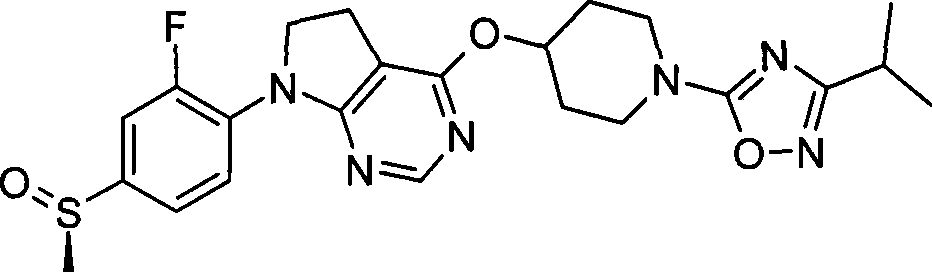
(R)-7-[2-氟-4-(甲基亚磺酰基)苯基]-4-({1-[3-(1-甲基乙基)-1,2,4-噁二唑-5-基]-4-哌啶基}氧基)-6,7-二氢-5H-吡咯并[2,3-d]嘧啶(217A)(R)-7-[2-fluoro-4-(methylsulfinyl)phenyl]-4-({1-[3-(1-methylethyl)-1,2,4-oxadi Azol-5-yl]-4-piperidinyl}oxy)-6,7-dihydro-5H-pyrrolo[2,3-d]pyrimidine ( 217A )
Tr:8.6分钟,186mg(%对映体过量>98%);光谱数据基本与实施例124(217)相同。Tr: 8.6 min, 186 mg (% enantiomeric excess >98%); spectral data essentially identical to Example 124 ( 217 ).
对映异构体II,125B(217B)Enantiomer II, 125B ( 217B )

(S)-7-[2-氟-4-(甲基亚磺酰基)苯基]-4-({1-[3-(1-甲基乙基)-1,2,4-噁二唑-5-基]-4-哌啶基}氧基)-6,7-二氢-5H-吡咯并[2,3-d]嘧啶(217B)(S)-7-[2-fluoro-4-(methylsulfinyl)phenyl]-4-({1-[3-(1-methylethyl)-1,2,4-oxadi Azol-5-yl]-4-piperidinyl}oxy)-6,7-dihydro-5H-pyrrolo[2,3-d]pyrimidine ( 217B )
Tr:10.92,20]mg(%对映体过量>98%);光谱数据基本与实施例124(217)相同。Tr: 10.92, 20] mg (% enantiomeric excess >98%); spectral data are essentially the same as Example 124 ( 217 ).
实施例126(218)Example 126 ( 218 )
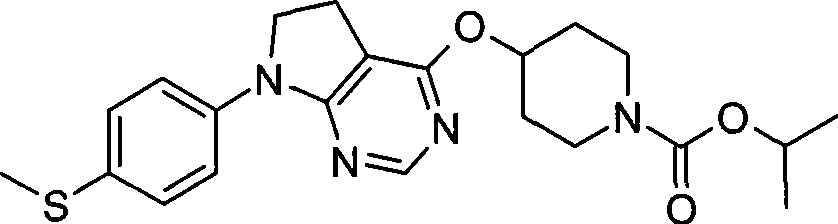
步骤1:7-(4-溴苯基)-4-氯-6,7-二氢-5H-吡咯并[2,3-d]嘧啶(116)Step 1: 7-(4-Bromophenyl)-4-chloro-6,7-dihydro-5H-pyrrolo[2,3-d]pyrimidine ( 116 )
采用所述用于制备211(实施例117,步骤3)的一般还原胺化反应方法,在-15℃下往圆底烧瓶中装入在TFA(50mL)中的4-溴苯胺(9.03g,52.5mmol)、Na(OAc)3BH(15.03g,mmol)、在CH2Cl2(20mL)中的醛209(7.85g,50mmol)。在室温下将得到的混合物搅拌15小时。后处理并用CH2Cl2和MeOH重结晶,得到7.86g(51%)灰白色固体状的标题产物116。Using the general reductive amination procedure described for the preparation of 211 (Example 117, Step 3), a round bottom flask was charged with 4-bromoaniline (9.03 g, 52.5 mmol), Na(OAc) 3BH (15.03 g, mmol), aldehyde 209 (7.85 g, 50 mmol) in CH2Cl2 (20 mL ). The resulting mixture was stirred at room temperature for 15 hours. Workup and recrystallization from CH2Cl2 and MeOH afforded 7.86 g (51%) of the title product 116 as an off-white solid.
1H NMR(400MHz,CDCl3):δ 8.38(s,1H),7.66(app,dd,J1=6.8Hz,J2=2.0Hz,2H),7.49(app.dd,J1=6.8Hz,J2=2.0Hz,2H),4.12(t,J=8.80Hz,2H),3.21(t,J=8.4Hz,2H);LCMS(ESI):m/z 311(M+H)+. 1 H NMR (400 MHz, CDCl 3 ): δ 8.38 (s, 1H), 7.66 (app, dd, J 1 =6.8 Hz, J 2 =2.0 Hz, 2H), 7.49 (app.dd, J 1 =6.8 Hz , J 2 =2.0Hz, 2H), 4.12(t, J=8.80Hz, 2H), 3.21(t, J=8.4Hz, 2H); LCMS (ESI): m/z 311(M+H) + .
步骤2:4-{[7-(4-溴苯基)-6,7-二氢-5H-吡咯并[2,3-d]嘧啶-4-基]氧基}-1-哌啶甲酸1-甲基乙酯(117)Step 2: 4-{[7-(4-Bromophenyl)-6,7-dihydro-5H-pyrrolo[2,3-d]pyrimidin-4-yl]oxy}-1-piperidinecarboxylic acid 1-Methyl ethyl ester ( 117 )
采用所述用于制备10(实施例1,步骤10)的方法,将反应物9(1.51g,8.05mmol)、NaH(0.966g,24.2mmol)和化合物116(2.50g,8.05mmol)回流2小时。常规后处理,随后层析,得到3.15g(85%)白色固体状的标题产物117。Using the procedure described for the preparation of 10 (Example 1, Step 10), reactant 9 (1.51 g, 8.05 mmol), NaH (0.966 g, 24.2 mmol) and compound 116 (2.50 g, 8.05 mmol) were refluxed in 2 Hour. Conventional workup followed by chromatography afforded 3.15 g (85%) of the title product 117 as a white solid.
1H NMR(400MHz,CDCl3):δ 8.30(s,1H),7.65和7.63(app,dd,J1=8.8Hz,J2=2.0Hz,2H),7.46和7.44(app.dd,J1=9.2Hz,J2=2.0Hz,2H),5.36-5.28(m,1H),4.92(七重峰,J=6.4Hz,1H),4.04(t,J=8.8Hz,2H),3.82-3.78(br,m,2H),3.36-3.30(m,2H),3.06(t,J=9.2Hz,2H),2.02-1.94(m,2H),1.76-1.68(m,2H),1.24(d,J=6.4Hz,6H);LCMS(ESI):m/z 463(M+H)+. 1 H NMR (400 MHz, CDCl 3 ): δ 8.30 (s, 1H), 7.65 and 7.63 (app, dd, J 1 =8.8 Hz, J 2 =2.0 Hz, 2H), 7.46 and 7.44 (app.dd, J 1 = 9.2Hz, J2 = 2.0Hz, 2H), 5.36-5.28 (m, 1H), 4.92 (septet, J = 6.4Hz, 1H), 4.04 (t, J = 8.8Hz, 2H), 3.82- 3.78(br, m, 2H), 3.36-3.30(m, 2H), 3.06(t, J=9.2Hz, 2H), 2.02-1.94(m, 2H), 1.76-1.68(m, 2H), 1.24( d, J=6.4Hz, 6H); LCMS (ESI): m/z 463 (M+H) + .
步骤3:4-({7-[4-(甲硫基)苯基]-6,7-二氢-5H-吡咯并[2,3-d]嘧啶-4-基}氧基)-1-哌啶甲酸1-甲基乙酯(218)Step 3: 4-({7-[4-(methylthio)phenyl]-6,7-dihydro-5H-pyrrolo[2,3-d]pyrimidin-4-yl}oxy)-1 - 1-methylethyl piperidinecarboxylate ( 218 )
采用所述用于制备210(实施例117,步骤2)的方法。在N2下往溴化镍(II)(76mg,0.35mmol)、2,2’-联吡啶(55mg,0.35mmol)、锌粉(284mg,4.4mmol)和无水DMF(20mL)的混合物中加入化合物117(1.6g,3.47mmol)和二甲基硫醚(1.6mL,26.1mmol)。在75℃下将得到的混合物搅拌12小时。反应未完全,但见产物(TLC)。在此时再加入溴化镍(152mg)、联吡啶(110mg)、Zn(568mg)和二甲基硫醚(1.6mL)。在120℃下将反应混合物搅拌12小时。后处理,随后层析,得到280mg白色固体状的标题硫化物218。从该反应回收到大约800mg起始原料。The procedure described for the preparation of 210 (Example 117, step 2) was followed. To a mixture of nickel(II) bromide (76 mg, 0.35 mmol), 2,2'-bipyridine (55 mg, 0.35 mmol), zinc powder (284 mg, 4.4 mmol) and anhydrous DMF (20 mL) under N Compound 117 (1.6 g, 3.47 mmol) and dimethyl sulfide (1.6 mL, 26.1 mmol) were added. The resulting mixture was stirred at 75°C for 12 hours. The reaction was not complete, but see product (TLC). Additional nickel bromide (152 mg), bipyridine (110 mg), Zn (568 mg) and dimethyl sulfide (1.6 mL) were added at this point. The reaction mixture was stirred at 120°C for 12 hours. Workup followed by chromatography afforded 280 mg of the title sulfide 218 as a white solid. Approximately 800 mg of starting material was recovered from this reaction.
1H NMR(400MHz,CDCl3):δ 8.30(s,1H),7.65和7.63(app,dd,J1=7.6Hz,J2=1.6Hz,2H),7.42和7.30(app.dd,J1=8.0Hz,J2=2.0Hz,2H),5.34-5.30(m,1H),5.0-4.88(m,1H),4.07(t,J=8.8Hz,2H),3.78(app,br,s,2H),3.36-3.30(m,2H),3.05(t,J=8.8Hz,2H),1.98(app.br.s,2H),1.78-1.66(br,m,2H),1.24(d,J=6.0Hz,6H),LCMS(ESI):m/z 429(M+H)+. 1 H NMR (400 MHz, CDCl 3 ): δ 8.30 (s, 1H), 7.65 and 7.63 (app, dd, J 1 =7.6 Hz, J 2 =1.6 Hz, 2H), 7.42 and 7.30 (app.dd, J 1 = 8.0Hz, J2 = 2.0Hz, 2H), 5.34-5.30 (m, 1H), 5.0-4.88 (m, 1H), 4.07 (t, J = 8.8Hz, 2H), 3.78 (app, br, s, 2H), 3.36-3.30 (m, 2H), 3.05 (t, J=8.8Hz, 2H), 1.98 (app.br.s, 2H), 1.78-1.66 (br, m, 2H), 1.24 ( d, J=6.0Hz, 6H), LCMS (ESI): m/z 429 (M+H) + .
实施例127(219)Example 127 ( 219 )
(±)-4-({7-[4-(甲基亚磺酰基)苯基]-6,7-二氢-5H-吡咯并[2,3-d]嘧啶-4-基}氧基)-1-哌啶甲酸1-甲基乙酯(219)(±)-4-({7-[4-(methylsulfinyl)phenyl]-6,7-dihydro-5H-pyrrolo[2,3-d]pyrimidin-4-yl}oxy )-1-piperidinecarboxylic acid 1-methylethyl ester ( 219 )
采用所述用于制备85(实施例32,步骤3)的氧化反应方法,在室温下硫醚218(260mg,0.61mmol)用在HFIP(10mL)中的35%重量H2O2(120μL,1.24mmol)处理0.5小时。后处理,随后层析,随后重结晶,得到265mg(98%)白色固体状的所需亚砜219。Using the oxidation reaction procedure described for the preparation of 85 (Example 32, Step 3), the thioether 218 (260 mg, 0.61 mmol) was dissolved in 35 wt% H2O2 (120 μL, 1.24mmol) for 0.5 hours. Workup followed by chromatography followed by recrystallization afforded 265 mg (98%) of the desired sulfoxide 219 as a white solid.
1H NMR(400MHz,DMSO-d6):δ 8.34(s,1H),8.0(app,d,J=8.8Hz,2H),7.65(app.d,J=8.8Hz,2H),5.30-5.24(m,1H),4.76(七重峰,J=6.4Hz,1H),4.10(t,J=9.2Hz,2H),3.70(m,2H),3.23(app.br.t,J=9.6Hz,2H),3.02(t,J=8.8Hz,2H),2.70(s,3H),1.96-1.90(m,2H),1.62-1.50(m,2H),1.17(d,J=6.4Hz,6H);LCMS(ESI):m/z 445(M+H)+. 1 H NMR (400MHz, DMSO-d 6 ): δ 8.34 (s, 1H), 8.0 (app, d, J=8.8Hz, 2H), 7.65 (app.d, J=8.8Hz, 2H), 5.30- 5.24(m, 1H), 4.76(septet, J=6.4Hz, 1H), 4.10(t, J=9.2Hz, 2H), 3.70(m, 2H), 3.23(app.br.t, J=9.6 Hz, 2H), 3.02(t, J=8.8Hz, 2H), 2.70(s, 3H), 1.96-1.90(m, 2H), 1.62-1.50(m, 2H), 1.17(d, J=6.4Hz , 6H); LCMS (ESI): m/z 445 (M+H) + .
实施例128Example 128
外消旋的亚砜127(150mg)经手性HPLC[柱:R,R Whelk O-1柱;流动相:70%CO2:30%MeOH(2mL/分钟);压力140巴;温度40℃;240nm)]分析,随后分离成两种(R和S)对映异构体。未指定绝对立体化学。Racemic sulfoxide 127 (150 mg) was subjected to chiral HPLC [column: R, R Whelk O-1 column; mobile phase: 70% CO 2 : 30% MeOH (2 mL/min);
对映异构体I,128A:Tr:22.9分钟,光谱数据基本与实施例127(219)相同。Enantiomer I, 128A: Tr: 22.9 min, spectral data essentially identical to Example 127 ( 219 ).
对映异构体II,128B:Tr:33.4分钟,光谱数据基本与实施例127(219)相同。Enantiomer II, 128B: Tr: 33.4 min, spectral data essentially identical to Example 127 ( 219 ).
实施例129(224)Example 129 ( 224 )
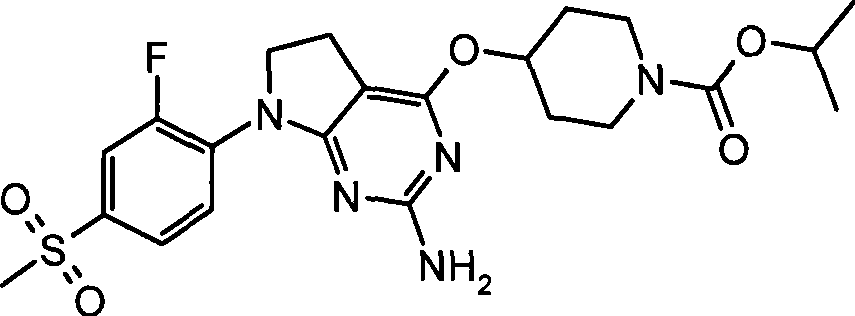
步骤1:1-[2-氟-4-(甲基磺酰基)苯基]-2-氧代-3-吡咯烷甲酸甲酯(220)Step 1: Methyl 1-[2-fluoro-4-(methylsulfonyl)phenyl]-2-oxo-3-pyrrolidinecarboxylate ( 220 )
在60℃、N2下,将2-氟-4-(甲基磺酰基)苯胺(3.3g,17.3mmol),6,6-二甲基-5,6-二氧杂螺[2.5]辛烷(9.7g,57mmol)和CH3CN(10mL)的混合物加热3小时。将溶剂蒸发,将残余物加热至70℃并保持5小时。加入甲醇(15mL)和浓H2SO4(0.2mL)并将该混合物加热至回流并保持2小时。将该混合物浓缩,残余物经SiO2快速柱层析纯化,得到2.3g(43%)灰白色固体状的标题化合物220。At 60°C under N 2 , 2-fluoro-4-(methylsulfonyl)aniline (3.3 g, 17.3 mmol), 6,6-dimethyl-5,6-dioxaspiro[2.5]octane A mixture of alkanes (9.7 g, 57 mmol) and CH3CN (10 mL) was heated for 3 hours. The solvent was evaporated and the residue was heated to 70°C for 5 hours. Methanol (15 mL) and concentrated H2SO4 (0.2 mL ) were added and the mixture was heated to reflux for 2 h. The mixture was concentrated and the residue was purified by SiO2 flash column chromatography to afford 2.3 g (43%) of the
1H NMR(400MHz,DMSO-d6):δ 7.89(br d,J=10.0Hz,1H),7.81-7.73(m,2H),3.85(br t,J=7.2Hz,2H),3.75(t,J=8.7Hz,1H),3.68(s,3H),3.30-3.25(br s,3H),2.45-2.35(m,2H);LCMS(ESI):m/z 316(M+H)+. 1 H NMR (400MHz, DMSO-d 6 ): δ 7.89 (br d, J = 10.0Hz, 1H), 7.81-7.73 (m, 2H), 3.85 (br t, J = 7.2Hz, 2H), 3.75 ( t, J=8.7Hz, 1H), 3.68(s, 3H), 3.30-3.25(br s, 3H), 2.45-2.35(m, 2H); LCMS(ESI): m/z 316(M+H) + .
步骤2:1-[2-氟-4-(甲基磺酰基)苯基]-2-硫代-3-吡咯烷甲酸甲酯(221)Step 2: Methyl 1-[2-fluoro-4-(methylsulfonyl)phenyl]-2-thio-3-pyrrolidinecarboxylate ( 221 )
在N2下将1-[2-氟-4-(甲基磺酰基)苯基]-2-氧代-3-吡咯烷甲酸甲酯(220)(2.3g,7.2mmol)、P4S10(3.9g,8.7mmol)和THF(100mL)的混合物加热至70℃并保持12小时。该混合物过滤两次,用EtOAc洗涤。将滤液浓缩,残余物经Si2O快速柱层析纯化,得到1.2g(50%)浅黄色固体状的标题产物221。Methyl 1-[ 2 -fluoro-4-(methylsulfonyl)phenyl]-2-oxo-3-pyrrolidinecarboxylate ( 220 ) (2.3g, 7.2mmol), P 4 S A mixture of 10 (3.9 g, 8.7 mmol) and THF (100 mL) was heated to 70 °C for 12 h. The mixture was filtered twice, washing with EtOAc. The filtrate was concentrated and the residue was purified by Si2O flash column chromatography to afford 1.2 g (50%) of the title product 221 as a pale yellow solid.
1H NMR(400MHz,DMSO-d6):δ 7.98(br d,J=9.3Hz,1H),7.89(br d,J=8.3Hz,1H),7.81(dd,J=7.5Hz,1H),4.12-4.08(m,3H),3.70(s,3H),3.30(s,3H),2.60-2.50(m,2H);LCMS(ESI):m/z 332(M+H)+. 1 H NMR (400MHz, DMSO-d 6 ): δ 7.98 (br d, J=9.3Hz, 1H), 7.89 (br d, J=8.3Hz, 1H), 7.81 (dd, J=7.5Hz, 1H) , 4.12-4.08(m, 3H), 3.70(s, 3H), 3.30(s, 3H), 2.60-2.50(m, 2H); LCMS(ESI): m/z 332(M+H) + .
步骤3:2-氨基-7-[2-氟-4-(甲基磺酰基)苯基]-1,5,6,7-四氢-4H-吡咯并[2,3-d]嘧啶-4-酮(222)Step 3: 2-Amino-7-[2-fluoro-4-(methylsulfonyl)phenyl]-1,5,6,7-tetrahydro-4H-pyrrolo[2,3-d]pyrimidine- 4-keto ( 222 )
往胍·盐酸盐(0.3g,3.2mmol)在无水MeOH(3mL)中的溶液中加入新鲜制备的1M NaOMe/MeOH(3.2mL,3.2mmol)并在环境温度、N2下将该混合物搅拌30分钟。该混合物过滤并往1-[2-氟-4-(甲基磺酰基)苯基]-2-硫代-3-吡咯烷甲酸甲酯(222)(0.22g,0.64mmol)中加入滤液。随后将黄色混合物搅拌5分钟,随后浓缩,分步由60加热至90℃并在轻微真空下保持1小时。将该混合物升温至环境温度并加入H2O。用1M HCl/H2O将pH调节至6并在环境温度下将该混合物搅拌18小时。将该固体过滤并真空干燥2小时,得到0.12g黄色固体状的粗品2。LCMS(ESI):m/z 325(M+H)+.To a solution of guanidine hydrochloride (0.3 g, 3.2 mmol) in anhydrous MeOH (3 mL) was added freshly prepared 1M NaOMe/MeOH (3.2 mL, 3.2 mmol) and the mixture was stirred at ambient temperature under N Stir for 30 minutes. The mixture was filtered and the filtrate was added to methyl 1-[2-fluoro-4-(methylsulfonyl)phenyl]-2-thio-3-pyrrolidinecarboxylate ( 222 ) (0.22 g, 0.64 mmol). The yellow mixture was then stirred for 5 minutes before being concentrated and heated from 60 to 90° C. in steps and maintained under slight vacuum for 1 hour. The mixture was warmed to ambient temperature and H2O was added. The pH was adjusted to 6 with 1M HCl/ H2O and the mixture was stirred at ambient temperature for 18 hours. The solid was filtered and dried under vacuum for 2 hours to afford 0.12 g of
步骤4:4-氯-7-[2-氟-4-(甲基磺酰基)苯基]-6,7-二氢-5H-吡咯并[2,3-d]嘧啶-2-胺(223)Step 4: 4-Chloro-7-[2-fluoro-4-(methylsulfonyl)phenyl]-6,7-dihydro-5H-pyrrolo[2,3-d]pyrimidin-2-amine ( 223 )
往粗制的2-氨基-7-[2-氟-4-(甲基磺酰基)苯基]-1,5,6,7-四氢-4H-吡咯并[2,3-d]嘧啶-4-酮(222)(0.12g,0.36mmol)在POCl3(1.2mL)中的悬浮液中小心加入iPr2NEt(0.13mL,0.1g,0.72mmol)并将该混合物缓慢加热至70℃。在1小时后,将该混合物浓缩,残余物在EtOAc/CH2Cl2和饱和NaHCO3/H2O间分配。将有机相过滤,经Na2SO4干燥,随后浓缩,得到51mg深绿色固体状的粗品223。LCMS(ESI):m/z 343(M+H)+.To the crude 2-amino-7-[2-fluoro-4-(methylsulfonyl)phenyl]-1,5,6,7-tetrahydro-4H-pyrrolo[2,3-d]pyrimidine - To a suspension of 4-one ( 222 ) (0.12 g, 0.36 mmol) in POCl 3 (1.2 mL) iPr 2 NEt (0.13 mL, 0.1 g, 0.72 mmol) was added carefully and the mixture was slowly heated to 70 °C . After 1 h, the mixture was concentrated and the residue was partitioned between EtOAc/ CH2Cl2 and saturated NaHCO3 / H2O . The organic phase was filtered, dried over Na2SO4 , and concentrated to afford 51 mg of crude 223 as a dark green solid. LCMS (ESI): m/z 343 (M+H) + .
步骤5:4-({2-氨基-7-[2-氟-4-(甲基磺酰基)苯基]-6,7-二氢-5H-吡咯并[2,3-d]嘧啶-4-基}氧基)-1-哌啶甲酸1-甲基乙酯(224)Step 5: 4-({2-Amino-7-[2-fluoro-4-(methylsulfonyl)phenyl]-6,7-dihydro-5H-pyrrolo[2,3-d]pyrimidine- 4-yl}oxy)-1-piperidinecarboxylic acid 1-methylethyl ester ( 224 )
往60%NaH/矿物油(70mg,1.8mmol)在THF(3mL)中的悬浮液中加入4-羟基-1-哌啶甲酸1-甲基乙酯(0.16g,0.87mmol)并在N2下将该混合物加热至50℃并保持30分钟随后冷却至0℃。往粗制的4-氯-7-[2-氟-4-(甲基磺酰基)苯基]-6,7-二氢-5H-吡咯并[2,3-d]嘧啶-2-胺(223)(51mg,0.15mmol)在THF(1mL)中的溶液中加入该混合物。将该混合物加热至60℃并保持4小时,随后将其在饱和NH4Cl/H2O和EtOAc间分配。有机相经Na2SO4干燥,浓缩,随后经Si2O快速柱层析纯化(使用EtOAc:己烷(0:100至70:30)作为洗脱液),得到5mg(7%)灰白色固体状的标题产物224。To a suspension of 60% NaH/mineral oil (70 mg, 1.8 mmol) in THF (3 mL) was added 1-methylethyl 4-hydroxy-1-piperidinecarboxylate (0.16 g, 0.87 mmol) and heated under N2 The mixture was heated to 50°C for 30 minutes and then cooled to 0°C. To crude 4-chloro-7-[2-fluoro-4-(methylsulfonyl)phenyl]-6,7-dihydro-5H-pyrrolo[2,3-d]pyrimidin-2-amine A solution of ( 223 ) (51 mg, 0.15 mmol) in THF (1 mL) was added to the mixture. The mixture was heated to 60° C. for 4 h, then partitioned between sat. NH 4 Cl/H 2 O and EtOAc. The organic phase was dried over Na2SO4 , concentrated and purified by flash column chromatography on Si2O using EtOAc:hexane (0:100 to 70:30) as eluent to give 5 mg (7%) of an off - white solid like the title product 224 .
1H NMR(400MHz,CDCl3):δ 8.10-8.00(br s,1H),7.7-7.65(m,2H),5.30(br s,1H),4.90(七重峰,J=6.0Hz,1H),4.85-4.60(m,2H),4.15(br t,J=7.7Hz,2H),3.85-3.70(m,2H),3.40-3.30(m,2H),3.05(s,3H),2.95(t,J=8.5Hz,2H),2.00-1.95(m,2H),1.85-1.80(m,2H),1.24(d,J=6.0Hz,6H);LCMS(ESI):m/z 494(M+H)+. 1 H NMR (400MHz, CDCl 3 ): δ 8.10-8.00 (br s, 1H), 7.7-7.65 (m, 2H), 5.30 (br s, 1H), 4.90 (septet, J=6.0Hz, 1H) , 4.85-4.60(m, 2H), 4.15(br t, J=7.7Hz, 2H), 3.85-3.70(m, 2H), 3.40-3.30(m, 2H), 3.05(s, 3H), 2.95( t, J=8.5Hz, 2H), 2.00-1.95(m, 2H), 1.85-1.80(m, 2H), 1.24(d, J=6.0Hz, 6H); LCMS (ESI): m/z 494( M+H) + .
实施例130(225)Example 130 ( 225 )
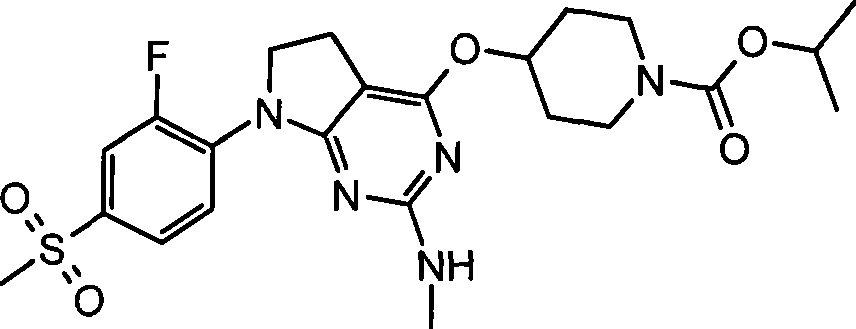
步骤1:7-[2-氟-4-(甲基磺酰基)苯基]-2-(甲基氨基)-1,5,6,7-四氢-4H-吡咯并[2,3-d]嘧啶-4-酮(225)Step 1: 7-[2-Fluoro-4-(methylsulfonyl)phenyl]-2-(methylamino)-1,5,6,7-tetrahydro-4H-pyrrolo[2,3- d] pyrimidin-4-one ( 225 )
往N-甲基胍·盐酸盐(0.35g,3.2mmol)在无水MeOH(3mL)中的溶液中加入新鲜制备的1M NaOMe/MeOH(3.2mL,3.2mmol)并在环境温度、N2下将该混合物搅拌30分钟。过滤该混合物并将滤液加至1-[2-氟-4-(甲基磺酰基)苯基]-2-硫代-3-吡咯烷甲酸甲酯(221)(0.22g,0.64mmol)中。将黄色混合物搅拌5分钟,随后浓缩并分步由60℃加热至90℃并在轻微真空下保持1小时。将该混合物冷却至环境温度并加入H2O。用1M HCl/H2O将pH调节至6并在环境温度下将该混合物搅拌18小时。弃去水相,随后将粘稠的固体与CH3CN共沸,得到0.12g橙色固体状的粗品225。LCMS(ESI):m/z 339(M+H)+.To a solution of N-methylguanidine·HCl (0.35 g, 3.2 mmol) in anhydrous MeOH (3 mL) was added freshly prepared 1M NaOMe/MeOH (3.2 mL, 3.2 mmol) and heated at ambient temperature under N The mixture was stirred for 30 minutes. The mixture was filtered and the filtrate was added to methyl 1-[2-fluoro-4-(methylsulfonyl)phenyl]-2-thio-3-pyrrolidinecarboxylate ( 221 ) (0.22g, 0.64mmol) . The yellow mixture was stirred for 5 minutes, then concentrated and heated in steps from 60°C to 90°C under slight vacuum for 1 hour. The mixture was cooled to ambient temperature and H2O was added. The pH was adjusted to 6 with 1M HCl/ H2O and the mixture was stirred at ambient temperature for 18 hours. The aqueous phase was discarded and the viscous solid was then azeotroped with CH3CN to afford 0.12 g of crude 225 as an orange solid. LCMS (ESI): m/z 339 (M+H) + .
步骤2:4-氯-7-[2-氟-4-(甲基磺酰基)苯基]-N-甲基-6,7-二氢-5H-吡咯并[2,3-d]嘧啶-2-胺(226)Step 2: 4-Chloro-7-[2-fluoro-4-(methylsulfonyl)phenyl]-N-methyl-6,7-dihydro-5H-pyrrolo[2,3-d]pyrimidine -2-amine ( 226 )
往粗制7-[2-氟-4-(甲基磺酰基)苯基]-2-(甲基氨基)-1,5,6,7-四氢-4H-吡咯并[2,3-d]嘧啶-4-酮(225)(0.12g,0.36mmol)在POCl3(1.2mL)中的悬浮液中小心加入iPr2NEt(0.13mL,0.1g,0.72mmol)并将该混合物缓慢加热至70℃。在l小时后,将该混合物浓缩,将残余物在EtOAc/CH2Cl2和饱和NaHCO3/H2O间分配。将有机相过滤,经Na2SO4干燥,随后浓缩。深绿色残余物用EtOAc研磨并过滤。将滤液浓缩,得到16mg灰白色固体状的226。To the crude 7-[2-fluoro-4-(methylsulfonyl)phenyl]-2-(methylamino)-1,5,6,7-tetrahydro-4H-pyrrolo[2,3- d] To a suspension of pyrimidin-4-one ( 225 ) (0.12 g, 0.36 mmol) in POCl 3 (1.2 mL) iPr 2 NEt (0.13 mL, 0.1 g, 0.72 mmol) was added carefully and the mixture was heated slowly to 70°C. After 1 h, the mixture was concentrated and the residue was partitioned between EtOAc/ CH2Cl2 and saturated NaHCO3 / H2O . The organic phase was filtered, dried over Na2SO4 , and concentrated. The dark green residue was triturated with EtOAc and filtered. The filtrate was concentrated to afford 16 mg of 226 as an off-white solid.
1HNMR(400MHz,DMSO-d6):δ 8.00-7.90(br m,1H),7.84(br d,J=7.8Hz,1H),7.74(dd,J1=8.5,J2=1.7Hz,1H),7.20-7.10(br m,1H),4.20-4.00(br m,2H),3.26(s,3H),3.00(t,J=8.3Hz,2H),2.66(d,J=4.6Hz,3H);LCMS(ESI):m/z 357(M+H)+. 1 HNMR (400MHz, DMSO-d 6 ): δ 8.00-7.90 (br m, 1H), 7.84 (br d, J=7.8Hz, 1H), 7.74 (dd, J 1 =8.5, J 2 =1.7Hz, 1H), 7.20-7.10(br m, 1H), 4.20-4.00(br m, 2H), 3.26(s, 3H), 3.00(t, J=8.3Hz, 2H), 2.66(d, J=4.6Hz , 3H); LCMS (ESI): m/z 357 (M+H) + .
步骤3:4-{[7-[2-氟-4-(甲基磺酰基)苯基]-2-(甲基氨基)-6,7-二氢-5H-吡咯并[2,3-d]嘧啶-4-基]氧基}-1-哌啶甲酸1-甲基乙酯(227)Step 3: 4-{[7-[2-fluoro-4-(methylsulfonyl)phenyl]-2-(methylamino)-6,7-dihydro-5H-pyrrolo[2,3- d] pyrimidin-4-yl]oxyl}-1-piperidinecarboxylic acid 1-methyl ethyl ester ( 227 )
往60%NaH/矿物油(8.4mg,0.21mmol)在THF(1.5mL)中的悬浮液中加入4-羟基-1-哌啶甲酸1-甲基乙酯(20mg,0.11mmol)并在N2下将该混合物加热至50℃并保持30分钟,随后冷却至0℃。往4-氯-7-[2-氟-4-(甲基磺酰基)苯基]-N-甲基-6,7-二氢-5H-吡咯并[2,3-d]嘧啶-2-胺(226)(15mg,0.04mmol)在THF(1mL)中的溶液中加入该混合物。将该混合物加热至60℃并保持4小时,随后将其在饱和NH4Cl/H2O和EtOAc间分配。有机相经Na2SO4干燥,浓缩,随后经制备HPLC纯化(C18柱,CH3CN:H2O梯度洗脱),随后经Si2O快速柱层析纯化(使用EtOAc:己烷(0:100至70:30)作为洗脱液),得到5mg(23%)标题产物227,其为灰白色固体状的泡沫。To a suspension of 60% NaH/mineral oil (8.4 mg, 0.21 mmol) in THF (1.5 mL) was added 1-methylethyl 4-hydroxy-1-piperidinecarboxylate (20 mg, 0.11 mmol) and heated under N The mixture was heated to 50 °C at 2 °C for 30 min, then cooled to 0 °C. To 4-chloro-7-[2-fluoro-4-(methylsulfonyl)phenyl]-N-methyl-6,7-dihydro-5H-pyrrolo[2,3-d]pyrimidine-2 - A solution of amine ( 226 ) (15 mg, 0.04 mmol) in THF (1 mL) was added to the mixture. The mixture was heated to 60° C. for 4 h, then partitioned between sat. NH 4 Cl/H 2 O and EtOAc. The organic phase was dried over Na2SO4 , concentrated, then purified by preparative HPLC (C18 column, CH3CN : H2O gradient elution), followed by Si2O flash column chromatography (using EtOAc:Hexane (0 :100 to 70:30) as eluent) afforded 5 mg (23%) of the title product 227 as an off-white solid as a foam.
1H NMR(400MHz,CDCl3):δ 8.15-8.05(br s,1H),7.7-7.65(m,2H),5.30(br s,1H),4.90(七重峰,J=6.0Hz,1H),4.85-4.60(m,1H),4.15(br t,J=7.3Hz,2H),3.85-3.70(m,2H),3.40-3.30(m,2H),3.05(s,3H),2.95(t,J=8.5Hz,2H),2.92(d,J=4.9Hz,3H),2.00-1.95(m,2H),1.85-1.80(m,2H),1.24(d,J=6.0Hz,6H);LCMS(ESI):m/z 508(M+H)+. 1 H NMR (400MHz, CDCl 3 ): δ 8.15-8.05 (br s, 1H), 7.7-7.65 (m, 2H), 5.30 (br s, 1H), 4.90 (septet, J=6.0Hz, 1H) , 4.85-4.60(m, 1H), 4.15(br t, J=7.3Hz, 2H), 3.85-3.70(m, 2H), 3.40-3.30(m, 2H), 3.05(s, 3H), 2.95( t, J=8.5Hz, 2H), 2.92(d, J=4.9Hz, 3H), 2.00-1.95(m, 2H), 1.85-1.80(m, 2H), 1.24(d, J=6.0Hz, 6H ); LCMS (ESI): m/z 508 (M+H) + .
实施例131(228)Example 131 ( 228 )
7-(4-溴-2-氟苯基)-4-{[1-(5-氟-2-嘧啶基)-4-哌啶基]氧基}-6,7-二氢-5H-吡咯并[2,3-d]嘧啶(228)7-(4-bromo-2-fluorophenyl)-4-{[1-(5-fluoro-2-pyrimidinyl)-4-piperidinyl]oxy}-6,7-dihydro-5H- Pyrrolo[2,3-d]pyrimidine ( 228 )
采用所述用于制备10(实施例1,步骤10)的方法,将反应物23(1.25g,6.34mmol)、NaH(0.950g,23.73mmol)和化合物29(按照所述用于制备211的方法,使用醛209和4-溴-2-氟苯胺经还原胺化制备,2.60g,7.91mmol)回流4小时。常规后处理,随后层析,得到2.90g(94%)白色固体状的标题产物228。Using the procedure described for the preparation of 10 (Example 1, Step 10), reactant 23 (1.25 g, 6.34 mmol), NaH (0.950 g, 23.73 mmol) and compound 29 (as described for the preparation of 211 Method, prepared by reductive amination using aldehyde 209 and 4-bromo-2-fluoroaniline, 2.60g, 7.91mmol) and refluxed for 4 hours. Conventional workup followed by chromatography afforded 2.90 g (94%) of the title product 228 as a white solid.
1H NMR(400MHz,DMSO-d6):δ 8.23(s,1H),8.20(s,2H),7.50(t,J=8.4Hz,1H),7.33-7.28(m,2H),5.44-5.36(m,1H),4.22-4.16(m,2H),4.05(t,J=8.8Hz,2H),3.63-3.56(m,2H),3.09(t,J=8.8Hz,2H),2.09-2.03(m,2H),1.83-1.74(m,2H),LCMS(ESI):m/z 490(M+H)+. 1 H NMR (400MHz, DMSO-d 6 ): δ 8.23(s, 1H), 8.20(s, 2H), 7.50(t, J=8.4Hz, 1H), 7.33-7.28(m, 2H), 5.44- 5.36(m, 1H), 4.22-4.16(m, 2H), 4.05(t, J=8.8Hz, 2H), 3.63-3.56(m, 2H), 3.09(t, J=8.8Hz, 2H), 2.09 -2.03(m, 2H), 1.83-1.74(m, 2H), LCMS(ESI): m/z 490(M+H) + .
预示实施例prophetic embodiment
以下实施例可通过与文中所述那些类似的方法制备:The following examples can be prepared by methods analogous to those described herein:
实施例132Example 132
3-氟-4-(4-{[1-(5-氟-2-嘧啶基)-4-哌啶基]氧基}-5,6-二氢-7H-吡咯并[2,3-d]嘧啶-7-基)苄腈3-fluoro-4-(4-{[1-(5-fluoro-2-pyrimidinyl)-4-piperidinyl]oxy}-5,6-dihydro-7H-pyrrolo[2,3- d] pyrimidin-7-yl) benzonitrile
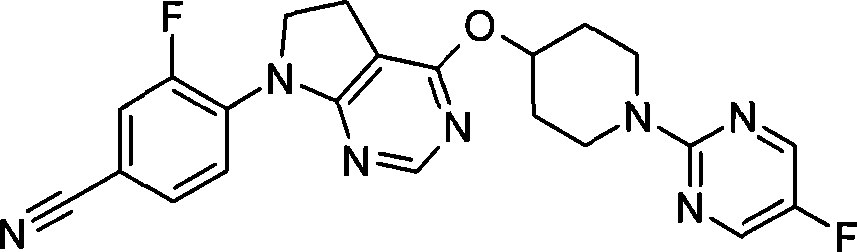
实施例133Example 133
3-氟-4-[4-({1-[3-(1-甲基乙基)-1,2,4-噁二唑-5-基]-4-哌啶基}氧基)-5,6-二氢-7H-吡咯并[2,3-d]嘧啶-7-基]苄腈3-fluoro-4-[4-({1-[3-(1-methylethyl)-1,2,4-oxadiazol-5-yl]-4-piperidinyl}oxy)- 5,6-Dihydro-7H-pyrrolo[2,3-d]pyrimidin-7-yl]benzonitrile

实施例134Example 134
4-[4-({1-[3-(1-甲基乙基)-1,2,4-噁二唑-5-基]-4-哌啶基}氧基)-5,6-二氢-7H-吡咯并[2,3-d]嘧啶-7-基]苄腈4-[4-({1-[3-(1-methylethyl)-1,2,4-oxadiazol-5-yl]-4-piperidinyl}oxy)-5,6- Dihydro-7H-pyrrolo[2,3-d]pyrimidin-7-yl]benzonitrile

实施例135Example 135
4-(4-{[1-(5-氟-2-嘧啶基)-4-哌啶基]氧基}-5,6-二氢-7H-吡咯并[2,3-d]嘧啶-7-基)苄腈4-(4-{[1-(5-fluoro-2-pyrimidinyl)-4-piperidinyl]oxy}-5,6-dihydro-7H-pyrrolo[2,3-d]pyrimidine- 7-yl)benzonitrile

实施例136Example 136
4-{[1-(5-氟-2-嘧啶基)-4-哌啶基]氧基}-7-[4-(甲基磺酰基)苯基]-6,7-二氢-5H-吡咯并[2,3-d]嘧啶4-{[1-(5-fluoro-2-pyrimidinyl)-4-piperidinyl]oxy}-7-[4-(methylsulfonyl)phenyl]-6,7-dihydro-5H -pyrrolo[2,3-d]pyrimidine

实施例137Example 137
4-({1-[3-(1-甲基乙基)-1,2,4-噁二唑-5-基]-4-哌啶基}氧基)-7-[4-(甲基磺酰基)苯基]-6,7-二氢-5H-吡咯并[2,3-d]嘧啶4-({1-[3-(1-methylethyl)-1,2,4-oxadiazol-5-yl]-4-piperidinyl}oxy)-7-[4-(methyl Sulfonyl)phenyl]-6,7-dihydro-5H-pyrrolo[2,3-d]pyrimidine
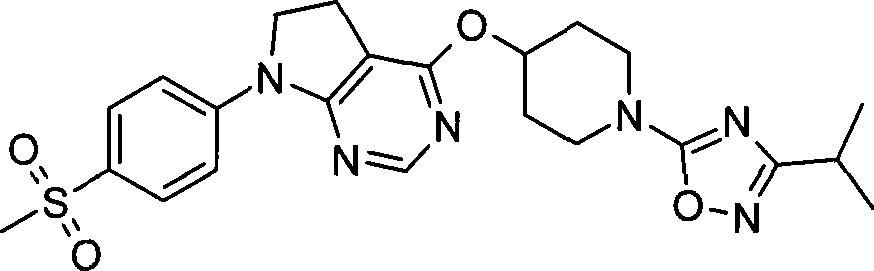
实施例138Example 138
4-({1-[3-(1-甲基乙基)-1,2,4-噁二唑-5-基]-4-哌啶基}氧基)-7-[4-(甲基亚磺酰基)苯基]-6,7-二氢-5H-吡咯并[2,3-d]嘧啶4-({1-[3-(1-methylethyl)-1,2,4-oxadiazol-5-yl]-4-piperidinyl}oxy)-7-[4-(methyl Sulfinyl)phenyl]-6,7-dihydro-5H-pyrrolo[2,3-d]pyrimidine

实施例139Example 139
实施例139A:(R)-4-({1-[3-(1-甲基乙基)-1,2,4-噁二唑-5-基]-4-哌啶基}氧基)-7-[4-(甲基亚磺酰基)苯基]-6,7-二氢-5H-吡咯并[2,3-d]嘧啶Example 139A: (R)-4-({1-[3-(1-methylethyl)-1,2,4-oxadiazol-5-yl]-4-piperidinyl}oxy) -7-[4-(methylsulfinyl)phenyl]-6,7-dihydro-5H-pyrrolo[2,3-d]pyrimidine
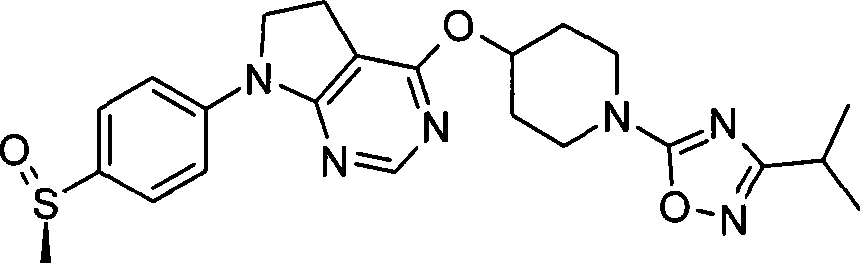
实施例139BExample 139B
(S)-4-({1-[3-(1-甲基乙基)-1,2,4-噁二唑-5-基]-4-哌啶基}氧基)-7-[4-(甲基亚磺酰基)苯基]-6,7-二氢-5H-吡咯并[2,3-d]嘧啶(S)-4-({1-[3-(1-methylethyl)-1,2,4-oxadiazol-5-yl]-4-piperidinyl}oxy)-7-[ 4-(Methylsulfinyl)phenyl]-6,7-dihydro-5H-pyrrolo[2,3-d]pyrimidine
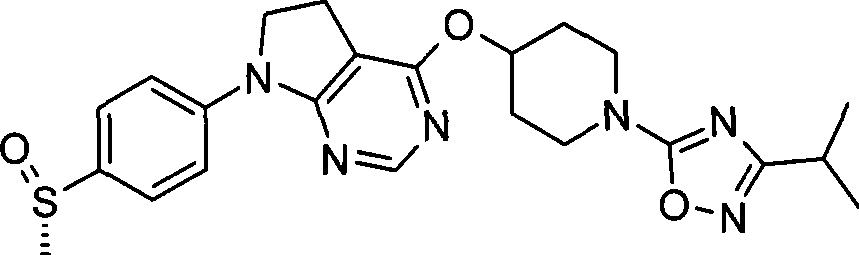
实施例140Example 140
4-{[1-(5-氟-2-嘧啶基)-4-哌啶基]氧基}-7-[4-(甲基亚磺酰基)苯基]-6,7-二氢-5H-吡咯并[2,3-d]嘧啶4-{[1-(5-fluoro-2-pyrimidinyl)-4-piperidinyl]oxy}-7-[4-(methylsulfinyl)phenyl]-6,7-dihydro- 5H-pyrrolo[2,3-d]pyrimidine
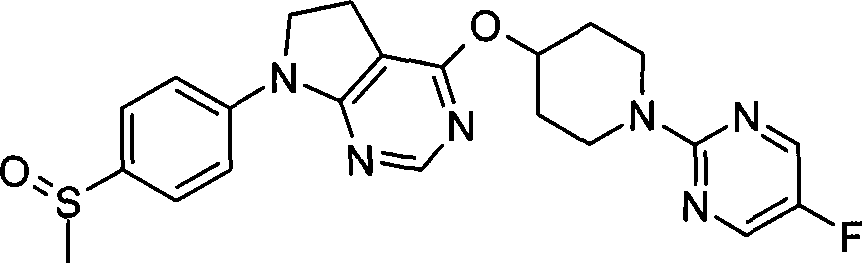
实施例141Example 141
实施例141A:(R)-4-{[1-(5-氟-2-嘧啶基)-4-哌啶基]氧基}-7-[4-(甲基亚磺酰基)苯基]-6,7-二氢-5H-吡咯并[2,3-d]嘧啶Example 141A: (R)-4-{[1-(5-fluoro-2-pyrimidinyl)-4-piperidinyl]oxy}-7-[4-(methylsulfinyl)phenyl] -6,7-dihydro-5H-pyrrolo[2,3-d]pyrimidine
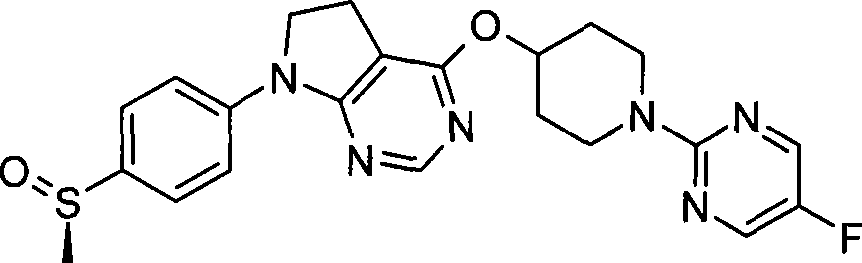
实施例141B:(S)-4-{[1-(5-氟-2-嘧啶基)-4-哌啶基]氧基}-7-[4-(甲基亚磺酰基)苯基]-6,7-二氢-5H-吡咯并[2,3-d]嘧啶Example 141B: (S)-4-{[1-(5-fluoro-2-pyrimidinyl)-4-piperidinyl]oxy}-7-[4-(methylsulfinyl)phenyl] -6,7-dihydro-5H-pyrrolo[2,3-d]pyrimidine
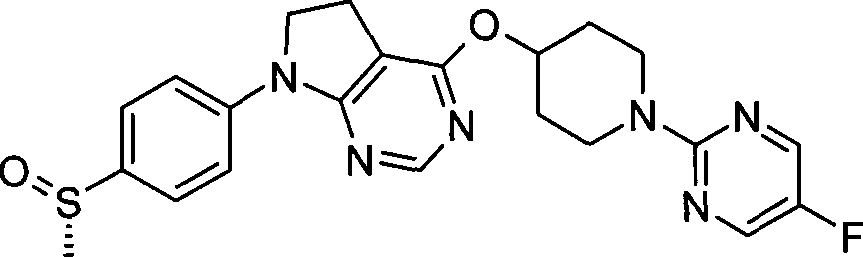
实施例142Example 142
4-({7-[2-氟-4-(甲基亚磺酰基)苯基]-6,7-二氢-5H-吡咯并[2,3-d]嘧啶-4-基}氧基)-1-哌啶硫代甲酸S-乙酯4-({7-[2-fluoro-4-(methylsulfinyl)phenyl]-6,7-dihydro-5H-pyrrolo[2,3-d]pyrimidin-4-yl}oxy )-1-piperidinethioformic acid S-ethyl ester
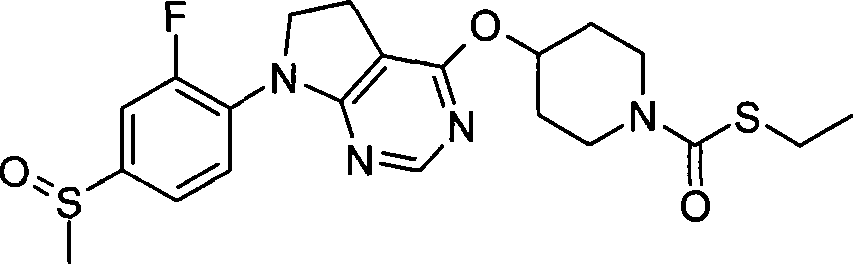
实施例143Example 143
实施例143A:(R)-4-({7-[2-氟-4-(甲基亚磺酰基)苯基]-6,7-二氢-5H-吡咯并[2,3-d]嘧啶-4-基}氧基)-1-哌啶硫代甲酸S-乙酯Example 143A: (R)-4-({7-[2-fluoro-4-(methylsulfinyl)phenyl]-6,7-dihydro-5H-pyrrolo[2,3-d] Pyrimidin-4-yl}oxy)-1-piperidinethiocarboxylate S-ethyl ester
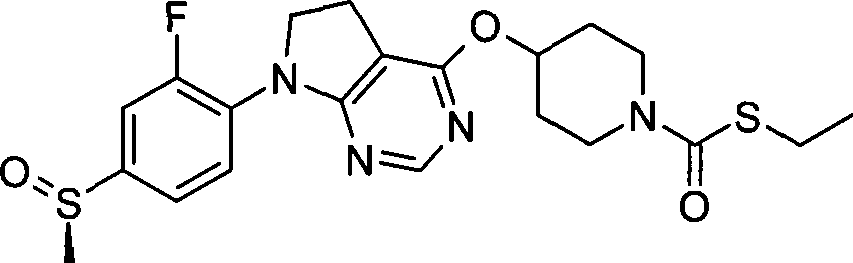
实施例143B:(S)-4-({7-[2-氟-4-(甲基亚磺酰基)苯基]-6,7-二氢-5H-吡咯并[2,3-d]嘧啶-4-基}氧基)-1-哌啶硫代甲酸S-乙酯Example 143B: (S)-4-({7-[2-fluoro-4-(methylsulfinyl)phenyl]-6,7-dihydro-5H-pyrrolo[2,3-d] Pyrimidin-4-yl}oxy)-1-piperidinethiocarboxylate S-ethyl ester
实施例144Example 144
4-({7-[2-氟-4-(S-甲基亚氨代磺酰基)苯基]-6,7-二氢-5H-吡咯并[2,3-d]嘧啶-4-基}氧基)-1-哌啶甲酸1-甲基乙酯4-({7-[2-fluoro-4-(S-methylsulfonyl)phenyl]-6,7-dihydro-5H-pyrrolo[2,3-d]pyrimidine-4- Base}oxy)-1-piperidinecarboxylic acid 1-methylethyl ester
实施例145Example 145
(R)-4-({7-[2-氟-4-(S-甲基亚氨代磺酰基)苯基]-6,7-二氢-5H-吡咯并[2,3-d]嘧啶-4-基}氧基)-1-哌啶甲酸1-甲基乙酯(R)-4-({7-[2-fluoro-4-(S-methylsulfonyl)phenyl]-6,7-dihydro-5H-pyrrolo[2,3-d] Pyrimidin-4-yl}oxy)-1-piperidinecarboxylic acid 1-methylethyl ester
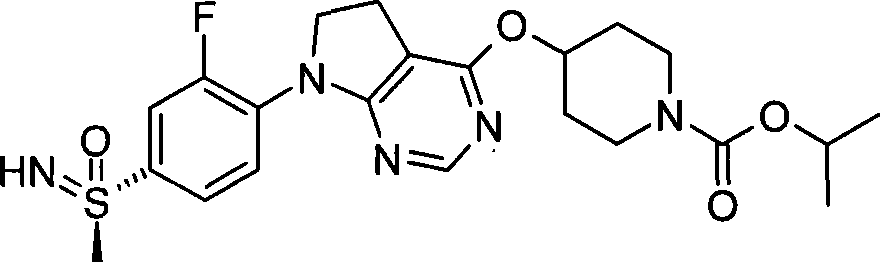
实施例146Example 146
(S)-4-({7-[2-氟-4-(S-甲基亚氨代磺酰基)苯基]-6,7-二氢-5H-吡咯并[2,3-d]嘧啶-4-基}氧基)-1-哌啶甲酸1-甲基乙酯(S)-4-({7-[2-fluoro-4-(S-methylsulfonyl)phenyl]-6,7-dihydro-5H-pyrrolo[2,3-d] Pyrimidin-4-yl}oxy)-1-piperidinecarboxylic acid 1-methylethyl ester
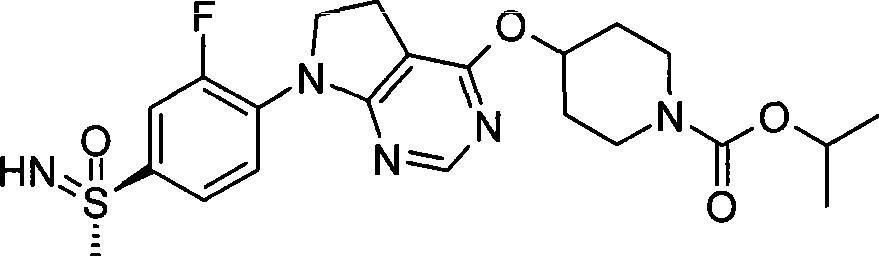
实施例147Example 147
4-({7-[4-(S-甲基亚氨代磺酰基)苯基]-6,7-二氢-5H-吡咯并[2,3-d]嘧啶-4-基}氧基)-1-哌啶甲酸1-甲基乙酯4-({7-[4-(S-methylsulfonyl)phenyl]-6,7-dihydro-5H-pyrrolo[2,3-d]pyrimidin-4-yl}oxy )-1-piperidinecarboxylic acid 1-methyl ethyl ester
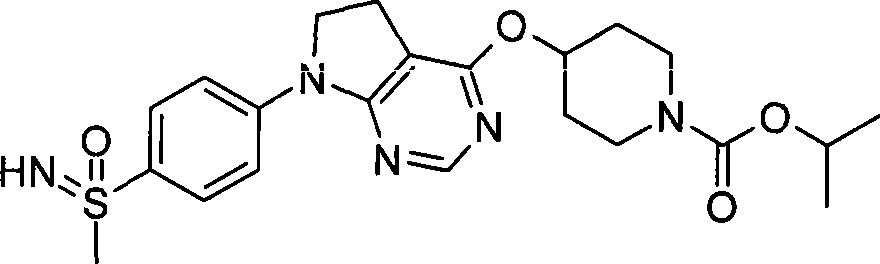
实施例148Example 148
(R)-4-({7-[4-(S-甲基亚氨代磺酰基)苯基]-6,7-二氢-5H-吡咯并[2,3-d]嘧啶-4-基}氧基)-1-哌啶甲酸1-甲基乙酯(R)-4-({7-[4-(S-methylsulfonyl)phenyl]-6,7-dihydro-5H-pyrrolo[2,3-d]pyrimidine-4- Base}oxy)-1-piperidinecarboxylic acid 1-methylethyl ester

实施例149Example 149
(S)-4-({7-[4-(S-甲基亚氨代磺酰基)苯基]-6,7-二氢-5H-吡咯并[2,3-d]嘧啶-4-基}氧基)-1-哌啶甲酸1-甲基乙酯(S)-4-({7-[4-(S-methylsulfonyl)phenyl]-6,7-dihydro-5H-pyrrolo[2,3-d]pyrimidine-4- Base}oxy)-1-piperidinecarboxylic acid 1-methylethyl ester

实施例150Example 150
(R)-4-({7-[2,5-二氟-4-(甲基亚磺酰基)苯基]-6,7-二氢-5H-吡咯并[2,3-d]嘧啶-4-基}氧基)-1-哌啶甲酸1-甲基乙酯(R)-4-({7-[2,5-difluoro-4-(methylsulfinyl)phenyl]-6,7-dihydro-5H-pyrrolo[2,3-d]pyrimidine -4-yl}oxy)-1-piperidinecarboxylic acid 1-methylethyl ester
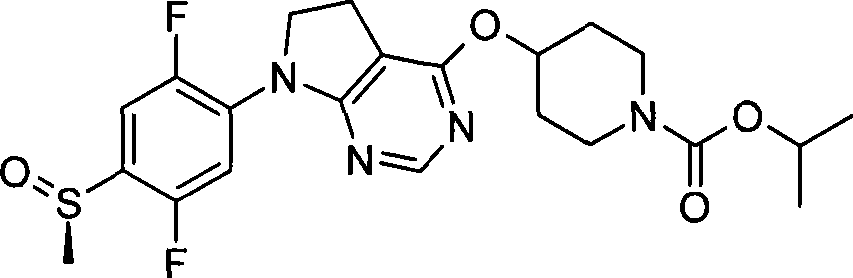
实施例151Example 151
(S)-4-({7-[2,5-二氟-4-(甲基亚磺酰基)苯基]-6,7-二氢-5H-吡咯并[2,3-d]嘧啶-4-基}氧基)-1-哌啶甲酸1-甲基乙酯(S)-4-({7-[2,5-difluoro-4-(methylsulfinyl)phenyl]-6,7-dihydro-5H-pyrrolo[2,3-d]pyrimidine -4-yl}oxy)-1-piperidinecarboxylic acid 1-methylethyl ester
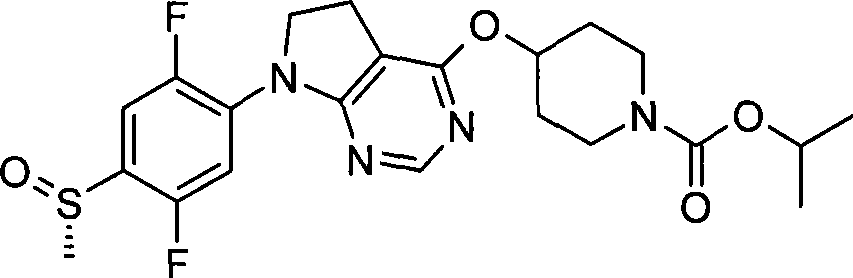
生物学实验和数据Biology Experiments and Data
GPR119激动剂活性GPR119 agonist activity
本发明化合物被认为对治疗和/或预防GPR119介导的病症和疾病有用。使用人GPR119受体转染的细胞测定GPR119介导的活性。The compounds of the present invention are believed to be useful for the treatment and/or prevention of GPR119-mediated conditions and diseases. GPR119-mediated activity was assayed using cells transfected with the human GPR119 receptor.
材料Material
黑色、384-孔、组织培养板(#781091)获自Greiner,(德国);Steady-GloTM荧光素酶检测系统试剂盒(#E2550)获自Promega(麦迪逊,威斯康星);板密封(plate seals)(#097-05-00006)获自Beckman/Sagian(富乐顿,加州)。DMEM/F12培养基(#11039-021)、胎牛血清(#16140-071)、L-谷氨酰胺(#25030-081)、0.05%胰蛋白酶(#25300-054)、G418(#10131-035)和dPBS(#4190-144)获自Gibco BRL(盖瑟斯堡,马里兰州)。内部(in-house)繁育的稳定表达6xCRE-1uc+的中国仓鼠卵巢细胞(CHO6CRE)。Black, 384-well, tissue culture plates (#781091) were obtained from Greiner, (Germany); Steady-Glo™ Luciferase Assay System Kit (#E2550) was obtained from Promega (Madison, WI); plate seals ) (#097-05-00006) was obtained from Beckman/Sagian (Fullerton, CA). DMEM/F12 Medium (#11039-021), Fetal Bovine Serum (#16140-071), L-Glutamine (#25030-081), 0.05% Trypsin (#25300-054), G418 (#10131- 035) and dPBS (#4190-144) were obtained from Gibco BRL (Gaithersburg, MD). In-house bred Chinese hamster ovary cells stably expressing 6xCRE-luc + (CHO6CRE).
方法method
通过电穿孔法将人GPR119受体转染到CHO6CRRE细胞。采用G418进行功能性激动剂检测来挑选稳定的克隆。在T225瓶中,GPR119-CHO6CRRE细胞在完全培养基(DMEM/F12,5%FBS,2mM I-谷氨酰胺)中持续培养。检测前24小时,用5ml 0.05%胰蛋白酶收集细胞,用完全培养基洗涤细胞并以15,000细胞/孔的浓度将细胞接种在黑色的384-孔培养板的完全培养基中。第二天,使用MatrixWell-mate将培养基从细胞除去并用20μl/孔的无血清DMEM/F12,1% DMSO置换。在此加入后立即使用Packard Minitrak将根据11个浓度点曲线的激动剂(20μL,1% DMSO)移液至培养基中并将培养板放在细胞培养孵化箱内30℃下培养5小时。培养后,使用Well-mate往培养板中加入15μl的Steady-GloTM和dPBS/1mM CaCl2/1mMMgCl2的混合物(1:1)。将培养板密封并在TopCountTM微孔板闪烁计数仪(microplate scintillation counter)(Packard)上使用3秒/孔的计数时间将荧光素酶活性定量。使用基于Microsoft EXCEL的曲线拟合程序通过非线性回归分析来定量激动剂活性。Human GPR119 receptors were transfected into CHO6CRRE cells by electroporation. A functional agonist assay was performed using G418 to select stable clones. GPR119-CHO6CRRE cells were continuously cultured in complete medium (DMEM/F12, 5% FBS, 2 mM 1-glutamine) in T225 flasks. Twenty-four hours before the assay, cells were harvested with 5 ml of 0.05% trypsin, washed with complete medium and seeded at a concentration of 15,000 cells/well in complete medium in black 384-well culture plates. The next day, the medium was removed from the cells using a MatrixWell-mate and replaced with 20 μl/well of serum-free DMEM/F12, 1% DMSO. Immediately after this addition, the agonist (20 μL, 1% DMSO) according to the 11 concentration point curve was pipetted into the medium using a Packard Minitrak and the plate was incubated for 5 hours at 30° C. in a cell culture incubator. After culturing, add 15 μl of Steady-Glo TM and a mixture of dPBS/1mM CaCl 2 /1mMMgCl 2 (1:1) to the culture plate using Well-mate. Plates were sealed and luciferase activity was quantified on a TopCount ™ microplate scintillation counter (Packard) using a counting time of 3 seconds/well. Agonist activity was quantified by nonlinear regression analysis using a Microsoft EXCEL-based curve fitting program.
本发明化合物提供的pIC50值为5或更大。Compounds of the invention provide pIC50 values of 5 or greater.
虽然pIC50值被用于本发明的某些化合物,但是这些值应被认为是示例性的。本领域技术人员将理解通过使用文中所述生物活性检测来实施和记录数据的可变性。如文中所用,集中注意5或更大的pIC50值是主观选择,并不表示活性较小的化合物是无活性的或不能实行的。Although pIC50 values are used for certain compounds of the invention, these values should be considered exemplary. Those skilled in the art will appreciate the variability in performing and recording data using the biological activity assays described herein. As used herein, focusing on pIC50 values of 5 or greater is a subjective choice and does not mean that less active compounds are inactive or unviable.
作为GLP-1和GIP促分泌剂的GPR119激动剂GPR119 agonists as GLP-1 and GIP secretagogues
在小鼠体内评价GPR119激动剂对循环GLP-1和GIP的作用Evaluation of the effect of GPR119 agonists on circulating GLP-1 and GIP in mice
10周龄C57BL/6雄性小鼠(Taconic Farms,USA)禁食过夜,然后随机分为6个处理组(n=10个小鼠/处理组),口服灌胃给予赋形剂(Vehicle)(0.5%HPMC/0.1%吐温80)或5个不同剂量(1、3、10、30或60mg/kg)的GPR119激动剂(实施例1)。所有动物按它们的指定处理给药,给药容积为10mL/kg。口服灌胃60分钟后用异氟烷将小鼠麻醉,通过心脏穿刺收集血样。心脏穿刺后立即用颈脱位法处死所有小鼠。将血样置于冷冻的涂覆有K2-EDTA的capiject管(Cat.#T-MQK,泰尔茂医疗公司,E1kton,马里兰州)中,添加DPP4抑制剂和Aprotenin(特斯乐;拜耳制药,West Haven,康涅狄格州),得到的最终浓度分别为30μL和250KIU/mL。立即将这些管在4℃下离心,收集血浆并保存在-80℃下以便用于之后的激素测定。使用获自Meso Scale Discovery(Cat # K110-FAC-2;盖瑟斯堡,马里兰州)的MULTI-
数据用概括了每个处理组各数据点分布的箱线图表示。各箱的上端和下端各对应75th和25th百分位数,须(whiskers)延伸至1.5*四分位数间距内的点。水平线表示平均值。图1和图2表示在给予指定剂量的赋形剂或GPR119激动剂(实施例1)后测定的循环中各总GLP-1和总GIP。Data are presented as boxplots summarizing the distribution of individual data points for each treatment group. The upper and lower ends of each bin correspond to the 75th and 25th percentile, respectively, with whiskers extending to points within 1.5 * interquartile range. Horizontal lines represent mean values. Figures 1 and 2 represent individual total GLP-1 and total GIP in circulation determined after administration of the indicated doses of vehicle or GPR119 agonist (Example 1).
这些结果举例说明了给予实施例1(GPR119激动剂)可使小鼠循环的总GLP-1和总GIP水平呈剂量依赖性增加。These results illustrate that administration of Example 1, a GPR119 agonist, dose-dependently increases circulating levels of total GLP-1 and total GIP in mice.
在野生型小鼠和GPR119敲除小鼠体内评价GPR119激动剂对Evaluation of GPR119 agonists in wild-type mice and GPR119 knockout mice 循环GLP-1和GIP的作用Role of circulating GLP-1 and GIP
17周龄雄性转基因野生型(WT)小鼠和GPR119敲除(KO)小鼠(查尔斯河实验室,USA)禁食过夜随后随机分成两个处理组,对于各基因型,KO和WT小鼠处理组分别用n=8和n=10个动物。口服灌胃给予动物赋形剂(0.5%HPMC/0.1%吐温80)或30mg/kg(10mL/kg)剂量的GPR119激动剂(实施例1)。口服灌胃60分钟后用异氟烷将小鼠麻醉,通过心脏穿刺收集血样,随后用颈脱位法处死动物。如上所述处理血样用于测定肠促胰岛素激素水平。使用奥林巴斯AU640分析仪(奥林巴斯美国公司,Melville,纽约)测定血浆葡萄糖水平,并使用电化学发光分析(Bioveris,盖瑟斯堡,马里兰州)测定胰岛素水平。17-week-old male transgenic wild-type (WT) mice and GPR119 knockout (KO) mice (Charles River Laboratories, USA) were fasted overnight and then randomly divided into two treatment groups. For each genotype, KO and WT mice Treatment groups used n=8 and n=10 animals, respectively. Animal vehicle (0.5% HPMC/0.1% Tween 80) or GPR119 agonist (Example 1) at a dose of 30 mg/kg (10 mL/kg) was administered orally by gavage. Mice were anesthetized with
数据用如上所述概括各处理组数据分布的箱线图表示。水平线表示平均值。Data are presented as boxplots summarizing the distribution of data for each treatment group as described above. Horizontal lines represent mean values.
图3和图4表明在给予赋形剂或30mg/kg GPR119激动剂(实施例1)后测定的WT和KO小鼠循环中总GLP-1和GIP水平。相应的葡萄糖和胰岛素水平如图5和图6中所示。Figures 3 and 4 show circulating total GLP-1 and GIP levels in WT and KO mice measured after administration of vehicle or 30 mg/kg GPR119 agonist (Example 1). The corresponding glucose and insulin levels are shown in FIGS. 5 and 6 .
这些结果举例说明了由实施例1(GPR119激动剂)产生的肠促胰岛素激素水平增加依赖于GPR119受体,因为化合物对GPR119敲除小鼠中不起作用。此外,不影响空腹血糖和胰岛素水平。These results illustrate that the increase in incretin hormone levels produced by Example 1 (GPR119 agonist) is dependent on the GPR119 receptor, as the compound was ineffective in GPR119 knockout mice. In addition, fasting blood glucose and insulin levels were not affected.
在大鼠体内评价GPR119激动剂对循环GLP-1和GIP的作用Evaluation of the effect of GPR119 agonists on circulating GLP-1 and GIP in rats
雄性Sprague-Dawley大鼠(查尔斯河实验室,USA)颈静脉手术植入导管并让其康复一周。试验前一天下午移除食物并在第二天上午将动物随机分为两个处理组,赋形剂(n=7)或GPR119激动剂(实施例1;n=8)。在口服给予赋形剂(0.5% HPMC/0.1%吐温80)或10mg/kg实施例1之前以及在口服给药90分钟后收集血样。如上所述处理血样并测定肠促胰岛素激素、血浆葡萄糖和胰岛素。研究结束后用过量的
数据表示为用于分析在灌胃前(处理前)和在给予赋形剂或GPR119激动剂90分钟后(处理后)各个动物总GLP-1(图7)、总GIP(图8)、血浆葡萄糖(图9)和胰岛素(图10)的测定的线图。Data are presented for analysis of total GLP-1 ( FIG. 7 ), total GIP ( FIG. 8 ), plasma Line graphs for the determination of glucose (Figure 9) and insulin (Figure 10).
这些结果表明用GPR119激动剂处理的大鼠总GLP-1和总GIP循环水平被提高,而用赋形剂处理的动物激素水平则随着时间下降。与赋形剂或与处理组内的基线测量(baseline measurements)相比,小鼠的空腹血糖和胰岛素未受GPR119激动剂显著影响。These results indicate that circulating levels of total GLP-1 and total GIP were increased in rats treated with a GPR119 agonist, whereas hormone levels decreased over time in vehicle-treated animals. Fasting blood glucose and insulin in mice were not significantly affected by GPR119 agonist compared to vehicle or compared to baseline measurements within treatment groups.
作为葡萄糖刺激胰岛素分泌的调节剂的GPR119激动剂GPR119 agonists as modulators of glucose-stimulated insulin secretion
在大鼠体内通过高葡萄糖钳夹试验评价GPR119激动剂对葡萄Evaluation of the effect of GPR119 agonists on grapevine by high glucose clamp test in rats 糖刺激胰岛素分泌的作用Sugar stimulates insulin secretion
雄性Wistar大鼠(Taconicfarms,USA),体重300-350g,颈静脉和股静脉手术植入导管并在手术后让其康复一周。实验前一天下午移除食物以禁食过夜。第二天上午将动物随机分为三个处理组,赋形剂(n=19)以及1mg/kg(n=8)或10mg/kg(n=8)GPR119激动剂(实施例1),并从颈静脉收集基线血样。随后将动物口服灌胃赋形剂或实施例1。在口服灌胃约90分钟后且在开始使用高葡萄糖钳夹试验之前收集第二血样。通过将凭经验确定的葡萄糖经15-30秒钟推注进股静脉来开始钳夹试验,接着是可通过调节来获得稳定的190-210mg/dl血浆葡萄糖水平的可变速率的葡萄糖输注。在推注葡萄糖后,每5分钟收集血样用于葡萄糖测定。在高葡萄糖钳夹试验期间的2、5、10、15、20、25、30、46、60、90和120分钟时收集用于C-肽水平测定的样品。C-肽作为胰岛素代替品被测定因为其与胰岛素以等摩尔量共分泌并且肝清除较低,因此更好地反映出胰岛β-细胞的胰岛素分泌。将所有血样置于含凝胶促凝剂(gel clot activator)(Cat # T-MG,泰尔茂医疗公司,Elkton,马里兰州)的各管中并让其在室温下凝结20分钟,随后离心并收集血清。使用奥林巴斯AU640分析仪(奥林巴斯美国公司,Melville,纽约)测定葡萄糖水平,并使用RIA(Linco Diagnosticservices,St Charles,密苏里)测定C-肽水平。研究结束后,通过给予过量的戊巴比妥处死大鼠。Male Wistar rats (Taconicfarms, USA), weighing 300-350 g, were surgically catheterized in the jugular and femoral veins and allowed to recover for one week after surgery. Food was removed the afternoon before the experiment to fast overnight. The next morning animals were randomly divided into three treatment groups, vehicle (n=19) and 1 mg/kg (n=8) or 10 mg/kg (n=8) of GPR119 agonist (Example 1), and Baseline blood samples were collected from the jugular vein. Animals were then orally gavaged with vehicle or Example 1. A second blood sample was collected approximately 90 minutes after oral gavage and before initiation of the high glucose clamp test. The clamp test was initiated by a 15-30 second bolus of empirically determined glucose into the femoral vein, followed by a variable rate glucose infusion that could be adjusted to obtain a stable plasma glucose level of 190-210 mg/dl. After the glucose bolus, blood samples were collected every 5 minutes for glucose determination. Samples for C-peptide levels were collected at 2, 5, 10, 15, 20, 25, 30, 46, 60, 90 and 120 minutes during the high glucose clamp. C-peptide was assayed as an insulin substitute because it is co-secreted with insulin in equimolar amounts and has lower hepatic clearance, thus better reflecting insulin secretion from pancreatic β-cells. All blood samples were placed in individual tubes containing gel clot activator (Cat # T-MG, Terumo Medical, Elkton, MD) and allowed to clot for 20 minutes at room temperature followed by centrifugation and collect serum. Glucose levels were determined using an Olympus AU640 analyzer (Olympus America Inc., Melville, NY) and C-peptide levels were determined using an RIA (Linco Diagnosticservices, St Charles, MO). After the end of the study, the rats were sacrificed by administering an overdose of pentobarbital.
图11表明在高葡萄糖钳夹试验期间获得的血浆葡萄糖水平±SEM。处理组间的血浆葡萄糖水平无差异。维持高葡萄糖钳夹试验所需的葡萄糖输注速率(GIR)在图12中示出。与1mg/kg实施例1或赋形剂相比,用10mg/kg实施例1处理的动物需要更多的外源性葡萄糖来维持钳夹试验。在图13中表明由血浆葡萄糖水平快速增加引发的特征性双相胰岛素(biphasic insulin)分泌反应(测定C-肽水平增加),第一相(phase)发生在开始的5分钟内,第二相是从15分钟开始及之后的时间。与赋形剂或1mg/kg的实施例1相比,在整个高葡萄糖钳夹试验期间10mg/kg的实施例1显著增加C-肽水平。Figure 11 shows plasma glucose levels ± SEM obtained during the high glucose clamp. Plasma glucose levels did not differ between treatment groups. The glucose infusion rate (GIR) required to maintain the hyperglucose clamp is shown in FIG. 12 . Animals treated with 10 mg/kg Example 1 required more exogenous glucose to maintain the clamp compared to 1 mg/kg Example 1 or vehicle. The characteristic biphasic insulin secretion response (measured by increasing C-peptide levels) elicited by rapid increases in plasma glucose levels is shown in Figure 13, with the first phase occurring within the first 5 minutes and the second phase It is the time starting from 15 minutes and after. Example 1 at 10 mg/kg significantly increased C-peptide levels throughout the high glucose clamp compared to vehicle or Example 1 at 1 mg/kg.
这些数据举例说明了在大鼠的高葡萄糖钳夹试验期间GPR119激动剂(由实施例1证实)增加了第一相(0-5分钟)和第二相(15-90分钟)葡萄糖刺激胰岛素分泌反应。These data illustrate that a GPR119 agonist (demonstrated in Example 1) increases phase 1 (0-5 min) and phase 2 (15-90 min) glucose-stimulated insulin secretion during a high glucose clamp test in rats reaction.
在大鼠体内通过静脉内葡萄糖耐量试验评价GPR119激动剂对Evaluation of GPR119 agonist effects by intravenous glucose tolerance test in rats 葡萄糖刺激胰岛素分泌和葡萄糖利用的作用The role of glucose in stimulating insulin secretion and glucose utilization
雄性Sprague-Dawley大鼠(查尔斯河实验室,USA)颈静脉手术植入导管并让其康复一周。在试验当天早晨移除食物并将动物随机分为两个处理组,赋形剂(n=8)或GPR119激动剂(实施例1;n=9)。下午,在口服给予赋形剂(0.5% HPMC/0.1%吐温80)或10mg/kg实施例1之前或在口服给药90分钟之后收集基线血样。在90分钟取血样后通过将0.5g/kg右旋糖经15-30秒静脉内输注进颈静脉立即开始静脉内葡萄糖耐量试验,在2、5、10、15、20和30分钟时从颈静脉收集血样并如高葡萄糖钳夹试验所述进行处理。收集血清,用于使用奥林巴斯AU640临床化学分析仪(奥林巴斯美国公司,Melville,纽约)测定葡萄糖水平和使用电化学发光分析(Bioveris,盖瑟斯堡,马里兰州)测定胰岛素水平。研究结束后,通过给予过量戊巴比妥处死大鼠。Male Sprague-Dawley rats (Charles River Laboratories, USA) were surgically catheterized in the jugular vein and allowed to recover for one week. Food was removed on the morning of the test and animals were randomized into two treatment groups, vehicle (n=8) or GPR119 agonist (Example 1; n=9). In the afternoon, baseline blood samples were collected before or 90 minutes after oral administration of vehicle (0.5% HPMC/0.1% Tween 80) or 10 mg/kg Example 1. Intravenous glucose tolerance testing was initiated immediately after blood sampling at 90 minutes by intravenous infusion of 0.5 g/kg dextrose over 15-30 seconds into the jugular vein, at 2, 5, 10, 15, 20 and 30 minutes from Blood samples were collected from the jugular vein and processed as described for the hyperglucose clamp test. Serum was collected for determination of glucose levels using an Olympus AU640 Clinical Chemistry Analyzer (Olympus America, Inc., Melville, NY) and for insulin levels using an electrochemiluminescence assay (Bioveris, Gaithersburg, MD). . At the conclusion of the study, the rats were sacrificed by administering an overdose of pentobarbital.
图14和图15表明静脉内葡萄糖耐量试验期间各个时间点的循环血浆葡萄糖和胰岛素浓度。数据以两个处理组中所有动物的平均葡萄糖和胰岛素水平±SEM表示。与用赋形剂处理的动物相比,用实施例1处理的动物葡萄糖曲线下面积(AUC)被显著减少且葡萄糖消除速率显著增加。与用赋形剂处理的动物相比,用实施例1处理的动物胰岛素响应峰(2分钟)和胰岛素曲线下面积被显著增加。Figures 14 and 15 show circulating plasma glucose and insulin concentrations at various time points during an intravenous glucose tolerance test. Data are presented as mean glucose and insulin levels ± SEM for all animals in the two treatment groups. The glucose area under the curve (AUC) was significantly reduced and the rate of glucose elimination was significantly increased in Example 1 treated animals compared to vehicle treated animals. The peak insulin response (2 minutes) and the area under the insulin curve were significantly increased in Example 1 treated animals compared to vehicle treated animals.
这些结果举例说明了GPR119激动剂(此处以实施例1为代表)增加了静脉内葡萄糖耐量试验期间的葡萄糖刺激胰岛素分泌并提高了葡萄糖利用。These results illustrate that GPR119 agonists (represented here as Example 1) increase glucose-stimulated insulin secretion and improve glucose utilization during an intravenous glucose tolerance test.
GPR119激动剂和糖稳态GPR119 agonists and glucose homeostasis
GPR119激动剂对正常小鼠口服葡萄糖耐量的作用Effects of GPR119 agonists on oral glucose tolerance in normal mice
将9周龄的雄性C57BL/6小鼠(Taconic farms,USA)禁食过夜并随机分为三个不同的处理组(n=9-10/治疗组)给予赋形剂(0.5%HPMC/0.1%吐温80)、GPR119激动剂(实施例1,30mg/kg)或阳性对照(10mg/kg)(具体而言为已知的通过阻止GLP-1和GIP的降解来提高体内葡萄糖耐量的DPPIV抑制剂)。以10mL/kg的容积口服灌胃给予赋形剂或化合物,并且在尾尖用小刀切口进行全血葡萄糖测定。在给予赋形剂或试验化合物1小时后,口服灌胃给予2g/kg右旋糖。在图16中所示的时间点在尾尖擦破处使用血糖仪(Freestyle,Therasense)测定全血葡萄糖水平。研究结束后,用颈脱位法处死小鼠。Nine-week-old male C57BL/6 mice (Taconic farms, USA) were fasted overnight and randomly divided into three different treatment groups (n=9-10/treatment group) given vehicle (0.5% HPMC/0.1 % Tween 80), GPR119 agonist (Example 1, 30 mg/kg) or positive control (10 mg/kg) (specifically known to improve glucose tolerance in vivo by preventing the degradation of GLP-1 and GIP DPPIV inhibitors). Vehicle or compound was administered orally by gavage at a volume of 10 mL/kg, and whole blood glucose measurements were taken with a knife incision at the tip of the tail. One hour after administration of vehicle or test compound, 2 g/kg dextrose was administered orally by gavage. Whole blood glucose levels were measured using a glucometer (Freestyle, Therasense) at the tail tip scrape at the time points shown in FIG. 16 . At the end of the study, the mice were sacrificed by cervical dislocation.
图16表示各处理组动物的平均全血葡萄糖浓度±SEM。这些结果举例说明了GPR119激动剂(由实施例1证实)和DPPIV化合物在小鼠口服葡萄糖耐量测试期间显著提高了葡萄糖利用。Figure 16 shows mean whole blood glucose concentrations ± SEM for animals in each treatment group. These results illustrate that GPR119 agonists (as demonstrated in Example 1) and DPPIV compounds significantly increase glucose utilization during oral glucose tolerance tests in mice.
GPR119激动剂对野生型小鼠和GPR119敲除小鼠口服葡萄糖量Oral glucose dose of GPR119 agonist to wild type mice and GPR119 knockout mice 的作用the role of
将12周龄的雄性转基因野生型(WT)小鼠和GPR119敲除(KO)小鼠(查尔斯河实验室,USA)禁食过夜(大约15小时)然后随机分组(n=8-10)并给予赋形剂(0.5%HPMC/0.1%吐温80)、GPR119激动剂(30mg/kg)或如上所述DPPIV抑制剂的阳性对照(10mg/g)。以10mL/kg的容积口服灌胃给予赋形剂或化合物,并且在尾尖用小刀切口进行全血葡萄糖测定。在给予赋形剂或测试化合物1小时后,以2g/kg口服给予右旋糖。在口服葡萄糖前、和口服葡萄糖10、20、30、45、60、90和120分钟后,使用血糖仪(Freestyle,Therasense)从尾尖测定全血葡萄糖水平。研究结束后,用颈脱位法处死小鼠。12-week-old male transgenic wild-type (WT) mice and GPR119 knockout (KO) mice (Charles River Laboratories, USA) were fasted overnight (approximately 15 hours) and then randomly divided into groups (n=8-10) and Vehicle (0.5% HPMC/0.1% Tween 80), GPR119 agonist (30 mg/kg) or a positive control (10 mg/g) of DPPIV inhibitor as described above were administered. Vehicle or compound was administered orally by gavage at a volume of 10 mL/kg, and whole blood glucose measurements were taken with a knife incision at the tip of the tail. Dextrose was administered orally at 2 g/
葡萄糖耐量以葡萄糖曲线下面积(AUC)计算。数据用如上所述概括了各处理组数据分布的箱线图表示。水平线表示平均值。图17表示WT小鼠和KO小鼠各处理组的总葡萄糖AUC。30mg/kg的实施例1和阳性对照(DPPIV)提高了葡萄糖耐量,并分别降低了总葡萄糖AUC的28%和47%。在GPR119KO小鼠中,实施例1对葡萄糖耐量无影响而DPPIV显著降低了总葡萄糖AUC的45%。Glucose tolerance was calculated as the area under the glucose curve (AUC). Data are presented as boxplots summarizing the distribution of data for each treatment group as described above. Horizontal lines represent mean values. Figure 17 shows the total glucose AUC for each treatment group of WT mice and KO mice. Example 1 and the positive control (DPPIV) at 30 mg/kg improved glucose tolerance and decreased total glucose AUC by 28% and 47%, respectively. In GPR119KO mice, Example 1 had no effect on glucose tolerance while DPPIV significantly reduced total glucose AUC by 45%.
这些结果表明GPR119激动剂(此处用实施例1例证)通过与GPR119受体相互作用而提高葡萄糖耐量。These results suggest that GPR119 agonists (exemplified here with Example 1) increase glucose tolerance by interacting with the GPR119 receptor.
GPR119激动剂对大鼠口服葡萄糖耐量的作用Effects of GPR119 agonists on oral glucose tolerance in rats
8周龄雄性Sprague-Dawley大鼠颈静脉手术植入导管并让其康复一周。在试验前一天的下午移除食物让其禁食过夜。第二天早晨将动物随机分组给予赋形剂(n=7)(0.5%H]PMC/0.1%吐温80)、GPR119激动剂(实施例1,10mg/kg)或即如上所述DPPIV抑制剂的阳性对照(10mg/kg)。以10mg/kg的容积口服灌胃给予赋形剂和化合物。在给予赋形剂或GPR119激动剂2.5小时后和在给予DPPIV抑制剂1小时后,口服给予2g/kg右旋糖。在图18所示的时间点收集血样,随后置于冷冻的含K2-EDTA的管(Cat.#T-MQK,泰尔茂医疗公司,Elkton,马里兰州)中,添加DPP4抑制剂和Aprotenin(特斯乐;拜耳制药,West Haven,康涅狄格州),分别得到的最终浓度为30μL和250KIU/mL。将这些管立即离心,收集血浆用于随后的葡萄糖和激素水平测定并保存于-80℃下。血浆葡萄糖、胰岛素和总GLP-1水平按如上所述测定。Eight-week-old male Sprague-Dawley rats were surgically catheterized in the jugular vein and allowed to recover for one week. Food was removed in the afternoon of the day before the test and they were fasted overnight. Animals were randomized the next morning to vehicle (n=7) (0.5% H]PMC/0.1% Tween 80), GPR119 agonist (Example 1, 10 mg/kg) or DPPIV inhibitor as described above. positive control (10mg/kg). Vehicle and compound were administered orally by gavage at a volume of 10 mg/kg. 2 g/kg dextrose was administered orally 2.5 hours after administration of vehicle or GPR119 agonist and 1 hour after administration of DPPIV inhibitor. Blood samples were collected at the time points indicated in Figure 18 and then placed in frozen K2 -EDTA containing tubes (Cat. #T-MQK, Terumo Medical, Elkton, MD) with DPP4 inhibitor and Aprotenin added (Texler; Bayer Pharmaceuticals, West Haven, Conn.), resulting in final concentrations of 30 μL and 250 KIU/mL, respectively. The tubes were immediately centrifuged and the plasma collected for subsequent determination of glucose and hormone levels and stored at -80°C. Plasma glucose, insulin and total GLP-1 levels were determined as described above.
在所指不同处理组的整个葡萄糖耐量试验期间,图18表示葡萄糖浓度,图19表示胰岛素浓度和图20表示总GLP-1浓度。数据以各个处理组所有动物的平均值±SEM表示。Figure 18 shows glucose concentrations, Figure 19 shows insulin concentrations and Figure 20 shows total GLP-1 concentrations throughout the duration of the glucose tolerance test for the different treatment groups indicated. Data are expressed as mean ± SEM of all animals in each treatment group.
这些结果表明与赋形剂相比,GPR119激动剂(以实施例1为例证)以及DPPIV抑制剂,在120分钟的口服葡萄糖耐量测试期间显著降低了葡萄糖波动。曲线下总葡萄糖面积(AUC)分别降低了38%和24%。各处理组之间的胰岛素AUC无显著差异。与用赋形剂和DPPIV处理的动物相比,接受GPR119激动剂的处理组的基线总GLP-1和总GLP-1AUC均显著增加。These results indicate that GPR119 agonists (exemplified in Example 1), as well as DPPIV inhibitors, significantly reduce glucose excursions during the 120 min oral glucose tolerance test compared to vehicle. The total glucose area under the curve (AUC) was reduced by 38% and 24%, respectively. Insulin AUC was not significantly different between the treatment groups. Both baseline total GLP-1 and total GLP-1 AUC were significantly increased in the GPR119 agonist-treated group compared to vehicle- and DPPIV-treated animals.
这些结果例证了GPR119激动剂(以实施例1为证)提高了大鼠口服葡萄糖耐量测试期间的葡萄糖利用。此外,GPR119激动剂(此处以实施例1为证)提高了口服葡萄糖耐量测试之前的非葡萄糖依赖的总GLP-1水平,以及提高了口服葡萄糖负荷后营养物刺激的总GLP-1的增加。These results demonstrate that GPR119 agonists (as evidenced by Example 1) increase glucose utilization during the oral glucose tolerance test in rats. Furthermore, GPR119 agonists (as demonstrated here in Example 1) increased glucose-independent total GLP-1 levels prior to oral glucose tolerance testing, as well as increased nutrient-stimulated total GLP-1 increases following oral glucose load.
GPR119激动剂的胰岛素增敏作用Insulin-sensitizing effects of GPR119 agonists
通过大鼠体内正常血糖高胰岛素钳夹试验评价全身胰岛素敏感Evaluation of systemic insulin sensitivity by euglycemic hyperinsulinemic clamp test in rats 性sex
体重为300-350g的雄性Sprague Dawley大鼠手术植入颈静脉和股静脉导管并让其在手术后恢复一周。在试验前一天下午,移走室温让动物禁食过夜。第二天早晨,将动物随机分为两个处理组,赋形剂(n=7)和/或10mg/kgGPR119激动剂(实施例1,n=9)。在口服给予各自处理前,从颈静脉收集血样测定基线葡萄糖。在口服给予各自处理约90分钟后,通过向清醒动物的股静脉以1mU/kg/分钟人胰岛素(Humulin,美国礼来公司,印第安那波利斯,印第安那州)的速度恒量输注胰岛素来开始正常血糖高胰岛素钳夹试验。在整个钳夹试验期间每10分钟测定全血葡萄糖水平。当血浆葡萄糖水平开始下降时,开始外源性葡萄糖输注并通过调节可变的速率来获得稳定的90-100mg/dl血浆葡萄糖水平。记录各个动物在整个试验过程中为维持正常血糖所需的葡萄糖输注速率,表示胰岛素敏感性的测定。如上所述,在钳夹试验结束(在180分钟)时测定血浆葡萄糖和人胰岛素水平。研究结束后,通过给予过量的戊巴比妥处死大鼠。Male Sprague Dawley rats weighing 300-350 g were surgically implanted with jugular and femoral catheters and allowed to recover for one week post-surgery. In the afternoon before the experiment, the room temperature was removed and the animals were fasted overnight. The next morning, animals were randomized into two treatment groups, vehicle (n=7) and/or 10 mg/kg GPR119 agonist (Example 1, n=9). Blood samples were collected from the jugular vein for baseline glucose determination prior to oral administration of the respective treatments. Approximately 90 minutes after oral administration of each treatment, normalization was initiated by a constant infusion of human insulin (Humulin, Eli Lilly and Company, Indianapolis, IN) into the femoral vein of conscious animals at a rate of 1 mU/kg/min. Hyperglycemic insulin clamp test. Whole blood glucose levels were measured every 10 minutes throughout the clamp test. When plasma glucose levels begin to decline, exogenous glucose infusions are initiated and variable rates are adjusted to achieve a steady plasma glucose level of 90-100 mg/dl. The glucose infusion rate required by each animal to maintain euglycemia throughout the experiment is recorded, representing a measure of insulin sensitivity. Plasma glucose and human insulin levels were determined at the end of the clamp (at 180 min) as described above. After the end of the study, the rats were sacrificed by administering an overdose of pentobarbital.
图21表示在钳夹试验结束时测定的各处理组平均人胰岛素水平和血浆葡萄糖水平。数据用如上所述的概括了各处理组数据分布的箱线图表示。水平线表示平均值。各处理组间的稳态胰岛素暴露(steadystate insulin exposure)或正常血糖无显著差异。图22表示在整个钳夹试验期间两处理组维持血糖正常所需的葡萄糖输注速率(GIR)。这些数据用GIR平均值±SEM表示。在稳态,在开始钳夹试验后180分钟,用实施例1处理的动物维持正常血糖所需的葡萄糖输注速率是用赋形剂处理动物的三倍。Figure 21 shows mean human insulin levels and plasma glucose levels for each treatment group measured at the end of the clamp test. Data are presented as boxplots summarizing the distribution of data for each treatment group as described above. Horizontal lines represent mean values. There were no significant differences in steady state insulin exposure or euglycemia between treatment groups. Figure 22 shows the glucose infusion rate (GIR) required to maintain euglycemia for the two treatment groups throughout the clamp period. These data are presented as mean GIR ± SEM. At steady state, 180 minutes after initiation of the clamp, animals treated with Example 1 required three times the rate of glucose infusion to maintain euglycemia compared to animals treated with vehicle.
这些数据表明所用GPR119激动剂处理(此处用实施例1为例证)提高了正常大鼠全身胰岛素敏感性。These data demonstrate that treatment with the GPR119 agonist used (exemplified here by Example 1) increases whole body insulin sensitivity in normal rats.
使用游离或盐形式的试验化合物。Test compounds were used in free or salt form.
所有的研究遵守实验室动物管理的原则(NIH出版号85-23,1985年修订)和葛兰素史克公司对动物使用的原则。All studies adhered to the Principles of Laboratory Animal Care (NIH Publication No. 85-23, revised 1985) and the GlaxoSmithKline Principles for the Use of Animals.
虽然在此举例说明并详细描述了本发明的具体实施方式,但本发明并未被限制。上述详细的说明是作为本发明的示范而被提出的,不应将其理解为是对本发明的限制。对本领域的技术人员来讲可作修改是显而易见的,且所有不偏离本发明精神的修改都将被列入附加的权利要求范围之内。While specific embodiments of the invention have been illustrated and described in detail, the invention is not to be limited. The above detailed description is presented as an illustration of the present invention and should not be construed as limiting the present invention. Modifications will be apparent to those skilled in the art and all such modifications which do not depart from the spirit of the invention are intended to be within the scope of the appended claims.
Claims (36)
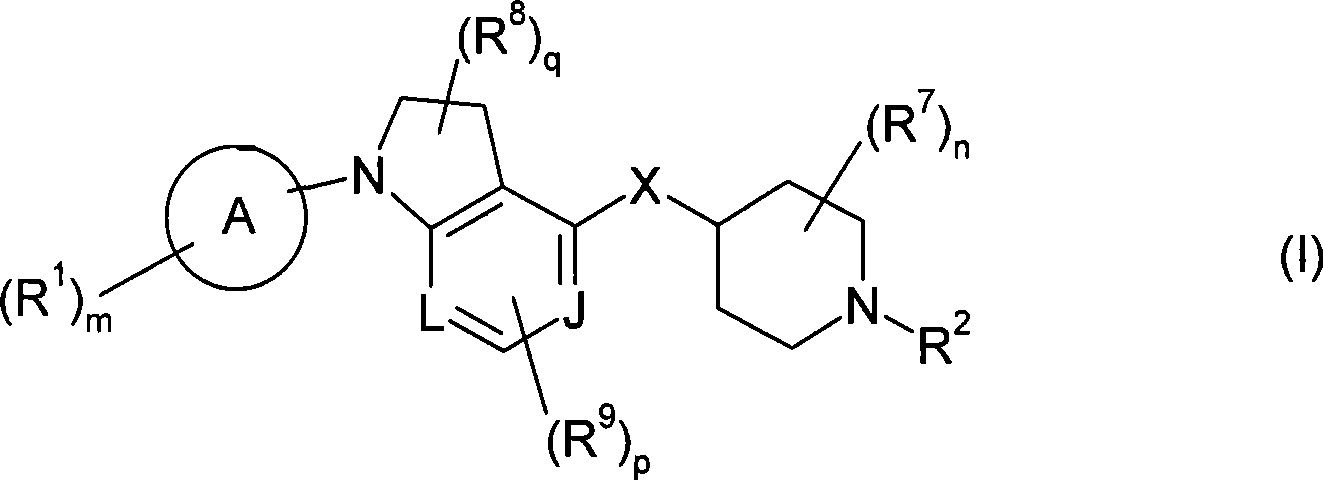
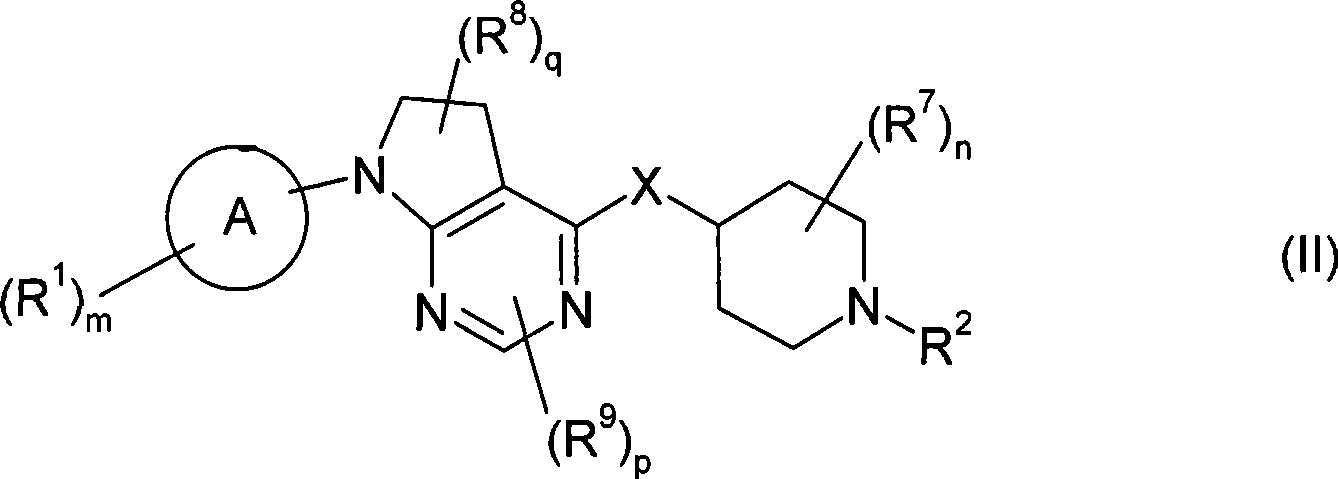

Applications Claiming Priority (2)
| Application Number | Priority Date | Filing Date | Title |
|---|---|---|---|
| US80722506P | 2006-07-13 | 2006-07-13 | |
| US60/807,225 | 2006-07-13 |
Publications (1)
| Publication Number | Publication Date |
|---|---|
| CN101511429A true CN101511429A (en) | 2009-08-19 |
Family
ID=38662918
Family Applications (1)
| Application Number | Title | Priority Date | Filing Date |
|---|---|---|---|
| CNA2007800336627A Pending CN101511429A (en) | 2006-07-13 | 2007-07-12 | Indulines derivatives and gpr119 agonists |
Country Status (5)
| Country | Link |
|---|---|
| US (1) | US8222261B2 (en) |
| EP (1) | EP2043744A2 (en) |
| JP (1) | JP2009543805A (en) |
| CN (1) | CN101511429A (en) |
| WO (2) | WO2008008895A1 (en) |
Cited By (2)
| Publication number | Priority date | Publication date | Assignee | Title |
|---|---|---|---|---|
| CN103958495A (en) * | 2011-06-09 | 2014-07-30 | 理森制药股份公司 | Novel compounds as modulators of GPR-119 |
| CN114920705A (en) * | 2022-07-21 | 2022-08-19 | 山东省食品药品检验研究院 | Preparation method and application of glipizide impurity |
Families Citing this family (49)
| Publication number | Priority date | Publication date | Assignee | Title |
|---|---|---|---|---|
| DOP2006000008A (en) | 2005-01-10 | 2006-08-31 | Arena Pharm Inc | COMBINED THERAPY FOR THE TREATMENT OF DIABETES AND RELATED AFFECTIONS AND FOR THE TREATMENT OF AFFECTIONS THAT IMPROVE THROUGH AN INCREASE IN THE BLOOD CONCENTRATION OF GLP-1 |
| PE20071221A1 (en) * | 2006-04-11 | 2007-12-14 | Arena Pharm Inc | GPR119 RECEPTOR AGONISTS IN METHODS TO INCREASE BONE MASS AND TO TREAT OSTEOPOROSIS AND OTHER CONDITIONS CHARACTERIZED BY LOW BONE MASS, AND COMBINED THERAPY RELATED TO THESE AGONISTS |
| US7638541B2 (en) | 2006-12-28 | 2009-12-29 | Metabolex Inc. | 5-ethyl-2-{4-[4-(4-tetrazol-1-yl-phenoxymethyl)-thiazol-2-yl]-piperidin-1-yl}-pyrimidine |
| KR20100033419A (en) | 2007-07-19 | 2010-03-29 | 메타볼렉스, 인코포레이티드 | N-azacyclic substituted pyrrole, pyrazole, imidazole, triazole and tetrazole derivatives as agonists of the rup3 or gpr119 receptor for the treatment of diabetes and metabolic disorders |
| EP2025674A1 (en) | 2007-08-15 | 2009-02-18 | sanofi-aventis | Substituted tetra hydro naphthalines, method for their manufacture and their use as drugs |
| CN101801954B (en) | 2007-09-20 | 2013-10-09 | Irm责任有限公司 | Compounds and compositions as modulators of GPR119 activity |
| AU2008312948C1 (en) * | 2007-10-16 | 2012-08-09 | Daiichi Sankyo Company, Limited | Pyrimidyl indoline compound |
| EA201001330A1 (en) * | 2008-02-22 | 2011-04-29 | Айрм Ллк | COMPOUNDS AND COMPOSITIONS AS GPR119 ACTIVITY MODULATORS |
| EP2146210A1 (en) | 2008-04-07 | 2010-01-20 | Arena Pharmaceuticals, Inc. | Methods of using A G protein-coupled receptor to identify peptide YY (PYY) secretagogues and compounds useful in the treatment of conditions modulated by PYY |
| WO2009150144A1 (en) * | 2008-06-10 | 2009-12-17 | Inovacia Ab | New gpr119modulators |
| GB0812649D0 (en) * | 2008-07-10 | 2008-08-20 | Prosidion Ltd | Compounds |
| JP2011528369A (en) * | 2008-07-16 | 2011-11-17 | シェーリング コーポレイション | Bicyclic heterocyclic derivatives and methods for their use |
| JPWO2010013849A1 (en) | 2008-08-01 | 2012-01-12 | 日本ケミファ株式会社 | GPR119 agonist |
| WO2010074271A1 (en) * | 2008-12-26 | 2010-07-01 | 武田薬品工業株式会社 | Therapeutic agent for diabetes |
| TW201031668A (en) * | 2009-01-22 | 2010-09-01 | Mitsubishi Tanabe Pharma Corp | Novel pyrrolo[2,3-d] pyrimidine compound |
| WO2010088518A2 (en) * | 2009-01-31 | 2010-08-05 | Kalypsys, Inc. | Heterocyclic modulators of gpr119 for treatment of disease |
| JP5657518B2 (en) | 2009-02-18 | 2015-01-21 | 武田薬品工業株式会社 | Fused heterocyclic compounds |
| JP2012520868A (en) | 2009-03-20 | 2012-09-10 | ファイザー・インク | 3-Oxa-7-azabicyclo [3.3.1] nonane |
| JP2012136439A (en) * | 2009-04-24 | 2012-07-19 | Nippon Chemiphar Co Ltd | Diazaspiroalkane derivative |
| DK2427475T3 (en) * | 2009-05-08 | 2021-02-01 | Techfields Biochem Co Ltd | PRODUCT COMPOSITIONS WITH HIGH PERCEPTION OF PEPTIDES AND PEPTIDE-RELATED COMPOUNDS |
| AR077214A1 (en) | 2009-06-24 | 2011-08-10 | Neurocrine Biosciences Inc | NITROGEN HETEROCICLES AND PHARMACEUTICAL COMPOSITIONS CONTAINING THEM |
| NZ596445A (en) | 2009-06-24 | 2013-04-26 | Boehringer Ingelheim Int | New compounds, pharmaceutical composition and methods relating thereto |
| US20120245344A1 (en) | 2009-08-31 | 2012-09-27 | Nippon Chemiphar Co., Ltd. | Gpr119 agonist |
| US8410127B2 (en) | 2009-10-01 | 2013-04-02 | Metabolex, Inc. | Substituted tetrazol-1-yl-phenoxymethyl-thiazol-2-yl-piperidinyl-pyrimidine salts |
| DK2493871T3 (en) | 2009-10-30 | 2014-11-10 | Prestwick Chemical Sas | New oxime derivatives and their use as allosteric modulators of metabotropic glutamate receptors |
| US20120232073A1 (en) * | 2009-11-23 | 2012-09-13 | Santhosh Francis Neelamkavil | Fused bicyclic pyrimidine derivatives and methods of use thereof |
| WO2011107494A1 (en) | 2010-03-03 | 2011-09-09 | Sanofi | Novel aromatic glycoside derivatives, medicaments containing said compounds, and the use thereof |
| WO2011113947A1 (en) | 2010-03-18 | 2011-09-22 | Boehringer Ingelheim International Gmbh | Combination of a gpr119 agonist and the dpp-iv inhibitor linagliptin for use in the treatment of diabetes and related conditions |
| TW201202230A (en) * | 2010-05-24 | 2012-01-16 | Mitsubishi Tanabe Pharma Corp | Novel quinazoline compound |
| WO2011157827A1 (en) | 2010-06-18 | 2011-12-22 | Sanofi | Azolopyridin-3-one derivatives as inhibitors of lipases and phospholipases |
| US8530413B2 (en) | 2010-06-21 | 2013-09-10 | Sanofi | Heterocyclically substituted methoxyphenyl derivatives with an oxo group, processes for preparation thereof and use thereof as medicaments |
| ES2676209T3 (en) | 2010-06-23 | 2018-07-17 | Metabolex Inc. | Compositions of 5-ethyl-2- {4- [4- (4-tetrazol-1-yl-phenoxymethyl) -thiazol-2-yl] -piperidin-1-yl} -pyrimidine |
| TW201204733A (en) | 2010-06-25 | 2012-02-01 | Kowa Co | Novel condensed pyridine or condensed pyrimidine derivative, and medicinal agent comprising same |
| TW201215387A (en) | 2010-07-05 | 2012-04-16 | Sanofi Aventis | Spirocyclically substituted 1,3-propane dioxide derivatives, processes for preparation thereof and use thereof as a medicament |
| TW201221505A (en) | 2010-07-05 | 2012-06-01 | Sanofi Sa | Aryloxyalkylene-substituted hydroxyphenylhexynoic acids, process for preparation thereof and use thereof as a medicament |
| TW201215388A (en) | 2010-07-05 | 2012-04-16 | Sanofi Sa | (2-aryloxyacetylamino)phenylpropionic acid derivatives, processes for preparation thereof and use thereof as medicaments |
| EP2619198A1 (en) | 2010-09-22 | 2013-07-31 | Arena Pharmaceuticals, Inc. | Modulators of the gpr119 receptor and the treatment of disorders related thereto |
| WO2013037390A1 (en) | 2011-09-12 | 2013-03-21 | Sanofi | 6-(4-hydroxy-phenyl)-3-styryl-1h-pyrazolo[3,4-b]pyridine-4-carboxylic acid amide derivatives as kinase inhibitors |
| EP2760862B1 (en) | 2011-09-27 | 2015-10-21 | Sanofi | 6-(4-hydroxy-phenyl)-3-alkyl-1h-pyrazolo[3,4-b]pyridine-4-carboxylic acid amide derivatives as kinase inhibitors |
| CA2878625A1 (en) | 2012-07-11 | 2014-01-16 | Elcelyx Therapeutics, Inc. | Compositions comprising statins, biguanides and further agents for reducing cardiometabolic risk |
| MX359040B (en) * | 2013-07-17 | 2018-09-13 | Boehringer Ingelheim Int | New azabenzimidazole derivatives. |
| CN103524423B (en) * | 2013-09-18 | 2015-11-04 | 苏州乔纳森新材料科技有限公司 | The preparation method of 4,6-dichloro-pyrimidine-5-acetaldehyde |
| EP3085700B1 (en) | 2013-12-20 | 2018-10-31 | Institute of Pharmacology and Toxicology Academy of Military Medical Sciences P.L.A. China | Novel piperidine carboxamide compound, preparation method, and usage thereof |
| PL3242666T3 (en) | 2015-01-06 | 2025-02-17 | Arena Pharmaceuticals, Inc. | Compound for use in treating conditions related to the s1p1 receptor |
| EA034244B1 (en) * | 2015-04-29 | 2020-01-21 | Арена Фармасьютикалз, Инк. | 1-heteroaryl-indoline-4-carboxamides as modulators of gpr52 useful for the treatment or prevention of disorders related to gpr52 |
| JP6838744B2 (en) | 2015-06-22 | 2021-03-03 | アリーナ ファーマシューティカルズ, インコーポレイテッド | (R) -2- (7- (4-cyclopentyl-3- (trifluoromethyl) benzyloxy) -1,2,3,4-tetrahydrocyclopenta [b] indole-for use in S1P1 receptor-related disorders Crystalline L-arginine salt of 3-yl) acetic acid (Compound 1) |
| US10292983B2 (en) | 2016-08-03 | 2019-05-21 | Cymabay Therapeutics, Inc. | Oxymethylene aryl compounds for treating inflammatory gastrointestinal diseases or gastrointestinal conditions |
| AU2018220521A1 (en) | 2017-02-16 | 2019-09-05 | Arena Pharmaceuticals, Inc. | Compounds and methods for treatment of primary biliary cholangitis |
| KR102859841B1 (en) | 2018-06-06 | 2025-09-12 | 아레나 파마슈티칼스, 인크. | Treatment of conditions associated with the S1P1 receptor |
Citations (3)
| Publication number | Priority date | Publication date | Assignee | Title |
|---|---|---|---|---|
| CN1370159A (en) * | 1999-06-18 | 2002-09-18 | 史密丝克莱恩比彻姆股份公司 | Indole derivatives and their use for treatment of osteoporosis amongst other applications |
| EP1315724A1 (en) * | 2000-09-05 | 2003-06-04 | Smithkline Beecham Plc | A thiazolidinedione derivative and its use as antidiabetic |
| CN1505613A (en) * | 2000-10-10 | 2004-06-16 | ʷ��˿�������ȳ�ķ����˾ | Substituted indoles, pharmaceutical compositions containing such indoles and their use as PPAR-gamma binding agents |
Family Cites Families (9)
| Publication number | Priority date | Publication date | Assignee | Title |
|---|---|---|---|---|
| JPH11310532A (en) * | 1997-04-17 | 1999-11-09 | Takeda Chem Ind Ltd | Thermogenesis promoter |
| JP2000186088A (en) * | 1998-10-16 | 2000-07-04 | Takeda Chem Ind Ltd | Nitrogen-containing condensed heterocyclic ring derivative, its production and use thereof |
| ES2301633T3 (en) * | 2001-04-30 | 2008-07-01 | Glaxo Group Limited | PYRIMIDINS CONDENSED AS ANTAGONISTS OF THE CORTICOTROPINE RELEASE FACTOR (CRF). |
| US20070066590A1 (en) * | 2003-02-24 | 2007-03-22 | Jones Robert M | Phenyl-and pyridylpiperidine-derivatives as modulators of glucose metabolism |
| US7132426B2 (en) * | 2003-07-14 | 2006-11-07 | Arena Pharmaceuticals, Inc. | Fused-aryl and heteroaryl derivatives as modulators of metabolism and the prophylaxis and treatment of disorders related thereto |
| GB0422263D0 (en) * | 2004-10-07 | 2004-11-10 | Glaxo Group Ltd | Novel compounds |
| DOP2006000008A (en) * | 2005-01-10 | 2006-08-31 | Arena Pharm Inc | COMBINED THERAPY FOR THE TREATMENT OF DIABETES AND RELATED AFFECTIONS AND FOR THE TREATMENT OF AFFECTIONS THAT IMPROVE THROUGH AN INCREASE IN THE BLOOD CONCENTRATION OF GLP-1 |
| US20090221644A1 (en) * | 2005-06-30 | 2009-09-03 | Stuart Edward Bradley | Gpcr Agonists |
| US20080186971A1 (en) * | 2007-02-02 | 2008-08-07 | Tarari, Inc. | Systems and methods for processing access control lists (acls) in network switches using regular expression matching logic |
-
2007
- 2007-07-12 CN CNA2007800336627A patent/CN101511429A/en active Pending
- 2007-07-12 JP JP2009519690A patent/JP2009543805A/en active Pending
- 2007-07-12 WO PCT/US2007/073364 patent/WO2008008895A1/en not_active Ceased
- 2007-07-12 WO PCT/US2007/073352 patent/WO2008008887A2/en not_active Ceased
- 2007-07-12 EP EP07799527A patent/EP2043744A2/en not_active Withdrawn
- 2007-07-12 US US12/373,524 patent/US8222261B2/en not_active Expired - Fee Related
Patent Citations (3)
| Publication number | Priority date | Publication date | Assignee | Title |
|---|---|---|---|---|
| CN1370159A (en) * | 1999-06-18 | 2002-09-18 | 史密丝克莱恩比彻姆股份公司 | Indole derivatives and their use for treatment of osteoporosis amongst other applications |
| EP1315724A1 (en) * | 2000-09-05 | 2003-06-04 | Smithkline Beecham Plc | A thiazolidinedione derivative and its use as antidiabetic |
| CN1505613A (en) * | 2000-10-10 | 2004-06-16 | ʷ��˿�������ȳ�ķ����˾ | Substituted indoles, pharmaceutical compositions containing such indoles and their use as PPAR-gamma binding agents |
Cited By (4)
| Publication number | Priority date | Publication date | Assignee | Title |
|---|---|---|---|---|
| CN103958495A (en) * | 2011-06-09 | 2014-07-30 | 理森制药股份公司 | Novel compounds as modulators of GPR-119 |
| CN103958495B (en) * | 2011-06-09 | 2018-06-22 | 理森制药股份公司 | The compound of conditioning agent as GPR-119 |
| CN114920705A (en) * | 2022-07-21 | 2022-08-19 | 山东省食品药品检验研究院 | Preparation method and application of glipizide impurity |
| CN114920705B (en) * | 2022-07-21 | 2022-12-13 | 山东省食品药品检验研究院 | Preparation method and application of glipizide ester impurities |
Also Published As
| Publication number | Publication date |
|---|---|
| WO2008008887A3 (en) | 2008-04-17 |
| US20090318477A1 (en) | 2009-12-24 |
| WO2008008895A1 (en) | 2008-01-17 |
| US8222261B2 (en) | 2012-07-17 |
| EP2043744A2 (en) | 2009-04-08 |
| JP2009543805A (en) | 2009-12-10 |
| WO2008008887A2 (en) | 2008-01-17 |
Similar Documents
| Publication | Publication Date | Title |
|---|---|---|
| US8222261B2 (en) | Chemical compounds | |
| CN101657471B (en) | Bicyclic compounds and their use as antidiabetic agents | |
| TWI341843B (en) | ||
| TWI298071B (en) | ||
| TW593329B (en) | Glucopyranosyloxypyrazole derivatives and pharmaceutical uses thereof | |
| CN103958495B (en) | The compound of conditioning agent as GPR-119 | |
| KR101179451B1 (en) | Nitrogenous fused-ring derivatives, medicinal compositions containing the derivatives, and use thereof as drugs | |
| US20110124652A1 (en) | Chemical Compounds and Uses | |
| WO2002053573A1 (en) | Glucopyranosyloxypyrazole derivatives and use thereof in medicines | |
| CN101115740A (en) | Treatment of substituted pyridyl and pyrimidinyl derivatives and related diseases as metabolic modulators | |
| WO2002064606A1 (en) | Glucopyranosyloxybenzylbenzene derivatives and medicinal use thereof | |
| CN102227429B (en) | 3-aminocyclopentanecarboxamides as chemokine receptor modulators | |
| CN115485273A (en) | N-(Heterocyclyl and heterocyclylalkyl)-3-benzylpyridin-2-amine derivatives as SSTR4 agonists | |
| CN100413878C (en) | Pyrazole derivatives, pharmaceutical compositions containing the derivatives, their medical use and intermediates for their preparation | |
| HK1154240A (en) | Bicyclic compounds and use as antidiabetics | |
| HK1130261B (en) | Bicyclic compounds and use as antidiabetics |
Legal Events
| Date | Code | Title | Description |
|---|---|---|---|
| C06 | Publication | ||
| PB01 | Publication | ||
| C10 | Entry into substantive examination | ||
| SE01 | Entry into force of request for substantive examination | ||
| C02 | Deemed withdrawal of patent application after publication (patent law 2001) | ||
| WD01 | Invention patent application deemed withdrawn after publication |
Application publication date: 20090819 |