CN101502119B - Adaptive geometric partitioning for video decoding - Google Patents
Adaptive geometric partitioning for video decoding Download PDFInfo
- Publication number
- CN101502119B CN101502119B CN2007800288587A CN200780028858A CN101502119B CN 101502119 B CN101502119 B CN 101502119B CN 2007800288587 A CN2007800288587 A CN 2007800288587A CN 200780028858 A CN200780028858 A CN 200780028858A CN 101502119 B CN101502119 B CN 101502119B
- Authority
- CN
- China
- Prior art keywords
- block
- parametric model
- model
- curve
- parametric
- Prior art date
- Legal status (The legal status is an assumption and is not a legal conclusion. Google has not performed a legal analysis and makes no representation as to the accuracy of the status listed.)
- Active
Links
Images


Classifications
-
- H—ELECTRICITY
- H04—ELECTRIC COMMUNICATION TECHNIQUE
- H04N—PICTORIAL COMMUNICATION, e.g. TELEVISION
- H04N19/00—Methods or arrangements for coding, decoding, compressing or decompressing digital video signals
- H04N19/50—Methods or arrangements for coding, decoding, compressing or decompressing digital video signals using predictive coding
- H04N19/503—Methods or arrangements for coding, decoding, compressing or decompressing digital video signals using predictive coding involving temporal prediction
- H04N19/51—Motion estimation or motion compensation
- H04N19/57—Motion estimation characterised by a search window with variable size or shape
-
- H—ELECTRICITY
- H04—ELECTRIC COMMUNICATION TECHNIQUE
- H04N—PICTORIAL COMMUNICATION, e.g. TELEVISION
- H04N19/00—Methods or arrangements for coding, decoding, compressing or decompressing digital video signals
- H04N19/10—Methods or arrangements for coding, decoding, compressing or decompressing digital video signals using adaptive coding
- H04N19/102—Methods or arrangements for coding, decoding, compressing or decompressing digital video signals using adaptive coding characterised by the element, parameter or selection affected or controlled by the adaptive coding
- H04N19/119—Adaptive subdivision aspects, e.g. subdivision of a picture into rectangular or non-rectangular coding blocks
-
- H—ELECTRICITY
- H04—ELECTRIC COMMUNICATION TECHNIQUE
- H04N—PICTORIAL COMMUNICATION, e.g. TELEVISION
- H04N19/00—Methods or arrangements for coding, decoding, compressing or decompressing digital video signals
- H04N19/10—Methods or arrangements for coding, decoding, compressing or decompressing digital video signals using adaptive coding
- H04N19/102—Methods or arrangements for coding, decoding, compressing or decompressing digital video signals using adaptive coding characterised by the element, parameter or selection affected or controlled by the adaptive coding
- H04N19/117—Filters, e.g. for pre-processing or post-processing
-
- H—ELECTRICITY
- H04—ELECTRIC COMMUNICATION TECHNIQUE
- H04N—PICTORIAL COMMUNICATION, e.g. TELEVISION
- H04N19/00—Methods or arrangements for coding, decoding, compressing or decompressing digital video signals
- H04N19/10—Methods or arrangements for coding, decoding, compressing or decompressing digital video signals using adaptive coding
- H04N19/102—Methods or arrangements for coding, decoding, compressing or decompressing digital video signals using adaptive coding characterised by the element, parameter or selection affected or controlled by the adaptive coding
- H04N19/124—Quantisation
- H04N19/126—Details of normalisation or weighting functions, e.g. normalisation matrices or variable uniform quantisers
-
- H—ELECTRICITY
- H04—ELECTRIC COMMUNICATION TECHNIQUE
- H04N—PICTORIAL COMMUNICATION, e.g. TELEVISION
- H04N19/00—Methods or arrangements for coding, decoding, compressing or decompressing digital video signals
- H04N19/10—Methods or arrangements for coding, decoding, compressing or decompressing digital video signals using adaptive coding
- H04N19/102—Methods or arrangements for coding, decoding, compressing or decompressing digital video signals using adaptive coding characterised by the element, parameter or selection affected or controlled by the adaptive coding
- H04N19/13—Adaptive entropy coding, e.g. adaptive variable length coding [AVLC] or context adaptive binary arithmetic coding [CABAC]
-
- H—ELECTRICITY
- H04—ELECTRIC COMMUNICATION TECHNIQUE
- H04N—PICTORIAL COMMUNICATION, e.g. TELEVISION
- H04N19/00—Methods or arrangements for coding, decoding, compressing or decompressing digital video signals
- H04N19/10—Methods or arrangements for coding, decoding, compressing or decompressing digital video signals using adaptive coding
- H04N19/134—Methods or arrangements for coding, decoding, compressing or decompressing digital video signals using adaptive coding characterised by the element, parameter or criterion affecting or controlling the adaptive coding
- H04N19/146—Data rate or code amount at the encoder output
-
- H—ELECTRICITY
- H04—ELECTRIC COMMUNICATION TECHNIQUE
- H04N—PICTORIAL COMMUNICATION, e.g. TELEVISION
- H04N19/00—Methods or arrangements for coding, decoding, compressing or decompressing digital video signals
- H04N19/10—Methods or arrangements for coding, decoding, compressing or decompressing digital video signals using adaptive coding
- H04N19/134—Methods or arrangements for coding, decoding, compressing or decompressing digital video signals using adaptive coding characterised by the element, parameter or criterion affecting or controlling the adaptive coding
- H04N19/156—Availability of hardware or computational resources, e.g. encoding based on power-saving criteria
-
- H—ELECTRICITY
- H04—ELECTRIC COMMUNICATION TECHNIQUE
- H04N—PICTORIAL COMMUNICATION, e.g. TELEVISION
- H04N19/00—Methods or arrangements for coding, decoding, compressing or decompressing digital video signals
- H04N19/10—Methods or arrangements for coding, decoding, compressing or decompressing digital video signals using adaptive coding
- H04N19/134—Methods or arrangements for coding, decoding, compressing or decompressing digital video signals using adaptive coding characterised by the element, parameter or criterion affecting or controlling the adaptive coding
- H04N19/157—Assigned coding mode, i.e. the coding mode being predefined or preselected to be further used for selection of another element or parameter
- H04N19/159—Prediction type, e.g. intra-frame, inter-frame or bidirectional frame prediction
-
- H—ELECTRICITY
- H04—ELECTRIC COMMUNICATION TECHNIQUE
- H04N—PICTORIAL COMMUNICATION, e.g. TELEVISION
- H04N19/00—Methods or arrangements for coding, decoding, compressing or decompressing digital video signals
- H04N19/10—Methods or arrangements for coding, decoding, compressing or decompressing digital video signals using adaptive coding
- H04N19/169—Methods or arrangements for coding, decoding, compressing or decompressing digital video signals using adaptive coding characterised by the coding unit, i.e. the structural portion or semantic portion of the video signal being the object or the subject of the adaptive coding
- H04N19/17—Methods or arrangements for coding, decoding, compressing or decompressing digital video signals using adaptive coding characterised by the coding unit, i.e. the structural portion or semantic portion of the video signal being the object or the subject of the adaptive coding the unit being an image region, e.g. an object
- H04N19/176—Methods or arrangements for coding, decoding, compressing or decompressing digital video signals using adaptive coding characterised by the coding unit, i.e. the structural portion or semantic portion of the video signal being the object or the subject of the adaptive coding the unit being an image region, e.g. an object the region being a block, e.g. a macroblock
-
- H—ELECTRICITY
- H04—ELECTRIC COMMUNICATION TECHNIQUE
- H04N—PICTORIAL COMMUNICATION, e.g. TELEVISION
- H04N19/00—Methods or arrangements for coding, decoding, compressing or decompressing digital video signals
- H04N19/10—Methods or arrangements for coding, decoding, compressing or decompressing digital video signals using adaptive coding
- H04N19/189—Methods or arrangements for coding, decoding, compressing or decompressing digital video signals using adaptive coding characterised by the adaptation method, adaptation tool or adaptation type used for the adaptive coding
-
- H—ELECTRICITY
- H04—ELECTRIC COMMUNICATION TECHNIQUE
- H04N—PICTORIAL COMMUNICATION, e.g. TELEVISION
- H04N19/00—Methods or arrangements for coding, decoding, compressing or decompressing digital video signals
- H04N19/44—Decoders specially adapted therefor, e.g. video decoders which are asymmetric with respect to the encoder
-
- H—ELECTRICITY
- H04—ELECTRIC COMMUNICATION TECHNIQUE
- H04N—PICTORIAL COMMUNICATION, e.g. TELEVISION
- H04N19/00—Methods or arrangements for coding, decoding, compressing or decompressing digital video signals
- H04N19/50—Methods or arrangements for coding, decoding, compressing or decompressing digital video signals using predictive coding
-
- H—ELECTRICITY
- H04—ELECTRIC COMMUNICATION TECHNIQUE
- H04N—PICTORIAL COMMUNICATION, e.g. TELEVISION
- H04N19/00—Methods or arrangements for coding, decoding, compressing or decompressing digital video signals
- H04N19/50—Methods or arrangements for coding, decoding, compressing or decompressing digital video signals using predictive coding
- H04N19/503—Methods or arrangements for coding, decoding, compressing or decompressing digital video signals using predictive coding involving temporal prediction
- H04N19/507—Methods or arrangements for coding, decoding, compressing or decompressing digital video signals using predictive coding involving temporal prediction using conditional replenishment
-
- H—ELECTRICITY
- H04—ELECTRIC COMMUNICATION TECHNIQUE
- H04N—PICTORIAL COMMUNICATION, e.g. TELEVISION
- H04N19/00—Methods or arrangements for coding, decoding, compressing or decompressing digital video signals
- H04N19/50—Methods or arrangements for coding, decoding, compressing or decompressing digital video signals using predictive coding
- H04N19/503—Methods or arrangements for coding, decoding, compressing or decompressing digital video signals using predictive coding involving temporal prediction
- H04N19/51—Motion estimation or motion compensation
- H04N19/537—Motion estimation other than block-based
- H04N19/543—Motion estimation other than block-based using regions
-
- H—ELECTRICITY
- H04—ELECTRIC COMMUNICATION TECHNIQUE
- H04N—PICTORIAL COMMUNICATION, e.g. TELEVISION
- H04N19/00—Methods or arrangements for coding, decoding, compressing or decompressing digital video signals
- H04N19/60—Methods or arrangements for coding, decoding, compressing or decompressing digital video signals using transform coding
- H04N19/61—Methods or arrangements for coding, decoding, compressing or decompressing digital video signals using transform coding in combination with predictive coding
-
- H—ELECTRICITY
- H04—ELECTRIC COMMUNICATION TECHNIQUE
- H04N—PICTORIAL COMMUNICATION, e.g. TELEVISION
- H04N19/00—Methods or arrangements for coding, decoding, compressing or decompressing digital video signals
- H04N19/70—Methods or arrangements for coding, decoding, compressing or decompressing digital video signals characterised by syntax aspects related to video coding, e.g. related to compression standards
Landscapes
- Engineering & Computer Science (AREA)
- Multimedia (AREA)
- Signal Processing (AREA)
- Computing Systems (AREA)
- Theoretical Computer Science (AREA)
- Compression Or Coding Systems Of Tv Signals (AREA)
Abstract
Description
交叉引用相关申请Cross reference to related applications
本申请要求2006年8月2日提交的美国临时专利申请序号60/834,993的优先权,其在此整个被引入作为参考。此外,本申请涉及共同转让的、题为“用于视频解码的自适应几何分割方法和设备(METHODS ANDAPPARATUS FOR ADAPTIVE GEOMETRIC PARTITIONING FOR VIDEODECODING)”的、律师签号为PU070128的非临时专利申请,其在此被引入作为参考,并且随此同时提交。This application claims priority to US Provisional Patent Application Serial No. 60/834,993, filed August 2, 2006, which is hereby incorporated by reference in its entirety. In addition, this application relates to a commonly assigned non-provisional patent application entitled "METHODS ANDAPPARATUS FOR ADAPTIVE GEOMETRIC PARTITIONING FOR VIDEODECODING" and attorney signature number PU070128, which is filed in This is incorporated by reference and filed herewith.
技术领域 technical field
本发明原理一般涉及视频编码和解码,并且尤其涉及用于视频编码和解码的自适应几何分割方法和设备。The present principles relate generally to video encoding and decoding, and more particularly to adaptive geometric partitioning methods and apparatus for video encoding and decoding.
背景技术 Background technique
大多数视频编码技术都利用预测加残差编码来模拟视频图像。其它方法也可能将预测作为一个步骤而考虑到信号变换的某一处理中,如当利用提升方案产生小波变换时(有或没有运动补偿)。基于分块对每一帧执行预测。即,以树结构将每一帧分割成块或嵌套块集合,然后利用帧内或帧间预测器加上某种残差编码对每一个块分割进行编码。通过定义网格区来执行将帧分割成块,网格区通常是遍布全帧的块(被称为宏块),然后也可进一步将每个宏块分割成更小的块(也称为子块或子宏块)。典型地,具有不同纹理、颜色、平滑度和/或不同运动的目标和/或帧区边界上的宏块,倾向于进一步被分割成子块,以便使宏块编码尽可能的高效,同时得到尽可能高的客观和/或主观质量。Most video coding techniques utilize prediction plus residual coding to simulate video images. Other methods may also take prediction into account as a step in some processing of the signal transformation, such as when using a lifting scheme to generate a wavelet transform (with or without motion compensation). Prediction is performed for each frame on a tile basis. That is, each frame is partitioned into blocks or nested sets of blocks in a tree structure, and each block partition is encoded using an intra or inter predictor plus some kind of residual coding. The division of the frame into blocks is performed by defining a grid of regions, usually blocks (called macroblocks) spread over the entire frame, which can then also be further divided into smaller blocks (also called macroblocks). sub-block or sub-macroblock). Typically, objects with different texture, color, smoothness and/or different motion and/or macroblocks on frame region boundaries tend to be further partitioned into sub-blocks in order to make macroblock coding as efficient as possible while getting as much Possibly high objective and/or subjective quality.
在最近研究中,树结构已显示出对于图像信息编码是次最优的。这些研究支持,基于树的图像编码不能对通过规则边缘或轮廓分割的不同区域进行最优编码(在此,区域被认为具有意义明确且一致的特性,如平坦、平滑或固定纹理)。该问题起因于以下事实:树结构不能最优地捕获沿边缘、轮廓或有向纹理而存在的几何冗余。该概念意味着,宏块的自适应树分割即使优于简单的固定尺寸帧分割,也仍然不足以最优地高效捕获二维数据中所包括的几何信息以供编码使用。In recent studies, tree structures have been shown to be sub-optimal for image information encoding. These studies support that tree-based image coding cannot optimally encode distinct regions segmented by regular edges or contours (where regions are considered to have well-defined and consistent properties such as flat, smooth, or fixed textures). This problem arises from the fact that tree structures do not optimally capture the geometric redundancy that exists along edges, contours or directed textures. This concept implies that adaptive tree partitioning of macroblocks, even if superior to simple fixed-size frame partitioning, is still not sufficient to optimally and efficiently capture the geometric information contained in two-dimensional data for use in encoding.
帧分割是高效视频编码中非常重要的一个过程。最近的视频压缩技术,如国际标准化组织/国际电工委员会(ISO/IEC)运动图像专家组4(MPEG-4)第10部分-先进视频编码(AVC)标准/国际电信联盟电信标准化部(ITU-T)H.264建议(以下称为“MPEG-4 AVC标准”),使用基于树的帧分割。这看来比简单的均匀块分割更有效,均匀块分割典型地用于更早视频编码标准和建议中,如ISO/IEC MPEG-2标准和ITU-T H.263建议(以下称为“H.263建议”)。然而,基于树的帧分割仍然不能尽可能高效地对视频信息编码,因为它不能高效地捕获二维数据的几何结构。Frame segmentation is a very important process in efficient video coding. Recent video compression techniques such as the International Organization for Standardization/International Electrotechnical Commission (ISO/IEC) Moving Picture Experts Group 4 (MPEG-4) Part 10 - Advanced Video Coding (AVC) standard/International Telecommunication Union Telecommunication Standardization Sector (ITU- T) Recommendation H.264 (hereinafter referred to as "MPEG-4 AVC standard"), using tree-based frame segmentation. This appears to be more efficient than simple uniform block partitioning, which is typically used in earlier video coding standards and recommendations, such as the ISO/IEC MPEG-2 standard and the ITU-T Recommendation H.263 (hereinafter referred to as "H .263 Recommendation"). However, tree-based frame segmentation still cannot encode video information as efficiently as it can efficiently capture the geometric structure of 2D data.
在当前主要视频编码中都采用树结构宏块分割。ITU-T H.261建议(以下称为“H.261建议”)、ISO/IEC MPEG-1标准和ISO/IEC MPEG-2标准/ITU-T H.263建议(以下称为“MPEG-2标准”)只支持16×16宏块(MB)分割。ISO/IEC MPEG-4第10部分的AVC标准/ITU-T H.264建议(以下称为“MPEG-4 AVC标准”)简单描述文件或ITU-T H.263(+)建议都支持16×16MB的16×16和8×8分块。MPEG-4 AVC标准支持树结构分级宏块分块。16×16MB可被分割成大小为16×8、8×16或8×8的宏块分块。8×8分块也被称为子宏块。子宏块可进一步分解为8×4、4×8和4×4大小的子宏块分块。转到图1,一般用附图标记100来指示MPEG-4 AVC标准宏块分割集合。尤其是,用附图标记110来指示宏块分块,并且用附图标记120来指示子宏块分块。在最近研究中,树结构已显示出对于图像信息编码是次最优的。这些研究当中的一些研究表明,基于树的编码系统不能对通过规则边缘或轮廓分割的不同区域进行最优编码。Tree-structured macroblock segmentation is adopted in current major video coding. ITU-T Recommendation H.261 (hereinafter referred to as "H.261 Recommendation"), ISO/IEC MPEG-1 Standard and ISO/IEC MPEG-2 Standard/ITU-T Recommendation H.263 (hereinafter referred to as "MPEG-2 Standard") only supports 16×16 macroblock (MB) partitions. 16× 16×16 and 8×8 tiles of 16MB. The MPEG-4 AVC standard supports tree-structured hierarchical macroblock partitioning. The 16x16MB can be partitioned into macroblock partitions of size 16x8, 8x16 or 8x8. 8x8 partitions are also referred to as sub-macroblocks. Sub-macroblocks can be further decomposed into 8×4, 4×8 and 4×4 sub-macroblock partitions. Turning to FIG. 1 , a set of MPEG-4 AVC standard macroblock partitions is indicated generally by
关于该主题的一些先前工作在实验上确定了,需要其它类型的块分割、而不是简单树分割所提供的块分割,来用于运动补偿。除基于树的块分割以外,这些技术建议使用某些能够更适合于运动边缘的附加宏块分块,以供运动估计和补偿之用。Some previous work on this topic has experimentally determined that other types of block partitioning than that provided by simple tree partitioning are needed for motion compensation. In addition to tree-based block partitioning, these techniques suggest the use of some additional macroblock partitioning that can better accommodate moving edges for motion estimation and compensation.
在H.263编解码器框架内的一种先有技术方法中(以下称为“第一先有技术方法”),建议使用两种附加的对角线运动补偿方式。当选择这些方式之一时,相关宏块被分割成通过对角线段划分的两个相似三角形。取决于编码方式,对于其中一种方式,对角线段从左下角到右上角,对于第二种方式,从左上角到右下角。转到图2A和2B,一般分别用附图标记200和250来指示与在此描述的指定的“第一先有技术方法”对应的附加运动补偿编码方式。运动补偿编码方式200对应于右上对角线边缘编码方式,而运动补偿编码方式250对应于左上对角线边缘编码方式。In one prior art approach within the framework of the H.263 codec (hereafter referred to as "first prior art approach"), two additional diagonal motion compensation methods are proposed. When one of these ways is selected, the associated macroblock is partitioned into two similar triangles divided by diagonal line segments. Depending on the encoding method, for one method, the diagonal segment goes from bottom left to top right, and for the second, from top left to bottom right. Turning to Figures 2A and 2B, an additional motion compensation coding scheme corresponding to the designated "first prior art method" described herein is indicated generally by
从这些方式只是16×8或8×16运动补偿方式在固定对角线方向上的简单变化这个意义上讲,第一先有技术方法是非常受限的。它们所定义的边缘非常粗糙,并且不足以精确地拟合视频帧中存在的多种边缘。没有对几何信息的显式编码,这削弱了在编码器中对该信息进行适当的处理。在编码方式列表中引入这两种方式,这增加了位于编码方式列表中这两种方式后面的其它编码方式的编码开销。The first prior art approach is very limited in the sense that these modes are simply variations of the 16x8 or 8x16 motion compensation modes in a fixed diagonal direction. The edges they define are very rough and not precise enough to fit the wide variety of edges present in video frames. There is no explicit encoding of geometric information, which impairs proper processing of this information in the encoder. Introducing these two methods in the encoding method list increases the encoding overhead of other encoding methods that follow these two methods in the encoding method list.
第一先有技术方法的直接演化涉及其它三种先有技术方法,在此分别被称为第二、第三和第四先有技术方法。在这些工作中,全都引入了比第一先有技术方法中所描述的方式集合更大的运动补偿编码方式集合。相对于第二、第三和第四先有技术方法描述的系统引入了包括有向分块的附加编码方式大集合。这些方式是16×8、8×16方式的不同转换版本以及第一先有技术方法中提议的具有Z字形廓线的方式的不同转换版本。转到图3,一般用附图标记300来指示与指定的“第二”、“第三”和“第四先有技术方法”相关的运动补偿编码方式。示出了18种运动补偿编码方式。The direct evolution of the first prior art approach involves three other prior art approaches, referred to herein as the second, third and fourth prior art approaches, respectively. In these works, all introduce a larger set of motion compensated coding schemes than that described in the first prior art method. The systems described with respect to the second, third and fourth prior art approaches introduce a large set of additional coding schemes including directed blocking. These modes are different converted versions of the 16x8, 8x16 modes and the mode with the zigzag profile proposed in the first prior art method. Turning to FIG. 3, the motion compensated coding schemes associated with the designated "second", "third" and "fourth prior art methods" are indicated generally by reference numeral 300. Referring to FIG. Eighteen kinds of motion compensation coding schemes are shown.
和第一先有技术方法的情况一样,第二、第三和第四先有技术方法中为运动补偿定义的分块对于视频帧内容是非常粗糙和不精确的。即使有向分块集合在数量上超过第一先有技术方法中的分块集合,它们也仍然不足以精确地对视频帧中存在的多种边缘进行高效编码。在这种情况下,没有对几何信息的显式编码,这这削弱了在编码器中对几何信息进行适当处理的能力。而且,为对大得多的方式集合进行编码而引入的开销,对方式列表中有向方式后面的无方向方式产生更坏影响。As in the case of the first prior art method, the partitioning defined for motion compensation in the second, third and fourth prior art methods is very coarse and imprecise to the video frame content. Even if the directed tile sets outnumber those in the first prior art method, they are still insufficient to precisely and efficiently encode the various edges present in video frames. In this case, there is no explicit encoding of the geometric information, which impairs the ability to properly process the geometric information in the encoder. Also, the overhead introduced for encoding a much larger set of ways has an even worse impact on undirected ways following a directed way in the way list.
第五先有技术方法提议,除了第二、第三和第四先有技术方法以前在基于运动补偿的预测方面的用途外,还在第二、第三和第四先有技术方法的有向方式分块内使用帧内预测。第五先有技术方法的缺陷继承于第二、第三和第四先有技术方法,因此前面段落中阐述的所有那些缺陷也都适用于第五先有技术方法。The fifth prior art method proposes to use the directed Intra prediction is used within the mode block. The disadvantages of the fifth prior art method are inherited from the second, third and fourth prior art methods, so all those disadvantages set out in the previous paragraphs also apply to the fifth prior art method.
第六先有技术方法根据文献中发现的研究工作提出了最灵活的框架。第六先有技术方法建议只引入两种方式,其中利用连接两个边界点的线段来产生块分块。所建议的运动补偿编码方式中的第一种方式将宏块分割成两个分块,这两个分块是通过连接两个宏块边界点的线段来实现分割的。转到图4A,一般用附图标记400来指示根据在此描述的指定“第六先有技术方法”的第一运动补偿编码方式的宏块分割。A sixth prior art approach presents the most flexible framework based on research work found in the literature. A sixth prior art approach proposes to introduce only two ways in which block divisions are generated using line segments connecting two boundary points. The first one of the proposed motion compensation coding schemes divides the macroblock into two sub-blocks, and the two sub-blocks are divided by a line segment connecting the boundary points of the two macroblocks. Turning to FIG. 4A , macroblock partitioning according to a first motion compensated coding scheme designated "sixth prior art method" described herein is generally indicated by the
所建议的第二种方式基于以下过程:将宏块初步分割成子块,然后利用连接每个子块边界上两个点的线段来分割每个子块。转到图4B,一般用附图标记450来指示根据在此描述的指定“第六先有技术方法”的第二运动补偿编码方式的宏块分割。The second proposed approach is based on the following procedure: a macroblock is initially partitioned into subblocks, and each subblock is then partitioned with a line segment connecting two points on the boundary of each subblock. Turning to FIG. 4B , macroblock partitioning according to a second motion compensated coding scheme designated "sixth prior art method" described herein is generally indicated by reference numeral 450 .
对于第六先有技术方法中概述的方案,仍然存在几种缺陷,包括以下。With the solution outlined in the sixth prior art approach, several drawbacks still exist, including the following.
在关于第六先有技术方法的第一缺陷中,被定义为通过线段连接两个边界点的块分割不能高效处理更复杂边界或轮廓的情况。为此,第六先有技术方法提议将宏块分割成子块,并在每个子块中利用线段来连接点,以便近似更复杂的形状,这是低效的。In the first drawback with respect to the sixth prior art method, block segmentation, defined as connecting two boundary points by a line segment, cannot efficiently handle the case of more complex boundaries or contours. For this reason, the sixth prior art method proposes to divide the macroblock into sub-blocks and use line segments to connect points in each sub-block in order to approximate more complex shapes, which is inefficient.
在关于第六先有技术方法的第二缺陷中,只为运动补偿考虑分块,而不管在所产生的分块内使用某种帧内编码技术。这禁止了所建议的技术去处理暴露效应(在排序期间新数据从目标后面出现的情形),或禁止所建议的技术仅仅以非时间预测方式对任何视频帧中的信息进行编码。In a second drawback with respect to the sixth prior art method, only blocks are considered for motion compensation, regardless of the use of some intra-coding technique within the generated blocks. This prohibits the proposed technique from dealing with exposure effects (the situation where new data emerges from behind objects during sequencing), or from simply encoding information in any video frame in a non-temporal predictive manner.
在关于第六先有技术方法的第三缺陷中,在失真和编码代价方面,通过对边界点编码而实现的分块编码不是足够高效的。这是因为,它们不能适当表现分块边界的几何特性;因此,它们不能适当显示视频帧中数据的几何特性。实际上,视频帧中的数据典型地呈现几何信息的不同统计信息,如不同视频分量和/或目标的局部取向和局部位置。简单使用边界点并不能反映这种信息。因而,不能采用这种统计信息供编码用。In a third drawback with respect to the sixth prior art method, the block coding achieved by coding the boundary points is not efficient enough in terms of distortion and coding cost. This is because they do not properly represent the geometry of the tile boundaries; therefore, they do not properly represent the geometry of the data in the video frame. In practice, data in video frames typically present different statistics of geometric information, such as local orientations and local positions of different video components and/or objects. Simple use of boundary points does not reflect this information. Thus, such statistical information cannot be used for encoding purposes.
在关于第六先有技术方法的第四缺陷中,不同的视频压缩质量具有不同的几何信息精度要求,以便在失真与编码代价之间实现最佳折衷。第六先有技术方法不能根据视频压缩质量,去修改被发送用于对块分块编码的信息。而且,因为第六先有技术方法没有,并且/或者相反,描述分块几何信息的适当表示,所以第六先有技术方法不支持(如果需要的话)以高于某种几何信息的精度对另一种几何信息进行编码。In a fourth drawback with respect to the sixth prior art method, different video compression qualities have different geometric information precision requirements in order to achieve an optimal trade-off between distortion and coding cost. A sixth prior art method cannot modify the information sent for encoding the blocks block-by-block according to the video compression quality. Also, because the sixth prior art method does not, and/or instead, describe an appropriate representation of block geometry information, the sixth prior art method does not support (if needed) the accuracy of one geometry information for another A geometrical information is encoded.
在关于第六先有技术方法的第五缺陷中,第六先有技术方法看来似乎不能处理那些位于分块边界上、且部分在边界一侧而部分在边界另一侧的像素。当需要时,这些像素应该能够混合来自分块两边的信息。In a fifth drawback with respect to the sixth prior art method, the sixth prior art method does not appear to be able to handle pixels that lie on a tile boundary and are partly on one side of the boundary and partly on the other side of the boundary. These pixels should be able to mix information from both sides of the tile when needed.
转到图8,一般用附图标记800来指示一种能够根据MPEG-4 AVC标准执行视频编码的视频编码器。Turning to FIG. 8, a video encoder capable of performing video encoding according to the MPEG-4 AVC standard is indicated generally by the
视频编码器800包括帧排序缓冲器810,该帧排序缓冲器810具有与组合器885的非反相输入进行信号通信的输出。组合器885的输出以信号通信方式和变换与量化器825的第一输入连接。变换与量化器825的输出以信号通信方式与熵编码器845的第一输入及逆变换与逆量化器850的第一输入连接。熵编码器845的输出以信号通信方式与组合器890的第一非反相输入连接。组合器890的输出以信号通信方式与输出缓冲器835的第一输入连接。
编码器控制器805的第一输出以信号通信方式与以下连接:帧排序缓冲器810的第二输入、逆变换与逆量化器850的第二输入、图像型决策模块815的输入、宏块型(MB型)决策模块820的输入、帧内预测模块860的第二输入、解块滤波器865的第二输入、运动补偿器870的第一输入、运动估计器875的第一输入以及参考图像缓冲器880的第二输入。A first output of
编码器控制器805的第二输出以信号通信方式与以下连接:补充增强信息(SEI)插入器830的第一输入、变换与量化器825的第二输入、熵编码器845的第二输入、输出缓冲器835的第二输入以及序列参数集(SPS)和图像参数集(PPS)插入器840的输入。A second output of the
图像型决策模块815的第一输出以信号通信方式与帧排序缓冲器810的第三输入连接。图像型决策模块815的第二输出以信号通信方式与宏块型决策模块820的第二输入连接。A first output of the image-
SPS和PPS插入器840的输出以信号通信方式与组合器890的第三非反相输入连接。The output of the SPS and
逆量化与逆变换器850的输出以信号通信方式与组合器825的第一非反相输入连接。组合器825的输出以信号通信方式与帧内预测模块860的第一输入以及解块滤波器865的第一输入连接。解块滤波器865的输出以信号通信方式与参考图像缓冲器880的第一输入连接。参考图像缓冲器880的输出以信号通信方式与运动估计器875的第二输入连接。运动估计器875的第一输出以信号通信方式与运动补偿器870的第二输入连接。运动估计器875的第二输出以信号通信方式与熵编码器845的第三输入连接。The output of inverse quantization and
运动补偿器870的输出以信号通信方式与开关897的第一输入连接。帧内预测模块860的输出以信号通信方式与开关897的第二输入连接。宏块型决策模块820的输出以信号通信方式与开关897的第三输入连接。开关897的输出以信号通信方式与组合器825的第二非反相输入连接。The output of the
帧排序缓冲器810和编码器控制器805的输入可用作编码器800的输入,用于接收输入图像801。而且,SEI插入器830的输入可用作编码器800的输入,用于接收元数据。输出缓冲器835的输出可用作编码器800的输出,用于输出位流。The
转到图10,一般用附图标记1000来指示一种能够根据MPEG-4 AVC标准执行视频解码的视频解码器。Turning to FIG. 10, a video decoder capable of performing video decoding according to the MPEG-4 AVC standard is indicated generally by the
视频解码器1000包括输入缓冲器1010,该输入缓冲器1010具有以信号通信方式与熵解码器1045的第一输入连接的输出。熵解码器1045的第一输出以信号通信方式和逆变换与逆量化器1050的第一输入连接。逆变换与逆量化器1050的输出以信号通信方式与组合器1025的第二非反相输入连接。组合器1025的输出以信号通信方式与解块滤波器1065的第二输入以及帧内预测模块1060的第一输入连接。解块滤波器1065的第二输出以信号通信方式与参考图像缓冲器1080的第一输入连接。参考图像缓冲器1080的输出以信号通信方式与运动补偿器1070的第二输入连接。
熵解码器1045的第二输出以信号通信方式与运动补偿器1070的第三输入以及解块滤波器1065的第一输入连接。熵解码器1045的第三输出以信号通信方式与解码器控制器1005的输入连接。解码器控制器1005的第一输出以信号通信方式与熵解码器1045的第二输入连接。解码器控制器1005的第二输出以信号通信方式和逆变换与逆量化器1050的第二输入连接。解码器控制器1005的第三输出以信号通信方式与解块滤波器1065的第三输入连接。解码器控制器1005的第四输出以信号通信方式与帧内预测模块1060的第二输入、运动补偿器1070的第一输入以及参考图像缓冲器1080的第二输入连接。A second output of the
运动补偿器1070的输出以信号通信方式与开关1097的第一输入连接。帧内预测模块1060的输出以信号通信方式与开关1097的第二输入连接。开关1097的输出以信号通信方式与组合器1025的第一非反相输入连接。The output of the
输入缓冲器1010的输入可用作解码器1000的输入,用于接收输入位流。解块滤波器1065的第一输出可用作解码器1000的输出,用于输出输出图像。The input of the
发明内容 Contents of the invention
本发明原理致力于解决先有技术的这些和其它缺陷及缺点,本发明原理针对用于视频编码和解码的自适应几何分割方法和设备。These and other deficiencies and shortcomings of the prior art are addressed by the present principles, which are directed to adaptive geometric partitioning methods and apparatus for video encoding and decoding.
根据本发明原理一方面,提供一种设备。该设备包括编码器,该编码器用于通过响应至少一种参数模型自适应地分割图像至少一部分,来编码与图像对应的图像数据。该至少一种参数模型包括至少一条曲线的隐式和显式公式至少之一。In accordance with one aspect of the present principles, an apparatus is provided. The apparatus includes an encoder for encoding image data corresponding to an image by adaptively segmenting at least a portion of the image in response to at least one parametric model. The at least one parametric model includes at least one of an implicit and explicit formulation of the at least one curve.
根据本发明原理另一方面,提供一种方法。该方法包括,通过响应至少一种参数模型自适应地分割图像至少一部分,来编码与图像对应的图像数据。该至少一种参数模型包括至少一条曲线的隐式和显式公式至少之一。According to another aspect of the principles of the present invention, a method is provided. The method includes encoding image data corresponding to an image by adaptively segmenting at least a portion of the image in response to at least one parametric model. The at least one parametric model includes at least one of an implicit and explicit formulation of the at least one curve.
根据本发明原理另一方面,提供一种设备。该设备包括解码器,该解码器用于通过利用至少一种参数模型重构图像分块的至少一部分,来解码与图像对应的图像数据。该至少一种参数模型包括至少一条曲线的隐式和显式公式至少之一。In accordance with another aspect of the present principles, an apparatus is provided. The apparatus includes a decoder for decoding image data corresponding to an image by reconstructing at least a portion of an image block using at least one parametric model. The at least one parametric model includes at least one of an implicit and explicit formulation of the at least one curve.
根据本发明原理的又一方面,提供一种方法。该方法包括,通过利用至少一种参数模型重构图像分块的至少一部分,来解码与图像对应的图像数据。该至少一种参数模型包括至少一条曲线的隐式和显式公式至少之一。According to yet another aspect of the present principles, a method is provided. The method includes decoding image data corresponding to an image by reconstructing at least a portion of an image block using at least one parametric model. The at least one parametric model includes at least one of an implicit and explicit formulation of the at least one curve.
由以下将要连同附图一起阅读的示范性实施例的详细说明,本发明原理的这些和其它方面、特征及优点将变得很清楚。These and other aspects, features and advantages of the principles of the present invention will become apparent from the following detailed description of the exemplary embodiments, to be read in conjunction with the accompanying drawings.
附图说明 Description of drawings
根据以下例图,可以更好地理解本发明原理,其中:The principles of the present invention can be better understood according to the following illustrations, wherein:
图1示出了本发明原理可应用的MPEG-4 AVC标准宏块分割集的图;Fig. 1 shows the diagram of the MPEG-4 AVC standard macroblock partition set to which the principles of the present invention are applicable;
图2A和2B示出了与在此描述的指定为“第一先有技术方法”对应的附加运动补偿编码方式的图;Figures 2A and 2B show diagrams of an additional motion compensation coding scheme corresponding to what is described herein designated as "first prior art method";
图3示出了与在此描述的指定为“第二”、“第三”和“第四先有技术方法”有关的运动补偿编码方式的图;Figure 3 shows a diagram of the motion compensated coding schemes associated with the methods described herein designated as "second", "third" and "fourth prior art methods";
图4A示出了根据在此描述的指定为“第六先有技术方法”的第一运动补偿编码方式的宏块分割图;Figure 4A shows a macroblock partition diagram according to a first motion compensated coding scheme designated as "sixth prior art method" described herein;
图4B示出了根据在此描述的指定为“第六先有技术方法”的第二运动补偿编码方式的宏块分割图;Figure 4B shows a macroblock partition diagram according to a second motion compensated coding scheme designated as "sixth prior art method" described herein;
图5示出了根据本发明原理实施例的,基于多项式模型的具有分块P0和P1的平滑边界分块图;Fig. 5 shows a smooth boundary block diagram with blocks P0 and P1 based on a polynomial model according to an embodiment of the principles of the present invention;
图6示出了根据本发明原理实施例的,把具有参数描述几何结构(角度和位置)的一阶多项式用作参数模型的例图;Fig. 6 shows an example diagram using a first-order polynomial with parameters describing the geometry (angle and position) as a parametric model, according to an embodiment of the principles of the present invention;
图7示出了根据本发明原理实施例的,利用一阶多项式从参数模型f(x,y)产生的分块掩模的图;Figure 7 shows a diagram of a block mask generated from a parametric model f(x,y) using a first order polynomial, in accordance with an embodiment of the principles of the present invention;
图8示出了一种能够根据MPEG-4 AVC标准执行视频编码的视频编码器的框图;Figure 8 shows a block diagram of a video encoder capable of performing video encoding according to the MPEG-4 AVC standard;
图9示出了一种根据本发明原理实施例的,能够依据被扩展用于本发明原理的MPEG-4 AVC标准执行视频编码的视频编码器的框图;9 shows a block diagram of a video encoder capable of performing video encoding according to the MPEG-4 AVC standard extended for the principles of the present invention according to an embodiment of the principles of the present invention;
图10示出了一种能够根据MPEG-4 AVC标准执行视频解码的视频解码器的框图;Figure 10 shows a block diagram of a video decoder capable of performing video decoding according to the MPEG-4 AVC standard;
图11示出了一种根据本发明原理实施例的,能够依据被扩展用于本发明原理的MPEG-4 AVC标准执行视频解码的视频解码器的框图;11 shows a block diagram of a video decoder capable of performing video decoding according to the MPEG-4 AVC standard extended for the principles of the present invention according to an embodiment of the principles of the present invention;
图12示出了根据本发明原理实施例的,基于参数模型的分割宏块以及它和解块过程一起使用的图;Fig. 12 shows a graph of partitioning a macroblock based on a parametric model and its use with a deblocking process, according to an embodiment of the principles of the present invention;
图13示出了根据本发明原理实施例的,由左边块的参数为右边块进行分块参数预测的例图;Fig. 13 shows an example of block parameter prediction for the right block from the parameters of the left block according to an embodiment of the principle of the present invention;
图14示出了根据本发明原理实施例的,由上面块的参数为下面块进行分块参数预测的例图;Fig. 14 shows an example of block parameter prediction for the lower block from the parameters of the upper block according to an embodiment of the principle of the present invention;
图15示出了根据本发明原理实施例的,由上面块和左边块的参数为右边块进行分块参数预测的例图;Fig. 15 shows an example of block parameter prediction for the right block based on the parameters of the upper block and the left block according to an embodiment of the principles of the present invention;
图16示出了根据本发明原理实施例的,利用基于模型的分块参数和预测搜索进行几何方式估计的示例方法图;Figure 16 shows an example method diagram for geometric estimation using model-based block parameters and predictive search, in accordance with an embodiment of the principles of the present invention;
图17示出了根据本发明原理实施例的,对几何分割预测块进行编码的示例方法流程图;Figure 17 shows a flowchart of an example method for encoding a geometrically partitioned prediction block according to an embodiment of the principles of the present invention;
图18A示出了根据本发明原理实施例的,对几何分割帧间预测块进行编码的示例方法流程图;FIG. 18A shows a flow chart of an example method for encoding a geometrically partitioned inter prediction block according to an embodiment of the principles of the present invention;
图18B示出了根据本发明原理实施例的,对几何分割帧内预测块进行编码的示例方法流程图;FIG. 18B shows a flowchart of an example method for encoding a geometrically partitioned intra prediction block according to an embodiment of the principles of the present invention;
图19示出了根据本发明原理实施例的,利用多种类型方式进行编码的示例方法流程图;FIG. 19 shows a flow chart of an example method for encoding using multiple types of methods according to an embodiment of the principles of the present invention;
图20示出了根据本发明原理实施例的,对几何分割预测块进行解码的示例方法流程图;FIG. 20 shows a flowchart of an example method for decoding a geometrically partitioned prediction block according to an embodiment of the principles of the present invention;
图21A示出了根据本发明原理实施例的,对几何分割帧间预测块进行解码的示例方法流程图;Figure 21A shows a flowchart of an example method for decoding a geometrically partitioned inter prediction block according to an embodiment of the principles of the present invention;
图21B示出了根据本发明原理实施例的,对几何分割帧内预测块进行解码的示例方法流程图;FIG. 21B shows a flowchart of an example method for decoding a geometrically partitioned intra prediction block according to an embodiment of the principles of the present invention;
图22示出了根据本发明原理实施例的,利用多种类型方式进行解码的示例方法流程图;Figure 22 shows a flow chart of an example method for decoding using multiple types of methods according to an embodiment of the principles of the present invention;
图23示出了根据本发明原理实施例的用于片头句法编码的示例方法的流程图;Figure 23 shows a flowchart of an example method for slice header syntax encoding, according to an embodiment of the principles of the present invention;
图24示出了根据本发明原理实施例的用于推导几何参数精度的示例方法的流程图;Figure 24 shows a flowchart of an example method for deriving geometric parameter accuracy, in accordance with an embodiment of the principles of the present invention;
图25示出了根据本发明原理实施例的用于重构几何块的示例方法的流程图;Figure 25 shows a flowchart of an example method for reconstructing geometric blocks according to an embodiment of the principles of the present invention;
图26示出了根据本发明原理实施例的,为当前块搜索最佳方式的示例方法流程图;以及FIG. 26 shows a flow chart of an example method for searching the best way for the current block according to an embodiment of the principles of the present invention; and
图27示出了根据本发明原理实施例的用于片头句法解码的示例方法的流程图。FIG. 27 shows a flowchart of an example method for slice header syntax decoding, according to an embodiment of the principles of the present invention.
具体实施方式 Detailed ways
本发明原理针对用于视频编码和解码的自适应几何分割方法和设备。The present principles are directed to adaptive geometric partitioning methods and apparatus for video encoding and decoding.
本说明书说明本发明原理。因此,应该理解,本领域技术人员将能够设计虽然未在此明确描述或示出、但体现本发明原理且被包括在本发明原理精神和范围内的各种配置。This specification illustrates the principles of the invention. It will thus be appreciated that those skilled in the art will be able to devise various arrangements that, although not explicitly described or shown herein, embody the principles of the invention and are included within its spirit and scope.
在此列举的所有例子和条件语言都预定以教导为目的,来帮助读者理解本发明者所提出的用于促进本领域的本发明原理和概念,并且应该被看作是不限于这种具体列举的例子和条件。All examples and conditional language enumerated herein are intended for teaching purposes, to help the reader understand the principles and concepts of the invention proposed by the inventors to advance the art, and should not be construed as limiting to this specific enumeration examples and conditions.
而且,在此列举本发明的原理、方面和实施例及本发明特例的所有语句,都预定包括本发明的结构和功能等效物。另外,这种等效物意图包括当前周知的等效物以及将来开发的等效物,即与结构无关地执行相同功能的任何被开发元件。Moreover, all statements herein reciting principles, aspects, and embodiments of the invention, as well as specific examples of the invention, are intended to encompass both structural and functional equivalents of the invention. Additionally, it is intended that such equivalents include both currently known equivalents as well as equivalents developed in the future, ie, any elements developed that perform the same function, regardless of structure.
因而,例如,本领域技术人员应该理解,在此给出的框图代表体现本发明原理的说明性电路的概念视图。类似地,应该理解,任何流程表、流程图、状态转移图、伪码等,都代表基本上可在计算机可读介质上表示、因而可通过计算机或处理器来执行的各种过程,而不管这种计算机或处理器是否被明确示出。Thus, for example, it should be appreciated by those skilled in the art that the block diagrams presented herein represent conceptual views of illustrative circuitry embodying the principles of the invention. Similarly, it should be understood that any flow charts, flowcharts, state transition diagrams, pseudocode, etc., represent various processes that can be substantially represented on a computer-readable medium and thus executed by a computer or processor, regardless of whether such a computer or processor is explicitly shown.
可以利用专用硬件以及能够与适当软件关联地执行软件的硬件,来提供图中所示各元件的功能。当通过处理器来提供这些功能时,可以通过单个专用处理器、单个共享处理器、或其中一些可被共享的多个单独处理器,来提供这些功能。而且,术语“处理器”或“控制器”的显式使用不应被看作是专门指能够执行软件的硬件,而可以隐含包括但不限于数字信号处理器(DSP)硬件、用于存储软件的只读存储器(ROM)、随机存取存储器(RAM)和非易失性存储器。The functions of the elements shown in the figures may be provided by dedicated hardware as well as hardware capable of executing software in association with appropriate software. When provided by a processor, these functions may be provided by a single dedicated processor, a single shared processor, or multiple separate processors some of which may be shared. Furthermore, explicit use of the terms "processor" or "controller" should not be taken to refer exclusively to hardware capable of executing software, but may implicitly include, but is not limited to, digital signal processor (DSP) hardware, memory Read-only memory (ROM), random-access memory (RAM), and non-volatile memory for software.
也可以包括其它常规和/或定制的硬件。类似地,图中所示的任何开关都只是概念性的。可以通过程序逻辑的操作、专用逻辑、程序控制与专用逻辑的交互,乃至手动地,如可从上下文更具体理解的可由实施者选择的特定技术,来执行它们的功能。Other conventional and/or custom hardware may also be included. Similarly, any switches shown in the figures are conceptual only. Their function may be carried out through the operation of program logic, dedicated logic, the interaction of program control and dedicated logic, or even manually, the particular technique being selectable by the implementer as more specifically understood from the context.
在本发明权利要求中,被表示为用于执行指定功能的装置的任何元件都预定包括执行该功能的任何方式,例如包括a)执行该功能的电路元件的组合,或b)任何形式的软件,因而包括固件和微码等形式,该软件与用于执行该软件的适当电路结合、以执行该功能。如这种权利要求所定义的本发明原理在于,由所列举的各种装置提供的功能性以权利要求所要求的方式被组合和集合在一起。因而,认为能够提供那些功能性的任何装置都等效于在此示出的装置。In the claims of the present invention, any element expressed as means for performing a specified function is intended to include any means of performing the function, such as including a) a combination of circuit elements performing the function, or b) any form of software , thus including forms such as firmware and microcode, the software in combination with appropriate circuitry for executing the software to perform the functions. The principle of the invention as defined by such claims is that the functionality provided by the various means enumerated is combined and brought together in the manner required by the claims. Accordingly, any means capable of providing those functionalities are considered equivalent to those shown herein.
说明书中对本发明原理“一个实施例”或“实施例”的引用意味着,连同实施例一起描述的特定特征、结构、特性等被包括在本发明原理的至少一个实施例中。因而,存在于整个说明书不同位置的短语“一个实施例中”或“实施例中”的出现,不一定都指同一实施例。Reference in the specification to "one embodiment" or "an embodiment" of the present principles means that a particular feature, structure, characteristic, etc., described in connection with the embodiment is included in at least one embodiment of the present principles. Thus, appearances of the phrases "in one embodiment" or "in an embodiment" in various places throughout the specification are not necessarily all referring to the same embodiment.
应该理解,术语“块”和“区域”在此互换使用。It should be understood that the terms "block" and "region" are used interchangeably herein.
应该进一步理解,短语“现有视频编码标准”和“视频编码建议”可以指任何现有视频编码标准和建议,包括那些仍未开发、但在本发明原理应用于它们的时期内存在的视频编码标准和建议。这种标准和建议包括但不限于H.261、H.262、H.263、H.263+、H.263++、MPEG-1、MPEG-2、MPEG-4 AVC等。It should be further understood that the phrases "existing video coding standards" and "video coding recommendations" may refer to any existing video coding standards and recommendations, including those that are still undeveloped but exist at the time the principles of the present invention apply to them Standards and Recommendations. Such standards and recommendations include, but are not limited to, H.261, H.262, H.263, H.263+, H.263++, MPEG-1, MPEG-2, MPEG-4 AVC, and the like.
而且,当相对于视频编码标准和/或建议使用时,术语“扩展版本”指修改、演化或相反扩展的版本。Also, the term "extended version" when used with respect to a video coding standard and/or recommendation refers to a modified, evolved or otherwise extended version.
而且,应该理解,短语“图像数据”意味着指与任何静止图像和运动图像(即包括运动的图像序列)对应的数据。Also, it should be understood that the phrase "image data" is meant to refer to data corresponding to any still images and moving images (ie, a sequence of images including motion).
另外,如在此所使用的,“高级句法”指分层位于宏块层之上的位流中存在的句法。例如,如在此所使用的,高级句法可以指但不限于片头级、SEI级、PPS级、SPS级和NAL单元头级的句法。Additionally, as used herein, "high-level syntax" refers to syntax present in a bitstream layered above the macroblock layer. For example, as used herein, high-level syntax may refer to, but is not limited to, syntax at slice header level, SEI level, PPS level, SPS level, and NAL unit header level.
应该理解,术语“和/或”的使用,例如“A和/或B”情况,意味着包括选择第一列举选项(A)、选择第二列举选项(B)或者选择这两个选项(A和B)。进一步,例如在“A、B和/或C”的情况下,这种措辞意味着包括:选择第一列举选项(A),选择第二列举选项(B),选择第三列举选项(C),选择第一和第二列举选项(A和B),选择第一和第三列举选项(A和C),选择第二和第三列举选项(B和C),或者选择所有三种选项(A、B和C)。这可以扩展到多个列举项,这点对于本领域及相关领域技术人员是很明显的。It should be understood that the use of the term "and/or", such as "A and/or B", is meant to include selection of the first listed option (A), selection of the second listed option (B), or selection of both options (A and B). Further, for example, in the case of "A, B, and/or C", such wording is meant to include: selection of the first listed option (A), selection of the second listed option (B), selection of the third listed option (C) , select the first and second listed options (A and B), select the first and third listed options (A and C), select the second and third listed options (B and C), or select all three options ( A, B and C). This can be extended to multiple enumerations, as will be apparent to those skilled in the art and related arts.
如上所述,本发明原理针对用于视频编码和解码的自适应几何分割方法和设备。As noted above, the present principles are directed to adaptive geometric partitioning methods and apparatus for video encoding and decoding.
本发明原理的一个或多个实施例利用参数模型进行帧区域分割,它能捕获和表示局部信号几何结构,以克服基于树的方法的低效率。如本发明原理的各实施例中所使用的参数模拟被定义为,通过至少一条曲线(在一次多项式的特殊情况下,变为直线)的隐式或显式公式来定义图像部分(或宏块)内的至少一个分块,并且其特定实施例是根据所谓的“隐式曲线”公式来共同定义分块和曲线。如根据本发明原理使用的一般曲线公式不同于上述第六先有技术方法的地方在于:第六先有技术方法将块内切割分块之间的边界定义为,位于块外围的两个给定点之间的直线连接。One or more embodiments of the present principles utilize a parametric model for frame region segmentation that captures and represents local signal geometry to overcome inefficiencies of tree-based approaches. A parametric simulation as used in various embodiments of the present principles is defined as defining an image portion (or macroblock) by an implicit or explicit formulation of at least one curve (in the special case of a first degree polynomial, becoming a straight line) ) within at least one block, and a particular embodiment of which is to jointly define a block and a curve according to a so-called "implicit curve" formula. The general curve formulation, as used in accordance with the principles of the present invention, differs from the sixth prior art method described above in that the sixth prior art method defines the boundaries between intra-block cuts as, two given points located on the periphery of the block straight line connection between.
给定待预测帧的区域或块,除基于经典树分割的方式以外,还测试几何分割方式。将相关块或区域分割成通过一种或一组参数模型描述的几个区域。尤其是,它的形式可以是将块或区域分割成两个分块,其中通过参数模型或函数来描述它们的边界,其中x和y代表坐标轴,且
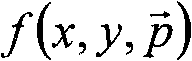
我们关心这种分块描述的原因是因为在最近研究中,树结构已被证明对于图像信息编码是次最优的。这些研究认定基于树的图像编码不能对通过规则边缘或轮廓分割的不同区域进行最优编码。该问题起因于树结构不能最优地捕获沿边缘、轮廓或有向纹理存在的几何冗余。在视频序列中,需要对边缘和/或轮廓进行编码的不同情形是常见的。其中一种情形就是当对帧内编码数据进行编码时,不同种类可见数据之间的边界是最相关类型信息之一如边缘和目标轮廓。在帧间编码数据中,运动目标周围以及不同运动区域之间的轮廓也很重要。The reason we care about this chunked description is because in recent studies, tree structures have been shown to be sub-optimal for image information encoding. These studies assert that tree-based image coding cannot optimally code distinct regions segmented by regular edges or contours. This problem arises from the inability of tree structures to optimally capture the geometric redundancy that exists along edges, contours, or directed textures. In video sequences, different situations are common where edges and/or contours need to be encoded. One such situation is that when encoding intra-coded data, the boundary between different kinds of visible data is one of the most relevant types of information such as edges and object outlines. In inter-coded data, contours around moving objects and between different moving regions are also important.
本发明原理的实施例提供一种适于二维(2D)数据几何结构的一般几何帧分割技术。然后,利用最有效类型的预测如帧间和/或帧内预测类型,对所产生的每个区域进行编码。实施例包括在块或帧区域中产生几何分块。将块或帧区域分割成几何上合适的分块而非经典树,允许减少要发送的信息量以及预测过程所产生的残差量。根据本发明原理,利用参数模型来产生、近似以及/或者编码每个块内的分块边界。这种方法允许更好地捕获二维数据的主要几何特性。例如,可以将模型参数定义为独立地携带信息,该信息例如涉及但不限于分块边界角度、位置、不连续性和/或甚至曲率。将参数模型用于分块编码允许非常紧凑的分块边缘描述,这使待编码的参数数量最小化。此外,可以这样定义分块模型参数,以便对独立的或不同的几何信息进行去耦,以便根据它们的统计信息和特性对每个参数进行最佳编码。这种基于模型的几何信息处理也允许选择性地减少或增加每个几何参数所投入的编码信息量。除编码效率外,这种特征还用于在使编码效率影响最小化的同时,控制计算复杂性。Embodiments of the present principles provide a general geometric frame segmentation technique suitable for two-dimensional (2D) data geometries. Each of the resulting regions is then coded using the most efficient type of prediction such as inter and/or intra prediction type. Embodiments include generating geometric partitions in block or frame regions. Splitting a block or frame region into geometrically suitable partitions instead of a classical tree allows reducing the amount of information to be sent and the amount of residuals produced by the prediction process. In accordance with the principles of the present invention, a parametric model is utilized to generate, approximate and/or encode the block boundaries within each block. This approach allows better capture of the main geometric properties of 2D data. For example, model parameters may be defined to independently carry information such as, but not limited to, tile boundary angles, positions, discontinuities, and/or even curvature. Using a parametric model for block encoding allows a very compact block edge description, which minimizes the number of parameters to be encoded. Furthermore, block model parameters can be defined in such a way that independent or distinct geometric information is decoupled so that each parameter is optimally encoded according to their statistics and properties. This model-based processing of geometric information also allows to selectively reduce or increase the amount of coding information devoted to each geometric parameter. In addition to coding efficiency, this feature is also used to control computational complexity while minimizing the impact of coding efficiency.
使用基于参数模型的分块描述的优点之一是,有可能高效地描述块内两个分块之间的平滑分块边界。常常可以通过某种多项式
为了进行几何图像和视频编码,可以这样操作
f(x,y)=xcosθ+ysinθ-ρf(x,y)=xcosθ+ysinθ-ρ
其中通过那些位置(x,y)来定义位置边界,以致f(x,y)=0。In this case, the position boundary is defined by those positions (x, y) such that f(x, y)=0.
转到图6,一般用附图标记600来指示,把具有参数描述几何结构(角度和位置)的一阶多项式用作参数模型的例子。Turning to FIG. 6 , generally indicated by
在针对每个块产生两个区域的实施例中,可以利用如下的隐式公式来描述分块:In an embodiment where two regions are generated for each block, the block can be described using the following implicit formula:
位于零线(f(x,y)=0)一侧的所有像素都被分类为属于一个分块区(例如分块1)。位于另一侧的所有像素都被分类在另一区中(例如分块0)。All pixels located on one side of the zero line (f(x,y)=0) are classified as belonging to one tile region (eg, tile 1). All pixels on the other side are classified in another region (eg block 0).
处理分块边界上的像素的可选方法Alternative method for handling pixels on tile boundaries
考虑分块的离散性质,我们发现在分割线或曲线附近,某些像素只能被认为部分地属于某一分块或另一个分块。这是由于,参数模型公式是连续的,而分块实现是离散的。Considering the discrete nature of the partitions, we find that near a dividing line or curve, some pixels can only be considered to partly belong to one partition or another. This is due to the fact that the parametric model formulation is continuous while the block implementation is discrete.
这种像素可能容易受到用于描述分块每一边的预测器的影响。因此,可以利用不同于分块1和0的标记,将像素标记为“部分表面(partialsurface)”。为简单起见,我们采用以下惯例:利用1或0来标记某一或另一分块中的像素。因而,可以利用0和1之间的某一值来识别“部分表面”像素,该值也可以包括相关像素在多大程度上属于分块0的信息(例如,1值将指示完全属于分块0,0.5将指示一半属于分块0,而0将指示不属于分块0)。当然,上文中各处的编号排列是用于说明和澄清的,并且给定在此提供的本发明原理的教导,本领域及相关领域普通技术人员将能预期供本发明原理之用的这些及其它各种编号排列,同时保持本发明原理的精神。通过以下对分块0进行标记的定义,来正式表示以上:Such pixels may be susceptible to the predictors used to describe each side of the block. Thus, a pixel may be labeled as "partial surface" with a different label than
Label(x,y)=1表示那个像素被包括在第一分块中。Label(x,y)=0表示该像素位于第二分块中,对于该特定像素,其余值表示它被部分地归类,也指示来自第一分块的预测对该值的贡献的权重。来自第二分块的预测对“部分表面”像素值贡献的权重为(1-Label(x,y))。以分块掩模的形式产生该一般像素分类。转到图7,一般用附图标记700来指示利用一阶多项式从参数模型f(x,y)产生的分块掩模。如上所述,以上描述的浮点数只是可能选择值的例子。实际上,取决于f(x,y),不同于0.5的阈值也是可能的。对于被分类为“部分表面”的每个像素,也可作为与该像素重叠的分块之一内的一个或多个相邻像素的函数、或者作为与该像素重叠的多个分块的函数的组合,来预测该像素。而且,本领域及相关领域普通技术人员应该理解,可以修改在此描述的本发明原理的任何方面,以便整数实现以及/或者利用查找表。Label(x,y)=1 indicates that pixel is included in the first partition. Label(x,y) = 0 means that the pixel is located in the second partition, and for this particular pixel, the remaining value means that it is partially classified, also indicating the weight of the contribution of the prediction from the first partition to this value. The predicted contribution from the second partition to the "partial surface" pixel value is weighted by (1-Label(x,y)). This general pixel classification is produced in the form of a block mask. Turning to FIG. 7 , a block mask generated from a parametric model f(x,y) using a first order polynomial is indicated generally by the
采样分块函数f(x,y)参数空间的考虑The Consideration of Parameter Space of Sampling Block Function f(x,y)
需要编码并发送模型参数,以允许解码器确定相关块或区域的分块。为此,分块参数的精度受限于人们愿意为描述块或分块区域而投入的最大编码代价量。The model parameters need to be encoded and sent to allow the decoder to determine the partitioning of related blocks or regions. For this reason, the precision of blocking parameters is limited by the maximum amount of coding effort one is willing to invest in describing a block or block region.
不失一般性,通过为f(x,y)的每个参数确定值域和采样精度,来先验地定义可能分块(或几何模型)的库。例如,在一阶多项式几何边界的情况下,可以这样定义,以致:Without loss of generality, the library of possible partitions (or geometric models) is defined a priori by determining the range and sampling precision for each parameter of f(x,y). For example, in the case of a first-order polynomial geometric boundary, it can be defined such that:
且and
其中Δρ和Δθ是选择的量化步长(参数精度)。然而,可以建立选择值的偏移量。θ和ρ的量化索引是被发送用于对分块形状进行编码的信息。然而,在垂直和水平方向方式(如为MPEG-4 AVC标准而定义的方式)用作分割编码方式的情况下,从可能的分块配置集中消除ρ=0、且角度等于0和90度的几何分块。这可以节省位数并减小复杂性。where Δρ and Δθ are the chosen quantization step size (parameter precision). However, an offset to the selected value can be established. The quantization indices of θ and ρ are information transmitted for encoding the block shape. However, in the case where the vertical and horizontal direction modes (as defined for the MPEG-4 AVC standard) are used as partitioned coding modes, the ones with p = 0 and angles equal to 0 and 90 degrees are eliminated from the set of possible block configurations. Geometry blocks. This saves bits and reduces complexity.
解码器需要知道编码器所用的参数精度。可以作为某些现有数据(例如MPEG-4 AVC标准中的量化参数)的函数,显式或隐式地为每种分块参数发送参数精度。可以按照某种高级句法如序列、图像和/或片级句法,来修改参数精度。The decoder needs to know the parameter precision used by the encoder. Parameter precision can be sent explicitly or implicitly for each blocking parameter as a function of some existing data (such as the quantization parameter in the MPEG-4 AVC standard). Parameter precision can be modified according to some high-level syntax such as sequence, image and/or slice level syntax.
使用在此相对于本发明原理描述的区域分割的视频通信系统,应该为使用区域分割的每个区域发送必需编码的参数集,以描述分块形状。为每个几何编码区域发送的其余数据的类型,将类似于基于树的分块方式所发送的数据类型。的确,对于每一基于模型的分块,都应发送预测信息。另外,在预测后,最终也可对预测残差进行编码。A video communication system using region segmentation as described herein with respect to the principles of the invention should transmit the necessary encoded parameter set for each region using region segmentation to describe the block shape. The rest of the data sent for each geometry-encoded region will be of a type similar to that sent for tree-based chunking. Indeed, for each model-based partition, prediction information should be sent. In addition, after prediction, the prediction residual can also be coded at the end.
基于参数模型的几何区域分割的使用,影响视频编码器/解码器中取决于帧分割的所有处理。视频系统中能够得益于本发明原理、并且可适合于本发明原理的一些更普通处理/模块包括但不限于:编码器/解码器的一般控制;区域预测(运动补偿/帧内数据预测);运动估计;熵编码/解码;以及用于减少人为噪声的循环内滤波。The use of geometric region segmentation based on parametric models affects all processing in the video encoder/decoder that depends on frame segmentation. Some of the more general processes/modules in video systems that could benefit from the principles of the invention and could be adapted to include but are not limited to: general control of encoders/decoders; region prediction (motion compensation/intra data prediction) ; motion estimation; entropy encoding/decoding; and in-loop filtering for reducing artifacts.
以下,相对于MPEG-4 AVC标准框架来描述实施例。然而,应该理解,本发明原理不只是限于MPEG-4 AVC,而是可以容易地相对于其它视频编码标准和建议使用本发明原理,同时保持本发明原理的精神。In the following, embodiments are described with respect to the framework of the MPEG-4 AVC standard. It should be understood, however, that the inventive principles are not limited to MPEG-4 AVC only, but that the inventive principles can readily be used with respect to other video coding standards and recommendations while maintaining the spirit of the inventive principles.
扩展MPEG-4 AVC标准视频编码器和解码器,以便考虑根据本发明原理的Extend the MPEG-4 AVC standard video encoder and decoder to take into account the 参数模型分块Parametric Model Chunking
现在将描述涉及根据本发明原理扩展MPEG-4 AVC标准的实施例。MPEG-4 AVC标准依赖于基于树的帧分割来优化编码性能。根据本发明原理的实施例扩展MPEG-4 AVC标准有助于克服MPEG-4 AVC标准所属的基于树的帧分割的固有缺陷。Embodiments related to extending the MPEG-4 AVC standard according to the principles of the present invention will now be described. The MPEG-4 AVC standard relies on tree-based frame partitioning to optimize encoding performance. Embodiments according to the principles of the present invention extend the MPEG-4 AVC standard to help overcome the inherent deficiencies of the tree-based frame segmentation to which the MPEG-4 AVC standard belongs.
可以以新的块编码方式的形式,将基于参数模型的区域分割的使用包括在MPEG-4 AVC标准中。MPEG-4 AVC标准的基于树的帧分割在需要时,将每幅图像分割成16×16、16×8、8×16、8×8、8×4、4×8和4×4的块。这些分块类型的每一种都和编码方式关联,同时取决于方式,该编码方式可以是帧间或帧内编码方式类型。除这些块分块方式以外,我们引入了附加的分块方式,以致利用参数模型f(x,y)来描述块内的分块。这种利用参数模型分割的块方式在此被称为“几何方式”。其目标是产生尽可能大的分块;因此,参数模型的用途是应用于16×16尺寸的块或基于树的分块的树叶部分的集合。然而,当关心压缩效率时,也考虑8×8“几何方式”块。取决于复杂性因素,也可使能或禁止8×8“几何方式”块的使用。可以用信号通知高级句法,以指示是否使用8×8“几何方式”。当未使用这种方式时,这可以节省编码开销。句法级的特定例子包括但不限于序列、图像和/或片级。The use of region segmentation based on parametric models can be included in the MPEG-4 AVC standard in the form of a new block coding scheme. MPEG-4 AVC standard tree-based frame segmentation divides each image into 16×16, 16×8, 8×16, 8×8, 8×4, 4×8 and 4×4 blocks when required . Each of these block types is associated with a coding scheme which, depending on the scheme, can be an inter or intra coding scheme type. In addition to these block partitions, we introduce additional block partitions such that a parametric model f(x, y) is used to describe partitions within a block. This block approach using parametric model segmentation is referred to herein as a "geometric approach". The goal is to produce as large a tile as possible; therefore, the use of parametric models is applied to 16x16 sized tiles or collections of leaf parts for tree-based tiles. However, 8x8 "geometric mode" blocks are also considered when compression efficiency is concerned. Depending on complexity factors, the use of 8x8 "geometry" blocks may also be enabled or disabled. The high-level syntax can be signaled to indicate whether to use the 8x8 "geometry mode". This saves coding overhead when not used this way. Specific examples of syntax level include, but are not limited to, sequence, image, and/or slice level.
为了插入这种新的编码方式系列,可以修改编码器和/或解码器。如图8、9、10和11中所描述的,可以修改和扩展MPEG-4 AVC标准中的主要构件块的功能性,以便处理这些能够捕获和编码几何信息的新方式。The encoder and/or decoder can be modified in order to insert this new family of encodings. As described in Figures 8, 9, 10 and 11, the functionality of the main building blocks in the MPEG-4 AVC standard can be modified and extended to handle these new ways in which geometric information can be captured and encoded.
转到图9,一般用附图标记900来指示一种能够根据被扩展用于本发明原理的MPEG-4 AVC标准来执行视频编码的视频编码器。Turning to Figure 9, generally indicated by the
视频编码器900包括帧排序缓冲器910,该帧排序缓冲器910具有与组合器985的非反相输入进行信号通信的输出。组合器985的输出以信号通信方式和具有几何扩展的变换与量化器927的第一输入连接。具有几何扩展的变换与量化器927的输出以信号通信方式与具有几何扩展的熵编码器945的第一输入、以及逆变换与逆量化器950的第一输入连接。具有几何扩展的熵编码器945的输出以信号通信方式与组合器990的第一非反相输入连接。组合器990的输出以信号通信方式与输出缓冲器935的第一输入连接。
具有几何扩展的编码器控制器905的第一输出以信号通信方式与以下连接:帧排序缓冲器910的第二输入、逆变换与逆量化器950的第二输入、图像型决策模块915的输入、具有几何扩展的宏块型(MB型)决策模块920的输入、具有几何扩展的帧内预测模块960的第二输入、具有几何扩展的解块滤波器965的第二输入、具有几何扩展的运动补偿器970的第一输入、具有几何扩展的运动估计器975的第一输入以及参考图像缓冲器980的第二输入。A first output of the encoder controller with
具有几何扩展的编码器控制器905的第二输出以信号通信方式与以下连接:SEI插入器930的第一输入、具有几何扩展的变换与量化器927的第二输入、具有几何扩展的熵编码器945的第二输入、输出缓冲器935的第二输入以及SPS与PPS插入器940的输入。The second output of the encoder controller with
图像型决策模块915的第一输出以信号通信方式与帧排序缓冲器910的第三输入连接。图像型决策模块915的第二输出以信号通信方式与具有几何扩展的宏块型决策模块920的第二输入连接。A first output of the image-
SPS与PPS插入器940的输出以信号通信方式与组合器990的第三非反相输入连接。The output of the SPS and
逆量化与逆变换器950的输出以信号通信方式与组合器925的第一非反相输入连接。组合器925的输出以信号通信方式与具有几何扩展的帧内预测模块960的第一输入以及具有几何扩展的解块滤波器965的第一输入连接。具有几何扩展的解块滤波器965的输出以信号通信方式与参考图像缓冲器980的第一输入连接。参考图像缓冲器980的输出以信号通信方式与具有几何扩展的运动估计器975的第二输入连接。具有几何扩展的运动估计器975的第一输出以信号通信方式与具有几何扩展的运动补偿器970的第二输入连接。具有几何扩展的运动估计器975的第二输出以信号通信方式与具有几何扩展的熵编码器945的第三输入连接。The output of inverse quantization and
具有几何扩展的运动补偿器970的输出以信号通信方式与开关997的第一输入连接。帧内预测模块960的输出以信号通信方式与开关997的第二输入连接。具有几何扩展的宏块型决策模块920的输出以信号通信方式与开关997的第三输入连接。开关997的输出以信号通信方式与组合器925的第二非反相输入以及组合器985的反相输入连接。The output of the motion compensator with
帧排序缓冲器910的输入和具有几何扩展的编码器控制器905的输入可用作编码器900的输入,用于接收输入图像901。而且,SEI插入器930的输入可用作编码器900的输入,用于接收元数据。输出缓冲器935的输出可用作编码器900的输出,用于输出位流。The input of the
现在转到图11,一般用附图标记1100来指示一种能够根据被扩展用于本发明原理的MPEG-4 AVC标准来执行视频解码的视频解码器。Turning now to FIG. 11 , a video decoder capable of performing video decoding in accordance with the MPEG-4 AVC standard extended for use in the principles of the present invention is generally indicated by the
视频解码器1100包括输入缓冲器1110,输入缓冲器1110具有以信号通信方式与具有几何扩展的熵解码器1145的第一输入连接的输出。具有几何扩展的熵解码器1145的第一输出以信号通信方式与具有几何扩展的逆变换与逆量化器1150的第一输入连接。具有几何扩展的逆变换与逆量化器1150的输出以信号通信方式与组合器1125的第二非反相输入连接。组合器1125的输出以信号通信方式与具有几何扩展的解块滤波器1165的第二输入,以及具有几何扩展的帧内预测模块1160的第一输入连接。具有几何扩展的解块滤波器1165的第二输出以信号通信方式与参考图像缓冲器1180的第一输入连接。参考图像缓冲器1180的输出以信号通信方式与具有几何扩展的运动补偿器1170的第二输入连接。The
具有几何扩展的熵解码器1145的第二输出以信号通信方式与具有几何扩展的运动补偿器1170的第三输入以及具有几何扩展的解块滤波器1165的第一输入连接。具有几何扩展的熵解码器1145的第三输出以信号通信方式与具有几何扩展的解码器控制器1105的输入连接。具有几何扩展的解码器控制器1105的第一输出以信号通信方式与具有几何扩展的熵解码器1145的第二输入连接。具有几何扩展的解码器控制器1105的第二输出以信号通信方式和具有几何扩展的逆变换与逆量化器1150的第二输入连接。具有几何扩展的解码器控制器1105的第三输出以信号通信方式与具有几何扩展的解块滤波器1165的第三输入连接。具有几何扩展的解码器控制器1105的第四输出以信号通信方式与具有几何扩展的帧内预测模块1160的第二输入、运动补偿器1170的第一输入以及参考图像缓冲器1180的第二输入连接。A second output of the entropy decoder with
具有几何扩展的运动补偿器1170的输出以信号通信方式与开关1197的第一输入连接。具有几何扩展的帧内预测模块1160的输出以信号通信方式与开关1197的第二输入连接。开关1197的输出以信号通信方式与组合器1125的第一非反相输入连接。The output of the motion compensator with
输入缓冲器1110的输入可用作解码器1100的输入,用于接收输入位流。具有几何扩展的解块滤波器1165的第一输出可用作解码器1100的输出,用于输出输出图像。An input of
关于和相对于MPEG-4 AVC标准使用本发明原理有关的可能修改/扩展,可以修改/扩展编码器和/或解码器控制模块以包括“几何方式”所需的所有决策规则和编码过程结构。Regarding possible modifications/extensions related to using the principles of the invention with respect to the MPEG-4 AVC standard, the encoder and/or decoder control modules can be modified/extended to include all decision rules and encoding process structures required in a "geometric fashion".
关于和相对于MPEG-4 AVC标准使用本发明原理有关的另一可能修改/扩展,可以修改运动补偿模块以便利用由f(x,y)描述的任意分块及其参数来补偿块。Regarding another possible modification/extension related to the use of the principles of the invention with respect to the MPEG-4 AVC standard, the motion compensation module can be modified so as to compensate blocks with an arbitrary partition described by f(x,y) and its parameters.
关于和相对于MPEG-4 AVC标准使用本发明原理有关的又一可能修改/扩展,可以修改运动估计模块以便为基于参数模型的编码方式中可得的不同种类分块测试和选择最适当的运动矢量。Regarding yet another possible modification/extension related to the use of the principles of the invention with respect to the MPEG-4 AVC standard, the motion estimation module can be modified to test and select the most appropriate motion for the different kinds of blocks available in the parametric model based coding scheme vector.
关于和相对于MPEG-4 AVC标准使用本发明原理有关的又一可能修改/扩展,可以修改帧内预测以便考虑基于参数模型的块分割、同时可能在每一分块中选择最合适的预测方式。Regarding yet another possible modification/extension related to the use of the principles of the invention with respect to the MPEG-4 AVC standard, intra prediction can be modified to take into account block partitioning based on a parametric model, while possibly selecting the most appropriate prediction in each partition .
关于和相对于MPEG-4 AVC标准使用本发明原理有关的又一可能修改/扩展,可以修改解块循环内滤波器模块以便利用基于参数模型的分块来处理块内更复杂形状的运动区域。Regarding yet another possible modification/extension related to the use of the principles of the present invention with respect to the MPEG-4 AVC standard, the deblocking in-loop filter module can be modified in order to handle more complex shaped motion regions within a block using block based on parametric models.
关于和相对于MPEG-4 AVC标准使用本发明原理有关的又一可能修改/扩展,可以修改和扩展熵编码和/或解码以便编码和/或解码和基于参数模型的方式关联的新数据。而且,可以修改运动预测以便处理更复杂形状的运动区域。也可产生并使用用于对基于参数模型的分块参数进行高效编码的预测器。Regarding yet another possible modification/extension related to the use of the principles of the invention with respect to the MPEG-4 AVC standard, entropy coding and/or decoding can be modified and extended in order to encode and/or decode new data associated in a parametric model-based manner. Also, motion prediction can be modified to handle more complex shaped motion regions. Predictors for efficient encoding of block parameters based on parametric models can also be generated and used.
编码器特定块Encoder Specific Blocks
编码器控制: Encoder control :
可以扩展编码器控制模块,以便考虑基于参数模型块分割的新方式。这些方式(被称为几何方式)被插入MPEG-4 AVC标准中的现有方式中。在用于运动补偿的帧间方式的特殊情况下,使用基于参数模型的16×16和8×8分割块。这些方式中的每一种方式分别被插入宏块尺寸方式内以及子宏块尺寸方式内。通过结构相似性,对于16×16几何方式,将这些方式在逻辑上插入到16×8和/或8×16方式的前面、中间或后面,并且对于8×8几何方式,将这些方式在逻辑上插入到8×4和/或4×8方式的前面、中间或后面。在示例实施中,为了允许在低位速率下以低代价使用16×8和8×16以及8×4和4×8方式,将16×16和8×8几何方式插入到它们的MPEG-4 AVC有向方式的紧后面。根据它们的全局使用统计信息,我们也可将它们插入到MPEG-4 AVC有向方式(以及子方式)的紧前面,如表1和表2所示。The encoder control module can be extended to consider new ways of block segmentation based on parametric models. These modes (called geometric modes) are plugged into the existing modes in the MPEG-4 AVC standard. In the special case of the inter-frame approach for motion compensation, 16x16 and 8x8 partition blocks based on parametric models are used. Each of these modes is inserted within the macroblock-sized mode and within the sub-macroblock-sized mode, respectively. By structural similarity, for 16×16 geometry, these ways are logically inserted before, in the middle or after 16×8 and/or 8×16 ways, and for 8×8 geometry, these ways are logically inserted Insert up to the front, middle or back of 8×4 and/or 4×8 formats. In the example implementation, the 16x16 and 8x8 geometries are inserted into their MPEG-4 AVC Immediately behind the directional way. We can also insert them immediately before the MPEG-4 AVC directional modes (and submodes) according to their global usage statistics, as shown in Table 1 and Table 2.
表1Table 1
表2Table 2
运动估计motion estimation
可以修改运动估计模块,以便在需要时处理经过几何修改的分块。例如,在几何方式下,以和基于经典树的16×8、8×16、8×4或4×8分块方式相同的方式,来描述运动。的确,这些方式可以象目前基于参数模型的分块方式的某些特定实例那样运行。因而,它们不被包括在使用中的参数模型的可能配置内。取决于需要以及是正在对P块还是B块编码,可以利用一个或多个参考来模拟每个分块。The motion estimation module can be modified to handle geometrically modified tiles when required. For example, motion is described geometrically in the same way as in classical tree-based 16x8, 8x16, 8x4 or 4x8 tiles. Indeed, these approaches can behave like some specific instances of the current block approach based on parametric models. Thus, they are not included in the possible configurations of the parametric model in use. Each partition can be simulated with one or more references, depending on the need and whether a P-block or a B-block is being encoded.
P方式例子:在完全P方式的基于参数模型的分割块中,通过从参考帧中选择的匹配补片来模拟两个分块。每个补片都必须具有被设计成适合选定几何分块的形状。以和P宏块及P子宏块相同的方式,每个分块都发送运动矢量。在其一个例子中,选择运动矢量以及f(x,y)模型参数,以致依据某种失真测量(D)和某种编码代价测量(R)最佳地描述块中所包括的信息。为此,对于每个块都共同优化所有参数,以致使D和R一同最小化:P-mode example: In fully P-mode parametric model-based segmentation, two partitions are simulated by matching patches selected from reference frames. Each patch must have a shape designed to fit the selected geometric partition. In the same way as P macroblocks and P submacroblocks, motion vectors are sent per partition. In one example thereof, the motion vectors and f(x,y) model parameters are chosen such that the information comprised in the block is best described in terms of some measure of distortion (D) and some measure of coding cost (R). For this, all parameters are jointly optimized for each block such that D and R are minimized together:
其中λ是乘数,MV1和MV0代表分块中的两个运动矢量,θ和ρ代表一阶多项式的特定情况下的分块参数,每个Ωx都代表每一种信息的有效值集合。where λ is the multiplier, MV 1 and MV 0 represent the two motion vectors in the block, θ and ρ represent the block parameters for a particular case of first-order polynomials, and each Ω x represents the effective value of each kind of information gather.
供本发明原理一个或多个实施例使用的失真测量修改例子是,将所产生的掩模用于每个分块(见图7中的掩模例子)。然后,可以修改任何基于经典块的失真测量,以考虑分块,以致:An example distortion measurement modification for use with one or more embodiments of the present principles is to use the generated mask for each tile (see mask example in FIG. 7). Then, any classical block-based distortion measure can be modified to account for the block such that:
在以上表达式中,MASKP1(x,y)和MASKP0(x,y)分别代表每个f(x,y)分块。有可能通过将那些非常小的掩模值(例如小于给定阈值(如O.5))的加法运算次数减少为0,来实现其快速实施。这种简化的例子也可以是产生这样一个简化掩模,其中所有等于或小于O.5的值都被舍入为O,且所有大于0.5的值都被舍入为1。然后,在实施例中,只对那些在掩模中为1的位置进行求和,以计算失真。在这种情况下,只需要加法运算,并且可以忽略每个掩模中的所有O值位置。In the above expressions, MASK P1 (x, y) and MASK P0 (x, y) represent each f(x, y) block respectively. It is possible to achieve its fast implementation by reducing the number of addition operations to zero for those very small mask values, eg smaller than a given threshold (eg 0.5). An example of this simplification could also be to generate a simplification mask in which all values equal to or less than 0.5 are rounded to 0, and all values greater than 0.5 are rounded to 1. Then, in an embodiment, only those positions that are 1 in the mask are summed to calculate the distortion. In this case, only addition is required, and all O-value positions in each mask can be ignored.
在实施例中,除了在每个分块中执行运动搜索以外,应该和运动信息一起确定分块自己。因此,也对f(x,y)参数执行搜索。转到图16,一般用附图标记1600来指示一种利用基于模型的分块参数和预测搜索(例如,用于运动估计的运动矢量搜索)进行几何方式估计的示例方法。In an embodiment, besides performing a motion search in each block, the block itself should be determined together with the motion information. Therefore, the search is also performed on the f(x,y) parameter. Turning to FIG. 16 , an example method of geometry estimation using model-based block parameters and predictive searches (eg, motion vector searches for motion estimation) is indicated generally at 1600 .
方法1600包括开始块1605,开始块1605将控制传递给循环限制块1610。循环限制块1610对所有的可能数量的边缘执行循环(其中边缘数量取决于几何精度),并初始化变量i,并将控制传递给功能块1615。功能块1615产生具有参数集i的分块,并将控制传递给功能块1620。对于给定的分块集i,功能块1620搜索最佳预测器,并将控制传递给决策块1625。决策块1625确定是否已确定最佳分块和最佳预测。如果是这样的话,将控制传递给功能块1630。否则,将控制传递给循环限制块1635。
功能块1630存储最佳几何参数和预测器选择,并将控制传递给循环限制块1635。
循环限制块1635结束对于所有的可能数量的边缘的循环,并将控制传递给结束块1640。
在希望为块分块使用几种可能类型模型的情况下,运动估计可能涉及不同模型的测试,以便寻找适于数据的最佳模型。可以通过发送必需的辅助信息,来处理解码器上的最佳模型选择。In cases where it is desirable to use several possible types of models for block partitioning, motion estimation may involve testing of different models in order to find the best model for the data. Optimal model selection at the decoder can be handled by sending the necessary side information.
熵编码entropy coding
可以扩展熵编码,以便根据它们的统计信息以及来自相邻编码-解码块的预测模型,对几何参数进行编码,这些相邻编码-解码块可能自己包括几何分块信息。用于参数模型分割块的运动矢量预测器适合于它们各自分割块的几何结构,以及已经编码的相邻块的几何结构。根据从空间和/或时间相邻块中自适应选择的运动矢量集,来预测每一几何分块运动矢量。其实施例是,取决于当前块分块的几何结构来使用1或3个空间相邻块。当运动矢量数为3时,它们被执行中值滤波。然后,按照MPEG-4 AVC标准,利用可变长编码(VLC)或基于算术编码(AC)的编码,对预测的运动矢量进行编码。Entropy coding can be extended to encode geometric parameters based on their statistics as well as predictive models from neighboring encoding-decoding blocks, which may themselves include geometric block information. The motion vector predictors for the parametric model partitions are adapted to the geometry of their respective partitions, as well as the geometry of already coded neighboring blocks. Each geometric block motion vector is predicted from a set of motion vectors adaptively selected from spatial and/or temporal neighboring blocks. An example of this is to use 1 or 3 spatial neighbors depending on the geometry of the current block partition. When the number of motion vectors is 3, they are subjected to median filtering. The predicted motion vectors are then coded using variable length coding (VLC) or arithmetic coding (AC) based coding according to the MPEG-4 AVC standard.
现在将描述两种用于基于模型的分块参数的示例编码方法。Two example encoding methods for model-based chunking parameters will now be described.
在用于基于模型的分块参数的第一示例编码方法中,当不存在基于模型(或几何)的相邻块时,对这种参数进行编码而不预测。然后,对于一阶多项式情况,在可变长编码的一个实施例中,可以利用均匀码对角度编码,并且可以利用Golomb码对半径编码。In a first example encoding method for model-based block parameters, such parameters are encoded without prediction when there are no model-based (or geometric) neighboring blocks. Then, for the first order polynomial case, in one embodiment of variable length coding, the angle can be coded with a uniform code and the radius can be coded with a Golomb code.
在用于基于模型的分块参数的第二示例编码方法中,当存在至少一个基于模型(或几何)的相邻块时,对这种参数进行预测编码。通过将前面相邻块的参数模型投影到当前块中,来执行参数预测实施例。实际上,对于一阶多项式情况,一个例子是,通过使前面块的线条延续到当前块中,来预测参数。当两个块可用时,预测线是将相邻线与宏块边界的两个交点连接起来的线。In a second example encoding method for model-based block parameters, such parameters are predictively encoded when there is at least one model-based (or geometric) neighboring block. The parametric prediction embodiment is performed by projecting the parametric models of previous neighboring blocks into the current block. In fact, for the first order polynomial case, an example is to predict the parameters by continuing lines from previous blocks into the current block. When two blocks are available, the prediction line is the line connecting the two intersections of the adjacent line with the macroblock boundary.
转到图13,一般用附图标记1300来指示从左边块的参数为右边块进行分块参数预测的例子。Turning to FIG. 13 , an example of block parameter prediction for the right block is generally indicated by reference numeral 1300 from the parameters of the left block.
转到图14,一般用附图标记1400来指示从上面块的参数为下面块进行分块参数预测的例子。Turning to FIG. 14 , an example of block parameter prediction for a lower block is generally indicated by reference numeral 1400 from parameters of an upper block.
转到图15,一般用附图标记1500来指示从上面块和左边块为右边块进行分块参数预测的例子。Turning to FIG. 15 , an example of block parameter prediction for the right block from the upper and left blocks is indicated generally by the
然后,利用Golomb码对预测参数进行不同编码。在角度的特定情况下,可以利用其周期特性,以便为后面的VLC或AC编码获得最可能的统计信息。在VLC的一个例子中,可以使用Golomb码。Then, the prediction parameters are encoded differently using Golomb codes. In the particular case of an angle, its periodicity can be exploited in order to obtain the most likely statistics for later VLC or AC encoding. In one example of VLC, Golomb codes can be used.
关于几何块方式的编码过程结构,图17、18和19描述了一般基于参数模型的块的编码流程图的特定实施例。实际上,为了对基于参数模型的块进行编码,除了运动数据以外,在块编码过程的某一点还要对分块参数编码。Regarding the structure of the encoding process in a geometric block manner, Figures 17, 18 and 19 describe a specific embodiment of a block encoding flow diagram based on a general parametric model. In fact, to encode a block based on a parametric model, block parameters are encoded at some point in the block encoding process in addition to the motion data.
转到图17,一般用附图标记1700来指示一种用于对几何分割的预测块进行编码的示例方法。Turning to FIG. 17 , an example method for encoding a geometrically partitioned prediction block is indicated generally at 1700 .
方法1700包括开始块1705,开始块1705将控制传递给决策块1710。决策块1710确定当前方式类型是否为几何方式类型。如果是,则将控制传递给功能块1715。否则,将控制传递给结束块1730。
功能块1715对该几何方式类型编码,并将控制传递给功能块1720。功能块1720对几何分块参数编码,并将控制传递给功能块1725。功能块1725对分块预测编码,并将控制传递给结束块1730。
转到图18A,一般用附图标记1800来指示用于对几何分割的帧间预测块进行编码的示例方法。Turning to FIG. 18A , an example method for encoding a geometrically partitioned inter-predicted block is indicated generally by the
方法1800包括开始块1802,开始块1802将控制传递给决策块1804。决策块1804确定当前方式类型是否为几何帧间方式类型。如果是,则将控制传递给功能块1806。否则,将控制传递给结束块1812。
功能块1806对该几何帧间方式类型编码,并将控制传递给功能块1808。功能块1808对几何分块参数编码(例如,如果相邻几何数据可用于预测,则利用相邻几何数据,并据此修改编码表),并将控制传递给功能块1810。功能块1810对分块帧间预测进行编码(例如,如果相邻解码数据可用于预测,则利用相邻解码数据,并据此修改编码表),并将控制传递给结束块1812。
转到图18B,一般用附图标记1850来指示用于对几何分割的帧内预测块进行编码的示例方法。Turning to FIG. 18B , an example method for encoding a geometrically partitioned intra-prediction block is indicated generally by the
方法1850包括开始块1852,开始块1852将控制传递给决策块1854。决策块1854确定当前方式类型是否为几何帧内方式类型。如果是,则将控制传递给功能块1856。否则,将控制传递给结束块1862。The
功能块1856对该几何帧内方式类型编码,并将控制传递给功能块1858。功能块1858对几何分块参数编码(例如,如果相邻几何数据可用于预测,则利用相邻几何数据,并据此修改编码表),并将控制传递给功能块1860。功能块1860对分块帧内预测进行编码(例如,如果相邻解码数据可用于预测,则利用相邻解码数据,并据此修改编码表),并将控制传递给结束块1862。
转到图19,一般用附图标记1900来指示利用多种类型模型进行编码的示例方法。Turning to FIG. 19 , an example method of encoding with multiple types of models is indicated generally by the
方法1900包括开始块1905,开始块1905将控制传递给决策块1910。决策块1910确定当前方式类型是否为几何方式类型。如果是,则将控制传递给功能块1915。否则,将控制传递给结束块1950。
功能块1915对该几何方式类型编码,并将控制传递给准备块1920。准备块1920为当前分块选择参数模型A或B。如果选择了参数模型A,则将控制传递给功能块1935。否则,如果选择了参数模型B,则将控制传递给功能块1925。
功能块1935指定与参数模型A对应的码,并将控制传递给功能块1940。功能块1940对参数模型A的几何分块参数进行编码,并将控制传递给功能块1945。
功能块1925指定与参数模型B对应的码,并将控制传递给功能块1930。功能块1930对参数模型B的几何分块参数进行编码,并将控制传递给功能块1945。
功能块1945对分块预测进行编码,并将控制传递给结束块1950。
编码器/解码器共享块Encoder/Decoder Shared Block
运动补偿motion compensation
可以扩展运动补偿模块,以便补偿基于参数模型的分割块中的非方形/非矩形分块。运动补偿过程的块重构是直接从上述运动估计过程得出的。实际上,补偿对应于,把最佳分块集和与运动矢量关联的两个分块形状像素映射一起用作预测器。如以上所定义的,按照给定规则,将“部分表面”像素计算为和运动矢量关联的像素映射的组合。The motion compensation module can be extended to compensate for non-square/non-rectangular partitions in parametric model-based partitions. The block reconstruction of the motion compensation process is derived directly from the motion estimation process described above. In practice, the compensation corresponds to using the best block set together with the two block shape pixel maps associated with the motion vectors as predictors. As defined above, a "partial surface" pixel is computed as a combination of pixmaps associated with motion vectors according to given rules.
帧内预测intra prediction
升级帧内预测,以便根据基于参数模型的块的分块来预测帧内数据。以和利用基于参数模型的分块的运动补偿和运动估计相同的方式,来定义利用基于参数模型的分块的帧内预测,两者基本不同之处在于,改为使用帧内预测,以填充所产生的每一个分块。Upgrading intra prediction to predict intra data based on partitioning of blocks based on a parametric model. Intra prediction using block based on parametric models is defined in the same way as motion compensation and motion estimation using block based on parametric models, with the basic difference that intra prediction is used instead to fill in Each block produced.
循环内解块滤波器In-loop deblocking filter
循环内解块滤波减小由预测的块结构以及残差编码离散余弦变换(DCT)所引入的分块人为噪声。循环内解块滤波取决于编码视频数据以及跨越块边界的像素之间的局部强度差异,来修改滤波器强度。本发明原理的实施例引入一种新的视频数据表示形式。对于每一4×4块,包括基于参数模型的分块的块不一定具有恒定运动矢量值,或恒定参考帧值。实际上,利用基于参数模型的分块,在这种任意分割的块中,通过参数模型所限定的形状来定义受给定运动矢量影响的面积和块边界。因此,4×4块可能看上去似乎一半在某个分块,另一半在另一分块中,意味在给定位置使用运动矢量和参考帧。因而,通过修改滤波器强度决策过程,来扩展循环内解块滤波器模块。该过程现在应该能够考虑内部块分块的特定形状来决定滤波器强度。取决于待滤波的块边界部分,需要根据分块形状、而不是如其它MPEG-4 AVC方式那样根据4×4块,来获得适当的运动矢量和参考帧。转到图12,一般用附图标记1200来指示基于参数模型的分割宏块。基于参数模型的分割宏块包括解块面积的一些例子,指示怎样为解块滤波强度决策选择信息,对于受到解块滤波的每个4×4块的每一边都计算一次滤波强度。In-loop deblocking filtering reduces blocking artifacts introduced by the predicted block structure and residual-encoded discrete cosine transform (DCT). In-loop deblocking filtering modifies the filter strength depending on the encoded video data and the local intensity differences between pixels across block boundaries. Embodiments of the present principles introduce a new form of video data representation. For each 4x4 block, blocks comprising partitioning based on parametric models do not necessarily have constant motion vector values, or constant reference frame values. In fact, with parametric model-based partitioning, in such an arbitrarily partitioned block, the area and block boundaries affected by a given motion vector are defined by the shape defined by the parametric model. Thus, a 4x4 block may appear to be half in one partition and half in another, implying that motion vectors and reference frames are used at a given location. Thus, the in-loop deblocking filter module is extended by modifying the filter strength decision process. The process should now be able to consider the specific shape of the inner block partition to decide the filter strength. Depending on the part of the block boundary to be filtered, appropriate motion vectors and reference frames need to be obtained from the block shape, not from 4x4 blocks as in other MPEG-4 AVC approaches. Turning to FIG. 12 , a parametric model based partitioned macroblock is indicated generally by the
通过选择与待滤波块的一侧重叠最多的分块,来选择被考虑用于滤波强度计算的分块。然而,为了简化角落块中的计算,第二备选方法考虑整个变换块,以便从包括受到滤波的两个块边缘的大部分的分块中,获得运动和参考帧信息。The block to be considered for filter strength calculation is selected by selecting the block that overlaps most with one side of the block to be filtered. However, to simplify computations in corner blocks, a second alternative approach considers the entire transform block in order to obtain motion and reference frame information from the partition comprising a large portion of the two block edges that are filtered.
第三备选方法用于将循环内解块滤波和基于参数模型的块分割组合起来,无论何时何地块边界受到基于模型的块分割方式(例如几何方式)影响,该第三备选方法都总是允许通过块边界进行某种程度的滤波。几何方式可以是影响/邻接边界的任意的块。同时,在几何方式中,解块滤波可以或不得应用于那些不位于宏块边界上的变换块。A third alternative method for combining in-loop deblocking filtering and parametric model-based block segmentation whenever and wherever parcel boundaries are affected by model-based block segmentation (e.g., geometrically) Both always allow some degree of filtering through block boundaries. Geometric means can be any block affecting/adjacent to the boundary. Also, in geometric fashion, deblocking filtering may or may not be applied to those transform blocks that do not lie on macroblock boundaries.
用于组合循环内解块滤波的第四备选方法考虑头两种方法中的任一种,但是向触发变换块中某种程度滤波使用的条件集合添加以下条件:如果块边界受到包括基于模型的分块曲线和宏块边界之间连接处的变换块的影响,则使用某种程度的解块。A fourth alternative method for combining in-loop deblocking filtering considers either of the first two methods, but adds the following condition to the set of conditions that trigger the use of some degree of filtering in a transform block: Some degree of deblocking is used if the transform block is affected by the junction between the block curve and the macroblock boundary.
解码器特定块decoder specific block
解码器控制模块Decoder Control Module
可以扩展解码器控制模块,以便考虑基于参数模型块分块的新方式。以和在编码器端执行的相同方式,将这些方式(几何方式)插入MPEG-4AVC标准中的现有方式中。可以修改解码器控制模块,以便完全匹配编码器的结构和解码过程序列,以准确恢复在编码器端编码的信息。The decoder control module can be extended to account for new ways of block-blocking based on parametric models. These modes (geometric modes) are plugged into the existing modes in the MPEG-4 AVC standard in the same way as performed at the encoder side. The decoder control module can be modified to exactly match the structure of the encoder and the decoding process sequence to accurately recover the information encoded at the encoder.
熵解码entropy decoding
可以扩展熵解码,以供基于模型的块分割之用。根据上述熵编码过程,需要扩展熵解码,以致熵解码匹配上述编码过程。图20、21和22描述了其可能的特定实施例,用于一旦指示使用了块方式的码字已被解码、并可用于解码器控制,就对和基于参数模型的编码方式相关的信息进行解码。Entropy decoding can be extended for model-based block segmentation. According to the above-mentioned entropy coding process, entropy decoding needs to be extended so that the entropy decoding matches the above-mentioned coding process. Figures 20, 21, and 22 describe possible specific embodiments for the processing of information related to a coding scheme based on a parametric model once a codeword indicating that a block scheme has been used has been decoded and is available for decoder control. decoding.
转到图20,一般用附图标记2000来指示用于对几何分割的预测块进行解码的示例方法。Turning to FIG. 20 , an example method for decoding a geometrically partitioned prediction block is indicated generally by the
方法2000包括开始块2005,开始块2005将控制传递给功能块2010。功能块2010确定当前方式类型是否为几何方式类型。如果是,就将控制传递给功能块2015。否则,将控制传递给结束块2025。
功能块2015对几何分块参数解码,并将控制传递给功能块2020。功能块2020对分块预测解码,并将控制传递给结束块2025。
现在转到图21A,一般用附图标记2100来指示用于对几何分割的帧间预测块进行解码的示例方法。Turning now to FIG. 21A , an example method for decoding a geometrically partitioned inter-predicted block is indicated generally by the
方法2100包括开始块2112,开始块2112将控制传递给功能块2114。功能块2114确定当前方式类型是否为几何方式类型。如果是,则将控制传递给功能块2116。否则,将控制传递给结束块2120。
功能块2116对几何分块参数解码(例如,如果相邻几何数据可用于预测,则利用相邻几何数据,并据此修改编码表),并将控制传递给功能块2118。功能块2118对分块帧间预测进行解码(例如,如果相邻解码数据可用于预测,则利用相邻解码数据,并据此修改编码表),并将控制传递给结束块2120。
现在转到图21B,一般用附图标记2150来指示用于对几何分割帧内预测块进行解码的示例方法。Turning now to FIG. 21B , an example method for decoding a geometrically partitioned intra-prediction block is indicated generally by the
方法2150包括开始块2162,开始块2162将控制传递给功能块2164。功能块2164确定当前方式类型是否为几何方式类型。如果是,则将控制传递给功能块2166,否则,将控制传递给结束块2170。The
功能块2166对几何分块参数解码(例如,如果相邻几何数据可用于预测,则利用相邻几何数据,并据此修改编码表),并将控制传递给功能块2168。功能块2168对分块帧内预测进行解码(例如,如果相邻解码数据可用于预测,则利用相邻解码数据,并据此修改编码表),并将控制传递给结束块2170。
转到图22,一般用附图标记2200来指示利用多种类型模型进行解码的示例方法。Turning to FIG. 22 , an example method of decoding utilizing multiple types of models is indicated generally by the
方法2200包括开始块2205,开始块2205将控制传递给决策块2210。决策块2210确定当前方式类型是否为几何方式类型。如果是,则将控制传递给功能块2215。否则,将控制传递给结束块2240。
功能块2215对该参数模型选择进行解码,并将控制传递给准备块2220。准备块2220为当前分块选择参数模型A或B。如果选择了参数模型A,则将控制传递给功能块2225。否则,如果选择了参数模型B,则将控制传递给功能块2230。
功能块2225对参数模型A的几何分块参数进行解码,并将控制传递给功能块2235。
功能块2230对参数模型B的几何分块参数进行解码,并将控制传递给功能块2235。
功能块2235对分块预测进行解码,并将控制传递给结束块2240。
转到图23,一般用附图标记2300来指示用于片头句法编码的示例方法。Turning to FIG. 23 , an example method for slice header syntax encoding is indicated generally by the
方法2300包括开始块2305,开始块2305将控制传递给功能块2310。功能块2310对片相关信息I编码,并将控制传递给功能块2315。功能块2315对片质量(QP)编码信息进行编码,并将控制传递给功能块2320。功能块2320对几何参数精度信息编码,并将控制传递给功能块2325。功能块2325对片相关信息II编码,并将控制传递给结束块2330。短语“片相关信息I”和“片相关信息II”表示片头相关信息,以致几何精度参数被插入片头的现有句法中。
转到图24,一般用附图标记2400来指示推导几何参数精度的示例方法。Turning to FIG. 24 , an example method of deriving geometric parameter accuracy is indicated generally by the reference numeral 2400 .
方法2400包括开始块2405,开始块2405将控制传递给功能块2410。功能块2410获得当前宏块的QP参数,并将控制传递给功能块2415。功能块2415计算几何参数精度,并将控制传递给结束块2420。Method 2400 includes start block 2405 which passes control to function block 2410 . Function block 2410 obtains the QP parameter of the current macroblock and passes control to function block 2415 . Function block 2415 calculates geometric parameter accuracy and passes control to end block 2420 .
转到图25,一般用附图标记2500来指示重构几何块的示例方法。Turning to FIG. 25 , an example method of reconstructing cells is indicated generally by the reference numeral 2500 .
方法2500包括开始块2505,开始块2505将控制传递给功能块2510。功能块2510从参数确定几何分块,并将控制传递给功能块2515。功能块2515重新组合分块预测,并将控制传递给功能块2520。功能块2520应用防混叠过程,并将控制传递给功能块2525。功能块2525添加重构的残差,并将控制传递给结束块2530。Method 2500 includes start block 2505 which passes control to function block 2510 . Function block 2510 determines geometric partitioning from the parameters and passes control to function block 2515 . Function block 2515 reassembles the block predictions and passes control to function block 2520 . Function block 2520 applies an anti-aliasing process and passes control to function block 2525 . Function block 2525 adds the reconstructed residual and passes control to end block 2530 .
转到图26,一般用附图标记2600来指示为当前块搜索最佳方式的示例方法。Turning to FIG. 26 , an example method of searching for a best way for a current block is indicated generally by the
方法2600包括开始块2605,开始块2605将控制传递给功能块2610、功能块2615、功能块2620、功能块2625及功能块2630。功能块2610测试16×16块方式,并将控制传递给功能块2635。功能块2615测试16×8块方式,并将控制传递给功能块2635。功能块2620测试8×16块方式,并将控制传递给功能块2635。功能块2625测试16×16几何块方式,并将控制传递给功能块2635。功能块2630测试8×8块方式,并将控制传递给功能块2635。
功能块2635为当前块选择最佳方式,并将控制传递给结束块2640。
转到图27,一般用附图标记2700来指示用于片头句法解码的示例方法。Turning to FIG. 27 , an example method for slice header syntax decoding is indicated generally by the
方法2700包括开始块2705,开始块2705将控制传递给功能块2710。功能块2710对片相关信息I解码,并将控制传递给功能块2715。功能块2715对片质量(QP)编码信息解码,并将控制传递给功能块2720。功能块2720对几何参数精度信息解码,并将控制传递给功能块2725。功能块2725对片相关信息II解码,并将控制传递给结束块2730。
现在将描述本发明的诸多附带优点/特征中的一些,以上已经描述了其中一些附带优点/特征。例如,一个优点/特征是这样一种设备,该设备包括编码器,该编码器用于通过响应至少一种参数模型自适应地分割图像至少一部分,来编码与图像对应的图像数据。该至少一种参数模型包括至少一条曲线的隐式和显式公式的至少之一。There will now be described some of the many incidental advantages/features of the present invention, some of which have been described above. For example, one advantage/feature is an apparatus comprising an encoder for encoding image data corresponding to an image by adaptively segmenting at least a portion of the image in response to at least one parametric model. The at least one parametric model includes at least one of an implicit and explicit formulation of the at least one curve.
另一优点/特征是具有如上所述编码器的设备,其中该至少一种参数模型和该至少一条曲线的至少之一是从几何信号模型获得的。Another advantage/feature is the device having the encoder as described above, wherein at least one of the at least one parametric model and the at least one curve is obtained from a geometric signal model.
又一优点/特征是具有如上所述编码器的设备,其中该至少一种参数模型和该至少一条曲线中的至少之一,描述一条或多条图像轮廓和一条或多条边界的至少之一。Yet another advantage/feature is an apparatus having an encoder as described above, wherein at least one of the at least one parametric model and the at least one curve describes at least one of one or more image contours and one or more boundaries .
又一优点/特征是具有如上所述编码器的设备,其中至少一个多项式用作该至少一种参数模型和该至少一条曲线的至少之一。Yet another advantage/feature is an apparatus having an encoder as described above, wherein at least one polynomial is used as at least one of the at least one parametric model and the at least one curve.
而且,另一优点/特征是具有如上所述编码器的设备,其中一阶多项式模型用作该至少一种参数模型和该至少一条曲线的至少之一。Also, another advantage/feature is the device having the encoder as described above, wherein a first order polynomial model is used as at least one of the at least one parametric model and the at least one curve.
此外,另一优点/特征是具有如上所述编码器的设备,其中如上所述使用一阶多项式模型,并且该一阶多项式模型包括角度参数和距离参数。Furthermore, another advantage/feature is an apparatus having an encoder as described above, wherein a first order polynomial model is used as described above, and the first order polynomial model includes angle parameters and distance parameters.
而且,另一优点/特征是具有如上所述编码器的设备,其中当多种参数模型可用时,从模型集中为给定图像部分自适应地选择该至少一种参数模型,并且对该选择显式或隐式编码。Moreover, another advantage/feature is an apparatus having an encoder as described above, wherein when multiple parametric models are available, the at least one parametric model is adaptively selected for a given image portion from a model set, and the selection is displayed Formally or implicitly encoded.
另外,又一优点/特征是具有如上所述编码器的设备,其中该编码器利用至少一个高级句法元素,对该至少一种参数模型和该至少一条曲线的至少之一的参数精度执行显式或隐式编码。In addition, yet another advantage/feature is an apparatus having an encoder as described above, wherein the encoder performs explicit parameter accuracy of at least one of the at least one parametric model and the at least one curve using at least one high-level syntax element. or implicitly encoded.
而且,另一优点/特征是具有如上所述使用至少一个高级句法元素的编码器的设备,其中该至少一个高级句法元素位于片头级、SEI级、PPS级、SPS级和网络抽象层单元头级的至少之一上。Also, another advantage/feature is a device having an encoder as described above using at least one high-level syntax element at the slice header level, SEI level, PPS level, SPS level, and network abstraction layer unit header level on at least one of the .
此外,另一优点/特征是具有如上所述编码器的设备,其中修改该至少一种参数模型和该至少一条曲线的至少之一的参数精度,以便控制压缩效率和编码复杂性至少之一。Furthermore, another advantage/feature is an apparatus having an encoder as described above, wherein a parameter accuracy of at least one of the at least one parametric model and the at least one curve is modified in order to control at least one of compression efficiency and encoding complexity.
而且,另一优点/特征是具有如上所述编码器的设备,其中取决于压缩质量参数来修改该至少一种参数模型和该至少一条曲线的至少之一的参数精度。Also, another advantage/feature is an apparatus having an encoder as described above, wherein the parameter accuracy of at least one of the at least one parametric model and the at least one curve is modified depending on a compression quality parameter.
另外,另一优点/特征是具有如上所述编码器的设备,其中从空间相邻块和时间相邻块至少之一,来预测和至少一幅图像的至少一个分块关联的预测器数据。In addition, another advantage/feature is an apparatus having an encoder as described above, wherein predictor data associated with at least one partition of at least one image is predicted from at least one of a spatially neighboring block and a temporally neighboring block.
而且,另一优点/特征是具有如上所述编码器的设备,其中从空间相邻块和时间相邻块至少之一,来预测该至少一种参数模型和该至少一条曲线的至少之一的分块模型参数。Moreover, another advantage/feature is an apparatus having an encoder as described above, wherein at least one of the at least one parametric model and the at least one curve is predicted from at least one of a spatially neighboring block and a temporally neighboring block. Block model parameters.
此外,另一优点/特征是具有如上所述编码器的设备,其中该编码器根据该至少一种参数模型和该至少一条曲线的至少之一,利用以下至少之一来计算部分地位于多个分块中的像素的预测值:防混叠过程,像素对应位置的部分预测值的组合,像素对应位置的全部预测值,邻域,以及像素部分地位于其中的多个分块中的不同分块预测器。Furthermore, another advantage/feature is an apparatus having an encoder as described above, wherein the encoder, based on at least one of the at least one parametric model and the at least one curve, utilizes at least one of Prediction of pixels in a tile: anti-aliasing process, combination of partial predictions for a pixel's corresponding location, full prediction for a pixel's corresponding location, neighborhood, and different partitions in multiple tiles in which the pixel is partly located block predictor.
而且,另一优点/特征是具有如上所述编码器的设备,其中该编码器是现有视频编码标准或视频编码建议的现有混合预测编码器的扩展版本。Also, another advantage/feature is an apparatus having an encoder as described above, wherein the encoder is an extended version of an existing hybrid predictive encoder of an existing video coding standard or video coding recommendation.
另外,另一优点/特征是具有如上所述的、作为现有视频编码标准或视频编码建议的现有混合预测编码器的扩展版本的编码器的设备,其中该编码器将基于参数模型的分块分别应用于图像宏块和子宏块至少之一,作为图像宏块和子宏块至少之一的编码方式。In addition, another advantage/feature is a device having an encoder as described above that is an extended version of an existing hybrid predictive encoder of an existing video coding standard or video coding recommendation, wherein the encoder will be based on an analysis of a parametric model. The block is respectively applied to at least one of the image macroblock and the sub-macroblock as a coding method for at least one of the image macroblock and the sub-macroblock.
而且,另一优点/特征是具有如上所述应用基于参数模型的分块的编码器的设备,其中基于参数模型的编码方式被插入现有视频编码标准或视频编码建议的现有宏块和子宏块编码方式内。Also, another advantage/feature is a device having an encoder applying parametric model-based blocking as described above, wherein the parametric model-based coding scheme is inserted into existing macroblocks and sub-macros of existing video coding standards or video coding recommendations within the block encoding method.
此外,另一优点/特征是具有如上所述应用基于参数模型的分块的编码器的设备,其中该编码器对该至少一种参数模型和该至少一条曲线的至少之一的模型参数进行编码,以便和分块预测数据一起产生基于参数模型的分块。Furthermore, another advantage/feature is an apparatus having an encoder applying parametric model-based blocking as described above, wherein the encoder encodes model parameters of at least one of the at least one parametric model and the at least one curve , in order to generate a block based on the parametric model along with the block prediction data.
而且,另一优点/特征是具有如上所述应用基于参数模型的分块的编码器的设备,其中该编码器选择该至少一种参数模型、该至少一条曲线和分块预测的至少之一的模型参数,以便共同使失真测量和编码代价测量的至少之一最小化。Also, another advantage/feature is an apparatus having an encoder applying block-based parametric models as described above, wherein the encoder selects at least one of the at least one parametric model, the at least one curve, and block predictions Model parameters to jointly minimize at least one of the distortion measure and the encoding cost measure.
另外,另一优点/特征是具有如上所述应用基于参数模型的分块的编码器的设备,其中与至少两个基于参数模型的分块重叠的至少一幅图像的像素是,来自该至少两个基于参数模型的分块的预测的加权线性平均。In addition, another advantage/feature is an apparatus having an encoder applying parametric model-based partitioning as described above, wherein pixels of at least one image overlapping at least two parametric model-based partitions are from the at least two weighted linear average of the predictions of the blocks based on the parametric model.
而且,另一优点/特征是具有如上所述应用基于参数模型的分块的编码器的设备,其中分块预测的类型是帧间类型和帧内类型至少之一。Also, another advantage/feature is an apparatus having an encoder applying parametric model based blocking as described above, wherein the type of block prediction is at least one of an inter type and an intra type.
此外,另一优点/特征是具有如上所述应用基于参数模型的分块的编码器的设备,其中该编码器选择性地将该至少一种参数模型和该至少一条曲线的至少之一的参数预测用于分块模型参数编码。Furthermore, another advantage/feature is an apparatus having an encoder applying parametric model-based blocking as described above, wherein the encoder selectively uses at least one parameter model and a parameter of at least one of the at least one curve Predictions are used for chunked model parameter encoding.
而且,另一优点/特征是具有如上所述选择性地使用参数预测的编码器的设备,其中一特定图像的当前块的预测是基于从相邻块到当前块的曲线外推。Also, another advantage/feature is an apparatus having an encoder selectively using parametric prediction as described above, wherein the prediction of the current block of a particular picture is based on curvilinear extrapolation from neighboring blocks to the current block.
另外,另一优点/特征是具有如上所述选择性地使用参数预测的编码器的设备,其中该编码器取决于该至少一种参数模型和该至少一条曲线的至少之一的参数是否被预测,来利用不同上下文或编码表对图像数据进行编码。Additionally, another advantage/feature is a device having an encoder that selectively uses parameter prediction as described above, wherein the encoder depends on whether a parameter of at least one of the at least one parametric model and the at least one curve is predicted , to encode image data using different contexts or encoding tables.
而且,另一优点/特征是具有如上所述应用基于参数模型的分块的编码器的设备,其中该编码器是ISO/IEC MPEG-4第10部分AVC标准/ITU-TH.264建议的编码器的扩展版本。Also, another advantage/feature is an apparatus having an encoder applying parametric model-based blocking as described above, wherein the encoder is an encoding recommended by ISO/IEC MPEG-4
此外,另一优点/特征是具有如上所述应用基于参数模型的分块的编码器的设备,其中当使用基于参数模型的分块方式时,该编码器应用解块滤波和参考帧滤波至少之一,以适于处理由于宏块和子宏块至少之一的非树分割而受到至少一个基于参数模型的分块影响的变换尺寸块。Furthermore, another advantage/feature is an apparatus having an encoder applying parametric model-based blocking as described above, wherein when using a parametric model-based blocking approach, the encoder applies at least one of deblocking filtering and reference frame filtering One, adapted to process transform-sized blocks subject to at least one parametric model-based partitioning due to non-tree partitioning of at least one of macroblocks and sub-macroblocks.
相关领域的普通技术人员基于此处的教导,可以容易弄清本发明原理的这些及其它特征和优点。应该理解,可以以各种形式的硬件、软件、固件、专用处理器或它们的组合,来实施本发明原理的教导。These and other features and advantages of the principles of the invention will be readily apparent to one of ordinary skill in the relevant art, based on the teachings herein. It should be understood that the teachings of the principles of the invention can be implemented in various forms of hardware, software, firmware, special purpose processors or combinations thereof.
最优选的是,将本发明原理的教导实施为硬件和软件的组合。而且,可以将软件实施为确实可在程序存储单元上具体化的应用程序。可将该应用程序上载到包括任何合适架构的机器、并由该机器执行。优选地,在具有硬件如一个或多个中央处理器(CPU)、随机存储器(RAM)和输入/输出(I/O)接口的计算机平台上,实施该机器。该计算机平台也可包括操作系统和微指令码。在此描述的各种过程和功能可以是可通过CPU执行的微指令码一部分或应用程序一部分、或它们的任何组合。另外,其它各种外围单元可连接到该计算机平台,如附加数据存储单元和打印单元。Most preferably, the teachings of the principles of the invention are implemented as a combination of hardware and software. Also, software can be implemented as an application program tangibly embodied on a program storage unit. The application can be uploaded to, and executed by, a machine comprising any suitable architecture. The machine is preferably implemented on a computer platform having hardware such as one or more central processing units (CPUs), random access memory (RAM) and input/output (I/O) interfaces. The computer platform may also include an operating system and microinstruction code. The various processes and functions described herein may be part of the microinstruction code or part of the application program executable by the CPU, or any combination thereof. Additionally, various other peripheral units may be connected to the computer platform, such as additional data storage units and printing units.
应该进一步理解,因为优选地用软件来实施附图中所描述的一些系统组成部件和方法,所以系统部件或过程功能块之间的实际连接可以随本发明原理的编程方式而变。给定此处的教导,相关领域的普通技术人员将能够预期本发明原理的这些及类似实施或配置。It should be further understood that since some of the system components and methods described in the figures are preferably implemented in software, the actual connections between system components or process function blocks may vary depending on how the principles of the invention are programmed. Given the teachings herein, one of ordinary skill in the relevant art will be able to contemplate these and similar implementations or configurations of the principles of the invention.
虽然在此参考附图描述了说明性实施例,但是应该理解,本发明原理不限于那些确切的实施例,并且在不脱离本发明范围或精神的情况下,相关领域普通技术人员可以对本发明进行各种变化和更改。所有这种变化和更改都预定被包括在如所附权利要求所阐述的本发明原理范围内。While illustrative embodiments have been described herein with reference to the drawings, it is to be understood that the principles of the invention are not limited to those precise embodiments, and that modifications can be made to the invention by persons of ordinary skill in the relevant art without departing from the scope or spirit of the invention. Various changes and modifications. All such changes and modifications are intended to be included within the scope of the inventive concept as set forth in the appended claims.
Claims (48)
Applications Claiming Priority (3)
| Application Number | Priority Date | Filing Date | Title |
|---|---|---|---|
| US83499306P | 2006-08-02 | 2006-08-02 | |
| US60/834,993 | 2006-08-02 | ||
| PCT/US2007/017118 WO2008016609A2 (en) | 2006-08-02 | 2007-07-31 | Adaptive geometric partitioning for video encoding |
Publications (2)
| Publication Number | Publication Date |
|---|---|
| CN101502119A CN101502119A (en) | 2009-08-05 |
| CN101502119B true CN101502119B (en) | 2012-05-23 |
Family
ID=38997679
Family Applications (2)
| Application Number | Title | Priority Date | Filing Date |
|---|---|---|---|
| CN2007800288587A Active CN101502119B (en) | 2006-08-02 | 2007-07-31 | Adaptive geometric partitioning for video decoding |
| CN2007800288680A Active CN101502120B (en) | 2006-08-02 | 2007-07-31 | Adaptive geometric segmentation method and device for video decoding |
Family Applications After (1)
| Application Number | Title | Priority Date | Filing Date |
|---|---|---|---|
| CN2007800288680A Active CN101502120B (en) | 2006-08-02 | 2007-07-31 | Adaptive geometric segmentation method and device for video decoding |
Country Status (7)
| Country | Link |
|---|---|
| US (6) | US20120177106A1 (en) |
| EP (2) | EP2047687B1 (en) |
| JP (5) | JP2009545919A (en) |
| KR (2) | KR101380580B1 (en) |
| CN (2) | CN101502119B (en) |
| BR (2) | BRPI0714859A2 (en) |
| WO (2) | WO2008016609A2 (en) |
Families Citing this family (191)
| Publication number | Priority date | Publication date | Assignee | Title |
|---|---|---|---|---|
| CN101502119B (en) | 2006-08-02 | 2012-05-23 | 汤姆逊许可公司 | Adaptive geometric partitioning for video decoding |
| JP2010505343A (en) * | 2006-09-29 | 2010-02-18 | トムソン ライセンシング | Geometric intra prediction |
| US7756348B2 (en) * | 2006-10-30 | 2010-07-13 | Hewlett-Packard Development Company, L.P. | Method for decomposing a video sequence frame |
| KR101365570B1 (en) * | 2007-01-18 | 2014-02-21 | 삼성전자주식회사 | Method and apparatus for encoding and decoding based on intra prediction |
| KR101366093B1 (en) * | 2007-03-28 | 2014-02-21 | 삼성전자주식회사 | Method and apparatus for video encoding and decoding |
| US8160150B2 (en) * | 2007-04-10 | 2012-04-17 | Texas Instruments Incorporated | Method and system for rate distortion optimization |
| KR101680951B1 (en) * | 2007-04-12 | 2016-11-29 | 톰슨 라이센싱 | Methods and apparatus for fast geometric mode decision in a video encoder |
| KR20080107965A (en) * | 2007-06-08 | 2008-12-11 | 삼성전자주식회사 | Method and apparatus for encoding and decoding video using object boundary based partition |
| KR101408698B1 (en) * | 2007-07-31 | 2014-06-18 | 삼성전자주식회사 | Image encoding and decoding method and apparatus using weight prediction |
| CN101822056B (en) * | 2007-10-12 | 2013-01-02 | 汤姆逊许可公司 | Methods and apparatus for video encoding and decoding geometrically partitioned bi-predictive mode partitions |
| CN101415121B (en) * | 2007-10-15 | 2010-09-29 | 华为技术有限公司 | A method and device for adaptive frame prediction |
| KR101496324B1 (en) * | 2007-10-17 | 2015-02-26 | 삼성전자주식회사 | Method and apparatus for video encoding, and method and apparatus for video decoding |
| EP2241111A1 (en) * | 2008-01-07 | 2010-10-20 | Thomson Licensing | Methods and apparatus for video encoding and decoding using parametric filtering |
| US8831086B2 (en) | 2008-04-10 | 2014-09-09 | Qualcomm Incorporated | Prediction techniques for interpolation in video coding |
| US9967590B2 (en) | 2008-04-10 | 2018-05-08 | Qualcomm Incorporated | Rate-distortion defined interpolation for video coding based on fixed filter or adaptive filter |
| WO2009136066A1 (en) * | 2008-04-15 | 2009-11-12 | France Telecom | Prediction of images by prior determination of a family of reference pixels, coding and decoding using such a prediction |
| US8842731B2 (en) * | 2008-04-15 | 2014-09-23 | Orange | Coding and decoding of an image or of a sequence of images sliced into partitions of pixels of linear form |
| KR101517768B1 (en) | 2008-07-02 | 2015-05-06 | 삼성전자주식회사 | Method and apparatus for encoding video and method and apparatus for decoding video |
| US8311111B2 (en) * | 2008-09-11 | 2012-11-13 | Google Inc. | System and method for decoding using parallel processing |
| US8325796B2 (en) | 2008-09-11 | 2012-12-04 | Google Inc. | System and method for video coding using adaptive segmentation |
| KR101597253B1 (en) * | 2008-10-27 | 2016-02-24 | 에스케이 텔레콤주식회사 | Video encoding / decoding device, adaptive deblocking filtering device and filtering method therefor, and recording medium |
| JP2012089905A (en) * | 2009-01-13 | 2012-05-10 | Hitachi Ltd | Image encoder and image encoding method, and image decoder and image decoding method |
| WO2010104570A1 (en) * | 2009-03-12 | 2010-09-16 | Thomson Licensing | Methods and apparatus for region-based filter parameter selection for de-artifact filtering |
| CA2756419C (en) * | 2009-03-23 | 2016-05-17 | Ntt Docomo, Inc. | Image predictive encoding device, image predictive encoding method, image predictive encoding program, image predictive decoding device, image predictive decoding method, and image predictive decoding program |
| CA2763211C (en) * | 2009-05-29 | 2015-12-08 | Mitsubishi Electric Corporation | Image encoding device, image decoding device, image encoding method, and image decoding method |
| EP2446627B1 (en) * | 2009-06-26 | 2017-09-13 | Thomson Licensing DTV | Methods and apparatus for video encoding and decoding using adaptive geometric partitioning |
| EP3678374A1 (en) * | 2009-07-03 | 2020-07-08 | Orange | Prediction of a motion vector of a partition of a current image having a geometric shape or size different to that of at least one reference neighboring partition, encoding and decoding using such a prediction |
| WO2011011074A1 (en) * | 2009-07-23 | 2011-01-27 | Thomson Licensing | Methods and apparatus for adaptive transform selection for video encoding and decoding |
| KR101456498B1 (en) | 2009-08-14 | 2014-10-31 | 삼성전자주식회사 | Method and apparatus for video encoding considering scanning order of coding units with hierarchical structure, and method and apparatus for video decoding considering scanning order of coding units with hierarchical structure |
| KR101510108B1 (en) | 2009-08-17 | 2015-04-10 | 삼성전자주식회사 | Method and apparatus for encoding video, and method and apparatus for decoding video |
| JP2011049740A (en) * | 2009-08-26 | 2011-03-10 | Sony Corp | Image processing apparatus and method |
| US8848802B2 (en) * | 2009-09-04 | 2014-09-30 | Stmicroelectronics International N.V. | System and method for object based parametric video coding |
| US10178396B2 (en) | 2009-09-04 | 2019-01-08 | Stmicroelectronics International N.V. | Object tracking |
| KR101629475B1 (en) * | 2009-09-23 | 2016-06-22 | 삼성전자주식회사 | Device and method for coding of depth image using geometry based block partitioning intra prediction |
| BR112012008988B1 (en) | 2009-10-14 | 2022-07-12 | Dolby International Ab | METHOD, NON-TRANSITORY LEGIBLE MEDIUM AND DEPTH MAP PROCESSING APPARATUS |
| CN105959688B (en) * | 2009-12-01 | 2019-01-29 | 数码士有限公司 | Method for decoding high resolution image |
| KR101484280B1 (en) * | 2009-12-08 | 2015-01-20 | 삼성전자주식회사 | Method and apparatus for video encoding by motion prediction using arbitrary partition, and method and apparatus for video decoding by motion compensation using arbitrary partition |
| KR101700358B1 (en) | 2009-12-09 | 2017-01-26 | 삼성전자주식회사 | Method and apparatus for encoding video, and method and apparatus for decoding video |
| USRE47243E1 (en) | 2009-12-09 | 2019-02-12 | Samsung Electronics Co., Ltd. | Method and apparatus for encoding video, and method and apparatus for decoding video |
| KR101675118B1 (en) * | 2010-01-14 | 2016-11-10 | 삼성전자 주식회사 | Method and apparatus for video encoding considering order of skip and split, and method and apparatus for video decoding considering order of skip and split |
| US8879632B2 (en) * | 2010-02-18 | 2014-11-04 | Qualcomm Incorporated | Fixed point implementation for geometric motion partitioning |
| US20110249743A1 (en) * | 2010-04-09 | 2011-10-13 | Jie Zhao | Super-block for high performance video coding |
| US20110249734A1 (en) * | 2010-04-09 | 2011-10-13 | Segall Christopher A | Methods and Systems for Intra Prediction |
| US8619857B2 (en) | 2010-04-09 | 2013-12-31 | Sharp Laboratories Of America, Inc. | Methods and systems for intra prediction |
| US8644375B2 (en) | 2010-04-09 | 2014-02-04 | Sharp Laboratories Of America, Inc. | Methods and systems for intra prediction |
| CN102215396A (en) | 2010-04-09 | 2011-10-12 | 华为技术有限公司 | Video coding and decoding methods and systems |
| BR122020008249B1 (en) | 2010-04-13 | 2021-02-17 | Ge Video Compression, Llc | inheritance in a multitree subdivision arrangement sample |
| EP3958573B1 (en) | 2010-04-13 | 2023-06-07 | GE Video Compression, LLC | Video coding using multi-tree sub-divisions of images |
| TWI864983B (en) | 2010-04-13 | 2024-12-01 | 美商Ge影像壓縮有限公司 | Sample region merging |
| CN106067985B (en) | 2010-04-13 | 2019-06-28 | Ge视频压缩有限责任公司 | Cross-Plane Prediction |
| CN104811735B (en) * | 2010-05-04 | 2018-11-09 | Lg电子株式会社 | The method and apparatus for handling vision signal |
| US8521006B2 (en) | 2010-05-06 | 2013-08-27 | Intel Corporation | Boundary detection in media streams |
| US9094658B2 (en) * | 2010-05-10 | 2015-07-28 | Mediatek Inc. | Method and apparatus of adaptive loop filtering |
| US9020043B2 (en) * | 2010-05-10 | 2015-04-28 | Google Inc. | Pathway indexing in flexible partitioning |
| TWI508534B (en) * | 2010-05-18 | 2015-11-11 | Sony Corp | Image processing apparatus and image processing method |
| US8855205B2 (en) | 2010-05-26 | 2014-10-07 | Newratek Inc. | Method of predicting motion vectors in video codec in which multiple references are allowed, and motion vector encoding/decoding apparatus using the same |
| US20110310976A1 (en) * | 2010-06-17 | 2011-12-22 | Qualcomm Incorporated | Joint Coding of Partition Information in Video Coding |
| JP2012023597A (en) * | 2010-07-15 | 2012-02-02 | Sony Corp | Image processing device and image processing method |
| ES2887307T3 (en) | 2010-07-20 | 2021-12-22 | Ntt Docomo Inc | Image predictive decoding device, image predictive decoding method |
| KR101681303B1 (en) * | 2010-07-29 | 2016-12-01 | 에스케이 텔레콤주식회사 | Method and Apparatus for Encoding/Decoding of Video Data Using Partitioned-Block Prediction |
| EP2421266A1 (en) * | 2010-08-19 | 2012-02-22 | Thomson Licensing | Method for reconstructing a current block of an image and corresponding encoding method, corresponding devices as well as storage medium carrying an images encoded in a bit stream |
| US9202289B2 (en) * | 2010-09-30 | 2015-12-01 | Electronics And Telecommunications Research Institute | Method for coding and decoding target block partition information using information about neighboring blocks |
| JP2012080369A (en) * | 2010-10-01 | 2012-04-19 | Sony Corp | Image processing apparatus and image processing method |
| US8861617B2 (en) | 2010-10-05 | 2014-10-14 | Mediatek Inc | Method and apparatus of region-based adaptive loop filtering |
| US9532059B2 (en) | 2010-10-05 | 2016-12-27 | Google Technology Holdings LLC | Method and apparatus for spatial scalability for video coding |
| KR101712156B1 (en) * | 2010-12-06 | 2017-03-06 | 에스케이 텔레콤주식회사 | Method and Apparatus for Image Encoding/Decoding by Inter Prediction Using Arbitrary Shape Block |
| US9462272B2 (en) * | 2010-12-13 | 2016-10-04 | Electronics And Telecommunications Research Institute | Intra prediction method and apparatus |
| US9877019B2 (en) * | 2011-01-03 | 2018-01-23 | Hfi Innovation Inc. | Method of filter-unit based in-loop filtering |
| DE102011006036B4 (en) * | 2011-01-14 | 2012-12-27 | Siemens Aktiengesellschaft | Methods and apparatus for forming a prediction value |
| CN102611884B (en) | 2011-01-19 | 2014-07-09 | 华为技术有限公司 | Image encoding and decoding method and encoding and decoding device |
| WO2012120582A1 (en) | 2011-03-07 | 2012-09-13 | パナソニック株式会社 | Motion compensation device, video encoding device, video decoding device, motion compensation method, program, and integrated circuit |
| US8718389B2 (en) * | 2011-04-13 | 2014-05-06 | Huawei Technologies Co., Ltd. | Image encoding and decoding methods and related devices |
| US9008180B2 (en) * | 2011-04-21 | 2015-04-14 | Intellectual Discovery Co., Ltd. | Method and apparatus for encoding/decoding images using a prediction method adopting in-loop filtering |
| US9338476B2 (en) | 2011-05-12 | 2016-05-10 | Qualcomm Incorporated | Filtering blockiness artifacts for video coding |
| US8989256B2 (en) | 2011-05-25 | 2015-03-24 | Google Inc. | Method and apparatus for using segmentation-based coding of prediction information |
| US8964833B2 (en) | 2011-07-19 | 2015-02-24 | Qualcomm Incorporated | Deblocking of non-square blocks for video coding |
| ES2962504T3 (en) | 2011-09-22 | 2024-03-19 | Lg Electronics Inc | Inter prediction method carried out by a decoding apparatus, image encoding method carried out by an encoding apparatus and data transmission method for images |
| US9838692B2 (en) * | 2011-10-18 | 2017-12-05 | Qualcomm Incorporated | Detecting availabilities of neighboring video units for video coding |
| KR20130050149A (en) * | 2011-11-07 | 2013-05-15 | 오수미 | Method for generating prediction block in inter prediction mode |
| EP2953367A1 (en) * | 2011-11-08 | 2015-12-09 | Samsung Electronics Co., Ltd | Method and apparatus for motion vector determination in video encoding or decoding |
| EP2777286B1 (en) | 2011-11-11 | 2017-01-04 | GE Video Compression, LLC | Effective wedgelet partition coding |
| KR101663394B1 (en) | 2011-11-11 | 2016-10-06 | 지이 비디오 컴프레션, 엘엘씨 | Adaptive partition coding |
| CN109218735B (en) * | 2011-11-11 | 2024-07-05 | Ge视频压缩有限责任公司 | Device and method for encoding and decoding |
| EP4161078A1 (en) | 2011-11-11 | 2023-04-05 | GE Video Compression, LLC | Effective wedgelet partition coding using spatial prediction |
| KR101718894B1 (en) | 2011-11-29 | 2017-03-23 | 삼성전자주식회사 | System and method for controlling device |
| US20130136180A1 (en) * | 2011-11-29 | 2013-05-30 | Futurewei Technologies, Inc. | Unified Partitioning Structures and Signaling Methods for High Efficiency Video Coding |
| US9247257B1 (en) | 2011-11-30 | 2016-01-26 | Google Inc. | Segmentation based entropy encoding and decoding |
| US9531990B1 (en) | 2012-01-21 | 2016-12-27 | Google Inc. | Compound prediction using multiple sources or prediction modes |
| US9094681B1 (en) | 2012-02-28 | 2015-07-28 | Google Inc. | Adaptive segmentation |
| US8737824B1 (en) | 2012-03-09 | 2014-05-27 | Google Inc. | Adaptively encoding a media stream with compound prediction |
| US20130287109A1 (en) * | 2012-04-29 | 2013-10-31 | Qualcomm Incorporated | Inter-layer prediction through texture segmentation for video coding |
| US9185429B1 (en) | 2012-04-30 | 2015-11-10 | Google Inc. | Video encoding and decoding using un-equal error protection |
| US9185414B1 (en) | 2012-06-29 | 2015-11-10 | Google Inc. | Video encoding using variance |
| GB2504069B (en) | 2012-07-12 | 2015-09-16 | Canon Kk | Method and device for predicting an image portion for encoding or decoding of an image |
| US9332276B1 (en) | 2012-08-09 | 2016-05-03 | Google Inc. | Variable-sized super block based direct prediction mode |
| US9380298B1 (en) | 2012-08-10 | 2016-06-28 | Google Inc. | Object-based intra-prediction |
| CN103634612A (en) * | 2012-08-22 | 2014-03-12 | 成都爱斯顿测控技术有限公司 | Industrial-grade audio and video processing platform |
| CN102833551B (en) * | 2012-09-25 | 2014-10-29 | 中南大学 | Slice level coding/decoding end combined time minimization method |
| JP5841670B2 (en) * | 2012-09-28 | 2016-01-13 | 日本電信電話株式会社 | Intra-prediction encoding method, intra-prediction decoding method, intra-prediction encoding device, intra-prediction decoding device, their program, and recording medium recording the program |
| US9826229B2 (en) | 2012-09-29 | 2017-11-21 | Google Technology Holdings LLC | Scan pattern determination from base layer pixel information for scalable extension |
| KR102657912B1 (en) * | 2012-10-01 | 2024-04-15 | 지이 비디오 컴프레션, 엘엘씨 | Scalable video coding using subblock-based coding of transform coefficient blocks in the enhancement layer |
| US9350988B1 (en) | 2012-11-20 | 2016-05-24 | Google Inc. | Prediction mode-based block ordering in video coding |
| US9628790B1 (en) | 2013-01-03 | 2017-04-18 | Google Inc. | Adaptive composite intra prediction for image and video compression |
| US9681128B1 (en) | 2013-01-31 | 2017-06-13 | Google Inc. | Adaptive pre-transform scanning patterns for video and image compression |
| KR101369174B1 (en) * | 2013-03-20 | 2014-03-10 | 에스케이텔레콤 주식회사 | High Definition Video Encoding/Decoding Method and Apparatus |
| CN103313053B (en) * | 2013-05-14 | 2016-05-25 | 浙江万里学院 | A kind of shape coding method towards visual object |
| US9247251B1 (en) | 2013-07-26 | 2016-01-26 | Google Inc. | Right-edge extension for quad-tree intra-prediction |
| WO2015015681A1 (en) * | 2013-07-31 | 2015-02-05 | パナソニック インテレクチュアル プロパティ コーポレーション オブ アメリカ | Image coding method, and image coding device |
| US9609343B1 (en) * | 2013-12-20 | 2017-03-28 | Google Inc. | Video coding using compound prediction |
| US9392272B1 (en) | 2014-06-02 | 2016-07-12 | Google Inc. | Video coding using adaptive source variance based partitioning |
| WO2015194669A1 (en) * | 2014-06-19 | 2015-12-23 | シャープ株式会社 | Image decoding apparatus, image coding apparatus, and prediction image generation device |
| CN104036510A (en) * | 2014-06-20 | 2014-09-10 | 常州艾格勒信息技术有限公司 | Novel image segmentation system and method |
| US9578324B1 (en) | 2014-06-27 | 2017-02-21 | Google Inc. | Video coding using statistical-based spatially differentiated partitioning |
| US20160050440A1 (en) * | 2014-08-15 | 2016-02-18 | Ying Liu | Low-complexity depth map encoder with quad-tree partitioned compressed sensing |
| EP3203744A4 (en) * | 2014-10-31 | 2017-08-30 | Samsung Electronics Co., Ltd. | Method and device for encoding or decoding image |
| KR101624659B1 (en) | 2015-01-05 | 2016-05-27 | 삼성전자주식회사 | Method and apparatus for decoding video |
| KR101624660B1 (en) | 2015-04-14 | 2016-05-27 | 삼성전자주식회사 | Method and apparatus for decoding video |
| WO2016182317A1 (en) * | 2015-05-12 | 2016-11-17 | 삼성전자 주식회사 | Image decoding method for performing intra prediction and device thereof, and image encoding method for performing intra prediction and device thereof |
| JP6510902B2 (en) * | 2015-06-15 | 2019-05-08 | 日本放送協会 | Encoding device, decoding device and program |
| CN116915996A (en) | 2016-04-29 | 2023-10-20 | 世宗大学校产学协力团 | Video signal encoding/decoding method and device |
| KR102365937B1 (en) * | 2016-04-29 | 2022-02-22 | 세종대학교산학협력단 | Method and apparatus for encoding/decoding a video signal |
| CN109328461B (en) | 2016-04-29 | 2023-09-05 | 世宗大学校产学协力团 | Video signal encoding/decoding method and device |
| KR102897241B1 (en) * | 2016-04-29 | 2025-12-08 | 세종대학교산학협력단 | Method and apparatus for encoding/decoding a video signal |
| KR20180000303A (en) | 2016-06-22 | 2018-01-02 | 한국전자통신연구원 | Method and apparatus for intra prediction |
| CN109565592B (en) * | 2016-06-24 | 2020-11-17 | 华为技术有限公司 | Video coding device and method using partition-based video coding block partitioning |
| EP3469793A1 (en) * | 2016-06-24 | 2019-04-17 | Huawei Technologies Co., Ltd. | Devices and methods for video coding using segmentation based partitioning of video coding blocks |
| EP3301931A1 (en) | 2016-09-30 | 2018-04-04 | Thomson Licensing | Method and apparatus for omnidirectional video coding with adaptive intra prediction |
| WO2018066991A1 (en) | 2016-10-04 | 2018-04-12 | 김기백 | Image data encoding/decoding method and apparatus |
| US20190238888A1 (en) | 2017-07-17 | 2019-08-01 | Ki Baek Kim | Image data encoding/decoding method and apparatus |
| KR20180045530A (en) | 2016-10-26 | 2018-05-04 | 디지털인사이트 주식회사 | Video coding method and apparatus using arbitrary block partition |
| KR102715654B1 (en) * | 2016-12-28 | 2024-10-11 | 소니그룹주식회사 | Image processing device and image processing method |
| CN110249628B (en) | 2017-02-06 | 2021-08-20 | 华为技术有限公司 | Video Encoders and Decoders for Predictive Partitioning |
| KR102355841B1 (en) * | 2017-06-30 | 2022-02-08 | 후아웨이 테크놀러지 컴퍼니 리미티드 | Search area for motion vector refinement |
| CN110870308A (en) * | 2017-06-30 | 2020-03-06 | 夏普株式会社 | System and method for converting pictures into video blocks for video coding by geometric adaptive block partitioning |
| EP3632106B1 (en) | 2017-06-30 | 2024-10-02 | Huawei Technologies Co., Ltd. | Encoder, decoder, computer program and computer program product for processing a frame of a video sequence |
| BR112020002254A2 (en) * | 2017-08-22 | 2020-08-04 | Panasonic Intellectual Property Corporation Of America | image encoder, image decoder, image encoding method and image decoding method |
| EP3454556A1 (en) * | 2017-09-08 | 2019-03-13 | Thomson Licensing | Method and apparatus for video encoding and decoding using pattern-based block filtering |
| WO2019069782A1 (en) * | 2017-10-06 | 2019-04-11 | パナソニック インテレクチュアル プロパティ コーポレーション オブ アメリカ | Encoding device, decoding device, encoding method and decoding method |
| CN117478879A (en) | 2017-10-16 | 2024-01-30 | 数字洞察力有限公司 | Method for encoding/decoding images and recording medium for storing bit stream |
| CN119211539A (en) | 2018-01-30 | 2024-12-27 | 松下电器(美国)知识产权公司 | Encoding device, decoding device and non-transitory computer readable medium |
| US11233996B2 (en) * | 2018-02-22 | 2022-01-25 | Lg Electronics Inc. | Image decoding method and apparatus according to block division structure in image coding system |
| US10708625B2 (en) * | 2018-06-12 | 2020-07-07 | Alibaba Group Holding Limited | Adaptive deblocking filter |
| CN112602324B (en) | 2018-06-22 | 2024-07-23 | Op方案有限责任公司 | Block horizontal geometric partitioning |
| US10284866B1 (en) | 2018-07-02 | 2019-05-07 | Tencent America LLC | Method and apparatus for video coding |
| US10284844B1 (en) | 2018-07-02 | 2019-05-07 | Tencent America LLC | Method and apparatus for video coding |
| MX2021002557A (en) * | 2018-09-07 | 2021-04-29 | Panasonic Ip Corp America | System and method for video coding. |
| WO2020072494A1 (en) * | 2018-10-01 | 2020-04-09 | Op Solutions, Llc | Methods and systems of exponential partitioning |
| CN115514958B (en) * | 2018-11-02 | 2025-08-15 | 抖音视界有限公司 | Method and device for encoding and decoding video data |
| EP3861736A4 (en) | 2018-11-06 | 2022-03-30 | Beijing Bytedance Network Technology Co., Ltd. | INTRA POSITION DEPENDENT PREDICTION |
| KR102711166B1 (en) * | 2018-11-06 | 2024-09-30 | 베이징 바이트댄스 네트워크 테크놀로지 컴퍼니, 리미티드 | Position-dependent storage of motion information |
| CN113170184B (en) | 2018-11-22 | 2024-12-06 | 北京字节跳动网络技术有限公司 | How to configure the default motion candidate |
| CN113170122B (en) * | 2018-12-01 | 2023-06-27 | 北京字节跳动网络技术有限公司 | Parameter derivation for intra prediction |
| CN113170150B (en) * | 2018-12-03 | 2024-02-27 | 北京字节跳动网络技术有限公司 | Partial pruning method based on history motion vector prediction (HMVP) mode |
| WO2020125803A1 (en) * | 2018-12-21 | 2020-06-25 | Beijing Bytedance Network Technology Co., Ltd. | Intra prediction using polynomial model |
| CN112468825B (en) * | 2018-12-28 | 2022-04-26 | 杭州海康威视数字技术股份有限公司 | Coding and decoding method and equipment thereof |
| WO2020159989A1 (en) | 2019-01-28 | 2020-08-06 | Op Solutions, Llc | Inter prediction in geometric partitioning with an adaptive number of regions |
| EP3918784A4 (en) | 2019-01-28 | 2022-04-13 | OP Solutions, LLC | SHAPE ADAPTIVE DISCRETE COSINUS TRANSFORM FOR GEOMETRIC PARTITIONING WITH ADAPTIVE NUMBER OF REGIONS |
| WO2020159988A1 (en) * | 2019-01-28 | 2020-08-06 | Op Solutions, Llc | Inter prediction in exponential partitioning |
| US12047596B2 (en) * | 2019-01-31 | 2024-07-23 | Hfi Innovation Inc. | Method and apparatus of combined inter and intra prediction for video coding |
| US10742972B1 (en) * | 2019-03-08 | 2020-08-11 | Tencent America LLC | Merge list construction in triangular prediction |
| WO2020224639A1 (en) | 2019-05-09 | 2020-11-12 | Beijing Bytedance Network Technology Co., Ltd. | Improvement on hmvp table |
| KR102627821B1 (en) | 2019-06-04 | 2024-01-23 | 베이징 바이트댄스 네트워크 테크놀로지 컴퍼니, 리미티드 | Construction of motion candidate list using neighboring block information |
| CN113796070B (en) * | 2019-06-10 | 2025-01-03 | Oppo广东移动通信有限公司 | Method for determining predicted value, encoder and computer storage medium |
| WO2020253822A1 (en) | 2019-06-21 | 2020-12-24 | Huawei Technologies Co., Ltd. | Adaptive filter strength signalling for geometric partition mode |
| EP3935844A4 (en) * | 2019-06-21 | 2022-05-04 | Huawei Technologies Co., Ltd. | Chroma sample weight derivation for geometric partition mode |
| KR20210009351A (en) | 2019-06-21 | 2021-01-26 | 후아웨이 테크놀러지 컴퍼니 리미티드 | Encoder, decoder and response method for sub-block partitioning mode |
| US11190777B2 (en) * | 2019-06-30 | 2021-11-30 | Tencent America LLC | Method and apparatus for video coding |
| CN114175636B (en) * | 2019-07-14 | 2024-01-12 | 北京字节跳动网络技术有限公司 | Indication of adaptive loop filtering in adaptive parameter sets |
| US11375243B2 (en) * | 2019-07-17 | 2022-06-28 | Tencent America LLC | Method and apparatus for video coding |
| WO2021015581A1 (en) * | 2019-07-23 | 2021-01-28 | 한국전자통신연구원 | Method, apparatus, and recording medium for encoding/decoding image by using geometric partitioning |
| US11317090B2 (en) * | 2019-08-12 | 2022-04-26 | Tencent America LLC | Method and apparatus for video coding |
| US11356677B2 (en) | 2019-08-15 | 2022-06-07 | Alibaba Group Holding Limited | Block partitioning methods for video coding |
| CN114450959B (en) | 2019-09-28 | 2024-08-02 | 北京字节跳动网络技术有限公司 | Geometric partitioning modes in video coding and decoding |
| BR122023020161A2 (en) | 2019-10-03 | 2024-02-27 | Huawei Technologies Co., Ltd | CODING PROCESS FOR GEOMETRIC PARTITION MODE |
| US11533498B2 (en) * | 2019-11-21 | 2022-12-20 | Tencent America LLC | Geometric partitioning mode in video coding |
| US11317094B2 (en) * | 2019-12-24 | 2022-04-26 | Tencent America LLC | Method and apparatus for video coding using geometric partitioning mode |
| WO2021136349A1 (en) * | 2019-12-30 | 2021-07-08 | FG Innovation Company Limited | Device and method for coding video data |
| WO2021180020A1 (en) | 2020-03-07 | 2021-09-16 | Beijing Bytedance Network Technology Co., Ltd. | Implicit multiple transform set signaling in video coding |
| CN113709460B (en) | 2020-03-25 | 2023-03-24 | 杭州海康威视数字技术股份有限公司 | Encoding and decoding method, device and equipment |
| CN113709484B (en) | 2020-03-26 | 2022-12-23 | 杭州海康威视数字技术股份有限公司 | Decoding method, encoding method, device, equipment and machine-readable storage medium |
| CN119544999B (en) * | 2020-03-31 | 2025-10-10 | Oppo广东移动通信有限公司 | Inter-frame prediction method, encoder, decoder and computer-readable storage medium |
| CN113766222B (en) | 2020-06-01 | 2023-03-24 | 杭州海康威视数字技术股份有限公司 | Encoding and decoding method, device and equipment |
| CN113873249B (en) | 2020-06-30 | 2023-02-28 | 杭州海康威视数字技术股份有限公司 | A codec method, device and equipment thereof |
| WO2022047117A1 (en) * | 2020-08-28 | 2022-03-03 | Op Solutions, Llc | Methods and systems of adaptive geometric partitioning |
| WO2022047099A1 (en) * | 2020-08-28 | 2022-03-03 | Op Solutions, Llc | Methods and systems of adaptive geometric partitioning |
| WO2022177380A1 (en) * | 2021-02-18 | 2022-08-25 | 현대자동차주식회사 | Inter prediction-based video encoding and decoding |
| US12388993B2 (en) | 2021-03-29 | 2025-08-12 | Ofinno, Llc | Geometric partitioning refinement |
| US12277668B2 (en) * | 2022-01-26 | 2025-04-15 | Intuitive Research And Technology Corporation | Determining volume of a selectable region using extended reality |
| EP4480177A1 (en) * | 2022-02-16 | 2024-12-25 | Beijing Dajia Internet Information Technology Co., Ltd. | Methods and devices for geometric partitioning mode split modes reordering with pre-defined modes order |
| CN119213774A (en) * | 2022-05-16 | 2024-12-27 | 现代自动车株式会社 | Method and device for video encoding and decoding using geometric motion prediction |
| WO2025085118A1 (en) * | 2023-10-18 | 2025-04-24 | Tencent America LLC | Partition derivation of geometric partition |
Citations (1)
| Publication number | Priority date | Publication date | Assignee | Title |
|---|---|---|---|---|
| CN1513268A (en) * | 2001-09-14 | 2004-07-14 | 株式会社Ntt都科摩 | Encoding method, decoding method, encoding device, decoding device, image processing system, encoding program, and decoding program |
Family Cites Families (15)
| Publication number | Priority date | Publication date | Assignee | Title |
|---|---|---|---|---|
| JP2500439B2 (en) * | 1993-05-14 | 1996-05-29 | 日本電気株式会社 | Predictive coding method for moving images |
| JPH08205172A (en) * | 1995-01-26 | 1996-08-09 | Mitsubishi Electric Corp | Region-division type motion prediction circuit, region-division type motion prediction circuit built-in image coding device, and region-division type motion prediction image decoding device |
| JPH0965338A (en) * | 1995-08-28 | 1997-03-07 | Graphics Commun Lab:Kk | Image coder and image decoder |
| JP3392628B2 (en) | 1996-03-29 | 2003-03-31 | 富士通株式会社 | Outline extraction method and system |
| KR100324611B1 (en) * | 1996-05-28 | 2002-02-27 | 모리시타 요이찌 | Image predictive decoding method |
| CN100380980C (en) * | 2002-04-23 | 2008-04-09 | 诺基亚有限公司 | Method and apparatus for indicating quantizer parameters in a video coding system |
| US20040091047A1 (en) | 2002-11-11 | 2004-05-13 | Sony Corporation | Method and apparatus for nonlinear multiple motion model and moving boundary extraction |
| US20060204115A1 (en) * | 2003-03-03 | 2006-09-14 | Dzevdet Burazerovic | Video encoding |
| KR100513014B1 (en) * | 2003-05-22 | 2005-09-05 | 엘지전자 주식회사 | Video communication system and video coding method |
| JP2005123732A (en) * | 2003-10-14 | 2005-05-12 | Matsushita Electric Ind Co Ltd | Deblock filter processing apparatus and deblock filter processing method |
| JP4142563B2 (en) * | 2003-12-12 | 2008-09-03 | 株式会社エヌ・ティ・ティ・ドコモ | Moving picture coding apparatus, moving picture coding method, and moving picture coding program |
| JP4313710B2 (en) * | 2004-03-25 | 2009-08-12 | パナソニック株式会社 | Image encoding method and image decoding method |
| CN100473161C (en) * | 2005-09-09 | 2009-03-25 | 海信集团有限公司 | A Fast Parallel Device and Method for 4×4 Discrete Cosine Transform Based on AVS |
| CN101502119B (en) | 2006-08-02 | 2012-05-23 | 汤姆逊许可公司 | Adaptive geometric partitioning for video decoding |
| JP6327003B2 (en) | 2014-06-20 | 2018-05-23 | 三菱ケミカル株式会社 | Method for producing iminodiacetic acid type chelating resin |
-
2007
- 2007-07-31 CN CN2007800288587A patent/CN101502119B/en active Active
- 2007-07-31 EP EP07836376.9A patent/EP2047687B1/en active Active
- 2007-07-31 CN CN2007800288680A patent/CN101502120B/en active Active
- 2007-07-31 EP EP07836372.8A patent/EP2050279B1/en active Active
- 2007-07-31 KR KR1020097002015A patent/KR101380580B1/en active Active
- 2007-07-31 WO PCT/US2007/017118 patent/WO2008016609A2/en not_active Ceased
- 2007-07-31 JP JP2009522842A patent/JP2009545919A/en active Pending
- 2007-07-31 BR BRPI0714859-3A patent/BRPI0714859A2/en not_active IP Right Cessation
- 2007-07-31 JP JP2009522843A patent/JP2009545920A/en active Pending
- 2007-07-31 US US12/309,496 patent/US20120177106A1/en not_active Abandoned
- 2007-07-31 KR KR1020097002021A patent/KR101526914B1/en active Active
- 2007-07-31 US US12/309,540 patent/US20090196342A1/en not_active Abandoned
- 2007-07-31 WO PCT/US2007/017114 patent/WO2008016605A2/en not_active Ceased
- 2007-07-31 BR BRPI0715507-7A patent/BRPI0715507A2/en not_active Application Discontinuation
-
2013
- 2013-11-01 JP JP2013228029A patent/JP6109712B2/en active Active
- 2013-11-01 JP JP2013228049A patent/JP2014060764A/en active Pending
-
2015
- 2015-04-01 JP JP2015074756A patent/JP2015144487A/en active Pending
-
2017
- 2017-04-07 US US15/482,191 patent/US20170280156A1/en not_active Abandoned
-
2020
- 2020-10-28 US US17/083,007 patent/US11252435B2/en active Active
-
2022
- 2022-01-04 US US17/568,311 patent/US11895327B2/en active Active
-
2023
- 2023-12-20 US US18/391,517 patent/US12341990B2/en active Active
Patent Citations (1)
| Publication number | Priority date | Publication date | Assignee | Title |
|---|---|---|---|---|
| CN1513268A (en) * | 2001-09-14 | 2004-07-14 | 株式会社Ntt都科摩 | Encoding method, decoding method, encoding device, decoding device, image processing system, encoding program, and decoding program |
Non-Patent Citations (3)
| Title |
|---|
| KONDO S ET AL.《A Motion Compensation Technique Using Sliced Blocks In Hybrid Video Coding》.《PROCEEDINGS OF THE 2005 INTERNATIONAL CONFERENCE ON IMAGE PROCESSING》.2005,第2卷305-308. * |
| Thomas Wiegand.《6.4.2 Inverse macroblock partition and sub-macroblock partition scanning process》.《Draft ITU-T Recommendation and Final Draft International Standard of Joint Video Specification(ITU-T Rec. H.264 | ISO/IEC 14496-10 AVC) JVT-G050r1 》.2003,16-23. * |
| Yao Wang.《第10章 基于内容的视频编码》.《视频处理与通信》.电子工业出版社,2003,243-265. * |
Also Published As
| Publication number | Publication date |
|---|---|
| KR101526914B1 (en) | 2015-06-08 |
| KR101380580B1 (en) | 2014-04-02 |
| JP2015144487A (en) | 2015-08-06 |
| US20240129524A1 (en) | 2024-04-18 |
| US20220132162A1 (en) | 2022-04-28 |
| WO2008016605A3 (en) | 2008-10-23 |
| JP2009545919A (en) | 2009-12-24 |
| EP2047687A2 (en) | 2009-04-15 |
| EP2047687B1 (en) | 2018-05-16 |
| CN101502120B (en) | 2012-08-29 |
| KR20090046815A (en) | 2009-05-11 |
| CN101502119A (en) | 2009-08-05 |
| JP2009545920A (en) | 2009-12-24 |
| US20090196342A1 (en) | 2009-08-06 |
| KR20090046814A (en) | 2009-05-11 |
| US20120177106A1 (en) | 2012-07-12 |
| JP2014060763A (en) | 2014-04-03 |
| WO2008016609A3 (en) | 2008-10-09 |
| WO2008016609A2 (en) | 2008-02-07 |
| BRPI0714859A2 (en) | 2013-05-21 |
| BRPI0715507A2 (en) | 2013-06-18 |
| CN101502120A (en) | 2009-08-05 |
| EP2050279A2 (en) | 2009-04-22 |
| US20210044826A1 (en) | 2021-02-11 |
| JP2014060764A (en) | 2014-04-03 |
| US20170280156A1 (en) | 2017-09-28 |
| WO2008016605A2 (en) | 2008-02-07 |
| US12341990B2 (en) | 2025-06-24 |
| US11895327B2 (en) | 2024-02-06 |
| US11252435B2 (en) | 2022-02-15 |
| EP2050279B1 (en) | 2018-08-29 |
| JP6109712B2 (en) | 2017-04-05 |
Similar Documents
| Publication | Publication Date | Title |
|---|---|---|
| CN101502119B (en) | Adaptive geometric partitioning for video decoding | |
| KR101524394B1 (en) | Encoding method and device, decoding method and device, and computerreadable recording medium | |
| KR20170093833A (en) | Coding of intra modes | |
| CN115134607A (en) | Method for encoding and decoding image using adaptive deblocking filtering and apparatus therefor | |
| CN103348651A (en) | Method and device for transform unit segmentation with reduced complexity |
Legal Events
| Date | Code | Title | Description |
|---|---|---|---|
| C06 | Publication | ||
| PB01 | Publication | ||
| C10 | Entry into substantive examination | ||
| SE01 | Entry into force of request for substantive examination | ||
| C14 | Grant of patent or utility model | ||
| GR01 | Patent grant | ||
| CP02 | Change in the address of a patent holder | ||
| CP02 | Change in the address of a patent holder |
Address after: I Si Eli Murli Nor, France Patentee after: THOMSON LICENSING Address before: French Boulogne Patentee before: THOMSON LICENSING |
|
| TR01 | Transfer of patent right | ||
| TR01 | Transfer of patent right |
Effective date of registration: 20190130 Address after: Paris France Patentee after: International Digital Madison Patent Holding Co. Address before: I Si Eli Murli Nor, France Patentee before: THOMSON LICENSING Effective date of registration: 20190130 Address after: I Si Eli Murli Nor, France Patentee after: THOMSON LICENSING Address before: I Si Eli Murli Nor, France Patentee before: THOMSON LICENSING |